Copyright 1911 by G. Barrie & Sons
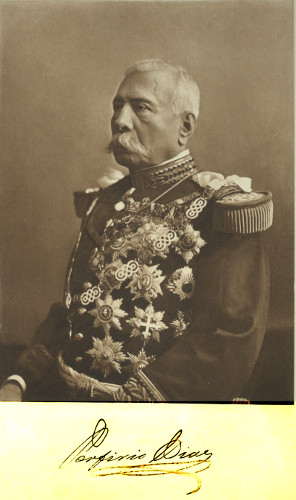
Porfirio Diaz
GENERAL PORFIRIO DIAZ
PRESIDENT
OF THE REPUBLIC OF MEXICO
MEXICO
A HISTORY OF ITS PROGRESS AND DEVELOPMENT
IN ONE HUNDRED YEARS
Copyright 1911 by G. Barrie & Sons
Porfirio Diaz
GENERAL PORFIRIO DIAZ
PRESIDENT
OF THE REPUBLIC OF MEXICO
A HISTORY OF ITS PROGRESS AND DEVELOPMENT IN
ONE HUNDRED YEARS
BY
MARIE ROBINSON WRIGHT
MEMBER OF THE GEOGRAPHICAL SOCIETY OF AMERICA, GEOGRAPHICAL SOCIETY OF BRAZIL, GEOGRAPHICAL
SOCIETY OF LA PAZ, GEOGRAPHICAL SOCIETY OF MEXICO, HISTORICAL AND
SCIENTIFIC INSTITUTE OF SÃO PAULO

PHILADELPHIA: PRINTED AND PUBLISHED BY
GEORGE BARRIE & SONS
LONDON: C. D. CAZENOVE & SON, 26 HENRIETTA STREET, COVENT GARDEN, W. C.
PARIS: 19 Rue Scribe
COPYRIGHT, 1911, BY GEORGE BARRIE & SONS
[5]
TO HIS EXCELLENCY
General Porfirio Diaz
PRESIDENT OF THE REPUBLIC OF MEXICO
A GREAT MAN AMONG THE EMINENT MEN OF THE WORLD, WHO ON HIS EIGHTIETH BIRTHDAY
IS STILL ACTIVE IN BODY AND SOUL; A POWERFUL ADMINISTRATOR OF THE
SPIRITUAL AND MATERIAL GOOD OF HIS COUNTRY
Is Dedicated
THIS STORY OF A HUNDRED YEARS OF INDEPENDENCE
MARIE ROBINSON WRIGHT
| PAGE | |
|---|---|
| DEDICATION | 5 |
| LIST OF ILLUSTRATIONS | 9 |
| INTRODUCTION | 13 |
| CHAPTER I | |
| THE CONQUEST | 17 |
| CHAPTER II | |
| VICEROYALTY | 49 |
| CHAPTER III | |
| THE BATTLE FOR INDEPENDENCE | 65 |
| CHAPTER IV | |
| THE BIRTH OF THE REPUBLIC | 83 |
| CHAPTER V | |
| HISTORICAL EVENTS | 105 |
| CHAPTER VI | |
| GENERAL PORFIRIO DIAZ | 127 |
| CHAPTER VII | |
| THE CABINET | 147 |
| CHAPTER VIII | |
| THE FEDERAL DISTRICT | 159 |
| CHAPTER IX | |
| THE CENTENNIAL | 179 |
| CHAPTER X | |
| CLUBS AND SOCIAL LIFE | 203 |
| CHAPTER XI | |
| ART AND LITERATURE | 219 |
| CHAPTER XII | |
| CHURCHES AND CHARITIES | 235 |
| CHAPTER XIII | |
| EDUCATION | 257 |
| CHAPTER XIV | |
| MEXICO | 269 |
| CHAPTER XV | |
| PUEBLA | 287 |
| CHAPTER XVI | |
| TLAXCALA | 303 |
| CHAPTER XVII | |
| HIDALGO | 315 |
| CHAPTER XVIII | |
| TRANSPORTATION | 325 |
| CHAPTER XIX | |
| OAXACA | 339 |
| CHAPTER XX | |
| VERA CRUZ | 353 |
| CHAPTER XXI | |
| TAMAULIPAS | 359 |
| CHAPTER XXII | |
| COAHUILA | 369 |
| CHAPTER XXIII | |
| NUEVA LEÓN, SAN LUIS POTOSÍ, AGUASCALIENTES | 373 |
| CHAPTER XXIV | |
| QUERÉTARO | 383 |
| CHAPTER XXV | |
| ZACATECAS | 387 |
| CHAPTER XXVI | |
| DURANGO | 395 |
| CHAPTER XXVII | |
| CHIHUAHUA | 401 |
| CHAPTER XXVIII | |
| JALISCO | 411 |
| CHAPTER XXIX | |
| GUANAJUATO | 421 |
| CHAPTER XXX | |
| COLIMA | 425 |
| CHAPTER XXXI | |
| THE WEST COAST | 433 |
| CHAPTER XXXII | |
| MICHOACÁN, MORELOS, GUERRERO | 453 |
| CHAPTER XXXIII | |
| YUCATÁN | 467 |
| CHAPTER XXXIV | |
| CAMPECHE, TABASCO, CHIAPAS | 479 |
| CHAPTER XXXV | |
| CUSTOMS | 487 |
| CHAPTER XXXVI | |
| RESOURCES | 493 |
| CHAPTER XXXVII | |
| RUINS | 505 |
[9]
| PAGE | |
|---|---|
| GENERAL PORFIRIO DIAZ | Fronts. |
| ARMS OF MEXICO | Title page |
| BAS-RELIEF ON THE STATUE OF CUAUHTEMOC | 17 |
| HERNANDO CORTÉS | 18 |
| THE VISIT OF CORTÉS TO MONTEZUMA | 20 |
| CARVING OF THE TIME OF THE VICEROYALTY | 22 |
| HOUSE OF CORTÉS AT COYOACAN | 25 |
| THE NOCHE TRISTE TREE | 26 |
| THE FOUNDING OF THE CITY OF MEXICO | 28 |
| THE WOODS OF CHAPULTEPEC | 30 |
| THE AZTEC CALENDAR STONE | 32 |
| XOCHITL PRESENTING PULQUE TO TEPANCALTZIN | 35 |
| AZTEC IDOL | 39 |
| BANNER CARRIED BY CORTÉS | 43 |
| PORT MARQUEZ WHERE CORTÉS BUILT HIS FLEET | 46 |
| CARVINGS: CHURCH OF SANTA ROSA, QUERÉTARO | 48 |
| BURNING OF THE FEET OF CUAUHTEMOC | 49 |
| DOOR OF THE HOUSE OF CONDE DE SANTIAGO | 51 |
| SACRIFICIAL STONE | 53 |
| PALACE OF ITURBIDE, NOW A FAMOUS OLD HOTEL | 54 |
| STATUE OF CHARLES IV. | 55 |
| CARVINGS ON THE CHURCH OF LA SANTISIMA | 56 |
| IDOLS IN THE NATIONAL MUSEUM | 57 |
| FOUNTAIN IN MEXICO CITY | 58 |
| STATUE OF CUAUHTEMOC | 60 |
| OLD CARVING OF THE TIME OF CORTÉS | 62 |
| THE MILITARY SCHOOL AT CHAPULTEPEC | 64 |
| GATEWAY: MILITARY SCHOOL AT CHAPULTEPEC | 65 |
| HIDALGO | 67 |
| JOSÉ MARIA MORELOS | 68 |
| HIDALGO’S PRISON AT CHIHUAHUA | 69 |
| ITURBIDE | 71 |
| THE LIBERTY BELL: NATIONAL PALACE | 73 |
| CYPRESS TREE, CHAPULTEPEC | 76 |
| HIDALGO ON HORSEBACK | 77 |
| RESIDENCE OF HIDALGO, AT DOLORES HIDALGO | 80 |
| THE NATIONAL PALACE | 82 |
| THE TOMB OF JUAREZ | 83 |
| BENITO JUAREZ | 85 |
| SEÑOR GENERAL DON RAMÓN CORONA | 88 |
| SEÑOR GENERAL DON MARIANO ESCOBEDO | 89 |
| RURALES ON THE 16TH OF SEPTEMBER | 91 |
| SEÑOR GENERAL DON MANUEL GONZALES | 94 |
| GENERAL CARLOS PACHECO | 95 |
| PICTURESQUE SPOT IN THE ALAMEDA | 97 |
| A COUNTRY ROAD IN THE VALLEY OF MEXICO | 100 |
| GENERAL PORFIRIO DIAZ | 102 |
| NATIONAL MUSEUM, SHOWING AZTEC RELICS | 104 |
| NATIONAL GEOLOGICAL INSTITUTE | 105 |
| GENERAL DIAZ AND PRESIDENT TAFT | 107 |
| STATUE OF COLUMBUS | 109 |
| THE POST OFFICE | 111 |
| POST OFFICE, WEST CORRIDOR | 113 |
| NATIONAL LIBRARY | 115 |
| HISTORICAL CORNER IN MEXICO CITY | 118 |
| A PART OF THE OLD AQUEDUCT OF CHAPULTEPEC | 120 |
| ROAD IN PUEBLA, SHOWING POPOCATEPETL | 122 |
| PRIVATE LIBRARY OF A PROMINENT LAWYER | 124 |
| CASTLE OF CHAPULTEPEC | 126 |
| THE PROCESSION OF THE 16TH OF SEPTEMBER | 127 |
| SEÑORA DOÑA CARMEN ROMERO RUBIO DE DIAZ | 130 |
| ESCORTING THE PRESIDENT ON THE 5TH OF MAY | 132 |
| THE TRIBUNAL, 5TH OF MAY | 133 |
| LIEUTENANT-COLONEL PORFIRIO DIAZ | 135 |
| CORRIDOR AT CHAPULTEPEC | 137 |
| STAIRWAY TO THE CASTLE OF CHAPULTEPEC | 138 |
| RECEPTION AT THE PALACE | 139 |
| CORRIDOR AT CHAPULTEPEC | 141 |
| PORFIRIO DIAZ, THE THIRD | 143 |
| SOLDIERS IN PARADE, 16TH OF SEPTEMBER | 144 |
| THE CORBIAN PALACE | 146 |
| PATIO OF THE DEPARTMENT OF THE INTERIOR | 147 |
| SEÑOR DON RAMÓN CORRAL, VICE-PRESIDENT | 148 |
| SEÑOR DON ENRIQUE C. CREEL | 149 |
| SEÑOR LIC. JOSÉ LIMANTOUR | 150 |
| SEÑOR ING. LEANDRO FERNANDEZ | 150 |
| SEÑOR LIC. OLEGARIO MOLINA | 151 |
| GENERAL MANUEL GONZÁLEZ COSÍO | 152 |
| SEÑOR LIC. JUSTO SIERRA | 153 |
| SEÑOR LIC. JUSTINO FERNÁNDEZ | 154 |
| THE LATE IGNACIO MARISCAL | 155 |
| CORRIDOR: SCHOOL OF ENGINEERING | 156 |
| STREET SCENE IN MEXICO CITY | 158 |
| COLONIA JUAREZ | 159 |
| SEÑOR DON GUILLERMO DE LANDA Y ESCANDON | 161 |
| HOME OF GOVERNOR LANDA Y ESCANDON | 163 |
| THE NEW LEGISLATIVE PALACE | 165 |
| HOME OF VICE-PRESIDENT CORRAL | 167 |
| THE PALACE OF MINES | 169 |
| SAN FRANCISCO STREET | 171 |
| POLICE HEADQUARTERS | 172 |
| AMERICAN EMBASSY | 173 |
| POLICEMAN | 174 |
| MEXICAN LETTER CARRIER | 175 |
| FEDERAL PENITENTIARY | 176 |
| GREAT HISTORICAL PARADE, SEPTEMBER 15, 1910 | 178 |
| EMPEROR MONTEZUMA IN HIS PALANQUIN | 179 |
| MONUMENT OF INDEPENDENCE | 182 |
| PRIESTS AND SERVANTS OF CORTÉS | 184 |
| A PART OF THE HISTORICAL PARADE | 186 |
| NOBLEMEN WITH ESCORTS | 189 |
| SITE OF THE WASHINGTON MONUMENT. PRESENTED BY THE AMERICAN COLONY | 192 |
| MONTEZUMA’S ARMY IN MILITARY PARADE | 194 |
| UNVEILING OF THE HUMBOLDT STATUE | 196 |
| THE JUAREZ MONUMENT | 198 |
| THE ARMY OF CORTÉS IN PARADE | 200 |
| RECEPTION HALL OF THE SPANISH CASINO | 202 |
| PATIO OF THE SPANISH CASINO | 203 |
| HISTORICAL STAIRWAY OF JOCKEY CLUB | 206 |
| THE JOCKEY CLUB | 208 |
| SEÑOR DON SEBASTAIN CAMACHO | 210 |
| FOUNTAIN IN THE PATIO OF THE JOCKEY CLUB | 212 |
| SEÑOR JOSÉ SANCHEZ RAMOS | 214 |
| STAIRWAY IN THE SPANISH CASINO | 216 |
| “ANAHUAC.” BY SEÑOR JORGE ENCISO | 218 |
| “THE MENDICANTS.” BY SUAREZ | 219 |
| GALLERY IN THE MODERN SCHOOL OF PAINTING | 221 |
| “AN EPISODE OF A FIRE.” BY G. CARRASCO | 222 |
| “THE FORTUNATES.” BY SATURNINO HERRAN | 224 |
| “THE ETERNAL VICTIM.” BY F. ROMANO | 226 |
| “A PORTRAIT.” BY HERMAN GEDOVIUS | 228 |
| “CHILDREN OF MISERY.” BY SOSTENES ORTEGO | 231 |
| “THE ROUND UP.” BY JUAN URRUCHI | 232 |
| CATHEDRAL, CITY OF MEXICO | 234 |
| WALL AROUND THE SHRINE AT CHURUBUSCO | 235 |
| DR. JOSÉ MORA, ARCHBISHOP OF MEXICO | 236 |
| THE CROWN OF THE VIRGIN OF GUADALUPE | 237 |
| THE SHRINE OF GUADALUPE | 239 |
| SANTA MONICA, GUADALUPE | 240 |
| ORGAN IN THE CATHEDRAL, MEXICO CITY | 241 |
| CHURCH NEAR COYOACAN | 243 |
| FAÇADE OF SAN AGUSTIN | 244 |
| THE SACRED WELL AT GUADALUPE | 245 |
| LUNATIC ASYLUM | 247 |
| THE GENERAL HOSPITAL, CITY OF MEXICO | 250 |
| THE CHILDREN’S HOSPITAL, FEDERAL DISTRICT | 252 |
| PAVILIONS OF THE GENERAL HOSPITAL | 254 |
| STAIRWAY IN THE COLLEGE OF THE MASCARONES | 256 |
| NATIONAL SCHOOL OF MEDICINE | 257 |
| PATIO OF THE SCHOOL OF MEDICINE | 258 |
| NATIONAL SCHOOL OF ENGINEERS | 259 |
| SCHOOL OF ARTS AND CRAFTS FOR MEN | 260 |
| SCHOOL OF ARTS AND CRAFTS FOR WOMEN | 261 |
| ENTRANCE TO SCHOOL OF ENGINEERS | 262 |
| SCHOOL OF FINE ARTS | 262 |
| STAIRCASE, SCHOOL OF ENGINEERS | 263 |
| NATIONAL PREPARATORY SCHOOL | 264 |
| COMMERCIAL SCHOOL | 265 |
| SAN CARLOS ACADEMY | 266 |
| MORELOS PARK, TOLUCA | 268 |
| STREET SCENE, TOLUCA | 269 |
| GENERAL FERNANDO GONZALEZ | 271 |
| GOVERNOR’S PALACE | 272 |
| MONUMENT TO COLUMBUS | 273 |
| MUNICIPAL PALACE | 274 |
| TEMPLE OF VERA CRUZ, TOLUCA | 275 |
| LEGISLATIVE PALACE, TOLUCA | 276 |
| PALACE OF JUSTICE | 277 |
| INDEPENDENCE AVENUE, TOLUCA | 278 |
| SCHOOL OF LAW | 279 |
| NORMAL SCHOOL FOR GIRLS | 280 |
| MATERNITY HOSPITAL | 281 |
| TEMPLE OF MERCED | 282 |
| STATE BANK | 283 |
| GENERAL HOSPITAL | 284 |
| MUNICIPAL PALACE | 286 |
| RESIDENCE OF GENERAL MUCIO MARTINEZ | 287 |
| MONUMENT TO NICOLAS BRAVO | 288 |
| GENERAL MUCIO MARTINEZ | 289 |
| STATUE OF GENERAL ZARAGOZA | 290 |
| STATE COLLEGE | 291 |
| CATHEDRAL | 292 |
| LA MATERNIDAD, PUEBLA | 293 |
| MONUMENT OF INDEPENDENCE, PUEBLA | 294 |
| RIM OF THE CRATER OF POPOCATEPETL | 295 |
| AN OLD CHURCH DOOR | 296 |
| THE ARCADE, PUEBLA | 298 |
| THE PENITENTIARY, PUEBLA | 300 |
| PORTALES, FACING THE PARK, TLAXCALA | 302 |
| AVENUE LEADING TO SAN FRANCISCO CONVENT | 303 |
| OLD CHURCH TOWER, TLAXCALA | 305 |
| SEÑOR CORONEL PROSPERO CAHUANTZI | 306 |
| ARCHWAY ENTRANCE: SAN FRANCISCO CONVENT | 307 |
| SACRED WELL OF OCOTLAN | 308 |
| RUINS OF THE ROYAL CHURCH, TLAXCALA | 309 |
| LA PARROQUIA | 311 |
| OLDEST PULPIT AND ALTAR IN AMERICA | 312 |
| ZOCALO IN REAL DEL MONTE | 314 |
| PANORAMA OF MINERAL DEL CHICO | 315 |
| GOVERNOR SEÑOR DON PEDRO RODRIGUEZ | 316 |
| THE GOVERNOR’S PALACE | 317 |
| SAN JULIO MINE | 318 |
| STATUE OF HIDALGO | 319 |
| HACIENDA LORETO | 320 |
| XATAL MINE | 321 |
| REAL DEL MONTE MINE | 321 |
| SAN RAFAEL MINE | 322 |
| OFFICE OF THE NATIONAL RAILWAY OF MEXICO | 324 |
| DEVIL’S BACKBONE, TOMASOPO CAÑON | 325 |
| OLDEST RAILWAY STATION IN THE WORLD | 327 |
| NOCHISTONGO CUT, BUILT BY THE AZTECS TO DRAIN THE VALLEY OF MEXICO | 328 |
| ROCK BELOW CHONEBRIDGE, NATIONAL RAILWAY | 329 |
| TEQUIXQUIAC TUNNEL | 330 |
| CAÑON WEST SALAZAR, NATIONAL RAILWAY | 331 |
| VIEW ON THE INTEROCEANIC RAILWAY | 332 |
| DRY DOCK, SALINA CRUZ | 333 |
| TELEGRAPH OFFICE IN THE FEDERAL DISTRICT | 334 |
| TOMASOPO CAÑON | 336 |
| THE GOVERNOR’S PALACE | 338 |
| THE CATHEDRAL | 339 |
| STATUE OF BENITO JUAREZ | 341 |
| STATUE OF GENERAL ANTONIO DE LEÓN | 342 |
| FAÇADE OF THE CASINO | 343 |
| STAIRWAY: INSTITUTE OF ARTS AND SCIENCE | 344 |
| STATUE OF BENITO JUAREZ, ON THE MOUNTAIN OVERLOOKING HIS NATIVE CITY | 345 |
| SEÑOR EMILIO PIMENTEL, GOVERNOR OF OAXACA | 346 |
| NORMAL SCHOOL FOR WOMEN | 347 |
| CORRIDOR: INSTITUTE OF ARTS AND SCIENCE | 348 |
| THE PORFIRIO DIAZ HIGH SCHOOL | 350 |
| THE CITY OF ORIZABA | 352 |
| THE PEAK OF ORIZABA | 353 |
| POST OFFICE, VERA CRUZ | 354 |
| OLD GATEWAY, ORIZABA | 355 |
| INDIAN WOMEN IN THE TROPICS | 355 |
| NORMAL SCHOOL FOR PROFESSORS, JALAPA | 356 |
| PICTURESQUE SCENE NEAR SALAZAR | 357 |
| THE HARBOR, VERA CRUZ | 357 |
| OLD FORT OF SANTIAGO | 358 |
| TAMESI RIVER FRONT, TAMPICO | 359 |
| SEÑOR DON JUAN B. CASTILLO, GOVERNOR OF TAMAULIPAS | 360 |
| AVENIDA PRIETO, GOVERNOR’S PALACE, VICTORIA | 361 |
| PLAZA JUAREZ, VICTORIA | 361 |
| PLAZA DE ARMAS, TAMPICO | 362 |
| A FIELD OF ZAPUPE | 363 |
| A TARPON | 364 |
| PLAZA, VICTORIA | 365 |
| TAMPICO PLAZA | 366 |
| NORMAL SCHOOL FOR PROFESSORS, SALTILLO | 368 |
| JUAREZ MARKET, SALTILLO | 369 |
| SEÑOR DON JESUS DE VALLE, GOVERNOR OF COAHUILA | 370 |
| GOVERNMENT PALACE, SALTILLO | 371 |
| STATE CIVIL COLLEGE, SALTILLO | 372 |
| GOVERNOR’S PALACE, MONTEREY | 373 |
| PLAZA ZARAGOZA | 374 |
| PALACE OF GOVERNOR, SAN LUIS POTOSÍ | 375 |
| CATHEDRAL, AGUASCALIENTES | 376 |
| THE BATHS AT AGUASCALIENTES | 377 |
| STREET SCENE IN AGUASCALIENTES | 378 |
| THE BISHOP’S PALACE, MONTEREY | 379 |
| TEMPLE OF SAN MARCOS, AGUASCALIENTES | 380 |
| THE FEDERAL PALACE, QUERÉTARO | 382 |
| CONVENT OF THE CROSS WHERE MAXIMILIAN WAS IMPRISONED | 383 |
| AQUEDUCT AT QUERÉTARO | 385 |
| MEMORIAL CHAPEL TO MAXIMILIAN, MARKING THE PLACE OF HIS EXECUTION | 386 |
| A GENERAL VIEW OF ZACATECAS | 387 |
| THE CATHEDRAL, ZACATECAS | 388 |
| FAÇADE OF CATHEDRAL | 389 |
| STREET SCENE, ZACATECAS | 390 |
| THE CHURCH OF GUADALUPE, ZACATECAS | 392 |
| THE CATHEDRAL, DURANGO | 394 |
| THEATRE, DURANGO | 395 |
| SEÑOR DON ESTEBAN FERNANDEZ, GOVERNOR OF DURANGO | 396 |
| GOVERNOR’S PALACE, DURANGO | 397 |
| SEÑOR DON ALBERTO CINCUNEGUI, SECRETARY OF STATE | 398 |
| CERRO DEL MERCADO | 398 |
| ENTRANCE TO PENITENTIARY, DURANGO | 399 |
| ALAMEDA, DURANGO | 400 |
| THE PALACE, CHIHUAHUA | 401 |
| STREET SCENE IN CHIHUAHUA | 402 |
| MONUMENT TO JUAREZ, CHIHUAHUA | 403 |
| STATUE OF HIDALGO, CHIHUAHUA | 404 |
| INTERIOR OF THE PALACE, CHIHUAHUA | 405 |
| RESIDENCE OF SEÑOR DON ENRIQUE C. CREEL, CHIHUAHUA | 406 |
| THEATRE OF THE HEROES, CHIHUAHUA | 407 |
| ARCHWAY OF THE OLD AQUEDUCT, CHIHUAHUA | 408 |
| FALLS OF JUANACATLAN, JALISCO | 410 |
| STREET SCENE, GUADALAJARA | 411 |
| GOVERNMENT PALACE, GUADALAJARA | 413 |
| STREET SCENE, GUADALAJARA | 414 |
| DEGOLLADO THEATRE, GUADALAJARA | 415 |
| THE HOSPICIO, GUADALAJARA | 416 |
| PATIO: AMERICAN CONSULATE, GUADALAJARA | 417 |
| LAKE CHAPALA, JALISCO | 418 |
| THE JUAREZ THEATRE, GUANAJUATO | 420 |
| VIEW OF THE PORFIRIO DIAZ TUNNEL, GUANAJUATO | 421 |
| EL CARMEN CHURCH, CELAYA | 422 |
| STREET SCENE, GUANAJUATO | 423 |
| THE MANUEL GONZALEZ DAM, GUANAJUATO | 424 |
| PLAZA, COLIMA | 425 |
| STREET SCENE, COLIMA | 426 |
| CATHEDRAL, COLIMA | 426 |
| AT THE FOOT OF COLIMA VOLCANO | 427 |
| MAGUAY GROWING AT THE FOOT OF THE COLIMA VOLCANO | 427 |
| RESIDENCE OF COLONEL EDGAR K. SMOOT, MANZANILLO | 428 |
| COLIMA IN ERUPTION | 429 |
| SUMMIT OF COLIMA VOLCANO | 429 |
| PACK TRAIN ON THE ROAD TO COLIMA | 430 |
| IRRIGATING CANAL, CULIACAN | 432 |
| ENTRANCE TO MAZATLAN | 433 |
| GOVERNOR DIEGO REDO, SINALOA | 434 |
| NEW MOUNTAIN ROAD AT MAZATLAN | 435 |
| THE HARBOR, MAZATLAN | 436 |
| PLAZA DE LA REPUBLICA, MAZATLAN | 437 |
| STREET SCENE, CULIACAN | 438 |
| SEÑOR DON JOAQUIN REDO | 439 |
| CUTTING SUGAR CANE, EL DORADO | 439 |
| AQUEDUCT, CULIACAN | 440 |
| PORTALES, CULIACAN | 441 |
| GENERAL LUIS TORRES, GOVERNOR OF SONORA | 443 |
| GOVERNMENT PALACE, HERMOSILLO | 444 |
| CATHEDRAL AT ALAMOS, SONORA | 445 |
| SEÑOR DON ALBERTO CUBILLAS, VICE-GOVERNOR OF SONORA | 446 |
| BAY AT GUAYMAS | 447 |
| BANK OF SONORA, GUAYMAS | 448 |
| RAMÓN CORRAL PARK, HERMOSILLO | 448 |
| YAQUI INDIANS | 449 |
| MUNICIPAL PALACE, GUAYMAS | 450 |
| LAKE PATZCUARO, MICHOACÁN | 452 |
| THE PLAZA, ZAMORA | 453 |
| CHURCHYARD GATE, TZINTZUNTZAN | 455 |
| SEÑOR DON PABLO ESCANDON, GOVERNOR OF MORELOS | 456 |
| PALACE OF CORTÉS, CUERNAVACA | 457 |
| FLYING BUTTRESS, CUERNAVACA | 458 |
| LA BORDA GARDEN, CUERNAVACA | 459 |
| SEÑOR DON DAMIAN FLORES, GOVERNOR OF GUERRERO | 461 |
| THE PALACE, CHILPANCINGO | 462 |
| TAMARINDO TREES, IGUALLA | 463 |
| BALSAS RIVER, GUERRERO | 464 |
| HOME OF SEÑOR DON AUGUSTO PEON, MERIDA | 466 |
| THE GOVERNOR’S PALACE, GRAND PLAZA | 467 |
| SEÑOR DON ENRIQUE M. ARISTEGÚI, GOVERNOR OF YUCATÁN | 468 |
| SEÑOR DON AUGUSTO PEON | 469 |
| VIEW OF MERIDA | 470 |
| HIS GRACE, MONSEIGNOR MARTIN TRISHLER, FIRST ARCHBISHOP OF YUCATÁN | 471 |
| CORRIDOR OF THE CURATE HOUSE, MERIDA | 472 |
| MODEL SCHOOL FOR BOYS, MERIDA | 472 |
| THE PEON CONTRERAS THEATRE | 473 |
| FAÇADE OF THE MONTEJO HOUSE, MERIDA | 474 |
| INDIAN HEMP CUTTER | 474 |
| JUAREZ PENITENTIARY, MERIDA | 475 |
| STAIRWAY IN THE PEON CONTRERAS THEATRE | 476 |
| ARCH TO CELEBRATE THE CENTENNIAL, MERIDA | 476 |
| PLAZA DE LA INDEPENDENCIA, CAMPECHE | 478 |
| THE CATHEDRAL, CAMPECHE | 479 |
| PALACE OF JUSTICE, CAMPECHE | 480 |
| STATUE OF HIDALGO, CAMPECHE | 481 |
| GENERAL ABRAHAM BANDALA, GOVERNOR OF TABASCO | 482 |
| STREET SCENE, SAN JUAN BAUTISTA | 483 |
| STATUE OF JUAREZ, SAN JUAN BAUTISTA | 484 |
| PARK IN SAN JUAN BAUTISTA | 485 |
| PAROCHIAL CHURCH, CHIAPA | 486 |
| YAQUI INDIAN DANCE | 487 |
| INDIAN MAIDEN WATER CARRIER | 488 |
| TYPE OF TEHUANTEPEC WOMAN | 489 |
| IN RIDING COSTUME—CHARRO SUITS | 490 |
| A TYPE OF THE MAYA WOMAN, YUCATÁN | 491 |
| MEXICAN BASKET SELLERS | 492 |
| SAN BARTOLO MINE, ZACATECAS | 493 |
| SUGAR MILL, ATEQUIZA HACIENDA | 495 |
| PULQUE VATS | 496 |
| BOUNDARY LINE BETWEEN JALISCO AND TEPIC | 497 |
| AVENUE OF DATE PALMS, SONORA | 498 |
| A COFFEE AND BANANA PLANTATION | 499 |
| COFFEE PLANTATION NEAR CORDOBA | 500 |
| PACK TRAIN WITH SUGAR ON THE ROAD TO MARKET | 502 |
| “GOVERNMENT HOUSE,” UXMAL, YUCATÁN | 504 |
| CHAC-MOOL IN THE NATIONAL MUSEUM, CITY OF MEXICO | 505 |
| RUINS AT MITLA | 506 |
| SEPULCHRE, NEAR MITLA, OAXACA | 506 |
| ARCH OF THE “GOVERNMENT HOUSE,” UXMAL, YUCATÁN | 507 |
| CHICHEN-ITZA, YUCATÁN | 508 |
| RUINS AT MITLA, OAXACA | 509 |
| PYRAMID OF THE SUN, SAN JUAN TEOTIHUACAN | 509 |
| RUINS OF PALENQUE, CHIAPAS | 510 |
| “HOUSE OF THE DOVES,” UXMAL, YUCATÁN | 511 |
[13]

In 1896 I travelled throughout Mexico and made a complete study of the country, visiting every State and Territory, gathering valuable data for my book, Picturesque Mexico, which was published in 1897. With the exception of the warm welcome extended me on my return in 1910, I scarcely knew Mexico of fourteen years ago. Everywhere is progress and the social development was a revelation to me. This time I travelled over highways and byways in palace cars instead of stage coaches, litters, and muleback.
Through intimate knowledge of Mexico and her people gained during these extended tours, and through the enjoyment of official courtesies and private hospitality of a most gracious nation, I have been able to get from the best sources interesting features of the national life and history.
I realize more than ever how meagre is the information of the general public outside Mexico, of the beauties and resources of this marvellous country. She holds her proud place in the world as a demonstration of what statesmanship and good government can accomplish.
Mexico has just completed her hundredth anniversary of freedom from Spanish rule. The Sociedade de Geographia do Rio de Janeiro, of which I am an honorary member, sent me as a delegate to this centennial, and as a participant in these festivities gathered much accurate information concerning this[14] jubilee, which not only marked a great era in the history of Mexico, but celebrated the eightieth birthday of the Grand Old Man of the Americas, General Porfirio Diaz, who for nearly half a century has been the honored and beloved president.
This present Mexico tells a story of a hundred years of the republic; of a struggle for independence and her freedom. It is historical and descriptive, but does not in any way deal with the political affairs of the day. I am grateful for all the courtesies which I have received in this hospitable land.
To the President of the Republic, to the Governors of the States, and to the distinguished officials of the National Railways of Mexico, I wish to extend my sincere and kind appreciation. I am indebted to Mr. C. B. Waite for permission to use some of his copyrighted views, and to Mr. C. F. Clarke, for many photographs.
M. R. W.
Chislehurst, New Rochelle, N. Y., December 26, 1910.
[17]
MEXICO
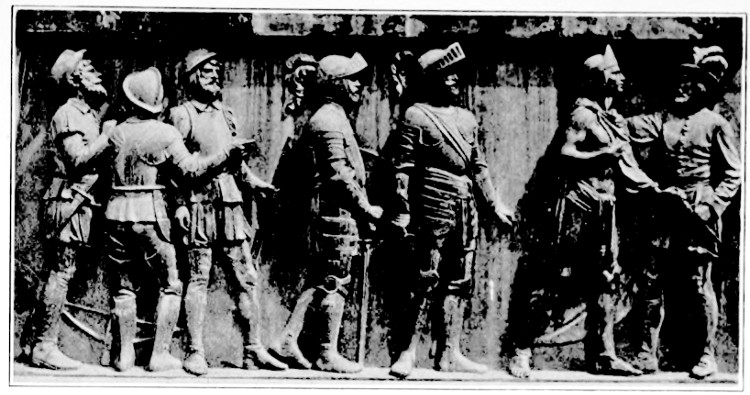
BAS-RELIEF ON THE STATUE OF CUAUHTEMOC.
The history of Mexico is an inspiring one, filled with tragic eras. The earliest inhabitants known were the Toltecs, who came from Central America in the seventh century. They were proficient in many crafts and erected gigantic temples, traces of which have been found in all parts of the Republic. This race was followed by the Aztecs, or Mexicans, in the fourteenth century. These were scattered throughout the Valley of Mexico and their warlike deeds of bravery have formed many a theme for beautiful stories. After two centuries they became a semi-barbaric nation, living in the glory of the natural wealth of their country. A great chieftain, Montezuma, was their monarch, and at the head of their vast army.
When the resources of this great land became suspected by European powers, four hundred years ago, each nation greedily sought to grasp her opportunity of adding to her riches this new field. Spain was more determined and appointed willing subjects to make voyages of discovery to the great unknown country. The first explorer to visit Mexico was Hernandez de Cordova, in 1517,[18] but his discoveries lay about the coast of Yucatan and his brilliant reports caused a thirst for the conquest of the new land.
The siren voices of gold and glory perpetually sounded in the ears of Spanish adventurers, stirred their ambitions and nerved them to deeds of unforgotten bravery.
Columbus had found gold in the strange lands he had discovered in the West Indies, he had tracked it westward in 1498, as he found the Island of Trinidad, threaded the waters of the Gulf of Paria, sighted the great continent southward and later discovered the Isthmus of Panama, then called Veragua. But Mexico, the land of surpassing beauty and wealth that was to be the rarest jewel of the Spanish possessions, the land that was to give forth inexhaustible riches to fill the dwindling treasury of Spain, and to sustain her waning power, was yet unknown. Spanish rule had been planted in the Islands of San Domingo, Cuba and Porto Rico. The thirst for gold and glory grew with the enjoyment of their possession. Settlement established, the representatives of the Spanish Crown made seats of government new centres for extension of Spanish dominion.
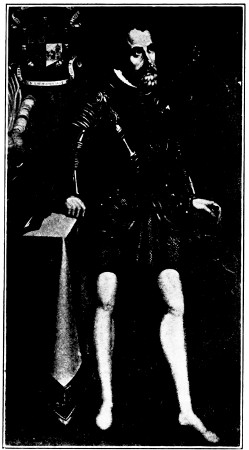
HERNANDO CORTÉS.
When the news reached Spain, in 1499, of the discovery of Paria by Columbus a year previously, Alonso de Hojeda, who had been one of the companions of Columbus, set out with Juan de Cosa, as chief pilot, and Americo Vespucci. They followed the route and took a course south of his, sighting the coast of Surinam, thence to the Gulf of Paria to the Island of Curaçao, and afterward to the Gulf of Venezuela. As a result of this marvellous accomplishment vast and undreamed of wealth soon poured into Spain.
[19]
The governors of the settlements established were men whose imaginations were soon fired with the prospect of vast powers and unlimited wealth to be seized. Even yet it was not known what continent had been found. The barrier, narrow as it was, that stood between the Pacific and Columbus had not been penetrated. The mystery of the continent was still unsolved, the vast and prolific countries that stretched north and south of the Gulf of Mexico were unknown lands.
Among the numerous Spaniards who sought to unveil the mystery of the continent and to plant new colonies for Spain was Nuñez de Balboa, who undertook to colonize Darien, and in 1513 crossed the Isthmus of Panama and in defining the limit of the continent there discovered the Pacific, which he named the South Sea, and claimed it and the islands lying on it in the name of his sovereign.
The first navigator of the Gulf of Mexico was Hernandez de Cordova, who, in 1517, sailed from Cuba, where he was stationed in the service of Spain, on a slaving expedition among the Bahamas. Contrary winds drew him to an unknown coast, where he landed and found the first sign of that advanced culture which distinguished Mexico among the discovered countries. This place he called Yucatan. Here the natives were found to be dwelling in houses of stone and mortar and wore garments of well-woven cloth. They worshipped in magnificently carved temples adorned with idols and ornaments of gold. But to gain possession of this prize the Spaniards had a long and bitter struggle. At Champoton they narrowly escaped destruction by the natives, whose military organization proved remarkable. Against such a force the valor and arms of the invader had to yield. But Cordova had sailed around the peninsula to Campeche, Champoton and the River Estero de los Lagartos; thence he returned to Santiago de Cuba, laden with wonderful spoils. Amongst his acquisitions were crowns and ducks of gold, fish and idols. Much encouragement was found in the declaration of two native captives of the expedition that there were gold mines and gold dust in abundance in their country, the fame of which soon reached Spain.
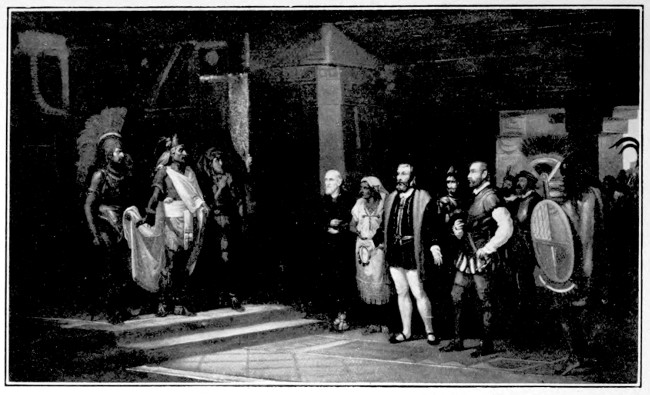
THE VISIT OF CORTÉS TO MONTEZUMA.
The governor, Velasquez, elated with the reports of Cordova fitted out a large expedition the following year, of which his nephew Juan de Grijalva was given chief command. Following the course of Cordova, Juan de Grijalva found difficulty at first in securing the friendship of the natives, but he was[20] able later to obtain much gold in barter. Learning that precious metals could be found in a country called Mexico, he sailed northward and made many discoveries along the Mexican Coast, among others the Island of San Juan de Ulua, in the harbor of Vera Cruz, and the Tabasco River. It is recorded by Bernal Diaz, who was a contemporary of Cortés, that on one occasion the explorers, believing that the highly polished axes, with curiously carved handles, of the people of Guascasualco, were made of an inferior gold, were to discover when they exchanged trinkets for them, that they were simply finely polished copper. Notwithstanding this fact, Velasquez was determined on a thorough exploration of Mexico and he appointed Cortés to the command of a new expedition, which set out from Cuba on the tenth of February, 1519, in twelve vessels carrying seven hundred men. It was not without jealous misgivings that the governor saw this intrepid leader depart, nor, as events proved, was he mistaken in his suspicion regarding the great ambition of Cortés. The expedition reached Trinidad, where Velasquez having determined to replace Cortés sent vessels to detain him, but he had departed on February 18, 1519, and reached the shores of the unknown land in March, 1519. His little force was[21] awaiting him at the Island of Cozumel, near the extreme point of the Peninsula of Yucatan, whence it sailed with two hundred Indian slaves and sixteen horses. This was the power with which the great Aztec land was to be won and the proud ascendancy of Montezuma to be overthrown. The roll of companions of the daring leader included many names that were to become imperishably recorded in the history of Spanish America. Among them were the brilliant Pedro de Alvarado, Alonso de Avila, Cristobal de Olid, Francisco de Montejo, Diego de Ordaz, Velasquez de León, Alonso Puertocarrero and Antón Alaminos.
The solemn directions to Cortés were that he should explore the country discovered by Cordova; restore to freedom the Spanish held in captivity by the Indians; convert the natives to the Christian faith and barter with them; and, finally, to use the most scrupulous care to omit nothing that might redound to the service of God or his sovereign.
Reaching the Tabasco River, which Grijalva had discovered a year before, following the course of that explorer, Cortés landed and gained the first glimpse of that civilization of which had been told such wonderful stories. The people were of advanced culture, the houses were substantially built and the natives wore rich and beautiful garments. That first intercourse was also to give a foretaste of the struggle before him. The Totonacs were the rulers of the land, they were subject to the authority of the Aztecs, but made desperate because of the tribute they were compelled to pay and the severe treatment accorded to them, they were not unwilling to see in the new comers allies to them in their struggles against Montezuma. With their natural instinct of self-preservation they resisted the approach of the Spaniards and only after a sanguinary battle, on the 25th of March, in which they were defeated, would they enter into friendly relations with the invaders. In testimony of their goodwill they presented many female slaves to the conqueror, among whom was the celebrated Marina, whose affectionate loyalty and intelligence later proved a great assistance to the Spaniards. This woman, who in Aztec was called Malintzin, was born in Coatzacoalcos, she was the daughter of a great cacique, on whose death her mother sacrificed her in the interest of a brother and sold her to the cacique of Tabasco.
Besides his victory in arms, Cortés won over a large number of converts who were received into the bosom of the church with great ceremonial pomp. Thus did he lay the foundation of his great work by fulfilling the obligations imposed upon him by his sovereign. This auspicious beginning elevated the[22] hopes of the Spanish and they sailed northward on April 18th and after delays by storms reached San Juan de Ulua. Here the natives manifested a friendly spirit and barter was readily entered into. Establishing himself in this place, the commander desired that messengers should be sent to Montezuma to notify him of the wish of the Spaniard to visit him.
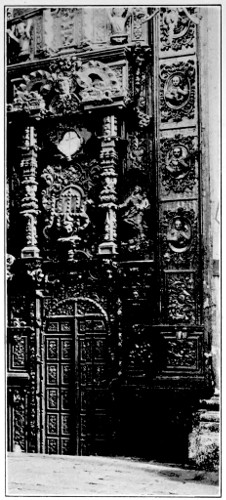
CHURCH CARVING OF THE TIME OF THE VICEROYALTY.
Montezuma sent his ambassador, Teuthile, with wonderful gifts, in pomp and glory, and in this representative of the great monarch, Cortés found a person of different attainments from those of any native he had hitherto met. His dress was costly and he wore ornaments of precious metals; his manners were dignified and with diplomatic skill he made it known that he desired to learn the wishes of the stranger. He was informed that Cortés desired to visit Montezuma to meet him on behalf of his own monarch. After an interval the ambassador returned accompanied by a distinguished cacique and attended by one hundred men bearing beautiful gifts of exquisitely wrought feather work and receptacles filled with grains of gold and other artistic articles, all demonstrating the possession of rich materials and an advanced knowledge of the handicrafts. Such gifts served only to stimulate the Spaniard’s purpose to[23] conquer this rich country. To the request that Cortés should return to his own land, the reply was only a still more earnestly expressed desire to interview the Mexican monarch. Failing by diplomacy to gain an audience with the monarch, Cortés now realized that force alone could give him possession of this wonderful land that he conceived to be his by right of his discoveries.
While awaiting the outcome of negotiations with Montezuma, the audacious leader had busily occupied himself in acquiring information concerning the country and its wealth and in considering means by which he should seize the possessions he coveted. He learned that the Totonacs had occupied their territory for seven or eight centuries; that they had lost their independence to the Aztecs two or three generations before; and had suffered very great indignity and borne many heavy burdens. He shrewdly used his opportunities to contract a firm friendship with these people.
Cortés observing that some of his companions were mistrustful of him, began to chafe under the burden of his obligation to Velasquez. He decided now to throw off his duty to the governor, and strengthen his own independence and power before his plans could be interfered with and his great prospect should become known. Sagaciously, if not loyally, therefore, he founded the City of Villa Rica de la Vera Cruz and created it a Spanish municipality; then resigning his commission from Velasquez, he caused his own appointment as commander-in-chief of the expedition, and placed himself directly under the authority of the Spanish crown. To advance his interests with his sovereign in this course, he sent Montejo and Puertocarrero to Spain with instructions to explain his situation and plans, and in order to demonstrate the wonders of their new territory he dispatched some natives and a large treasure with them.
So adroitly had Cortés acted toward the Totonacs whom he had thus far met that he received an invitation from the chief of the tribe to visit the capital at Cempoalla. He proceeded toward that city, the fleet sailing along the coast, while the expedition penetrated the strange country. As they progressed the dreary and arid lands changed to a scene of luxuriant and verdant vegetation, a flora bewilderingly beautiful to their eyes, with evidences everywhere of a civilization they had not expected, and also of the barbarism of their native religion in the remains of numerous victims who had been immolated to propitiate their gods. Giant hills broke the distant view, and the snow-covered peak of Orizaba, majestically stood above the valley. The people wore rich mantles[24] and robes of finely woven cloth, crudely wrought golden chains hung on their necks, and rings adorned their nostrils and ears. They welcomed the Spaniards with friendly acclaim and bore before them in profusion tropical fruits and flowers.
The city entered was substantially and attractively built, and the prospect was gladdening to the heart of Cortés. Their houses were of a primitive brick and mortar, were surrounded by gardens of fruit trees and shrubbery, while around the city stretched rich fields of grain, giving the scene a picturesque appearance.
Cortés was soon convinced that the Totonacs and other tribes who were subjects of Montezuma were hostile to their monarch. Ever alert to forward his plans, he soon seized on an incident that gave him an occasion to make lasting friends of the Totonacs. Some Aztec tax-gatherers had arrived to demand a tribute of twenty young men and women to be sacrificed to the gods in expiation of the reception the tribe had given to the Spaniards. The chief, feeling the assurance of Spanish protection, cast the tax-gatherers into prison. Thereupon, conceiving an adroit plan to gain the favor of both Aztecs and Totonacs, Cortés rescued two of the five captives, whom he caused to be safely conducted to Montezuma, and preserved from sacrifice the other three. By this diplomatic stroke he was able to establish alliances with several chiefs against Montezuma.
At this time, the audacious genius of the commander was manifested in a crisis that threatened not only his dominion but all that his imagination had conjured up. The friends of Velasquez in his army having stirred up a conspiracy against Cortés and intending to seize one of the vessels and return to Cuba, the leader made a desperate hazard to compel the allegiance of his companions and cut off all chance of defection. In August, 1519, he ordered eleven of his ships to be sunk in the harbor, alleging as the cause that they were worm-eaten. There was now no course open to him but to remain in the country and conquer the people, or be destroyed.
Cortés thereupon garrisoned Vera Cruz with a hundred men, and set out on his march to the City of Mexico, first destroying the idols in the teocalli at Cempoalla. His force now consisted of about four hundred and fifty Spaniards, six light guns, fifteen horses, a number of Totonacs and a numerous body of Indian carriers.
[25]
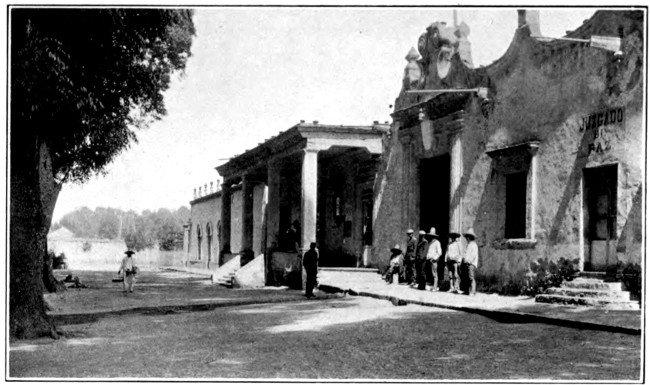
HOUSE OF CORTÉS AT COYOACAN.
Continuing his progress the Spaniard approached the territory of the Tlascalans, an independent people, who were said by the Totonac chief to hate the Aztecs so bitterly that the Spaniards would be sure of a friendly reception. They were doomed to a bitter disappointment. The Tlascalan country lay on the east of the Plain of Anáhuac and was closely encircled by high ranges and when the Spaniards reached the boundary of the territory they found it defended by a strong stone wall. Messengers were sent to request a free passage through the country, but this was denied. They regarded this as a challenge and scaled the enclosing wall, but met a most stubborn foe. Again and again did the little Spanish force tremble for their fate as they received the attacks of the enemy, who numbered thirty thousand brave warriors, but their arms and skill proved too much for the Tlascalans, with their primitive weapons, and after a great struggle they were defeated. Not all their bravery could avail them against the desperate and determined Spaniards. The natives had made a mistake in believing that the Spaniards were children of the sun and that they could be defeated in a moonlight attack. Acknowledging their defeat, they soon made peace and Cortés and his allies entered the city on September 22, 1519. No[26] more faithful men could be found than these Tlascalans, whose enmity to Montezuma the able Cortés knew well how to turn to account. Binding firmly the bonds of friendship and alliance, the conquerors were able to move forward, on October 13th, on their way to Cholula, the next main city between them and Tenochtitlan.
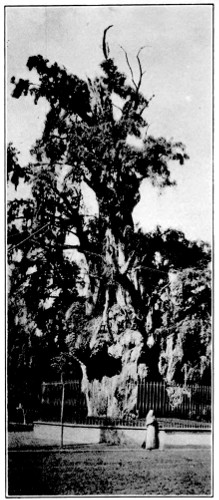
THE NOCHE TRISTE TREE.
The sight of the magnificent temple with its hundred towers, with its rich carvings and decorations of gold, dazzled the eyes and exalted the hopes of the small Spanish force, with its intrepid leader, and its six thousand Totonac and Tlascalan allies, as the Sacred City of Cholula was approached. The ruler of the beautiful city was ready to welcome Cortés, until he learned that their enemies, the Tlascalans, were among his forces, and became suspicious and unfriendly toward the Spaniards and refused to permit them to enter unless the Tlascalans were left outside of the city. With his usual promptitude of action Cortés notified the ruler that he would leave the city the following day and requested that the caciques furnish him with two thousand guides. Pursuing this plan, apparently, he drew up the greater part of his troops within the court of one of the temples, and ranged the rest without, with a full command of the avenues; then he issued orders that at a given signal the Tlascalans should enter. The caciques arrived at the appointed[27] hour with the number of men requested, who not realizing the strategy of the Spaniard came unarmed and not prepared for any unfriendly attack. Cortés ordered an attack upon this body of men, and for several days a horrible slaughter of the unprepared Cholulans lasted, until at least six thousand were massacred. Their own peril and the right of self-preservation could not justify such an act of treachery on the part of a Christian invader. Men who practised the sublime teachings of Christ, and were horrified at finding in Mexico pagans and idol worshippers, still felt they could by a lawless disregard of what was really right, slaughter human beings in their greed for conquest. This is one among many blots on the history of Spain. On November 1st, the ambitious conqueror resumed his determined march to the Aztec capital. The success he had achieved over the Cholulans proved to Montezuma that the intrepid Spaniard could not be turned from his purpose. In vain did he send his representatives bearing royal gifts, with the intention of becoming friendly with Cortés, but the richness of the gifts only served to strengthen the ambition of the Spaniard to gain all those riches for the crown. With unwearying steps, and with still greater determination, the conquering force moved on to Tenochtitlan. Neither the frowning barriers of the valley, nor the dangers before them, could turn their steps aside. Even the huge Popocatapetl was made an instrument of their will, a minister to their necessities, for Diego de Ordaz led a party of Spaniards to the mouth of its vast crater to test its accessibility and find out if sulphur could be obtained for making gunpowder. Everything gave courage to the Spaniards.
Nature unfolded vistas of most enchanting beauty; luxuriant vegetation clothed the land with a verdure so intense in color and dense in its exuberance as to insure an inexhaustible source of wealth; and the capital product gold was in evidence everywhere, furnishing a prize to be won that was well worth every sacrifice.
As Cortés approached, the Aztec ruler’s perplexity knew no bounds. He appealed to his council, they were divided in opinion as to the course he should pursue. His brother, Cuitlahua, or Cuitlahuatzin, counselled an immediate attack, while Cacamatzin, the ruler of Texcoco, urged that the Spaniards be received with all the courtesy due to the ambassadors of a foreign ruler. Already had Ixtlilxochtil, Cacamatzin’s brother, entered into friendly alliance with the Spanish leader. Distracted, Montezuma, inspired by his religious superstitions, believed that the gods had decreed against him. He[28] dispatched Cacamatzin, accompanied by many of the principal caciques and an imposing retinue of attendants, to greet Cortés at Amaquemacan and bid him welcome to the capital. Thus invited and well attended, the invaders passed through Iztapalapan amid great throngs of astonished natives eager to get a look at the wonderful beings and their strange dress and accoutrements. At last the proud, magnificent city was before them, the goal of their enterprise. Over the causeways on the lakes, foot and horse marched, an unwonted spectacle. What hopes and fears tormented them as, step by step, they moved toward the entrance to Tenochtitlan and beheld the city in all its splendor stretched along the shores of Lake Texcoco! A handful of Spaniards, less than five hundred, supported only by native allies who might at any time turn against them, marching to a city whose inhabitants they had been repeatedly told were treacherous. But the die was cast.
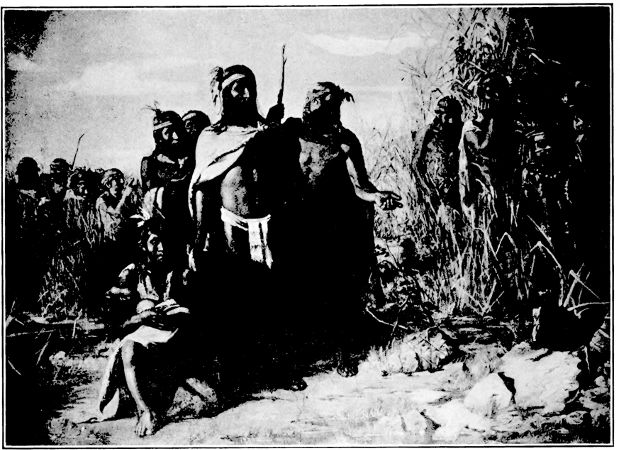
THE FOUNDING OF THE CITY OF MEXICO. FROM A PAINTING BY JOSÉ JARA.
[29]
On November 8th, Montezuma proceeded to the outskirts of his capital and personally invited Cortés and his companions into the Aztec capital. It was no barbarian, in outward guise at least, that greeted the Spaniard. Instead, a proud and dignified ruler attired in sumptuous princely robes, and surrounded by a pomp and ceremony as exacting as that of any of the Old World courts, received with marked politeness and courtesy the unwelcome guest. All pointed to the extreme exclusiveness and dignity of Montezuma, and when Cortés, following the Castilian custom, sought to embrace the Aztec, he was forcefully prevented by the attendant chiefs, who deemed the act disrespectful to so great a personage as their ruler. The reception completed, Montezuma appointed an escort, consisting of his brother and his nephew, to conduct Cortés within the city and to the quarters assigned to them as a residence.
The original Aztec capital was built on an island in one of the cluster of lakes occupying the Valley of Anáhuac. Here on the western side grew the settlement about the temple of rushes, till the capital spread over the islands, the dwellings being raised on piles and filled ground as it was required. Ruler after ruler added to its extent and endeavored to beautify it, till at the time of the Conquest, its structures resembled fairy castles. The great avenues constructed of hard cement crossed the city running from north to south and east to west crossing at the centre. That running north and south extended in both directions, by means of causeways, to the mainland, and the other to the mainland on the west. The causeways were carried on piles and were broad enough to allow of ten horsemen riding abreast, and at intervals were bridged to permit of the passage of boats. The aqueduct conveying the water to the capital was supported on a similar causeway. The dwellings of the people were one story high and were frequently built on terraces. Each stood by itself and was separated from the others by narrow lanes or little gardens and enclosing an open court. High above these rose the many temples, on mounds, and above all, soared the great temple of the god of war.
Cortés entered the capital with all the honors of a victor, to the strains of music and with colors flying, and was conducted to the palace of Axayacatl, the father of Montezuma, as his place of residence. No resistance was offered, the ruler yielded to the gloomy predictions of the priests, he who had always been so proud and valiant in war, that, but a few years before, he had been elected chief in preference to his elder brother. Yet almost abjectly, at the approach of[30] the Spaniards, he humbled himself and his people in awe, influenced by the superstitions of his religion.
It is possible to form a correct idea of the person and character of Montezuma from a description given by one of Cortés’s party. He was about forty years old, tall, slender and thin, but well-proportioned. His complexion, like that of the other inhabitants, was not very brown. His hair was long only over his ears, which it covered; his beard was black and handsome. His face was somewhat long and its expression cheerful, and his fine eyes were full of expression. He had many concubines, all of whom were of note and rank, besides two lawful wives of lineage equal to his.
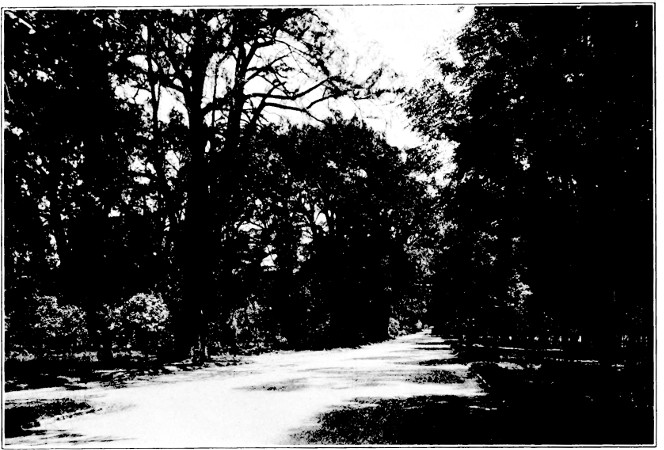
THE WOODS OF CHAPULTEPEC.
The palace occupied by the Spaniards was situated near the temples, a locality selected in conformity with the belief that they were of divine character and should, therefore, be domiciled near the gods. The apartments were very large and those appropriated to Cortés were furnished with carpets. Each of his[31] companions was provided with a separate bed, and given all the comforts and luxuries suitable to his rank.
On the day after their arrival in the city, Montezuma visited Cortés and invited him to his palace where he made acknowledgment of Spanish supremacy. It is impossible to suppose that Montezuma could have regarded the presence of the Spaniards as other than inimical to his country’s interest, especially in view of the fact that their native allies and companions were his bitter enemies. The evidences that each succeeding day furnished of the great strength of the Aztec nation and of the powerful organization by which the country was governed brought clearly to the mind of Cortés the magnitude of the undertaking to which he was committed and the stupendous difficulty that must attend his work of conquest. Everything he saw of the riches of the Aztecs, of the resources of the country both pricked him on and gave him pause. Wealth and magnificence, order and discipline were apparent on all hands. From the top of the great temple, Cortés had viewed the surrounding country. The great causeways; the system of defensive drawbridges; the busy canoes laden with the produce brought regularly to the great markets, thronged with active traders; the vision of temples towering one above the other glistening white in the clear atmosphere; all spoke of strength and organization; of a political system that was directed with care and ability. Cortés had succeeded thus far through audacity and a bravery even to madness. The conditions were such that the same qualities must be largely relied on for further gains.
The Totonacs had by the terms of their contract with Cortés cast off their allegiance to Montezuma and refused to continue the payment of tribute, so when an Aztec chief sought to compel the people of Cempoalla to do so, they refused and took up arms and Escalante, the Spanish commander at Vera Cruz, came to their support. Though the Aztec Cuauhpopoca was defeated in the encounter, Escalante was killed. There had also been a real or imaginary plot against the life of Cortés. Here was his occasion. He saw in it a means of promoting his purpose, no matter what the rights involved might be. Promptly deciding, he called five of his most trusted and audacious companions, Pedro de Alvarado, Gonzalo de Sandoval, Francisco de Lujo, Velasquez de Leon and Alonso de Avila and to them imparted his plan to seize and hold Montezuma, and with them called on the ruler, at the same time ordering a small body of[32] soldiers to assemble in Montezuma’s palace while the major part was stationed in the courtyard and the avenues leading thereto.
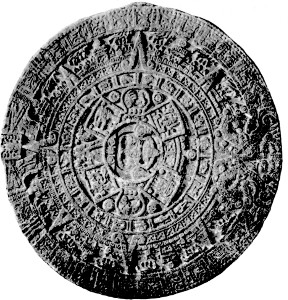
THE AZTEC CALENDAR STONE.
Montezuma, unsuspicious of the plot, received Cortés with accustomed courtesy, and offered him one of his daughters in marriage; but as such an alliance was not likely to further the conqueror’s designs it was declined. Throwing off the mask, Cortés charged Montezuma with treachery, as being the instigator of Cuauhpopoca’s demand on the people of Cempoalla and of the subsequent conflict, and called upon him to summon the chief. To this Montezuma assented, but it availed him naught, for Cortés further required that he should reside in the palace of the Spaniards in order to establish his innocence in the matter. He was finally seized and held to prevent any treachery on the part of his subjects. Captivity was not to be Montezuma’s only fate; his relentless foe humiliated him for awhile by riveting fetters on his ankles. To strike terror into the hearts of the Mexicans, Cortés ordered the chief, Cuauhpopoca, his son and fifteen men of rank to be burned at the stake in view of a great multitude of Aztecs, as a punishment for having fought against Escalante.
If Montezuma was broken, other members of his court were not. Cacamatzin, the nephew of Montezuma, realized that the Spaniards had come to dispossess his nation and had striven to arouse his people to an effort to drive out the Spaniards. He, too, had been made prisoner. But besides the military supremacy that Cortés was fastening upon the Aztecs, there was on his part a constant activity in other directions. Montezuma was still a captive, but Cortés used his victim to legalize his actions. Five vessels were built, to be used on the lakes. The coast was surveyed for about one hundred and eighty miles south of Vera Cruz and the site chosen for a fortified post at the mouth of the Coatzacoalco River. He obtained land in Oaxaca and established[33] a plantation for the crown. He brought his puppet ruler to take the oath of allegiance to the Spanish crown and to become a feudatory prince, his oath and those of his principal chiefs being duly attested and a record made by the royal notary. In pursuance of this scheme, tribute was ordered to be paid to the Spaniards and the vast treasure of Axayacatl was bestowed upon them by Montezuma.
All the indignities heaped upon their ruler and all the spoliation suffered by the people were unavailing to rouse them to open revolt against their despoilers. The yoke of the Spaniards seemed to be riveted upon them and Cortés may have been satisfied that the prize of Mexico was safely in his grasp. His thoughts now turned to the task of overthrowing the superstitious idolatry of the Mexicans and erecting in its stead the worship of Christ. With this purpose in view, he entered the temples and threw out the idols, and converted one of the buildings into a Christian church. This act infuriated the Aztecs and Montezuma urged Cortés to seize the opportunity to leave the country, while it was possible to get safely away. Such advice fell on unappreciative ears, but unwilling to disclose his real intention and desiring to keep his captive tractable, Cortés pointed out that he lacked ships, but would endeavor to build some.
After a brief interval, news arrived of the coming of some Spanish ships to Vera Cruz, of which Montezuma learned and he again urged Cortés to take his departure. On his part, the conqueror supposed that reinforcements had arrived for him as the result of the reports of Puertocarrero and Montejo to their sovereign. The fleet, however, was not so friendly to Cortés; it had been dispatched from Cuba, by Velasquez, in order to wrest from him the fruits of his enterprise. The reports of the great progress and treasure that Cortés had made and gained aroused anew the cupidity and ill-will of the governor and he had determined to overthrow his former commander. The new expedition was under the command of Pedro de Narvaez and comprised eighteen ships with a force of nine hundred men. Arrived at Vera Cruz, Narvaez demanded the submission of Sandoval, the commander, to himself as the representative of Velasquez. The fearless Sandoval answered the insolently-addressed demand by seizing Narvaez’s emissaries, and sending them to Cortés lashed to the backs of Indian carriers, but on their approach to the capital they were released and mounted on horses and courteously treated, by order of Cortés. The new situation thus presented was most grave and called for extraordinary measures. Leaving[34] Alvarado in command at Mexico, Cortés marched against Narvaez with about three hundred Spanish troops and a large force of Indians and joined by Sandoval and de Leon he surprised and overcame Narvaez at night, capturing him and his force. The result increased the troops of Cortés, for most of Narvaez’s men joined the conqueror and the ships were dismantled. This fortuitous event was overshadowed, however, by the news from the interior.
In the absence of Cortés, Alvarado, whom the Mexicans called Tonatiuh, because of his fair complexion, had cruelly massacred hundreds of Mexicans of the highest rank in their temple during a war festival, on May 20th. The pretext urged by Alvarado for his cruel act was that an attack on the Spaniards was planned to follow the feast and that he had merely outwitted them in anticipation, as his leader had done at Cholula. As Cortés returned to the capital from his campaign against Narvaez, signs multiplied of the growing unpopularity of his occupation. Among the tribes, few were friendly, except the loyal Tlascalans. His ships on the lake had been destroyed and thus a great difficulty, if not an insurmountable one, was opposed to his escape, in case of the need of leaving the capital. The people of that place were in full revolt and constantly attacking the Spaniards.
In this crisis, Cortés endeavored to pacify the natives; he released Cuitlahuatzin, the brother of Montezuma, whom he had captured earlier with Cacamatzin. But for once his course was faulty. Cuitlahuatzin was welcomed by the people as the representative of Montezuma. His character was unlike that of Montezuma, and instead of giving aid to the Spaniards, he applied all his activity and zeal in attempting to overthrow them. Shut within their stone palace, the great commander and his companions were attacked by an immense host of Aztec warriors who, scorning the destruction of thousands of their number by the artillery of the Spaniards, pressed their siege unceasingly until night. The next day Cortés sallied out against his assailants, driving them back with great slaughter, but in no way breaking their force or weakening the courage of the foe. In his extremity, he made use of his captive and, decking him with his robes of state, he caused him to mount the central turret of the palace and order the people to lay down their arms in accordance with his will. His authority evoked no sympathy; his plea that the Spaniards should be allowed to depart and his promise of a restoration of the old state of affairs were disregarded. The people, for an instant manifesting reverence for their ruler,[35] soon became enraged and insulted him. The day, June 27, 1520, was a fateful one. An arrow pointed by his nephew, Cuauhtemoc, was the signal for a general attack with stones and Montezuma was severely wounded. He died three days later, it is claimed, at the hands of the Spaniards, who are also said to have murdered his nephew, Cacamatzin, and other rulers, besides priests and men of rank whom they took prisoners.
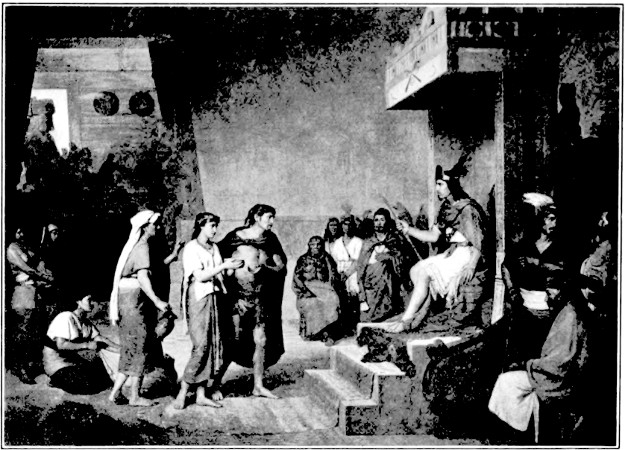
XOCHITL PRESENTING THE FIRST PULQUE TO TEPANCALTZIN.
Meantime, the position of the Spaniards was nearly hopeless. The enemy had taken a stand on the pyramid of their great temple, whence they could rain a tempest of missiles on the quarters of the Spaniards, which must become untenable unless the pyramid was cleared. Inch by inch, Cortés and his men fought the Mexicans up the lofty steps to the topmost platform of the pyramid, where the most desperate struggle was continued for three hours till all the natives, except two priests, were either killed or had been hurled to the pavement below. Then, casting the great idol of Huitzilopochtli to the square below, the Spaniards[36] set fire to the temple. The victory was vain, however, for the fate of Cortés’s enterprise was sealed. Two courses only he saw, escape from the city as best he could; or death for himself and his companions. He had failed to beat off his assailants by his sorties; they were but more infuriated.
In the palace of his father, the corpse of Montezuma lay, at midnight, while the Spanish priest, Olmeda said the mass for the dead. All preparations for flight had been made and hardly had the solemn service been ended before the Spaniards filed out of their quarters to take up their march out of the city which they had dreamed was their own, and which with most of its treasures and the great empire they had hoped to establish they were now relinquishing as terrified fugitives; not however, entirely oblivious of gain, for by permission the men were to take all the gold they could carry.
The night march was favored because the Aztecs rarely fought at night, and because darkness would serve, in part, to cover the retreat. The once proud and victorious soldiers moved forward, still orderly and with discipline. Sandoval, Ordaz, and Lujo led with a part of the infantry; Cortés, with the artillery, the treasure, the women and the prisoners formed the centre; and with him were Olid, Morla and Avila; in the rear were Alvarado and Leon, with the main body of the infantry and the heavier guns. Scattered throughout the three divisions marched the loyal Tlascalans, who in the darkest hour had never failed in loyalty and valor.
The organization and discipline of the Aztecs find no better illustration than in the measures they had taken and in their action on this memorable noche triste. The bridges on the canals had been destroyed, and sentinels had been carefully posted to give immediate alarm, and the great drum of huehuetl was served so as to bring the native soldiers in arms instantly on its being sounded.
The night was very dark, a drizzling rain was falling as the heartsick Spaniards cautiously proceeded through the silent streets of the city and neared the causeway of Tlacopan. No foe had opposed them thus far, but, as they were about to retreat along the causeway, sentinels gave the alarm, the dreaded sound of the great drum was heard and innumerable warriors attacked the Spaniards; they assailed them from canoes, in the streets, from the flat house-roofs,—from every direction came the assailants. Plan, purpose and bravery combined to make the task of the retreating force almost impossible of execution.[37] With the foresight characteristic of Cortés his equipment included a portable bridge, but its sufficiency fell short of the present urgency. Fighting with the stubbornness of valor and desperation, the first canal was crossed, but its capacity gave passage so slowly that before it could be moved forward to the second canal the vanguard was attacked savagely. Meantime, the weight of the artillery and the troops had forced the bridge into the earth so that it could not be removed. The situation was indescribable. Thronging the narrow causeway, surrounded by a daring and capable enemy bent on exterminating the Spaniards, trapped in fact, escape seemed impossible.
Desperate men dashed on horseback across the openings in the causeway, swam, or passed across on a sinister bridge formed of corpses; but far the greater number perished in that fateful hour. No one could tell of the horrors of that passage, nor of the heroic bravery of the Spaniards. The great leader, in defeat, was the equal of himself in victory. He led the way and had crossed the last canal by a ford, but wounded as he was, he returned with a few of his horsemen to aid those in the rear. Alvarado, also, was severely wounded, and the story of his escape is a favorite one. History has enshrined the legend: he fixed his long lance in the bottom of the lake and then vaulted across the breach in the causeway. The rear guard of the army returned to their quarters in the city, where after a siege of three days they surrendered and were sacrificed on the altars of the Aztec gods. The motto that had inspired the conqueror when he added it to his standard, bravely adorned with the arms of Charles V. and signed with the crimson cross: Amice sequam crucem et nos fidem habemus vere in hoc signa vincemus (Friends, let us follow the cross and if we have faith, we shall conquer), must have seemed a reproach or a mockery to the Spaniards as they fled from the city over the Tlacopan causeway only to meet, most of them, a horrible death.
On legend also must we rely for the statement that on bringing his thinned ranks, depleted by five hundred of his brave compatriots and four thousand equally brave and loyal Indians, to a native temple on the mainland, Cortés rested under a large tree, since called the Tree of La Noche Triste, and shed tears as he contemplated the forlorn and desperate state of his soldiers. His was not a nature to succumb to defeat. Bereft though he was of some of his bravest comrades, of troops, of most of his horses, of all his artillery, almost without firearms, and his treasure lost, his plan was ready; he would[38] seek a place of safety in Tlascala and there define his plans for recovery of his position.
The retreat continued and Otompan, or Otumba, was reached on July 7th. The way was there barred by an immense army led by Cihuacoatl. The main reliance of the Spaniards was now on the pike and the sabre, with which they defended themselves, but so valiant was the defense, and often the attack, that after seventy-five days of consecutive fighting, during which terrible carnage took place, against inconceivable odds, the Aztecs were put to rout. It is believed that final success was due to the bravery and strategy of Cortés, who had learned that with the lowering of the banner of their chief, the Mexican soldiers would flee. He therefore, supported by Sandoval, Alvarado, Olid, and Dominguez, attacked the chief and hurled him to the ground and killed him. Thereupon, the army fled, having lost one hundred thousand men, while of the Spaniards one hundred and of the allies twenty thousand fell.
Taking up the march again toward Tlascala, not without grave misgiving as to the possibility of a reversal of the friendly spirit and fidelity of his allies, they reached the capital and were greeted with most friendly welcome. Here, Cortés fell a prey to a fever that resulted from the wound he had received on the Dismal Night; here, too, he was to learn that the treasure of gold he had left behind him when he went on to conquer Tenochtitlan had been taken by the Mexicans, who destroyed the messengers bearing it to him. He had also to put down the opposition of some of his soldiers who desired to go back to Cuba, but having received reinforcements and made gunpowder from the sulphur taken from the crater of the great Popocatepetl, he determined to reopen his campaign by operations against Tepeaca and took and sacked the capital and established the settlement of Segura de la Frontera.
It was evident to Cortés that his military task was more difficult than at first. The new Aztec ruler, Cuitlahuatzin, was of different mould from Montezuma. The leaders were very able and extremely courageous. Every effort had been made by them to displace the loyalty of the native allies, but in this they had failed, for their number was increased. Cortés determined that every place that lay on the road to Tenochtitlan must be friendly or conquered. Betrayed by their cacique, Cuauhquechollan was subdued; Iztocan was taken and sacked and a hundred temples given to the flames. Adding further to his native forces, and releasing some of the companions of Narvaez, the[39] conqueror completed his plans for the recapture of the Aztec capital, including the building of thirteen flat-bottomed boats to be used on Lake Tezcoco.
Before siege was laid to the capital, the successor of Montezuma died, on November 26th, of smallpox, to which thousands of Aztecs had succumbed. This scourge was of great service to the Spaniards. The new ruler was Cuauhtemoctzin, or Guatemotzin, the nephew and son-in-law of Montezuma. Preparatory to his final march on Tenochtitlan, Cortés formulated a drastic code for the regulation of his army and significantly declared that the pending war and its acquisitions would be robbery unless its principal aim was the conversion of the heathens. Thus, with an apparently more serious purpose than before, the army, with its eight thousand carriers, bearing the thirteen brigantines, moved on Tezcoco, on December 28th, and following the most difficult route, took it without contest. Establishing a friendly ruler here, Cortés then took Tlacopan and entered the southern border of the Valley of Mexico. At this time he was captured in the course of a reconnaissance, but was liberated by his soldiers before the time of his sacrifice had arrived. He was also obliged to quell an insurrection in Tezcoco, which aimed at his assassination.
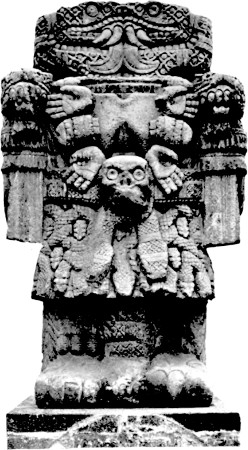
AZTEC IDOL.
Cortés was now ready for his attempt on Tenochtitlan. His brigantines were launched on the lake on April 28th and with his army divided into three bodies under Alvarado, Olid, and Sandoval, consisting of nine hundred Spaniards, one hundred and twenty-five thousand native allies, eighty-seven horses, and with three large and fifteen small guns, chiefly disposed throughout the fleet, the march on the capital began on May 20th. Cortés took command of the fleet of thirteen brigantines and a great number of native canoes. The three commanders occupied, respectively,[40] Tlacopan, Coyoacan, and Iztapalapan, which they made their bases of operations. In a few days, Cortés had taken several lake positions; the capital was completely blockaded; the water supply was also cut off and the way was opened for an attack on the city itself. This he succeeded in entering and reached the principal square and seized the great temple of the war god, withdrawing, however, at nightfall.
Three days later, being largely reinforced from Tezcoco, he again attacked the capital and entered it, setting fire to the palace in which he had formerly resided and to Montezuma’s aviary. The resistance of the Aztecs was so formidable and their bravery and steadfastness so terrible that the retreat at night to camp could be accomplished by Cortés only with great difficulty. But little real progress was being made by this method as the enemy destroyed the military works of the invaders as soon as the latter had retired. Such operations promised little and yielding to the counsel of his lieutenants, Cortés decided on making a general attack.
On June 28th, all plans being communicated to his leaders, an advance on the market place of Tlatelolco was ordered. Through a misadventure, the forces were separated. Alderete, who had already almost reached the objective point, was greeted with the din of the great sacred drum and he was immediately attacked by the Aztec hosts. He had omitted to close the breaches in the causeway, and the other divisions could not follow. The advance body was routed and fled back on the causeway. There with Cortés on the other side of the opening, a terrible battle raged. Cortés was wounded and narrowly escaped capture, but he rallied the soldiers and led a retreat. Pedro de Alvarado and Sandoval, having also nearly reached the market-place, retreated. The exultant Aztecs taunted their enemies on their defeat and flung among them three dripping heads of Spaniards, shouting as they did so “Malinche” (the name they applied to Cortés), “Tonatiuh” (Alvarado), and “Sandoval.” To this they added the abominable torture attending their barbarous sacrifices as they offered the bodies of their captives on the altars of their demon-gods and feasted at a banquet on their corpses at evening.
This defeat seemed to threaten the destruction of the Spaniards. It is to the eternal credit of the native allies that not all the efforts of Guatemotzin and his emissaries the priests, nor his threats could undermine their loyalty to Cortés.
[41]
Realizing the disadvantages under which he labored by reason of the difficulty of keeping open the approaches by the causeways, of operating his forces and of defending them under these conditions, Cortés developed a new plan of attack; he would fill the canals. Accordingly, he led his fighting men and utilized the Indian auxiliaries to destroy with hoes every building they reached. The great teocalli had been put to the torch; the objective point was at hand. Slowly, but steadily, the invaders advanced and the enemy crowded closer and closer within narrowing limits, pressed by a determined and relentless foe, and ever falling under the combined blows of growing famine, want of water, and pestilence. Guatemotzin at first scorned to surrender when called upon to do so; then, as the sufferings of the Aztecs grew past endurance, he promised to arrange terms, but failed to appear, preferring death. The last shortening of the living chain about them had been made; the eager soldiers leaped at the command for a general attack, and pouring into the city after his fighting men, the Indians fell upon the Aztecs sparing none on that day of fearful revenge and continuing the carnage on August 13, 1521. The Aztec chief was captured as he sought to escape on a piragua, and was led before the conqueror, from whom he begged the boon of death by his dagger, now that he was a prisoner after having done all that he could in defence of his country and people. Their leader captive, the surviving Aztec warriors submitted and were permitted to leave the capital. Tenochtitlan and the Aztec dominion were destroyed. The conqueror left a garrison in the city and his victorious forces withdrew to their respective bases of operation. The cost of life to the invaders during the almost three months’ siege was about one-tenth of their strength.
The victors’ joy was tempered with disappointment. The treasure they had hoped to find was not forthcoming. Guatemotzin was believed by the Spaniards to possess a knowledge of its whereabouts and Cortés ordered him to be tortured to extort a revelation which he had declared he could not make. He averred that some treasure had been cast into the lake, but like many another reputed vast hoard, it was not discovered, in spite of a careful search of the waters of Lake Tezcoco.
Master of the prize that had been won at the cost of many thousands of lives, vast treasure and heroic deeds, Cortés decided to reclothe the fallen city with the dignity of chief place in the conquered dominions. The aqueduct he soon restored and canals were filled and additional causeways built. He was[42] as able an administrator as he was a commander. The Indians he had dispossessed were allowed to settle in prescribed districts in the new city. With an immense number of Mexicans whose labor he could utilize, the City of Mexico soon became a solid and imposing place.
Not long after the conquest was completed, new troubles arose that threatened the power that Cortés had acquired. Velasquez, the governor of Cuba had so contrived that the royal government authorized both an investigation of the conqueror’s conduct and the taking over of the government of New Spain, but the official sent proved no match for the conqueror and he returned to Cuba. Soon thereafter, Charles V. conferred on Cortés the titles and powers of governor, captain-general, and chief justice of New Spain. His acts confirmed, his companions rewarded, and his dignities established, Cortés began to explore and settle the new dominion. On the Pacific he threw out the settlement of Zacatula, on the Atlantic, San Estevan, Medellin, and Antigua, which latter he projected as the principal port. Regulations were made to encourage the settling of the country and great inducements were offered to those who married. In the appropriation of lands, Spaniards only were recognized, the natives being held in a condition of slavery, save only the Tlascalans, whose loyalty was rewarded by immunity from tribute and the entire control of their lands, besides the enjoyment of other privileges and the bestowal of titles of distinction on their leaders. Later, their capital became the seat of the first bishopric, they elected their alcalde and he became their governor. But no honors bestowed on them could repay their services, for without their aid, no Spaniard would have survived, no nation would have been possible.
One of the consequences of the capture of the City of Mexico was the effort on the part of the southern provinces of Mexico bordering on Guatemala to conciliate the great conqueror and secure his goodwill. These sent ambassadors laden with gifts of such value that Cortés was fired with the ambition to acquire lands on the southern sea, for which purpose he fitted out an expedition that soon accomplished its object. This was supplemented by an expedition sent in aid of the people of Tehuantepec against the adjoining province of Tututepec. This resulted in the invasion of the latter province by Alvarado, its defeat and the settlement of Spaniards in the territory; while he proceeded to Guatemala and discovering its wealth determined on its conquest when the opportunity occurred. Fitting out a strong force, chiefly of natives, Alvarado[43] marched south and was loyally treated by the people of Tehuantepec but resisted by those of Soconusco, whom he defeated and thus conquered their provinces. He continued his march through Guatemala, with which we need not here deal, except to say that Alvarado remained loyal to Cortés, by whom he was recommended for the governorship of Guatemala.
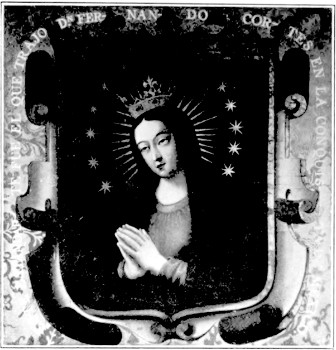
BANNER CARRIED BY CORTÉS.
During one of his expeditions, Cortés disposed of his faithful friend Marina, by gift to a Spanish knight, whom she married. Though she was endowed with large grants of land from the government of Spain, her abandonment was but a mean requital of her affection and inestimable services to Cortés and the Spanish cause, and the romantic interest associated with “Malinche,” and the popularity accorded to her, better measure the appreciation of her services.
On his return from Honduras, Cortés was received in Mexico with great rejoicing by the people, his enemies had been active in Spain and he had been accused of aiming at an independent sovereignty. An investigation was committed to Juan Ponce de Leon, with the power of governor meantime. His death in a few weeks and also that of the successor he named brought the duty to the task of Alonso de Estrada, a bitter enemy of Cortés, who was still captain general. Under these circumstances, Cortés determined to appeal in person to his sovereign and accordingly sailed from Villa Rica with rich presents and specimens characteristic of the flora and fauna of the country. With him were Sandoval and Tapia, and two sons of the late Montezuma and Maxixca, and several native chiefs.
[44]
Arrived in Spain, he went to the convent of La Rabida, where Sandoval, one of his ablest companions, died. The arrival of Cortés created intense interest and he was accorded the greatest distinction by the sovereign, who conferred on him the title of Marquis of the Valley of Oaxaca and bestowed on him large estates in Oaxaca, in Mexico City, and elsewhere. His governorship of New Spain was not restored, however, but he was appointed captain general of that dominion and empowered to make discoveries and settlements in the southern ocean. The conqueror now married a lady of royal blood, Doña Juana de Zuñiga and in 1530 embarked for Mexico.
In the closing days of 1527, Charles V. had appointed an audiencia to govern New Spain, at the head of which was Nuñez de Guzman, governor of the Province of Panuco, aided by four oidores. This administration was vicious in the extreme; barbaric cruelty was exercised toward the natives, who were capriciously murdered and enslaved; charges against Cortés were encouraged and considered with foregone determination; the clergy was tyrannized over and abused for their efforts to obtain justice and humane treatment of the natives; till in 1529, Zumarraga, the first bishop of Mexico, related in a letter to Spain the tale of the misdoings of the audiencia. Guzman, dreading the exposure of his evil deeds and hoping to avert disaster to himself, set out on December 20, 1529, on an expedition to conquer the province of Jalisco, or Amazonas, which had been discovered by Cortés. Guzman, during his rule of Panuco, harassed and plundered the native inhabitants with utter disregard of even the semblance of justice and descended to acts of the most petty despotism. He even caused the Indians to be put to death because they had omitted to clean the streets in his path. At the least manifestation of discontent on the part of the Huastecas, during his absence from his province as governor of Mexico, he caused whole towns to be subdued by force of arms as rebels, and the inhabitants to be sold as slaves, so that this monster’s cruelty resulted in almost the depopulation of entire districts. Now that he was entering on the conquest of Jalisco he raised funds by seizing and exporting as slaves the natives of his own province, those who fled in terror to the deep forests and mountain fastnesses being pursued by slave-hunting parties to take them.
This inhuman conqueror left a trail of desolation behind him as he marched through Michoacan and Nueva Galicia. He tortured and burnt those chiefs[45] who could or would not furnish him with gold, or even a token of his displeasure; the chief of the Tarascans of Michoacan, who had manifested the extreme of friendliness toward him, stripping himself and his people of all their gold and possessions, giving him free passage through his country and furnishing him with hosts of burden bearers, was in spite of all, put to daily torture and, when this ceased to afford diversion, was then burned. The tyrant was fiercely fought in the territory he invaded, but the natives were defeated and he founded the cities of Guadalajara and Compostella. During this campaign, Chirinos, one of Guzman’s officers, invaded the Zacatecas, a so-called Chichimec tribe.
The depredations and maladministration of the audiencia did not cease even during the absence of Guzman, so that the Crown, forced by the representations of the ecclesiastical authorities, resolved to govern Mexico by a viceroy and appointed Antonio de Mendoza, but displaced the old audiencia and appointed another to govern until the arrival of Mendoza in Mexico.
The royal commission to Cortés to make discoveries was henceforth the sole motive of the conqueror’s activity in Mexico. He landed at Villa Rica in July, 1530, and, being forbidden to come within ten miles of the capital until the new audiencia was installed, he took up his abode at Tezcoco. He was never again, however, to reside permanently in the capital, for he found himself in conflict with the new audiencia and withdrew to Cuernavaca, there to manage and cultivate his estates.
In 1532, he dispatched an expedition to explore the Pacific coast northward, but the fleet was lost. The next year he sent two vessels in the same direction one of which in 1534 touched the Peninsula of Lower California, which was supposed to be an island. Even such a succession of disasters could not crush the spirit of Cortés, who, in 1535, led an expedition which established a colony on the eastern shore near the southern extremity of the Peninsula of California, but owing to the barrenness of the land it was a failure, the few survivors making their way back to Mexico in 1536. In 1539, he sent out another expedition under Francisco de Ulloa who, with three ships explored the western coast of the same peninsula to about the twentieth parallel of north latitude, or certainly as far as Cedros Island. But his adventures were interrupted by the viceroy, Mendoza, who had arrived in October, 1535, and who claimed that the right of discoveries in the southern ocean was vested in him.
[46]
Again Cortés left Mexico, in January, 1540, to seek redress at the Court of Spain, but his efforts were without success. He enlisted to fight against the Moors at Algiers; then returned to Spain, where, after much discouragement and even, it is said, contempt, he finally obtained permission from Charles V. to return to Mexico. He died, however, near Seville, on December 2, 1547, on his return journey to the magnificent land that he had conquered and added to the dominions of Spain, with all its limitless resources, rich in all that country needed to support its tottering power and for a time to restore and even to increase its former greatness.
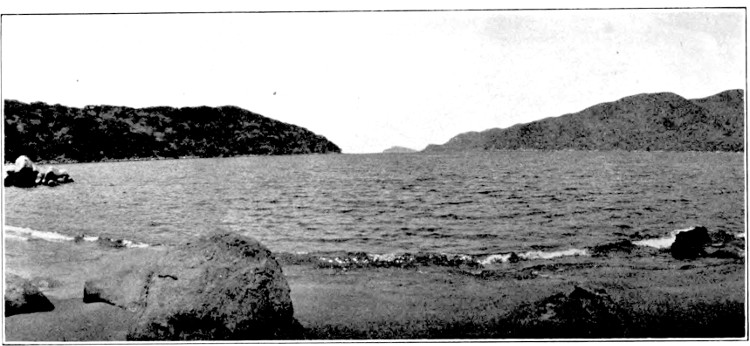
PORT MARQUEZ WHERE CORTÉS BUILT HIS FLEET FOR A VOYAGE OF DISCOVERY ON THE PACIFIC.
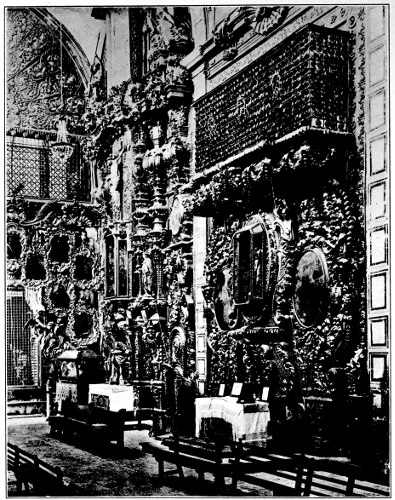
CARVINGS OF THE TIME OF THE VICEROYS. THE CHURCH OF SANTA ROSA, QUERÉTARO.
[49]
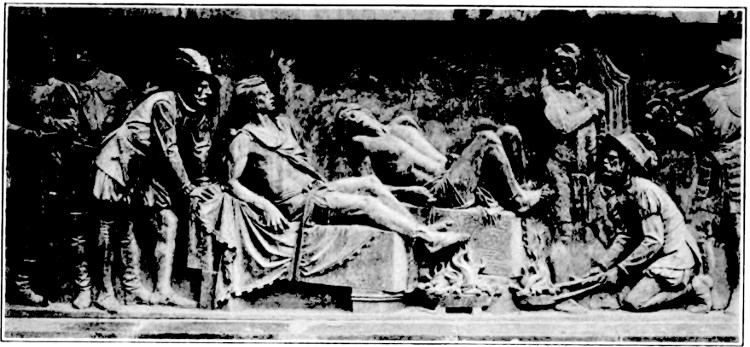
BURNING OF THE FEET OF CUAUHTEMOC AND HIS GENERAL TO FIND THEIR HIDDEN TREASURE.
The old order had passed. On the ruins of the Aztec dominion was established a military government, a sort of proprietary dominion; to this succeeded a short-lived civil government by commissioners; then came the final stage of Mexico’s dependency and provincial government under a viceroy. These successive governments saw in the great dominion only a field for the exploitation of riches for their sovereign’s use and their own. The natives of the country had been ruthlessly despoiled of their possessions and to a large degree enslaved by the Spaniards; they had no rights save such as their masters might arbitrarily grant. Except for the noble protection and kindness of Las Casas and the missionaries, their lot had been hopeless indeed. The first viceroy, Don Antonio de Mendoza, Conde de Tendilla, arrived in Mexico on October 15, 1535. As before said, his authority soon clashed with that of Cortés. He was a man of superior parts and great probity and earnestly strove to direct the province of New Spain in the path of progress and stability. Among the enlightened measures of his administration was the introduction of the printing press, and[50] in 1537 appeared La Escala de San Juan Climaco, a Latin work translated by Fra Juan de Madalena. The establishment of a mint for the coinage of silver money was another important work, inasmuch as the natives had become opposed to the copper coin, of which they had cast some two hundred thousand pesos in value into the lake. The viceroy also founded a college for Indian nobles at Tlatelolco and with a spirit of consideration for the natives he caused the hated Nuñez de Guzman, who as president of the first audiencia had been guilty of great cruelty and greed, to be cast into the common jail. Under his direction, Coronado led the expedition to the fabled Quivira in the northeast, the Eldorado of the north, the “Seven Cities of Cibola,” so wonderfully described to De Vaca by the Indians. The town of Guadalajara was founded in New Galicia; and Valladolid in 1541; this latter, in 1828, was named Morelia in honor of the patriot Morelos. During his rule, the famous Mixton War occurred in the new province of New Galicia and was finally suppressed by Oñate aided by the viceroy.
The period was marked by the introduction of the benign measures known as the “New Laws,” promulgated by Charles V. in 1542, chiefly at the instance and through the exertion of the Indian-loving Bartolomé de las Casas. The intent of these laws was to prohibit absolutely further enslavement of the natives and, as far as practicable, to give freedom to those already slaves, but their enforcement was found to be impracticable.
In 1545, an appalling epidemic spread among the natives, of whom eight hundred thousand were said to have perished. During this period the viceroy Mendoza unremittingly cared for the sick and earned the proud and affectionate title of “Father of the poor.” The justice of his rule won the loyalty of the natives to the crown, and during the insurrection of Pizarro the emperor conferred on the former Tenochtitlan the title of muy noble insigne y leal. In 1551, Mendoza was rewarded for his excellent administration by transfer to the government of turbulent Peru.
Don Luis de Velasco succeeded in November, 1551, as the second viceroy of New Spain. He directed assiduously the enforcement of the “New Laws” and in this succeeded measurably, earning for himself the title of “the Emancipator,” as he liberated from the mines one hundred and sixty thousand Mexicans, whose freedom he said, “was more important than all the mines in the world, and that the revenues derived therefrom by the crown were not of such a nature as to defy the laws of God and man.” In 1551, the University of Mexico was created[51] and in 1553, was founded. Velasco died in Mexico in 1564, and was interred there with great pomp and honor in appreciation of his able administration.
Martin Cortés, the second Marqués del Valle, who had left New Spain with his father when eight years old, now returned to Mexico, enriched by profit in the service of the king, and sought to enjoy his hereditary possessions and honors. His arrival, in 1563, was attended with great splendor, and his state and pretensions gave offence to the viceroy, although no serious trouble had occurred during his lifetime.
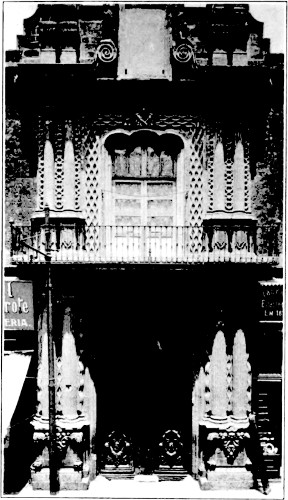
DOOR OF THE HOUSE OF CONDE DE SANTIAGO.
The third viceroy, Gaston de Peralta, Marqués de Falces, arrived during the investigation of the charges against Martin Cortés and his friends. He found no proof of conspiracy, stopped the proceedings and released most of the prisoners and commuted the death sentence passed on Luis Cortés to ten years’ service in Africa and loss of property; he sent the Marqués to Spain. This procedure enraged the members of the audiencia and they accused the viceroy of favoring the conspiracy and sought his recall. A commission sent by the king to investigate determined on the prosecution of all traitors and four were executed, while Martin Cortés, son of Marina, was tortured and then exiled. The ordinary jails were insufficient to hold the victims of the persecution; the viceroy was deposed. But so exceedingly cruel and arbitrary was the action of the persecutor that he was himself deposed in 1568, and the viceroy was[52] exonerated of all blame. This extraordinary and romantic affair ended, after a protracted trial, in the restoration to the Marqués of his confiscated property in 1574.
During the term of the fourth viceroy, Martin Enriquez de Almanza, the scourge of the Spanish Inquisition was established in Mexico under the direction of Pedro Moya de Contreras, later Archbishop of Mexico and viceroy of New Spain. Nominally, this institution was introduced in 1529, by a council consisting of the audiencia and the heads of the Franciscan and Dominican orders, but its official establishment was not made until later. In 1572, the Jesuits settled in the province and founded their first college in the City of Mexico, which was devoted to the education of the Spanish Americans and to the conversion of the natives. La Caridad de San Hipolito was another institution founded under this administration; its purposes were wholly charitable.
Little worthy of note occurred, for strife between the audiencia and the viceroys had become chronic, and government was paralyzed, until the administration of the eighth viceroy, Luis de Velasco, son of the second viceroy, in 1590. Having resided for some time in New Spain he was familiar with conditions and as he was very popular the progress of the province was marked, particularly in the direction of manufactures and the embellishment of the capital. His successor, Gaspar de Zuñiga y Acevedo, Conde de Monterey, appointed in 1595, continued the territorial extension in New Mexico and accomplished the conquest of that territory by the expedition under Oñate in 1599. The domain was further extended into California as the result of explorations of Sebastian Vizcaino, who discovered the Bay of Monterey and founded the town of that name. A town of the same name was also founded in Nuevo León. The old city of Vera Cruz was removed to its present site, that first chosen by Cortés for Villa Rica. This viceroy did much to allay the discontent of the natives owing to their having been gathered in the towns, the better to secure the exaction of tribute from them.
Already, ere the close of the century of conquest, had been sown the seeds of discord between the Creoles and the Spaniards. The latter enjoyed the chief profits and honors of public office and life. The result of this policy was a growing antagonism which, in a little more than two centuries was to wrest the country from the foreigner and give its benefits to the native born.
In 1604, during the rule of Juan Manuel Hurtado de Mendoza y Luna, Marqués de Montesclaros, the capital suffered from a terrible inundation.
[53]
The second term of Luis de Velasco the eleventh viceroy is noteworthy for the construction of the great Huehuetoca Tunnel to protect the capital from inundation by drawing the water from Lake Zumpango. This formidable engineering work was planned by Enrico Martinez, an engineer of Dutch birth but educated in Spain, with the coöperation of Juan Sanchez, a Jesuit mathematician. The work, however, was soon superseded in favor of the ancient dike system, on the advice of Adrian Boot, the famous Dutch engineer. During this administration the Alameda was established, so called because first planted with álamos. A revolt of the negroes in the district of Vera Cruz occurred in 1609, and only after severe fighting in the mountains was it overcome. The defeated blacks then formed a settlement in San Lorenzo.
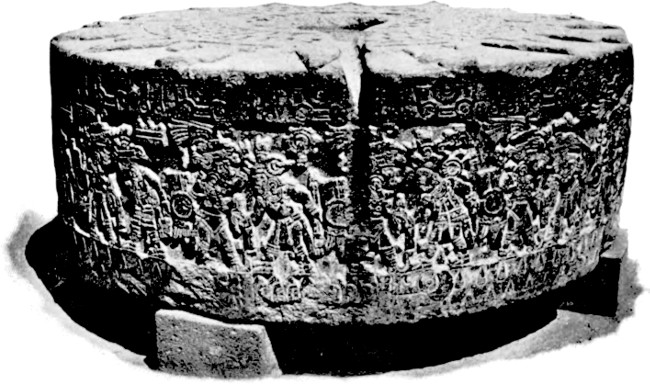
SACRIFICIAL STONE.
The twelfth viceroy was Fray Garcia Guerra, Archbishop of Mexico. His administration was cut short by his death through a fall from his carriage. Noteworthy is a mission to Japan undertaken by Sebastian Vizcaino, accompanied by Fray Pedro Bautista, but the ambassadors received scant courtesy, in spite of the many perils they suffered.
The founding of the important towns of Lerma and Cordova in 1613 and 1618 and the extension of the aqueduct to Santa Isabella were accomplished during the term of Diego Fernandez de Cordova, Marqués de Guadalcazar.[54] He was succeeded by Diego Carrillo de Mendoza y Pimental, Marqués de Galves and Conde de Priego, as fourteenth viceroy. His administration was marked by sincere effort to prevent and correct abuses and dishonesty among public officials. A struggle began between church and state. He was soon at odds with Archbishop Juan Perez de la Serna, who excommunicated the viceroy. The papal delegate, however, ordered this ban removed, but the Archbishop refused; in consequence a decree of fine and banishment was issued against him. Still resisting, the Archbishop was forcibly taken to the coast for banishment, but on his way having learned that the audiencia had repented and ordered his return to the capital on the ground of irregularity in the proceedings, he took refuge in a church and defied his guards to lay hands on him. Finally, the people of San Juan Teotihuacan liberated him. A riot of perilous portent broke out in the capital and notwithstanding that the viceroy consented to recall Serna, the viceregal palace was besieged and set on fire, the viceroy escaping to a convent. The triumph of this headstrong churchman was complete. On the arrival of the fifteenth viceroy, Rodrigo Pacheco y Osorio, Marqués de Cerralvo, the inquisitor formally reinstated Galves and removed his name from the excommunication tablet and he entered Mexico in triumph. His enemy the Archbishop went to Spain whither, after the investigation of his government had resulted in honorable credit to him, Galves followed. In 1628, the Dutch admiral, Pieter Heyne captured a treasure fleet bearing bullion and other valuables from New Spain to the mother country, of a value of twelve million pesos. As a result of this, a squadron called the Barlovento (Windward) was formed to protect the Gulf of Mexico and the West Indies.
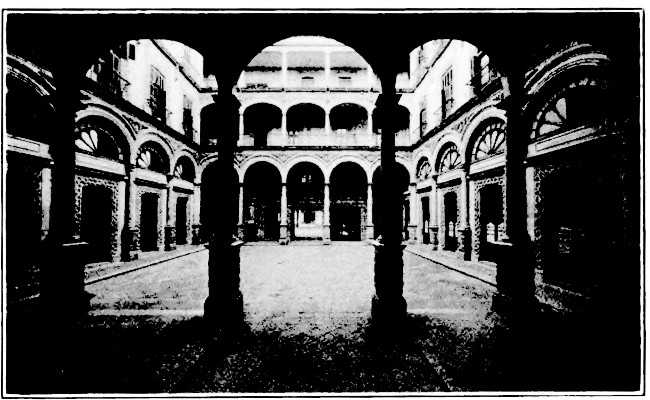
PALACE OF ITURBIDE, NOW A FAMOUS OLD HOTEL.
[55]
A noteworthy feature of the administration of the seventeenth viceroy, the Marqués de Villena and Duque de Escalona, who was of an illustrious Portuguese family, was his removal from office on a charge of plotting against his king in favor of the Portuguese, who had revolted against Spain. The viceroy was later exonerated from this charge. Escalona was succeeded as eighteenth viceroy, by Palafox, Bishop of Puebla. Though an able administrator, his zeal in the conversion of the Indians to Christianity led him to destroy many priceless statues and idols of the Aztec period, the loss of which has proved of serious consequence to succeeding generations. During the administration of the Bishop of Yucatán, Marcos de Torres y Rueda, the twentieth viceroy, a dreadful auto de fé was ordered, of which there were one hundred and seven victims.
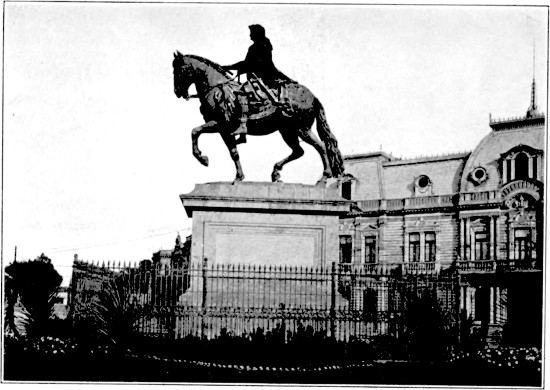
STATUE OF CHARLES IV.
New Mexico was colonized and the town of Albuquerque founded during the term of the twenty-second viceroy, Francisco Fernandez de la Cueva, Duque de Albuquerque. In 1665, during the rule of Antonio Sebastian de[56] Toledo, Marqués de Mancera, the great Popocatepetl erupted during four days, and two years later a severe earthquake occurred. In 1668, the cathedral of the City of Mexico was dedicated the second time in celebration of the completion of the interior; its earlier dedication having taken place in 1657. Under the wise and beneficent progressive rule of Fray Payo Enriquez de Rivera, Archbishop of Mexico, the twenty-seventh viceroy, the causeway and aqueduct of Guadalupe were constructed and the coinage of gold was first undertaken in New Spain.
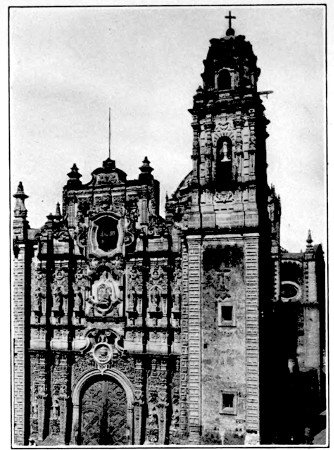
CARVINGS ON THE CHURCH OF LA SANTISIMA.
During the administration of the Marqués de la Laguna, the twenty-eighth viceroy, from 1680 to 1686, Vera Cruz was taken by surprise by a band of six hundred pirates under Nicolás Agramonte who committed great ravages, over three hundred persons losing their lives and six thousand being imprisoned in the church for five days without food. The twenty-ninth viceroy, Melchor Portocarrero Lazo de la Vega, Conde de Monclova made his administration memorable by the construction, at his own cost, of the aqueduct of Chapultepec. He also colonized Coahuila and founded the town of Monclova. He is called “the man with the silver arm,” because of a silver substitute for an arm he lost in battle.
The chief event during the reign of the next viceroy, Gaspar de la Cerda Sandoval Silva y Mendoza, Conde de Galve, the thirtieth viceroy, who ruled from 1688 to 1696, was the extension of the domain of New Spain to the east, including Texas. He sent an expedition in 1689, under Alonso de León, governor of Coahuila to dislodge the French, who were supposed to have founded a[57] settlement under La Salle, and in 1690 a mission was established near the Neches River, in Texas. In addition, in 1691, explorations in the interior and on the coast were made and in 1693, a town and fort were established at Pensacola, the former being called Santa Maria and the bay was named Santa Maria de Galves, after Bernardo de Galves.
In 1696, the thirty-second viceroy, José Sarmiento Valladares, Conde de Montezuma y Tula, whose wife, Geronima Maria, was a lineal descendant of the last Aztec ruler, succeeded to the government of New Spain. Toward the close of his rule the conflict over the Spanish succession arising out of the death of Charles II., in 1700, seriously involved the affairs of Mexico. The treasure ships from New Spain were prizes eagerly sought by the league of powers seeking the overthrow of the Bourbons, and in 1702, the fleet of such ships that had sailed from Vera Cruz with treasure valued at fifty million pesos was attacked and destroyed in the Port of Vigo, in Spain, and to avoid the capture of the treasure it was cast into the sea. This viceroy was removed because of his suspected disloyalty to the Bourbons. During the administration of the thirty-fourth viceroy, Francisco Fernandez de la Cueva, Duque de Albuquerque and Marqués de Cuellar, who assumed a magnificence of pomp and ceremony that even surpassed the custom of kings and emperors, a special tribunal was created, the acordada, for the punishment of robbers and brigands and its severe decrees accomplished much good.
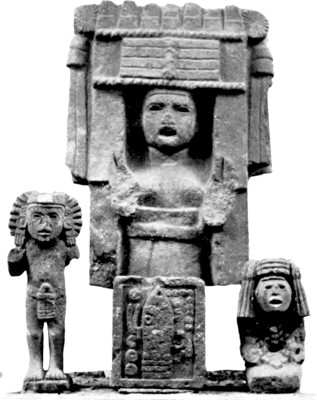
IDOLS IN THE NATIONAL MUSEUM.
During the rule of the Marqués de Valero, Duque de Arion, viceroy from 1716 to 1722, an aqueduct was constructed to supply Querétaro with water. His successor, Juan de Acuña, Marqués de Casafuerte, effected important reforms and works of great public[58] utility. Such was the esteem in which he was held that he is called the “great governor.” During his rule the Gaceta de Mexico was published. Under Pedro Cebrian y Augustin, Conde de Fuenclara, 1742 to 1746, the colonization of the State of Tamaulipas was effected. A noteworthy incident was the arrest of the Italian, Lorenzo Boturini, who had contributed valuable data to the history of Mexico, for not obtaining the sanction of the Council of the Indies preparatory to making a collection for providing a costly crown for the Lady of Guadalupe. His manuscript was taken from him and he was sent to Spain. In 1743, the British fleet, under Admiral Anson, captured a Spanish galleon bound from the Philippines.
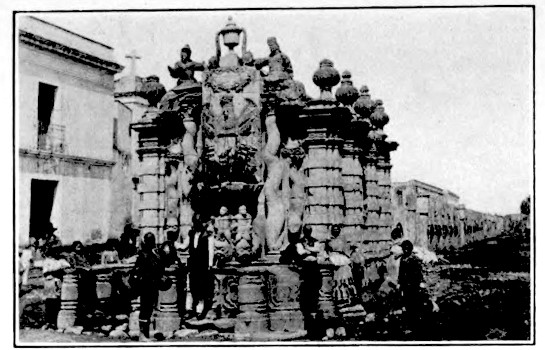
FOUNTAIN IN MEXICO CITY.
During the rule of Joaquin de Montserrat, Marqués de Cruillas, the first regular army in Mexico was established. He also instituted the numbering of all the houses in the capital. During the term of this viceroy, Spain acquired (1762) from France, by the secret treaty of Fontainebleau, the Province of Louisiana on the right bank of the Mississippi and the City of New Orleans on the left bank. The possession of this province was regarded as of great importance to Mexico as a barrier between her and the British possessions. In 1763, Spain ceded to Great Britain the territory known as West Florida.
The noteworthy events of the government of Carlos Francisco de Croix, Marqués de Croix, whose rule extended from 1766 to 1771, were the expulsion of the Jesuits, among whom was the historian Clavigero, and the confiscation of their property, and the extension of the Alameda to its present area.
In 1771, Antonio Bucareli y Urzua succeeded as the forty-sixth viceroy and ruled till 1779. Under his able care the industry and commerce of New Spain greatly developed, and new and important works were established. At his personal cost, he completed the aqueduct of Chapultepec which had been commenced by the Conde de Monclova; the Monte Pio was founded, under the charge of Romero Terreros, Conde de Regla, who endowed it with three[59] hundred thousand pesos and stipulated that loans to the poor should bear no interest. Many hospitals and asylums for the poor were also established and a foundling asylum at La Cuna through the benevolence of Archbishop Lorenzana. No wise work for the good of Mexico was ignored by him. He edited the letters of Hernán Cortés. He encouraged mining and extended the operations of the mint. In the great church at Guadalupe a bronze tablet in the floor marks the resting place of the good viceroy Bucareli. So highly was he esteemed also by the king that his salary was largely increased and, still more noteworthy, no residencia, or investigation, of his administration was held at his death.
Martin de Mayorga, the forty-seventh viceroy, entered on office in 1779. Of his civil services it is to be noted that he founded the San Carlos Academy of Fine Arts.
The aspirations of Matias de Galvez were realized in 1783, when he succeeded as the forty-eighth viceroy; but he lived only a few months. His son Bernardo was next appointed; his popularity in Louisiana was fully equaled in Mexico. Amongst his popular measures was the building of the palace of Chapultepec at a cost of three hundred thousand pesos; and his aid during a famine, when he labored personally to ascertain the actual wants of the sufferers and supplied them largely out of his private means. So great was his popularity that some suspected him of aiming at an independent sovereignty, but this suspicion was not entertained by his king or the audiencia. His death in 1786, at thirty-eight, called forth general manifestation of the affection in which he was held and great honors were paid to his memory, his posthumous daughter being christened with great pomp and having as sponsors the “most noble” City of Mexico.
In 1789, Juan Vicente de Güemes Pacheco de Padilla, Conde de Revillagigedo, succeeded as fifty-second viceroy; he was the second Conde de Revillagigedo and the son of the forty-first viceroy. His rule was one of active reforms in administration. The City of Mexico was paved and lighted, a sewerage system and fire brigades and a police force were established. Free public schools were provided for children of both sexes and the famous College of Mining was opened. He relentlessly pursued and executed bandits; cleansed the city thoroughly; and caused a census to be taken of the intendencia of Mexico in 1790, when the population was shown to be over one million five hundred thousand, and of the capital nearly one hundred and thirteen thousand. He sent[60] out several exploring expeditions, one of which reached within the confines of Alaska. So thorough was his government that he sought to inform himself of every detail and in order to learn of any abuses, he provided a letter box in one of the halls of the palace, in which the public might deposit written statements of complaint or suggestion. So active had been this viceroy’s administration that the ancient city of the Aztecs had become by the close of the eighteenth century a beautiful modern city. Yet in spite of all his labors, he was removed from office in 1794 and died under the cloud of royal displeasure. Only after his death was his true merit recognized and honors were showered on his descendants.
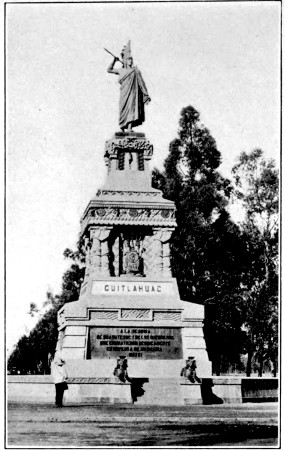
STATUE OF CUAUHTEMOC.
Miguel de la Grua Talamanca, Marqués de Branciforte, succeeded in 1794 as the fifty-third viceroy. He was a brother-in-law of Manuel Godoy, Prince of Peace, the favorite of Charles IV., and was, consequently, in much favor with the king, who heaped honors upon him. He reciprocated the royal favor to the utmost of his power. He caused to be erected the splendid bronze equestrian statue of Charles IV. in the Paseo, the work of the celebrated Mexican sculptor, Manuel Tolsa, of which Humboldt said that, “except the statue of Marcus Aurelius, at Rome, there was nothing of the kind in Europe to equal it in beauty and purity of design.” Viceroy Branciforte was too much of a courtier to administer his government in the interest of the people of Mexico, but he actively sought to aggrandize his own possessions. He confiscated the property of Frenchmen residing in Mexico and in Louisiana, and when he left his government in 1798 he took with him an immense treasure.[61] During his administration that part of Florida west of the Perdido River was ceded to France.
The fifty-fourth viceroy, Miguel José de Azanza, ruled New Spain from 1798 to 1800 with ability and justice, but the spirit of the revolution was hovering over Mexico and he had to put down a conspiracy to expel the Spaniards or gachupines from the province, which broke out in 1799. This conspiracy is known as the “machete,” from the name given to the sabres used by the conspirators, who, though insignificant in number, represented a rapidly extending antagonism of long standing, between the Creoles and the Spaniards, which was soon to burst forth in an inconquerable flame. The noteworthy act of Felix Berenguer de Marquina the fifty-fifth viceroy, from 1800 to 1803, was his effort to put an end to the bull-fight. On his forbidding this pastime, and being informed that the municipal government could not meet the deficiency caused by the cost of the viceroy’s reception unless the profits of a bull-fight were forthcoming, the viceroy covered the amount, seven thousand pesos, out of his private purse.
José de Iturrigaray succeeded in 1803. In 1802, Spain and France signed the definitive treaty by which the former ceded Louisiana to France, and in 1803, Napoleon sold the Province to the United States, notwithstanding the stipulations of the treaty with Spain. Spain allied with France against England and at the battle of Trafalgar her fleet and that of her ally were almost totally destroyed and fears were entertained that an attack on Vera Cruz by the English would follow. In 1808, owing to the weak conduct of Charles IV. in respect of the designs of Napoleon he was compelled to abdicate in favor of his son Ferdinand. Quarrels and misunderstandings finally resulted in Napoleon’s putting his brother, Joseph Bonaparte, on the Spanish throne, but not without intense and heroic resistance from the Spaniards, and only to be expelled in 1814. The news of the surrender of the Spanish crown to Napoleon bitterly incensed the people of New Spain, and on July 19, 1808, the municipal authorities of Mexico City petitioned Viceroy Iturrigaray not to recognize any foreign authority or Spanish authorities if controlled by foreigners, and asserted that, in the absence of a legitimate sovereign, the power resided in the people. This latter claim was espoused by the Creoles and the viceroy, but was as strongly opposed by the official Spanish party and the heads of the Church and the Inquisition as seditious and heretical. For this leaning toward the native claim,[62] the viceroy became suspected by the Spanish party and on September 15, 1808, he was clandestinely seized, sent a prisoner to the Island of San Juan de Ulua and thence to Cadiz.
Pedro de Garibay was the next viceroy. He was elected mainly by the Chaquetas, who were the volunteers of Fernando Séptimo, and who had captured Iturrigaray at the viceregal palace. The viceroy was merely the tool of the Spanish party in ordering the secret execution of the Licenciado Verdad, who, as head of the municipality of Mexico City had proposed a provisional government for New Spain at a junta held on August 9th. Verdad is regarded as the first martyr for Mexican independence.
The Spanish junta at Aranjuez, which was then recognized in Mexico, appointed the Archbishop of Mexico, Francisco Xavier Lizana y Beaumont viceroy. He was succeeded by Francisco Xavier Venégas, the fifty-ninth viceroy, who was appointed by the Spanish regency. His rule was not effective; the spirit of independence was strengthening; nor did the decree issued in Spain in 1809, recognizing the West Indian possessions as an integral part of the monarchy, avail to check the nascent national movement, particularly as the Creoles were discriminated against in the matter of representation in the cortes.
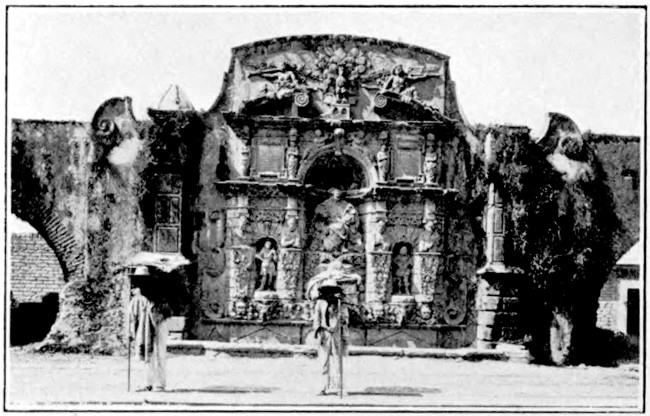
OLD CARVING OF THE TIME OF CORTÉS.
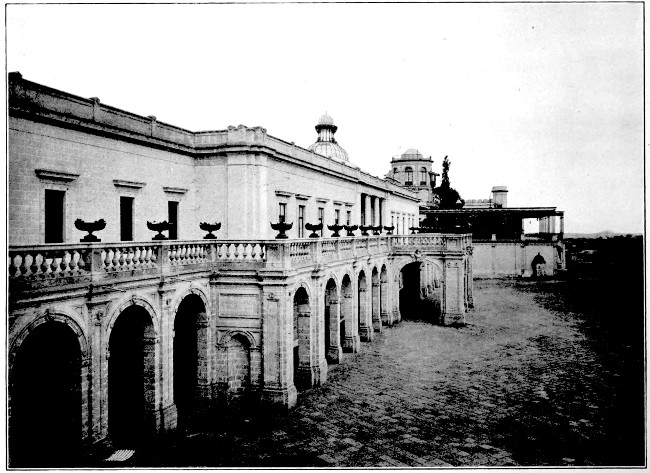
THE MILITARY SCHOOL AT CHAPULTEPEC.
[65]
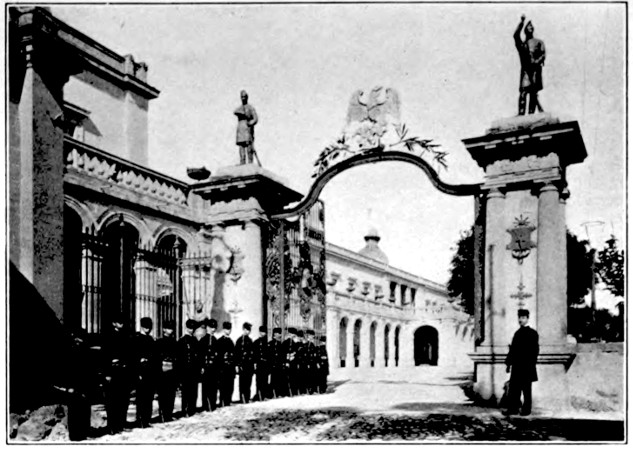
GATEWAY AT THE MILITARY SCHOOL AT CHAPULTEPEC.
It was not until the various colonies to the north of them had achieved their independence, and had come to be known as a new nation, the United States of America, that the Mexicans began to indulge the spirit of patriotism and the desire for independence which are implanted by nature in every human breast. Other patriots had succeeded in establishing their rights to freedom and its privileges, why not they?
As the years went on, this restless desire for liberty grew among the patriots of Mexico. The fruits, the wealth, the prodigal bounty of the country were theirs, they felt, by inheritance; why should they go to enrich the coffers of a foreign country while they were kept here in poverty and oppression? In 1798, the Spanish viceroy began to discover signs of the uprising that broke out with such force a few years later, under the noble Hidalgo. Even then the Mexicans[66] had decided in their secret hearts that Mexico should no longer be New Spain either in name or in fact. She should be free. She should govern her own country and worship in her own church. She should come into her own Kingdom of Liberty.
It was a bloody struggle and one that was several times repeated ere the victory was gained and Mexico became firmly established as one of the republics of the world.
Hidalgo and his patriots made a noble fight, but internal dissensions and foreign invasions followed; the valuable mines, sacked for centuries by other rulers, had to be abandoned, and the tillable lands were left untouched. The patriots were fighting in the cause of honor and trying to wrest the crown of liberty from their oppressors, while starvation stared them in the face. It is always so in a desperate revolution. Liberty is to be won only by the sacrifice of many human lives.
And so the older patriots fought, bled, and died for their country, while their places were taken by younger men who continued the battle for progress and freedom, and only the Indians of the mountain fastnesses were left free from care or ambitions.
Mexico’s history has been singularly cursed by the greed of gold and lust of power on the part of foreign potentates. Her inexhaustible treasures have, in past ages, been to her, in a sense, a curse rather than a blessing; since it was only the greed of gold which brought the cruel, grinding oppressor, who for centuries kept her under the iron heel of the conquerors. While Mexico waited, many a less favored settlement rose to the distinction of a nation, and smaller colonies rose to proud prominence.
But Mexico was oppressed and despoiled in vain. Slowly, perhaps, her courage rose to the point of resistance, but when the day of struggle came her spirit was indomitable. Beaten repeatedly, thrust down from temporary acquisitions more than once, she knew not the meaning of the word defeat. Again and again she rose fresh from discouragement; and with a persistence that was almost divine, and a courage that comes only from the God of Liberty, cried, undismayed, “Mexico shall be free! Mexico shall take her place among the independent nations of the earth!”
In 1809, an independent plot had been born in Valladolid, in Michoacán, and in the next year the revolutionists directed their plans from the town of[67] Querétaro. The chief guide in the incipient movement was Ignacio Allende, who, in coöperation with the licenciados Parra, Laso and Altamirano, and the captains Aldama and Arías, the lieutenants Lanzagorta, Epigmenio and Emeterio Gonzalez, officers in the Queen’s dragoons, established a junta in Querétaro. The plan was to seize the leading Spaniards in the chief towns and thereupon to proclaim the independence of Mexico, with a government ruling in the name of Ferdinand VII., independent of Spanish authorities. In 1810, the leader of the revolutionists was the noble patriot cura Hidalgo, who was in charge of the parish of Dolores, in Guanajúato. The plan was for a general uprising on December 8, 1810, when the great fair of San Juan de los Lagos would begin, but through the treachery of some of their comrades at Guanajúato, and by Captain Arías at Querétaro, their plan was untimely precipitated, and several arrests were made at Querétaro on September 13th, including the brothers Gonzalez. Warning of this was conveyed to the friends at San Miguel, and the news of the arrests at Querétaro was brought to Hidalgo at Dolores, who realizing the extremity of the situation exclaimed: “Gentlemen, we are lost; there is no other recourse but to seize the gachupines.” The people of Dolores were aroused; at early mass on that Sunday morning, Hidalgo urged them to defend their rights against the usurped dominion of the French. They seized the principal Spaniards in the town; the priest was acclaimed their leader and by noon of the same day a small patriot army, badly equipped, but very enthusiastic, marched on San Miguel under the lead of Hidalgo and Allende. On the march, they stopped at the sanctuary of Atotonilco, where taking from the altar the banner of the Virgin of Guadalupe, Hidalgo raised it as the patriot standard and uttered the grito de Dolores: “Viva nuestra Senora de Guadalupe; mueran los gachupines!”
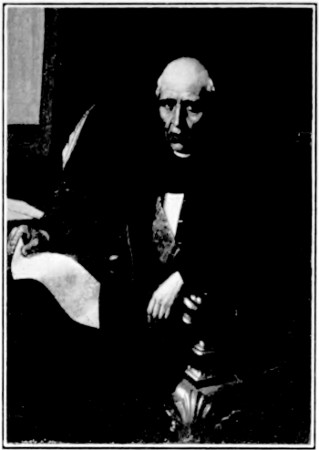
HIDALGO.
Arriving at San Miguel, Allende’s regiment joined Hidalgo’s force and the combined army marched on Guanajúato, gathering strength as it proceeded.[68] At Celaya, the troops guarding the town abandoned it and Hidalgo entered on September 21st, after threatening with death the Spanish prisoners if the place was not surrendered. The patriot army now numbered fifty thousand, and it proclaimed Hidalgo captain-general of America, and Allende lieutenant-general. On to Guanajúato, with momentarily increasing force, the patriots moved. This important city contained considerable treasure, but through fear of the people the intendente hesitated to defend it and retired to the Alhondiga de Granaditas, or granary, with his soldiers, where he was attacked by the patriots on September 28th and killed. The treasure seized amounted in value to three million pesos, and the city, as was the case at Celaya, was pillaged, though Hidalgo exerted himself to the utmost to prevent such excess.
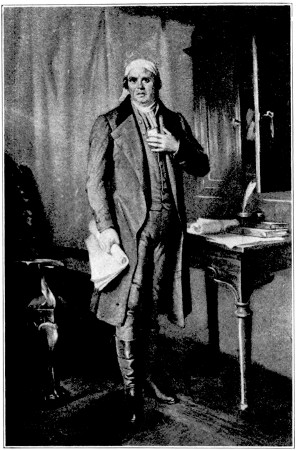
JOSÉ MARIA MORELOS.
Viceroy Venegas now recognized the formidable character of the revolution and took energetic steps to quell it. Volunteer troops were enlisted. A price of ten thousand pesos was put on the head of each of the leaders of the revolution; Hidalgo and his followers were excommunicated, and the Inquisition cited the patriot priest to answer charges of heresy and apostasy. Valladolid (Morelia) was occupied, without resistance, by the patriots, who emancipated slaves and abolished tribute payment. With his funds greatly increased in this town, Hidalgo prepared to march on the capital with an army, or perhaps more truly a rabble, of eighty thousand men. At this time he was proclaimed generalissimo with Allende as captain-general and Aldama, Ballerza, Jimenez and Joaquin Arías, lieutenant-generals.
[69]
General Torcuato Trujillo was sent with three thousand men to oppose Hidalgo’s way to the capital and the armies met at Las Cruces, about twenty miles from the capital, on October 30, 1810. The conflict was bitter, the greater number of the patriots being more than offset by the superior equipment and discipline of the royalists, who were equipped with artillery. In the capital, the viceroy, alarmed at the strength of the revolutionists, contemplated the removal of the government to Vera Cruz, but finally decided to remain and defend it. He secured the image of the Virgin de los Remedios from Totoltepec and enshrined it in the cathedral of the capital and with much ceremony hailed it as “lady captain-general of the army.” As a counteraction to that of Hidalgo, he adopted a sacred banner bearing the image of Nuestra Senora de los Remedios. Vigorous steps were taken by the viceroy to meet the perilous situation and defend the capital.
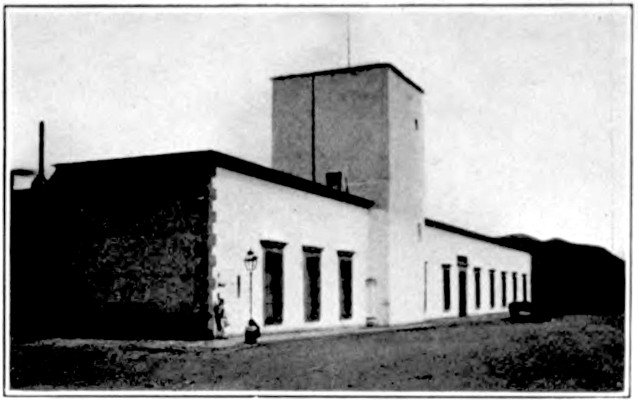
THE PRISON IN WHICH HIDALGO WAS CONFINED AT CHIHUAHUA.
Meantime, Hidalgo on his retreat to Querétaro encountered Calleja at Aculco, where he was put to rout on November 7th, and fell back to Valladolid. On November 26th, he entered Guadalajara to join the revolutionary force under Torres, who had defeated the royalists at Zacoalco. In Guadalajara a government was established with Ignacio López Rayón and José Maria Chico as chief ministers. Here, as in the Province of Guanajúato, Hidalgo decreed the emancipation of slaves and abolished the tribute. At Guanajúato, whither Allende had retired after the battle of Las Cruces, the royalist army, under Calleja and Flon, attacked the patriots on November 25th and forced them to retreat. Before the royalist generals entered the town the people forced an entrance into the Alhondiga and massacred one hundred and thirty-eight Spanish prisoners confined there, an act that Calleja terribly avenged soon by the promiscuous slaughter of inhabitants followed by the execution of forty-one prominent residents.
The viceroy now put General José de la Cruz, who had just arrived from Spain, at the head of the royal forces. After capturing Valladolid, de la Cruz marched[70] against Hidalgo at Guadalajara, but was intercepted by Colonel Ruperto Mier about twelve miles from Zamora and defeated him, but the delay prevented him from joining Calleja in time to participate against Hidalgo at the Bridge of Calderon, on January 17, 1811, where the patriot forces, under Allende, who had made his way to Zacatécas and thence to Guadalajara after his defeat at Guanajúato, joined Hidalgo’s half-clad, ill-disciplined force of eighty thousand men. The infantry were armed with the sling and the bow and there were less than a hundred cannon, many of which were of wood bound with hoops of iron, while only a few of the cavalry had sabres. This poor army, rich only in faith and patriotism, took up a strong position at the Bridge of Calderon and awaited the attack of the royalist forces under Calleja and Flon, numbering six thousand well-disciplined infantry and cavalry, with ten pieces of artillery. The battle ended in the utter defeat of the patriots with immense loss.
The patriot force dispersed, the Province of New Galicia must be pacified. Hidalgo was now forced to resign his office of generalissimo in favor of Allende whose military qualities were regarded by the leaders as superior to those of Hidalgo. Allende went to the aid of Jimenez at Saltillo, who had secured some slight victories over the royalists, but flight seemed the best course for the leaders and their cause and they went north in the hope of reaching the United States both for safety and aid. After many dramatic victories and some disappointments, the strength of the Mexicans seemed to grow, when the Father of his Country’s Independence, Hidalgo, was betrayed to the enemy by a Spaniard, Mariano Galvan, and the four patriots, Hidalgo, Allende, Aldama and Jimenez were captured and executed as an example and warning to all who chose to revolt against the Crown of Spain. Hidalgo was killed July 21st. Thirty other leaders were executed shortly after, including Mariano Hidalgo, the cura’s brother, and Chico, the minister of justice of the revolutionary government. The greatest indignity was added to the execution in the case of Hidalgo, Allende, Aldama and Jimenez, whose heads were cut off and sent to Guanajúato where they were placed in iron cages within the alhondiga, where they remained until 1821, when they were removed and with great pomp and honor buried with the bodies of the patriots in the chapel of Los Reyes beneath the altar of the kings in the cathedral of Mexico. The brutal act may have justified itself to the advisers of “divine right” majesty, as a warning against the assumption by the people that they possessed any rights; but humanity abhors the deed.
[71]
ITURBIDE.
If with the destruction of the great leaders and the scattering of the armies they had led to final disaster, the royalists believed the independence of Mexico had been made impossible, the striking events that followed during the next year must have been painfully disheartening. Ignacio López Rayón, who had been a member of the revolutionary government and was later named captain-general of the revolutionary forces was not to be subdued by the fate of his colleagues. Neither was the spirit of the people crushed; the flame of revolution could not be quenched; desultory war continued. Rayón, after defeating the royalists, Ochoa and Zambrano, and meeting defeat and success in turn, unsuccessfully attacked Valladolid on August 19, 1811, and set up a national junta at Zitácuaro in Michoacán, the members of which, besides himself, were Liceaga and the priest Verduzco. Another leader arose who also was to sacrifice his life for the cause of independence, after striking terror in the hearts of the gachupines and carrying the national cause to the very threshold of success. José Maria Morelos was born on the last day of September, 1765, on a ranch near Apatzingan, in Michoacán. His father, Manuel Morelos, was a carpenter and his mother, Juana Pavón, was the daughter of a schoolmaster at Valladolid. His early life was a struggle, but at twenty-five he entered the college of San Nicolás as a sizar and studied philosophy under Hidalgo. His course completed he was consecrated a priest, thus realizing a long cherished ambition. He served as cura for many years and was in office at Caracuaro when the revolution[72] began in Dolores. The following month he offered his services to Hidalgo which, being accepted, he was commissioned to attempt to take the Port of Acapulco.
This great leader commenced his march from the scene of his parochial labors with just twenty-five followers. Prevented by sickness from active operations for some time, the Galeanas successfully held back the royalist army. Upon his recovery, Morelos resumed his leadership and took possession of Chilpancingo. Here he was joined by the three brothers Bravo and the son of one of these, Nicolás, whose names are famous in the winning of independence. After active campaigning, Morelos routed Fuentes the royalist commander at Tixtla and took possession of the city on August 17, 1811, following this by the occupation of Chilapa, where he executed the officer Gago, who had deceived him as to the surrender of the fort at Acapulco.
In order to destroy the ancient revolutionary government at Zitácuaro, Viceroy Venegas sent General Calleja to seize the town, which was held by Rayón. This he accomplished on January 2, 1812, and gave the place to pillage and destruction and all the buildings save the churches and convents were razed. While Rayón thus suffered defeat, Morelos had triumphed over the royalists and by the close of January, had strongly fortified himself at Cuautla de Amilpas, where he was attacked on February 15th, by the allied forces of Calleja, Llano, and Porlier and after a heroically defended siege was compelled to abandon the place on May 2d; not, however, till he was absolutely starved out; so completely had the place been invested that neither entrance nor exit was possible. In honor of this defence the city later received the added name of Morelos. No less heroic was the service rendered by the Galeanas, the Bravos and Matamoros. A striking instance of the patriotism of the revolutionists is furnished in connection with the defence of Cuautla. Leonardo Bravo having been taken prisoner, the viceroy offered to spare his life on condition that his son Nicolás should abjure the cause of the revolution. Both father and son rejected the offer as an infamy and Leonardo was executed. The conduct of the patriotic son further furnishes a noble example of high-minded generosity. Though Morelos authorized Nicolás to put to death three hundred Spanish prisoners whom he had taken, he refused to follow the base example of the viceroy, but instead set his prisoners free. This act of chivalry has been embalmed in the pages of Mexican history and is called a venganza insurgente.
[73]
Recovering from his defeat at Cuautla, Morelos worsted the royalists at Orizaba in October of the same year and on the 24th of November he defeated General Saravia at Oaxaca and took possession of the city after a brilliant engagement of two hours. As Morelos advanced upon the city, the bishop preached a Holy War against him and raised a force of two thousand men to oppose him, but the resistance was quite feeble. Morelos paroled the royalist officers taken in the city, except General Regules and one or two others, who were executed on the spot where two years earlier two spies sent by Hidalgo had been put to death. The bodies of these men, as well as those of two deacons who had been beheaded as patriots in 1811, were now exhumed and buried with military honors.
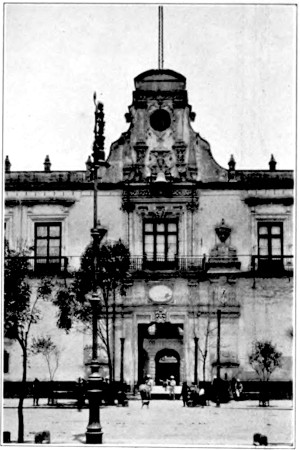
THE LIBERTY BELL, OVER THE MAIN ENTRANCE OF THE NATIONAL PALACE.
The capture of Oaxaca was a serious blow to the prestige of the royalists. This great victory was soon followed by the supersession of Viceroy Venegas, who was succeeded by General Félix Maria Calleja del Rey, the sixtieth viceroy in succession. A municipal government was established in the city, with Manuel Nicolás Bustamante as president, and a garrison was established. After securing Oaxaca, Morelos moved toward Acapulco, which he captured on August 19th.
Morelos realized the necessity of establishing union and coöperative effort between the revolutionists, and with this in view he caused a congress of elected delegates to meet. The congress assembled at Chilpancingo on September 14, 1813, the members being elected in the case of the provinces in which the patriots were in power and appointed by Morelos for those held by the royalists. Eight members were present representing New Galicia, Michoacán, Guanajúato,[74] Oaxaca, Tecpán, Mexico, Puebla and Vera Cruz. This congress, styled the congress of Anáhuac, issued a declaration of independence, the terms of which asserted the absolute sovereignty of the people of Mexico and unrestricted independence of Spain. It read as follows: “The congress of Anáhuac, installed legitimately in the City of Chilpancingo in North America by its provinces, declares solemnly in the presence of the Lord God, arbiter of powers and author of society, who gives and takes away according to the inscrutable designs of his Providence, that, owing to the present conditions in Europe, it has recovered the exercise of its usurped sovereignty; that accordingly its dependence upon the Spanish throne remains forever broken and dissolved; that it is competent to establish the laws which please it, for the best government and interior felicity; to make war and peace and establish alliance with the monarchs and republics of the old continent, no less than to make concordats with the Supreme Roman Pontiff for the direction of the Catholic, Apostolic, and Roman Church, and send ambassadors and consuls; that it professes and recognizes no other religion than the Catholic and will neither permit nor tolerate the public or secret practice of any other; that it will protect it with all its power, and will watch over the purity of the faith and its dogmas and the preservation of the regular bodies. It declares as guilty of high treason any one who will oppose directly or indirectly its independence, or protecting the European oppressors by work, word or writing, neglecting to contribute to the expenses, subsidies and pensions to continue the war, until its independence be recognized by the foreign nations; the congress reserving for itself the right to present to them, by means of a ministerial note, which will circulate in all the cabinets, the manifesto of its complaints and the justice of this revolution, recognized already by Europe itself.”
Following the declaration of independence, Morelos planned the capture of Valladolid and appeared before the city on December 22, 1813, supported by a large army led by his brave lieutenants Matamoros, Nicolás Bravo and Galeana. The capture was frustrated, Viceroy Calleja had promptly sent the army of the north under Llano and Iturbide with a body of nearly four hundred horsemen. This was followed on January 5th, by a complete rout and the brave Matamoros being captured, he was shot at Valladolid on February 3d. Such was the fate of the bravest of Mexicans fighting for national liberty against a government whose only claim was that of an official legality decreed by an[75] alien power, established by a military superiority and maintained by force and fraud. But time has avenged their memory, and their patriotism and valor shed lustre and glory on their names and rank them among the world’s heroes as exemplars for the human race.
A new political phase, however, gave fresh incentive to the cause of Mexico. In 1812, smarting under French domination, Spain had granted representation in the cortes to the West Indian possessions, which were made an integral part of the kingdom. Ferdinand, on his restoration, in March, 1814, repudiated the constitution and this reactionary and despotic course aroused widespread discontent among the royalists in Mexico, and furnished a new motive for independence. It may be said, without any disparagement of the brave patriots who first realized the need of revolution and embarked in its work, that except for the miserable and contemptible conduct of Ferdinand, independence would probably not have been achieved till a much later period than it was. But the act of the king was a blow at Mexican pride and interest at the same time and its effect upon the Creole royalists was immediate.
The independence congress met at Apatzingan on October 22d and proclaimed a constitution, under which Mexico was divided into seventeen independent provinces, namely: Mexico, Puebla, Tlascala, Vera Cruz, Yucatán, Oaxaca, Tecpán, Michoacán, Querétaro, Guadalajara, Guanajúato, Potosí, Zacatécas, Durango, Sonora, Coahuila, and Nuevo Reyno de Léon. Full powers of government were provided provisionally until peace could be established, when the sovereignty should reside in an elected congress. The executive branch of the government was entrusted to Liceaga, Morelos and Cos, the first named being president.
The revolutionary movement continued to meet with reverses and the congress was constantly menaced, so for hoped-for greater security, it was proposed to meet at Tehuacán beyond the mountains. On the way thither from Uruapán, under the lead of Morelos, the royalist forces of Colonel Concha encountered the patriots at Tesmalaca on November 5, 1815, and the latter were disastrously routed, the brave Morelos being captured. He asked no consideration as he had shown little. The royalists were foes of his people and their cause and he had acted with severity against them when it seemed that the conditions demanded it. His trial and condemnation took place in Mexico, amid the exultation of the royalists, and he was shot at San Cristobal Ecatepec,[76] near the capital, on the judgment of both the military tribunal and the Inquisition. He had been a no less able than brave leader. During the most difficult period of the revolution he had maintained his forces in face of great difficulties; he had crystallized the movement for independence into a sort of representative government, however localized in its powers; and had secured the issue of a formal declaration of independence; above all he had kept alive and given consistency to the struggle. Time has but strengthened the claim of Morelos to the affection of the Mexican people.
A momentary discord among the revolutionary leaders manifested itself on the death of Morelos and some defections to the royalist cause occurred. Through the influence of Manuel de Mier y Terán a provisional executive committee was substituted for the congress whose protection on its migration to Tehuacán had cost the life of Morelos. At the moment when the royalist arms were so nearly triumphant over the opposing forces, Viceroy Calleja was recalled to Spain, where he received marked honor and was created Conde de Calderón. In contrast to these honors in Spain, he was dubbed by the Mexicans “the wild beast,” as a fitting recognition of his ruthless severity.
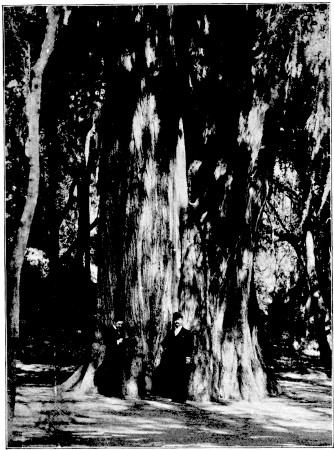
ONE OF THE LARGE CYPRESS TREES IN THE GROVE OF CHAPULTEPEC.
On September 19, 1816, Juan Ruiz de Apodaca succeeded to the vice-royalty, the sixty-first in succession. He was an able administrator and had[77] been captain-general of Cuba. In the same year the Jesuits returned to Mexico, a general desire being manifested therefor, in view of their influence as teachers and missionaries.
On April 15, 1817, Francisco Javier Mina, a native of Navarre, reached Mexico. He had abandoned his studies at the University of Saragossa to participate in the resistance of his countrymen against the invasion of Napoleon in 1808, and became famous for the guerrilla warfare he maintained against the foreigners. He joined the liberals in resistance to the measures of Ferdinand in 1814, on his restoration. Being forced to flee from Spain he resolved to go to the aid of the Mexican patriots and sailed from Liverpool in May, 1816, on a ship provided by the contributions of a few Englishmen, to the United States where he enlisted volunteers at Baltimore and Galveston and receiving at the latter place reinforcements he reached with seven vessels the River Santander on April 15th, and a few days later arrived at Soto la Marina, where he erected and garrisoned a fort, which he left in command of Major Sarda, while he advanced into the interior.
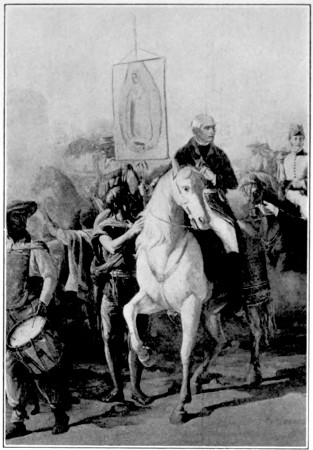
HIDALGO ON HORSEBACK.
Mina soon found himself engaged with the royalist forces and, after defeating them in minor engagements, he captured and sacked Pinos and joined the patriot forces at Fort Sombrero in Guanajúato under Moreno. Moreno was killed as he tried to escape, and Mina was shot by Liñan’s order on November 11, 1817, on a hill in front of the fort he had vainly tried to relieve, which stronghold, held by Father Torres, quickly fell into the hands of the royalists and its defender was shot soon after. The fort at Soto la Marina established by Mina[78] had already been taken. Again had a great leader paid with his life for the cause of liberty.
The brave Nicolás Bravo suffered defeat on December 1st, at Cóporo and on the 22d he was captured, with Ignacio Rayón and Verduzco, members of the first junta established at Zitácuaro. The viceroy spared their lives and they were released in 1820.
The gap caused by Nicolás Bravo’s capture was filled by Vicente Guerrero, who had safely conducted the congress to Tehuacán on November 16, 1816, after the capture of Morelos at Tesmalaca. But the tide of defeat could not be turned. The junta at Jaujilla was broken up and its members taken prisoners or shot. Many of the leading revolutionists, deeming the struggle futile, submitted to the viceroy and were pardoned. The less severe policy he adopted seemed of more service to his king than was the severity of his predecessor. Manuel Félix Fernández, self-named Guadalupe Victoria, refused, however, to forego the terrors of a patriot, at the price of submission.
The fruit of Mexican disaffection which had set at the time of Ferdinand’s repudiation, in 1814, of the constitution of 1812, was ripened by a revolution in Spain, resulting from his despotic rule. The cortes enacted the closing of the convents, the abolition of the Inquisition, the freedom of the press, and the right of popular meetings and of forming political organizations. The constitution of 1812 was restored. It was favorably regarded in Mexico by the Creoles; but the times had changed and the official Spanish party realized that they could not retain their influence in the province under the new conditions; hence they chose to favor independence as offering a better means of retaining the control of public affairs. Such at least, would seem to be the motive of the volte face; at any rate a conspiracy was formed, the pretext being put forward, in some quarters, that as Ferdinand had accepted the new constitution under compulsion, he should be tendered a refuge in the New World.
The man of the hour was Augustin de Iturbide. He was one of the most formidable of the royalist leaders and had punished the patriots without show of mercy. He, whose sword had been so active in destroying the independence army, was the hero selected by the conspirators to effect the independence of Mexico. He was born at Valladolid on September 27, 1783. His father was a Spaniard and his mother a Mexican; hence, though called a Creole, he was in truth a Mestizo. His personality was remarkably prepossessing and his bravery unlimited.[79] His first step in the new movement for Mexican independence was to obtain command of the royalist army of the south, in order to conquer Vicente Guerrero and “pacify the whole kingdom,” as he himself said. Not succeeding against this doughty patriot he made known his plan to him, and received Guerrero’s promise of support. Accordingly, he announced the famous “Plan de Iguala,” or the plan of “The Three Guarantees,” on February 24, 1821. The basis of this claim was the exclusive establishment of the Roman Catholic religion; the absolute independence of Mexico, with a constitutional monarchy under the rule of Ferdinand; the union and equality of Mexicans and Spaniards. These three guarantees are emblemized in the national colors of Mexico—green representing the union of Mexicans and Spaniards; white, religious purity; red, independence. Provision was made for the government by a junta, pending the meeting of the cortes, and also in case the emperor did not come to Mexico. No disqualification for public office was permitted by reason of race or color. An army was to be created, to be called the Army of the Three Guarantees. The army at Iguala was sworn to support Iturbide’s plan, and the viceroy was informed of its details and of the proposed membership of the junta, at the same time he was offered its presidency. Apodaca not only refused to entertain the plan but took measures to oppose its execution; in consequence he was removed from office on July 5th, and in his stead General Pedro Novella was provisionally appointed and ruled till July 30, 1821, when General Juan O’Donojú arrived at Vera Cruz as the regular successor—the last of the viceroys.
Iturbide’s plan made many friends for the cause of independence and among its supporters were Anastasio Bustamante, Santa Anna and Pedro Celestino Negrete. Iturbide held Guanajúato, Valladolid, Querétaro, and other places. The new viceroy finding that he could not reach the capital arranged a conference with Iturbide at Córdoba, which took place on August 24th, and the viceroy agreed to the Plan de Iguala, subject to his being appointed one of the provisional rulers of Mexico until the monarch could be selected. The agreement embodied in this plan is known as the “Treaty of Córdoba.”
The way to independence was now clear. Iturbide, after rejoining his army, marched on the capital, which was evacuated by the royalist forces on the order of Viceroy O’Donojú and the army of independence entered the city in triumph, September 27, 1821. Mexico’s freedom from Spain was accomplished for there was slight probability of a Bourbon occupying the throne, as in default[80] of Ferdinand himself becoming monarch, it was provided that the cortes should select the sovereign.
To the fact that the plan of the first revolutionists was not fulfilled is doubtless due the years of discord that followed until a republican and popular form of government became the guerdon of the long struggle for political freedom. Nevertheless, a national empire was an advance upon a provincial dependency, although a further struggle must intervene before the true aspirations of the people could be realized.
The new era opening on the birth of the nation presents the immediate consummation of the Plan de Iguala in a provisional government, or regency composed of Iturbide, O’Donojú, Manuel de la Barcena, José Isidro Yañez and Manuel Velasquez de León, the first named being president of the governing body. It is significant that the patriots who had fought and bled and suffered for independence, the real successors of Hidalgo, were not recognized in the new situation. The territorial limits of Mexico included, besides all the area of the republic of to-day, that part of the United States from the Red and Arkansas Rivers to the Pacific Coast, extending north to the limits of the British dominion of Canada. A few days after the establishment of the new government O’Donojú died, October 8th, and the vacancy thus caused was filled by the appointment of Bishop Joaquin Oton Perez, of the See of Puebla.
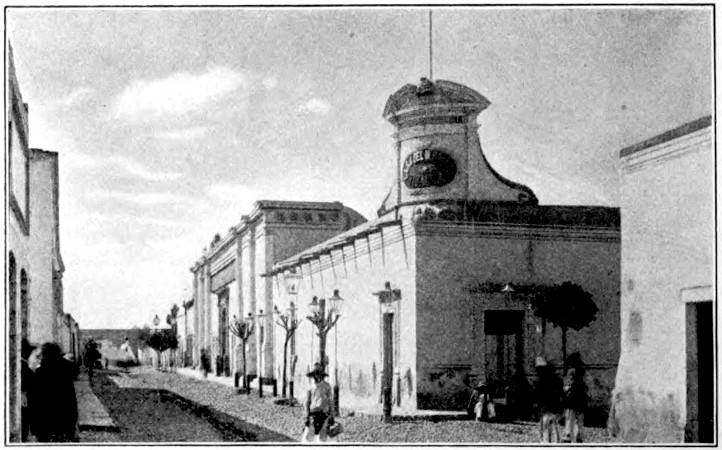
RESIDENCE OF MIGUEL HIDALGO, AT DOLORES HIDALGO.
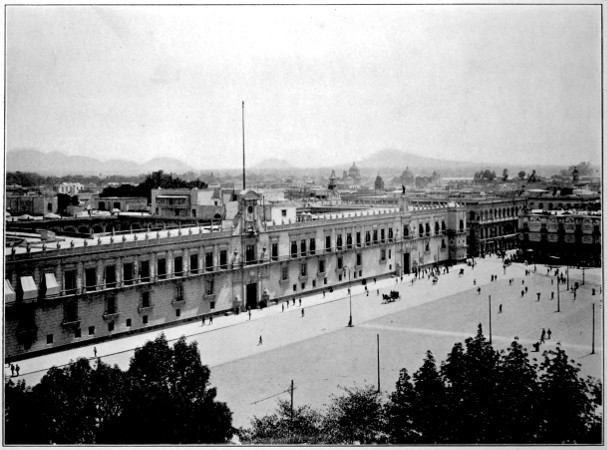
THE NATIONAL PALACE.
[83]
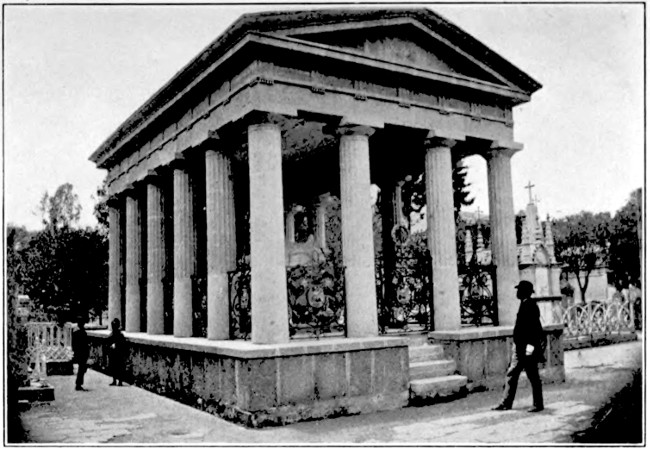
THE TOMB OF JUAREZ.
The Spanish cortes on the 16th of February, 1822, annulled the Plan de Iguala as modified by the Treaty of Córdoba. On the assembling of the first congress of Mexico, February 22d, at the capital, elected according to the provisions made by a committee of the regency, in accordance with the terms of the Treaty of Córdoba, it was seen that the members were aligned in two factions, the “Bourbonistas” and the “Republicans.” Perez, Barcena and De Leon were displaced and Nicolás Bravo, the Conde de Heras Soto and Miguel Valentin were substituted. But the purpose of Iturbide to secure the crown as emperor was soon manifest. On May 18th, Pio Marcha, a non-commissioned infantry officer launched a movement in favor of Iturbide, and a public demonstration resulted in his election next day by the congress by a vote of seventy-seven to fifteen and on July 21st, he was crowned in the cathedral with his wife[84] as Emperor and Empress of Mexico. The Emperor took the title of Augustin I. Energetic as he was, he was nevertheless a weak ruler and abandoned himself to the display of royal pomp and power rather than to the initiation of measures for the welfare of the people and the establishment of the nation, and he soon found himself at odds with the Congress, which he dissolved on October 31st and established a junta. A revolutionary movement was set on foot by Guerrero, Nicolás Bravo and Guadalupe Victoria. The old revolutionists joined Antonio Lopez de Santa Anna and on February 1, 1823, the “Plan de Casa Mata” was promulgated, according to which a new Congress was to be elected and a republican form of government guaranteed. Meantime, in December, a republic had been proclaimed at Vera Cruz and only the capital remained as the empire. In vain did Iturbide recall the Congress he had dissolved. The opposition was determined; he shrank from retaining power through a civil war and accordingly tendered his abdication March 19th, but the Congress refused to accept it, declaring instead that Iturbide’s crown had been obtained by force and therefore his acts as Emperor were illegal. He was banished from Mexico and set sail on April 11th, from La Antigua. Congress however voted him an annual pension of 25,000 pesos as a reward for his great services to his country.
The government was now vested in a Poder Ejecutivo, composed of Pedro Celestino Negrete, Nicolás Bravo and Guadalupe Victoria, all of whom were absent from the capital at the time of their nomination. The second Congress, it may be called the first of the republic, met on November 7, 1823. Nevertheless the independence of Mexico was largely assured by the United States, whose Congress received the message of President Monroe on December 2, 1823, in which he formulated the doctrine known by his name which secured the governments of the Continent of America from interference by any European power. The course pursued by the government was little calculated to inspire confidence in its wisdom, financially or politically. In the early part of 1824, Iturbide addressed the Congress from London intimating that the clergy was plotting the restoration of Spanish rule in Mexico and offering his services in defense of the republic, but instead it was believed that an insurrection in favor of the banished emperor himself was on foot and a decree was issued declaring him a traitor and condemning him to death should he return to Mexico. Not knowing of this decree, Iturbide started from Southampton on May 11th, and on landing at the little port of Soto la Marina, north of Tampico, he was[85] arrested, taken before the legislature of Tamaulipas, which was in session, and condemned and shot at Padilla on July 19, 1824. His dying advice was intensely patriotic and he manifested remarkable courage. But his execution was a vengeful act, unwise, nay ungrateful, and a blot on the page of Mexican history which the honors paid later to his family and to his own remains, when on August 6, 1838, they were buried with great ceremony in the Cathedral of Mexico, can never erase; while the title of the “Liberator” which was graved on his sarcophagus but emphasizes the self-reproach of his countrymen.
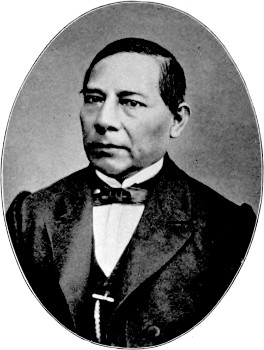
BENITO JUAREZ.
Two parties, or factions, emerged in the Congress, the Bourbonistas, or Centralists, and the Federalists. The leaders of the former were Negrete, Bravo, Bustamante and Mier y Teran; of the latter, Victoria and Guerrero, whose adherents were more numerous, and they were successful in framing the Republican Constitution that was proclaimed on October 4, 1824. It declared the Roman Catholic religion to be perpetually the religion of the Mexican people. The Republic thus established consisted of the States of Chiapas, Chihuahua, Coahuila and Texas, Durango, Guanajúato, Mexico, Michoacán, Nuevo León, Oaxaca, Puebla, Querétaro, San Luis Potosí, Sonora and Sinaloa, Tabasco, Tamaulipas, Vera Cruz, Jalisco, Yucatán and Zacatécas and the territories of Upper and Lower California, Colima, Santa Fé and Tlascala—nineteen states and five territories. On the 10th of October the first president, Nicolás Bravo, took the oath of office. Congress was dissolved on December 24th and the first Constitutional Congress convened on January 1,[86] 1825. In the same year, the last position held by the Spaniards, Fort San Juan de Ulua, was evacuated and the republic was recognized by the United States and Great Britain.
During this administration the question of secret societies became urgent in consequence of the influence of the freemasons in political matters. The insurgent force was led by Vice-president Bravo who was of the Scottish lodge faction, but Guerrero defeated him and took him prisoner.
The election in 1828 resulted in favor of General Manuel Gomez Pedraza, who was supported by the Scottish (Escoseses) masons, who defeated Vicente Guerrero, whose candidacy was espoused by the Yorkinos; but a pronunciamiento was made by the liberals in favor of Guerrero, who resorted to arms under the leadership of Santa Anna. The government forces defeated him, when he was given command of the army at whose hands he had suffered defeat. Pedraza, in view of the extreme excitement, resigned and Congress declared his election null and void and elected Guerrero president and Anastasio Bustamante vice-president on January 12, 1829. Among the measures of Guerrero’s administration is to be noted the abolition of slavery. Bustamante was then elected president and Congress declared Guerrero “morally incapacitated to govern the nation.”
The government of Bustamante began on January 1, 1830. His principal adviser was the former historian, Lucas Alamán, who was minister of foreign and domestic relations and who had filled the same office under the Poder ejecutivo in 1823. The country was, however, agitated by dissensions and revolts instigated by Guerrero and his partisans and he was driven to Acapulco where he was trapped on the Colombo, a Sardinian ship whose captain had been bribed to invite Guerrero aboard and who delivered him to his enemies, by whom he was courtmartialed and shot on February 14, 1831.
Bustamante’s power did not last long, for in 1832 he was overthrown by the turbulent Santa Anna, who secured the elevation of Pedraza as the legitimate president by virtue of his election in 1828, although he had opposed him then in favor of Guerrero. In the election that followed, Bravo was chosen president, but Congress declared his election void and the way to the supreme magistracy was then open to Santa Anna who succeeded on April 1, 1833, Valentin Gomez Farias becoming vice-president. In 1836 the complete overthrow of the federal system was effected and centralized government established under a new[87] constitution, the effect of which set at a greater distance the freedom of democratic government and the blessings of peace, thereby retarding the real development of the nation.
One of the fruits of the rule of Santa Anna was the loss of Texas to Mexico. On November 27, 1838, war was declared against France. Santa Anna, who had come forth from his retirement at Manga de Clavo was given command at Vera Cruz. The French captured the forts Santiago and Concepcion, but failed in their attempt to capture Santa Anna in Vera Cruz and retreat to the ships was ordered by the French admiral. In following up the French to the shore Santa Anna acquired the laurels of a popular hero at the cost of his left leg, which was so badly wounded that amputation was necessary. Vera Cruz was then shelled by the French and evacuated, but this trivial war ended by a treaty in which Mexico agreed to pay the French demand of six hundred thousand dollars within six months.
A revolt broke out in Tampico during the troubles with France and President Bustamante took the field, leaving the again popular Santa Anna provisional president, on March 9, 1839. The movement spread and soon became a federalist revolution, involving the capital itself, in 1840. General Urrea and Gomez Farias were its successful leaders and Bustamante was taken prisoner. Once more the retirement at Manga de Clavo was abandoned and Santa Anna emerged to overthrow the federalists, to whom Bustamante, however, granted favorable conditions and the revolution ended. So unsettled were affairs that Gutierrez de Estrada, a former minister, publicly advocated a monarchy under a foreign prince. His plan however, merely resulted in his fleeing the country. Whatever the troubles of the people, they were not ready to seek relief in a monarchy.
In 1841, General Paredes made a pronunciamiento against Bustamante’s government. On this occasion General Valencia and Santa Anna, who had been successful in 1840, against the federalists, now joined the new insurrection, and the government troops having abandoned the president in favor of the insurgents, Bustamante was forced to retire from the presidency in 1842, notwithstanding his efforts at conciliation by the proclamation of federation. The proposals of Santa Anna had won; he offered his “Bases of Tacubaya” proposing that the legislative and executive functions of the government should cease and that pending a congress, within eight months, to frame a new constitution, a junta should name a provisional president.[88] As a result, Santa Anna became such provisional president, but the Congress elected showing a federalist majority a pronunciamiento of the army was issued naming a council of notables and opposing the Congress, which was dissolved by the executive, as a matter of course, and the proposed council installed in January, 1843. In June, Las Basas Organicas, the new constitution, was adopted and its terms were less liberal than the Leyes of 1836, instigated by Santa Anna. The dictator under this new constitution did not assume direction at the capital till June 3d, Bravo and Canalizo governing as acting presidents. Shortly after, Santa Anna’s wife died and he was married by proxy to a girl of fifteen. His government was truly despotic and he affected the pomp of a monarch. In fact, the general sentiment was well expressed when, on one of his many retirements to his estate, it was said: “The president is going in order to return crowned.”
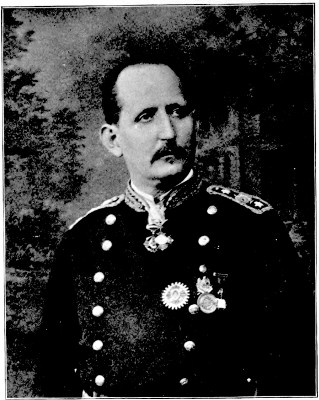
SEÑOR GENERAL DON RAMÓN CORONA, ONE OF MEXICO’S FAMOUS GENERALS.
The autocratic, costly, and inefficient rule of Santa Anna was at length challenged by a combination of opponents. In October 1844, the Guadalajara assembly declared against him and this was followed by a pronunciamiento made by General Paredes, who had previously supported Santa Anna, on November 2d, at that place, which declared for the suspension of the president pending investigation of his conduct. Puebla shortly joined Guadalajara, and then immediately followed the capital, where José Joaquin de Herrera was[89] installed president of the council. Santa Anna met this condition by emerging from retirement and led an army to Querétaro. So great was the indignation at the capital that the precious leg lost by the dictator in his attack on the French was taken from the tomb and dragged in the streets, while the destruction of his statue was averted only by its removal to a hiding place. This outbreak in the capital changed Santa Anna’s plans and he turned his army of fourteen thousand to the revolutionaries there. His deposition had been secured and his arrest ordered by the Congress and finding the resistance to him to be so formidable he marched to Puebla, which he attacked on January 2, 1845. A few days later the troops under Paredes and Bravo arrived on the scene and Santa Anna was compelled to withdraw on January 12th. After vain proposals to make terms with Herrera, he took flight but was captured and taken prisoner to Perote. His impeachment followed and he was banished perpetually, while Canalizo and four of his ministers were banished for ten years. A general amnesty was proclaimed otherwise. Santa Anna took ship to Havana on June 3, 1845.
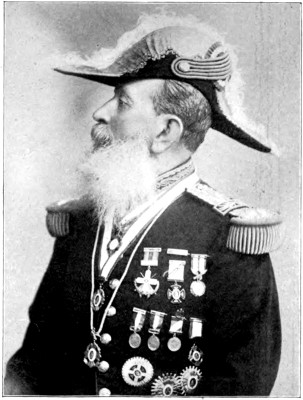
SEÑOR GENERAL DON MARIANO ESCOBEDO, WHO TOOK EMPEROR MAXIMILIAN PRISONER.
Herrera now became constitutional president, September 16, 1845. His first serious trouble was the Texan; he endeavored to compromise the situation; but, because of opposition, he resorted to warlike measures and sent six thousand men under Paredes to the frontier. Paredes, however, issued a pronunciamiento against the president on December 14th, at San Luis Potosí, and on January 2, 1846, turned to the capital and overthrew Herrera.
[90]
Reverting to Texan affairs, as being so largely the basis of the next great event to be described in Mexican history, it will be sufficient to notice that on several occasions since the independent government was established, a number of conflicts had occurred in which Mexican officers were employed. In 1839, a movement of federalists in Mexico was effected having as its object the establishment of the Rio Grande Republic, of which Texas was to be a member.
In 1844, an armistice was accepted between Mexico and Texas, proposed by Great Britain, but Texas refused to ratify it in consequence of its conditions declaring that the independent republic still constituted a part of the republic of Mexico. Hence, Santa Anna declared that a state of war existed. After this act by Great Britain, suspicion became widespread in the United States that the purpose of the British was to suppress slavery in Texas. Great Britain’s course arose out of a request made by Texas in 1842, to Great Britain, France and the United States to intervene and put an end to Mexico’s hostilities, but this appeal was not fruitful. The situation was further complicated in 1843, when the Congress of Mexico declared that if the Congress of the United States should pass an act to incorporate Texas with the United States such legislation would be deemed equivalent to a declaration of war.
On April 12, 1844, a secret annexation treaty was signed by the United States and Texas, but the United States Senate failed to ratify it. The popular sentiment in America had, however, appeared to demand incorporation and accordingly on March 1, 1845, a resolution was passed by Congress enabling Texas to frame a constitution, preparatory to admission into the Union. Neither the purpose of the measure nor its form could be acceptable to Mexico; nevertheless, on December 29th, after Texas had adopted an ordinance of annexation to the United States and the State constitution, Congress enacted its admission as a State into the Union. The resultant conflict, however inevitably the logic of events pointed to this absorption of the independent republic, was almost a foregone conclusion.
There was ground of dispute enough to afford pretext for war. The claims of American citizens due since 1839, were still in large part unpaid. The boundary question, based on the claim of Texas of all territory between the United States and the Rio Grande from source to mouth was another. Trouble had occurred as to Upper California, when Commodore Jones had temporarily seized Monterey. The United States had sent a force under General Taylor to Fort[91] Jesup with instructions to proceed to the Sabine in case of Texas being endangered, and a naval force was sent to the Gulf of Mexico. Such was the situation when Congress adopted the annexation resolution.
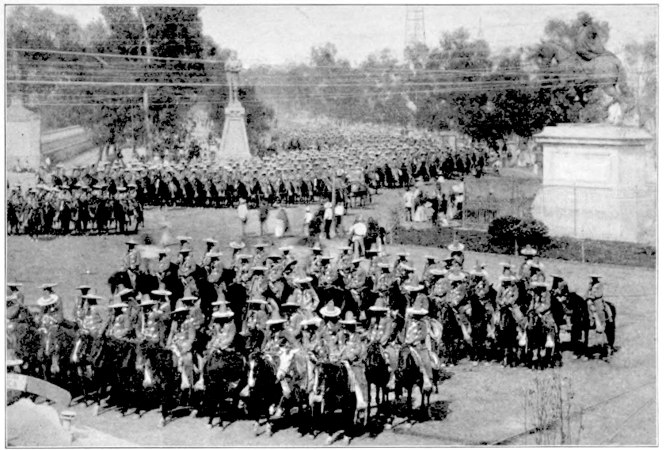
RURALES ON THE 16TH OF SEPTEMBER.
It was inevitable that the Mexican minister to Washington should demand his passports; that the United States Envoy should be graciously dismissed from Mexico, and that preparations for war should be actively pressed. Before the storm broke, futile efforts were made to avert it, the United States sending Slidell as commissioner, but the essential condition of Mexico that the United States fleet off Vera Cruz should be withdrawn not having been complied with on his arrival in Vera Cruz on December 3, 1845, he was not recognized and his mission completely failed, and he withdrew from Mexico on March 21, 1846. This closed the diplomatic procedure.
Meanwhile, General Taylor had taken Point Isabel and erected a fort opposite Matamoros. Here he was attacked by General Arista, who superseded Ampudia on April 24, 1846, and a formal declaration of war by the United States[92] followed on May 13th, on the ground that “Mexico has passed the boundary of the United States, has invaded our territory, and shed American blood upon the American soil,” as President Polk stated.
The second event was the attack on May 8th, at Palo Alto, which resulted in Arista’s falling back next day to a position at Resaca de la Palma, from which he was driven with considerable loss, the same day, his artillery and supplies being captured. As a consequence of this defeat, Arista, whose forces greatly outnumbered the Americans, was deprived of command, being replaced by Ampudia. On May 18th, General Taylor occupied Matamoros. The turn of affairs in Mexico now brought the ubiquitous Santa Anna to the head, he following the now familiar course of a congress, called in pursuance of a pronunciamiento issued by General Mariano Salas, and the election of Santa Anna took place in December. He had returned to Mexico in August, and was passed through the American fleet off Vera Cruz in the hope that he would be a source of weakness at home rather than of strength. In addition to the pronunciamiento, General José Maria Gomez declared against President Paredes at Guadalajara and he was sent into exile.
The new president took command of the army, leaving the government in the hands of vice-president Fariás. On the 5th of that month he began his march against Monterey with a force of regulars and volunteers numbering in all about six thousand men. On the 19th, he was before Monterey, which was held by Ampudia, who had put this city in a good defensive state. The assault was made on the 21st, the defenders exhibiting the utmost bravery as they defended street by street. Three days passed when Ampudia capitulated with honors, after which an armistice of two months was agreed upon. During this time, General Patterson was sent to Tampico with a strong force and General Winfield Scott led a third force against Vera Cruz, previous to a march on the capital. To effect these movements, General Taylor’s force was largely drawn upon and Santa Anna having learned of the proposed attack on Vera Cruz left San Luis Potosí on January 28, 1847, with twenty thousand troops to encounter Taylor at La Angostura (Buena Vista) where he hoped to surprise the Americans. On the 22d of February, Santa Anna demanded the surrender in terms that indicated his certainty of success. The following day he was repulsed, suffering great loss and retreating to San Luis Potosí. This victory was almost decisive, the defeated Santa Anna reaching his destination with his force reduced by one-half.[93] The engagement was a terrible blow to the prestige of the man who had seemed “to hold Mexico in his despot grasp, strange as it may seem.” Taylor’s great success gained him only the task of defending the territory acquired and the Rio Grande frontier.
The further operations in Mexico were concluded by the American commander-in-chief, General Scott. He landed his force of twelve thousand men near Vera Cruz on February 15th, and invested the city, the port being blockaded by Commodore Perry’s squadron. Siege operations were prepared and on March 22d, the artillery and guns of the ships opened fire. The defence, under General Morales was worthy of a less bitter experience than that of the surrender, even with the honors of war, which was forced on the 26th. On April 12th, in view of the season, the American general withdrew his troops from Vera Cruz.
Santa Anna, defeated by Taylor, had resumed his duties as President but his spirit was aroused on hearing of the defeat of Morales and the surrender of Vera Cruz. He hurried from the capital “to wash out that disaster.” With ten thousand men he fortified himself stoutly at Cerro Gordo, about eighteen miles from Jalapa. Here he was attacked by General Scott on April 18th, and utterly defeated. Then fell, successively, Jalapa, Perote, and Puebla, and at the last named city Scott received instructions from the State Department to arrange a peace treaty, if the occasion served. Secret emissaries of the Mexican president visited the American commander as to this matter and Santa Anna has been charged with treason on account of it.
On August 9th, General Scott entered the Valley of Mexico, tracing the route followed by the Spanish Conquistadores nearly three and a half centuries earlier, and arrived before the capital on the 20th, defeated Santa Anna at Padierna and Churubusco where a most gallant stand was made by General Anaya. In these last efforts, all credit is due to Santa Anna; his operations were marked with ability, courage and resourcefulness.
Negotiations now followed for peace. On the 22d, hostilities were suspended and Nicholas P. Trist, chief clerk of the State Department of the United States, who had arrived at Puebla as peace commissioner, now proposed terms of peace on the basis of the cession of Texas, New Mexico and Upper California, and the right of free transit across the Isthmus of Tehuantepec and the payment to Mexico of a money consideration. These terms were rejected by Mexico and active hostilities were resumed on the night of September 7th, by an attack[94] on Molino de Rey, which after stubborn fighting was taken the next day, but so strong was the position of the Mexican army that General Scott abandoned the field. Though success was not theirs, if valor and conspicuous ability merited it, General Antonio León and his brave aides deserved it, as well as the splendid rank and file. Not until the 12th, did General Scott move against the Castle of Chapultepec which was magnificently defended by General Bravo and the military cadets of the Academy, to their imperishable honor and glory. The capture of the stronghold was effected on the 13th. The death roll of the Mexicans bears the names of many noble sons, among whom conspicuous merit signalizes Colonel Felipe Xicotencatl, the descendant of a famous Tlascaltec chief. The way to the city was now assured, and after securing causeways and the fortified gates of Belem and San Cosme, General Scott entered the city fighting his way step by step, valiantly opposed by soldiers and citizens. Santa Anna did not await the final issue but deserted both the government and the city on the successful forcing of the gates of Belem and San Cosme and turned the residue of his brave army over to General Reyes, having been deposed and summoned to appear before a council of war, but he left Mexico and fled to New Granada. In his place, Manuel Peña y Peña was elected temporary president and he made Querétaro the seat of government.
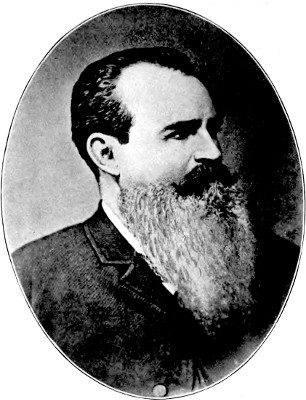
SEÑOR GENERAL DON MANUEL GONZALES, EX-PRESIDENT OF MEXICO.
Such was the condition of affairs when the Mexican capital fell to the Americans. New Mexico and California were conquered. Texas was irrevocably severed. To the task of restoring peace in the face of such disaster the new president resolutely directed his efforts. Commissioner Trist, though no longer officially authorized, succeeded in arranging a treaty, known as the Guadalupe-Hidalgo, which was signed on February 2, 1848, by the terms of which Texas,[95] the territory between the Nueces and the Rio Grande, New Mexico and Upper California were to pass to the United States, the latter country agreeing to pay Mexico fifteen million dollars and to assume and discharge all claims of American citizens against Mexico. Thus was Mexico stripped, as a consequence of a war which President Lincoln severely criticized and which General Grant characterized as “the most unholy and unjust ever waged by a stronger nation against a weaker one;” nor do the vast material advantages that have followed to the territories reach back to palliate this view of the quarrel or justify the bitter suffering that it brought.
The American army was soon withdrawn and on June 12th, José Joaquín de Herrera was elected constitutional president and the government was re-established at the capital. Its chief labor was to heal the wounds caused by the war, to ameliorate the general condition. The spirit of insurrection was not subdued, however, for General Paredes effected a temporary revolt which was soon subdued, and Herrera was successful in the difficult task of reducing the army establishment and encouraging the building of railroads and telegraphs, the first of such latter undertakings being that of making communication between the capital and Puebla. With troubles also in Yucatán owing to the serious Indian uprisings in August, 1848, the president found his entire energies occupied, but he succeeded in establishing a union of the Province with Mexico, and relinquished the government to his successor with a record of great improvement accomplished.
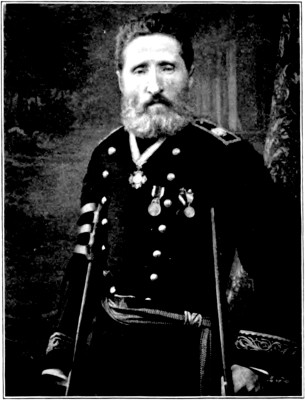
GENERAL CARLOS PACHECO, FORMERLY MINISTER OF FOMENTO.
General Mariano Arista, who had commanded the Mexican Army at Palo Alto was elected to succeed Herrera and he assumed the presidency in January, 1851. But neither his high sense of honor nor his patriotic purposes[96] could stay the revolutionary spirit which broke out at Guadalajara in July, 1852, and, in consequence of the “Plan of Jalisco,” intended to overthrow him, and of the pronunciamientos in its favor, Arista resigned on January 3, 1853. The true purpose of the revolution was the installation of Santa Anna as dictator, and after a brief direction of the government by Ceballos and Lombardini, he was elected and assumed office on April 20th, after Ceballos had failed in an effort to call a national convention. The government during the next two years was one of persecution and arbitrary use of power. The dictator relied on the army to support his despotism and increase the military strength. He was, however, re-elected in December, 1853, and his power was greatly augmented. He was empowered to appoint his successor in office and virtually became dictator for life. Pomp and ceremonial befitting his supreme power was assumed and he obtained the title of “serene highness.” In the same month he effected the sale to the United States of the territory known as “La Mesilla,” in Southern Arizona, for ten million dollars.
Such rule as that of Santa Anna could not be endured and the fabric of perpetual power which the dictator had assiduously striven to weave was rudely shattered in 1854, by the “Plan de Ayutla,” which was proclaimed by Colonel Villareal on March 1st. A junta of notables was to appoint a provisional president and call a constituent Congress. This plan gained powerful support, among others who acceded to it being Colonel Ignacio Comonfort. The president marched against the insurgents, but failing to subdue the movement, he returned to the capital. Simultaneously, a force under Count de Boulbon entered Sonora from Upper California with the object of establishing there an independent dominion.
Comonfort having equipped a powerful army, Santa Anna abandoned his government and went to Vera Cruz, giving the executive power into the hands of a triumvirate. Then he left Mexico, fleeing to Havana. The provisional president, appointed in pursuance of the revolutionary “plan,” was Carrera but his nomination was not agreeable to Comonfort and General Juan Alvarez received the office at the hands of the junta. Among the ministers he selected were Benito Juarez and Comonfort, the latter of whom was elected as president on December 11, 1855.
Early in 1856, Comonfort faced fresh insurrections that seemed to spring from their like as it were so many hydra-headed evils. He adopted drastic[97] measures against the church and the clergy, enforced the Lerdo law, abolishing civil and ecclesiastical mortmain and establishing individual ownership of lands. On June 5th, he suppressed the Jesuits and on September 17th, the Franciscans, in consequence of a conspiracy which was hatched in the convent of the latter to overthrow the government on Independence Day, the 15th, and secure the supremacy of the church in the nation. Comonfort took possession of the church of San Francisco and all its appurtenances early in the morning and the next day decreed the opening of a street, to be called Independencia, east and west through the grounds. The following day came the suppression of the monastic order.
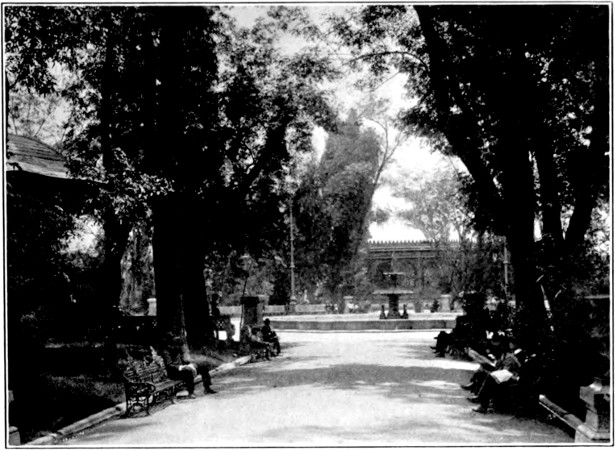
PICTURESQUE SPOT IN THE ALAMEDA.
Again Puebla revolted, and for the second time in nine months it was retaken by the government troops on December 3d. This was followed by a pronunciamiento at San Luis Potosí, which was quickly put down. The bird of peace now hovered over stricken Mexico for a short time under the vigorous and enlightened rule of Comonfort. On February 5, 1857, a new constitution was adopted, liberal[98] in character and establishing a republican federal form of government. The executive power was vested in a president elected for four years; a single house was to constitute the legislature, the members of which were to be elected for three years; a judicial branch was to comprise a supreme and inferior courts. The important question of presidential succession was regulated, so that in case of vacancy the president of the Supreme Court was to succeed temporarily pending a regular election.
This constitution furnished safeguards against the abuses of power which had been possible under the Ayutla plan. The election of Comonfort to succeed himself followed, yet, inconsistently, a few days after entering office on December 1st, he overthrew the constitution he had sworn to maintain and adopted the “Plan de Tacubaya,” announced by General Felix Zuloaga on December 17th, on the pretext that the constitution was not adapted to the usages of the people. Under Zuloaga’s “plan,” Comonfort was to remain in power and convoke a congress to frame a more suitable constitution, to be submitted to the electorate. Benito Juarez had been chosen president of the supreme court and it seemed necessary to the success of the new plan that he should be imprisoned and Congress dissolved, which was done in December. But Comonfort’s plans failed, for on January 11, 1858, a pronunciamiento issued by the conservatives substituted General Zuloaga as president. The opposition was too strong and Comonfort, unable to defend the capital, abandoned it on the 21st of January and proceeded to Vera Cruz, whence he went into exile. The reactionaries now annulled the reform measures of the constitutionalists, who had organized a government at Guanajuato under Juárez, who had been obliged to abandon the capital, and began war on their opponents, but suffered defeat at Salamanca. Later, the president was seized at Guadalajara by the garrison there, who had mutinied, but escaping he made his way to Panama and thence to New Orleans, and returning to Vera Cruz administered the government from there.
Benito Juarez was born in Oaxaca, on March 21, 1806. He was imbued with the loftiest sentiments for the public weal and his counsel and direction had proved the greatest strength of the liberal party. He had been one of the professors at the Institute of Science and Art at Oaxaca, and one of his students was Porfirio Diaz, who doubtless owed much of his political bent to the training of Juarez, the full-blooded Indian, to whose patriotic labors Mexico[99] owes her successful entry on a path of liberal policies which have led to so wonderful a development of national progress and prosperity. The keynote of his life was devotion to the public welfare and the highest ideals of manhood. But the time was not yet ripe for the possible accomplishment of his great purposes. The people had yet to learn, through long years of suffering and struggles, the true principles of republican government and the rights of men.
During this period of legitimate or constitutional government, under Juarez, the reactionaries maintained a government at the City of Mexico, under Zuloaga, and hostilities were bitterly waged against the reform party throughout the republic. Important successes were won by them, notably in the capture of Guanajúato, in July, by General Miguel Miramon and in Ahualulco in September, and as a result Miramon was named his substitute by Zuloaga after pronunciamientos in his favor by Generals Echeagaray, at Ayutla, and Robles Pezuela, at the capital. A junta having elected him president, he took office on February 2, 1859. The chief object he sought was to overthrow Juarez at Vera Cruz, but after a vigorous siege he abandoned the vain effort.
On July 12, 1859, Juárez proclaimed the Laws of Reform, by which the issues of the conflict were clearly manifested. The United States recognized the legitimacy of the Juarez government and ministers were respectively appointed in Washington and Mexico. As a sequence of this constitutional proclamation, the Juarez government greatly abridged the influence of the clergy; severance of church and state was aimed at; civil marriages and civil rights were defined.
The two governments were in conflict in foreign relations as well as domestic and their acts were on one side or the other protested against and repudiated. Juarez made a treaty with the United States giving the latter the right to protect its citizens in Mexico by force of arms. Miramon, on the other hand, gave treaty rights to Spain in regard to indemnity to Spanish subjects in Mexico.
Miramon abandoned the field after his defeat on August 10, 1860, at the Silao Hills and repaired to the capital. Zuloaga having withdrawn the power conferred on Miramon as his substitute, the latter procured his own election as president by a junta. The resistance of the reactionaries was fast weakening,[100] and their party rapidly diminishing; nevertheless, on December 20th, Miramon left the capital to meet the liberal forces and at Calpulalpam encountered General Gonzalez Ortega, by whom he was defeated. The capitulation of the capital followed on January 11, 1861. Juarez entered it in triumph with the liberal army of twenty-five thousand. Miramon escaped to Jalapa and finally reached France on a French war vessel.
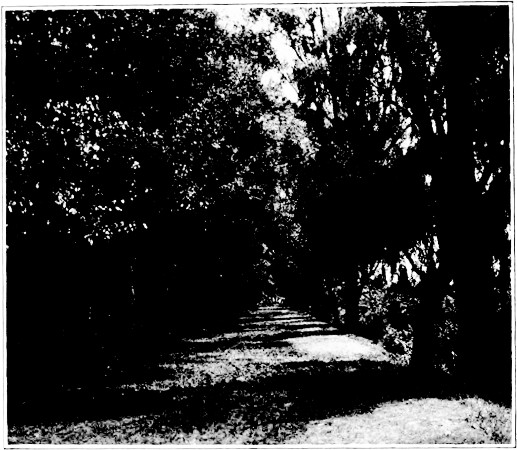
A COUNTRY ROAD IN THE VALLEY OF MEXICO.
With the return of Juarez to the capital he began the active administration of the Reform Laws. One of his earliest acts was the dismissal of the Spanish minister and the papal legate. The half-century strife between Federalists and Centralists had triumphed finally in the success of the Liberals, though a guerrilla warfare was continued for some little time. Zuloaga joined the reactionaries, declaring himself to be president in virtue of his “Plan de Tacubaya.” Melchor Ocampo, one of the great leaders of the Reform, was seized at his hacienda and shot by order of General Marquez; Degollado who pursued the executioners was caught by bandits and was shot. These outrages aroused extreme indignation and a price was put on the heads of Marquez, Mejia and other rebel leaders. Marquez attacked the capital in June, 1861, and was repulsed only after heavy fighting. It was in this defence that Porfirio Diaz, who had returned to his native state and later was elected to Congress to represent Iztlan district, leaving his seat in the legislative chamber took a distinguished part. A little later, in August, Marquez was totally defeated by Diaz at Jalatlaco which brilliant event earned for the victor the rank of brigadier-general; a month later he was again disastrously defeated at Pachuca. The three years of war was over, and the way to domestic peace, progress and prosperity might seem clear.
[101]
Juarez was elected constitutional president and assumed office in June. On July 17th, the Congress, in view of the severe drain on the resources of the people caused by the protracted war, found it necessary to enact suspension of the sinking fund provision and the payment of interest on the foreign-held debt, for two years. Thereupon, France and England closed diplomatic relations and these nations together with Spain made a treaty on October 31st, under the terms of which they were to seize the principal ports and collect and distribute the customs receipts among the several foreign creditors of Mexico. The condition was also agreed that no Mexican territory should be acquired or any interference be assumed as to the form of the Mexican government by either of the powers. The United States refused to join in this intervention. The French claim against Mexico was for six hundred thousand dollars, which had been collected by Juarez and seized by Miramon from the British legation where it was deposited for British bondholders. There was, besides, an old debt of about eighty million dollars contracted in the early days of the Republic. The claims of Spain and France were together about eighteen millions, all Mexican money.
It was soon evident that political motives were involved in the intervention, at least on the part of France. When the allied fleet arrived at Vera Cruz in December, 1861, bearing the commissioners of the European powers, General Prim for Spain, Monsieur Dubois de Saligny for France, and Admiral Wyke for Great Britain, they issued a proclamation according to which their purpose was merely to secure settlement of the financial questions. On December 14, 1861, the Spaniards, whose fleet reached there earlier than its allies, occupied Vera Cruz, which aroused the energetic resistance of the Mexicans, especially on the arrival of the French and British fleets on January 8, 1862. The united forces numbered nearly ten thousand men.
Juarez issued a decree on January 25th calling on Mexicans to resist the invaders and imposing the penalty of death on all who should fail in this or who should aid or abet the invaders. This course seemed inevitable, inasmuch as the partisans of Almonte, Miramon and Gutierrez de Estrada, who in their exile had actively plotted in favor of a monarchy for Mexico, were prepared to give aid to the invaders.
Juarez was anxious to avoid serious complications, if this could be honorably done, and he invited the commissioners to a conference at La Soledad,[102] which resulted in a treaty on February 19th, by the terms of which the Spanish troops were to advance as far as Orizaba and the French to Tehuacán, and were to occupy those places until the treaty was confirmed. The Mexican government was to be recognized as constitutional. The ulterior aim of France was so insistent that the British and Spanish support was soon withdrawn. Meantime, large reinforcements had arrived from France and with them came Almonte, Miranda, Haro y Tamaris and Miramon; the latter, however, to avoid arrest by the British, went to Havana.
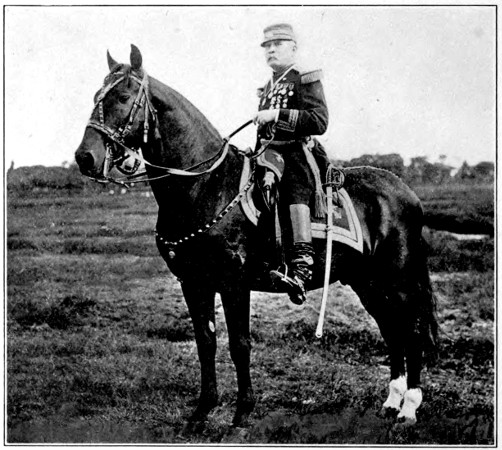
GENERAL PORFIRO DIAZ.
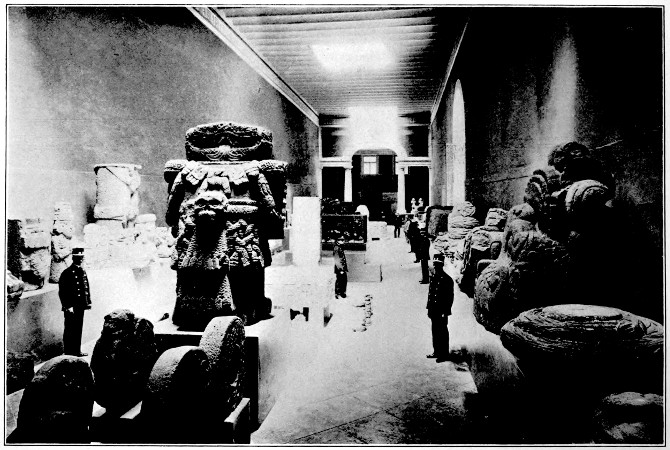
NATIONAL MUSEUM, SHOWING AZTEC RELICS.
[105]
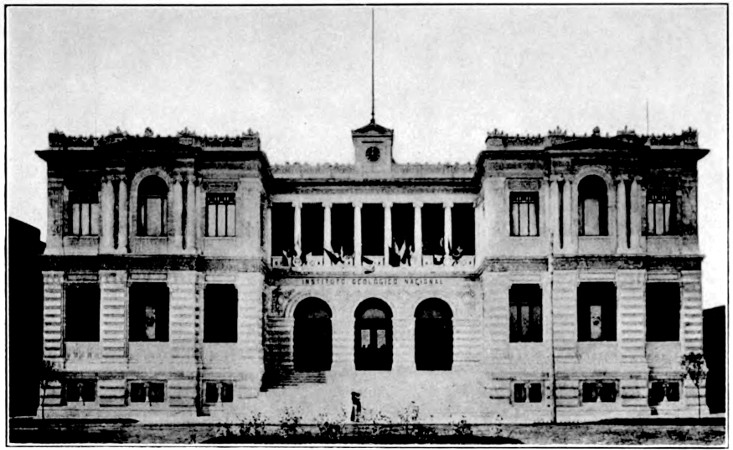
NATIONAL GEOLOGICAL INSTITUTE.
Napoleon III. had determined to create a throne in Mexico for Maximilian, Archduke of Austria. An excuse was soon formed for actual hostilities. Orizaba was reoccupied in spite of the agreement that if the terms of the treaty of La Soledad were not confirmed, the troops of the allies should retire to the positions held by them previous to that treaty. The British and Spanish commissioners had refused to confirm the treaty. The French, under General de Lorencez, aided by Mexican conservatives, resolved to attack Puebla. General Ignacio Zaragoza strongly fortified the hills of Guadalupe and Loretta and received battle on May 5th, completely defeating the enemy, whose troops numbered six thousand. This great victory over the French and their Mexican allies is celebrated as one of the national feasts, El Cinco de Mayo, and the gallant Zaragoza received the appointment of military governor of Vera Cruz and the distinction of having[106] his name inscribed on the walls of Congress in letters of gold, and Puebla took the name thenceforward of Puebla de Zaragoza. Diaz won fresh laurels for the valiant fight he led with his brigade and for his pursuit of the vanquished enemy.
The conservatives had proclaimed Almonte president, under the “Plan de Córdoba,” on April 19th.
General Forey arrived in Mexico during September with heavy reinforcements and superseded Lorencez. Acting without recognizing Almonte’s government he instituted an active campaign. He laid siege to Puebla on March 16, 1863, with over twenty-five thousand men, but was repulsed repeatedly till the 29th by the brave Ortega who defended the city with twenty-two thousand troops. On that day, Fort Iturbide was taken, but in hope of expected relief the gallant defender resisted every forward step within the city until forced by lack of food and ammunition, he was compelled to surrender on May 17th. Marching with a train to the relief was Comonfort, who had returned from exile to defend the integrity of the republic, and who on May 8th encountered Bazaine and Marquez at San Lorenzo and was defeated. This double disaster was only redeemed in part by the magnificent defence made by Ortega, which placed the achievement high on the roll of fame. Twelve thousand prisoners were taken at Puebla, including twenty-six generals. Of the latter some of them escaped later, among them being Ortega and Porfirio Diaz. The French under Bazaine entered on June 7th, Forey completing the occupation on June 10th.
Forey by decree of June 16th, authorized the French minister Saligny to name a junta of thirty-five Mexican citizens who should elect three Mexicans to constitute the executive authority. This resulted in the choice of Almonte, Mariano Salas and Labastida, Archbishop of Mexico. The junta also chose an “assembly of notables” which met on July 10th, and declared the adoption of a moderate hereditary monarchy with a Roman Catholic prince as ruler, under the title of “Emperor of Mexico;” that the crown should be tendered to Maximilian, Archduke of Austria, for himself and his descendants; and that if Maximilian did not accept, then the benevolence of Napoleon III. was to be appealed to to nominate another Catholic prince.
Maximilian accepted the tendered crown conditionally on a plébiscite in his favor, and the military aid of France so long as that might be necessary. On April 9, 1864, he renounced all rights to the throne of Austria and on the following day accepted the crown of Mexico.
[107]
On May 28, 1864, the new emperor arrived at Vera Cruz accompanied by the empress, Carlota. Thence they proceeded to Puebla and thence to the capitál, where they were enthusiastically received on June 12, 1864. The Regency which had reigned in the name of the emperor was forthwith dissolved and Maximilian assumed personal rule. He was too liberal for the church authorities and soon found himself at odds with them. He was forced to issue a decree condemning to death (October 3, 1865) all persons carrying arms against the empire and all persons aiding them. This fateful decree which condemned patriots to the ignoble death of “bandits and criminals” was issued on the presumption that Juarez had abandoned Mexico and that an official government of the republic no longer existed, but its promulgation and the infamous execution by Mendez served but to strengthen the patriot cause.
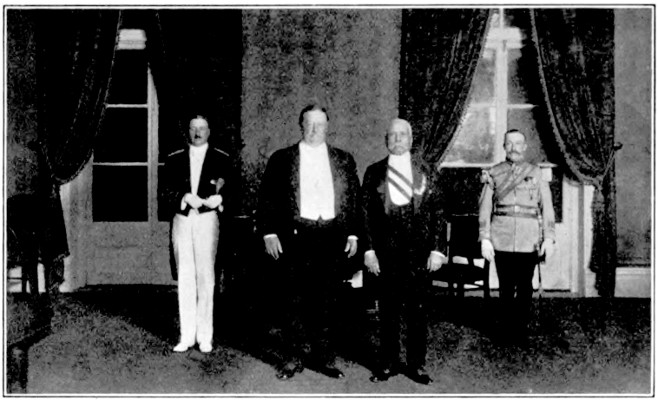
GENERAL DIAZ AND PRESIDENT TAFT.
History has a tempered rebuke for Maximilian and a sympathetic record for his sorrowful empress. As a man, the emperor had many excellent qualities; as an emperor, he might of his own volition have sought the goodwill and the weal of the people of Mexico. Mexico spurned him and his advisers. A belief that with his accession a stable government might ensue may have induced a large number to acquiesce in the establishment of an empire. But the movement[108] was conceived in treason; it practically gave back power to tyrants from whom it had been wrested at the price of peace, blood and life. The empire could not stand except by the mercy and favor of France and at the cost of Mexican blood and progress.
Following upon the French occupation of the capital on June 7, 1863, despite frequent defeats and with lessening resources, fighting continued. Diaz bravely and splendidly defended Guerrero, Oaxaca, and Puebla, notably in the taking of Taxco, a brilliant operation for which he was rewarded with the rank of major-general. Bazaine, who had defeated Comonfort at San Lorenzo, replaced Forey, whose success had been rewarded by recall to enjoy a marshal’s appointment, on October 1, 1863, and was to assume also the diplomatic office of Saligny. Besides the French army, he had a Mexican division of twelve thousand under Marquez. With such forces the constitutional army must grapple to preserve the republic. The republican army was commanded in chief by Comonfort, but in spite of most heroic defence, it was defeated in nearly all its battles of 1863. The valiant Comonfort was killed on November 14th. Querétaro, Guanajúato, Guadalajara, Oaxaca, Chihuahua and other important places fell into the hands of the imperialists. The defence of the city of Oaxaca, from January 8th, to February 9, 1865, is one of the notable events in Mexican history. A siege of several weeks could not break the defenders, but lack of ammunition forced a surrender. The hero, Diaz, fell into the hands of the imperialists, but escaped their toils after several months’ captivity, on September 20th. The seat of the government was continually being changed, till at length it was forced to the frontier at Paso del Norte. Dark, indeed, seemed the hope of the republic, but its interests were in the charge of men who were inured to battle and defeat; who knew the spirit of the Mexican people; whose courage and patriotism could not be quenched. On December 1, 1864, expired the term of office of President Juarez, but in view of the danger to which the republic would be exposed by a change of president at that time, the president declared in November, that his power would continue until a constitutional successor should be regularly elected.
In the crisis that faced the government, the United States had not been a silent onlooker. The principles of the Monroe doctrine had provoked Secretary Seward to intimate to France that the establishment of a European monarchy in Mexico was not approved by his government and that, as soon as the pressure of domestic affairs relaxed, the United States government would mark its[109] disapproval of the occupation of Mexican territory by the army of a European power, and that it would not tolerate the establishment of an empire in that territory maintained by foreign military force. With the close of the Civil War, therefore, the United States government demanded the withdrawal of French troops and the cessation of colonization in the country. This ultimatum, for such it really was, resulted in Napoleon’s abandonment of the unfortunate Maximilian.
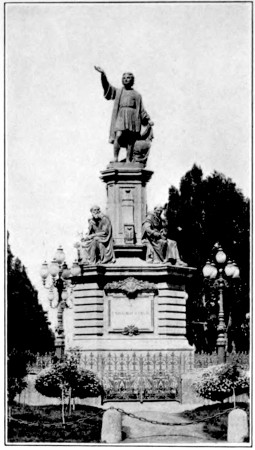
STATUE OF COLUMBUS.
Maximilian desired to abdicate and leave Mexico with the French troops but while postponing this course, the brave and devoted Carlota went to France and pleaded with Napoleon to maintain his troops in Mexico. In vain did she thus appeal, in August, 1866; she next went to Rome to secure the aid of the Pope, but there, weakened by her trials and crushed with her misfortune, her mind gave way and she was placed in retreat at Tervueren, near Brussels, where she still lives, long deprived of reason. In the south, Diaz, who since his escape from Puebla had gathered a noteworthy force was organizing a third campaign against the invaders, whom he signally defeated in brilliant engagements in Oaxaca, at Nochixtlan on September 23d, at Miahuatlan on October 3d, and at La Carbonera on October 18th, the latter victory being especially significant. The Mexicans were now filled with enthusiasm and unwavering courage led them to make light of the discrepancies between their military resources and those of their opponents. Diaz then laid siege to the City of Oaxaca which surrendered on October 31st. This victory furnished the liberal army with much needed ammunition and artillery. Moving southward toward Tehuantepec, Diaz won the battles of La Chitova and Tequisistlan on December 19th and 26th. In January, 1867, the government was transferred[110] to Zacatécas, but it was again driven forth a few days later by Miramon, who had returned to Mexico, and the president and his ministers barely escaped capture. Before the date for the final withdrawal of French troops arrived, Bazaine left Mexico with the last contingent, in February, 1867.
But not all the desperate devotion of soldiers or skill of generals could prevent the republican armies of the North and West from uniting and on March 10th completing the investment of Querétaro. On March 22d, Marquez successfully got past the invading lines with a cavalry force of twelve hundred to make his way to the capital and bring thence the garrison to make a real attack on the invaders and allow the besieged to escape. Proceeding to the capital, Marquez secured the garrison, but instead of returning to Querétaro, he took his force of five thousand men to relieve Puebla, which General Porfirio Diaz was besieging after having driven the enemy from the south. The latter, however, captured the city on April 2d, after a masterly and brilliant twenty-five days’ siege. On this occasion the victory was doubly remarkable as a military operation and as an example of the magnanimity of the victor, who spared the lives of those who surrendered, in spite of the provocation of the enemy through the cruel and wanton shooting of many of their prisoners. Diaz, joining forces with Guadarrama, completely routed Marquez at San Lorenzo on April 10th, and then marched to the capital, to which he laid siege on April 12th.
At Querétaro, the Imperialists bravely sustained the unrelaxed siege, which was marked by many brilliant sorties against the republican troops; but without avail. The defeat of Marquez had destroyed all hope of relief to the besieged, and after a siege by General Escobedo of over nine weeks the imperialists resolved on its abandonment. Before this plan could be effected, Maximilian was seized through the treachery, it is said, of Colonel Miguel Lopez, who betrayed him. Maximilian spurned the opportunity to save himself, although warned of his danger. He took his last stand at the Cerro de Las Campanas, but finding it impossible to hold this position, the emperor surrendered his sword to Escobedo, on the 15th of May.
Maximilian was imprisoned in the convent of the Capuchins with Miramon and Mejia, to await trial by court martial, in pursuance of the decree against traitors and invaders promulgated by Juarez on January 25, 1862. On June 13th, he was arraigned and condemned to death on the 15th. The sentence was approved by General Escobedo who fixed the following day for the execution;[111] but it was postponed until the 19th, on the order of President Juarez, when at seven in the morning the unfortunate Maximilian, with Miramon and Mejia, was shot on the spot on the Cerro de las Campanas where he was captured. The appeal of the United States to spare the life of Maximilian had been refused, but President Juarez pardoned nineteen generals of the Imperial army who had been condemned to be shot. The president stood firm in his belief that his duty required that Maximilian should suffer the extreme penalty as a warning to usurpers and foreigners who might attempt to destroy the nation. The ex-emperor faced death as a hero, effacing his rank in the line of the doomed by giving Miramon the centre and his patriotic address, short and sympathetic, aroused admiration and crowned his tragic death with honor. Time has dealt mercifully with the memory of Maximilian and the voice of posterity has regretted the extreme penalty he suffered.
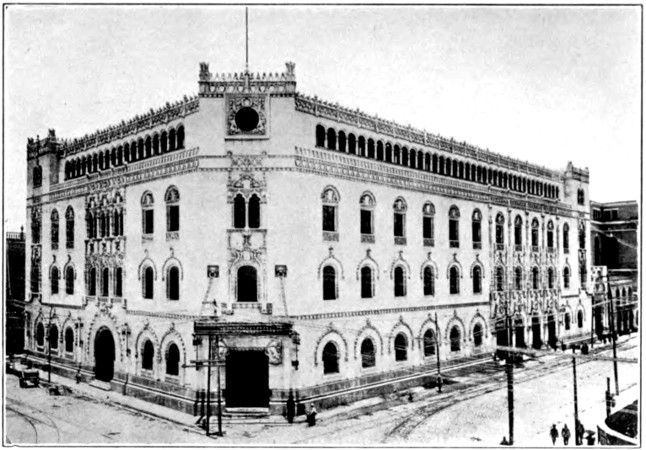
THE POST OFFICE.
At the capital, General Diaz was storming; Marquez defended the city bravely and well. Its fate was certain in any case, but its surrender became immediately inevitable on the arrival of reinforcements from the republican[112] army at Querétaro. On the night of June 17th, a determined sortie was repulsed with considerable loss and on the 19th the Austrian auxiliaries capitulated. On the 21st, the city surrendered, Marquez having gone into hiding, with his family, after resigning his position. Diaz occupied the capital and disposed of his large number of prisoners in three prisons and carefully safeguarded the rights of the inhabitants and administered orderly the affairs of the city so that he was able to hand over the large sum of three hundred thousand dollars on restoring the government to the president.
Again, Juarez entered the capital in triumph, the people manifesting intense delight and enthusiasm on the occasion, the 15th of July. The disposal of the sentences against Imperialists was early concluded, great leniency being extended toward them. Marquez and some other leaders escaped, and finally a general amnesty was proclaimed on October 13th, 1870, excepting only Archbishop Labastida and Generals Uraga and Marquez. Of the other disturbers, mention need be made only of Santa Anna, who had returned to Mexico and been condemned to eight years’ banishment. He died at the capital on June 4, 1876.
The work of rehabilitation of the political and business condition of the nation was a task that called for great wisdom and energy on the part of the executive. Juarez was re-elected president and endeavored to effect some changes in the constitution, but in view of the opposition of some of his supporters, the 1857 constitution was re-established. The president of the supreme court was Sebastian Lerdo de Tejada. Juarez succeeded in establishing diplomatic relations with the European powers which had recognized the Imperial government. He instituted a change in the administrative divisions by erecting the States of Morelos and Hidalgo, in 1868 and 1869, respectively, in honor of the independence patriot martyrs. His first term was disturbed by insurrections and the familiar pronunciamientos, but the government promptly and firmly repressed them, so that he was re-elected and entered again on a four years’ term on December 1, 1871.
On July 18, 1872, Juarez died suddenly. In the regeneration of his country during a period of exhaustion that resulted from the war against the Imperialists and from the previous insurrectionary movements of the centralists, the labors of Juarez were directed with patriotic sincerity and great ability, and the march toward national consolidation was well advanced. Important railroads and telegraph lines were projected and established and the prosperity of the republic enlarged.
[113]
Lerdo de Tejada succeeded Juarez by virtue of the constitution, and with the acquiescence of the followers of Diaz. He retained the cabinet of his predecessor and quietly directed the public affairs. To quench disaffection, he proclaimed amnesty for those who had taken up arms against Juarez, of which, however, Diaz refused to accept. The constitutional election placed Lerdo de Tejada in office on December 1, 1872, and he again recognized the Juaristas in making up his cabinet.
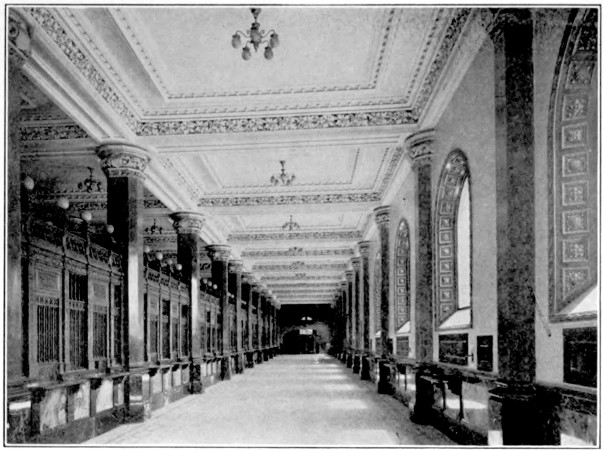
POST OFFICE, WEST CORRIDOR.
A very serious insurrection broke out in 1873 in Tepic, under the leadership of Manuel Lozada, cacique of Alica, who marched with eight thousand men against Guadalajara, but was completely routed by General Ramón Corona, and the district of Tepic subdued and occupied by the government and Lozada was shot.
On May 29, 1873, Congress approved the reform of the laws as to church and state and on September 25th, the constitution established separation of the two; freedom of religion; civic marriage; the right of affirmation by witnesses; free labor; the inviolable liberty of Mexicans as to labor, education and religion.[114] The disputes with the clericals had become bitter, foreign Jesuit priests had been expelled from the country, even the nuns had been driven from their convents and the Sisters of Charity were banished in 1874. In December of this year, Diaz was elected to the Federal Congress and his friends insisted on his candidacy for the Presidency at the next election.
Lerdo’s popularity and his hold became weakened early in 1875, and in May he secured from congress personal power and authority in respect to war and finances. The Juaristas were no longer ready to support him solidly. The conflict aroused by President Lerdo’s aspirations and the consequent opposition of the followers of Diaz had meantime plunged the country into warfare. Diaz especially had been indefatigable and successful in the field. After Matamoros came Icamole and these were followed by his culminating contest at Tecoac. He had reached Oaxaca with great difficulty, being obliged to travel from North Mexico to New Orleans, and thence to Vera Cruz in disguise.
He gave battle to General Ignacio Alatorre on November 16, 1876, and completely defeated him at Tecoac. President Lerdo abandoned the capital and went to New York. On the 24th, Diaz entered the capital and organized a government.
Iglesias maintained that the proceedings were not constitutional and refused to acquiesce on the conditions proposed. Diaz entrusted the government to General Juan N. Mendez and took the field with General Manuel Gonzalez against Iglesias with an army of twelve thousand. Diaz returned to the capital on February 11, 1877, and resumed the executive power provisionally. On May 5th, the people elected him constitutional president for the term ending November 30, 1880.
Though gaining the highest office by revolutionary means, Diaz avoided all approach to subversion of popular rights or dictatorial rule. His life was quite unostentatious; he declined the state residence and occupied his own modest home.
One of the president’s first tasks was the re-establishment of friendly foreign relations; he affected an amicable arrangement of border troubles. The task of encouraging foreign capital to promote great enterprises, particularly railroads, was also early taken up. The increase of the public revenue and the economic and honest administration of public offices was zealously promoted by the president whose labors resulted in marked advance in prosperity and enlargement of commerce and industry and a regular businesslike discharge of the public service with due regard to constitutional requirements.
[115]
In 1878, an important amendment of the constitution was effected providing that the president and the State governors should be ineligible to re-election until an interval of four years had elapsed from the termination of their offices. This change was absolutely endorsed by President Diaz, who would not consent to become a candidate for re-election in 1880. On September 25th, General Manuel Gonzalez was duly elected and he assumed office on December 1st, without any violence being manifested. Indeed, the new era had come; the transmission of executive power being accomplished peacefully, for the first time since the republic had been established. The new president secured the co-operation of his predecessor as the minister of public promotion, but in a few months, General Diaz resigned after initiating several important public works.
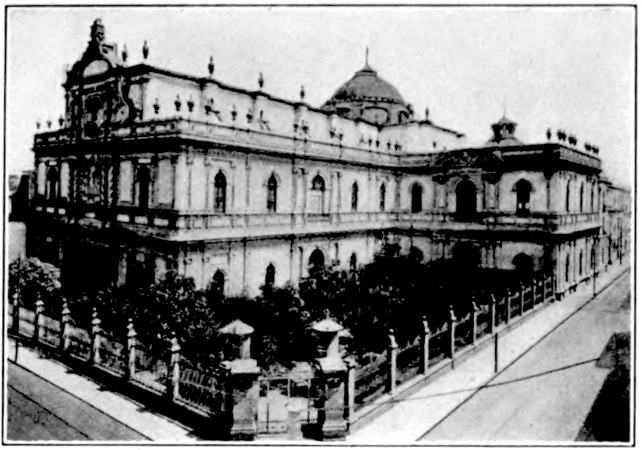
NATIONAL LIBRARY.
The new birth of the nation manifested itself in growing demands for public improvements and a regular administration of the public service that outran the resources, which had not acquired the stability and elasticity sufficient to respond to the situation. Besides extension of public works, the government successfully established diplomatic relations with Great Britain.
At the election in 1884, Diaz was again elected to the presidency and assumed office on December 1st. Successful as a leader in the field; familiar with all the political and industrial conditions and needs of the country, the popular choice of the people, he was now free to concentrate his wonderful energy and unusual ability on the task of making the nation. Financial chaos was the groundwork on which his government stood. The national treasury was penniless; the credit of the country destroyed. Only the glimmering of real progress and financial and industrial advance and stability had so far been seen. Plans had been proposed of great merit. Railroads, telegraphs and other public[116] utilities had been advocated and projected, but the time of action had not arrived. With the clear and decisive judgment characteristic of the man, with the firm will and wonderful capacity with which he was gifted, Diaz imparted to his people the confidence he entertained and his administration was so successful that before its close, in 1888, Mexico had entered on the open path of political solidity and financial and commercial stability. The crushing burden of foreign debt was reduced; the means of transportation and communication were improved and extended; mining enterprises were actively fostered.
One of the problems of serious import that early confronted the president was the relations with Guatemala arising out of the arbitrary decree of President Barrios of Guatemala that the control of the five Central American republics should be in his hands. President Diaz promptly protested against so despotic a claim and energetically prepared to support the protest by armed force, that “the old right of conquest should not prevail among the free peoples of America.” The great drainage canal, one of the notable modern engineering works, was begun at this time. Peace with the outside world, and but minor Indian uprisings, which were quickly suppressed, gave the opportunity for works of real advancement, which were unintermittently followed.
So imperative was the need of continuing the direction of the country in the same hands, that an amendment was made to the constitution providing that the president should be eligible to succeed himself for one term. Accordingly Diaz was again inaugurated on December 1, 1888, amid popular enthusiasm. The satisfactory domestic conditions permitted of fuller entry into international comity and of placing Mexico into closer and better defined relations with foreign countries, a policy that was prudently and successfully carried to the conclusion of an extradition treaty with the United States and the creation of an International Boundary Commission, treaties of amity and commerce with Great Britain, Japan and Brazil, Russia and the Argentine Republic. Mexico participated in the Pan-American Conference at Washington in December, 1889, being ably represented by her minister of that day, Señor Mathias Romero, and General Enrique A. Mexia.
Public improvement did not halt and a survey of public lands was provided for. An event that marked the wide interval of domestic strife that a few short years had bridged occurred in the funeral honors shown to ex-President Lerdo de Tejada, who had died in exile in New York, his obsequies in the National[117] capital being attended by President Diaz and all his ministers as well as the leading statesmen of the country.
In 1892, so remarkable had been the advance made, so completely had the activities of the nation been weaned from fratricidal struggles and directed into channels that were building a magnificent heritage, that further constitutional provisions were adopted abolishing all restrictions upon the eligibility of the president to succeed himself, in order that the direction of affairs might not be jeopardized by a change in the policy of the government.
The public enterprises under way, the extension of public instruction throughout the country, the development of mining and agriculture and the growing transportation and communication systems were matters of vital importance to the welfare of the nation and could bear no postponement except at the cost of the present and the future.
The keynote of President Diaz’s aspiration and self-imposed obligation, is found in his message to Congress on September 16, 1892: “The potent influence of peace, which is now fortunately consolidated, will undoubtedly be of great service to the republic in its progressive development.
“Even if during the presidential term that is about to terminate no other advantage than this inestimable benefit should have been secured, my aspirations would have been satisfied, because the obtaining of greater happiness for the Mexican people is principally due to the virtues that have preserved men in the critical period of their history and to their love of order, economy and labor, which will place them some day among the nations most apt to gather the fruits of our modern civilization.”
During the next term, for which Diaz was practically unanimously elected, studious care in the cultivation and extension of friendly foreign intercourse was the dominant policy. Internal affairs were responsive to the improved financial measures; and every opportunity was sought in encouragement of foreign capital to sustain and extend the industrial and commercial development.
In 1894, Mexico effected a satisfactory adjustment of boundaries with Great Britain in respect of the Yucatán-Belize delimitations, which had aroused perplexing controversy. The administration was called upon to exercise prudence and jealousy in dealing with Guatemala in the same year, when a general sentiment favored war in consequence of illegal acts charged against Guatemalan officials within Mexican territory.
[118]
The financial affairs of the republic had steadily improved and during this administration satisfactory terms were arranged for the service of the foreign debt. The diplomatic relations were maintained on the basis of the strictest and justest recognition of international right and Mexico enjoyed the respect and confidence of the world. A memorable incident of this period was the opinion expressed by President Diaz on the quality and application of the Monroe Doctrine. This opinion was both able and judicious to a high degree. It carried the principle of maintaining the integrity of the republics beyond the limitations of a single American republic and claimed as a right and duty the co-operation of all American republics to secure the integrity of either. At the same time it indicated that such co-operation should be sought by the aggrieved nation and, moreover, that the occasion should be such as should clearly involve the integrity of the nation and be, moreover, reserved from outside influence questions that might affect national honor.
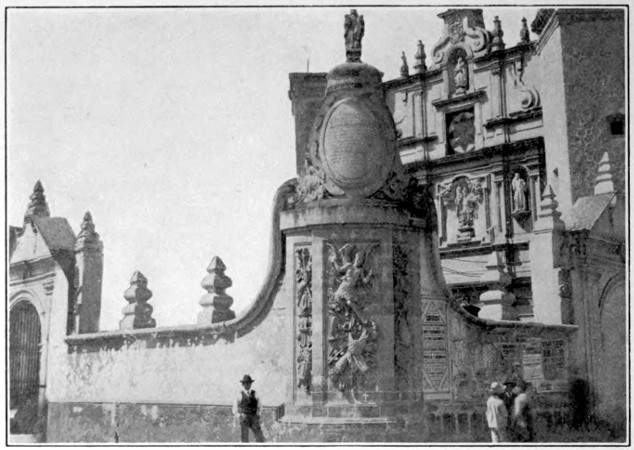
HISTORICAL CORNER IN MEXICO CITY.
Before the close of this term more than equilibrium had been established between revenues and expenses, for a considerable surplus remained in the treasury, while concurrently all branches of the public service had been judiciously provided for and great strides taken in public works.
[119]
On December 1, 1896, began the new term of President Diaz under the most auspicious promise. Particular attention was early directed to financial and commercial affairs, as required by the constantly expanding foreign and domestic trade. A law relating to institutions of credit was passed so as to extend commercial affairs with greater facility and protection; under the operation of which banking conveniences were greatly increased throughout the States.
One of the measures of Congress to which the government gave successful effect was cause for national pride and at the same time greatly helped its financial policy. This was the conversion of the national debt on a gold basis, with which was coupled the reduction of the interest by one per cent.; the release to the treasury of certain funds which had been hypothecated to the service of the foreign debt; the unification of such debt; and the cancellation of the mortgage of the Tehuantepec Railway.
The year 1898, was a period when the diplomacy and influence of the government was put to the test. Spain was at war with the United States. Intercourse with both combatants demanded a scrupulous neutrality between them, but the government of Mexico was skilfully conducted without giving rise to controversy with either belligerent. In 1899, the diplomatic rank of Mexico’s minister to the United States was raised to that of an ambassador, a like courtesy being extended by the United States. The same year Mexico participated in the Peace Congress at the Hague, at the invitation of the Emperor of Russia; the United States and Mexico being the only American republics so invited. At this conference, the influence of Mexico was thrown in the direction of the enlightened principles in furtherance of international peace and amelioration of the ravages of war that were embodied in the convention of the Congress.
The year 1900 is remarkable for the great improvements inaugurated in the capital. Tramways and the electric lighting service were extended and improved; private and public buildings of a splendid character were erected, among them the Post Office, the National Geological Institute, the Children’s Asylum and others; all of which contributed in an important degree to render the capital more attractive and befitting the modern standing of the city and the nation.
The last diplomatic gap was filled during the year 1901, when official relations were re-established between Mexico and Austria Hungary, which had been closed since the war of the French Intervention.
[120]
The delegates to the second Pan-American Conference assembled in the City of Mexico, in 1901. The occasion was critical owing to the strained relations then existing among some of the southern republics, and it is a tribute to the eminent position recognized as belonging to Mexico that the labor of the conference resulted in the conclusion of a series of important treaties and agreements tending to the welfare of the nations of the American continent.
For some time a controversy had continued with the United States in regard to claims of the Catholic church in California and the case was presented to the International Arbitration Court at The Hague, in 1902. The decision was adverse to Mexico but it was accepted and acted upon loyally by that country. This was the first case before the International court to which Mexico was a party.
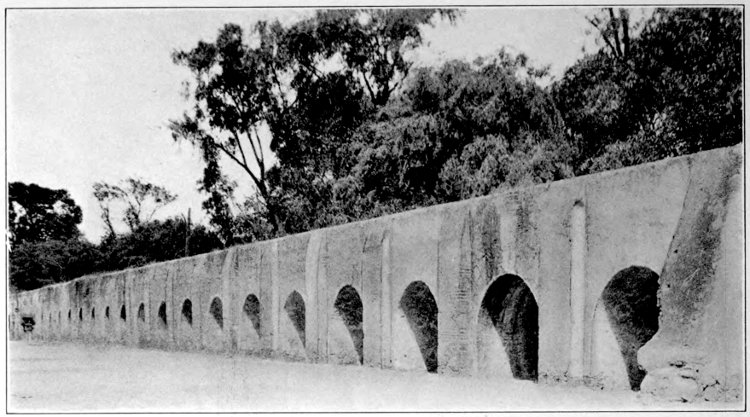
A PART OF THE OLD AQUEDUCT OF CHAPULTEPEC.
Diplomatic relations were officially established with Cuba, in 1902, and with Persia, in 1903, and legations were established in the southern republics. Arrangements for peaceful adjustment of disputes by arbitration were made with Venezuela and further evidence is thus given of the cordial sympathy of the Mexican people and its government with all courts to promote international amity.
The City of Mexico, in 1903, was finally in the enjoyment of a completed drainage system which made the condition of the capital enviable. The same[121] year marks the elimination of yellow fever as an epidemic. In other directions, also, progress continued to be the constant incentive of the government.
An important change in the constitution was made respecting the presidential term and the election of the vice-president. The former was extended to six years, that of the latter to be concurrent, and his election made similar to that of the president. Following this change came the almost unanimous re-election of Diaz and the election of Ramon Corral to the vice-presidency.
One of the most interesting and useful incidents of late happening in Mexico was furnished by the visit, in 1907, of Mr. Elihu Root, Secretary of State. His reception and entertainment, splendid and magnificent, afforded the most complete evidence of the honor in which the government of which he was so eminent a member was held and of the high esteem and regard entertained for the American nation by Mexico. The contrast drawn by Mr. Root between the Mexico of 1869, as seen by Secretary Seward and that viewed by Mr. Root so sharply points the progress made that it may well be recorded in the speaker’s words:
“Then was a country torn by civil war sunk in poverty, in distress, in almost helplessness. Now I find the country great in its prosperity, in its wealth, in its activity and enterprise, in the moral strength of its just and equal laws, and unalterable purpose to advance its people steadily along the path of progress. Mr. President, the people of the United States feel that the world owes this great change chiefly to you. They are grateful to you for it, for they rejoice in the prosperity and happiness of Mexico.”
Such was the glowing tribute to the lofty aims and the great achievements of Mexico. So strong a sympathy officially between the great governments of the northern continent may well inspire confidence in the future of Mexico. Other instances of the mutual friendship of the two republics are seen in the enthusiasm shown on the occasion of the celebration of Mexico’s Independence Day at the Jamestown Exposition in 1907, at which the republic displayed a noteworthy exhibit. The great banquet of the Chamber of Commerce of New York in November, 1908, afforded an opportunity to Americans to testify their regard for the president and people of Mexico, which they did enthusiastically. Finally, the meeting of the two Presidents of North America’s republics on the frontier on October 6, 1909, was as friendly as it was ceremonious.
The historical meeting of President Taft of the United States and President Diaz of Mexico occurred at the frontier of the two countries on October 6, 1909.[122] The exchange of courtesies was initiated by the Mexican Executive in terms eulogistic of President Taft, who in turn paid honor and tribute to President Diaz and Mexico. President Diaz, in full dress uniform, made brilliant with gold lace, and wearing many decorations, driven in a carriage richly gold-mounted and drawn by black horses, crossed the international bridge with an escort of troops and was received with cordial greeting on behalf of the United States by Secretary of War Dickinson, attended by a body of American troops, on reaching the boundary of the United States. Here as a guest of the sister republic he left his own carriage and entered into one provided by the American authorities while a salute of twenty-one guns was fired. Escorted by a large body of artillery he was driven through the streets of El Paso to the Chamber of Commerce Building, where he was awaited by the American President attended by his state and federal officials. Along the route loud and continuous cheers greeted Diaz, who was accompanied by General Cosio, minister of war; Olegario Molino, minister of commerce and industry; Señor Creel, of Chihuahua, former ambassador to the United States; now secretary of state; Colonel Pablo Escandon, chief of the military staff; and Señor de la Barra of the Mexican Committee of Arrangements. Formal greetings having been made and presentation of officials, the two presidents retired for a private interview, attended only by Governor Creel.
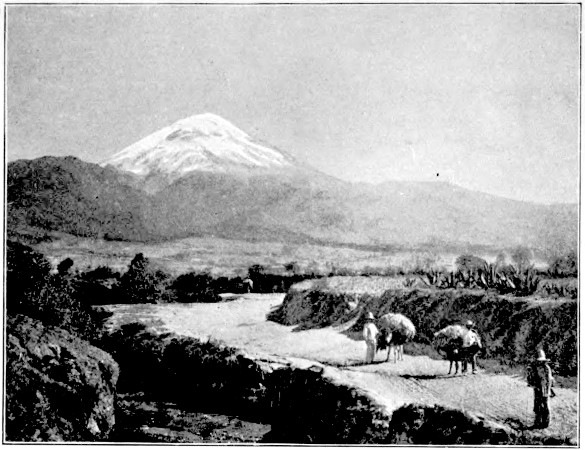
A COUNTRY ROAD IN PUEBLA, SHOWING POPOCATEPETL.
The conference in the chamber of commerce over, and the Mexican president having returned within his own territory, President Taft was soon on his way across the international bridge to Juarez. He was received by the escort of President Diaz with all the distinction that had been accorded to the Mexican[123] executive. Quaint little Juarez had put on her holiday dress and everywhere fluttered brilliant banners and bunting; the way of the visitor was along a brilliant avenue of flower garlands and multi-colored streamers. The greetings exchanged at the custom house were as follows:
President Diaz: “Your Excellency, the Mexican people and I feel very proud indeed to have you on Mexican soil. I believe that the personal acquaintance which I have made with you and the friendly feelings which already exist between the United States and Mexico will be a guaranty of the continuance of the friendly, cordial and strong relations between the peoples of the two countries, and that success and prosperity will follow.”
President Taft: “This is the first time, so far as I know, that a president of the United States has stepped beyond the border of the United States, either on the north or on the south, and I esteem it a great privilege to be the president at the time when that event has happened. I hope it is significant of the tightening of the bonds between the two countries. Railroads and other means of communication like the telegraph have brought us closer to each other, so that the City of Mexico and the City of Washington are far nearer to-day than they ever were before.
“And that means a closer union of feeling between the two peoples, a closer feeling between those responsible for the government of each country; and I esteem it the greatest honor of my life to have the privilege of representing the United States in such a significant ceremony.”
The festivities really began with a magnificent banquet given by President Diaz to President Taft. The scene in the patio of the custom house was one never to be forgotten. The display of decorations was magnificent. The flowers used, three trainloads, came from all parts of the republic; the gold and silver plate was the service handed down from the time of Maximilian. The courtyard was converted into a banqueting room by means of a temporary roof and banks of flowers exhaled an enchanting fragrance. Prominent among the decorations were large portraits in oil of George Washington and the Cura Hidalgo, above which, expressive of the occasion and suggestive of the similar services of the two patriots stretched the stars and stripes of the United States and the red, white and green of the sister republic. The toast of President Diaz was profoundly cordial and appreciative of the greatness of the United States and the American people and of President Taft, and concluded with the words:[124] “An occasion which will serve to strengthen the bonds existing between the two neighboring nations, whose respective elements of life and interest find in themselves reciprocal complement and enhancement.”
Toasting the President of Mexico, President Taft said:
“The aim and ideals of our two nations are identical, their sympathy mutual and lasting and the world has become sure of a vast neutral zone of peace in which the controlling aspiration of either nation is the individual’s human happiness. I drink to my friend, the president of this great republic, to his continued long life and happiness, and to the never-ending bond of mutual sympathy between Mexico and the United States.”
The guests on this significant occasion numbered one hundred and fifty, the City of El Paso presented commemorative loving cups of gold to the two presidents. Soon after each president was on his way back to his seat of government. The American president was escorted to his own territory amid a bewildering blaze of light and attended by the shouts of happy welcome of the people of the picturesque Mexican town.
This unique event, of happy promise for the mutual welfare and progress of the sister republics inaugurated a phase of relations that should make simpler the work of coöperation between the governments of the United States and Mexico.
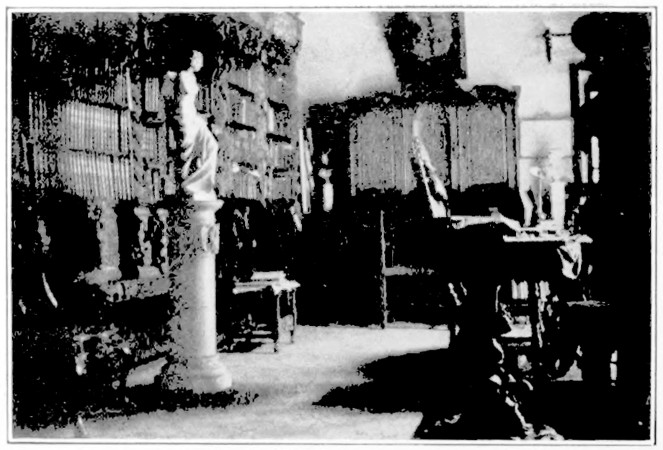
PRIVATE LIBRARY OF ONE OF MEXICO’S PROMINENT LAWYERS
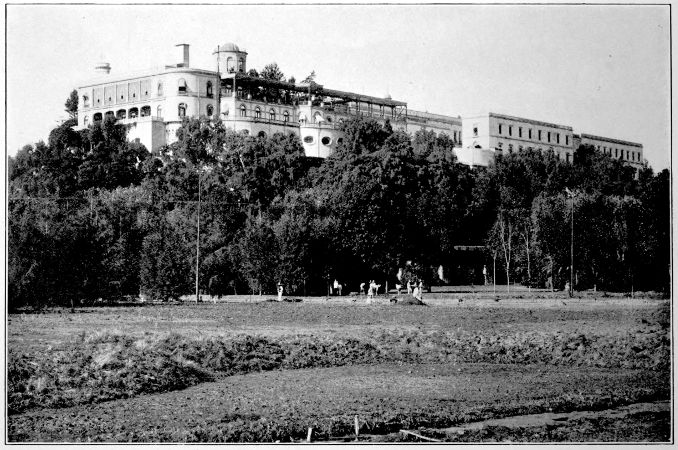
CASTLE OF CHAPULTEPEC.
[127]
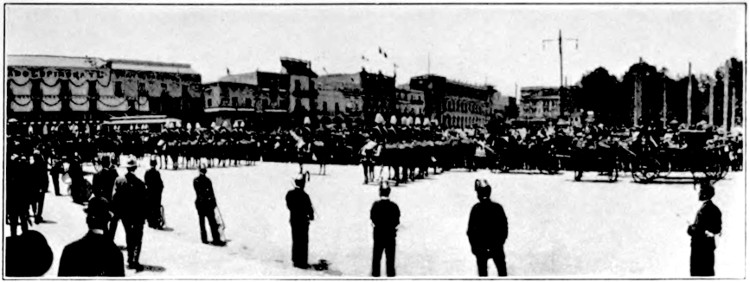
SCENE FROM THE PROCESSION OF THE 16TH OF SEPTEMBER.
Of all the great men of the Mexico of to-day none has done more than her present Chief Magistrate, perhaps none have done so much, to advance her with giant strides but true in the paths of prosperity and peace.
Porfirio Diaz was born September 15, 1830, in the City of Oaxaca, in the state of the same name—the vispera or evening before the glorious anniversary of the national independence. His parents were Don José Faustino Diaz and Doña Petrona Mory. Oaxaca has been styled “the dwelling place of heroes in the garden of the gods,” “the Eden of America,” “tomb of the conquerors and the cradle of patriots.” The state, although mountainous, is rich in agricultural and mineral productions.
Its scenery is grand, both temperate and tropical climates are found there, and it is well adapted to be the cradle of sons who should be the hope of the nation and who should raise aloft the standard of liberty.
The ancestors of Porfirio Diaz were Spaniards who left their mother country in the first years of the conquest. His father possessed in a high degree all the natural qualities necessary to make him a patriot, a soldier or statesman. He was tall, symmetrical, muscular and active and carried himself in a manner indicating him to be a man of great resolution. The son resembled his father[128] and is most affable in his manners, of a good heart and extremely generous, yet if an injury or injustice is done him he resents it with the greatest determination and energy. This quality exists in all great men who, while ever ready to have justice done, are also prompt to punish evil. One who enters into combat, whether physical or moral, will never come off conqueror unless possessed of force and perseverance.
President Diaz’s mother, of the family of Morys, came from Asturias, whose strong and valiant sons were noted for their independent spirit and their ancient lineage, possessing the impetuosity of the Celts and the frankness and integrity of the Goths. Her grandfather, a Spaniard, married an Indian woman, who was General Diaz’s great-grandmother, so that in the veins of Porfirio is mixed the blood of the proudest provinces of Spain with that of the highest nations of America, as the Miztecas were fully as advanced in civilization as were the Aztecas.
His father rented in Oaxaca the property known as the Meson de la Soledad, where Porfirio was born. There were six other children, two of whom died in infancy. In 1833, the Asiatic cholera invaded Mexico and among its victims was Captain Diaz. This was a great blow to the family, as the mother’s health was delicate and her children young, but she had all the energy of her race, and at her husband’s death she continued with the inn (meson) and showed in every way great firmness and intelligence, maintaining with vigor in all her acts her integrity as wife and mother. She possessed fine feelings, was industrious and hospitable, courteous and dignified. With all her modesty and delicate instincts she was brave, and in those tumultuous times, if necessary, could use arms in defence of herself and children. Her great desire was that her children should receive such intellectual development as should fit them for any place which they should be called to occupy.
Porfirio was in a primary school until he was seven years old. At fourteen he entered the seminary directed by Roman Catholic ecclesiastics. There were several reasons for his entering this seminary rather than the Government institution of arts and sciences. Business matters had not been prosperous with his mother, and little by little, she was obliged to sell her belongings to maintain and educate her family. In the seminary aid was rendered bright students. The father had desired that his sons be educated for the church.
After studying for a time to prepare himself, he felt that he should do something to aid his mother, whose means had become exhausted, and he[129] commenced to give lessons in his leisure hours. While doing this he came in contact with Don Marcos Pérez, Judge of the Supreme Court of the State and Professor in the Government Institute of Arts and Sciences. He became very fond of Porfirio, whom he often took to the institute, discussing with him the tendency of extending civil and religious liberty.
One day Pérez invited him to be present at the distribution of prizes in the Civil College of the State. The Governor, Benito Juarez, was present and Porfirio was presented to him. Juarez had known Porfirio’s father slightly, and had heard of the many efforts which the son was making to get an education so as to be his mother’s staff and comfort. The Governor spoke encouragingly and young Diaz found therein the fountain of ambition and a source of desires, hopes and noble aspirations.
As he realized the condition of his country he saw nothing but perdition, the curse of Spain and the pernicious results of ill directed efforts to force upon the Mexican people religion and European civilization, and he resolved to consecrate his life to his country. As a little boy in his play he had ever been a soldier, and had always been made the leader or general by the other boys, so that his inclinations to and capacity for a military life were early seen by his friends.
When the war with the United States commenced in 1847, Porfirio’s heart was filled with enthusiasm to fight for his country, and, with several of his college mates, he petitioned the Governor to send them to the front that they might help fight the enemy. Governor Guerque placed their names on his list, and the youths were inscribed upon the roll of the national guard, which consisted of one battalion, and which, by reason of the extreme youth of those composing it, received the epithet “Better than nothing.”
When Porfirio was nineteen and had finished his preparatory studies, the Bishop offered to confer on him in the following year the lesser orders, and to give him a scholarship. Diaz then declared his intention of studying jurisprudence in the institute. The prelate was surprised at a young man in needy circumstances disregarding such valuable aid. It was considered a mad decision. His uncle, the Bishop, withdrew his help and forbade him his house.
Maternal tears affected the heart of the affectionate son, and although insensible to the counsels of the Bishop as also to his threats, he promised to do as his mother desired. Although a pious and devoted churchwoman, with[130] great desires for his spiritual and temporal prosperity, she did not wish to go contrary to his will and to oblige or persuade him to follow a calling that would be disagreeable to him. She left him free to follow his inclinations.
She lived long enough to see the practical wisdom of her son’s determination, as after a few years came that blow which destroyed the power of the Church and placed a limit upon its influence, while men of intelligence and position found free scope in the profession of the law.
Porfirio Diaz entered the institute and commenced in a systematic manner the study of jurisprudence, helping himself by teaching. Juarez, who had not forgotten him, gave him the position of librarian. After four years of study, having been elected assistant professor of Roman law even before graduating, he had, in compliance with the law, to enter a law office and practise two years, as the course of study required.
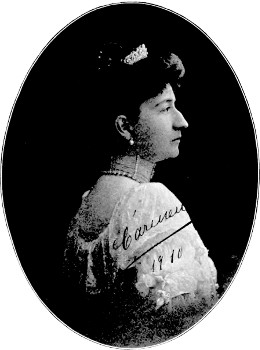
SEÑORA DOÑA CARMEN ROMERO RUBIO DE DIAZ.
During this time—1853—Santa Anna, who was made Dictator, improved every opportunity to destroy his opponents, and Juarez was arrested and taken to Vera Cruz, whence after receiving most cruel treatment in prison, he embarked for Havana, going eventually to New Orleans to live. His business affairs were passed over to his associate, Señor Pérez, but the latter having been imprisoned shortly after for holding correspondence with some of the opponents of Santa Anna, Porfirio Diaz took sole charge. He gave proof of his honesty and activity and showed great skill in the exercise of his profession.
Seeing the injustice exercised in voting for the Dictator, he and other students were indignant at the unjustifiable display of power. However, when he saw the frauds committed, the young patriot could support it no longer, and[131] he and one other went to the table where the negative list was to be voted. An order was soon out for their arrest and they were obliged to flee.
Shortly after Diaz was called to put into practice what he had learned in his military drill, and, although only twenty-five, he was found fully competent to direct soldiers, and in the mountains of the Mizteca joined a small company of patriots, two or three hundred in number, commanded by Captain Herrera, who opposed the Dictator. Herrera, recognized his competency and took his advice. Soon after, though but few in number and having but few arms and being but poorly disciplined, they gained a victory at Scotongo over the large and well-disciplined forces of Santa Anna.
When Santa Anna was overthrown and the Liberal Government was established, Porfirio returned and was rewarded by being made Chief of Police in the District of Ixtlan.
In 1857, he went out under Lieutenant-Colonel Velasco to put down an uprising in Jamiltepec. In Ixcapax he was badly wounded, but seeing that one of the lines was in great danger, with blood streaming from his wounds, without heeding them, he went forward and with rare military courage so diverted the enemy as to defeat them.
His mother died about the end of 1858, while he was in Tehuantepec. Through all his vicissitudes he had ever been an affectionate and obedient son, and her death caused him great sorrow.
It was in that year he went to Tehuantepec under General Ignacio Mexia to fight Cobos, who was defeated at Jalapa, and while there he was left as military commander of that district. He maintained the Government in that region, contending against an enemy superior in strength, without receiving aid from the General Government, and counting only upon the resources that he himself knew how to obtain. He remained in Tehuantepec two years, fighting almost every day against large odds. Again he was wounded, but the victory was complete.
Discretion and prudence united to patriotism and noble aspirations have ever been the base of his military character.
The extraction by a surgeon from the United States of a ball that he had carried in his body for years, relieved him from the acute physical suffering that he had so long endured. Soon after he received his commission as lieutenant-colonel for a victory obtained in June, 1859, in Mixtequilla. For another one[132] gained in Tehuantepec in November, 1859, the Government rewarded him with the rank of colonel. On the 5th of August, 1860, Diaz won another victory over Cobos in Oaxaca.

ESCORTING THE PRESIDENT TO THE NATIONAL PALACE, 5TH OF MAY.
Diaz loved above all things a military life, and could not bear the thought of separating himself from the army. On the battlefield, surrounded by his faithful companions, he experienced more than anywhere else the pleasure of satisfied ambition. There he could open up for himself a way without so greatly contending against the jealousies and envy which might be encountered in legislative halls. The hardships of war had been until now his sweets of life, and the noise of battle still resounded in his ears like harmonious music. But he had to submit to his lot and repair to the Capital of the Republic, there to work as a legislator, having gained another step in the ladder of fame.
Although virtually the Conservative forces were destroyed, some chiefs, who could find no better occupation than to live by war, were aided by the church and the prospects of booty. Leonardo Márquez, one of the most prominent of these revolutionary chiefs, on June 24, 1861, attempted an attack on the Capital. Congress was in session when the unexpected news reached them of[133] his arrival. Diaz, “a soldier first of all,” asked permission to retire and hastened to the scene of danger. The forces from Oaxaca, which were quartered in the convent of San Fernando under General Mejia, resisted Márquez’s attack, and Colonel Diaz’s arrival was celebrated with cheers from his old companions in arms, whose enthusiasm he served to revive. Mejia gladly accepted his aid, and the victory was theirs.
The importance of the support that Diaz here gave can be better understood by the reward that the Government conferred on him by giving the command of the brigade of Oaxaca to him with the order to join Ortega’s division, and to march on and destroy the rest of the Conservative forces.
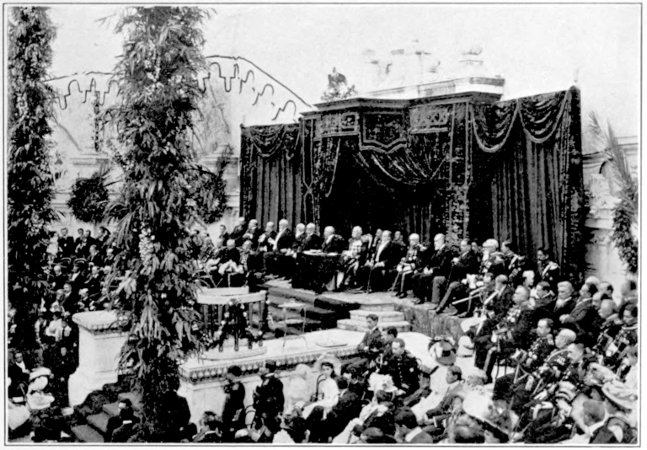
THE TRIBUNAL, 5TH OF MAY.
On the 13th of August, 1861, the fourth anniversary of one of his first triumphs, Diaz, with his few soldiers, gained another victory over Márquez and his four thousand men. In his attack upon Márquez he had disobeyed General Ortega. It was not pleasant to this brave soldier to feel that all the glory of that campaign belonged to a subordinate. The victory was remarkable, Diaz had less than three hundred men and Márquez four thousand. In this encounter Diaz’s[134] life was in peril. He had entered the ranks of the enemy unattended, as he led the attack, but the instinct of his charger seemed to realize the danger and he carried him back safely to his own troops. The command on this occasion had been given to Diaz, Mejia being ill and gladly accepting his aid. For his great service Diaz was promoted to the rank of brigadier-general.
Marquez, with the remnant of his broken army fled in haste but made a stand at Pachuca and Real del Monte, but suffered signal defeat on the 20th of October. With these events, the Conservative force was broken and the War of Reform practically closed.
A new stage in the career of Diaz was about to open. The French intervention was aimed against the true nationalization of Mexico. Here the Mexicans were traitorously engaged with the foreign invader in an effort to overthrow the republic. Juarez, who had been elected constitutional president, sent the army against the enemy, who had broken the convention of La Soledad. Diaz was ordered to lead his brigade to the Pass of Acultzingo to aid in its defense. He first engaged the enemy at Escamela between Orizaba and Cordova and reaching Puente Colorado he strongly established his force and then did valorous and effective work in holding back the vanguard of the enemy, affording saving help to the vanquished and by his marked skill and bravery giving much-needed confidence to the national troops, whose lack of organization and means of defense were the crucial tests that proved the quality of generalship. The great victory of Acultzingo on April 28th, proved that Diaz was a master of strategy and alertness coupled with the most remarkable measure of audacity and bravery.
The Mexicans retired to Puebla and reached there May 3d. On the next day, General Zaragoza addressed his officers urging his army “to fight to the last, so that even though it were not possible to be victorious.” The battle on the 5th proved a victory for the patriots, the record of which is enshrined in the hearts of the people and serves to thrill them and their children with patriotic fervor. The part that Diaz took in this memorable victory was a most decisive one and none knew the service he rendered in that “forlorn hope” better than the great general who was in chief command. Diaz again met the French at Orizaba on June 14th.
Civil and military duties now devolved on Diaz, to whom was confided the administration of the State of Vera Cruz. The French had been reinforced and again Puebla was invested. The Mexican army was now under the chief[135] command of General Ortega, the gallant Zaragoza having died. Puebla had been besieged for two months since the 6th of March 1863. Its defense evoked most thrilling deeds of heroism which mark the siege as among the memorable events in history. General Diaz earned proud laurels for his personal bravery and wonderful resources. His defense of the Mesón de San Marcos was a brilliant deed and the general and the man demonstrated the highest qualities. But the vain struggle ended by surrender on May 16th. Diaz, with a noble inspiration, refused to burn his flags; instead, he buried them, assured that he would some day return and recover them to float in advance of a victorious army.
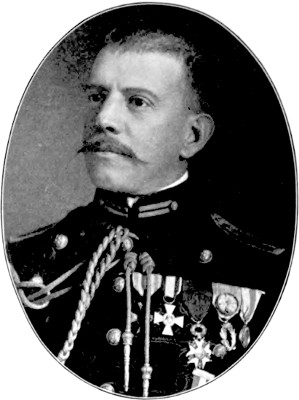
LIEUTENANT-COLONEL PORFIRIO DIAZ.
A prisoner to the foreign invader, Diaz with other Mexican officers refused to sign an agreement not to take up arms for his country, or endeavor to escape. The large number of prisoners, eleven thousand soldiers and fifteen hundred civil officials, proved too many for complete vigilance, so adopting a bold ruse, Diaz soon escaped as did Berriozábal and, later, many others. He made his way at once to Mexico City and placed himself at the disposal of President Juarez who desired him to become Secretary of War. This Diaz refused believing that such an office should be conferred on a senior or ranking officer. He assented to the alternative proposal of taking command of a division.
When Juarez determined to abandon the City of Mexico, Diaz went to Oaxaca to organize the army of the East and for some time maintained a desperate fight in that State and in Guerrero and Puebla, relieved by the assault and capture of Taxco on October 28, 1863, a feat accomplished against great odds and due only to the tactics and valor of Diaz. Discouragement and defeat seemed to be no force against him, and treachery seemed but to feed his valor and love of independence. The promise of honor and emolument at the hand[136] of his country’s foe, as the price of abandoning the struggle for independence only aroused his scorn. Not long after the victory of Taxco he was promoted to the rank of major-general.
Slowly and with difficulty had Diaz created an army when Marshal Bazaine took command of the Imperial army, a force of eighteen thousand men with forty-eight guns, and laid siege to Oaxaca. Diaz, governor as well as commander, maintained a most stubborn defence during several weeks, but he could not, in spite of his brilliant efforts, fight starvation and, lacking ammunition, surrender was inevitable. Without a flag of truce or other safeguard, and under the fire of the enemy, this intrepid general sought the headquarters of the French commander, accompanied only by Colonels Angulo and Echegaray, and surrendered on February 9, 1865. To the greeting of Bazaine “that he had returned to his promise and would not again take up arms against his sovereign,” Diaz replied unhesitatingly that he owed allegiance only to the Mexican nation and no other would he serve or recognize. Bazaine believing that Diaz had been liberated earlier on parole, severely reproached him for his breach of faith, but finding on reference to the register that Diaz had not signed any document, he gave orders for his imprisonment. First, he was confined in San Loreto, then in Santa Clara, and finally in the convent of La Compania. While in the first named prison strong efforts were made to induce the prisoners to take the oath of allegiance to Maximilian, many officers succumbed to the temptation, and to intimidate the others, several officers were led forth and shot at midnight. Four at least, including Diaz, could not be shaken in their allegiance. In the convent of Santa Catarina, Diaz worked for nearly five months digging a tunnel to lead to the street. Before it was completed, he was removed to the convent of La Compania. The story of his escape from this convent so strikingly illustrates the determination and resourceful character of the hero, that in spite of frequent telling, it should be repeated here.
Diaz had secured ropes, which were smuggled into the bath room under his clean clothes. He wound these around his body under his clothes, to avoid their being discovered. He had a well-sharpened dagger. In preparation for his attempt, he rolled three of the ropes, which, with a third in reserve, and his dagger he hid under the bed clothes on the afternoon of September 20th. When the signal sounded at night for retirement of the prisoners, he stepped out on an open balcony close to the roofs which overlooked an inner courtyard. The three[137] ropes he carried concealed in a cloth and not being observed cast them on a neighboring roof. The remaining rope was then tied to a projecting stone gutter that promised sufficient strength. This was not easily or very quickly accomplished as it was very dark, but it was done and after testing its strength carefully, by this Diaz climbed to the roof. He then tied his four ropes together.
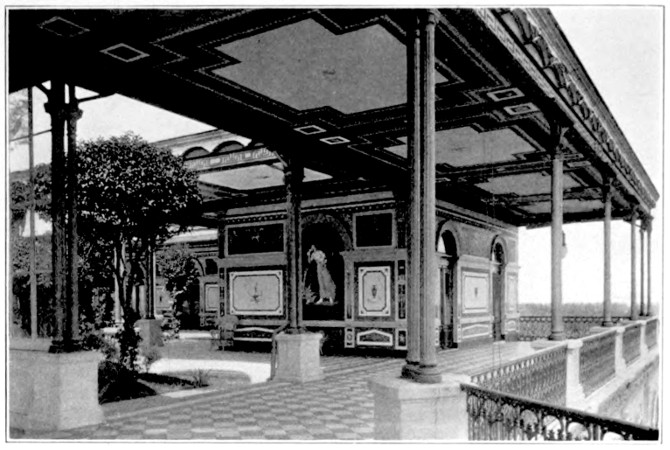
CORRIDOR AT CHAPULTEPEC.
To reach the point from which the captive would descend was very hazardous, the convent being overlooked by a neighboring church, where a sentinel was always on guard. Cautiously crossing the roof, frequently on hands and knees, the general passed along two sides of the courtyard, exposed to the danger of discovery by the flashes of lightning that frequently lighted up the sky and also by the danger of betraying himself through the noise he might cause by treading on fragments of broken tile and glass scattered over the roof. He then proceeded erect and seeking to ascertain if an alarm had been given, his foot slipped on the wet masonry and he was almost precipitated through a window. A very hazardous part of the roof had yet to be crossed before the point of descent could be reached, namely the side where the chaplain dwelt. This chaplain had denounced some time before several political prisoners who had cut their way[138] through his rooms and on his evidence they were shot. Almost breathless, Diaz let himself down to the chaplain’s roof at a point opposite the place where he had ascended and finally reached the San Roque corner where he had planned to descend. At this corner was a statue of San Vincent Ferrer about which he intended to fasten his rope, but on touching it, it appeared ready to fall and although he supposed it might have an iron support, he deemed it safer to tie the rope around the base of its pedestal, which seemed strong enough to bear his weight.
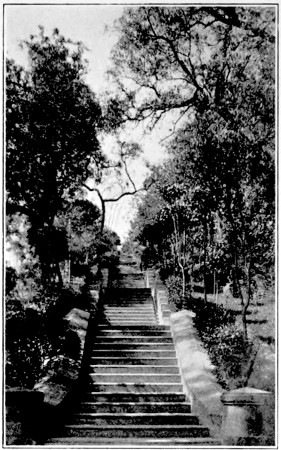
STAIRWAY TO THE CASTLE OF CHAPULTEPEC.
It occurred to Diaz that he might be seen if he descended at the corner of the street, so he decided to lower himself by the side of the building away from the corner and in the shadow. On reaching the second story his foot slipped and he fell quite a distance into a pigsty. At the same time his dagger slipped from its sheath and falling on one of the pigs probably wounded it, and when he stumbled among them they squealed loudly. Fortunately, no one was passing at the moment and his discovery was avoided. He waited till the animals quieted down and then leaped over a low garden fence into the street, only to beat a quick retreat on seeing a policeman making his round. The man soon passed and Diaz, much relieved, but almost exhausted from fatigue, hastened to a house where he knew a horse, a servant and a guide would be found. Arrived there, the three, with loaded pistols, leaped into the saddle and after evading a mounted patrol reached the outskirts of Puebla. Contrary to his expectation he was not stopped at the city gates by the sentinels, on the contrary, the gate was open and unguarded and at full trot the party passed through and then galloped off along the road.
He gathered together a small force, and here and there would have engagements, with varying success. But the brilliant triumphs of Miahuatlán and La[139] Carbonera over the Austrians brought back to General Diaz all the lustre and fame that he had gained as the most prominent General of the country. While the battles in themselves were eclipsed by many of his previous victories, they were most notable for the indisputable establishment of republican supremacy in all the vast region of the South—the result of more than a year of untold and persevering efforts.
He again organized new troops and defeated Visoza in Tulcingo, State of Puebla, on the 1st of October, 1865. He then went to La Providencia, and General Juan Alvarez gave him some two hundred arms, and he again defeated Visoza at Comitlipa, State of Guerrero, on the 4th of December, 1865.
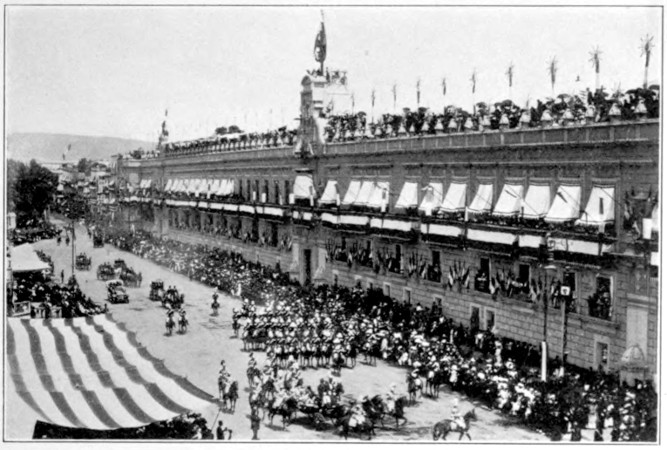
RECEPTION AT THE PALACE ON THE EIGHTIETH BIRTHDAY OF GENERAL DIAZ.
From Miahautlan, he marched to the City of Oaxaca, and while besieging the capital learned that the Imperial government had sent a column under command of Baron Luker, an Austrian officer, to relieve the besieged garrison of Oaxaca. General Diaz decided at once to march on the approaching relief column, which he met at La Carbonera on the 18th of October, 1866, and after routing it completely he returned to Oaxaca, when the garrison surrendered on the 31st of the same month. He thus obtained forty-two pieces of[140] artillery, two thousand five hundred muskets and all the garrison provisions and stores.
The 1st of November, 1866, General Diaz entered his natal city to be crowned with laurel as its liberator. On April 2d, 1867, he won in Puebla another most glorious victory which made the walls of the empire totter, as this was one of the invader’s three strongholds. Among the prisoners were eleven generals and three bishops. By law all the officers taken prisoners were to be shot as traitors, and even foreigners were to receive the same fate after the French armies had been withdrawn. Presenting himself before the eleven generals, Diaz politely invited them to follow him, without being guarded, to the episcopal palace, where were six hundred officials, many of them occupied with confession and making their final arrangements, as they knew the fate that had befallen other prisoners. “Gentlemen,” said Diaz, “it is impossible for me to execute the punishment which the law imposes, and there is no other alternative for me but to make you prisoners; but I remember well my own sufferings while a prisoner in this same place, and I wish to avoid your being put to such straits. Go, then, you are free. All that I ask of you is that you promise me to put yourselves at the disposition of the Supreme Government if you are so ordered. The nation will pronounce its sentence upon the empire, but it will be indulgent to its misguided sons.” This general amnesty, which later found its parallel at Appomattox, caused on all sides a great tumult of satisfaction. Men who had before been enemies pledged themselves hereafter to be friends. Many turned away to hide their tears. General Diaz himself was profoundly moved. Among the prisoners was a colonel who was ashamed and fearful at the same time, and could not believe that he was free; as when the Count Von Thun had fixed the price of ten thousand dollars for the head of General Diaz when he escaped from Puebla this Colonel Escamilla (then Chief of Police of Izucar) offered another thousand from his own pocket. The General understood well his captive’s fear and shame, and said: “Colonel, that imprudent action was suggested by blind duty; let us forget it.” From that time Escamilla was one of his most loyal partisans.
The tempering with magnanimity the rigor of the law, avoiding the baptism of blood, had its influence in the fall of the City of Mexico, procuring for Diaz great praise among friends and enemies. General Tamariz, who died shortly afterward, said with emotion: “Twice Diaz has conquered me by his[141] military talent and once by his generosity; with pleasure I would serve such a man, although it were as a common soldier.”
After the capture of Puebla, General Diaz went to meet the Imperial General Márquez, who had left Querétaro to relieve Mexico, and who was marching against Puebla. On the 5th of April, General Diaz overtook Márquez at San Diego Notario, where a battle was fought, ending in the defeat of Márquez. General Diaz followed up his victory and met Márquez again at San Lorenzo on the 10th of April, defeating him completely.
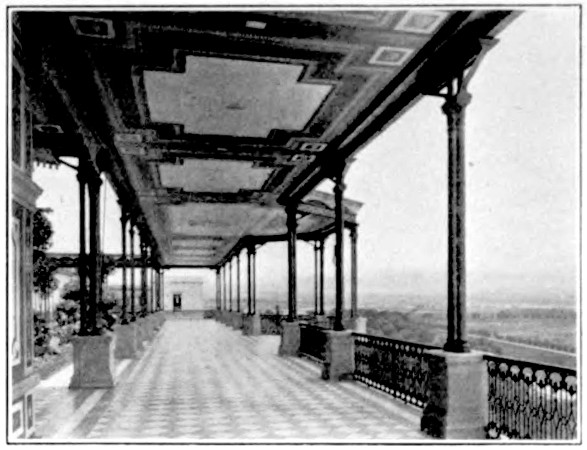
CORRIDOR AT CHAPULTEPEC, OVERLOOKING THE VALLEY OF MEXICO.
Diaz then marched to Mexico, establishing himself in Tacubaya, and commenced operations to put the City in a state of siege. On the 14th of May, General Escobedo took Querétaro. Maximilian was tried by court-martial and was condemned to death by his own decree of the 3d of October, 1865, that all officers taken prisoners should be shot.
Diaz had continued with great vigor the siege of the capital, and on the 20th of June the Conservatives yielded and he entered the city quietly and took a small house in the suburbs, having his office in the School of Mines. No banner of any sort was raised on the palace until the 15th of July, when Juarez himself hoisted the flag.
The day following the surrender of Mexico, Diaz presented his resignation as commander of the line and Army of the East, and after a few months returned to his native city, Oaxaca, which with open arms welcomed the hero home again. It was one triumphal march from the capital to his home. He was given by the Legislature of Oaxaca the Hacienda de la Noria, to which he retired, living there quietly for two years, resting from his labors and fatiguing marches.
He had formed, even when quite young, an attachment for Delfina Ortega y Reyes and on the day of the surrender of Puebla, the 2d of April—that memorable day in which he gave liberty to the captives—he was joined in matrimony to the woman of his choice. Señora de Diaz possessed great sweetness of character[142] and kindness of heart, and her greatest pleasure was in works of charity and in aiding the elevation and education of her sex—taking upon herself the care of a college for girls which her husband had founded.
Benito Juarez was now president, and Diaz was elected as Deputy to Congress for his state. On July 18, 1872, Juarez died and Sebastián Lerdo de Tejada succeeded him. Lerdo was afterward elected to the presidency, but there being much dissatisfaction by reason of his attitude against the church party and of a feeling among the soldiers that General Diaz should be the president, the revolutions continued throughout the country. He went to the United States, but the siren voice of Adventure called him back to his native land. He took passage on an American vessel but was recognized by some passengers. Fearing arrest at Vera Cruz, he attempted to escape by jumping overboard, but was rescued by the sailors. He invoked the aid of the friendly purser, who hid him in a locker and smuggled him ashore at Vera Cruz.
Diaz passed through many vicissitudes, and at last, on November 16, 1876, with an armed force gained a victory over the Lerdistas at Tecoac.
Lerdo, hearing of the loss to his party and of the brilliant victory of Diaz, started with some of the faithful members of his Cabinet and with what money he could lay his hands on, on November 20, 1876, for Acapulco, there taking passage for the United States. General Diaz entered Mexico on the 23d of the same month and five days afterward assumed the executive power. He formed his Cabinet, raised a loan of five hundred thousand dollars to commence the new administration, and, leaving General Méndez as president ad interim, went out to finish up with the revolutionary element.
There were then really three presidents of Mexico: Lerdo, who had abandoned the country; Iglesias, who had been Chief justice, or Vice-President under the Lerdo government, and Diaz. Iglesias, seeing the desperate condition in which he was placed, followed Lerdo’s example, embarking at Manzanillo for San Francisco, Cal., the 17th of January, 1877. For two months General Diaz marched from the central States toward Guadalajara, capturing all the Lerdist troops without firing a single shot. At the end of the two months he relieved General Méndez and assumed the actual presidency of the republic.
After having served his term as president, General Manuel González, who had distinguished himself as a military man by the side of General Diaz, was elected to succeed him.
[143]
For a time under González, General Diaz was Ministro de Fomento, but retired in May, 1881. Soon after he was elected Senator from the State of Morelos and Governor of Oaxaca, which position he took November 30, 1881. Two years after the death of his wife he married Carmen, a notably beautiful brunette, eldest daughter of Señor Don Manuel Romero Rubio. They harmonized well—he the personification of strength, she of beauty and purity. Simple, without affectation, she unites to a kindly heart a most admirable presence of mind and dignity. She speaks with facility English and French. Everyone is delighted with her affability and the sweetness and melody of her voice. They spent part of their honeymoon in the United States, where they were everywhere received with ovation, special trains being put at their disposal and great courtesy shown them by all.
PORFIRIO DIAZ, THE THIRD.
On December 1, 1884, the second presidential period of General Diaz was inaugurated. The ceremony took place in Congress Hall, which was formerly the Iturbide Theatre. The Diplomatic Corps were in full dress, while General Diaz had on a simple black suit. In five minutes after he took the chair he had taken the oath of office and retired as quietly as he came, to the palace, there to receive welcome and congratulations from General González, and to appoint his Cabinet.
Under President Diaz’s administration many reforms in the constitution and laws of the country have been made, and the result is that there reigns under him a security which was never before known in the republic. His liberal ideas, his enthusiasm for the development of the country and his previous honest administration enabled him to begin his second term under much better conditions than existed during his first; and again the confidence of the public was not misplaced, since during this second administration Mexico progressed more than ever.
[144]
Diaz’s life has been identified with that of the Mexican Republic for the last forty years. The life of this really wonderful man presents many points and lessons for future generations to study. He is to-day, as he has been for many years, the first soldier of the Republic, and what is better, its first citizen. From the very bottom of the ladder, from a young lieutenant at the age of twenty-three, to the highest commission in the army as its General-in-Chief, his career is spotless and brilliant.
But it is not most as a soldier that he has won the admiration and fame which he enjoys to-day, at home as well as abroad. It is as a statesman, in his civil duties, in the many political, financial and diplomatic questions which he has so successfully solved, that the greatness of Porfirio Diaz must be considered.
He has been the savior of the republic, the creator of the real nation, the defender of the people; whose success was possible only because of his inflexible integrity and singleness of purpose, his goal was never obscured by the shadow of personal advantage and ambition; whose hand was never palsied by questionable intrigues. Friend or foe were such to him only because for or against the unification of the nation. Among the names of the wonder-workers of the world the name of Porfirio Diaz will shine and remain imperishable.
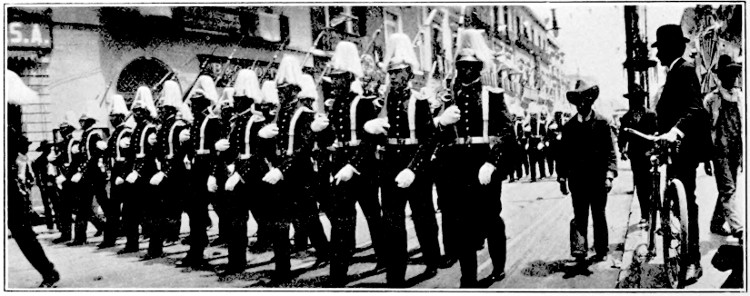
SOLDIERS IN PARADE, 16TH OF SEPTEMBER.
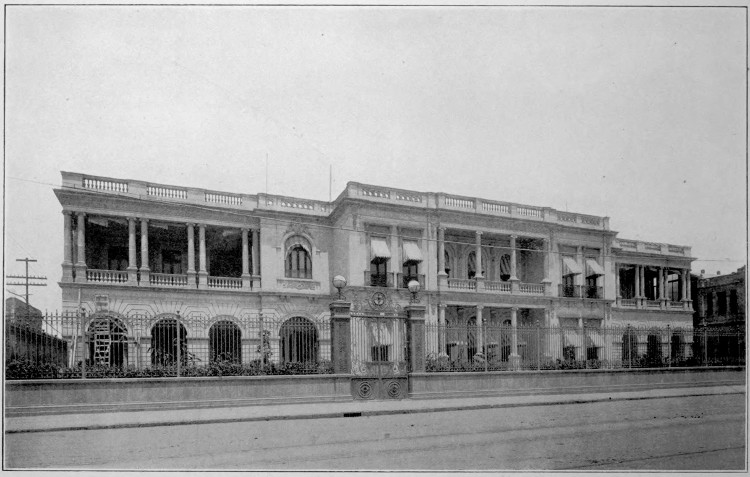
THE CORBIAN PALACE.
[147]
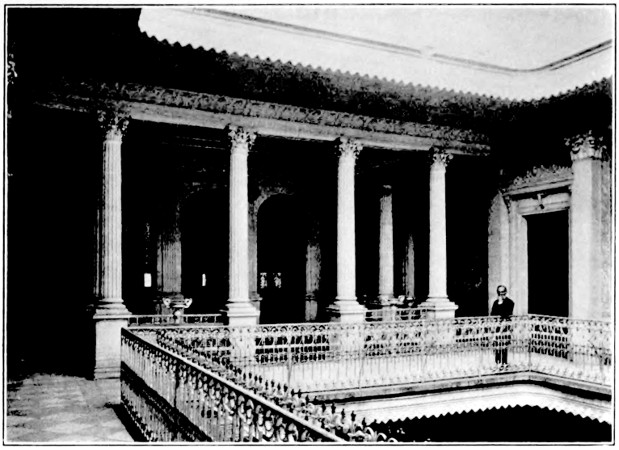
PATIO OF THE DEPARTMENT OF THE INTERIOR.
General Porfirio Diaz has been elected and inaugurated to his eighth term of the presidency. This is something unprecedented in the history of republics. He has surrounded himself with honorable and judicious ministers of his Cabinet, who have devoted their entire lives to the interests of their country. At the expiration of their term it is the custom for the Cabinet to resign in a body, leaving the selection of a new Cabinet to the president. This is a delicate and courteous custom that would relieve the head of the nation from an embarrassing position, but with the exception of some changes in the Department of War and Navy, the same ministers have remained in office unless ill health has forced their resignation, or death intervened. The Secretary of State sends in his resignation through the sub-Secretary of his department, but all the others tender theirs through the Secretary of Foreign Affairs. To these letters the[148] president replies that their resignations are not accepted, and begs their co-operation in the public administration. This is but another proof of his statesmanship, as each of his ministers is carefully chosen with a view to his fitness for the work entrusted to his judgment and abilities.
The Cabinet consists of eight Secretaries: the Secretary of State (Foreign Affairs), the Secretary of Finance, the Secretary of Public Works, the Secretary of Industry and Colonization, the Secretary of the Interior, the Secretary of Justice, the Secretary of Public Instruction and Fine Art, and the Secretary of War and Marine.
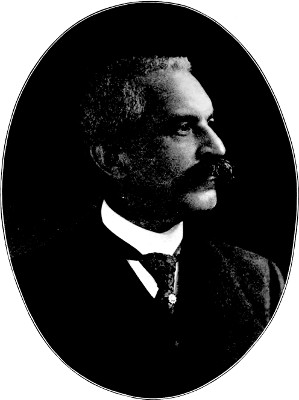
SEÑOR DON RAMÓN CORRAL, VICE-PRESIDENT.
These members of the Cabinet must be native born Mexicans, and the Minister of War must be a soldier holding distinguished military rank and record. The office of Vice-President was created in 1904. Before that time the Secretary of Foreign Affairs stood next in rank to the President. Señor Don Ramón Corral has the distinction of being Mexico’s first Vice-President and is one of the progressive spirits of Mexico. For many years he was Governor of the State of Sonora and is regarded by the people of that State with great respect and affection. He did many things while Governor to merit their kindly regard, and his integrity of purpose and wise supervision of the affairs of the State of Sonora attracted the attention of Mexico to him, and he now holds the distinctive position of being a great factor in the affairs of the Republic.
During the Centennial Celebration he was the head of the Commission which accomplished so many great things for the entertainment of foreign envoys[149] to the capital. He is a quiet but shrewd man and, unlike most Vice-Presidents of republics, he has a great power in the affairs of the State, and in his high office he brings to bear his rigorous and unquestioned talent. He speaks French and English perfectly and is a friend to all foreigners who have occasion to invoke his aid.
The Ministry of the Interior has charge of general elections, relations with the Federal Congress, Citizens’ Rights, Police, Public Health and Immigration, Federal District and Territories, the National Guard in the Federal District, all hospitals, public buildings, national festivities and the Government Printing Office. Señor Corral is the Minister of Interior as well as Vice-President and Speaker of the Senate.
The Ministry of Foreign Affairs has charge of all relations with foreign countries, treaties and diplomatic affairs, boundary questions, the naturalization and rights of foreigners, the National Archives, the arrangement of ceremonies, and is custodian of the Grand Seal of the nation. This seat was held for nearly half a century by Señor Licenciado Don Ignacio Mariscal until April 16, 1910, when Mexico sustained a great loss in the death of so noble a man. He had served his country and his President faithfully, and besides being a diplomat of great talent he was a brilliant litterateur and his poems are widely read and loved.
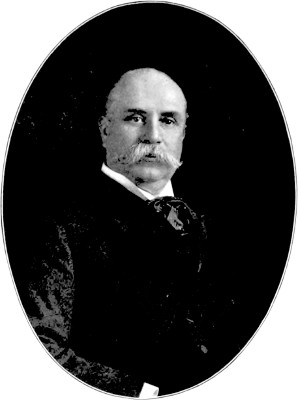
SEÑOR DON ENRIQUE C. CREEL, MINISTER OF FOREIGN AFFAIRS.
Señor Don Enrique C. Creel, Governor of the State of Chihuahua and former ambassador for Mexico to the United States, succeeded him. Señor Creel has long been noted as a great statesman. His brilliant mind and diplomatic tact have already demonstrated the wisdom of selecting him for so important a post.
[150]
The Department of Finance, Public Credit and Commerce has charge of taxation, customs tariff, commerce, national prosperity, loans and public debt, the valuation of lands and the budget.
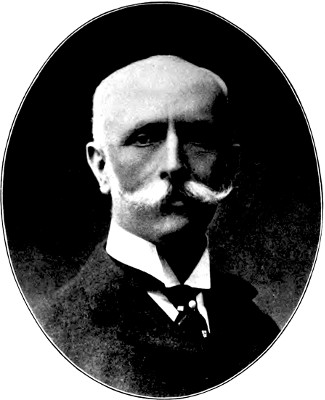
SEÑOR LIC. JOSÉ LIMANTOUR, MINISTER OF FINANCE.
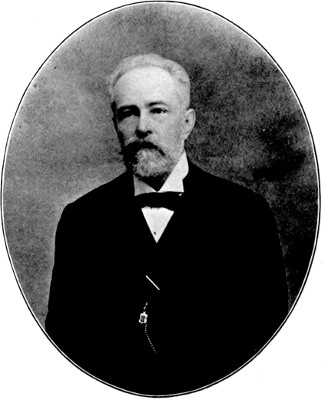
SEÑOR ING. LEANDRO FERNANDEZ, MINISTER OF COMMUNICATIONS AND PUBLIC WORKS.
Señor José Yves Limantour, the Secretary of Finance, has an international reputation as a great financier. He has been in the political life of the republic since 1893, and during that time he has safely engineered financial feats that have surprised and enlightened the world. He is a man of very strong personality. One might call him unsympathetic, not knowing that his wonderful reserve is merely a part of his education, but a closer acquaintance with him draws out many characteristics of his remarkably strong nature. He has been sent to Europe on many diplomatic errands, and has always succeeded in showing the financial powers abroad his wonderful accomplishments and strength as a man of diplomacy and political wisdom. He was born in Mexico of French parents in 1853, and his education while a boy was gained in the best home schools and in travels abroad. He graduated from the School of Jurisprudence and has fulfilled more important missions abroad than any official in Mexico.
[151]
The Department of Communications and Public Works has charge of the interior mail service, telegraph and telephone lines, postal union, railways, port-works, all public improvements and the drainage of the Valley of Mexico.
Señor Ingeniero Don Leandro Fernández, whose brilliant career as a civil engineer won him this important position in the Cabinet, has made a life study of all engineering questions and his travels abroad in the interest of his work have given him a great experience. He was formerly the Governor of Durango and made a great name for himself in the important office he held in that State.
The Department of Public Instruction and Fine Art has charge of all matters pertaining to education in the Federal District and all territories, the Academy of Fine Arts, the Conservatory of Music and Elocution, Arts and Crafts, Commercial College and all future educational institutions, all normal schools, copyrights, museums and libraries, archæological and historical monuments, encouragement of culture, art and science, and all conventions of this nature.
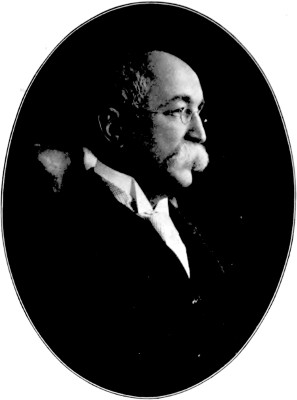
SEÑOR LIC. OLEGARIO MOLINA, MINISTER OF FOMENTO.
Señor Justo Sierra, Minister of Public Instruction, is one of Mexico’s literary men. His beautiful poems are widely read. In 1905, Señor Sierra took his seat in the Cabinet and has held his position with dignity and honor, and all educational interests have in him an able administrator. He was the Secretary of Justice before he became the Minister of Education. Speaking many languages, his magnificent personality and bearing make him a great favorite in Mexico.
The Department of Fomento includes all matters relative to agriculture, vacant lands, colonization, agricultural colleges, trade marks, patents, weights[152] and measures, observatories, survey, making of maps and all industrial, agricultural or mining statistics.
This office is held by Señor Licenciado Olegario Molina, who was Governor of Yucatán until he was called to the Cabinet three years ago. He has shown himself able and has aided much in the development of his country’s welfare since taking his seat. He was born in Campeche in 1843, and has been identified with all the commercial progress of Yucatán, having been Governor of that State, and under his able generalship much was done toward the rapid advancement which has marked Yucatán within the past decade. He has borne his great dignity with intelligence and discrimination and is regarded as a wise administrator.
Señor Cosío, the Minister of War and Marine, was born in the State of Zacatecas, and, besides having occupied the position of governor of that State and that of congressman and senator, he displayed great ability as mayor of the City of Mexico. He is one of the most popular men of the Cabinet.
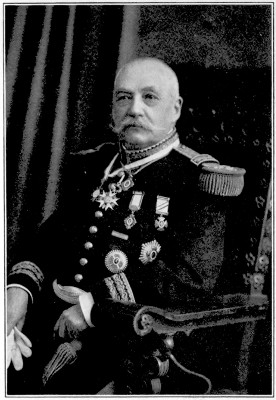
GENERAL MANUEL GONZÁLEZ COSÍO, MINISTER OF WAR AND MARINE.
There is quite a romantic episode in the life of General Cosío. During the Civil War of the United States he was in New York in company with two other young officers, destitute, but anxious to return to Mexico to fight for his country against the French. None of the three had enough money to take him back, so they decided that one of them should be selected by lot and enlist in the army of the United States, obtain the eight hundred dollars in greenbacks which were given as bounty to each enlisting man at[153] that time, and give the money to the other two to go back to Mexico and fight for their country.
The lot fell to Cosío, who was on the point of presenting himself at headquarters in New York and enlisting in the army so that his two companions could go back to Mexico with the money thus obtained, when General Mejía arrived in New York. He was visited by the three young officers and acquainted with their intention, and he gave them all passage-money and sent them back to Mexico as commissioned officers. Thus it was that instead of fighting for the American Union, as Cosío came very near doing, he battled for his own country until the French were banished from Mexico. The popularity of General Cosío is unquestioned. He is a man of large intelligence, long experience in civil affairs, and proved capacity. A man who has fought in revolutions, won distinction for gallantry in the war against the empire, suffered imprisonment in France as an incident of that conflict, served twice as governor of Zacatecas, been a deputy and a senator in the Federal Congress, and for ten years held the most conspicuous place in the municipal council of the City of Mexico, is surely qualified to hold an important ministry in a great country.
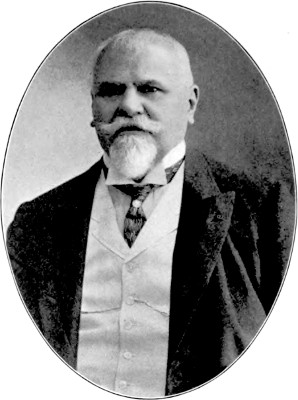
SEÑOR LIC. JUSTO SIERRA, MINISTER OF PUBLIC INSTRUCTION AND FINE ARTS.
The War and Marine Department controls a standing army, navy and merchant marine, the National Guard, Military Legislation, Military Justice, Pardons, Naval and Military Schools, Hospitals, Fortresses, Warlike Indian Tribes and Military Colonies.
General Manuel González Cosío is a war veteran and has given his life to the service of his country. He was Secretary of the Interior before his appointment[154] to the War Department. Few men in Mexico have the ability and energy that he has developed in the numerous offices he has held for his Government. His record as a soldier is brilliant with success and his career forms part of the history of Mexico. He is called “El Ministro Perpetual.” His family are all scientists and around him are always gathered people of brilliancy and talent.
The Department of Justice has charge of all relations with the Courts, pardons and commutations of sentences for offenses against the Federation and ordinary offenses, relation with the Courts of the Federal District, Prosecuting Attorneys and Notaries and all criminal statistics.
Señor Justino Fernández, the Secretary of this Department, is one of the most intellectual men in the Republic, being very active in war politics.
As an opponent of General Santa Anna, he suffered the political fate of one who dared to express his opinions, but he rendered his Government many good services and for a time retired to the practice of law, winning a great name as a man of letters. He was one of the signers of the Declaration of Independence. He has filled many important offices, Congressman, Governor of one of the States and Director of the National School of Jurisprudence. He has devoted his life to his country and has met with the appreciation he so justly merits.
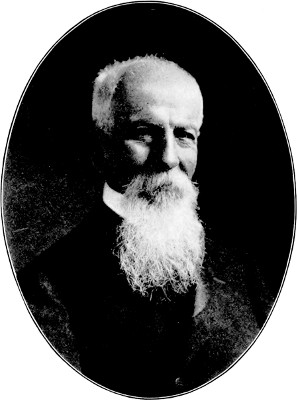
SEÑOR LIC. JUSTINO FERNÁNDEZ, MINISTER OF JUSTICE.
The brotherly love that exists among these splendid administrators and the manner in which they co-operate in the government of their country, makes Mexico’s Cabinet conspicuous among those of Republics and the eyes of the great outer world are centred upon them with wonder and admiration.
[155]
Congress granted permission for the officials of state to receive decorations from the monarchs of different nations. Besides the Grand Collar of Charles III., which was conferred upon the President by the King of Spain, the Grand Collar of the Red Eagle was the honor sent to him by the Emperor of Germany, and the Order of the Imperial Dragon granted by the Emperor of China.
Minister Enrique C. Creel was empowered to receive the decoration of the Imperial Order of the Double Dragon, first grade, third class (grand cross) conferred upon him by the Emperor of China; the Grand Cross of Isabella Catolica from the King of Spain; and the Grand Cross of the Order of the Crown of Prussia from the Emperor of Germany.
Minister José Yves Limantour, now absent in Europe, received the same Chinese decoration of the Double Dragon.
Lic. Francisco León de la Barra, the Mexican ambassador at Washington, was decorated with the Double Chinese Dragon, double cordon.
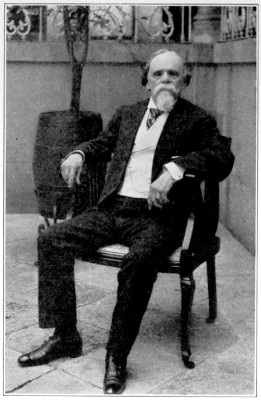
THE LATE IGNACIO MARISCAL, MINISTER OF FOREIGN AFFAIRS FOR NEARLY FORTY YEARS.
Señor Francisco Gamboa, who has been for so many years the sub-secretary of Foreign Affairs, the Chinese decoration of the Double Dragon but of the first grade (grand cordon), also the Order of the German Red Eagle, second class with badge.
Lieutenant-Colonel Porfirio Diaz, Jr., received also several distinguished decorations.
Among the distinguished men who surround the President and have his confidence are Governor Guillermo de Landa y Escandón, Señor Joaquín Don Casasus,[156] who was at one time the Mexican Ambassador at Washington; Señor Pimentel y Fagoaga, Señor Pablo Macedo, and Señor Rosendo Pineda. These gentlemen are all intellectual and progressive, and wield a great power in the affairs of the state.
A peculiar custom of the country is the “Bando.” From time immemorial it has been the fashion in Mexico to proclaim publicly any changes in the government; this was the custom long before the day of newspapers, and is still followed, on instructions from the War Department. This is done in Mexico City, soon after the election of the President, in the following order. A division is organized consisting of two brigades, one of infantry and one of cavalry, accompanied by a light battery. The chief of staff is attended by an adjutant with two captains and three subalterns. The infantry brigade is commanded by its general, accompanied by two captains and two subalterns. The cavalry brigade is led by its general, a major, two captains, and two subalterns; and a platoon of mounted gendarmes accompanies both generals. The “Bando” is inaugurated at nine in the morning. The aldermen and the city notary accompany the military parade in carriages, affixing the proclamation at certain street corners, and otherwise making known the result of the presidential election to the inhabitants of the city, with proper formalities and the pomp and circumstance of military parade. This is a curious and highly interesting custom.
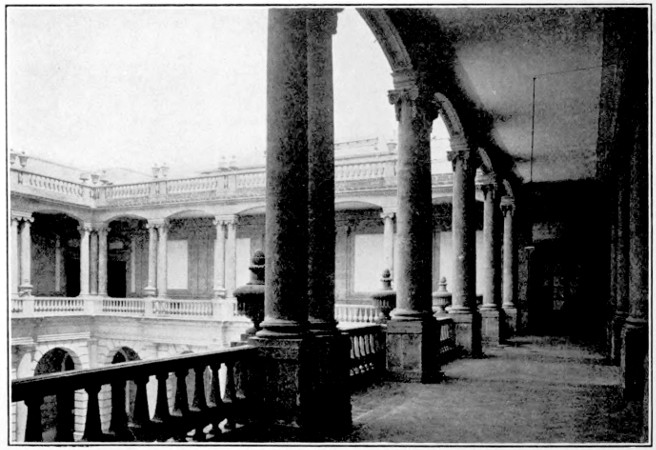
CORRIDOR OF THE NATIONAL SCHOOL OF ENGINEERING.
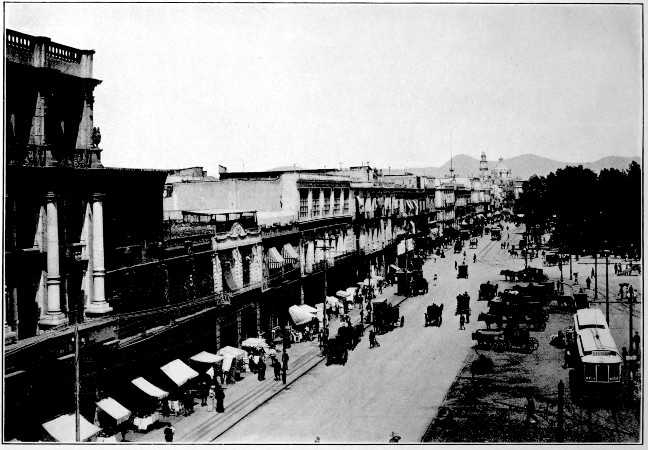
STREET SCENE IN MEXICO CITY.
[159]
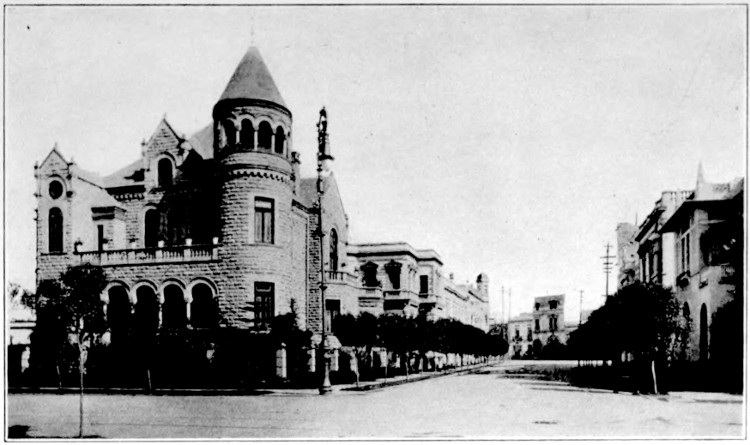
COLONIA JUAREZ.
Mexico has reached the pinnacle of her glory as a metropolis, with her palatial buildings, her public offices and her illustrious men in whose hands rests the administration of a great nation. It is an established fact that there are many circumstances which powerfully contribute both toward the development of a country’s material resources and its advancement on the high road to civilization, but at the same time it must not be denied that there are necessary men whose character and ability determine a marked progress on a city’s history and whose brilliant career and worthy deeds impress their seal on the historical period that witnesses their success.
In 1893, the Superior Council of the Government of the Federal District was formed. The important offices were appointed by the President and are held by three distinguished statesmen to whom the Capital City owes much of[160] its progress and advancement: Honorable Guillermo De Landa y Escandon, the President of this Council, which gives him the title of Governor; Señor Guillermo Beltran y Puga, Director General of Public Works; and Señor Doctor Eduardo Liceago, Director General of the Board of Health.
This Superior Council is the principal factor in bringing about the actual improvement of the city. Public parks and gardens, noble buildings, modern lighting equipment, sewerage, streets and avenues, and order and discipline have made Mexico the best regulated city in the world. It is Paris with its beauty and light, London with its busy thoroughfares, Madrid with its color and picturesqueness, and Mexico City alone with its unique characteristics that stand out like a glowing banner of triumph. The population of this city has greatly increased within the past decade. The French, German, Italian, English and American colonies are steadily growing. The modern residential section is very beautiful, homes being erected in a new and pretty style, with gardens of flowers, while the streets are paved and double rows of trees make the avenues on which they are built very attractive. Little parks intersperse and fountains surrounded by tropical plants dot the city, giving it a picturesque appearance.
While Mexico is a modern city, it is not without its charms as a former Aztec capital. With all its marked advancement from centuries of paganism it still holds some of the marks of those times. The aqueduct built in the time of Montezuma, while no longer needed in the vast city, is still retained in part as a recuerdo of former days.
There is a romantic side of the nature of all Mexicans, who never forget the influences of ancient times, and have kept many relics of the oldest civilization of the continent, that enshroud this modern city with a poetic drapery of antiquity, giving it a charm that is irresistible. It has been said that nowhere in the world can a more splendid scene be presented than the first view of Mexico City. Against a magnificent sky that defies all attempts of the painter’s art are outlined domes and spires. Belfrys and towers mark the numerous churches and palaces and the background of tall sierras and lakes all make a picture never to be forgotten. Switzerland furnishes no more grandeur, England and France show no more beautiful villages, all typical of this great wonder-country. The wide, handsome streets are clean, electric lights and street cars are in every part of the city, the busy thoroughfares are alive to public interests, the fashionable districts with their flow of stately carriages, the people[161] in their Parisian as well as native dress, the Indian with his pack or his wares to sell, the call of the vendor as he passes the doorway—all go toward adding interest and charm.
The Castle of Chapultepec, one part of which is a National Military Academy, and the other part the summer home of the President, towers two hundred feet above a grove of ancient cypress trees. It was built in the time of the Viceroy Galvan in the fifteenth century, and stands on a mass of rock on which remain signs of Aztec carvings. From this point the great valley of Anáhuac unfolds itself to view, the noble, snow-capped volcanoes rise majestically above the clouds in the distance; lakes, outspreading villages, fields of green and domes of multi-colored temples lie beneath the vision. The great cypress trees of the Bosque de Chapultepec stand stately and solemn, hoary with the flowing moss, and adorn the deep solitude.
It was here that the great Aztec chieftains met, held their councils and determined on their plan of defence. Here, beautiful Indian princesses kept their tryst with sturdy braves and in the springs that bubble in every nook and corner they sported in all their glory, unaware of the changes soon to come to their primitive lives.
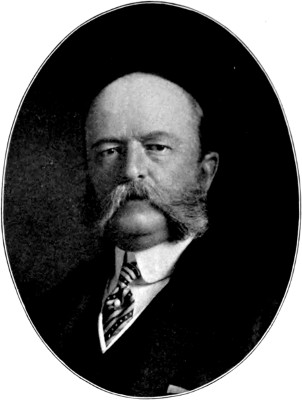
SEÑOR DON GUILLERMO DE LANDA Y ESCANDON, GOVERNOR OF THE FEDERAL DISTRICT.
Beautiful avenues lead to the Castle, winding around the ascent, and from salient walls and parapets the bugle call echoes throughout the forest. It is on these avenues that automobiles and magnificent liveries are seen in the afternoon social parade.
Tenochtitlan, which was afterward changed to Mexico, after the God of War, Mexitla, was described by Cortés as being a very large and well populated[162] city. There were imperial palaces, temples of high priests, important public buildings, and many handsome dwellings.
From a razed city of the reign of Montezuma, Cortés and the nobles of Spain had great ambition to make it a beautiful metropolis and some of the buildings now form a most interesting feature of the Capital. On the site of the Aztec monarch’s palace, with its hundred rooms, was laid the foundation of the Cathedral, which stands to-day a magnificent structure of pinkish-gray stone, with marble altars, priceless paintings and rich tapestries. It is five hundred and twenty feet long, and four hundred and twenty feet wide, and the plan is a Latin cross. It was estimated by a Spanish historian that over sixty thousand men had perished in human sacrifices upon its site. When these massive foundation stones were laid, Elizabeth was Queen of England; Philip II. reigned over Spain, Charles IX. in France, Cervantes was writing Don Quixote, Titian and Paul Veronese were painting their masterpieces; the Turks were over-running the Plains of Hungary with the intention of wiping Christendom out of existence.
Poland was a mighty empire extending from the Baltic to the Black Sea. Sir Francis Drake was just beginning his career as a navigator. The first pipe-full of tobacco had not been smoked in Europe; there were no telescopes; Shakespeare and Spenser, Beaumont and Fletcher, Ben Johnson and Bacon, were in their prime; and Russia was a savage and insignificant power.
Passing through the Cathedral, on either side there are different apartments filled from floor to ceiling with paintings, statues, vases, huge candle-sticks, waiters and a host of other articles of gold and silver. This too, is only the everyday display of articles of least value; the more costly ones are stored away in chests and closets.
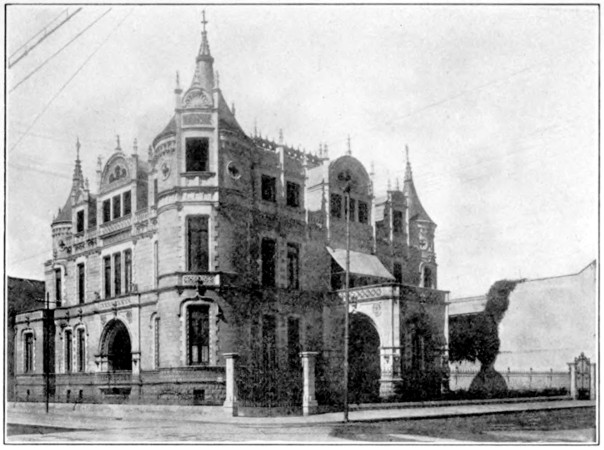
HOME OF GOVERNOR LANDA Y ESCANDON.
The National Palace is a relic of the days of Cortés and was improved in the course of time by the Count De Revillagigédo and others who reigned after him did much toward beautifying it. It is now the official home of the President and other Government Officials; the Secretary of Finance, the War Department, Federal Treasury, and Public Archives. The Central Meteorological Observatory is on the Azotea, and the National Museum and Academy of San Carlos form another part of this great edifice. In this palace the President of the Republic receives his Ministers and the people and on the days of his public receptions the poorest persons meet with a courteous and patient audience.
[163]
The Municipal Palace is a splendid remodeled structure where the Governor of the Federal District has his executive office. Its halls and salons contain priceless paintings of the viceroys and Mexican patriots. It is here that all the affairs pertaining to the City Government are conducted, and the Honorable Governor holds his public receptions, and where petitions are heard. Governor De Landa has proved himself an able governor and conducts the City Government with extreme rigor. He has caused many reforms and controls with an iron will everything that comes under his régime. He takes the interests of the people to heart, he makes his city a noted metropolis, condemns and wipes out vices, corrects irregularities. The sanitary conditions of the shops and the excellent police force, said to be the best regulated in the world, owe their reputation to the indefatigable work of Governor De Landa y Escandon. He has a system of controlling traffic to such an extent that the busy hour finds the streets clear of congestion, an example set by this official in the government of a city that could well be imitated by others. In his splendid reception hall the Governor receives all classes of people. Here great ladies and military men rub elbows[164] with the laborer, and his reception of them all is characterized by exceeding good fellowship and courtesy.
He receives the poorer classes who fall at his feet with petitions of mercy, perhaps on the imprisonment of a son or father, and he reassures and consoles, many times giving aid from his own purse, and makes personal investigation of cases brought before him, when others of his exalted position might casually pass them by unheeded. He has established houses of correction, one for boys at Tlalpam, and one for girls at Coyoacan, and the results of this benevolent work have been most encouraging to Governor De Landa. In years gone by, drunkenness and vice were rampant in the city through the excessive use of pulque, which was sold extensively, and many crimes resulted from this, but since his election as Governor all of this has been stamped out, and the drink that stimulates the mind of the laborer is now sold in moderation; and the Anti-Gambling Act, passed and put into execution in the early days of his administration, has proved a great blessing to the middle class. An intimate knowledge of this Governor’s character proves that all this interest in the welfare of his people and his city is inspired not by love of notoriety, for he is very modest in his work of reform. The poor and lowly worship him, the mighty respect him, and it is to this man that Mexico owes much of its greatness.
The Museo Nacional is in point of antiquarian value the place of chief interest in the capital. Here are preserved the principal discovered records of prehistoric Mexico; the story of the original inhabitants in stone and on paper of the Maguey plant; here too are very many relics of the periods of the conquerors and the viceroys.
The museum collection originated in a department of the university, which was closed in 1865. The interest taken by the government in the archæology of Mexico has led to many important discoveries during the last twenty years, and by virtue of the law of national ownership in all antiquities found within the republic the museum is gathering all discovered records of the ancient people and country.
Among the Aztec relics of chief interest are the sacrificial and calendar stones. There are here also many monoliths of large size, types of deities worshipped by the ancient Mexican. Of these the idol known as the Goddess of Water is colossal being eleven feet high and weighing nearly twenty tons. It came from Teotihuacan, near the Pyramids of the Sun and Moon. Another[165] hideous idol is that of Huizilopochtli the War God which is ten feet high and three in diameter. The sculptures on these idols are very elaborate. Chacmol, the God of Fire, claimed also as the Toltec Deity Tlaloc, is a symmetrical figure in stone, recumbent, lying on its back and holding in both hands that meet on the stomach a circular disk emblematic of the sun. There is a colossal head in serpentine said by some authorities to be the Goddess Centeotl, by others to be related to the Aztec calendar as evidenced by the shell sculptures, of which there are thirteen in front of the cap and twenty at the back respectively indicating, perhaps, the thirteen sacred days and the twenty civil days of the month.
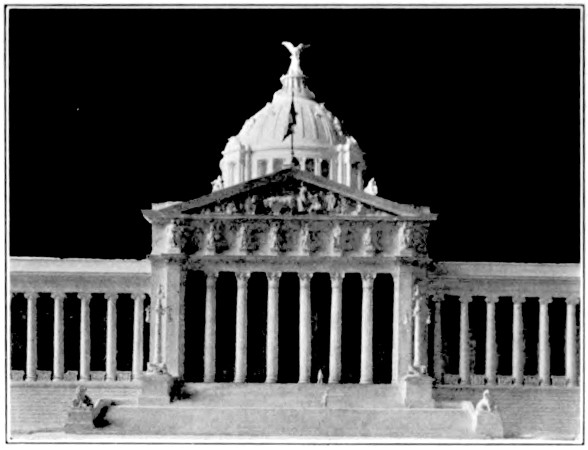
THE NEW LEGISLATIVE PALACE.
The great temple of Tenochtitlan was surrounded by a stone wall in which was the wall of serpents, or cohuatepantli. Two of the heads of these serpents, colossal in size, are among the relics of the ancient Aztec; so is the “feathered serpent,” or Quetzalcoatl, a sculpture clearly indicating a coiled reptile. Of this latter many smaller examples have been found in various parts of Mexico. The tradition of Quetzalcoatl, the good teacher, who was fair of complexion and wore a long beard, and who prophesied the coming of the white men is elsewhere mentioned. Aztec arms, and missiles and armor and domestic articles and implements offer object lessons of prehistoric life of great service to the student and of fascinating interest to all. Here is a shield worn by Montezuma made of carefully quilted cotton; there the strange drum huehuetl, whose sinister sounds carried fear to the Spaniards; here the vicious looking sword with four long blades set in the wooden staff on each of its faces, blades of obsidian, so keen that as Bernal Diaz wrote, they cut off a horse’s head clean.
Then there are the pinturas or picture writings, of which many are preserved. One of the most curious is an ancient Mexican painting of the Deluge, and the[166] dove is there with the olive branch; their tradition of this event largely agreeing with the Scriptural narration.
Of the Spanish period, there is the armor of Cortés—a very precious treasure, priceless indeed, for it was worn by him in all his wonderful battles—the banner of the Conquistadores, arms of soldiers, a helmet and cuirass of the Tonatiuh—Pedro de Alvarado—and portraits of viceroys. But the exhibit most venerated among such memorials is the Banner of our Lady of Guadalupe, which Hidalgo took from the Santuario of Atotonilco on that morning of September 16th, when he started out on his war of independence with his ragged patriot army and raised as his standard this banner. His musket and some other personal possessions are here; also, contrasting with these are the state chariot of the Maximilian period and the magnificent and costly dinner service of the same period, which latter was permitted to be used at Juarez on the occasion of the meeting of President Taft and General Diaz in October, 1909.
The mystery of the ancient peoples, traces of whose culture invest them with uncommon interest; the romance of the conquest of powerful and well organized nations by a mere handful of invaders who were absolutely cut off from all communications and means of home support, yet who overthrew vast armies defending their own territories; the wonders of the land opened to the knowledge of the old world; the tale of its treasures transcending the exaggeration of fable; and finally, perhaps of greater interest than all else, the greatness of the republic established by patriot martyrs maintained by the prowess of heroes and at length cemented by a patriotism and wisdom that are the wonder, admiration and illumination of the world; these are among the thoughts aroused in the minds of the musing visitor to this wonderful museum.
The calendar stone was originally set in the great temple of Tenochtitlan, but on the destruction of the latter it remained buried beneath the ruins. On its discovery it was placed in one of the towers of the Cathedral and later, in 1860, was removed to the museum. It is a circular stone of porphyritic character about ten feet in diameter. Tradition asserts that this stone was one of a second pair prepared, the first having broken down the bridge of Xoloc and lost in the lake. The stone was engraved by order of Axayacatl, and at its dedication seven hundred and twenty-eight victims were sacrificed. The hieroglyphs that cover its surface are still only a matter of surmise, though the numeral system of the earlier races has been determined and great steps and considerable[167] advance has been made in determining the order in which the glyphs are to be read. The year was divided for civil purposes into three hundred and sixty-five days, eighteen months of twenty days and a supplemental month of five days after the eighteenth. Puzzling as seems the method of enumeration, the Maya priest could correctly calculate, as Thomas shows in his Study of the Manuscript Troano, a period of twelve million three hundred and eighty-one thousand seven hundred and twenty-eight days, and determine the exact year, month and day that will be reached in such calculation.
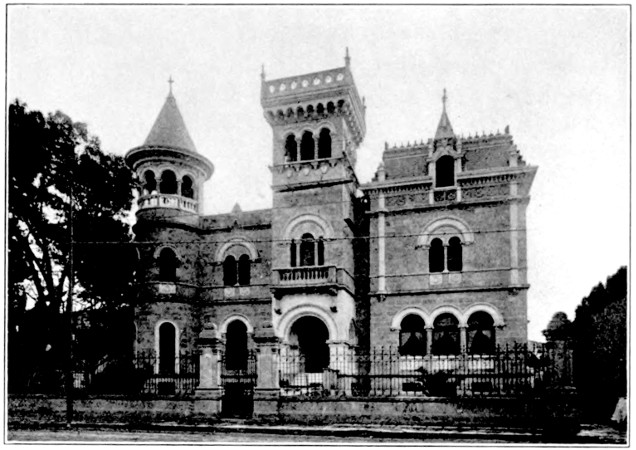
HOME OF VICE-PRESIDENT CORRAL.
The general plan of this stone is as follows: A relief sculpture of a human head with the tongue protruded is in the centre, about this are five concentric circles of hieroglyphs, the symbols marking the various divisions of time in the ancient Mexican calendar.
The sacrificial stone is not difficult to associate. Its shape and sculptures around and upon it indicate its ghastly use. In shape it is similar to the calendar stone, circular, eight feet in diameter and four in height; but the sinister basin hollowed out in the top and the canal leading therefrom to the groove[168] at the edge also lead to the conclusion that on this stone the victims of the Aztecs were laid and killed by the priests in sacrifice. The sculptured figures represent the victims of conquering chiefs being dragged by the hair to the place of sacrifice. This monumental stone was found in 1791, near the cathedral and was doomed for the pile of paving stones when its archæological value was discovered and the vandal’s hand was stayed. It is the best sculptured of the antiquities of Mexico.
Among the places of prominent interest is the Monte de Piedad, an institution almost singular to Mexico, having regard to its methods and the extent of its operations. This great national pawn shop was founded in 1774, by the Conde de Regla. He endowed the institution with a gift of over three hundred thousand dollars and the crown approving the institution, business began in 1776, in the old College San Pedro y Pablo. The plan was an eleemosynary one, complementary to the many other charities of the Count. No interest was charged on loans; an arrangement intended to protect the poor from the exactions of the usurers; instead it was expected that the borrower on repaying his loan would make some gift in aid of charity.
For three-quarters of a century the profits were appropriated to the payment of masses for the repose of the soul of the founder, but for the last half a century they have been used in establishing branch institutions in leading cities.
It is a fine building and occupies the site of one of Cortés’s palaces. The staircases are hewn out of huge blocks of lava from Popocatepetl and ornamenting the windows and doors are the hideous heads placed by Cortés in his earlier palace edifice.
The Artillery Museum is under the Department of War, and is a depository of all historic relics of Mexico’s great events. It was founded fifteen years ago and is full of interesting data. The patio is roofed with steel and glass and is converted into an exhibition hall. The high walls are ornamented with alto-reliefs of the Aztec kings. These bronzes are the work of the artist, Jesus F. Contreras, and are said to be the finest in Mexico.
There is a large picture of Hidalgo with the flag used in battle, and a large faded flag used by Cortés. Here you can see the gold pen with which General Escobedo wrote the death sentence of Maximilian, the sword of the Emperor and the brilliant uniform of General Escobedo, complete with helmet and sword. There is also a splendid library which contains many volumes devoted to military science.
[169]
The School of Mines, La Minera, occupies a palatial structure erected at a cost of two hundred thousand dollars in 1813. The school was founded in 1777, through the munificence, chiefly, of Señor Velasquez de Leon and Lucas de Lasaga. The splendid edifice is the work of Manuel Tolsa whose master hand is seen in the great columned galleries, the noble pillars, stairways and patios. The chapel is an exquisite work, here is a magnificent bronze altar and the lofty ceilings are richly ornamented with frescoes by Rafael Jimeno. The collection of minerals is very valuable and extensive and varied, and forces on the most thoughtless visitor a sense of the immense mineral resources of Mexico. An exhibit of much interest is the meteoric stones, some of which weigh tons that rest under the front portal. These uncanny visitants reached earth in various parts of the republic.
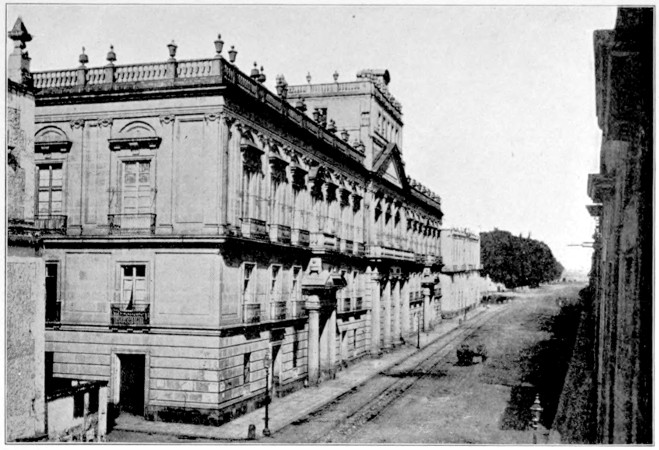
THE PALACE OF MINES.
The Plaza de la Constitucion, or Zocalo, as it is called, is the centre of the great city. On this spot stood one of the great Aztec temples, erected to the deity Huitzilopochtli, where human sacrifices were daily offered. One of the fiercest[170] battles ever fought between the forces of Cortés and the Aztecs took place on this spot. It is surrounded by most pretentious buildings. Fifty years ago this was the social centre of the city and a principal place of gathering in the evening for families who, as they do now, in the smaller cities, donned their most becoming toilettes, promenaded and met their friends, and enjoyed the sweet and soulful music for which the Mexicans are so noted. Now the poorer class enjoys this privilege with the military band discoursing the same beautiful strains as if the gayer and higher world was the audience. Starting from this point one can drive straight to the Castle of Chapultepec, a distance of three miles, passing through the principal thoroughfare of San Francisco, with its array of wonderful old churches and time-stained palaces now turned into business houses.
Here stands in its solemn dignity the old Palace of Iturbide, richly carved and retaining much of the beauty of the days when it was built by the Emperor Augustin I. This is now one of the principal hotels of the city, a rendezvous for tourists and students of the country. The Alameda, with its grand old trees, its beautiful walks and its fountains dancing in the sunlight and shade, was once a fashionable park. On Sundays and days of fiesta it was the custom of Mexican society to meet there after church, and enjoy music and social intercourse. Many a charming love affair has grown out of these meetings and Mexico is full of beautiful romances.
Amusement is varied and Mexicans freely embrace the opportunity for diversion. The theatres are numerous and of considerable importance, as well in the life of the people as architecturally. The chief are the Teatro Principal and the Virginia Fabregas; the latter enjoyed the distinction of being the most fashionable theatre until the New Opera House was constructed. It was the home of Italian and French opera and on its stage have been presented the best of Spanish and Mexican dramatic productions.
The Folies Bergères is a new theatre lately opened, and is one of the best in Mexico.
The Arbeu is one of the popular playhouses. The New National Theatre is the work of the noted Italian architect Adamo Boari, and in beauty and design will equal any playhouse in the world. It is of a modern steel construction and the first national theatre absolutely fireproof. The site is one of great historical value as it was on this spot that Cortés retreated on the Noche Triste. It covers[171] a square on Avenida Juarez and is built next to the Alameda and made to harmonize with it. The front is magnificent with statues, flowers and fountains. On each side terraces lead up to the entrances. The theatre is surrounded by lawns and gardens to be kept always green and beautiful. On each side of the theatre is a carriage entrance. The balconies are supported by great marble pillars and columns representing the lyric muse. The interior decorations are exquisite and harmonious in effect. Italian marble and Mexican onyx are seen everywhere.

SAN FRANCISCO STREET.
The Frontons located in many parts of the city are devoted to the favorite Mexican ball game. This sport is ancient in Mexico, it was a favorite pastime of the Aztecs; it was almost a religious custom as the places devoted to the games were consecrated by the priests and the victors were held in very high regard.
[172]
Racing is a favorite diversion in Mexico. There are two fine tracks at Indianilla and Penon. Stakes and purses are furnished by the Jockey Club and prizes are provided by the Ayuntamiento and the Department of Fomento of the federal government.
The characteristic, popular national sport is the bull-fight, which in spite of spasmodic efforts to displace it still continues to chain the interest and arouse the enthusiasm of the people.
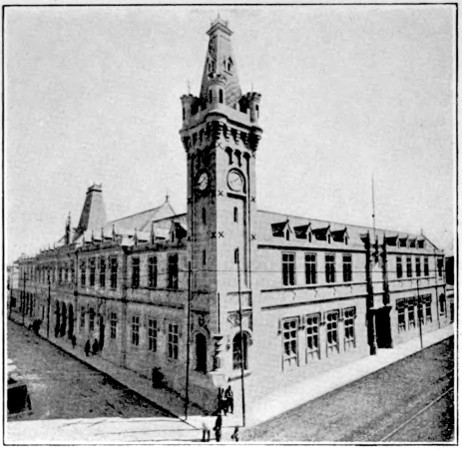
POLICE HEADQUARTERS.
The Paseo de la Reforma, once a country road, was improved by the Emperor Maximilian. On this avenue a glittering wealth of equipages, spirited horses and automobiles, are seen morning and evening. The glowing sunshine, the contrasting nature-colors in the parks and along the sidewalks add a permanent charm and nothing is more pleasing than seeing Mexican society on días de fiesta, passing back and forth, vivacious, beautiful and elegant. Leading into this avenue are beautiful streets of fashionable homes and in no city of the world are seen more beautiful residences than are found here. Elegance and simplicity, no gaudy display, the Mexican’s home is his palace, and while the exterior is sometimes very simple, the interior, with its courtyard of beautiful flowers and palms, its salas with magnificent appointments and paintings from great masters is not to be excelled anywhere. The exquisite taste of the Mexicans is always in evidence. The women are gowned in the latest Parisian toilettes, their jewels are as precious as those of crowned heads and their entertainments are a glittering and beautiful display of wealth and elegance.
The General Lunatic Asylum is situated in La Castaneda, very near the little suburb of Mixcoac. It is one of the most picturesque spots in the Federal District. Its construction was directed by Lieutenant-Colonel Porfirio Diaz, Jr., son of the President. It has all the advantages of a luxurious home and has many[173] large pavilions. These are modern structures of white stone and cement. The grounds are beautifully laid out with parks, making it one of the attractive features of the little village.
In Mixcoac the Working Man’s Colony is also a monument to the enterprise of Colonel Diaz. He has built modern, sanitary homes at nominal rentals, gives each man a certain amount of land to till, offers prizes of free occupancy to the most successful and in this way the improvident peon is taught a way to earn a living for himself and family. These houses are built on a most attractive plan; bathrooms, bedrooms, parlors and kitchens, unlike the squalid huts that most of the poverty-stricken Indians occupy. It is a plan that has met with great success and the products of some of the gardens have demonstrated the fact that the Mexican Indian is a farmer by nature, and it is thought that this movement will grow and be a valuable aid to that class.
San Angel, Coyoacan and San Augustin, are extremely pretty villages in the vicinity of the lake.
Coyoacan is almost a continuation of San Angel. Both villages serve as a popular summer resort for the rich dwellers in the City of Mexico. It was at this place that Cortés took up his residence for several months after the total destruction of the ancient Tenochtitlan. Here he founded a convent, too; and in his last will and testament he expressed a desire to be buried here, in whatever part of the world he should end his days. This request was not complied with.
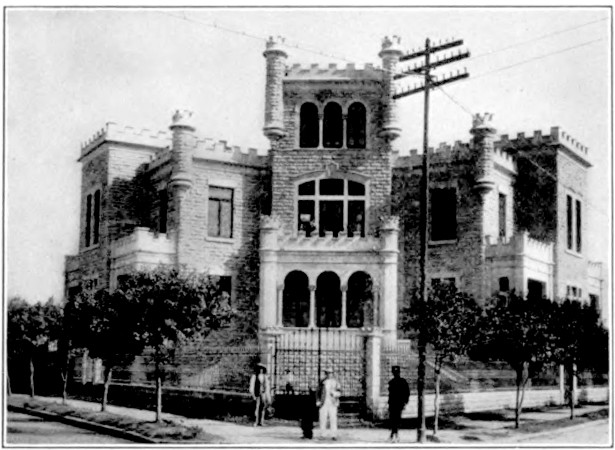
AMERICAN EMBASSY.
Coyoacan was always Cortés’s favorite village, and it is even now one of the prettiest in Mexico, having one of the handsomest village churches in that country.
The Penon baths are one of the great attractions of Mexico.
[174]
These boiling springs are said to contain sulphate of lime, carbonic acid, and muriate of soda, and the Indians make salt in their neighborhood much as they did in the time of Montezuma, with the difference, as Humboldt informs us, that they use copper caldrons, while their ancestors used vessels of clay. The solitary-looking baths are ornamented with odd-looking heads of cats and monkeys, which grin upon you with a mixture of the sinister and facetious that is rather appalling.
On one of the sites where these mineral springs are to be found still stands a little church or chapel which dates back to the beginning of the colonial period, and suggests that, like the Pocito de Guadalupe, the Penon waters may have been used, with prayer and supplication, for effecting miraculous cures.
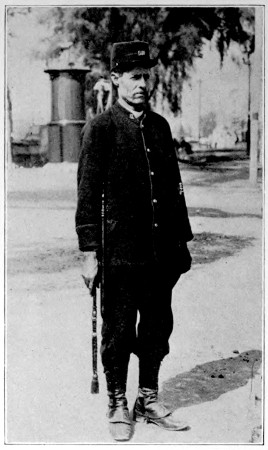
POLICEMAN.
La Viga and the floating gardens or markets form another diverting and intensely interesting phase of life in this unique and poetic land. The canal makes a circle of over eight miles, and presents a scene of unequalled activity and unusual features. One need not look for gardens, as the name suggests, but rather for an aquatic market-place. The gardens are made up of countless boats in motion, filled with every imaginable growth of farm, orchard and vineyard, with garden flowers, fruits, chickens, birds, and all other living and growing things that can be sold. As soon as one leaves the car the crowd surges around imploring the hire of their boats.
The boatmen use only one long oar, with which they pole or scull the craft along. In no other way can be gained so accurate an idea of the varied population of Mexico; in no other way can so many charming effects in costume and personal ornamentation be studied; and certainly nowhere else can such a marvellous array of products of this most marvellous of all countries be seen.
[175]
Santa Anita is a peculiar little spot, Mexican in every detail, and a favorite pleasure-resort for the people of Mexico City. It is a town of reed-thatched houses, and everywhere there is a tempting odor of Mexican culinary dainties.
Pulque may be had in various wonderful and insidious styles in which the original flavor is merged in something far more agreeable.
At Ixtacalco are chinampas, with less gayety. A fine old stone bridge crosses the canal at this point, with the ruins of a chapel at the water’s edge, where in the old days the passing boatman muttered an ave and deposited an offering to the patron saint, in the hope that good luck would follow him on his voyage and that his vegetables would sell for a few more tlacos than usual. In front of the church, which is dedicated to San Matías and which has a Franciscan foundation more than three hundred years old, is the customary little plaza with a fountain of running water.
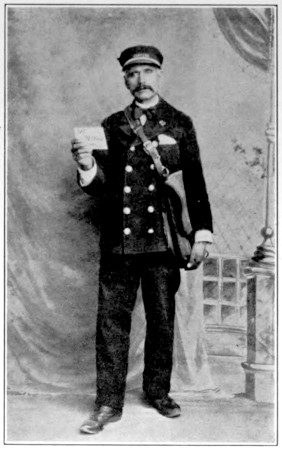
MEXICAN LETTER CARRIER.
There is a fascination about the capital of Mexico which is peculiar. Western progress in science, art, life, fashions, architecture, government, and facilities and attractions are linked with customs foreign to the life of Europe and characteristics exclusively Mexican. In its splendid avenues and boulevards, magnificent buildings, the lighting and transportation, it vies with European and American cities. It is most cosmopolitan, yet its own charm hangs over all. The churches suggest the Moorish influence. Its floral beauties, in size and color matchless, its rich and peculiar foliage, its wonderful sky, its great guardian mountains, its lakes, that recall the most romantic stories; the historic wonders of the city and its neighborhood; the recollection of great struggles that overthrew successively the cultures of the several peoples that dwelt in the Valley of Anáhuac and whose characteristics are stamped on the people of the[176] present city; nowhere can the picture be duplicated. There is an inexpressible imprint in nature and art that makes Mexico singular. It is found in its buildings, solid, convenient and of even proportions, in styles wonderfully varied but generally ornate. It is pointed out in its flowers, shrubs and trees—the peculiar growth of the land; it is found in the costumes, customs of the people; it is found in the wonderful sky, the great mountains—a something unique in each feature and in the combination of all.
The towering form of Popocatepetl fills the eastern view, its glistening snow covered crest rising above the level of the city ten thousand five hundred feet and almost eighteen thousand above the waters of the gulf, and the magnificent Iztaccihuatl, sheltering and protecting the Valley of San Martin which spreads out in wonderful fertility at their base. Sublime grandeur is the most sober term descriptive of the magnificent setting of Mexico City.
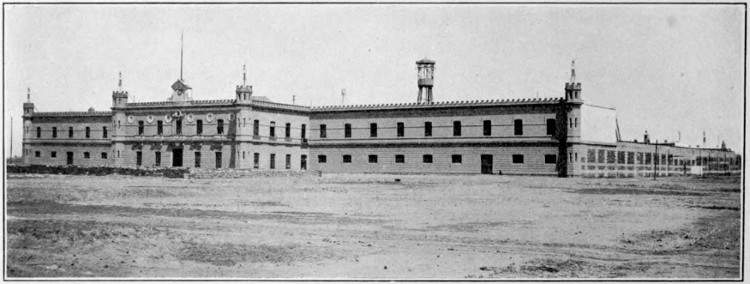
FEDERAL PENITENTIARY
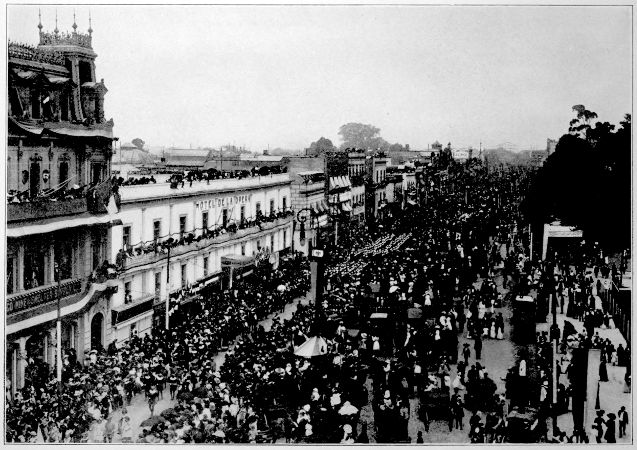
GREAT HISTORICAL PARADE, SEPTEMBER 15, 1910.
[179]
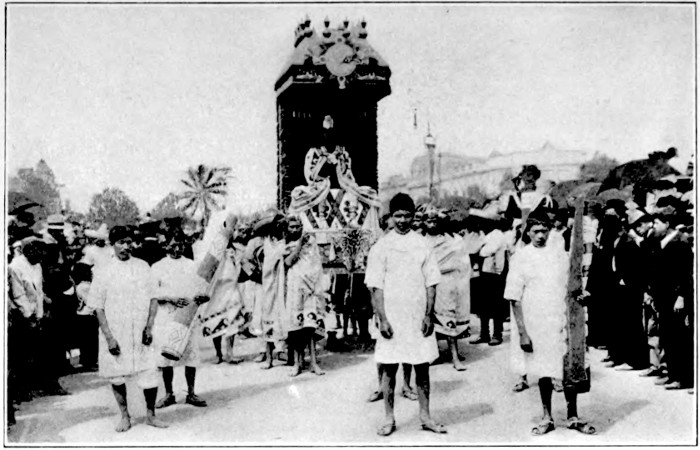
EMPEROR MONTEZUMA IN HIS PALANQUIN IN THE HISTORICAL PARADE.
After Mexico had thrown aside her burden of oppression, and had risen to the dignity of a well-governed nation, the powers of the world regarded her not without astonishment. After a half century of hardships came years of reconstruction and pacification. The greater difficulty of gaining faith in themselves was surmounted by men who in their generalship gave the Mexicans that which they required more—a knowledge that they had a place in the world of great republics; and events of the past hundred years have demonstrated it.
In the earlier days, after the reign of the viceroys was over, the Mexicans had to fight for their rights, which were overrun by highwaymen and guerrilla bands, and until a man could be found who would have the strength to cope with this situation there was no safety for life or property. With the advent of General[180] Diaz all this changed. Mexico proudly stands before the world as one of the best regulated governments.
The industrial and agricultural development of the country began with Juarez. But during the periods of foreign intervention the Mexicans had little heart for anything more than protecting their rights, for they had to make a noble stand, and the rich mines that had yielded without ceasing so many years were left unworked; the broad, sun-kissed acres, which for centuries had furnished golden grain were neglected; the miner’s pick and the farmer’s plow lay rusting while the sword dripped with the blood of battle. This fairest country on the globe, despoiled by human greed for gold, has at last risen into proud prominence and when General Diaz assumed the Presidency, Mexico began to see the dawn of a great light. She needs no poet to sing her praises, she is her own colossal and imperishable monument, the base of which is planted on centuries gone by and the summit of which will raise its head in the enduring future.
Mexico is free—free to enjoy without stint the fruits of the bounty she was forced to get through sacrifice, and having shed upon her dear soil the red blood that surged in the patriot’s heart, the rulers of this great nation have by their sound judgment placed her foremost in the ranks of the world. During the reign of the viceroys when Spain was disporting herself in the garb of her riches, gained from her golden possessions in America, the Mexicans began to show signs of discontent, and occasional uprisings gave these petty kings a great deal of misgiving and concern. Foreigners were not permitted to enter the country, the Church had the monopoly of education, only Spaniards could hold lands and influential government offices and those great patriots who did all in their power to uplift their country and protect their people are revered by the Mexicans with a love that is almost divine.
It was during the reign of Francisco Javier Venegas (1810 to 1816) that the revolutionary period began, and from that time the power of Spain declined. Before long the country was in the throes of war which Spanish troops could not quell. A great man appeared from the mountains. He was a lowly priest, living in obscurity ministering to the wants of his little band of Indian Christians. His followers knew him to represent God and His teachings and his influence among them was very great. He implanted in the minds of the simple people that Mexico must be free to worship, free to govern. Foreign wars and civil dissension followed the first and noble stand of this patriot. The Indians were[181] incited by him to open rebellion and in the midst of excitement a great bell hanging in one of the church towers was rung proclaiming liberty or death. The deep, mellow tones from this old cathedral inspired every Mexican with the desire for a liberty that meant more than a proclamation, and for many years there was a bitter war in which advanced to the front many brave men whose names are graven in the history of Mexico’s great deeds—Allende, Aldama, Jimenez, Guerrero all seemed alive to the needs of their beloved country. They cast their whole souls into the cause for freedom and gave their precious lives to Mexico. This war was not without its romances as well as its tragedies.
Like the stories of the Roman warriors, like the Judas who betrayed his Christ, Hidalgo was given into the hands of the enemy by a friend, a Spaniard named Mariano Galvan, on whose head many times had rested the hands of the patriot priest in blessing.
José Maria Morelos y Pavon, a Mestizo Indian, also a Catholic priest, called a congress in 1813, and in November declared Mexico independent. He was a most intrepid fighter and was known as a “Hero of a Hundred Battles.”
The centennial festivities were as much in honor of the heroes of the wars as of the growth and progress of the country. The year 1910, celebrated the first century of Mexico’s political emancipation. She followed the natural outburst of her pride in the realization of her wonderful growth during the past century. For she knows that no country has been beset with more unfortunate events that tended to retard rather than promote her advancement, and when she lifted her proud head in her own triumphant recognition she invited the world to come and see the results of her century of golden harvest.
Invitations were sent by the president to every foreign monarch and ruler, who, excepting the King of England, whose mourning for the late King, Albert Edward, prevented, sent special ambassadors to be the guests of Mexico for the month of September. So magnificent were the entertainments given, so great was the display of wealth and refinement that those who had scant knowledge of what Mexico really is, returned to their homes much enlightened. Mexico has long been looked upon as a faraway land of mystery, with nothing to offer beyond relics and romances; but here they found science, art, advancement, men and women who could hold their own in the world of brilliancy—here they found a warm hospitality, and gathered together in this great capital, like a big happy family, they grew to know each other like brothers. Thus did Mexico, in[182] bringing together so many representatives of foreign lands, create good feeling that will spread in many directions.
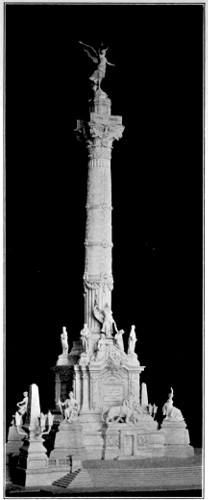
MONUMENT OF INDEPENDENCE.
A tribute should be paid to Mayor Fernando Pimentel y Fagoago the president of the National Commission, Governor de Landa y Escandon, and the other members who planned this wonderful entertainment, which will go down in history as one of the greatest jubilees that ever took place. Thirty days of hospitality to the world! It was an unheard of generosity and those foreign envoys who carried back reports of it to their monarchs must have been very much impressed with it all. The guests of the nation were treated with every consideration and courtesy and their wants attended to with remarkable forethought. They were met at the borders and ports and escorted with all honor to Mexico by a selected body of society’s most brilliant men and the stations along the line of travel were festooned with the national colors. Each city sent delegates to meet the trains and speed them on their way to the capital. It was like a scene of grandeur of the days when kings went visiting, and not one representative of his ruler went from Mexico without knowing the full measure of the manner of Mexico’s whole-souled hospitality. At the capital, a protocol of ladies and gentlemen,[183] met the special trains bearing the foreign delegates and conveyed them in all honor to their abodes, which were luxuriously furnished, some of them being homes of citizens and officials. Fresh flowers were sent each day, automobiles, carriages and servants were furnished and everything the heart could desire was at the disposal of these visitors during the Centennial. President Taft sent a special commission. The distinguished gentlemen were selected for their fitness to represent the United States. They were Special Ambassador Honorable Curtis Guild; Congressman David J. Foster; Senator Overman; Senator Coe I. Crawford; Congressman James R. Slayden; Representative George W. Fairchild; Justice James E. Girard; General Harrison Gray Otis; and Colonel Rook. These gentlemen occupied the Cobian Palace, one of the most magnificent mansions in the capital city.
The other Envoys were the Marquis de Polavieja, Special Ambassador of Spain; Monsieur Paul Lefaivre and Admiral de la Croix de Castries, Special Ambassadors of France; Marquis di Bugano, of Italy; Special Envoy Carl Buenz, of Germany; Chinese Ambassador, Chang Yin Tang; Japanese Ambassador, Baron Uchida; Special Ambassadors from Chili, Honorable Carlos Subercaezeaux and General Juan de Dios Vial Guzman; Special Minister from Brazil, Don Antonio do Fontaura Xavier; Special Minister from Costa Rica, Honorable Joaquin Calvo; Special Portuguese Ambassador, Visconte de Alte; Peruvian Special Ambassador, Señor Fedrico Alfonse Pezet; Special Envoy from Holland, Jankherr J. Loudon; Colombian Minister, Señor C. de Corrodor Latorre; Cuban Special Envoy, Honorable Loinaz del Castillo; Guatemalan Minister, Dr. Juan Ortega; Salvadorian Minister, Señor Don José Antonio Rodriguez; Honduran Envoy, Señor Don Salvador Cordóva; Bolivian Minister, Señor Don Santiago Arguello; Austro-Hungarian Minister, Count Maximilian Hadik; Russian Envoy, Honorable Andre Stalewski; Belgian Envoy, Monsieur George Allart; Norwegian Envoy, Honorable Michael Lio; Ecuadorian Special Envoy, Señor Don Leopoldo Pino; Swiss Envoy, Mr. Enrique Perret; Venezuelan Delegate, Señor Don Eduardo Urdaneta; Argentine Special Envoys, Señor Don Jacinto Garcia and General Enrique Fleiss, Commander of the Warship Presidente Sarmiento; the resident Spanish Minister, Señor Bernardo J. Cologan y Cologan represented Greece.
One of the first ceremonies was the opening of the lunatic asylum at Mixcoac, one of the most splendid modern edifices erected in Mexico. The president, bearing[184] his eighty years with all the strength and vigor of a man of forty, conducted the formalities with great dignity and poise. Surrounded by representative men of all the world, he stood out among them a figure never to be forgotten.
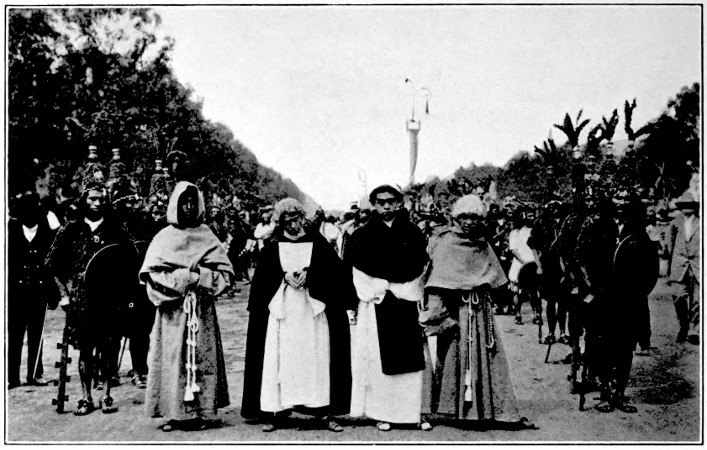
PRIESTS AND SERVANTS OF CORTÉS IN THE HISTORICAL PARADE.
All public buildings finished or nearing completion were formally dedicated during this eventful month, each cabinet minister and official taking an important part in the ceremonies. Speeches that glided from the lips of orators from every clime seemed to mingle with the golden atmosphere, carrying with them a spirit of good feeling. The first ten days of the Centennial were devoted to receiving the credentials of the foreign delegates, and impressive official ceremonies appropriate to the occasion, but from the first day of the month the president and his colleagues went through the ceremonies of dedication, laying corner stones and opening schools and various enterprises. The new Federal Legislative palace, which is one of the most magnificent structures in America, was dedicated in the presence of many foreign diplomats.
A flag parade of school children dressed in clothes made by the society women of Mexico was one of the most interesting processions, because of the[185] youth of the participants. Notable among the events of the Centennial was the opening of the University of Mexico in the presence of General Diaz and other high officials and distinguished foreign educators. In an unostentatious way the ceremonies began with strains of the national anthem resounding throughout the large amphitheatre of the National Preparatory School. Special delegates of foreign universities with the caps and gowns of their respective institutions of learning were present, among them, Dr. James Baldwin, representative of Oxford University; Licenciado Manuel Garcia Alvarez, a delegate from the University of Oviedo, Spain; Doctors Lendian and Dehigo y Mestre, of the University of Havana; Professor Ernest Martinenche of the University of Paris, founded in 1810; Dr. Benjamin Ide Wheeler, President of the University of California, one of the best educators of the United States; the American Commission and ambassadors from other countries.
Before a brilliant assemblage of men and women the Minister of Education and Belles Artes, Señor Don Justo Sierra, read a splendid paper treating of the subject of education of the youth of Mexico, who must be fitted to receive the reins of the government, which sooner or later must fall to them. It was a splendid oration, and was followed by a response from the President who in a few dignified words of encouragement and praise pronounced the University of Mexico a thing of reality, to endure forever. Other addresses followed and the dedication of the University of Mexico passed into the annals of history.
The National School of Agriculture was opened and was one of the most interesting of the ceremonies of the Centennial, being of importance for the advancement and development of agricultural resources. An exhibition of live stock in connection with this showed fine breeds of cattle and horses from all parts of the republic.
A congress of education in the School of Arts and Crafts for men held its session with important delegates from all the States of Mexico. The new Normal Schools for men and for women, and some high schools were opened and the new seismological station was dedicated during the earlier days of the celebration. Following the dedication of monuments of industry and statues, came fiestas of every kind, in which Mexican women in all their splendor of jewels and toilettes did their part in showing the world something of the magnificence of their entertainments.
[186]
One of the beautiful tributes paid to President and Mrs. Diaz during the festivities was a musicale given at the Castle of Chapultepec by La Estudiantina musical club of young people.
Public and private balls, free theatres and bull-fights for the people, fire-works, electrical displays and parades of every kind were the order of this month of continued festivity.
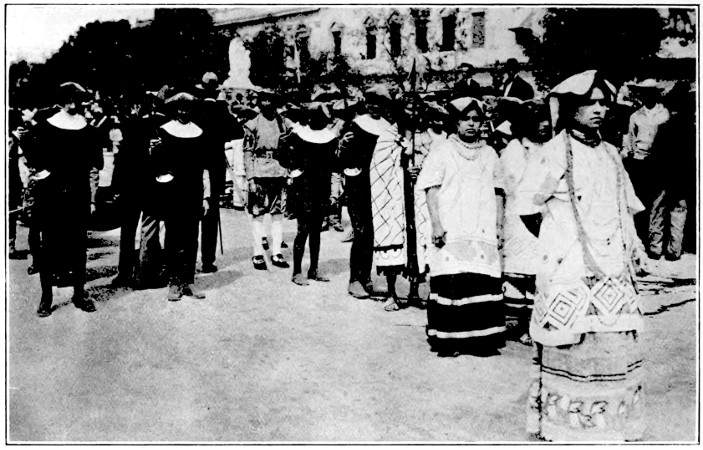
A PART OF THE HISTORICAL PARADE.
President and Mrs. Diaz extended magnificent hospitality to the visiting ambassadors and their families, the diplomatic corps and officials, with a banquet at the National Palace. It was a brilliant function. The distinguished guests were received in the red hall. This is the historical room of the Palace, filled with old paintings of the battlefields and portraits of Mexican heroes. After the banquet the guests attended a gala opera performance in honor of the President.
The national commission to entertain the visitors to the capital left nothing undone to make the people enjoy the great event, from the humblest of Indian peons to the representatives of the mightiest monarch. Thousands of working men were given employment during the preparations for the Centennial, and in[187] addition to the payment given them, each man was presented with a fitting suit of clothes for the occasion. It would not be unusual, if the poorer classes were neglected during festivities of this kind, to have some discord among them. With a forethought, born of a natural tact, all this was regulated and the poor were furnished with entertainments with such wisdom that there was not a ripple of discontent during the great parades.
Mexicans regard the national events of the past with great reverence and love and they enter into the spirit of hero worship whole-souled. They do not forget the trials and sacrifices of years; they won their right to be free and fought for their country, and having conquered their enemy, they can afford to be magnanimous. This was demonstrated by the kindly reception given the venerable Marquis de Polavieja, the special ambassador from the Court of Spain, who was received with great honors and given the greatest ovation ever accorded a foreign visitor, on his arrival at the port of Vera Cruz, where three hundred years ago, the envoys of the Spanish Crown came to wrest from the people their possessions and native land. All this has been forgotten and Spain with her great respect to the Mexican government sent her most distinguished noble to represent her. With him came a suite of royal personages bearing costly gifts and messages of goodwill from their sovereign. The uniform and portrait of José Maria Morelos, the intrepid hero of one hundred years ago, which was taken to Spain after the execution of the patriot, was returned to Mexico with all due solemnity and reverence and the Mexicans have a kindly appreciation of this delicate tribute.
Drawn through the streets upon a gun-wagon draped with the flag of the nation, for which the patriot died, in a glass covered case, so arranged that thousands could view it, the faded and blood stained uniform was borne amid muffled drums and strains of martial music to the National Palace, where the President of Mexico was waiting with his Cabinet and a large assemblage of distinguished people to receive the precious relic. It was a most impressive sight and brought tears to the eyes of the multitude that stood on the streets, with hats in hand, to see men of military distinction and high official life walking with slow step before the carriage that conveyed the sacred relic. Old warriors who had given their youth to the service of their country, men in the prime of life who were serving their country to the best of their ability, and youths full of the inspiration of patriotism, walked side by side with bared heads, while the soldiers and marines kept step with the solemn music.
[188]
This gift from a friendly country has cemented the cordial relations between Mexico and Spain.
In the Hall of Ambassadors, the splendid representative of Spain made the presentation in these few well chosen words:
“Mr. President—In the name of my august sovereign I have the high honor of delivering into the hands of your Excellency, that it may remain on Mexican territory, the portrait, the uniform, and other objects which were the property of General José Maria Morelos y Pavon, which, as belonging to a great general and citizen, my country kept with great care for a long time, guarding them jealously in its museum of artillery.
“His Majesty, King Alfonso XIII., wishes that your Excellency may see in this act, and with you all the noble Mexican people the most complete expression of the sincere satisfaction with which he and the Mother Spain associate themselves with your centenary of independence. You are to be praised for the greatness of your progress, and the rapid strides Mexico has made toward internal and international peace.
“To-day for this reason, the Mexican republic merits and possesses the respect, the esteem and the regard of all people. In her there shone, in past times, all the glories of the art of war, and now all the arts of peace, which have had brilliant development and expansion.
“May God continue to dispense to her his favors.
“These are the wishes of my King and the Mother Spain, proud of her daughter, whom she embraces, on this momentous occasion, with all the affection of her soul and with all the memories of her great labor as the discoverer, explorer and colonizer of the Americas.”
The President with much feeling thanked the monarch of Spain in the name of his people and expressed appreciation for the relic so highly prized.
At the conclusion of the ceremony the audience of brilliant men and women gave many “vivas” for the respective rulers and also for the venerable Marquis who had the honor of presenting the gift. The Grand collar of the Order of Carlos III. was conferred on General Diaz at another ceremony and a painting of Alfonso of Spain was unveiled.
A marble tablet erected on the front of the Artillery Arsenal in the Cuidadela in memory of the imprisonment of the patriot, José Maria Morelos, was unveiled by the Governor of the Federal District, Señor Don Guillermo de[189] Landa y Escandon. Little children from the schools, dressed in white, assisted the Governor in this ceremony by singing the national anthem. The oration of the day was delivered by a noted attorney, Licenciado Isidro Fabela.
The unveiling of the Monument of Independence, with orations from many distinguished men, was one of the principal events of this month. This was built to commemorate the National Independence. It is an impressive looking column, some parts made in Mexican marble, surmounted with a bronze winged female figure. The plaster casts of the allegorical figures were made by native sculptors and sent to Italy, where the castings were made. The four figures on the lower pedestal represent Law, Progress, Resistance and Force.
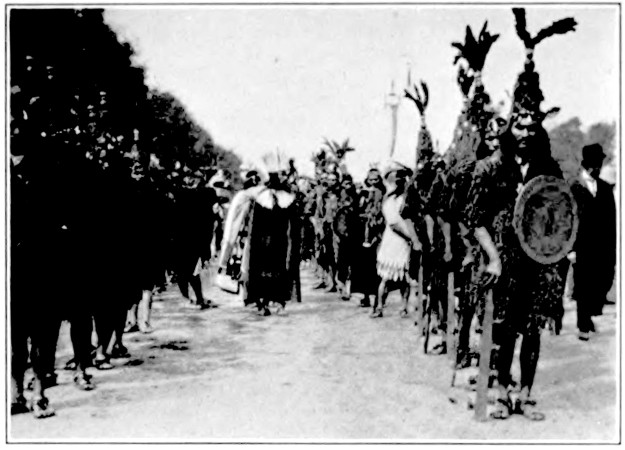
NOBLEMEN WITH ESCORTS IN THE HISTORICAL PARADE.
From the base rises a column, surrounding which are figures of the Heroes of the Independence. The central figure is of Hidalgo, and standing on each side are figures of Morelos and Guerrero. From this pedestal rises the shaft ten feet in diameter and sixty-seven feet high. It is the work of Antonio Rivas Mercado and was completed in 1910.
One of the most significant ceremonies during this month was the unveiling of the statue of Benito Juarez, first president of the republic after the empire. Before a brilliant concourse of distinguished Mexicans and ambassadors, and the surviving members of the Juarez family, the president, with tears streaming, drew aside the canvas that hid the most fitting monument ever built in Mexico. It is of Doric style, constructed from Italian marble, severe and magnificent, typical of the character of this great man. It is the work of the sculptor Lazaroni, after the design of Heredia, and seems to represent the true character of Juarez, whose intense patriotism and upright principles immortalized him. The sculpture represents Juarez between two allegorical figures of Glory and Mexico—these[190] figures are seven metres high and are most imposing. This monument is a recognition of the greatness of the reformer who did so much for Mexico in the closing years of his life.
Señor Ingeniero Ignacio de la Barre, in a well delivered address explained that the massive work of construction was completed in ten months, the workmen in a spirit of patriotism working day and night. On this occasion the American government presented an immense wreath of flowers which was borne to the foot of the statue on the strong shoulders of two most distinguished ambassadors, Honorable Curtis Guild and Honorable Henry Lane Wilson. This monument is most conspicuously placed in the Alameda, on the avenue which bears the name of the great patriot.
The site in Plaza Dinamarca upon which will stand the monument to Washington presented to Mexico by the resident citizens of the United States, was dedicated by General Diaz. The introductory address was made by Mr. C. R. Hudson and the oration delivered by Honorable Henry Lane Wilson, the resident American ambassador, was concluded in most brilliant language. This monument is now in construction, and is one of the many contributions in honor of the Centennial.
On September 14th, the statue of Baron Alexander Von Humboldt, the magnificent gift from the German Emperor to the republic was unveiled in the garden of the National Library. In the midst of glittering uniforms and decorations, with the German band discoursing strains of Tannhauser, the President and his suite arrived to hear the address of presentation by Ambassador Carl Buenz and his diplomatic staff. It was the most brilliantly garbed assemblage of people at any dedication during the celebration. The chief executive drew the cord which parted the curtains that hid the dignified statue of the man whose faith in Mexico had inspired his predictions of its great future. The marines and sailors of the man of war Freya made a great impression by their splendid bearing. A chorus of male voices, hidden in the recesses of the building, rendered selections of classical music. The oration of the German ambassador was delivered in an eloquent style. He said:
“Mr. President:
“Ladies and Gentlemen:
“This day belongs to the fraternal feeling between Mexicans and Germans. We find ourselves to-day under the emblem: ‘The German Emperor to the Mexican Nation.’ These are the words written on the base where has been[191] raised the monument which we are about to dedicate to the Mexican nation, as a permanent symbol of our friendship.
“Marble upon granite symbolizing the purity of our sentiments and the firmness of our friendship.
“His majesty, the Emperor, desiring of his own initiative to give to Mexico a visible and permanent sign of his sympathy, could find no better means to realize his intention effectively than by the erection, in the capital of the republic, of the statue of the great explorer of this country, Baron Alexander Humboldt.
“Over a century ago, a young German, animated by the enthusiasm of youth and the desire for scientific knowledge characteristic of our race, was inspired to explore the Latin lands across the seas.
“As a simple traveler, he will soon appear to our page as a hero of science penetrating the most recondite mysteries of the New World, despite innumerable dangers, cruel fatigues, almost insurmountable obstacles.
“The author of ‘Cosmos,’ his immortal work, belongs to the world, the illustrious man of science, to our nation, the author of Essay on New Spain, to Mexico.
“The European world heard with surprise the revelations of the beauty, the wealth, and the possibilities of a country in which he had become interested solely for its heroic history, for its past.
“With Alexander Humboldt, modern Mexico celebrated its apparition as an actual power, as a valiant member of the family of modern nations.
“The Mexican nation, always chivalrous, was quick to recognize the merits of the explorer of its territory and made him an honorary citizen. In this manner the son of Germany became the adopted child of the Mexican nation and Germany and Mexico became brother countries.
“It is for the fraternity thus effected that the German Emperor offers to the Mexican nation the statue of her native son, the adopted son of Mexico.
“And Mexico? What a marvel!
“Another Alexander Humboldt, native born of Mexico, came and by his intelligence, through his love for his country, the energy of his character and the weight of his hand when it became necessary, he formed a new Mexico, a state worthy of occupying a distinguished place in the community of civilized nations.
“It is for this reason, General, that to-day the representatives of civilized foreign nations participate in the celebration of the Centennial of the declaration of Mexico’s independence. It is for this reason that His August Majesty, the[192] Emperor, has sent me to express to Your Excellency, in the presence of the representatives of his army and his navy, his sincere sympathy for Your Excellency, his cordial desires for your welfare and for the prosperity of the Mexican nation, and it is for this reason, as a permanent symbol of this goodwill and love, that His Majesty furthered the plan of erecting in this, the capital city of the republic, the monument we are about to unveil.
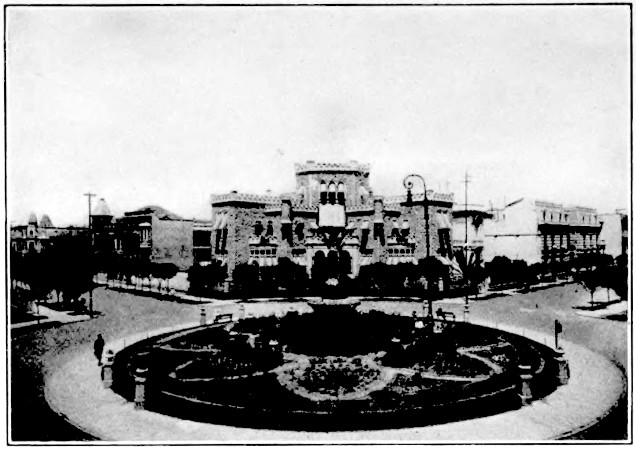
SITE OF THE WASHINGTON MONUMENT. PRESENTED BY THE AMERICAN COLONY.
“The erection of the monument in front of the National Library is significant of the universality in which all the differences of races, all the evolutions are resolved; of the universality of science, of the harmony of ultimate ideas, of the chief ends of mankind. It is with this idea, Mr. President, that I to-day have the honor of delivering in the name of the Emperor, to Your Excellency as the representative of the nation, the statue of Alexander Humboldt, sole honorary citizen of this republic. That this monument be a ‘monumentum sere perennius’ of the friendship which happily binds our nations and our governments, a witness, dumb, but eloquent, of the continuous progress of this country towards the goal of its destinies.”
After a selection from Mendelssohn, the response for the president was delivered by the brilliant governor of the Federal District, Honorable Guillermo de Landa y Escandon. It was an entire day of festivity. Lunches and dinners were given at the German Club and theatrical performances in honor of the Germans in all parts of the city. The cadets and officers from the warship were given the freedom of the town.
Many other statues were dedicated and unveiled, among them monuments in honor of Garibaldi and Pasteur.
In the Monumental Tribune at Chapultepec the president and his cabinet, the foreign ambassadors and ladies and gentlemen of Mexican society witnessed[193] the ceremony of the dedication of the ground for the statue of Queen Isabel, the Catholic, which was presented by the Spanish Colony.
All honor was paid to the cadets who fell in the battle of Molino del Rey, on whose monument were placed wreaths of flowers.
Not a day passed during this great Centennial without some wonderful form of entertainment. The Civic parade which took place September 14th, was one in which all classes of society participated. Over ten thousand people marched in this procession, amid waving banners. It was headed by all the officials of the government, and took in every labor organization and employees of the government. The president reviewed it from the balcony of the National Palace.
On September 15th, the most unique pageant known in history took place. It was the historical parade which comprised every character of Mexico’s history. It was a drama enacted before the president with the oldest site of Mexico City, the Plaza de la Constitucion, as its stage. The actors numbered over twelve thousand and many came from parts of the republic in which the event they were to depict was originally enacted. All the magnificence of the Emperor Montezuma as he went forth to greet Hernán Cortés was faithfully represented in costumes of their times and races. The following is a translation from the Mexican Daily Record, of the programme furnished by the members of the National Commission, to whom all honor should be given for this stupendous success:
The troops of Cortés, composed of four hundred Spaniards and seven thousand Indian allies, passed the night in the town of Amecameca, in the valley formed by the “Montaña que Numea,” (mountain that smokes), on the 5th of November, 1519. The following day they continued their journey toward the great Tenochtitlan, the proud Lady of the Lakes; passed by Tlalmanalco and held to stop in Aytezinge, a village near Chalce. On rising the next day to continue the journey, Cacama, the king of Tezcoco called the Spanish conqueror and presented him with rich gifts in the name of Montezuma.
The march continued, and on that day, November 6th, they arrived at Ixtapalapan where they were received by Cuitlahuac, brother of the emperor of Mexico, where they were comfortably lodged.
[194]
Very early on the 7th, the journey was resumed; it is said that Cortés appeared somewhat distrustful and for that reason he formed his troops in line of battle. The flags were unfurled and the drums made a tremendous noise to terrorize the Indians.
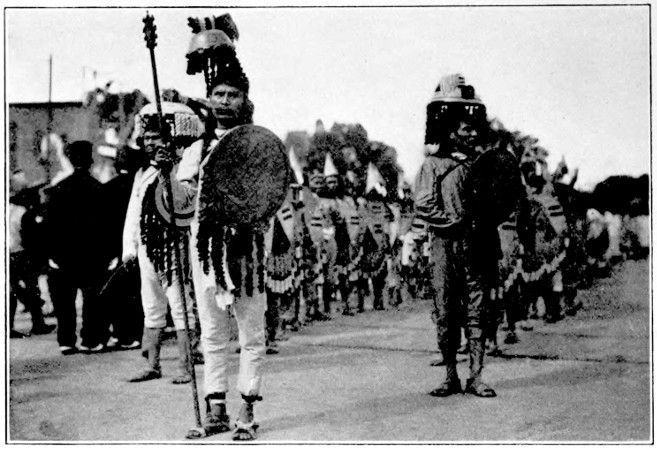
MONTEZUMA’S ARMY IN MILITARY PARADE.
Great was the excitement in the hearts of the Spaniards at the sight of the panoramic view of the city, where numberless temples rose to view majestically over the crystal lakes. The exuberant vegetation and luxuriousness, the gifts or presents consisting of gold, precious stones, rich plumage, and so varied vegetable products, all must have caused a great impression on the minds of these men of insatiable thirst for adventure.
Emperor Montezuma prepared himself to meet the conqueror. Two brothers accompanied the emperor and also the lords of Tezcoac, Ixtapalapan and Coyoacan, the king of Tlacopan, the treasurer of Montezuma, Tlacatecat, the captain general and other great personages.
[195]
Four of these men conducted the emperor in a luxurious palanquin, with shafts of polished gold and showy blankets, under a pallium or canopy of woven feathers. Preceding the monarch a group of ministers with gold rods in their hands marched heralding the approach of the emperor, and the party was completed by the members of the council, the priests, the captains in front of their warriors and their servants.
Cortés arrived preceded by a cavalry guard, he mounted his white horse, Molinere. The vanguard was composed of drummers and buglers and the companies of arcabuceros and ballesteros. At the rear was a platoon of Tlaxcalteca warriors, allies of the emperor. Cortés was surrounded by his captains, Pedro de Alvarado, Juan Velasquez de Leon, Gonzalo de Sandoval, Alonso de Avila, Francisco de Luga, Diego de Ordaz and the distinguished soldier, Bernal Diaz de Castillo.
When Montezuma and Cortés finally met, the former alighted from the palanquin and advanced to receive the latter upon several rugs which the servants placed upon the floor before the emperor so that he need not step upon the ground, all the great lords and members of the cortége remaining with their heads bowed, so as not to see the face of the monarch. Four great lords covered him with the pallium when he approached the conqueror.
Cortés dismounted and advanced to greet Montezuma, making two bows or reverences. Montezuma responded by placing his hands near the ground and then to his lips. The conqueror intended to embrace the monarch, but the great lords advised him that the emperor was a divinity who could not be touched. He placed on the neck of Montezuma a collar of stones of marcasite glass in gold thread and scented with musk. Montezuma surrounded the neck of Cortés with a rich collar set with stones and a string of roses. He then ordered his party to offer his presents to Cortés and the latter received flowers and birds of beautiful plumage.
The priests passed swinging their censors and the procession continued in the aforesaid order.
The first group, which consisted of eight hundred and thirty-nine persons, commenced its march from the Plaza de la Reforma, following up Avenidas[196] Juarez and San Francisco. When they reached the corner of Empadredillo, Montezuma and his party passed in front of the portales, and Cortés and his party to the front of the Cathedral, in order that the meeting of the two would take place under the central balcony of the National Palace. The order of the procession was as follows:
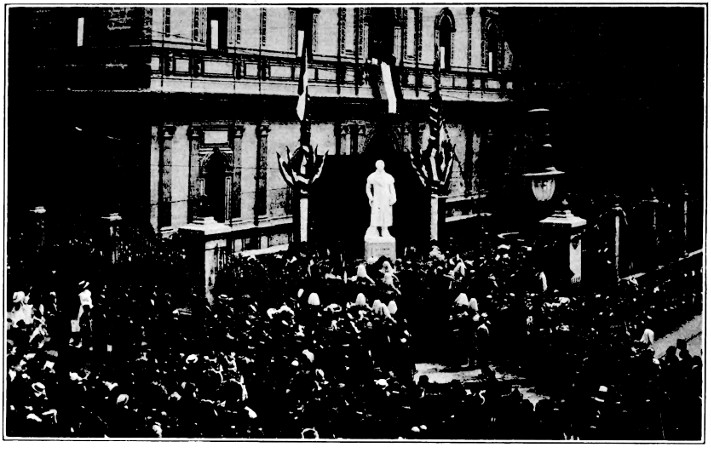
UNVEILING OF THE HUMBOLDT STATUE. PRESENTED TO MEXICO BY EMPEROR WILLIAM.
1. Nineteen Mexican warriors with banners.
2. Grand captain escorted by eight warriors with badge of noble distinction.
3. Fifty Mexican warriors.
4. Thirty-eight priests.
5. Lords of Tezcoco, Ixtapalapan, Coyoacan and Tlacopan accompanied by twenty Knights of the Sun.
6. Fifteen noblemen, or great lords.
7. Twenty Indian women escorted by six warriors with fixed banners and two Tiger Knights.
[197]
8. Servants carrying tapestries and rugs or blankets to place them on the ground when the emperor alights from his palanquin.
9. Ten ministers with gold rods in their hands.
10. Emperor Montezuma in his palanquin, conducted by four great lords. Another four noblemen carry large fans, fifty more great lords surround the emperor.
11. Group of warriors, priests, who escort the emperor.
12. The procession is closed by seventy-two Mexican warriors with their respective chiefs.
1. A guard of six soldiers, carabiniers on horseback and twenty on foot.
2. Drummers and buglers.
3. Ballesteros.
4. Hernán Cortés, accompanied by Doña Marina (Malintzin) and his distinguished captains.
5. Priests and servants of Cortés.
6. Archers.
7. Tlaxcalteca warriors allied to Cortés, in the following order:
The second group represents the epoch of Spanish dominion in Mexico, in the procession of the banner.
To commemorate the 13th day of August, the anniversary of the conquest, the procession used to be organized in the following order:
Preceded by the drummers, buglers and the several foot ushers, the cabalgada marched from the church of San Hipolito to the municipal palace, the procession being formed by the councilmen, the mayor, the first constable, one honorary colonel and lieutenant-colonel of Spanish infantry, the members of the council of his majesty, the members of the audiencia. In a prominent place was the alferez or chief ensign of the town. The rear of the group was a military[198] force and the principal Indians of Santiago and Tlaltelolco, walking on foot with their typical square blankets, wide trousers, a cape and sandals. As a rule these Indians were the governor, the mayor, the judge and first constables of the aforesaid places. On reaching the municipal palace, the alferez real would take the banner which was placed upon a scarlet pillow under the main balcony, and before a notary he would pledge abject submission and return it to the place whence it came.
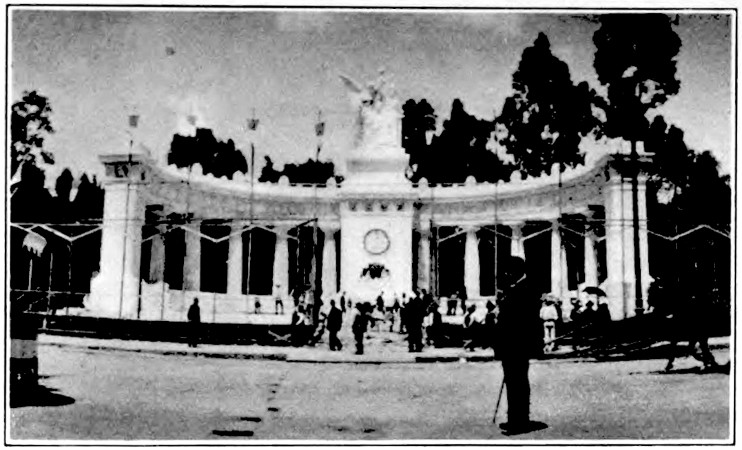
THE JUAREZ MONUMENT.
The procession again formed, the royal alferez proceeded on the march through the streets of Tlapalros, Refugio, Puente del Espiritu Santo, San Angel, San Augustin, Portacoeli and Flamences to the main entrance of the viceroy’s palace. The viceroy would come down and join the procession, surrounded by the high dignitaries of the palace, the alferez real to his left and to his right the oldest judge of the supreme court. The cavalcade would take the streets of El Reloj, Encarnacion, and Santo Domingo, to arrive at the platform erected in front of the palace, on which four maidens and four knights were waiting. Once on the tribune, the alferez would deliver to the viceroy the banner to be raised above his head. This ceremony was patronized by the provincials of Santo Domingo and San Francisco. When the ceremony ended, the viceroy entered the palace with his party and the alferez, with his party, returned to the ayuntamiento to leave there the banner, the whole procession then being dispersed.
This group consisted of two hundred and eighty-eight persons and marched in the order indicated. At the main balcony of the municipal palace the royal ensign was placed, which is of crimson damask with the royal emblem embroidered in gold, trimmed with a flounce of gold, cords and silk tassels. The royal emblem is surrounded by the following inscription:
“Non in multitudine Exercitus Consistit sed in Voluntate Dei.”
[199]
When the royal alferez returns to the municipal palace to deposit the banner he leaves it in the hall of sessions of the ayuntamiento.
Facing the National Palace, a platform with curtains was erected for the ceremony of raising the pennon or royal standard.
The third group represented the era of independence and the present time, as follows:
1. Glorification of Generalisimo Miguel Hidalgo. Allegorical float of the Independence, offered by the government of the State of Hidalgo.
2. Float in honor of the insurgent Generalisimo José Maria Morelos y Pavon, by the government of the State of Michoacan.
3. Representation of the entry of the army of the Three Guarantees into the City of Mexico, under the command of Augustin de Iturbide, accompanied by Generals Vicente Guerrero, Manuel Mier y Teran, Guadalupe Victoria and Anastasio Bustamante, leading some sections of the regiments who formed the Trigarante Army, among others the following:
Imperial grenadiers. Regiment of the Crown. Regiments of Celaya, Tres Villas, Guadalajara, Light of Querétaro, Light of Morelos, Stationary of Puebla, Mexico and Valladolid. Regiments of Santo Domingo of Ferdinand VII. Dragoons of Mexico. Dragoons of the King. Dragoons of Santander. Faithful of the Potosi, Sierra Gorda and San Fernando. Regiments from Puebla and Mexico.
This being the eve of the great day of Independence, as well as the celebration of the eightieth birthday of General Diaz made it one of the most brilliant days of entertainment during the Centennial. Congratulations poured from all parts of the world to greet the Chief Executive on the occasion of his birthday and a galaxy of men and women at the National Palace furnished a scene never to be forgotten. True to the yearly custom of the past century, as the hour arrived when the ringing of the Bell of Liberty incited outbursts of enthusiasm, the masses gathered beneath the balcony of the National Palace, the president stepped out into the night and pronounced the Grito de Dolores, “Long live our most holy Mother of Guadalupe: Long live America, and death to bad government.” The peals of this great relic of the past sounded like the silvery voice of Hidalgo embalmed in metal.
[200]
On September 16th, the great review of the army of the republic took place. On this occasion the foreign delegates had the opportunity of viewing the army of Mexico in all its glory.
A splendid official reception given by Governor de Landa y Escandon in the new Municipal Palace brought together a concourse of distinguished men and women. This was one of the great social events.
One of the most magnificent spectacles that occurred during this gala Centennial was the ball given by President Diaz and Madame Carmen Romero de Diaz, the Diplomatic Corps and Mexican society. The large patio of the National Palace was a fairyland with myriads of lights and flowers, and in no part of the world could there be a more wonderful display. It was an honor to the nation. Mexico may justly be proud of the display at this function, she may well be proud of her beautiful women who in their magnificent toilettes and jewels carried themselves with such dignity. A special ambassador of one of the Courts of Europe remarked that he had never seen among crowned heads a woman who bore her dignity with such grace and beauty as Madame Diaz. Over ten thousand guests assisted at this beautiful ball.
During the brilliancy of the fiestas, the nation’s dead heroes were not forgotten. The urns containing the remains and relics of Mexico’s patriots were transferred from the Cathedral to the National Palace, and a most touching apotheosis was held in their honor.
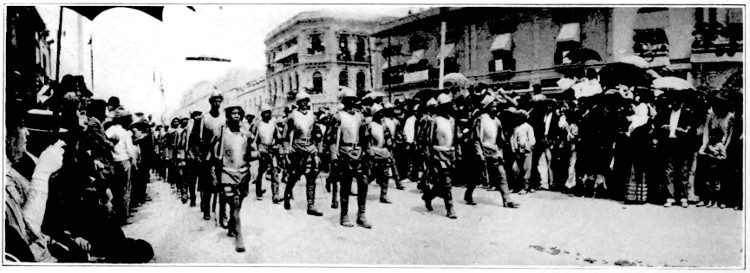
THE ARMY OF CORTÉS IN PARADE.
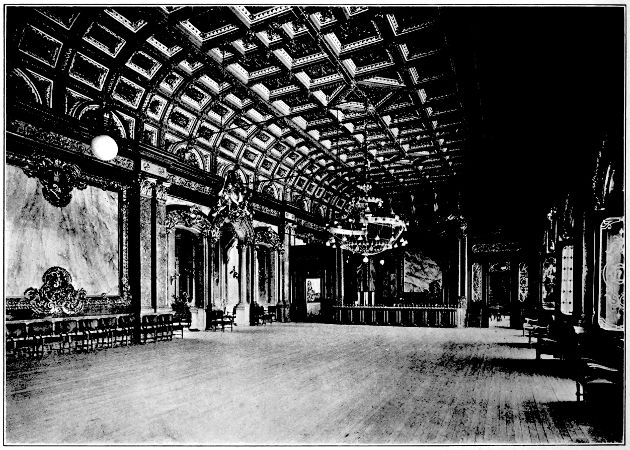
RECEPTION HALL OF THE SPANISH CASINO.
[203]
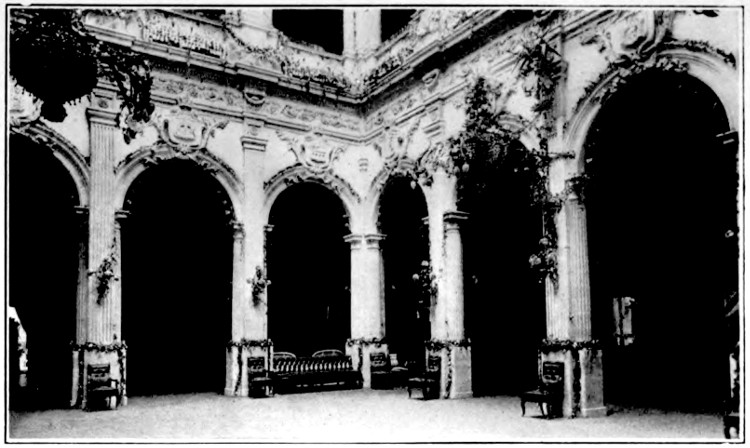
PATIO OF THE SPANISH CASINO.
Mexico, with majestic and snow-capped mountains, opens to the view of the traveller who has hitherto followed the beaten paths a rich mine of unexpected delight. A wonderful country where nature has been so lavish that she causes to grow upon its surface a vegetation so varied that it includes every plant of tropical lands, together with the sturdy firs of the farthest north. Some strange magic seems to hold one within its gates: the dreamy poetic strain of old Spain whose traditions still tinge the country with the romance of the Cid, Manriques lays and the last of the Moors. Echoes of the Alhambra still linger in the graceful Moorish arches of the public buildings, while the gardens of King Boabdil live again in the beautiful alamedas with their stately trees, luxuriant vegetation, gorgeous flowers, graceful monuments and cool and shady walks. In every city of any size is the alameda, a meeting place for the people. The one in Mexico is especially artistic in arrangement by the profusion and beauty of its flowers. Side by side with the pushing needs of civilization and[204] progress are to be seen evidence of the artist’s instinct, which finds expression in splendid forms of architecture, not of the solid unsightly blocks of stone which so disfigure our large American cities. The progress of Mexico has been wonderful in the last fifteen years.
The social distinction of the city is prominently marked by its magnificent clubs. The principal of these is the Jockey Club, whose sumptuous home is in “The House of Tiles,” on San Francisco Street. The building is one of the finest in the capital; it was built early in the eighteenth century and was formerly the palace of the Conde del Valle de Orizaba. Its massive form in Moorish style and Venetian ornamentation gives it a character wholly individual and irresistibly attractive. The façade is entirely finished with white and blue tiles, hence the familiar name of the building. The building is entered by a richly carved portal of massive proportions; the great doors of cedar are ornamented with unique copper ornaments. As the great patios are reached their ample stretch suggests that one is in the precincts of a vast deserted Andalusian palace. In the court-way stands a memorial of the days of the founder of the palace, a fountain of marvellous beauty, delicately and gracefully chiseled in the best style of that day.
The first floor is carried on richly decorated cylindrical columns. At the left is the library, an exquisitely adorned apartment with every appointment that luxury can suggest for such a room and a special literature befitting the establishment, complete in every respect.
As little change as possible has been made in the structural character of the old Count’s palace. On the grand stairway, the great lamp with its alabaster globes casts its soft light on the old walls, just as it did when the assassin struck down the original owner. Splendid Venetian mirrors reflect the beauties of decoration and deep set windows of octagonal shape with their oddly designed panes of richly stained glass serve to add decorative strength and to heighten the effect of the curious ceiling tiled with alternate rows of porcelain and cedar.
The corridor on the main floor is also a masterpiece of tile work, like the façade, in white and blue. A striking feature of this corridor is the railing of tumbago, a bronze composite brought by Spain’s galleons from China, which is splendidly wrought and is of great value. Of the same metal are the club’s balconies facing San Francisco Street and Callejon Condesa. In the main floor corridor and on the landing of the grand staircase still remain the graved coat-of-arms of Del Valle, and everywhere white and blue tiles, costly as silver, and unmarred[205] by the touch of centuries; a bit of old time splendor preciously cherished both as being old and as reminders of the high proficiency of the art of earlier days.
On the main floor is the little-changed chapel of the Conde del Valle which was once the depository of the sacred relics and art treasures of his family, but is now devoted to games of tresillo. Here still is the richly carved quaint cedar portal and the fine sculptured arch of the former oratory.
The history of the famous club begins with 1881, and its founding is due to the late General Pedro Rincon Gallardo and Señor Francisco Somera, who obtained the co-operation of the municipal council. On June 8, 1881, the first president, Señor Somera, was elected. The second was Señor Manuel Romero Rubio. At his death in 1895, General Gallardo succeeded. Señor Yves Limantour is now the president and Señor Sebastian Camacho, the vice-president.
The club membership is extremely exclusive; there are but a few foreign members and introductions are very limited.
The University Club is most comfortably housed in Calle Bucareli. Occasional introductions are permitted by members, and entertainment is accorded as guests to visiting university men on the request of members.
The Country Club is near Tacubaya, in one of the finest club buildings in America, being of Spanish mission style. Its hospitality is generously extended to non-residents of the Federal district. Visitors may be introduced in person, and two weeks’ privileges are granted on request of members. It has a splendid tennis court and a fine golf link. The dining room is finished in Old Flemish. This is the favorite meeting place of distinguished Americans.
The home of the British Club in San Francisco Street is handsomely appointed, and in great favor. The membership is, of course, chiefly British, with a few colonists from other places and a sprinkling of Mexicans. Visitors are entertained for two weeks on request of members.
The French Clubs, the Cercle François and the University Club, are both noted for their attractions.
The American Club on Calle Independencia is the chief social foyer of the leading American residents in the capital. The provision made for accommodation of members and guests, though extensive, is often taxed to its capacity. The privilege of guests of the Club is accorded on request to members for the accommodation of their visiting friends.
The German Club has a fine new building and a splendid gymnasium.
[206]
The Casino Espanol Club is domiciled in a mansion, and has a membership of eight hundred. This Club is famous for its magnificent balls. During the Centennial it gave many fiestas of note. Señor Sanchez y Ramos, a son-in-law of Benito Juarez, is the distinguished president.
The Diplomatic Corps, which is quite large, is an important element in the social life of the Capital, and is composed of many distinguished representatives. The Spanish, the French and the Japanese are among the best entertainers. The British government is represented by His Excellency, the Honorable Reginald T. Tower. Soon after his arrival in Mexico, he presented General Diaz with the Grand Cross of the Bath, which was conferred on the President by His Majesty, King Edward.
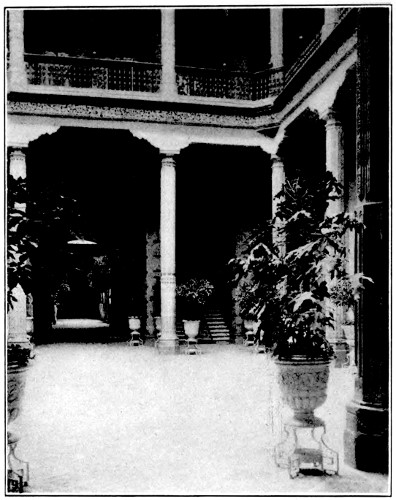
HISTORICAL STAIRWAY OF JOCKEY CLUB.
The American Colony in the City of Mexico is composed of many distinguished representatives. Their social life, while in a measure confined to themselves, is delightful. The American Ambassador, Honorable Henry Lane Wilson, and his charming wife have endeared themselves to everyone. Honorable Arnold Shanklin is the United States Consul General. He is a popular favorite and has won many friends and admirers in Mexico.
The Christmas customs of Mexico are uncommonly pretty and touching. The Christmas-tree is not a native institution, though it gives indications of becoming naturalized. In its stead the Mexican children have what they call[207] a pinata, which affords them just as much fun. The pinata is a large earthenware jar, which is covered with colored tissue-paper. This jar is filled with all sorts of dainties dear to children and is hung up in the corridor or courtyard of the house. Each of the children is blind-folded in turn, and, after being turned around once or twice, has a stick placed in his or her hand and is invited to break the pinata. The wielder of the stick is generally, after being turned around, quite out of his bearings, and often brings down it within an inch of the head of one of the party. He is allowed three trials, and if not successful the handkerchief is removed and another takes his turn. At length a crash is heard—some one has made a true hit—the pinata is broken and the good things fall in a shower to the ground.
The posadas are a characteristically Mexican celebration. They commemorate the journey of Mary and Joseph from Nazareth to Bethlehem. This journey, performed by Mary mounted on an ass, which Joseph guided, is supposed to have occupied nine days. Each evening they naturally approached some dwelling to beg a night’s shelter. It is this nightly episode that is commemorated in Mexican houses by the posadas, or the begging of the posada (pedir posada), meaning shelter, lodging, or entertainment. In the patriarchal days of the viceroys the posada was a strictly religious custom, and in a few old-fashioned families it is so still. The ninth night of the posadas—that is, Christmas Eve—is celebrated on the most extensive and luxurious scale of all, and generally the wealthiest of the families that have clubbed together gives the entertainment. In memory of the night when the Saviour was born, the figure of an infant is carried in procession, and is placed in a manger between the ox and the ass in a prettily adorned cave, which is intended to represent the stable where Mary and Joseph took refuge when they found that there was no room for them in the inns.
The feast day celebrated by the Catholic Church on November 1st, is called All Saints’, and ranks as one of the most solemn of the year. It was instituted at an early period in the history of the Church as a means of doing honor to the many saints to whom it was impossible to assign a separate feast. The feast which follows on November 2d, is popularly known as All Souls’, and is the day for the commemoration of the faithful departed. On this day masses are said and special prayers offered by Catholics for the release of souls from purgatory. The priests wear black vestments, and in some of the churches a huge catafalque is erected in the centre of the nave.
[208]
The origin of the feast of All Souls’ dates back to the year 827 A.D., when Amalario, the Deacon of Metz, published the office for the dead, but it was not until 998 A.D., that St. Odillon, abbot of Cluny, instituted in his churches this feast in commemoration of the faithful deceased. This feast soon prevailed in the Catholic Church. It took a rather wider range in France in the eighteenth century, when the laborers began to dedicate gratuitous work, for the benefit of the poor of All Souls’ day, and offered to the Church wheat, which, according to the Pauline designation, is the symbol of resurrection.
The idea of these November feasts is not original with Mexico; it has found root in nearly every religion.
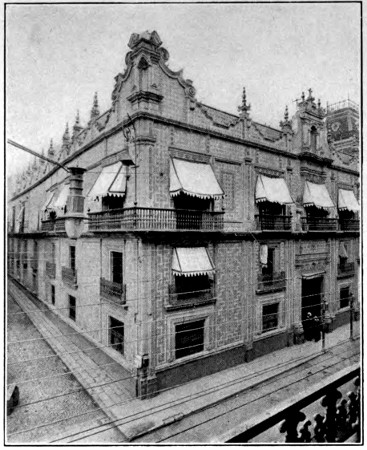
THE JOCKEY CLUB.
The feasts of All Saints’ and All Souls’ although not celebrated with the éclat of former years, are still very interesting in certain portions of the republic, especially along the Gulf coast. There the Indians are in the habit of placing upon the graves dulces, or sweetmeats, prepared with chilacayote and calabazas. The Indians place these dulces with large jars of water upon the tombs of their deceased relatives and friends during the afternoon of November 1st, so that the dead—that night at least—can have something to eat and drink. This latter arrangement is similar to some of the customs of Germany and Central Europe.
The “ofrenda,” or offering, is, singular to say, of Aztec origin. The Aztecs were in the habit of cremating their dead; and they kept the ashes in an urn with fragments of precious metals, emeralds, etc., also putting in food and catlis, together with bows and arrows and a quantity of a great golden-hearted flower called the zempoalzoichitl, which can be found growing in Mexico profusely at[209] this day. This flower is used to decorate the sepulchres in company with white roses, the ruby “flor de noche buena,” and velvety forget-me-nots, as well as violets, geraniums, and marguerites. In the country districts the ofrenda is much more elaborate than in the city. Candles are also used by thousands in the little panteons or cemeteries of the country. Among the simple folk in these Indian villages the local poets write up more or less readable “poetry,” which is also included in the offering to the dead. In some isolated portions of Mexico this custom prevails to such an extent that the children beg money from their parents to buy fruit for that purpose, or else, they say, the departed will come on Halloween and pull their little feet. It is impossible to give an idea of all the curious customs and incidents that prevail in the rural districts of Mexico with respect to the observance of these holidays. Halloween in Mexico does not partake of the mischievous and jocose character of the day in the United States and England.
Among the characteristic sights of these days peculiar to Mexico are the strange toys sold on the streets and in stalls. They consist of skull and crossbones of sugar adorned with gold leaf, lath coffins surrounded with priests and acolytes and containing a skeleton, miniature catafalques, altars, etc. Many of the coffins are so arranged that by pulling a string the lid opens and the dead man sits up. No Mexican child is content without one of these toys. The mozos and domestic servants also look at this time for their festival, to which they give the name of calavera (skull). It is a carnival of death; a mingling of levity with sadness.
It is the custom to visit on All Souls’ day the graves of relatives and friends, to place wreaths and candles round about, and to offer prayers. Any one of Mexico’s cemeteries offers an interesting scene on that day. The French cemetery, where many of Mexico’s wealthiest families have their vaults, is one mass of beautiful wreaths. The tomb of Juarez, in the San Fernando cemetery, receives many mementoes from admirers of the great Liberal statesman. The cemetery of Tepeyac, near Guadalupe, where lie the remains of Santa Anna and members of many of Mexico’s first families, is visited by a throng of devout mourners bearing costly wreaths. The abundance of trees which darkens the English cemetery even at mid-day makes it eminently harmonious with the tendency to sober meditation. This cemetery contains the tombs of the first Englishmen, almost the first foreigners, that ever came to this country, away[210] back in the twenties. The American cemetery is near the English. There is a monument to the American soldiers who perished in the Valley of Mexico in 1847. This receives its floral offerings on Decoration Day. But if the tourist or resident wishes to see a characteristically Mexican celebration of All Souls’, he should go to the great Dolores cemetery. Except on very few tombs, he will find no French creations in the way of wreaths, but an abundance of flowers.

SEÑOR DON SEBASTAIN CAMACHO, VICE-PRESIDENT OF THE JOCKEY CLUB.
Out beyond the southwestern limits of the city, on the boundary line formed by what is known as the Calzada de la Verónica, is the little patch of ground which possesses such peculiar interest for Americans, and especially for those who reside in Mexico. Though on Mexican soil, it is American in the fullest sense of the word, for the full and perfect title therein is vested in the United States, and its management and control are in the hands of the War Department at Washington. Mexico is the only country on earth where the United States possesses a title to land for such purposes, and exercises authority over foreign soil. It was in 1873 that the cemetery was subjected to the rules and regulations affecting United States national cemeteries. It was established in 1851, under an act of Congress approved September 28, 1850.
The seven hundred and fifty soldiers who were killed on the plains of Mexico are buried together in a single grave. In memory of these, a simple granite shaft about six feet high has been raised.
To obtain the right to bury there it is necessary to secure a permit from the United States consul-general, the permit being a voucher for the citizenship of[211] the deceased. In addition to this, another permit has to be obtained from the civil authorities, which is a mere formality, as Americans, living or dead, have always received magnanimous treatment and the kindest consideration from district authorities as well as from those of the general government. No graves are sold, and the selection of the last resting place lies with the superintendent. No charge is made and no expense incurred. The United States government pays the employees and superintendent out of the annual appropriation and the friends of the deceased are at liberty to express affection by the adornment of the graves with monuments and flowers.
The funeral customs of Mexico are a source of constant interest to strangers in that land, as the burial of the dead is a ceremony of great display. The poor rent handsome coffins, which they have not the means to buy, and transfer the body from its temporary casket to a cheap box before it is laid in the grave. Invitations are issued by messenger, and advertisements of funerals are published in the newspapers or posted at the street corners, like those of a bull-fight or a play. Announcements in faultless Spanish are sent to friends in big black-bordered envelopes, and are usually decorated with a picture of a tomb.
There is a very pretty custom in Mexico by which all people who call upon a mourning family must dress in deep black. This is but one of the many pleasant ways the Mexicans have of paying honor to the memory of their beloved dead.
During the month of November, in every village of Spain and her former colonies, the traditional legend of Don Juan Tenorio, dramatized by Don José Zorrilla, is put on the stage. The sentimentality of this piece seems to have an irresistible fascination for Spanish taste. It is impossible to understand the Spanish character without having read or heard of this extraordinary play. It has been said that every youth of Spanish descent would be a Don Juan, and every Spanish maiden a Doña Ines. The exploits of Juan in a more prosaic age and country would inevitably have qualified him for the gallows. The drama of Don Juan is now, however, color azul and is not attended by the beau monde.
The Indians observe a fiesta on the 21st of August in memory of the tortures to which Cuauhtemoc and his cousin Tlacopan, Prince of Tezcoco, were subjected by Cortés, who endeavored to force from Cuauhtemoc the secret of the hidden treasure. The monument dedicated to Cuauhtemoc on the Paseo has a relief representing Cuauhtemoc and Tlacopan standing upon stone slabs, with their feet hanging over flames of fire. Around the tortured warriors are clustered the[212] Spaniards, anxiously awaiting the secret which Cuauhtemoc never disclosed. “Do not be weary,” he said to his tormentors; “he who has resisted famine, death, and the wrath of the gods is not capable of humiliating himself now like a weak woman; the treasury of the kings of Mexico I submerged in the lake four days before the siege of the city, and you will never find it.”
One of the Easter customs is the hanging in effigy of Judas Iscariot, which is done everywhere in the country, from the plazas of the large cities down to the smallest hamlet. The Catholic citizens attire themselves in deep mourning throughout all of Holy Week, and on Saturday grotesque figures of him who betrayed his Lord are brought out everywhere and hanged. After this they are burned with all the contempt due to the betrayer of his Master.
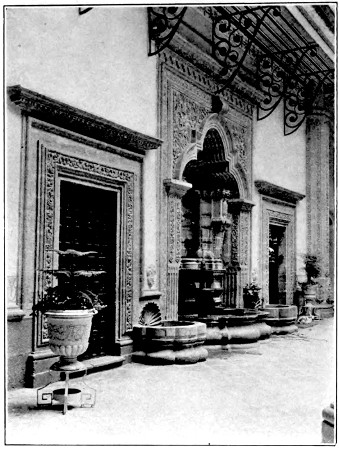
FOUNTAIN IN THE PATIO OF THE JOCKEY CLUB.
Mexican women of the better class are noted for their beauty; and everywhere the young girls are exquisitely pretty. The slender oval of the face, the rich olive of the cheek, the long, sweeping, dark lashes over superb eyes, glowing at once with passion and tenderness, the low forehead with its rippling mass of dusky hair, the slender neck, the lithe form, the springing step, and the dainty foot make them like a poet’s dream of darkly brilliant loveliness, and not to be measured by any other type in the world.
Among the upper classes of Mexico will be found as high a degree of social and intellectual refinement as exists in Paris; as quick a reception and as cordial[213] a knowledge of the arts and literature as people of the busy cities of the United States have acquired. Their wealth is lavishly displayed; their taste is exercised to a degree equal to that of any other people in the world; and the interior of many of their dwellings furnishes a glimpse of happiness and cultured elegance that, with their less active temperament, they enjoy more than do their northern neighbors. Yet these people, who receive the latest Paris fashions and literature by every steamer, still cling to some ancient customs. Social law restricts intercourse between the sexes, as in the Latin nations of Europe. The people are noted for their good manners, their politeness, and their courtesy to strangers. They make excellent hosts, and they throw their houses open to their guests with the most hearty generosity.
Such are some of the aspects of life in Mexico. Wander forth in the morning almost any day in the year and you will find the blue sky a free expanse above, with the foliage lazily swaying against it; birds—yellow, or black with orange and crimson spots—singing or chattering in wild freedom. There is a glimpse of water, into which the sun drops beams through the foliage. Plants and trees of all sorts break the scene into fascinating patterns. Flowers in bloom beautify and scent the dream.
Or it is evening, and electric lights cast a half shadow silent as a tomb: the trees and flowers and birds sleep, a mysterious quiet and suggestion of luxuriant foliage that appeals to one in a certain mood; but all is gay about. Then the old moon swings up from behind the ragged wall, between the heavy arches of trees, and the scene that you thought perfect is enhanced. The moon grows bigger and the scene lighter, and this, you remember, is but one day in beautiful Mexico.
Everywhere the people are cheerful and simple in their ways of living. They all attend church, and are devotional in habit. Doubtless more prayers are said in Mexico in a single day than in all the United States together; and yet some people in the latter country want to send missionaries to Mexico!
In several different places including Guanajuato, Mexico has a display of comparatively modern mummies and catacombs. The practice prevails, as in some European cities, of renting tomb space for the use of a corpse. In Mexico, if at the expiration of the original term there is no renewal of the lease, the corpse is dumped into an extensive underground chamber. If in the dry air the evicted mummifies, he stands against the wall; if he tumbles to pieces, his bones join[214] the vast miscellaneous heap. The Guanajuato catacomb is ghastly enough to satisfy the most exacting connoisseur of the gruesome and bloodthirsty. In some of the mummies which have recently been examined jade teeth have been found, which is thought to be a proof that the Aztec princes used to be supplied by their dentists with handsome jade teeth whenever their own pearly ones failed.
Then there are street scenes of a strange and foreign aspect, such as black street car hearses. There are also curious street signs, rude but vigorous and highly colored pictures depicting scenes suggestive of the business conducted within, and in appropriate names in staring letters as trade-marks, so to speak, of the different stores. Imagine, for instance, “The Last Days of Pompeii” as a business sign, of “The Sacred Heart of Jesus,” which is the name of a score of establishments, and names of streets—“Crown of Thorns Street,” “Fifth of May Street,” “Holy Ghost Street,” “Blood of Christ Street,” “Body of Christ Street,” “Mother of Sorrows Street,” “Street of the Sacred Heart,” “The Heart of Jesus Street,” “Street of the Love of God,” “Jesus Street,” and “John the Baptist Street.”
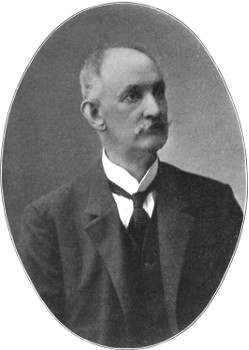
SEÑOR JOSÉ SANCHEZ RAMOS, PRESIDENT OF THE SPANISH CASINO.
Other governments might well take pattern from the Mexican parliament. No other government in the world has one like it in point of courtesy and dignity.[215] The Mexican legislature holds its sessions in the evenings. The seats of the members are arranged in semicircular rows, and the presiding officer and officials of the house sit upon a large dais, or platform. At each side of the platform is a sort of pulpit, from which very formal addresses are delivered; but unpretentious discussions taking a conversational and unimpassioned form are conducted on the floor of the chamber. The orchestra and the galleries are divided into boxes, which are reserved for spectators; but it is only a rare occasion that brings outsiders to listen to the deliberations of their lawmakers. There is much etiquette in the parliament: members appear in evening dress; there is no confusion; there is seldom any rude or improper language like that which so often disgraces other deliberative assemblies. Speakers are courteous, even-tempered, and apparently conscious of the dignity of their position. Extreme dignity and decorum mark the proceedings, which are always short and practical. The legislature meets twice in each year, in the spring and in the fall. The House of Representatives has one member for every forty thousand inhabitants, and the Senate has one Senator for each state in the republic.
Mexico was christened by the conquerors “New Spain,” and to this day it has many Spanish characteristics. The City of Mexico is as large as Madrid or Barcelona, and far surpasses both in novelty and interest. Outside of its wonderful picture gallery, the finest in the world, Madrid is only an imitation Paris, while Barcelona is a bright, attractive modern business city. Mexico is all these, and in addition, interests with Oriental scenes and suggestions. It has many of the sight-seeing attractions of Madrid, Barcelona, and gay Seville, with touches of scenes from the streets of Cairo. Guadalajara and Puebla are nearer the size of Seville, and each has manifold attractions. Guanajuato is the Mexican reminder of Toledo and Granada, perched on the rocky hillsides, terraced, quaint and picturesque. You hear the same language spoken as in Spain; in both countries you pay separately for each act at a theatrical performance; while in no other country except old Spain is the bull-fight so popular an institution.
And, after all, bull-fighting seems more or less appropriate to the peculiar civilization of Mexico. The picturesque setting that is given there calls up vaguely the bouts in the amphitheatre in the days of Roman glory.
The new bull ring in Calle Oaxaca, with a seating capacity of twenty thousand was during the Centennial a scene of wonderful animation when a corrida de luxo was offered by the government to the visiting ambassadors.
[216]
Among the higher classes, social life in the republic is most charming. While there is great ceremony and conventionality, refinement, culture, unfailing courtesy, and delicate gallantry prevail. The scholar, the artist, and the litterateur may all find congenial society. Hospitality is as generous as it is proverbial. One has only to be properly introduced to be the recipient of lavish attentions. Often gifts of flowers, birds, curios, and even valuable relics are offered with princely generosity.
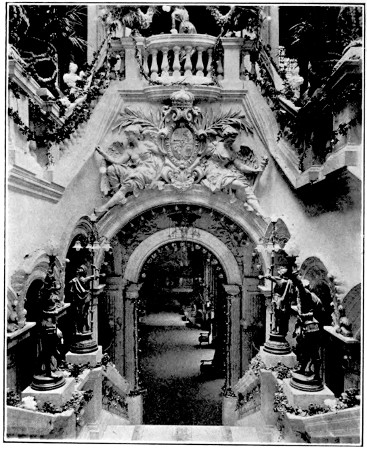
STAIRWAY LEADING TO LOUNGING-ROOM IN SPANISH CASINO.

BY SEÑOR JORGE ENCISO
[219]
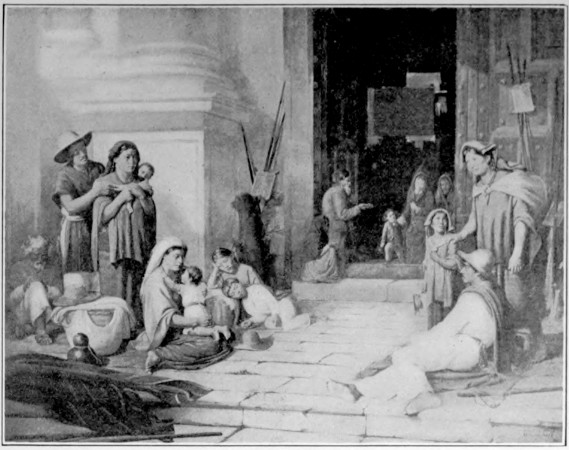
“THE MENDICANTS.” BY SUAREZ.
The genius of the Mexican people has ever inclined to the artistic. When one form of imaginative expression has been denied others have been resorted to with greater force.
The preferred outlet for the native imagination has been architecture, upon which but seldom has any ban been placed either by secular or ecclesiastical authority. In the Spanish days there were occasions when representatives of the crown refused permission to erect palaces considered too sumptuous or colossal for private occupancy, but no limit was ever placed upon the worthier ambition to erect great churches as monuments of their gratitude to God for prosperity conferred. So, to-day, Mexico inherits a very large number of wonderful monuments. Many of these are decorated in beautiful detail with[220] both chisel and brush. Everywhere they present evidence that though the general scheme of one may have been borrowed from or suggested by architectural works of Spaniard or Moor, of Italian or Fleming, of Roman or Greek, the native genius insisted upon its own mark. There, is in fact, a Mexican style of architecture almost as truly intrinsic as that of any original type. It is unfortunate that while the names of European architects employed in the designing of some of the most celebrated buildings are recorded there is usually no way of identifying the native designers, builders, master masons, sculptors and painters who left behind them this great wealth of embodied imagination.
All the conditions favored the structural art. On one hand was the great wealth of the crown, the church and the mine-owner, on the other an abundance of material and of skilled labor. Even to-day there are no more cunning stone workers in the world than are found among the Mexican craftsmen.
The economic prostration following the wars for independence put a stop to architectural progress, but the prosperity restored to the country by the administration of General Diaz has led to a renewal of construction and many notable buildings have been added while others have been restored.
Next to architecture, the native art of which most evidences exist is that of painting. Every condition stimulates this. Nature herself has been lavish with scenic endowment—grand and gorgeous, tender and delicate. All call for pictorial presentment. And the skies are brilliantly wonderful and varied. So Mexico has naturally produced a host of great landscape painters.
Others of romantic inclination have been stimulated by the great military and religious pageantry of their country’s history and episodes of this have been depicted with luxurious freedom. Nor has portraiture been neglected. At the present time many painters of both achievement and promise are flourishing. One of them, Gerardo Murillo, is living in a cave on Popocatepetl, working to perpetuate the aspects of this dying volcano.
Two of his pictures have been described by a local critic as follows: “One large canvas, eight by six feet shows a splendid view of a bold crag near the summit of the volcano, where the wind is blowing and where the deep blue heavens give a tone to the snow, which is piled smooth and deep in its unbroken mass fresh from the last storm.
“A picture somewhat smaller hangs in the studio of Mr. Murillo, in the San Carlos Academy, which does not fail to attract the attention of all who see it.[221] It is the picture of a rugged precipitous scene over which the snow of centuries is piled. The hour is twilight and the whole scene is bathed in a deep blue light which is so realistic to any one who has grown accustomed to the mountains.”
Francisco de P. Mendoza has turned to history for his inspiration and has painted several pictures of notable battle scenes from the campaigns of General Diaz. Thus he seeks to foster in those who see his work that spirit of patriotism which is the spring of his own effort. His chief canvases depict the battles of “The Second of April,” “The Carbonera,” and “Miahuatlan.”
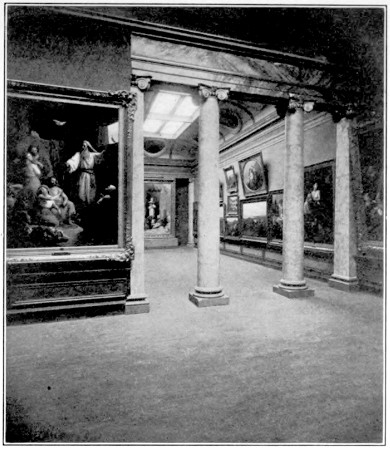
GALLERY IN THE MODERN SCHOOL OF PAINTING.
Andres Rios has done some notable landscapes, but has received most praise for his single figures and groups. “The Curate of San Angel” is particularly noteworthy for skill in handling the light effects.
“Going to the Hospital” shows a suffering woman leaving her home with the assistance of her mother and daughter while the husband and an older daughter remain on the doorstep, he crouched, and she standing and both showing the misery of their sorrow.
Daniel del Valle is another contemporary who is acquiring fame by figure work, though not long graduated from the academy. He has entered the field[222] of ancient endeavor and devotes his work to the decorating of churches and palaces. Visitors will find some of his best efforts in the churches of Santa Maria la Redonda and Jesus Maria.
Leandro Isaguirre is one of the best fruits of the government system of sending graduates of the national schools abroad for post-graduate instruction.
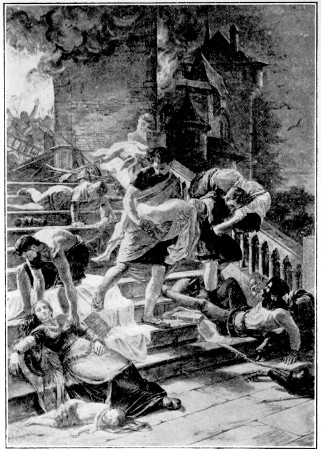
“AN EPISODE OF A FIRE.” BY G. CARRASCO.
Having learned what he could at the San Carlos Academy, this promising young painter was sent at public expense to Europe for five years. There he studied in the studios of the most noted instructors in Spain, Italy, France, Holland and England. He made many copies of the masterpieces in the principal galleries of the Old World. Since his return he has settled down to work on native subjects, selected for the most part from among the laboring classes. He has also depicted many of the landscapes of high altitude where the effect of the lights has usually baffled the visiting artist. Like some of the men who have mastered this problem in the United States, after years of labor, Isaguirre has had success even though he has remained faithful to oils, while the Americans have been driven to water colors and pastelle to get the clear effects that prevail a mile or more above the sea.
[223]
Herman Gedovius, though of German descent and name, is really a Mexican and so entitled to mention among the modern painters of the country. He was born in San Luis Potosi but received his art education in the Royal Bavarian Academy at Munich. He devotes himself almost exclusively to portraiture, though he has painted some ideal heads. Like most of the others mentioned he gives up part of his time to teaching in the San Carlos Academy.
The Dean of the present school of painters is Felix Parra, whose work is much in the style of the modern French school. His subjects are scenes from contemporary life which he presents with great vivacity and some humor. His works are very popular among the wealthy and broadly scattered in their homes.
Another artist who shows strongly the influence of the same school is Alfredo Ramos Martinez, who received his art training partly at the expense of interested art lovers and partly at that of the Mexican government. All his subjects are of some manifestation of happiness outdoors and his canvases are very popular. Several of them have been hung in the Paris Salon.
Many of the pictorial treasures of Mexico were looted by the French during their invasion of the country, but about two thousand have been collected for the gallery of the National School of Fine Arts in the City of Mexico. Many others are still preserved in churches and public buildings throughout the various states and in private collections.
In the case of mural decoration, of which a great wealth was produced during the Spanish domination, many of the best examples have been destroyed by climatic influences but enough great frescoes have been preserved to show that there were many masters in the earlier days.
Painting was first taught by Spaniards, but the teachers themselves were of no narrow school. Spain, it must be remembered, dominated in those days not only the Iberian peninsula but also Austria, much of Germany, the Low Countries and great colonies in North and South America and the East Indies. Her soldiers, priests, fortune seekers, and government officials were the great travelers of the age. They knew every school of art and all the materials then employed. The teachers imparted to their pupils all there was of technique and the pupils had the genius. To enlarge the native taste came later; many Italian painters were attracted by the generous rewards which the rich government and church gave for works of beauty which could be used for the adornment of church and palace interiors.
[224]
At first copyists, the native artists soon became creators. The first school studio in Mexico was opened about 1523, by Rodrigo de Cifuentes, a Cordovan. His work was along the line of historic portraiture and examples of it are still extant. His assistant was a Flemish monk, Pedro de Gante. Another contemporary was Andres de Concha whose work may still be seen in the church of Santo Domingo at Yauhuitlan, Oaxaca.
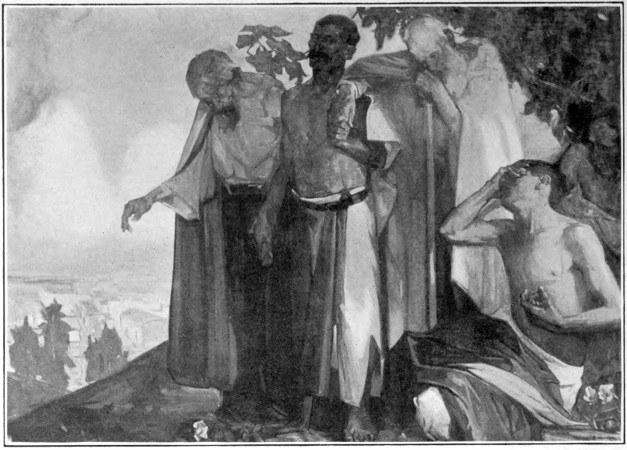
“THE FORTUNATES.” BY SATURNINO HERRAN.
Next came the great school founded by the elder Echave. Among his pupils were his wife (La Sumaya), his son, the two brothers Juarez, a third Juarez and Arteaga. These filled in much of the early half of the seventeenth century. Numerous works of theirs are still to be seen in the National Academy and in various churches. For the most part their subjects were devotional.
Of those who worked in the latter half of the century but two are remembered, de Borgraf and Villalpando. There is a legend that the wonderful Sister de la Cruz also painted, but the evidence is not conclusive. A portrait of[225] herself by herself (so it is claimed) was brought to the United States and now hangs in the gallery of the Pennsylvania Museum at Philadelphia.
Several notable painters distinguished the eighteenth century. Again there were two brothers of the Juarez family. A Zapotec Indian, Michael Cabrera, is by some considered the greatest painter of his time. He first added to the colors introduced from Europe those more brilliant pigments, knowledge of which descended from the Aztecs. He lived to be old, was of great energy, and was a most prolific producer. His efforts are broad and attained with startling success.
Flourishing at the same time was Ibarra, whose admirers are almost as numerous as those of Cabrera. He was more hampered by convention, however, and his appeal is not so forcible. Softness of coloring distinguishes his work where that of his rival demands admiration by harsher brilliancy. His style of work was continued by his pupil Alzibar.
At the end of the century and through the first third of the nineteenth the dominant figure in art was Tresguerras who was not only architect and sculptor but painter and poet also. How one pair of hands could have produced all that is attributed to him it is impossible to conceive.
At the present time the government does everything possible to develop art production. Tuition is free in the National Academy and many prizes and scholarships are offered.
The Academy of Fine Arts (San Carlos) takes its origin from a decree of Charles III., in 1778, when a school of engraving was authorized, which was opened in the following year under the direction of Don Geronimo Gil, the chief engraver of the mint. Three years later, classes in painting, sculpture, and architecture were established with the consent of the viceroy, followed the next year by a royal license establishing La Academia de las Nobles Artes de San Carlos de la Nueva España, which was opened on April 4, 1785. In 1791 the institution was removed to its present home in the building formerly occupied by the hospital de Amor de Dios.
Spain sent celebrated artists to Mexico to direct the affairs of the academy; the first were the painter Aguirre and the painter and architect Velasquez.
Before the Conquest there were no painters in oils but there were wonderfully skilful and artistic use of the natural dyes and assembling into artistic designs of the gaudy plumage of tropical birds and weaving of fabrics. Also[226] there was a knowledge of the making of glazed pottery in rich hues. These arts survive among the people and are being fostered by government influence.
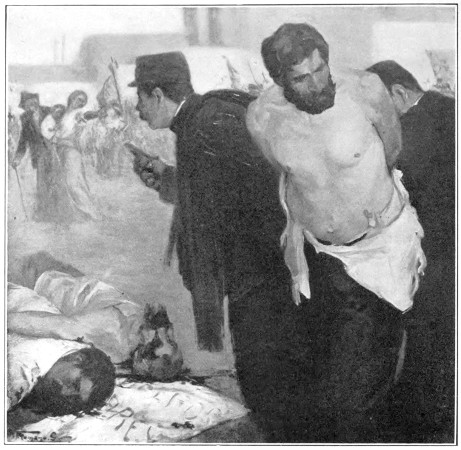
“THE ETERNAL VICTIM.” BY F. ROMANO.
In sculpture, after the Spanish invasion, there was much beautiful work in the adornment of the churches, both by the carving of images of saints and angels, and of architectural detail in the churches. Afterward came an era of historic monument making leading to the enrichment of the many public squares and government buildings. This work of embellishment has been renewed with earnestness under the present administration. Few names of the great sculptors have been preserved. The three best remembered are those of Cora and Patino Instolinque and Francisco Tresguerras.
[227]
Akin to the sculptor’s art is that of the worker in metals. Wonderfully clever have the Mexicans ever been at the smithcraft and many of their masterpieces rank with the best Italian work.
Of literary accomplishment the nation has not so much to show as in the other arts, a condition due partly to the prohibition of authority and partly to actual destruction. There was a body of native literature before the Spaniards came, but this was almost entirely destroyed by command of the priests who accompanied the invaders. Printing presses were not welcome when Mexico was a colony of Castile and both religious and secular authorities discouraged almost every form of letters. One can hardly ascribe to Mexico the body of Spanish writers who chronicled the Conquest. But there was an Aztec prince, Ixtlilxochitl, who did his best to preserve some of the works of his ancestors by translating them into Castilian.
After him were few writers of power until to-day. In the latter half of the seventeenth century there flourished a prodigy best described perhaps as a female Keats, who has left a number of beautiful poems. She was Sister Juana Ines de la Cruz who forsook the viceregal court for a convent in order that she might have more time for writing, but who was soon silenced by the church authorities.
Almost a century later came Lizardi, a satirist, who had to send his books to Havana to be published and who was bitterly persecuted by the government and excommunicated by the church. Nevertheless, his work did much to incite the struggle for independence and to-day still enjoys a great vogue. Contemporary with him was a woman writer of patriotic poems, Josepha Mendoza, who also did much to inspire the insurgent cause.
In the early days of the republic two historical writers obtained fame by careful work. These were Bustamante and Alaman. Their books are still accepted as authoritative.
There was no actual renaissance, however, till about forty years ago, when many of the cultured began earnest study of the public archives and to make revelation in prose and poetry of the ancient lore, romance and legend of the country. Ignacio Manuel Altamirano produced his “Rimas,” “El Movimiento Literario en Mexico,” “Dramaturgia Mexicana,” “Clemencia,” “Antonio y Beatrix,” “Luisa,” “La Navidad en las Montanes.”
The Paisajes of Leyendes deals with the customs and traditions. The style of his work is temperate and confined to the religious feasts of the country. His[228] works contain pictures of primitive races, with their Christian rites intermingled with old forms of worship. His books are widely read.
Juan Mateos is famed abroad. He is quoted everywhere and is much appreciated in his own land. His novels are historical, and his dramas have received great recognition.
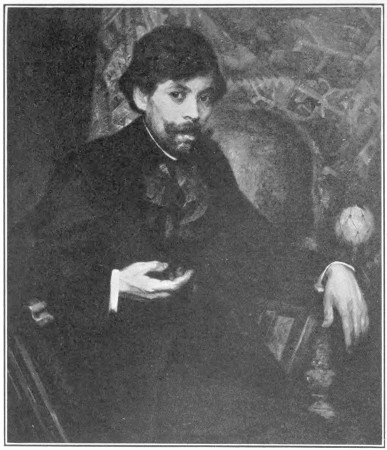
“A PORTRAIT.” BY HERMAN GEDOVIUS.
Joaquin Garcia Icazbalceta took his countrymen to original documents of history for their information. His example was followed by José Barcena, Dr. E. Gonzalez, Manuel Orozco y Berra, Lic. Luis Gutierrez and Otero. Other writers in serious vein about their country have been Matias Romero, so long minister to Washington, Antonio Garcia Cubas, and Ignacio Mariscal, the late distinguished Secretary of Foreign Affairs, a writer of great ability. He was a linguist, speaking perfectly several languages. He has written important works on the occult and was a graceful translator of some of the choicest poems in English literature, among them Poe’s Raven and William Cullen Bryant’s Thanatopsis, whose noble lines expressed much of his own aspirations.
Francisco de la Barra, the Mexican Ambassador at Washington is a writer of note. Fredrico Gamboa is among the best writers of fiction.
Señor Justo Sierra, one of the most virile and forceful of poets, has taken great rank in Spain as well as in his own country. He is one of the Ministers of the[229] Cabinet, but his literary work continues even with his dignity of position and arduous duty attending it.
The historical works by Carlos Pereyra, author of “Lecturas Historicas Mejicanas, Historia del Pueblo Mejicano,” which comprise a full story of the Mexicans from the early period before the Conquest to the present day, are very interesting and show a great knowledge of the important events of the Mexican nation as well as the characteristics of the people. His style is easy and graceful, avoiding the dryness of most works of this kind, and full of romance from the beginning to the end.
Among the Mexican novelists one finds remarkably good descriptive power; just as the country glows with intense life and color, so do their fiction and poetry express fervid passion and feeling. There is a tendency to epigrammatic terseness in sentence and paragraph. There is invariably a deep love of nature, expressed in most beautiful word painting and always there is intense patriotism with luminous force in the expression of it. The richness of the language and their love of home life give the Mexican writers on this subject great opportunities. The name of Irenio Paz, an editor as well as a novelist, is well known, as his simple direct style appeals to the readers. Vicente Riva Palacio, for his purity of language and elegance stands foremost among the writers of melodramatic intensity. His “Calvario y Tabor” is a historical novel covering the period of struggle which terminated in the overthrow of foreign power and the downfall of Maximilian, and treats of almost every possible range of emotion. It is a tale of the death agony of the Old Empire and the transfiguration of the New Republic, intermingled with loves and romances of the people, their habits, their hospitalities and extreme charity. The historical portions of the novel are superb and there are remarkable thoughts forcibly expressed.
Of original poets the last few decades have produced a great number and several indubitably had the divine fire. Manuel Acunha wrote several fervid poems of passion which have been and still are most popular. A master of lyrics is Guillermo Prieto, who has been acclaimed the laureate of Mexico. His work is the best expression of the national spirit of the people, whose patriotism grows steadily in fervor.
Singers only less great than these, are Davalos, Granados, Nervo, Tiron, Pazaza, Othon and Urbina. Showing promise of strong work in their maturity[230] are many young men who are now producing plays, novels, and poems of worth. Juan de Dios Peza, whose death a few years since deprived Mexico of one of her best poets, wrote exquisitely “El Arpa del Amor” and “Recuerdos de mi vida.”
Among other writers are Rebolledo, Lopez, Campos, Urneta, Delgado, and Rivera. One of the most evident tendencies of these latter day authors is to break away from the influence of Spanish literature. Translations from the works of perhaps all the great writers of Europe are freely made and the American masters especially have been treated in this way. There is a better knowledge of American literature in Mexico than in any other foreign country, Great Britain not excepted. Naturally this study finds reflection in the Mexican literature, but underneath all is the growing nationalism which eventually must find full expression. The Golden Age of Mexican letters is not yet but there is promise of speedy entrance thereon.
Meantime the government is patronizing efforts to collect the folklore, ballads and songs of the nation. These are being carefully compiled and edited and when published will afford a revelation of thought and sentiment to the world. Persecution and warfare have always produced the most vibrant songs and Mexico has had her share of both.
Mexico is a land of book lovers. The genuine love of literature is universal, even the poorer classes are fond of reading love stories, and those having the simplest knowledge of reading find pleasure in books. There is a good market for books of the modern literature of France and Spain, and even English literature is gaining a foothold. Most wonderful libraries of costly editions are found in every home, especially in the homes of professional men.
Senator Licenciado don Francisco Alfara, the great criminal lawyer of Mexico, has the most remarkable collection of paintings of the old masters, books long out of date, and curios from every country of the world. His collection of original manuscript of old and famous writers is one of his valued possessions. Not only is the literature of Spain and France popular, the Mexicans have a literature of their own. As far back as 1680, King Netzahualcoyotl of Tezcoco wrote a poem on the “Mutability of Life.”
There are hundreds of cultivated men of Mexico who live in the enchanted ground of literature, contented in retirement from political discussions and[231] business, devoting themselves to reading; besides this, Mexico has so many students, so many professors graduated from the Normal Schools, and so many Societies of different cults that it is a University centre.
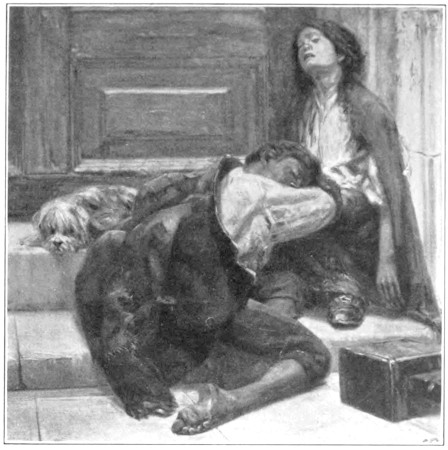
“CHILDREN OF MISERY.” BY SOSTENES ORTEGA.
There are many daily papers thriving in Mexico City. The Imparcial is a very important paper, with an afternoon edition called El Mundo; both of these periodicals have a large circulation. Others are El Tiempo, El Diario, which is on the advanced order of our popular dailies, and Correo Espanol, a Spanish paper with a splendid editorial staff of young newspaper men. The Mexican Daily Record, an afternoon paper printed in English, has a very brilliant editorial staff, and the Mexican Herald, another English newspaper, is edited by an American.
There are weekly papers which are very ably edited, Artes y Lettras is the most popular. El Mundo Ilustrado is well illustrated, and deals lightly with important events of the week. La Revista Literaria, is edited by Señor Barron who is a popular local poet. The first book printed in Mexico was La Escala Espiritual para Llegar al Cielo (The Stairway to Heaven), printed in 1537.
In music, Mexico records no great composers of old, those of her folk songs being unknown, but music is a passion with the people and musical[232] education one of the chief cares of the government. Public concerts are generally given throughout the cities and the nation maintains a conservatory in the capital city wherein is one of the best libraries of music extant. All the great European soloists and directors look to at least one season in Mexico as part of their natural experience and nowhere do they find more appreciative and critical audiences. Two, at least, of the Mexican moderns have achieved international fame, Antonio Zuniga, of Guanajúato, and Chang-Cilli, of Yucatán, whose orchestrations are familiar to and frequently used by European leaders.
Just now very intelligent efforts are being made to educate the artistic side of the Mexican people and although many of these take the direction of improving the arts and crafts for commercial advantage, the result is bound to be the development of individual talent. Great artists and great works of art are to be expected of Mexico.
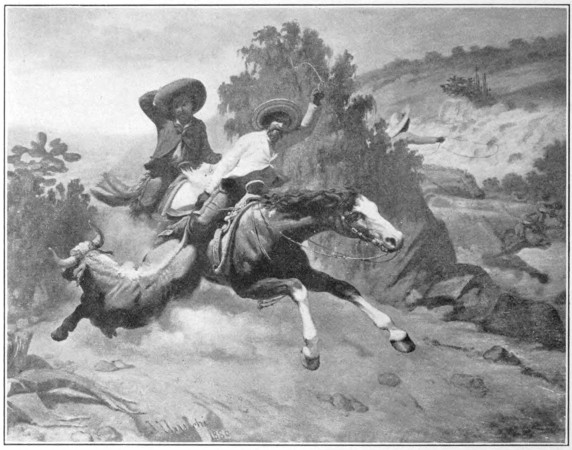
“THE ROUND UP.” BY JUAN URRUCHI.
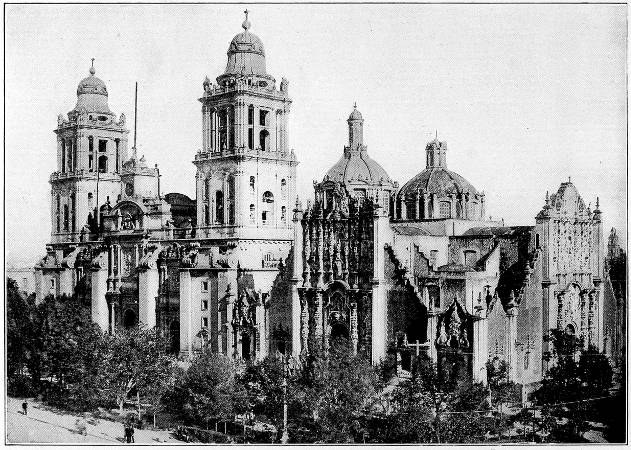
CATHEDRAL, CITY OF MEXICO.
[235]
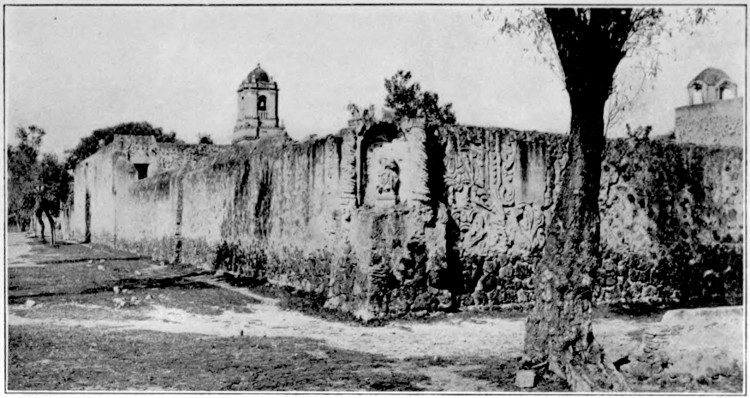
WALL AROUND THE SHRINE AT CHURUBUSCO.
The churches of Mexico are remarkable for their beauty and solidity. There is no prevailing style except originality, nor is purity of style a characteristic of the great buildings. The Gothic, the Moorish and the Italian are often combined, but the harmony of design is masterfully secured and a distinctive attraction thereby obtained. There is a sort of abandon of genius in the designs and decorations of façades, towers and domes that make the work beautiful and uncommon, each is a unique picture, each bears the impress of individual artistic conception.
Of the great church structures of the capital the most notable is the cathedral, of vast proportions and magnificent details. When Cortés had Tenochtitlan finally in possession he determined on the complete destruction of the Aztec city. On the spot where the great Teocalli had stood, a temple hideous in sight and memory of the Spaniard, the Christian cathedral should be erected. This with the aid of unlimited slave labor was quickly accomplished. In 1527,[236] Clement VII. established the See of Mexico and Fray Juan de Zumarraga was instituted as the first bishop. In 1545, the bishopric was constituted an archbishopric and Bishop Zumarraga was elevated to the dignity of archbishop.
In 1593, the corner stone of the present cathedral was laid, forty-two years later the foundations were completed; in 1623, the roof above the sacristy was finished and three years later the first service was held, but so great a delay had been caused by the great inundation in 1629–1635, that not till 1656 was the formal dedication solemnized; even then the building was unfinished and its final dedication was not solemnized until February 2, 1667. In 1791, the magnificent towers were completed and the bells were hung a year later. The cost of the completed edifice with its decorations is many millions. Its length is over four hundred feet, its width one hundred and seventy-seven feet and the height from roof to floor one hundred and seventy-nine feet. The towers are two hundred and three feet high. Crowning the edifice is a splendid and graceful dome and lantern, the work of Manuel Tolsa. The cathedral was designed by Alonzo Perez Castaneda on the plan of a Latin cross.
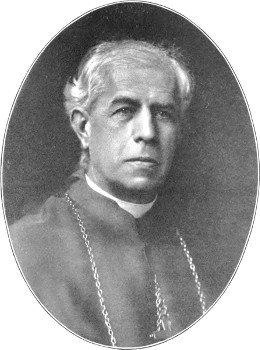
DR. JOSÉ MORA, ARCHBISHOP OF MEXICO.
The principal façade faces the south. It is broken by three portals composed of the Doric and Ionic orders, which with the exquisitely wrought carvings, the friezes and the statuary make a most imposing and captivating front. The towers are likewise of the two orders in succession, the Doric and the Ionic, and many cornices carry fine balustrades with pilasters surmounted by splendid urns and fine statues.
Within, the impression is one of severe grandeur ennobled by vastness of space. The style is Gothic and Doric. The lofty vaulted arches are borne on[237] massive fluted columns of stone. The dome is illuminated with paintings of sacred subjects, among them an Assumption of the Virgin. In the aisles are fourteen chapels dedicated to various saints. In that of San Felipe de Jesus are some relics of this saint, and here lie the remains of Iturbide, the unfortunate emperor, beneath a monument erected to “The Liberator.” In the chapel of San Pedro lie the bodies of Archbishop Zumarraga, the first prelate of Mexico, and Gregorio Lopez, the Mexican Man with the Iron Mask, who is said to have been the son of Philip II. of Spain. There are some very fine altars; the chief of which, the altar de los Reyes, is very imposing and rises to the arches of the roof. It is most sumptuously ornamented with carving, gilding and other decorations, and is the delight and admiration of the Indians especially. Beneath this altar lie the remains of the Independence martyrs, Hidalgo, Allende, Aldama and Jimenez, which were transported thither from Guanajuato after their dishonor in that city and buried in the cathedral on the independence being secured. There are many fine pictures in this great cathedral; a San Sebastian by La Sumaya, the wife of Baltazar Echave, a Candelaria by Echave, the Assumption and the Epiphany by the Mexican painter Juan Rodriguez Juarez; the Entry into Jerusalem and the Catholic Church and the Assumption by Juan Correa, the Triumph of the Sacrament, the Immaculate Conception, and the Glory of St. Michael, by Villalpando, the Last Supper and the Triumph of Faith, by Alcibar, the Virgin of Bethlehem by Murillo, the Virgin by Cortona, and John of Austria imploring the Virgin at the Battle of Lepanto.
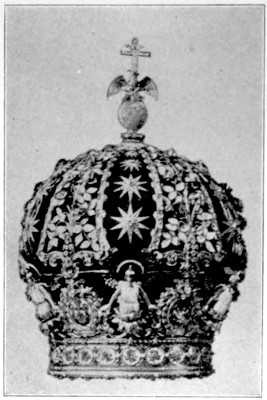
THE CROWN OF THE VIRGIN OF GUADALUPE.
There are many historical churches in the capital, some of which date from the sixteenth century. Many were founded as convents and monasteries through the munificence of private donors or through the efforts of religious orders, and the history of Mexico is closely interwoven with not a few of these establishments.
[238]
Santa Brigida is the fashionable church of the capital. It was built in connection with the Order of Saint Bridget which was established in Mexico by José de Aguirre and his wife, Doña Gertrudiz Roldan.
The Church of the Colegio de las Ninas is an ancient establishment founded by Fray Pedro de Gante. The college was provided to furnish free education for girls.
The church and convent of Nuestra Señora de la Concepcion was established by a Franciscan monk, Fray Antonio de la Cruz.
The Church of San Cosme was founded in 1538, as a hospital for Indians, the chapel being dedicated to the Arabian doctors Cosmo and Damian. It later came under the charge of the Franciscans, who built the monastery and the present church which, however, was not completed till 1675, and dedicated to Nuestra Señora de la Consolacion, as an act of gratitude by one who received shelter in the monastery during a storm. A curious painting in the church represents the grateful donor transferring the title of patron, which he had declined, to San José. The painting is the work of José de Alcibar.
In the Church of Santa Cruz y Soledad, built in 1731, but which was originally founded in 1534 as an Indian mission, are splendid decorations of altar and chapel by celebrated Mexican artists, but the most interesting feature is the image of Nuestra Señora del Refugio which was formerly attached to a wall on the Calle del Refugio.
San Diego contains several paintings by Vallejo, the famous Mexican artist, the pupil of the Indian painter, Cabrera, the chief of which are The Prayer in the Garden and The Last Supper, and the famed altar pieces The Virgin of Guadalupe and San José.
Santo Domingo is one of the finest and largest churches in the capital and contains some fine paintings especially The Crucifixion and San Ildefonso. This church stands where the legend says the Aztecs saw the eagle with a serpent in its beak, the omen that decided on their establishing their chief seat. This church is on the Plaza de Santo Domingo in which is erected the handsome commemorative statue of Señora Doña Josefa Dominguez the heroine of the Independence, whose timely warning gave the patriots at Querétaro a chance of escape.
The Church of San Francisco, now a protestant temple, is all that remains of the great religious establishment of the Franciscan Order, founded on the grounds once occupied by the menagerie of the Aztec Imperial household. The original church was erected by the Twelve Apostles of Mexico and Fray[239] Pedro de Gante and the cost of building was borne by the Conqueror. With the grandeur of Spanish Mexico and with all the sorrows of Republican Mexico in its earlier days this great establishment was intimately concerned. It was the last to conspire against the nationality of Mexico as a republic and this conspiracy cost it its real existence, for it never recovered either its prestige or its entire possessions in the interval before the monastic institution was suppressed by President Juarez, in 1860. The great treasures of the church, the ornaments, jewels and paintings were then forfeited and placed in the Academy of Fine Arts. Historically the Church of San Francisco is the most interesting in the Republic. It was the centre of all the Catholic religion. Under able and zealous management it became the most powerful and prosperous church in the Crown colony. From it sprang the first Indian school and the first theological seminary and it was here the art of painting was first taught by the Spaniards. It was the favorite church of Cortés where he heard the mass.

THE SHRINE OF GUADALUPE.
[240]
Many of the viceroys worshipped here during the three centuries of Spanish rule. On December 27, 1821, was sung herein the Te Deum to commemorate the Independence of Mexico. On June 12, 1859, President Juarez signed the famous Leyes de Reforma, which aimed at the nationalization of all church property. These took effect in 1860, and the year after all religious orders were suppressed. This property of the Franciscans was sold and the money given to the hospitals and schools.
San Hipolito stands on the spot made sacred by the defeat of the Spaniards by the Aztecs on La Noche Triste. On their recovery of the city on August 13, 1521, a little adobe chapel was erected in memory of the soldiers who fell on July 1, 1520, and in 1599 the present magnificent edifice was begun which was not completed till 1739. For a long time, on the 13th of August, a commemorative procession bore in march the crimson banner of the Conquest.
The defeat of the Dismal Night is commemorated on a stone tablet surmounting a corner of this church, which translated reads: “So great was the slaughter of the Spaniards by the Aztecs at this place on the night of July 1, 1520, called for that reason the Dismal Night, that after having in the following year re-entered the city in triumph, the conquerors resolved to build here a chapel, to be called the Chapel of the Martyrs; and which should be dedicated to San Hipolito, because the capture of the city occurred on that Saint’s Day.”
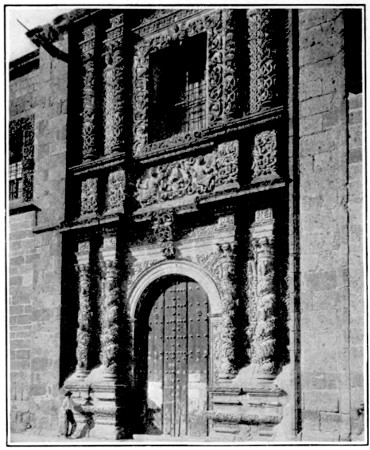
SANTA MONICA, GUADALUPE.
One of the most notable of the churches is that of Jesus Nazareno. It was founded as Nuestra Señora de la Purisima Concepcion by Cortés on the final occupation of the capital and furnished with ample funds for its erection and maintenance by the provisions of his will. In this church the bones of the[241] conqueror rested from 1794 to 1823, when they were removed to Italy. The building began in 1575, and it was dedicated ninety years later, when its name was changed because of a miraculous image of Jesus of Nazareth that was bequeathed to the church by a pious Indian woman. The edifice contains much of the original interior carved woodwork, altars and other decorations. In this church lie the remains of Manuel Vilar, the sculptor, Lucas Alaman, the historian and statesman, Manuel Calderon and Fray Juan Crisostomo Najera.
Nuestra Señora de Loreto was originally founded by the Jesuit Order in 1573, an edifice of canes and reeds, dedicated to San Gregorio. In 1675, Padre Juan Zappa brought the image of Our Lady of Loreto to Mexico. The erection of chapels took place in 1686 and 1738, but the present church was not dedicated till 1816. The tower of this church has leaned for seventy-eight years as the result of subsidence of one side of the edifice owing to inundation. There are some fine paintings by Joaquin Esquivel.
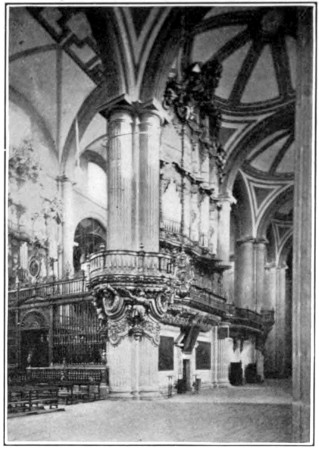
ORGAN IN THE CATHEDRAL, MEXICO CITY.
The Church of Nuestra Señora de los Angeles has a singular history. In 1580, an Indian chief, Isayoque, found on the waters of the inundation a beautiful picture of the Virgin, to preserve which he built an adobe chapel, but instead of placing therein the original, he had a replica painted on the wall by an eminent artist. Later this wall was built into a larger chapel, and in 1607 the inundation almost obliterated the painting, save the hands and face, which was deemed a miracle. The present church was completed only in 1808. The miraculous picture is supplied with a dress to cover the missing parts and is now enclosed in glass to preserve what is left.
One of the handsomest of the churches is La Profesa which dates from 1595, when it was founded by the Jesuits, whose order accumulated great wealth and[242] possessed great influence, till they were expelled in 1767. The decorations of this church are among the finest in Mexico and there are several pictures of considerable reputation, The Adoration of the Cross and The Seven Sacraments being of prominent merit. The splendid altar is the inspiration of Tolsa. This masterpiece was designed by Pelegrin Clave and his pupils, Petronilo Monroy, Felipe Castro and José Ramirez. It was in this church that the movement was planned as the result of which Iturbide acquired the independence of Mexico.
Santa Teresa La Antigua is one of the very interesting church establishments. The convent of Santa Teresa was founded in 1616, and the building of the present church was commenced in 1678, and its completion and dedication was made in 1684; it was very badly injured by the earthquake of 1845, but has been splendidly restored. It possesses a miraculous crucifix brought from Spain in 1545, and long kept in a church at Cardonal, in Hidalgo state. The legend as to this crucifix says that it was once so disfigured by an accident that it was thrown into the fire, without any change resulting, that it was then buried and when later taken up it reassumed its original freshness and state. To secure the crucifix a pitched battle was fought between the partisans of Archbishop Zuniga and those of the Cardonal church, and the former were victorious, and the treasure was deposited in Santa Teresa.
Another church founded by Cortés was Santa Vera Cruz, in connection with a brotherhood whose mission was to comfort condemned criminals. The church possesses a venerated shrine encircled with seven veils and within the shrine is a crucifix, a visit to which on a specified day secures indulgences. The present church dates from 1730.
There are several protestant churches now in the City of Mexico. The Christ Church, Episcopal, Trinity, Methodist Episcopal and San Lorenzo for English speaking Catholics.
The legends of a country often have a more real and actuating influence on its people than does its history. The miraculous or wonderworking thread woven into the tale appeals more forcefully than the soberer facts of very truth. The touch of mystery chains the interest while it seems to silence the spirit of questioning. Mexico is rich in legends, and their best lore is perpetuated in the many shrines.
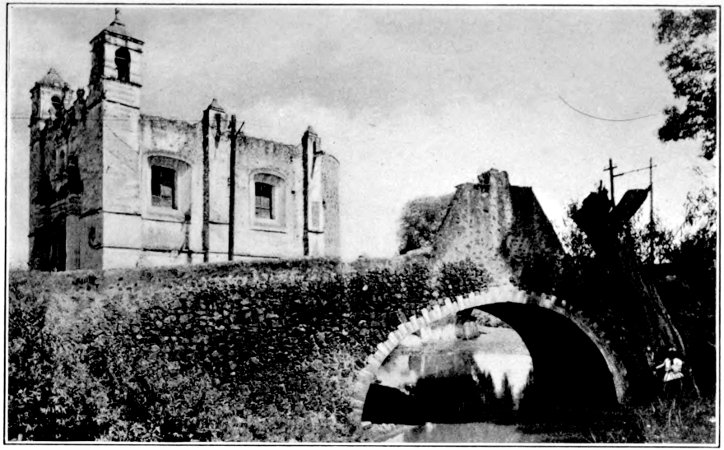
CHURCH NEAR COYOACAN.
Of all the shrines of Mexico, the most sacred and venerated is “Our Lady of Guadalupe.” Here is the Christian shrine to the Mother of the Saviour; and here, too, the Aztecs tendered homage and worship to Tonatzin, who to them was[243] the “Mother of Gods.” The Christian legend tells that in 1531, a pious Indian named Juan Diego was on his way from the village of Tolpetlac to attend mass at Santiago Tlaltelolco and passing around the hill of Tepeyácac, he heard sweet voices singing; terrified, he looked up and saw a lady who bade him listen to her: he should go to the bishop and tell him that she willed that a temple in her honor should be built on that hill. The figure vanished, and Diego did her command, but the bishop sent him away, giving no credence to his tale. Returning to the place of the vision, Diego found the lady awaiting him and he told her of his interview with the bishop. She bade him to return to the place the next day, Sunday. Diego returned accordingly and for the third time the vision greeted him, and he was commanded to repeat his former message to the bishop, who, still incredulous, required some convincing token of the truth of his message; at the same time he sent two servants to watch Juan Diego. On the latter’s approaching the hill he was lost to the view of the servants and passing round the side of the hill he saw the lady, to whom he stated the bishop’s requirement. She commanded him to come again the next day. This he was[244] unable to do, for on returning home he found his uncle ill and he must attend him. On the day after, the uncle being at the point of death, Juan Diego set out for Tlaltelolco to fetch a confessor and fearing delay if he met the lady, he went around the other side of the hill. There to his surprise he saw her descending the hillside and calling to him. He made known his urgent case, and she assured him that his uncle was already cured of his fever. Then she commanded him to ascend to the barren hilltop to gather roses, and there, where none had ever grown, they appeared. She directed him to take these roses to the bishop as the desired token, bidding him to show them to none other. Happily did Juan fill his tilma with the lovely blooms and set out for the bishop’s dwelling. From the spot where the lady stood gushed forth a spring of crystal water which has continued flowing and is a cure for all human ills. Diego was soon before the bishop and unfolding his tilma as he dropped the roses at the feet of the bishop, he saw the image of the Virgin depicted on the coarse fibrous material, painted in wonderfully beautiful colors, in a cloak of blue velvet bedecked with stars of gold. The prelate was convinced; he took the miraculous tilma and deposited it in his oratory as a priceless treasure. Diego returned to his home, escorted by the bishop’s servants, and found that his uncle had been cured at the very hour when the Virgin assured his recovery.
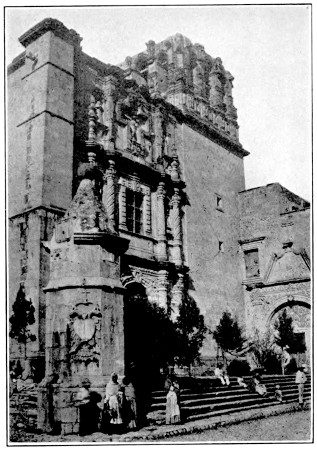
FAÇADE OF SAN AGUSTIN.
On the spot where the roses had miraculously bloomed, a church was soon built, and on February 7, 1532, the sacred tilma was placed over the altar within the shrine. From that time an annual festival has been held on the 12th of December. But it was not until Pope Benedict XIV., in 1754, issued a[245] Bull authorizing the feast that official recognition of the Virgin of Guadalupe as protectress and patroness of Mexico was gained.
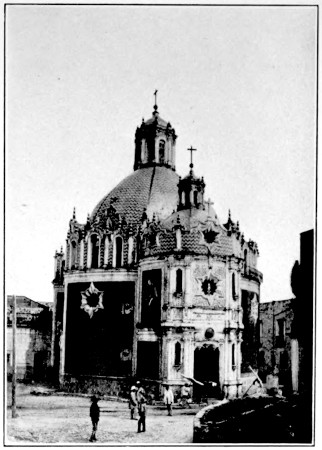
THE SACRED WELL AT GUADALUPE.
The church was the especial pride of the Indians, and they felt a new motive for joining the Christian establishment. They now had their Mother of God. The original portrait is richly framed in gold inlaid with diamonds and pearls. The picture appears alike on both sides of the rough canvas, which is without sizing or preparation. Experts have from time to time examined it without being able to account for its production or preservation. The coloring process is inexplicable; it partakes of the characteristics of oil, water and distemper coloring and relief work, and these processes are apparent in different portions of the picture; moreover the gilding of the stars embroidered on the cloak and in its texture, as well as in the light-rays emanating from the figure, is not applied like any known process, but appears rather to be woven into the fibre of the canvas than painted on it. A further miraculous attribute is seen in the complete preservation of the picture, which for many years was entirely unprotected by a covering, and exposed to conditions that would have destroyed even very hard substances.
The devotion accorded to “Our Lady of Guadalupe” is universal in Mexico. The festival day is a religious holiday throughout the republic, and is especially kept by the Indians, who come from all quarters to the shrine for devotion. It was the banner of this Virgin that was taken from the little sanctuary at Atotonilco by Hidalgo when on his march on San Miguel and he adopted “Guadalupe” as the battle cry of independence.
[246]
The holy image of the tilma was removed from its shrine on the occasion of the great inundation of 1629, and the saving of the city by the Virgin implored. The image was placed in the cathedral, attended with imposing ceremony in transmission, and there it remained for four years. Its miracles are reputed wonderful, all manners of healing are attributed to it.
In 1622, the image was enshrined in a new and much larger church. In 1709, the large temple was dedicated. The altar was designed by Tolsa in 1802, but was not completed till 1836. The great chancel was enclosed by a heavy silver railing set on a base of white marble. But the crowning glory of the edifice of “Our Lady of Guadalupe” was the great aspiration and chief lifework of Father Antonio Plancarte y Labastida, who began the work of restoration and embellishment in 1887 and completed it in 1895, when the tilma was crowned by authority of Pope Leo XIII., with attendant ceremonies of the most imposing magnificence, in the presence of thirty-eight archbishops and bishops, hundreds of priests and fifty thousand laymen from all parts of Mexico and the rest of the Western Continent, on October 12, 1895.
The crown is a splendid product of the goldsmith’s art and of an enormous intrinsic value. The gold and the precious stones were contributed by the women of Mexico from their own most prized jewels and represent a vast treasure. Around the rim at the base are twenty-two enamelled shields representing the dioceses of the republic illumined with sapphires and emeralds. Above this is a row of angels, each bearing a brilliant ruby on its breast, and supporting six enamelled escutcheons blazoned with the arms of the six archbishops of Mexico, framed by exquisitely wrought wreaths and encircled with diamonds. Rising behind the angels and extending to the apex of the crown are festoons of roses of gold alternated with stars of diamonds, which cluster at the top beneath an enamelled globe on which Mexico and the Gulf are depicted. Above the globe is the Mexican eagle bearing in one talon the globe and with the other holding aloft a cross of diamonds. From a ring in the cross the crown is suspended over the sacred image by a cherub. The fineness and richness of the work, in which there is no repetition of a single decorative detail, make this crown the most distinguished of its class in religious use.
The coronation scene was unique in the history of Mexico; the patron saint of the nation, the especial protectress of the Indians, was to receive divine[247] honors with all the pomp and ceremony of official sanction and authority. Gorgeously robed, the dignitaries of the church surrounded the throne of the archbishop—for the church has the recognized organization of a cathedral—who received the priceless crown from the hands of twelve of Mexico’s distinguished women, representing the contributors, after the papal brief authorizing the coronation was read, and the action notarially certified. Then the air was rent with the salute of cannon and the unchained voices of the bells. Within the walls of the church crowded adorers knelt, and without, multitudes with bowed heads, reverentially adoring, awaited the solemn moment when the crown should be raised to the brow of the Virgin of Guadalupe.
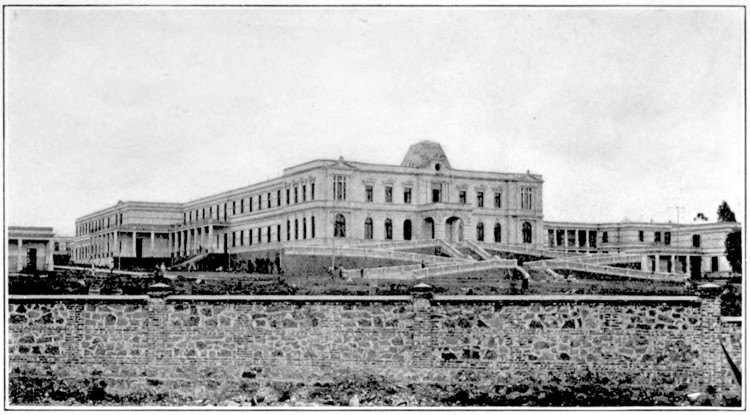
LUNATIC ASYLUM.
The crown having been blessed by the archbishop, a solemn mass was celebrated, and then in grand procession it was borne by the canons through the crowded basilica and outside around the edifice and then returned to the sanctuary. Here, the archbishop of Mexico, assisted by the arch-prelate of Michoacán, ascended the lofty platform and placed the consecrated crown above the head of the Virgin of Guadalupe over the miraculous tilma. As the act of coronation was completed the devotional enthusiasm of the people broke forth amid tears and sobs, in shouts of “Viva Dios!” “Viva Madre de Dios!” “Viva[248] Mexico!” and the cries were taken up without till the hill and the valley had spoken with tens of thousands of voices; then the bishops, one by one, ascended the altar steps and in devout homage laid crosiers and mitres before the image of Our Lady of Guadalupe. The great event, at the same moment, gave tongue to every church bell in the land, which proclaimed the glorious fact of the coronation to the devout children of the church.
The restoration of the church was completed simultaneously with the coronation and the sacred image of the tilma was returned from its eight-years’ repose in the neighboring church of the Capuchin Nuns to its own repository in the basilica of Our Lady, on September 30, 1895. The benefactor, Father Plancarte y Labastida lived to rejoice in the crowning culmination of his great work; he died in 1898.
The interior of the basilica is of the Doric order. It is about two hundred and fifty feet long and one hundred and twenty-five wide. Its three aisles are divided by eight Corinthian columns. Of the eighteen arches, the central one carries the dome with its lantern, the top of which is one hundred and twenty-five feet from the pavement of the church. The feature of chief interest is the high altar in which is framed the sacred tilma. This is of spotlessly white Carrara marble, magnificently sculptured and exquisitely wrought with gilded bronze, done after the designs of the celebrated Mexican artists, Agea and Salome Pina. The marble was carved by the sculptor Nicoli at Carrara and the bronze was wrought at Brussels. On the right and left sides of the altar are, respectively, marble figures of Juan Zumárraga, the first bishop of Mexico, and the Indian, Juan Diego, to whom the Virgin of Guadalupe appeared, and in front is the kneeling figure of Archbishop Labastida y Davalos, whose fostering care made the great work possible. Over the frame holding the image of the tilma are sculptured in relief three angels, emblematic of the archdioceses of Mexico, Michoacán and Guadalajara and commemorative of the services rendered by their archprelates in securing the papal authority for the coronation of the Virgin. The baldaquin over the altar is of byzantine style and is carried on pillars of Scotch granite; the arch is surmounted by a gilded cross of roses. The front arch of the baldaquin carries the arms of Pope Leo XIII., on the other three are those of the archbishops of Mexico, Michoacán and Guadalajara, and inscribed in Gothic letters are the Latin verses written by Leo XIII., for the occasion of the coronation:
[249]
“The Mexican people rejoice in worshipping Thee, Holy Mother, under this miraculous image, and in looking to Thee for protection. May that people, through Thee, flourish in happiness and ever under Thy auspices, grow stronger in the faith of Christ.” Bronze statues are placed between the arches, representing Prudence, Justice, Fortitude, Temperance.
The vaulted roof is studded with gilded cedarwood stars; the beams are richly ornamented in rich Byzantine style. The dome is profusely decorated with gold and roses in festoons; and the panels are filled with frescoes of the Virgin of Guadalupe, of angels bearing scrolls, and allegorical tributes of the Virgin. In the four spaces between the dome stand figures of the four Evangelists.
Splendid frescoes adorn the walls of the church.
The homage paid to the Virgin of Guadalupe is universal in Mexico. In every home of rich and poor alike, her picture is to be found, an honored possession, even in most of the shops of Mexico a lamp burns ever before her picture and there are few churches without an altar before which to do her reverence. When the country was rent by the passions and fury of war and churches were stripped and despoiled of their priceless objects and decorations, the shrine of Our Lady of Guadalupe was too sacred for the despoiler. His hand was nerve-less to desecrate this revered shrine.
This venerated basilica is the chief of a group of churches connected with the legend of Our Lady of Guadalupe. To the east of the shrine is the Chapel of the Well, built on the spot and in commemoration of the miracle of the spring that gushed where the Virgin stood at the moment that she dispatched Juan Diego to the bishop with the roses. The chapel was built in 1791, and the spring is just within its door. Beneath the dome, which is covered with glazed tiles, is the altar and a carved pulpit upborne by a figure of Juan Diego; the mural decorations are paintings of the Indian’s visions of the Virgin. The Chapel of the Little Hill, is erected on the spot where, at the Virgin’s will, bloomed the roses on the previously barren rock. The first chapel was built in 1660, but was replaced by the present[250] edifice early in the eighteenth century. These auxiliary establishments are connected by a stone stairway, about halfway up which is a votive offering, the Stone Sails of Guadalupe, made by sailors who implored the aid of the Virgin in their distress and, being saved, they accordingly brought before the shrine the foremast of their vessel and the sails, which latter are there encased in stone.
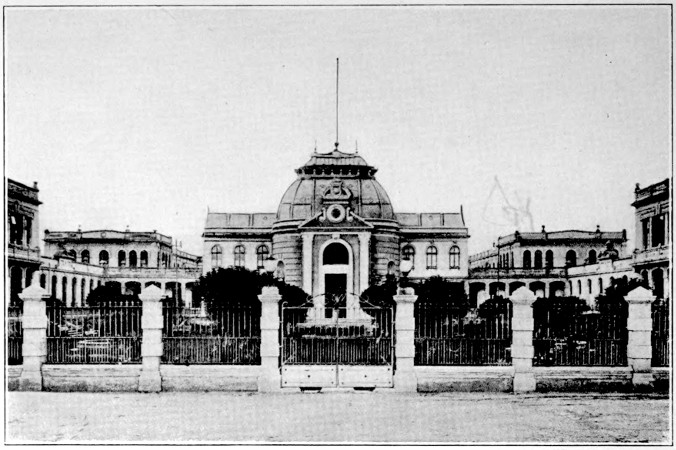
THE GENERAL HOSPITAL, CITY OF MEXICO.
Besides these chapels, there is the church of the Capuchin Nuns, forming a group of establishments more widely known and honored and visited by more persons than any other shrine in Mexico. Our Lady of Guadalupe is the Lourdes of Mexico, the holiest of Mexico’s sacred places.
Another shrine highly venerated by Mexicans is the Church of “Our Lady of Los Remedios.” The legend upon which its veneration rests antedates that of Our Lady of Guadalupe. The story told of the image enshrined in this church is that it was brought to Mexico from Spain by a soldier in the following of Cortés, named Juan Rodriguez de Villafuerte, who, in the flight on the Noche Triste took the image from the great Aztec temple, where it had been placed in a shrine, and[251] carried it as far as the hill of Totoltepec, where his strength failing, he hid it under a broad maguey plant. It was thereafter lost to knowledge for nearly twenty years, when an Indian chief, who was hunting on the hill was greeted by the Virgin, who required him to seek for her image hidden beneath a maguey plant. He searched in vain. Again the Virgin appeared and repeated her command, with the same result. A third time the vision appeared, and the same command was given. Further effort at length rewarded the searcher and he took the image to his home, but in the morning it was missing, and again was found under the maguey plant where it had been discovered. This time the Indian placed before the image a gourd filled with dainties of food; again it disappeared. Once more the chief brought it home and placed it in a bolted and locked box, on which, for further safety, he slept; but the box was empty in the morning. These strange experiences led the Indian to seek the advice of the padres, to whom he told his story, and they, deeming that a miracle had been wrought and a command conveyed to build a temple to the Virgin on the spot of her appearance, decided to fulfil the command.
Soon thereafter, on the spot where the image was found, a shrine was built and dedicated by the Spaniards to “Our Lady of Succor” in gratitude for her salvation of their lives. The image is about eight inches high and is carved in wood; it bears in its arms a figure of the infant Jesus. The shrine also contains the gourd in which the food was placed before the sacred image, while under the main altar, near the remains of the Indian, Juan Aguila Tobar, is the box in which the image was locked to prevent its escape. The walls of the original church remain in the existing edifice, completed in 1575; but the church has lost much of its former magnificence and costly decorations of precious metals and paintings. The priceless wardrobe and jewels of the Virgin remain in testimony of the virtue attributed to the miraculous image.
After the battle of Las Cruces, when Hidalgo was within six leagues of the capital with his independence army, Viceroy Venegas, alarmed, had the image of the Virgin of Los Remedios brought from Totoltepec to the cathedral in the capital, and there kneeling before it, invoked its aid, placed the viceregal staff in its hands, and solemnly hailed it as “lady captain general of the army.” The royalists inscribed on their banner the image of Nuestra Senora de los Remedios, just as Hidalgo had adopted for the patriots that of Nuestra Senora de Guadalupe. In seasons of drought, also, this sacred image is taken from its hill shrine and borne in solemn procession through the streets of the capital.
[252]
Mexico City is liberally furnished with institutions for the care of the indigent afflicted and for orphans. The special retreats for the blind, the deaf and dumb strikingly exhibit the conception of the obligation of the municipality to ameliorate the distressing conditions which the afflicted in these respects suffer. Every care and comfort is provided for. So too, the orphans have a home that shields them from danger, ministers to their needs, and gives them instruction that will fit them for a life of personal advancement and state advantage.
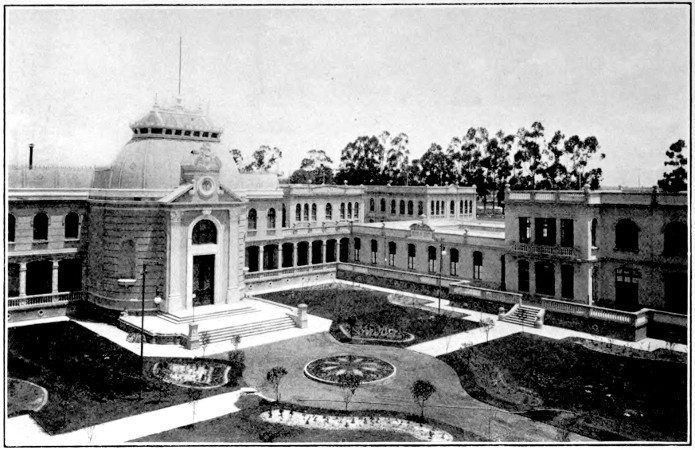
THE CHILDREN’S HOSPITAL. FEDERAL DISTRICT.
The General Hospital is a monument of enterprise. It is the culmination of a long-cherished ambition of General Diaz, whose desire was to see Mexico equipped with a hospital for the poor that would meet all the needs of the City. It was completed in 1905, and is conceded to be one of the largest and most splendidly-appointed hospitals in the world. It has about twenty-eight pavilions and accommodations for over eight hundred patients.
This splendid institution has every facility of a modern hospital, being built after years of study of all the hospitals of the world. It is conducted on scientific principles, and the system and precision with which it is managed has created great[253] comment from scientists who have visited it. Its doors are always open and the poor have a refuge at all hours. There no questions are asked, a warm bed and good food are ready at all hours. It is under the direction of Dr. Liceago.
The maternity ward is most interesting and there is a school and kindergarten for poor, infirm children of tender age. In connection with this there is a school for nurses which has opened a new field for women, as formerly all trained nurses were foreigners.
The American Hospital and the American Benevolent Society are both good institutions, the later was founded by Honorable J. W. Foster, who was at that time American Minister in Mexico.
There are many other charitable institutions of this kind in Mexico and the suburbs, some of them dating back to the time of Cortés, notably the Foundling Hospital, founded in 1767, and the Hospital of Jesus of Nazareth, founded by Cortés in 1527. The first meeting of Cortés and Montezuma took place on the site of the Hospital de Jesus Narareno. The quaint architectural features are most attractive. The building is nondescript, but surrounding this is a beautiful garden. On a tablet let into one of the walls is the interesting inscription in Spanish—A Hospital of the Clean Conception of the most Holy Mary and Jesus of Nazareth. It is the oldest and was founded on this famous site of Paganism known as Huitzillan, in the year 1527, and re-established and remodeled in 1838.
El Hospicio De Ninos (the Children’s Hospital) at Tlalpam was founded in 1765 by Dr. Fernando Ortiz Cortés. It is non-sectarian and is supported by the government. It has lately been remodeled, and accommodates a thousand children. All classes of trades and useful arts are taught and some fine specimens of needle work are done by the girls.
There are splendid charities under the protection of Madame Carmen Romero Rubio de Diaz, and many private institutions. The Home for Working Women was founded by her. The object of this establishment is the teaching and taking care of the children of working women. Madame Sofia de Osio de Landa y Escandon, the wife of the Governor of the district, is the president of a society for the protection of the poor. To this belong the best ladies of the city, who devote much of their time to the poor and friendless of the capital.
Madame Ramon Corral and her beautiful daughters are most active in all charitable work.
Under the supervision and encouragement of Madame Diaz the School of[254] Nurses was established, where the native girls are educated free in medicine and nursing. Every year diplomas are granted to at least twenty trained nurses.
The Florence Crittenden Industrial School was established in September, 1902, under the direction of Señora Herlinda de la Guerra de Sepulveda, beginning with a small number of inmates. Its mission is to receive and protect poor girls, and to teach them to be self-supporting, giving them an industrial education and fitting them to take their places well equipped to render them good wives and mothers. There they receive the instruction prescribed by the Department of Public Instruction, with strict attention to the moral and physical development. The management of this school is under the direction of ladies competent to “instruct in the best moral training.” The kindergarten is one of the features. The school is located in the picturesque town of Mixcoac, quite near the city. It has lovely grounds and gardens and fine hygienic arrangements, making the place healthy and attractive. It has now about one hundred girls and the efficiency displayed in the management entitles this institution to all aid and sympathy.
There are homes for disabled men and women; free hospitals for the sick and needy. There are churches where bread and nourishing food are given every day to those who seek it. There are homes for motherless babes, and a haven for all unfortunates. There are industrial colleges for wayward boys and girls, who are gently instructed in the ways of good citizens and many splendid records have been made by former inmates. In no country are there more charitable institutions than in Mexico.
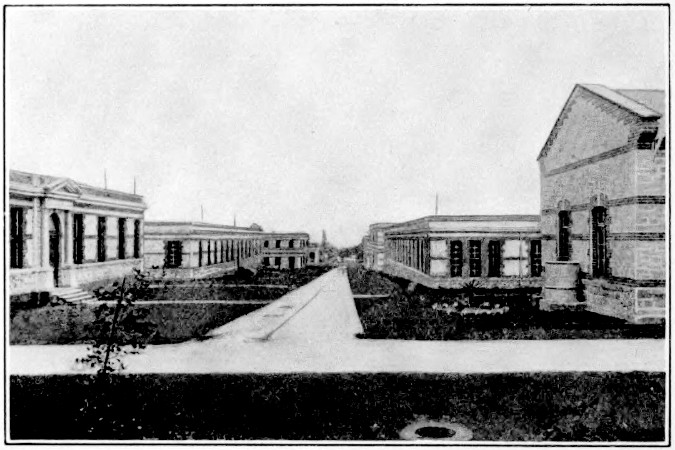
PAVILIONS OF THE GENERAL HOSPITAL.
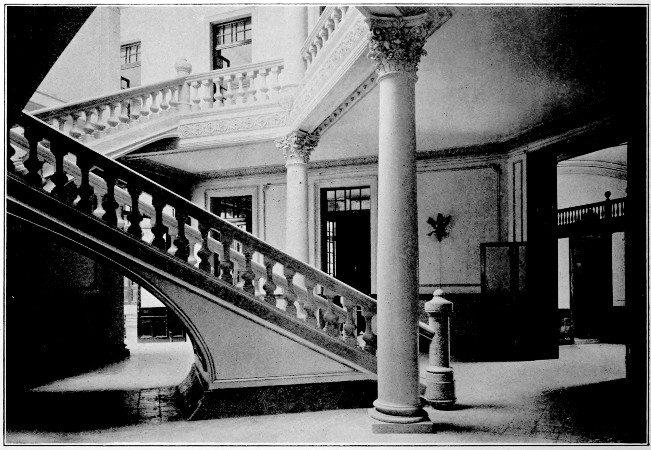
STAIRWAY IN THE COLLEGE OF THE MASCARONES.
[257]
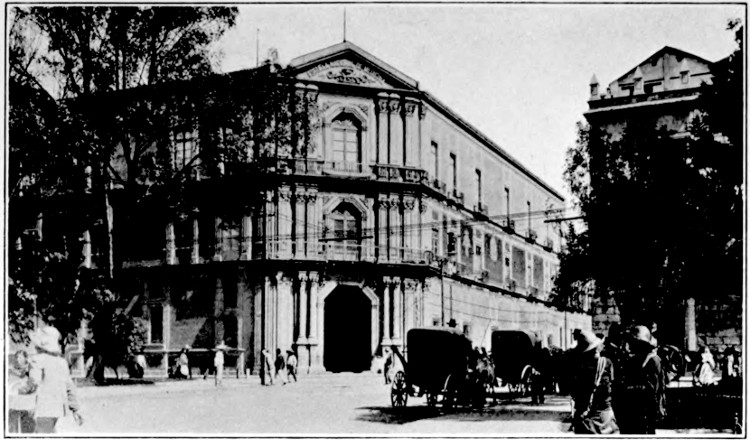
NATIONAL SCHOOL OF MEDICINE.
A marked difference is presented to-day in the picture of public instruction, sheltered under the mantle of peace, compared with that which was offered during the times of political agitation and revolution. This interesting feature, the principal and most solid foundation of the future prosperity of this country, receives each day further development, thanks to the vigorous impulse impressed upon it from all sides. While public authorities in all branches, moved by generous emulation, have made enduring souvenirs of their occupancy of office, this is particularly the case of the department of public instruction. Outside of the great cities the academy diffuses the light of civilization, and even in the smallest hamlet public and private schools extend the knowledge of the people in every useful department. Primary instruction is given almost everywhere. In the largest municipalities the governments either directly support or subsidize a great number of these establishments. Many schools the creation[258] of which is due to private initiative are endowed by individuals or are under the direction and surveillance of benevolent societies. In 1906, there was created a new seat in the cabinet, the Secretary of Public Instruction and Fine Arts. Since then there is an increased interest in school work. Each year two professors from the Normal School are sent to America and Europe to see the best physical institutes and to study the new school systems.
As in all progressive lands, education is the foundation of prosperity, and activity in that direction has been very great among those who realize that it is the basis of their existence. Schools have been established in all parts of the republic, and now the poorest Indian child has its opportunities for learning.
Compulsory education being one of the features it is seldom that the common people are found without elementary knowledge. This branch of learning comprises civic instruction, the Mexican language, arithmetic, history of the country, natural science, practical geometry, drawing, singing, physical culture, fine needle work and plain sewing.
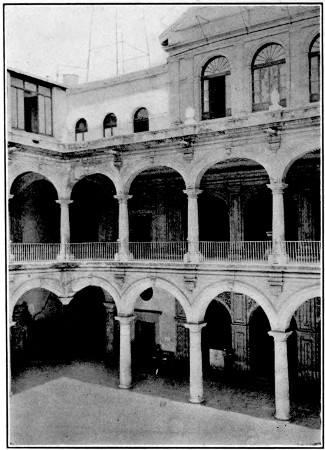
PATIO OF THE SCHOOL OF MEDICINE.
With the administration of President Diaz there was a great change in the educational policy. Day and night schools were opened everywhere for the poorer classes, and every substantial branch of practical learning has been placed within reach of not only the young but the adult laboring class, and the interest that has steadily grown in this movement has been of great material benefit to Mexico. In the[259] general system of education in pursuance of the Government’s desire to educate the working element, there are two classes of schools, the supplementary, which are the means of giving primary instruction to those unable to acquire it, and the complementary, which gives an opportunity to those having a little learning to gain more. Primary, normal and professional schools are within the grasp of every one, the system of education being entirely free, even books and every facility to gain knowledge is furnished by the Government.
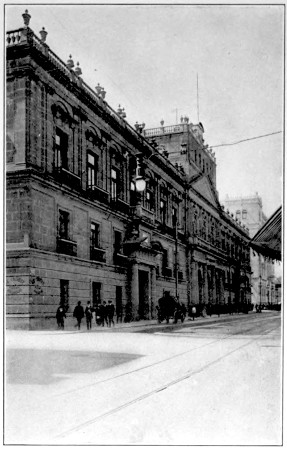
NATIONAL SCHOOL OF ENGINEERS.
Education in Mexico begun with the Conquest, and some institutions of learning were then established, among them the College of San Juan de Letran, in 1530, and the University of Mexico, which was opened in 1553. There was a lull in interest on account of the unstable conditions, and some of the great seats of learning were discontinued. When Baron Von Humboldt, the German explorer, visited Mexico in the earlier part of the eighteenth century, one of his first reports to his sovereign was relative to the great advancement of higher education in the New Spain. This was said of the higher classes, not of the poorer people, who were illiterate and superstitious. To-day the moral precepts that are instilled into these people as well as the development of their mental faculties, give every man an incentive to be a good and honorable citizen, and it is with great satisfaction that those interested in this great reform[260] have seen its splendid results. After the adoption of the Federal Constitution, it required a great deal of activity on the part of the officials to establish a common school instruction throughout the republic.
As each state was responsible for its schools it was very difficult after years of warfare and unsettled conditions to establish a system of education without taxation for that purpose. School buildings were erected, teachers employed, and gradually the interest of the people grew. Now no country can boast of a finer educational foundation than Mexico. Greater attention is directed toward manual training and domestic economy than in any other country in the world. The Federal primary schools are divided into two groups, day and night schools, for children, and the working classes of both sexes. Belonging to the first group are the kindergarten, elementary for mixed classes, and general high schools and special high schools. These are divided into mercantile and industrial, and those who graduate are permitted to enter the normal school.
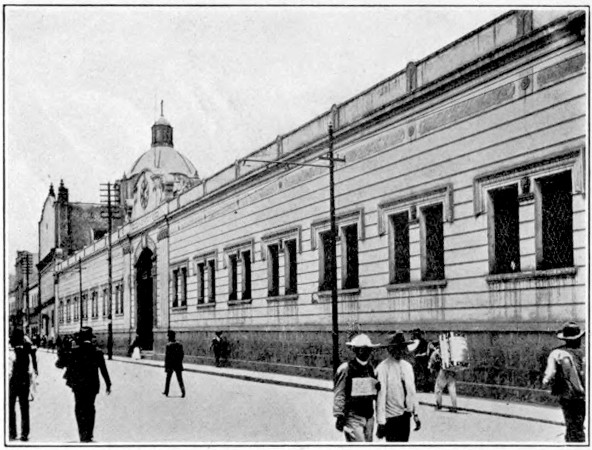
SCHOOL OF ARTS AND CRAFTS FOR MEN.
All the primaries of the Federal District are under the general direction of Primary Education, except the kindergartens, which are under the supervision of the Minister of Instruction and Belles Artes. In Mexico City and its outlying territories much care has been taken to organize a splendid school system; new buildings, sanitary in every respect, suitable to accommodate the demand of the multiplying attendance, and a standard of education so advanced that Mexico has achieved a great thing in meeting the needs of her people. The better classes were in former years forced to send their children abroad to school. The best professors direct the courses of study and every art and craft known is taught. Splendid playgrounds for children and gymnasiums are installed in all the modern school buildings.
[261]
Normal schools for men and women in which they become masters of the art of teaching are one of the chief features of the educational system.
The Catholic Church takes great interest in education and maintains branches of all its well-known teaching fraternities and sisterhoods. Besides the parochial schools many academies and colleges are conducted throughout the land and the teaching is on the same high plane as in other countries. The Sisters of the Sacred Heart direct the finishing schools for girls and the Jesuits most of the colleges and seminaries for young men. There are many private schools with a high standard of study, besides finishing schools of splendid order. They are patronized by the better classes and the result is that Mexico boasts of delightful men and women, well informed boys and girls, and the Nation’s younger element are developing well in the progress of their country, and are being fitted for important positions they must surely fill some day.
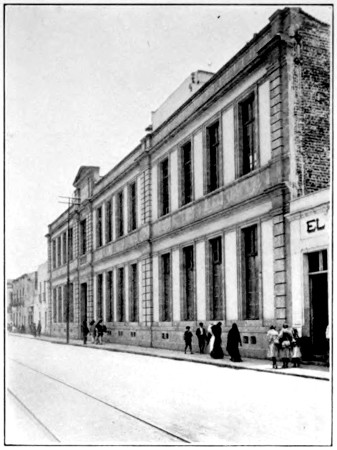
SCHOOL OF ARTS AND CRAFTS FOR WOMEN.
The National Conservatory of Music sends yearly into the world finished artists and professors and the many histrionic and musical societies in the Capital are ample proofs of the splendid training received in this institution. Languages are taught in every school, and most versatile linguists are found in Mexico, from the tradesmen to the Ministers of the Cabinet. Some of the greatest men of Mexico, whose names are of universal fame, graduated from the National School of Jurisprudence and the School of Medicine.
[262]
In the penitentiaries of every state in the Republic there are schools conducted with the finest masters to be obtained, and each prison has an orchestra or band which has the full benefit of instruction in music. The School of Engineering gives as good a course as may be had at any university. A School of Mines and a School of Agriculture exists and are splendid institutions. The Colegio de la Paz, once a religious school, is now controlled by the Government, and largely supported by its own endowment. Its building is one of the greatest in the city. In rank just below these great public institutions of instruction come the Schools of Industry for men and women, for deaf mutes and for the blind, reformatories, business colleges and a school of arts and crafts.
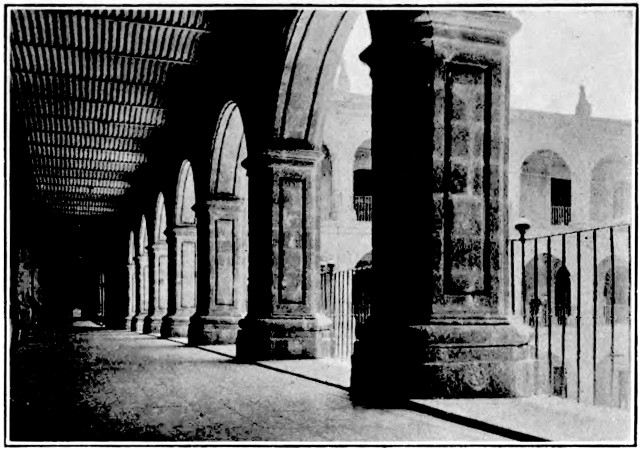
ENTRANCE TO SCHOOL OF ENGINEERS.

SCHOOL OF FINE ARTS.
Amid wars and the care of material affairs, Mexico has never neglected the æsthetic and the intellectual. Institutions devoted to culture of every kind are important and are very liberally maintained. The national library—biblioteca national—occupies the beautiful old edifice once the church of San Agustin, which has been modified to meet the purposes of a library while preserving the beauty of the old church. Along two sides of the building[263] stretches a pretty garden enclosed by a high iron railing, the posts of which bear commemorative busts of eminent Mexican writers beginning with the Aztec Netzahualcoyotl, Ixtlilxochitl, and coming through the list of colonial writers brings us to the modern Mexican literati. The classic interior of the building lends a dignity and grace befitting the place. Statues of didactic writers adorn the walls, including the biblical teacher Isaiah and the great oriental master Confucius, and at the other extreme are the figures of Humboldt and Cuvier.
Of the literature housed in this library a large portion consists of devotional and dogmatic works collected from the convents and monasteries on their suppression, numbering about two hundred thousand volumes. There are many very precious tomes in this library, unique specimens of priceless value, dating from early in the fourteenth century, and some Mexican pinturas done in deerskin by Montezuma as dispatches to his allies at the time of the invasion. Curios in literature are of deep interest to the lover of antique songs. Modern books on every subject make the National Library one of the valuable and interesting depositories of the world.
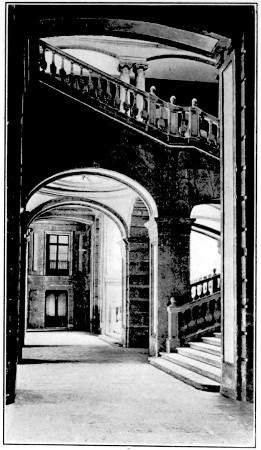
STAIRCASE, SCHOOL OF ENGINEERS.
Besides this great library there are several others containing works of special interest to publicists and students—as those of the government departments, the National Museum, the Fine Arts Academy, the School of Engineering, the Law School, and the library at the National Palace.
[264]
Higher education has its protection and many schools for the development of talent are found in Mexico. Besides a school for thought which comprises advanced ideas, Mexico is very proud of her Escuela Nacional de Artes y Oficios. It was established to give women and girls an opportunity to gain a profession that could give them a livelihood or fit them for the serious duties of life. In this school are taught all the branches of work, nursing, elementary learning, photography, upholstery, lace-making and in fact everything that the trained hand can do. This school has elevated the humble class to a condition of self respect, and the women who have had advantage of this training have been able to earn a good living, and liberal remuneration for their work and some have been known to establish little shops which have grown into good commercial standing. This institution is one of the great safeguards to women, who are protected by a feeling of independence and self-confidence. It is under the direction of the Government and the ladies of the highest society of Mexico, who do everything for the advancement of this class of women. The best teachers are employed, many of them having been sent abroad to make studies of schools of this kind.
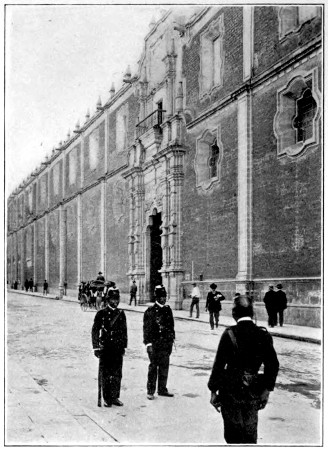
NATIONAL PREPARATORY SCHOOL.
Realizing that many of the students were too poor to have proper food and nourishment, the influence of Madame Sierra, wife of the Minister of Education, and Madame Luz Cosio de Lopez, daughter of the[265] Minister of War, resulted in plans to give them free meals, and the good nourishment given these girls, whose lots in life are not too easy, is one of the aids to the great success of the institution.
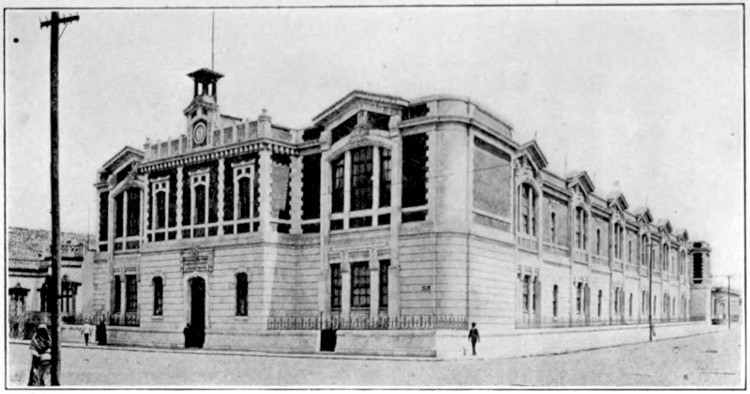
COMMERCIAL SCHOOL.
There are several English and American schools, among them the Sarah L. Keen College.
It will be appreciated that the educational system has its practical as well as its æsthetic side. A fair amount of intelligence and a willingness to profit by the experience of other countries are the keynotes of educational propaganda. The many agricultural colleges throughout the country are modeled after those of Canada, where the idea of such schools was first worked out. From Germany the scheme of manual and industrial training was borrowed, while from the United States came the plans for the mining and applied science colleges. Already the beneficial effects of the training given are being noted; better farming, more economical mining, more skill in weaving, in dyeing, in metal working and thrifty housekeeping. The newly organized Federal Department of Public Instruction is zealously directed by the Secretary, Lic. Don Justo Sierra, ably assisted by the Sub-Secretary, Lic. Don Ezequiel Chavez. “Co-operating” is the federation of education: a convention of educators which meets from time to time makes practical recommendations for improvement wherever such should and[266] can be undertaken. In another generation there will be no illiteracy among the Mexicans, a condition of which no European country can boast. Irresistibly, the mark of progress goes on, welding the races into one people. One man’s life, that of Porfirio Diaz, spans the whole improvement; and its inspiration is his, although the working out of the plans for betterment has been in the capable direction of his ministers supported by the whole-hearted efforts of an awakened people.
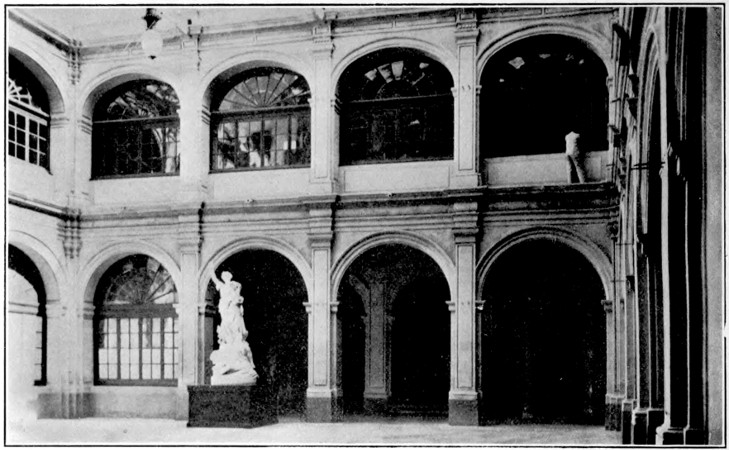
SAN CARLOS ACADEMY.
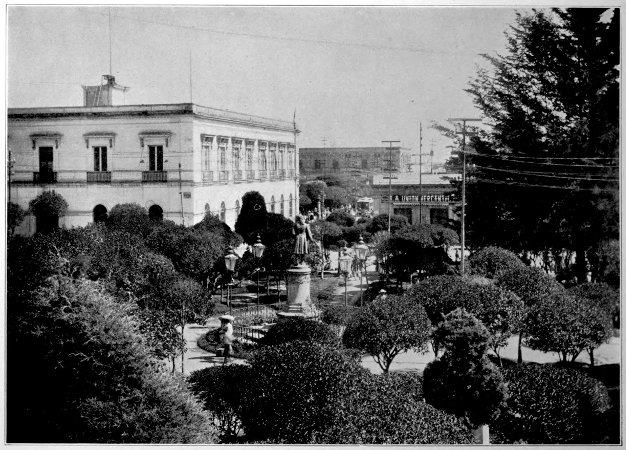
MORELOS PARK, TOLUCA.
[269]
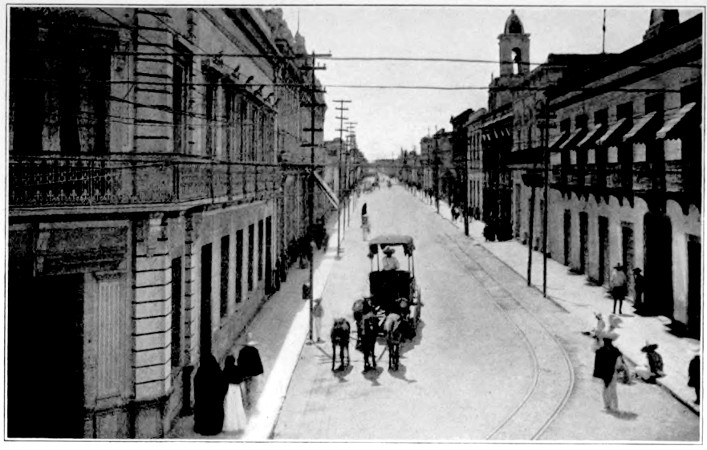
STREET SCENE, TOLUCA.
It would require many years of study to present an adequate idea of the progress and enterprise that exist in the republic, and each state has contributed its share toward the rapid advancement that has marked the conditions within the past fifteen years.
The State of Mexico is one of the most important in the republic. It is rich in mineral resources and picturesque in scenery. The people of this state are active and ambitious.
Many extensive tracts of territory have been shorn from the empire which was granted to Cortés as his reward for the conquest. Two other whole states, Hidalgo and Morelos, were created out of Mexico and Guerrero and the Federal District have also had parts of this state added to them. Nearly ten thousand square miles are left, and upon this territory live more than a million industrious[270] people, many of whom are of Indian descent. For purposes of government it is divided into fifteen districts but Nature has divided the state by means of mountain ranges into three almost distinct territories. The Valley of Mexico, which extends into the Federal District is paralleled to the west by the Valley of Toluca, in which the capital of the state, bearing the same name, is situated. The third district comprises the slope southwest of the main range toward the lowlands of Guerrero.
The soft named and beautiful capital of this interesting state nestles at the foot of snow-crowned mountains, one of them the extinct volcano from which it is named, whose peak looks silently down with the calm of centuries upon this city of restless progress, as the still ages might look down upon the on-rushing to-day. Her wide and well-paved streets, her spacious plazas and shaded squares, the imposing buildings, some gray with centuries, some new with the modern spirit of the day, combined with the delightful situation and the grandeur of the surrounding scenery, make the city one of surpassing interest and beauty. Modern institutions devoted to education, progress, charity and humanity have given Toluca the well-deserved reputation of being one of the finest and best governed cities.
In the Valley of Mexico, which averages throughout the state the same altitude as Mexico City, the principal pursuits are farming, cattle raising, and manufacturing. The numerous small towns are reached by branches of the national railroad system. Equally well provided with transportation facilities are the towns in the Toluca Valley. The average altitude here is above eight thousand feet, a thousand higher than the Valley of Mexico, and the temperature is proportionally lower. The air is wonderfully pure and the sanitary conditions exceptionally good.
Toluca is only forty-five miles from Mexico City but, owing to the intervening mountains, the journey occupies three hours. Here, almost at the base of an extinct volcano, called the “White Mountain” by the Spaniards, Cortés set up the headquarters of his seigniory. The city to-day is one of the most pleasing in Mexico, with a large and intelligent population and contains many buildings of interest. It is built on both banks of the Xicualtenco River which is parallel to the main thoroughfares. The streets are for the most part straight and are always kept clean. The public squares and gardens are adorned with fine monuments. There are many delightful spots and interesting places found throughout the[271] State of Mexico. Lofty peaks and deep barrancas, broad meadows and narrow vales, inaccessible height and cultivated fields succeed one another in delightful variety. The beauty of the scenery is indescribable, now and then through the arched forest trees the snowy volcanoes with their distant domes and the silvery lakes of the Valley of Mexico greet the vision.
The ruins of an old Carmelite Convent standing on the slope of a hill are surrounded by noble forests of pine and oak and cedar—long and lofty forest-aisles, where the monks of former days wandered in peaceful meditation. Some poor Indians live among the ruins and possess the undisputed sovereignty of the woods. It is said that a benighted traveler who had lost his way in these solitudes and was miraculously saved from dying of cold, founded this rich convent of Carmelite Monks, in gratitude for his deliverance, expressing his desire that all travelers that passed that way should receive hospitality from the convent. Certainly no place more fitted for devotion could have been selected than this mountain retreat.

GENERAL FERNANDO GONZALEZ.
The way to Lerma is through a massive stone gateway from which the gates were removed long ago. The streets are broad but straggling, the houses comfortable rather than grand or even elegant and the many eucalyptus trees planted around the picturesque adobe and stone church date back to[272] the time of Maximilian. Across the way from the church is an old grave-yard which is indisputably ancient, as the graves of the Spanish conquerors, nine in number, are marked with limestone slabs dated over four centuries ago. It is a custom among the Mexican Indians to sell pebbles from these graves to tourists who are always eager to carry away souvenirs from a spot of historical renown.
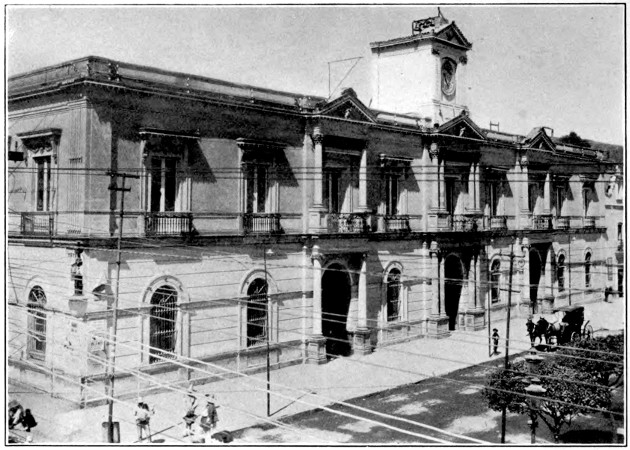
GOVERNOR’S PALACE.
High in mid-air the climate of the State of Mexico leaves nothing to be desired by those to whom pure air without clean cutting winds, bright sun that does not scorch, and abundance of pure water melted from the eternal glistening snows, are indispensable. It is such that brings contentment and peace the year around, without undue lassitude at any time. Its variety permits the production of all classes of crops; wheat, Indian corn, and other cereals grow in abundant harvests in the valleys of Toluca, Iztlahuaca, Tenango, and Tezcoco, while sugar cane, coffee, and other tropical products grow in the districts of Temascaltepec,[273] Tenancingo and other southern districts. The forest products are remarkable for their diversity and richness.
The raising of cattle is one of the principal resources of this state, and is increasing rapidly each year. The annual product is exceedingly great, but pastoral life is giving way to more modern methods of existence. The railroads going through these vast plains around and among these lofty mountains are doing away with the primitive conditions that have existed.
Toluca, the capital of the State, is united to Mexico City by the Mexican National Railway which traverses a most picturesque route all the way to San Luis Potosí. All the railways which centre in the metropolis cross the state giving it ready exportations for all its products. The Mexican National route also gives communication northward with the rest of the world.
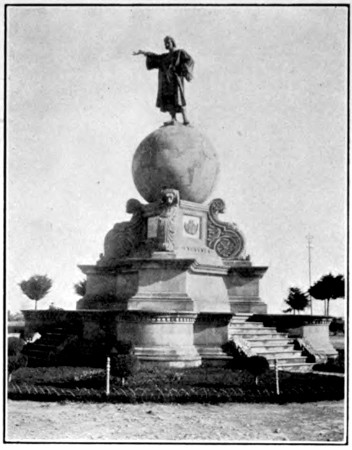
MONUMENT TO COLUMBUS.
Practically all of the towns in the two valleys are lighted by electricity generated from hydraulic sources. In Tenancingo is the plant of the Toluca Electric Light and Power Company, which furnishes light and power to the home town, to Tenango, Calimaya, Tienguistenco and Toluca. In Tenancingo a local stream runs the big cotton spinning and weaving plant of La Guadalupe. In Sultepec water runs the smelter of La Concepcion, lights a district, supplies power to the mines and other reduction plants and has five hundred horse-power for the machinery of the Toluca Brewery. Mills at Calimaya, San Ildefonso and numerous other points making cotton cloth, woollen goods and paper all get their power from similar sources. Besides having plenty of water power, an abundance of labor, fertile farms and pastures, the two valleys are also rich in mineral wealth. Some of the most beautiful marble found in the world is[274] quarried here and the mining industry is very much developed. There are mines producing gold, silver, lead and quicksilver. The best known of these are El Oro and Esperanza, whose British and American owners are quite frank in making their gains public.
In the Sultepec district is another great producer, “La Quimica,” owned by Germans who are more reticent but who are known to ship a great amount of bullion. Besides these there is a host of minor shipping mines and the possibilities of a great range of country which has not been thoroughly prospected, notwithstanding the fact that the mines of this state have been worked for hundreds of years. Many of the mines now yielding rich ores are those once worked by primitive processes and were deserted because they were thought not to be worth the trouble. Modern crushing machinery, smelters, and chemical reduction works find a rich profit in these mines.
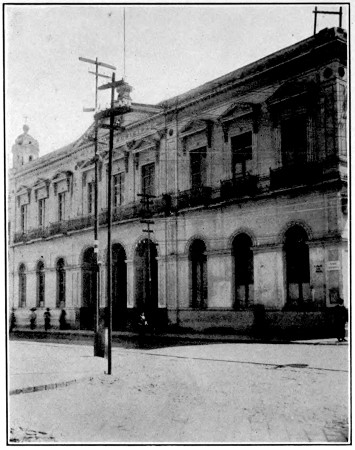
MUNICIPAL PALACE.
In the mines of Temascaltepec and Zacualpam, as in those of Oro, the profits are large; gold, silver, lead, iron, and copper being obtained in large quantities. The supply of sulphur from the great snow-capped mountain, Popocatepetl, is enormous. There is in this district coal of excellent quality and zinc is found in the form of blendes, accompanied by silver ore. The mining activity in this state is increasing every year, the Tejupilco district is being steadily developed and the Sultepec district, eighty[275] kilometres southwest from Toluca is the centre of an extensive metalliferous zone running from Angangueo to Taxco, both famous mining camps. There are many veins in exploitation though some of them remain to be worked. Among these are: El Cobre, Maravillas, Laura, La Providencia, Alejo, La Soledad, San Luis and others. In all these it is observed that the richness of the vein gives great promise although the prospectors are very reticent concerning their yieldings.
Besides having the mineral wealth itself, this state also is particularly well provided with the means of uncovering its buried riches. There is an abundance of lumber for timbering shafts, of water power to run hoisting and crushing machinery, and of the most docile labor, which is still cheap, though the competition of mills is gradually raising the scale of compensation.
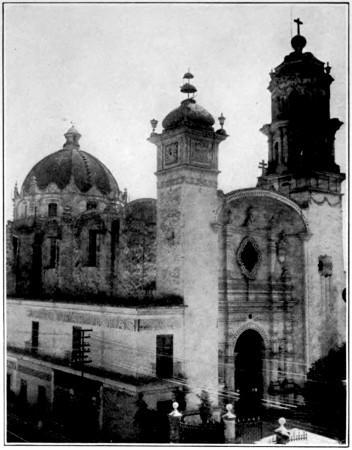
TEMPLE OF VERA CRUZ, TOLUCA.
The third great natural section of the state drops in terraces in the southwest from an altitude of a mile and a half almost to sea level. On the upper ranges, as in the valleys of Toluca and Mexico, the crops are those of the temperate zone, corn predominating, and there is also much cattle raising. As the slopes fall, however, the natural products verge into the tropical: sugar, coffee, cotton, rubber and the citrous fruits abound.
The Indian population of the state is a peaceful, law abiding people understanding and speaking Spanish and having entirely forgotten their primitive[276] tongues. They do not mix in political matters but manifest a great interest in education, for which reason the governor of the state has insisted on plenty of schools being built in the districts, to which these Indians, in most cases, gladly contribute their personal labor.
Toluca lies in the centre of the fertile plains west of the Sierra Madre. It is one of the cleanest cities in the country. The citizens are intelligent and well educated and their school system is of the highest standard. There is a splendid Girls’ and Boys’ Normal School of Arts and Trades, largely for the purpose of elevating the ignorant and inferior classes. In this school are many of the Mazahuatl, Otoli, and Aztec indigenes, whose ambition is to become teachers in their respective villages.

LEGISLATIVE PALACE, TOLUCA.
The literary institute of Toluca has been reorganized as the Scientific and Literary Institute of the State of Mexico. Public charities are also well organized. There is a general hospital in the city and local hospitals in each of the cities of Sultepec, Jilotepec, Tlalnepantla, Tezcoco, Valle de Bravo and all the small[277] villages and mining districts. There are asylums for boys and girls and education is compulsory.
The penitentiary is a spacious and sanitary institution where all the machinery is run by steam power and the establishment lighted by electricity. The object of this institution is the reformation of the criminal and the abolition of the death penalty. Humanitarian ideas are evident at all stages of one’s progress through this model prison. Each prisoner has his hour for instruction and the classes run from primary to the higher standard according to the knowledge of the prisoner, and by this system he is able to earn an honest livelihood by handicraft when he is liberated.
Industrially the city is very well advanced. There are woollen mills which produce handsome cloths. In this country industry has made such rapid strides that it is fast becoming a manufacturing centre. Most of the factories of the state are located near water powers, notably in the capital is the site of one of the largest breweries in Mexico.
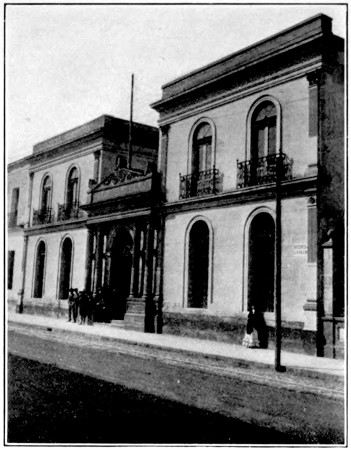
PALACE OF JUSTICE.
Most of the public buildings are of comparatively recent construction. The Palace of the Government, though it occupies the site of one built by Martin Cortés, son of the Conqueror, was not erected till 1872. It faces the Garden of the Martyrs. In its main hall is a collection of portraits of the early Governors of the State. The public offices are elegant and commodious and the reception room is magnificent in every detail. Other handsome buildings are the City Hall, the Maternity Hospital, Schools of Law, School of Arts and[278] Crafts, and the Normal School, all of which are modern and beautifully constructed. The Public Library, containing many thousands of volumes, is also rich in original manuscript archives, and is much consulted by historians of the earlier periods of Mexico. The public market is of late construction and is one of the finest and most sanitary in the republic. Here all classes of goods are sold, from the products of the country, pottery and meats to the cloth that is woven in the mills, and the most picturesque sight that one can imagine is the Indians in their native costumes squatting in the market square, offering their goods. It is here that one sees the people face to face in their native dress, and receives valuable impressions of their customs and the products of the country.
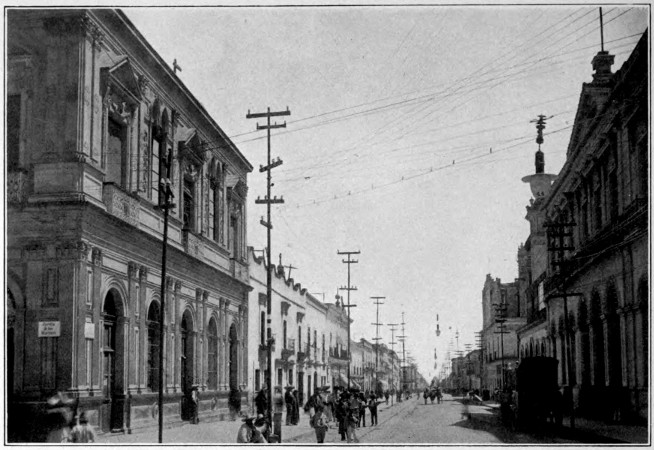
INDEPENDENCE AVENUE, TOLUCA.
The Parochial Church dates back to the days of the Conquest. It was restored and enlarged in 1585. There are a number of other old churches, some of very large size, all noted for their beautiful paintings, their altars, and rich tapestries, one of which has a famous chime of bells and a very large organ.[279] The public monuments are very notable. There are two of Hidalgo, one of Columbus and many others. In almost every park there are evidences of patriotic feeling, either a fountain dedicated to some hero or a tablet inscribed to the Martyrs of the War of Independence.
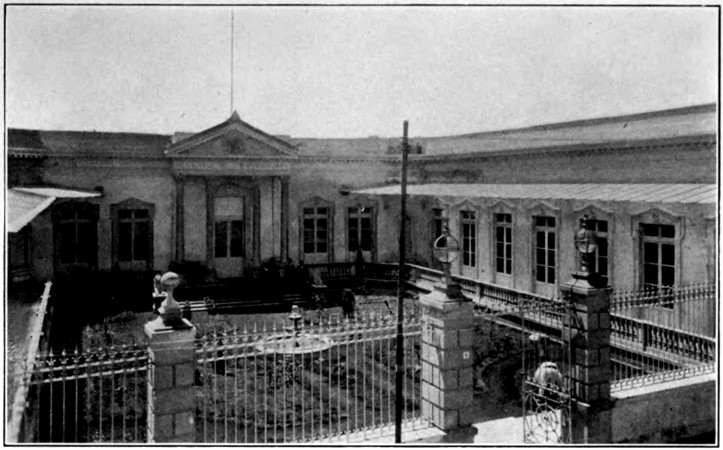
SCHOOL OF LAW.
The beautiful alameda, the rendezvous for the élite of the city on fête days and on Sundays is one of the most perfect parks in the republic. It is the result of the strenuous efforts of all the public officials to make the State of Mexico famous for its advancement and improvement. In this beautiful display of verdure, drive, and lakelets, worthy features have been added to the well-known beauty of Toluca. Entering this lovely park by wide arched gateways one is confronted by a masterpiece of art and industry. Swans gliding in the waters of the lakes curve their long necks to greet the visitor; deer already tamed by young children come forward sniffing a glad welcome, and on days of fiesta gather lovely señoritas, clad in delicate gowns, gay parasols, colors, everything pertaining to gladness and beauty. There one has the opportunity of studying a phase of life among the young folks in this vast country of beautiful customs.[280] The women of this country are gentle, beautiful, tender, loving mothers, gracious and gifted, devoted to their husbands, and make their home-life all that is to be desired.
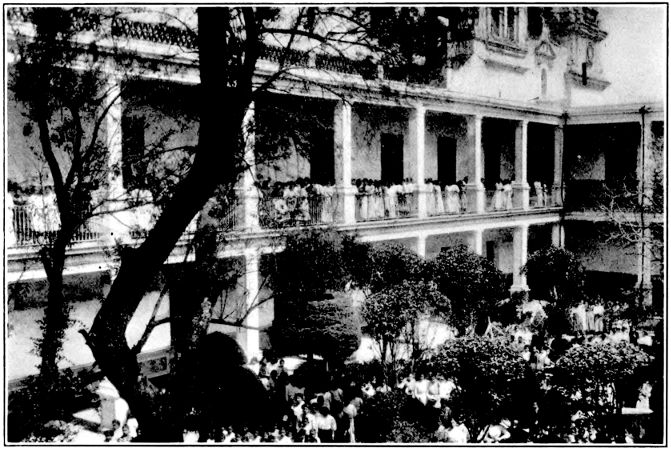
NORMAL SCHOOL FOR GIRLS.
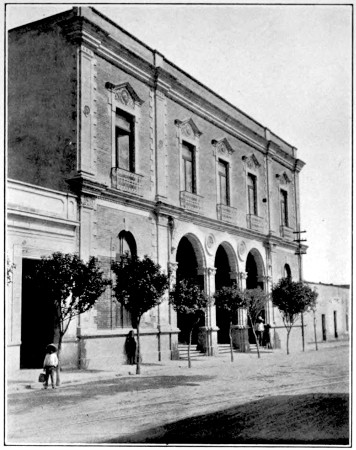
MATERNITY HOSPITAL.
In 1519, Cortés found the people of Toluca the most prosperous and advanced of the subjects of Montezuma. From the deposits of precious stones in Toluca the Spanish had a splendid revenue and the mountain sides yielded emeralds, sapphires and garnets for the markets of Europe. Near the city may be seen the stone foundations laid for the structure of a home which the Conqueror began for the comfort of his old and wounded soldiers. This plan was not carried further on account of the changes in the fortune of this ambitious man. There is a splendid automobile road which leads from Mexico City to Toluca and it is very popular on account of the beautiful scenery. Many tourists find this a pleasing trip to make. Leaving the capital, one passes Chapultepec and all the outlying villages of the Valley of Mexico. Old temples rise majestically before the traveler and the swift ride up the Sierra Madre over cañons on the[281] mountain crest looking down hundreds of feet into the valleys one has a vision of Toluca that can hardly be described. In going there from Mexico City, the way leads down the beautiful Paseo de la Reforma and takes one through Tacubaya and over a great mountain wall. The climbing begins to get very steep especially after leaving the pine belt. The fir trees in this region resemble the hemlock spruce but have a different arrangement of the needles. Polypodium ferns grow in tufts on every hand and cardinal flowers abound. Scarlet and blue tanagers fly about everywhere. There are also sparrow hawks even more beautiful in plumage; doves unusually brilliant in color and parrots of every hue and variety. On the crest of the mountain that divides the country of the Tolucans from the City of Mexico the character of the vegetation suddenly and marvelously changes. Here in the same altitude, but facing a warmer sun and milder winds, are forests of tropical trees. Mahogany and tangerine orange trees are seen and the ground is green with the grazing plant known as alfilerea. Half way down the mountain range is a wide plateau, and about half a mile from it, is the historic field, Las Cruces. The spot is marked by an obelisk, about thirty feet high made of limestone set upon a heavy foundation of concrete. This is the scene of[282] the first real victory of the Mexicans over the Spaniards in the war of 1810. It was here that the great patriot Hidalgo with his band of followers drove back the royalist troops with heavy loss. It was this great victory that gave the Mexicans self-confidence and proved to them that they might, under proper conditions, defeat the well-trained and completely armed soldiers of the Spanish viceroys.
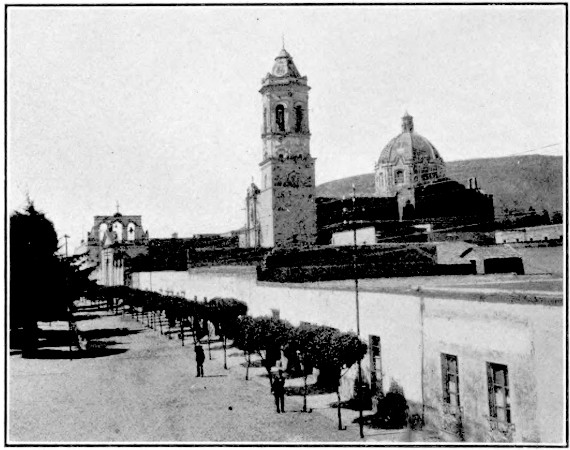
TEMPLE OF MERCED.
On the same plateau is the old town of Las Cruces. The population is very small and its livelihood is derived entirely from the sale of toys, silver filigree work and beautifully polished woods of the mountain forests. Leaving Las Cruces the soil becomes well-watered and very fertile. Hundreds of farmers at their work in their fields of alfalfa, barley and maguey, and laborers in orchards of olives, prunes and native fruits, give life to the country. The peak of Toluca is more than sixteen thousand feet high but is not snow covered. There is an extensive snow field on its summit but this is hidden from view. The wind blows fine jets from the hidden snow field and this gives the mountain the appearance of smoking. In the early days of Montezuma the Aztecs regarded Toluca as having a supernatural power and many stories told of spirits hovering over the people lend attractive legends to the folklore. On the plains, the Lerma River, which is one of the great waters of Mexico, flows like a ribbon of silver toward Lake Chapala, from this it runs north and taking the name of Rio Grande de Santiago rolls onward to the Pacific Ocean, into which it flows near San Blas. The City of Lerma is on the rocky eminence, and the bell tower and dome of its famous church are very conspicuous, gleaming in the air. The whole plain rises gently from the marsh land at the foot of the hills and sweeps up to the base of the great mountain range of which the peak of Toluca is the culmination. Far as the eye can reach the soil is cultivated and gives evidence of lavish care. The[283] variegated coloring of the fields planted in different varieties of grains, gives it the appearance of a mammoth checker-board. Everywhere are big villages or imposing haciendas. One of these, perched upon the last slope of the hillside, might have been taken bodily from one of the Italian cantons of Switzerland.
In the outskirts of Toluca are two elaborate shrines where, often, one may see a group of farmers and laborers who have stopped on their way home to offer prayer. This is not confined to the class of Indians, for often a rich haciendado is seen passing on his horse to oversee his workmen, stopping there, too, to offer his prayers of thanksgiving.
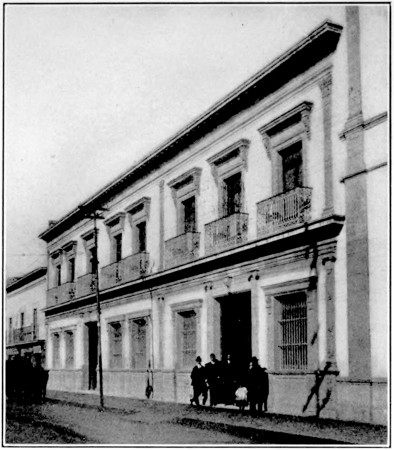
STATE BANK.
The little village of Otumba, about thirty miles from Mexico, was the scene of one of Cortés’s greatest battles. Chalco is a little Indian town, and has great historical value. The Chalcas were a determined enemy of the Aztecs, and only after struggles, in which they were notably brave and daring, were they defeated by the combined forces of the armies of Mexico and Atzcapotzalco. They afterward became a part of the Aztec confederacy. The land of Chalco is one of the most productive parts of Mexico, as what was once a great lake is now the most fertile land that exists in the valley.
The Governor of the State, Brigadier-general Fernando Gonzalez, is the son of an illustrious father, Manuel Gonzalez, who is known to history as one of the great presidents of Mexico. Governor Gonzalez has a brilliant record of thirty-two years of splendid service to his country, and the people of the State of Mexico, recognize in him an able and enthusiastic ruler. He is progressive, strong and[284] able to handle affairs pertaining to the welfare of his State, and universal satisfaction is felt at his continuing in office a second term. No governor has ever had the ovation he received on the occasion of his re-election. Under his administration the State has greatly prospered and he maintains the strictest discipline among the rural guards, causes the roads to be kept in repair, and has greatly advanced the public school system in efficiency. The rural schools and those in the mining districts are the objects of his great interest and the reputation that this State enjoys for a splendid school system has been the result of the indefatigable labors of this distinguished man.
During the feast of the Centennial, the State of Mexico entered into the spirit of the celebration with great enthusiasm, entertainments being most brilliant.
The State of Mexico has earned her laurels as a well governed progressive State, probably as much as any State in the Union for she is better supplied with good roads, splendid railway communications, good service of telegraph and telephone lines, while the postal system is said to be the best regulated in the republic.
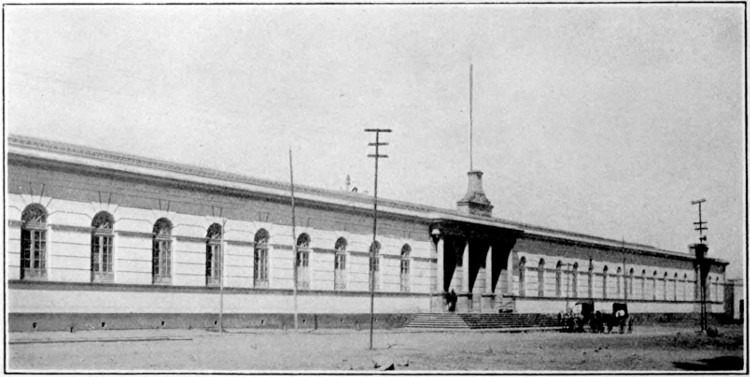
GENERAL HOSPITAL.
It is not difficult to understand why the State of Mexico is considered the most prosperous in the republic. It is one of the fertile States and occupies one of the most beautiful positions that can be seen in any part of the world. Nature is seen in almost all her phases; forest, green fields, snow-covered volcanoes, fertile lands and flowing rivers. What more superb setting can be found for so fair a jewel!
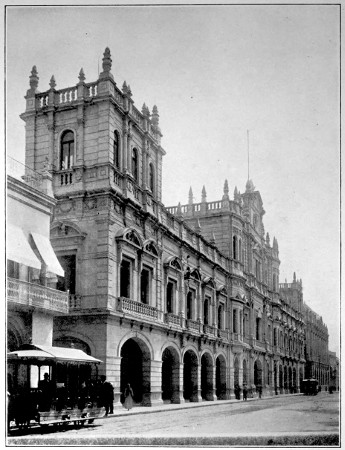
MUNICIPAL PALACE.
[287]
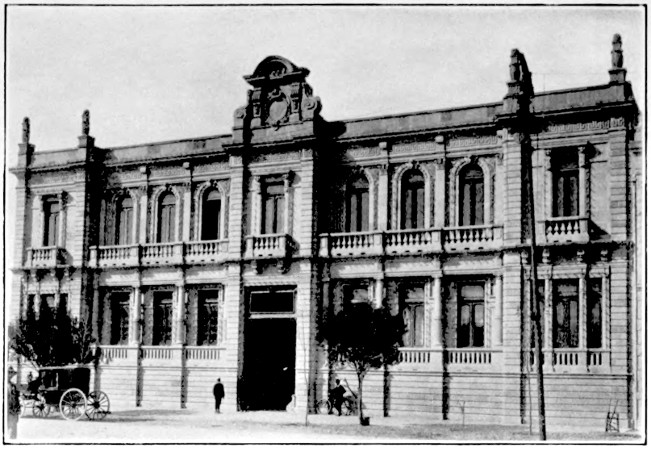
RESIDENCE OF GENERAL MUCIO MARTINEZ.
It is not mere acreage or population, nor public institutions or monuments of any kind, however imposing, historic, or beautiful, that constitute a state. It is the men of thought and action who have brought Mexico from under the yoke of the Spaniard, who in three hundred years wrung so much treasure from a suffering people, and made of the down-trodden province a free and independent country among the nations of the globe.
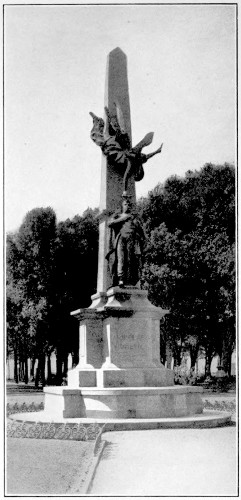
MONUMENT TO NICOLAS BRAVO.
The State of Puebla is eminent in the annals of the Republic, alike for the great resources it has yielded from the time of the Conquest and its participation in the history-making of the nation and not less so for the distinction gained by its people. Puebla is the capital city; it was founded soon after the Conquest by Cortés, and at that time was one of the social centres. Its location[288] near the Federal capital has brought the city into intimate acquaintance with the affairs of the world. It is finely laid out, with every modern improvement, and is exceedingly picturesque with alamedas and public squares. Its ancient palaces have been turned into offices for the chief officials. It is considered one of the most attractive cities in the republic. The people are noted for their refinement and culture, having many splendid public institutions of learning. There are over sixty churches and theological schools, charity schools, hospitals and benevolent establishments. It is one of the oldest cities in America, founded in 1531, and is considered, next to the Federal District, the most important. It is the cradle of manufacturing industry in Mexico, being one of the first to establish spinning and weaving factories. In addition to being an industrial centre, Puebla is connected with all parts of the republic by railroads which traverse the rich district of sugar plantations and other industrial centres. The climate is delightfully mild and agreeable and the country around is green with fertile fields. The view of the great volcano of Popocatepetl, seen at sunrise, is unrivalled. The snowy top and sides stand out like a great dome of alabaster and then the sun, rising higher and higher, from the radiant brow sheds its glory on all below. Puebla is a beautiful city with handsome houses built in the finest style of architecture, with broad and remarkably clean streets and avenues. It[289] has a population of more than a hundred thousand; is the seat of an archbishop; and its historical associations make it exceedingly interesting. Some of the buildings are relics of the days of the viceroys. The architecture, distinguished by its Spanish influence, is very picturesque, with its multi-colored tiles of Talavera, for which the city was famous. This pottery ware was manufactured in this city in the seventeenth century and some of the wonderful relics are still found, though very seldom.
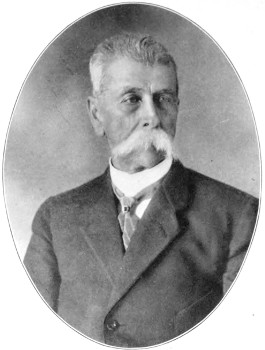
GENERAL MUCIO MARTINEZ.
The character of the citizens is marked by conventionality, conservatism being the keynote to everything in which they participate. The influence of the Catholic church prevails and one is often impressed at the sight of the people, from the poorest to the highest in society, kissing the hand of the archbishop or kneeling as the angelus is rung. From a military point of view, Puebla is considered the key to the national capital and during several foreign wars suffered many vicissitudes. Its history is very interesting, although a stormy one, and it has suffered more, perhaps, in the cause of war than any city in the republic. Augustin Iturbide, who proclaimed himself Emperor of Mexico, captured the city in August, 1821. In 1847, it was occupied by the United States forces. In 1862, it was the scene of Zaragoza’s victory. It was occupied by the French in 1863, and on April 2, 1867, General Porfirio Diaz gained the most notable victory of his military career by driving out the French. In spite of the ravages of warfare and some of the relics of the war that exist, the city of Puebla still retains its beauty of former days embellished by the art of modern architecture. One of the most magnificent edifices in the world is the Cathedral. It is noble and inspiring. A pretty legend regarding the rapid[290] progress of the building tells us that it was owing to the assistance of two angels, who descended nightly and added to its height, so that each morning the astonished workmen found their labor incredibly advanced. From this legend Puebla derives its name, “The City of the Angels.” This beautiful church is elegant and simple, and in excellent taste. The floor is of colored marble; the rich and artistically attractive high altar, of different varieties of Puebla onyx; and the beautiful iron work and wood carving about the choir make an interior which equals that of the Cathedrals of the old world. A great amount of wealth exists in Puebla, principally in connection with its churches, some of which are three hundred years old.
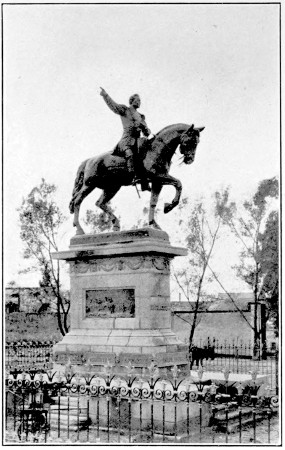
STATUE OF GENERAL ZARAGOZA.
Other churches which claim attention are those of San Cristobal, founded in 1532, and rebuilt in 1667; San José, the Templo de la Compania, San Marcos, Nuestra Señora de la Soledad and Santa Catarina. In the interior of all these one finds a collection of paintings and beautiful carvings. The general effect is bewildering. In all these churches, silver railings, candelabra and rich tapestries are found and the domes and steeples of glazed Talavera tiles make the city flash in the sun.
During the celebration of the Centennial, schools and public institutions were dedicated and the city was festive with entertainments of all kinds. The venerable Marqués de Polavieja was the guest of the government, and was given the freedom of the city. Puebla probably had more reason to celebrate the Centenary than any other city as it was the centre of all the historical events of the Spanish period.
[291]
Music and opera have a charm for the Mexicans, and Puebla is a musical centre. There are some good theatres and one of the largest bull rings in the republic is here. Hundreds of people swarm into the city from other towns and nearby villages to witness a bull-fight and on the occasion of this performance everyone makes it a gala holiday.
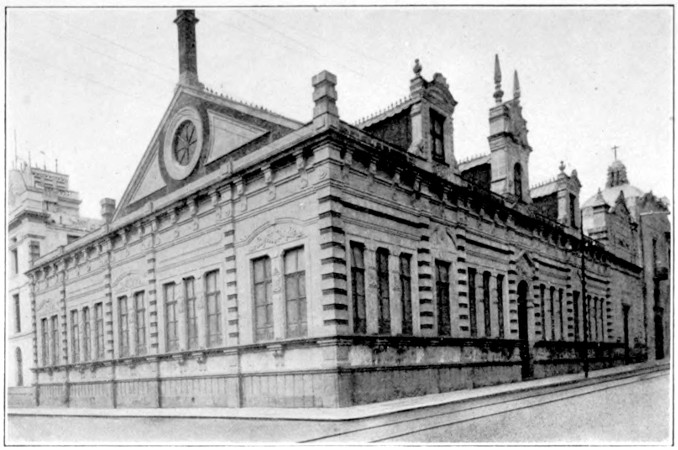
STATE COLLEGE.
The oldest theatre in America is the Teatro Principal, which was inaugurated in 1760, by the Viceroy Ahumada. It was known in those days as the “Teatro de los Arrieros,” being the favorite amusement place of the mule drivers who came in from the country on feast days. For a while it was patronized by the best class of society, but is now given over to a cinematograph. The interior was completely destroyed by fire a few years ago. This old theatre is unusually interesting on account of its early Spanish architecture.
The Guerrero Theatre was built in 1868, and stands on the site of the old city prison. It is owned by the city and has been greatly improved with modern scenery and stage fittings. Visitors are attracted to this theatre on account of its beauty of proportion and its artistic decoration.
[292]
The principal buildings of the city are imposing gray stone structures with an atmosphere of the historical past surrounding them. The more modern ones are built on the most approved plan. The penitentiary is one of the most modern and sanitary prisons existing in the republic. It is built on the general plan that characterizes all these institutions and merits great attention. The Casa de Maternidad is one of the splendid institutions that stamp the Mexican nation as the most charitable in the world. Here, without a question being asked, a poor unfortunate woman may find a haven of refuge.
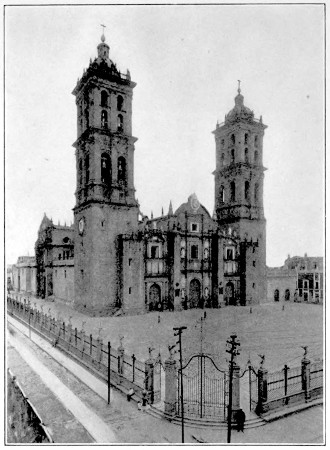
CATHEDRAL.
The Municipal Palace is a modern structure. It is situated opposite the Cathedral and is built in the Spanish Renaissance style, and occupies the site of the original palace, which was erected in 1536. A fine salon on the second floor is of the French Renaissance, with allegorical paintings on the ceiling, done by native artists. The Government Library is in the palace and comprises a large collection of books. The entrance to this remarkable chamber is inspiring in the greatest degree. It is noted for its marvellous carvings. The reception rooms of the officials are exceedingly imposing and the military atmosphere lends color to the scene.
The bronze equestrian statue of General Ignacio Zaragoza was erected by the State of Puebla in 1896. This is a most imposing monument. At the base[293] of the pedestal appear the names of the generals who aided this great soldier in his expulsion of the French troops during their intervention. The Paseo Nuevo is a splendid avenue, which is the pride of the Pueblans. One of its attractions is a handsome bronze group of statuary erected to the memory of the heroes of the war for Independence by the State of Puebla. Other statues on the Paseo are those of Gabino Barreda and Esteban de Antuñano, founder of the cotton industry. At the south end of the Paseo is an imposing monument erected to General Nicolas Bravo, who was one of the heroes of the war and was one of the members of the Council of Notables which promulgated the new constitution for Mexico. He was president of Mexico for a short time in 1846.
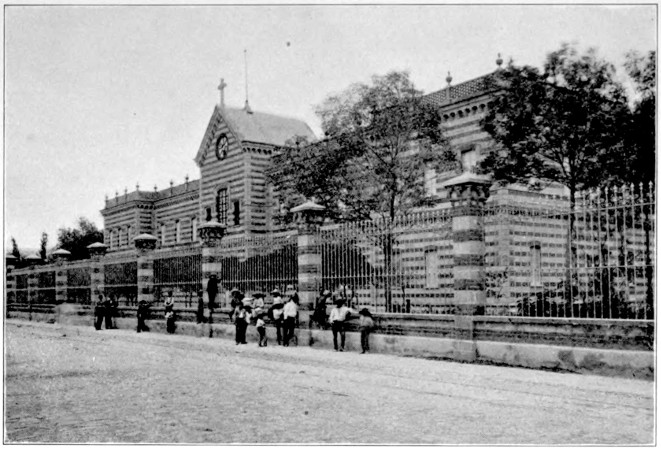
LA MATERNIDAD, PUEBLA.
In one of the squares is the beautiful fountain of San Miguel, constructed in 1777.
The State College is also an imposing edifice and is a well-conducted institution. Among the other public buildings the Library containing about fifty thousand volumes, the Academy of Fine Arts, the Normal School, and[294] several hospitals all go toward demonstrating the great progress and advancement of the people.
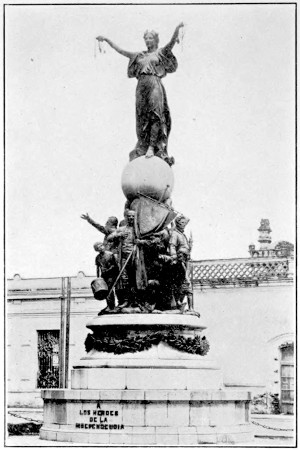
MONUMENT OF INDEPENDENCE, PUEBLA.
General Mucio P. Martinez, Governor of the State, is one of the most distinguished soldiers in the republic. His name is enrolled among the other great leaders of warfare. He is the hero of a hundred battles and has been the trusted friend and companion of General Diaz for many years. He entered the army when a young boy in 1861, and displayed such great bravery in many actions that in 1863 he was assigned to the cavalry and promoted to the rank of lieutenant. He has fought in all the wars that have taken place in his country since he enlisted and his services have been of such great value to his country that the grade of brigadier-general was conferred on him in 1884, which is his rank at the present time. He has been the Governor of Puebla since 1892, and has done so much to encourage all enterprise and progress in his state that he has the reputation of being one of the wisest and most intelligent administrators. The Governor has taken special interest in the public school system, and through his efforts it is supposed to be the best regulated in the republic. There are a number of institutions of higher education, preparatory schools, schools of law and medicine, and a most efficient school of engineering. Manual trades are taught and even in the penitentiary the prisoners have the benefit of a good common education.
The Governor is noted for his charming personality, his kindness of heart, and his protection for all enterprises that are worthy of the attention of an official[295] who is interested in the welfare of his state. He has surrounded himself with intelligent progressive gentlemen as State officials, and through their enterprising and intelligent administration, Puebla has been raised to the rank of second state in importance in the republic. Licenciado Augustin Fernandez, the Secretary of State, is an important factor in its government; he is a scientist and linguist and a man of great ability.
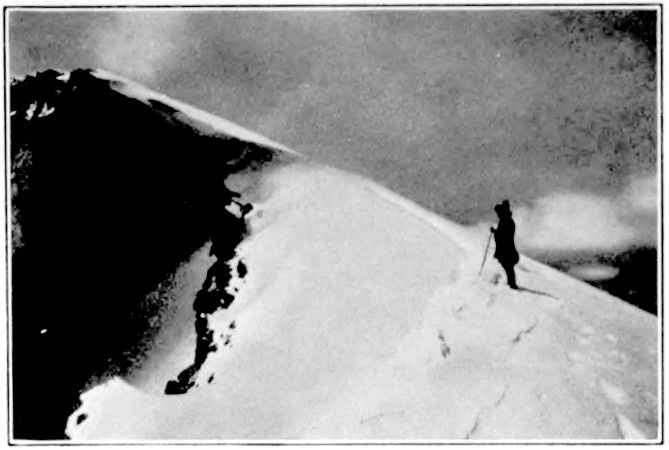
RIM OF THE CRATER OF POPOCATEPETL.
Industry is animated in various branches and is being actively developed, particularly the textile manufactures; and the products of the numerous and well-equipped mills for weaving and spinning cotton and wool, scattered through the State, rival the foreign products, for their variety and excellence. Commerce is very active and the culmination of its operation is guaranteed by the complete abolition of duties, as there are no more domestic custom houses. Merchandise circulates freely through the state, and the industrial establishments and mercantile houses are subject only to the payment of taxes, which have been advantageously substituted for the odious system of excise. The hotels in Puebla are particularly good. They are thronged with visitors from all parts of Mexico, attracted by the beautiful climate and noted sulphur baths that are in the suburbs. Some of these waters are boiling as they bubble from the ground and the odor can be detected quite a long distance away.
In this state the onyx, famous all over the world, is quarried, near Puebla, and exquisite specimens are seen in some of the public buildings.
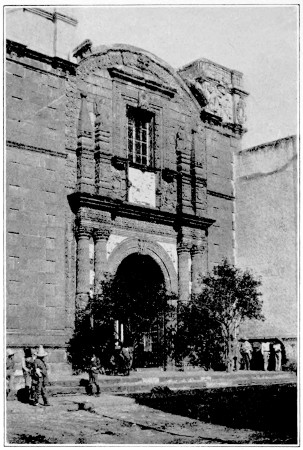
AN OLD CHURCH DOOR.
Few tropical localities in Mexico equal the privileged section of Northern Puebla. Here nature has lavished its profusion ungrudgingly, and for the man of energy, success and prosperity are assured. The natural products are many and diversified. Building woods and those suitable for making furniture exist mostly in dense forests, while dye-woods and a species of wild indigo abound.[296] Various fibres suitable for the manufacture of brooms and brushes as well as those for ropes, etc., clothe forest, meadow and hill. There is plenty of wild game and large quantities of fish are found in the limpid streams. Along the western section long stretches of natural grass well-adapted for pasture and stock-raising bring very satisfactory results. The cultivated products are coffee, corn, sugar cane, tobacco, pineapple, banana and rubber. Corn yields here four hundred bushels for one; cane produces without irrigation. Rubber and coffee yield to the industrious planter a rich reward for his enterprise. The climate is very acceptable for farming; fruit growing, especially the tropical products, is a profitable occupation. Bee culture, in connection with vanilla, is now a source of wealth. The district of Atzlan lies at the base of the Sierra Madre Range in the State of Puebla and comprises the extreme north end of the rich and fertile country of Huachinango. It is located at a distance of eighty miles south of the port of Tuxpan and one hundred and forty miles northeast of Mexico. This district takes in an area of over one hundred and sixty square miles of the most excellent tropical land. A large English-speaking colony has settled in this district. The soil is a rich dark loam finely adapted for the cultivation of every vegetable, fruit and fibre and capable of yielding prolific products. The temperature in summer, though high at mid-day, is low in the mornings and evenings and the winter months are generally delightful. The lands are undulating slopes abounding with fine forests and inviting streams while the well-drained plains are covered[297] with perennial grass. Every section of these lands is of easy access. The Ward Line steamers call at Tuxpan from Vera Cruz or Tampico every week and the Mexican mail boats every few days. The Valley of Atlixco is noted for its fertility and its abundant crops of vegetables as well as for the fineness of its fruit.
The Metlaltoyuca colonization lands, which lie along the Gulf slope on the Mesa de los Coroneles, are quite important. The journey there from Mexico City is most interesting, leading across a deep chasm and beautiful valleys. Sometimes a road clings to the shoulder of the great mountain; sometimes it rushes suddenly into a lovely valley carpeted with Mexican flowers or gay with ruby coffee or tasselled corn. Wide fields of grain and banana spread for miles along the sides of the road, leading to the colony lands. Here and there are great forests of cedar, mahogany and rubber trees, interlaced with rich tropical foliage and parasites. Bright winged birds and orchids of wonderful color light up the recesses of the forests, and groves of luscious oranges and lemons perfume the air. Shortly before the road reaches the outskirts of the Metlaltoyuca lands it crosses the Pantepec River, swiftly making its way to the Gulf. The crystal waters reveal a pebbly bottom about sixty feet wide; and the entire stream forms one of the most beautiful rivers in Mexico.
The prospects of this colony, composed of English-speaking people, are very promising. Extensive fields of grain may be seen here; the warm moist climate being particularly adapted to the raising of cereals. Nature has been lavish in gifts to this region; the climate is mild; the thermometer seldom going above eighty in the day time, while the nights are cool. The houses are of bamboo and comfortable. Some of them have rosewood floors, and little gardens around them make the region homelike and pleasant. In this small village of a few hundred inhabitants there is a spirit of association and friendship.
The warm springs of Cuautla are reached by the Interoceanic Railroad. Surrounding this resort are mountains perpetually white, yet no snow ever falls on this tropical town. The arrival here is full of greatest interest, as the train pulls into the oldest railroad station in the world. It was built in 1657, and was formerly a church, but finally reverted to the government and was disposed of to the railroad company. It seems strange that a once beautiful church should end in being the scene of excitement that attends the arrival of a train. The sulphur baths of this resort are a little way out of town but a drive through the rustic scenery of a primitive region repays one for the trip. In this old town, full[298] of peculiar legends and romances, the natural Indian folk mingle their ancient customs with the modern.
Tehuacan is called Mexico’s Carlsbad. It is one of the popular springs that are splendid specifics for many ills. There are some modest hotels here. The little town is very picturesque and retains the mark of centuries, having been founded in 1524, by the Spaniards. The antiquity of the town, the primitive manners of the people, lend more attraction to the searcher for health than the more modern hotels of the fashionable resorts. There are comfort and pleasure to be found and accommodation for the most fastidious.
Cholula is an old city that dates from before the Conquest. It was a commercial centre and was one of the most populous and flourishing cities during the time of the Aztec Confederacy. It was the scene, in 1519, of a fearful battle between the Spanish Conquerors and the Cholulans, in which many of the inhabitants were massacred.
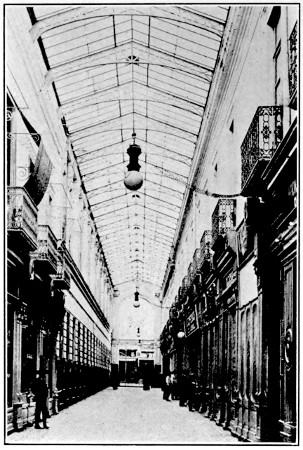
THE ARCADE, PUEBLA.
The tradition of Quetzalcoatl and his life up among the great purple sunlit hills is a most beautiful story. Never was there a more tender spirit than Quetzalcoatl, who loved all living creatures and could not bear that any should suffer or live in sin and ignorance. But the people, while they loved him, feared the other powerful gods, who were devoted to bloodshed and battle. They built temples and altars and daily offered human sacrifices to the gods of war. This grovelling fear filled the great heart of Quetzalcoatl with pity and deep sorrow, and so he left his beautiful, peaceful home to teach these people, with a wonderful eloquence, the gospel of love and charity. Such was his influence that at last they deserted the altars of the cruel gods, and instead of offering human[299] holocausts, in which quivering hearts burned upon the sacred fires, they climbed the hills to lay upon an altar of Quetzalcoatl flowers and fruits.
The people of Cholula began the construction of the great pyramid in memory of Quetzalcoatl. On the top of it they built the temple of Cholula, and dedicated it to the worship of the “fair god.” For generations they tilled and builded until more than a century afterward the pyramid was completed, standing bold and distinct on the dust-blown plain, the everlasting token of a nation’s faith. They believed that this pyramid would stand until Quetzalcoatl should come back to them.
The view from the top of the great pyramid toward evening is almost beyond description. With the softened light of the setting sun upon the plains and the hills one can easily understand why it was that the gods and the angels loved this region. Back from the soft tender lights in the valleys the great mountains stretch up bold and distinct against a background of the palest aërial blue that contrasts wonderfully with the varying lights on the mountain side.
The perpendicular height of the pyramid is one hundred and seventy-seven feet. Its base is one thousand four hundred and twenty-three feet long—twice as long as that of the great pyramid of Cheops. It may give some idea of its dimensions to state that its base, which is square, covers about forty-four acres and the platform on its truncated summit embraces more than one acre. It reminds one of those colossal monuments of brickwork which are still seen in ruins on the banks of the Euphrates, and in much better preservation on those of the Nile.
“Nothing could be more grand than the view which met the eye from the area on the truncated summit of the pyramid. Toward the west stretched that bold barrier of porphyritic rock which nature had reared around the valley of Mexico, with the huge Popocatepetl and Iztaccihuatl standing like two colossal sentinels to guard the entrance to the enchanted region. Far away to the east was seen the conical head of Orizaba soaring high into the clouds, and nearer, the barren though beautifully-shaped Sierra de la Malinche, throwing its broad shadows over the plains of Tlaxcala. Three of these are volcanoes higher than the highest mountain peak in Europe and shrouded in snows which never melt under the fierce sun of the tropics. At the foot of the spectator lay the sacred city of Cholula, with its bright towers and pinnacles sparkling in the sun, reposing amidst gardens and verdant groves, which then thickly studded the cultivated environs of the capital. Such was the magnificent prospect which met the[300] gaze of the conquerors, and may still, with slight change, meet that of the modern traveller, as from the platform of the great pyramid his eye wanders over the fairest portion of the beautiful plateau of Puebla.” So wrote Prescott.
The great temple was afterward purified by Cortés’s orders and the standard of the cross solemnly planted in its midst. From this pyramid, it is interesting to know, Baron von Humboldt made many of his valuable astronomical calculations.
The church now standing there is dedicated to the Virgin de los Remedios. The popular tradition among the native Indians is that the pyramid was erected by a family of giants who had escaped inundation and intended to raise it into the clouds, had not the gods become angry and sent down fire from heaven to stop them where it is truncated.
Cholula probably numbers now some five thousand people. But there is no doubt that at the time of the conquest it was one of the largest towns in Mexico.
But what a land of romance! How can busy twentieth-century people realize that in 1519 such events were making Mexican history, and that even then the pyramid dated far back of legend or tradition?
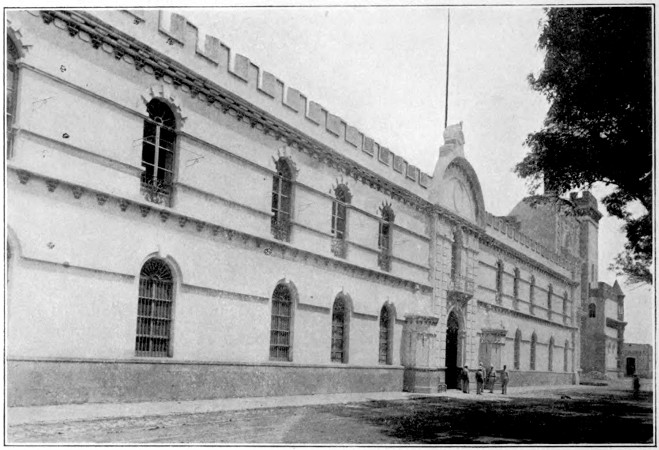
THE PENITENTIARY, PUEBLA.
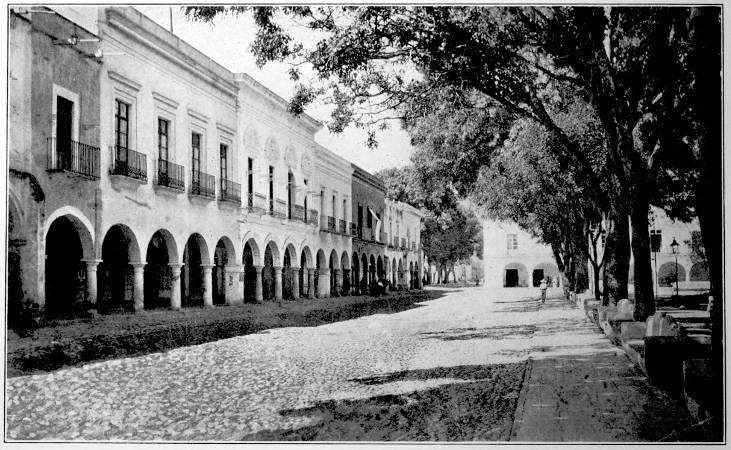
PORTALES, FACING THE PARK, TLAXCALA.
[303]
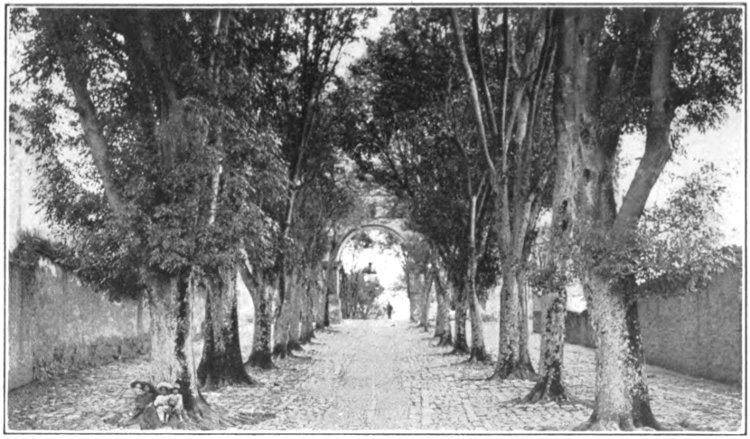
AVENUE LEADING TO SAN FRANCISCO CONVENT.
Tlaxcala was the ancient republic for many years before the Conquest, and retained its independence against the Aztecs. It is noted in history as being the place where Cortés met with so much encouragement and help from the Tlaxcalans, after he had fought them and shown his strength. It looks like a place that had always been old and always picturesque. Romance is in the air at every turn. Of Cortés’s sojourn, there are many mementoes, an old silken banner which he presented to the Tlaxcalan chiefs, a curious piece of silken embroidery depicting the battle between the invaders and the natives, and a grant to Tlaxcala made by the Emperor Charles V., whose signature it bears. There is also to be seen a number of idols which have been dug up from time to time in the neighborhood. The baptismal robes of the chiefs, the genealogical tree of chief Xicotencatl, the charter of Philip II. to the city, bearing his signature and portrait, in the form of a beautiful parchment book bound in vellum, May 10, 1585,[304] more than three hundred years ago. Tlaxcala abounds in interesting relics of ancient times. Among them are some very old portraits of the heroes of former days, a cloak which belonged to a noble Indian of that time who was the first to receive Christian baptism, and the wonderful standard which once belonged to Cortés. The Church of San Francisco was the first Catholic Church erected in the New World. Its architecture is very original inside and out and dates from 1524. The pulpit has a very peculiar form and exquisite filigraned work full of gilt carvings; and the sacred vestments, beautifully embroidered in silver and gold, were brought over from Spain and used in the first Roman Catholic service in this country. These vestments are shown to-day, with the first baptismal fountain. The Sanctuary is dedicated to the miraculous Virgin of Ocotlan, and is situated on the summit of a little hill close to the city. One curious thing about the temple is that one half of it is an architecture of several centuries ago, the walls being covered with the finest chiselled workmanship possible to imagine, and richly gilt, while the other half is entirely of modern style splendidly sculptured by modern artists. On the walls are hundreds of wax reproductions of human limbs, left there by invalids who had been miraculously cured of various diseases, and who celebrated their cures by giving the church these symbols.
Tlaxcala is the capital of the State, which is bounded on the northeast and south by the State of Puebla and on the west by Mexico. Historically it is one of the most interesting states in the republic. Almost every building in the capital is a relic of the olden times. The Municipal Palace and a few modern homes, built with the open courtyard, are the only new houses. This presents a marked contrast with the old architecture. Through the enchanting San Martin valley will run a new railroad that will prove a boon to the grain growers. It will not only be an outlet for many rich properties and the grain of the fertile valley but it will be the most picturesque route in the republic. Wherever the railroads have gone the Indians are beginning to forsake their native speech. In Tlaxcala one realizes that the Aztec is not a dead language. The Governor of Tlaxcala, Colonel Prospero Cahuantzi, has done much to develop and perpetuate Indian tradition and institutions. He has published books to that end and also an ancient Tlaxcalan record which gives a curious history of the conquest told in pictures. He writes and speaks this language which is fast becoming extinct. The Governor is a pure blooded Indian, born in Ixtulco, a town situated a short[305] distance from the City of Tlaxcala. For nearly twenty years he has governed the State so wisely and so well that new life has sprung into the old capital. Schools and private colleges are now established and industry has entered upon a period of development. There will be inaugurated this year an irrigation plant which will be of great benefit to the vegetation of the State. The city is alive with business and everything looks in a condition of prosperity. The political division of the State consists of six districts, which are subdivided into municipalities. Tlaxcala is the principal and most important. It has a population of seven thousand five hundred. Three railroads cross the State: the Mexican railroad which runs from Mexico to Vera Cruz and the Apizaco branch to Puebla, the Interoceanic from Mexico to Vera Cruz and Acapulco, and the Santa Anna and Tlaxcala road. The State has various good wagon roads which lead to the neighboring states. The telegraphic and telephonic service is good and extensive.
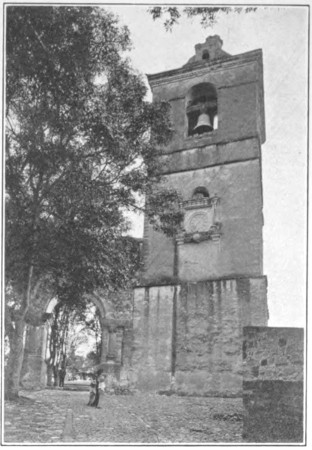
OLD CHURCH TOWER, TLAXCALA.
The soil is productive and the lands are suitable for the cultivation of all classes of fruits of the cold zone and all kinds of medicinal plants. The maguey is extensively grown and produces large quantities of pulque, a drink for the middle classes. It has excellent medicinal qualities and is very nutritious, and is consumed greatly by the inhabitants of the southern part of the republic. It is useful for fibre of the best class and also makes good alcohol. The State includes fertile and extensive plains, being occasionally broken by deep ravines or bare hills. The most important mountain range in Tlaxcala is that formed by the beautiful mountain of Malinche, or Malintzin. This peak rises to a height of four thousand four hundred and sixty-one metres above sea level[306] and captivates the fancy by its imposing and fantastic figure, as it represents the body of a woman covered by a shroud and the head shining with the snow which forms a crown. Sometimes the figure is lost among the clouds which envelop a part of the mountain. Often these clouds are agitated by storms which render a spectacle startling to look on and without equal in the republic of Mexico. The climate is healthy, dry and cold, especially in the mountains, where frosts are frequent throughout the winter. The mining in the state is of importance. There are some silver, copper and lead mines. Iron, lime, chalk, and clays of good quality exist.
Corn is the principal product, although everything grows in this rich soil, and through the introduction of modern methods of agriculture the produce of the State has been doubled.
There are distilleries for the production of alcohol, flour mills, and factories of cotton goods and prints. These are all equipped with the latest machinery.
In the Cuauhtemoc district there is a foundry for artistic bronze work which has been doing work of great credit to the State.
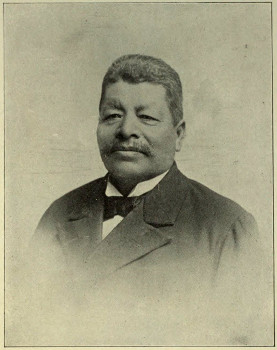
SEÑOR CORONEL PROSPERO CAHUANTZI.
Tlaxcala was the scene of much human tragedy during the Cortés conquest. It is one of the oldest places in Mexico and it was founded by the Chichimecs. They came on the grand plateau about the same time as the kindred races, at the close of the twelfth century, and planted themselves on the western border of Lake Tezcuco. Here they remained many years engaged in the usual pursuits of a[307] bold and partially civilized people. From some cause they incurred the enmity of the surrounding tribes; a coalition was formed against them and a bloody battle was fought on the plains of Poyauhtlan in which the Tlaxcalans were completely victorious. Disheartened with their residence among nations with whom they found so little favor the conquering people resolved to migrate. They separated into three divisions, the largest of which taking a southern course by the great volcano of Mexico, wound round the ancient city of Cholula and finally settled in the district of country overshadowed by the Sierra of Tlaxcala. The warm and fruitful valleys locked in the embrace of this brotherhood of mountains afforded means of subsistence for an agricultural people, while the bold eminences of the Sierra presented secure positions for their town. Yellow harvests of maize and the bountiful maguey covered the rocky hillside and contributed to the wealth of the little republic. Their geographical position was encompassed with mountains and their warlike bravery gave them a reputation as soldiers and excited the wonder of Cortés and his army. Nowhere else did the Spaniards encounter such troops or meet with such determined resistance, and the Spaniard was quick to see that the Tlaxcalans would serve him much better as friends than as enemies.
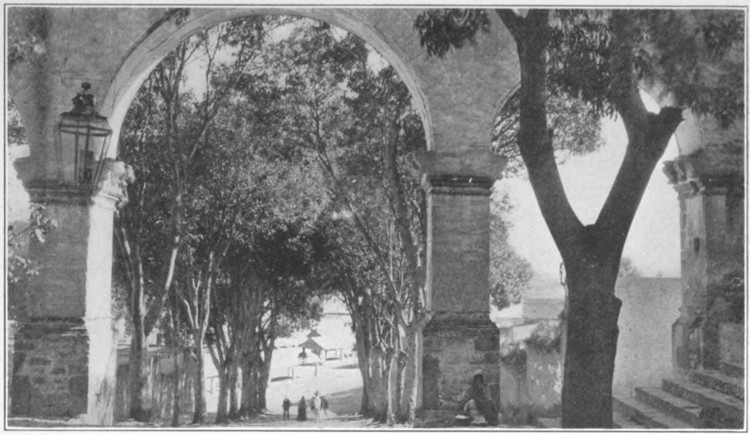
ARCHWAY ENTRANCE TO SAN FRANCISCO CONVENT.
[308]
“Nothing could be more picturesque than the aspect of these Indian battalions, with the naked bodies of the common soldiers gaudily painted, the fantastic helmets of the chiefs glittering with gold and precious stones, and the glowing panoplies of feather-work which decorated their persons. Innumerable darts and spears, tipped with points of transparent iztli, or fiery copper, sparkled bright in the morning sun, like the phosphoric gleams playing on the surface of a troubled sea, while the rear of the mighty host was dark with the shadows of banners on which were emblazoned the armorial bearings of the great Tlaxcalan and Otomi chieftains. Among these, the white heron on the rock, the cognizance of the house of Xicotencatl was conspicuous and still more the golden eagle with outspread wings, in the fashion of a Roman signum, richly ornamented with emeralds and silver-work, the great standard of the republic of Tlaxcala.
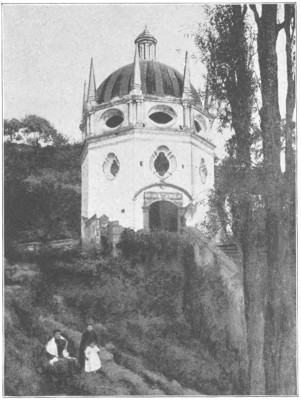
SACRED WELL OF OCOTLAN.
“The common file wore no covering except a girdle around the loins. Their bodies were painted with appropriate colors of the chieftain whose banner they followed. The feather-mail of the higher class of warriors exhibited also a similar selection of colors for the like object, in the same manner as the colors of the tartan indicate the peculiar clan of the Highlander. The caciques and principal warriors were clothed in quilted cotton tunics two inches thick, which, fitting close to the body, protected also the thighs and the shoulders. Over these the wealthier Indians wore cuirasses of thin gold plate or silver. Their legs were defended by leathern boots or sandals trimmed with gold. But the most brilliant part of their costumes was a rich mantle of the Plumaje or feather work, embroidered with curious art, and furnishing some resemblance to the gorgeous surcoat worn by[309] the European knight over his armor in the middle ages. This graceful and picturesque dress was surmounted by a fantastic head-piece, made of wood or leather, representing the head of some wild animal, and frequently displaying a formidable array of teeth. With this covering the warrior’s head was enveloped, producing a most picturesque and hideous effect. From the crown floated a splendid panache of the richly variegated plumage of the tropics, indicating by its form and colors the rank and family of the wearer. To complete this defensive armor, they carried shields or targets made sometimes of wood covered with leather, but more usually of a light frame of reed quilted with cotton, which were preferred as tougher and less liable to fracture than the former. They had other bucklers in which the cotton was covered with an elastic substance, enabling them to be shut up in a more compact form, like a fan or umbrella. These shields were decorated with showy ornaments, according to the taste or wealth of the wearer, and fringed with a beautiful pendant of feather-work.
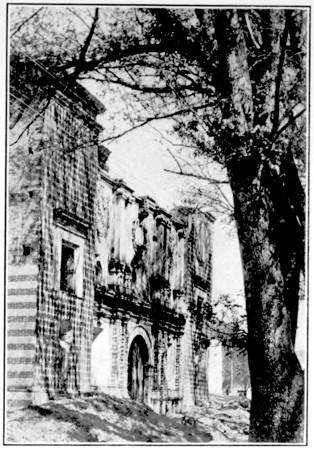
RUINS OF THE ROYAL CHURCH, TLAXCALA.
“Their weapons were slings, bows and arrows, javelins, and darts. They were accomplished archers, and would discharge two or even three arrows at a time. But they most excelled in throwing the javelin. One species of this, with a thong attached to it, which remained in the slinger’s hand that he might recall the weapon, was especially dreaded by the Spaniards. These various weapons were pointed with bone or the mineral iztli (obsidian), the hard substance already noticed as capable of taking an edge like a razor, though easily blunted. Their spears and arrows were also frequently headed with copper. Instead of a sword they bore a two-handed staff about three and a half feet[310] long, in which at regular distances were inserted, transversely, sharp blades of iztli, a formidable weapon, which, as an eye-witness assures us, he had seen fell a horse at a blow.
“Such was the costume of the Tlaxcalan warrior, and of that great family of nations generally who occupied the plateau of Anahuac.”
Their weapons, even with their bravery, were no match for the military science of the Spaniards; and after four terrible battles, preceded by a good deal of sharp skirmishing, the Tlaxcalans were defeated. After some political delays they were completely subdued and became the faithful allies of the Spaniards. Had this not been effected, it is doubtful if Cortés’s name would have descended as “the great conqueror,” at least in Mexico.
Tlaxcala City dates far back of Cortés’s arrival in the place, where he fought and subdued with such excellent effect. The very air is alive with romance and tradition. Age, hoary and musty, is stamped everywhere, although the people are wideawake and prosperous.
The houses were built for the most part of mud or earth, the better sort, of stone and lime, or of bricks dried in the sun. They were unimproved with doors or windows but in the apertures of the former hung mats fringed with pieces of copper or something which by its tinkling sound gave notice of anyone’s entrance.
The streets were narrow and dark. The people gathered in the market places on a public day. These meetings were fairs, held, in all great towns, every fifth day, and attended by the inhabitants of the adjacent country, who brought there for sale every description of domestic produce and manufacture with which they were acquainted. They peculiarly excelled in pottery, which was considered equal to the best in Europe. It is further proof of civilized habits that the Spaniards found baths, both of vapor and of hot water, familiarly used by the inhabitants. A still higher proof of refinement was discerned in the existence of a vigilant police which suppressed everything like disorder.
The ancient capital, through one-quarter of which flowed the rapid current of the Zahuatl, stretched along the summits and sides of the hills, at whose base are now gathered the remnant of its once flourishing population. Far beyond, to the southeast, extended the bold Sierra of Tlaxcala, and the huge Malinche, crowned with the usual silver diadem of the highest Andes, its shaggy sides clothed with dark green forests of firs, gigantic sycamores, and oaks whose towering stems rose to the height of forty or fifty feet unencumbered by a branch.[311] The bleak winds of the Sierra gave an austerity to the climate unlike the sunny skies and genial temperature of the lower regions; it was far more favorable to development of both the physical and the moral energies. A bold and hardy peasantry was nurtured among the recesses of the hills, fit equally to cultivate the land in peace and to defend it in war. Unlike the spoiled child of Nature, who derives such facilities of subsistence from her too prodigal hand as supersede the necessity of exertion on his part, the Tlaxcalan earned his bread—not from an ungrateful soil—by the sweat of his brow. He led a life of temperance and toil. Cut off by his long wars with the Aztecs from a commercial intercourse he was driven chiefly to agricultural labor, the occupation most propitious to purity of morals and sinewy strength of constitution. His honest breast glowed with patriotism, or local attachment to the soil, which is the fruit of its diligent culture, while he was elevated by a proud consciousness of independence, the natural birthright of the child of the mountains. Such was the race with whom Cortés was associated for the achievement of his great work.
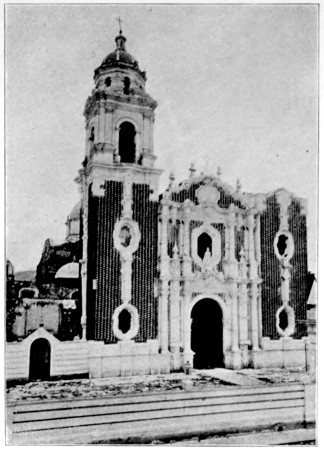
LA PARROQUIA.
Few people, perhaps none except scientists, know that in the heart of this ancient State is a race of pygmies. They are small of stature, with dark-brown skin, broad faces, and shocks of black tangled hair. They are very shy and wild-looking and wear serapes made of coarse sacking. Fine clearings on the hill-slopes extend almost to the crest of the mountains. Flourishing fields of grain, cattle grazing in the pastures, and log houses of substantial construction surrounded by neat little enclosures are occupied by these peaceful little men and women.
[312]
Up in that region, between Ajutla and Juquila, is a marvelous lake of clouds. A deep blue sky and brilliant southern sun, without a suggestion of mist in the still air, make the place wonderful on a grand scale. Clad with foliage clear to the summit, the great ridge forms half of a mighty amphitheatre whose sides are furrowed by mountain torrents. Five distant mountains form the wall of an oval valley with lower peaks running parallel. At one side a spur juts out, making the only notable break in the enclosing rim. The great lake seems to approach this edge like a mighty river and pour over the great precipice like a dozen Niagaras combined in one. It is a cloud-lake, mighty, mysterious and noiseless, making one of the greatest wonders in this region of wonders.
The Tlaxcala of to-day is situated in the centre of a beautiful country and has illimitable advantages. It is a favorite spot for the artist and student. Governor Prospero Cahuantzi has a most interesting and unique personality, and his hospitality to strangers is one of the reasons of the popularity of the capital city. A visit to Mexico is not complete without seeing this remarkable old historical place.
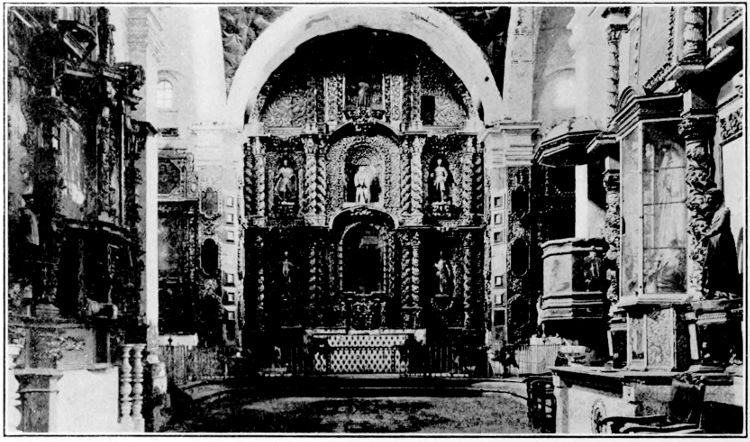
OLDEST PULPIT AND ALTAR IN AMERICA.
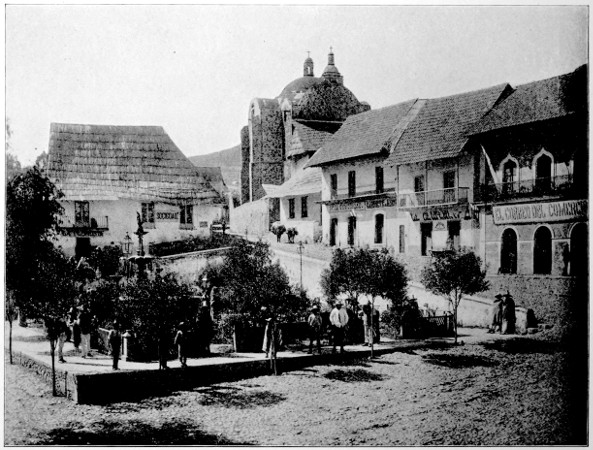
ZOCALO IN REAL DEL MONTE.
[315]
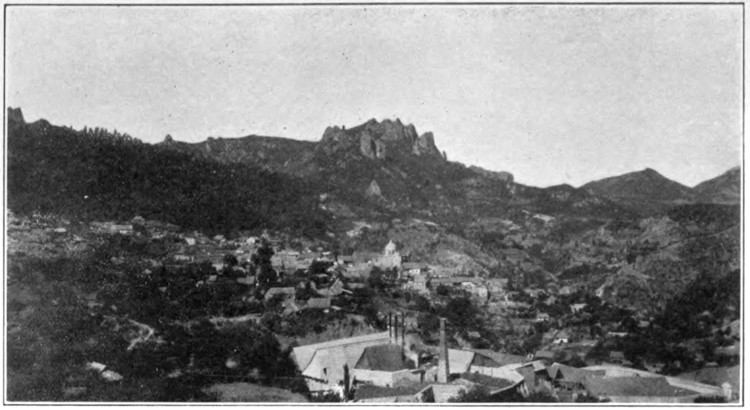
PANORAMA OF MINERAL DEL CHICO.
Richly endowed by Nature, the State of Hidalgo contains throughout its extent, rich metalliferous deposits exceeding the wealth of Ormuz or of Ind. The innumerable enterprises for developing this country have produced marvellous results in mining its great resources.
Besides silver ore, lead, gold and iron, some precious stones abound. It is rich in woods and luxurious verdure.
This State bears the name of the great patriot, Hidalgo. It has a cluster of prosperous cities, El Salto, San Antonio, Marquez, Nopala, Cazbero, along the lines of the Mexican Central, Pachuca the busy capital, Tlaxcoapan, Rosal, Temoaya and Concepcion are on a branch line. It is a comparatively small State but it ranks as one of great importance, being a prolific source of agriculture and manufacture as well as mineral wealth, which has attracted the attention of the world. With a splendid chain of railroads and tramways, all parts of the State are easy to reach.
[316]
Majestic mountains, valleys, and plains add to the natural beauty of the State and this part of the republic enjoys a pleasant but varied climate.
Few rivers are found, but there is one famous water-fall, called the Regla Cascade, some mineral springs of medicinal note, and the beautiful lakes of Metztitlan, Tecomulco, Apam, Zupitlan.
In the district of Pachuca are the mining camps, Zimapan, Jacala, and Cancando. Cancando, a magnetic iron mountain ten thousand feet high, appears to be one mass of iron so rich as to contain about eighty per cent. of pure iron. The ore, however, is so rich that a flux is required to smelt it. These mines were not exploited until after the war of independence, although as early as 1824 many mining claims in that district were taken up and denounced, among them San Antonio, El Carmen, San Cosme and Las Animas.
Encarnacion has an up-to-date works, producing a million and a half kilos of bar iron per year and possesses all the modern equipments. One of the best known gold mines of the early days of New Spain was San José del Oro, ten thousand feet above the sea. It is difficult of access and is not worked to any great extent at the present day.
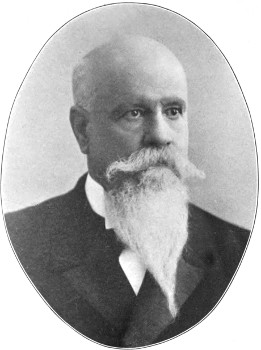
GOVERNOR SEÑOR DON PEDRO RODRIGUEZ.
The State of Hidalgo produces millions of dollars worth of silver per year from its two mineral centres. Among the most notable mines of the district are Zimapan, San Martin, San Judas; of the Real del Monte groups, San Francisco, Santa Gertrudis, San Eugenio, San Rafael, San Miguel Tajo and Barron.
Pachuca has twelve reduction works; El Chico, nine; Real del Monte, eight; and Zimapan, eight. There are in this State many iron works and in the[317] districts of Zacualtipan and Huejutla are deposits of coal now developed by an important company. In Molango are graphite deposits. The mines in Pachuca were worked by the Spaniards in 1523, only two years after the conquest and untold millions have been withdrawn from the inexhaustible resource where busy men to-day still delve with the same eagerness as in the days of old.
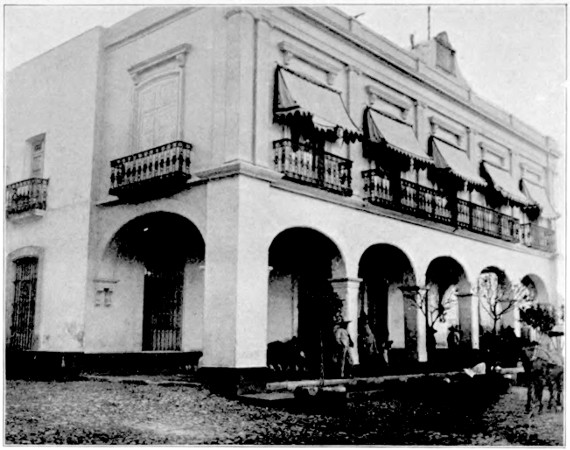
THE GOVERNOR’S PALACE.
This is one of the few districts in the world where the plant vanilla grows, which contributes to the enormous, almost fabulous, riches of some of the Mexican planters. In this State is found the same class of maguey as in Mexico. It is called the marvel plant and is the very highest quality and largest yield. In Apam, Pachuca and Tula all classes of cereals are produced and Apam and Pachuca are the greatest centres for the production of pulque. In the hotter districts coffee, india rubber and other valuable products yield splendid bounty to the farmers and there is abundant supply of medicinal plants and valuable cabinet woods. The yield of pulque is about a gallon and a half a day for each plant during three months of the year. This industry alone yields millions of dollars a year in the State of Hidalgo. Mescal, a highly intoxicating liquor, ordinarily called Tequila, is made at the Tequila Hacienda. It is one of the popular drinks among certain classes and is noted for its fiery strength, which none but a cultivated taste can endure.
The capital, Pachuca, is most interesting, with characteristics of a miners’ town. The houses are built with an idea of comfort and their appearance is[318] somewhat different from the dwellings one sees in other large cities. American and English capital has taken a firm hold and the spirit of enterprise and energy has given this city the appearance of a business centre. The hotels are alive with mining men and travelers of staunch purpose, the colonies are alert with social enjoyment, while the government of the city is conducted with zealous care and attention. The conditions of the state, especially under the present Governor, lend themselves most favorably to the establishment of new enterprises.
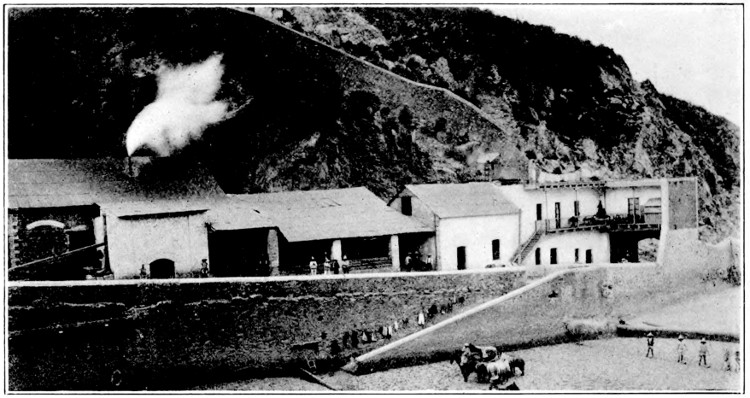
SAN JULIO MINE.
Señor Don Pedro Ladislao Rodriguez was born in the State of Oaxaca, from whence came so many of Mexico’s noted statesmen. He has given his energies and active service to his country. He fought in the War of the Reform, the War of the Intervention, and afterward retired to a private life of strenuous work. He became expert in all branches of telegraphy, erected lines between Mexico City and various capitals of the states, besides being the director and manager of telegraph offices throughout the republic. He evinced such strong interest in political affairs that he was elected to Congress and through his strength and splendid bearing in public matters he rose to the prominence of one of Mexico’s leading political powers. Since assuming this important office, he[319] has dedicated his best efforts to the advancement of his State. Through his wise administration, Hidalgo has paid its public debt, has a large surplus in the treasury, and the government has been placed on a splendid business basis. Public instruction is one of the main features of the administration of this able executive. He is endeavoring to wipe out illiteracy among the people; the school system has attracted widespread attention. There is a Scientific and Industrial Literary Institute in which are prosecuted the studies necessary for the occupations of assaying, topographic, hydrographic, and mining engineering. There is also a practical mining school belonging to the Federal Government where all practical training in mining exploitation under professors of Metallurgy is acquired.
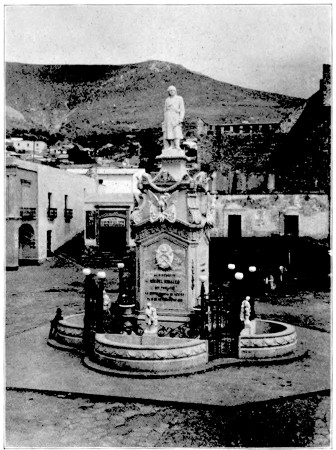
STATUE OF HIDALGO.
Pachuca has splendid architecture and some old palaces and churches form an interesting spectacle of the city. It is considered one of the most prosperous cities in the republic, in proportion to its population, and its rich metal districts make it noted as one of the most celebrated mining centres of the world.
The churches, La Parroquia, San Francisco and San Juan de Dios are notable for their solid masonry and size. A beautiful theatre, a literary institute of higher education and good charitable institutions are among the more notable buildings. Private academies flourish and a Protestant church built by the[320] English-speaking colony help to make this city picturesque and interesting, with its admixture of ancient and modern architecture.
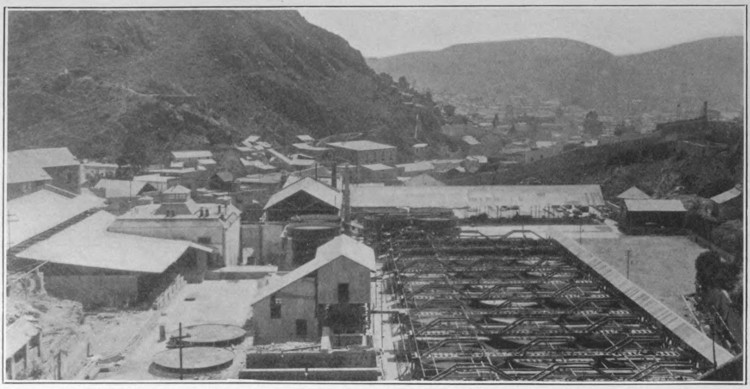
HACIENDA LORETO.
During the month of September, when the Mexicans were celebrating their Centennial of Independence, this capital was foremost in its enthusiasm. Triumphant arches were erected, the city was festooned in gay national colors, myriads of lights gave a dazzling appearance of gaiety and the ceremonials that took place were very imposing. New schools were inaugurated, new monuments dedicated and all public buildings opened officially.
Tula is a city built upon a series of terraces in a beautiful valley teeming with tropical flowers and foliage. It is noted for Toltec ruins and relics which have been found there. The old church built three hundred years ago has walls seven feet thick and the tower is one hundred and twenty-five feet high. It lies in the valley which the Toltecs entered when they came southward in 648, over twelve hundred and fifty years ago. A thousand years ago Tula was an important town and was the capital of Mexico until 1325. Proof of this antiquity lies everywhere—the grand houses, the broken columns, and quaint images that are still remaining relics in the present town. Here is the witchery of an old world, shadowy people, vague and mystical rights and ceremonies. In[321] the small Plaza stand the remains of old gods, and crumbling into dust is an old pyramid, built many centuries ago. Where once the idolatrous worship of the Aztecs took place, a purer religion of to-day is worshipped and the people have thrown off the lethargy of the past. There are three ancient bridges in this vicinity. It is claimed that one of these bridges was built in 210 A.D., the ruins of which remain, forming a picturesque bit of Tula.
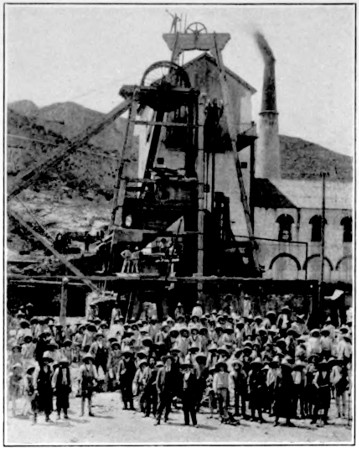
XATAL MINE.
“The Treasury of Montezuma,” now in ruins, is on the top of the hill. There are two distinct kinds of fragmentary walls, eight feet thick. There is one large room thirty-two feet long with the chunam flooring nearly perfect. The people of Tula visit these ruins continually, believing many treasures to be concealed there. They dream dreams, and then go out and sink pits in the flooring, hoping to enrich themselves with wonderful treasures of Montezuma’s time.
There are other strange relics of ancient times on another hill near Tula. These are carved rocks resting upon a stratum of adobe, below which the hill slopes down to the river precipitously. The carvings are symbolical, and are supposed to have been made about 1160 A.D. in the Chichimec era.
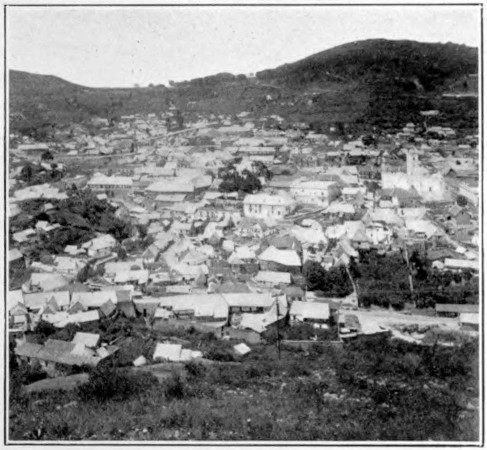
REAL DEL MONTE MINE.
The canal of Nochistongo is an open cut about twelve miles long with an average depth of one[322] hundred and eighty feet and an average width of three hundred feet, but one part is six hundred feet wide. It was built in 1607, to save the city of Mexico from the floods of Lake Tezcuco. It can be seen from the railroad, the trains passing along the side of the cut.
In the Barranca of Itzala nature has been very lavish in her imposing and majestic beauty. The mountains of this State are unusually high and picturesque. The Sierras of Pachuca have lost much of their beauty on account of the mining camps interspersed, but the cañon of the virgin Omitlan affords beautiful views. The principal mountain chain is in Zacualtipan and Metztiplan which forms deep ravines and is a beautiful aspect to the lover of nature. Journeys through these mountains on the road to the different mining camps are very interesting.
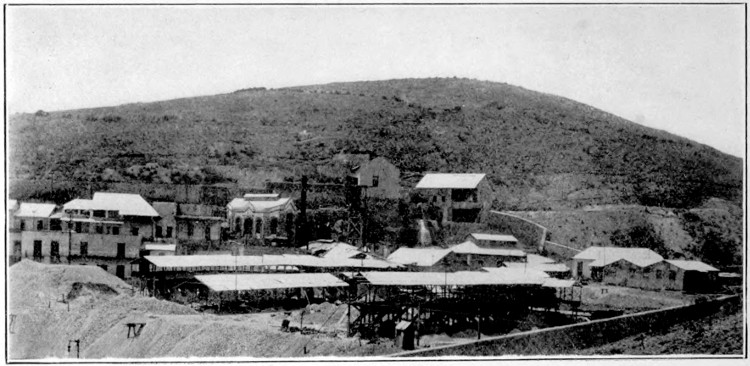
SAN RAFAEL MINE.
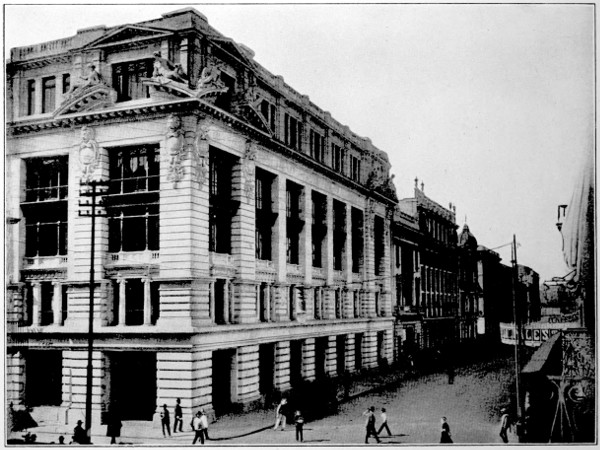
OFFICE OF THE NATIONAL RAILWAYS OF MEXICO.
[325]
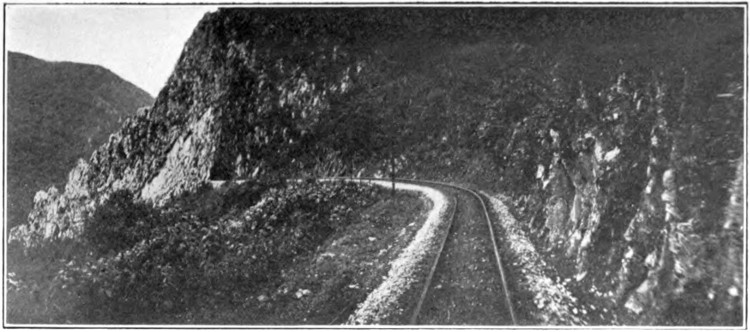
DEVIL’S BACKBONE, TOMASOPO CAÑON.
The position of Mexico on the western continent is so commanding as to assure it an ever-growing participation in the world’s commerce. With the coming of the locomotive a wilderness was transformed into a busy world. Eager miners have peopled the hills; industrious tillers, the fruitful valleys; the lumbermen have taken from the forests great timbers; a chain of central marts has stretched from border to border, joined by the magic steel way; and in many sections great industries have been established to convert raw products into materials demanded by modern civilization. The transformation has been complete and has given birth to new ambitions and imparted new energies to the people.
The development of the material resources of a nation is directly dependent on the means of transportation and communication which it possesses. For centuries the great mineral wealth of Mexico has been liberally exploited and means of transportation secured, beginning with the forced labor of the Indians enslaved by the conquerors and passing through the intermediate stages of muleback and wagon-road till the modern railway appeared, to take the treasures[326] of the mountain afar. Vast as these resources were, they were little better than wasted treasure without the means of transportation to domestic and foreign markets.
The great change in means of transportation came late to Mexico. Political troubles long dominated national thought and absorbed the energy of the people. It was not until 1873, that the first railroad was opened from Mexico to Vera Cruz. From the moment that settled political conditions had been secured the people of Mexico turned to the task of developing railroad transportation and during the terms of General Diaz the extension of railroads has assumed a leading and constant policy of the government, the fruits of which are manifest in commerce, which has been enormously expanded; the active wealth of the nation increased; new industries introduced; cities and towns established and the general comfort and convenience of the people greatly augmented. With this enterprise in land transportation, there has been a persistent activity in providing port and harbor facilities. The progress and management of the railroads have always been assiduously observed by the government and the laws controlling them have been justly and liberally applied. Nevertheless, many conditions have operated to prevent a uniformly direct and efficient supervision commensurate with the growing importance of the service.
In order to protect the people of Mexico, the government deemed it a duty to acquire a more efficient control by ownership of stock. In 1902, the government purchased five million dollars of the stock of the Interoceanic Railway, which was to become the pivotal operation on which turned the great merger-system. In 1903, the Minister of Finance concluded negotiations with the interests in control of the National Railroad, which were making strenuous efforts to obtain control of the Interoceanic, by which the government acquired the majority holding in the National, which system was to be reorganized, the government giving as part consideration for its purchase the Interoceanic stock. It was expected that this degree of intervention would be sufficient to enable the government to prevent harmful combination of ownership.
In 1906, the Mexican Central road was threatened with absorption by American financiers, an outcome that would be exceedingly in opposition to the policy of the government. A plan was adopted by Congress providing for the consolidation of the National and the Central systems by means of a new company, entirely Mexican, the majority of the shares in which the government[327] should own. This plan required no cash payment for such shares, but the stock of the government in the National reverted to the new company and the government guaranteed an issue of bonds by it. The new concern was incorporated in July, 1907, with a bond capital of eight hundred and thirty-four millions and share capital of four hundred and sixty millions, Mexican currency value.
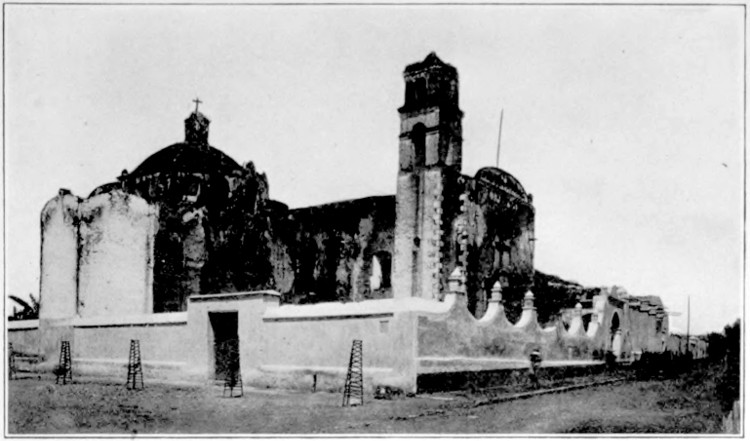
OLDEST RAILWAY STATION IN THE WORLD, CUAUTLA.
The merged systems included in the National Railways of Mexico are the former Mexican Central, the National, the International, the Interoceanic, and the Hidalgo and Northeastern, whose combined mileage is seven thousand and twelve. Besides these, the absolute ownership of the Tehuantepec National and the Vera Cruz and Isthmus Road is vested in the government. The result of this master-policy is that seventy per cent. of the trackage of roads built under concessions from the National Government is now either actually owned or controlled by it.
The National Railways of Mexico offer six different routes between the United States and Mexico. A distinguished American, Mr. E. N. Brown, is the President of the National Railways.
The importance of control of the railroads by the government cannot be overestimated in considering the development of the country. It operates as a[328] salutary check on the independent roads in the matter of tolls and as an incentive to better service and enlarged facilities; it was an indispensable policy in view of the ineffectual control or supervision possible under the general railway law, if the government would regulate the management of railways, to secure proper advantages to Mexico, and prevent the growth of corporate influence which might even menace that of the government. The broad national policy assures full protection to industries, to capitalists, and to communities by protection against arbitrary regulations, discriminations, and the rest of the great brood of evils that have attended the march of railroad financing in the United States. It will tend to general and steady development of newer sections as the result of a comprehensive oversight that will extend inland facilities for national development to the full limit of the powers of the government and settlers, and investors will not be slow to realize the great advantages to them of stable progressive transportation facilities.
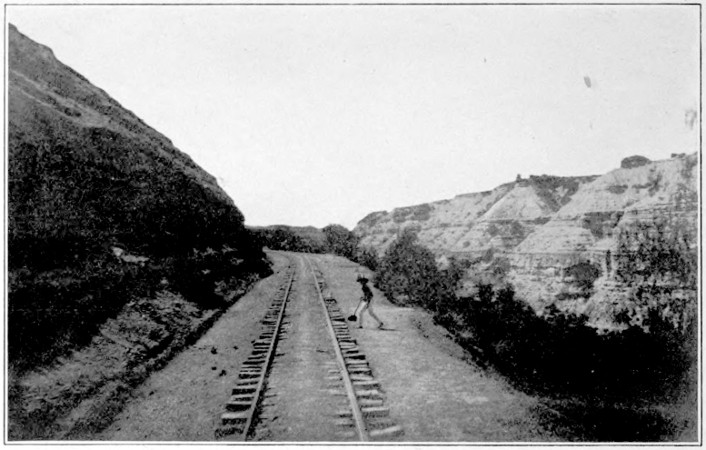
NOCHISTONGO CUT, BUILT BY THE AZTECS TO DRAIN THE VALLEY OF MEXICO.
Of the Board of Directors, twelve reside in Mexico and nine in New York. This progressive move is part of the general effort being made throughout Mexico to arrange for adequate land and sea transportation of its products. New lines[329] of railway are being opened up in the interior on the west coast to meet the requirements of new steamship connections, either established or projected. Additional steamers are being put upon services already operating and branch connections are being made over new land routes. The Tehuantepec Railway, which crosses the Isthmus of Tehuantepec, carrying freights received from the steamship lines plying between the great ports of the United States and the eastern and western termini, transported during the first year of its operation merchandise to the value of between twenty-five and thirty million dollars, and in the second year to the value of thirty-eight million dollars. This road, which is nearly one hundred and ninety miles in length, was constructed chiefly with British capital and controlled, in part at least, by the Mexican Government, and was built for the specific purpose of handling freight between the Atlantic and Pacific oceans. The harbor of Salina Cruz, the Pacific terminus of this railway, is equipped with breakwaters inclosing a harbor area of over one hundred and thirty acres, of which ninety-six have a depth of thirty-three feet, and a drydock capable of accommodating the largest ship on the Pacific Ocean. The wharves are furnished with electric derricks and every modern appliance for the handling of the enormous traffic of the Tehuantepec line.
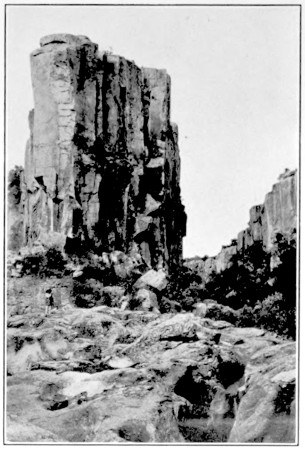
ROCK BELOW CHONEBRIDGE, MEXICAN NATIONAL RAILWAY.
Principal roads which are not included in the Government’s merger are the Mexican, the pioneer road in the republic, extending from Mexico City to Vera Cruz; the Vera Cruz and Isthmus, from Cordoba to Santa Lucrecia, and its branch line from Vera Cruz to Tierra Blanca on its main line; the Pan-American,[330] from Gamboa, Oaxaca, to the Guatemalan frontier; and the Tehuantepec National from the gulf port of Puerto Mexico to Salina Cruz on the Pacific. On the west coast is the great system of the Southern Pacific of Mexico which connects Nogales, Arizona, with Guadalajara, Jalisco. Short gaps are now under construction. The trade is constantly increasing and there are improvements in the service.
This system opens up a magnificent country of boundless and varied resources unsurpassably rich in minerals and agricultural possibilities, capable of sustaining in prosperity several million people. It is a country with a great future that borders on the present. Another great system in course of completion is the Kansas City, Mexico and Orient Line, whose route within Mexico extends six hundred and thirty-five miles from Presidio del Norte on the Rio Grande to the port of Topolobampo, in Sinaloa.
Altogether there are some fifty railroads in operation within the republic and the work of extension and construction is in constant progress. The mere statement of systems, routes and mileage affords but a meagre and uninforming presentment of the great transportation facilities in Mexico.
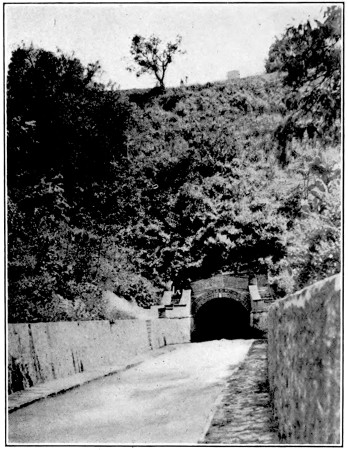
TEQUIXQUIAC TUNNEL.
On December 12, 1908, President Diaz formally opened the new railroad from Guadalajara to Manzanillo.
The rail communication established between Guadalajara and Colima and thence over the line already in operation to Manzanillo gives Mexico a second[331] transcontinental railway connecting the two oceans. The Tehuantepec Railway is, of course, the principal and shortest route across the continent, but now it becomes possible to leave the steamer at Tampico or Vera Cruz and to travel overland through Guadalajara to Manzanillo with only two changes of cars.
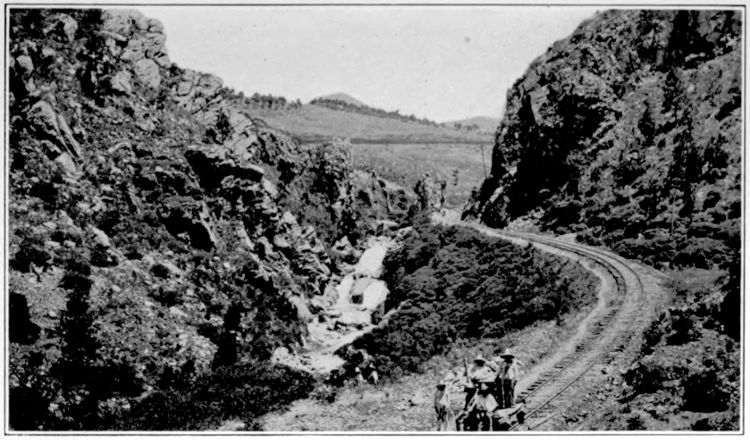
CAÑON WEST SALAZAR, NATIONAL RAILWAY.
Increased exports of native products, including sugar, are reported since the opening of the rail connections to the coast, and large shipments of wheat are being received in Guadalajara and Zapotlan. Steamship communication with Pacific ports and those of China and Japan have been inaugurated, and Manzanillo, as a port of entry, will receive much merchandise which formerly had to be forwarded overland from Tampico.
Manzanillo is one of the oldest and most celebrated ports of the republic. When the important port-works at Manzanillo are terminated it will be one of the best equipped and most desirable harbors on the Pacific Coast. The port-works are being built by Colonel E. K. Smoot, an American engineer.
This operation has been in the course of construction since 1899, and when completed will give the harbor an area of one hundred and sixty-five acres and a depth of thirty-nine feet, thus enabling it to accommodate seagoing vessels[332] of deep draught. The breakwater is one of the largest of its kind in the world, surpassing those of Cherbourg, France, and Plymouth, England. It is four hundred metres long, one hundred wide, and twenty-four deep, constructed of large stones and granite blocks weighing from fifty to sixty tons each.
Within the coast lines of two thousand eight hundred miles on the Pacific and one thousand six hundred miles on the Gulf of Mexico and the Caribbean Sea, Mexico has no less than twenty-four ports on the Gulf of Mexico and thirty-one on the Pacific Ocean. Most of the natural harbors of Mexico are on the Pacific side, among them the splendid Bay of Acapulco, considered one of the most beautiful of the world. While the Atlantic side offers but few natural ports, some of them, especially Vera Cruz, and Tampico, have been improved and made accessible, so much so, that these two ports are now the most important commercial centres.
Following are the ports of entry open to foreign trade, the other ports handling coastwise trade only:
Gulf Ports: Campeche, Coatzacoalcos (Puerto Mexico), Chetumal, Frontera, Isla del Carmen, Isla de Mujeres, Progreso, Puerto Morelos, Tampico, Tuxpan, and Vera Cruz.
Pacific Ports: Acapulco, Altata, Bahia de la Magdelena, Guaymas, La Paz, Manzanillo, Mazatlan, Puerto Angel, Salina Cruz, San Blas, Santa Rosalia, Todos los Santos, Tonala and San Benito.
Mexico may be reached from the sea by several lines, either from New York or the Gulf ports of the United States, or via San Francisco, or by one of the numerous lines plying between European and Mexican ports.
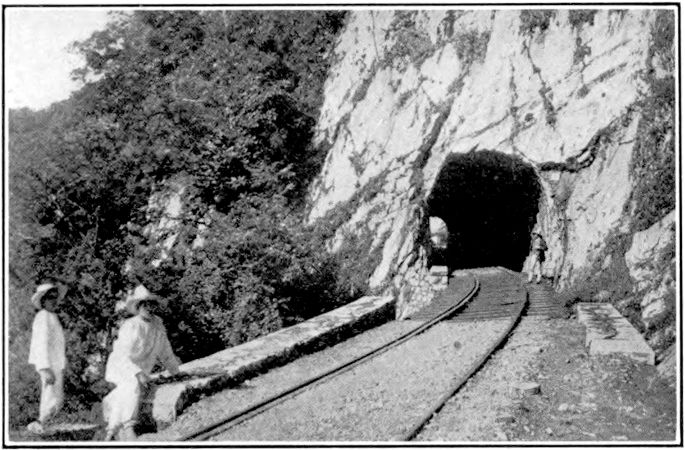
VIEW ON THE INTEROCEANIC RAILWAY.
The New York and Cuba Mail Steamship Company, Ward Line, maintains a regular service between New York and Vera Cruz and other Mexican ports.
[333]
The fleet of the Ward Line has an aggregate tonnage of nearly seventy-five thousand. This embraces as staunch, fast and comfortable ships as are operated from any port in the world. They are full-powered, of the most modern construction, built expressly for this service, and offer all the luxury of travel combined with the greatest degree of safety.
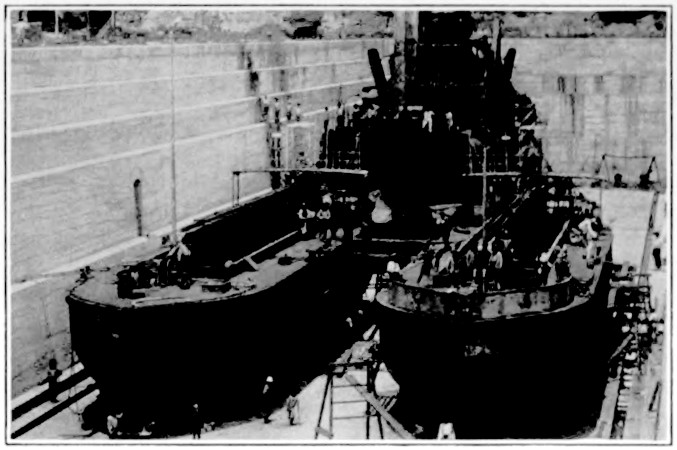
DRY DOCK, SALINA CRUZ.
The ships of this company are all built under contract with the United States Government and are required to undergo a rigid examination by naval officers before being placed in the service. They are exceptionally seaworthy vessels, and as, in the event of war, powerful batteries would be installed on them, they are necessarily strongly built. The service of the company is well known. Passengers who go by the Ward Line for the first time do not fail to remark the unusual interest taken in their comfort and enjoyment of the voyage by the officers of the ship, and the exceptional attention of the stewards and attendants. It is this hospitable solicitude for the welfare of its patrons and the splendid cuisine and comfortable quarters that make the general passenger-service of the company equal in all respects to that of a high-class hotel.
The itinerary of the Ward Line is very complete, covering, with railroad connections, practically all points in Mexico.
The largest and fastest steamers are operated in the express service between New York and Vera Cruz; steamers call at Havana, Cuba, and Progreso, Mexico. At Vera Cruz, the terminal of this route, rail connections are made with the Mexican Railway and the Interoceanic Railway, connecting with the Mexican Southern Railway for all interior points. Direct steamers ply between New York and Tampico, Mexico.
There is a fast freight line running from London direct to Havana, Puerto Mexico, Vera Cruz and Tampico, with sailings every four weeks. This belongs[334] to the Royal Mail Steam Packet Company and is one of the oldest steamship lines touching Mexican ports. It dates back to 1840, and was one time a passenger service between England and Mexico.
The Mexican-American Steamship Company, the Wolvin Line, the Compania Transatlantica and the Compania Mexicana de Navegacion, the American-Hawaiian Steamship Company have established regular steamers to Mexico.
The Munson Steamship Line to Cuba and Mexico has contracted with the Mexican Government for a service of at least two round trips per month between ports of the United States on the Atlantic Coast or the Gulf of Mexico and one or more Mexican Gulf ports. The term of the contract is for three years from January, 1909.
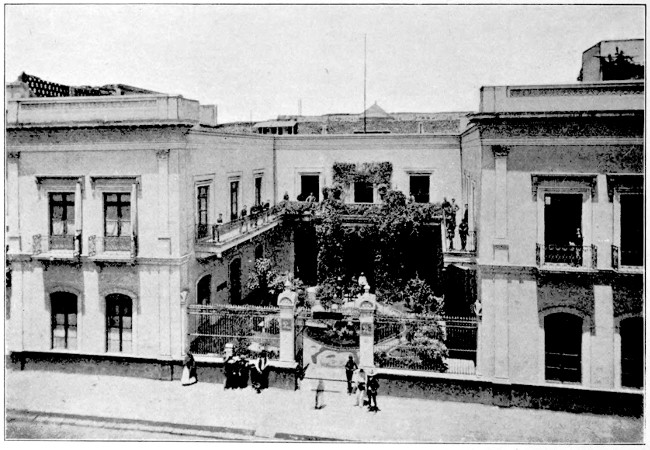
TELEGRAPH OFFICE IN THE FEDERAL DISTRICT.
On the Pacific side, the Pacific Mail Steamship Company provides the means of communication, its steamers sail regularly every ten days from San Francisco, calling at Mazatlan, San Blas, Manzanillo, Acapulco, and Salina Cruz, making the run from San Francisco to Salina Cruz in eleven days, while[335] the time employed between San Francisco and the other ports varies according to their respective distances. This company have established a through service from San Francisco to Panama, making the trip much shorter.
This offers a splendid chance to see the Pacific side of Mexico. The steamers are luxurious and pass through the most tropical part of the republic. This is a favorite route to New York, as it touches at Panama and connects with the Panama Railroad and Steamship Line for New York. The steamers of this line are noted for comfort and elegance.
The Panama Railroad is the great International highway between the Atlantic and Pacific Oceans, and gives the passengers an opportunity of seeing the famous Panama Canal now under construction.
The Pacific Coast Steamship Company’s vessels leave San Francisco on the seventh of every month, calling at Ensenada, Magdalena Bay, Mazatlan, Altata, La Paz, Topolobampo, Santa Rosalia and Guaymas. The steamers of the Kosmos Line sail from San Francisco every two or three weeks and call at Mazatlan, San Blas, Manzanillo, Acapulco, Salina Cruz, Tonala and San Benito.
The Jebsen Line issues through bills of lading to all interior points and passenger tickets into Mexico via the newly-opened railways from Manzanillo.
Several lines of steamers maintain a regular coastwise service between the different ports of Mexico, the most important of these being the Campania Naviera del Pacifico, which is subsidized by the Mexican Government.
The French Steamship Company, the Compagnie Générale Transatlantique, has inaugurated a regular freight service between France and Puerto Mexico, the Atlantic terminal of the Tehuantepec Railway.
The Italian Navigation Company of Genoa also has in contemplation a steamer service to Puerto Mexico.
It is from this port that Hawaiian sugar shipped over the Isthmian route is forwarded on the Atlantic side. The sugar is carried by the American-Hawaiian Steamship Company to Salina Cruz on a schedule providing for three steamers a month, with an average cargo of twelve thousand tons each. It is estimated that over three hundred and seventy-five thousand tons of sugar were handled over the Tehuantepec Railroad in 1910. Additional ships are to be added to the Honolulu, San Francisco, and Salina Cruz service, as the requirements of the traffic make it necessary.
[336]
In the month of November, 1908, Congress passed a law establishing a system of receipts for postal money orders both at home and abroad, the former being inaugurated February 1, 1909, and the latter, embracing Canada, Germany, France, Great Britain and Salvador, on March 1, 1909. Through the German service a system of postal money orders was also established between Mexico and Turkey, and the parcels-post rates with Germany are modified.
The federal telegraph lines in the republic have an extension of forty thousand and six hundred and forty miles and new offices are being opened in accordance with the needs of the service. Government adherence to the International Wireless Convention, signed at Berlin, Germany, November 30, 1906, has been announced. Wireless telegraph stations have been installed in Lower California, placing that district in communication with the rest of the republic.
Señor Camilo Gonzalez is the director of the Federal Telegraph of Mexico and under his splendid supervision the system has been much improved. In June, 1900, there were two million eight hundred and thirty-three thousand two hundred and ninety-six messages transmitted and in the same month of 1910, four million four hundred and sixty-six thousand eight hundred and sixty-six messages were sent.
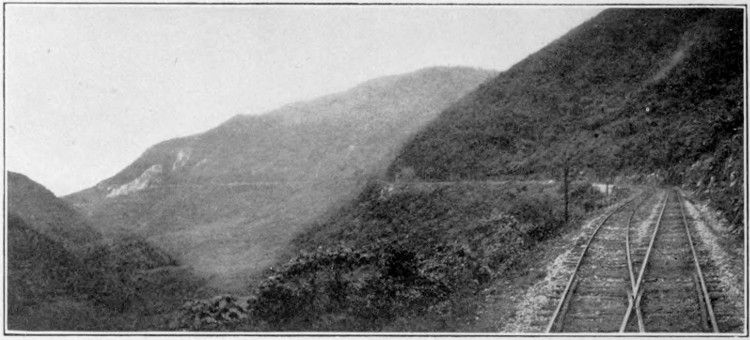
TOMASOPO CAÑON.
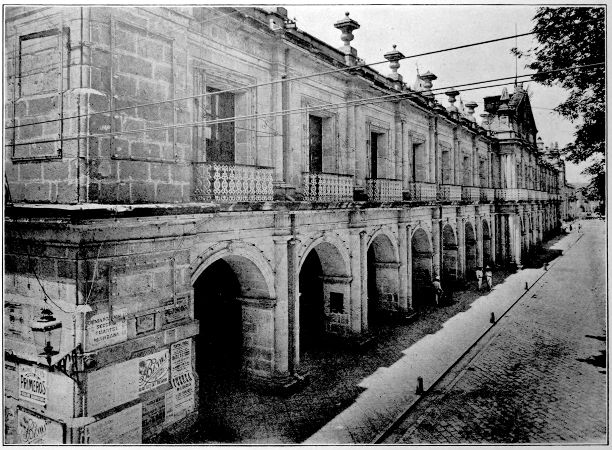
THE GOVERNOR’S PALACE.
[339]
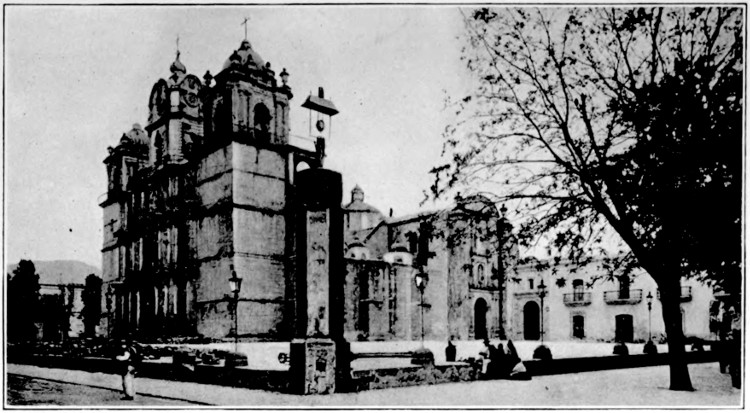
THE CATHEDRAL.
The road to Oaxaca leads through a great amphitheatre of lofty and mighty mountains with rushing water at the base and flecks of green fields and beautiful foliage sweeping out into the distance. This State is known as the cradle of the patriots. The influence of the native land of the president has been felt throughout the republic, for no State has furnished such brilliant men, such valiant soldiers, financiers and able statesmen. The echoes of history resound with the brave deeds of Benito Juarez, Porfirio Diaz, Romera and Mariscal.
Oaxaca, one of the largest of the Mexican States, has an area of over sixty thousand square miles. It lies between the States of Puebla and Vera Cruz on the north and the Pacific Ocean on the south. The lower or eastern end of the State is part of the Isthmus of Tehuantepec. Here, as in most other Mexican States, there are three distinct zones of vegetation. In the mountains, of which there are several ranges, and on the higher plains, the crops and timber are[340] similar to those of the northern United States. Below the foothills, corn, cotton, sugar and tobacco are the principal crops and in the very deep valleys and toward the coast the vegetation is purely tropical.
More than one-third of the population, estimated at about one million, are pure blooded Indians, mostly belonging to tribes of the Zapotec nation. These people are great fighters and delight in war; notwithstanding, during the administration of President Diaz, they realized the benefit of peace and order and the charm of industry.
Great herds of cattle are the main support in the central parts of the State. It has long been the custom to drive the exportable surplus of these cattle to Mexico and Puebla, the trip consuming three months, but since the railways are finished the profits of the ranchmen have increased by the easier transportation.
Two main lines now serve parts of the State. One, the Mexican Southern, runs from Puebla to Oaxaca, and the other, the Tehuantepec, crosses the foot of the State.
The hospitality of Oaxacans is well known. It is sufficient to knock at any door in that charming State to have it opened with offers of shelter, food, and friendliness, without money and without price. Until within a few years, inns and hotels were unknown, the hospitality among the private houses doing away with the need of such accommodations. The friendship and affection of the Oaxacans for one another are proverbial. Social reunions are constantly held, and there is much gaiety and light-heartedness in consequence.
From its geographical position, geological formation, fuel and water, means of communication and climate, the State of Oaxaca is a veritable paradise for the prospector and capitalist seeking investment in mining properties. Two vast mountain ranges traverse the State from north to south, whose peaks in many cases rise to an altitude of from ten to twelve thousand feet.
These mountain ranges, which are the culminations of the Rocky Mountains of the United States and the Sierra Madre of Southern Mexico, are highly mineralized throughout their length and breadth.
The principal metals found in these hills are gold, silver, copper, lead, and iron, either free or in various combinations and with one another. The veins carrying free gold are those most extensively worked and although comparatively few mines have been opened up, those which have been are producing large quantities of exceedingly rich mineral.
[341]
The whole State is practically an unexplored field, only a few districts have been superficially prospected.
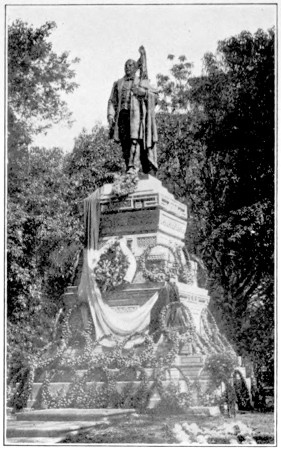
STATUE OF BENITO JUAREZ.
Oaxaca is a maritime State and extends farther south than any other in Mexico. The great chain of the Mexican Andes crosses the State giving it some of the most magnificent scenery in the entire republic. Chains and ridges make a surprisingly picturesque and beautiful variety to the country. The most remarkable summit is that of Zempoaltepec, in the district of Villata, which rises to an elevation of eleven thousand five hundred and forty-two feet, and from the top of which may be had magnificent views of the country, with glimpses of both the Atlantic and the Pacific Oceans. The climate of Oaxaca is in general very salubrious, for, although it is nearer the equator than other states, its high mountainous altitudes give it healthful breezes. Besides its vast mining resources the agricultural possibilities of Oaxaca are practically limitless. All the products of the temperate zone are raised in great abundance, while the more profitable ones of the torrid zone abound. The cacao raised here is the best in the world, while the annual yield of cochineal is about five hundred thousand pounds. The cultivation of fruit is one of the most profitable enterprises. There are various fibrous plants such as maguey, ramie, and the sisal hemp. These plants require no care, some of them being used as hedges to divide fields or estates. The government encourages foreign enterprise and favors colonists in every way, including exemption from taxation for a period of ten years; freedom from import duties on all goods, machinery, building[342] material or cattle coming into the country for their use, and exemption from military service.
Waterpowers are countless. The many in use driving large factories or producing electric light and power for the cities and mines.
Before the Spanish rule, Oaxaca was the source of much mineral wealth, the native records indicating this region as the principal source of the precious metals.
Many of these old workings have been reopened in the last few years, a smelter has been erected in Oaxaca City and many reduction works have been built in the mining country. The ores contain gold and silver, copper and silver, and copper.
Although Oaxaca is practically an agricultural state, there are a great many manufactures.
The State and especially the Valley of Oaxaca and its tributaries are rich in subjects for research and have never had the attention their importance demands.
The city is two hundred and eighty-eight miles south of the capital of the republic and a mile above sea level. It was founded in 1486, under the name of Huaxyacac and fell under the Spanish rule in 1528. It has a rapidly increasing population of forty thousand. The streets are regularly laid out, wide and spacious, and the houses are handsome and substantial. The principal buildings are the Cathedral, the Santuario de la Soledad, and other churches and convents gorgeously decorated.
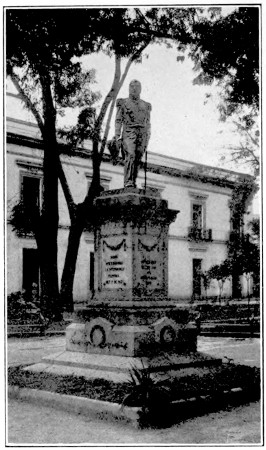
STATUE OF GENERAL ANTONIO DE LEÓN.
There are also the Cabildo, or city hall, the Episcopal Palace, the government buildings, and several handsome plazas, embellished with flowers, trees, and fountains.
[343]
The surrounding country is remarkably picturesque, being literally covered with flower gardens and cochineal groves. The hospital in Oaxaca is one of the best in Mexico. The city is extremely pleasant. Its houses are white and on the balconies every day may be seen groups of young people well-dressed and cheerful, giving a festive air to the whole city. The government palace is magnificent, recalling the splendor of the edifices of the time of the viceroys.

FAÇADE OF THE CASINO.
In the Plaza de Armas is a monument to the patriot Juarez, one of the most elegant in Mexico. The park of Guadalupe is very delightful, large and stately with flowers and groves of trees.
There are a great many schools in Oaxaca, including the Scientific Institute, Seminary, Historical Museum, Public Library and many private institutions. There are Official Schools for primary instruction for boys and girls, and more than five hundred schools supported by the government.
[344]
As always in Mexico, the churches present many points of interest. The Cathedral, begun in 1553, and completed two centuries later, was one of the grandest erected by the Spaniards and ranked with those of Mexico City and Puebla. But it has suffered so many bombardments and been looted so frequently that little of its former glory remains. Only the façade, beautifully decorated with sculptures by unrecorded artists, attests the original splendor. All the valuable paintings, statuary and ornaments that once made gorgeous the interior have disappeared.
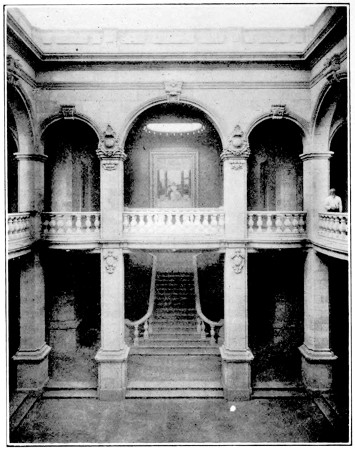
STAIRWAY IN THE INSTITUTE OF ARTS AND SCIENCE.
The church of Santo Domingo, with monastery attached, tells a similar tale. Built at a cost of thirteen million dollars on a most massive scale, the strength of its walls made of it a fortress whose strategic importance is well attested by the scars made by shot and shell. The interior, however, has not been altogether despoiled. An authority on ecclesiastical art, writing of this church, says, “The interior is one of the most splendid in Mexico, the most superb example of baroque decoration in the country. The walls and the great barrel-arched ceiling are covered in every part with heavily-gilded ornaments and polychrome sculpture in high relief. The effect is one of indescribable splendor. The scheme of decoration in the domed vaulting of the organ-loft ceiling may be compared to an enormous tree, extending in all directions its branches and its innumerable leaves of gold,[345] between which appear the busts of saints diminishing in size as the height increases until at the apex only the faces are shown.”
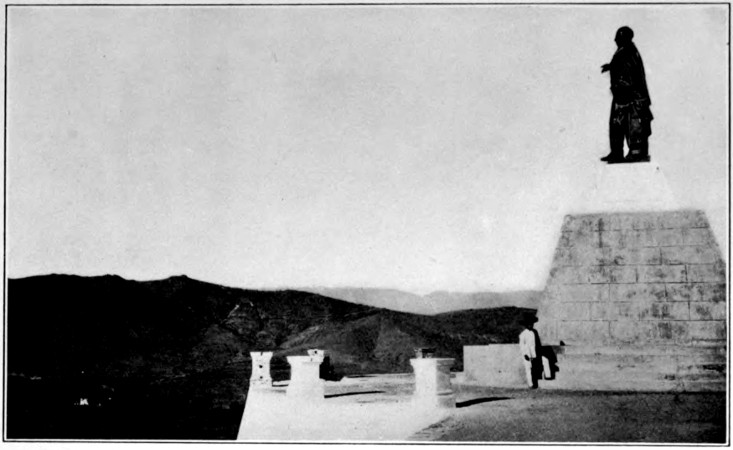
STATUE OF BENITO JUAREZ, ON THE MOUNTAIN OVERLOOKING HIS NATIVE CITY.
Several times when churches were being looted it was proposed by parties in possession to scrape the wonderful decorations from this ceiling to recover the gold used therein, but somehow the work was never attempted, the pillagers contenting themselves with the pictures, statuary, altar ornaments, which could be more readily seized. The monastery itself was reduced to bare walls and is now used as a barracks.
Other buildings worthy of inspection are the State House, Federal Building, and the Public Library containing fourteen thousand volumes, in which are found many old manuscripts relating to the period of the Conquest.
These buildings and the residences of Oaxaca impress one as being more distinctively of Moorish design than those in other cities. It would seem as if the note struck by the early builders had been held by all their successors. Having this impression, the modernity of the trolley cars and electric lights brings a curious feeling of anachronism which may easily be enhanced by a visit to the ruins of Mitla.
[346]
Not far from the City is the big tree of Tule. It is one hundred and fifty-four and a half feet around, six feet from the ground. It takes forty men to reach around it. It is of the cypress family and must have been there long before Columbus touched the western shores. On the tree is a tablet placed there by Humboldt.
Through three centuries of its history Oaxaca has grown as an interior town, in the full sense of the term. It lies in one of the most beautiful and fertile valleys of Mexico, or rather at the meeting point of three valleys. It is shut off from the ocean on the south by a solid range of mountains; it is separated from the cities of Central Mexico on the north by a range of rough and broken country.
Next in importance to the capital among the cities of the State is Tehuantepec, with its twelve thousand inhabitants. It is inland about twenty miles from the Pacific Ocean and is most noteworthy sociologically. Here was the home, the chief fastness, of the Zapotec people and here live to-day the purest-blooded descendants of that race. The women show a strong and noble people and they are distinguished for beauty of face and symmetry of form. Tehuantepec was the base of supplies for General Diaz when he was opposing the French invasion and his fort is still one of the sights of the town. There are some splendid hot springs of efficacy for the cure of rheumatism, and also many interesting sights of local color.
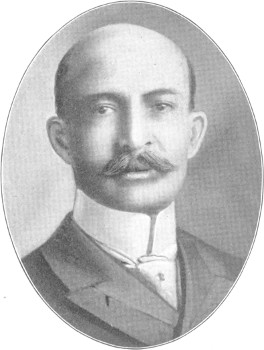
SEÑOR LIC. EMILIO PIMENTEL, GOVERNOR OF OAXACA.
The Isthmus is that narrow neck of land in tropical Mexico which lies between parallels eighteen degrees and sixteen degrees N., dividing the Atlantic and Pacific waters. The shortest transcontinental railroad on this hemisphere is built there and its trains run across in about six hours. It is not only a magnificent and beautiful country, but has also the most delightful tropical[347] climate. Twice the United States government spent a great deal of time and money making a survey across that neck of land with a view of cutting a canal; once in 1852, and again in 1871, when Captain Shufeldt, of the United States Navy, was sent with a large expedition to make surveys. Again, Captain Eads spent a great deal of time there on his plan to build a ship railway. Now that the Isthmus is opened up by a railway and steamship communication, that portion of Mexico, more than any other, will participate in the wonderful progress Mexico is now making.
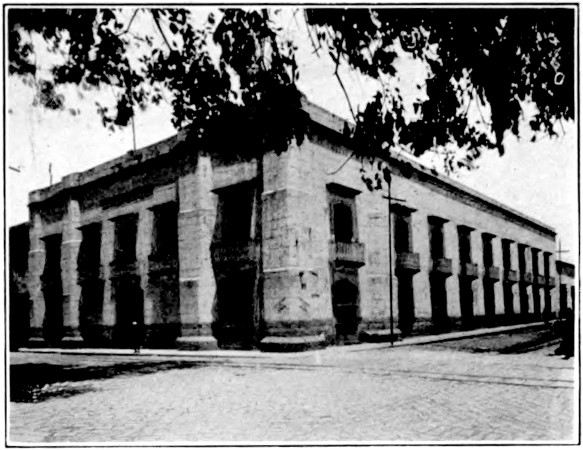
NORMAL SCHOOL FOR WOMEN.
The distance from Oaxaca to Tehuantepec is considerably less than from Puebla to Oaxaca. The railway connection has made this southern half of Mexico an outlet to the Pacific. Down the cañon of Tomellin the builders have pushed their way, solving some of the most difficult problems ever encountered in railway construction. They not only tunnelled to get a passage for the trains, but they bored the spurs of the mountains in three places to give the river new channels. The bare gray and brown and red cliffs tower two thousand feet above the track. Tourists journey across the United States for brief half hours in cañon scenery; on the Mexican Southern Railway the traveller rides half a day through awe-inspiring gorges. The train reels down and then staggers up grades which are only a fraction below the legal limit of four per cent. The route is through masses of rock; in some places the boulders are so poised that it seems that a slight jarring would dislodge them. The traveller, when the train starts down these curves can look ahead and see the route and the stations an hour in advance of the schedule time.
The completion of the Tehuantepec Railway and its opening to traffic have attracted much attention. The construction of the railway was a matter of[348] national importance. It was carried out by the Mexican government at its own cost by the advice of President Diaz, who recognized its strategic value.
The Isthmus of Tehuantepec can boast of advantages unequalled in the commercial world. It is connected by the Tehuantepec Railroad with the Atlantic and Pacific Ocean steamship facilities, making connection with every large market in the world. The Mexican government has expended over eighty millions upon the construction and equipment of the Atlantic port, Coatzacoalcos, now Puerto Mexico, and the Pacific port of Salina Cruz. Steamers, drawing over thirty feet of water, enter both ports and discharge their tremendous cargoes in an incredibly short time by means of great modern electric cranes and the best docking facilities, which the government has installed.

CORRIDOR OF THE INSTITUTE OF ARTS AND SCIENCE.
Travel throughout the state is remarkably free from danger, the officials are uniformly kind and considerate in their treatment of strangers, gladly welcoming the investor, who they know, in seeking to better his own condition, cannot fail to improve those with whom he is thrown in contact.
[349]
The State of Oaxaca is notable for having been the stronghold of the Mixtecas, a race of Indians who emigrated many centuries ago from the north, and displacing the Chochones, occupied the state, together with Puebla and Guerrero. They were an intelligent and progressive race and were governed by independent chiefs. The Aztecs afterward subdued some of the Mixtecas but those of Oaxaca remained independent, and many of them still are found in parts of the State. Remains of their former cities, temples and fortresses show that they had considerable intelligence. They believed in a heaven called Sosola, and had sacred caves in the mountains. Probably they had something to do with the original Mitla. They had a distinct language with several dialects. A Mixtecan grammar was published in 1593 and there are still existing religious treatises printed in Mixtecan in the sixteenth and seventeenth centuries. The Mixtecans of to-day are well-bred and quiet citizens.
After the Conquest, Oaxaca, on the arrival of the first Viceroy, was elevated to the category of an intendency which character it retained until 1821.
On the 31st of January, 1824, it was raised to the rank of a federal entity, and since then it has formed an integral part of the Mexican Confederation.
It now forms one of the twenty-seven states that compose the Mexican Republic; free and sovereign in so far as refers to its interior management, but in union with the other parts of the republic in accordance with the Political Constitution of the republic of the 5th of February, 1857, together with all the additions and amendments thereto.
The governor of Oaxaca, who may be considered the advance agent of its prosperity, has done much to attract to it the attention of foreign investors. Señor Don Emilio Pimentel is a native of Oaxaca and was educated in its public schools, its state institute and its college of law. Sent to Congress for several terms he became a leader, and for a number of years afterward practised law in Mexico City, of which he was finally elected Mayor. His broad intelligence and grasp of the problems confronting the nation early attracted the notice of President Diaz, whose confidence he has since enjoyed. He has been sent to Europe on government missions and represented Mexico in the Latin-American Congress at Montevideo. At one time he was offered a portfolio by President Diaz, but at that time his health had been broken by overwork and he was obliged to decline. In his law practice he represented several of the most important financial interests in the republic. Thus, was he fitted peculiarly to be of[350] service to his native State when elected as its governor in 1902. Now serving his third term in that office he bends every effort to the promotion of the State’s welfare. Practically, all the foreign capital now employed in Oaxaca was invested there at his solicitation.
He has endeavored to give impulse to everything that means progress and prosperity by granting advantageous concessions to men of enterprise. To him is also due the development of railways in the State, the increasing network of tramways in the city, and the railway company to San Felipe. The capital city is also indebted to him for many improvements. All branches of public administration receive his special attention. He has organized new schools and charities and has appointed a commission to study the laws of primary and normal instruction. The public treasury has, under his able and correct administration, paid all the expenses and the State is out of debt. Governor Pimentel has organized the rural police force and has attended to all sanitary affairs in the capital. He has a clean political career which promises him a brilliant future. Oaxaca will place his name on the golden page of its great benefactors.
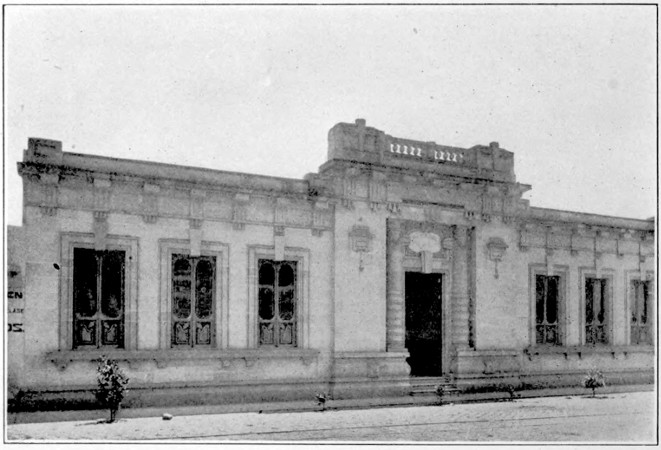
THE PORFIRIO DIAZ HIGH SCHOOL.
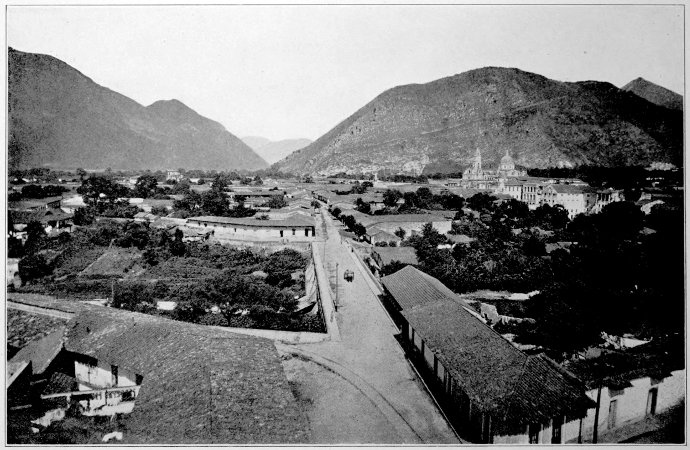
THE CITY OF ORIZABA.
[353]
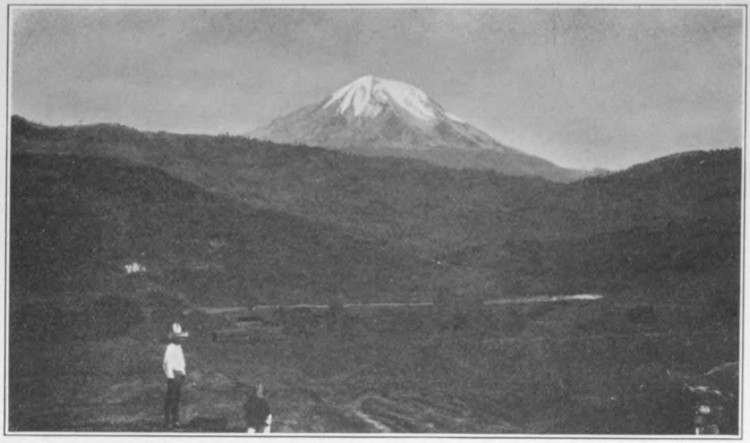
THE PEAK OF ORIZABA
The State of Vera Cruz is one of the important states of the republic. The climate has a range of temperature that rises from cool and bracing to hot and stifling. It is pre-eminently agricultural and with the exception of rich fields of mineral oil, and cattle-raising, which is a lucrative source of revenue, the chief products of this fertile State are coffee, bananas, sugar, vanilla and cotton. In the northwest is the Huasteca region, the finest cattle lands on the continent, and in the southwest, the Sotavente district is rich in agricultural soil and watered by the mighty Paploapam.
The southern part of the State is open to colonization and there are many foreign enterprises engaged in the principal industry of sugar making.
The State is very liberal and progressive and under the administration of the present Governor, Señor Don Teodora Dehesa, port-works, water-works and sewers, drainage, public buildings and many other advanced ideas of reform have been inaugurated.
[354]
The Federal Quarantine Station at Vera Cruz has been declared by health experts as the most complete and thorough in existence. It can be now recorded that the entire absence of yellow fever is assured. Vera Cruz now enjoys the distinction of being the cleanest city in the republic.
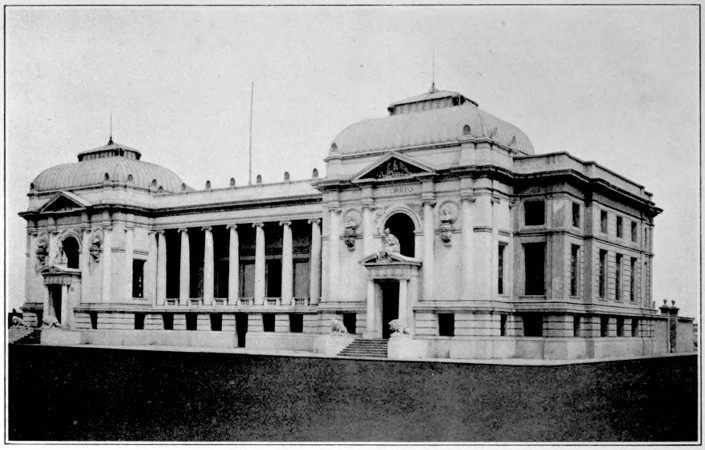
POST OFFICE, VERA CRUZ.
The City of Vera Cruz was founded in 1519, by Hernando Cortés. It was at one time the capital of the State, but Jalapa is now the seat of the government. It was built in a semi-circle fronting the sea, and was formerly enclosed by a wall six feet high and three feet thick and defended by two redoubts on shore and by the Castle of San Juan de Ulua which stands on an island. The streets are regular and wide and form many squares, and little plazas or parks, beautiful in rich tropical flowers and trees which make the city very attractive. The houses are strongly built of coral limestone in the old Spanish style. It is an ideal spot for the traveler who enjoys a warm climate and beautiful sun. Old churches, public buildings bearing the marks of centuries, old convents that have stood the test of time, and beautiful modern buildings are found side by side in sublime[355] contrast. The Municipal Palace was built in 1609, and the Public Library, in which are wonderful old volumes and archives, was founded in 1870. There are several beautiful churches, theatres, hospitals, an artillery school, and a new post office.
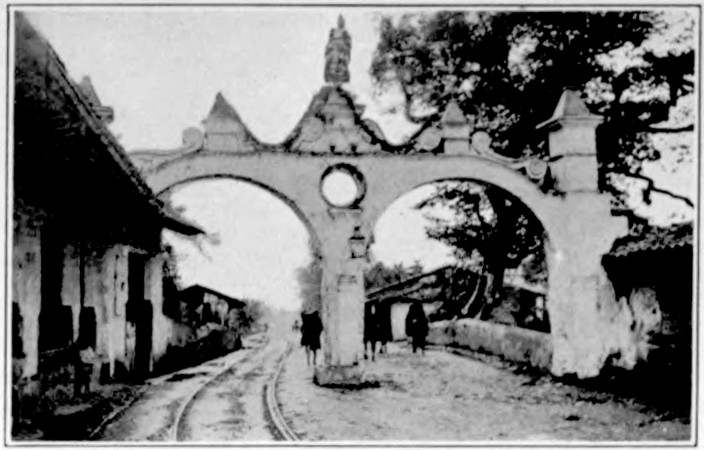
OLD GATEWAY, ORIZABA.
The lately constructed port-works have converted the ancient rockbound roadstead along the Atlantic coast line into a safe and commodious harbor. The protected harbor covers fifty-four acres. The length of the breakwater is three thousand three hundred and thirty metres.
The present city of Vera Cruz is not the same that was built by Cortés in the year 1519. The Villa Rica de Vera Cruz—“the rich town of the true cross”—is six miles distant from the present city. The inhabitants of this busy city are renowned for their culture, their frank and simple manners and their patriotism, of which they have given many proofs in the various sieges which the town has sustained against foreign foes, thus justifying the appellation of “heroic” given to it.
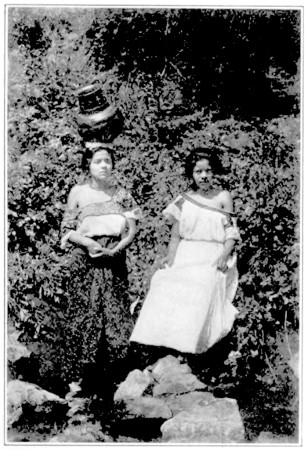
INDIAN WOMEN IN THE TROPICS.
Nowhere in Mexico is there a more beautiful spot than the City of Jalapa. When the atmosphere is clear, one can see the shipping in the harbor of Vera Cruz with an ordinary spy glass and the white caps of the waves with the naked eye. The elevation of Jalapa above the sea is a little more than four thousand feet. It is situated on a shelf of the mountain, the summit of which at Perote, a distance in a direct line of about twenty[356] miles, is four thousand five hundred feet higher than Jalapa. The whole horizon, except in the direction of Vera Cruz, is bounded by mountains—among them Orizaba, distant from Jalapa about twenty-five miles, though owing to the clearness of the atmosphere and the sun shining upon the snow with which it is covered it appears to be much nearer. All the tropical fruits grow in the district, and are cultivated with great care and skill. It is not an exaggeration to say that it is impossible for one who has not been on the tableland of Mexico to conceive of a climate so elysian.
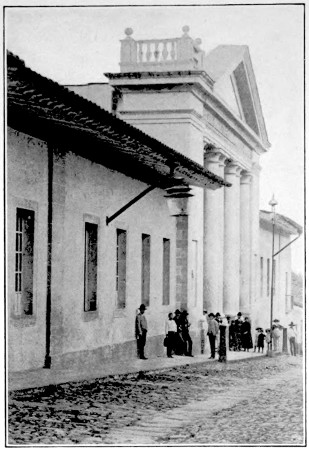
NORMAL SCHOOL FOR PROFESSORS, JALAPA.
Jalapa is indeed a rare old place. It seems to be built on edge, with streets like stairs climbing the hills, while terraced houses cling to the hillsides.
Orizaba lies about midway between the two extremes of the coast and the plateau. It is one of the busiest manufacturing towns of Mexico. It is on the line of the oldest railway in the country, within easy access of the interior cities.
The town of Coatzacoalcos is at the mouth of the river of the same name, and is one of the few places that look like an American town. It is growing rapidly and has the second finest port-works on the continent.
On the Mexican Railroad, Cordoba, nestling under the shadow of the snow-capped peak of Orizaba is a tropical refuge for many travelers seeking sunshine. Fruits, flowers, palms and ferns grow in abundance. In this tropical part of Mexico one finds many beautiful pictures that would look almost unreal if painted on canvas.
The red-brown coloring of the Indians in their costumes and the half-naked children basking in the sun or enjoying the shade of the verdant palms, and the[357] perfume of the flowers that permeates the atmosphere almost transport one with enthusiasm and enjoyment.
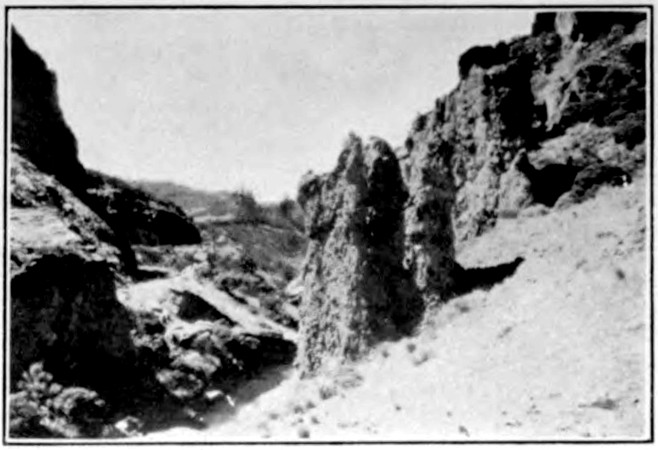
PICTURESQUE SCENE NEAR SALAZAR.
In Cordoba grows the finest coffee in the world. The loveliest scene on Nature’s canvas is a coffee plantation. The leaves of the plant are a very dark green, the flowers white and freighted with a rich aromatic incense, and the berries are deep red. This bean is cultivated with great care. The shrub is graceful and drooping and the flower is as sweet as the orange blossom.
The State of Vera Cruz is rapidly gaining fame for the variety, beauty and sublimity of its scenic attractions.
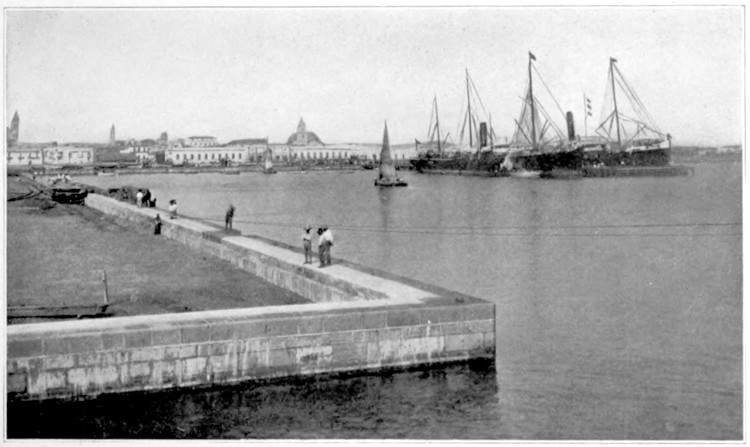
THE HARBOR, VERA CRUZ.
The Castle of San Juan de Ulua, which was the last foothold of the Spaniards in Mexico, was surrendered by them to the patriots in 1825. In 1838, Vera[358] Cruz was bombarded and taken by the French and again in 1847, by the Americans, under General Scott. It was surrendered to the allied British, French and Spanish squadron in December, 1861, and was restored to Mexico in 1867.
The experience of three Mexican Revolutions makes it easier to conceive the extent to which this unfortunate city must have suffered in the struggle made by the Spaniards to preserve the Castle, their last bulwark on this continent. San Juan de Ulua remains a lasting memorial of the great works which, almost immediately after their arrival on these shores, were undertaken by the Spanish conquerors.
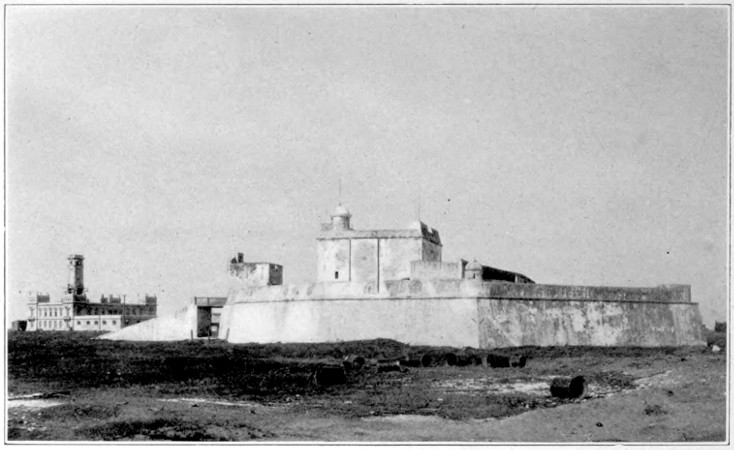
OLD FORT OF SANTIAGO.
[359]
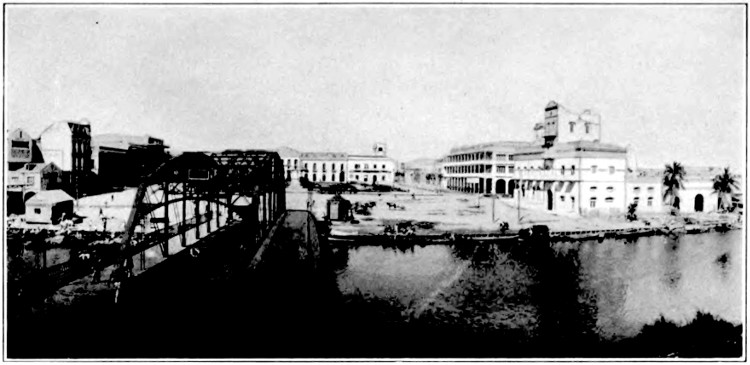
TAMESI RIVER FRONT, TAMPICO.
Tamaulipas derives its name from a tribe of Indians which formerly inhabited this region. It is one of the closest Mexican neighbors of Texas and is one of the richest agricultural and mineral states in the republic.
Bordering on Texas on the north, with the Gulf of Mexico on the eastern boundary and the tropical states of Vera Cruz and San Luis Potosí on the south, and Nuevo León on the west, Tamaulipas is one of the most accessible of the Mexican states and equal in size to many of the western states of her northern neighbor. The principal cities of the State are Ciudad Victoria, the capital, Tampico, the great Gulf port, Matamoros, historically located just across the Rio Grande from Brownsville, Texas. A majestic mountain range, the Sierra Madre, enters the State in the southern end and runs through it in a north-easterly direction penetrating into the neighboring state of Nuevo León. The Sierra Madre running from east to west, covered with thick forests, rises to a high altitude, and is cut in all directions by deep gorges and ravines and protrudes its massive spurs east and west into various important chains. The mountains[360] are rich in minerals and the mineral development of the State is in its infancy. It has an area of twenty-eight thousand six hundred and fifty-nine square miles and a population considerably above two hundred thousand.
The coast is low and sandy and there are several lagoons along the shore, the largest of which, Laguna Madre, is over one hundred miles long and in some parts over twenty miles wide. The principal rivers of this State are the Fernando, Borbon, Santander and Tampico. In the northern part the flat coast lands extend inward for many miles and then rise to elevated plains; in the south the country is diversified by many mountains and valleys and the scenery is very picturesque. There are rich silver and copper mines which promise great and undiscovered wealth. Valuable timber abounds on the mountains; the soil is fertile, and all the fruits, grains and vegetables of the temperate and torrid zones are easily raised. This is also an excellent State for stock-raising of all kinds.
Tamaulipas was originally named Santa Anna de Tamaulipas. In area, richness of soil and variety of climate, the State is one of the most important in Mexico. Its location is naturally excellent. In the long stretches of flat lands of the Tierra Caliente; there are rivers with many branches which reach out in every direction.

SEÑOR DON JUAN B. CASTILLO, GOVERNOR OF TAMAULIPAS.
Señor Don Juan de Castillo has been the distinguished governor for the past ten years. He has devoted his energies to the development of all enterprises in his State. He encourages colonization and gives financial aid and concessions which promise to develop the resources of Tamaulipas. During his administration many new schools have been opened in the country districts and he has given special attention to the extension of education throughout the State. In the larger cities new school buildings have been erected, embodying all modern[361] ideas. Governor Castillo has caused improvement in sanitary conditions and the State is now free from epidemics which threatened it in the past.
The general interest shown on the part of foreign capitalists and the advantages offered to investors have resulted in the forming of several good colonies.
There are many fertile valleys well watered and free from the malarial diseases which afflict the hot lands. These lands are still very cheap and suitable for colonization.
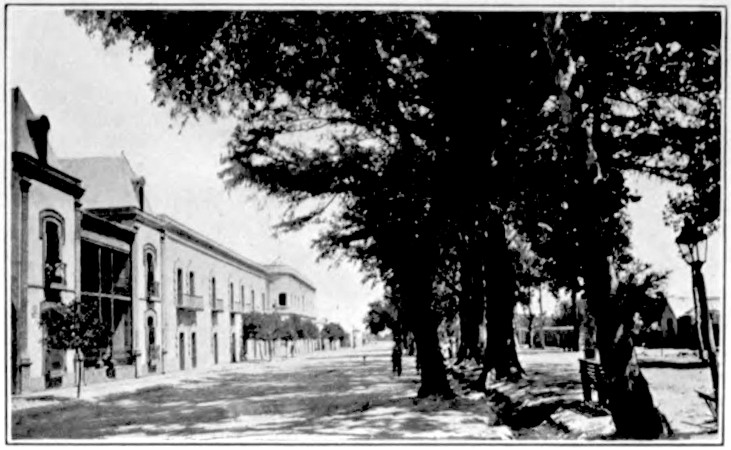
AVENIDA PRIETO, SHOWING GOVERNOR’S PALACE, VICTORIA.
Ciudad Victoria, the capital city, is situated in a beautiful and healthful locality. It is well built and has splendid palaces and public buildings, hospitals and good schools. There is a normal training school for teachers, a primary normal school, the state institute and a law school; another school which does excellent work is the Juan José de la Gaza Institute. The state legislature has made extension of all public roads. The city has many beautiful parks and monuments.
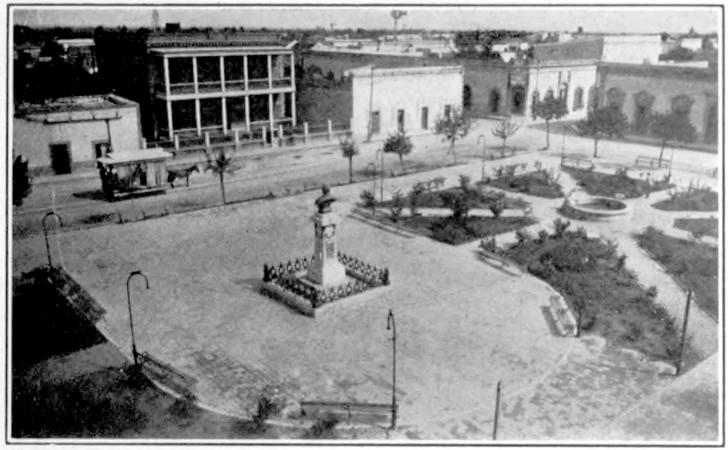
PLAZA JUAREZ, VICTORIA.
No sections of the republic are receiving greater evidence of the influx of capital and the stream of immigration than the Gulf ports. With the natural advantages of location, harbor and transportation facilities, the port and city of Tampico are of the greatest commercial importance.
Tampico is built upon a rocky bluff forty feet high, surrounded by lagoons[362] of salt water. The architecture of Tampico is more American than most Mexican towns display, owing, doubtless, to its ready communication with other northern ports. The houses are built both of wood and stone, with sloping roofs and outer verandas. Color prevails everywhere, the houses being painted in blues and yellows, each street looking fresh, bright and clean and especially so the brilliant façades clustering about the plaza. The latter is a densely shaded park paved with granite and provided with seats. No flowers grow in this plaza but the house-holders around it seem to vie with one another in window and veranda gardening. All the houses have balconies on the street-front with rows of blossoming orchids and amaryllis along the walls. Just out of Tampico may be found thousands of orchids growing wild, hanging thick on the seaward side of the rocks, where the tropical sun and perpetual moisture give them a most luxurious growth.
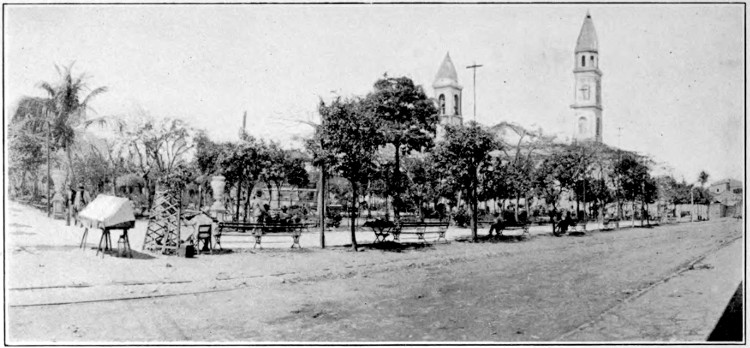
PLAZA DE ARMAS, TAMPICO.
Then there is a wonderful old church with ancient wood-carving and frescoes by Spanish artists. It is a strange mixture of old and new that is met at every turn in Tampico; the jetties built out from the mouth of the Panuco seven thousand feet into the Gulf are, perhaps, the most interesting of all. These jetties have great banks of stone with easy slopes and rounded tops like those at the mouth of the Maas in Holland. The sand-bar which once obstructed this harbor has entirely disappeared and now the inland harbor of Tampico is one of the most important on the American continent.
[363]
Approaching ships pass into calm water between two great jetties extending a mile out into the Gulf and on through a wide channel kept constantly open and deepening by the current of the great Panuco River and its tributaries, which drain a watershed of thousands of square miles and discharge their waters into the Gulf of Mexico through the entrance to the harbor. These jetties, built by the Mexican Government, are constructed of stone of a superior quality secured from the mountains of the interior. Constant additions are being made to them and plans are now under consideration which will result in further extension. The Panuco River is at this point the dividing line between the State of Vera Cruz on the south and that of Tamaulipas on the north. Just as a ship reaches the actual mouth of the river the government lighthouse may be seen to the best advantage looming up on the horizon on the Tamaulipas side.
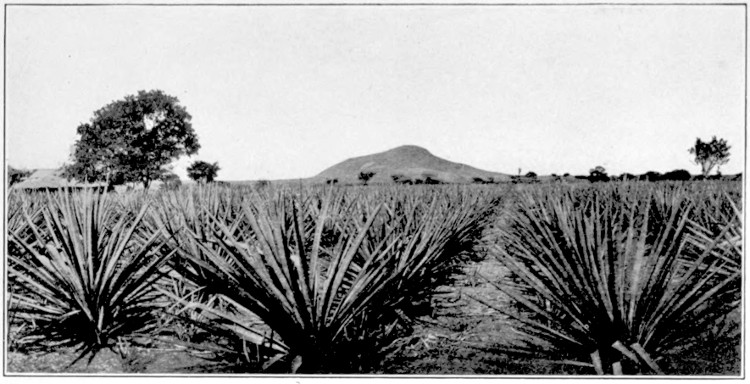
A FIELD OF ZAPUPE.
Upon the bluff sloping gently to the sea level is an ideal residence section overlooking the harbor and the system of surrounding water ways, whose shores lined with tropical trees and vegetation combine to form a most beautiful landscape.
The Mexican Central Railway furnishes the best transportation facilities to Tampico, one branch running west to Aguascalientes on the main line and tapping the great mining and agricultural centres. Along this route some of the best agricultural lands of Mexico are traversed. To the north another branch of[364] the Mexican Central connects Tampico with all Texas points via Monterey. The Mexican Central makes a direct connection with the National capital. Running direct between Tampico and Vera Cruz, Progreso and Puerto Mexico are two steamers doing a coastwise trade.
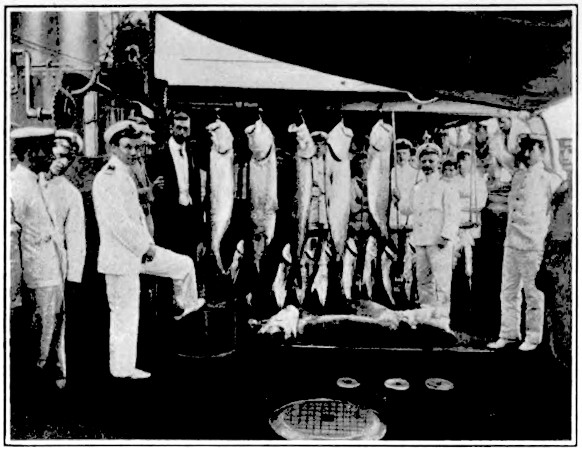
TARPON CAUGHT BY THE OFFICERS OF THE BRITISH CRUISER BRILLIANT.
The good climate, the sea bathing, the excellent tarpon fishing and hunting make Tampico the most attractive winter and summer resort on the Gulf Coast. As one walks through the office and lobby of the Southern Hotel and sees the specimens of large fish which are hanging on the walls at various points it is easy to realize the importance of the industry which the proprietor of the hotel, Mr. A. N. Poindexter, has built up in this line.
Only a few years ago the tarpon banks near Tampico were known by very few people, but Mr. Poindexter recognized that this was a sportsman’s paradise and began in a small way to make known to those of his guests who were interested in such sports the possibilities of real active sport, with a little touch of adventure in it, and to-day many distinguished people from all parts of the world, visit this port for the sole purpose of tarpon fishing and wild-fowl shooting.
Within a radius of one hundred and fifty miles of Tampico there are fifteen American colonies being located at Atascagor, La Palma, Columbus, Colonia Americana, Alta Vista, Quaker City, Chamal, San Diegurto, and other small colonies. Many of them are settling rapidly and have established good schools and churches. They are employed in agriculture and many other enterprises.
In this State are found various seams of coal and many mineral deposits. Among the metals that are found in the State are copper, silver, gold, lead, zinc and iron. The oil wells of Tamaulipas are already famous. The oil belt reaches into the State of Vera Cruz and will be found all along the State of Tamaulipas, as far as Texas. Prominent oil experts predicted that this State would become one of the greatest oil-producing sections in Mexico.
[365]
The cultivation of the zapupe fibre plant has received most attention in the Tampico section. Within the last three years several companies have been formed for the cultivation of zapupe near Tampico and in addition a number of individuals are engaged in planting the fibre. It is claimed that zapupe matures more quickly, that it produces more fibre to the plant than henequen.
In Victoria and vicinity, about one hundred miles north of Tampico, henequen growing is receiving much attention. Land not fit for any other kind of cultivation seems to be well adapted for henequen.
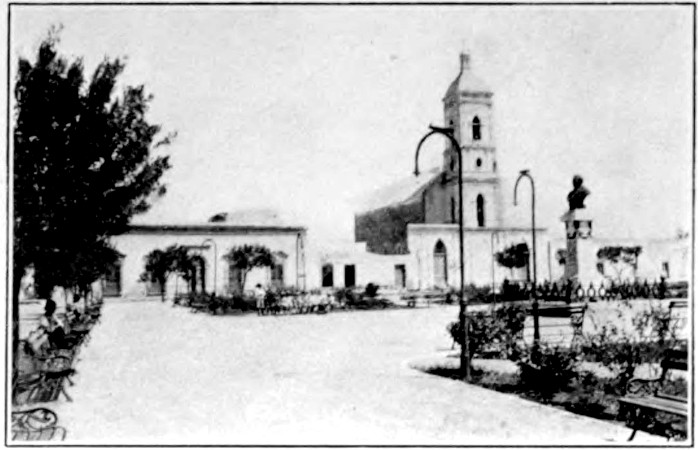
PLAZA, VICTORIA.
During the Civil War in the United States, 1861–1865, Tamaulipas made a handsome income by raising cotton and exporting it to that country. Many farmers became rich in that way; but when the war was over, and cotton fell in price with the return of peace and the revival of the southern states, the production declined. There is no reason why Tamaulipas should not grow cotton as abundantly as the State of Vera Cruz.
Matamoros is a frontier city of Tamaulipas, being only forty miles from the mouth of the Rio Grande, and directly opposite the City of Brownsville, Texas. It has a population of over twelve thousand, made up mostly of Americans and people of Spanish descent. English is commonly spoken. The City is finely situated on a bend of the river. Its wide streets cross at right angles, and the houses are mostly of brick and built in modern style. There is a beautiful Cathedral as well as numerous churches and convents. There is a good public school system, besides plenty of private schools. The climate is hot from April to September, and cool from December to March. Matamoros was founded early in the last century, and was named after the great patriot, Marino Matamoros, whose bones lie with those of Hidalgo and Morelos in the Cathedral at Mexico City.
Laredo is a name by which one of the lines of the Condes of Spain was called.[366] A Royal Commission called “Vista General” in 1767 laid out the town, giving it four leagues of land, two on each side of the Rio Grande, and laid off above and below the town tract on both sides, the tract now called Porciones, distributing it to the settlers. Since that time Laredo has been recognized as a town with municipal powers. In the earlier days of its existence, savage Indians continually committed depredations on the surrounding country and robbed the people of their horses and cattle; but the citizens, inured to such hardships, often chastised the savages and killed many of them in battle, always maintaining a justly merited reputation for skill, courage and gallantry. Laredo was a kind of supply station during the Texas revolution, but took no very active part in the war. It remained under the control of Mexico as a part of Tamaulipas until 1846, when it was divided into two towns, Nuevo Laredo on the Mexican side remaining a quiet, progressive town, whose principal industry has been stock raising,—horses, cattle, and sheep; and several handsome fortunes have been made in it.
The Tamaulipas Mexicans are brave, daring patriots, who are zealous to a man for the integrity and independence of their country. This State gave the nucleus of the heroic army of the north during the French campaign and the stoic bravery of the Tamaulipan soldiers will never be forgotten in the history of the siege and fall of Querétaro; many of their illustrious names will ever stand for the bravest and most inflexible of patriots.
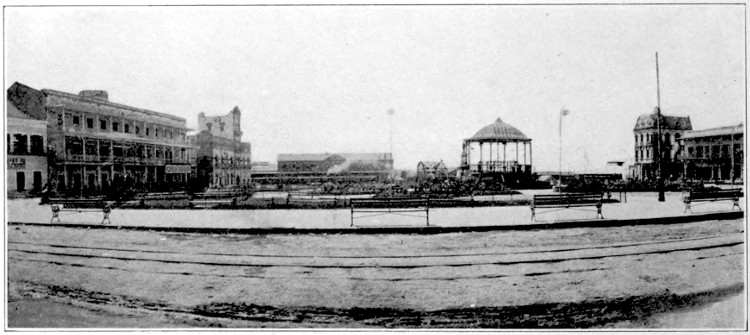
TAMPICO PLAZA.
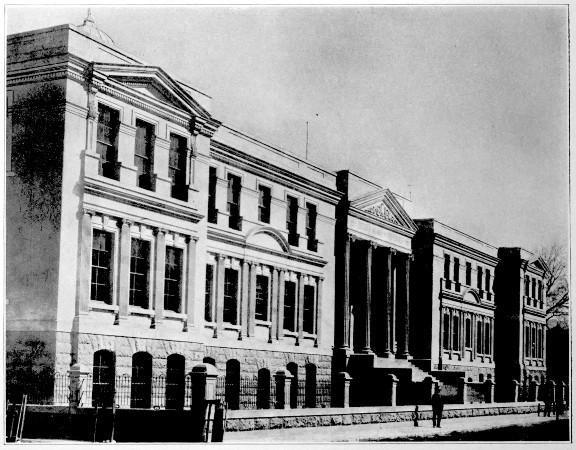
NORMAL SCHOOL FOR PROFESSORS, SALTILLO.
[369]
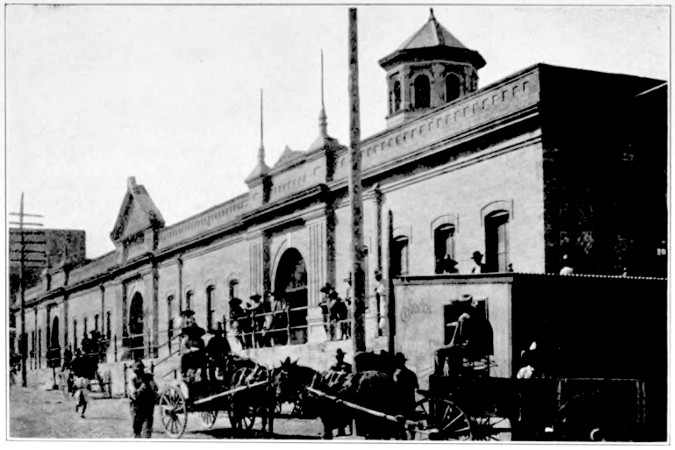
JUAREZ MARKET, SALTILLO.
Coahuila is a highly productive State. It is a hilly and mountainous country, but its valleys are very fertile. Minerals are found extensively but the most important product in this State is coal, which is being shipped to all parts of the country. The Rio Grande separates it from the United States of America, on the east it is bounded by the State of Nuevo León, on the west by the States of Chihuahua and Durango and on the south by Zacatécas, Nuevo León, and San Luis Potosí. It embraces an area of one hundred and sixty-five thousand and ninety-nine square kilometres. Its population is about two hundred and ninety-seven thousand. Its capital, Saltillo, is an industrial and mercantile centre.
The other chief city, Torreon, founded as recently as 1887, is a commercial emporium of the greatest importance. Cotton and all classes of cereals and fruits are the chief products. The wines of Parras, which is a great grape cultivating country, are famed throughout the entire republic and the best woods grown in the country are found in these parts.
[370]
The City of Monclova, which was for a long time the capital of the State, is also of commercial importance.
The governor of the State is Señor Licenciado Don Jesus de Valle, is an illustrious and progressive gentleman, experienced and well-versed in political and administrative science, who knows so well all the branches of State government. Since taking office he has diminished the public debt and caused many reforms in the capital and in the neighboring cities, and through his encouragement colonists are welcome and all kinds of franchises are granted to those whose purpose is the establishment of enterprises that will revert to the good of the people and the country. With splendid irrigation facilities and all the advantages of a rich country, Coahuila is an open field for future prosperity.
Saltillo is reached by the Mexican National Railroad. It was founded in 1586, and incorporated as a city in 1827. The government palace, the Church of Santiago, and the old convent of San Esteban are the chief edifices of interest. The climate is good, the city being a delightful resort at all seasons. The “Coahuila” is one of the most beautiful hotels in the republic and enjoys great popularity. Many of the hostelries in Mexico are old private dwellings or palaces which are to a certain extent picturesque, but this modern hotel offers encouragement to the seeker of health and pleasure.
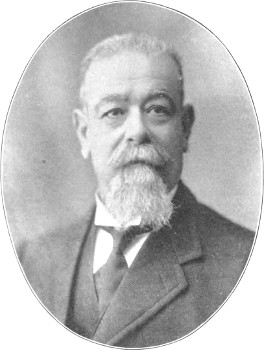
SEÑOR LICENCIADO DON JESUS DE VALLE, GOVERNOR OF COAHUILA.
The Plaza de la Independencia is a modern park, very attractive with its beautiful flowers and ferns. The Cathedral is an imposing structure filled with beautiful paintings and priceless altars. The new penitentiary is one of the finest of its kind in the country. Hospitals, public libraries and the finest normal school in the republic are the results of the enterprise and progress of the State. Some of these educational establishments are noted for their handsome architecture. Special attention is paid to the sanitary conditions of the school houses.
[371]
There are many philanthropic societies and charitable institutions; one of the most important is the asylum of the Immaculate Conception.
The many brightly colored serapes, which are hand-woven and form one of the industries of this city, cannot be duplicated, and all the factories of the republic are making strenuous efforts to imitate those made here. The Delft blue shade, which is noted all over the world, is no longer made here as it has become a lost art, but other colors most artistically and intricately woven mark one of the chief features of the native craft.
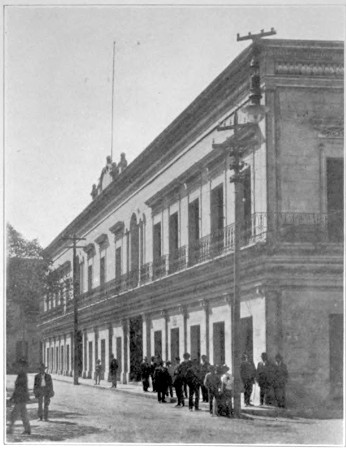
GOVERNMENT PALACE, SALTILLO.
Some of the finest pleasure resorts on the continent are found here. The famous Hot Springs are at Hermanas. Here are the largest springs of hot mineral water in America, that flowing out of the hillside form a river of hot clear water which passes through a fine grove of trees. The natural temperature of the water is one hundred and ten degrees Fahrenheit. With unexcelled scenery, the climate is invigorating and the splendid conditions make it a great health resort.
The construction of the Mexican International Railroad was a very important event in the State of Coahuila. It penetrated a country rich in resources where splendid inducements to the miner, manufacturer and agriculturist are offered. The prosperous condition of various enterprises situated adjacent to the line of this road testifies beyond question to the practicability of profitable investment.
Ciudad Porfirio Diaz, named in honor of the President of the republic, is one of the most enterprising of the Mexican border-towns. The custom house[372] and post office buildings, including other federal offices are splendid specimens of modern architecture.
Coahuila has attained commendable progress under the able administration of Governor Jesus de Valle. The State has given to the Mexican nation many men distinguished in politics, in war and in science. Some of these were Don Melchor Muzquiz, who became president ad interim and from whom the city of Muzquiz gets its name; General Ignacio Zaragoza, hero of the glorious victory of the national army over the French on the 5th of May, 1862, in Puebla, and from whom the State receives the name of Coahuila de Zaragoza; Don Miguel Ramos Arizpe, statesman, who was a deputy to the Court of Spain in 1812, and on account of his idea in favor of independence was eleven years a prisoner, until the Declaration of Independence; he was one of the deputies to the Constitutional Congress in 1824, and Minister of the State; Don Juan Antonio de la Fuente caused a law to be made for the separation of the church and state in 1858; he was also minister plenipotentiary from Mexico to France and England and figured prominently in France by his indignant protest against the Preradical Interference of Napoleon III., on Mexican Territory. Here was born Manuel Acuña, one of the most notable and sublime writers which Mexico produced in the nineteenth century.
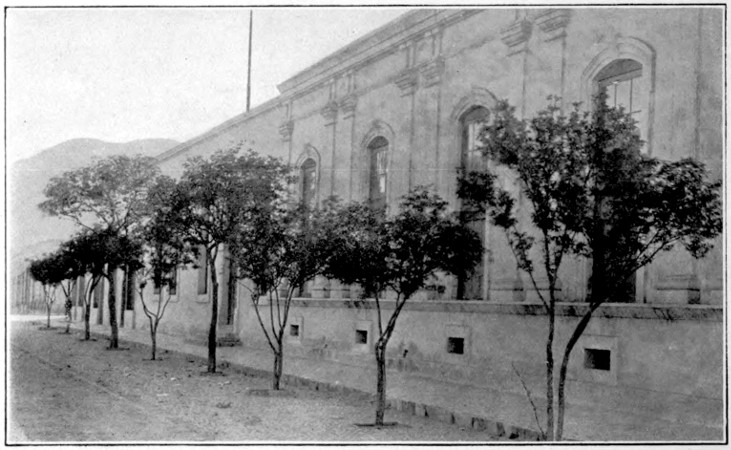
STATE CIVIL COLLEGE, SALTILLO.
[373]
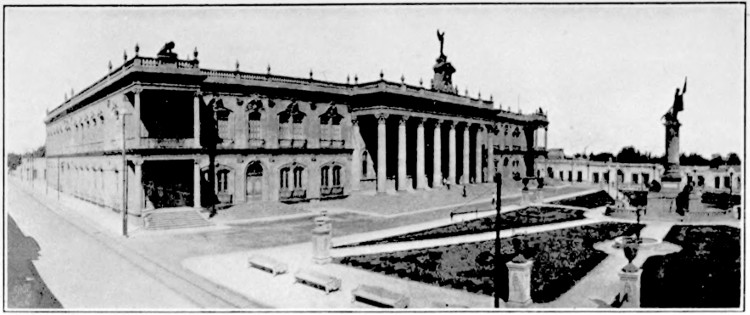
GOVERNOR’S PALACE, MONTEREY.
The kingdom of Nuevo León was once the name of the State of Nuevo León. It is inland, bordering on Tamaulipas, Coahuila and San Luis Potosí. Its surface is irregular, as several branches of the Sierra Madre Range come into it and one-fourth of the State forms a part of the great central tableland of Mexico.
Mineral productions abound in the mountains. The climate is perfect. The atmosphere is seldom chilled with frost but sometimes it steals in at long intervals like a thief in the night to disappear in the darkness ere the sun has risen. Snow is unknown in the Valley of Monterey and is seen rarely on the peaks of the mountains which surround the city.
The Topo Chico hot springs are in the suburbs. This is a famous health resort. The thermometer never descends to freezing point and the condition of the atmosphere permits the weakest and most delicate invalid to promenade in the plazas.
Monterey is fifteen hundred feet above sea level; it is one of the oldest cities but has been made over and has now all sorts of modern improvements. Nature[374] is vested in gladness expressed by beauty and wealth of color, over which flows the mellow radiance of a semi-tropical sunshine. It is surrounded by some of the most beautiful mountain scenery in the world. The houses are well-built and tasteful both in architecture and interior decorations. The Casino is the principal club.
Honorable Philip C. Hanna, the American consul general, has endeared himself to the people of Monterey. He was appointed the special representative of the American Red Cross and did a notable work during the flood which came near destroying Monterey in 1909. At the Consulate he protected hundreds of the unfortunate, giving food and clothing to the desolate in the flooded district.
Monterey is only a few hours ride from Laredo, in Texas. It is a very American city, with splendid churches, schools and manufacturing establishments.
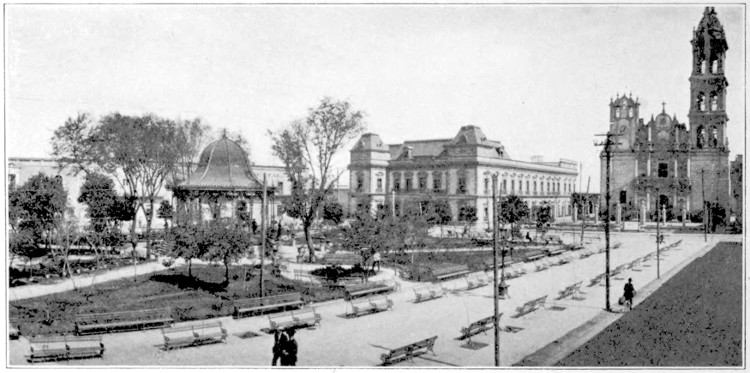
PLAZA ZARAGOZA.
No country is more beautiful in its picturesque vegetation and useful products than San Luis Potosí. There the highest trees give support to a multitude of creeping vines and to a swarm of vegetable parasites which create an agreeable confusion and form obscure thickets where the foot of man has never yet penetrated. The multitude of color, the green leaves and the divers[375] hues of the flowers, with a half-light produced in many places by the shade of the trees, allowing an occasional vista of purest blue sky; the silence of the bosks at certain hours of the day; the harmonious songs of the birds at the rising and the setting of the sun, are all poetical, and invite to meditation and the adoration of the Author and source of so many marvels. The entire State is a gem of varied beauty.
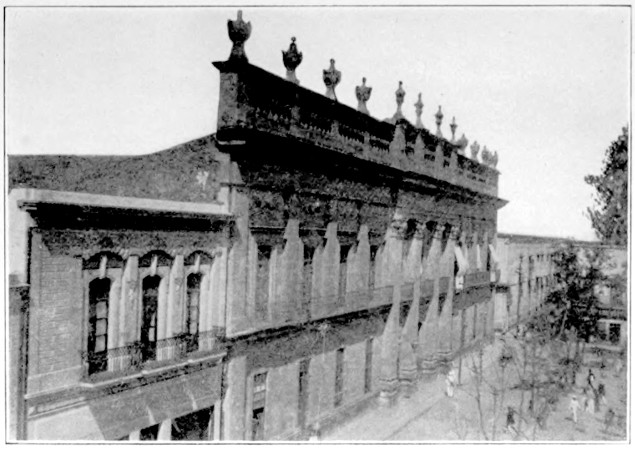
PALACE OF GOVERNOR, SAN LUIS POTOSÍ.
In the towns to the southeast and east of the capital there are lands well adapted for agriculture. The enterprise directed to this class of work will find there every kind of products which temperate and torrid climates know, not only in cereals and fibre-bearing plants, but also in fruits and hard woods. In all portions of the State Indian corn is cultivated as well as wheat and beans, all most useful as food for the inhabitants; but the branches of agriculture which have been most developed are the cultivation of coffee and tobacco. The coffee plants number about four million, with a mean yield of forty thousand quintals.
San Luis Potosí may justly lay claim to a first rank among cities of the Mexican Republic, whether considered from a historical, political, or commercial[376] point of view. Founded in the days of the Spanish Conquest, the geographical position, some six thousand feet above the level of the sea, secured pre-eminence from the earliest times. The history of the city may to a great extent be read in its outward appearance. Grand old Spanish churches, such as that of San Francisco, dating from the sixteenth century, El Carmen with its two-hundred-year-old carvings, and the Guadalupe, with its charming sacred associations. The imposing French-built government palace and the Mexican cathedral, the old Spanish Plaza with its American tram-lines and electric lights, the old fortified mint, telling of revolutionary times, the college hospital, the library, and the splendid theatre, with many new and elegant buildings, speak for the prosperity and advancement of the present day.
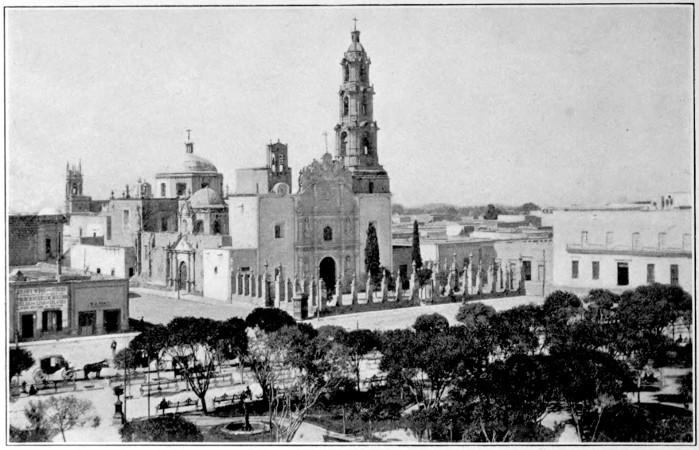
CATHEDRAL, AGUASCALIENTES.
It has always been a very busy and flourishing place, holding the same relation to eastern Mexico that Guadalajara holds to western Mexico. The surrounding country is a very fertile district and San Luis furnishes a ready market for its produce. There are many fine buildings in the capital. The[377] government palace is attractive in appearance; the cathedral shows some fine stone-work on its towers. There is a characteristic painting of high quality in the church of El Carmen. The old church has a clock which was given by the King of Spain in return for the largest piece of silver ore ever taken from a mine. On the entrance to this beautiful sanctuary are these comforting and inspiring words:
(“Here he who asks receives, he who seeks finds, to him who knocks it is opened.”)
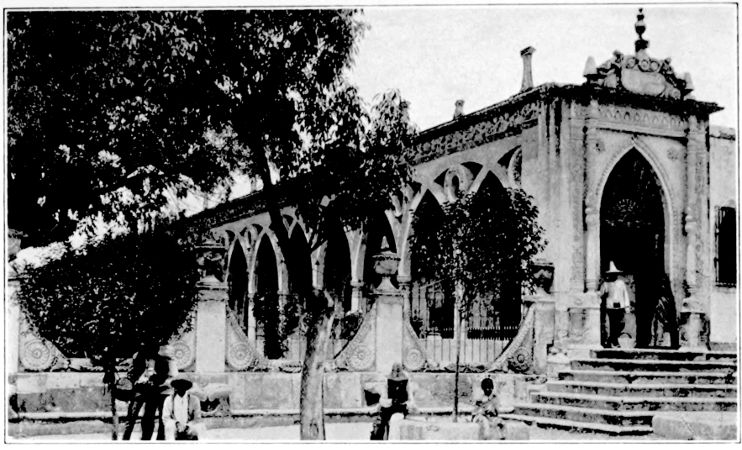
THE BATHS AT AGUASCALIENTES.
The two tall towers of this church form the most striking feature of the city to the traveler approaching from the south.
The Theatre in San Luis Potosí, one of the handsomest in Mexico, is a monument to the progressive spirit of the late General Carlos Diez Gutierrez,[378] the former governor of the State. The building is of stone, massive and large. Immense columns of stone and iron adorn the front. The entrance is very much like that of the Grand Opera in Paris. It is elegant yet massive in design. There is a grand and beautiful lobby which is approached by wide marble steps and covered by a dome of heavy stained glass. Seen from below, this last has a magnificent appearance with a huge balcony winding around in the interior, with a heavy iron railing. This is entered above by beautiful glass doors, opening from an immense hall, large enough for a ball-room, with marble-tiled floors. The stage has all the latest improvements, and the whole theatre is a noble example of what taste can do when backed by immense wealth. The governor’s private box, facing the stage, is magnificently fitted up, with the coat-of-arms of the State in silver and bronze.
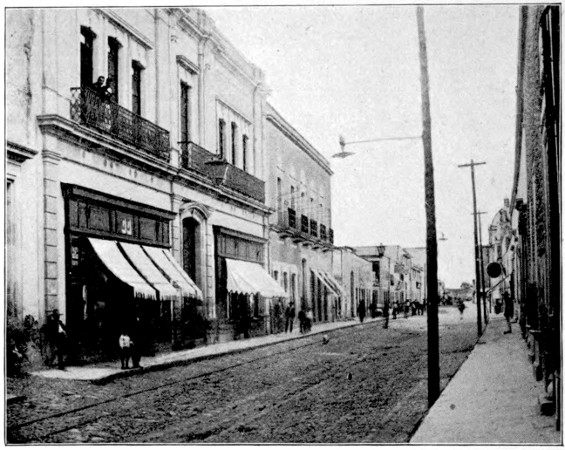
STREET SCENE IN AGUASCALIENTES.
The law requires that all houses shall be kept freshly painted, so that the city is bright in every quarter. The markets are particularly interesting, with picturesque water-carriers, many fountains and novel scenes. The statue of Hidalgo formerly occupied the Plaza de Armas, but has been removed to a more important place and a kiosk erected in its place. When the evenings are warm, as most of them are in San Luis, the Plaza presents a most attractive appearance with families promenading to the gay music under the silvery light of the moon or the more brilliant radiance of the electric light. This historic city has the record that here was made the first discovery of silver in Mexico, which went[379] so far as to found the country’s greatness. The tradition is that early in the sixteenth century an Indian was climbing the San Luis hills, when his foot slipped and to save himself he clutched at a neighboring bush, which giving way beneath his weight, was uprooted and exposed to view the native silver beneath.
San Luis is far advanced in education. There are many magnificent schools. In the School of Arts and Trades for Girls are taught English and French. There are civil and military schools, and hospitals, all of which are supported by the government.
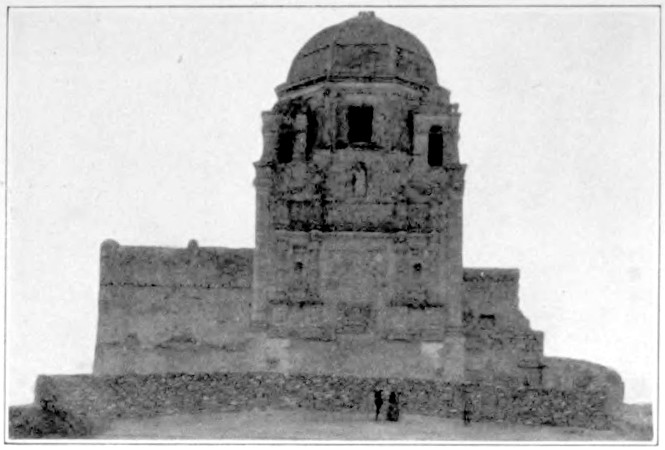
THE BISHOP’S PALACE, MONTEREY.
The governor of this State is José Maria Espinosa y Cuevas. The success of the opening of the port at Tampico gave San Luis Potosí commercial advantages equal if not superior to those of any other city in the Republic of Mexico.
In the northern part of the State is the mining town of Catorce, “The Silver City.” These mines were discovered by a group of fourteen bandits and are the most celebrated in Mexico.
Aguascalientes though one of the smallest is one of the most interesting States in Mexico. The eastern district consists of tablelands six thousand feet above sea-level and the western portion includes the Sierras of Laurel and Pinal, spurs of the Sierra Madre. The tablelands produce abundant crops of cereals. The capital is Aguascalientes, which means hot waters. It is an attractive city, noted for its hot springs, well-appointed bath houses and healthful climate.
One of the most celebrated and well-attended fairs of the republic, the Feast of San Marcos, is held at Aguascalientes in April of each year and thousands of people from all parts of the country throng the streets and plazas of this quaint old city. There are many special attractions notably the beautiful[380] needle-drawn work which is made by the Indians and excels in beauty the celebrated Fayal work which is so much better known.
The city takes its name from the warm mineral springs in its neighborhood. The baths are reached by long avenues of superb cottonwood trees. They are built of soft red stone and are much frequented. On one side through a canal flows the surplus water from the springs, which is used for bathing by those who are unable to pay the small charge for the baths.
There is a handsome alameda. The country around is fertile and highly cultivated. In the tropical altitudes of Mexico and in the hot spring sections there is a sort of Egyptian disregard of the conventionalities in attire and the disposition to take a daily fashion hint from the Garden of Eden, the children disregarding even the fig leaf.
The water-carrier of Cairo is much like his brother of Mexico. The groups about the fountains all over the republic have long earthen jars of pottery borne by the women and balanced on the shoulders of the men and look very oriental.
The climate is healthful and is noted for its constant sunshine. Many invalids go there from the north. It is half way between the City of Mexico and the northern border.
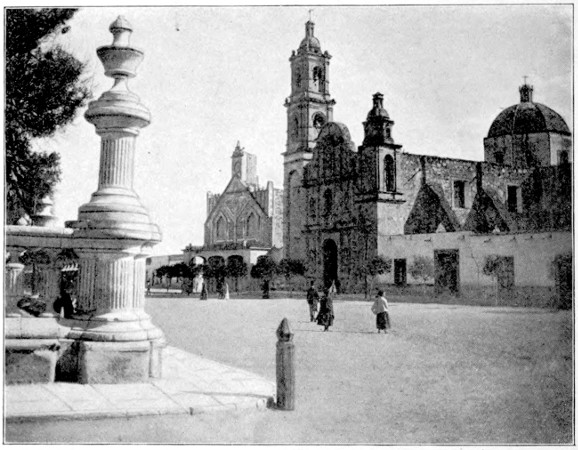
TEMPLE OF SAN MARCOS, AGUASCALIENTES.

THE FEDERAL PALACE, QUERÉTARO.
[383]
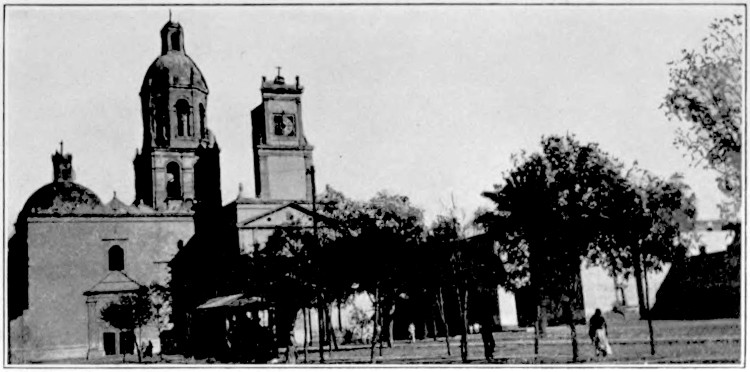
CONVENT OF THE CROSS WHERE MAXIMILIAN WAS IMPRISONED.
Querétaro is a State around which has been cast a spirit of romance. The interest that centres here is great on account of it being the scene of many tragic events. Many famous men and women who have figured in the history of Mexico were born here. It was in this State that the first steps toward independence were taken and the efforts of the patriot Hidalgo to incite the people to open rebellion found ready response.
It occupies a part of the Cordilleran Plateau and while it contains much fertile land it is traversed by numerous mountains. In these, many minerals are found. Gold, silver, lead, copper, antimony, quicksilver and tin abound, and fine forests of timber and precious woods are the product of the mountains. Extensive fields of all kinds of grains, sugar and tobacco are cultivated.
Many lakes, such as the Cerro Grande, the Concha, the San Cillo and the Saledon, lend natural beauty to nature’s already prolific endowment.
The mining in this State is very promising, the regions are among the richest in Mexico. Precious and semi-precious stones abound. Owing to the extremely mountainous country it is difficult to operate many of the mines, but new railways and modes of transportation are eliminating that drawback.
[384]
The chief city and capital is Querétaro, one of the most beautiful in the republic, situated one hundred and ten miles northwest of Mexico on a plateau six thousand feet above sea level. It occupies the sides and summits of several hills and is separated from the picturesque little suburbs by a small river. It is an old city dating back to 1400, and is famous for its beautiful churches, the splendid architecture of the public buildings and dwellings, and also is of interesting historical value on account of the tragic ending of Maximilian, the erstwhile Emperor of Mexico, who was executed on the “Hill of the Bells.”
To one who sees the capital for the first time, it has a great fascination. There is something different about the architecture, the atmosphere, and even the sun seems to shine brighter here. Palms and bananas grow in the open squares, and the many churches with their melodious chimes ringing at almost all hours lend it an influence that is delightful.
Napoleon took upon himself the task of exporting an Emperor to Mexico, Maximilian of Austria, a dreamer imbued with the idea of the divine rights of kings. He listened to the seductive assurances of an emperor who himself had secured the right to rule by rapine and blood. Carlota was ambitious, an ardent Catholic, and the Pope gave the new rulers consecration and his blessing. The United States government put sixty thousand troops into Texas on the Mexican border and then Napoleon was told in unmistakable language that the French troops that sustained Maximilian must be withdrawn. Maximilian was advised to abdicate, and would have done so but for the proud and ambitious Carlota. She volunteered to go to France to intercede with Napoleon. He was deaf to her entreaties, and she then fled to the Pope for relief, but with no better success. Repulsed, her finely-strung nature succumbed and she became bereft of her reason, perhaps the best surcease, except death, from the humiliation, the defeat, and the greater grief that were to follow.
Maximilian with a few thousand troops was shut within the city. On the night of May 19, 1867, the city was captured, and he was tried and condemned to be shot, together with his two trusted Generals, Mejia and Miramon. The execution took place two miles out from the city one month later. Maximilian said as the fatal pilgrimage was begun, “I am ready; it is a beautiful day to die.” Holding the crucifix over his breast, as an indication to the soldiers where to fire, and with his faithful generals at his side to share the same fate, he received the death-dealing bullets. This historical spot is now marked by a[385] chapel which has been built in recent years, but until that time three rude stones with an iron-railed enclosure were all that were placed to commemorate an event so important to Mexico, for thus the last attempt ended to plant a monarchy upon this continent.
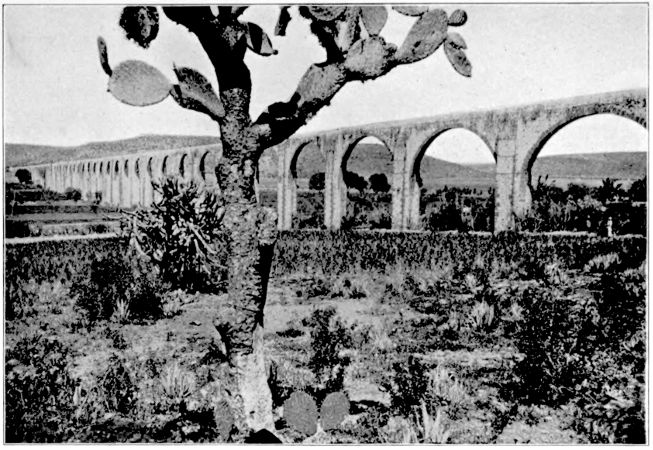
AQUEDUCT AT QUERÉTARO.
The Convent of Santa Clara and the Church of Santa Rosa, both noted for their exterior and interior carvings, are the masterpieces of Tresguerras, an architect, sculptor, painter and poet. He was born in Celaya in 1765, and died there in 1833. These are churches of which Querétaro should be proud, as they are incomparable monuments of Mexican art. It is difficult to describe the splendor of the wonderfully rich wood-carving, heavily gilded, the elaborate and graceful metal work, including balconies and grills of wrought iron, and the painting and sculpture all from the hand or design of this great artist. The old church of San Francisco dates back to 1690.
The public buildings and educational and charitable establishments are splendid monuments to the ambition of an exceedingly good government.[386] The Civil College, the Conservatory of Music, the Academy of San Fernando, and the School of Fine Arts are among the most important educational institutions. There are two public hospitals, the Vagara Hospital and the Civil Hospital, and many private institutions of this kind are extant. The palace of the governor contains all the public offices and the halls of legislature. It has also a historical chamber, which is full of famous relics that have a bearing on the history of the country. Portraits of all the former rulers and many curious objects adorn this chamber. The building is a relic of the days of Spanish rule and is a remarkable specimen of carving and masonry. It was once the residence of Josefa Ortiz, wife of a valiant figure in the War for Independence. She gave valuable information which aided in the fight for liberty, and enshrined herself in the history of her country.
Señor Coronel Don Francisco Cosio has been governor for many terms. He is a distinguished gentleman of honorable ancestry and besides being a statesman universally esteemed, is patriotic, public-spirited and well-loved by the people.
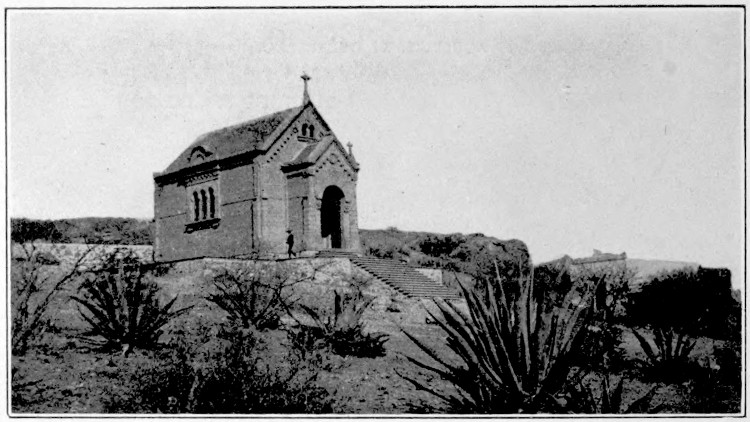
MEMORIAL CHAPEL TO MAXIMILIAN, MARKING THE PLACE OF HIS EXECUTION.
[387]
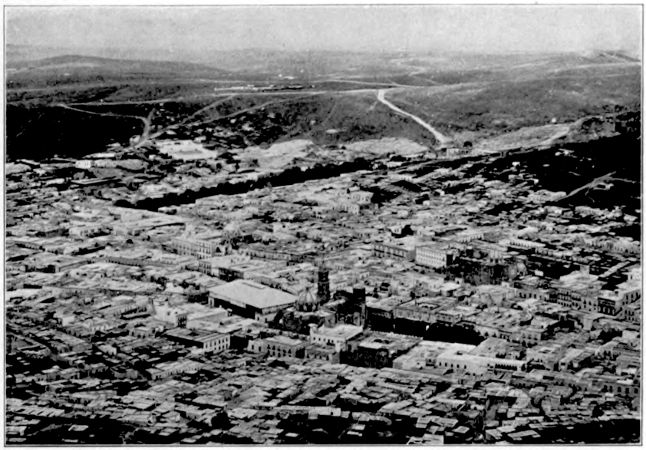
A GENERAL VIEW OF ZACATECAS.
Zacatecas is celebrated for its enormous output of silver. It is an inland State south of Durango and surrounded by Coahuila and San Luis Potosí, Aguascalientes and Jalisco. The hilly country of the middle and west is interspersed with wide valleys and deep gorges and ravines, furnishing a variety of wild and beautiful scenery. It has long ranked first in importance among the mining regions of Mexico. The State is poorly watered, there being no large streams. Mining is the chief industry, although agriculture is extensively and profitably carried on.
Zacatecas is a picturesque city lying in a deep gorge of the mountains about three hundred miles northeast of the capital. It is called the Jerusalem of Mexico. It has many churches, hospitals, a mint and good schools and a[388] literary institute founded in 1868. The first mine was discovered in September, 1546. On July 1, 1818, it was estimated that the total output of the mines since their discovery aggregated the sum of seven hundred million dollars. These silver mines are steadily producing an increased quantity of ore.
The city is reached by a steep slope from the railway station and the narrow streets are wonderfully clean. Everywhere the little courtyards are seen through open doorways. There are many market-places and the central one has a great stone fountain around which at almost every hour of the day may be seen women and children with great red earthen jars and little gourd-shaped cups which they use to fill the jars.
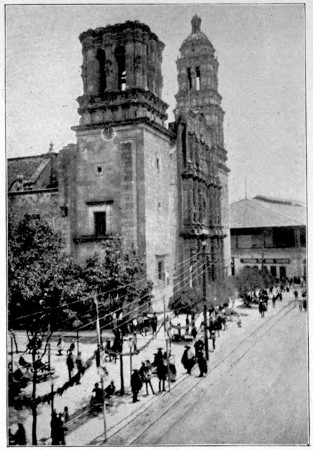
THE CATHEDRAL, ZACATECAS
To see Zacatecas one must go down a steep side street to the beautiful old church with its great façade of curved freestone and three unique spires and the arcade covered with its double row of arches. Everything glows with color—the sky, the frescoes, the flowers, the trees, the gaily dressed people and the broad stone seats. The inner court of the government patio is finished with a dado and frieze of blue and yellow; the slender pillars in double columns between the arches of the first and second floors are brilliant with stencilled wreaths of flowers; the broad stone steps curving away to the upper galleries are ornamented with pots of tropical plants. From a corner of one of these galleries one sees a beautiful picture. The red sandstone towers of the cathedral, with their artistic carving, are barbaric in splendor and still harmonious. Against the sapphire sky their outlines are wonderful and there is no end of novelty.
[389]
The low-topped houses and domed churches remind one of Palestine. Far up on the mountain called “La Bufa” is the shrine which the Mexican devotees visit to obtain remission of their sins, many of them scaling the steep sides of the mountain upon their hands and knees as an exceptional self-imposed penance. The people wear their peculiarly picturesque garb and should it be Sunday and the band playing in the plaza the moving throngs form a veritable kaleidoscopic scene, wonderfully pleasing to the eye.
Water is comparatively scarce in Zacatecas. The fountains in the plaza are always thronged with people and as early as four o’clock each morning men and women of the poorer classes are at the fountain filling their jars with water, which they sell to later arrivals at a centavo for four gallons, the quantity a jar holds.
There are schools, hospitals and markets, the latter with their many varieties of fruit unknown in other countries. Many of the vendors spread shawls on the pavement and divide their articles into sundry little piles, each of which is sold for one cent. These sometimes consist of cooked articles, and many a passer-by gets a meal for that sum. One market-place is devoted entirely to potteries.
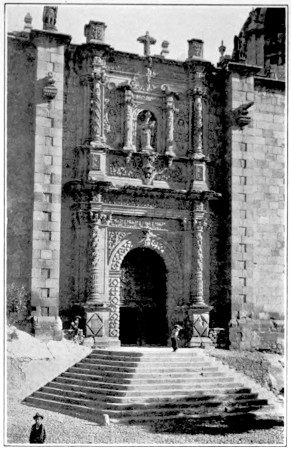
FAÇADE OF CATHEDRAL.
The principal interest of the people of Zacatecas is mining. Among the public buildings is the Aduana, built of red sandstone with handsome carving around the entrance and the yard. Then there is the new public market, a fine theatre with pretty decorations and all modern improvements. Close to[390] the market is the Cathedral, built of red stone, with a wonderful front on three sides magnificently carved. The interior is equally rich. Toward the back of the theatre is the old church and convent of Santo Domingo. This formerly was very large, and the centre of the Inquisition, as were all the convents of the Dominican Order almost everywhere. The portion forming the convent is now the city prison; the old church and the chapter assembly-room still belong to the order of Santo Domingo.
This church was the first one built in the State of Zacatecas and was erected between 1560 and 1570. All that remains to show that it belonged to the Inquisition under the Dominican Order is the assembly-room or “Sala de Actas.” The decoration of the church is very fine. The next place of interest is the church and convent of San Francisco. The church is small and very poor; the front is of carved stone, and the interior decoration appears to have been very rich in former years. The convent now is almost in ruins, a small part being used as a meson, another as a dwelling place for the poorer class, a small piece as a brickyard, but by far the greater portion has become dilapidated with age and neglect. The old convent of San Augustin has been almost entirely turned into dwelling houses, but the church, a very fine building, has been left entire, and belongs to the Presbyterian missions.
Huge stone walls and mountain sides are everywhere, with patches of green here and there, making up a picturesque combination.
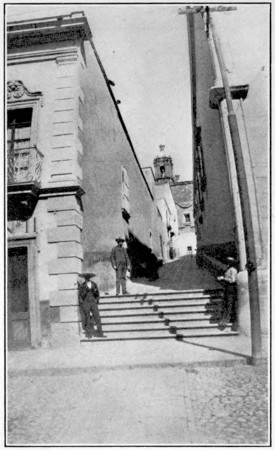
STREET SCENE, ZACATECAS
There are several silver mines in the vicinity of Zacatecas, some of them exceedingly valuable. The principal mining districts in the State, besides Zacatecas, are Fresnillo, Sombrerete, Chalchihuites, Nieves, Piños, Mazapil, Ojo,[391] Caliente and Mezquital del Oro. These furnish, in addition to large quantities of gold and silver, copper, tin, lead, iron, cobalt, antimony, cinnebar, arsenic, sulphur, and alum. The products of these mines average yearly from five to six million dollars, the mint coining five hundred thousand dollars per month.
This place is renowned for health, and no case of consumption was ever known there.
Guadalupe, a suburb of nine thousand people some six miles distant, can be reached by tramway. The cars, operated by the gravitation system, start slowly but are soon whirling down the steep hills, passing by the queer adobe houses, the track now crossing over a bridge beneath which are seen droves of burros carrying the ore from the mines. Again, through a gulch around some huge boulders or past the yawning mouth of some mine, the magnificent views and the varied objects creating a thousand vivid impressions.
The Cathedral of Guadalupe with its tiled dome and its beautiful surroundings, presents a delightful appearance as one approaches through the plaza planted thickly with roses and countless varieties of flowers. Upon the altar are life-sized figures representing the crucifixion, and in the background is a painting of the hill of Calvary with the attending Roman soldiers and the Jews grouped around. Attached to the cathedral is an art gallery containing many magnificent paintings, the subjects drawn from the Holy Scriptures and in their treatment showing the work of some master hand. The new chapel on the north of the cathedral, the gift of a lady of great wealth, is considered one of the finest in the world. The steps leading to the altar are of onyx, only the rarest kind being used. The rail of the altar is of solid silver, and the altar itself in parts is constructed of solid silver and gold.
The remains of an old convent is occupied by a school. In this institution there are over two hundred boys from the poorer classes of Guadalupe and Zacatecas, who are being taught the trades of wool-working and weaving, printing, bookbinding, carpentry, carriage and car-building, blacksmithing, and shoemaking. The blankets made here are equal in manufacture to any that might be bought either in the States or in Europe. This school was awarded medals at the Paris Exposition of 1887, and at the Exposition at Chicago, 1893, for woollen and silk goods made on the premises. Music and the English language are also important branches taught here. The establishment is self-supporting and certainly is well worth visiting. This is the pet institution of[392] Governor Zarate, who manifests the deepest interest in the progress of the pupils. He is an able executive and shows great wisdom in the direction of the affairs of the State.
There is a new theatre, a magnificent hospital of rose-colored stone, fitted with all the requirements of modern science; an elaborate system of lighting; a school for girls, with ample grounds and all the latest appliances known to educators; a science institute; a normal school for boys and other public schools and improvements of importance to the capital city. This policy has not been confined to the seat of local government, however, as many useful improvements have been made throughout the State, including new schools, city halls, public gardens and markets. A word should be added in praise of the fine system of education in Zacatecas. The State spends nearly three million dollars in primary and higher public institutions. There are about twenty-five thousand students with two thousand more in private schools maintained by other individuals.
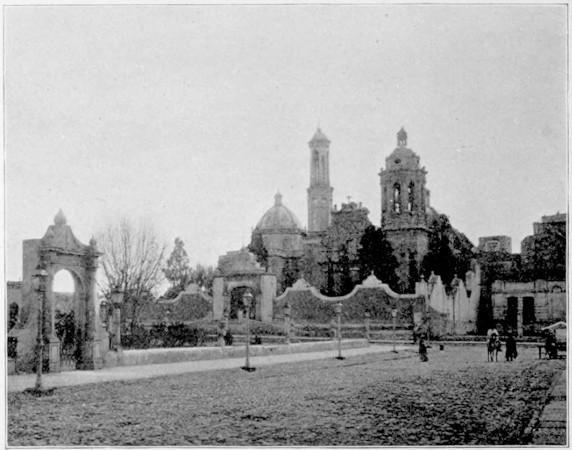
THE CHURCH OF GUADALUPE, ZACATECAS.
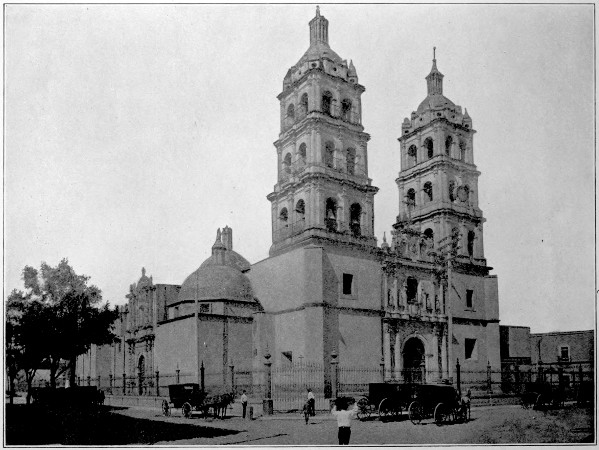
THE CATHEDRAL, DURANGO.
[395]
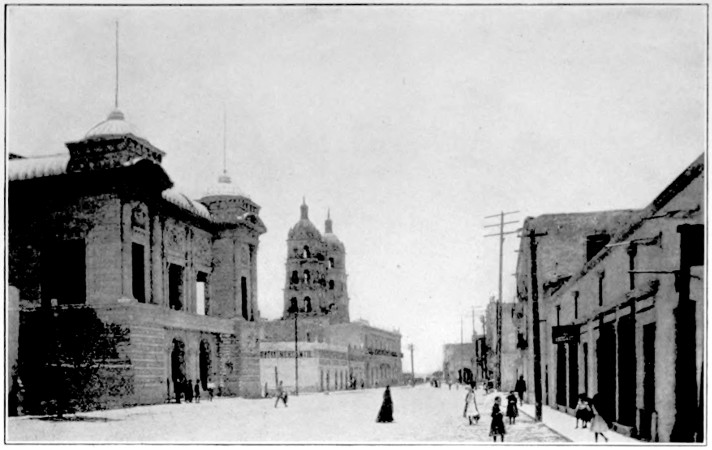
THEATRE, DURANGO.
Durango is politically divided into thirteen districts, which are subdivided into municipalities; these districts are Durango, Mapimí, Santiago Papasquiaro, Tamazula, San Juan del Rio, Cuencamo, Nombre de Dios, El Oro, Indé, Nazas, San Juan de Guadalupe, Mezquital and San Dimas.
The climate varies according to the different altitudes. In the extreme northwest the peaks of the Sierra Madre and Tarahumara are perpetually covered with snow and in contrast to that the heat of the southeastern portion is extremely tropical. The rest of the State possesses an even temperature and this combined with the richness of the fields attracted many settlers, who for generations have lived here and have enjoyed the fruits of this bountiful land. The proof of this is that one family having settled here remains forever. Among[396] the natives there is a great characteristic of hospitality, and frankness, and a certain romanticism remains.
The principal resources are mineral and agricultural, one ranking with the other but still unexploited to the best possibilities. Under a reign of peace, the progress of this State is in close competition with the other States of the Union. With natural riches and resources this State should rank among the first.
Statistics change naturally with the progress of the country, and with the rapid strides that are daily taking place in the affairs of an important State it is impossible to give a correct idea of all the enterprises.
Another great source of wealth is the fine wood, which is of such varied production and estimable quality as to attract the attention of the world. This branch of production is exploited on a small scale and is not cultivated as it deserves. Also cereals and every agricultural product are fast reaching the point of development that will elevate this State to one of great importance.
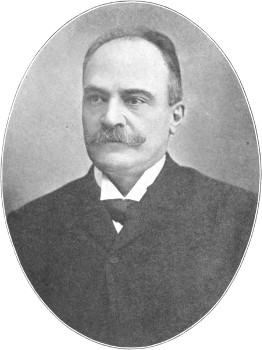
SEÑOR LICENCIADO DON ESTEBAN FERNANDEZ, GOVERNOR OF DURANGO.
In mining the State of Durango ranks very high. This industry while still in its embryonic state is incalculable in riches of precious metals and building stone. Through this branch of industry, cities with beautiful plazas, splendid homes have sprung up and changes on the highway to prosperity under the protection of the wise laws have demonstrated all that the progress of a country demands. Gold, silver, lead, iron, zinc, sulphur, and coal are the principal minerals. In the parts of the State that the railroads traverse there are many flourishing mines. In Valardeña there is a great smelter with all the modern improvements.
[397]
The iron found in Durango is the finest in the world. It has been studied by mineralogists, who marvel at it. There is one large mountain called Cerro del Mercado, which has attracted a great deal of attention. The iron in its native state contains ninety three and three-tenths of oxide of iron. Much iron has been extracted without seeming to lessen the amount that exists.

GOVERNOR’S PALACE, DURANGO.
At present there are one hundred and nineteen mining industries in exploitation, employing twenty-five thousand workmen, and fifteen million dollars’ worth of mineral is exported yearly.
Durango abounds in industries. There are small cities that have their manufactories whose products are confined to the State on account of the high rate of freight with which they have to contend. There are cotton mills, distilleries, wood manufactories, dynamite factories and flour mills, all in a flourishing condition. Financial crises that often affect the nation seldom trouble this State. Very rarely do the industries suffer the depression experienced in many other States. We find also thirty electric light works, and many manufactories of cigars and cigarettes give steady employment to the people.[398] Telegraph lines extend throughout the country. Telephones connect with all parts. New roads are being built and the government officials are in every way assisting the enterprises in the interior by proper means of communication within their possibilities.
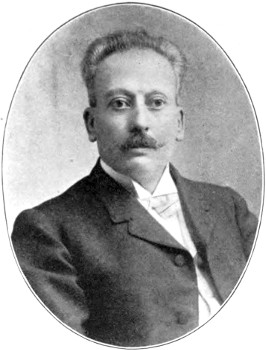
SEÑOR LICENCIADO DON ALBERTO CINCUNEGUI, SECRETARY OF STATE.
In the year 1892, the first railroad in this State was built. In all, there are about ten hundred and seventy-nine miles of railroad, including a short electric line. The prolongation of the lines through the great merger-system will be of great benefit to this State. The increase in the number of public schools in all districts has been remarkable. Durango occupies one of the first places of all the States of the Union in its rapid progress on the question of instruction. All the schools combine the best conditions of cleanliness and sanitation. One-fifth of the sum for public improvement goes toward instruction.
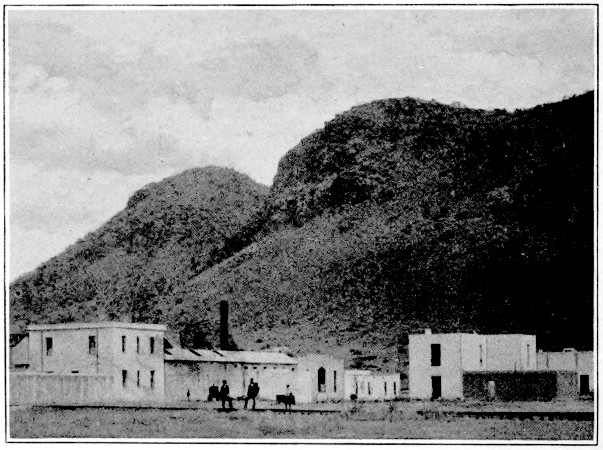
CERRO DEL MERCADO.
The capital is Durango, which is beautifully situated some seven thousand feet above the sea. It was founded in 1560, by Alonzo Pacheco as a military station, and soon after was made an Episcopal See. The most noteworthy buildings are the government house, the cathedral, a number of parish churches, a spacious hospital, a penitentiary and a state prison. There are attractive public gardens, public squares, and public baths. Thermal springs supply[399] the city with water and the place is remarkable for cleanliness. The mint at Durango coined twenty-seven million nine hundred and sixty-two thousand six hundred and sixty-eight dollars between 1811 and 1845. There is an institute in which law, languages, and the sciences are taught, with several very good public and private schools.
There are large mineral districts around the capital not yet explored, and Americans have found some good gold bearing properties. The people are rich and contented, and the resident merchants do not care to have competition. The fact that there are no failures is a good indication of solidity. The developed mining district is very rich and the cattle industry is large. Cotton, woollen, and print-mills represent large capital. The climate is perfect all the year; never lower than twenty degrees above zero nor higher than eighty. The people are getting more enterprising, after nineteen years of railroad communication, but Durango is a solid, business place, entirely able to exist independently of the world.
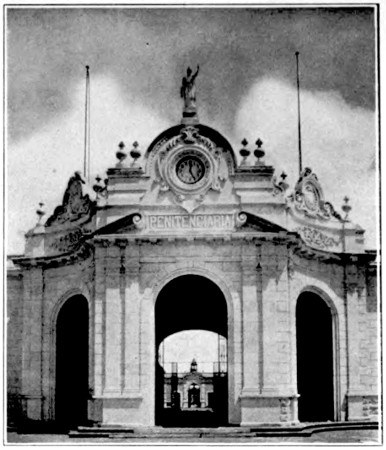
ENTRANCE TO PENITENTIARY, DURANGO.
The agricultural interests in the State have not been neglected, the situation being especially favorable to the cultivation of cotton as well as other profitable crops. A ready market is found in the City of Mexico for all the State products.
The rich agricultural district surrounding Lerdo is under irrigation and from eighty to one hundred thousand bales of cotton are raised here yearly in addition to the corn, cane, beans and fruits. A few miles out from Durango is the Fabrica del Tunal, one of the oldest cotton factories in the country, having been established by the father of the present owner, Señor Emilio Stahlknecht, in 1837. This establishment includes bleaching and print works, and its products of fine cloths are known everywhere as among the finest cotton goods of Mexican[400] manufacture. The governor of this State realizes that the happiness of the people and law abiding conditions depend greatly on education.
To Governor Esteban Fernandez the State owes a great deal of the changes, for there is nothing necessary for the progress of Durango that this ambitious governor fails to do. He has made it a life study to lift his State to a splendid prosperity, and with the rich resources and the high minded people who co-operate with him, he has elevated his country to a high standard and has carried through all his enterprises with great brilliancy. He is an intimate friend of the President, and during the Centennial he had many fêtes in honor of the Independence. Monuments were unveiled and schools opened and many ceremonies were held in appropriate celebration of this great occasion.
The City of Durango is noted for its wonderful police regulation. It is well lighted and offers every advantage for the establishment of great enterprises. Its climate makes it a unique place for recreation as here one finds an unbroken springtime.
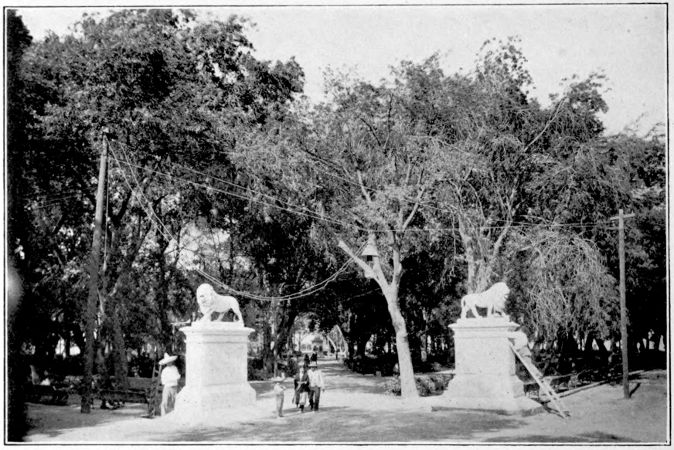
ALAMEDA, DURANGO.
[401]
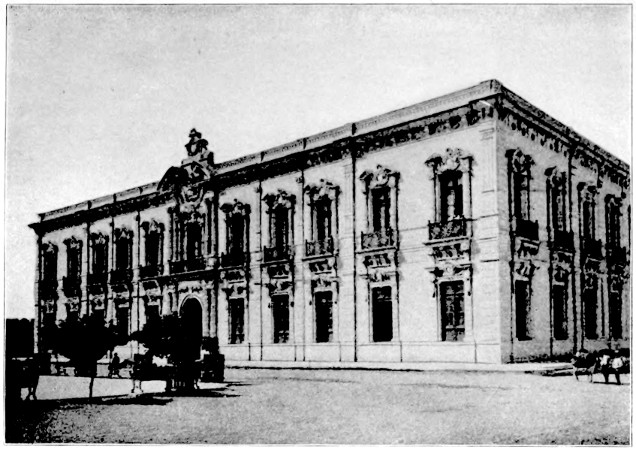
THE PALACE, CHIHUAHUA.
Separated from the United States of America by the Rio Grande, Chihuahua is the largest State in the Republic. It cannot be termed a beautiful State from a scenic point of view, but there are parts where it furnishes picturesque scenery not to be outrivalled anywhere in the world. A prolongation of the Sierra Madre mountains traverses the western part of the State and is rich in minerals. It is practically an undulating tableland, the plains averaging four thousand to five thousand feet above the sea, while the mountain-tops rarely rise more than a thousand feet higher. The climate is pleasant, the seasons being about like those of southern Texas.
The capital city, Chihuahua, has a large mixed population: English is as much spoken as Spanish, and many American enterprises and manufactories give[402] it an air of progress. It is distinctly a mining State. Numerous and important exploitations of silver ore has been made for many years. The mines of Chihuahua have been celebrated for centuries. The most important are Batopilas, Santa Eulalia, Parral, Cerro Colorado and Minas Nuevas. Santa Eulalia is the famous mining camp to which Chihuahua owes its origin and prosperity. It is still one of the great silver-lead producers of the world. Batopilas became noted for its ruby silver at an early period, and is best known for both quality and quantity.
Batopilas has only about four thousand inhabitants and is located on the river of the same name, a mountain stream low and quiet during nine months in the year, but during the rainy season rising to a mighty torrent. Owing to the steady work in the mines this town is more advanced than others in the vicinity. The Batopilas mines are among the richest in the world, although in this State there are others which rank almost equally well.
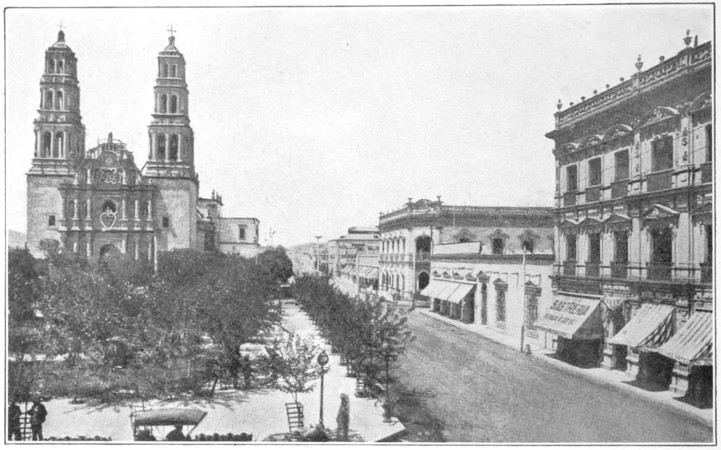
STREET SCENE IN CHIHUAHUA.
In cattle-raising the State of Chihuahua is one of the most important. The temperate climate and the fertile fields serve to nourish thousands of head, which[403] are shipped to points in the Republic and to the United States. The price of pasture lands is low, owing to much undeveloped land. The stock is thoroughly healthy and the government maintains a strict quarantine on all imported animals.
The ride over the Mexican Central route down through Chihuahua furnishes an ever-changing series of infinitely interesting views. The distant heights are rich in mineral dyes and exquisite in outline. Through some break in the hills one catches a glimpse of an exquisite valley with slanting sunlight streaming across it. Silent faraway cities, forests of cacti and yucca plants, and a host of brilliant flowers are always fleeting backward until the approach to Chihuahua brings one to the first distinctly Mexican city. Purpled mountains are in the distance below, two large steeples of the cathedral dominate the landscape, and low flat roofed houses lie along the reddish horizon with a truly oriental effect.
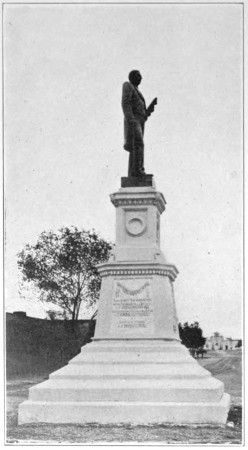
MONUMENT TO JUAREZ, CHIHUAHUA.
Inside the city streets, long colonnades with arches outside the houses offer shelter from the mid-day sun, and the outer walls are frescoed in pastel colors. Broad stone seats with high backs line the principal streets while clumps of Mexican aloes and prickly cacti hedge the roadway.
The Cathedral faces the beautiful Plaza de la Constitucion. It was completed in 1789, being under construction about fifty years. There is a barbaric richness of ornamentation about the façade of this beautiful edifice, carved in solid stone by native artists. Within its sacred portals and under the flickering lights of the altars many troubled souls find solace.
Chihuahua was founded in 1698, but the town proper was not built until 1718, and it was elevated to the dignity of a city in 1824. Its principal public[404] buildings are monuments of art and industry. The governor’s palace is a gray stone building covering a square, with wide balconies and a large courtyard. It is not only a handsome building but it is furnished with an elegance and a refinement of taste that is so indicative of the Mexican people. Most Mexican towns are built in the Mexican style with plazas and garden spots and one-storied houses, but in this city there are evidences of the foreigner and it has the appearance of some of the Texan cities. In the Plaza de Hidalgo is a monument commemorating the execution on the spot of the first heroes of Mexican independence.
As the scene of several historical events Chihuahua has many monuments to the nation’s heroes. The city is very much Americanized: banking houses and investment companies are well organized institutions.
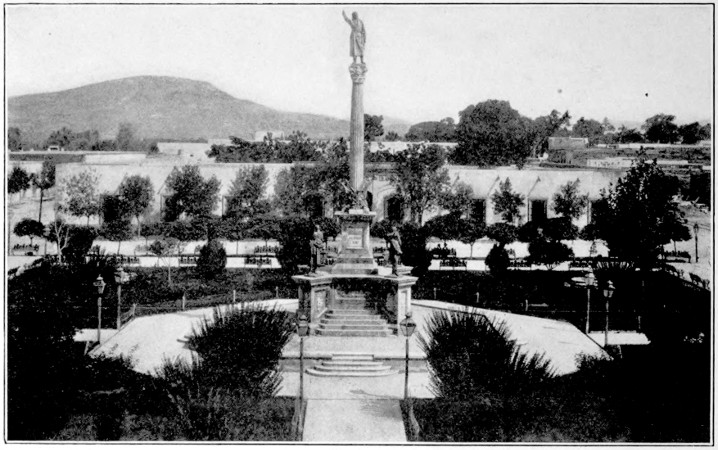
STATUE OF HIDALGO, CHIHUAHUA.
There are hospitals, houses of correction, military schools and the State Normal School, which has a very high standard of education. A technical or industrial school for young ladies has been of great benefit to young women who are called upon to support themselves by their own efforts, and it is one of the prides of the city.
[405]
Public education receives much attention and is conducted in a most progressive manner. Among the most important schools are the Scientific and Literary Institute, which consists of preparatory, special and professional courses. There are also departments of commercial, industrial, mechanical, mining and farming and these embrace a very practical course of learning.
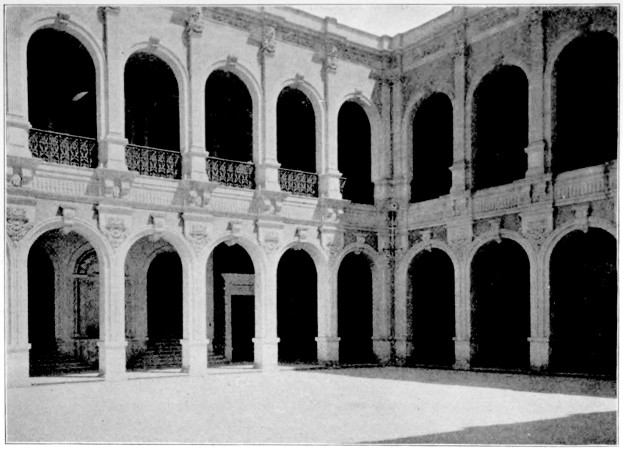
INTERIOR OF THE PALACE, CHIHUAHUA.
In Ciudad Juarez, a school of agriculture has been installed under the supervision of the Government.
Industry is taking a firm hold in the State. All enterprises have the full encouragement and protection of the government. There are several smelters, a brewery, ice and gaseous water factory, canneries, and iron and steel foundries. Arts and crafts establishments abound in all the smaller cities.
Chihuahua has the honor of being represented in the Cabinet by Señor Don Enrique C. Creel, who was formerly the Mexican ambassador to Washington, and the governor of the State. His administration was noted for the manner[406] in which he endeavored to elevate the Indians, and create in them an ambition to become good and useful citizens, to own land and cultivate it. He was called to Mexico to fill the place of the late Señor Mariscal.
Shortly after leaving Chihuahua one approaches the smelting works of the celebrated Santa Eulalia mine, which was discovered in 1703, and not far away is a great hacienda comprising more than sixty thousand acres of fine land. On that estate is an adobe palace two hundred feet long and one hundred and twenty-five feet wide. The gates and pillars are of cut stone, finely carved by natives. It has beautiful towers at the angles and a patio within that is as large as the plaza of some towns and much more attractive. This hacienda has a yearly crop of seventy-five thousand bushels of wheat and of twenty-five thousand bushels of corn.
Agriculture was once the great resource of the State, but has given place to mining. Farming is carried on in a primitive way. The land is rich and all kind of fruits grow in abundance. Alfalfa produces several crops a year. Fine timber is found on the mountain slopes.
Escalon is the junction point with the Mexican Northern Railway running to the great mining districts of Sierra Mojada, seventy-eight miles east of one of the largest carbonate camps in the world.
Paso del Norte, now known as Ciudad Juarez in this State, is the connecting link between El Paso, Texas, and the republic. It gets its name from Benito Juarez, the first president of Mexico and during the occupation of Mexico City by Maximilian it was the seat of government.
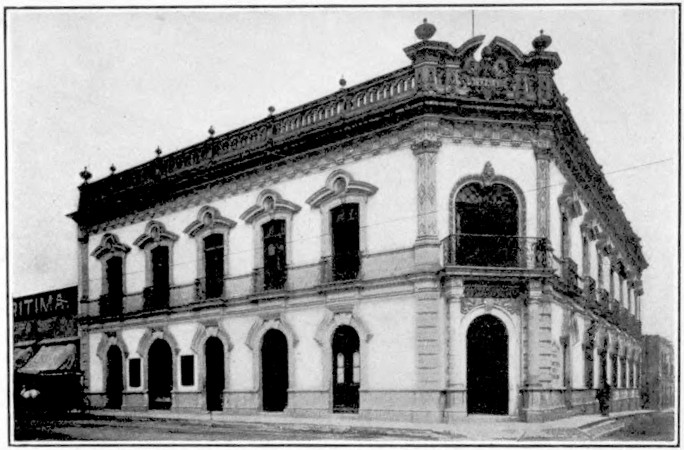
RESIDENCE OF SEÑOR DON ENRIQUE C. CREEL, CHIHUAHUA.
The people of this city have stood foremost and served as an example for their patriotism and loyalty and it was to them that Benito Juarez owed his great assistance of food and money in 1865, when the Liberal cause was passing through dark and uncertain times.
[407]
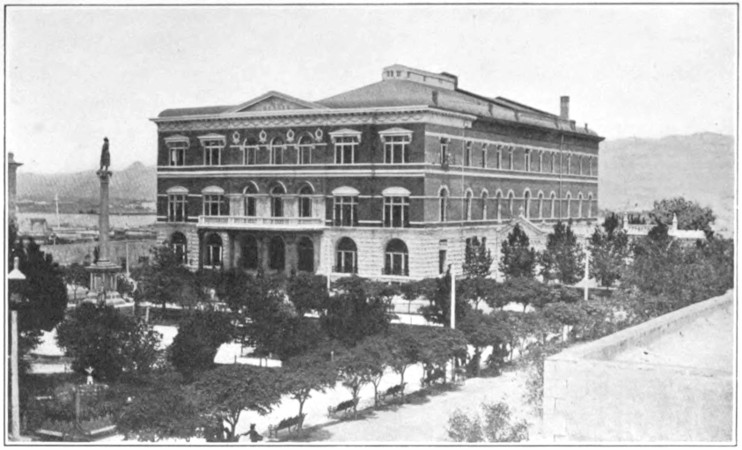
THEATRE OF THE HEROES, CHIHUAHUA.
One of the most interesting spots in the State of Chihuahua is Casas Grandes, a town of a few thousand inhabitants on the San Miguel River. This place is noted for its ruined houses, which are probably the relics of some Indian metropolis. The main features seem to have been three large structures connected by ranges of corridors or low apartments and enclosing several courtyards of various dimensions. The extent from north to south is eight hundred feet, and from east to west two hundred and fifty feet. A range of narrow rooms, lighted by circular openings near the top, and having enclosures three or four feet high in one corner, supposed to be granaries, extends along one of the main walls. Many of the apartments are very large, and some of the enclosures are too vast ever to have been covered by a roof. About two hundred feet west of the main building are three mounds of loose stone, which may have been burial places, and two hundred feet west of these are the remains of a building one story high and one hundred and fifty feet square, consisting of a number of apartments ranged around a square court. For twenty leagues along the Casas Grandes and Llanos rivers are found artificial mounds from which have been dug up stone axes, corn grinders and various articles of pottery, such as pipes, jars, pitchers, etc., of a texture far[408] superior to that made by the Mexicans of the present day, and generally ornamented with angular figures of blue, red, brown, and black, on a red or white ground. The best specimens command a high price in Chihuahua and neighboring towns. On the summit of a mountain about ten miles from Casas Grandes are the remains of an ancient stone fortress which may have been intended as a lookout.
Santa Rosalia is famous for its hot springs, which for curative properties are claimed by those who have used these waters, to excel any known springs in America. They are especially noted for their wonderful properties in cases of inflammatory rheumatism and all blood and skin diseases.
Jimenez is a city of about nine thousand inhabitants and is the railway shipping point for the rich silver mines of the Parral and Guanacevi districts. Archæologists find this town interesting on account of the enormous meteorites found here. The greatest ones picked up are now in the National School of Mines in Mexico City.
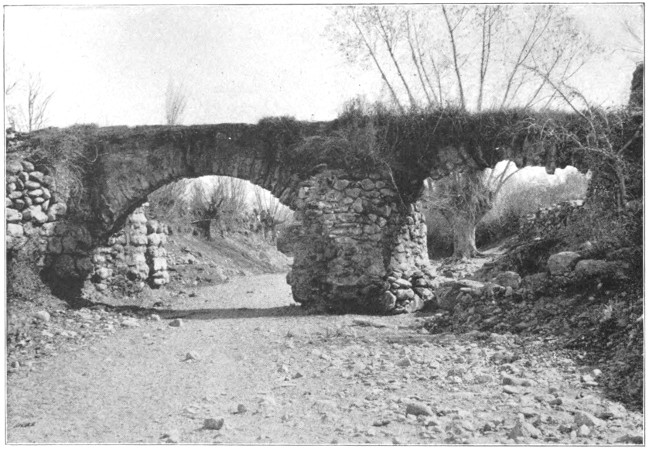
PART OF THE ARCHWAY OF THE OLD AQUEDUCT, CHIHUAHUA.
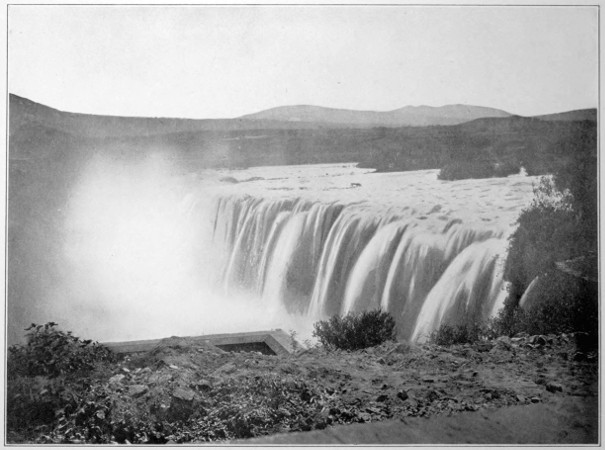
FALLS OF JUANACATLAN, JALISCO.
[411]
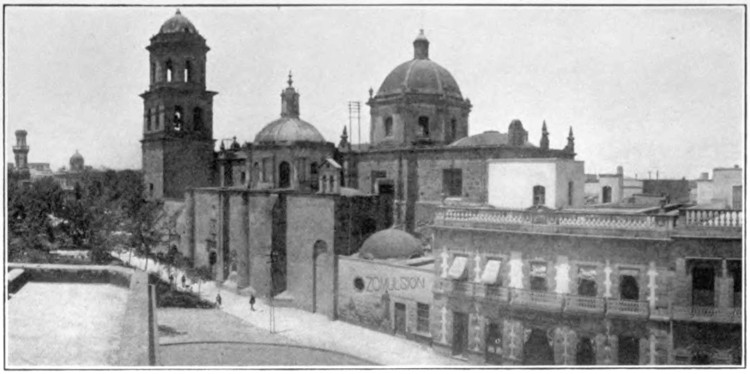
STREET SCENE, GUADALAJARA.
Jalisco borders on the Pacific Ocean as well as on the States of Sinaloa, Durango, Zacatecas, Guanajuato, Michoacán and Colima. In colonial times it was known as the kingdom of Nueva Galicia. There are many beautiful valleys and rivers, the largest of the latter, the Santiago, being six hundred miles long, rising in Lake Lerma in the State of Mexico and flowing through Lake Chapala, which is itself seventy miles long and from ten to thirty-five wide. Lake Sayula and Magdalena are smaller, but noted for their delicious fish.
The climate of Jalisco varies from generally cold in the higher and northern altitudes to delightfully mild in Guadalajara and hot on the west coast. The capital of Jalisco is Guadalajara, the population of which is estimated at two hundred thousand. The city is beautifully located and is constructed with elegant blocks of houses fronting on clean, wide and well-paved streets, and the people are noted for hospitality, culture and refinement, cheerfulness, politeness and frankness of character. It easily holds the position of the Queen City of the Republic. Its cathedral, while smaller than that of the metropolis, is much handsomer and of greater architectural merit. One of the theatres, Degollado,[412] is one of the most beautiful in the country. A superb granite penitentiary, built and managed in accordance with the latest developments and improvements in that line, is greatly admired by visitors. An entire square is covered by the government palace, which, while somewhat resembling the national palace in the City of Mexico, is even more harmonious and elegant in its architecture.
Captain Juan de Oñate founded the Villa del Espiritu Santo de Guadalajara, which name was given to the town in compliment to Guzman, whose birthplace was the Spanish city of Guadalajara in New Castile. But the site then chosen proved undesirable, and a year or two later the town was removed to the Valley of Tlocatlan, not by the free choice of the townsfolk, but by the order of the Oidor, where, by a royal cedula of the emperor, Charles V., dated November 8, 1536, it was granted a coat of arms as a city. But this second site became the more distasteful the longer they remained in it, and especially because they were exposed to the frequent and cruel assaults of the wild Indians.
Commissioners were appointed to choose a site and decided upon a fair valley called Atamazac; and eight days later all the townsfolk went out together in good order and in that fair valley made their home. In this spirited fashion was the present City of Guadalajara founded in the year of our Lord, 1541.
In this city is the celebrated “Assumption” of Murillo, which belongs to the cathedral and hangs in the sacristy. Its authenticity is not a matter of doubt.
The foundation of this cathedral was laid in 1548. The present building was commenced in 1561, and the corner stone was laid in 1571, by Bishop Ayala. The building was completed in 1618. Its towers were thrown down by the earthquake of 1818, and the clock between the towers was badly injured. The interior is rich in decorations and paintings. The two towers of this cathedral are wholly unlike any others in Mexico. In one of them is the “campanito del correo” the little bell of the courier, which rang only in the announcement of some important event. Another bell called San Clemente, was in former times rung during a thunderstorm to ward off lightning. An important adjunct to the cathedral is the Sagrario, a comparatively new structure, commenced in 1808, and completed in 1843. The churches are numerous and interesting historically. In loyalty to the church, Guadalajara is second to no other city in Mexico and makes good its claim by works of charity and mercy.
One of the most famous of the institutions of Guadalajara is the Hospicio. The building is an imposing one of white stone, handsome and attractive, covering[413] an entire square, and containing twenty-five patios or courts, with fountains, flowers, shrubs, palms and trees, from which echo the melodious reverberating songs of children and birds, which seem to touch the hearts of all visitors, and to embody almost a life in itself. This is not a hospital, as is popularly supposed, but a home for the poor of all ages, from the baby in the cradle to the aged nearing the grave. The institution is admirably managed under authority of the State of Jalisco. Children are taught all that may be learned in schools of the highest order, and as they grow older they learn some useful occupation in the higher arts and sciences. The product of their labor is offered for sale in support of the Hospicio and includes some of the most exquisite embroideries and laces, made by the girls.
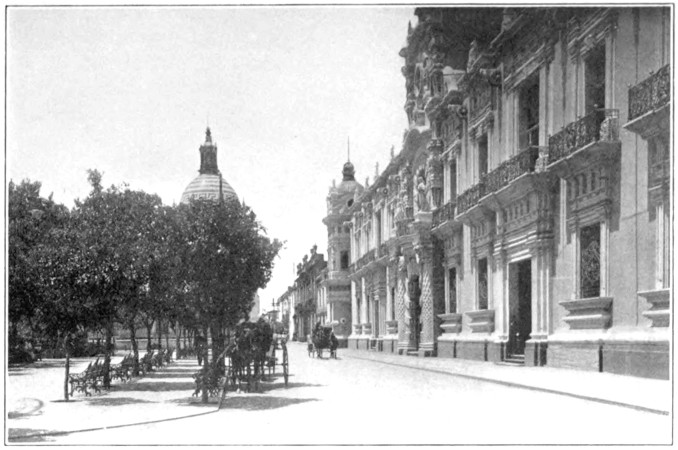
GOVERNMENT PALACE, GUADALAJARA.
The public square and jardines in Guadalajara are pretty and well-kept. Twice a week and on Sundays an excellent band discourses sweet music in the plaza, attracting a large crowd of people. There the best society and the prettiest young ladies are seen. By common consent the sexes and classes separate on the promenade. The inner or wider promenade is reserved for the better class.[414] The gentlemen keep in line on one side and in one direction while the ladies do the same in an opposite direction, the two streams passing each other constantly.
The plaza is a beautiful garden surrounded by magnificent buildings. On one side is the government palace, on another, the cathedral, and on the other two sides are long rows of portales, with their graceful arches. Guadalajara is one of the brightest of Mexican cities and has many charms within its gates. The government building has a modern air that is pleasing; its stucco is colored a light gray, and its white trimmings are decidedly agreeable to the eye.
The American Club is the general meeting place for Americans of the city and vicinity. The Country Club, just organized, is composed of Americans and other foreigners, as well as a number of Mexicans. The French and German colonies in the city have their respective clubs.
There are two church congregations of Americans and English—the Union Church and St. Marks’ Episcopal Mission. The Methodists, Congregationalists and Baptists maintain mission schools and chapels.

STREET SCENE, GUADALAJARA.
[415]
The government building has an inscription of a Bible passage. “Nisi Dominus custodierit civitatem, frustra vigilat qui custodit eam.” “Except the Lord keep the city, the watchman waketh but in vain.”
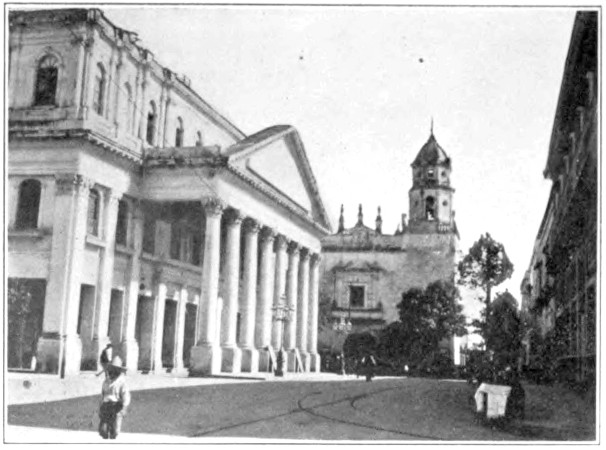
DEGOLLADO THEATRE, GUADALAJARA.
In one of the principal squares is the monument commemorative of General Ramón Corona, a brave soldier, whose memory is loved by all true Mexicans, and who was assassinated by a lunatic in 1880.
The Chapala Hydro-Electric and Irrigation Company, which owns the water rights and franchises, is now installing new plants on the Santiago with a capacity of fifteen thousand horse-power to furnish additional current to Guadalajara and the mining districts in the northwestern part of Jalisco, and this will bring the total production of electrical energy of that company up to twenty-five thousand horse-power.
The city is equipped with a successful modern sanitary sewer system, constructed by Americans at an immense cost, and has an abundance of the purest mountain water, brought through a subterranean aqueduct from the Colomos range. Several artesian wells have been bored for auxiliary supply to the city system.
The new colonies that have been opened in this city are very beautiful and the houses are constructed in splendid style and the architecture is exceedingly fine. Many of the English and American residents have built mansions and the Country Club is one of the most exclusive clubs in the republic. Mr. Samuel E. Magill, the American Consul, is much appreciated in Guadalajara. Mexico glories in her watering places and pleasure resorts. Lake Chapala is the largest lake in the republic. The principal village on this little inland sea is[416] Chapala, where there are some famous hot springs and a fine new hotel of modern equipment called the Ribera Castellanos. This resort is very convenient to Guadalajara. No more charming excursion for a lover of beautiful scenery can be found in all Mexico than around this beautiful lake. For water-fowl shooting during the fall and winter months and for sailing and bathing during the entire year, these shores are delightful. Most all the members of Mexican society find themselves there during Holy Week and other holidays. The President goes on his yearly hunting trip to these parts, accompanied by his son and some members of his cabinet and intimates. He is noted for his powers of endurance, often outstripping the others in his ardent quest for game.
San Pedro is the favorite suburb of Guadalajara where the famous pottery-ware is made. This celebrated pottery is known the world over.
This is a rich agricultural and fruit-growing country, producing large crops of wheat, corn and sugar, and the finest oranges that grow in the republic.
La Piedad, one of the quaint old places, has a population of some eight thousand. La Barca is a city of twelve thousand people, situated on the Lerma or Santiago River, near where it empties into Lake Chapala. Fifty miles west of La Barca and fifteen miles east of Guadalajara, at the station of El Castillo, a tramway conveys passengers to the famous Falls of Juanacatlan, justly called the “Niagara of Mexico.” The river at this point plunges over a precipice sixty-five feet in height to the rocks below, making a picture of grandeur and interest well worth seeing.
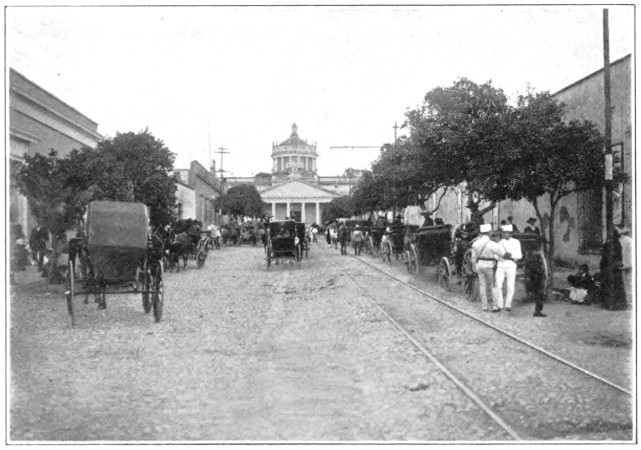
THE HOSPICIO, GUADALAJARA.
Sixteen miles beyond La Barca lies Ocotlan. This pretty place is on the River Sula, a short distance above its junction with the Lerma. The station is connected with the town by street cars, which[417] run to the bridge just above the steamboat landing. Ocotlan is situated on a plain which slopes southward a few miles to the shore of the lake. With its pretty plaza, its beautiful church spire, its portales, and two bridges, Ocotlan is very picturesque.
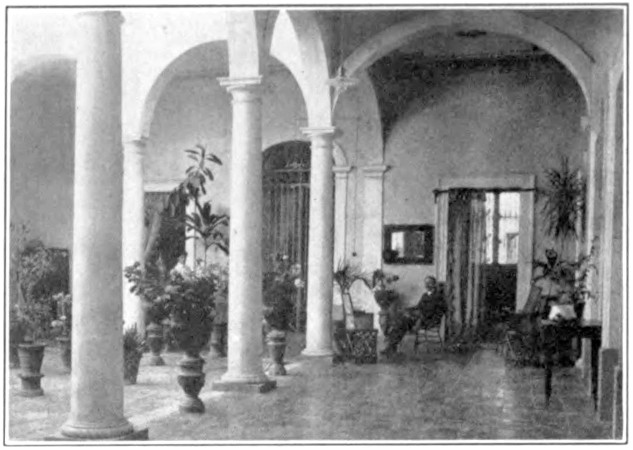
PATIO OF THE AMERICAN CONSULATE, GUADALAJARA.
Atequisa is in sight half a mile away on the left. Atequisa hacienda has miles of wheat-fields, hundreds of oxen and other animals and thousands of men at work on its farms or ranches. Here are the headquarters of the vast estate, storehouses, corrals, workmen’s homes, mills, hospitals, school houses and a church, besides the princely residence of the owner. There are other fine haciendas, and among those may be found the most cordial hospitality in the world. The life of a country gentleman here is that of a hermit, in the total absence of all society in the nearly unbroken solitude that surrounds him. For leagues and leagues there may be no habitation but his own, the nearest village may be distant half a day’s journey over an almost impassable road. But he is “monarch of all he surveys,” a king among his farm servants and Indian workmen. Nothing can exceed the independence of his position.
Capitalists who seek a sure and productive investment for their money should take into account not only the richness of the soil, the mildness of the climate and the thousand attractions offered by life in that zone, but also the assured importance of Guadalajara as a railway centre of first rank with facilities for transportation of its varied products rapidly, not only to the principal markets of the republic but also to those abroad, for which it will have seven or eight points of outlet.
One of these products that will seek speedy exportation will be the mineral wealth of Jalisco, which exists in great quantities and which possesses a richness of which there is now but little known.
[418]
There are more than two hundred and fifty mines, the greater number being of silver with some traces of gold, three or four of gold, some of copper, and others of quicksilver, iron, lead and other metals.
The city of Guadalajara has had for many years a mint in constant activity, coining silver and gold from the mines of Jalisco.
Mining in Jalisco is in its infancy and awaits only the energetic and decisive action of companies with sufficient capital to astonish the continent with the fabulous riches of its veins, many of them as yet untouched.
Guadalajara with its constant sunshine, its skies even bluer than those of far-famed Italy, and its mellow, genial warmth, is one of the most beautiful garden spots of the world.
The intellectual condition of Jalisco is up to the standard of modern times and lifts the people into a state above the ordinary. The schools are of the best, the State and the cities spending large sums of money on them, so that the primaries are being extended even to the distant ranches, while the secondary and professional schools rank among the best in Mexico. Jalisco’s lawyers have attained the highest reputation, her doctors command the respect of all, her engineers have attained national fame and her “Seminario de los Obispos” (Seminary of the Bishops) is known everywhere as having graduated some of the most notable of the Mexican clergy.
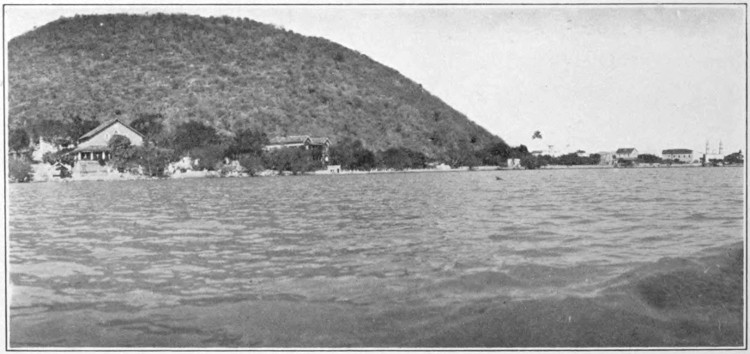
LAKE CHAPALA, JALISCO.
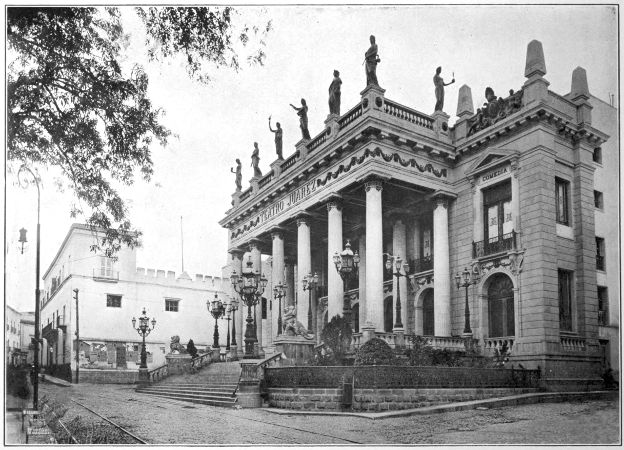
THE JUAREZ THEATRE, GUANAJUATO.
[421]

VIEW OF THE PORFIRIO DIAZ TUNNEL, GUANAJUATO.
The peculiar situation of Guanajuato, the capital city, with its crooked and irregular streets and its fortress-like houses, makes it look very ancient and feudal, and, oddly, amid all this antiquity stretch the wires of the telegraph and telephone, linking the old civilization with the new in a way that is strangely paradoxical. The heart of the city is the Plaza de Mejia Mora, where there is a tablet which states that here was born Benito Leon Acosta, Mexico’s distinguished engineer and man of science.
It is one of the quaintest and most delightful places in the world, a walled city among the mountains, set upon the sides of heights so steep that the houses[422] seem to cling to the rock, and that a misstep might precipitate one into the midst of the plaza three or four hundred feet below.
This lovely, bewildering spot is full of lanes and archways and winding market-places, where the picturesque people seem to be selling every oddity imaginable. The upper balconies of the beautiful homes are gay with awnings and flowers; the old church of the Jesuits with its fine arches of soft pink stone and carvings like lace-work is magnificent; the overhanging hills show brilliantly against the blue sky wherever one turns; through a hundred different arches some vision of slender-pillared inner courts, bright with blossoms and fresh greenery, continually flashes out.
The climate of Guanajuato is temperate; no extremes of heat or cold. It is a land of blue skies and fresh breezes; the atmosphere is clear and invigorating. Mellow sunlight pours its flood of gold on fruitful fields. The forests are rich in timber of great value. Guanajuato is one of the oldest mining regions of the New World. Only one-fourth of the area of the State has been scientifically explored, and yet there are already over three hundred mines perfectly studied and capable of giving good profits.
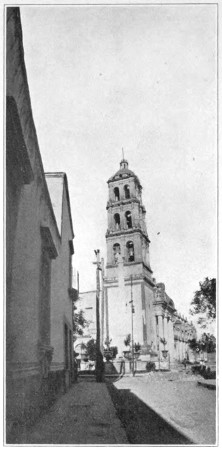
EL CARMEN CHURCH, CELAYA.
The celebrated mines of Valenciana, discovered in 1770, and abandoned during the War of Independence, in 1810, had up to that time produced two hundred and seventy-one million dollars. Baron de Humboldt, on his visit to Guanajuato, found a shaft eight hundred feet deep. He made a special study of these mines, an account of which is to be found in his records.
The earliest settlers were the Tarascan Indians who, upon arriving here, found a large stone in the shape of a frog, of which they made an idol, and they named the site of the future city Guanajuato, or the Hill of the Frogs. It was[423] founded in 1554 and made a city in 1741. The site of the city was a gift from Mendoza to Don Roderigo Vasques, one of the conquistadores, as a reward for his military services.
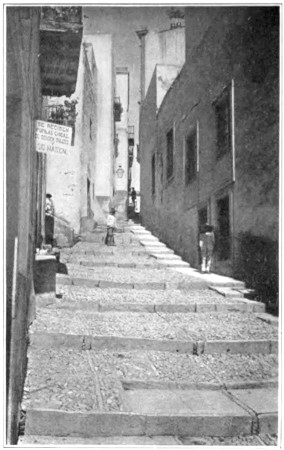
STREET SCENE, GUANAJUATO.
The curious and picturesque cemetery of Guanajuato or “pantheón,” is among the “sights.” The burial place is on the top of a steep hill which overlooks the city. The pantheón is enclosed by high walls entered through ponderous gates. The dead are buried for the little time that the peculiar dryness of the soil and air takes to mummify them. Then they are filed away in pigeon-holes in the walls. When the rentals cease the partially mummified remains are taken out of the pigeon-holes and corded up in subterranean chambers tunneled out of solid rock. Here the skeleton-guarded walls are musty, the light is pale and gruesome and the air is laden with the odor of the decaying dead. On all sides are the spectral forms. They are arranged upright around the walls, and there they keep their silent vigil until disintegration. A few years ago, when William Jennings Bryan visited Guanajuato he was horrified on seeing these mummies in the catacombs and suggested to the authorities that they be covered, as the sight was very offensive to him. Out of respect for the opinion of their distinguished visitor the municipal authorities have voted sufficient funds to keep these mummies properly garbed. It is almost as gruesome a sight to see them now clothed in long flowing robes as it was when they were disinterred and placed there.
The Manuel Gonzalez Dam was commenced on the 5th of March, 1889, during the governorship of General Manuel Gonzalez, the former president of Mexico, and completed in 1893. The material employed is a metamorphic deposit known in the locality as green rock, and exceedingly handsome. In the ornaments[424] are used sandstone of different colors. The effect of these combinations is beautiful beyond description, and all these varied materials are the products of the immediate locality. A wall, containing over forty thousand cubic metres, has been built, measuring one hundred and sixty-six metres in thickness at the base, or foundation, and twenty-four at the upper part. The maximum height in the interior is thirty-three metres and eighty-eight centimetres. This dam contains one million six hundred thousand cubic metres of water. On account of the short distance from the capital, only about three miles, and the difference of the height of the ground, the City of Guanajuato is supplied with water enough for all its needs and it will be possible to establish hydraulic motors of calculable usefulness.
The picturesque and dangerous stream which churned its way through the centre of the town causing many times great disasters by flood and wrecking properties at different intervals no longer wreaks this damage as Guanajuato is now protected from this inundation by a wonderful tunnel called the Porfirio Diaz. It is the work of Governor Joaquin Obregon Gonzalez, who has caused so many innovations and improvements in the city.
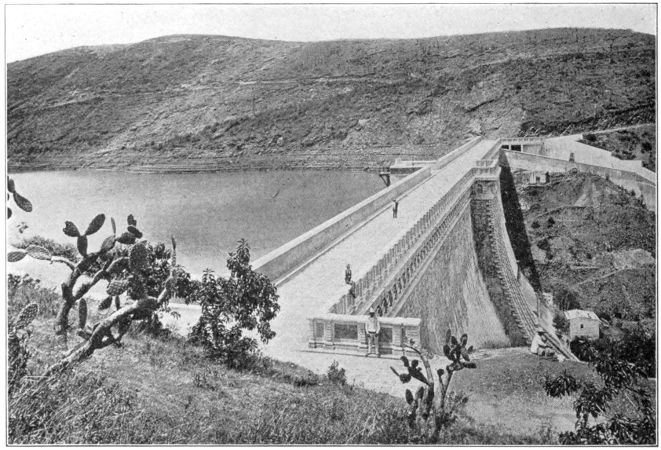
THE MANUEL GONZALEZ DAM, GUANAJUATO.
[425]
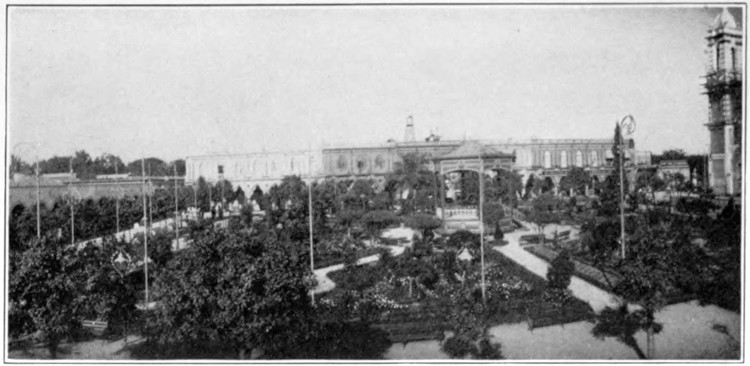
PLAZA, COLIMA.
The old realm of Colima was founded by the Aztecs, who made pilgrimages to this part of the country thinking to find a place to establish their empire. Their capital was situated in Cojitlan about twenty miles from the coast. Under the dominion of Spain it was a much larger territory than it now comprises. In 1824 it formed part of the State of Jalisco, in 1836 it was included in the State of Michoacán, but in 1846, it became a territory of the republic. During these distinct epochs it was governed first by sub-delegates and later by jefe-politicos, many of whom were foreigners. Owing to the remoteness from the seat of government there were many abuses of the people and the lack of transportation was a great drawback to their progress. Following the downfall of Santa Anna, General Comonfort occupied the Plaza de Colima in 1855, after having conquered Zapotlan, now the city of Guzman. In 1856, the popular movement of Ayutla obtained a general benefit to the country and the War of Reform wrested the entire republic from the crippling grasp of the church and started the people in a career of advancement.
[426]
The geographical position is good and has been of great value to Colima in her progress.
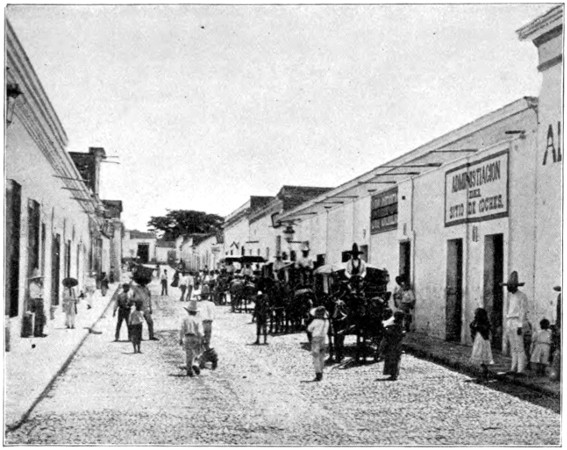
STREET SCENE, COLIMA.
The port of Manzanillo, which is a natural harbor, is an open door to all foreign trade and lately the establishment of important commercial intercourse has given the country fine opportunities. Every resource which nature has so bounteously bestowed is cultivated. With ambition and the liberal education of the people this State ranks as one of importance. The sanitary conditions have greatly improved through the vigilance of the Federal government, and all danger of fever that was once a drawback to Colima has been wiped out. There is a constant influx from all parts of the republic and foreign immigration is steadily increasing. One of the largest colonies is composed of staunch and representative Germans.
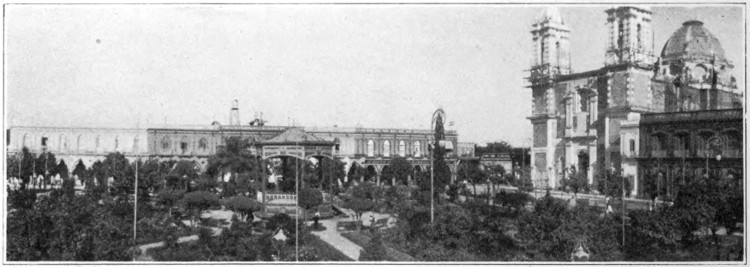
CATHEDRAL, COLIMA.
[427]
Newspapers and other publications have a firm footing, and many scientific and social societies are composed of the best sons of the State.
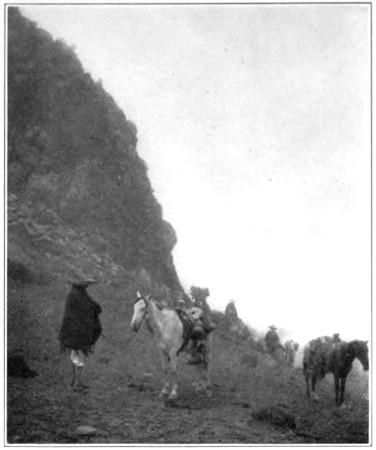
AT THE FOOT OF THE COLIMA VOLCANO.
The most important rivers are the Armería, Coahuayana, the Sihuatlan, Maravasco, Chocala, Paticajo, and Mamey are all formed from one enormous stream and flow in different directions to the Pacific. On the south and southeast the Coahuayana separates this State from Michoacán as far as the Puente del Naranjo or the mouth of the Apiza, while the River Tuxpan separates Jalisco from Colima.
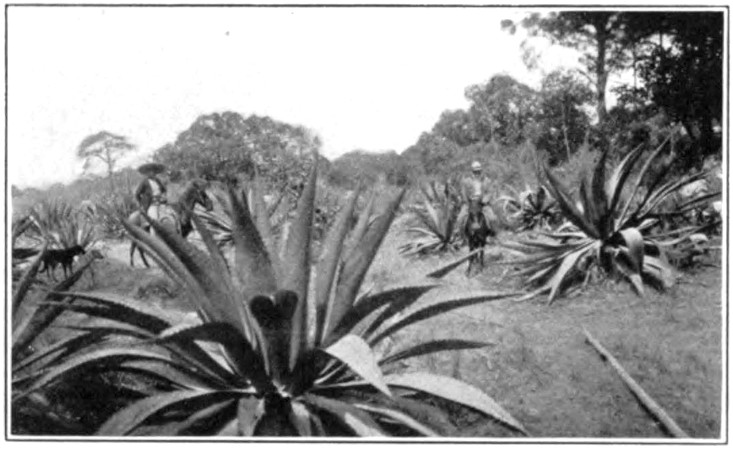
MAGUAY GROWING AT THE FOOT OF THE COLIMA VOLCANO.
The physical aspect of this coast State presents an admirable mixture of beautiful scenery. With chains of mountains like a great amphitheatre, the magnificent volcanoes, covered with snow, or seething with fire, the splendid vegetation which presents itself in every locality and the nearness to the Pacific Ocean give it a distinctness of type that is very interesting. Rivers coursing down the mountains and placid lakes reflecting the rays of the sun and tropical fruits growing in greatest abundance add to the joys of the traveller who finds himself on the way to Guadalajara, while the magnificent view of the stately Colima with its snow glistening in the light and[428] the multi-colored clouds that fleck the skies above form a striking contrast to the deep and dangerous looking barrancas.
From the cold air of the volcanic country to the warm tropical climes, every vegetation known exists and the richness of the products cannot be excelled. The Volcano of Colima, which is forty miles from the capital, is eleven thousand eight hundred and eight feet high. It has been in eruption since 1869. The beautiful sight of this mountain with its clouds of fire and smoke, its molten lava running down the sides, can be witnessed for many miles.
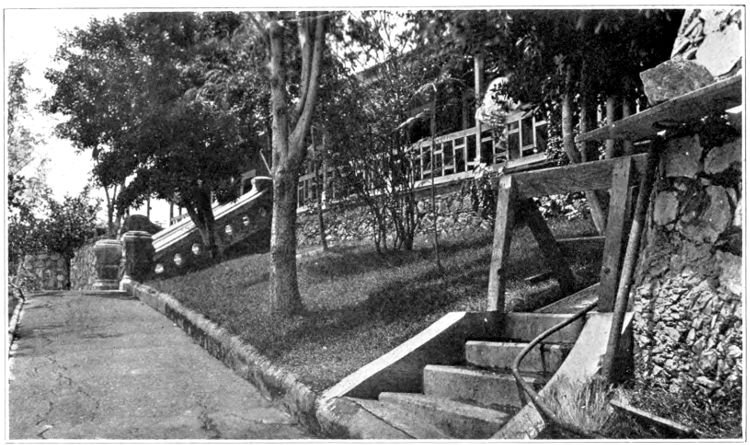
RESIDENCE OF COLONEL EDGAR K. SMOOT, MANZANILLO.
The largest lakes are Cuyutlan, which is navigable, San Pedrito, north of Manzanillo, and the Calabazo and Alcuzahue, in the municipality of Ixtlahuacán.
At the port of Manzanillo the government has built a splendid breakwater and the harbor is one of the finest in the world. The coasts bathed by the great Pacific are ragged and dangerous, but there are some fine pleasure resorts, notably Cuyutlán, where many families go during the months of March, April and May. In the forests woods of all kinds flourish. Among them resinous, medicinal, and dye-woods are found in great profusion.
[429]
The government of this State is noted for its liberal and progressive attitude. Public benefits supply sufficient funds for hospitals and all establishments of charity and protection. The national railways of Mexico unite Manzanillo to the interior and have been of great benefit to the commercial conditions. The telephone system is well established between the ports and the capital and many branch lines extend to the neighboring haciendas.
The last census shows sixty-five thousand one hundred and thirty inhabitants. In the city of Colima the principal buildings are very imposing and beautiful. The Government Palace, the Santa Cruz Theatre, the Market de la Madrid, the Porfirio Diaz High School and the Cathedral are among these. The new Porfirio Diaz Hospital is being built on a very approved plan.
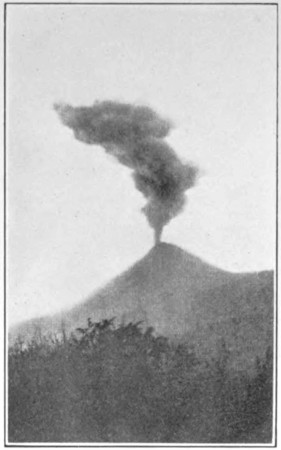
COLIMA IN ERUPTION.
Since the origin of the State there have been twenty-eight governors, some elected by popular vote and others as substitutes. The present governor, Señor Licenciado Enrique O. de la Madrid, has been eight years in office and his splendid administration has regulated the destiny of the State.
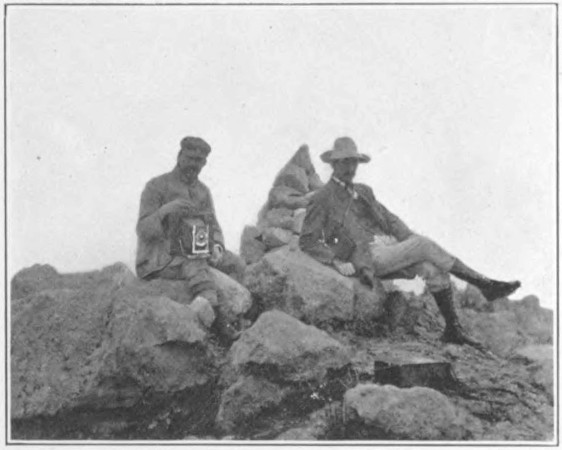
SUMMIT OF COLIMA VOLCANO.
He was born in the City of Colima on the 22d of March, 1862, and comes from one of the most distinguished families on the west coast. His high moral[430] attitude and his splendid executive ability have caused the people of his State to realize that the reins of government could find no better hands for guidance than his. Besides numerous public works and great improvements in cities and ports, one of the greatest events during his gubernatorial period is the opening of the railroad which unites the coast to the capital of the nation. On the 12th of December, 1909, General Porfirio Diaz formally opened this railroad, assisted by the Vice-President, Señor Don Ramón Corral, Señor Don Leandro Fernandez, Governor de la Madrid and many distinguished people.
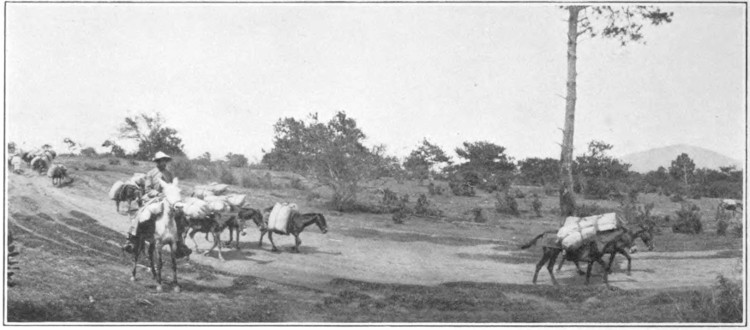
PACK TRAIN ON THE ROAD TO COLIMA.
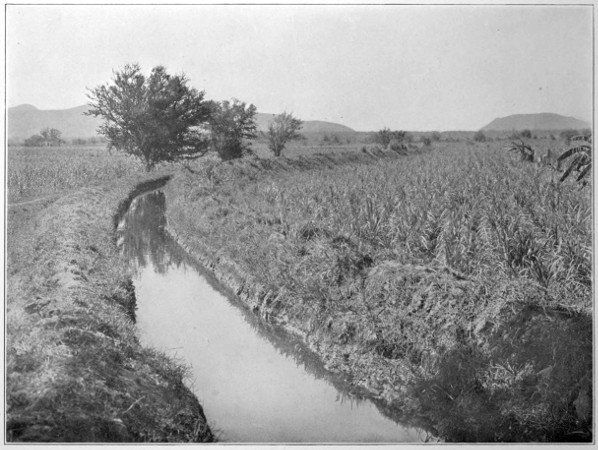
IRRIGATING CANAL, CULIACAN.
[433]
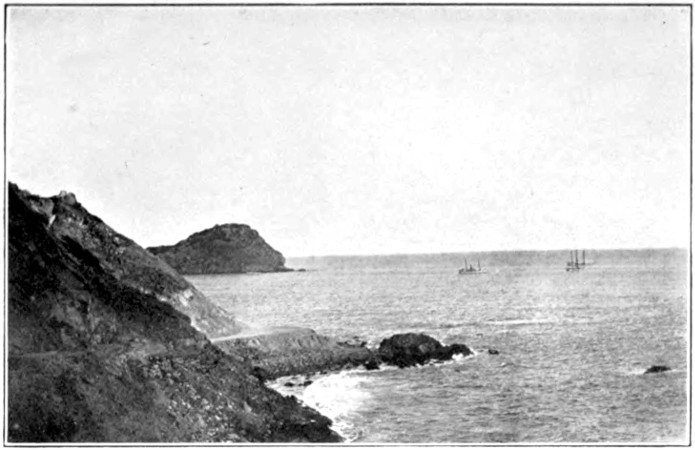
ENTRANCE TO MAZATLAN.
There is always interest in observing the progress of a people, their gradual conquest over evil conditions and their energy in removing all obstacles which stand in the way of advancement. The demonstration of strength and determination which result in triumph, stimulates the energies of men of all countries, and the gratification that is gained through overcoming difficulties becomes a natural pride. This example the Mexican nation has shown to the world.
SINALOA owes a great part of her progress to the people. The actual government, comprised of sons of the State, is a body of men of action and intelligence, and the welfare of the country is their first consideration. All public works and improvements are jealously protected and every class of enterprise, mineral, commercial, maritime, industrial, educational and agricultural are prosecuted to the full extent of possible development.
As a maritime State she possesses a wonderful future. Mazatlan has become a great Mexican port of the Pacific and is in close competition with the port of[434] Vera Cruz, though neither are rivals, on account of their geographical positions. The country is well supplied with banking and commercial facilities and vast enterprises for land development have taken hold here. Railroad service and quick communication with the Pacific have given Sinaloa a wider scope, developing with greater rapidity all this western stretch of territory which has hitherto been confined to a small area.
The Southern Pacific Railroad connects the United States with the port of Mazatlan and opens one of the richest undeveloped mining and agricultural sections in the country. In a few years Sinaloa, under the dominion of energetic and enterprising citizens, will become one of the garden spots of America.
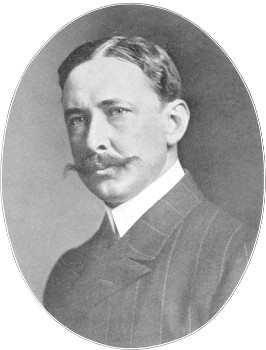
GOVERNOR DIEGO REDO, SINALOA.
The mineral and agricultural elements have greatly advanced and enriched the State and she is on the road to become a most powerful industrial centre.
Sinaloa is a maritime State and compares most favorably with all coast territories. The situation between the great Gulf of California and the Pacific is most enviable and all active movements of communication are practical and convenient.
The mineral zones that have been exploited are famous throughout the world for their riches. There are many precious metals in the picturesque mountains and judging from the prolific production of the relatively few enterprises now at work, a rich and incalculable fortune awaits the prospector.
[435]
In the northern part of the State is the great silver belt. El Fuerte district has extensive gold-placer ground.
The climatic conditions are excellent. The fruit and flowers are of superior quality and in the high and mountainous regions all the products of a temperate climate exist in profusion and are easily cultivated. There is plenty of good land at the disposition of foreign colonists and the government is always eager to place every advantage before the settler. A great number of foreigners are living in this country and they have all the rights and obligations of the natives.
Rivers and extensive irrigating plants make the land fertile and with many canals and plenty of water-power immense quantities of electrical power can be supplied to all enterprises and industries that exist and to those that may become established in the future.
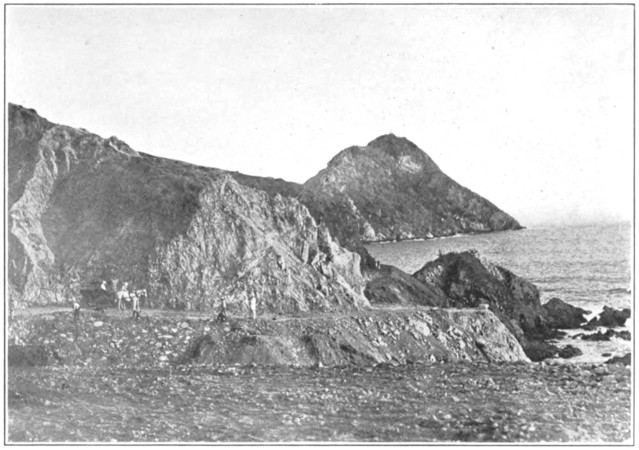
NEW MOUNTAIN ROAD AT MAZATLAN.
The principal sugar estates are the El Dorado, La Aurora, the Navaolota, Los Mochis, and El Aguila.
[436]
El Dorado is one of the finest sugar plantations in the republic. It is located on the San Lorenzo River. It is connected with the main line of the Southern Pacific by a branch from Quila. This hacienda is equipped with the best machinery and produces fine cube sugar.
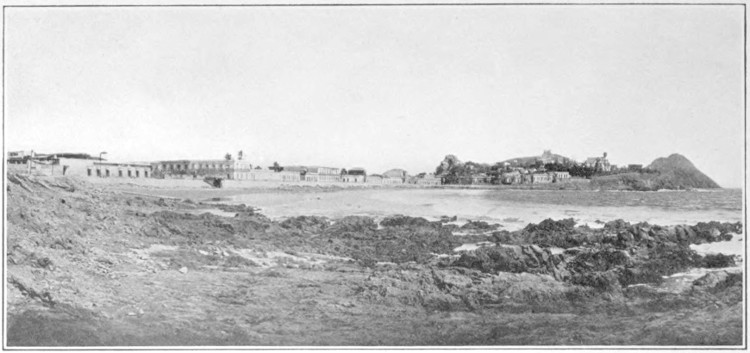
THE HARBOR, MAZATLAN.
The writer spent some days at El Dorado and was the recipient of most charming courtesies and was initiated into the intricacies of sugar-making.
La Aurora hacienda is in the outskirts of the city of Culiacan. This sugar estate has been under cultivation for years and is noted for its purity of product.
The name of Redo has been associated with the State of Sinaloa for over half a century. Señor Joaquin Redo, the father of the governor, founded many industries, among them sugar factories, steel plants, and iron foundries, and it is natural that Señor Diego Redo takes such an interest in the State his forefathers helped to build. He is one of the most progressive men in the republic and has done so much for the advancement of every enterprise in his State that he is loved and respected by all, from the humblest peon to the greatest statesman. There is no doubt that the young governor, who not forty years old, has set the pace for energetic and modern advancement. He has taken the initiative in promoting every form of fruit culture and agricultural development. In the establishment of the Agricultural Mortgage Bank now in contemplation he will accomplish an incalculable benefit to the State. In this movement he[437] has the co-operation of strong interests in the United States and in the Federal District. This will be a great acquisition and will materially aid in the construction of irrigation works and other enterprises which are necessary to the success of the State.

PLAZA DE LA REPUBLICA, MAZATLAN.
The building of many cities is one of the plans of the governor and by his aggressive attitude in the actual progress of his State he is determined to make Sinaloa one of the most important in the Union. The first thing accomplished with the aid of the State legislators was the establishment of an engineering corps. This corps costs the State about sixty thousand dollars a year and is composed of the finest engineers obtainable. Surveys of the entire country are made, sites for cities are located and the proper locations of the big valleys and level of the streams are obtained. In this way, it was discovered that the Sinaloa River makes a loop of about eighteen miles and then passes itself within a distance of only one hundred and sixty metres. The division of the river is by a single mountain ridge through which a tunnel is to be bored. This will afford a sufficient drop to produce more than six hundred horse-power and at the same time supply the immediate valley with plenty of water for irrigating[438] purposes. Through this means of survey the sites of some of these cities has been located.
Governor Redo is noted for his policy and perception and is always a prominent figure in ceremonials where the distinguished men of the country are gathered, and when a new building is dedicated or a new railroad inaugurated, this gentleman is always present.
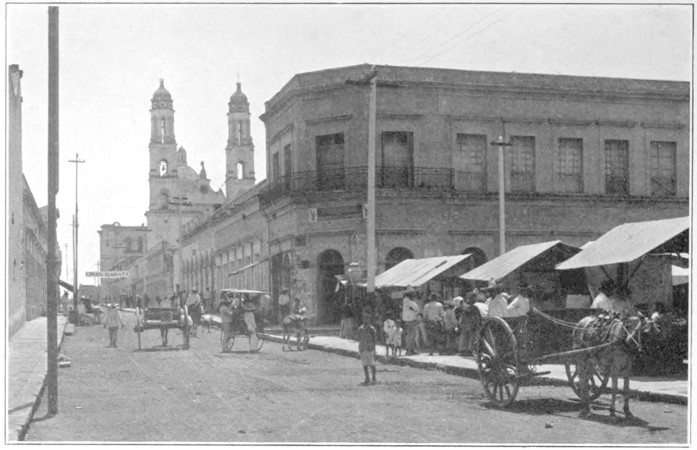
STREET SCENE, CULIACAN.
On the opening of the Tucson and West Coast of Mexico Railway an important link was formed in an interoceanic and international line, from the shores of the Atlantic Coast to the Pacific Ocean on the west shores of the Republic of Mexico. Citizens of the two great republics met and ceremonies befitting so great an occasion were held. An intelligent and delicate tribute was paid to the meeting of General Diaz and President Taft by Governor Redo in an appropriate address, of which is given the following extract: “The joyous echoes of the feasts held in El Paso and Ciudad Juarez on the occasion of the meeting of our Presidents are still resounding in the hearts of Americans and[439] Mexicans. We still recall the words of President Diaz affirming in the name of the Mexican nation the reciprocity of the cordial sentiments which on this solemn occasion were evinced by the countrymen of the immortal Washington;” and the words of President Taft expressing in the name of the people of the United States the same sacred sentiments of friendship and ‘their profound admiration and high esteem for the great, illustrious and patriotic President Diaz.’ And our present celebration may be considered as the confirmation of those assertions no longer in the sphere of diplomatic formalities, but in manner more effective, as being the direct approximation of the individual correspondents of both nations. You have invited your Mexican friends to a great practical and symbolic feast; practical on account of the utility which the new railroad line will bring to both countries by quickening traffic, reducing freight rates, linking markets close together and offering occasion and pretext for a better mutual benefit understanding; symbolic, because this material approachment is the concrete and plastic representation of brotherly neighborhood of two nations, who, putting aside all possible bitterness, take pleasure in the solace of a cordial friendship, and overcoming differences of race and obstacles of language, seek the ideal of a human solidarity, ever working for the common welfare.”
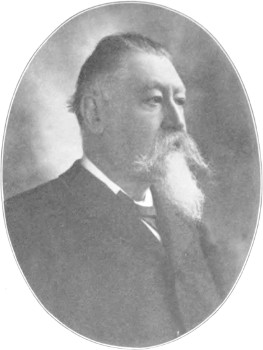
SEÑOR DON JOAQUIN REDO
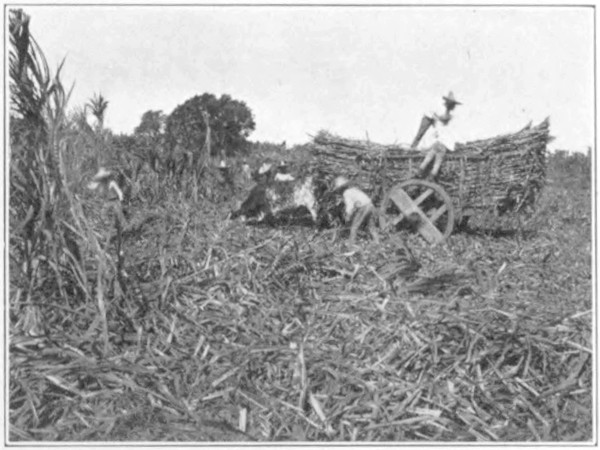
CUTTING SUGAR CANE, EL DORADO.
The capital of the State is Culiacan. It occupies the site of[440] the old Aztec city of Colhuacan, famed in Mexican history. It has a population of about twenty thousand and is rapidly growing in importance. Being one of the oldest cities in the republic, many antique buildings still exist in a state of preservation which shows the remarkable craft of the builders centuries ago. It is in the midst of the gold mining district and is the centre of extensive trade. There are cotton factories, sugar refineries and several manufactories of great importance. The city has a fine public square and the streets are very attractive. Among the principal buildings are the Government Houses, new schools, banking houses and a magnificent cathedral, which has a collection of paintings of the old masters. The press is well represented in this State, there being several interesting “Dailies.”
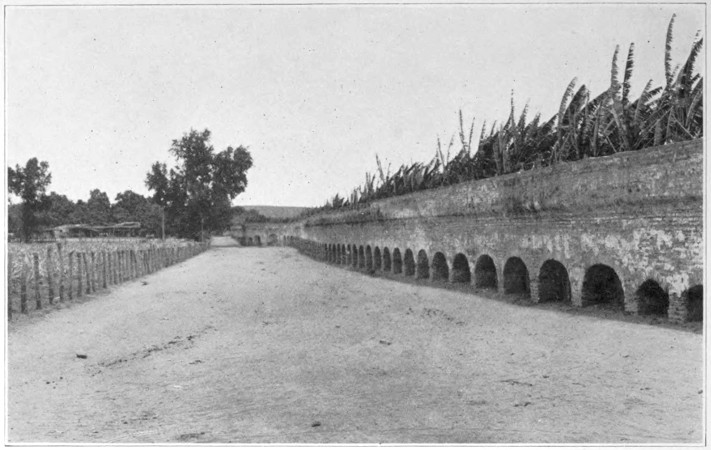
AQUEDUCT, CULIACAN.
The fibre industry has advanced with great rapidity, and some of the manufactories are in a flourishing condition.
Altata is the seaport of the city of Culiacan and is the outlet for the large agricultural and mining country. The export of ores, sugar and brazil-wood[441] forms the trade of this port. A short railroad line connects this town with the capital.
Mazatlan is a most important mercantile centre, but there are other cities that follow it in close competition. There are many important importing and exporting establishments. It is the most progressive city on the west coast and has taken on the appearance of a busy American port town.
The people are well educated, cultured and refined. The educational system has every facility for mental equipment.
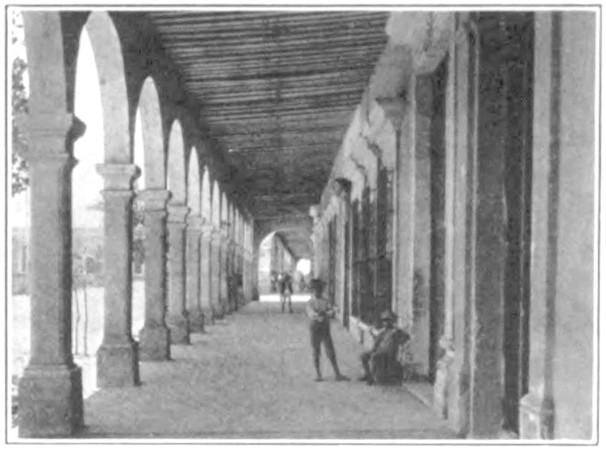
PORTALES, CULIACAN.
The principal newspaper is El Diario del Pacifico.
One is impressed with the beautiful approach to this port, the flanking mountains and the blue Pacific waters making a contrast with the tropical palms and ferns ashore.
Silver mines are found in this locality and the chief exports are gold and silver, dye woods and fine pearls.
Baron Humboldt called the West Coast the “mineral storehouse of the world.”
Sonora is notably a mining State and covers an area of seventy-seven thousand square miles and the mining industry dates back to the time of the Spanish Conquerors. Some of the mines worked by them are still producing. Deposits of gold, silver and copper occur in remarkable abundance and with modern mining facilities have developed great commercial importance, while hundreds of mines remain unworked since their abandonment during the revolution against Spain from 1810 to 1821. In silver production Sonora has been surpassed by the interior States but from the beginning it has held first place as the chief producer of gold and copper.
Since the Yaqui disturbances have been quelled by the government and there can be no possible chance for another outbreak, on account of the strenuous[442] measures taken to conquer this unruly tribe, Sonora has begun to take on an air of great prosperity. Some of these Indians finding themselves under the absolute control of the authorities have settled down to farming and mining and some of them have joined the army; in consideration of this schools and churches have been erected for them. One of the greatest benefits occurring from the establishment of peace has been the betterment of public education. It is the object of the officials to improve the school system in every manner possible, and all money formerly used as a war fund against the Yaqui is now turned to their interest.
The Chamber of Commerce has taken steps to renew public confidence and open up old business relations with the sections of the State that have transferred their operations to other points on account of these troubles; the result is, that all inactive towns have taken on new life and public improvement has made rapid strides.
This country unites all the conditions necessary for happy, reasonable living. The climate is temperate, water excellent and abundant and there is plenty of timber. It is a fine country for coffee, corn, cane and cotton and the annual shipment of bananas exceeds that of any other State. The agricultural resources should be properly developed and although recent improved mining conditions have made them a secondary feature, there is no doubt that farming is to be one of the best resources of this rapidly advancing State. The fruit culture of Sonora is gradually gaining pace with California and the oranges from this part have been pronounced the finest in the world. The fact that all produce ripens a few weeks in advance of that in California is a good reason for farmers to know the value of this section. The steady influx of earnest people anxious to cast their lot in a country so rapidly coming to the front leads one to believe that the history of the pioneers of the Golden West is soon to be repeated.
Hermosillo, the capital of Sonora, is one of the first and important cities on the west coast reached after leaving American territory. It is situated on the Sonora Railway, which is a branch of the Southern Pacific. In a beautiful valley with majestic mountains towering in the distance, this charming city occupies a splendid geographical position and is destined to become the centre of great commercial and business enterprises. Stately public buildings, grand old churches, and beautiful parks of palms and native fruits give the city a[443] semi-oriental appearance and, with all its quaintness, this is one of the most attractive cities in this part of the republic.
There are no frosts in the winter months to chill the air, and no excessive heat in the summer. Possessed of a climate equal to that of Southern California, it is a most delightful abiding place.
Within the past year the city has taken on a tremendous degree of activity; improvements are being made daily, buildings reconstructed and a company of local capitalists have laid out an addition to the town, grading the streets, macadamizing the roadways and in every way beautifying the city. Houses on the American plan have been built and many beautiful residences in this new colony are adding greatly to the appearance of the city. The energetic interest that the State government has taken in the progress of this country has given a great stimulus to the people and it is remarkable how many prospectors have flocked from the United States to cast their lots in this promising city.

GENERAL LUIS TORRES, GOVERNOR OF SONORA.
Hermosillo has about fifteen thousand inhabitants. It has several public parks that are being continuously improved. The Ramón Corral Park is the most beautiful. It was named in honor of the Vice-President, once the Governor of the State, and was donated by him. The Plaza de Armas is in front of the Municipal Palace and is very bright and pretty. It is one of the most attractive sights of the city in the evening when lighted with its brilliant display of electricity. A mountain in the city limits called Cerro de las Campanas has been converted into a pleasure resort with a fine drive to its summit, with byways laid[444] out in a very attractive manner with rustic seats and many features of beauty. A handsome kiosk is in course of construction where military bands will give concerts.
A large statue of the patriot Hidalgo stands in a square facing the Bank of Sonora, one of the most important establishments in the State. There are many fine banking and commercial houses in this city which give an idea of the prosperity that reigns supreme.
The Chamber of Commerce and the Chamber of Agriculture are very active in the interests of the State and Hermosillo boasts of fine institutions of learning, the idea of the government being to make the schools of this State the best and most advanced in the republic.
One of the most important is the Colegio de Niñas de Leona Vicario, named in honor of the great heroine of the Revolution. It has a conservatory of music, a library, a gymnasium and a branch of arts and crafts. This school has been opened lately.

GOVERNMENT PALACE, HERMOSILLO.
The Academy for Boys is a large and handsome building with an excellent system of manual training in connection with other branches. The public[445] schools of the city are maintained at a cost of eighty thousand dollars a year. American interests are well protected by Mr. Louis Hostetter, who is the Consul. He is well loved by the natives and has the respect of all the government officials. He has enlarged the trade with the United States and his work is much appreciated. Public improvements are steadily going on. A concession has been granted for a dam in the Sonora River, about ten miles from the city. This will be of great benefit to the outlying districts as well as to the capital, for there has been a great waste of water that should irrigate at least five hundred thousand acres of land. There will be a larger power plant to connect with the factories and electricity is to be generously distributed.

CATHEDRAL AT ALAMOS, SONORA.
General Luis E. Torres, the Governor of the State, is the General of the Military Zone. His duty consumes most of his time and the acting Governor, Señor Alberto Cubillas, uses great energy and activity in carrying out the policies of the executive. General Torres is one of the noted figures of Mexican history.[446] The government of this State is wise, fearless and impartial and all the officials are directing their earnest efforts toward advancement.
Guaymas is situated on the bay of the same name and is a very old city. The antique houses of one story constructed on a solid basis still hold their own with the later structures of modern architecture, and the contrast between the two styles is very strange. It is the second city of importance in the State. The harbor is said to be one of the finest in the world. The works lately built, some parts are still in construction, have been done at great expenditure on the part of the Federal Government. Large vessels can now enter the port. The scenery surrounding this port city is very attractive and pleasure-seekers from the North have made it a winter resort as the climate is mild and equable. Fishing, hunting and boating are indulged in by those living here, and the great commercial activity grows in importance with each year. It is the headquarters of the Sonora Railroad whose commodious offices are very handsome. The Pacific Salt Company is one of the most extensive in commercial importance and there is scarcely a commodity that is not manufactured in this city. The Custom House, with the wireless telegraph station, and the Marine Hospital are important buildings. The public parks are well laid out and are very attractive with tropical palms and flowers.
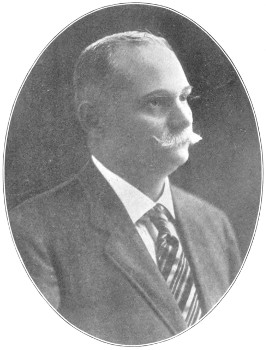
SEÑOR DON ALBERTO CUBILLAS, VICE-GOVERNOR OF SONORA.
Five miles from Guaymas is Empalme, a little town of Americans. It is growing very fast. The houses are all constructed of brick and wood and are very modern and sanitary. The terminal and machine shops of the Sonora-Pacific Railway[447] extension are here. Other cities, Esperanza, Alamos and Cananea, are in close competition in mining activity. Alamos is an old and picturesque town surrounded by beautiful scenery and its history is full of old legends and traditions.
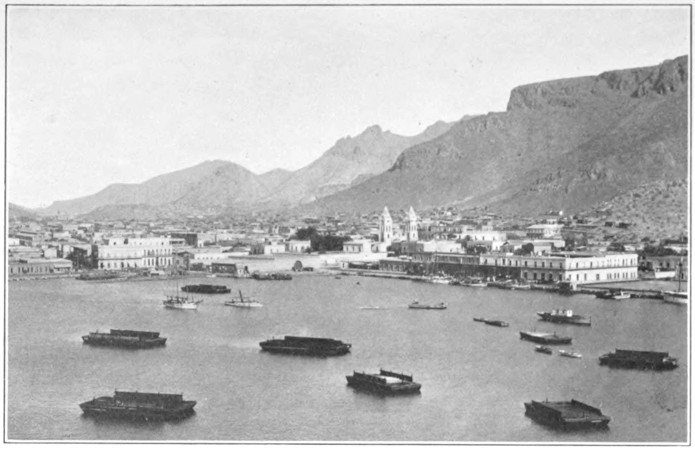
BAY AT GUAYMAS.
Cananea is the headquarters of one of the largest mining companies in the State. It gives employment to over three thousand Mexicans and half as many Americans. It is a progressive little town with a variety of enterprises, theatres, steam laundries, department stores, a newspaper printed in English, called the Bulletin, and a mercantile bank doing a thriving business.
Nogales is called the Gateway of Mexico. It is divided by an imaginary line from the town of Nogales, Arizona. There was a great deal of smuggling carried on at one time owing to the fact that on one side of a street was American territory and on the other Mexican. But this no longer exists owing to the strenuous means on the part of both governments. The main offices of the Sonora Railway and of the Cananea Division of the Cananea, Rio Yaqui and Pacific are located here. In speaking of the favorable conditions which exist[448] in Sonora the words of General Torres are most appropriate: “So great is the area; so varied the products and so fertile the soil of the opulent State of Sonora that no man even after a lifetime spent within her borders can make more than mention of her resources. This year Sonora is more than ever prepared for the fullest development of her history, owing to the subjugation of the Yaquis and the consequent settlement of Indian trouble. The resources of Sonora fall naturally into three great divisions; mining, agriculture and stock-raising.
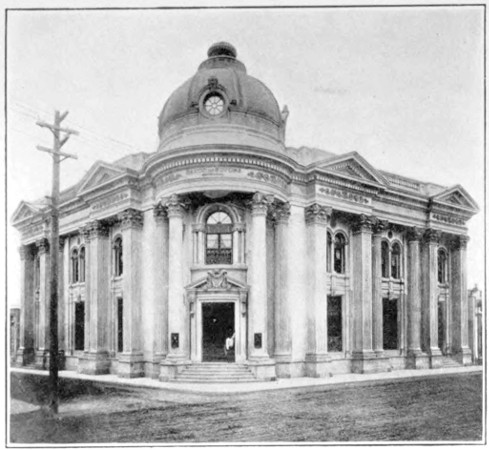
BANK OF SONORA, GUAYMAS.
“In mining it has produced millions of dollars worth of gold, silver, copper and lead, and will produce millions more in the new wave of progress which is sweeping over the State. Mines which have been producing since the middle of the sixteenth century are being driven deeper and rich new prospects are being opened up all over the State.
“Stock-raising, the original industry, suffered a severe setback during the recent Indian troubles, but is again being raised to the place of prominence it should occupy in the wealth-producing land of Sonora.”
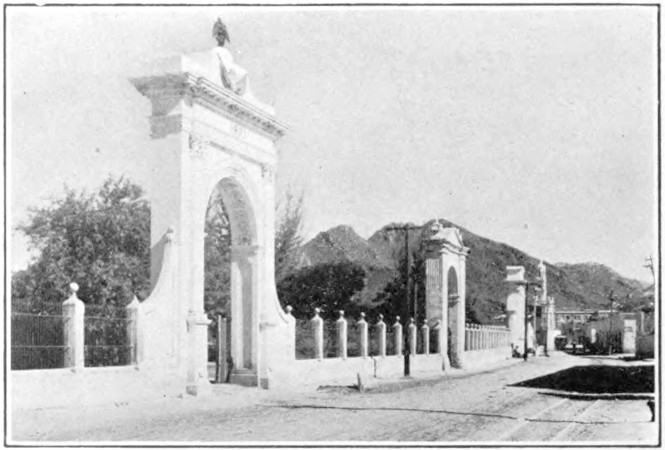
RAMÓN CORRAL PARK, HERMOSILLO.
South of Sinaloa along the Pacific Coast lies the Territory of TEPIC. It originally[449] belonged to the State of Jalisco but it was declared a free territory during the administration of General Lerdo de Tejada.
Its agricultural products are rich and all kinds of tropical fruits grow in great abundance.
The chief industry is salt, which is of great importance commercially.
The Tepic territory is remarkable for the number of waterfalls it contains, and the rivers which supply water throughout the entire territory.
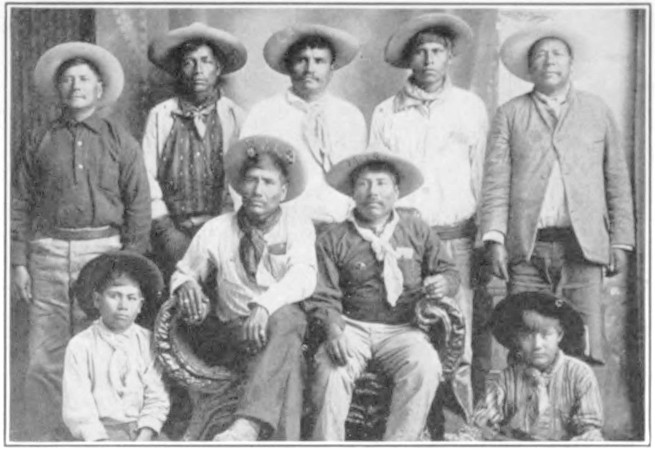
YAQUI INDIANS.
While the beauties of southern California are well known, the imaginary line that separates from Baja California marks no difference in soil or climate. It is a continuation of the same general features.
The Peninsula of Lower California was discovered by Cortés in 1536. It is traversed by a volcanic range of mountains. The Jesuits formed establishments there about 1690 and instructed the native Indians in the arts of agriculture and civilization. They remained there until 1767 and the ruins of their old missions are to-day exceedingly picturesque.
At La Paz the pearl fisheries are very extensive and some of the finest pearls in the world are among these deposits. More than a thousand divers are employed during the season, which lasts from May till November.
Politically, the peninsula is a territory. The two chief cities are La Paz, in the south, and Ensenada in the north. Ensenada is an American town exceedingly attractive in appearance. It is beautifully situated in a healthful location and is a natural outlet of great inland business and mineral wealth.
Magdalena Bay is one of the beautiful places along the Pacific Coast, and is surrounded by a green country. Orchilla is a parasitic moss which hangs from the trees throughout this region, adding a touch of picturesqueness to the natural beauties of the place. Large quantities of it are gathered on the seashore and in[450] the vicinity, pressed and shipped to Europe, where it is used for the purpose of dyeing sealskins.
The region around Cape San Lucas is beautiful in the extreme, and not far from there lies the picturesque little village of San José del Cabo, which is a shipping port with a coast custom house section. The Orizaba and the Coos Bay, steamers of the Pacific Coast Company, stop at all principal ports, and furnish the best possible means of communication between San Francisco and Guaymas, Sonora.
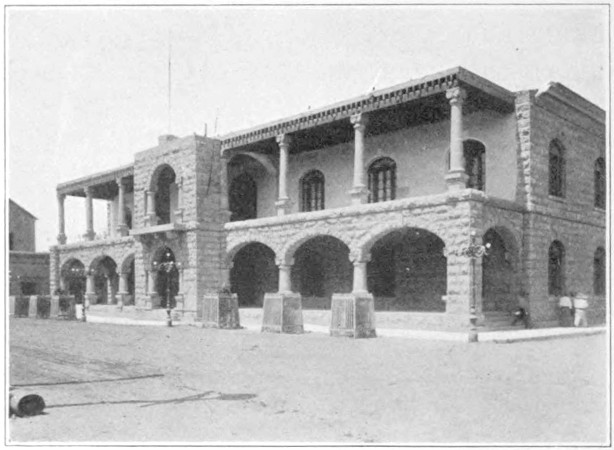
MUNICIPAL PALACE, GUAYMAS.
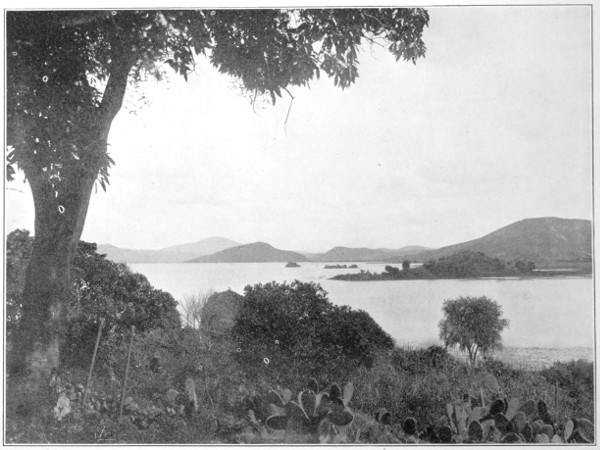
LAKE PATZCUARO, MICHOACÁN.
[453]
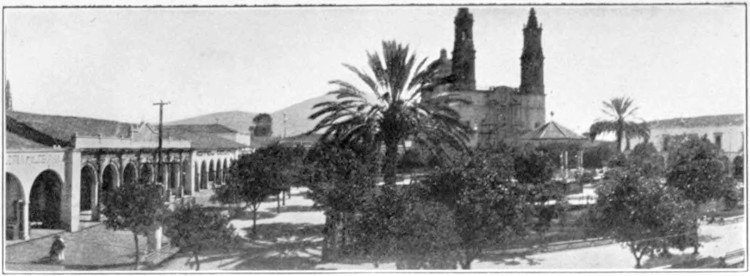
THE PLAZA, ZAMORA.
Cortés took an excursion through Michoacán after the fall of Mexico and was delighted with what he saw. It was at this time a powerful and independent State, inhabited by one of the kindred Nahuatlac races. The Spaniards advanced across the State and erected a cross on the Pacific Coast in the name of their Catholic majesties. On their return they took back samples of gold and California pearls, and the report of the great Southern Ocean beyond. Cortés wrote: “Most of all do I exult in these tidings of a great ocean. For, in it, as cosmographers and those learned men who know most about the Indies inform us, are scattered rich isles, teeming with gold and spices and precious stones.” Even then had the Spaniards begun to look on Mexico as a great treasure house to be drawn upon to support their own extravagant country.
Michoacán lies on the western slope of the great cordillera of Anahuac. The territory is extremely mountainous and its scenery strikingly picturesque, characterized by enchanting gorges, beautiful valleys and vast plains of fertile lands along the banks of glistening streams, whose course is sometimes impeded by huge rocks, and which occasionally acquire great rapidity, as can be observed especially at the Falls of Onendo. Its most noted mountain peak is the volcano[454] of Jorullo. The State is called Michoacán de Ocampo in honor of one of the great heroes of Mexican independence.
The story of Ocampo adds another to the many romantic episodes of Mexican revolutionary days. He was one of the great heroes who sacrificed life for the sake of the country he was so determined to free from foreign tyranny. When he was captured by the enemy and condemned to be shot his last request was that his heart should be taken from his dead body and carried back to his native State. This was done and the State was rechristened Michoacán de Ocampo, in loving memory of one of its greatest heroes.
Morelia, the capital, was founded in 1541 by the Spaniards and received the name of Valladolid. It stands upon a rocky hill six thousand four hundred and thirty-eight feet above the sea. The streets are wide and regularly laid out. On one side of the Plaza de los Martires, the principal square, stands the noble cathedral and extensive arcades are along the others: this is the principal business centre. The houses are very substantially built and the government building is very handsome. The San Nicolas College, which was built in the sixteenth century and remodeled in 1868, is one of the finest edifices in the republic of Mexico. By moonlight Morelia is exceedingly attractive, with its fine square, beautiful streets and houses. Near by is the hill of Las Bateas, where by the order of Morelos two hundred Spaniards were murdered in cold blood to revenge the death of the curate Matamoros, who had been taken prisoner and shot by Iturbide.
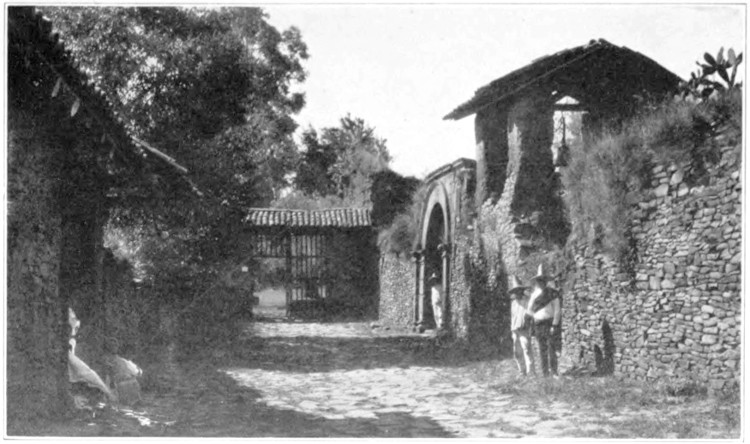
CHURCHYARD GATE, TZINTZUNTZAN.
Patzcuaro is a pretty little city with sloping roofs situated on the shores of the lake and in front of the little Indian village of Janicho, built on a beautiful small island in the midst of the lake. There are churches bearing the date of 1580. The first Bishop of Michoacán, Vasco de Quiroga, who died in Uruapan, was buried in Patzcuaro, and the Indians of this State still venerate his memory. He was the father and benefactor of the Tarascan Indians, and went to rescue them from their degraded state. He not only preached morality, but encouraged industry among them by assigning to each village its particular branch of commerce. Thus, one was celebrated for its manufacture of saddles, another for its shoes, a third for its bateas (painted trays) and so on. Every useful institution of which some traces still remain among them is due to this excellent prelate, an example of what one good and zealous and well-judging man may effect. The old church of Patzcuaro is handsome and rich in gildings. At the[455] door is printed in large letters, “For the Love of God all good Christians are requested not to spit in this holy place.” In this old town, too, one may see specimens of that mosaic work which all ancient writers upon Mexico have celebrated and which was nowhere brought to such perfection as in Patzcuaro. It was made with the most beautiful and delicate feathers, chiefly of the hummingbirds, which they called huitzitzilin. But it is now many years since the last artist in this branch lived in Patzcuaro, and, though it is imitated by the nuns, the art is no longer in the state of perfection to which it had been brought in the days of Cortés. Several persons were employed in each painting, and the work required extraordinary patience and nicety in the blending of colors and the arrangement of the feathers. Many were sent to Spain and to different museums both in Europe and in Mexico but the art does not belong to the present utilitarian age. Patzcuaro is well entitled to its name, which means “a place of delights.” The station is on the lake shore; a diligence runs to the town, two miles up the hill, and the drive is a most charming one. There is a little steamer on the lake which runs from the dock to the northern shores, making[456] several landings where there are no railroads and perhaps never will be. The object of the voyage on the lake, and in fact, the trip to Patzcuaro, is the famous painting in the old church at the village of Tzintzuntzan on the east shore of the lake—The Entombment, by Titian, presented to the Bishop of Michoacán by Philip II. of Spain. Such is the veneration of the Indians for this beautiful painting that the bishop has refused to allow it to be removed. Enormous sums have been offered by enthusiastic art-lovers, but the church authorities have declined to entertain them, and the picture still hangs where it was first placed by the loving hands of its original owners more than three hundred years ago. The old church is fast crumbling to decay, and its pristine glory has departed from it. Tzintzuntzan was once the capital of the powerful empire of Tarasco, which successfully resisted to the last the incursions of the Montezumas. After the Spanish conquest this was the seat of the Bishopric of Tarasco and was held in high esteem by Philip II. The steamer runs irregularly but need not be depended on for the trip to Tzintzuntzan.
Uruapan, farther west, is the gem of the Indian villages. It has a few good houses and fine streets; but its boast is of the Indian cottages all so clean and snug and tasteful, surrounded by fruit trees. In this region the finest coffee in the world is raised, the “Uruapan” being everywhere recognized as the finest of brands.
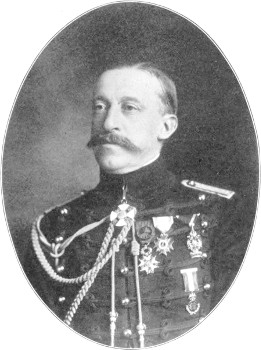
SEÑOR DON PABLO ESCANDON, GOVERNOR OF MORELOS.
A number of old Indian customs are still kept up here, modified by the introduction of Christian doctrines, in the marriages, feasts, burials, and superstitious practices. The citizens also preserve the same simplicity in their[457] dress, united with the same vanity and love of show in their ornaments that always distinguished them. The poorest Indian women still wear necklaces of red coral or a dozen rows of red beads.
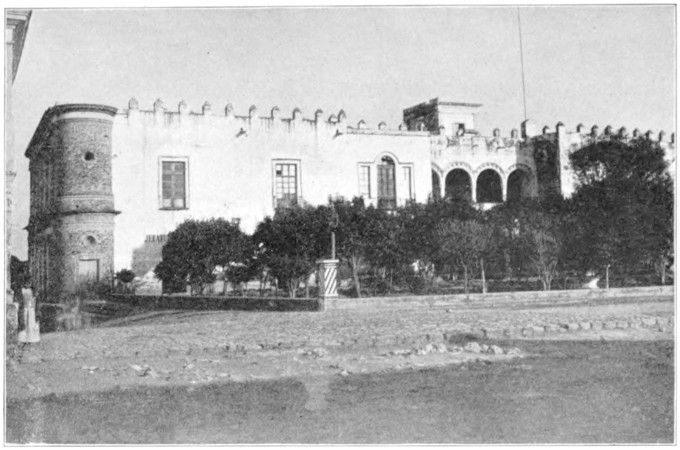
PALACE OF CORTÉS, CUERNAVACA.
Cuernavaca is situated at the foot of the southern slope of Ajusco, where the cold storms which sweep the Gulf Coast in winter can hardly gain access; hence it enjoys the perfection of a winter climate. Its summer climate is also agreeable, for its elevation of five thousand feet above sea level precludes oppressive heat. Moreover, the rain is said to fall here mostly by night. From this point one has a nearer view than from the city of Mexico of the great snowy summits rising above forested slopes, and here the interest of the view is greatly enhanced by the striking contrast afforded by an intermediate range of bare red rock, disordered masses serrated, castellated, and pinnacled beyond description. Below the town opens out into a wide valley which is green throughout the year with[458] plantations of cane. Streams of pure water course down through every street, and fountains are frequent. To this quaint and quiet town, verdant and shady under bright, warm skies, was attracted the ill-fated Maximilian and hither he was wont to ride by night to hide from assassins in the thick wood of his high-walled garden.
Cuautla de Morelos has been the theatre of important historical events. Here it was that the curate Morelos shut himself up with his troops until the Spaniards under Calleja besieged it and the priest and his party were compelled to abandon their position.
Among the attractions of Cuernavaca are the ancient palace of Cortés and the famous garden of La Borda, on which over a million dollars were lavished. Maximilian, when Emperor, had his winter home here, as had Cortés long before. The former lived for a time on La Borda estate, and Carlota and the Emperor breakfasted under its trees and spent long days in the great walled garden.
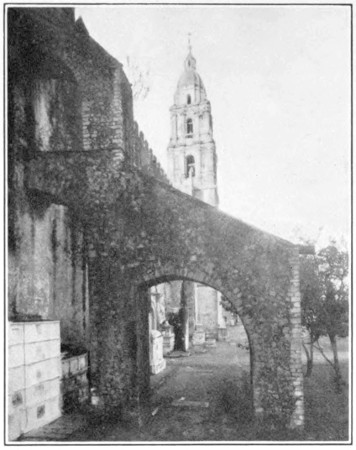
FLYING BUTTRESS, CUERNAVACA.
Cuernavaca, the ancient Cuauhnahuac, was one of the thirty cities which Charles V. gave to Cortés, and it afterward formed part of the estate of the Duke of Monteléone, representative of the family of Cortés, as Marquis of the Valley of Oaxaca. It was celebrated by the ancient writers for its beauty, its delightful climate, and the strength of its situation. It was the capital of the Tlahuica nation, and after the conquest Cortés built a splendid palace, a church, and a convent of Franciscans, believing that he was laying the foundation of a great city. The conqueror’s palace is now the government house. It is most picturesque, standing on a hill behind which starts up a great white volcano. There are some good houses and the remains of the church which Cortés built, celebrated for its fine arch.
[459]
Morelos is a sugar cane State. Governor Pablo Escandon is interested in developing the agricultural and horticultural resources; he has in view an agricultural school and model farm where farmers may see the results of new methods. He has made a complete reform of the public school system. New schools are built and the best teachers employed. Taking into consideration that the largest proportion of children of school age in the State are those of farmers and laboring men and believing that they should be taught in school matters the things that will be of assistance to them in later life, he has added to the curriculum a thorough system of manual training and domestic economy.
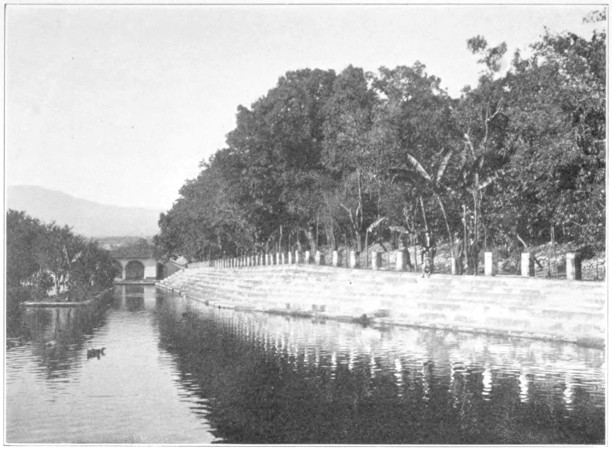
LA BORDA GARDEN, CUERNAVACA.
The late Frederick E. Church, the painter of nature, said of Cuernavaca “So far as I can judge from inquiry of good authorities, as well as from personal observation, it possesses in an eminent degree all the requirements demanded. No other place that I have visited in Mexico can compare with it in that respect.[460] The climate is wonderful. The situation commands more grand and lovely views and in greater variety than any city I have visited in all my travels. Cuernavaca will, in the very near future, become a very great resort and will be crowded all the year, for very few northerners have an idea of the climates of the country and that they are even more attractive in summer than at any other season.”
The State of Guerrero was named in honor of Vicente Guerrero, who was born at Tixtla, 1770, and executed at Cailipa, February 14, 1831. Guerrero was a mulatto and originally a slave. In the struggle for the independence of Mexico he exhibited great courage and after the death of Mina became one of the leaders of the insurgents.
The State is traversed by the Sierra Madre with its many spurs, and is consequently very mountainous, its climate varying with the elevation from very hot in the low countries to cold in the higher portions. The soil is very fertile; vegetation, particularly arboreal, is rich and varied and there are extensive virgin forests, containing excellent timber and many species of fine woods. Many of the inhabitants are miners, and on the coast numbers are engaged in pearl fishing.
The first capital of Guerrero was Tixtla which, on its selection in 1849, was immediately raised to the rank of a city. It is picturesquely situated in a narrow gorge of the Sierra Madre, and has not yet become of great importance in any respect. It is five thousand feet above sea level and its chief occupations are coarse manufactures and agriculture.
The present capital is Chilpancingo, a few miles southwest of Tixtla and situated on a pleasant tableland on the western side of the mountain range.
In January, 1902, an earthquake almost destroyed the old palace in which were all the executive offices and the Senate chamber and a new palace was built under the direction of Señor Manuel Galindo, the chief engineer of the war department. It was completed in 1906, and was opened on the 21st of March, which was the anniversary of the birth of the great benefactor, Benito Juarez. This palace is a remarkable structure with splendid reception halls and offices. The windows and doors, the face of the public clock and many fixtures were[461] brought from the United States. All the furniture came from the factories of San Luis Potosí.
One of the first duties of the governor, Señor Don Damian Flores, was to reconstruct the prison, which presented a very bad aspect, being in the centre of the city. This prison adjoined the Normal School for Professors, in which was also the Preparatory School and the School of Jurisprudence. This building was totally destroyed by the last earthquake and in view of the fact that it was not an appropriate situation for a school a beautiful prison was constructed. This is one of the most magnificent buildings in the capital. Its construction was undertaken by two young engineers, Carlos Baz and Rafael Najera, under the direction of the governor himself, whose original plans were carried out by the contractor, Señor Luis Pozzi. The first stone was laid on a memorable political anniversary, February 5, 1908, and within eleven months it was inaugurated. It is of Doric style of architecture with some changes indicated by necessity. The Portales, of the Greco-Roman style, are of purest interpretation.
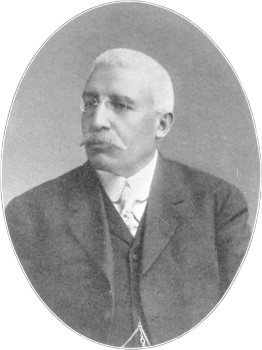
SEÑOR DON DAMIAN FLORES, GOVERNOR OF GUERRERO.
Continued earthquakes, in 1907, destroyed many public buildings. Among the most important was the Civil Hospital. A new and modern building of the most approved style now occupies the site of the old hospital. The plans were executed with fine detail and it is one of the most perfect establishments of this kind in the republic. Other annexes to this hospital are in contemplation, destined to be for general administration and the maternity asylum. The city of Chilpancingo was united with Iguala by an imperfect road that was impossible[462] to pass at times without great danger to man and beast. The government long appreciated the great necessity of a splendid roadway. Some railroad companies studied the conditions with the intention of constructing a road to Acapulco touching this city and other small villages on this same roadway. It was an impossible and expensive work. In 1905, the late Governor of the State put in practical construction the road which led to Mexcala by the way of Xochipala to the point called Milpillas and which returned to the old road and by this deviation avoided the passage over the barrancas. This work partially finished reached the small village of Xochipala when the death of the Governor suspended all operations. In 1907, when Governor Flores occupied the office of first Magistrate of the State he began to make a study of the prospect of this road being completed. In order to have a successful outcome of this plan he appealed to the State for help—and the federation subsidized a plan to the extent of one thousand dollars for every kilometre finished; the respective plans being approved the work was begun, being divided into three sections, one road from Iguala to Mexcala, another from Mexcala to Zumpango and the other from Chilpancingo to Zumpango.
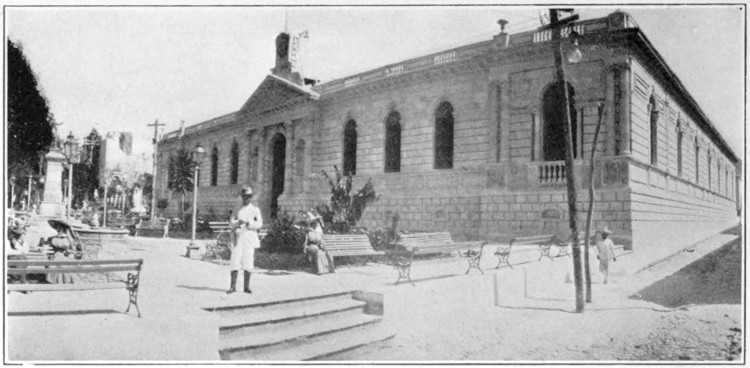
THE PALACE, CHILPANCINGO.
On the section from the capital to Zumpango, the Governor himself directed the greater part of the work. When the road was finished the President of the[463] Republic formally inaugurated it on the 10th of May, 1910, accompanied by the Vice-President, the Secretary of Communications and Public Works and other high officials and personages. He made the trip in an automobile to the capital. It was a gala day when the nation’s chief executive reached Chilpancingo amid waving banners and patriotic exclamations. Banquets and distinguished hospitality were extended to these visitors. Besides the inauguration of this automobile road the laying of the corner stone of the monument dedicated in honor of the great hero Guerrero was formally done in fitting ceremony in the midst of a great assemblage of patriotic citizens.
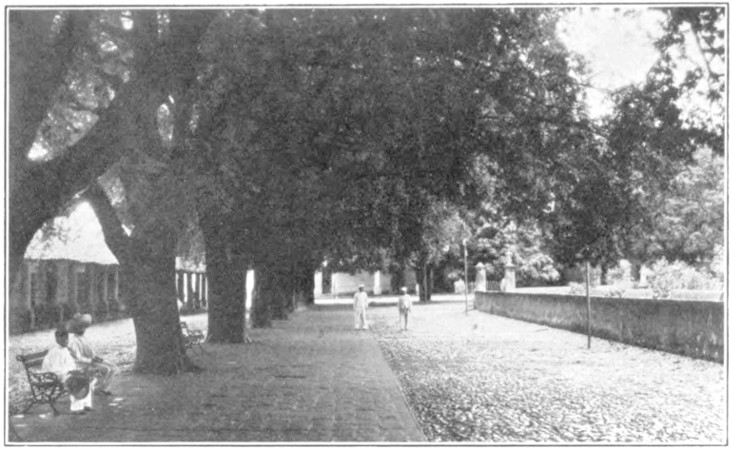
TAMARINDO TREES, IGUALA.
Acapulco is perhaps the most important town in Guerrero, as it has one of the best harbors on the entire west coast. During the Spanish dominion Acapulco was the focus of the China and East Indian route, and was a place of considerable importance. The California trader later gave it a period of transitory commercial life, as it was a coaling station for the steamers between Panama and San Francisco; but with the new railroad now in process of construction, Acapulco is destined to see greater days than ever. The region around produces the best lemons in the world, the fruit being large and juicy[464] and far more desirable than either the Californian or Sicilian product. The way will soon be opened for marketing this product in New York and other ports, when the lemon industry is likely to blossom out into the chief soil product of Guerrero.
“The Mexico, Cuernavaca and Pacific” is a line that is to give Mexico standard gauge connection with the old and historic port of Acapulco, whither came once the richly freighted galleons of Spanish commerce from China and Japan. In this connection it is worthy of note that the first fair and equitable treaty with Japan in modern times was made in Mexico.

BALSAS RIVER, GUERRERO.
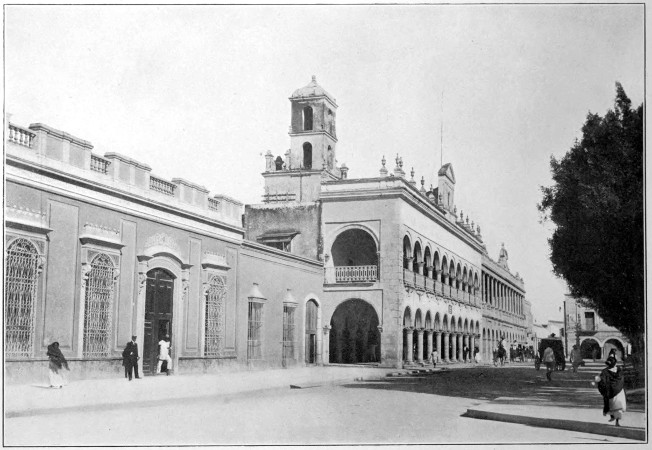
ARCADE, SHOWING HOME OF SEÑOR DON AUGUSTO PEON, MERIDA.
[467]
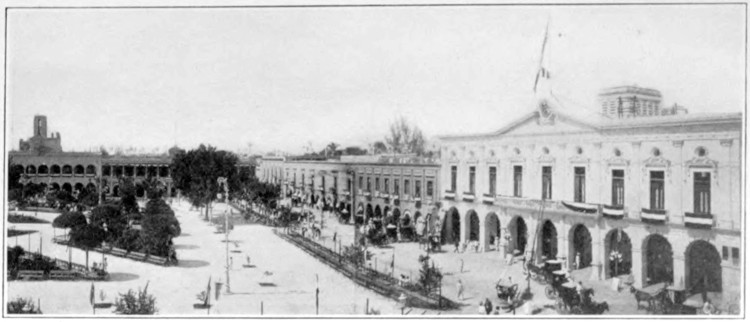
THE GOVERNOR’S PALACE, GRAND PLAZA.
In 1517, Hernandez de Cordoba discovered the beautiful Peninsula of Yucatán.
Bathed by the waters of the Atlantic Ocean and the Gulf of Mexico and possessing throughout immense area lakes and beautiful scenery, it is one of the most picturesque States in the republic. Geographically considered, the Peninsula of Yucatán extends to the Isthmus of Tehuantepec. The natural condition and elements have made this territory a theme for many studies on account of the great interest that is taken in the various resources that are presented.
Lovers of art and history and students of archæology have been drawn toward Yucatán for over a century.
The scenery impresses one as being strangely unique. Back of the coast stretches a broad lagoon many miles in extent and varying in depth with the sea. Here the northern birds spend their winters. Beyond the lagoon, the bed of coral which composes the entire peninsula rises slightly above the sea level, presenting the appearance of a dry swamp. On the roads, which run parallel with the railways, patient oxen plod slowly along, their heads bowed under heavy yokes, hauling great loads of henequen in rude carts with wooden wheels.
[468]
The great industry of this State is the cultivation of hemp, which is a species of the cacti family known as “sisal.” The magnitude and importance of this business can scarcely be imagined. The hemp grows wild in great profusion and seems to thrive best on barren lots and desert sands or in very thin soil where nothing else could find its abode. A “henequen” plant attains its full perfection in seven years. A stem shoots out from the centre of it, the leaves gradually detach themselves in the form of an immense spear or “Spanish bayonet,” with sharp thorns along the edges, terminating in a strong needle-like point. A bale of henequen fibre represents the product of about seven thousand leaves. In most places the process of making the fibre by hand is discarded as unprofitable, and the stripping of the leaves is done with great machines driven with powerful steam engines. The scraper consists of a large wheel with strong blunt knives around its rim. The henequen leaves are pressed against this rim and by means of a lever worked by machinery the knives remove in an instant the pulp which covers the fibre. The pulp having been removed, the fibre is taken from the leaves in long strips, like very fine silk thread of a beautiful green tint. It is made into small bundles and placed in the sun to dry. In the packing house the dried hanks are put up into four-hundred pound bales by a cotton-press. It is then ready for market, where its value, like other commodities, varies.
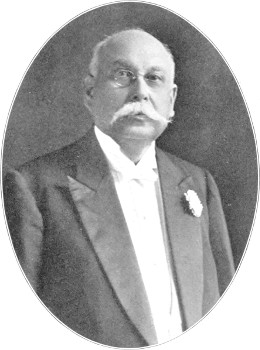
SEÑOR DON ENRIQUE M. ARISTEGÚI, GOVERNOR OF YUCATÁN.
On account of the present low price of henequen it is difficult to support the factories and meet the numberless expenses incurred during the long period of seven years until it reaches maturity and becomes commercially valuable. The farmers are now[469] thinking about reducing the area of future plantations. They are also considering the cultivation of cotton, “pochote,” castor oil plant, and all the products indigenous to their climate.
A great interest is awakening in the manufacture of ropes, twines of all sizes and bagging of all description, to such an extent that the factory La Industrial has been manufacturing these articles for more than a year and selling them at such profit that the demand is greater than the supply. Had it not been for the excessively low price of hemp the farmers would not have awakened to the fact that the time had come for them to look for new cultures and develop new industries, and the fall in the price of henequen has deeply impressed the minds of the growers, with the result that many new industries will soon become established in this State.
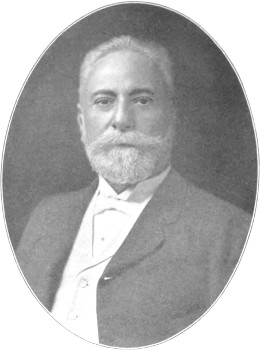
SEÑOR DON AUGUSTO PEON.
Next in value to henequen comes the bromelia pita, locally known as “ixtle” the ancient Aztec name. From this the Mayas’ clothes are made: it formed the foundation of the beautiful feathered cloaks of Montezuma’s time. The ixtle furnishes the poorer classes with their garments and hammock-beds in which they are born and die, and their baskets and household utensils and paper are manufactured from the fibre. From the roots of the plant a favorite intoxicant is brewed; the juice of its bruised leaves is the best known remedy for wounds; its thorns are the Indian pins and needles. A few years ago some ixtle fibre was sent to England for experiment in the great cloth manufactories and from it some handkerchiefs were woven which have since figured in several expositions, to the astonishment of all beholders.
While the Mexican people are noted for their politeness and courtesy, the[470] Yucatecas seem to have more than their share of delightful simpatia. The women are beautiful and cultured and in no part of the republic is the social element more remarkable than here. Merida is called “The White City” and has been famous for its brilliant carnival celebrations. At these times enthusiasm and animation reign supreme.
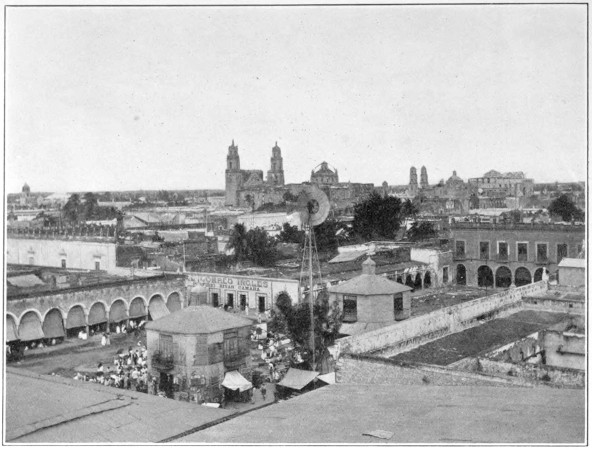
VIEW OF MERIDA.
Merida was founded by Don Francisco de Montejo in 1542. The original home of its founder is still standing. It is located on the principal plaza and is an object of great interest. The entrance to this house is a wonderful specimen of antique carving.
The cathedral is one of the handsomest and largest in the republic and the many beautiful temples are most interesting to visit. Some fine old carvings of the time of the Spanish viceroys are seen in many of these churches.
[471]
The new Peon Contreras Theatre ranks in beauty with any building of its kind in the world. The splendid appointments of this theatre and its marble columns and corridors are a marvel to those who have seen it. It was built under the supervision of Señor Don J. Rafael de Regil, demonstrating splendid taste and judgment.
Many prominent buildings have been erected in late years which are a great credit to the city. The General Hospital, the Penitentiary, the Insane Asylum and all the city government buildings are modern structures equipped with every luxurious necessity. The Episcopal Palace is a specimen of antique architecture and is one of the largest in the republic. Merida has many benevolent societies and the public benefit is well guarded. Orphan asylums, correctional schools of arts and crafts, an asylum for beggars, and a maternity house.
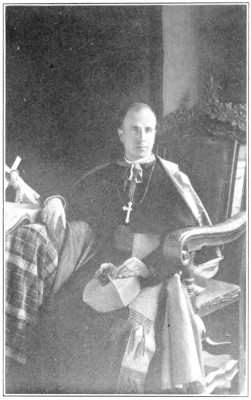
HIS GRACE, MONSEIGNOR MARTIN TRISHLER, FIRST ARCHBISHOP OF YUCATÁN.
Some of the finest hammocks in the world are made in Yucatán. They are hand woven of the sacci fibre and are of unusual size. This State is as famous for its hammocks as Switzerland is for its clocks. The finest come from the penitentiary at Merida.
The Paseo Montejo is one of the fashionable drives. On it are handsome residences, among which is the palatial home of General Francisco Canton.
The prehistoric race that peopled Yucatán and the wonderful monuments and ruins they left behind them have baffled explorers from all parts of the world and there are many theories advanced concerning the builders. The natives[472] regard these decayed cities with superstitious awe, and they remain much in obscurity because few have braved the wilderness in order to explore them. The ancient knowledge of architecture is proved by these marvellous structures and amazing relics. The ruins of Chichen-Itza and Uxmal are accessible from Merida.
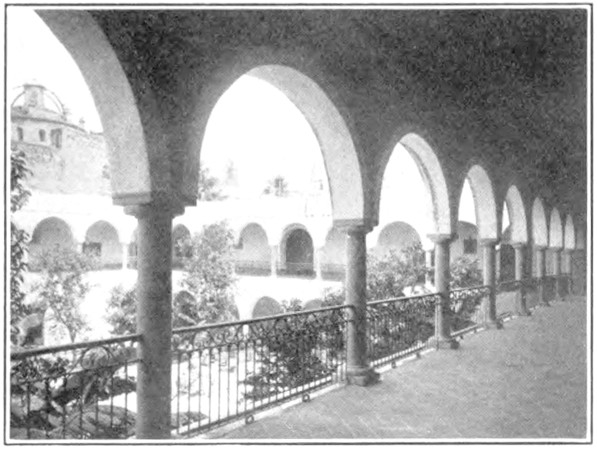
CORRIDOR OF THE CURATE HOUSE, MERIDA.
There are two agricultural chambers in Merida, “La Camara Agricula Nacional” and “La Camara Agricula de Yucatán,” which are doing great work in promoting the industries of the State. One of these recently had an exhibit demonstrating the wonderful possibilities of the henequen, and among the numerous articles were baskets, hammocks and cloth, three widely different articles. The fruit and vegetable display consisted of the products of the State.
A monthly magazine devoted to the interest of farming called El Agricultor, is published by the Camara Agricula.
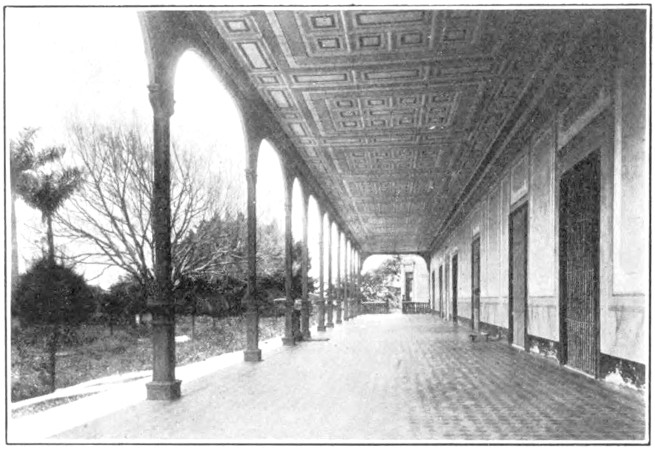
MODEL SCHOOL FOR BOYS, MERIDA.
In the Yucatán Museum there is an interesting collection of monoliths, statues, prints and other details of the old Maya architecture, utensils and personal ornaments of a primitive and mysterious race that inhabited the peninsula. Another museum which merits special notice is that of the late Bishop De Crescencio Carrillo y Ancona, who was the first director of the State Museum. Fine parks and public gardens help to add to its beauty: in one of[473] these parks stands a splendid statue of General Manuel Zepeda Peraza, the great patriot of Yucatán.
Señor Don Augusto Peon is the mayor of the city and many reforms have been executed during his administration. New streets and avenues have been opened and schools have been established. He is noted for his philanthropy and the poor have found in him a good friend. His family is one of the most distinguished in the State and he is held in great admiration and respect.
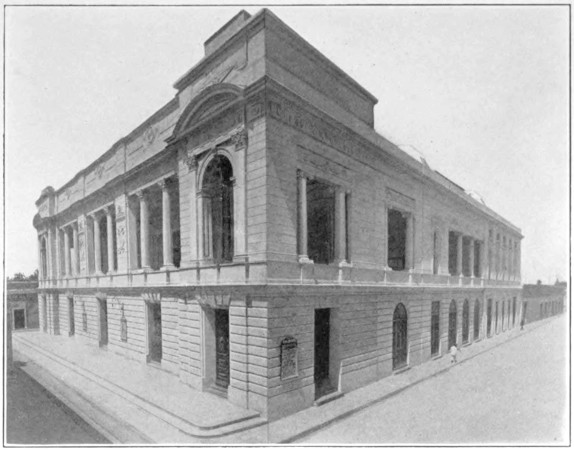
THE PEON CONTRERAS THEATRE.
Public education is given the most rigid attention. Among the most important schools are those of San Vicente de Paul, under the direction of Obras de la Ensenanza. These schools are conducted upon monthly subscription by those interested in the Christian education. In the scientific and religious instruction all the precepts of modern pedagogy are followed. The elementary schools for boys and girls are supported by the estate of the late Leandro Leon Ayala. These schools are divided into five branches with an inspector appointed[474] for the supervision of each. The literary institute founded by General Peraza is under the personal direction of Señor Licenciado D. Olegario Molina, who is one of the distinguished statesmen of the republic. To this noted gentleman the State of Yucatán owes its wonderful growth within the last ten years. He has occupied many high official positions, having been governor of the State before assuming the cabinet office. He was the engineer who had charge of the construction of the first railroad that was built in the Peninsula, which connects the capital city with the port of Progreso.
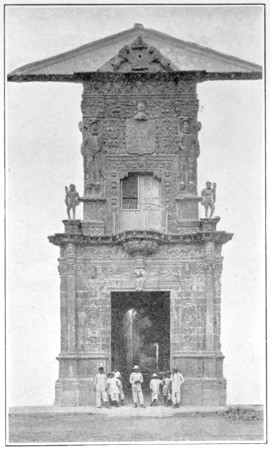
FAÇADE OF THE MONTEJO HOUSE, MERIDA.
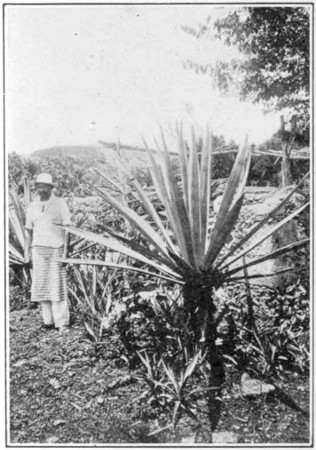
INDIAN HEMP CUTTER.
This railroad was constructed with local capital and the entire enterprise was organized with great success. In the cultivation and development of the henequen industry, Señor Molina has been foremost in the enterprise. He is noted for entering into everything with enthusiasm and in the reconstruction of his State while he was governor, he adopted the famous system of his chief magistrate, General Diaz, of “less politics and much administration.” With perseverance, which is characteristic of this official, Señor Molina consecrated his attention to the irrigation and industry of the State, which are important factors in the national good, and during his administration agriculture assumed splendid results[475] and the record that remains behind him is a monument to his greatness. The present governor is Señor D. Enrique Muñoz Aristegúi, who is progressive and enterprising and has followed closely the example set by his predecessors.
The United Railroads of Yucatán have eight hundred kilometres of various lines which extend to all important points of this State and to Campeche. This company was formed in 1902, being a merger of several independent lines, as follows: The railroad from Merida to Progreso with a branch to Izamal; from Merida to Valladolid with a branch to Progreso; the Peninsula Railroad; the railroad from Merida to Peto with a branch to Sotuta. The construction of the first railroad was organized by Señor José Rendon Peniche.
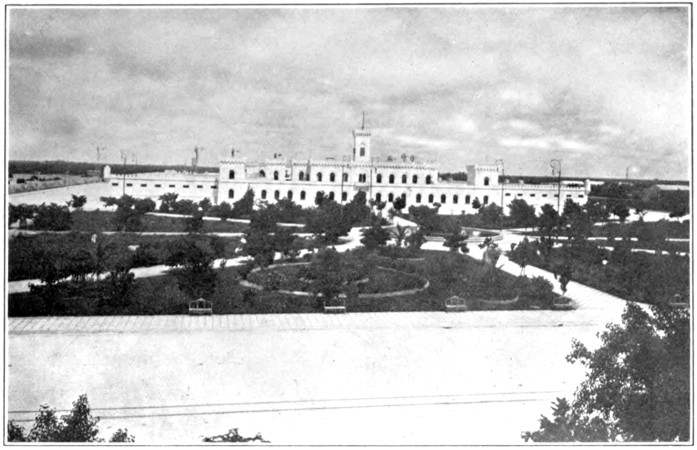
JUAREZ PENITENTIARY, MERIDA.
The principal points which these railroads touch are Valladolid, which is known as the Sultana of the East, and was at one time a city of much more importance than to-day; Tizimin, where the three kings, Magos, annually met; Motul, the next largest city of the State, and a centre of importance on account of the henequen industry; Izamal, another important industrial centre and famous for the pilgrimages to the Virgin de la Asuncion; Tekas and Peto, important[476] cities of the sugar industry; Ticul, the centre of the corn region; Halacho, another point famous for its religious feasts. The only port in the State is Progreso. The Ward Line steamers touch this port and this company runs excursions from the port to Merida, giving the passengers a glimpse of this unique part of Mexico, returning to the steamer in time to continue their voyage.
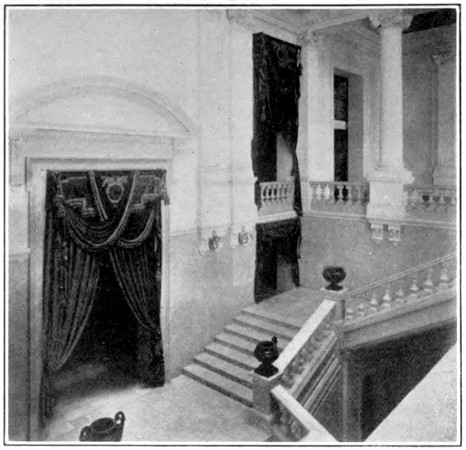
STAIRWAY IN THE PEON CONTRERAS THEATRE.
Mr. W. P. Young, of the New York and Cuba Mail and Steamship Company, has formulated plans for excursions to Yucatán on a twenty-day tour to see the ruins and enjoy the wonders of a semi-tropical climate during the winter months. This is an excellent opportunity for the student or traveller.
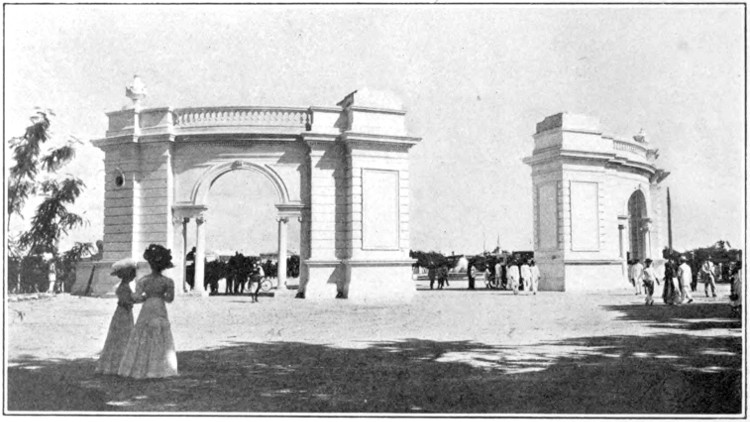
ARCH BUILT TO CELEBRATE THE CENTENNIAL, MERIDA.
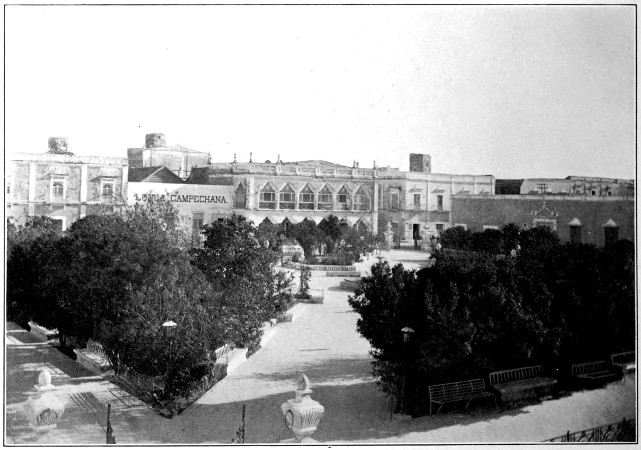
PLAZA DE LA INDEPENDENCIA, CAMPECHE.
[479]
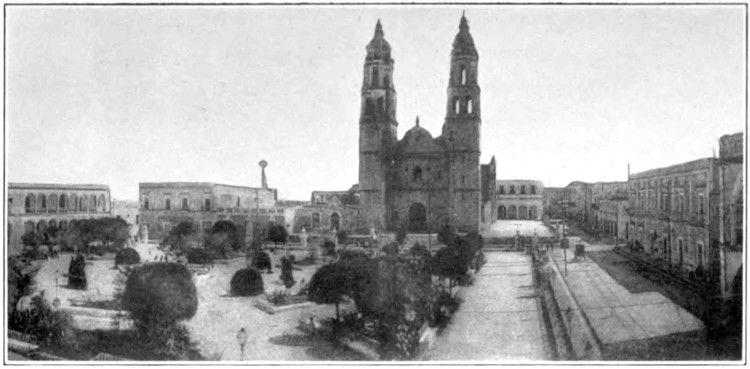
THE CATHEDRAL, CAMPECHE
The State is called Campeche de Baranda in honor of the father of the late Señor Joaquin Baranda, who was in the cabinet of General Diaz in 1896.
The capital is the City of Campeche, which is also an important seaport for all the surrounding States. It is situated on the Bay of Campeche at the mouth of the San Francisco River. It has a population of about twenty-five thousand, and is fast growing. The narrow streets are irregular, and the houses remarkable for their uniform height of one story, their square form, and for all being built of the limestone which abounds near the city.
Campeche was founded in the middle of the sixteenth century and has figured in history more or less ever since. It was sacked by the British in 1659, and again by pirates in 1678, and by filibusters in 1685. Its site has been twice changed, the present one being honey-combed with subterranean chambers which were dug out years ago by the Maya Indians, ruins of which structures may be[480] seen in the vicinity of Campeche. The city has several churches and convents, a museum containing interesting aboriginal relics, a theatre and several schools and colleges. It has a beautiful alameda, embellished with alleys of orange trees and seats of the native marble. The port is defended by three fortresses.
Carmen has the best harbor on the coast, and is one of the least known ports. Large quantities of mahogany are felled in the interior and floated down the stream to the port.
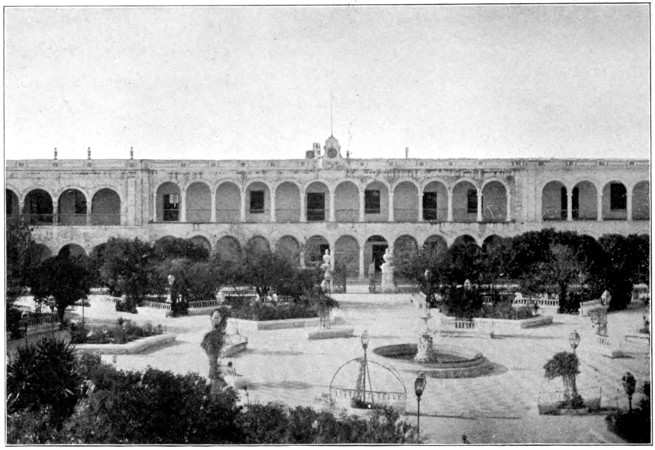
PALACE OF JUSTICE, CAMPECHE.
The commerce of Campeche was, under the Spanish colonial system, in a most flourishing state; but it is now confined mostly to salt, sugar, hides, henequen and articles manufactured from it. Logwood and other dyestuffs are still exported in quantities, but the cigar industry is greater. The Campeche cigars are made from Tabasco tobacco and are often sold in foreign markets for the Havana product.
[481]
Between Merida, the capital of Yucatán, and Campeche, there is a railway line which connects the two cities. This is a delightful route on account of the magnificent scenery. Rich forests filled with timber and valuable dye-woods extend throughout the State. This is one of the chief exports, finding a ready market in Europe and the United States.
The governor of Campeche is Señor Garcia Gual, whose interest in his State is very evident. He is handicapped by many difficulties in the climatic influences, distinctly of the tropical belt, but his administration has been remarkable for the improved sanitary conditions and the spirit of advancement he has instilled into the minds of his people.
Public education is the first step of the Mexican on taking the reins of a government. Schools and all benevolent institutions have in the governor an able advocate, and he carries his plans of reconstruction and enterprise with a firm hand.
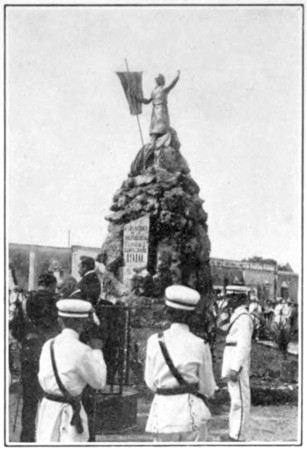
STATUE OF HIDALGO, CAMPECHE.
The latest-formed Territory of Mexico, Quintana Roo, lies between the State of Campeche and Guatemala. The inhabitants are principally Maya Indians, that race that has been so troublesome to the Mexican Government. The language is mostly Indian and they seem to show no disposition to speak Spanish, or to become used to the forms of modern civilization. Most of the industries consist of hand-work and Indian crafts, but the Territory is rich in valuable woods, and many tropical fruits. There are some good tobacco districts and the country bids fair to become a good agricultural section. The policy of the administration of General Diaz is clearly demonstrated in the splendid manner in which the Federal Government gained control over the unruly tribe of Indians in this Territory.
On account of the condition of the country the population and the area have not been ascertained. Military control makes it secure that there will be no[482] more outbreaks such as have hitherto threatened peace and life. In spite of the characteristics of these Indians, the towns are well equipped with schools.
Tabasco is the great fruit growing State. It stretches along the coast of the Gulf of Mexico and has become greatly developed within the last few years by various colonies from the North. The population is largely composed of peaceful Indians, although many foreigners have yielded to the temptations that the rich and abundant resources have offered. There are many lagoons and inlets along the coast, and the Islands of Laguna Carmen and Puerto Real. The surface is flat except in the southern portion, where it rises toward the mountains of Chiapas. There are two navigable rivers, the Usumacinta and the Tabasco. There is a large amount of freight shipped on these streams, as they are the principal thoroughfares of the State. An unusual amount of mahogany and other useful woods abound. All tropical products are extensively cultivated and magnificent opportunities for further development are offered.
The capital and largest city is San Juan Bautista. Cortés and the Spanish army discovered Tabasco and made a landing there before they went on to Mexico. It was then a very popular place, with the better houses built of stone and lime and the others of mud or adobe. The inhabitants, the Tabascan Indians, gave proof of superior refinement as well as unusual valor. Their stout resistance, however, did not prevent Cortés and his soldiers from finally gaining and capturing the country “in the name of the Crown.”

GENERAL ABRAHAM BANDALA, GOVERNOR OF TABASCO.
Many of the Spanish conquerors settled in Tabasco; others, in the cordillera toward the rich slopes and valleys of Oaxaca.
[483]
A great deal of the country is sloping and very much broken, but at least four-fifths could be well cultivated. Coffee always require a slope. The population, which is sparse, consists principally of Indians. These people labor faithfully and cheerfully at light work, such as coffee gathering.
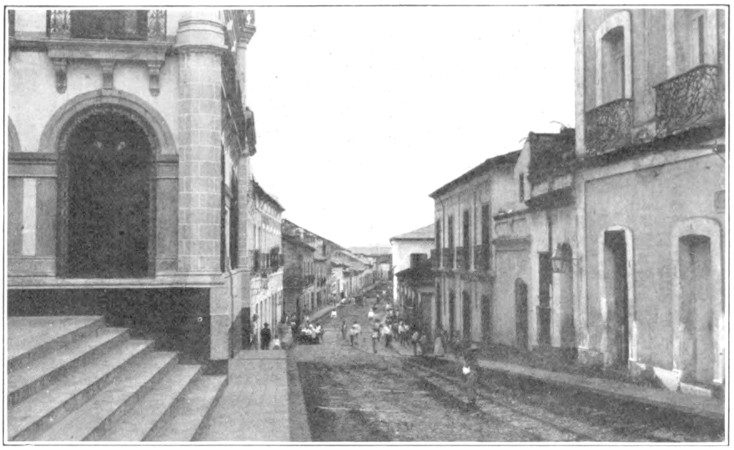
STREET SCENE, SAN JUAN BAUTISTA.
There is no finer country in the world awaiting development than this general slope. The rainfall is abundant. The climate is very healthful.
There is a good quantity of water-power available all through this State; the supply of it toward the wilder end of the slope is practically unlimited.
There is plenty of building stone in the country. Part of the slope has an unlimited quantity of marble of all colors.
The trade of the State is controlled by Spaniards, who also own nearly all the steamers sailing under the Mexican flag in the Gulf of Mexico. They send home to Spain about one million dollars annually. A good many marry in the country and their children are among the best types in the State.
[484]
This country unites all the conditions for happy, reasonable living. It is a fine coffee, corn, cane and cotton country and the annual shipment of bananas exceeds that of some of the larger tropical States.
The capital, San Juan Bautista, is on an island of volcanic origin thrown up in the midst of the alluvial plain of the Grijalva, about sixty-five miles from the sea. It has a population of about fourteen thousand and is provided with street railroads and a first-class electric light plant which furnishes extensive service. More than a million dollars have been put into new buildings since 1897, about half of that amount having been invested by foreigners. This city is noted for its rapid advancement and great prosperity. Although at certain seasons it is excessively hot there seems to be a bracing influence, for the streets have an air of activity and the shops seem always busy.
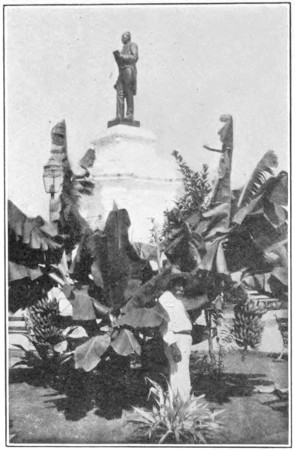
STATUE OF JUAREZ, SAN JUAN BAUTISTA.
The Governor of Tabasco, General Abraham Bandala, is a hard-working and able functionary to whose heart the interest of the people under his care is ever the first consideration. He is one of the great soldiers of the Mexican Wars and his record is emblazoned on the history of the country.
The general aspect of Chiapas is very unlike that of Northern Mexico. There is very little barren country, the medium and lower regions being covered by forests of valuable woods while the cultivated parts show fields of all kinds and abundance of crops. Through the ports of Tonala and San Benito, on the Pacific, the rich districts of Tonala and Soconusco can be reached and from the former port the towns of Tuxtla, Chiapa and San Cristobal are accessible by means of an automobile road.
Chiapas is the most southern State in the Mexican republic.
[485]
Commerce is the most important industry of this State, while agriculture within the last few years has made rapid strides and has added materially to the wealth of the State. On the Pacific side coffee is extensively cultivated and there are several sugar-cane plantations, as well as tobacco fields.
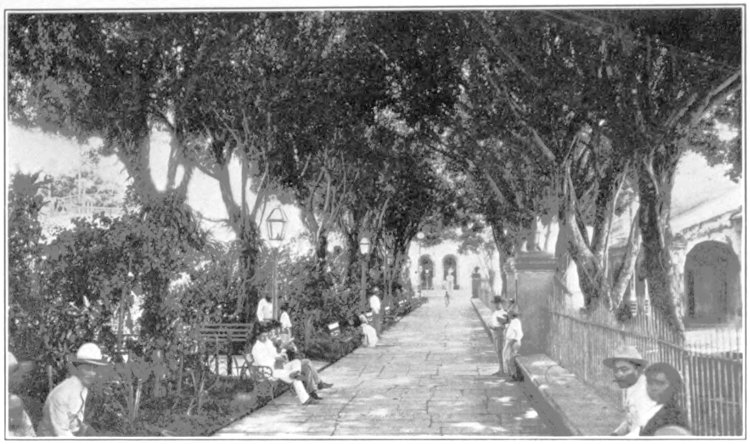
PARK IN SAN JUAN BAUTISTA.
El Salto, headquarters for the department officials, is situated on the Tulija River.
Since the conquest of Mexico by the Spaniards, the cacao of this district has been famous. Large amounts of foreign capital are streaming into the country for investment.
Tuxtla-Gutierrez is the capital and the residence of the State officials. It is the best trading town, being in communication with all sections of the State. A well constructed automobile road connects Tuxtla with the Port of Tonalá and the branch near the coast extends to the Tehuantepec Railway. Splendid roads connect the capital with the towns of Suchiata and Chiapa and the plains that follow the left side of the Chiapa River render the country accessible as far as Guatemala.
[486]
New colonies are being exploited and hundreds of thousands of acres of land are being bought by settlers.
To the governor of the State, Señor Don Ramón Rebasa, is given credit for the close attention to the extension of public roads and the encouragement of education.
In the opening of the railroad extension from San Geronimo, on the Tehuantepec road, to Tapachula in Chiapas, another link in the great Pan-American Railway was completed. The inauguration on May 5, 1908, was made the occasion of great rejoicing in the State of Chiapas, being presided over by the governor and celebrated with enthusiasm by the inhabitants.
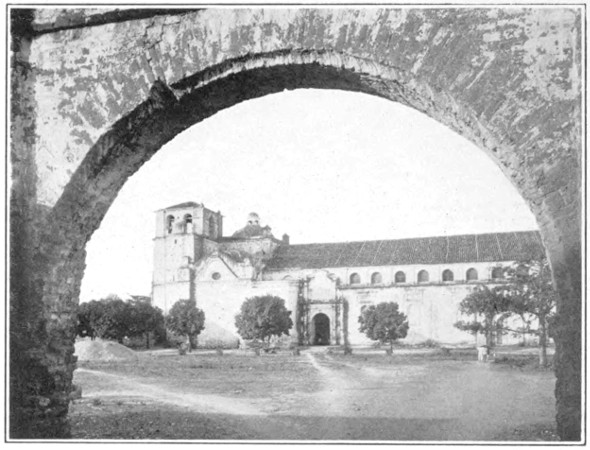
PAROCHIAL CHURCH, CHIAPA.
[487]
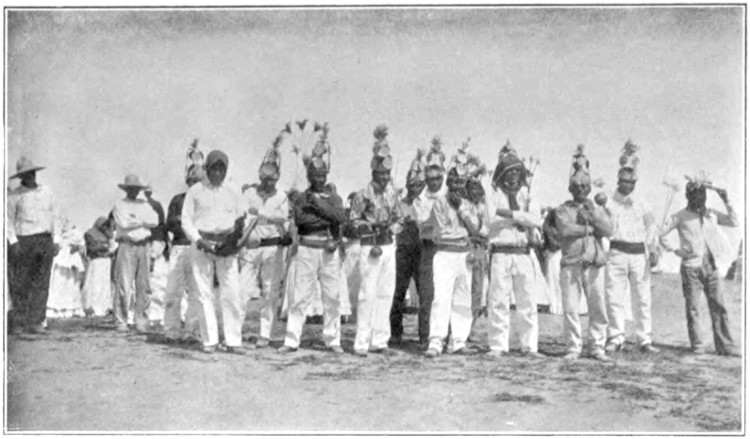
YAQUI INDIAN DANCE.
The characteristics of a country are always an interesting theme and it seems that Mexico is bountifully supplied with legends and traditions that lend to her all the charms of a poetic and romantic nation. Born in a land of natural wealth and beauty, breathing the balmy air and beholding the bright sunshine of this country, the Mexican must be by nature allègre and alert to all the graces of living.
The customs of the people, like those of all rapidly developing nations, are fast changing and in a few years there will remain few habits and fashions to distinguish this country from any other land. At the same time, Mexico retains many charming characteristics that she will never lose. Her warm hospitality, the frank extension of a friendly hand, the open door of the home, the adoration and respect paid to her women and the love and reverence bestowed upon her heroes will always stamp the Mexican as exceedingly attractive.
In the home the life is sweet and supremely happy. Little children kiss their parent’s hands, the old folks the hands of their elders, and the benediction[488] of the padre, who comes to pay a short call, is eagerly sought by old and young. In matters pertaining to religious education the Mexican child is reared in rigid form. He is taught to hold in reverence all the church feasts, and the precepts of the priest in charge of the parish are faithfully followed.
Carmen Day has been a great religious feast for six hundred years in the Catholic calendar. Hundreds of homes are annually made happy with visits and gifts to the Carmens, who are remembered by their friends. Since Madame Diaz has been the first lady in the land, Carmen Day has been more popular than ever, as it is the feast of her patron saint.
Every town in the republic has its plaza, which is always laid out with beautiful flowers and shrubs, with walks going around the square wide enough to permit many people passing back and forth. In the evenings and on Sundays the Municipal Bands render popular music and the young folks promenade for several hours. The young men take one direction and the señoritas the opposite, so they meet face to face at every turn. In this way the language of the eyes plays an important part. Sometimes a tiny note is slipped, sometimes a stolen word, by a bolder aspirant.
The architecture of the Mexican house, with its barred windows and well-guarded doors tends to incline the people to lead exclusive lives, and yet once within these massive portals the beauty and love of the home life are seen in many ways.
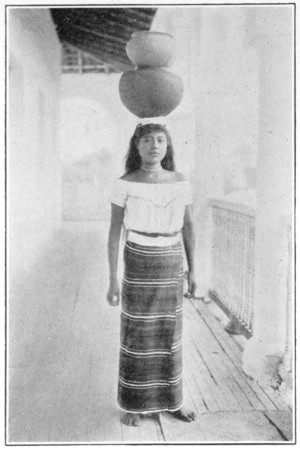
INDIAN MAIDEN WATER CARRIER.
The custom of the master placing his house and everything in it at your disposal (esta a la disposition de usted) is very pleasing to note. You admire a ring, it is at your service; a horse is offered you; letters are dated from your house (la casa de usted). Some, from ignorance of the custom of these mere expressions of civility, often place their hosts in a dilemma. A charming American[489] lady, wife of one of the great generals, once admired a handsome fan belonging to one of the ladies in the official circle and on being told it was hers accepted it with great delight, much to the consternation and embarrassment of the señora. She carried her treasure home, but later learned that the gracious proffer was a custom of the land and returned the fan with a diplomatic note.
The market places are a source of great wonder and interest. Here small tables and bits of straw matting are placed on all sides and upon these the men and women display their wares. Vegetables, fruits, and goods of all description are arranged in heaps, always with an eye to system and attractiveness. The people are sheltered from the intense rays of the sun by awnings of cloth or matting. They are all polite, and with their bright smiles easily gain customers.
Together with the vegetables or flowers are found fat, pretty babies with black eyes, and always sweet and charming. The flower-market is a place of enchantment, for the love of flowers is a strong trait of character in these people. Here are men and women arranging great bunches of exquisite blossoms with a delicacy of taste that is surprising.
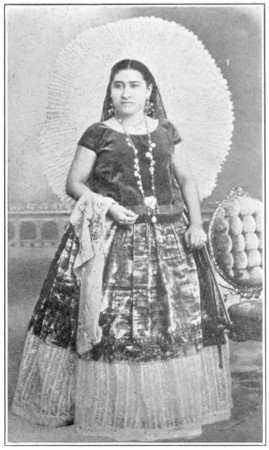
TYPE OF TEHUANTEPEC WOMAN.
One of the Easter customs is the hanging in effigy of Judas Iscariot, which is done everywhere in the country, from the large cities to the smallest hamlets. Mexicans attire themselves in black during Holy Week, and on the Saturday before Easter Day these grotesque figures of him who betrayed the Master are brought out everywhere and hanged and burned with all the contempt due to the betrayer.
Peculiar little rattles which make a clatter representing the breaking of the bones of Judas are sold on the streets on Good Friday.
[490]
On the twenty-first of August the Indians observe a feast in memory of the tortures to which Cuauhtemoc and his general were subjected by Cortés in an effort to secure information concerning the buried treasure.
The laws of Mexico provide for the welfare of the Indians in a liberal manner and the best means of improving their mental and moral development is occupying the attention of the leading educators of the country. A society has just been formed in Mexico City for the protection of the Indians. The question as to what should be the political responsibility of the primitive people, untrained in independent thought and action, is not easily disposed of, and blunders which have been committed by the most enlightened nations in this respect prove how important is this problem.
The Indian is still a child in mental and moral growth, but he is progressing under the benign influence of peace and security. Those who dwell in the mountainous districts have preserved in all their purity their ancient habits and primitive language.
In some districts, as in the region of the Sierra, they preserve their native dances, and during certain religious ceremonies they execute these dances in their temples before the most venerated images.
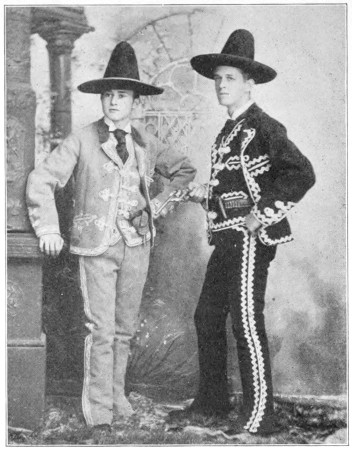
IN RIDING COSTUME—CHARRO SUITS.
Many Mexican families are of noble lineage, dating back to the eight hundred years’ war with the Moors, when their ancestors were ennobled for gallantry of service to their kings. Some of the best families are very poor but conserve their dignity and position always.
[491]
Newer families of social distinction are descendants of successful soldiers who stood somewhat in the same relation to the old aristocracy as did the marshals and generals of Napoleon I. to the old French nobility. Descendants of presidents constitute another kind of aristocracy, in fact, service to the State in high office gives one’s family and descendants a claim on popular consideration and respect. There are many descendants of the Aztec monarchs living in other countries, but few in Mexico. One of the small number remaining is Coronel Prospero Cahuantzi, Governor of the Aztec State, Tlaxcala. He is a pure-blood Aztec Indian and speaks the language with a softness that is delightful.
The ancient marriage customs of Yucatán are unusual as well as interesting. From time immemorial the Maya women have worn a simple form of dress which they never vary. It consists of two pieces, a very full skirt falling to the ankles and a loose upper garment called huipil, joined under the arms, only it hangs in graceful folds after the manner of the Greek peplum. Cotton or linen is the material, always plain white, though trimmed with colored embroidery. The women load their necks and ears with beautiful hand-wrought filigree jewelry.
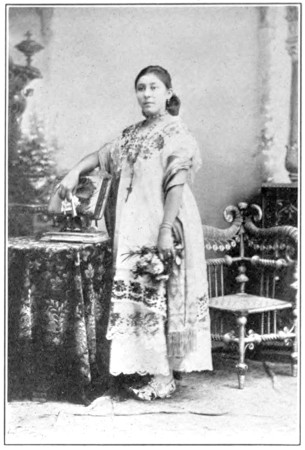
A TYPE OF THE MAYA WOMAN, YUCATÁN.
In almost every State there are certain dances and music typical of the people. In Yucatán there is a particular dance called the vaqueria. It is performed at the public fiestas by the mestizos dressed in exquisite costumes, brilliant in colored embroideries. The graceful dancers are inspired by music from a stringed orchestra of native performers, and their dainty feet move with a rhythm that is most fascinating.
Mexico owes much of its peculiar beauty to the religious fervor of her[492] inhabitants. Everywhere white crosses gleam among the trees, in solitary paths, on mountain tops and at the openings of mines. Even the haystacks have crosses fashioned in a rude way upon them, and buildings in course of construction are never without the sign of the cross. Wherever the footsteps of man pass, on rude huts, or barren rocks, the emblem of the faith stands, and in every hamlet the temple of God arises in comparative splendor. The symbol of the cross, strange as it may appear, was known to the Mexican Indians before the coming of Cortés. There was a temple dedicated to the Holy Cross by the Toltecs in Cholula and near Tulancingo a rock stands, engraved with a cross and other hieroglyphs or signs. Among the faithful-looking old trees a church will be found, gray and ancient, always gleaming in the soft light, the insignia of the Christian faith. The Indian, plodding to the nearest village with his wares will stop for a few moments to mumble his prayers before a cross that stands at the roadside. Wherever a murder or an accident has occurred rude crosses are always planted; sometimes it is only the branch of a tree fashioned in a primitive way, but always a cross.
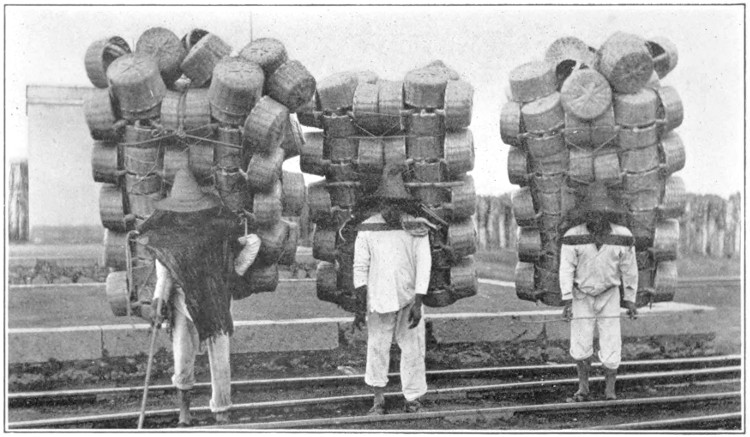
MEXICAN BASKET SELLERS.
[493]
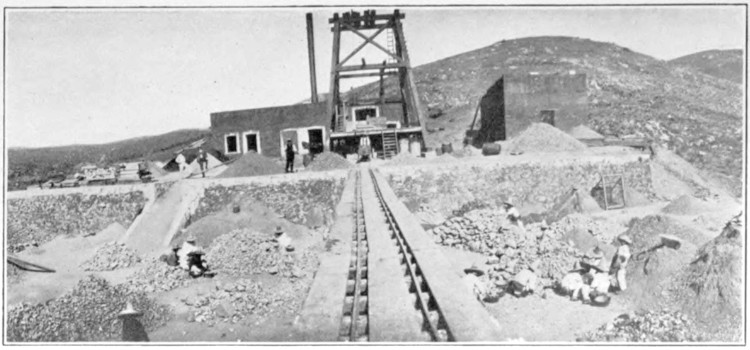
SAN BARTOLO MINE, ZACATECAS
Few Americans realize that Mexico was “discovered” and settled by Cortés a hundred years before any settlement was made in the United States. And in natural advantages no other portion of this marvellous western hemisphere can claim a place above her.
Mexico is the geographical centre of the earth, an imperial place in the great highways of the world. The country extends between fourteen degrees and thirty minutes and thirty-two degrees forty-two minutes north latitude, and between eighty-eight degrees fifty-four minutes and one hundred and nineteen degrees twenty-five minutes of longitude west of Greenwich.
The frontier line which separates Mexico from the United States starts near the mouth of the Rio Grande from a point in the sea three leagues from the coast, follows the line of the river to its intersection with the parallel of latitude thirty-one degrees thirty-seven minutes forty-seven seconds North (at Ciudad Juarez), runs in a straight line westward one hundred miles and then bends to the south to thirty-one degrees twenty minutes, then follows the parallel westward to one[494] hundred and eleven degrees of longitude west from Greenwich, and continues in a straight line to a point at the Rio Colorado twenty miles from its confluence with the River Gila, then it turns toward the north of this confluence and bends toward the west, following the line between Lower and Upper California. From Ciudad Juarez westward the boundary lines are marked with two hundred and fifty-eight massive stone and iron monuments. It has a northern frontier of fourteen hundred, and a southern of three hundred and forty-five miles. It has a seaboard of sixteen hundred and seventy-seven miles on the Gulf of Mexico and the Caribbean Sea, two thousand and forty on the Gulf of California and four thousand four hundred and eight on the Pacific Ocean, making six thousand and eighty-six.
The area of this immense republic is nearly eight hundred thousand square miles. The face of the country is extremely diversified. The littoral regions are in general low and sandy, especially on the Atlantic side, where they were probably submerged at no remote period as far as the foot of the mountains. In no part of the republic within thirty miles of the sea does the land rise higher than one thousand feet, except, perhaps, in Chiapas, where the chain of the Mexican Andes presents a mural barrier facing the ocean, toward which the descent is exceedingly rapid. On the railway from Vera Cruz to the capital every variety of climate is experienced within the space of a few hours, and the natural productions peculiar to each are successively passed in review, from the sugar-cane, indigo plant and plantain of the tropics to the pines, firs, and lichens of the North.
The Valley of Mexico is an elliptical plain with an area of about nine hundred and forty square miles, fringed on the east, south and west, by lofty peaks, some of which are active volcanoes; the plain may be regarded as one vast volcanic hearth, roughed at intervals by isolated hills rising abruptly from the surrounding level. The most elevated summits are at the southeast, where Popocatepetl and Iztaccihuatl tower majestically over all the rest. So regular is the great plateau formed exclusively by the broad, undulating, flattened crest of the Mexican Andes, and so gentle are the slopes where depressions occur that the journey from Mexico to Santa Fé, New Mexico, might be performed in a four-wheeled vehicle.
There are seventeen mountains—ten of which are volcanoes—which are over ten thousand feet in height. Popocatepetl ranks first at seventeen thousand[495] five hundred and forty feet, and Orizaba next at seventeen thousand one hundred and seventy-six feet.
The volcanic zone is about six hundred miles long from east to west, and over sixty miles wide. Its central line starts at the volcano of Colima near the Pacific and ends in the volcano of San Andres Tuxtla, near the north of Mexico.
The crest of these vast cordilleras, seen from the savannas of the coast, is defined from afar sometimes against a blue and all transparent sky, sometimes against a misty background. Granitic rocks or snowy peaks accentuate a country which rises in vast echelons to the central plateau. Bounded on the east and on the west by a succession of heights, which merge into the axis of the two grand mountain chains into which the cordillera divides, it is different in many points from those ranges which traverse South America and of which they are the continuation.
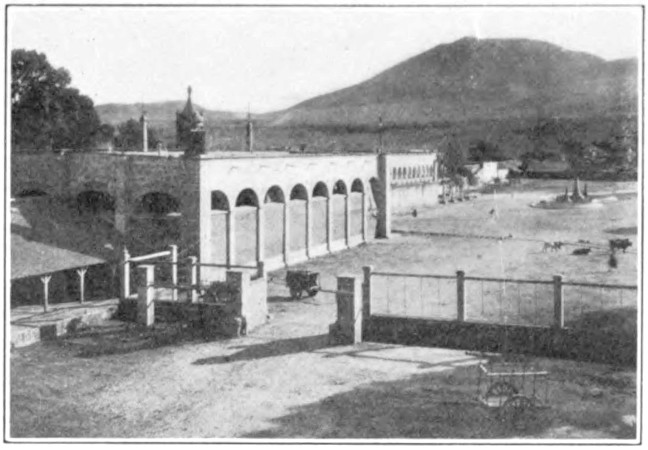
SUGAR MILL, ATEQUIZA HACIENDA.
The mineral deposits of Mexico are richer than those of any other country, and it is known that still more valuable mines of silver and gold are being discovered.
The mines during the colonial period were crown property, and those who worked them paid one-fifth of the product to the king. When Mexico became independent they were declared public property and miners were required to pay into the national treasury only a small percentage of the yield. Even this tax was afterward abolished, and anyone can by right of discovery, denounce or record a mine and obtain authority to work a certain number of varas free of tribute. A slight tax, is however, imposed on melting and coining the metal.
Situated below the tropics, the climate of Mexico is not less uniform than diversified. The temperature of each locality is almost always the same, yet the different localities present many distinct temperatures.
[496]
There is comparatively little difference between summer and winter, except that one is the wet season and the other the dry. The climate can, as a whole, be classified as temperate, yet the country may be considered as divided into three zones—the hot, the temperate, and the cold.
The hot region of this country comprises the Peninsula of Yucatán, the State of Tabasco, and the greater part of the States of Vera Cruz and Tamaulipas near the coast. The torrid district on the Pacific Ocean extends to the Territory of Lower California.
The cold district and the central plateau occupy the plains on the north of the States of Michoacán and Mexico, the Federal District, the northern and eastern parts of the State of Puebla, the States of Tlaxcala, Hidalgo, Querétaro, and Guanajuato, part of Jalisco, the State of San Luis Potosí, except its western part, the States of Aguascalientes and Zacatecas, and the Plains of Durango.
The healthiest climates are, of course, the driest ones, whether hot or cold. Mineral springs abound on the tablelands and on the slopes of the cordilleras.
The mean temperature of the city of Mexico is about fifty-eight degrees Fahrenheit the year through. In no other country does the temperature become so much cooler after sunset, and one may walk a mile even at noon under the tropical sun without fatigue.
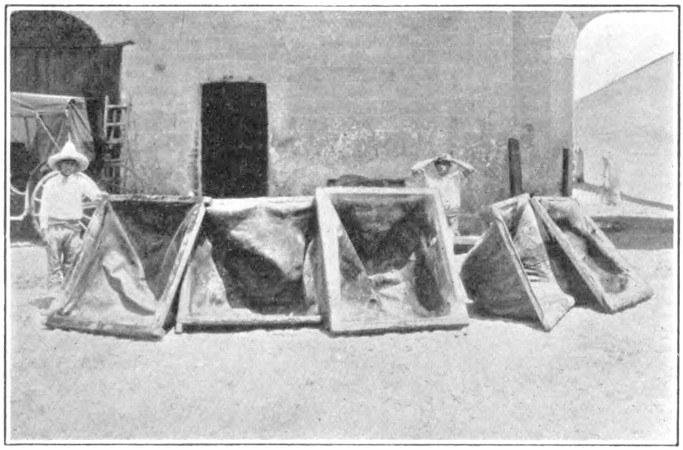
PULQUE VATS.
The rainy season begins at the end of May and lasts into October. During this time the sun comes out brightly in the morning, about noon pleasant showers without wind or violence come up, and by sunset all is bright again. On the Pacific Coast between the twenty-fifth and thirty-fifth parallels the case is reversed, and the rainy season falls in the winter months. The difference between winter[497] and summer is hardly felt. In the rainy season the climate during the day time is slightly cooler, but altogether delightful.
The soil throughout Mexico is, for the most part, extremely fertile. Artificial irrigation is in many places resorted to, and is effected by dams or canals. Developed property is estimated at over one billion pesos and the vegetation everywhere is magnificent.
Every variety of fruit known in Europe or America is found usually growing in profusion. Owing to the peculiar structure of the country all fruits, with every kind of garden vegetable, may be obtained in the Mexican markets the year round.
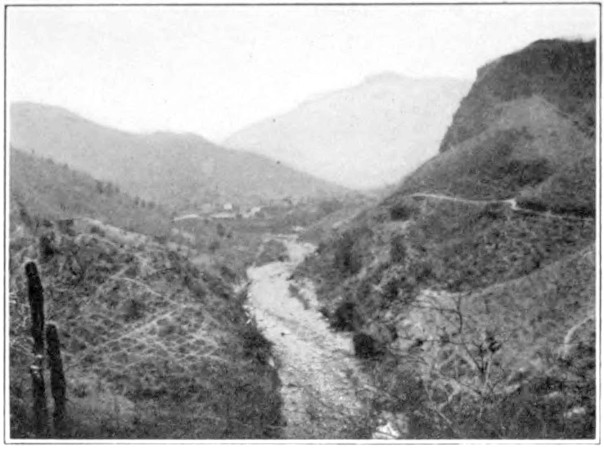
BOUNDARY LINE BETWEEN JALISCO AND TEPIC.
The flowers of Mexico are among the richest and most varied in the world. On Sunday mornings the streets of the capital are literally enamelled with blossoms of the most fragrant perfumes and most brilliant colors.
The fields in the hot districts are adorned with the beautiful green of the tobacco, the sugar-cane, and the pampas grass of the coast region; and the plantations of mangrove-trees, and the bamboo with its branching foliage, give shade to the river banks. In the virgin forests are gigantic fir-trees, with immense cedars, mahogany trees, and many others rich in foliage as well as useful for their fruits and woods. The most luxuriant vines trail from the highest branches of the trees, and many varieties of orchids are found.
In the temperate regions the character of the vegetation changes, but its beauty does not lessen. Magnificent forests of liquidamber, various kinds of oak, laurel, magnolia, and myrtle, cover the base of the mountains; mosses, ferns, and lichens carpet the smooth surface of the rocks, as also the rough bark of the trees. Every dale or glen is an orchard where one can gather the most palatable of fruits while enjoying the most delightful breezes, and where the[498] sighing of the winds, the singing of the birds, and the murmur of the waterfalls make sweetest music.
In a country so teeming with foliage and brilliant flowers, the soil is naturally fertile and productive, because of its richness agriculture is perhaps the easiest and most useful occupation.
Mr. John Barrett, Director General of the Bureau of American Republics, says: “Mexico is not only a land of great natural resources in the process of utilization, but of vast potentialities capable of remarkable development. Mexico has such a variety of natural products, such agricultural and mineral wealth, such mingling of fertile plateaus and valleys with large timber areas, such extensive coast lines on both the Pacific and Atlantic sides of America, such a network of railways, and, with all, such a progressive government under the able direction of General Diaz, that few, if any, countries in the world have, in proportion to population and area, better prospects and greater possibilities for the future.”
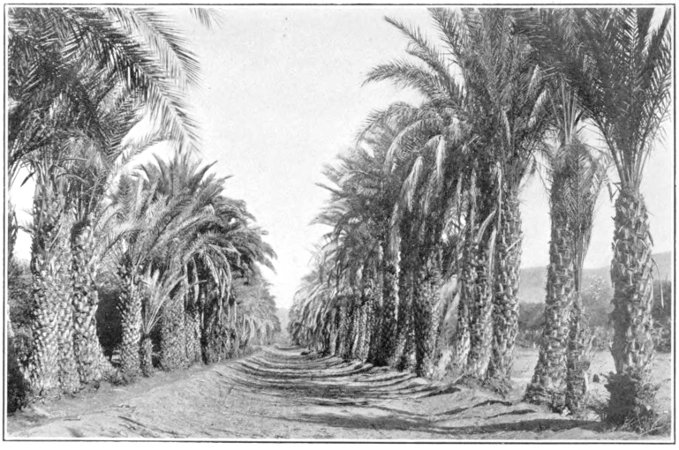
AVENUE OF DATE PALMS, SONORA.
Mr. Barrett has made a study of all Latin America and has always been particularly interested in the Republic of Mexico.
[499]
In the cultivated regions is grown the maguey, from which the national drink, pulque, is extracted. It grows on the great plains and plateaus at a height of over seven thousand feet above the level of the sea. On the Plains of Apam, as far as the eye can reach it encounters long rows of these plants, about nine feet apart.
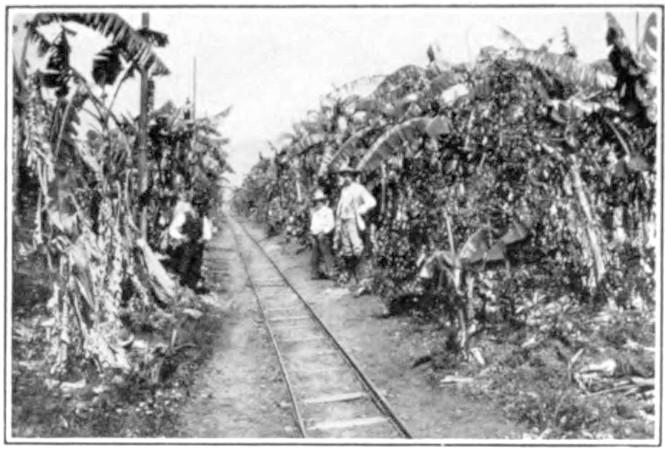
A COFFEE AND BANANA PLANTATION.
The maguey, or agave americana, grows not only in fields, which are planted thickly, but in ditches set along the fences, and in many odd corners which seem to be good for nothing else. It grows in good land to a great size, the central stem often attaining a height of twenty-five or thirty feet and a diameter of twelve or fifteen inches; the branches in some instances are a foot and a half wide and four or five inches thick. One maguey plant frequently yields a hundred and fifty gallons of pulque. A single plant will often yield four hundred and fifty-two cubic inches in twenty-four hours.
One can scarcely imagine the appearance of these immense maguey plantations. In the country between Mexico and Vera Cruz for hundreds of miles the plains and hillsides are seen covered with long, close lines of agave in every stage, from the strong, large, generous beauty of the full-grown plant to the young, tender green of the newly transplanted shoots. The plant combines within itself a dozen different materials for comfort and use. Growing in an absolutely dry soil, with no help from irrigation, it has the property of condensing moisture and coolness about its roots, which makes it yield at full growth an incredible amount of liquid.
The maguey furnishes two other liquors, not unlike our brandy and whiskey, very intoxicating, but very little used.
It supplies the native, besides, with a primitive needle and thread; it gives a species of hempen cloth from the coarser tissue and of paper from the inner pulp; it provides a good thatch for houses; and the débris, dried, makes fuel in regions where wood is scarce.
[500]
It is said to be the most wholesome drink in the world, and remarkably agreeable when one has overcome the first shock occasioned by its rancid odor. At all events, the maguey is a source of unfailing profit, the consumption of pulque being enormous, so that many of the richest families in the capital owe their fortune entirely to the produce of their magueys.
Of recent years Mexico has come forward with a new resource that bids fair to outrival the United States in oil production. The oil fields in various parts of the country have developed to such an extent that many prospectors from Europe as well as other parts of America have reaped great results.
There is a curious production of nature, the organos, which resembles the barrels of pipes of an organ. The plants growing close together and about six feet high and being covered with prickles, make the strongest natural fence imaginable, besides being covered with beautiful flowers.
The sugar-cane was unknown to the ancient Mexicans, who made syrup of honey and also from the maguey, and sugar from the stalk of maize. The sugar-cane was brought by the Spaniards from the Canary Islands to Santo Domingo, whence it passed to Cuba and Mexico. The first sugar-canes were planted in 1520, by Don Pedro de Atienza. The first cylinders were constructed by Gonzalez de Velosa and the first sugar mills built by the Spaniards at that time were worked by hydraulic wheels, and not by horses. Humboldt, who examined the will of Cortés, said that the conqueror had left sugar-plantations near Coyoacan.
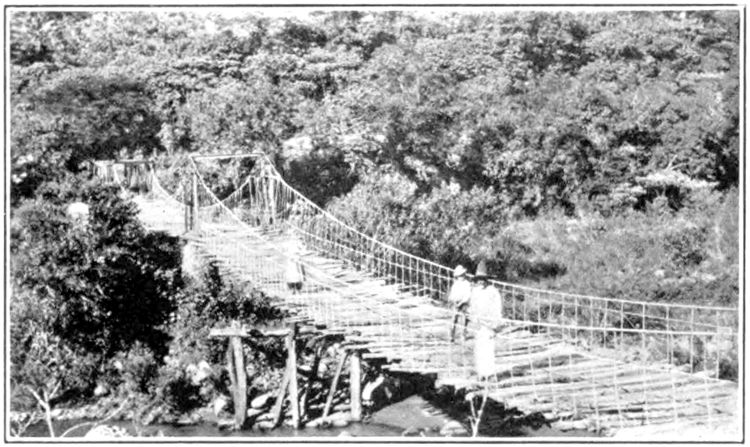
COFFEE PLANTATION NEAR CORDOBA.
There is no enterprise in Mexico at the present time which can be compared with coffee culture. Mexico is admirably adapted to coffee growing, and her coffee ranks among the finest in the world. The finest quality is produced in Colima, Oaxaca, Michoacán, Morelos, and Vera Cruz.
[501]
The soil and climatic conditions necessary to the successful production of the coffee-berry are so peculiar that, though it grows in all countries between the tropics, the acreage exactly adapted to it is comparatively small. Entire absence of extremes of heat and cold, a moist atmosphere, fertile soil, and freedom from drought, are indispensable to the production of remunerative crops.
Among the few districts in the world where the vanilla bean grows are the States of Jalisco and Hidalgo, Vera Cruz, Chiapas and Oaxaca. The exportation of this product has given Mexico an enviable reputation, as its properties are most favorably known abroad.
Tobacco is cultivated in several places in the States of Vera Cruz, Tabasco, Campeche and Yucatán. An excellent grade is raised and there has been a great increase in the exportation lately. It was introduced into Mexico during the Cuban War, and cigars were made by the refugees.
To the process of manufacture which the Cuban immigrants brought into Mexico is due the progress made in this branch of the national industry.
There are favorable conditions for cotton culture, and Mexico might easily rival the United States and the Indies. The use of cotton clothes was, in fact, general with the ancient Mexicans; and from the beginning of this century cotton was worth at Vera Cruz three or four times less than anywhere else.
Henequen, of all the textile plants which abound in Mexico, is one which is the most assiduously cultivated.
The “Pita,” which abounds in a wild state in Oaxaca gives a fibre resembling that of the ramie and answering the same purposes. Ropes made with Oaxaca pita are four times stronger than those of hemp.
The cultivation of the India-rubber tree has become very profitable. Young trees transplanted from a forest to a cultivated field in Soconusco have yielded rubber for more than thirty-five years, the present annual product is averaging more than fifty pounds of gum for each tree.
The Mexican gum deserves to be taken into consideration. The plants which produce it are found in considerable quantities in all the forests of the hot districts, and especially in those of the States of Vera Cruz, Tamaulipas, and Tabasco, and on the Pacific slope, on the coast of the States of Guerrero, Oaxaca, Chiapas, Tepic, etc. It is stated that in Tuxpan the milk drawn from the rubber trees is placed in earthenware jars and whipped with a weed called coyuntla which is an astringent that causes the milk to curdle, making the crude rubber.
[502]
The mulberry tree, to which place is here given because it is the indispensable complement of the silk industry, grows in both hot and temperate climates. Under the colonial régime several successful attempts to plant mulberry trees were made in Mexico.
The tree grows with great rapidity in this country. Besides the plantations of small shoots, there have been made considerable plantings of the mulberry seed, which have proved profitable.
The interest taken by Japan in the resources of Mexico was evident by the number of representatives that country sent to make a complete study of the conditions, in order to increase the trade between the two countries. An exhibition of Japanese arts and crafts in Mexico City during the Centennial was one of the interesting features. It was under the direction of the Japanese Chargé d’affaires, Honorable Kuma Horigoutchi, who has done so much to promote a friendly relation between the two nations.

PACK TRAIN WITH SUGAR ON THE ROAD TO MARKET.
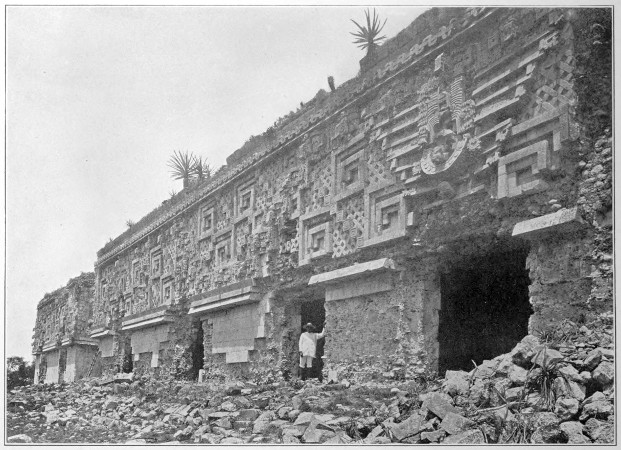
“GOVERNMENT HOUSE,” UXMAL, YUCATÁN.
[505]
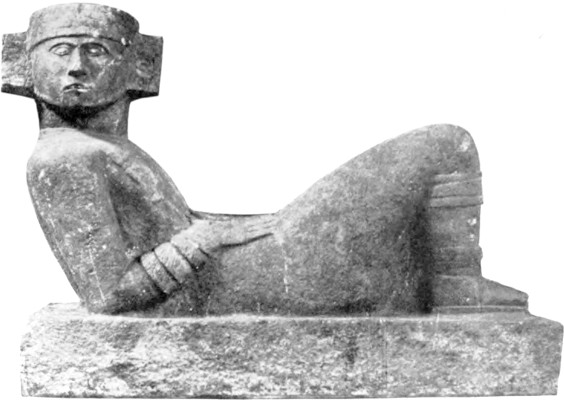
CHAC-MOOL IN THE NATIONAL MUSEUM, CITY OF MEXICO.
Mexico is pre-eminently the land of mystery of the Western World. It contains abundant traces of a civilization far older than any other on this continent, and now that a key to the Maya inscriptions has been found, it is reasonable to expect that systematic exploration will result in reconstructing, at least partially, the history of a vanished race, and throw some light on the interesting question of its antiquity as well as of its origin and with it give us some knowledge of what is now the prehistoric period of North America. It is scarcely possible to overestimate the importance of Mexico’s movement to have the archæological treasures of the country properly investigated. A bill has been passed by Congress to empower American scientists to make excavations in this country, provided the objects found be divided equally between the two nations.
[506]
The ruins of Mitla are situated in the State of Oaxaca. They cover many acres of ground and are the best preserved ruins in Mexico. Where vandalism has not destroyed them, the walls are as perfect as when erected.
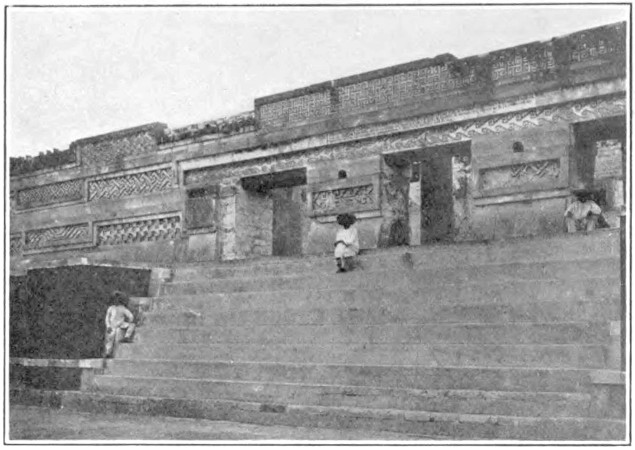
RUINS AT MITLA.
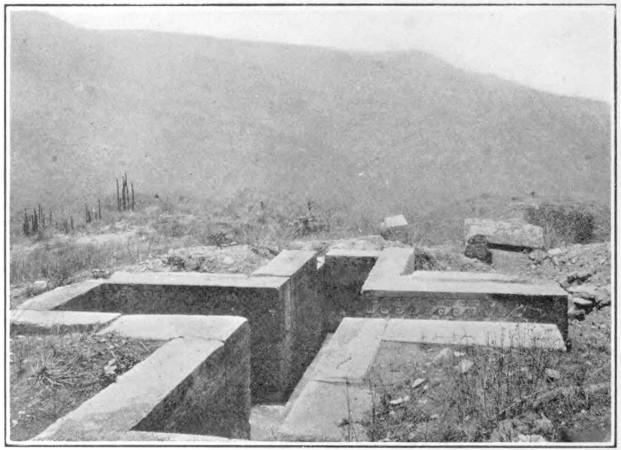
SEPULCHRE, NEAR MITLA, OAXACA.
The buildings are very extensive, and are magnificent in the skill and art shown in their construction. They were so designed as to face a central square. They were not connected at the corners, but the centre court was projected by a wall of rock and mortar which filled the spaces. Each building had only three openings, all facing the court. There were no windows or other means of lighting the interior. The walls were made of a very tenacious adobe, veneered both within and without with finely cut stone laid in regular courses and interspersed with panels that are filled with what may be denominated herringbone work, in a profusion of patterns each cut to fill its particular place, whether a square or a scroll, and the joints are so perfect that only the thinnest kind of cement could be used, and, after centuries of earthquakes, these joints are so perfect as to call forth the admiration of all who behold them. The lintels over the doorways are each of one solid stone, and[507] with all our modern appliances and engineering skill, it would be considered a great triumph to place them in their position.
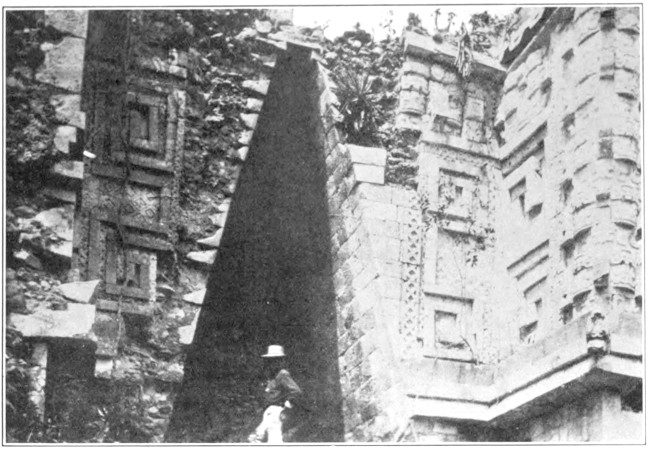
ARCH OF THE “GOVERNMENT HOUSE,” UXMAL, YUCATÁN.
Recently there have been some excavations made on the Island of Sacrificios by Mrs. Zelia Nuttall, a native of California and a member of many archæological societies. Until this interesting woman explored these parts no knowledge of prehistoric edifices existed. But her discoveries of pottery and the remains of a fallen city have added another ruin to those already explored in Mexico.
Among the ruins which have most frequently attracted the attention of explorers in Mexico is a monument which Baron von Humboldt designated the “Military Entrenchments of Xochicalco.” It is a few miles from Cuernavaca in the State of Morelos. The walls of this pyramid and the exterior are sculptured with what is supposed to be chronological hieroglyphics. These are in a state of decay but under the clinging moss one may distinguish serpents and[508] warriors in oriental posture with adornments and plumes on the head. Animals of all kinds are distinguishable in these unique carvings. Several caves of great importance have been discovered, chief of these is the Cueva de los Amates.
The venerable pyramids of San Juan Teotihuacan are the most remarkable remnants of ancient American civilization. They were found by the Aztecs, according to their traditions, on their entrance into the country. The two principal pyramids were dedicated to Tonatiuh, the sun, and Mextli, the moon. They are not inferior to those of some of the kindred monuments of Egypt. They were divided into four stories, three of which are now discernible. The interiors are composed of clay mixed with pebbles, encrusted on the surface with the light, porous stone tetzontli, so abundant in the neighboring quarries. Over this was a thick coating of stucco, resembling in its reddish color that found in the ruins of Palenque. According to tradition, the pyramids are hollow, but hitherto the attempt to discover the cavity in that dedicated to the sun has been unsuccessful. These monuments were devoted to religious uses, and it would be only conformable to the practice of antiquity on the eastern hemisphere that they should have served for tombs as well as temples.
These ruins cover an area very nearly as large as that of the present city of Mexico and the streets are distinctly marked by the ruins of the houses.
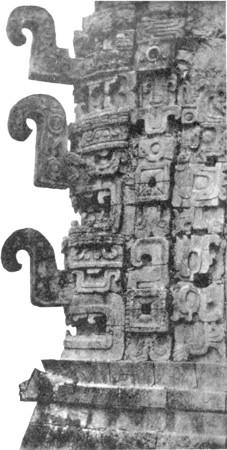
CHICHEN-ITZA, YUCATÁN.
It has been said that America is a land without traditions, without poetry, and without castles. Ignorance is the only excuse for those under this impression; for in Mexico are ancient ruins of buildings that were hoary with age when the famous castles of the Rhine and the comparatively young strongholds of England were in process of erection. Away back in the Middle Ages, when the romance of Europe is supposed to have originated, there was a civilization in Mexico that was even then historic. It is an ignorance that may, perhaps, be[509] pardoned, since even our wisest archæologists and deepest scientific students of modern times cannot yet determine the age or origin of the most ancient of these landmarks.
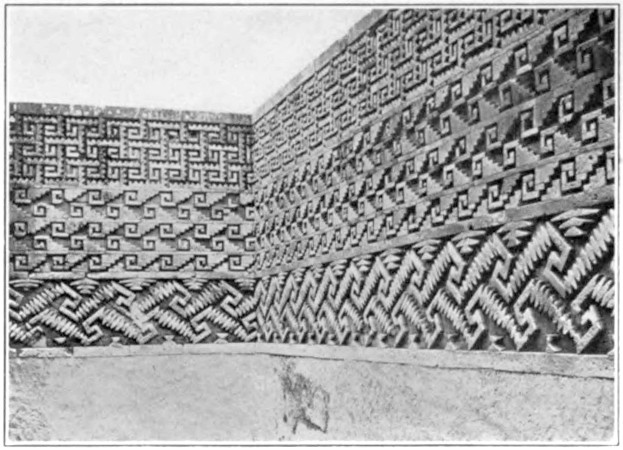
RUINS AT MITLA, OAXACA.
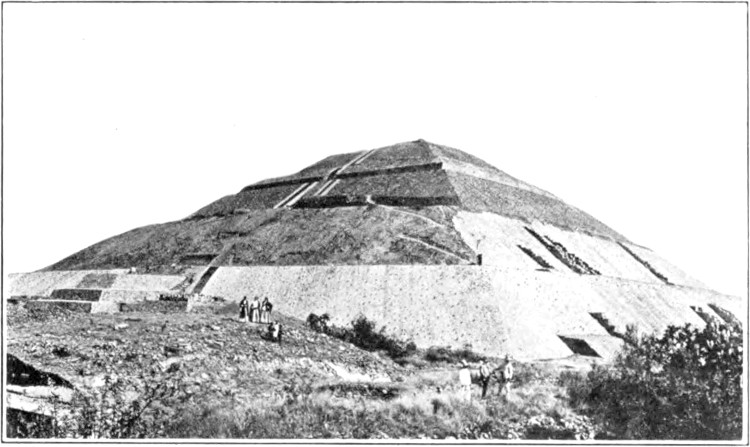
PYRAMID OF THE SUN, SAN JUAN TEOTIHUACAN.
No more interesting people for the modern student ever existed than the Aztecs, who seem to have been the equal in intelligence and advancement of any tribe in the world at the time. The Aztecs were most sincere in the practice of their religious rites. They believed in a supreme creator, invisible yet omnipresent, but requiring numerous assistants to perform his will, each of whom presided over some special natural phenomenon or phase of human existence. They had thirteen principal and several hundred inferior deities. The dread Huitzilopochtli, the war god of the Aztecs, was the patron divinity of the race, and myriads of human victims[510] were sacrificed to him yearly in countless pyramidal temples throughout the realm. Quetzalcoatl, a more beneficent deity, was described by the natives as a tall white man, with a large forehead and flowing beard, who taught his favored people the art of government and the various arts of peace, forbade bloody sacrifices and permitted only those of bread, roses, and perfumes. This god of the air, as he was named, having incurred the displeasure of one of the other chief deities, was compelled to leave the country, but on quitting the shores of the gulf, he promised to return, and the Mexican always looked forward to the auspicious day.
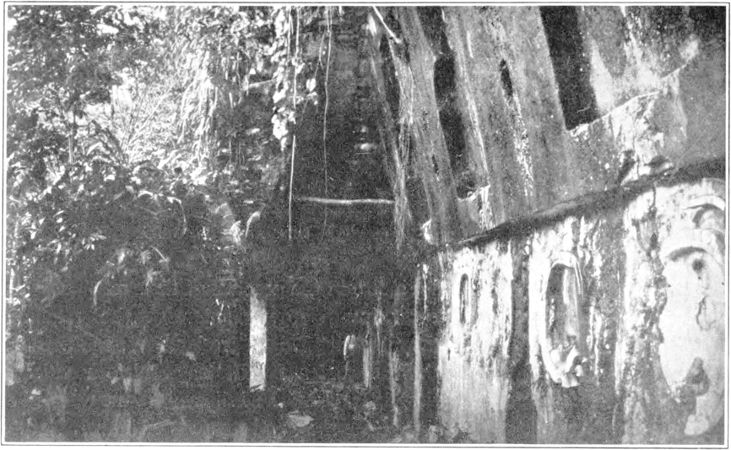
RUINS OF PALENQUE, CHIAPAS.
The ruins of Uxmal, Chichen, Izamal, Mayapan, and Labna have been explored by Stephens and other archæologists. Those of Uxmal, the most remarkable, are situated about fifty miles southwest of Merida. They comprise numerous massive limestone structures built on broad terraced platforms, and all highly ornamented. The largest single building, called “the government house,” has a front of three hundred and twenty-two feet, and contains twenty-four rooms. The most beautiful structure is the “house of the nuns,” composed of[511] four ranges enclosing a large courtyard, with eighty-eight apartments. The “house of the dwarf,” on a very steep mound eighty-eight feet high was a teocalli for human sacrifices. But little definite is known of the use of the temples and other vast edifices, which, from their size and profuse ornamentation in carved and colored figures and bas-relief, are, even in their ruined state, among the most wonderful architectural relics of the Western World.
Equally interesting are the ruins of Chichen-Itza, which are perhaps the most remarkable in Yucatán. They have the distinguishing feature common to all—the impossibility of ascertaining the purposes or uses of the extraordinary structures which still stand in testimony of the high degree of civilization of a people long since forgotten.
In Campeche, where many wild animals and enormous serpents abound, the ruins of Hôch-ob stand in a retreat of tropical verdure. Though small in proportion to those of Yucatán, the construction has been pronounced even superior by scientists who have braved great dangers to explore them.
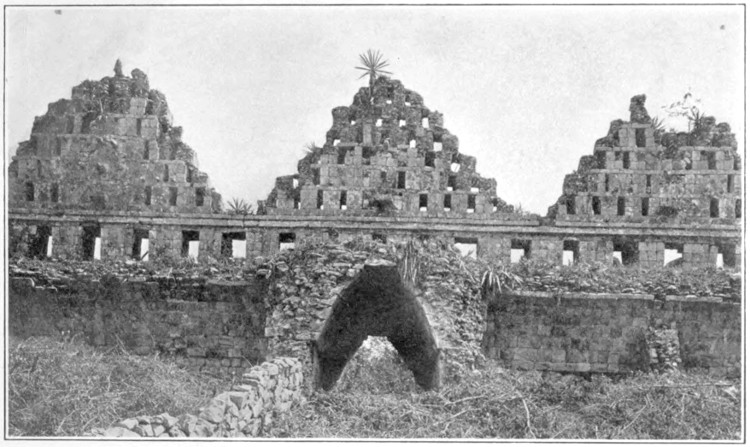
“HOUSE OF THE DOVES,” UXMAL, YUCATÁN.
Transcriber’s Notes:
1. Obvious printers’, punctuation and spelling errors have been
corrected silently.
2. Some hyphenated and non-hyphenated versions of the same words have
been retained as in the original.