Arcadian
Adelaide.
Arcadian Adelaide.
BY
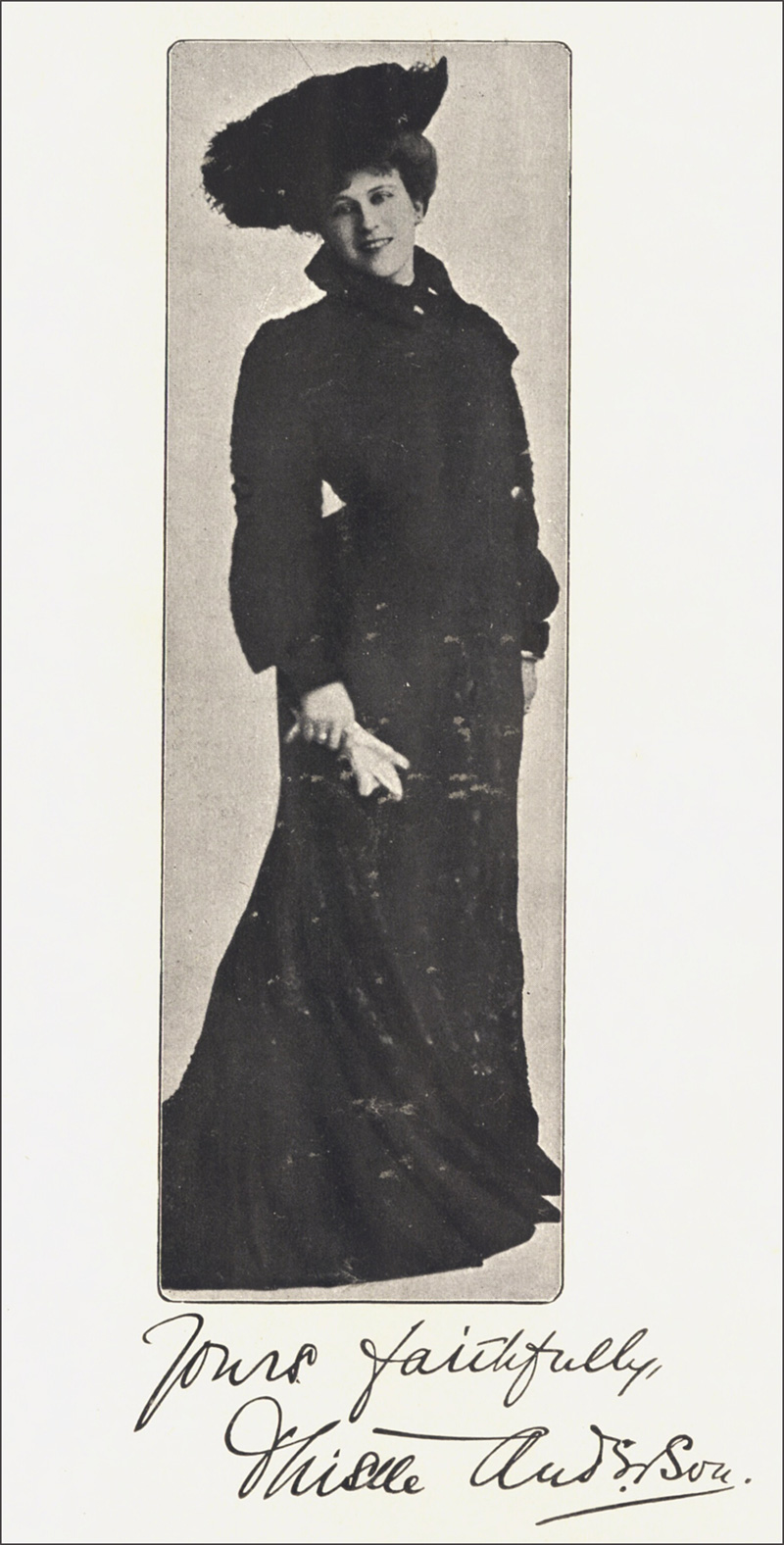
Thistle Anderson
(Mrs. Herbert Fisher).
Author of “Barenski,” “Verses at Random,” &c.
Adelaide:
Modern Printing Company, Twin Street.
1905.
DEDICATION.
TO any kindred spirit whom duty may compel to live in Adelaide, and who, living there, suffers as we suffer.”
IN PREPARATION:
“MARK MAROON.”
FOREWORD.
IT has been suggested to me, O people of Adelaide, that, should any of you deign to glance through these pages, you will misunderstand them—that is to say, you will believe them to have been written with malicious intent. What the public may think or say troubles me little, but for the benefit of one or two persons here who merit consideration, I emphatically declare that this is not so. Adelaide has crushed my youthful ambitions, and, possibly, narrowed my ideas—and you, her people, have done your best (by force of example, and other methods) to root out any broad or human sentiment that was in me. So that I have nothing for which to thank you, and I owe you nothing—not even the merest courtesy.
But the feeling of bitterness that characterised my first unhappy moments here has long since passed, and there is left only resignation, and perhaps a faint hope that some day I may sail “beyond the sunset and the baths of all the Western stars” forever. It may be argued that I have taken a near and dear—very near and very dear—relation from among you, and to that my only answer can be that he did not choose his birthplace, and that it is his misfortune—a misfortune which, however, has happily produced no lasting effect.
Thistle Anderson.
“Stramshall,”
North Adelaide,
April 12th, 1905.
CONTENTS
CHAPTER I.
THE HOLY VILLAGE.
ADELAIDE, known to all intelligent people as the City of Juvenile Depravity, and to the less enlightened as the City of Churches, is situated on the River Torrens, and is the capital of South Australia. A poor claim to distinction for South Australia, but we assure the reader that, although Adelaide is nominally the principal town, there are several equally, if not more, interesting places in the State—Port Pirie, for example, or Petersburg, where they have rifle ranges, public libraries, and other wild excitements, to say nothing of the periodical visits of a “first-class dramatic company” and an occasional “sensational accident.”
The Village itself consists of a main street (Rundle Street) and several lesser streets, and is surrounded by Park Lands, which, unlike Adelaide itself, are quite useful—in that they supply the homeless wanderer with sleeping accommodation free. In early morning they are almost as thickly peopled as Sydney Domain, and afford a refuge to burglars, sundowners, unemployed, and other unfortunates. We have camped out ourselves when fishing, and we think the Park Lands are green enough, at certain seasons, to offer every inducement to quiet rest.
10 Outwardly, Adelaide is intensely respectable—that is to say, the inhabitants go to church regularly, and think it extremely wrong to play cards for money. They are ostentatious in their charity, but it goes very little below the surface. Their ideas are, for the most part, about as broad as Blondin’s wire, and their cardinal virtues are Religious Belief and Conventionality. Briefly summed up, the creed of Adelaide so-called Society runs:—
“I believe in Lewis Cohen, Mayor of Adelaide, and in Sir George LeHunte (or any other man), Governor of South Australia, from whom much hospitality may be expected. He was appointed in England, and ascended into Government House. From thence he shall issue many invitations. I believe in the social laws, in much going to Church, in doing to others as they would do unto you if they could, in the charity that will be beneficial to our social position, and in the Life of the Everlasting, Amen.”
Of real charity there is little, as will be shown later on.
Several well-known pillars of Adelaide have been more than generous, and have showered gifts on the village—notably a School of Mines, Statues, wings to Hospitals, Lions to the Zoo, etc.—not forgetting an elderly lady who paid for building nearly half of a famous church. Rumor hath it that the youthful curate promptly offered her his hand and heart, presumably in gratitude for her generosity.
So much for charity in Adelaide.
11 The Village is less holy than might be supposed, for Melbourne, with approximately a population of 494,129, has seven opium dens; while Adelaide, with a population of 162,261, has eight. Then, too, it is pretty generally admitted that, in proportion to its size, Adelaide has more prostitution and more young girls on its streets than any other city in Australasia. Many women of the unfortunate class in Adelaide begin their wretched profession at the early age of thirteen or fourteen. Most of the Village’s newspapers have, to do them justice, militated against this evil—but unsuccessfully. The author knows of two local cases in which a mother deliberately trained her daughter to her own degrading career. It may be argued that similar cases abound in every city, but the reader must remember that Adelaide has clothed itself in a self-constituted halo of excessive virtue. This is not a treatise on morality—it is not Adelaide’s lack of morality to which I am objecting, but her lack of sincerity, to my mind a far greater evil. Be a little more humble, ye people of Adelaide, try to remember that your hills are not the greenest, or your morals the cleanest, or your shops the brightest in the whole world—and if you cannot bring yourselves to remember these things, then bear in mind that your wines are the worst ever made, that some of you are passing plain to look upon, and that you have acquired a world-wide fame for your cruelty to animals—especially horses.
12 Adelaide is justly famed for the beauty of her Botanical Gardens, and the antiquity of her tramway system, and it is on these two facts that her main claim to distinction is based. To be sure there is no antiquity in Adelaide except the trams (and the tailors!)—and this is distinctly a pity. Next to the downright, thorough civilization of Paris or London, the happiest state is primitive rusticity; but here, a desire to be civilized, coupled with an inability to carry out the idea, have resulted in a distressing state of semi-civilization, which is most unpleasant. Things which should be old, are young, and vice versa. For instance, the shops are amazingly old, and the buildings aggressively new, which is a pity, for it is the privilege of shops to be modern, just as it is the privilege of buildings to be ancient.
The daily excitements of Adelaide are the coming of letters, and the going of the Melbourne express—the fascination of the latter will be readily understood, when it is remembered that it forms the principal link between Adelaide and civilization. To be sure, the letters are as behind-hand as the local divorce law, but this fact merely shows an excusable disinclination on the part of the engine driver to revisit Adelaide, for, be it observed, the express always leaves the Village at the appointed time.
13 Adelaide has a theatre and a music hall—the former is open for about four months in the year, and generally spells financial disaster to enterprising managers. The latter, when not devoted to the lectures of the Reverend Henry Howard, revels in biograph entertainments, occasionally varied by a good variety show, which latter is, need we say, but little patronised.
The climate of Adelaide is good in spots—dust in summer, and hot winds—and in winter, much rain. The Hills, of which residents are so proud, are deluged with rain for nearly six months in the year, and for nearly all the remaining six they are burnt so brown as to lose all semblance to anything but volcanic rocks. Still, I have enjoyed glorious spring and autumn days in those hills—days that have lent themselves to picnics, which were generally made merry by the presence of persons not of Adelaide. Apart from the tram-steeds, the Adelaide horseflesh is superior, and takes many prizes, and I have a few delightful recollections of equine adventures—of horses difficult to master, splendid to look upon, and exciting to drive. Many of these emanated from Hill & Co.’s stables, an excellent institution of its kind, where both horses and men are of good calibre, but, unfortunately, not smartly turned out—to be smart is to transgress the social etiquette of the Village.
14 And there are other bright memories of Adelaide, notably Adams, a merry soul from Hill and Co.’s stables, who taught present scribe the delights of four-in-hand driving, thereby offering endless facilities for desecrating the virtuous Adelaide Sabbath. To Adams, a vote of thanks! and a thrill of real enthusiasm when I remember those crisp June mornings, the thud of the bloods’ hoofs in the frosty stillness, the scent of the fragrant earth—peace in my heart, sunshine abroad, and, for the time, the petty mortifications of my surroundings forgotten. Ah! Those were good days, and they stand out from the rest; but, alas! they are too few to compensate for other more frequent, and less enjoyable, days that must be endured.
Other attractions of the Village are a gallery of pictures, for the most part badly chosen; much statuary, which looks cheap, and was in reality expensive; and several tea-rooms. These latter are, of course, unlicensed, the tea is inferior, the cakes stale, and all the cups cracked, so they are not to be recommended.
Altogether, as a place of education Adelaide falls far short of the mark; as a place of amusement it is hopeless; and as a village—well, it is tolerably clean, and comparatively healthy.
CHAPTER II.
LIVING ACCOMMODATION.
THERE are numberless licensed places in Adelaide, where drink, varying in quality and unlimited in quantity, may be obtained, and there is one Hotel—the South Australian. It is distinctly promising, and I am glad it does not call itself “The Adelaide” Hotel, because that would damn it eternally—“South Australian” is so much more comprehensive. Whatever small element of rank and fashion there is in the Village, congregates in those spacious halls and early-Victorian reception-rooms—early-Victorian in the stiff-backed dignity of the furniture, and the scarcity of carpets. Moreover, one occasionally meets there persons who have been rash enough to leave better places to visit Adelaide. Let us be charitable, and hope that sternest duty brings them here. Surely no other motive could induce their presence! And let us remark, as a warning to others contemplating the same folly (especially theatrical managers), that if they come here in the hope of amusing, or being amused, bitter will be their disappointment. Those who visit the city of many 16whited sepulchres on business, are forgiven—those who come on pleasure bent should be relegated to asylums for the insane. However, should they remain here long enough, the insanity will follow.
The hotel itself is really charming—the staff is good, which is not surprising when one remembers that most of the employés hail from other places. The fact that is surprising is that they can be content to work and serve so long here. This, however, is a tribute to the untiring kindness of the proprietress and the manager.
To keep servants long in any part of the world is both creditable and clever—to keep them long in Adelaide shows positive genius.[A]
[A] I except my own servants to this rule—no genius is exercised to keep them, because none is required—as they, with one exception, come from Melbourne, they have some faint idea of their duties.—The Author.
The liquor in the only hotel is passing good, save that it gives preference to South Australian Wines, which is criminal. But of Australian wine, more in another chapter. The hotel has, as I have said before, a charming proprietress, a capable manager and a splendid staff, and it has other virtues of a first-class hostelry. A substantial improvement might be effected by weeding out some of the permanent and usual boarders (mainly female) modernizing the rooms a little, and building 17vast quantities of additional bathrooms. Then add to the stock some good French Burgundy, some three-star Brandy that isn’t Hennessy, some Dewar’s Imperial Whisky, and a greater variety of liqueurs, and the “South Australian” would be a veritable oasis in the desert of Adelaide. As it is, it rivals the best hotels in the Southern Hemisphere, and to all who contemplate residence in Adelaide, we issue this warning—don’t be induced to stay elsewhere. (N.B.—This advertisement is not paid for.)
Of the other licensed houses there is little to be said; they are mainly patronized by country farmers, who are uninteresting people at best, and therefore deserving of little consideration. I once had the misfortune to spend a few days at one of these so-called Hotels on North Terrace, and among many minor inconveniences one heard the screams of delirious patients at the Hospital, the yells of the inmates of North Terrace Asylum, and the roar of the wild beasts from the not far-distant Zoo—it was distinctly a thrilling experience.
Some Adelaide hotels are kept by single women, who, presumably, obtain their licences in a married name; and this is obviously a serious evil, and one which should be looked into, necessitating, as it does, a more or less undesirable trade.
There are boarding-houses, too, many of them enormously respectable, and occasionally they are fortunate enough to have some of their rooms 18occupied. They are much the same as other boarding-houses all over the world—that is to say, food indifferent, drinks difficult to obtain, and attendance nil. I have never lived in an Adelaide boarding-house, but I once lunched at one. The rats had eaten most of my hostess’ clothes, which wasn’t surprising. Having sampled the food, one couldn’t blame those discriminating rodents for preferring the boarders’ garments.
There are many more or less charitable institutions which provide living accommodation in some cases free, but these appear to be inaccessible to the people who really need them. At the “Queen’s Maternity Home,” for instance, the marriage lines are the necessary qualification for admittance. No doubt the institution is excellent in its way, but Charity cannot draw distinctions of that sort, and so the home in question simply misses the primary object of such places.[B] There are also Benevolent, Destitute, and Blind Asylums, and several asylums for lunatics. The latter are, I understand, fairly well filled—which is easily understood.
[B] A small sum of money is paid by patients, according to their means, but the home is distinctly a charity, and calls itself one.—The Author.
Flats, most desirable of modern conveniences, are as yet unheard of in Adelaide, which shows a deplorable neglect of personal comfort—indeed, a 19lamentable ignorance of all comfortable living accommodation is manifest. A flat comprises the largest amount of comfort in the smallest possible space—may the deserving originator of the scheme be blessed or sainted. May undeserving Adelaide never know the blessings of such luxury.
The dwelling-houses are, for the most part, cheaply built, badly fitted, and execrably furnished—there are a few notable exceptions, but these mostly err in the opposite direction, being lavishly vulgar in their gaudy upholsterings. Inwardly, Adelaide cannot esteem cleanliness a cardinal virtue, judging by the bathrooms in most of the available houses. A furnished house is very rarely to be had, and the few I have seen would preclude any desirable tenant from taking them. Ugh! The cheap and nasty furniture, china dogs, gaudy wall papers and architectural horrors of the Adelaide house! To those who must sojourn here, and who cannot afford the expensive seclusion of the only hotel—bring your beds on your back, or bring a tent and camp in the park lands, for woe unto ye who trust to the doubtful hospitality of the village boarding-houses, or of the “house to let.” We doubt if it is possible to be really comfortable here—certainly to be even tolerably comfortable, it is necessary to select—no, to bring—one’s own furniture, wall papers and other house trappings.
CHAPTER III.
THE TRAM-CARS.
Q.—“What is the difference between the Adelaide trams and the Adelaide street lights?”
A.—“One has a set o’ lean horses, and the other has acetylene lamps!”
SO much has been said, and written, about Adelaide’s tram-cars, that any reference to the subject is of necessity boring, yet they are the worst evil (worst, because, apparently, irremediable) in all Australasia, and the system is a disgrace to any community calling itself civilized, much less Christian! Christian! Save the mark!
In the Advertiser some months back appeared a letter signed “M. B. S.,” written by a globe-trotter visiting the Village. He says—“I have been all over the world, and have never seen such cruelty to horses as here ... not even in Paris, where animals are not respected at all.” No one can dispute “M. B. S.’s” statement. The facts are hideous. The company’s shares are held by bloated—very bloated—property-holders. Of course they 21draw eight per cent, or so, and, being essentially Adelaidean in their instincts, they want no change—they are satisfied.
It is unnecessary to dwell on the inconvenience to, and discomfort of, passengers—any discomfort they get I am inclined to think they deserve—and I speak solely from the standpoint of the ill-used horse. The cars are frequently overcrowded, the animals badly fed and mercilessly driven, and often in summer the miserable brutes fall dead: I have seen as many as three die within a fortnight on the hill near the Children’s Hospital. It is pitiful, and if some of the so-called Christians of Adelaide employed a little less theory and a good deal more practice, some remedy might be effected. I am thankful to say that I have never ridden in one of these cars. May I die if ever I add to the burden of those unfortunate horses, or the wealth of those bloated shareholders! I am no ardent pedestrian, but a thousand times rather would I walk than participate in such brutal ill-usage of one of the noblest animals in the scheme of creation. Christians, forsooth! Christ, the gentlest and kindest of men, would never have countenanced such cruelty, and yet Adelaide is a Christian village, infested with Churchianity.
I would suggest that the promoters of this tramway system be boiled to slow music, the shareholders be mutilated, the drivers be put to a more 22Christian trade—or suffer the punishment of their unintelligence—and the youthful fare-collectors taught to espouse a nobler cause.
* * * * *
There are other modes of transit in the Village—one or two ’buses, some dilapidated machines called carettes, and some four-wheeled cabs. Some of the drivers of said four-wheelers treat their horses less brutally than does the tramway company, and therefore they deserve to make a living.
There are also several hansoms striving to earn a more or less honest crust under the frightful stigma of “not quite respectable—hardly correct!” To these we wish better days—the drivers are civil, the horses well fed, and the cabs fairly modern. Especially does one Fisher (no relation to the author) deserve to succeed, he having a decent intelligence, and a hansom worthy a better fate than Adelaide!
PART II
CHAPTER I.
THE MEN.
ADELAIDE is largely inhabited by the type of man that wears celluloid collars, and travels on coastal boats—to be sure there are a few male inhabitants who have neither qualification, but these are mainly bankrupt, and therefore do not count. It is fairly safe to assume their bankruptcy is due to their contempt for celluloid collars, and their disregard of Adelaide’s social laws, combined, in many cases, with a large devotion to Bacchus.
Edward Lauri, when in Adelaide recently, remarked that the local men were the best caricature-types he had ever seen. “They nearly all look exactly alike,” he said, “and they never change! In another five years they will look just as they look to-day. They are now wearing the same shaped hats, collars, and ties, and the same suits of clothes that they wore when I was here eighteen months ago!”
24 Assuming this statement to be true, it will be understood that they are not very exhilarating to meet—always excepting the bankrupts we alluded to before, some of whom are gay young bucks. Most of the Village’s male population have married barmaids, nurses, or money, so the social atmosphere is not as high as it might be. They grow weird hirsute adornments in the shape of beards and whiskers. The only men who grow a self-respecting moustache are the coachmen, and with them it is an unnecessary adjunct, detracting much from the beauty of their appearance. Certainly they have some recipe for growing a moustache unknown to the bulk of male Adelaide, judging by the finely-decorated upper lips I have seen on the box-seats of grubby-looking carriages.
Younger male Adelaide is intelligent—in many cases almost brilliant—but, hampered by ridiculous conventionalities, it rarely fulfils its early promise. A few have risen superior to their environments, and these have done the wisest thing possible—left Adelaide far behind, and gone to better places.
Some few men have made fortunes here, and these almost always—with pardonable ingratitude!—go elsewhere to spend their wealth.
You men of Adelaide—poor, narrow-minded fools most of you!—would that you could learn, before it is too late, what good things you are missing—would that you could realise that there 25may be some good in people (and places) who do not share your own prejudices.
From all of which sweeping statement I exempt two classes—the Post Office officials and the Railway employés. I have never received more kindly courtesy anywhere than from these departments here—(I refer chiefly to the heads of the departments) and for their unfailing kindness and attention I thank them. These officials will always take precedence in my mind as the most valuable assets in Adelaide.
One thing more—if any remarks in the foregoing chapter have offended any of my few friends here, I would ask them to remember that, being friends, they are of necessity exceptions!
CHAPTER II.
THE WOMEN.
THE misfortune of the Adelaide women is that they were not born quadrupeds—they are a kind of mistake for cats, and only lack the outward and visible sign of the feline tribe. (Hard to be cat by nature and inclination, and be compelled to wear the guise of woman!) Moreover, they make one believe in the old Spanish tradition, that cats are descended from snakes. The outward semblance of the Adelaide female is intense respectability, and of course, in many cases, being homely to look upon, and exceeding badly clothed, she has no temptation to err from the paths of strict propriety. The poorer type is terrible to look upon, and the rich women make one wonder how they manage to spend so much money in clothing their nakedness, and with such disastrous results. Still, there are a few younger specimens who are passing fair, and if rescued in time, might ornament a brighter sphere. 27We see large possibilities in younger female Adelaide, and this saddens us, knowing as we do that, if timely rescue is not effected, these fair maids will grow up like the older generation, and find their main recreation in discussing the foibles of women—aye, and men too—who are outside, or beyond their sympathies, and who are, doubtless, infinitely superior to themselves.
I appeal to all large-hearted, intelligent men from the other States—from anywhere, provided you are clean, well-behaved, and, incidentally, possessed of your fair share of this world’s goods—come and marry the fair daughters of Adelaide. There are many who are good to look upon, and quite intelligent, and with care it is not too late for them to develop into good wives and mothers, and, better still, broad-minded, enlightened, interesting women.
There is also a less objectionable type of femininity here—the harmless—but she is uninteresting, and therefore not to be forgiven. She is usually stupid by nature, and charitable by inclination, the sort of person of whom one says, “She’s a dear, good woman—so kind.” She cannot be objectionable, because she has no deep feelings—she cannot be morally bad, because she has no strong passions—and she cannot be spiteful, because she is soon taught that, having few charms, she cannot hope to compete with those who have.
28 Feminine Adelaide has, as we hinted before, wild and terrible ideas of dress; every gown she wears is a sartorial crime, and bitter is her hatred and jealousy for any who exploit clothes better, or less offensive than her own. It follows that, with such limitations she, as a type, hates a broad, cultured, or enlightened woman. I have watched the fate of one or two splendid brainy women here, and have inwardly smiled—Bow to the conventions, O woman! if you would appear well in the eyes of Adelaide.
To sample local charity—in a family of my acquaintance, the cook, a girl of nineteen, previously respectable, went wrong. In any civilized community the mistress, recognising a valuable servant, would have done what she could at the time, and taken her back when the trouble was over. But the lady in question simply dismissed her, thereby offering a further incentive to a young girl to go wrong.
It must be remembered, however, that the unfortunate girl of Adelaide gets few of the advantages of higher education, and is generally brought up in total ignorance of the serious things of life.
I know one family of four daughters, the eldest twenty-one, who have never been allowed to enter a theatre, although their father, a tolerably well-educated man, says he believes in a thorough 29education. When it was suggested to him that his daughters might see the “Midsummer Night’s Dream,” he was horrified. To be sure, these girls are motherless—a kind, sensible mother would surely understand that Shakespeare is a desirable branch of education.
Let us glance at local society. In a street I know, on one corner, Rags, a cheap but successful draper, has reared a red and white edifice. Opposite, the lady who once sold hats to fairer sisters in Melbourne, espoused to quite an important person, has wormed her way into the chosen few. Further up, an inferior edition of the share market assumes the pretensions of a Grand Duke.
Then we have Tobacco married to Alcohol, and, bashing in the smiles of the very select—a quondam shepherd and a city waitress united in holy matrimony, and entertaining largely; a nurse also secured one of the matrimonial prizes. The daughter of a cocky farmer has snared a son of one of Adelaide’s first families; a dentist’s apprentice (daughter of a handsome barmaid) has caught another. There are funnier cases than these, but I forbear to cite them—I have quoted enough to show how aristocratic is the society that sets so high a store on its smiles and favours.
Just outside the social pale one or two decently educated men have married nymphes de pavées,30 but these of course are carefully shunned by Adelaide’s best and fairest.
Women of Adelaide—If I have down-trodden your pet virtues, or wounded your susceptibilities, or flown in the face of your dearest prejudices, during a boring existence among you, it has been with the best motives—with a desire to keep abreast of the times, and not to become embedded in musty conventionalities.
CHAPTER III.
THE LESSER ANIMALS.
I HAVE not devoted much time to the classification of these, but I believe that they comprise chiefly mosquitoes, cockroaches, flies, rats, and Lady Kitty.
PART III.—GENERALITIES.
CHAPTER I.
MANNERS AND CUSTOMS.
I AM inclined to agree with a certain prelate of some unfrequented islands, who said of the inhabitants, “Customs beastly, manners none.”
The most characteristic custom of female Adelaide is church-going—any church committee, prayer meeting, or bazaar, will tear her away from domestic duties. Sometimes she persuades her male belongings to accompany her, but they seem not to appreciate this attention, and generally wander wearily to church with a woe-begone “duty-compels-me” air.
The men have only two customs, common to them all. The first is a tendency to look too often on the wine that is red. Hotel-keeping is a profitable business here, where the “come and have a drink” formula is repeated at intervals of five minutes 33all day, and, frequently, nearly all night. Particularly on the share market is this habit apparent, where every deal made is responsible for plentiful libations from the cup that cheers. Whisky and soda, beer, and frequently even fizzy drink, form the most staple articles of nourishment among the share-broking fraternity. The other prevalent custom is a fixed devotion to narrow-toed boots, which common-sense and fashion (for once agreed) discarded long ago. The former habit is an evil, because far-reaching in its results. In time it might kill its victims, but that would be a matter of small regret as many of them could well be spared. It is the misery said victims entail on their wives and mothers to which I take objection. The drinkers, having little intellect to destroy, do not lose much mentally by their Bacchanalian orgies, but they become vastly disagreeable to their fellow-creatures. Of the other custom—to wit, their taste in boots, there is little to be said, as it makes them uncomfortable, and does not hurt anyone else.
No comment that I could make would be severe enough to portray the utter brutishness of the villagers’ manners—let the gentle reader go to the Mayor’s ball, or any other public function, and judge for himself! When the supper rooms are thrown-open, the guests fight like wild beasts, and their rush for food is like nothing I have ever seen so much as a pack of hungry beagles at feeding-time. 34Whether they fast for a week in order to avail themselves of these free repasts, I cannot say, but their greed is appalling.
The villagers’ stare (this applies particularly to the female population) is an awful and shameless thing. Especially do they gaze at those of more pleasing appearance than themselves; whether from motives of scorn or of envy, I know not. The men do not, as a rule, indulge this habit—perhaps they are never sufficiently sober—but the women feast their eyes with undisguised rudeness on anything, female or otherwise, that interests them. To be sure the stare is not always so distressing as it is meant to be, because it is so difficult to take the villagers seriously. Scorn is wasted when emanating from an untidy female with a small intelligence and large feet, and it is difficult to be awe-inspiring in ready-made skirts and number six shoes! Moreover, said untidy females have not sufficient tact or intelligence to conceal their evil feelings, and not enough courage to live up to them.
Monkshood says:—“An ugly woman, badly dressed is doubly damned—She is bad Nature and bad Art.”
If that be true, female Adelaide in general is going fast to perdition.
CHAPTER II.
INDUSTRIES.
THE main industry of the Village is child-bearing, and Adelaide, both married and unmarried, does her best to help the birth-rate. Motherhood may be the noblest mission of women, but I question whether the Almighty Himself would approve of the perpetuation of some of the Village family-trees.
Fruit-growing is the local industry most deserving of praise, and must certainly qualify as a redeeming feature of the Village. Many of the successful growers are Chinamen. We may clamor for a White Australia, but it strikes one forcibly that the Yellow Mistake has helped materially to further national industries, especially fruit-growing.
But most of all, Adelaide prides herself on her wines. To pervert Scripture slightly—“We produce fruit, and children, and wine, but the greatest of these is Wine!” May a merciful God forgive 36Adelaide her wine, if He cannot find it in His heart to forgive the poor fools who drink it!
All the grapes on all the vines in all the vineyards of South Australia, helped by all the labor of all the employés of all the famous people who own those vines, could not produce one glass of wine to equal the Vin Ordinaire of France.
But has not the Almighty already shown His disapproval of this particular industry by burning down one of the most extensive cellars, with vats and vats of red wine, and white wine, and wine that isn’t wine at all? The Soil grows the wine in France, and the French and Italians are born, as it were, to the art of wine-making. To import one or two skilled men is not enough—armies of them are required. Moreover, the wine is consumed as soon as it is made (this last fact is wonderful to anyone who has tasted it!), and it is one of the things which should be ancient. Had old Omar sampled Adelaide’s wines, he would never have written—
The local vintners buy land, and houses, and household gods at, I suspect, the expense of many an unfortunate who has learned his first lessons in intemperance from their infernal concoctions—a cheap amusement certainly, but like most cheap things, nasty, and while getting beautifully 37into one’s head, quite conducive to rheumatic gout. In fact, had Omar lived in Adelaide, he would never have sung the praises of the vine at all, his glorious “Rubaiyat” would not have been written, and the world would be the poorer for the loss. “Protect local industries!” Well and good, when the local manufactures are equal to the imported article; but, as in the case of wines, why put a prohibitive duty on what cannot be satisfactorily made in the State, thereby compelling the consumption by the masses of an inferior product?
There are other local industries—some people have a sheep, and shear it once a year, some publish newspapers!—others breed horses (some of them good), others make inferior jam, and others again farm, with some profit.
But serious contemplation of the Great Wine Industry has ejected all minor ones from the writer’s mind.
The wine matches the inhabitants, and I leave the reader to supply his own adjectives.
CHAPTER III.
REDEEMING FEATURES.
1. The Railway Employés—
2. The Post Office Officials—
Both of whom are deserving of the kindest memories, and of many other blessings.
3. The Cabmen, who, as previously remarked, are quite efficient.
4. The Wheat (and indeed all cereals) is about as good as any in the World, and consequently,
5. The Flour is excellent—it should certainly be exported to better places.
6. The Fruit is beyond reproach. In size, sweetness and flavor, it is the best in Australia, and rivals any in the world.
7. The Weather, because it sometimes keeps the most disagreeable people indoors.
8. A Return Ticket to Melbourne.
39 In conclusion, O “Arcadian Adelaide,” may you improve—may your people prosper, and be happy, in order that they may remain in their own Village, and inflict themselves less on the outside world. May you some day awake to a sense of your own insignificance, and discover that the sun would shine, and the flowers bloom, and the birds sing on, even though you were sunk in the New Outer Harbor.
I wish you many good things, you people of Adelaide—but most of all I wish that you may soon be rid of my odious presence, which wish is probably mutual! And if these pages bear the imprint of many faults—if they anger, or—worse still—bore you, remember that there is no place on earth less calculated to foster literary merit than
ARCADIAN ADELAIDE.
Thistle Anderson.
Adelaide:
Modern Printing Co., Twin Street.
Transcriber’s Note:
- Page 12
the buildings agressively new changed to
the buildings aggressively new - Page 16
most of the employé’s hail from changed to
most of the employés hail from - Page 18
There are also Benovelent, Destitute changed to
There are also Benevolent, Destitute - Page 28
remembered, however, that the unfortunrte changed to
remembered, however, that the unfortunate - Page 29
market assumes ths pretensions of changed to
market assumes the pretensions of - Pages 29–30
nymphes de pavèes changed to
nymphes de pavées - Page 38
The Railway Employes changed to
The Railway Employés