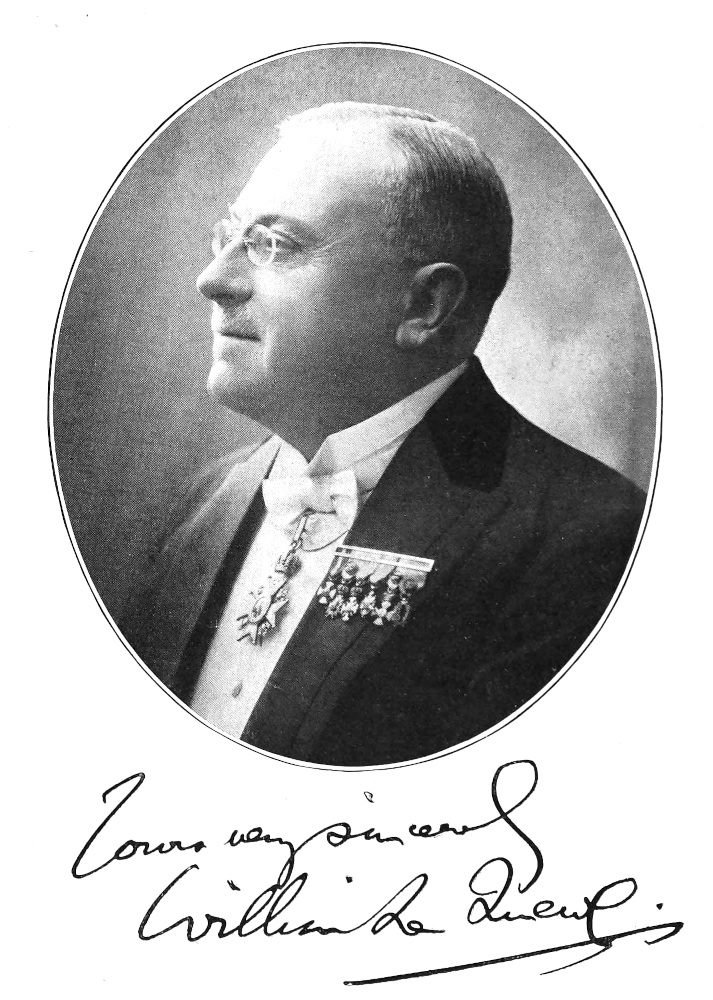
[Pg 9]
PREFACE
In writing of these episodes in the career of a wanderer over the face of Europe, my object is to entertain and perhaps amuse many of my unknown friends and correspondents who, scattered over the world, have, from time to time, written me encouraging words of appreciation concerning my works of fiction. To them, I would reveal certain facts, some grave and some gay, which may be found of interest. To do so, I propose to take my reader behind the scenes of some particular phases of life with which he may be unfamiliar.
And let me say at the outset, these records of an eventful though perhaps erratic life contain nothing but fact. I have led, and still lead, a wandering life. My custom has ever been never to have even a pied-à-terre in one place longer than a year, and even during that time to travel as much as possible. I may accurately call myself a cosmopolitan, since when my hat is on my roof is on.
But these modest reminiscences are mainly about other people, and, although I find myself compelled to use the first person singular much more often than I desire, I pen them with the fervent hope that they may be taken as a little arm-chair chat about modern men and modern matters, rather than essays in autobiography.
Nobody, I am sure, cares a jot when I cut my first tooth or where I learned to walk. No genealogical tree or tradition of race is necessary—though my unusual [Pg 10]name means in Norman-French “the King’s head cook,” and I can trace my ancestors through centuries. But of what use is it in these democratic days, when duke’s son and cook’s son are on equality, and the “Red Flag” is sung in the House of Commons?
However, while thus casually mentioning my name, it may not be inappropriate to quote the following explanatory stanzas by a poet unknown to me:
And for those who want to know who I am, I cannot do better than refer them to the paragraph in that useful and entertaining annual, Who’s Who.
LE QUEUX, William Tufnell; novelist; traveller; Commander of the Orders of St. Sava of Serbia; Danilo of Montenegro; Crown of Italy; San Marino Order, etc. Consul of Republic of San Marino, retired; b. London, 2nd July, 1864; e.s. of William Le Queux of Châteauroux, Indre. Educ.: privately in London; Pegli, near Genoa. Studied art in the Quartier Latin; made a tour through France, Germany, and Italy on foot; became journalist and special correspondent of The Globe, 1891; special foreign correspondent of The Times; resigned to devote his time to novel writing, 1893. Secretary to British diplomatic mission to San Marino. Has travelled in Russia, Algeria, Morocco, Tunisia, Siberia, the Areg region of the Sahara Desert, Asia Minor, etc.; journeyed through Macedonia, Montenegro, Serbia, Albania on special Government Mission, 1907; Arctic (with Harry de Windt), 1908; Sûdan, 1909. Correspondent of the Daily Mail in various capitals, and war correspondent in the first Balkan War. Collector of mediæval manuscripts, codices, and monastic seals, of which he possesses a large and valuable collection; has intimate knowledge of the Secret Service of other Continental Powers; consulted by the Government in such matters. Forecasted the Great War in his book, The Invasion, 1910. Is a keen student of criminology, and also well known in wireless research. [Pg 11]Is a qualified wireless engineer, and was the first to broadcast concerts over Great Britain and Ireland from his powerful radio station 2AZ at Guildford in 1920–21 in the early days of radio-telephony. Writes and lectures on wireless research, and on spies and spying. Member of the Institute of Radio Engineers. Author of over 130 novels and many kinema films. President of the Wireless Alliance, Vice-President of the Radio Association. President of many wireless research societies.
Recreations: Pistol practice; ski-ing in Switzerland; the study of Egyptology, and wireless research. Clubs: Mürren Ski-Club; Swiss Alpine Club; British Ski Association; Crimes Club; Tatlers’ Club. Address: Devonshire Club, London.
And with these words I make my bow, and set forth facts that, without embellishment or distortion, may, I sincerely hope, prove entertaining.
At all events, I simply tell of things I know.
WILLIAM LE QUEUX.
Devonshire Club,
London, S.W.
CHAPTER ONE
What I Know about Kings—My Audience with the late Tzar—An Emperor at Home—What he told me—A Chat with the King of Italy—He gives me a Decoration—His Majesty’s Troubles—King Edward and the Lost Letters—His Debts to Baron Hirsch—Queen Victoria and her Sunshade.
My first acquaintance with any royalty was my presentation to the Crown-Prince of Saxony, now King, by his wife, who, as Princess Luisa of Tuscany, I had known as a girl—the pretty Austrian Archduchess, who had charmed all hearts, nearly married King Ferdinand of Bulgaria, and of whom I intend to gossip in another chapter. I was asked by the Princess to call on her at the Royal Palace at Dresden after her marriage, and spent a couple of pleasant hours with her and her husband, then Crown Prince. The latter expressed himself charmed to meet me, his wife having often spoken of me, and I thoroughly enjoyed my visit, for after the first formal reception I was invited to their private apartments, where the Princess made me thoroughly at home.
We gossiped about such friends as we both knew in England and in Italy, for Her Highness came to London each year incognita, and on me had devolved the duty of looking after her general welfare. But more of her adventurous life anon.
The second royal personage of whom I had audience was the late Emperor of Russia.
Well I remember how one morning a tall, handsome [Pg 14]officer of the Imperial Guard entered my room at the Hôtel de l’Europe on the Nevski, in Petrograd, and handed me a formidable envelope which contained a command that I should present myself at the Palace of Tzarskoye Selo (the Village of the Tzar) on the following afternoon at three o’clock. And well also do I recollect being met at the station by one of the Imperial carriages, and being driven to the entrance of the great park, where I was met by an officer and conducted past endless sentry-posts. I confess that I felt very ill at ease when at last I stood in a small but gorgeous room, a pitiable figure wearing my best dress-suit in the day-time. The two foreign orders that I then possessed looked very much like brass, and I was terribly conscious that in the daylight the ribbons had lost their freshness.
With me was Count de Redetski, a fine, handsome man in uniform, with a gold-braided tunic—one of the Imperial chamberlains, who chatted with me as we waited.
“As this is a private audience, I do not expect His Majesty will wear uniform,” he told me, which rather reassured me, for I think I had visions of the Tzar of All the Russias wearing a golden robe and perhaps a diamond crown.
A few moments later I was conducted along a softly-carpeted corridor to a door, at which stood two statuesque sentries who saluted as we passed, and I was shown in. Next moment a short bearded man, in a rough brown shooting-suit, stood before me with a smile of welcome. It was His Majesty the Tzar!
He expressed pleasure at my visit. Meanwhile I was conscious that I was in His Majesty’s private cabinet, a magnificent blue-and-gold apartment, with tables and chandelier of lapis lazuli, a parquet floor, and pillars of violet glass. In the centre of the three long windows, which gave an extensive view across the great lake, where picturesque fountains were playing, was set a huge [Pg 15]writing-table, littered with papers, for the Emperor was, if nothing else, a busy man.
“I have been told that you have been in Russia before,” he said in English, with a gracious smile. “To Siberia, was it not—in my father’s days?”
“Yes, your Majesty,” I replied, wondering who had told him of my journey into Siberia by road many years before.
“And you have lately been in Russia with one of our good friends, Mr. Harry de Windt,” he remarked. “I have read his books. He is always very kind to us. And you, too, have always been kind to us—except when you criticized our policy against the revolutionists,” said the Tzar with a smile. “You have written a book warning us that war will come between Germany and England. It was sent to me from London. I may tell you that I agree entirely with Lord Roberts. Germany is preparing for war, and Britain turns a blind eye to everything. But, of course, I beg of you not to publish this. Our conversation is entirely private, remember!” and he laughed.
I at once gave my word of honour not to publish a word of the interview, and have not done so till now, when his tragic death has removed the seal of secrecy from my pen.
Becoming reassured that I was not out for a sensational interview, he spoke his mind freely. He did not criticize British politicians or their politics, but it was quite evident to me that he distrusted Germany. He referred to many facts of which I was in ignorance, but which were of intense interest to the whole world, and such sensational words, coming from the lips of the Tzar himself, would have been eagerly read everywhere if only I had had permission to publish them.
More than once he confessed that though he had given audiences to several journalists, including the late Mr. W. T. Stead, he always looked askance at everybody [Pg 16]who wrote. Indeed, as he chatted, displaying shrewd insight into the most difficult problems of international politics, he twice repeated: “Of course I rely on your promise of secrecy!”
He held Sir Edward Grey and Mr. A. J. Balfour in very high esteem; and, referring to his own wide Empire, he said with a slight sigh of regret:
“You British do not, I fear, understand us. We are not like you—we are such a complex nation, such a mixture of European and Oriental, and, alas! so far behind in civilization as you in England and in America know it.”
He had seated himself at his table, while I, as etiquette demanded, still stood.
The telephone rang, and he answered it.
He spoke so rapidly in Russian that I could only distinguish one or two words. He seemed to become petulant at what he heard, for when he replaced the instrument he turned to me, and smilingly said:
“Mr. Graham Bell was not really kind to us when he invented telephones. I hate them!”
We chatted for a full half-hour, till I forgot that I was in the presence of the ruler of over a hundred and fifty millions of souls. While we were speaking, a beautiful Persian cat appeared from nowhere, and with a leap landed on the Emperor’s knee. It was evidently his pet, for he called it by name, and stroked it fondly as he talked.
That was, perhaps, one of the most interesting half-hours in all my crowded life; and when, to-day, I think of the gorgeousness of the Imperial Palace of Tzarskoye Selo—and compare it with the horrible fate of the Emperor and of his family—I sometimes feel that it is impossible that the Romanoffs can have so completely and brutally been exterminated by the poisonous serpent of Bolshevism.
I have the words still in my memory that the [Pg 17]Tzar Nicholas spoke before I backed out of his presence:
“The greatest misfortune,” said he, “is to have many wants and little power; the greatest good fortune is to have much power and few wants.”
The next reigning monarch to accord me an audience was His Majesty King Victor Emanuel of Italy. Again I was to be received privately, not officially, and the presentation came from the Queen of Italy herself, who was daughter of King Nicholas of Montenegro.
In the previous year I had been up in the Black Mountains, at Cettigné, the Montenegrin capital, on a special mission from home, and had there, in the peasant kingdom, met Her Majesty, who happened to be on a visit to her father and mother. Therefore one winter’s day at noon, I found myself driving in a car from the Grand Hotel to the Quirinal Palace.
When a man wears evening dress at noon, he never feels comfortable. I might have worn my gorgeous green-and-gold-embroidered uniform, as Consul of the tiny Republic of San Marino, and felt that at least I was cutting a pretty good figure among all the smartly-uniformed officers and gorgeous flunkeys of the Royal Palace, but my uniform is so gorgeous that I confess I dared not appear in it before His Majesty! Only a few months before I had worn it at the Foreign Office reception at Whitehall, and the Russian Ambassador, after inspecting me, had said:
“Well, Mr. Le Queux, I thought I had a gorgeous uniform, but you certainly beat me on all points! I especially like your feather!” He referred to the white ostrich feather of my cocked hat.
But to resume. Feeling hopelessly badly dressed, and painfully conscious that one button of my patent-leather boot was unfastened, I passed into the Palace, between two rows of bowing servants, and was met by a smart [Pg 18]young officer, Count Gilardoni, who took me to Marquis Mattioli Pasqualini, the acting Minister of the Royal Household, whom I had known for several years.
“Ah! Here you are, my dear friend!” exclaimed the old official, who was in a uniform that had grown rather tight for him. “I’ll let you into a secret. His Majesty is going to bestow on you the Order of the Crown of Italy! The Duke of the Abruzzi has recommended you for it, because of your work regarding wireless, and for your translation of the Duke’s book on his Polar travels, The Stella Polare.”
Ere I could reply to the old Marquis, a man of great personal charm and a Court official to his finger-tips, I found myself ushered into a long, narrow, old-fashioned room, of which the outstanding features were several porcelain bowls, filled with freshly-cut yellow roses.
The sweet perfume of the flowers pervaded the apartment, though it was winter and the room apparently a reception-room pure and simple. There was no sign of a writing-table or of any business litter. In the centre stood a man with an alert military figure, in a dark blue serge suit, with the eager, clever face that is made familiar to one by Italy’s postage-stamps.
He advanced to me with outstretched hand, and as I bent over it, he exclaimed in Italian:
“I am very pleased to receive you, Signor Le Queux, because you have so long been a good friend to Italy.”
“I fear I am not such a good friend as I should like to be, your Majesty,” I replied. “I always do my best to place Italy in her true light to my own people, and to those who read my books in America.”
“I know you do,” said he quickly. “I know how you have described in such vivid language the beauties of my country and the charm of my people. Yes, our contadini have a charm all to themselves, one that must appeal to you writers of romance. I told the same to [Pg 19]Zola when I saw him in Paris when I was Crown Prince. Your writer Ouida also did very much for our Italy. She was the only one foreign writer who really understood our contadini. Poor lady! She died in Lucca—did she not?”
I replied in the affirmative.
“Yes, she was a little eccentric—eh? The Prefect told me how she kept a dozen cats and dogs, and dressed as a contadina, and how Mr. Labouchere tried to give her some work, but she refused it. Is that true?”
I replied that it had unfortunately been so.
“Ah! And yet I recollect, when I was Crown Prince, that she reigned queen of Society in Firenze. I was once taken to one of her receptions in her palazzo, on the Lung’ Arno. I was only young then, but I recollect wondering how a writer of fiction could make such a social success.”
“Then your Majesty has perhaps read some of her books?” I inquired.
“I have them all in my library. They were my father’s. He loved them. I think I like Pascarel best of all, and Signa next. She was bitter against Mrs. Ross, wasn’t she?” he laughed.
All Italy knew the deadly feud between the two ladies, and it had evidently reached the King’s ears.
“Among the learned, the most highly-born is not the greatest, but he who knows the most. Do you agree, Signor Le Queux?” he laughed.
I agreed, feeling that the King of Italy, who was so gracious to me, was one of the best-informed monarchs in Europe.
As I stood on that thick vieux-rose carpet, while he, dressed in a dark blue lounge suit, sat on the arm of a big padded chair, evidently his own pet chair, I watched his typically military mannerisms.
“I have heard that it was due to your personal efforts that your Mansion House Fund was started, for those who suffered by the earthquake in Calabria,” he remarked [Pg 20]suddenly. “I wish to thank you, and also for your keen interest in Italy.”
“I did what I could, your Majesty,” I replied.
“Yes, I know that. But, oh!” and he drew a long breath and paused.
I wondered whether he knew the truth—a truth that I had discovered—that bales upon bales of clothing, sent from England for those rendered homeless by the terrible earthquake, had been for the past year rotting on the quays at Naples.
“Yes,” he went on, “you English are always charitable. You are our friends. But, alas! we have administrative scandals here, just as all other countries have, and—well, perhaps ours may be even a little worse.”
“I have lived much in Italy, your Majesty, and by observation I think I must agree,” I said, smiling.
“Well, I will relate one. I don’t mind if you repeat what I tell you,” he remarked suddenly, rising to his feet. “I went to Calabria as soon as news of the earthquake reached me, and with some officials motored through the devastated area. After two days my car came to a fork in the road, one road an excellent, newly-made one running up to the mountains, and the other, evidently an old road, going straight on. Many of the mountain villages had been destroyed, so I determined to take the higher road and explore. Now comes the scandal.”
His Majesty paused, and knit his brows.
“A member of my suite declared that there were no villages up there. I asked why, if there were none, that the fine military road had been made, evidently quite recently. My question nonplussed him, and it became apparent that he had some motive in trying to prevent me taking that road. Therefore I ordered the chauffeur to drive on, and within ten minutes I realised the reason. The road came to a sudden end! On my return to Rome I had searching inquiries made, and found that though [Pg 21]a large sum of public money had been expended to make a new road for forty-eight kilometres across the mountains, only five kilometres had been constructed, and the money for the remainder had gone into somebody’s pocket! My countrymen are honest, Signor Le Queux, but, alas! my politicians are very often the reverse!”
Those words were spoken to me shortly before the war, therefore those who know the King of Italy were not surprised that in 1919 he had serious thoughts of abdicating on account of the wholesale scandals of his country’s administration, and the treachery and bribery everywhere rampant. Italy fought as only patriots can fight. They defeated the Austrians against overwhelming odds. But their successes were negatived by the pack of unscrupulous financial adventurers and jackals in the Chamber of Deputies at Rome. The King, alert and intelligent as he is, knew it, and for that reason he has welcomed with open hand Signor Mussolini, and the splendid Italian Fascisti, who are known as “The Black Shirts.” Truly, wind, women, and fortune change quickly.
On that occasion His Majesty invested me with the Order of the Crown of Italy, and in doing so made some very kind remarks, saying:
“Whenever you wear this, Signor Le Queux, I hope you will always remember it is given you by one who is very grateful to you for your services.”
I had perhaps been able to be of service to the Kingdom and people I love so well, but this praise was hardly deserved.
However, I confess that such words, coming from the mouth of a ruling monarch, were very gratifying.
I have since been to a number of the gay Court functions at the Quirinal, and on each occasion His Majesty has greeted me kindly, and in other ways extended to me every consideration.
In another interview I had with the King at San Rossore, [Pg 22]his summer residence near Pisa, he received me under a big cedar, in the beautiful grounds near the sea. And as we sat together, I recollect one phrase he used:
“You are a friend of Italy, while I am a friend of England! If you can still endeavour to attract English visitors to Italy, I really hope you will. By that you will do me a personal favour. Tell the English that I always welcome them to my country, for I regard them as my friends, and without friends life is impossible.”
In a monarch’s life a single hair casts a shadow, and no monarch in all the world, next to our own King George, is more devoted to his country’s interests that is King Victor Emanuel.
He set out to eliminate scandals from the Government departments within a week of ascending the throne.
A few days after his father’s death, being an early riser, he went down to the Ministry of the Interior, and at nine o’clock took his place in the office-chair of one of the highest officials. At ten the official had not arrived, at eleven he had made no appearance. So the King left a scribbled note on his desk dismissing him, and adding that Italy paid her officials to administer her affairs, and expected them to do so, adding that he hoped it would be a warning to others!
One of the unsolved mysteries that evolve around royalty, and in which I have played a part, concerns King Edward. Not many weeks after his accession, while walking in the noisy Via Balbi, in Genoa, I met a well-known member of the British Foreign Office staff, whose name I am not at liberty to mention. He explained that he had been sent to Italy on a secret mission, and that, as I knew Italian, and was also doing secret-service work, I might assist him.
Then he explained to me that the object of his journey from London was to secure, at all costs, certain letters that King Edward desired to repossess. Naturally I [Pg 23]pricked up my ears. Could it be that some of His Majesty’s private letters were in the hands of blackmailers? What was the nature of the scandal that His Majesty desired to suppress at any cost?
My friend told me that his instructions, and the name of the man who was believed to have the letters in his possession, had come direct from His Majesty himself. The name of the man who held the documents was Enrico Brussi, who lived at a village called La Rocca. But as there are several villages of the same name in Italy, and the province was not given, I anticipated that our search would probably be a long one.
It proved so. We visited three La Roccas, each of them mountain villages; one near Ravenna, another not far from Cuneo, and a third at a remote spot in Umbria. The fourth we tried was in the Province of Lucca, and as our dusty carriage wound slowly up the steep road we could see the little white village, with its square-towered church, perched on a steep rocky precipice, with a background of blue mountains behind.
After a two hours’ climb we arrived, and, leaving the carriage outside the village (for the ancient, evil-smelling streets were very narrow and uneven, almost tunnels in some places), we at last found the house of Enrico Brussi. It was small, but clean-looking, and, having knocked at the door, we were admitted by an old donna di casa, who informed us that her master was at home.
In a few moments a well-dressed, middle-aged man appeared, whereupon my friend—introducing himself as Mr. Henderson from London—explained, in Italian, that we had ventured to call because we had heard that he had some interesting English letters in his possession. He added that we were collectors of autographs, and were travelling about Italy endeavouring to discover autographs of famous persons.
The man Brussi looked askance at us. I could see that he did not swallow our somewhat lame story.
[Pg 24]
“I am afraid that I have nothing to interest you, signori,” was his quiet reply.
“But you have some letters in English, have you not?” eagerly asked my companion.
“Yes, I have,” was his reply.
“They are the letters I want,” said my companion, not quite sure of his ground. For it was our firm belief that this man belonged to some foreign gang of blackmailers.
“They would not interest you,” said he briefly.
“But if I offer to buy them, are you prepared to sell them—all, not only a few?”
The man Brussi smiled, and shook his head in the negative.
“My friend here is prepared to give a very good price,” I remarked. “Will you not reconsider your decision?”
But he declined, and I began to see that we should have considerable difficulty in getting him to part with the letters.
Knowing the Italian character as I did, I knew that he would not suggest a price, lest it be lower than that we were prepared to give, so I urged my friend to offer two hundred lire for the letters without seeing them.
The man looked at us with undisguised astonishment, a fact that struck me as somewhat curious. Then, as though with great reluctance, he said:
“Well, if the signore really wants them, I will sell them for four hundred lire!”
We both pretended that it was far too high a price, yet, as a matter of fact, my friend had in his pocket a wad of bank-notes of the value of a thousand pounds in English money, and would have paid even double that sum if it had been demanded.
At last we consented to pay four hundred lire for the whole of the letters. We impressed on him that we must have them all, and he promised us that he would keep none back.
[Pg 25]
While we waited in breathless anxiety he went upstairs, and presently returned with a packet of letters, which he handed to my friend in exchange for four one-hundred-lire notes.
Then we both hurried from the house with our precious packet, and as soon as we were out of sight eagerly opened it. My friend glanced at the first letter; his face fell, and with an expression of disgust exclaimed:
“Bah! Look what we’ve got! Look!” he cried, handing me one.
To my dismay, I found it to be a letter written by the old Duke of Kent, the King’s grandfather, to his head gardener at Kew! And all the letters were of the same character! Instead of relating to some scandal, as we were convinced they would, they turned out to be merely orders to a gardener!
We re-entered our carriage, both feeling extremely annoyed. Next day I saw my friend off from Pisa to London, bearing the precious packet that eventually found its way into King Edward’s hands.
But how His Majesty knew where those letters were, or the real reason of the confidential mission, neither my friend nor myself could ever imagine.
We had many theories, but I do not suppose any were correct. Only King Edward himself knew the reason, but I somehow feel that the letters we recovered were not the letters of which he had hoped to regain possession.
Another mystery surrounded King Edward, but, this time, one I can explain away.
King Edward, when Prince of Wales, like most princes, and, indeed, nearly every commoner, frequently found himself short of money. But how did he pay his debts? This question has puzzled many people, so here let the truth be revealed.
Now, in common with many others, I have heard hard things said of Jews, but, though I have known many, I have never experienced any ill-will or ill-nature at [Pg 26]their hands. The sins of the petty are called great, and the sins of the great petty. It was so in the case of King Edward. One of the wealthiest Jews of our time was the late Baron de Hirsch, who, as most people know, was an intimate friend of the King when he was still Prince of Wales—afterwards our splendid sportsman-diplomat King, to whose memory every Briton lifts his hat.
His Royal Highness and the Baron were boon companions. They dined together, shot together, and raced together, yet it is an open secret that Queen Victoria, in her declining years, had conceived a very great dislike for the successful financier, to whom the construction of the Ottoman Railways had been due.
It was, in view of their friendship, therefore not surprising that, when King Edward was short of funds, Baron Hirsch, like all Jews, was ready to accommodate him. Notes of hand were signed time after time by His Royal Highness. Thus the friendship between the pair became a very close one, especially since Queen Victoria, though good, was neither generous nor lavish, as you may judge from what I am about to relate.
It was early spring on the Riviera, and I was, as usual, installed in a little flat on the Promenade des Anglais, at Nice, where I was working. The Queen had arrived, and was staying at the Excelsior Hotel up at Cimiez, while the Prince of Wales and Baron Hirsch, who travelled nearly every day to Monte Carlo, resided at Cannes.
I frequently saw them together at Ciro’s or in the Rooms. Sometimes they would sit side by side on the pleasant terrasse of the Café de Paris, and listen to the Hungarian band. At others they would watch the pigeon-shooting, or go for short cruises on the Baron’s big white yacht, which usually lay in Villefranche Bay.
One day, while walking in the garden of the Casino at Monte Carlo with my friend Monsieur B——, who was Baron Hirsch’s confidential secretary, he introduced me [Pg 27]to the great financier, and we strolled together, chatting. The Baron seemed a charming and quite unconventional man, and was particularly attached to his faithful secretary, to whom he had made many handsome presents. Monsieur B—— was for ever praising the great millionaire’s generous treatment of himself and others.
More than once he hinted to me about the large sums that the Prince was borrowing from his chief. When in France, I was often Monsieur B——’s guest at his beautiful house beside the lake at Enghien, outside Paris, and our conversation usually drifted upon the same subject. The public suspected the loans, but knew practically nothing.
Three years passed. The amount of the debt was gradually increasing, when, quite unexpectedly, the Baron died.
I was in Paris at the time, and, one evening, went out to Enghien to dinner. After the ladies had left the room, and Monsieur B—— and myself were left alone, I mentioned the subject.
“Yes,” he said. “The will has been opened to-day, and the Baron has left the sum of one million sterling to establish a colony for poor Jews in Argentina. The money repaid by the Prince of Wales is to be a portion of the sum.”
“Then the money will be called up?” I remarked.
“Undoubtedly! Everything is left in the hands of the Baroness, and she holds the Prince’s notes,” he explained.
Weeks, nay months, went past.
The Baron’s executors wrote to His Royal Highness for repayment. On hearing this the Baroness became furious. The executors, therefore, went to the Baroness and demanded the one million sterling with which to found the colony. They were compelled to do this before the other legacies were paid. Negotiations ensued, and, to cut a long story short, the Baroness called up my [Pg 28]friend, Monsieur B——, and, ascertaining from him the exact amount owed to her dead husband by the Prince, she then and there wrote out a cheque for the whole in favour of the executors!
The Baroness, wife of one of the despised race, thus paid the whole of the late King Edward’s debt, out of her private fortune!
That same evening she wrote to His Royal Highness in London, arranging a meeting, and suggesting dinner in her private suite at Claridge’s Hotel. The appointment was kept, and the royal guest came. They dined à deux, His Highness much mystified at the invitation, and, of course, knowing nothing of the Baroness’s generous action.
But after dinner, when the servants had left, and they were alone, the widow brought out her handbag, and from it produced the whole of the Prince’s notes, and laid them on the table.
“Your Royal Highness had, I know, many financial transactions with my husband,” his hostess said. “As his wife, I knew in what high esteem he held your Highness. I feel that if he had lived he would never have wished to call up the money advanced, therefore I do not like to think that his executors should be forced by legal process to do so.”
The Prince gazed at her utterly astounded, for he had been very much worried by the sudden death of his friend.
“But I understand that the money is part of a sum left to found a colony for poor Jews?” he said.
“I am aware of that,” replied the Baroness. “But I have asked you here to-night in order to extract one promise—in return for this,” and she pointed to the heap of paper on the table representing her husband’s loan to the Prince.
“A promise—what?”
“That when you succeed to the throne of Great Britain you will always be kind to the Jews.”
[Pg 29]
“I can certainly promise that,” answered the Prince in a changed voice, much impressed by the Baroness’s appeal.
“There is the fire,” said she, pointing to the grate. “Let us burn the notes.”
His Royal Highness gathered up the papers, and, one by one, placed them in the flames.
Then, with that exquisite courtliness which was one of King Edward’s outstanding characteristics, he raised his hostess’s hand, and, bending, kissed it.
They never met again, owing to the Baroness’s untimely end.
I do not wish to be accused of recording more ancient history than is necessary, but it is my object to relate hitherto unknown incidents and stories concerning some famous personages.
One of these concerns Queen Victoria during her last visit to Nice.
About a fortnight after her arrival, while passing up the Avenue de la Gare, I met the well-known detective, Superintendent Fraser, of Scotland Yard, who, with Monsieur Paoli, of the Paris Sûreté, was Her Majesty’s personal protector.
When I asked him whither he was hurrying, he replied:
“Come with me. I am going on a—well, on a very confidential mission!”
At once I turned back with him. To my surprise, he stopped before a cheap draper’s shop, and, pointing to a long string of black-and-white striped sunshades, open and swaying in the wind, he inquired their price.
“Five-francs-fifty,” replied the dark-eyed Provençal girl in French.
My police friend hesitated, and inquired if they were silk.
“No, m’sieur, they are cotton,” was the reply.
With that he turned away. Then he explained that [Pg 30]the Queen, who had been out for her afternoon drive, had just returned, and, calling him, told him that in the Avenue de la Gare she had been attracted by some sunshades hanging outside a shop.
“Go and buy me one, Fraser,” she had commanded. “They are the very thing I want here.”
“But,” exclaimed my friend to me, “how can I take the Queen a four-and-sevenpenny sunshade? Come back with me, and when I have told her we will go out to the café!”
I walked back with him out to Cimiez, and waited while he passed along the corridor of the great hotel to Her Majesty’s apartments, which were guarded by French sentries and an idling assistant of my friend.
His face had changed when, a few minutes later, he returned.
“I told the Queen,” he said, “but she has ordered me to go back at once. She seemed quite indignant, and said:
“‘Fraser, you men know nothing about sunshades! Pray how much would you expect me to give for a cotton sunshade? Go and get me one at once!’”
We returned together and purchased one. That sunshade was a prominent object in the streets of Nice, and country roads in the neighbourhood, for each afternoon that season, when the Queen went out, she held it proudly above her head for all to admire, the passers-by no doubt believing it to be an expensive one of silk.
I afterwards learned from Superintendent Fraser that Her Majesty, on her return to Windsor, gave it to Queen Alexandra, then Princess of Wales, for use during the following summer!
[Pg 31]
CHAPTER TWO
More about Kings—I meet the Queen of Italy—King Nicholas of Montenegro is kind to me—The Emperor Karl of Austria, who stole his Mother’s Jewels and gave them to an Actress—The Emperor Francis Josef and the Shah—Stories of my friend Princess Luisa of Saxony—The Grand Duke and his False Teeth.
I was on my first visit to Cettigné, the high-up little capital of the peasant kingdom of Montenegro, approached by a ladder-like road from Cattaro, on the Adriatic, when Princess Xenia of Montenegro—who subsequently helped me in taking photographs for my book An Observer in the Near East—presented me to her elder sister, Queen Elena of Italy. Through the latter’s brother, Prince Mirko, I subsequently received my first command to audience of that fine old peasant-ruler, King Nicholas.
Cettigné is a quaint little place, scarcely more than a good-sized mountain village, prosperous, clean, with broad streets. The people by law are compelled to wear the national dress, the men with dark blue baggy trousers, white woollen gaiters, raw-hide shoes, a short scarlet jacket heavily braided with gold, and a small pork-pie cap with black silk band, the crown of the same colour as the jacket, bearing the King’s initials in Russian characters, “N.I.” The women, who are particularly handsome, wear, when out of doors, beautifully hand-embroidered blouses, and a kind of long coat, with open sleeves, of soft dove-grey cloth. They are forbidden to wear European hats, and wear the same as the men, [Pg 32]except that the crowns are embroidered in gold, and do not bear the royal cipher.
The fact that every man is armed, carrying a perfect arsenal of weapons in his belt, is apt to give the stranger an uncanny feeling. The man who brings you your morning coffee wears a couple or more revolvers in his belt. And they are wise, for in that country, bordering as it does upon savage Albania, peace and war walk ever hand in hand.
At the time of my first visit my friend, Mr., now Sir, Charles Des Graz, was British Minister to Montenegro. He afterwards, before his retirement, was appointed to Peru, and during the war to Serbia. We lived together at the Grand Hotel, and spent many pleasant days in one another’s company.
He told me a good diplomatic story, of how a predecessor of his at Cettigné had an intense hatred of rats. The hotel—which was also the British Legation—was not devoid of them, and apparently they invaded the Minister’s sitting-room, for one morning he found a rat had devoured a whole box of his pet digestive tablets that had been sent from London. Next night he waited for the intruder, no rat-trap being obtainable in the capital, and soon after everyone had retired loud shouts were heard from the dignified representative of Great Britain. On rushing in, two waiters, in deshabille, found the Minister armed with his diplomatic sword, in the midst of upset furniture, chasing a rat. He had already made a lunge, and split a sofa, the stuffing of which protruded, but amidst the hubbub the rat escaped.
My first private audience with King Nicholas of Montenegro was an interesting one. At six o’clock one evening the royal aide-de-camp called in a carriage, and drove me to the Palace, which was a long, dark brown building, of somewhat plain exterior, as befitted the home of the ruler of a fighting race, where I was received in the great hall by half-a-dozen bowing servants in scarlet and gold.
[Pg 33]
Here I was met by the chamberlain, who, having told me his name, conducted me up the grand staircase and into the audience-chamber, with its fine old paintings of the Italian cinquecento and highly polished floor.
Then, after a moment, His Majesty—a brilliant figure with deeply-lined, rugged face—entered, shook me by the hand, and welcomed me to Montenegro.
It has always struck me how extremely punctual all royalties are, for a person commanded to audience is never kept waiting as he so often is in any business office.
The formal greetings ended, His Majesty said in Italian, in which we conversed:
“Come, let us go into yonder room. We shall be able to talk more comfortably.” And he led me into a smaller and more cosy chamber, where he gave me a seat.
On the table, a great silver candelabra had been set, and by its light I was enabled to obtain a good view of the ruler of Crnagora, the “Land of the Black Mountains.” Of magnificent physique in spite of his seventy years, his hair was only slightly grey. His fine features were those of a mountain race, and his dark, keen eyes shot quick, inquiring glances of alertness. Father of his people, he wore the native costume—almost the same as that of his subjects passing to and fro in the street; a costume of scarlet-blue-and-gold, with a single cross in diamonds at the throat—the order of Danilo, of which he was Master, and one which, at an audience a year later, he bestowed on me.
After the first few minutes of regal formality His Majesty’s manner had entirely changed. Putting ceremony aside, he produced his well-worn cigarette case—of lizard skin, with the royal crown and cipher in gold at the corner—offered me a Montenegrin cigarette, took one himself, lit mine with his own hand, and then we fell to chatting.
In this delightful manner we smoked together. I asked [Pg 34]the King-poet many questions, and learned many things. He explained several difficult points in Balkan politics that I had never before understood, and smiled and shrugged his shoulders when I mentioned the question of Macedonia.
I was there with an object, mainly to sound His Majesty on his ideas of the best way of settling the vexed question of Macedonia. When I mentioned it he became grave.
“There will be war in the Balkans soon if the Powers remain apathetic!” he said. Alas! how true were his words, for within eighteen months I was at the Serbian front against the Turks, attached to the staff of King Peter.
“There is but one way,” he said. “The Powers should call a conference and place Macedonia under a Governor-General, who should be a European prince. Reforms could then be carried out, and the Greek and Bulgarian bands expelled from the country. Ah! if only the British public knew what was happening in Macedonia, of the intrigues of Turkey and Bulgaria, of the nearness we are to war, but”—and he smiled and hesitated—“I almost forget myself. My position as a ruler forbids me to talk politics, you know!” and he laughed.
Then later, when I had risen and was backing out of the room to leave, His Majesty, who had also risen, said:
“When you return to Cettigné do not fail to let me know, and we will have another chat. And give my kindest wishes to my old friend Chedo Mijatovitch, in London.”
Count Chedo Mijatovitch was for a long time Serbian Minister at the Court of St. James, and is well known in diplomatic and society circles, having since made his home in London. He is one of my oldest and best friends.
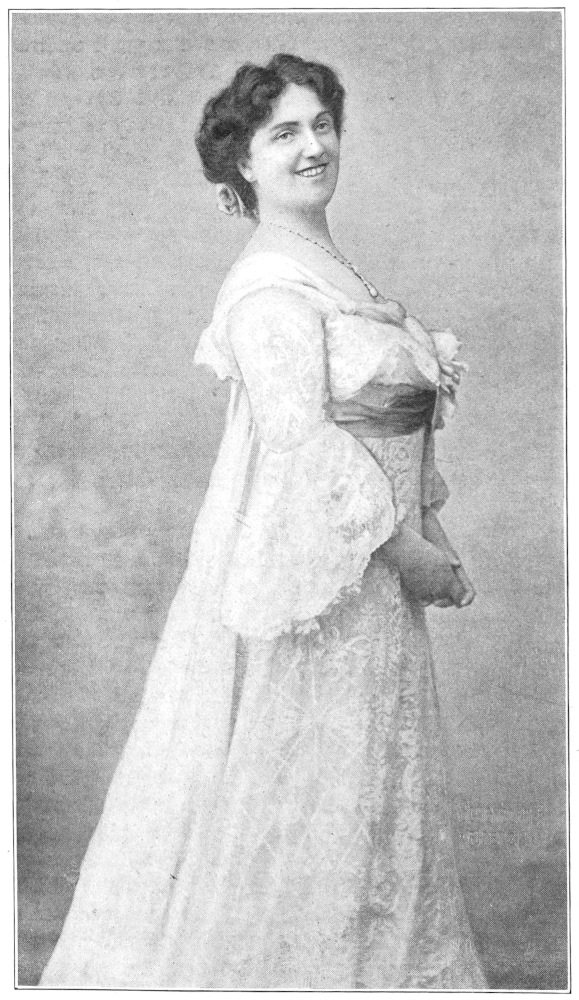
It was under his wing that I first entered the Balkans, [Pg 35]for he had given me a number of letters of introduction, written in scribbly hieroglyphics that I could not understand, but which proved a passe-partout to everywhere, from the Adriatic to the Black Sea.
I have heard a good many stories of the old Emperor Francis Josef of Austria, his successor the Emperor Karl, and of the Hapsburg Archdukes, from the lips of the Emperor’s niece Princess Luisa of Saxony. Her Highness possesses a fine sense of humour, and has a fund of humorous anecdotes.
Her father, the Grand Duke of Tuscany, wanted her to marry Dom Pedro of Brazil, whose praises had been sung to her constantly over the dinner-table for weeks, and at last they were introduced at Baden. They were pushed into each other’s society, both knowing that each was to marry the other. One day Dom Pedro asked her whether she cared for him, and she openly replied in the negative. Both laughed.
The Princess, in telling me the story, said:
“At once I saw that Dom Pedro was a young man to be trusted, and from henceforth we both had a great game with our respective families. When I pretended to go for lovers’ walks with him, he went out to meet a pretty young café-singer, while I strolled about and had many a chat with young men who had not the slightest inkling of my identity—among them a young British diplomat who was on the staff of the Embassy at Vienna, and who two years later recognized me at one of the balls at the Imperial Palace.
“Poor Dom Pedro! Ultimately he went raving mad—about a year after our escapades—and is now wearing out his life in one of the Imperial castles in Austria, a hopeless lunatic.”
But for an incident which is not without humour, Princess Luisa, instead of marrying the King of Saxony, would have been Queen of Bulgaria.
[Pg 36]
One day, when we were motoring together from Florence to Rome accompanied by her lady-in-waiting, Countess Függer, she related how Prince Ferdinand was brought out for her inspection and approval by his mother, old Princess Clémentine of Coburg, a sharp-tongued, ugly old lady, with an ear-trumpet.
“From the first I hated the comic-opera Prince, with his huge nose, perfectly trimmed beard, little pig-like eyes, and puffy cheeks,” she told me. “He came to Salzburg wearing most horrible yellow boots, and of course was a most superior person. Well, he soon grew amorous, and I was warned by my brother Poldo that His Highness meant to marry me. The Emperor had apparently declared to old Clémentine that Bulgaria would not be safe till its reigning Princess was an Archduchess of Austria.
“Poldo had really no need to warn me. I simply laid my plans, and while Ferdinand, whose amours had been notorious, had already told me that I was the only woman—the usual only woman—he could ever love, I set about to prepare my own little bombshell.
“Aunt Clémentine had arrived at the castle with the special ear-trumpet that she took out on visits, an ugly black affair with gold lace hanging over its opening. How well I can recollect the way she shouted back at one in that high-pitched, peevish voice. With her came my brother-in-law, the Archduke Otto, with the Archduke Sigismund, so that we were quite a family party, all assembled, I suppose, to hear the glad announcement that I was betrothed to Prince Ferdinand of Bulgaria.
“On the night of Aunt Clémentine’s arrival we all sat down to dinner, Ferdinand being seated opposite me, elegant and happy, and casting furtive glances that I mischievously disregarded, greatly to my mother’s intense annoyance. During the meal, however, Aunt Clémentine, with her ear-trumpet held over the table close to me, suddenly exclaimed in her shrill voice:
[Pg 37]
“‘Ah, Luisa! What a delightful pair you will make when you marry my Ferdinand! Really, you grow prettier every day.’
“‘Marry!’ I shouted back into my old aunt’s abominable ear-trumpet. ‘Why, I should never dream of marrying your son! Who said such a thing? I, for one, will never live in a country where the men go about in sheep-skins and the women twine flowers in their hair. Ugh! Bulgaria may suit those who like the simple life, but for me, Vienna, civilization, and a decent opera. Besides, when I marry I shall marry a real man!’”
Princess Luisa, who usually called herself Countess of Montignoso, or Countess de la Rose, when travelling, was nothing if not unconventional. I used to see her practically every day in Florence. Her beautiful villa was close to my own house, and in consequence she often sat in my study telling me about members of the Hapsburg family.
Nobody ever knew where the Hapsburgs would break out next. The Archduke Ludwig Salvator grew wine and sold it; his brother Archduke Charles had a hobby of mending locks and riding daily on ’buses and trams around Vienna, while the Duke Charles of Parma repaired watches and clocks and did not forget to charge for his services.
Of the old Duke Charles the Princess once told me a funny story. We were walking along the Passeggio, or esplanade, at Leghorn together one evening, after having paid a visit to my old friend Mr. Montgomery Carmichael, the well-known British Consul who wrote that most delightful book, In Tuscany.
“I remember being taken to Meissen by my mother to see the old Duke Charles of Parma. He was nearly blind, but still an elegant, commanding figure,” said she.
“He passed his thin hand over my face slowly, and then said in French:
[Pg 38]
“‘Ah, yes I You are growing good-looking—like Marie Antoinette somewhat—but with a happier expression.’ Then, with a sudden outburst, he added, ‘Look at me well, Luisa! I am a rare type of beast. I am your great-grandfather, old and ugly.’
“I looked at the erect and elegant figure in uniform, with the Order of the Golden Fleece, and said:
“‘Ah! but when you were younger you were very handsome. I have seen your portrait at the Hofburg.’
“‘Yes, yes,’ and a smile crossed his sightless countenance. ‘True, I was young once, and enjoyed life—enjoyed it greatly, I can assure you; and doubtless you too, Luisa, will enjoy it.’
“‘Well,’ remarked my mother coldly, and with meaning, ‘I hope Luisa will not follow in your footsteps, grandfather!’
“The old man seemed pleased at this reference to the amours of his early days, and before I left he gave me a very beautiful eighteenth-century golden casket set with fine jewels, which I still possess.
“That evening on our drive back from the Schloss into Dresden, about fifteen miles, my mother told me an amusing story of the old Duke. It appears that about five years before, when his eyesight was as yet unimpaired, he was still a bon viveur. He was old and he was toothless, for his pet abomination was false teeth. My father had, one day, laughed at his empty mouth, saying:
“‘I know of a really excellent dentist—a good fellow, in Vienna, who keeps me supplied with teeth—Kaltner, in the Praterstrasse. Why not call him in and get him to make you a set? You would look twenty years younger!’
“The old Duke was much impressed by the latter remark, and though he declared he would never wear such abominations, he secretly called in the dentist, who made him a complete set.
[Pg 39]
“They arrived on the day when he was giving a luncheon to half a dozen pretty women—for he dearly loved a charming face—and for that meal he wore them, priding himself that his valet had said that with them in his mouth he was rejuvenated. The meal commenced merrily, and he was particularly gracious to a certain Countess who sat on his right, when suddenly he experienced difficulty. He had laughed with his fair guests when, to his horror, he found himself unable to shut his mouth!
“For a few moments he remained with his mouth open, a look of terrible consternation upon his face. The guests thought he had been seized with a fit. Suddenly, however, he took his false teeth from his mouth, saying:
“‘Curse Ferdinand and his damned dentist! I’ll have no more of the abominable things!’ and he cast them across the room. They struck a marble statue, and went into a dozen pieces. There they remained till two flunkeys entered with dignity and swept them up into a dust-pan!”
Here is a scandal, a strict secret of the Imperial family, which the Princess disclosed to me concerning the Emperor of Austria, Karl Franz Josef, who succeeded to the throne during the war.
It seems that the Emperor, before his accession, was a boon companion of the German Ex-Crown Prince, and used to accompany him to the various capitals on many disgraceful escapades. He also suffered from that very prevalent malady known as impecuniosity. The Archduke Otto and the Archduchess Maria Josepha, his parents, were a “hard-up” pair, who had considerable trouble to make both ends meet. The old Emperor had no great love for them because they were a stiff-necked, pious couple, who had looked askance at His Majesty’s little peccadilloes, and had whispered some hard things that had returned to the Emperor’s ears.
[Pg 40]
Karl, one night in his peregrinations about Vienna, met a Jewish singer at the Hofopern named Elsa Bland. She was a dark-haired woman with a marvellous voice. The Viennese young men-about-town were all raving over her beauty at the time the Archduke appeared in her dressing-room. Karl Franz Josef became deeply fascinated, and naturally wanted to give her a present, but he had not the cash with which to purchase one. The embryo Emperor went to his mother, the Archduchess, with an excuse to borrow some money, but the old lady, who knew the world of Vienna well, guessed the motive of the request, and sent her son empty away.
Not to be outdone in his amorous device, Karl Franz Josef, a man of some resource where women are concerned, devised a plan.
The dark-haired, soft-spoken Jewess received three days later some magnificent jewels that were naturally the admiration of all her friends.
Next night a new musical opera was to be produced, and all Vienna attended. Elsa Bland was taking an important part, and old Maria Josepha was present.
To her horror, when fixing her glasses on the opulent Jewess, who was her son’s friend, she recognized on the singer’s neck and arms the contents of her own jewel-case, heirlooms of the Imperial family!
She called her son that same night and accused him of being a thief, as indeed he was. But he only laughed vacantly, and declared that Elsa Bland’s smiles were well worth a few paltry jewels.
In despair, his mother enlisted the sympathy of a friend, Count Salm-Reifferscheidt, whom she asked to negotiate with the Jewess for the return of the jewels.
The dark-haired Elsa, who had a male acquaintance in the background, as is so often the case with women of her class, refused to give them up. They had been [Pg 41]presented to her by “her friend the Archduke,” and they were hers. She had no knowledge whence they had come, and she cared less, she said.
The situation became daily more critical. The handsome Elsa declared that if she were worried any more by the Count she would hand a written statement to her friend Rohr, a journalist on the staff of the Neue Freie Presse, and expose the fact that His Imperial Highness, the Archduke, had stolen the contents of his mother’s jewel-box!
The only way out of the difficulty was to pay—and pay heavily. But the worst fact was that none of the parties had any money!
So, after many family conferences, at which many hard words were uttered, it was at last decided to go to the Emperor and present the case.
The Count described to Princess Luisa what took place. The Emperor, fearful lest Elsa’s friend, the journalist, should be told, and make “copy” out of the scandal, to his pecuniary advantage, had Rohr at once called to audience. The newspaper-man was amazed when the Emperor bestowed on him a cross and ribbon “for services rendered to the Empire.” Next day the Emperor called up the old Archduchess and gave her a severe lecture, followed an hour later by a further lecture to the fast-living young man who was heir to the throne.
Elsa Bland at length drove a very keen bargain with the Count, who was at last compelled to go to the Emperor and borrow the sum that the opera-singer demanded. In the end the money was paid, the jewels restored to their rightful owner, and the fair Elsa was turned out of Austria, bag and baggage, much to the dismay of Karl Josef.
Another story I heard in Court circles in Vienna concerns the Shah of Persia, the famous Nasr-ed-Din.
The Emperor of Austria had entertained him at the [Pg 42]Hofburg, but so disgusting were the habits of his—the Persian—suite that an excuse was made to send them on to Salzburg. The Grand Duke of Tuscany, unconscious of what had happened in Vienna, invited the “King of Kings.” He was a striking man, who wore a diamond aigrette in his turban, and who, before he would ride out, had the mane of one of his white horses dyed scarlet. Then, when he went forth with great pomp, a servant held over the monarch’s head a huge and gorgeous golden umbrella.
But the havoc created by the suite! The main hall of the west wing of the palace, being built of marble, was given over to them as a slaughter-house! They killed sheep and lambs on the inlaid marble floors and roasted them whole there. Imagine the mess, the blood, the disorder, and the smoke!
The Grand Duke and his family were in tears. A courier was sent to the Emperor with an urgent note, asking him how they could get rid of their unwelcome guests.
He brought back a reply in the Emperor’s own writing to the effect that the Shah was there for a fortnight, and it would be a grave insult to send him away. He would visit the Court of St. James next.
“Well,” airily exclaimed Poldo, the Archduke’s son, one day to his mother, “they’ve turned the hall into a slaughter-house, I see. Now they are saying their prayers in the Blue Salon. I am told they are to sacrifice hens on the carpet there at noon to-morrow—they cut off their heads, you know! I saw Egyptians doing it once outside a mosque in Cairo!”
The thought of hens having their heads sliced off in the Blue Salon was too much for the Archduchess, who at once became indignant and sent for her husband.
Meanwhile Poldo whispered to his sister:
“The hen fiction has about filled mother up with horror, eh?”
[Pg 43]
At last the Shah left, after he had distributed presents with a generous hand to everyone in the household, down to the kitchen-maids.
But the state of the rooms after they had gone was something too horrible for words. Pigs could not have left worse behind.
[Pg 44]
CHAPTER THREE
Among Real Brigands—King Nicholas and the Skreli Brigands—I am the First Englishman to Visit them—Life with a Brigand Band—Vatt Marashi, Chief of the Skreli—The Brigand’s Code of Honour—Keeping Strange Company.
A year, almost to the day, after my first visit to Montenegro, I was back again in Cettigné, for I had resolved upon an adventure. I always seek to see new countries and new people for the purpose of writing novels, and trying to interest the public that has always been so kind and generous to me.
I had travelled from London by way of Trieste, and taken the Austrian Lloyd steamer, the Graf von Wurmbrand, to Cattaro, and then up that ladder-like road to Cettigné, where I arrived one summer’s afternoon. I called at the Palace, and wrote my name in the visitors’ book.
Within a couple of hours I was handed a command to audience. I went, and when His Majesty King Nicholas had greeted me I told him the object of my visit, saying:
“I want, your Majesty, to be allowed to go into Northern Albania, and see the mountain tribes of which so much has been said.”
“The Skreli brigands!” he exclaimed in surprise. “Do you actually contemplate visiting the tribes in what we Montenegrins call ‘The Accursed Mountains’?”
I replied that such was my desire, whereupon he said:
“Take my advice. Don’t go. If you do, you will [Pg 45]never return. Or you may be held to ransom, just as the American lady, Miss Stone, was. You will probably be shot at sight, like a dog. The whole country is in a lawless state. You have no idea what those uncivilized tribes are like. They are on our frontier, so I know. You are too venturesome,” declared he.
But I was determined to see what the country was like in those distant misty mountains, and I pressed His Majesty to assist me.
Twice I saw him, and on the third occasion he very reluctantly gave me, as servant, a young, black-haired, eagle-eyed man, named Palok, one of his own servants, who was a member of the tribe of the Skreli, the dreaded brigands of Albania.
Our preparations for our adventurous journey occupied four days, and on the fifth King Nicholas was kind enough to ride down to the shore of the Lake of Scutari to see us off in a boat.
“Be careful!” said he. “I have given Palok a letter to Vatt Marashi, the chief of the Skreli, asking him to give you safe conduct. I hope he will. But I am much against your adventure, Monsieur Le Queux. While you are away I shall be thinking of you. If you be held to ransom, they will say I am to blame, but there—well, S’bogom! (God be with you.) But come back, and tell me all about it.”
In all the Slav countries “S’bogom” is a common salutation on greeting or taking farewell of a friend. And on that early summer’s morning, I felt as I was rowed across the lake that I was going into a savage, unknown region—as I really was.
At Scutari, Palok left me for six days, and returned with a fellow tribesman named Rok, a tall, cadaverous-looking ruffian. He told me that he had been up in the mountains, and that the dreaded Vatt Marashi had invited me to his forbidden fastness.
Next day we set out for the Accursed Mountains.
[Pg 46]
The Northern Albanian may be entirely uneducated, a barbarian, and at heart a brigand, but is certainly no fool.
My new friend Rok was particularly intelligent, and as we toiled along over those rough, rock-strewn paths and spoke in Italian, he gave me much information about his country, and declared that Austria and Italy were both equally their enemy.
After sunset, we rested at a point high up above a dark, gloomy defile, where a stream wound away towards the plain, and there we ate some slices of cold mutton and black bread and drank a glass of rakhi, the rifles of my companions lying at hand in case of sudden emergency.
I had noticed the queer, sinuous, almost uncanny way in which Rok walked. His movements at even pace irrespective of the state of the path, were stealthy. Indeed, he almost crept along, for his feet fell silently; and, with his rifle ever ready, his keen black eyes were searching every side for the enemy that he appeared to expect to meet at every turn. It was an uncanny experience.
Sometimes, as he walked in front, he would halt, and closely scan a mass of tumbled rocks, as though he suspected a lurking enemy; then, thoroughly satisfying himself, he would go forward again without glancing back. He was certain that no enemy was in his rear.
From his movements and natural caution, I could plainly see that we were traversing a country not altogether friendly, so when we sat over our evening meal, I asked Palok. His reply was:
“The Shiala are not on very friendly terms with the Skreli just now. But it is nothing, signore, nothing.”
We went forward till darkness closed in, and then lay down to sleep under an overhanging rock almost on the [Pg 47]face of a sheer precipice, a place in which Rok told us he often stayed on his way down to Skodra (Scutari). He humorously called it his han, or hotel.
We dare not light a fire for fear of attracting hostile attention, and the cold up there was intense. I tried to sleep, but was unable, therefore I arose, sat outside in the bright, glorious moonlight, and kept watch, while Rok curled himself up like a dog and snored soundly in chorus with Palok.
There, in the East, the full moon seems to shine with greater brilliance than in Northern Europe, and beneath its white rays those bare, rugged mountains looked like a veritable fairyland. Only the cry of a night-bird and the low music of the stream far below broke the stillness of the Oriental night, and as I sat there I reflected that I was the first Englishman who had ever been the guest of the redoubtable chieftain, Vatt Marashi, the man whom the Turks so hated, the man of whom blood-curdling tales had been told me both in Montenegro and in Skodra, and whose fame as a leader of a wild band had not long before been proclaimed by the London newspapers.
For hours I sat thinking, sometimes of my good fortune, at others of my perilous position alone in the hands of such a people. But I had heard that, notwithstanding their barbaric customs, an Albanian’s word was his bond. Therefore I reassured myself that I should not be the victim of treachery and reported to Constantinople as “missing.”
Slowly at last the moon paled, and I grew sleepy. That terrible road had worn me out. Therefore I woke Palok to mount guard, and flung myself down in his place and slept till the sun, shining in my face, awakened me.
Through the whole day we went forward again, over a path so bad that I often had to scramble with difficulty. I tried to ride the mule, but it was out of the question, so I walked and stumbled, and was helped over the rough [Pg 48]boulders by my companions. The Skreli country was surely an unapproachable region.
That night we slept again in the open, but in a spot less sheltered. Then on once more with the first grey of dawn, till, just before noon, Rok halted in the narrow track that wound around the face of the bare grey mountain, and, drawing his revolver, fired three times into the air.
The shots reverberated in a series of echoes. It was a signal, and almost ere they had died away came three answering shots from no great distance, and I was told that we were now in the Skreli region, and there was nothing more to fear.
In Podgoritza, in Cettigné, in Skodra, and in Djakova I had heard terrible stories of this fighting race, and of Vatt’s fierce hatred of the Turks. Yet everyone had told me that, the chief having invited me, I need not have a moment’s apprehension of my personal safety.
So I went forward, reassured, to meet my host.
Half an hour later I came face to face with real brigands—brigands who looked like illustrations out of a boy’s story-book, the men who had so often held up travellers and compelled the Turkish Government to pay heavy ransoms.
There were about twenty, certainly the fiercest and most bloodthirsty gang on which I have ever set my eyes. They were dressed in the usual skin-tight white woollen trousers, with broad black bands running down the legs, a short white jacket, also black-braided, the sleeveless woolly bolero of mourning, hide shoes with uppers consisting of a network of string, and small white skull-caps. Each man carried in his belt a great silver-mounted pistol of antique type and a silver-sheathed, curved knife, while around both shoulders were well-filled bandoliers, and in the hand of each a rifle. Like Rok, the heads of all were shaven, leaving a long tuft at the back, in the mediæval Florentine style.
With one accord they all raised their rifles aloft and [Pg 49]shouted me welcome, whereupon one man stepped forward—a big, muscular fellow with handsome face and proud gait—the great chief Vatt Marashi himself!
Attired very much as his followers, his dress was richer, the jacket being ornamented with gold braid. The silver hilt of his pistol was studded with coral and green stones, probably emeralds, but he carried no rifle. Jauntily, and laughing merrily, he approached me, and bent till his forehead touched mine—the Skreli sign of welcome.
And all this in Europe in the twentieth century!
Was I dreaming? Was it real? I was the guest of actual brigands, those men about whom I had read in story-books!
Vatt Marashi, holding my hand the while, addressed me. What he said was interpreted into Italian by Palok as:
“You are welcome here to my country—very welcome. And you are an Englishman, and have travelled so far to see us! It is wonderful—wonderful! You live so far away—farther than Constantinople, they say. Well, I cannot give you much here or make you very comfortable—not so comfortable as you have been down in Skodra. But I will do my best. Come, let us eat.”
I returned his greeting, whereupon the whole crowd of us walked along to a spot where a cauldron was standing on a wood fire, and out of it my host, myself, and Palok had pieces of boiled chicken and rice that had especially been prepared for my coming.
The object of this meal, I afterwards learnt, was to cement our friendship. The Albanian code of honour is astounding, even to our Western ideas. A word once given by those Albanian tribes is never broken, and if the stranger eats the food of the Skreli, even though he prove an enemy, his person is sacred for twenty-four hours afterwards. While the food remains undigested he may not be injured or captured.
[Pg 50]
So while I ate with this wild chieftain his band squatted round, apparently discussing me.
It was probably the first time they had seen an Englishman, Palok explained, and they were at first inclined to regard me as a secret agent of the Government, till later that afternoon their chief assured them to the contrary.
Then that wild horde, to a man, became my devoted servants. I photographed them, and the picture appeared in my book on the Near East, together with Princess Xenia’s photographs.
Vatt, the Baryaktar (from the Turkish bairakdar, or standard-bearer), unlike most Albanians, was fair-haired, above the average height, and extremely muscular. He had a constant smile of hearty good-fellowship. His eyes were fierce and barbaric; nevertheless, he was pleasant of countenance, and I certainly found him, from first to last, a staunch and excellent friend.
Lord of those wild, rugged mountains, his word was obeyed with a precision that amazed me. A striking figure he presented as, with me, he marched at head of his bodyguard, his chest thrown out proudly, his head up, his keen eyes ever searching forward like every Albanian of the hills, the wildest ruler of wildest Europe.
On every side, as we went forward to the tiny clusters of little houses that formed the village where I was to be quartered, were bare grey limestone rocks, without a single blade of grass, a desolate mountain region into which no foreigner had penetrated except when captured and held to ransom, as Miss Stone had been, the United States Government having paid a large sum for her release. Through centuries have that same tribe ruled that barren land, and no conqueror of Albania has ever succeeded in ousting them.
“You have, no doubt, heard down in Scutari terrible things about me,” he said, laughing, as, later on, we walked together. He had rolled me a cigarette and given it to [Pg 51]me unstuck. “I expect you feared to come and see me—eh?”
I admitted that I had heard things of him not altogether calculated to make me feel at ease.
“Ah!” he laughed, “that is because the Turks do not like us. Whenever a Turkish soldier puts his foot a kilometre outside Skodra, we either take away his Mauser and send him back, or else—well, we shoot him first.”
“But they say that your men capture travellers.”
“And why not?” he asked. “We are Christians. Is it not permissible for us to do everything to annoy those devils of Turks? But,” he added, “if they say that I treat my prisoners badly, they lie. Why, they get plenty of food and are well treated. I give them some shooting if they like, and they generally enjoy themselves. But I know. I too have been told that the Turks say I once cut off a man’s ears. Bah! all Turks are liars!”
“Then it is only to annoy the Turks that your men commit acts of brigandage?”
“Of course. The ransom is useful to us, I admit, but we live by our flocks, and our wants are few. We are not like the people down in Skodra. We are better, I hope.”
“And do you always watch the roads on the other side of the mountains yonder?”
“Always. Our men are there now, all along the route between Ipek and Prisrend. Who knows who may not pass along—a rich pasha perhaps.” And his face relaxed into a humorous smile at the thought of such a prize.
Then I marched along—a brigand for the nonce, like my host!
Surely it was one of the quaintest experiences of a varied and adventurous life.
The tiny house in which I was given quarters had an earthen floor, and consisted of two rooms, the ceilings and walls of which were blackened by the smoke of years. The owner was an old man with a wife and married daughter, the latter being a pretty young woman of about [Pg 52]nineteen, dressed in the gorgeous gala costume with golden sequins, identical with those I saw down at Scutari during the festà. In my honour she wore her finest garments, and her husband, a good-looking young fellow five years her senior, seemed justly proud of her. His name was Lûk. I named him “Lucky,” but he did not appreciate the wit. He was, I found, one of the chiefs bodyguard who had come to greet me at the confines of the Skreli territory, and proved a most sociable fellow, ever ready to render me a service.
“These good people will look after you and make you as comfortable as they can,” my host said, when he had introduced me to them. “I have to go along the ravine, but will return in time to eat with you this evening. You like good cigarettes? I will send you some.” And he shook my hands, and, turning, went out, stalking again at the head of his ferocious-looking band.
The bedroom, occupied in common by the family, was given over to me. My bed on the floor was a big sack filled with dried maize-leaves. It was not inviting, but Palok, having examined it critically, declared it to be “Cosi-cosi!” and, having slept out for a couple of nights, I was compelled to accept his verdict.
The girl in the sequins boiled us coffee over the fire, and with her father and husband I sat outside the house in the golden sunset, smoking and chatting. Both were full of curiosity. England was to them a mere legendary land, but they knew more of London. When I mentioned it, they declared that it could not possibly be so large as Skodra!
I told them of Cettigné and of other towns in Montenegro I had visited, but they held all Montenegro in contempt, for were they not always raiding over the frontier? Lûk declared that he had walked in Podgoritza openly, and in the market-place shot a man with whom he was in gyak, or blood-feud.
“I walked out again, and no one dared to stop me,” [Pg 53]he added, with pride. “It would have been worse for them if they had!”
“But the Montenegrins are no cowards” I ventured to remark.
“Certainly not. They are very brave, but they dare not follow us here. They always get lost in the mountains, and once they lose their way they lose their lives,” he added, with a grin. “Our men killed four over yonder mountain a few days ago.”
“The blood-feud?”
“Of course. It arose out of that.”
From the half-dozen other poor mountain homes came forth men, women, and children, who grouped around us, watching us with curiosity. According to Palok, rumour had at first gone round that I was a prisoner, therefore they had refrained from gathering round to see me. Now, however, they knew the truth, they welcomed me as their guest.
Just before it grew dark the Baryaktar returned, followed by his bodyguard, without whom he never seemed to move. They did his bidding, executed his orders, and were ever at his beck and call—the picked men of the tribe.
While Vatt squatted on the floor, I sat on my battered old suit-case, and together we ate a kind of mutton stew, rather rich but not unpalatable. There was an absence of table cutlery, therefore we ate with the aid of our pocket-knives and fingers. Now and then the old woman would pick a tit-bit out of the pot and hand it to me with her fingers. I was compelled to accept the well-meant hospitality, even though her hands were not particularly clean.
The hot dish was tasty, but I could not manage the sour black bread, for it was mouldy and gritty into the bargain.
It was a weird picture, the interior of that lowly hut, lit by a dim oil lamp similar to those used by the early [Pg 54]Greeks. The uncertain firelight glinted on the sequin-ornamented dresses of the chieftain and of Lûk’s pretty wife, throwing, now and then, into relief those strangely unfamiliar faces that recalled the barbarians of an age bygone and forgotten. The very language they were speaking was, as an unwritten one, utterly incomprehensible and unintelligible to any but the born Albanian.
It was difficult to believe that it was really only a very few weeks ago that I had driven a car from London down to Brighton, that I had dined at White’s, and, with a lady, had trod the red carpet of the Savoy after the theatre.
And to-night I was actually having supper with real live brigands of the mountains!
Lûk produced a bottle of rakhi, and Vatt Marashi lifted his tin mug to me. I took a little of the potent spirit in the bottom of my own drinking-cup, and tossed it off. It was not half so bad as I expected.
Then, as I rubbed my eyes, on account of the smoke, the chief took me outside the house, and in the clear moonlight we sat down with Palok on a big rock to chat.
He rolled me a cigarette of most excellent Turkish tobacco—of his own growing, he told me—lit one himself, and we sipped the thick, sweet coffee brought to us by Lûk’s wife.
The scene stretching before us was superb—a magnificent panorama of mountains, some tipped with snow, white and brilliant under the moonbeams. Below us, the valley was a great chasm, and lay in unfathomable blackness.
With my strange host, I chatted about many subjects, and found him far more intelligent than I would have believed. Keen-witted, quick of perception, just in his judgment, and yet filled with an intense hatred alike for both Turk and Montenegrin, he explained to me many things of great interest.
He told me of the glorious traditions of his sturdy race, [Pg 55]and of the prince of the Skender Beg family, who, they hoped, would one day come back to rule them.
“We, the chieftains, hold authority from him,” he declared. “Oh, yes, he will come some day. Of that we are quite certain.”
“Englishmen have never dared to come here, have they?” I asked, with some curiosity.
“Only once, a year or two ago. I discovered three of your compatriots poking about in the rocks and chipping little pieces off. I had them captured, and brought to me. At first I thought I would hold them to ransom and make the Turks pay. But they were evidently poor fellows, for their clothes were worn almost to rags, and they had very little money. So I gave them their money back and sent them with an escort down to the plain, forbidding them to enter our country again. I wonder why they came, and why they were chipping the rocks?”
I told him that they were evidently mining prospectors; that Englishmen travelled all over the world to discover minerals; and that a mine in his country would be a source of great wealth. But my explanation did not appeal to him. He could not see why they were chipping off those pieces of rock. It was not flint, otherwise they might have wanted them for gun-locks. No, the trio were distinctly suspicious characters, and he was glad that he had expelled them.
“Have you ever held an Englishman to ransom?” I inquired.
“One. Five years ago. He came here shooting—after bears, I think. He was evidently a great gentleman, for his guns were beautiful. The Turks paid promptly.”
“Because he was an Englishman, eh?”
“Most probably,” he laughed. “Are they afraid of you English as they are afraid of us?”
Soon afterwards he bade me good-night. Then I threw myself down on my mattress of leaves and listened [Pg 56]to the snoring of Palok and the assembled family in the adjoining room.
I had thought Skodra barbaric, but here I was in an utterly unknown corner of the earth, in an absolutely savage land—a land that knew no law and acknowledged no master; a land that is the same to-day, even after the war, as it was in the days of Diocletian and of Constantine the Great—Albania the Unchanging.
[Pg 57]
CHAPTER FOUR
In Savage Europe—Real Brigands Before the Camera—The Brigand Beauty and the Blood-Feud—Another Brigand Chief Offers me “Sport”—A Murderer Tells his Strange Story—King Nicholas Writes me a Poem—His Majesty Fines one of his Subjects Five Francs and Pockets the Money.
On the day following the events recorded in the previous chapter, we were climbing the rocks—for Vatt and his bodyguard thought that they might get a shot at a bear—when there was a sudden alarm. The hawk-like eyes of my companions espied strangers, and a sudden halt was called. In a moment we were all under cover of the rocks. Every man unslung his rifle, and Vatt himself, with knit brows, drew his big silver-butted pistol, while I crouched behind a rock expecting something to happen.
Nothing, however, did happen. But, a few moments later, there were shouts from the opposite side of the defile, and my companions, leaving the shelter of the rocks, waved their rifles over their heads as a sign of greeting.
Vatt, replacing his pistol in his belt, spoke in a loud, sharp voice, and received an answer. Those mountaineers can throw their voices long distances, and be heard distinctly, a fact I often noticed.
Palok told me that the strangers were of the neighbouring tribe, the Kastrati, and that their chief, Dêd Presci, had come to pay Vatt a visit.
[Pg 58]
This was fortunate for me, since it gave me an opportunity of meeting the other ruler of Northern Albania. Next to the Skreli the Kastrati are most powerful in the Accursed Mountains, even to-day after the war.
Half-an-hour later we met our visitors. Dressed very similarly to my companions, they wore white, tasselless fezes instead of the little white skull-cap, while the black stripes down their trousers were somewhat different. The two chieftains touched foreheads, and afterwards I was introduced. Dêd Presci, a round-faced, pleasant man, rather stout and burly, his hair cut in mediæval style, gripped me warmly by the hand, saying:
“I heard that you were in Skodra during the festà. Some of my men told me there was an Englishman. But I never expected to meet you. Perhaps you are coming across to see me, eh? If so, you are quite welcome.”
“I may come next year to shoot, with a couple of English friends. May I visit you then?”
“Most certainly. You have only, through one of our men down in Skodra, to warn me of your coming, and I will give you safe escort,” was his reply. “If you are fond of sport, you will find plenty with us. Only bring a tent, and perhaps some provisions; for our food is not what you foreigners are used to.”
“Then I shall return one day before long,” I promised.
“Do. You need fear nothing, you know. We never betray a friend.”
“Or forgive an enemy,” added Vatt, laughing.
“Especially if he be a Turk,” I remarked; whereat both chiefs laughed in chorus.
That evening, in a small lonely house on the mountainside, I ate with the pair; and the moon had long risen before Palok and I returned to Lûk’s.
My camera was, from the first, regarded with a good deal of suspicion, and it was with very great difficulty that I persuaded anybody to be photographed. Many surreptitious snapshots I took with a small Brownie [Pg 59]camera, for unfortunately I had run out of films for my larger Kodak. Those photographs, the first ever taken of the Skreli brigands, may be found in my book.
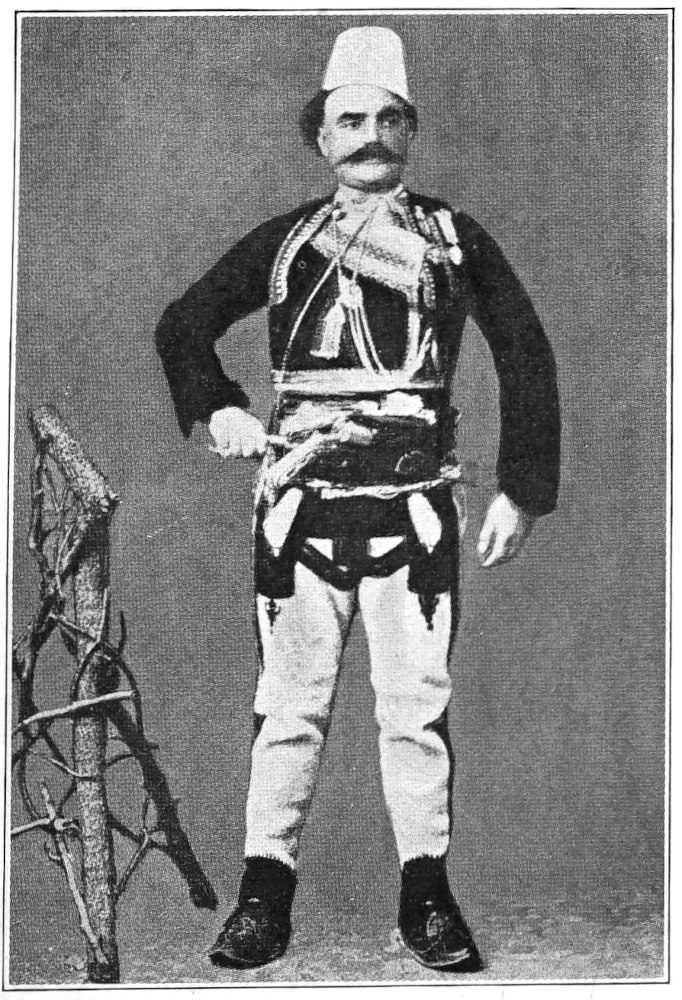
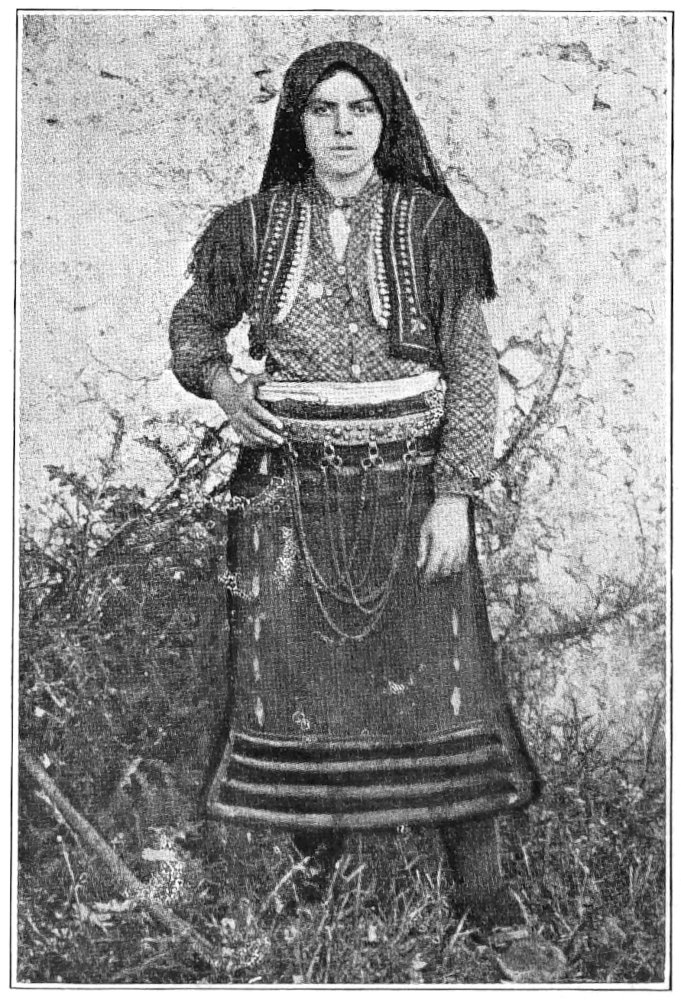
Early one morning, soon after sunrise, I was walking with Lûk and Palok when a young woman passed us.
“That is Mrika Koi Marashut,” Lûk remarked.
“And who is she?” I asked.
“Mrika, the woman who carried on the blood-feud,” was his answer. “Two years ago she was the most beautiful girl of our tribe, and had a dozen men ready to marry her. She married Lez, a smart young man from the Pulati side, and one of the Baryaktar’s bodyguard, like myself. A month after their marriage Lez was treacherously killed by his brother, who lived down by the White Drin and was violently in love with her. When she received the news she became half demented by grief. But, by slow degrees, she formed her plans for avenging her husband’s death, and for carrying on the blood-feud, and, having no male relatives, resolved to take it on herself. She therefore left us and was absent nearly a year, during which time she persistently followed her brother-in-law first to Ochrida, in Macedonia, then to Uskub, Prisrend, and many other places, always awaiting her opportunity to strike the blow. This came one afternoon when her husband’s assassin was walking in the main street in Skodra, and she took Lez’s pistol from her belt and blew his face away. It was valiant of a woman, was it not? But not only that,” he went on. “Having killed the murderer, she went straight to his parents’ house, three days’ journey, and shot them both dead. Since then she has been back with us, now that poor Lez’s death has been avenged. I was sorry he died,” he added regretfully, “for he was one of my dearest friends.”
Murder is hardly a crime in Albania, for there life is cheap—very cheap. An enemy or a stranger is shot like a dog, and left at the roadside.
[Pg 60]
Palok told me of an incident that truly illustrates the utter disregard the Albanian has for other people’s lives. He was once with a man of the Hoti tribe—on the Montenegrin frontier—who had just obtained a new rifle, probably from a murdered Turkish soldier. While he was inspecting it a man passed close by, a stranger, whereupon the man with the new gun raised it to his shoulder, took aim, and fired. The stranger fell dead. Palok remonstrated, but his companion merely said that he was testing his gun’s accuracy. Was it not better, he asked, to test it that way, instead of waiting till face to face with an enemy?
The assassin in that region is never punished, except by those who take up the blood-feud. If the murder takes place in a town the guilty one escapes to the mountains, or gets away into Macedonia, or Serbia, where perhaps he earns his living by sawing firewood. Every few years the Sultan issued an irade “for the pacification of the blood,” as it is put, and the murderer then returned. He paid a small tax to the Government, after which he cannot be arrested; and if he pays about three hundred crowns to the relatives of his victim, the blood-feud is at an end.
This, however, does not apply to the mountain tribes. They care not a jot for the Sultan’s irades or the new King of Jugo-Slavia. There is no law, except that of the blood-feud, the vendetta falling on the murderer and on his next male relative. Many are the curious facts that I have heard regarding the blood-feud and the Albanian laws of hospitality.
A case in point was that of a young man named Koi, a friend of Lûk’s, a tall, wiry youth, of somewhat sinister expression—a typical bandit.
I was talking about the hospitality extended by the various tribes to each other, when Kol passed and Lûk beckoned him, saying:
[Pg 61]
“He has just had a curious experience in the Klementi country. Let him relate it to you.”
So at Lûk’s invitation the young fellow accepted one of my cigarettes, placed his rifle against the wall, and flung himself down on a small boulder near us.
He blew a cloud of smoke from his thin lips, stroked his knees with his hands, and looked at me with considerable curiosity, wondering why I should want to know his story.
“The stranger is interested in your adventures with the Klementi. Tell him all about them,” said Palok.
“Bah!” he said, with a slight shrug of his shoulders. “It was nothing—mere chance—luck, if you like to call it so. There is nothing to tell.”
“But what there is interests the Englishman. He is the Baryaktar’s guest, remember,” Lûk remarked.
“Well,” said the young man reluctantly, and Palok translated his words as follow: “The fact is that I was in blood-feud with a man of the Klementi, and went over there to kill him. I laid in wait one evening, and as he drove home his sheep I shot him from behind a rock. He had killed my father, therefore I had a just right to avenge his blood. My shot, however, aroused the whole valley, and I knew that I, the only stranger, would be suspected and killed. Therefore I sped away down the valley in the darkness till I reached a small mean house. An old woman was there, and I craved food and shelter for the night. She gave me food at once, for, like ourselves, the Klementi never send a stranger away. I was hungry, for I had crossed into the Klementi region in secret, and dared not seek food lest my presence became known to the man I intended to kill. Scarcely had I eaten the meal the old woman gave me when there came the sound of voices outside, and to my horror I saw four men carrying in the body of my victim.
“‘See!’ they cried to the woman who was befriending me. ‘One of the Skreli has killed your son!’
[Pg 62]
“Then I knew that it was the murdered man’s mother who had given me shelter. A moment later the men, among whom was the elder brother of the victim, discovered me.
“‘See!’ they cried. ‘There is your son’s murderer. We will kill him!’
“I stood with my back to the wall, knowing well that my last moment had come. The dead man’s brother raised his rifle while I drew my pistol, prepared at least to fire once more before I died. I was caught like a rat in a trap!
“The old woman, however, seeing my position and my helplessness, cried:
“‘No! Enough! Though he has killed your brother, you may not touch him! He is beneath our roof! He has eaten our bread, and our protection must remain over him till to-morrow’s sunset. Remember, my son, it is our law.’
“The man dropped his rifle, and his friends drew back at the old woman’s reproof.
“‘Go!’ she said to me, after glancing at her son’s body. ‘You have eaten our bread, and therefore you cannot be harmed.’
“‘Yes, go,’ added my victim’s brother. ‘Till to-morrow’s sunset I will not follow. But after that I shall track you down, and, before heaven, I will kill you!’
“Need I say that I took up my rifle, and, leaving the house, travelled quickly all night and all next day, until I returned here? But,” added Koi, with a slight sigh, “we shall meet one day, and he will most certainly kill me!”
Is there any other country in the world where such a strict code of honour exists? I am inclined to think not.
Had I been in the midst of a highly civilized people—a foreigner wandering in the wilds of Scotland, for example—I certainly should never have received the many charming kindnesses that I did at the hands of those [Pg 63]rough, uncivilized tribes. Climbing like cats up the mountain-sides as they did, I was often compelled to lag behind, being unused to such walking. But, laughing merrily, those armed banditti would catch hold of my arms and pull me up the steeper places; they would roll cigarettes for me, become distressed when I grew fagged, and fetch and carry for me like children.
My neat automatic pistol was greatly admired as being a much more handy and serviceable weapon than their own big pistols—Austrian-made revolvers fitted to antique silver butts that had once done service to flintlocks. My weapon with its magazine was declared a marvel of ingenuity, and on many occasions Vatt and his men amused themselves by firing with it at targets.
Once he remarked, with a grim smile, that it would be a very handy weapon against the Turks. Where could he get one? Was it costly?
When I promised to send him one through a mutual friend in the bazaar down in Scutari, as souvenir of my visit, his joy knew no bounds.
A month later I fulfilled my promise, sending it across from Sofia, and I received an acknowledgment of its safe receipt.
I wonder whether or not he used it against the hated Turk? I know he has survived the Great War, and he no doubt struts about with it in his belt, a greater chief than all the others, because he possesses the very latest and deadliest of weapons. He is to-day still Chief of the Skreli, who defied the whole of the Turkish army.
On the same evening of my return to Cettigné from the Skreli country I had audience of King Nicholas, who listened with greatest interest to my account of Vatt Marashi and his tribesmen; for the latter were constantly raiding on his frontier.
After hearing me for over an hour he invested me with the dark-blue enamelled cross of the Order of Danilo, with its cherry-and-white ribbon. Knowing His Majesty [Pg 64]to be a poet of no mean distinction, I ventured to ask him if he would write me a poem.
He laughed and replied vaguely, “Perhaps.”
Two days later a large envelope was ceremoniously delivered to me containing the following in Serbian, in his own bold handwriting:
It was later translated into English by my friend Count Chedo Mijatovitch as follows:
Dear old King Nicholas was ever a paternal monarch. Each Thursday morning he would sit in a big arm-chair beneath the portico of his Palace, accessible to any of his subjects who wished to petition him. He would listen to their troubles, give friendly advice, and frequently dispense a rough-and-ready justice.
On one occasion, while walking in the main street of Cettigné, I saw him stop a man and ask for his revolver. The man addressed drew his weapon from his belt and gave it sheepishly to the king, who examined it, and, finding it unloaded, promptly fined him five francs. The man paid merrily, while His Majesty pocketed the money, with a smile of evident satisfaction! There was a law that everyone must go armed, and anyone found with a weapon without cartridges was liable to a fine. It was apparently His Majesty’s delight to go about and administer the law—to his own advantage!
When I went to the Palace to wish him farewell, he gave [Pg 66]me several messages to his friends in England, and on that occasion presented me to his Consort, Queen Milena, a very handsome, white-haired woman, whose daughter the Queen of Italy much resembles. It is only while writing this page that Her Majesty’s death has occurred in Italy, and she has been buried side by side with her husband, in the picturesque Russian cemetery, overlooking the blue Mediterranean, at San Remo.
Her two other daughters I met while the pretty Princess Xenia was assisting me with the photographs—Princess Militza, who married the Grand Duke Peter of Russia, and Princess Stana, who became wife of the Grand Duke Nicholas. Both were pretty, dark-eyed girls, devoted to tennis, and hoping that one day Cettigné would establish a golf-course.
They had been in Rome with their sister, the Queen, on several occasions, and one afternoon as we sat at tea on the verandah of Prince Mirko’s house Princess Stana sighed and said:
“Oh! how I wish we were back in Rome! Elena always gives us such a glorious time at the Quirinal.”
[Pg 67]
CHAPTER FIVE
The Love Romance of King Peter of Serbia—His Majesty the Most Misjudged Monarch in Europe—He is my Friend through Fifteen Years—A King Incognito and his Troubles—His Many Kindnesses to me—Prince George and the Ladies of the Ballet.
King Peter of Serbia I first knew in Paris as Prince Peter Karageorgevitch, before he was compelled to succeed to the throne of Serbia on the assassination of King Alexander and his adventuress-consort, Queen Draga.
From that fatal moment poor Peter was a misjudged man. The world believed that he had had a hand in the royal tragedy, but I happen to know that he had no desire to become King of Serbia. The skeleton in His Majesty’s cupboard was a great and absorbing love romance, of which I, among very few, knew the truth, and which is here related for the first time. The lady lived in Paris, and I had often been her guest at luncheon and dinner. At the moment of the royal tragedy she was actually engaged to be married to the man she loved.
Suddenly, without warning, the Prince found himself called to Belgrade to ascend a tottering throne. There was an affectionate leave-taking, and the lady—whose name it would not be fair to mention, for she has lately married—was inconsolable, and came to London, where I called on her at Brown’s Hotel.
Meanwhile the monarch she loved was bearing all the vile abuse that the Press of the world could vent upon his head. The British Press openly declared him to be an [Pg 68]assassin, and the British Government withdrew its Minister from the Serbian capital. With his lips sealed, poor King Peter was unable to utter a word in self-defence, while time after time the lady in question, when I called and consoled her, showed me the bitter articles that sensational journalists, ignorant of the facts, wrote against her lover.
Those wicked articles broke the monarch’s heart, and in such distressing circumstances he ascended the throne of Serbia, and was later, with hollow mockery, crowned King, well knowing that the woman he so dearly loved could never become his wife. The Serbians would not tolerate a foreigner as queen, and in any case the marriage could only be a morganatic one.
Such were his constant regrets, and so melancholy his frame of mind, that he shut himself up in his Palace and saw hardly anybody except his Ministers of State. Even this seclusion attracted the suspicions of his traducers, who declared that the new King was a criminal, who dared not show his face to honest folk, and some of our own most influential but ill-informed newspapers were most bitter in their recriminations. I tried to put them right, but they would not have it.
King Peter had been at Belgrade nearly two years before I had my first private audience of him as King. Curiously enough, Europe had never recognized in him the grandson of the great hero of the Serbian people, the rough peasant Karageorge, who, in 1804, raised the Serbians against their oppressors the Turks and defeated them. Peter Karageorgevitch was a born soldier. His facial expression, his stature, his grit, and his mannerisms, all reminded me of Earl Roberts. In 1875 he fought at the head of his troop—which, by the way, he raised himself and crippled his finances thereby—for the emancipation of Bosnia. Surely he was a born soldier!
Serbia is a nation of poets and artists, and in its national [Pg 69]poetry there is a hero called Peter Mrcognitch, the Protector of the Poor. And under that assumed name Prince Peter fought. In 1870 he fought on the French side against the Germans, being awarded the Legion of Honour for valour on the battlefield. And again, in 1914, he fought against the Germans. Such was the man whom the world, in its ignorance, denounced as a murderer!
The true history of the last weeks of Alexander’s reign, of those black days of spies and suspicion in Belgrade, has never been told. But I have myself been in those terrible secret oubliettes of the old Turkish fortress, overlooking the junction of the Save with the Danube, where those, many of them leading men of the political, social, and literary world in Belgrade, who dared to utter a word against Draga and her methods, were confined with but little air or light till they died. The Royal House of Obrenovitch was exterminated, it is true, but I affirm here and most solemnly that King Peter had no hand in it whatsoever, and his forced parting with Madame X was the greatest blow in all his splendid but unhappy life.
One dark autumn evening I left the Grand Hotel at Belgrade and drove through the wide ornamental iron gates of the New Konak, or Palace. Blue-coated sentries saluted; idling detectives lifted their hats; and the lines of blue-and-gold liveried servants, drawn up in the big entrance-hall, bent low as I alighted. It was all delightfully impressive and amusing.
In the large inner hall was a wide horse-shoe staircase of regal splendour and in excellent taste. All was very new, for the Palace in which the tragedy had occurred had been pulled down, and its site converted into a lawn.
At the head of the stairs Colonel Tcholak-Antich, the Royal Marshal, in a bright blue uniform, and wearing many decorations, met me, and with the usual etiquette we exchanged our names with our greetings.
[Pg 70]
“His Majesty wants you to sign his birthday-book, which he keeps for his friends. Will you do so?” was almost his first question.
He took me into a little ante-room, and there I scribbled my name in the space of July 2nd. And I may say that after I had done so, no anniversary of my birthday passed till the King died without my receiving a telegram on that day, bearing a red label, with the words “Government Telegram; With Priority,” wishing me many happy returns.
In addition, as my intimate friends know well—for they have smoked them—His Majesty used to send me a very welcome present of two thousand of his own Serbian cigarettes each year, bearing his royal cipher in gold on them.
But that apart.
I was at once conducted to the audience-chamber, the double doors of which, to prevent eavesdroppers, were closed behind me, and by etiquette I was left alone to await His Majesty.
The room, of fine dimensions with a gilded ceiling, seemed, under the many electric lamps, ablaze with gold. The beautiful gilt furniture showed well against the old rose carpet, the damask of the upholstery matching the carpet and being brocaded with gold. Several fine modern paintings of seascapes were on the walls, one big historical painting by the great Botzaritch, whose talented son is a coming artist in London to-day and quite recently drew a remarkable caricature of myself. In the centre was a large settee and several fine gilt chairs, set against a big gilt Renaissance table.
I had scarcely time to look across the luxurious room when the long white double doors at the end opened and His Majesty, in the dark-blue uniform of a Serbian general, entered.
“Well, my dear friend Le Queux, so at last you have come to see me!” he exclaimed, taking my hand. “I [Pg 71]have long been expecting you. Many things have happened since we met in Paris, eh?”
He motioned me to a seat on the settee, and then, after handing me a cigarette from the big gold box on the table, he took one, lit it, and cast himself in a soft arm-chair opposite.
Then we began to chat.
“You are very welcome here in Serbia. But I need not tell you, my dear friend,” he said, in his sharp military way. “I have read some of the kind things you have written about us. Would that everyone understood us as you do. I only wish writers would tell the truth as you and Mr. Alfred Stead and a few others have done. But”—and he paused, looking me straight in the face, with his dark, deep-set eyes—“you know the real truth! The others, alas! don’t,” and he sighed.
“Your Majesty has been entirely misunderstood,” I said, and then our conversation drifted into matters of a purely private character, for, as a matter of fact, I had seen Madame X at Cannes only three weeks before, and she had given me a message to convey to him.
Presently I spoke of various matters regarding diplomacy—for the truth was that the Foreign Office was anxious to know certain things, and because I knew His Majesty, I had been asked to put certain questions.
“Ah! you want me to talk politics,” he laughed, raising his hand with the fine diamond on it. “No. I make a rule never to do so—even to you, my dear friend! One of our chief faults here in Serbia is that we talk far too much about politics. You have noticed that, I daresay, in the cafés, in the Legations, and elsewhere, eh? All we Serbians are the same—in Montenegro, in Bosnia, and elsewhere. It is always so with a young nation. Our future will, I fervently hope, be one of peace and prosperity. It will ever be my most earnest endeavour to secure this for my people, so that Serbia may prove [Pg 72]to Europe that she does not merit the hard things said of her in the past.”
His Majesty, after we had chatted about Florence, a city which he knew quite well, told me a very interesting fact. “We have here, in Serbia,” he said, “a most wonderful cure for rheumatism—the Ribarska Banya. I only tell you what happened personally to me. As you know perhaps, long ago, during the Russo-Turkish War, I contracted acute rheumatism, and have been a martyr to it ever since. I visited every watering-place in Europe, but none of their so-called ‘cures’ did me any good. A year ago, with much reluctance, I went to Ribarska and took the cure, and from that moment I have never since been troubled. It was miraculous! With my own eyes I saw a poor woman wheeled there entirely crippled, and twenty days later I saw her beginning to walk. I would not have believed it had I not seen it with my own eyes. You should tell people in England,” he added.
For an hour and a half we chatted about many things—of London, of Paris, of Rome, of Vienna—for His Majesty was essentially an up-to-date man of the world, as well as a monarch. “We want no external troubles,” he declared to me. “We only want to be allowed to progress.”
But, alas! what a débâcle was to come in the days of the war.
“I have had some amusing experiences here since I have been King,” he went on. “One that happened soon after my arrival was rather humorous. It is my habit, as you know, to ride out into the country early each morning for exercise, and I always prefer to be alone. At first the police insisted that I should have an escort, but I do not like to feel as if I were under arrest, so I refused. One beautiful summer’s morning, about a fortnight after I came here, I rode out along the road to Ripanje, and when passing a small village I heard an old peasant-woman loudly lamenting the fate of her relatives and of [Pg 73]the whole Serbian nation in general. I drew up, and as I remained unnoticed it suddenly occurred to me that I was unknown, for my features had not yet appeared on the postage-stamps or on the coinage.
“‘Well,’ I asked the old woman, ‘what has happened? Tell me.’
“‘Ah! general. If you only knew how the police treat us here! It is most scandalous! Every police-agent expects a bribe, and if you don’t give him one, he will trump-up charges against you. Woe! that we Serbians should ever live under such a Government. Alexander is dead, and now there is a new King. Oh! if he only knew, I feel sure he would inquire into it all, for they say he is, after all, a good Serbian, even though he shuts himself up in the Konak and never sees anybody.’
“I inquired her name, and then told her that, being a general, I sometimes saw the new King, and when next time I did I would mention her complaint to His Majesty.
“‘Ah! Thanks, general,’ replied the old peasant woman. ‘If you do, then you will earn the thanks of all of us here.’
“Well, on my return here I called Monsieur Paschitch, the Prime Minister, and ordered a full inquiry. Its result was that an appalling state of affairs was revealed. The peasantry were being oppressed on every hand, and I ordered that the officials responsible should not only be degraded, but prosecuted.”
On a dozen or more occasions, at different times, I was received by King Peter. He was always most generous to me, and gave me the run of the whole royal domains for fishing and shooting, and he sent to me the beautiful signed portrait of himself, which can be found as the frontispiece of my book, An Observer in the Near East—a book which, by the way, was at first published anonymously, because I was engaged in secret-service work.
[Pg 74]
More than once he was quite frank with me concerning his troubles. We were sitting together one afternoon when he suddenly rose, and with clouded brow paced his long room, overlooking the Danube and the great Hungarian plains. Then, halting before me abruptly, he asked with a sigh:
“Don’t you think I was far happier in Paris than in my present life in this gilded cage?”
And on another day, when he was deploring how wrongly the world had judged him, he said:
“A man’s life is one long warfare against the malice of his fellow-men. The wise man changes his mind, the fool never!”
His Majesty’s love romance, to which I have referred, was surely one of the most tragic that has ever occurred to any man. Because of the recent marriage of Madame X, and because she is still my friend, I refrain from telling the whole story. If I did, the reader would accuse me of putting fiction into this volume, which I have determined not to do. Yet surely the old adage that fact is often stranger than fiction cannot be denied.
One day, perhaps, I shall make the real romance the plot of a novel, and then I shall not be accused of mixing fiction with fact!
Poor King Peter had many family troubles, not the least being the erratic life of his smart and extremely good-looking son, Prince George, whose autographed photograph, together with that of his father, looks up at me from my table as I write.
The private life of any young Crown Prince is popularly supposed to be rather hectic, and in Prince George’s case it certainly has been no exception. Indeed, it is an open secret that he was the original of the character of “Prince Danilo” in the Merry Widow—the lazy lover of languorous ladies.
One incident that will perhaps be interesting as revealing the life of a good-looking, good-for-nothing boy, who [Pg 75]really had no vices but just enjoyed the joy of living, I may perhaps be permitted to relate.
One day, while in Belgrade, I had been invited to luncheon by Madame Vesnitch, wife of Dr. Milenko Vesnitch, then Minister of Justice, and afterwards Serbian Minister in Paris. At table were the Prime Minister, my old and valiant friend Monsieur Nicholas Paschitch, Costa Stoyanovitch, Minister of Commerce, Mr. Alexander Tucker, Serbian Consul-General in London, and Colonel Tcholak-Antich, the Royal Marshal, with some ladies, the Crown Prince being the guest. After the ladies had left the table, the patriarchal Prime Minister, Paschitch, with his long, sweeping beard and eagle eyes, who is to-day still known as “The Grand Old Man of the Balkans,” looked across at the Crown Prince and asked in French, so that all of us should hear:
“Your Highness, there are rumours of some strange doings of yours last night. Tell us what really happened.”
“Happened?” laughed the young Prince, with a cigarette between his fingers. “Why, nothing really happened! It never does!”
“But there was some fun at the Palace, wasn’t there?” asked Dr. Vesnitch, our host.
“Fun? Well, not much. They laughed—that was all,” was his reply.
“Well, do tell us what actually happened,” urged the Prime Minister.
“If you want to know, I’ll tell you,” laughed Prince George, after sipping his coffee. “Last night I dined at the Military Club, when somebody said that a new ballet was to be produced at the Opera. We were all bored stiff, so half a dozen of us went to the club-box at the theatre and saw a fairly good show. The curtain fell rather early, so I suggested that we might have a little supper. We invited eighteen of the girls, and took them round by the back door of the Palace. Everybody was in bed. I woke up old Rachitch, the chef, and the [Pg 76]old buffer soon scraped us up some supper. But things seemed very dull and slow. It was almost like a funeral. So, knowing where the key of the Treasury is kept, I got it and took out the royal crown and crowned myself King of Serbia. Oh! That woke up the whole party! The girls yelled!”
Suffice it to say that Prince George renounced all his rights to the succession two years later, and his younger brother, Alexander, who recently married a daughter of the Queen of Roumania, now reigns as King.
Truly Prince George, a merry, easy-going, humorous friend to me, was hardly fitted to rule the new nation of Jugo-Slavia.
He was fond of practical jokes, and would sit in his window in a wing of the palace that overlooks the principal boulevard—a fine thoroughfare lined with plane trees—and with a catapult pick out his friends, firing at them big pellets of chalk, which, bursting when they hit, left nasty marks on their smart uniforms.
Yet when I was with him and his father for seven months, at the Serbian headquarters, in the war against the Turks, he showed himself to be a most brave and competent officer, whom everyone loved. He very nearly lost his life at the battle of Kumonovo by a deed that was never reported, namely, the saving of the life of a student sergeant-major on the battlefield, at the risk of his own; a deed that, if it had been performed by any British soldier, would certainly have won the Victoria Cross.
Of his many love-affairs, of his boyish pranks, and of the many stormy interviews he had with his father the King, tales are often told in Belgrade. Nicholas Paschitch and his charming Italian wife—whose guest I have been on so many occasions—tell many amusing stories of the Crown Prince’s follies and extravagances, and of his hopeless disregard of all that befitted his station as the coming ruler of Jugo-Slavia, now the most powerful state in the Balkans.
[Pg 77]
CHAPTER SIX
Some Secret History—Tossing a Coin for the Throne of Serbia—King Peter as an Artist—The Present King and Queen—I am a Guest of King Ferdinand of Bulgaria—His Presents to Me—The Assassination of Bulgaria’s Prime Minister—My Own Narrow Escape—What King Ferdinand Thinks of England.
On one of my visits to Belgrade I was charged with a secret mission concerning new armaments for Serbia, in view of the coming war—a mission that had a dramatic dénouement.
It being known that I was on terms of friendship with King Peter, I had been asked at Whitehall to have a private chat with him concerning certain political matters. It was a matter of secret diplomacy, apart from that of officialdom. Though it was no secret, of course, from my friend Sir Beethom Whitehead, who was then British Minister at Belgrade (and to whom I am much indebted for many social introductions in Serbia and elsewhere), it was deemed wise to keep the matter from the Serbian Government. Nor was it surprising, when one reflects how we British had treated Serbia on the King’s accession.
Well, I was at once granted private audience as usual, and during a whole afternoon laid before His Majesty the suggestions I had been instructed in London to make. He considered them calmly, and then entirely agreed.
“Monsieur Paschitch must know, but nobody else—for the present,” he said. “I will speak to him about it.”
[Pg 78]
Next day I called on the Prime Minister, the grey-bearded, serious man who is still one of my best friends, and we arranged certain details. Some greedy persons had to receive gratifications—for nothing is done officially in the Balkans without bribery. And perhaps it may here be whispered that secret commissions are not utterly unknown in Great Britain!
We made out a list of them, and the amounts that should be paid. Waiting at the hotel was my friend Mr. Alexander Tucker, Consul-General for Serbia in London. He was there as my secretary, representing a strong financial group, who were ready to arm Serbia for the great war that we knew was coming, though the world was doped by the politicians.
That evening I had arranged everything, even to the amount of bribery to be paid to the underlings, who professed to be pro-British, but whose palms were itching to be greased by anybody’s money.
In the secrecy of my bedroom at the Grand Hotel I discussed with my friend Tucker the details of the whole affair, and at ten o’clock that night I wrote out a cipher telegram to London, saying that all was arranged, and that I should return with the documents signed by the President of the Council on the following Thursday.
This message I myself took to the telegraph office, not daring to entrust it to anybody else, and later retired to rest, very well satisfied with the result of my delicate and rather difficult mission. I had, I felt, scored a great success for Britain’s prestige in the Near East—one that it was hoped would cause Bulgaria to come into line with our policy.
Mine was, in fact, the secret hand, administering quite unknown and unsuspected Britain’s policy in the Near East. The position in which I found myself was really a strange one. I was not a diplomat, but a catspaw, who allowed himself to be used for patriotic purposes in order to further our country’s interest and well-being.
[Pg 79]
I know there are some who have averred that I have made money out of the services I have tried to render to the British Government, but to those I reply that I have never asked, or received, one single penny of the British taxpayers’ money; and, moreover, the cost of my fifteen years’ travelling across Europe, Asia Minor, and Africa as a spy and counter-spy of Britain I have defrayed out of the royalties on my novels. And I defy anyone to prove the contrary.
Patriotism is cheap to those who are paid for their speeches, their propaganda, or their official or parliamentary salaries, but as I have elsewhere stated, my own unswerving patriotism ruined me and kept me even a poor man.
To enter Court circles may be pleasant enough, for some, but when it is effected by a man who is compelled to write for his living, and who has no axe to grind save that of serving his King and country, it is often both heart-breaking and ruinous. There are well-known men I could name, among them at least two of our present Cabinet Ministers, who can testify to the truth of my statements, and to what I have endeavoured with all my heart to accomplish for Britain in the Balkans.
But to return to the incident of the Serbian armaments.
I awoke next morning feeling much gratified. I had a guarded conversation over the telephone with M. Costa Stoyanovitch, the Minister of Commerce, to whom M. Paschitch had spoken, and afterwards Dr. Vesnitch, the Minister of Justice, rang up and invited me to lunch.
Again I lunched in that handsome room, where the Crown Prince had related his irresponsible midnight revels. Madame Paschitch, M. Andrea Nikolitch, Minister of Public Instruction, and M. Patchu, Minister of Finance, were among the guests.
Suddenly Dr. Vesnitch was called to the telephone. When he returned his face was pale and grave, and he asked me into the next room.
[Pg 80]
“We are betrayed!” were his first words. “The Opposition knows everything! There has been a spy of Austria in the Grand Hotel, who has listened to all your conversations with Consul-General Tucker! They even know the text of the telegram you sent to London last night!”
I stood agape. It was the first time that a foreign spy had had the advantage of me.
“Well? What is to be done?” I asked quickly.
“Deny everything. We must. There will be questions this afternoon in the Skupchtina, and, to save the Government, we must refute them,” he replied. “I will warn the President of the Council. Meanwhile it will be best, Monsieur Le Queux, if you go back to your hotel and remain there till you hear of the results of the questions. Monsieur Paschitch will no doubt at once inform the King. Meanwhile the position of the Government is certainly most insecure. The pro-Germans are ready to defeat us at any moment.”
“But how can they know the text of my cipher message?” I asked the Minister.
He shrugged his shoulders and replied,
“I have given instructions to the Prefect of Police, and we shall see.”
I walked back to the hotel in a veritable vortex of intrigue and mystery. The Opposition had discovered the motive of my mission, and also knew the actual text of the message I had sent to London!
I waited for news. That afternoon the Leader of the Opposition rose in that semi-circular chamber, the Skupchtina, and put some very searching questions to the Prime Minister Paschitch.
Was it true that Monsieur Le Queux was in Belgrade on a confidential mission from the British Government concerning artillery and ammunition to be made in England? was one of the questions asked.
[Pg 81]
Whereupon Monsieur Paschitch rose solemnly and replied:
“It is true that Monsieur Le Queux, an English writer, is in Belgrade. He is on one of his periodical visits to see his personal friends, and have audience, as he always does, of His Majesty the King. Monsieur Le Queux is an Englishman who travels frequently in our Balkan countries, but, being no politician, nor in any way connected with the British Government, no political importance can be attached to his visit. He is here as any other Englishman may be in Belgrade.”
Whereupon the Leader of the Opposition, a fiery little man with a shock of black hair, rose flourishing the papers in his hand, and said:
“The explanation of His Excellency the President of the Council can hardly be in accordance with fact. There is a pro-British plot to obtain armaments from Britain, in return for a loan, and as proof of it Monsieur Le Queux despatched last night a telegram to London in cipher, but which, translated into plain language, reads—‘All arranged, terms satisfactory to Paschitch and Ministry. Government guarantee. His Majesty supports us. Leaving Thursday.’”
The reading of my telegram caused a great shock to the Government. Monsieur Paschitch repeated his denials, but everyone saw that the truth was out, and, indeed, two days later the inevitable Cabinet crisis came, and the Government resigned. I had been outwitted!
Now comes the sequel. Those members of the Serbian Government who were to have considerable “gratifications” out of the secretly arranged “deal” were all eager to discover the traitor. They were not long in ascertaining the truth. A young Serbian whom my friend Tucker knew, and who proved useful owing to his knowledge of English, was proved to be an Austrian. And in the room adjoining mine at the hotel, separated only by a wooden [Pg 82]partition, was, I afterwards learnt, a man named Hoedl, a well-known spy of Austria.
Both were promptly arrested, and after a swift trial were sentenced to ten years’ hard labour for espionage.
I confess that I, thinking myself something of a secret agent, kicked myself for not taking proper precautions. But they always say that the shoemaker’s child is the worst shod! The contract for arms was not placed with Germany, but by a clever manœuvre on the part of Monsieur Paschitch it went to France.
I have seen Serbia under many conditions, grave and gay. I was with my old friend Charles Hands of the Daily Mail and Sir Philip Gibbs, then of the Daily Chronicle, when we walked the streets of Belgrade together during the first Balkan War. We felt that Serbia must go under, and the outlook was black enough in all conscience at the time.
I had arrived from my home in Devonshire with a single suit-case. Six hours after the declaration of war I had been summoned to London by telegram. After two hours in London I caught the Orient Express, and within three days arrived at the Serbian front, being attached to the headquarters of King Peter and his son Prince George. I carried with me eight boxes of first-aid appliances, hurriedly got together in London, and they were the first to reach the wounded from outside Serbia. They were obtained by Madame Grouitch, wife of the Serbian Minister in London, and I was asked to convey them to the front.
For seven months I remained with the Serbians, and later on, when back in Belgrade, I took part in the triumphal procession as the King re-entered his capital after victory, and went to the Cathedral for the thanksgiving service.
King Peter was a man of many fine qualities. In addition to being a splendid soldier he was also something of an artist. He had a modest [Pg 83]studio at the back of the Palace, where, in his dull loneliness, those hours of brooding over the might-have-beens and his lost love, he killed time by painting landscapes. Only his intimate friends were ever allowed to inspect his work, but on two occasions I sat with him while he worked, and, though I am no critic of art, I thought the scenes were very pleasing.
Once he said to me, hinting at the romance I have already described, “would rather be a picture-dealer in Paris or London than King of Serbia.”
Though he seldom saw Madame X after his accession, I know that they kept up a constant correspondence, and I wonder whether or not in years to come those letters they exchanged will be published. If they be, they will, I am sure, show the true sentiments of a greathearted and courageous sovereign, who was compelled by fortune to sacrifice, for his country’s needs, his deep affection.
At His Majesty’s burial recently Madame X stood by his graveside, a tall, handsome, pathetic figure, and wept bitterly, even though she is married, and is to-day a well-known figure in society, both in London and in Paris.
King Alexander, who now reigns over the extended country of Jugo-Slavia, is a tall, rather thin-faced young man of thirty-five, who speaks with a slight lisp, and is a very good linguist. Unlike his father or his brother George, he has little military enthusiasm, but is a deep reader and thinker, something of a scientist, and filled with true patriotism towards his nation, as was his father. He has been very kind to me on several occasions, and when I wrote congratulating him on his recent marriage, he replied referring to his father’s friendship towards me, hoping that I would soon be in Belgrade again.
A story I once heard concerning his relations with his brother Prince George I will venture to print. It was told me by an ex-Minister of Serbia one day, in the [Pg 84]Military Club in Belgrade, but of its truth I have no means of ascertaining. I give it for what it is worth. When, in 1909, Prince George’s pranks and practical jokes grew to be a public scandal, his father, King Peter, became furious at the state of affairs, and suggested that he should renounce his rights as Prince Héritier. So he went to his brother, the present King, and said:
“The King has almost had a fit of apoplexy. I’m the bad boy, and old Paschitch has been lecturing me, and says I’ll have to renounce my claim to the throne. I don’t want it, as you know, but surely we ought to have even chances. I’ll toss you for it!”
And they did, with a French louis piece, Alexander winning the toss!
Next day, the 15th March, 1909, the resignation of the incorrigible Prince George was announced, and he went off to Russia to join the Army there.
I repeat that I cannot vouch for the truth of the story, but the person who told it to me is one of the best-known diplomats in the Near East, and he declared it to be a fact.
King Alexander’s consort I met in Bucharest, on one of my visits to “Carmen Sylva,” Queen of Roumania, which I will later on recount. She was then an extremely pretty girl, with a charming manner and elegant as became the daughter of an elegant mother, who was one of the most chic and up-to-date princesses of Europe—Marie, daughter of our late Duke of Edinburgh.
From Serbia to Bulgaria is not a far cry, and I have been in Sofia many times. On one occasion I had left Paris, and was conveying some despatches from Belgrade to my friend Sir George Buchanan, who was British Minister to Bulgaria, and, later, Ambassador to Russia during the war. He was then at the Legation at Sofia, with his wife, Lady Georgina, and his daughter, who has lately achieved considerable success in literature.
[Pg 85]
On arrival at the Grand Hotel Bulgarie, a rather dismal place opposite the Royal Palace, at about four o’clock one summer’s afternoon, I announced my arrival by telephone, and Sir George promptly asked me to dine that evening at seven.
I was tired, and, having three hours to spare, I flung myself into an easy chair and slept till six o’clock. Then I dressed and drove to the Legation, a large, pleasant house, arriving just before seven.
On entering the drawing-room, where a number of guests were seated, I was greeted by Lady Georgina, who exclaimed:
“Oh, Mr. Le Queux, I’m so sorry you couldn’t come to dinner!”
I stood aghast in surprise.
Then I glanced at the clock, and saw that it was nine! I had forgotten to alter my watch after leaving Paris, for in Sofia they have Eastern European time, which is about two hours different to Greenwich.
The whole company laughed merrily at my discomfiture.
On the occasion of that visit to Sofia I was presented to King Ferdinand through the good offices of Monsieur Demetrius Petkoff, the Prime Minister, a very charming man, who had lost his arm in the Russo-Turkish War, and who spoke English perfectly and showed me many kindnesses. King Ferdinand during the war earned for himself the sobriquet “Foxy Ferdinand” among readers of English newspapers. Why I can never imagine. He is a well-read, extremely intelligent, refined man, possessed of a keen sense of humour, and not any more sly than any other European monarch.
The Palace is a long, one-storied building, built in the style of the Palace of Versailles, and surrounded by a small park. Before the gates of ornamental iron-work four sentries stand, and as one drives in they salute, and a few minutes later one finds oneself in the presence of Bulgaria’s ruler.
[Pg 86]
He was a fine, handsome man, of a rather Hebrew type, a keen aquiline countenance, rather sallow, a big nose, a pair of merry eyes, and a well-trimmed beard slightly grey. He was in military uniform, with epaulettes, and a white astrachan cap, and a single cross of one of the Orders at his throat.
He struck me as a rather stiff and overbearing person, vastly different to King Peter or the King of Italy, but it was apparent that he was somewhat interested in my visit. Why, I did not learn till later.
When I ventured to ask him for a photograph for my book An Observer in the Near East, he ordered one to be brought, and signed it.
“This is your second visit to Bulgaria, I understand,” he said. “Well, I hope you will see everything. You will see to it, will you not, Monsieur Petkoff?” he said to the Prime Minister at my side. “I will give orders.”
Then, turning again to me, King Ferdinand said with a smile:
“Do not judge us exactly by your Western standards, will you? I will try and make your stay as pleasant as it can be made. Later I shall be happy to receive you again,” and he bowed, a sign that the audience was at an end, and we backed out of the room.
It was quickly apparent that His Majesty had given orders that I should not be dull while in his capital, for to my hotel next morning came Monsieur Dmitri Standoff, of the Ministry of Foreign Affairs, and Monsieur Mandercheff, of the same Ministry, who told me that they had orders to drive me about the city and environs and show me everything. Thus for ten days I remained the guest of King Ferdinand, for I was not allowed to pay for anything, being made a member of the Diplomats’ Club, and being the guest each evening of either Monsieur Petkoff, the Prime Minister, or the Minister of Foreign Affairs.
An incident that occurred after I had been conducted over the fine National Museum—for there are many [Pg 87]handsome buildings in Sofia—will illustrate the King’s generosity towards me while I was his guest. I had admired some old Turkish filigree jewellery in gold and silver, especially some great ear-ornaments worn by ladies of the harem two centuries ago, as well as some ancient Turkish embroideries and rich harem costumes embroidered in gold. Then I had again expressed my admiration of them when we had driven out to Vladaja, a pretty village on the road to the rose-fields of Kustendil, where the world’s supply of real otto of rose is distilled in Shipkoff’s factory.
On my return to the hotel that evening I found two huge parcels awaiting me, with a note from the Foreign Minister saying that he presented them “With the Compliments of His Majesty.”
On opening them, I found they contained every object that I had that morning admired.
Those national treasures of Bulgaria I brought home, and must confess that I distributed them among my lady friends!
The gifts, however, serve to show that even kings are not averse from a little kindly publicity in a book written by a foreigner.
And now comes a curious and dramatic incident, which pains me as I recall it.
One afternoon, after sitting in the diplomats’ gallery of the Sobranje, or Parliament, a very handsome and well-appointed chamber, where I had listened to the ministerial statement of Bulgaria’s future attitude towards Turkey, the gist of the speeches being translated to me by Monsieur Standoff, who sat at my side with the Russian and French Ministers, I was invited by General Savoff, Minister of War, to dine at his house.
The party proved an exceedingly pleasant one, and included Monsieur Dobrovitch, the King’s private secretary, and several Bulgarian Ministers, with their wives. I sat next to the Prime Minister Petkoff, whose round [Pg 88]face, with its little grey “Imperial” beard, was ever overflowing with bonhomie, yet owing to his maimed arm he had considerable difficulty with his knife and fork, and in this I assisted him.
After dinner there was a small dance, and at about one o’clock in the morning I walked home with my friend, who lived in a large house facing the public park not far from my hotel.
It had been a delightful evening, and the brilliant Eastern moonlight was glorious as we strolled in and out of the dark shadows. Monsieur Petkoff was contemplating a visit to London, and we arranged to meet there. I asked him for his photograph, for he was one of the leading statesmen of the Balkans. He promised me one, and at his door I shook his hand and left him as he entered with his latch-key.
Next morning at ten o’clock, as he left his house to go to the Ministry, he was shot dead. Three revolutionists were arrested, and at the subsequent trial it was proved that I had had a very narrow escape, for they were lurking there in the shadow on the previous night, and, being ignorant of whom I might be, had refrained from making their coup!
Poor Petkoff shared the same fate as his predecessor Stambuloff. Together with Mr. James Bouchier, the deaf Balkan correspondent of The Times—whom the Bulgarians honoured by having a postage-stamp printed with his photograph—I stood at the graveside of the fine old statesman who had been my friend, and listened to the eulogy pronounced by the Minister of Foreign Affairs. Truly life in the Balkans has its adventures. The three assassins were duly executed.
No doubt I had a narrow escape on that glorious moonlit night, and it will ever remain in my memory.
The photograph that His Excellency had promised me was delivered to me by the police six hours after his death. It had been found in a sealed envelope on his desk, [Pg 89]together with a charming note that I cherish, and its replica may be found in the book I have mentioned. The original stands in my study with a little piece of crape on its frame.
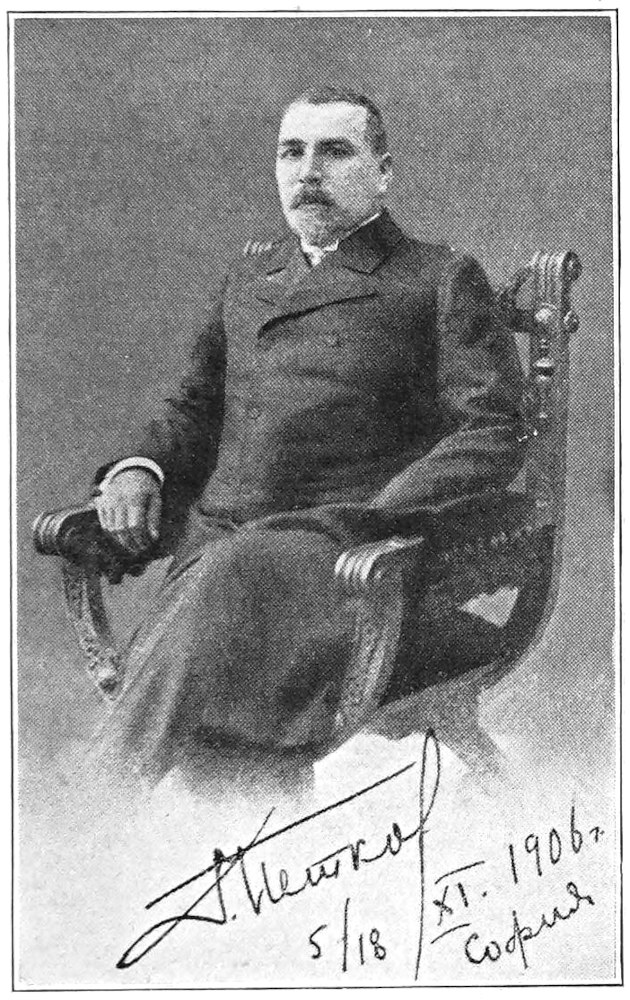
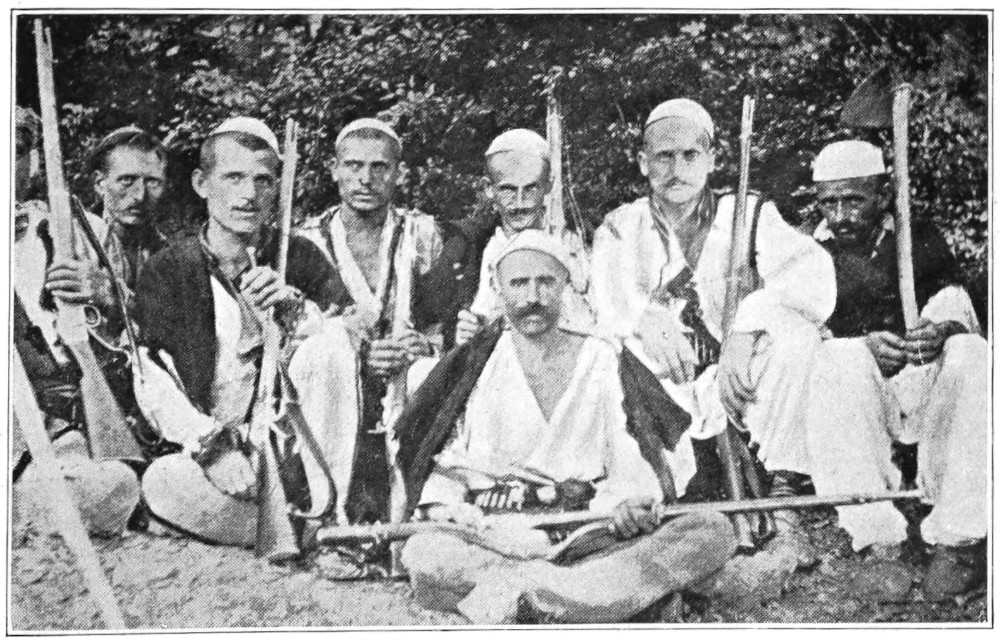
I have been in Sofia several times since, and I have had several audiences of the man whom the English have denounced as “Foxy Ferdinand.” He, like King Peter, has never been understood by us.
At heart he was an Anglophile. He loved the British nation, but diplomatic blunder after blunder, made from Whitehall by certain persons who know nothing of Balkan politics, estranged King Ferdinand from us.
One winter day, only a few months before the tragedy of Sarajevo, I stood in his audience chamber discussing a question regarding the best way of administering Macedonia, when he turned to me and revealed his innermost thoughts.
“Recollect,” he said vehemently, “if war comes I will never fight against England. I would rather abdicate. I love your country and admire your policy. It is only your vacillating politicians that I cannot endure. You British have your eyes closed to Germany’s machinations. True, my mother was German, and to a degree I am German myself. But if war comes, as it must, I will fight on your side, if your precious ill-informed officials will allow me!”
Precious ill-informed officials! Those words are to-day to me—and perhaps to many readers—prophetic. While Britain was lulled to sleep by the Campbell-Bannerman Administration, Ferdinand was alert to what the Kaiser intended.
I know that our memories are so short that the Great War is to-day an out-of-date topic with most people, but there are still those, including myself, who acted for so long as a humble but patriotic secret agent of Great Britain, who deplore the slow but sure grip of the German octopus upon our land.
[Pg 90]
Alas! it was a thousand pities that Bulgaria ever fired a shot against us, but my confidential reports to Whitehall were set aside by one who, never having been in the Near East, and possessing only a slight acquaintance with the French language, directed Britain’s policy towards “the powder-magazine” of Europe.
Month in and month out I made my secret reports to certain quarters, warning them that Europe was preparing for war and urging a conciliatory policy with both Bulgaria and Turkey. I was spending my hard-earned money in travelling hither and thither, and in entertaining those who might give me information.
For my pains, I received only jeers from those millions of politically-doped inhabitants of the United Kingdom, who, turning in their slumber, declared:
“War will never come in our lifetime,”
But was not that part of the ingenious and costly propaganda of Germany in our midst?
With Lord Roberts, Lord Charles Beresford, Lord Portsmouth, Lord Clarendon, Lord Balfour, Sir George Butcher, Lord Headley, Sir W. Joynson-Hicks, Lord Leith of Fyvie, and other of my friends, we all knew that the Kaiser intended war. The reason we knew was a discovery I made—one that has never been contradicted—and which I have recorded in another chapter.
[Pg 91]
CHAPTER SEVEN
Evenings with “Carmen Sylva,” Queen of Roumania—Her Private Life—“What is Conan Doyle Like?”—Her Interest in British Novelists—She Bans Sex Problems and Does Not Like Kipling—The Present Queen and Her Kindnesses to me—Life in the Gayest Little Capital in the World—The Countess of Cotroceni on Skis—A Laughter-loving Queen—Wicked Old King Leopold of Belgium—My Chats with King Albert.
Let us pass from Bulgaria to Roumania, the romantic country of that romantic Queen, the charming, silver-tongued poetess, who loved to conceal her identity under the name of “Carmen Sylva.”
On my first visit to her gay little capital I met the big, burly, fair-haired American, a wanderer and something of an adventurer, Mr. William Caspar, to whom the British nation owes very much, as I shall relate elsewhere in this volume. If there be one foreigner to whom the British were indebted in the days immediately before the war, it was to him, and his name should be recorded in our modern histories.
But this chapter deals with the private lives of monarchs I have met, therefore I will return to the friendship that the Roumanian royal family has extended toward me. Because I am a writer—I have never called myself a “literary man,” remember—Her Majesty continually invited me to the Palace, and I spent many a delightful evening with her in her small, luxurious blue-and-gold drawing-room.
She never “got on” with her husband, King Charles. [Pg 92]He was an erect, stately, forbidding-looking man, with close-set eyes, and a full grey beard; an irascible grumbler who never had a good word to say about anybody, and who quarrelled so constantly with his Ministers that Monsieur Take Jonescu—who was so well known in London during the war—often refused a command to audience.
The Royal ménage of Roumania was the reverse of happy, inasmuch as the King lived on the left-hand side of the Palace and the Queen on the right, and the pair were often not on speaking terms.
My visits to Her Majesty were always marked by the same etiquette. I would receive a note from her private secretary asking me to come to music at nine o’clock, and on arrival I was bowed into a small ante-chamber, where one or the other of her ladies-in-waiting, usually Madame Zoe Bengesco, or perhaps Madame Maurojeni, who was grande-maîtresse of the Court, would receive me. Then I was ushered into the Queen’s pretty salon, or salons—for there were two of equal proportions, the one running at right-angles to the other. These apartments were furnished with splendid old brocade-covered furniture; tables with interesting knick-knacks and photographs of prominent European authors; a grand piano; and the fine organ on which Her Majesty more than once played for my benefit. Rich heavy curtains, fine modern paintings, a polished floor, all combined, assisted by the softly-shaded electric lights, to produce a harmony of quiet taste and the acme of luxury.
I well recollect the first time that Madame Bengesco ushered me into that room. I was standing talking to the Lady of the Court when, on turning, I found myself face to face with a tall, striking white-haired lady en décolletée, with a sweet smile of welcome on her well-preserved countenance. She wore a very handsome gown of pale dove grey, but no jewellery save a single gold bangle and a magnificent emerald ring, which I afterwards [Pg 93]learnt had been given her by the Tzar Alexander who was murdered. This ring she always regarded as her mascot.
“I am delighted to welcome you, Monsieur Le Queux,” she said, as I bowed. “Your books are not unknown to me. We read many English novels in Bucharest, you know!”
“And we in England read your Majesty’s books also,” I ventured in reply.
“Come,” she said. “Let us sit over in that corner,” indicating a cosy-corner seat near the big blazing fire. And as we crossed the room Madame Bengesco bowed and withdrew.
Our conversation turned upon English and French literature, and at once I recognized how widely she had read recent English novels. She was eager to know about a number of our popular writers. What was Conan Doyle like? Had I met him? Was he anything like a detective? She wanted to meet Clement Shorter because of his interest in the Brontës. Did I know Lord Northcliffe, and was he a really great man? She asked me about my friends—Max Pemberton, Sir William Robertson Nicoll, H. G. Wells, Sidney Low, Rider Haggard, and St. John Adcock.
I was kept busy answering questions for a full hour.
Her Majesty had a violent dislike for politicians, it seemed, but was intensely interested in our popular authors.
“I love Austin Dobson’s poems, and ‘The Sundial’ most of all. I have tried to model some of my own verses after the lines he has taken, with, alas! but poor success, I fear,” she added. “Next to poetry, I love a real love-and-crime romance. I get all my books from Hatchard’s, in Piccadilly, and I must say they send me everything that is interesting. I detest books that deal with sex-problems. They are better left unwritten. And, really, your women authors are the worst offenders.”
“I am of your Majesty’s opinion,” I said.
[Pg 94]
“I am very glad of that. As far as I have read your own books, I have never come across a line that a schoolgirl could not read,” she went on. “Many writers are too frank, and, if they are, I give orders that their future books are not to be sent to me. I will show you my English books,” and she rose and took me into a large library, where one wall was lined from floor to ceiling by all the most recent works of popular authors.
“See this!” she said, pointing to Coulson Kernahan’s God and the Ant. “I have read it five times. Is it not splendid? And these.” And she pointed to two volumes by my old friend Robertson Nicoll.
As I glanced along the shelves I noticed volumes by many men I knew. Max Pemberton, famed for wearing “fancy vests,” as Lord Northcliffe used to call them; travel books by my old friend Douglas Sladen; Seton Merriman, Ouida, H. G. Wells, Wilkie Collins, and Walter Besant. Modern English poets were well represented, though, curiously enough, I saw no volume of Kipling’s. Two long shelves were also devoted to the works of American writers of fiction.
The opposite wall was lined with shelves filled with German and Italian fiction, while at the end was a complete set of Maurice Le Blanc’s works, and hundreds of volumes of French novels and poets, all in uniform bindings, bearing the royal cipher in gilt on the back.
We returned to the salon, where she made me describe others of my literary friends in London and tell some stories of them. I told her of the house-dinners of the Savage Club, of the dinners of the Vagabond Club, now alas! defunct, and of the various Society hostesses who delighted to assemble literary people, not forgetting Douglas Sladen’s famous receptions at his flat in Kensington, where one met everyone worth knowing, and munched a sandwich and spent a couple of hours in one’s own atmosphere of books and art.
“How I should love to go with you to Mr. Sladen’s,” [Pg 95]the Queen said. “Perhaps I may, eh, if I come to London?”
I promised that the next time she came to London I would take her one evening.
“But they must not know who I am!” she laughed. “I will be your friend Madame Somebody, eh?”
That well-remembered evening was one of the many I afterwards spent with the delightfully well-informed woman, who was a patroness of literature as well as a reigning Queen.
She was marvellously intelligent, and perfectly regal in her aspect and her manner.
And, further, in Roumania, and throughout Europe, the name of “Carmen Sylva,” that sweet-faced, womanly woman who, though Queen, was so charming and unassuming, was synonymous of all that was good and charitable. For Roumania she did what no other woman had attempted, in that all the charity throughout the whole kingdom had been initiated by her, and partly supported by her efforts. She lived her life for the poor and needy, and worked hard for years on their behalf.
On another evening, her secretary, Mademoiselle Helen Vacaresco, introduced me to the Queen’s presence, and she became deeply interested in Lord Leverhulme’s model village at Port Sunlight. Would I get her particulars of it? I promised, and Lord Leverhulme duly sent photographs and plans for a village, which she intended to construct near Bucharest, but unfortunately her efforts were frustrated by the outbreak of war. Again, she founded a school for the blind on the same plan as that of Sir Arthur Pearson, and it is still doing excellent work. She named it “The Home of Light.”
On three occasions I met the Crown Prince Ferdinand and his wife—the present King and Queen—in Carmen Sylva’s salon, and had chats with them, once just before King Charles’ death.
[Pg 96]
The present King, a Prince of the House of Hohenzollern, is rather a dull person, who is fond of motoring and who takes but little interest in his country’s well-being. The Queen on the other hand, is, as she has ever been, a pretty, smartly-dressed woman who believes in having a real good time. She spends much time out of Roumania, in Paris, London, Brussels, or anywhere where there is “something going on.” She loves to dance to a jazz band, and is an inveterate cigarette-smoker. She seldom, if ever, reads anything more elevating that a French novel, and loves to be photographed while bathing, for the delectation of readers of the newspapers. This is unfortunate, for the disregard of the conventionalities is typical of the Roumanian woman, and is apt to create a wrong impression.
Once a white-bearded old French diplomat declared to me, in the Travellers’ Club, in Paris:
“In all Bucharest, my dear fellow, I don’t believe there is a single honest woman. I was Minister there for twelve years, and I think I ought to know!”
I am inclined to believe he was nearly right, as far as a certain section of Roumanian society is concerned, for my observations have led me to the conclusion that the night-life of Bucharest is far gayer than that of Paris or Budapest.
And, indeed, a certain British Minister of my acquaintance, who was sent to represent us at Bucharest, closed the Legation, and, rather than allow his wife and daughter to live in the place, kept them in his country house in Surrey, and lived at the garish and expensive Hôtel Boulevard.
Any of my readers who have visited Bucharest know the Hôtel Boulevard, and they also know the Villa Regala, once a royal villa, but now turned into a gay night-restaurant, where, at a wink or a word to the hall-porter of the Boulevard, one will be provided with a gay assembly [Pg 97]of the gentler sex, ready to have supper, and to be your most amusing friends, though you have never met before, and after your supper turn night into day, and drive home hilariously in the morning sunshine.
Gaiety and utter irresponsibility are in the atmosphere of Bucharest, where, I confess, I myself have had many amusing adventures.
It is, par excellence, a fine city, a city of wild enjoyment and wilder gambling, a city that justly bears the reputation of being one of the most expensive in the world. And yet you certainly get your money’s worth, as I have many times told my friends of the golden youth of Paris. For the poor, Bucharest is the cheapest city; for the rich, the dearest. Prices at the Hôtel Boulevard are far higher than at the Ritz or Claridge’s in London, yet everything is perfect. One can obtain no better cutlet of sterlet in all Russia than at Capsa’s Restaurant, and the caviare that one eats on toast, with a liqueur glass of vodka, at eleven o’clock, is as good as one can get at the Arcadia Garden in Astrakhan. I have eaten sterlet in Moscow, and caviare in the Arcadia, with its summer theatre and beautiful gardens, so perhaps I may presume to criticize.
Yes, Bucharest is a riotous place. Ask any diplomat who puts his foot across the threshold of the St. James’ Club, and he will close one eye knowingly.
I do not know what the divorce laws may be in Roumania, but they are rather lax, I think.
One little incident, at which I laughed heartily at the time, was a practical joke played by my American friend, William Caspar.
In the course of his adventures in Bucharest society, in which I often accompanied him, he met a very well-known lady, who, because of his generosity, apparently believed him to be extremely wealthy. She laughingly hinted to him that she wanted a new Paris gown, to outshine one of her rivals at a very smart function. [Pg 98]Caspar heard all she said, and, being an exceedingly shrewd business man, he resolved to teach her a lesson.
“Yes, madame, I will buy you a dress,” he drawled, while all three of us were dining one night at Capsa’s, that gay restaurant in the Calea Victoriei, where the wonderful gipsy band plays so magnificently, and where meals cost far more than one could ever spend at any London restaurant. “If you will do me the honour of accepting it, I will send you a new gown.”
“But you don’t know the measurements!” declared the lady.
“Will you give me the name of your dressmaker, and I will see her?” Caspar said, his big cigar still between his lips.
The lady gave him the address of her dressmaker, and three days later she received, in a large cardboard costume box, with much tissue paper—a doll’s dress!
I was once invited by the present Queen Marie to the Château of Peleshor, a painfully new summer residence that King Charles had built for his nephew, now King. I had driven from the station at Sinaia, an overcrowded resort of chic Roumanians who wear the very latest of “creations” of the Rue de la Paix, and with me was the Prime Minister, George Cantacuzen, a grey-headed man with mutton-chop whiskers, whom I knew in Bucharest, and whom I found in the train.
We all took tea together in the summer villa, where the great airy room was open to a magnificent vista of high mountains and glorious woods.
The soft mountain breeze through the green and gold room was very refreshing.
I recollect that little Princess Ileana came in to greet us, a charming child with her fair hair falling over her shoulders, and because she bounced about the room and upset a cup of tea her mother severely reproved her, and sent her away with her German governess.
The conversation was mainly about an important [Pg 99]military review at which the Crown Princess would be compelled to appear on horseback at the head of “the 4th Regiment de Rochiori.”
“I detest riding!” she declared to me. “And I can’t think who the fool was who invented the fashion of women being military officers. I believe it was the Kaiser.”
The tone of voice in which she mentioned the German Emperor revealed that she had no great regard for him. Indeed, it is an open secret that she usually referred to him as “His Pompousness of Potsdam,” a name which she bestowed on him long before the war.
Her Majesty is a brilliant conversationalist, and, though so much abroad, is highly popular, not only at her own Court, but at Rome, Madrid, and St. James’. When at Deauville last year, she is credited with remarking to the King of Spain, while discussing a little tit-bit of scandal: “A man who loves a woman never tells her the whole truth of what he thinks of her. The deeper his affection, the more silent he becomes.” She is also credited with inventing, when in the schoolroom long ago, the saying, “A little woman is a dangerous thing.”
Queen Marie is an up-to-date consort, bright, intelligent, and fascinating. Her husband is dull, apathetic, yet something of a dandy. She is continually on the move, making fresh friends in democratic circles, and thoroughly enjoying herself. Often she travels incognita to Paris, where she is a well-known customer at the most expensive modistes in the Rue de la Paix, or she will spend a week at Monte Carlo, and perhaps the next at St. Moritz, or at Mürren, while the newspapers will say that she is in Vienna, visiting an aunt. As a rule, the name she uses is Countess Cotroceni, which is really one of her titles, and she always has with her one faithful lady-in-waiting, who is quite as bright and merry as herself.
In summer the pair can frequently be seen bathing at Deauville, of which place they are both very fond, or [Pg 100]taking tea in the courtyard of the Hotel Normandy, or eating shrimps and drinking sherry at the Potinière. Their big, cream-coloured car is a familiar object along the national highways of France, for Her Majesty, since peace has reigned in Roumania, has been seldom at home. She has always called me, ever since our first meeting, “Mr. Le Quex.” Lord Northcliffe nicknamed me “Quex,” and used to delight in finding me with my friend Twells Brex, and then introduce us as “Quex and Brex,” and say, “They will now do their chameleon turn when Marlowe (the editor of the Daily Mail) chances to turn his back.”
Poor Twells Brex! He told me of that persistent little spider that spun its web over his bed as he lay dying.
“How very small things interest one when your days are numbered,” he said to me, putting out his hand. “My little spider has been sent to comfort and interest me. And, after all, we are only spiders in the great universe with the ‘Einstein Theory,’ and our old friend Conan Doyle communicating with spirits, eh?”
And he laughed merrily. Next day, alas! he was dead.
But I am digressing from the chapter—concerning only high personages I have known.
Old King Leopold of Belgium—or “King Cléo-pold,” as King Edward called him—I met on two occasions. He was a wicked old man. I was presented to His Majesty in Brussels by my friend Mr. H. M. Stanley, the explorer, after his return from the Aruwimi, and had a long and interesting chat with him. The subject of our conversation was travel, and he evinced considerable interest when I told him of my projected journey with Harry de Windt, to explore the Kola Peninsula in Northern Russia—which is still practically one of the few unknown regions of the world to this day.
The second occasion I saw him was when I was passing in a motor-boat beneath the wall of his beautiful garden [Pg 101]at Villefranche, while returning to Nice from the motor-boat races across the Bay of Monaco. As we went along we were pelted with tangerine oranges by three pretty, laughing girls in summer frocks, while, between them, dressed in flannels, was the white-bearded old King, enjoying their fun. They were apparently having a little carnival to themselves. The King of the Belgians was always a very popular figure on the Côte d’Azur, even though he was a very close-fisted old gentleman. He owned half the Congo State, yet he would never pay for anything if he could possibly help it.
King Edward never liked him. I know that to his intimate friend, Baron Hirsch, he used always to refer to him as “that old Belgian scoundrel.” Whenever King Edward could avoid King Leopold he would, and on one occasion, when Prince of Wales, he resigned from an exclusive Paris club because King Leopold had been elected a member.
He did not agree with King Leopold’s administration of his Congo possessions—the slave-raiding, ivory-hunting, and all the terrible atrocities that were suddenly revealed and could not be refuted. The late Lord Roberts once remarked to me, when we were discussing him: “Yes, King Leopold is an old vampire, who lives on the blood of the blacks.”
Nevertheless, he was a gay old fellow who, in London, was often to be seen with a couple of friends of his own kidney, idling in the lounge of the Empire, or the Alhambra, for he had a peculiar penchant for ladies of the stage.
The exposures of the atrocities committed with his own knowledge in the Congo State by the ivory-raiders, and the torture and extermination of whole tribes of natives, greatly annoyed him. He paid at least two famous French writers heavily for their manuscripts, destroying them rather than allowing the damning evidence to be published.
[Pg 102]
A Belgian journalist named Lefranc, who had been an army officer in the Congo, wrote an awful exposure of the maladministration; how King Leopold had given certain orders to deal harshly with the natives if they refused to deliver up their ivory. He had photographed a number of official documents, and had actually published the book. But His Majesty bought up all the issued copies, and paid eight thousand pounds for the manuscript and the type!
Only two copies saw the light of day, and one of those was shown to me by Lefranc himself. It contained horrible disclosures of the slave traffic carried on by His Majesty’s officers.
In the last couple of years of old “Cléopold’s” life, he fell in love in his dotage with a lady named Vaughan, of whom he became very fond. He at once abandoned his amorous adventures “and settled down.” On his death the Baroness Vaughan laid claim to a very large portion of his property, and a long law-suit resulted.
There is an amusing story of him. He always carried with him a bad French franc. He had it in his pocket for over twenty years, and would never move without it. His valet had to change it into the pocket of every suit he wore, whether uniform or civilian, and he usually changed four or five times a day, for he was a dandy of the old school.
Princess Luisa of Saxony once asked him the reason of his belief in the mascot and the history of the coin.
He drew it out. It was worn very bright and smooth, and was apparently made of pewter.
“This was given to me late one night in Paris under peculiar circumstances,” His Majesty said to her. “I was ill-dressed, and my clothes were torn, for I had been robbed of all my money—every sou.”
She smiled, and suggested that he had been spending a merry evening.
“Yes, Luisa,” he laughed, “I had; but it is now nearly [Pg 103]twenty years ago. How well I recollect it! I stood beneath a lamp at the corner of the Boulevard des Italiens and the Place de l’Opéra, penniless. Though a king, I wanted a franc very badly at that moment to get a glass of cognac, for I felt faint. So I actually begged of a passer-by. Yes, I begged! Funny for a king to ask for relief. Well, I was in Paris incognito, and I had my reason. The well-dressed man I approached looked me up and down, and, recognizing my dilapidated condition, gave me a franc. I then crossed to the Café de l’Opéra, and paid for my glass of brandy with the coin, whereupon it was at once found to be bad. Fortunately I saw a man in the café, a banker in Brussels, who recognized me, and at once came to my assistance after a whispered word from me. When I examined the coin I found a date scratched on it. No doubt it was my benefactor’s mascot, and he had given it to me in mistake. I have often thought since whether the owner of that mascot ever dreamed to whom he had inadvertently given his bad franc.”
Under King Leopold’s nephew, the present King Albert, Belgium has arisen phœnix-like from the ruins caused by the War to a great and increasing prosperity. Both King Albert and his Queen Elizabeth are not only highly popular in their own country, but are welcomed wherever they go. They both have a liking for air-travel, and I was present recently one afternoon in the wireless hut at the Croydon aerodrome when a machine descended, and, quite unexpected by the staff, there stepped out the royal pair. Unconventionally the King lit a cigarette and chatted with the pilot, while the Queen, who looked as though she had not had a very comfortable journey, for the weather was gusty, sat alone in the waiting-room while a car was hastily obtained from the garage to convey them to the Ritz Hotel.
They were incognito, and, having crossed to do some shopping, they returned to Brussels the next day.
[Pg 104]
Next time you see walking in Bond Street a very tall, handsome, military-looking man, very spruce and erect, accompanied by a well-dressed woman, look again and see if they are not King Albert and his wife. They come to London at odd times, and even their coming is unknown at the Belgian Legation.
Albert, who has generously granted me two audiences, is a progressive monarch, and under his rule gallant little Belgium is daily prospering. In the course of one conversation I had with him he made a witty remark, saying:
“The honour of women consists in the good opinion that is held concerning them.”
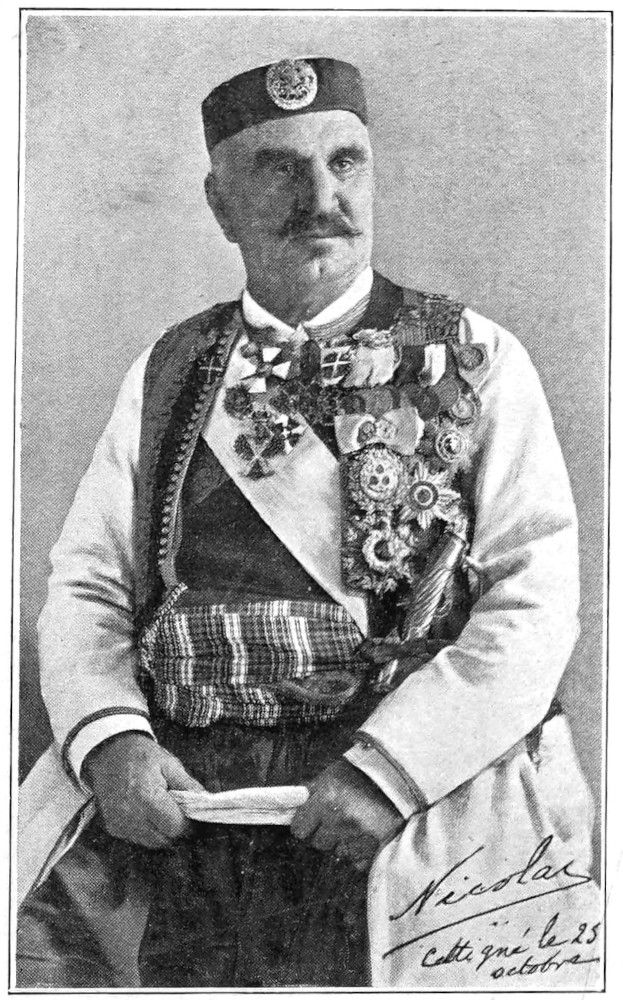
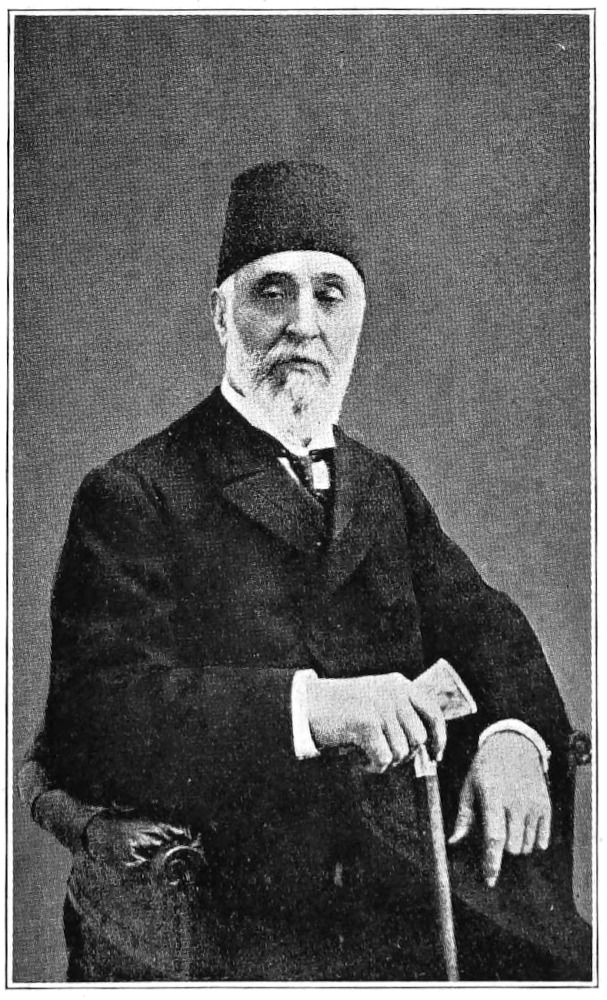
[Pg 105]
CHAPTER EIGHT
What the Sultan of Turkey Told Me—His Distrust of the Kaiser—The Ladies of the Imperial Harem—The Truth About the Armenian Massacres—Their Authors Executed by Order of the Sultan—How Noury Pasha’s Girls Escaped from the Harem—A Chat with the Grand Vizier—His Fears—Professor Vambery and the Sultan’s Carpets—A Day with the Prince of Monaco on Board his Yacht—The Prince of Johore’s “Rags” at Oxford—Painting the City “Red.”
Europe, and especially Great Britain, has never properly understood the Turk. She does not to-day.
Through the good offices of Tewfik Pasha, Grand Vizier of Turkey, and who is still my old and valued friend, I was granted an audience by the Sultan Abdul-Hamid—or “Abdul the Damned,” as he was popularly called in England—only a few weeks before the Young Turk Party arose in Constantinople and kicked out of Turkey his hooked-nosed Majesty bag and baggage, together with eighty-three ladies of the harem and two hundred and forty-four female slaves.
I had known Tewfik Pasha as Turkish Ambassador to Berlin, but on the first occasion I visited him in Constantinople, I received a rude shock. In a ramshackle cab I drove from the Pera Palace Hotel, through the dog-infested streets, to the Sublime Porte, as the Government Offices are called. Having passed the sentries, I found myself before a long, low, tumble-down building, the woodwork of which had not been painted for years; a shabby, neglected place with windows—some of them [Pg 106]broken—that had not been cleaned for ages. Entering, a messenger in a worn-out frock-coat and a greasy fez greeted me, and ushered me along an endless corridor, up a flight of stairs, and along still another corridor, the flooring of which was so worn and rickety that through the cracks of the flooring one could see into the corridor below. At last he ushered me into a small, shabby room at the end, where there instantly appeared a servant bearing the usual cup of coffee and cigarette.
Then I signed the visitors’ book, and in it saw the signatures of all the diplomatic corps in Constantinople. Suddenly the Russian Ambassador entered briskly, and, with a cheery “Bon jour, monsieur,” also signed the book.
A moment later the secretary came, and, presenting to him His Excellency’s regrets, explained that he had already an appointment with me, and asked if he could call later. The representative of the Tzar said he would call on the following morning, and I was then ushered into the Grand Vizier’s private room, where there rose to meet me the most powerful man in the Ottoman Empire—as even he remains to-day. A quiet-mannered, quiet-spoken, grey-bearded old gentleman, with kindly eyes and fatherly manner, he is entirely the opposite of what one would expect of the “terrible Turk.”
In his frock-coat and well-ironed fez, he greeted me warmly.
With him stood my friend, Noury Pasha, a fair-bearded, slim man, much younger, who was Secrétaire-Général.
I had been in Constantinople once before, and have been there many times since, mostly on confidential matters, and, indeed, the reason of my presence there that day was that I was on a journey of inquiry.
We discussed politics for a couple of hours, and it was plain that His Excellency was greatly perturbed by the sudden rise of the Young Turk Party, for he showed me a copy of a manifesto issued by the “Ottoman Committee of Union and Progress.”
[Pg 107]
“This it was intended to issue broadcast,” he said. “But fortunately the police got wind of it and have seized the printing press and arrested fifteen of those who were responsible for its printing. I have ordered all copies to be destroyed except this one, so that it may not alarm the public. I have withheld its discovery from the Sultan. If he knew of it he would be furious, and woe betide the men under arrest. Read it!”
I took the small poster in my hand and read in French, as there was a translation with the Turkish:
“During the thirty years of his reign Abdul-Hamid has brought ruin on the land; one half of our patrimony he has delivered to the enemy (Germany); he has destroyed our Fleet; disorganized our Army; he has reduced the people to misery; he has annihilated our Government system, and has left nothing to the civil organization of the civilization of the past. He has concentrated the whole Government into his own hands, and has dismissed all his tried and experienced Ministers, transferring the reins of office to self-seekers and traitors willing to become his tools.”
The manifesto, continuing, urged that the despotic régime must end, and prophesying that if it did not the enemies of the country would again provoke disorders, in the hope that they would bring about foreign intervention. It concluded with a firm demand that all should unite “to depose the Sultan and make a clean sweep of the rotten and traitorous Government.”
“Yes,” I said, as I handed it back to him, “it is certainly calculated to inflame public opinion.”
“It is,” declared His Excellency vehemently, “and, between ourselves, we are very uneasy about it.”
He had cause to be. Indeed, the incident is, I have thought, worth recording in these pages because it was the first time that the Turkish Revolutionary Party had [Pg 108]been taken seriously, and I had been let into the secret—one that I did not fail to transmit as soon as possible to the proper quarter in London.
That night I dined with Noury Pasha at his pretty house, together with his son. The Secretary-General of the Sublime Porte had held the post for eighteen years, and to him was due Turkey’s constant and clever juggling with the Powers. He pitted his wits against those of the greatest European statesmen, and usually won. He held the distinction of having had bestowed on him more foreign decorations than any living man, and the late Lord Dufferin, in referring to him one day when we were discussing him, called him “The Ironmonger,” on account of the stars and crosses with which his breast was decorated.
In the diplomatic circle there was a legend that if he had to wear all his stars he would have to pin some of them on his back. As it was, he always wore his medals—about ten of them—suspended from a bar high on his left shoulder.
Nevertheless, he was a most charming man, and a delightful companion, who was ever a good friend of mine—and of Great Britain—throughout a number of years.
In the cosy room on the ground floor of his artistic home where we dined he removed his fez, an action done only towards an intimate friend, and as we chatted I saw the many signed photographs of all the great statesmen of Europe.
As one of the cleverest men in all Europe, I always enjoyed his conversation. He enjoyed the full confidence of the Sultan, and was almost incessantly consulted by His Majesty.
Over our meal, although I knew it to be a great breach of etiquette, I ventured to inquire of the health of his wife and two daughters. I had never seen either of the ladies without the yashmak, or veil, but the girls both wore gauzy ones, and I had seen that they were uncommonly good-looking.
[Pg 109]
“Ah!” he laughed. “Since you were here last I fell into terrible disgrace.”
I inquired how.
“Well,” he replied, laughing, “it was in this way. You know that I look at most things from your Western standpoint. I believe in your Western progress and Western ideas, so neither my wife nor myself were desirous that the girls should lead a secluded harem life, as do all our Turkish girls. But there was a difficulty—one which I resolved to overcome, even though I might be compelled to overstep the bounds of conventionality. The plan my wife and I adopted was this: First we engaged an elderly lady, whom I knew in Paris, to come here and become their French governess. Then, after a year, Madame Perrin went back to Paris and enlisted the services of two young nephews of hers, who were eager to have a trip out here to the Bosphorus. They came, and stayed at the Pera Palace for a week or so, and one day they purchased four tickets back to Paris by the Orient Express. At seven o’clock on the following morning the two young Frenchmen brought ladders to the wall of my garden, and at half-past seven both girls with their ‘young men’ were in the express on their way to the West. When I heard of their elopement I naturally pretended to foam at the mouth. That Madame Perrin’s nephews should have betrayed me! Oh! it was an unspeakable breach of trust!”
And he paused, with his cigarette held in his long, slim fingers.
“Well, the expected very soon happened. Half an hour later even before I had finished my lamentations on the loss of my daughters, a message came from the Yildiz, summoning me at once to the presence of His Majesty. I guessed what it was about. His spies, who exist everywhere, had not been idle. When I presented myself in his little audience-room in the kiosk in the park he was, I saw, in a towering rage. ‘Noury,’ he cried, [Pg 110]pale with anger, ‘I have trusted you, and yet you have juggled with me, as you have juggled with Britain and France!’ I pretended ignorance. ‘You have not kept a strict paternal eye on your daughters. They have left Turkey!’ I pretended to gasp in surprise. ‘Yes’ His Majesty went on, ‘you know that I have issued a decree that no Turkish woman shall leave our country!’ I replied that I was well aware of the decree, for, as a matter of fact, I had myself drawn it up! ‘Then I declare it to be disgraceful on your part that you have not properly guarded your two daughters. Here are two young Frenchmen who come from Paris, meet them surreptitiously—how, we know not!—and elope with them!’ I humbly apologized for my lack of surveillance. But it did not appease the Old Gentleman. He wrought himself up into a most violent temper, and, shouting to me, ordered me to go after them at once to bring them back. And he added that after their return he would consider what punishment he would inflict on them and on myself! I had left the room much crestfallen, for I saw myself suddenly out of favour, when His Majesty yelled after me: ‘Noury! Come back!’ I went back, when suddenly His Majesty burst into a fit of laughter and said in a quiet, conciliatory voice: ‘Noury, I have ordered you to go after your girls, and you must go—by the next train. But—well’—and his dark eyes twinkled merrily—‘you need not go farther than the frontier!’ He knew that by the time I reached the Bulgarian frontier they would have passed seven or eight hours, and be well on their way to Paris! Of course I made the journey, and returned to report my non-success,” laughed my friend, “and my girls are now finishing their education at Neuilly, and will never, I hope, return to Turkey.”
On the day following, after the Selamlik, the weekly attendance of the Sultan at the mosque, Noury, in uniform with his many decorations, drove me, attired in my best [Pg 111]dress-suit, to that Palace, or collection of Palaces, known as the Yildiz Kiosque.
Just before we drove into the gateway of the Imperial demesne our carriage was stopped by four sentries, and my companion being recognized, it was allowed to pass the four or five idling police-agents in plain clothes and a detachment of the Sultan’s bodyguard in rather shabby blue uniforms.
Then suddenly we found ourselves in a glorious park, driving beside a broad lake over which the trees hung, gay with blossom. A party of veiled, laughing women were being rowed along by four negro oarsmen, while a fat eunuch sat in the stem. They were, Noury explained, ladies of the Imperial harem taking the air.
We pulled up before a good-sized house, built in the style of a handsome villa on the French Riviera, which stood in a garden ablaze with flowers, and which had a verandah along the lake-side. A negro servant in the Imperial livery bowed low as we descended, and next moment two more negro servants of higher grade appeared.
Noury Pasha spoke to them in Turkish, whereupon, in a few seconds, a sallow-faced Turk in uniform, with decorations, appeared. It was Hahki Pasha, the Sultan’s private secretary, to whom I was introduced.
After a laughing conversation in Turkish with my friend, we were conducted to an exquisite little room, with gilt furniture of the Empire period, a great crystal chandelier, a priceless cream-coloured silk carpet, decorated with bunches of wistaria, and several luxurious divans.
“His Majesty knows English fairly well, but it is not etiquette to speak it. He will only converse in Turkish,” Noury muttered to me, as I stood awaiting the appearance of the aristocratic ruler of over two hundred million souls—the man who was known to the world, because of his callous disregard for human life, as “The Red Sultan.”
“But you will translate, eh?” I asked.
[Pg 112]
“Of course. His Majesty told me that he would be pleased to see you because you are a writer. He writes himself, you know. Though the world is ignorant of it, he has written some of the finest poetry in our language, and two historical romances that, however, have only been printed at his private press. He has a printing press here in the Yildiz.”
At that moment the long white-and-gold doors were thrown open and a rather wizened little old man in neat black, and wearing a fez, entered.
I was in the presence of the Sultan of Turkey! His marked Hebraic features were familiar to me in pictures, but he had never allowed a photograph to be taken of himself. The sharp aquiline face, the quick dark eyes under their shaggy brows, the high forehead and the beard, were exactly the same as I had expected, though he seemed a thin, worn old man, shrunken so that his clothes hung loosely on him.
We both made our obeisance, to which His Majesty grunted something in Turkish in response.
Then the Sultan seated himself with dignity on a small divan covered with cream silk, on which was a design in cherry colour. We, of course, remained standing.
He addressed to Noury some words in Turkish, evidently making some inquiry concerning me, and then my companion, turning to me, said:
“His Majesty welcomes you. He has heard of your previous visit to us, and is glad to receive you.”
“I thank His Majesty for his kindly greetings,” I replied. “And please assure him of my friendliness towards Turkey through many years. I know that we in Britain unfortunately do not understand her.”
“His Excellency Tewfik Pasha has already mentioned you to His Majesty,” said Noury, after conversing again with the Sultan. “His Majesty wishes me to say that he is much gratified by your friendship. He is fully aware that he is known in England as ‘The Red Sultan,’ and is [Pg 113]believed to have been directly responsible for the massacres in Armenia. His Majesty has said, ‘Noury, you know the real truth. I wish you to tell it.’ So I will do so.”
Then Noury Pasha went on, while the Sultan, who understood English, listened. He told me the following, which I found very interesting—the real truth of the terrible massacres.
“One afternoon, while at the Sublime Porte, I received an urgent command from His Majesty to come here, which I did, with all speed,” he said. “On arrival in this room I found His Majesty greatly perturbed and terribly angry. He showed me a message that he had just received from his private intelligence department (for the Turkish capital always swarms with spies) stating that there had been wholesale slaughter of men, women, and children in various districts in Armenia. ‘Look!’ cried His Majesty. ‘What does this mean? Who gave such an order? Find out, and he shall pay for it! It is a plot! A plot to blacken me further in the eyes of all Europe! The Kaiser, though he pretends to be my friend, hates me. He intends to make war, depend on it, and he intends to extend his territory to the Bosphorus. But the evil is done! What can I do?’ His Majesty cried.”
And at this the Sultan nodded approvingly, having understood all his Secretary-General’s words.
“His Majesty had no hand whatever in the Armenian massacres, though all Europe declared that he had. They were, we know, the result of a plot engineered from Berlin, and seven of our officers of high rank were executed by order of the Sultan for the dastardly part they played. The Under-Governor, who had given the order for the massacre of Christians, was also executed, and at His Majesty’s orders I went to Armenia, and there had built three large orphanages, for which His Majesty has paid and endowed from his own private purse for the children whose parents were killed.”
[Pg 114]
This was an entirely different version from that which had reached Europe, and while Abdul-Hamid has been denounced everywhere, I feel confident, in view of facts afterwards proved, that what I was told was the actual truth.
Even to-day many people believe that the Sultan was responsible, and aided and abetted those who committed the terrible atrocities, but it was really a plot of the Young Turk Party, fostered and aided in secret by Germany. Indeed, within a week of my audience of “Abdul the Damned” the Young Turks proclaimed themselves, entered the closely-guarded Yildiz Kiosque, overran the great harem, seized his Majesty, bundled him on board a steamer, and took him to Salonica. A number of his favourite wives followed him into exile, but hundreds of other women were dispersed and the great Palace was closed.
Then, to the surprise of everyone, my old friend Tewfik Pasha—who had hitherto supported his Imperial master most loyally—was asked to return to his office as Grand-Vizier, which he did, and later acted as Turkish Ambassador in London, where, before the betrayal of Turkey into Germany’s hands, I often used to spend an evening with him at the Embassy in Portland Place.
Old Abdul-Hamid struck me as very refined, but of rather abrupt manner. His nose was decidedly a hooked one, and his hands were thin, yellow, even claw-like; his skin like tightly-drawn parchment over his high cheek-bones; and his speech high pitched and squeaky. While he sat talking to Noury and listening to the translation of his conversation into English he smoked cigarettes, the aroma of which was delicious, and I noticed that in the ring on his finger was a magnificent, priceless ruby, which had been drilled in the centre and a magnificent diamond set in it.
His chief hobbies were literature and music, for among the monarchs of the world he was perhaps the most highly [Pg 115]cultured. Unbounded was his generosity towards those to whom he gave audience and to whom he took a fancy.
The great Oriental scholar, Professor Vambery, once told me an amusing incident. He had had audience of Abdul several times, for he could speak Turkish, therefore the Sultan conversed freely.
“Ah!” said His Majesty one day, “you have never seen my carpet-factory! You must go and see it. I will send one of my secretaries to you to-morrow morning at ten o’clock.”
The Professor was compelled to pretend that he would be delighted to see over the factory, though, as a matter of fact, he had booked his journey to Vienna for the next morning.
The morning came, and at the Pera Palace Hotel there appeared a smart young secretary with one of the Imperial carriages, in which the Professor was taken to see the manufacture of those magnificent silk Turkish rugs and carpets that the Imperial factory produces. The carpets are of the most gorgeous and most expensive in the world, and were, and are still, given as presents to royal houses, and as offerings at the holy shrine at Mecca.
The Professor admired a number of them, and declared himself much interested, yet at heart feeling very annoyed at missing his train, for he had to wait two days for the next through express.
Some three months later the Professor chanced to be looking out of the window of his flat at Wilmersdorf, outside Berlin, when he saw a motor-lorry drive up piled high with bales of carpets!
Presently a man arrived with the news that he had a consignment of carpets from Constantinople, whereupon the Professor put on his hat, went downstairs, and ordered the man to drive to a certain dealer in rich furniture in Berlin, where they were unpacked. Before he left the place the Professor had sold them for several thousands of pounds, and took away the cheque in his pocket!
The Sultan had treated the Professor just as King [Pg 116]Ferdinand of Bulgaria had treated me. Each carpet he had admired had been noted, and the whole lot packed and sent to him.
Through the clever scheming of the Kaiser, whom Abdul-Hamid so distrusted, notwithstanding his constant declarations of friendship, Turkey became alienated from us. But, notwithstanding Kemal’s influence, Tewfik Pasha is still a most formidable power in the Empire, and he certainly has never been other than pro-British. I met Kemal several times at the house of Noury Pasha, and I found him to be most intelligent, and a splendid conversationalist.
Enver Pasha, of whom we heard so much during the war, I also met once or twice, the last occasion being at Adrianople, after his unsuccessful expedition against the Skreli and Kastrati tribes in Northern Albania. He was sent to the Albanian mountains with a large force, but the brigands, whom I have already described, assisted by several other tribes, held Enver and his army at bay for four months, inflicting many losses by means of sniping till he received orders from Constantinople to withdraw.
Then the tribes against whom he had been fighting threatened terrible reprisals. They were Greek Christians and declared that at a given signal they would swoop down from the mountains and massacre every Mohammedan in the town of Scutari. For that reason all the Christian inhabitants placed the sign of the cross in red paint over their doors, and even to-day Scutari is not exactly happy, for the tribesmen hate the Turks.
Enver was the “big noise” in the Turkish Army. He held Britain in supreme contempt, and was a puppet of the Kaiser, full of blatant bombast and wonderful schemes that never matured.
Among the minor royalties I have met was Prince Albert of Monaco—“Le Prince Rouge-et-Noir,” as King Edward called him.
[Pg 117]
I happened to be in Tromsö, in the North of Norway, with my friend Harry de Windt, on our way around the North Cape to the Kola Peninsula, and the Prince’s fine steam-yacht, Princess Alice, was lying in the harbour. The irrepressible Harry knew the Prince, and took me on board.
The ruler of Monaco, a good-looking, cheery, elderly man, with laughing eyes and a small grey beard, greeted us in quite a homely fashion. He was in a much-worn, even shabby, yachting suit, while his officers and crew were all very spic-and-span, and the splendid vessel very well kept.
The Prince was returning from a cruise off Spitzbergen, where he had been taking specimens from the deeper depths of the ocean. He showed us some queer fish, some alive in tanks, but others preserved, they having died as soon as the heavy pressure of water had been taken off them. The study of oceanography interested me greatly, and the Prince showed me various specimens of hitherto unknown shell-fish, seaweed, etc., which they had dredged up, and which he was taking to his wonderful museum at Monaco, which I expect many who read these lines have seen.
Being entirely ignorant of oceanography, I spent a most instructive couple of hours, for both Harry and I sat with him while he was engaged in mounting a specimen, and in the meantime he gave us a quantity of information on a most absorbing subject.
His Highness explained to us the dredges, the appliances that, worked by electricity, bored into the bed of the ocean and took specimens of its geological formation; of grapplers, and nets that could be opened and closed when at the bottom of the sea; of fish-traps and contrivances for collecting vegetable growth in the depths of perpetual darkness, all of which were entirely new to me.
At the Prince’s invitation we remained to luncheon, the quartette being completed by the yacht’s captain.
[Pg 118]
The Prince invited me to visit him the next time I went to Monaco, and I was afterwards his guest at luncheon there. He was certainly an expert in his own branch of science, and he had the knack of telling you a thing so vividly that you immediately understood. Till that well-remembered day at Tromsö, I never knew there were so many secrets of the ocean-bed.
Next day, when we sailed on the black old Norwegian cargo-boat, the Mercur, for Vardö, that fishing-station round in the stormy Arctic Sea, His Highness waved as we passed the yacht, and, as a send-off, the Princess Alice gave us three loud blasts on her siren, awakening the echoes of the mountains around the fiord.
The two sons of the Sultan of Johore have recently spent several years in England. I have seen a good deal of them, and they were often my guests at Guildford for several weeks on end. The Crown Prince Ismail is a slim, dark-haired, and rather elegant young man, whose features are only slightly bronzed, and who is very English-looking. Indeed, he has lived in England nearly all his life, and cannot speak Malay. To his intimates at Oxford, where he was under a private tutor, and afterwards at the London clubs, he is known as “Biffy.”
One day, after lunching with me at the Devonshire Club, a friend of mine, who was one of the party on that occasion, said:
“Well, Biffy, I suppose one day ere long we shall see your face on the Johore postage-stamps, eh?”
“I don’t know,” drawled the Crown Prince. “But, if you do, I hope it will please your school-girls who stick stamps into albums.”
Biffy, is, par excellence, a lady-killer. He is extremely good-looking, perfectly courteous to a dowager-marchioness or a pretty débutante alike. In certain smart circles in London he is an idol, for he is an extremely amusing conversationalist, a splendid dancer, and, while he has all the Oxford culture and merriment, he [Pg 119]is nevertheless a very level-headed young man, quite fitted to succeed his popular father.
To my home circle, with my valued secretary, Miss Mabelle Lodge, who had typed my books for some years, and who is an outspoken critic, and my two step-daughters, both he and his brother, Prince Ahmed, had an open invitation. They came and went just as they pleased. Prince Ahmed, the younger brother, is much more staid than the Crown Prince. He graduated at Balliol, and on coming down studied in the engineering department of the General Post Office, under that well-known telegraph-engineer, Mr. J. H. Haynes, the Sultan, his father, being determined that he should be no idler. The Colonial Office asked Mr. Haynes to take him as pupil, and when he left to return to Johore a short time ago he had earned full qualifications as an assistant telegraph engineer.
The two young Princes, who were angled after by many girls in London society, have a keen sense of humour.
While at Balliol, Prince Ahmed was foremost in any Oxford “rag,” and, living in Oxford as I did during one year of the war, I was often let into secrets of what was about to happen.
One rag that was rather amusing was brought off about a week before the Armistice. Somebody in the “lab” invented a new indelible vermilion paint.
With this pigment a fellow-undergraduate at Balliol, Constantine Gallop—a brilliant and coming man, by the way—Prince Ahmed and a dozen others scrambled up to those big classical busts near the Sheldonian, in the “Broad,” and daubed their faces red!
At the same time another party was waiting in St. Giles’s, where, underneath a shop occupied by a “bazaar,” was a long glass sign under the windows bearing the words “Finest Collection in the World.”
This latter they detached swiftly, having on the previous night released all the screws, and, carrying it to the “Broad,” hung it beneath the vermilion-coloured busts!
[Pg 120]
The police were soon on the spot, but the delinquents fled. Ahmed spent that night in the Randolph Hotel, where I had my rooms, and next morning Oxford rose to the fact that the city had been “painted red.”
The paint in question was a great triumph, for though, after much scrubbing and sand-papering, the classical busts were restored to their true stone colour, yet Balliol wrote some most insulting words in the same paint on the walls of Trinity, and so deeply did the pigment sink into the stonework that they had to be dug out, and new stones substituted!
While the Crown Prince Ismail is a charming and refined young man, and essentially a pet of the ladies, a sybarite in the manner of Oriental princes. Prince Ahmed is just the reverse. He is splendid at all games, a fine tennis-player, a keen motor-cyclist, and a good golfer.
Both were our intimate friends for six years, and we were deeply sorry when, a few months ago, the time came for their return to Johore. But the Sultan, who is growing old, felt that “Biffy” should be instructed in his duties towards the State over which he will eventually rule.
We often exchange letters, and both the young Princes express regret that they are so far away from London, and from my two yapping miniature Pomeranians—my pets “Toby” and “Tweedles,” to whom they were devoted, and who never leave me while I sit at my table at work.
[Pg 121]
CHAPTER NINE
Some Secrets of Well-known Women—The Charlady’s daughter who is a Peeress—The Woman German Spy who has Married a Peer—The Daughter of a Peer Marries a Gendarme at Monte Carlo—A Blackguard who has been Knighted.
In the course of my cosmopolitan life I have met many notable men and women of to-day, both British and foreign, who have been—by one freak of fortune or another—in the public eye, and are therefore celebrities. They range from bishops to crooks, and from peeresses to adventuresses.
When I review my many friends, I hardly know where to begin, or what to say about them.
Perhaps it will interest the reader if I am indiscreet and tell secrets of some well-known people I have met.
Two young women well-known and highly popular in Society to-day, are uppermost in my mind as I write these lines. Both are pretty, and both welcomed everywhere. And both will, of course, hate me for disclosing their secrets.
The first young lady was the daughter of an estimable woman who acted as charlady at a furnished house I rented at Cromer in 1913. She was a pretty, blue-eyed, doll-like girl, who earned a few shillings a week by taking out on the sea-front perambulators containing children of visitors who wished to go golfing or on excursions. She went to London, met the son and heir of a well-known peer, and eventually married him.
[Pg 122]
At once a press agent got to work. She was photographed as one of England’s greatest beauties, her name was included in Burke, and she has been boomed constantly. Once a week her picture will meet your eye, depicting her riding to hounds, golfing, ski-running, walking in the Park, or chatting on the Terrace of Monte Carlo. And yet to the mother of this young lady with the soft complexion and appealing eyes I paid a daily wage of two shillings to do the scrubbing.
If you believe what you read about the pretty lady you will think she combines the facial beauties of Miss Gladys Cooper with the prowess of Diana, and is the last word in the sports of ski-ing in winter and lawn-tennis in summer.
One night last season I met her at a dance given at Claridge’s by my charming friend, the Marchioness Townshend, and we went into a corner and chatted together. The great company, gay indeed, included the French Ambassador and the Countess of Saint Aulaire, the Marquis and Marchioness of Carisbrooke, Princess Troubetskoy, Lord Leigh, and Mrs. George Pinckard. But I do not suppose anybody in the ballroom suspected that when I sat out with the slim little blue-eyed lady that I whispered a word of congratulation on her great social success.
Who among that gay crowd would have guessed the truth—that the pretty young married woman, radiant and beautiful, with a splendid diamond necklet, which her father-in-law had given her on her marriage, was the daughter of my rheumatic old charwoman!
We have kept our secret even to this day. Her husband and her husband’s parents do not know exactly who she is, though her name, as I have said, appears in Burke, and, after all, she is very happy.
The story of the other pretty lady, also a peeress, is far more remarkable, and again, for obvious reasons, I do not give her name. Suffice it to say that she is not [Pg 123]of English birth, though everyone in her own smart social circle believes her to be.
She came beneath my notice in a curious way. While engaged in counter-espionage work on the Clyde during the war, I had my headquarters at the Central Station Hotel, in Glasgow. One evening a young Canadian officer asked to see me, and disclosed a very remarkable story, one so curious that I eventually induced him to write down and sign the particulars. They were afterwards duly investigated by the Intelligence Branch.
He told me how, two years before the declaration of war, he had left Quebec to make a tour of Europe, and had joined a pleasure cruise sailing from New York. Among the passengers was an extremely handsome young lady named Ethel Muirhead, who came from Buenos Ayres, and who was travelling alone. He confessed that he had fallen violently in love with her, and on arrival in London had taken her to see the sights of the metropolis. Later, in Paris, they were constantly together, though she was extremely reticent concerning her relatives. She had some German friends in Paris, to whom she introduced him, and some friends of hers in Rome were also German. Indeed, in Rome the secretary of the German Embassy apparently knew her well.
In due course, one night the liner put into Naples, whereupon the lady, who was walking the deck with her admirer after dinner, suddenly halted, and, looking into his face, said that she felt herself compelled to tell him something—namely, that in half-an-hour’s time she was going ashore, and leaving the ship.
“Why?” asked the young man, astounded at the sudden announcement.
“Because—well—to tell you the truth,” she said hesitatingly, “because I am meeting my fiancé here, and we are going to be married!”
The young man was staggered, for all along he had believed that she reciprocated his honest affection.
[Pg 124]
The girl bade him farewell, and he saw her go ashore in the tender. She would not allow him to accompany her, because her fiancé was awaiting her, but before they parted she gave him her photograph as a souvenir.
He showed it to me. That photograph went to London together with the young Canadian’s signed story, and by its means inquiries were made concerning the pretty Ethel Muirhead, as she had called herself.
I think I cannot do better than copy the report of the searching investigation made in a number of quarters. It runs as follows:
“Alice Ann Morrison, alias Ethel Muirhead, Mary Greenlees, known as ‘Slim Betty.’ Born in Buenos Ayres in 1893, her father being a shipping clerk and her mother Italian. Was employed in a shop in Buenos Ayres. Went to New York and thence to Berlin. Knows Spanish and Italian well, and has been identified by S—— S—— as a well-known German secret agent, who lived in Paris, 124 Rue des Petits Champs, in 1912, being on friendly terms with B——, who was then a high official at the French Admiralty. Two years prior to this the girl in question acted as decoy to the dangerous Creswell gang of card-sharpers working the transatlantic liners, and was then known as Betty Bates, and to her associates as ‘Saucy’ Greenlees. Is an adventuress of the worst type and a very clever secret agent. Married in 19— ——”
and following is the name of a well-known English peer!
The reader would be very surprised to know the present name of this ex-German spy, who is to-day a pretty and much-photographed peeress, whose smiling face frequently peers out at you from the pages of the illustrated papers. Very few people except myself know the real truth concerning her.
I meet her sometimes, and she is always gracious to [Pg 125]me. But will she be so kind and affable when she has read these lines, and learns, for the first time, that I know her secret?
Truly this is a strange world, and the phantasmagoria of life is full of interest. Would that I dare reveal her identity.
But what a shock her husband would sustain.
It is a secret that is better undivulged.
I was walking across Grosvenor Square one day with the Marquis Imperiale, the Italian Ambassador in London, who was for several years so popular in society.
We passed a rather angular lady of uncertain age, evidently a war-widow, who was wearing extremely smart shoes and very expensive silk stockings.
“Ah! Signor Le Queux,” remarked His Excellency, “the goods are well displayed in the window, are they not?”
I afterwards met the same lady a few nights later in a certain drawing-room in Curzon Street, and two months later her photograph appeared in the Evening News as the chief figure in a certain cause célèbre.
As a novelist I have naturally ever been in search of real romance. The romances of real life are around us every day, as any reader of these pages well knows. But it was a particularly curious romance of real life in which I participated while I rented a flat that had been vacated by Madame Marconi (mother of Senatore Marconi), facing the Mediterranean at Leghorn.
The British chaplain one day hinted to me that among the small English colony in the sun-blanched Italian town there was a half-starved teacher of English, a certain Signora Baccelli.
I managed to meet the lady, and discovered a very curious romance. It was, to tell it briefly, that she, the eldest daughter of a certain well-known English earl, had, while on their annual winter sojourn on the Riviera, [Pg 126]met and fallen in love, with Enrico Baccelli, a tall and particularly handsome gendarme in the service of the Principality of Monaco. Her parents were aghast. Every effort was made on the part of the father and mother to keep their daughter from the good-looking guardian of the peace, who, in his smart uniform, used to do daily duty in patrolling the Place du Casino. They appealed to the Prince of Monaco, and the too-handsome young fellow was, on some pretence, sent to Austria.
But the pretty young lady managed to escape from her father’s seat in Hampshire and join him in Prague, where they were married. Then her parents cut her off, and allowed the newly-married pair to drift.
Poor little lady! Though her name is one of the most historic in Britain, and you will also find her in Burke, she was in very homely circumstances when I met her. She cared not a jot for the action of her parents. “They had to do it,” she remarked to me in English, while her tall, handsome husband stood by, not understanding what we were saying. “I do not blame them. One day they will recognize that I love Enrico. I would rather marry the man I love, though he be a gendarme, than make a loveless alliance, such as is made each season in Mayfair. After all, we women ought to be mistresses of our own hearts.”
I agreed. We all three became friends, and for a couple of years they often came and lunched with me. At last the earl forgave his daughter, and to-day they both live in London and are highly popular. Baccelli is not the gendarme’s real name, but it is an Italian one, and you often see a reference to their doings in the Morning Post.
Such is real romance—romance that, when the novelist like myself deals with it, resembles mere fiction. But it is to be found everywhere.
“Jean” Palmer, as she was known to her intimate [Pg 127]friends, lived in a beautiful corner house in Grosvenor Square, in what Society contemptuously nicknamed “The Biscuit Box.” She was the wife of Sir Walter Palmer, of the firm of Huntley & Palmer, of Reading, and was for many years my friend. We had literary and artistic tastes in common. Oscar Wilde and Coulson Kernahan were of our little set. The wife of a very wealthy man, she delighted in being a Bohemian, and was at heart a great lover of good music.
Her “Wednesdays,” when she decorated her house in Grosvenor Square with flowers, which, by the way, often cost her three hundred pounds, will long be remembered. The gorgeous rooms, with their priceless paintings, the concerts that cost her fabulous sums in fees to the greatest artists of the day, and those wonderful suppers with the most cultured and artistic set in London around the tables, are still fresh in the memory of many besides myself.
Trilby had been produced, and Jean Palmer had nicknamed me “Little Billee,” a name which stuck to me for years.
One day, during the winter season in Florence, I met her in Gilli’s in the Via Tornabuoni, at the fashionable hour of eleven, when everyone goes and eats a cake and drinks a glass of vermouth.
“Hulloa, Little Billee!” she cried. “Look here! Come to a concert with me this afternoon. There’s a new fiddler going to play in a schoolroom out at the Porta Romana.”
I pointed out that the day was warm, and I was not keen about sitting to hear a fiddler in a schoolroom that afternoon.
“Gladys is going with me. Won’t you take mother and daughter?” she urged.
So I reluctantly consented.
After luncheon we drove to a small schoolroom somewhere near the gate of the old road to Rome, where we found [Pg 128]about forty people had assembled. On the platform there presently appeared a thin, cadaverous, shabbily-dressed youth, with black, piercing eyes and long hair and rather sallow complexion.
“Oh! So that’s the new genius!” I whispered to Jean.
“Yes. He looks the part, doesn’t he?”
We waited. He played on his violin so magnificently that some of the audience declared him to be the new Paganini.
“Funny name!” remarked Jean, who had never before even looked at her programme. “Kubelik. Hungarian, eh?”
That moment marked the young violinist’s rise to success. After the performance she sought him out and invited him to dinner. We all three dined together. Next day she invited him to drive up to Fiesole and take lunch there. In the carriage Lady Palmer had her pet Pekinese.
Kubelik, shy yet charmingly boy-like, remarked in French:
“Oh, what a pretty dog! Those are very expensive, are they not?”
“I gave a thousand francs for him,” replied his hostess.
Whereupon he sighed and said:
“Ah! that is just double what my violin cost!”
Within two months Jean Palmer had presented him with that magnificent Stradivarius which she acquired from the Finch Hatton family, and had launched him in London on the road to fame.
He was tied up to some Hungarian agents in Budapest, but in order to free him she paid them out a very big sum. She presented him to King Edward, who gave him the magnificent ring that he showed me on the night he received it, and she paid him a fee of five hundred pounds each time he performed at her “Wednesdays.”
Therefore by the kind-heartedness of Jean Palmer [Pg 129]did Kubelik rise to the pinnacle of fame as the greatest violinist of his time.
On a January afternoon in 1914 I was standing on the carpeted steps of the Casino at Monte Carlo, having just left an American friend, when suddenly I met a smartly-groomed man whom I knew in London—a man-about-town reported to be wealthy, and a member of at least two good clubs.
“Look here, Le Queux,” he exclaimed in a low voice, “I know you are interested in little Lady X, as everyone is. What do you think of this?” And he took from his pocket-book a letter in the handwriting of a much-photographed young peeress, whose beauty was notable and whose marriage had been one of the smartest in the previous season.
It was, I must admit, a most compromising letter, with a date that showed it to have been written since her marriage.
“Well,” he asked, “what do you think of that, eh?” and he grinned.
“You ought to burn it—not show it round.” I declared in annoyance. “Where did you get it?”
“That’s my affair, my dear fellow,” he laughed, putting it back into his wallet. “I mean it to be of considerable use to me,” he said in a voice of triumph.
Then I recollected that I had once heard a faint whisper that my well-dressed friend lived by his wits, and now I realized that he was a blackmailer.
In secret, I watched during the months that followed, and it became plain that the scoundrel squeezed money time after time out of the pretty young wife. I happen to know that he compelled her to pawn her jewels, and when he could get no more out of her, the blackguard gave her husband the incriminating letter, and it formed the basis of divorce proceedings. Poor little Lady X died last year.
[Pg 130]
But to-day that despicable blackguard is actually a knight! He married a rich woman older than himself, and you will constantly read of their doings in the “Society gossip.” Is it any wonder when I read of them I am nauseated? Yet is it any worse to grant honours to war-profiteers or aliens from nowhere?
The King cannot be blamed for the graft that has been accepted for honours in the past. Indeed, it is hoped that the new system, with its array of penalties, may prevent it in future. The King naturally believes in those whom he trusts with the government of his country, and not even the most violent tub-thumper in Hyde Park can possibly blame him.
The case I have referred to is, I fear, but one of many where honours have been bought by men in order to whitewash themselves—bought in the open market, as they would buy a bundle of pink tape. But I have hope that such cases will never again be repeated. We must not allow “celebrities” to manufacture themselves by means of a fat cheque to “the proper quarter,” and thus demand a niche in the already overcrowded pages of “Who’s Who.”
[Pg 131]
CHAPTER TEN
Stories of Notable Women—Old Countess of Cardigan and Her Gay Parties—Naughty Stories Told by the Wittiest Woman in London—The Phantom Car in Park Lane—When Don Jaime, the Spanish Pretender, Saw a Ghost—High Jinks at Deene Park—Edward and the Game-keeper—How the Cardigan Memoirs Came into Being—My Friendship with the Crown Princess of Saxony—Its Result—I Arrange Her Highness’s Secret Marriage with Signor Toselli—Amusing Incidents After the Ceremony—I Induce the Princess to Write Her Memoirs.
Dinner-table stories are directly responsible for the prevailing fashion of writing one’s recollections, this book of mine being one of many such volumes.
I may be justly accused of having invented the modern “memoir.” It happened in a curious way. The old Countess of Cardigan, widow of Lord Cardigan of Balaclava fame, whom I had known all my life, had been a friend of my father. In my boyhood days she called me “Willie Liqueur.” For thirty years or so I was constantly a guest at Deene Park, Northamptonshire, the stately home of the Cardigans, where King Henry slept after the Battle of Bosworth.
Lady Cardigan was a celebrity. She had for seventy years known everyone who was worth knowing, and had led a very hectic life—if all reports were true.
When she was eighty, with her yellow wig and her painfully narrow chest, her dress of pale carnation satin and her squeaky voice, I often used to sit in her little upstairs drawing-room at Deanery Street, Park Lane, and listen to her gossip over the tea-cups. Her statements [Pg 132]about people caused me, as a journalist, to shudder for fear of the law of libel, and I have often strolled back down Park Lane utterly amazed that I should have been so magnetized for an hour by a woman old enough to be my great-grandmother.
I had heard hundreds of stories—some of them side-splitting—from the old countess’s lips, but her handwriting grew from bad to worse, till it became quite illegible, so whenever I received a letter with the well-known coronet upon it I always rang up the faithful and portly Knighton, who was her butler as well as her man of affairs, and a conversation something like this took place:
“I say, Knighton, I’ve had a letter from her ladyship. When shall I come?” Knighton would then apologize, and go to look at his mistress’s diary, and afterwards reply:
“Dinner, sir, next Friday.”
And so I would sit down and write an acceptance.
One night at Deanery Street during the London season, the “Old Lady,” as we called her, gave a dinner-party, and among those present were the Countess of Westmorland, Lady Angela Forbes, “Cis” Fane, young Brudenell-Bruce, who was heir to the Cardigan estates, but who, alas! was killed in the war, and Sir Nigel and Lady Kingscote.
I remember that we had one of her ladyship’s pet dishes, a Spanish ham that she got from somewhere in Castile, stewed in sherry. Over a slice of it, served with great dignity by the never-smiling Knighton, Lady Cardigan began to tell some extremely amusing stories of people she had known, including Lord Beaconsfield, who had proposed marriage to her. Then she eclipsed the stories by an extremely “risky” one, at which we were all convulsed—all but Knighton.
“Well, Lady Cardigan,” I exclaimed across the table, “I’m a bit of an author. And I’m wondering why you don’t write a book of your stories.”
[Pg 133]
“A book!” exclaimed the yellow-haired old lady, who was glittering with diamonds. “A book! My dear Mr. Le Queux! Why, if I wrote a book who would ever publish it?”
“If you will write a book, I will see that it gets a publisher,” I said, taking a sporting chance, but remembering that a big blue pencil would be necessary.
“Yes!” cried pretty Lady Westmorland, who had been one of the great beauties of England, and who was sitting beside me. “Oh! it would be such fun!”
Cis Fane opposite me sighed, and whispered audibly:
“Good Lord deliver us!”
The party seemed all highly tickled by the suggestion, and presently her ladyship said:
“Very well, Mr. Le Queux. If you think the public would like to read some of my stories, then I will hold you to your promise, and write them.”
On that same evening I had a curious experience. As I left the house with Brudenell-Bruce, the butler blew his whistle for a taxi, and we entered, telling the man to drive to the Bachelors’ Club.
Hardly were we inside when a breath of sweet perfume caused me to glance around, and I said:
“Why, this isn’t a taxi, Brudenell!”
“No, apparently not,” he drawled. “But it will take us to the club.”
A few minutes later we got out, and, as I went forward to pay, I was faced by a smart chauffeur, who gazed at me, and, apparently startled, hastily drove swiftly away down Piccadilly, leaving us both standing on the pavement amazed.
We never fathomed the mystery, but it seemed certain that the car was waiting in Deanery Street for some evil purpose, and the man mistook us for the persons who were to join him.
Next day I sought Eveleigh Nash at his office in King Street, Covent Garden. He, not knowing Lady Cardigan, [Pg 134]except by repute, did not seem anxious to publish the book, so I went away resolving to let the matter drop.
A week later, however, I had an urgent summons to go to the “Old Lady” at Deanery Street, and found that she held me to my promise given over her dinner-table!
So next day I returned to my friend Eveleigh Nash, told him the whole circumstances, and in the end it was decided to obtain the help of Mrs. Maude Chester ffoulkes. I took Mrs. ffoulkes round to tea at Deanery Street a few days later, with the result that the first Volume of modern “recollections” was issued to the public, and made a great sensation.
But I can tell you that when the manuscript was ready the blue pencil had to be exercised very freely on some of those stories before they were passed by Eveleigh Nash, who detested the book from the beginning and, I believe, always regretted that he published it.
Old Lady Cardigan was a wonderful figure. Her Christmas and shooting parties at Deene were centres of the wildest fun—the merriment of the gayest and most irresponsible set in England. They were the “smartest” of the “smart” and when one accepted an invitation it meant uninterrupted enjoyment from the moment of arrival to that of departure.
The magnificent old mansion, once an ancient abbey, stands in the midst of a beautiful park, and after the “Old Lady” had retired, as was her habit, at 9 p.m., the great lakes and splendid beech-formed avenues echoed with nocturnal merriment.
Dinner was always served on a service of George III. silver, with great state at a big round table. I hated those heavy silver soup plates, and when later on one used one’s knife upon a plate, it cut into it. It was always a stately meal, but the plates to me seemed ever greasy.
Lady Cardigan would allow no motor-car to approach Deene, nor would she have any electric bell. In the dining-room she had the ordinary pull-bell, with a long [Pg 135]string attached to it; while her constant attendant, waking or sleeping, driving or pouring out tea, was a particularly annoying brown miniature Pomeranian named “Bundle.” One dare not go near one’s hostess for fear of “Bundle’s” teeth.
At one of the shooting-parties, that included, as was usual, a number of well-known people were Don Jaime, the Pretender to the Spanish throne, and his brother, who figured prominently in the public eye at the moment.
Don Jaime occupied King Henry VII.’s bedroom, a great panelled apartment with a huge four-post bed in which I had often slept. His brother was in the next room, and I in the room adjoining that. The rest of the old wing was occupied by Dr. Thomas Pink, of Lyddington, Lady Cardigan’s pet doctor, whom she always told people had kept her alive for the past twenty years, young Brudenell-Bruce, and several other bachelor guests. It was the bachelors’ quarter.
On that well-remembered night we all retired about 2 a.m., after a gay time among the ladies in the big smoking-room—an apartment with highly-decorated Renaissance carvings over the fireplace that I hesitate to describe here, but a description of which may be found in certain books on English architecture.
I suppose I had been in bed about an hour when I was awakened by a most unearthly yell. I dashed out into the corridor, to find Don Jaime in pale blue silk pyjamas.
“Dios!” he gasped. “I—I’ve seen a ghost!”
“What?” I ejaculated.
Brudenell, who had at that moment sprung out of his own room, heard the Prince’s assertion and said:
“Ghost be hanged! Go to bed, Prince. We don’t have ghosts at Deene!”
“You do! Lady Cardigan believes in the White Lady,” he said, in his broken English.
“Well, I don’t—for one,” I said, and by this time the [Pg 136]whole corridor was agog with Don Jaime and his ghost. He described it as a young nun in a black habit.
“Oh, get back to bed and make love to her if she comes again,” I replied, rather annoyed at being awakened out of my sleep. So we returned to our rooms.
I do not think I had been in bed half-an-hour when I heard another yell from the room next to me!
This time it was Don Jaime’s brother who had seen the same ghost! He described it, as we all stood in our pyjamas in the corridor.
I declared to the company that somebody was playing a practical joke, with which my old friend Dr. Pink—who always wore a big piece of pink coral as dress-stud, by the way—agreed. At four o’clock we went to sleep again, but so utterly scared were the Spanish Prince and his brother that they left Deene next morning without even making their adieux to their hostess.
From that day to the present the mystery has never been fathomed, and though the butler Knighton still lives in Northamptonshire, he has, on several occasions, assured me that there was no ragging.
“I always knew of any rag, sir. And if there had been one, I should have known,” he said the last time I asked him. “No. It’s a mystery, sir.”
There was no gayer country house in all England than Deene Park in those days before the war. Our hostess, a grande dame of the old school, threw open her beautiful home to her friends, and without stint or formality bade them enjoy themselves.
Yet Lady Cardigan was most punctiliously dignified, and, as everyone who knew her is so well aware, she resented any intrusion on her privacy. In her insistence of the observance of her “manorial rights,” she in many ways outvied the most feudal chatelaine.
It was her custom, when the weather was fine and warm, to be wheeled on to the beautiful terrace at Deene. She invariably selected a spot near a large magnolia, whose [Pg 137]creamy blossoms and glossy leaves made a special appeal to the exotic tastes of the old lady. Here she would doze happily till Knighton, in due time, reappeared and conducted her with pomp and circumstance back to the house.
Mrs. ffoulkes, who stayed at Deene a good deal while collaborating with the old lady in writing her famous memoirs, found me with a fellow-guest, Rear-Admiral H. W. Wilkin, in the smoking-room one afternoon and told me an amusing incident that had just happened.
It seems that her ladyship was dozing in the shade of the magnolia when her slumbers were disturbed by the sound of voices.
“And—now—dear Mr. Smith,” came in the cultured High Church accents of the neighbouring Vicar’s wife, “you will get a good view of the park, and here—is the wonderful magnolia.”
“Oh, how truly fair,” drawled the impulsive young shepherd of souls, who accompanied her, “but how very sad it is to reflect on the many scandalous stories current about this beautiful ancestral home!”
Suddenly an imperious, high-pitched voice made itself heard.
“Who are you, and how dare you walk on my terrace?” it demanded.
The intruders approached the locality whence the voice proceeded, and there they saw an irate and golden-haired lady, whose facial adornment would have given points to Jezebel, yet whose attire was more suitable for a young lady still in her teens.
The Vicar’s wife was, as befitted her calling, courageous!
“Mr. Smith was lunching with us, your ladyship,” she said, “and I thought I would bring him across the park to look at the beautiful magnolia.”
“Am I Countess of Cardigan, or am I not?” demanded the Lady of the Magnolia. “You’ve no business to bring any fool of a curate about here! I hate ’em!” [Pg 138]Then, ringing a bell furiously, she shrieked: “Knighton—Knighton—Knighton! Turn these people out!” At this moment Knighton, discreet as ever, appeared from nowhere, and, with a gesture worthy of an Archbishop’s butler, conducted the Vicar’s wife and the curate homewards, and then rapidly removed the enraged countess.
In the great hall of Deene, a replica of Westminster Hall and built at the same time, the aged countess would sing chansonettes after dinner, and dance with her guests with the agility of a young woman, and yet she was over eighty!
Great Britain will never again see her equal, for both she and Lady Dorothy Nevill, whom I knew well, were the last of the old Victorian school, and passed just as the port-drinking, fox-hunting parson, and the fat squire of the Pickwickian days, have passed.
My friend Nash and I were among the guests at Deene one week-end after her recollections had been published, the fashion of writing memoirs set, and the whole world laughing at her amusing and often rather ill-natured stories. Nash, at dinner, related the following:
“Lord Frederic Hamilton invariably tells me some amusing story when we meet. The one I remember best is about an American millionaire who decided to buy a property in Scotland. He arranged to look over an estate in the Highlands, and the Scottish peer to whom it belonged made a point of showing him round the place himself. When at last they returned to the house the American happened to notice over the entrance-hall the words: ‘East, West, Hame’s Best,’ and, turning to the owner, he remarked, ‘Well, my lord, it’s very kind of you to have shown me over this property, and I don’t think we’re likely to fall out about the price, but there’s one stipulation I must make (pointing to the motto). That damned fellow Hame has got to take down his ad-ver-tisement.’”
Eveleigh Nash is a splendid raconteur and a well-known [Pg 139]man-about-town, as well as being a famous publisher. Mrs. George Pinckard, who is so well known in Society, once remarked to me, “The Row would never be the same if Eveleigh deserted it.”
Not long ago he and I were dining with “Ruby”—as her intimate friends call her—at her delightful Georgian home in Chesterfield Street, Mayfair. George Pinckard, her husband, was M.F.H. in Surrey, and, by the way, generously gave a military remount depôt to the Government, which he himself supported. Afterwards in the drawing-room the conversation turned on literary people, whereupon Nash, in his dry way, said:
“I used frequently to meet J. W. Cross, who married George Eliot, the novelist, and I once heard him tell at a house-party a good story about himself. Cross, after spending several years of his life as a banker in Wall Street, returned to settle down in his native country, and shortly afterwards received an invitation from a friend to stay with him for the grouse shooting. It was about the time that ‘driving’ birds was introduced, and Cross, whose shooting had got rather rusty during the years he had spent in New York, deemed it advisable to get some coaching from the head gamekeeper. After a few days the host remarked to the keeper, ‘How’s Mr. Cross getting on, Joe?’ ‘Well, sir,’ replied Joe, ‘he’s missing better than he did!’ Some years afterwards Cross told this story to King Edward, whose service Joe had entered, and the King remarked, laughing, ‘I shall never get rid of Joe; that’s one of the most tactful things that has ever been said.’”
The Cardigan memoirs being such a huge success, I suggested that my old friend the Princess Luisa, wife of the Crown Prince, now King of Saxony, should publish her recollections.
Perhaps my claim to be an old friend of Her Imperial Highness is shown by what she herself has written in The Life Story of the Ex-Crown Princess of Saxony.
[Pg 140]
In that book she says:
“Though I may be an Imperial Princess of the fatal Hapsburgs, with many titles after my name as registered in the Almanach de Gotha, I am, after all, only a woman with the same heart, the same sentiments, the same maternal love, and the same detestation of hypocrisy and sham as any woman who reads this narrative of mine.
“I know England well, and I know and admire the dear British people. I know beautiful Scotland. With Mr. Le Queux I have shopped in Bond Street in London and in Prince’s Street in Edinburgh, and I have been in Oban and in Inverness, at Cowes and at Ilfracombe, but none has dreamed that the woman in a plain navy skirt and cream blouse—both made, by the way, in the Rue de la Paix—was the same person about whose erratic doings so much has been written at the instigation of her enemies.
“I love the public. Heartily tired as I am of the glare and glitter of palaces and the wild turmoil of unceasing plot and counterplot among those who elbow each other to get into the vicinity of a throne, I prefer a life with the public to one apart from it.
“Some years ago I went upon an escapade in Dresden which would have shocked the stiff and narrow-minded Court, in order to discover for myself in what estimation I was held by my Saxon people. As a matter of fact, Mr. Le Queux was at our Court at Dresden at the time, and with my husband, the Crown Prince Frederick-August, we had sat at five o’clock tea, when the sudden idea occurred to me.
“Mr. Le Queux had mentioned that Il Trovatore was to be given at the opera that night, and had been recalling some reminiscences of the great composer, Verdi, with whom both he and his father had been intimate friends. My husband and I were listening to the amusing stories when it struck me that instead of attending with the royal circle, as had been arranged—for at Court we are [Pg 141]but creatures of routine, and live by rules and arrangements laid down for us by the Minister of the Household and the other officials whom we call the Grands Chargés de la Cour—I might go alone and watch.
“After Mr. Le Queux had bowed before King Albert and his consort, Carola, who had just entered the room, and had departed, I pleaded a bad headache, and later sent word to my husband that I could not go to the opera, and did not wish to be disturbed.
“Now, I had a confidential maid—one whom I had brought from Austria and who had been with me some years—and in her I confided. I sent her out to a theatrical costumier’s, where she obtained a dark wig and a box of ‘make-up,’ and, putting on one of her dresses, I was soon transformed into a woman of the people. In this guise she saw me out of the Palace by the servants’ entrance, and I proceeded to the Opera on foot while the others were still dining. For some time I waited in the queue, then paid for my modest seat in the gallery, and at last found myself between two stout women, high up, with the royal box away on my right.
“The house gradually filled while I sat there among the people. Ah! how my thoughts ran back to my girlhood days, my stiff upbringing, my staid, angular governess, with all the hide-bound regulations of Court manners and Court etiquette, and that parrot-cry ever dinned into my ears since I had been ten years of age: ‘Imperial Highness, be careful of the public! Imperial Highness, what will they think? Imperial Highness, what will they say?’
“That night I sat with the public in order to hear and to know what they said. The King and Queen entered, and the house, including myself, rose to salute them. The stout woman on my left, with whom I had already become on friendly terms by offering her a sight of my programme, exclaimed:
“‘Ah! Carola is in that same shabby old gown she [Pg 142]wore a fortnight ago when we came to hear Faust. Cannot a queen afford a new one?’
“‘I suppose she wears the grand ones in the Palace and puts on any worn-out thing when she comes here—afraid to spoil it, eh?’ remarked the woman on my other hand.
“At that moment my husband, smart in his blue uniform, smiling and good-looking, entered the box, and, advancing, bowed, whereupon all hands were clapped.
“‘Ah!’ exclaimed the stout critic on my right. ‘The Crown Prince is only a dressed-up popinjay. He will be our King soon, of course—a fine, handsome man, but nowadays he dare not call his soul his own, with such a father and mother!’
“‘When he becomes King he will be all right’ declared the other woman. ‘Old Albert cannot last for ever. But look! they’ve shut the door of the box. Where is Luisa? Isn’t she coming?’
“The orchestra struck up, and in the royal box they had all settled themselves.
“‘Poor Luisa!’ went on the woman, turning to me confidentially as she added, ‘Another unpleasantness, I suppose! Her life must be a wretched one. She looks always so smiling and so good-tempered, yet whenever one sees her driving, here in the theatre, or at the reviews there is a look in her face of sadness and disappointment. Haven’t you noticed it?’ she asked. ‘That smile she wears is only the mask of a broken heart.’
“‘Do you really think so?’ I asked.
“‘Yes, of course. Why, everyone knows what a dull life she has of it with old Carola snapping at her all the time, and the King going out of his way to make things uncomfortable for her. Everybody in Saxony pities poor Luisa!’
“I was silent. So that was what the public were saying about me!
[Pg 143]
“One woman I took to be the wife of an artisan, the other was, no doubt, the wife of a small tradesman, and I—well, I was the wife of the elegant, good-looking Crown Prince who sat in the middle of the royal box, smiling graciously upon those upon whom he was so soon to be called to rule.
“I learnt much that evening. It taught me that though I was without friends in that great, gloomy, gilded Palace, yet the Saxon people were my friends.
“Yes, I love the public; yet from my earliest recollections as a girl I had been always taught to hate das verdammte Publikum (the damned public), as my father, the Grand Duke of Tuscany usually referred to the people: a favourite remark, by the way, of the late Emperor Francis Josef.
“For the benefit of those who may not know exactly who I am,” she goes on in the book of her life story, “I may, perhaps, say that though I am usually called Luisa, Ex-Crown Princess of Saxony, I was christened on September 8th, 1870, at the Imperial Castle of Salzburg, with eleven different names, and succeeded to the titles of Archduchess of Austria, Duchess of this, Baroness of that, Countess, and what not. Under my last title, Countess of Montignoso—a beautiful estate in Italy, belonging to my family—I am still known, for even the wrath of poor old Francis Josef—himself no saint, by the way—could not deprive me of that. My father was Ferdinand IV., Grand Duke of Tuscany, and my grandfather, the last ruler of Tuscany, lived in the Pitti Palace in Florence, now turned into one of the greatest art-galleries in the world, which many of my readers know, and have, no doubt, admired.”
The affairs of this erratic yet charming lady had, ever since she had separated from her husband and had her name connected with M. Giron, her son’s tutor, been in my hands, and it struck me that if I could induce her to [Pg 144]write the story of her eventful life, so much of which I alone knew, it should be of great interest.
After an unconventional career all over Europe, the Princess had fallen deeply in love with Signor Toselli, who was, by the way, utterly unsuited to her, as I openly told her. But she was bent on marrying him, and at her request I arranged that the contract should be made one morning in secret at the Registry Office in Henrietta Street, Strand.
It was a few months after their marriage that I travelled from London to Fiesole, above Florence, where they were living in a large old Italian villa, and not without a great deal of persuasion I prevailed upon the Princess to receive Mrs. Maude Chester ffoulkes and to allow her to collaborate with her in writing her memoirs.
This she did, with the result that the second volume of memoirs, My Own Story, was published by the House of Nash, and was even a greater success than the recollections of Lady Cardigan.
Since then we have been flooded by books of the reminiscences of persons, some well known, and others a trifle obscure, but I have thought it to be of some little interest to here tell the story of how the fashion in “memoirs” was inaugurated.
The events that immediately followed the Princess’s secret marriage I will let Her Imperial Highness describe in her own words:
“A small party of five people entered the restaurant of the Savoy Hotel, and sat down to a table overlooking the river, to eat the wedding luncheon. All five of us were half fearful lest we might be recognized, but among that gay, chattering throng we were unnoticed, and whispered our toasts across our glasses.
“Luncheon ended, we passed out by the back of the hotel and walked along the Embankment, fondly believing that nobody knew of the happy event. But already the sleuth-hounds of the London Press had scented news of it [Pg 145]from the Registrar’s Office, the register had been inspected and a copy of the register obtained. While walking along a Press-photographer took a snapshot of Signor Toselli, Mr. Le Queux, and myself, which was the first inkling we had that our secret was out.
“We decided to enter the Hotel Cecil by the back way, and Mr. Le Queux conducted my husband and myself to his rooms, urging us to admit no one. Meanwhile he descended to the front hall to deal diplomatically with an assembly of thirty or forty representatives of various newspapers clamouring for news. It was not every day that an Imperial Princess was married in secret at a London Registry Office.
“Because I had endeavoured to keep the whole thing quiet, Mr. Le Queux was extremely discreet. He admitted to the reporters that I had been married, a fact they already knew from the copy of the certificate, which one enterprising journalist had demanded and paid for. Of details Mr. Le Queux gave none. Though a writer himself, he was full of regrets that he could not oblige his friends, yet, as he pointed out, he was compelled to respect my wishes.
“Meanwhile an amusing incident has occurred upstairs. Signor Toselli was seated writing a letter while I stood at the window, when, of a sudden, a man burst into the room unannounced and faced us with surprise upon his face. We, of course, believed him to be a reporter who had eluded the vigilance of those below, therefore my husband promptly and with few words took hold of him and bundled him out of the room.
“A few minutes later Mr. Le Queux returned, accompanied by the man whom Signor Toselli had so unceremoniously ejected, and introduced him. He was Mr. Fred Le Queux, who, of course, knowing nothing of the circumstances, had been astounded to find strangers occupying his brother’s quarters.
“Truly, that day was one fraught with much [Pg 146]excitement. We dare not go forth from the hotel, for the journalists were still watchful. They had been informed in confidence that we were to leave Victoria that night for Paris. Instead of doing so, however, Mr. Le Queux and myself drove in one cab, with my husband and Mr. Le Queux’s brother in another, to Charing Cross Station, and were able to leave unobserved, while the journalists were waiting eagerly at Victoria.”
The skittish Princess omits to tell what she said to me on our way to the station:
“Now, Mr. Le Queux, thank you for all you’ve done for me to-day. I know you hesitated, and you have done this because you are my old friend, and I’m very grateful. But there is only one thing wanting to complete the sensation which will be in the papers to-morrow!”
“And what is that?” I asked.
“Why, for me to elope with you!” she laughed. “That would be a first-class shocker for the people, wouldn’t it?”
Princess Luisa was always incorrigible, as those who have read her own story so well know.
And none know it more than myself.
[Pg 147]
CHAPTER ELEVEN
Adventures: Humorous and Curious—My Only Superstition—I Purchase a Mummy Mask of an Arab at Luxor and Two of My Servants Die—Lord Carnarvon’s Death—I Ride on the First Motor-Car in England—Motoring Adventures with Lord Northcliffe—Secrets of How England Saw the First Aeroplanes—William Caspar, Adventurer and Practical Joker—The Race that Finished Before It Started.
I am by no means a superstitious man except in one direction, and it has been forcibly brought back to me by the recent death of my friend Lord Carnarvon—who, by the way, took a great interest in the Casino at Corfu, in which I was also interested—following on his discovery of the tomb of Tutankhamen at Thebes. There are a good many, including Sir Arthur Conan Doyle, who believe the Earl’s sudden end to be due to the vengeance of the “Ka” or “double” of the Pharaoh. From the historian Herodotus we learn that the wise men of Egypt taught that the souls of the dead passed through “every species of terrestrial, aquatic, and winged creatures.” And to many of the present generation it does not seem incredulous that the spirit of the dead monarch, or of some other soul who resented interference with the king’s tomb, has taken revenge through the agency of a poisonous insect.
In the Egyptian “Book of the Dead” it is distinctly laid down, that the preservation of the body was necessary for the continued existence of the soul, hence the efforts [Pg 148]to embalm and to preserve it undisturbed. Herodotus again asserts that the soul returns to animate the dead frame “after a period of 3,000 years.”
To me, this is of peculiar interest on account of my own personal experience. While at Thebes a few years ago. Sir Gaston Maspero—one of the greatest Egyptologists who ever lived, and then head of the Antique Department of the Egyptian Government—introduced me to an old Arab hadj, who lived in Luxor, and who acted as agent of the British and other national museums, for, as is well known, all antiques discovered in Egypt are first claimed by the Government, but if better specimens are already in the great museum in Cairo, then the duplicate objects are sold. Indeed, there is a room in the Cairo museum where they are marked in plain figures, and are all, of course, guaranteed genuine.
In the den of the old fellow with the green turban we inspected a quantity of things he had for sale, all duplicates of objects already in the museum, and I bought several things to add to my own collection, including several fine strings of beads, a human eye of lapis-lazuli from a sarcophagus, a number of amulets, Ushabitu figures, an alabaster canopic jar, and, finest of all, the gilded mask from the mummy of a priestess of Isis who had lived in the Eighteenth Dynasty, viz. 1600 B.C., and which had been found in a tomb near Aswân.
I had them carefully packed, and brought them home to my house overlooking Dartmoor. I arranged them in a big glass case, where there were other objects I had previously collected in Egypt. In the centre on a wooden stand, I placed the gilt mask; it was in a splendid state of preservation. Judge of my dismay, however, when, on entering the room next day, I found that the mask had dropped to pieces from its stand!
I had it repaired, but within one week from that date I suffered a severe financial loss; one of my servants died from disease; and a second servant expired suddenly, [Pg 149]an inquest being held on her at Ashburton. In the next week a relative died quite unexpectedly, and also my pet collie. During the week following I had another serious financial loss, which compelled me to give up the house.
Feeling that there must be some uncanny influence at work, I packed up the whole of my Egyptian collection, including the mummy-mask, and sent it to the Peterborough Museum, where they have ever since been on exhibition.
Is it little wonder, therefore, that the strange circumstances that surrounded the death of Lord Carnarvon should interest me? While those objects I bought in Luxor were in my possession ill-fortune certainly dogged me. Whether somebody’s “Ka” was annoyed with me, or whether an “elemental” had been let loose, I know not. I can only relate my own experiences and let others comment on them.
Those who knew Lord Carnarvon knew that he loved practical joking. I had several examples of it. His character was a mingling of shrewdness and whimsicality. He told me one day, on his return from America, of an adventure of his there. He had apparently promised a friend in the City—a rich company promoter, whom I knew well—to obtain information regarding a certain much-boomed commercial enterprise in America. On his way to California he paused in New York, and of the hotel barber made inquiry regarding the person in control of the venture.
The man who cut his hair gave his opinion, and recounted certain facts concerning the great American financier. Later he wrote a note asking for an interview. He was received by the industrial magnate, whom he described to me as “a fellow with eyes like gimlets and a mouth like a steel rat-trap.”
“The chap no doubt admired my impudence as a stray Englishman asking straight out for advice,” Lord [Pg 150]Carnarvon said to me in relating the story. “He gave me sound advice, after listening to me most courteously. He advised me in a friendly way not to touch the stocks on any account. I looked at him, thanked him, and then drove straight to a telegraph office near Wall Street, and advised my friend to buy eagerly. I went across to California, where I fished for a month, and then when back in New York I found that the shares had soared upwards, and my London friend had cabled me his sincere thanks. I called on the financier and told him that I could not leave America without returning thanks for the advice he had so kindly given me, as in addition to the profit my friend had made it had defrayed all the expenses of my trip. The financier was puzzled, and remarked that he had advised me against buying. I told him that though he had given me that advice, yet I felt sure he wished me to buy, and I had done so. The American looked at me shrewdly for a moment, and then he burst into laughter and said, ‘Pray consider my house your home whenever you return to America!’”
Lord Carnarvon was a man of indefinable charm that, when he chose to exert it, attracted the confidence of all sorts and conditions of men. He was gifted with a wonderful memory and the scholarly instinct of thoroughness in any work or recreation he undertook. We were both interested in Egyptology, and that was the basis of our friendship.
The first motor-car that arrived in England was shown one summer’s evening at the Imperial Institute, and was followed by a dinner. The car was hailed as something marvellous. I attended the dinner with Lord Northcliffe, who almost immediately afterwards ordered one of the new road vehicles, and I was his companion on many of his early runs, both in England and on the Continent. I was one of the first to make the trip by road across France to Monte Carlo, and well do I [Pg 151]recollect the excited crowd that assembled before the Casino to watch the arrival of the weary travellers from London. And we were very weary and fed up with breakdowns, I assure you.
In aviation I have, also, taken a keen interest, for I acted as judge at the first British aviation meeting, held on the Doncaster racecourse.
The secret history of this—which has never yet been published—is worth recounting. In France, many flights had been made by Bleriot and others. Cody was busy with his experiments, but it remained for my big, burly, fair-haired American friend, William Caspar, to bring aviation to England.
Caspar was a bright, cheery optimist, a much-travelled man, and a cosmopolitan to his finger-tips, but, like many men who dabbled in foreign “concessions” and interested himself in “wild-cat” schemes, he was often hard pressed for money. He had had a most adventurous career—cowboy, manager of a Wild West Show, manager of a well-known orchestra, principal proprietor of the Gaming Casino on the Island of Corfu, professional gambler, and lots of other things, before he determined that “England must have aviation!” as he put it to me.
For years I had constantly met him in various places widely scattered throughout Europe. Thus I knew the vicissitudes of his fortune. In London he was well known at the Carlton, Savoy, and Cecil hotels. He had been staying with me at the Cecil before he went again on the Continent, determined to bring aviation to England.
For nearly three months I heard nothing of him, till one night he burst into my room, and, in his bluff American way, said:
“Boy! the trick’s done! England is really going to have aviation after all!”
“How?” I asked.
“Because I’ve got the money here,” and he pulled [Pg 152]out a cheque for a large amount. “It’s like manna from heaven—eh, boy? I tell you I’ve been broke for a long time. For the last fortnight I’ve been at Spa, in Belgium, unable to get away because I couldn’t pay my hotel bill.”
“Which is frequently the case,” I laughed.
“Yes, that’s so,” he went on, “but mine was a very bad plight. I couldn’t raise any money in Paris, or in Brussels, but I heard of a wealthy Baron and his brother who lived at Spa. So I went there and saw them. Nothing doing! If England wanted aviation, let the English put up the dough. I gave them details of my scheme, painted a pretty picture of the thousands of people who would go to Doncaster just to see what an aeroplane was like, and so on; the races, the crowds, and the money that might be made. But it didn’t appeal to them. Twice I saw the brothers, but they declared that there was no money in it, so I left them and wondered how, with five francs in my pocket, I was going to get out of Spa and back to Paris and on to London. The other night, after dinner, I went out for a stroll down the Avenue to think it all over, and not having any money, even for a cup of coffee, I walked about for hours. At last, on returning to my room, I saw on my dressing-table what I expected—an envelope that was part of the hotel stationery. It was, I was certain, a polite note from the management requesting immediate payment of my account. So I let it lie there for an hour before I tore it open. Then judge of my delight, boy, when I found that the Baron had called during my absence and had written me a note to say that he and his brother had reconsidered the matter and had agreed to put up the money. So!” he added, flourishing the cheque, “England is to have aviation!”
Caspar was a hustler. Next day he went up to Doncaster, where, posing as a wealthy financier, he quickly enlisted the co-operation of the Mayor and Corporation. [Pg 153]Hangars and pylons were erected on the historic racecourse, while he sped back to Paris, to engage at any cost aviators to bring their machines to England.
The fees he paid were most generous. To Cody he paid two thousand pounds to bring his machine—which some wag named “The Cathedral.” With him came Le Blon, Sommer, Delagrange, and several others—all of whom, except Sommer, by the way, met within a year, their death through flying. The reason for this hustle was that the Corporation of Blackpool had got wind of Caspar’s scheme, and was running an opposition attraction three days after ours was announced.
Harry de Windt, Basil Tozer, and myself assisted our friend Caspar, who, being an ex-showman, knew well how to advertise and how to treat the Press. He always did things on a lavish scale. The less money he had in his pocket, the more expensive the restaurant at which he dined. He often used to say to me:
“When William Caspar has money, then the whole world has money!”
It was so in the case of the Doncaster aviation meeting. He was generous in his payment on every hand. He not only invited the English Press, but the foreign Press also, and on the day of the opening a grand luncheon was given, at which stirring speeches were made by Doncaster’s Mayor and by others.
The affair proved a great success in every way—except for flying.
As the judge, I was perched up on a high wooden tower in the centre of the racecourse. I had a stop-watch, and a telephone to the Press-room, in the grandstand, where there were telegraph machines in connection with the various London newspaper offices. The event was a national one.
Nobody had timed aerial flights before, therefore out of my windows I gazed at Le Blon circling the pylons, and forgot to take the time when he started. When he [Pg 154]had finished, I spoke over the telephone to Harry de Windt at the other end, guessing the time he had taken from start to finish, and giving the time by my stop-watch.
A few minutes later the telephone rang, and I heard Harry’s familiar voice say:
“Look here, Billy, what’s the matter with you?”
“Nothing,” I replied. “Why?”
“Well, the boys have just reckoned it out and found that according to your time Le Blon finished before he began!”
Then I heard Caspar’s voice exclaim:
“Say, Le Queux, do you want any assistance with the timing over there? Fellows can’t very well win before they start!”
That first aviation meeting, which extended over four days, was full of humour. It could not be doubted that Caspar did the Press well, since in three days it was found they had consumed over three thousand seven hundred cigars, to say nothing of the amount of wine and spirits—which had better be omitted. All the meals were free, and people, pressmen or not, went into the great dining-room, ate and drank what they wanted, and came out again. The Corporation, which was bearing part of the expenses of entertainment, suddenly awoke to the fact that it must attend to the matter. So, one morning, supplies were cut off, not, however, before many boxes of cigars had been distributed unopened.
William Caspar himself was the most prominent figure at that meeting. His get-up was calculated to impress the public. He had a wonderful pair of bright yellow boots that laced up to the knees—which he called his “flying boots”—a marvellous suit of check tweeds, a cap to match, and huge gauntlet gloves. But he never flew!
Huge crowds came each day, and thousands paid their half-a-guinea merely to be allowed to walk around the hangars and inspect the various types of machines—mostly inventors’ freaks that could not fly and never did. [Pg 155]The weather, however, was gusty and entirely against the aviation of those early days. Everyone who attempted to go up came to grief, Cody’s machine turning a complete somersault.
Thus the meeting was unfortunately not a financial success. It cost the Doncaster Corporation a considerable sum, and the Belgian Baron and his brother lost their money. Caspar made not a halfpenny, for I had to lend him some money a few days later, and the only satisfaction we gained was that we had all thoroughly enjoyed ourselves.
And so it was that aviation first came to England!
Cody constructed a second edition of the celebrated “Cathedral,” and when he took it to Shoreham one day he and my friend Clarence Winchester, the aviator—who wrote that entertaining book Flying Men and Their Machines—made a perilous ascent on it. But their altitude never reached above six hundred feet, which in those early days seemed something of a miracle. They came down quicker than they went up. But all this seems strange after the latest gliding experiments.
Winchester tells this story of Cody. The pioneer also invented a monoplane. This machine flew so fast when Cody first tried it that, on descending, he admitted he was a bit scared by the speed. He was asked what he thought of his own invention. “Well,” he replied thoughtfully, “I fancy it would be a trifle easier to fly a streak of lightning!”
One day William Caspar played a practical joke on me. He had had a sudden wave of prosperity, and was running a gaming casino at Rimini, on the Adriatic, in combination with certain English financiers; I being a member of the Syndicate.
I had met him in Milan, and we were travelling together down to Rome on business connected with the Syndicate. One of the best of good fellows, Burbidge, of Harrod’s, now alas dead, was with us. Caspar had with him in the [Pg 156]train a new and very expensive dispatch-case, in green leather, with double locks, and I noticed he took extreme care of it, fearing lest it should be stolen.
He took it with him into the dining-car, both at luncheon and dinner, and when we arrived in the Eternal City, he would not allow the voluble porter to handle it.
At the Grand Hotel, on our arrival, he carefully handed it over to the cashier with a request that he would place it in the safe and give a receipt for it, which the sleek obsequious Italian cashier did. His precaution did not strike me as very strange, for I knew that sometimes my friend carried with him confidential documents and considerable sums in cash. It was, also, his custom to carry an automatic pistol in his hip-pocket, and he was a dead shot.
We went to our rooms, for it was late at night, and next morning all three of us met in the hall of the hotel. We were just about to go forth, when he suddenly said:
“Oh! Wait a moment, Le Queux, I want something out of my dispatch-case.”
He crossed to the brass grille of the cashier’s desk, and presented his receipt, whereupon the sleek young man went to the great safe, unlocked it with his keys, and carefully brought forth the precious case. Caspar just as carefully unlocked both locks, with the little Chubb’s key on his watch chain, while the cashier and several others standing by, including myself, peered in to see what the precious case contained.
Caspar drew forth a pair of ebony hair-brushes, brushed his hair very carefully in a long mirror at the side, replaced them, relocked the case and handing it back to the cashier said, without a suspicion of a smile:
“Thank you very much. Will you please put it back again?”
I suppose this rather disjointed record of an erratic life would not be complete without some reference to the [Pg 157]interest I have taken in wireless ever since years ago, in Leghorn, where I lived while Senatore Marconi was engaged in his early experiments, and long before the marvellous discovery was launched on the world.
For a number of years I have been a keen experimenter, and have often been dubbed a fool for my pains. Certainly we had very crude apparatus till the outbreak of war set many persons experimenting and conducting research-work, as result of which the apparatus has been brought to greater perfection, and the transmission of the human voice by wireless accomplished.
In the latter field I was one of the first experimenters, and to those who nowadays delight in listening to broadcasting it may be of interest to know that I was the first person to broadcast speech and music to amateurs and experimenters. This I did for one hour each evening during the first seven months of 1920—the early days of radio-telephony.
Many amateurs, I believe, know my call and my voice, 2AZ, for fully a hundred in all parts of the country were good enough to write from time to time and report on the strength and quality of my signals.
The set in question I started to establish in Guildford early in 1919, and was fortunate enough to have the advice and assistance of Mr. Duncan Sinclair, now of the Wireless Section of the Air Ministry, and Mr. E. P. Brown and Mr. F. A. Love, both land-telephone experts and well known in the wireless world. With the exception of the small radio-telephone sets used on aeroplanes and then being “scrapped” by the Disposals Board very little was known at the time concerning long-distance radio-telephony. It could be accomplished, we knew. But how? That was the problem we set ourselves to solve.
For six months we worked daily with various apparatus and circuits, burning out expensive transmitting-valves, piercing condensers, ruining microphones, and other [Pg 158]almost daily misfortunes. At last, just as we thought ourselves within an ace of success, our generator broke down, and we could get no firm in London to undertake its rewinding—not even the makers themselves! It had to be scrapped, and after considerable delay and expense a new one was installed in its place.
Still no result! A second single-line aerial had been erected at right angles to the transmitting aerial—a twin one—in order to be able to listen to our own telephony and gauge the strength and modulation of what was being sent out.
From listeners in London and in various towns reports came in that mumblings could be heard, but no word was distinguishable beyond “Hulloa! 2AZ calling!” Weeks went on, valve after valve was tried, condenser after condenser, choke after choke, till I confess that more than once I stood in my wireless-room in despair. Indeed, so many disappointments did I have that one night I declared to my friend Ernest Brown, that I felt like smashing up the whole bag of tricks with a hammer.
He counselled patience, so we continued. My Morse could be read by Mr. L. Meyer in Amsterdam, and was also reported from Paris and the south coast of Ireland, but telephony seemed as far off as ever. Then I resolved to alter the wave-length to a thousand metres. This meant a new inductance, in the testing of which I was assisted by Mr. Frank Phillips, who is associated with the “Burndept” Company.
The Marconi Company, who were taking great interest in my experiments, kindly lent me certain apparatus, while from the research department at Chelmsford some highly valuable suggestions were made, based upon their own experience.
A further three months of costly failure passed, till one day I received a letter from an amateur in Manchester, whom I did not know, telling me that my speech on the [Pg 159]previous night—the weather forecast from the evening paper—was perfectly clear! Imagine my joy! Next day came letters from Mr. T. W. Higgs at Bristol, Mr. G. Woods of Liverpool, and Mr. F. T. Townsend, secretary of the Ipswich Wireless Club, all congratulating me on both speech and music. These were followed quickly by reports from such research-workers as Mr. W. A. Ward at Sheffield, Mr. L. C. Willcox at Warminster, Captain E. J. Hobbs at Wareham, Mr. W. W. Burnham at Blackheath, Mr. W. J. Crampton at Weybridge, Mr. H. H. T. Burbury at Wakefield, and a number of others.
Naturally, on meeting with such sudden success, we persevered enthusiastically, in order to get the set to function more perfectly and to attain greater distances, till one day we received a report from the operator at Inchkeith, on the Firth of Forth, four hundred and twenty miles from Guildford, and lastly from the well-known amateur, Mr. G. W. G. Benzie, of Peterculter, Aberdeen, five hundred and fifty miles distant.
A curious incident occurred one evening while transmitting a selection of jazz music. My second aerial was switched on to my receiving set—Marconi 7 valve, with the new double note-magnifier—when by mistake the Morse “inker” was switched on, whereupon the printing machine began to respond to the music, and recorded all the higher notes on the tape! It ticked and printed, keeping time with the music, greatly to our amusement.
Another laughable incident happened one night when I called by telephony 2HX, and mentioned my friend Mr. Love by name, whereupon some unknown amateur in Rotterdam called me by Morse, and asked in French: “What is that about love? Please repeat.” And next moment another message was flashed out to me, I believe by a professional operator, saying: “Love to the girls also!” This created quite a disturbance in the ether concerning love, one man tapping out “Love to 2AZ!” This continued till a Government station—I [Pg 160]believe it was Aldershot—grew angry, and told the delinquents to “shut up.”
Whilst on the subject of wireless, my friend, Colonel C. G. Chetwode Crawley, the Deputy Inspector of Wireless Telegraphy of the General Post Office, has from time to time told me some humorous stories of radio. The other day an applicant for a wireless receiving licence filled in the particulars of his experiments as “home comforts.” Another man applied to the G.P.O. for a licence to experiment with “crystal detonators!”
One of the best of Colonel Crawley’s stories, however, concerns a business man, who had had so many differences with his wife that the conjugal life became almost impossible. One day recently he suddenly left Victoria for the Continent, and on board the Channel boat sent a message by radio, which was received at Niton, in the Isle of Wight, and said, “Going for good.”
The wife, on receiving it, “saw red.” In a few days she sold up her furniture, let her flat, and went to live with her mother. She wrote to an address in Spain, but without receiving a reply. A month later her husband turned up. He had been to the flat only to find it let to another family, and angrily demanded an explanation. His wife showed him the radio message.
“But there’s a word left out, my dear!” he gasped. “I sent you a wire to say that I was going for a good trip. The word ‘trip’ has been omitted.”
Furious correspondence ensued between the G.P.O. and the aggrieved pair. The G.P.O. sought out the original telegram as despatched from the ship, but the word “trip” did not appear upon any form whatever. Nevertheless, the well-organized and “brainy” G.P.O. apologized for their “error,” and the home is a happy one again.
Did the gentleman cast off the matrimonial fetters and then repent? Who knows?
A further story which I heard from another source [Pg 161]concerns the famous American wireless hero Binns, who was once an operator at the Crookhaven Wireless Station, where it was a standing joke that all his breakfasts for three hundred and sixty-five days every year consisted of two hard-boiled eggs. During the war he was an operator in a very important position in the Grand Fleet, and a certain most secret signal was required to be sent ashore.
He puzzled for a moment, and then with his hand upon the Morse key tapped out the extraordinary words which no doubt puzzled the Germans:
“Two hard-boiled eggs transmitting. Urgent.”
He rapped this out half a dozen times, and all the stations around the coast were much puzzled.
But Crookhaven sprang alert at once. They knew it was Binns. They took his secret message for the Admiralty, and replied,
“O.K.! Two hard-boiled eggs.”
It is said that the result of that code message was the sinking of a German cruiser!
[Pg 162]
CHAPTER TWELVE
Adventures in Journalism—How I Became a Journalist—Reporting in the House of Commons—Humours of the Globe Newspaper—Stanley: the Explorer’s Great Secret Revealed for the First Time—Mr. Gladstone’s Kindnesses to Me—The Lord Chancellor and my Books—The Mysterious Person Who Sent the Globe the First News of the Victoria Disaster Twelve Hours Ahead of the First Intimation—I Nearly Lose My Life at Bow Street during the Police Strike—How I nearly “Killed” Queen Victoria—Cardinal Manning Becomes My Friend—He Takes a Drink with the Reporters—I Go with George Augustus Sala to Describe the “Holy Coat” at Treves—We Become Pilgrims from Metz—The Editor of the Berlin Punch is Sent to Prison for Six Months for Copying my Globe Article.
Who’s Who states that while studying art in Paris I forsook the Quartier Latin and became a journalist.
It happened in this way. I had met the great feuilletonist, Emile Richebourg, the dark-eyed, serious, bearded man whose domestic novels ran for years in Le Petit Journal, and it occurred to me, tired as I was of the art school, to try and write a short story. I wrote many without success. One day I completed one of fifteen hundred words that I called La Pipe Cassée, and it was published. Zola read it, and I suppose it met with his approval, for he sought me out in my shabby rooms, au troisième, off the Boul’ Mich’, and his great encouragement urged me to continue.
I did, and achieved some success. So much, indeed, that one day I forsook art, and after a tour of Europe, mostly on foot, became a clerk in a silk-weaving factory [Pg 163]in Genoa, and later on arrived in London, where, after some adventures, I became a journalist. I was subsequently appointed on the staff of the Globe, the Government organ which at that time was in the zenith of its popularity.
At first I was a reporter in the gallery of the House of Commons, my seat being beside H. W. Lucy, or “Toby, M.P.,” as he was known in Punch in the days of Gladstone and Parnell. Then very soon I was promoted to be sub-editor, and began the journalistic and literary career that I have pursued till to-day.
I do not think that I ever took myself seriously, as did some of my fellow-craftsmen, mostly untravelled novelists of both sexes. I have ever regarded novel-writing as a sea of adventure, where very often the best writer finds himself stranded while the mediocre teller of stories struggles safely into port.
In my student days in Paris I met many young artists, lawyers, and literary men, who afterwards made their mark; but again, when sub-editor of London’s oldest evening newspaper, the Globe, I met many more celebrities whose names are to-day household words. The contributors of the “By-the-Way” column were, in themselves, the best collection of literary brains in London. Davenport Adams, the dramatic critic, who wrote the standard Dictionary of the Drama, and who was a bosom friend of Henry living and Ellen Terry, and who wore a faded velveteen coat day and night, and who smoked the vilest of cigarettes; Joe Knight, the jovial editor of the Athenæum; Algernon Locker, the clever assistant-editor of Punch to-day; the brilliant C. L. Graves and his equally brilliant collaborator E. V. Lucas, and the great Lord Salisbury, Premier of England. All these wrote the front page of the Globe, in the days when I sat, amid clicking tape-machines, doling out the world’s news to those who cared to pay a penny for the pale pink sheet.
[Pg 164]
It is not generally known that those “turn-overs” in the Globe describing the happenings of an imaginary village called Wozzle, by “A Wozzleite,” were written by the great Lord Salisbury, then Prime Minister, who really described the little town of Hatfield, where he had his country seat.
Again, we had for years an unknown poet who dropped his brilliant contributions of topical verse into the letter-box in the Strand, and though we published them two or three times a week, he never applied for any payment, and nobody knows even to-day of his identity.
I found my days of journalism full of interest, because I met so many cultured and interesting people. Though my office hours were from seven in the morning till four in the afternoon, I was sufficiently eager to write fiction—as Zola had urged me to do—till late each night, and often to the small hours.
In those days the late Sir George Armstrong was chief proprietor of the Globe, with Sir William Madge as manager. My instructions were to run it as a paper written by gentlemen for gentlemen, and I endeavoured to do my best to make it The Times of the evening.
My best reporter was Charles F. Palmer—who later became editor when I resigned to become a novelist—and who eventually, under Horatio Bottomley’s wing, became Member for the Wrekin Division. It is a thousand pities that poor Palmer, a sturdy and devoted friend, was cut off in his prime. I helped him by speaking at his election meetings in the Wrekin Division, and I had great hopes of him as an Independent Member. Through twenty years he had occupied a seat daily in the Reporters’ Gallery in the House of Commons, and no man in all Britain had a more intimate knowledge of British politics or of Parliamentary procedure.
While I was on the Globe I fretted at being so much confined in the office, and whenever I could I went forth [Pg 165]to report current events happening in London; more especially the mysteries of crime. I assisted in the investigation of each of the “Jack-the-Ripper” murders in Whitechapel, accompanied by two friends—Charles Hands, who was afterwards on the staff of the Daily Mail, and Lincoln Springfield, who was reporter of the Star, and who is to-day proprietor of that most breezy and popular journal, London Opinion. During the “Ripper” scare ours was a three-handed game. We practically lived as a trio in Whitechapel, and as each murder was committed we wrote up picturesque and lurid details while we stood on the very spot where the tragedy had occurred. One evening Springfield of the Star would publish a theory as to how the murders had been done, together with a facsimile of those letters in red ink, received by Scotland Yard the day before; next night Charlie Hands would have a far better theory in the Pall Mall, and then I would weigh in with another theory in the Globe. Only recently the actual identity of “Jack the Ripper” has been discovered and will be found for the first time disclosed in Chapter XVII.
Sir H. M. Stanley, the African explorer, was for many years my intimate friend.
An incident that occurred in 1890, while I was still sub-editor of the Globe, is very curious, and has never been before disclosed. I will tell it exactly as it happened.
Stanley had returned after being lost for two years in the Forests of Perpetual Night, and was the idol of the hour, lecturing and being fêted everywhere, with honours being bestowed on him for his daring to lead his gallant little band into the very heart of the Unknown. He had written his monumental work Through Darkest Africa, which was just about to be published, and, moreover, it was announced with great éclat that he was to be married to Miss Dorothy Tennant, the clever author of London Street Arabs, and other books. The whole world was excited at the romance.
[Pg 166]
One warm afternoon I was seated in my office in the Strand, examining piles of “copy” that came pouring in from all sources, sheeting what news should appear in the “Special” edition of that night’s paper. My office boy suddenly announced that a man was in the office below, asking to see “the editor.”
In reply to my inquiry as to what he was like, the boy said:
“He looks like a workman, sir. He won’t go away till he sees you. He says he has something very important to tell you.”
Thinking he might have some exclusive news, I ordered him to be shown up. He proved to be a tall, thin, rather loosely-built man of about forty, in a shabby old jacket and faded and patched blue trousers, such as are worn by engineers.
As he stood cap in hand, I asked him his business, when he replied:
“Well, the fact is, sir, I’m a seafaring man, and I’m stranded! I’ve had some funny experiences, and I thought if I told you some of them to put in your paper, perhaps you might give me something, so that I can get up to Liverpool to join another ship. I’ve been a long time in Africa.”
“Well, lots of people have been in Africa,” I remarked dubiously.
“Yes, I know. But they haven’t been where I’ve been.” And then he went on to mention places of which I had never heard. He began to tell me a remarkable story of how he deserted from his ship, on board of which he had been a stoker, and of his wanderings along the African coast. Then he started to describe what he had seen. Some of this I took down in shorthand, and still have my notes.
“Well,” I said at last, “I confess I know very little of West Africa, but I have a friend who has been there, and he no doubt would like to have a chat with you.” And [Pg 167]then I gave him a few shillings and he promised to return next afternoon at three o’clock.
I had formed an opinion that he was only cadging, and that I should never see him again.
Later, however, I telephoned to Stanley, who was then living in De Vere Gardens, and he promised to come and interview the fellow, who had given his name as George Harding.
Next afternoon Stanley arrived just before three, and when the man was shown up I introduced him as my friend.
“Oh! you know something about Africa, sir?” Harding said, never having met Stanley before, and quite unaware of his identity.
The great explorer admitted that he knew a little concerning the Congo.
“Ah! That’s just where I’ve been, and up the Aruwimi, too,” said the man. “Do you know it?”
“Yes, I do,” Stanley replied, evidently much taken aback.
“How funny! I thought I was the only white man who’d been up in those forests,” he said, and then he began to speak of various tribes and their chiefs, and the names of native villages; all of which held Stanley absolutely agape. Time after time he tested the man’s knowledge of places and things.
I got out the large map of Africa where there were great blanks showing unexplored country, and with his finger Harding pointed to different spots where native villages were situated, and the direction of rivers of which Stanley alone knew the names; for the book Darkest Africa had not yet been published, and was only in its proof stage.
Then Stanley questioned him about certain other tribes, their chiefs, their habits, and apparently learned much that was of interest to him. The man described the pigmies, and gave such details concerning their life that the great explorer sat utterly astounded.
[Pg 168]
“Do I tell you the truth, sir?” asked the man presently. “I thought I was the only white man who had ever been right up the Aruwimi, but you’ve evidently been there too.”
“Yes, you have certainly told the truth,” was Stanley’s halting reply. “I confess I am amazed to find that you have been there—evidently before me, from one or two of your remarks. One of those chiefs you knew died nearly a year before I got there and had been succeeded by his brother.”
The man Harding then told us more of his astounding adventures—how he had escaped from a cannibal tribe, after witnessing one of their disgusting orgies, and how he had become husband of a chief’s daughter, as well as many thrilling episodes and narrow escapes he had during his four and a half years in the Congo forests.
Eventually Stanley gave him a five pound note, without revealing his identity, and made an appointment to meet him on the following day.
When he had gone, the famous African explorer, whose name was on everyone’s lips, stood staring at me pale and aghast. At first he could not utter a word.
“Only fancy, Le Queux, that fellow has done all the journey that I have done—and more!” he gasped. “He was alone! He is a greater traveller than I have ever been!”
A few days later Through Darkest Africa was published, and Stanley’s reputation became established throughout the world. But to the day of his death, a few years later, he befriended the unknown stoker who had really been the actual discoverer of the Aruwimi, the Forests of Perpetual Night, and the pigmies.
While on the staff of the Globe I met Mr. Gladstone on several occasions, and more than once he showed me kindnesses. I recollect one day, when he opened a new wing of Guy’s Hospital, the Press were invited to the luncheon, and it was expected that the Prime Minister [Pg 169]would make an important declaration of policy towards Turkey.
I chanced to arrive half-an-hour before the luncheon, and long before any other representatives of the Press, when, to my surprise, I was informed that Mr. Gladstone had already spoken, for his pressing engagements would not allow him to remain to the luncheon. Just as I had been told this the Prime Minister recognized me, and, approaching, said in a low voice:
“There was no pressman here when I spoke, was there?”
I replied that there was not.
“Then come along. Lets go into that little room over there,” and he took me across to what was apparently a sister’s private room, and while I sat at a plain deal table the Grand Old Man leaned against it and repeated his speech, which I took down.
But he turned it into the third person, dictating: “Mr. Gladstone, having performed the formal opening ceremony, addressed those present, and said that the policy of the Government towards the Sublime Porte was——”
He dictated for about a quarter of an hour without hesitation in that low, husky, yet perfectly clear voice of his, seated easily on the corner of the table and swinging his leg as he spoke.
“Will that do, Mr. Le Queux?” he asked, laughing, as at last he stood up.
“Excellently, sir,” was my reply, as I closed my notebook and thanked him.
“I suppose the others will be horribly annoyed,” he said. “They have all gone in to luncheon now, and are no doubt waiting for me to appear. If you are going towards the Strand I can set you down at your office.”
And thus I drove through the city beside the great Prime Minister.
[Pg 170]
The Globe was the only newspaper to publish the speech that night, and I had the satisfaction of knowing that The Times was compelled to use my report next morning.
Mr. Gladstone was also very kind to me when I published my second novel, Zoraida. From Hawarden he wrote: “Quite by accident I saw your novel, Zoraida, when staying at Chatsworth a fortnight ago, and I read it. I want to congratulate you on your fertility of invention and your vivid scenes of the Great Sahara and its desert wanderers. The book has interested me.—W. E. Gladstone.”
I fear the praise was ill-deserved, but I confess I was much gratified.
I afterwards learned that it was at Mr. Gladstone’s suggestion that Queen Alexandra, then Princess of Wales, read my novels, and gave a standing order for each of my books to reach her as soon as it was published.
Somebody in the bookselling world discovered this fact, and when King Edward ascended the throne, I was at once advertised by enterprising publishers as “The Queen’s favourite novelist.” Among other notable people who professed themselves interested in my novels, and personally congratulated me, were Earl Balfour, Lord Derby, Lord Birkenhead, Mr. Lloyd George, Bishop Ryle, Father Bernard Vaughan, Sir Edwin Cornwall, Sir Henry Duke, and Mr. Justice Bray.
At a private house in the West End, where I was dining one night with a number of distinguished people, soon after the publication of The Invasion, Lord Halsbury, a little tubby figure, sidled up to me and said very severely:
“Ah! So you are William Le Queux, eh? Well, I only wish I were still Lord Chancellor. I would have had you up before the House for writing that alarming book on the coming war.”
I was rather resentful, and he saw it.
[Pg 171]
Then the dear old lawyer laughed, and with a sly wink added:
“Wouldn’t you have liked it, eh? What an advertisement it would have been for Roberts, Northcliffe, and your book!”
I can only here say that in addition to endeavouring to work in the interests of my King and country, as every man should, I have at times tried to entertain them with healthy, if exciting, fiction. I am, alas! only too well aware of my own failings, of my hopeless grammar when compared with the perfect English of some of my contemporaries, yet to my critics I would point out that my early knowledge of other languages interfered seriously with my knowledge of English. I am a cosmopolitan, and for that I would crave the reader’s forgiveness for any grammatical errors in this book or in others I have written.
But in this chapter I am dealing with my early struggles—the days when I was by day a London journalist and by night a struggling novelist; when four hours’ sleep sufficed me, and when I used every morning at half-past six to walk round Covent Garden in order to get a breath of the fresh vegetables from the country. The dust of London was, in those days, over my heart.
Another rather curious circumstance occurred to me during my journalistic career. As usual, I entered my room at the Globe at seven o’clock one morning—for I have ever been an early riser, and even to-day am often at my desk at five o’clock and work till noon—when I saw on my blotting-pad several private telegrams in their buff envelopes, distinguishable from the ordinary Press and “agency” telegrams on their multiplicated “flimsies,” as they are called in Press parlance.
One of them I opened bore the words “Editor Globe—Victoria sunk.” There was no name of the sender, but the message had been despatched a few hours before from a small town on the Tunisian coast.
[Pg 172]
This intrigued me. I looked up Lloyd’s Shipping List and found two Victorias. Then in the Navy list I found H.M.S. Victoria was the British flag-ship in the Mediterranean.
I dashed along to the Admiralty and there interviewed the official on duty.
“Probably a hoax,” he said. “We’ve had no news of it. No name is given of the sender, you see.”
“But is the Fleet anywhere off the coast of Tripoli or Tunis?” I asked.
“How do I know where the Mediterranean Fleet is?” asked the dapper young man. “No, don’t publish the report. I expect it is somebody trying to pull your leg—perhaps a tourist who has gone to see the ruins of Carthage and thought he might have a bit of fun.”
So I replaced the telegram in my pocket and returned to the office. Four times during that day I sent to the Admiralty to ask if they could throw any light on the mysterious telegram, but they were unable. No word reached them till twelve hours after the first news of the disaster arrived that H.M.S. Victoria, with Vice-Admiral Sir George Tryon on board, had been sunk in collision with the Camperdown on account of a faulty manœuvre on Sir George’s part. The Admiral remained on the bridge as his vessel sank under him, while twenty-two officers and three hundred and thirty-six crew also perished.
Official knowledge often comes many hours after what is known and discussed in London and New York newspaper offices long before the authorities are informed.
The Globe on that June day, in 1893, was the first to give the news of the disaster to the world—news that they had received early in the morning.
But till to-day the sender of that mysterious telegram has never revealed himself. I have often wondered who despatched it from the shore so quickly after the disaster occurred.
In the strike of the Metropolitan Police in London I [Pg 173]narrowly escaped serious injury—even death. After the last edition of the Globe had gone to press, I strolled round to Bow Street Police Station—only a minute’s walk from the office—to see what was happening, for it seemed very grotesque that the police of London should go on strike and leave malefactors to do what they liked.
The streets were crowded by all the hooligans from the East End, cheering the police and jeering against all law and order. The whole underworld of London seemed to have been let loose that night, and had assembled in that rather narrow street that leads from the Strand to Long Acre.
I managed to get to the steps of the police station, where Charlie Hands was standing with my reporter Charles Palmer and Lincoln Springfield, when suddenly a heavy earthenware spittoon was flung from an upper window of the section-house, and, escaping my ear by an inch, smashed on to the pavement. Another inch, and it would have undoubtedly smashed my skull.
Not long afterwards I sat in Bow Street Police Court, where the charge against Oscar Wilde was being investigated, my interest being all the keener because I had met him many times at Lady (Walter) Palmer’s fine house in Grosvenor Square, she being one of Wilde’s best friends.
I reported the whole of Bottomley’s trial in connection with the Hansard Union, when “Mr. Bottomley in the Box” appeared day after day on the contents-bills of the Globe and the Echo. From a youth I had always attentively studied criminology, so I endeavoured to attend every sensational murder trial at the Old Bailey. Often I had as companion my very old friend George R. Sims. Throughout thirty years we frequently sat together at the Old Bailey, watching murder trials, the last occasion being when we sat side by side through the trial of Smith, who murdered his “brides” by drowning them in their baths.
[Pg 174]
Let me whisper it. Both Sims and myself, rather portly persons, got into those fatal zinc baths produced in court during a luncheon interval, while several famous counsel looked on, making humorous remarks.
In that case, Sir E. Marshall-Hall rose to such brilliancy as an advocate that Smith would undoubtedly have been acquitted if the accused had not, at the very last moment, taken his defence into his own hands. Smith was hanged, but Sir E. Marshall-Hall’s magnificent conduct of the case—like, later on, the defence of Greenwood at Carmarthen Assizes—won for him the admiration of both Bench and Bar, as well as great popularity with the public.
A more able, astute, and learned counsel there is none in the kingdom. For many years he has been my friend, and I think I can safely say that he is personally one of the most modest, large-minded, and most charitable men I have ever met.
Those large, dark, penetrating eyes, which terrify a witness under cross-examination, that big, mobile countenance, those eyebrows that shift up and down, and yet, in contrast, that pleasant, easy-going, even fraternal manner that he sometimes assumes towards the jury, is that of a great legal genius, a man who studies the psychology of crime and who knows its degrees as few other men in England know them.
The country admires him, it is true, but I happen to know that criminal judges, even though he falls foul of them sometimes, admire and trust him even more.
Once I congratulated him on a great success at an Assize Court in the north, whereupon he simply sighed, and, turning to me, said:
“Luck, my dear fellow—only luck!”
My work on the Globe was not without its humorous side. On one well-remembered day I had been out to snatch a hasty lunch at Simpson’s, across the way, when [Pg 175]on my return I glanced at the tape-instruments as usual. On one of them was a startling message, printed on the slip:
“Her Majesty the Queen died at Windsor at ten o’clock this morning.”
I re-read it, and held my breath.
My next action was to telephone down to the printers to place the margins of the paper in deep mourning, telling the head printer that the Queen was dead.
My message caused the greatest consternation in the printing works, but all goes like clockwork in the office of any London evening newspaper, and it was a standing joke that if the last trump sounded the Globe should come out with an “extra special.”
Ere I had time to consider what I should write concerning the great calamity that had overtaken the nation the head printer was in my room, exhibiting a wet contents bill in heavy mourning, with the words “Death of the Queen.”
In the meantime Mr. “Jack” Jewell, the sporting editor, who, for so many years as “Larry Lynx,” wrote the sporting article for the Globe and also Sir William Madge’s weekly paper, The People, had passed through the printing-room and heard the news. He went out into the Strand, where he met the sub-editor of the Echo, and told him of the calamity.
I stood alone in my room, undecided. All was ready. I had written some lines that began with the words:
“The whole British nation, and the world, will learn with deepest sorrow that Her Majesty Queen Victoria passed away at Windsor Castle, where she was spending Easter, at ten o’clock this morning. No further details of our national calamity have reached us before going to press.”
[Pg 176]
I had the proof in “double-leads,” as the printers call it, in my hands.
Everyone was out at lunch—Sir George Armstrong, the chief proprietor, Sir William Madge, the manager, and all the staff, except Charles Palmer who came in at that moment.
“Inquire of the Press Association,” Palmer suggested.
It only required me to press a bell on my table to set the great presses going, and to launch on the world the unexpected news that “Victoria the Good,” who had just celebrated her second jubilee, was dead!
I rang up, and in answer to my eager inquiry I heard an insulting voice say:
“Whatever we send out is true. Ours is a reliable service, you know. Others are not.”
And he rang off.
Of Reuter’s, and of the Central News, I inquired, but both declared that they knew nothing of the Queen’s death.
At that moment the inspector of the Exchange Telegraph Company, an electrician, who visited the newspaper offices each hour to renew the spools of tape, ink the machines, and see they were in working order, entered the room without knocking, as he always did.
I pounced on him instantly, asking:
“What about this report of the Queen’s death that your people have sent out?”
“Queen’s death? What do you mean?” he asked, staring at me.
Then with a smile on his face the little man, who for years had trudged from one newspaper office to another all day long, dived into the huge waste-paper basket set beneath the automatic machine to receive the hundreds of yards of printed tape that we never used, and presently drew out a piece about six inches long, on which were the words—after giving the time—“John Walters, for thirty years coachman to——”
[Pg 177]
It was the Queen’s coachman who had died!
And so I very narrowly made the Globe the laughing stock of the whole world.
Yet as a matter of fact the Echo did actually publish the report—as a rumour only—and many copies were sold outside the Royal Exchange before the edition was suppressed.
No! The life of a news-editor is not exactly a bed of roses.
The dear old Globe has, alas! passed away, and is merged into the Pall Mall Gazette, after Charles Palmer became editor, and fell foul of the German-paid betrayers during the war.
In my book Scribes and Pharisees, written long ago, I have described the inner working of the Globe office, and revealed much that I believe has amused people. I referred to Palmer as the “weevil,” because he was so clever in any investigations that he undertook as second reporter, under William Jeans. One unwritten law of the Globe was that no member of its staff had ever been discharged. Sir George Armstrong was a humorist, and always very lenient. An apprentice in our editorial department, named Knight, was once called up and told to resign. But he continued to draw his salary as usual, and still remained there for years after I left.
Jack Jewell, the original “Larry Lynx,” was a great character, and a most hearty, good-humoured soul. But he had periodical bursts of merriment, and sometimes did not turn up in the mornings. On such occasions his office-boy, named Tilbury—a particularly bright lad—would read up the morning papers and write out “Larry Lynx’s Latest” tips for the day—an event that happened ten or a dozen times a month.
And, funnily enough, the office-boy’s tips were often more correct than those given by our popular sporting editor!
So much for journalistic tipsters!
[Pg 178]
Though I am not a Roman Catholic, the late Cardinal Manning became a very generous friend to me. One day he called on me at the Globe office to enlist the paper in the cause of some charity. I took it up, and in return His Eminence gave me the run of his private library at the Archbishop’s house at Westminster. I often spent my evenings there, and on several occasions the dear old soft-voiced Cardinal came in and chatted to me about journalism and literature. He afterwards gave me a letter of introduction to Cardinal Rampolla at the Vatican, which was of the greatest use to me.
Here is a little story that will show the broadmindedness of His Eminence.
A new Roman Catholic church was to be consecrated at Hounslow, and with other representatives of the Press I journeyed down there one very hot summer’s morning. I arrived late; the church was crowded to overflowing, and the ceremony had started. I saw the impossibility of sitting inside, so I stood by an open window and heard the beautiful service.
Afterwards Father O’Sullivan, the resident priest, on coming out, beckoned me over, and with three or four pressmen led me into his house near by.
“You fellows will find some whiskey and glasses,” he said hurriedly, his round face beaming. “After I’ve seen to the Cardinal I’ll join you. Phew! The heat! You must all be just as thirsty as I am!”
And he closed the door. Beneath the table stood a big wicker-covered jar of excellent Irish whiskey, and on a tray some glasses, so we helped ourselves to the very welcome refreshment, and began to smoke.
Presently Father O’Sullivan joined us, and somebody told a good story, which set us all laughing merrily as we stood around with our glasses in our hands.
Of a sudden the door again opened, and His Eminence the Cardinal, very feeble and frail, stood before us.
[Pg 179]
In an instant he took in the situation, and, laughing, said:
“Ah, gentlemen! I see that you are far better off than I am! I’m thirsty too!”
“Will your Eminence take a glass of water?” asked the priest quickly. “I must apologize that none was provided in your room!”
“No apology is needed,” the Cardinal assured him, smiling. “But I really will take some water.”
So, laughing merrily at the situation, the famous Cardinal, who would no doubt have been elected Pope had he lived, stood with us, sipping his water, and chatting with us, while we drank our whiskey.
When he left, he remarked:
“I am very pleased, gentlemen, to see that Father O’Sullivan is entertaining you so pleasantly.”
A few days later, when I saw him in his library, he mentioned the incident, and, with a laugh, remarked:
“Though Father O’Sullivan forgot my water he didn’t forget his own whiskey, did he?”
One morning I set out from Charing Cross for the city of Treves, on the Moselle, in order to see and describe for the Globe, the Holy Coat, which is exhibited in the ancient cathedral once every fifty years.
I was alone as far as Brussels, but when changing trains, to go south to Treves, I saw on the platform the burly figure of old George Augustus Sala, the veteran travelling correspondent of the Daily Telegraph.
“Hulloa, Le Queux!” he cried merrily. “Are you going to see this confounded coat?”
I admitted that I was, and we travelled together all day. On our arrival at Treves we found that it was quite impossible to obtain beds, the whole place being filled with pilgrims from all over Europe—an unwashed crowd that had arrived to see the relic of whose authenticity I am not in a position to judge.
Tents had been erected all over the countryside and [Pg 180]down the streets of the old Roman town, and one could hardly get to the cathedral for the dense throng.
We found vacant seats before what seemed to be the best café in the place, and Sala at last had a private chat with the proprietor.
“I happen to be one of the honorary guardians of the Coat,” the man said. “But, unfortunately for you journalists, the Bishop has to-day given orders that no mere sightseers shall be allowed to enter the cathedral.”
“Oh, then that settles it, Le Queux!” said Sala, fixing me with his cross-eye. “We must become pilgrims.”
And pilgrims we became next day, for we both bought blue peasants’ blouses and caps, and with a rosary each, we together went in under a big blue banner borne aloft by a pilgrimage from Metz. As Sala chanted with seriousness, in his deep bass voice, it was all I could do to keep a straight face. But we were the only journalists who got in, and I recollect that my description published in the Globe was headed “The Holy Coat at Treves: By an Amateur Pilgrim.”
The editor of the Kladderadatsch, the Punch of Berlin, copied my article without giving me credit for being its author, and was promptly sent to prison for six months for daring to call into question the genuineness of a “holy” relic. And serve him right. I did not hold, however, with a writer in the Pall Mall who, a few days afterwards, declared that a “holy pair of trousers” had been discovered in a church in a village somewhere in Bohemia!
Among the many leading lights of the legal profession whom I met during my journalistic days, I have pleasant recollections of Mr. Justice Avory, Sir Archibald Bodkin, Lord Justice Scrutton—of copyright knowledge, and a good friend of all authors; Sir Henry Duke, who was at that time a journalist on the staff of the Daily Telegraph; Sir Edward Marshall-Hall, K.C.; and also of my old [Pg 181]practical joking friend, Charles Gill, who afterwards rose to become a King’s Counsel, Recorder of Chichester, Senior Counsel to the Treasury, to the Bankers’ Association, and to the Jockey Club, as well as a Bencher of the Middle Temple.
But at the time of the story I am about to relate we were both young, and he was glad enough to earn a few guineas at police or county courts. We had a mutual friend in a stout, highly-humorous solicitor named George Lay, who practised mainly at the Brentford Police Court, and, like Gill, was well known in London theatrical circles.
One day, during a General Election, I went down to the riverside town of Staines, where a very hot contest was in progress. On the previous night the parties in opposition had come to fisticuffs at a meeting. Dixon-Hartland, the banker, was contesting the constituency in the Conservative interest, and it seemed a foregone conclusion that he would be re-elected.
I arrived at the Bridge House Hotel at Staines, about six o’clock, and had ordered some dinner in readiness for the meeting at the Town Hall at seven, when to my surprise in walked Charles Gill, wearing his monocle, accompanied by George Lay. The local bench of magistrates had been sitting, and both had been engaged in opposition in a serious case of assault on a wife by a jealous husband.
They greeted me, and, as we sat down to dinner, inquired the reason of my visit to Staines.
I told them, whereupon, after a brief silence, Gill made a suggestion.
“Look here, Lay,” he said, “why shouldn’t we stay and have a bit of fun? We’ve been slanging each other all day. Why not let us continue?”
“How,” asked Lay, always ready for an adventure.
“Well, let’s go to this election meeting with Le Queux. You support Dixon-Hartland, and I’ll take the part of [Pg 182]the other Johnnie—what’s his name? You sit in front and I’ll sit at the back, and we’ll create some real trouble between us, eh?”
George Lay at once agreed.
We ate our dinner and went to the meeting. Lay sat in the second row, with Gill far away at the back. The chairman made a comfortable speech to a packed audience extolling the virtues of the candidate who sat on the platform smiling down on his supporters.
All went quietly until Dixon-Hartland rose to speak. Gill allowed him to make a few statements, and then, to everyone’s surprise, he rose and loudly protested in his most forensic language against the statement—something with regard to Ireland—and appealed to the chairman and to the audience, causing a great sensation.
Whereupon George Lay rose, and, turning to the interrupter with a flow of vituperation that could only be possessed by a brow-beating police-court solicitor, inquired the name of “this gentleman, this unknown outsider, who has come here to upset our meeting!”
That was a signal for a sharp quarrel between the pair. They shouted at each other, both crimson with anger, and shook their fists threateningly. They called each other nasty names, till the chairman, with great difficulty, called them to order, and at last stopped the uproar.
Then, all being quiet again, the candidate proceeded. But Gill allowed him to go on for only about five minutes, when again he rose to object. Again Lay jumped up, and again the pair attacked each other with violence, cheered by one portion of the audience and hissed by the other.
Four times was this repeated, till the audience at last took sides with the objector and his opponent, and would no longer listen to the candidate. The uproar became intense, the chairman became powerless, the crowd got out of hand, chairs were smashed, and the meeting broke up in terrible confusion. I myself narrowly escaped from [Pg 183]an infuriated partisan of the opposition candidate, who was flourishing the leg of a broken table.
When I got outside I saw Gill standing on the step of the Town Hall still haranguing the crowd.
Afterwards we all three took the last train from Staines to London, and many a time we laughed over our joke.
Gill became more serious in his latter days. He was a member of the committee appointed in 1918 to inquire into German war crimes, and he worked very hard as a member of the sub-committee which was presided over by the late Mr. Justice Peterson and which dealt with the treatment of thousands of British prisoners of war in Germany.
From his position as counsel to the Jockey Club (of which he was also an honorary member) it will be gathered that Gill was interested in sport, and country pursuits were his principal relaxations from the depressing labour of his profession. Following the tradition of the Old Bailey, he was also a patron of the drama, and at one time was often seen at first-night performances. He was a popular member of the Turf, Garrick, Beefsteak, and other clubs.
One December morning I joined a big party headed by George Augustus Sala, and including Bennett Burleigh, the war correspondent, Melton Prior, the artist, and a number of kindred spirits of Fleet Street. We met at Euston Station, having been invited by the Cambrian Railways—I believe they were our hosts—to visit Barmouth, in North Wales, and describe its advantages as a winter resort against the then much-advertised Colwyn Bay.
We boarded a special train, which, after leaving Shrewsbury, stopped frequently, and champagne was served at the station bars.
At Barmouth the Town Council met us, and put us into most comfortable quarters at the Coes-y-Gedol [Pg 184]Hotel. We were rather crowded, however, and Sala and myself, being constant fellow-travellers over Europe in those days, shared a room.
Sala wore his golf-cap in bed, I remember, just as Harry de Windt invariably does. Only I have seen Harry in a wagon-lit sleeping in his bowler, for, curiously enough, the explorer is most fastidious about draughts.
Well, on the night of our arrival at Barmouth the council of that thriving watering-place, with its beautiful stretch of sands for bathing, gave us a splendid banquet of welcome. The Mayor, the local doctors, the Town Clerk, and other municipal officials told us of its warm winter climate and of its hours of winter sunshine, which were not eclipsed by those at St. Leonards or Bournemouth, and we sat spoon-fed with the little town’s advantages.
We retired to bed full of Barmouth and its coming winter life.
Sala, as he threw off his braces, said:
“By Heaven, Le Queux, according to the city fathers this place must be equal in warmth to Palermo or Algiers. Winter sunshine! I don’t see much sign of it, eh? I’m horribly cold!” and with a shiver he cast a glance with his blind eye towards me and soon dived into bed.
Next morning when we rubbed our eyes and looked out of the window the ground was deeply covered with snow! It snowed all day—and the next!
Those who had invited us naturally grew alarmed. They wondered what we would say.
George Augustus Sala on the second afternoon called an informal committee meeting in the smoking-room of the hotel, at which most of us were present.
“Look here, you fellows,” he said bluntly, “these people have done us very well, haven’t they? They can’t help the snow. They can help it at Colwyn Bay, where their weather report says it is always sunshine. Now I put it to the vote, for we are all of us sportsmen. [Pg 185]Shall we tell the truth—or shall we lie? Now—the truth? Hands up!”
Not a hand was raised.
“Lies—artistic ones?” he asked, with his cocked eye glancing at the door in fear of any outsider intruding.
Every hand went up.
“The lies have it!” he answered, and the lies did have it. You have only to search the files of the London daily newspapers on the following day to read what gloriously bright sunshine and blue skies reigned at Barmouth during the visit of the London Press!
Probably journalists may object to the revelation of such secrets, but, after all, the town of Barmouth had, in a perfectly justifiable bid for winter prosperity, spent so much money on our entertainment that we all agreed that we had been placed in a most difficult position by the clerk of the weather.
And in journalism the truth is, after all, not always welcome. If everyone suddenly became candid concerning his neighbour, this would indeed be an uncomfortable world.
But there was a dénouement of my story. One of my assistants on the Globe knew what had happened. It was his duty to check the reports each morning from the Meteorological Office. He waited his time till about a fortnight later snow was reported at Colwyn Bay. He promptly replaced the word “fine” by “snow.” And he left the word “snow” against Colwyn Bay for weeks and weeks, notwithstanding the protests of readers at that North Wales resort.
When I protested, he said:
“Well, Colwyn Bay can’t have it all its own way. It has been sunny at Barmouth each day for the past few weeks, so why can’t we give Colwyn Bay a bit of snow?”
In May he changed the word opposite Colwyn Bay to “unsettled,” whereat the municipal authorities and [Pg 186]hotel-keepers grew furious, and wrote some most uncomplimentary letters.
With the modern press-agent I have no patience. He is paid to exaggerate to the public the mediocre and magnify the unworthy person into a genius. He is a product of our present age of advertising. Given a financial backing your press-agent of to-day—clever and subtle in his paragraphs, I grant—can accomplish miracles in the social standing of his clients, be they the nouveau riche, the pretty chorus girl, the budding artist, the writer, or the crook.
[Pg 187]
CHAPTER THIRTEEN
Among Editors and Publishers—The Hiding Place of King Solomon’s Treasures—An Amazing Story which Puzzled Dr. Adler, the Chief Rabbi—Adventures in Novel-Writing—Mr. Asquith and the Editor—A Special Correspondent’s Humour—Sir George Newnes and I Play at Cross Purposes—The Great Tit-Bits Treasure Hunt and its Humours—The Man Who Found the Secret of the World’s Origin—Pearson’s and Their Brilliant Staff—Percy Everett Compels the Author of If Winter Comes to Destroy a Wasps’ Nest—The Editor of Pearson’s Magazine has a Most Humiliating Experience—Stories of Writers.
At first the publishers were not exactly kind to me.
I wrote my first novel, Guilty Bonds, on my return from Russia, where I had been on a special mission for The Times, the country then being under the Emperor Alexander, and people were being exiled wholesale to Siberia without any charge being made against them. The story sold well, for, coincident with Called Back, it was one of the first novels that described Russia under the Tzars. It was afterwards dramatized. My old friend Joseph Hatton wrote By Order of the Tzar! and had it published with a significant yellow ticket inside, the public to this day never dreaming that it was the colour of the passport issued to every Jewess, of whatever station, proclaiming her to be a woman of ill-fame!
Feeling success assured, I went to the Great Sahara with the Dubois Expedition, and on returning wrote Zoraida and The Great War. Because George Griffith—who had written The Angel of the Revolution—induced [Pg 188]me, I gave both these books to the Tower Publishing Company.
They produced them well. Coulson Kernahan, my oldest literary friend, then reader to Ward & Lock; Sir Robertson Nicoll—to whom I owe much of my success; W. E. Henley, Clement Shorter; Norman Gale; Douglas Sladen, and Davenport Adams—of the black velvet jacket—all declared my success to be assured.
I had then given up journalism and was living in a cosy little flat at the Magnan end of the Promenade des Anglais at Nice, going up in July and August to the Pyrenees to escape the great heat on the Riviera.
I trod on air and worked hard; but imagine my dismay and disappointment when, at the moment I expected to receive a substantial cheque for the royalties on both books, which were selling by thousands, I received a formal letter from a bankruptcy official to say that the Tower Publishing Company had failed, and that I should not only get nothing from my two years of labour, but that the copyrights had been bought by a well-known firm of publishers, and passed out of my hands! Such was the law in those days. I had, in my youthful enthusiasm, toiled for two years for nothing!
That was over thirty years ago, and to-day, as I write, Zoraida has just begun as “a great new Le Queux serial” in an Irish daily newspaper!
Could any man experience a greater set-back?
I went to my old friend A. P. Watt, the literary agent, who was just then commencing business in Paternoster Row, and he introduced me to various publishers.
Sir George Hutchinson and Alfred Spencer, his partner, F. V. White, who was publishing Belgravia and John Strange Winter’s novels; Newman Flower, who had just come to Cassell’s; Fisher Unwin, who later sought me in Florence; and Eveleigh Nash, all became my firmest friends, and remain so to-day. I also got to know [Pg 189]intimately Stanley Paul, the burly giant who, alas! has had ill-health of late years, W. L. Courtney, Israel Zangwill, Sir Ernest Hodder-Williams, whom everyone congratulated on his well-earned title, and the irascible old George Newnes and his kindly son, Sir Frank.
Then, later, I met such outstanding men as Lord Riddell, Sir Edward Hulton, James Heddle, and William Lees, who had just graduated from Thomson’s of Dundee to the fiction department of the Daily Sketch.
With the belief that publishers are often pilferers of one’s royalties I do not agree.
With the exception of the Tower Publishing Company—which let George Griffith and myself down so very badly—I have never met a firm who would descend to “cook” an author’s accounts. I hold in respect every firm with whom I have had business dealings, both here and in America—where, because of curious copyright laws, the temptation to steal is certainly open. Even the good continental firms are always fair and above-board.
I have many pleasant recollections of my editor and publisher friends, not only in London, but also in Paris, Milan, and New York.
But to the aspiring author I would say a word of warning regarding the firms who publish books on commission. If a book is not worth the publisher’s risk it certainly is not worth the author’s, no matter how tempting the terms offered.
A mysterious affair, which remains a mystery to this day, is known only to myself, although both Sir C. Arthur Pearson and my dear friend, Dr. Adler, the Chief Rabbi, both now dead, knew of it.
One day, during the five years I lived at the Hotel Cecil, a waiter brought me a card bearing the name of Broström, with an address in Stockholm. A tall, middle-aged, clean-shaven Swede was ushered in, and handed me a letter of introduction from a friend, a certain Baroness [Pg 190]Ernberg, who is one of the leaders of Society in the Swedish capital.
This letter explained that my visitor was a well-known civil engineer in Sweden, that he was highly trustworthy, and that he had a very curious disclosure to make to me.
We sat down, and certainly what he told me caused my eyes to bulge.
Briefly, it was that a friend of his, a certain Professor Afzelius, at Abö University, had discovered in the original text of the Book of Ezekiel preserved in the Imperial Library at Petrograd a cipher message that gave the whereabouts of the concealed treasures from King Solomon’s temple.
At first I was inclined to laugh, but he assured me that he wished for no money, only my influence and support to induce a London newspaper to take up the matter and send out an expedition to Jerusalem to explore.
“I will leave these papers with you,” he said. “I daresay you do not know Hebrew, but if you will submit them to any good Hebrew scholar I think you will find that he will be much interested.” And he rose and left.
I thought of my old friend Dr. Adler, Chief Rabbi, and that same day I called and left the papers, he promising to go through them, but expressing an honest scepticism.
Three days later, when I called, he admitted that he had gone through them with his distinguished brother, and that there was certainly something in them very curious and intensely interesting to Hebrew scholars. It was his opinion that the matter should certainly be further investigated. Indeed, he seemed highly excited over the whole matter.
In consequence, I called on another old friend, Sir C. Arthur Pearson, then proprietor of the Standard, put the matter before him and suggested the sending out of an expedition to Palestine to explore. To this he most generously acceded, and an initial sum was agreed between [Pg 191]us for its cost. I was to head the expedition to Palestine.
That afternoon I walked along the Strand full of suppressed excitement. I was to search for the treasure of Solomon!
I called Mr. Broström on the telephone, and when he arrived at the hotel I announced the joyful news, and the amount placed at my disposal for the equipment of the expedition.
But, to my utter amazement, he replied:
“To-day I have had a telegram from my friend Afzelius, in Abö, and, though I thank you, we have decided not to carry our investigations any further.”
He left me, and he has never since been seen in London.
Dr. Adler admitted that the papers in Hebrew I placed before him contained something extraordinary. And it certainly seems apparent that there is some curious hidden message in the earliest manuscript of Ezekiel. Can any reader solve the mystery why the discoverers so suddenly withdrew? I cannot.
The curious incident gave me the idea for my novel, Treasure of Israel.
My recollections of editors are many. Here is one.
The day that H. H. Asquith was appointed Home Secretary I met Lincoln Springfield (now the editor of that gay and flippant paper London Opinion) at one of those many cheerful resorts that the town no longer knows—Romano’s Bar, and Springfield pretended to be broken-hearted over Mr. Asquith’s appointment. “Asquith would be delighted to refuse to reprieve me were the occasion ever to arrive,” said L. S., and when I asked him what Asquith had against him my friend related this incident.
At the Parnell Commission, when Asquith was Sir Charles Russell’s junior, he used to sit next Springfield, who, with T. P. O’Connor and H. W. Massingham, [Pg 192]reported the trial for the Star. Asquith and Springfield had many an idle hour’s gossip together during the many months of that trial. Stock Exchange flutters arising among other topics, the journalist communicated to the barrister the fact that a certain company, the White Lead Co., Ltd., was to be floated, and was for a day or two to be rushed up to a substantial premium. Both decided to improve their bank balances by venturing to the extent of a hundred shares. Springfield the instant he got his allotment, sold his hundred at a profit of £70 or £80, and forgot about the matter. But Asquith had not grasped the necessity of seizing a rapid profit, and in a week or two the engineered premium ran off into a huge discount, and Asquith lost the major part of his £100 flutter. This was no joke to Asquith in those early struggling days. Hence Springfield’s mock fear of reprisals on the part of Mr. Secretary Asquith.
“Lincoln” is an unusual Christian name, but it is not unique. Some years ago there appeared in the Divorce Court a co-respondent named Lincoln Jefferson. Dear old Harry Fenn, the Divorce Court reporter, got to thinking of Lincoln Springfield as he wrote his report, and he inadvertently recorded the co-respondent’s name as Lincoln Springfield Jefferson. Thus it appeared in the Daily Telegraph. Springfield was on the Pall Mall Gazette in those days, and his colleague there, Charlie Hands—afterwards the special correspondent of the Daily Mail—cut out the report. He deleted the name Jefferson by carefully sticking over it a piece of white paper that rendered the deletion imperceptible, thus making the report declare that the co-respondent was Lincoln Springfield. This doctored report Charlie Hands hung up on the wall of one of the Pall Mall’s editorial rooms, having first headed it “Serpent Springfield: How a Man May Have Curly Hair and Yet Be a Villain.” He had barely fixed it on the wall when Mr. Springfield’s wife called at the office, and could not be restrained from [Pg 193]reading the report. It took five hectic minutes to restore Springfield’s unsullied reputation.
Charles Terry, the blue-eyed sportsman, beloved of every bookman and publisher, and who has had quite as varied an experience as myself, I first met when he was proprietor of R. H. Everett & Son, publishers. He had then been manager of the London Opera House, and later became manager of the book department of Messrs. Odhams Limited. He tells a good story about books.
A few months ago, having prepared the balance sheet of his department, he was chatting with Mr. Elias, managing director of the firm of Odhams.
“Terry,” said Elias, “Mr. Harris, our chief accountant, says that your accounts are extremely clear and well kept. You must be a jolly good book-keeper.”
Terry, who began life as an accountant, was rather flattered, and admitted that he knew a good deal about book-keeping.
“Yes, I thought so,” replied Elias. “But we want you to sell books, not to keep them!”
Each time I enter the great offices of George Newnes Limited I recollect the first day I put my foot across that threshold.
For about three years I had constantly contributed to the then newly-established Tit-Bits, but had never seen its founder, George Newnes. Being back in England, it struck me that I might venture to call. So I did.
I gave my name, waited a few moments in the waiting-room, and presently was ushered into the presence of the bluff, outspoken man who, in common with other Lancashire men, had come to London by sheer perseverance and hard grit.
But his reception of me! Well, it was so hostile that I stood staggered in wonder as he paced up and down his fine, airy room, denouncing me, and heaping on my head all sorts of vituperations.
[Pg 194]
At last I managed to get in a few feeble words.
“I really don’t understand you, Mr. Newnes.”
“Understand me! Can’t you hear?” he cried excitedly. “Don’t you understand that you’ve done more harm to the firm than anybody else has ever done?”
“Perhaps I have, but I’ve been paid for it,” I replied meekly.
“Paid? Who’s paid you?”
“The firm,” I replied.
“The firm paid you!” he cried, glaring at me. “Are you mad? What do you mean? This firm has paid you to do what you’ve done against me?”
I stood aghast.
Then I calmly turned to the door to go.
“No, you shan’t,” he cried. “We must have all this out. I won’t stand it from you—or anybody else!”
“But there is nothing to have out, Mr. Newnes,” I said quite calmly. “All the contributions I have made to your journals you have invited and paid for.”
“Contributions? What the devil do you mean?”
“Well, you have published a good many under my name—William Le Queux.”
“Good God! Are you Le Queux?”
“Certainly,” I said. “Who do you think I am?”
“Why, I understood that you were that cursed swindler H——, who let me down so badly over some paper!”
The lad who had ushered me in had an impediment in his speech, so he had understood that I was “Mr. H——”—hence his violent anger.
We laughed, shook hands, and ever afterwards he was my firm friend.
Soon after that incident I wrote for Tit-Bits a serial, called The Tickencote Treasure, and it aroused in the young men of the office the idea of a real treasure-hunt. Golden sovereigns in iron tubes were sunk into the ground [Pg 195]at night, in odd places, by people who travelled in motor-cars up and down the country.
A real treasure-hunt began. I believe Sir Frank Newnes, son and heir of the late Sir George, was in the forefront of that new excitement. Excitement! If you sent a postcard to your local paper that the treasure was sure to be buried in Such-and-Such road, those who lived in the road would find, ere it was light next morning, a gang of people of all ages, digging up every front garden and casting great bushes out on the pavements in their frenzied efforts to discover the hidden sovereigns.
The hunt grew so fierce at last that somebody dug beneath a telegraph-pole, on the Great North Road, near Hitchin, and tossed it over, thus interrupting the whole telegraph communications with the North of England. The Government remonstrated, and the merry game was stopped. But while it lasted it was full of fun.
The Marquis of Exeter, whose lordly mansion, “Burghley House by Stamford town” is described by Tennyson in his “Lord of Burghley,” helped me to write The Tickencote Treasure. The little hamlet of Tickencote is on his estate, and there has long been a legend that great treasure is buried on one of the farms.
The Marquis helped me in my attempt to locate it, but, alas! we dug without avail. However, we had many merry days over it, and the Marchioness gallantly assisted us.
Only a few weeks before writing these lines, I lunched at the Reform Club with my friend Mr. W. Grierson, who to-day so ably conducts the great House of Newnes, and who, besides being a most successful business man, is also a clever editor. He told me a typical story of the troubles of publishers, who with authors do not always see eye to eye.
“I had a funny letter during the publication of The Outline of Science,” he said. “After the appearance in [Pg 196]serial form of the second part I had a letter from a correspondent earnestly begging me ‘to hold up publication till I heard further from him.’ He had just discovered ‘the secret of the origin of the world.’ In a few days he would send his article, in which ‘everything would be explained and the face of modern science would be entirely changed.’ The fact that this man’s masterpiece has not yet seen the light of day only provides one more illustration of the short-sightedness of publishers, and how slow we are to recognize originality!”
In the whole world of publishing there is no man with a more open mind than Grierson. When I edited The War of the Nations I was many times annoyed by the way in which he mutilated my manuscript. Once I remonstrated.
He smiled at me across the table, and said:
“Le Queux, you are an author. You know your subject and write with authority. But it is my job to keep my fingers on the pulse of the public, the readers of all our papers and magazines. I try and gauge what they desire to read, and I provide it for them. Will you forgive me?”
To gauge the taste of the public is indeed a hard task.
In the long years of authorship I have sometimes half-heartedly executed commissions from publishers, when, to my surprise, my work has met with great and instant success. At others, when I am enthusiastic over an idea or the plot of a novel, I am frequently doomed to disappointment.
Why? Who can tell the real reason of a book’s or a play’s success?
I have written much for the House of Pearson—in fact, continuously from the day it was established to the present.
Peter Keary, who was partner with Sir C. A. Pearson, was a close friend of mine from the first publication of Pearson’s Weekly to the day of his untimely death. He [Pg 197]was a clever editor, and a shrewd business man, with a keen sense of humour. We often spent a night in town together. His bosom friend was Mr. George Griffith, who wrote The Angel of the Revolution, and other notable books, and who held the record for going round the world (before the construction of the Siberian Railway) in seventy-one and a half days.
One day Keary invited F. V. White, the publisher, Griffith, and myself to dine at his house on Wimbledon Common, and we all went down together.
Before dinner Keary said:
“I’ve got a new game to show you fellows. It’s quite simple.”
He took us out upon the lawn, where he put up cricket stumps.
“Now,” he said, “we put a shilling on each stump and the one who knocks them off gets the shillings. Quite simple.”
We all three bowled, but had no luck, yet Keary—whom we afterwards found was a very good cricketer—knocked off the shillings each time either of us tried to bat. I believe it cost us about thirty shillings each before we went in to dinner.
At table Keary turned to us and said:
“I told Everett that I meant you chaps to pay for your dinners!”
I remember that White was very annoyed.
Percy W. Everett, to whom he referred, is now head of Pearson’s, and has also been a friend of mine for many years. He is a cheery, merry-eyed man of untiring energy, and impervious to fatigue.
A few weeks ago, while chatting with him at the dinner of the Crimes Club, of which he is a fellow-member, he told me of a most humiliating experience he once had. He said:
“I remember very well how one day a short, good-looking, apparently harmless gentleman strolled into my [Pg 198]office, and began to talk to me of a science of which nothing was then known in this country—ju-jitsu. He explained how the weakest man who understood the science could overcome the strongest man who knew nothing about it. In the interests of truth, and to find out if my visitor were really qualified to write an article on this subject, I challenged him to prove his words. The next moment I was on my back on the floor. I was allowed to rise again, but a simple though deadly grip with but two fingers was responsible for an immediate and very undignified editorial somersault. A most painful quarter of an hour ensued. One by one, with fiendish science, my visitor subjected the joints of every part of my body from head to toe to strains that, as it proved, they were anatomically unable to resist. I suffered every kind of known agony. But the result was that I obtained for Pearson’s Magazine a series of articles on ju-jitsu that created a world-wide sensation.”
A. S. M. Hutchinson, author of If Winter Comes, tells an amusing story of Everett, who was his chief in the days when he was editor of The Royal Magazine, a post now filled by that writer of delightful short stories, F. E. Baily.
It seems that one Saturday night Percy Everett, who, by the way, is an outdoor man, and takes very long walks, even as far as Brighton, invited Hutchinson down to his home at Elstree, as he intended that night to destroy a wasps’ next. The nest, since it was under some thick bushes, was difficult of access, and Hutchinson’s task was to creep in on his hands and knees in the dark to pour paraffin into the hole. It was a job that required considerable care and pluck, for Everett, standing behind striking matches, told him that wasps always kept a sentinel outside their nest, both by day and night and asked him if he could “spot” him. He couldn’t, as he is near-sighted. Everett was crouching behind him blocking the way out, and every moment Hutchinson expected the whole swarm to attack him.
[Pg 199]
In telling the story he said:
“However, by the mercy of Providence the sentinel wasp was not up to his work that night, and I squirted down my paraffin and backed out praising heaven. Everett applied the match (I will say that much for him) and I got as far away as I could in the darkness and stayed there.”
Hutchinson also told me, referring to his early days on the Royal Magazine, that:
“The thrill of the Israelites when entering the Promised Land was a torpid yawn compared to my sensations as I first walked into Pearson’s.”
Writing of Hutchinson, the present editor of the Royal says:
“Hutchinson I remember as a tremendous worker. I can see him still at a roll-top desk, working on doggedly amid a cloud of tobacco smoke, turning out page after page in his careful, fastidious handwriting. This careless world seldom takes temperament into account, preferring to measure the ox-like type and highly-strung person of creative imagination by a general rule of thumb. Nevertheless, the price of success is a great deal higher to the second than to the first, for he lives on his nerves, and his masterpieces are literally written with his heart’s blood.”
Another ex-member of the Pearson staff is C. W. Shepherd, now editor of the Northern Newspaper Syndicate. He told me the other day a good story concerning John Hassall, the well-known artist. At the time he was under Everett on the editorial staff of Pearson’s, they were publishing an article on the influence of colour in daily life, and he went to see one or two eminent people to get their views—including Lady Duff-Gordon on dress and John Hassall on art. He had a cheerful chat with Hassall in his studio, and, after discussing various colours, he asked him what he would call the best tonic colour. “The colour of a good port wine,” said he. “That is why one instinctively holds up a glass of port to the [Pg 200]light,” Some spirit of mischief prompted Shepherd to try and trip him up. “But surely,” he said, “you do the same with a bottle of Bass?” “Ah!” said Hassall, as quick as lightning, “but that’s to see if there’s any cork in it.”
My friend D. M. Sutherland, editor of the Pall Mall Gazette, tells a good journalistic story of the great Horace Greeley, whose handwriting was so bad that at one time there was only one compositor in the office in New York who could set up his copy. This man seemed to his fellows unduly puffed up by this fact.
One day, while the super-compositor was out, a bird that had flown into the office walked into some printing ink and then on to a number of loose sheets lying on the floor.
“Why,” said one of the printers, picking up a sheet, “this looks like the old man’s writing.” So saying, he fastened the sheets together and put them on the absent compositor’s case.
Presently the compositor came back, and, with all eyes turned on him, picked up the sheets, and to the amazement of the room started setting up the supposed “copy.” Presently, however, he jibbed at a word and asked the man nearest him what it was.
“How should I know?” was the reply. “You know that you alone can read the old man’s writing. Better ask him.”
Reluctantly the baffled compositor took the sheet to Greeley’s sanctum.
“Well,” grunted the great man, “what is it?”
“It’s this word, Mr. Greeley,” stammered the man.
Greeley snatched the sheet from the man’s hand, looked at the alleged word, and threw himself back with a snort of disgust.
“Why,” he shouted, “any fool could see what it is! It’s unconstitutional!”
Stanley Paul, the publisher, tells a delightful story of [Pg 201]a certain well-known cosmopolitan writer. He says, “Returning from a trip to the Gay City my friend (who is popularly known as ‘the master of mystery’) asked me how I had enjoyed myself. I replied that I had had a good time, and mentioned some of the gay places I had visited. In his turn he sighed, and said that nowadays he never had time to explore the modern Montmartre. In order to test the soundness of this statement I referred to one notorious place, quietly stating as a joke that I was very surprised to see the author’s caricature by a well-known French artist adorning the walls, when the latter exclaimed with much agitation, ‘Hush! No! No! No!’ I said, ‘Ah! I wondered whether you had ever been there!’”
Mr. W. L. Courtney once referred to publishers as a “timid race of men,” but are they also absent-minded? A story is told concerning Stanley Paul, when he started business in Clifford’s Inn, and was at the time prominent on the executive of several athletic clubs, whose headquarters were at the Argyll Hotel. One day, when absorbed in the prospect of a London-to-Brighton walk, which was then one of Paul’s hobbies, the office-boy said a gentleman wanted to see him. Asked who it was, he said he wasn’t sure, but he thought it was “Argle,” and Mr. Paul, thinking of a “gentleman” he sometimes saw at headquarters, decided to be “out” and couldn’t be seen till after 6 p.m. The gentleman left. Next day the correspondence contained a very courteous note from His Grace the late Duke of Argyll, asking if it would be possible for Mr. Stanley Paul to see him at Kensington Palace in connection with his memoirs, Intimate Society Letters of the Eighteenth Century, which Mr. Paul had previously commissioned for publication.
Mrs. M. Chester ffoulkes, the well-known authoress—who, by the way, was at one time private secretary to Douglas Sladen—once told me how, while collaborating with Lord Rossmore, who was writing his [Pg 202]reminiscences, they quarrelled desperately. It was a case of Dr. Fell with them both, all the time. But when the book was published Lord Rossmore invited the popular Maude to lunch one Sunday at the Stud House, Hampton Court, and in front of his assembled guests presented her with a platinum and coral necklet.
“Isn’t it a nice present, Maudie?” remarked his lordship.
Mrs. ffoulkes took the necklet and replied pensively, “Yes, it is very pretty—a clear case of ‘After Battles—Rewards’” (the motto of the Rossmores).
It was Lord Rossmore who, when speaking to Mrs. ffoulkes about a certain publisher whom most people will recognize, remarked:
“But, damn it! the fellow is a gentleman! I thought a publisher was always a shopkeeper. It is the accepted idea!”
“Well,” replied Maude, “the accepted idea of a nobleman is that he is a gentleman, but it’s often wrong, isn’t it?”
Lord Rossmore was compelled to agree.
In the Bath Club the other day I heard a good story concerning my old friend David Whitelaw, the well-known editor of the London and Premier magazines. He was walking one hot afternoon last year on Brighton Pier with Herman Finck, the composer of so many popular orchestral pieces, and as they passed the bandstand the orchestra, under Captain Amers, was playing “In the Shadows.”
The irrepressible David complimented Herman on hearing his own composition played to the pleasure of the great assembly of summer idlers. To be polite, Herman Finck bet Whitelaw a level shilling that if they continued their walk they would discover somebody reading one of his novels. Whitelaw accepted, and together the pair strolled along eagerly scanning every book or paper that the seaside girls and fellows were reading. Every [Pg 203]author except David seemed to be represented on that drowsy summer afternoon, beside the lazily-lapping waves. The well-known novelist-editor had almost given up hope when suddenly Finck pointed out a very old and shabby gentleman in steel-rimmed spectacles seated in one of the pier-shelters. On his lap was a cheap edition of The Little Hour of Peter Wells. But the old fellow was fast asleep!
[Pg 204]
CHAPTER FOURTEEN
Criminals I Have Met—Sarah Bernhardt Introduces Me to Madame Humbert of the Humbert Millions—The Pale-faced Cripple who was a Jewel Thief—I Meet Pietro Rossi, who Murdered the Baroness di Vinadio—I am Suspected of being his Accomplice!—Delloye, the Paris Bank-clerk, who Worked at His Desk by Day, and Posed as a Millionaire at Night—My Pretty Friend Gabrielle Sohet—What M. Paul Deschanel, President of the Republic, Thought of Delloye.
In the course of my wanderings up and down Europe, searching for local colour and fresh ideas for my novels, and at the same time continuing to act as secret agent of Great Britain, I have mixed with all sorts and conditions of persons, both in the haut monde and in the underworld of the great cities.
Who goes spying must often keep queer company, associating with swindlers, adventurers, escrocs, and undesirables of all sorts. The criminal world is at least exciting. To a student of crime and its psychology it is, of course, of intense interest. As one of the oldest members of the Crimes Club of London—to which I have referred in the chapter on my adventures in club-land—I have always taken an especial interest in the criminally inclined. Curiously enough, I seem to possess a magnetic attraction for criminals! Why, I cannot imagine.
In the years that I have drifted about the smart continental hotels I have had some strange and sometimes exciting experiences. Some of these adventures I [Pg 205]have, I confess, recorded in my romances, thereby turning truth into fiction.
I well recollect one day being at lunch with Madame Sarah Bernhardt—who was my friend through more than thirty years—at her beautiful house in the Avenue Pereire, in Paris. The Divine Sarah, in that sweet, musical voice of hers, introduced me then to a short, stout, rather overdressed Frenchwoman, whose name I did not catch, but whose manner was that of a grande dame. We chatted together in the big salon, where with us were, among others, two of my oldest friends, Madame Zola and Paul Deschanel, who afterwards became President of the French Republic.
The stout lady was telling me that she had rented a summer château in Brittany, somewhere near Quimperle, and that she and her husband were leaving Paris in a month’s time. Before we parted she gave me her card, and expressed a hope that I would call and join one of her Wednesday evening parties. As I took her card I saw that her name was Humbert.
Acting on her invitation, I found that she lived in a magnificent mansion in the Avenue de la Grande Armée. Her salon was filled by smartly-gowned mondaines, Senators, Deputies, and financial magnates.
My hostess, in a magnificent black gown, with a wonderful necklace of pearls, greeted me effusively, and introduced me to the attractive daughter of Monsieur Lebaudy, the great sugar-refiner. Not till I began to chat with my charming little friend did I identify the name of my hostess, Madame Humbert, with the romantic story of the safe that contained nearly four million pounds, and which by the terms of a will she was forbidden to open.
That evening I was shown the huge dark-green safe, which stood in the corner of a small room at the back of the house, the two keyholes being covered with great seals of red wax.
[Pg 206]
As a novelist that locked safe interested me.
The mystery of the marvellous fraud of the Humbert millions may be half forgotten, therefore I will venture to refresh the reader’s memory. Thérèse Daurignac, a rather plain country girl, daughter of an evil-living old fellow of Bauzelles, near Toulouse, who claimed to be Count d’Aurignac, was often shown by her father an old oak chest. He was fond of telling her that it would, on being opened after his death, be found to contain documents that should bring her a great fortune and place her among the highest in France.
This impressed the girl, and no doubt turned her head, till she became one of the greatest adventuresses in French history. When her father died the chest was found to be empty! But in the meantime Thérèse kept up her father’s fiction. My friend, Mr. Barry Richmond, in a very able review of the case, says that among the wealthy folk in the neighbourhood who befriended the Daurignacs was the Humbert family, consisting of M. Gustave and Mme. Humbert and their son Frédéric. M. Gustave Humbert was Mayor of the district, a Senator, and a person of considerable distinction. Thérèse Daurignac’s first connection with this family was humble enough, she being employed as a washerwoman by old Mme. Humbert.
But the girl had her eyes open to eventualities, and she laid herself out to attract the attentions of M. Humbert’s son Frédéric, a law student. She contrived to surround herself with the air of mystery and romance that by a twist she gave to the legend of the Daurignac fortune. It impressed people, even the Humberts.
M. Gustave Humbert and his wife took up their residence in Paris, leaving Frédéric behind to pursue his law studies at Toulouse. It was Thérèse’s great chance, and she seized it. The Humbert parents shortly afterwards learned with mortification that their son was determined to marry his mother’s ex-washerwoman. [Pg 207]The marriage took place in spite of all their objections, which were considerable, for Gustave Humbert was rising to the head of his profession, and was shortly to become Minister of Justice.
For two or three years the woman lived as an adventuress, when suddenly the Senator announced to his friends that his daughter-in-law had inherited an enormous fortune.
At first the amount of Mme. Humbert’s inheritance was given out as £80,000, but gossip increased it to £800,000, and finally it was popularly credited with being £4,000,000. That was the amount that Madame Sarah Bernhardt mentioned to me. The Humberts very cleverly accepted this gratuitous estimate, and £4,000,000 remained for twenty years the figure of the mythical fortune.
Details were soon forthcoming to substantiate the story.
According to Mme. Humbert, she was travelling on the Ceinture Railway one afternoon soon after her marriage when she heard groans proceeding from the compartment next her own. She climbed to it along the footboard, entered, and found an old man suffering great agony. She undid his collar, assisted him as best she could, and by the time the train reached Paris he had sufficiently recovered to leave the station without further help. Before he departed he made a careful note of his benefactress’s name and address, and told her that he was an American, called Robert Henry Crawford. This was the story all Paris knew.
It was not long after the railway incident that, declared Mme. Humbert, she received a copy of the old man’s will. He had died at Nice, leaving a fortune of £4,000,000 to be divided between Mme. Humbert and his two nephews on certain extraordinary conditions. One-third of the £4,000,000 was left to his nephew, Robert Crawford; one-third to Henry Crawford; and the [Pg 208]rest to Marie Daurignac, Thérèse’s sister, who was still a child at school. Out of the inheritance the three legatees were to pay Mme. Humbert £14,400 per annum.
It was on no firmer basis than this extravagant invention that, says Mr. Barry Richmond, Mme. Humbert for the next twenty years was enabled to borrow sums amounting to about £3,000,000, to live the life of a grande dame, and to ruin thousands of people in all classes of French society.
But soon Thérèse showed the touch of genius that lifted her complicated series of frauds far beyond the level of an ordinary commonplace swindle. She invented an interminable lawsuit over the will, and in a few months’ time, with the help of her husband (and, as many people believed, of Gustave Humbert), piled up a huge mass of legal procedure that not even the lawyers could unravel.
The mythical Crawfords pleaded (through counsel, of course) against Thérèse. They lost cases and won them, appealed and were appealed against, paid heavy fees to famous lawyers, and wrote countless letters of instructions. This sort of thing went on for years, and to the ordinary mind it was proof positive of the Crawford brothers’ existence. Phantoms do not engage in long and costly lawsuits. It never seems to have occurred to anyone that Mme. Humbert was running both sides of the affair, that she was plaintiff as well as defendant, and defendant as well as plaintiff, that she was inspiring all the legal attacks made on her by the supposed Crawfords.
There, in the Humberts’ magnificent mansion in the Avenue de la Grande Armée, for all to see, stood the famous locked safe containing the £4,000,000.
It was when Madame Humbert was at the height of her success that Madame Sarah Bernhardt introduced me to her. Her father-in-law’s position as French Minister of Justice had, besides serving to induce confidence in [Pg 209]his daughter-in-law’s pretentions, gave her the entrée to the best Parisian society. Thérèse, the ex-washerwoman, had now become a grande dame, and was living on credit on a scale that no other swindler has ever approached. She was surely the queen of escrocs. She and her husband Frédéric Humbert entertained lavishly. How well I recollect those wonderful nights in her great flower-decked salons, where I usually met Zola and his wife and other French celebrities in art, the drama, and diplomacy. The most prominent members of Parisian society considered it the height of chic and popularity to be photographed in company with their host and hostess, either at the races or at one of the country châteaux that the Humberts had bought and in which they constantly had smart house-parties.
The cleverness of that arch-adventuress has never been equalled. Financiers crowded about her and offered loans, while she exhibited to any sceptical persons big piles of letters purporting to be from the Crawfords, together with voluminous correspondence concerning the lawsuits that ever and anon cropped up concerning her inheritance.
Madame’s extravagance naturally necessitated a great deal of money, and at last a woman who was her rival in Society, a certain Madame Guilbert, set about rumours concerning the famous safe. People began to hesitate before they made loans, and slowly but surely the great Action so cleverly built up by twenty years of double-dealing was brought to a dramatic dénouement.
I remember a certain night when, walking past the Madeleine with Zola and a lawyer friend of his, the latter told us that Waldeck-Rousseau, the famous lawyer, who had been acting for one of Madame Humbert’s creditors, had been making very careful investigations, and had arrived at the conclusion that the whole thing was a colossal swindle.
“Surely not!” I said.
[Pg 210]
Zola laughed incredulously. He had been misled and bamboozled just as all Paris had been. Both of us had looked with awe on that great safe containing £4,000,000.
“Well,” said our friend, “you will see. Waldeck-Rousseau has been to the director of Le Matin to-day, and has placed all his proofs before him!”
Surely enough, the famous lawyer had interested the Matin to probe the great mystery of the safe, with the result that a series of trenchant articles appeared, and in the end a joint law-case against Madame Humbert and the bulk of her creditors was commenced. After many delays the judge decided, as the Matin intended, that the only way was to inspect the contents of the safe, and he fixed a definite day for it to be unsealed and unlocked.
And, lo! when opened, the safe supposed to contain £4,000,000 was found only to contain a foreign copper coin worth a halfpenny!
It was on such security madame had obtained some £3,000,000, and ruined thousands of people!
Madame and her brother Romain Daurignac fled, but were arrested a few weeks later in Madrid and brought to Paris, where a long and sensational trial took place. During part of it I was present in court. Madame Humbert, when pressed, declared that the mythical Crawford was none other than Marshal Bazaine, the man who surrendered Metz to the Germans in 1870, and that the four million sterling was the price he received for his treachery. She further added that when she discovered the true source of the millions she destroyed the original will and all the bonds.
Such a fantastic story was, however, not credited, and madame and her husband were found guilty—“with extenuating circumstances,” strangely enough—and both sentenced to five years’ solitary confinement, while Romain Daurignac received three years and Emile Daurignac two years.
[Pg 211]
Surely it was the most colossal fraud ever perpetrated in Europe.
I frequently find myself in Nice about Carnival-time, for I served for several years on the Carnival Committee at San Remo.
On one occasion, while occupying my usual room at the Hôtel de Luxembourg, on the Promenade des Anglais—which I always do in preference to the far gayer and better painted ones, for I like quiet for writing, and can always go to the dancing at the neighbouring hotels. Paint means everything to a hotel, both here and everywhere else. White and pale green paint will convert a farmhouse into a country villa. I always look at the back of a hotel, and test the qualities of the kitchen. As an old traveller, I think I have acquired an unerring sense of hotels. They may put their photographs in Bradshaw, or in their local brochures, and may present themselves as “the perfect paradise,” but as soon as I cross the threshold and speak to the reception clerk I can sum the place up. And I am seldom wrong. The man who is ever travelling acquires the hotel-sense, whatever that may be. He knows whether after the soup will come the lesso. Perhaps my readers who do not know Italian will not understand. But your chef of any nationality will, and will smile if you ask him.
But this is digression, for which I apologize.
Well, on that occasion, at the Luxembourg at Nice I noticed on the day of my arrival a pinched-faced, grey-eyed little man, with a despairingly sad expression, being wheeled out of the lift and in to his meals.
The figure of the poor invalid was most pathetic amongst all the gaieties of Carnival, the masked crowds, and the famous Battle of Flowers. So on the next evening I chatted to him, and he drew his chair up in the billiard-room, while I sat on the raised lounge. He was forlorn, friendless, hopeless, a gloomy but [Pg 212]well-educated man. His name was Andrade, a Spaniard, but he spoke very good English. He was a lawyer in Bilbao before he was compelled to retire owing to his infirmity, he told me.
A week later I was suddenly recalled to London, and regretted leaving him, as we had become friends and used to chat daily. Indeed, I had several times walked by his side when his tall, thick-set male nurse pulled his bath-chair along the promenade.
One evening, about three months later, I came off the Calais express at the Nord station in Paris, and drove to the Grand Hotel. After a wash I went down to dinner alone, when I saw across the great restaurant, at a table in the corner, two very smartly-gowned young ladies, with three smart-looking men. All were laughing merrily over their wine.
One of the men I recognized instantly as my crippled friend Señor Andrade. He was laughing merrily, his glass poised in his hand. Then he set it down, and, after some words to the girl next to him, they all rose, and walked out of the restaurant.
He had evidently been restored to health by a miracle! But how?
The situation intrigued me, and what I found out was certainly interesting. While the two ladies and one of the men were staying there at the Grand, my crippled friend—who had discarded his invalid chair, and was apparently leading a gay life—was with his male nurse living at the Continental, while the other man was a guest at the Maurice.
I watched still further, and found that while the cripple of Nice and his male nurse were inseparable, and spent their evenings in the cabarets on the Montmartre, the little circle always met each morning for some discussion, and in secret. They met either at the Grand, or at the Continental, as though they were a party of visitors seeing Paris.
[Pg 213]
One morning I had lunched at the Brasserie Universale, in the Avenue de l’Opéra, and, on going out, I encountered quite unexpectedly my friend Brigadier Gilliot, of the Sûreté. As we walked together towards the Louvre, I told him of the mysterious cripple.
Early next morning with my café-au-lait the waiter brought me a note saying in French:
“My Dear Le Queux,—Please take no further notice of your crippled friend. I will explain why, later on.—Your friend, Jules Gilliot.”
Two days later the waiter ushered him into my room.
“Well, my dear friend,” he said, with a laugh, “you have done us a very good turn, though you did it quite unintentionally. Your friend Andrade is, as I suspected at once, Léon Albacete, the most daring and expert jewel-thief in Europe. The moment you described him I had my suspicions, and went back to my bureau to look at his photograph. Yesterday a jewel-case belonging to the Duchess d’Ussac, and containing half-a-million francs worth of jewels, was stolen at the Gare de l’Est, and to-day, knowing what we do, and what was in progress, we arrested the whole gang. In the room of your cripple friend was found the jewel-case, with the whole of the contents. Albacete is a slippery customer. When resting, he adopted the rôle of invalid, and as a cripple he misled you thoroughly. He was not arrested without a struggle. He fired two shots at my agents, and one man has a bullet in his shoulder.”
He was sentenced at the Assize Court of the Seine to ten years’ hard labour.
Some readers may know the beautiful Villa Igiea Hotel at Palermo, in Sicily—that great white building facing the blue bay, where the clear, tideless Mediterranean laps lazily on the brown rocks of the long terrace.
The lounge, which runs the whole length of the hotel, [Pg 214]has long windows, giving a beautiful view of the sea, and is carpeted in green, a soft carpet into which one’s feet sink as one walks. It is one of the most luxurious hotels in all Europe, where one may exchange the English winter for delightful spring.
In that lounge I met a wealthy, middle-aged Italian nobleman, the Count Ugo Rizzetti. The hall-porter whispered to me that he was one of the most wealthy men in Italy, for he possessed in Umbria the great mediæval Castello Rizzetti, and broad wine-lands around the neighbouring hills.
Your Italian nobleman is ever the same; elegant, well-dressed, extremely affable, with sallow face, and in middle-age usually grows a dark beard.
The Count was very popular among the ladies in the hotel. He had been there a fortnight when I arrived. In speech he was full of quick gestures, his eyes were dark and brilliant, and his face was rather sallow.
He was a heavy cigar-smoker, and always had excellent Havanas. He told me that he loved golf, and played frequently on the Florence course, and when he was in England he had played at Ascot with some friends named Walker.
Ours was quite a pleasant friendship. We took many long walks together along the picturesque sea-road to Arenella and the Vergine Maria, or up to Monreale, with its wonderful view across the sapphire bay, or perhaps to the summit of Monte Pellegrino. Then, before dinner, we usually took our apéritifs, either at the big Trinacria, on the Quattro Canti, or at the Italia.
Count Rizzetti was a charming man, more refined than most Italians, and he seemed quite well versed in Cinquecento art, and that of the Proto-Renaissance, of which I had very little knowledge. He evidently moved in the best Italian society, and talked to me of the Strozzis as his intimate friends.
One afternoon, after we both had been out at a picnic [Pg 215]with Henniker-Heaton, of Post Office reform fame, I returned to my room, and was much surprised to find unlocked the leather despatch-case that I always kept locked because I had a certain private telegraph-code inside.
I knew I had locked it with my own hand. Who could have a second key?
I called the chambermaid, but she denied all knowledge of the matter. It was, to me, a most mysterious affair.
At dinner I mentioned it in confidence to the Count, and he seemed most perturbed that anybody had tried to penetrate into my private affairs.
That night, immediately after dinner, I went out to meet a lady at the Hôtel des Palmiers.
Next morning I had occasion to go to the General Post Office in Palermo, when, on entering, I saw the Count at the guichet of the poste-restante, and, as I approached him from behind, the clerk handed him a letter that I saw was addressed, not to Count Ugo Rizzetti, but to “Signor M. Carava.”
I noticed that he was much confused at our encounter, but I took no notice. It was not a crime for a man to receive letters at a poste-restante in a name not his own. I had done it myself. But, ever since I had mentioned the mysterious search of my belongings, the Count had seemed to have avoided me. Perhaps, however, it was only my fancy.
I saw little of him that day except at meals, but that night, while I was sitting alone in the beautiful palm-garden facing the sea, enjoying the bright moonlight and watching the brightly-lit mail steamer crossing the bay on its way to Naples, the maître d’hôtel approached me, and in a low, confidential tone said:
“There is a gentleman at the front door of the hotel, signore, who wishes to see you privately. He prefers to remain outside.”
In surprise I rose and followed the man through the [Pg 216]hotel to the front entrance, where I was met by a well-dressed, thin-faced, middle-aged Italian, who raised his soft grey hat, and, after inquiring my name, politely said:
“I believe you are a friend of the Commendatore Pavolini in Rome, signore?”
The stranger had mentioned the name of the Chief of the Italian Secret Police, who was an old friend of mine, and whom I had more than once assisted in some delicate inquiries.
I replied in the affirmative, whereupon he said:
“I am Questore (Chief of Police) of Palermo. The Commendatore sent me a telegram in cipher an hour ago, asking you to pack your things and leave this hotel at once. Go anywhere you wish—anywhere out of Palermo—-to Messina, or across to Calabria. But do not remain here. He asks you to do this at once.”
“But why?” I inquired, much puzzled.
“Unfortunately, signore, I am not in a position to explain,” was the police official’s polite response. “Of course, our conversation is strictly private. When you leave here do not leave your address. The Commendatore will tell you the reason in due course.”
“But it is late,” I remarked.
“The express to Messina leaves at a quarter to eleven,” he remarked.
“Very well, I will go by that to Messina,” I said much puzzled. “I will stay at the Regina Elena for a day or two. Will you let the Commendatore know?”
“Certainly,” he replied, and, raising his hat, turned, and was quickly lost in the darkness.
During that night I lay in the wagon-lit between Palermo and Messina, wondering why my friend had sent me that mysterious message. Signor Pavolini is well known in London, for at one time he was Commissary of Police at the Italian Consulate-General, after a brilliant police record as chief of the detective service in Florence.
Next evening the concierge of the hotel at Messina [Pg 217]handed me a telegram, which I found was from the great police official. His words were: “See newspapers—Pavolini.”
I dashed out and bought an evening paper, when a glaring head-line caught my eye: “Arrest of Pietro Rossi.”
Pietro Rossi! At last the assassin, who had been hunted for nearly a year, had been caught. Readers of the continental newspapers will no doubt recollect the sensational case. The Baroness di Vinadio, a wealthy old lady who lived in a great cinquecento palace in Bologna, was believed to have gone to Paris, for the servants had been sent on holiday and the place closed. When it was re-opened by a relative who could obtain no news of the Baroness, the body of the unfortunate lady was found on the floor of her dressing-room. She had, according to the medical evidence, been dead about three weeks.
A steel despatch-box, containing the Baroness’s jewels and a considerable sum of money and negotiable securities, had been opened with its key, and the contents extracted, while the whole place was stripped of its plate and pictures, among them a small ancient painting of S. Francesco on a panel about six inches square.
After much investigation two servants, the Baroness’s maid and a footman, were arrested, the little painting being found concealed at the house of the footman’s father, while among the maid’s belongings was a brooch that was identified as the property of the dead Baroness. The maid protested that the brooch had been given her by her mistress before she left for Paris.
The pair were tried and convicted, and, while the footman was sentenced to solitary imprisonment for life, the woman escaped with ten years’ penal servitude.
My friend the Commendatore Pavolini was, however, not quite satisfied. The trial had caused a great sensation, but, expert criminologist that he was, he felt that [Pg 218]there was something further behind it all. After long and diligent inquiry he discovered that the Baroness had met in secret and been courted by Pietro Rossi, a good-looking, well-educated clerk employed by her lawyers in Milan. Perhaps this man was scheming to get the old lady’s money, but it is evident the woman was flattered by the man’s attentions, otherwise she would not have met him clandestinely, as she did. No doubt he proposed marriage to her and was refused. Whereupon he formed a deep-laid and diabolical plot. He knew that the brooch had been given by the Baroness to her maid, and, having first made the acquaintance of the footman’s father, a gardener, he took the little picture, and succeeded in one of his visits to the house to slip it behind a wardrobe.
Later he made a secret rendezvous with the old lady at the palazzo, after the house had been shut and everyone thought she had gone to Paris, as indeed she had done and returned to Bologna unnoticed. He calmly and callously murdered her, and decamped with all her property, disposing of the securities in Brussels a week later. He gained by his crime nearly twenty thousand pounds, therefore he assumed the title of Count, and led a life of luxury, while the innocent pair were tried and sentenced.
After six months, however, the maid and footman were suddenly released, and the police of Europe and America were raising a hue-and-cry for the lawyer’s clerk Pietro Rossi, who proved to be no other than my fascinating companion, Count Ugo Rizzetti.
It was not long before I learned that the mysterious visitor to my room was a police agent who was inquiring into my identity as an associate of Rossi; and my old friend’s warning was in order that I should be able to slip away from Palermo and not be called on to give evidence.
Rossi was tried at Bologna, and sentenced to solitary [Pg 219]confinement for life. He died in his cell about a year ago.
Another famous escroc I met was the Comte de Rebecque.
While I lived at the Château des Grands-Vignes, at Veneux-Nadon, in the Forest of Fontainebleau, Sarah Bernhardt, La Duse, La Belle Otero, and a number of Paris stage celebrities visited me on summer afternoons, while my life-long friend, Paul Deschanel, then President of the Chamber of Deputies, often motored out to me for a run in the glorious forest. I, in turn, often went to the artists’ colony at Barbizon, and there I first met the clever young artist named Gaston Deltour, who, by the way, afterwards designed several covers for my books. He introduced me to his very pretty sister Gabrielle, who had married a publicity-expert named Sohet. They often visited me, and one Sunday Madame Sohet, who was about twenty-four and a typically smart Parisienne, was accompanied by a tall, refined, dark-haired man, named Comte de Rebecque. I rather liked him. As we took tea together in the garden on the border of the Forest he told me that he had properties in Chile, but lived mostly in Paris. I quickly saw that he was a great admirer of my artist friend’s pretty sister.
They stayed till evening, taking me in their car for a run round the Gorge aux Loups, and then returned to Paris.
Two days later the pretty Gabrielle was missing from her home, while inquiries at the Count’s fine house near the Arc de Triomphe made it plain that he too was missing. It was evident that she had eloped with him.
A week later Paris was startled by a strange truth. The millionaire Count was in reality a Paris bank-clerk named Delloye. Most readers of these pages will recollect how this plausible young man led a dual existence, working hard in the bank all day, and posing at night as a wealthy nobleman, giving expensive parties and entertaining on a lavish scale.
[Pg 220]
At once a warrant was issued for the arrest of the missing pair, as it had been found that Delloye, whose salary was about two hundred and fifty pounds a year, had by a most ingenious system that astounded the experts in banking embezzled over four million francs belonging to the bank.
Next day it was discovered that the pseudo-Count had bought a fine steam-yacht at Havre, and, having engaged a crew, the pair had sailed away in it.
To this sensational story the newspapers devoted much space, and weeks elapsed before the yacht was heard of again, for she purposely kept out of the track of the shipping. Because of an accident the vessel put into Buenos Ayres, but its name had been changed and its appearance altered. Delloye and the pretty Gabrielle Sohet were arrested, and after long legal delays were extradited and brought back to Paris.
When Gabrielle faced her trial the jury found that on her part she had honestly believed her lover to be a millionaire, so she was released, but the pseudo-Count was sent to hard labour for a very long period, one that has not yet expired.
I remember discussing the case with Paul Deschanel in 1920, after he had become President, when, smiling, he said:
“Ah, Delloye was like so many others, mon cher Le Queux. He ploughed the water, built upon the sand, and wrote upon the wind.”
Poor Deschanel! He was eight years older than myself, but first and foremost in all our students’ pranks on the Boul’ Mich’. He was at the St. Barbe College, and passed in literature and law. Elsewhere I have described our student life together, and I often reflect how strange it was that after our buoyant youth spent together, that I should drift into becoming a wanderer and a novelist, while he, always merry and irresponsible, should enter the cold austere officialdom of France, as sous-préfet [Pg 221]of Dreux, secrétaire général of the Seine-et-Marne, then Deputy for the Eure-et-Loir, and so on till he presided over the destinies of France.
His untimely end, hastened by an imbalanced mentality, which betrayed itself suddenly in recent years, came as a great shock to me. I wrote at the time my reminiscences of him in the Daily Sketch. To him I was much indebted in many ways. He introduced me, after I had found my public as a novelist, to Daudet, Rostand, Willy, Baron de Constant, Foch, Emile Legouis, the Professor of English at the Sorbonne, the dramatic author Eugène Brieux, whose La Femme Seule is so well known as a gem of dramatic art, M. Raymond Poincaré, and a host of others, whom I met, and some of whom I still meet each time I spend a few days at the Hôtel Chatham, in Paris, of which I have been a constant habitué for many years.
[Pg 222]
CHAPTER FIFTEEN
More Criminals I Have Met—Dr. Crippen, the Poisoner, Gives me Material for a Murder Mystery—My Secret Knowledge of Him—On his Arrest I Remain on the Continent in Order to Avoid being Called as Witness—My Friendship with Armstrong the Poisoner—Our Chats in the Club—At the Invitation of the Paris Police, I Assist in the Investigations against Landru, “the French Bluebeard”—What Landru Said to Me when he was Brought to Gambais—My Suspicions of an American Multi-Millionaire.
My adventures among criminals have been many. One little incident is kept ever fresh in my memory by the ring that is on my finger as I write these lines.
I happened, as I periodically am, to be on a visit to the Balkans, seeking local colour for a new novel, but principally picking up any scrap of information that might be of service to the confidential department at Whitehall that Lord Roberts had organized.
I found myself in the picturesque little capital of Herzegovina, arriving at the Hotel Narenta late one evening. The town was well known to me, and the hotel, with its delightful garden sloping to the river, is among the most comfortable in Eastern Europe. Ivan, the tall, bald-headed maître d’hôtel, welcomed me, and gave me a very late dinner, after which I went along to the Officers’ Casino and returned at about twelve o’clock.
I suppose it was about three when I was awakened by a half-dressed waiter, who, speaking in Serbian—which I understood slightly—told me that an elderly English [Pg 223]gentleman, who had arrived that morning, had been taken very ill. The waiter could not understand English. Would I kindly see him?
I got up, and, following the man, was taken to a large bedroom, where in bed lay a white-bearded old man, apparently in great pain.
With difficulty he asked me to summon a doctor, which I did at once.
The stranger’s face was death-like, and very soon after my entry he lost consciousness. Presently a young Serbian doctor arrived, and, the patient being conscious again, I translated his symptoms as well as I could. Then, after a further half hour, the mixture that the doctor had hastily given him brought him round again completely, so much so that he sat up in bed and chatted quite cheerily.
He told me that sometimes he had similar attacks.
“Curiously enough, they generally come on when I am travelling alone,” he went on. “It is really very good of you to have taken so much trouble over a stranger. But now, please, you must return to bed, and not worry about me any more. I shall be quite all right. My name is Askew—Charles Askew. We will meet in the morning. What is your name?”
I told him.
But I sensed something peculiar—an air of mystery that I could not define. He seemed very anxious about a battered tin box that lay on a table near him. I had the impression that he suspected me of taking the key and opening it during the time he was unconscious.
When I returned to my room, I began to wonder whether he was a crook in hiding, for Herzegovina is a good country in which to hide one’s identity.
Next day we went for a long walk together, and the old fellow talked shrewdly of many matters, but concerning himself he was extremely reticent. I showed him the bazaar where one can buy beautiful Oriental [Pg 224]work much cheaper than in the bazaar at Sarajevo or at Constantinople. On the following day we walked a long way up the beautiful valley of the Buna river.
Whatever else Mr. Askew was, he was a studious man, a lover of nature, and something of a botanist, possessing a wide knowledge of wild birds and their habits. He had a keen, rugged face that made him look younger than his years. In his habits he was frugal. For his breakfast he took fruit, which he ate sparingly, and at both lunch and dinner limited himself to a single glass of white wine. He also smoked only three cigarettes a day.
One day, as we were wandering about the Town of the Thirty Mosques, as the place is often called, he turned to me and, with a laugh, said:
“You may think me a bit of a crank. Perhaps I am. I sometimes come abroad alone, just for a change, and forget to leave my address, and——” Then he suddenly hesitated, rather embarrassed, I thought, and did not finish his sentence.
As we returned to lunch I became more than ever convinced that Mr. Askew was a crook in hiding.
That same night, however, when I went to my room before dinner, I found on my dressing-table an envelope addressed to me.
I tore it open and, to my surprise, found inside the curious antique ring that Mr. Askew had worn on his finger and in which, as it was unique, I had evinced an interest.
With it was a charming little note of thanks, begging me to accept the ring as a souvenir—a letter signed by one of America’s multi-millionaires, a man who is credited to be one of the richest men in all the world!
I dashed downstairs, only to be told by the porter that Mr. Askew had left Mostar an hour before for Agram.
The ring has ever since been on my finger, as a present from one of the most modest, charming, and unassuming of men I have ever been privileged to meet.
[Pg 225]
And I had suspected him of being a crook in hiding!
The keeper of the gems at the Louvre in Paris has pronounced the gem set in the ring to be one of the smallest engraved Greek gems in the world. It still has its ancient oval setting in ivory, yellow with age, while the perfectly engraved Greek figures can be seen only by the aid of a magnifying glass. How it was ever engraved in the days before the invention of the microscope is a mystery.
Among the many letters I have received from readers of my books in various parts of the world, none perhaps has been more curious that the epistle that the hall-porter at the Devonshire Club handed me one night on my return from the Continent. Many letters from unknown readers are of interest, some of them suggesting new themes, and new plots for books.
It was so in this case. The brief, polite letter was from a certain Doctor Adams, living in Essex, who expressed himself greatly interested in my mysteries of love and crime, and asking when it would be convenient for me to see him, as he had a suggestion to put before me regarding a new and exciting plot. I was particularly busy at the time, and was about to go to Khartoum, therefore I replied that I was leaving London for three months. After the lapse of that period he wrote again, and was so anxious to see me “at any time or any place in London” that I made an appointment at the club, and one morning he called.
He was a dapper, fair-haired man, of middle age, very well-dressed, with a tall hat and patent-leather boots. I took him into one of the smaller rooms, and while we smoked he told me that he was a doctor in the country, and an ardent reader of my books, especially those that concerned secret poisoning.
“In one of your books you mention a volume, Secrets of the State of Venice,” he said. “I believe it gives, in [Pg 226]Latin, copied from the original secret documents of the Council of Ten, still preserved in the archives of Venice, the formula used in preparing the slow poisons used by those in the pay of the Council to poison their enemies.”
I explained that it was a very rare book, which had been printed in Petrograd about 1869, and that I had found it in a second-hand booksellers’ shop in Stockholm. It was at the moment in my study in Florence.
My visitor expressed regret that it was not in London, but hoped that he might one day be permitted to read it. He went on to tell me that he had been in the Far East and had made deep studies in toxicology. Indeed, he seemed to know the standard Manual of Dr. Witthaus by heart, and he then quoted many bewildering facts concerning poisons.
“I suppose many people are deliberately poisoned and the murderer never traced?” I remarked.
“Hundreds,” he declared. “Since the days when Palmer poisoned thirteen people with his old-fashioned strychnine—in those days very hard to discover—hundreds of people of both sexes have been got rid of by poison or the bacteria of fatal diseases.”
I was inclined to be a little sceptical, and mentioned the skill of such pathologists as Drs. Willcox and Spilsbury, both of whom I knew, and whose marvellous mirror-tests for arsenic I had witnessed, whereupon, smiling, and in a strange, mysterious voice he said:
“Ah, of course you do not know the newly-invented poisons, some of them German—poisons that, if administered in their proper doses, produce death from apparently perfectly natural causes and which utterly defy detection.”
This interested me, and I listened while he explained the effects of several of them, naming them, and telling me the minimum fatal dose of each. He spoke of death calmly and coolly, as only medical men can.
“Poisoners are always bunglers,” he declared. “The [Pg 227]fools use arsenic, antimony, alkaloidal and glucosidal poisons, under the delusion that they won’t be found out. Sometimes they are not. The doctor, who has been attending the patient for some disorder and the patient apparently dies from it, is often unsuspicious. He gives a certificate of death without even dreaming that poison is the cause.”
“Have you ever known such cases?” I asked.
He hesitated, then with some little evasion, I thought, declared that there had, no doubt, been many.
Our conversation was certainly such as would interest anyone who, like myself, studied the psychology of crime.
The next time we met was in Devonshire. He happened to be at Plymouth, and motored across Dartmoor one afternoon to call.
Again as we sat in my study our conversation drifted to his pet subject—one by which he seemed obsessed—namely, that of secret poisoning.
He described to me the formula of certain secret poisons, and, after a long chat, told me more about the newly-discovered poisons, and of one which, if given hypodermically, would cause almost instant death, as though from heart-failure.
“If the body were discovered at once, poison might be suspected because of a peculiar smell, which, however, would disappear after about four hours,” he added. “To obviate that, the puncture or scratch should be rubbed with menthol. And I defy any pathologist to discover the true cause of death!”
Then he confessed to me that the reason he had approached me was because my books had attracted him, and that he thought he might be able to suggest the plot of an up-to-date novel dealing with the most subtle form of poisoning.
I listened as he unfolded to me a most diabolical and ingenious plot, at which I sat aghast at the man’s [Pg 228]mentality. He had weighed every detail and taken every precaution that there was no flaw by which the assassin could be traced. I agreed that it was wonderful, but far too morbid and horrible.
“Bah!” he laughed. “Tell the public the truth, and show them how easy it is to commit murder and go scot-free. It would protect them from jealous, murderously inclined enemies.”
We met several times afterwards, and he unfolded to me many plots from his fertile brain, one of which, indeed, I did use later in my novel, The Red Widow.
But in his presence I always felt a strong antipathy towards him, though he was such a frank, merry, easy-going man. He had explained so many means by which deadly poisons and bacteria of fatal diseases could be disseminated that at last, whenever I received a letter from him, I opened it with the scissors, held it from me as I read it, and dropped it straight into the fire. I confess that I feared lest he might do me harm!
At last I refused to see him any more, and a few weeks later I went back to Florence, where I had rented a villa on the Viale dei Colli and forgot about the affable but repulsive Adams.
One day, however, on opening the Daily Mirror, I saw a large photograph of him smiling out at me. He was wanted by the police, having eloped with a young girl, named Le Neve, after the sudden disappearance of his wife in Hilldrop Crescent, Holloway.
Beneath the photograph of my whilom friend Dr. George Adams was the name of “Dr. Crippen”!
I confess that the unexpected charge against him caused me considerable anxiety. I knew that he was an expert poisoner, and felt certain that his poor wife had died at his hand. He had on that first day we met declared to me that “Poisoners are always bunglers,” and certainly he himself had been no exception.
That his wife was not the only person he had murdered [Pg 229]I feel confident, because of the halting and evasive replies he gave to many of my questions. He was, no doubt, an expert who knew as much about the latest discovered poisons and their effects as any of our greatest toxicologists. He had declared to me—with what truth I know not—that a certain chemist in Frankfort sold secret poisons with full directions at very high figures and asked no questions. This seems to be borne out, for in at least two recent cases of murder by poison, one in France and one in Italy, the poison used is known to have come from Frankfort.
At last, by means of wireless, Crippen was detected and arrested with the girl. Portions of his wife’s body were discovered, and he was charged with poisoning her.
Then I suddenly recollected. I had written him two or three letters! Would the police discover them and call me as witness? I knew that the evidence I could give would have great weight with the jury, but I had no desire to appear at the Old Bailey. Therefore I remained in Florence and said nothing to anyone till, on Crippen being executed, I breathed more freely.
Another queer but perfectly cool murderer was “the world’s great lover,” Henri Désiré Landru, the French “Bluebeard.” He was a little bald-headed, spade-bearded man, with deep-set, ferret eyes. In April, 1919, he was arrested at his home in the Rue Rochechouart, in Paris, because a woman to whom he had promised marriage had mysteriously disappeared. The sister of the missing woman had accidentally recognized him in the street and insisted that a police agent should watch where he went.
Slowly and with great patience the Sûreté learned that their prisoner was a man of mystery known as Diard, Dupont, Freminet, Guillet, and a dozen other names, and one of the most alert and cunning escrocs in France. Soon the police began to discover that on at least eight occasions he had proposed marriage to women, who, in [Pg 230]each case, were never afterwards seen, and of whose fortunes he had managed to acquire entire possession. It was plain that he had been gambling in women’s lives, but if he had murdered them, where were the bodies?
For over a year he was kept in prison and constantly interrogated, but not by a single word did he betray the truth. There was no evidence against him, and he constantly declared his innocence. The houses in which he had lived out in the country at Neuilly, Vernouillet, and the villa of mystery at Gambais in the Forest of Rambouillet, about forty miles from Paris, had been investigated, but nothing had been found. Indeed it looked as though he would have to be released, when in 1921 the police decided on making a more thorough investigation at the villa at Gambais, which several of the missing women had been known to visit.
As one interested in criminology I was invited by the Chief of the Sûreté to assist the police and the medicolegists in their investigations. I motored out each day from Paris to a lonely house called “The Hermitage,” on the high road to Houdan. There I rendered what assistance I could in the excavations, which consisted in digging up the rather extensive garden and a field adjoining, taking up the floors of the villa itself, as well as the concrete flooring of the outhouses and garage.
It was under the concrete of the latter that we discovered a number of small pieces of charred bone, which, after microscopic examination in Landru’s dining-room, where an apparatus had been set up, the medical experts, Doctors Anthony and Paul, declared to have come from at least three bodies. In addition, we found burned hairpins, two steel stay-busks, bone buttons, and other objects. The search had been exciting enough, and we were all keen on examining most critically each handful of earth and stone. But those were the discoveries that eventually brought Landru to the guillotine.
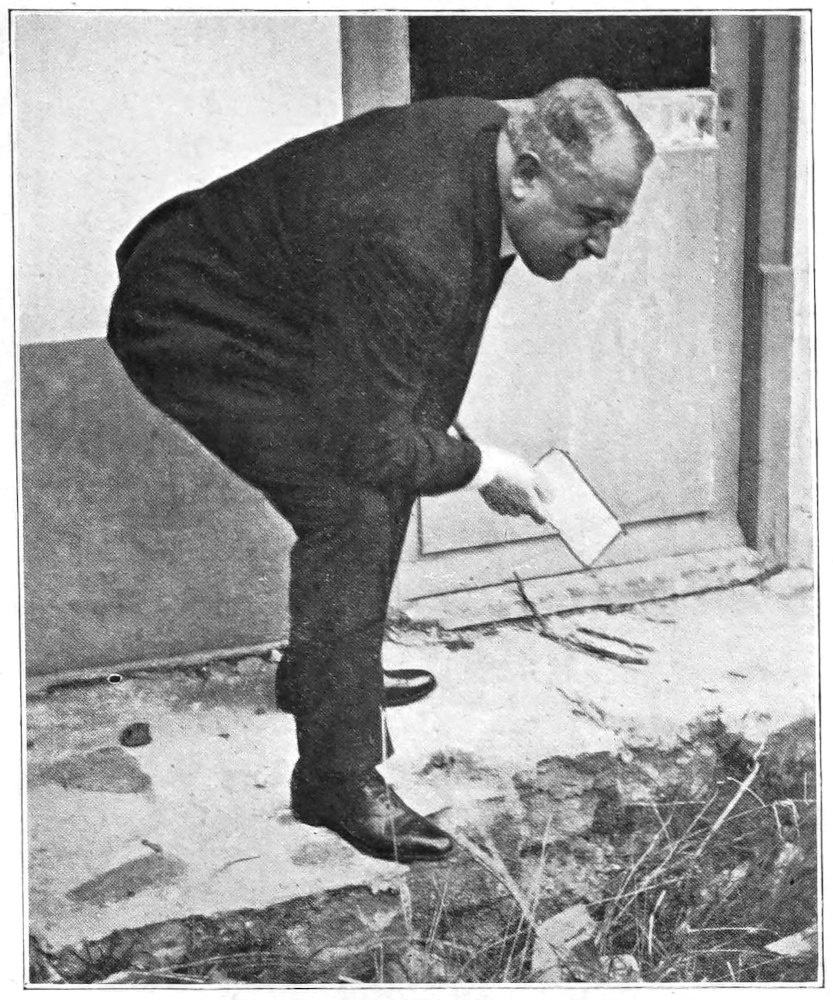
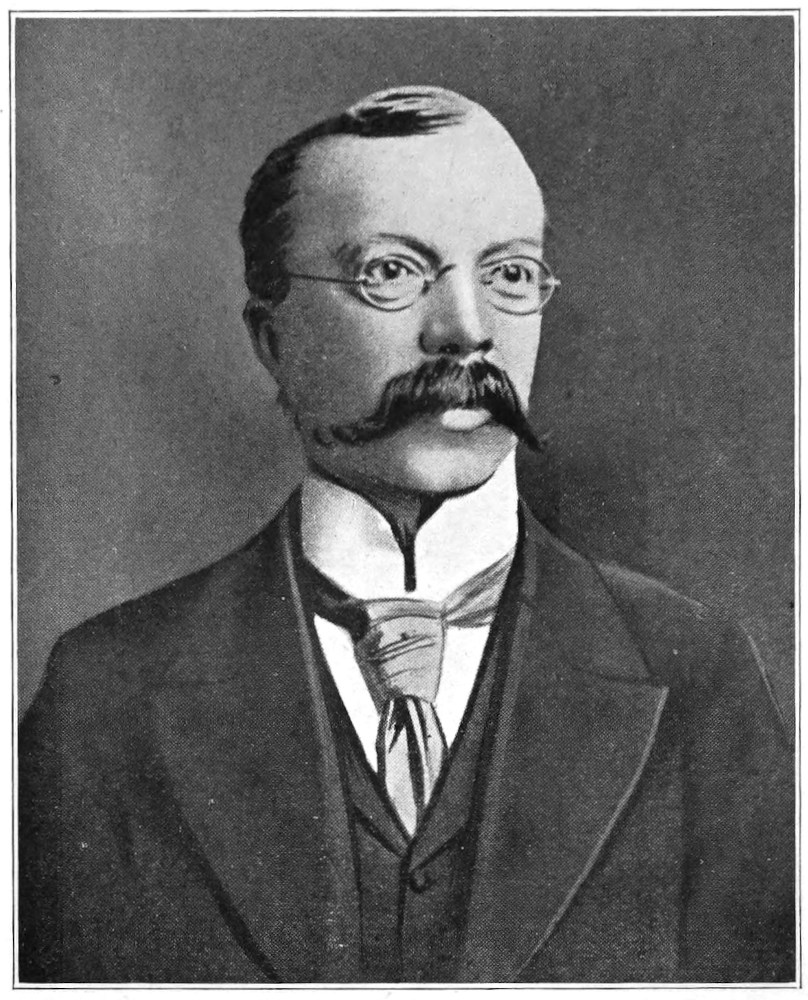
The authorities resolved on a reconstruction of the [Pg 231]crime, for now they were certain that several of the missing women had been lured to that lonely house, killed, and their bodies cremated in the kitchen-stove.
I was present. Landru, brought by car under police-guard and in secret, arrived at the scene of his crimes at about eleven o’clock one morning.
When he was brought into the small dining-room, where it was supposed he had poisoned his victims before disposing of their bodies, his demeanour showed nothing of the criminal.
He wished us a polite, “Bon jour, messieurs.” Then glancing round that room, which had no doubt been the scene of several most diabolical crimes—six it is believed—smiled superciliously.
“Henri Désiré Landru, you are accused of wilfully poisoning in this room Madame Héon on December 6th, 1916, and of poisoning Madame Collomb, on Christmas Day 1916!” said the examining magistrate in French, in a deep hard voice.
“Rubbish!” laughed the prisoner with a nonchalant air.
“It is the accusation against you!”
“Then prove it!” said Landru jeeringly.
“You must prove your innocence,” replied the magistrate.
“I am innocent—that is all!” was his reply. “And I thank you for a very pleasant motor-ride. The air of Gambais is always delightful. I wish I were coming back here to spend a holiday. But I shall, messieurs—never fear.”
I whispered in English to a detective who had been working in the excavations for the past fortnight, and he overheard me.
“Ah!” he sneered. “I don’t know who you are, but you seem very amused at all this. So am I. You call me Bluebeard. Oh! how foolish and farcical it is!”
I made no reply. But addressing me again, he said:
[Pg 232]
“I suppose, monsieur, that you are one of the wonderful doctors who hope to establish the fact that when I brought ladies here I killed them for their valuables. Well, all I reply is—just establish the facts. I thank you all for a glorious run through the Forest.”
The examining magistrate put to him other severe questions, but never for a second could he upset the marvellous equanimity of the prisoner.
The next time I saw Landru, on November 30th, 1921, was in the crowded and stifling Assize Court at Versailles. The place was packed. The Court had risen. The Jury were absent to consider the verdict, and before their box was an array of furniture and women’s clothing that gave one the idea of a second-hand dealer’s shop.
The atmosphere was electrical. All the world waited to hear the verdict.
Suddenly Landru was brought in, his face pale, more yellow and strained that when he had jeered at us at Gambais. He noticed the smart women of Paris straining their necks to get sight of him. From his seat a few seconds later, he rose, and bowing politely to the spectators, said with the same cynical smile that he had given me:
“I wonder if there be any lady in court who would like to take my place? I am quite ready to vacate it—I assure you!”
Those were the last words to the public of one of the greatest and most callous criminals of our time.
Five minutes later he was condemned to death. He was theatrical to the end, but his calmness never deserted him. His counsel, Maître Moro-Giafferi, who is an old friend of mine and one of the most famous criminal lawyers in Europe, appealed, but the conviction was upheld and at four o’clock on the morning of February 25th, 1922, Landru, on being offered the usual glass of rum and a cigarette, said with the same cynical laugh:
“I do not need them. I am brave!”
A few seconds later the knife fell and he was dead. [Pg 233]How many women he had murdered will never be known.
My next meeting with a murderer was one cold March afternoon. I was sitting before the big fire in the smoking room of a certain West End club of which I am a member—I omit its name for obvious reasons—when there strolled in a fellow member with whom I often chatted when we were spending an idle hour of gossip over our tea and toast. He was a country solicitor, living in Herefordshire and had been a member only a couple of years. Business frequently brought him to London, and on such occasions he slept at the club. He was a man of refinement and taste, a good talker, a golf enthusiast and somewhat humorous. He was, indeed, quite popular.
That March Sunday afternoon I remember well, as I was just back from ski-running at Mürren. As he stood before the fire I chanced to remark that the Crimes Club was holding their usual dinner that night and I was remaining in town to attend it.
“In my profession I am constantly dealing with petty crime. I would so much like to go to one of your dinners,” he said. “I suppose you discuss the celebrated cases of poisoning and so on? It must be most interesting.”
I replied that at the meetings many unknown facts concerning great crimes were often revealed.
But as I sat there I never dreamed of the terrible crime of which, not a month before, the man standing astride the rug had been guilty. He had deliberately poisoned his wife, and at that moment she was lying in her grave!
“Yes,” he repeated, throwing himself into a big armchair and lazily smoking an excellent cigar. “I should so much like to be present at one of the meetings.”
I met my fellow-clubman on quite half a dozen subsequent occasions, and no doubt he would have found the deliberations of the Crimes Club full of interest, for he [Pg 234]was none other than the notorious poisoner, Herbert Rowse Armstrong. When his wife’s body was exhumed by order of the Home Office about seven months after our fireside conversation, arsenic was found to have been the cause of death, and then came another charge of attempting to poison a friend.
As everyone knows, Armstrong was hanged in Gloucester Gaol in January, 1922.
Yes, I have met some very queer people.
[Pg 235]
CHAPTER SIXTEEN
Spies and Spying—I am the First to Warn Britain of the Coming War—Everybody Derides Me—How I Knew that the Kaiser was Plotting War—I Bring Documentary Evidence to London and Place it before Earl Roberts and the Cabinet—It is Stolen by German Agents—I Write The Invasion, and am Denounced by the Premier in the House of Commons as a Scaremonger—The Premier Apologizes Privately and Says he has Discredited Me for Political Reasons—Earl Roberts, Lord Charles Beresford and Mr. Lloyd George Stick by Me—I Become a Secret Agent of Great Britain and Manage to See Over the Ehrardt Gun Factory in Düsseldorf, where Big Guns were in the Making—The Invasion is Translated into Twenty-seven Foreign Languages—The Germans Invite Me to Go Over to Them and Offer to Pay Me Well!
I think I can claim to be the first person to warn Great Britain that the Kaiser was plotting a war against us.
I discovered, as far back as 1905, a great network of German espionage spread over the United Kingdom. I found out the secret through a friend in Berlin, who was at the time under-director of the Kaiser’s Spy Bureau, and who had married an Englishwoman who was believed by all, except her husband, to be German. As is usual in Germany, his master did not exactly “play the game” with him, and, therefore, in 1905, he told me frankly what was in progress.
I came back from Germany and endeavoured to awaken public opinion concerning the peril, but my voice was, alas! that of one crying in the wilderness. Spies! What on earth did Germany want to spy upon us for? Were we not good friends with Germany? Had not [Pg 236]the Kaiser assured Lord Haldane of his peaceful intentions? Did not the great War Lord in his golden helmet come to Buckingham Palace, and did he not parade the Embankment on his way to the Mansion House?
No, Le Queux was a writer of romance. Who could believe a word he said? So nobody would listen to me. No newspaper would publish any article that I wrote, although I asked no payment for it. I sent four London daily newspapers a letter of warning, asking the Editor to publish it. All returned it. The editor of one of the most powerful organs wrote:
“My Dear Le Queux,—We cannot publish this! Spies exist only in your imagination. We don’t want to alarm the public.”
Alarm the public? I, who knew the truth, was walking about London telling people a story at which they only laughed!
Now, to my friend Earl Roberts I related what I had discovered. He listened to me attentively and declared that he, too, was very suspicious of Germany’s intentions. I introduced him to Lord Northcliffe and we all three discussed the peril for over an hour.
I next consulted Colonel Lockwood, M.P. for Epping, now Lord Lambourne. He heard me, instituted his own inquiries in Essex, and three weeks later entirely agreed with me. He realized the danger, and one day put a question in the House, whereupon the whole of our legislators laughed him to scorn. Spies! It was Le Queux with a bee in his bonnet again!
I saw Prince Louis of Battenberg and Lord Charles Beresford who, on my producing facts that I had at my own expense obtained, fully agreed that a serious peril existed.
In this way the small circle of the men I have named first became aware of Germany’s elaborate system [Pg 237]of espionage that was working in every direction for one purpose only—a coming war.
The Admiralty had a kind of scratch intelligence service at the time, and so had the War Office. If any officer happened to obtain a tit-bit of information he sent it “to the proper quarter” where it was pigeon-holed and nobody ever again referred to it. Scotland Yard with its much vaunted Special Branch, looked after wild Irishmen and political undesirables, but spies—oh! it was all very absurd.
The greatest Empire of the world, sucking down daily the soothing syrup handed out by a pro-German press, declared Lord Roberts, Lord Northcliffe and myself to be a set of scaremongers.
I was in a quandary, but just at that moment, when nobody would publish a word concerning the spy peril, my old friend Mr. D. C. Thomson, proprietor of the Dundee Courier and a group of influential newspapers in Scotland and England, heard what I had to say, and after consulting with one of his Editors, Mr. G. B. Duncan—one of the most able and popular journalists in the Kingdom—resolved to make some investigations. With Mr. Duncan I travelled for some weeks about Scotland, gathering a quantity of information. On our return to Dundee, Mr. Thomson decided that as the public refused to believe in the actual existence of German spies among us, or of the Kaiser’s intentions for war, I should write a series of articles based on the facts that we had gathered.
Thus I wrote the first story ever written about spies, called Spies of the Kaiser. It was published by Mr. Thomson in The Weekly News, a journal that has a huge circulation throughout the United Kingdom.
It also appeared later in book form, and, when the scales at last fell from the eyes of the public, I had many imitators, who obtained much kudos and made much money out of the kind of article I had inaugurated.
[Pg 238]
Still the Government was much against my having dared to tell the truth to the public. The octopus hand of Germany was on every walk of life, and I knew myself to be a marked man. My old friend in Berlin—who had, long years before, been a fellow student of mine in Paris—warned me one day when we met at the Hôtel des Indes at the Hague, that if I proceeded with my exposures I should certainly be ruined in some way or another.
I laughed and expressed defiance. If I had not done so and had withdrawn from the attitude I had taken up, I might have to-day been a rich man.
I came back to London and in Lord Roberts’ study in Portland Place, I one morning told him what Herr N—— had told me.
“I feel that all is hopeless,” I said to the gallant old Field-Marshal. “I have done my level best, and nobody will hear me. I know the truth, but because I dare to tell it, people think I am a lunatic. My popularity as a writer will wane—and I have to earn my living by my pen!”
“My dear Le Queux,” said the white moustached old soldier, holding out his hand in a fatherly manner, “the world thinks me a lunatic also, because, after my forty years service in India, I have come home and dared to tell England that she is unprepared for war. I know you fear that you will earn unpopularity if you persevere with your good work. But stand by me—follow me. Charles Beresford and I will support you in every way, and we will, between us, try and convince these careless money-making people around us, that they are living on the brink of a volcano.”
I grasped his outstretched hand, and thus the compact was made.
Lord Roberts became Commander-in-Chief, and almost his first work was the formation—entirely apart from the official one—of a new voluntary Secret Service Department, of which I became a member. Half-a-dozen [Pg 239]patriotic men in secret banded themselves together. Each paying his own expenses, set to work gathering information in Germany and elsewhere that might be useful to our country in case of need. Italy and the Near East were the regions allotted to me, but my travels took me also to Russia, to Germany, and to Austria.
We soon discovered in our midst most remarkable ramifications of Germany’s spy system. As time after time I came home to report to Lord Roberts what I had found out in the course of my travels as a wandering novelist, the great military leader became more than ever convinced of the Kaiser’s slow but sure preparations for war.
Suddenly I received a guarded note from my German friend, Herr N——, asking whether I could meet him in Switzerland as he wished to renew my acquaintance. He would be in Zurich on a certain date.
I read between the lines that he wished to see me, so I travelled to Zurich, where in my bedroom at the Dolder Hotel he handed me a document that, when I brought it to London, caused the greatest sensation in certain quarters.
It was the full report of a secret council held a month before at Potsdam, at which the Emperor presided, Prince Henry of Prussia—a clever man whom I knew personally, having been on one of his motor-tours—the representatives of the leading Federal States, and the chiefs of the army and navy—including my informant—being also present.
At this secret council the Kaiser appeared in naval uniform, pale, determined, and somewhat nervous and unstrung, my friend told me, and went on to describe the scene. The Emperor spoke for more than two hours, illustrating his speech with many maps and diagrams as well as models of new air-craft and long-range guns designed for the coming war.
At first the Emperor’s voice had been almost inaudible, [Pg 240]and he looked haggard and worn, but his words, according to the transcript that my friend gave me—and which I eventually produced in my book German Spies in England, after being forced by hostile public opinion to keep it secret for seven years—were significant enough. He openly declared that he intended to have war.
“In calling this council this evening,” the Emperor said, “I have followed the Divine Command. Almighty God has always been a great and true ally of the House of Hohenzollern, and it is to Him that I—just as my august ancestors did—look for inspiration and guidance in the hour of need. After long hours of fervent prayer light has, at last, come to me. You, my trusted councillors and my friends, before whom I have no secrets, can testify that it has been, ever since I ascended the Throne, my most ardent desire to maintain the peace of the world and to cultivate, on a basis of mutual respect and esteem, friendship and goodwill with all the nations on the globe. I am aware that the course followed by me did not always meet with your approval, and that on many an occasion you would have been glad to see me use the mailed fist rather than the silken glove chosen by me in my dealings with certain foreign nations. It was a source of profound grief to me to see my best intentions misunderstood, but, bullet-proof against public censure and criticism, and responsible only to the Lord above us for my acts, I calmly continued to do what I considered to be my holy duty to the Fatherland. True to the great traditions of Prussia, and the House of Hohenzollern, I believed in the necessity of maintaining a great army and an adequate navy as the best guarantee of peace. In our zeal for the preservation of peace we were compelled to keep pace with the ever-increasing armaments of our neighbours, until the limit seems now to have been reached.
“We find ourselves now face to face with the most serious crisis in the history of our new German Empire. Owing to the heavy taxation and the enormous increase [Pg 241]in the cost of living, the discontent of the masses is assuming alarming proportions, and even infecting the middle and upper classes, which have, up to the present time, been the strongest pillar of the monarchy. But, worst of all, there are unmistakable signs that the discontent is spreading even among the troops, and that a secret well-organized anti-military movement is afoot, calculated to destroy all discipline, and to incite both my soldiers and sailors to open disobedience and rebellion.
“As, according to the reports of my Secret Service, a similar movement is making itself felt in nearly all the states of Europe, all indications point to the fact, which admits, indeed, no longer of any doubt, that we have to deal with an international revolutionary organization whose voiced object is the overthrowing of throne and altar, and the establishment of a Republican government....
“‘Breakers ahead!’ is the call of the helmsman of the Imperial ship of state, and I am ready to heed it. How to find an honourable and satisfactory solution of the problem is a question to which I have devoted the closest attention during these last months. The outlook is, I admit, dark, but we need not despair, for God, our great Ally, has given into our hands the means of saving our Empire from the dangers which are threatening it. You know what I mean.
“It is the wonderful invention which Count Zeppelin was able, through the grace of the Lord, to make for the safeguarding and glory of our beloved Fatherland. In this invention God has placed the means at my disposal to lead Germany triumphantly out of her present difficulties and to make once and for all good the words of our poet, ‘Deutschland, Deutschland über alles!’ Yes, gentlemen, Germany over everything in the world, the first power on earth both in peace and war.
“That is my irrevocable decision. At present we are, [Pg 242]thanks to our airships and our new monster guns, which will be a surprise for our enemies, invincible, and can carry at will war into the enemy’s own country.
“Of course it is too early yet to fix the exact date when the blow shall be struck. But I will say this, that we shall strike as soon as I have a sufficiently large fleet of Zeppelins at my disposal. I have given orders for the hurried construction of more airships of the improved Zeppelin type, and when these are ready we shall destroy England’s North Sea, Channel, and Atlantic Fleets, after which nothing on earth can prevent the landing of our army on British soil, and its triumphant march to London. Do you remember, my Generals, what our never-to-be-forgotten Field-Marshal Gebhard Lebrecht von Blücher exclaimed, when looking from the dome of St. Paul’s Cathedral upon the vast metropolis at his feet? It was short and to the point. ‘What a splendid city to sack!’
“You will desire to know how the outbreak of hostilities will be brought about. I can assure you on this point. Certainly we shall not have to go far to find a just cause for war. My army of spies scattered over Great Britain and France, as it is over North and South America, as well as all the other parts of the world where German interests may come to a clash with a foreign power, will take good care of that. I have issued already some time since secret orders that will, at the proper moment, accomplish what we desire!”
In due course I gave the document to Lord Roberts, and also showed it to Lord Charles Beresford, Lord Northcliffe, Prince Louis of Battenberg, Rear-Admiral H. W. Wilkin, and a number of officers of high rank. In addition, it was placed before the Cabinet, who pooh-poohed it. Yet six years later the Kaiser carried out his programme almost to the very letter, and came very near achieving his dastardly object.
My friend from Berlin had given the report of that speech to me with these words:
[Pg 243]
“There is war coming; I am certain of it. And though I am a German, I am one who does not believe in war. Therefore I think your friends should know what is intended, and be warned in time. For that reason I give it to you, assuring you that those words are the exact words used by His Majesty, and trusting to your honour always to regard your source of information as secret.”
I gave him my hand in pledge, and have never divulged his name, even though during the war his ingenuity regarding the organization of enemy spies was very often pitted against my own.
I have said that when I brought it to London the speech created a great sensation among those to whom I showed it in confidence. Very naturally its authenticity was doubted by some members of the Cabinet, and all the machinery of the official Secret Service was set to work to try and discredit it. But certain facts were brought to light that left no doubt of its genuineness.
I spoke to several publishers of my intention of writing a book exposing the Kaiser’s intentions for war, but they one and all dissuaded me, saying that such a subject would be unpopular. The country laughed at any idea of German treachery, and the book would in consequence be a complete failure.
Now the German Government, by some means, learned that I was in possession of a report of that secret speech of the Kaiser’s, and a curious incident resulted. In September, 1909, I determined to write a book pointing out that Germany meant war. With that object I showed Eveleigh Nash, whose offices were then at Fawside House, Covent Garden, the opening chapters of my manuscript, together with the speech in question. He, in my presence, locked them in a drawer of the writing-table in his private room. Two days later, when Mr. Nash opened that drawer, he found they had been stolen! German secret agents undoubtedly committed the theft—which was reported in certain newspapers at the time—for I have [Pg 244]since learnt that my manuscript is now in the archives of the Secret Service in Berlin! This, in itself, is sufficient proof of how eager the Kaiser was to suppress his declaration of war. It was fortunate that I had kept a copy of the speech, which I did not publish till the outbreak of war.
I was utterly disheartened at the apathy of the nation. I was doing my utmost, spending my hard-earned money in travelling and discovering the truth, yet nobody, except the few men I have already mentioned, would listen to me. I was openly told that my patriotism would spell ruin to me, as, alas! it eventually did, thanks to the same pro-German influence then at work, officially deluding, reassuring, and lulling the public to sleep, even as it is to-day.
I was in despair, and one afternoon, when I sat with Lord Roberts in his library, I told him that all I had endeavoured to do was without avail; for I was being denounced on every hand as a scaremonger, and told that I was a novelist and should stick to my profession of writing fiction.
“If people prefer your fiction to your fact, why not write a work of fiction—a description of what would happen if a great war came and we were invaded?” the Field-Marshal suggested.
The idea seemed a good one, but I pointed out that, not being a military man, I would make many technical blunders. Whereupon he said:
“I have the country’s welfare at heart, just as you have. I will prepare the scheme of attack and defence, and give you hints, if you will write the book.”
“And who will publish it?” I queried.
“Try Lord Northcliffe,” was his advice.
I did. Next day I saw my old friend whom the Daily Mail staff called “The Chief.” Within an hour he had given me an open commission. I was to write, regardless of expense, a forecast of “The Invasion” for the Daily [Pg 245]Mail, besides being promised a very handsome price for it.
“I know your pocket has suffered very much, Quex,” he said, for he always called me by that name. “Write a good stirring forecast. Tell Lord Roberts we will both try and wake up the country to a sense of its peril.”
In high spirits I went back to Portland Place and told the gallant old soldier, and that same evening we started to plan out an imaginary German invasion.
Having carte blanche in the matter of expense, I sought the aid of Colonel Cyril Field, R.M.L.I., and Major Matson, both military experts, while H. W. Wilson, the well-known naval expert, was eager and ready to assist me in connection with naval matters.
For four months we reconnoitred the whole of East Anglia, from the Tyne to the Thames, making notes, marking maps, and finding out the most vulnerable points—including Weybourne Gap, in Norfolk, which was no doubt one of the points marked by the Germans for their disembarkation at the proper moment—and then, on my return to London, I was appalled to find that I had spent over three thousand pounds on what some would have termed “a joy ride.”
Lord Northcliffe paid it, remarking that, provided the forecast was well done, he would not mind the expense.
Then I took a flat in Queen Anne’s Mansions, Westminster, and there began to write. It was a colossal task as may well be imagined by anyone who has read the book, and further I had to surmount a heavier barrier than any I had ever dreamed might obstruct my way.
Thus, when at last I had, after a year’s work, finished the manuscript, and Lord Roberts had read every line and corrected any mistake I had made, and one morning—as will perhaps be remembered—the whole front pages of The Times, the Daily Telegraph, the Morning Post, the Daily Mail, and the Daily Chronicle, as well as the [Pg 246]front pages of certain great provincial papers, bore a map of England, showing the districts that would be invaded, and announcing that the publication of my forecast, “The Invasion,” would commence in the Daily Mail on the morrow, the Campbell-Bannerman Government determined that every word I wrote should be discredited and held in derision.
That same afternoon in the House of Commons a question was asked of the Prime Minister whether his attentions had been directed to the advertisements. The campaign against me had now started in real earnest!
Sir H. Campbell-Bannerman replied that he had seen the advertisements, and, denouncing me as a mere scaremonger, declared that such work was pernicious literature, “calculated to inflame public opinion abroad and alarm the more ignorant public at home.”
I at once wrote asking how he could criticize a work he had never read; and, moreover, why he accused his electors, the British public, of being more ignorant than their neighbours across the Channel. I knew it was a poser. But of the jugglery of politics there is no end, so I smiled and forgave him when next day he sent by special messenger a note in his own handwriting marked “Strictly Private” and in which he apologized for the words he had used. He meant “the more ignorant section of the public at home,” and hoped that I would not, in the exigencies of politics, take any word of his as being personally offensive. He concluded by asking me to call at Downing Street when I could, as he wanted to make full explanation!
Next day the Daily Mail appeared with the opening chapters of my work. It proved a huge success. Everyone congratulated me on it. At the Savage Club, at the Devonshire, at Boodles, at the Reform, at the houses I visited, I was hailed as the man-who-dared-to-tell-the-truth.
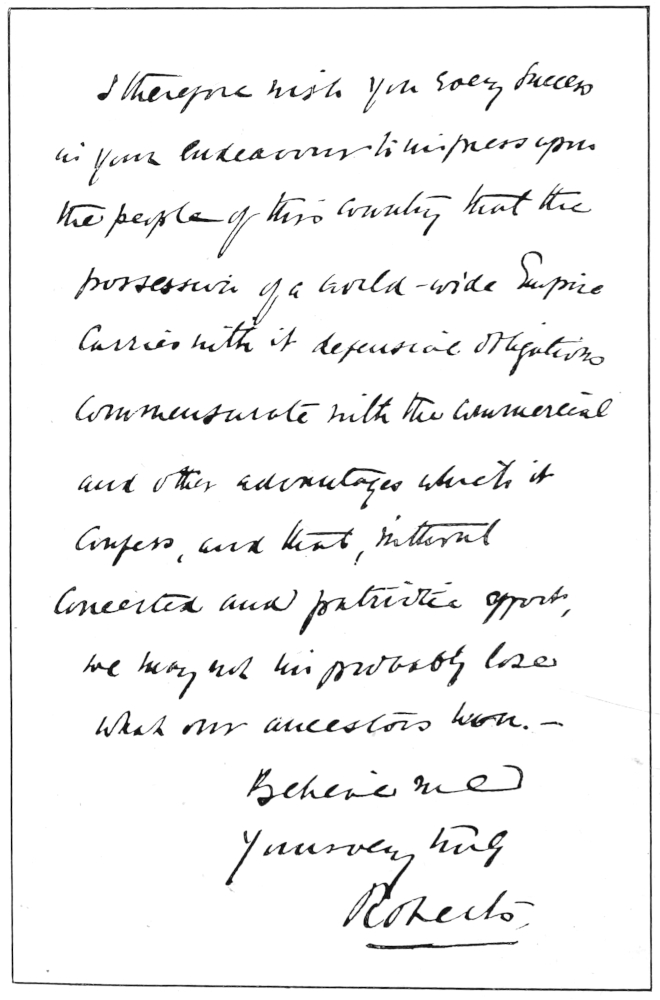
I therefore wish you every success in your endeavour to impress upon the people of this country that the possession of a world-wide Empire carries with it defensive obligations commensurate with the commercial and other advantages which it confers, and that, without concerted and patriotic effort, we may not improbably lose what our ancestors won.—Extracts of Lord Roberts’ famous letter of warning.Believe me
Yours very truly
Roberts.
[Pg 247]
Naturally I was much gratified, for among the letters I received was one that I here publish for the first time:
“47 Portland Place,
“London, W.,
“22nd August, 1906.“Dear Mr. Le Queux,—I return with many thanks the enclosure of your letter of 2nd August.
“The imaginary scheme seems carefully thought out, and it forcibly illustrates the risk we should run under present military conditions, if, owing to the temporary absence or inferiority of our fleet, a Continental power (meaning Germany) were able to seize an opportunity for landing a large force of picked soldiers in this country.
“The maintenance at home of an adequate number of well-trained and organized troops and reservists would not only set free the navy for offensive action and the protection of our sea-borne commerce, by relieving it to an appreciable extent of the onerous obligation which it has lately undertaken of defending these shores without military co-operation, but would also enable such reinforcements to be despatched to our Colonies and dependencies as might be required to preserve the integrity and safeguard the interests of the British Empire.
“I therefore wish you every success in your endeavour to impress upon the people of this country that the possession of a world-wide Empire carries with it defensive obligations commensurate with the commercial and other advantages which it confers, and that, without concerted and patriotic effort, we may not improbably lose what our ancestors won.
“Believe me,
“Yours very truly,
“Roberts.”
[Pg 248]
Have we not already lost Ireland, and are we not daily losing grip on Australia and on Canada? Is the reader aware that the newspapers in the latter country, when advertising for a man to do a job, add: “No English need apply”?
I received a flood of other congratulatory letters from, among others, the Duke of Northumberland, the Duke of Argyll, the Duke of Fife, the Earl of Derby, the Earl of Rosebery, the Earl of Wemyss, Viscount Milner, Viscount Hardinge, Lord Brassey, Lord Tweedmouth, Lord Newton, Field-Marshal Sir George White, Lieut.-General Sir William Nicholson, Sir Ralph Moor, Major-General Sir J. Wolfe Murray, Sir Albert Rollit, M.P., Sir William Holland, M.P., Sir Joseph Dimsdale, M.P., Sir Charles Lawson, Sir Francis Tress Barry, M.P., Sir Henry Seton-Karr, Sir Theodore V. S. Angier, Major-General Sir Edwin Collen, Sir John Turney, Sir Henry W. Tyler, Colonel Sir Reginald Hennell, General Sir Stanley Edwardes, Sir Alfred Newton, Sir Fortescue Flannery, M.P., Colonel Sir Henry Rawlinson, Alderman and Sheriff Sir Vesey Strong, Sheriff Sir George Woodman, and Mr. Spenser Wilkinson, all of whom became my personal friends and supporters. I found myself popular among those who knew of the pro-German propaganda and its financial influence.
At last England seemed about to wake up!
Shortly afterwards I attended with Earl Roberts a meeting to consider national defence, which was called by the London Chamber of Commerce and presided over by the Lord Mayor at the Mansion House. The Field-Marshal had stated in the House of Lords that our armed forces were as absolutely unfitted and unprepared as they had been in 1899.
“What the nation requires, especially that portion of it occupied with the great business interests of the country,” he told the crowded meeting, “is peace and security not only from actual war but from alarms and [Pg 249]panics. Such security, I regret to say—and I think you will agree with me—cannot be ensured by diplomacy alone or by a policy of conciliation alone, as some would have us believe. The only true safeguard is that the armed forces of the Crown should be in such a state of readiness and efficiency that it would not be to the interests of any Power to risk war with us.”
Thus, in a splendid, vigorous speech, he put before them facts showing our hopeless insecurity, and strongly urged that the country should awaken to the peril of the apathy into which it had fallen. Afterwards Lord Brassey, in proposing a vote of thanks, made a fine speech, and later, when Earl Roberts introduced me to him in the Lord Mayor’s parlour, he congratulated me on “The Invasion.”
The Daily Mail had scored a success, even though the staff themselves had at first expressed some doubts as to its reception. Then, on Eveleigh Nash publishing it in book-form, with an introduction by Earl Roberts, it at once went through many editions.
It caused such widespread attention—because no critic could pick a hole in the invasion scheme, designed as it was by one of the greatest strategists of our time—that it was translated into no fewer than twenty-seven languages, including Arabic, Urdu, Icelandic, Syrian, Japanese, and Chinese. Naturally I was much gratified at having at last aroused the British nation, and others, to realize that the Kaiser’s pretensions of friendship were false.
My friends saw that we were drifting towards war, yet, though I had made a success with The Invasion, its result was exactly the opposite to what I had hoped.
The world read my book eagerly. They devoured the scenes of how our shores were invaded, of the fierce battles in Essex, Lancashire, and Yorkshire, and of the enemy’s advance on London. Then, on finishing the book, they simply set it aside, and, admitting that it [Pg 250]was quite an exciting work of imagination, set me down as a second-class Jules Verne!
But a greater disillusionment came when a plausible round-faced German came over from Berlin, called on Mr. A. P. Watt, my literary agent, and arranged with him to pay a very handsome sum for the German rights of the book.
I was in Naples when I received my agent’s letter, and by telegram accepted the terms of the Concordia Press, in Berlin, congratulating myself that even our enemies would learn the truth that they could not invade us with success!
Judge my chagrin when, six months later, I saw an illustrated edition of The Invasion in German, the conclusion of which had been entirely rewritten, making the result of the invasion a German success! And there were pictures of Germans sacking London!
Worse! It was published, and bound in gilt, as a prize for German boys at school!
I walked into the “Chief’s” room at the Daily Mail offices filled with fury and disgust.
“Under English law I’m an Englishman, and I love England!” I said to Lord Northcliffe. “But, being the son of a French father, I’m also a Frenchman, and I thank God for it!”
Those were my first words when I entered his room, and they caused him to turn quickly from his chair, where he was dictating letters to his secretary, Miss Owen.
“Hulloa, Quex! You’re not well! What’s up?” he asked. “Max has just been in with a bad stomach-ache. He’s got a chill through wearing a new fancy vest that hasn’t been aired.”
He referred to Max Pemberton.
I fear I used some rather strong language, but in his usual humorous way he calmed me, and asked me down to Elmwood, his place near Broadstairs, for the week-end.
[Pg 251]
I saw that we had advanced no farther in arousing the public. Had it not been for Earl Roberts, Lord Northcliffe, Mr. Lloyd George, Lord Charles Beresford, and a few other intimate friends, I should have given up. But when bent on achieving an object I am perhaps rather tenacious, so the money that I received in royalties from The Invasion I again spent on travelling Europe as a secret agent of Great Britain.
I parted with my money freely, leading a gay life with the one idea of gaining information of use to Great Britain. I was the only Englishman who ever entered the great gun-factory of Ehrardt’s, in Düsseldorf, where they were then constructing big guns. If my identity had been discovered I should have spent the remainder of my life in a German fortress. My escapade cost me a large sum in bribery, which I paid to a certain adventurer in Constantinople, but I got the knowledge that I wanted.
In due course the result of my adventure was reported by me, docketed, and sent to those dusty pigeon-holes in the War Office. The staff there, all keen and eager, dare not, after Lord Roberts retired, show any alertness or enterprise. The Government had said, “There are no spies,” and the staff of the Intelligence Branch was compelled to assume a lack of intelligence.
It is curious, as a writer in the Daily Mail pointed out recently, that in The Invasion, written five years before the Great War, not only was the Battle of Jutland forecasted, but several of the ships sunk were actually described as sunk, while, in addition, the bombardment of Scarborough was predicted and some of the houses struck by shells actually named! Strange coincidences, at least.
The whole situation in 1910 to 1913 was hopeless. All I could do was to write novels in which I took as my villain a spy. They became popular. One could write [Pg 252]spies in fiction, but to say there were spies in real life was almost an offence against King and country.
One September night in 1910 I had an adventure in London that opened my eyes widely to what was in progress, and to how our national existence was at stake, though the nation was so entirely ignorant.
I received a note from General Sir Alfred Turner, who lived in Cheyne Walk and whom I had not met, declaring that he greatly admired my patriotism, and asked me to dine en famille one Sunday evening. I accepted the invitation, and went. To my great surprise, I found among the guests the German Ambassador, the Chancellor of the Embassy, the Military and Naval Attachés with their ladies, Lady Tree, Miss Viola Tree, Mr. Lewis Waller, Lady Westmorland, Lady Dorothy Nevill, and others.
In a corner of the drawing-room after dinner I found myself chatting with the German military attaché—a man who was hail-fellow-well-met with every journalist in London—who turned the conversation round to my anti-German writings. By his invitation I met him at his club next day. He entertained me to an expensive luncheon, and then suddenly laughed at me for what he termed my misguided propaganda.
“There will be no war between your country and mine,” he assured me. “You are so very foolish, my dear Mr. Le Queux. You have ruined your reputation by these fixed ideas of yours. Why not change them? We desire no quarrel with Great Britain, but we also, of course, realize that you are doing only what you consider to be your duty.”
“It is my duty,” I responded.
My diplomatic friend sucked at his cigar, and laughed.
“As a literary man you, of course, write to interest the public. But you would interest your public just as easily by writing in favour of Germany—and I tell you that we should quickly recognize the favour you do us, and recompense you well for it.”
[Pg 253]
I rose from my chair.
I confess that I grew angry, and I told him what was in my mind.
I gave him a message to his own Secret Service in Berlin, which was very terse and to the point, and then I left his club.
I give this as one single instance of the cunning manner in which the German Secret Service endeavoured to nobble and bribe me, so as to close my mouth and thus combat my activity.
Another instance was when the Nord-Deutscher Lloyd Line, of Bremen, kindly invited me to take a voyage round the world, free of expense, so that I might visit the various German colonies and write descriptions of them. And, on a third occasion, German diplomats were amazingly kind to me, both in Constantinople and in Belgrade, and again broadly hinted at their readiness to win me over to their side.
How pitiable, how absolutely criminal was our apathy!
Here is another instance. One August morning in 1913, a year before the war, I was sauntering along the village street at Southborough on the Hill, three miles south of Tonbridge, in Kent. I was dressed as a City man taking a country holiday, and had a camera hanging from a strap over my shoulder. I had a girl with me, in order to complete the picture. I was down in that rural retreat in order to watch certain things that were in progress.
What I saw and photographed was certainly of great interest.
About twenty-five German officers in mufti, all speaking German and making no disguise of their nationality, rode through Southborough, and during the whole day actually reconnoitred very carefully the hills between Tonbridge and Tunbridge Wells, taking many bearings, deliberating on sites for guns, and taking photographs. They were preparing for the invasion of England!
[Pg 254]
That night the party returned to London, where they were entertained by the German Ambassador at Carlton House Terrace.
Such a deliberate survey of our own country by a foreign army was outrageous. I showed my photographs to Lord Roberts, and he, much incensed, urged me to write to the Press. I did so, but the British public had been doped, and not a single newspaper published a line concerning the enemy’s survey of the Kentish hills. One editor wrote to me declaring me to be a fool. That was only a year before the outbreak of war.
I often wonder by whose orders it was that all the motor signs on high roads from the Kentish coast to London were marked by the black-and-white stripes of German official direction-posts! It would be interesting to discover, for they silently pointed the way from the coast to the capital, and the public little dreamed of why they were black-and-white.
That the Germans intended to effect a sudden and unexpected landing on the east and south coasts was proved in many ways. Earl Roberts, Lord Northcliffe, and myself tried to point it out time after time, but our warnings always fell on deaf ears. It was given over to me to investigate. I found that on the east coast from Hull to Felixstowe most hotels facing the sea had either a German manager or proprietor, or, if not, there were Germans occupying private houses or boarding-houses on the sea-front of every town.
Again, wherever a tenant was wanted for a public-house a German-born applicant was ready to accept almost any condition to take up the licence, while in no fewer than forty-two cases—as I reported to the War Office—Germans or pretended Frenchmen or Swiss were living either next door, or next door but one, to the most important telegraph offices, ready to make a dash, and seize or destroy the instruments on “The Day.”
Happily “The Day of the Invasion” never came, [Pg 255]but it was not prevented by any effort on the part of the pro-German Party, which in 1914 existed in Britain, just as it exists here to-day. By that staff-ride of German cavalry in Kent it was plain that the downfall of England was being plotted, but who cared so long as officialdom had its pickings and enjoyed its own social standing? I was only laughed at for the trouble I had taken to watch it.
Do not the souls of the millions who died on the battlefields of France, of Belgium, of Italy, and of the East rise against the plotters? Does not the onus of the frightful loss of the flower of our dear English lads lie, not on our four-hundred-a-year legislators, but on some of the golfing, dividend-seeking, pushful pro-Germans with old-world English names, often assumed, who have ruled our country through past years?
What will be the opinion of those who come after us?
Without politics, I repeat—for I am no politician, and have never voted in my life—I would pay a tribute—the tribute that the whole nation should pay—to Mr. Lloyd George and his advisers, who came in for so much adverse criticism before the war. I declare as my opinion—an opinion that millions share—that the manner in which he, as Chancellor of the Exchequer, faced and grappled with the financial situation at the outbreak of war was an illustration of British pluck, coolness, and readiness unequalled in our history. As I have already stated, my only feeling is one of pure patriotism towards the country that gave me birth. Any of these plain statements of fact, which I here set down, I defy any political or official juggling to disprove.
Though we are at peace to-day, there are signs everywhere of another war in the very near future. The writing-on-the-wall is there for those who are intelligent enough to read it. To-day throughout the world there is frantic and gigantic effort to produce fresh war material of a far more destructive nature—fast bombing aeroplanes, [Pg 256]poison-gases, microbe-bombs, and high explosives such as the world has never before seen. And against whom? Great Britain, without a shadow of doubt.
Though we once cleared the enemy out of our island, he is here again in full force.
From the widespread and insidious Secret Service of Germany nothing is sacred. Details of our new helicopter were known in Berlin two days after its secret trials, while of a new war-vessel launched in secret this summer photographs reached Berlin within a week. Germany laughs at our apathy, and still boasts that she knows all about us, our political, military, and civil population alike. I know that from the inside. In the archives of Herr Steinhauer’s department in Berlin there are thousands on thousands of detailed reports—furnished constantly throughout the past ten years—regarding the lives and means of prominent persons in England, with descriptions of their homes wherein, one day, the undefeated enemy hope to billet their troops.
Then we have those unscrupulous people, men and women who act as “fixed-posts”—and it is no exaggeration to say that there are still dozens back again in England notwithstanding all official assurances to the contrary—who have all gone through an elaborate system of training in signalling, in reducing messages to code, and in decoding them, in map-making, in the use of carrier pigeons, and of secret wireless.
To-day, more than ever, the German nation hopes to strike in secret a staggering blow against London and our ports, not by invasion from the sea, but, after paralysing us from the air, to land an army. I fear that no political soothing-syrup, by whatever party, has any effect whatever on me, because I happen to know what I am writing about. I have not forgotten that Mr. McKenna told us that all German spies in our country were “safely under lock and key,” though a week later [Pg 257]there were arrested a number of dangerous spies, two of whom were afterwards executed. Nor have I forgotten what trouble I got into for publicly mentioning this fact at a lecture I gave one afternoon at Buxton. After my speech all the London Press, both morning and evening, were served with notices forbidding them to publish my remarks! Charles Palmer, of the Globe, showed me the notice served on him, and laughingly said:
“Does not that, in itself, bear out your argument that certain authorities ruled by the Hidden Hand of Germany are afraid of your merciless exposures?”
Well, I tried to be patriotic, and have ever endeavoured to do my best for my country, even though it was all unavailing. But I feel strongly that I should still continue to raise my voice in warning and declare that Germany still means to attack, and, if possible, conquer, Great Britain, and is actually at the moment stirring up strife for that purpose.
[Pg 258]
CHAPTER SEVENTEEN
About other Spies—I am Shown the List of British Traitors Paid by Germany—For that Reason I am Feared in Certain Quarters—Why Scotland Yard Withdrew its Protection from Me—My Campaign Against Enemy Aliens—Efforts to Discredit Me—Poisonous Gossip in Society—A Report is Set About that I Am a German Spy!—Our Silly Censorship—I Defy it, and As a Patriot Await Prosecution—The Traitors Fear Lest I May Make Ugly Disclosures—Prominent Men Who Supported Me—Humours of Lecturing—I Meet the Mock Monk Rasputin—Herr Steinhauer, Chief Spy of the Kaiser—The Identity of “Jack the Ripper” Disclosed for the First Time.
The British public are even to-day ignorant of the widespread and powerful pro-German influence that was at work in our country before the outbreak of war, during the struggle for our national existence, and continues even to-day.
I am a thorn in the side of the traitors. There is no doubt whatever of the truth a certain Cabinet Minister told me when he said:
“There are a good many people in England who are wishing that something would happen to you, Le Queux.”
“I know,” I said. “And I know the reason.”
In high quarters, strings were being pulled constantly against me, much to my detriment. The penalty I paid for daring to write The Invasion proved of very serious consequences to me, inasmuch as the newspapers that did not agree with my patriotic endeavours tried to suppress me by refusing to publish any more of my novels serially! And by this I lost a very considerable part of [Pg 259]my income. Nevertheless, my friends encouraged me in the work I was striving to do, and I felt sufficiently rewarded to know that when the war came my efforts were appreciated, even by many of those who had hitherto turned a deaf ear to all my warnings.
And now let me explain why I was such a thorn in the side of our traitors who, working in unison, constituted the Hidden Hand. They feared me because I possessed knowledge of their identities, and in many cases of the sums secretly paid to them by Germany! The truth was that in 1912 my friend Herr N——, for my personal information, showed me a list of persons in England to whom German money had been, and was still being indirectly paid. And he was their pay-master! I was aghast at the sight of this list. I sat staggered. It was appalling that persons whom the nation considered highly patriotic and upright, and who were afterwards loudest in their praise of “our gallant fellows,” should have fallen into the insidious tentacles of the great German octopus.
I know that this sensational statement will be questioned, but I vouch on my honour and all I hold most sacred as to its truth.
Remember the traitors unearthed in France—Lenoir, Bolo Pasha, and many others—and what Germany was doing in France she did also in England, though here our betrayers have remained undiscovered and are allowed to go free in full possession of their blood-money.
The names I read in that list were mostly well-known throughout the country, and embraced persons of the higher and official classes. Members of Parliament and others, including two influential writers who were my friends. I asked to be allowed to make a copy of the list, but my request was refused, therefore I could only carry the names in my memory. In it the Foreign Office, Home Office, India Office, Admiralty, and War Office were all represented; and all should have faced the firing [Pg 260]party instead of living to-day, lolling in their cars and enjoying themselves on the price of their treachery.
“Now you see for yourself how Germany is working,” my friend said, as he replaced that amazing document in his pocket. “You know the truth concerning your own betrayers. But, of course, you will regard what I have shown you as strictly confidential. One day, if we are conquered, we may publish those names! Who knows?”
My lips have been sealed till to-day. There are traitors in every camp, and Britain was, and still is, no exception. Would that Germany would publish those names and the amounts annually paid to each. I hinted at what I knew to my friends, and for that reason I believe Lord Charles Beresford one day, during the war, turned on a certain politician in his bluff fiery way and declared him in my presence to be among the traitors. And the politician only laughed!
During the war many events proved beyond all doubt that we were being betrayed by some persons in authority. Therefore the facts speak for themselves. I make no charge against any Government as a whole. Each did its best in turn, but our betrayers were in our midst and secretly pulled the wires that worked the Hidden Hand.
Many persons have wondered why I have met with much hostility in certain official circles, but what I here reveal for the first time is surely sufficient explanation. By some means it had become known to the traitors that I had gained knowledge of them and, in fear lest I should make disclosures of how they had been bribed by German gold, they united to discredit me and to wreck my reputation.
To what extent this was carried is shown by an incident that occurred two days after war was declared.
Scotland Yard knew that ever since the publication of The Invasion and my campaign against the Hun I had received a number of threatening letters, all of which I sent to the Department. The Metropolitan Police, [Pg 261]feeling that I was in personal peril while the country was still swarming with Germans, very properly placed a police guard night and day on my house—for I was then living at Upper Halliford, near Sunbury-on-Thames, which is in the Metropolitan Police area. Indeed, the detective inspector who saw me expressed the view that I was in grave danger, and for that reason they had resolved to give me protection. So a constable lurked each night in the summer-house in my garden.
Two days later, at orders from a higher quarter, my police protection was suddenly withdrawn! By the Hidden Hand, of course—the hand of someone who hoped every day that something might happen to me, for I was a person who knew too much!
A few weeks later I was lunching at Lady Owen Philipps’s when my friend Mrs. Eckstein, who sat next to me, said:
“Oh, Mr. Le Queux, do you know the latest about yourself? It is all over London that you are really a German spy! I’ve heard it from half a dozen people during the past week. I wonder who started such a wicked report?”
I only smiled. I knew that it had come from the traitors, in order to hound me down and discredit me in case I broke my vow of silence concerning them.
Further, I greatly incensed the authorities by my campaign that demanded that all Germans of whatever class should be interned. I was, however, assisted by Lord Leith of Fyvie, Sir W. Joynson-Hicks, an old friend and a true Englishman, the Duke of Newcastle, another old friend, the Earl of Crawford, Earl Clarendon, Lord Galway, Lord Headley, and others.
For months the wire-pullers resisted. Sir Edgar Speyer, Privy Councillor, put his fingers to his nose at the King and crossed to America; yet not till after we held a violent meeting at the Mansion House, where many hard things were said, did the authorities at last yet very reluctantly resolve to intern enemy aliens. I happen [Pg 262]to know that, so bitter was their opposition to our just demands, they actually interned two Germans who, being employed in our own Secret Service, were doing valuable work for us! Hundreds of dangerous aliens were allowed to slip through the meshes of the net by those who, bent on our downfall, were awaiting the landing of the Germans. Indeed, at no period of the war were they all interned. Further, though I pointed out to the authorities that Detective-Sergeant Wegner, who was Russian born and spoke German like a native, and had been conveniently “retired” from Scotland Yard at the outbreak of war, should be re-employed, it was refused, even though he had been an expert on alien enemies in the West End!
I myself undertook some investigations on the Clyde, assisted by Alexander Morton, the messenger-at-arms, of Glasgow; and in one case I found a German carrying on a typewriting school, actually training secretaries—some thirty of whom he had managed to get posts at the naval base at Rosyth! I published the results of my investigations in the Glasgow Sunday Post, and by doing so further incensed the authorities, who were anxious to suppress me.
After that I wrote a book, German Spies in England, and in open defiance of the idiotic censorship published it. There were fierce official threats to prosecute me and also my publisher, Mr. Stanley Paul. But I presume it was feared that I might make some rather nasty accusations, and bring proof against certain highly-placed persons, so the matter was allowed to drop. Then I went further, and wrote another fearless exposure of the truth, which I called Britain’s Deadly Peril, and again defiantly published it, well knowing that I had a patriotic circle of good friends behind me. I awaited prosecution, but none came.
About this time a Danish bookseller, who sells my books in Copenhagen, wrote to me telling me he had just returned from Berlin, where he had heard of the naval raid on Scarborough three days before it took place! He [Pg 263]was often in London before the war, and in the course of his interesting letter he wrote:
“I always thought the spy mania in England exaggerated, but now I am absolutely persuaded that even those Englishmen who recognize this peril do not realize the lengths to which it goes. They have been suspecting waiters and servants, whilst the spies are in high social positions; they have contented themselves with searching the houses of German barbers and grocers, whilst neglecting the hands which collect and forward to Berlin the information gathered by more humble satellites.
“It is very sad to have to say such things, but I think the most dangerous spies still in England are not Germans, whether naturalized or not, but are people belonging to neutral countries—even to countries actually fighting Germany—and also subjects of Great Britain herself.
“I would not have written this if I was not sure of it; the diplomat from whom I got the information assured me that there are some English and French of both sexes who come regularly to Berlin, or to frontier towns through neutral countries, and have conversations with officials and then return. The restrictions as to luggage and passports, both in France and in England, are not half so severe as they should be; they are even slacker than at the beginning of the war. I know, personally, of a number of stolen American passports under the shelter of which German spies are now travelling, and an Italian Consul with whom I happened to travel a few days ago said he had discovered two fellows with false Italian passports almost perfectly imitated.
“In Berlin I heard people, well-informed people, saying that in every English town of importance, and on every spot of strategical value on the British coast, Germany has got few friends keeping their eyes open, [Pg 264]and ready to receive an eventual German raid, and to give their friends as strong a hand as possible.”
That letter bore out exactly what I was trying to preach every day.
One day while lunching with Lord Northcliffe at his house in St. James’ Place—I having assisted Lady Northcliffe and the Duchess of Roxburghe in the organization of a field hospital for Serbia—he said to me:
“Quex, my dear fellow, why don’t you lecture? Tell the people about spies and their ways. Having been our spy yourself, you know the game better than anybody. I’m sure it would interest people.”
As first I demurred, but he pressed me, assuring me that it would cause the people to think.
“There are spies everywhere among us, as you are aware. The authorities are most reluctant to arrest one, for reasons we already know. Now and then one is caught, just in order to make pretence of our great vigilance and keep incompetent people in their jobs.”
So I decided to lecture. Perhaps some of those who read this book may have listened to me while I spoke from one or other of the two hundred and twenty-eight different platforms I occupied, in as many different towns, from Aberdeen to Brighton and from Cromer to Carmarthen.
Lord Headley, who is a great humorist, often took the chair, and among other chairmen I had the Earl of Midleton, ex-Minister for War, the Earl of Clarendon, the Marquis of Linlithgow, Lord Rochdale, Lord Leith of Fyvie, and many peers, parsons, provincial mayors, and distinguished people.
Now Lord Headley is a ventriloquist inasmuch as he can speak without moving his lips. He lives at St. Margaret’s, near Twickenham, and I introduced him to Douglas Sladen, who lived across the Thames at Richmond; so the pair became great friends. But it was [Pg 265]his lordship’s ventriloquial abilities that worried me. We would travel down from London together by car to some distant town, arrive about six o’clock, eat a chop, and go to the place where I was “billed” to lecture, usually for some local charity, so I paid the expenses! Duly we arrived on the platform amid applause, and duly he would rise and make an eulogistic speech that caused me to blush.
Then, when I rose and began to try and entertain my audience for an hour and a half without the aid of “pictures”—no easy task in these days, if one is not a variety performer, I assure you—he would presently sotto voce give his humorous impressions of the audience. I heard whispered loudly, though nobody else could hear, something as follows:
“Good Lord! What a funny crowd! Putrid! Look at that old girl at the corner of the third row! What a guy! She’ll look under the bed to-night to make sure there’s not a spy there!”
Then a pause.
“That’s it! They’ve all got their mouths open now. Tell them a funny story. Yes, they’re right with you—with you every time—look at the reporters scribbling it all down—lots in the papers to-morrow. Phew! The place is packed. I’m tired—beastly tired!”
I was compelled to endure this, and much more, for he would single out persons in the audience, indicate them, and criticize their personal appearance in such a manner that I had to clench my hands and set my jaws hard to keep myself from laughing in the faces of my listeners.
One hot summer’s night I was advertised to lecture in the Town Hall at Windsor, and we drove down together by car from London. It was for charity. I was suffering from a bad cold in the head, and I could hardly speak. Indeed, I had been in bed till four o’clock, but was determined not to disappoint those who wished to hear me. [Pg 266]I had been told, too, that, the Court being in residence at the Castle, a number of officials attached to it had taken tickets.
On the way down I said to my chairman:
“Look here, Headley, no humour to-night. I’m horribly ill, and really can’t stand it. How I shall get through it I don’t know.”
“My dear fellow, I can see you’re queer,” he replied. “I won’t utter a single word. Dry up early, and let’s get back as soon as we can. We have to go up to Newcastle to-morrow, remember.”
And so it was arranged.
The big hall was packed. His lordship explained that I was suffering from a very bad cold and had risen from my bed to fulfil my promise in the cause of charity.
Then I rose, and I started in a voice that I fear was very harsh and hoarse. Though feeling only half awake I nevertheless did my best.
For nearly half-an-hour I went on, till suddenly I heard that familiar voice exclaim in a whisper:
“I know that you will forgive me. I humbly apologize, but I—I really can’t help it. Don’t kick me when you get me outside, will you? But we’ve actually come across It at last! Great Scot! Look!”
I continued lecturing, determined to take no notice of his lordship’s remark.
A few minutes later he said:
“Ah! It’s quite evident that you’ve lost your sight as well as your voice. No! You’re not looking in the right direction! You’re blind!”
I continued with my lecture, telling a story that made the audience laugh.
“My dear fellow,” whispered my chairman, “do look down below—in the first row of the stalls.”
I did so, and at once I burst out laughing with the audience. I could not help it.
In a seat right beneath where I stood sat an elderly [Pg 267]lady in black, with a double-sized old-fashioned ear-trumpet, covered with a little black lace curtain, and as she listened intently, she turned the whites of her eyes upwards to me. She was the wife of a famous headmaster whose name I think I may as well omit.
When we got outside, Lord Headley said:
“I knew, my dear Le Queux, that you would, in such circumstances, forgive me for breaking my promise. But I couldn’t resist. Oh! What a time we have on these lectures, don’t we?”
I had many other humorous adventures on my lecture tour. More than once I found Horatio Bottomley lecturing in the same town as myself, and staying at the same hotel. On such occasions we always had supper together.
I knew him in London quite well, for I used to write for John Bull. Almost the first week I went out lecturing I met him on the railway platform at Perth, on a winter’s day, both of us going up to Dundee.
“Well, Le Queux,” he asked, bustling up with his secretary behind him, “what are you doing here?”
I told him that I was out lecturing.
“So am I, dear boy,” he said in his breezy way. “So am I. Just trying to turn an honest penny, you know!”
At his trial he alleged that he made nothing by his tub-thumping lectures that drew such big crowds because he was such a fine showman, but I happen to know that he would turn up his nose at a fee of a hundred guineas to lecture. He told me so.
At that moment Horatio was the idol of the middle and lower classes. They believed in him, and certainly he was very outspoken in his criticisms, and, like myself, was hated by the authorities because he dared to tell the truth. One afternoon I strolled in at one of his lectures in a mining town, where quite unexpectedly he pointed to me and told his audience what I had done for England. I was cheered to the echo, and felt most embarrassed.
[Pg 268]
I could write a volume about my amusing experiences while lecturing. Travelling in war-time was bad enough, and what with food-rationing, lack of motor-cars, and such-like inconveniences, it was really a dog’s life.
Both Mr. Lloyd George and Lord Colwyn were extremely good to me during my lecturing, for they both took a great interest in my propaganda against the enemy. Both knew that my attitude was correct and reliable beyond attack, for, had it not been, I should have been prosecuted and probably imprisoned for publishing books in defiance of the Government’s censorship.
Here I will say a word concerning the censorship of letters. The reader will recollect that a huge department was formed to open and read everyone’s correspondence. Hundreds of men, women, and flappers were engaged in Kingsway and its vicinity in order to throw dust in the eyes of the public, in pretence of preventing enemy communication. And one’s letters were marked with the words, “Opened by the Censor.”
This was all too funny for words, though you, my reader, and myself had to pay for it, even to the flappers’ teapots. The whole department was a delusion and a fraud. I know this is a sweeping statement to make, but I make it because the German Secret Service had discovered a means of secret writing between the lines of an ordinary letter that, even if suspected and treated with chemical reagents, as so many hundreds were, the invisible writing, instead of being revealed, was instantly destroyed! I feel half inclined to explain the matter, but I hesitate to do so for fear that it may not be in the public interest.
I know Herr Steinhauer, who acted as chief director of German espionage throughout the world. In 1913, while on one of my periodical visits to Turkey, I was staying as usual at the Pera Palace Hotel in Constantinople.
[Pg 269]
Before dinner Fred Stevens, who was one of the known crooks in Constantinople—now dead—lounged in, and we took our glass of sherry in the bar. As we lifted our glasses there entered a tall, round-faced, smart-looking man of about forty, with a well-trimmed fair moustache and typically German, whom he introduced to me as Dr. Beutner. I understood that he was a representative of the big furnishing house of Heewart Wolfe in Berlin, and that he was their buyer of Turkish, Persian, and Angora carpets, of which he was an expert.
I strolled about with him for several days, and Stevens accompanied us. On two evenings we went together to the Concordia, the gay music-hall in the Grand Rue, and one afternoon we crossed the Bosphorus to Scutari and spent a delightful evening there. It was not till two months later that, to my great surprise, I discovered that my entertaining friend Dr. Beutner was none other than the notorious Herr Steinhauer, the Kaiser’s bosom friend and confidant, and head of the service of German espionage in Great Britain.
About eighteen months before the war I met another highly interesting person, whose name was afterwards on everyone’s lips. It was in a far-off log-built fishing town, a black, treeless settlement, which for three months in the year endures the Arctic night. It was snowing hard when I stepped off the black old tramp-steamer, laden with dried fish and whale-oil, on to the new landing-stage of what was afterwards to be an important strategic point, the little place founded in 1900, called Alexandrovsk. At that time public works had just been ordered from Petrograd—the Catherine Harbour to be deepened and a new quay built. I lunched with the captain of the ship, the engineer in charge of the works, the stout military commander in a grey uniform too small for him, and a scraggy-bearded, long-haired, ill-conditioned-looking man in a greasy black robe. His eyes were bloodshot and deep-set, he spoke the Russian of the mujik, but he [Pg 270]wore, suspended by a heavy silver chain, a crucifix of magnificent emeralds.
I wondered what could be the worth of those splendid gems. After we parted and I returned again to the ship, I inquired of Captain Thurstrup as to whom the priest might be.
“Oh,” he replied, “I ought to have told you. He is the Monk Rasputin, the great friend of the Emperor. There are all sorts of wonderful tales afloat as to his influence over the Imperial family, and many of them are, I believe, true. He has come down to see the place and report to the Emperor.”
Little did I dream that the dirty, unkempt, pasty-faced priest with his sinister smite and damp, flabby hand was the Kaiser’s creature, who would eventually throw Holy Russia into the melting-pot.
I think it is well-known that after the murder of the Mock-monk in Petrograd the Kerensky Government handed to me, in confidence, a great quantity of documents which had been found in the safe in the cellar of his house, in order that I might write an account of the scoundrel’s amazing career. This I did, from the documentary evidence, under the title of Rasputin, which met with great interest all over the world. Now among that huge mass of letters, telegrams, and compromising correspondence from the Empress and others—for Rasputin was a blackmailer, as well as a priest—I found the greater part of a manuscript which he himself a criminal, had evidently intended to publish, entitled “Great Russian Criminals.” It was in French, a language which the monk knew only slightly, and being typed, had evidently been dictated. In it I found to my amazement the actual truth concerning the “Jack the Ripper” crimes!
I did not publish it in my book because I have been unable, until recently, to verify any of the facts alleged. I will, however, quote from Rasputin’s own manuscript [Pg 271]which, before I returned it to the Revolutionary Government, I copied, as follows:
“London was horrified by the evil work of a mysterious criminal known as ‘Jack the Ripper,’ who killed and mutilated a number of women of ill-repute in the East End of the capital. The repetition of the appalling crimes mystified the world. The true author of these atrocities was disclosed by a Russian well-known in London, named Nideroest, a spy of our Secret Police, who was a member of the Jubilee Street Club, the Anarchist Centre in the East of London. One night in the club the identity of ‘Jack the Ripper’ was revealed to him by an old Russian Anarchist, Nicholas Zverieff. The mysterious assassin was Doctor Alexander Pedachenko, who had been on the staff of the Maternity Hospital at Tver, and lived on the second floor in the Millionnaya, but had gone to London, where he lived with his sister in Westmorland Road, Walworth. From there he sallied forth at night, took an omnibus across London Bridge and walked to Whitechapel, where he committed his secret crimes.
“Alexander Pedachenko, according to Zverieff—whose record appears in the reports of the Secret Police—was aided by a friend of his named Levitski, and a young tailoress, called Winberg. The latter would approach the victim and hold her in conversation and Levitski kept watch for the police patrols, while the crimes and mutilations took place. Levitski, who had been born in London, wrote the warning post-cards signed ‘Jack the Ripper’ to the Police and Press. It was through Levitski that Zverieff knew the truth.
“The report of Nideroest’s discovery amused our Secret Police greatly, for, as a matter of fact, they knew the whole details at the time, and had themselves actively aided and encouraged the crimes, in order to exhibit to the world certain defects of the English police system, [Pg 272]there having been some misunderstanding and rivalry between our own police and the British. It was, indeed, for that reason that Pedachenko, the greatest and boldest of all Russian criminal lunatics, was encouraged to go to London and commit that series of atrocious crimes, in which agents of our police aided him.
“Eventually at the orders of the Ministry of the Interior the Secret Police smuggled the assassin out of London, and as Count Luiskovo he landed at Ostend, and was conducted by a secret service agent to Moscow. While there he was, a few months later, caught red-handed attempting to murder and mutilate a woman named Vogak and was eventually sent to an asylum, where he died in 1908.
“After the return to Russia of Levitski and the woman Winberg the Secret Police deemed it wise to suppress them, and they were therefore exiled to Yakutsk. Such are the actual facts of the ‘Jack the Ripper Mystery’ which still puzzles the whole world.”
I venture to give this quotation from Rasputin’s unfinished work because I have only recently discovered that a doctor named Pedachenko did actually live in Tver, and his homicidal tendencies were well-known. Again, I have further found out that a man named Nideroest was a member of the Jubilee Street Club and was known in connection with the Anarchist affray at Tottenham, and also with the Sidney Street affair.
In addition, it must be remembered that during the war, Rasputin was plotting with Protopopoff, Minister of the Interior, for the downfall of Russia, and therefore he had access to all the secret archives of that Department, from which it is plain he obtained his facts.
Hence, without agreeing that our police system is defective, I print these disclosures among “Things I Know.”
[Pg 273]
CHAPTER EIGHTEEN
Stories of Famous Folk—Mr. Lloyd George Chaffed by Lord Birkenhead—We Journey Together to Eat Oysters—Sir John Foster Fraser, Max Pemberton and Myself Make a Bet—How the Ex-Premier “Pulled Our Leg”—Sir Robert Horne and the New Zealand Mutton—General “Brab” Brabazon and His Good Looks—Eveleigh Nash’s Funny Stories—Coulson Kernahan Recounts Some Amusing Episodes—Miss May Edgington and the Film Producer—How a Novelist Rode a Race—Sir Rider Haggard and Myself Have an Adventure.
Last October I went as fellow-guest with Mr. Lloyd George, Lord Birkenhead, and Sir Laming Worthington Evans down to the annual oyster feast at Colchester. The Mayor of Colchester had asked me to propose the toast of “The Colne Oyster Fisheries”—why I know not—but as Mr. Lloyd George was available at the last moment I happily escaped the necessity of telling a lie as excuse.
We were a merry party on the way down, for it included T. P. O’Connor, the Lord Mayor of London and Lady Mayoress, Sir John Foster Fraser, Max Pemberton, and Mr. Lloyd George, who made us laugh with his many humorous remarks. He was wearing a particularly shabby felt hat, and Lord Birkenhead, always smartly groomed, chipped him about it.
Mr. Lloyd George took off his faded hat, regarded it critically, and said:
“Do you think anybody will notice it? It’s moving day to-day, for we are clearing out of Downing Street; the fact is, I couldn’t find another!”
[Pg 274]
Sir John Foster Fraser, Max Pemberton, and myself, then made a bet that somebody at the coming feast of oysters would in the course of his speech, certainly refer to “the succulent bivalve.”
Later we all three listened intently to the speeches, after we had eaten dozens of delicious oysters, washed down with Chablis.
Suddenly Mr. Lloyd George, beaming with good humour, rose, and in the course of his speech said: “And now that we have just partaken of these very succulent”—and then he paused and looked across to where Max and I were seated, and smiled slyly—“these very succulent oysters,” he went on.
I heard a distinct groan from Foster Fraser, near by.
At that function the Mayor of Colchester had, for some reason, issued the invitation to “Sir” William Le Queux, and as such I appeared in all the newspapers, much to the amusement of my friends and also to that of the ex-Prime Minister.
I have met so many famous folk, and heard so many stories told, that I hardly know where to commence.
A dear friend of mine who often kindly invited me to her delightful house, “Inchmery,” is Constance Lady de la Warr, who is a most charming hostess of the old school; she is extremely well versed in literature, and knows innumerable literary people. Her son, the late Earl, was a great friend of mine in the days when he was developing Bexhill and when all the financiers who helped him took their “pound of flesh,” much to the dear, but rather erratic, Earl’s detriment.
One winter evening, his lordship met me at a railway station on the border of the New Forest, and drove me to his mother’s house so furiously in the dark that I never thought I should live to enter the well-lighted stone hall. But I did, and there found Eveleigh Nash awaiting me, for he has been for many years a great friend of the de la Warrs.
[Pg 275]
That night at dinner I remember he told us an amusing story. He said: “I once knew well a wonderful old lady, Mrs. Herbert of Llanover (the mother of Lord Treowen). She was nearly ninety when she died, but to the end her brain was clear, and her memory amazing; and, when I used to stay with her at Llanover, she told me many good stories, of which the following is a sample.
“She married, in the early reign of Queen Victoria, Mr. John Arthur Jones of Llanarth Court, Monmouth, but she had not long been Mrs. Jones before she hated the name and asked her husband whether he could arrange to take the surname of Herbert, which he was quite entitled to do, as his family had inter-married with the Herberts. Being a very punctilious gentleman, Mr. Jones decided, before taking any definite steps in the matter, that he would write to Lord Pembroke, the head of the Herbert family, to ask whether he had any objection to his taking the name of Herbert. To this inquiry Pembroke replied, ‘I have not the slightest objection to your assuming the name of Herbert, provided in turn you don’t ask me to take the name of Jones.’”
I can recall two more amusing stories Nash told before the smoking-room fire at the Devonshire Club, with Lewis Edmunds, K.C., the chairman of the committee, standing astride on the hearthrug, and Noel Mobbs, Lord Blyth, and Lord Cowdray listening.
He said:
“General Sir John Brabazon, who died recently, was a well-known figure in town. Among his friends he was called ‘Brab,’ but as he never could sound the letter ‘r’ he was more familiarly referred to as Bwab. He was once talking to a lady in the drawing-room of a house where he had been invited to dinner, when an ugly-looking man with a large blue patch on his cheek and nose came into the room. Brab, who hadn’t caught the lady’s name, turned to her and said in a horrified accent, ‘What a [Pg 276]dreadful looking fellow!’ ‘Excuse me, General Brabazon,’ replied the lady frigidly, ‘but that is my husband.’ ‘Oh, really,’ said Brab, who was not in the least perturbed by his blunder, ‘how very interesting that I should have met you this evening, because very likely you can tell me—is he like that all over?’”
We all laughed, whereupon Nash went on:
“Dr. W. A. Chapple, who was Liberal M.P. for Stirlingshire for several years, told me an amusing story about Sir Robert Horne, the ex-Chancellor of the Exchequer. Sir Robert was the Conservative candidate who opposed him, and having heard that Dr. Chapple was a native of New Zealand, he determined to make the best of the information. One evening Sir Robert was addressing a meeting in the parish of Slamanan, where he was born, and remarked, ‘I see around me many old friends with whom I have played on the green as a boy, and I venture to think that you would rather have the home-bred stock than New Zealand mutton.’ This was received with cheers and much laughter, but, unfortunately, its effect was spoilt by an old Scotsman, who shouted from the back of the hall, ‘We can do fine wi’ the mutton; it’s the horns we dinna want.’ Sir Robert Horne was not returned at that election.”
Basil Tozer, whose newly-published volume, Recollections of a Rolling Stone, has been so much talked about, I have known for many years, and among amusing stories that he has not included in his book is one that he told me in Boodle’s recently.
For some months during the war he was billeted in a little cosmopolitan hotel in Rouen, and on going up to his bedroom rather late one night he found that his heavy earthenware hand basin had not been emptied. Deciding on a course habitual to the aborigines of the town, he opened his bedroom window, meaning to empty his basin out of it, when to his horror the basin slipped [Pg 277]from his hands and fell with a crash on to a glass roof on the ground beneath, and on to the table where a lot of Canadian N.C.O.’s were playing jack-pot.
“The howls of execration and outburst of frightful language that followed I shall never forget as long as I live,” Tozer said to me. To avoid discovery he at once switched off the light and jumped into bed, and next day he had the satisfaction of hearing the Canadian N.C.O.’s declaring to each other the awful things they would do to the owner of that basin if they only could lay hands on him.
But they never did lay hands on him!
The eccentric Dr. Cann, who, as Tozer tells us in his book, used to walk about the London streets in his shirt-sleeves in the height of the season, had a great iron safe full of sixpences that he had collected. He thought that it was “insanitary” to wear a tie, and therefore never wore one; and though himself abstemious, he carried in his pocket a flask of port and a flask of sherry from which he would give drinks to anybody he met in Oxford Street or any neighbourhood that took his fancy. He was at one time the leading physician in Dawlish. He died a year or two ago.
But Tozer does not tell us that when Dr. Cann owned steeplechase horses, he, Tozer, used to train and ride them for him. One of these animals was, I well remember, a big raking chestnut, called Kaiser, which Tozer rode at Torquay races, Totnes races, and elsewhere.
It was at a Torquay meeting that, happening to be standing by when a horse fell at a bank, throwing and stunning its rider, Tozer jumped on to the animal’s back and finished the race, coming in second! And the most curious thing was that when he went to weigh in he exactly tipped the scale at the weight of the rider who had been thrown, so that had he won the race it would have been awarded to the animal’s owner!
A racing friend tells me that the rule is that if a horse [Pg 278]falls, anybody who is a qualified rider, as Basil Tozer was, is at liberty to get up and finish the race, if the horse be in the field where he fell, namely that he had not jumped another fence.
Stanley Austin of the Daily Mirror, who is so well-known in literary and Bohemian circles, related a story to me lately, while we were dining together at the Arts Club. Sir William Orpen, K.B.E., R.A., the famous portrait painter was, he told me, staying at a well-known country house and incidentally painting the portrait of the wealthy owner. One morning Sir William came down before breakfast to work on the portrait and was met in the hall by the butler, who said, “You’re a painter, aren’t you?” “Certainly,” said Orpen. “Well, I wish you’d do a little job for me. That infernal fool, my young footman, has kicked some paint off the drawing-room floor, and there will be a devil of a row if the master sees it; will you touch it up a bit?” “Of course I will,” said Orpen, and fetched his palette and did the job, thoroughly enjoying the humour of the situation as did also the “master” when Orpen told him some time afterwards.
The other day, while I was walking with a well-known member of the Wellington Club up St. James’s Street, an elegantly-dressed foreign-looking man in tall hat, morning coat and monocle, suddenly passed us. They nodded, and I asked who he was.
“Oh! Don’t you know? That’s Count Glaxo,” was my friend’s reply, “they call him that because he is the father of so many bonnie babies.”
Miss May Edgington, the well-known novelist and dramatist, who is one of the prettiest and most charming of all our lady writers, one afternoon, with her husband, motored out to see me at Guildford. Her husband is Mr. F. E. Baily, editor of the Royal Magazine.
[Pg 279]
We were sitting together on the lawn discussing the sharp practices of the kinema trade and how the importation of German-made films was proving detrimental to our own products, when she told me a good story concerning the foreign kinema idea of English sport.
“One of my stories has been recently filmed,” she said, “and I was asked to the trade show and to be guest of honour at the lunch afterwards. Although I hate films, I went to the trade show and saw that they had kept faithfully to the story, except that they had put in an extra scene at the beginning, depicting a lovely country house, with its lawns, gardens, and flowers, with beautiful women walking about in beautiful frocks. One or two of the women were leading petted greyhounds. The men were mostly in silk hats and morning coats, apparently proposing marriage to anyone they met under the rose arches. It was altogether a pretty scene.
“So when the film people asked me afterwards what I thought of my picture, I said it seemed very nice and that they had kept pretty closely to the story, except for the addition of the garden-party with which it opened. Whereupon the producer replied somewhat coldly: ‘That isn’t a garden-party, Miss Edgington; that’s a British coursing match!’”
Coulson Kernahan, a friend of Swinburne and Watts-Dunton, has been my friend ever since the days of long ago when he was “reader” to Ward & Lock, the publishers, and recommended them to publish some of my earlier works. To him quite recently a well-known novelist with no small idea of himself, but who had had, in the Daily Chronicle, a bad review of his latest book, said:
“I don’t care what the Chronicle says, or what any other infernal paper says about my work—I have a public behind me.”
“Have you?” remarked “C.K.,” as he is known to [Pg 280]his friends, with a smile. “That accounts, of course, for the odour of bad whiskey that pervades you, and gives some of us the idea that you very often have a head.”
“I might have said swelled head,” remarked Kernahan, as he told me the story. But instead he went on:
“You’re lucky, my dear old fellow, to have a public behind you. My nearest ‘pub’ at Fairlight is half-a-mile away.”
Mr. J. A. Craig, editor of Great Thoughts, remarked one day to Kernahan that a friend of his, the Rev. Principal Griffith-Jones, was busy writing a book on “Providence,” a subject he had studied for thirty years.
“Oh, that’s nothing!” said Kernahan. “I have studied and practised improvidence for more than sixty.”
One day in the Savage Club I asked Kernahan what he thought of a certain man.
“Oh, well,” he replied, “He’s the sort of man whose chief interest in life would, I could well believe, be in his collection of postage-stamps.”
A few months ago I was lunching with him and Mrs. Coulson Kernahan, whose novels are so well known, at their pretty country house at Fairlight, near Hastings, where the windows command a magnificent view of the Sussex Downs and of the sea.
Among the guests was a very popular clergyman, the Rev. Halbert Boyd, author of that clever book Men and Marvels, with whom we are both on terms of intimate friendship.
While chaffing Boyd across the table Kernahan remarked, “There are four creatures entirely without conscience—cats, spiders, journalists, and—clergymen.”
I added publishers to the list, and it was unanimously accepted.
Another story told of him is that while lecturing at Norwich one night a dog in the audience started barking furiously, so that he could hardly be heard. When the dog had been unceremoniously hustled out, Kernahan, [Pg 281]having stopped, said: “Now, if I were speaking in Parliament instead of lecturing here in Norwich, the papers to-morrow morning would punctuate its report with (in brackets) ‘Interrupted by the Member for Barking.’”
During a railway journey from London one night he told me a story about a man who lived in the same east coast town where he once was living. The man, whose name was Dickson, began life as a small barber, then turned into a money-lender and advanced on mortgages, which he foreclosed as soon as he found that his clients were pressed for money. He then started to develop a building estate, and built a number of small detached villas in what he called Dickson’s Avenue. Kernahan happened to be walking with a local friend when the name was being affixed to the end of the new road.
“Ah! Quite so,” he remarked to his friend, who had sadly suffered at Dickson’s hands. “Dickson’s been ’aving you all his life!”
While writing this book, I had an amusing experience with my friend and neighbour, Sir Rider Haggard. He had been asked to take the chair at the Gaiety Theatre at Hastings in aid of a fund for the starving children in Eastern Europe. Lady Paget, the organizer, spoke at some length, and after she had concluded a speaker rose from the row of the novelist’s supporters on the platform and began to address the meeting volubly on behalf of the League of Nations Union.
Now the League of Nations Union is like a red rag to a bull to the famous author of She. He had not noticed that the meeting was held under the auspices of the Union, so he writhed in his chair for some moments, and then rose to protest against “this gentleman addressing the meeting.”
The speaker apologized, and was about to sit down, when somebody shouted, “Go on! Go on!”
Another speaker explained humbly that the meeting [Pg 282]had been called by the League of Nations Union, at which Sir Rider’s countenance was a study.
He withdrew his protest and sat it out to the end, but as he and I went back to St. Leonards his anger knew no bounds, and he declared that he would never again take the chair at a charity meeting.
Sir Rider Haggard’s business acumen is well shown in the following. A certain well-known book of his, written years ago, was not copyrighted in the United States, and an enterprising film firm at Los Angeles, on discovering this, resolved to make a screen-play of it. They did so, and it was a huge success. It was brought to England and shown everywhere up and down the country, the company making huge profits, while its author waited patiently. Then, when it was all over, Sir Rider Haggard descended heavily on the offending pirates and compelled them to disgorge all the profits they had made in England and other countries where the story had been copyrighted.
As I write these lines I note with deepest regret the death of my old “bull-dog” friend “Klondike” Boyle. A big, blue-eyed man with a hard, bitter look, he was a son of the Canadian prairie, and a man whose adventures in the “back of beyond” would fill volumes. His baptismal name was Colonel Joseph Wentworth Boyle, D.S.O. At one time he was manager to Slavin, the pugilist, but on the outbreak of war he was on the Yukon, 10,000 miles from England, where he raised a machine-gun corps, which was later trained at Witley camp, in Surrey.
He was known to everyone as “The King of the Klondike,” and while at Witley was invited by my popular friend, Mrs. George Pinckard, to stay at Coombe Court, George Pinckard’s beautiful place close by, and I dined with them one night. While there Mrs. Pinckard’s charming little daughter, Coral, became greatly attached to the big, bluff fellow, and he gave her several [Pg 283]small nuggets of Klondike gold. One day Coral came up to him and said: “You are a king, aren’t you?”
Boyle smiled at the child, and replied: “They call me a king, but I’m not really one.”
“Ah!” replied the little child, “I thought not, because you don’t wear a crown.”
One day I was his fellow guest at Coombe, and with his hostess, Mrs. Pinckard, we were walking across the park to see the remounts, when the conversation turned on his great fortune. He described, how during the gold rush, he and his seven companions did their thrilling 400-mile forced march from Dawson City to the Yukon. The party reached the Yukon more dead than alive. There were rumours that gold was to be found in that area, and, with Frank Slavin as his partner, Boyle staked out a claim, the boundaries of which were determined only by the limit of view.
“Yes,” said Boyle, as we crossed the beautiful park, “we picked out a bend of the river as far as the eye could reach, and soon proved our claim, and struck it square.”
The fact was that, after the claim had proved to be the greatest placer (alluvial) gold mine in the world, Boyle and his associates took out £3,000,000 worth of gold.
Harry de Windt and his friend Tony Safe were up there at the time, and though they were both lucky, Boyle took the honours.
Immediately after the Armistice I again met Boyle at the house of a well-known actress, and our conversation chanced to turn on the Near East. He became interested, especially about things I told him concerning Roumania. It apparently fired his ambition to go there, for a few weeks later he went to Bucharest, and within a couple of months had become the hero of the Roumanians. A dare-devil to his finger-tips, he was absolutely without fear. It was he who, when the Bolshevists refused to hand over sixty Roumanian prisoners, flew into the Bolshevist camp by French aeroplane, leaped into the [Pg 284]same boat as the prisoners, and made the Russians take him with the prisoners to the Crimea. There he persuaded the Bolshevists to keep their word and returned with the prisoners to Bucharest.
The King and Queen of Roumania took a great fancy to him, so much so that our Foreign Office regarded him with considerable annoyance, for he became one of the leading men in that country. It was he who prevented one of the Roumanian princes from eloping. Subsequently he became food-controller and also reorganized the Roumanian railway service. He always appealed to me as one of the most daring adventurers I have ever met. He had the spirit of a lion and the heart of a child.
Boyle latterly went everywhere with the King and Queen of Roumania, and the last time I saw him was last summer, when he was bathing in the sea at Deauville accompanied by the Queen, with the King of Spain watching. I afterwards had a chat with him in the palm-court of the Normandy, when he told me that he had fallen foul of the British Government, who suspected him of espionage!
I have just mentioned Mrs. George Pinckard. She is one of the most witty and popular women in London, and has an enormous circle of friends, whom at her charming house in Chesterfield Street she so constantly entertains.
When a certain man who began life as a small grocer had married his cook, and had waxed wealthy during the war, was made a baronet, Ruby Pinckard is credited with inventing a conundrum, which went the rounds of Society:
“What has the King accomplished that the Almighty was unable to do?” was the question.
The answer was: “He’s made Mrs. X a ‘lady’!”
George Pinckard her husband, who is equally popular in Society, is Lord of the Manor of Witley, and was for some years Master of the Chiddingfold Hounds.
One day during the war George, on being told that a [Pg 285]lady with a foreign name had changed it to Nelson, at once remarked:
“Why Nelson? Why isn’t she up to date and call herself Jellicoe at once?”
The late Viscount Midleton was extremely near-sighted—indeed, almost blind. One day he and George Pinckard were travelling together from Waterloo to Guildford, when, after chatting a few moments, both settled themselves and began to read. Suddenly Lord Midleton thought he had a bundle of rugs at his side, got up, and began to lift them up on to the rack. There was a loud shriek, for the bundle proved to be a diminutive old lady wrapped in furs. Lord Midleton was most profuse in his apologies, and George Pinckard had to begin a merry conversation in order to clear the atmosphere.
[Pg 286]
CHAPTER NINETEEN
Adventures in Clubland—The Last Bohemian in Paris—“Uncle Smith” and the Junior Garrick Club—A Night Drive with W. S. Penley and its Result—We Sell Up the Junior Garrick—The Crichton—Our “Lions” of the Savage—Society Establishes the Lyric Club—I Dine with La Belle Otero before Her Début—A Tragedy of Leicester Square—Earl Roberts at My Suggestion becomes President of the New Vagabonds—The Argonauts—Tales of the Lyric Club—The Devonshire Club, and Once Crockford’s in the Days of the Dandies—The Exclusive Crimes Club and What We Do There—Mysteries of the Ham-Bone Club.
I have known a good many clubs, and more clubmen of various social standing.
My earliest club was a little congregation that used to meet every night, in my student days, in Paris, at a table in the Café Vachette, in the Boul’ Mich’. Paul Deschanel, my fellow student who afterwards became President of the Republic, Spiridion—the great painter whose “Sappho” is so well known—and Revillion, who is Préfet of Basses-Alpes, were members, with a dozen others. We called ourselves the Beggars Club, and dined frugally each night, the meal usually ending in some “rag” or other. We drank nothing more intoxicating than a framboise, an orgeat, or a café-cognac, known as a jus de chapeau, when funds permitted. We were beggars because we begged francs from one another.
Often on my visiting Paris nowadays I eat a meal alone in that same well-remembered corner, where I used to [Pg 287]sit when a fellow-student of so many who have since made their mark. Some are dead, while others occupy high positions in literature, art, politics, and medicine. My thoughts wander back to the Bohemia in Paris that has long ago been a thing of the past—the world where a man is judged neither by his pocket nor his coat, but only by his real worth as a sterling good fellow.
It is perhaps not more than seven years ago when, one summer’s evening, while passing along the Boulevard de Clichy, I came across a tall, cadaverous old friend of my youth, Georges Brandenbourg, the famous journalist of the Figaro. He was dressed in his old-fashioned flat-brimmed silk hat, much worn, a frock-coat green with age, very baggy trousers, and a flowing black cravat.
“Ah! mon cher Le Queux!” he cried, patting me on the back. “Welcome to Paris again! Let’s have a drink!”
I was compelled to have a glass of absinthe with him, and then, while we were gossiping about the Beggars Club of the old days, he suddenly said:
“But you must dine with me to-night. Oh, you must, my dear fellow! I will accept no excuse. I have to do my Figaro article afterwards, but we must dine first. Yes, you must dine with me.”
So we went forth again into the Boulevard, where my dear old Bohemian friend stopped at a butcher’s, bought half a kilo of “biftek,” which we roasted together over the gas-stove in his carpetless high-up room.
And it tasted sweeter to me, Bohemian that I am, than the very best dinner at the Ritz.
Two months later he died of septic pneumonia, and with him passed the last of the old-fashioned Paris Bohemians familiar to readers of Du Maurier’s Trilby. His biographical notice was excellently written by my friend Ernest Daudet.
After “The Beggars” in Paris, the next club of which I became a member after coming to London as a journalist [Pg 288]was the Junior Garrick, the premises of which were on the eastern corner of Adelphi Terrace. In the centre was the Savage, which still exists, and on the western corner the Crichton. I was a member of all three of them.
In those days of comparative poverty, before I joined the Globe, I went mostly to the Junior Garrick, because if I had no money with which to pay for my dinner—as was often the case—the accommodating hall-porter would lend me a small sum on my cheap watch-and-chain. How many times that watch-and-chain went backwards and forwards I could not count. But I could always rely on a good square club meal at the Junior Garrick.
We were a merry Bohemian crowd of literary men and actors, including Augustus Moore, Eric Mackay—who wrote Love-Letters of a Violinist—Linton, the landscape-painter, Beerbohm Tree, George R. Sims, old George Grossmith, who had just finished newspaper reporting at Bow Street, George Lay, the theatrical solicitor. Sir George Lewis, Penley, Charlie Glenney, William Terris, the actor, Dan Leno, then earning about five pounds a week and very glad to get a “shop,” Brandon Thomas, who wrote Charley’s Aunt, Henry Pettit, young Harry Irving, and a host of kindred spirits. Most of us were in those days a very fourth-rate lot in all our professions, just as was our dub. Its furniture was extremely shabby, and its only claim to distinction was that it was established in an old Adams house and had on its walls many oil paintings of considerable value.
When the bailiffs were put in those pictures were carefully considered, and when at last we were sold up, the hall-porter’s book, which everyone had to sign, sold for a big price because of the autographs of the members and their distinguished friends.
I recollect a little incident one Saturday night at the Junior Garrick.
Penley, who was playing in The Private Secretary, [Pg 289]Charlie Glenney, who was “resting” and myself had dined together at the club and had gone with Penley to the theatre. The house was crowded, so we spent the evening in “Spalding’s” dressing-room, and after Penley had rubbed off his grease-paint and changed out of his clerical attire he suggested that we should have supper at Rule’s, in Maiden Lane, which we did.
Over the meal Glenney suggested that we should both spend Sunday at his house out at Isleworth, an invitation that we accepted.
So into the Strand we sauntered, long after midnight, and Glenney, hailing a passing hansom cab, said:
“Look here, cabby, how much do you want to take us three to Isleworth?”
“Well, sir, I don’t know where the devil it is, but I’ll take yer for a quid!”
The bargain was fixed. We three wedged ourselves into the cab and drove westward, trotting along Piccadilly, Knightsbridge, and Kensington, where I think I must have fallen asleep.
At any rate, when I again opened my eyes I found that we were at a standstill in the country, with the sun shining and the old horse quietly grazing on the grass beside the road.
I nudged Penley, who woke with a start, and in his thin, squeaky voice exclaimed:
“Good Lord! Where are we?”
“I don’t know, old man,” was my reply; “there’s a breath of country air anyhow.”
He pushed up the trap-door in the roof and shouted in his clerical voice:
“Hi, cabby! Where are we?”
“I don’t know, sir,” replied a sleepy voice from above. “But we’ll go and see.”
And he whipped up the old horse to explore, when at last we found ourselves well on the Portsmouth road, near Esher, very far from Glenney’s house. We had [Pg 290]breakfast at the Bear, and it was high noon before we arrived at Isleworth.
The Crichton Club was but a weak imitation of the Junior Garrick and did not last very long. Most of its members were also the habitués of the Junior Garrick, and on its collapse some of us went to the Yorick, in Bedford Street, Covent Garden, founded by “Uncle Smith,” once the leading light of the Junior Garrick. Others got themselves elected by hook or by crook to the Savage.
Neither the premises of the Savage nor its members need any description by me. Thirty years ago the Prince of Wales, afterwards King Edward, used often to preside at our weekly house-dinners, and the guests included the greatest men of the day. I can recall those dinners, when we had Stanley, Nansen—who wrote his name on the green wall, where one can see it still—half a dozen Lord Mayors and as many Cabinet Ministers, foreign diplomats and statesmen galore, as our guests, while there contributed to our post-prandial entertainments such well-known men as Rutland Barrington, George Grossmith, Courtice Pounds, Toft the sculptor, Phil May, Alfred Praga, and dozens of others who were world-famous.
I have heard Alfred Praga, the President of the Society of Miniaturists, tell an amusing story of his introduction to the Savage Club.
“Phil May was my sponsor at this club, and on the day of my election he perpetrated a bit of ‘spoof’ the effect of which I have hardly lived down yet—after a membership of over twenty-five years.
“On introducing me as a new member in the bar I noticed he made some sotto voce remark that I—naturally flattered—thought were only complimentary things about me, and that he wished to spare my blushes. I afterwards learned that he told the fellows that I was immensely wealthy, and was equal to anything they could order in [Pg 291]the way of drinks, and could simply buy the club up if I wanted to! Some took advantage of this, but others declined on the ground that they would never be able to return the compliment to a Crœsus like myself. Alas! I had many an occasion afterwards on which I was compelled to make him explain away his little joke, and only gradually was I able to take my proper place as a humble exponent of one of the great impecunious professions.”
After being a member of the Savage some ten years, Max Pemberton resigned, and so did I. Why, I really cannot tell to this day.
Perhaps it was because I had been invited to join the Committee of the Lyric Club, the handsome and luxurious premises of which had just been built at the corner of Whitcomb Street and Coventry Street, just off Leicester Square.
It was a Society club, of which Lord Lonsdale was the chief founder. It possessed all sorts of innovations, including a big private theatre, where theatrical shows could be given on Sunday evenings, and private dining-rooms fitted as yacht cabins, Indian bungalows, etc., where the food was in keeping with the desired effect. Dinner in the yacht cabin was served by stewards in uniform, and in the Indian bungalow by Indian servants, and so forth.
It was the first club of its kind to have lady guests, and its chief feature was its Sunday-night theatrical entertainments. The club appealed to me as a Bohemian.
Indeed, I was a member of the Lyric Club all through the innumerable vicissitudes it withstood for many years. At last it died and was resuscitated as the Prince of Wales’s Club, under which title it dwindled away and was closed for a long time. It later became the Motor Club.
Each time I pass its portico to-day a sad tragedy is recalled to me, and which I will now relate.
Living in the Rue des Petit Champs, in Paris, was a [Pg 292]friend of mine, Henri Jurgens, the well-known impresario. One afternoon, meeting me in the American bar of the Hôtel Chatham, over which the ever-humorous “Johnnie” so long presided, he invited me to dine with him at his flat.
“I found two new girls the other day, singing and dancing at a little café in Marseilles. They are coming to dine with me to-night and I’m giving them a trial turn at Olympia afterwards,” he said. “Come and dine too.”
I accepted, and found two very handsome, dark-eyed, and very modest young French girls. Provençal from their accent, neatly but poorly dressed, wearing cotton blouses and dark skirts.
It was a merry meal, during which Jurgens urged them not to be frightened at appearing before a Paris audience.
“They are no more critical than they are in Marseilles,” he assured them.
The elder was a dancer, and the other, a few months her junior, a café singer.
While we sat in a box in the theatre they went on one after the other, among the “early turns,” and both were voted successes. The dancer executed a Spanish dance with castanets, showing wonderful agility, while the other sang two gay chansonettes with a splendid voice and looked very charming in her stage dress.
The dancer was afterwards known as La Belle Otero, and the singer was her friend, Liane de Vries. In the later years of their huge successes, when they both became the rage of Paris and of London, and earned huge salaries, I often reflected on that night at M. Jurgens’s flat.
About a year after their first appearance in Paris, Mademoiselle de Vries, who was notable for her great beauty, came to London to sing at the Alhambra, and, knowing her well, I invited her to sing at the Lyric Club one Sunday night.
She came, and delighted the audience, which consisted mostly of well-known Society people. Afterwards she [Pg 293]had supper with me, and then, as we sat together in the corner of the room, she told me in confidence that M. Jurgens had proposed marriage to her.
“I have refused three times,” she said. “He is such a dear, and has been so very good to me, yet I really cannot marry a man I do not love. This morning I had a telegram from him. He will be here to-morrow, so I shall leave London as early as I can in the morning, as I do not want to meet him.”
“Where shall you go?”
“I really don’t know. I have written to the Alhambra management terminating my engagement.”
That was all she would tell me; but she seemed greatly perturbed.
Presently, while she was standing in the hall with her cloak on, and I was getting into my coat, a cab stopped and my friend Jurgens, who was a member of the club, dashed in.
The girl gave vent to an exclamation of amazement and he excitedly persuaded her to go outside with him and get into the cab. For nearly half an hour the cab remained there, while the pair held an animated conversation.
Then they drove off. That was the last I ever saw of my poor friend Jurgens. Next day he telegraphed me farewell from Dover, and that same night he committed suicide in his flat in Paris.
That is why I can never pass the corner of Whitcomb Street and Coventry Street without a painful memory.
Some seventeen years ago I followed my old friend George R. Sims to the Devonshire Club, and there became one of a little literary circle that embraced Sir W. Robertson Nicoll, Clement Shorter, Max Pemberton, Sir George Sutton, Arnold White, and Frank Richardson, of “whiskers” fame, and G. H. Fosdike Nichols, who is “Quex” of the Evening News, and knows more about people and their doings than any other man in London. [Pg 294]Years have gone, but we all survive as I write this, save poor Sims, Robertson Nicoll, and the erratic Frank Richardson.
I have been a member of a good many dining clubs: first the Old Vagabonds, then the New Vagabonds, and afterwards of the Argonauts; all three having as their leading lights that dual control of my old friends Douglas Sladen and G. B. Burgin; the one hirsute and the other bald, but who, when working together to run a dining-club, formed the most perfect combination in the world.
All three clubs have been many times described, therefore I need not remark much about them, except that at the meetings of the New Vagabonds at the Hotel Cecil one met everyone worth knowing and everyone who had “done something.” Alas! It is a thousand pities that the New Vagabonds no longer exists.
I recollect when I asked Lord Roberts to become its president he looked at me very gravely, and asked:
“What name did you say?”
“The New Vagabonds,” I replied. And I recited the roll of membership, which included many famous names associated with art, literature, and the drama.
“Well,” he said, “it’s title sounds uninviting, but I suppose I’ve been as much of a roving vagabond as most of you. Yes, if they want me to become its president I will.”
Mr. G. B. Burgin, in his excellent book, Memoirs of a Clubman, tells a story concerning myself at the first dinner of the New Vagabonds over which Lord Roberts presided.
He relates how, while I sat next to the president and was wearing miniatures of my decorations, a girl, indicating myself, asked him, “Who is that distinguished General with the wistful face next to Lord Roberts?”
Mr. Burgin also recalls an incident connected with the pronunciation of my somewhat unusual name—NOT a nom-de-plume, as so many have believed. He says:
[Pg 295]
“I was coming up to town one day when a girl and her mother got into the train. The girl carried a book under her arm. When they were comfortably settled the mother said: ‘Give me that book of Le Quek’s, dear,’ and the daughter replied: ‘Excuse me, mother, but I think you mean Le Kook’s.’ They appealed to me, and I said authoritatively that the proper pronunciation was ‘Le Kew’; another man in the corner broke in with ‘Le Kicks,’ and they were still kicking over it when I left the train.”
Mr. Burgin was, of course, correct. My name has, however, always been a stumbling-block, and more especially so, since Pinero wrote “The Gay Lord Quex.”
I am one of the earliest members of another club, which is known as “Our Society.” It was started by Arthur Lambton—to whom I believe I acted as literary godfather—Ingleby Oddie, now coroner for Westminster, H. B. Irving, Lord Albert Godolphin Osborne, and Herbert Crosse, its object being the study of criminology. Professor Churton Collins, Sir Melville Macnaghten, of Scotland Yard, George R. Sims, Eveleigh Nash, Sir A. Conan Doyle, Max Pemberton, Filson Young, Arthur Diòsy, J. B. Harris-Burland, P. W. Everett, Thomas Marlowe, editor of the Daily Mail, with Sir Sydney Russell Wells, Sir George Turner, and Sir H. Waterhouse as representatives of the medical profession, soon gathered round our board, and by the rules membership was strictly limited to forty.
Lord Northcliffe, when he joined, nicknamed us “The Forty Thieves.”
About three or four dinners are held annually, and at them the latest mystery of crime is earnestly discussed, though there is a rule that our deliberations are entirely secret, and no word of them ever divulged. We have somehow now earned the sobriquet of “The Crimes Club.” About a dozen guests are allowed, and nowadays our membership has been increased to sixty.
[Pg 296]
Among the regular attendants, in addition to those mentioned above, are the Duke of Newcastle, Lord Portarlington, Lord Sackville, Lord Kintore, Sir Eric Drummond, Admiral Sir E. Inglefield, General Sir A. Balfour, Sir Wilfred Atlay, Sir Godfrey Baring, Sir John Hall, Sir Henry Jerningham, and Colonel G. Cornwallis-West, while legal celebrities such as Sir E. Marshall-Hall, K.C., Sir H. Curtis Bennett, K.C., and Mr. Theobald Mathew are all to be seen around the table.
Arthur Lambton, to whose untiring efforts the club is due, and who acts as honorary secretary, takes the chair, and the procedure is, that a member reads a paper on some recent criminal case, and sometimes it is followed by a discussion in which counsel, who has acted for the prosecution or for the defence, takes part. The cases are analysed and the mentality of the guilty one dissected in a manner that is of intense interest to those who study the psychology of crime. My own small contributions have been the description of the crimes of Landru, and how I helped the Sûreté to investigate them, and also a small description of spies I have met. It certainly is the most exclusive and most interesting club in London, and its subscription is two half-crowns yearly!
There is, of course, a long waiting list, but no vacancy occurs, unless a member resigns or dies. An additional loss to that of Lord Northcliffe, one of our best-known and most popular members, who has recently died, is caused by the death of my old and valued friend Arthur Diòsy, traveller and lecturer, whose striking features, with the long-upturned moustachios, were so well known in London drawing-rooms.
He was my friend through thirty years, and in many ways a most remarkable figure in Bohemian London. Though born in London, he was the son of Martin Diòsy, a Hungarian refugee and patriot. After being educated in Germany, he learnt Japanese and became an advocate [Pg 297]for an Anglo-Japanese alliance, founding the Japan Society and being its chairman. He knew Japan better than any other Englishman and—let me whisper it—lectured for years on that country before he had ever visited it!
I recollect though we were close friends, we had not seen each other for about six years, when I happened to arrive in Biskra, on the desert border in Algeria. The hotel was a third-rate one, the others all being full.
Passing along the corridor, I heard a voice. Diòsy’s was peculiar and once heard was always remembered, so I knew who was my fellow-guest.
“What ho! Arthur!” I cried.
“Who’s that?” asked Diòsy, with his strange, rolling tongue. Then he turned the corner, and, facing me, said:
“By the beard of the Prophet, behold the mystery-monger!”
I met Arthur Diòsy constantly all over Europe. When we sat together at the Crimes Club we used to exchange jokes about our travels. Lord Northcliffe, who was one of his great admirers, said one night at the club when we were all there together:
“Look, Quex! Look at the wily old Jap! Take good stock of him, for he’s wonderful. He can lecture on any mortal subject on earth at five minutes’ notice.” And so he could.
Poor Arthur Diòsy! He was a man after my own heart, and I hesitate to let my pen run further across this page.
It was only just before last Christmas that, having eaten kippers together, at one o’clock in the morning, in the Ham-Bone Club—London’s only really Bohemian Club, of which I am about to tell you—I strolled with him as far as Jermyn Street, and we stood outside the house where he had rooms.
“Well, my dear Le Queux,” he said, “au revoir to you. You are going ski-ing in Switzerland, and I go [Pg 298]to the Riviera. We shall both be back in town in March and we will then pick another pair of those succulent kippers, which are such a speciality of the Ham-Bone—eh?”
We grasped hands and parted, while I walked along to the Devonshire in the moonlight.
He went out to Cannes, and, alas! died there a few weeks later.
And as I write this, his cheery caricature drawn by Sava Botzaritch still laughs out to me from its silver frame.
I referred to Arthur Lambton as the energetic organizer and secretary of the Crimes Club. He tells a good story about a murder. It will be recollected that Devereux murdered his wife, put her body in a trunk, and then poured glue all over her. When the trunk was opened she was taken out stiff and viscous like a fish.
Being at breakfast with his father, the late General Arthur Lambton, my friend asked: “Anything in the paper this morning?” “No,” replied the General, “except that I see a gentleman named Devereux has put his wife in aspic!”
I have mentioned the Ham-Bone Club.
It is but vaguely known to Society, and then only through the Press publishing an occasional paragraph concerning it. Few even of artistic and literary London are aware of its existence.
As befits the only real Bohemian set still left in London, it keeps almost exclusively to itself. And yet it is surprising how many interesting and notable men—whose names are household words—gather together in stables and hay-lofts that have been transformed into the club premises. There artists, sculptors, editors, and other men of note go to enjoy themselves, to eat a cheap dinner, to laugh, to dance, to sup off kippers, and to find delight in innocent but exciting “ragging.”
The walls of its big, narrow room, are covered with [Pg 299]framed caricatures of the better-known members. There is a bar at one end with a big barrel on the counter, and little tables set around, together with a piano that is played by a young Armenian pianist and composer of great promise, whom everyone calls “Marcantonio.”
The place is crowded with members dancing with artists’ models, mannequins from West End dressmakers, and other pretty girls who were only allowed to join the club after the committee had made most searching inquiries and had proved that they were all regularly employed in some profession or another.
The Ham-Bone is the gayest yet most wholesomely minded of all the London night clubs.
You may go to the Embassy, where it is expensive, the Forty-Something, Rector’s, and a dozen other night dance clubs, but the Ham-Bone reigns supreme for fun, frolic, and a real good time. The Bohemians of London run it.
I have attended other eccentric London clubs. There was the now-long defunct Thirteen Club, established to counteract the superstition attached to that supposed unlucky number. I knew the “Magic Circle” or professional conjurers’ club, and am still a member of the Tatlers. Recently I was guest with Lord Birkenhead and Arthur Lambton at a new club formed by Oxford undergraduates, on similar lines to our Crimes Club. Their name is “The Thugs.”
I had a long discussion with the ex-Lord Chancellor, as to whether the right pronunciation was Tugs, Thougs, or Thugs. He pronounced that it should be “Tugs,” so “Tugs” it is.
That night, indeed, he was made a Tug, and seemed to thoroughly enjoy it.
The club is one that we shall hear more of in the near future.
Another club of which I was once a member, may claim [Pg 300]to be one of the most exclusive clubs in the world—the Florence Club in Florence.
The members, which consist for the most part of the proud but penurious Tuscan aristocracy, actually black-balled a British Prince! After that, Major Percy Chapman, British Consul-General in Florence, Montgomery Carmichael, British Consul to Leghorn, and all the English members resigned, en bloc, including myself. For some years, too, I was a member of the Travellers’ Club in Paris, and later of the Turf Club in Cairo and the International Sporting Club at Monte Carlo.
But of all clubs, I prefer the Devonshire, with its old-fashioned comfort, and its fine traditions.
A good medical story was told me recently by my friend, Dr. Cyril Horsford, the well-known laryngologist and aurist, of Harley Street. While acting as specialist at the hospital at Genoa during the war, he found that to many of those rendered dumb by shell-shock, speech could be induced by touching the patients’ throat in a certain way and suddenly asking him a question. Late one evening a man was brought in and put to bed. He was unable to utter a word, so Horsford asked him if he would like to speak again. The man smiled incredulously, whereupon Horsford told him that he would restore his speech at twelve o’clock to-morrow. The patient, however, wrote down that he would bet him all he possessed that he would not.
In the morning the specialist had many patients to see and at last the man in question was shown in. Horsford recognized him and acted as he had done in other cases, whereupon the man at once spoke.
“Ah! you see!” said the doctor, “I’ve won my bet!”
“Excuse me, sir, you ’aven’t,” replied the man. “You said twelve o’clock, it’s ten minutes parst!”
The most disreputable-looking person who ever entered the portals of the Devonshire Club was old Lord Clanricarde. I often chatted with him. He was shabby [Pg 301]and parsimonious to the extreme. He had a mania for collecting paper-bags. He used very often to stay at the Victoria Hotel at St. Leonards, and I frequently met him out on the Promenade doing his shopping. This consisted of buying a couple of bananas, or an apple, or perhaps a bun, which he would eat in a shelter and then carefully preserve the bag until he had a pile upon his dressing-table, when his man upon his departure would carefully tie them up and take them away. He left, as is well known, his great fortune to the Lascelles family.
Even London police-court magistrates may be “taken in.” An acquaintance of mine, a well-known metropolitan stipendiary, met a few weeks ago an actor in another club of which I am a member.
They became friendly, and eventually the magistrate lent him £100 on the “wife-and-starving-family” appeal. The actor did not pay, the magistrate could not afford to risk publicity by putting him to the county court, so he rather foolishly wrote to the committee of the club asking them to remove the name of the delinquent from the list! The actor is now a hundred pounds the richer, and his worship will, I fear, have to whistle for his money!
There are several variations of the following Devonshire club story, but I give the true one, for which Eveleigh Nash vouches.
My friend, Frank Richardson, as everyone knows, held whiskers in deadly horror. One day Max Beerbohm had arranged with Frank to lunch with him at the club. Max arrived at a few minutes before one o’clock and went into the smoking-room, where sat Thomas Barratt, head of the Pears’ Soap firm, one of the best of men, who possessed a colossal white, spade-shaped beard that swept half way to his waist. Beerbohm did not know who Barratt was, but he saw at a glance his patriarchal beard, so he went out into the hall, and pretended to be thoroughly overwhelmed. At that moment Richardson entered and dashed up to him.
[Pg 302]
“What’s the matter, Max?” he asked anxiously.
“Hold my hand, hold my hand,” replied Beerbohm with simulated breathlessness. “I’ve just seen Gawd!”
In another of Frank Richardson’s jokes I myself participated. He had just written his book on whiskers and was having a deadly feud with “Tatcho Sims” as he called him. A few days before Christmas when I entered the club, the porter handed me a large square parcel. I cut the string to find what appeared to be a handsome jewel-box, which, on opening, I found to contain three bottles of a much advertised tooth-wash, lying on a bed of apricot velvet.
Inside was a letter from the enterprising firm asking me to accept the little present, and if I obtained any benefit from their preparation would I kindly send them a line or two, which they might use when advertising. It was not an unusual request. I have had many such.
“Hulloa! William!” I heard Richardson exclaim behind me, “then you’ve got a box too. I had mine a week ago.”
“Oh!” I said. “What did you write to the people?”
He took from his wallet a copy of his letter, the firm’s reply, and his reply. Richardson wrote:
“Sirs,—I am very grateful to you for sending me your wonderful preparation. I have used it on my hair with marked effect. It is turning my hair quite grey.—Yours very truly, Frank Richardson.”
To this the firm replied regretting that Mr. Richardson had not read the directions, and that the preparation was intended for the teeth, and not the hair.
Frank’s reply was:
“Sirs,—I have your letter, and I have thoroughly tested your preparation. I am glad to tell you that I have found it equally efficacious in dysentery and backache, in bleaching the hair, and in putting a shine on my brown boots.—Yours truly, Frank Richardson.”
[Pg 303]
Mr. Lewis Edmunds, K.C., who interests himself very much in the Devonshire Club, tells me some quaint stories of the Bar.
One he told at the fireside in the smoking-room the other day was distinctly humorous.
“Once I was junior with Sir Frank Lockwood in a divorce case heard in camera before Mr. Justice Butt—oh! a dreadful case!” he said. “Well, you know that the legal maxim is that a client must come into court with clean hands. During the course of the case, Lockwood, who was a marvellous caricaturist, drew a picture of our client with his hands dripping with ink! When the case was over the parties went away in two cabs which raced down the Strand and collided. Thereupon the parties got out and came to fisticuffs, the end being that they came up at Marlborough Street on cross-summonses for assault.”
Rupert Grayson, who is a director of Eveleigh Nash’s publishing company, told me at the Guards’ Club, where I was dining with him one night, a very interesting story of Monte Carlo.
Many stories of luck and fortune at Monte Carlo have been told, but this one that Grayson tells is even better, in my opinion, than most.
An Englishman punting at roulette placed five francs en plein on number seventeen. The number turned up. He understood very little French, and when the croupier inquired whether he wished to leave his winnings on the number, he called across the table “Two, two,” meaning leave two and return the rest. The croupier, misunderstanding him, imagined it “Tout, tout,” and began piling up the entire winnings on seventeen. When the Englishman saw that he was replacing more than two plaques he shouted excitedly, “Two—enough, enough.” The croupier, thinking he said “Tout—neuf, neuf,” transferred the whole of his winnings to number nine. “Neuf, rouge, impair, et manque!” cried the croupier a [Pg 304]moment later. The Englishman had won over 6,000 francs with his original five francs in two coups.
Talking of Monte Carlo, Louis Drexel, Rupert Grayson’s brother-in-law, tells a good story of his father, “Tony” Drexel, who was staying at the Hôtel de Paris. At three o’clock every morning his father was awakened by a man in the room above throwing his boots violently on to the floor. This practice became so unbearable that at last complaints were addressed to Fleury, who was then manager at the Paris. The Frenchman apologized. M. Fleury could rest assured it would not happen again. Next morning, punctually at three o’clock, the Frenchman returned to his room. Unthinkingly following his usual custom, he hurled his right boot to the floor before he remembered, with horror, his promise. In the room below, “Tony” Drexel, awakened as usual, lay waiting for the second boot. Long, dreary hours passed, till a message reached the Frenchman: “As Mr. Drexel would like to get to sleep, would the gentleman have the goodness to throw down the second boot as soon as possible.”
The late Sir George Lewis, the famous solicitor, once declared to me in the Devonshire:
“The Divorce Court is the biggest blackmailing court in all Europe. In half the cases there is blackmailing, and a general square-up all round before the parties go into court. The public never see divorce proceedings in their true light. The lawyers know, but the public is unaware.”
Next day he used the same words in giving evidence before the Divorce Commission.
This view is borne out by my friend Lord Birkenhead, who quite recently declared to me that he had long reached the conclusion that our divorce laws are almost the worst in the civilized world.
In discussing the question with the Divorce Law Reform Union, of which the brilliant ex-Lord Chancellor is president, he told them that:
[Pg 305]
“There is no chicanery and no trickery to which judges in the Divorce Court have not been compelled to resort. This does not apply to the judges in any other court of law. There is no room in this country for a clergy established by law who deny the right of marriage to people, freed by law, in a Church established by law,” he asserted.
Another fellow-clubman at the Devonshire is a tall, cheery, athletic golf-player, well known in business circles in London. Mr. A. Noel Mobbs, brother of the famous Colonel E. R. Mobbs, D.S.O., who was ten years ago popular as wing-three-quarter in the English Rugby Football Team. When Colonel Mobbs died, a subscription fund for a memorial reached £2,600, and a bust was a year ago put up to his memory in the Market Square in Northampton, the balance being given to various charitable institutes in which he was interested.
“My chief claim to fame is being Edgar’s brother,” Noel Mobbs is fond of saying. But Noel Mobbs has another distinction, that of finance, for after the war he and a few friends gave the British Government seven and a half million pounds sterling for the “dump” at Slough. In addition, he is chairman of half-a-dozen other big companies, to which he attends, with his merry laughter, in his intervals between golf and bridge.
I was with him ski-ing in Mürren last year, and I witnessed one of the funniest sights I ever saw on the snow. Mobbs, tall, thin, and athletic, in proper ski garb, had picked up the art of ski-ing in a marvellous manner, and started to run down the Allmendhubel slope, which is very steep, as any ski-runner knows. As he approached the raised snow-bank at the bottom, he saw a pretty young lady in sweater and cap seated on the bank admiring the view across to the Jungfrau. He made an attempt to “telemark,” and thus stop dead, but he bungled it at about twenty-five miles an hour, crossed his skis, rammed [Pg 306]them home in the snow, and landed plump in the astonished girl’s lap!
There he remained in an undignified position, and with many apologies, for a full ten minutes before he could be extricated, his skis being so deeply imbedded!
Many stories are told in clubs and elsewhere of men who, by surreptitious means, obtain a larger share of spirits than others not so cute.
Colonel F. J. Agabeg, of the Chota Nagpore Regiment, who was so well known in India before he retired and came to live in Bedfordshire, told me in Mürren last winter a very good example of this.
A brother officer of his one day after polo was seated on Agabeg’s verandah, about to take a peg. The native servant was pouring out the whiskey into a big, thirst-quenching glass, and asked,
“How much, sahib?”
“Oh! just cover the ice,” was the careless reply.
The Indian servant poured on, being unaware that ice floats.
In telling these stories I hope I have not taken the reader too frequently under the spreading chestnut tree; but if I have recounted an anecdote he knows, well I ask him to forgive me, particularly if I have told it in an inferior way.
Perhaps I may print some further reminiscences one day. But for the present these must suffice.
The End.