Transcriber's notes: Unusual and inconsistent spelling is as printed.
New original cover art included with this eBook is granted to the public domain.
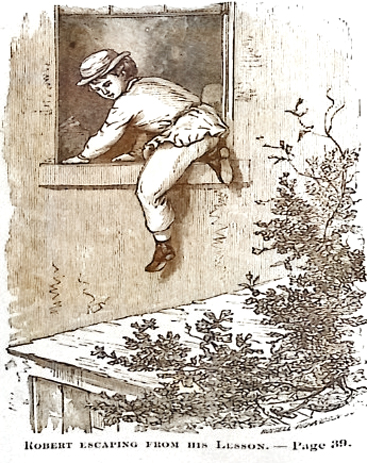
ROBERT ESCAPING FROM HIS LESSON.

THE HAPPY HOME STORIES.
OR,
THE COLONEL'S SERVANT
BY
BY AUNT HATTIE.
[Madeline Leslie.]
"We command you, that if any would not work, neither
should he eat."—Paul.

BOSTON:
HENRY A. YOUNG & CO.
24 CORNHILL.
Entered according to Act of Congress, in the year 1871, by
HENRY A. YOUNG & CO.,
in the Office of the Librarian of Congress, at Washington.
LIST
OF VOLUMES IN
THE HAPPY HOME STORIES.
FOR BOYS.

I. DILIGENT DICK.
II. COUSIN WILLIE.
III. LAZY ROBERT.
IV. LITTLE FRITZ.
V. THE NEW BUGGY.
VI. BERTIE AND HIS SISTERS.
LIST
OF VOLUMES IN
THE HAPPY HOME STORIES.
FOR GIRLS.

I. LITTLE FLYAWAY.
II. THE SPOILED PICTURE.
III. FLEDA'S CHILDHOOD.
IV. THE SINGING GIRL.
V. MOLLY AND THE WINE GLASS
VI. THE TWINS.
CONTENTS.
————
ROBERT AND THE MAJOR
ROBERT AND THE REGIMENT
ROBERT'S LESSON
ROBERT'S DECEIT
ROBERT'S CONFESSION
ROBERT'S SPELLING
ROBERT'S LETTER
ROBERT, THE RUNAWAY
ROBERT'S MOTHER
ROBERT'S DEATH
LAZY ROBERT.

ROBERT AND THE MAJOR.
"ANOTHER failure, Robert," said his aunt sorrowfully, as she made a mark in a small blank book. "What were you doing all the time I set you to study?"
"I did study. I mean, I did some of the time. The butcher came and brought his dog, and he tried to fight Major. And then of course, I had to go out and stop them."
"And Major followed you into the house, and you had a grand frolic in the library, which was the noise I heard. Oh, Robert!"
"I tried to keep him out right hard, 'deed I did, aunt Josephine, but he would come. And then he looked so coaxable and cunning, I couldn't help one little game just to show the old fellow that we were good friends again, 'deed that was all, aunty."
"Have you and Major had a falling out, Robert?"
There was a little twinkle in the lady's eye which encouraged the lad, and he forthwith entered on a minute account of his grievances.
"You know my stuffed squirrel. It had such funny little bright eyes; they looked exactly like as if it was alive, and such a long, bushy tail, with wire in it so that you could bend it any way; and it was stuffed just as full as—as—"
"As Robert Weeks," suggested his aunt playfully.
"Yes, aunty," he added with a bright flush at the comparison. "Well, you see, Major couldn't bear the sight of my squirrel. He'd run at it, barking as loud as he could; and then when the tail went up, you see I fixed it with a string, Major's tail would go down quicker 'n shot, and he'd back out of the scrape real mean. Oh, it was the best fun!"
Robert forgot all about his lessons, bad marks, good resolutions and every thing else, but Major and the squirrel. His head went back, and he laughed, laughed till he ached all over.
"Well," said aunt Josephine, "I don't quite understand what all this has to do with it."
"Oh, I forgot!" exclaimed the boy, trying to recover himself. "Yesterday, I coaxed Major up-stairs. He was awful shy of my room; and I set Bonny up on the bed, and stuck his tail right straight up in the air. Major began to growl, and I laughed at him. Just then you called me to recite, and I ran down, shutting major in the room."
"No wonder you failed entirely your lesson, Robert!"
"I'm sorry, aunty, 'deed I am; but I kept wondering what Major would do. I never thought he'd act so."
Robert's face grew sober so suddenly that his aunt asked:
"What did he do?"
"Why he tore my squirrel all to pieces, so there wasn't hardly a speck of him left, only the wire in his tail. The fur and the bran were scattered all round, and Major was growling awfully. I was so mad, I took a cane and whipped him, till he couldn't stand."
"Oh, Robert, how could you!"
"I know 'twas mean, aunt Josephine. I was right sorry, 'deed I was. I meant to save some of my dinner for the poor fellow to make up, but it did taste so good I couldn't stop till every mouthful was gone. But I coaxed cook for some pieces, and gave him a whole plate full. Oh, Major was so glad to see that I had forgiven him!"
"I should think it was for Major to forgive you, Robert."
"Yes, aunty, I suppose it was, but he didn't see it in that light. And so this morning, when the butcher's dog came, I wanted to show the old fellow I didn't keep any grudge against him. I believe he loves me better than ever. He watches me every minute to see what I am going to do next."
"Major is a noble dog, Robert—too trustworthy and affectionate to receive such cruel treatment. If you cannot control your temper so as to refrain from beating him, I shall have to devise some method of separating you."
"Why, aunt Josephine, I wouldn't whip him again for all the world! And he knows it. I cried over him and asked him to forgive me; and we had a regular making up."
"But, Robert, this habit of idleness grows upon you every day. I'm afraid after all I can't keep my promise to your mother, and I shall have to send you back to her."
"Oh, please don't do that!" urged the lad, growing very red in the face. "I will study, 'deed I will, I'll begin now, right away and I wont look off my book once, only I do hate grammar. Need I study grammar? I'll get geography, and find out all the map questions; and I'll try to master the spelling, though that's awful hard. But I hate grammar and sums."
"You must learn to like them, Robert. You don't know the pleasure of study, because you never apply your mind to any thing. I watched you the other day at your spelling lesson. Shall I tell you how you did?"
"Yes, if you please, aunty," said Robert hanging his head.
"You seated yourself near the window where you could not fail to see every one who passed, and with your head propped by your hand you began:
"'C-o-n-s-t-i-t-u-t-i-o-n, constitution, whew! What a long word! I know I can never learn it. What's the use, I wonder? C-o-n; Oh, there is the milk cart! And the woman gets so cross after she rings her bell, if cook don't go quick. I'll guess I'll run.'
"'I wouldn't go,' Ellen pleads; 'cook will attend to her own business.'
"You take up the book again with a sigh.
"'Spelling is horrid, Ellen; don't you think so? Great long words that have no meaning.'
"Ellen shook her head laughing.
"'Now here's another, c-o-m-b-i-n-a-t-i-o-n, combination. Do you think, Ellen, aunty 'll let me go out in the boat?'
"'I think you're a lazy, good for nothing fellow,' was her laughing reply. 'I should think you'd be ashamed to idle your time when mamma takes so much pains with you.'
"Your countenance shows that for the moment you are of the same opinion, and you take up your book with a sudden resolution. But it is only for a moment, with the first temptation you allow your attention to be diverted. Ellen's ball rolls to the floor, and you jump to catch it and spend two or three minutes in crawling under the sofa to get it out."
"I want to be kind to Ellen; she's so good to me, aunty."
"Of course, but when you are studying, you ought not to see any thing that goes on. I am beginning to be quite discouraged. I told your mother I thought I could interest you in your lessons. She has her heart set on your being a scholar as your father was; and your mind is bright enough. But the fact can't be denied, Robert, you are too lazy to apply yourself. And another-thing, I begin to believe what your uncle says, that you eat too much. He says, you stuff yourself at every meal till you can scarcely breathe. This is wrong, my dear boy, as well as ungentlemanly. The Bible tells us to be temperate in all things. Immoderate eating unfits any one for the active duties of life. It impairs the vigor of your mind, makes you dull and heavy, and in the end will certainly injure your health."
ROBERT AND THE REGIMENT.
"MAMMA," softly called Ellen the next morning, "please come here a moment, and see what Robert is doing."
The lady followed, wondering what would happen next.
Ellen quietly pushed open the door leading into the library. And there sat the boy in a rocking-chair, in the centre of the room, his fingers pressed into his ears, a large shade covered with green silk tied over his eyes, with his book in his lap, rocking himself with all his might.
"What is orthoepy?" he was saying. "Orthoepy is—is—bother it, I thought I knew that Orthoepy is,—is—" He stamped his foot,—"I can't remember it; I think it's wicked for me to study grammar, it makes me so angry; I mean to tell aunt Josephine so."
The lady and her daughter darted from the room without being seen. Presently, she sent a servant to tell Robert she would like to see him.
"I have tried; indeed, aunty. I wouldn't go to sleep last night till I made a resolution to begin right off. I shut Major up in the coal cellar, so he needn't take off my attention, and—I—really I—"
"No matter now, Robert. I want you to do something for me. Part of a regiment of soldiers are going to pass here in a few minutes, and I want you to count them. I have a particular reason for wishing to know how many there are. Do you think you can do it?"
"Oh, yes, aunty; 'deed I can! I know how to count right smart."
Robert's brown eyes kindled, and there was an expression of resolution on his face seldom seen there.
"Stand in the bay window," added the lady, "and be sure you count correctly."
"Yes, aunty. I believe I hear the music now. No, it's poor Major. Shall I have time to let him out?"
"I think so."
Robert flew over the stairs, opened the cellar door, and not waiting to answer Major's joyful bark, was speedily back at his place in the bay window.
In a few moments, a company of boys running on the sidewalk, continually looking behind them, gave intimation that the soldiers were in sight, and presently the sound of martial music was heard.
"Must I count the band too, aunty?" cried Robert, his cheeks crimson with excitement, and not daring to turn his eyes from the window.
"No, none but the officers and soldiers."
Five, ten, fifteen minutes passed, and still the boy stood, his attention so completely absorbed in the business of counting that he noticed nothing that was passing in the room.
"Two, four, six, eight," he went on aloud as they marched by two and two in regular, martial order. It was fortunate for him that they were not marching in double quick time; indeed the regiment was passing from New York to Washington by the Baltimore and Ohio cars, and knew that they had abundant time to walk leisurely from one station to another.
When the last one had passed out of sight, Robert threw up his arras with a triumphant shout.
"Just seven hundred and sixty-eight, officers and all. Oh, don't I wish I was a soldier? Didn't they look splendidly, though?"
"You forget, Robert," said his aunt in a sad tone, "that it is not all of a soldier's duty to march leisurely through the streets in dress uniform to the sound of music, and with admiring spectators thronging the windows. Don't you remember the line of ambulances after the last battle?"
"I shall never forget that sight as long as I live," faltered Ellen. They went so slowly along, and then one after another backed up to the door of the great hospital. The nurses seemed real kind though and took hold of the litters as though they truly pitied them. "Oh, mamma, wasn't it dreadful; so many without arms and legs, and their heads done up in towels. Don't you remember how we sat up all night tearing bandages and scraping lint, and making beef tea and coffee for the nurses?"
"Oh, that's only once in a great while!" suggested Robert. "I heard some gentlemen talking about it, and they said only one in two or three hundred were ever hurt. I mean to be a soldier when I'm a man."
"I thought you meant to be a pig-driver," said Ellen archly.
"Oh, I gave that up with short dresses!" exclaimed Robert laughing heartily. "When I began to wear pants, I changed my mind and said I'd be a constable!"
"A constable has to be very tall and strong," urged Ellen. "Now you grow very fast, but it is all in breadth."
"I've resolved this long time to be a soldier."
"Your mother will never consent."
"Then I shall run away, and join the army. After that, I shall write to her, and tell her what a splendid time I'm having, and how I like it and then she wont care."
"That would be very wrong, Robert," remarked his aunt.
"I don't think there's much danger of his really doing it, mamma, he is too fond of lying in bed and taking his ease, and having a good dinner, to enlist for marching through swamps and sleeping on the ground and eating hard tack and raw pork."
"Pshaw! That's just as much as girls know," angrily retorted Robert. "I've been in camp before I came to Baltimore, and I know all about it."
ROBERT'S LESSON.
"HOW many soldiers did you say there were, Robert?" inquired his aunt.
"Seven hundred and sixty-eight."
"Come and sit by me. I want to say something; and I want your whole attention. Ellen, will you sit in the library a few minutes?"
"Have I been naughty, aunt Josey?" inquired the boy rather frightened at the lady's serious face.
"No, but listen! Do you know why I asked you to count the soldiers in the regiment?"
"I suppose you're going to give them stockings as you did the other one. I saw heaps and heaps piled up in the back room and little balls of yarn to mend them with."
"No, Robert! I was simply trying an experiment on you. When I visited Georgetown last spring, I found your mother worried about you. She told me she had made great sacrifices to keep you at school; but the teachers complained that you would not study, that you were too lazy to make the necessary application. She shed tears as she talked with me; and I tried to comfort her. I knew she had not herself the time to spend on your lessons, because your grandparents need so much attention. And then I made some excuse for you on account of their indulgence."
"Yes, aunty, I never could study there, grandpa used to want me to play dominoes with him; and grandma was always calling me to hold yarn for her to wind. And then they didn't believe in keeping boys too strict. They said it cowed me down to study so much."
"I'm afraid you don't know what the word study means, Robert;—but I was telling you how I came to invite you here. Your father was my dear brother. He was the oldest, and I the youngest child. Five brothers and sisters between us died. We clung to each other more on that account I believe. When he died, he made me promise to interest myself for you, his only child, and I have tried to do so."
Mrs. Woodward sat silent for a few minutes, her thoughts reverting to the painful scene. Her dying brother lying in bed propped by pillows, herself seated by his side, trying to calm her fears in order to listen to his last words.
"I made a mistake, Josephine," he said faintly, "a mistake which has blighted my whole life. Father was right when he told me he did not think my feelings for Annie would last. Ah, it was true, a fancy, a boy's fancy for a pretty face and lively manners, that was all. She has nothing to inspire a lasting affection, but I have tried never to let her know this. She has been satisfied with what I could give her; but my boy. Oh, Josephine! I cannot leave my boy under such influences as he will have at his grandfather's. By our love to each other, I ask you to do what you can for him."
Then she recalled her answer given freely, heartily.
"I will, brother, I will."
She was recalled from the past by a growl from Major who was standing by Robert submitting with as much patience as he could to having his ears pulled. Quietly the lady rose, and put the dog from the room.
"You must attend now," she said firmly, though there were tears in her eyes. "I told your mother I would bring you home with me for one year; and I would do my best to cultivate a love for study. I did not encourage her to suppose that you would ever become a professional man as your father was, but that you would try to apply yourself so as to make a man of business, I had no doubt.
"Now, Robert, almost four months have passed. I have devoted to your lessons nearly twice the time I give Ellen, but I can not see that you have improved in the least. You know why I do not send you to school, because the boys of your age are so much in advance of you, that you were ready to cry for shame, and because you promised faithfully to do your best.
"Yesterday, I was so discouraged, I was on the point of sending you back to your mother. Only my promise to your father to do what I could for you, held me back. I began to be really afraid you were wanting in some faculty of mind so that you could not apply yourself. I resolved to try an experiment. That is the reason I asked you to count the soldiers. It really required quite an effort to number them correctly. I stood behind you and did it, but you had no difficulty. Why, Robert? Just because you were interested. I am relieved on one point. You can study and apply your mind if you please; and you are acting very wickedly to waste your time and energies as you have done since you have been here with me. God has given you health, a fine constitution and a good mind. He requires you to use them. You remember the unfaithful steward who hid his talent in the earth; and how God punished him.
"Soon your opportunities for study will be passed, and the time for entering upon the duties of a man will come. How will you meet these responsibilities? You can neither be a merchant, nor a farmer, without some degree of book learning. Now you can neither write nor spell correctly, to your mother. How could you make out a bill, or keep accounts? If you went into society, you would not be respected, because you cannot talk good English; and you will not apply yourself properly to the study of English grammar."
"I don't understand it. I have tried, 'deed I have," faltered Robert in a grieved tone.
"No, I don't think you really have tried. Your mind floats about like a cork on the water, and the longer you allow it to do so, the more difficult it will be to apply yourself."
"What shall I do, aunt Josephine? I like to stay here a great deal better than I do at home."
"Why do you?"
"Oh, for a good many reasons! I had to cut up the kindling every morning; and then we didn't have very good things to eat. Besides I had to wear old patched clothes."
ROBERT'S DECEIT.
"WHERE is Robert?" inquired his uncle a few days later, coming in from the street in an excited manner.
"Up in his room, studying his lesson. He has idled away all the morning, and I forbade him to leave his room till he could repeat every word of it."
Mrs. Woodward sighed as she said this; and her husband glancing anxiously at her, noticed that she looked pale and careworn.
"I will go up, and talk to the boy," he said angrily. "There must and shall be an end to this."
Robert's door was locked from the inside.
"Unlock this, and be quick about it," said his uncle.
There was no answer.
Again he called, "Robert, are you there? Unlock your door, I say."
Still, no movement from inside.
Putting his eye to the key-hole, Mr. Woodward saw at once that the key had been taken out. After trying half a dozen keys from other doors in the same hall, he found one which would turn the bolt, and by this time, Ellen was with him.
They entered together. But Robert was not there. The room was empty, and the window wide open. It was a back room and opened directly upon a shed.
By jumping six or eight feet, Robert could reach the shed; and from this, let himself to the ground by a tree whose branches rested on the roof.
"Call your mother," was all that Woodward said, after standing at the window a short time.
She entered with a look of surprise and asked instantly:
"Where is he?"
"He has jumped from the window to the shed, and escaped to the street by the back yard. Following and pelting an old drunken soldier, I saw a boy greatly resembling him, but I doubted the evidence of my own eyes. I hurried home hoping, but scarcely daring to expect that I was mistaken."
"Oh, mamma! Look at his slate," exclaimed Ellen, "and see, he has been eating in bed."
In one corner of the slate were a few figures, and directly underneath, Mrs. Woodward had worked out an example to show him the principle. The rest of the slate on both sides was filled up with the most grotesque figures. Men with enormous noses, women with crooked noses, men with pipes in their mouths, men with huge heads and spindle legs, fat men and lean men, etc., etc.
Ellen laughed heartily as she showed the figures to her mother. But the lady was too much worried even to smile.
"What shall we do?" she asked in a despairing tone.
Mr. Woodward looked at his watch, then took a raisin stem between his fingers, and shook his head.
"He gets lots of raisins, mamma," suggested Ellen. "I see him chewing them in church, and he sometimes gives me some."
"Where does he get them?" inquired her father glancing at his wife.
"I do not know. Perhaps he spends his pocket money that way."
"He eats enough in all conscience at the table," said the gentleman pointing at the same time to crumbs of rich cake.
"What is it best to do?" Mrs. Woodward asked again.
"Leave every thing here exactly as we found it, lock the door and go down to dinner. If this is thoughtlessness or fun, we shall know it by his actions. If it is an attempt to deceive, he will deny that he has been out. But I tell you, Josephine, as I have told you before, that idleness, if not cured now, will be the ruin of that boy."
Mr. Woodward returned the key to the door from which he had taken it, went down-stairs and seated himself, with his newspaper in his accustomed place by the window.
Mrs. Woodward went sadly to her store closet, found the door to the inner cupboard unlocked and crumbs of cake scattered about.
On opening the box of raisins, she started with surprise. It was empty.
"Oh Robert! Oh my brother!" she cried with a burst of tears.
Locking both the inner and outer door, and putting the keys in her pocket, she returned to her own chamber, where on her knees before God she implored wisdom to guide aright the child left in her charge.
Half an hour later, the dinner bell rang and to the astonishment of all but Mr. Woodward, down came Robert, rushing over the stairs in his usual noisy manner.
The gentleman sitting near the window had seen the boy skulk slyly close to the house into the back gate, from whence he could easily gain his room without being seen if the halls happened to be empty.
"I smell something good," exclaimed the boy snuffing the air. "I do like good dinners."
"Have you learned your lessons?" gravely inquired his aunt, fixing her sorrowful eyes on his face.
"I've got most all, but the sums are awful hard. I can't make them out."
Ellen thought of the funny men's noses on the slate and began to laugh, but was checked by a glance of reproof from her father.
"Have you really tried to make them out, Robert?" asked his uncle, holding his carvers suspended while he waited for an answer.
"Yes, uncle, 'deed I have," answered the boy coloring furiously.
"Did you not take your mind from your book, or leave your room during study-hours?"
The boy glanced quickly from the questioner to his aunt, but seeing nothing to excite his suspicion answered in a cheerful voice:
"Oh no, indeed, uncle! Aunt Josephine told me not to leave the room, and I didn't. I studied real hard, 'deed I did."
Ellen quickly covered her mouth with her hand to repress a scream.
But Robert was so intent in watching the juicy slice of beef that his uncle was placing on his plate that he did not notice her.
His aunt grew deadly pale, and was obliged to press her hands on her heart.
"You don't look very hungry," said his uncle hesitating about the second slice which he held between the knife and fork. "I suspect you've had lunch since breakfast."
"Oh, no; uncle! I never eat between meals; that is," as he caught a glance of astonishment from his cousin, "not very often. I haven't eaten any thing to-day, 'deed I haven't. I'm right hungry."
"Robert," said the gentleman, dropping his carvers, and looking sternly at the smiling face before him, "you may leave your seat, and go to the library. I cannot sit at the table with a boy so deceitful as you are."
"What have I done?" Robert asked, rising with great reluctance from his seat. "I meant to be real good so as to please aunt Josephine. Can't I take my dinner in there?"
"Go," ordered his uncle and without another word. "Don't you see, you wicked boy, that you are killing your aunt?"
The lady looked indeed as though she was on the point of fainting. But as Robert walked slowly from the room, she with difficulty raised a glass of water to her lips, which revived her.
ROBERT'S CONFESSION.
WITHOUT another word on the painful subject, Mr. Woodward began to talk about some news he had read in his paper. By selecting the choicest tit-bits, he coaxed his wife's failing appetite, to eat enough to sustain her strength through the anxieties of the afternoon.
"Let me manage him," she pleaded as they arose from the table. "I shall not feel that I have discharged my duty to the poor child unless I talk with him."
"But, Josephine, he imposes on you. He is a shameless liar."
"I had rather try to make him confess," she still urged. "I know where to go for wisdom."
"Have it your own way, Josephine," said her husband with some irritation in his voice and manner, "and see where you and he will come out."
He put on his hat to go, then came back, and added tenderly. "It is for your own sake I said that. I know you are better fitted to move the boy than any one; that is, if he has any conscience left, which I doubt. But Josephine, don't give the boy a particle of encouragement that he can stay here. I wont have you so worried for a dozen like him."
She put her hand in his to show that she understood and appreciated his tenderness. Then turning, she walked slowly and deliberately toward the library.
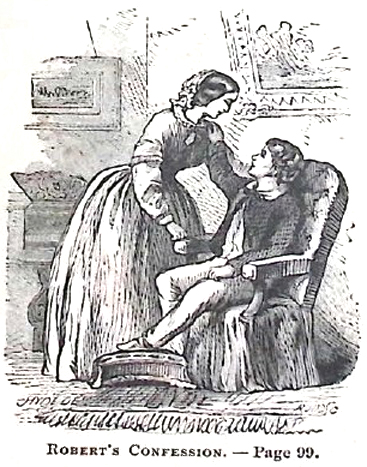
Robert had thrown himself into the most comfortable chair, and was sobbing aloud, but stopped short when his aunt entered. It was an immense relief that his uncle had not come.
"I'm awful hungry," he said springing to his feet. "Can't I have some dinner?"
"Sit down, Robert, I have something to say to you. I want you to remember that God, who hates liars, is here. He can look into your heart; and he hears every word you speak. Now tell me truly, have you nothing to confess in regard to your conduct this morning?"
"I don't know what you mean, aunty. I thought you'd say I was right smart to get my lessons."
"We will talk about the lessons by and by. There is some thing of far more importance to settle first. Have you nothing to confess?"
After a long, searching glance in her face, Robert answered.
"No, I don't know what you mean."
"Oh Robert, Robert!" she burst out in a passion of grief. "Are you so hardened as this? I hoped and prayed that you would confess your sin. I know that you spent your time not in study, but in drawing caricatures on your slate. I know that you jumped from your window upon the shed, and then to the ground. I know that you have been to-day and at other times to my closet and stolen cake and raisins."
Robert was startled now. He screamed, and then hid his face.
"What have you to say for yourself?" she asked, still sobbing.
He grew almost as pale as she had been, but for some time did not attempt to reply. The tears began to stream down his face, and he presently said in a faint voice and hesitating manner:
"I'm right sorry, aunty, 'deed I am. I got awful tired studying; and then I heard the music way off, and I opened the window, and I saw how easy I could get out, and I forgot what you told me. And I went, but only for a minute."
"Don't make it worse by more lies," said his aunt with more severity than he had ever heard in her voice before. "Your uncle saw you down in town pelting a poor drunken soldier. What do you suppose your mother will say when you are sent home to her in disgrace?"
His voice changed now to real distress.
"Oh, aunt Josephine?" he shrieked, "you wont send me home just for this once. I'll study all day. I never will be naughty again. Do, do try me once more. I can't go home. I can't! I can't!"
"Hush, Robert, I can say nothing while you cry so. Hush at once and tell me why you don't wish to go home. Tell me every thing. If I find you have lied about it, or have not told all the truth, I shall send you away at once."
"Must I?" faltered Robert as if speaking to himself.
Then he wiped his eyes and glanced in his aunt's face. There was an expression on it which told him she meant what she said, so he resolved to confess:
"I was real naughty, before I came here, aunty. I learned it of the soldiers, 'deed I did. I played cards with them, and I made some money too, and—and once I went to a store, and there was nobody in it. The man was down cellar and—and I—I took a few nuts, and a handful of figs."
"Robert, Oh Robert!" groaned the lady, putting her handkerchief to her face.
"The man was awful mean. He came up softly when I didn't see him. I was just going to look in his money drawer. I didn't mean to take any, 'deed I didn't, he put his great hand right on mine, and held me fast. Then he shook me 'till I couldn't see. He hurt my stomach awfully. He didn't let me go till he'd felt in my pockets, and taken every thing out. He said he'd lock me up in jail, but he didn't. He got a constable and sent him home with me."
"Why was not this told me before?" asked the lady indignantly.
"Mother forbid me to say any thing about it. She said she'd whip me worse than she ever did if I told. Grandpa paid the man five dollars for his trouble, and he promised to keep still. Mother kept scolding and scolding, till I got real sick of hearing about it. Then you came and brought me back with you."
"Do you know, Robert, what has led you into all this sin?"
"No, aunty."
"It is idleness. If you had gone regularly to school, and entered into your studies with diligence as you ought, I should never have heard this disgraceful story. Do you know how many times idleness and sloth are condemned in the Bible?"
"I didn't know the Bible said any thing about it."
She opened the sacred book and read,—
"'Work with your own hands . . . that ye may walk honestly toward
them that are without, and that ye may have lack of nothing . . . We
commanded you, that if any would not work, neither should he eat.'"
"And here is another verse.
"'If any man obey not in word' (that is to work and earn his own bread)
'note that man, and have no company with him, that he may be ashamed.'"
"I know a hymn about being idle," said Robert softly. "Grandma made me learn it:
"'For Satan finds some mischief still,
For idle hands to do.'"
"You see he has found a great deal of mischief for you," remarked the lady sorrowfully.
ROBERT'S SPELLING.
IN the afternoon, a lady named Bowles, a cousin of Mrs. Woodward's, came with her little daughter to pass a few weeks. As she was also a cousin of Robert's father, she expressed much interest in him. It needed, however, a great deal of persuasion on the part of Mrs. Woodward to induce her husband to consent to one more trial of the boy, previously to his being sent home to his mother.
"For my sake, Frederick," was the plea that at last prevailed, and then it was only on conditions. Robert's lessons were to be recited to him, and his aunt was to have nothing to do with urging him to study; and that he was to be restricted in his diet, taking the food which his uncle sent him from the table in his own chamber, and nothing more.
Mr. Woodward had a long talk with his nephew before he went to bed, and explained to him exactly where his idleness and disregard of God's commands would lead him, to the gallows and eternal separation from God in heaven. He then said:
"Robert, for your aunt's sake, I have consented to give you one more trial. If you resolve with God's help to overcome your besetting sins, you may yet become a useful man, a blessing to your mother and all connected with you. Beginning to-morrow, you will recite your lessons to me; and I forbid you to ask any help from your aunt.
"You will also eat in your room, the food which I shall send you from the table. And I may as well tell you now that until you better deserve the indulgence, you will have none of the luxuries of which you are so fond."
While his uncle was speaking, Robert cried softly, saying occasionally:
"I mean to be good, uncle, 'deed I do;" or "I'm right sorry, uncle; I never will be naughty again."
But when the gentleman spoke of denying him the nice puddings, pies, sweet meats and cake, he burst into loud, passionate remonstrance:
"'Please,' please, uncle, don't. I will be good, 'deed I will. Only try me, try me one day."
"Pshaw," exclaimed the gentleman turning away in disgust.
"What a dear, obliging little fellow Robert is," remarked Mrs. Bowles the next day. "He must be a real treasure to his mother."
"Have you seen her lately?" asked Mrs. Woodward quickly.
"Doesn't Robert eat dinner with you, cousin Ellen?" inquired Marion Bowles after they were seated at the table.
"Robert is unfortunately under dieting orders at present," remarked his uncle giving a plate of meat and vegetables to the table girl to carry to the boy.
After dinner, uncle and nephew met in the library for the lessons.
"Very well," remarked the gentleman when every question with the exception of two had been correctly answered. "You have convinced me that it is not for want of ability you have failed so often. Get the next lesson to-morrow, and do twenty examples in arithmetic. The remainder of the afternoon, you may have for play or whatever you choose. This evening, I wish you to take your slate and write upon it a confession of what occurred yesterday. Consult the dictionary, and see that every word is spelled correctly. Have it ready for me to-morrow morning."
ROBERT FISHING.
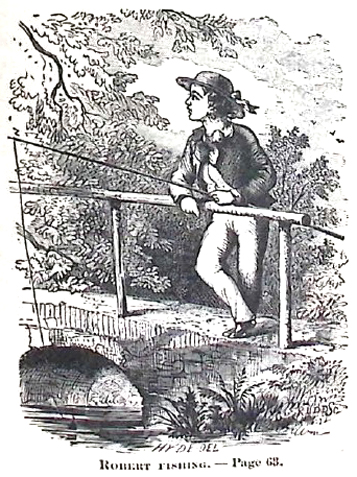
After a game of parlor croquet with his cousins, Robert went out into the street, and did not return till tea was on the table. When questioned by his aunt as to how he had employed himself, he answered promptly:
"I and another boy went fishing. And then we started off to Camp Scott to see a regiment start off to the war. Uncle said I might do what I pleased."
"That is true," remarked the gentleman, "but I prefer you should not go there again. There are too many rough fellows among them, and too much profanity to make it a profitable place for you."
"Mother lets me go at home," urged the boy. "I'm going to be a soldier when I'm grown up."
They all smiled at the manner in which he swelled himself out as though the epaulets were already on his shoulders.
After tea, he asked his aunt for a sheet of paper saying:
"I'm going to write a letter to mother!"
He had not written one since he left home, and his aunt was quite pleased that he did it of his own accord.
The next morning the slate containing his confession was presented for his uncle's inspection. The writing filled one side and the gentleman counted thirty different words spelled wrong. He dashed them, told Robert to make a correct copy, and give it to him at noon. When corrected, it read thus:
"Yesterday, I 'gut' into an awful scrape. I 'gut' into aunty's closet
without 'hur' seeing me and hooked 'rasins' and 'cooky's' and apples.
"She shut me up in my 'rume' to 'lern' my lessons; and I 'gut' awful
tired, and lay down on the bed, and 'et' the things. Then I opened the
window, and 'thort I'de' have some fun. I Jumped out and ran off, and
found a drunken man, and 'thru' dirt in his face.
"When I 'cam' home to dinner I told awful lies about it. The hardest
part of all I 'thort' was to go without my dinner. I 'wunder' who 'et'
up what was on my plate.
"ROBERT WEEKS."
"Sixteen mistakes still," said Mr. Woodward severely. "I am very glad, however, that you have not said in your confession that you were penitent in view of your sin."
"Why, uncle? Why are you so glad?"
"Because it would be another lie added to the many you have already told, and for which you must one day give an account to God. Now I will hear your lessons. Before you go to play, you must look out in the dictionary again the words I have marked. I shall be greatly displeased if I find one word wrong next time."
The lesson in grammar proved to be only half learned. The book was given back to him, with the words:
"If you wont work, you mustn't eat. Not a mouthful till that lesson is committed."
Robert had a very special reason for wishing to go out this afternoon. He had engaged to meet a boy on business of great importance. Under these circumstances, he took the book, and studied as he had never done before. Then he ran to the dictionary, looked out the marked words, altered them, and carried book and slate to his uncle with a smiling face.
"Let me see, have I time before dinner," asked the gentleman, laying aside his newspaper with some reluctance.
"Well, if you are sure, I'll try."
"A perfect lesson this time. Now you are at liberty till evening, when I wish you to copy the confession as neatly as possible."
"That boy is capable enough," remarked Mr. Woodward to his wife, when Robert had gone to his room to wait for his dinner. "I wish I could feel more confidence in him."
"Let us hope and pray he may become worthy of confidence," was her gentle reply.
ROBERT'S LETTER.
ROBERT came in at dusk with flushed cheeks, and sat down with a book of engravings, trying to avoid meeting his aunt's eye.
Presently, he called Marion to the corner of the room, and began to whisper to her. They grew quite merry over the conversation, and his aunt, in passing, heard him say: "I wouldn't tell any body but you."
When the mail came in the next morning, there was a letter to Mrs. Woodward from her sister-in-law. In it, she made a request that Robert be allowed to go and spend the day with a relative of her own in another part of the city of Baltimore.
"When would you like to go," inquired his aunt, wondering at his rely evident excitement, "to-morrow?"
"No, not to-morrow, next day, aunty. Can't I wear my best clothes?"
"Certainly."
There was no fault found with the lessons next day, neither with the copy of the confession, which Mr. Woodward filed and put away in his desk. Robert was again given his liberty for the afternoon, though his aunt requested him to do an errand for her if he was going into Baltimore street.
He was out only an hour. When he came back, he went directly to his room, stayed for some time, then ran down the back way with a bundle under his arm. No one saw him but the cook, who thought nothing of it at the time. When his aunt came from her chamber, he was in the library with his cousins, laughing and chatting merrily.
"Are you well, Robert?" she inquired a little later. "Come here and let me feel your pulse. You look feverish."
"I'm as well as can be, aunty, 'deed I am," he answered laughing, and shaking back the long locks which fell over his forehead.
"You talk just like our black Maria," said Marion laughing. "She's always saying: ''deed, Miss, it is;' or ''deed, ma'am, I am.'"
"I suppose I learned it from the black people," Robert answered, "and I used to say, 'Where are you going at?' Grandpa laughed me out of that."
As he had no writing this evening, he spent the time in games with his cousins, though once he was called to the back door to see a boy, and was absent half an hour.
"They're plotting some mischief," said the cook to Rose the colored table girl. "That is a rough boy. If he comes again, I'll tell missus."
The next morning, almost as soon as it was light, Robert arose and dressed himself in a new suit his aunt had given him. It was some time before breakfast, and he grew impatient. Suddenly he ran out of the back door, telling Rose he should be back in a few minutes.
Mrs. Woodward was dressing herself in her chamber, when happening to look from the window, she saw two boys with their heads together talking with great earnestness. She did not at first recognize her nephew; but presently, she called her husband to ask if it was he.
Robert turned toward the house, saying, "I'll be on hand," while the other boy walked slowly on.
"I don't like the looks of Robert's companion," said Mr. Woodward.
"Good bye, aunt Josephine; good bye, uncle; good bye, Nelly, and all," exclaimed Robert making a parting bow at the door, "good bye, till I see you again."
"How funny for him to say so, when he's coming back to-night," exclaimed Ellen laughing.
Mrs. Woodward ran to the door and called after him. "Have you money for the horse cars, Robert?"
"I have—a—little," he answered blushing up to the roots of his hair.
She opened her portemonnaie, gave him the required sum, then saying, "Be a good boy, and don't be late home," shut the door.
Toward evening it began to rain, and no one thought it strange that he did not make his appearance. The next morning, though it was not raining, the sun did not shine. Mrs. Woodward was somewhat surprised, therefore, when at an early hour the bell rang, and Mrs. Weeks entered, having taken the eight o'clock train from Washington.
After receiving a cordial welcome, she sat down to a hearty breakfast which her sister-in-law had ordered to be prepared.
Mrs. Woodward had told her visitor where Robert was, but beyond this, nothing concerning him. Now she retired to her room to reflect upon the proper course to pursue. After half an hour, she left it still undecided.
"I should think Robert would be here soon," said Mrs. Weeks trying to restrain her impatience. "How is he getting on with his lessons?"
"Mr. Woodward has him in charge now. I heard him say yesterday that your boy was not wanting in ability to learn as he has abundantly proved."
"I wouldn't have believed, Josephine," exclaimed her sister-in-law in a sudden burst of emotion; "I wouldn't have believed that you could have had the heart to treat a fatherless boy so—so harshly."
"I am entirely at a loss to understand you, Annie. If Robert had been our own son, we could not have treated him with more kindness, both his uncle and myself."
The lady grew very pale, but tried to speak with calmness, well knowing Annie's violent temper.
"I'll read you what he says about it," retorted the mother, producing from her pocket a soiled sheet, and reading aloud.
"DEAR MOTHER:—I sha'n't stay here much longer. They treat me awfully.
Aunt Josephine scolds and makes me study all day long. Uncle is the
worst though, he makes me eat in my room; and I don't have half enough;
and I wont bear it much longer. I know of a place where I can get lots
to eat, and have a splendid time. I want you to send a letter here
right off and tell aunty you want me to go to Mr. Bullock's, and spend
the day. Don't forget, 'cause she wont let me stir out of the house
without leave. Good bye. You needn't expect to hear from me again very
soon.
"ROBERT WEEKS."
"Now what do you make of that, Josephine?"
I cannot deny that for a minute or two Mrs. Woodward was very angry, both with Robert and his mother. Conscience told her that she had borne with him as if he had been her own,—that she had entreated the throne of mercy in his behalf,—and she knew that her husband had joined with her in every effort for the child's good. But she was a true disciple of His who has told us to return good for evil, and she presently was able to conquer the enmity which rose in her breast. So when the question was asked, "what do you make of that?" she answered calmly.
"Robert will be here soon, we will see what he has to say."
ROBERT, THE RUNAWAY.
BUT hour after hour passed, and he did not come. The mother became very restless, continually repeating the words, "I must go home. I left every thing at sixes and sevens. Why don't the child come?"
"Why don't you go to Mr. Bullock's, and see him?" suggested her sister.
"No, I should only miss him; and they haven't treated me well. He wrote me that I must be more strict with Robert, or I should rue it when it was too late. I wonder what made the boy want to go there?"
At noon, Mrs. Woodward sent a messenger to Mr. Bullock's to say that Mrs. Weeks was in Baltimore for a few hours, and wished to see her son immediately. Before the man returned, Mr. Woodward came home to dinner.
"Will you read Robert's letter again, Anna?" her sister asked.
"I'd rather not. I'm sorry I came, there's such a fuss."
"I insist that my husband has a right to hear it."
"Take it then," and Mrs. Weeks threw it across the room.
Mr. Woodward was a man of quick, even violent temper, but fortunately he had learned to govern it. Little trials often disturbed him; but for serious troubles, he was ready.
"What's this dirty scrawl?" he asked, picking up the sheet hastily.
"Read it," said his wife.
"I can't, it isn't readable."
"I've heard it, and perhaps I can make it out."
She commenced to pick out the words, which the bad spelling rendered almost impossible, while her sister—in-law walked to the window and stood looking into the street in an indifferent manner.
"There's another side to this story," remarked the gentleman, when it was finished. "Wait a minute and I'll read you a letter."
He brought forward the confession and read it aloud.
"Oh! Oh dear! What trouble that boy has given me!" exclaimed Annie, beginning to cry.
"I don't like the tone of his letter to you, Annie," said the gentleman. "What is the place he refers to, with lots to eat? The boy is a glutton; that's my idea of him. If he didn't have enough here, it was his own fault, until the last two or three days."
At this minute, the messenger returned with the startling announcement that none of Mr. Bullock's family had seen Robert Weeks for a year.
"It's my opinion he has run away," remarked Mr. Woodward.
"Oh, where, where has he gone? My poor, dear boy!"
Mrs. Weeks gave a wild shriek, and covering her face with her hands, sank into a chair.
"Mamma," cried Ellen, who had followed the messenger to the room, "Marion knows something about it."
"Yes, I do! I know, or I guess, where he is," said Marion, "though I didn't think he was going so soon. He has gone to be a soldier."
"Pshaw!" exclaimed Mr. Woodward. "No captain would take him, except for a servant; and Robert isn't fond enough of work for that. Though he is twelve years old, he is very short for his age."
"He told me he was going," Marion insisted, her eyes sparkling, "but he said I mustn't tell."
"What else did he say? Tell me every word," screamed the half frantic mother.
"He said he'd got a place, and he was going to have a splendid uniform, with gold epaulettes and a gold sword and—and he said he should dress up some day and come back here and—and marry me."
"Indeed!" exclaimed his uncle, trying to keep sober. "And did you consent to share his honors?"
"No," said the child, hanging her head. "I told him I wasn't big enough for a good many years."
"Oh, Robert, Robert!" groaned his mother. "It would have been better if I'd let the man put you in prison."
"There's no time to be wasted on foolish regrets," remarked the gentleman. "We must have a policeman here and put him on the search, and when we've found him, Annie, you must do just what you please with him. We consider his visit to Baltimore ended."
"I'm sorry I came! I'm always in trouble. I don't see why I should have so much and other people none."
"Annie, stop a minute. It's the busiest time of the year with me; but I'm going to leave every thing, and search for your boy, on one condition,—if you will go to your chamber and stay there. Mrs. Bowles and the children can be with you if they please. But you must promise not to see or speak to Josephine. She's had worry enough with Robert for the last four months. Is it a bargain?"
"It's very hard. I, his own mother, have got to bear it; and I don't see, why I—"
"Then you refuse. Very well, I'll go back to my store."
"No, no! I will do any thing. I'll stay in the street, if you wish to turn me out of the house."
"Will you accept my terms? Then give me that letter."
"I wont, I wont. This is to his mother. It has nothing to do with it."
He still held out his hand, and she at last gave the letter up.
"Now, Ellen, for the photograph he gave you."
"He took it back, papa, and gave it to Marion."
"Oh to be sure!" Notwithstanding the trouble they were in, the gentleman's eyes twinkled as the little child took a picture from an envelope in her pocket, and handed it to him.
"The policeman has come!" shouted Ellen in great excitement.
He was shown into the dining hall, where the whole family, with the exception of the mistress, soon gathered.
"Oh, I know that little chap very well!" said the officer, when he saw the photograph. "I've seen him round here within a day or two, with one of the worst boys in the city."
"'Deed, Mister Woodward, dat's a fac," exclaimed cook shaking her woolly head. "They was having dere heads togeder, and says I to myself, Satan is a catching dem fellows, sure."
Then she told of Robert stealing out the back door with his bundle.
"Where's the boy? He'll know where Robert is," suggested Mr. Woodward.
"I saw him within half an hour. I'll find him, and bring him here."
"Did any regiment leave Baltimore yesterday?"
"I didn't hear of any."
"Then he is in hiding somewhere; and the boy will tell us."
ROBERT'S MOTHER.
IT was scarcely fifteen minutes before the officer returned dragging a short, stout, ill-dressed lad by the arm, when the following examination took place.
"Are you acquainted with Robert Weeks?"
"Yes, I know him."
"When did you see him last?"
"Nobody can make me tell if I'm not a mind to. I haven't got nothing to do with it."
Mr. Woodward opened his pocket-book, and took out five dollars.
"I'll give you that," he said, "if you'll tell us all we want to know."
"Well," said the boy, his eyes cunningly watching the money. "I haven't no objection, only I'm not a going to be driv. I seed him yesterday morning afore breakfast."
"What did he say?"
"He came to my house to get some money. You see he'd got me to sell his clothes for him, 'cause he wouldn't want 'em where he was going."
"How much did you get for 'em?"
"Two dollars, and my commission out, made him one sixty-two."
"Where did he say he was going?"
"I say, are you honest? I mean will you truly give me that V, if I tell you all I know? Some gents try to trap fellows, and not pay up after all."
"Yes, I'm honest in saying, you shall have it, be your information worth little or much, only tell all you know." The scene was rather amusing to the gentleman, who had a keen sense of the ridiculous.
"Well, then," answered the boy. "He's gone to the war. He got a big chance under the Captain. One hundred dollars a month and living at the officers' table where they're fed up like fighting cocks. He'd got the promise of a uniform too, with shoulder straps on. That's his story; but he's such a liar, I wouldn't give that," snapping his finger with a contemptuous miff, "for all he says."
"Did he tell you the name of the Captain who had made him such big offers?"
"No, he didn't, but I reckon Captain Pierce of the New York Seventh don't know nothing about it, 'cause I went there, and asked one of the soldiers that I'm acquainted with.
"He laughed like to kill himself when I told him about it. There hadn't been no such chap round there."
"So you really don't know any thing more about him, except his story that you don't believe? Did he give you any reason for going to the war?"
"He said he had to study too hard. It didn't agree with his constitution, and then he hadn't enough to eat; but I knew better. He allus had his pockets stuffed full of raisins and cake, and he'd keep munching, munching hisself, without offering a feller so much as a crumb."
"There is your money, and if you can find out where Robert is, so that his mother," motioning to where she stood, "can see him, I'll give you as much more."
"Is that his mother?" cried the boy staring at her. "Whew! Aren't I sold!"
He started off at once clasping the money tight and calling out,—
"I'll find him, never fear. Whew! Ar'n't I rich?"
By this time, Mrs. Weeks was almost beyond control. She shrieked and wrung her hands, and cried out:
"Oh my poor, dear fatherless boy! I never shall see you again. Oh, why didn't I keep you at home! I'm the most miserable creature that ever lived!"
Mrs. Bowles at length persuaded her to go to her chamber, and finding her shaking from head to foot with nervous excitement, persuaded her to go to bed, and take an anodyne to prevent serious illness, promising to bring her the first news of the runaway.
But the evening and night passed without any news. Search had been made throughout the city, but the boy could not be found.
Just as the family assembled for breakfast, Mrs. Weeks came rushing in from the street:
"He isn't in the city. I've been to the hospitals and the Soldiers' Home, and the Soldiers' Refuge, and I've searched the rooms myself. I went early before they were up, and I know he isn't there. I'm afraid he's killed himself."
"Not the slightest danger of that, Annie," said Mr. Woodward. "You have done your part, and need breakfast."
"Where's Josephine?"
"In bed with a severe attack of nervous headache. She must on no account be disturbed."
"I sha'n't be in her way, if you mean me. I'm going home in the first train. I shall go to Lincoln myself, and ask him to send to all the camps in the country, and find out where my poor, dear boy is." She burst into tears, and sobbed till she shook all over.
"You had better leave the business with me, Annie. I'll do all I can. It will involve considerable expense. As the boy ran away from my house, I mean to find him if I can. Go home if you must, and keep quiet."
"Robert isn't your boy, or you wouldn't talk so cruelly. How can I keep quiet when he may be dying of starvation?"
"A most painful situation for him," remarked the gentleman, biting his lips to keep from smiling; "but I don't apprehend that he is in danger."
Mrs. Weeks left without one word of regret for the trouble she and her son had caused, or a word of thanks for the offered kindness.
Soon after, a hack drove to the door, and Mrs. Bowles, accompanied by a gentleman friend, set out on an exploring tour to the various camps surrounding the city. Mr. Woodward's business required his presence for a few hours, after which he intended to run down to Washington, if nothing had previously been ascertained.
Arriving first at Camp Lincoln, a call was made for the officer of the day. When he appeared, Mrs. Bowles, a tall lady of very dignified appearance, walked with him through the entire camp to the Colonel's tent. Here she related her story, and inquired whether such a boy had been seen there.
The officer treated her with great respect,—gave her a seat and sent round the camp to inquire whether a boy of twelve years old was hidden in the tents.
"Occasionally, our men decoy a child to join them," remarked the Colonel, "especially if he is smart and witty. It relieves the tedium of camp-life to talk with such a child; but I must acknowledge it's a poor school for the youth. I had rather a son of mine were in his coffin."
ROBERT'S CONFESSION.
ROBERT'S DEATH.
ALL inquiries both at Camp Lincoln, and all other camps proving ineffectual, Mrs. Bowles and her companion returned to Saratoga street without learning any thing that bore on the loss of the boy, except that a small detachment of soldiers had on the fourteenth, the very day Robert left, been sent forward to Camp Chase in Ohio.
On the strength of this, Mr. Woodward went at once to Washington and requested the proper officer to send in the name of his mother a requisition for the missing boy.
A fortnight of painful suspense followed. All that could be done had been done, but in vain. At last, the penny post brought a dingy looking letter, written on a leaf torn from a book. It was from Robert, and this time the ill spelled, ill written scrawl was received with joy. It was addressed to Marion, and begun with the familiar doggerel:
"The roses are red. The violets are blue,
The lilies are sweet—And so are you."
Then he went on.
"I like being a solgher. I have a tiptop time. The Kunnel is furst,
and I am next to him. I ware an elegant uniform all covered with gold.
I luv you the same as ever."
After this, the tone of the letter changed entirely. Robert added:
"I'm homesic, I wish I hadn't run awa. Good bye. I think I shall die
and never see you agen. Robert Weeks. Tell aunt Josephine I'm sorry."
The letter was dated Camp Chase, Ohio. An hour after it was received, Mr. Woodward was on his way to the cars intending to go instantly to Ohio for the boy, when on reaching the depot, he heard news which caused his return home.
Robert had come, and was at that moment at his uncle's house.
Poor Robert! How changed he was. Unwashed, uncombed, his pretty suit soiled and worn threadbare, his person so filthy that it was almost impossible to breathe in the room with him, thin and worn and aged, as years would not have aged him, his breath coming with a gasp, this was poor Robert, next "to the Kunnel in rank."
Marion rushed in to welcome him, gazed a minute at his bent form and burst out crying.
"Don't," Robert said gasping. "Are you sorry for me? I'm going to die. I'm glad you care for me."
"Oh, I'm as sorry as I can be! But how you do look! And how your clothes smell. I can't bear it." And off she ran, holding her handkerchief to her nose.
"Good bye, Marion, I never shall see you again." Great tears fell down poor Robert's cheeks as he looked after her, his first love.
Mrs. Woodward rose from her sick bed to speak to the boy. She wept when she saw his pitiable condition, and only the recollection of her promise to his mother that if found, he should return to Georgetown at once, prevented her from putting him into a warm bath. She gave him food and medicine, brushed his hair, though almost fainting in the foul air, buttoned on a clean collar, brought his old overcoat and insisted he should wear it. By the time he was ready, the carriage came to take him to the cars.
"I'm sorry, aunty, 'deed I am," was all he said at parting; but there were tears in his eyes to prove his sincerity. Poor Robert!
Mr. Woodward found a seat which the boy could have by himself and he slept most of the way. When they reached Washington, the gentleman hired a carriage to take him to Georgetown, as he wished to return to Washington in time for the nine o'clock train back. During the ride, he talked kindly, but faithfully to Robert, urging him to ask forgiveness of his father's God.
"I am sorry, uncle, 'deed I am," gasped the boy, speaking and breathing with great difficulty. "I have been awful bad, worse than anybody; but God knows; I'm going to die, and I'm afraid he wont forgive me."
"He has promised, Robert,—
"'Him that cometh to me I will in nowise cast out.'
"Go to him in earnest. Tell Him all, and plead for help in Christ's name."
"I began to pray when I was sick in camp, but soldiers are wicked and they laughed. I was sorry then that I ran away; and I wanted to see aunt Josephine so bad. If I hadn't been idle, I never should have been so wicked."
I have no time to tell of the meeting between mother and son. He had little strength to bear the excitement, and turned his head wearily from her.
When his uncle approached the bed to bid him good bye, he sobbed piteously.
"Will God forgive me," he kept asking. "Will He, when I'm so wicked? I am sorry, 'deed I am."
He was never dressed but once after his return, and then with many sighs, he confessed to his mother his many acts of disobedience.
Two days later, Robert breathed his last. He died gasping a prayer for Christ's sake; and his mother wrote that he continually repeated the words, "I'm so sorry, 'deed I am."