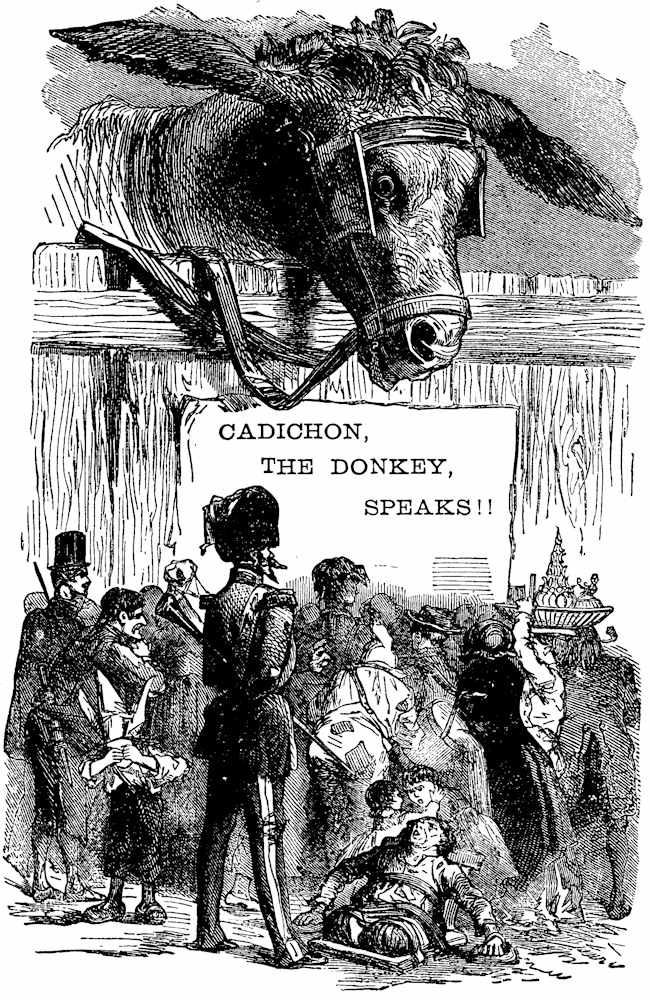
CADICHON,
THE DONKEY,
SPEAKS!!
THE
Adventures of a Donkey
FROM THE FRENCH OF
Mme. LA COMTESSE DE SÉGUR.
BY P. S., A GRADUATE OF ST. JOSEPH’S, EMMITTSBURG, MD.
ILLUSTRATED.
BALTIMORE:
PUBLISHED BY JOHN B. PIET,
No. 174 West Baltimore Street,
1881.
Copyright, John B. Piet, 1880.
Press of John B. Piet, Baltimore.
TO MY LITTLE MASTER,
M. Henri de Ségur.
My little master, you have been good to me, but you have spoken contemptuously of donkeys in general. To make you better acquainted with them, I write and offer you this story of my adventures, from which you will learn, my dear little master, how I, a poor donkey, and my very many donkey friends, have been and are still unjustly treated by men. You will see that we have much intelligence and many excellent qualities; you will also see how wicked I was in my youth, that I was severely punished for it, and how repentance changed me and restored to me the friendship of my comrades and masters. In fine, you will perceive on reading this book, that instead of saying “as stupid as a donkey, as ignorant as a donkey, as headstrong as a donkey,” one should say, “as intelligent as a donkey, as learned as a donkey, as docile as a donkey,” and that you and your kindred might well be proud of these eulogiums.
Hi! han! my good master, I hope no period of your life may resemble the early years of your faithful servant,
CADICHON, THE LEARNED DONKEY.
Adventures of a Donkey.
I do not remember my infancy; I was probably unhappy, like all infant donkeys, pretty and graceful as we all are. I was certainly very intelligent, since, even at my present time of life, being now somewhat advanced in years, my mental endowments are far superior to those of my comrades. More than once did I outwit my poor masters, who were but men, and who, consequently, could not be expected to possess the intelligence of a donkey.
I shall begin these Adventures by relating one of the tricks I played upon them in my youth.
| I. | —The Market, | 1 |
| II. | —The Pursuit, | 8 |
| III. | —The New Masters, | 13 |
| IV. | —The Bridge, | 17 |
| V. | —The Cemetery, | 24 |
| VI. | —The Hiding Place, | 32 |
| VII. | —The Locket, | 40 |
| VIII. | —The Fire, | 46 |
| IX. | —The Donkey Race, | 53 |
| X. | —Good Masters, | 66 |
| XI. | —Cadichon Sick, | 75 |
| XII. | —The Robbers, | 78 |
| XIII. | —The Vaults, | 86 |
| XIV. | —Theresa, | 94 |
| XV. | —The Gunning Party, | 111 |
| XVI. | —Medor, | 122 |
| XVII. | —The School Children, | 132 |
| XVIII. | —The Baptism, | 138 |
| XIX. | —The Learned Donkey, | 147 |
| XX. | —The Frog, | 164 |
| XXI. | —The Pony, | 168 |
| XXII. | —The Punishment, | 180 |
| XXIII. | —The Reformation, | 194 |
| XXIV. | —The Robbers, | 218 |
| XXV. | —The Reparation, | 239 |
| XXVI. | —The Boat, | 254 |
| Conclusion | 272 | |
[Pg 1]
The Adventures of a Donkey.
Men not being supposed to be aware of all that donkeys know, you, who read this book, are doubtless ignorant of what is well known to all my donkey friends, namely: that every Tuesday in the town of Laigle there is held a market, where vegetables, butter, eggs, cheese and other excellent things are sold. This Tuesday is a day of torture for my poor comrades; it was so for me before I was bought by my present good old mistress, your grandmother. I belonged to a farmer’s wife, exacting and cruel. Just imagine, my dear little master, that she carried her malice so far as to collect all the eggs her hens laid, all the butter and cheese from her cows’ milk, all the vegetables and fruits that ripened during the week, to fill baskets which she placed upon my back.
And when I was so heavily laden that I could scarcely move, this wicked woman seated herself upon the baskets and obliged me to trot thus burdened, overwhelmed, indeed, to the market of Laigle, a league from the farm. I was all this time in a rage I dared not show, [Pg 2]for fear of the stick my mistress carried, a very big one full of knots, that hurt sorely when she beat me. Whenever I saw or heard these preparations for market, I sighed, I groaned, I ever brayed, in hopes of softening the hearts of my owners.
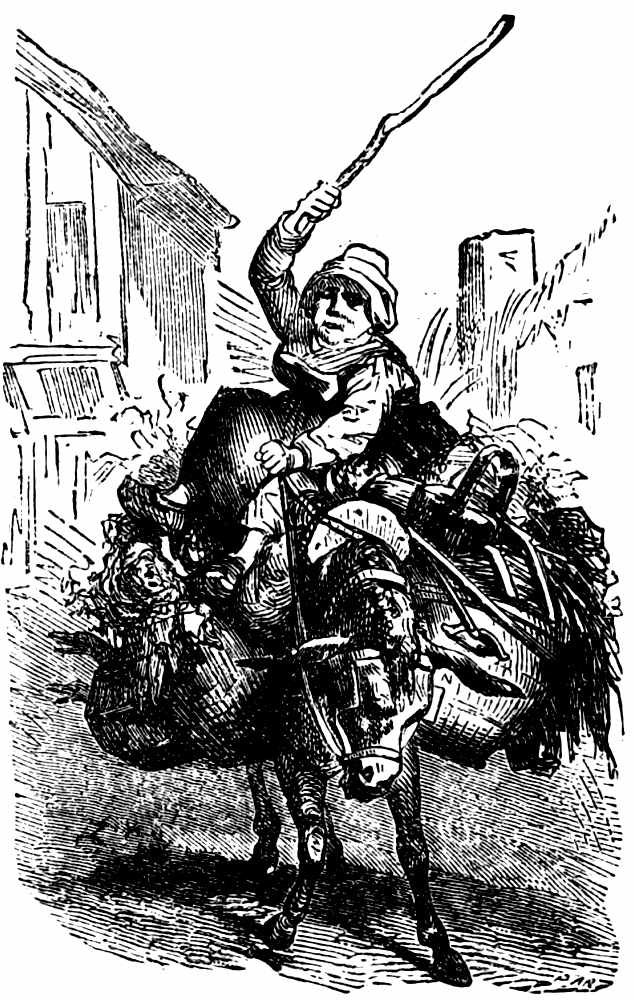
“Shut your mouth, great idle thing,” said they, coming to get me, “shut your mouth, and do not deafen us with your coarse, horrid voice. Hi! han! hi! han! that is beautiful music you are giving us! Edward, my boy, bring this lazy beast up to the door whilst your mother puts the load on his back. Here is a basket of eggs—one more! The cheese—the butter!—now the vegetables. That’s right! Here is a fine load, that is going to bring us several five franc pieces. Mary, my daughter, [Pg 3]bring a chair for your mother to mount the donkey. Good-bye, a pleasant trip, wife, and make this lazy beast move. Hold on, here is your stick, hit him with it.”
Pan! Pan!
“That’s right, a few more caresses of that kind and he’ll go.”
Vlan! Vlan! The stick never ceased to belabor my sides, my legs, my neck; I trotted, I almost galloped, yet the woman still beat me. I was indignant at so much injustice and cruelty; I tried to kick and throw her off, but I was too heavily burdened; I could only start and sway from side to side, thus affording myself the satisfaction of feeling her slipping down. “Wicked donkey! stupid animal! headstrong creature!” said she, “I am going to teach you better, I’ll let you feel the weight of my stick.”
And indeed, she beat me so I could scarcely reach the town. We arrived at last. All the baskets were lifted off my poor skinned back and placed on the ground. My mistress having tied me to a post, went to breakfast, whilst I, who was dying of hunger and thirst, got not a sprig of grass, or a drop of water. I found means of getting close to the vegetables during her absence and refreshed myself by filling my stomach with a basket of salad and cabbage. I had never eaten anything so good in my life, but just as I was finishing the last cabbage and the last salad, my mistress returned. She uttered a scream on seeing her basket empty; I regarded her with such a satisfied insolent air, that she immediately recognized [Pg 4]me as the author of her loss. I shall not repeat to you the names she called me. She was very high-tempered, and when in a rage, she swore and said things that made me blush, donkey as I am. Having loaded me with the most humiliating reproaches, to which I made no reply, except by licking my lips and turning my back upon her, she took her stick and began to beat me so cruelly, that I, at last, lost all patience, and launched at her three kicks, the first of which broke her nose and two teeth; the second, her wrist, and the third, striking her in the stomach, knocked her over. Twenty persons rushed upon me, overwhelming me with blows and vile words. They carried my mistress off, I know not where, and left me attached to the post, near which the marketing I had brought was displayed. Here I remained a long time; seeing that no one thought of me, I ate a second basket of excellent vegetables, and cutting with my teeth the cord that held me, I quietly took the road home.
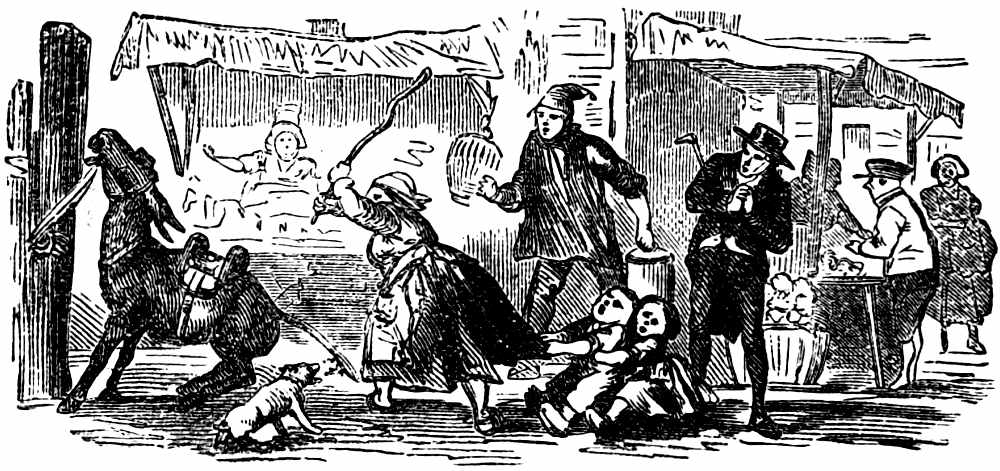
Every one I passed on the way seemed astonished at seeing me alone.
[Pg 5]
“Look, there is a donkey with a broken strap! He has escaped,” said one.
“It must be a fugitive from the galleys,” said another. And they all began to laugh.
“He doesn’t carry a heavy load on his back,” remarked a third.
“Very true,” exclaimed a youth, “he has been at some mischief.”
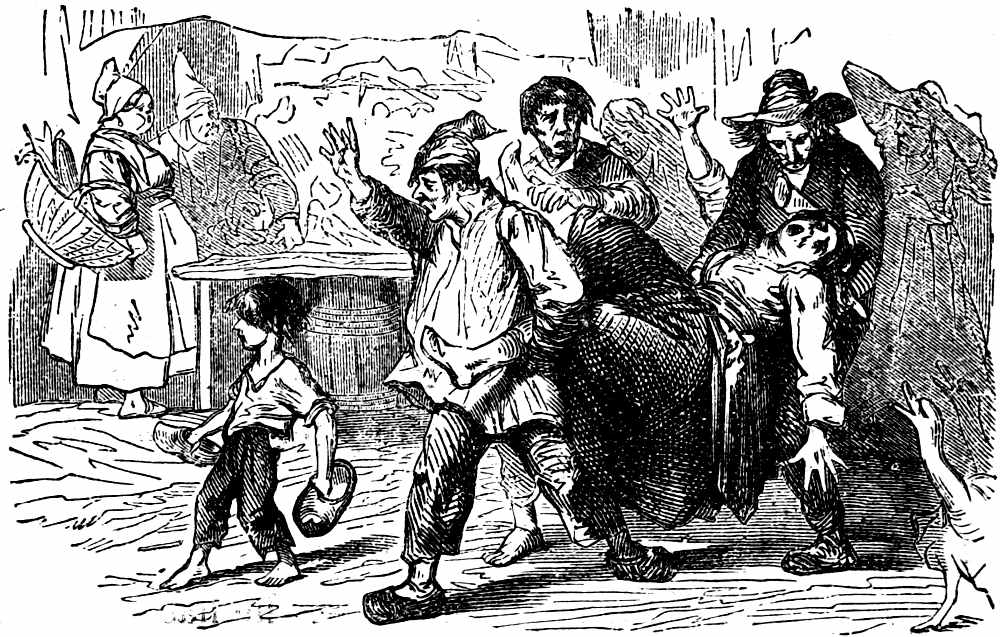
“Catch him, husband,” said a woman, “let us put the little one in the saddle.”
“He will carry you as well as the little boy,” replied the husband.
Wishing to give them a good opinion of my gentleness and condescension, I very quietly approached the woman and stopped to let her mount.
“He doesn’t seem at all vicious,” said the man, helping his wife into the saddle.
[Pg 6]
I smiled with pity at hearing this. Vicious! as if a donkey kindly treated was ever vicious! We become ill-tempered, disobedient, headstrong, only in retaliation for the blows and foul names heaped upon us. When properly treated, we are good-natured—much better in this respect than other animals.
I carried the wife and child home. The latter was a pretty little boy about two years old, who caressed me fondly, thought me charming, and wanted to keep me altogether. But I reflected that this would not be honest; my masters had bought me, I belonged to them. I had already revenged myself upon my mistress by breaking her nose, teeth, and wrist, and giving her a good kick in the stomach. Seeing, then, that the mother would yield to the little boy, whom she spoiled (I soon perceived this whilst they were on my back), I jumped to one side, and before the mother could seize my bridle, was off in a gallop towards home.
Mary, my master’s daughter, saw me first.
“Oh! there is Cadichon. How early he has returned. Here, Edward, come take off his saddle.”
“Wicked creature,” said Edward, in an angry tone, “one has always to be bothered with you. But why has he returned alone? I’ll bet he has run away. Vile beast!” he added, kicking me on the leg, “if I knew you had escaped, I would give you a hundred licks of the stick!”
Once rid of my saddle and bridle, I went off galloping. Scarcely had I entered the pasture when I heard loud cries proceeding from the house. Approaching the [Pg 7]hedge, I saw that the farmer’s wife had been brought home, and I recognized the screams as those of the children. I listened most intently, and heard Edward say to his father:
“Father, I am going to tie him to a tree, and take the big wagon, whip and beat him till he falls to the ground!”
“Very well, my son, go, but do not kill him, for we would lose what he cost us. I shall sell him at the next fair.”
I trembled with fright on hearing these words, and on seeing Edward run to the stable for the whip. There was no time for hesitation, and without any scruple now as to defrauding my owner of what he had paid for me, I ran towards the hedge separating me from the fields, and dashed against it with such force, that I broke the branches and made my way through. I ran at full speed through the field, and I continued to gallop a very long time, believing myself pursued. At last, unable to go farther, I stopped; I listened, but heard nothing. I mounted a slight eminence, I saw no one. Then I began to breathe freely, and rejoice at having delivered myself from these wicked farmers.
But I now commenced to wonder what would become of me. If I remained where was, I would be discovered, recognized and taken back to my master’s. What should I do? where should I go?
I looked around, and finding myself solitary and unhappy, I was about to shed tears over my sad fate, when I perceived that I was on the edge of a magnificent woods, it was the forest of St. Evroult.
[Pg 8]
“What good luck!” I exclaimed, “In this forest I shall find tender herbage, water, fresh moss; I shall remain here a few days, and then go to another forest, farther, much farther from my master’s farm.”
I entered the forest; I ate with delight the tender grass and I drank the water from a beautiful spring. Towards night, I lay down on the moss at the foot of an old pine, and there slept peacefully till morning.
The next morning after eating and drinking, I thought over my happiness.
“Here,” said I, “they can never find me, I am saved. In two days, however, when I shall have rested from my fatigue, I will go still farther.”
Scarcely was this reflection finished, when I heard the distant barking of a dog, then of another, and in a few minutes I distinguished the sound of a whole pack of hounds. Anxious, and even somewhat frightened, I arose and went towards a little stream that I had noticed in the morning. Scarcely had I done so, ere I heard Edward saying to the dogs:
“Come, come, dogs, seek him well, find me this wicked donkey, bite him, tear his legs to pieces and bring him to me, that I may lay my whip on his back.”
[Pg 9]
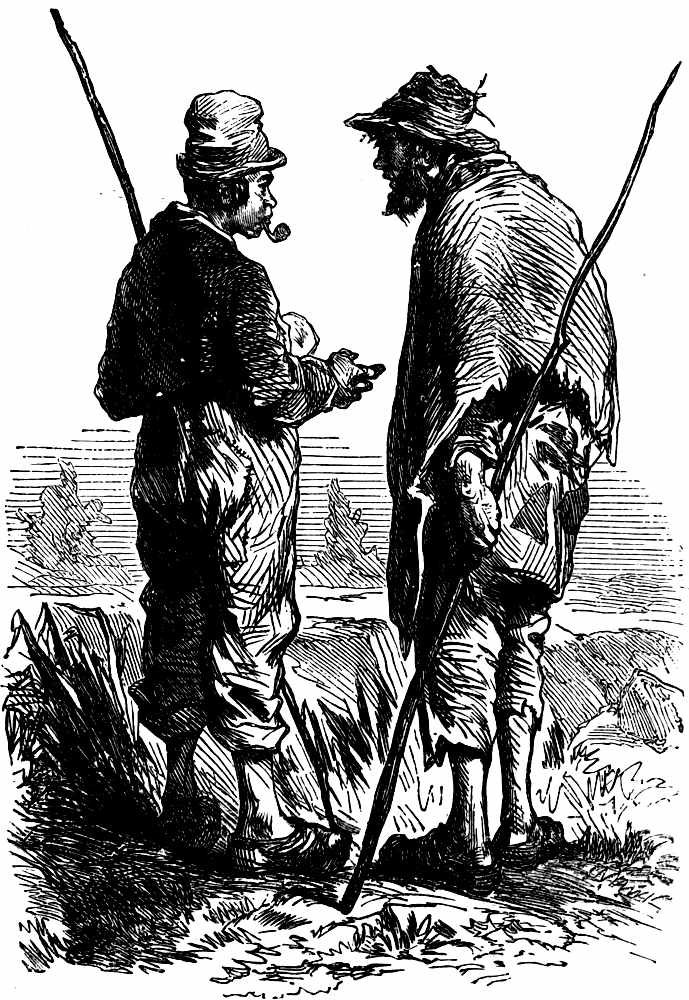
I nearly sank to the ground from fright; but suddenly remembering that I could throw the dogs off my track by walking in the water, I ran at once to the stream, which fortunately was bordered on both sides with very thick bushes. I walked a very long time without stopping; the barking of the dogs died away in the distance, as well as the voice of the wicked Edward.
Breathless and exhausted I stopped an instant to drink, and I ate a few leaves from the bushes. My legs were stiff with cold, but I dared not quit the water, for fear the dogs might return and get upon my trail. When somewhat rested I began to run, following the stream all the while, until I was out of the forest. I then found myself in a vast meadow, where cows and oxen (over fifty in number) were pasturing. They took no notice of me, so I lay down in the sun to rest in a corner of the field.
Towards evening two men entered the meadow.
“Brother,” said the tallest of the two, “shall we not bring up the cattle to-night? they say there are wolves in the woods.”
“Wolves! who told you that nonsense?”
“The Aigle folks. They tell how a donkey from the hedge farm was carried off and devoured in the forest.”
“Bah! let it go, the people of that farm are so cruel, they have beaten their donkey to death.”
“Why, then, would they say the wolves devoured it?”
“Because it is not known that they killed it.”
“Even so, it would be better to bring in the cattle.”
“Do as you wish, brother, I leave it to you.”
[Pg 12]
I did not stir in my corner, for fear of being discovered. The grass was high and concealed me entirely, the cattle did not pass near me, but were driven towards the gate and thence to their masters’ farm.
I had no fear of wolves, for I was the very donkey of whom the men spoke; and in the forest where I had passed the night, I had not seen even a wolf’s trail. So I slept delightfully, and was finishing my breakfast when the cattle re-entered the field, led by two big dogs.
Whilst I was quietly looking at them, one of the dogs perceived me, and barking fiercely, ran at me, followed by his companion. What would become of me? how should I escape them? I rushed against the fence enclosing the meadow; the stream I had followed crossed the lot, and I was fortunate enough to clear this stream, also to hear the voice of one of the men I had seen the evening before, calling back his dogs. I quietly continued my walk until I had reached another forest, the name of which I did not know. I must now have been more than ten leagues from the hedge farm; consequently I was safe, no one knew me, and I could show myself without fear of being taken back to my former owners.
[Pg 13]
I lived peacefully in this forest one month. Sometimes I felt a little lonesome, but I preferred solitude to misery. I was then tolerably happy, when I began to perceive that the grass was getting scarce and dry, the leaves falling, the water freezing, the ground growing damp.
“Alas! alas!” thought I, “what is to become of me? If I stay here I shall perish of cold, of hunger and thirst, but where shall I go? who is there that wants me?”
By dint of reflection, I devised a means of securing shelter. Leaving the forest, I went to a little village near by. There I saw a small, neat looking, isolated house, and a good woman seated at the door spinning. I was touched with her sad, gentle appearance; I approached her and put my head upon her shoulder. Much startled, the good woman uttered a scream and jumped up from her chair. I did not stir, but regarded her with a pitiful, supplicating air.
“Poor beast!” said she, at length, “you do not look wicked. If no one owned you, I would be very much pleased to have you supply the place of my poor old Grison, who died of old age. I could then continue to [Pg 14]make my living selling my vegetables at the market. But, no doubt, you have a master,” she added, sighing.
“To whom are you talking, grandmother?” said a soft voice from the inside of the house.
“I am talking to a donkey that has come here and put his head on my shoulder, and he looks at me so pitifully that I haven’t the heart to drive him away.”
“Let me see! let me see!” answered the soft voice. And immediately there appeared on the threshold a handsome little boy six or seven years of age, neatly but poorly clad. He looked at me with a curious, half timid air.
“May I pet him, grandmother?” said he.
“Certainly, my George, but take care that he does not bite you.”
The little boy extended his arm, and not being able to reach me, he advanced a step, then another, and began to smooth my back.
I did not stir for fear of frightening him; I only turned my head towards him, and passed my tongue over his hand.
“Grandmother, grandmother, this poor donkey is so good-natured, he has licked my hand.”
“It is very strange that he should be alone. Where is his master? Go, George, to the village inn, where travelers stop, and make inquiries about him. His master is probably worried about him.”
“Shall I take the donkey, grandmother?”
“He will not follow you; let him go where he wishes.”
[Pg 15]
George started off in a run; I trotted after him. When he saw that I followed, he came to me, and petting me, said: “Say then, my pretty donkey, since you follow me, you will surely let me ride you.” And he mounted at once, exclaiming as he did so, “get up!” I went off in a little gallop, which enchanted him. “Ho! ho!” said he before the inn, I stopped immediately, and George dismounted. I remained opposite the door, not stirring any more than if I had been tied.
“What is it, my boy?” said the inn-keeper.
“I came to know, Mr. Duval, if this donkey at the door belongs to you or any of your customers?”
Mr. Duval came to the door and regarded me attentively. “No, my boy,” said he, “it is not mine, nor that of any one I know. You will have to inquire further.”
George remounted, and setting off again in a gallop, we went from house to house, inquiring for my owner. No one knew me, and we returned to the good grandmother, who was still sitting in the door spinning.
“Grandmother, the donkey belongs to no one about here. What are we to do with him? He keeps close to me, but he jumps away when anybody else tries to touch him.”
“In that case, my George, we must not let him stay out-doors all night; something might happen to him. Lead him to our poor Grison’s stable, give him a bundle of hay and a bucket of water. We can take him to market to-morrow, and perhaps we may find his master.”
“And if we do not find him, grandmother?”
[Pg 16]
“We will keep the donkey till some one claims him. We could not let the poor beast perish of cold this winter, or fall into the hands of wicked people who would beat him, or cause his death from fatigue and hard treatment.”
After giving me food and water, George caressed me and went out, saying, as he shut the door:
“How I hope he has no master, so he may stay with us.”
Next day, having given me my breakfast, George put a halter on my neck and led me up to the door; the grandmother next placed a very light pack-saddle on my back and seated herself upon it. George then brought a little basket of vegetables, which she took upon her knees, and we set out for the market of Mamers. The good woman sold her vegetables at a fair price, no one recognized me, and I returned with my new mistress.
I lived there four years; I was happy, injuring no one and making myself very useful, for I loved my little master, who never beat me, never worked me to death and always fed me well. However, I was no glutton; in summer, remnants of vegetables and the herbs which neither the horses nor cows ate; in winter a little hay and the skins of potatoes, carrots and turnips, satisfied my wants, as is the case with other donkeys.
There were some days I did not enjoy, those on which my mistress hired me to the children in the neighborhood. Being poor, and not always having enough work to keep me busy, she was very glad to make a little something by hiring me to the children of the castle near by.
They were not always good children.
Listen to what happened on one of these excursions.
[Pg 17]
There were six donkeys drawn up in the yard; I was one of the handsomest and strongest of the number. Three little girls brought us oats in a bucket. Whilst eating I listened to the children’s conversation.
“Come,” said Charles, “let us choose our donkeys, as for myself, I take that one,” pointing to me with his finger.
“You always take the best,” answered the five children at once, “we must draw lots.”
“How do you wish us to draw lots, Caroline,” replied Charles, “do we put the donkeys in a bag and draw them out as one does balls?”
“Ah! ah! ah!” said Francis, “what an idiot, with his donkeys in a bag! As if one could not number them 1, 2, 3, 4, 5, 6, put the numbers in a bag, and let each draw his number.”
“So we can,” cried the five others, “Ernest set down the numbers, while we write them on the donkey’s backs.”
These children are dunces, said I to myself. If they had the sense of a donkey, instead of tiring themselves writing numbers on our backs, they would simply arrange us along the wall, the first would be 1, the second, 2, and so on for the rest.
[Pg 18]
Meanwhile, Francis had brought a big piece of coal. I was the first, so he made an enormous 1 on my back; whilst he wrote 2 on that of my comrade, I gave myself a vigorous shake, to convince him that his invention was not a famous one. Behold, the particles of coal flew off and the 1 disappeared. “You dunce!” cried he, “I must commence over.” Whilst he re-wrote his number 1, my comrade that had perceived my doings, and was also mischievous, shook himself in turn. Behold the 2 disappear. Francis began to get angry; the others laughed and mocked him. I made a sign to my comrades and we let him number us, no one budged. Ernest returned with the numbers in his handkerchief; each one drew. Whilst they were looking at what they had drawn I made another sign to my comrades, and we all shook ourselves worse than ever. More coal, more numbers, it must be commenced over, the children were enraged. Charles was triumphant and giggled; Ernest, Albert, Caroline, Cecilia and Louisa were indignant at Francis, who in turn, stamped his foot, my comrades and I began to bray. The noise attracted the papas and mamas. The cause was explained to them and one of the papas suggested the plan of arranging us along the wall. He made the children draw their numbers.
“One!” cried Ernest. It was myself.
“Two!” cried Cecilia. It was one of my friends.
“Three,” cried Francis, and so on to the last.
“Let us start now,” said Charles, “I go first.”
“Oh! I shall soon overtake you,” replied Ernest with animation.
[Pg 19]
“I bet not.”
“I bet I shall.”
Charles taps his donkey, which sets off at a gallop. Before Ernest has time to touch me with a whip, I start also, and at such a pace that Charles is speedily overtaken. Ernest is delighted, Charles is furious. He taps and keeps tapping his donkey. Ernest has no need to tap me; I run, I fly like the wind. I pass Charles in a minute, and I hear the others who follow, laughing, and crying out:
“Bravo! donkey number 1, bravo! he runs like a horse.”
Self love gives me courage; I continue to gallop until we reach a bridge. I stop suddenly, for I have just perceived that a large plank in the bridge is rotten; I do not wish to fall in the water with Ernest, but to return to the others who are far, far behind us.
“Ho there! ho there! donkey,” said Ernest to me. “On the bridge, donkey, on the bridge.”
I resist, he gives me a touch with the switch.
I still continue to walk towards the others.
“Headstrong thing! stupid brute! will you turn and pass the bridge?”
I walk on towards my comrades and rejoin them, in spite of this wicked boy’s cross words and blows.
“Why do you beat your donkey, Ernest?” cries Caroline, “he is excellent, he went flying and you overtook Charles.”
“I beat him to make him go over the bridge, he is determined to turn back.”
[Pg 20]
“Ah! bah! because he was alone; now that we are all together he will pass the bridge like the rest.”
“Unfortunate creatures!” think I, “they are all going to fall into the river. I must try to convince them of the danger.”
And I set off in a gallop towards the bridge, to Ernest’s great satisfaction and amidst cries of joy from the other children.
I gallop up to the bridge; reaching it, I stop suddenly as if afraid, Ernest astonished, urges me on, I recoil with an air of fright that surprises Ernest still more. Silly boy! he sees nothing though the rotten board is in full view. The others rejoin him, and enjoy the spectacle of his efforts to make me go across and mine not to do so. At last the whole party dismount from their donkeys, each one pushing and beating me mercilessly, still I budge not.
“Pull him by the tail,” cries Charles, “donkeys are so headstrong that if you want to make them go one way, they are sure to go the other.”
Behold them seize me by the tail. I defend myself with a kick; they all beat me at once, and yet I will not move an inch.
“Wait Ernest,” says Charles, “let me go first and he will certainly follow.”
He tries to advance, to prevent him I place myself crosswise before the bridge, but by dint of blows he makes me fall back.
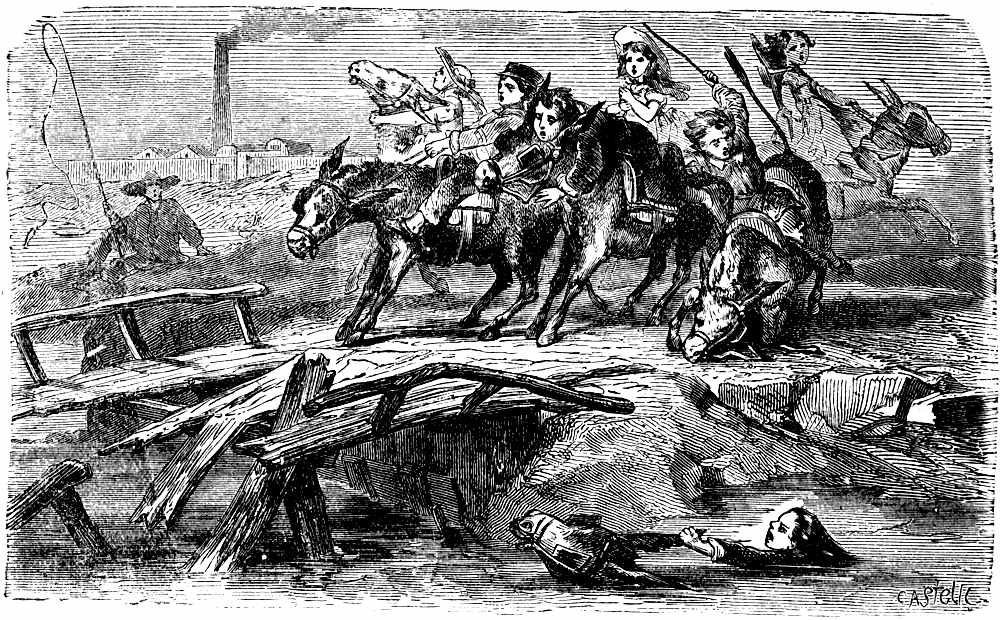
“Well,” said I to myself, “I’ll give up, if this bad boy [Pg 23]wants to be drowned, let him be, I have done my best to save him; since he is so determined, let him taste a draught.”
Scarcely had his donkey touched the rotten plank, ere it gave way, and both rider and animal were thrown into the water. There was no danger for my comrade, as like the rest of his race, he knew how to swim, but Charles struggled and screamed without the power of extricating himself.
“A pole! a pole!” he cried.
The children ran in every direction, at last Caroline found a long pole, which she hastily held out to him; he seized it, but his weight was dragging her in, and she called for help. Ernest, Francis and Albert ran to her. At length, with a great deal of difficulty, they succeeded in drawing to land the unhappy Charles, who had drank more than he relished, and who was wet from head to foot. When assured of his safety, they all began to laugh at his piteous plight; Charles got angry, they jumped upon their donkeys, and with bursts of laughter advised him to return to the house and change his clothes. Wet as he was, he mounted his donkey. I laughed in my sleeve at his ridiculous figure, the current had carried away his hat and shoes, the water was running off him to the ground, his dripping hair clung to him, and his countenance was furious—altogether he was a most ludicrous picture. The children laughed, my comrades pranced and ran to express their delight.
I ought to add that Charles’ donkey was detested by [Pg 24]the rest of us, because he was quarrelsome, gluttonous and stupid, qualities very rare among us.
At length Charles disappeared, and both children and donkeys became more quiet. Every one caressed me and admired my spirit, and we all started off again, I at the head of the band.
We went at a brisk pace; and soon approached the village cemetery, which is about a league from the castle. “Suppose we turn back and take the forest road,” said Caroline.
“Why?” asked Cecilia.
“Because I do not like cemeteries.”
“Why do you not like them,” replied Cecilia with an air of derision. “Are you afraid you will not get away?”
“No, but I think of the poor people who are buried there, and it makes me sad.”
The children ridiculed Caroline and rode directly past the wall. They were just about to keep on, when Caroline, who seemed disquieted, stopped her donkey, leaped off, and ran to the cemetery gate.
“What are you doing, Caroline, where are you going?” exclaimed the others.
Caroline did not answer, but hurriedly pushing open [Pg 25]the gate, she entered the cemetery, looked all around her, and ran towards a freshly made grave.
Ernest, who had anxiously followed, had caught up with her, at the moment when bending over the grave, she lifted up a poor little boy, of about three years, whose moans had attracted her attention.
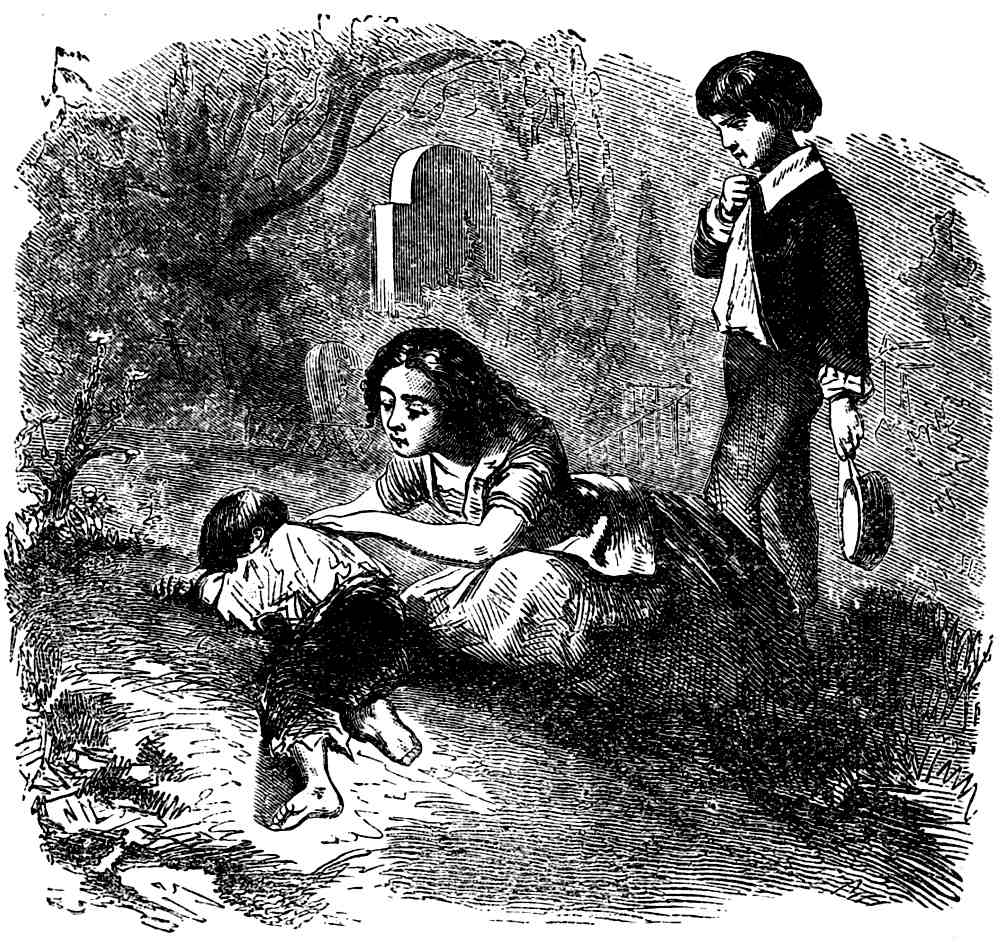
“What is the matter, my poor little one? Why are you crying?”
The child could not answer for his sobs.
“Why are you here alone?” said Caroline again, noticing the child’s beauty and miserable clothing.
[Pg 26]
“They left me here, I am hungry,” he answered sobbing.
“Who left you here?”
“The black men, I am hungry,” was the answer accompanied with another sob.
“Ernest,” said Caroline, “run, and get our lunch, quick; we must give this poor little fellow something to eat; he will tell us afterwards why he weeps, and why he is here.”
Ernest ran to get the basket of provisions, whilst Caroline endeavored to console the child. In a few minutes Ernest re-appeared, followed by the whole band, whom curiosity had attracted to the spot. They gave the child some cold chicken and some bread soaked in wine. As he ate, his tears ceased to flow, his countenance became smiling. When he had eaten heartily, Caroline again asked him why he was lying on this grave.
“Because they have put grandmother here. I want to wait till she comes back.”
“Where is your papa?”
“I can’t tell, I don’t know him.”
“And your mama?”
“I don’t know, black men carried her off as they did grandmother.”
“But who takes care of you?”
“No one.”
“Who feeds you?”
“Nobody, I suck nurse.”
“Where is your nurse?”
[Pg 27]
“Down there at the house.”
“What does she do?”
“She walks, and she eats grass.”
“Grass?”
Here all the children looked at one another with surprise.
“Is she silly?” said Cecilia in an undertone.
“He does not know what he is saying,” replied Francis, “he is too little.”
“Why,” continued Caroline, “does not your nurse take you home?”
“She can’t, she has no arms.”
The children’s surprise increased.
“How then can she carry you?”
“I get on her back.”
“Do you sleep with her?”
“Oh! no, I could not do that,” said the child smiling.
“Where then does she sleep? Hasn’t she a bed?”
The child began to laugh as he answered.
“Oh! no, she sleeps on straw.”
“What does he mean,” said Ernest, “let us ask him to take us to the house, we shall see his nurse, and she can explain matters.”
“I must confess, it is all a mystery to me,” said Francis.
“Will you go back to your home, my little one?” asked Caroline.
“Yes, but not all alone; I am afraid of the black men, grandma’s room was full of them.”
[Pg 28]
“We will all go with you, you must show us the way.”
Caroline remounted her donkey, and took the little boy upon her lap. He showed us the way, and in five minutes we all reached the cabin of mother Thibaut, who died the evening previous and was buried that morning. The child ran to the house and called out “Nurse! Nurse!” Immediately a goat bounded out of the open stable, and darting towards the child, testified its joy at his return by a thousand gambols and caresses. The child likewise fondled it, and then said “Suck Nurse.” The goat immediately lay down on the ground, the little boy stretched himself near her, and began to suck as if he had neither eaten nor drunk.
“There, the nurse is explained,” said Ernest, at last. “What shall we do with this child?”
“We have nothing to do with him, except leave him with his nurse,” said Francis.
The others cried out with indignation.
“It would be wrong,” answered Caroline, “to abandon this poor little one, he might soon die for want of care.”
“What do you wish to do with him,” said Francis, “are you going to take him home with you?”
“Certainly; I shall ask mama to keep him at the house whilst she makes inquiries as to who he is, and whether he has any relatives or not.”
“And our donkey party, are we to give that up and all return?”
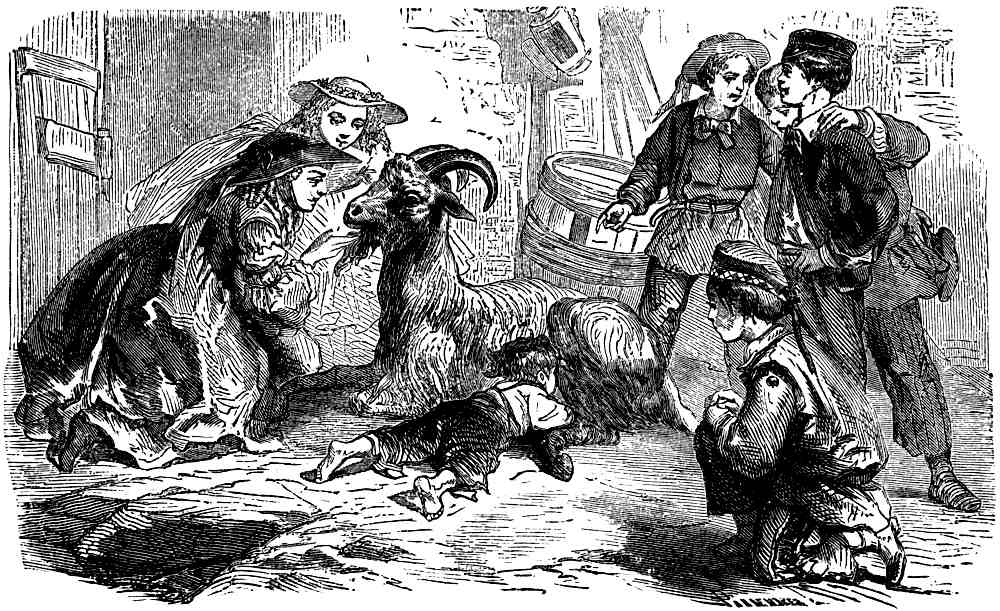
“No, Ernest will be kind enough to accompany me, [Pg 31]and the rest of you can continue your excursion, there will still be four, so you can well do without Ernest and me.”
“She is right,” said Francis, “let us mount and continue our ride.”
And they departed, leaving the kind Caroline with her cousin Ernest.
“How fortunate it is they tried to tease me by passing so near the cemetery!” said she, “but for that, I would not have heard this poor child, and he would have spent the entire night on the cold, damp ground.”
It was I whom Ernest mounted. With my usual intelligence, comprehending that we must reach the castle as promptly as possible, I set off at a gallop, my comrade followed, and we were there in half an hour. The family was startled at our unexpectedly early return. Caroline recounted her adventure with the child. Her mama was puzzled as to what arrangements could be made for him, when the porter’s wife offered to raise him with her son, who was about the same age. The offer was accepted. On sending to the village to make inquiries concerning his name and parentage, Caroline’s mama learned that his father had been dead a year, his mother six months; the child had been living with a wicked, miserly old grandmother, who had just died the day before, that following the coffin to the cemetery, he had been forgotten and left there; moreover, that he was not poor, the grandmother having been in comfortable circumstances. The porter’s wife raised him well, and he became a fine [Pg 32]fellow. I know him, his name is John Thibaut, he is always kind to animals, which proves his good heart, and he is very fond of me, which proves his sense.
The good goat was also brought to the porter’s and found a home there.
I have already said that I was happy, but my happiness was soon to end. George’s father was a soldier and when he returned to his country, bringing the money his dying captain had left him, and the cross given him by his general, he bought a house at Mamers, to which he removed his old mother and little son, and sold me to a neighboring farmer. I was very sad at leaving my good, old mistress and my little master George; both had been kind to me and I had been faithful to them.
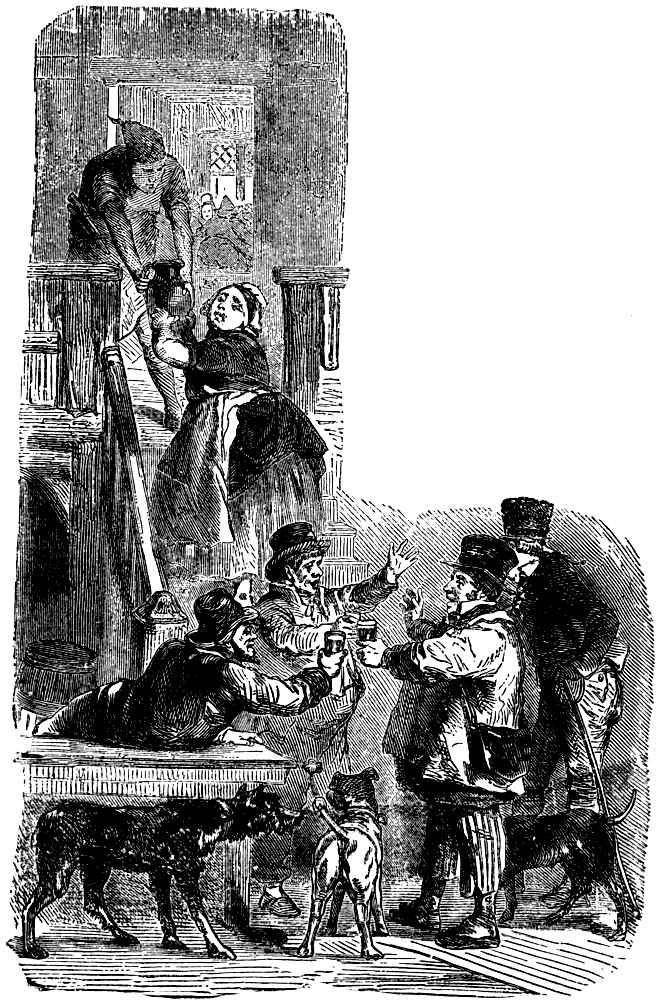
My new owner was not unkind, but he had a foolish fancy for making everything about him work, and myself among the number. He used to harness me to a little cart and make me haul earth, manure, apples, and wood. I commenced to grow lazy, I did not like to be harnessed, and market day I especially detested, not that they loaded me too heavily or beat me, but because I had to stand without eating from the morning, till three or four o’clock in the afternoon. When the heat was great, I [Pg 35]nearly died of thirst, waiting till everything was sold, till my master had received his money and said good day to his friends, with whom he must also take a glass.
I was not very good in those days; I wanted fair treatment, if denied me I sought revenge. Here is one of my tricks, from which you will perceive not only that donkeys are not stupid, but also that I had become very bad.
On market day the family arose earlier than usual—the vegetables were to be gathered, the butter churned, the eggs collected. In summer, sleeping out-doors in a large meadow, I saw and heard these preparations, and knew that at ten o’clock, they would come to harness me to the little cart filled with all their marketable produce. I have already said how tiresome and trying this market was to me, so having noticed in the meadow a large ditch filled with briers and brambles, here I determined if possible, to conceal myself in such a manner that no one could find me at the moment of departure. Market day arrived; as soon as I saw the farm folks beginning to move about, I very gently descended into the ditch, and there buried myself so completely, that discovery was almost impossible. I had been there an hour hid away amongst the briers, when I heard the boy calling me, running in every direction to find me, and at last returning to the farm-house. Doubtless he had apprised the master of my disappearance, for in a few minutes I heard the farmer’s voice calling his wife and all the other farm folks to come help find me.
“He must have got through the hedge,” said one.
[Pg 36]
“How could he have got through, there is no break anywhere,” replied the other.
“Some one has left the gate open,” said the master. “Run into the fields boys, he cannot be far; go quick, and bring him, for time passes, and we shall be too late.”
Every one started off into the fields or the woods, running and calling me. I laughed to myself down in the hole, and took good care not to make my appearance. After the lapse of an hour, they all returned breathless and panting, from a fruitless search.
The master having sworn at me, and said no doubt I had been taken, put one of his horses to the cart, and drove off in a very bad humor. When I saw that all returned to their work, and no one could see me, lifting up my head very cautiously, I looked around. Finding myself alone, I suddenly emerged from the ditch, and running to the other end of the field, to mislead their suspicions as to where I had been, I began to bray with all my strength.
At this noise every one on the farm ran.
“Here he is come back,” cried the shepherd.
“Which way did he come?” said the mistress.
“Which way did he go?” replied the wagoner.
In my joy at having escaped the market, I ran to them. They were delighted to see me, caressed me, said I was a good creature to have escaped from the thieves, and paid me so many compliments that I was ashamed, knowing full well how much more deserving I was of the stick than caresses. They let me graze quietly, and I [Pg 37]should have passed a charming day, had not my conscience reproached me for having deceived my poor master.
When the farmer came home and learned of my return, he was well pleased, but very much surprised. Next day he went all around the meadow, and carefully repaired even the slightest breach in the hedge.
“The donkey will be very smart to escape now,” said he, on finishing. I have stopped even the smallest holes with stakes and brambles; there is not room enough for a cat to get through.
The week passed quietly, my adventure was no longer thought of. But the next market day I repeated the wicked trick, and again concealed myself in the ditch, for so doing saved me so much fatigue and weariness. As before, they sought me everywhere; their astonishment was greater than ever, they were now fully convinced that a skillful thief had carried me off by letting me through the gate.
“This time,” said my master sadly, “he is certainly lost. He will not be able to escape again, and even if he should, he could not get into the meadow, for I have repaired the breaches in the hedge too carefully.”
He went off sighing, and one of the horses again took my place in the cart. As on the preceding occasion, I emerged from my hiding place when everybody had got out of the way, but I was prudent enough not to announce my appearance with a hi han! as before.
When they found me quietly eating grass in the field, [Pg 38]and my master learned that I had returned a short time after his departure, I saw that they had suspected me of some trick, for no one paid me any compliments, everyone eyed me with distrust, and I fully perceived that they watched me more closely than before. I laughed in my sleeve at them and said to myself:
“Good friends, you will be very sharp if you discover the trick I have played on you; I am smarter than you, and I intend to keep the game up.”
So I concealed myself a third time, very well pleased with my cunning. But scarcely was I stowed away in the ditch, ere I heard the furious barking of the big watch dog, and the voice of my master, saying:
“Seize him Caesar, seize him; go down into the ditch, bite his legs, bring him! bravo my dog! seize him, seize him!”
Caesar indeed darted down, he bit my legs, my body, and he would have devoured me, had I not decided to leave that ditch. I was about to run towards the hedge, and try forcing a passage through, when the farmer who was waiting for me, threw a slip knot over my head and brought me to a stand. He was armed with a whip and he made me feel it most sensibly; the dog continued to bite, the master to beat me, and I repented bitterly of my idleness. At last the farmer called Caesar off, put up his whip, exchanged the slip knot around my neck for a halter, and led me all mortified and beaten unmercifully, to the little cart which was in readiness for me.
I learned afterwards that one of the children, who had [Pg 39]been stationed near the gate, to open it if I returned, had perceived me coming out of the ditch, and had carried the news to his father. The little traitor!
For a long time after, until my troubles and sad experience had taught me better, I wished all manner of evil to him.
From that day I was treated more severely. They wished to keep me shut up, but I found means of opening all the fastenings with my teeth; if a latch, I lifted it; if a button, I turned it; if a bolt, I pushed it aside. I went just where I pleased. The farmer swore, scolded and beat me; he became harder on me, and I got to be worse and worse to manage. I felt that I had brought all this unhappiness on myself. I compared my present miserable life with that I had formerly led among the same people; but instead of reforming me, the reflexion made me only more headstrong and vicious. One day I went into the kitchen garden and eat all the salad; another day I knocked down the little boy who had betrayed me; another time, I drank a tub of cream they had placed out to be churned. I tramped on their chickens and young turkeys, I bit their pigs; in fine, I got so unmanageable that the mistress at last asked her husband to sell me at the fair at Mamers, which was to take place in fifteen days. I had become a very thin, miserable looking object, by reason of blows and poor nourishment. But now, wishing to put me in a good condition, (as the farmers say,) that I might sell to advantage, everyone on the farm was forbidden to maltreat [Pg 40]me. I was released from work and was well fed. Very happy indeed was I during those fifteen days. My master, at the expiration of that time, took me to the fair and sold me for a hundred francs. I longed to give him a good bite at parting, but fearing such an act might make a bad impression on my new owner, I contented myself with turning my back upon him with a gesture of contempt.
I had been bought by the parents of a delicate little girl, aged about twelve years, who living in the country and having no friends of her own age, was greatly in need of diversion, for the father devoted very little time to her, and the mother, though fond of her child, was so jealous, she could not bear to see her attached to anything but herself, not even animals. The physician having prescribed recreation of some kind, the mother decided upon donkey rides. My little mistress was named Pauline; she was a very kind, gentle, pretty child, of a sad, quiet disposition. She was often sick, but every day when not unwell, she went riding, and it was my delight to show her the prettiest paths and woods I knew. At first, we were always accompanied by a domestic, but when everyone saw what good care I took of her, we were [Pg 41]allowed to go alone. It was she who called me Cadichon, which name I have ever retained.
“Go, take a stroll with Cadichon,” the father would say, “there is no danger with a donkey like that, he has the intelligence of a man, and he will always bring you safe home.”
So we would go out together. When my little mistress got tired of walking, I used to stand near a slight elevation, or rather descend into a hollow, that she might mount the more easily. I would also lead her up to hazel trees filled with nuts, and stop to let her gather them. She loved me much, and expressed it by kind attentions and caresses. When bad weather prevented our promenades, she would come to the stable, bringing me bread, fresh grass, salad leaves, carrots; she would stay a long time, a very long time; and talking to me, though believing that I did not understand her, she would tell me all her little troubles, often with tears.
“Oh! my poor Cadichon,” she would say, “you are a donkey, and you cannot understand me, yet you are my only friend, for it is only to you I can say all I think. Mama loves me, but she is jealous, she wants me to love nothing but herself. I have no childish friends, and I am so lonesome.”
And then she would weep and caress me. I loved her too, and I pitied the poor little thing. When she was near me, I was very careful not to move, for fear of tramping on her.
[Pg 42]
One day she came running towards me in the greatest delight.
“Cadichon, Cadichon,” she cried, “mama has given me a locket with her hair; I am going to mix some of yours with it, for you too are dear to me, and I shall then have the hair of the two I love best in the world.”
She cut off a little of my mane and put it in the locket with her mother’s hair.
It made me happy to see how much Pauline loved me and I was proud of having my hair in a locket, but I must confess the effect was not very pretty; coarse, stiff and grey as my mane was, it made her mother’s tress look frightful. Pauline never perceived this, and she was turning her locket in every direction, and admiring it extravagantly, when her mother entered.
“What are you looking at,” said the mother.
“My locket mama,” answered Pauline concealing it somewhat.
“Why did you bring it here?”
“To show it to Cadichon.”
“What foolishness! Indeed Pauline, you are losing your head with Cadichon! as if he could understand anything about a locket with hair!”
“I assure you, mama, he understands very well, he licked my hand when—when—”
Here Pauline blushed and was silent.
“Well, why do you not finish? What made Cadichon lick your hand?”
[Pg 43]
“Mama, I would rather not tell you, I am afraid you will scold me,” said Pauline, much embarrassed.
“What is it, at once?” replied her mother impatiently. “Speak, what nonsense have you been at now?”
“It is not nonsense, mama, on the contrary—”
“Then why are you afraid to tell me? I suppose you have been giving Cadichon oats to make him sick.”
“No, I have given him nothing, on the contrary—”
“On the contrary? You provoke me, Pauline—now listen to me, I wish to know what you have been doing here for the last hour nearly.”
And indeed the arrangement of my hair in the locket had been rather a long process; it was necessary to take off the paper back of the locket, remove the glass, insert the memento of myself, and then put the whole together again.
Pauline still hesitated, at last, she said in a very low tone and with great embarrassment.
“I cut a little of Cadichon’s mane to—”
“To what?” said her mother impatiently, “finish now, you cut it for what?”
“To put it in the locket,” was the very low answer.
“In what locket?” said her mother angrily.
“In the one you gave me.”
“In that I gave you with my hair!” replied the mother with increasing anger. “And what have you done with my hair?”
“It is still there, see,” said poor Pauline, displaying the locket.
[Pg 44]
“My hair mixed with a donkey’s mane!” exclaimed the mother in a rage. “Ah! it is too much! You do not deserve the present I gave you! To class me with a donkey! To express the same affection for a donkey as for me!”
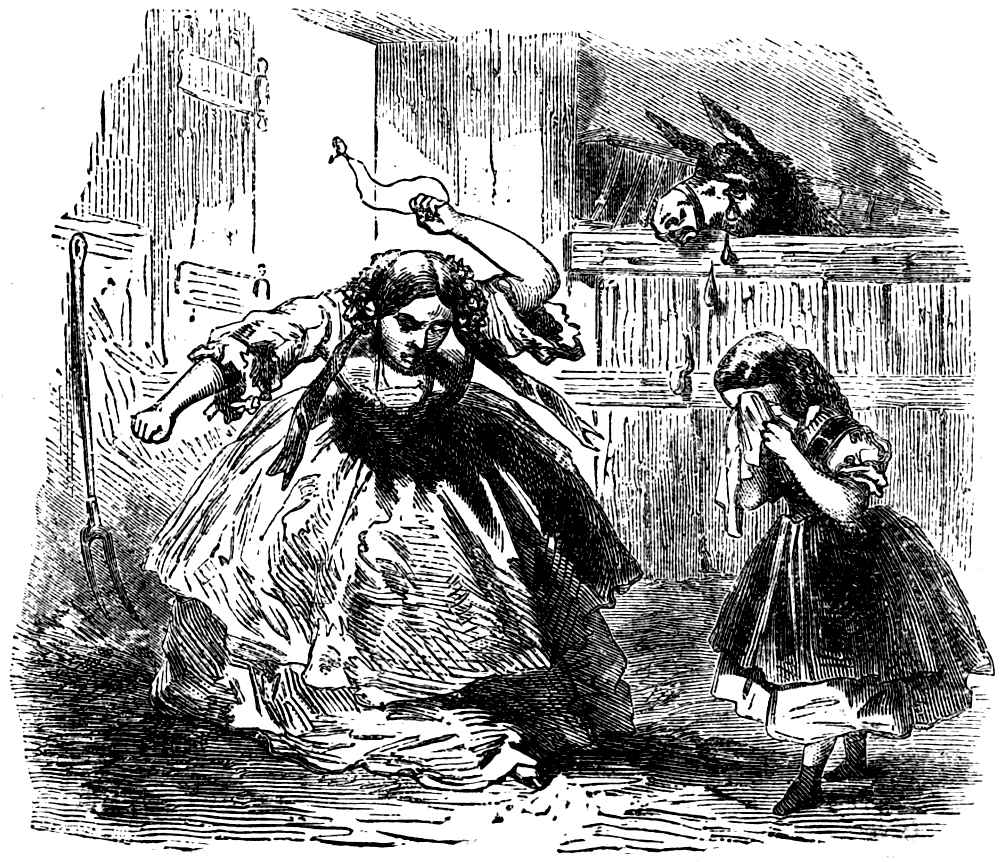
And snatching the locket from the hands of the unfortunate, stupefied Pauline, she dashed it to the ground, trampled it under foot and broke it into a thousand pieces. Then without noticing her daughter, she left the stable, slamming the door violently.
Pauline surprised and frightened at this outburst of temper, was motionless an instant, then breaking into sobs, and throwing herself upon my neck, she exclaimed passionately:
[Pg 45]
“Cadichon, Cadichon, you see how I am treated! They do not want me to love you, but I will love you in spite of them, and more than them, because you are good to me—you never scold me, you never grieve me, and you always try to amuse me in our promenades. Alas! Cadichon, how unfortunate that you can neither understand me nor talk to me. Oh! what I would tell you!”
Pauline was silent, she throw herself on the ground and continued to weep gently. I was touched and distressed at her grief, but I could not console her or even let her know that I understood her. I felt enraged at this mother, who through stupid or excessive affection, could render her child so unhappy. Had it been in my power, I would have told her of the grief she caused Pauline, and the injury it did her already delicate health, but Alas! I could not speak. I could do nothing but look sadly on at the poor child’s flowing tears.
Scarcely a quarter of an hour had elapsed since her mother’s leaving the stable, when a servant opened the door and called Pauline.
“Mademoiselle,” said she, “your mama has sent for you, she does not wish you to stay in the stable with Cadichon, or even to come here at all.”
“Cadichon, my poor Cadichon!” exclaimed Pauline, “they do not wish me to see you any more!”
“Only when you go out riding, Mademoiselle, your mama says, the place for you is in the parlor, not in the stable.”
Pauline made no answer; she knew her mother exacted [Pg 46]obedience, but embracing me again, and I felt her tears on my neck as she did so, she left the stable to return no more.
From that time Pauline became sadder and more delicate, she coughed, she grew pale and thin. The bad weather rendered our promenades shorter and less frequent. When we did go however, I was brought up to the castle steps, Pauline mounted without saying one word to me, or taking any notice of me, but as soon as we were out of sight, she jumped off, caressed me, and relieved her heart by recounting her daily troubles and griefs, though still thinking I could not understand her. It was thus I learned her mama’s continued displeasure since that affair of the locket, how Pauline’s life was sadder and more irksome than ever, and how the malady from which she suffered was becoming graver every day.
Just as I had gone to sleep one evening, I was awakened by cries of “fire! fire!” Startled and terrified I endeavored to rid myself of the leather strap that held me fast, but in vain did I pull at it, and roll on the ground, the strap would not break. At last the happy idea occurred to me of cutting it with my teeth, and this I succeeded in doing after several efforts. My poor stable was lighted [Pg 47]up with the reflexion of the fire; the cries, the noise increased; I heard the lamentations of the servants, the crash of falling walls, the giving way of floors, the roaring of flames; the smoke had already reached my stable, and no one thought of me, no one had had charity enough just to open my door and let me out. The flames increased in violence, already I began to experience a feeling of great heat and suffocation.
“It is all over for me,” said I, “I am condemned to be burned alive! what a frightful death! Oh! Pauline, my dear mistress, you have forgotten your poor Cadichon!”
Scarcely had I, not pronounced, but thought these words, when my door was opened violently, and I heard the terrified voice of Pauline calling me. Happy at being saved, I darted towards her, and we were just on the threshold, when a frightful crash made us recoil. A building directly opposite my stable had tumbled down, and every passage was choked up with the ruins; my poor mistress must now perish for having attempted to save me! We were nearly suffocated with the smoke, the dust of the fallen building, and the heat. Pauline dropped down beside me. Suddenly, I took a dangerous resolution, but the only one that could save us. Seizing my little mistress’s dress in my teeth, she being partly unconscious from fright, I darted across the burning beams that strewed the ground. Being fortunate enough to get through without her clothing taking fire, I now stopped to see whither I must direct my steps; everything around us was in flames. Discouraged and almost [Pg 48]in despair, I was going to lay Pauline, now utterly unconscious, on the ground, when perceiving an open cave; I rushed in, (knowing full well that in one of these vaults under the castle we were in absolute safety,) and I laid Pauline near a tub of water, so that she could bathe her forehead and temples on awaking from her swoon. It did not last very long, and when she awoke to consciousness and found herself out of danger, she threw herself upon her knees, and in a touching prayer thanked God for having so mercifully preserved her. Then, after thanking me with a tenderness and gratitude quite affecting, she drank a few mouthfuls of water from the tub and listened. The fire continued its ravages, everything was burning; we still heard a few voices, but so indistinctly that we could not recognize them.
“Poor mama and papa!” said Pauline, “they think I have perished in disobeying them, by going to Cadichon’s rescue. We must now wait till the fire is extinguished. No doubt, we shall spend the night in the vault. Good Cadichon!” she added, “I owe my life to you.”
She said no more, but took her seat on an upturned chest, and leaning her head upon an empty barrel, was soon asleep. I felt tired and hungry, so I drank from the tub, and stretching myself out near the door, I was not long in following her example.
I awoke very early. Pauline still slept. I arose softly and went to the door, which I opened; everything was burned and the flames extinguished, and I saw that one could easily pick his way through the ruins to the castle [Pg 49]yard. I gave a light hi! han! to awaken my mistress, who opened her eyes, and seeing me near the door, she ran towards it and gazed around her.
“All burned up! all gone!” said she sadly, “I shall never see the castle any more. I shall be dead before it is rebuilt, I feel it; I am weak and sick, very sick, although mama says—”
“Come, my Cadichon,” she continued after remaining pensive and motionless for a few minutes, “come, let us go now, I must find mama and papa to console them, they think me dead.”
She lightly threaded her way among the fallen stones, the crumbled walls, the still smoking beams. I followed her, and we soon reached the lawn, where she got on my back. Directing my steps towards the village, we lost no time in finding the house where her parents had taken refuge. Believing their child lost, they were plunged in the deepest affliction.
At sight of her, they uttered an exclamation of joy and rushed out to clasp her in their arms. She recounted to them with what intelligence and courage I had saved her life; but instead of thanking and caressing me, the mother surveyed me with an air of indifference, and the father never deigned to look at me at all.
“He nearly caused your death, my poor child,” said the mother. “If you had not been so foolish as to think of opening the stable, and setting him at liberty, your father and I would not have passed such a night of desolation.”
[Pg 50]
“But,” said Pauline earnestly, “it is he who—”
“Hush, hush,” replied the mother interrupting her, “say no more to me about this animal which I detest, for he has almost caused your death.”
Pauline sighed, looked sorrowfully at me and was silent.
From that day I never saw her more. The terrible fright, the fatigue of a night passed out of bed, but especially the low temperature of the vault, all increased the disease from which she had suffered a long time. In the morning she was taken with a fever that never left her. The chill of the preceding night finished what sadness and weariness had commenced; her chest already weak, could not stand the shock, and she died at the end of a month, neither regretting life nor fearing death. She often spoke of me and called me in her delirium. No one thought of me now. I ate what I could find, and I slept unsheltered in cold and rain. When I saw the coffin which contained the body of my poor, little mistress carried out of the house, my grief was so intense that I left that part of the country, and have never been there since.
[Pg 51]
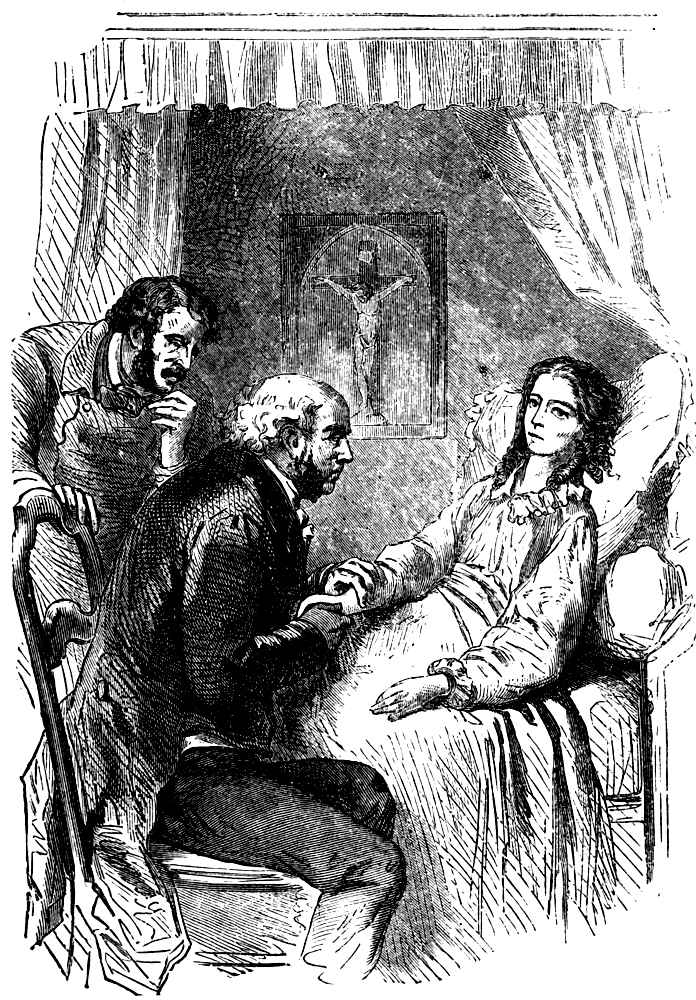
I lived miserably on account of the season, for the home I had selected was in a forest where I could scarcely find the wherewith to keep me from dying of hunger and thirst. When the streams were frozen I ate snow, my only nourishment was got by nibbling thistles, my only shelter the pines. How often did I not compare my present sad existence with that I had led at my good master George’s, and even at the farmer’s to whom he had sold me, until I gave myself up to idleness, mischief and revenge. However, there were no means of improving my miserable condition, for I was determined to remain free, and master of my actions. Sometimes, by way of recreation, I went to the outskirts of a village very near the forest, to find out what was going on in the world. One day, it was Springtime (and the fine weather had set in,) I was surprised to notice that something extraordinary was going on, the village wore a festive air, people went in throngs, every one arrayed in his or her holiday garments, and what was still more astonishing, all the donkeys of a neighboring county were collected there, curried and rubbed, carrying neither panier [Pg 54]nor saddle, some even having flowers on their head or around their neck, and every one accompanied by a master, leading him by a bridle.
“This is singular,” thought I, “there is no fair going on to-day! What can all my comrades be doing here, curried and decorated? And how fat they are! they have certainly been well fed this winter!”
As I mentally ejaculated these words, I looked at myself; my back, my belly, my crest were thin and rough, and the hair all over my body standing awry, but I felt strong and vigorous.
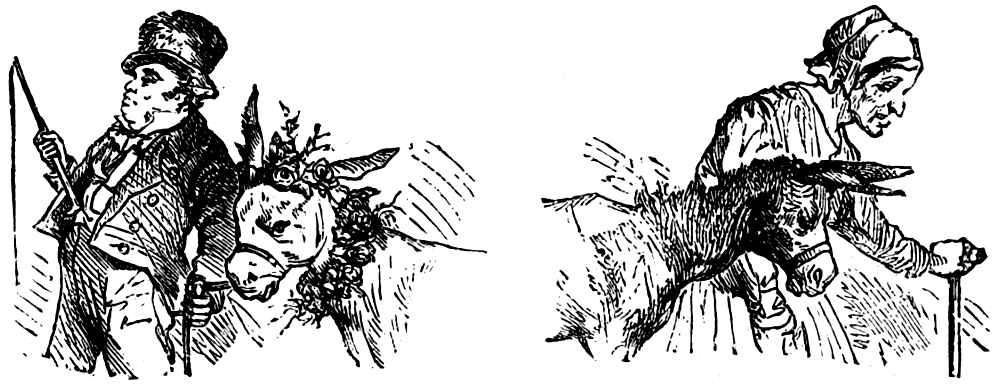
“I would rather be homely,” thought I, “but healthy and active; none of my comrades here, so handsome, fat and well cared for, could support the fatigues and privations I have endured all winter.” As I drew near to ascertain the meaning of this re-union of donkeys, one of the boys in charge of them, perceiving me, began to laugh.
“Come boys, come see the beautiful donkey that has just arrived! How well curried he is!” cried he.
“And well fed and cared for,” said another. “Has he come for the race?”
[Pg 55]
“If he has, let him run,” cried a third, “there is no danger of his gaining the prize.”
A general laugh followed these words. Though displeased at the boys’ stupid jokes, my vexation was tempered by the satisfaction of having learned what all the commotion meant. There was to be a race, but when or how? Wishing to know more, I continued to listen, though apparently understanding nothing of what was said.
“Are they going to start soon?” inquired one of the young men.
“I do not know, they are waiting for the Mayor.”
“Where is the race course?” said a good woman who had just arrived.
“In the big meadow by the mill, mother Tranchet,” answered John.
“How many donkeys are there here now?”
“There are sixteen not counting you, mother Tranchet.” A burst of laughter followed this jest.
“Ah! you are a scamp!” said mother Tranchet laughing, “and what does the winner of the race get?”
“Honor first, and a silver watch next.”
“I would be well pleased to be a donkey for the sake of gaining the watch; I have never had the money to buy a watch.”
“Well, if you had brought a donkey you would have to run—the chance.”
And all laughed their heartiest.
“Where do you suppose I would get a donkey? Have [Pg 56]I ever had the means to buy one, or to feed one after buying it.”
This good woman pleased me greatly she had such a cheerful, lively air; and the idea struck me of trying to win her the watch. I was accustomed to running, for every day in the woods I took long runs to warm myself, and I had formerly enjoyed the reputation of running as long and as swiftly as a horse.
“Come,” said I to myself, “let’s try; if I do not win, I lose nothing; if I do win, I shall gain a watch for mother Tranchet, who greatly desires it.”
Starting off at a little trot, I took my place beside the last mule, and assuming a proud air I began to bray vigorously.
“Stop! stop!” exclaimed Andrew, “will you stop that music? Get away donkey, you are without a master, you are too badly curried, you can’t run.”
I held my peace, but did not budge. Some laughed, some were vexed, and they were beginning to contend among themselves, when mother Tranchet exclaimed:
“Well, if he has no master, he is going to have a mistress; I recognize him now. It is Cadichon, poor Miss Pauline’s donkey; they drove him off when the poor, little thing was no longer there to protect him, and I firmly believe he has lived all winter in the woods, for no one has seen him since. I take him to-day into my service; he is going to run for me.”
“It is Cadichon!” cried several in various directions. “I have heard of this famous Cadichon.”
[Pg 57]
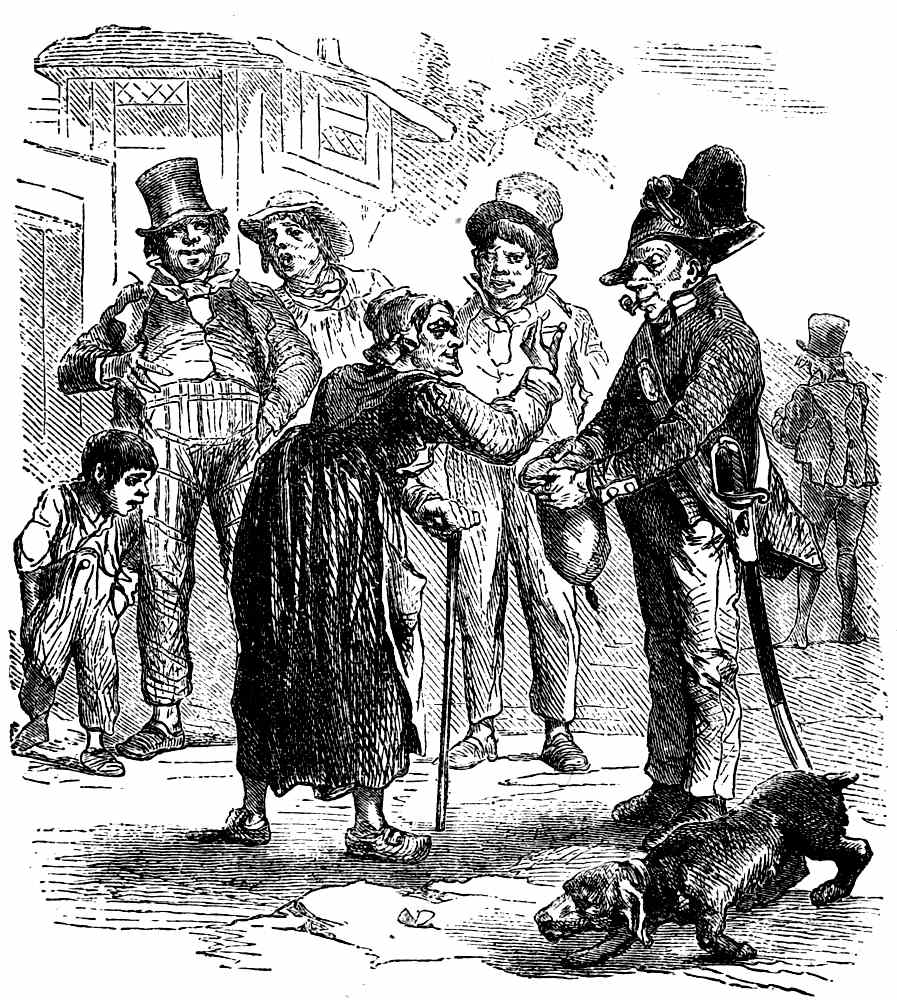
“But mother Tranchet,” said John, “if he is going to run for you, you must drop a silver piece of fifty centimes in the Mayor’s bag, just like everybody else.”
“That shall not hinder me, my children, here is my money,” she added, untying a knot in her handkerchief, “but don’t ask any more, for I haven’t it.”
“Ah well! if your donkey wins you will not lose anything, for all the village has contributed to this bag, it contains more than a hundred francs.”
I approached mother Tranchet, and I whirled on my heel, leaped and kicked with such facility, that the boys began to fear I might win the day.
“Listen, John,” said Andrew in an undertone, “you were wrong to let mother Tranchet contribute to the bag. That gives her a right to let Cadichon run, and he has such a nimble air, I fear he may win the watch and money.”
“Ah bah! how silly you are! Don’t you see there what a figure this poor Cadichon cuts! He is going to make us laugh, he’ll not go far indeed.”
“I can’t say, suppose I coax him off with some oats.”
“And what of mother Tranchet’s money?”
“Her donkey gone, the money would be returned to her.”
“I agree; Cadichon is no more to her, than to you or me. Get some oats and try to coax him off without mother Tranchet’s knowledge.”
I had heard and understood all; so when Andrew returned with the oats in his apron, instead of approaching [Pg 60]him, I drew near mother Tranchet, who was talking with her friends. Andrew followed; John thinking I had not seen the oats, took me by the ears and made me turn my head. Still I would not budge, notwithstanding my longing to taste such a luxury. Andrew began to push, John, to pull me, and I to bray in my loudest voice. Mother Tranchet turned, and seeing the manœuvres of Andrew and John:
“Boys,” said she, “you are not doing right there. Since you made me deposit my silver piece in the bag, you must not take Cadichon off. It appears to me that you are afraid of him.”
“Afraid! afraid of a dirty donkey like that! Oh! no, we have no fears of him,” said Andrew.
“Then why would you try to lead him off?”
“To give him some oats.”
“Ah! that’s a different thing!” replied mother Tranchet in a sportive way, “you are very obliging, just pour the oats on the ground so that he can eat them at his ease! And to think that I suspected you of giving them to him from malice! How one can be mistaken.”
Andrew and John were ashamed and vexed, but they took good care to conceal it. Their companions laughed to see them so nicely caught, mother Tranchet clapped her hands, and as for me, I was delighted, eating my oats with avidity, and feeling a renewal of strength as I did so. I was quite pleased with mother Tranchet also. Having finished eating, I was impatient to start. At last there was a great tumult, the Mayor had just ordered [Pg 61]us to be ranged in line. I modestly took the last place. My appearance alone, without a master, was the signal for a general inquiry as to who I was, and to whom I belonged.
“To no one,” said Andrew.
“To me,” cried mother Tranchet.
“It is necessary to contribute to the bag, mother Tranchet,” said the Mayor.
“I have done so, Mr. Mayor.”
“Good; write mother Tranchet’s name,” said the Mayor.
“It is already down, sir,” replied the secretary.
“Very well,” said the Mayor. “Is everything ready? One, two, three! Start!”
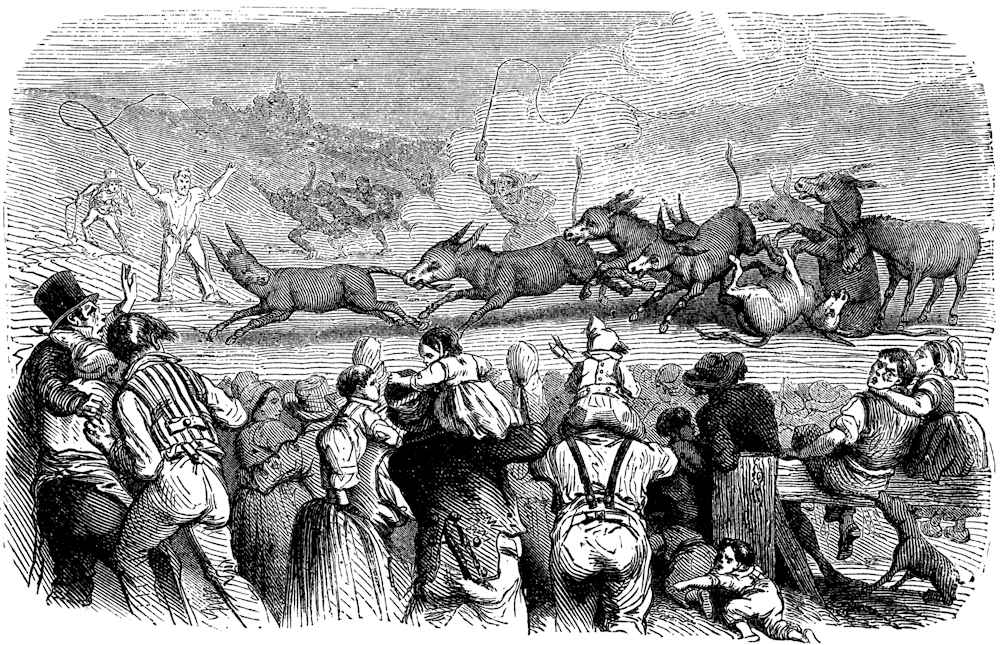
At this the boys suddenly released the donkeys they were holding, giving them a smart blow of the whip at the same time. All started. No one had held me, and as I honestly awaited my turn all the others had a slight advantage over me. But we had not gone more than a hundred steps ere I reached them. Behold me now at the head of the band, outstripping them, indeed, without overtaxing myself to do so. The boys halloed and cracked their whips to urge on their own. I glanced back occasionally to see their disconcerted visages, to contemplate my triumph and laugh at their efforts. My companions, furious at being distanced by me—a poor, unknown, piteous looking creature—redoubled their efforts to overtake me, and endeavored to block the road, one against another. I heard behind me savage cries, [Pg 62]kicks, bites. Twice was I reached, almost passed, by John’s donkey. Perhaps I ought to have employed the same means against him that he had used in outstripping his companions; but I disdained such unworthy manœuvres. I saw, however, that not to be beaten it was necessary to do my utmost. With a vigorous bound, I dashed ahead of my rival, who at the same moment seized me by the tail. So great was the pain that I almost dropped down on the spot; but the thought of victory inspired me with courage to snatch myself away, leaving a piece of my tail in his mouth. The desire of vengeance gave me wings. I ran with such speed that not only did I reach the goal first, but far, far ahead of all my rivals. I was breathless, exhausted, but happy and triumphant, reveling amidst the applause of thousands of spectators who thronged the fields. With a victor’s pride I walked up to the tribunal of the Mayor, who was to bestow the prize. Good mother Tranchet also advanced, caressing and promising me a fine repast of oats. She extended her hand for the watch and silver which the Mayor was about to give her, when Andrew and John, running in breathless haste, exclaimed:
“Stop, Mr. Mayor, stop; it is not right, that. No one knows this donkey. Mother Tranchet has no right to the prize. This donkey does not count; it was mine and John’s donkeys that beat; the watch and money belong to us.”
“Did not mother Tranchet contribute to the race?”
“Yes, Mr. Mayor, but—”
[Pg 63]
“Was there any opposition when she did so?”
“No, Mr. Mayor, but—”
“Did you oppose it at the moment of departure?”
“No, Mr. Mayor, but—”
“Then mother Tranchet’s donkey has really won the watch and money.”
“Mr. Mayor, assemble the municipal council to decide this question; you have no right to decide alone.”
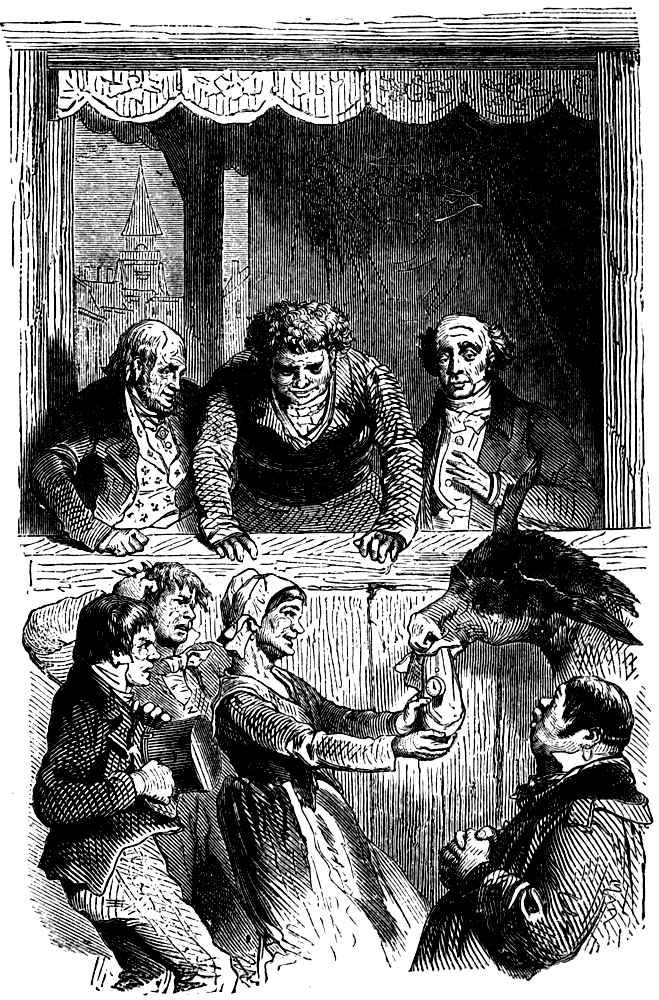
The Mayor hesitated. Seeing this, I abruptly seized the watch and bag with my teeth and put them in the hands of mother Tranchet, who, anxious and trembling, awaited the Mayor’s decision.
This act of intelligence put every one on our side and covered me with applause.
“Behold the question decided by the victor in favor of mother Tranchet,” said the Mayor, laughing. “Gentlemen of the municipal council, at table we will deliberate upon my allowing justice to be decided by a donkey. Friends,” added he, casting a mischievous glance at Andrew and John, “in my opinion the greatest donkey among us is not that of mother Tranchet.”
“Bravo! bravo! Mr. Mayor!” arose from every side. And all laughed except Andrew and John, who went off shaking their fists at me.
And as to myself, was I pleased? No, my pride revolted; the Mayor had insulted me in calling my enemies donkeys. It was ungrateful and base to do so. I had displayed courage, forbearance, patience, intelligence, and this was my recompense! Having insulted, they [Pg 66]abandoned me. Even mother Tranchet, in her joy at getting a watch and a purse of a hundred and thirty-five francs, forgot her benefactor and thought no more of the promised repast of oats, but departed with the crowd, leaving me minus the reward I so truly deserved!
Left sad and solitary in the field, and suffering from my bitten tail, I was just wondering to myself if donkeys were not better than men, when I felt a soft hand caress me, and heard a voice not less gentle, saying:
“Poor thing! they have been unkind to you, come, poor beast, come go home to grandma’s, she will feed and care for you better than your wicked masters! Poor donkey! how thin you are!”
Turning round, I saw a pretty little boy about five years old, his sister apparently three, and the nurse.
“James,” said Ruth, “what are you saying to this poor donkey?”
“I told it to come home to grandma’s, it is all alone, poor beast!”
“Yes, James, take him; wait, I am going to get on his back. Nurse, nurse, put me on the donkey’s back.”
The nurse put the little girl on my back; James wished to lead me, but had no bridle.
[Pg 67]
“Wait nurse,” said he, “I am going to tie my handkerchief around his neck.”
Little James tried to do so, but my neck was much too large for his small handkerchief; the nurse gave him hers and it was too small.
“What shall I do nurse?” said he, ready to cry.
“We must get a halter or rope from the village. Come, my little Ruth, get down.”
“No,” said Ruth, clinging to my neck, “I want to stay on the donkey, I want him to take me home.”
“But you have nothing to lead him with; you see he won’t move any more than if he were a stone.”
“Wait nurse, yes he will, I know his name, it is Cadichon, mother Tranchet told me so, I am going to pet and coax him, and I believe he will follow me.”
James came up to me and whispered in my ear. “Go my nice Cadichon, please go.”
This dear little boy’s confidence touched me, I noticed with pleasure, that instead of asking for a stick to make me go, he had thought only of kind and gentle means. So, scarcely had he finished his words and the accompanying caresses, ere I began to move.
“You see nurse, he understands me, he loves me,” exclaimed James, his cheeks flushed, his eyes sparkling with joy, as he ran a little in advance to show me the way.
“As if a donkey could understand anything! he goes because he is tired of standing here.”
“But nurse, he follows me, you see.”
[Pg 70]
“Because he smells the bread in your pocket.”
“Do you think he is hungry, nurse?”
“Very likely, you see how thin he is.”
“Yes he is, poor Cadichon, and for me not to think of giving him my bread.”
And taking from his pocket the piece of bread intended for his luncheon, he offered it to me.
I was offended at the nurse’s unkind suggestion, and delighted with an opportunity of proving that she had judged me harshly, I followed James and carried Ruth on my back, not from interest at all, but from civility and courtesy.
I refused the offered bread, and contented myself with licking James’s hand.
“Nurse, look! look! he licks my hand,” exclaimed James. “He does not want the bread. Oh! my dear, nice Cadichon, how I love you! You see now nurse, that he follows me because he loves me, and not to get the bread.”
“So much the better for you, if you can believe you have a donkey like one nobody else ever saw, a model donkey. I know they are all headstrong and vicious, and for my part, I do not like them.”
“Oh nurse, poor Cadichon is not vicious, see how good he is to me.”
“And how long will it all last?”
“My Cadichon, you will always be good to me and Ruth, won’t you?” said James, caressing me.
I turned towards him with such a look of affection, [Pg 71]that in spite of his tender years, he noticed it; then I cast upon the nurse such a furious glance that she likewise observed it, for she said immediately:
“What a wicked eye! and defiant air! he looks at me as if he wanted to devour me!”
“Oh nurse,” replied James, “how can you say that? he looks at me with such a gentle air, as if he wished to embrace me.”
Both were right, and I had not been misunderstood. I promised myself to be gentle and good to James, Ruth, and all on the place who would be kind to me, and I also made the wicked resolution, of being spiteful and vicious to those who would maltreat or insult me, as the nurse had done. This desire of vengeance, was eventually to cause me much unhappiness.
Talking as they went, we kept on and soon reached their grandmother’s residence.
They left me at the door, where I stood quietly, like a well behaved donkey, not even nibbling the grass that bordered the gravel walks.
In two minutes, James re-appeared, accompanied by his grandmother.
“Come see, grandma, come see how gentle he is, and how he loves me. Do not believe nurse, I beg you,” said James clasping his hands.
“No, grandma, don’t believe it, I entreat you not to believe it,” repeated Ruth.
“Let us see,” said the grandmother smiling, “let us see this famous donkey.”
[Pg 72]
And coming up to me, she touched me, she caressed me, she took hold of my ears, put her hand to my mouth, I stood very quietly, making not the slightest attempt to bite her, or even get away from her.
“He seems to be very gentle,” she said, “how could you say, Emily, that he had a wicked look?”
“Isn’t he good, grandma, isn’t he? and mustn’t we keep him?” said James.
“My dear little one, I believe he is very good; but how can we keep him, since he is not ours? He must be taken back to his master.”
“He has no master, grandma.”
“We are sure he has no master, grandma,” replied Ruth, who always repeated her brother’s words.
“How is that, it is impossible.”
“It is true, grandma, mother Tranchet told me.”
“Then how did he gain the race prize for her? Since he ran for her, she must have borrowed him from some one.”
“No, Grandma, he came all alone, and wanted to run with the others. Mother Tranchet paid the risk, but she does not own him, he belongs to nobody, it is Cadichon, whose mistress, poor Pauline died; her parents drove him off, and he has lived all winter in the woods.”
“Cadichon! the famous Cadichon who saved his little mistress from the fire? Ah! I am very glad to know him; he is truly an extraordinary and admirable donkey.”
And she walked around me, regarding me attentively. Proud to see my reputation so well established, I reared my head, inflated my nostrils and shook my mane.
[Pg 73]
“Oh! how thin he is! Poor beast! his devotion met with little recompense,” said the grandmother in a serious manner and tone of reproach. “We will keep him, my child, we will keep him, since he has been abandoned and driven off by those who ought to have cared for and loved him. Call Bouland to put him in the stable and give him a good bed.”
James, delighted, ran to get Bouland, who came immediately.
“Bouland, here is a donkey the children have brought home; take him to the stable and feed and water him,” said the grandmother.
“Must he then be taken to his master?” said Bouland.
“No; he has no master. It appears that he is the famous Cadichon that was driven off after the death of his little mistress. He came to the village and my little children found him abandoned in the field. They brought him home and we are going to keep him.”
“And madam does well to keep him; there is not his equal in all the country. I have heard most wonderful things about him. They say he hears and understands all that is said to him. Let us try him, madam. Come, Cadichon, come get some oats.”
I immediately turned and followed Bouland.
“It is astonishing,” said the grandmother; “he really understood.”
And she went in the house, but James and Ruth accompanied me to the stable. I was placed in a stall, my companions being two horses and a donkey. Bouland, [Pg 74]assisted by James, made me a good bed, and then went to get my oats.
“More, more, Bouland; I beg you to give him more,” said James; “he needs a hearty meal, he has run so hard.”
“But, Master James, if you give him too many oats he will get so lively that you and Miss Ruth can’t ride him.”
“Oh! he is such a good donkey, I know we can ride him all the same.”
They gave me an enormous quantity of oats and put a bucket of water beside me. Being thirsty, I first drank a little and then attacked my oats, meanwhile congratulating myself upon having fallen into the hands of this good little James. I also made some reflections upon mother Tranchet’s ingratitude. Then devouring my bundle of hay, I lay down on my straw, and, couched like a king, I slept.
[Pg 75]
My only employment next morning was to take the children riding an hour. James himself got me my oats, and in spite of Bouland’s warning, he gave me enough to feed three donkeys my size. I ate all that was given me; I was happy. But on the third day I felt sick, I had fever, and both head and stomach seemed affected; I could eat neither hay nor oats, but remained extended upon the straw.
“Here is Cadichon not up yet,” said James coming to see me. “Come, Cadichon, it is time to rise, I am going to give you your oats.”
I endeavored to rise but my head fell back heavily upon the straw.
“Oh! Cadichon is sick,” exclaimed little James, “Bouland, Bouland, come quick, Cadichon is sick!”
“How is that,” said Bouland, “he ate his breakfast this morning?”
Going up to the trough, Bouland looked in and said:
“He is sick, he has not touched his oats—his ears are warm,” added he, taking hold of my ears, “and his side beats.”
[Pg 76]
“What does that mean, Bouland?” exclaimed poor James, in great alarm.
“It means master James, that Cadichon has a fever, you have fed him too high, we must get the veterinary.”
“What is a veterinary?” asked James, still more alarmed.
“It is a horse doctor. You see, master James, I told you right. The poor beast suffered this winter from hunger and want of shelter, (you can tell by looking at him, see the color of his hair and how lean he is,) then he got very much heated running at the race. He ought to have had a few oats, and some grass to strengthen him, but you have given him just as many oats as he could eat.”
“Oh! my poor Cadichon! he is going to die, and it is my fault!” said James with a sob.
“No, master James, he is not going to die this time, but he must be bled and put out on grass.”
“Oh! but it will hurt so to bleed him,” said James, all in tears.
“Not this bleeding; you will see, for I am going to bleed him at once, whilst waiting for the veterinary.”
“I don’t want to see, I don’t want to see,” cried James, running away, “I am sure it will hurt him.”
Bouland took his lancet, placed it on a vein in my neck, struck it a slight blow with a hammer, and the blood gushed out immediately. As the blood flowed, I began to feel better, my head became less heavy, and I was relieved of oppression; I was soon able to rise. Bouland [Pg 77]stopped the blood and gave me some bran water, and in about an hour led me into the field. I was better but not well, and nearly eight days elapsed before I entirely recovered. Meanwhile, James and Ruth loaded me with such kindness and attentions as I shall never forget. They came to see me several times a day; they gathered grass and held it up to my mouth, that I might be spared the trouble of bending my head to browse; they brought me garden salad, cabbage and carrots; every evening they led me into the stable themselves, to find the trough full of my favorite dainty, potato pickings with salt. One day, dear little James wanted to give me his pillow, because, he said, my head was too low when I slept. Another time Ruth wished to lend me her coverlet, to keep me warm at night, and again, they wrapped my legs with pieces of woolen stuff, for fear of my taking cold. I was distressed at not being able to express my gratitude, for I had the misfortune of understanding everything, without the power of uttering a word. I got well at last, and soon after my recovery, learned that James and Ruth with several of their cousins, were getting up a donkey party to the woods.
[Pg 78]
The children were assembled in the yard, and with them were many donkeys from the neighboring villages. I recognized nearly all of the latter as my rivals at the race. John’s donkey eyed me savagely, whilst I, in return, bestowed upon him most insulting glances. Nearly all the grandchildren of James’s grandmother were there: Maud, Beatrice, Elizabeth, Helen, Ruth, William, Henry, Louis and James. All the mammas were to accompany them on donkeys, whilst the papas went on foot and armed with switches to keep the lazy animals moving. Before starting, there was as usual in such cases, a slight contention as to who should have the best animal; everybody wanted me, no one was willing to give up, so it was at last decided to draw lots. I fell to the lot of little Louis, James’s cousin; he was an excellent child, and I would have been well satisfied had I not seen poor little James’s unsuccessful efforts to hide his tears. Every time he looked at me they would flow afresh. I felt very sorry, but was unable to comfort him; however, it was necessary for him as well as myself to learn resignation and patience. With manly resolution he mounted his donkey, saying to Louis as he did so:
[Pg 79]
“I will keep near you, Louis; don’t make Cadichon gallop too fast, or I will be behind.”
“And why would you remain behind? why not gallop like me?”
“Because Cadichon gallops faster than any other donkey in the country.”
“How do you know?”
“Because I saw him run for the prize the day of the donkey race at the village, and he was far ahead of all the others.”
Louis promised his cousin not to go too fast, and we both started off in a trot. My companion was no laggard, so I had to restrain myself but little that we might keep together. The others following, some briskly, some tardily, we thus reached the forest where stood the very beautiful ruins of an old convent and chapel that the children were anxious to see. The place bore an evil reputation throughout the country, and no one liked to go there except in large companies. At night, it was said, strange noises were heard issuing from the ruins, groans, cries, the clinking of chains; and several travelers who laughed at these accounts, and went to visit the spot alone, never returned and were never afterwards heard of.
Every one dismounted, and when we had been turned loose to graze with the bridle over our heads, the papas and mammas took their children by the hand to prevent their straying off or lagging behind, and much to my anxiety the whole party was soon lost to sight amid the [Pg 80]ruins. I likewise left my companions, and screened myself from the sun under a half-ruined arch, upon a declivity beside the woods, and a little farther distant than the convent. I had scarcely been there a quarter of an hour when I heard a noise near the arch. Crouching in a recess of the ruined wall, where unperceived, I could see all around, I listened. The noise, though dull, increased; it seemed to be underground.
Not many minutes and I saw a man’s head cautiously peering up amidst the bushes.
“Nothing,” said he in a low tone, looking all around. “No one—you may come, comrades. Every one is to take a donkey and lead him carefully.”
He then moved out of the way to allow passage to about a dozen men.
“If the donkeys escape,” said he, in an undertone, “don’t amuse yourselves running after them. Quick, and no noise, that is the order.”
Creeping through the woods, which were very thick just there, the men moved cautiously but quickly. The donkeys seeking shade, were browsing upon the grass at the edge of the forest. At a given signal, every robber caught a donkey by his bridle and led him into the thicket. Instead of resisting, struggling and braying to give the alarm, these donkeys allowed themselves to be taken as passively as if they were sheep. Five minutes after the robbers had reached the thicket at the foot of the arch. One by one my comrades were led into the bushes, whence they disappeared. I heard the noise of their footsteps under ground, then all was silent.
[Pg 81]
“Here,” thought I, “is an explanation of the mysterious noises that have frightened the country, a band of robbers concealed in the convent vaults. They must be taken, but how? that’s the difficulty.”
I remained concealed in my recess (whence I had a fine view of the entire convent ruins, and the surrounding country), and did not stir until I heard the voices of the children seeking their donkeys. Then I ran forward to prevent their going too near the arch and thicket, so skilfully concealing the entrance to the vaults that it was impossible to perceive them.
“There is Cadichon!” exclaimed Louis.
“But where are the others?” said all the children at once.
“They must be near,” said Louis’s papa.
“We had better seek them by the ravine behind the arch; the grass there is fine, and they have probably wished to taste it.”
Trembling at thoughts of the danger they incurred, I rushed from the side of the arch to prevent their passing. They endeavored to make me move, but I resisted so stoutly, barring the passage whichever way they attempted to go, that Louis’s papa stopped his brother-in-law and said to him:
“Listen, there is something very extraordinary about Cadichon’s behavior. You know what is said of this animal’s intelligence. Listen to me, and let us turn back. Besides, it is not likely that all the donkeys would be on the other side of the ruins.”
[Pg 82]
“You are right,” answered James’s papa, “and I perceive the grass around the arch pressed down as if it had been recently trampled upon. No doubt our donkeys have been stolen.”
They returned towards the mammas, who had kept the children with them, and I followed with a light heart, happy at having probably averted a terrible calamity. They talked low, and I perceived that they got close together.
“How shall we manage this?” said Louis’s mamma, when they had called me up. “One donkey can’t carry all these children.”
“Put the smallest on Cadichon, and let the rest follow with us,” said James’s mamma.
“Come, Cadichon, let us see how many you can carry,” said Helen’s mamma.
Ruth being the smallest, was put in front, then Helen, then James, then Louis. The whole four were not heavy, and wishing to show that I could carry them without the least fatigue, I set off in a trot.
“Not so fast, Cadichon!” cried the papas, “gently, so we can hold on to those on your back.”
I changed my gait to a walk, and proceeded, surrounded by the larger children and the mammas, the papas following to assist those that were disposed to lag behind.
“Mamma, why didn’t papa hunt for our donkeys?” said Henry, who was the youngest of the band, and found the way long.
“Because your papa thinks they have been stolen, and it would be useless to seek them.”
[Pg 83]
“Stolen! who stole them? I saw nobody.”
“Nor did I, but there were traces of footsteps around the arch.”
“But then, mamma, he ought to have hunted for the robbers,” said William.
“That would have been very imprudent, as there must have been several men, to have taken thirteen donkeys. They were probably armed, and would have killed or wounded your papas.”
“Armed, mamma!” said William.
“Yes, with clubs, knives, perhaps pistols.”
“Oh! how very dangerous! Papa was right to return with my uncles!” exclaimed Maud.
“We must hasten home, for your papa and uncles are going to the village after our return.”
“Why, mamma?” asked William.
“To warn the guards, and try to recover the donkeys.”
“I am sorry we went to see the ruins,” said Maud.
“Why?” replied Beatrice, “they were beautiful.”
“Yes, but it was very dangerous. Suppose the robbers had captured us instead of the donkeys?”
“That would have been impossible! there were too many of us,” said Elizabeth.
“But there must have been a number of robbers,” was Maud’s reply.
“We would all have fought them,” said Elizabeth.
“With what? we had only a stick.”
“And our feet, our fists, our teeth; I would have scratched them to death; I would have torn their eyes out!”
[Pg 84]
“And the robbers would have killed you, that’s all,” said William.
“Killed me! and papa and mamma there! do you suppose they would have allowed the robbers to carry me off or kill me?”
“The robbers would have killed them too, and before they killed you,” answered Beatrice.
“Do you think, then, that there was an army of robbers?”
“There could not have been less than a dozen.”
“A dozen? what nonsense! do you believe that robbers always go in dozens, like oysters?”
“You are always making fun of whatever is said to you! I say that to carry off thirteen donkeys, there must have been at least twelve men.”
“I bet so myself, and the thirteenth was to make good measure, like little pies.”
The mammas, and the other children laughed at this conversation, until it turned into dispute; then Elizabeth’s mamma bade her be silent, and said that Beatrice was probably correct as to the number of robbers.
We were not long in reaching the house, and great was the surprise of all there, to see the party returning on foot, and me, Cadichon, carrying four children. But when the papas recounted the disappearance of the donkeys, and my persistency in not allowing any one to approach the arch, all shook their heads, and gave vent to a multitude of most singular suppositions; some said the donkeys had been swallowed up by demons; others, [Pg 85]that the religious buried in the chapel had seized them to ride all over with them; and others again, that the angels guarding the convent, reduced to dust and ashes every animal approaching too near the cemetery where the souls of the religious wandered. Not one suggested the idea of robbers concealed in the vaults.
Immediately on their return, the three papas acquainted the grandmother with the probable theft of their donkeys, after which the horses were put to the carriage, and they went to lay their complaint before the authorities of the neighboring town. In two hours they returned with an officer and six guards. Such was my reputation for intelligence, that the gravest suspicions were based upon my resistance to the attempted passage of the arch. The guards were armed with pistols and carbines, ready to take the field. However, they accepted the grandmother’s invitation to dinner, and sat down to the table with the ladies and gentlemen.
[Pg 86]
The dinner was not long, for the soldiers were anxious to make their inspection before night. They asked the grandmother’s permission to take me with them.
“He will be very useful in our expedition, madam,” said the officer. “This Cadichon is not an ordinary donkey; he has already accomplished more difficult things than we are going to require of him.”
“Take him, if you think it necessary, but do not fatigue him too much, I beg of you. The poor beast made that journey this morning and returned with four of my grandchildren on his back.”
“Oh, as to that, madam, you may be perfectly easy; be sure we will treat him as kindly as possible.”
Having eaten and drunk, my dinner being a peck of oats, an armful of salad, carrots and other vegetables, with a bucket of water, I was ready to start. When they came to take me, I placed myself at the head and they all followed—a donkey guiding soldiers! They did not seem vexed at this, however, for they were all good men. Soldiers are generally considered rough and harsh, but I assure you they are just the contrary; no people in [Pg 87]the world are kinder, none more charitable, patient and generous than these same military men. Whilst on the road they took every imaginable care of me, relaxing their pace when they thought me fatigued, and proposing to let me drink at every stream we crossed.
It was nearly night when we reached the convent. Fearing their horses might be a disadvantage, they had been left at a village near the forest. The officer now gave orders for the men to follow all my movements and to keep together. Without hesitation I led them to the entrance of the arch overgrown with bushes, and whence I had seen the twelve robbers issue.
With the greatest anxiety, I saw that they remained there. To get them away I went a few steps behind the wall; they followed and I returned to the bushes, preventing them from returning also, by barring the way whenever they attempted a step in that direction. They understood me and remained concealed along the wall.
I then approached the entrance to the vaults, and began to bray with all the strength of my lungs. I was not long in attaining my object. All my imprisoned comrades responded vigorously. I made a step towards the soldiers, who divined my manœuvres, and I returned to the entrance of the vaults, where I began to bray again. This time there was no answer, and I suspected that the robbers to prevent my comrades’ braying had tied stones to their tails. Everybody knows that on braying we raise our tails, and not being able to raise their tails, because of the weight of the stones, my comrades held their peace.
[Pg 88]
I remained about two steps from the entrance. Soon a man’s head cautiously peered up amidst the bushes. Looking all around and seeing no one but myself:
“Ah!” said he, “here is the knave we missed this morning. You will rejoin your companions, my brayer.”
As he was about to seize me, I retreated a couple of steps, he followed, I still kept out of his reach, until I had brought him to the angle of the wall, behind which my friends, the soldiers, were concealed.
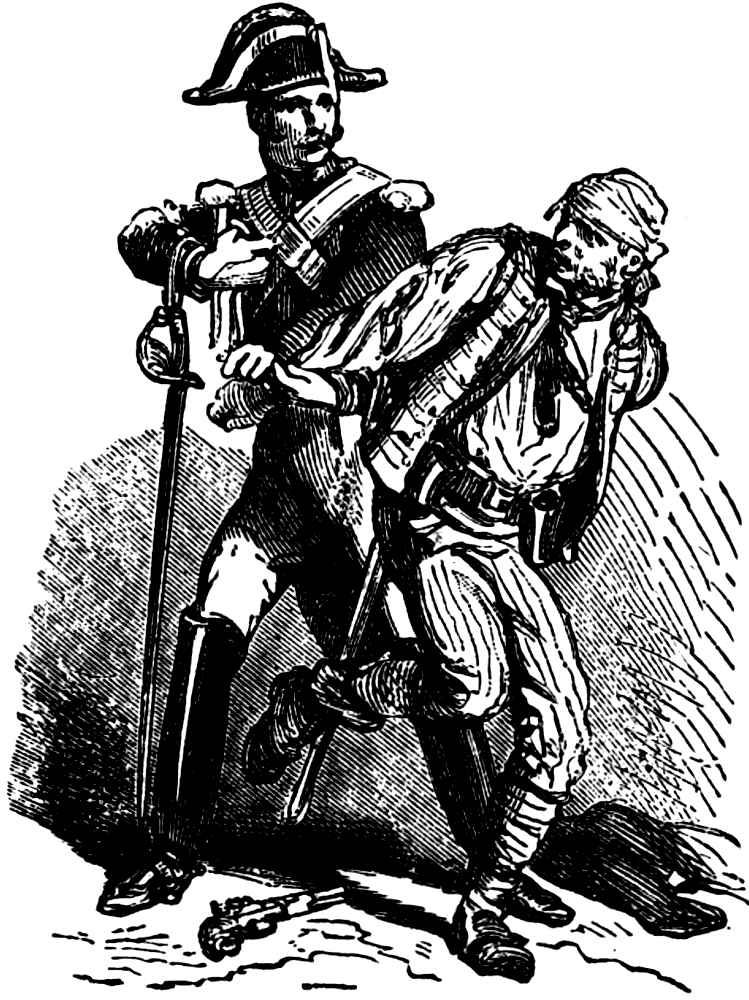
Before he had time to utter a cry even, they had seized, gagged, and bound and extended him on the ground. I returned to the entrance and brayed again, not doubting but this would bring another to see what had become of his companion. And sure enough, I soon heard a slight movement among the bushes, and saw a new head looking [Pg 89]around with the same precaution. Not being able to reach me, the second robber did precisely as the first. I executed the same manœuvre, and he was in the soldiers’ hands before he had time to know what had happened. I proceeded thus, until six were taken. After the sixth, I brayed in vain; no one appeared. I suppose, noticing that their companions did not return, the robbers began to suspect a trap and determined to run no more risks.
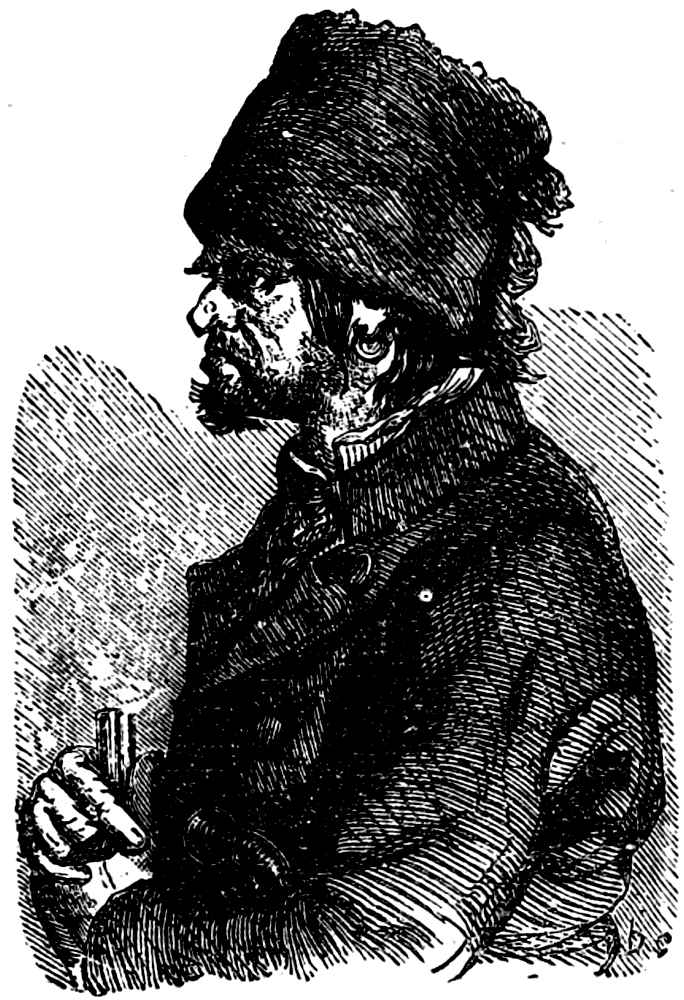
Meanwhile, night had set in and we could scarcely see. The officer sent one of his men for reinforcements to attack the robbers in their cave, and to take away in a vehicle, the six prisoners bound and gagged. The remaining soldiers were divided into two bands to guard the convent outlets; as for me, receiving many caresses and [Pg 90]unbounded compliments, I was allowed to follow my own inclinations.
“If he were not a donkey,” said one soldier, “he would merit the cross.”
“Hasn’t he one on his back?” said another.
“Hush that,” said a third, “its a poor joke; you know very well that this cross is marked upon their backs to remind us that one of their number had once the honor of carrying our Lord Jesus Christ.”
“That’s why it is a cross of honor,” was the answer.
“Silence,” said the officer in an undertone, “Cadichon pricks up his ears.”
I indeed heard an extraordinary noise from beneath the arch, it was not the sound of footsteps, but rather that of stifled cries and a sort of crackling. The soldiers likewise heard it, but could not divine the cause. At last a thick smoke was seen issuing from the air holes and lower windows of the convent, tongues of flame leaped out, and in a few minutes all was on fire.
“They have set fire to the vaults, so they can escape by the doors,” said the officer.
“It must be extinguished, lieutenant,” replied a soldier.
“Be very careful! Guard every opening more closely than ever, and if the robbers show themselves, fire your carbines, use the pistols afterwards.”
The officer had truly divined their manœuvres; understanding that they had been discovered and their comrades captured, the robbers hoped to avail themselves of [Pg 91]the opportunity afforded by the soldiers’ efforts in extinguishing the flames, to make their own escape and liberate their friends. We soon saw the remaining six and their captain rush out of the masked entrance by the bushes; but three guards were at this post; each one drew his carbine before the robbers had time to use their arms. Two of the thieves fell, and the third let his pistol drop from his hands, his arm was broken. But the captain and the other three rushed furiously upon the soldiers, who, sabre in one hand and pistol in the other, fought like lions. Before the officer and the two soldiers guarding the opposite side of the convent had had time to come to their companions’ assistance, the combat was nearly ended and the robbers all either killed or wounded; the captain who still defended himself against a soldier, being the only one on his feet. His two comrades were dangerously wounded. The arrival of reinforcements ended the contest. In the twinkling of an eye, the captain was surrounded, disarmed, gagged and put beside the other six.
During this struggle the fire died out; in fact, nothing had been burning but some bushes and undergrowth, but the officer before penetrating into the vaults wished to await the arrival of the expected reinforcements. The night was well advanced, when we saw the six additional soldiers and the vehicle which was to take away the prisoners. They were placed in it side by side. The officer being humane, had given orders to remove the gags, and in consequence, the soldiers were loaded with [Pg 92]all manner of abusive epithets, to which, however, they paid no attention. Two of them got into the wagon to escort the prisoners, and meanwhile litters were made to carry the wounded.
During these preparations, I accompanied the officer, who, with eight men, penetrated into the vaults. We traversed a long corridor, which sloped downward, until at last we reached the vaults, where the brigands had established their dwelling. One of these caves served for their stable, and here we found all my comrades captured that day, each one with a stone to his tail. The stones were immediately detached, and the donkeys began to bray in unison. Being underground, it was deafening.
“Silence! donkeys!” said a soldier, “unless you want your trinkets put on again.”
“Let them alone,” responded another soldier, “you know very well they are sounding Cadichon’s praises.”
“I would prefer their doing it in another tone,” said the first soldier laughing.
“This man assuredly,” said I to myself, “does not like music. What does he find to censure in my comrades’ voices.” Poor comrades! they chanted their deliverance.
We continued our inspection. One of the vaults was full of stolen goods. In another, were the prisoners kept to wait on them, some attended to the dishes, the cooking, the cleaning of the vaults, others made the clothing and shoes. Some of these unhappy creatures had been there for two years; they were chained by twos, and had [Pg 93]little bells to their arms and feet, so as to keep one always acquainted with their movements. Two robbers remained constantly with them as guards, and never more than two captives were allowed in the same vault, except those who made the clothing. The latter were all together whilst working, but during this time the end of their chain was attached to a ring fastened in the wall.
I learned afterwards that these captives, about forty in number, were the visitors to the ruins, who had been disappearing for the last two years. They related how the robbers had killed before their eyes, three of them, who were sick, and one who obstinately refused to work.
The soldiers delivered all these poor creatures, brought the donkeys to the castle, carried the wounded men to the hospital, and put the robbers in prison. The latter were judged and condemned; the captain to death, the others to transportation to Cayenne. As for me, I was the universal subject of admiration; wherever I went, I heard persons saying:
“It is Cadichon! the famous Cadichon, worth all the donkeys in the country!”
[Pg 94]
My little mistresses, (for my masters and mistresses corresponded to the number of the grandmother’s grandchildren,) had a cousin, of whom they were very fond. She was near their age, and their most intimate friend. Theresa was her name, and a good, kind little darling she was. She never touched me with a switch, and never permitted anyone to do so when she was on my back.
In one of our promenades, my young mistresses came upon a little girl seated along the roadside. She rose at their approach and came limping towards them, asking alms. They were all touched at her sad, dejected appearance.
“Why do you limp, little one?” said Theresa.
“Because my shoes hurt me, miss.”
“Why don’t you ask your mamma to get you another pair?”
“I have no mamma, miss.”
“Ask your papa, then?”
“I have no papa, miss.”
“But with whom do you live?”
“With nobody, I live alone.”
“Who feeds you?”
[Pg 95]
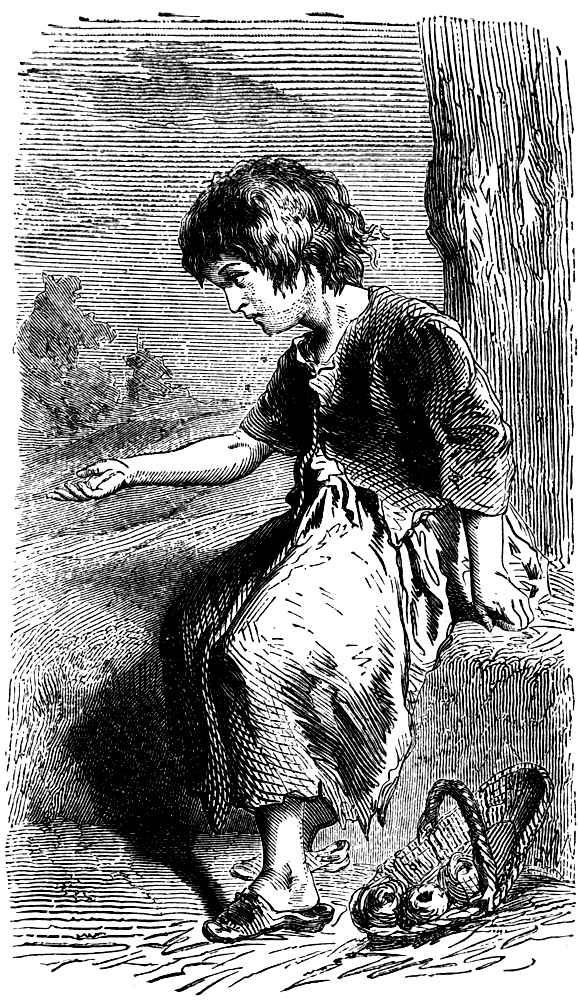
“Sometimes nobody, sometimes everybody.”
“How old are you?”
“I do not know, miss, about seven years perhaps.”
“Where do you sleep?”
“Wherever anybody takes me in; when everybody drives me away, I sleep out-doors, under a tree, near a hedge, anywhere.”
“But in winter you must freeze.”
“I get cold, but I am used to it,”
“Have you had any dinner to-day?”
“I have not eaten since yesterday.”
“Oh! that is dreadful, dreadful,” said Theresa, with tears in her eyes. “My dear cousins, wouldn’t your grandma give this poor little thing something to eat and let her sleep in the castle?”
“Certainly,” answered the three cousins, “grandma would be delighted, and, besides, she always does what we wish her to do.”
“But, Theresa,” said Beatrice, “how shall we get her to the house? see how she limps.”
“Put her on Cadichon, and let us go on foot, instead of taking turns on Cadichon, two by two, as we have been doing.”
“Oh, to be sure; what a good idea,” exclaimed the three cousins.
They put the little girl on my back, and Maud gave her a piece of bread that had been left of their lunch. She was delighted to get a ride, but so great were her [Pg 98]fatigue and hunger, that she ate the bread with avidity, and said nothing.
When we reached home, Maud and Elizabeth took the child into the kitchen, whilst Beatrice and Theresa ran to their grandmother. “Grandma,” said Beatrice, “will you let us give a good little girl that we found on the road something to eat?”
“Certainly, my darling; but who is she?”
“I don’t know, grandma.”
“Where does she live?”
“Nowhere, grandma.”
“Nowhere! how is that? Her parents must live somewhere.”
“She has no parents, grandma, she is all alone.”
“And,” said Theresa, timidly, “will you let the poor little thing sleep here?”
“If she really has no home, I could not turn her away; but I must see her and speak to her.”
So saying, she arose and went to the kitchen where the little girl was finishing her meal. She called the child, who came limping, questioned her and obtained the same replies. It was truly an embarrassing case. To send this child away, plunging her again into the state of abandonment and suffering from which she had just been rescued, would be impossible; but then what was to be done with her? who was to take charge of and raise her?
“Listen, my dear,” said the grandmother, “you will eat and sleep here, whilst I make inquiries as to the truth [Pg 99]of your account, and in a few days I will see what I can do for you.”
She then gave orders to prepare a bed for the child, and not to let her want for anything; but the poor little creature was so filthy that no one wished to touch her or even come near her. Theresa was in despair; she could not insist upon her aunt’s servants doing what was so repugnant to them.
“It was I,” thought she, “who brought her here, and I am the one to have the care and trouble. But how shall I do?”
After a moment’s reflection, an idea presented itself.
“Wait, my dear,” said she, “I will be back presently.” And she ran to her mamma.
“Mamma,” said she, “ought I not to take a bath?”
“Yes, Theresa, go now, your nurse is waiting for you.”
“Mamma, instead of taking a bath myself, would you let me give one to the little girl we have brought here?”
“What little girl? I have not seen her.”
“A poor, poor little thing, who has no papa, no mamma, no one to take care of her, who sleeps out-doors, and eats only what people give her. Maud’s grandma says she may stay at the castle, but none of the servants will touch her.”
“Why not?”
“Because she is so dirty, so dirty, she is disgusting; then mamma, if you are willing, I will bathe her in my place, not to disgust nurse. I will undress and soap her myself, and I will cut her hair, which is all tangled and full of little white insects.”
[Pg 100]
“But, my little Theresa, won’t it disgust you too, to touch and wash her?”
“A little, mamma, but when I think that if I were in her place, it would make me so happy to have somebody care for me, I feel encouraged. And mamma, when she is washed, will you let me put some of my old clothes on her, till I buy her new ones?”
“Certainly, my dear little Theresa, but how can you buy her clothing? You have only two or three francs, about enough to get her a chemise.”
“Oh! mamma, you forgot my twenty franc piece!”
“That you gave your papa to keep for you, so you would not spend it? I thought you were saving that to buy a beautiful prayer book like Maud’s.”
“I would rather do without the beautiful prayer book, mamma, I still have my old one.”
“Do as you wish, my child, whenever there is a question of doing good, I leave you free to use your own pleasure.”
Her mamma embraced her, and then went with her to see this little girl that no one would touch.
“If she has any disease of the skin, that Theresa can catch, I shall not let Theresa touch her,” said the mother.
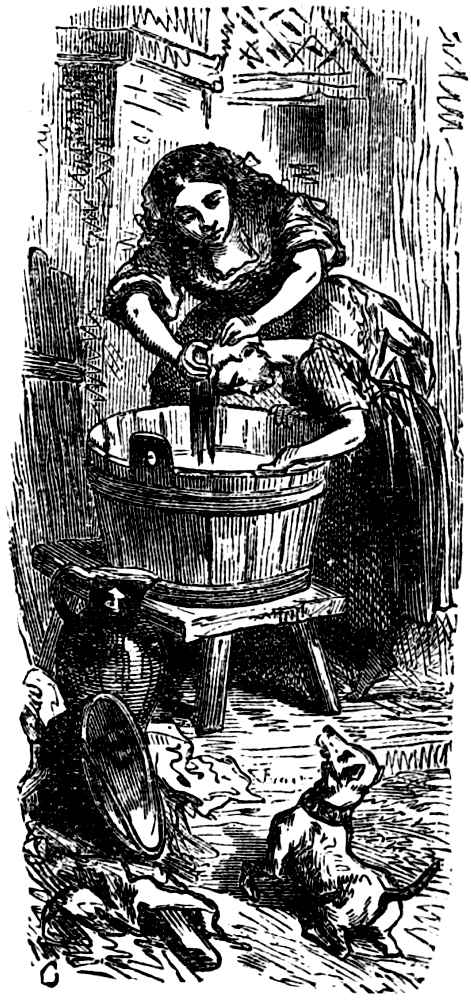
The little girl still waited at the door. A careful examination of her hands and body revealed no traces of disease, but a great deal of dirt. Her hair was so full of vermin, that making her sit on the grass, Theresa’s mamma cut it close to her head, without touching it with her hands. When it was all on the grass, she took it up [Pg 101]on a shovel, and told one of the servants to throw it away out of reach. Then in a tub of tepid water, with Theresa’s assistance, she gave the little beggar’s head a thorough washing and cleaning. Having wiped it, she said to Theresa: “Now, my pet, whilst you give her a bath, I will throw these rags in the fire.” Maud, Beatrice and Elizabeth came to Theresa’s assistance; they all four led her into the bath room and undressed her, in spite of the disgusting odor of her rags and dirt. Then eagerly plunging her in the water, they soaped her from head to foot. The operation was such a pleasant one to all parties, both the little girl and her friends, that she was kept in somewhat longer than necessity required. When the bathing was over, and she had expressed her satisfaction, the four assisted her out of the bath tub. Then after wiping and rubbing her skin until it was very red and as dry as a ham bone, they arrayed her in a chemise, a petticoat and a dress belonging to Theresa, all of which answered the purpose, because Theresa, like other little girls in her station, wore her clothes very short, whilst the little beggar’s were expected to reach her ankles. The waist was somewhat [Pg 102]long, but not being excessively particular, everyone was pleased. When about to put on her shoes and stockings, the children perceived a sore upon the instep. It was this which had made her limp. Maud immediately ran to her grandmother for some salve. The grandmother gave what was necessary, and Maud, assisted by her three friends, one of whom steadied the little girl, whilst a second held her foot, and a third unrolled the bandage and applied the liniment. They were nearly one quarter of an hour arranging a compress and band; sometimes it was too tight, sometimes not tight enough; the band was too high, or the compress too low; they disputed and jerked the sore foot first this way and then that, the owner, meanwhile, not daring to object or utter a complaint. At last, however, the bandage was arranged satisfactorily, a pair of Theresa’s old stockings and slippers put on her feet, and the little beggar relieved of her kind waiting maids’ attentions. When she returned to the kitchen no one recognized her.
“This is certainly not the little fright that just went out of here,” said one servant.
“It is the same child,” replied another servant, “but no one would know it, she looks so genteel now.”
“It is all lost time for Madame d’Arbe and the children to fix her up like that. As for me, I would not have touched her if they had given me twenty francs,” said the cook.
“And she smelt so bad,” said the kitchen girl.
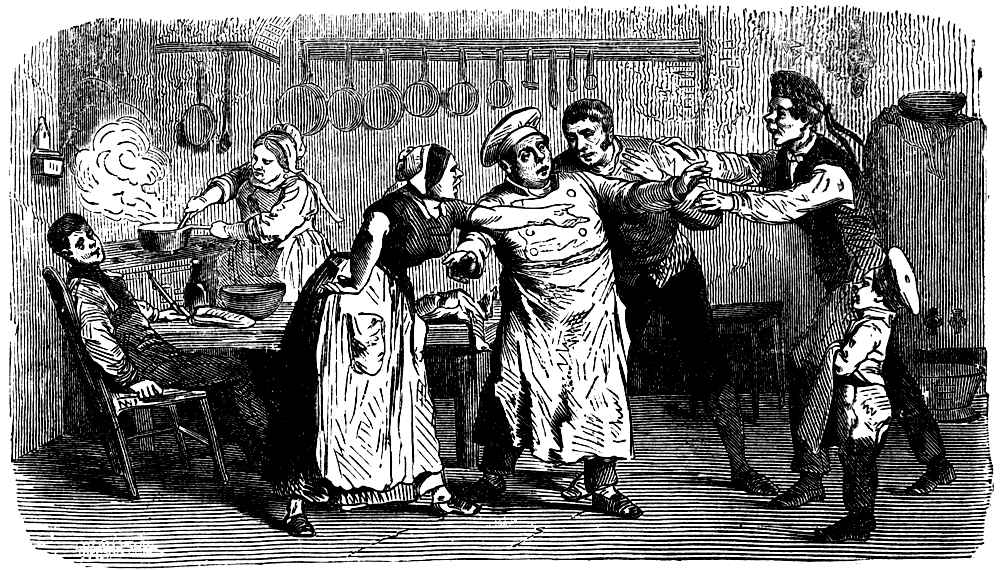
“You ought not to have such a sensitive nose, my [Pg 105]fair one,” replied the coachman, “you who have your gridirons, your saucepans and all such things to clean.”
“My gridirons and saucepans are not strong of the stable, like some people I know,” was the kitchen girl’s answer, somewhat piqued.
“Ah! ah! ah! she is angry, take care of the broom!” said the other servants.
“If she takes hers, I know very well where to find mine,” said the coachman, “and the pitchfork and curry-comb.”
“Come, come,” interposed the cook, “don’t go too far; she is passionate, and you know you must not irritate her.”
“What is that to me? if she gets angry, so will I.”
“But I do not want that here; madam does not like disputes; it is very certain that we all would come in for a share of the blame.”
“Le Vatel is right,” said another servant. “Hush, Thomas, you are always getting up a quarrel. Besides, this is not your place.”
“Indeed! my place is anywhere, when I have no stable work to do.”
“But you have work to do,” replied the cook. “Look at Cadichon, not yet unsaddled, and walking up and down like a countryman waiting for his dinner.”
“I believe Cadichon listens at the doors; he is more cunning than he seems; he is a real scamp of a donkey,” said the coachman, as he called me, and taking hold of my bridle, led me to the stable. Having unbridled and [Pg 106]unsaddled me, he left me alone, that is, with two horses and another donkey, with none of whom I ever deigned to converse.
I know not what took place that evening at the castle, but the next afternoon I was saddled, and with the little beggar on my back, my four little mistresses following on foot, we all went to the village. I learned from their conversation that they were on a shopping expedition for their protégé. Theresa wished to furnish the outfit entire, the others insisted on paying their share, and the dispute grew so animated, that had I not stopped at the store of myself, they would have passed it. In helping the little girl to get down, they nearly pitched her face foremost on the ground, for all darted at her at once; one caught her by the legs, another by the arms, a third by the waist, whilst Elizabeth, who was stronger than two or three of the others put together, pushed them away so that she could help the child off all by herself. Pulled here and there, the poor thing began to cry of fright, until she attracted the attention of passers by. The store-keeper opened the door:
“Good morning, young ladies, let me help you, you are not strong enough to lift this little girl.”
My young mistresses, satisfied at not having yielded to one another, relinquished their hold on the child and the store-keeper immediately lifted her off my back.
“What will you have, young ladies?” said Madam Juivet.
“We want to get materials for clothing for this little girl,” answered Beatrice.
[Pg 107]
“Oh, certainly; is it a dress, a petticoat, or undergarments you wish?”
“We want materials for all, Madam Juivet,” answered Maud; “let us have enough to make three chemises, one petticoat, one dress, one apron, one neckerchief, two bonnets.”
“Let me speak, Maud,” whispered Theresa, “since I am going to pay.”
“No, you are not going to pay all, we wish to pay part,” was the whispered answer.
“But I would rather pay alone,” said Theresa in the same tone, “she is my girl.”
“No, she isn’t, she belongs to us all,” said Maud.
“What materials do you prefer?” interrupted Madam Juivet, impatient to sell.
Whilst Maud and Theresa continued their dispute in an undertone, Beatrice and Elizabeth took advantage of the opportunity to make the purchases.
“Good-bye, Madam Juivet,” said they, “send it home as soon as possible, and enclose the bill also.”
“How is that!” exclaimed Maud and Theresa, “have you already bought the things?”
“Yes,” answered Beatrice, with a mischievous air, “we selected all that was necessary whilst you two were talking.”
“But you ought to have consulted our tastes too,” replied Maud.
“Certainly, since I am the person who pays,” said Theresa.
[Pg 108]
“We’ll all pay, we’ll all pay!” cried the other three in chorus.
“How much is it?” inquired Theresa.
“Thirty-two francs, miss.”
“Thirty-two francs!” exclaimed the frightened Theresa, “but I have only twenty.”
“Ah! we’ll pay the rest,” said Maud.
“So much the better, as we will then have all helped to clothe her,” said Elizabeth.
“So thanks to Madam Juivet, we are at last agreed, and it was not such an easy matter,” said Beatrice laughing.
Through the open door, I had heard all, and was indignant at Madam Juivet, for she had charged my kind little mistresses at least double the value of their goods. I hoped their mammas would not consent to the imposition. We returned home, every one pleased, thanks to Madam Juivet, as Beatrice had innocently remarked.
It was beautiful weather, and all were seated on the lawn in front of the house when we arrived. William, Henry, Louis and James had been fishing in one of the ponds, during our trip to the village, and had just returned with three fine fishes and a number of little ones. Whilst Louis and James took off my saddle and bridle, the four little girls gave their mammas an account of their purchases.
“What did they come to?” said Theresa’s mamma. “How much is left of your twenty franc piece?”
Theresa was a little embarrassed, and blushed slightly as she answered:
[Pg 109]
“Nothing, mamma.”
“Nothing! twenty francs to dress a child six or seven years old!” said Maud’s mamma. “That is dreadfully high! what have you bought?”
Theresa could not tell, she could only say that Beatrice and Elizabeth had made the selection.
But the conversation was interrupted by the arrival of Madam Juivet with the package, much to the delight of Beatrice and Elizabeth, who were beginning to think they had made a bad bargain.
“Good day, Madam Juivet,” said the grandmother, “open your package here on the lawn and let us see what these little girls have bought.”
Making a salutation, Madam Juivet laid down her bundle, undid it, and after taking from it the bill, which she handed Beatrice, proceeded to display the goods.
Beatrice had blushed on receiving the bill; her grandmother took it from her hands and uttered an exclamation of surprise.
“Thirty-two francs to dress a little beggar! Madam Juivet,” added she, in a severe tone, “you have taken advantage of my grandchildren’s ignorance; you know very well that these materials are entirely too expensive for our purpose. You will take them all back, and know that hereafter we deal no more with you.”
“Madam,” said Madam Juivet, with restrained wrath, “these young ladies consulted their own tastes, I did not make the selection of a single article.”
“But you ought to have shown them only what was [Pg 110]suitable, and not have tried to palm off on them your old merchandise that no one wants.”
“Madam, these young ladies having bought my goods, ought to pay for them.”
“They will pay for none of them,” replied the grandmother, in a tone of severity, “and you may take them all back. Go, immediately; I shall send my maid to make the necessary purchases of Madam Jourdan.”
Madam Juivet retired in a terrible rage. I accompanied her to the road, braying triumphantly and frisking around her, much to the children’s amusement and her own terror, for feeling guilty, she feared my vengeance, as everybody considered me somewhat of a sorcerer, and consequently evil doers stood greatly in awe of me.
The mammas scolded the children, the boys laughed at them; as for me, I quietly nibbled the grass, and watched them run, skip and play. Listening meantime to all that was said (for I always took good care to keep within hearing distance). I learned that next day there was to be a gunning party, that Henry and William were to have little muskets for the occasion, and also, that one of their young neighbors was invited to join them.
[Pg 111]
As I have already remarked there was to be a gunning expedition next day, William and Henry were ready before anyone else—it was their first appearance as gunners—so equipped with guns and game bags, their eyes sparkling with pleasure, they strutted around in a proud, defiant manner, as if they expected to shoot all the game in the country. I followed at a distance, and observed all their preparations for the expedition.
“William,” said Henry in a thoughtful manner, “when our game bags are full, where shall we put the rest of our game?”
“That is just what I was thinking of,” answered William, “I will ask papa to let us take Cadichon.”
This idea did not please me at all; I knew that young gunners fired a little at random and in aiming at a partridge, they might send the load into me, so I anxiously awaited the result of the request.
“Papa,” said William to his father who approached, “may we take Cadichon?”
“For what?” answered the father laughing, “do you wish to gun on donkey back, and pursue the partridges [Pg 112]in their flight? If so, you must first put wings to Cadichon.”
“No, papa,” said Henry, a little vexed, “we want him to carry our game when our pouches are too full.”
“To carry your game!” replied his father greatly surprised and still laughing. “You think then, poor innocents, you are going to kill not only something, but a great deal!”
“Certainly papa,” was Henry’s piqued reply, “I have twenty cartridges in my vest, and I shall kill fifteen pieces of game, at least.”
“Ah! ah! ah! that is really a good joke! Do you know what you will kill, you two and your friend Alfred?”
“What papa?”
“Time and nothing else.”
“Well papa,” said Henry, very much annoyed, “why do you give us guns, and take us out gunning, if you think us so stupid and awkward as to kill nothing?”
“To teach you to gun, little dunces, nobody is a successful gunner at first, one becomes so only by dint of practice.”
Here the conversation was interrupted by the arrival of Alfred, also ready to shoot all he came across. William and Henry were still flushed with indignation when Alfred joined them.
“Papa thinks we are not going to shoot anything, Alfred,” said William, “we’ll convince him that we are better gunners than he thinks.”
[Pg 113]
“Don’t worry about it; we shall kill more than themselves,” replied Alfred.
“Why more?” inquired Henry.
“Because we are young, active and nimble, whilst our papas are getting a little old.”
“Yes indeed,” said Henry, “my papa is forty-two years old, whilst William is fifteen and I thirteen. What a difference!”
“And between my papa and me too! He is forty-three, whilst I am but fourteen!” said Alfred.
“Listen to me,” said William, “without telling papa, I am going to have Cadichon saddled and the panniers put on him. He will follow us, and we will make him carry our game.”
“Oh, that is splendid!” replied Alfred, “but put on the big panniers, for if we were to kill a buck it would take up a great deal of room.”
Henry was charged with the commission. I laughed to myself at their foresight, for I was very sure not only of not being loaded with a buck, but of returning with panniers as empty as at my departure.
“Ready!” said the papas. “We will go ahead, and you boys keep near. We will disband on getting into the field.”
“What does this mean, Cadichon following us?” said William’s father in great surprise, “Cadichon ornamented with two enormous baskets!”
“Those baskets,” said the gamekeeper laughing, “are to carry the young gentlemen’s game.”
[Pg 114]
“Ah! ah! they wish to put him at their head—I would prefer Cadichon’s following (if he has nothing else to do,) instead of taking the lead,” replied William’s father.
And he smiled as he glanced at William and Henry, who tried to look very indifferent.
“Is your gun cocked, William?” inquired Henry.
“Not yet, it is so hard to cock and uncock, that I prefer waiting till a partridge starts up.”
“We are now in the field,” said their papa, “keep in a line and shoot ahead, straight ahead of you, not to the right or the left, unless you want to kill some of us.”
The partridges flew up on all sides; I remained prudently behind, and even at a little distance, finding it advisable, for more than one dog that happened to be in the way, got a few grains of shot. The dogs scented the game, started it up, and did their duty in every respect, reports of muskets were heard all along the line. I did not lose sight of my three young boasters, they fired often, but got nothing, none of the three even touched a hare or partridge. Their impatience was so great that they always fired out of range, either too far or too near; sometimes all three aimed in vain at the same partridge. The papas on the contrary, were having fine sport, each report of the gun representing an addition to their game bags. In about two hours, Henry and William’s papa came up to them.
“Well, children,” said he, “is Cadichon very heavily laden? Is there still room for me to empty my game bag? for it is too full.”
[Pg 115]
There was no answer; the boys knew from their father’s mischievous manner, that he was making sport of them. As for me, I came running up, and turned one of the baskets towards him.
“How is this?” said he, “empty! your game bags will burst if you cram them.”
The game bags were flat. Laughing at the young gunners’ discomfited air, he emptied his birds into one of my baskets and hastened to his dog which was starting more game.
“I see how your father kills so many partridges,” said Alfred; “he has two dogs that scare up the game and bring it to him, when he kills it; as for us, they have not left us even one dog.”
“That is true,” replied Henry, “perhaps we have killed a number of partridges, but have lost them for want of a dog to bring them to us.”
“But I have not seen any fall,” said William.
“Because a partridge does not fall as soon as it is shot,” said Alfred, “It flies a little and falls some distance off.”
“But when papa and my uncles shoot,” persisted William, “their partridges fall immediately.”
“It seems so to you,” explained Alfred, “because you are some ways off, but if you were in their place, you would notice the difference.”
William said nothing, but his manner betrayed very little confidence in Alfred’s words. They had all begun to leave off somewhat of the proud, soldierly air with which they sallied forth as gunners.
[Pg 116]
They commenced to inquire the hour.
“I am hungry,” said Henry.
“I am thirsty,” said Alfred.
“I am tired,” said William.
As to the papas, they fired and killed, and had plenty of luck. However, not forgetting their young companions, and not wishing to fatigue them too much, they proposed a halt for breakfast, which met with universal approbation. Calling in the dogs from the field to rest for awhile, they all directed their steps towards a farm about a hundred steps off, where the grandmother had sent the provisions.
They seated themselves on the ground under an old oak, and opened the baskets, which displayed as usual on such occasions, a chicken pie, a ham, hard eggs, cheese, marmalade, preserves, a big bun, an enormous cake and several bottles of old wine. All the gunners, young and old, had fine appetites, and ate enough to have astonished a spectator. Yet the grandmother had provided so bountifully for the needs of the most voracious, that half the provisions remained for the gamekeepers and farm people. The dogs had the scraps to appease their hunger and pond water to quench their thirst.
“You have not had much luck, children,” said Alfred’s papa. “Cadichon does not move as if he were heavily laden.”
“It is no wonder, papa, we had no dogs, you had them all.”
“Ah! you think then that one, two or three dogs would [Pg 117]have insured the death of all the partridges that passed under your nose.”
“No, papa, they would not have killed the partridges, but they would have sought and brought us those we had killed, and then—”
“Those you killed!” interrupted the father, with an air of astonishment. “Do you really think you have killed any birds?”
“Certainly, papa, only as we did not see them fall, we could not pick them up.”
“And do you suppose you would not have seen them if they had fallen?”
“No, papa, for our sight is not as keen as that of the dogs.”
At this, the father, the uncles, and even the gamekeepers, burst into a loud laugh, whilst the children reddened with vexation.
“Now listen,” said William and Henry’s father, “since you lose your game for want of dogs, we are going to let you have a dog, when we get through breakfast and commence to gun again.”
“But, papa,” said William, “the dogs will not follow us, they do not know us as well as they do you.”
“To make them follow you, we will give you the two attendants, and we will not start for a half hour after you, and then the dogs will not be tempted to rejoin us.”
“Oh! thanks, papa,” exclaimed William, radiant with joy. “With the dogs we are sure to kill as many as you!”
[Pg 118]
Breakfast over and all rested, the young gunners were eager to set out with the dogs and the guards.
“Now we look like real gunners,” said they, with an air of satisfaction.
And we tried the field again, I following them as before breakfast, but always at a little distance. The guards had been told to keep near the children in order to prevent any imprudence. The partridges flew up on all sides as in the morning, the young gentlemen fired as in the morning, and with like success. Yet the dogs did their duty, they sought, they stopped the birds, but brought none, for this reason only, there were none to bring. At last, Alfred impatient at firing to no purpose and seeing one of the dogs standing the game, concluded that he would fire before the partridges had flown up, and thus secure his prize indeed. He aimed, he fired—the dog fell, struggling and uttering a piercing howl.
“Zounds! it is our best dog!” exclaimed the gamekeeper rushing towards it.
But the dog was dead ere he reached it, it had been shot in the head and died almost instantly.
“You made a fine shot that time, master Alfred,” said the guard, laying the poor animal down, “I suppose that ends the gunning.”
Alfred was motionless with consternation, William and Henry seemed much affected at the dog’s death, whilst the gamekeeper concealed his wrath and looked at the poor creature without saying a word.
I approached to see which dog had been the miserable [Pg 119]victim of Alfred’s awkwardness and conceit, and what was not my sorrow, my anguish, on recognizing Medor, my friend, my dearest friend! and oh! imagine my horror to see the guard lift Medor up, and put him in one of the baskets on my back! Ah! behold the game I was condemned to carry, Medor, my friend, murdered by a bad, stupid, conceited boy!
We returned to the farm not quite so merry as we left, the children not speaking a word, the guard occasionally letting fall a furious oath, and I feeling no consolation, except in the thought of the severe, humiliating reprimand the murderer would surely receive.
On reaching the farm we found the papas still there, for not having their dogs, they preferred to rest till the children’s return.
“Already!” they exclaimed at the sight of us.
“I really believe,” said William’s papa, “they have killed a big piece of game of some sort. Cadichon walks as if he had a load, and one of the baskets hangs as if it contained something heavy.”
They arose and came towards us, but the children, with rueful countenances, lagged behind. Their parents were struck with their demeanor, what could it mean?
“They certainly have not the air of victors,” said Alfred’s father, laughing.
“Perhaps they have killed a calf or a sheep, mistaking it for a rabbit,” answered William’s papa, also laughing.
The gamekeeper approached.
“What’s the matter, Michaud? you look as downcast as the gunners.”
[Pg 120]
“And with cause, sir, we bring a sad game.”
“Tell us what it is then, a sheep, a calf, a donkey?”
“Ah! sir, it is nothing to laugh at, it is your dog, Medor, the very best of the band, that master Alfred has killed, taking him for a partridge.”
“Medor! Oh! the awkward boy! if ever he guns here again—” exclaimed the poor dog’s master.
“Come here, Alfred,” said his father, “you see now the result of your conceit and ridiculous presumption. Say good-bye to your friends, sir; you are going home immediately, and you will put your gun away in my room, to touch it no more until you have learned a little sense and modesty.”
“But, papa,” answered Alfred, assuming an air of indifference, “I don’t know why you should get so angry, it often happens that the dogs are killed on gunning parties.”
“The dogs! the dogs are killed!” exclaimed the stupefied father, “indeed this is too much! You have beautiful notions of gunning, sir!”
“But, papa,” continued Alfred, still apparently indifferent, “everybody knows that very often the best gunners kill their dogs accidentally.”
“My dear friends,” said his father, turning towards the other gentlemen, “will you excuse me for having brought such an ill-mannered boy here? I did not believe him capable of so much stupidity and impudence.”
Then to his son:
“You have my orders, sir, go!”
[Pg 121]
“But, papa—”
“Silence! I tell you,” answered the father in a tone of severity, “not one word, if you don’t want to make acquaintance with my ramrod!”
Alfred hung his head and went off, covered with confusion.
“You see, children,” said William and Henry’s papa to them, “you see the result of presumption; that is, belief in a merit or quality which one does not possess. What happened with Alfred, might have happened with you also. You were all so convinced that nothing was easier than to be an expert marksman, you had nothing to do but to take aim, and the game was yours. You have all three been ridiculous since morning, you have despised our counsels, our experience, and in fact, you are all three guilty of poor Medor’s death. I see that you are both too young for gunning. In a year or two you may try it again. Meantime, return to your gardens and other childish amusements, it will be the better for everyone.”
William and Henry hung their heads and made no answer, but sadly returned to the house. My unfortunate friend Medor, whose history I am going to relate to you, was buried in the garden by the children themselves, who wished to perform this last mournful rite for their pet. After reading the following sketch of his life, you will see why I loved him so much.
[Pg 122]
I had known Medor a long time; I was young, and he still younger, when we became acquainted and formed mutual and inalterable attachment. I was then living miserably with those wretched farmers who had bought me from a dealer in donkeys, and from whom I escaped so cleverly. I was quite thin, for really they never gave me enough to eat. Medor (presented to them as a good watch dog, and afterwards proving himself a superb hunting dog) fared better than I; he amused the children, who often gave him bread and scraps of their meals; moreover, as he acknowledged to me himself, whenever it was possible, he used to slip into the dairy with the mistress or servant, where he was always sure to find some means of lapping a little milk or cream, and seizing the particles of butter which fell from the churn. Medor was kind; my lean, miserable appearance excited his pity, and one day he brought me a piece of bread, presenting it with a most triumphant air.
“Eat, my poor friend,” said he, in his language, “I have bread enough given me for my own sustenance, and you, you have only thistles and poor grass, and hardly enough of these to keep you alive.”
[Pg 123]
“Good Medor,” said I, “I am sure you have deprived yourself of this for me. I do not suffer so much as you think, for I am used to meagre fare, little sleep, much work and hard beatings.”
“I am not hungry, my friend,” replied Medor, “I assure you, I am not hungry. Prove your friendship for me by accepting my little present. It is trifling I know, but I offer it willingly, and if you persist in refusing, I shall feel quite grieved.”
“Then I accept, my kind Medor,” said I, “because I am fond of you, and I must confess, that I shall relish it greatly, for I am hungry.”
And I ate the bread good Medor had brought me, he keenly enjoying the eagerness with which I crunched and swallowed it. I felt thoroughly revived by this unaccustomed repast, and said so to Medor, believing I could thus best express my gratitude. The result was characteristic of Medor, every day he brought me the biggest piece of bread given him. In the evening, he used to come and lie down beside me under the tree or bush I had selected for my night’s shelter, and we thus enjoyed many a pleasant conversation. And no one suspected, or could have understood, for we conversed without talking. We other animals, we do not pronounce our words like men, but we understand one another by winks, motions of the head, the ears, the tail, and we converse among ourselves as readily as men.
One evening Medor came to me quite sad and dejected.
[Pg 124]
“My friend,” said he, “I fear I shall no longer be able to bring you a part of my bread; my masters have decided that I am big enough to be tied all day, and let loose only at night. Moreover, my mistress has scolded the children for giving me so much bread; she has forbidden them to feed me at all, because she wishes to feed me herself and that sparely, to make me a good watch dog, she says.”
“My kind Medor,” said I, “if it is the thought of my losing the bread that frets you, compose yourself, I no longer need it, for this morning I discovered a hole in the side of the hay rack, from which I have already helped myself to a little hay, and I find that I can easily do so every day.”
“Indeed!” exclaimed Medor, “I am so glad! but yet it gave me such pleasure to share my bread with you. And then to be tied all day, and see you only at night, it is really sad!”
We conversed a long time and it was very late when he left me.
“I shall have time enough to sleep during the day,” said he, “and you too, as you are not kept very busy either at this season.”
All the next day passed indeed without my seeing poor Medor. Towards evening, I was impatiently awaiting him, when his cries reached my ears. Running to the hedge, I saw that wicked woman, the farmer’s wife holding my kind friend by the skin of his neck, whilst Edward beat him with a carriage whip. I dashed through a breach [Pg 125]in the hedge, caught Edward by the arm, and bit him in such a fashion that the whip fell from his hands. The wicked woman released her hold on Medor, who escaped; this was all I wanted, so I let go Edward’s arm, and was about returning to my enclosure, when I felt myself seized by the ears. It was the farmer’s wife, who in a rage called out to Edward:
“Give me the big whip, till I beat this vicious animal! There never was a worse donkey in the world! Give it to me, or whack him yourself!”
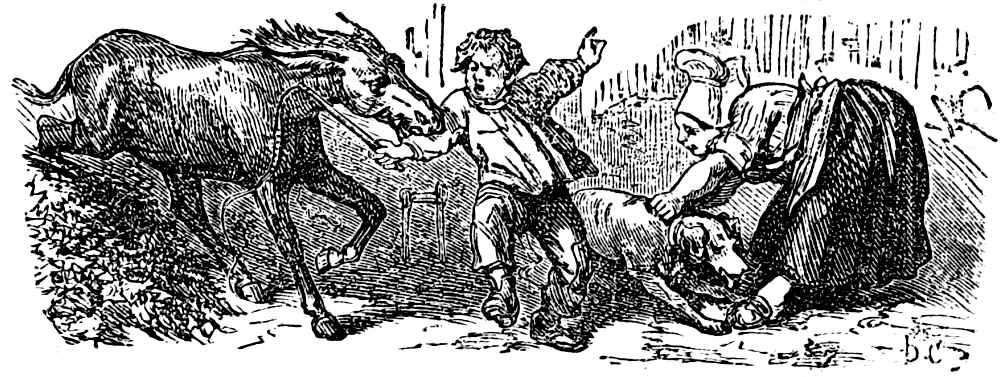
“I can’t lift my arm,” said Edward in tears, “it is numb.”
Seizing the whip that lay on the ground, she ran at me to avenge her cruel son. I was not fool enough to wait for her, you may be sure. Just as she had nearly caught me, I made a leap and left her some distance behind, she continued to pursue me, and I to escape, taking great care to keep myself out of reach of the whip. This race amused me very much; I saw my mistress’s wrath increase in proportion to her fatigue. I could run and sweat without doing myself the slightest harm, whilst she, covered with perspiration, was completely exhausted, without [Pg 126]having had the pleasure of giving me even one lash of the whip. My friend was sufficiently avenged when our promenade ended. I sought him with my eyes (for I had seen him run towards my enclosure), but in vain, he was afraid to show himself before the departure of his cruel mistress.
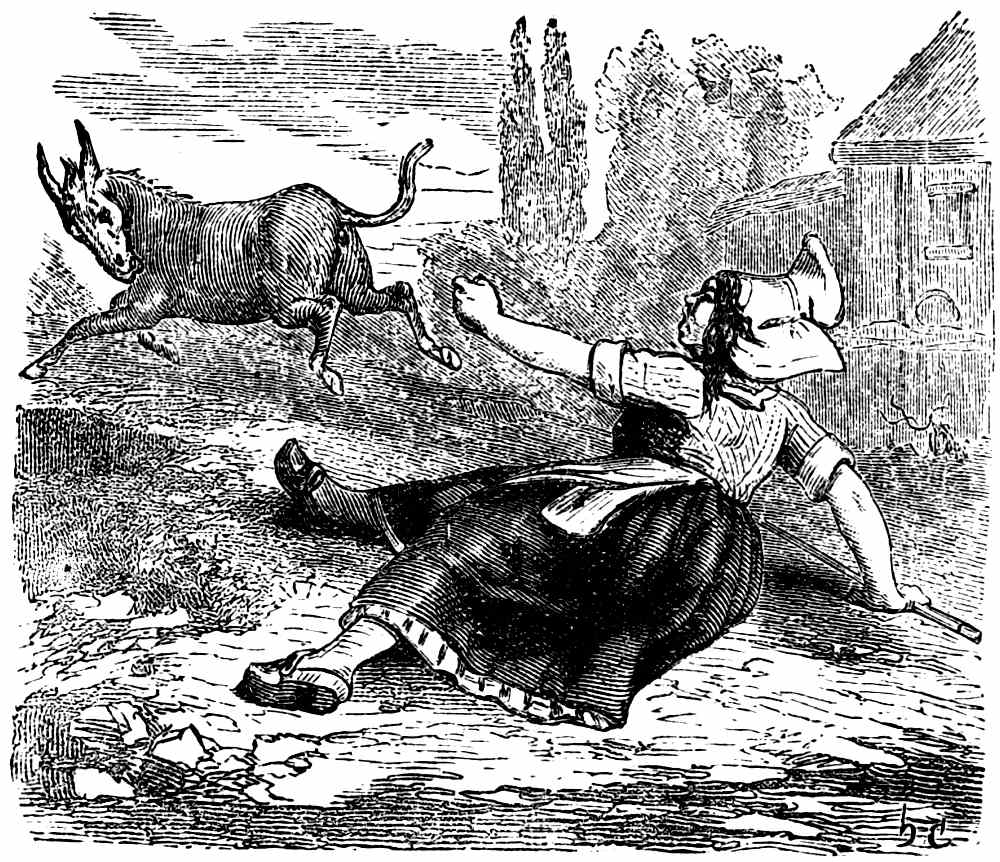
“You wretch!” cried the enraged woman as she turned to leave, “I will pay you up for all this when I get you under the saddle!” and she went towards the house, whilst I remained alone.
I now ventured to call Medor. He timidly lifted his head from the hole in which he had sought refuge. I ran to him.
“Come,” said I, “she is gone. What did you do? why did Edward beat you?”
[Pg 127]
“Because I seized a piece of bread one of the children had dropped on the ground. She saw me, darted at me, and calling Edward, told him to beat me unmercifully.”
“Did no one try to defend you?”
“Defend me indeed! they all cried out, that’s right! whip him Edward, so he won’t do it again.” ‘Keep quiet,’ said Edward, ‘I shall not go half way in the matter, you’ll hear how I can make him sing.’ And at my first cry, they all clapped their hands, exclaiming bravo! bravo!
“Wicked little creatures!” cried I. “But why did you take the bread, Medor? Had they not given you your supper?”
“Yes indeed, I had already eaten, but the bread in my soup was in such small pieces, that I could not get any of it out for you, but, if I could have carried off that big piece the child dropped, you would have had a delightful repast.”
“My poor Medor! and it was for me you were beaten! Thanks, my friend, thanks; I shall never forget your kindness! But let me entreat you to not repeat it! Do you suppose that that bread would have given me any pleasure, if I had known what risks you ran to get it? I would rather a hundred times live on thistles, knowing that you were well treated and happy.”
We conversed a long time, and I made Medor promise never again to incur the danger of a beating on my account; I also promised him that I would play all sorts of tricks on these people, and I kept my word. One day [Pg 128]I knocked Edward and his sister into a puddle of water, and then ran off, leaving them struggling in the mud. Another time, I ran at the little three year old boy, as if I were going to bite him, how his screams of terror rejoiced my heart! Again, pretending to have the colic, I rolled on the ground with a heavy load of eggs on my back; every egg was smashed. My mistress, though furious, did not dare strike me, she believed I was really sick, that I was going to die, and they would lose all the money I had cost them, so instead of beating me, she led me back to the stable, and gave me some hay and bran. I never played a better trick in my life, and that evening Medor and I almost hurt ourselves laughing over it. Another time, seeing all their linen spread out on the hedge to dry, I took every piece in my teeth, one by one, and threw it into the barnyard pool. No one had seen me do this; so when the mistress could not find her linen, and when, at last after a search in every direction, it was discovered just where I have told you, she flew into a terrible rage, and beat the servant, who beat the children, who beat the cats, the dogs, the calves, the sheep! Oh! it was a charming uproar to me, every body screamed and was furious. Medor and I certainly passed a gay evening.
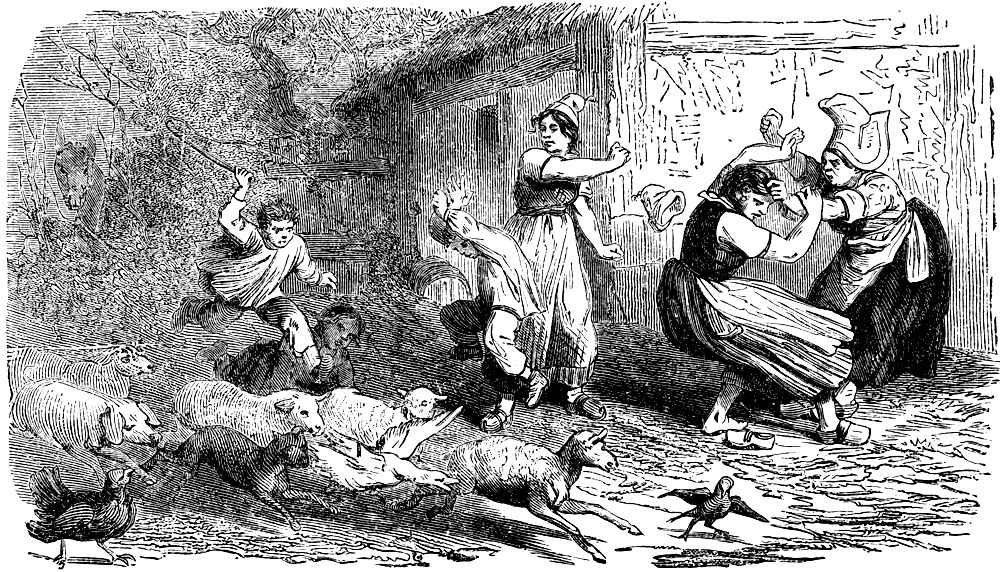
In my subsequent reflexions upon these wicked deeds, I have sincerely reproached myself, for I revenged upon the innocent the faults of the guilty. Medor sometimes censured me and advised moderation, but no, I would not listen, every day I got worse and worse, only however to [Pg 131]suffer for it, my evil conduct bringing its own punishment as you will learn hereafter.
One day (and a sad day it was for me,) a gentleman who was passing took a fancy to Medor and offered the farmer a hundred francs for him. The farmer, believing him a dog of very little account, was delighted, and my poor friend with a rope around his neck, disappeared with his new master. He cast a sorrowful glance at me, and in vain did I run from one side of the hedge to the other seeking a passage, every breach was closed, and I had not even the consolation of bidding my dear Medor farewell. From that day, life there was almost insupportable. Medor’s departure was just before the little episode of market day, and my subsequent flight into the forest of St. Evroult, which I have already related. During the years that followed, I often, very often thought of my friend, and the pleasure it would be to see him again, but where seek him? for I knew his new master did not live in that part of the country, but was only there on a visit to some friends.
Judge of my happiness, some time after little James had brought me to your grandmother’s, at seeing arrive with your uncle and cousins William and Henry, my friend, my dear friend Medor! He recognized me at once, and covered me with caresses, I responding to them, and following him everywhere. Our cordiality excited great surprise, but all attributed it to Medor’s delight at being in the country, and mine in finding a companion for my promenades. If they had been able to understand [Pg 132]our long conversation they would have known the cause of our mutual affection.
Medor was much pleased at all I told him of my present calm and peaceful life, of my master’s kindness, of my excellent and even glorious reputation throughout this part of the country. He sympathized with me in the recital of my pitiful adventures, and he laughed, though blaming me, at the tricks I had played on the farmer who bought me from George’s father. He actually was puffed up with pride when I told him of my victory at the race; he deplored the ingratitude of poor Pauline’s parents, and shed tears over the sad fate of that unhappy child.
One day Medor strayed off from the house where he had been born, and had always lived quite comfortably. He was in pursuit of a cat that had stolen a piece of meat given him by the cook, who thought it a little tainted. Medor, not being so delicate, had just put it down by his kennel, when a cat concealed near by, darted at the meat and carried it off, much to my friend’s indignation, as he was not often regaled on such luxuries. He pursued the thief with all the speed of his limbs, and would soon have caught her, if, wicked cat that she was, [Pg 133]she had not bethought herself of climbing a tree. Medor, of course could not follow, and he was tantalized with seeing her devour before his eyes, the delicious morsel of which she had robbed him. Justly irritated at such effrontery, he remained at the foot of the tree, barking, growling and uttering a thousand reproaches. This attracted the attention of some children just out of school, and they united with Medor in annoying her. They even attacked her with stones until at last it was a veritable shower. The cat climbed higher, and tried to conceal herself in the thickest foliage. But this did not stop them, the shower of stones continued, accompanied by loud hurrahs, whenever a plaintiff mewing informed her persecutors that she had been hit.
Medor began to weary of this game; the enemy’s touching cries had appeased his wrath and he feared that the children were too cruel. To end their sport he commenced to bark at them, and pull them by the blouse, but it had no effect, save that of causing a few stones to be directed against himself. At last, a hoarse, horrible cry, followed by a rustling among the branches, announced their success, the poor cat was grievously wounded, and had fallen from the tree. One minute after, she was not only wounded, but dead, her head having been crushed by a stone. This was a source of rejoicing to the mischievous children, who ought to have wept over their cruelty. As for Medor, he regarded his enemy with compassion, and the boys with an air of keen [Pg 134]reproach. Just as he was about to return to the house, one of them exclaimed:
“Oh! let us give him a bath in the river, it would be so amusing!”
“Yes indeed, what a splendid idea,” cried the others, “catch him, Frederick, there he goes!”
Behold Medor pursued by the cruel rascals, he and they running at full speed. Unfortunately, there were about a dozen of them scattered around, which obliged him always to run straight ahead, for if he deviated in the least, to the right or left, he could be surrounded and his flight retarded instead of hastened. At that time he was very young, not more than four months old; he could run neither very swiftly, nor any great distance without stopping, consequently his pursuers captured him. One seized him around the body, one by the tail, another by the paw, the neck, the ears, the back, they pulled him this way and that, to amuse themselves with his cries. At last, putting a cord around his neck almost tight enough to strangle him, they forced him by dint of kicks to the river.
Two of them were about to remove the cord, and plunge him in, when the biggest boy exclaimed:
“Wait, let’s tie two bladders to his neck, and make him swim; we can push him to the mill, and make him pass under the wheel.”
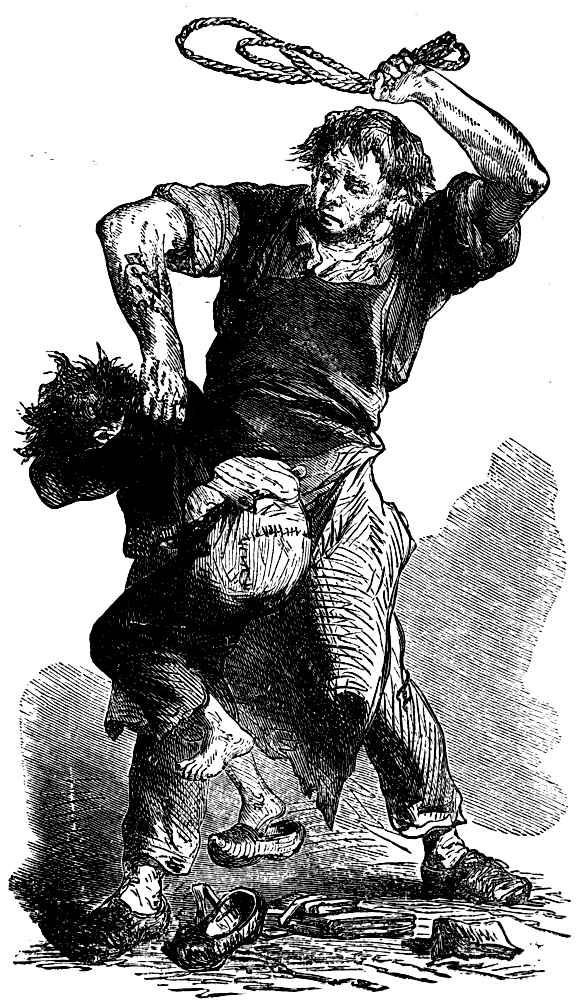
Vainly did poor Medor struggle; what could he do against a dozen little scamps, the youngest of them, at least, in his seventh year? Andrew the most cruel of the [Pg 137]band, tied the two bladders around his neck, and then launched him into the very middle of the stream. My persecuted friend, impelled by the current, and still more vigorously by the poles in his tormentors’ hands, reached the place where the water precipitates itself under the mill wheel. Once under the wheel, he would certainly be ground to pieces.
The workmen returned from their dinner, and one of them hastened to raise the barrier restraining the water. Perceiving Medor, he said:
“Another of your cruel tricks,” you rascals; said he looking at the boys who waited in delightful anticipation of seeing Medor drawn under the wheel. “Friends,” he added, speaking to his fellow workmen, “come here and help punish these bad boys, who have been amusing themselves trying to drown a poor dog.”
His comrades ran, and whilst he saved Medor by pushing a plank towards the poor creature for him to climb upon, the others gave chase to the boys, caught every one, and whipped them well, some with ropes, some with whips, some with sticks. The cries of the chastised children resounded far and near, for the workmen did not strike lightly. At last the job was finished, and Medor’s persecutors retreated, crying, sobbing and rubbing their smarting skins.
The strangling cord around Medor’s neck was cut, and he was put out in the sun to dry upon some hay. He was soon dry, and ready to go home, but when the blacksmith led him back, the people there said they did not [Pg 138]want him, they had too many dogs already, and they would throw him in the water with a stone to his neck, if he were left. The blacksmith was a kind man, and pitying Medor, took him to his own house. But at sight of the dog his wife got angry, her husband would ruin them, she said, they had not the wherewith to feed a worthless cur, and, besides, there was a tax upon dogs.
Her opposition was so determined and so violent that her husband for peace sake got rid of Medor, by giving him to the cruel farmer with whom I then lived, and who had been wanting a watch dog.
You now know how Medor and I became acquainted, and also, why we were so fondly attached to each other.
William and Maud were to stand sponsors for a new born child, whose mother had been Maud’s nurse. Maud wanted them to call the baby after her.
“Not at all,” said William, “since I am godfather, I have the right to name her, and I wish to call her Pierrette.”
“Pierrette!” exclaimed Maud, “that’s a frightful name! I don’t want her named Pierrette, she shall be called Maud; as I am the godmother, I am the one who has the right to name her.”
[Pg 139]
“No, you haven’t, the godfather has the best right, and I shall call her Pierrette.”
“If she is to be named that, I won’t be godmother.”
“If she is to be named Maud, I won’t be godfather.”
“Just as you please about that, I can ask papa to take your place.”
“And I, Miss, can ask mamma to take your place.”
“Besides, I am quite sure aunt would not like her called Pierrette, it is too frightful and ridiculous.”
“And I am sure uncle would not like her called Maud, it is too horrible and stupid.”
“How did he happen to call me Maud then? Go to him and tell him you think it is a horrible, stupid name, go, my good man, and you will see how you will be received!”
“Well, you may say what you please, but I say I will not be godfather for any Maud.”
“Papa,” said Maud mischievously, running to her father, “will you stand godfather with me for little Maud?”
“What Maud, dear pet? I know no Maud but you.”
“My little godchild, papa, that I want called Maud when she is baptized to-day.”
“But William is to stand with you, and there cannot be two godfathers.”
“Papa, William does not wish to be godfather.”
“Why? what is the meaning of this whim?”
“Because he thinks Maud a horrible stupid name, and wants to call her Pierrette.”
[Pg 140]
“Pierrette! that would be horrible and stupid indeed!”
“It is just what I told him papa, but he would not believe me.”
“Listen, my daughter, try to reason with your cousin, and if he insists upon not being godfather unless the baby is named Pierrette, I will cheerfully stand in place of him.”
During Maud’s conversation with her father, William had run to his mother.
“Mamma,” said he, “will you stand godmother with me in Maud’s place, for the little girl that is to be baptized to-day.”
“Why is not Maud going to stand? it was a request of the baby’s mother that she would.”
“Mamma, Maud wants the baby named after her, I think her name too ugly, and as I am godfather, I want the baby called Pierrette.”
“Pierrette! that is frightful, William is pretty, but Pierrette is ridiculous!”
“Oh! mamma, please call her Pierrette—At any rate, I don’t want her called Maud.”
“But if neither of you will give up, how will you fix matters?”
“Mamma, that is why I came to ask you to stand for little Pierrette in place of Maud?”
“My poor William, I must tell you frankly, that I want no more of this Pierrette, the name is too ridiculous, besides, the child’s mother was Maud’s nurse, not yours, and you know very well, that she desires most [Pg 141]particularly to have Maud for godmother. For my part, I think she would be pleased to have the baby called Maud.”
“Then, I can’t be godfather.”
At this instant Maud ran up, exclaiming:
“Well, William, have you decided? We start in an hour, and must have a godfather.”
“I am willing for her not to be called Pierrette, but I am not willing for her to be called Maud.”
“Well, since you have given up Pierrette, I will give up Maud. But let us ask nurse what name she wants baby called.”
“You are right; go ask her.”
Maud went running off to the baby’s mother and soon came back.
“William, William,” she exclaimed, “nurse wants her little daughter named Marie Maud.”
“Did you inquire if she ought not to be called Pierrette, as I am godfather?”
“Yes, I asked her, and she burst out laughing; mamma laughed too; they both said it was impossible, Pierrette was too ugly.”
William blushed slightly, however, as he himself had began to think Pierrette ridiculous, he sighed and said nothing more on that subject.
“Where are the sugar plums?” he asked.
“In a big basket that will be taken to the church, the boxes and wrappings are left here. They are all ready, let us see how many there are.” And they ran to the hall where everything was in readiness.
[Pg 142]
“What are these pennies for?” inquired William, “there seem to be nearly as many as sugar plums.”
“They are to be thrown to the school children,” said Maud.
“The school children? Are we going to the school after the baptism?”
“No, we are to throw these from the church door, where all the school children collect on such occasions; we throw them by the handful, and the children catch them or pick them up from the ground.”
“Did you ever see it done?”
“Never, but I have heard that it is very amusing.”
“I do not think I would like it, for I know very well the children fight and get hurt; besides I do not like the idea of flinging things to children as if they were dogs.”
“Maud, William, come see the baby, it has just arrived; we start shortly,” cried Beatrice, out of breath.
Both of them ran, trying to reach the baby first.
“Oh! how fine our godchild is!” said William.
“Yes, indeed,” replied Maud, “she has a dress embroidered all around, a lace bonnet, and a cloak lined with pink silk.”
“Did you give her all those pretty things?”
“Oh! no, I had not enough money; mamma paid for everything except the bonnet and I paid for it.”
All was ready; though the weather was fine the carriage was brought out for the baby and its nurse, and the sponsors only. Maud and William were in the carriage [Pg 143]like important personages. They started. I, harnessed to the children’s little conveyance waited for them. Louis, Helen, James and Ruth took the back seats, Beatrice and Elizabeth the front to drive, whilst Henry climbed behind. The mammas, papas and nurses started at different intervals, so that some of them might be near us in case of accident; but this was only an excess of prudence, for with me they knew there was nothing to fear.
I set off in a gallop, notwithstanding my load, self-love excited me to overtake and even pass the carriage. I went like the wind and the children were enchanted.
“Bravo!” they cried. “Courage, Cadichon, keep on galloping! Hurrah for Cadichon, the king of donkeys!”
They clapped their hands and applauded.
“Bravo!” cried people whom I passed on the road. “Look at that donkey, he runs like a horse! Good luck and no upsets!”
The papas and mammas trudging along, were not so encouraging however, but wanted me to relax my speed, instead of which, I only galloped the faster. I was not very long in overtaking the carriage, and triumphantly did I dash past the horses, they looked at me with surprise. Feeling mortified at being overtaken by a donkey, especially as they had started first, they attempted a gallop, but the driver tightened his reins, and obliged them to relax their speed, whilst I hurried on faster than ever, so that when they reached the church door, my little masters and mistresses had all descended from the vehicle, [Pg 144]whilst I, very warm and out of breath, was standing quietly hitched near the hedge for shade.
The parents on arriving, admired my swiftness, and complimented the children on their equipage.
The fact is we made quite a sensation, my carriage and I, I being well rubbed and curried, and decorated with variegated dahlias of red and white behind my ears, the harness polished and embellished with red mountings, and the vehicle repaired and varnished. We certainly presented a dashing appearance.
Through the open window, I witnessed the baptismal ceremony, the infant screamed as if it were being murdered, Maud and William, somewhat embarrassed at their honors, got confused in repeating the Creed, and the priest was obliged to prompt them. Poor little godfather and godmother, their eyes were suffused with tears, and their faces as red as cherries! However, their mistake was no unusual occurrence, and often happens with grown people.
Little Marie Maud being baptized, they went out of the church to throw sugar plums and pennies to the children collected around the door. As soon as the godfather and godmother appeared, all exclaimed; “Hurrah for the godmother! hurrah for the godfather!”
The basket of sugar plums was ready, it was handed Maud, whilst William received the basket of pennies. Taking a handful of the former, Maud let them fall in a shower among the children. This was the signal for a general battle, a faithful representation of starving dogs.
[Pg 145]
All rushed to the same spot, disputing every handful, both of sugar plums and pennies, as it was thrown; they tore one another’s hair, they struggled, they rolled over on the ground, and half the coveted articles were lost, crushed under foot or hidden in the grass. William did not laugh; nor Maud, after the first handful, for she saw that these battles were serious. For several of the children were crying, and others were badly scratched.
“You were right, William,” said she, as soon as they took their seats in the carriage, “the next time I am godmother, I shall give the children sugar plums, not throw them.”
“Nor I, the pennies,” said William, “I shall give them like you do the sugar plums.”
The carriage started off, and I did not hear the rest of their conversation.
My party now began to crowd in their vehicle, accompanied by the papas and mammas.
“Cadichon,” said Maud’s mamma, “has already produced a sensation, so now he can afford to return more quietly and take us with him.”
“Mamma,” said Beatrice, “do you like this custom of throwing the children sugar plums and pennies?”
“No, dear child, I find it a very ignoble custom, the children reminding one of dogs fighting for a bone. If ever I am godmother in this part of the country, I shall distribute the sugar plums among the children, instead of throwing them, and I shall give to the poor, the amount of money wasted in pennies flung at random.”
[Pg 146]
“You are right, mamma; please let me be godmother to do as you say.”
“As an absolute necessity for your fulfilling that office, we must have a baby to be baptized,” said the mamma, smiling, “and I know of none.”
“Oh, how provoking! I could be godmother with Henry. What would you call your godson, Henry.”
“Henry, of course, what would you call him?”
“Madelon.”
“Oh horror! Madelon! In the first place it is not a name.”
“It is as much of a name as Pierrette.”
“Pierrette is prettier, and besides you see that William yielded.”
“I could give up too,” replied Beatrice, “but we have time enough to think of it.”
We reached the castle, all got out of the carriage and hastened to lay aside their holiday attire; my trinkets and dahlias were also taken off and I was turned out to pasture, whilst the children ate their lunch.
[Pg 147]
One day I saw the children run into the meadow where I was quietly grazing very near the castle. Louis and James were playing around me, finding amusement in getting on my back. They thought themselves as nimble as gymnasts, whilst they were, in reality, I must confess, somewhat clumsy, little James especially, who was plump, chunkier than his cousin. Louis at last, by holding on to my tail, managed to climb (he called it jumping) up on my back. James made prodigious efforts to follow his example, but the poor little fat fellow slipped, fell and got out of breath, and it was very evident that he could not succeed without the assistance of his cousin somewhat older than himself. To spare them so much fatigue, I went towards a piece of rising ground. Louis had already shown his agility, and James had just succeeded with a great effort in seating himself, when we heard the whole joyous band crying out: “James, Louis, we are going to the fair day after to-morrow, to see the learned donkey!”
“The learned donkey? what is that?” inquired James.
“A donkey,” replied Elizabeth, “that plays all manner of tricks.”
[Pg 148]
“What tricks?”
“Well tricks—tricks of—tricks I mean,” said Beatrice.
“He can’t beat Cadichon, I know.”
“Pshaw! Cadichon!”, said Henry, “Cadichon is a very fine animal and very intelligent of his kind, but he is nothing in comparison with the learned donkey at the fair!”
“I am very sure,” answered Maud, “that if Cadichon were shown these tricks he could do them.”
“Let us see what this learned donkey does, and then we can judge better as to whether he is more learned than our Cadichon,” said William.
“William is right,” replied Maud, “let us wait till after the fair.”
“And what will we do after the fair?” said Elizabeth.
“We will dispute,” replied Beatrice laughing. James and Louis after whispering a few words to each other, had kept silence until the rest went away. When assured that these were out of sight and hearing, they commenced to dance around me, laughing and singing:
[Pg 149]
“What we are singing is very pretty,” said James, stopping suddenly.
“That is because they are rhymes,” answered Louis. “I really think they are pretty.”
“Rhymes? I thought it was very difficult to make rhymes.”
“There are some more.”
“Let us run and say them to our cousins.”
“No, no, if they heard our verses, they would guess what we are going to do; we must take them by surprise at the fair.”
“But do you believe papa and uncle will let us take Cadichon to the fair?”
“Certainly, when we tell them in confidence, we want him to see the learned donkey.”
“Let us run quick to ask them.”
They were running at full speed towards the house just as the papas were coming to the meadow to see what the children were doing. “Papa, papa!” cried they, “come quick; we have something to ask you.”
“Speak children, what is it?”
“Not here, papa, not here,” was the mysterious answer, each one drawing his father aside.
“What is the matter?” said Louis’s papa, laughing. “Into what conspiracy do you wish to drag me?”
“Sh sh, papa, here is what it is: you know that day after to-morrow there will be a learned donkey at the fair.”
[Pg 150]
“No, I did not know it, but what have we to do with learned donkeys, we, who have Cadichon?”
“That is precisely what we say, papa, that Cadichon is smarter than any of them. My sisters and cousins are going to the fair to see this educated donkey, and we would like very much to take Cadichon, so that he may see what this donkey does and imitate him.”
“What?” said James’s papa, “would you put Cadichon in the crowd to look at the donkey?”
“Yes, papa, instead of going in the carriage, we can ride Cadichon, and get very near the circle in which the learned donkey plays his tricks.”
“I would not ask anything better myself, but I do not believe Cadichon could learn much in one lesson.”
“Can’t you, Cadichon, do as many smart tricks as that silly, educated donkey?”
In addressing this question, James looked at me so anxiously, that to reassure him, I began braying, laughing all the while at his fears.
“Do you hear that, papa,” said James triumphantly, “Cadichon says yes.”
The two papas laughed, caressed their little boys, and turned away, promising not only that I should go to the fair, but that they would accompany us there.
“Ah!” said I to myself, “they doubt my capacity! It is astonishing how much more intelligent these children are than their fathers.”
The great day arrived. One hour before our departure, my toilet was made, and Louis and James having [Pg 151]curried and rubbed me to the verge of vexation; after which, they decorated me with a perfectly new bridle and saddle, and then announced their readiness to start, as they wished to set out a little in advance, for fear of being late.
“Why do you wish to go so early?” asked Henry, “and how are you going?”
“We are going on Cadichon, and want to start early, because we can’t go fast,” said Louis.
“Are you two going alone?” inquired Henry.
“No, papa and uncle will accompany us.”
“It will certainly be tiresome, if you are going at a gait to suit their walk.”
“Oh! we never find it tiresome in our papa’s company.”
“I prefer going in the carriage, we will get there long before you.”
“No, you will not, for we will start so much sooner.”
As they finished speaking, I was led out all saddled and decorated—the fathers were ready; they put their little boys on my back, and I started very slowly, so as not to make their fathers run.
In an hour we reached the fair ground, where we found many persons already collected around the rope marking out a circle, within which the educated donkey was to display his ability. The fathers of the two little boys I had brought, stationed us very near the rope, and my other masters and mistresses soon rejoined us.
The sound of a drum was the signal for my learned [Pg 152]friend’s appearance. All eyes were fixed upon the curtain, which rose at last, and he came forth, a thin, sad, miserable looking creature. His master called him; he approached, but with an air of fear, and I saw at once that the poor thing’s learning had been instilled by hard beatings.
“Gentlemen and ladies,” said the master, “I have the honor of presenting to you Mirliflore, the prince of donkeys. He is not like the rest of his race, he is a learned donkey, more learned indeed than many of us, he is the donkey par excellence, and without an equal. Come, Mirliflore, show what you can do, but first salute these gentlemen and ladies like a well raised donkey.”
This discourse touched my pride, and made me very angry; I resolved to be revenged before the end of the exhibition.
Mirliflore advancing three steps, made an inclination of his head with a melancholy air.
“Go, Mirliflore, go give this bouquet to the prettiest lady here.”
I laughed at seeing every hand half extended to receive the bouquet. Mirliflore went all around the circle, and stopping before a fat, ugly woman that I afterwards learned was the master’s wife, and who held a little sugar in her hand, lay down his flowers.
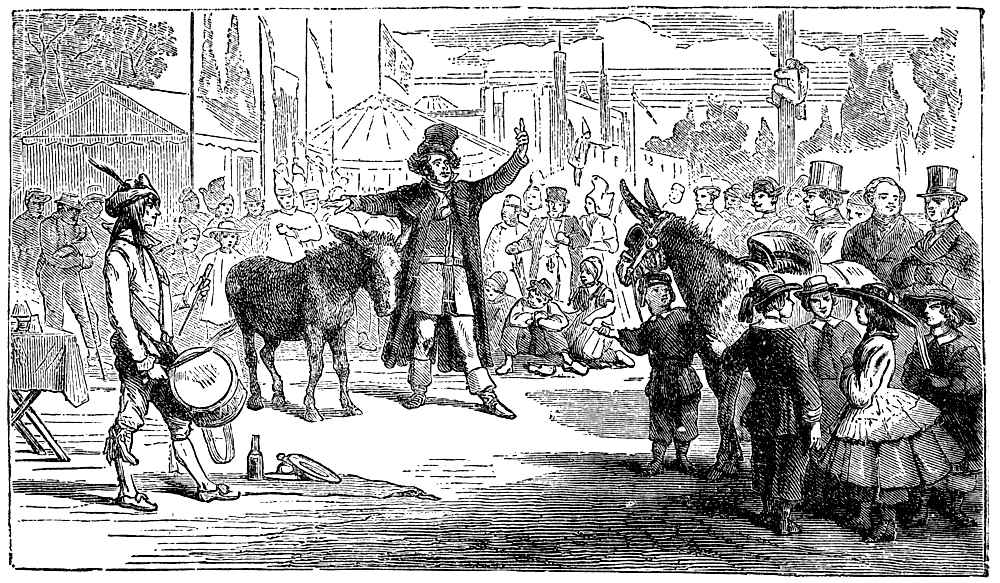
This want of taste enraged me; leaping over the rope to the great surprise of every one present, and making a graceful salutation, to those on my right, my left, before and behind me, I walked resolutely up to the fat woman, [Pg 155]snatched the bouquet from her hands, and laid it on Maud’s lap. I then returned to my place, amidst the plaudits of the multitude. Every one inquired the meaning of this apparition; some believed it was all arranged beforehand, and that there were two learned donkeys; whilst others who had seen me with my little masters recognizing me, were delighted at my intelligence.
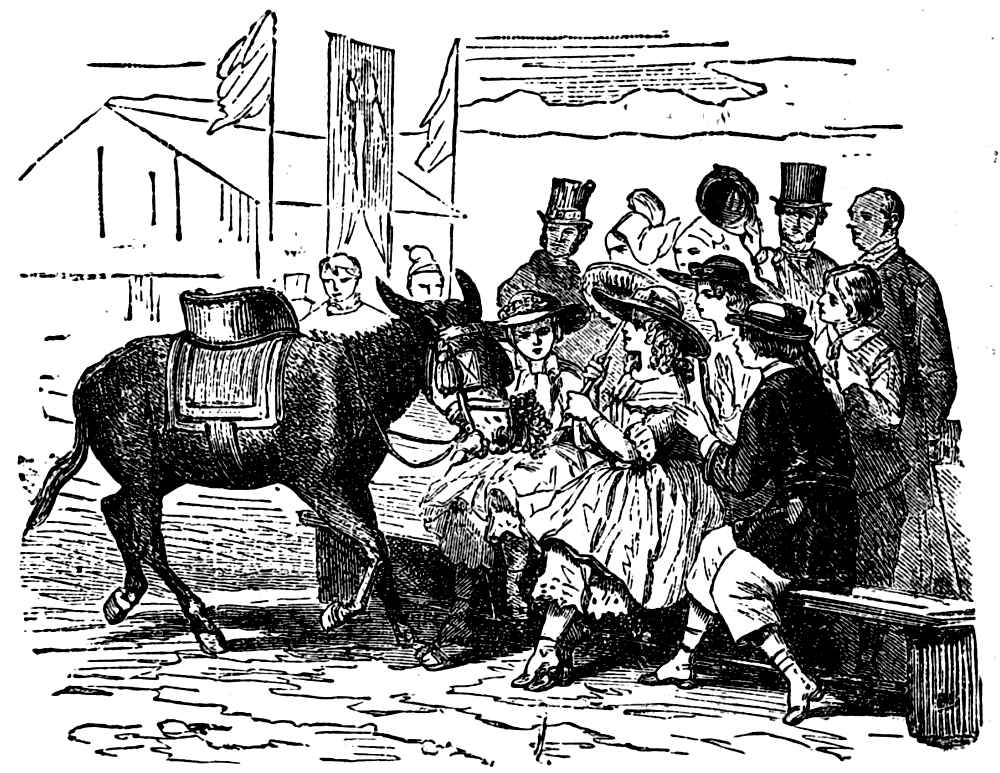
Mirliflore’s master seemed quite vexed, but the animal himself appeared so indifferent to my triumph, that I began to believe him really stupid, which is a quality very rare among us donkeys. When silence was re-established, the master called Mirliflore out again.
“Come Mirliflore, show these gentlemen and ladies that you not only know how to distinguish beauty, but likewise stupidity; take this cap and put it on the most stupid person here.”
[Pg 156]
Saying this, he gave Mirliflore a magnificent dunce-cap, ornamented with bells and variegated ribbons. Mirliflore, taking it between his teeth, went towards a fat, red faced boy, who inclined his head in advance to receive it. From his resemblance to the fat woman, so falsely declared the most beautiful person present, it was easy to recognize this boy as her son, and the master’s assistant.
“Now,” thought I, “is the moment to revenge this fool’s insulting words!”
And before anyone could think of preventing me, I again darted into the arena, ran to my comrade, snatched the dunce-cap from him at the moment he was about to place it on the fat boy’s head, and ere the master had time to defend himself, rushing at him, at putting my fore feet upon his shoulders, I tried to place the cap upon his head. He repulsed me violently, and grew furious, as peals of laughter and applause resounded on all sides.
“Bravo donkey!” they cried, “this one is the real learned donkey.”
Emboldened by the applause of the multitude, I made a new effort to fit the cap; as he recoiled I advanced, and we finished by a flying race, the man running at full speed, I after him, not getting near enough to him to ornament him with the cap, and not wishing to do him any harm. At last I jumped behind him, and placing my fore feet upon his shoulders, let him feel my weight; he fell and I profited by it, to bury his head up to his very chin in the dunce’s cap. I retired immediately; the man arose, but being somewhat confused and [Pg 157]stunned by the fall, and unable to see clearly, he began to turn and jump. And I to complete the farce pretended to do the same, interrupting this burlesque imitation, by approaching him and braying in his ear, then standing on my hind feet, jumping like him, sometimes to one side, some times before him.
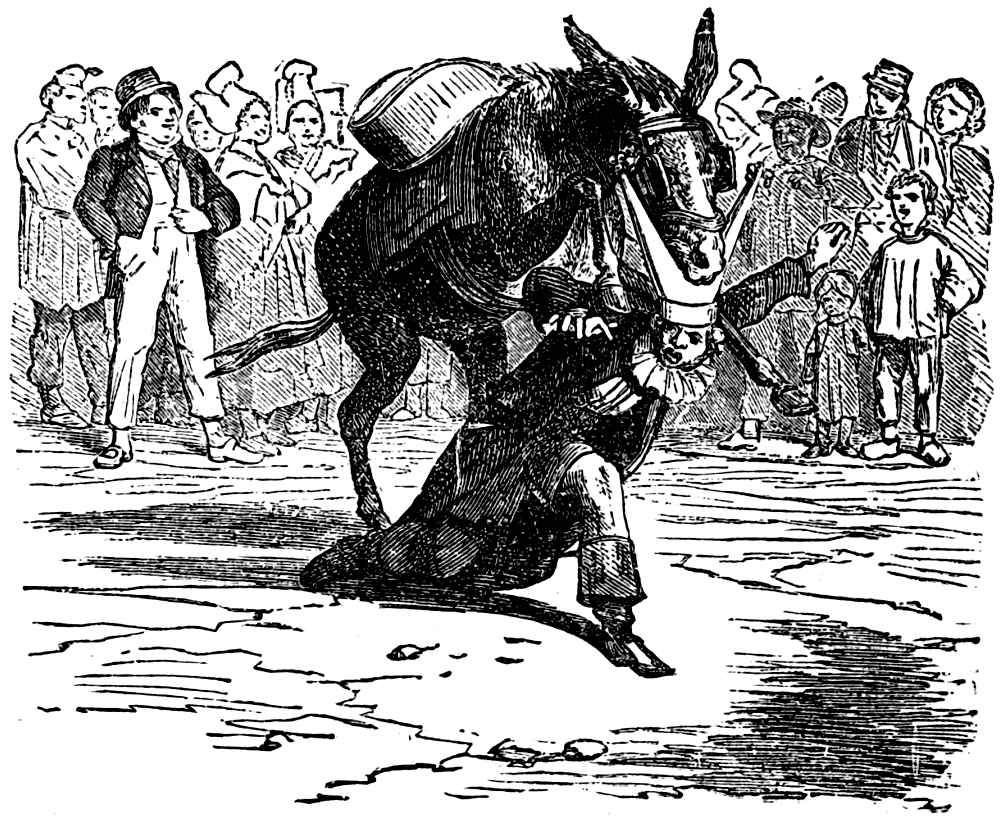
To depict the laughter, the bravos, the joyful stamping of feet, would be an impossibility. Never had a donkey in the world such success, such a triumph! The ring was invaded by hundreds of persons wishing to touch, to caress, to approach me. Those who knew me were proud of what I had done, and told my name to those not acquainted with me. Numberless anecdotes, both true and false, were related, in which I played a magnificent part. One time, said my admirers, I had [Pg 158]extinguished a fire, working a pump all alone; I had ascended to the third story, opened my mistress’s door, seized her asleep in bed, and all hope of escape by the stairs being cut off, I had jumped from the third story, having first carefully placed my mistress on my back—that neither she nor I had been hurt, because her guardian angel had sustained us in the air and we had gently descended to the ground. Another time, unassisted, I had killed fifty brigands, strangling them one by one with a single bite, so that none awakened to alarm the rest. I had afterwards liberated one hundred and fifty prisoners these robbers had kept chained in the caves for the sake of their services, making the poor creatures work to feed and enrich their masters. Again, at a race, I had beaten the best horses in the country, and finally, in five hours, I had made twenty-five leagues without stopping.
The admiration for me increased in proportion to the circulation of these stories. I was surrounded, almost smothered, and the soldiers were obliged to drive off the crowd. Happily, the parents of James, Louis, and all my other masters had led their children away, whilst the crowd collected around me. I had much difficulty in escaping from my admirers, who wished to carry me in triumph—even the assistance of the soldiers was not sufficient to prevent such an honor, and I, in order to force my way through the crowd, was obliged to give a few bites, and attempted kicks, taking care, however, to hurt no one.
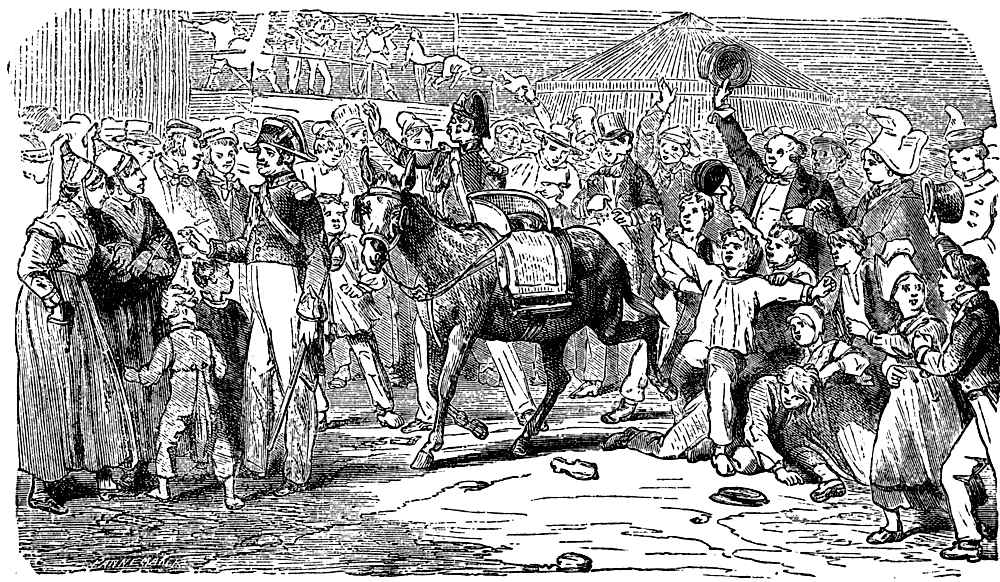
Once rid of the crowd, I sought Louis and James, but [Pg 161]in vain. Not wishing my dear little masters to return home on foot, I ran to the stable where our horses were always kept to see if they were still there, and, not finding them, I knew Louis and James had gone. Then, taking the road to the castle, and running at full speed, I soon caught up with the two carriages packed with parents and children to the number of fifteen.
“Cadichon! there is Cadichon!” exclaimed all the children when they saw me.
The carriages were stopped; James and Louis asked permission to get out, as they wished to compliment and caress me, and return home on foot. Their example was followed by Ruth and Helen, then by William and Henry, and at last by Elizabeth, Beatrice and Maud.
“So you see,” said Louis and James, “we knew Cadichon better than you! How he did distinguish himself! He easily understood all the tricks of that stupid Mirliflore and his foolish master.”
“So he did,” answered William, “but I would like very much to know why he insisted upon putting that dunce-cap on the master. Was it because he thought the master a fool, and knew that the donkey’s ears (the dunce-cap was fashioned in that style) were a mark of imbecility?”
“Certainly, he understood it,” spoke Maud; “he is smart enough for that.”
“Ah! ah! ah! You say that because he gave you the bouquet as the prettiest person present.”
“Not at all; I did not think myself the prettiest, and, since you speak of it, let me tell you that I was astonished, [Pg 162]and wished very much he had given the bouquet to mamma, for she was the prettiest person there.”
“You represented her,” said William, “and I believe that, leaving aunt aside, Cadichon’s choice could not have been better.”
“And I then, am I so ugly?” asked Beatrice.
“Certainly not, but each one to his taste, and Cadichon’s taste selected Maud,” replied William.
“Instead of discussing beauties and frights,” said Elizabeth, “we ought to inquire of Cadichon how he could understand so well what this man said.”
“What a pity Cadichon cannot speak! how much he could tell!” replied Helen.
“Who knows but what he does understand?” said Elizabeth. “I myself have read the ‘Recollections of a Doll,’ and does a doll appear to see and understand? That doll wrote about all she heard and saw.”
“And do you really believe that?” asked Henry.
“Certainly I believe it,” replied Elizabeth.
“How could the doll write?”
“She wrote at night, with a tiny pen made of a humming bird’s feather, and hid her ‘Recollections’ under her head.”
“Don’t believe such nonsense, my poor Elizabeth,” said Beatrice. “It was a lady who wrote those ‘Recollections of a Doll,’ and to make the book more amusing, she pretended to be the doll and to write as if she were one.”
“Do you think, then, it was not a real doll that wrote them?” asked Elizabeth.
[Pg 163]
“Certainly it was not,” replied Maud. “How do you suppose a lifeless doll, made of wood or stuffed with bran could reflect, see, hear and write?”
Talking thus, they reached the castle. Running immediately to their grandmother, who had remained at home, they recounted all my doings and how I had astonished and delighted every one.
“He is truly wonderful, this Cadichon,” said she, coming to caress me. “I have known intelligent donkeys, far more sagacious than other animals, but never did I see one like Cadichon! I must confess, we are very unjust to donkeys.”
I turned towards her with a look of gratitude.
“One would really suppose he understood me,” she continued. “My poor Cadichon, rest assured you shall never be sold whilst I live, and you shall be as well taken care of as if you understood everything that was going on around you.”
I sighed at thought of my old mistress’s age, for she was fifty-nine, and I not more than nine or ten.
“My dear little masters,” thought I, “when your grandmother dies do not sell me, I entreat you, but keep me and let me die in your service.”
As to the learned donkey’s unfortunate master; I afterwards repented bitterly of the trick I had played upon him, and you will see the sad consequences of my desire to display my intelligence.
[Pg 164]
The wicked boy who killed my friend, Medor, had at last (by dint of coaxing probably,) obtained pardon and permission to visit again at your grandmother’s. I could not bear him, you may well imagine, and I sought every opportunity of playing some ugly trick upon him, for I lacked charity and had not yet learned to forgive.
This Alfred was a coward, but always boasting of his courage. One day, when his father had brought him to your grandmother’s on a visit, the other children proposed a stroll in the woods. Maud, who ran ahead suddenly jumped aside screaming.
“What is the matter?” said William, running to her assistance.
“I was frightened at a frog that jumped on my foot.”
“Is it possible that you are afraid of frogs, Maud? For my part,” said Alfred, “I am afraid of nothing, of no animal.”
“Why then,” retorted Maud, “did you jump so high the other day, when I told you there was a spider on your arm?”
“Because I did not understand what you said to me.”
[Pg 165]
“Did not understand? It was very easily understood.”
“Certainly it was, if I had heard aright, but I thought you said, ‘look at that spider down there,’ and I jumped aside only to see it better.”
“The idea!” chimed in William, “that is not so, for as you jumped, you cried, ‘Oh, William, take it off, please!’”
“I meant to say, ‘take it off, so I can see it better.’”
“He is telling a story,” whispered Beatrice to Maud.
“So I perceive,” was Maud’s low response.
I was listening to the conversation and profited by it, as you will see. The children were seated upon the grass, and I was near, having followed them. Perceiving a little green frog very near Alfred’s open pocket, my plan was quickly formed and easily executed. Approaching noiselessly, I seized the frog by one leg, and slyly dropped it into the little boaster’s pocket, quietly withdrawing as soon as the deed was done, so that Alfred might not suspect me of having made him this beautiful present.
I could not hear distinctly all the conversation, but I distinguished this much, that Alfred continued to boast of his courage, he was afraid of no creature, not even of lions, at which the rest uttered an exclamation of incredulity. Just at this moment Alfred wished to blow his nose. Running his hand into his pocket, he withdrew it with a cry of terror, and rising precipitately, screamed aloud:
“Take it out! take it out! Oh! I beg you to take it out! I am so afraid! Help! help!”
[Pg 166]
“What is the matter, Alfred?” said Maud, half laughing, half frightened.
“An animal! an animal! Take it out, I beg you!”
“What animal do you mean, and where is it?” said William.
“In my pocket! I felt it, I touched it! Oh! take it out, take it away! I am afraid of it, I dare not touch it!”
“Do it yourself, you coward!” replied Henry, indignantly.
“Well, just listen,” said Elizabeth, “he is afraid of something in his pocket, and wants us to take it out, because he dares not touch it!”
After their first fright, the children were greatly amused at Alfred’s contortions, who knew not how to rid himself of the creature he felt wriggling about in his pocket. His terror increased with every movement of the frog. At last, frightened almost to distraction, and finding no other means of escape from this creature that he felt moving and yet dared not touch, he pulled off his jacket and threw it on the ground, remaining in his shirt sleeves. The others burst out laughing and made a rush for the jacket. Henry opened the hind pocket; the imprisoned frog seeing daylight, darted through the opening, narrow as it was, and each one saw a pretty little scared frog, that sought safety in desperate efforts to put itself out of reach.
“The enemy has taken flight,” said Maud, laughing.
“Take care it doesn’t chase you,” said William.
“Don’t go too near, it might devour you!” said Henry.
[Pg 167]
“Nothing is so dangerous as a frog!” added Beatrice.
“If it were only a lion, Alfred would attack it!” chimed in Elizabeth, “but a frog! All his courage could not defend him from its claws!”
“You forget its teeth!” continued Louis.
“You may pick up your jacket,” said James, catching the frog. “I hold your enemy prisoner.”
Alfred remained motionless and mute with shame at having thus exposed himself to so much ridicule.
“Let us dress him,” cried William, “he has not strength enough to put on his jacket!”
“Take care,” said Henry “that a fly or a gnat is not on it, for that would be a new danger to fear!”
Alfred tried to escape, but all the children, big and little ran after him; William holding the jacket, the others pursuing the coward and endeavoring to intercept his retreat. It was a very amusing race for all but poor Alfred, who, red with shame and anger, ran first to the right and then to the left, and everywhere encountered an enemy. I joined the party, and galloped before and behind him, increasing his fear by braying and attempting to seize him by the seat of his trousers; once I caught him, but he jerked away leaving a piece of the trousers in my mouth which increased the other children’s laughter. I succeeded at last in catching him with a firm hold, he uttered such a cry, that, for an instant, I feared having seized skin as well as cloth. William and Henry were the first to reach him; he tried to struggle against them, [Pg 168]but I pulled him gently, at which he screamed again, and then became as meek as a lamb, never budging any more than a statue whilst William and Henry put his jacket on him. Seeing that my services were no longer needed, I released him, and went my way delighted at having succeeded in rendering him so ridiculous. He never knew how that frog got into his pocket, and from that lucky day he dared boast no more of his courage—before the children.
My vengeance ought to have been appeased, but it was not; I still retained for Alfred such sentiments of hatred as instigated me to play another trick upon him, of which I afterwards bitterly repented. We were rid of him for nearly a month after the episode of the frog. One day, however, his father brought him over, not much to anyone’s delight.
“What shall we do to amuse this boy?” said William to Maud.
“Propose a riding party to the woods; Henry will mount Cadichon; Alfred, the farm mule; and you, your pony.”
“Oh! that’s a splendid idea, provided he wishes to go!”
“Oh! but he must wish it; do you just have the [Pg 169]animals saddled, and when they are ready help him mount.”
William went to find Alfred, who was amusing himself tormenting Louis and James. Under the pretence of assisting them in their garden, he replanted their flowers, pulled their vegetables, cut their strawberry vines, and scattered confusion everywhere; when they attempted to prevent him, he repulsed them with a kick or a thrust of the spade, and William found them weeping over the ruins of their flowers and vegetables.
“Why do you torment my poor little cousins?” said William, with evident displeasure.
“I am not tormenting them; on the contrary, I am assisting them.”
“But they don’t wish your assistance.”
“They must be made to do right, even in spite of themselves.”
“It is because he is twice as big as we are that he torments us,” said Louis; “he would not dare do so with you and Henry.”
“Not dare!” replied Alfred; “don’t say that again, young one.”
“No, you would not dare! William and Henry are much stronger than a frog, I know,” said James.
At this, Alfred reddened, shrugged his shoulders with an air of disdain, and, turning to William, said:
“Did you want me, dear friend? You seemed to be looking for me when you came here.”
“Yes; I was going to propose a riding party,” said [Pg 170]William, with an air of indifference; “be ready in a quarter of an hour, if you wish to go with Henry and me to the woods.”
“Certainly; I would like nothing better,” replied Alfred eagerly, delighted at the idea of putting an end to the taunts of James and Louis.
William and Alfred then went to the stable, and told the hostler to saddle the pony, the farm mule and myself.
“Ah! you have a pony!” said Alfred; “I like them so much.”
“It was a present from grandma.”
“Do you know how to ride horseback?”
“Yes; I learned two years ago at riding school.”
“I would love to ride your pony.”
“I would not advise you to do it, if you have never learned to ride horseback.”
“I never learned, but I can do it just as well as anyone else.”
“Did you ever try?”
“Many a time. Who is there that can’t ride horseback?”
“When did you? your father has no saddle horses.”
“I never rode horseback, but I have ridden mules, which is the same thing.”
“I tell you again, my dear Alfred,” said William, restraining a smile, “if you have never ridden horseback, I would advise you not to ride my pony.”
“And why not?” replied Alfred a little piqued, “you might give him up for once.”
[Pg 171]
“Oh! I don’t refuse you on that account, it is because the pony is a little spirited, and—”
“And what?” said Alfred, in the same tone of vexation.
“Well then he might throw you off.”
“Be easy about that, do,” answered Alfred, quite irritated, “I am not quite so awkward as you think. If you are willing to give him up to me for once, be sure I can ride him just as good as yourself.”
“Just as you please, my dear; take the pony, I will ride the mule, and Henry, Cadichon.”
Henry now joined them. In a few moments we were to start. Alfred approached the pony, which capered a little and made two or three jumps. Alfred looked at him anxiously.
“Hold him firmly,” said he, “until I am on.”
“There is no danger, master, the animal is not vicious, and you need not be afraid,” said the hostler.
“I am not at all afraid,” replied Alfred quickly, “do I look as if I were afraid, I, who am afraid of nothing?”
“Except frogs,” whispered Henry to William.
“What did you say, Henry? What did you whisper to William?” said Alfred.
“Oh! nothing very interesting!” replied Henry, mischievously, “I told him I believed I saw a frog down on grass.”
Alfred bit his lip, colored deeply, but said nothing. He got on the pony and began to pull the bridle, the pony recoiled, Alfred clung to the saddle.
[Pg 172]
“Do not pull, master, do not pull, a horse must not be managed like a mule,” said the hostler, laughing.
Alfred slackened the reins, I started ahead with Henry, William following on the mule. I maliciously broke into a gallop, and the pony tried to overtake me, but I went my fastest. William and Henry laughed, Alfred cried out and clung to the pony’s mane. We all ran, and I determined not to stop until Alfred was thrown off. Excited by the laughter and cries, the pony was not long in overtaking me, but I followed close behind him, nibbling his tail whenever he showed the slightest inclination to slacken his speed. We galloped thus for a quarter of an hour, Alfred clinging to the pony’s neck and ready to fall at every step. Determined to hasten this event, I gave a stronger nibble to the pony’s tail, he began to kick so vigorously that at the first essay, Alfred fell upon the horse’s neck, at the second, he passed over its head and was stretched motionless on the ground. William and Henry, thinking him hurt, dismounted instantly, and ran to pick him up.
“Alfred, Alfred, are you hurt?” they anxiously inquired.
“I think not, I do not know,” answered Alfred, as he arose, still quaking from fright.
When on his feet, his limbs trembled, his teeth chattered. William and Henry examined him, and finding neither bruise nor scratch of any sort, looked at him with mingled pity and disgust.
“It is sad to be such a coward as that,” said William.
[Pg 173]
“I—am—not—a—coward—but—I—am—afraid,” answered Alfred, his teeth still chattering.
“I hope you do not intend to mount my pony again,” said William, “we will exchange animals.”
And without awaiting Alfred’s answer, he jumped lightly on the pony.
“I would rather ride Cadichon,” said Alfred, piteously.
“Just as you please,” answered Henry, “take Cadichon and I will mount Grison, the mule.”
My first impulse was to prevent his getting on my back, but I formed another project which finished his day’s amusement, and served better to express my aversion and wickedness. So I let him mount quietly and I followed far behind the pony. If Alfred had dared beat me to increase my speed, I would have thrown him, but knowing my young master’s fondness for me, he never interfered with my gait, which was regulated entirely by my own pleasure. I took especial pains in going through the woods, to brush him up against all the bushes, particularly such as holly and others of that thorny nature, so that his face was well scratched. He complained of this to Henry, who answered coldly:
“Cadichon does not treat people badly that he likes; probably you are not in his good graces.”
We soon took the road homeward, for Henry and William got tired of listening to Alfred’s whimpering as each new branch switched across his face. He was scratched ridiculously; I had every reason to believe, however, that he was less amused than his companions. [Pg 174]My frightful project was going to finish the day’s entertainment.
In returning through the farm, we had to pass a hole or rather a ditch, into which emptied the pipe carrying off all the stale, greasy kitchen water. It was a receptacle for refuse of every sort, which rotting in the stagnant water, formed a black and stinking mud. I let William and Henry go ahead; reaching the ditch, I made a bound towards the edge and with one kick, landed Alfred just where I had desired. I then stood quietly enjoying the spectacle of his struggles in this black, filthy pool that almost blinded and strangled him.
He attempted to scream for help, but the water got into his mouth, it even reached his ears, and try as he would, he found it impossible to extricate himself. “Medor,” thought I, “Medor, you are revenged!” I did not reflect on the harm I might do this poor boy, who had killed Medor by accident and not from malice, nor did I suspect for an instant that I was far worse than he. At last, William and Henry who had dismounted, seeing nothing of me nor Alfred, wondered at our delay and retraced their steps, to find me standing on the edge of the ditch, complacently regarding my struggling enemy. They approached, and uttered a cry of horror at sight of Alfred, for he was in imminent risk of being strangled by the mud. The farm men were called to the spot immediately. They held out a pole to the unfortunate boy, who, clinging to the end, was thus rescued from his peril. When landed, every one wished him to [Pg 175]keep at a distance, for the mud was dripping from him and smelt intolerably.
“We must go tell his father,” said William.
“And then papa and my uncles,” added Henry, “so they may tell us some way of cleansing him.”
“Come, Alfred, follow us, but please don’t come too near, for that mud does smell horribly.”
Alfred, covered with confusion, black with mud, scarcely able to see his way, followed them at a distance, and was the object of much surprise and many ejaculations from all he met. I formed the vanguard, capering, running and braying with all my strength. William and Henry seemed much displeased at my gayety, and tried their best to silence me, but their screams were of no avail, and in fact, only added to the racket. This unusual noise attracted the attention of all the house; every one recognizing my voice, and knowing that I brayed thus only on grand occasions, ran to the windows so that when we came in sight of the castle, numberless countenances full of curiosity peered at us through the casements. Our appearance was the signal for a general exclamation, followed by a simultaneous rush for the door, and in a few moments everybody, big and little, young and old, had descended and formed a circle around us, with Alfred for the centre, every one inquiring what was the matter and trying to keep out of his way. Your grandmother was the first to say:
“Some one must wash this poor boy, and see if he is hurt.”
[Pg 176]
“But how to wash him is the question,” said William’s papa. “He must take a bath.”
“I will undertake the washing,” said Alfred’s father. “Follow me, Alfred; I see by your walk that you are not hurt. Let us go to the pond, where you can plunge right in; then, when rid of some of that mud, you may use the soap and finish your bath. The water is not cold at this season. William will lend you linen and other clothing.”
Saying this, he went towards the brook, followed by Alfred, who was afraid to do otherwise, as he stood considerably in awe of his father. I ran to assist at the operation, which was long and hard, for the nasty, greasy mud stuck to his skin and hair. The servants hastened to bring him towels, soap, clothing and shoes. The papas helped scrub him, and at the end of half an hour he emerged from his bath nearly clean, but shivering, and so abashed that he did not wish to be seen, and begged his father to take him home immediately.
Meanwhile, every one inquired how this accident had happened. William and Henry mentioned the two falls.
“I believe,” said William, “that Cadichon was the cause of both. He bit my pony’s tail, which he never does when one of us is on the pony; this forced the pony into a gallop; he kicked, and sent Alfred over his head. I did not see the second fall, but, judging from Cadichon’s triumphant air, his joyful braying, and his present complacent demeanor, it is very easy to discover that the deed was intentional—he detests Alfred.”
[Pg 177]
“How do you know he detests him?” asked Beatrice.
“He shows it in a thousand ways,” said William. “You remember the day Alfred had a frog in his pocket, how Cadichon chased him, caught him by the seat of his trousers, and held him whilst we put on his jacket? I observed Cadichon’s expression, and perceived that he cast upon Alfred such malicious glances as he bestows only on those he hates. He never looks at us in that way. His eyes sparkled like coals; indeed, his look was really ugly.”
“Cadichon,” added he, turning towards me, “isn’t it so? Haven’t I guessed exactly right; you detest Alfred, and treated him badly on purpose?”
My answer was to bray and then lick his hand.
“Do you know,” said Maud, “that Cadichon is really an extraordinary creature? I am sure he hears and understands us.”
I gave her a grateful glance, and, going up to her side, laid my head on her shoulder.
“What a pity, my Cadichon,” said Maud, “that you get worse and worse, and oblige us to love you less and less! And what a pity it is, also, that you cannot write! You have seen so much that would be interesting to relate,” she added, passing her hand over my head and neck. “If you could only write the story of your adventures, I am sure they would be very amusing!”
“My poor Maud,” said Henry, “what nonsense you are saying, wishing that Cadichon who is a donkey, could write an account of his life.”
[Pg 178]
“A donkey like Cadichon is only one in part.”
“Bah! they are all alike and do what you will, they are never anything but donkeys.”
“All donkeys are not alike.”
“But this does not prevent people when they wish to describe a man as stupid, ignorant, and headstrong, from saying: ‘As stupid as a donkey, as ignorant as a donkey, as headstrong as a donkey’ and if you were to say to me, ‘Henry you are a donkey,’ I would get angry and certainly take it as an insult.”
“You are right, and yet I feel and see, first that Cadichon understands a great deal, that he loves us, and that he has wonderful intelligence—moreover, that donkeys are donkeys when treated like donkeys, that is, with harshness and even cruelty, by masters whom they cannot love or serve faithfully.”
“According to your doctrine, then, it is really Cadichon’s intelligence that instigated him to betray the robbers, and that prompts him to so many extraordinary deeds.”
“Certainly, how else would you account for his revealing the place of their concealment, except that he wished to do so?”
“I would say, that seeing his comrades enter the cave, he wished to rejoin them.”
“And the tricks of the learned donkey?”
“I would account for that day’s doings on the score of jealousy and malice.”
“And the race in which he came off victor?”
[Pg 179]
“A donkey’s pride.”
“And the fire when he saved Pauline?”
“It was instinct.”
“Hush, Henry, you provoke me.”
“I am very fond of Cadichon, I assure you; but I consider him just what he is in reality, a donkey; and you, you make him a genius. I must say, that if he is endowed with all the mind and intelligence that you believe he possesses, he is wicked and detestable.”
“How so?”
“By turning into ridicule the poor learned donkey and his master, thus preventing them from making the money necessary for their subsistence—again, in playing so many ugly tricks on Alfred, who never did him any harm, and, finally, in making himself so detestable to the other animals, biting, kicking and maltreating them generally.”
“That is true, indeed, you are right, Henry. I would rather believe for the sake of Cadichon’s honor, that he is ignorant of what he does and the consequences of his deeds.”
And Maud ran off with Henry, leaving me alone, and quite displeased at what I had just heard. I felt indeed that Henry’s condemnation of my behavior was just, but I was unwilling to acknowledge it, and still more unwilling to change my conduct, by shaking off the yoke of pride, ill temper and revenge, by which I had so long been governed.
[Pg 180]
I remained alone till evening, no one came near me. Feeling lonesome and wearied, I went towards the servants who were airing themselves at the kitchen door, and engaged in conversation.
“He is getting too wicked indeed,” said the chambermaid. “What an ugly trick he played on poor Alfred; he might have killed or drowned him.”
“And after that he seemed so delighted,” said the valet, “he ran, he leaped, he brayed, as if he had accomplished something great.”
“He shall be paid for it,” said the coachman, “I am going to give him a dressing off for his supper.”
“Take care,” replied the valet, “if madam sees it—”
“And how would madam see it? Do you suppose I am going to whip him under madam’s eyes? I shall wait until he is in the stable.”
“Then you will be apt to wait a long time, for this animal that does only what he pleases, goes to the stable very late.”
“Well, if I get tired waiting for him, I know a way to take him there in spite of himself and without disturbing any one.”
[Pg 181]
“How can you do that?” asked the chambermaid, “for the wicked thing brays in such a way as to alarm the house.”
“Leave him to me! I’ll stifle his breath, so that you will hardly hear him breathe,” was the reply, followed by a burst of laughter from the whole party.
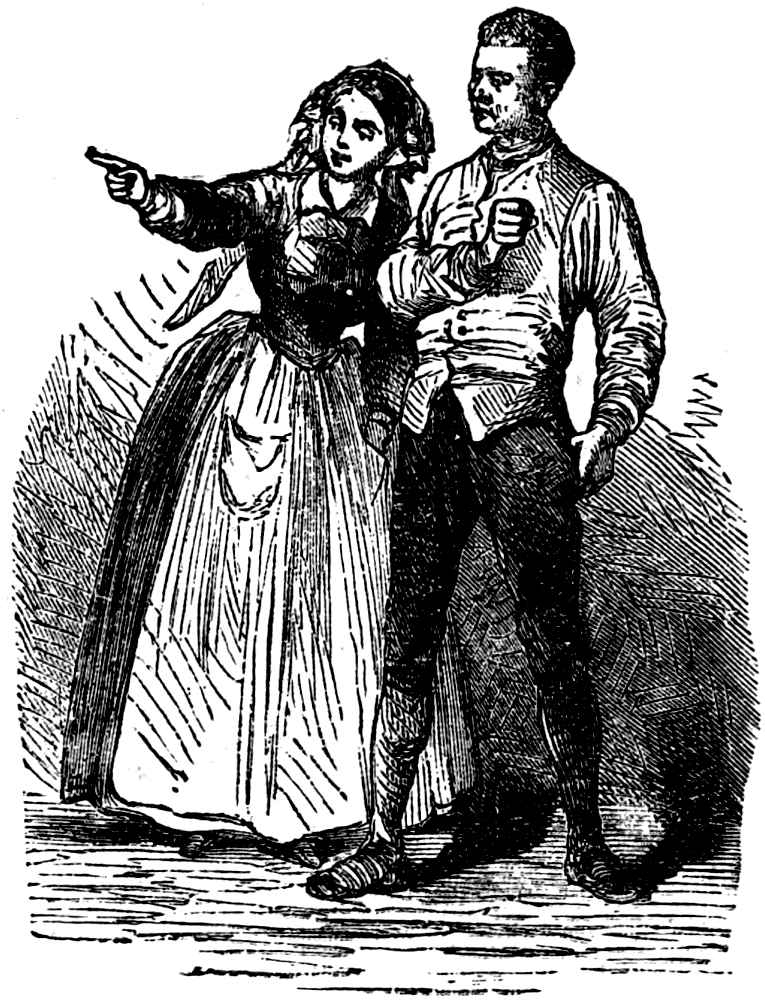
I was enraged at their spite, and began to consider some means of avoiding the threatened punishment. I would have jumped at them then, and bitten every one but I dared not, for fear they would go in a body and complain to my mistress, and I had a vague presentiment that vexed and annoyed at my numberless tricks, she might drive me off.
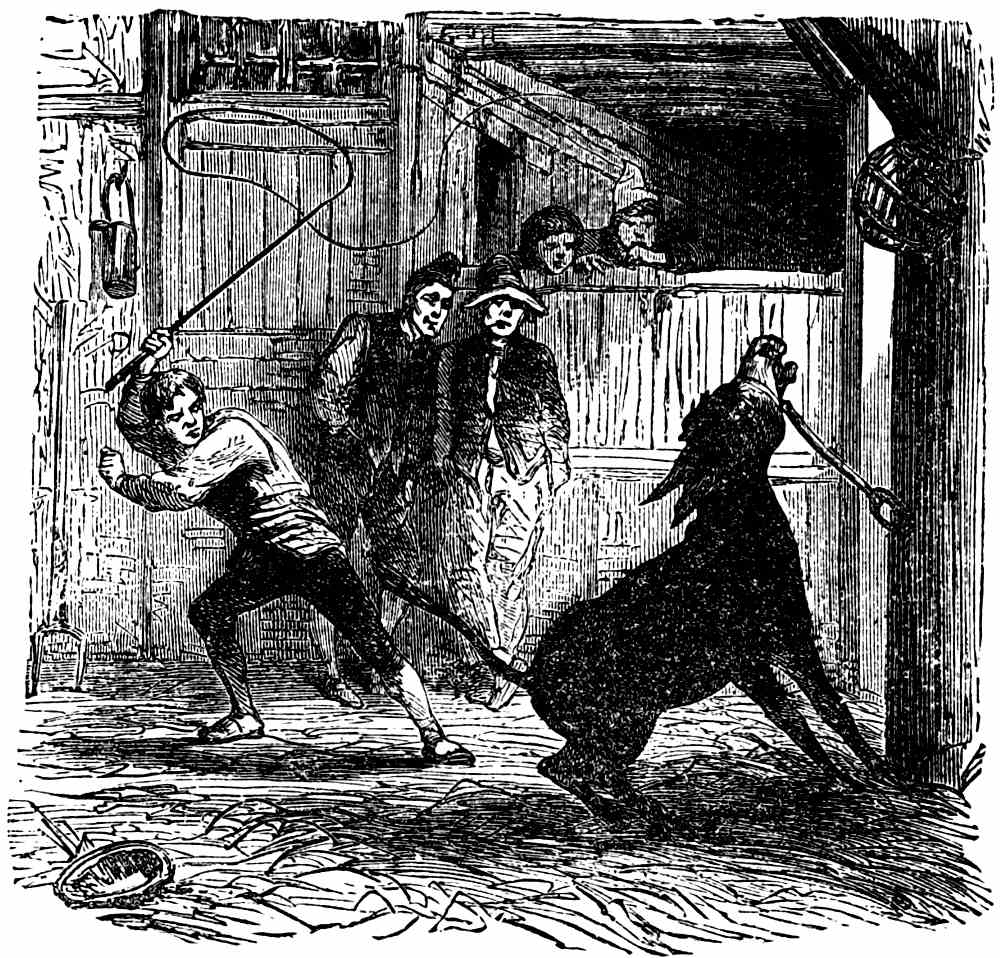
Whilst I was deliberating, I heard the chambermaid tell the coachman to look at my wicked eyes. He [Pg 182]shrugged his shoulders, arose, went into the kitchen, and coming out again, directed his steps towards the stable. In passing me he threw a slip knot over my head; I drew back to break it, and he pulled in the opposite direction to make me advance; we both pulled our best, in consequence of which the tighter the cord strangled me; at the very first I tried to bray, but in vain, I could scarcely breathe, and was forced at last to yield. He led me to the stable, the door of which was obligingly opened by the other domestics. Once in my stall, they promptly passed the halter over my head and untied the rope that was choking me; then the coachman having first taken the precaution to shut the door, seized the wagon whip and began to beat me unmercifully, without the slightest [Pg 183]remonstrance or sign of pity from anyone present. In vain did I bray and struggle, my young masters could not hear me, and the coachman was free to consult his own time and taste in meting out the punishment due the many wicked deeds of which I was accused.
He left me in a state of suffering and dejection impossible to describe. It was the first time since my entrance into this house, that I had ever been humiliated and beaten. Since then, however, in reflecting upon it, I have recognized the justice of my punishment.
The next day it was quite late when the coachman let me out of the stable. I was strongly tempted to bite him in the face, but was prevented, as on the previous day, only by the fear of being driven off the place.
I directed my steps towards the house. The children were all collected around the front entrance, engaged in a most animated conversation.
“There he is now, that wicked Cadichon,” said William, seeing me approach; “let us chase him away, he’ll bite us or play some ugly trick on us, like he did the other day on poor Alfred.”
“What was it the doctor told papa just now?” asked Maud.
“He says that Alfred is very sick; he has a fever and is delirious,” replied William.
“Delirious?” inquired James, “what is that?”
“A person is delirious,” answered William, “when he has such high fever that he does not know what he says, when he does not recognize anybody, and thinks he sees a great many things that he does not.”
[Pg 184]
“What does Alfred think he sees?” asked Louis.
“He imagines all the time that Cadichon is before him and going to dart at him and bite or crush him under foot; the doctor is very anxious about him; papa and my uncles have gone there now.”
“How base it was in Cadichon to throw poor Alfred into that disgusting hole!” said Beatrice.
“Yes; it was really base, sir,” exclaimed James, turning towards me. “Go! you are wicked! I do not love you anymore.”
“Nor I, nor I, nor I,” repeated all the children in unison. “Go away, we want nothing more to do with you!”
I was filled with consternation; every one, even to my little James (heretofore so tender and affectionate), repulsed me now.
I slowly directed my steps in another direction, but turned and looked so sadly at James that his heart was touched. Running to me, he put his hands on my head, and said in a caressing voice:
“Listen, Cadichon, we don’t love you now, but if you do better I assure you we will love you as before.”
“No, no; never as before!” exclaimed all the rest; “he has been too bad!”
“You see, Cadichon, what comes of being bad,” said little James, passing his hand over my neck. “You see that no one cares for you—but,” added he, whispering in my ear, “I still love you a little, and if you give up your ugly tricks I will love you a great deal, just as before.”
[Pg 185]
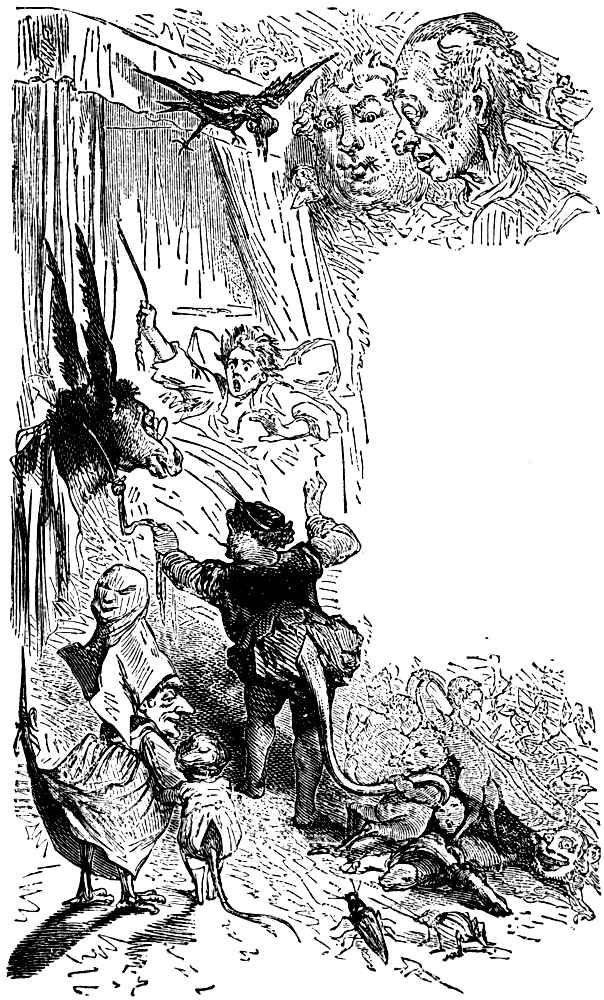
“Take care, James,” said Henry, “don’t go too near him; if he should give you a bite or a kick, he would make you suffer much.”
“There is no danger; I am very sure he’ll never bite any of us.”
“And why not?” He threw Alfred off twice.
“Oh! but Alfred, that’s another thing; he does not like Alfred.”
“And why doesn’t he like Alfred? What did Alfred ever do to him? He might take a notion some day not to like us either.”
James made no answer, for indeed there was nothing he could say; but he shook his head, and turning towards me, gave me such a friendly little caress, that I was affected to tears. The abandonment of all the others, rendered still more precious those marks of affection from my dear little James; and for the first time a sincere thought of repentance found its way into my heart. Poor Alfred’s illness caused me much anxiety. In the afternoon, we heard that he was worse, and the physician entertained fears of his life. Towards evening my young masters themselves went to his father’s to make inquiries about him. Their cousins impatiently awaited their return, and at the first glimpse of them all cried out: “Well, what news? how is Alfred?”
“Very sick,” answered William, “and yet, not quite so ill as he was.”
“His poor father,” said Henry, “is greatly to be pitied; he weeps and sighs, and begs the good God to spare him [Pg 188]his son; he said so many touching things, that I could not help crying myself.”
“We must all remember him in our evening prayers, we must pray with him and for him, must we not, dear ones?” said Elizabeth.
“Certainly, with all our hearts,” responded every child at once.
“Poor Alfred! suppose he should die!” said Beatrice.
“Then,” answered Maud, “his father would lose his mind from grief, for Alfred is his only child!”
“Where is Alfred’s mother?” said Elizabeth, “we never see her.”
“It would be very astonishing if we were to see her,” answered William, “for she has been dead ten years.”
“And the singular part of it is, that the poor lady’s death was caused by her falling into the water whilst on a boating party,” said Henry.
“How? was she drowned,” inquired Elizabeth.
“No,” said William, “she was rescued immediately; but it was warm weather, and the sudden chill of the water, combined with the fright, threw her into a fever and delirium just like Alfred’s, from which she died in eight days.”
“Oh! my God!” exclaimed Maud, “grant it may not be thus with Alfred!”
“And for this intention we must pray fervently,” said Elizabeth, “perhaps the good God will grant our request.”
“Where is James?” inquired Beatrice.
“He was here just now, he will return,” said Maud.
[Pg 189]
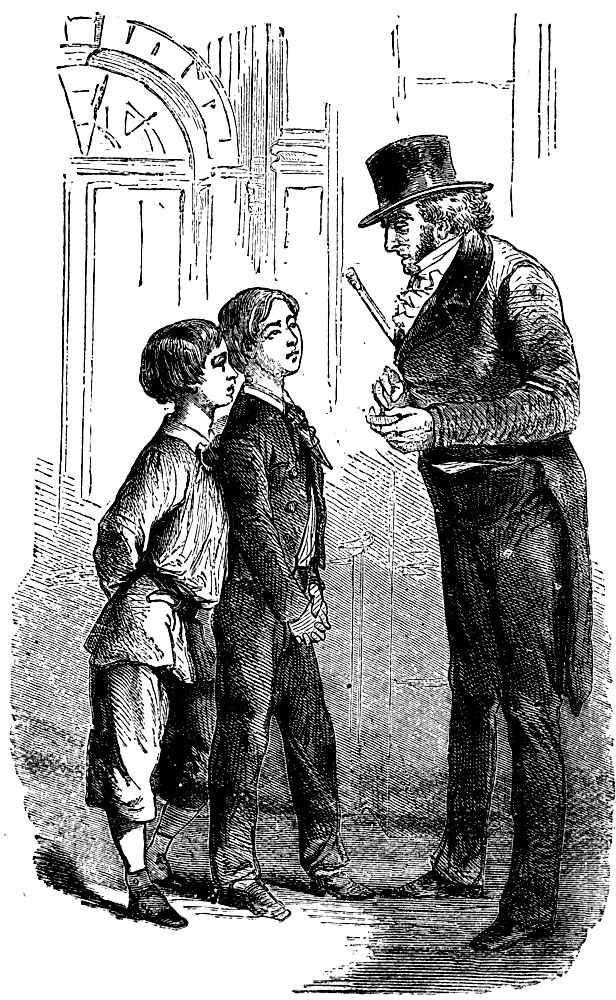
But the poor child did not return, for he had thrown himself upon his knees behind a chest, and with his head buried in his hands, he wept and prayed! And it was I who had caused all this sorrow, Alfred’s illness, his father’s anxiety and bitter grief, my little James’s distress. This thought was a sad one for me, I began to reflect that it would have been better to have left Medor’s death unavenged.
“What good did Alfred’s fall do to Medor?” I asked. “Medor is none the less lost to me, and the vengeance I have taken, has only served another purpose, that of making me feared and detested.”
I impatiently awaited the next morning’s news of Alfred, and I was among the first to hear, for James and Louis harnessed me to the little carriage to take them over. Immediately on our arrival, we learned from a servant who was hastening for the doctor, that Alfred had passed a bad night, and had just had a convulsion that greatly alarmed his father. James and Louis waited for the doctor. He was not long in coming, and promised to give them correct news of his patient.
In half an hour he descended the steps.
“Oh! Mister Tudoux, how is Alfred?” inquired Louis and James.
“Very sick, very sick, my children, but not as ill as I feared,” said Mister Tudoux very slowly.
“But these convulsions,” asked Louis, “are they not dangerous?”
“No, his convulsion resulted from great irritation of [Pg 192]the nervous system. I gave him a pill that will compose him. He is not dangerously ill,” said Doctor Tudoux, in the same slow, deliberate manner.
“Then, Mister Tudoux, you do not think he will die?” asked James.
“No, no, no,” was the reply in the same measured tones, “he is not seriously ill, not at all.”
“I am so glad!” exclaimed both the boys, “thanks Mister Tudoux. Good-bye, we must hasten home to take the good news to our cousins.”
“Wait, wait a moment. Isn’t that Cadichon you are driving?”
“Yes, this is Cadichon,” replied James.
“Then take care,” said Doctor Tudoux calmly, “he might throw you into a ditch as he did Alfred. Tell your grandmother she ought to sell him, he is a dangerous animal.”
And the Doctor bade them good morning. As for me, I remained in such a state of astonishment and humiliation, that I stood motionless, never dreaming of taking a step homeward until my little masters had thrice said to me:
“Come, Cadichon, get up!—Go, Cadichon, get along, we are in a hurry!—Are you going to sleep here, Cadichon? Get up, get up!”
I started at last, and ran all the way to the house, reaching which, we found the cousins, uncles and aunts, papas and mammas assembled at the first entrance, anxiously awaiting our return.
[Pg 193]
“He is better,” exclaimed James and Louis, and then they related their conversation with Mister Tudoux, not forgetting his last injunction.
With lively trepidation, I awaited the grandmother’s decision. After an instant’s reflection, she said:
“It is very certain, my dear children, that Cadichon no longer deserves our confidence, and I do not wish the smaller of you to mount him. The very next trick he plays on any one, I shall sell him to the miller, who will give him employment in carrying bags of flour, but I want to try him a little longer, before reducing him to this state of humiliation. Perhaps he will reform, we shall be able to tell very well at the end of a few months.”
My dejection, my humiliation, my repentance increased, but I could not repair the evil I had wrought myself, except by dint of patience, gentleness and time. I was deeply wounded both in my pride and my affections.
Next day we heard still more encouraging news of Alfred. A few days later he was convalescent, and ceased to be the subject of anxiety at the castle.
But I could never have him out of my mind, for some one was continually saying within my hearing:
“Beware of Cadichon! Remember Alfred!”
[Pg 194]
Since the day I had scratched Alfred’s face, brushing him up against all the thorny bushes along the road, and ended by pitching him into the ditch, there was a very visible change in the treatment I received from my little masters, their parents, and in fact, from every one about the place. The very animals behaved differently towards me; they seemed to avoid me, moving off when I approached them, or maintaining a rigid silence in my presence; for, as I have already remarked in connection with my friend Medor, we other animals converse among ourselves without speaking as men do, movements of the eyes, the ears, the tail taking the place of words. I knew only too well what had caused this change, and I was more irritated than grieved, until one day, when, alone as usual, taking my ease at the foot of a pine tree, I saw Henry and Elizabeth approach; they seated themselves and continued their conversation.
“I believe you are right, Henry,” said Elizabeth, “and I agree with you; I also care very little for Cadichon since he treated Alfred so badly.”
“And not only Alfred; don’t you remember the fair [Pg 195]of Laigle, how he behaved to the learned donkey’s master?” replied Henry.
“Ah! ah! ah! Yes; I recollect very well, it was funny! Everybody laughed; but for all that, we thought he displayed more wit than heart.”
“That is true; he humbled the poor donkey and his master. I have been told that the unfortunate man was so ridiculed he had to leave without a cent in his pocket, and his wife and children were in tears for want of something to eat.”
“And it was all Cadichon’s fault.”
“Certainly; except for him the poor man would have made enough to live on several weeks.”
“And, then, do you remember what was told us about the tricks he played his former masters? He ate their vegetables, broke their eggs, soiled their linen—I am decidedly of your opinion; I care for him no more.”
Elizabeth and Henry arose and continued their walk. I remained sad and dejected; my first impulse was to get angry and gratify myself by taking some slight revenge, but reflection convinced me that they were right; I was always taking revenge, and what had it availed me? it had rendered me unhappy.
First, I had broken the teeth and the arm of one of my mistresses, and kicked her in the stomach. The consequence was that I would have been beaten almost to death had I not luckily made my escape.
I had also played numberless tricks on one of my masters, who had been good to me until I got lazy and [Pg 196]vicious; then he treated me harshly, and I became very unhappy.
As to the death of my friend Medor, I had never reflected that Alfred killed him not intentionally, or from malice, but through awkwardness, and that for his stupidity the boy was not to blame. In revenge, I had tormented him, finishing by causing him a spell of sickness, the consequence of his plunge into the ditch.
And besides all these, of what numberless untold tricks had I not been guilty!
The end of which was that no one cared for me. I was alone, no one came near to console or caress me, even the animals kept out of my way.
“What shall I do?” I sadly asked myself. “If I could speak, I would go and tell them all that I have repented, that I beg pardon for my past conduct, that hereafter, I promise to be good and gentle, but alas!—I cannot make them understand, I cannot speak!”
I threw myself upon the grass and wept, not as men shed tears, but in the depths of my heart; I wept, I bemoaned my sad lot, and for the first time I repented sincerely.
“Ah! if I had been good,” said I “and instead of displaying my intelligence, had tried to show kindness, gentleness, patience! if I had only been to every one what I was to Pauline! how every one would love me, and how happy I should now be!”
I reflected a long time, a very long time, forming first good resolutions and plans and then bad.
[Pg 197]
At last, I decided upon a reformation so as to regain the favor of my masters and comrades, and I began immediately to put my good resolutions into practice.
For some time, I had had a comrade that I treated very badly, a donkey which was bought for the little ones, as they were afraid to ride me after I came so near drowning Alfred. The larger children were not afraid of me, but I had lost favor and there were no longer any disputes at their riding parties, as to who should have me, little James being the only one who asked for me.
This comrade was the object of my especial contempt, I always kept him behind me, kicking and biting him if he attempted to pass, until at last, the poor animal was worried into giving me first place and submitting to all my caprices.
That evening when the time arrived for us to go into the stable, I found myself near the door almost at the same moment as my comrade. He eagerly made way for me to enter first, but as he was a few steps ahead, I stopped in turn, and made a sign for him to pass. The poor donkey obeyed me, but trembling, suspicious of my politeness and believing it only the prelude to some trick, for instance a kick or a bite. He was very much astonished to find himself safe and sound in his stall, and to see me take my place peaceably in mine.
Noticing his astonishment, I said to him:
“Brother, I have treated you very badly, but I shall do so no longer; I have been proud, but I shall never be so again; I have despised, humiliated, insulted you, but [Pg 198]I do not intend to repeat it. Pardon me, brother, and in future regard me as a companion, a friend.”
“Thanks, brother,” replied the poor donkey overjoyed. “I was unhappy, but I will be happy now; I was sad, I will be gay; I felt myself isolated, but now I feel loved and protected. Thanks again, brother, love me, for I already love you.”
“Let me in turn, brother, thank you,” said I, “for I have been spiteful and you have pardoned me, I have made advances and you have not repulsed me, I have offered you my friendship, and you have given me yours. Yes, it is my turn, brother, to thank you.”
And eating our supper, we thus continued to converse. It was the first time, for hitherto I had never deigned to notice him. I found him much better and wiser than myself, and I asked him to assist me in my new life, which he promised to do with equal affection and modesty.
The horses, witnesses of our conversation and my unaccustomed gentleness, glanced at me and then at one another with surprise. Although they conversed in an undertone, I heard one say:
“This is all pretence on Cadichon’s part; he is going to play some trick on his companion.”
“Poor donkey,” answered the second horse, “I pity him. Suppose we give him a hint of it.”
“Oh, no indeed,” replied the first horse. “Silence! Cadichon is wicked! he would pay us up for this if he were to hear us.”
I was deeply wounded at the bad opinion those two [Pg 199]horses had of me; the third said nothing, but putting his head over the stall, he observed me attentively. I looked at him sadly and humbly. He appeared surprised but never moved, and continued to regard me in silence.
Fatigued and worn out by sorrow and regret, I lay down upon my bed, and as I did so, perceived it was less soft and comfortable than my comrade’s. Instead of getting angry as formerly, I recognized the justice of such treatment, and indulged in penitent reflections.
“I have been wicked,” said I, “and they have punished me; I have made myself detestable, and they have made me feel it. I ought to congratulate myself on not having been sent to the mill, where I would be beaten, badly stabled, and my back broken with heavy loads.”
Thus bemoaning my past misdeeds, I fell asleep. As I awoke the next morning the coachman entered the stable, assisting me to rise with a kick, he took off my halter and set me at liberty. I remained at the door, and to my surprise, beheld him curry and carefully rub down my comrade, then pass my beautiful ornamented bridle over his head, put my English saddle on his back, and lead him around to the front entrance.
Anxious, trembling with emotion, I followed, and oh! what was my chagrin, my desolation to see James, my beloved little master, approach my comrade, and after a little hesitation, seat himself in the saddle. I remained motionless, overcome with grief. Dear little James perceived my consternation, for coming up to me, he patted me on the head and said sadly:
[Pg 200]
“Poor Cadichon! you see what you have done! I am not afraid to ride you, but papa and mama are afraid you will pitch me off. Good-bye, poor Cadichon; be quiet, I will always like you.”
And he rode slowly off, followed by the coachman, who cried out to him:
“Take care, Master James, do not stay too near Cadichon, he will bite you, he will bite your donkey, you know very well how wicked he is.”
“He never was wicked with me and he never will be,” answered James.
The coachman struck the donkey, which started at a trot, and both he and his rider were soon out of sight. I remained rooted to the spot, overwhelmed with emotion, which was so much the more violent in proportion to the impossibility of making anyone understand my repentance and my good resolutions. Almost frantic with the insupportable weight oppressing my heart, I started off in a run, not knowing whither I went. I ran a long time, breaking through hedges, leaping ditches, clearing fences, crossing streams, not stopping till I came to a wall which I could neither break nor leap.
I looked around me. Where was I? The country seemed familiar, but I could not remember when I had ever been there before. I skirted the wall at a rapid pace. I was in a foam, having run several hours, judging by the sun. A few steps brought me to the end of the wall; I turned the corner, and recoiled with surprise and terror—I was not more than two steps from Pauline’s tomb.
[Pg 201]
My anguish was more bitter than ever. “Pauline, my dear little mistress!” I exclaimed, “you loved me because I was good; I loved you because you were good and unhappy. After losing you, I found others, who, good like you, treated me kindly. I was happy then, but all is changed now; my bad disposition, the desire of displaying my ability and satisfying my vengeance have destroyed all my happiness; no one cares for me now, and if I were to die no one would regret me.”
I wept bitterly within myself, and for the hundredth time reproached myself with my misconduct. One consoling thought suddenly inspired me with consolation. “If I reform,” thought I, “and do as much good as I have evil, perhaps my young masters will receive me again into their confidence, my dear little James especially, who still loves me a little. But how shall I make known to them my repentance and reformation?”
Whilst thus reflecting on my future, I heard steps approaching the wall, and the harsh voice of a man, saying:
“What is the use of crying, simpleton? Tears will not give you bread, will they? Since I have nothing to give you, what do you wish me to do here? Do you suppose I have a full stomach, I who have swallowed nothing since yesterday morning but air and dust?”
“I am very tired, father.”
“Well, let us rest under the shade of this wall for a quarter of an hour; I am quite willing.”
As they turned the wall and seated themselves near [Pg 202]the tomb where I stood, judge of my astonishment at seeing Mirliflore’s poor master, with his wife and son! They all had a hungry, emaciated, care-worn appearance.
The father looked at me; he seemed surprised, and, after a few minutes hesitation:
“If I see aright,” said he, “this is the donkey, the beggarly donkey that made me lose more than fifty francs at the Laigle fair. You wicked animal,” he continued, addressing me, “you were the cause of my poor Mirliflore being killed by the crowd; it was you who prevented my gaining money enough to have lived on a month; you shall pay up for it!”
He arose and approached, but I did not stir, being keenly conscious that I had merited this man’s indignation. He was astonished.
“It cannot be the same,” said he, “for he does not budge any more than a stick—‘Pretty fellow,’” he continued addressing me and smoothing my limbs. “If I had him only a month, you would not want bread my son, nor your mother, nor would my stomach be so empty.”
My mind was made up in an instant, I resolved to follow this man for several days, and suffer everything if necessary, to help him make some money for his family, in reparation of the wrong I had done him.
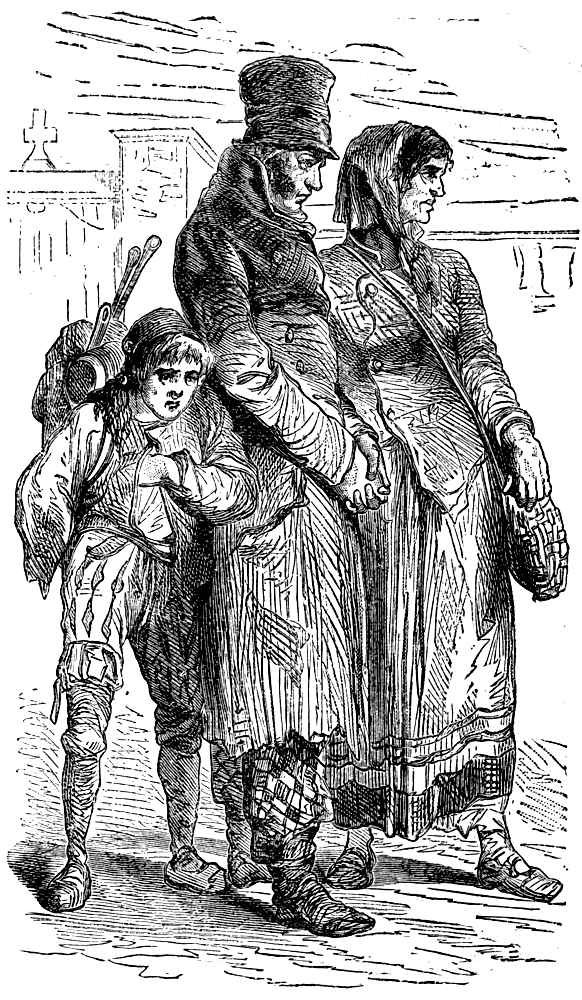
When they resumed their journey, I followed them; at first, it was not noticed, but the father having looked around several times, and seen me always at their heels, tried to drive me back. I refused to leave them, persistently [Pg 205]returning to my place beside or just behind them.
“It is strange,” said the man, “that this animal will follow us! My faith, since he is so determined, let him do it.”
On reaching the village, he presented himself at an inn, and asked for a meal and lodging, frankly confessing that he had not a cent in his pocket.
“We have beggars enough of our own, my good man,” answered the inn-keeper, “without adding those who do not belong here, you must go elsewhere.”
I darted to the inn-keeper’s side, and saluted him several times in such a grotesque fashion as to make him laugh.
“This animal of yours does not appear stupid,” said the inn-keeper, laughing. “If you will let us see some of his tricks, I will cheerfully give you food and lodging.”
“I do not refuse, landlord, but we must have something in our stomachs first,” answered the man, “when fasting, one cannot control his voice properly.”
“Come in, come in, you shall be waited on; Madelon, my old woman, dinner for three, not counting the donkey.”
Madelon brought them some good soup, which was swallowed in the twinkling of an eye, then a nice piece of boiled meat and some cabbage, both of which disappeared with equal rapidity, and at last, a dish of salad [Pg 206]and some cheese, which they devoured with less avidity, their hunger by this time being somewhat appeased.
My dinner was a bundle of hay, but I ate very little, I had too heavy a heart to be hungry.
The inn-keeper had collected all the village to see me perform, and the yard was filled, when my new master led me out into the circle. He seemed greatly embarrassed, not knowing my capacity or whether I had received any education. At a venture he said to me:
“Salute the society.”
I made a bow to the right, to the left, before me and behind, and everybody applauded.
“What are you going to make him do now?” said the wife in an under tone, “he doesn’t know what you mean.”
“Perhaps he will understand. These educated donkeys are intelligent, I am going to try him.”
“Go, Mirliflore,” (this name made me sigh) “go, kiss the prettiest lady here.”
Looking right and left, I perceived behind nearly every one else, the landlord’s daughter, a pretty brunette of some fifteen or sixteen years. I directed my steps towards her, and pushing away with my head, those who blocked the passage, I went up to her and put my nose against her forehead. She laughed and seemed to be quite pleased.
“Say now, father Hutfer, you gave that lesson, didn’t you?” exclaimed several in the crowd, laughing.
“No, upon my honor,” answered Hutfer, “I came only as a spectator.”
[Pg 207]
“Now, Mirliflore,” said my new master, “go find something, no matter what, and give it to the poorest person present.”
I went towards the room in which they had just dined, seized a loaf of bread and triumphantly deposited it in his own hands.
There was a general laugh, everybody applauded. “That’s not your lesson, father Hutfer,” cried a friend, “this donkey really is sensible, he has profited well by his master’s training.”
“Are you going to let him have a whole loaf of bread like that?” said some one in the crowd.
“No, not that,” answered Hutfer, “give it to me, donkey-man, this was not in our agreement.”
“It was not, landlord,” responded the man, “nevertheless my donkey told the truth, when he pointed me out as the poorest here, for until we got our dinner, my wife, my son, and myself had eaten nothing since yesterday morning, for want of two sous to buy a bit of bread.”
“Let him have the bread, father,” said Helen Hutfer, “our meal bins are full, and the good God will recompense us for what we give away.”
“That is just like you, Helen,” said Hutfer, “if one listened to you, he would give away all he has.”
“We are no longer poor, father, the good God always blesses our harvests and our house.”
“Well, then—since you wish it—let him keep his bread, I am willing.”
At these words, I went up to him, and made him a [Pg 208]profound bow. Then taking between my teeth a little empty pan, I presented it to each one for his contribution, and when after going the round my pan was full, I emptied the contents into my master’s hands, put the pan where I had found it, and making a bow, I gravely retired amidst a storm of applause.
My heart felt lighter. I was consoled and strengthened in my good resolutions. My new master seemed delighted. As he was about to retire, every one surrounded him, begging a second exhibition on the morrow, which he eagerly promised, and then went into the room with his wife and son to rest.
When they found themselves alone, the wife, after looking cautiously around her, and perceiving no one but me with my head resting upon the window, said to her husband in a low tone:
“Say husband, don’t you think it very singular our meeting this donkey coming out of a cemetery, its following us of its own accord, and making so much money for us? What amount have you there?”
“I have not yet counted,” he answered, “come help me, you take this handful and I, the other.”
“I have eight francs and four sous,” said the woman, after counting.
“And I have seven fifty—that makes—how much does that make, wife?”
“How much does that make? Eight and four make thirteen, and seven make twenty-four, and fifty make—make—somewhere about sixty.”
[Pg 209]
“How stupid you are! Sixty francs in my hands, indeed! It is an impossibility! Come, my son, you are something of a scholar, you ought to know that.”
“What is it, papa?”
“I have eight francs four sous on one side, and seven francs fifty on the other.”
“Eight and four make twelve,” said the boy, with quite a decided air; “carry one, and seven make twenty, carry two, and fifty make—make—fifty—fifty-two, carry five.”
“Dunce! how could that make fifty, since I have eight in one hand and seven in the other?”
“And fifty besides, papa.”
“‘And fifty besides, papa?’” said his father, mocking him. “Don’t you see, simpleton, that the fifty are centimes? and centimes are not francs.”
“No, papa; but it would still be fifty.”
“Fifty what? How stupid! how stupid! If I were to give you fifty knocks, would you call them fifty francs?”
“No, papa; but they would still be fifty.”
“Here is one on the account, big animal,” said the man, giving him a blow that resounded through the house. The boy began to cry. I was enraged. If this poor boy was stupid, it was not his fault.
“This man,” said I, “does not merit my pity; he has now, thanks to myself, enough to support himself and family for the next eight days. I shall still make more [Pg 210]at to-morrow’s exhibition, and, after that, I return to my masters, perhaps they will receive me kindly.”
I withdrew from the window and refreshed myself with a few fresh thistles that I saw growing on the edge of a ditch. I then went to the stable, and, finding the best places there already occupied by the horses, I modestly took a corner that no one wanted. There I could reflect at my ease, for nobody knew me, nobody troubled himself about me. Towards night, Helen Hutfer entered the stable to see if everything had been attended to, and, perceiving me in my damp, obscure corner, without a bed, hay or oats, she called one of the stable boys:
“Ferdinand,” said she, “make a bed for this poor donkey here on the damp ground, give him a measure of oats and a bundle of hay, and see that he has water.”
“Miss Helen,” replied Ferdinand, “you will ruin your papa; you are too careful of everything. What difference does it make whether this beast sleeps on a hard or a good bed? It is a waste of straw, that!”
“You don’t find me too careful or kind when it concerns yourself, Ferdinand; I wish everything here to be well treated, beasts as well as men.”
“Although,” said Ferdinand, with a mischievous air, “there are not a few men who could easily be taken for beasts, notwithstanding they do walk on two legs.”
“Wherefore we say: ‘Beast which eat hay,’” answered Helen, smiling.
“Oh! I would never give hay to you, miss, indeed! You have the wit—the wit—and the mischief of a monkey!”
[Pg 211]
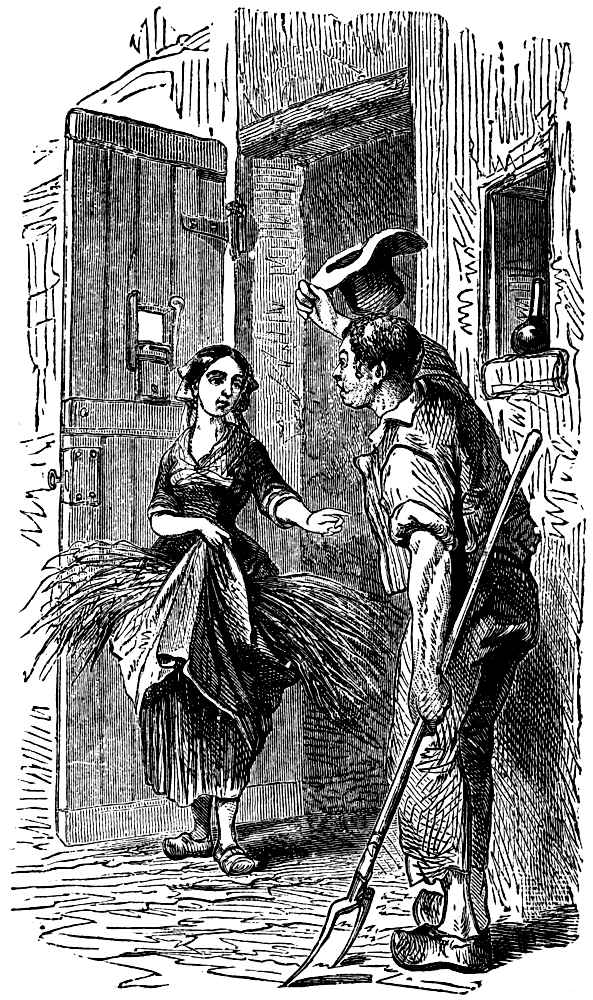
“Thanks for the compliment, Ferdinand! What are you then, if I am a monkey?”
“Ah! Miss, I did not say you were a monkey; and if I expressed myself badly, call me a donkey, a simpleton, an owl.”
“No, no, not so bad as that, Ferdinand, but only a babbler who talks when he ought to work. Make a bed for the donkey,” added she in a serious tone, “and feed and water him.”
She left the stable and Ferdinand complied with her orders in a measure, grumbling all the while. He made me a bed, giving me a few thrusts of the pitchfork as he did so, ill-naturedly threw me a bundle of hay and a handful of oats, and put a bucket of water beside me.
Not being fastened I could easily have left the place, but in pursuance of my good resolutions I preferred to suffer a little and give on the morrow, my second, and last exhibition for the benefit of the man I had wronged.
Towards evening of the next day my master led me out to a large square crowded with curious spectators; I had been well advertised in the morning, the village drummer having gone through the village at an early hour crying out: “This evening at eight o’clock there will be a grand exhibition of the learned donkey, Mirliflore; it will take place in the square opposite the school and mayor’s office.”
I repeated all the preceding day’s tricks, and added some dances executed with grace; I waltzed, I polkaed, and, I played on Ferdinand the innocent trick of engaging [Pg 214]him to waltz by braying before him, and extending my front hoof in invitation. He refused at first, but when every one cried out: “Yes, yes, a waltz with a donkey!” he darted into the circle laughing, and began to cut a thousand capers that I imitated at my best.
At last, feeling fatigued, I left Ferdinand caper alone, and went as on the preceding day to get a pan. Not finding any, I took between my teeth a basket without a lid, and, as before, presented it to each one for a contribution. It was soon so full that I had to empty it in the blouse of my reputed master. I continued my begging, and, when all had given me, I, making a profound bow to the assembly again returned to my master, and waited till he had counted the proceeds which amounted to more than thirty-four francs. Thinking I had now made sufficient reparation for the past, I felt at liberty to return home, and consequently, after a parting salutation to my master, I wedged my way through the crowd, and started off in a trot.
“Look there, your donkey has got away!” said Hutfer, the inn-keeper.
“How prettily he flies off,” said Ferdinand.
My pretended master turned around, looked at me anxiously, and called, “Mirliflore, Mirliflore;” but seeing I paid no attention, he cried out most piteously:
“Stop him, stop him, please! It is my bread, my living he carries off; do run catch him, if you bring him back I promise you another exhibition.”
“Tell us where you got him, and how long you have had him?” said a man named Clonet.
[Pg 215]
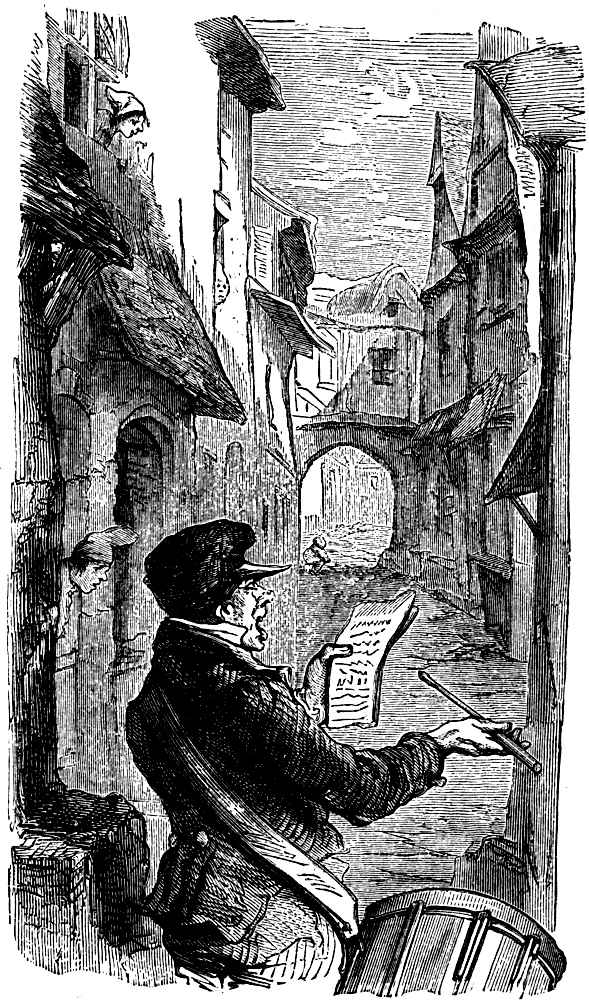
“I have had him—since I owned him,” answered my false master, somewhat embarrassed.
“I know that,” said Clonet, “but how long have you owned him?”
The man was silent.
“It appears to me,” added Clonet, “that I recognize him, he is the image of Cadichon, the donkey of Herpiniere castle; If I am not very much mistaken it is Cadichon.”
I was stopped. I heard a confused murmuring of voices, I saw the trouble menacing my new master, who suddenly dashed through the crowd, and followed by his wife and son, darted off in the opposite direction to that I had taken.
Some wished to pursue him, but others said it was not worth while, since I had escaped and the man had taken nothing away with him but the silver, which was his own, I having honestly made it for him.
“And as to Cadichon,” said they, “give yourselves no concern about him, he can find the road home, and moreover, he will not let himself be taken unless he wishes it.”
The crowd dispersed and all returned to their homes. I resumed my course hoping to reach my real masters before night, but the way was long, and being fatigued I was consequently obliged to stop about a league from the castle. It was night, the stables would be locked, so I decided to make my bed in a little piece of pine woods bordering on a stream.
[Pg 218]
Scarcely had I lain down upon the moss, when I heard cautious steps and voices speaking in a whisper. I looked, but saw nothing, the night was too dark. I listened with all my ears and heard the conversation I am about to relate.
“It is not late enough yet, Finot, it would be wiser to hide ourselves in the woods a little longer.”
“But Passe Partout, we must have a little daylight to spy around; I, especially, for I have not studied the entrances.”
“You have never studied anything, your comrades certainly made a mistake in naming you Finot, I would have called you Pataud, instead.”
“That does not prevent my being the originator of all the good plans.”
“Good plans indeed! that depends. What are we going to do at the castle?”
“What are we going to do? Rifle the kitchen garden, cut up the artichokes, gather the peas, the beans, the turnips, carrots, carry off the fruits, that is the work.”
“And what then?”
“Why do you say what then? We are going to collect everything in a pile, get it over the wall, and take it to the market at Moulins and sell it.”
[Pg 219]
“And how will you get into the garden, dunce?”
“Over the wall, with a ladder to be sure. Would you have me go to the gardener and politely request the loan of his keys and tools?”
“That’s a poor joke, I only want to know if you have marked out the place where we are to climb over the wall?”
“No, and for that reason, I prefer going at once, to reconnoitre.”
“And if they should see you, what would you say?”
“I would say—that I came to beg a glass of cider and a crust of bread.”
“That plan is not worth much. Now, here is my idea: I know the kitchen garden; one part of the wall needs repairing; I can climb up there by setting my feet among the stones; I shall find a ladder and pass it over to you, as you are not very expert in climbing.”
“No; I am not as much of a cat as you.”
“But suppose some one comes to upset our plans?”
“You are a real child; if any one comes to disturb me, I shall know what to do.”
“What would you do?”
“If a dog, I would kill him; I don’t carry my sharp knife to no purpose.”
“But suppose it’s a man?”
“‘A man?’” answered Finot, scratching his ear. “That would be more perplexing—A man? yet a man can be killed as well as a dog. If it were only for something valuable but for vegetables! And, then, this castle is full of people.”
[Pg 220]
“But tell me, what would you do?”
“My faith! I would make off as fast as possible; it would be the safest plan.”
“You are a coward, do you know that? If you see or hear a man, you have only to call me, and I will settle him.”
“Act according to your own taste; it would not be mine.”
“Well, now we are agreed—this is the plan: To-night we go to the kitchen garden wall; you remain at one end as a guard, whilst I climb over and get you a ladder, by means of which you rejoin me.”
“Yes; it is all right,” answered Finot.
Just then he looked anxiously around, listened, and said in a whisper:
“I heard something stir back there, could it be anybody?”
“Who wants to hide in the woods?” answered Passe Partout. “You are always afraid; it may be a frog or a snake.”
They said no more. I did not stir again, and I now began to devise some means of thwarting these robbers’ plans and causing their arrest. I could warn no one; I could not even prevent their entering the garden. However, after much reflection, I thought of a scheme that might end theirs. I let them set out ahead of me, determined not to budge until they were out of hearing.
I knew they could not walk fast, as the night was very dark. I took a short cut, and, clearing several hedges, [Pg 221]reached the wall long before them. I knew the dilapidated place of which Passe Partout had spoken, and, finding it, crouched as close as possible to the wall to prevent their discovering me.
Here I waited at least a quarter of an hour, still no one came; at last, I heard heavy footsteps and then a faint whispering. They approached very cautiously, one coming towards the spot in which I was concealed (this was Passe Partout), the other going in the opposite direction, near the entrance (this was Finot).
I saw nothing, but I heard all. When Passe Partout reached the spot where several stones had fallen from the wall, and thus made a sufficient resting place for the feet, he began to ascend, assisting himself with his hands. I did not stir; I scarcely breathed; I heard and understood every one of his movements. When he had climbed about as high as my head, I darted out from my hiding place, seized him by the leg and gave him a vigorous pull. Before he had time to recollect himself, he was on the ground, stunned by the fall, wounded by the stones. To prevent his crying out, or calling on his comrade for help, I gave him a hard kick on the head, which left him unconscious. I then took my station very near him, thinking his comrade would soon come to see what had happened. I had not waited long ere I heard Finot advancing very cautiously. He took a few steps and stopped—he listened, heard nothing—and went a few steps farther. In this manner, he at length drew very near his companion, but without perceiving it, as his [Pg 222]gaze was fixed upon the wall and the companion lay motionless on the ground.
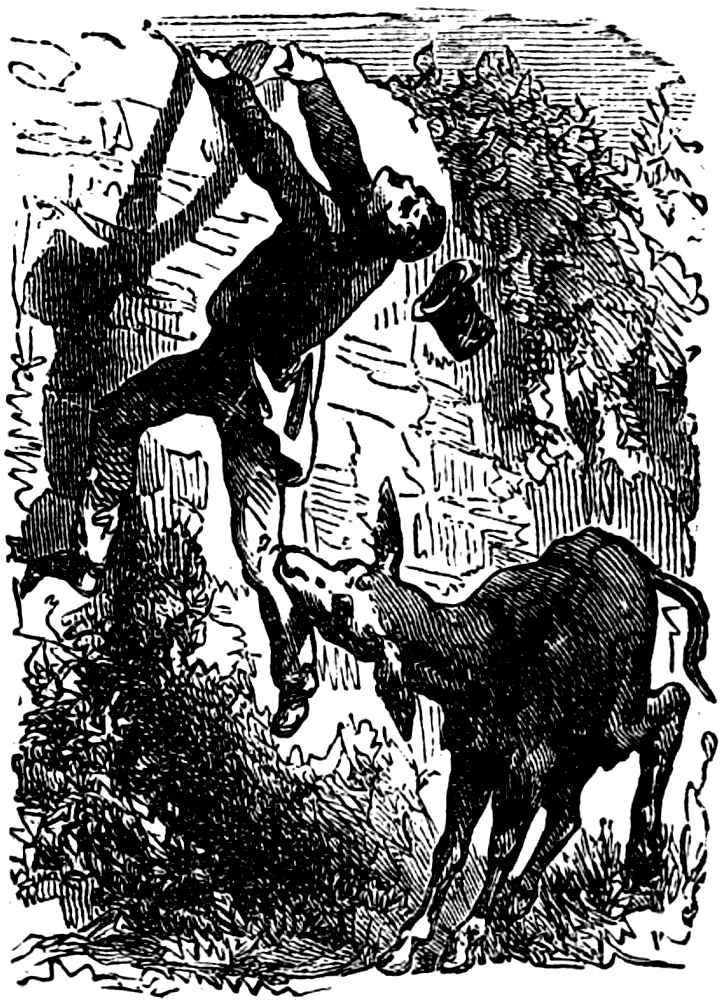
“Pst! pst! Have you the ladder? Must I mount now?” said he, in a low voice. The other, not hearing him, of course there was no answer. I saw that he was not much in the notion of climbing and might leave—it was time to act. I rushed at him, and, pulling him to the ground by the back of his blouse, gave him, like his companion, a hard kick on the head, and, with the same success, he lay motionless near his friend. Then, having nothing more to lose, I began to bray in my most formidable voice; I ran to the gardener’s house, to the stables, to the castle, braying with such violence that everybody was aroused. Some of the bravest hastened out with arms and lanterns; I ran up to them, and, by running a [Pg 223]little ahead, led them to the two robbers stretched at the foot of the wall.
“Two dead men! What can that mean?” said William’s father.
“They are not dead,” answered James’s father; “they breathe.”
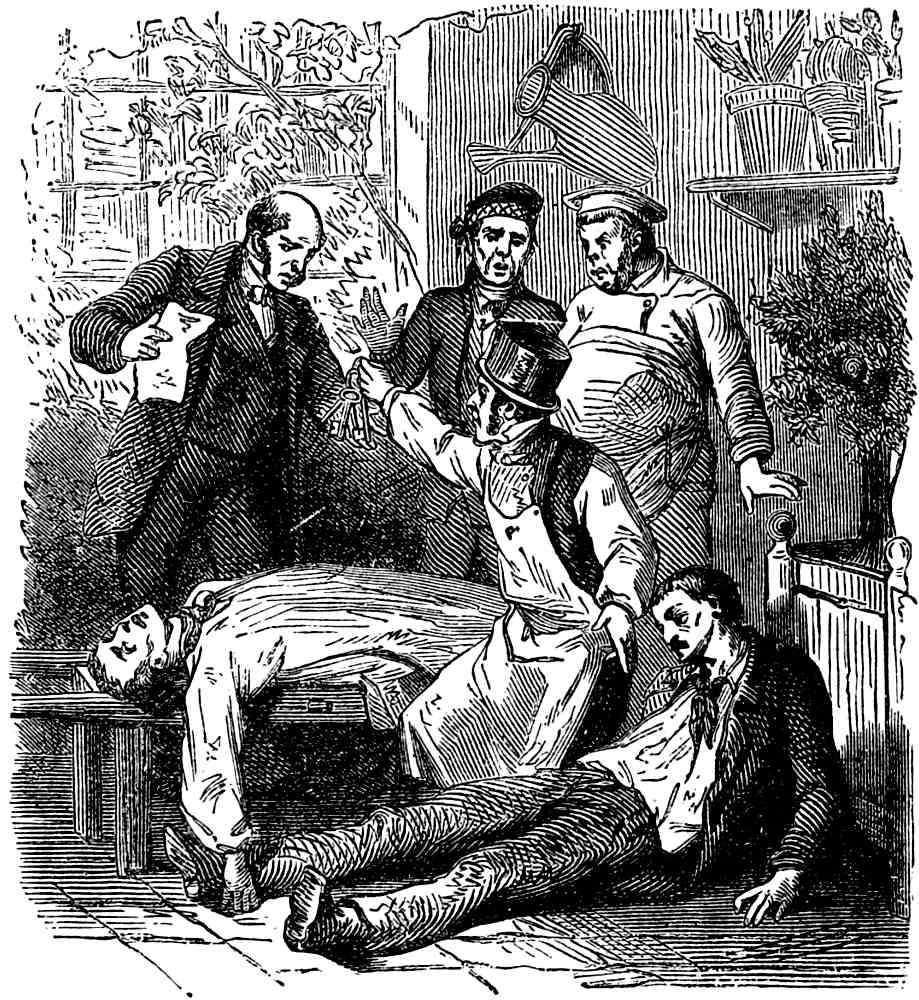
“And I just heard one groan,” said the gardener.
“Look at the blood! Such a wound on his head!” said the coachman.
“And the other is similarly wounded; it looks like the kick of a horse or mule,” said William’s father.
“Yes,” replied James’s father; “here is the mark of the shoe on his forehead.”
[Pg 224]
“What are the gentlemen’s orders?” asked the coachman; “what shall we do with these men?”
“Carry them to the house,” answered William’s father; “harness up the cab, and go for the doctor; whilst waiting for him, the rest of us will try to restore them to consciousness.”
The gardener brought a litter, on which the wounded men were placed and carried to a large room used as an orangery in winter. They were still unconscious.
“I do not know these faces,” said the gardener, after examining them attentively by the light.
“Perhaps they have some papers about them that will reveal their identity,” said Louis’s father; “we ought to let their families know they are here and wounded.”
The gardener rummaged in their pockets, and drew forth some papers, which he handed James’s papa; then two sharp, pointed knives and a big bunch of keys.
“Ah! ah! This tells what these men are,” he exclaimed, “they came to rob and perhaps kill!”
“I begin to understand it all now,” said William’s papa; “Cadichon’s presence and his extraordinary brayings explain matters; these men came here to rob; Cadichon instinctively divined their intentions, attacked them, kicked them on the head, and then began braying to arouse us.”
“That is just it, the very thing,” said James’s papa; “this brave Cadichon can boast of having rendered us a great service; come, Cadichon, you are restored to favor this time.”
[Pg 225]
I was happy once more, as I promenaded up and down before the green-house, whilst Finot and Passe Partout received the necessary attentions. They had not yet recovered consciousness, when Doctor Tudoux, who was not long in making his appearance, reached the spot. He examined their wounds.
“Here are two well-directed blows,” said he; “I see distinctly the mark of a small horse-shoe, or I might say a donkey’s—and,” added he, perceiving me, “it is probably a new piece of mischief on the part of this animal, which seems as interested in our actions as if he understood them.”
“Not a piece of mischief, but an act of fidelity and intelligence,” answered William’s papa; “these men are robbers, as you see by the knives and papers found on them.”
And he began to read:
“No. 1. Castle Herp. Many people; not easily robbed—kitchen garden easy—vegetables and fruits, wall a little high.”
“No. 2. Presbytery. Old priest; no arms—woman servant, old and deaf—Good chance to rob during Mass.”
“No. 3. Sourval Castle. Master absent—Wife alone on ground floor, servant in the second story, fine silver, easily robbed. Kill if they give an alarm.”
“No. 4. Chanday Castle. Fierce watch dogs to be poisoned—no one on the ground floor—plate, gallery of rich curiosities and jewels to rob. Kill if anybody comes.”
[Pg 226]
“You see,” continued he, “these men are burglars who came to rifle our garden in default of something better. Whilst you give them surgical attention, I will send to the town for the chief of the police.”
Drawing from his pocket a case of surgical instruments, Doctor Tudoux took a lancet and bled the two robbers, who soon opened their eyes. They were greatly frightened at finding themselves in the castle and surrounded by people. When entirely restored to consciousness, they wished to speak.
“Silence knaves,” said Doctor Tudoux slowly and calmly. “Silence, there is no necessity for your telling us who you are or what brought you here.”
Finot put his hand in his vest; the papers were not there, he sought his knife, it was also gone. He looked at Passe Partout with a serious air and said in a low voice:
“I told you in the woods I heard a noise.”
“Hush,” answered Passe Partout in the same tone, “they will understand. We must deny everything.”
“But the papers, they have them.”
“We must say we found them.”
“And the knives?”
“We found them also, we must make a bold stand.”
“Do you know who it was gave you that blow on the head which stretched you senseless?”
“My faith! I do not know, I had not time to see or hear. I found myself on the ground and struck in a trice.”
[Pg 227]
“And I the same. We must find out however, if they saw us climb the wall.”
“We will indeed find out, those who attacked us, of course, will tell how and why.”
“That is true. Till then we must deny everything. Just now, let us agree upon the details of our account, so as not to contradict each other. First, were we journeying together? Where did we find the—”
“Separate these two men,” said Louis’s father, “they are agreeing upon the tale they are to tell.”
Two men seized Finot, and two, Passe Partout, bound them hand and foot, in spite of their resistance, and carried Passe Partout into another room.
The night was far advanced, all were impatiently awaiting the chief of the police. About daybreak he arrived, and accompanied by four policeman, having been told there was question of arresting two robbers. My little masters’ fathers recounted all that had happened, and produced the knives and papers found in the men’s pockets.
“This sort of a knife,” said the officer, “indicates dangerous burglars, who murder to further their purposes. Moreover, it is easy to learn from these papers, that they had planned several robberies in the neighborhood. I would not be at all surprised if these two men were not Finot and Passe Partout, very hardened brigands escaped from the galleys, and now the object of official pursuit in several of the departments, where they have committed numberless and audacious thefts. I am going to examine [Pg 228]them separately, you may assist at the examination if you wish.”
Saying this, he entered the room where Finot lay. Looking at him an instant, he said:
“Good morning, Finot! so you are taken at last.”
Finot trembled and reddened, but said nothing.
“Ah! Finot, so we have lost our tongue? Nevertheless, it was voluble enough at the last trial.”
“To whom were you speaking, sir,” said Finot looking all around him, “there is no one here but myself.”
“I know that very well, it is to yourself I am speaking.”
“I do not know, sir, why you address me thus, I am not acquainted with you.”
“Yes, but I am acquainted with you, you are Finot, an escaped criminal, condemned to the galleys for robbery and assaults.”
“You are mistaken, sir, I am not the person you pretend to know so well.”
“Then who are you, whence do you come, and where were you going?”
“I am a dealer in sheep and was on my way to a fair at Moulins, to buy lambs.”
“Indeed! and your companion, is he also a dealer in sheep and lambs?”
“I do not know, we had met but a few moments before we were attacked and overcome by a band of robbers.”
“And what about the papers in your pockets?”
“I do not even know what they contain, we found them not far from here, and had not time to examine them.”
[Pg 229]
“And the knives?”
“The knives were with the papers.”
“Really, you were lucky, to find and pick up so much without being able to see, the night was very dark.”
“It was mere chance. My comrade stepped upon something that felt strange, we both stooped down, and feeling around, found these papers and knives which we divided.”
“It is very unfortunate they were divided, for this circumstance furnishes evidence sufficient to thrust each of you in prison.”
“You have no right to put us in prison, we are honest men.”
“That is just what we are to find out, and before very long. Good day, Finot. Do not disturb yourself,” added he, seeing that Finot attempted to rise from the bench. “Men, give this man every attention, and keep him under your eye, for he has already escaped us more than once.”
The officer retired, leaving Finot anxious and dejected.
“If Passe Partout should only give the same account as myself,” said Finot, “but it is mere chance that he does.”
Seeing the officer enter, Passe Partout felt that all was lost; however, he tried to conceal his anxiety and appear at ease, whilst the policeman looked at him attentively.
[Pg 230]
“How do you happen to be here wounded and tied?” said the officer.
“I know nothing about it,” answered Passe Partout.
“You certainly know who you are, where you were going, by whom you were wounded.”
“I know very well who I am, and where I was going, but I do not know who brutally attacked me.”
“Well then, we will proceed in order—who are you?”
“Is that your business? You have no right to ask travelers who they are.”
“I have so good a right, that I put thumb-screws on those who refuse to answer, and take them to prison.”
“I will begin again: who are you?”
“I am a cider merchant.”
“Your name if you please.”
“Robert Partout.”
“Where were you going?”
“Just wherever I could buy cider.”
“You were not alone, you had a companion?”
“Yes, my partner in business, we attend to our affairs together.”
“And these papers in your pockets, do you know anything about them?”
“Ah!” said Passe Partout mentally, “he has read these papers, and thinks he can catch me there, but I will outwit him.”
And then he added aloud:
“Do I know anything about them? I certainly do. [Pg 231]You mean the papers the brigands lost, and which I intended taking to the city police.”
“How did you get these papers?”
“We found them on the way, and having read them, were so anxious to deliver them to the authorities, that we continued our journey at night.”
“And the knives that were found on you?”
“The knives? we brought them to defend ourselves, for we had been told there were robbers in this part of the country.”
“How and by whom were you and your companion wounded?”
“By robbers who came upon us without our seeing them.”
“Ah! Finot’s account is different from yours.”
“Finot is so frightened that he has lost his memory, you must not credit what he says.”
“I do not believe what he says, any more than I believe what you yourself tell me, friend Passe Partout, for I am well acquainted with you, you have betrayed yourself.”
Passe Partout immediately perceived what a fool he had been in recognizing his companion as Finot. It was a nickname given him at the prison in derision of his lack of cunning.
As to Passe Partout, his real name was Partout. One day as they were hurrying to the refectory, Finot exclaimed, “Passe Partout,” and the name became a fixture. He could deny matters no longer, still he would not confess; but shrugging his shoulders said:
[Pg 232]
“Because I am acquainted with Finot? It was no harm to suppose you spoke of my companion. I thought you called him Finot in derision.”
“Well, that is good! twist that as you will; it is none the less true, however, that you and your companion were journeying together buying cider, that you found these papers on the road, read them, and were carrying them to the town to put them in the hands of the authorities—that you bought the knives to defend yourselves against robbers, that you were attacked and wounded by these same robbers,—is not that the story?”
“Yes, yes; that is, indeed, my account.”
“Say, rather, your tale; for your companion has told quite another story.”
“What did he say?” anxiously inquired Passe Partout.
“It is not necessary for you to know just at present, but when you are both in the convict prison he will tell you.”
And the officer went out of the room, leaving Passe Partout in a state of rage and anxiety easily imagined.
“Do you think, doctor, that these men are able to walk to the town?” inquired the officer of Doctor Tudoux.
“I think they can get there, if you do not urge them on too fast,” responded Doctor Tudoux, slowly. “Moreover, should they even give out on the way, you could easily send for a carriage and put them in it; but they are badly kicked on the head, and might die in three or four days.”
[Pg 233]
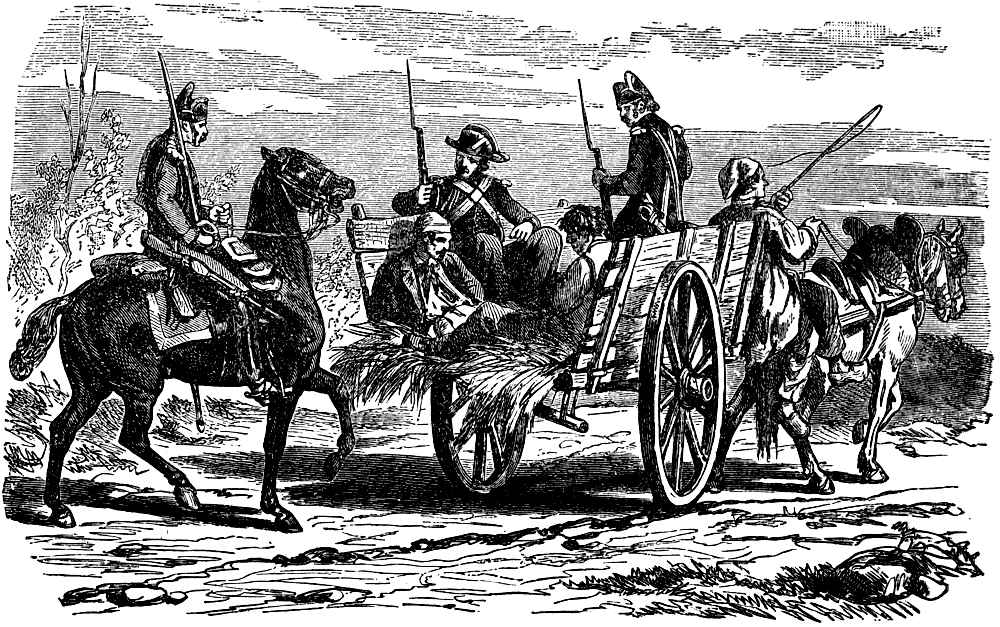
The officer was perplexed, for he was a kind man, and, although the prisoners deserved no pity, he did not wish to make them suffer unnecessarily. Mr. de Ponchat, father of William and Henry, seeing his embarrassment, proposed to harness up one of our conveyances. His offer was gratefully accepted, and, when the vehicle was brought to the door, Finot and Passe Partout were put into it, each between two guards. Moreover, their feet were tied to prevent their leaping out and escaping, and the officer on horseback rode beside the wagon, never losing sight of his prisoners. They soon disappeared, and I remained alone before the house, eating grass and impatiently awaiting my little masters, especially my dear James, whom I longed to see. I knew that the service I had just rendered would secure their pardon for all past misdeeds.
When, at last, it was a reasonable hour in the morning, and everyone about the castle had arisen, dressed and breakfasted, a group rushed down the front steps. It was the children. All ran to me and caressed me to my heart’s content, but the caresses of none were so affectionate or so dear to me as those of little James.
“My good Cadichon,” said he, “you have come back! I was so sorry when you went away! You see my dear Cadichon, that we still love you!”
“He has really become good,” said Maud.
“And he has lost that insolent air he used to have,” said Beatrice.
“And he bites his comrade and the watch dogs, no longer,” said Elizabeth.
[Pg 236]
“And he lets himself be saddled and bridled without trouble,” said Louis.
Helen—“And he doesn’t eat the bouquets, I hold in my hand.”
Ruth—“And he doesn’t kick any more when we mount him.”
William—“And he doesn’t run after my pony any more to bite his tail.”
James—“And he has saved all our fruits and vegetables by causing the arrest of these robbers.”
Henry—“And he has broken their hands with his feet.”
Elizabeth—“But how could he cause the arrest of the robbers?”
William—“We do not know all the particulars, but the household was aroused by his brayings. Papa, my uncles and some servants went out, and saw Cadichon galloping up and down from the house to the garden; following him with lanterns till he came to the end of the wall around the kitchen garden, they there found these two men, unconscious whom they discovered to be robbers.”
James—“How could they tell these men were robbers? do not robbers look and dress like us?”
Elizabeth—“Indeed they are not like us! I have seen a band of robbers, they wore pointed hats, and chestnut colored mantles and they had such wicked countenances and enormous mustaches.”
“Oh! where did you see them and when?” exclaimed all the children at once.
[Pg 237]
Elizabeth—“I saw them, last winter, at the Franconia theatre.”
Henry—“Ah! ah! ah! What nonsense! I thought you meant real robbers, that you had met in some of your travels, and I was astonished at never having heard my uncle and aunt mention it.”
“Certainly, sir, they were real robbers,” answered Elizabeth quite piqued, “the soldiers fought against them, and killed some and took some prisoners. There was nothing funny about it; I was much frightened and some of the poor soldiers were wounded.”
William—“Ah! ah! ah! how silly you are! you saw what we call a drama, which is played by paid men, who repeat it every night.”
Elizabeth—“How can they repeat it when they are killed?”
William—“They only pretend to be killed or wounded, they are as sound as you or I.”
Elizabeth—“How then did papa and my uncles know these men were robbers?”
William—“Because knives to kill people were found in their pockets, and—”
“But those knives to kill people, how are they made?” interrupted James.
William—“Like—like, all other knives.”
James—“Then how could you tell that they were to kill people? Perhaps they were to cut their bread?”
William—“You worry me James, you always want to understand everything, and you interrupted me, just as [Pg 238]I was going to tell you, that papers were found on them, revealing their plans; it was all written down what they were to do, steal our vegetables, and kill the priest and many other people.”
James—“And why were they not going to kill us?”
Elizabeth—“Because they know papa and my uncles are very brave, that they have pistols and guns, and also that we all would have helped.”
Henry—“You would be famous assistance, indeed, if any one were to attack us.”
Elizabeth—“I would be as brave as you, sir, and I would know very well how to pull the robbers by the legs to prevent their killing papa.”
Maud—“Come, come; don’t quarrel, but let William tell us what he heard.”
Elizabeth—“It is not necessary for William to tell us what we already know.”
William—“Then why ask me how papa discovered that these men were robbers?”
“Masters William and Henry, master Alfred wants you,” said the gardener, who had just brought the vegetables for the kitchen.
“Where is he?” asked William and Henry.
“In the garden,” answered the gardener; “he dares not come to the house, for fear of meeting Cadichon.”
I sighed, as I thought that poor Alfred feared me not without reason since the sad day I had treated him so shamefully, almost drowning him in a filthy ditch, after scratching him with briers and thorns, and nibbling the pony’s tail until he was pitched over its head.
[Pg 239]
“I ought to make reparation,” said I; “what can I do, what service can I render him to convince him that he has no longer any reason to fear me?”
Whilst I vainly pondered a means of convincing Alfred of my repentance, the children approached the spot where I browsed and meditated at the same time. I saw that Alfred kept at a distance and regarded me with mistrust.
William—“It is going to be warm to-day, and I don’t think it will be pleasant to go far. It would be better for us to remain in the shady park.”
Alfred—“William is right, I have never regained my strength since that spell of sickness which nearly brought me to the grave, and consequently I am very easily fatigued.”
Henry—“You must owe Cadichon a grudge, since he was the cause of your illness.”
Alfred—“I do not believe he did it purposely, he was probably frightened at something on the road, and jumped aside, accidentally pitching me into that frightful ditch. So I do not hate him, but—”
William—“But what?”
[Pg 240]
“But,” said Alfred, blushing slightly, “I would rather not get on him again.”
The poor boy’s generosity touched me, and increased my regret at having treated him so badly.
Maud and Beatrice now proposed to do some cooking. The children had built in their garden an oven, which they heated with dry wood, gathering it themselves, and this proposition was joyfully received.
They ran to get kitchen aprons and returned to their garden prepared for work. Alfred and William brought the wood; breaking each branch in two, they filled their oven.
Before kindling the fire, they held a consultation as to what they should have for breakfast.
“I wish an omelet,” said Maud.
Beatrice—“I, coffee and whipped cream.”
Elizabeth—“I, cutlets.”
William—“I, cold veal with vinegar sauce.”
Henry—“I, potato salad.”
James—“I, strawberries and cream.”
Louis—“I, slices of bread and butter.”
Helen—“I, grated sugar.”
Ruth—“And I, cherries.”
Alfred—“I will cut the bread, set the table, prepare the wine and water, and help generally.”
And each one went to the kitchen to get materials for the desired dish. Maud brought eggs, butter, salt, pepper, a fork and a frying pan.
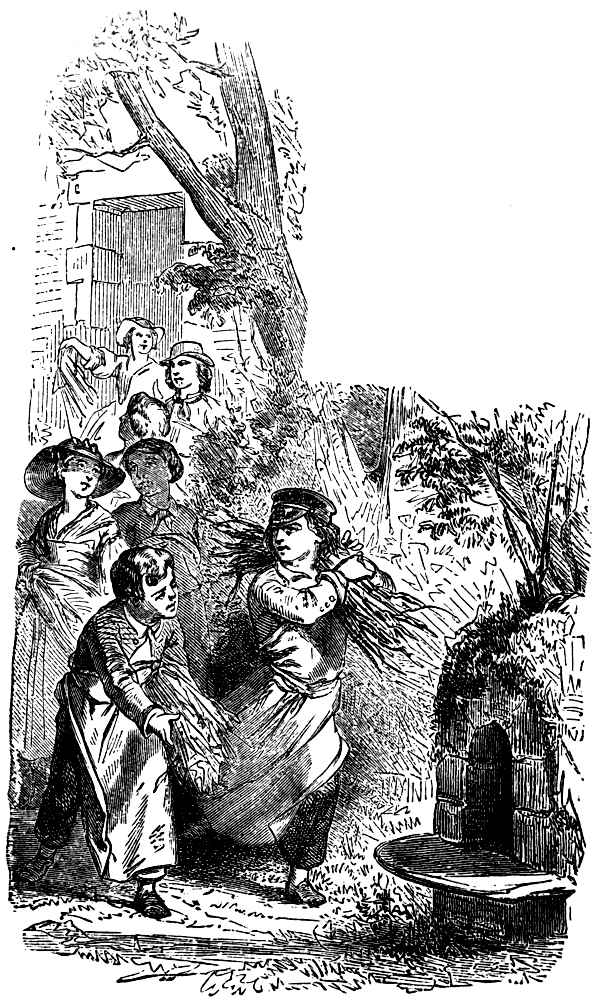
“I must have some fire to melt my butter and cook [Pg 243]my eggs,” said she. “Alfred, Alfred, some fire, if you please.”
“Where must I kindle it?”
“Near the oven, be quick, I am beating my eggs.”
“Alfred, Alfred,” called out Beatrice, “run to the kitchen and get the coffee for the whipped cream, I forgot it, be quick.”
“I must kindle the fire for Maud.”
“You can do that afterwards, run quick and get my coffee, now it will not take you long, and I am in a hurry.”
Alfred started off in a run.
“Alfred, Alfred,” said Elizabeth, “I must have some embers and a gridiron for my cutlets; I have cut them nicely.”
Alfred, who ran with the coffee, set out again for the gridiron.
“I must have oil for my vinegar sauce,” said William.
“And I, vinegar for my salad,” said Henry, “quick, Alfred with the oil and vinegar.”
Alfred who had just brought the gridiron, returned for the vinegar and oil.
“Oh! my fire!” said Maud, “is that how you light it, Alfred? My eggs are beaten, you are going to make me lose my omelet.”
“My commissions have been so numerous, I have not had time to light the fire.”
“And the coals?” cried Elizabeth, “where are you, Alfred? you have forgotten my coals!”
[Pg 244]
“No, Elizabeth, I have not been able to get them, I have been kept running.”
“Hurry, Alfred, or I shall not have time to broil my cutlets,” was the reply.
“And I must have a knife to cut my slices of bread,” said Louis, “bring a knife, quick, Alfred.”
“I have no sugar for my strawberries, grate the sugar, Helen, hurry,” said James.
“I have grated till I am tired,” she answered, “I am going to rest a little—I am so thirsty!”
“Eat some cherries,” said Ruth, “I am thirsty, too.”
“And so am I,” chimed in James, “I am going to taste a few to refresh myself.”
“I shall do the same,” added Louis, “it is very fatiguing to cut bread.”
And the four little ones surrounded the basket of cherries.
“Let us sit down,” said Ruth, “it will be more convenient whilst refreshing ourselves.”
They refreshed themselves so well that they ate every cherry. When the basket was empty they looked anxiously at one another.
“They are all gone,” said Ruth.
“We are going to get scolded,” answered Helen.
“Oh! what shall we do?” inquired Louis, anxiously.
“Ask Cadichon to come to our aid,” said James.
“What do you want Cadichon to do?” replied Louis, “he cannot make cherries appear in the basket when we have eaten them all!”
[Pg 245]
“He might do what amounts to the same,” said James. “Cadichon, my good Cadichon, come to our aid, see this empty basket and try to fill it.”
I was very near the four little gourmands.
James put the empty basket under my nose to help me understand what he wanted. I smelt it and started off in a trot; going to the kitchen where I had seen some one take a basket of cherries, I seized the basket between my teeth, trotted off with it and deposited it in the midst of the children, still seated around the stones and stems in their plates.
A cry of joy greeted my return. The others turned around at this and inquired the meaning of it.
“It is Cadichon! Cadichon!” exclaimed James.
“Don’t tell,” said Ruth, “they will know then that we ate up the other cherries.”
“Well, suppose they do know it,” answered James, “I wish them also to know how kind and intelligent Cadichon is.”
And running to them, he told how I had repaired their greediness. Instead of scolding the four little ones, they praised James’s frankness and bestowed the highest eulogiums upon my intelligence.
Meanwhile Alfred had kindled Maud’s fire, and brought Elizabeth’s coals; Maud cooked her omelet, Beatrice finished her cream, Elizabeth her cutlets, William cut his veal in slices preparatory to making the seasoning, Henry stirred and stirred his potato salad; James made a mush of strawberries and cream, Louis [Pg 246]cut a pile of buttered bread, Helen grated sugar until the sugar bowl was empty, Ruth picked over the basket of cherries, whilst Alfred breathless and in a perspiration, set the table, ran for fresh water to cool the wine, and vessels of radishes, cucumbers, sardines and olives to ornament the table. He had forgotten the salt, he had not thought of the covers, glasses were wanting, May bugs and gnats had fallen into the goblets and on plates. When, at last, everything was ready and on the table, Maud, clapping her hands to her forehead, exclaimed:
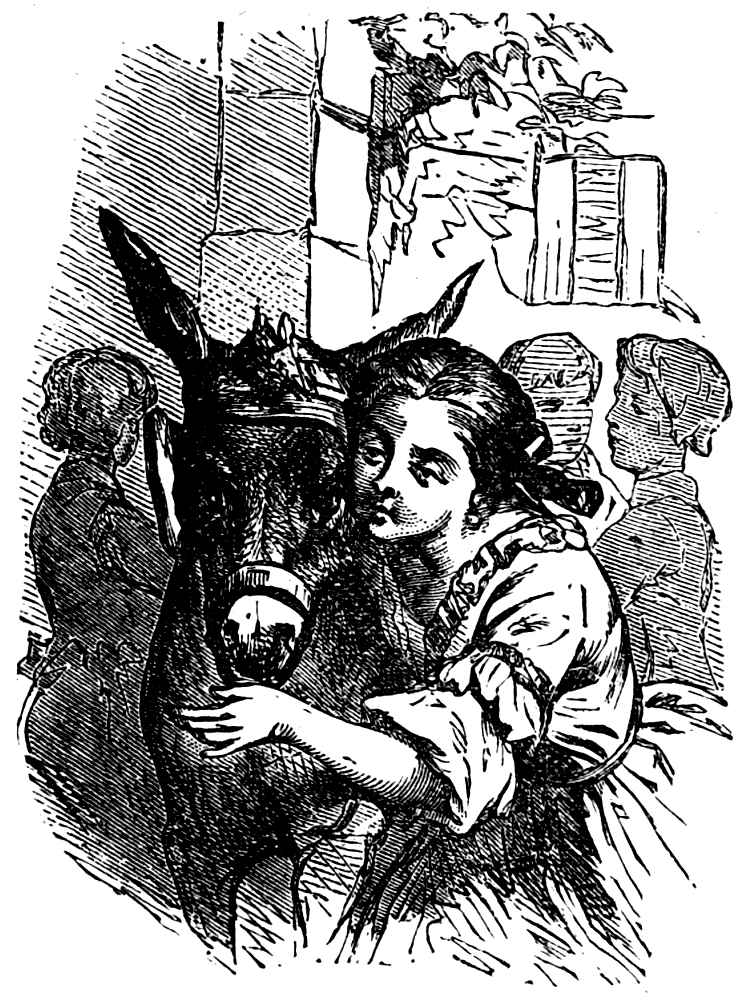
“Ah! We have forgotten one thing, to ask our [Pg 247]mammas’ permission to breakfast out-doors on a meal of our own preparation.”
“Let us go at once,” was the unanimous answer; “Alfred will keep guard over the breakfast.”
And, darting towards the house, they rushed into the parlor, where their papas and mammas were assembled.
The sudden appearance of all these children, red, breathless, arrayed in kitchen aprons like scullions, quite surprised their parents.
Each one ran to his or her mamma, and asked the required permission with such volubility that, at first, it was impossible to know what they meant. After a few questions and explanations, it was granted, and they hastened back to Alfred and their breakfast. But Alfred had disappeared.
“Alfred! Alfred!” they cried.
“Here I am, here I am,” answered a voice apparently from the skies.
Looking up, they perceived Alfred, perched in an oak tree. He began to descend slowly and cautiously.
“What made you climb up there?” said William and Henry; “what a strange idea that was!”
Alfred made no reply, but continued to get down, and when he had reached the ground the children were surprised to see him pale and trembling.
“Why did you climb that tree, Alfred? what has happened to you?” said Beatrice.
“If it had not been for Cadichon, you would not have found me or your breakfast either; I climbed the oak tree to save my life.”
[Pg 248]
“Do tell us what has happened!” said William; “how could Cadichon save your life and our breakfast?”
“Let us take our places at the table and listen whilst we eat, I am dying of hunger,” said Maud.
They seated themselves on the grass, around the table-cloth; Maud helped to her omelet, which was excellent; and Elizabeth, in turn, to her cutlets, which were very nice, but cooked a little too much. The rest of the breakfast followed, everything turning out quite satisfactorily. Whilst they ate, Alfred recounted the following:
“You had scarcely started ere the two big farm dogs, attracted by the smell of food, came running to the spot. I seized a stick, and, brandishing it before them, tried to drive them off, but in vain; they could not resist the sight of the cutlets, the omelet, the bread, the butter, the cream; instead of flying from my stick, which they little feared, they rushed at me; I threw the stick at the head of the biggest, and it jumped on my back—”
“How could it jump on your back?” said Henry; “he went behind you, did he?”
“No,” said Alfred, blushing; “but, having thrown my stick at him, I had no means of defense, and you can certainly understand the folly of my letting myself be devoured by hungry dogs.”
“Oh! I understand now,” replied Henry in a tone of raillery, “it was you who turned upon your heel to escape.”
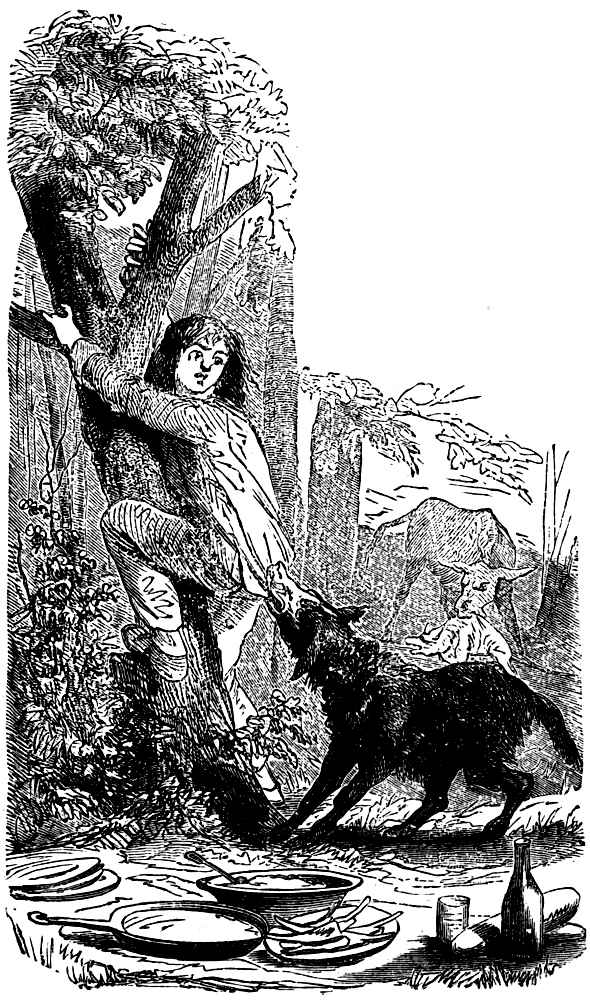
“I was running to find you and the beasts were running [Pg 251]after me, when Cadichon came to my assistance. Seizing the biggest dog by the skin of the back, he shook him well, whilst I sought safety by climbing a tree. The other dog leaped at me, caught me by my clothes, and would have torn me to pieces, had not Cadichon rescued me from this animal also. Giving a good final bite to the first dog, and throwing him up in the air whence he fell a few steps farther off, bruised and bleeding, Cadichon now seized the tail of the dog that held me, which act freed me at once, for, of course, my assailant immediately relinquished his hold. After pulling him a little distance, Cadichon turned around with incredible agility, and gave him a kick on the jaw bone that must have broken several teeth. The two dogs went off yelping, and I was about to descend when you came.”
All admired my courage and presence of mind, and came up to me, loading me with caresses and praises.
“You see now for yourselves,” said James, with a triumphant air and sparkling eyes, “that my friend Cadichon has become excellent, I don’t know whether you care for him or not, but I do more than ever. We will always be the best of friends, won’t we Cadichon?”
I did my best to respond with a joyful bray; the children laughed and resuming their seats at the table, continued their repast. Beatrice now served her cream.
“That’s good cream!” said James.
“I wish some more,” said Louis.
“And I, and I,” cried Helen and Ruth. Beatrice was much pleased with her success. Indeed, every dish had [Pg 252]given such satisfaction, that the table was entirely cleared. Poor James, however, had a slight humiliation. His charge was the strawberries and cream. He had sugared his cream and poured it over the stemmed strawberries, making a very nice looking dish. Unfortunately for him, he finished before the others. Seeing there was plenty of time, he concluded to improve it and his dish together, by mashing the berries in the cream. He crushed and he crushed, so long and so well, that the result was a thick pap, quite nice to the taste, but very uninviting in appearance.
Then James’s turn arrived to serve the strawberries.
“Oh! what are you giving me,” exclaimed Maud, “what is it? red pap? What is it made of?”
“It is not red pap,” answered James somewhat confused, “it is strawberries and cream, and very nice, I assure you, Maud; taste it, and you will see.”
“Strawberries?” said Beatrice, “where are the strawberries? I see none. This stuff looks disgusting.”
“Oh! yes, it is disgusting,” echoed all the rest.
“I thought they would be nicer crushed,” said poor little James, his eyes full of tears. “But if you wish it, I will go quickly and pick some more strawberries, and get some cream from the house.”
“No, no, James,” said Elizabeth, touched at his gentleness, “your cream is, no doubt, very nice. Give me some, I will eat it with great pleasure.”
[Pg 253]
James’s face brightened, he kissed Elizabeth and helped her most bountifully.
The other children, softened like Elizabeth by James’s mildness and good will, asked for some of his dish, and all, after tasting, pronounced it excellent, much better indeed than if the berries had been whole.
Little James, who had been anxiously watching their countenances as they tasted his cream, became radiant when he saw the success of his invention; he partook of it himself, and although not much remained for him, there was enough to make him regret not having made more.
Breakfast over, they washed the dishes in a large tub, that had been accidentally left out, and filled during the night from the rainspout.
This was not the least amusing part of the business, and it was still in progress when the study bell sounded, and their parents called them to their books. They begged a quarter of an hour’s grace, to finish wiping the dishes and putting them away. It was granted, and before the expiration of the time, everything was carried back to the kitchen, put in its place, the children at their studies, and Alfred having said good-bye, was about to start home.
Before leaving, he called me to him, and seeing that I approached, he ran to me, caressing and thanking me by his words and pattings for the service I had rendered him. I received this expression of gratitude with pleasure. It confirmed me in the opinion that Alfred was [Pg 254]much better than I had at first judged him, that he was neither revengeful nor malicious, and also, that if somewhat cowardly and stupid, it was not his fault.
I had occasion a few days afterwards to render him a new service.
James—“What a pity we cannot cook a breakfast every day, as we did last week, it was so amusing!”
Louis—“And what a good breakfast!”
Maud—“The best thing to me was the potato salad and veal with vinegar sauce.”
Beatrice—“I know why very well; it is because your mamma forbids you eating such things constantly.”
“Very likely,” said Maud, laughing, “what we seldom get to eat always appears best, especially when it is something we like naturally.”
William—“What shall we do to-day for amusement?”
Elizabeth—“Sure enough, it is Thursday, we have holiday until dinner.”
Henry—“If we could get a mess of fish from the big pond—”
Maud—“What a splendid idea! we will have a dish of fish for to-morrow, Friday!”
Beatrice—“How will we fish? have we fishing lines?”
[Pg 255]
William—“We have hooks enough but we want rods.”
Henry—“Shall we send one of the servants to the village to buy them?”
William—“They are not sold in the village, we would have to send to the city and that is very far.”
Maud—“Oh! here comes Alfred, perhaps they have some lines at his house; and we can send some one on the pony for them.”
James—“I will ride over on Cadichon.”
Henry—“You cannot go so far alone.”
James—“It is not far, only half a league.”
“What is it, my friends, you are going to get with Cadichon?” said Alfred as he came up.
William—“Fishing lines; have you any, Alfred?”
Alfred—“No; and there is no necessity for going so far; with knives, we can make as many ourselves, as we want.”
Henry—“To be sure! why did we not think of it before?”
Alfred—“Come quick to the woods to cut them. Have you knives? mine is in my pocket.”
William—“I have an excellent one that Maud brought me from London.”
Henry—“And I also have one that Beatrice gave me.”
James—“I have one.”
Louis—“And I.”
“Come along then,” said Alfred, “whilst we cut the rods, you may strip off the bark and little twigs.”
“And what shall we do in the meantime?” asked Maud, Beatrice and Elizabeth.
[Pg 256]
“Make the other necessary preparations,” said William: “get the bread, the worms, the hooks.”
And they all dispersed, each one to his or her post.
I then went very quietly towards the pond, and in something over half an hour, the children arrived, running each one with his line, and bringing the hooks and other necessary appurtenances.
“We must beat the water, must we not, to bring the fish to the surface,” said Henry.
William—“Just the contrary, we must keep quiet as possible, for if we frighten the fish, they will all go down to the bottom in the mud.”
Maud—“I think a good way of attracting them, would be to throw some crumbs of bread in the water.”
Beatrice—“Yes, but not much; if we feed them plentifully, they will not bite at the hooks.”
Elizabeth—“Let me do it, you prepare the hooks, whilst I throw in the bread.”
Elizabeth took the bread, and at the first crumb she threw, half a dozen fish pounced upon it. She repeated the process, assisted by Louis, James, Helen and Ruth, until the fish were surfeited and would eat no more.
“I believe we have given them too much,” said Elizabeth in an undertone to Louis and James.
James—“What difference does that make? they will eat the rest this evening or to-morrow.”
Elizabeth—“But they won’t bite at the bait now, they are no longer hungry.”
James—“Oh! oh! our cousins will be displeased.”
[Pg 257]
Elizabeth—“Say nothing about it, they are busy with their hooks; perhaps the fish will bite all the same.”
“The lines are ready,” said William; “each of you take one and cast it in the water.”
They did so, and waited a few minutes in breathless silence; the fish would not bite.
Alfred—“This is not a good place, let us go farther.”
Helen—“I believe there are no fish here, look at those bread crumbs not eaten.”
Maud—“Let us go to the end of this pond, near the boat.”
William—“The water is very deep there.”
Elizabeth—“What difference does that make? Are you afraid the fish will be drowned?”
William—“Not the fish, but one of us might fall in.”
Henry—“How would we fall in? we are not going near enough to the edge to slip or roll in.”
William—“Very true, but for all that, I do not wish the little ones to go there.”
James—“Oh! yes, William, do let me go with you? we will keep at a distance from the water.”
William—“No, no, stay where you are; we will soon be back, for I don’t think we will find any more fish there than here. Moreover,” he added, lowering his voice, “it is your fault we have caught none, you gave the fish ten times too much bread, I saw the whole thing; I do not wish to tell Henry, Alfred, Maud and Beatrice, but it is only right that you should be punished for your thoughtlessness.”
[Pg 258]
James insisted no more, but told the other little culprits what William had said. They resigned themselves to remain where they were, and continued to throw their lines, still wishing the fish would bite, and still meeting with no success.
I had followed William, Henry and Alfred to the end of the pond. They also cast their lines, but it was of no use; in vain did they move, and change their hooks, the fish would not bite.
“Friends,” said Alfred, “I have an excellent idea, instead of worrying ourselves waiting for the fish to come to us, let us fish on a big scale, and take fifteen or twenty at a time.”
William—“How can we take fifteen or twenty at a time, when we have not taken one yet?”
Alfred—“With a sweep-net.”
Henry—“But it is very difficult to manage; papa says, one must understand it.”
Alfred—“Difficult! what nonsense! I have cast the sweep-net myself ten, yes, twenty times! It is very easy.”
William—“Did you take many fish?”
Alfred—“I did not take any because I did not cast it in the water.”
Henry—“Where then, and how did you cast it, if not in the water?”
Alfred—“On the grass or the ground, only to learn how.”
William—“But that is not the same thing at all, I am sure you would cast it very awkwardly on the water.”
[Pg 259]
Alfred—“Awkwardly! Do you really think that? I will convince you of the contrary. I am going to get the sweep-net which lies in the yard, drying in the sun.”
William—“Please don’t Alfred, if anything should happen, papa would scold.”
Alfred—“And what can happen? I tell you, that at home, we always fish with it. I am going, wait for me, I’ll not be long.”
And away ran Alfred, leaving William and Henry anxious and dissatisfied. He soon returned dragging the sweep-net after him.
“Here it is,” said he, spreading it out on the ground. “Now fish, beware!”
He cast the net with tolerable dexterity, and began to draw it in cautiously and slowly.
“Draw it in faster,” said Henry, “we will never finish at that rate.”
“No, no,” replied Alfred, “it must be drawn very gently, so as not to break the meshes and let the fish escape.”
He continued to draw it “very gently,” as he said, but only to find it empty, not one fish had been caught.
“Oh!” said he, “the first time does not count, we must not be discouraged, let us commence again.”
He did commence again, and succeeded no better the second time than the first.
“I know what is the matter,” said he, “I am too near the edge of the pond, the water is not deep enough here, I am going to get in the boat, which is very long, consequently, [Pg 260]the farther end of it will give me sufficient depth of water to unfold my net.”
“No, Alfred,” said William, “keep away from the boat; you may get that sweep-net entangled in the oars, or cordages and have an upset.”
“William, you are just like a two year old baby,” replied Alfred, “for my part I have more courage, you’ll see the result.”
And he darted into the boat, which swayed from side to side. Although he pretended to laugh, Alfred was really afraid, and I saw that he would inevitably make a blunder, or do some mischief. He unfolded and spread out his net, notwithstanding the motion of the boat; but his knees shook under him and his hands were unsteady. Self-love, however, urged him on, and he cast the net. But the movement being arrested by his fear of falling, the net caught on his left shoulder, and gave him such a jerk that he fell headlong into the water. William and Henry uttered a scream of terror, in unison with that which escaped the unfortunate boy as he fell. Being enveloped in the net which crippled all his movements, his efforts to regain the shore were in vain. The more he struggled, the more entangled he became in the net. I saw him gradually sinking, a few minutes more and he would have been beyond hope. William and Henry could give him no assistance, neither of them knowing how to swim, and before they could have run for help, Alfred must certainly have perished.
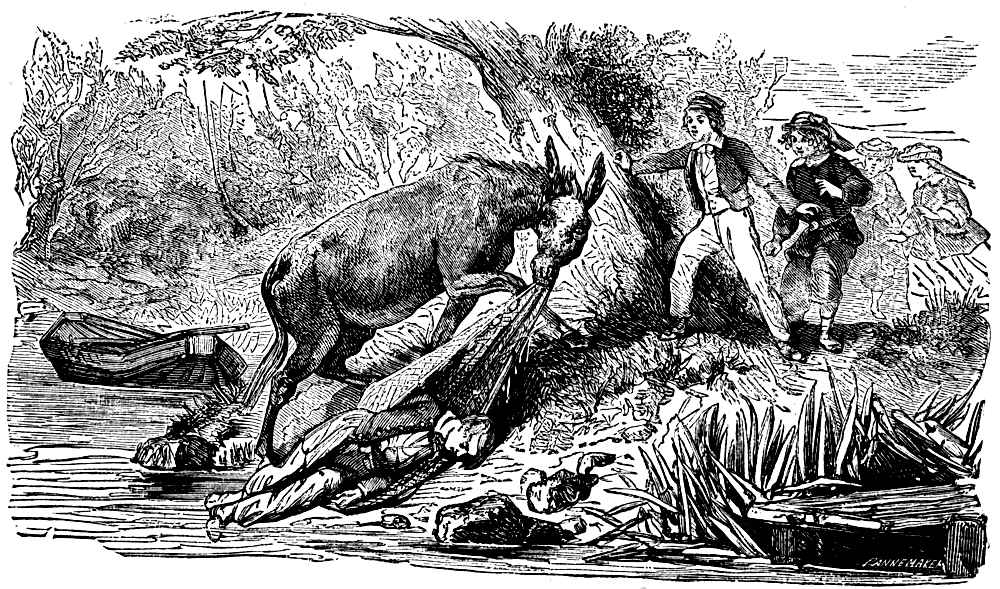
I decided upon my part at once; resolutely plunging [Pg 263]into the water, I swam towards him, and diving (for he had already sunk considerably beneath the surface), I seized with my teeth the net which enveloped him. Then swimming back, pulling it after me, I climbed the very steep bank, still dragging Alfred (no doubt giving him a few bruises on the stones and roots in our path,) and laid him on the grass, motionless and unconscious.
William and Henry, pale and trembling, ran to him, and with considerable difficulty, succeeded in ridding him of the net which was wrapped around him. They then sent Maud and Beatrice to the house for help.
The little ones, who, from a distance had seen Alfred fall, also came running to the spot, and assisted William and Henry to wipe his face and dripping hair. The servants soon appeared, and lifting the unconscious Alfred from the grass carried him to the house. The other children remained with me.
“You splendid Cadichon!” exclaimed James, “it was you who saved Alfred’s life! Did you all see how courageously he plunged into the water?”
Louis—“Yes, certainly, and how he dived to get hold of Alfred.”
Elizabeth—“And how carefully he drew Alfred to the shore.”
James—“Poor Cadichon! how wet he is!”
Helen—“Don’t go near him James, you will get your clothes wet, just look how the water drips off of him.”
“Ah! bah! what difference does it make if I am a little wet?” answered James, putting his arms around my neck, “I shall not be as wet as Cadichon.”
[Pg 264]
Louis—“Instead of hugging him and paying him compliments, you had better take him to the stable, and let us rub him down with a little straw, and then give him some oats to warm him up and revive him.”
James—“That is true, you are right. Come, my Cadichon.”
I followed James and Louis who went towards the stable, making me a sign to follow them. Both began to rub me down with such vehemence that they were soon in a perspiration, but for all that, neither of them would stop until I was dry. Meanwhile, Helen and Ruth employed themselves combing and brushing my tail and mane. I was superb when they had all finished, and I partook with extraordinary appetite, of the oats which James and Louis gave me.
“Helen,” said little Ruth in a low tone to her cousin, “Cadichon has a great quantity of oats, he has too many.”
Helen—“That’s no matter, Ruth; he has been very good, and we have given him the oats as a reward.”
Ruth—“I would like to have a few of his oats myself.”
Helen—“For what?”
Ruth—“To give our poor rabbits, that love oats so much, and never get any.”
Helen—“If James and Louis see you taking oats from Cadichon, they will scold.”
Ruth—“They shall not see me, I will wait until they are not looking.”
Helen—“Then you will be a thief, for you would be stealing oats from poor Cadichon, who cannot complain, because he cannot speak.”
[Pg 265]
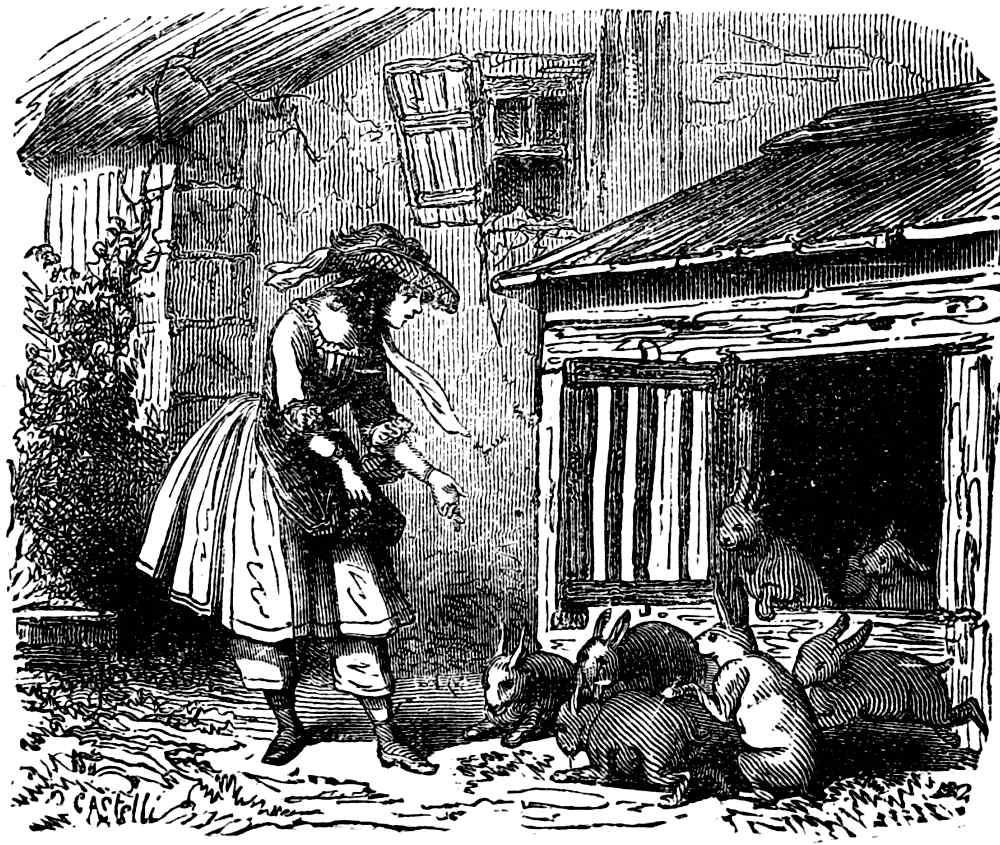
“So I would,” said Ruth sadly, “My poor rabbits would be too glad to have a few oats.” And she seated herself near my trough and watched me as I ate.
“Why are you sitting there, Ruth?” asked Helen. “Come with me to inquire for Alfred.”
“No,” said Ruth, “I would rather wait till Cadichon finishes eating, so that if he leaves any oats, I can take them for my rabbits without stealing.”
Helen insisted, but Ruth refused to go, and Helen at last went off with her cousins.
I ate slowly, wishing to see if Ruth would yield even once to the temptation of regaling her rabbits at my expense. From time to time she looked in the trough.
“How he eats,” said she, “he will never finish—he cannot be hungry, for he is always eating—the oats are disappearing, if he would leave only a few, I should be so delighted.”
I could easily have eaten all that was before me, but the poor little girl excited my pity. She touched nothing in spite of her desire to regale the rabbits. Pretending to have enough, I quit my trough, leaving the half of my oats; Ruth uttered a cry of joy, leaped to her feet, and taking the oats by the handful emptied them into her black taffetta apron.
“Oh! how kind you are, how obliging you are, my dear good Cadichon,” said she. “I never saw such a donkey as you—It is very genteel not to be a glutton—Everybody loves you because you are good—The rabbits will be so pleased! I will tell them, it was you that gave them their oats.”
[Pg 268]
And Ruth who had finished gathering up the oats and putting them in her apron, ran joyously to her rabbits. I saw her reach their little house, and I heard her tell them how good I was, that I was not the least bit of a glutton—that they must follow my example, and as I had left some oats for them, so ought they to leave some for the little birds.
“I will soon return,” said she, “to see if you are as good as Cadichon.”
She shut their door and ran to join Helen.
Following her to hear something from Alfred, I was delighted on approaching the castle, to see him seated on the grass with his friends. He arose, and coming to me, covered me with caresses.
“Here is my deliverer,” said he; “but for him I would have died, I became unconscious at the very moment, when Cadichon having seized the net, began to draw me to land; but I have a distinct recollection of seeing him plunge in the water and dive to save me. I shall never forget the service he has rendered me, and I shall never come here without speaking to Cadichon.”
“That is right, Alfred,” said the grandmother. “He who has a good heart, is no less grateful to the lower animals than to men. As for me, I shall always remember Cadichon’s services, and happen what will, I am determined never to part with him.”
“But grandmother,” said Maud, “a few months ago you talked of sending him to the mill. He would have been very miserable there.”
[Pg 269]
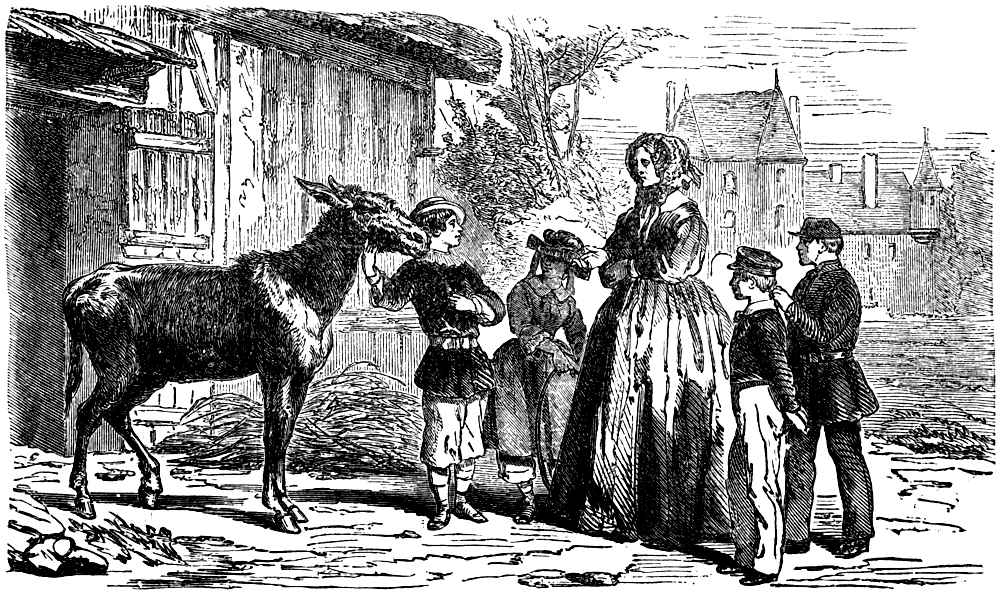
“Yes, dear child, but I did not send him; I did think of it, it is true, after the trick he played Alfred, both because of it, and the numberless complaints from everyone on the place. But I decided to keep him in acknowledgment of his former services, and I now say, that not only shall he remain, but everything shall be done to render him comfortable and happy.”
“Oh! thanks, grandma, thanks,” exclaimed James, throwing his arms around his grandmother’s neck and almost pulling her to the ground. “Let me be the one to take charge of my dear Cadichon, I shall love him and he will love me more than he does any one else.”
“Why, my little James, do you wish Cadichon to care more for you than for the others? That is not right.”
“Yes, yes, grandma, it is right, for I love him more than they do, and besides, when he was bad, and everybody displeased with him, I still cared a little for him, indeed, I might say, a great deal,” he added, laughing, “Isn’t it so, Cadichon?”
I answered by coming up to him and laying my head on his shoulders. Everybody laughed and James continued:
“Now, cousins, are you willing for Cadichon to love me more than he does you?”
“Yes, yes, yes,” they all answered, laughing.
“And haven’t I always cared more for him than the rest of you have?”
“Yes, yes, yes,” was the unanimous reply.
“You see, grandma, that since it was I who brought [Pg 272]Cadichon here, and it is I who love him best, it is only fair that he should love me best.”
“I can say no more, dear child,” said the grandmother, smiling, “but you cannot take care of him when you are not here.”
“But I shall always be here, grandma,” said James, eagerly.
“No, my dear child, you will not always be here, for your papa and mamma take you away when they go.”
James became pensive and sad, he put his arm upon my neck and rested his head on his hand. Suddenly his face brightened.
“Grandma,” said he, “will you give me Cadichon?”
“I will give you whatever you wish, my dear little one, but I cannot let you take him to Paris with you.”
“No, to be sure not; but then he will belong to me, and when papa has a castle we will take Cadichon.”
“I give him to you on that condition, my child, meanwhile he will stay here where in all probability he will outlive me. Do not forget then that Cadichon is yours, and to you is entrusted the charge of making him comfortable and happy.”
From that day my little master James seemed to love me more than ever, whilst I, in turn, did my very best to make myself useful and agreeable, not only to him, but to everyone about the place. I had no reason to repent of my reformation, for it gained me the esteem and affection of all. I continued to watch over the children, preserving them from several accidents, and protecting them against bad people and wicked animals.
Alfred was often at the castle, and he never forgot his promised visit to me, always bringing me some delicacy, an apple, a pear, bread and salt of which I was particularly fond, a handful of lettuce or some carrots—always something that he knew I fancied, which fully convinced me how much mistaken I had been in my former opinion of the poor boy, believing him bad, when he was only a little foolish and vain.
The idea of writing the story of my adventures was prompted by a series of conversations between Henry and his cousins; Henry always maintaining that I did not understand what I did nor why I did it, his cousins, James especially, as stoutly asserting the contrary. I profited by a very severe winter, which did not permit of my remaining out-doors, to jot down some of the most important events of my life. They may amuse you, perhaps, my young friends; at any rate, they will teach you, that if you wish faithful service, you must treat kindly those who serve you—that they who appear the most stupid are not always so—that a donkey like everything else, has a heart to love his masters and suffer from bad treatment, a will to be revenged or to show his affection—that it depends upon his masters to make him either happy or unhappy, a friend or an enemy, poor donkey as he is. I, myself, am very happy, loved by every one, and cared for as a friend by my little master James. I am beginning to grow old, but we donkeys sometimes live a long time, and just as long as I am able to walk and be of any use whatever, my services are at the disposal of my masters.
THE END.
[Pg 273]
John B. Piet,
Publisher and Printer,
Baltimore.

| pg 26 Changed: | As he eat, his tears ceased to flow |
| To: | As he ate, his tears ceased to flow |
| pg 45 Changed: | “Madamoiselle,” said she, “your mama has sent for you |
| To: | “Mademoiselle,” said she, “your mama has sent for you |
| pg 54 Changed: | support the fatiques and privations I have endured |
| To: | support the fatigues and privations I have endured |
| pg 72 Changed: | Isn’t he good, grandma, isn’t he? and musn’t we keep him? |
| To: | Isn’t he good, grandma, isn’t he? and mustn’t we keep him? |
| pg 72 Changed: | but she does not own him, he belengs to nobody |
| To: | but she does not own him, he belongs to nobody |
| pg 84 Changed: | and before they killed you,” answerd Beatrice |
| To: | and before they killed you,” answered Beatrice |
| pg 115 Changed: | Laughing at the young gunners’ discomfitted air |
| To: | Laughing at the young gunners’ discomfited air |
| pg 139 Changed: | No, you havn’t, the godfather has the best right |
| To: | No, you haven’t, the godfather has the best right |
| pg 175 Changed: | This unusual noise attracked the attention of all |
| To: | This unusual noise attracted the attention of all |
| pg 175 Changed: | young and old, had decended and formed a circle |
| To: | young and old, had descended and formed a circle |
| pg 179 Changed: | money necessary for their subsistance |
| To: | money necessary for their subsistence |
| pg 188 Changed: | must we not, dear ones?” sad Elizabeth. |
| To: | must we not, dear ones?” said Elizabeth. |
| pg 193 Changed: | He is better,” exlaimed James |
| To: | He is better,” exclaimed James |
| pg 199 Changed: | and indulged in penitent reflexions |
| To: | and indulged in penitent reflections |
| pg 199 Changed: | then pass my beautful ornamented bridle |
| To: | then pass my beautiful ornamented bridle |
| pg 202 Changed: | in reparation of the wrong I dad done him |
| To: | in reparation of the wrong I had done him |
| pg 213 Changed: | I waltzed, I polkied, and, I played on Ferdinand |
| To: | I waltzed, I polkaed, and, I played on Ferdinand |
| pg 214 Changed: | How prettily he files off,” said Ferdinand |
| To: | How prettily he flies off,” said Ferdinand |
| pg 227 Changed: | where they have commited numberless and audacious thefts |
| To: | where they have committed numberless and audacious thefts |
| pg 228 Changed: | you may assist at the exemination |
| To: | you may assist at the examination |
| pg 230 Changed: | Just wherever I could by cider |
| To: | Just wherever I could buy cider |
| pg 231 Changed: | a nickname given him at the prison in dirision |
| To: | a nickname given him at the prison in derision |
| pg 251 Changed: | and I was about to decend when you came |
| To: | and I was about to descend when you came |
| pg 253 Changed: | there was enought to make him regret |
| To: | there was enough to make him regret |
| pg 260 Changed: | his left shoulder, and gave him sech a jerk |
| To: | his left shoulder, and gave him such a jerk |