
Transcribed from Avon Science Fiction and Fantasy Reader, April 1953 (Vol. 1, no. 2).
Transcribed from Avon Science Fiction and Fantasy Reader, April 1953 (Vol. 1, no. 2).
by Stephen Marlowe
[Pseudonym of Milton Lesser]
There’s no business like show business! You do one-night stands in one-horse villages. You sleep in flea-bitten rooming houses, eat sandwiches three times a day, ride from town to town in creaking busses whose springs went out with Coolidge....
And all the time you have your eyes on a dream that keeps slipping over the horizon, and one day you wake up with no more bookings and you realize that maybe you’ll never catch up to your dream. But then you meet a dark little man who promises to make you a star without even looking at you twice! It sounds too good to be true....
It sounds out of this world....
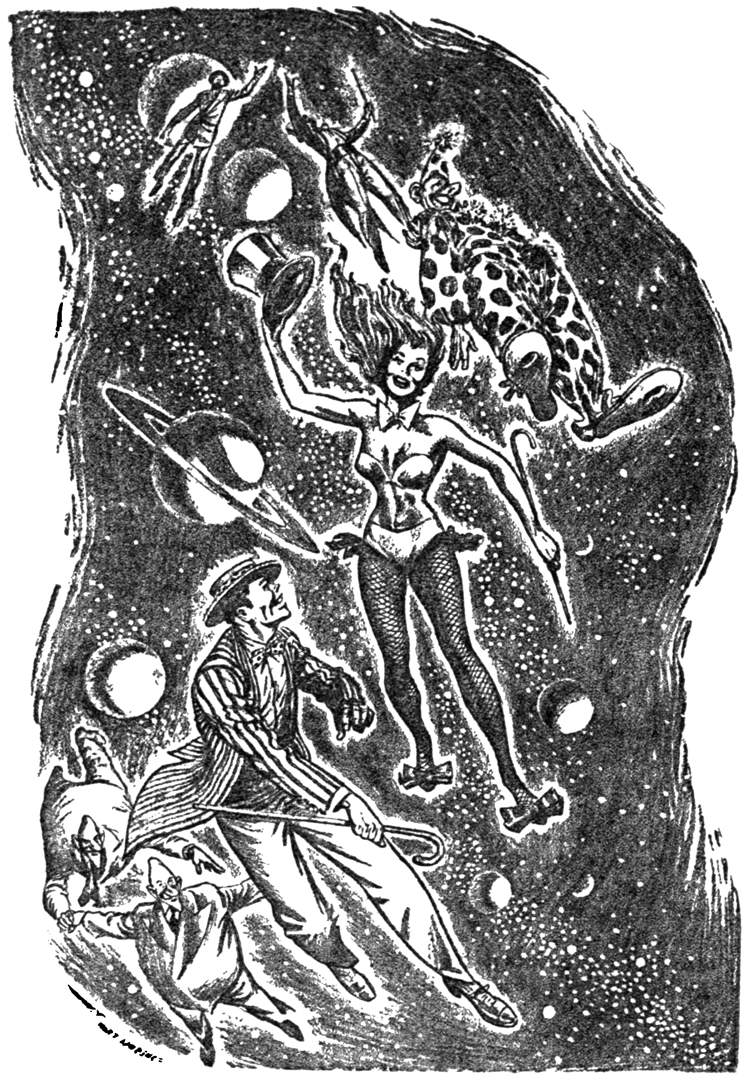
Illustrator: Mort Lawrence
I wasn’t exactly the best crooner in the business, but I could sing, and they even told me I could make the dames’ hearts palpitate if I tried hard enough. It wasn’t my fault that I was out of a job just now, and not too far from trying to bum a meal.
So when I ran into Vera and Vera told me she had a job, I felt hopeful. Vera was an old timer on the stage, and now she had begun to sag in the wrong places—but she still insisted on lead-roles. The result was that Vera lost more weight than a dame with six months at a slenderizing salon behind her, and she was even hungrier than me.
“Mike,” she said, “I got a job. Placed by a new agent. I never even heard of the guy, he comes outa nowhere. But he got me a job and the pay’s good and I start soon.”
“Honey,” I said, “you just tell Mike all about it. Who is this guy?” I wanted to meet him—if he could place Vera, he could place anybody.
At this point, Vera noticed I, too, could use a few vitamins, so she bought me a hot dog. I overflowed the bun with mustard and sauerkraut, and then I said: “Well, where do I find him?”
“He—it’s kinda a different sort of office, Mike. I’m going out there now.”
I gulped the last chunk of bun. “Vera, you need a chaperon. Let’s go, eh?”
Vera nodded, and I didn’t even realize that she sagged in the wrong places. She looked beautiful.
It was a stupid place for an office. I wondered how the guy could do business out here in the sticks. But I couldn’t complain. He had given Vera the taxi fare and the trip took two hours—out into Pennsylvania somewhere, and the place was so deserted, there wasn’t even a telegraph pole. But this office stood out there in the middle of all that wilderness, a big round barn of a place with a pasteboard sign out front. The sign said:
QUONTAS QUORON: Theatrical Agent
WANT A JOB? I CAN PLACE YOU.
Then, in smaller print:
No experience necessary.
Vera squeezed my arm as we got out of the taxi. “See?” she said.
“Honey,” I said, “I wanna meet this guy.”
The door of the big, round barn was high up off the ground, and we had to walk up a ramp to reach it. When we got inside, we weren’t alone. There was a big room, swanky as hell, with indirect lighting and plush seats all around. This guy Quoron sure had the shekels. Maybe twenty people were sitting around, waiting, and because I’ve been around in this game a long time, I knew most of them. I didn’t exactly teach Rudy Vallee how to sing, but I’m no youngster.
Here was just about the weirdest collection of theatrical has-beens. I saw them all—the would-be Shakespearean hams, the musical comedy stars who were on the way out when Oklahoma was nothing more than a state, the ventriloquists, singers, sword-swallowers, bearded ladies—everyone who had ever been on a stage and couldn’t get back on one.
This Quoron was no dud, and word got around.
I said hello to a few people, but I kept it selective; I couldn’t be associating with the riffraff of the profession who would wind up in a tank-town carnival somewhere, if Quoron could place them. He may have been a miracle man, but sword-swallowers were as passé as ragtime.
We all waited and I swallowed nervously each time I looked at the little door marked “Quontas Quoron, Private.” My courage soared up and down like an express elevator. Every time I thought of how hard jobs were to get, I shuddered. But when I looked at sagging Vera and realized Quoron had placed her, I felt much better.
It was like the scene after the big act which leaves everyone gasping when the guy finally came out. I mean, we waited so long that we didn’t know what to expect, and when the little guy came out it was sort of a letdown.
“I am Meldon Quoron,” he said, “Quontas’ brother. He’ll be along soon. Meanwhile....”
He went into the old familiar spiel about jobs being hard to get and placement being necessary in out-of-the-way places, but I didn’t give a damn. If he got me a job, I didn’t care if it was in Squedunk—as long as he paid the carfare.
He was a little guy, almost as big around the middle as he was tall, and in his dark blue—almost black—suit he looked like a bowling ball. But his face was ridiculous—I noticed that now. The body was short and plump—he could make Costello look like Charles Atlas, but the face was angular. It was more than that—it was elongated. I never saw anything like it. His chin was long, narrow and pointed, and his nose could have been a small white salami. Then, at the top, his head started to come to a point; at least it looked that way, but it probably was the way he combed his hair. And anyway, this was stupid as hell. Here I was, out of a job, and unconsciously making fun of the guy who could maybe get me one.
I nudged Vera. “Ever see this guy before?”
She shook her head. “No. I dealt directly with his brother, but they look alike. Quontas is a little older, and fatter, and with a skinnier face. You’ll see him soon.”
“...and so,” Meldon was saying, “acting is pretty much like any other job, and jobs are hard to come upon. If there were too many shoemakers in this town, and if you were a shoemaker, you’d go someplace else. That’s the general idea....”
This guy Meldon seemed amiable enough, but he could have gone on all day, and I was glad when his brother came out. Like Vera said, he was shorter and fatter and he had a face even more elongated, like a big yam.
He was preceded by a secretary. She must have been a secretary or she wouldn’t have been in front of him with a pad and pencil in her hand, but she would have made the girls at the old Minsky’s turn green with envy. Vera looked her up and down and then sniffed.
“Cheap-looking hussy,” she observed.
Preoccupied, I said yeah. But I’ve been around, and this dame had it.
The girl’s voice could have got her a job in the top Broadway musical, and even when she spoke it sounded like singing. “Mr. Quoron,” she said, “is ready to see you. One at a time.”
Quontas Quoron bowed, and then he stepped back into his office, and the secretary said:
“Who’s first?”
A little guy in one of the seats near the door got up, and a seal, oinking like he had just seen a bathtub full of fish, followed him into Quoron’s private office.
In less than a minute, the guy and the seal came out. Meldon was still talking, droning on about how hard it was to get jobs, but no one was listening. This time I didn’t even hear the seal oinking, because the little guy said, “I got the job! I got the job!”
He must have been out of work even longer than me.
That went on for twenty minutes. Someone went inside, and a moment later, he came out, smiling and nodding his head. No one was turned down; everyone got a job.
Meldon was still talking when I walked past the secretary into his brother’s office. Quontas Quoron sat at a big desk with a bottle of liquor in front of him.
“Drink?” he said.
I nodded and he poured me a stiff one. I downed it fast and a hot dog doesn’t exactly fill your stomach, so the liquor went to my head pretty quick. And the odd part of it was that I had had a lot of drinks in my day, but I couldn’t place this one. It wasn’t bourbon, but it was more like bourbon than either Scotch or rye, and I shrugged. I wasn’t going to be impolite, and maybe Quoron made home brew. I wouldn’t be surprised at anything.
“What do you do?” he said.
“I sing. If you want. I can show you clippings from Variations. I’ve been around, Mr. Quoron, and most of the reviews are good. If you want I should sing now....”
I began to tune up my voice, but Quoron only looked irritated. “No,” he said. “Please. It won’t be necessary.”
I shrugged. If he wanted to put me on without an audition, I wasn’t going to argue.
Now he smiled, and his elongated head nodded up and down. “I’m sure you’ll do,” he told me. “There’s no need for an—audition. There’s only one thing....”
I frowned. There had to be a catch in all this. A guy just doesn’t go around hiring everyone who comes looking for a job, placing them without an audition. Not in these hard times.
I sighed. “Okay, Mr. Quoron. What’s the rub?”
“Rub?”
“Gimmick. Gimmick. What’s the gimmick?”
“Eh?”
This guy was a rube. “I mean, what do I have to do to get the job?”
“Oh. You don’t have to do anything. Simply sign this.”
He handed me a sheet of paper. I looked at it. Some kind of contract no doubt—and again I frowned. Long legalities always confused me. But here, happily, there only were a few lines, and I scanned them rapidly.
I hereby agree to accept the job which my agent, Quontas Quoron, has for me, and I further agree that the location of the position is of no consequence. It is understood, of course, that Quontas Quoron and his brother will provide means of transportation.
I smiled. “Hell, is that all?”
Quoron nodded and handed me a pen. “A pleasure,” I said, and signed the paper with a flourish. Then I waited.
“There is something else, Mr. Hennesy?” Quoron demanded, looking at my signature.
I was a little dubious, and my face must have showed it. “Yeah. Yeah, there is. First, how much?”
“How much what?”
“How much do I get paid?”
“Umm. That’s hard to say. It will be up to my client. But the important thing now is that I can guarantee you good living quarters and good food.”
My stomach gurgled. He was right—that was the important thing. “But one more thing,” I said. “How can you have this job for me without hearing my singing and without even contacting anyone about me? Er, you don’t mind the question, do you?”
Quoron shrugged. “No. Why should I mind? I can assure you this: there is a great demand for your talent, and the job is a certainty. Any further questions?”
I shook my head.
“All right, Mr. Hennesy, just wait outside in the sitting-room with the others.”
Outside, I sat in the plush chair next to Vera. “See?” she said. “What did I tell you? You got the job, didn’t you? As easy as pie. I’ll bet the Quoron brothers will be the top agents in the business pretty soon.”
I nodded. Little Meldon was still talking about how hard it was to get jobs, and I wondered for a moment why he wanted to impress that on us so much. But then I shrugged, especially when the gorgeous secretary brought about refreshments for everybody. And this was surprising—the stuff looked like little cubes of candy, and you sucked on it like candy, only it tasted like filet mignon. But I wasn’t complaining.
Meldon could talk all he wanted to. I wouldn’t complain a bit. They had a job for me, and that’s what counted.
Presently the last of the hopefuls came dancing out of Quoron’s office, his ventriloquist-dummy riding jauntily on his shoulder. The dummy’s head bobbed up and down, and the dummy said, in a high, squeaky voice. “We’re hired. I don’t know what they want with my lousy sidekick here, but we’re hired.”
I fidgeted about against the plush cushions. “Well, what do we do, just wait?” I directed the question at no one in particular, but Vera nodded. Vera had taken me to her sagging bosom, it seemed, since she had given me wind of this agency, and I didn’t mind at all. If she were fifteen years younger, I could have loved the gal.
“Of course we wait,” she said. “We don’t want to be impolite.”
For the first time, I noticed that there were no windows in the building. That struck me as strange, but I hardly had time to think about it. A buzzer sounded and a red light glowed above Quontas Quoron’s door.
Meldon’s head jerked up. He muttered, “That’s all this trip, I suppose.” And he disappeared inside his brother’s office.
Then I jerked upright in my chair, and Vera screamed. A great peal of thunder ripped through the building, and the whole structure shuddered.
I patted Vera’s hand. “Take it easy, honey. It’s only a summer storm. Relax.”
But that thunder had been close; I could still feel the structure shuddering. And then, suddenly, I was slammed back hard in my seat like some invisible giant had pushed me with a hand the size of a Greyhound bus.
“What the hell....” I started to say. But then I couldn’t talk. I could hardly move and the words wouldn’t come out. I could only move my eyes around slowly, and everyone was sitting around like I was, paralyzed.
In a little while, the giant hand lifted up. It did more than that—it lifted and took something with it, because, abruptly, I leaned forward, and I found myself floating off my plush-cushioned chair. Floating is the only word I can use, because that’s what I was doing.
There were a lot of screams all around, and I could see most of the other people floating, too. Even the seal, and he was oinking like crazy. After a while, I learned. It was almost like swimming, swimming in water. This was crazy, this couldn’t be happening—but I did a neat breast-stroke through the air and reached Quoron’s door.
I pounded on it but it was locked, and then I kicked off again with my feet, but I kicked too hard and I hurtled across the room, bumping into the far wall like a battering ram. A lot of stars exploded in my head, and then I felt myself floating down to the floor like a feather, only I never remember hitting....
I awoke slowly, like you do when you’re having a bad nightmare, and I tried to shake my head to clear the stars out of it, but I couldn’t. The giant hand was pressing against my chest again, and I couldn’t move.
No one was floating any more. Everyone was on the floor, stationary, and Vera looked like she was trying to whimper, only no sound came out.
Then I heard the thunder, booming through the structure once more, and then, with a gentle bump, the giant hand was gone. I stood up and brushed my clothing off and, brother, was I furious. I didn’t know what was going on, but I intended to find out. I almost ran to Quoron’s door, but it opened before I could reach it, and Quontas Quoron stepped out.
“Well,” he said, “we have arrived.”
I stuck out my hand and prodded my index finger into his chest to say something, but there was just nothing to say. I didn’t know what this was all about. And Quoron walked right by me, heading for the outer door.
He opened the door and I saw a lot of red light come spilling in, and when I strode over to the door I saw the craziest damned place....
Here on Mars, there are no cities like we have on earth. Instead, they have these long canals with urban and rural communities stretched out along them for hundreds of miles. You just keep traveling and traveling in one direction, and all you see is houses—but look off to the right or the left, and there’s that rusty desert, a wilderness which would make the Sahara look like an oasis. These canals give the Martians water and life on a very thirsty planet. The water famine of 1950 in New York was a Deluge compared to the constant trouble here. But don’t get me wrong: I like it here.
Here on Mars, there are no nations like we know them on earth, no international boundary lines, no wars, warm or cold, no disputes—just one huge planetary nation, extending along the network of canals. There’s no time for squabbles: everyone’s too busy keeping warm and getting enough water to drink. And in one huge network city there’s an artificial supply of air, because Mars’ atmosphere is too thin to support a kite. Ever have an oxygen jag? It’s a lot more fun than bourbon. So I like it here.
And best of all, I like the status of Martian entertainers.... But before I go further, let me answer your question—yeah, sure, we’re on Mars.
Quontas Quoron’s “office” was a spaceship: the first earth interplanetary travelers came to Mars via a theatrical agent. Quontas Quoron is a Martian.
The most amazing thing is the fact that there was no entertainment on Mars. Don’t ask me where Quoron got the idea, but it was a natural: all the Martians are too busy trying to eke out their existence. They have no music, no plays, no movies, no Minsky’s, no sports, no television—not even the Martian equivalent, with pointed head, of course, of Milton Berle.
We couldn’t miss. We were a success overnight, all of us—all except the poor ventriloquist who can’t do much since he doesn’t know the language. Instead, he’s started an Actor’s Equity for us, and already it’s functioning better than it ever did on earth. Mars will do anything to keep us. We’re wonderful. Everything is still pantomime because we don’t know the language, but we’re learning it. Even Vera is a hit. Sagging, dragging, round where she should be flat, and flat where she should be round, she’s still the answer to a Martian prayer.
Popular? We gave them a pantomime of Romeo and Juliet last night, and Vera had ’em roaring for more. They don’t applaud on Mars; they jump up and down, and, because the gravity is lighter here, a lot of pointy heads almost made a lot of holes in the ceiling of our brand new theater!
Me? I don’t sing—I can’t until we learn the language, and I’m learning that fast. Meanwhile, all I do is hum. Ever hear All the Things You Are hummed to an audience of screaming Martian females? I won’t comment because I don’t want to sound egotistical but Sinatra should see me now....
Tonight, Quontas Quoron had a bright idea. He’s taking his ship back to earth for more talent. Or that is, he thinks he is. But Actor’s Equity voted him down. He can bring in new talent: but only five people a year, and theatrical people of our choosing. They’ve got to be out of work and they’ve got to be guys and gals who won’t conflict. Take me: one crooner on Mars is enough—we leave for the Northern Hemisphere tomorrow on the first swing of our Canal Circuit. And I wouldn’t want to think there’s another crooner here down south while I’m gone. All by myself I want to melt the ice cap out of every Martian gal’s heart.
Vera just came in. Vera looks radiant, making allowances, of course. But anyway, it’s all a matter of standards, and these Martian women, too busy with the nasty matters of water and temperature, are beauty-starved: as a sideline, Vera is starting a planet-wide beautician’s organization.
And, as I’ve said, it’s all a matter of standards. Everything is relative.
Vera looks more beautiful every day, and right now she’s the most beautiful woman on Mars—that is, discounting Quontas Quoron’s secretary—but technologically Mars has an advanced culture, and rumor has it that Quoron’s secretary is a robot.
Pardon me, please. My wife is calling to me from our kitchen.
“What’s that, dear? Tired? Well, why don’t we turn in, Vera?”
You’ll have to excuse us. Tomorrow there’s a matinee. Vera and I will kill ’em!
Milton Lesser changed his legal name to Stephen Marlowe in 1960. Before this he used it as an occasional pseudonym.
This etext was produced from Avon Science Fiction and Fantasy Reader, April 1953 (Vol. 1, no. 2).
Obvious errors have been silently corrected in this version, but minor inconsistencies have been retained as printed.