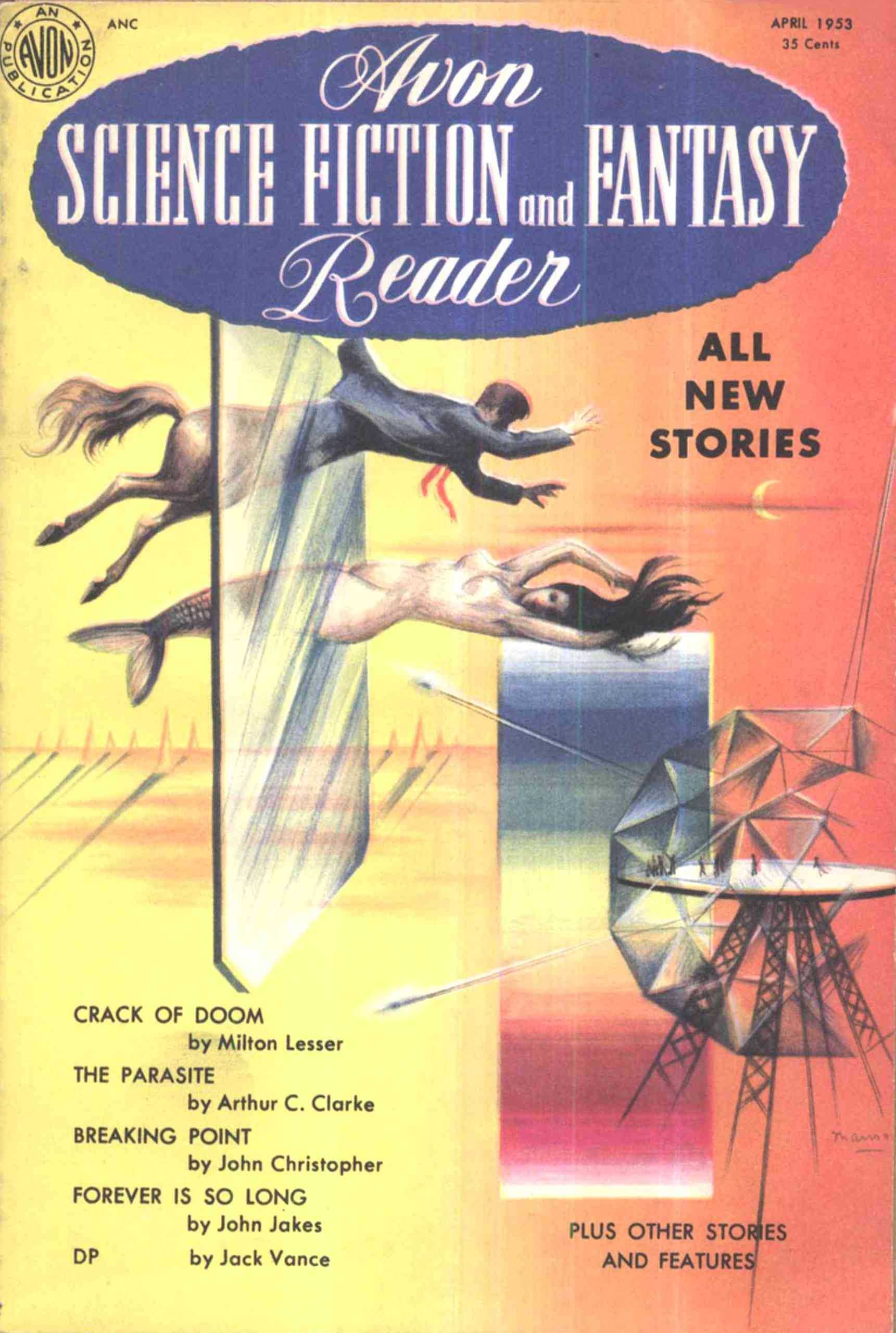
Transcribed from Avon Science Fiction and Fantasy Reader, April 1953 (Vol. 1, no. 2).
Transcribed from Avon Science Fiction and Fantasy Reader, April 1953 (Vol. 1, no. 2).
by Irving E. Cox, Jr.
The gray men had come from an unknown place to overrun the earth. They killed without passion, in much the same manner as the earthlings would exterminate ants to reclaim a hill for planting.
And amid the slaughter a small boy looked to his father for guidance. But the man knew that in the face of motorized legions there was only one legacy a parent could leave—so he gave his son a gun....
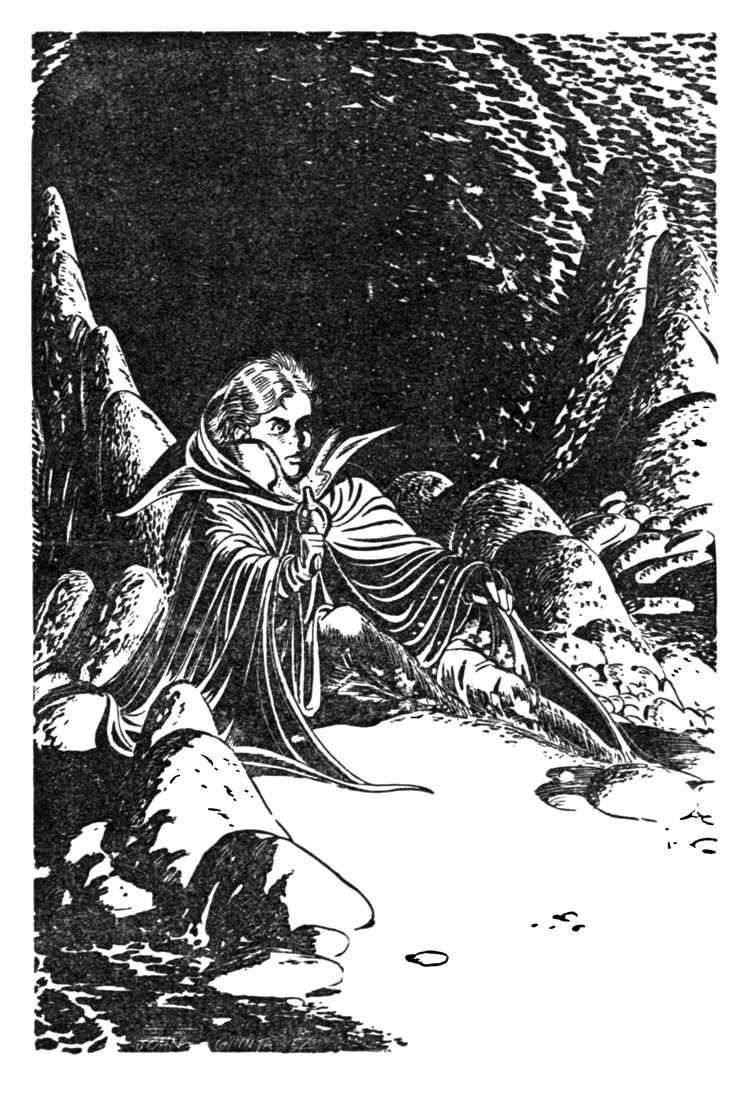
Illustrator: John Giunta
He stood still listening. In the distance he heard the unmistakable shrill whine of high-speed motors. He looked wildly for a way of escape, and saw none. The highway at that point wound under the bare overhang of brown cliffs, sheer and naked in the pale sunlight.
He might have climbed the sharp face of rock if he had not been so exhausted. But his body was tortured with fatigue and pain. His clothes were in tatters. His feet and arms were latticed with a livid network of wounds. The long cut in his cheek had stopped bleeding, but the caking scab pulsed in rhythm with his heartbeat.
The roaring motors swept closer, so near that the earth shook. Choked with panic, he began to run. He sprawled over a jagged rock, and the gravel sandpapered the skin from his kneecaps.
The sudden pain cleared his head. He realized that it was a mere animal instinct to try to outrun the caravan; but he had a slim chance for safety if he hid in the tangled shrubs that choked the swamp on the other side of the road.
He darted across the ribbon of cement and plunged into the thicket. Hard twigs and thorns tore at his skin. His feet splashed into the fetid, black slime, and muddy water oozed reluctantly over his legs.
His head was in a nest of tall grass. To his right the swamp curved along the road for a quarter of a mile. Above it two huge, black birds swept the sky in a solemn circle. Much closer, a dozen small marshbirds danced and chattered on the edge of a decaying log.
The roar of motors was deafening as the caravan rounded the bend. Only a thin whisper of rationality kept him from running. As he had once before, he clenched his fists until the tattered nails broke the skin; and over and over he whispered a kind of litany of sanity:
“I am Vernon Randall Hume. V. R. Hume, corporation lawyer. V. R. Hume; age, thirty-five; happily married; the father of three children. I am Vernon Randall Hume. I have not lost my mind. Yesterday I had lunch at the Athletic Club. Only yesterday!” The word was a symbol, rather than an accurate measure of time. It stood for another life, another reality. Hume was not sure whether it had been two days or a year ago. Yesterday was simply then; this was now—this clanking column of gray death moving over a dead landscape.
He could not look at the clattering vehicles; and it was impossible to turn his eyes away. They were not thirty feet from him, the roaring black machines and the glittering guns that saluted the empty sky. In every vehicle were crowded rows of gray-faced men in gray uniforms. They sat erect and motionless, obedient automatons.
Suddenly Hume heard a splashing in the swamp behind him. He turned his head and saw a white-robed figure fighting free of the slime—a woman who had been hiding in the thick brush. Apparently her reason had been shattered by terror, and she could not control her lashing instinct to run.
A driver signaled. The caravan stopped. The gray men stood up. Languidly their guns were lowered, shimmering like silver lances in the sunlight. Screaming, the woman floundered in the mud, her long hair pulled free in the wind.
The guns jumped and the blue smoke hung for a moment over the caravan. The woman clawed at the air in agony before slumping back into the slime. The gray men turned in unison, shouldered their arms, and sat down. The motors roared and the caravan moved on.
Slowly the noise died and the air was quiet again.
Hume stood up. His wet clothing clung to his skin, and in the sharp air each tiny laceration felt like a fresh wound. His feet were numb chunks of flesh, slithering in the mud as he walked.
He stopped beside the woman. She lay face up in the black mud, her frayed dress billowed by the shallow water, her hands clutching at the gaping wound torn in her breast.
Without knowing quite why he did, Hume knelt and kissed her lips. They were still warm. Then he understood. She was like Beth, another symbol of yesterday. Even this much of a parting had been denied him in that first blazing destruction.
His soul screaming with the pain of remembering, he turned and fled, plunging awkwardly through the swamp. When he reached dry ground on the other side, he collapsed, retching emptily. The nausea swept up around him. He lost consciousness.
The boy and his father came to the cliff overlooking the road. Cautiously they inspected the empty landscape. The father pointed toward the ragged chain of mountains, hazy blue on the horizon. “The river is on the other side of the ridge,” he said. “We can hide in the swamp until it’s dark again.” They slid down the bank and ran across the highway.
It was dusk when Hume regained consciousness. The rim of the distant mountains was pink against a purple sky and the floor of the valley was dark, streaked here and there with mist. How much farther was it? Ten miles? He had no way of knowing. Yesterday, in his own car, he could have reached the pass in less than an hour; it was a magnificent highway. He had never understood distances except in terms of time.
He knew it was dangerous to follow the road, and yet he was still afraid to strike out across the desert. He hadn’t the slightest conception of the distance a man might walk in twenty-four hours, and he knew he had to forage for both food and water. There might be small animals of a sort on the desert. A clever man might trap one and kill it, but Hume’s cleverness was limited to the manipulation of words in legal controversy.
He was sustained by no hope except the sight of the chain of hills, and his consuming determination to reach them alive. Once Hume had defended a client by utilizing the logic of self-defense. “Take away all that a man possesses,” he had said; “throw out all the comforts and gadgets of civilization, and face an individual with the one issue of personal survival—a choice between life and death—and he cannot choose the latter. His choice is neither heroic nor romantic; it is simply instinctive.”
Now, for the first time in his life, Hume understood what he had been talking about.
The motorized caravans could not have penetrated the mountains yet; and Hume’s own people were on the other side, beyond the river. It was the only solid reality he had to cling to; it had the inevitability of tomorrow’s sunrise.
After nightfall, Hume moved closer to the highway and plodded ahead more rapidly, less afraid in the dark. Pangs of hunger gnawed at his stomach, but it was a subordinate sensation, hard-ridden by the more intensive will to survive. He even took a certain wry comfort in his feeling of lightheadedness, for it diminished the constant pain crying against his nerves.
A pale half-moon rose. Close to the road Hume saw a frame farmhouse. There was a chance he could find food there, and possibly fresh water and clothing. Even though he knew the house would be deserted, he approached it cautiously. For almost a quarter of an hour he huddled in the shelter of a lilac bush at the corner of the yard before he mustered up enough courage to go inside.
He walked across the manicured path, his battered shoes crunching softly on the white gravel. The house had not been untenanted long enough for the neglect to be obvious. The grass was still clipped short, and the sharply defined borders around the row of tree roses might have been made only an hour ago. But there were little signs of desertion: occasional blades of fast-growing weeds, a bush or two bowed with dead blooms that should have been pruned away, and a semicircular crescent torn in the earth by heavy metal treads.
Close to the porch the twisted body of a woman lay on the ground, cradled in a bed of white-faced pansies. The body was seared black, almost unrecognizable as anything once human. Beyond her, frozen fast to a pillar of the porch, was the charred corpse of a man.
The paint on the front of the house was blistered, still smelling faintly of fire. The gray men had used their flame guns here, Hume realized, caressing the face of the house with a terrifying white heat, like the kiss of a naked sun.
Hume went up the steps and entered the house. In the front room were trunks and boxes, partly filled, which the man and woman had obviously been packing when the caravan of gray men came. Hume pawed through the stacks of things, but found no clothing that he could use. The farmer had tried to escape with possessions which had yesterday’s values—silverware, good china, books, silks, and fancy linens.
The practical clothing that Hume needed would still be somewhere upstairs; but before he explored for it, Hume went to the kitchen seeking food.
He found canned goods stacked in a cabinet. With trembling fingers he ground two cans open under the wall opener. He gulped a pint of condensed soup and a can of peaches; and he became promptly sick. When his weakness had subsided, he tried again, eating more slowly. There was no water running through the faucet. He had hardly expected it to be, and he would have been afraid to drink any if it had. But he managed to slake his thirst by draining the juice from another can of fruit.
Something faintly reminiscent of well-being filled his body. He leaned back in a kitchen chair and propped his tired feet on the white-topped table, scraping away the black mud with the point of a knife.
He heard the hum of an approaching motor and was seized again with terror. He pulled himself up to the narrow kitchen window and peered out.
A treaded vehicle clanked to a stop and three searchlights pinpointed the house in the darkness. Hume crouched back against the cold wall, his breath icing his throat. Squads of gray men lined up on either side of the lights, and a leader bellowed a volley of orders at the face of the building. They waited. The command was repeated. After another pause, the gray men began to fire their weapons into the house.
Hume slid inside the narrow cubicle beneath the sink, where the porcelain gave him some protection from the falling glass and the crumbling plaster. The darkness glowed with the scarlet plumes of deadly explosives; but, in two minutes, it was over. The searchlights went off; the truck crunched on into silence.
The house was a riddled shambles, tottering with unexpected senility. Yet it had not caught fire. Hume picked his way carefully through the debris and up the swaying stairway to the second floor.
A section of the wall at the head of the stairway gaped open and Hume looked out into the valley. The mountains were clearly detailed in the cold moonlight. He traced the curve of the highway as it wound over the desert toward the pass, and he saw the sprawling oval of the single valley town, which yesterday had cast the pleasant reflection of lighted streets against the night sky. Now the rows of homes and stores were a dead, bleak cancer rising on the desert. On the outskirts of the village was a blaze of intermingled searchlights marking the place where the gray men had set up an outpost camp.
The town was at the point of a triangle. The entrance to the mountain pass, Hume saw, was directly across the desert. If he went that way, using the peaks as a guide, he would reach safety much sooner, and he would avoid the danger of passing close to the camp of the gray men. His fear of crossing the desert on foot suddenly vanished before the security it offered.
The two bedrooms at the front of the farmhouse were shot away, but at the rear of the hall Hume found a storage closet. He pried the door open. Inside were long racks of clothing. Ecstatically Hume fingered the solid comfort of a woolen coat.
But his pleasure was fleeting. He heard footsteps on the gravel outside. Looking down through the torn wall, he saw a tall figure moving boldly toward the house. The gray men had come back! He was trapped!
Hume shrank back into the closet, stealthily shutting the door. He threw a pile of clothing into a dark corner and slithered beneath it. The warmth gradually veneered his terror. He heard no more footsteps. For the moment, he was safe. Slowly he gave way to the drowsiness he could no longer control.
The boy and his father found a dry island of land in the swamp. Curling into the thicket, they slept four hours and awoke after dark. They moved ahead quietly. When they saw the battered farmhouse, the father left the child in a nearby ditch, where a film of ice was beginning to form on the stagnant water, and went to see if he could find any food in the house. He came back with an armload of canned goods; they ate well before they went on.
Hume awoke violently, the wraith of the nightmare still clinging to his brain. It was the old dream of the beginning, of the catastrophe that had rung the knell of yesterday. And of Beth: of shrieking desolation and of a city turned in an instant into flaming dust.
Yet the sleep had done him good. The worst of his fatigue was gone; his head was clear again. Judiciously he picked over the clothing in the closet, dressing himself as warmly as he could. He found a pair of discarded riding boots, cracked and in need of soling, but nonetheless better than the shoes he had on.
He descended the stairway and went back to the kitchen, intending to fill the pockets of the coat with canned goods. Oddly, the cupboard was empty. He was sure he had left several cans unopened, and without food he was afraid to try the desert crossing. Then he found the carving knife in a kitchen drawer. He rationalized comfort and security from it. There would be animals of some sort on the desert. If necessary, he could kill one to ease his hunger, though the clinging crust of culture made even the idea faintly nauseating.
It was dawn when he set out. He plodded on for hours, without stopping and without taking his eyes from the mountains. The sun rose high, but Hume felt neither the heat nor his own weariness, for he walked in freedom, unafraid. There were no gray men here; there would be none. This desert was an unwanted waste, claimed only by the sun and wind, inhabited only by the small, frightened animals that fled as Hume approached.
The ground was a rolling carpet of colored stones, worn smooth by the patient erosion of time. Here and there were scattered clumps of hardy brush and an occasional brilliantly flowered plant clinging close to the earth. Frequent hills of stone three or four feet high cast narrow shadows on the desert. From the semi-darkness terrified animal eyes peered out at Hume, like glowing, yellow gems.
Hume’s stride gradually lengthened with his returning self-confidence. He squared his shoulders. Since yesterday he had not spoken, fearing that even the sound of his voice would betray him. Now he talked aloud to the emptiness, for the pure joy of hearing his own voice. He shouted into the wind; he roared defiance at the invaders.
As he walked along, he picked up stones and hurled them at the hiding animals. His blood pounded with a strange excitement when they ran from him; and leaped with joy when he hit a toad and killed it.
Year ago, in college, Hume had been a baseball star. He needed only a little practice to restore the accuracy of his pitching technique. By midday he was able to hit any animal he saw on the desert.
It became a game with him to slaughter them, a pleasure that restored his sense of superiority, of dominion over all things of the earth. He was its master, not the hordes of gray men. He felt the familiar security of yesterday, the comfortable luxury of planetary ownership.
He killed rabbits by the score, neither for sustenance nor for safety, but to feed the flame of his possessiveness, so long stifled by his fear of the gray men. When he had perfected the technique of throwing the stones, he multiplied the pleasure by transforming it into an art. First he would frighten the animal, make it run; then, when it had nearly escaped his range, he would hurl the rock, watching with a savage delight while the victim leaped into the air, screaming in agony as it died.
Only once did the pattern change. He cornered a rabbit and, unable to flee, the terrified animal attacked him, slapping him viciously with its feet before he cut its throat with his kitchen knife. As the warm blood washed over his hand, he thought he might make a meal of the rabbit, but his hunger was not sufficiently acute for him to eat the uncooked flesh. He regretted that he had not brought any matches with him. But it was a minor annoyance. The mountains were very close; in another ten or twelve hours he would be on the other side, among his own people. He threw the carcass aside and went on.
In the afternoon he abandoned the coat he had taken from the farm and, shortly after, two of the sweaters. He knew he would want them again after dark, but the heat of the afternoon sun was unbearable and he was sure he could make better time if he were not impeded by the heavy clothing.
At sunset he reached the foothills. Red in the setting sun, the mountains towered above him, a snow-capped wall. His nerves tingled with triumph. He had nearly reached his goal. The pass was a half mile farther south. He could see the highway curving gracefully toward it.
He would have to move more cautiously again, now that he was once more close to the road. But it would be for the last time. The gray men had not passed the mountains; he was confident of that; and he would be safe on the other side. It even seemed unlikely, when he considered the matter, that the gray men would be at the pass with any kind of force. They would still be consolidating the enormous territory they had taken close to the city. Probably they would have an outpost here, but he would be able to bypass that easily enough.
Hume came to the top of a hill higher than the rest and looked down upon the highway. In that instant his mounting confidence collapsed. For he saw a long, black, motorized column approaching from the valley, and at the foot of the pass a city-size camp of the gray men.
Terrified again, he crept down the face of the hill to a small gully, where he hid himself in a thicket of shrubs. Like the desert animals, he felt safe in the cold shadows. For an instant the analogy was clear to him. To the gray men he was of no greater value than the rabbits Hume had slain for the pure delight of expressing his own proprietary superiority. But the comparison was a disastrous hypothesis. It led his mind to the madness of despair. His conscious rationality reared back, rejecting the data, wiping his mind clear of the inevitable conclusion.
Slowly the motorized column clanged past Hume’s hiding place; and slowly Hume reasoned away his fear. The pass was not the only way through the mountains. A man on foot could force a passage almost anywhere. Hume was vaguely familiar with the terrain, since he had occasionally vacationed at the mountain resorts. He convinced himself that, even if the gray men had occupied the pass itself, they would not have strayed from the highway because they were helpless without their motorized caravans of weapons.
At nightfall the batteries of searchlights encircling the invader’s camp were turned on; as darkness deepened, the camp blazed like a fallen star. Hume saw a small vehicle move out from the camp, stopping at intervals along the road. When it passed beneath his gully, he understood why, for one of the gray men got out and began to pace the cement. The enemy was putting out a network of sentries along the base of the mountains. Obviously, then, other refugees had slipped into the safety of the hills at night, and the gray men intended to stop them.
Momentarily Hume was breathless with panic. He was cornered and he had no way of escape. Before this his safety had been bought by hiding from the gray men and running when he could. Now he must either wait quietly for them to find him, or fight his way free. Once again the analogy of the rabbit played dangerously on the fringe of his mind. Even the rabbit Hume had cornered could not meekly resign itself to death; it was driven instinctively to fight its way out.
Hume had no alternative. As the moon rose, he crept out of his gully noiselessly. When he stood up, his feet felt like dead clods; his teeth chattered and his body shook in the icy wind sweeping out of the mountains. His hands searched the level of the earth until he found a suitable stone of the right weight. When the sentry was directly below him, he hurled the rock with all his strength. The gray man dropped and lay still, a huddled shadow on the white road.
Exultant, Hume slid down the hill and stood over his enemy—a thin, frail, underfed creature, as powerless as Hume himself when he was taken by surprise and stripped of the power of his weapons. Shivering, Hume ripped off the long, swirling, high-collared, gray coat which the sentry was wearing. It was woven of a material much like wool; Hume felt warmer as soon as he drew it on.
The gray man began to twist and groan. Sneering, Hume watched the agony for a moment. Then he picked up the stone again and hammered it into the colorless, gray face. The bones crunched and he felt the warm blood spurting over his hands. An ecstatic madness, a purity of joy he had never experienced before, seized him, and he beat the quivering pulp until he was breathless.
When he paused, he heard footsteps on the road behind him. Another sentry, perhaps—coming to relieve his friend! Hume turned and fled toward the mountains, running frantically up the steep inclines, stumbling through the ragged gulches. He was pursued by a fear that rode him until his pulse banged in his temples, his breath came in gasps, and a taste of blood tainted the back of his throat. He paused and looked back.
A tall figure was bending over the gray man Hume had killed.
Hume turned to run again, but his head swam with exhaustion. His knees began to buckle. He saw the narrow ravine ahead, but he hadn’t the strength to resist his own momentum. He slid helplessly down the rocky bank and lay still, bent unnaturally over a heap of boulders.
Cautiously rounding a bend, the boy and his father saw two gray men fighting in the middle of the highway. They sprang into the roadside ditch, the man shielding his son’s body with his own. Gradually, the father understood that they had not been seen. He crept out and examined the body on the road. The assailant had fled, taking his victim’s coat, but leaving the gun. The father picked it up and called his son. They turned of the highway and began the steep climb toward the peaks.
The wound in Hume’s cheek was bleeding again, and one foot was grotesquely bent beneath him. Slowly he pulled himself to his feet, dizzy with pain.
He saw the crest of the hills above him and he began to climb, moving uncertainly, pulling himself forward with his clawing hands. Hour by hour he inched upward, pausing at intervals for rest, shivering with cold, wracked by pain, leaving a thin trail of freezing blood on the rocks below him.
His rational consciousness narrowed to a single awareness. He must pass the ridge; he would be safe, then. The pain, the tearing hunger, the agonizing memories were the torments of another body, somehow remotely related to his own. He set his eyes on the crest and moved toward it.
At dawn he was above the snow line. The ridge was only a few feet farther on. He looked up at the crevices of snow, long crystal folds streaked with golden light. The wind screamed and a mist of snow bit into his face, but he did not notice it. He was safe! He had reached the top!
An energy and warmth from outside himself gradually flowed into Hume’s body, a joy that lifted him up in spite of his pain. He stood erect and felt nothing. Proudly, the joy of achievement singing in his soul, he began to walk toward the crest....
...Obediently, the boy waited in the cave where his father had left him while he went to find the shortest way down to the river on the other side. The father had given his son the gray man’s gun, showing him how to use it. “But don’t fire unless it’s absolutely necessary. Even if the gray men reach the top of the pass, they probably won’t find your hiding place. Use the gun only if you see one of them coming toward you.”
The boy looked out. He saw the tall, gray figure climbing up the hill of the snow at the mouth of the cave. Calmly he aimed the gun, as his father had instructed him, and fired. The man fell, rolled a short distance through the brittle snow, and lay still.
For a long time the boy crouched in the cave, but as the hours passed, hunger eventually drove him out. He slid down the snow past the body of the man he had killed, ignoring it. Among the pines he found traces of his father’s footprints and followed them down out of the snow to the bank of the river. He sat by the muddy water, staring across at the opposite bank. His people were over there; his father had said so; but where? Why had no one come out to meet him, bringing a little boat that would ferry him across the river?
Hopefully, the boy followed the bank, wondering if there might be a bridge farther on. Just beyond a thicket of brambles he found his father, sprawled in the damp earth, his body crushed in the tracks made by a treaded vehicle.
The boy then heard a sound on the other side of the river and, looking up, he saw a black, motorized column moving triumphantly on the opposite bank.
The boy turned to run, and discovered that he had been quietly surrounded by a corps of gray men, who were pointing their short, vicious weapons at him. When they saw that the boy was powerless, they threw a net over him and bound him securely with it. Later they carried him back to their camp and put him in a square, black box, heavily barred on one side, so that they could study his habits at their leisure. In a sense, some of them were even kind toward the boy, treating him the way he had his own pet terrier when he still lived back in the city.
This etext was produced from Avon Science Fiction and Fantasy Reader, April 1953 (Vol. 1, no. 2).
Obvious errors have been silently corrected in this version, but minor inconsistencies have been retained as printed.