Fifth Day.
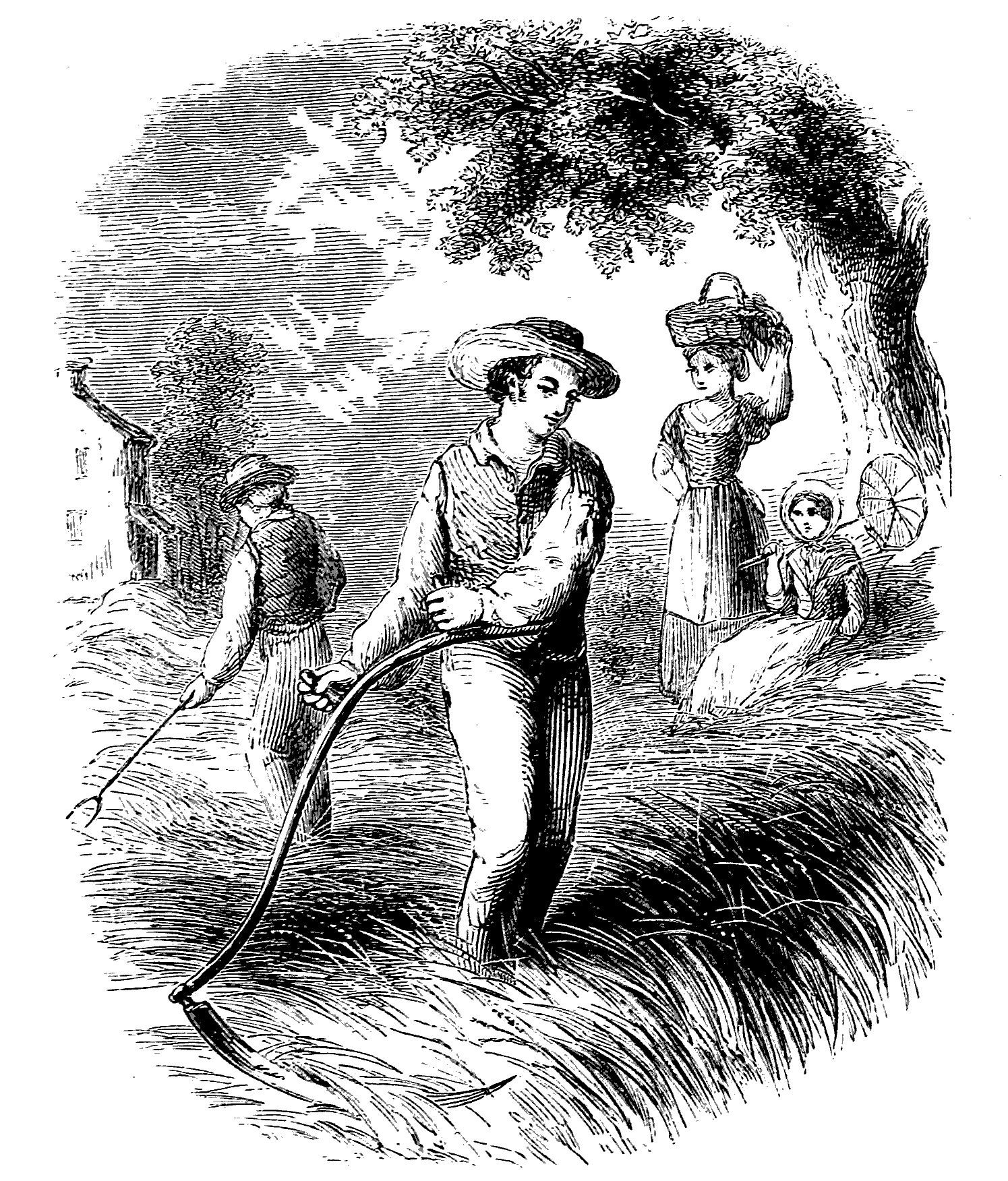
The Harvesters.
☞ No books are published by the American Sunday-School Union without the sanction of the Committee of Publication, consisting of fourteen members, from the following denominations of Christians, viz. Baptist, Methodist, Congregationalist, Episcopal, Presbyterian, and Reformed Dutch. Not more than three of the members can be of the same denomination, and no book can be published to which any member of the Committee shall object.
Fifth Day.
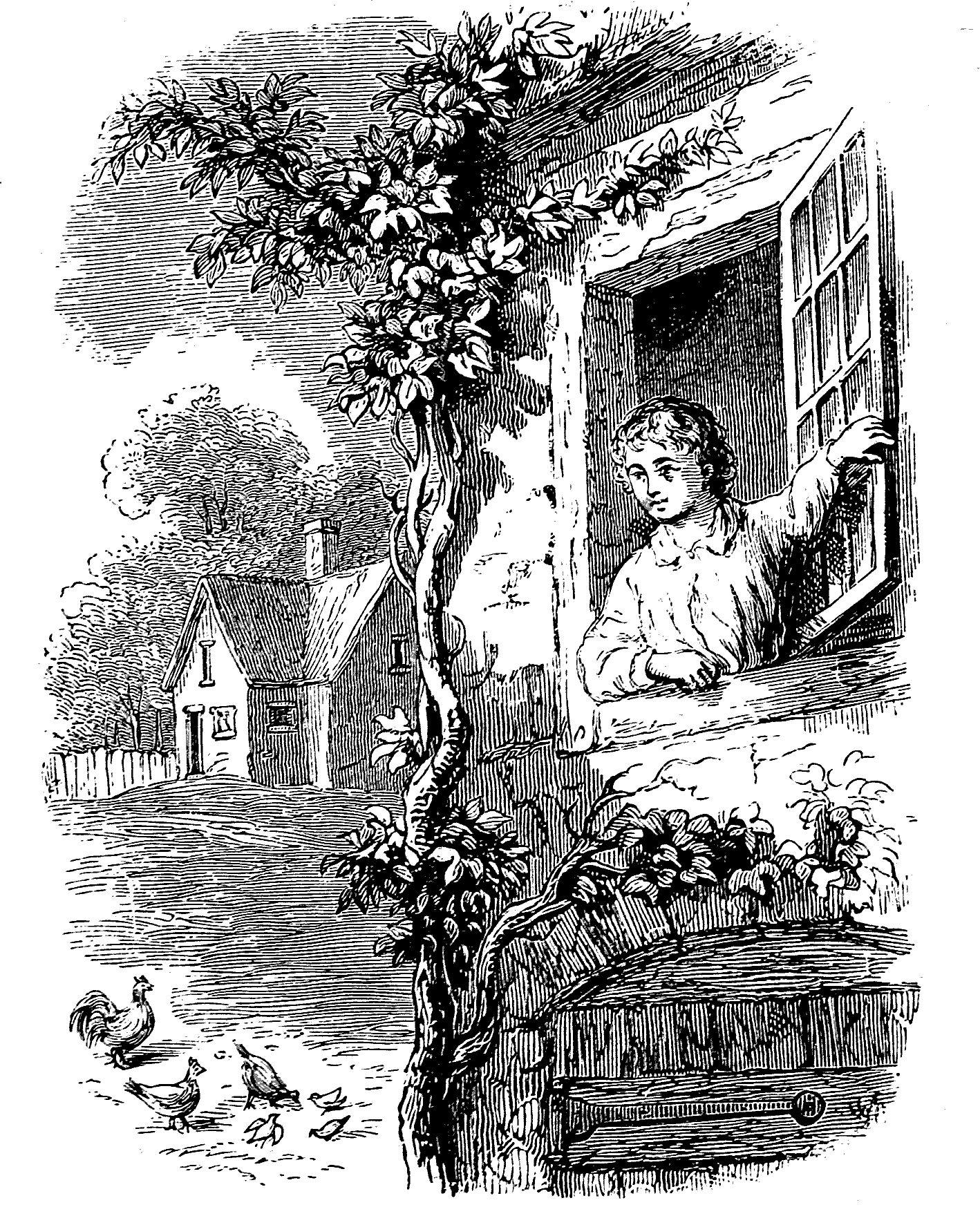
Eddy at the Window,—Just up.—p. 5.
I will take my little readers over to Eddy Forester’s, this morning.
There is Eddy at the window, just up. Do you see him in the picture? He has opened the window, and is glad to find the sun is shining; for the first thing he thought of this morning, when he awoke, was the mowing-party to be at Linn’s.
6As soon as Eddy was half-dressed, he went to the little bedroom where Lily slept, and called, “Sister Lily! Sister Lily! Get up; it isn’t raining, and we shall have the hay-making party this afternoon.”
Lily was apt to be sleepy in the morning, and she would not get up; but Eddy called and thumped at the door till his little sister was wide awake, and then she got up and came to open it. He kissed her and said, “Come, Lily, I will help you to carry your clothes down to mother’s room, and she will dress you. If you were not such a big girl, I would carry you, too; but I’m afraid, if I did that, we might both get a tumble. Don’t you think we should, Lily?” Lily was sometimes a little cross when she first waked in the morning; 7but Eddy talked to her till she was in a good humour. He liked to take her out with him in the morning, when he went to do what he could for his mother before breakfast, and he sometimes had to bear a good deal with her little pets and humours before they could get off.
Their mother heard them talking overhead, and then she heard their little naked feet pattering along the entry and on the stairway; and she wondered why they were so long coming to her.
Shall I tell my little readers why Eddy and Lily stopped on their way?
In the stairway wall, about half-way down, there was a small window which overlooked the garden.
8There was something in the garden which had been placed there the day before. Eddy knew of it, but Lily did not. It was a beehive, for the bees to make honey in.
When they were on the step, just under the little window, Eddy said, “Stop, Lily, and I will show you something you have never seen—something that begins with a B. Would you like to see it?”
Lily. Yes, Eddy. What is it? A little pig?
Eddy. No. I said it began with a B, not with a P. You must guess again.
Lily. A pussy-cat?
Eddy. No. It begins with B, I tell you. That is not it, either.
Lily could not guess, and Eddy said he 9would show it to her, if she could climb up into the window. Then he sat down on one of the stairs, and told Lily to get upon the step behind him, and to put her foot on his shoulder, and then she must take hold of the window-sill, and he would raise her up. Lily did so, and Eddy climbed up beside her, and showed her the beehive in the garden.
While they were there, talking about the beehive, their mother called them, and they soon came down again and ran to her. Lily could hardly wait to be dressed, she was so eager to have a closer look at the beehive. Her mother told her she might go with Eddy, if she would not touch the bees; for if she did, they would sting her.
After Lily was dressed, her mother took out 10of the closet a pair of thick-soled, leather boots, which she was to put on when she went out with Eddy, early in the morning, while the grass was wet with dew. Then she wished Lily to sit down, and put them on herself; and while she was doing this, Eddy went for his boots, and then they set off together to look at the beehive.
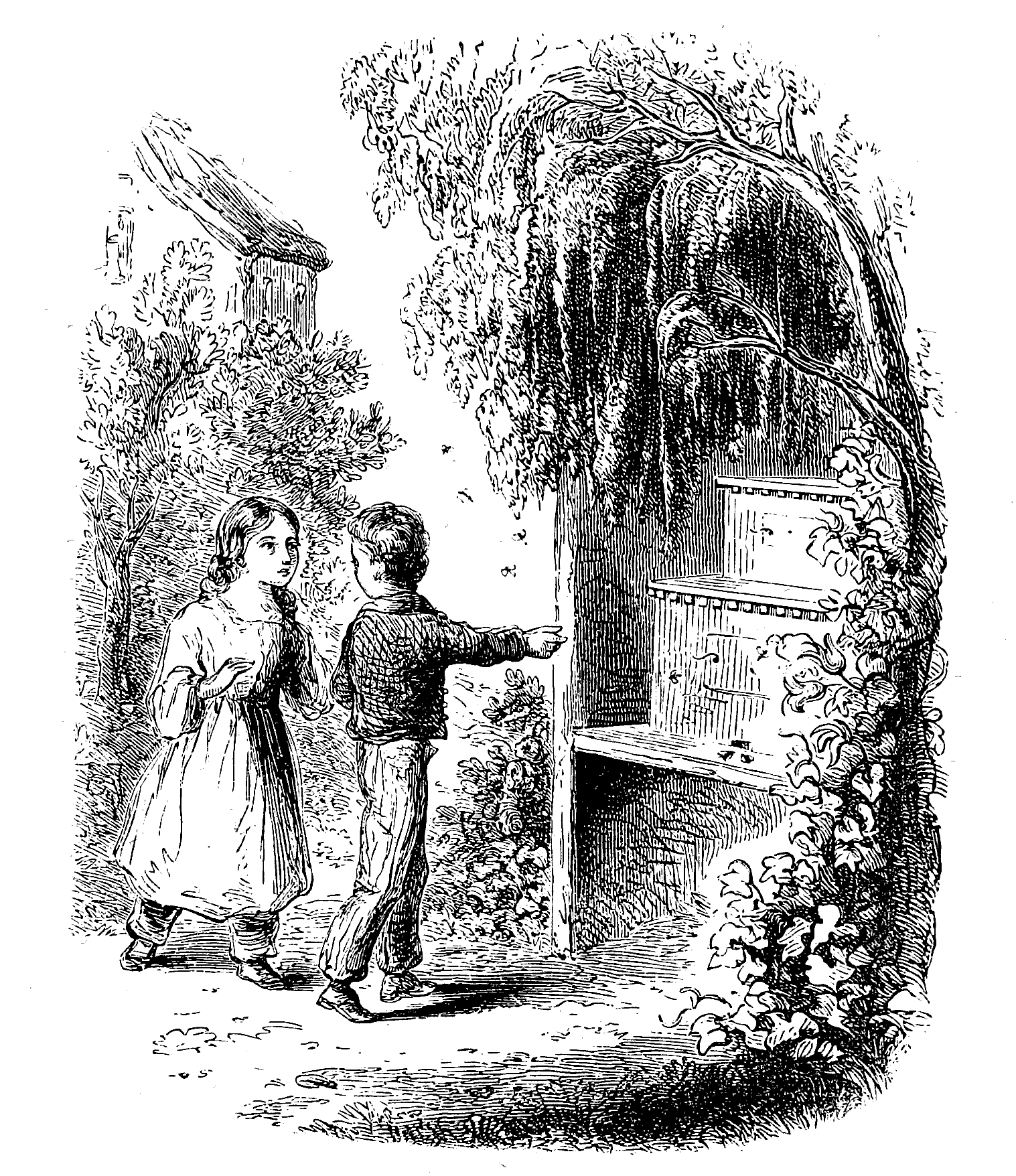
Eddy slipped back the little door which was placed in the side of the hive, and then, through the glass, he and Lily peeped, to see the little, industrious bees at work. They saw them travelling to and fro, inside of their glass house; but they did not know much about bees, and could not tell what they were doing. They only knew that bees made wax and honey, and they knew that honey was very nice, for they had eaten it.
Fifth Day.
Eddy and Lily looking at the beehive.—p. 10.
11“We will ask Mary all about the bees, when we go to school,” said Eddy. “She can tell us what they are doing inside of their little house.”
When they were satisfied with looking at the beehive, and talking about the industrious little bees, Eddy said—
“Come, Lily; do you want to go with me to bring Brindle up, for mother to milk?”
Lily said “Yes.” And Eddy took her by the hand and led her very carefully, out of the way of some swampy ground which was near the garden-wall, and then they had two meadows to cross and a fence to climb over before they found the cow. Brindle knew Eddy right well, and he had no trouble in driving her home to the barnyard to be milked. He 12had a long stick, which he had cut from a hickory-tree, and whenever Brindle walked out of the right path, he gave her a little tap with the stick, and that was quite enough of a hint to turn her into the track again.
Eddy and Lily loved the old cow, and they played with her, and talked to her as if she understood them.
After Lily’s mother had milked the cow, she carried the pail, which was filled with milk, into the spring-house, and there, on the stone floor, were two nice, bright tin pans, all ready to receive it. She took down from its place a fine sieve, which she put first over one pan, and then over the other, as she poured the milk into them. This was done in order to strain the milk and have it perfectly 13clean—free from motes and hairs, and the small insects which are often flying about barnyards.
When the pans were filled with the nice new milk, Eddy assisted his mother in carrying the water, with which to clean her milkpail, and Lily went to the house to get the cream cup, that it might be filled with cream for breakfast.
Then Eddy drove Brindle away back to the meadow, where she could eat her good breakfast of grass, while his mother and Lily went home to prepare their’s.
Lily carried the cream cup, and her mother carried a pot of butter in cold water to keep it hard. The first thing they did when they went into the house was to put on dry shoes.
14Then Lily’s mother began to prepare breakfast. Lily could place the cream and butter and bread on the table, after her mother had cut it; and she knew where the sugar was kept, and could fill the sugar-bowl, and she could count as many eggs as were wanted for breakfast, and bring them to her mother from the pantry. Then she put a plate for her mother, and one for Eddy, and one for herself, and a knife and fork for each, and an egg-cup and a napkin. When Lily had done all this, she asked her mother, (as any other good little girl would do,) if she could assist her in any thing else?
Her mother told her she might go up-stairs and take the bedclothes off Eddy’s little bed, and off her own; first the coverlets, which 15she could put on the back of a chair; then the sheets, one by one, and then the pillows and bolster, which she might place on the window-sills to air.
When Lily came down-stairs, Eddy had returned, and breakfast was ready. It was only six o’clock, when the Foresters sat down to their morning meal. They were a happy little family of love. They always rose early, and finished their tasks before breakfast, and when they came to the table, they enjoyed their meal as much as any prince in his palace could do. They had found the great secret of happiness—they were contented with their lot. Eddy’s mother would sometimes say, her cottage and her children made her a little Garden of Eden, in the midst of 16which God had planted her, that she might dress it and keep it.
Eddy and Lily had a great deal of talk with their mother at table. They asked her questions, and she answered them, and instructed them in many things.
“I will take another egg, if you please, mother,” said Eddy, “and some more bread and butter. I am very hungry this morning.” Eddy and Lily ate their eggs as their mother had taught them, without soiling their fingers at all. They took their knives, and cracked a line round the shell, near the large end, about half an inch from the top. Then they peeled off the shell where it was cracked, and put their eggs into little cups, which their mother had placed for each of them, the 17peeled end being uppermost; and with their spoons they ate the egg from the shell. There is another way to eat eggs. Cut through the middle of the shell into the egg, and with the thumb and finger of each hand break it open; hold the cut part next to your cup or glass, and let the contents of the shell fall into your cup. But little boys and girls are not apt to do this dexterously; so, for fear of soiling their fingers, (which is a very offensive habit, at table,) they had better eat eggs as Eddy and Lily Forester did.
As Eddy and Lily walked to school, they had to wait, when they got to the wide turnpiked road, for two travelling-carriages to pass. While they waited, a little curly-headed boy dropped something out of one of the carriage windows, and Eddy told Lily to stand still where she was, while he went and picked it up. It was a large humming-top, and when he handed it to the little boy who had dropped it, the little boy said, “I thank you, Eddy Forester. I wish you would ask your mother to let you come and see me, when we come back, and I will show you how my top hums when I spin it.” Eddy said he would like to come, and then the carriage 19passed on. It belonged to their neighbour, Thompson, a gentleman who had a beautiful country-seat near the Foresters’ cottage.
“I wish we could ride in that pretty carriage, and have little ponies, as Willy and Alfred Thompson have,” said Lily. “Don’t you, Eddy?” “Yes,” said Eddy. “I wonder why mother hasn’t as much money as the Thompsons, and why she cannot have servants to milk and get breakfast and dinner, as they have, instead of doing it all herself.”
“I don’t know why it is,” said Lily; “but we will ask Mary as soon as we go to school.”
“Oh, yes,” Eddy replied. “Mary knows; she can tell us all about it, and about the bees too.”
And with this happy hope of an answer to 20all their questions and doubts, the little brother and sister began to look about them for something else to enjoy and talk about.
“Look! look! Lily. Here is an ant-hill. Don’t tread on it. The little ants are bringing grains of sand to make it bigger.”
Lily. Why do they creep in at that hole in the top of the hill? Do you know, Eddy?
Then they both stooped down and watched the little ants; and while they did so, Eddy told his sister that the hill was the house which the little ants had built for themselves to live in, and that the hole at the top was their front-door, where they went in and out of their house.
Lily. Why do they go in and out of it?
Eddy. Because they are building little 21rooms inside of it, and those pellets of sand and earth which they carry in with them are what they build with. They use those little pellets just as the masons use bricks when they build houses for people to live in. They pile them up close together to make the walls and ceilings of their little rooms, inside the hill which you see.
Lily. Who told you about it, Eddy?
Eddy. Mary told me one day, when she and I carried some things over to Mike’s mother. She and I stopped to look at some ant-hills, and we talked about them all the way home.
Lily. What else did Mary tell you about the little ants?
Eddy. She said that after the rooms inside 22the hills were finished, the ants laid their eggs in them; and when the sun made the little rooms nearest the top of the hill too warm for the eggs, the ants removed the eggs into the cellar of their houses; for they make rooms under the ground as well as above it. When the young ants come out of the eggs, then there are too many to live in one house, and the father and mother-ants and the children-ants all set to work together, and build another little house.
Lily. Oh! Eddy, what a pretty story about ants! Do you know any more?
Eddy. Yes. Mary told me these little brown ants were called mason-ants, because they build their houses as masons do; and she said there were different kinds of ants, 23and some time she would tell me more about them.
When Eddy and Lily were satisfied with looking at the ants and their little houses, they went on again to school. Suddenly, Lily screamed, “Oh, Eddy! Eddy! Take it off! Do take it off! Do kill it!”
“What is the matter?” said Eddy. But poor little Lily only jumped about and cried, “Oh, the ugly thing! The ugly thing!”
At length Eddy discovered that a caterpillar had fallen on Lily’s neck, from one of the trees under which they were walking.
He begged Lily to be quiet while he took it off, telling her at the same time that it would not hurt her. He then picked a green leaf and held it close to the caterpillar, and 24the caterpillar crept off Lily’s neck and came upon the leaf. As soon as she knew it was off, she wanted to kill it.
“Oh no! You must not,” said Eddy; “let the poor little thing have some breakfast, out of this tender green leaf. We have had our’s, you know, and this leaf is the little caterpillar’s bread and butter.” When Lily understood that the caterpillar would not bite, nor poison her, she looked at it, as Eddy pointed out the pretty bright rings round its body, and the little horns on its head; and when he told her that a pretty butterfly would come out of the caterpillar, if it were let alone, she was glad she did not kill it.
As they walked along, Lily spied a beautiful rose, just outside of a garden railing. 25She was running off to pluck it, but Eddy held her by the arm.
Fifth Day.
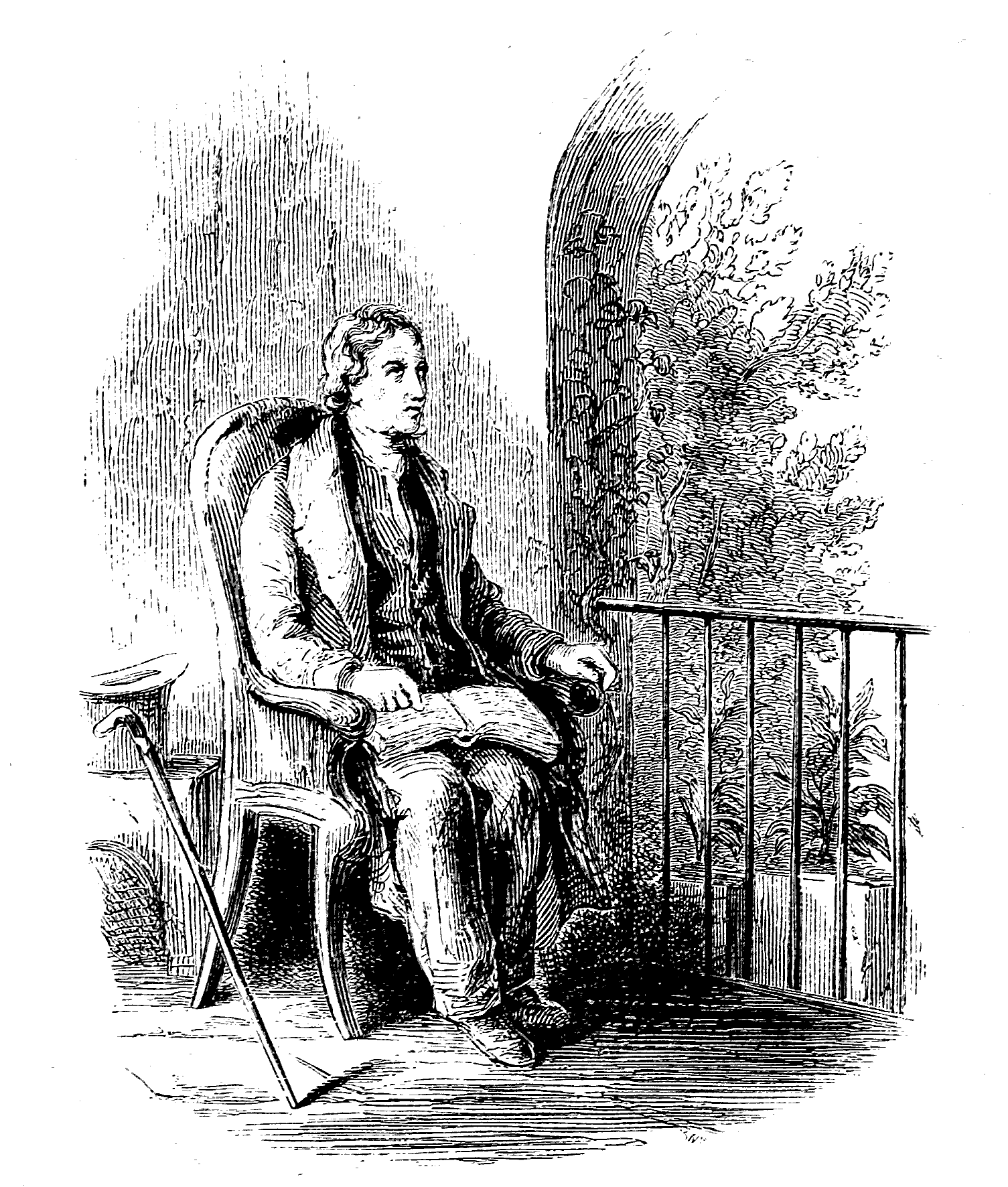
They saw a gentleman sitting in an arm-chair, with a book in his lap, and his eyes uplifted.—p. 25.
“It is not your’s, you know,” said Eddy. “It would be stealing, to take it.”
“Would it?” said Lily. “Then let us go and ask for it.” “So we will,” said Eddy; and they turned back a short distance, to a garden-gate, which they opened and passed through. They found themselves in a beautiful garden, where were flowers of various kinds all in bloom. Lily could hardly keep her hands from them, but Eddy told her she must not touch them without leave. They went on, until they came to a door, which was partly open. They peeped in, and saw a gentleman sitting in an arm-chair, with a book on his lap, and his eyes were uplifted 26as if he were praying. “It is our pastor,” whispered Eddy, and at that moment the good man espied his little visitors. He held out a hand to each, and said, “Well, my little children, have you any thing to say to me this morning?”
Eddy told him their errand, and he immediately laid down his book, put on his hat, took his cane, and walked with them into the garden.
“May we have one of your pretty roses?” said Lily.
“Yes! That you shall, my little daughter, and as many other flowers as you like. Now, come and show me which you admire most, and I will cut them for you.”
Their good pastor made them up a beautiful 27nosegay, and then dismissed them, inviting them to come and ask for flowers again, if they wanted them.
Eddy and Lily ran off to school with the flowers, and Lily said they would give them to Mary. On the way, Lily stopped to listen to something.
“What is that noise, Eddy? Do you hear it?”
Eddy. Yes. It is the mill-wheels grinding wheat, to make flour; but we must not stop now any longer, or we shall be late at school.
Eddy and Lily were the last at school, but not late. They met Mary, just as they went up the lane, and ran to her with the flowers.
“Thank you! Thank you! for your beautiful gift,” said Mary. “I will give you each a kiss for it.”
28“Definitions, arithmetic, spelling, reading, sewing, and philosophy is the order of to-day,” said Charles Linn. “Come, let us be at work, so that we may have plenty of time to play in our harvest-fields this afternoon. Father says we may do as we like—make hay or help bind the wheat-sheaves. At any rate, we shall have fine fun. Father is coming out to work with us, and, at lunch-time, mother will come and bring the baby.”
“May I nurse the baby, Charles?” said Lily Forester.
Carry Deacon. I like kittens better than babies, because babies cry, and kittens don’t.
Mary. Come, now, we must get to work, 29and talk about the respective merits of babies and kittens at some other time. What is the lesson in philosophy? We will take that first.
Charles. The atmospheric air.
Mary. What can you tell me about the atmospheric air?
Charles. It has weight.
Susan Field. It has colour.
Mary. Lucy Linn, please to give me some proof that the air has colour?
Lucy. The blue sky is a proof of it.
Mary. How does that prove it? Is there any thing beyond the sky? Any surface which reflects this colour, and makes it appear blue?
Charles. No. The atmospheric air is 30really of a blue colour; and we see it only in the sky, because between our eye and that distance a great space is filled with atmospheric air. The air is composed of transparent particles, and we must see a great number of these particles lying close together, in order to discover their true colour.
Mary. Can you make this more clear to me by illustration?
Charles. Yes, I think I can. If I take any transparent substance, a piece of glass for instance, so slightly coloured that I cannot tell whether it is blue, or pink, or green, by placing another piece of the same kind of glass behind it, the colour will be deepened; and if I place a number of pieces of glass of the same kind together, the whole of them 31will be so distinctly blue, or pink, or green, that in this way I can discover the colour of the first piece.
Just so I obtain the colour of the air. The particles which fill the space between you and me, being transparent, appear colourless because there are so few of them together; and if I look beyond you, out of the window, to the woods across there, I still perceive no colour in the atmosphere. But if I look far, far beyond, through as much space as my eye can take in, then I find out the colour of the air, because I see a sufficient number of its particles, one behind another, to give it to me.
Mary. Is there any other transparent 32fluid, the colour of which you can find out by the same means?
Carry D. Yes. Water. If I stand on the bank of a river, or on a boat, or in any situation where I see a large body of water, it appears coloured; sometimes blue, sometimes green. And I know I can only find out its true colour, by seeing a large body of it; because, if I were to take a cup and fill it with this same water, it would be colourless in the cup.
Mary. Very satisfactory. Now I should like to have some proof that the air has weight.
The scholars hesitated, and Mary asked them if flies, walking on the ceiling without 33falling, had any thing to do with the weight and pressure of the atmosphere?
Lucy. Yes. I remember now what you told us about that. The feet of flies are so constructed that when they place them on any surface, the atmospheric air is excluded. There is, then, no air between their feet and the ceiling, or wall, or pane of glass, on which they are walking, and the weight of the atmospheric air on the outer surface of their feet keeps them in their position, and prevents them from falling.
Mary. What else can you tell me about it?
Charles. The weight of the air falls equally on every side of a body which is exposed to it.
34Mary. Give me a proof of it.
Charles. I keep my upright position as I stand before you, because the atmospheric air is pressing equally upon the top of my head, and on both sides of me. If the air pressed with greater weight on my head than on other parts of my body, I should stoop instead of standing upright; if it pressed with greater weight on one side of my body than on the other, I should lean from my perpendicular position.
Mary. Very good. What would be the effect upon you if the air had no weight, and if there was no pressure upon the surface of your body? Would you fly, as the birds do?
Charles. No; because the spaces in my bones, and in other parts of my frame, contain 35more fluids and less gases than those in the body of a bird.
Mary. Very true. And so wisely has our Heavenly Father fashioned all his creatures, that they can only live and move and support themselves by obeying the laws of their respective organizations. Our Heavenly Father intended that you should stand still, or sit, or lie, in any position you choose, without feeling the weight of the atmosphere which surrounds you; and He has filled the spaces within your bodies with just so much power of resistance to this outside pressure, so that you can keep yourself steadily in any position which you choose to assume.
What causes the piece of leather, which 36you call your sucker, to adhere to the stone on which you place it?
Charles. The weight of the atmosphere.
Mary. Explain, if you please, the whole matter to us.
Charles. I asked our shoemaker to cut for me a round piece of leather, rather larger than a silver dollar. I then made a hole in the middle of it, through which I slipped a piece of twine, making a knot in the end of the twine to prevent it from slipping back. I then wetted the leather until it was quite pliable, and would adhere closely to any surface on which I placed it. I selected a smooth stone, placed the leather upon it, and stamped my foot down on it; and then father, and old 37Pete, and myself, successively tried to pull it off the stone, but it adhered so closely that, when we attempted to raise it, we lifted the stone and all!
Mary. What produced this effect?
Charles. The weight of the atmospheric air upon the leather.
Mary. But if the air presses equally on every part of the surface of a body, why did not the weight of the air on the under part of the leather force it up?
Charles. There was no air to press upon the under surface. It was excluded by the adhesion of the leather to the stone; and there was no resistance below to the pressure above it. Hence, it retained its place.
Mary now went to the closet, and brought 38out the little pot, from which the water would not run freely the day before, at the tea-party. She held it up, and asked her class if any of them could tell her why the water did not run freely out of the spout, when they attempted to pour out tea. Each of the scholars took the pot and examined it, but no one could answer the question.
Mary then filled the pot with water and closed it with the lid. Then she attempted to pour out the water into a little basin. At first it ran out freely, but it soon flowed only in drops.
“You have told me, Charles,” said Mary, “that the air has weight. Now the spout of the pot is filled with air, and when I pour out the water at first, the resistance which 39the water meets from the pressure of the air in the spout is not great enough to prevent it from flowing out; but after the air in the spout has been forced out by the water, you perceive, (do you not?) that the water, as I continue to pour it, meets with the pressure of the whole surrounding atmosphere, and that is too great to allow the water to run freely. How is this?”
Charles. Oh, I see—I know! When the lid is on the pot, the air cannot get to the surface of the water in the pot, and therefore there is no pressure there to act against the pressure which the water meets as it flows from the spout.
Mary. Now can you tell me what we shall do to have the water run freely?
40Charles. Take off the lid, and then the weight of the air on the water at the top of the pot will press it out of the spout as you pour it.
Mary. We must do so in this case to have the water run freely; but you have observed that at table we always pour out tea and coffee with the lid on the pot.
Mary then took an iron piercer out of her desk, and she made a small hole in the top of the pot lid. While she was doing it, Susan Field exclaimed, “I have found it out—I have found it out! There ought to be a little hole in the lids of coffee and tea-pots, so that the air can get through the little hole, and press upon the surface of the tea and coffee. Then the pressure upon it within being 41equal to the pressure it meets without, whatever liquid is in the pot will run out freely. Is not that it, Mary?”
Mary. Yes. And now we will test your discovery.
Mary then filled the little play tea-pot with water, and put on the lid with the hole in the top of it; and to the delight of all the scholars, who had crowded round the basin, the water flowed out freely and beautifully, until there was not a drop left in the pot.
“Bravo! little Miss Philosopher,” said Charles Linn. “Let us crown her! Let us crown her! She is the conqueror of the day.”
Mary. I am very well satisfied with all my little philosophers to-day; but we have spent so much time over this lesson, that you 42must leave crowning Susan until you have a recess. Charles may do the honours of the occasion by making a speech, if he likes.
Charles went to his desk, humming by the way some verses which his father had read to the family the evening before, and which he had desired Charles to learn.
Mary now heard the lessons. Definitions and spelling occupied the time until the hour for recess.
“Now let us crown our Queen of the Day,” said Charles; and every one of the scholars set out, through their bounds, to gather wild-flowers and pretty green leaves to make a wreath for Susan. Charles said they must have some laurel, and he went off to gather it.
Heated and weary they came back again, and all sat down together on the grass, bringing their gatherings to Lucy Linn, who had 44been appointed to make a wreath for the queen.
Lucy twisted and untwisted, and arranged and re-arranged, until she had formed a very beautiful wreath. She had ivy, oak, and laurel leaves twined first together, as a framework, and then she twisted wild-flowers in among them. The little children were lying about on the grass, around Lucy, while she was at work, and the older ones made suggestions to her as she proceeded. When the wreath was made,
“Now,” said Charles, “I must crown the queen, for I was the first to acknowledge her discovery.”
Susan looked very sweetly when she was crowned. She had waving brown hair over a 45fair round forehead, and soft hazel eyes. Charles said she looked every inch a queen.
“Now you are too grand to play, Susan,” said Eddy Forester.
“Oh no, indeed I am not,” said she. “One, two, three, and away!” and away ran Susan, and all the scholars after her, and a merry chase had the subjects after their queen. When they caught her, Susan said she would take off her wreath, and keep it to show to Mary, and then she would take it home to show to her grand-father and grand-mother.
The day was very warm, and they all sat down together, to rest, near a fountain, away off at the lower edge of the wood. The spring had been walled round by Alfred Thompson’s father; and in order that the villagers might 46obtain water readily, he had a pipe made and carried up through the wall; and from this pipe the beautiful, clear water flowed out all day long.
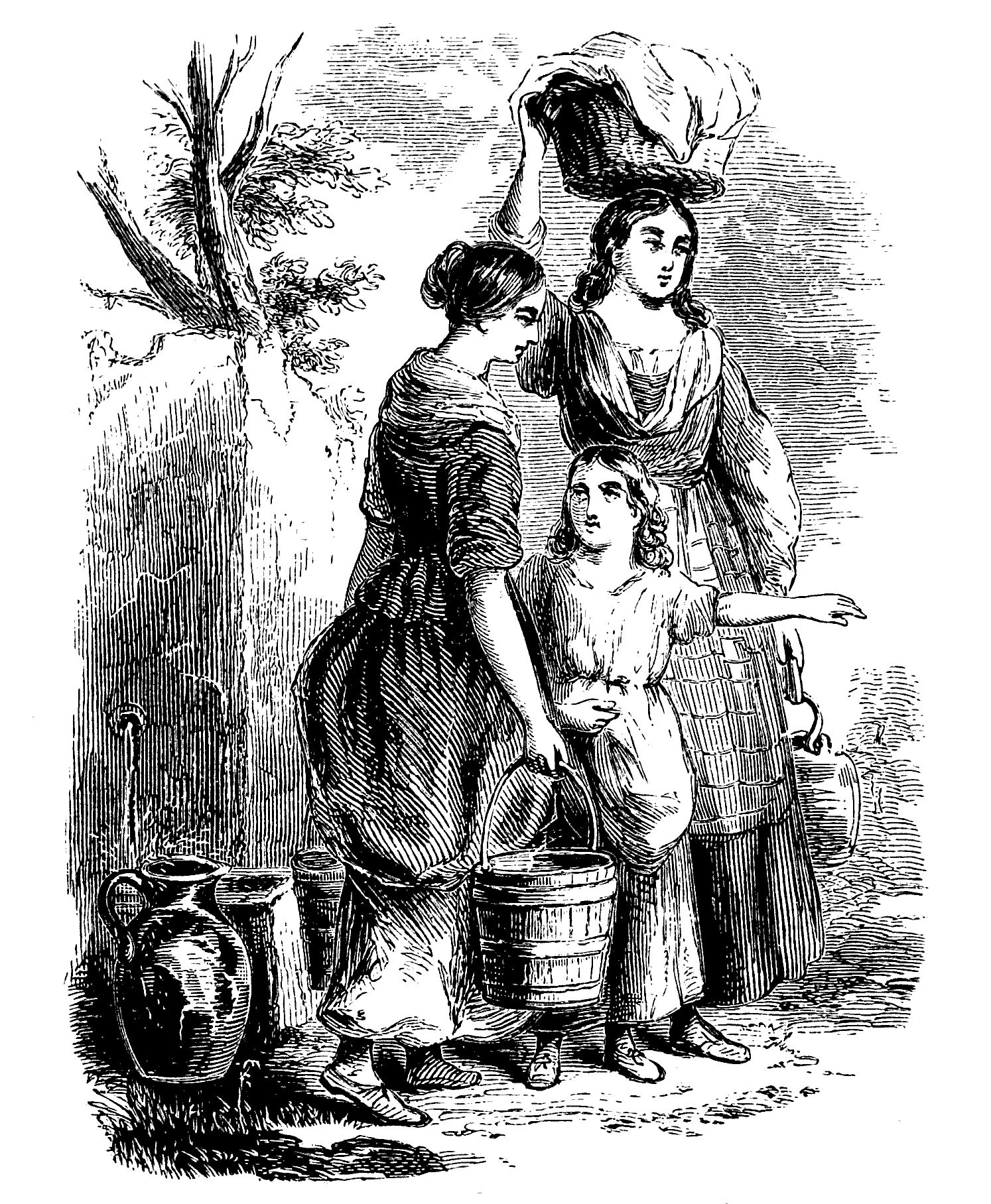
While they were there, some washerwomen came to get water, and a little girl who was with them spied the school children, as they sat and talked and laughed under a shady tree.
“Will you give us some water? we are so very thirsty,” said they to the little girl.
“Are you Mary Carrow’s scholars?” asked the women.
“Yes,” said Charles Linn, rising up and coming forward.
“Then,” replied they, “you shall have as much water from our cup as you like, because 47you have a very good name in the neighbourhood.”
Fifth Day.
Women at the fountain.—p. 46.
While they were drinking, they heard Mary’s voice, and presently she appeared among them. She thanked the little girl, and said some kind words to the washerwomen, and then hastened the scholars back into school.
Mary. Do you know how fast the morning is running away? We have yet one lesson to say, and then, Eddy and Lily want to know something about bees.
Mary looked at Susan’s wreath as they walked back to school, and put it on her own head to see how she looked in it. Then she told her to keep it as a good mark gained at school; for that would be a pleasant remembrance, 48when the sweet flowers and pretty leaves of which it was made should have withered away.
Mary’s scholars were earnest and bright this morning, and were soon ready for the reading.
“Now for the bees!” said Eddy Forester.
Mary. Eddy, what did you wish to ask about them?
Eddy. I should like to know what they do when they travel about in their hive?
Mary. When you see them hurrying up and down in their hive, they are at work. Some of them are carrying wax to the place where other bees are building cells, and these cells, you know, form the comb. Some of them are loaded with farina, which, you know, they gather from the flowers; and with this 49farina they feed the young bees. Each one does his own work, without interfering with the others; and though you sometimes see only an apparently confused crowding of bees together, in their hives, yet they are all busy at their appointed work.
There are three classes of bees in every hive. First, there is the queen-bee, who is mother and ruler of the whole community. Then there are the drones; and there are the working-bees, who build the cells and make the honey. The working-bees are divided into two classes—the wax-workers and the nursing-bees. It is the especial business of the latter to take care of the young, but they also make wax and assist in the architecture of the hive.
50When you saw so many bees passing to and fro in the hive, they were engaged in doing their own special business. Some of these which you saw were carrying wax to the little architects who were laying the foundations of a new comb; and as soon as they reached the spot, these would come forward to meet them, and relieve them of their burdens; then they would immediately leave the hive, to procure more materials for building, and when they returned with another load, it would again be taken from them by the bees who were at home in the hive, and applied to the same purpose—forming or finishing cells. Some of those which you saw were probably nursing-bees, carrying food to the cells, where the young bees were in the 51first stage of their existence. Some of these might have been wax-workers, taking the wax which they had made to the cells which were already filled with honey, in order to spread a very thin layer of it over each cell, to prevent the honey from wasting by running out.
Lucy Linn. Do the bees make the pretty combs which hold the honey?
Mary. Yes. That is the first work of a new swarm after it has taken possession of the hive.
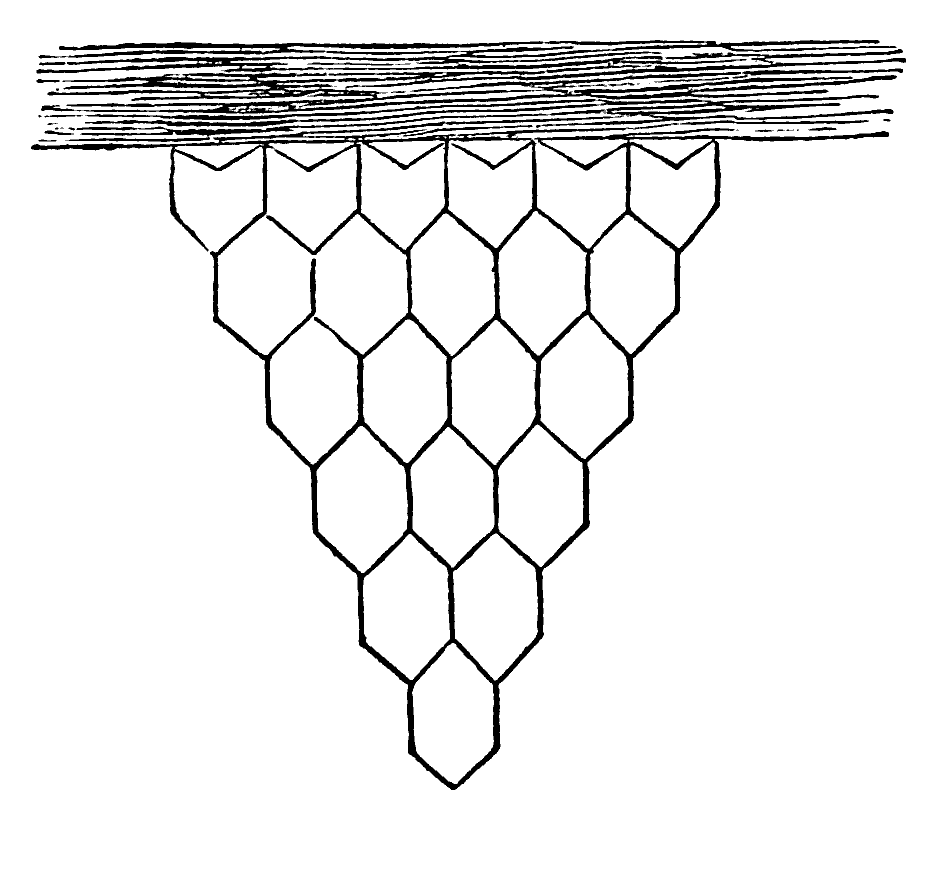
Eddy. How did they learn to make such pretty combs? Look, here is a print of one.
Mary. God gave them instincts, by which they learn to provide for themselves. He has implanted in every creature which he has 52created, an instinct, which guides it first to gather such materials as it needs for the construction of its habitation, and afterward to make use of the materials which it has collected, in building its habitation.
“He has implanted in every creature the instinct of self-preservation, and he has endowed even the most insignificant insect, as well as the noblest animals, with intelligence 53sufficient to provide for its own wants.” He has fashioned every creature with organs adapted to accomplish this end; and the more you know of insect history, the better you will be able to comprehend something of the wisdom and beneficence of our Heavenly Father, who has made nothing in vain.
Susan. Here is a cluster of bees hanging together, as I have often seen them hanging at the door of a hive. What does it mean, Mary?
Mary. They are manufacturing wax, while in that position. It is always their preliminary measure, when they are about to begin building their cells.
Eddy. What is wax made of?
Mary. Honey. When the bees are gorged 54with honey, they hang together in this way, in order to make their honey into wax. As soon as they have made enough to build cells with, they begin.
One bee, (called by naturalists the founder-bee,) attaches itself to the roof of the hive, in order to lay the foundation-wall for a row of cells. While in this position, it affixes to the roof a shapeless little mound of wax; it smooths and works at its deposite until it is weary, when another bee comes and takes its place, and works in the same way until it also is tired. A number of bees in succession come after these, each one bringing its deposite of wax, which it adds to the general mass; and they soon have an irregular line of wax hanging down from the roof of the hive, about 55two-thirds of an inch in length. This is the foundation-wall of their pretty house of honeycombs.
You will observe that I have told you this wall of wax, which depends from the roof of the hive, is of an irregular thickness. When it is completed, another set of bees begin to lay the foundations of the cells, by commencing a hollowing process at those parts of the wall where it is thickest. The first bee who comes to the work takes out of the wall with its teeth as much wax as is equal to the diameter of a cell; and after kneading the particles with its mandibles, and moistening them with its tongue, deposits it on the edge of the excavation which it has made in the wall. When this insect has laboured for some seconds, 56it goes away, and another takes its place, working in the same way. So soon as one bee succeeds another in the work, a number of excavations in the wall are made, which are the rudiments of cells. While these are being made, another set of founder-bees build a second wall, which they bring down in a parallel line to the first, and near enough to it to admit of only a passage for the bees who are making the cells on either side of the wall.
Two sets of bees are always at work in constructing the comb; those who build the walls, and those who excavate the cells; and there is also another set of bees, who polish and finish the cells, after they are formed.
57Lucy. How do they proceed after their house is built?
Mary. You will observe that, in consequence of the mode of building among bees, new walls and the rudiments of cells are being constructed in one part of the hive, while, in another, the work is in a complete state. As soon as some of the cells are completed, the queen-bee begins to deposit eggs in them, and these are called brood-cells. Very soon after the eggs are laid, the embryo insect requires feeding, which work is performed by the nurse-bees. This creates a division of labour, you see, and of course there are fewer builders to carry on the construction of combs. The nurse-bees always assist in building, when they have no young to take care of. Another 58set of cells is appropriated for the honey, and it is the business of some of the bees to store up winter provisions, by filling them with this delicious fare. Here we come in for a share of their labour, for you know we take all the honey which they do not need for themselves and their families.
Mike Terry. Where do the bees get the food for their young?
Mary. They gather it from the flowers. It was formerly supposed that the young bee was fed with honey, but Huber and other late naturalists have discovered that they are fed on farina.
There are many very interesting facts in connection with the swarming of bees, which are worthy of attention.
59When the number of bees becomes too great for one family, there is a wise provision made for their division into separate tribes. These tribes are called swarms, and when a swarm leaves the hive, with a queen at its head, they seek a new home, and begin to build, in the manner which I have described to you.
Charles. Would they not go without a queen?
Mary. No.
Lucy. How do queens differ from common bees?
Mary. They are larger and handsomer, and their position is different from that of any other bee, inasmuch as they receive the homage of all the bees in the hive.
60Charles. But if there is but one queen in each hive, how are others obtained when the swarming takes place?
Mary. I was about to explain this to you, when one of you asked a question about something else.
In the construction of the cells which form the comb, there are three different sorts—the brood-cells, which are for the common eggs—the honey cells, for honey, and the royal cells, for the eggs which are to produce queens. These royal cells are always made larger, and with more care, and with a greater expenditure of wax and labour, than any of the other cells. There are usually three or four, but sometimes as many as ten or twelve in one hive.
61About the time that a royal princess comes forth from her cell, the old queen usually leads off a part of the family, to seek with them a new home, leaving her successor to govern and receive the honours of royalty. This is called swarming. The queens seem to have an instinctive hatred of each other, and when more than one princess emerges at the same time from their respective cells, they attack, and would destroy one another, if they were not prevented by the workers.
Some naturalists are of the opinion that the bees send out scouts, prior to swarming, to select for them a new home; and if there are no empty hives near at hand, they will begin to form their combs in the hollow trunks of trees. Owners of bees, however, usually 62watch them, and have empty hives ready for the new swarms.
So wonderful and interesting are the little creatures, in all their habits, and so marvellously is the wisdom of our Heavenly Father displayed in their instincts, that we might spend weeks in pursuing their history, and yet not become acquainted with all that naturalists have discovered about them. I scarcely know how to quit the subject; but it is already past the hour at which we usually close school, and I am afraid the fathers and mothers of my little scholars are wondering why I keep them so long, this morning.
“Will you not tell us all about it at some other time, Mary?” asked the scholars, almost all at once.
63Mary told them she would. “And now,” said she, “we must put away books and slates, and go home to our dinners. Talking so long to you, makes me feel very hungry, I assure you.”
When Mary’s scholars came to school in the afternoon, they scampered away, one by one, down to the tool-house, with the rakes and little pitch-forks which they had brought for the harvesting at neighbour Linn’s. They were all neatly dressed, to stay to tea. Poor little Mike Terry had never been out to tea in his life before, and he was so pleased to be invited, that he could talk and think of nothing else.
Lucy Linn was whispering round that they were to have a table spread out on the lawn, 64and she told Mike he should sit next to her, and she would give him cakes and sweetmeats, and as many nice things as he wanted to eat.
“And will you give me some of the good things to take home to mother, Lucy?”
Lucy. Yes. You shall have the little basket that Charley and I bring our dinners in to school, on rainy days, and I will fill it full of good things for your mother, and you shall carry them home to her.
Mike. What a nice girl you are, Lucy! I love you dearly for that.
While Mike and Lucy were talking, the little bell rang for school.
Mary told them she should give them a short session, so that they could have plenty of time for the hay-making.
65“Now what have we to do?” Charles.
“Sewing for the girls, geography for us, and tables and slates for these youngsters. Then Bible-reading, and then hay-making.”
Ellen Raby. Mary, will you read to us something pretty, while we are sewing? See, my hemming is all fitted, and Lily’s work is a little patch, and we could listen without interrupting you at all.
“Yes,” said Mary. “My little girls and boys have been such good children to-day, that they deserve to be indulged with the reading of a pretty story. It shall be a true story—one which a preacher related to my mother, during her life, and which she wrote down and preserved among her papers.”
Mary then took out of her pocket-book a 66paper, carefully folded and enveloped, which was filled with her mother’s hand-writing. It was very precious to Mary, and she did not allow any one to handle it but herself, lest it should be soiled or worn out.
In one of my annual rounds among the poor of a bleak district in the west of Scotland, after a day of weary travel, I came at nightfall to the little cottage of John Wilson.
I had frequently halted there before, when out on similar errands, and, as often as I had done so, I was reminded of Burns’ faithful pictures of the cotter’s home.
It was Saturday night. I met John just 67coming in from work, and we entered his home together.
Fifth Day.
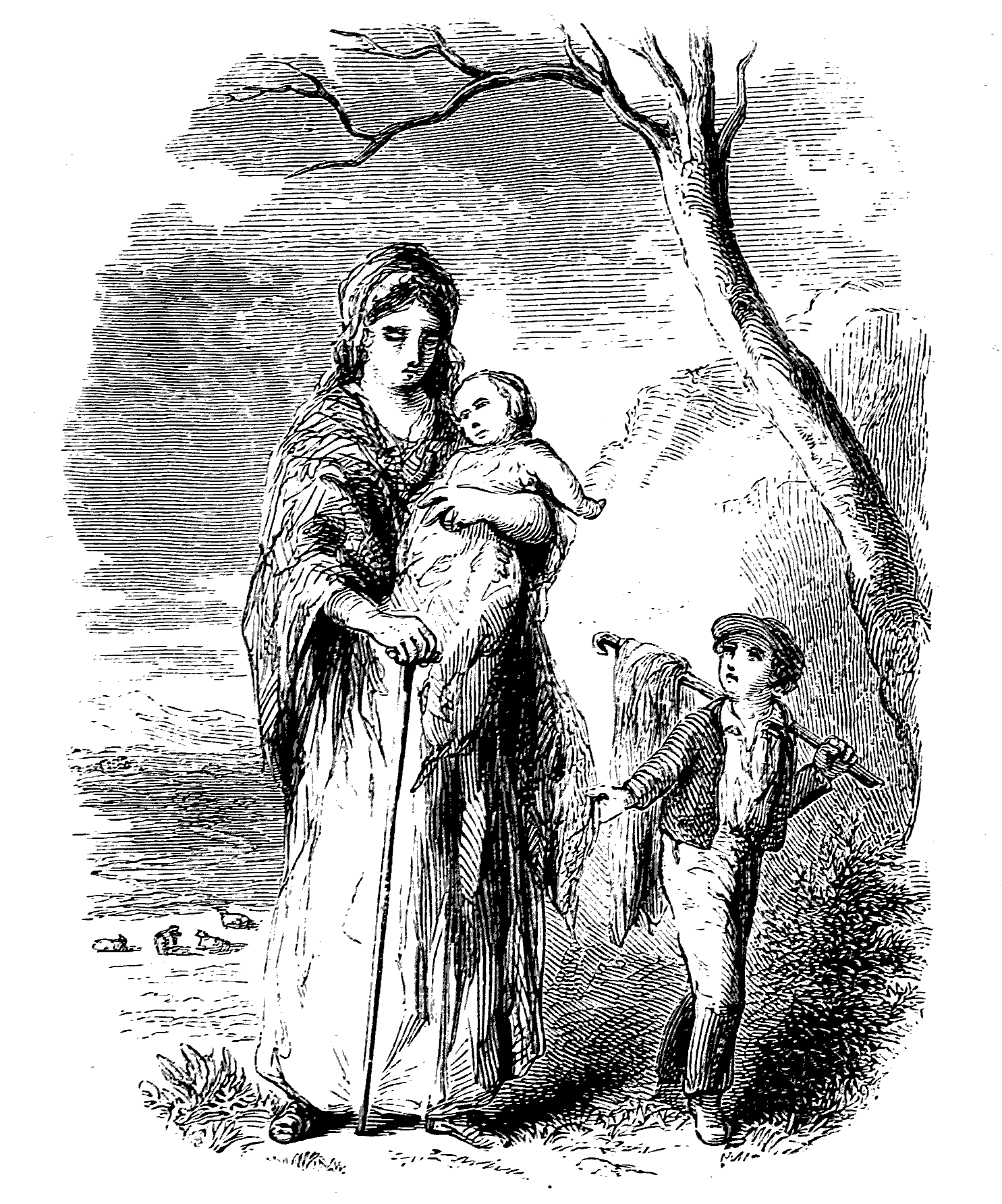
Whenever she went out, she carried the baby in her arms, and Jamie went before as a guide.—p. 67.
In a snug corner of the fireplace sat a stranger—a woman with a baby in her lap; and on the floor beside her, lay a little boy asleep. I soon found that it was blind Amy Duncan, the widow of an honest fisherman who had been lost in a storm a few weeks before.
I had often heard of little Jamie Duncan, 68her son. He was a good, bright boy, and as he could not be spared to go regularly to school, he had been instructed at the manse, by the minister. His mother had learned, blind as she was, to knit, and to prepare thread and yarn for the weavers; and now that her husband was dead, this occupation was all that she had to depend on for support. Little Jamie had been his mother’s guide all along the shore among the cottages of the fishermen. He would lead her by the hand, a few times, to any new place where she wanted to go, and after that he would run on before her, and she would follow, by listening to the sound of his footsteps. He brought her the wool and flax which she 69used, and when it was ready for the weavers he would carry it to them.
He had but little time for his book, for while his mother was at work, he had to mind the baby for her; and whenever she went out, she carried the baby in her arms, and Jamie went before as a guide.
Jamie used to think a great deal about what the minister taught him, and he learned his spelling and Scripture lessons by saying them over aloud, as he led his mother about. When the poor, blind widow was left without a home, John Wilson made a place for her and her little ones at his hearth, though he was a poor man himself and had to work hard for his bread.
I left the cottage early the next day, to 70fulfil an engagement in a distant part of the country, and, for a long time after, I heard nothing of John Wilson’s family, nor of the blind widow.
The next season, in the course of my rounds, I purposed visiting them again; and just after I had entered upon the wide moor which lay between my road and the cotter’s, I met little Jamie Duncan, with a stick over his shoulder, hung with the weaver’s thread, and his mother and the baby following on close behind. I drew near, unperceived by them, for Jamie’s face was turned toward his mother, and she, being blind, could not see me. She appeared to be weeping, and little Jamie was saying to her—
“Don’t cry mother, for you know that we 71have a Father in heaven, and if we mind what He says to us, He will take care of us. You know when our father died, you said you couldn’t tell what was to become of you and me and the baby. So I went out under the fir-tree and said a little prayer to our heavenly Father. I told Him you were blind, and asked Him to help you and to take care of us all.”
“Who put that into your head, child?” said Jamie’s mother.
Jamie. Nobody. I learned it out of the Bible. The Bible says, “Ask, and ye shall receive;” and our minister told me that every word in the Bible was true, and that we must try to obey all our Saviour’s commands, and then we would believe all His promises.
72“What else does the Bible say?” Jamie.
“It says, ‘Trust in the Lord;’ and it says ‘God is a husband of the widow and a father of the fatherless.’ Dear mother, I am sure if we ask our Heavenly Father, He will find a place for us to go to.”
“I cannot see him, child. I am blind!”
Jamie. I cannot see him either, mother: nobody can see him; but sometimes, when I am all alone, I feel as if some good being, that I could not see, is walking along by me, just as you are now; and then I can pray, and sing little hymns, and I feel so happy, that if I am ever so hungry and tired, I don’t mind it. I think, mother, that when we feel so, our Heavenly Father’s good Spirit is with 73us; and our minister says, nothing can harm us then.
I now advanced toward them, and questioned them about the Wilsons. I found that death had been in the house. The father and mother were both laid in the burying-ground of the little church. Elsie, the oldest daughter, was married, and had taken the younger children to her new home; and the family circle of the Wilsons was broken up, and there was no longer a place by the fireside for the poor blind widow.
It seemed clearly my duty to take them into my own home for the present, which I did. The widow did not live very long, but the baby and little Jamie are still with me; and I thank God for the blessing he has given to 74my household in that sweet child of faith—Jamie Duncan.
Mary now heard the geography class, arranged and fitted the sewing-work, attended to “tables” and sums, and then took the Bible to select a portion for the reading.
“Where shall we read? and what shall we read about?” said she.
“Under the oak! Under the oak!” exclaimed the scholars, all at once. And there, once more, teacher and flock gathered together, finding in its shade, a most agreeable retreat from the heat of the schoolroom.
“Mary,” said Eddy Forester, “I have been wanting all day to get a chance to ask you a question. Will you answer it now, before 75we begin to read? Will you tell me why the Thompsons are so much richer than my mother, and why Lily and I cannot have little ponies to ride, as Willy and Alfred Thompson have?”
Mary. I cannot answer your question, my dear little boy. Why some are rich and prosperous, and why some, equally deserving, are poor and unprosperous, are questions which have puzzled the wise of all ages. But this I can tell you, that God, who knows all things, and who knows what is best for every one of us, permits an unequal distribution of such things among his children. Wealth for some and poverty for others, and a condition between poverty and wealth for many, is of God’s permission; and, therefore, this difference 76of condition must be good for us. If it were not so, He would find some way to change it. You remember, we were reading the other day, in the Bible, about Abraham. Abraham was very rich; he had lands and cattle in abundance. God loved Abraham, and he blessed him and made him rich. But God had other servants, whom we read of in the Bible, whom it pleased Him, for some wise purpose of his own, to make poor.
The apostle Peter was a poor fisherman. The apostle Paul was a poor tent-maker. And so it is at this day. Some of the Lord’s most faithful servants are rich men, and some, whose lives are equally acceptable to Him, are very poor—have to work for their daily bread, as the apostles did.
77Charles Linn. But, Mary, you told us once, that our Heavenly Father’s children were equally the objects of his care and love. How is it, then, that poor people have to work so hard, while the rich have nothing to do?
Mary. It is not really so, that the poor only work, and that the rich do nothing. Rich people work just as hard as poor people do.
Eddy. How can that be? Do Alfred and Willy Thompson work as hard as I do? and does their mother work as much as my mother?
Mary. Yes. Your work and their work are not alike, but it is, I should think, about equal. Our Heavenly Father placed us here to do different kinds of work in his harvest-field, 78which is the world. The rich man’s work and the poor man’s work can never be the same; if it were so, then the ends for which we were placed here would not be gained.
You are too young to understand this subject now so well as I hope you will when you are older; but I will select for our reading some portions of Scripture which, I think, will enlighten you.
You remember that I read to you, on a former occasion, the history of Adam and Eve—of their disobedience—for which God sent them out of the garden of Eden; and you will remember also, that I read to you the sentence which He passed upon Adam, and that I told you that sentence was passed 79upon all of Adam’s race who should be born after him. This is the sentence: “In the sweat of thy face shall thou eat bread, until thou return unto the ground.”[B] Many, many years after these words were spoken to Adam, we find the same sentence in full force upon Adam’s descendants. David mentions it in the Psalms: “Man goeth forth unto his work, and to his labour until the evening.”[C] “For thou shalt eat the labour of thine hands.”[D]
I will now read to you what is said about labour. “All things are full of labour.”[E] “The thing that hath been, it is that which shall be, and that which is done, is that which shall be done. It hath been 80already of old time which was before us.”[F] These passages of Holy Writ will show you that God’s command to labour has been obeyed by millions of people who have lived before us, and that it must be obeyed over and over again by every succeeding generation.
I will now read to you another scriptural command to labour; and you must remember that all the commands of God, as recorded in the Bible, are to be obeyed: “In the morning sow thy seed, and in the evening withhold not thine hand, for thou knowest not whether shall prosper, either this or that, or whether they both shall be alike good.”[G] Now hear the blessings which are promised to the labourer: “The sleep of a labouring man is 81sweet.” “It is good and comely for one to eat and to drink, and to enjoy the good of all his labour that he taketh under the sun all the days of his life, which God giveth him: for it is his portion.” “Every man also to whom God hath given riches and wealth, and hath given him power to eat thereof, and to take his portion, and to rejoice in his labour, this is the gift of God.”[H]
Our Heavenly Father has not only commanded us to labour, but, because He loves us and knows what is best for us, He has so ordered our life that we find our happiness in it.
You will now see, by the Holy Scriptures, that labour is the condition of our being, that 82God commands us to labour—that He makes no distinctions in giving the command to the race of Adam. It is for all; for rich and poor—for high and low—for great and small. None can escape from it, and do their duty. Whoever does escape from it and lives in idleness, disobeys God, and will be punished for disobeying him. Idleness is sin; and we cannot commit any sin, you know, without disobeying and displeasing our Heavenly Father.
Charles Linn’s merry face was full of serious thoughtfulness while Mary was speaking, and her younger scholars were listening attentively to every word she said.
“You understand now,” continued Mary, “that human beings come into the world to 83work—not to live in idleness; and that our Heavenly Father plants us in different parts of the world, and in different positions, in order that we may be near the duties and occupations which He has appointed for us.
One little boy finds himself born in a great house, where there are many servants, and handsome grounds, and horses to ride, as at our neighbour Thompson’s. Another little boy finds himself in a snug cottage, with only his mother and a dear little sister. And both these boys must work, though their work will be different, as it ought to be. When they are old enough to be useful, the little cottager, if he is a good boy, will assist his mother in taking care of the chickens and pigs, in gathering eggs, picking cherries, and in doing 84any little services about the house for which his strength is sufficient. The child in the great house, if he is a good boy, will try to repay the servants for their care of him, by teaching them, when they have time, to read in the Bible, if they do not know how, and entertaining them sometimes from other books. Some of them may be old and sickly, and the rich little boy can take some of his money and buy them warmer clothing than they can afford to buy for themselves. And when they are weary of waiting and running to do this and that, the rich little boy can say to himself—“John has been out in the rain, or cold, all day, and I will light the fire in my own room myself. I think I know very well how to do it, for I have often looked at John 85while he made the fires.” Or, if Sally, the chamber-maid, is busy, he can quickly take his pitcher and fill it with fresh water, without calling upon her to do it. This will be the work of the rich little boy, just as helping his mother is the work of the poor little boy; and our Heavenly Father will look with approving eye on both, because both are obeying His command—to labour.
Little boys and girls who are so happy as to be sent to school, have another sort of work to do, in which the rich and poor fare alike. They must be diligent, obedient, industrious, and try to understand all that they are learning. This is their school-work; and pretty hard it is sometimes. Do you not think so?
“No!” said Mary’s scholars all at once. 86“It is not hard at all, at our school. It is altogether pleasant.”
Mary. I am glad to hear you say so. But let me tell you, it is because you observe my rules and attend to my instructions, and do as I bid you, that you find it so pleasant. Your dutiful and agreeable behaviour to me, beautifully illustrates God’s law of labour; for you find your happiness in it, do you not?
“Yes! that we do,” said Eddy Forester. “If we were idle and bad, we should be very unhappy, I am sure.”
Mary. And just so it is, if we obey God’s law of labour. We find our happiness in our obedience to it. He is so merciful and loving, that He lays no command upon us and holds 87no law over us which we cannot convert into a blessing by cheerful obedience to it.
Charles Linn. We understand now, that the lots of poor and rich children are not so unequal as we had thought they were. Will you tell us something about grown people? Do ladies and gentlemen work?
Mary. You know that Willy Thompson’s father is the owner of very extensive factories, where he employs several hundred persons—men and women. When he purchased these factories, the workmen were vicious and intemperate. Their wives had wretched homes, and their children were idle and ignorant, because they had no one to instruct them.
Willy’s father and mother went up there to see how their workmen lived, and they immediately 88set to work to reform and improve them. They provided a school for their children, and Willy’s mother went round among the cottagers’ wives and instructed them in housewifery, and in making garments for their husbands and children. His father talked to the men about drinking whisky, but they told him they were too poor to buy coffee, and that they drank whisky because it was cheap. He then made a calculation for them; showed them how much time they lost by drunkenness, for which they received no wages, of course, and made them see clearly that if that lost time were filled up with work, they would have more money, and could afford to buy many things that they must now do without. After a long time 89of weary but steady and kind labour among them, he succeeded in prevailing upon them to hear the Bible read and to go to a place of worship.
The Thompsons have been labouring with these people for ten years, and now, by the blessing of God on their efforts, they have the gratification of seeing them changed from a vicious, idle population, into honest, temperate, and respectable people.
Besides all this work, Willy’s father regulates the labour on his own farm, and his mother takes care of her large household and orders her domestic arrangements.
Now tell me if rich people, who are good stewards of wealth, have not as much work to do as their poorer neighbours.
90Eddy Forester opened his blue eyes wide, when Mary had told him all these things, and said, “Yes; and I am glad my mother has only Lily and me to take care of, instead of all neighbour Thompson’s people.”
Mary. As we do not go to the harvest-party yet, I will pursue the subject; and, perhaps, if you try to remember and think upon what I have said, you will find it opening more and more clearly to your comprehension.
You know, I have told you that our Heavenly Father has many different kinds of work to be done on earth, and he has endowed men and women with a great variety of gifts and faculties, which are adapted to a great variety of occupations. There are men and women whose appropriate work is to spend a 91great part of their lives in thinking and writing books. If there were not such men and women we should have no schools, we should have no learning, we should have no arts, we should have no sciences. There are also men and women whose business it is to go about among the poor and sick and afflicted, to relieve and comfort them, and sympathize with them by personal intercourse. There are many whose proper business it is to be engaged in trade and merchandise, for a civilized nation could not live without commerce. There are those whose chief business it is to instruct the souls of people, by preaching the gospel, who do all they can to win souls to Christ our Saviour; to induce poor sinners to come to the Saviour who died for us that we 92might have eternal life. There are many, (women especially,) whose lives are acceptable to God, who are scarcely known outside of their own family circle; who make our HOMES what homes ought to be—pleasant, cheerful places, where every thing is well ordered in the spirit of love and kindness, and under whose influences all the domestic virtues flourish. These are the good mothers, the good wives, the good sisters, the good daughters.
God has a place and a purpose for all of us. He has given us bodies to take care of, and minds to be cultivated, and souls to be instructed. Nothing is to be done without labour, and nothing is to be got without labour. We cannot live without the labour 93of others. Hence, it is our individual duty to contribute, by our own labour, to the common good of our fellow-creatures. To labour, according to our different gifts, is only to pay a debt of gratitude which we owe to one another; and, above all, to labour is our duty, because God has said, “In the sweat of thy face shalt thou eat bread.”
The little clock on the mantelpiece now began to strike, one—two—three—four, the hour for school to close on this afternoon.
Books and work were soon smoothed away, and the whole party were at neighbour Linn’s at the time appointed for hay-making.
A. Fire.
B. Gen. iii. 19.
C. Ps. civ. 23.
D. Ps. cxxviii. 2.
E. Eccl. i. 8
F. Eccl. i. 9, 10.
G. Eccl. xi. 6.
H. Eccl. v. 12, 18, 19.
TRANSCRIBER’S NOTE:
Perceived typos have been silently corrected.
Inconsistencies in hyphenation have been standardized.
Archaic or variant spelling, and punctuation, excluding the above, have been retained.