JOURNAL
OF AN
EXPEDITION TO EXPLORE THE COURSE AND
TERMINATION OF THE NIGER.
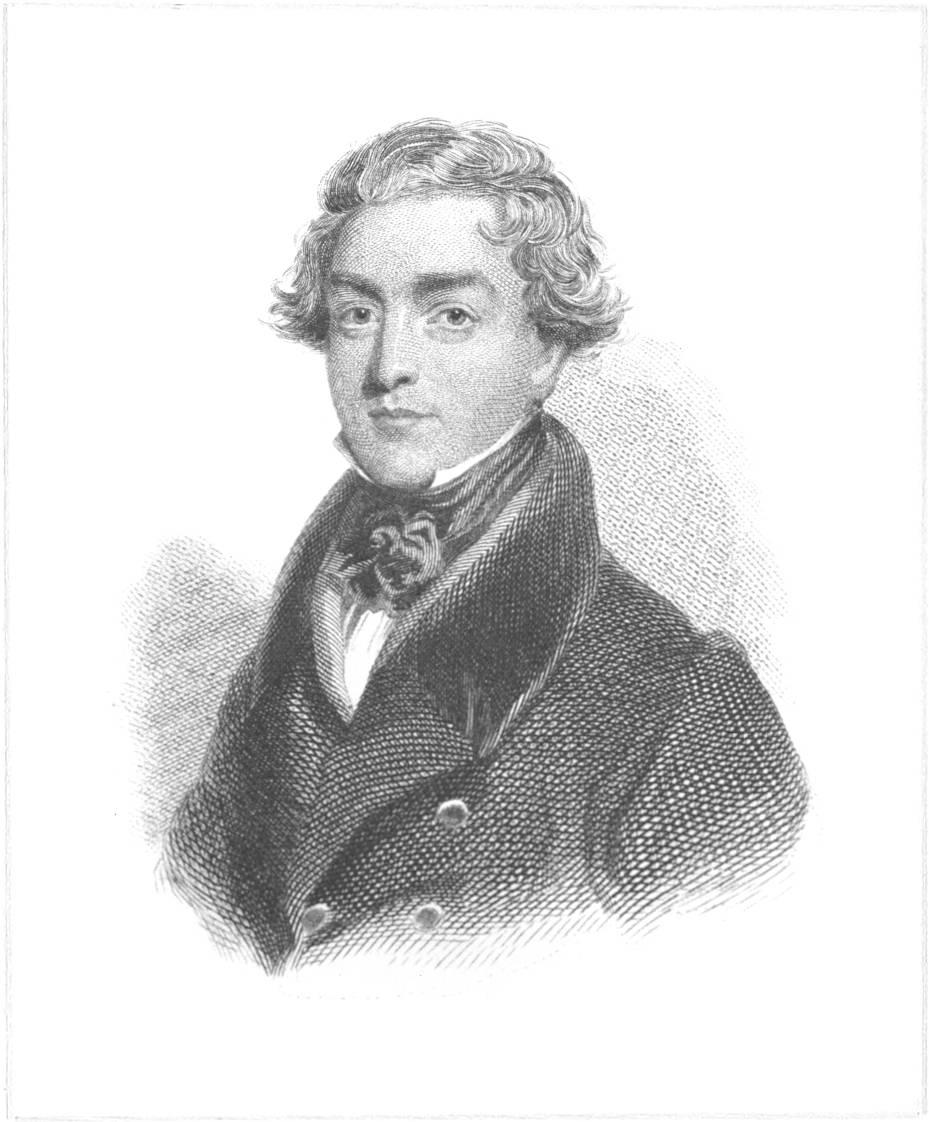
RICHARD LANDER
London. Published by John Murray, Albemarle Street, 1832.
JOURNAL
OF
AN EXPEDITION TO EXPLORE THE
COURSE
AND TERMINATION
OF
THE NIGER;
WITH A
NARRATIVE OF A VOYAGE DOWN THAT
RIVER
TO ITS TERMINATION.
BY
RICHARD AND JOHN LANDER.
IN THREE VOLUMES.
ILLUSTRATED WITH ENGRAVINGS AND MAPS.
VOL. I.
LONDON:
JOHN MURRAY, ALBEMARLE-STREET.
MDCCCXXXII.
LONDON:
PRINTED BY WILLIAM CLOWES,
Stamford Street.
TO
THE RIGHT HONORABLE
VISCOUNT GODERICH,
HIS MAJESTY’S PRINCIPAL SECRETARY
OF
STATE FOR THE COLONIES,
&c. &c. &c.,
IN REMEMBRANCE OF THE PATRIOTIC
INTEREST WHICH HIS
LORDSHIP HAS TAKEN IN THE
DISCOVERIES THEY RECORD;
AND
IN TOKEN OF
GRATITUDE FOR THE PATRONAGE WHICH HIS
BENEVOLENCE HAS CONFERRED ON THE AUTHORS,
THESE
VOLUMES
ARE, WITH HIS LORDSHIP’S
PERMISSION,
HUMBLY INSCRIBED,
BY
HIS MOST OBEDIENT AND FAITHFUL SERVANTS,
RICHARD AND JOHN LANDER.
[vii]ADDRESS TO THE PUBLIC.
It is with considerable diffidence we presume to lay our imperfect labours before the world. We are conscious that many defects will be found in our Narrative, both as regards its style and arrangement; but we are equally sensible that a British Public are to be our judges, and on their candour and generosity we confidently rely. Surely when our countrymen reflect, even for a moment, on the disadvantages against which we had to struggle, and the difficulties under which we laboured, they will not exercise too much severity of criticism.
An old poet imputes the faults of some of his poetry to his misfortunes, and says that good verses never flow but from a serene and composed spirit. Perhaps the same apology may with propriety be offered for our unpretending labours. Though we have adverted to the fact but seldom, nevertheless throughout nearly the whole of our painful journey,[viii] we were both indisposed in a greater or less degree. In short, a very few days only had elapsed after our landing at Badágry, when we began to feel the debilitating effects of the African climate, and to experience a degree of languor which not even the warmest enthusiasm could wholly overcome. It is almost unnecessary to add, that our spirits often sank under the depressing influence of this powerful adversary, whose inroads on our constitutions we had no means of resisting.
We therefore humbly submit the following narrative to the public, without further apology for any deficiency of style or expression which may be discovered in it. It has at least the merit of a faithful account, for our journals were invariably written on the spot at the close of each day, and in all our observations, to the best of our belief, we adhered religiously to the truth.
We have only to add, that since returning to our native country, we have made no alterations, nor introduced a single sentence in the original manuscript of our travels; simply because it was intimated to us, that the Public would prefer it in that state, however faulty in style, rather than a more elaborate narrative, which might gain less in[ix] elegance than it would lose in accuracy and vividness of description.
We think it necessary, however, to say, that the task of blending our journals into one, as well as constructing the map of our route through the country, has been performed by Lieutenant Becher, of the Royal Navy, to whom we offer our sincere thanks, not only for the performance of these laborious services, but also for his friendly aid and valuable suggestions in many other points connected with the production of these volumes.
Richard and John Lander.
London, Feb. 1832.
[xi]CONTENTS
OF
THE FIRST
VOLUME.
| Page | |
| Introduction | xv |
| CHAPTER I. | |
| Departure from England — Arrival at Cape Coast — Anamabóo — Accra — Badágry. | 1 |
| CHAPTER II. | |
| Departure from Badágry — Pass through Wow — Sagbú — Básha — Soató — Bídjie — Lāatoo — Lárro to Jenna. | 55 |
| CHAPTER III. | |
| Tornado — Departure from Jenna — The Journey into the interior continued through various Towns and Villages — Illness of the Travellers — Bohoo, the former Capital of Yarriba — Arrival at Katunga. | 99 |
| CHAPTER IV. | |
| Katunga — Mansolah, King of Katunga — Precautions to avoid detention by the King — Apathy of the natives — Markets of Katunga — Delayed by neighbouring war — Custom relating to presents — Reserve of the people concerning their country — Their general character — Progress of the Falàtahs — Preparations for departure by a new route — Farewell visit to the King. | 171 |
| [xii]CHAPTER V. | |
| Departure from Katunga — Difficulties with the Carriers — Musicians of Atoopa — Town of Keeshee — Curiosity of the Natives — Falàtah town of Acba — Character of its Inhabitants — The Governor of Keeshee and his wife — Their Superstition — Leave Keeshee — Robbers — Cross the Moussa — Change in the country — Escort from the King of Kiáma — Arrival in that City. | 198 |
| CHAPTER VI. | |
| Kiáma — Visit to the King — Wooden Figures — Yarro’s Hut — His objection to the former route to Wowow being adopted by the Travellers — Instance of Native Friendship — Mohamedan Priests — their Character — Tradition of the Falàtahs — Ceremonies of the Bebun Sálah — Celebration of the Festival — Native Horse-Racing — The King’s Sons — Poisonous Lizard — Superstition of the Natives — Comparison between the natives of Borgoo and Yarriba — Traits of Character — Falàtahs — Law relating to them. | 225 |
| CHAPTER VII. | |
| Departure from Kiáma — Native Gratitude — Village of Kakafungi — Native Dance — John Lander taken ill — Deserted Route — Cross the River Oly — Story of the Falàtahs — Encampment — Tornado — Illness of John Lander — Messengers from Coobly with assistance — Arrival in that Town — Reception — Presents from Boossa — Mount Cornwall — Recovery of John Lander — Leave Coobly — Ruins — Town of Zalee — Arrival at Boossa — Reception. | 253 |
[xiii]DIRECTIONS FOR PLACING THE PLATES.
| Vol. I. | |
| to face Page | |
| Portrait of Richard Lander | the Title |
| The small Map of the Quorra, &c. (Introduction) | li |
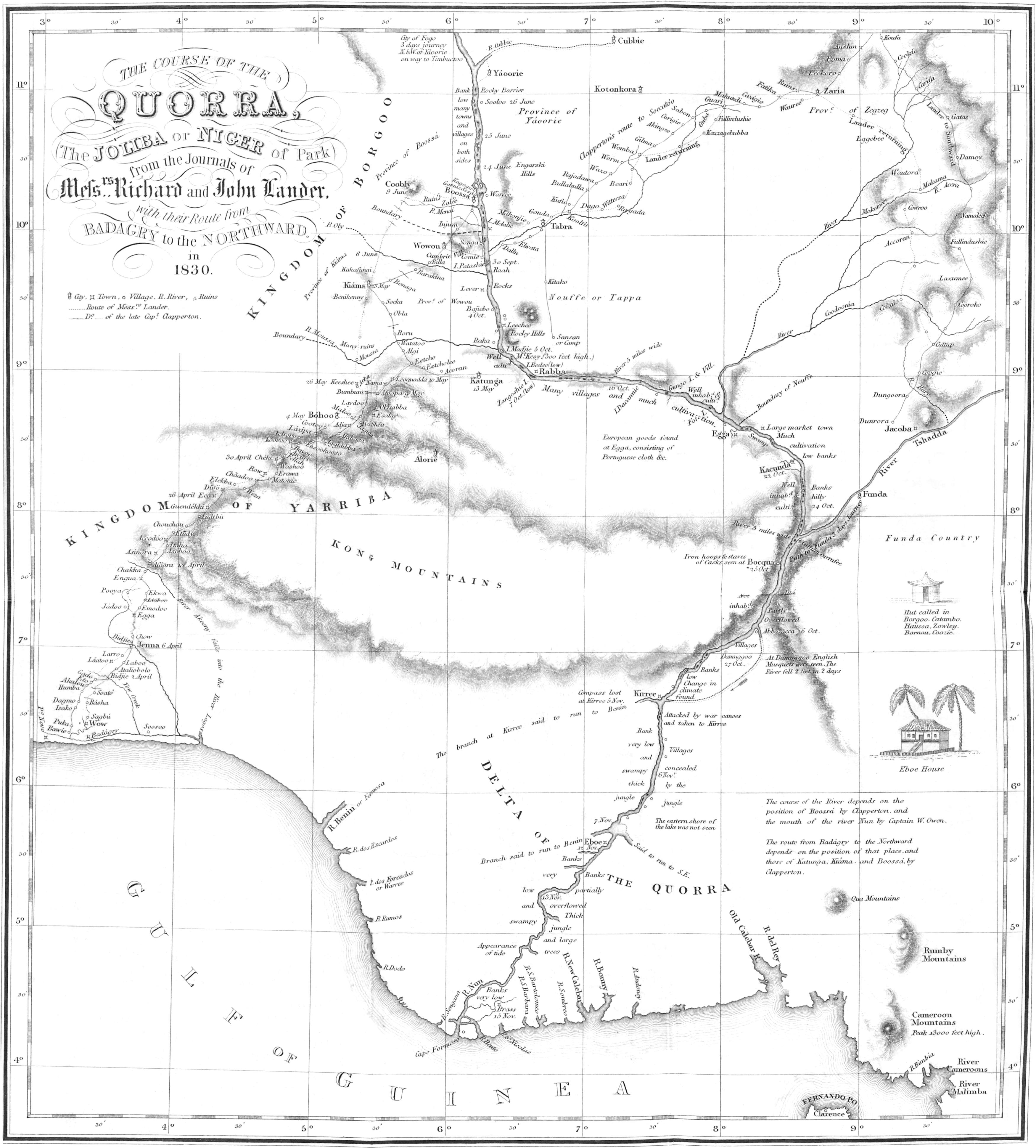
| Large Map of the Course of the Quorra, the Joliba, &c. (Narrative) | 1 |
| Vol. II. | |
| Portrait of John Lander | the Title |
| The Fetísh at Patashie | 239 |
| The Nouffie Canoe | 261 |
| Mount Kesa | 270 |
| Vol. III. | |
| The Eboe Canoe | the Title |
| Banks of the Quorra | 69 |
| WOODCUTS | |
| Page | |
| Vol. I. | |
| [Wooden figures at Kiáma] | 227, 228, 229 |
| Vol. II. | |
| [Rope with calabashes] | 87 |
| [Sleeping hut of the Cumbrie] | 91 |
| [Heavy spear] | 92 |
| Vol. III. | |
| [Wooden shoes] | 3 |
| Leaving Zagozhi. | 4 |
| Fetish Deity of Damuggoo. | 106 |
[xv]INTRODUCTION.
Of the numerous acquisitions that geography has made since the revival of letters and the extension of commerce, there are but few which have resulted from design, however well conceived, or from the direct attempts of travellers, however perseveringly pursued. The discovery of America was indeed a splendid example of both enlightened conception and heroic effort, crowned with success; and the unabated ardour with which this country has persisted in seeking for the river Niger, and in tracing its course, may well be adduced as another illustrious instance.
Among the difficulties inseparable from the lot of travellers, those arising from climate may be considered as the most formidable. The immediate presence of some imminent danger of a transient nature, cannot be compared with the secret and incessant operations[xvi] of an unhealthy climate, and no climate more than that of Africa is noted for its fatal effects on Europeans. The slow progress of discovery in Africa has hitherto arisen, principally, from this cause. While other countries, further removed from civilized Europe, have welcomed the researches of the scientific traveller, and amply rewarded him with their riches, Africa has spurned him from her soil by the destructive tendency of her climate, or the treachery of her people.
As long as any fact is excluded from the knowledge of man, he who is in search of it will supply the deficiency by his own conclusions, which will be more or less distant from it, according to his favourite opinions. There can be no better illustration of this, than in the instance afforded by the Joliba, Quorra, or Niger. The termination of this river was entirely unknown until the completion of the recent expedition; and certainly no geographical problem, excepting perhaps that of the celebrated North-West Passage, had given rise to so many opposite theories, or had employed the conjectures[xvii] of so many learned men. ‘Since Park’s first discovery of the Joliba, every point of the compass has been assumed for the ulterior course and termination of that river,’ says an able writer in the Quarterly Review, justly considered as the enlightened advocate and sincere friend of geographical discovery. And however wrong, as the same writer agrees, subsequent discovery has proved this ‘speculative geography’ to have been, it is not to be regarded as useless. Theories may be far short of the truth; but while they display the ingenuity and reasoning powers of their authors, they tend to keep alive that spirit of inquiry and thirst for knowledge, which terminates in discovery; probably but for this cause, the present might yet have been delayed many years.
Much difference of opinion prevails among well informed and experienced geographers, as to the early notices in history of this questionable river. Herodotus, emphatically styled the ‘Father of Historians,’ states in his ‘Geography of Africa,’ that some young Nasamonians,[xviii] a people who dwelt in the north of Africa, on the borders of the Mediterranean, travelled in a westerly direction from a part of Egypt, until they came to a large river full of crocodiles, and flowing towards the rising sun, and that they were conducted by the natives to a considerable city, situated on its banks. The difficulty has been to identify the track of these travellers, and their account of what they saw, with what is now known of the river lately discovered, and the part of Africa in which it is situated. It is contended by the writer before alluded to, whose opinion is entitled to much deference, from his especial acquaintance with African geography, that these young men, by travelling due west from Bilma, the part of Egypt from whence they are supposed to have set out, could never have reached the Quorra, which they are supposed by some to have done, and to have called the Niger. The difficulty of even determining one point to be due west of another, at that early period, affords grounds for doubting that such a course in its literal[xix] sense could have been meant, and it would have been next to impossible for them to have avoided going either to the north or south of that direction. The subject has been ably treated by Lieutenant-Colonel Leake, in a voluminous paper read to the Geographical Society at the first meeting of the present season. Colonel Leake states, that by travelling in a direction not further to the south than west-south-west, or half way between west and south-west from Bilma, the travellers might have arrived at the river; and he considers the city to which they were conducted, to have been no other than Timbuctoo.
At this early period, which was nearly five hundred years before the Christian era, when the Nile, from its vast magnitude, chiefly occupied the attention of ancient writers, it was natural for them to conclude, as the river discovered by these travellers was stated to flow from the west, that its waters reached the higher branches of this river. The fact of the Nile, in an early part of its course,[xx] flowing also from the west, favoured the conclusion; and hence the first error concerning it was promulgated by Herodotus, in having considered it to be a distant source of the Nile. Discovery has proved that Herodotus, allowing for the period in which he wrote, possessed considerable knowledge of the geography of Africa, however he might have fallen into error here, and this circumstance gave additional weight to his opinions.
Little notice is taken of the Niger by Strabo, but Pliny treats largely upon this river. After conducting it in an easterly direction from its source in lower Mauritania, through sandy deserts, sometimes flowing over them, and at others disappearing beneath them, he brings it to the Nile of Egypt, and coincides in the original opinion of Herodotus, that the Niger and the Nile are one and the same river. But the most reasonable geographer of his time is Mela, who, while he nearly coincided in the general opinion as to the source of the Niger, after making it flow from west to east, acknowledges[xxi] with becoming candour, that when it reaches the centre of the continent, no one knew what became of it. He justly deprecates as fabulous the idea of its flowing beneath sands, and attributes such an opinion to the want of knowledge, respecting it in different parts of its course.
Ptolemy, who was the first to break through the imaginary bond which united the Niger and the Nile, unhappily had no other support to his pretensions of any knowledge respecting the former. His account of the Niger is so vague, as to make it difficult even to determine the course which he supposed it to take. He adhered to the former opinion respecting its general direction, and considered as one river the streams of several.
Such were the confused accounts of the earlier writers on geography respecting this mysterious river, when the dissolution of the Roman empire produced a total change in the opinions concerning it, and made them still more incomprehensible. The Arabians had now spread themselves over northern Africa, and by their[xxii] wandering habits were calculated to acquire more information concerning it than their predecessors. They have accordingly given fuller accounts of the geography of the country; but in those of the Niger are not more fortunate than their predecessors. The opinions of Abulfeda and Edrisi, their most celebrated geographers, were totally different from those of the former writers. Instead of allowing the Niger an easterly course, they considered its source as identical with that of the Nile, and bestowed on each the same name. The Nile of Egypt they supposed to run northerly into the Mediterranean, while for the Niger they assumed a westerly course across the whole continent, until it reached the Atlantic ocean, or ‘Sea of Darkness;’ and, to distinguish it from the former, they named it the ‘Nile of the Negroes.’ It is difficult to imagine how such an hypothesis as this could have been received. The idea of the river flowing to the east might be easily admitted, in comparison with it, as a considerable part of its course is actually in that direction, and as much of it as was likely to be[xxiii] known to the ancient geographers. As no part of it, except that near the Delta, flows to the westward, some other river than the Niger must have been meant.
The state of Europe at this period was ill calculated to throw any light on this interesting question, and, therefore, it lay neglected and concealed in obscurity. Maritime discovery at length promised to achieve what was not to be expected by other means; and the Portuguese, in pursuit of commerce, under the favourable auspices of their enlightened sovereigns of the fifteenth century, enlarged the knowledge of African geography. Intent on carrying on their conquests in India, the Portuguese were compelled to pass the coasts of this continent, and in their progress they founded many settlements, from which discovery was extended into the interior.
Leo Africanus, a native of Granada, in Spain, was well acquainted with Arabian literature, and assigned a westerly course to the Niger. He differs from the Arabians only in its source, which he places to the west of that of the Nile.[xxiv] He considered the Niger to take its rise in a lake situated to the south of Bornou, from whence he believed that it flowed to the westward, until it reached the Atlantic ocean. The Portuguese, in their discoveries on the western coast of Africa, found successively the mouths of the Senegal, the Gambia, and the Rio Grande. The situation of these rivers favoured the supposition of the westerly course of the Niger, and they were accordingly considered as the channels by which it entered the Atlantic ocean.
The intercourse of the Portuguese with the natives of the Senegal and Gambia, as well as their communications with Timbuctoo, did not suffice to point out to them this error, and it has been perpetuated in all their maps. A remarkable circumstance, however, may here be observed concerning the position of Timbuctoo. This city is placed so near the sea, as to excite suspicion of its being the same as that on the Niger, and another place named Tamboucanee, on the Senegal, is mentioned as answering their Timbuctoo. On the whole, therefore, although[xxv] it cannot be doubted that the Portuguese obtained a considerable store of information respecting the Niger, they appear to have turned it to little account.
Of all those who have devoted their attention to Africa, the French geographers, De Lisle and D’Anville, have evinced more care and thought than any other. De Lisle adopts the course assigned to the Niger by the Arabians in his map of the world in the year 1700, and in his map of Soudan, or Nigritia, published in 1745, preserves the same; while, in another map of the world, published in 1714, he gives the sources both of the Niger and Senegal. The latter he makes to run westward, and the former eastward; and it is rather extraordinary that, so late as 1745, he should have persevered in the old error. Whether the second separation of the Niger in the west from the Senegal, as the first had been in the east from the Nile, is due to De Lisle or not, D’Anville, in 1749, follows it up in his map of Africa, published at that time. In this map, D’Anville places the source of the Senegal in the[xxvi] same position as De Lisle, and the source of the Niger he places a little to the eastward of it. They each assume their proper course,—the former to the west, and the latter to the east, as far as Wangara, where it is met by another stream, coming in the opposite direction. The Niger, or Nile of the Negroes, is stated in the same map, according to Edrisi, as taking its rise close to the source of the Nile, and running in a north-west direction, till it terminates in the Lake of Bornou. D’Anville, in the mean time, entered deeply into the question of the rivers in the interior of Africa, and, in 1755, communicated the result of his labours to the French Academy.
Thus the source of the Niger, as well as its course, remained in obscurity until English geographers and travellers took the field. An entirely new era in the progress of African geography now commenced; and, to the honour of Great Britain, a number of wealthy and philanthropic individuals formed themselves, in the year 1788, into a society, for the express purpose of promoting discovery[xxvii] in that country. The necessary funds for the assistance of travellers were provided by this body, and intelligent individuals were only required to carry their designs into execution. The first and principal object which occupied their attention, was the solution of the grand problem respecting the course and termination of the Niger, and a reward was promised to the person who should succeed in determining them.
The first person who was dispatched on this mission, under the auspices of the African Association, was Mr. John Ledyard, an American by birth, and one who was gifted with an extraordinary desire for travelling. He had already been round the world with Captain Cook, and had undergone hardships and privations in a journey that he performed in Russia, which, as the exploits of a single traveller, stand unrivalled. Ledyard met the proposals of the association with promptness and decision, and departed for Africa in June 1788. Some idea may be formed of this extraordinary man, from his communication to a friend on the morning of his departure—‘I am accustomed,’[xxviii] said he, ‘to hardships; I have known both hunger and nakedness to the utmost extremity of human suffering. I have known what it is to have food given me as charity to a madman; and I have at times been obliged to shelter myself under the miseries of that character, to avoid a greater calamity.’ Such were the words of Ledyard, and his performances had been no less remarkable. His instructions were to penetrate into Africa by the way of Egypt, and to traverse the continent in the latitude of the Niger. In pursuit of this, Ledyard reached Cairo in the month of August following,—where, becoming impatient and vexed by the delay of the caravan with which he was to have travelled, his anxious mind sunk under disappointment, and an illness quickly terminated his career. Ledyard possessed, in an eminent degree, the daring spirit so requisite for such an undertaking; but was deficient in patience, a virtue which is peculiarly required in an African traveller.
The next person who went to Africa, to[xxix] explore the Niger, was Mr. Lucas. The journey of this traveller, which took place in the following year, is remarkable for the additions which he contributed to African geography, according to information which he obtained from the Arabs, although he did not penetrate farther to the south than Mesurata, a place five days’ journey from Tripoli. In his account of the Fezzan merchants, who crossed the Niger at a ferry two miles south of Cassena, by allowing for the geographical inaccuracies of the time, may probably be discerned the ferry of Comie, below Boossa, or that of Rabba, mentioned in the following journal. The account, however, which Mr. Lucas gave of the course of the Niger, is not confirmed by discovery; but that the merchants after crossing it, pursued their journey to Ashantee, and met with the goora-nuts, renders it extremely probable, that these two ferries, which form the highway across this river, were alluded to by his informers.
The western coast now became the quarter to which the attention of the African Association[xxx] was directed as likely to afford greater advantages for penetrating to the Niger, than from Tripoli. In 1791, Major Houghton, who had become acquainted with the character of the Arabs while British Consul at Marocco, undertook to explore the Niger. He ascended the Gambia, and having reached the upper part of this river, took a northerly direction into Ludama, on the borders of the great desert. Having agreed with some Moorish merchants to convey him to Tisheet, he set out with them from Jarra, and at the expiration of two days, he determined on not accompanying them farther, from a suspicion of their intentions. The consequence was, that he was plundered and deserted by the Moors, and died at Jarra, after travelling alone several days.
The course of the Niger still lay concealed in vague and unsatisfactory statements, no modern traveller having yet succeeded in reaching its banks. The honour of first accomplishing this hazardous enterprize was reserved for one no less unfortunate than his predecessors. In 1795, the celebrated Mr. Mungo Park, a native[xxxi] of Scotland, offered his services to the African Association. A knowledge of medicine, besides other useful attainments, added to a natural taste for geographical discovery, peculiarly qualified him for such a purpose; and his offer being accepted, he set out for the Niger. Adopting the route of Major Houghton, he penetrated up the Gambia, and quickly reached Medina. Leaving the Gambia at this place, he kept a more northerly direction, and crossed the Falemé, a tributary to the Senegal, near Fatteconda. Having crossed the Senegal, and passed Kemmoo, he arrived at Jarra, where he found the remains of Major Houghton. On leaving Jarra, he adopted a course to the southward of east, and after having experienced great difficulties and privations in consequence of wars, he at length arrived at the long-sought Niger, and beheld it flowing from west to east. From Sego, he continued his journey along the bank of the Niger to Silla; where, finding himself exhausted by weakness, and destitute of the means of proceeding further, he determined on[xxxii] returning to England. He reached the Gambia by a more direct route than that by which he had travelled to the Niger, and arrived in England in December 1797. At Silla, which he stated as being two hundred miles from Timbuctoo, he collected much information; and thus was the commencement of the Niger first traced on the map from the actual observation of a modern traveller. In this journey, Park explored the Niger between Bammakoo and Silla, the former being, according to his account, about ten days’ journey distant from its source.
During the absence of Mr. Park in Western Africa, under the direction of the Association, Mr. W. G. Browne, at his own expense, passed through Egypt, and travelled to the west into Darfur, where he was detained three years. His information chiefly concerns Egypt, and nothing was gained from him respecting the Niger.
A new theory respecting the course and termination of this river now started into notice. After his return, Mr. Park happening[xxxiii] to meet with a Mr. Maxwell, who was as much interested about the river Congo, as Mr. Park was with the Niger, these two travellers communicated their sentiments to each other respecting them, and came to the conclusion that they were one and the same river. There was much to favour this decision. The Niger had been found by Park flowing from west to east, and from the accounts of the ancients, it was supposed to flow still farther in that direction, perhaps as far as a thousand miles from Silla, the extent of his discovery. Beyond this, all was conjecture respecting it, and there was nothing unreasonable in the supposition that it might take a south-east direction from Wangara, and become the Congo, the course of which river was then unequally known. Such was Park’s opinion, and upon which he soon after acted.
The course of the river, after the return of Park, was investigated minutely by Major Rennell, whose name will ever be revered by geographers. Besides laying it down from Park’s discoveries, he entered fully into[xxxiv] the various statements concerning it by the ancient writers; and, after considerable pains, he arrived at the conclusion that the river, having passed Timbuctoo, flowed a thousand miles in an easterly direction, and terminated in a lake or swamp, called Wangara, into which also another river fell from the eastward. This opinion, pronounced by such a man as Major Rennell, was received with confidence, and prevailed generally among geographers. Still it was unsatisfactory. Doubts were justly entertained on the possibility of its disappearing in such a manner, but the accounts of the ancients afforded no other means of disposing of it.
M. Reichard, a German, entertained a different opinion from that of Major Rennell, although he agreed with him in believing that it flowed to Wangara. From this place, M. Reichard supposed that it assumed a south-west course, and terminated in the Gulf of Guinea. It was observed at the time that there was neither evidence on which such an opinion could be supported, nor any by which[xxxv] it could be refuted. As far as Wangara, it was acknowledged on the authority of the ancients, but beyond this no one knew anything of it, and M. Reichard’s theory stood alone. Discovery has proved him to be right in respect of its ultimate disposal, but at the same time he participated in the general error regarding its course to Wangara.
The next traveller sent out by the African Association was a German, named Hornemann. At Fezzan, the farthest extent of his travels, he collected much information respecting the geography of Africa; but concerning the course of the Niger he contributed little or nothing. In April, 1800, he wrote to England, saying that he was on the point of starting for Bornou, since which time no account of him has been received.
Another German, named Roentgen, was the next traveller sent out by the African Association. His instructions were to penetrate to Timbuctoo, from Mogadore. It was his intention to have accompanied the caravan to that place from Marocco, but he is supposed to[xxxvi] have been murdered by his servant, a person bearing a suspicious character, whom he had taken into his service against the advice of all to whom he was known.
The travels of Buckhardt, also sent out by the Association, threw no additional light on the course of the Niger.
Another era in the history of African geography may now be observed—one which, although marked by misfortune in its very commencement, and followed up by the loss of many very valuable lives, has ultimately produced the long sought for and desired result. The formation of the African Association had already been followed by an important discovery, and the persons composing it had secured to themselves the honour of having given to the world the first authentic account of the Niger from personal observation. By their aid Park had successfully explored three hundred miles of this river, when the attention of the British government, among other pursuits of a similar nature, was turned towards it. The voyages of Cook had already enlarged the[xxxvii] bounds of geographical knowledge in nearly every part of the world by sea, and an expedition for the discovery of the course and termination of the Niger was now ordered.
This intelligence was communicated to Park, who, in his usual sanguine manner, eagerly set to work in preparing for the journey. He had drawn up a plan of proceeding, for the accomplishment of which he required the assistance of thirty-six Europeans; six of whom were to be seamen, and the rest soldiers. His plan was adopted, and a sum of five thousand pounds was placed at his disposal by government, for equipping the expedition. The intention of Park was to follow his former track to the Niger, and having reached its banks, there to build two vessels for his party, and to follow with them the course of the river. If it should fall into the Congo, after passing Wangara, he entertained no doubt of reaching the sea; but if it should terminate in this lake or morass, as was supposed, he then expected that he should have to encounter much difficulty. Hitherto the discovery of the Niger[xxxviii] had been attempted by single travellers, who had endeavoured to reach their destination by accompanying the caravans, but this second journey of Park assumed an entirely new character, and sanguine hopes were justly entertained of his success.
The second journey of Park terminated fatally, and the great question of the course of the Niger, which had seemed to be on the dawn of discovery, was again obscured. Much information had been collected concerning the fate of Park and his party, previous to the expedition of the present travellers, by whom it has been confirmed. After experiencing difficulties and dangers, of nearly every description, with only seven men remaining of his whole party, and these in such a state, from the effects of the climate, as to be scarcely able to proceed, he at length reached a mountain ridge near Bammagoo, from whence he once more beheld the Niger. Here he considered that all his difficulties were at an end, and proceeded on to Sansanding, on the bank of the river, a few miles below Sego, where he[xxxix] accomplished the building of his vessel. By the time that he was ready to depart, which was on the 17th of November, 1805, when he despatched one of his men, named Isaaco, to England with his journals and letters, five of his party only were left. Among those whom he had lost a few days before was Mr. Anderson, his brother-in-law, to whom allusion is made in the following journal.
The strong determination of Park to persevere in his design of tracing the course of the river to its termination, is thus expressed in one of his letters from this place. ‘Though all the Europeans who are with me should die, and though I were myself half dead, I would still persevere, and if I could not succeed in the object of my journey, I would at least die in the Niger.’ How truly were his words verified! and yet not by the effect of the climate, which he had wonderfully escaped, but by mere accident, produced by unfortunate circumstances. How often is the cup of hope dashed from our lips, when we consider ourselves most certain of its contents! Intelligence was[xl] afterwards obtained that Park had reached Boossà, where, being attacked by the natives, as he previously had been in many places after leaving Sansanding, he was supposed to have been driven from his vessel, and to have perished in the river, which intelligence is confirmed by the present account. Richard Lander was informed at Boossà, that his party, consisting of many black people who had been hired by him, were mistaken by the natives of this place for Falàtahs, with whom they were then at war; and that the nature of the river there is such, that there was but one part through which his vessel could pass, and where he could not avoid the attacks of the natives. This statement, as well as that obtained by Richard Lander at Yàoori, so amply confirm the account contained in an Arab document, the translation of which appears in Denham’s Work, that it deserves being inserted here.
“Hence be it known, that some Christians came to the town of Youri, in the kingdom of Yaoor, and landed and purchased provisions, as onions and other things; and they sent a[xli] present to the King of Yaoor. The said king desired them to wait until he should send them a messenger; but they were frightened, and went away by the sea (river). They arrived at the town called Bossa, or Boossa, and their ship then rubbed (struck) upon a rock, and all of them perished in the river.”
“This fact is within our knowledge, and peace be the end.”
(‘Note by the Translator.—In addition to the above, there is a kind of postscript appended to the document by a different hand, which being both ungrammatical and scarcely legible, I had some difficulty in translating and giving it a proper meaning. The words, however, are I think as follows, though most of them have been made out by conjecture.)
“And they agreed or arranged among themselves, and swam in the sea (river), while the men who were with (pursuing) them appeared on the coast of the sea (bank of the river), and fell upon them till they went down (sunk) in it.”
By the following extract from a document in the late Captain Clapperton’s Journal in[xlii] Africa, p. 334, it appears that Park and his party visited Timbuctoo. After briefly noticing the progress of the forty Christians as far as Sansanding, from which place they set out with only five men, it states that they arrived at Masena, and that “They sojourned there with the prince, who was one of the sons of the Sultan of Timbuctoo, and whose name was Babal Kydiali. He entertained them, and gave them leave to proceed to Timbuctoo. They continued their voyage till they arrived in safety, five as they were, at the city of Timbuctoo, where they resided as long as God was pleased. Thence they went on towards the country of S’oghy, till they came to one of its towns, called Gharwal-gaoo. There the Tuaricks met and fought them severely till three were killed, and two only of them escaped with the vessel.”
“They proceeded towards the east till they arrived at Boossà; but the inhabitants fought and killed them, and their ship is to this moment there. This is the substance and truth of the case.” Thus terminated the first[xliii] attempt made by the British government to discover the course of the Niger.
The next person who is supposed to have visited Timbuctoo, was an American seaman, named Adams, but his narrative throws no additional light on the course of the Niger.
Amidst the extraordinary political events which agitated the whole of Europe, further attempts at discovery were suspended till the commencement of the present peace. Accordingly, in the year 1816, in conformity with the favourite hypothesis of Park, an expedition was sent to penetrate into Africa by the river Congo, with the view of arriving at the Niger, under the direction of Captain Tuckey, of the Royal Navy. The fate of this expedition was the counterpart of the preceding. Two hundred and eighty miles from the coast was the extent of its progress; and the question was as far as ever from being decided. At the same time, another party, consisting of a hundred men, were placed under the direction of Major Peddie, to reach the Niger by Park’s route from the Gambia, and sent out to meet that[xliv] under Captain Tuckey. This party ascended the river Nunez, and were equally unfortunate with that which had gone to the Congo.
The first intelligence obtained respecting the course of the Niger, since its discovery by Park, was by the late Captain Clapperton of the Navy, when he was at Sockatoo in 1824. He had reached this place from Bornou, whither he had accompanied Major Denham and Dr. Oudney from Tripoli. Here he first gained the intelligence that the river ran to the south, and that it flowed into the sea at Funda. With this information, and a vast deal more relating to other parts of Africa through which he had passed, Clapperton returned to England. His favourable reception by Bello, the Falàtah Sultan, induced the British government to send him out again, accompanied by Captain Pearce and Dr. Morrison of the Royal Navy. These officers landed at Badágry, and the only one belonging to their party, who returned safely to England, was Richard Lander, the attendant of Clapperton. Captain Pearce and Dr. Morrison died a few[xlv] days after leaving Badágry; and Clapperton, accompanied by Lander, soon after arrived at Wowow, from which place they visited Boossà, the place of Park’s death. Clapperton had imbibed a strong aversion to descending the Niger, and made no secret of it to Lander. His firm conviction was, that whoever attempted to go down this river, would fall by the attacks of the natives; and would never live to reach its termination. Clapperton crossed the river at Comie, below Boossà, and died soon after reaching Sockatoo. Lander, having performed the last duties to the remains of his friend and master, commenced his return to England with his papers. Having traversed a considerable part of the country as far as Dunrora, he would in all probability have found his way down the Niger, had he not been interrupted by the natives, and compelled to turn back. This circumstance alone obliged him to return by his former route to Badágry, at which place he narrowly escaped with his life. In this expedition, the position of Boossà, on the banks of the Niger, was obtained, and an approximate[xlvi] position of Yaoorie, besides the course of the river between these places.
During Clapperton’s absence on his second journey, Major Laing penetrated from Tripoli to Timbuctoo. He had already escaped from an attack by a band of Tuaricks, (a roving people who inhabit the desert,) and had departed from Timbuctoo on his way to Sego, when he was inhumanly murdered by a Moorish merchant, named Bambooshi, whom he had engaged as a guide. Major Laing’s papers have not reached England, but it may still be hoped that his observations at Timbuctoo will not be finally lost.
A Frenchman named Caillié has visited Timbuctoo since Major Laing, but his visit has produced no addition to our knowledge of the Niger.
The natives near Boossà seem to have but a vague notion of the course of the river below that place. At Tabra, in Nouffie, Clapperton was told that ‘the Quorra ran into the sea behind Benin, at Funda; that the Nyffe people and those of Benin were the same[xlvii] people; that Benin paid tribute to Nyffe. There is something remarkable in this; but Clapperton attributes it to the desire of the natives to impress a stranger with an exalted opinion of their country. The Sultan Bello himself believed that the river, after passing Boossà and Wowow, entered the sea at Funda. The extent of their knowledge of the river, and how little their information was calculated to assist the geographer, may be seen by the following amusing extract from the explanation to Bello’s map, given in the Appendix, p. 333, of Clapperton’s book. ‘Now the great river Cowára comes, and here is its representation. This great river is the largest in all the territories of Haussà; we know not of its source, nor of any one who has seen it. It rushes and precipitates itself through the country from left to right, and contains many islands, inhabited by fishermen, herdsmen, husbandmen, and settlers. As to the variety of its animals, birds, and fish, it is only known to the Lord Creator; it has rocks and mountains which break and shatter to pieces all[xlviii] vessels that are driven against them; and its great roaring and noise, with the agitation of its waves, astonish the hearer, and terrify the beholder; and at the same time exhibit the wonderful power of the Omnipotent Creator.’ Such was the idea of Bello’s mallam or learned priest; and again at p. 340, in ‘a traditional account of different nations of Africa,’ it is stated, that, ‘the river Kowára runs through mountains, and a great many woods and forests; and has mountains on the north and east. This great river issues from the Mountain of the Moon; and what we know of it is, that it comes from Sookan to Kiga, to Kabi, to Yaoori, to Boossà, to Wawa, and to Noofee,’—‘but in that place there is another river, which springs from Zirma to Ghoober, to Zeffra, to Korg, or Korra, and then enters Noofee; its name is Kaduna,’ or the Koodoonia, the extent to which the Niger seems to have been known by the natives, although they had heard of Funda.
Various accounts of the river had now been gradually collected from different sources,[xlix] which afforded grounds for fresh theories respecting its termination. That of Reichard was the favourite, although Wangara was dispensed with; and that the river fell into the Gulf of Guinea was pretty generally agreed. These different opinions appeared in several publications, in which, as might be expected, much error was mixed up with the general correctness. That the river flowed into the sea at Funda was the grand point obtained, and where Funda might be was of no importance. The only exception to these, was the theory of Major Denham, supported by Sultan Bello’s information, who continued its easterly course below Boossà, and ended it in Lake Tshad. This he doubtless considered the more probable, as he says that he found a river Shary running into that Lake. Major Laing ended it in the river Volta, near Accra; Clapperton brought it to the sea near the mouth of the Lagos, about half way between Badágry and the mouth of the river Benin; while Reichard concluded rightly that the river Benin was the outlet of the Niger. Others believed[l] that the mouths of the numerous rivers between the Formosa and the old Calebar were the outlets of this river; among whom were Captain W. F. W. Owen, Captain A. T. E. Vidal, and Captain B. M. Kelly, besides several other naval officers who had been stationed on the coast. The accounts of Liverpool palm-oil traders favoured the same conclusion; nevertheless, no one had yet explored the river below Boossà,—all was uncertainty, and founded only on report and supposition. A solitary attempt to reach it from the old Calebar river was made in 1805, by a Mr. Nicholls, who died shortly after leaving Duke Town; and this is remarkable from having been the only one made from that quarter.
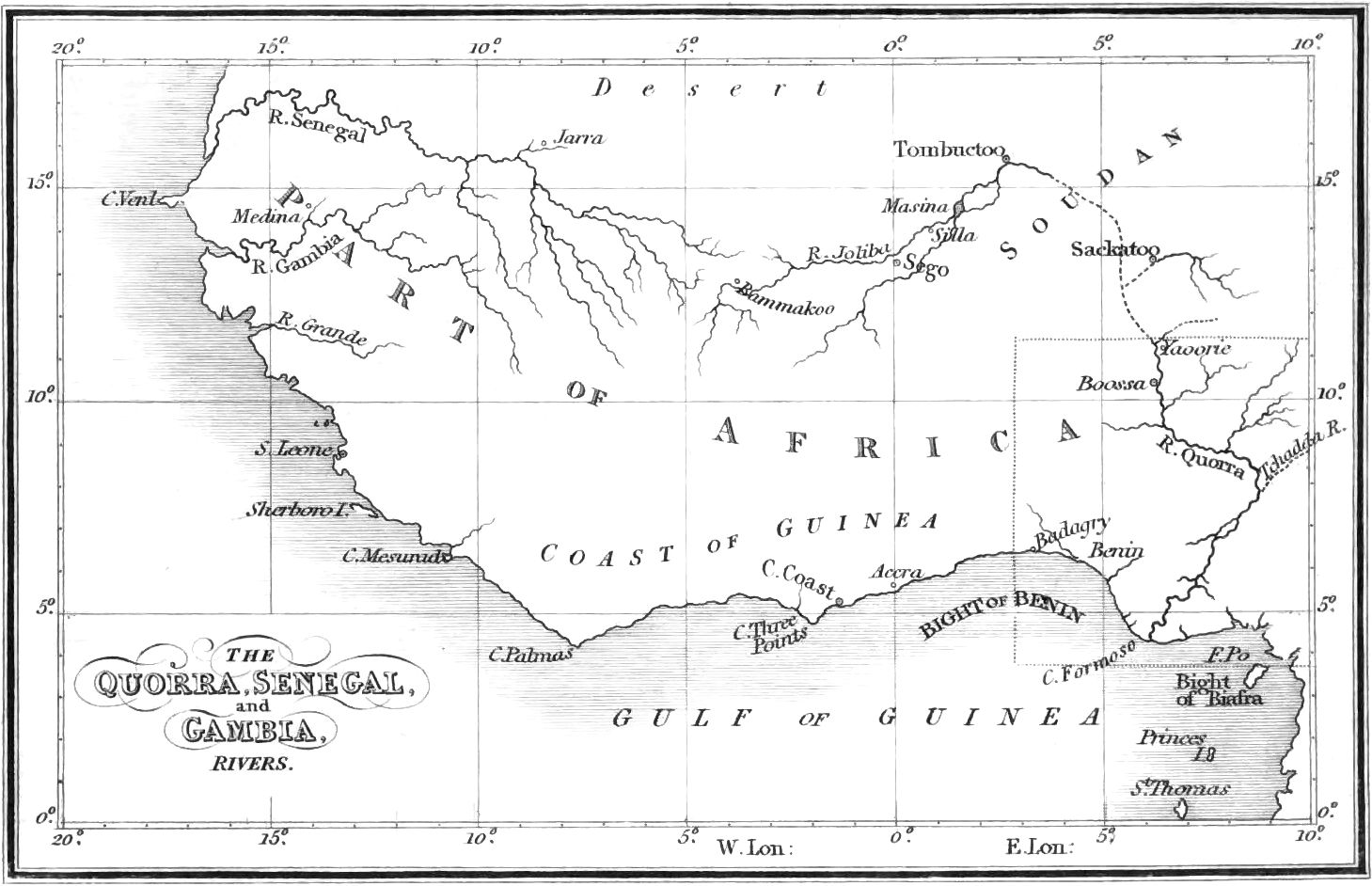
The
Quorra, Senegal,
and
Gambia,
Rivers.
J. & C. Walker, Sculpt.
Published by John Murray, Albemarle Street, London, Jany. 1832.
The annexed map serves to show the extent of our knowledge of the river at this period. Park had laid down its course between Bammakoo and Silla in his first journey, and had found that its source was in the same mountainous range that gave rise to the Senegal. The part below Silla, as far as Timbuctoo, was the result of intelligence obtained by him in his[li] second journey. Beyond Timbuctoo, the only place known to be situated on its banks, was Boossà, the position of which had been determined by Clapperton, but the actual course of the river between those places remained entirely unknown. The part included within the dotted square is the result of the Landers’ expedition; and therefore, that part between Yàoori, the extent of their journey, and Timbuctoo, is all that remains to be explored of the Niger. There is no doubt of its continuity between those places, from the reports of Park, as the vessel he built at Sansanding was lost at Boossà, and they have been connected by the broken line merely to show the probable course of the river. Considering the relative position of the Senegal and Niger, it is no matter of surprise, that they should have been confounded with each other in the early stages of history, although they run in opposite directions, for, even at the present time, the ignorance of every one who had been applied to concerning the river, was the subject of remark by the last travellers.
[lii]Such was the uncertain condition in which the course of the Niger remained, when the happy idea occurred of sending the Messrs. Lander to follow its course below Boossà. By this step, the British government completed what it had begun, and accomplished, in a few months, the work of ages. Richard Lander, well acquainted with the nature of such an undertaking, volunteered his services to perform it. His instructions, of which the following is a copy, were given to him, and having been supplied with the articles, a list of which will be found in the Appendix, accompanied by his brother John, he set out on this interesting expedition.
‘Downing Street, 31st December, 1829.
‘Sir,
‘I am directed by Secretary Sir George Murray to acquaint you, that he has deemed it expedient to accept the offer which you have made, to proceed to Africa, accompanied by your brother[1], for the purpose of[liii] ascertaining the course of the Great River which was crossed by the late Captain Clapperton, on his journey to Soccatoo; and a passage having been accordingly engaged for you and your brother on board of the Alert, merchant vessel, which is proceeding to Cape-Coast Castle, on the western coast of Africa, I am to desire that you will embark directly on board of that vessel.
‘In the event of your falling in with any of his Majesty’s ships of war on the coast of Africa, previously to your arrival at Cape-Coast Castle, you will prevail on the master to use every endeavour to speak with such ship of war, and to deliver to the officer commanding her, the letter of which you are the bearer, and which is to require him to convey yourself and your brother to Badágry, to present you to the king, and to give you such assistance as may be required to enable you to set out on your journey.
‘You should incur as little delay as possible at Badágry, in order that, by reaching the hilly country, you may be more secure[liv] from those fevers which are known to be prevalent on the low lands of the sea-coast. You are to proceed by the same road as on a previous occasion, as far as Katunga, unless you shall be able to find, on the northern side of the mountains, a road which will lead you to Funda, on the Quorra or Niger, in which case you are to proceed direct to Funda. If, however, it should be necessary to go as far as Katunga, you are to use your endeavours to prevail on the chief of that country to assist you on your way to the Quorra, and with the means of tracing down, either by land or water, the course of that river as far as Funda.
‘On your arrival at this place, you are to be very particular in your observations, so as to enable you to give a correct statement—
‘1st. Whether any, and what rivers fall into the Quorra at or near that place, or whether the whole or any part of the Quorra turns to the eastward.
‘2nd. Whether there is at Funda, or in the[lv] neighbourhood, any lake or collection of waters, or large swamp; in which case you are to go round such lake or swamp, and be very particular in examining whether any river flows into or out of it, and in what direction it takes its course.
‘3rd. If you should find that at Funda the Quorra continues to flow to the southward, you are to follow it to the sea, where, in this case, it may be presumed to empty its waters; but if it should be found to turn off to the eastward, in which case it will most probably fall into the Lake Tshad, you are to follow its course in that direction, as far as you conceive you can venture to do, with due regard to your personal safety, even to Bornou, in which case it will be for you to determine whether it may not be advisable to return home by the way of Fezzan and Tripoli: if, however, after proceeding in an easterly course for some distance, the river should be found to turn off towards the south, you are to follow it, as before, down to the sea. In short, after having once gained the banks of[lvi] the Quorra, either from Katunga, or lower down, you are to follow its course, if possible, to its termination, wherever that may be.
‘Should you be of opinion that the Sultan of Youri can safely be communicated with, you are at liberty to send your brother with a present to that chief, to ask, in the king’s name, for certain books or papers which he is supposed to have, that belonged to the late Mr. Park; but you are not necessarily yourself to wait for your brother’s return, but to proceed in the execution of the main object of your mission, to ascertain the course and termination of the Niger.
‘You are to take every opportunity of sending down by the coast a brief abstract of your proceedings and observations, furnishing the bearer with a note, setting forth the reward he is to have for his trouble, and requesting any English person, to whom it is presented, to pay that reward, on the faith that it will be repaid him by the British Government.
‘For the performance of this service, you are furnished with all the articles which you have[lvii] required for your personal convenience, during your journey, together with a sum of two hundred dollars in coin, and in case, upon your arrival at Badágry, you should find it absolutely necessary to provide yourself with a further supply of dollars, you will be at liberty to draw upon this department for any sum not exceeding three hundred dollars.
‘During the ensuing year, the sum of one hundred pounds will be paid to your wife, in quarterly payments, and upon your return a gratuity of one hundred pounds will be paid to yourself.
‘All the papers and observations which you shall bring back with you, are to be delivered by you at this office, and you will be entitled to receive any pecuniary consideration which may be obtained from the publication of the account of your journey.
‘I am, Sir, &c. &c.
‘(Signed) R. W. Hay.’
‘To Mr. Richard Lander.’
[lviii][Copy of the letter alluded to in the foregoing instructions.]
Admiralty Office, 23rd December, 1829.
‘Sir,
‘I am commanded by my Lords Commissioners of the Admiralty, to transmit to you a copy of a letter from Mr. Hay, relative to an expedition into Africa, undertaken by Mr. Richard Lander and his brother; and I am to signify their Lordships’ directions to you, to take measures for conveying Messrs. Lander from Cape-Coast Castle to Badágry, to be there presented, as desired in Mr. Hay’s letter, to the authorities of the place, as persons in whose welfare the British Government takes much interest, and also to provide these travellers with any assistance of which they may stand in need, for the prosecution of their undertaking.
‘I am, Sir, &c. &c.
‘J. Barrow.’
‘To Commodore Collier, C. B., or the Commanding Officer of any of His Majesty’s Ships which Messrs. Lander may fall in with on the Coast of Africa.’
[lix]The travellers have succeeded; their discovery is already known to the world, and the following pages contain the particulars of their journey. There are two features which distinguish this expedition from all those that have preceded it, namely, the magnitude and importance of the discovery, and the small means by which it has been accomplished. Science here was out of the question, and all depended on that homely quality of the mind, ‘determination of purpose,’ a leading feature in the character of our countrymen, without which science itself is of little avail.
The elder brother, Richard Lander, is already known to the world as the faithful attendant of the late Captain Clapperton. The manner in which he had acquitted himself of his trust, amidst the difficulties he had to contend with, after that officer’s death, bespoke him as worthy of being sent on such a mission, when scientific observations were not expected; and the result has proved the justness of the opinion that had been formed of him. Descended from Cornish parents, and gifted with[lx] no extraordinary talent, it was not his fortune to boast either the honours of high birth, or even to possess the advantages of a commonplace education. His leading quality has been a share of perseverance, rivalling that of any former traveller. This perseverance, under the protection of Divine Providence, has enabled him to surmount every difficulty, to unlock the portals of western Africa, and he has now the proud gratification of knowing, that he has well earned that reward from his King, which has placed him in honourable competency.
The younger brother, John Lander, influenced by a laudable desire of assisting his brother and of visiting Africa, accompanied him on the journey without pecuniary expectancy; and it is due to him to state, that the narrative is largely indebted to his observation. Naturally of a warm imagination, his descriptions are not without their faults; but while this is acknowledged, it must be admitted that he has enriched the Journal with much interesting and valuable information. In point of education and literary attainments, John Lander has the[lxi] advantage of his brother, and has already produced several essays, in prose and verse, besides having written the accounts of his brother’s former journey. Having shared the dangers of his last expedition, he has been promised an employment under Government, suitable to his abilities; and the friends of knowledge and science will rejoice in seeing these travellers, the only two left of those who have gone out on this dangerous mission, become objects of their country’s care.
The first annual premium of fifty guineas, which has been placed at the disposal of the President and Council of the Royal Geographical Society, by his Most Gracious Majesty, was awarded to Richard Lander, as having been charged with the expedition. On the 14th of November, it was presented to him by the President, Lord Goderich, accompanied by a few observations, most gratifying to his feelings; and it is a remarkable fact, that the incorporation of the African Association with the Geographical Society was announced by his Lordship immediately afterwards,—that[lxii] Association whose first and chief solicitude had been the grand discovery for which the reward had been just bestowed.
The unfortunate disaster that befell the travellers at Kirree nearly deprived the world of the fruits of their observations; but fortunately, although those of each in different parts of the journey were lost in the river, the thread of the narrative has been preserved entire by what remained. The first portion of the Journal is from the observations of John Lander—those of Richard, between their departure from England and Rabba, having been lost. The remainder of it, to the conclusion, is from the journal of Richard Lander, assisted by that of his brother, part of the journal of the latter, between Rabba and Kirree, being also lost. And there is little doubt, that the parts which have thus perished would have added materially to the value of the whole. In preparing the journals for publication, for the sake of clearness, as well as in pursuance of custom, Richard Lander, the elder brother,[lxiii] being charged with the expedition, has been considered as the principal, and the journal of John Lander, while they were separate from each other, is preserved in his own name. This plan having been determined on, after about half of the first volume had been printed, a few alterations became necessary, and these have been made without departing from the sense intended to be conveyed.
In conclusion, a word or two may be said respecting the map which has been constructed from the journals. The accomplished surveyor will look in vain along the list of the articles, with which the travellers were supplied, for the instruments of his calling; and the man of science, to form his opinion of it, need only be told, that a common compass was all they possessed to benefit geography, beyond the observation of their senses. Even this trifling though important assistance was lost at Kirree, below which place the sun became their only guide. Too much faith must not therefore be reposed in the various serpentine courses of the river on the map, as it is neither warranted[lxiv] by the resources, nor the ability of the travellers. The map, in its most favourable point of view, can be considered only as a sketch of the river authenticated by personal observation, which will serve to assist future travellers, from whose superior attainments something nearer approaching to geographical precision may be expected. Even under these circumstances, the present travellers will always derive ample satisfaction in reflecting that they have served as pioneers of African discovery.
A. B. B.
THE COURSE OF THE
Quorra,
(The Joliba or Niger of Park)
from the Journals of
Messrs. Richard and John Lander,
with their Route from
BADAGRY to the NORTHWARD,
in
1830.
| A. B. Becher, del. | J. & C. Walker, Sculpt. |
Published by John Murray, Albemarle Street, London, Sepr. 1831.
[1]JOURNAL.
CHAPTER I.
Departure from England — Arrival at Cape Coast — Anamabóo — Accra — Badágry.
We embarked from Portsmouth on the 9th January, 1830, in the brig Alert, Tyson master, for Cape Coast Castle, where we arrived on the 22d of the following month, having had a quick, but boisterous and unpleasant passage of forty-two days. We should be sadly wanting in gratitude and every proper feeling, if we were to omit acknowledging, in this place, the truly handsome and gentlemanly treatment we experienced from Mr. George Maclean, President of the Council at Cape Coast, who had been our fellow passenger in the Alert, as well as the merchants resident there, who welcomed us on our arrival. In fact they all vied with each other in making themselves agreeable, and in showing us the most marked attention; and they entertained us with a generous hospitality, which would have done honour to the boasted olden time. Here we were fortunate enough to engage old Pascoe and his wife, with Jowdie, who had been employed on the last[2] mission, together with Ibrahim and Mina, two Bornou men, who were well acquainted with English manners, and could converse in the Hàussa language. These individuals promised to be very useful in the expedition, more especially old Pascoe, whose merits as an interpreter are unquestionable.
After remaining at Cape Coast Castle eight days, we accompanied Mr. Maclean on a visit to Mr. Hutchinson, Commandant of Anamabóo, which is about nine miles distance from the former place. This gentleman received us in a manner that does equal honour to his heart and feelings. Would that we could repay him in any way for his generous abandonment and forgetfulness of all his private concerns solely to please and amuse his guests; would that we could command language forcible and glowing enough to express the gratitude we feel for the disinterested kindness he showed us at Anamabóo. Mr. Hutchinson lives in his castle like an English baron in the feudal times, untinctured, however, by barbarism or ignorance, for the polished refinements of life have insinuated themselves into his dwelling, though it is entirely surrounded by savages, and though the charming sound of a lady’s voice is seldom or never heard in his lonely hall. His silken banners, his turreted castle, his devoted vassals, his hospitality, and even his very[3] solitariness, all conspire to recall to the mind the manners and way of life of an old English baron in one of the most interesting periods of our history, whilst the highly chivalrous and romantic spirit of the gentleman alluded to is strictly in unison with the impression. Mr. Hutchinson has resided very many years on the coast, and is one of the few individuals that have visited the capital of Ashantee, wherein he resided eight months, and obtained a better acquaintance with the manners, customs, and pursuits of that warlike, enterprising, and original nation than any other European whatever. In the Ashantee war he took a very active part, and rendered important and valuable services to the cause he so warmly espoused.
We abode at the fort till the 4th March, when we bade adieu to our kind host, and our much-respected friend Mr. George Maclean, and embraced the opportunity of sailing in the Alert for Accra, where we expected to find a vessel to take us to Badágry, in the Bight of Benin, agreeably to our instructions.
For the last time we beg leave to express our gratitude to the worthy president and the council at Cape Coast, for their noble and feeling treatment of us, strangers, and to assure them that we shall cherish the remembrance of it as long as we live. It is conduct such as this, so flattering to[4] one’s self-love, that makes the deepest and most lasting impression on the heart, and that clings to it when the memory of other, and perhaps more important things, has long passed away.
In two days we arrived opposite the British fort at Accra, and landed on the 7th. Here we abode with Mr. Fry, the commandant, a whole week, which afforded us ample leisure to stroll about the neighbourhood, and admire the surpassing beauty of the country. Accra is, without exception, the pleasantest and most healthy British settlement on the western coast of Africa. Its trade has perhaps suffered by the late unfortunate Ashantee war, in common with Cape Coast Castle and other places, but it is beginning to revive again. His Majesty’s brig Clinker arrived the day before us, and two days after she was joined by the Medina sloop of war, and the Black Joke.
On the 15th we embarked on board the Clinker, Lieutenant Matson commander, and having sailed direct for Badágry, we dropped anchor in the roadstead in front of that town on the 19th. My brother landed and was introduced to the chief by Mr. Brown, master of the brig, on the following day, and every thing having been arranged to our satisfaction, the luggage was safely landed on the 21st.
From Lieutenant Matson, an officer to whom we are under infinite obligations for the many[5] courtesies and acts of kindness he showed us, we received a young man of colour named Antonio, son to the chief of Bonny, who eagerly embraced the opportunity of proceeding with us into the interior, being impressed with the notion that he should be enabled to reach his home and country by means of the Great River, or Niger.
March 22d.—Cheered by six hearty huzzas, good-naturedly given us by the crew of the Clinker, at the desire of her gallant commander, we sailed towards the beach in one of the brig’s boats in the earlier part of the afternoon, and having been taken into a canoe that was waiting at the edge of the breakers to receive us, we were plyed over a tremendous surf, and flung with violence on the burning sands.
Wet and uncomfortable as this accident had rendered us, we had no change of linen at hand, and we walked to a small creek about the distance of a quarter of a mile from the sea-shore, where we were taken into a native canoe, and conveyed safely through an extremely narrow channel, overhung with luxuriant vegetation, into the Badágry river, which is a branch of the Lagos. It is a beautiful body of water, resembling a lake in miniature; its surface is smooth and transparent as glass, and its picturesque banks are shaded by trees of a lively verdure. We were soon landed on the opposite side, when our road lay over a magnificent[6] plain, on which deer, antelopes, and buffaloes are often observed to feed. Numbers of men, women, and children followed us to the town of Badágry, and they made the most terrific noises at our heels, but whether these were symptoms of satisfaction or displeasure, admiration or ridicule, we could not at first understand. We were soon, however, satisfied that the latter feeling was predominant; and indeed our clothing was exceedingly grotesque, consisting of a straw hat, larger than an umbrella, a scarlet Mohammedan tobe or tunic and belt, with boots and full Turkish trowsers. So unusual a dress might well cause the people to laugh heartily; they were all evidently highly amused, but the more modest of the females, unwilling to give us any uneasiness, turned aside to conceal the titter, from which they were utterly unable to refrain.
On our way we observed various groups of people seated under the spreading branches of superb trees, vending provisions and country cloth; and on our approach many of these arose and bowed, whilst others fell on their knees before us in token of respect. We reached the dwelling which had been prepared for us about three o’clock in the afternoon, but as the day was too far advanced to visit the chief or king, we sent a messenger to inform him of our intention of paying him our respects to-morrow morning.
[7]March 23d.—At nine o’clock this morning, agreeably to yesterday’s promise, we visited the chief at his residence, which is somewhat more than half a mile from our own. On our entrance he was sitting on a couple of boxes, in a small bamboo apartment, from whose sides were suspended a great quantity of muskets and swords, with a few paltry umbrellas, and a couple of horses’ tails, which are used for the purpose of brushing away flies and other insects. King Adooley looked up in our faces without making any observation, and did not rise from his seat to congratulate us on our arrival. He appeared in deep reflection, and thoughtfully rested his elbow on an old wooden table, pillowing his head on his hand. One of the most venerable and ancient of his subjects was squatted at the feet of his master, smoking from a pipe of extraordinary length; whilst Lantern, his eldest son and heir apparent, was kneeling at his side, etiquette not allowing the youth to sit in presence of his father. Everything bore an air of gloom and sadness totally different from what we had been led to expect. We shook hands, but the pressure of the chief was so very faint that it was scarcely perceptible; yet, notwithstanding this apparent coldness, we seated ourselves, one on each side, without ceremony or embarrassment. The conversation was commenced on our part by inquiring[8] after the chief’s health, which was answered only by a languid smile, and he again relapsed into his former thoughtfulness. We then displayed to the greatest advantage the presents we had brought for him from England; they were accepted, it is true, but without the slightest demonstration of pleasure or satisfaction; they were scarcely looked at, and were carried away by his attendants with real or seeming indifference. This was very mortifying, but we said not a word, though it was the easiest thing imaginable to perceive that all was not right. A reserve, the cause whereof we could not define, and a coldness towards us for which we could in no wise account, marked the conduct of the once spirited and good-natured chief of Badágry, and prepared us to anticipate various difficulties in the prosecution of our plans, which we are persuaded will require much art and influence to surmount. Adooley left us abruptly in the midst of the conversation, and did not return for some time.
Wearied at length with his long delay, we despatched a messenger to acquaint him that we were becoming impatient, and would feel obliged by his immediate return, in order to put an end to our conference, or palàver as it is emphatically styled, as speedily as possible. On receiving this message the chief hastened back, and entered the apartment with a melancholy countenance, which[9] was partially concealed behind large volumes of smoke from a tobacco-pipe which he was using. He seated himself between us as before, and gave us to understand in a very low tone of voice, that he was but just recovering from a severe illness, and from the effects of a variety of misfortunes, which had rendered him almost broken-hearted. His generals, Bombanee and Poser (mentioned in Clapperton’s Journal), and all his most able warriors, had either been slain in battle, or fallen by other violent means. The former in particular, whose loss he more particularly lamented, had been captured by the Lagos people, who were his most inveterate enemies. When this unfortunate man was taken prisoner, his right hand was immediately nailed to his head, and the other lopped off like a twig. In this manner he was paraded through the town, and exposed to the view of the people, whose curiosity being satiated, Bombanee’s head was at length severed from his shoulders, and being dried in the sun and beat to dust, was sent in triumph to the Chief of Badágry. To add to his calamities, Adooley’s house, which contained an immense quantity of gunpowder, had been blown up by accident, and destroyed all his property, consisting of a variety of presents, most of them very valuable, that had been made him by Captain Clapperton, and by European merchants and traders in slaves. The chief and his women[10] escaped with difficulty from the conflagration; but as it was the custom to keep the muskets and other fire-arms constantly loaded, their contents were discharged into the bodies and legs of those individuals that had flocked to the spot on the first alarm. The flames spread with astonishing rapidity, notwithstanding every exertion, and ended in the destruction of a great part of the town. This accounted in some measure for the sad and grievous expression so strongly depicted on the chief’s countenance, but still another and more powerful reason had doubtless influenced him on this occasion.
On returning to our residence, a number of ‘principal men,’ as they style themselves, were introduced, to compliment us on coming to their country, although their true and only motive for visiting our quarters was the expectation of obtaining rum, which is the great object of attraction to all of them. We have been annoyed during the better part of this day by a tribe of ragged beggars, whose importunity is really disgusting; and the number of old fat-headed and pot-bellied men, and skinny, flap-eared women of the last century, has been immense. To these garrulous ladies and gentlemen have we been obliged to laugh and talk, and shake hands, and crack fingers, and bend our bodies and bow our heads, and place our hands with solemnity on our heads and breasts;[11] make presents, and cringe, fawn, and flatter up to the present moment, which is past bed-time. We have not indeed had a moment’s relaxation from this excessive fatigue; and the consideration that we have been waited on by the chief’s eldest son has been forgotten in the mortifying inconveniences to which we have been subjected.
Had Job, amongst his other trials, been exposed to the horrors of an interminable African palàver, his patience must have forsaken him. For my own part, I am of opinion that I shall never be a general favourite with this ever-grinning and loquacious people. If I laugh, and laugh I most certainly must, it is done against my inclination, and consequently with a very bad grace. For the first five years of my life, I have been told that I was never even seen to smile, and since that period, Heaven knows, my merriment has been confined to particular and extraordinary occasions only. How then is it possible that I can be grinning and playing the fool from morning to night, positively without any just incentive to do so, and sweltering at the same time under a sun that causes my body to burn with intense heat, giving it the appearance of shrivelled parchment? Fortunately, these savages, for savages they most certainly are in the fullest extent of the word, cannot distinguish[12] between real and fictitious joy; and although I was vexed at heart, and wished them all at the bottom of the Red Sea, or somewhere else, I have every reason to believe that my forced attempts to please the natives have so far been successful; and that I have obtained the reputation, which I certainly do not deserve, of being one of the pleasantest and best tempered persons in the world.
One of the Fetísh-men has just sent us a present of a duck, fully as large as an English goose; but as the fellow expects ten times its value in return, it is no proof, I think, of the benevolence of his disposition. Last night we were obliged to station armed men around our house, for the purpose of protecting our goods from the rapacity of a multitude of thieves that infest this place, and who display the greatest cunning imaginable, to ingratiate themselves into our favour. We arose unrefreshed this morning, at day-break, the noise of children crying, the firing of guns, and the discordant sound of drums and horns, preventing us from enjoying the sweetness of repose, so infinitely desirable after a long day spent in a routine of tiresome ceremony and etiquette.
March 24th.—One of the chief’s messengers, who is a Hàussa Mallam,[2] or priest, presented himself[13] at the door of our house this morning, followed by a large and handsome spotted sheep from his native country, whose neck was adorned with little bells, which made a pretty jingling noise. We were much prepossessed in this man’s favour by the calmness and serenity of his countenance, and the modesty, or rather timidity of his manners. He was dressed in the Hàussa costume, viz., cap, tobe, trousers, and sandals. He wore four large silver rings on his thumb, and his left wrist was ornamented with a solid silver bracelet. This is the only individual that has yet visited us purely with disinterested motives, as all the others make it a practice to beg whenever they favour us with their company. But the Mallam, it is to be understood, is a Mussulman, and it is the fast of the Rhamadan, so that he is forbidden by his creed either to eat or drink from the rising to the setting of the sun.
A Falatah residing in the town has agreed to supply us with cow’s milk every morning, as long as we may have occasion to remain; he is likewise a Mohammedan; and imitating the example of the Mallam, he scrupulously adheres to the rigorous precepts of his religion.
The chief’s eldest son has been with us the greatest part of to-day. The manners of this young man are reserved, but respectful; he is a great admirer of the English, and has obtained a[14] smattering of their language. Although his appearance is extremely boyish, he has already three wives, and is the father of two children. His front teeth are filed to a point after the manner of the Lagos people, but notwithstanding this disadvantage, his features bear less marks of ferocity than we have observed in the countenance of any one of his countrymen, while his general deportment is infinitely more pleasing and humble than theirs. When asked, whether if it were in his power to do so, he would injure us two, or any European that might hereafter visit Badágry, he made no reply, but silently approached our seat, and falling on his knees at our feet, he pressed me with eagerness to his soft naked bosom, and affectionately kissed my hand. I thought that language and expression would not have been half so eloquent as this.
We have heard to-day that peace has been established between Porto Novo and Badágry. The messenger that brought this agreeable news has presented Adooley with three slaves, from his master, the chief of the former state, as a token that it is to be lasting. This distracted country is ever at war with her neighbours, and consequently is always in a state of agitation and poverty. Provisions are from the same cause extremely scarce and dear.
Since our conference with the chief on Tuesday[15] we have learned with surprise and sorrow, that a party of the populace have expressed themselves decidedly hostile to our projects, and that its leaders are continually with Adooley, using all their influence, and exercising all their cunning, in order to awaken his slumbering jealousy. They endeavour to persuade him to demand, ere he grants us leave to pass through his country, a sum of money, which they are all aware it is not in our power to pay, and therefore, they imagine we shall be compelled to abandon the undertaking. The first intimation we received of the effect of these insinuations on the mind of the chief was brought us this morning by one who pronounces himself to be on ‘our side.’ This man assured us with an ominous visage, that Adooley had declared in the hearing of all the people, that the coat we had given him was intended for a boy, and not a man; it was therefore unworthy his acceptance as a king, and he considered that we meant to insult him. The coat alluded to by Adooley is indeed extremely old-fashioned, and belonged to a surgeon in the navy about twenty years ago, notwithstanding which it is now almost as good as new, and was made very showy by the addition of a pair of tarnished gold epaulets. Nor can anything be clearer than that an enemy of ours has been striving to render the chief discontented and mistrustful, since nothing was so gladly received as this very coat two days ago.[16] To counteract the efforts of the malicious, we have been unusually busy to-day in sounding the disposition of those, who, we are inclined to believe, from the fondness they evince for our rum, are favourable to our intentions and devoted to our interests.
Two mulattoes reside in the town, one of whom, by name Hooper, acts as interpreter to Adooley, and shares a good deal of his confidence. He was born at Cape Coast Castle in 1780, and was for many years a soldier in the African corps. His father was an Englishman, and he boasts of being a British subject. He is excessively vain of his origin; yet he is the most confirmed drunkard alive, always getting intoxicated before breakfast, and remaining in a soaking state all day long. This does not, however, make him regardless of his personal interests, to which, on the contrary, he is ever alive, and indeed sacrifices every other feeling. The other mulatto can read and write English tolerably well, having received his education at Sierra Leone; he is a slave to Adooley, and is almost as bad as Hooper as to drinking. These political advisers of the chief we have had little difficulty in bribing over to our interests: we have likewise been tampering with several native chiefs, apparently with equal success. Unfortunately, every one styles himself a great and powerful man, and old Hooper himself calls a host[17] of ragged scoundrels, ‘noblemen and gentlemen.’ Each of these he advises and conjures us to conciliate with presents, and especially spirituous liquors, in order to do away any evil impression they may secretly have received, and obtain their suffrages, though it should be at the expense of half the goods in our possession. There is hardly any knowing who is monarch here, or even what form of government prevails. Besides the king of kings himself, the redoubtable Adooley, four fellows assume the title of royalty; namely, the kings of Spanish Town, of Portuguese Town, of English Town, and of French Town—Badágry being divided into four districts, bearing the names of the European nations just mentioned. This evening we received an invitation from the former of these chieftains, who by all accounts was originally the sole governor of the country, until his authority was wrested from him by a more powerful hand. He now lives in retirement, and subsists by purchasing slaves and reselling them to Spanish and Portuguese traders. In him we found a meek and venerable old man, of respectable appearance. He was surrounded by a number of men and boys, his household slaves, who were all armed with pistols, daggers, muskets, cutlasses, swords, &c., the manufacture of various European countries. In the first place he assured us, that nothing could give him more[18] pleasure than to welcome us to Badágry; and he very much wondered that we had not visited him before. If we had a present to give him, he said, he would thank us, but if we had not, still he would thank us. A table was then brought out into the court before the house, whereon decanters, and glasses, with a burning liquor obtained from the Portuguese, were placed. In one corner of the yard was a little hut, not more than two feet in height, wherein had been placed a fetísh figure, to preserve the chief from any danger or mischief, which our presence might otherwise have entailed upon him. A portion of the spirit was poured into one of the glasses, and from it emptied into each of the others, and then drunk by the attendant that had fetched it from the house. This is an old custom, introduced, no doubt, to prevent masters from being poisoned by the treachery of their slaves. As soon as the decanters had been emptied of their contents, other ardent spirits were produced; but as my brother imagined that fetísh-water had been mingled with it, we simply took about a tea-spoonful into our mouths, and privately ejected it on the ground. The old chief promised to return our visit to-morrow; and lifting up his hands and eyes to Heaven, like a child in the attitude of prayer, he invoked the Almighty to preserve and bless us (for this was the interpretation of his expressions). We then saluted him in the usual[19] manner, and returned, well pleased, to our own habitation.
If one may be allowed to form an opinion of the population of Badágry, from the vast number of sellers he meets with, or rather if the number of buyers bears any proportion to them, the town must be wonderfully populous, for though the old chief’s residence is above a mile and a half from ours, people were found vending a variety of articles at every step of the way.
We are most anxious to proceed on our journey, but the chief Adooley evades our solicitations to depart under the most frivolous and absurd pretences. He asserts that his principal reason for detaining us here, against our inclination, is the apprehension he entertains for our safety, the road not being considered in a good state. Under this impression he has despatched a messenger to Jenna, to ascertain if the affairs of that country warrant his sending us thither. The old king of Jenna, who it will be recollected behaved so kindly to Captain Clapperton’s last mission, is dead; and although a successor has been appointed to fill his place, he is not yet arrived from Katunga. This being the case, no one will be at Jenna to receive us. Meantime the rainy season is fast approaching, as is sufficiently announced by repeated showers and occasional tornadoes; and what makes us still more desirous to leave this abominable place, is the fact[20] (as we have been told) that a sacrifice of no less than three hundred human beings, of both sexes and all ages, is shortly to take place. We often hear the cries of many of these poor wretches; and the heart sickens with horror at the bare contemplation of such a scene as awaits us, should we remain here much longer. We, therefore, can only wish, that if such is to be the case, we may not be compelled to witness this bloody abomination.
March 25th.—We were awoke this morning by the warbling of a variety of small birds, which, perched on the branches of the beautiful trees surrounding our house, serenade us so charmingly that we can never close our eyes after day-break; in fact, it would be a shame in us to do so whilst we can listen to melody so truly enchanting. Shortly after the sun rises our house is full of visitors; and from that time till evening we resign ourselves very complacently to a species of punishment which is, I fancy, less tolerable than purgatory. After cracking fingers a hundred times, and grinning as often, we were informed this forenoon, that the chief’s messenger had returned from Jénna; but, for some reason at present unknown to us, the man was almost immediately sent back; and we are told, that we cannot quit Badágry until he again makes his appearance. It is the custom in this place,[21] that when a man cannot pay his respects in person to another, he sends a servant with a sword or cane, in the same manner as a gentleman delivers his card in England. We have received a great number of compliments to-day in this fashion; and it is almost superfluous to say that a cane or sword is at all times a more welcome and agreeable visitor than its owner would have been.
We had not finished breakfast this morning before Hooper introduced himself for his accustomed glass of spirits, to prevent him, according to his own account, from getting sick. He took the opportunity of informing us, that it would be absolutely necessary to visit the ‘noblemen’ that had declared themselves ‘on our side.’ As we strove to court popularity and conciliate these vagabonds by every means in our power, we approved of Hooper’s counsel, and went in the first place to the house of the late General Poser, which is at present under the superintendence of his head man. Him we found squatting indolently on a mat, and several old people were holding a conversation with him. As the death of Poser is not generally known to the people, it being concealed from them for fear of exciting a commotion in the town, for he was universally loved and respected, we were not permitted even to mention his name, and the steward set us the example by prudently confining his conversation to the necessity[22] of making him a present proportionable to his expectations and the dignity of his situation. Muskets and other warlike instruments were suspended from the sides of the apartment, and its ceiling was decorated with fetíshes and Arab texts in profusion. Gin and water were produced, and partaken of with avidity by all present, more especially by the two Mulattoes that had attended us, which being done, the head-man wished the ‘Great Spirit’ to prosper us in all our undertakings, and told us not to forget his present by any means. We shortly afterwards paid our respects, and quitted the apartment with feelings of considerable satisfaction; for its confined air was so impure, that a longer stay, to say the least of it, would have been highly unpleasant. As it was, we had consumed so much time in Poser’s house, that we found it necessary to alter our intention of visiting the other chiefs; and therefore resolved to pay our respects to Adooley, whom we had not seen for two days. Accordingly we repaired immediately to his residence, and were welcomed to it with much better grace than on any previous occasion.
The chief was eating an undrest onion, and seated on an old table, dangling his legs underneath it with a vacant thoughtlessness of manner, which our abrupt intrusion somewhat dissipated. He informed us of his intention of sending us on our[23] journey on the day after to-morrow, when he expected that the people of Jenna would be in a suitable condition to receive us. He was full of good nature, and promised to make my brother a present of a horse, which he had brought with him from Soccatóo on the former expedition; he added that he would sell another to me; and that he most particularly wished to examine the goods we intended taking with us into the ‘bush,’ as the uncleared country is called, in order that he might satisfy himself we had nothing objectionable amongst them. Having expressed our thanks to Adooley for his well-timed present, and agreed to the conditions he proposed, we all partook of a little spirit and water, which soon made us the best friends in the universe. During this palàver, the chief’s sister and two of his wives were ogling at us, and giggling, until the approach of the chief of English town and the rest of our party put a sudden stop to their entertainment, on which they presently left the apartment. These men came to settle a domestic quarrel, which was soon decided by the chief, who, after receiving the usual salutation of dropping on the knees, with the face to the earth, chatted and laughed immoderately. This was considered by us as a happy omen. Very little ceremony is observed by the meanest of the people toward their sovereign. They converse with him with as little reserve as if he were no better than themselves, while[24] he pays as much attention to their complaints as to those of the principal people of the country. I should think that Adooley is not entirely destitute of the virtues of hospitality, for we observed with pleasure that the remainder of his onions were divided equally amongst the chiefs who had come to visit him, and were received by them with marks of the highest satisfaction.
This afternoon a herald proclaimed the approach to our habitation of the venerable chief of Spanish Town, with a long suite of thirsty followers. The old man’s dress was very simple, consisting only of a cap and turban, with a large piece of Manchester cotton flung over his right shoulder, and held under his left arm. This is infinitely more graceful and becoming in the natives, than the most showy European apparel, in any variety of which, indeed, they generally look highly ridiculous. After we had made him and all his attendants nearly tipsy, the old chief began to be very talkative and amusing, continuing to chat without intermission for a considerable time, not omitting to whisper occasionally to the interpreter, by no means to forget, after his departure, reminding us of the present we had promised him, for it is considered the height of rudeness to mention any thing of the kind aloud in his presence. Our rum had operated so cheerily upon his followers in the yard, that fat and lean, old[25] and young, commenced dancing, and continued performing the most laughable antics, till they were no longer able to stand. It amused us infinitely to observe these creatures, with their old solemn, placid-looking chief at their head, staggering out at the door-way; we were in truth but too happy to get rid of them at so cheap a rate. Hooper shortly afterwards came with a petition from twelve ‘gentlemen’ of English Town, for the sum of a hundred and twenty dollars, to be divided amongst them; and having no resource, we were compelled to submit to the demand of these rapacious scoundrels.
Late in the evening we received the threatened visit from Adooley, who came to examine the contents of our boxes. He was borne in a hammock by two men, and was dressed in an English linen shirt, a Spanish cloak or mantle, with a cap, turban, and sandals. His attendants were three half-dressed little boys, who, one by one, placed themselves at their master’s feet, as they are in the habit of doing. One of them carried a long sword, another a pistol, and the third a kind of knapsack, filled with tobacco. We presented the chief with brandy, equal in strength to spirits of wine; and he swallowed a large quantity of it with exquisite pleasure. The boys were permitted to drink a portion of the liquor every time that it was poured into a glass for Adooley; but[26] though it was so very strong, it produced no grimace, nor the slightest distortion of countenance in these little fellows. The fondness of the natives, or rather their passion for strong waters, is astonishing, and they are valued entirely in proportion to the intoxicating effects they occasion. Adooley smoked nearly all the while he remained in our house. As each box was opened, however, he would take the pipe slowly from his mouth, as if perfectly heedless of what was going forward; and from the couch whereon he was reclining, regard with intense curiosity each article as it was held out to his observation. Everything that in his opinion demanded a closer examination, or more properly speaking, every thing he took a fancy to, was put into his hands at his own request; but as it would be grossly impolite to return it after it had been soiled by his fingers, with the utmost nonchalance the chief delivered it over to the care of his recumbent pages, who carefully secured it between their legs. Adooley’s good taste could not of course be questioned; and it did not much surprise, though it grieved us, to observe a large portion of almost every article in the boxes speedily passing through his hands into those of his juvenile minions. Nothing seemed unworthy his acceptance, from fine scarlet cloth to a child’s farthing whistle; in fact he requested a couple of these little instruments to amuse himself[27] with in retirement! And although he has received guns, ammunition, and a variety of goods to the amount of nearly three hundred ounces[3] of gold, he is so far from being satisfied that he is continually grumbling forth his discontent. Gratitude is unknown both to him and his subjects; the more one gives them, the more pressing are their importunities for other favours. The very food that one eats and the clothes that he wears are begged in so fawning a tone and manner, as to create disgust and contempt at the first interview.
It was nearly midnight before Adooley arose from his seat to depart, when he took his leave, with broad cloth, and cottons, pipes, snuff-boxes, and knives, paper, ink, whistles, &c. &c., and even some of our books, so avaricious is this Chief of Badágry.
March 26th.—We arose early this morning for the purpose of arranging some trifling matters, and taking our breakfast in quietness and comfort; but we had scarcely sat down when our half-naked grinning acquaintances entered to pay us the compliments of the day. Notwithstanding our chagrin, so ludicrous was the perpetual bowing and scraping of these our friends, in imitation of Europeans, that we could not forbear laughing[28] in good earnest. Our rum, which had been kindly supplied us by Lieutenant Matson, we are happy to say, is now nearly all consumed, and the number of our general visitors has diminished in exact proportion to its decrease; so that we are beginning to feel the enjoyment of an hour or two’s quiet in the course of a day, which is a luxury we could hardly have anticipated. The chief sent his son this morning to us, requesting a few needles and some small shot. We could ill spare the latter, but it would be impolitic to refuse his urgent solicitations, whatever may be their tendency.
The horses promised by Adooley have been sent for us to examine. They appear strong and in good condition; and if they play us no wicked pranks in the ‘bush,’ no doubt they will be eminently serviceable.
This evening Poser’s head man, who we understand is one of the Chief’s first captains, returned our visit of yesterday, followed by a multitude of friends and retainers. He had been determined, I believe, before he left home, to be in an ill-humour with us, and perhaps he had treated himself with an extra dram for the occasion. This great bully introduced himself into our dwelling,—his huge round face inflamed with scorn, anger and ‘potations deep.’ He drank with even more avidity than his countrymen, but the liquor[29] produced no good impression on him, serving rather to increase his dissatisfaction and choler. He begged everything he saw,—and when we had gratified him to the best of our power, he began to be very abusive and noisy. He said he was convinced we had come into the country with no good intentions, and accused us of deceit and insincerity in our professions; or in plainer terms, that we had been guilty of a direct falsehood in stating that we had no other motive for undertaking the journey than to recover the papers of Mr. Park at Yáoorie. He was assured that we were afraid to tell the true reason for leaving our own country. We withstood his invectives with tolerable composure, and the disgraceful old fellow left us in a pet about half an hour after his arrival.
It is really a discouraging reflection that notwithstanding the sacrifices we have made of all private feeling and personal comfort for the purpose of conciliating the good opinion of the people here,—the constant fatigue and inconvenience to which we have been subjected,—the little arts we have practised,—the forced laughter,—the unnatural grin,—the never-ending shaking of hands, &c. &c., besides the dismal noises and unsavoury smells to which our organs have been exposed, still some scoundrels are to be found hardened against us by hatred and prejudice, and so ungrateful[30] for all our gifts and attentions, as to take a delight in poisoning the minds of the people against us by publicly asserting that we are English spies, and make use of other inventions equally false and malicious. Pitiable, indeed, must the lot of that man be, who is obliged to drag on a year of existence in so miserable a place as this. Nevertheless we are in health and spirits, and perhaps feel a secret pride in being able to subdue our rising dissatisfaction, and in overcoming difficulties which at a first glance seemed insurmountable. By the blessing of Heaven we shall proceed prosperously in our undertaking, for in the Divine goodness do we alone repose all our confidence and hopes of success. We may say that pleasure and enjoyment have accompanied us hither. The clearness of the sky is pleasant, and its brilliancy,—the softness of the moon—the twinkling brightness of the stars, and the silence of night,—the warbling and the flight of birds, the hum of insects, and the varied and luxuriant aspect of beautiful Nature, are all charming to us. And what on earth can be more soothing or delightful than thoughts of home and kindred, and anticipations of a holier and more glorious existence? These are true pleasures of which the barbarians cannot deprive us.
To-day the fast of the Rhamadan ends; and[31] to-morrow will be held as a holiday by the Mohammedans of the place.
Saturday, March 27th.—The noise and jargon of our guests pursue us even in sleep, and our dreams are disturbed by fancied palàvers which are more unpleasant and vexatious, if possible, in their effects, than real ones. Early this morning we were roused from one of these painful slumbers, to listen to the dismal yell of the hyena, the shrill crowing of cocks, the hum of night-flies and mosquitoes, and the hoarse croaking of frogs, together with the chirping of myriads of crickets and other insects, which resounded through the air as though it had been pierced with a thousand whistles.
Just after sunrise, two Mohammedans arrived at our house with an invitation for us to accompany them to the spot selected for the performance of their religious rites and observances. This being a novelty, we embraced the proposal with pleasure, and followed the men to the distance of about a mile from our house. Here we observed a number of their countrymen sitting in detached groups, actively employed in the duties of lustration and ablution. It was a bare space of ground, edged with trees, and covered with sand. The Mussulmen were obliged to bring water with them in calabashes. Seated in a convenient situation, underneath the spreading branches of a myrtle-tree, without being seen, we could observe[32] all their actions. But a number of boys soon intruded themselves upon our privacy, and to say the truth, we were more amused by the artlessness and playfulness of their manners than with all the grave mummery of the Mohammedan worshippers. Groups of people were continually arriving at the spot, and these were welcomed to it by an occasional flourish of music from a native clarionet, &c. They were clad in all their finery, their apparel being as gaudy as it was various. The coup-d’œil presented by no means an uninteresting spectacle. Loose tobes, with caps and turbans, striped and plain, red, blue, and black, were not unpleasingly contrasted with the original native costume of figured cotton, thrown loosely over the shoulders, and immense rush hats. Manchester cloths, of the most glaring patterns, were conspicuous amongst the crowd; but these were cast in the shade by scarfs of green silk, ornamented with leaves and flowers of gold, and aprons covered with silver spangles. Very young children appeared bending under the weight of clothes and ornaments; whilst boys of maturer years carried a variety of offensive weapons. The Turkish scimitar, the French sabre, the Portuguese dagger, confined in a silver case, all gleamed brightly; and heavy cutlasses, with rude native knives, were likewise exhibited, half devoured by cankering rust. Clumsy muskets[33] and fowling-pieces, as well as Arab pistols, were also handled with delight by the joyful Mussulmen. In number the religionists were about a hundred and fifty. Not long after our arrival, they formed themselves into six lines, and having laid aside many of their superfluous ornaments, and a portion of their clothing, they put on the most sedate countenances, and commenced their devotional exercises in a spirit of seriousness and apparent fervor, worthy a better place and a more amiable creed. In the exterior forms of their religion, at least, the Mussulmen here are complete adepts, as this spectacle has convinced us; and the little we have seen of them has led us to form a very favourable opinion of their general temperance and sobriety. The ceremony was no sooner concluded, than muskets, carbines, and pistols were discharged on all sides; the clarionet again struck up a note of joy, and was supported by long Arab drums, strings of bells, and a solitary kettle-drum. The musicians, like the ancient minstrels of Europe, were encouraged by trifling presents from the more charitable of the multitude. All seemed cheerful and happy; and on leaving them, several, out of compliment I suppose, discharged their pieces at our heels; and were evidently delighted with themselves, with us, and the whole world. In the path we met a fellow approaching the scene of[34] innocent dissipation, clothed most fantastically in a flannel dress, and riding on the back of what we were informed was a wooden horse. He was surrounded by natives of all ages, who were laughing most extravagantly at the unnatural capering of the thing, and admiring the ingenuity of its contrivance. The figure itself was entirely concealed with cloth, which rendered it impossible to discover by what agency it moved. Some years ago, I saw a monster something similar to it with a company of mountebanks in a town in the west of England, which, amongst its other properties, used to swallow children; and in all probability, this ‘wooden horse’ is constructed on a similar principle. Its head was covered with red cloth; and a pair of sheep’s ears answered the purpose for which they were intended tolerably well. Yet, on the whole, though it was easy to perceive that a horse was intended to be represented by it, the figure was clumsily enough executed. As soon as this party had joined the individuals assembled near the place of worship, a startling shriek of laughter testified the tumultuous joy of the wondering multitude. The sun shone out resplendently on the happy groups of fancifully-dressed persons, whose showy, various-coloured garments, and sooty skin, contrasted with the picturesque and lovely appearance of the scenery, produced an unspeakably charming effect. The foliage exhibited[35] every variety and tint of green, from the sombre shade of the melancholy yew to the lively verdure of the poplar and young oak. For myself, I was delighted with the agreeable ramble; and imagined that I could distinguish from the notes of the songsters of the grove, the swelling strains of the English skylark and thrush, with the more gentle warbling of the finch and linnet. It was indeed a brilliant morning, teeming with life and beauty; and recalled to my memory a thousand affecting associations of sanguine boyhood, when I was thoughtless and happy. The barbarians around me were all cheerful and full of joy. I have heard that, like sorrow, joy is contagious, and I believe that it is, for it inspired me with a similar gentle feeling.
The 27th of March in this place is what Mayday is in many country places in England, and it strongly reminded us of it. But here unfortunately there are no white faces to enliven us: and a want of the lovely complexion of our beautiful countrywomen, tinged with its ‘celestial red,’ is severely felt; and so is the total absence here of that golden chain of kindness which links them to the ruder associates of their festive enjoyments. By and bye, doubtless, familiarity with black faces will reconcile me to them; but at present I am compelled to own that I cannot help feeling a very considerable share of aversion towards their jetty[36] complexions, in common, I believe, with most strangers that visit this place.
Owing to the holiday, which is equally prized and enjoyed by Mohammedan and Pagan, our visiters to-day have been almost exclusively confined to a party of Hàussa Mallams, who entered our dwelling in the forenoon, perfumed all over with musk, more for the purpose of gratifying their vanity by displaying their finery before us, than of paying us the compliments of the day, which was avowedly the sole object of their intrusion. One or two of them were masticating the goora nut; and others had had their lips, teeth, and finger nails stained red. Each of the Mallams was attended by a well-dressed little boy of agreeable countenance, who acted as page to his master, and was his protégé. Neither of the men would eat or drink with us; yet whilst they were in our company, they seemed cheerful and good-humoured, and were communicative and highly intelligent. In answer to our questions, they informed us that two rivers enter the Quorra or ‘Great River’ at Funda, one of which is called the Coodoonia and the other the Tshadda (from the lake Tshad)—that a schooner might sail from Bornou to Funda on the latter river without difficulty—that Funda is only twenty-four hours’ pull from Benin; and twenty-nine days’ journey from Bornou. At the close of a[37] long and to us rather interesting conversation, our visiters expressed themselves highly gratified with their reception, and left the hut to repair to their own habitations.
These men, though slaves to Adooley, are very respectable, and are never called on by their master except when required to go to war, supporting themselves by trading for slaves which they sell to Europeans. They wore decent Nouffie tobes, Arab red caps, and Hàussa sandals; and both in their manners and conversation, the Mallams are infinitely superior to the ungentle and malignant natives of Badágry.
Sunday, March 28th.—Luckily the inhabitants of this place consider this as a holiday; and their singing, dancing, and savage jollity have possessed greater charms for them than an empty rum cask, though it be backed by two white faces. With a trifling exception or so, we have in consequence been unmolested by our visiters of the everlasting grin and unwearied tongue during the day. This happy circumstance has afforded us opportunity and ample leisure for spending the Sabbath in a manner most agreeable to our feelings,—by devoting the greater part of it to the impressive duties of our Divine religion—in humbling ourselves before the mercy-seat of the great Author of our being, and imploring Him to be our refuge and guardian, to shield us from every[38] danger, and render our undertakings hopeful and prosperous.
Monday, March 29th.—Last night a Fantee was plundered of his effects, and stabbed by an assassin below the ribs, so that his life is despaired of; and not long after this was discovered, a ‘fetísh’ (religious rite) was performed over the remains of a native that had been found dead, but who was in perfect health a few hours before. The lament of the relatives of the deceased was doleful in a high degree; and no sounds could be more dismally mournful than those shrieked forth by them on the occasion. The chief summoned us yesterday to repair to his residence in order finally to settle the business relative to our journey into the interior, but we refused to have any disputes with him on the Sabbath, and promised to wait on him this morning instead. After breakfast, therefore, we redeemed our pledge, by paying him the promised visit. Adooley received us with his accustomed politeness and gracious smile. He said he wished to inform us of his intention of detaining us at Badágry a day or two longer, the ‘path’ not being considered in a fit state for travelling, rather than his reputation should suffer by leading us into danger, which would undoubtedly be the case if he had not adopted his present resolution. Yet, he continued, we might depend on his word[39] as a king that we should have liberty to depart on Thursday morning next at the latest. Now we well knew that the country was never in a more peaceable or quiet state than at the moment he was speaking; and are mortified beyond measure at the perpetual evasions and contradictions of this chief. We regret also that the dry season is fast drawing to a close, and that we shall be obliged to travel in the rainy months. When Adooley had made this declaration, he requested us to write on paper in his presence for a few things which he wished to procure either from Cape Coast Castle, or from England, as a return for the protection he had promised us. Amongst other articles enumerated, are ‘four regimental coats, such as are worn by the King of England, for himself, and forty less splendid than these, for the use of his captains; two long brass guns, to run on swivels; fifty muskets, twenty barrels of gunpowder, four handsome swords, and forty cutlasses;’ to which are added, ‘two puncheons of rum, a carpenter’s chest of tools, with oils, paints, and brushes,’ the chief himself boasting that he was a blacksmith, carpenter, painter, and indeed every trade but a tailor. Besides these trifles he wished to obtain a half-dozen rockets, and a rocket gun, with a soldier from Cape Coast, capable of undertaking the management of it.[40] And lastly, he modestly ordered two puncheons of cowries to be sent him, ‘for the purpose of defraying in part the expenses he had incurred in repelling the attacks of the men of Porto Novo, Attà, and Juncullee, the tribes inhabiting those places having made war upon him for allowing Captain Clapperton’s last mission to proceed into the interior without their consent. We asked, jocosely, whether Adooley would be satisfied with these various articles, when, having considered for a few moments, and conversed aloud to a few of his chiefs that were in the apartment at the time, he replied that he had forgotten to mention his want of a large umbrella, four casks of grape shot, and a barrel of flints, which having also inserted in the list, the letter was finally folded and sealed. It was then delivered into the hands of Adooley, who said that he should send it by Accra, one of his head men, to Cape Coast Castle, and that the man would wait there till all the articles should be procured for him. If that be the case, we imagine that Accra will have a very long time to wait.
Our interpreter, old Hooper, having been suspected by the chief to be in our interest, a young man named Tookwee, that understood a little English, was sent for, and commanded to remain, during the whole conference, in order to detect[41] any error that Hooper might make, and to see that everything enumerated by the chief should be written in the list of articles.
During this long and serious conversation, we were occasionally enlivened by the music of three little bells, which were fastened to the tails of the same number of cats by a long string, and made a jingling noise whenever the animals thought proper to divert themselves. Besides these, and as an accompaniment to them, we were favoured with the strains of an organ, which instrument a little boy was placed in a corner of the apartment purposely to turn.
A young Jenna woman came to visit us this forenoon, accompanied by a female friend from Hàussa. Her hair was traced with such extraordinary neatness, that we expressed a wish to examine it more minutely. The girl had never beheld such a thing as a white man before, and permission was granted with a great deal of coyness, mixed up perhaps with a small portion of fear, which was apparent as she was slowly untying her turban. No sooner, however, was our curiosity gratified, than a demand of two hundred cowries[4] was insisted on by her companion, that, it was alleged, being the price paid in the interior by the male sex to scrutinize a lady’s hair. We[42] were obliged to conform to the established custom, at which the women expressed themselves highly delighted. The hair which had excited our admiration was made up in the shape of a hussar’s helmet, and very ingeniously traced on the top. Irregular figures were likewise braided on each side of the head, and a band of worked thread, dyed in indigo, encircled it below the natural hair, which seemed by its tightness and closeness to have been glued fast to the skin. This young Jenna woman is by far the most interesting, both in face and form, of any we have seen since our landing, and her prettiness is rendered more engaging by her retiring modesty and perfect artlessness of manners, which, whether observed in black or white, are sure to command the esteem and reverence of the other sex. Her eyelids were stained with a bluish-black powder, which is the same kind of substance, I have no doubt, as that described in a note in Mr. Beckford’s ‘Vathek.’ Her person was excessively clean, and her apparel flowing, neat, and graceful. Before taking leave, the girl’s unworthy companion informed us that her protégée was married; but that as her husband was left behind at Jenna, she would prevail on her to visit us in the evening after sunset. Of course we expressed our abhorrence of the proposal, and were really grieved to reflect that with so much meekness, innocence, modesty,[43] and beauty, our timid friend should be exposed to the wiles of a crafty and wicked woman.
We have longed to discover a solitary virtue lingering amongst the natives of this place, but as yet our search has been ineffectual.
As a contrast to the youthful individual described above, an old withered woman entered our residence in the evening, and began professing the most unbounded affection for my brother and self. She had drank so much rum that she could scarcely stand; was the owner of a most forbidding countenance; and four of her front teeth had disappeared from her upper jaw, which caused a singular and disagreeable indention of the upper lip. We were disgusted with the appearance and hateful familiarity of this ancient hag, who had thus paid so ill a compliment to our vanity, and subsequently we forced her out of the yard without any ceremony.
We shot a hawk this evening which was hovering over our house, at the request of several of the natives, who ate the body of the bird, but preserved its head and claws, to render them ‘keen of eye, and swift of foot.’ The king will not allow us to go to Jenna by the nearest beaten path, on the plea that as sacred fetísh land would lie in our way, we should die the moment we should tread upon it.
Tuesday, March 30th.—The occurrences of this[44] day may be related in very few words. The pleasantest news we hear, is the fact of the king of Jenna having arrived at that town from Katunga. His messenger arrived here this morning, and came to see us in the afternoon, accompanied by a friend. We regaled him with a glass of rum, according to our general custom, the first mouthful whereof he squirted from his own into the mouth of his associate, and vice versâ. This is the first time we have witnessed this dirty and disgusting practice. The chief sent for us again this afternoon, and summed up the measure of his exorbitant demands by requesting a gun-boat, with a hundred men from England, and a few common tobacco-pipes for his own private use. We could easily give a bill for the former; but the latter we dared not part with at any risk, because, considering the long journey before us, we are convinced we have nothing to spare; indeed, it is our opinion that the presents will all be exhausted long before it be completed. With the same facility we have written a paper for forty ounces of gold to be distributed amongst the chief of English Town and the rest of our partisans. We had adjusted these little matters to the apparent satisfaction of all parties, when we were most agreeably surprised by an assurance from the chief that we shall quit this place to-morrow afternoon with the newly-arrived Jenna messenger. We are accordingly[45] on the qui vive in getting everything in a state of forwardness for our departure; nor can we help wishing, for the sake of our credit, that we may never meet such needy and importunate friends as have pestered us since our residence in this town.
The soil of Badágry consists of a layer of fine whitish sand over loam, clay, and earth. The sand is so soft and deep, that no one can walk on it without considerable labour and difficulty. The natives procure the necessaries of life chiefly by fishing, and the cultivation of the yam and Indian corn. In the former employment they use nets and spears, and likewise earthen pots, which they bait with the palm nut. These novel instruments are furnished with small apertures, not unlike those of a common wire mouse-trap. Oranges, limes, cocoa-nuts, plantains, and bananas, are produced in abundance in the neighbourhood. The better sort of people are possessed of a small kind of bullock, with sheep, goats, and poultry; the chief himself is a drover and butcher, and when in want of money, he orders one of his bullocks to be slaughtered and publicly sold in the market. The dwellings of the inhabitants are neatly constructed of bamboo, and thatched with palm leaves. They contain several apartments, all of them on the ground-floor. Some of the houses or huts are built in the coozie form, which is nearly[46] round, and others are in the form of an oblong square; all have excellent yards attached to them, wherein lime-trees and others are planted in rows, and it gives one pleasure to look at the cleanliness and taste which prevail in these courts. The land is excessively fertile; and if the natives could only be induced to lay aside their habitual indolence, and the sluggishness of their characters, and devote a little more attention to the improvement of the soil, the country might soon be brought to an extraordinary pitch of beauty and perfection. As it is, vegetation springs forth spontaneously, is luxuriant even to rankness, and is ever pleasingly verdant.
If a view of Badágry and its environs could anywise be obtained, we are persuaded it would be delightful in the extreme; but the ground is everywhere so low and flat, that not a single eminence, however small, can be discovered. Owing to the peculiarity of our situation, and the short time we have been with the natives, it is not to be supposed that we could have formed any very correct estimate of their manners, or general character. It is likely enough that we have seen only the dark side of their dispositions, for we have been considered by them as a kind of mark for the exercise of their cunning and other evil propensities, and they have played off their chicanery on us with advantage to themselves. Had we seen[47] a single good-natured man amongst them, it would give us great pleasure to relate the fact; but really we have not been so fortunate—we have met with nothing but selfishness and rapacity from the chief to the meanest of his people. The religion of Badágry is Mohammedanism, and the very worst species of paganism, that which sanctions and enjoins the sacrifice of human beings, and other abominable practices, and the worship of imaginary demons and fiends. By some means many of the inhabitants have picked up a number of English words, which school-boys and children at home would style ‘very naughty;’ and these are made use of at all times without any particular meaning being attached to them. We have observed one virtue in the younger branches of the community—it is the profound respect and reverence which they entertain for their elders, and which has perhaps never been surpassed in any age or country, not even amongst the ancient Spartans themselves.
ADOOLEY, CHIEF OR KING OF BADAGRY.
Addalé, or Adooley, as he is more generally called, is the present ruler of Badágry, and younger brother to the late chief of Lagos. During the lifetime of his father, and for countless ages before that period, Badágry was a province of Lagos, and tributary to it, as Lagos is, and has been from[48] time immemorial, to the powerful king of Benin. Adooley evinced in early youth an active and ingenious disposition, and an extraordinary fondness for mechanical employments and pursuits. This bias of Adooley soon attracted the attention and notice of his father, and this revered parent did all that his slender means afforded of cherishing it, and of encouraging him to persevere in his industrious habits. Whilst yet a boy, Adooley was a tolerable carpenter, smith, painter, and gunner. He soon won the admiration of his father, who displayed greater partiality and affection for him than for either of his other children, and on his death-bed nominated this favourite son his successor, to the exclusion of his first-born, which is against the laws of the country; the eldest son being invariably understood as the legitimate heir. For some time after his decease, however, no notice was taken of the dying request of the Lagos chieftain; his eldest son ruled in his stead, notwithstanding his last injunction; and Adooley, for a few years, wisely submitted to his brother without murmuring or complaint. The young men at length quarrelled; and Adooley, calling to remembrance the words and wishes of his father, rose up against the chief, whom he denominated an usurper; and vehemently called upon his friends to join him in disputing his authority, and endeavour to divest him of his power and consequence. All the slaves[49] of his deceased parent, amongst whom was a great number of Hàussa Mallams; all who bore any personal dislike to the ruling chief, or were discontented at his form of government; those who preferred Adooley, and the discontented of all ranks, formed themselves into a strong body, and resolved to support the pretensions of their favourite. The brothers agreed to decide the quarrel by the sword, and having come to a general engagement, the partisans of the younger were completely routed, and fled with their leader before the victorious arms of the opposing party.
Fearing the result of this contest, Adooley, with a spirit of filial piety, which is not rare amongst savages, and is truly noble, dug out of the earth, wherein it had been deposited, the skull of his father, and took it along with him in his flight, in order that it might not be dishonoured in his absence, for he loved his father with extraordinary tenderness, and cherished his memory as dearly as his own life. The headless body of the venerable chief, like those of his ancestors, had been sent to Benin, in order that its bones might adorn the sacred temple at that place, agreeably to an ancient and respected custom which has ever been religiously conformed to and tenaciously held by the Lagos people. But Adooley displayed at the same time another beautiful trait of piety and filial tenderness. At the period of his defeat he had an aged and[50] infirm mother living, and her he determined to take with him, let the consequences be what they might. With his accustomed foresight he had previously made a kind of cage or box, in case there should be a necessity for removing her. His father’s skull having been disinterred and secured, he implored his mother to take immediate advantage of this cage, as the only means of escaping with life. She willingly acceded to her son’s request, and was borne off on the shoulders of four slaves, to a village not far distant from Lagos, accompanied by Adooley with his fugitive train, where they imagined themselves secure from further molestation. In this opinion, however, they were deceived; for the more fortunate chief, suspicious of his brother’s intentions, and dreading his influence, would not suffer him long to remain in peace; but drove him out soon after, and hunted him from place to place like a wild beast. In this manner, retreating from his brother, he at last reached the flourishing town of Badágry, and being quite wearied with his exertions and fatigues, and disheartened by his misfortunes, he set down his beloved mother on the grass, and began to weep by her side. The principal people of the town were well acquainted with his circumstances, and admiring the nobleness of his sentiments, they not only pitied him, but resolved to protect and befriend him to the last.
[51]For this purpose they presently invited him to attend a council which they had hastily formed. When in the midst of them, perceiving tears falling fast down his cheeks, they asked him why he wept so? ‘Foolish boy,’ said they, ‘wipe away those tears, for they are unworthy of you, and show yourself a man and a prince. From this moment we adopt you our chief; you shall lead us on to war, and we will fight against your brother, and either prevail over him or perish. Here your mother may dwell in safety, and here your father’s skull shall be reverenced as it ought to be. Come, then, lay aside your fears, and lead us on against your enemies.’ These were in the bush, and hovering near Badágry, when Adooley and his generous friends sallied out against them. The fighting, or rather skirmishing, lasted many days; and many people, it is said, were slain on both sides. But the advantage was decidedly in favour of the Badágrians, whose superior knowledge of the district and the secret paths of the wood was of considerable service to them, enabling them to lay in ambush and attack their enemies by surprise. The Lagos people at length gave up the unequal contest in despair, and returned to their own country. Adooley was thus left in quiet possession of an important and influential town, which declared itself independent of Lagos for ever. Since then, various unsuccessful attempts[52] have been made to compel the Badágrians to return to their allegiance. The latter, however, have bravely defended their rights, and in consequence their independency has been acknowledged by the neighbouring tribes.
In the year 1829, the warlike chief of Lagos died; and Adooley, conceiving it to be a favourable opportunity for the re-assertion of his claims to the vacant ‘stool,’ as it is called, determined to do so, and assembled his faithful Badágrians for the purpose of making an attack on his native town. He imagined that, as his brother was dead, he should experience little opposition from his countrymen; but he soon discovered that he had formed an erroneous opinion, for almost at his very outset he met with a stout resistance. His brother had left an infant son, and him the people declared to be the legitimate heir, and unanimously resolved to support.
The sanguine invaders were repulsed and entirely defeated, notwithstanding their tried bravery and utter contempt of danger, and were forced to return home in confusion, without having accomplished any thing. In this unfortunate expedition Bombanee and all the principal warriors were slain. A similar attempt has since been made on Lagos more than once, and with a similar result. On our arrival at Badágry, Adooley was but just recovering from the effects of these various mortifications[53] and other disasters; and singular enough, he has had the artfulness, as we have before said, of laying the whole blame of them to his having permitted the last African mission to pass through his territories, contrary to the wishes of his neighbours, and those who were interested in the matter.
Justice is not unfrequently administered at Badágry by means of a large wooden cap, having three corners, which is placed on the head of a culprit at the period of his examination. This fantastic work of mechanism, no doubt by the structure of internal springs, may be made to move and shake without any visible agent—on the same principle as the enchanted Turk, or any other figure in our puppet-shows. It is believed the native priests alone are in the secret. When this cap is observed to shake whilst on the head of a suspected person, he is condemned without further evidence being required; but should it remain without any perceptible motion, his innocence is apparent, and he is forthwith acquitted. The fame of this wonderful cap makes a great fuss in the town, and as many marvellous stories are told of it here as were related in England a century or two ago of the famous brazen head of Roger Bacon.
A respectable man, the chief of French Town, was tried by the ordeal of the cap a short time[54] since, for having, it was alleged, accepted a bribe of the Lagos chieftain to destroy Adooley by poison. The fatal cap was no sooner put on his head than it was observed to move slightly, and then to become more violently agitated. The criminal felt its motion, and was terrified to such a degree, that he fell down in a swoon. On awaking, he confessed his guilt, and implored forgiveness, which was granted him by Adooley, because, it was said, of his sorrow and contrition, but really, no doubt, of his birth and connexions.
During our stay at Badágry, the thermometer of Fahrenheit has ranged between 86° and 94° in our hut, being oftener stationary nearer the latter than the former.
[55]CHAPTER II.
Departure from Badágry — Pass through Wow — Sagbú — Básha — Soató — Bídjie — Lāatoo — Lárro to Jenna.
Tuesday, March 31st.—We bade adieu to the Chief of Badágry in good time this morning, and during the day packed up all our things ready for our departure. We repaired to the banks of the river at sun-set, expecting to find a canoe which Adooley had promised should be sent there for our use; but having waited above two hours, and finding it did not arrive, we placed the goods in two smaller canoes, which were lying on the beach. These soon proved to be leaky, and as no other resource was at hand, we were fain to wait as patiently as we could for the canoe promised us. Everything betrayed the lukewarmness and indifference of the chief who had received so much from us, and who expected so much more; but we had answered his purpose, and now he took no further notice of us. In two more hours Hooper made his appearance in Adooley’s war canoe, which he had prevailed on him to lend us. This was placed directly between the two others, and their contents speedily transferred into it. It was between ten and eleven o’clock at night when we were fairly launched out into the body of[56] the river. The canoe was above forty feet in length; it was propelled through the water by poles instead of paddles, and moved slowly and silently along. It was a clear and lovely night; the moon shone glorious ‘as a silver shield;’ and, reflecting the starry firmament on the unruffled surface of the water, the real concave of heaven, with its reflection, seemed to form a perfect world. The scenery on the borders of the river appeared wild and striking, though not magnificent. In the delicious moonshine it was far from uninteresting. The banks were low, and partially covered with stunted trees; but a slave factory and a fetísh hut were the only buildings we observed on them. We could not help admiring at some distance ahead of our canoe, when the windings of the river would permit, a noble and solitary palm-tree, with its lofty branches bending over the water’s edge; to us it was not unlike a majestical plume of feathers, nodding over the head of a beautiful lady.
Proceeding about ten miles in a westerly direction, we suddenly turned up a branch joining the river from the northward, passing on our left the village of Bawie, at which Captain Clapperton landed. We saw several small islands, covered with rank grass, interspersed in different parts of the river. They are inhabited by myriads of frogs, whose noise is more hoarse and stunning than ever proceeded from any rookery in Christendom. As[57] we went up the river, our canoe-men spoke to their priests, who were invisible to us, in a most sepulchral tone of voice, and were answered in the same unearthly and doleful manner. These sounds formed our night’s serenade. Notwithstanding the novelty of our situation and the interest we took in the objects which surrounded us, I was overcome by fatigue, and wrapping a flannel dress round my person, fell fast asleep.
Thursday, April 1st.—The hard and uncomfortable couch whereon we had reposed last night made our bodies quite sore; and occasioned us to awake at a very early hour this morning. At six A.M. we found ourselves still on the river, and our canoe gliding almost imperceptibly along. From half a mile in width, and in many places much more, the river had narrowed to about twenty paces; marine plants nearly covered its surface, and marsh miasma, loaded with other vapours of the most deleterious quality, ascended from its borders like a thick cloud. Its smell was peculiarly offensive. An hour afterwards we arrived at the extremity of the river, into which flowed a stream of clear water. Here our canoe was dragged over a morass into a deep but narrow rivulet, so narrow indeed that it was barely possible for our canoe to float, without being entangled in the branches of abundance of trees, which were shooting up out of the water. Shortly afterwards[58] we found it to widen a little; the marine plants and shrubs disappeared altogether; and the boughs of beautiful trees which hung over the banks overshadowed us in their stead, forming an arch-like canopy, impervious to the sun’s rays. The river and this lesser stream abound with alligators and hippopotami; and wild ducks, and a variety of other aquatic birds, resort to them in considerable quantities. Monkeys and parrots inhabit the branches of the trees, and make an abominable chattering and noise between them all the day long. We landed about half-past eight in the morning, in the sight of a great multitude, that had assembled to gaze at us.
Passing through a place where a large fair or market is held, and where many thousands of people had congregated for the purposes of trade, we entered an extensive and romantic town called Wow, which is situated in a valley. The major part of the inhabitants had never before had an opportunity of seeing white men, so that their curiosity, as may be supposed, was excessive. Two of the principal persons came out to meet us, preceded by men bearing large silk umbrellas, and another playing a horn, which produced such terrible sounds, that we gladly took refuge, as soon as we could, in the chief’s house. The apartment into which we were introduced, is furnished with a roof precisely like the roof of a common English barn,[59] inverted. In the middle of it, which reached to within a few inches of the floor, a large square hole had been made, to admit air and water to a shrub that was growing directly under it. The most remarkable, if not the only ornament in the room, was a quantity of human jaw-bones, hung up on the side of the wall like a string of onions. After a formal and most ceremonious introduction, we were liberally regaled with water from a calabash, which is a compliment the natives pay to all strangers, and then shown into a very small apartment. Here my brother endeavoured to procure a little sleep, having remained awake last night; but we were so annoyed by perpetual interruptions and intrusions, the firing of muskets, the garrulity of women, the unceasing squall of children, the drunken petitions of men and boys; and a laugh, (but it is quite out of my power to describe it—one that approximates more to the nature of a horse-laugh, than anything I know)—so that it was found impossible to close one’s eyes.
The market of this place is supplied abundantly with Indian corn, palm oil, &c.; together with trona[5], and other articles brought hither from the borders of the desert of Zaarha, through the medium of the wandering Arabs. By the regulations of the fetísh, neither a white man nor a horse is permitted to sleep at Wow during the night season.[60] We know not what is become of the horses; they were to have preceded us to this place by land, but are not yet arrived. With respect to ourselves, we shall be obliged to walk to a neighbouring village, and spend the night there. Our course to this town, through this creek, was N.b.E., and Badágry is distant from it about thirty miles, by the route we have come.
A violent thunder-storm, which is called a tornado on the coast, visited us this afternoon, and confined us to the ‘worst hut’s worse room,’ till it had subsided, and the weather became finer. At three P.M. we sallied forth, and were presently saluted by hootings, groans, and hallooings, from a multitude of people of all ages—from a child to its grandmother, and they followed close at our heels as we went along, filling the air with their laughter and raillery. A Merry-Andrew at a country town in England, during the Whitsun holidays, never excited so great a stir, as did our departure from Wow this afternoon. But it is ‘fool’s day,’ and some allowance ought to be made for that, no doubt. We had not proceeded more than a dozen paces from the outskirts of the town, when we were visited by a pelting shower, which wetted us to the skin in a moment. A gutter or hollow, misnamed a pathway, was soon overflowed; and we had to wade in it up to our knees in water, and through a most melancholy-looking forest,[61] before we entered a village. It is called Ságbu, and is about eight miles from Wow. We were dripping wet on our arrival, and the weather still continuing unpleasant, it was some time before any one made his appearance to invite us into a hut. At length the chief came out to welcome us to his village, and immediately introduced us into a long narrow apartment, wherein we are to take up our quarters for the night. It is built of clay, and is furnished with two apertures to admit light and air into the room. One end of it was occupied with a number of noisy goats, whilst we took possession of the other. Paskoe and his wife are lying on mats at our feet; and a Toby Philpot, with his ruddy cheek and jug of ale, belonging to the chief, separate them from the goats. The remainder of our people have no where to sleep. The walls of our apartment are ornamented with strings of dry, rattling human bones, written charms, or fetíshes, sheep-skins, and bows and arrows. We did not repose near so comfortably as could have been desired, owing to the swarms of mosquitoes and black ants, which treated us very despitefully till morning.
Friday, April 2d.—Between six and seven o’clock A.M., we continued our route through woods, and large open patches of ground, and at about eleven in the forenoon, arrived at the borders of a deep glen, more wild, romantic, and picturesque,[62] than can be conceived. It is enclosed and overhung on all sides by trees of amazing height and dimensions, which hid it in deep shadow. Fancy might picture a spot, so silent and solemn as this, as the abode of genii and fairies; everything conducing to render it grand, melancholy, and venerable; and the glen only wants an old dilapidated castle, a rock with a cave in it, or something of the kind, to render it the most interesting place in the universe. There was one beautiful sight, however, which we would not omit mentioning for the world;—it was that of an incredible number of butterflies, fluttering about us like a swarm of bees; they had chosen this, no doubt, as a place of refuge against the fury of the elements. They were variegated by the most brilliant tints and colourings imaginable—the wings of some were of a shining green, edged and sprinkled with gold; others were of sky-blue and silver; others of purple and gold delightfully blending into each other; and the wings of some were like dark silk velvet, trimmed and braided with lace.
To revert from insects to men: our followers formed a group at once savage and imposing. As they winded down the paths of the glen, with their grotesque clothing and arms, bundles, and fierce black countenances, they might be mistaken for a strange band of ruffians, of the most fearful[63] character. Besides our own, we had hired twenty men of Adooley to carry the luggage, as there are no beasts of burden in the country[6]. Being all assembled at the bottom of the glen, we found that a long and dangerous bog or swamp, filled with putrid water, and the decaying remains of vegetable substances, intersected our path, and must necessarily be crossed. Boughs of trees had been thrown into the swamp by some good-natured people to assist travellers in the attempt, so that our men, furnishing themselves with long poles, which they used as walking-sticks, with much difficulty and exertion succeeded in getting over, and fewer accidents occurred to them than could have been supposed possible from the nature of the slough. For my own part, I was taken on the back of a large and powerful man, of amazing strength. His brawny shoulders supported me without any apparent fatigue on his part; and he carried me through bog and water, and over branches of trees, no bigger than a man’s leg, rendered slippery with mud, in safety to the opposite side. Although he walked as fast and with as much ease as his companions, he did not lay me down for twenty minutes, the swamp being, as nearly as we could guess, a full quarter[64] of a mile in length. We then walked to a small village called Bàsha; whence without stopping we continued our journey, and about four in the afternoon passed through another village, somewhat larger than the former, which is called Soató. Here we found ourselves so much exhausted with over-fatigue and want of food, that we were compelled to sit down and rest awhile, and here—
But they are a very uncourteous and clownish race, and teased us so much with their rudeness and begging propensities, that we were glad to be rid of them by setting out again. Having passed two other swamps in the same manner as we had done before, we were completely tired, and could go no further, for we had been walking all day, in an intricate, miserable path, sometimes exposed to the sun, and sometimes threading our way through a tangled wood. It is now six o’clock in the evening—our people are gone to the next town to fetch the horses, which Adooley promised should meet us yesterday; and my brother and I are resting by ourselves under a grove of trees, which is in the neighbourhood of a body of stagnant water, wherein women are bathing and casting side-long glances at us. It is a low, marshy, and unwholesome spot, and it is extremely probable that we shall be obliged to sleep here on the grass[65] all night; but what can we do? The village, it is true, is not many miles a-head, but then we are unable to walk.
Saturday, April 3d.—We had made fires of dried wood and fallen leaves last evening, and had prepared to repose for the night under a canopy of trees, and were in fact actually stretched at full length on the turf for that purpose, when we were agreeably surprised by the arrival of four of our men from the village with hammocks; for though sleeping in the open air, with ‘heaven for one’s canopy,’ in a dark wood, and all that, may be very pretty in description, yet in reality nothing can be more disagreeable, for the crawling of ants, black worms, &c., over one’s face, disperses the most enchanting reverie. These hammocks were highly acceptable, and we were lifted into them with very grateful feelings. It is pleasant, too, after a long day’s journey on foot, to be carried along so easily on one’s back, to see parrots and other solemn birds perched on the branches of very tall trees, whilst the trees themselves seem capering away from one most surprisingly; as well as to gaze on the cheerful moon, and admire all the host of heaven.
After a charming journey of eight or ten miles, we entered the large and populous town of Bídjie[7], wherein Captain Pearce and Dr. Morrison fell[66] sick on the last expedition. About a quarter of a mile from the town we were met by a fellow with a cow’s horn, who chiming in with a trumpeter that had accompanied us from Wow, produced a harmony surpassing all that had preceded it. Two men followed the Bídjie musician with umbrellas of variegated silk, and thus honoured and escorted, we were set down, amidst a crowd of people, in the centre of the town. As usual the natives testified the wild delight they felt at our visit by clapping of hands and loud bursts of laughter. Presently, at the noise of three or four drums, which was a signal that the chief was prepared to receive us, the multitude quitted us simultaneously, and rushed to the spot where he was sitting, and to which we also were desired to proceed. The chief shook hands with us in great good humour, and we remarked with pleasure, or fancied we could, that not only his laugh, but that of his people, was a more social and civilized kind of sound than what of late we had been accustomed to hear. Nevertheless when I shook hands with the chief’s son, which act is not very diverting in itself, the bystanders set up so general a roar of laughter, that the town rang with the noise; and when I ventured further to place my hand on his head, they were yet more amazingly tickled, and actually
[67]As soon as the ceremony of introduction was over, and the admiration of the people was confined within rational bounds, we wished the chief a pleasant night’s rest, and were conducted into a comfortable, airy hut, which had a verandah in front. Shortly afterwards he sent us a goat for supper.
We were in momentary expectation of hearing some account of our horses from Badágry the whole of the morning and afternoon, and have indeed waited here at Bídjie to-day for that purpose, and in order that the men with the luggage may have time to overtake us, for they have been hindered by the swamps and quagmires which we ourselves found so much difficulty in crossing. But just about sun-set two fellows arrived from Badágry, with the mortifying intelligence that our horses would not remain on the water in canoes, but having upset one of them, and kicked out the bottom of another, had swam on shore and been led back to Badágry. We are persuaded that this story has been made up for the occasion, and thus by the bad faith of Adooley are we deprived of our horses; we have put ourselves in a fever by walking a journey of two days in one, and are likely to walk the remainder of the way to Jenna, in the glare and heat of the sun, for we have no umbrellas to screen ourselves from his rays. My brother paid eighty dollars for[68] one of the animals, but Adooley has forgotten to return the coin, and has likewise kept for his own use a couple of saddles which we purchased at Accrá.
Late in the evening our expected carriers arrived with the luggage, some of which has been wetted and damaged in the marshes. We are informed that horses will be sent us from Jenna to-morrow. My brother has been amusing himself the greater part of this afternoon in teaching the simple-hearted chief to play on a child’s penny Jew’s-harp, many of which we have brought with us as presents; but his proficiency, owing to a wonderfully capacious mouth, and teeth of extraordinary size, has not been near so flattering as could have been wished. His people, however, who had assembled in great numbers, were of a different opinion, and when they heard their chief draw the first sound from the little instrument,
Turnpikes are as common from Badágry to this place as on any public road in England. Instead of horses, carriages, &c., people carrying burdens alone are taxed; but as we are under protection of the government, no duty has been exacted for any of our things.
Sunday, April 4th.—We arose at sunrise this morning to make arrangements for leaving this place, which is no easy task; and sent to signify our intention to the chief shortly after. He expressed[69] a desire to see us as soon as we could conveniently come, and accordingly after breakfast we repaired to his habitation, which is adjoining ours. Led through a number of yards and huts, inhabited only by goats and sheep, which were tethered to posts, and a quantity of tame pigeons, we perceived the object of our visit squatting on a leopard’s skin under a decent-looking verandah. He was surrounded by his drummers and other distinguished persons, who made room for us when we drew near. But the chief arose as soon as he saw us, and beckoning to us to follow him, we were ushered through a labyrinth of low huts, and still lower doors, till at last we entered the innermost apartment of the whole suite, and here we were requested to sit down and drink rum. The doors we had seen were carved with figures of men, which exactly resembled certain rude attempts at pourtraying the human body which may still be observed in several old churches and chapels in the West of England. The chief informed us that we were at liberty to quit Bídjie as soon as the heat of the sun should have somewhat abated, but previous to our departure he promised to return our visit. On leaving the place he followed us, though without our knowledge; but finding that we walked faster than he, and that he could not keep pace with us (for he is a bulky man), he hastily despatched a messenger to[70] inform us that kings always walk with a slow and measured step, and that our strides being long and vulgar, he would thank us to lessen our speed, and stop awhile to enable him to come up with us, which of course we agreed to with great good will. A few minutes after this he reached our house, dressed in a tobe of green silk damask, very rich and showy, and a skull-cap made of purple and crimson velvet. With the exception of strings of white beads, which encircled his arms, he used no personal ornaments. He remained chatting with us a long time.
Many of the women of Bídjie have the flesh on their foreheads risen in the shape of marbles, and their cheeks similarly cut up and deformed. The lobes of their ears are likewise pierced, and the holes made surprisingly large, for the insertion of pieces of ivory and wood into them, which is a prevailing fashion with all ranks. We read the church service this morning, agreeably to our general custom. The natives, of whose society we have never been able to rid ourselves, seemed to attach great awe and reverence to our form of worship, for we had made them understand what we were going about, which induced them to pay a high degree of silent attention to the ceremony, and set at rest, for the time, that peculiar continuous laugh by which they are distinguished from their neighbours. In the afternoon,[71] or as the natives express it, ‘when the sun had lost his strength,’ we departed from the town of Bídjie, accompanied by its good-natured, happy governor, and reached the banks of a rivulet called Yow in a very few minutes. Butterflies were here more numerous than can be imagined; millions of them fluttered round us, and literally hid from our sight everything but their own variegated and beautiful wings.
Here, on the banks of the Yow, we took a last farewell of the affectionate old chief, who implored the ‘Great God’ to bless us; and as the canoes in which we had embarked moved from the spot, a loud long laugh, with clapping of hands from the lower classes, evinced the satisfaction they felt at having seen us, and their hearty wishes for our welfare. The Yow is an extremely narrow rivulet, not more than a few feet in breadth; and flows in a serpentine direction through a flat country, covered with rushes, and tall, rank grass. Crocodiles are said to resort here in great numbers; the low bark or growl of these rapacious animals we heard distinctly, and almost close to us. After we had been pushed along against the stream by poles for five or six miles, between four and five o’clock in the afternoon we landed at a narrow creek, which ran a little way into a thick and gloomy forest. We had not proceeded more than two hundred yards on the pathway, when we[72] were met by a messenger from Jenna, who informed us that the owners of all the horses in the town had rode out to welcome their chief, and escort him to his residence, so that we should be obliged to walk the remainder of the way. A few minutes only had elapsed, however, from this time, before we descried a horse approaching us in the path. This was a goodly sight to us, who were already becoming wearied and sore with the exertions we had made during the day, for we did not reflect a moment that the animal might not, after all, be for our use. However, we soon met, and the rider immediately declared that he had left Jenna purposely on our account. The horse’s head was loaded with charms and fetíshes, enveloped in pieces of red and blue cloth. His saddle was of Háussa manufacture, and uncommonly neat; in the interior such an article is used only by the principal people; and his bridle also was of curious workmanship. The horseman had an extravagant idea of his own consequence, and seemed a prodigious boaster. He wore abundance of clothing, most of which was superfluous, but it made him excessively vain. He informed us that he had been despatched by the King of Jenna to meet us in the path, and to escort us to the capital; but understanding that Adooley had supplied us with horses, he did not conceive it necessary to send others. The messenger, however, dismounted and offered[73] us his horse; and my brother and self agreed to ride him in turns. We therefore immediately proceeded, and traversed a rich and varied country, abounding plentifully with wood and water. A fine red sand covered the pathway, which we found to be in much better condition than any we had before seen. Sometimes it winded through an open, level tract of fine grazing land; and then again it diverged through forests so thick and deep, that the light of the moon, which had arisen, was unable to penetrate the gloom, and we were frequently left in midnight darkness. It would require greater powers than we are in possession of to give an adequate description of the magnificence, solemnity, and desolate repose, of the awful solitudes through which we passed this evening. They were enlightened, however, at times by the appearance of glowworms, which were so luminous that one could almost see to read by their golden splendour; and sometimes by the moonbeams, which trembled upon the leaves and branches of the trees. A fragrance also was exhaled from the forest, more odoriferous than the perfume of primroses or violets; and one might almost fancy, when threading his way through scenery which perhaps cannot be surpassed for beauty in any part of the world, that he was approaching those eternal shades where, in ancient time, the souls of good men were supposed to wander. The woods rang with[74] the song of insects and night-birds, which saluted us with little intermission till about ten o’clock at night, when we entered Lāatoo, a large and pleasant town. Here we were informed that no house would be offered us, the fetísh-priest having declared that the moment a white man should enter the dwellings of the inhabitants, they would be seized by their enemies and enslaved. We arrived thirsty and exhausted, but for a long time could not procure even a drop of water. Our tent had been left on the road for want of carriers, and we had made up our minds to rest under a tree, when about two hours afterwards it was fortunately brought into the town. We fixed it immediately, and having succeeded in procuring wood from the unkind inhabitants, we kindled a fire in front of it, and our people laid themselves in groups outside, whilst we entered, and attempted vainly to sleep.
Monday, April 5th.—Before sunrise this morning, we were all on the alert, and struck the tent at a very early hour. We then sent the carriers onward with the luggage, and hastily left the town after them, without bidding adieu either to the chief or any of his people, on account of their inhospitality; and in an hour’s time reached the extensive and important town of Larro. On dismounting, we were first led to a large, cleanly-swept square, wherein is preserved the fetísh[75] of the place, which is the model of a canoe, having three wooden figures with paddles in it. After waiting in the shade for an hour, surrounded by an immense multitude of people of all ages, the chief’s approach was announced by a general rush from our quarters to the other end of the square, where he was walking. We went towards him in order to pay him the accustomed salutation of shaking of hands, &c.; but one of his followers, fancying that I kept his master’s hand clasped in mine longer than the occasion might warrant, looked fiercely in my face, and snatched away my hand eagerly and roughly, without, however, uttering a word. I could have pulled the fellow’s ears with the greatest good will in the world, had not the fear of secret revenge deterred me. As it was, I smothered my rising choler, and with my brother quietly followed the chief to his principal hut, under whose verandah we were served with goora nuts in a huge pewter platter. Presently the chief squatted himself down on a handsome rush mat of native manufacture, and we were desired to sit by him on an elegant Turkey carpet, which had been laid there for the purpose. He was rather fancifully dressed; and wore two tobes, that nearest the skin being of black silk velvet, and the other of crimson velvet, lined with sarsenet. His boots were of yellow leather, neatly worked; and his wrists[76] were loaded with bracelets of silver and copper. The chiefs countenance betrayed much seriousness and solidity; and the diverting laugh of his countrymen was superseded by a sober cheerfulness. Many of his wives sat behind him in lines—some of whom were of a bright copper colour; indeed great numbers of the inhabitants of Larro have fairer complexions than mulattoes. The yard of the hut was crammed full of curious and inquisitive people, who stood with open mouth during the whole of the audience. The chief wished to impress strongly on our minds his own dignity and power; he said he was greater than the Governor of Jenna, inasmuch as the latter was a slave to the King of Katunga, but himself was a free man. He would give us permission to depart to-morrow, he continued; and in the meantime would supply us with provisions. The chief was as good as his word, for shortly after we had quitted the hut, we received a goat and some yams; and he returned our visit in the cool of the evening. It appears that it is not his general practice to drink spirituous liquors in presence of his people, or it may be against the law to do so; for having carefully excluded all prying eyes from our dwelling, and ordered a mat to be hung over the door-way, he even then turned his face to the wall, whenever he attempted to swallow the brandy we offered him. He remained[77] with us rather better than an hour. We have forgotten to mention that, on our presentation to the chief in the morning, a chapter from the Koran was repeated to him by a Mohammedan priest, to which both he and his people seemed to pay great respect and attention.
Public schools are established here for the avowed purpose of teaching the rising generation the rudiments of the Mohammedan religion.
A singular custom prevails in the town, of compelling children at the breast to swallow a quantity of cold water from a calabash. An infant was nearly choked this afternoon by the injection of more than a pint of water down its throat. Whether mothers follow this custom for the purpose of curing children of any imaginary complaints, or, as is more probable, in the hope of rendering them less eager for their natural food, we have not ascertained.
The inhabitants possess horses, asses, and mules, though not in any considerable numbers; they have, however, great abundance of sheep and goats, which are bred in the town; and their yards and huts are the common place of resort for these animals—indeed they may be said to grow up and live with the children of their owners. We have been amusing ourselves during the greater part of to-day in looking at the playful gambols of some very handsome goats, which had strayed into our abode; but the[78] sheep are not near so tame or frolicsome, repelling all our advances towards a more familiar acquaintance by timidity and ill-nature. Shrimps and fish, which are caught in the streams in the vicinity of the town, are daily exposed for sale; and the inhabitants appear to be in possession of a greater share of the necessaries and comforts of life than their neighbours of the sea-coast.
We have observed the country to be sensibly rising to-day; and agriculture appears to be conducted on a regular system, which is an evident proof of the active and industrious habits of the people. The gloomy fastnesses and wildnesses of nature such as we passed on the first day or two of our journey from Badágry are less common as we advance; and open glades, with plantations of bananas, and fields of yams and Indian corn, all neatly fenced, met our view from the path yesterday and this morning. The inhabitants of Larro also exhibit greater cleanliness of person and tidiness of apparel than the tribes nearer the sea; and importunate beggars have disappeared entirely.
My brother and I begin already to feel the relaxing influence of the climate, but by the blessing of Heaven we hope that our progress through the country may not yet be impeded by sickness.
Tuesday, April 6th.—The Chief of Larro requested my brother this morning to repair a sword[79] of his which was broken, but the latter having expressed his ignorance of the art of cutlery, we were permitted to take our leave.
The sun had scarcely arisen above the horizon, and the mists of the morning yet hung upon the hills, when we quitted the town of Larro, and pursued our journey on horseback. Three horsemen from Jenna followed us on the path, and we were enlivened by the wild jingling of their animals’ bells, till we got within a mile of that town, where we alighted at a kind of turnpike, and fired a salute of two muskets. Here we were met by a parcel of fellows with horns, who blew on them with the accustomed energy of the natives: these men preceded us over a bridge, which is thrown across a moat that surrounds Jenna, into the centre of the town, where we again alighted, and awaited the chief’s pleasure in an open shed. We had not been seated many seconds before an immense crowd of people pressed in upon us on every side, subjecting us to the accustomed inconveniences of want of air, strong, unwholesome smells, and a confused hubbub that defies description. Never were people more eager to behold us. The little ones formed themselves into a ring close to the shed, then followed those of maturer age, after them came a still older class, and the last circle consisted of people as tall as steeples, most of whom held infants in their arms. Altogether[80] was formed a large amphitheatre of black woolly heads, and teeth set in jetty faces; and although we felt rather annoyed at their innocent curiosity, and were obliged to wait a considerable time for the new chief, we could not help being highly diverted with the spectacle around us. At length, to our great relief and joy, news was brought that he was ready to receive us. Such is the etiquette here, that the longer a stranger is compelled to wait to be introduced, the greater is the honour done him, and the higher is the rank of that person supposed to be, who exacts this unpleasant delay. We discovered the chief, or rather governor, sitting on a piece of leather, under a large verandah, at one end of a commodious square yard. He was clad in the prevailing finery of crimson velvet tobe and cap, both edged with gold lace. At his right hand sat his wives and women, and we were desired to place ourselves on his left. The women sang the praises of their master in a loud unpleasant voice, in which they were assisted by the music (equally unharmonious) of drums, fifes, clarionets, and horns. On our wishing the chief all the happiness in the world, those that had flocked into the yard after us, and every one near him, prostrated themselves on the ground and clapped their hands. Goora nuts were presented us in water, and a profusion of compliments passed on both sides; but the dignity[81] of the newly-made governor seemed to sit rather awkwardly upon him, for he was shy and bashful as a maiden, and really appeared agitated and afraid of his white-faced visitants. Strange as it may seem, the patience of the most patient people in the world was completely exhausted, as might be seen by their desertion of the premises, before we quitted them, notwithstanding the few words that had passed between the chief and ourselves. The ceremony of introduction being over, we bade adieu to the chief, and having visited the grave of Dr. Morrison in our way, repaired to a hut which had been got ready for our reception.
The former governor of Jenna, who it will be recollected treated the gentlemen composing the last mission so handsomely, died about fifteen months ago, and the King of Yarriba chose one of the meanest of his slaves as his successor. This is an invariable rule with the sovereigns of that country, of which Jenna is a province, for they fear that its distance from the capital being very great, a person of higher rank, if possessed of talents and spirit, could easily influence the natives to throw off the yoke, and declare themselves independent of Yarriba. The present governor is a Hàussa man, and was raised to the dignity he now holds, in all probability, on account of his childish simplicity and artlessness, for a person with a countenance[82] more indicative of innocence, and perhaps stupidity also, we never recollect to have seen. The qualities of his heart, however, are said to be excellent, and his manners are mild and amiable. He had been twelve months in coming from Katunga to this place, being under the necessity of stopping at every town between Jenna and his capital to receive the applauses and congratulations of the inhabitants, and to join in their festivities and amusements. He did not make his entry here till yesterday.
Showers are becoming heavier and fall more frequently than they did; and the rainy season may fairly be said to have commenced. The thermometer fell suddenly to-day from 94° to 78°, and remained stationary there for the whole of the afternoon.
The chief sent us this evening a goat, and yams, milk, and honey.
Wednesday, April 7th.—We carried a present to the governor this morning, which he received with every mark of satisfaction and gratitude; but he declared with sorrow that he should be obliged to send some of it to the King of Katunga, who would not let him wear red cloth till he had been a longer time established in his new situation.
It is related in Captain Clapperton’s journal that one of old Pascoe’s wives eloped from him in[83] Katunga whilst he was asleep, taking with her the trinkets Mrs. Belzoni had given him, and that she was never afterwards heard of. This woman had the effrontery to introduce herself into our house to-day with an infant, whereof she asserted with warmth that Pascoe was the father, and that she was determined to leave it upon his hands. She had prevailed upon a number of Hàussa females to accompany her, that they might endeavour to induce her quondam husband, who is a countryman of theirs, to receive the child, and make up the breach between them, but the infant not being more than nine, or at most twelve months old, and three or four years having elapsed since the elopement took place, we were convinced, independently of the age and infirmities of Pascoe, that it could by no rule or law be his. Accordingly, notwithstanding the uproar occasioned by the women’s tongues, (which is no small matter in any part of the world,) the mother with her spurious offspring, and the ladies that came to aid and abet her imposition, were turned out of the yard without any ceremony, to the great relief of Pascoe and his present rib, who felt rather uncomfortable whilst the palàver was carrying on.
The fetísh priest of the town came dancing into our hut this afternoon, looking exceedingly wild, and roaring as if possessed of an evil spirit. We paid little attention to the fellow’s fooleries, who,[84] not liking his reception, left the hut, after we had given him the accustomed fee of a few cowries. The man’s person and dress, together with its whimsical ornaments, were admirably fitted to impose on the credulity and superstition of the inhabitants, although many of the town’s people, influenced perhaps by the spreading doctrines of Mahomet, spoke their minds pretty freely, calling him a scoundrel and a devil. There was something peculiar in the priest’s countenance that we could not define. On his shoulders he bore a large club, carved at one end with the figure of a man’s head. A vast number of strings of cowries were suspended on this weapon, which were intermixed with bells, broken combs, small pieces of wood, with rude imitations of men’s faces cut on them, large sea-shells, bits of iron and brass, nut shells, &c. &c. Perhaps the number of cowries on his person did not fall far short of twenty thousand; and the weight of his various ornaments almost pressed him to the ground. After this fellow had left our apartment, three or four others came to torment us with drums, whistles, and horns, and began and ended the evening’s serenade to their own infinite delight and satisfaction. The native drum answers the purpose of a tambourine and bagpipe as well, and is of peculiar formation. Its top is encircled with little brass bells, and is played upon with one hand, whilst the fingers of the other[85] are employed at the same time in tapping on its surface. The instrument itself is held under the left arm, but instead of an outer wooden case, strings alone are used from end to end, which being pressed against the musician’s side, sounds somewhat similar to those of a Scotch bag-pipe, but very inferior, are produced. The drummers, with their companions of the horns and whistles, subsist entirely on the charity of the public, who require their services on all occasions of general merriment and jollity.
Tuesday, April 8th.—The two messengers that arrived at Badágry whilst we were there, and stated that they had been employed for the purpose by the Governor of Jenna, were this morning discovered to be impostors, and put in irons accordingly. But as the poor fellows had really been of essential service to us, inasmuch as by their representations they prevailed upon Adooley to give us leave to proceed on our journey much sooner than we ourselves could have done, we thought proper to intercede in their behalf, and although they were to have been sold as a punishment for their deception, they are now set at liberty. The person also that met us with a horse after crossing the river Yow, near Bídjie, proceeded thither on his own account, without the knowledge or consent of the governor; but as he is a Falàtah, and a respectable man, little[86] has been said or done about that matter. The only motive which could have influenced these three men in their projects of assisting us, had been without doubt the expectation of receiving a trifling remuneration, and of this, notwithstanding an injunction to the contrary from the governor, we have not disappointed them. Their services were well-timed and very acceptable, and amply deserved a few needles and scissors.
We were witnesses this morning to a specimen of native tumbling and dancing, with the usual accompaniments of vocal and instrumental music. By far the most diverting part of the entertainment was the dancing; but even this did not at all answer the expectations we had formed of it. The performers were liberally supplied with country beer, and like most amusements of the kind, they ended this with wrangling and intoxication. The fellows that accompanied us as guides from Badágry, who in their native place would sell their birthright for a glass of rum, have now washed themselves and thrown aside their rags, appearing at all public places in borrowed finery. They now never leave their habitations without Adooley’s sword, which they have with them, and a host of followers. This morning they attended the celebration of the games, in showy apparel, with silk umbrellas held over their heads; and amongst other articles of[87] dress, the principal of them wore an immense drab-coloured quaker’s hat, of the coarsest quality. They will scarcely deign to speak to a poor man.
We learn with regret that all the horses of the late governor of Jenna, were interred, according to custom, with the corpse of their master, and we begin to be apprehensive that we shall be obliged to walk the whole of the way to Katunga, as the present ruler is not the owner of a single beast of burden. This piece of ill news was carefully withheld from us till after the presents had all been duly delivered to the Governor and his head men; but the latter alone are to blame in this instance. Matters being in this unpleasant state, we have sent a messenger to the chief of Larro to inform him of the circumstance, and entreat him to redeem his promise of lending us a horse or a mule; and another to Adooley, requesting him to despatch immediately one of our horses at least from Badágry, for that we had found it impossible to do without him. But whether the latter will accede to it or not remains to be seen. We do not think that he will; and yet we can hardly imagine he will carry his chicanery so far, because he must fear that the variety of orders we have given him to receive valuable presents from England will never be honoured by our countrymen if he refuses to fulfil his engagements to us.
This evening a corpse was interred at a short[88] distance from our dwelling, and the friends of the deceased have been employed more than an hour in bewailing their loss. The low, plaintive noise they make sounds dolefully in our hut, and it has a very sorrowful and depressing effect on our spirits.
We have been pretty busily engaged during the whole of the afternoon in writing letters and despatches for England. They will be forwarded by Adooley as soon as possible to Cape Coast Castle. The Badágrian guides and carriers will return home to-morrow to our very great relief, for they have been a constant trouble, and have harassed us from morning till night.
Friday, April 9th.—Since the demise of the late governor, it is calculated that Jenna has lost more than five hundred of its population, chiefly by wars, intestine broils, &c., and for want of a ruler. It must not be imagined, however, that because the people of this country are almost perpetually engaged in conflicts with their neighbours, the slaughter of human beings is therefore very great. They pursue war, as it is called, partly as an amusement, or to ‘keep their hands in it;’ and partly to benefit themselves by the capture of slaves. As we were sailing down the coast, we were told that the natives of Cape La Hoo and Jack-a-Jack had been warring for three years previously, and were still at variance,[89] but during that long period, only one single decrepit old woman, who found it no easy matter to run as fast as her countrymen, was left behind, and became the solitary victim of a hundred engagements. Much after the same fashion are the bloodless wars of Jenna. Success depends much more on the cunning and address of the parties, than on any extraordinary display of intrepidity; and living, not dead subjects, are sought after, so that it is their interest to avoid hard blows and enrich themselves by the sale of their prisoners. Perhaps the extraordinary decrease in the population of Jenna has arisen from the desertion of slaves, who embrace the opportunity, whilst their masters are from home engaged in predatory excursions, of running away; and thus the latter frequently become losers, instead of gainers by their unnatural passion for stealing their fellow-creatures. The individuals captured are sent to the coast, and the chiefs of those unsettled and barbarous tribes that inhabit it are appointed agents to regulate the sale of them, for which they receive half the profits.
Late in the evening, the young Falàtah mentioned in yesterday’s journal, paid us a visit, and offered his horse for sale. He is a Mohammedan priest, and was accompanied by a countryman of the same persuasion; but neither of the holy men appeared, in their dealing, to understand the meaning[90] of truth or justice. An agreement was made, and we paid thirty dollars. The merchant implored us not to tell his father, who was the real owner of the horse, that he had sold him for less money than he had received; and in this request he was seconded by his more venerable friend, because, he said, he wanted a small sum for his private use, which he knew his parent would refuse him. The words were hardly out of their mouths before the two Mussulmen publicly went through their ablutions in front of our house, where turning their faces to the east, they seemed to pray very devoutly to the founder of their faith. When this was concluded, they sang us an Arabic hymn with very great solemnity, and the whole had an immediate and wonderful effect on the feelings of many of their followers in the yard, who, mistaking loudness of voice for fervour, and hypocritical seriousness for piety, made the two worshippers a present of money. The Falàtahs are supposed to be spies from Soccatoo; but, although this is a very prevalent opinion, no measures whatever have yet been taken either to watch their motions, or question them as to their intentions.
The women of Jenna employ themselves generally either in spinning cotton or preparing Indian corn for food. Much of the former material grows in the vicinity of the town, but the cultivation of the plant is not carried on with the spirit[91] it deserves. Silk, which is brought over land from Tripoli, the inhabitants sometimes interweave in their cotton garments; but such, being very expensive, are only worn by the higher class of people. They have abundance of bullocks, pigs, goats, sheep, and poultry, but they prefer vegetable food to animal; their diet, indeed, is what we should term poor and watery, consisting chiefly of preparations of the yam and of Indian corn, notwithstanding which a stronger or more athletic race of people is nowhere to be met with. Burdens with them, as with the natives of many parts of the continent, are invariably carried on the head, which, it is more than likely, occasions that dignified uprightness of form and stateliness of walk so often spoken of by those acquainted with the pleasing peculiarities of the African female. The weight of a feather is borne on the head in preference to its being carried in the hand; and it not unfrequently requires the united strength of three men to lift a calabash of goods from the ground to the shoulder of one; and then, and not till then, does the amazing strength of the African appear. The greater part of the inhabitants of Jenna have the hair of their head and their eyebrows shaven; but the governor’s ministers and servants wear their hair in the shape of a horse-shoe, as a mark of distinction. It is confined to the crown of the head by large daubs of indigo, and none of the[92] people presuming to imitate it, answers the purpose of a livery.
Saturday, April 10th.—The earlier part of this morning was obscured by a mist or haze, which was as thick and at least as unwholesome as a London fog in November; but between nine and ten o’clock it dispersed, and the sun shone out with uncommon lustre. The hut which we occupy is in a large square yard, and is the property of the late governor’s principal wife, whose story is rather romantic. Each of its sides was formed by huts, which had all at one time been inhabited; but, a fire having broke out in one of them by some accident, the greater part perished. A few huts only are at present standing, together with black naked walls, and stakes which supported the verandahs, the latter reduced to charcoal. The tenantable buildings are inhabited by the female slaves of the owner of the square and ourselves. It is the custom here, when a governor dies, for two of his favourite wives to quit the world on the same day, in order that he may have a little pleasant, social company in a future state; but the late governor’s devoted wives had no ambition or inclination to follow their venerable husband to the grave, and went and hid themselves before the funeral ceremonies were performed, and have remained concealed ever since with the remainder of his women. To-day, however, one of[93] these unfortunates,—she to whom our house belongs,—was discovered in her hiding-place at the present governor’s, and the alternative of a poisoned chalice, or to have her head broken by the club of the fetísh-priest, was offered her. She has chosen the former mode of dying, as being the less terrible of the two, and has come to our yard to spend her last hours in the society of her faithful slaves. These address their mistress by the endearing name of mother. Poor creatures! as soon as they learnt her misfortune, they dropped their spinning; the grinding of corn was also relinquished; their sheep, goats, and poultry were suffered to roam at large without restraint; and they abandoned themselves to the most excessive, most poignant grief; but now the arrival of their mistress has added, if possible, to their affliction. There is not to be found in the world, perhaps, an object more truly sorrowful than a lonely, defenceless woman in tears; and on such an occasion as this, it may easily be conceived, the distress is more peculiarly cutting. A heart that could not be touched at a scene of this nature must be unfeeling indeed. Females have been coming all day to condole with the old lady, and to weep with her; so that we have heard and seen nothing but sobbing and crying from morning till the setting of the sun. The principal males in the town have likewise been here to pay their last respects to their mistress; and so has her gravedigger,[94] who has just risen from prostrating himself on the ground before her. Notwithstanding the representations and remonstrances of the priest, and the prayers of the venerable victim to her gods for fortitude to undergo the dreadful ordeal, her resolution has forsaken her more than once. She has entered our yard twice to expire in the arms of her women, and twice has she laid aside the fatal poison, in order to take another walk, and gaze once more on the splendour of the sun and the glory of the heavens, for she cannot bear the idea of losing sight of them for ever. She is still restless and uneasy, and would gladly run away from Death, if she durst, for that imaginary being appears to her in a more terrible light than our pictures represent him, with his shadowy form and fatal dart. Die she must, and she knows it; nevertheless she will tenaciously cling to life till the very last moment. Meanwhile her grave is preparing, and preparations are making for a wake at her funeral. She is to be buried here in one of her own huts the moment after the spirit has quitted the body, which will be ascertained by striking the ground near which it may be lying at the time, when, if no motion or struggle ensues, the old woman will be considered as dead. The poison used by the natives on this occasion destroys life, it is said, in fifteen minutes.
The reason of our not meeting with a better reception at Lāatoo when we slept there, was the[95] want of a chief to that town, the last having followed the old governor of Jenna to the eternal shades, for he was his slave. Widows are burnt in India, just as they are poisoned or clubbed here; but in the former country, I believe, no male victims are destroyed on such occasions. The origin of this abominable custom is understood to have arisen from a dread on the part of the chiefs of the country in olden time, that their principal wives, who alone were in possession of their confidence, and knew where their money was concealed, might secretly attempt their life, in order at once to establish their own freedom, and become possessed of the property. That far from having any motives to destroy her husband, a woman might, on the contrary, have a strong inducement to cherish him as long as possible, the existence of the wife was made to depend entirely on that of her lord; and this custom has been handed down from father to son even to the present time. But why men also, who can have no interest to gain on the death of their prince, should be obliged to conform to the same rite, is not near so easily accounted for. The present governor of Jenna must of necessity go down to the grave on the first intelligence of the demise of the king of Yarriba; and as that monarch is a very aged man, the situation of the former is not the most enviable in the world.
Previous to her swallowing the poison, the[96] favourite wife of a deceased chief or ruler destroys privately all the wealth, or rather money of her former partner, in order that it may not fall into the hands of his successor. The same custom is observed at Badágry also; and although the king’s son may be of age at the period of his father’s death, he inherits his authority and influence only. He is left to his own sagacity and exertions to procure wealth, which can seldom be obtained without rapine, enslavement, and bloodshed.
Whenever a town is deprived of its chief, the inhabitants acknowledge no law—anarchy, troubles, and confusion immediately prevail, and till a successor is appointed all labour is at an end. The stronger oppress the weak, and consummate every species of crime, without being amenable to any tribunal for their actions. Private property is no longer respected; and thus before a person arrives to curb its licentiousness, a town is not unfrequently reduced from a flourishing state of prosperity and of happiness, to all the horrors of desolation.
Sunday, April 11th.—This being Easter-day, we have devoted it exclusively to religious purposes. The messenger whom we sent to Badágry for our horse is not yet returned, although he promised to be back in four days from the time of his departure. He has exceeded the given time by a whole day, and as the man is a native of Badágry, we have given up all hopes of again seeing either[97] him, or the horse, or the message-sword we lent him as a token that he had been sent by us. We have received positive assurances that leave will be granted us to depart hence on Tuesday next; but as we have one horse only, we shall be obliged to take it in turns to ride, or procure a hammock, which will be a difficult thing to get, and very expensive.
The old queen-dowager, like Prior’s thief,
although her doom is inevitably sealed, she has been more cheerful to-day than yesterday, and seems determined to spin out her thread of life to its utmost limit. Spies are now set over her, and she is not permitted to go out of the yard.
Monday, April 12th.—Nothing deserving particular notice has occurred to-day. We have had the customary visit to our yard of a long line of women, who come every morning, with rueful countenances and streaming eyes, to lament the approaching death of the old widow. They weep, they beat their breasts and tear their hair, they moan, and exhibit all manner of violent affliction at the expected deprivation. Perhaps their sorrow is sincere, perhaps it is feigned. At all events their transports are ungoverned and outrageous; the first woman in the line begins the cry, and is instantly followed by the other voices; the opening[98] notes of the lamentation are rather low and mournful,—the last wild and piercing.
The principal people of the place, finding the old lady still obstinately bent on deferring her exit, have sent a messenger to her native village to make known to her relatives that should she make her escape, they will take all of them into slavery, and burn their town to ashes, in conformity to an established and very ancient law. They would therefore strongly advise the relatives of the old woman, for their own sakes, and for the sake of the public, to use all their endeavours to prevail upon her to meet her fate honourably and with fortitude. A deputation is expected from the village to-morrow, when, no doubt, after a good deal of crying and condoling, and talking and persuading, the matter will eventually be decided against the old lady. It is understood that she has bribed a few of the most opulent and influential inhabitants of Jenna with large sums of money, to induce them to overlook her dereliction from the path of duty, and that by their representations she has obtained the tacit consent of the King of Katunga to live out the full term of her natural life. But the people for many miles round, horror-struck at such impiety and contempt for ancient customs, have risen to enforce the laws of the country against her.
[99]CHAPTER III.
Tornado. — Departure from Jenna. — The Journey into the Interior continued through various Towns and Villages. — Illness of the Travellers. — Bohoo, the former Capital of Yarriba. — Arrival at Katunga.
Tuesday, April 13th.—Last night we were visited by one of those terrific thunder-storms which are so prevalent in these latitudes. Our thatched hut afforded but an insecure and uncertain asylum against its fury; part of the roof was swept away, and the rain admitted freely upon our beds, whence the most awful lightning-flashes could be seen, making, as Milton says, ‘the darkness visible.’ It seemed as if the Genius of the Storm was driving through the murky clouds in his chariot of fire, to awaken the slumbering creation and make them feel and acknowledge his power. It is indeed a grand lesson to human pride, to contemplate the terrors of a tornado through the trembling walls and roof of a gloomy, dilapidated hut in Africa. In civilized countries, when men are visited by an awful calamity of this kind, the distinctions of rank are levelled, and numbers flock together for the purpose of keeping each other in countenance, and strengthening each other’s nerves; but here all is naked, lonely, and desolate.
[100]We passed the night, as may be supposed, uncomfortably enough. The roof of our dwelling had long been infested with numbers of rats and mice, and these vermin being dislodged from their haunts by the violence of the wind and rain, sought immediate shelter between our bed clothes, and to this very serious inconvenience was added another still greater, viz., the company of lizards, ants, and mosquitoes, besides worms and centipedes, and other crawling, creeping, and noxious things, which the tempest seemed to renovate with fresh life and motion. After a long, long night, the morning at length appeared, and the terrors of the storm were forgotten.
Not long after sunrise two fresh legions of women entered our yard to mourn with their old mistress, and the shrieks and lamentations of these visiters were more violent than any of their predecessors. It made us shudder to hear them. The piercing cries that assailed the ears of Telemachus at his entrance into the infernal regions were not more dolorous or fearful. Their eyes were red with weeping, their hands were clasped on the crown of the head, their hair was in frightful disorder, and two channels of tears were plainly seen flowing down over the naked bosom of each of the women. In this manner they passed before the threshold of our hut, in two close lines, and in this manner we observed them bend the knee to the venerable matron without uttering a[101] word. They then rose and departed, and we could hear their cries long after they had been out of sight.
Matters were arranged for our departure in good time this morning, and after breakfast we went to pay our last respects to the good governor. Of course we were obliged to wait a tiresome length of time outside his residence before admittance could be obtained, but when the doors were opened, the band that was in attendance inside played a native tune as a token of welcome. We observed a greater number of drummers assembled than on any former occasion. Some of their instruments were something in the shape of a cone, and profusely ornamented with plates and figures of brass. On one of these were represented the busts of two men, with a tortoise in the act of eating out of the mouth of one of them. The tortoise had a cock by its side, and two dogs standing as guardians of the whole. These figures were all ingeniously carved in solid brass. Both ends of the larger drums were played on with the palms of the hand; hundreds of little brass bells were suspended round their edges for ornament rather than use, for being without clappers they could produce no sound. The common native drum is beaten on one of its ends only, and with a stick shaped like a bow.
After a little conversation, the chief and his[102] principal people shook us affectionately by the hand, and wished us every blessing, and as soon as we got outside the yard we mounted our horses and rode out of the town. The Chief of Larro had broken his promise, but we were fortunate enough to meet with and purchase another horse this morning, so that we cared little about it. Our pathway led through a champaign country, partially wooded, and after a pleasant ride of three-quarters of an hour, we entered the small village of Bidjie[8]. Here our carriers dropped their loads, nor could they be induced to resume them by the most pressing solicitations. Nor would the villagers, as their duty required, take them up, but when we begged them to do so, laughed at us, so that here we are compelled to remain till to-morrow. This is very provoking; and such is the tiresome mode of travelling through this country. No consideration will induce any of the natives to shake off their habitual indolence; they would not do so, I am persuaded, for a voice from Heaven. Pleasure and sloth are with them synonymous words, and they are scarcely alive to any other species of gratification. In the meantime the chief, who seems to be a very good sort of man, although he has little authority over his people, has sent us an excellent fatted goat, and being in health, and having very[103] encouraging prospects held out to us as to our future progress, we are determined to forget our little troubles and vexations, and spend the evening as cheerfully as we can.
Hawks and vultures are exceedingly numerous, both at Jenna and this place; the former are bold and disgusting birds, but the latter are so hungry and rapacious, that they pounce fearlessly in the midst of the natives when at their meals. This evening one of them darted at a piece of meat which one of our men held between his fingers, and snatched it from him whilst he was conveying it to his mouth.
Wednesday, April 14th.—At an early hour this morning, to our infinite surprise and pleasure, the man from Badágry made his appearance with one of our horses and an English saddle. The latter was as acceptable to us as the horse; yesterday, for want of one, I had been obliged to substitute a simple cloth, and the back of the animal being sharp as a knife, it was no very pleasant thing to ride him; walking would have been the less irksome exercise of the two. Paskoe, whose sagacity and experience have proved of infinite value to us, has been lamed in his endeavours to walk as fast as the rest of the party, and as he has also the misfortune of having one leg shorter than the other, he became the general butt and laughing-stock of his more robust companions.[104] To-day, however, we placed him on the back of the extra horse, from whence he has retorted their revilings, and the whole of them are now envious of his dignity as they were before facetious at his expense.
We set off from Bidjie while the morning was yet cool and pleasant, and arrived at Chow before eleven o’clock in the forenoon. The natives have an unaccountable fancy that white men are fond of poultry to an excess, insomuch that whenever we enter a village or town, all the fowls are immediately seized, and confined in a place of security till our departure.
Several strangers accompany us from town to town, in order to evade the duty which is exacted at the turnpike-gates, by stating themselves to be of the number of our attendants. Women have also placed themselves under the protection of our men from Cape Coast Castle, that they may enjoy the like advantage; in return for this favour they do us many little kind offices, and are useful in making fires, preparing food, &c., for our people.
Our journey to-day has been exceedingly pleasant. Sometimes the path ran in a serpentine direction through plains covered with green turf; sometimes it led us amidst large groves of stately trees, from whose branches a variety of playful monkies diverted us by their mischievous[105] tricks; and the grey parrot, with other beautiful birds,
The chief of Chow who received and entertained the last mission has been dead some time, and is succeeded by a humble, good-natured, and active individual, who has treated us more like demi-gods than men. At the time of our arrival he was engaged in superintending the slaves at his corn and yam plantations, but hastened to us the moment he was informed of the circumstance. He has a number of horses, amongst which is one of the smallest and most beautiful we have ever beheld.
In the evening the chief visited us again with a present of provisions, and a few goora nuts. My brother took the opportunity of playing on a bugle horn in his presence, by which he was violently agitated, under the supposition that the instrument was nothing less than a snake!
For the first time since our landing we have observed the loom in active operation. The manufacture of cotton cloth is carried on here exclusively by women.
Thursday, April 15th.—The path to-day has winded through a country charmingly diversified by hill and dale, woods and open glades, and watered by streams flowing over beds of fine white sand. A horseman from Katunga met us about[106] ten in the morning, whose dress and accoutrements were highly grotesque. He neither stopped nor spoke, but couched his lance as he galloped past us. We found numbers of people of both sexes in the path, who were returning from Egga to Chow, and several naked boys on their way to the coast, under the care of guardians. These are slaves, and will be sold most likely at Badágry. Women bore burdens on their heads that would tire a mule, and children not more than five or six years of age trudged after them, with loads that would give a full-grown person in Europe the brain fever.
We departed from Chow before sunrise; a surprising dew had fallen during the night, and distilled from the leaves and branches in large drops. We passed, during the forenoon, over three or four swampy places covered with reeds, rushes, and rank grass, which were inhabited by myriads of frogs of prodigious size. On crossing streams we were invariably saluted by a loud and unaccountable hissing, as if from a multitude of serpents. We could not account for this extraordinary noise in any other way than by supposing it to have proceeded from some species of insect whose retreats we had invaded.
With very trifling manual labour, the path, which is little better than a mere gutter, formed by repeated rains, might be converted into a good[107] and commodious road; and were a tree simply thrown over them, the streams and morasses might be crossed with ease and safety. But the natives appear to have no idea whatever of such improvements; and would rather be entangled daily in a thick underwood, and wade through pools of mud and water, than give themselves any concern about repairing the road. Trees not unfrequently fall across the pathway, but, instead of removing, the people form a large circuit round them; even a small ant-hill is an object too mighty to be meddled with, and it is left in the centre of the narrow road, so inconsiderate and indolent are the natives of this part of the world.
Many women with little wooden figures of children on their heads passed us in the course of the morning—mothers who, having lost a child, carry such rude imitations of them about their persons for an indefinite time as a symbol of mourning. None of them could be induced to part with one of these little affectionate memorials.
We entered Egga, which is a very large town, in the early part of the afternoon. On our arrival we were introduced into the house occupied by Captain Clapperton in the last mission, in the yard of which repose the remains of an Englishman named Dawson, who died here of fever when that officer was passing through the country. Both hut and yard are filled with people, and are in a[108] state of filth which defies description. We cannot rid ourselves of sheep, goats, and fowls, with their train; they will be our companions in spite of us, and this grievance, with the tongues of a hundred visiters, makes our situation all but intolerable.
Egga is the principal market-town in this part of Africa, and is attended by buyers and sellers for many miles round. Women here are the chief, if not the only traders; most of them are of graceful and prepossessing exterior, and they all practise those petty tricks and artifices in their dealings with which the market-women of more civilized countries are not unacquainted.
Friday, April 16th.—Yesterday was comparatively cool, owing to the thick dark clouds which obscured the sky; but on our setting out this morning, as if to make amends for his partial concealment, the sun showed his broad, burning face with uncommon clearness, and the day was one of the hottest we ever remember to have felt. We found the path in much better condition than those behind it, and it lay almost entirely through plantations of yams, calavances, and pumpkins, and three or four different varieties of corn, which a number of labourers were employed in weeding, &c. The hoe is the only implement of husbandry in use, and indeed they can well dispense with every other, because the soil during the rainy[109] months is so soft and light that but very little manual exertion in working it is required. Population is abundant,—labourers may be hired to any number,—and in our opinion, the introduction of the plough would scarcely be a blessing—but on the contrary furnish new encouragement to the besetting sin of sloth.
Having crossed at noon a small but agreeable river, flowing from east to west, in which several females were bathing, and washing clothes, we shortly afterwards entered the capacious and populous town of Jadoo. Here we were informed that the chief had been in the grave more than a twelvemonth, and that no one having yet been nominated to succeed him, everything continued in a state of confusion and misrule. We were conducted, after we had waited a little, into a large yard belonging to the late governor, and presently received a visit from his brother, in company with all the elders of the place; but their conversation was unpleasant, and their whole behaviour much cooler than was agreeable, the more so as such a reception had been entirely unexpected.
The yard wherein we reside is perfectly round, and walled with huts, all tenanted by the late chief’s widows, who employ their time and earn their livelihood by spinning and weaving. Not less than a hundred of the king of Katunga’s ladies[110] are lodging in the yard with them. They have all passed the bloom of life, and arrived here lately with loads of trona and country cloth, which they barter for salt, and various articles of European manufacture, particularly beads; with these they return home, and expose them for sale in the market, and afterwards the profits are taken to their husbands. These royal ladies are distinguished from their countrywomen only by a peculiar species of cloth, which is wrapped round their goods, and which no one dares to imitate, on pain of perpetual slavery. This severe punishment is often inflicted, for, as the king’s wives pay no tribute or turnpike dues whatever, and must besides be entertained by the chiefs of every town through which they pass, strong inducements are offered for others to attempt to deceive by using the forbidden cloth, and hence examples are necessary. As a contrast to the afflicted females of Jenna, the wives of the king of Katunga all fell to crying for joy this evening, on recognising a few old acquaintances in the yard, who soon joined them in the melancholy music. It was laughable enough to see them; yet after the first burst had subsided, they began to chat with a garrulity far beyond that of the most talkative of their European sisters. The conversation lasted more than an hour, till at last it resolved itself into a violent quarrel, which has not yet terminated.
[111]It is now ten o’clock at night, and the women are sitting in groups round the several wood-fires. We ourselves occupy only a verandah, which is simply the projection of the roof of a thatched hut; our horses are fastened to wooden stakes in the centre of the yard; our men are lying round them, warming themselves at their own fires. Sheep, beautiful sheep, with tinkling bells hung round their necks, are chewing their cud in peace and happiness. But although it is the hour of repose, the tongues of our female fellow-travellers are making a clatter which all the Graces of Billingsgate could not rival, and together with the squalling of brats innumerable, it spoils the emotions which the wild and pleasing scene around us would otherwise awaken in our breasts. Sheep here are regarded with as much partiality, and treated much in the same manner as ladies’ lapdogs are in England. Great care is taken to keep them clean and in good condition; they are washed every morning in soap and water; and so greatly are they attached to their masters or mistresses, that they are constantly at their heels, following them in-doors and out, from town to town, and in all their peregrinations. Goats, sheep, swine, and poultry, are in great plenty here, and in every one’s possession, notwithstanding which they are always excessively dear, because the[112] people take a pride in displaying the number and quality of their domestic animals.
The inhabitants of Jadoo are, generally speaking, very tidily clad in cotton dresses, of their own manufacture. In their persons they are much more agreeable than those who reside nearer the sea. European goods are brought hither from Dahomey and Badágry, but more especially from Lagos; and are daily exposed for sale in the markets of Jadoo and Egga. Several chiefs on the road have asked us the reason why the Portuguese do not purchase as many slaves as formerly; and make very sad complaints of the stagnation in this branch of traffic. Hippopotami abound in the rivers in the vicinity of the town; when young, the flesh and skin of these animals are sold as food; and whips and other articles are made of the skins of the old ones.
Saturday, April 17th.—At the usual hour this morning, we quitted Jadoo, and in the middle of the day arrived at a clean, pretty little village called Pooya. The appearance of the country between these places is extremely fine, and resembles a magnificent orchard. On our way we met many hundreds of people of both sexes and all ages, with vast quantities of bullocks, sheep and goats, together with fowls and pigeons, which were carried on the head in neat wicker baskets. Several[113] of the travellers were loaded with packages of country cloth, and indigo in large round balls. They are all slaves, and were proceeding to the coast, from the interior, to sell the goods and animals under their charge. One old woman had the misfortune to let a large calabash of palm-oil fall from her head: on arriving at the spot we found a party of females, her companions in slavery, wringing their hands and crying; the old woman’s own affliction was bitter indeed, as she dreaded the punishment which awaited her on her return to her master’s house. I compassionated her distress, and gave her a large clasp knife, which would more than recompense her for the loss of the oil, whereat the women wiped away their tears, and fell down on the dust before us, exhibiting countenances more gladsome and animated than can be conceived.
The mortality of children must be immense indeed here, for almost every woman we met with on the road, had one or more of those little wooden images, we have before spoken of. Whenever the mothers stopped to take refreshment, a small part of their food was invariably presented to the lips of these inanimate memorials.
Although Pooya is considered by the natives a day’s journey from Jadoo, we only halted to pay our respects to the chief, and then continued our journey over gentle hills, and through vallies watered[114] by streams and rivulets, so as to reach Engua in the afternoon. The soil between the two towns is mostly dry and steril; and large masses of iron-stone, which looked as if they had undergone the action of fire, presented themselves almost at every step. This day has been oppressively warm; and as we had been exposed to the sun for a great number of hours, when we reached Engua, our skin was scorched and highly inflamed, so that we were very uncomfortable. For my own part, I was sore, tired, and feverish, and longed to lay myself down in a hut; but we were obliged to remain under a tree above three hours before we could be favoured with that opportunity, because the chief of the town was engaged in making a fetish to counteract any evil intentions that we might entertain towards him. All our people were fatigued and exhausted on the road, complaining much of the heat, and one of them was brought to us in the evening in a high fever. Engua is the town wherein the lamented Captain Pearce breathed his last; and here also Captain Clapperton felt quite disheartened, and almost despaired of penetrating further into the interior of the country. The chief sent us only a little Indian corn and water, and obstinately refused to sell us either a goat, sheep, or any other animal, although there are many thousands in the town.
Sunday, April 18th.—Our reception had been[115] so truly inhospitable at Engua, that we arose at a much earlier hour this morning than we generally do, and proceeded on our way by starlight. In place of the iron-stone of yesterday, the country over which we have travelled to-day is partially covered with large and unshapely masses of granite. Mountains and elevated hills were observed to the right of us, whose sides were thickly wooded, and their summits reaching above the clouds. At 9 A.M. we passed through a neat and cleanly village, named Chakka, which has lately lost its chief; and an hour afterwards crossed a small river called Akeeny, which is full of sharp and rugged granite rocks, and is said to fall into the Lagos. We were carried over on men’s shoulders without much difficulty, but the horses were a long time in getting across. From hence, the path winded up a high and steep hill, which we ascended, and entered the town of Afoora about mid-day. The governor gave us a hearty welcome, and said it made him extremely happy to see us, which the joy and animation of his countenance also expressed. The best hut in the town, which is the most airy and commodious of any we had seen, was presently got ready for us, and shortly after we had taken possession of it we received a quantity of excellent provisions from the chief.
This is the first day of his government. His[116] father, the late chief, has been dead some time, but from motives of delicacy he refused to take upon himself his authority till this morning. In honour of the event a large company of women have been dancing, rejoicing, and making merry all the evening outside our hut. It is somewhat strange that the chief or governor of almost every town through which we have passed since leaving Badágry, who was alive and well on my return to the coast three years ago, has been either slain in war, or has died from natural causes. Scarcely one of them is now alive.
Monday, April 19th.—An easy, pleasant ride of three hours brought us to the first walled town we have seen, which is called Assinàra. The wall is of clay, and so diminutive, that a person might easily jump over it; a dry ditch, about eighteen inches deep, and three or four feet in width, also surrounds the town. Over this a single plank is thrown, which answers the purpose of a draw-bridge, and is the only means the inhabitants have of getting in and out of the place. Assinàra too has lately lost its chief in some battle, and all business is transacted by a benevolent, elderly man, who has volunteered his services till a successor shall be appointed. From him we have received the warmest reception and the most hospitable treatment. The climate has already had a debilitating effect upon my brother, and[117] from a state of robust health and vigour, he is reduced to so great a degree of lassitude and weakness that he can scarcely stand a minute at a time. Every former pleasure seems to have lost its charm. He was attacked with fever this afternoon, and his condition would have been hopeless indeed, had I not been near to relieve him. He complained of excessive thirst. I gave him ten grains of calomel, and afterwards a strong dose of salts. Rain, thunder, and lightning during the night.
Tuesday, April 20th.—My brother was much better, and free from fever this morning, but too weak to travel, and we shall therefore remain at Assinàra till to-morrow. The acting governor visited us to-day with a long face, and intreated us earnestly to discover a certain wizard, whom he imagined to be concealed somewhere in the town. By this sorcerer’s influence numbers of people, it is said, pine away and die; and women with child are more especially the objects of his malevolence. These victims drop suddenly, without the slightest warning; and the deaths have lately been so numerous, that the old man himself is grievously alarmed, and begs a charm to preserve him and his family.
Friday, April 23rd.—My brother finding himself considerably invigorated and refreshed by a day’s rest at Assinàra, and sufficiently recovered[118] to pursue our journey, I had all hands in readiness to start at an early hour. The morning was cool and pleasant, and we travelled onwards in excellent spirits. Without meeting anything particular in the path, or perceiving any object sufficiently novel or striking to demand attention, we entered the town of Accodoo in the forenoon, having had an agreeable ride of a few hours’ duration only. At this time my brother seemed to be free from any kind of complaint whatever, and enjoyed an unusual cheerfulness and buoyancy of spirits, which led me to form the most flattering anticipations. In the course of a few minutes, however, his body was overspread with a burning heat, and he suffered under another attack of fever, more violent than any of the former. I resorted to the most powerful remedies I could think of at the time. I bled him and applied a strong blister to the region of the stomach, where the disorder seemed to be seated. It was swollen and oppressed with pain, and he felt as if some huge substance lay upon his chest. His mouth being dry and clogged, and his thirst burning and unquenchable, he drank so much water, that his body was greatly swollen. In the evening his ideas were confused, and he became delirious. He afterwards described to me the horrible phantoms that disturbed him whilst in this state; and the delicious emotion that ran through his whole[119] frame when the dreadful visions had passed away. Tears gushed from his eyes; a profuse perspiration, which had been so long checked, gave him immediate relief, and he has since continued to improve.
Whilst my brother was so ill, the natives made a most hideous noise by singing and drumming in the celebration of their fetísh. I went out in the hope of inducing them to be quiet, but they only laughed at him, and annoyed us the more; for they have no compassion for the sufferings of a white man, and if they can mortify him by any means, they consider it a praiseworthy deed. Yesterday was one of the hottest days we have yet felt, the thermometer at noon being 99° of Fahrenheit.
Saturday, April 24th.—A hammock was prepared for my brother before day-break, this morning, because he was too weak to ride on horseback; and shortly afterwards we quitted the town of Accodoo in much better spirits than circumstances had led us to hope for. The hammock-men found their burden rather troublesome; nevertheless, we travelled at a pretty quick pace, and between eight and nine o’clock halted at a pleasant and comfortable village called Etūdy. The chief sent us a fowl and four hundred cowries; but we stopped only to take a slight refreshment on horseback and pay our respects. We then proceeded[120] through large plantations of cotton, indigo, Indian corn, and yams, and over stony fields, till between ten and eleven, when we entered the town of Chouchou. We were almost immediately introduced to the chief, and from him into a ruinous hut, in a more filthy state than can be imagined. No pig-stye was ever half so bad. Its late occupier had incurred the displeasure and hatred of his chief, because he happened to be very rich, and rather than pay a heavy fine, he ran away and has joined his former enemies; and this may partly account for the destitution and wretchedness around us.
Since leaving Jenna, we have met an incredible number of persons visited with the loss of one eye. They assign no other reason for their misfortune than the heat and glare of the sun’s rays.
Sunday, April 25th.—It rained heavily during the whole of last night; but our hut, although of the very worst description, had a pretty good thatched roof, and sheltered us much better than we had expected. There are periods and seasons in our lifetime in which we feel a happy complacency of temper and an inward satisfaction, cheerfulness, and joy, for which we cannot very well account, but which constrain us to be at peace with ourselves and our neighbours, and in love with all the works of God. In this truly enviable frame of mind I[121] awoke this morning to proceed onwards on horseback; it was a morning which was fairly entitled to the epithet of ‘incense-breathing;’ for the variety of sweet-smelling perfume which exhaled, after the rain, from forest flowers, and flowering shrubs, was delicious and almost overpowering. The scenery of to-day has been more interesting and lovely than any we have heretofore beheld. The path circled round a magnificent cultivated valley, hemmed in almost on every side with mountains of granite of the most grotesque and irregular shapes, the summits of which are covered with stunted trees, and the hollows in their slopes occupied by clusters of huts, whose inmates have fled thither as a place of security against the ravages of the war-men that infest the plains. A number of strange birds resort to this valley, many of whose notes were rich, full, and melodious, while others were harsh and disagreeable; but, generally speaking, the plumage was various, splendid, and beautiful. The modest partridge appeared in company with the magnificent Balearic crane, with his regal crest; and delicate humming birds hopped from twig to twig with others of an unknown species; some of them were of a dark, shining green; some had red silky wings and purple bodies; some were variegated with stripes of crimson and gold; and these chirped and warbled from among the thick foliage of[122] the trees. It is the contemplation of such beautiful objects as these, all so playful and so happy—or the more sublime ones of dark waving forests, plains of vast extent, or stupendous mountains, that gives the mind the most sensible emotions of delight and grandeur, leading it insensibly
For myself I am passionately fond of them, and have regretted a thousand times over that my ignorance incapacitates me from giving a proper representation of them, or describing the simplest flower that adorns the plains, or the smallest insect that sparkles in the air. This consideration gives me at times many unhappy reflections, although my defective education arose from circumstances over which my boyhood had no control.
Having passed through the immense valley before-mentioned, we had not travelled far before we arrived and halted at a large village, called Fudibu; here we rested awhile, and then continuing our journey for two hours, over even ground between high hills, we rode into the town of Gwendekki, in which we purpose passing the night. The chief is either very poor or else very ill-natured, for the only thing he sent us was a little boiled yam, with a mess of unpalatable gravy, which he would not have given, if he did not expect ten times its value in return. Divine service was performed in the course of the day, as usual,[123] and this is a duty which to persons in our situation is inconceivably pleasant. It renders us happy and resigned in the midst of our afflictions, refreshing our confidence in the all-protecting arm of that beneficent Being who is the author and disposer of our destinies, and in whom alone, thus widely separated from home and kindred and civilization, the wanderer can place his trust.
Monday, April 26th.—A thick mist obscured the horizon this morning, and hid in deep shade the mountains and hills; every object indeed was invisible, except the pathway, and the trees, &c., growing on each side, which we could barely distinguish as we passed along. It continued hazy for two hours after leaving Gwendekki, when the mist dispersed, and the atmosphere became clear. Preparatory to ascending a steep granite hill, we halted to refresh our horses under the branches of a high spreading tree, near a town called Ecó. Here we were visited by several of the inhabitants, who, as soon as they were informed of our arrival, came flocking to the spot. They formed themselves into a line to pay their respects, and entreated us to wait a little for the coming of their chief, who was momentarily expected. But, after staying as long as we conveniently could, and no chief appearing, we mounted our beasts and began the toilsome ascent. On attaining the summit of the hill, the coup d’œil[124] was magnificent indeed, and the fog having been dispersed by the sun, the eye was enabled to range round an extensive horizon, bounded by hills and mountains of wonderful shapes. Some of them bear a very striking resemblance to the Table Mountain, at the Cape of Good Hope, and another is not unlike the ‘Lion’s Head and Rump’ of the same place. Our course was north-east, and those two mountains bore due west of us. There was no continued range of hills, but numbers of single unconnected ones, with extensive valleys between them. In some places several were piled behind each other; and those most distant from us appeared like dark, indistinct clouds. Nothing could surpass the singularity, perhaps I may say the sublimity, of the whole view from the top of the granite hill which we had ascended; and we contemplated it in silence for a few seconds with emotions of astonishment and rapture.
Descending the hill, we continued our journey over a noble plain, watered with springs and rivulets; and in the afternoon entered Dūfo, which is a most extensive and populous town. The inhabitants appear to be industrious and very opulent, as far as regards the number and variety of their domestic animals, having abundance of sheep, goats, swine, pigeons, and poultry; amongst the latter of which we observed, for the first time, turkeys[125] and Guinea fowl. They have likewise horses and bullocks. The chief did not make his appearance for a long while; but as soon as he had introduced himself, he desired us to follow him into a cleanly-swept square, a house in which he desired us to occupy. Presently after his departure, he sent us a quantity of yams, a basket of ripe bananas, and a calabash of eggs, which we soon discovered to be good for nothing, although sand had been mixed with them, that they might feel heavier than they really were.
Tuesday, April 27th.—My brother is now, thank God, perfectly recovered from his late attack of fever, and feels himself getting stronger every day. Late last night four Burgoo traders paid us a visit at our house; they informed us of their having crossed the Niger at [9]Inguazhilligee not more than fourteen days ago; and that although the rains had commenced, the river had as yet received no great addition to its waters.
We were on horseback early this morning, and at six o’clock, preceded by the carriers of our luggage, we rode out of the town of Dūfo. The country seemed inferior indeed as to the boldness and beauty of its scenery to that traversed yesterday; but still it possesses features of no common interest. Another ‘Table Mountain’ was observed to the[126] left of our path in the course of the morning, and another ‘Lion’s Head and Rump.’ Ponderous masses of granite rock overhang the roadway; these were almost black, and seem to have been washed by the rains of thousands of years; in many of them were deep and gloomy caverns, which, were they in Cornwall instead of Africa, would, I am sure, be pointed out as the scenes of dark and bloody stories of the elder time. Hundreds of the natives followed us a long while, and annoyed us so much by their noises and curiosity, that we were compelled to resort to violent measures to drive them away; but this is a line of conduct which we rarely adopt towards them, and never without extreme reluctance. We at length frightened them away, and we saw them no more. About eight miles from Dūfo, we arrived at a large straggling village, called Elekba, where we halted a little, as the path had been so stony, rugged, and irregular, that a few minutes’ rest was absolutely necessary to recruit ourselves. From this place the road became excellent, not at all inferior to a drive round a gentleman’s park in England; and continued to be good till we came in sight of a capacious walled town called Chāadoo, which we entered about mid-day. Outside the walls is a little Falàtah village, the huts of which are constructed in the circular or coozie form. Its inhabitants employ themselves solely in the breeding of cattle—an[127] occupation to which they are passionately addicted. They are simple in their manners, and extremely neat in their dress and appearance.
Not long after our arrival, three or four young Falàtah shepherdesses from the village came to our hut to pay their respects. We felt much pleased with their society, for they were extremely well-behaved and intelligent; but they remained with us a very little time, their customary avocation not permitting a longer stay. The hair of these females was braided in a style peculiarly tasteful and becoming; and the contour of their oval faces was very far from disagreeable. Their manners also were innocent and playful; the imaginary shepherdesses of Fenton are not more modest, artless, and engaging in description, than these in reality; and they left behind them an impression very favourable both as regards their morals, naïveté, and rustic simplicity.
On the road from Dūfo, my brother unthinkingly fired at and shot a crane, which fell in an adjoining field. The report of his gun brought out a number of natives from the ‘bush,’ who, being in continual dread of an attack from the ‘war-men of the path,’ imagined it to be a signal of one of these marauders. They were all armed, like their countrymen, with bows and arrows; and with a threatening aspect, would have lodged a few shafts in the person of my brother, if it had[128] not been for the timely interference of one of our Jenna messengers that fortunately happened to be with him at the time, and who gave an immediate and satisfactory explanation. The head of the party then sought for and picked up the bird; but my brother took it from him, after he had rewarded him liberally for his trouble. The man, however, was neither satisfied nor pleased, but roughly demanded the bird as his own, because it had fallen on his land. As there are no game laws here, my brother would not admit his claim, and was going away, when the fellow begged with much importunity that the head and legs of the animal at least might be given him, to make a fetísh of. This was likewise objected to, at which he was out of all patience, and went off foaming with passion. In the evening, the crane was dressed for supper, and a similar request was made by a eunuch from Katunga, who being a good-natured fellow, we readily complied with his wish. The chief of Chāadoo, however, presently sent a messenger to request the said precious head and legs; and to him they were finally committed by the disappointed eunuch, who could hardly forbear weeping on the occasion: these relics are extremely valuable as a charm.
The chief sent us a goat, a quantity of bananas, a dish of pounded, or rather mashed yam with gravy, and a large basket of caffas. These are a[129] kind of pudding, made into little round balls, from bruised Indian corn, which is first boiled to the consistence of thick paste. From being made entirely of coarse flour and water, they have an insipid taste when new, but when kept for a day or two, they become sour, and in this state are eaten by the natives. There are several deep wells in the town, but most of them are dried up, so that water is exceedingly scarce, and it is sold in the market-place to the inhabitants.—We are daily accosted on the road with such salutations as these:—‘I hope you go well on the path;’ ‘Success to the king’s work;’ ‘God bless you, white men;’ ‘A blessing on your return,’ &c.
Wednesday, April 28th.—We have remained at Chāadoo, to-day, to give the carriers with the luggage time to come up with us, because they have been unavoidably detained by the roughness and unevenness of the road from Dūfo to Elekba. The Katunga eunuch we alluded to yesterday, was recently sent by the king of that place, to receive the customary tribute of the governors of the various towns on the road between Katunga and Jenna. This man is treated with much respect both by the governor of Chāadoo and his people, who prostrate themselves to the eunuch before addressing him.
Being in want of money we sent needles this morning to the market to sell. It is a custom in[130] Yarriba, that after a buyer has agreed to pay a certain sum for an article, he retracts his expressions, and affirms that he only promised to give about half the sum demanded. This has occasioned violent altercations between our people and the natives; but it is an established custom, from which there is no appeal. The governor’s mother was buried this afternoon at a neighbouring village, and the funeral was attended by all his wives or women, as mourners. They were dressed in their holiday attire; and looked tolerably smart. The mourners exhibited no signs of grief whatever; on the contrary, they were as lively as a wedding party. Attended by a drummer, they passed through our yard four hours ago, on their return to the governor’s house, which is only a few steps from ours, and there they have been singing and dancing to the noise of the drum ever since.
The inhabitants of the town have immense quantities of sheep, goats, pigs, and poultry, but bullocks are in the possession of Falàtahs alone. We do not believe the natives have a single animal of this description. Like many other places, the market is not held here till the heat and toil of the day are over; and buyers seldom resort to it till eight o’clock in the evening.
Thursday, April 29th.—It commenced raining this morning at a very early hour, and continued with uncommon violence, till between ten and[131] eleven o’clock, when it suddenly ceased, and we quitted Chāadoo. Before this, however, the credulous governor, who in common with his people imagines that white men influence the elements, paid us a visit, with a calabash of honey as a present, to thank us, he said, for the rain that had fallen, of which the country is greatly in want, and invoked blessings on us. The kindness of this good old man is remarkable. He never seemed weary of obliging us, regretted his inability to do more, and solicited us very pressingly to remain with him another day.
We traversed a mountainous country, intersected with streams of excellent water; and at noon entered a small but pleasant and picturesque village, which is ornamented with noble, shady trees. Here we waited a very short time, but continuing our route, arrived towards evening at a capacious walled town called Row, wherein we shall pass the night. In many places the wall, if it be deserving the name, is no more than twelve or fourteen inches from the ground, and the moat is of similar dimensions. The yard to which we were conducted shortly after our arrival, is within three or four others; and so intricate are the passages leading to it, that after a stranger gets in, he would be sadly puzzled to find his way out again without a guide. Nevertheless this was no security against interruption, for the yard was speedily invaded by[132] five or six hundred individuals, who had been induced to visit us from curiosity. As usual, they annoyed us for a long time to the best of their ability, till they completely wearied us out by their importunity and forwardness. We then hung sheets round the door-way of our dwelling, and laid down on our mats; and then only they began to disperse, and left us at our ease.
The governor of the town is a morose, surly, and ill-natured man. He sent us only a few bananas this evening, and a calabash of eggs, which were all stale and unfit to be eaten, so that our people were obliged to go supperless to bed. He ascribed the badness of his fare to extreme poverty; yet his vanity exacted from our Jenna messengers the most abject method of salutation we are acquainted with. These men walked backwards from him several yards, to throw dirt on their heads, and with the dust and filth still clinging to their hair, they were compelled to address the chief with their faces to the ground. Our apartment unfortunately communicates with his, and the restless tongues of his numerous wives prevented either my brother or self from closing our eyes long after sunset. In the centre of our yard grows a tree, round which several staves are driven into the ground. This tree is a fetísh-tree, and these staves also fetísh, and therefore we received a strong injunction not to tie our horses to either of them.[133] Calabashes, common articles of earthenware, and even feathers, egg-shells, and the bones of animals—indeed, any kind of inanimate substance, is made fetísh by the credulous, stupid natives; and like the horse-shoe which is still nailed to the doors of the more superstitious of the peasantry in England, these fetíshes are supposed to preserve them from ghosts and evil-spirits. It is sacrilege to touch them, and to ridicule them would be dangerous.
Friday, April 30th.—It was between seven and eight o’clock before carriers could be procured this morning, and everything got in readiness for our departure; the sun was excessively hot, and the sky brilliantly clear. We crossed two or three rivulets of cool, delicious water, as we had done yesterday; and then passed through an insignificant village, whose chief sent us a calabash of bruised corn, mixed with water, to drink. At noon, we arrived at the foot of a very elevated hill, and perceived a town perched on its summit, and knew it to be the same to which we had been directed. We dismounted, and after a laborious ascent, which occupied us three-quarters of an hour, at length reached the top. Stones and blocks of granite interrupted the path, so that it was a very difficult matter to force the horses along before us; they fell repeatedly but without materially injuring themselves.
[134]The name of the town is Chekki. Our arrival was rather unexpected, and, therefore, the governor was not prepared to receive us; and we sat down under a tree, till we were tired of waiting. At length a man came to conduct us to his residence, which was but a little way from our tree, when a tumultuous rush was made by the inhabitants to precede us into the yard; and notwithstanding the presence of their chief, they surrounded our party so closely as to prevent a particle of fresh air from reaching us. The governor received us with bluntness, but not unkindly, though without much demonstration of good-will. While in his yard he regaled us with water, and afterwards sent a large calabash of foorah sweetened with honey to our lodgings, which did not taste unlike thick gruel, or burgoo, as it is termed in Scotland. It is made of a corn called goorah, is very palatable, and is in general use with the natives of these parts. A quantity of bananas from the chief soon followed the foorah, and something more substantial than either has been promised us.
We have observed that it is a general practice here, as well as in every other town through which we have passed, for children until the age of seven years to go naked, with perhaps a string of cowries tied round the loins, and clumsy bracelets, either of brass or tin, inclosing the wrist.[135] Grown-up people, however, dress somewhat neatly, if not gracefully: the men wear a cap, tobe, and trowsers, mostly blue, and the women wear a large loose cotton cloth, which is thrown over the left shoulder, and comes down mantling below the knee: the right arm and feet alone are bare.
People of both sexes, hereabouts, are infinitely more grave and serious in their manners than those nearer the coast, and
we have not heard these many days.
Saturday, May 1st.—In the cool of the morning we quitted Chekki, and rode on pleasantly, till at the end of four hours we arrived at Coosoo, a large and important town. A Falàtah hamlet stands near it, whose inhabitants subsist by following pastoral occupations alone. They are much esteemed by the Yarribeans, who behave to them without suspicion or reserve.
A man stole a sword from our people a few minutes after our arrival; he was pursued to the chief, and asserted that he had found it, as he laid the weapon at his feet. The sword has been restored to us by the governor, but without the slightest allusion being made to the means by which he had obtained it.
A company or gafflie of merchants from Hano are at present in the town, who have come thus[136] far on their way to Gonja, which is the Selga of Cape Coast Castle and Accra. Their merchandise consists chiefly of elephants’ teeth, trona, rock salt, and country cloths. This, we are told, is a new route, the road formerly taken being considered unsafe, on account of private broils and disturbances among the natives. The gafflie consists of more than four hundred men, but a company of merchants that passed through this town ten days ago amounted to twice that number. Other merchants are also here, and will leave the town to-morrow on their way to Yàoorie, whither they are destined.
The palm-tree becomes scarce, in proportion as we advance into the country, and consequently the oil is obtained hereabouts only in very small quantities. But Nature, ever bountiful, supplies its place with the mi-cadania, or butter tree, which yields abundance of a kind of vegetable marrow, pleasant to the taste, and highly esteemed by the natives. It is used for lights and other domestic purposes. The tree from which it is obtained is not much unlike our oak in appearance, and the nut it produces is enveloped in an agreeable pulpy substance. The kernel of this nut is about the size of our chestnut. It is exposed in the sun to dry, after which it is pounded very fine and boiled in water: the oily particles it contains soon float on the surface; when cool, they are skimmed off, and[137] then made into little cakes for use, without any further preparation.
Two individuals appeared before the chief to-day in consequence of an accusation of theft that had been made against them. The method adopted of proving the guilt or innocence of the parties was by compelling them to swallow the ‘fetísh-water.’
In the evening we received a fat goat, a basket of caffas, a calabash of bananas, a vast quantity of yams, and a bowl of milk, from the governor. He is a sober, kind, and benevolent old man, and generally beloved by his people. To us he is particularly attentive and obliging. He has informed us that the common path to Katunga is unsafe, in consequence of a serious quarrel between the inhabitants of Coosoo and those of a neighbouring town. ‘Therefore,’ said he, ‘I entreat you to remain here with me to-morrow, in order that I may make arrangements to send you by a different road.’ This intelligence was not very agreeable to us, but we are convinced of its importance, and shall therefore thankfully accept the chief’s offer.
The market, which is held this evening in the town, has an imposing and brilliant appearance, from the immense number of lamps used by the tradespeople.
Our visiters, who continued with us till late in the evening, were innumerable, and the noise of[138] the women’s tongues was as loud and disagreeable as ever. For some time nothing could quiet them; threats and entreaties were disregarded or laughed at, till at last we were compelled to resort to the childish expedient of spirting water in their faces from a large syringe. On seeing and feeling the effects of this fearful instrument, they became alarmed, and ran away.
Sunday, May 2d.—The weather last evening was serene and beautiful, but in the night we were visited by a tornado; the lightning gleamed in long and vivid flashes; the thunder echoed among the mountains; and the rain fell in torrents. In the morning it had passed away, and the air was cool and agreeable.
A fetísh priest from a neighbouring town came to see us this morning, and was going to treat us with the usual harangue of his profession, but we managed to put a stop to it by bribing him with a few needles. We observed nothing remarkable in the fellow’s ornaments or dress, but his person presented a strange and singular appearance. The colour of his skin was like that of whitish brown paper; his eye-lashes and eye-brows were of a silvery whiteness, and his eyes of a bright blue; notwithstanding which, the negro features were strongly and distinctly marked on his countenance. The man’s parents were both natives, and quite black, and we could not ascertain the reason[139] of this extraordinary deviation from the common laws of Nature.
We have received an abundance of kindness from the good old chief of this place, and his endeavours to make us comfortable have been imitated by many of the more respectable inhabitants.
There are people here from Burgoo, Nouffie, Hàussa, and many of the interior countries, and the ‘Queen’ of Nouffie, it is said, also resides in the town, but this seems to us to be rather questionable.
Monday, May 3d.—The path recommended by the friendly chief of Coosoo lies due east of this town, and we pursued our journey on it this morning by sunrise. Robbers were stated to be lurking about; we conceived it to be prudent, therefore, if not absolutely necessary, to take every precaution for the safety of the mission, and we loaded our own guns and pistols, and armed all our men with swords and muskets. Our Jenna messengers being unacquainted with the new route, the governor of Coosoo had furnished us with two armed foot guides, whose weapons were bows and arrows, besides a horseman armed at all points, to bring up the rear of the party. With all these warlike preparations and equipments, a few harmless women, who were terrified at our appearance, were the only individuals met with on the path[140] during a ride of two hours, which brought us to a town called Acboro. And it was well indeed that its distance from Coosoo is so short, for being taken ill on the road, I should have been unable to have travelled further to-day. The town itself is very small; but its dilapidated walls, which inclose an immense extent of ground, would lead one to suppose that it was formerly of much greater magnitude. Within the walls are three granite hills, two on one side, and the other on the opposite side of the town. All their bases are of solid stone, but their summits consist of loose blocks, from the interstices of which trees and stunted vegetation shoot forth. Besides these hills immense masses of granite rock are seen piled upon each other in different parts. On the whole Acboro is one of the wildest and most venerable-looking places that the human mind can conceive, the habitations of the people alone lessening that romantic and pleasing effect which a first sight of it produces.
The hut with which we have been accommodated is not the pleasantest nor most comfortable residence in the world; but then we are persuaded that no better can be procured in the town, so we are quite content with it.
Shortly after our arrival, the governor sent us a sucking-pig, and some other presents, and appeared highly pleased that circumstances had[141] thrown us in his way. ‘White men do nothing but good,’ said he, ‘and I will pray that God may bless you, and send more of your countrymen to Yarriba.’ Instead of the people running and scrambling to see us, as hitherto, the good-natured ruler of this place has excluded the mass of them from visiting our yard, and came very civilly to ask our permission for a few of his friends to look at us. I was too weak and indisposed to gratify their curiosity by rising from my couch; so my brother went out to exhibit his person, and suffered himself to be examined rather minutely. They separated, I believe, tolerably well pleased with each other. Last night a large carving-knife and a shot-belt were stolen from us at Coosoo whilst we slept; but as it is not very probable that an inhabitant would be so rash as to brave our guns and walk over our bodies, which the thief was obliged to do, we attach suspicion only to one of our own men.
Tuesday, May 4th.—Yesterday three men, inhabitants of Acboro, were captured by a gang of restless, marauding scoundrels, who are denominated here, as elsewhere, ‘war-men of the path,’ but who are, in reality, nothing more nor less than highway-robbers. They subsist solely by pillage and rapine, and way-laying their countrymen. The late governor of Acboro was deposed and driven from the town by his own people, for his[142] indifference to their interests, and the wanton cruelty with which he treated them and their children. At different times he seized several individuals of both sexes, and sold them as slaves, without assigning any cause for the act. This drew on him the vengeance of the friends and relatives of the sufferers, who prevailed on their town’s-people to arise with them and punish the aggressor. The latter soon found that his party was too weak to withstand the attacks of the exasperated populace, and he fled to a remote village, where he now resides; and the inhabitants of Acboro immediately elected a more humane and benevolent governor in his stead.
We rose this morning, as usual, at an early hour, and finding myself sufficiently recovered to ride on horseback, we bade farewell to the governor of Acboro, and quitted the town by sunrise, taking care to use the same precautions against robbers as yesterday. In an hour and three-quarters, we entered an open and delightful village, called Lazipa. An assemblage of Falàtah huts stood near it, by which their beautiful cattle were grazing. We stopped a short time to admire them. Many of the bullocks were as white as snow; others were spotted like a leopard’s skin, and others again were dotted with red and black on a white ground. A Falàtah girl presented us with a bowl of new milk, which was very agreeable[143] and refreshing, and after drinking it, we bade adieu to the Falàtahs and their cattle for ever.
We had not travelled a great way from Lazipa before we had to cross a large morass, on the borders of which a very large and handsome species of water-lily flourishes in great perfection. We crossed this morass without difficulty or trouble, and with the same facility, also, two small streams, which intersected the road. At nine A.M., we arrived at Cootoo, which, like Lazipa, is an open village, but the former is by far the most extensive of the two. A person who may have travelled from Penzance in Cornwall, to the Land’s End, and observed the nature of the soil, and the blocks of granite which are scattered over its surface, will have a very good idea of the country between Acboro and Cootoo, only that here it is much more woody.
After leaving Cootoo, however, the aspect of the surrounding scenery speedily changed, and became infinitely more pleasing. The soil was more rich and deeper; patches of verdure and cultivated land were more frequent, the latter being neatly fenced;—fine handsome trees, with their spreading branches and thick foliage, embellished the country in every direction, and extended to the eastern horizon. One would be inclined to suppose that these trees had been carefully planted by the hand of man, for they grew at equal[144] distances from each other, and none seemed to interfere with the order, beauty, and regularity of its neighbour. The soil between them was covered with a soft green turf, which rendered the whole view remarkably pleasant. It was over this delightful landscape that we travelled—the morning was cooled by a refreshing south-east wind, and we were both on good terms with ourselves, and gratified by everything around us. At length we came in sight of numerous herds of fine cattle, attended by little boys, and shortly after we arrived at a clean and neat Falàtah village, whose inhabitants were employed in feeding calves, and other occupations connected with an African farm. We then crossed a small stream, and entered a town of prodigious extent, called Bóhoo, which is fortified with a triple wall and moats. Without being exposed to the customary tiresome formalities, we were immediately conducted to the residence of the governor. The usual conversation passed between us, and after we had returned to our hut, a bullock was sent us, with yams, bananas, and a huge calabash of new milk, which did not contain less than six gallons; and our people sat down to enjoy themselves in perfect good humour.
In the afternoon a message was delivered to us, signifying that the governor’s ‘head minister’ would be very glad to see us, and would thank us[145] to visit him in the course of the day. But having experienced a relapse, my sufferings were such as to prevent my leaving the hut, and my brother was therefore obliged to go alone. He afterwards informed me that a pleasant walk of rather more than two miles conducted him to the habitation of the minister, by whom he was very kindly received. The compliments of the day only were exchanged between them; and the numerous wives and large family of the master of the house, who are on these occasions generally exhibited to a stranger, having amply gratified their curiosity by an examination of his person, the interview terminated; and he presently returned to our abode, after promising to visit the minister again to-morrow. Bóhoo lies north-east of Acboro, and is built on the slope of a very gentle and fertile hill, at whose base flows a stream of milk-white water; and behind which, on a rising ground, is the Falàtah hamlet already mentioned. Its immense triple wall is little short of twenty miles in circuit; but besides huts and gardens, it incloses a vast number of acres of excellent meadow land, on which bullocks, sheep, and goats indiscriminately feed. By the hasty view obtained of it, the town is not much unlike Kano; but there is no large swamp like that which intersects the latter city. Bóhoo was formerly the metropolis of[146] Yarriba; but about half a century ago, the reigning prince preferring the plain at Katunga, the seat of government was transferred there, since which time Bóhoo has materially declined in wealth, population, and consequence, although it is still considered a place of great importance, and the second town in the kingdom. It is bounded on all sides by hills of gradual ascent, which are prettily wooded, and commands an extensive horizon. The land in the vicinity of the town presents a most inviting appearance, by no means inferior to any part of England in the most favourable season of the year. It seems to be duly appreciated by the Falàtahs, so great a number of whom reside with their flocks in different parts, that the minister candidly declared he could not inform us of their amount. These foreigners sell their milk, butter and cheese in the market at a reasonable rate. The latter is made into little cakes of about an inch square, and when fried in butter is very palatable. It is of the consistence and appearance of the white of an egg, boiled hard.
I have been very ill all the evening with fever, accompanied by excruciating pains in the bowels, but my spirits are cheerful, and I hope soon to recover. We are thankful that we have not been both thus afflicted at the same time. As soon as[147] one of us has in a measure regained his strength, his assistance has been required to minister to the wants of the other.
Wednesday, May 5th.—Agreeably to the promise my brother made yesterday, he left me to the care of Paskoe and his wife this morning, and hastened to pay his respects to the chief’s head man or minister, as he is called. It appears that this man has been placed in his present situation by the king of Katunga, as a kind of spy on the actions of the governor, who can do nothing of a public nature without, in the first place, consulting him and obtaining his consent to the measure. Yet he conducts himself so well in his disagreeable office, that he has won the good will not only of the governor of the town, but also of its inhabitants. A kind of rivalry exists between the minister and his master; but then it is a rivalry in good and not in bad actions. Hearing that the governor had given us a bullock, and something besides, he presented my brother with a similar one, and a large calabash of pitto (country beer), which he distributed among those who had accompanied him. A bottle of honey completed the list of presents, and they were forthwith forwarded to our habitation, but my brother remained a considerable time afterwards with the chief. He was filled with amazement at the formation and ticking of my brother’s watch,[148] which he gazed on and listened to with transport; his spurs also excited his eager curiosity, and he examined them with the minutest attention. He hoped, he said, that God would bless us both, and that we had his best wishes for our safety. He remarked further, that white men worshipped the Great God alone,—and so did black men also; and that every blessing of life was derived from that source.
On my brother’s return I was very ill; I had been so faint and sick during his absence, that my recovery seemed doubtful, but a few hours afterwards I became better. In the afternoon I sent to the governor and his minister, who had behaved so handsomely to us, three yards of fine red cloth, a common looking-glass, tobacco-pipe, a pair of scissors, snuff-box, and a large clasp-knife. The tobacco-pipe was much admired, but the red cloth was most valued; with the whole, however, they were both perfectly well pleased, and were extravagant in expressions of gratitude. One of the bullocks was slaughtered this morning, and about two-thirds of it distributed by the governor and his chief man to the poor of the town; the remainder of the carcase was divided equally among our attendants, who are in no hurry to leave the place while their present unusually good fare is to be had.
Last evening two female acquaintances, who[149] had been separated from each other for a short time only, met in the yard adjoining ours, wherein one of them constantly resides. The women burst into tears directly they saw each other, and cried loud enough to be heard distinctly by us during the whole of the night; nor did they cease giving vent to their feelings till some time after sunrise this morning.
Thursday, May 6th.—I am now so far improved in health, that I hope by to-morrow to be able to travel on horseback. Perhaps of all evils that can afflict a sick person, noises of any kind are the greatest. In Africa, whether one is ill or well, it is exactly the same, nothing like peace or quiet is anywhere to be found. Independent of the continual fluttering of pigeons, which roost close to our ears, the bleating of sheep and goats, and the barking of numerous half-starved dogs, we are still more seriously annoyed by the incessant clatter of women’s tongues, which pursues us everywhere, and which I really believe nothing less than sickness or death on their part can effectually silence. The shrillness of their voices drowns the bleating of the sheep and the yellings of the canine race; and notwithstanding all my brother’s exertions, seconded by those of our people, their noise in this town has constantly disturbed me during my illness. A person in England might be inclined to think lightly of the matter;[150] but it is indeed a grievance which can ill be borne by an invalid languishing under a wasting disease, and who has equally as much need of rest and silence as of medicine. Besides these grievances, the shouts of the people outside the yard, and the perpetual squalling of children within it—the buzzing of beetles and drones—the perpetual attacks of mosquitoes and innumerable flies, form a host of irritating evils, to which a sick person is exposed, and to which he is obliged patiently to submit, until, by a relief from his disorder, he is enabled to stand upon his legs and once more take his own part. But even then noises assail his ears, and he does not enjoy the happiness of perfect silence unless he enters a grove or forest.
We were visited this morning by a party of Falàtahs of both sexes. They differ but little either in colour or feature from the original natives of the soil. In dress and ornaments, however, there is a slight distinction between them. They display more taste in their apparel, and wear a greater number of ornaments round the neck and wrists: they pay greater attention also to their hair, which the women plait with astonishing ingenuity. Like that of the young woman we met at Jenna, their heads exactly resemble a dragoon’s helmet. The hair is much longer, of course, than that of the negro, which enables the Falàtahs to weave it on both sides of the head[151] into a kind of queue, which passing over each cheek, is tied under the chin. Another company of Falàtahs came to us in the evening, for they had never beheld a white man, and curiosity had led them to our habitation. They brought us a present of a little thick milk, which they begged us to accept, and then went away highly gratified with the interview. The behaviour of the whole of them was extremely reserved and respectful; nothing in our persons excited their merriment; on the contrary, they seemed silently to admire our dress and complexion; and having looked well at us from a little distance, seemed grateful for the treat. The kindness and generosity of the governor of Bóhoo continues unabated; instead of diminishing, it seems to strengthen; he literally inundates us with milk, and he is equally lavish with other things. It gives us unmixed pleasure to meet with so much native politeness and attention from a quarter where we least expected it, and at a time also when it is most required.
Friday, May 7th.—After we had retired to rest last night, a Falàtah woman came to our dwelling, bringing with her a quantity of eggs of the Guinea-hen, and a large bowl of milk fresh from the cow, as a return for a few needles we had given her in the afternoon. We relate this little circumstance simply to show the difference between the Falàtahs and the Yarribeans, in point of[152] gratitude for favours they may have received. The latter are very seldom thankful, and never acknowledge gratitude as a virtue; the indifference, unconcern, and even contempt, which they often evince on receiving our presents, is a proof of this;—and, with very few exceptions, we never observed a Yarribean to be sincerely thankful for anything.
In the morning I was able to sit on horseback; and as we were setting off, the governor came out to wish us farewell, and to present us with two thousand cowries for the purpose of assisting us on our journey. We have said that Bóhoo is about twenty miles in circumference—perhaps we guessed considerably within bounds; for as we rode out of the city, we were astonished at its vast extent. Two hours after leaving Bóhoo, we passed through an agreeable, thinly inhabited village, called Maloo; and in somewhat less than an hour after, arrived at Jagūta, which is a large and compact town, fortified by a neater and more substantially-built wall than any we have yet seen.
Jagūta lies E.S.E. of Bóhoo, from which it is distant, as nearly as we can guess, from twelve to thirteen miles. In the course of the journey we met a party of Nouffie traders from Coulfo, with asses carrying trona for the Gonja market. Among them were two women, very neatly clad in their native costume, with clean white tobes outside[153] their other apparel, resembling as nearly as possible the chemise of European ladies. These asses were the first beasts we had observed employed in carrying burdens, for hitherto people of both sexes and of all ages, especially women and female children, have performed these laborious duties.
The governor of Jagūta came to apologize, in the evening, for not having attended us the greater part of the day, on the plea that he had been engaged in the country with his people, in making a fetísh for the prosperity of the king of Katunga. The return of the governor and his procession to the town was announced by a flourish of drums, fifes, &c., with the usual accompaniments of singing and dancing. The musicians are now performing before him in a yard which is next to ours. It is between ten and eleven P.M.; and it is likely that our ears will be stunned by a combination of the most barbarous sounds in the world, for the remainder of the night. It is well that I am so far recovered as not to care about it, or this abominable din would drive me to distraction. We are daily assured that the path is rendered exceedingly dangerous by banditti; and the governor of this place has been endeavouring, with a good deal of earnestness, to persuade us that our goods will not be respected by them. It will scarcely be believed,[154] however, that this universal dread originates from a few Borgoo desperadoes, who, although only armed with powder and a few broken muskets, can put a whole legion of the timid natives to flight. The inhabitants of the town have been firing repeatedly this evening, to deter this formidable foe from scaling their wall and taking possession of their town.
Saturday, May 8th.—Last night and the preceding one, we were visited by thunder-storms, which did not however annoy us. The natives as usual impute the seasonable weather to our agency alone; and in consequence, our arrival at many places has been hailed with transport, as the most fortunate thing that could have happened. It is astonishing to find how extremely partial the rains have been here. In some districts the ground for this month past has been literally drenched, while in others, only a few miles distant from them, vegetation has been suffering from a want of water.
Extraordinary preparations were made by the governor of Jagūta to ensure our safety on the dreaded pathway; and a horseman, armed with a sword and spear, in company with four foot soldiers, who were equipped with bows and several huge quivers full of arrows, were in readiness to offer us their protection this morning. The horseman preceded our party, and played off a variety[155] of antics, to our great amusement. He seemed not a little satisfied with himself; he flourished his naked sword over his head; brandished his spear; made his horse curvet, and bound, and gallop alternately; and his dress being extremely grotesque, besides being old and torn, gave him an appearance not unlike that of a bundle of rags flying through the air. But with all this display of activity and heroism, the man would have fled with terror from his own shadow by moonlight; and we really regretted that a few defenceless women were the only individuals that crossed our path to put his courage to the test, the formidable ‘war-men’ being elsewhere.
Our journey to-day has been vexatiously short, not having exceeded four miles; and it is utterly beyond our power to persuade the superstitious natives, who conform only to their fetísh in these matters, that the robbers would be afraid to think of attacking white men. The town at which we are now halting is called Shea, and is defended by a wall. It possesses a numerous population, if we may be allowed to form an opinion from the vast number of individuals that gathered around us immediately on our entrance through the gateway. A stranger, however, cannot give anything like a correct estimate of the population of any inhabited place in this part of Africa, for as he can only judge of it by the number of court-yards a[156] town or village may contain, and as in one court-yard there may be residing at least a hundred people, and in the one next to it, perhaps, not more than six or seven, the difficulty will be immediately perceived. Generally speaking, the description of one town in Yarriba would answer for the whole. Cleanliness and order may contribute to the superiority of one place over another, which may likewise have the advantages of a rich soil, a pleasant neighbourhood, and be ornamented with fine spreading and shady trees, but the form of the houses and squares is everywhere the same: irregular and badly built clay walls, ragged-looking thatched roofs, and floors of mud polished with cow-dung, form the habitations of the chief part of the natives of Yarriba, compared to most of which a common English barn is a palace. The only difference between the residence of a chief and those of his subjects, lies in the number and not in the superiority of his court-yards; and these are for the most part tenanted by women and slaves, together with flocks of sheep and goats, and abundance of pigs and poultry, mixed together indiscriminately.
Yesterday we crossed two small rivers, and to-day passed over a larger one, which were all flowing from north to south. Shea lies four miles E.b.S. of Jagūta. The governor of the town has presented us with a pig, and a quantity of country[157] beer, and we have also received little presents of provisions from a few of the people.
Sunday, May 9th.—We agreed, rather reluctantly, to witness an exhibition of tumbling, &c., this morning, previous to quitting the town, and while we were on horseback. This detained us a little; but as soon as it was over, we were escorted out of the town by beat of drum, preceded by an armed horseman and an unarmed drummer, and continued our journey followed by a multitude of the inhabitants. We passed through a very large walled town called Esalay, about six miles from Shea; but its wall is dilapidated, and the habitations of the people in ruins, and almost all deserted. This town, which was not long since well inhabited, has been reduced to its present desolate and miserable state by the protection which its ruler granted to an infamous robber, whose continued assaults on defenceless travellers, and his cruelty to them, at length attracted the notice of the king of Katunga. But previous to this, the inhabitants of another town not far off, many of whom had at different times suffered from his bold attacks, called in a number of Borgoo men, who bore no better reputation for honesty than the robber himself, and resolved to attempt the capture of the ruffian in his stronghold, without other assistance. Their efforts, however, were unavailing. The governor, entrenched[158] in his walled town and supported by his people, sheltered the miscreant, and compelled his enemies to raise the siege. About this time a messenger arrived at Esalay from the king of Katunga, with commands for the governor to deliver up the robber to punishment; but instead of obeying them he privately warned the man of his danger, who took immediate advantage of it, and made his escape to Nouffie. The governor was suspected of aiding the escape of the robber; and a second messenger soon after arrived from Katunga, with orders for the guilty chief either to pay a fine to the king of 120,000 cowries, or put a period to his existence by taking poison. Neither of these commands suiting the inclination of the governor of Esalay, he appointed a deputy, and privately fled to the neighbouring town of Shea, there to await the final determination of his enraged sovereign. We saw him at the latter town yesterday, dressed in a fancifully made tobe, on which a great number of Arab characters were stitched. He walked about at perfect liberty, and did not seem to take his condition much to heart. The inhabitants of Esalay, finding that their ruler had deserted them, that they were threatened by the king of Katunga, and that the Borgoo men, emboldened by the encouragement they received from that monarch, were also lurking about the neighbourhood, and ready to do[159] them any mischief, took the alarm, and imitating the example of their chief, most of them deserted their huts, and scattered themselves among the different towns and villages in the neighbourhood. Very few people now reside at Esalay; and this town, lately so populous and flourishing, is little better than a heap of ruins.
After we had passed through Esalay, we crossed a large morass and three rivers, which intersected the road-way. The croaking from a multitude of frogs which they contained, in addition to the noise of our drum, produced so animating an effect on our carriers, that they ran along with their burdens doubly as quick as they did before. We then arrived at an open village called Okisabba, where we halted for two hours under the shadow of a large tree, to allow some of our men, who had been loitering behind, to rejoin us, after which we again set forward, and did not stop till we arrived at the large and handsome walled town of Atoopa, which the late Captain Clapperton passed through in the last expedition. During our ride, we observed a range of wooded hills running from N.N.E. to S.S.W.; and passed through a wilderness of stunted trees, which was relieved at intervals by patches of cultivated land; but there is not so much cultivation as one might expect to find near the capital of Yarriba. Atoopa is about[160] twenty miles N.b.E. of Shea, the town in which we slept last night.
Monday, May 10th.—Armed guides are no longer considered necessary; and we set out this morning only with our Badágry and Jénna messengers and interpreters. On going out of Atoopa, we crossed a river which flowed by the foot of that town, where our carriers overtook us, and we travelled on together. The country through which the path lies is uncommonly fine; it is partially cultivated, abounding in wood and water, and appeared, by the number of villages which is scattered over its surface, to be very populous. As we rode along, a place was pointed out to us where a murder had been committed about seven years ago, on the person of a young man. He fell a victim to a party of Borgoo scoundrels, for refusing to give up his companion to them, a young girl, to whom he was shortly to be married. They at first endeavoured to obtain her from him by fair means; but he obstinately refused to accede to their request, and contrived to keep the marauders at bay till the young woman had made her escape, when he also ran for his life. He was closely pursued by them, and pierced by the number of arrows which they shot at him, he at length fell down and died in the path, after having run more than a mile from the place[161] where the first arrow had struck him. By the care with which this story is treasured up in their memories, and the earnestness and horror with which it is related, we are inclined to believe that although there is so great a fuss about the Burgoo robbers, and so manifest a dread of them, that a murder on the highway is of very rare occurrence. When this crime is perpetrated, the whole nation seems to be terror-struck, and the people rise up in arms as if a public enemy were devastating their country, and slaughtering its inhabitants without mercy. This is the only instance we have heard of a young man entertaining a strong attachment for a female. Marriage is celebrated by the natives as unconcernedly as possible; a man thinks as little of taking a wife, as of cutting an ear of corn—affection is altogether out of the question.
A village in ruins, and a small town called Nàma, where we halted for a short time, were the only inhabited places we passed through during the day, till our entrance into the town of Leoguadda, which is surrounded by a double wall, and in which we intend to pass the night. The governor happened to be in his garden on our arrival, so that we were completely wearied with waiting for him; but as he did not make his appearance, we ourselves found out a convenient and comfortable hut, and though we were assailed[162] by a volley of abuse from the mouths of half a dozen women, we succeeded in sending them away, and we now remain in tranquil possession of our quarters. In the centre of our yard, is a circular enclosure without a roof, within which is an alligator, that has been confined there seven years. This voracious animal is fed with rats only, and he generally devours five a day. One of the inhabitants perceiving that I was rather inquisitive, volunteered to go to a river in the vicinity of the town, and to return in a few minutes with as many young crocodiles as I might wish for; but as I had no opportunity of conveying animals of this description through the country, I declined the man’s offer. The inhabitants of Leoguadda, having probably no vegetable poison, make use of the venom of snakes on the tips of their arrows. The heads of those serpents from which they extract this deadly substance are exposed on the sticks which are thrust into the inside of the thatch of their dwelling as a kind of trophy.
Leoguadda is almost surrounded by rugged hills, formed by loose blocks of granite; these, added to a quantity of tall trees, always green, and growing within the walls, render the town inconceivably pleasant and romantic. Immense tracts of land are cultivated in the vicinity of the town, with corn, yams, &c., and abundance of swine, poultry, goats, and sheep, are bred by[163] its inhabitants. Formerly, also, herds of cattle were to be seen in the meadows; but they belonged to Falátahs, who, we were told, fled from Leoguadda some time since to join their countrymen at Alórie.
Tuesday, May 11th.—We left Leoguadda early in the morning, and about the middle of the forenoon reached a walled town of some extent, called Eetchó. The place is of importance on account of a large weekly market which is held in it. Eetchó has recently been more than half consumed by fire, and will not, it is supposed, regain its former condition for some time. Like most large trading towns, it is in as unsettled and filthy a state as can be conceived. This day’s journey has been highly agreeable; the path lay through a beautiful country, varied in many places by hills of coarse granite, which are formed of large single blocks, heaped on each other. Trees and shrubs of a beautiful green, were growing from their interstices, and almost hid the masses of stone from view.
The governor of Eetchó welcomed us to his town very civilly, but his kindness as yet has extended no further; and although in all probability he is as opulent as most chiefs on the road, yet he did not follow their example in giving us provisions, but left us to procure them ourselves in the best manner we were able. About a stone’s throw[164] to the west of the town is the main road to Borgoo, Nouffie, Hàussa, Yàoorie, &c., six hours ride on which would take us out of Yarriba into the territories of the king of Kiáma. It is a general custom here, when any stranger of consequence approaches Katunga, to send a messenger before him for the purpose of informing the king of the circumstance; and as we are considered in that light, one of our Jenna guides will set out for the above purpose to-morrow, and we are told that we must remain here till Thursday morning, for an escort of soldiers, which will be sent to meet us. We have no inclination for the honour, as it would expose us to a thousand little inconveniences, and we therefore intend to avoid it by leaving this place by moonlight.
It will scarcely be believed, that not less than one hundred and sixty governors of towns and villages between this place and the sea coast, all belonging to Yarriba, have died from natural causes, or have been slain in war, since I was last here; and that, of the inhabited places through which we have passed, not more than a half dozen chiefs are alive at this moment, who received and entertained me on my return to Badágry three years ago.
Wednesday, May 12th.—We were visited last night by a tornado; and it rained so heavily this morning, that even if we had not been obliged[165] to remain in Eetchó to-day, it would have been next to impossible to have pursued our journey. The celebrated market of this place may be said to commence about mid-day, at which time thousands of buyers and sellers had assembled in a large open space in the heart of the town, presenting the most busy, bustling scene imaginable. To say nothing of the hum and clatter of such a multitude of barbarians, the incessant exertions of a horrid band of native musicians rendered our own voices inaudible. People from Katunga and other towns of less importance flocked into Eetchó to attend the market to-day, which, we are informed, was nevertheless not so well attended as on former occasions; the rain that had fallen, and the alleged danger which besets the path, having prevented many thousands from leaving their own abodes. Country cloth, indigo, provisions, &c. were offered for sale, but we observed nothing in the market deserving particular notice. The town is to be well guarded to-night, for fear of its being attacked whilst we remain in it; and it is given out that any one found loitering outside the walls after sunset will be seized without ceremony, and his effects taken from him. A very ungallant custom prevails at Eetchó, which is, that every woman who attends the market for the purpose of selling any article, is obliged to pay a tax of ten cowries[166] to the governor; whilst any individual of the other sex is allowed to enter the town and vend his commodities publicly without paying any duty whatever.
Thursday, May 13th.—We arose at a very early hour this morning to undertake the journey to Katunga, which is rather long; and we hoped not only to reach that city before the heat became oppressive, but also to avoid, if possible, the escort which we had little doubt the king would send out to meet us. Yet, notwithstanding our most strenuous exertions, it was six o’clock before we were all ready to depart. The air was cooler than we have felt it since landing from the Clinker, the thermometer being as low as 71° in the shade. The natives appeared to feel this severity of the weather most keenly, for though they huddled themselves up in their warmest cotton dresses, they were yet shivering with cold. Hundreds of people, and perhaps if I were to say thousands, the number would not be overrated, preceded and followed us on the pathway; and as they winded through thick forests, along narrow roads, their blue and white clothing, contrasted with the deep green of the ancient trees, produced an eminently pleasing effect. After a hasty ride of two hours, we came in sight of the town of Eetcholee, outside of which are numerous trees, and underneath their widely spreading branches we observed various groups[167] of people seated on the turf, taking refreshment. We joined them, partook of a little corn and water, which is our usual travelling fare, and then renewed our journey in good spirits. But we had not proceeded a great way, when the escort about which we had been so uneasy was descried at a distance, and approaching us at a rapid pace, joined the party in a very few minutes. There was no great reason, after all, for our modesty to be offended either at the splendour or number of our retinue, for happily it consisted only of a few ragged individuals on foot, and eight on horseback; with the latter was a single drummer, but the former could boast of having in their train men with whistles, drums, and trumpets.
I sounded my bugle, at which the natives were astonished and pleased; but a black trumpeter, jealous of the performance, challenged a contest for the superiority of the respective instruments, which terminated in the entire defeat of the African, who was hooted and laughed at by his companions for his presumption, and gave up the trial in despair. I have read somewhere, that in ancient time there was a contest between a nightingale, and a famous musician, whose name I have forgot; and that the melodious bird, despairing to equal the divine strains which were produced by the minstrel, acknowledged his superiority by falling dead at his feet. Now, the disconcerted African did not certainly[168] expire at the moment, but he hung down his head, remained silent, looked extremely silly, and did not venture to put his horn to his mouth again, till he imagined his companions had either overlooked or in some measure forgotten his defeat. Among the instruments used on this memorable occasion, was a piece of iron, in shape exactly resembling the bottom of a parlour fire-shovel. It was played on by a thick piece of wood, and produced sounds infinitely less harmonious than ‘marrow-bones and cleavers.’
The leader of our escort was a strange-looking, powerful fellow, and might very well serve the writer of a romance as the hero of his tale, in the character of keeper of an enchanted castle, when fierce, scowling looks, terrific frowns, and a peculiarly wild expression of countenance, are intended to be naturally described, for the man’s stature was gigantic, his eyes large, keen, piercing, and ever in motion, his broad nose squatted over both cheeks—his lips immensely large, exposing a fine set of teeth; the beard was black, thick, and gristly, and, covering all the lower part of his face, reached to his bosom; the famous Blue Beard was nothing to him; and in gazing on his features one would almost be inclined to believe, that all the most iniquitous and depraved passions of human nature were centered in his heart. Yet with so unlovely and forbidding an[169] appearance, the man is in reality as innocent and docile as a lamb. He wore on his head a small rush hat, in shape like a common earthenware pan inverted, or like the hats which are worn by the lower class of Chinese. His breast was enveloped in a coarse piece of blue cloth; from his left shoulder hung a large quiver of arrows; and in his right hand he held a bow, which he brandished like a lance; a short pair of trousers covered his thighs, and fantastically-made leathern boots incased his feet and legs. His skin was of jetty blackness, his forehead high; but his tremendous beard, which was slightly tinged with grey, contributed, perhaps more than anything else, to impart that wildness and fierceness to his looks which at first inspired us with a kind of dread of our leader.
Thus escorted, we travelled onwards; and after a hasty ride of six hours from Eetchó, beheld from a little eminence those black, naked hills of granite, at whose base lies the metropolis of Yarriba. About an hour afterwards we entered the gates of that extensive city. As is the custom, we stayed under a tree, just inside the walls, till the king and his eunuchs were informed of our arrival, which having been done, after a wearisome delay, we rode to the residence of Ebo, the chief eunuch, who, next to the king, is the most influential man in the place. We found this personage, a ‘great,[170] fat, round, oily man,’ airing himself under the verandah of his dwelling. Other eunuchs of similar appearance were sitting on the ground with him, and joined him in welcoming both of us (but myself more especially) to Katunga, with every appearance of sincerity, heartiness, and goodwill. A conversation not sufficiently interesting or important to relate, here took place,—it lasted a long time; and we then walked all together to the king’s house, which is at the distance of half a mile from that of Ebo.
[171]CHAPTER IV.
Katunga — Mansolah, King of Katunga — Precautions to avoid detention by the King — Apathy of the natives — Markets of Katunga — Delayed by neighbouring war — Custom relating to presents — Reserve of the people concerning their country — Their general character — Progress of the Falátahs — Preparations for departure by a new route — Farewell visit to the King.
Information of our coming had been previously sent to the monarch, and we waited with much patience for a considerable period till he had put on his robes of state. Meantime, to amuse us and beguile the hour away, the head drummer and his assistants, with the most benevolent intention, commenced a concert of the most bewitching melody; and long drums, kettle drums, and horns, were played with little intermission, till Mansolah made his appearance, when all noises were suddenly hushed, and we were desired to draw nearer to pay our respects to his Majesty. We did so after the English manner, much to the entertainment and diversion of the king, who endeavoured to imitate us, but it was easy to perceive that he is but a novice in the European mode of salutation, bowing and shaking hands. We have no doubt that it was owing to the rusticity and awkwardness[172] of our address, that Mansolah’s risible faculties were so strongly excited; but he laughed so long and heartily, and his wives, and eunuchs and subjects of all sorts, joined him with such good will, and such power of lungs, that we were constrained to unite our voices to the general burst of kindly feeling, although if we had been asked the cause of such jollity and obstreperous mirth, we should have been at a loss for an answer.
Mansolah’s headpiece was something like a bishop’s mitre, profusely ornamented with strings of coral, one of which answered the purpose of a ribbon, for it was tied under the chin, to prevent the cap from being blown off. His tobe was of green silk, crimson silk damask, and green silk velvet, which were all sewn together like pieces of patchwork. He wore English cotton stockings, and neat leathern sandals of native workmanship. A large piece of superfine light blue cloth, given the chief by the late Captain Clapperton, he used for a carpet. The eunuchs and other individuals who were present at the interview prostrated themselves before their prince, agreeably to the custom of the country, and rubbed their heads with earth two separate times, retreating at some distance to perform this humiliating and degrading ceremony, and then drawing near the royal person, to lie again with their faces in the dust. They saluted the ground also near which he was sitting, by[173] kissing it fervently and repeatedly, and by placing each cheek on it. Then, and not till then, with their heads, and faces, and lips, and breasts, stained with the damp red soil, which still clung to them, they were allowed to seat themselves near their monarch, and to join in the conversation. Two or three of the inferior eunuchs, not satisfied with this servile prostration, began to sport and roll themselves about on the ground; but this could not be effected without immense labour and difficulty, and panting and straining, for, like Sir John Falstaff, they could be compared to nothing so appropriately as huge hills of flesh. There they lay wallowing in the mire, like immense turtles floundering in the sea, till Ebo desired them to rise. We observed among the individuals present, a very considerable number of bald-headed old men, their hair, or rather wool, having most likely been rubbed off by repeated applications of earth, sand, gravel, filth, or whatever else may be at hand, when the prince happens to make his appearance.
The conference having ended, a kid, a calabash of caffas, and two thousand cowries in money were presented to us; and cheered by a flourish of music, we laughed in concert and shook hands with the king, and walked away towards our own dwelling, which had been repaired and thoroughly cleaned out for our sole use. Here we lay down to repose our aching limbs. In the evening the king returned our visit, and immediately took a[174] fancy to my brother’s bugle horn, which was readily given him. He was vastly pleased with the present, and by smiles and words, returned us many thanks for it; said that he was quite delighted; and that it made his heart glad to see us; hoped we should make ourselves comfortable whilst we remained in Katunga; shook hands; made a bow, and “smiling in heart and soul content,” the sovereign departed, followed by a suite of wives, eunuchs, and other attendants. The premises we occupy are the property of Ebo, who has, we believe, done everything in his power to render our stay as agreeable as possible; they were formerly occupied by Captain Clapperton. The yard adjoins his own, with which it communicates by a door-way without a door; so that it will enable us to have frequent opportunities of seeing his numerous unhappy wives, and a number of little boys and girls, who are his personal attendants. The eunuch has given us a very fat sheep as a further token of his good-will.
Friday, May 14th.—Accompanied by Ebo, and the other unwieldy eunuchs, my brother took a present to the king this morning, which was pretty well received, Mansolah, out of compliment I suppose, remarking that if we had not brought with us the value of a single cowry, we should have been favourably received at Katunga and well entertained at his own cost. We had previously sounded our friend Ebo on the subject of our journey to the[175] Niger; but he strongly advised us by no means even to hint such an intention to the king, whose suspicions, he assured us, would immediately take the alarm, so that instead of being forwarded on our way thither, we should either be detained in the town for an indefinite time, or sent back again to the coast. We therefore conceived it prudent to give him the following statement only:—‘That the king of England, anxious to procure the restoration of certain papers which belonged to a countryman of ours, who perished at Boossà about twenty years ago, which papers were supposed to be in the possession of the sultan of Yàoorie, we had been despatched hither by our sovereign, in the hope that the king of Katunga would forward us to the latter state, for the purpose of obtaining them from the sultan of Yàoorie, and taking them back with us to England.’ Mansolah displayed neither eager curiosity as to our object in coming to his country, nor surprise when we had informed him of it; but very promptly observed, that in two days’ time he would send a messenger to Kiáma, Wouwou, Boossà, and Yàoorie, to acquaint the rulers of those provinces of our intention to pay them a visit; and that on the man’s return we should have his permission to depart. This was promised after my brother’s repeated solicitations and importunities that we should not be detained here longer than necessary, because in a very short time the violent[176] rains will render the road to those countries impassable; and in consequence we shall be unable to travel till the return of the dry season.
It has been expressly and repeatedly told us, that the monarch of this empire is brother to the king of Benin; but, notwithstanding this near relationship of the two sovereigns, not the slightest intercourse or communication is maintained between Yarriba and that power; so at least the inhabitants of this place have informed us; and the reason they ascribe for it is, that the distance between the countries is too great. Friends and acquaintances are oftentimes called brothers in Yarriba; and to make a distinction in the above instance, they assert that Mansolah and the king of Benin ‘were of one father and one mother.’ We interrogated Ebo on the subject, but he soon silenced our remarks by observing that we were too inquisitive, or, to use his own words, ‘that we talked too much.’ We intend, after leaving Yàoorie, to proceed direct to Guarie, the prince of which country will, no doubt, send us to Funda, from whence we must endeavour to discover the termination of the Niger, agreeably to our written instructions.
Saturday, May 15th.—Instead of the jarring noise of women’s tongues, which has annoyed and followed us at every stage of our journey from Badágry, we at length enjoy as much of composure and tranquillity as we can well desire, for[177] Ebo’s wives residing at some distance from the part of our yard which we occupy, the shrill sounds of their voices are pleasant, contrasted with the former loud, discordant, and perpetual din which rang in our ears from morning till night. Our male visitors, likewise, are few and select, and do not remain with us any very considerable time together. An order has been issued by the king, that if any impertinent individual troubles us at any time with his company when it is not desired, Ebo is at liberty to behead him; and no one shall have the effrontery, says Mansolah, to tax the eunuch with injustice or cruelty in the performance of his duties. This proclamation, if it may so be termed, has had the desired effect, for dreading the even-handed Ebo, who is public executioner as well as chief eunuch, the inhabitants of Katunga have hitherto repressed their curiosity, and have confined themselves to their own abodes.
We have received a present of a sheep to-day from the ‘master of the horse,’ an elderly person that possesses some influence over his master; but although his pompous title would lead one to infer that his lofty situation is highly responsible and important, a few rough, ragged-looking ponies are the only ‘horse’ of which he has the superintendence.
All seems quiet and peaceable in this large, dull[178] city; and one cannot help feeling rather melancholy, in wandering through streets almost deserted, and over a vast extent of fertile land, on which there is no human habitation, and scarcely a living thing to animate or cheer the prevailing solemnity. The walls of the town have been suffered to fall into decay; and are now no better than a heap of dust and ruins; and such unconcern and apathy pervade the minds of the monarch and his ministry, that the wandering and ambitious Falátah has penetrated into the very heart of the country, made himself master of two of its most important and flourishing towns, with little, if any, opposition; and is gradually, but very perceptibly, gaining on the lukewarm natives of the soil, and sapping the foundations of the throne of Yarriba. The people cannot, surely, be fully aware of their own danger, or they never could be unconcerned spectators of events which are rapidly tending to root out their religion, customs, and institutions, and totally annihilate them as a nation. But since they have neither foresight, nor wisdom, nor resolution, to put themselves in a posture of defence, and make at least a show of resistance, when danger, real or imaginary, menaces them; since neither the love of country, which stimulates almost all nations to heroic achievements in defence of their just and natural rights, and all that is truly dear to them in the[179] world; and since neither affection for their defenceless wives and unprotected offspring, nor love of self, can awaken a single spark of courage or patriotism in their bosoms, can scare away that demon sloth from among them, or induce them to make a solitary exertion to save themselves and posterity, from a foreign yoke; why then, they are surely unworthy to be called a people; they deserve to be deprived of their effects, children, and personal liberty, to have their habitual sloth and listlessness converted into labour and usefulness, in tilling, improving, and beautifying for strangers that soil, which they have neither spirit nor inclination to cultivate for themselves.
A market is held daily in different parts of Katunga, but twice in the week it is much larger, and better attended than on either of the other days. I visited one of the latter this morning, which is styled the ‘Queen’s market;’ but as it is shifted to another place towards evening, it is then called the ‘King’s market.’ The sellers were by far more numerous than the buyers; and, on the whole, the articles exposed for sale by no means realised the expectations which we had formed of them. Among them we observed three or four different kinds of corn; beans, peas, and vegetables in abundance; the mi-cadania butter; ground or guinea nuts; country cotton cloths, indigo, red clay, salt, and different varieties of pepper;[180] besides trona, snuff and tobacco, knives, barbs, hooks, and needles, the latter of the rudest native manufacture. There were also, finger rings of tin and lead; and iron bracelets and armlets; old shells, old bones, and other venerable things, which European antiquaries would gaze on with rapture; besides native soap, little cakes of cheese and butter; an English common blue plate, a great variety of beads, both of native and European manufacture, among the former of which we recognised the famous Agra bead, which at Cape Coast Castle, Accra, and other places, is sold for its weight in gold, and which has vainly been attempted to be imitated by the Italians and our own countrymen. Provisions also were offered for sale in abundance; and besides beef and mutton, which were made up into little round balls, weighing about an ounce and three-quarters each, and presented not the most delicate or tempting appearance, we observed an immense quantity of rats, mice, and lizards, dressed and undressed, all having their skins on, and arranged in rows.
I met with and purchased a very curious and singular kind of stone in the market. The natives informed us that it was dug from the earth, in a country called Iffie, which is stated to be ‘four moons’ journey from Katunga, where, according to their tradition, their first parents were created,[181] and from whence all Africa has been peopled. Ignorant of mineralogy, as I am of most other sciences, I am unacquainted with the nature and properties of the stone alluded to, and therefore I grieve to say I am incapable of giving a scientific description of it. It consists of a variety of little transparent stones, white, green, and every shade of blue, all embedded in a species of clayey earth, resembling rough mosaic work.
On my return from this visit, and since writing the first part of to-day’s journal, Ebo came to us with the news that a body of Falátahs from Soccatoo had arrived at the Moussa, which is a river dividing Yarriba from Borgoo, and that they had attacked a town on its borders, through which our route lies. Therefore, continued Ebo, the Yàoorie messenger will of necessity be compelled to wait here till authentic intelligence be received of the truth or falsehood of the rumour before he sets out on his mission to Kiáma; this will take three days, at the end of which the fact will certainly transpire, and the man will immediately be despatched on his errand.
It appears to us not a little strange, that the day after our arrival here, the Falátahs should so opportunely attempt the seizure of a town, through which we are to pass; and that information of the approach of an enemy so greatly dreaded should not have reached this place at an earlier period, when news of no moment whatever flies through[182] the country with the swiftness of an arrow from a bow. We imagine that it is only a feint of Mansolah to detain us here longer than we desire, and until the rains shall have rendered the road impracticable. It is possible that we may be unjust in our suspicion; but many circumstances appear to confirm it.
Sunday, May 16th.—As it is the Sabbath, we have confined ourselves to-day within doors, in order to employ it in the most proper manner that circumstances permit. Ebo has visited us, under various pretences, several times since morning; and has had the door-way which leads to the women’s apartments closed up with mortar, alleging as a reason, that he was convinced the curiosity of his women was troublesome to us. But the truth of the matter is, that he has been induced to block up the communication from the yard, under an apprehension that our attendants might interfere with his domestic arrangements, by prying into the secrets of his seraglio. We have likewise been favoured with the company of several Hàussa Mallams, who, notwithstanding the irksome restraint to which they are subjected by the jealousy of the king and his people, are content to remain so far from their native country, and reside among strangers and pagans as long as they live. Whether the priests have taken this step purely from religious motives, or, which is the more likely reason of the two, that they have[183] exiled themselves from their home and families, for the mere purpose of being enriched at the expense of the credulity and ignorance of the inhabitants, we have been unable to discover. At all events, the intentions of these missionaries are effectually concealed under a cloak of piety and devotion; and thus they are tolerated by the common consent of the monarch and his subjects. It rained incessantly for several hours this morning.
Monday, May 17th.—Besides presents to the king and his chief eunuch, it is expected that something will be given to three ‘head men,’ as they are styled, who advise with the prince, and lead his soldiers to battle. Previous to visiting their habitations for this purpose, Ebo informed me that it was necessary to carry the intended presents for the inspection of his master, that nothing might be given them but such articles as would obtain his approbation and consent. This was accordingly done, and Mansolah saw nothing objectionable in the goods which we have selected. As evening drew near, I rode to the residence of the head men, by each of whom I was well received; and they accepted their presents with abundance of thanks. Their huts were larger and more carefully built, and their yards more commodious than even those of the king,—all kept in excellent order, clean, and neat. The head men are in much more affluent circumstances than[184] their neighbours;—they have numerous wives, and large flocks of sheep and goats, in which the wealth of the natives principally consists. A goat and two large pots of country beer were laid at my feet; and after expressing my acknowledgments, I returned home.
We are of opinion, that it would require a long residence in this country, and a perfect acquaintance with its language, to enable a foreigner to form a correct judgment of its laws, manners, customs, and institutions, as well as its religion and the form and nature of its government. So innumerable are the mistakes which the smattering of ignorant native interpreters never fails to occasion, that we despair of getting much accurate information on any of these heads. We can only answer for what we see. Perhaps few despots sully their dignity by condescending to consult the inclination of their subjects, in personally communicating to them their most private as well as public concerns. Yet, the sovereign of Yarriba appears to be so obliging, as to make this a common practice. In return, however, the people are expected and compelled to satisfy the curiosity of their prince by adopting a similar line of conduct towards him; and all the presents they receive from strangers, how trifling soever they may be, are, in every instance, taken to his residence for inspection. Every thing, indeed, that relates to their personal interests, and all their domestic[185] concerns, he listens to with the most patriarchal gravity. Thus, our present to the king has been exhibited to his people two or three times; Ebo’s also, and those of the head men, have been shown to them as well as to their sovereign. The common people were all anxious to know whether, among the other things they had received, we had given their king or his ministers any coral; and their curiosity was immediately gratified without hesitation or remark. If a stranger, from a remote part of the empire, wishes to visit Katunga, in order to pay his respects to his sovereign, the chief or governor of every town through which he may happen to pass is obliged to furnish him with any number of carriers he may require; and in this manner his goods are conveyed from village to village, until he arrives at the capital. A similar indulgence is likewise extended to any governor who may have the like object in view.
The most laughable mistakes are frequently made here, by one of our Badágrian messengers, who acts also as interpreter, as regards the gender and relationship of individuals, such as father for mother, son for daughter, boy for girl, and vice versâ. He informed us to-day, that a brother of his, who was the friend of Ebo, and resided with him, begged our permission to come to see us: of course we expected to see a gentleman of some consequence enter our yard; but to our surprise[186] the brother proved to be an old shrivelled woman, neither more nor less than one of the eunuch’s wives.
Tuesday, May 18th.—About three years ago, Adooley, the Badágrian chief, despatched a messenger with a valuable present to the king of Katunga, requesting the latter to forward him on his journey to Benin, as he had some little business to transact with the sovereign of that state. The man, however, purloining for his own use the principal part of the articles intrusted to him, delivered a bottle of rum only to Mansolah with a false message—and, instead of proceeding on his errand, took up his abode in one of the towns between this city and Badágry. Adooley wondered at the silence and extraordinary delay of his messenger, and sent a man in our train to the king, to ascertain what was become of him. The preceding answer has been returned, with the addition that Mansolah had made the man a present fifteen sheep, and distinguished him in a very particular manner. Every one here appears uneasy at the very mention of Benin; and though we have endeavoured by various indirect means to ascertain the number of days it would take a person to travel thither from Katunga, evasive or equivocating answers are the utmost we can obtain; one of the people asserting that the journey might easily be accomplished in twelve days, and another declaring, a moment afterwards,[187] that it would occupy a period of not less than four months. As to the reason of all this jealous apprehension, we have not been able exactly to make up our minds. These particular evasions might be considered as a punishment which the Yarribeans thought fit to inflict upon strangers when they evince more than usual curiosity for information respecting a rival and detested power. But, in truth, nothing seems to be a greater grievance to the natives than the answering of any questions which are put to them, be they never so familiar and unimportant. They dislike, nay abhor to do it; and instead of satisfying the inquirer, they study to mislead him by falsehood or misrepresentation. This strange aversion is entertained by the prince as well as by the meanest of his subjects; but rather than offend us, when we are unconsciously over-inquisitive about any little matter, Ebo answers for his monarch and companions by shaking his head, and saying, ‘Ask no questions.’
Katunga has by no means answered the expectations we had been led to form of it, either as regards its prosperity, or the number of its inhabitants. The vast plain also on which it stands, although exceedingly fine, yields in verdure and fertility, and simple beauty of appearance, to the delightful country surrounding the less celebrated city of Bóhoo. Its market is tolerably well supplied with provisions, which are, however, exceedingly[188] dear; insomuch, that with the exception of disgusting insects, reptiles, and vermin, the lower classes of the people are almost unacquainted with the taste of animal food.
Owing to the short time we have been in the country, which has been employed chiefly in travelling from town to town, the manners of the people have not sufficiently unfolded themselves to our observation; so that we are unable to speak of them with confidence: yet, the few opportunities we have had of studying their characters and dispositions induce us to believe that they are a simple, honest, inoffensive, but weak, timid, and cowardly race. They seem to have no social tenderness, very few of those amiable private virtues which would win our affection, and none of those public qualities that claim respect or command admiration. The love of country is not strong enough in their bosoms to incite them to defend it against the irregular incursions of a despicable foe; and of the active energy, noble sentiments, and contempt of danger which distinguish the North American tribes, and other savages, no traces are to be found among this slothful people. Regardless of the past as reckless of the future, the present alone influences their actions. In this respect they approach nearer to the nature of the brute creation, than perhaps any other people on the face of the globe. Though the bare mention of an enemy makes the pusillanimous Mansolah and[189] his unwarlike subjects tremble in every limb, they take no measures to prevent whole bands of strangers from locating in the finest provinces of the empire, much less do they think of expelling them after they have made those provinces their own.
To this unpardonable indifference to the public interest, and neglect of all the rules of prudence and common sense, is owing the progress which the Falátahs have made in gaining over to themselves a powerful party, consisting of individuals from various nations in the interior, who had emigrated to this country; and the great and uniform success which has attended all their ambitious projects. They are now effectually and firmly seated in the very centre of the kingdom; they have entrenched themselves in strong walled towns; and have recently forced from Mansolah a declaration of their independence, whilst this negligent and imbecile monarch beholds them gnawing away the very sinews of his strength, without making the slightest exertion to apply a remedy to the evil, or prevent their future aggrandizement. Besides Ráka, which is peopled wholly by Falátahs, who have strengthened it amazingly, and rendered it exceedingly populous, another town of prodigious size has lately sprung into being, which already far surpasses Katunga in wealth, population, and extent. It was at first resorted to by a party of Falátahs, who named it Alórie, and encouraged all the slaves in the country to flee from the[190] oppression of their masters, and join their standard. They reminded the slaves of the constraint under which they laboured, and tempted them by an offer of freedom and protection, and other promises of the most extravagant nature, to declare themselves independent of Yarriba. Accordingly, the discontented many miles round eagerly flocked to Alórie in considerable numbers, where they were well received. This took place as far back as forty years, since which, other Falatahs have joined their countrymen from Soccatoo and Rabba; and notwithstanding the wars (if mutual kidnapping deserves the name) in which they have been engaged in the support and maintenance of their cause, Alórie is become by far the largest and most flourishing city in Yarriba, not even excepting the capital itself. It is said to be two days’ journey—that is, forty or fifty miles, in circumference, and to be fortified by a strong clay wall with moats. The inhabitants have now vast herds and flocks, and upwards of three thousand horses; which last will appear a very considerable number, when it is considered that Katunga does not contain more than as many hundreds. The population of Alórie has never been estimated, but it must be immense; lately, it has been declared independent of Yarriba; and its inhabitants are permitted to trade with the natives of the country, on condition that no more Falátahs be suffered to enter its walls. It is governed by twelve rulers,[191] each of a different nation, and all of equal power; the Falátah chief not having more influence or greater sway than the others. Ràka is but one day’s journey north-east of Katunga; and Alórie three days’ journey to the south-west. The party of Falátahs which was reported to have taken possession of a Yarriba town on the banks of the Moussa are said to have abandoned it, and to have joined their countrymen at Ràka. This intelligence has been brought hither by market-people, no one having been sent by the king to ascertain the number of the adventurers, or the object of their visit.
Wednesday, May 19th.—The king has sent us nothing since the day of our arrival; and the present then given was disgraceful in the extreme, as coming from the monarch of a large and mighty kingdom. His treatment of the late Captain Clapperton was altogether the reverse of this: a bullock was sent him immediately after the first interview, and a live goat, or something equivalent, every day till his departure, which included a period little short of seven weeks. Nor, in other respects, has the conduct of Mansolah been such as to give us pleasure; but we can no otherwise account for this, than by supposing our present to have fallen far short of his expectations, and so failed to awaken those good-natured qualities which were displayed at sight of the infinitely more valuable as well as showy one of Captain[192] Clapperton. But whatever may be the reason of it, certain it is that Mansolah and his subjects have seen quite enough of white men; and that the rapturous exultation which glowed in the cheeks of the first European that visited this country on being gazed at, admired, caressed, and almost worshipped as a god,—joined to the delightful consciousness of his own unmeasurable superiority, will, in the present age at least, never be experienced by any other. Alas! what a misfortune! The eager curiosity of the natives has been glutted by satiety,—an European is shamefully considered no more than a man! and hereafter, without doubt, he will be treated entirely as such; so that, on coming to this city, he must make up his mind to sigh a bitter farewell to goat’s flesh and mutton, and familiarise his palate to greater delicacies, such as lizards, rats, and locusts, caterpillars and other dainties, which the natives roast, grill, bake and boil, and which he may wash down, if he pleases, with draughts of milk-white water, the only beverage it will be in his power to obtain.
I was desired by a messenger this morning to visit the king at his residence, and on my arrival there, found a great number of people assembled together. The object of this summons was explained by Ebo, who said I had been sent for to see that the present he (the eunuch) had received should be shewn to the people without[193] any reservation whatever. It was accordingly spread out on the floor, together with the king’s. Even a bit of English brown soap, which we had just before given to Ebo, was exhibited along with the other things; for so great a degree of jealousy exists among the eunuchs and others, arising from the apprehension that one might have received more than another, that Ebo himself, powerful as he is, would dread the effects of it on his own person, should he be found to have concealed a single thing. They all, in fact, endeavour to disarm censure by an appearance of openness and sincerity.
Thursday, May 20th.—Last night, to our infinite surprise and pleasure, Ebo entered our yard in a great hurry, with the agreeable information that the king had consented to our departure on Friday morning, and that he would wish us to get our things in readiness by that time. So confident had we been that we should be unable to start hence for a month to come, at the shortest, that we not only sowed cress and onion seed the day after our arrival, which are already springing up, but had actually made up our minds to abide here during the continuance of the rains. But now we are in hopes of reaching Yàoorie in twelve or fourteen days; and intend to remain in that city a short time, before proceeding further into the interior. The only drawback to our pleasure is[194] the misfortune of having all our horses sick, which may seriously inconvenience us in our progress.
The old route to Kiáma is considered so dangerous, that it is understood we are to be sent back to Atoopa, which is two long days’ journey from this city, and thence proceed on a safer path. Although we now require but five men, besides our own, to carry the luggage, the king scruples and hesitates to supply us even with these, and the youngest of our Jenna messengers has been nominated to fill the place of one of them. We are told that it is on account of the vast number of people that have emigrated from Katunga to Ràka and Alòrie, that a sufficient number of carriers cannot be procured for us; but in so large a place as this, where two-thirds of the population are slaves, this reason seems quite ridiculous, and we suspect the real one is the same original sin—the humble character of our present. The king, however, has promised to take his farewell of us to-morrow morning; and, thank God! our health is so far established that we hope soon to accomplish the object of our undertaking, and return in safety to old England.
Friday, May 21st.—Instead of a visit from the king, which we were yesterday told he was to honour us with, we were requested this morning to repair to his residence. Accordingly, having first saddled our horses and packed up the luggage,[195] between six and seven o’clock A.M., we walked together to the royal premises. On our arrival, we were introduced, without any ceremony, into a private yard, wherein the king had been patiently waiting our coming for some time previously. He was rather plainly dressed in the costume of the country, namely, a tobe, trousers, and sandals, with a cap very much resembling in shape those which were worn by elderly ladies in the time of Queen Elizabeth, and which are still retained by some in the more remote parts of England. On his right the eunuchs were reposing their huge limbs on the ground, with several of the elders of the people; and his left was graced by a circle of his young wives, behind whom sat the widows of more than one of his predecessors, many of whom appeared aged. A performer on a whistle was the only musician present, so that, during a very long interview, a little whistling now and then was the only amusement which the prince could afford us. A good deal of discussion ensued, and much serious whispering between the monarch and his wives, in the course of which both parties quitted the yard two or three times to hold a private conference, followed by the eunuchs with their hands clasped on their breasts. Mansolah at length scraped together two thousand cowries (about three shillings and sixpence of our money), which he presented to the four men that[196] had accompanied us from Badágry and Jenna as messengers, guides, &c., to enable them to purchase provisions on their journey homeward. This sum had been collected from among the king’s wives, each having contributed a portion, because their lord and master did not happen to be in a liberal mood. Poor souls! they possess scarcely the shadow of royalty, much less the substance; the exterior forms of respect which they receive from the male portion of the people alone distinguishing them from their less illustrious countrywomen. They are compelled to work in order to provide themselves food and clothing, and besides which part of the earnings is applied to the king’s use. To effect these objects they are necessitated to make long and painful journies to distant parts of the empire, for the purpose of trading. They have, however, the privilege of travelling from town to town without being subjected to the usual duty, and can command the use of the governor’s house wherever they go. The boasted industry of ancient queens and princesses in more classic regions sinks into nothing when compared to the laborious life which is led by the female branch of the royal family of Yarriba.
Mansolah, after some time, beckoned to us to draw near him, for we were sitting at some distance on a bundle of sticks, and with a most benevolent smile playing upon his wrinkled features,[197] he slowly, and with great solemnity, placed a goora nut in the right hand of each of us, and then asked our names. Richard and John, we replied. ‘Richard-ee and John-ee,’ said the king, for he was unable to pronounce our Christian names without affixing a vowel to the end of them, ‘you may now sit down again.’ We did so, and remained in that posture till we were both completely wearied, when we desired Ebo to ask the king’s permission for us to go home to breakfast, which was granted without reluctance. So, having shaken hands heartily with the good old man, and wished him a very long and happy reign, we bade him farewell for the last time, bowed to the ladies, and returned with all haste to our hut.
[198]CHAPTER V.
Departure from Katunga — Difficulties with the Carriers — Musicians of Atoopa — Town of Keeshee — Curiosity of the Natives — The Falátah town of Acba — Character of its Inhabitants — The Governor of Keeshee and his Wife — Their Superstition — Leave Keeshee — Robbers — Cross the Moussa — Change in the Country — Escort from the King of Kiáma — Arrival in that City.
Considerable time elapsed before the carriers were ready to take up their loads, and much murmuring was occasioned by their size and weight. We then left the city, and returned to Eetcho by the way we had come. One of our horses became so weak on the road, that he was unable to carry his rider (old Pascoe), so that we were obliged to drive him along before us, which was a tiresome and unpleasant occupation. The journey from Katunga is long, and, owing to the ruggedness of the path, is very fatiguing; and as we were much in advance of the remainder of the party, we halted at Eetcholee until they joined us. Here we let our horses graze, partook of some beer and other refreshment; and sat down on the turf to enjoy ourselves, for the day had been sultry and the heat oppressive, and our whole party were nearly exhausted.
[199]Saturday, May 22d.—The Katunga carriers all complained of pains in their limbs this morning, and on reaching Leoguadda, which lies midway between Eetcho and Atoopa, they placed their burdens on the ground, and, to a man, stoutly refused to take them any further till to-morrow. Our own men also, who were still more heavily laden than they, had suffered so much from the long and irksome journey of yesterday, particularly Jowdie, who is the strongest and most athletic of them all, that we greatly feared they would have been taken seriously ill on the road. We therefore lightened their burdens, and distributed a portion of what we had taken out of them, into the boxes, &c., of their already overladen Katunga associates, without, however, permitting the latter to know anything of the circumstance. Among the carriers was a very little man, called Gazherie (small man) on account of his diminutive stature; he was, notwithstanding, very muscular, and possessed uncommon strength, activity, and vigour of body, and bore a package, containing our tent, &c., which, though very heavy, was yet by far the lightest load of the whole. Conceiving that corporal strength, rather than bulk or height, should, in this case, be taken into account, a bag of shot, weighing 28 lbs. was extracted from Jowdie’s burden, and clandestinely added to his. The little man trudged along[200] merrily without dreaming of the fraud that had been practised on him, till we arrived within a short distance of Leoguadda, when, imagining that one end of the tent felt much heavier than the other, he was induced to take it from his head, and presently discovered the cheat, for the bag having been thrust simply inside the covering, it could be seen without unlacing the package. He was much enraged at being thus deceived, and called his companions around him to witness the fact, and said he was resolved to proceed no farther than Leoguadda. He then succeeded in persuading them to follow his example, and thus a kind of combination was instantly formed against us.
As is usual with us on entering a village, we rested a little while under a shady tree in Leoguadda, and here we were presently surrounded by the murmuring carriers, with the little man at their head. They were furious at first, and gave us to understand that they would go no further, and were determined, let the consequence be what it might, to remain in the town all night. Leoguadda contained no accommodations whatever for us; a storm seemed to be gathering over our heads; and Atoopa was the town in which the king of Katunga had advised us to spend the night. We resolved, therefore, to go on to that town, and strenuously endeavoured, by gentle means, to bring[201] over the carriers to our views; but these failing, we resorted to their own mode of argument, namely, fierce looks, violent action, vociferous bawling, and expressive gesture, which intimidated them so much, that they snatched up their burdens without saying a word, and ran away with alacrity and good humour. These carriers are to accompany us as far as the frontier town of the kingdom.
It is market-day at Atoopa, and at a distance of some miles from the town, the hum of human voices could be distinctly heard. Just after our arrival, a man of note, who is a public singer and dancer, stood before the door of our hut to entertain us with a specimen of his abilities; and he entered with so much warmth and agility into the spirit of his profession, that his whimsical performance really afforded us much diversion. The musician had two assistant drummers in his train, whose instruments were far from being unmusical, and likewise several other men, whose part was to keep time by clapping with their hands. The dancing was excellent of its kind, and resembled more the European style than any we had before seen in the country. The singing was equally good, the voices of the men being clear and agreeable; they sang the responses, and likewise accompanied the chanting of their master with their voices; indeed, they performed their part of the entertainment to admiration. A fatàkie (a[202] smaller number than a gaffley) of merchants left Atoopa yesterday for Kiáma, and it is likely that we shall overtake them at the next town.
We omitted to mention in yesterday’s journal, that to our infinite astonishment we saw a middle-aged woman sitting on the road-side, the colour of whose skin was naturally as bright a red as a piece of our own scarlet cloth. We were informed that she was in good health; but we were in too great a hurry to ask her any questions, or take a nearer view of her person; indeed, our guide seemed much disinclined to go within a hundred yards of her. She was a most singular looking being.
Sunday, May 23d.—Though our horses were this morning in a very weak condition, and all looked extremely sorrowful, yet we quitted Atoopa at an early hour and in good spirits; and journeying in a westerly direction, in two hours’ time we entered a lively little walled town, called Bumbum. Here we dismounted, and took a slight refreshment of parched corn and water, on the trunk of a fallen tree. Bumbum is a great thoroughfare for fatàkies of merchants, trading from Hàussa, Borgoo, and other countries, to Gonja; and consequently a vast quantity of land is cultivated in its vicinity with corn and yams, to supply them with provisions. On quitting this town, our course altered to N.W., and continued so till our arrival[203] at the large and important town of Keeshee, which is on the frontiers of the kingdom, and distant from Atoopa only about twelve miles. It is surrounded by a double strong clay wall, and is in an excellent situation, as a place of security from the attacks of an enemy. Before entering this place, and at the distance of a mile from it, we passed through a clean, extensive, and highly flourishing Falátah village, called Acba, which, like most other places in Yarriba inhabited by Falátahs, is well stocked with sheep and cattle.
A governor of Keeshee died only ten days ago; and we were well received by his successor, who is an elderly and respectable looking man. Shortly after our arrival, he sent us a present of a fine young bullock, a quantity of yams, and more than a gallon of excellent strong beer. In the centre of the town there is a high stony hill, almost covered with trees of stunted growth, to which, in case of invasion by an enemy, the inhabitants fly for refuge. As soon as they have reached its summit, it is borne, say they, by a supernatural power beyond the clouds, where it remains till the danger is over. Some years have elapsed since this miracle last took place, yet the story is told with a serious belief of its truth, and with the most amusing gravity. About a quarter of a mile to the north-east of this marvellous hill, rises another, which very much resembles it in[204] shape and appearance; but the latter is rather larger and higher, and overlooks the country for many miles round.
A great number of emigrants from different countries reside here: there are not a few from Borgoo, Nouffie, Hàussa, and Bornou, and two or three Tuâricks, from the borders of the Great Desert. To the west of the town is a picturesque hill of a gentle ascent, on which are several small hamlets. These hamlets have a rural and eminently beautiful appearance. In no town through which we have hitherto travelled, have we seen so many fine tall men and good-looking women, as at this place; yet several individuals of both sexes are to be met with who have lost the sight of one eye, and others who have unseemly wens on the throat, as large as cocoa-nuts. We have likewise seen a cripple to-day for the first time, and a female dwarf whose height scarcely exceeds thirty inches, and whose appearance bespeaks her to be between thirty and forty years of age. Her head is disproportionably large to the size of her body; her features, like her voice, are harsh, masculine, and unpleasant in the extreme. It would be ridiculous to be afraid of such a diminutive thing; yet there was an expression in her countenance so peculiarly repulsive, unwomanly, and hideous, that on her approaching our hut, I felt a very unusual and disagreeable sensation steal over me. Descriptions[205] of an elf or a black dwarf in the ‘Arabian Nights’ Entertainments,’ or modern European romances, would serve well to portray the form and lineaments of this singular little being.
This is a market-day here, and I took a walk this evening to the place where the market is held; but the crowd that gathered round me was so great, as to compel me to return home much sooner than I had intended. If I happened to stand still even for a moment, the people pressed by thousands to get close to me; and if I attempted to go on, they tumbled one over another to get out of my way, overturned standings and calabashes, threw down their owners, and scattered their property about in all directions. Smiths welcomed me by clashing their iron tools against each other, and drummers by thumping violently upon one end of their instruments. A few women and children ran from me in a fright; but the majority, less timid, approached as near as they could to catch a glimpse of the first white man they had ever seen. My appearance seemed to interest them amazingly, for they tittered and wished me well, and turned about to titter again. On returning, the crowd became more dense than ever, and drove all before them like a torrent. Dogs, goats, sheep, and poultry were borne along against their will, which terrified them so much,[206] that nothing could be heard but noises of the most lamentable description; children screamed, dogs yelled, sheep and goats bleated most piteously, and fowls cackled and fluttered from among the crowd. And happy indeed was I to shelter myself from all this uproar in our own yard, whither the multitude dared not follow.
The widows of the deceased chief of Keeshee daily set apart a portion of the twenty-four hours to cry for their bereavement, and pray to their gods. They began this evening in the same sad, mournful tone which is commonly heard on similar occasions, all over the country. We asked our interpreter why the women grieved so bitterly. He answered quickly—‘What matter? they laugh directly,’ so I suppose they cry from habit rather than from feeling; and that they can shed tears and be merry in the same breath, whenever they please. About seven o’clock this evening, we heard a public crier proclaiming with a loud voice, that should any one be discovered straggling about the streets after that hour, he would be seized and put to death. Many houses in the town have lately been set on fire by incendiaries, and this most likely has given rise to the above precautionary measure.
Monday, May 24th.—We have been compelled to remain here to-day, through the governor’s inability to procure us carriers for the luggage.[207] The number of people who have visited us to-day has been so great, and their company so irksome, that we were perplexed for some time how to get rid of them without offence. One party in particular was so unpleasant, and they so seriously incommoded us, that we had recourse to the unusual expedient of smoking them off, by kindling a fire at the door of our hut, before which they were sitting. It succeeded agreeably to our wishes.
A company of women and girls from the Falátah village of Acba, impelled by a curiosity so natural to their sex, came likewise to see us in the afternoon; but their society, instead of being disagreeable, as the company of all our other visitors proved to be, was hailed by us with pleasure. For these females are so modest and so retiring, and evince so much native delicacy in their whole behaviour, that they excited in us the highest respect. Their personal attractions are no less winning. They have fine sparkling jetty eyes, with eyelashes dark and glossy as the raven’s plume. Their features are agreeable, although their complexions are tawny. Their general form is elegant, their hands small and delicate; and the peculiar cleanliness of their persons, and neatness of dress added to these, rendered their society altogether as desirable as that of their neighbours was disagreeable.
The Falátahs inhabiting Acba were all born and[208] bred in that town. Their ancestors settled in the country at so remote a period, that, although we made inquiries respecting it, our questions were unavailing, and in fact, not even a tradition has been preserved on the subject. These ‘children of the soil’ lead a harmless, tranquil, and sober life, which they never suffer passing events to disturb. They have no ambition to join their more restless and enterprising countrymen who have made themselves masters of Alòrie and Ràka, nor even to meddle in the private or public concerns of their near neighbours of Keeshee. Indeed they have kept themselves apart and distinct from all; they have retained the language of their fathers and the simplicity of their manners, and their existence glides serenely and happily away, in the enjoyment of the domestic pleasures and social tenderness which are found in civilized society, and which are unknown among their roving countrymen. They are on the best possible terms with their neighbours, like the Falátahs at Bóhoo, and by them they are held in great respect.
The governor of Keeshee is a Borgoo man, and boasts of being the bosom friend of Yarro, chief of Kiáma; but as the old man told us many wonderful stories of the number of towns under his sway, his amazing power, great influence, and the entire subjection in which his own people were kept by his own good government, all of[209] which we listened to with patience, we are inclined to believe that the governor’s pretensions are as hollow as they are improbable. As to his government, he gave us a specimen of it by bawling to a group of children that had followed our steps into the yard, to go about their business. But every one in this country displays this ridiculous vanity; and in most of the towns we have visited, it was the first great care of their chiefs to impress on our minds an idea of their vast importance, which in many instances was refuted by their ragged tobes and squalid appearance. Yet, if their own accounts are to be credited, their affluence and power are unbounded. To this vainglorious feeling they sacrifice truth, which in almost all cases they highly reverence, and make themselves truly ridiculous by their absurdities. In our case, however, they had white men and strangers to deal with; and perhaps it is natural, among simple barbarians, to court admiration and applause, even though they employ no other means than exaggeration and falsehood. After a deal of talking, much more indeed than we can now remember, the governor of Keeshee begged the favour of a little rum and medicine to heal his foot, which is inclined to swell and give him pain; and requested that we would repair a gun which had been deprived of its stock by fire. He then sang us a[210] ditty in praise of elephants and their teeth, in which he was assisted by his cane-bearer, and afterwards took his leave. We have received little presents of goora nuts, salt, honey, mi-cadania butter, &c., from several of the inhabitants of the town. It was new moon on Saturday, and from the rains which have since fallen, it is likely that henceforth we shall have much wet weather.
Tuesday, May 25th.—Some Mallams, and others who wish to accompany us to Kiáma, whither they are going for the purposes of trade, persuaded the easy-minded governor last night to defer getting us carriers till to-morrow, because, forsooth, they are not prepared to travel to-day. We are therefore obliged to await the further pleasure of these influential merchants. Thus balked in our expectations, after our luggage had all been packed up for our starting, I endeavoured to amuse myself early in the morning, by scrambling to the top of the high and steep hill which stands in the middle of the town. In my progress I disturbed a tiger-cat from his retreat among the rocks, but was rewarded for my labour by an extensive and agreeable prospect from the summit of this mountain, which I found to consist of large blocks of white marble. The town, with its double wall, perforated with holes for bowmen to shoot through, lay at my feet, and several little rural villages studded the country on every side.
[211]The governor of Keeshee is so old and infirm, that it is evident he has not many years to live. I gave him a lotion yesterday for a swollen foot, which greatly elated one or two of his attendants, and their animated looks and gestures bespoke hearts overflowing with grateful feelings, so much so indeed, that we remarked the circumstance as being of rare occurrence. This morning, a young man, one of the number, visited us with a countenance so rueful, and spoke in a tone so low and melancholy, that his whole appearance was completely altered, insomuch that we were desirous to learn what evil had befallen him. The cause of it was soon explained by his informing us that he would be doomed to die with two companions, as soon as their governor’s dissolution should take place; and as the old man has already one foot in the grave, the poor fellow’s sadness was not to be wondered at. When this same individual and his associates observed me giving the lotion to their master yesterday, they imagined it would prolong his existence, and consequently lengthen their own; and hence arose that burst of feeling which had attracted our attention. The people here imagine we can do anything, but more especially that we are acquainted with, and can cure all the complaints and disorders to which man is liable.
The governor solicited a charm of us to-day, to preserve his house from the effects of fire, and[212] cause him to become rich; while one of his elderly wives made a doleful complaint of having been likely to become a mother for the last thirty years, and begged piteously for medicine to promote and assist her accouchement. We could satisfy the old man easily enough, but his wife’s hypochondriacal complaint we conceived too dangerous to be meddled with by unprofessional hands. Poor woman, she is much to be pitied, for the odd delusion under which she has been labouring so long a time has given her considerable uneasiness, so that life itself has become a burden to her. All that we could do for her, was to soothe her mind, by telling her that her distemper was very common, and not at all dangerous, and promising, that on our return this way, should nothing transpire in her favour in the mean time, we would endeavour to remove the cause of her complaint. This comforted the aged matron exceedingly, and, in the fulness of her heart, she burst into tears of joy, dropped on her knees to express her acknowledgment, and pressed us to accept of a couple of goora nuts.
Our engaging female friends, the Falátahs, paid us a second visit this morning with bowls of milk and foorah; and in the evening a few of their male companions also came, and remained with us a considerable time. Both sexes displayed the same timid reserve in our presence,[213] and deported themselves in the same respectful manner, that they did yesterday. It appears that the Falátahs inhabiting Acba, though very numerous, are but one family, for we are told that their ancestor separated himself from his friends, relatives, and acquaintances, and exiling himself for ever from his native country, he travelled hither with his wives and children, his flocks and herds. The sons and daughters of his descendants intermarry only among their own kindred; and they are betrothed to each other in infancy and childhood. The little that I have seen of Falátahs in Yarriba has convinced me that in all things they are much, very much superior to the loveless and unsocial proprietors of the soil. Their countenances bespeak more intelligence, and their manners display less roughness and barbarism. The domestic virtues of the Falátahs are also more affectionate and endearing, and their family regulations more chaste and binding.
Wednesday, May 26th.—We arose before sunrise this morning, and having little to do in the way of preparation for setting out, we took a hasty breakfast, and afterwards went to pay our respects to the governor, and thank him for his hospitality and goodness to us. On returning to our lodgings, we had the pleasure of receiving the morning salutation of our fair friends the Falátahs on bended knee. Resolved to have[214] another and a last chat with the white strangers, these females had come for the purpose of offering us two calabashes of new milk. This, and former little acts of kindness, which we have received from these dark-eyed maidens, have effectually won our regard, because we know they were disinterestedly given; and the few minutes which we have had the happiness of spending in their company, and that of their countrymen, have redeemed many hours of listlessness and melancholy, which absence from our native country, and thoughts of home and friends, but too often excite in our breasts. It was therefore not without a feeling of sorrow that we bade them adieu. For my own part, when they blessed me in the name of Alla and their prophet, and implored blessings on my head, and when I gazed upon the faces of the simple-hearted and innocent females who had so piously and fervently invoked the benediction, with the consciousness of beholding them no more in this life, my heart was touched with sorrow; for of all reflections, this is certainly the most melancholy and dispiriting!
There was less of feeling and tenderness, certainly, though more words and much greater noise in taking our farewell of the two old messengers that[215] had accompanied us from Badágry, and who, with the Jenna guides, will return homewards to-morrow. They have behaved themselves throughout to our hearts’ desire; and because they had been our companions in a long and painful journey, and because their faces had become familiarized to us, we left them behind with sincere regret.
Although we left Keeshee between six and seven in the morning, we were obliged to seat ourselves on a green turf in the outskirts of the town, and wait there till a quarter after nine before the carriers with the luggage made their appearance. Here we were joined by a Borgoo fatàkie, and our ears were saluted with the hoarse, dull sounds of their drum, which was played by a ragged one-eyed Yarribean long after we were on our journey. A company of merchants trading through the country has always a drummer in their pay, who walks at the head of the party, and performs on his instrument continually, be the journey ever so long, for the purpose of animating the slaves to quicken their steps.
Our route lay through a vast and lonely forest, infested by bands of robbers, and in which there is not a single human habitation. My brother went unarmed before the fatàkie, and travelled alone, whilst I remained behind to defend the carriers in case of necessity. He had already rode some distance in advance of us, when about twenty[216] very suspicious-looking fellows, armed with lances and bows and arrows, suddenly made their appearance from behind the trees, where they had concealed themselves, and stood in the middle of the path before the men with the luggage, who were so terrified, that they were preparing to drop their burdens and run away. My gun being loaded, I levelled it at them, and had nearly discharged it at the leader, which intimidated them all so much, that they retreated again into the heart of the forest. When the people of Yarriba observe any one approaching them on the road, whose appearance inspires them with apprehension as to the honesty of his intentions, they fling off their loads without waiting the result of the meeting, and take to their heels without venturing to look behind them. The robbers, therefore, when they saw our people, no doubt, expected to obtain an easy booty; not anticipating to find a white man among them, nor thinking that our carriers would have made a stand.
We journeyed fifteen miles through this dreaded forest, which occupied us five hours and three-quarters, owing to the weakness of our horses and want of water, but above all to the oppressive heat of the weather, from which we all suffered more or less. We then arrived at the Moussa, which is a rivulet separating the kingdom of Yarriba from Borgoo. Having satisfied our thirst and bathed,[217] we crossed the stream, and entered a little village on the northern bank, where we halted for the day.
When travelling in the bush, several men in the train of a fatàkie wear a large iron ring on the thumb and middle finger. To the latter a piece of plate iron is attached, with which they make signals to each other and the fatàkie when apart by clinking the rings. This method of communication is very significant, and it is understood as well, and is as promptly answered or obeyed, as our boatswain’s whistle. The collision of the rings produces a harsh, grating noise, loud enough to be heard at a considerable distance.
The mere crossing of a little stream, which a person might almost jump over, has introduced us into a country very different from Yarriba, which is inhabited by a different people, who speak a different language, profess a different religion, and whose manners, customs, amusements, and pursuits, are altogether different. The village in which we are stopping is called Moussa, after the river, and is distant from Keeshee, in a northerly direction, as nearly as we can guess, about sixteen miles. We occupy a large round hut, called by the natives of this country Càtamba, in the Haussa language Zowley, and in Bornou Coozie. In the centre of it is the trunk of a large tree, which supports the roof; it has two apertures for doors, which are opposite each other; and directly over them,[218] suspended from the wall, are a couple of charms, written in the Arabic character on bits of paper, which are to preserve the premises from being destroyed by fire. It is now eleven P.M.; our attendants, with several of their fellow travellers, are reposing on mats and skins in various parts of the hut. Bows and arrows, and quivers ornamented with cows’ tails, together with muskets, pistols, swords, lances, and other weapons, are either hanging on the wall or resting against it. The scene is wild and singular, and quite romantic. Outside our hut it is yet more striking. There, though it rains and thunders, the remainder of the fatàkie, consisting of men, women, and children, are sitting on the ground in groups or sleeping near several large fires, which are burning almost close to the hut, whilst others are lying under the shelter of large spreading trees in its immediate vicinity. Their only apparel is drawn over their half naked persons; their weapons are at their sides, and their horses are grazing near them. Most of the people have gone to rest without food; yet they sleep soundly, and appear quite happy and comfortable after their day’s exertion and fatigue. One of our men fainted on the road to-day from exhaustion, and is now feverish and unwell.
Thursday, May 27th.—There is a sweetness in the mountain air and a dewy freshness in the[219] morning, which we experienced to-day with considerable pleasure on ascending the hills which border the northern side of the pretty little Moussa. When wild beasts, tired with their nightly prowling, seek retirement and repose in the lonely depths of these primeval forests, and when birds, perched on the branches of trees over our heads, warble forth their morning song, it is the time that makes up for the languid, wearisome hours in the heat of the day, when nothing can amuse and nothing interest us. It is in the earlier part of the morning, too, or in the cool of the evening, that nature can be leisurely contemplated and admired in the simple loveliness of a verdant plain, a sequestered grotto, or a rippling brook; or in the wilder and more mysterious features of her beauty in the height of a craggy precipice, the silence and gloom of vast shady woods, or when those woods are gracefully bending to the passing gale.
An hour’s ride brought us near the site of a town which was formerly peopled only by robbers. It was, however, destroyed some years ago, and its inhabitants either slain or dispersed, by order of the present spirited ruler of Kiáma, since which time the road has been less dreaded by travellers. Our path lay through a rich country, covered with luxuriant grasses and fine trees, but very little underwood could be seen. It[220] abounds plentifully with deer and antelopes, and other wild animals of a more ferocious nature, such as the lion, the leopard, the elephant, the wild ass, &c.; but the solitary lowing of a buffalo was the only sound that we distinguished in the forest, and we had not the pleasure of meeting even with this animal.
At eleven o’clock we entered a very small and cleanly-looking village, where we halted for the day. Unfortunately its governor, with most of the people, were at work in the fields at some distance, so that we could get nothing to eat till rather late in the evening. It appears that these poor villagers are forced to supply the soldiers of their sovereign with provisions gratis, whenever business leads them so far this way from the capital; and that in order to avoid the rapacity of these men, they have built another hamlet in the woods, far out of the way of the path, whither they carry their goats, &c., and the corn of which they may not be in immediate want.
On arriving, we were introduced into a small grass hut, which smoke has changed into the most glossy black we have ever seen; and the interior of its roof is ingeniously decorated with large festoons of cobweb and dust, which must have been accumulating for a number of years. Its fetísh is a dried grasshopper, which is preserved in a little calabash; but as if this were[221] insufficient to protect it from all the damages to which huts in this country are constantly exposed, auxiliary charms of blood and feathers are likewise stuck on the inside of the wall. At sunset, not having anything to eat, I went out into the wood with my gun, and was fortunate enough to shoot a few doves; and Paskoe, who went in a different direction, shot a Guinea hen, which made us an excellent supper. Hunger had driven back our Keeshee carriers, who were to have accompanied us to Kiáma, and therefore we have been obliged to send a messenger to Yarro, for men to supply their place. Late in the evening, the governor of the village returned from his labour in the fields, and presented us with corn and honey.
Friday, May 28th.—In the forenoon, the musical jingling of little bells announced the approach of a body of horsemen, who in less than a minute galloped up to our hut, and saluted us one after another with a martial air, by brandishing their spears, to our great discomfiture, within a few feet of our faces. To display their horsemanship the more effectually, they caused their spirited steeds to prance and rear in our presence; and when they imagined we were convinced of their abilities, they dismounted to prostrate themselves before us, and acquaint us of the welfare of their prince. The carriers who had arrived from Kiáma, had preceded them on the road, and the[222] whole of the men now sat down to partake of a little refreshment. It was twelve o’clock exactly when we set out on our journey, and the day being so far advanced, we wished to make all the haste possible, but the weather was extremely warm, and our horses were hardly strong enough to carry their riders, so that we were obliged, after all, to travel very slowly. At five P.M. we reached the ruins of a small town. The path was through the same forest as yesterday; but this part of it is less thickly wooded. At one place we remarked two immensely large trees, springing up almost close together; their mighty trunks and branches were twisted, and firmly clasped round each other, like giants in the act of embracing, and presented an appearance highly novel and singular. Ant-hills were numerous in the road; and a few paces from it, we observed, as we rode along, little cone-shaped mud-buildings, erected by the natives for the purpose of smelting iron ore, which is found in abundance in different parts of the country. At sunset we arrived at a village called Benikenny, which means, in the language of the people, ‘a cunning man;’ and found there three women waiting our arrival with corn and milk from the King of Kiáma: this was very acceptable, for we had been without food thirteen hours. We rested at Benikenny a little, and fully expected to have slept there, for the afternoon[223] had been excessively warm, and we were all much fatigued. But our armed escort were not in the same way of thinking as ourselves, and they encouraged us to proceed to another village, which they said was at no great distance. We therefore quitted Benikenny; yet no village could be seen; and then the escort confessed that they had deceived us, in order that we might arrive at Kiáma before night. The sun had gone down on our quitting the halting-place; but the moon and stars supplied us with a cooler and more agreeable light; and we journeyed on through the forest more slowly than before. In spite of our fatigue, we could not help admiring the serenity and beauty of the evening, nor be insensible to the delicious fragrance shed around from trees and shrubs. The appearance of our warlike and romantic escort was also highly amusing. They were clad in the fashion of the East, and sought their way between the trees on our right and left; but sometimes they fell in our rear, and then again dashed suddenly by us with astonishing swiftness, looking as wild as the scenery through which their chargers bounded. The effect was rendered more imposing by the reflection of the moon-beams from their polished spears and the pieces of silver which are affixed to their caps, while the luminous fire-fly appeared in the air like rising and falling particles of flame.
[224]My brother’s horse was unable, from weakness and exhaustion, to carry him farther than Benikenny, so that he was obliged to walk the remainder of the journey to Kiáma, which is full six miles. About eight o’clock Kiáma appeared before us, and in a few minutes we entered the city, and rode directly to the king’s house. He came out to receive us after we had been waiting outside a very short time, and welcomed us with much satisfaction and good will. He is an elderly man, almost toothless, and has a beard as white as wool. We observed nothing remarkable in his dress or appearance. His first question was concerning the health of our sovereign, and his second and last respecting our own welfare. He seemed to be exceedingly well pleased at seeing me again. We then took our leave, and were conducted by one of his slaves to a hut, or rather an assemblage of huts, adjoining his own residence. But they were not entirely to our satisfaction, for many of them had only one aperture in each, which was scarcely three feet square; so that we could not get into them excepting on our hands and knees. They were, besides, so very close and warm, that we found great difficulty in breathing; and we preferred a hut which was cooler and better ventilated, though it had the inconvenience of a thoroughfare. No sooner were we securely housed, than half a dozen of the king’s wives introduced[225] themselves with huge calabashes of sour milk, fried pancakes, and beef stewed in rice, the first we have yet seen. Various coloured mats of excellent workmanship were afterwards brought for our use; and with thankful hearts and comfortable feelings, we lay down to rest.
[226]CHAPTER VI.
Kiáma — Visit to the King — Wooden Figures — Yarro’s Hut — His objection to the former route to Wowow being adopted by the Travellers — Instance of Native Friendship — Mohammedan Priests — their Character — Tradition of the Falátahs — Ceremonies of the Bebun Sálah — Celebration of the Festival — Native Horse-racing — The King’s Sons — Poisonous Lizard — Superstition of the Natives — Comparison between the Natives of Borgoo and Yarriba — Traits of Character — Falátahs — Law relating to them.
Saturday, May 29th.—Tired with yesterday’s journey, we lay on our mats rather later than usual, and before we had arisen, the king’s messengers and others entered our hut to give us the salutations of the morning. I returned Yarro’s compliment by calling to see him at his own house, while my brother remained at home to take care of the goods. The natives of the country having a very indifferent reputation for honesty, compels us to keep a watchful eye over all their actions. A number of Mallams from Hàussa paid us a visit about the middle of the day; but a body of more ignorant Mohammedans, I should suppose, can nowhere be found, for not one of them, even to their chief, who has a youthful appearance, understands a word of Arabic.
[227]Just before sunset, my brother selected a present, consisting of the following articles, for the king, viz., six yards of red cloth, a quantity of printed cottons, a pair of silver bracelets, a looking-glass, two pairs of scissors, a knife, two combs, and a tobacco-pipe. The goods having been properly secured, we repaired with this present to the king, who received it with much apparent satisfaction.
Yarro professes the Mohammedan faith, yet it is easy to perceive the very slender acquaintance[228] he has obtained of the precepts of the Koran, by the confidence which he still places in the religion of his fathers, in placing fetíshes to guard the entrance of his houses, and adorn their half naked walls. In one of the huts we observed a stool of very curious workmanship. The form of it is nearly square; the two principal sides are each supported by four little wooden figures of men; and another of large dimensions, seated on a clumsy representation of a hippopotamus, is[230] placed between them. These images were subsequently presented to us by Yarro, and we learnt that the natives, before undertaking any water excursion, applied for protection from the hippopotami and other dangers of the river to the principal figure, which is represented as mounted on one of those creatures. This important personage is attended by his musicians, and guarded by soldiers, some armed with muskets, and others with bows and arrows, who formed the legs of the stool. In the annexed sketch, which is about one-seventh the size of the original, he has been placed on the top of the stool, that the view of him might not be interrupted.
![[Illustration: Wooden figures at Kiáma]](images/i02.jpg)
![[Illustration: Wooden figures at Kiáma]](images/i03.jpg)
![[Illustration: Wooden figures at Kiáma]](images/i04.jpg)
In an inner apartment we discovered Yarro sitting alone on buffalo hides; and we were desired to place ourselves near him. The walls of this apartment were adorned with very good prints of our most gracious sovereign George the Fourth, his late royal brother the Duke of York, Lord Nelson, the Duke of Wellington on horseback, together with an officer in the Light Dragoons, in company with a smartly dressed and happy-looking English lady. Opposite to them were hung horse accoutrements; and on each side were dirty scraps of paper containing select sentences from the Koran. On the floor lay muskets, several handsomely ornamented lances, and other weapons, all confusedly heaped together by the side of a large granite stone used[231] for pounding pepper. These were the most striking objects we observed in the king’s hut; adjoining which were others, through whose diminutive doors Yarro’s wives were straining their eyes to catch a glimpse of our persons.
When we spoke of proceeding to Yàoorie by way of Wowow and Boossà, the king objected to our visiting the former state under any consideration, alleging that three of the slaves who carried the goods for Captain Clapperton had never returned to him again, but had remained at Wowow, where they were protected by the governor Mohammed; and that if he should send others with us to that place, they might do the same. He therefore promises to send us to Boossà in four days’ time by another road. Independently of the above consideration, the king is highly incensed against the ruler of Wowow for harsh treatment of the widow Zuma, who is his friend and relative, and who has lately fled to Boossà for the purpose of claiming the protection of the king of that country.
It is said that Yarro’s father, the late king of Kiáma, during his lifetime, enjoyed the friendship of an Arab from the desert, which was returned with equal warmth and sincerity. A similarity of dispositions and pursuits produced a mutual interchange of kind actions; their friendship became so great, that the king was never[232] happy except when in the Arab’s company; and as a proof of his esteem and confidence, he gave him his favourite daughter in marriage. The fruit of this alliance is the restless widow Zuma, and hence her relationship to the present monarch of Kiáma. To return to his father and the Arab: their friendship lasted until the death of the latter. The king, however, was inconsolable for his loss, and looked around him in vain for some one to supply the place of his friend; but the ardour of his affections was too strong, and led by the hope of following his friend to another world, he committed suicide. This is the most affecting instance of genuine friendship, and indeed the only one, that has come to our hearing since we have been in the country. Yarro is much attached to the widow Zuma; and she would have fled hither, instead of going to Boossà, if her intentions had not been suspected, and her actions narrowly watched by the ruler of Wowow.
Sunday, May 30th.—Unwilling as we always are to break the proper observance of the Sabbath, we were nevertheless compelled this forenoon to submit to the mortification of cleaning and polishing a sword and pistol, which were sent us for that purpose by the king against the approaching Mahommedan festival. Yarro shortly afterwards sent us a turkey, and one of his women presented us with a roasted badger, a quantity of yams,[233] &c., for the use of one of our people. This evening the king’s wives unanimously bestowed a severe reprimand on their husband for neglecting to offer them a portion of a bottle of rum which we gave him yesterday; and they scolded so lustily, that the noise was heard outside the wall surrounding their huts, which led us to make the discovery. To appease the indignation of these ladies, and to reconcile them to their loss, I presented them with a few beads and some other trifles; but we much doubt their efficacy.
Monday, May 31st.—It is supposed that the ruler of Wowow will make war on this state as soon as he shall be made acquainted with the fact of our being in Borgoo without having visited him. Although it is within the dominions of the King of Boossà, who is acknowledged to be the greatest of the sovereigns of Borgoo, Wowow is reported to have lately received a body of Nouffie horse soldiers, consisting of eight hundred men, which has rendered its chief more powerful than either of his neighbours. These soldiers are the remnant of the army of Ederesa (the Edrisi of Captain Clapperton), who is the rightful heir to the throne of Nouffie: they deserted him in his misfortunes, and sought a refuge in Wowow from the fury of their successful countrymen, leaving their leader to his fate. Shortly after my return to England, it is reported that Magīa, who is a[234] younger son of the late king of Nouffie, was reinforced by soldiers from Soccatoo; that he took immediate advantage of the panic into which this intelligence had thrown his brother, by attacking and routing his army, and expelling both him and them from their native country. Ederesa was for some time after a wanderer; but at length, he is said to have found an asylum with one of the chiefs of a state near the kingdom of Benin, where he now resides in tranquillity and retirement.
We receive visits almost every hour of the day from a number of Mohammedan Mallams residing at Kiáma, as well as from those merchants who formed part of the fatàkie that accompanied us through the forest from Keeshee. The former sent two young boys this afternoon to pray for us, in the expectation we believe of obtaining something more substantial than thanks for the good that might result to us from their charitable remembrance of the frailty of our nature. The boys dropped on their knees, and recited the lesson that they had been taught without committing a blunder; but a few needles was the only recompense we thought proper to make them, so that it is not likely their masters will desire any more prayers to be offered at the shrine of their Prophet for Christians so illiberal and irreligious. Of all the vices of which these Mohammedan priests are guilty (and by all accounts[235] they are not a few), slander and defamation of character appear to be by far the most general. Never do we hear a Mallam speak of his neighbours in terms of common respect. By his account they are all the vilest creatures under the sun, not one escaping the lash of his censure. ‘Avoid that man,’ said a complacent and comfortable-looking old Mahommedan last night, pointing to one of his companions as he quitted the hut, (he had just blessed him in the name of Alla,) ‘for, believe me, he will take every opportunity of deceiving you; and if you go so far as to trust him with any of your property, he will cheat you of every cowrie.’ The venerable speaker had a quantity of gilt buttons, nearly new, in his possession, which we had given him to sell, for we are frequently obliged to make such shifts for a meal, and when his invective was finished, he arose to take his leave: but the self-righteous priest had neglected, in the hurry of discourse, to secure a few buttons which he had purloined, for as he stood up they dropped from the folds of his garment on the floor. The man’s confusion was immediately apparent, but we did not wish to punish him further by increasing his shame, and we suffered him to go about his business in the belief that the circumstance had wholly escaped our observation. Gilt buttons fetch a high price here (from two to three hundred cowries each); and as we have a great quantity of them, it is likely that from henceforth[236] they will be of infinite service to us. Women use buttons to ornament their necks, fingers, and wrists; and they imagine that the brightest of them are made of gold.
A man arrived at the king’s house this evening with the information that Doncassòn, the ex-king of Hàussa, has recently retaken no less than twelve towns in that empire from the Falátahs, in which he was greatly assisted by the sheik of Bornou. The Falátahs have a tradition that when Danfodio (Bello’s father, and the first king of Soccatoo) was a simple shepherd, he made a vow to the great author of evil, that if he would assist him in subjugating the kingdom of Hàussa, he would be his slave for ever after. Danfodio’s request, they say, was complied with on his own conditions, but for no longer than thirty years, after which the aborigines of the country were to regain their liberty, and re-establish their ancient laws and institutions. The term is now nearly expired, and the Falàtahs begin already, say the Hàussa men, to tremble with apprehensions at the prospect of this tradition being realized.
Tuesday, June 1st.—This is the eve of the ‘Bebun Sàlah,’ or ‘Great Prayer Day,’ and is generally employed by the Mussulmen in Kiáma in making preparations for a festival which will commence to-morrow, and be continued till the evening of the next day. Every one here, who possesses the means, is obliged to slaughter[237] either a bullock or sheep on the anniversary of this day; and those who may not have money sufficient to procure a whole bullock or sheep, are compelled to purchase a portion of the latter, at least, for the purpose of showing proper respect and reverence for the ‘Bebun Sàlah.’ The Mohammedan Mallams, on this occasion, make a practice of slaughtering the sheep which may have been their companion in their peregrinations during the past year, and as soon as the holidays are over, they procure another to supply its place, and, at the return of the festival, to undergo a similar fate. The company of one of these animals is preferred by the natives to that of a dog.
At sunrise to-morrow, all the Mussulmen in Kiáma, with the king at their head, will repair to a convenient spot, about a mile on the road to Wowow, for the purpose of publicly performing their devotions. Presently after returning from thence, horse-racing and other sports will be indulged in by all classes of the inhabitants, who are already filled with joy at the bare anticipation of the diversions.
A company of eight or ten drummers awoke us this morning by the dismal noise of their drums, and by the exclamation of—‘Turawa awazhie!’ signifying, ‘White men! we wish you fortune;’ which was repeated in a high, shrill tone every minute.
[238]Last night Kiáma was visited by a thunder-storm, which continued with dreadful violence for many hours; and the torrents of rain which fell threatened to overwhelm us in our hut. Before we were aware of it, the water had rushed in at the door, and had completely soaked our mats and bed-clothes, setting every light article in the room afloat. After much trouble, we succeeded in draining it off, and preventing its further ingress, when we lit a large fire in the centre of the hut, and laid ourselves down by the side of it to sleep. It also rained heavily again this morning; and to all appearances, the wet season has at length fairly set in. If this be the case, it will be next to impossible to travel much farther; and if we be fortunate enough to reach Yàoorie, we shall be obliged to remain there some time till the roads shall have become sufficiently hard and dry for our future progress. We have only to hope that the rains may not be so incessant at their commencement, as to render the path to Yàoorie impassable.
Wednesday, June 2nd.—The threatening appearance of the weather prevented the Mohammedans from repairing to the spot which they had selected for the purposes of devotion, so early in the morning as they could have wished; but the clouds having dispersed, they had all assembled there between the hours of nine and ten. The worshippers arranged themselves in six lines[239] or rows, the women forming the last, and sat down on as many ridges of earth, which had apparently been thrown up for the purpose. The chief Mallam no sooner began a prayer, than the talking and noise of the multitude immediately ceased, and the deepest attention seemed to be paid by every one, though the substance of what he said could only be guessed at, because it was in Arabic, which none of them understand. The ceremony much resembled that which was performed at Badágry; and the forms which are generally practised, I believe, on all public religious meetings in Mohammedan countries, such as ablution, prostration, &c., were observed on this occasion. The king, however, did not rise, as he should have done, when the worshippers stood up, but satisfied himself by uttering the name of Alla, and by simple prostration only. When the usual form of prayer had been gone through, the head Mallam placed himself on a hillock, and for about five minutes read to the people a few loose pages of the Koran, which he held in his hand. While thus engaged, two priests of inferior order knelt beside him to hold the hem of his tobe, and a third, in the same position, held the skirts from behind. After he had finished reading, the priest descended from the hillock, and, with the help of his assistants, slaughtered a sheep which had been bound and[240] brought to him for sacrifice. The blood of the animal was caught in a calabash; and the king and the more devoted of his subjects washed their hands in it, and sprinkled some of it on the ground. This conclusion of the ceremony was announced by the discharge of a few old muskets; and with drums beating and fifes playing, the people returned to their respective homes. Most of them were smartly dressed in all the finery they could procure. About a hundred of the men rode on horseback, with lances and other weapons in their hands, which, with the gay trappings of their horses, gave them a respectable appearance.
In the afternoon, all the inhabitants of the town, and many from the little villages in its neighbourhood, assembled to witness the horse-racing, which takes place always on the anniversary of the ‘Bebun Sàlah,’ and to which every one had been looking forward with impatience. Previous to its commencement, the king, with his principal attendants, rode slowly round the town, more for the purpose of receiving the admiration and plaudits of his people than to observe where distress more particularly prevailed, which was his avowed intention. A hint from the chief induced us to attend the course with our pistols, to salute him as he rode by; and as we felt a strong inclination to witness the amusements of the day, we were there rather sooner than was necessary,[241] which afforded us, however, a fairer opportunity of observing the various groups of people which were flocking to the scene of amusement.
The race-course was bounded on the north by low granite hills, on the south by a forest; and on the east and west by tall shady trees, among which were habitations of the people. Under the shadow of these magnificent trees the spectators were assembled, and testified their happiness by their noisy mirth and animated gestures. When we arrived, the king had not made his appearance on the course; but his absence was fully compensated by the pleasure we derived from watching the anxious and animated countenances of the multitude, and in passing our opinions on the taste of the women in the choice and adjustment of their fanciful and many-coloured dresses. The chief’s wives and younger children sat near us in a group by themselves; and were distinguished from their companions by their superior dress. Manchester cloths of inferior quality, but of the most showy patterns, and dresses made of common English bed-furniture, were fastened round the waist of several sooty maidens, who, for the sake of fluttering a short hour in the gaze of their countrymen, had sacrificed in clothes the earnings of a twelvemonth’s labour. All the women had ornamented their necks with strings of beads, and their wrists with bracelets of various patterns, some made of[242] glass beads, some of brass, others of copper; and some again of a mixture of both metals: their ancles also were adorned with different sorts of rings, of neat workmanship.
The distant sound of drums gave notice of the king’s approach, and every eye was immediately directed to the quarter from whence he was expected. The cavalcade shortly appeared, and four horsemen first drew up in front of the chief’s house, which was near the centre of the course, and close to the spot where his wives and children and ourselves were sitting. Several men bearing on their heads an immense quantity of arrows in huge quivers of leopard’s skin came next, followed by two persons who, by their extraordinary antics and gestures, we concluded to be buffoons. These two last were employed in throwing sticks into the air as they went on, and adroitly catching them in falling, besides performing many whimsical and ridiculous feats. Behind these, and immediately preceding the king, a group of little boys, nearly naked, came dancing merrily along, flourishing cows’ tails over their heads in all directions. The king rode onwards, followed by a number of fine-looking men, on handsome steeds; and the motley cavalcade all drew up in front of his house, where they awaited his further orders without dismounting. This we thought was the proper time to give the first salute, so we accordingly fired[243] three rounds; and our example was immediately followed by two soldiers, with muskets which were made at least a century and a half ago.
Preparations in the mean time had been going on for the race, and the horses with their riders made their appearance. The men were dressed in caps and loose tobes and trowsers of every colour; boots of red morocco leather, and turbans of white and blue cotton. The horses were gaily caparisoned; strings of little brass bells covered their heads; their breasts were ornamented with bright red cloth and tassels of silk and cotton; a large quilted pad of neat embroidered patchwork was placed under the saddle of each; and little charms, inclosed in red and yellow cloth, were attached to the bridle with bits of tinsel. The Arab saddle and stirrup were in common use; and the whole group presented an imposing appearance.
The signal for starting was made, and the impatient animals sprung forward and set off at a full gallop. The riders brandished their spears, the little boys flourished their cows’ tails, the buffoons performed their antics, muskets were discharged, and the chief himself, mounted on the finest horse on the ground, watched the progress of the race, while tears of delight were starting from his eyes. The sun shone gloriously on the tobes of green, white, yellow, blue, and crimson, as they fluttered in the breeze; and with the fanciful[244] caps, the glittering spears, the jingling of the horses’ bells, the animated looks and warlike bearing of their riders, presented one of the most extraordinary and pleasing sights that we have ever witnessed. The race was well contested, and terminated only by the horses being fatigued and out of breath; but though every one was emulous to outstrip his companion, honour and fame were the only reward of the competitors.
A few naked boys, on ponies without saddles, then rode over the course, after which the second and last heat commenced. This was not by any means so good as the first, owing to the greater anxiety which the horsemen evinced to display their skill in the use of the spear and the management of their animals. The king maintained his seat on horseback during these amusements, without even once dismounting to converse with his wives and children who were sitting on the ground on each side of him. His dress was showy rather than rich, consisting of a red cap, enveloped in the large folds of a white muslin turban; two under tobes of blue and scarlet cloth, and an outer one of white muslin; red trowsers, and boots of scarlet and yellow leather. His horse seemed distressed by the weight of his rider, and the various ornaments and trappings with which his head, breast, and body, were bedecked. The chief’s eldest and youngest sons were near his[245] women and other children, mounted on two noble looking horses. The eldest of these youths was about eleven years of age. The youngest being not more than three, was held on the back of his animal by a male attendant, as he was unable to sit upright in the saddle without this assistance. The child’s dress was ill suited to his age. He wore on his head a tight cap of Manchester cotton, but it overhung the upper part of his face, and together with its ends, which flapped over each cheek, hid nearly the whole of his countenance from view; his tobe and trowsers were made exactly in the same fashion as those of a man, and two large belts of blue cotton, which crossed each other, confined the tobe to his body. The little legs of the child were swallowed up in clumsy yellow boots, big enough for his father; and though he was rather pretty, his whimsical dress gave him altogether so odd an appearance, that he might have been taken for any thing but what he really was. A few of the women on the ground by the side of the king wore large white dresses, which covered their persons like a winding-sheet. Young virgins, according to custom, appeared in a state of nudity; many of them had wild flowers stuck behind their ears, and strings of beads, &c., round their loins; but want of clothing did not seem to damp their pleasure in the entertainment, for they appeared to enter into it[246] with as much zest as any of their companions. Of the different coloured tobes worn by the men, none looked so well as those of a deep crimson colour on some of the horsemen; but the clean white tobes of the Mohammedan priests, of whom not less than a hundred were present on the occasion, were extremely neat and becoming. The sport terminated without the slightest accident, and the king’s dismounting was a signal for the people to disperse.
We then paid our respects to the chief as usual, but our reception was formal and chilling, though nothing could have been more gratifying to him than our attendance on the present occasion. We had half a mind to be vexed at this mortifying repulse, but consoled ourselves with the reflection that we had no right to expect anything more than common courtesy and politeness. Besides this, he was surrounded by the loveliest of his women and the most warlike of his subjects, and being a rigid Mohammedan when it suits his convenience, he might have considered us as the enemies of his religion. To have shown, therefore, too great familiarity with us in the sight of his people, would perhaps have been unbecoming the dignity of the Chief of Kiáma.
We have here endeavoured, to the best of our ability, to describe an African horse-race, but it is impossible to convey a correct idea of the singular[247] and fantastic appearance of the numerous groups of people that met our view on all sides, or to describe their animation and delight; the martial equipment of the soldiers and their noble steeds, and the wild, romantic, and overpowering interest of the whole mass. Singing and dancing have been kept up all night, and the revellers will not think of retiring to rest till morning.
Thursday, June 3rd.—Our hostess is a poor, but kind, pleasant, and comfortable-looking widow, rather stricken in years. To be sincerely grateful for favours received is not in the disposition of her country-people generally; yet this poor woman has given us an affecting instance of this virtue, although our presents to her were so poor and trifling, that we were almost ashamed to offer them. This little specimen of genuine gratitude repays us for hundreds of sour looks and discontented countenances which of late we have been compelled to witness.
Behind our hut grows a tall and beautiful tree, on the branches and shoots of which reside a whole commonwealth of sparrows, in their ingenious pendant nests. The constant noise of these little creatures, and the twittering of swallows, which remain here all the year round, form our usual morning’s entertainment. This sparrow is a very handsome bird, and belongs to a species which, at Sierra Leone and other places,[248] is called the ‘rice-bird.’ We are also favoured by the visits of turtle-doves and wood-pigeons. A few days ago, one of the latter, trusting too much to the forbearance of our people, ventured into one of their huts, and was there taken and destroyed. The disconsolate mate witnessed the act; he has been lingering about our habitations ever since, and is wasting himself away in mourning the loss of his companion. His fidelity has called forth our sympathy, and we do not suffer him to be molested.
Lizards, in great number and variety, infest the walls and roofs of our huts, among which is one of a black species, whose bite is considered fatal[10]. This reptile is very rare, and is dreaded by every one, not on account of the venomous properties which are ascribed to it, so much as from the belief that the person who sees one and suffers it to escape him, will soon after experience some heavy calamity. The natives also believe that if a black lizard be destroyed as soon as it is found, fifes are played and drums beat in the celestial regions, where there is great rejoicing at the circumstance; and that good fortune is sure to be the reward of the person who may rid the world of such a nuisance. We observed a lizard yesterday[249] with two tails, which phenomenon, we are told, is not uncommon here. Other lizards, of every species and colour, are numerous.
As this is a holiday at Kiáma, it has been spent by its inhabitants in visiting each other, in walking up and down the public places to display their finery, or in singing, dancing, and musical parties. Little boys and young men have been on their knees praying for us to-day; and as they were not impertinent, but, on the contrary, evinced gentleness and modesty in their demeanour, we would not suffer them to leave us without rewarding each with a darning-needle.
We have been detained in Kiáma thus long, by reason, it is alleged, of the holidays; and as to-morrow will be the Mohammedan Sabbath, we shall not be able to procure carriers till the following morning. We expected, naturally enough, that plenty of good provender, and a few days’ rest, would recruit the strength of our horses; but, unfortunately, a contrary effect has been produced. My brother’s, more especially, has fallen away to a perfect skeleton; certainly, with the exception of Rosinante, no horse, either in ancient or modern times, ever presented a spectacle more piteous and woe-begone; it is quite painful even to look at his fleshless carcase.
Friday, June 4th.—Perhaps no two people in the universe residing so near each other, differ more widely in their habits and customs, and even[250] in their natures, than the natives of Yarriba and Borgoo. The former are perpetually engaged in trading with each other from town to town; the latter never quit their towns except in case of war, or when engaged in predatory excursions: the former are pusillanimous and cowardly; the latter are bold and courageous, full of spirit and energy, and never seem happier than when engaged in martial exercises: the former are generally mild, unassuming, humble and honest, but cold and passionless;—the latter are proud and haughty; too vain to be civil, and too shrewd to be honest; yet they appear to understand somewhat of the nature of love and the social affections; are warm in their attachments, and keen in their resentments.
The king visited us at our hut this morning, attended by three or four of his younger wives. The object of his coming was to get something from us, therefore, we considered it no compliment.
Yarro has seen all the articles which we have given to his people, a custom which prevails here as well as in Yarriba; but, unlike the monarch of that country, he has converted to his own use those among them with which he was best pleased. Even his brother, who is a very good young man, and who accompanied us from Keeshee as messenger, has suffered from his selfishness, having been deprived of half the few things we had given him for his services.
[251]The king’s eldest son is governor of a town through which we shall have to pass on our way to Boossà, and it is agreed that he shall accompany us to that city. It is customary to give the messengers a present proportionate to the services they may have rendered us; and in the course of conversation this morning with the king, he wished to see the present it was our intention to offer his son. This was presently shown him, and he took from it the only piece of cloth which it contained, and which we are unable to replace. He then begged a little medicine for weak eyes; and my brother presented him with a quantity of Epsom salts, and a small syringe. The king immediately began trying experiments on the instrument by spirting water into the faces of his wives, who did not appear to enjoy the diversion so well as himself. After a long, but uninteresting conversation, Yarro took his leave, followed by his women, and it is not likely that we shall see him again till the time of our departure to-morrow morning.
I have given him my fowling piece and a pistol, having promised him this present when I left, if I should live to return to Kiáma; the king has also had some of our best new gilt buttons.
In the evening, a very old and respectable Falátah, the chief of a village at a short distance from Kiáma, came to see us with several of his people. This singular race are dispersed all over[252] the Borgoo territories, where they have resided from time immemorial. They are generally styled Foulànie; but although this word is evidently derived from Foulah, and although they speak the same language and follow the same pursuits as the Foulahs near Sierra Leone, who are supposed to be the white Ethiopians of Ptolemy and Pliny, yet they have not the slightest idea of their origin, nor of the period when their ancestors first emigrated from their native land. The Falátahs in Borgoo maintain no intercourse whatever with their countrymen in Hàussa; and in order to prevent mischief and disturbances from taking place, none of them are permitted, on any consideration, to wear a sword, or carry about his person any offensive weapon.
A few years ago, there stood a village not many miles from Kiáma, which was inhabited solely by emigrants from Nouffie; but it is said to have been lately plundered and destroyed by Yarro’s subjects, who first broke faith with the unfortunate people, and afterwards made them slaves.
The mean state of the thermometer of Fahrenheit has been 84; the extremes 75 and 94 in our hut.
[253]CHAPTER VII.
Departure from Kiama — Native Gratitude — Village of Kakafungi — Native Dance — John Lander taken ill — Deserted Route — Cross the River Oly — Story of the Falátahs — Encampment — Tornado — Illness of John Lander — Messengers from Coobly with assistance — Arrival in that Town — Reception — Presents from Boossa — Mount Cornwall — Recovery of John Lander — Leave Coobly — Ruins — Town of Zalee — Arrival at Boossa — Reception.
Saturday, June 5th.—The adieu of an African prince is the most unceremonious piece of business in the world; whatever expressions may be used, little regret is felt. Such at least is our opinion from the coolness we have almost invariably experienced in parting from the principal people of the towns and villages through which we have passed. We were on horseback between seven and eight o’clock this morning, having previously paid our last visit to the king, and taken our farewell of him; and proceeded in good health and spirits through the northern gateway of the city, towards a town called Kakafungi, followed by a number of the lower class of people, who sneered at my brother’s horsemanship as he rode by, and diverted themselves by laughing heartily at the sorry appearance of his poor beast.
[254]We had travelled about half a mile from the wall of Kiáma, when looking behind us, we observed a great fat woman running after us at her full speed. She soon overtook us, almost breathless with the exertion. We then found that the object of her care was to present us with a bowl of new milk, which she had neglected to bring in time for us to drink before we set out. From the violence of her exertions, her whole person was thrown into the utmost disorder imaginable. This woman is a favourite singer to the king, and had supplied us with milk and provisions two or three days before our departure, for which we gave her a few trifling articles in payment; these, it appears, had produced so sensible an effect on her, that, when taking leave of us last evening, she began to shed tears, and sobbed aloud. This was now renewed, and we were obliged to spur on our horses to spare our feelings. We were afterwards told, that the woman’s sorrow was only feigned in our presence for the purpose of obtaining a reward, and that she has always an abundance of tears at command.
Three or four Falátah villages lay to the right and left of our path, one of which is of some extent; but we did not see a single inhabitant belonging to either of them. The greater part of the road lay through a thickly-wooded forest, by the side of a very gentle range of hills; and, excepting[255] a fine plantation of yams, which we passed outside the walls of Kiáma, and which belongs to Yarro, we did not see a foot of cultivated ground during the whole journey. We arrived at Kakafungi, the halting-place, shortly after ten o’clock in the morning. This town is distant from Kiáma about nine or ten miles; yet if an opinion may be formed from the nature of the path, which is uncommonly narrow, and almost hidden with rank grass, the intercourse between the two places is very little. Kakafungi is a straggling, but extensive and populous town, and is delightfully situated on an even piece of ground. The inhabitants are so clean and well-behaved, and their dwellings so neat and comfortable, that before we had spoken many words to one of them, we were prepossessed in favour of all. Nor was this opinion in any degree lessened, when, after we had been introduced into a commodious and excellent hut, we received the congratulations of the principal people. They came to us in a body, followed by boys and girls carrying a present of two kids, with milk and an abundance of pounded corn, and have remained with us the greater part of the day.
Late in the evening, when our people were asleep, the sound of singing tempted my brother to go out alone, and he soon discovered a little group of thoughtless, happy creatures, amusing[256] themselves by dancing in the moonlight to the sound of a large drum. He described their dance as being very different from that practised in Yarriba; their motions being sometimes swift and violent, and sometimes slow and graceful; their gestures expressive of mild delight rather than vehement passion, and remarkable for propriety. They appeared to be singing something very comic in recitative, and kept time by clapping their hands. My brother’s intrusion was of no importance to them, for the party still kept up their dance with as much spirit and good humour as before. In returning homewards he missed his way, and wandered among several deserted, empty huts and yards, and others guarded by dogs, before he discovered the right, his total ignorance of the Borgoo language disqualifying him from asking questions of the inhabitants.
Sunday, June 6th.—I found my brother in a high fever this morning, and so ill that he was obliged to lie on his mat till the carriers were ready to depart. In consequence of the length of the journey from Kakafungi to Boossà, and there being no town or village on the road beyond a few miles ride from hence, the carriers were employed till the afternoon in obtaining provisions sufficient for three or four days’ consumption. A crowd of people assembled round our hut to take leave of us, by whom we were loudly cheered.[257] My brother was so ill that he could not mount his horse without assistance.
We quitted Kakafungi about two P.M., by a path which lay in a northerly direction, through a perfect wilderness, some part of which was more stony and barren than anything we remember to have seen. The foot-marks of various wild animals appeared to be freshly imprinted in the path; but we observed only a very few antelopes, which would not suffer us to come near them, but scampered away the moment they saw us. The few stunted trees that we found, afforded us a very indifferent shelter from the heat of the sun, which was almost insufferable; and this, with the length of the journey and the speed with which we were obliged to travel, greatly increased my brother’s fever. He was occasionally obliged to dismount and lie down on the ground for relief, being lifted off and replaced on his horse by our attendants. We saw the sun set behind some magnificent clouds, whilst we had yet a great way to go; and the narrow footpath, which was here overgrown with bushes and rank grass, was hardly discernible by the light of the moon. In the afternoon all had been silent in the forest; but in the evening the jackal, the hyena, and the baboon had forsaken their retreats, and mingled their dismal howl with the sprightly chirping of innumerable insects.
[258]My brother and I were far behind the rest of the party, because he had been unable to keep pace with them; and we discharged a pistol every now and then as a signal to the carriers of our approach. As each report echoed through the forest, it was answered by the increased howling of wild animals, till at length we gladly saw the gleam of a large fire, and arrived at the encampment which had been prepared for us. Here we took possession for the night of a few deserted huts, which were falling to decay. A quantity of broken earthenware pots, calabashes, &c., were lying about, indicating that these abodes had been occupied at no very distant period; and on the trees which grew near them, we discovered several immense buffalo horns, and those of a very large kind of antelope.
The river Oly, which is said to take its rise in Ashantee, is at a short distance to the northward of our encampment. It appears, that not long ago this path was much frequented by merchants from the interior, trading to the westward, in order to avoid paying the accustomed duty on the Wowow road. But the chief of that state threatening to punish them if they did not pass through his city, their own interest induced them to conform to his wishes, and from that time, the route through this forest has been entirely deserted, and the poor ferrymen, who formerly inhabited[259] these huts, were thus compelled to seek a livelihood elsewhere.
Monday, June 7th.—The rest which my brother had obtained during the night seemed to have revived him, and he appeared in better spirits, with an abatement of fever this morning. At eight A.M., after bathing, we crossed the Oly in a canoe, which we found tied to a tree. This pretty little river was here about forty paces in breadth, and about seven or eight feet deep in the middle, but gradually shallowing to each bank. It winded very romantically through the overhanging woods; and its current was so sluggish, and its surface so smooth, that it was for some time doubtful which way it ran. In the forenoon we passed near a spot where our guides informed us a party of Falátahs a short time ago had murdered twenty of their slaves, because they had not food sufficient for their support. These same Falátahs are already spoken of as having taken possession of a Yarriba town on the borders of the river Moussa. They had been despatched by Bello from Soccatoo to collect the accustomed tribute from the towns of Ràkah and Alòrie (in Yarriba); but it is said that the inhabitants of the latter town shut their gates against them, and declared themselves independent of the Falátahs. On the return of the disappointed party through Borgoo, the King of[260] Kiáma forbade any of his people from selling them provisions, and they were consequently obliged to find their way through this long and dreary wilderness without food. We remarked a great many holes which had been dug by these unfortunate men in the hope of finding a kind of wild yam, that abounds in the forest, besides the remains of fires which they had kindled to dress this scanty fare. No doubt they had been reduced to a dreadful extremity before they could kill their slaves; and perhaps the number of victims has been greatly exaggerated; for the natives, their enemies, are fond of impressing strangers with the most unfavourable idea of their characters and dispositions, so that their stories are to be received with caution. We observed the skeleton of one of the slaves by the way-side.
After a long and tiresome journey under a burning sun, we pitched our tent in the evening near a small stream. My brother was very ill, his fever having returned with increased violence; but he took no other medicine than a common soda powder, as I was fearful of our progress being retarded. A storm gathered over our heads a few minutes after the tent had been fixed, and presently burst with terrific violence. While it lasted we were occupied with the thoughts of our forlorn condition. The deafening noise of the thunder as it echoed among the hills, the overpowering[261] glare of the lightning, the torrents of rain and the violence of the wind, were truly awful. The whole of our party, amounting to twenty, were collected in the tent for shelter from the storm, and in spite of the water which ran through it, contrived to sleep till morning.
Tuesday, June 8th.—We were obliged to lie in our wet clothes all night, and the effects of this were visible on my brother this morning. I endeavoured, in vain, to rally him, but he was scarcely able to stand. The tent was packed up in its wet state, and the carriers hastened onwards as fast as they could, for the provisions were consumed, and we were anxious to get to our journey’s end without delay. This proceeds from Paskoe’s negligence in having obtained only provisions enough for one day instead of three. My brother and I lingered behind with old Paskoe and another of our men, and proceeded on at a very slow pace, for our horses were worn out with fatigue, and my brother’s was quite lame. As we advanced he became worse, till at length he was completely overcome, and, to prevent falling off his horse, dismounted, and laid down. There was no tree near us that would afford shelter from the sun, so with the assistance of our people I obtained some few branches, and formed a sort of bower, our horses’ pads answering the purpose of a bed. The croaking of frogs indicated that water was[262] not far distant; and we soon procured some. During the rest of the day my brother became worse, but the coolness of the evening appeared to revive him a little. Our medicine-chest had been sent with the other things; I despatched Paskoe for it, but do not expect his return till to-morrow. In the meantime I went into the wood, and shot the only bird I saw, which was about the size of a sparrow. With this I returned, made a fire, and prepared a little soup in a half-pint cup, which we had reserved for the purpose of getting water from the streams, instead of a calabash. The soup was rather unsavoury, from want of salt, nevertheless it was of service to my brother; the flesh of the bird I divided between myself and my man, as we were both weak from want of food. We contrived to make a more substantial habitation for my brother in the evening, of some stout branches of trees, and thatched it with long grass; and lighted large fires round it to keep away the wild beasts. But neither of us could sleep, for, independent of his illness, we were attacked by myriads of mosquitoes and buzzing flies. A prowling tiger was the only savage animal that approached near enough to be seen during the night.
Wednesday, June 9th.—Notwithstanding his bad night’s rest, my brother had little fever on him this morning; in fact he found himself so much[263] refreshed and strengthened, as to be able to go in search of our horses, which had strayed from us in the night. Having found them, we immediately made the necessary preparations, and proceeded on our journey; and in an hour’s time we descried Paskoe approaching us with five men, who brought us corn and milk, and little cakes made of pounded corn and honey. The Governor of Coobly, the town to which we were going, had also kindly sent us a horse and a hammock for my brother. The animal was to carry my brother over some rivulets which we should have to cross, whose banks were too steep and rugged for the hammock-men to perform that service. He thought himself strong enough to dispense with their assistance altogether, but accepted the horse with thankfulness. We all set forward together in good spirits about half-past ten in the morning; and with occasional halting for my brother to rest himself, we arrived near Coobly shortly after sunset, without experiencing the extraordinary fatigue we had anticipated.
Outside the town is a vast number of straggling Falátah hamlets, which are built on marshy ground. Our attention was attracted by a vast number of fire-flies, which were sporting over a swamp, and, together with numerous little lights from the huts of the Falátahs, had a very pleasing appearance. During the journey we crossed[264] several rivulets, and travelled over three or four hills. The soil on the latter is scanty and sterile, but the valleys appeared fertile. The exhalations from decaying vegetable substances near Coobly were highly offensive; and the air being likewise impregnated in many places with a strong odour similar to that of musk, rendered it very disagreeable.
Having waited on the governor to thank him for his attention, we were detained but a few moments, and without having seen him we repaired to a hut that was assigned to us, where soon after my brother was seized with a return of the fever, more severe than the former.
Thursday, June 10th.—The governor sent us a bowl of rice, one of milk, two calabashes of butter, and a fine fat bullock. I was too anxiously and intently employed about my brother to make a return for his present, or to bestow my attention on any other matter, and therefore promised to visit him to-morrow. I administered ten grains of calomel to my brother, after which he fell into a kind of stupor and an insensibility to surrounding objects, which did not leave him till this afternoon, when his reason returned. Towards the evening he became worse, and I expected every moment was his last. During the few intervals he had from delirium he seemed to be aware of his danger, and entered into arrangements[265] respecting his family concerns. At this moment my feelings were of too painful a nature to be described. The unhappy fate of my late master, Captain Clapperton, came forcibly to my mind. I had followed him into this country where he perished; I had attended him in his parting moments; I had performed the last mournful office for him which our nature requires, and the thought that I should have to go through the same sad ceremonies for my brother overwhelmed me with grief.
Friday, June 11th.—Between eleven and twelve last night I rejoiced to find that my brother’s illness seemed to take a favourable turn, and towards the morning he became tranquil and free from pain.
Two messengers arrived from Boossà last night, and another on horseback this morning, with a quantity of onions as a present from the queen. They were commanded by the king to await our departure from this town and escort us to the city of Boossà, which is said to be two days’ journey from Coobly, though we had been given to understand it was no more than a few hundred yards.
The governor has been very importunate in his desire for my brother to sell him one of his pistols; and as we are in want of nothing so much as a horse, he offered it in exchange for the one my brother rode on Wednesday. He would rather have given us a boy instead of the horse, but this did not satisfy us; and at last he consented to part[266] with the animal, on condition that some trifling articles should be given with the pistol, which was agreed to, and the bargain concluded.
Saturday, June 12th.—My brother’s health is rapidly returning. An old woman applied to our lodgings to-day for medicine that would produce her an entire new set of teeth; or, said she, ‘if I can only be supplied with two large and strong ones, I shall be satisfied with them.’ The woman was becoming rather impertinent, when I recommended her to procure two iron ones from a blacksmith, which so much displeased her, that she went away in a pet. The governor supplies us every day with abundance of milk and rice.
Coobly is situated on the slope of a cone-shaped mountain, with a very broad base; and may be plainly distinguished to the westward at the distance of above thirty miles. We have named this mountain, after our own country, Mount Cornwall. The town is fortified by a strong fence, made by driving stakes firmly into the earth, and placing them closely together; but notwithstanding this defence, the Falátahs attacked and entered it about four years ago; since which period, it is said, the governor has been in the habit of paying an annual tribute to King Bello. The inhabitants grow quantities of rice and corn, though none of the latter is now to be procured at any price, owing to the treachery and rapacity of the Falátahs, who,[267] when they quitted the town, not only carried away all the corn that was in store, but tore up and destroyed all that was growing in the fields. The people, therefore, are but just recovering from the effects of this malicious act. Above a thousand Falátahs, it is conjectured, reside with the flocks and herds on the plains near the town of Coobly; but they are very different in their manners from their marauding countrymen, and maintain a friendly intercourse with their neighbours.
Sunday, June 13th.—Last night we were visited by a thunder-storm, and the rain entered the roofs of our dwellings, and nearly inundated us. My brother’s health still continues to improve. Although this is the sabbath, I was obliged to send Paskoe in the morning to endeavour to shoot a Guinea hen, because we were unable to procure any description of fowl from the inhabitants, on religious considerations: the old man speedily returned, having been successful; great numbers of those birds abounding in the fields and woods near the town.
Monday, June 14th.—The governor’s old wife returned from Boossà this morning, whither she had gone in quest of three female slaves, who had fled from her about a fortnight since. She has brought the fugitives back with her, and they are now confined in irons. As soon as she heard of our being in the town, the old lady sent us a sheep and a calabash of honey, which we accepted; and[268] she shortly afterwards paid us a visit in person, when we took the opportunity of returning her present. The old matron’s establishment is separate and distinct from that of her husband, the governor, who has not the slightest control over it. She is reported to have a multitude of slaves, and to be, in other respects, extremely opulent. No one can surpass the governor in benevolence and general good humour.
Tuesday, June 15th.—My brother, by the blessing of God, is now perfectly recovered from an illness that had nearly proved fatal to him. At an early hour this morning, we paid our respects to the hospitable governor, and quitted the town of Coobly. Our route was in a south-easterly direction; and we travelled through a thick forest, over hills and through deep valleys till noon, when we halted for the day amidst the ruins of a large town, which, we are told, has recently been deserted by its inhabitants. Near the remains of a wall, we perceived a human skull, and other bones, which had been bleached white by the sun. This circumstance excited in us a desire to learn the fate of the former inhabitants of the town, and the reason of its present ruinous state. One of our messengers soon satisfied our curiosity, by informing us, that a short time ago the town was taken by surprise and pillaged by a large party of Falátahs, who put to the sword all that made any resistance, and carried the remainder away with[269] them as slaves. The ruins are very extensive, and the population of the town must have been considerable. The plain whereon it stood is large, verdant, and eminently beautiful, and is ornamented with fine trees. The ruins are at present inhabited by a variety of birds, and a large troop of monkies; the latter walked away very composedly on hearing the report of one of our guns. Here one of the horses died; the poor animal had been our fellow-traveller from Jenna: another is too weak to walk with us a mile further, so that we shall be compelled to leave him behind, for we cannot make up our minds to destroy him; and the third cannot live many days. The affection of these poor brutes towards each other is most extraordinary. The Boossà messenger rode to a little village at a short distance from the ruins this afternoon, and returned in about four hours with an excellent mare, which he had borrowed of the governor for our use. In the evening we pitched the tent; and our own men, with the carriers and messengers, having constructed little temporary grass huts for themselves, made large fires all round them, and retired to rest.
Wednesday, June 16th.—A man on horseback arrived at our encampment before sunrise this morning, and looked round for a minute or two without dismounting. He neither explained his intentions, nor even uttered a syllable; but when we wished to address him, he galloped off again[270] the same way he had come. We rather suppose this horseman to have been despatched by the King of Boossà, for the purpose of ascertaining whether or not we were on the road, for we hear he awaits our coming with much anxiety. At six, A.M., we quitted our encampment among the ruins, and continued our journey in excellent spirits. The country was as woody as any which we remember to have seen, and the soil, generally speaking, as dry and sterile. We passed the ruins of two or three deserted villages which originally stood near the path-way; and between nine and ten in the morning, we entered a snug, pretty little town called Zalee, which, in the language of the country, means ‘thread.’ This town is surrounded by an excellent and well-built clay wall with turrets, which is by far the best that we have anywhere seen, and outside of it is a broad and deep moat. Zalee lies in a rich and romantic valley, formed by a gap in a triple range of elevated hills, which run from east to west. The Falátahs, in hopes of plunder, entered the town a year or two since whilst the male portion of its inhabitants were chiefly at work in the bush; but the women having given the alarm, they returned to their homes in a body, and succeeded in expelling the intruders, before they had time to do any mischief.
The governor sent us a goat, a fowl, a calabash of rice; and a quantity of corn for the horses. Zalee contains about a thousand inhabitants.
[271]Thursday, June 17th.—At the usual hour this morning we were on horseback, but the tardiness of our messengers occasioned some little delay after we had got beyond the walls. A heavy shower lasted for some hours during the night, which filled the path through the valleys with water, so that travelling was neither so safe nor pleasant as we have found it to be. We saw a surprising number of land crabs on the road; these animals are esteemed as excellent eating by the natives. At nine A.M. we observed from an eminence the Sugar-loaf Mountain, near Wowow, lying to the right of our path, which, if we are not mistaken, was named ‘George the Fourth’ by the late Captain Clapperton. One of the guides pointed out two hills on our left which could hardly be distinguished in consequence of their distance, and informed us that the city of Yáoorie stands at their base. Our course from Zalee was in a south-easterly direction. Shortly after this we came to a fine extensive plain, on which stood a few venerable and magnificent trees. Numerous herds of antelopes were feeding, which, on hearing the report of our guns, bounded over the plain in all directions. From hence we first beheld the city of Boossà; it lay directly before us, at the distance of two or three miles, and appeared to be formed of straggling clusters of huts. But what was our astonishment, on a nearer approach, to find Boossà standing on the main land, and not[272] an island in the Niger, as represented by Captain Clapperton! We could discover nothing that could warrant such an assertion. At ten o’clock we entered the city by the western gateway, and discharged our pieces as the signal of our arrival.
After having waited a few minutes, we were introduced to the king, whom we found in an interior apartment of his residence, in company with the Midīkie, the title bestowed on his principal wife, or queen. They welcomed us to Boossà with every appearance of cordiality. They told us very gravely, and with rueful countenances, that they had both been weeping in the morning for the death of Captain Clapperton, whose untimely end they would never cease to lament. They might, it is true, have been thus engaged; but, as on our entrance we observed no outward signs of tears, we rather mistrusted their assertion. Paskoe having loitered behind, our conversation was limited to a few general remarks only; and having taken our leave of them, we repaired to a hut which had been selected for us. In the evening, rice and corn, with several dishes of meat, fish, &c., were sent us for supper.
END OF THE FIRST VOLUME.
W. Clowes, Stamford Street.
FOOTNOTES:
[1]Though the Government refused to allow him a salary, or make him even the promise of reward, my brother eagerly volunteered to accompany me.—R. L.
[2]Mallam signifies ‘learned.’—Clapperton.
[3]An ounce of gold on this part of the African coast is worth about two pounds sterling.
[4]A little Indian shell, the currency of many parts of that country and of the interior of Africa.
[5]A vegetable alkali.
[6]Burdens of all kinds are invariably carried on the head by the people of Yariba, and the natives of various other countries in Africa.
[7]Here the travellers first cross Clapperton’s route.
[8]Bachy in Clapperton’s Map.
[9]The zh is pronounced like the letter z in the word azure. The last g hard, like g in geese.
[10]It is deemed as odious by the natives, as the toad in England, or the tarantula in Italy, which is also a kind of lizard.