BECAUSE HE LISTENED IN
There was no doubt that Jim Allen, alias Jim Asher, alias the “Laramie Kid,” and other aliases too numerous to recount, had been having a run of hard luck. Things had been breaking badly for Laramie, as he was more generally known down where the Gila flows.
Laramie was of medium height, rather scrawny, thin faced, peaked nosed, generally in need of a shave and a haircut—a tough hombre withal, and of exceeding speed with a six-shooter. Poker was a passion with Laramie, and he had an idea that all dealers were crooked. He knew what he’d do, if he were in their place—and blamed them exceedingly for doing it.
There was, therefore, quite a commotion in the palatial Yellow Moon Saloon in Los Noches, when Laramie planted a .45 slug through the right arm of a silk-shirted dealer, because Laramie discarded an ace and a king, only to discover that the dealer held an ace full on kings. The percentage was all against the dealer holding such a hand, and Laramie didn’t believe in what is commonly termed a coincidence.
The sheriff at Los Noches thereby, being filled with civic pride, considered Laramie at fault, and they swapped lead all around the main street of Los Noches, aided and abetted by other civic-minded citizens, who felt that the honor of Los Noches needed upholding, with the result that Laramie got away with a more or less shot-up horse, but his own skin intact.
Ten miles out of Los Noches, the horse gave up the ghost, or whatever it is that keeps a horse together, and Laramie faced the terrible predicament of walking or sitting down to starve. Laramie wasn’t a walker. As far back as he could remember, he had always ridden a horse. He didn’t want to go back to Los Noches. They had queer ideas, those folks of Los Noches. All that fuss over a crooked gambler! Ridiculous! Laramie was bitter. He had a good saddle. But what use is a saddle, when one has no horse? No, he most surely would not go back to Los Noches; so he went in the opposite direction. There was always an opening for an energetic young man, and Laramie was energetic.
And that was part of the reason why Laramie awoke in the loft of a stable, somewhere in the next county, twenty miles or more away from Los Noches. He was stiff and sore, ravenously hungry, mentally alert—and without a cartridge for his six-shooter. It had been quite a battle in that Los Noches street.
Laramie had discovered this cattle ranch in the dark, and, being of a cautious frame of mind, decided not to bother the inhabitants; so he had climbed to the loft and slept in what little hay remained.
Now he sat up, wiped his sleep-filled eyes, and listened to the voices of two men, which drifted up to him through the many cracks in the rough flooring. One man’s voice droned a little, and Laramie was not able to hear what he said; but the reply was plain enough:
“That sounds pretty good, pardner, but I’ll tell yuh what I’d do; I’d pull that job this side of the crossin’, at that hair-pin turn on the grade. That’s a dinger of a place. Yuh can watch both ways, and there’s a trail off the pinnacle. When yo’re plannin’ a job like that, always figure yore get-away.”
“But the driver is in on the deal.”
“Shore—I know that! But you’ve got to protect him, don’tcha see? You’ve got to make it look right to the sheriff. Yuh can’t stick up a stage and git twenty thousand dollars without stirrin’ up a lotta dust. That’s money! That stage comes along at about ten o’clock to-morrow mornin’, packin’ a fortune. There ain’t no guard, ’cause nobody expects the stage to be packin’ real money. That’s great. The holdup man wears a blue shirt——”
“But the driver will lie about the description, Larry; and the sheriff will never find a man who corresponds to the one who robbed the stage.”
“That’s great. But I’d pull it off at the hair-pin turn, if I was you.”
“All right, Larry; you know better about it than I do. Now, that’s all set.”
Laramie was wide awake now. The two men left the stable, and he scuttled over to peer out through a crack in the wall. They were now standing near the corral fence, and he could see one of them quite plain.
“Larry Brett,” grunted Laramie, half aloud. “Dunno the other one. Whatcha know about that? Twenty thousand dollars, and the stage driver is in on it!”
Laramie stretched out flat on his back, squinting at the sunbeams through the cracks in the roof. He lifted one arm and looked at his shirt sleeve. It was blue. Not a glaring blue, but the sky-blue of a shirt which had gone to the wash many times.
“Blue enough,” he decided. “Plenty blue. I ain’t got a shell left for the old gun, if anythin’ should break wrong; but he said the driver was in on the deal. Don’t need no shells. All I need is a horse and saddle. Twenty thousand dollars! And they’ll pull the deal at the hair-pin turn on the grade at ten o’clock in the mornin’, eh?
“I’ve gotta stay right here until t’night, starve or no starve. Then I’ll git me a horse and saddle, and when that stage reaches the hair-pin curve little Laramie will be a long ways off, packin’ the dinero. I’ll head for a little valley off the Gila, buy me a little outfit, and be somebody.”
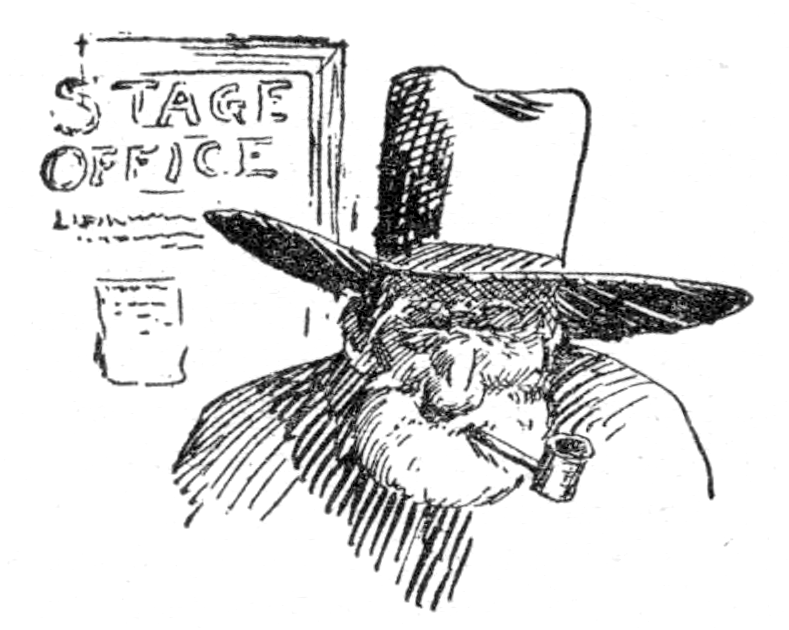
For quite a number of years old Eph Jones had driven the stage between Wheeler and Silver City. Jones was a tall old leatherneck, bearded to the eyes, gnarled of hand. He drove the four tough bronchos over the bad grades with a grip of steel, scaring passengers half to death, when he had any passengers, by the way he swung those four horses around the dangerous turns. The old stage was really a relic, but Eph kept it in repair and never missed a trip.
He usually started from Wheeler about four o’clock in the morning, in order to reach Silver City before the heat became unbearable. By doing this he could arrive there by eleven o’clock, and at that time, even in the summer, the thermometer did not show worse than one hundred and ten degrees in the shade.
On this certain morning he pulled out of Wheeler at the right time. There was no hint that the old stage carried a fortune. As usual, old Eph placed a sawed-off shotgun on the seat beside him, took a big chew of tobacco, yelled to his horses, and went out of Wheeler in a cloud of dust. He had no passengers.
There had been holdups on the road to Silver City, but Eph had never been stopped by any of the festive highwaymen. Only at odd periods was there enough wealth on the stage for any intrepid outlaw to bother about. There were mines out of Wheeler; gold mines, which often sold their gold to the bank at Wheeler, which in turn shipped it to Silver City by stage, to be sent from there to the mint.
Laramie knew this. He had often thought of trying to work some scheme to find out when these shipments were to be made, but he had never made the proper connections. There was no use taking pot-luck with a daily stage.
Old Eph Jones kept his four horses traveling at top speed, and the desert road unwound behind him like a ribbon of tawny silk. Daylight came. He took off his heavy coat, bit off another chew of tobacco, and kept going. The sun came up, and in a short time the coats of the horses were caked from moisture and dust.
There would be water at the crossing of Lost Creek; the only water between Wheeler and Silver City. Lost Creek disappeared shortly below the crossing, never to appear again. It was nearly ten o’clock when the lead horses of the stage splashed into the crossing. Eph drove them far enough ahead to allow the wheelers to drink.
On the other side, the road slanted sharply upward for fifty feet, where it leveled again for possibly a quarter of a mile before climbing the grades. It was little over a mile to the hair-pin turn.
The horses were checked before drinking their fill. Old Eph kicked off the brake, and his long whip snapped over their lean backs like the report of a small rifle. They jerked into their collars and sprang ahead, while the whip hissed and popped, urging them to drag the heavy stage over that sharp pull.
“Tighten yore tugs, you bat-eared scorpions!” yelled old Eph. “Git goin’, you buzzard bait!”
The horses dug to their work, and the big stage lurched up over the rim. But right here occurred an interruption. The leaders swung aside, crowding the brush beside the road, swinging one wheel out of the rut. Old Eph swung hard on the lines, jammed a big foot down on the brake, and swore bitterly through his dusty whiskers.
In the middle of the road stood a man, his face masked, a big gun in his right hand. He had cleverly swung the leaders into the brush, and the stage was blocked. Eph grumbled and squinted at the robber, who kept him covered with the big gun.
“Changed m’ mind about the hair-pin turn,” he said to Eph. “Throw down the treasure box.”
Eph slowly bent, lifted up the iron-bound box beneath his big feet, and tossed it down. It was not a big box; only about eighteen inches long, nearly square. On it was lettered “Wells Fargo Co.” in white letters. Without taking his eyes off old Eph, the bandit picked it up. It was heavy, and he needed both hands.
“See yuh later,” he said meaningly, turned, and started for the brush ahead of the team.
Eph’s right hand dropped to the shotgun. With a twist of his wrist he turned the barrels toward the retreating form, and a lean finger tightened over the trigger. A moment later, the stillness of the hills was broken by the crashing report of the old 10-gauge shotgun.
The bandit stopped, staggered sideways, dropped the heavy box, and fell over it.
“Them there buckshot,” said old Eph, as he climbed down over a wheel, “are shore e-fective on half-witted holdup men.”
Then he went over, picked up the wounded man, and took him to the stage, where he roped him well, threw him inside, and went back to get the treasure chest.
“Goin’ to be a little late at Silver City,” he said thoughtfully, as he kicked off the brake. “Tighten yore tugs, you bat-eared buzzards!”
It was about three o’clock that same afternoon. Sheriff “Buck” Nolan was sitting out in front of his office at Silver City, seeking what little shade there was to be had, which wasn’t much, when Larry Brett, foreman of the J80, and another man, dressed in cowboy habiliments, came down the sidewalk to the office.
“Hyah, Larry!” greeted the sheriff wearily.
“’Lo, Buck! Shake hands with Jimmy Colvin.”
They shook hands solemnly. Colvin was a slight, youngish man, with blue eyes and a wide smile, while Larry was gaunt, angular, hard bitten.
“I heard about the holdup this mornin’,” said Larry. “They was tellin’ us up at the store. Was it really the Laramie Kid?”
“It shore was and is,” smiled the sheriff. “Doc Hardy jist fixed him all up fine. I jist got word that he smoked up Los Noches night afore last. Cut down on a gambler and busted him plenty. Then he tried to whip the whole town. Nicked the sheriff and got plumb away.”
“Is he hurt bad, Buck?” Larry inquired solicitously.
“Not very. A buckshot petted him on the head, and another went plumb through his left arm below the shoulder. Nope, he ain’t hurt none to speak about. The nervy cuss never had a shell in his gun nor in his pockets.”
“That jasper must be loco. Say! Somebody stole a horse and a saddle from the J80 stable last night, and I wondered if Laramie——”
“I ain’t been out lookin’ for his horse. Want to talk to Laramie? Shore, he’s able to talk, judgin’ from the cussin’ he gave the doctor.”
“I would like to talk to him,” said Colvin eagerly.
“C’mon in,” said the sheriff.
They found Laramie sitting on the edge of his little cot, holding his head in his hands. He looked up at them and recognized Larry.
“Hyah, Brett!” he said shortly.
“’Lo, Laramie! Long time I no see yuh.”
“’F I had my way about it, it’d be a darned longer time before yuh’d ever see me again.”
“I s’pose,” grinned Larry. “And if yuh look at it right, it probably will be a long time, Laramie. Did you steal a horse and saddle from the J80 last night?”
Laramie thought it over for a while. Then he said:
“Yuh can’t prove that on me. But I seen a J80 horse tied off the road, left-hand side, jist this side of the crossin’. Mebby that’s yore bronc and saddle. I didn’t see nobody with it.”
Colvin had taken out a folded piece of paper and was making notes. Laramie looked him over curiously, but said nothing.
“How much money was in that box?” asked Larry.
“Danged close to twenty thousand,” said the sheriff. “They couldn’t give me the exact figures at the bank yet.”
Laramie squinted sideways at Larry. The amount was nearly correct, but Larry merely looked at Colvin, a grin on his lips.
“The crossing came near being the right place,” said Colvin.
“That’s right,” agreed Larry. “Never heard of anythin’ so strange in my life.”
“What’s all this about?” demanded Laramie. “Who’s that jigger”—pointing at Colvin—“and what’s he writin’ anyhow?”
“This is Mr. Colvin, Laramie. He’s stayin’ at the J80, gittin’ what he calls ‘local color.’ Writin’ a Western story, and yuh never seen a man so particular. He had to have a holdup in the story, and he wanted to locate it right. He wrote it at the ford of Lost Creek, and I told him that the hair-pin curve was the right place. He was right. There was to be twenty thousand on the stage, and the driver was one of the crooks, and——”
Laramie covered his face with his hands for a moment.
“Git out of here, will yuh?” he said savagely. “My head aches, and I—I want time to think.”
They got up together and started for the door.
“Mr. Laramie,” said Colvin, “may I come back and talk with you later? I’d like to get your reactions——”
“Better let him alone,” advised the sheriff. “He’s in bad shape.”
Transcriber’s Note: This story appeared in the August 25, 1928 issue of Western Story Magazine.