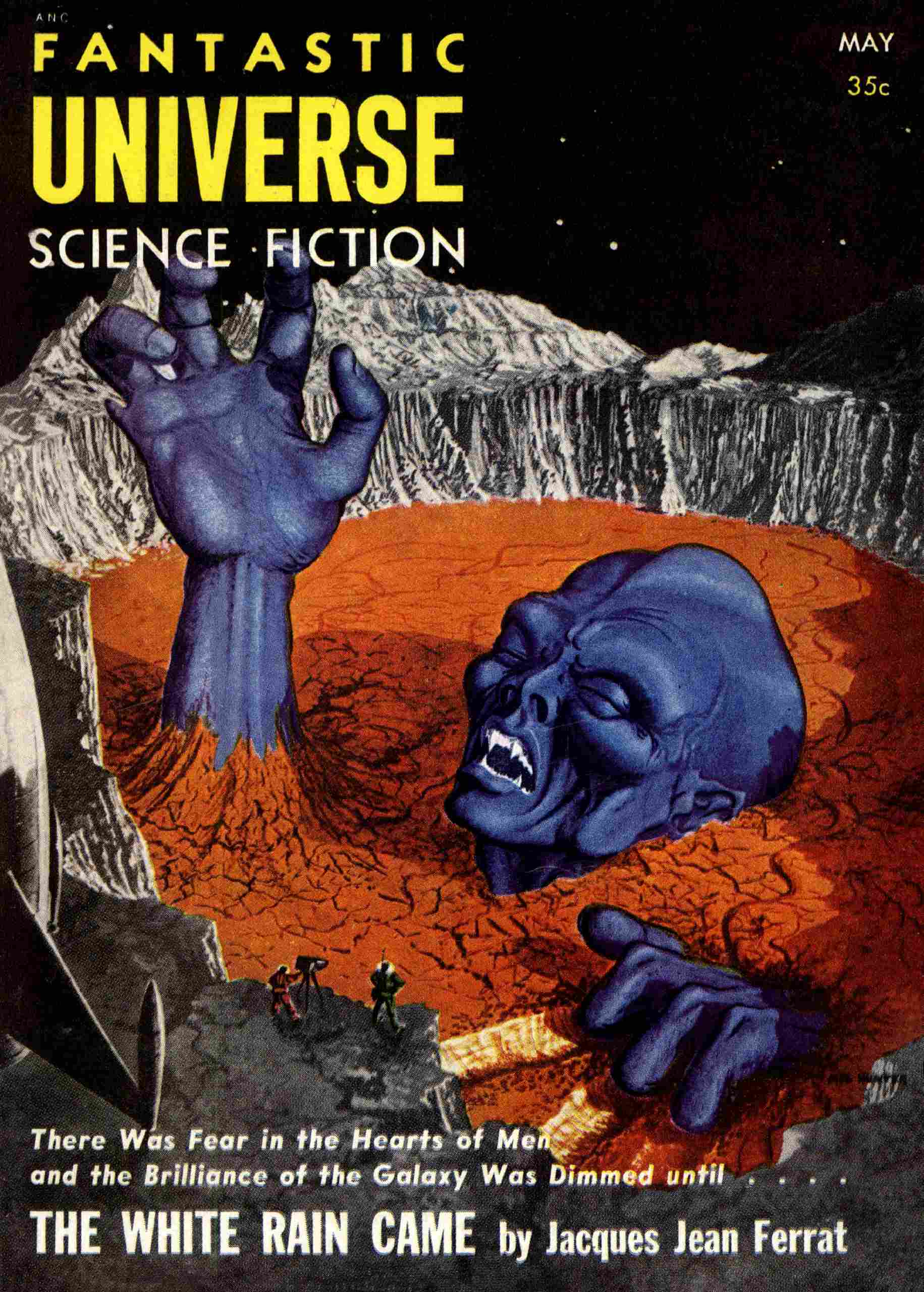
Transcribed from Fantastic Universe, May 1955 (Vol. 3, No. 4.).
Transcribed from Fantastic Universe, May 1955 (Vol. 3, No. 4.).
by Thomas J. O’Hara
A prize-winning story emanating from a college course eminently successful and pioneering will, we are sure, be of paramount interest to our readers. The idea was happily suggested and guided by our book critic, Mr. Robert Frazier and by another editor, Mr. Samuel Moskowitz, who conduct in able association the SCIENCE FANTASY WRITERS' WORKSHOP at the College of the City of New York (School of General Studies, Extension Division, Fall-Winter Semester recently concluded). Mr. Frazier and Mr. Moskowitz made a careful selection of the most promising stories submitted by their students and the editors of FANTASTIC UNIVERSE acted in a further advisory capacity in deciding on a winning entry to be published in our May issue. We think you'll agree that Thomas O'Hara's fine story was a most felicitous choice.
A floating coffin was the ship, its lone survivor specter-gaunt and adrift in a pitiless universe.
He was, now, the last one left alive.
The captain had gone first, quietly and without preparation.
There had been no hint of the plague’s coming—no slightest premonition of death.
There had been only the briefest of preliminaries: the sudden, burning fever; the quick decay of flesh and the bright-hued, bursting sores. Then had come the terrible vertigo and the brief mindless interval before the agonizing end.
The next two had gone a little easier.
The second mate had simply not awakened one morning, and the third victim, the engineer who guarded and supervised the workings of the great uranium-fission chambers that drove the mighty star-ship, had noticed at first only a mounting vertigo which was swiftly followed by a fever which brought a bright flush to his cheeks.
Reeling, he had clutched at the rail guarding the edge of the power-machines, then, before he could sound an alarm or cry out for help, a sudden fatal spasm convulsed him. With a soundless shriek he plunged headlong into the mass of throbbing machinery, and burning, radio-active material.
A moment later, like a great burst of flame, his remains dissolved into a million tiny, glowing fragments that flashed from the great exhaust tubes to a final end in the cold wastes of space. Like a glowing nimbus, his final, mortal atoms spun round the ship—a halo of radiant death cleansed and purified by the absolute-zero cold and the burning heat of energy-breakdown.
The fourth victim was wiser by far—he killed himself before he became infected.
There had been six of them plunging headlong at tremendous speeds through the darkness of a night that was beyond all reckoning, plunging endlessly through a sea that knew no charting, nor had heard of any shore-line. The flames of endless giant suns had shot past, the tiny, beckoning eyes of a thousand planets, and yet they had passed onward to a greater goal.
Six of them, hermetically sealed in a vast metal argosy—a giant trireme sailing the interstellar seas of a vast and pitiless universe in search of new worlds undreamed of; a galactic ship that had now become a self-contained coffin without even an atmosphere for the dead and dying to breathe as their desperation increased.
This was, for the crew, an interlude in an expanding saga of exploration and discovery, a single incident in the cosmic drama important to them alone.
The ship had been checked and double-checked and checked once more at the start of her great odyssey.
“We have explored and conquered the nearer planets.” The captain had reminded them. “But who can guess what lies beyond in other systems, other galaxies?”
How remote now seemed the skyport in the dawn, and all of that far-off day’s activities.
Where had the sickness come from? They had no way of knowing, beyond their certainty that it had not originated in their own world. Was the answer to be found in an improper diet, the too sudden adjustment in atmospheric content and volume, or even in a minute frozen spore lodged in some tiny crevice in the exhaust tubes or the hull—a frozen bacillus brought to the ship on some tiny chunk of rock from some unknown world?
A daring surmise worthy of further research and investigation. Tomorrow, on another world perhaps, but certainly not here and now in this flying missile of death; this tragically doomed and expiring space-giant.
Their hopes and expectations had soared in the beginning, but now the great dream was dead and lying with the bodies of the spacemen. It had been man’s first dream of galactic empire; and might well be his last.
True, there would be other space-flights, but they could never be the same. This was the first, the virgin voyage—and beyond it was the bitterness of a lost hope, of a broken dream.
For the hopes and aspirations of a whole race, of a great people, to break and settle in a trough of frustration, was in itself an incredible sin. It was a sin against the Mind that had created and breathed life into the vast and lonely emptiness of the interstellar void.
And now, plague-ridden, the vast ship plunged downward toward the surface of a strange new world.
Its seas stretched wide and blue across the televiewing screen, and its rich brown earth stretched out a warm and welcoming hand. Its very youth sounded a clarion call to rest and dream from the weariness of the long voyage.
Light-aureoled clouds stretched about it, girdling and shielding it in clinging, wispy fragments of dream-traceries.
The ship’s lone survivor cried out—in agony, and not as a protest against the beauty of the world below, and the memory of his comrades, dead only hours before. Once again the strange sickness twisted a sharp, agonizing knife against his vitals. Once again the vertigo gripped him, and pulled him to the floor with a giant hand.
The tele-view screen, the controlroom, the universe itself seemed to melt beneath him, so that for a full, terrible moment he felt himself to be without support, plunging toward the spinning, twisting mass of the approaching planet.
Clouds and skies, the blueness of seas and the harsher greens and browns of vegetation spun vertiginously as he stared and became a tortured nightmare to his inflamed senses.
Crying out again, he sank to the floor and sobbed his bitter loneliness to the darkness of the long night.
It must have been hours later when consciousness returned to him.
He lay on the floor, obscurely aware of the muffled throb of the powerful engines vibrating through the ship, and grateful for that awareness.
Finally his faculties steadied and he got weakly to his feet, only to be reminded again that he had but a few short hours left. In the tele-view screen he could see the new planet plainly, its bulk swelling the view screen with its nearness.
All at once his true position became clear to him. It had seemed for an instant as if this strange world might offer some release from his suffering. But, now, he realized that the hope was a mockery and a snare.
What would it matter if he succeeded in landing safely and the planet’s atmosphere could support his kind of life?
His fate was already decided. A few brief hours of freedom and then—death, swift and remorseless.
There was no known cure for his disease. And the chances of the inhabitants of an alien planet possessing such a cure, or even being familiar with the disease itself, seemed infinitely remote.
His face set in hard lines.
He thought of the plague sweeping the green world like some ravening specter of the night. In his mind he could picture the inhabitants dying in agony, crying out in bitter despair as the terrible vertigo came upon them.
To the right of the televiewing screen was the small control-unit which regulated the output of the atomic generators. It was an output that could be doubled and tripled—that could turn the ship into a flaming mass of raw energy and destroy it, or bring it to a controlled and gentle landing.
Deliberately, gently, he reached out and shifted the control handle—
In a green valley far below, a girl with spun-gold hair raised her head from her companion’s shoulder.
“Robert,” she murmured, contentedly. “Isn’t it beautiful?”
The boy’s arm tightened around her slender waist. “It’s only a shooting-star, darling,” he said. “It doesn’t mean a thing—”
In the distance a steeple bell started chiming, and the twilight deepened above the green hills and valleys of Earth.
This etext was produced from Fantastic Universe, May 1955 (Vol. 3, No. 4.). Extensive research did not uncover any evidence that the U.S. copyright on this publication was renewed.
Obvious errors have been silently corrected in this version, but minor inconsistencies have been retained as printed.