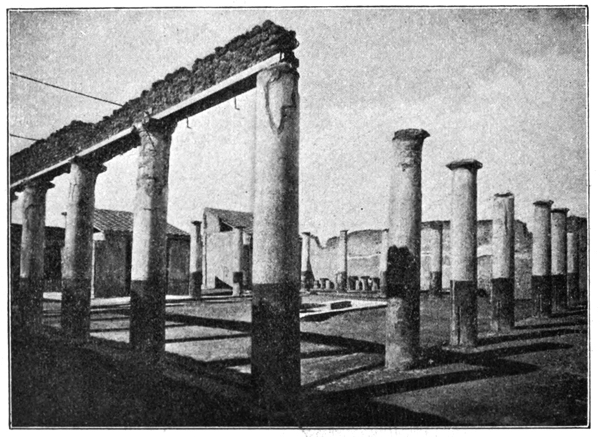
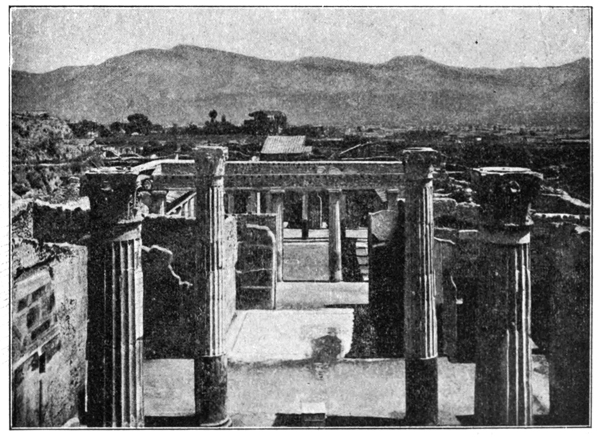
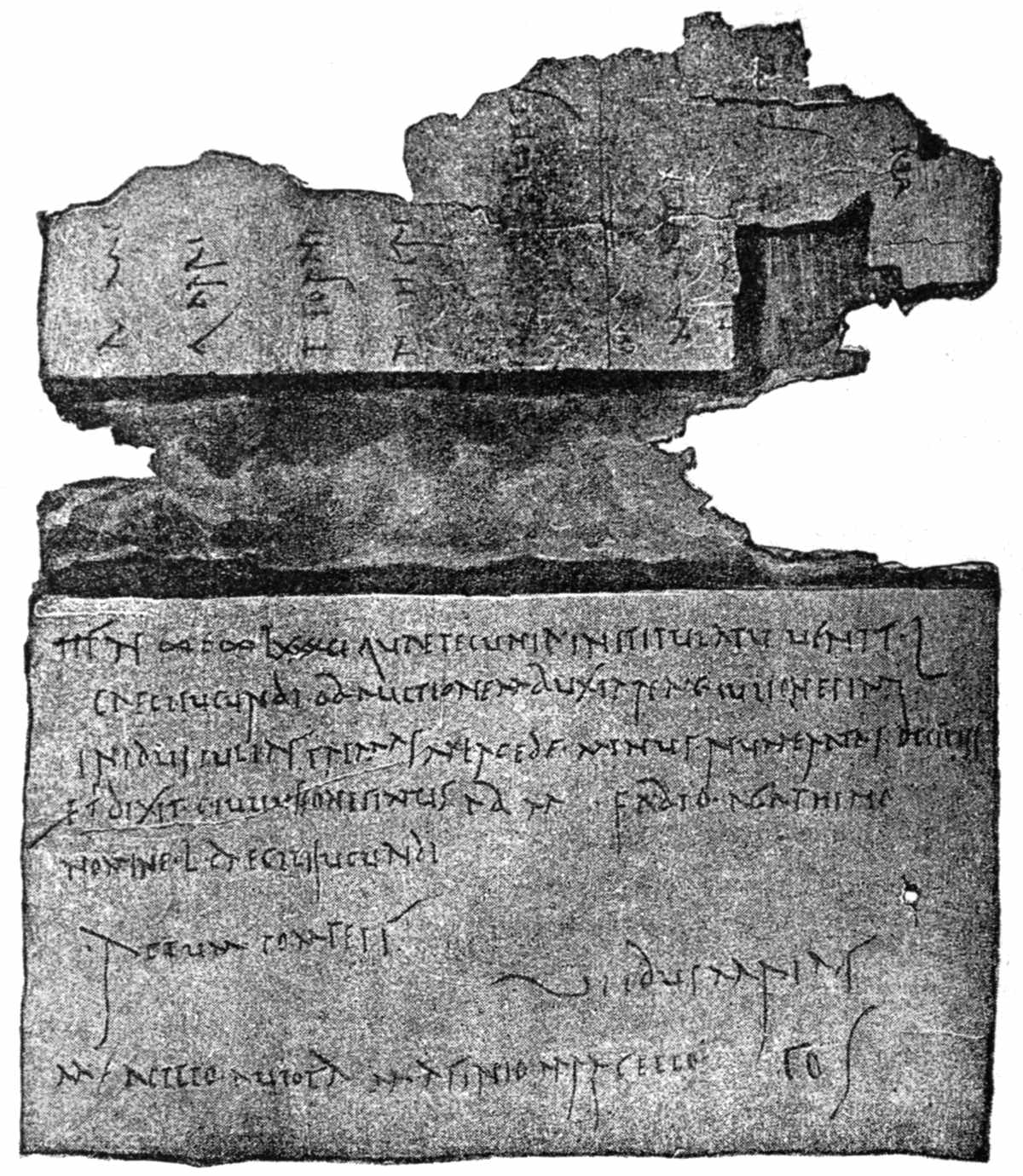
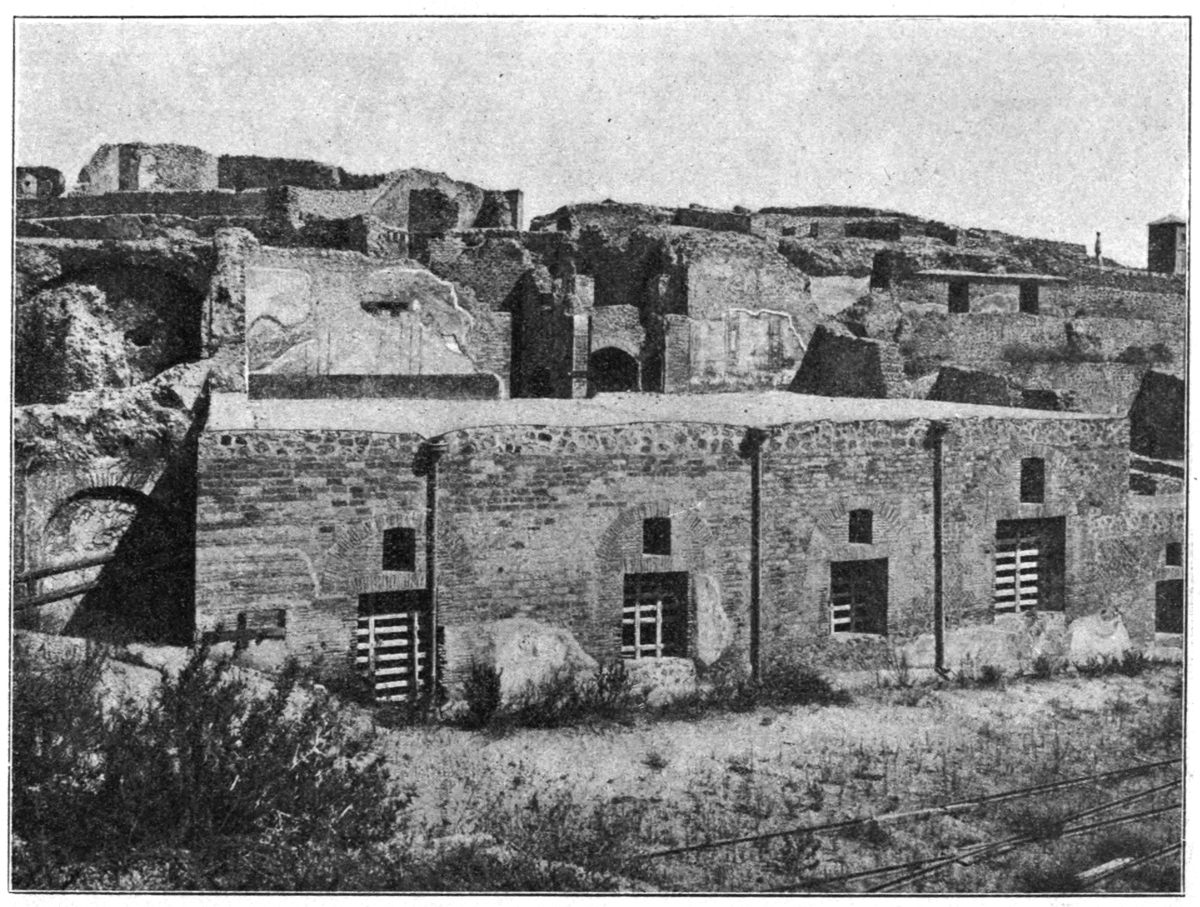
The present work forms the first of a series of
volumes published under the general title of
“Famous Art Cities”. The second, (by Dr. Gustav
Pauli), treats of Venice; its immediate successors
will deal with Florence and Nuremberg. Rome, Siena,
Ravenna and Cairo will represent a continuation.
Whoever visits Pompeii for the first time will
not grudge a corner beside his guide-book for a
Vademecum such as this, which offers the
inspiration of the Genius loci to the traveller
of artistic tastes. As the one meets his material
needs, so the other ministers to the intellectual
interests of the man of education, and may, at a later
time, preserve or renew in the liveliest fashion his
remembrance of what he has seen.
“Vedi Napoli e poi muori”; “See Naples and die!” is
a saying one often hears, a saying which means that
after seeing Naples in all her beauty one has nothing
on earth left to admire.
And in a certain sense this is true enough: there
are but few places which in beauty of scenery can
compare with the Bay of Naples. Yet a visit to Naples
is not all; equally with the City of the Living, so
attractive to the stranger for its life ever freshly
throbbing early and late, the City of the Dead,
Pompeii, deserves also thorough investigation and
careful study. Whoever goes to Naples must not fail to
turn his attention also to its near neighbour Pompeii.
This nowadays is so easy a matter, whether one drives
along the beautiful roads between smiling gardens that
adorn the slopes of Vesuvius, or takes train across
the lavabeds close to the sea, whose waves break on
the embankment. The goal is quickly reached: there is
music and refreshment in one of the hotels which are
in front of the ruins; then quickly to the entrance;
where we settle as to tickets and guides, and through
the Porta Marina or Sea Gate we enter the ancient city.
But what is Pompeii, and why should we not leave
Naples without seeing Pompeii also. Those whose memory
goes far back enough remember that in April 1872
the eyes of all were turned to the neighbourhood of
Naples. But 2this time it was not the splendour of the
country that caused universal attention, and brought
to the Bay of Naples countless foreigners from near
and far. It was a drama of Nature at once imposing
and terrible that formed the attraction for the hosts
that gathered there. Vesuvius which for several years
(since 1865) had never quite slumbered, showed itself
once more in all its terrors, and ever more awful than
before: showers of fire burst forth to a vast height
from old craters and new, clouds of ashes darkened
the air for miles, and filled the streets even of
distant towns: immense streams of lava burst from the
mountain’s flanks hurling death and destruction before
them.
And yet in spite of all its terrors the eruption
did not equal the one with which Vesuvius first in
historic times announced itself as a volcano and
covered with lava and ejected stones the three cities
of Herculaneum, Pompeii, and 3Stabiae, to say nothing
of less famous places. The desolate cone of ashes
which now towers high above the ordinary surface
did not exist at an earlier period; right up to the
summit the mountain was clothed with woods, while on
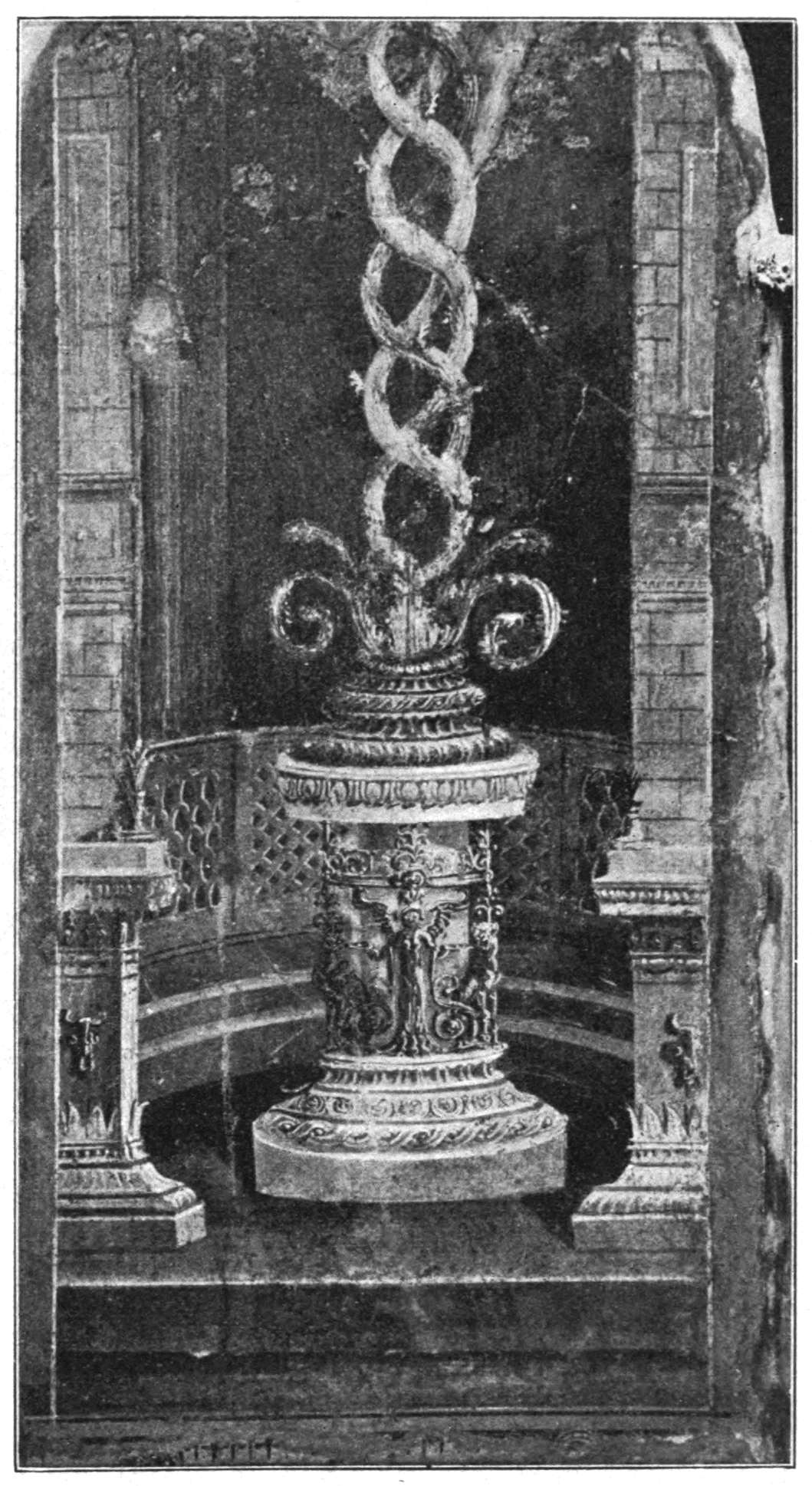
its flanks the grape ripened into costly wine (see
fig. 1, a Pompeian wall-painting representing in all
probability Monte di Somma before the evolution of the
crater of Vesuvius). And if one enquirer or another
drew some conclusion as to the volcanic nature from
the depression on its summit and the fruitfulness
of the neighbouring land, yet people thought it
altogether extinct, and believed they had nothing to
fear from it.
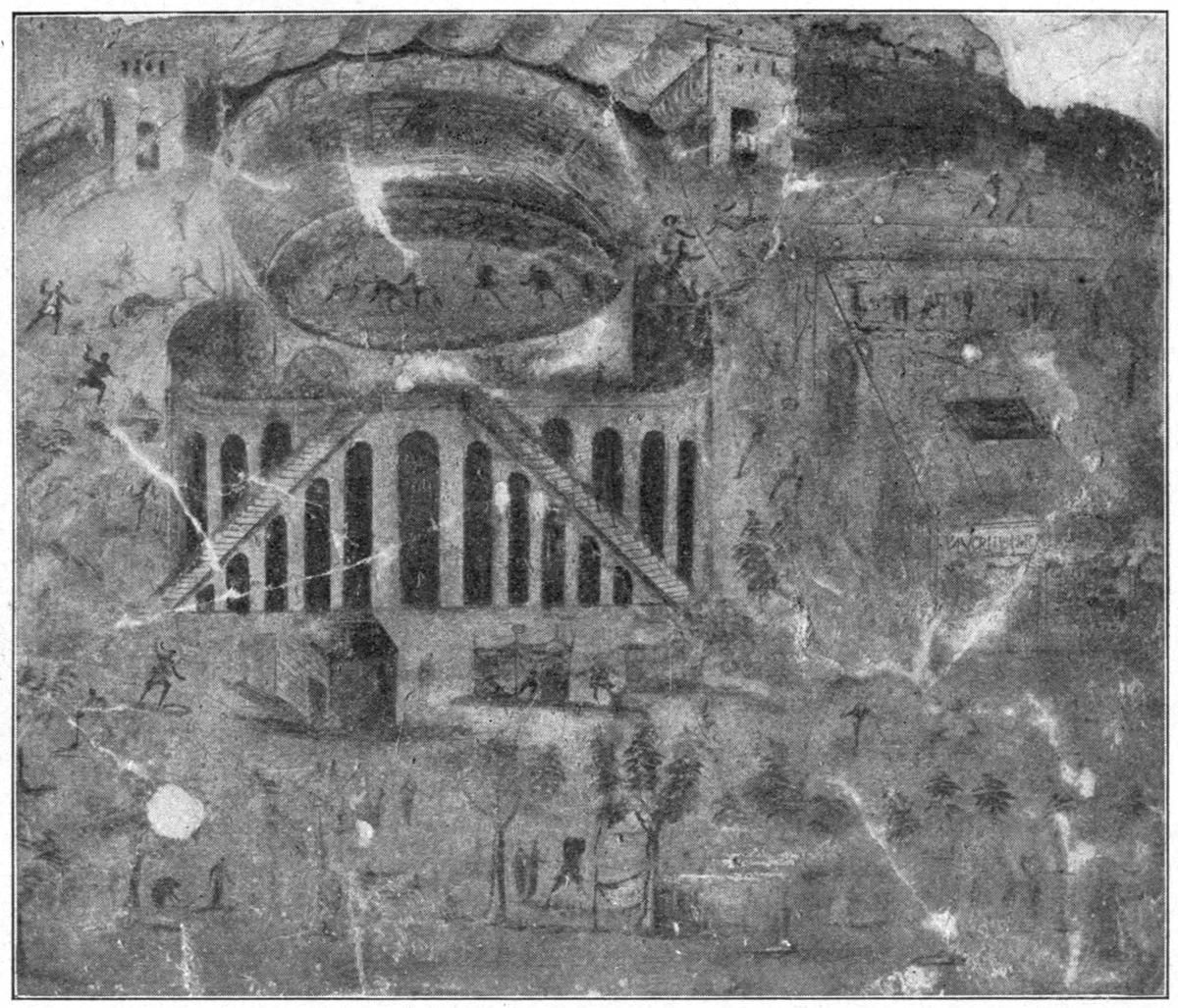
Fig. 2. Contest between Pompeians and
Nucerians in the amphitheatre (p. 6).
Then, on August 24th, A. D. 79, clouds of smoke rose
suddenly from the mountain, stones were hurled forth,
the heavens grew dark, so that it might well be
thought night had come on, every one took to flight
as he could, one got in another’s way. Whoever was
out of the city hastened back into it, to rescue
what he could. He who was in the city sought to
reach the open country as quickly as possible. Those
on shore hurried to the sea, those at sea hurried
to the shore. In short there was everywhere the
most terrible confusion, no one knew what was to
come next. We can scarcely realise sufficiently the
horrors of the situation. What in 1872 is reported
of Portici and Resina and Torre del Greco, can give
but a faint idea of what happened in 79 when the
4danger came much nearer and was far more unexpected.
A description by the younger Pliny, whose uncle met
his death at Stabiae in the eruption of Vesuvius, has
been preserved for us, telling of what happened that
day at Misenum, a place distant from Vesuvius about
twenty miles in a straight line. This may be abridged
as follows—“For several days vibrations of the earth
had been noticed, but less fear was aroused because
this is not an unusual phenomenon in Campania. On that
night however they were so violent that everything
seemed to be upset.”
“My mother burst into my bedroom, and I too was in
the act of getting up to wake her in case she should
still be asleep. It was now the seventh hour, yet it
was still gloomy and dark. Since the neighbouring
houses were much damaged and ready to fall, we decided
to leave the city, and our example was followed by
the whole of the terrorstricken inhabitants who
hustled and pushed past us as we went. When we were
out of the immediate neighbourhood of the houses we
stopped:—there were extraordinary things to see. The
vehicles which we had collected were being thrown
in opposite directions, although the surface of
the ground was quite level, and even stones thrust
under them could not keep them in the same position.
Besides, the sea appeared to retire, at least the
shore was extended, and many creatures belonging to
the sea were stranded on the sands. From the other
side came a threatening black cloud, pierced by
glittering lightning: it seemed to descend upon the
earth and brood over the waters; already it had quite
enveloped Capri and withdrawn Cape Misenum from our
sight. When my mother saw this, she adjured me to
abandon her and take to flight alone, that I might
at least save my own life; I on the contrary refused
to think of escaping without her, seized her hand,
and compelled her to set forth. Ashes were already
falling, though as yet to but a slight extent; I look
behind me, thick mist is threatening in the rear and
pursues us; let us, said I, while we can still see,
step aside, so as 5not by remaining in the road to
be thrown down and trampled on in the darkness by
the multitude following us. Scarcely had we seated
ourselves when dark night fell round us as it does
in closed rooms when the light is put out. Then were
heard lamentations of women, cries of children,
shouts of men, some called to their parents, others
to their children, others to husband or wife; some
bemoaned their own fate, others that of their dear
ones, some even prayed for death. Many raised their
hands to the gods, still more cried that the gods no
longer existed, that the last eternal night had come.
Nor were there wanting those who increased existing
terrors by false news, that Misenum had fallen in
ruin and was in flames, which was loudly proclaimed
and believed though it was not true. Gradually things
became clear again; this seemed to us not the light
of day, but a token of the approaching fire. Then
followed again darkness and showers of ashes; had
we not often stood up to shake ourselves free of
the ashes we should have been covered by them and
overwhelmed by their weight. At last the thick cloud
little by little dispersed as if dissolved like
smoke; soon it was actually day, and the sun broke
forth, though overcast as it is wont to be in time of
eclipse; everything seemed to our eyes altered and
covered with ashes as if with snow.”
If at Misenum, at so considerable a distance from
the actual point of eruption, things went on as here
described, what scenes must have been enacted 6in
Pompeii, the inhabitants of which were drawn into
joint suffering in quite another way. It is commonly
said that the people of Pompeii were at the time
congregated together in the amphitheatre at the
extreme end of the city, to witness gladiatorial
contests, so that for the most part they could more
easily escape. This however is a mere myth, as is
proved by the ruinous condition of the amphitheatre
when first discovered as well as from the history
of the city. In A. D. 60 the city had been deprived
by the Roman Senate of the privilege of exhibiting
gladiatorial contests because such a performance had
given occasion to a sanguinary struggle between the
inhabitants of Pompeii and those of Nuceria who were
allowed a share in the use of the amphitheatre (the
scene is represented in a Pompeian wall-painting,
fig. 2); and in A. D. 63 a terrible earthquake had
destroyed a great number of buildings and among them
the amphitheatre so that it is certain that at the
time of the eruption neither gladiatorial shows nor
wild beast hunts could have been held in it. Yet
the greatest number of the inhabitants must have
succeeded in escaping since on the basis of the
skeletons found up to the present time the number of
those who perished within the city can be estimated
at 2,000, out of a total of 30,000 inhabitants. Many
of course may have fallen a sacrifice to the eruption
of Vesuvius also outside the city walls; thus for
example in 1880-81 there were found the remains of
such, who had met with their death to the south of
the city, probably on what was then the bank of the
Sarno. Those however who had fled before the storm
to cellars or similar places were doomed to certain
destruction, because all exit was cut off by the
falling pumice-stone and ashes, others who had taken
refuge in the upper rooms may still have escaped
during a pause in the shower of pumice-stone. Many
indeed in vain: after they had worked their way
through the layer of pumice-stone they sank down
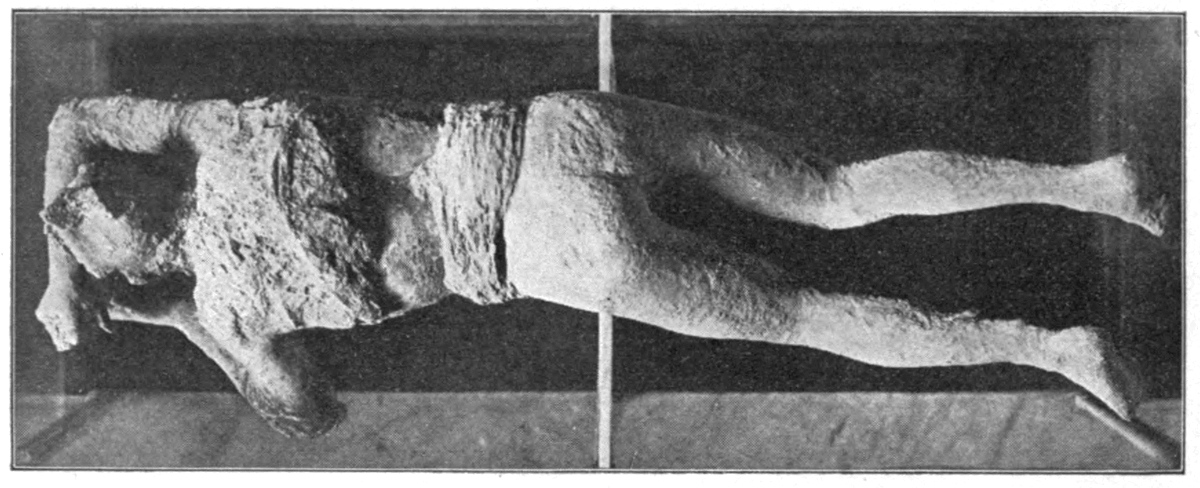
exhausted and were enveloped by the ashes. But since
these ashes which came down mixed with rain contained
much Pozzolana earth they have taken a fixed shape
around the bodies; in the course of centuries the
bodies have shrunk to a few remains of bones, but
the hollow impression has remained in the shape.
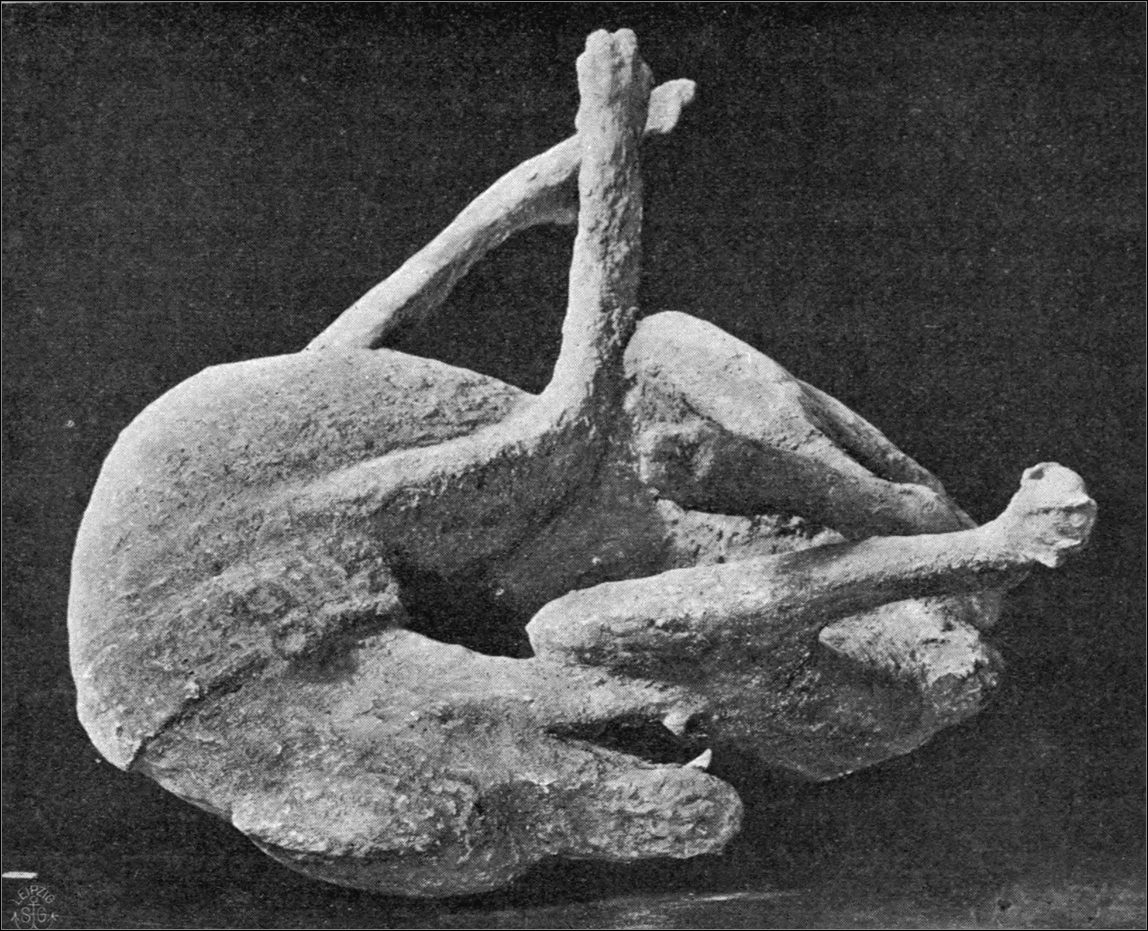
Thus attention having been drawn to this through the
frequent occurrence of similar cases, as soon as a
hollow appeared in the stratum of ashes during the
excavation, the opportunity has been seized and liquid
plaster poured in. By this process the bodily forms
of various inhabitants of Pompeii, of animals, and of
inanimate objects have been preserved, casts which do
not indeed exhibit the sharp outlines to which we are
accustomed in those produced by artistically prepared
moulds, yet which are of the highest interest to the
observer as direct reminders of those terrible hours.
See figures 3 and 4.
When the mountain had in some measure discontinued
its work, the showers of stones and ashes had ceased,
and the sun had appeared again, the inhabitants of
Pompeii who had escaped returned to their city; but
they had some trouble to find it, for it was buried
beneath stones and ashes. They endeavoured as far
as it was possible, to secure some salvage from the
ruins; and so many a work of art, as well as most
of the treasures in gold and silver, may well have
been withdrawn from the protecting bosom of the earth
either by their lawful owners or by unauthorised
persons. A systematic excavation of the houses,
however, and a reoccupation of the city were not to
be thought of, the ruin was too complete for that. So
much the better for us for whom in this way under the
ashes from Vesuvius an ancient Roman city has been
preserved in the precise condition in which it was on
the twenty fourth of August A. D. 79 (apart of course
from the changes which certain materials must have
undergone in so long a time). It seems that the people
of Pompeii settled further towards Vesuvius; the
ruins of their old city so far as they appeared above
the accumulated rubbish gradually collapsed, others
disappeared before the plough which began to pass over
the fields, and thus after a few centuries the name of
Pompeii with the place which pertained to it vanished
from the memory of men. So it remained throughout
the whole of the Middle 8Ages; often enough indeed
the countryfolk while tilling their fields struck
against old masonry or found ancient utensils, but the
isolated occurrences remained unnoticed.
More remarkable indeed is it that when the architect
Domenico Fontana in the year 1594 constructed a
canal to bring the water of the Sarno to Torre dell’
Annunziata, a canal which still at the present day
intersects Pompeii, people were not incited to a
thorough investigation by the numerous relics of
antiquity that during these operations must have
been cleared out of the way. It was not till the
discovery of Herculaneum (1709) that men’s thoughts
were directed to another city, smitten by a like
fate—Pompeii—and when in 1748 peasants again struck
upon masonry and other more valuable objects, then at
last people began to mark the spot and to undertake
more extensive excavations. Not, it is true, in a very
commendable way, since it was gold and silver and the
greater treasures of art that were especially sought,
the excavators contented themselves with grubbing the
earth, and when at most the better wall-paintings had
been cut away, filling up again the excavated houses.
Such for a long time was the system of excavation;
even after an interest in the matter had been roused
in higher quarters the work was carried on with more
or less provision of labour, often only two or three
workmen being employed—for many years indeed the
excavations were altogether discontinued. Only the
time when Naples was under the rule of France forms
a glorious exception: the work was entered on with
zeal: as many as six-hundred and seventy four persons
with twenty six carts and seven mules were 9employed
to remove the lapilli, and thus the few years
1806-1815 shew more results than the preceding period
of more than half a century. With the return of the
Bourbon régime the old conditions of course
reappeared, and it is only in modern times that an
improvement in this respect has been brought about.
Since Naples has become part of the Kingdom of Italy
the work (and this is especially due to the energy of
Giuseppe Fiorelli) has been arranged in a rational
manner and vigorously pushed forward, so that the
completion of the excavations may be expected within a
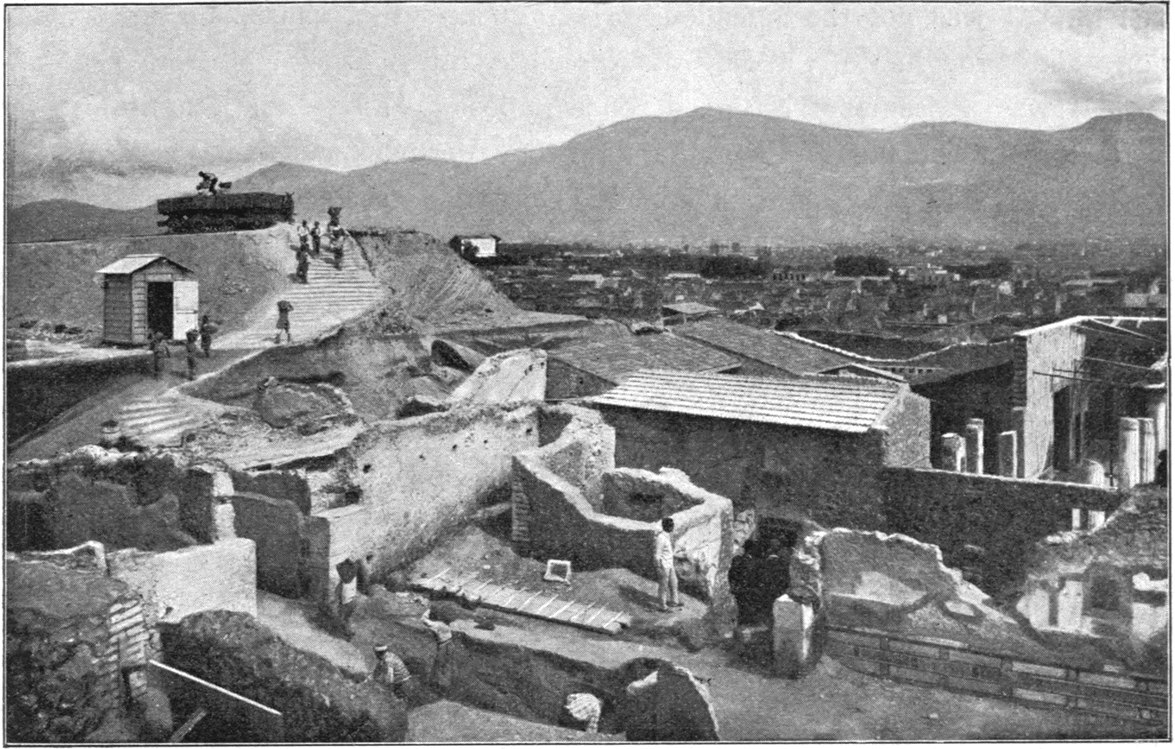
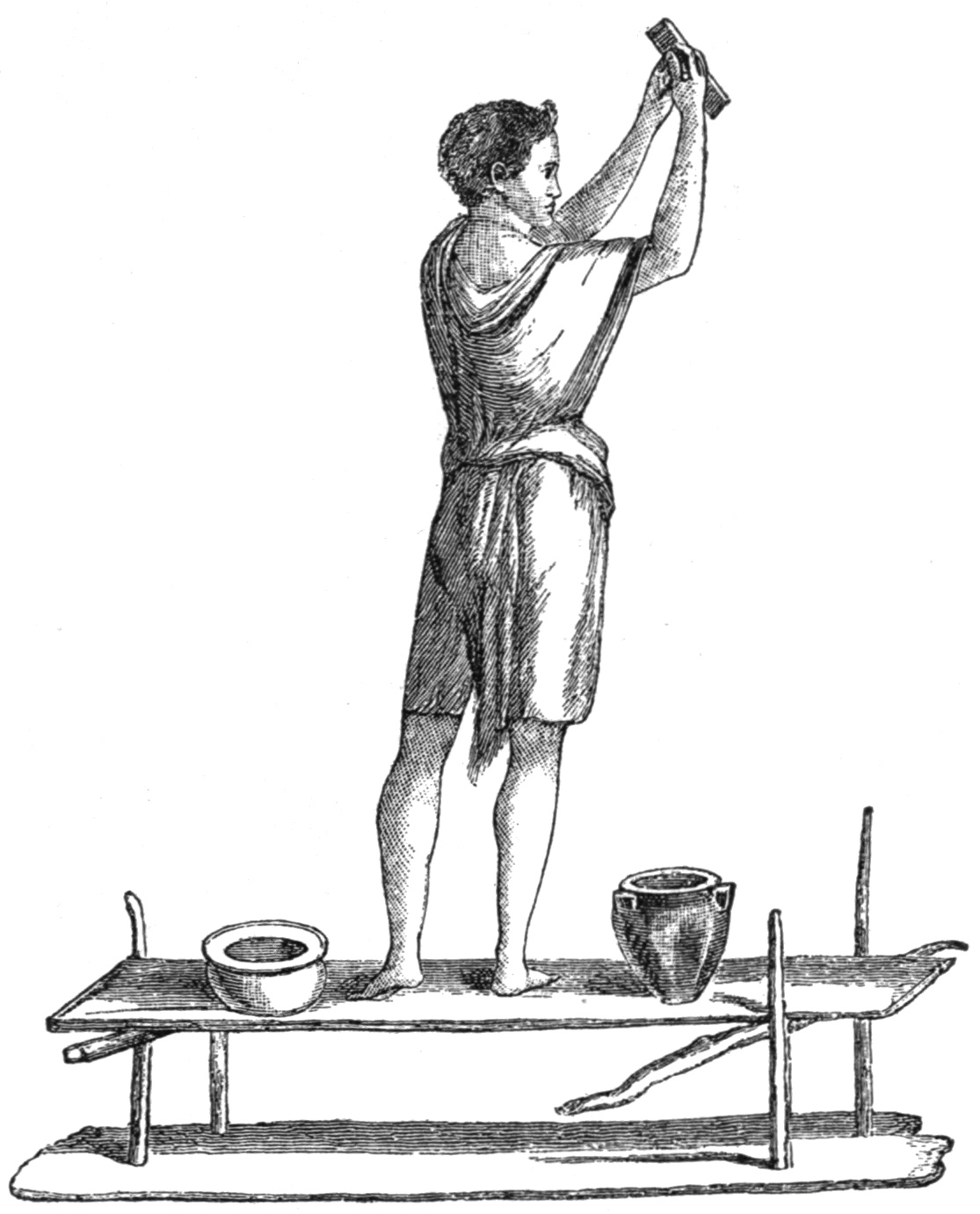
conceivable time. Men and a great many boys are daily
employed, some in excavating, others in carrying the
lapilli in baskets to the waggons which then
are taken on a railway away from Pompeii. (See the
illustration on page 1.)
Fig. 7. The Street of Nola and its
continuation (p. 15).
While Herculaneum for the most part (only with the
exception of some portions lying close to the sea,
which resemble Pompeii) has been covered by a vast
stream of mud to a depth of twenty metres, the mass of
which hardened into tufa cannot be broken up without
great trouble, so that the excavation of the city can
be effected only by a process of mining, and this too
with great care, on account of the city of Resina
lying above it, the stratum which covers Pompeii
may be called comparatively light. Whitish-grey
pumice-stones, the so-called lapilli, of
various sizes, cover the ground to the height of
two to three metres; above lies a layer of volcanic
ashes, which mixed with a quantity of pozzolana earth
and falling with frightful torrents of rain, the
usual accompaniment of volcanic eruptions, passed
through the upper layers of pumice-stone, and made
their way where the lapilli could not fall
(e. g. into the 10cellars). Over these lie in some
places, but less abundantly, other lapilli
which proceeded from later eruptions of Vesuvius, and
the scanty soil that in the course of centuries has
developed from the ashes. All this therefore had to
be removed in order to lay bare the ruins. The system
and method then according to which the excavations
were in earlier times conducted was in the highest
degree prejudicial to the remains of the buildings;
for since after once reaching the original ground
level the excavators worked onwards uniformly upon
that level, it necessarily followed that the upper
parts of the buildings, which after the decay of the
beams were supported only by the surrounding masses of
pumice-stone, fell in ruin, and so always only slight
remains were preserved.
In modern times on the contrary, since Fiorelli’s
administration (1861), the aim has been to preserve
in its original position every part of the ancient
walls that is concealed under the surface. This object
is attained by the excavators as they work from
above carefully removing one horizontal layer after
another and supporting the masonry thus brought to
light until it is possible to replace the woodwork
destroyed in the course of centuries by new timber of
equal size. Thus they have succeeded in preserving
not only a part of an upper story overhanging the
street, but also others 11of the higher portions of
the buildings altogether uninjured. In this way
the parts of the city lately excavated present an
appearance essentially different from that of those
previously uncovered; and since too everything is left
on the spot that can be left, especially pictures and
mosaics, and since every effort is made to protect
them against the unfavourable effects of the weather,
by roofing, and coating with wax, and other means;
while it is no longer the case (as it used to be) that
everything is either removed to the Naples Museum,
or (as also often happened) wantonly destroyed, the
visitor is afforded an opportunity of forming for
himself a far more truthful picture of ancient life
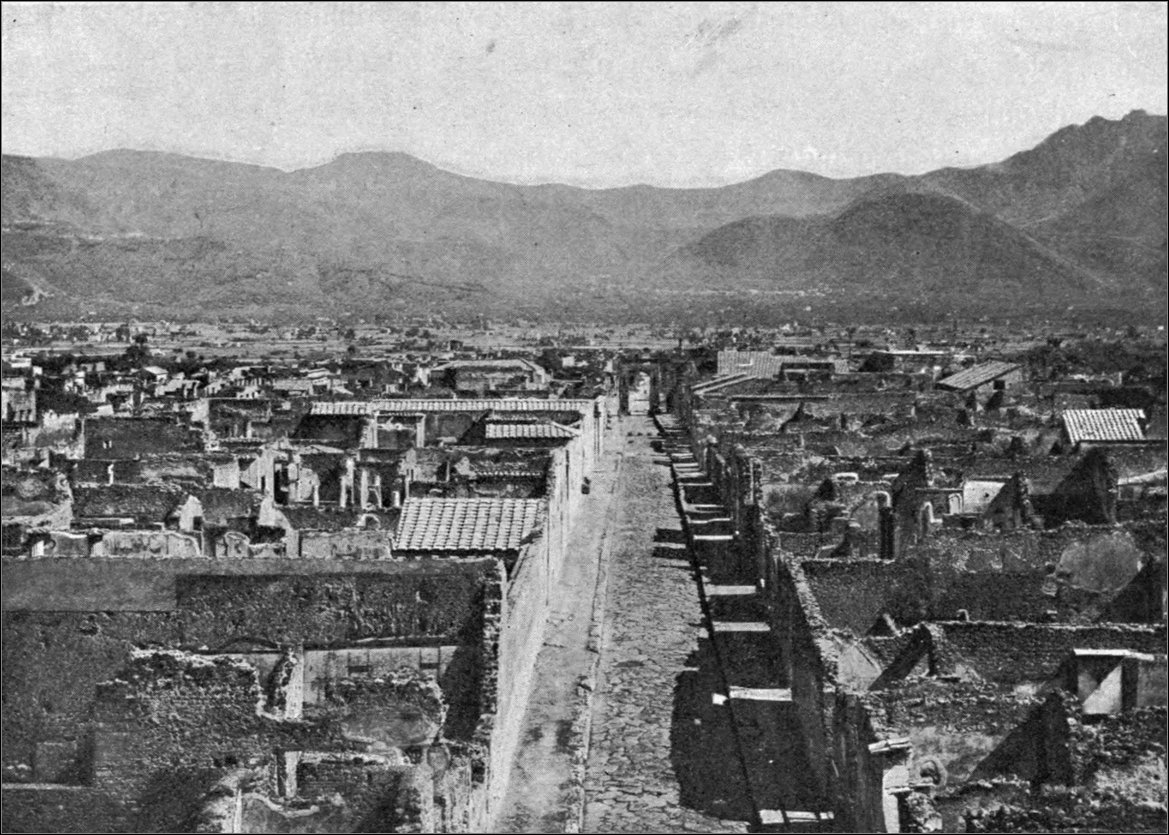
than was possible at an earlier period. (See fig. 5,
giving a view of part of the excavated city. The
Street of Mercury lies before us, which reaches to the
Forum. The roofs which are seen in the illustration
serve to protect the wall-paintings, mosaics, &c. and
are therefore almost exclusively modern.)
That the movable objects, especially those of gold,
silver, bronze, and terracotta, should have been
brought to the Museum is of course only reasonable
and proper. Considering the various characters of the
host of visitors to Pompeii, it could scarcely fail to
happen that one or other article was destroyed through
too rigid an examination, quite apart from the fact
that among such visitors there are always some who
“out of love for Antiquity” are ever ready to carry
away with them some souvenir of the city. Hence it is
necessary, if we would form an accurate representation
of the life of the ancients, to avail ourselves of the
Museo Nazionale in Naples, where all the furniture
from Pompeii is preserved so far as place has not been
found for it in the little museum 12in Pompeii itself
at the Porta della Marina. Perhaps however if Italy’s
financial difficulties come to an end (as they must
some day) a plan will be carried out which has long
been talked of, viz., that a house in Pompeii should
be furnished exactly as it was ages ago, equipped with
all the articles which were used in daily life, even
if they have to be collected from different houses.
Thus with less trouble one could form a general
conception of the life of that epoch, a much more
difficult task under present circumstances when one
has to examine the various articles of furniture one
by one in the Museum far from their original position.
These movable objects moreover are commonly to be
found in the lowest layer of pumice-stone to the
height of one metre; torn from their proper places by
the breaking down of the roof they have necessarily
assumed this position. For this reason the rooms
are first of all cleared to within half a metre of
the ground, and then the remainder is subjected to
a thorough examination by experienced excavators.
Since there are always some such rooms ready, it
is possible, if distinguished visitors arrive even
unexpectedly, to arrange a so-called gala excavation,
such as is often mentioned in the papers. The stratum
of pumice-stone only half a metre thick is simply
removed, and something is sure to be found. For the
most part it is objects used in daily life, utensils
of bronze or terracotta, with or without their
contents, also candelabra, lamps, &c. Statuettes
too of bronze are not uncommonly found. These
“war-preparations” are however the cause of great
dangers to the buildings, the pumice-stone sucks up
water like a sponge, and so never allows the walls to
get quite dry, which is however the first and most
important condition for their preservation.
But enough of excavations. Let us turn to the
consideration of the city itself.
At first sight the city gives the impression of the
greatest uniformity. Apart from size and the wealth
of its former inhabitants one house seems to have
been built at the same time, and adorned with the
same artistic resources as another. Yet that is the
result of the stucco-coating which under the Empire
gradually became so fashionable that it was deemed
advisable to cover everything with it. A more accurate
examination however convinces us that under the stucco
lie concealed the most distinct periods of building,
with the help of which the gradual development of the
city can be recognised.
Fig. 16. Public Fountain (p. 21).
Fig. 17. Street of Stabiae with water
reservoir (p. 21).
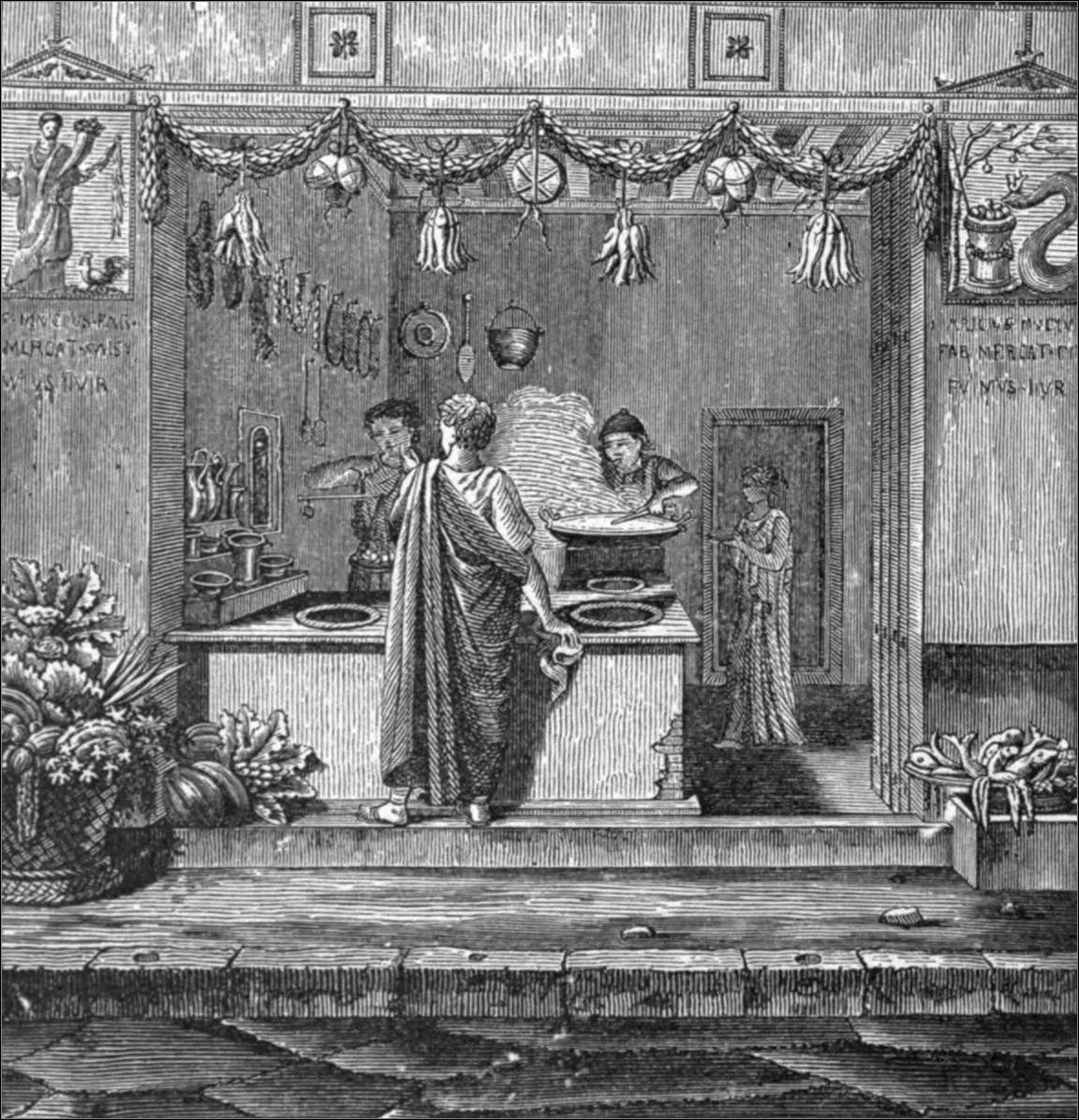
Fig. 18. Restored View of a Cookshop
(p. 21).
To determine the architectural history of the city
there are—apart from the very meagre literary
tradition—two means, firstly the distinction of the
material of which the houses are built, and secondly
the measures employed. In respect of the first point
it proves that limestone which could be procured
in the immediate neighbourhood of Pompeii from the
deposits of the Sarno, was employed in the earliest
period for building houses, with clay as cement. With
this was associated also tufa, a volcanic product
which when just quarried can be easily cut. An
essential progress was made by the introduction of
lime-mortar, the knowledge of which was apparently
transmitted through the Carthaginians to the western
Greeks and the inhabitants of Italy. By the aid of
this lighter and smaller 14stones could be utilised to
form walls capable of supporting considerable weight.
In place of lime-mortar there was gradually introduced
Pozzolana (named from Pozzuoli on the Bay of Naples),
a volcanic earth resembling cement in its effect. Of
lasting influence was further the introduction and
gradual spread of building with kiln-baked bricks,
although in private buildings they were never employed
to such an extent as in Rome and other Italian cities.
Finally, the last period, that of the restoration,
when the question was how in the shortest time and
with limited means to rebuild the city which had been
almost entirely destroyed by the earthquake of the
year A. D. 63. (The devastation had been so complete
that the Roman Senate could deliberate as to whether
the people of Pompeii should be permitted to rebuild
their city.) Haste and negligence and the use of the
first materials that came to hand characterise this
epoch.
As a second means of distinguishing the various
periods one from another we have the standard of
measure employed. According as the walls have been
built in conformity with the Oscan or the Roman foot
(the Oscan foot has a length of .273 of a metre, the
Roman of .29) the corresponding buildings can 15be
assigned to the one or the other period, and since it
was not usual to demolish what already existed, but to
make use of it as far as possible, people have through
observation of the various measures, attained even to
the possibility of distinguishing the older parts of
buildings from the later, and often recognising their
earlier destination.
With the help of those distinguishing marks, and of
the scanty notices handed down by ancient writers, and
of the inscriptions we are enabled to establish the
following as to the city’s history.
Whether the name Pompeii is connected with πέμπω,
πομπή or is derived from the Oscan pompe = five
is all the same to us, since we can draw no further
conclusion therefrom. In any case nothing further is
known as to the year of foundation: though from the
ruins of the temple in the Triangular Forum which
belongs to the sixth century we may conclude that
the city was already in existence at that period.
It was founded in regular form by the Oscans on a
hill formed by an old stream of lava, but was at a
later time about B. C. 420 occupied by the Samnites.
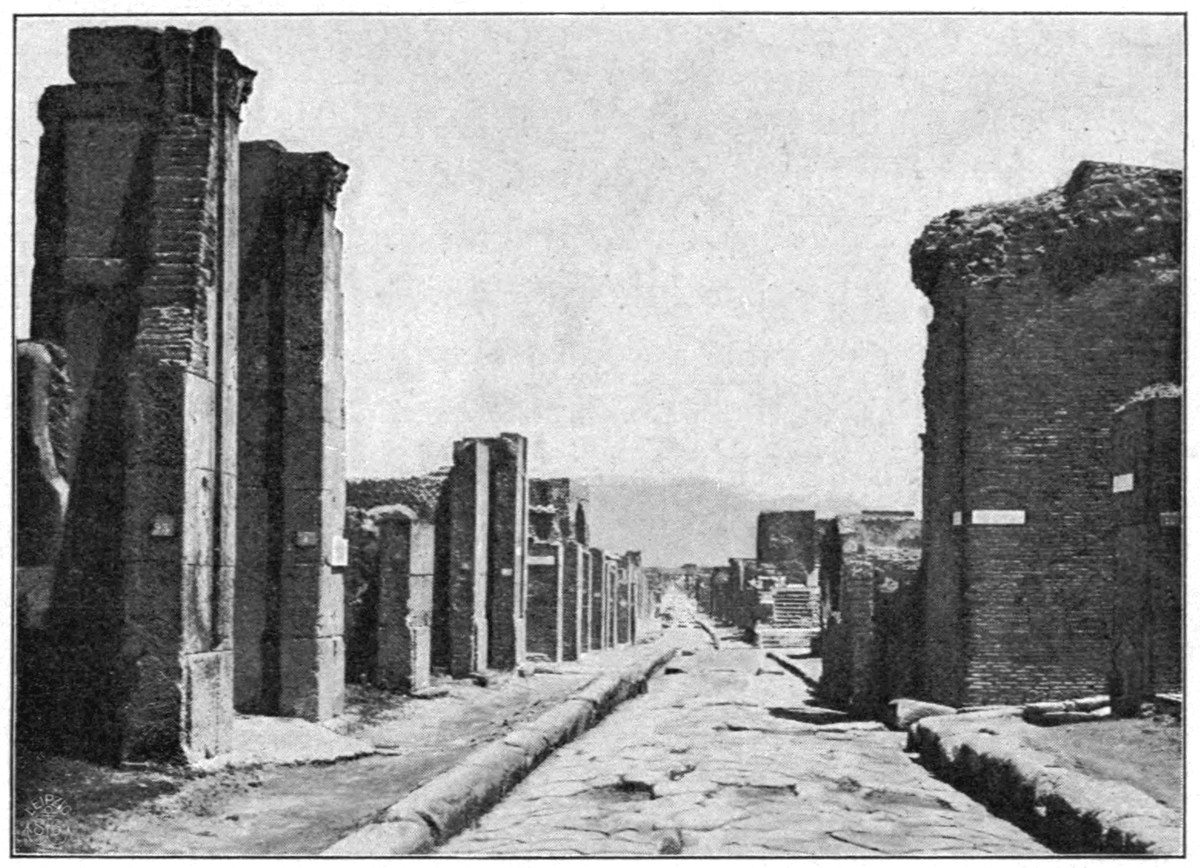
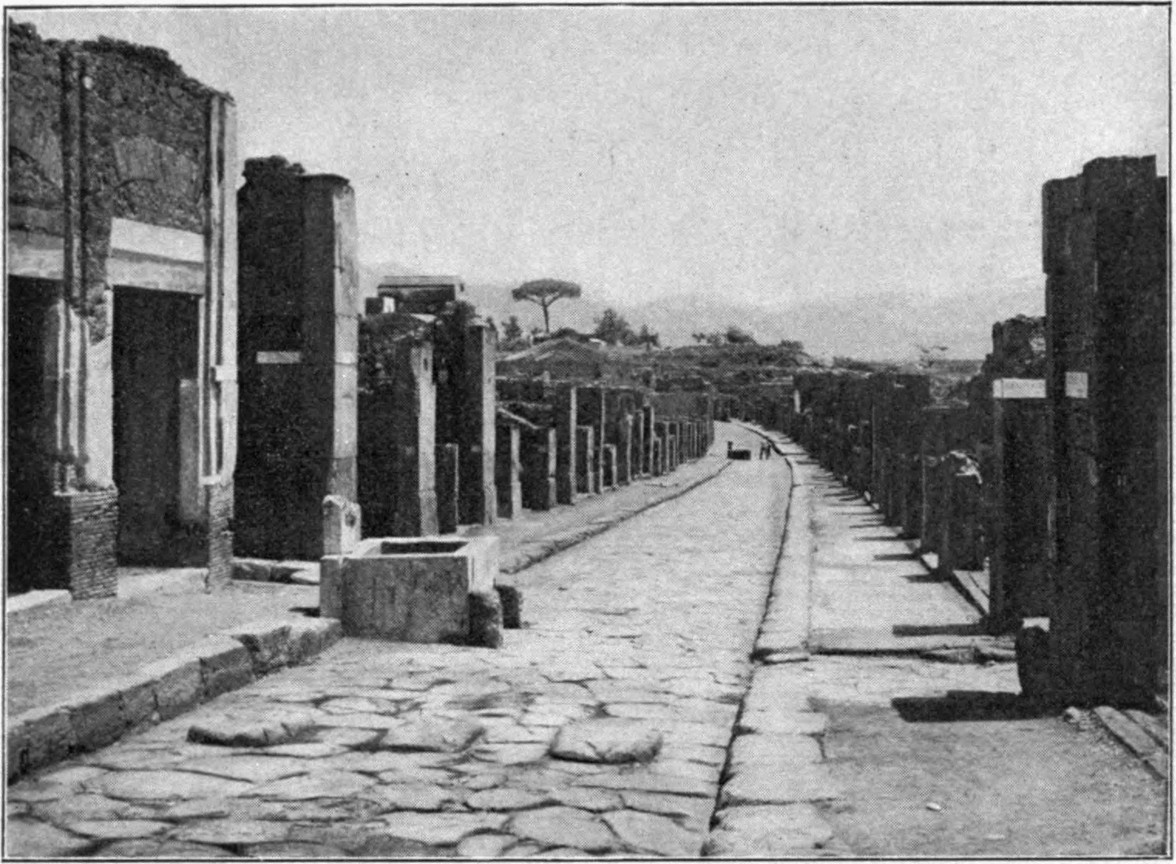
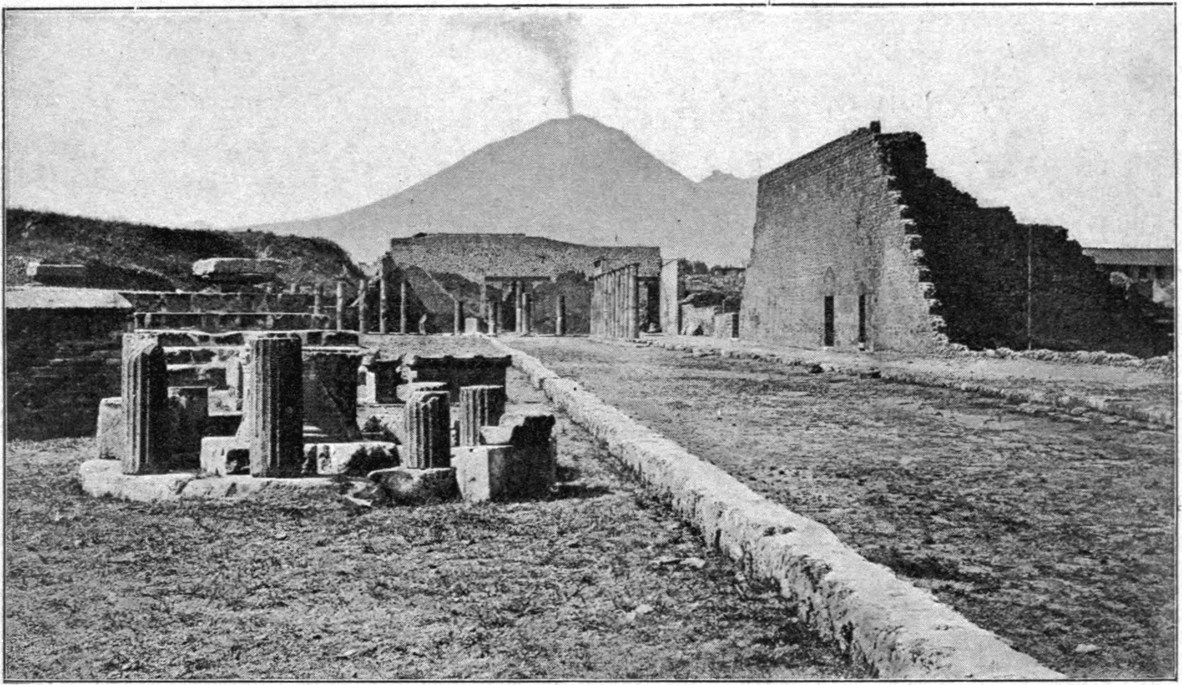
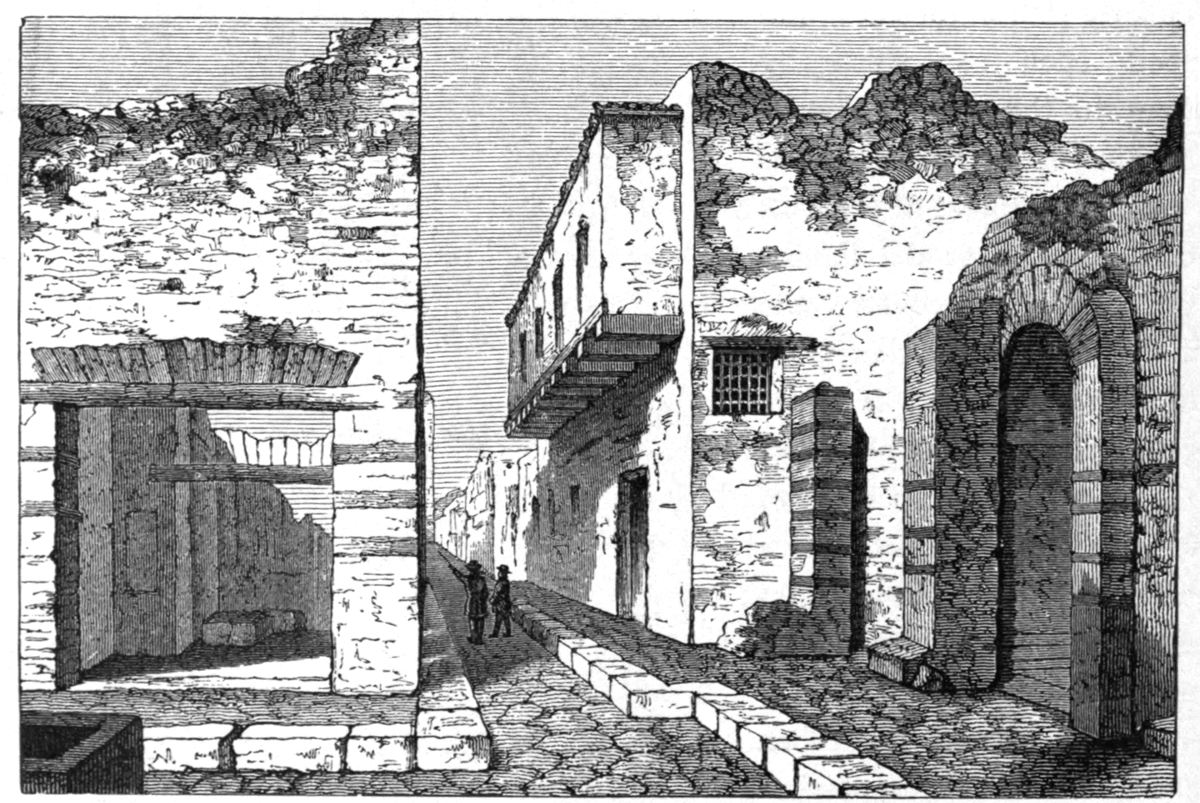
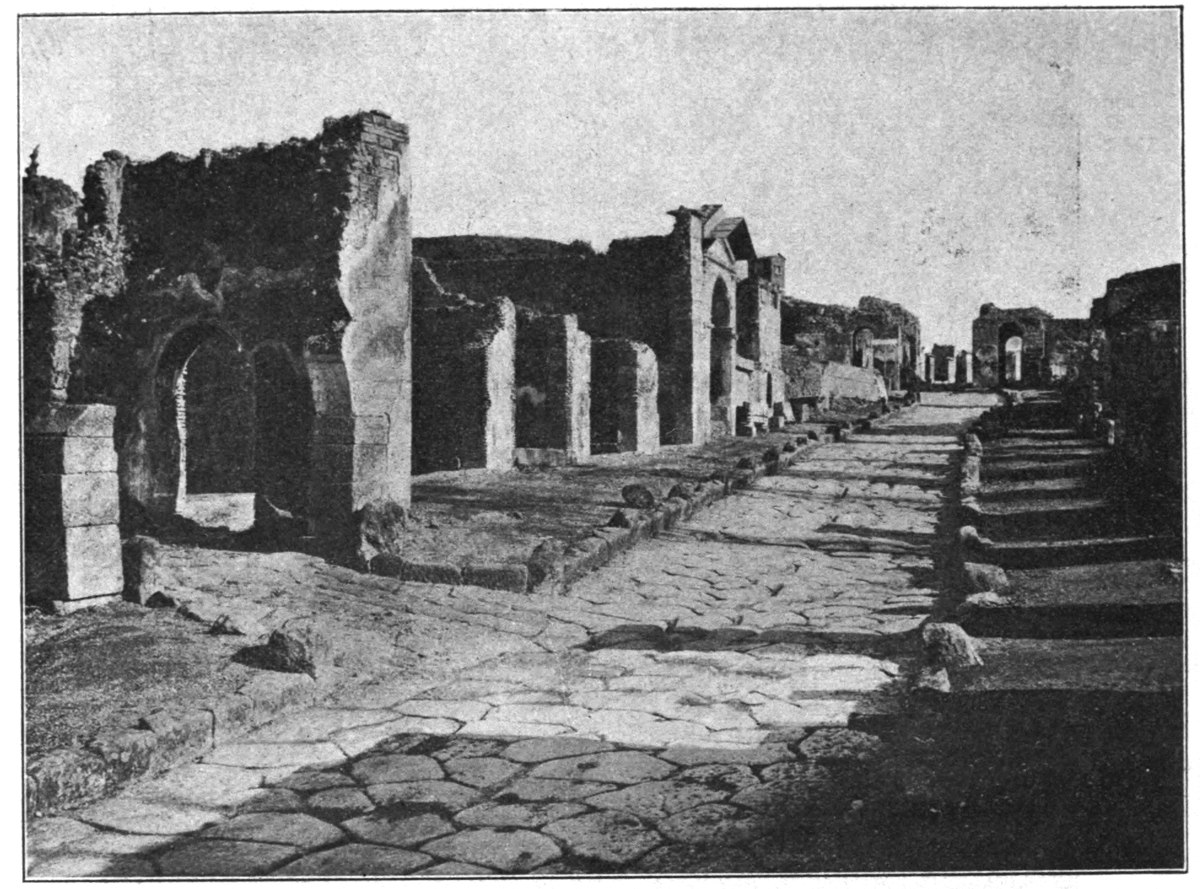
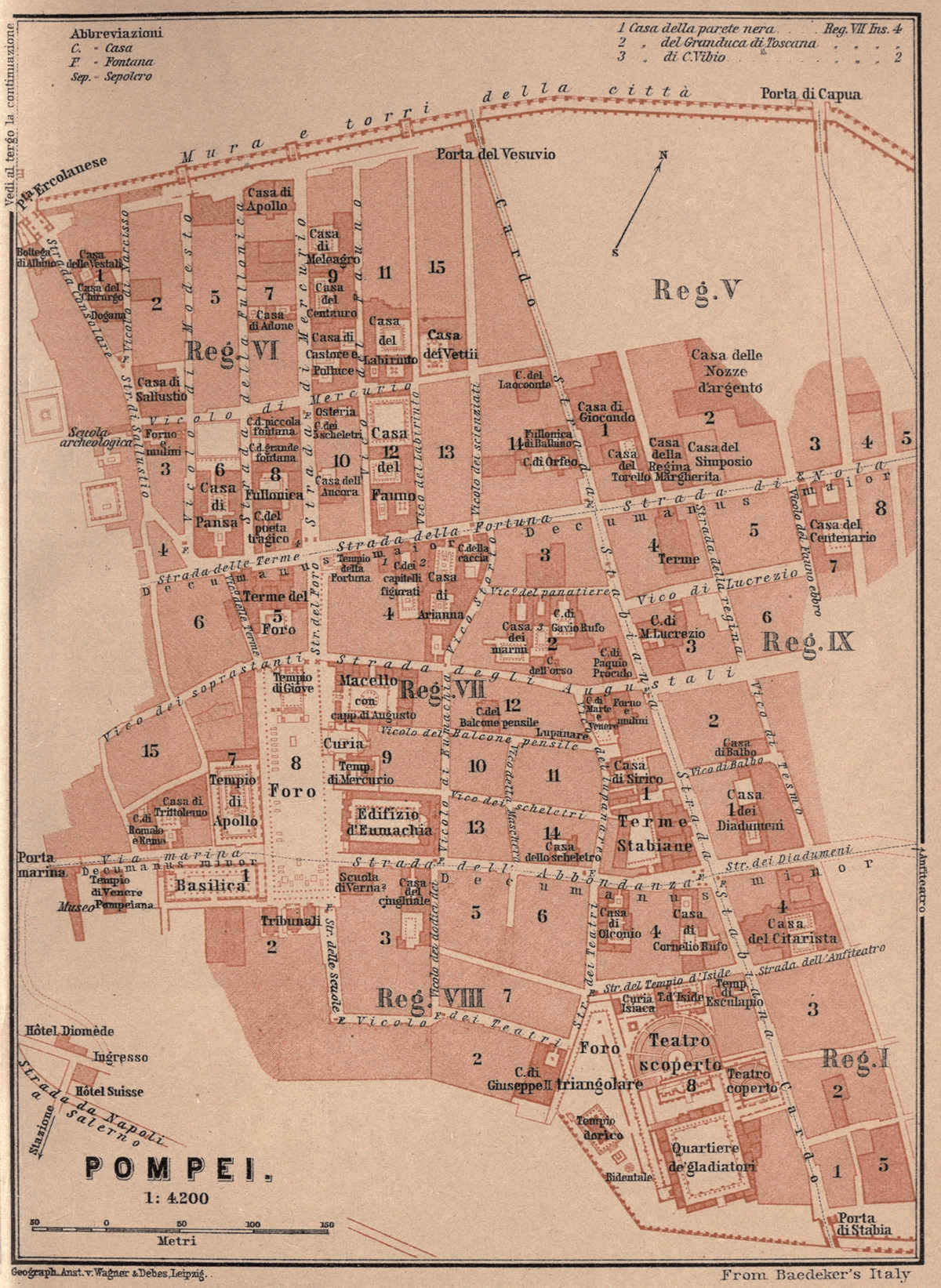
Two streets the Strada di Mercurio with its
extension southwards from the Forum (Fig. 6) and the
Strada di Nola (Decumanus major, Fig. 7)
traverse the city from one end to the other, and
fix thereby the direction of the streets from north
to south and east to west. Only 16now and then have
special peculiarities of the surface led to slight
deviations in the parallel streets. The city was
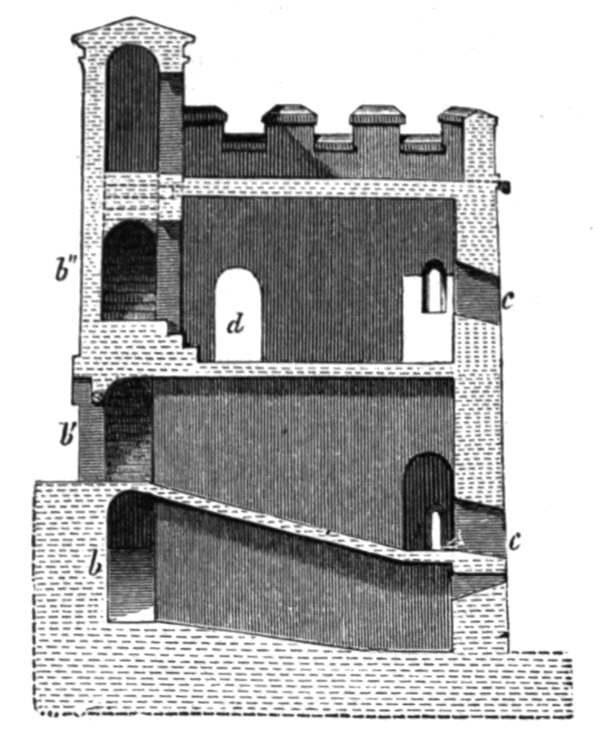
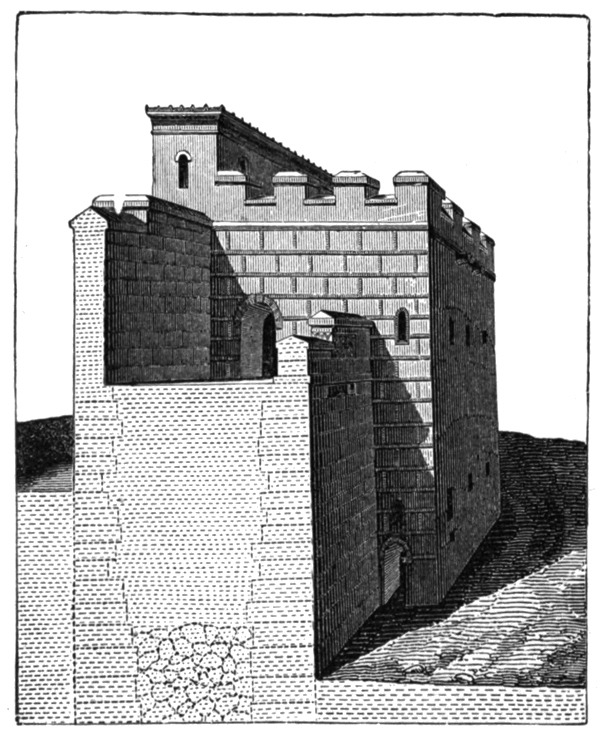
encircled by a wall, which was protected by towers at
regular intervals to give it greater security, on the
other side in order to allow of large bodies of armed
citizens mounting the wall in time of danger, steps
were in parts added to the wall, in other parts a
slope of earth was placed against it. Only on the west
and southwest sides had the walls been broken down in
antiquity and replaced by houses, apparently to gain
space for the extension of the city. Pompeii, true
to its origin, had, in the Social War (B. C. 90-88),
joined the Italians and with the rest had bravely
defended its independence against the Romans; nay in
the year 89 it had sustained a siege by Sulla himself.
For this it was punished, being compelled to give
up part of its possessions to the colonists sent by
Sulla in the year 80. (Hence the new name of the city
Colonia Cornelia Veneria Pompeianorum.)
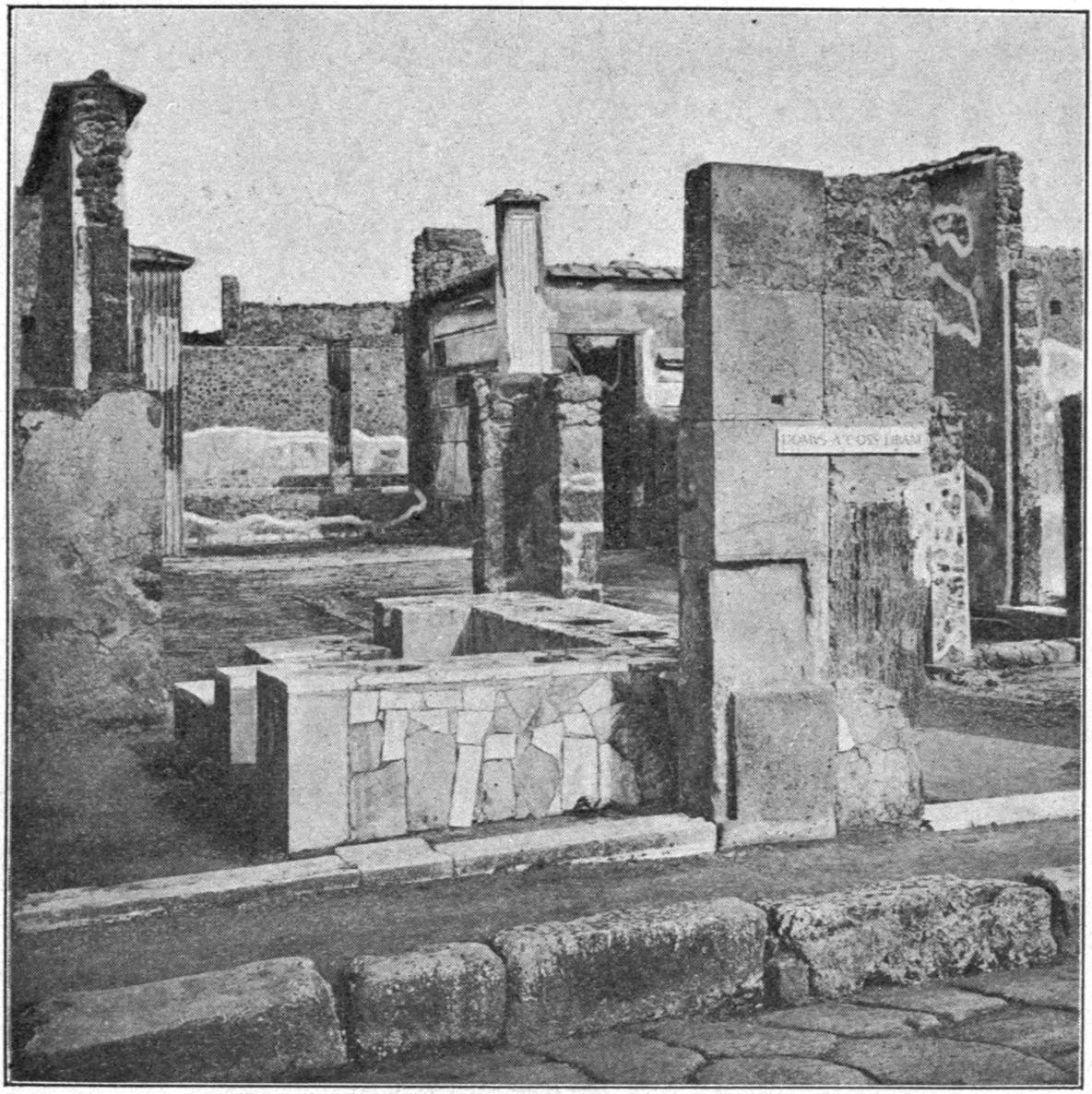
Fig. 19. Cookshop of the Casa di Sallustio (p. 21).
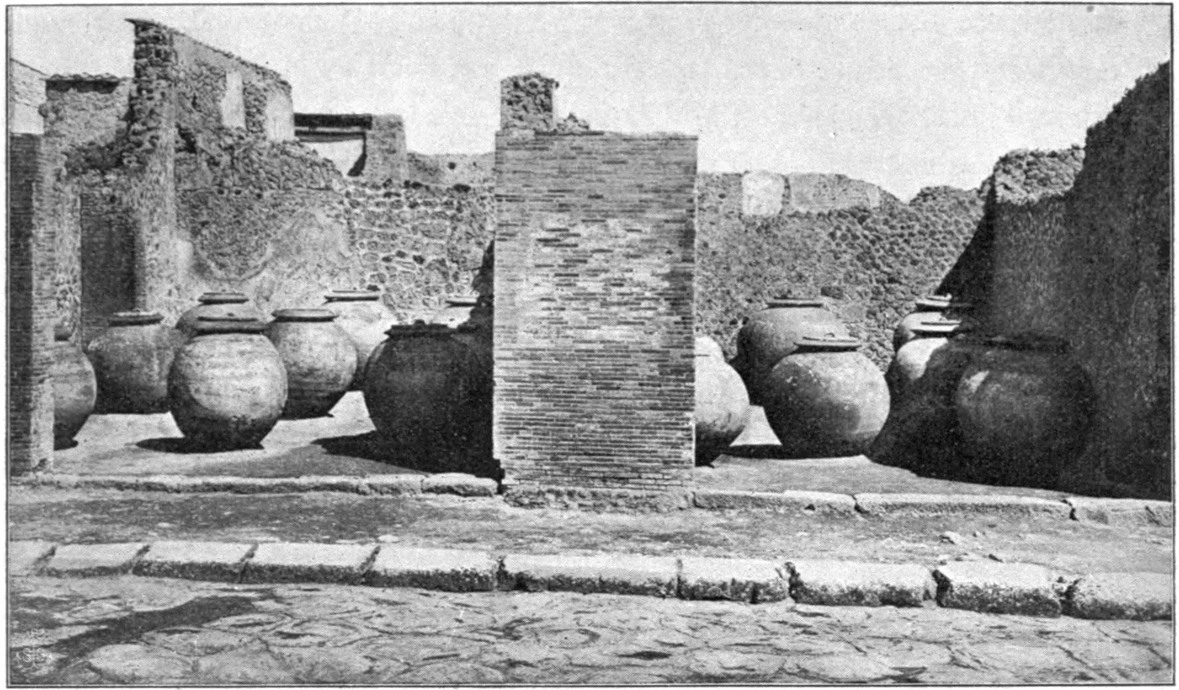
Fig. 20. Oilmerchant’s Shop (p. 21).
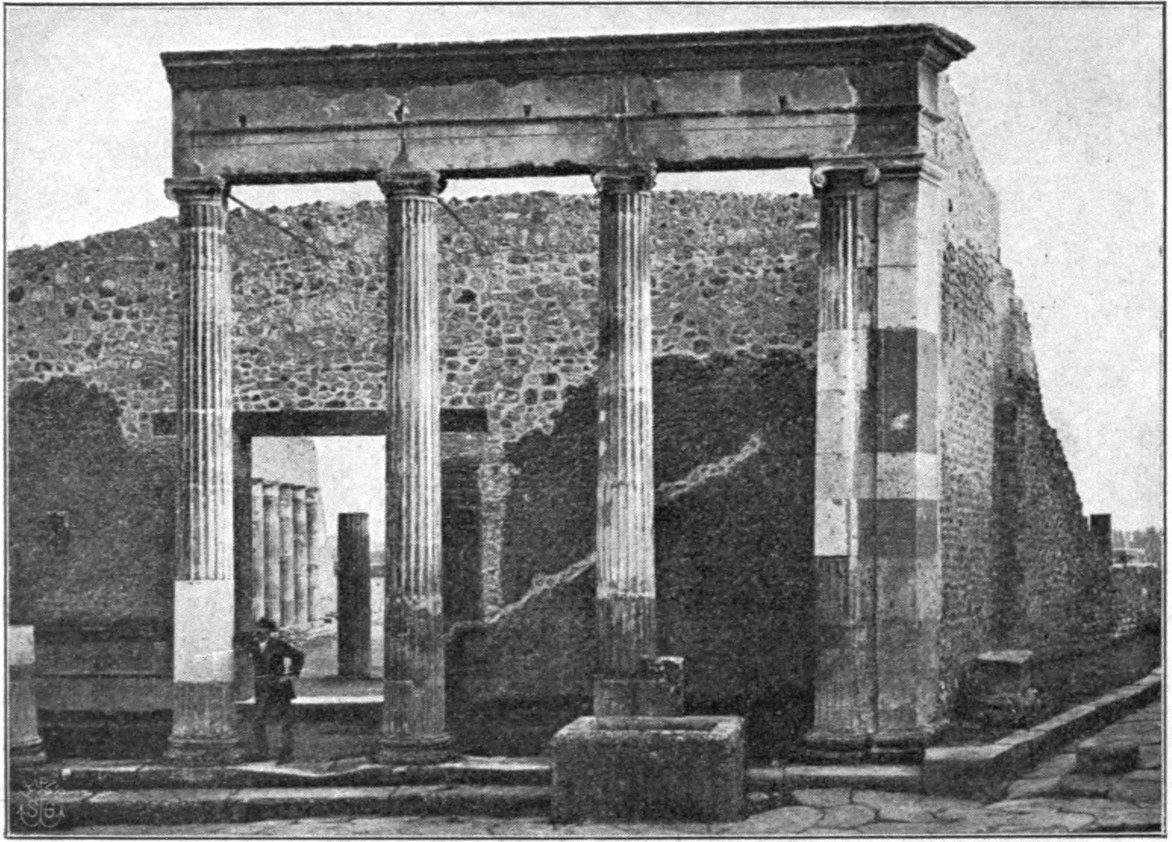
Fig. 21. Entrance to the Triangular
Forum (p. 22).
Fig. 22. The Triangular Forum (p. 22).
17
Under Augustus also was an enlargement of the city
undertaken, the Pagus Augustus Felix being
then founded. That numerous storms have broken over
Pompeii may be seen by the walls, stripped as they
have been completely of their massive facing and
restored only to such an extent as was absolutely
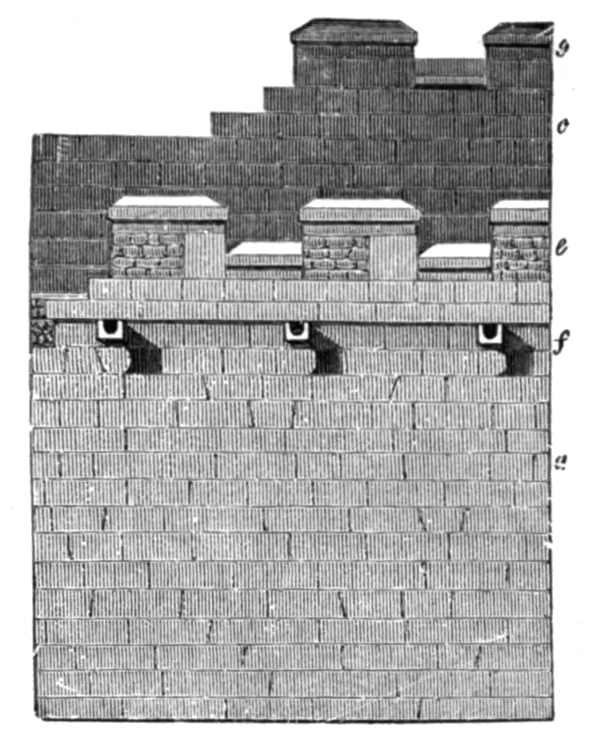
necessary (originally two massive walls were built
and the space between them filled with rubble and
concrete, see fig. 8-10); the towers seem not to have
been placed on the wall till a later time. The city
has eight gates, which were more or less strengthened
by fortifications; especially in the case of the Gate
of Nola, on the east side, on which attack was most
to be expected, one can clearly recognise how one
fortification has been from time to time strengthened
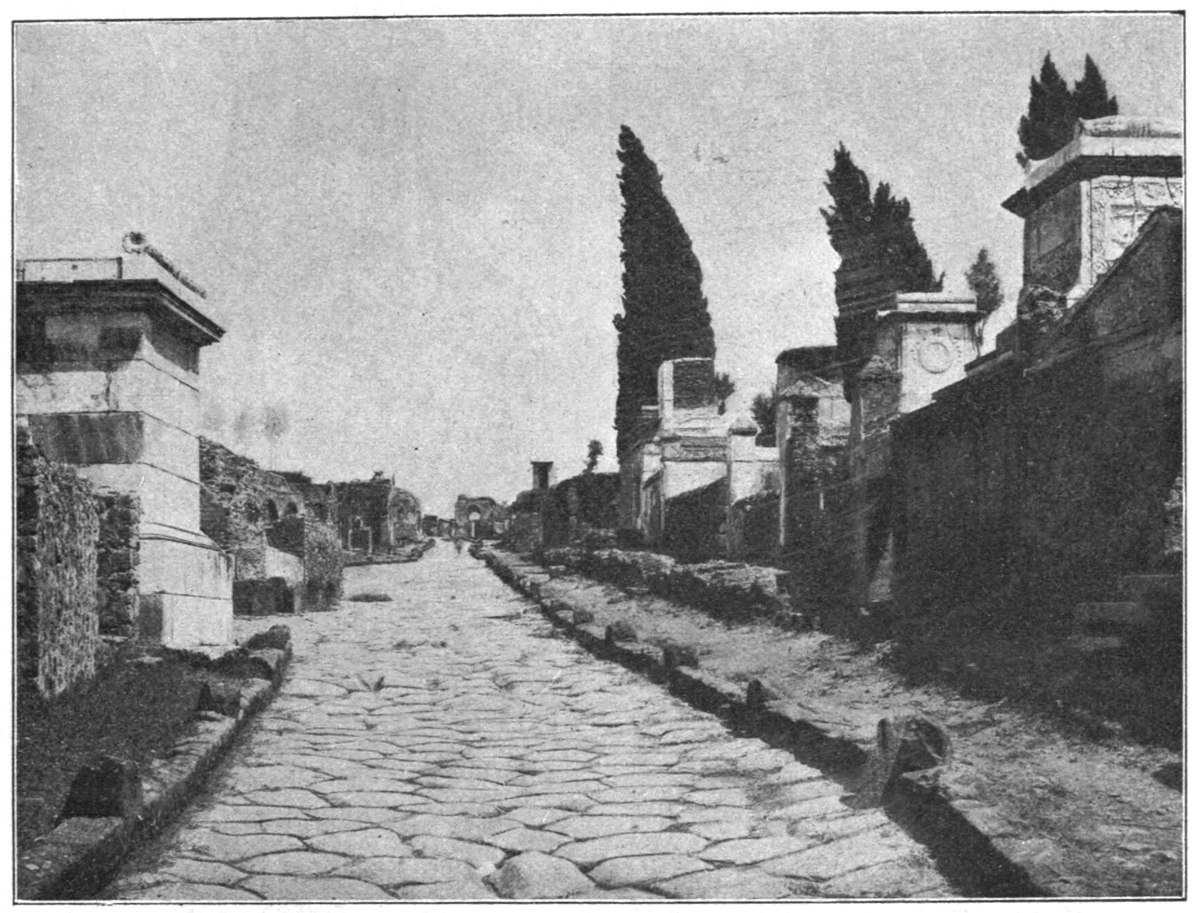
by others. Interesting too in another way is the Gate
of Herculaneum on the northwest side of the city, in
front of which the road is bordered right and left by
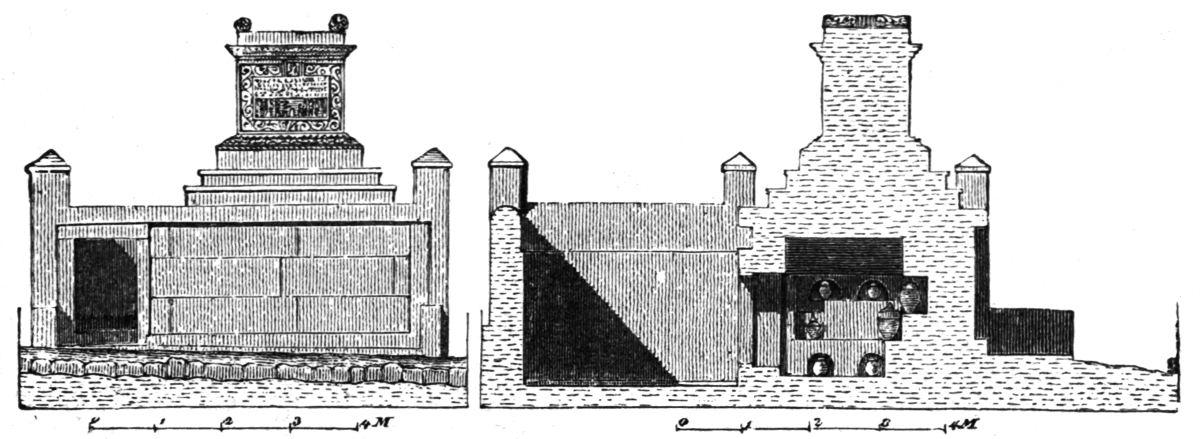
graves, in accordance with the usage of the ancients
to place their graves beside the public roads outside
the city. (See fig. 11.)
Fig. 23. The Forum Civile, seen from
the South (p. 23).
Fig. 24. Forum Civile, from the Temple
of Jupiter (p. 23).
The streets of the city are essentially distinguished
from those of our cities by their narrowness; the
widest measure barely seven metres, some indeed are
not more than from two and a half to three metres
broad. They were 18made so narrow with the object
of securing shade in the streets, so necessary a
requisite in the South, the want of which one feels
in a most unpleasant way for example now where in
Pompeii there is no shade. A part of the width is
taken up by the footpath running on each side, which
slightly raised above the level of the street is paved
with small stones, or bricks, or pieces of marble,
according as the fancy or the wealth of the owner of
the adjoining property, (on whom evidently rested
the care of the footway), prompted the choice of one
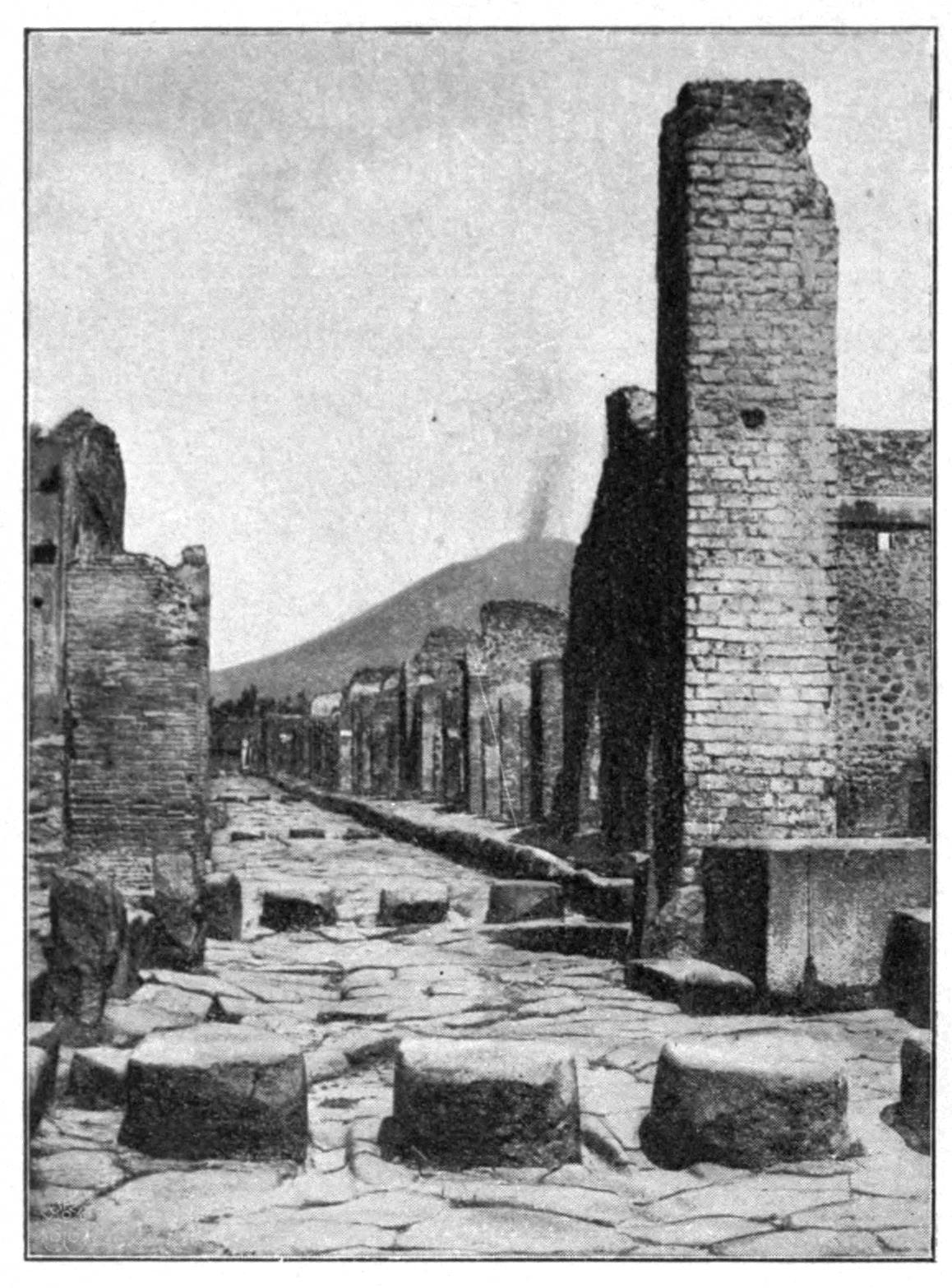
method or another. The carriage road itself is paved
with polygonal blocks of lava, in which the wheels
have often worn deep ruts. (See Fig. 12 and 17.) If
the ruts were too deep, or otherwise repair of the
street was found necessary, the remedy was applied in
the simplest fashion, the stones were merely relaid so
that those little used came where the wheels ran and
those cut up by traffic were transferred to another
place. This explains the curious fact that stones worn
into deep ruts are often found in positions where
no wheel can ever have come. Then on both sides of
the street run gutters, through which the water is
conducted into deep drains and so removed from the
city. In the violent showers of rain which in the
South at times pour down in torrents these provisions
might often have proved insufficient and the street
also may have been under water. In order therefore to
provide the foot passenger with as dry as possible
a crossing from one side of the roads to the other,
stepping-stones have been placed at intervals across
the street. These met the requirements of the 19case
without interfering with the carriage traffic (for the
draught-animals were attached only at the extremity
of the pole, so they could pass between the stones
more easily than would be possible with our modern way
of harnessing). Some streets on the other hand were
entirely closed against wheel-traffic. This was quite
possible, carriages being as a rule employed for the
transport of persons only in travelling outside the
city. Besides the difference in width the streets of
Pompeii are essentially distinguished from those of
our cities by the circumstance that the houses at any
rate on the groundfloor have no windows. The ancient
house in its main features was built solely with
regard to interior effect. Only occasionally was the
surface of the outer wall broken by small openings
widening inwards, which are all that can be compared
with our windows (Fig. 13); and these too, raised far
above the height of a man, are barred by lattice of
iron or terracotta. On the other hand the street-front
was often enlivened by painting, the outer wall was
divided into panels which were painted red or yellow
with various ornaments according to the taste of the
respective householders. Larger paintings are often
to be found, as the twelve gods, sacrifices to the
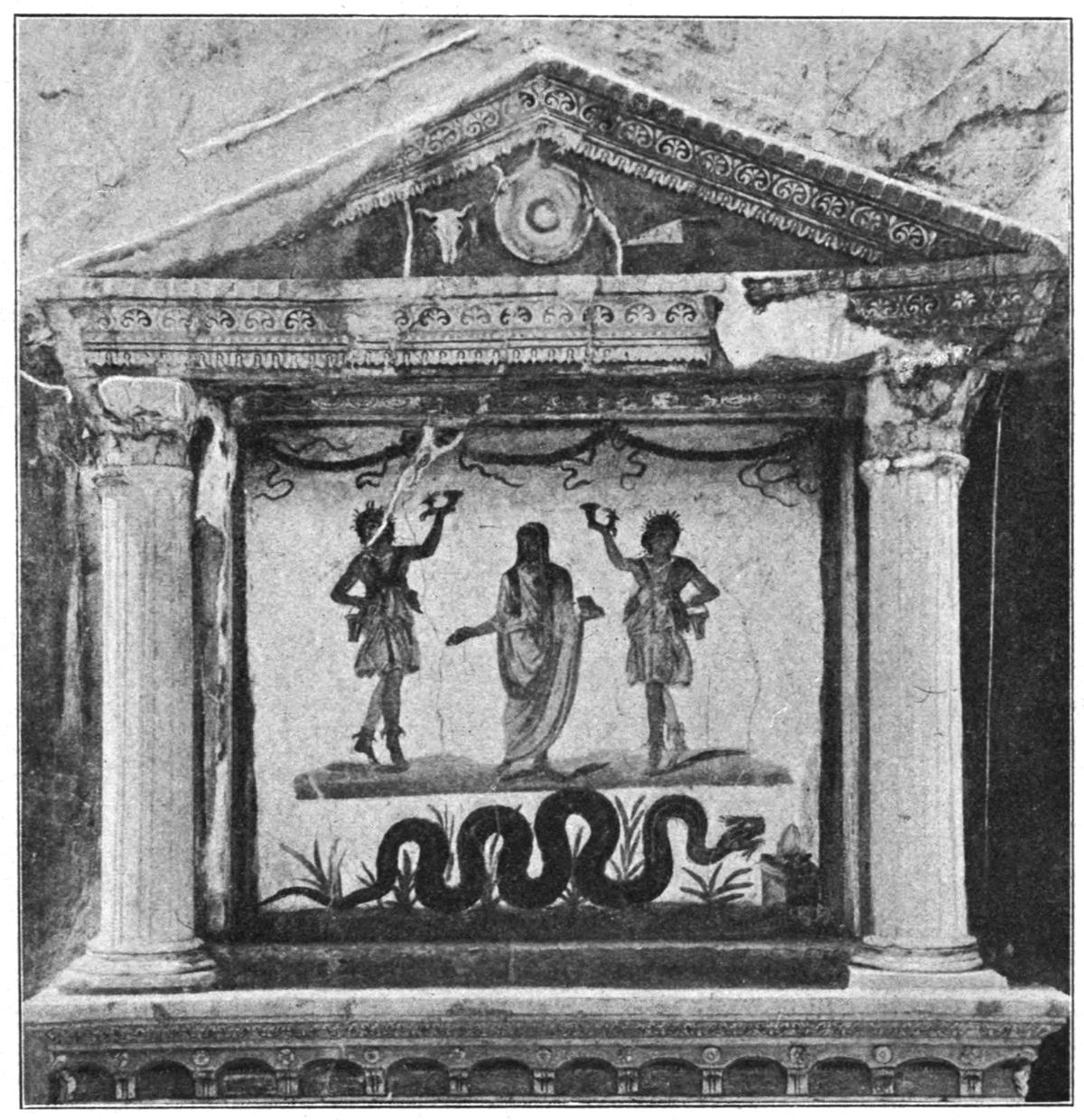
Lares, the household gods, etc. In places
likely to be misused were painted a pair of serpents
etc. as a deterrent. Besides these things
there were all sorts of inscriptions on the houses.
A distinction is usually made between two classes of
inscriptions, Dipinti and Graffiti.
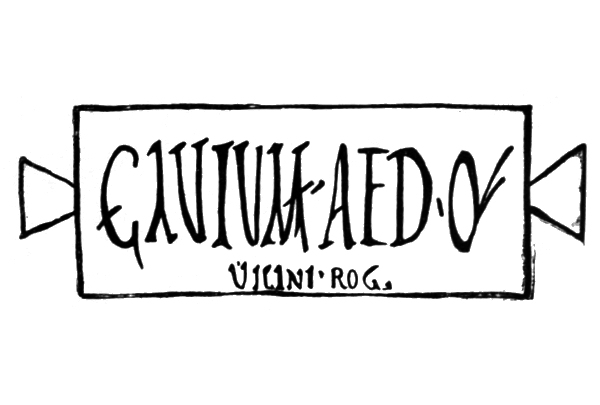
The former are painted on the walls with a broad
brush in large letters, for the 20most part in red
colour on a white ground. By Graffiti on the
other hand are understood inscriptions slightly
scratched with a pointed style or nail in the
plaster. The Dipinti contain summonses to
elections, announcements of Games &c. Duumviri
juri dicundo, the Board of Two, the highest
magistracy of the city, are to be elected; there being
no newspaper, the names of the candidates are painted
on the walls, and underneath is written Proposed by
so and so (Fig. 14). Or a new troop of gladiators
arrives: in order to entice as many spectators as
possible, an advertisement is written on the walls
with the names of the principal combatants and the
number of their victories, nor do they forget to add
that to guard against the sun’s heat awnings are
spread over the theatre; in short one lights on the
very footsteps and traces of quickly throbbing life,
so that one feels oneself carried back into the time
of the old citizens of Pompeii.
With almost greater originality the life of the old
Pompeians rises before us in the Graffiti.
Scarcely a spot strikes the eye that is not covered
with such outpourings of gay or wicked fancy scratched
in the slightest strokes. Here one tells another’s
secrets, there one celebrates in verse a sweetheart,
a third complains of the obstinacy of a maiden, a
fourth, no doubt a boy fresh from school—he could
not reach far—attempts to write down the beginning
of a well-known poem but he does not get much further
than the first words. A second, proud of his learning,
begins the verse afresh, yet he too comes to a
standstill when he has carried the verse a little
further. A third at last completes the whole verse.
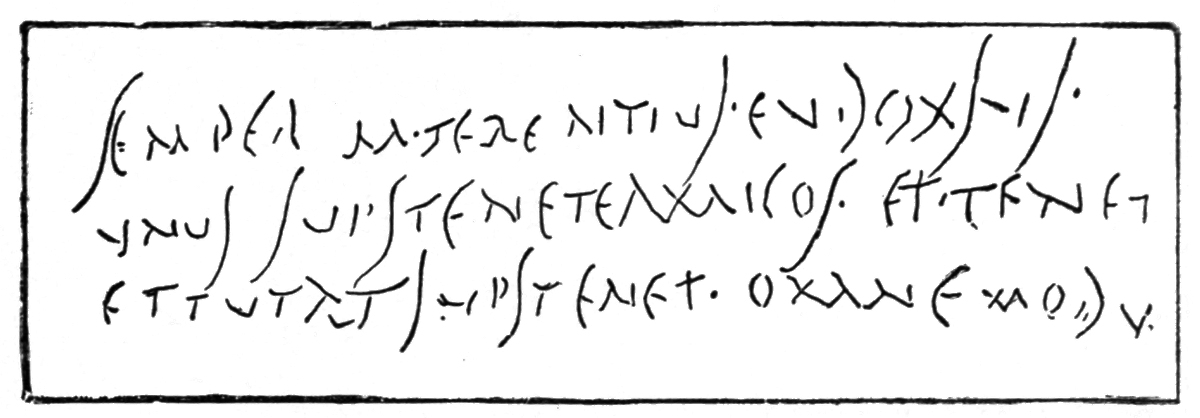
At another place a parasite gives a broad hint for an
invitation or pays his debt of thanks. (See fig. 15.
Semper M. Terentius Eudoxus unus supstenet amicos et
tenet et tutat, supstenet omnem modum.)
Thus witticisms and drolleries abound in those
inscriptions, so that one who passed through the
streets and had a liking to decipher these scrawls
need not want for amusement. Variety too is afforded
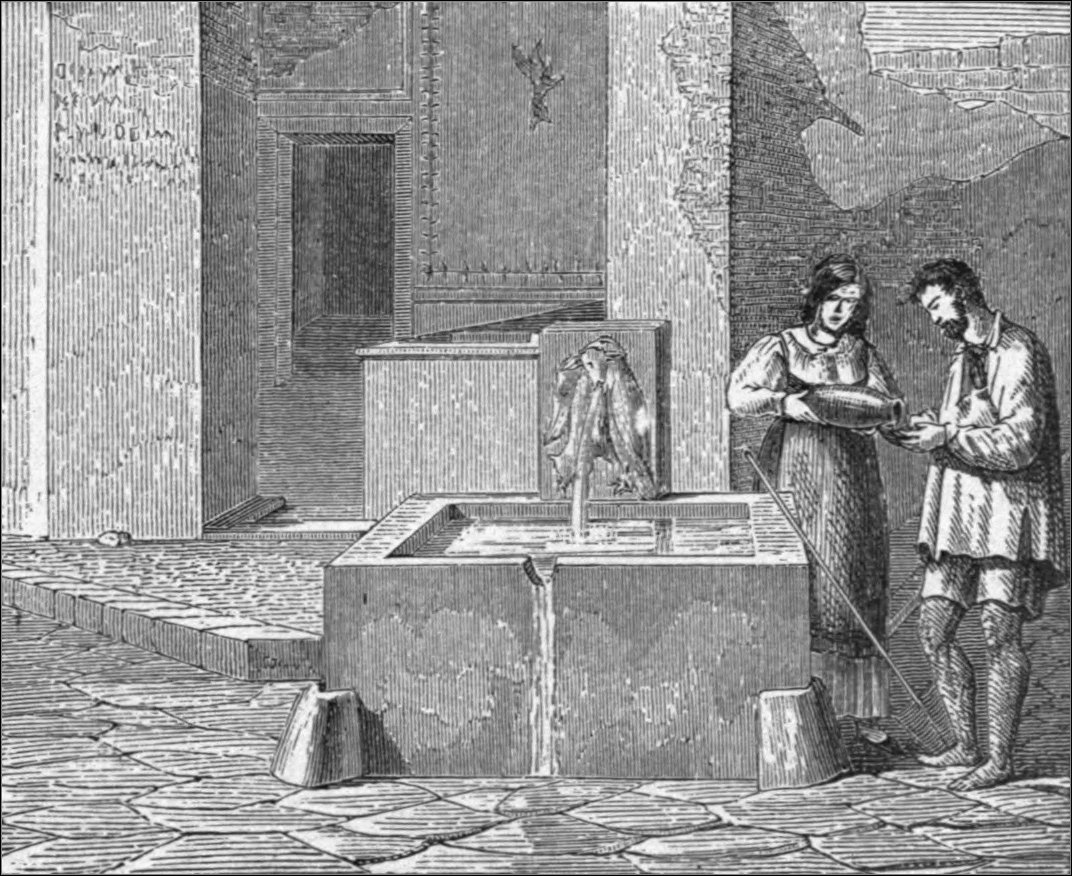
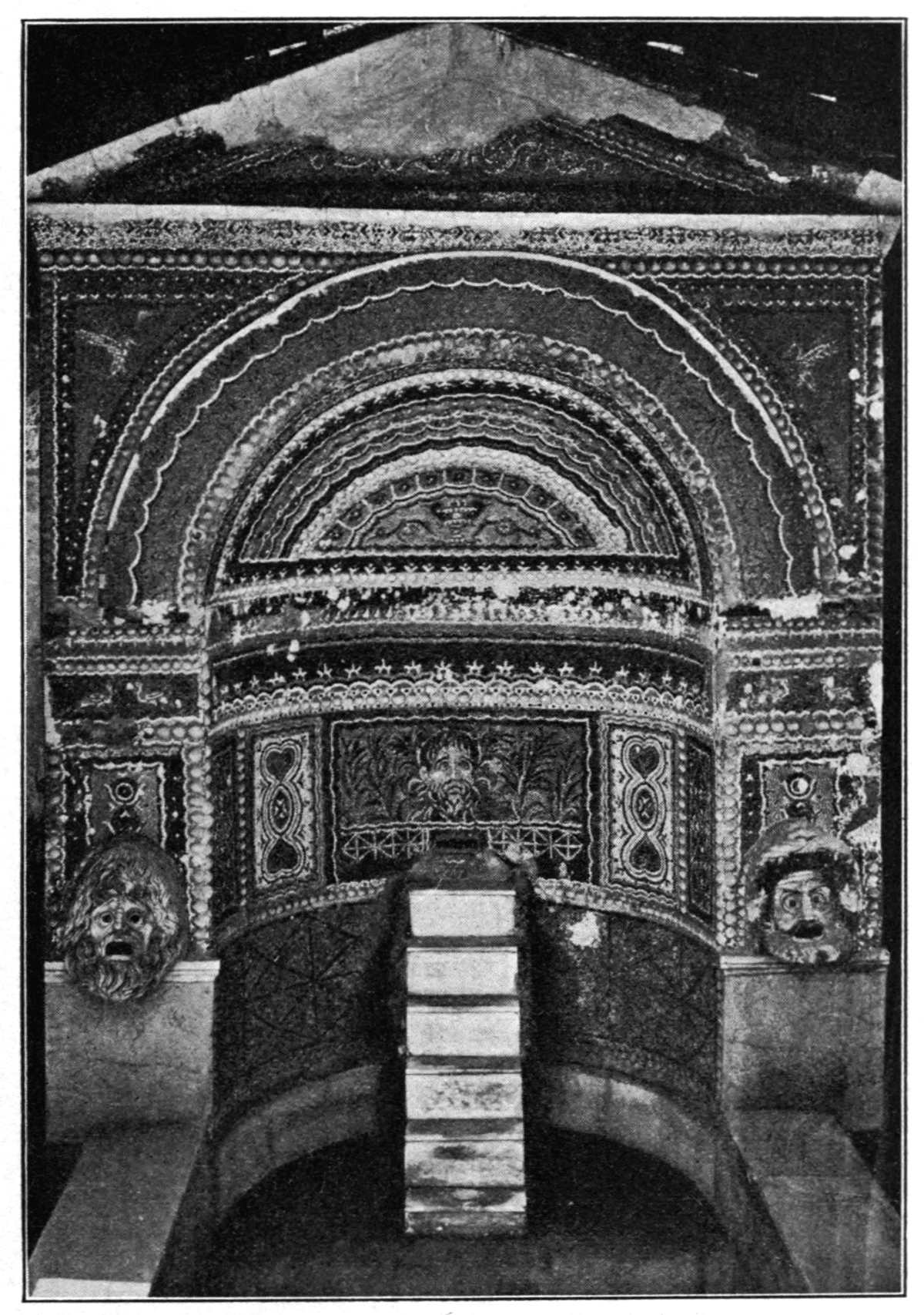
by the fountains (Fig. 16) which were fed from the
public water-supply (probably this was a branch of
the conduit which brought the water to Naples from
the mountain range on the east). In Pompeii, as in
Palermo at the present day, the water was for better
distribution conducted into reservoirs raised on high
pillars. From these the water was brought through
lead pipes to the public fountains and to the houses.
(See fig. 17, representing a corner of the Stabiae
Street with the pillars to support the water.) These
fountains were ornamented with small reliefs, for
example a Silenus leaning on a wine-skin, from the
opening of which the water escapes; an eagle that has
seized a hare (here the water flows out of the hare’s
mouth), and similar representations. On the fountain’s
brim may still often be seen the place where the young
people drinking straight from the spout used to put
their hands. To this picture of the streets however
the liveliest touches were given by the shops, rooms
open on the outside their whole breadth, in which
retail trade was carried on. As at the present time,
in the palaces of Italian cities, the groundfloor
is occupied by shops which bring in to the owner
an excellent rent, the rich Pompeians also did not
disdain to establish shops on the street-side of their
houses which without any connection with the principal
edifice were let to persons engaged in trade, to whom
a kind of upper chamber above the shop often served as
a dwelling. Or the householder himself carried on a
trade, in which case he established a connection with
the inner part of the house by means of a door, to
facilitate his watching over the business, whether he
managed it in his own person or through a slave. There
are cook shops, recognised as such by the hearth and
the pots fixed in it, from which the food was ladled
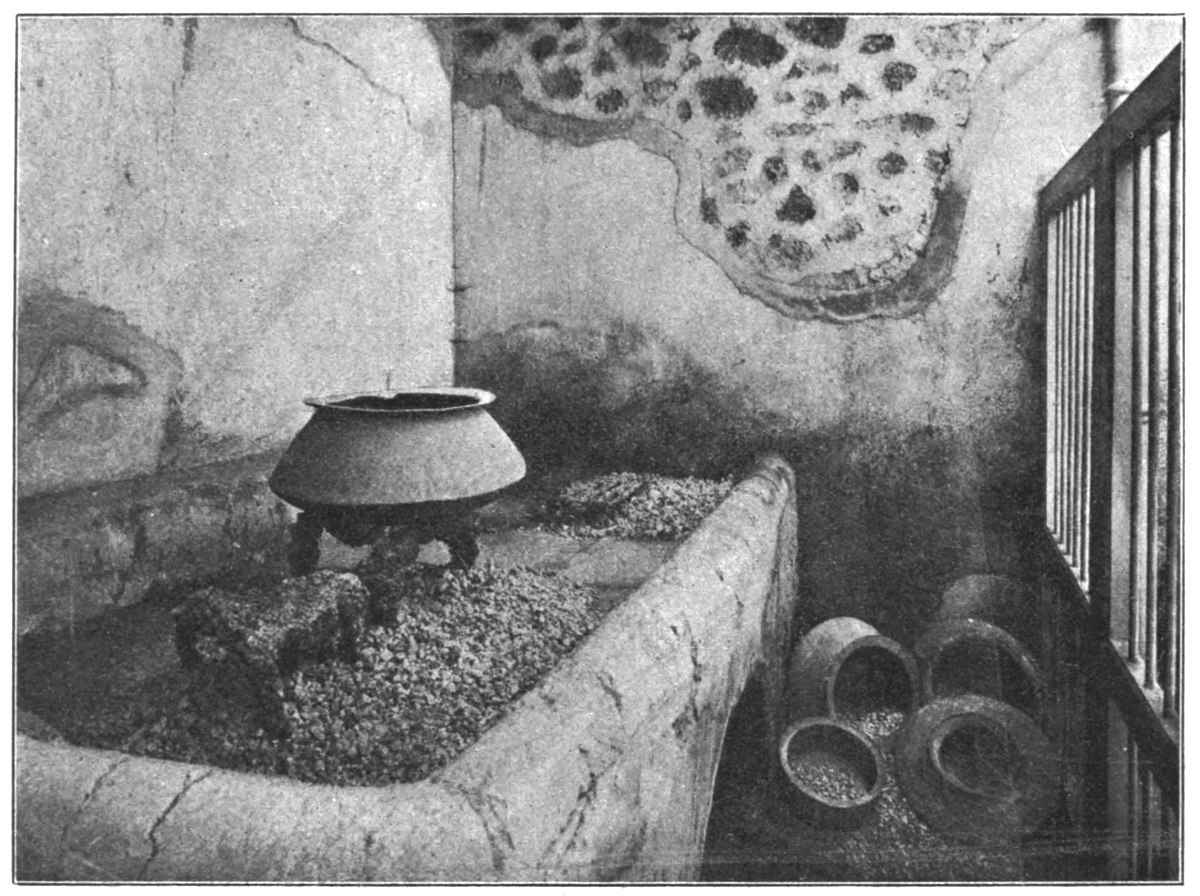
out (fig. 18 and 19), oil shops with large pitchers
similarly fixed, and huge barrels in the background
(fig. 20), shops where wine and other drinks were
sold, with shelves built up like steps so as to admit
of arranging the drinking vessels conveniently, and
with a little room at the back for regular customers:
there are butchers’ and bakers’ shops that by means
of pictures bring before the passer by the various
objects to be purchased therein. In short an abundance
of fresh sights, so that the eye can experience no
weariness.
Fig. 27. The Temple of Jupiter (p. 25).
Fig. 28. The Temple of Jupiter,
Reconstruction (p. 25).
Fig. 29. The Macellum, (the Meat
market) (p. 25).
Fig. 30. Wall ornamented with pictures
in the Macellum (p. 26).
22
So much for the streets of Pompeii. Of open spaces for
public use there have been found as yet two, if we
leave out of consideration the doubtful Forum Boarium,
excavated at an earlier period in the neighbourhood
of the amphitheatre, but afterwards filled up again,
viz., the principal Forum (Forum Civile) and
the one called from its shape the Triangular Forum.
The latter a three-cornered space in the southwest
angle of the city lying close to both theatres from
which an open flight of steps leads, is certainly one
of the oldest parts of the city, as is amply proved
by the scanty remains of the Temple situated there,
which is contemporary with the most ancient temples
of Paestum and Selinus. The open space was surrounded
on three sides by a colonnade, and a portico or
Propylaion forms the entrance to it (fig. 21 and
22). The Temple, dedicated according to the latest
researches to Minerva, had apparently like the Temple
of Zeus at Agrigentum, seven columns on the narrow
sides, and according to its form must be classified
as Pseudodipteros (before the eruption it had already
been destroyed and on its site a very modest sanctuary
had been erected). Close to it is a seat, from which
could be enjoyed the magnificent view over the sea
and the splendid Monte Santangelo far spreading and
23towering high into the air. On the other side a
small dome indicates an ancient fountain. To a later
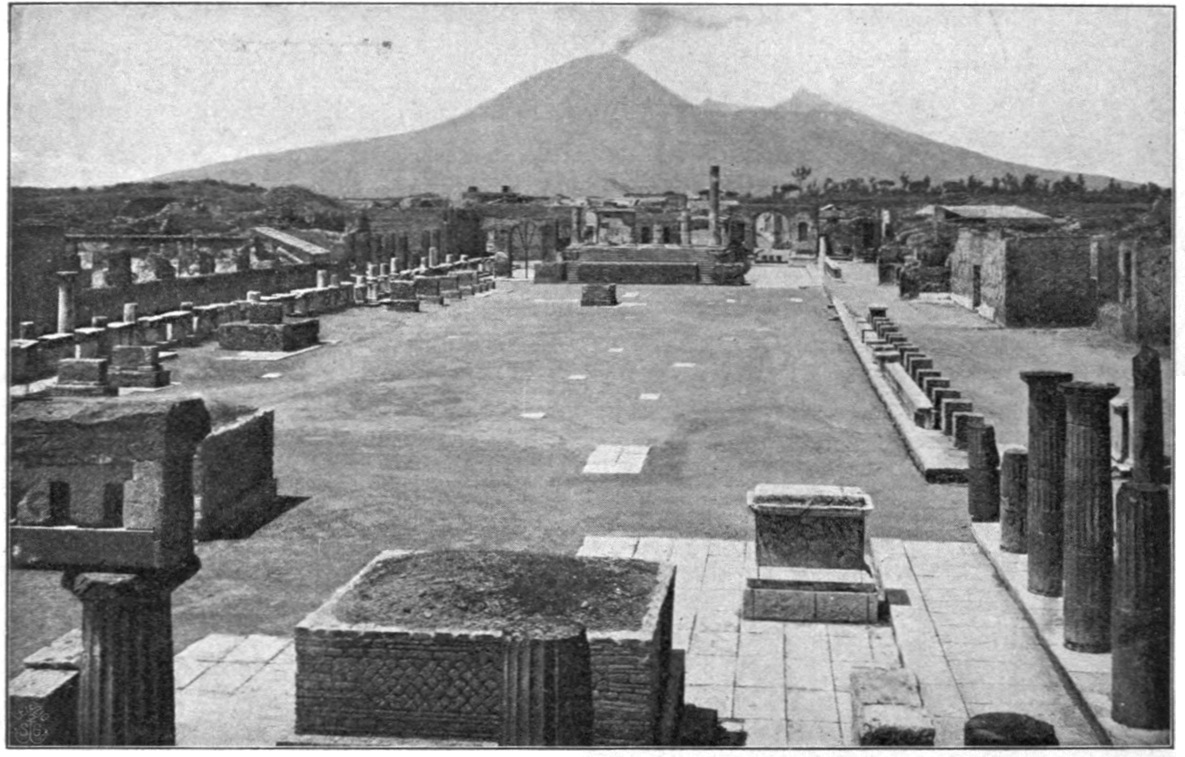
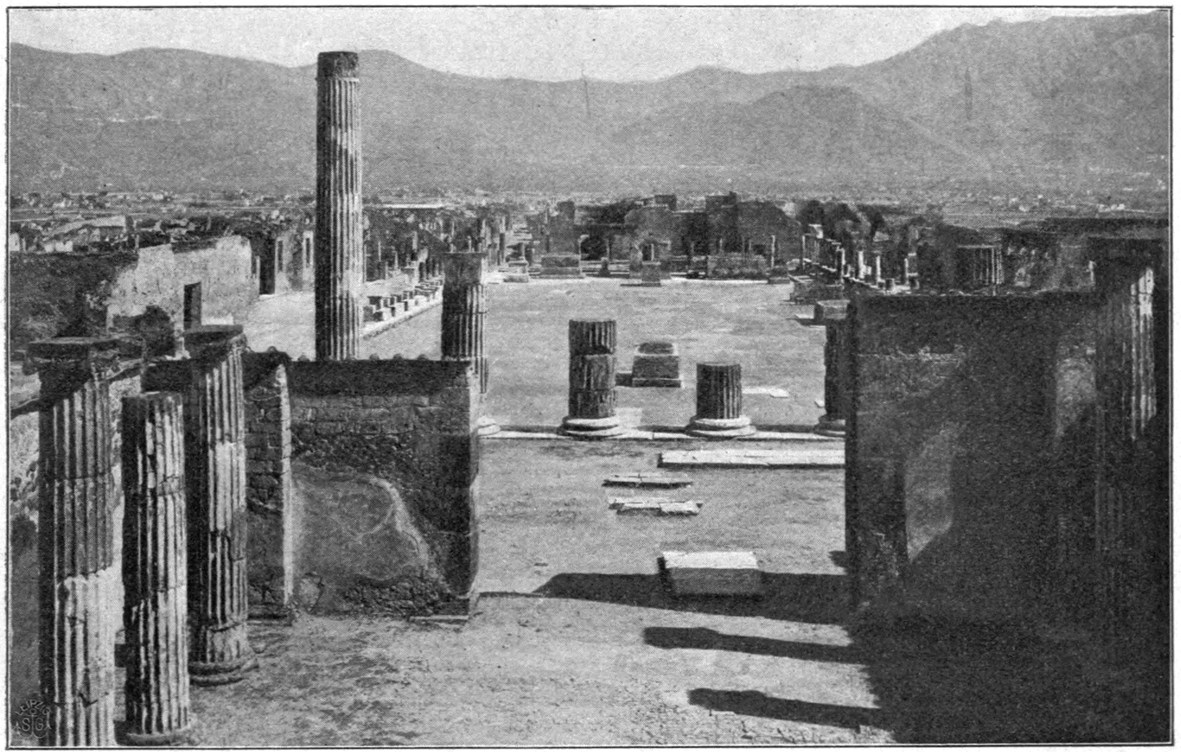
epoch belongs the Forum Civile, lying to the
northwest of the above, and forming a rectangle (fig. 23
taken from the south side, fig. 24 from the north).
That the laying out of this is comparatively modern,
follows from the fact that through the surrounding
buildings a series of streets have been reduced to
blind-alleys, which at the time of their formation was
assuredly not intended. The decoration of the Forum,
it seems, was not yet completed when the eruption of
Vesuvius buried Pompeii. The footpath was to be paved
with marble slabs, and a colonnade was to be erected
all round, double on the South, with a gallery above
for women, when the games were held in the Forum. But
this was never carried out; the architectural members
lie around still unused. The built up bases too for
statues of honour and equestrian statues seem to have
been still unoccupied, if some excavation made shortly
after the eruption has not robbed us of the chief
objects. The ancestors of the emperors, the Julian
family, and the Kings of Rome ought to have been
placed around on pedestals, yet the only inscriptions
found are those referring to Romulus and Aeneas. Of
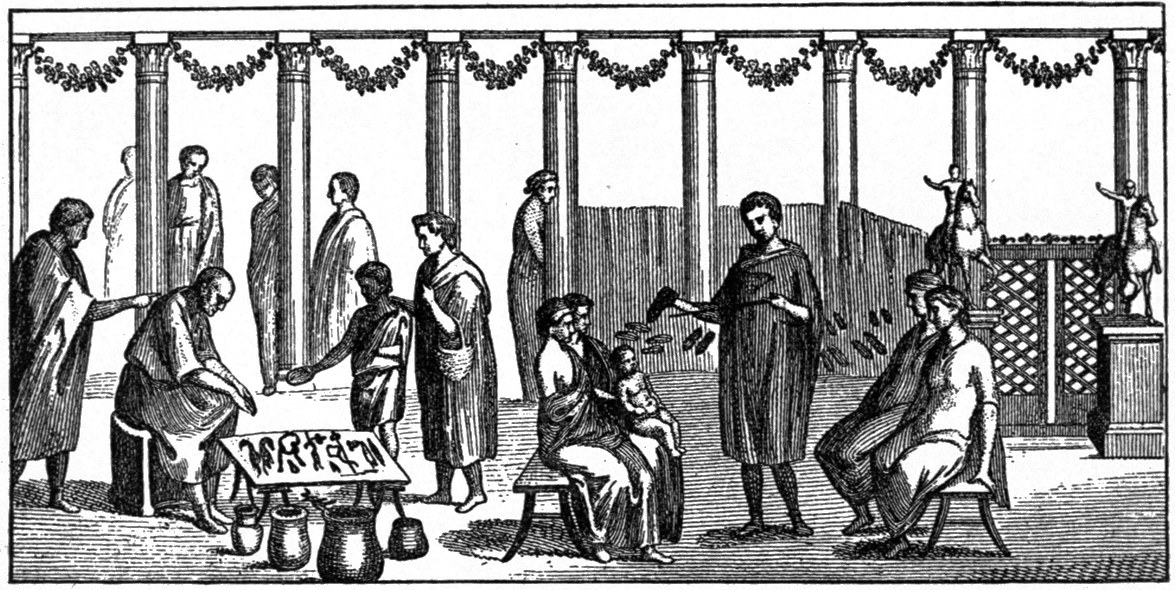
the business prevailing in the Forum, taken up as it
was with trade and commerce and even schoolwork, we
derive information from the Pompeian wall-paintings,
e. g. fig. 25. Vehicles were not 24admitted, and there
are indeed indications that (at elections and on
similar occasions) the approaches could be completely
closed with railings. In no other part of Pompeii
are there so many public buildings, no private house
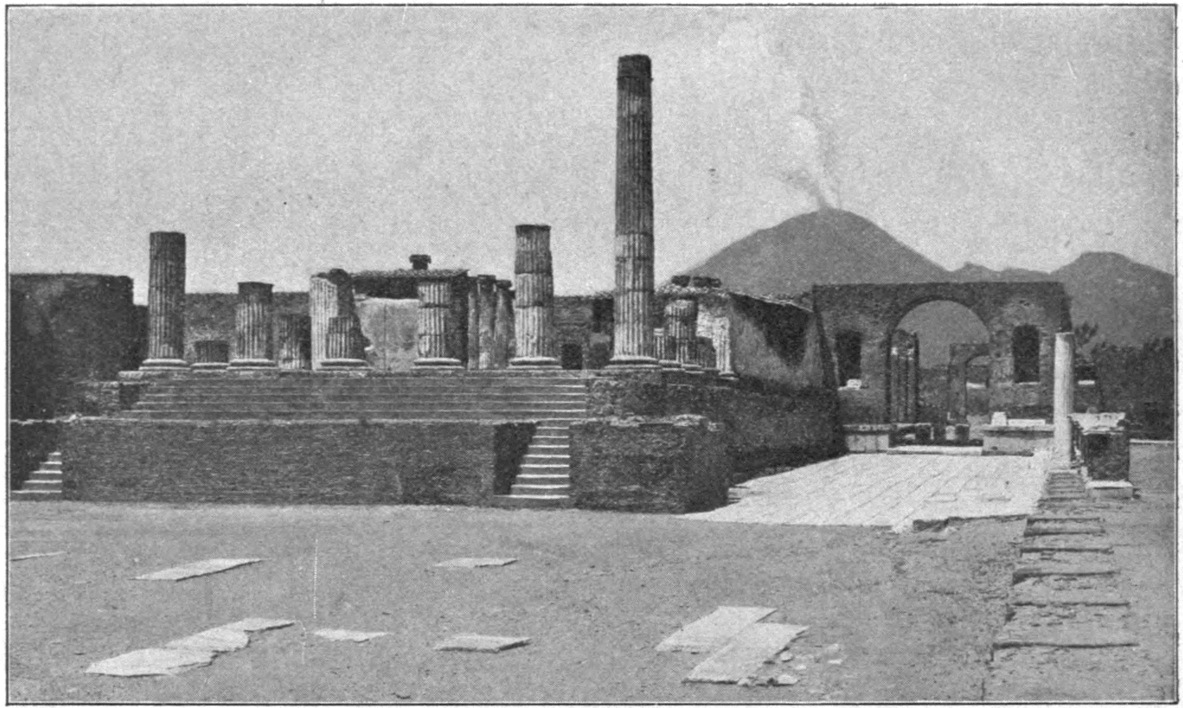
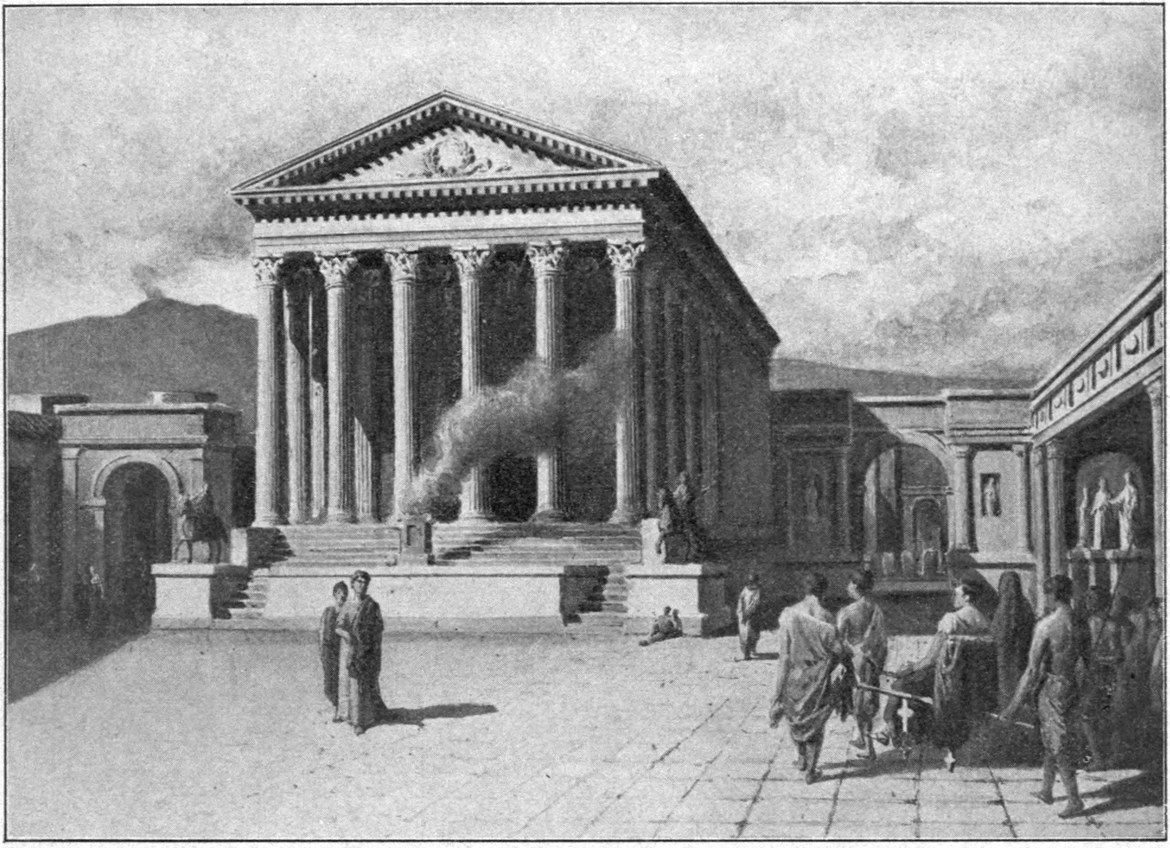
25ventured to intrude here. In the first place at the
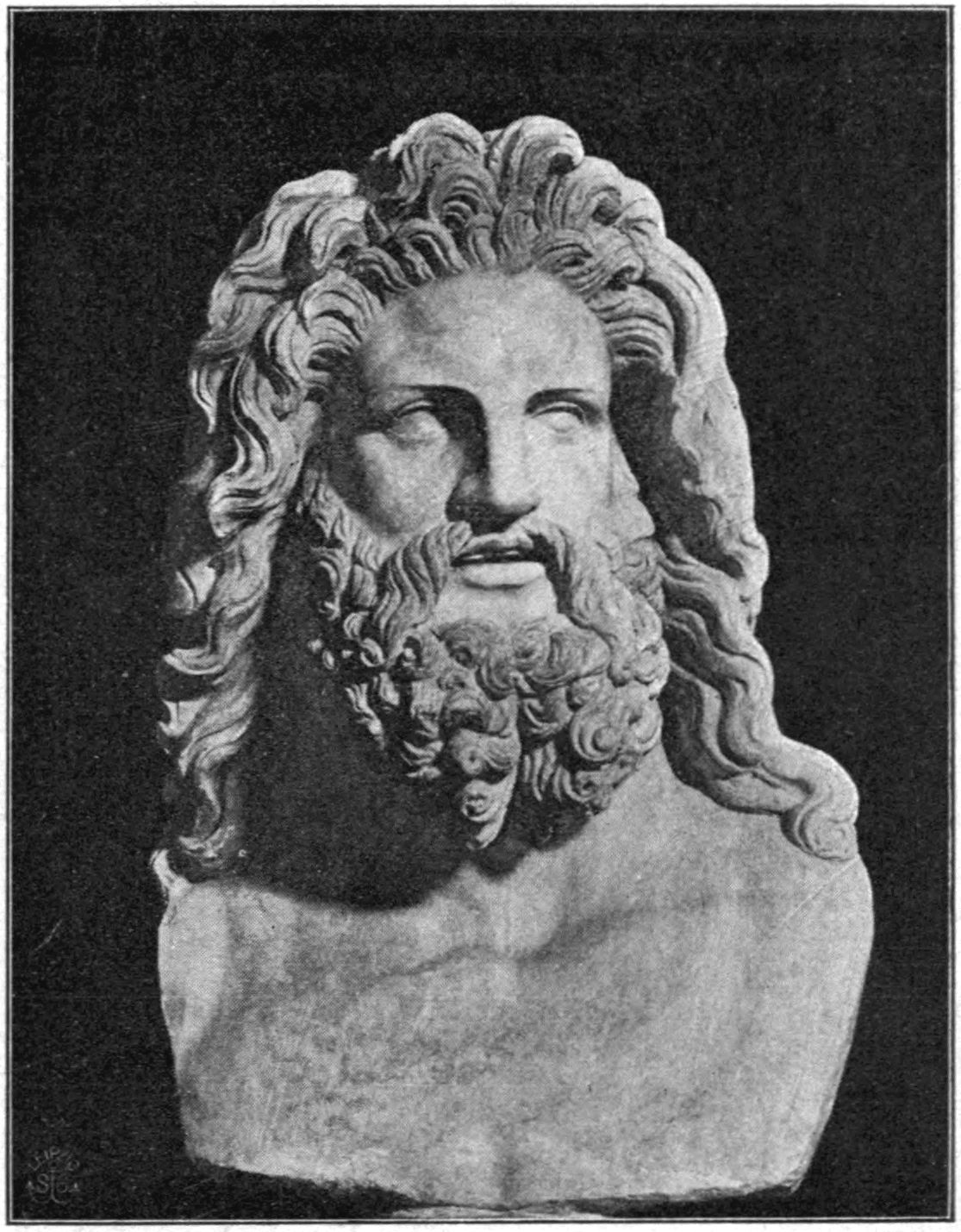
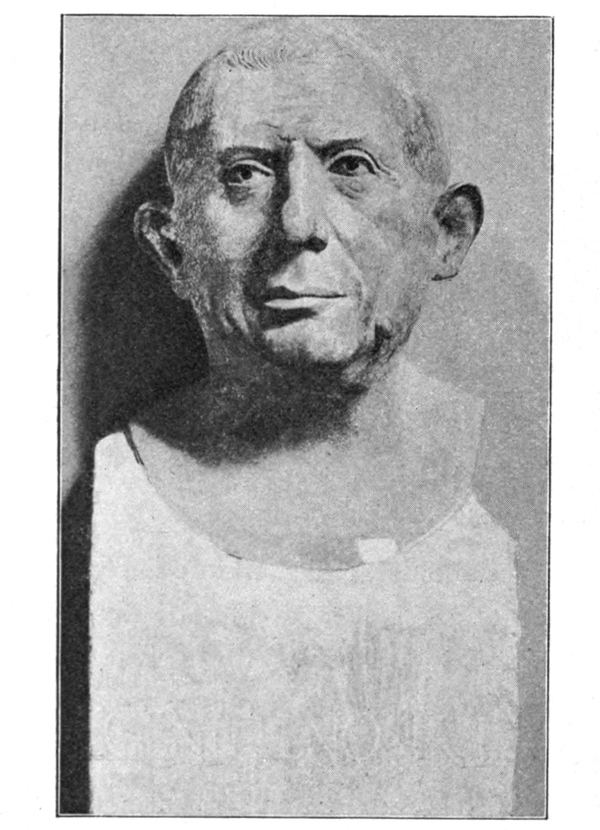
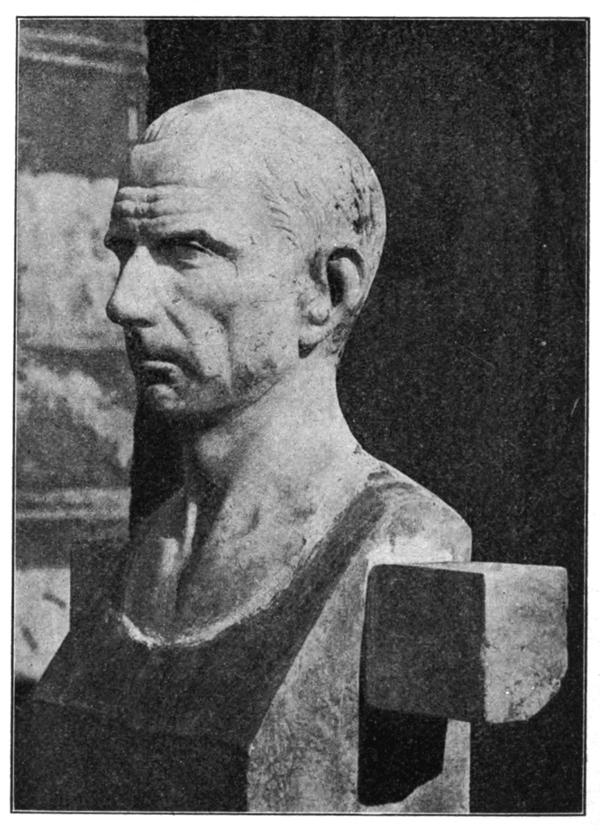
north end, the Temple of Jupiter, clearly identified
by the bust found in it (fig. 26), springs forward
far into the Forum and rises on a lofty substructure,
to which led a flight of steps with projecting
sides, once adorned with equestrian statues. Twelve
Corinthian columns, six in front, three on each
side, supported the Vestibule; while other columns
within the cella (probably Ionic, above which rose
Corinthian) supported the entablature. The large
pedestal at the back was no doubt intended for the
Capitoline Trinity, Jupiter, Juno, and Minerva (fig.
27 and 28). On the right, abutting on the Temple is a
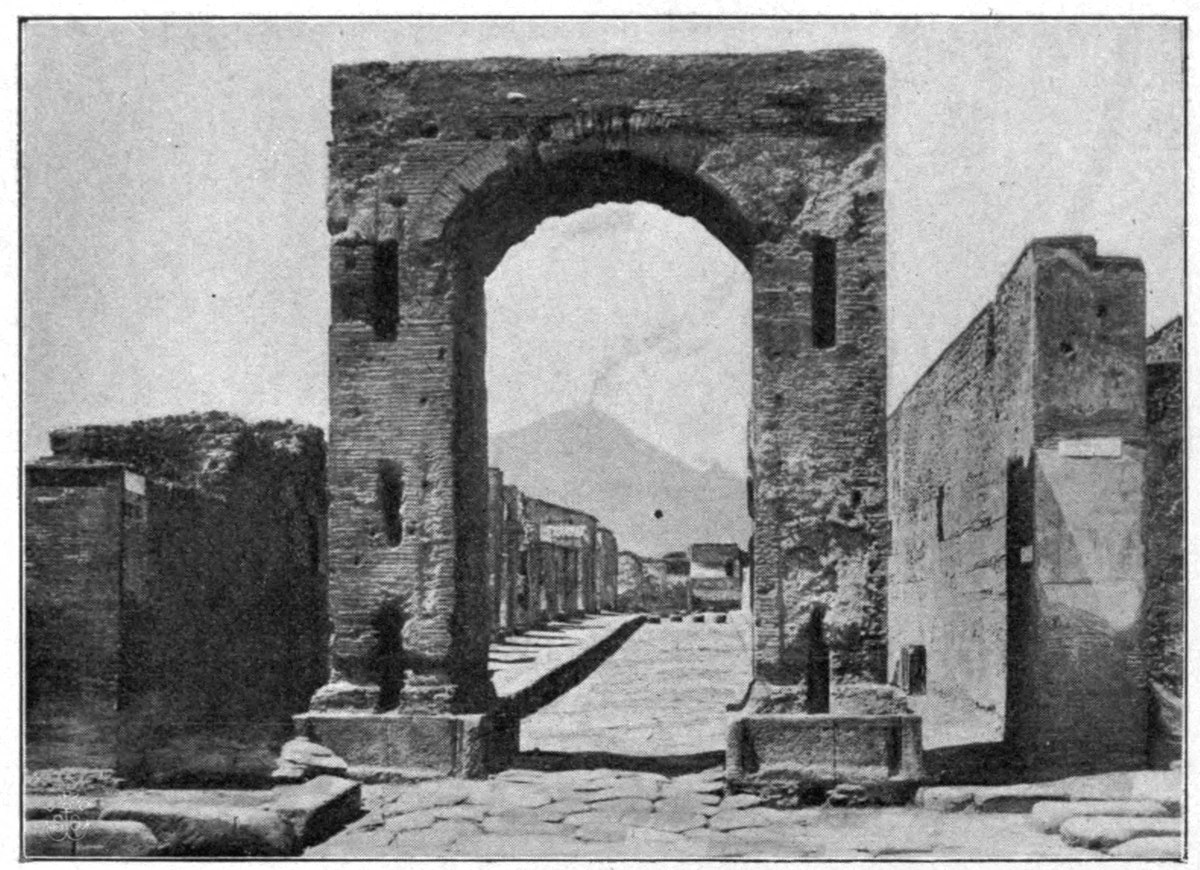
Triumphal Arch, which formerly covered with marble and
adorned with statues and fountains must have presented
an imposing appearance. The eastern long side of the
Forum, is, on the north, occupied by the so-called
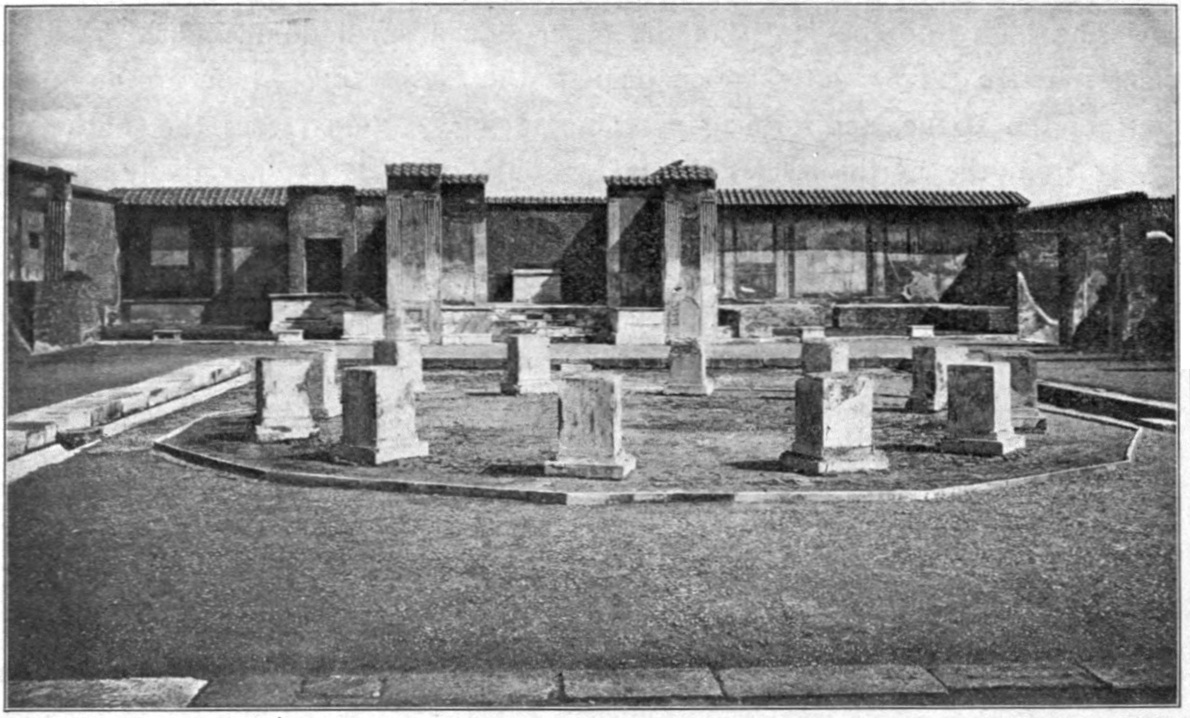
Pantheon, more correctly the Macellum, i. e. Meat
market (fig. 29). That such it is, is shown above all
by the space on the right at the back, which clearly
contained a butcher’s stall built up with arrangement
for discharge of water, and also by the shops on the
south side, which to judge by the pictures placed
there, contained stalls for provisions of various
kinds. In the midst of the court rose apparently a
domed structure on columns (hence the pedestals).
Here the fish were stripped of their scales, at least
a great number of scales were found in the drain.
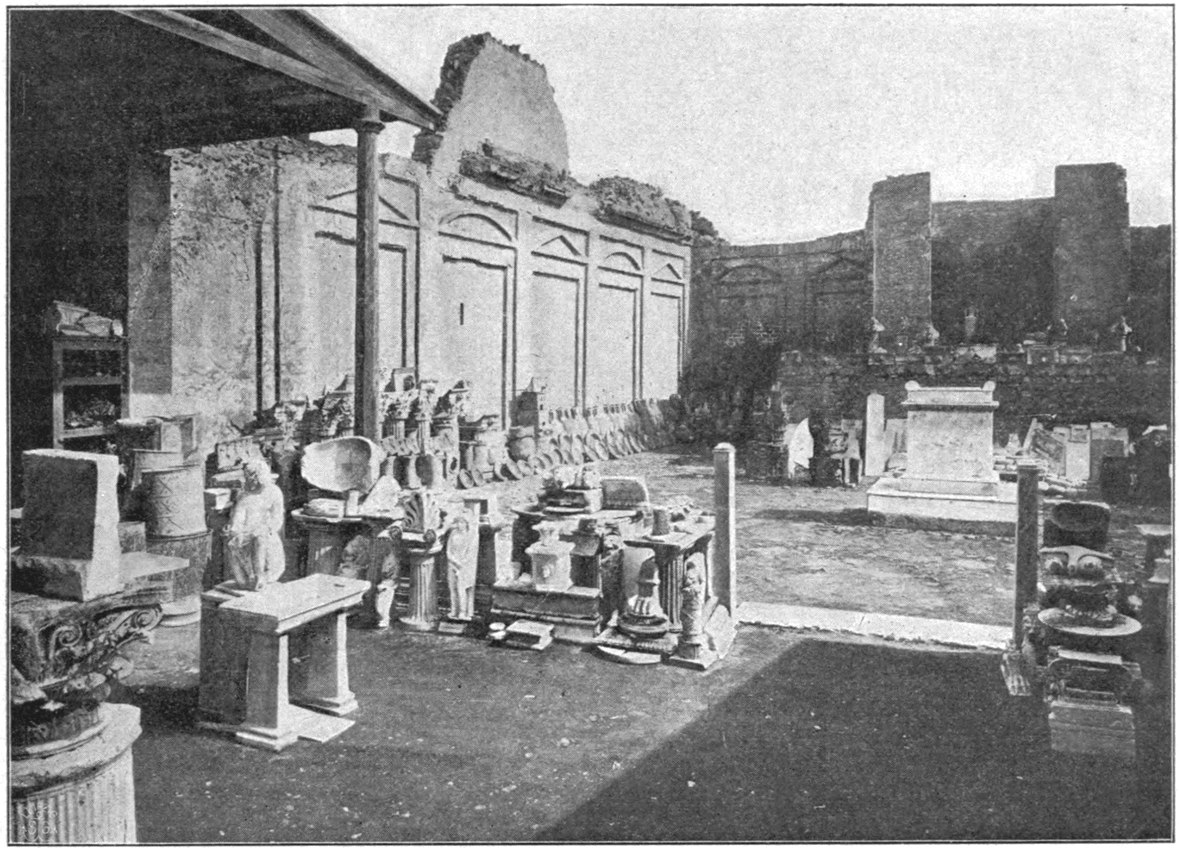
United with the Macellum 26there was a chapel for the
cult of the Imperial family; the marble statues found
here have been removed to Naples, and are replaced
in Pompeii by plaster casts. The paintings of the
entrance wall (fig. 30) deserve special notice on
account of the beautiful architecture. The central
picture represents Io watched by Argos. Next comes an
apartment once splendidly furnished, which is usually
called Senaculum, but its destination is not as yet
ascertained. It is thought that it was a sanctuary
of the tutelary deities of the city, the Lares
Publici. With greater certainty the adjoining
building on the right may be designated as a “Temple
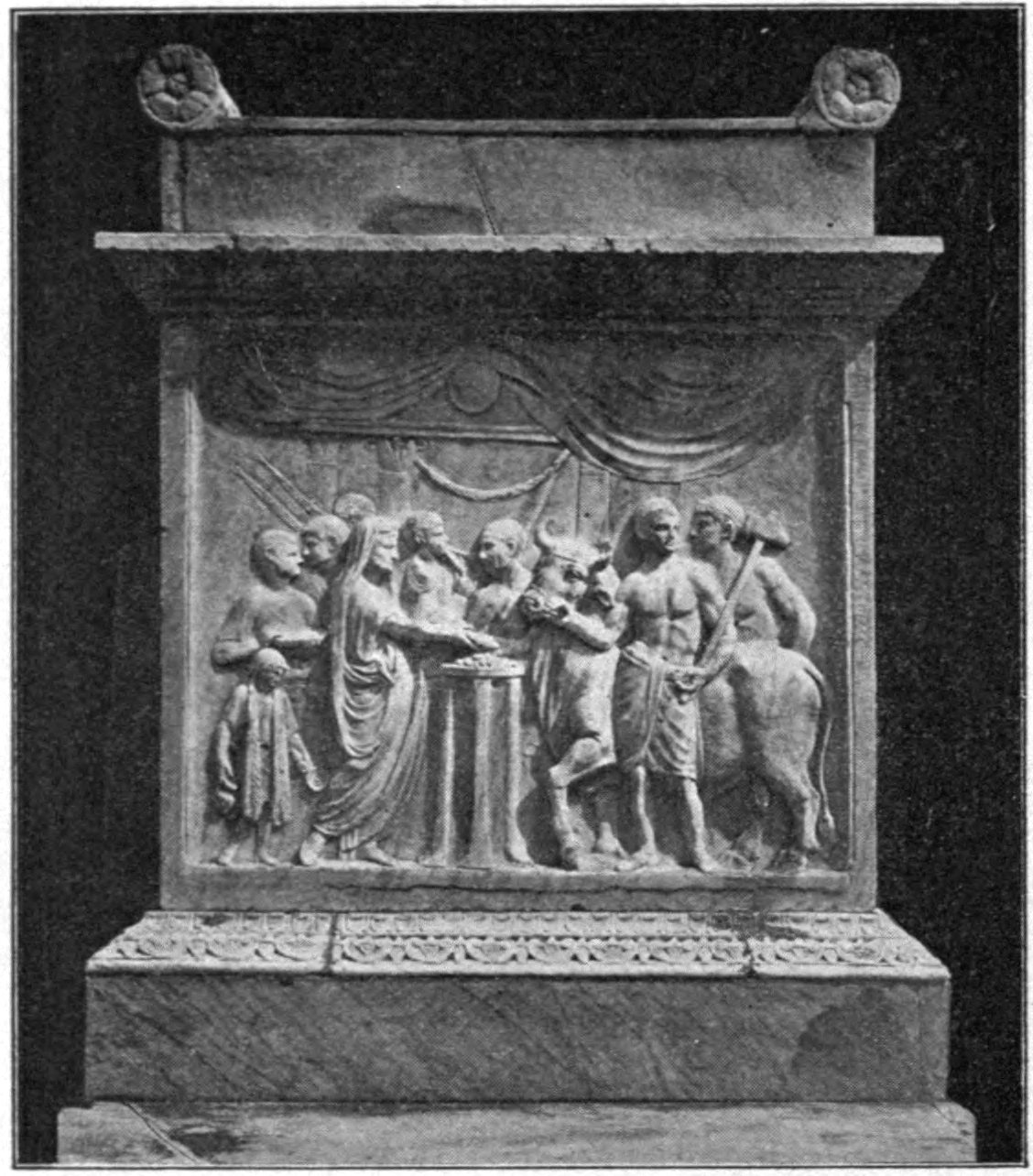
of Vespasian” (fig. 31). From a relief on the altar
standing in front of the temple (fig. 32) in which the
temple itself is represented, (it is the sacrifice of
a bull that is depicted, as usually offered to the
Genius of the emperor), we can recognise that the
edifice was dedicated to the worship of the emperor.
Since it was built before the earthquake of A. D. 63,
yet was not quite ready for use at the time of the
catastrophe, it is most probable that it was founded
in honour of Vespasian’s Genius.
Fig. 32. Altar of the Temple of
Vespasian (p. 26).
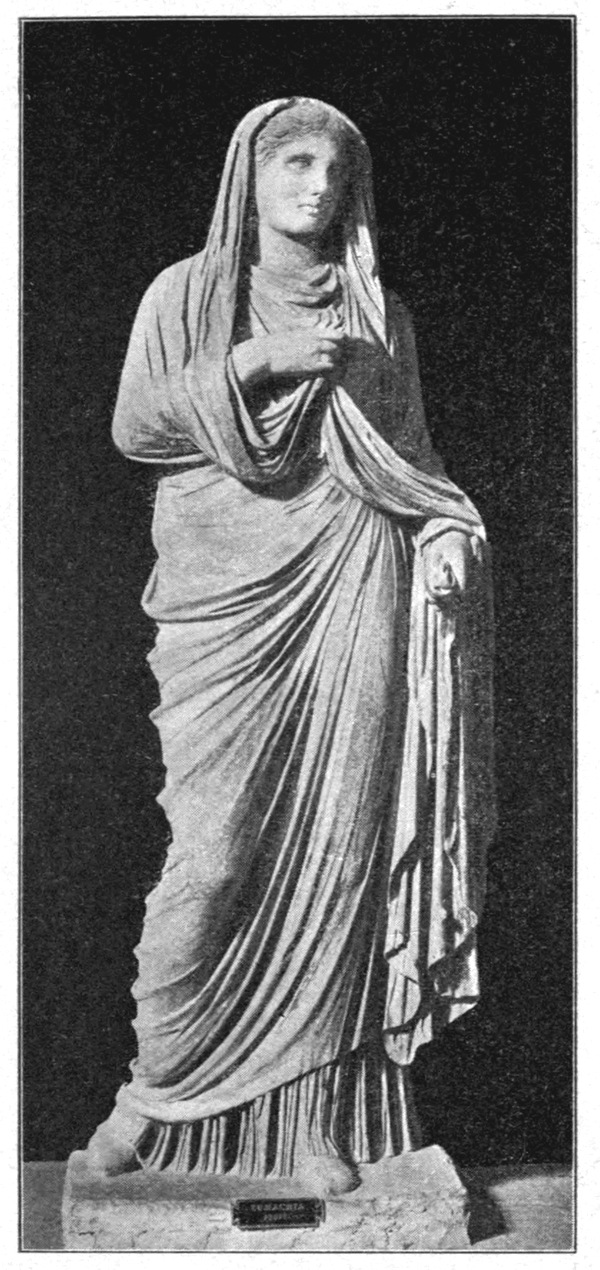
On the south of this follows the large building raised
according to the inscription by the priestess Eumachia
at her own cost and dedicated to Concordia Augusta
and Pietas. This was apparently devoted to industrial
purposes. Since the fullers (fullones) have dedicated
a statue to the foundress in the crypt (fig. 33) we
may surmise that the whole structure served as a
market hall for woollen stuffs.
The south side of the Forum is occupied by three
buildings closely resembling one another, each of
which consists of a large hall. The central hall was
apparently intended for the meetings of the Decurions,
the city magistrates of Pompeii, while on its left the
judicial Duumvirs had their seat, on the right the
Aediles.
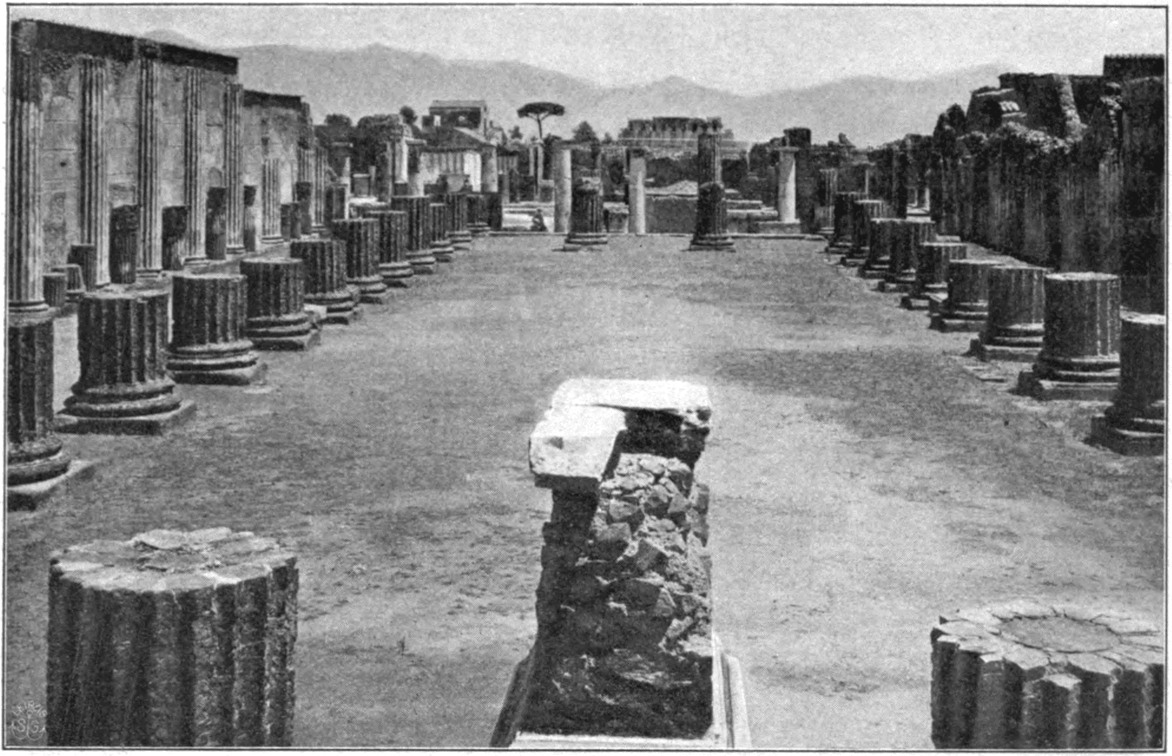
On the West side first of all comes the Basilica,
with its end bordering on the Forum (fig. 35). This
served for market purposes, to the relief of the
Forum, and at the same time afforded space for the
administration of justice in the raised tribunal at
the end opposite the Forum. It must have produced 27an
impression of grandeur with its internal columns on
which the roof rested, and its walls decorated with
pillars arranged in two rows one above another, the
walls being in their upper story provided with wide
openings flanked by columns. Under the tribunal is
found a cellar-like room which was formerly always
called a prison; it is however little suited for this
purpose, not being sufficiently enclosed, if at least
it were a question of imprisonment for a long period.
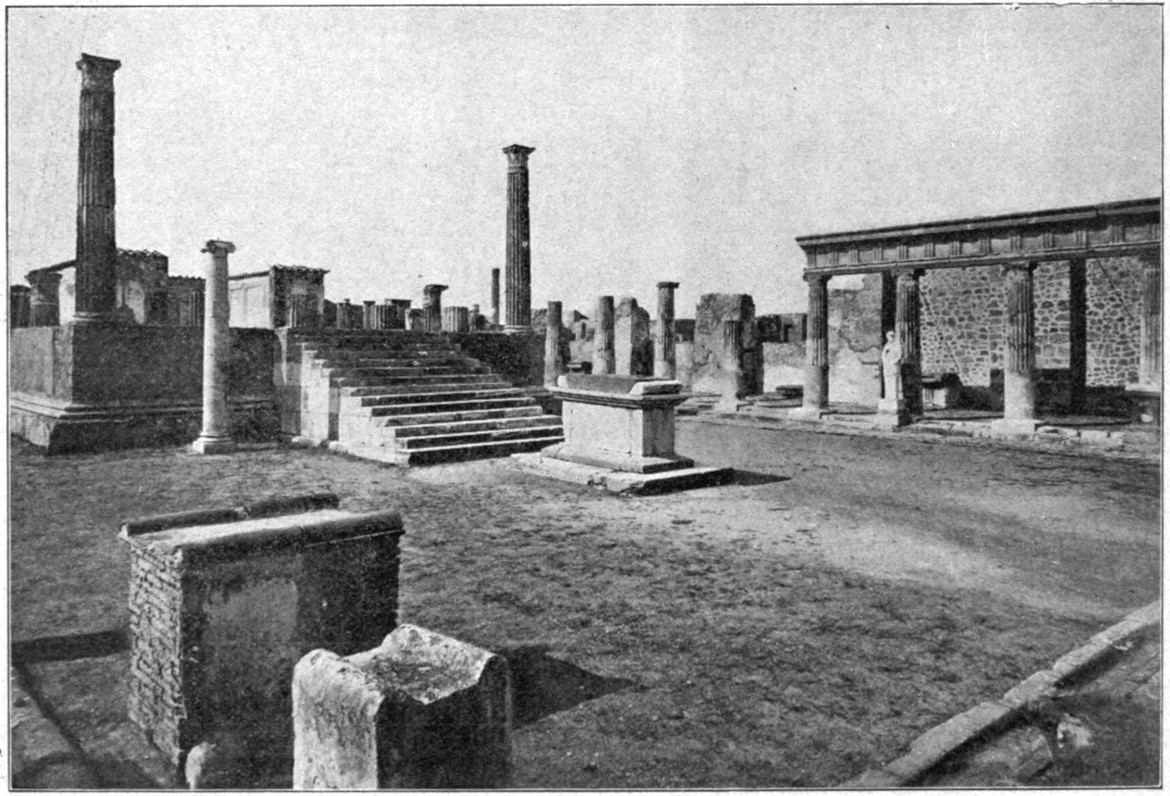
Next comes the Temple of Apollo (fig. 36), separated
from the Basilica by the Strada della Marina. That the
sanctuary which was formerly designated the Temple
of Venus was dedicated to Apollo results both from
an Oscan inscription on the floor of the Temple and
also from the Omphalos, the Navel of the earth
introduced into the cella, which on account
of its relation to Delphi is frequently indicated
in connection with Apollo. A Tripod also, equally
an attribute of Apollo, is painted on a pilaster
in the courtyard. This courtyard 28was surrounded
by a Corinthian colonnade, in front of which stood
statues of deities that were honoured in conjunction
with Apollo (Venus, Diana, Mercury and others; also
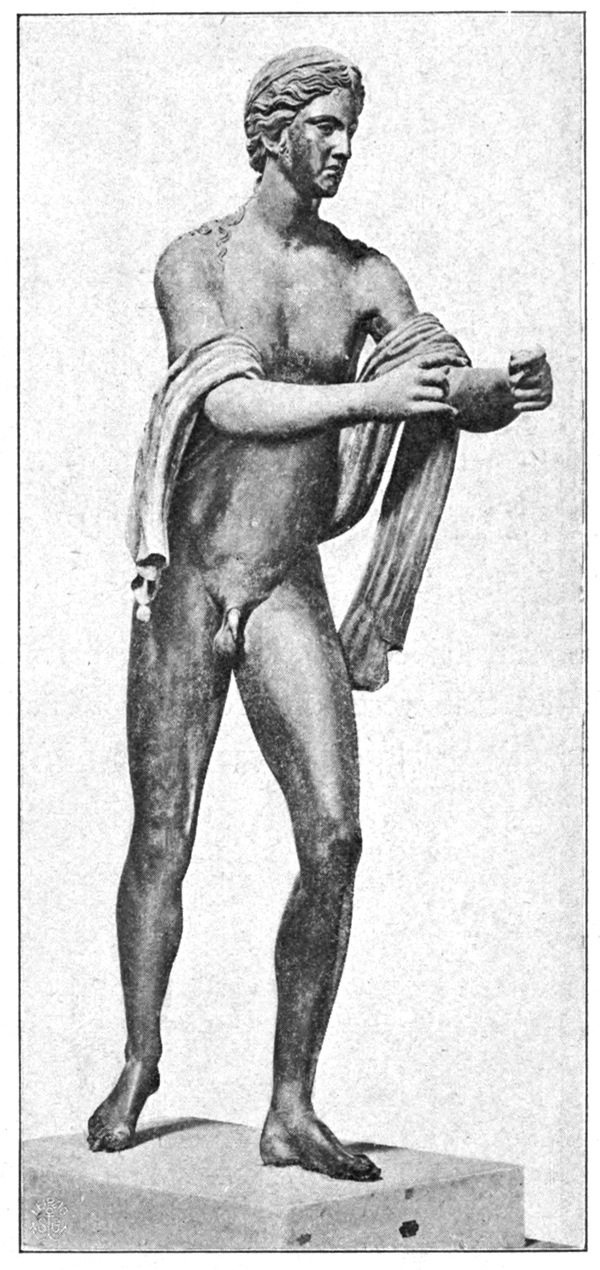
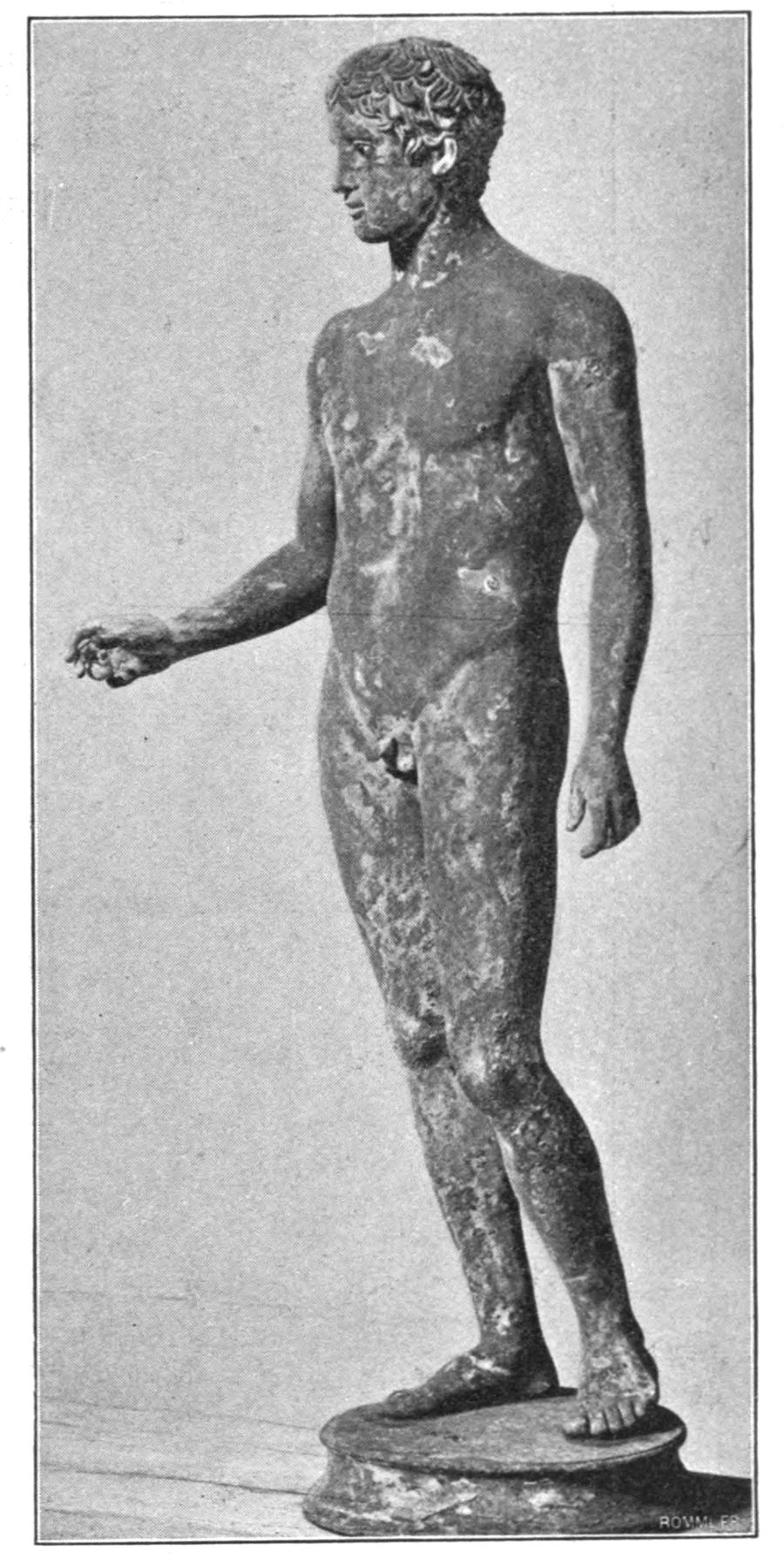
a bronze statue of Apollo himself, see fig. 34).
In front of the 29steps leading up to the Temple
stands the great altar on which the burnt-offerings
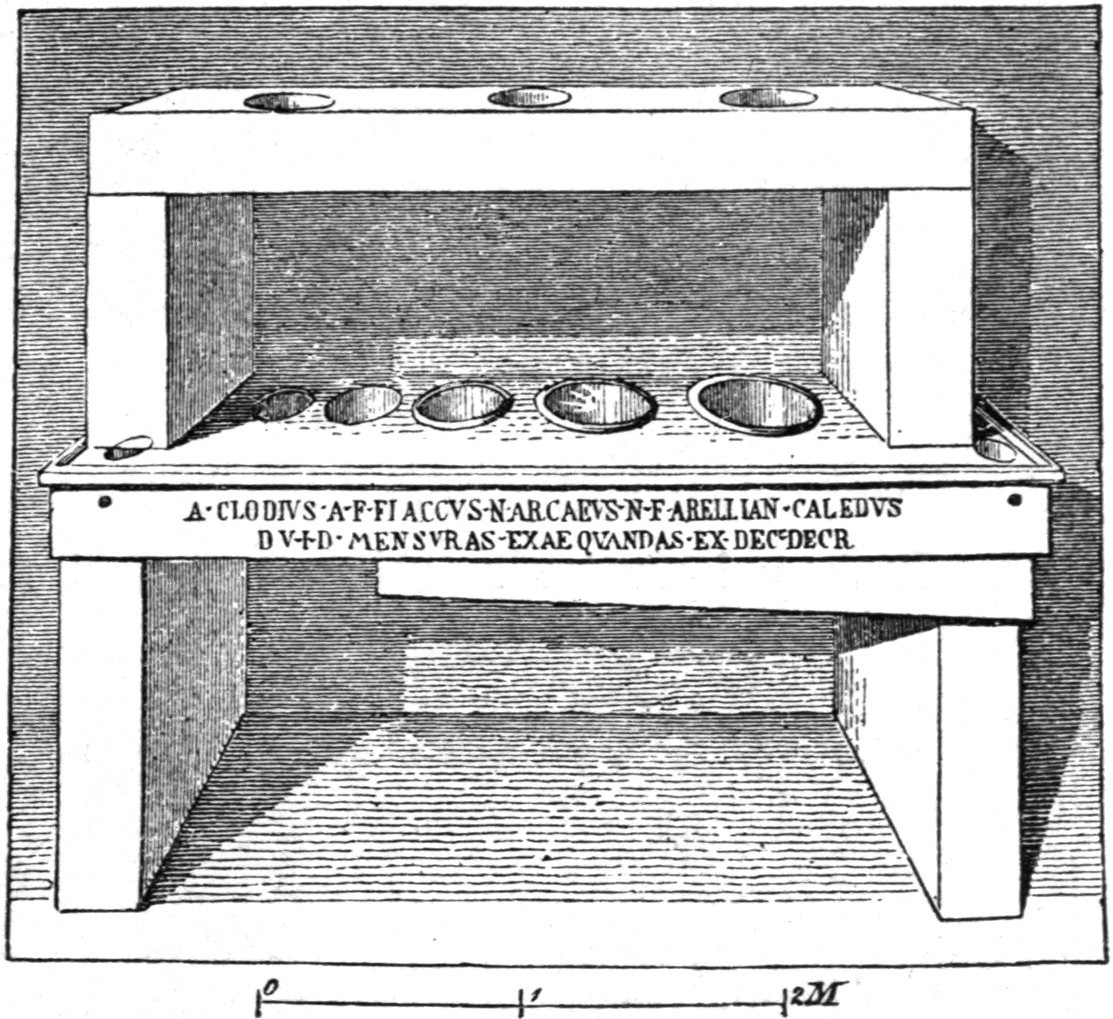
were placed. When we return to the Forum we at once
notice the gauging table with the standard measures
(the original is in Naples) with openings beneath,
which can be closed or opened to let the measured
fluids or corn run out (fig. 37). Next to this is a
dilapidated chamber which is now supposed to have been
a sale-room, and north of this a public lavatory,
so situated as not to be overlooked from the Forum.
An edifice of uncertain purpose (Prison? Treasury?)
ends this side of the Forum, which is united with the
Temple of Jupiter by a wall pierced by a door.
Of other sanctuaries there are in Pompeii the Temple
of Fortuna in the wide mainstreet leading northwards
from the Forum, placed at the corner of the Street of
Nola (here too the temple is approached by a flight
of steps, on a landing in which stands the altar, see
fig. 38); and also, in the Street of Stabiae, the
small temple of Zeus Meilichios (this name belongs
to it according to an Oscan inscription found at the
Gate of Stabiae). In this during the building of the
temple of Jupiter the deities worshipped in the latter
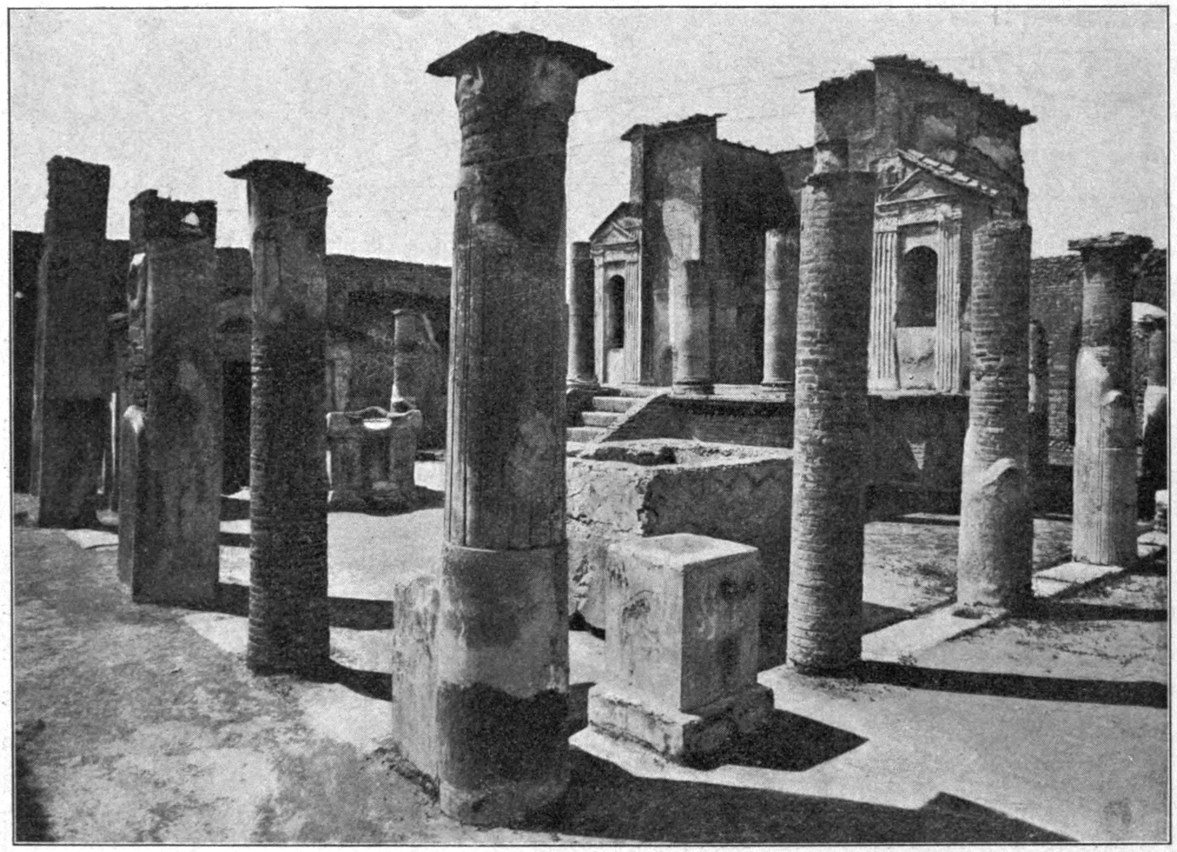
sanctuary had found refuge. Then there is the Temple
of Isis near the Forum Triangulare (fig. 39).
This according to the inscription over the entrance
had been rebuilt after the earthquake, at his own
cost, by the six years old N. Popidius Celsinus (i. e.
wealthy freedpeople who wished to obtain for their son
a position of greater distinction than they themselves
could assume must have done this in his name). In
consequence of this Master Popidius Celsinus received
the title of Town-Councillor.
Besides the flight of steps in front the temple was
approached by means of a secret staircase, serving no
doubt to give the priests access to the temple unseen
by the multitude of worshippers of Isis. The small
building on the left of the temple, the so-called
Purgatorium, contains a staircase which most
likely led to a reservoir filled with water from the
Nile which was used in the ceremonies. In front of
this lies an altar approached from the side, and on
this altar at the time of its excavation were found
ashes and remains of sacrifices. On the right near the
entrance is a walled up cavity which contained 30the
ashes and remnants of burnt fruits, undoubtedly the
remains of sacrifice. It may here be mentioned that
in front of the temple there was found 31a tablet of
hieroglyphics which had nothing to do with the worship
of Isis, and therefore served only as an imposition;
also that at the time of the eruption 32the temple was
shut; in the ashes from Vesuvius there was preserved
so exact an impression of the door with its three
leaves that a drawing of it could be made from the
impression.
In the open space behind the Tribunal of the Basilica
the latest excavations (since 1898) have resulted
in the discovery of a temple which certainly was
dedicated to the guardian goddess of the Roman colony,
Venus Pompeiana. At the time of the catastrophe of
the year 63 it was thrown down, and was to have been
completely rebuilt, as the building stones lying
around indicate. It would assuredly have been the
largest and most splendid sanctuary of the city,
if the outbreak of Vesuvius had not prevented the
carrying out of the plan.
Fig. 38. The Temple of Fortune (p. 29).
Fig. 39. The Temple of Isis (p. 29).
Fig. 40. The smaller Theatre (p. 32).
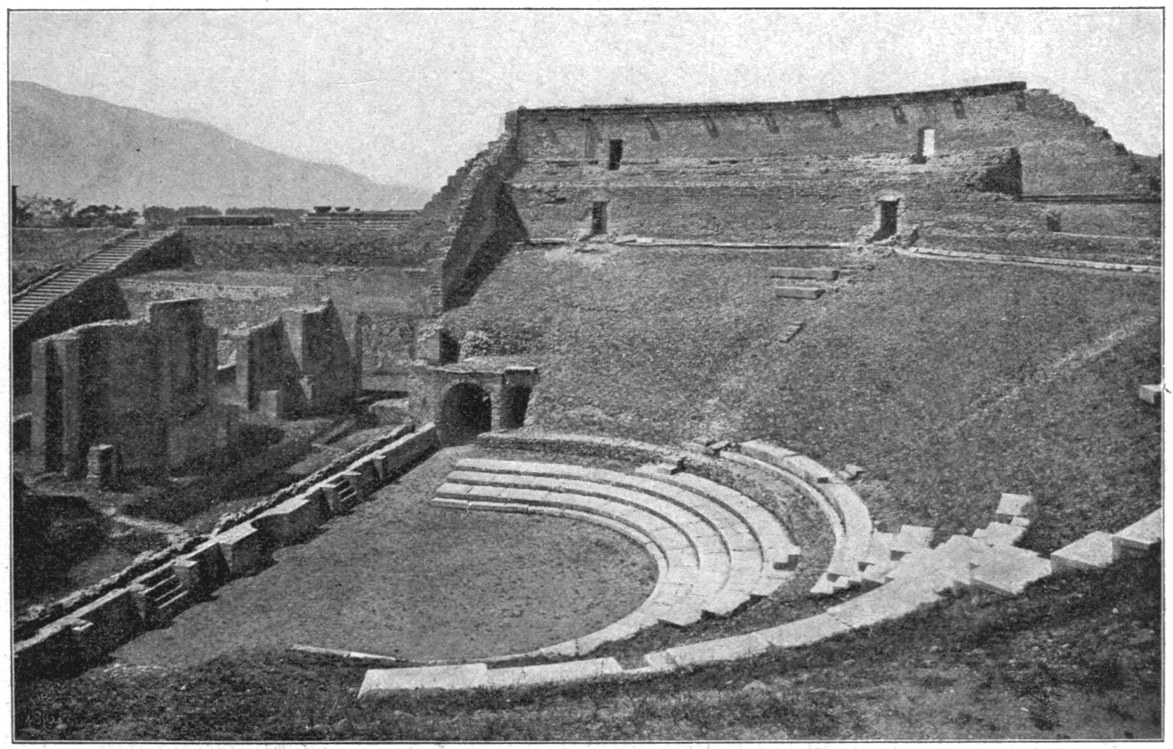
Fig. 41. The larger Theatre (p. 32).
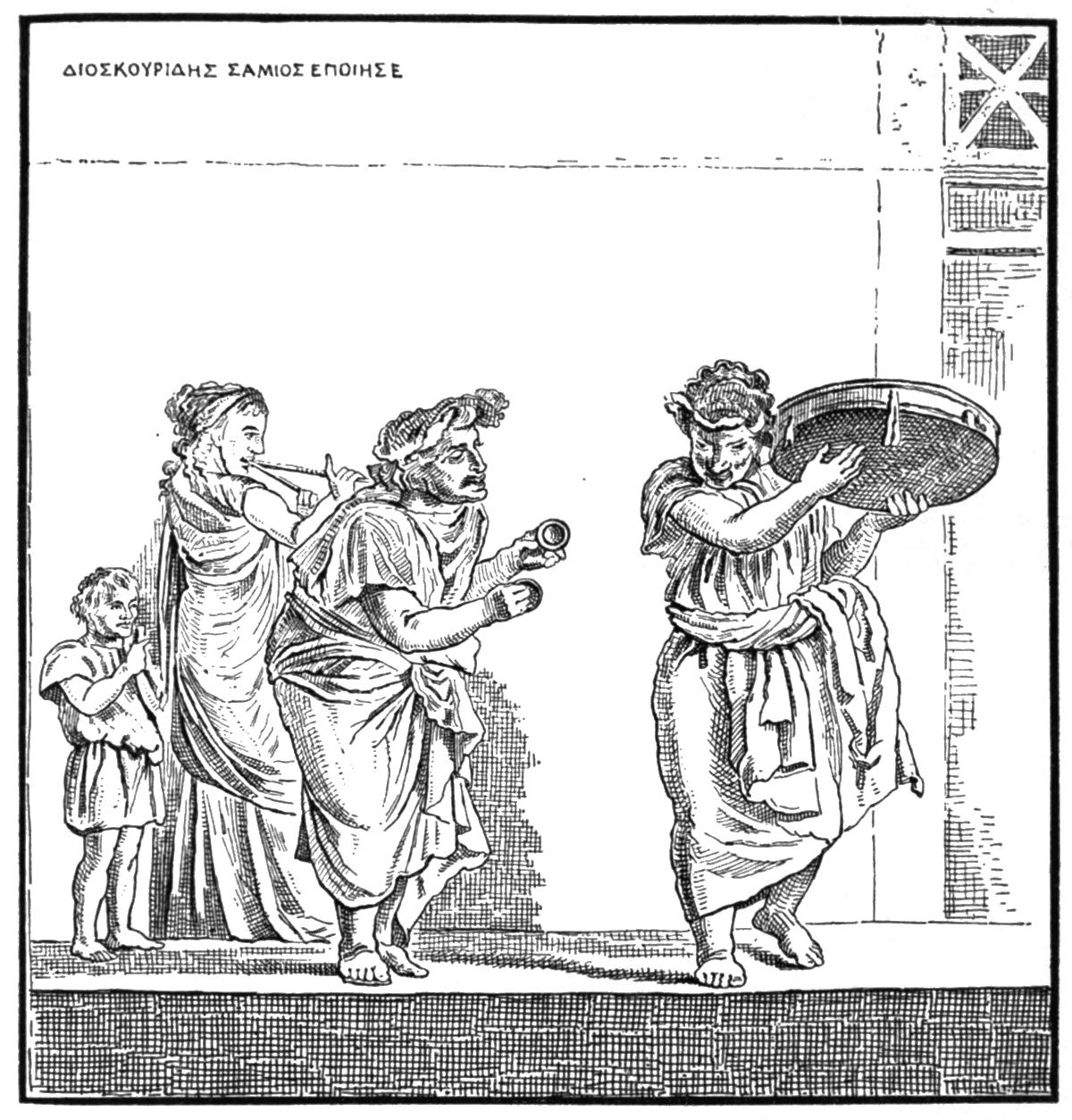
Fig. 42. Scene from a Comedy. Mosaic of
Dioscurides (p. 32).
Of first rank among the other public buildings are
the two theatres, which closely connected with each
other lie between the Forum Triangulare and the
Street of Stabiae (a broad flight of steps designed
for festive processions leads from the Forum
Triangulare to the Theatres). The smaller theatre
(fig. 40), formerly roofed over, served probably for
musical performances, while the larger (fig. 41) was
employed for scenic exhibitions. Of these figure 42,
an 34extremely fine mosaic from Pompeii may perhaps
serve as a specimen. It is to be observed that, as
in the case of most theatres, the seats have at the
back a hollow for the feet of those sitting above.
The broad low steps of the lowest row were utilised
for the arrangement of bisellia, that is wide
seats properly intended for two persons, the use of
which was a privilege of the Decurions. Above, on the
edge of the enclosing wall, stones are to be seen
which served to carry the masts from which awnings
were stretched for protection against the glare of the
sun. It is to this that the promise vela erunt
refers in the advertisements of the theatre.
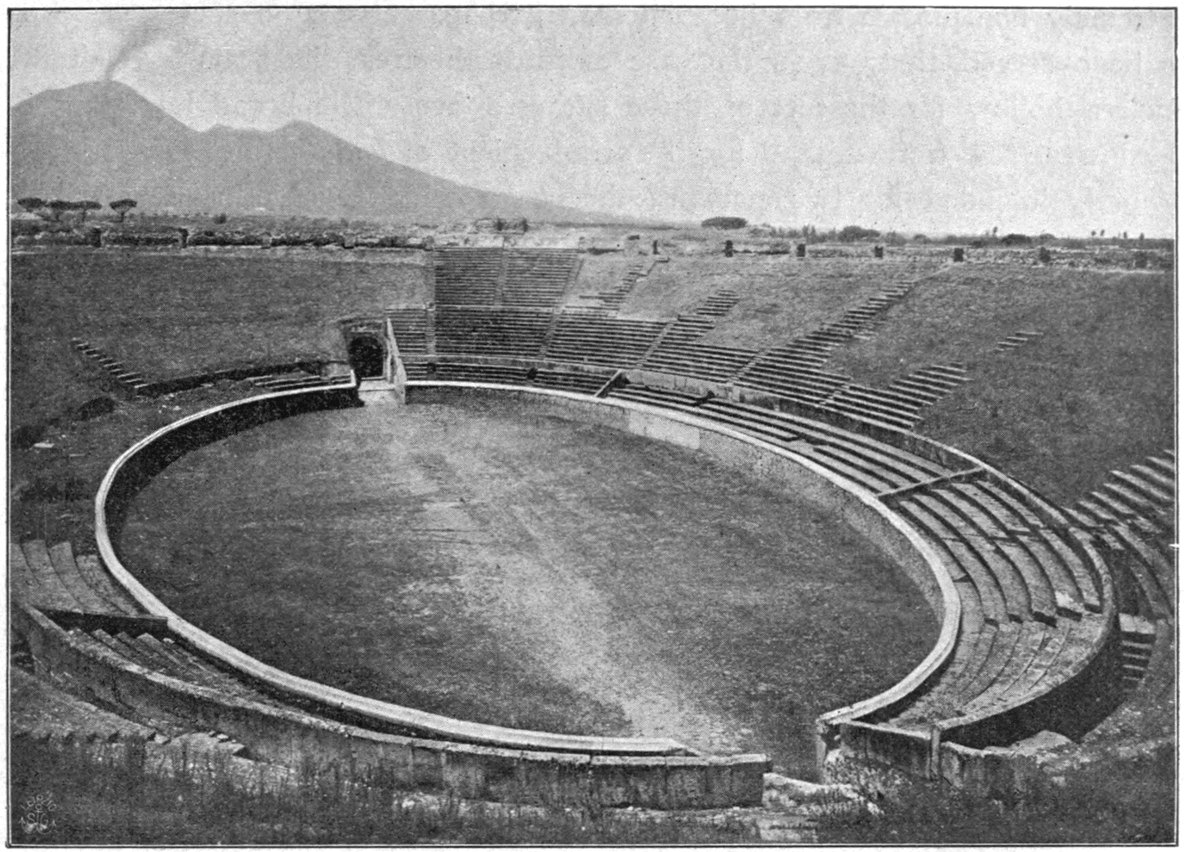
Fig. 43. Interior view of the
Amphitheatre (p. 34).
Fig. 44. Barracks of the Gladiators (p. 36).
Fig. 45. Weapons of Gladiators (p. 36).
Together with the theatres should be named the
amphitheatre, situated at the southeast extremity
of the city, a building of very great size, which
was calculated to meet the requirements of the
neighbouring towns as well. Apparently it originally
lay without the walls, and was included in the time
of fortification only at a later period as forming
a point of danger. Seen from without the building
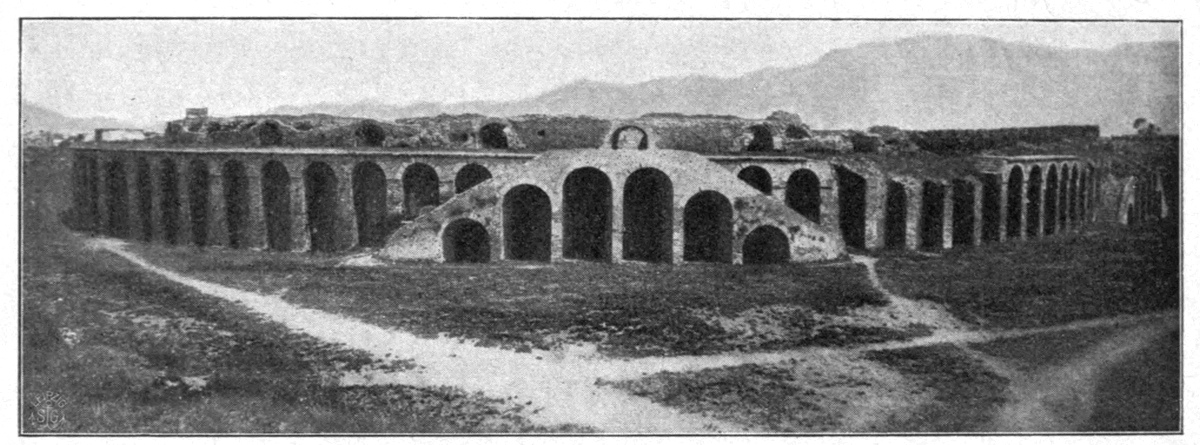
produces a comparatively mean impression (fig. 57),
since to avoid having to raise the outer walls too
high the arena or fighting place has been dug out
(fig. 43). From the outside steps lead to the upper
tiers, the lower tiers are reached by means of
steps from a vaulted corridor which runs round the
whole amphitheatre under the second tier. This is
interrupted in the middle of both the longer sides, on
the west by reason of a small entrance to the arena
by which the corpses of the slain gladiators were
dragged 35out. To the arena itself two wide entrances
led from north and south, one of which, the southern,
turns at a right angle on account of its nearness
to the city wall. At the northern entrance a small
separate passage could be made in order to keep the
spectators apart from the gladiators who passed in
and out at this point. This was effected by means of
a latticed partition, for which purpose stones with
holes in them were used, which are still to be seen.
Small dark rooms at the entrances, provided with
very low doorways, may have served as cages for wild
beasts. Here too, as in the Theatre, the steps of
the first row were broad and low, being intended for
the arrangement of Bisellia. The wall which
separated the spectators from the arena were found
when first excavated to be adorned with paintings,
which are now indeed completely destroyed, but are
preserved in copies made immediately after their
discovery. Without exception they represent scenes
from the Amphitheatre, partly fights between wild
beasts, partly combats of gladiators. (See fig. 56
as to which it is doubtful whether it was found in
the amphitheatre; the gladiator standing on the right
being badly wounded has let fall his shield; standing
quietly he raises the thumb of the left hand to
entreat the mercy of the people, for only if he looks
death in the face unmoved can he hope to be granted
his life; in our case his death seems certain, for
his opponent steps up to him with drawn dagger to
give him the coup de grâce.) On the breastwork
wall traces were still visible of a lattice by means
of which the spectators were to be protected against
possible attacks of the wild beasts in the arena.
Fig. 46. Wall at the Stabian Baths (p. 37).
Fig. 47. The Apodyterium (p. 37).
36
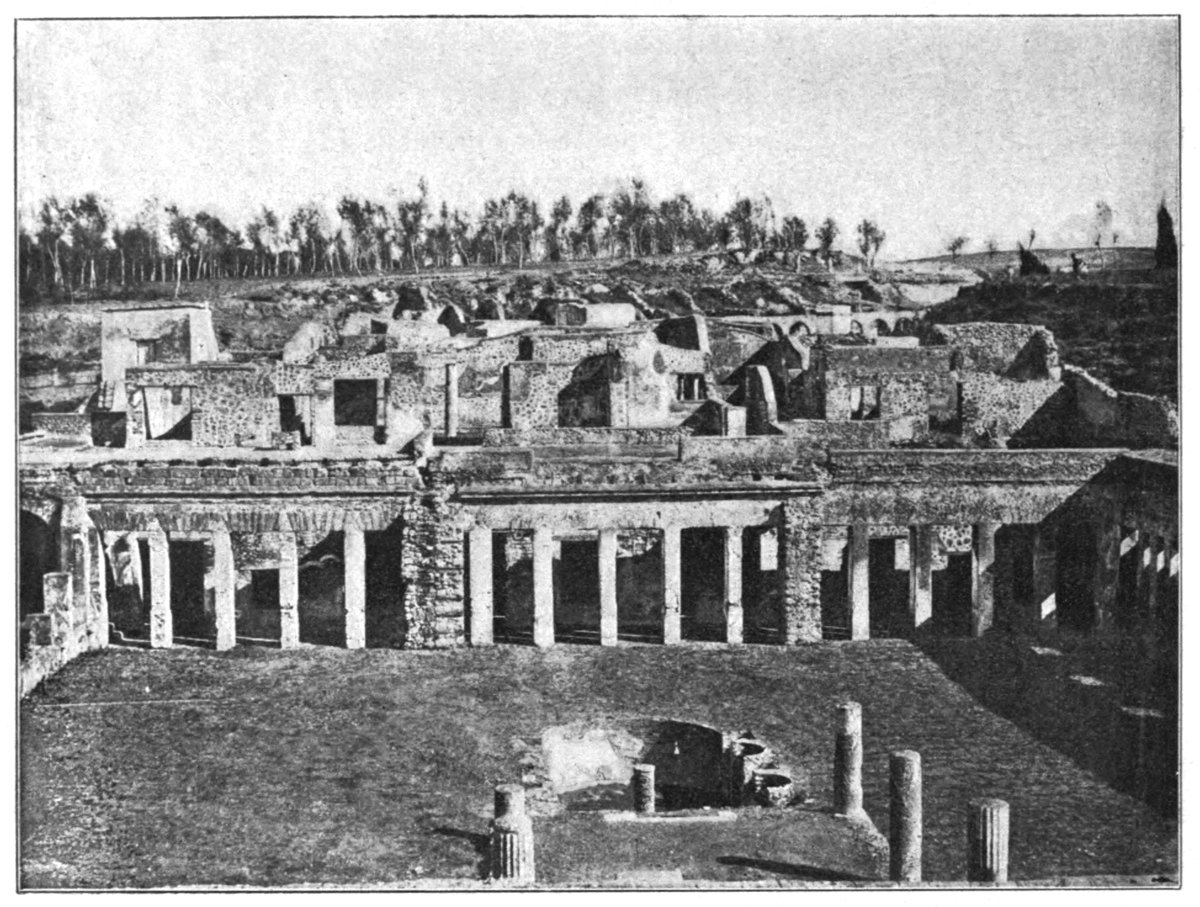
In connection with the amphitheatre may be mentioned
also the barracks for gladiators, situated to
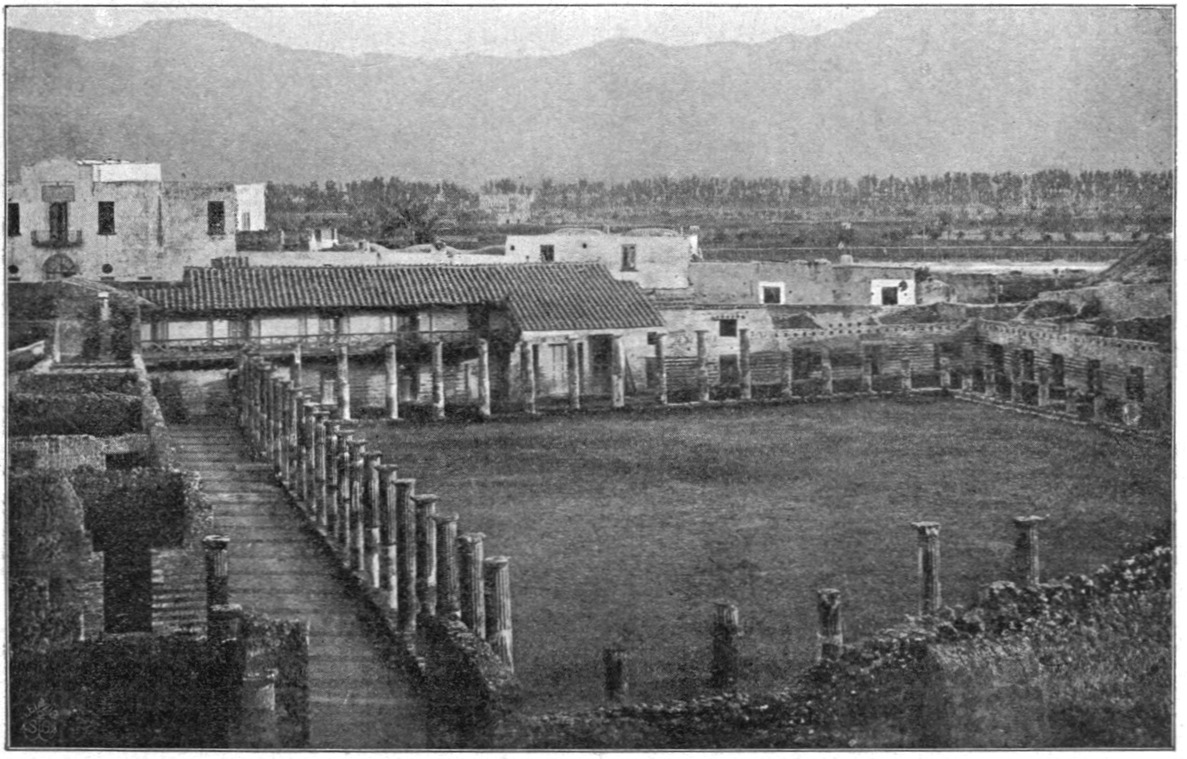
the south of the large Theatre (fig. 44). To all
appearances the large space surrounded by columns
belonged originally to the Theatre, and was intended
to afford protection to visitors to the Theatre in
case of rain occurring suddenly. But when the passion
for gladiatorial exhibitions had so prevailed that
even smaller cities thought themselves obliged to
keep special bands of gladiators, the second row of
columns that no doubt originally existed was done away
with and in its place paltry cells erected for them.
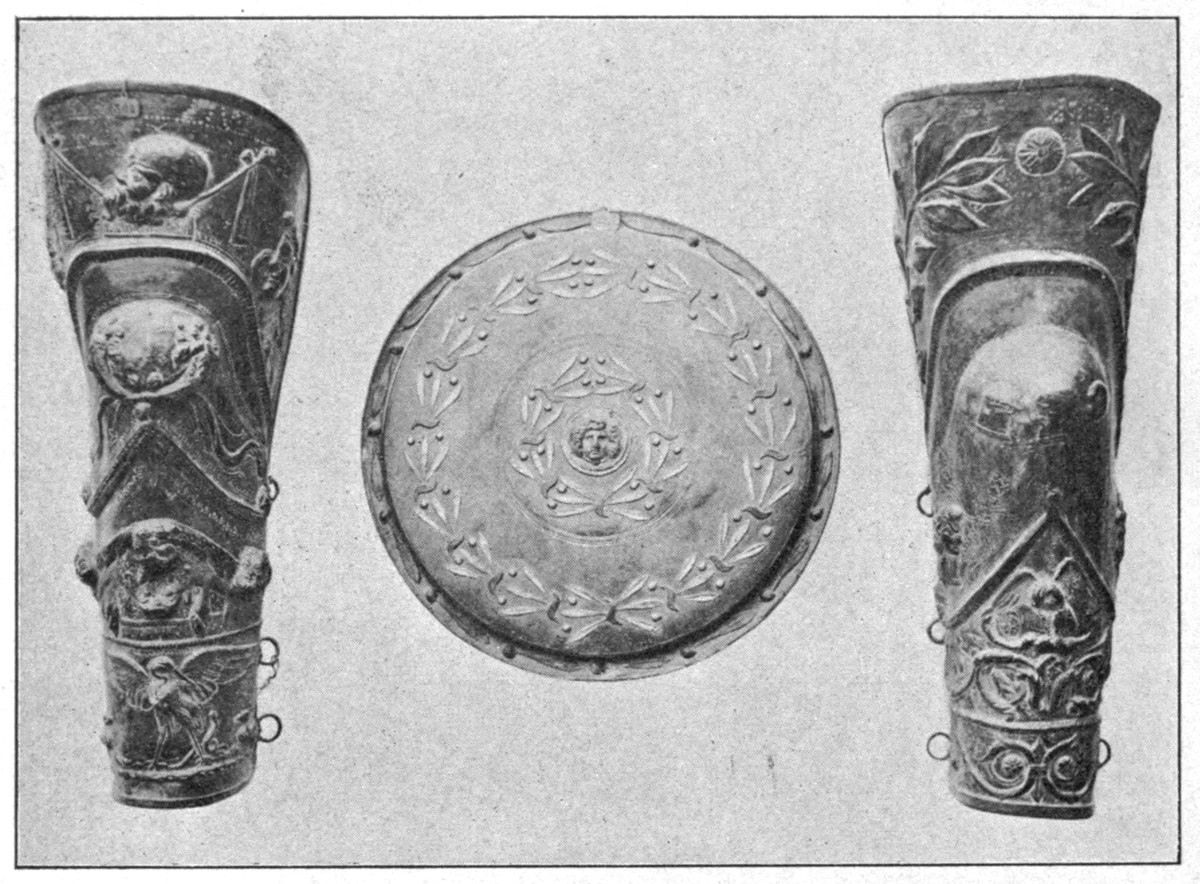
That we have to do with gladiators and not, as has
been supposed, with soldiers, a garrison for Pompeii,
has been indisputably proved by the discovery of
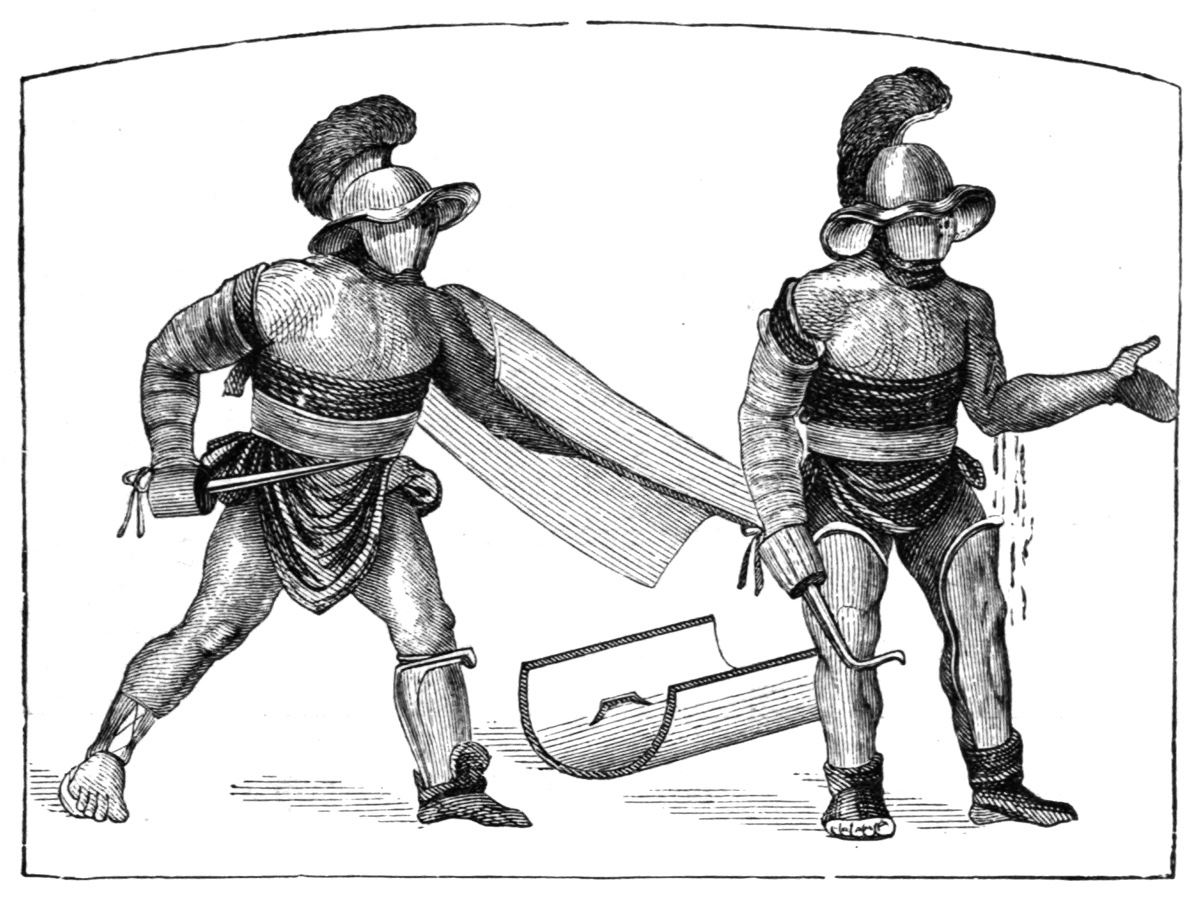
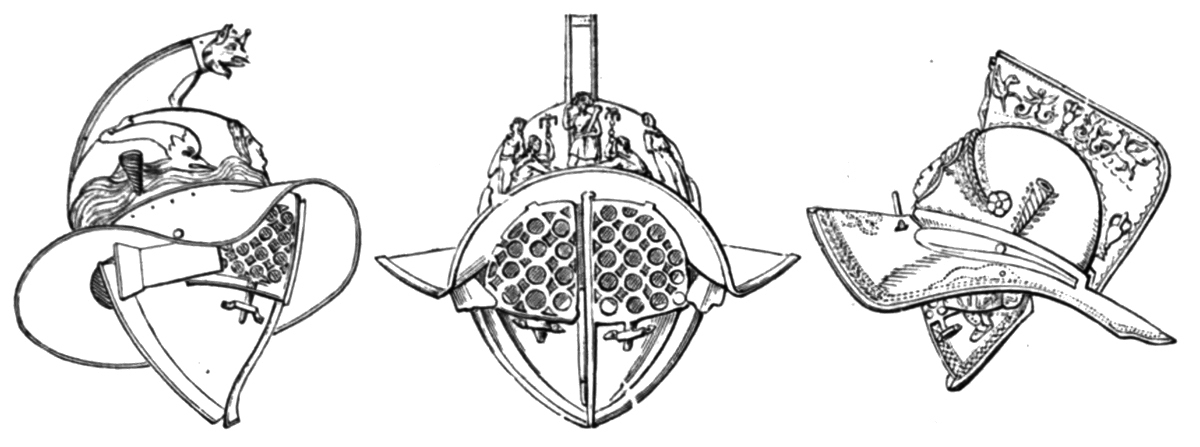
gladiators’ weapons (now in the Naples Museum, fig. 45 and 60)
of paintings and Graffiti relating to
gladiators. The cells were raised in two stories, and
in such a way that the upper were approached by means
of a wooden gallery. In one cell on the west side
a great set of fetters was found used for chaining
prisoners; in the same room, but not as is commonly
reported fastened in the fetters, some skeletons were
found, those therefore of 37prisoners who when the
catastrophe came had not been able to escape. The
surrounding columns are painted red and yellow, only
the two centre ones of the east and west sides are
blue, perhaps because these served as marks in certain
military exercises.
Fig. 48. The Tepidarium of the Forum
Baths (p. 38).
The baths too, which played so great a part in the
life of the ancients, must not be forgotten among the
public places of resort. Of large Public Baths three
have up to the present time been found in Pompeii,
the so-called Central Baths, which at the time of
the eruption of Vesuvius were still in course of
construction, the Baths by the Forum, and the Stabian
Baths, at the corner of the Stabiae and Abbondanza
streets. These last named are the best preserved, and
deserve on this account a more thorough consideration.
We come first into a large courtyard surrounded
with pillars, the Palaestra, devoted to gymnastic
exercises; here there was a stone track constructed,
for rolling stone balls, further a swimming bath
(Natatio), with the dressingrooms appertaining
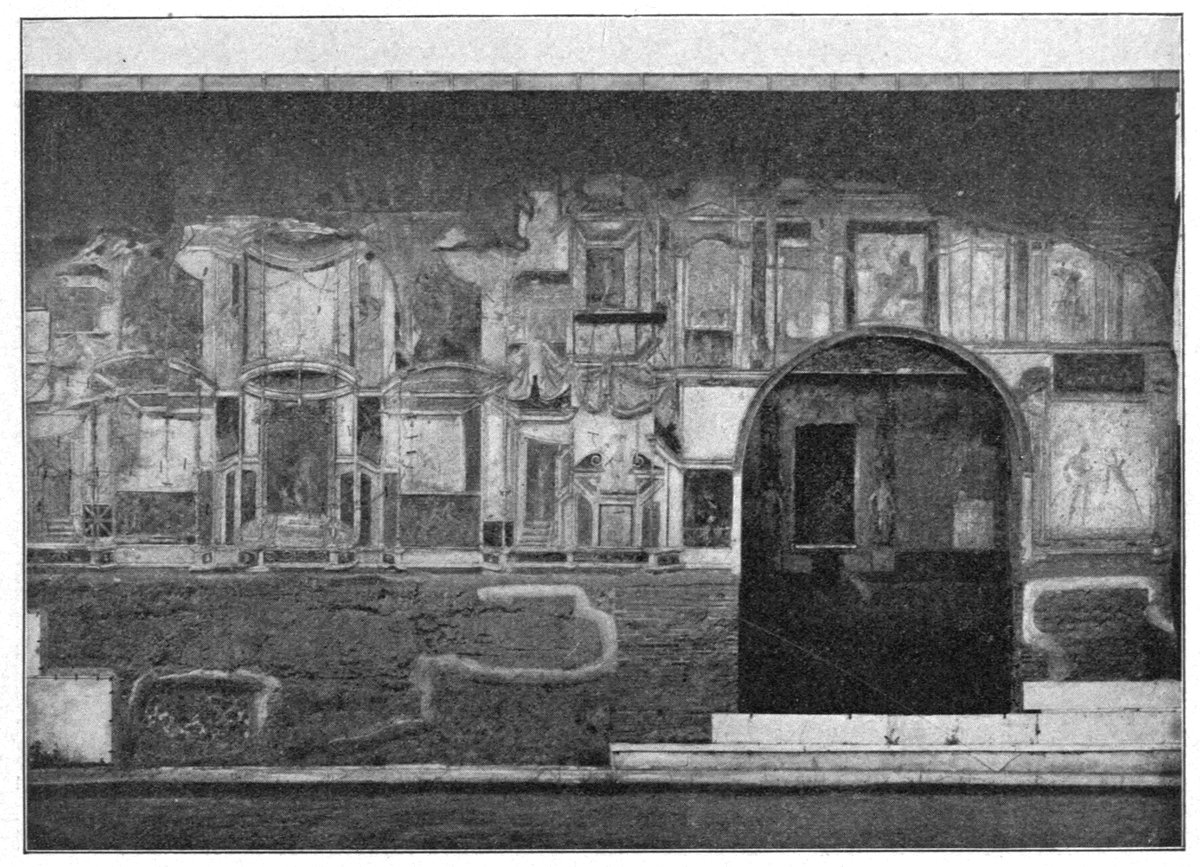
thereto (fig. 46). The reliefs in stucco, which
are preserved on the outer walls of these rooms,
merit special notice. On the right of the principal
entrance two doors lead to the men’s bath, which
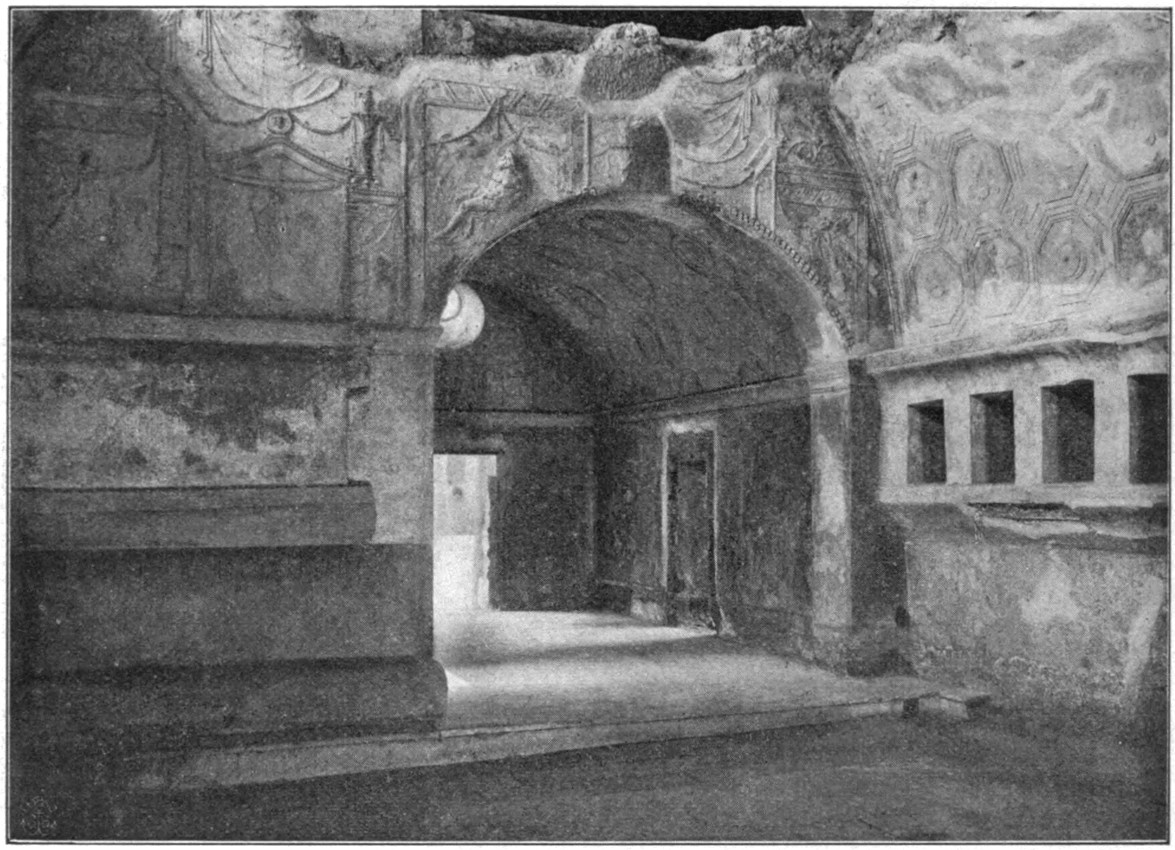
consisted of the Apodyterium, where people
took off their clothes (the niches served to keep
them in, fig. 47), the Frigidarium or cold
bath, the Tepidarium or lukewarm bath, and the
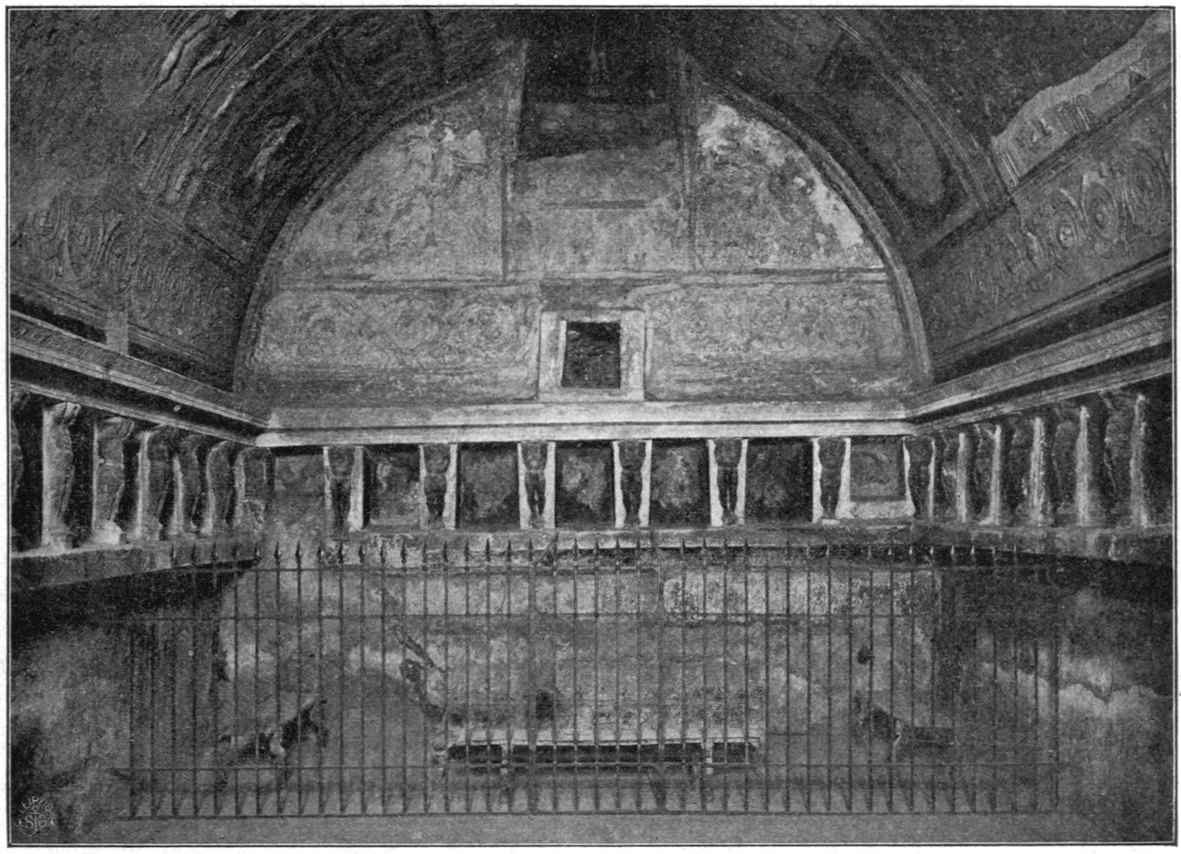
Caldarium38or hot bath. (Fig. 48 represents
the Tepidarium of the Baths near the Forum; here the
heating is derived from a large brazier presented by
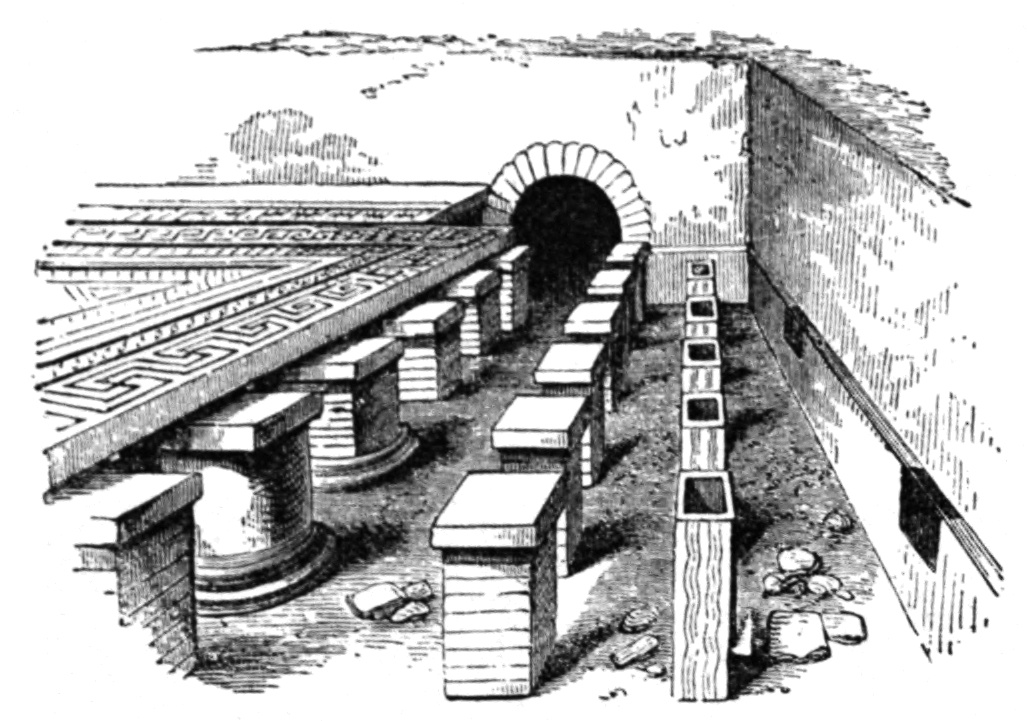
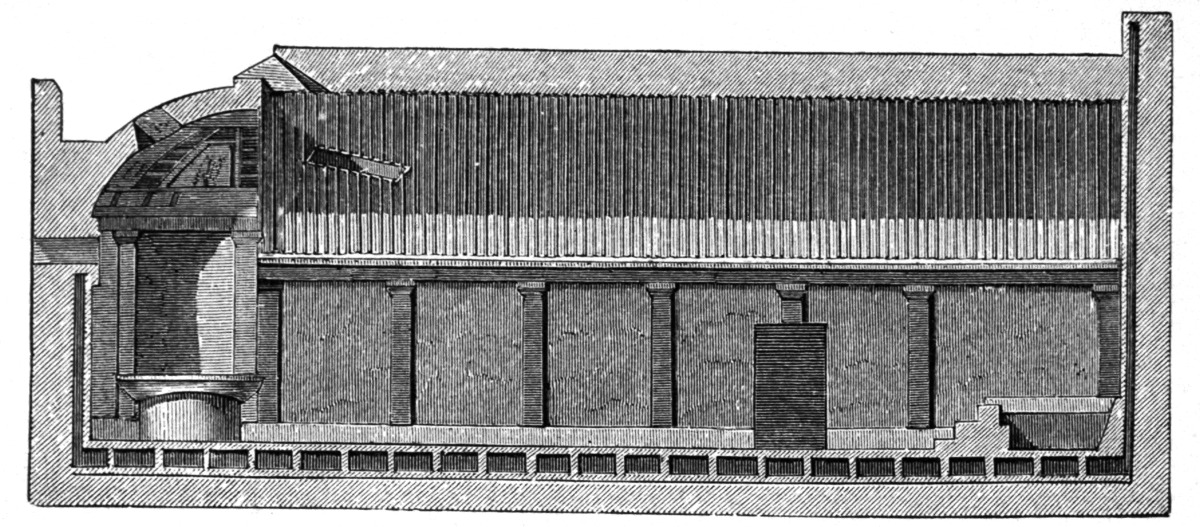
Vaccula.) Both these rooms received their heating
through the hollow pavement and hollow walls, i. e.
the pavement rests on small pilasters about two feet
high, and the walls are overlaid with tiles, which
being provided with raised sidewalls form a kind of
flue on the wall (figs. 49 and 50). By this method the
heat introduced from beneath, could penetrate under
the pavement and between the double walls. Of late it
is true this way of heating has been disputed.
Fig. 50. Section of the Caldarium (p. 38).
Fig. 51. Ground Plan of the House of
Pansa (p. 39).
The women’s bath adjoins the men’s, with the
same rooms required for bathing; between the
Caldarium of the men’s bath and that of
the women’s bath lies the furnace-room; here were
placed three large caldrons for hot, tepid, and cold
water. Of such a furnace-room and the arrangement of
caldrons an idea may also be formed from the well
preserved bathing plant excavated in a Roman villa at
Bosco Reale (where was made the great discovery of
silverplate, now at Paris). This has recently been set
up at Pompeii, in a small house behind the Temple of
Jupiter in the street called Del Foro.
Besides these public bathing establishments there
were of course also in the better class of houses
private baths which show the same arrangements, though
naturally more or less curtailed.
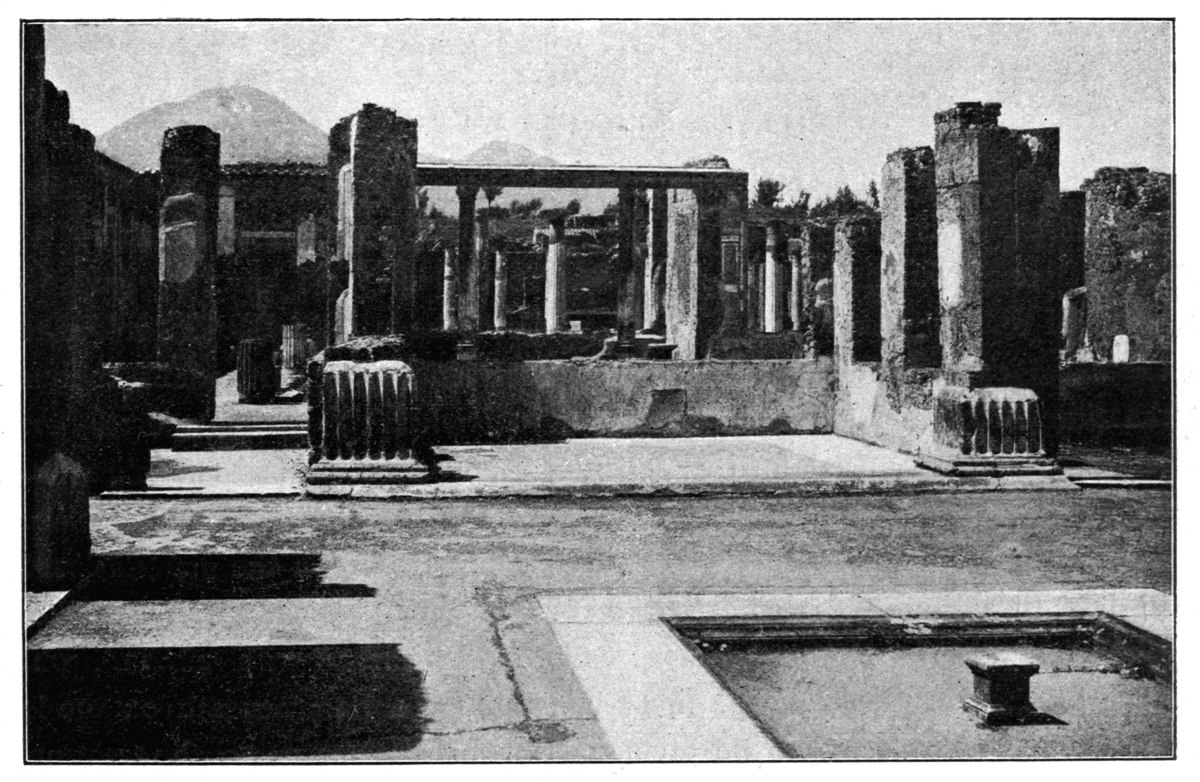
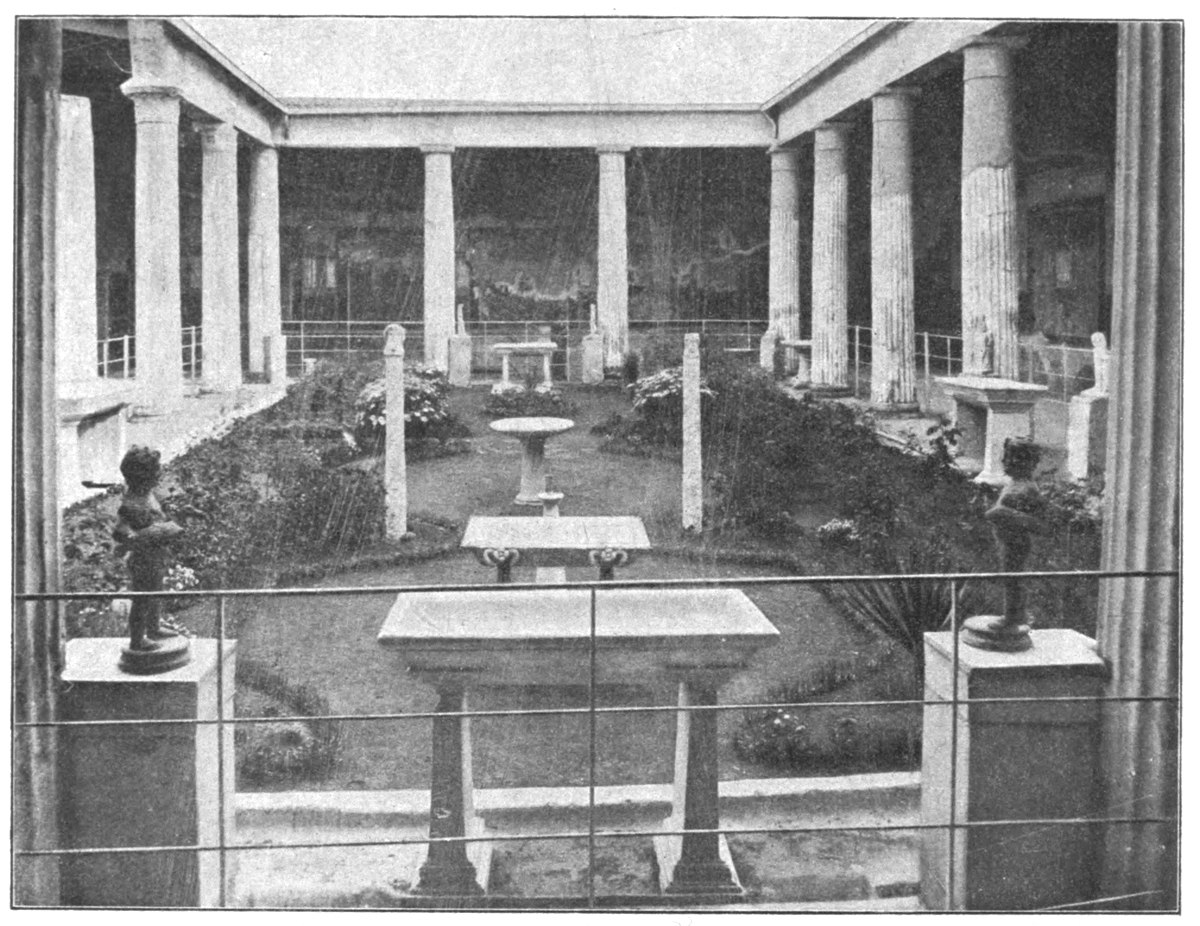
Fig. 55. Roman Dwellinghouse. Vista
from the Atrium to the Peristyle (p. 42).
Fig. 56. Scene from the Amphitheatre
(p. 35).
Fig. 57. External View of the
Amphitheatre (p. 34).
The private houses are of course, according to the
wealth of the owners, of very various descriptions,
and planned on a sometimes more, sometimes less
imposing and costly scale, since here one, there
another circumstance must have influenced the building
of the house and altered its form. Something however
remains common to all, and out of the variety it is
possible to reconstruct the design of a standard
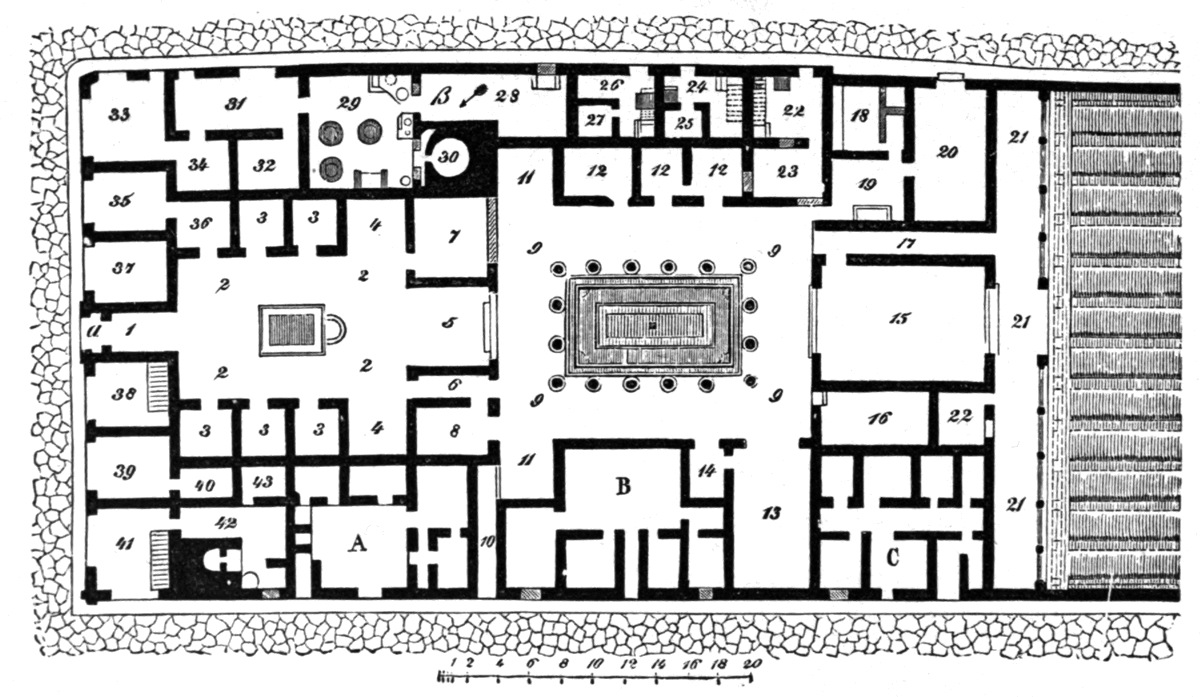
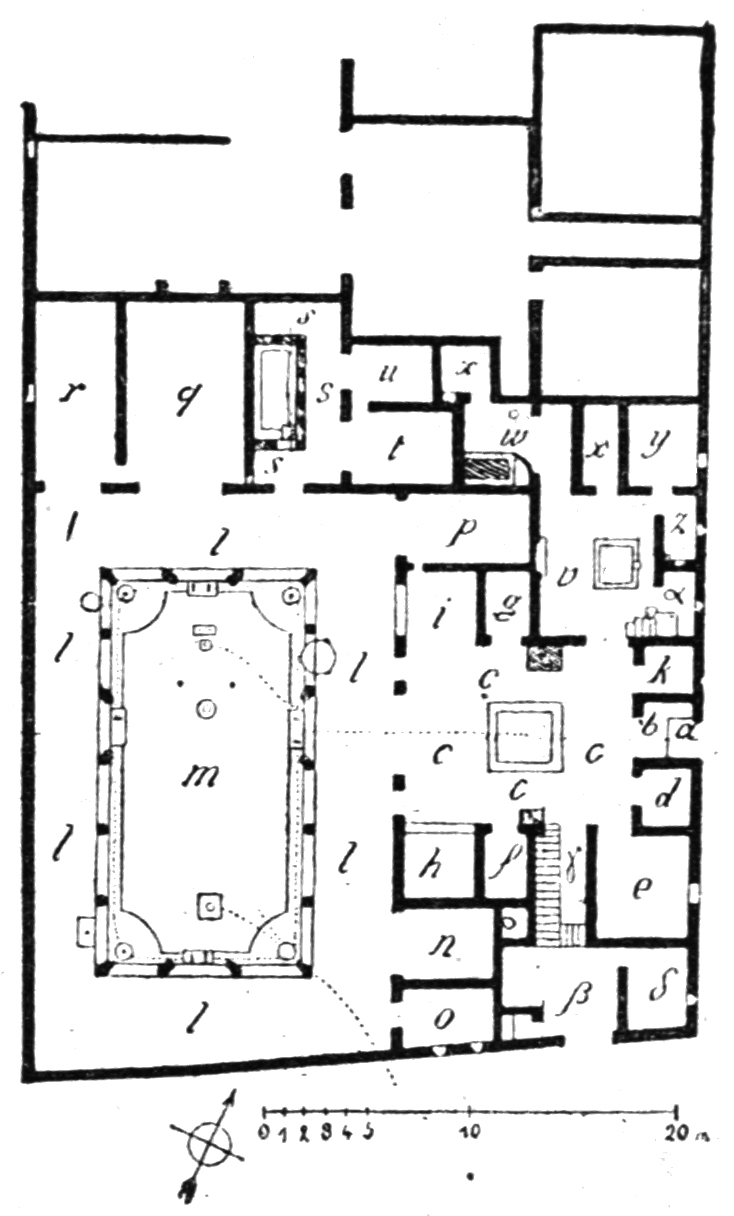
Pompeian house. The house has in general the form
of a rectangle of which the small side faces the
street, see fig. 51. The door 40is in the middle of
this side, and is flanked right and left by one or two
rooms, which are either used as shops and then open
outwards for their whole width, or are entered from
the interior and form part of the house. Between these
a passage leads from the door to the chief apartment
situated behind, viz., the Atrium. This passage
is called fauces or prothyron. In the
superior class of houses the door is set back a
little so as to leave a free space in front, called
Vestibulum. Then there are usually two doors,
one a wide folding-door corresponding in size to the
passage leading to the Atrium, and a smaller door at
the side intended for the Ostiarius, or porter,
who could thus refuse admittance to an importunate
or unpleasant visitor, without exposing the interior
of the house to the gaze of those standing before
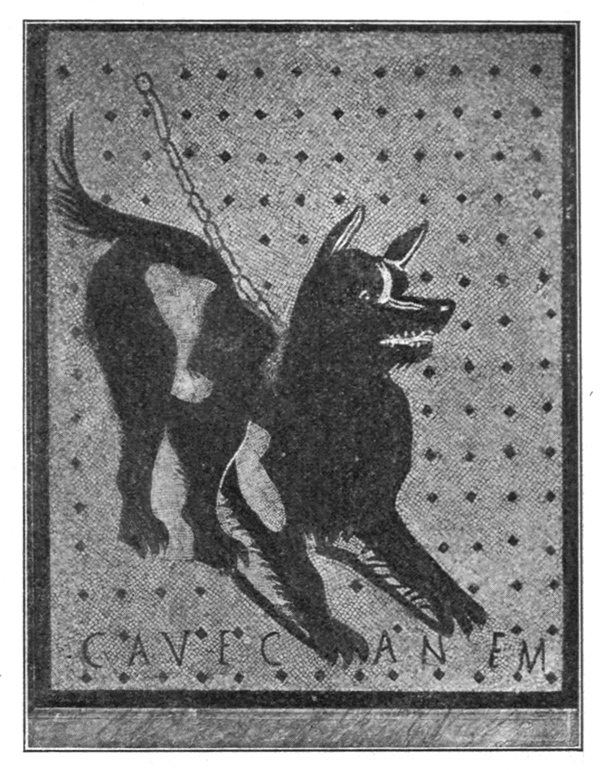
the door. A salutation such as Have or
Ave, “Hail” inlaid in the threshold of the
door, or a Cave Canem, “Beware of the Dog”
with the representation of a dog in mosaic (fig. 53)
is a not unusual ornament which meets the eye as one
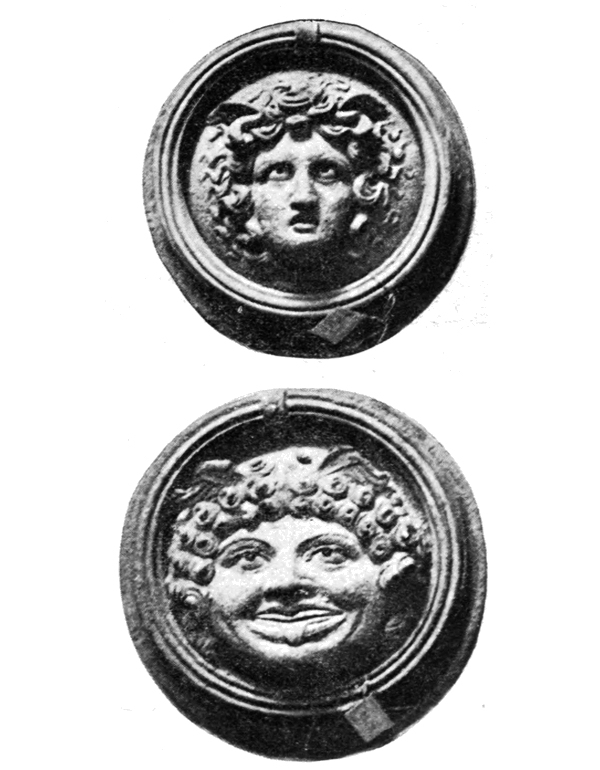
enters. A knocker on the door served to summon the
ostiarius. The atrium, a room usually
square, contains in the middle a rectangular tank
sunk in the ground 41for the reception of rainwater;
for this an opening was left in the roof. Five
classes of Atrium are generally distinguished.
In the simplest, the Atrium Tuscanicum, the
roof sloping inwards was supported by two main beams
crossing the Atrium and two side beams resting on
them (fig. 52; in the new Casa of Reg. V,
Ins. IV the ancient construction of the roof of the
Atrium has been re-erected). If the opening thus
formed was to be large, or it was impossible on
account of the breadth of the Atrium to leave the
weight of the roof to rest only on two beams, pillars
were placed under the four points of junction and
on these pillars the beams were laid; this is the
Atrium Tetrastylum. If it was desirable to make
the aperture still larger, additional pillars were
employed besides the four at the corners, so that
regular halls with colonnades were produced (Atrium
Corinthiacum). If the roof sloped outwards so that
above the impluvium there rose walls supported
by the principal beams or the pillars, the Atrium
was called displuviatum, from the fact that
in this case the rain flowed away outwards. Finally
the atrium testudinatum, a very rare form at
Pompeii, had its roof equally sloping outwards, but
was devoid of the quadrangular opening. This opening
is called compluvium; the name impluvium
is given to the tank sunk beneath to receive the
water, and out of which the water was conducted by
pipes into the reservoirs under the atrium. For
protection against the intrusion of unbidden visitors
who might without difficulty let themselves down from
the roof into the room through the compluvium,
the opening could be closed beneath by means of an
iron grating. On both sides of the Atrium,
which receives its light from above, are placed mostly
small chambers, storerooms or sleeping apartments;
the last one on each side usually opened its whole
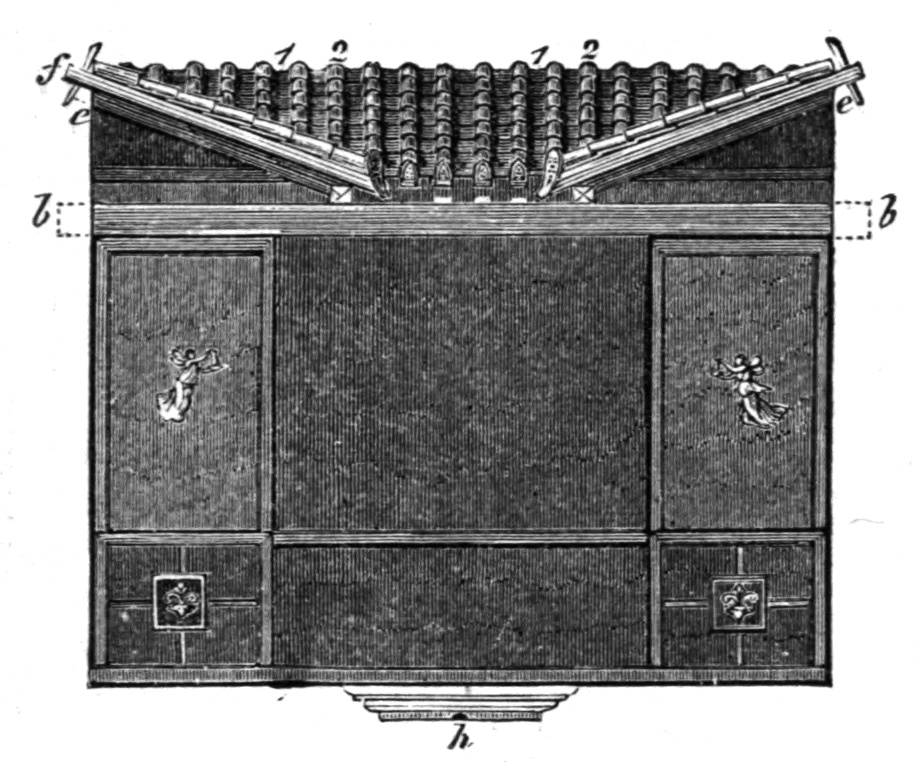
width to the atrium and is called Ala. Here in
Patrician 42houses of distinction the representations
of ancestors were generally placed. Opposite the
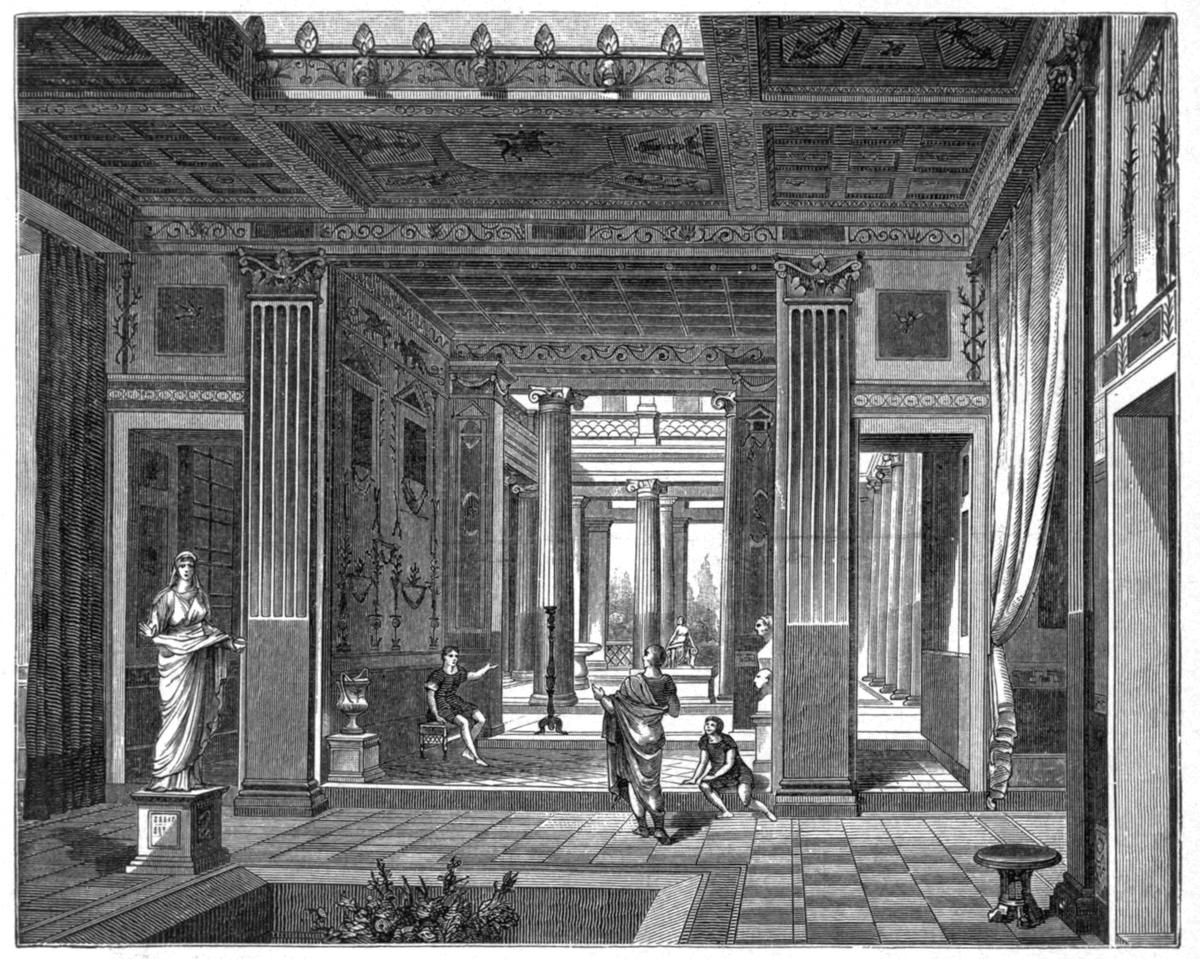
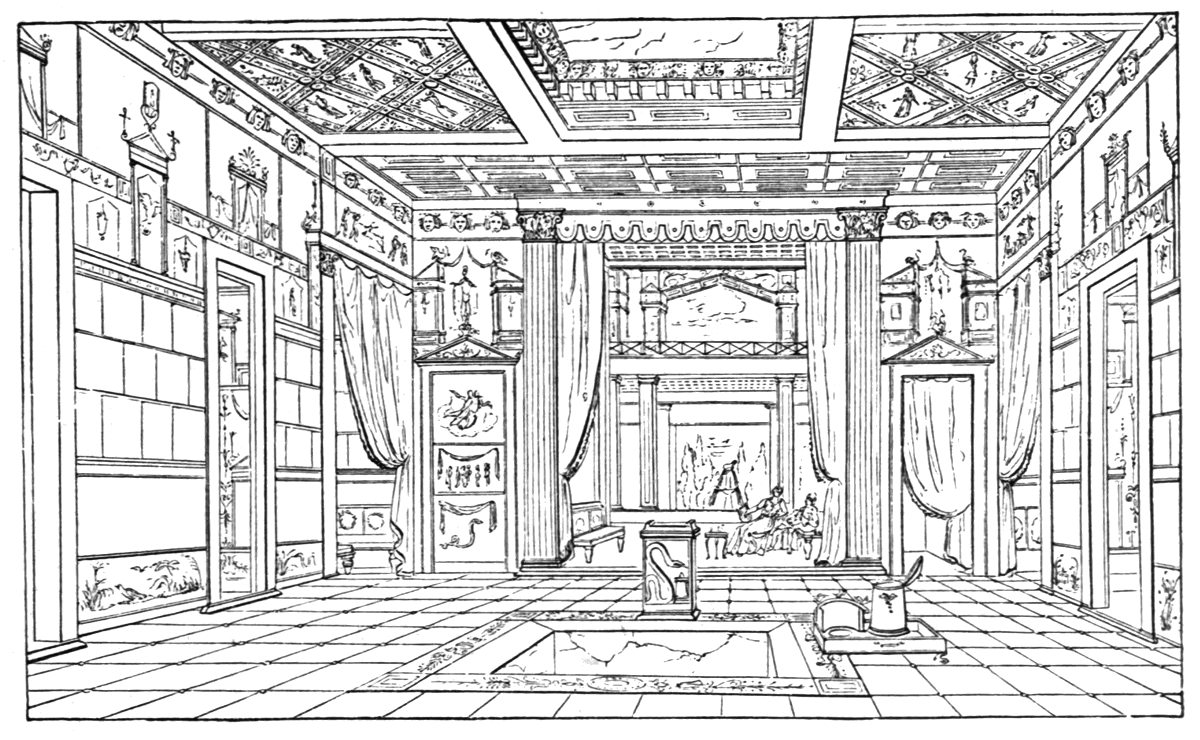
entrance lies the Tablinum, usually opening
with full width on the Atrium, and closed only
by curtains (fig. 55). This was specially the room of
the master of the house, here he kept his valuable
documents, here he received visits, in front of the
Tablinum; in the Atrium is as a rule the
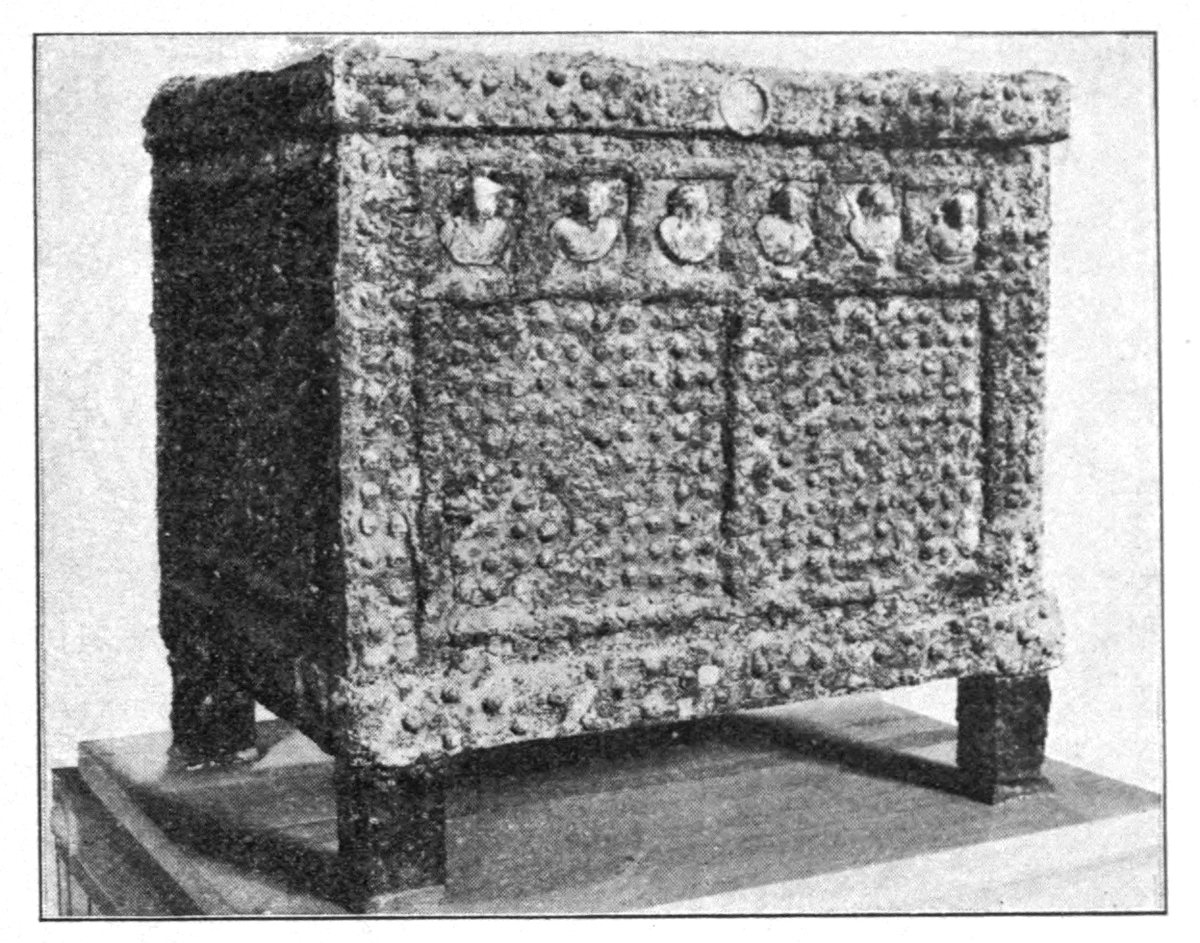
place for keeping the Arca, or strongbox, made
of iron, often artistically decorated, and let into
a huge stone, to prevent its being stolen (fig. 58).
Past the Tablinum a narrow passage generally
leads into the back rooms of the house, which, grouped
around the Peristyle, an oblong quadrangular court
surrounded by columns, comprising not only livingrooms
and bedchambers, but also diningrooms, often different
ones for winter and for summer. These are for the
most part rather small, sufficing only for the
arrangement of the three couches around the little
table, from which the Triclinium has its name.
In this part a little on one side is usually found
the kitchen with other rooms required for domestic
purposes, and placed in close proximity to the kitchen
for the sake of supply and discharge of water. The
wealthier establishments have also one of the chambers
lying round the Peristyle fitted up as a kind of
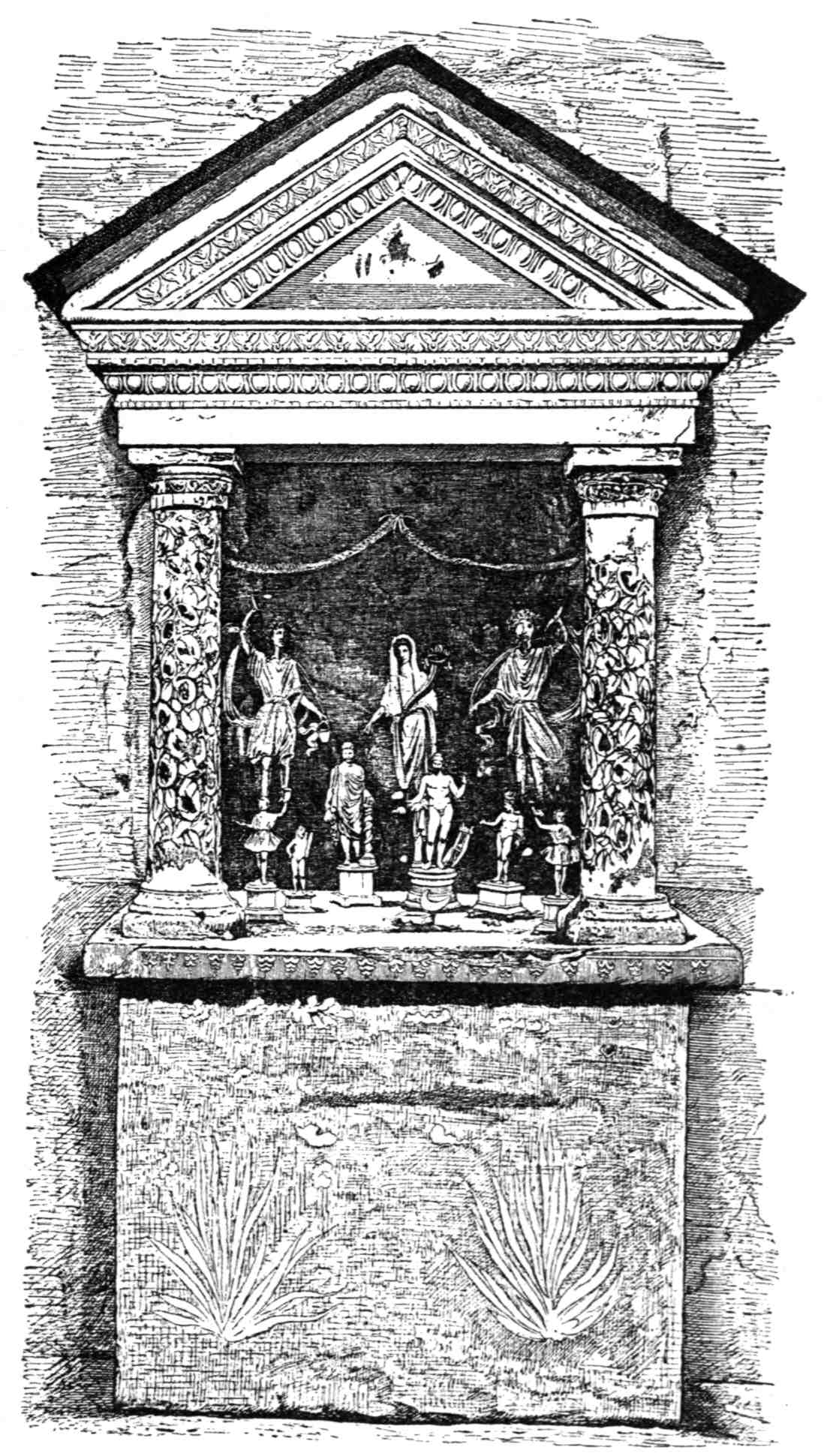
domestic chapel for the worship of the Lares,
if there is not a special Sacrarium erected
in the Atrium for this purpose. Houses of
more moderate pretensions content themselves with
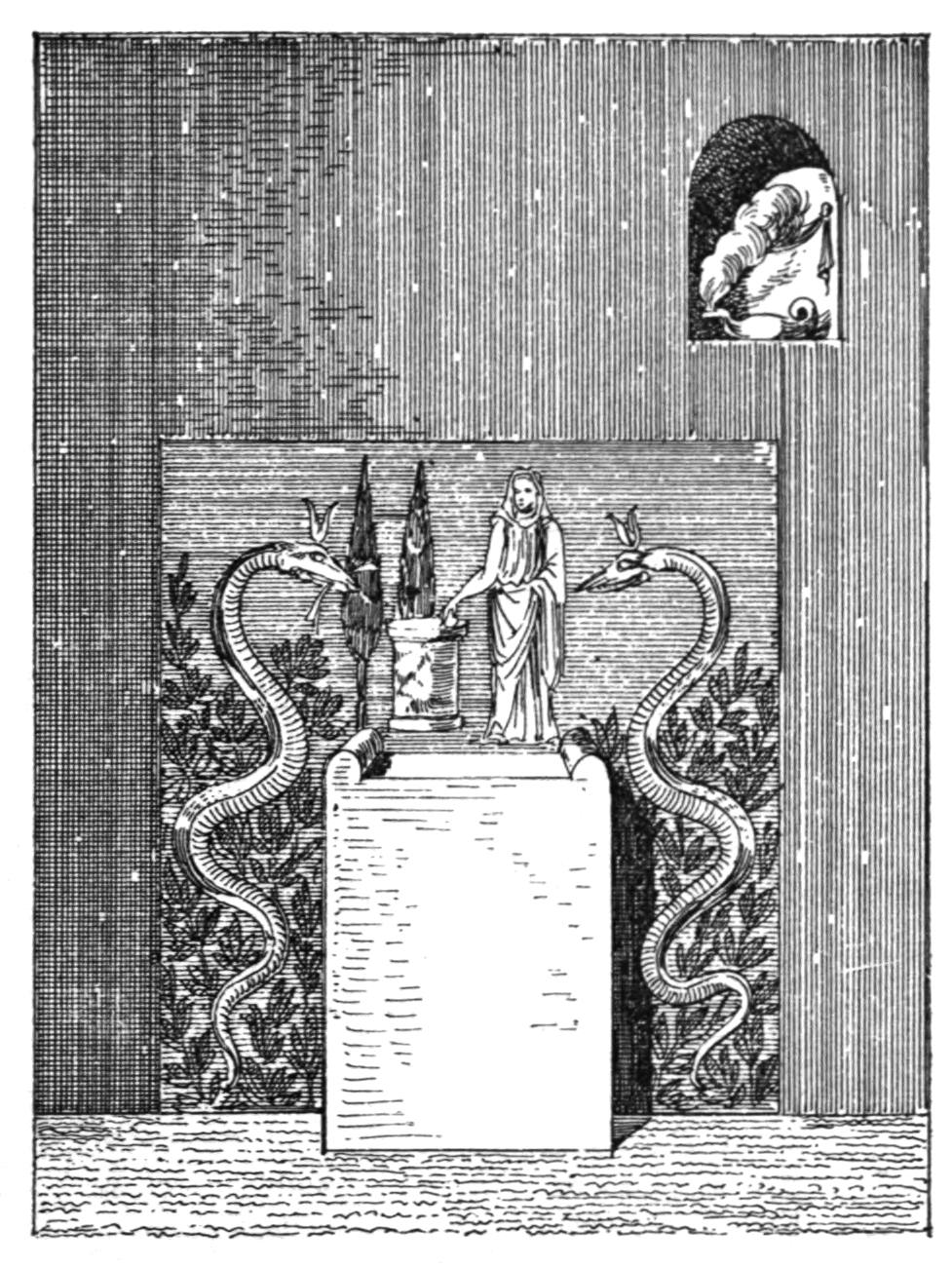
having their household gods, the Lares and the
serpents sacred to them, painted in the kitchen above
or near the hearth, in order to offer sacrifice to
them there (figs. 59 and 62). From the Peristyle we
pass on further to the garden, in which, where the
owner was a rich man, there is likewise no lack of
architectural adornments, airy halls and porticoes.
Upper stories were generally in little favour, with
the increase of population however they could not have
been dispensed with. For the most part they were let,
as a rule with the shops situated on the street, on
which account stairs leading upwards are often found
in the shops; in wealthier establishments the upper
43chambers were allotted to the slaves. These upper
stories, just as in our mediaeval towns, often project
considerably over the street; one such projecting
apartment, as was stated above, is well preserved
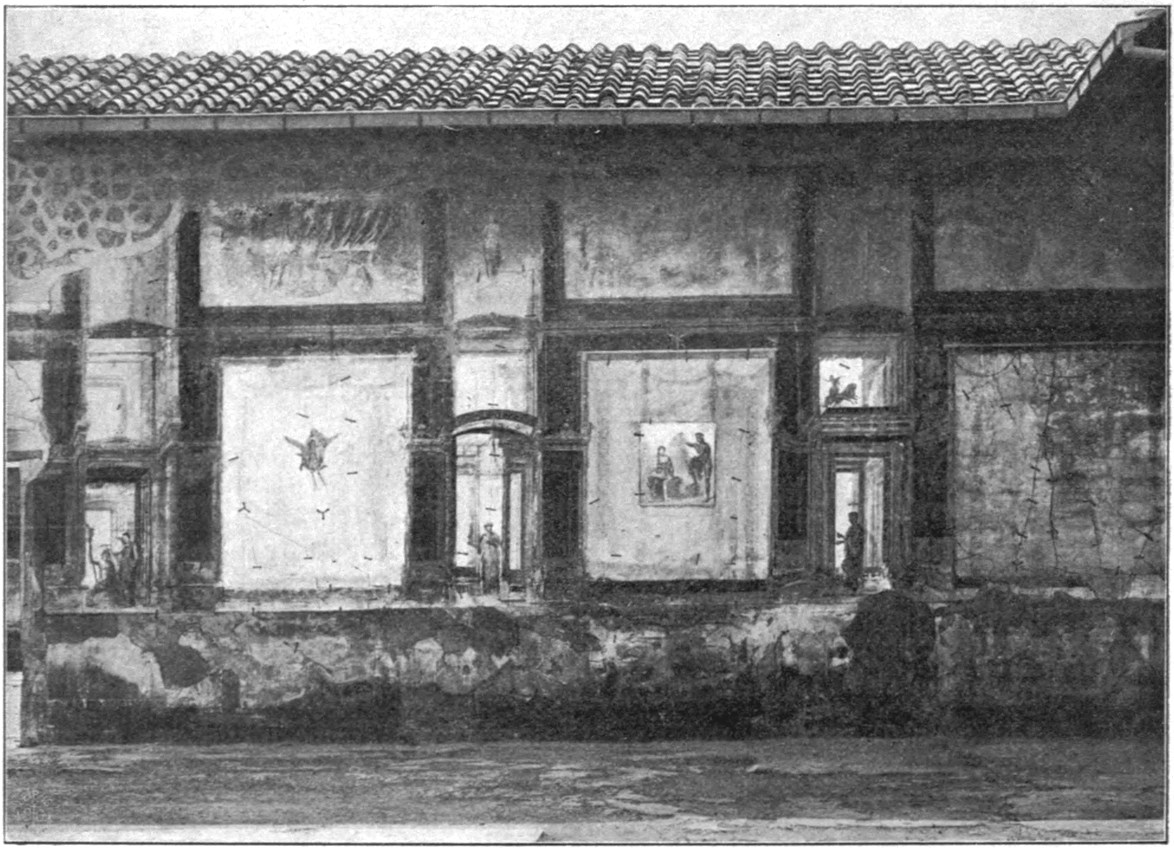
(fig. 61).
Fig. 60. Helmets for Gladiators (p. 36).
Fig. 61. House with maenianum (p. 43).
How was the Pompeian house decorated? Let us begin
with the floor. In most houses the flooring is
provided with opus signinum, that is pieces of
tile are pressed into a mass of stucco and then the
surface is polished; in better houses their place is
taken by mosaic, generally only black and white, and
comprising only patterns and ornaments; more rarely a
coloured picture is produced with smaller cubes in the
middle of the room. Quite peculiarly rich in mosaics,
and indeed such as artistically belong to the most
splendid that have come down to us in this department
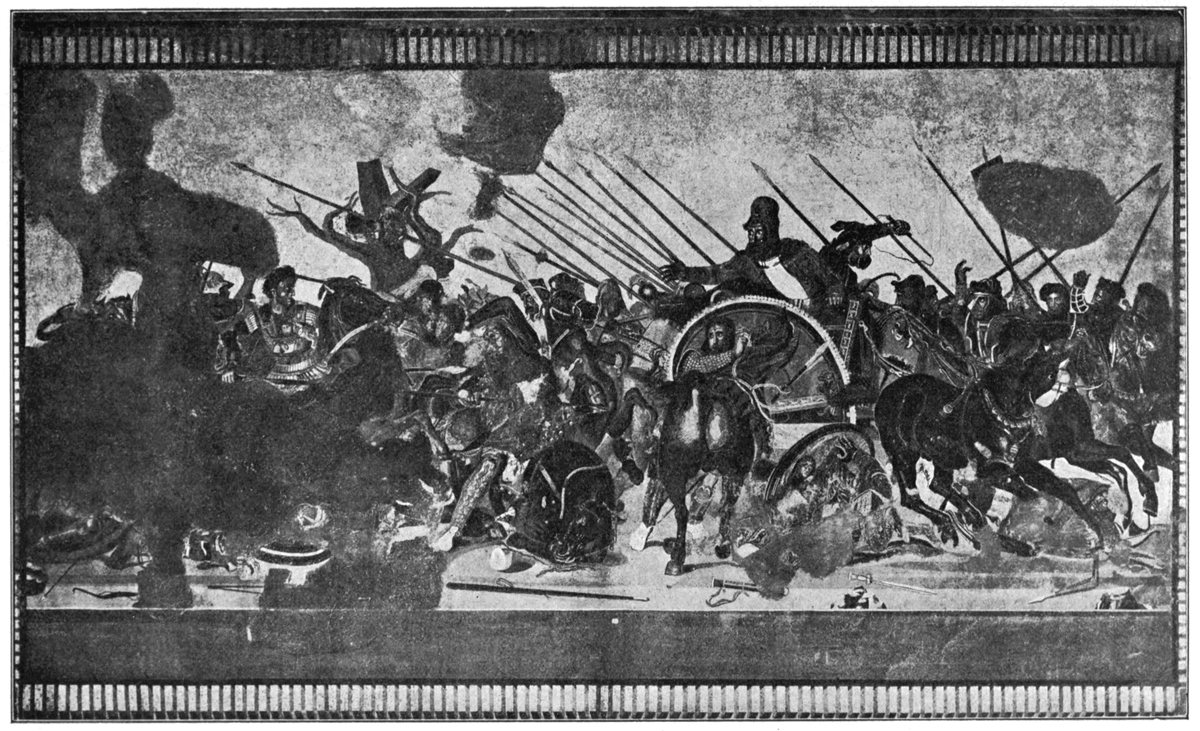
of art, was the so-called Casa del Fauno, in which was
discovered the famous Battle of Alexander, now in the
Naples Museum (fig. 64). The irresistible onset of the
Greeks who in spite of inferiority in number drive the
Persians in headlong flight before them is expressed
with unsurpassable power. Alexander whose helmet has
fallen from his head in the impetuous attack has
just transfixed with 44a powerful thrust of his spear
one of the leaders of the Persian host, who was in
the act of leaping from his dying horse and saving
himself on a fresh one offered to him by a faithful
follower. His fall arouses in the king who stands in
his chariot, the deepest sympathy, so that in his
sorrow for his general’s death he almost loses sight
of his own escape. His charioteer however thinks only
of bringing the chariot and his lord to safety over
dead and dying. From the same house comes also the
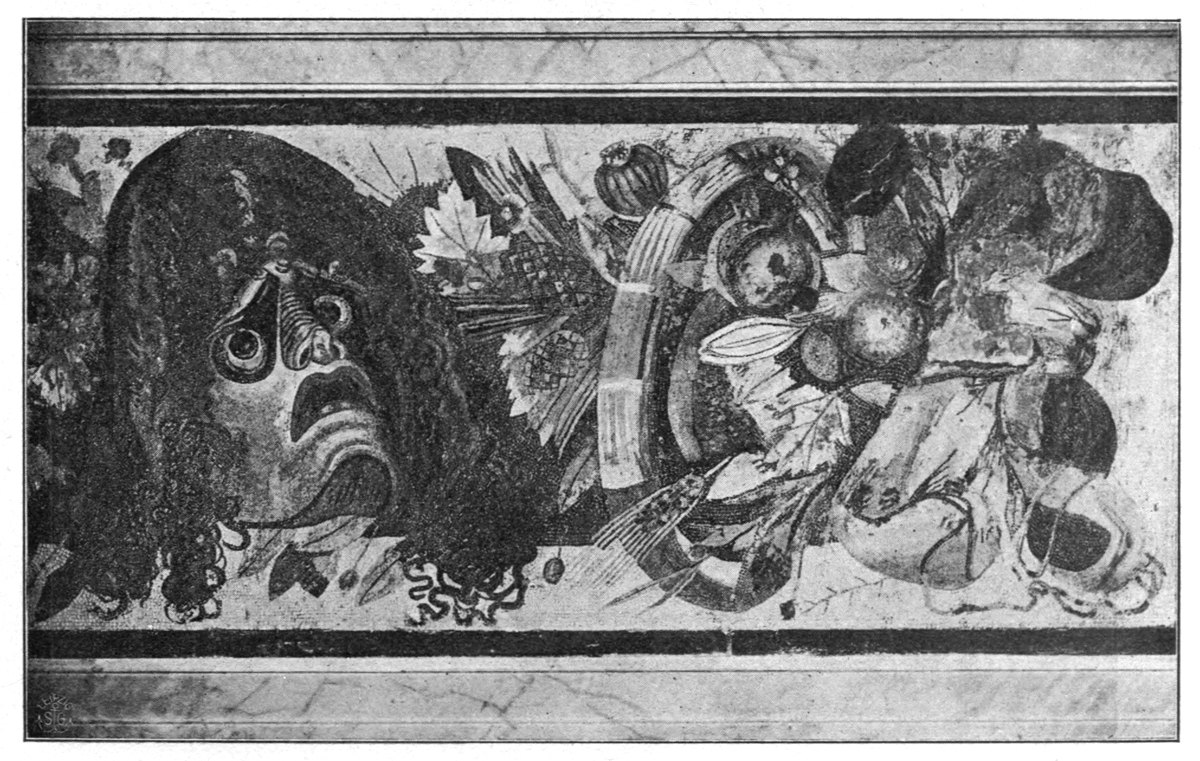
mosaic threshold in the Naples Museum, a portion of
which we give in figure 63. Leaves and fruits of all
kinds are joined to a cylinder held together by rings
and garnished with various masks.
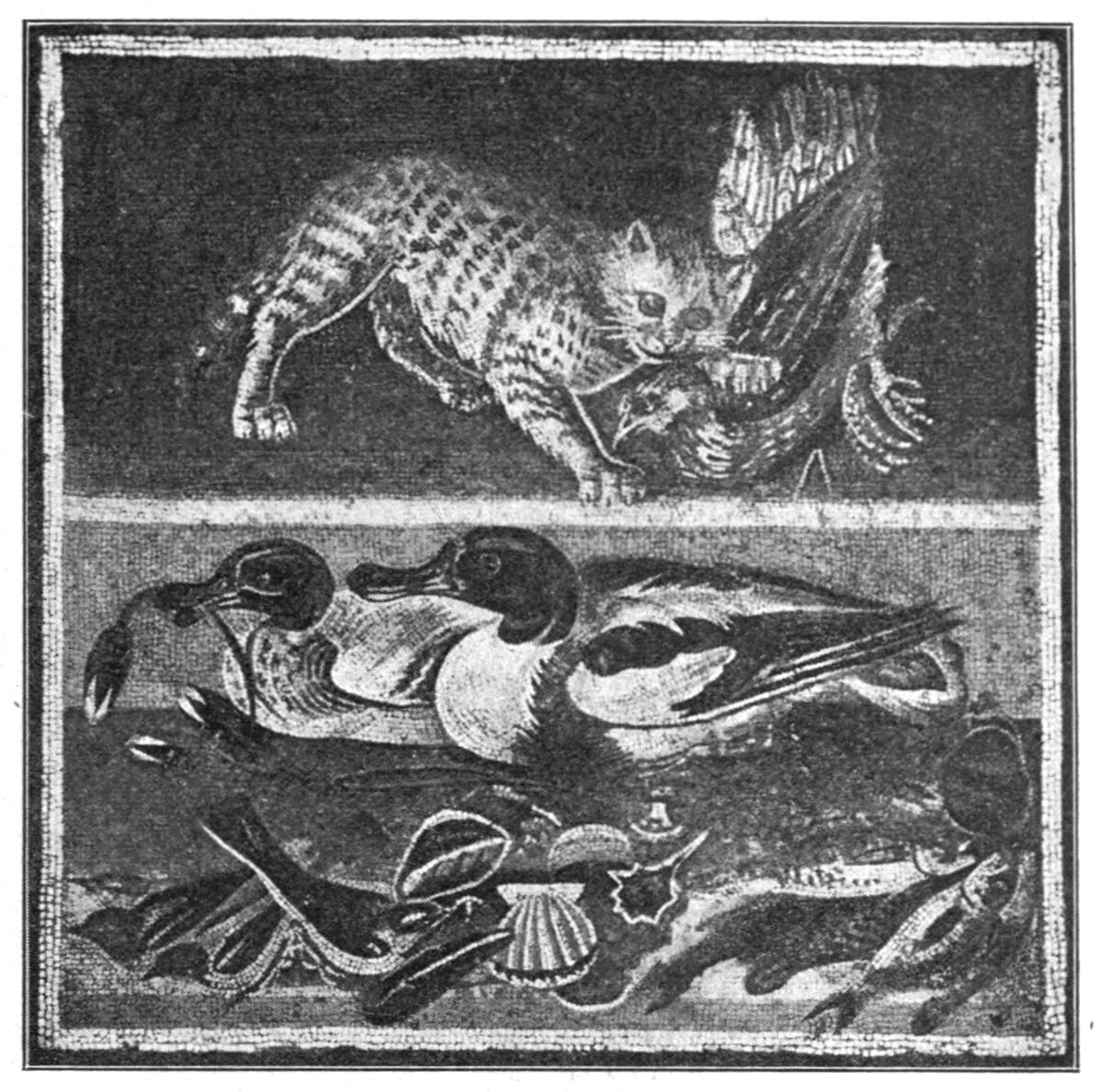
Figure 65 recommends itself by remarkable fidelity
to nature. A cat has seized a bird (apparently a
partridge) with the intention of strangling it. The
cat probably belongs to the species of wild cats,
since cats as domestic animals 45were not common among
the Greeks and Romans before the fourth century of our
era (hence is explained the fact that no skeleton of
a cat has been met with among the ruins of Pompeii).
Below two ducks are swimming, and mussels and other
aquatic animals are represented. At Pompeii too
mosaic had begun to be employed for the covering of
walls, especially beside fountains. The paving of the
ground with slabs of marble, a practice very common
at Rome since the time of Sulla, seems to have been
comparatively rare at Pompeii.
The eyes of visitors will be attracted by the walls
even more than by the pavements. Although, as said
before, the greatest number of the wall-paintings
discovered have been cut out and brought to the Naples
Museum, yet sufficient material exists in Pompeii also
to form a judgment as to the effect of the Pompeian
wall-painting, especially in the more recently
excavated houses, in which the colours are still more
fresh. (For the removal of wall-paintings 47a wooden
frame is placed over and around the pictures, and the
stones are taken away from behind till the stucco
is reached; then plaster is poured in at the back
of the picture, and so the whole becomes one single
mass and can be removed.) We must not however forget
that the rooms in which the paintings are found have
at the present day a much more glaring light than in
antiquity, a circumstance not without influence on the
effect of the painting.
Fig. 65. Pompeian Mosaic (p. 44).
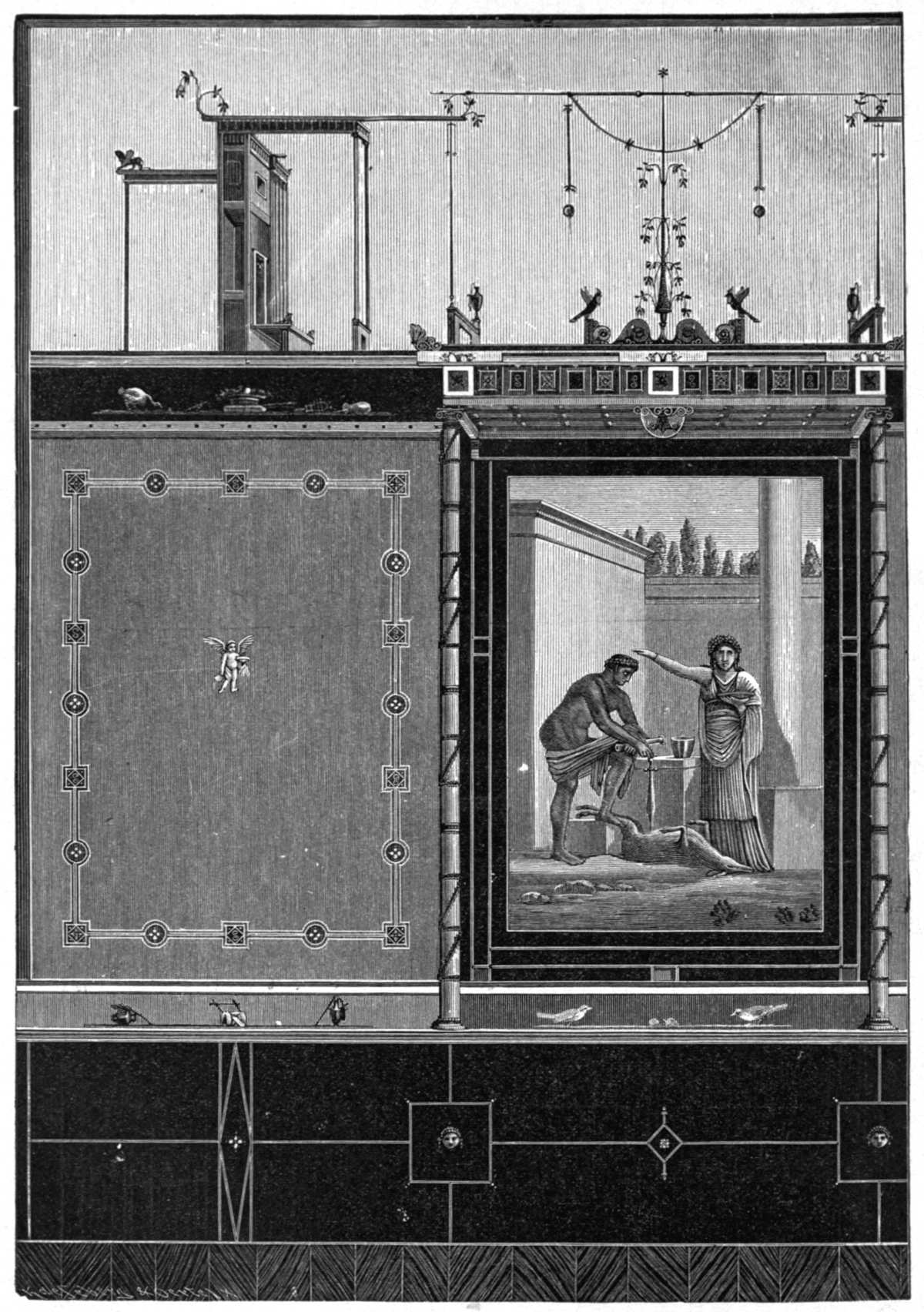
Fig. 66. Wall Decoration of the First
Style (Casa di Sallustio) (p. 47).
Fig. 67. Wall Decoration of the Third Style (House of Spurius Mesor) (p. 48).
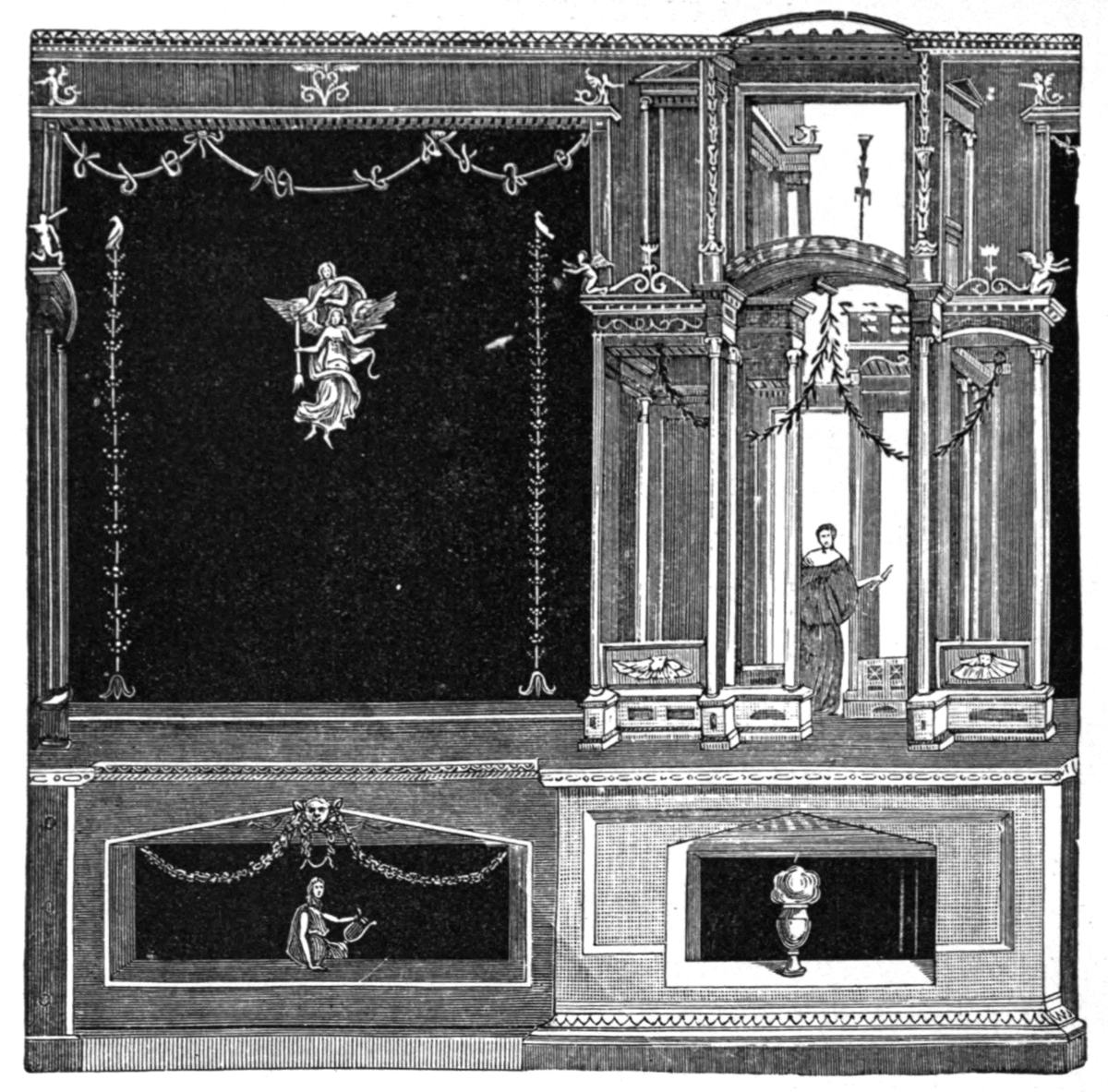
According to A. Mau four consecutive styles are to be
distinguished.
1. Pre-Roman Period: Imitation of marble incrustation
by means of plastic stucco work; no pictures (fig. 66).
2. Period of the Republic: Imitation of Marble
incrustation by means of simple painting, together
with representation of architecture, not fantastical
but as it might actually exist. This style is however
but scantily represented at Pompeii.
49
3. Period of the Early Empire, to about fifty
years after Christ: Egyptianising ornamental style
distinguished by beautiful and pure forms, and
delicate, finely distinguished colours (fig. 67).
4. Ornamental Style of the last period of Pompeii,
with special preference for architectural painting,
fantastically slender and of a playfully ornamental
fashion. The examples of this style are in Pompeii by
far the most numerous (fig. 69).
Above the plinth of uniform shape the walls are for
the most part divided into panels, which usually are
painted alternately yellow and red; in their midst
they have figures of various kinds floating in the
air, women, satyrs, Loves, Victories and such like,
or they are adorned with imitations of easelpictures,
the subjects being taken from mythology. Numerous too
are scenes from every day life, still more numerous
landscapes; the historical motive is as yet only very
rarely indicated. Very frequently mythological figures
are introduced as engaged in the avocations of daily
life in the midst of the fantastical architecture
which covers the walls as ornament. The artistic value
is naturally very different, but in general it must be
admitted that the vividness of colour, the lightness
of touch in creations which are due assuredly to no
famous artist cannot be sufficiently admired. As to
the process by which the wall-paintings were executed
the most multifarious conjectures were formerly made;
now on the contrary the view universally adopted is
that we have to do almost exclusively with fresco
painting, i. e. painting on fresh plaster, only that
here and there recourse was also had to painting in
tempera (fig. 68).
Some wall-paintings still in their original position
will be dealt with later when we come to speak of the
respective houses; a few examples out of the rich
treasure removed to the Museo Nazionale in Naples may
here suffice.
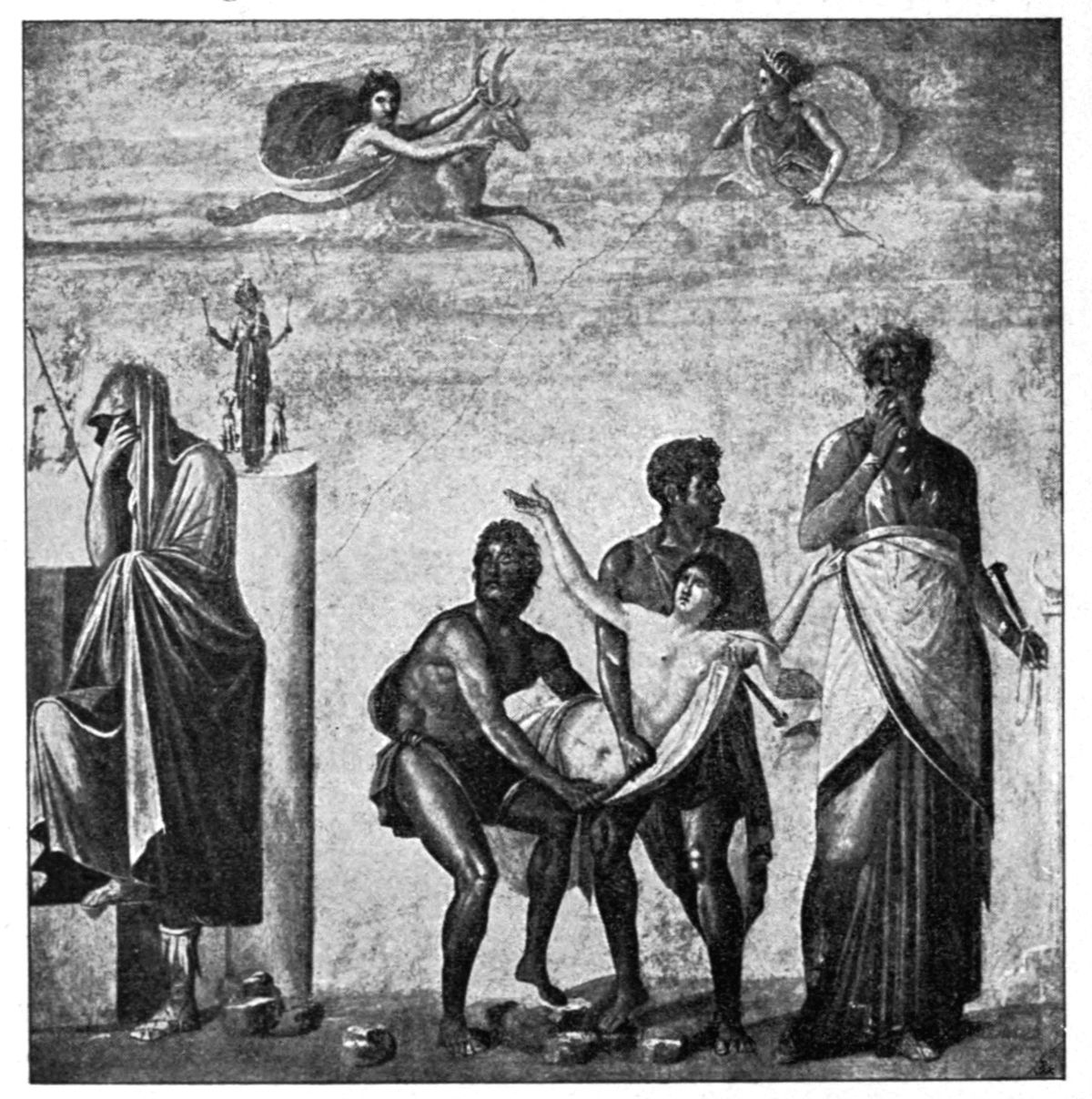
Figure 70 represents a painting which may rank as one
of the most famous and the most frequently discussed,
the Sacrifice of Iphigenia, probably a copy, though a
feeble one, of a famous picture of an earlier period.
Ulysses and Diomedes are holding the hapless maiden
through whose sacrifice Agamemnon 51desires to appease
the wrath of Artemis and to obtain a favourable wind
for the expedition to Troy; they hold her ready for
sacrifice before the image of Artemis standing on a
column. Calchas the priest has already drawn the knife
from its sheath to give the fatal stroke, but still
he hesitates, as though he felt some scruple as to
undertaking the cruel deed. Agamemnon stands aside,
shrouded entirely in his robe, since as a father he
cannot bring himself to look with his own eyes upon
the carrying out of the sacrifice, to which as king
and leader of the army he sees himself compelled. In
the gaze which Ulysses directs to the image of Artemis
we may read the reproach that she, the goddess, should
demand such cruelty. Yet the merciful solution is
prepared by the scene enacted above in the sky; there
we see the goddess Artemis herself, to her hastens
a nymph who brings the deer that is to fall 52by the
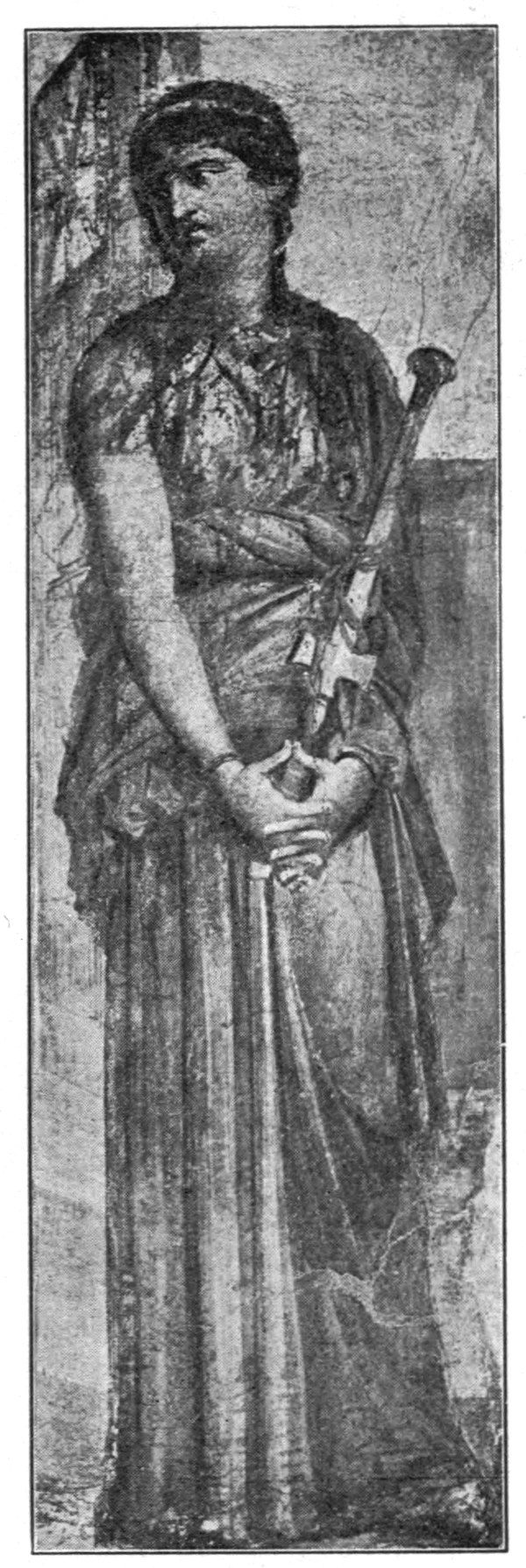
sacrificial knife in place of Iphigenia. Figure 71
is derived at any rate from a famous ancient theme,
perhaps after a painting by Timomachos; this is the
single figure of Medea, who sword in hand plans the
murder of her sons. The sword is still sheathed, sunk
in deep deliberation she has folded her hands, and
pressed thumb against thumb, she is a mother who loves
her children tenderly, but she is also a wife who is
bitterly sensible of every neglect on the part of her
husband. Which feeling will gain the victory? Will it
be gained by a mother’s love which pardons everything,
or by the jealousy that knows how to strike the
husband in the most painful way through the slaying of
his children? The conflict of feelings is undoubtedly
expressed in a most striking manner in the picture.
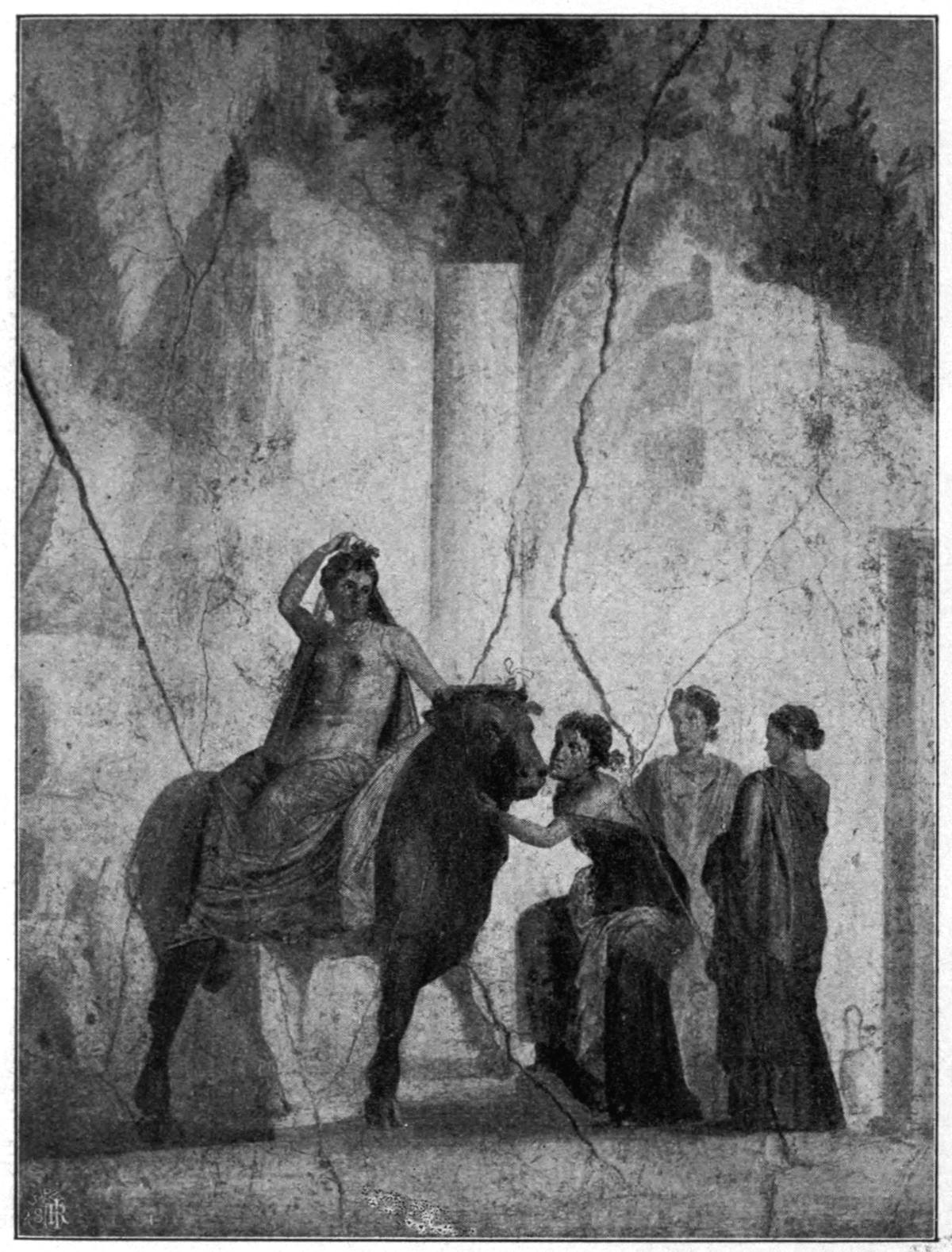
Figure 73 also represents a picture remarkable for
excellent preservation, the abduction of Europa by
Zeus in the form of a bull. Europa daughter of Agenor,
sports with her companions on 54the shore of the sea,
gathers flowers and weaves garlands. There a bull
approaches them (Zeus had concealed himself under this
form), who through his tameness gives the maidens
courage to busy themselves sportively with him. They
deck him with flowers, caress him, nay at last Europa
becoming bold mounts his back. It is this moment that
the painter has chosen to depict. Europa has lain
down on his back, the girls are still playing with
him, yet he is already striding forward, only a few
steps and he is in the sea, and then will Zeus bear
his sweet burden to Crete, and her terrified playmates
will vainly stretch forth their arms after the king’s
daughter borne far away.
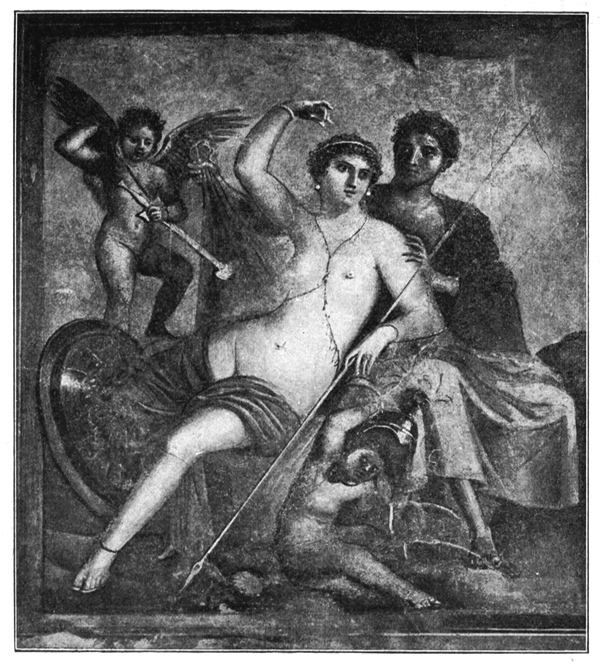
Figure 74 represents a subject often occurring at
Pompeii, Venus united with Mars. Mars lays his left
hand on the left arm of Venus, who resting at ease
lays her left arm on the right thigh of Mars, who with
his right hand raises the robe of the goddess so that
the whole upper part of her person is uncovered. That
the god of war has already quite forgotten his own
peculiar mission, and is quite given up to love, is
shown by the two Cupids, of whom the one is engaged
in girding himself with the god’s sword, while the
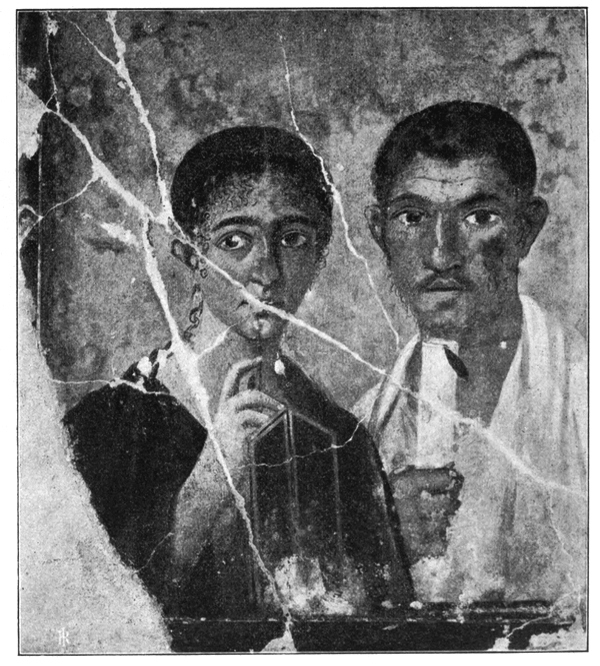
other is trying his helmet on his own head. Figure 75
offers us a picture with quite a modern interest. The
worthy baker Paquius Proculus has had his portrait
painted with his better half, since photography has
not yet been invented. But for this purpose it is not
sufficient to have brought the external form into
order, to have neatly smoothed the moustache, and
to have crisped the little locks so that they curl
daintily over forehead and cheeks and roll deep upon
the neck, no, they wish their intellectual interests
to be recognised; 55therefore he takes in his hand
a written roll, and she grasps with her left hand
a diptychon, while with her right she holds to her
lips the style to write on the wax tablet, as though
in the next moment some brilliant idea would occur
to her which she need only write down in order to be
included for all time in the list of the intellectual
Bluestockings. Just as in our own day many people
get their portraits taken with books in their hands
as though the study of literature formed their whole
ordinary day’s work.
The decoration too of houses by means of statues of
marble and bronze must here be briefly mentioned.
It has already been stated that in the temples and
public buildings numerous marble and bronze statues
have been found. These discoveries can therefore be
passed over here. As the most beautiful of the works
of art which have been discovered in private houses
may be mentioned the statue of the Dancing Faun
(after which the Casa del Fauno is named) and the
so-called Narcissus, found in a house of the Vico del
Balcone pensile. In the former (fig. 77) the artist
has represented a comrade of the circle of Dionysos,
full of Bacchic pleasure, turning in wild dance; it
is a rough sensual comrade, whose half animal being
is sufficiently suggested by 56his goat’s ears and
the little tail that is just visible. The strained
muscles show with what energy he gives himself up
to the activity of the dance, while on the other
side the unrestrained joyousness expressed in his
countenance, and the freedom and ease he displays in
the movement of the upper part of his body and his
arms clearly reveal with what sportive agility he
copes with the exertion. Almost more beautiful is the
so-called Narcissus (fig. 78) a youth just outgrown
the years of boyhood, over whose left shoulder hangs
the skin of a goat or a doe, who however is otherwise
naked except the feet which are clothed with elegant
sandals. With slight movement of the arm he supports
the left hand against the hip, and stretches out the
right hand, while at the same time he bends his head
to this side as though he were turning his attention
to some distant sounds. People have chosen to see in
this figure a Narcissus listening to the flattering
words of Echo, but such a situation is nowhere to be
found in the myth. Others suggest Dionysos playing
with his panther; for this the doeskin and the wreath
of ivy in the hair would be 57very suitable, as also
the beautiful sandals; but then we should have to
suppose that the figure had already in antiquity
been removed from its original base and placed on a
new pedestal. For the enjoyment however which the
work of art affords us the name which is given it is
a matter of indifference, and this enjoyment will
be experienced by every one who contemplates the
beautiful statuette. Also the recently found statuette
of a youth, completely plated with silver, (fig. 72)
which in antiquity was altered into a lampholder,
and therefore has experienced some damage, deserves
careful inspection on account of its beauty.
Fig. 81. Mosaic Fountain (p. 59).
Fig. 82. Atrium of the Casa di Cornelio
Rufo (p. 60).
Fig. 83. Bust of the Banker L.
Caecilius Jucundus (p. 60).
While this figure was to be employed in the house for
lighting purposes, both the others seem to have had
their place at the fountain of the house, with which
in a certain way they were connected, in that the
relation of Satyrs and similar beings to springs is
a well-known one in antiquity. In other places the
marble and the bronze statues are employed actually
as fountain figures, so in the case of figure 79, the
bronze statuette of a Cupid who exerting 59all his
strength holds a dolphin up high, from whose mouth the
water flows. As to how such statuettes were grouped
with fountains and how also in small houses an attempt
was made to enliven the narrow space left for the
garden by the erection of all sorts of works of art, a
sufficiently clear example is afforded by the little
garden of the Casa di Lucrezio (fig. 76). Here on both
sides of the fountain niche in which stands a Silenus
as distributor of water, double Herms or busts are
placed which represent Bacchus with Ariadne. Of the
other figures above all let the group standing in the
foreground be mentioned, a group of a Satyr extracting
a thorn from Pan’s foot. A dainty motive too is that
of a fountain figure (fig. 80) from the Casa del
Balcone pensile. A boy whose dress falls down long
over his back (in this way a support for the marble
figure is obtained) stands in easy pose, while he lays
his right arm on his head and stretches out the left
hand with a mussel shell. From this shell trickled
the water, and a more copious stream flowed from the
waterpipe straight into the marble basin.
Mosaic is frequently united with sculpture in the
ornamentation of fountains, for example in that of the
Casa delle Fontana Grande (fig. 81). Here the fountain
takes the form of a retiring arched niche, in which
the water from beneath the mask of a water-god flowed
out of an aperture in a broad jet over a flight of
steps, while marble masks with wide opened eyes are
placed on the piers of the niche.
60
Between the columns of the Peristyle, to judge
from the wall-paintings, there were often placed
also medallions hung on ribbons, the so-called
Oscilla, now and then shaped like a
pelta (i. e. as the shields of Amazons are
commonly represented). These are sculptured in
relief on both sides. None are of course found in
their original position, but a whole series of such
medallions, which were found lying on the ground, is
exhibited in the Naples Museum.
An entirely different class of ornament is to be found
in the Atrium; here sometimes a portrait bust of the
owner has been found inserted in its pedestal, which
in at least one instance is plainly designated as
a dedication on the part of one formerly belonging
to the house. Figure 84 represents the bust of C.
Cornelius Rufus, an interesting work in marble, which
clearly shows how remarkably well the sculptors of the
earlier Roman Empire understood how to seize and to
reproduce the characteristic features of their sitter.
The bust is let into a square pillar, from which,
right and left, instead of arms, quadrangular stumps
protrude, on which it was customary to hang wreaths as
ornaments on days of commemoration. Figure 82 gives a
view of the whole atrium with the bust, by which we
are enabled to recognise the harmonious way in which
this ornament fits into the whole surroundings. Still
more striking perhaps in its effect is the bronze
bust of L. Caecilius Jucundus (fig. 83:—the original
is now in Naples), the Banker, in whose house was
found the chest with wax tablets, of which mention
has been made on another page. Here is a bronze bust
which has been inserted in its marble pedestal, a
dedication by the Freedman Felix to the Genius of his
master (Genio L. nostri Felix L.). Many a one
who has seen the bust in the Museo Nazionale, has, at
a first glance, without knowing any more about it,
been led to exclaim that he might 61be off at once to
the Exchange, so characteristically has the sculptor
rendered his portrait. Friend Caecilius is certainly
not handsome, so he cannot have been flattered by
the artist, who has suppressed neither the broad
outstanding ears, nor the great ugly wart, almost
suggesting representations of Satyrs. But through the
marvellous mixture of bonhomie which is stamped on his
countenance and keen calculation and decision which
are expressed in the closed lips and the glance of the
eyes (unfortunately the pupils formerly represented
by coloured smalt have fallen out) a personality has
been successfully depicted which carries in itself the
stamp of genuineness. Caecilius Jucundus evidently
knew full well how to feather his nest, but he was no
mere miser who only brooded over his treasures, no, he
not only prized very highly his cheerful enjoyment of
life, but he also loved gaiety and good fellowship,
and in the circle of his boon-companions he was ready
to take a joke, and was himself capable of enlivening
conversation by many a jest.
Fig. 88. A Symposium. Pompeian
Wall-painting (p. 63).
So much for the decoration that was provided for the
house by painter and sculptor. How stands it then with
the household furniture?
Our rooms are filled with a quantity of furniture,
numerous tables, chairs, cupboards with every possible
name and object, sofas, and whatever else pertains
to modern housekeeping. Compared with all this the
ancient house 62would seem to us empty. In the first
place cupboards for keeping clothes and the like are
hardly to be found. To a great extent small rooms
were made available for keeping movable articles by
putting up shelves, but for clothes chests standing on
the ground had to serve, which might be compared with
our presses and trunks. They were the better suited
for this purpose inasmuch as the dress consisted more
of stuffs which did not assume their definite form
as dress until they were put on. These trunks could
at the same time be used as seats, often, as at the
present day in the East, for reclining on. There were
too regular seats, for the most part without backs,
and like foot-stools; among them we ought particularly
to mention the bisellium which properly could
hold two persons, but as a special honour was granted
by decree of the Decurions to a single individual
(fig. 85). Tables, especially show tables of costly
woods, to display the ornamental tableservice may have
existed, but none of these have come down to us; on
the other hand marble tables, generally placed close
to the impluvium (fig. 86), have in many instances
been preserved. Among them are some that can be raised
at pleasure. They often have feet artistically shaped,
the forms of all possible fabulous beings, griffins
&c. being employed as ornaments. Such tables as we
are accustomed to take our meals at are no where to
be seen, because the custom of the ancients was to
eat while lying down. The furnishing of a triclinium
was as follows:—around a central point of masonry
only about a foot and a half in height, on which the
table-top or tray was placed, stand three low couches
abutting on one another at right angles, occasionally
(in the open air) of masonry, otherwise of bronze
(fig. 87), or of wood, on each of which three persons
recline at meals; the fourth side is left open for the
attendants. The arrangement of the couches can often
still be seen by examining the mosaic floor. To one or
other of the couches a still lower seat is frequently
attached, probably for the children. The inner side of
the lecti (for that is the name of these sofas)
was as a rule somewhat higher than the outer; people
got upon them from the lower side, and lay with the
left arm on the cushions serving as a support in such
a manner that the right arm was free to take the food
to the mouth. The tables of masonry were generally
without ornament, since they were covered 63by the
tray with food; once only has an ornament been found
in this position at Pompeii, a mosaic representing
a death’s head, a motive borrowed no doubt from the
Egypto-Alexandrian custom of inviting people to
brighter enjoyment of life by allusion to its fleeting
nature and the nearness of death. When towards the
beginning of the Empire round tables (orbes)
came more generally into use in place of square ones,
the three couches arranged at right angles around
the table had naturally to be united in a single
semicircular sofa corresponding to the circular shape
now adopted for the table. Such a semicircular sofa
received the name Sigma or Stibadium on
account of its resemblance to the Greek letter C. This
style must—to judge from wall-paintings—have been
usual in Pompeii, yet we are unable to point it out
among the existing remains in the rooms. (Fig. 88 is
from a wall-painting; this gives also the conversation
of the guests at table: facitis vobis suaviter,
you are having a good time, says one; another, ego
canto, I sing; est ita, valeas, so
it is, good luck to you, says the third.)
Fig. 92. Portable Stove (p. 64).
Fig. 93. Bronze Vessel for the
preparation of Calda (p. 65).
Of tripods, which in the ancient house formed part of
the necessary furniture, beautiful shapes have come
down to us, (cf. fig. 91). Tables then and chairs,
chests and couches, with these the house furniture is
pretty well exhausted; but one must include with them
the movable stoves by which in winter some measure
of warmth could be secured. Stoves, as we know them
were non-existent in antiquity, as even now in the
greatest part of Italy. If 64it became cold, a brazier
of charcoal was brought, as at the present day, at
which people warmed themselves. (The best example of
such a brazier is that dedicated by one Vaccula in
the Baths, which may be seen in figure 48 behind the
railing.) Richer folk had for this purpose also a
special stove which could be carried from one room to
another, as now in Paris, see figure 92. The question
of heating, as that of chimneys in the kitchen, is
for us northeners one of great importance, which
however for the South plays no great part, as one
can see any day at the present time. Apart from the
resorts of foreigners, in which on practical grounds
full allowance is made for the ideas and usages of
people belonging to northern countries, the Italy
of to-day remains for the most part at the stand
point of antiquity. There are no stoves and as few
chimneys, because the fuel used is almost exclusively
charcoal, which kindled in the open air continues to
glow without requiring a special exit for smoke. And
if there is any smoke, it has to find its way where it
pleases. This is the origin of the name Atrium,
because everything became black (ater) through
smoke. However we must not omit to mention that in
some Pompeian kitchens a wide pipe or channel is
provided, through which an escape to the street is
allowed to any smoke that there may be, subject to its
own good will. To suppose any such thing as an actual
chimney (apart of course from baking ovens) would be
mere wild imagining, there was in fact absolutely no
necessity for such a thing.
We must consider charcoal as the fuel also for various
utensils which served for the preparation of warm
drinks, the so-called Calda, or for keeping
food warm, and which certainly had their place not in
the kitchen but in the diningroom or other apartments.
One of such utensils (fig. 90) is garnished after the
fashion of a fortress with towers at the four angles
and battlements on the surrounding wall; while the
interior served for the reception of charcoal 65and for
keeping food warm, the surrounding wall and towers
were used for water, which at pleasure could be drawn
off by a tap. On the other hand the vase represented
in figure 93 is near akin to the Russian samovar;
here a wide pipe is introduced into the body of the
vessel, which could be filled with glowing charcoal in
order to heat the liquid contained in the vessel. Or
on the contrary if the liquid was to be cooled, all
that was necessary was to fill the pipe with snow.
Of course owing to the open pipe the liquid could in
neither case be poured out, but had to be ladled out.
For the preparation of warm drink as well as for the
heating of food the apparatus represented in figure 94
was also undoubtedly employed. In this instance a
high cask-like vessel is connected with a cylindrical
one having a spout, while the enclosed space holds
charcoal.
The question of lighting also merits some brief
consideration. It has already been stated that the
apartments on the principal floor had scarcely ever
any direct light from the street, but received
indirect light from the atrium or the peristyle. We
are not however on this account to imagine them to
have 66been dark; the sun’s power in the South is
so great that even in the case of indirect light a
very considerable brightness is attained; if the
door-spaces were closed by wooden doors, or by
curtains, still sufficient light fell into the room
through an opening introduced above the door, or the
doors and curtains were so arranged that the light
above was not shut out. Artificial lighting was
supplied by oil lamps, which must have been employed
in great numbers, to ensure sufficient brilliancy.
Hence lamps, especially of course the ordinary
terracotta lamps, are the most numerous of the objects
found. Candelabra served to support them, of these
very elegant forms have been preserved. One of the
most interesting is represented in figure 96, where
four lamps, each with two wicks, hang down from a
pillar raised on a basis semicircular in front. The
candelabra also often take the form of trees, on
the boughs of which the lamps are suspended, so for
example in figure 97. Besides these there are lofty
candelabra which spring from a basis usually supported
by the feet of an animal, and rise to a considerable
height in the form of slender columns; on the top,
which generally spreads out as a calyx, there usually
stood only one lamp with several wicks.
Next to the candelabra may be mentioned under the
head of domestic utensils more or less costly vases,
which were frequently displayed on handsome 67tables
or the tripods described above. Of these too a great
number have been found in Pompeii and deposited in
the Museo Nazionale at Naples. Thus figure 98 shows a
large vessel of bronze, a crater or mixing bowl, the
elegant twisted handles of which are fastened to the
body of the vase by means of a winged Medusa mask.
That its purpose was merely ornamental is shown by the
circumstance that it is placed on a separate basis
supported by lion’s claws. A more bowl-like vessel,
also supported by lion’s claws, is 68represented on
page 107.—On each side of this two united bodies of
lions connected with serpents are employed as handles.
The jugs in figure 99 display different shapes, in
the one the handle is formed by a soaring bird with
broad bill (a swan or perhaps a goose), while an
eagle sits enthroned above the mouth; in the other
the body of the vessel consists of a head with eyes
separately inlaid, but now lost. Numerous too are the
ornamental vessels of silver. Two cups famous above
all are represented in figure 95, on one side of which
is placed a male centaur, on the other a female.
On their backs are seated Erotes (Loves). Although
both cups are without doubt intended as companion
pieces which belong so to speak to the same set, yet
there are distinctions in details. These cups, so
finely chiselled, are provided with a smooth lining
inserted specially for the reception of the liquid, a
circumstance illustrating a well-known passage in the
speech of Cicero against Verres. There it is stated
that Verres in Sicily had in preference to everything
seized the silver vessels, that he had not however
set so much value on the silver, but had restored the
cups emblemate or sigillo avulso. Now
the emblemata or sigilla are nothing
else than the outer cases adorned with work in relief,
which were united by solder to the smooth inner cases.
If we would form a more accurate estimate of the
valuables with which the show tables (abaci)
were loaded, we can avail ourselves of a recent
discovery not indeed made in Pompeii itself, but yet
in its entire character belonging to Pompeii. In Bosco
Reale, a small town situated nearer Vesuvius, where
in ancient times there seems to have been a sort of
suburb of Pompeii, a villa had been discovered in 1894
on the estate of Cav. de Prisco, buried under the
69ashes from Vesuvius, and in this every chamber was
found in an undisturbed state. In one apartment, the
storeroom, there were found large vessels full of corn
and pulse, in another place the explorers came upon a
great heap of agricultural implements, a furnace for
baths was unearthed, in which all the water pipes with
their taps were preserved (the same that is now placed
in position behind the Forum), in short everything
was found intact, exactly in the condition (except of
course changes brought about by length of time) in
which the villa was on the 24th of August in the year
79. But still greater treasures were destined to come
to light from the villa. On the 13th of April 1896
the skeleton of a man was suddenly discovered: he had
fallen with his face on the ground, stifled under the
hot showers of ashes which pressed upon him from every
side. In his convulsively clasped hands he grasped
bracelets and a long gold chain; many gold coins with
the heads of the Emperors from Augustus to Vespasian,
several of them still quite fresh as if they had just
been issued by the mint, lay scattered near him on
the ground. He had sunk to the earth before a little
niche, in which he had doubtless just laid down a part
of his burden, and where he had wished to put also the
remainder that he was carrying, in order to protect
all from unbidden intruders.
Fig. 100. The Tutelary Goddess of
Alexandria (p. 70).
In the niche itself, wrapped in a piece of coarse
woollen stuff, lay a great treasure of silver, which
through the liberality of Baron Edm. de Rothschild
has reached the Louvre. It falls into two categories,
in the first place such vessels as can be designated
objects of use (these however also merit careful
70observation on account of the fine ornament that
appears on them); and secondly a series of cups,
bowls, and other utensils which are adorned with
artistic representations. Though the others are also
interesting we can here deal only with the latter of
the two classes, so far as representations of them are
available. Chief among them is a bowl that in size
and shape compares best with the Minerva bowl of the
Hildesheim Treasure. In quite free form there raises
itself from the ground as a centrepiece the bust of
a goddess who wears on her head the spoils of an
elephant, so that the trunk projects over the centre
of her forehead and the tusks on both sides over her
temples. She is clad in a light chiton with many
folds, fastened over the arm by numerous studs; the
overlapping portion of the chiton is gathered together
at the breast into a roll in which appear ears of corn
with grapes and all kinds of fruit. In her left hand
the goddess holds a cornucopia containing bunches
of grapes, pomegranates &c., in her right a Uraeus
serpent. There is no question that the tutelary deity
of Alexandria alone can be intended by the figure
(fig. 100).
Fig. 101. Mirror with the Bust of
Ariadne (p. 71).
A second bowl has as its central ornament the
upper portion of a man’s 71body boldly projecting
from the surface, which may be noted as extremely
characteristic. The shortcropped hair lies closely
on the head, the large ears protrude, many a wrinkle
furrows the brow, clearly marked crow’s feet enable us
to infer that the subject is pretty well advanced in
age. The cheeks have fallen in, and so leave the cheek
bones standing forth in strong relief. The attribution
of the figure to the Emperor Claudius is assuredly
groundless, still the features remind one of members
of the House of the Claudii, and above all this one
thing cannot be questioned that we have to deal with
a Roman and no Greek. Of the companion bowl with a
woman’s bust the centrepiece has come to London. On
the other hand the Louvre has secured two hand mirrors
once belonging to the mundus muliebris, the
toilet apparatus of a Pompeian lady; one with elegant
handle formed of twigs intertwined bears as 72an
ornament in the middle of its back a wonderful bust of
Ariadne (fig. 101); the head slightly inclined towards
the left arm is crowned with a wreath of ivy, and
the drapery leaves free the left breast shaped with
wondrous beauty. A second mirror bears as ornament
for the back (the polished front always serves as the
actual reflecting surface) the representation of Leda
with the swan. Leda almost nude is seated on a rock,
and while she supports herself on the rock with her
left hand, holds out with her right a bowl to the swan
standing before her.
Besides these there are comprised in the treasure four
eggshaped cups 73with large handles rising above the
rim, and twisted feet, two of which have the exterior
adorned with storks in low relief which are seeking
food in the neighbourhood of their nest, while both
the others represent the life of cranes, how they
search for food, struggle over their booty, and engage
their rivals with powerful blows of their beaks. Other
vases remind us of the great bell-shaped vessel of the
Hildesheim treasure. From a graceful calyx grows up
a flower-stem divided into joints, on which as they
spread out are introduced groups of animals fighting,
while elegant arabesques springing from flower cups
fill the body of the vase with their charming windings
and twinings. Of wonderfully fine execution also are
two low vessels, each provided with two handles,
round the body of which twine two olive branches
with berries. (Fig. 102.) Other cups are ornamented
with so-called “Still Life” (fig. 103); others have
allusions to literary efforts. There we see skeletons
of poets as Euripides and Menander (fig. 89), or
philosophers as Zeno and Epicurus in various actions,
with inscriptions appended which show the connection.
One and all preach the doctrine of Epicurus, enjoy
life while you may, life passes away only too quickly.
The placing of such scenes on vessels destined to
minister to the keener enjoyment of life is for
antiquity no unusual thing; I need refer only to the
above mentioned mosaic of a death’s head which served
74as the ornament of a table, and to the well-known
scene from Trimalchio’s Banquet (in Petronius), who
has a silver skeleton with movable limbs brought
upon the table, and invites his guests to brighter
enjoyment of life with the words “Alas for us poor
wretches! What a nothing we are! Like this skeleton
shall we all be as soon as Orcus carries us off; so
let us enjoy life while we may!”
Fine tables laden with such and similar vases must
have been found in every one of the better class of
houses in Pompeii, so they could not be passed over
in describing the furniture. Yet some may miss in the
catalogue of furniture the mention of looking-glasses.
In Pompeii however these would be sought in vain.
There were indeed mirrors enough for the toilet, as
we have seen in the treasure from Bosco Reale, but
only hand mirrors, mostly of metal, occasionally, as
it seems, also of glass, yet always only so small
that even if fixed on a stand they are to be treated
as articles of the toilet, not as constituent parts
of the furniture. We may suppose that refined luxury
in individual cases may have led to the employment
of larger mirrors (cf. Lessing, Rettung des
Horaz), but these things have nothing to do with
Pompeii, to judge at least by what has been found
there.
Fig. 105. Bakery with Mills (p. 76).
Fig. 106. House of the Tragic Poet (p. 76).
Now that we have gained an idea of the Pompeian house
in general and 75of its equipment, it is possible to
examine more thoroughly individual houses of special
note. We begin with the Casa di Pansa, or, as the
house has been officially named from a painted
inscription, which has now disappeared, the Domus Cn.
Allei Nigidi Mai. For two appellations have usually
to be distinguished, a popular one, often due to
the presence of people of rank on the occasion of
the excavation (e. g. in the case of the Casa dell’
Imperatore di Germania), or derived from special
objects discovered (Casa del Fauno); frequently too
the electioneering inscriptions which are written on
the houses have led to (unauthorised) conclusions
as to the owner. On the other hand the second, the
official appellation, is founded on the discovery of
seals or inscriptions within the house that allow of a
conclusion as to the former possessor. The so-called
House of Pansa then (fig. 104) is situated in the
Street of Nola, opposite the Baths. It displays a
façade of tufa, of the Samnite epoch, with unusually
lofty doorway, which runs back from the street and
so forms a vestibulum. Through the doorway we
catch sight of the Atrium with its very deep
impluvium, and behind this the tablinum,
from which two steps lead to the peristyle. The tufa
columns of the peristyle are of the Ionic order, but
by a coat of stucco were turned into Corinthian.
Behind the peristyle an entrance leads to the kitchen
garden, the beds of which were still discernible 76at
the time of the excavation. A large portion of the
ground pertaining to the house is taken up by shops
and a bakery with three mills. It is worth while to
examine such a bakery somewhat more in detail.
Every bakery was connected with several mills, in
which was prepared the flour required for baking. Each
mill consists of a conical support (Meta) and
upper part forming a double funnel (Catillus);
the latter is so placed over the supporting cone
that the upper cavity serves to receive the corn as
it is poured in, while by the rubbing between the
lower funnel and the fixed cone the grains of corn
are reduced to powder. That the turning may proceed
more easily the external double funnel rests by means
of a cross bar of wood upon an iron point fixed in
the cone beneath, at the narrowest point of the
catillus holes are made in which are fixed bars
by means of which the turning of the mill is effected
by a donkey. For this reason the ground round about is
paved. Near the space in which the mills stand is the
oven, and by this is seen a hollow for the reception
of water (fig. 105); to the left was a room in which
the bread was put into shape. Here are also often
remains of a peculiar contrivance for the kneading
of dough, a cylindrical vessel of lava in which the
dough was kneaded by means of a roller turning round
an iron rod. Shelves on the wall, of which there are
still to be seen traces served to display the baker’s
wares. It may here be remarked that in the villages
of Sardinia at the present day mills are in use which
correspond almost exactly to those at Pompeii, and
also that the machine for kneading dough is still
employed in a similar form at Palermo. From a well
closed baking oven eighty-one loaves were taken which
naturally were somewhat stale, inasmuch as they were
put into the oven as early as the 24th of August
79! (Fig. 107.) Some of them are exhibited in the
museum at Pompeii. Next to the House of Pansa comes
the House of the Tragic Poet, which plays a part in
Bulwer’s romance as the house of Glaucus (fig. 106).
It has its name from a painting wrongly explained as a
rehearsal (in reality the myth of Admetus and Alcestis
is represented), 77and also a Mosaic relating to the
theatre. On account, however, of the magnificent
paintings found in the Atrium which refer to Homeric
themes 78(the carrying off of Briseis, Zeus and Hera
on Ida etc.) it is also called Casa Omerica.
Here the photograph is taken from the Atrium; the
fountain close to the impluvium is seen in the
foreground, behind, a step higher, is the tablinum,
with mosaic ornament, opening with its whole width on
the peristyle. There is still to be seen the little
chapel of the Lares in which a statuette of Silenus
was found. From this house comes the Sacrifice of
Iphigenia, a painting represented on an earlier page.
Fig. 108. Fullonica (Fulling-mill) (p. 78).
Fig. 109. Casa del Fauno (p. 80).
Fig. 110. The Fuller at his Work (p. 78).
Bordering on the house of the Tragic Poet is
the Fullonica, the house of a fuller, where the
arrangements necessary for carrying on the trade are
so completely preserved and so clearly illustrated
by wall-paintings that one can form an accurate idea
of the process of fulling. In figure 108 is given a
picture of the second fulling-mill situated in the
Street of Stabiae. In the atrium are preserved the
marble table and the troughlike basin into which fell
the stream of water; in the peristyle beyond the
tablinum we have a glimpse of the vats of masonry in
which the cleansing of the woollen stuffs took place.
In the small entrance which near the tablinum led to
the workroom was found at the time of the excavation
a great mass of whitish argillaceous earth (terra
fullonica), which was used for the cleansing of
woollen stuffs. The pictures of the other Fullonica
(fig. 110) inform us as to the process itself. Vats
placed in niches are seen, standing in which the
fullers partly wash the material partly tread it with
the feet. Beyond we see a workman carrying a frame
like a crinoline (on this the clothes were spread
to be bleached with sulphur), while another brushes
or cards the garment hung up on a bar; beneath on
the left sits a woman who seems to be giving a girl
instructions as to the treatment of a piece of cloth.
Another painting represents the press with which the
80woollen material when washed was smoothed; it is
exactly like those in use at the present day.
Fig. 111. Casa dei Capitelli colorati (Casa d’Arianna) (p. 81).
Fig. 112. Casa dei Capitelli colorati (Casa d’Arianna) (p. 81).
Fig. 114. Casa del Imperatore di
Germania (p. 82).
If one follows the Street of Nola further towards the
East one soon comes to a house which may be designated
as one of the most famous and best preserved of those
in Pompeii, the Casa del Fauno (fig. 109), so named
from the bronze statue of the dancing faun found
therein (fig. 77). In the footway before the threshold
the visitor is greeted on entrance with the word
Have (Hail!). The house has two entrances with
two Atria, of which the one here represented,
the principal Atrium, may serve at the same time as an
example of the Atrium Tuscanicum, inasmuch as
no columns are placed around the impluvium as supports
for the beams of the roof.
Fig. 115. Wax tablet from the House of
Caecilius Jucundus (p. 83).
The house is decorated in the first style, that is
to say its decoration consists of an imitation of
marble slabs. It is a curious fact that the walls are
81covered with sheets of lead beneath the stucco to
keep all dampness from it. Paintings are not to be
found here; on the other hand the house was rich in
valuable finely executed mosaics, among which is to
be specially mentioned the greatest of all mosaics,
Alexander’s Battle. It was in the chamber opening upon
the peristyle, the red columns of which are visible
in the illustration beyond the tablinum. The columns
seen behind belong to a second peristyle embracing the
whole breadth of the house, which has taken the place
of what must be supposed to have been originally a
garden.
The Casa dei Capitelli Colorati, also called Casa
d’ Arianna, is placed obliquely with regard to the
Casa del Fauno. We pass from the Street of Nola first
into the garden, which is surrounded by a colonnade
(figs. 111 and 112); next comes the peristyle with the
sittingrooms. The house has received its name from the
fact that in the last period of Pompeii the capitals
of the Ionic columns dating from the Samnite period
were newly covered with stucco and painted.
One more house in the Street of Nola deserves special
attention, the Casa del Centenario, so entitled
because it was excavated on the occasion of the
celebration of the eighteenhundredth year after the
overwhelming of Pompeii (fig. 113). Here also are two
atria with a large peristyle behind, which had
82a low railing between the columns as may be seen by
the incisions in them. The claim of this house to
rank among the most important properties in Pompeii
is established by the discovery of many paintings
and statuettes of bronze and marble, as well as of
ample baths, for warming which the heat from an oven
was employed, besides a Shrine of Lares of some
importance, in which was a small portable altar. Here
too was discovered the picture given on an earlier
page, which represents Bacchus entirely made up of
grape clusters, in close proximity to a mountain, in
which may be recognised the present Monte di Somma
before the eruption of Vesuvius.
To the north of the Casa del Centenario lies the
Casa delle Nozze d’ Argento, also called Casa dell’
Imperatore di Germania, because the house was
excavated in 1893 on the occasion of the Silver
Wedding of the King and Queen of Italy in the presence
of the Emperor of Germany (fig. 114). The Atrium is
Tetrastylum, that is the roof beams rest on
four columns which are excellently preserved; behind
comes the tablinum with a mosaic pavement, and thence
one reaches a peristyle which is in an equally good
state of preservation.
Here too let there be described a house in the Street
of Stabiae, the little garden of which adorned with
statuettes has been mentioned above (fig. 76).
83The house has received its name from a painting
representing a letter with the address of Marcus
Lucretius, M. Lucretio flam. Martis decurioni
Pompei; on the left of this is represented a
diptychon, a doubled wax tablet with the style
for writing, on the right, beneath, an inkpot with
pen. The house of Lucretius had many well preserved
paintings of the last period of the city. Together
with this letter the wax tablets may also be mentioned
which have been found in the house of Caecilius
Jucundus. Figure 115 represents such a tablet.
Fig. 118. Plan of the House of the
Vettii (p. 83).
From another point of view the house depicted above
(fig. 116) is noteworthy. As said above on p. 6 the
citywall is on the west and southwest sides for the
most part broken down and its place taken by houses.
Since these houses thus overlapped the wall and
descended to the level of the plain below, they gained
at the back an additional story on this lower level;
and the top of this story formed a terrace from which
a marvellous view over plain and sea could be enjoyed.
And so many more houses in Pompeii might be examined
in detail, were it not that the very abundance warns
us to observe due moderation.—We must not however
leave Pompeii without taking sufficient notice of
one more house, a house that on account of the good
condition in which it has risen out of the ashes
from Vesuvius, and on account of its great number of
paintings, and the decoration of its peristyle will
leave a lasting impression on every beholder. This is
the house of the Vettii only recently excavated, in
which everything that could be left has been left in
its original position, in order to produce the most
complete idea of a Pompeian house.
The new house lies to the east of the so-called Casa
del Labirinto, and is entered from the east side,
the Vicolo which represents the continuation of the
Vicolo degli scienziati. We first enter the vestibulum
(fig. 118 at a). To pass hence into the ostium
proper persons either availed themselves of the wide
opening principal door, or were admitted through a
smaller sidedoor on the right. Thence they stepped
into the Atrium (c), in the centre of which is
placed the impluvium with a wastepipe passing into
the street; right and left are seen large slabs of
stone with remains of the iron chests let into them,
the strongboxes of the master of the house. Right and
left of the ostium two small chambers open on the
atrium, so also on the west of the two strongboxes
84are situated the two alae and a chamber by each
strongbox, one of these chambers, however, has in
later times been cut off from the atrium by a low
wall, and turned into a kind of storeroom. But here
ends the symmetrical arrangement of the atrium; while
on the left an apartment opens widely on the atrium
as a winter triclinium, on the other side appears
the entrance to a second atrium provided with its
own impluvium, and at the back with the shrine of
the Lares. On this small atrium open several rooms
intended for the slaves, and therefore left without
ornament; there too lies the kitchen with wide hearth
of masonry, on and near which have been found a large
number (fig. 117) of utensils serving for boiling and
grilling &c. The little room, that could be entered
only from the kitchen, evidently the cook’s room,
is now kept under lock and key, on account of the
somewhat objectionable paintings with which this
household dignitary had had his apartment adorned.
On the other side of the atrium also follow rooms for
the household; there, close to a staircase by which
the upper story was reached, a passage leads to two
chambers of uncertain destination. Noteworthy is a
fountain beside the staircase, by means of which the
water could be drawn directly for the upper story.
Out of the atrium in front of which in this instance
no tablinum is placed, we at once pass into the
peristyle, the principal apartment of the house, the
portico of which is supported by seven columns on the
longer sides and four on the shorter; by this the
garden is enclosed. On the southeast, in the first
place two rooms open on the peristyle, and on the
north two others, of which 85one, the large Oecus, is
a principal apartment of the building, further on
the east is a triclinium. From the peristyle a small
suite of rooms is also accessible, which, not without
plausibility, have been designated women’s apartments;
here again a small garden is found. Let this suffice
for the orientation of the discovered chambers. How
then as to their decoration?
The possessor of the property has evidently set no
store by the decoration of the pavement, for the
better class of mosaic has nowhere been employed, but
the floor consists almost exclusively of stucco in
which small bits of marble have been inserted. All the
more richly are the walls ornamented.
Just as we go in (to say nothing of smaller pictures)
there is seen on the pilaster at the entrance to the
atrium a Priapus. Pictures of this kind were usually
placed just at the entrance of a building in order
to avert disaster and the evil eye. The walls of the
atrium, owing to the numerous openings leading from
it to the surrounding rooms, are almost entirely
broken up into mere pilasters, which however display
a style of painting systematically arranged. Above an
imitation of marble reaching to no great height, rises
the yellow plinth, in which are inserted pictures on
a red ground; there we see boys bringing dishes with
fruits, others playing with parrots or guinea fowl,
carrying glass jugs and dishes; another raises the
cover of a vessel to spy curiously into its contents,
again another tastes the contents of the vessel
entrusted to his care, others seem equipped for a
festival, they are clad in gala fashion and decked out
with garlands, they hold garlands too in their hands.
Above this plinth there next comes a small field of
black, displaying Cupids in their merry pranks as
imitators of human pursuits. Here one has harnessed a
ram to a chariot, another has his carriage 86drawn by
two dolphins (fig. 120). A sacrifice to Fortune too
is offered by the little rogues with all earnestness;
again a duel between two hero Loves is depicted with
every truth of detail; bestriding goats and armed
with shield and lance they charge each other, but
while one at full gallop couches his lance against his
adversary, the latter, causing his steed to swerve,
seems to avoid the blow; two other Loves attend the
duel on foot. Another picture must certainly contain
the continuation of this warfare; one has fallen with
his steed, and in this helpless condition is sorely
maltreated not only by his original opponent, but also
by his seconds, while his own second has made off.
Again a race is represented, but as fiery coursers
dolphins are harnessed to the chariots. A highly droll
effect is produced by a Cupid mounted on a crab (fig. 119)
and another on a locust, who urges his steed on
with whip and rein. Then the Cupids are busy hunting
butterflies, in short every pursuit of adult and child
is imitated by them in their bright busy way, but with
all the seriousness that the situation demands. Above
the moulding adorned with masks and lionheads by which
the upper part of the wall is divided from the lower,
there follow now in an upward direction red (partly
burnt black) stripes, with columns and candelabra
(fig. 121). The vases out of which these grow are
apparently richly adorned with reliefs. Behind them
are introduced balustrades, to which steps lead up;
above they support large hoops, on which figures are
seated. A somewhat larger wall surface is preserved
only behind the strongbox on the right, here is seen
above the plinth a hunting scene 87on a larger scale.
Hounds are pursuing a wild boar and a bear, others
have pulled down a stag; then comes a stripe with two
Psyches, who bring fruits in baskets and empty them
into other baskets.
The little room by the ostium displays in its plinth
again an imitation of marble, above this the wall is
painted yellow with white panels framed with green, in
the middle of each of which is introduced a picture.
On the wall lying to the left of the entrance is
the abandonment of Ariadne on Naxos. The fair one
deserted by Theseus at the bidding of the gods is, as
it seems, just awaked from slumber. Astonished and
terrified at being forsaken she lays her left hand
on her chin, while an Eros in order to bring her to
understand her position points to the ship of Theseus
speeding away with sail full set. The second picture
is unfortunately destroyed, the slab of stucco bearing
it was in antiquity fastened on the wall with a series
of nails. The picture on the third wall represents the
well-known adventure of Hero and Leander (fig. 122).
Besides these more important pictures there are birds
pecking fruit; above these comes a zone of water with
fish and other marine fauna, crowned by architecture
represented in perspective, on detached portions
of which hanging baskets and drinkinghorns are
introduced, and also wild beasts chasing one another.
The room was once vaulted.
A richer decoration is to be seen in the paintings of
the next room towards the south, a triclinium: here
the plinth is yellow and ornamented with garlands,
arabesques, hanging masks etc.; above come
white panels, between 88which rises architecture with
seated and recumbent sphinxes. Of larger pictures
only two are preserved; of the other two one was
destroyed, probably before the eruption of Vesuvius,
while the other fell a sacrifice to the diggers for
treasure who after the destruction of Pompeii lawfully
or unlawfully explored the abandoned houses, and for
this purpose knocked holes through the walls. On the
side opposite the entrance the wrestling match between
Eros and Pan is represented, on the entrance side,
Cyparissus and his hind (fig. 123). Above these panels
decorated with pictures comes a cornice plastically
constructed, higher still than this rise fresh
architectural forms comprising in their midst a broad
exedra, with the fore-part of a building approached
by three steps. The central panels are devoted to the
representation of Jupiter and his mortal favourites,
there is seen on the right of the entrance Jupiter in
youthful form seated on his throne, while the other
walls show Leda, Danaë, and a third lady. But also
the side panels, the out buildings made accessible by
stairs, are decorated with figures mostly taken from
the Bacchic cycle.
On the other side of the ostium the picture of the
Lares (fig. 124) demands a brief notice. In the little
temple supported by two Corinthian columns and crowned
by a pediment stands the Genius holding patera and
incense box. To right and left of him are painted
the two Lares, who symmetrically carry in one hand a
bucket in the other a drinkinghorn. Beneath them is
observed the serpent that in many a curve approaches
the altar richly furnished with offerings. The
remaining apartments, with the exception of the cook’s
bedroom, are without painting.
The two cubicles lying west of the strongboxes have
only unimportant decorations; both alae display a
black plinth enlivened by green shrubs, and have above
yellow panels with red borders, and having in the
centre small representations of still life; of these
a cockfight executed in a most lively style merits
special attention. Beside a herm stands a table with
a large vessel; there stand two cocks, preparing
themselves for the fight; a third, the defeated one,
lies under the table, while the fourth, the conqueror,
proudly marches off to the right, with a twig of palm
in his beak.
The peristyle has a black plinth decorated alternately
with green plants and vases (the pyramids of ivy
there represented are now imitated in nature in the
garden of the peristyle). Above come alternately
large black panels framed in red, and fantastic
pieces of architecture on a white ground, which are
bounded beneath by a yellow slab with green or dark
red border. The figure compositions introduced in
the centres of the panels consist for the most part
of still life, to which fish, fowls etc.
contribute material, though there is no lack of more
important figures. To these belongs above all that of
a thick-set man who sits beside a chest filled with
books. Scientific efforts are suggested also 89by the
figure of a Urania, who represented as though in the
act of imparting information, points with her staff
to the celestial globe lying before her (fig. 142);
otherwise the decoration of the hall is supplied by
Satyrs and Bacchanals and the winged female figures
so frequently employed in Pompeii, together with the
attributes of various deities.
Much more important however than these wall-paintings
of the portico are the sculptures which have been
preserved in the enclosed garden (fig. 125). In all
four corners, and further at the second and third
columns of the narrower sides and the fourth and fifth
of the long sides there were once statuettes, twelve
therefore in all, of which nine are still preserved
in their original position (fig. 126), while two were
removed to other parts of the building for repair.
All these statuettes, of which two are of bronze,
the rest of marble, served for fountains. The water
either came directly out of them, or branch pipes of
the aqueduct were so laid on to them that it seemed
as though the water came from them; between them are
placed several troughs and receptacles of marble,
which by their graceful shapes and beautiful ornaments
make a pleasing 90impression. The conduit too, save for
slight damage, was in such good repair that it has
been found possible to renew the play of the waters
by means of a reservoir placed on the roof. Marble
tables between the columns and within the garden that
is still quite clearly marked out in beds, as well as
two ivy-encircled marble pedestals on each of which
rests a double bust (fig. 127) contribute in no slight
measure to make the whole peristyle most charming, and
indeed a spot as yet unique in Pompeii.
Fig. 125. The Peristyle of the House of
the Vettii (p. 89).
A series of apartments too open on the peristyle, and
in the first place a triclinium. On a low foundation
of imitation marble rises the dark red plinth, over
which again mounts a fanciful style of architecture,
leaving space in the centre for a sort of canopy. The
smaller pictures executed soberly in monochrome fall
into the background behind the large ones occupying
the centre of the wall. Of these large pictures the
first is Hercules strangling the serpents (fig. 128).
The child Hercules has seized both the serpents sent
by Juno, and is throttling them, while his mother
flies in terror, and Amphitryo, his earthly father,
is in the act of hastening to the rescue. Yet the
sight which presents itself to him checks any further
action, he sees that the child needs no help against
the wretched snakes: astonished and thoughtful he lays
his right hand 91on his chin, and he has every reason
to be full of thoughts, for he could not have expected
such bravery from his own son. Jupiter in the meantime
has despatched his eagle to receive information as to
his hero son. The subject of the second picture is
the punishment of Pentheus. The third picture also is
taken from a Theban myth, it represents the punishment
of Dirce, and corresponds to the well-known group of
the so-called Farnese Bull.
In like manner the corresponding room to the north
of the Ala dextra, which also opens its whole
width on the peristyle, displays rich ornament on
the walls. In the plinth there is again an imitation
of marble, above in the middle is a red panel with
a large square picture, next is on each side a blue
panel with the usual fantastic architecture; then
comes on both the longer sides a white panel. In the
centre of each of the three wallsurfaces a painting of
larger 92size is placed: first Daedalus and Pasiphae
(fig. 129). The ingenious craftsman has prepared the
wooden cow as commissioned by the spouse of Minos,
and now the queen comes into the master’s studio to
inspect his work. The second picture treats of the
punishment of Ixion. Mercury has delivered over the
miscreant to punishment, and Vulcan is just fastening
him to the wheel; vainly the mother or wife of Ixion
implores Mercury to have mercy; for even if he on his
own account were inclined to grant her prayer, yet
this would be prevented by the presence of Juno, who
in queenly state has appeared with Iris to take note
of the due exaction of punishment (fig. 130).
While the connecting idea of both these pictures, viz
unlawful love and its punishment, is clear enough, the
third picture, the finding of Ariadne by Bacchus and
his following, falls somewhat outside this range of
thought. I believe however that critics have gone too
far in their efforts to discover a harmonious unity
of idea for the paintings of a room. That the owner
of the house might often demand of the artist to see
that a single harmonious train of thought was carried
throughout a room, is of course easily understood,
but on the other hand it is again quite clear that
in the often great number of 93rooms to be decorated
the whole mythology was more or less drawn upon, and
that frequently the number of subjects at command,
and therefore chance, determined the choice of the
pictures. So we cannot be surprised if we see the
Deliverance of Ariadne placed with pictures treating
of the punishment of unlawful love. Ariadne in her
grief at being deserted by Theseus, whose ship is
still seen in the distance, has sunk into a slumber
that frees her from care: then Bacchus with his
followers approaches, who will raise Ariadne to be his
bride.
The side panels of this room also are adorned with
paintings, which though of smaller proportions are
nevertheless well worth our notice. These are oblong
pictures of ships. Two to four strongly manned vessels
are represented, which rowed at full speed hasten
against one another, and by clever turnings seek to
escape the enemy’s onset, the dangerous blow with the
ship’s beak. On the shorter sides the corresponding
positions are occupied by subjects of still life
(birds with fruit, and so on). Above these come flying
figures arranged in pairs, swinging garlands over
their heads: they are probably intended for the Four
Seasons; above comes again architecture with figures.
The most splendid room however and the most
interesting in the house 94is, next to the garden of
the peristyle, the large Oecus, which is connected
by a wide doorway with the portico, and by a small
door with another chamber devoid of ornament. The
groundcolour of the whole room is in the lower
portion red and black, the plinth is sober black
and adorned with floral arabesques, above, however,
the walls are red, with black stripes. Beneath each
vertical black stripe a picture is introduced on the
plinth, generally Amazons in warlike guise, buckler
and battleaxe in hand, but also Satyrs, Maenads,
persons offering sacrifice, etc. Over these
figures comes a small oblong picture, usually Psyches
gathering flowers (fig. 131), here and there, however,
mythological scenes also are inserted. Three of these
are preserved, first Orestes and Pylades in Tauris.
To the left sits Orestes, near him is Pylades,
towards them Iphigenia advances with the image of
Diana, on the right king Thoas is seated on a throne.
The second picture represents the triumph of Apollo
over the serpent Pytho. The god has killed the snake
which guarded the sanctuary at Delphi; proud of his
victory he seized the lyre to sound the first paean in
praise of the omnipotence of the gods, and to his own
especial glory; in his honour the goddess of the place
brings a bull, who is to fall as a sacrifice. The
third relates presumably to the sacrifice of Iphigenia
in Aulis. Before an altar, on 95which fire is burning,
stands a woman with bowl and chalice, from which she
seems to besprinkle a hind standing in front of her.
From the right of the altar a wide-striding warrior
hastens up with drawn sword; a female figure wearing a
wreath hurries away to the left, evidently terrified
at the warrior’s action. The rendering varies from
others relating to the same myth, yet scarcely any
other interpretation is left. That Iphigenia is
not herself introduced, but only the hind, may be
pronounced remarkable, though why should not the
painter have hit upon this means of representing the
sudden change, especially if the other pictures in the
room (cf. no. 1 of this series, Orestes and Pylades in
Tauris) made the relations clear?
The horizontal black bands beneath the red panels are
occupied by Erotes and Psyches, who with a naturally
bright earnestness and conscientiousness imitate the
employments of daily life, chiefly the exercise of
certain trades, so that these bands may be reckoned
among the most interesting of Pompeii’s pictures. Here
we have in the first place the representation of a
game, Erotes are busied in throwing balls at a board.
Further the manufacture and sale of garlands. Here
flowers are brought to the city by the gardener and
his son, there others are busy with the preparation of
garlands, while on the left haggling is going on about
the finished garlands. Then follows the production
of oil, and the ointments prepared therefrom. A
race too is introduced (fig. 133); four Erotes
distinguished by the four colours of the Circus drive
chariots harnessed with gazelles. On this follows
the representation of the goldsmith’s art, further
that of the fuller’s work, so important for ancient
cities: two Erotes tread in a vat the clothes to be
cleaned, after this comes the removing of stains and
the brushing, or the raising the nap of the clothes,
still further on the clothes that have been cleaned
are submitted to a thorough inspection by Psyches. The
following picture, the festival of Vesta, representing
the so-called Vestalia is pretty well ruined,
Erotes and Psyches are reclining on the ground at a
merry feast, and even the much tormented donkeys have
for once some rest. The next picture too is not well
preserved; on the left the vintage is represented,
on the right the wine-press. On the vintage follows
the triumph of Bacchus, who is of course represented
by an Eros. The close of this series, so damaged
unfortunately in several of its scenes, is formed
by the tavern with the sale of wine (fig. 132). On
the left stand a number of amphoras just as they are
still often found in Pompeii leaning on the wall in a
somewhat slanting position, in front of them stands
mine host in an easy posture, while he offers to his
customer, who carries a little stick, a bowl of wine
to taste; two other Erotes are busy in drawing wine
for another sample from an amphora in a horizontal
position.
In the centre of the red panels flying couples are
depicted, derived from 96mythology; we note, however,
the want of freedom in choice which the requirement as
to pictures has imposed on the artist; here, as in the
War against the Giants at Pergamon, the whole force,
so to speak, has been mobilised. The figures preserved
are those of Poseidon with an inamorata, of Apollo
with Daphne, of Bacchus with Ariadne, and of Perseus
with Andromeda.
In the centre of each wall there was also a large
picture, these however have not survived. On the other
hand the upper part of the wall above the red panels
framed in black is still partly preserved; we see here
again new structures rising, which were peopled by
numerous figures, chiefly derived from the entourage
of Bacchus.
Now it remains to describe the small space set apart
for the ladies. Here too the walls are adorned with
paintings which attract less attention only because
the abundance of treasures offered to our gaze in the
Casa dei Vettii leaves scarcely time or inclination
for the smaller works of art. The first room has
a black plinth, with green shrubs and flowers as
ornament, over this red panels separated by white
stripes; in the centre of each panel is a fabulous
creature. Here a Pegasus grazing beside a wall and the
attributes of Athena is most deserving of notice. The
second room has black walls with white bands, which as
it were open up a view into the open air with trees
&c. In the centre of each wall there was originally a
large picture, now however only two are left; first
the Discovery of Achilles in Scyros, where Ulysses and
Diomedes by a stratagem detect Achilles disguised in
woman’s clothing among the daughters of Lycomedes, and
induce him to take part in the expedition against Troy
(fig. 134). The second picture represents Hercules and
Auge.
Next to these large wall-pictures, medallions with
flying female forms are placed on the side panels.
It may be stated in passing that throughout the
97whole mansion the medallions always prove to have
been separately inserted: clearly these pieces were
produced by the artists on slabs of stucco and kept
in stock, so that during the preparation of a wall
they had simply to be let into it. Hence we cannot be
surprised if the medallions sometimes betray a style
more or less at variance with the other decorations of
the wall.
Such are the paintings of the house known as Domus
Vettiorum, a house that in the number of pictures
which are placed in it, and in the beauty and grace
of its peristyle, excels without doubt all other
houses as yet excavated. Of course we have not always
to do with masters of the first rank; should we
ask as to the origin of the pictures and how they
had come to a little provincial town like Pompeii,
several hands that had been employed upon them might
easily be distinguished. Taken as a whole however
the wall decorations are unique; nay with regard to
individual representations, above all in the case of
the frieze of Cupids in the Oecus, one can pronounce
only a favourable judgement, especially when one sees
how lightly and naturally, and yet with what a sure
hand, and how characteristically, the pictures have
been conceived and executed. If ordinary decorative
painters produced such wall decoration for a small
provincial town, what triumph of art must have graced
the mansions of the leading men in the great cities!
We have indeed a specimen of these in what is called
the House of Livia on the Palatine, and in the
Domus Transtiberina, the remains of which are
exhibited in the Baths of Diocletian; these, however,
are but insignificant fragments as compared with the
vast mass of that which has been irretrievably lost.
Now that we have thus examined a house in its entirety
we might take our departure. Yet hold! Pompeii is
indeed, as said above, in contrast to Naples, the
city of the Dead, yet in Pompeii there is still one
spot that in a 98greater degree may be designated the
place of the Dead, this is the Street of Tombs in
front of the Gate of Herculaneum. Almost all roads
that led out of ancient cities were lined by the
monuments of the dead; so too at Pompeii, where on all
the roads leading out of the city, e. g. on that to
Scafati, numerous burial places have been discovered,
but not one of these roads can compete with the
place of sepulture that lies in front of the Gate
of Herculaneum. This then deserves a more thorough
investigation.
This is not the proper place to describe the methods
of burial prevailing among the Romans; it is
sufficient here to state that in the most ancient
times the dead were laid to rest in sarcophagi;
examples of such a method of interment, which at
Rome in particular gentes, or clans, was observed
uninterruptedly to the latest period, e. g. among the
Cornelii, are found also in Pompeii, but seem to go
back to the Oscan epoch. In those times the bodies
were laid in coffinlike chests of limestone, which
were made up of square blocks or smaller stones,
and covered with earth, after all sorts of little
vases, chiefly of Nolan manufacture, had been put
in with them. Examples of such a method of burial
are exhibited in the small Museum at the Porta della
Marina. Later, however, when Pompeii was added to
the Roman Empire, cremation generally took the place
of interment. For this purpose in a space specially
set apart called Ustrinum, the funeral pile
was erected, to which the form of an altar was
regularly given, the height and decoration of which
were naturally decided according to the rank and
wealth of the deceased. Such ustrina were of
course assigned by the city, frequently however,
where space permitted and police regulations did not
hinder, there were private grounds of this kind at the
hereditary burying places of distinguished families.
At Pompeii too 99such an ustrinum has been
supposed to exist before the Gate of Herculaneum,
but wrongly, for the insufficient distance from the
city would alone have absolutely prohibited the
burning of corpses there. The bier with the corpse was
placed on the pyre and covered with sweet smelling
unguents, incense, costly stuffs &c. and then kindled
by a relative or friend with averted face. When the
funeral pile was burned to the ground the ashes had
to be extinguished with water or wine, the bones that
were left collected, and then, after the customary
lustral sacrifice had been offered, the funeral feast
had to be held at the grave. The place required for
such a feast, the triclinium funebre, is still
remaining at Pompeii. Some days later the bones,
which in the meantime had been dried in the sun,
were sprinkled with milk and wine, and, after the
addition of fragrant materials, placed in a sepulchral
urn, that was afterwards conveyed to the tomb. The
sepulchral urns were generally hermetically sealed,
but often provided with holes at the top, so that on
appointed days the usual libations to the dead could
be poured right on to the cremated remains, in order
to ensure to the deceased person the enjoyment of the
sacrifices offered to him. Nay pipes have (in the case
of some of the graves situated on the road leading
to Scafati) been fixed in such a way as to render it
possible to 100convey directly to him such libations
also as were dedicated to the dead man outside the
tomb.
Fig. 134. Achilles at the Court of
Lycomedes (p. 96).
Fig. 135. The Street of Tombs by the
Gate of Herculaneum (p. 100).
Apart from some few graves dating back to Oscan times,
the monuments in front of the Gate of Herculaneum
belong entirely to the Roman period (fig. 135).
Immediately to the left, behind the Gate, is seen a
vaulted niche, in which then was originally placed a
statue, that of course of the person buried there,
with an altar before it for the sacrifices; according
to the inscription the grave belongs to the Augustalis
M. Cerrinius Restitutus, for whose burial the
Decurions presented the ground. The Augustales
formed a collegium consisting of freedmen
dedicated to the cult of the emperors. This is the
niche to which is attached the well-known legend of
the sentry fabled to have remained at his post during
the eruption of Vesuvius, and thereby met his death:
in reality there is no question of a sentrybox nor
of a sentry, for, according to the reports of the
excavations, no skeleton at all was found at this
point. Passing on from the grave of M. Cerrinius
we come on the left to a semicircular bench which
according to the inscription was erected by decree of
the Decurions in honour of Aulus Veius, who had held
the highest magistracies of the city. Probably his
remains were interred behind the bench. His statue
will have stood on the pedestal in the centre of the
seat; it may be inferred from the 101dignities named in
the inscription as enjoyed by him that he lived not
later than Augustus.
Fig. 136. Continuation of the Street of
Tombs (p. 103).
The following grave belonged to M. Porcius, whose
name is mentioned in connection with the smaller
Theatre and the Amphitheatre; a son or other relative
may of course have borne the same name. The third
monument on the left hand side again takes the form
of a semicircular seat, it marks the spot where the
priestess Mamia was buried (behind the seat). We need
not dwell on the pleasing thoughts aroused in the
beholder when he recognises that the monument here
assumes a form specially useful to the living, and
affording rest to the wearied wanderer. Behind Mamia’s
seat a large sepulchral building is preserved, in the
chamber of which niches for the urns containing ashes
are to be seen (fig. 137). As is proved by several
inscriptions, the tomb belonged to the distinguished
Pompeian family of the Istacidii. After this comes a
now closed street, which according to an inscription
seems to have led to the bathing establishment of M.
Crassus Frugi. This included, as we know from other
sources, a medicinal spring rising out of the sea.
That the sea came up nearer Pompeii than is now the
case has already been stated. Here the buryingplaces
on the left cease for some distance, and there follows
a villa site, now once more covered with ashes
etc., in which, without sufficient ground,
102people have sought to recognise a villa of Cicero
(who is known to have possessed a villa at Pompeii).
Let us therefore retrace our steps to the Gate, to
examine the graves placed on the righthandside.
Here first meets us a large altar-shaped grave
without inscription in the chamber of which, when
opened a few years ago, two clay vessels were found
enclosed for better preservation in leaden covers,
which contained the remains of bones covered with a
cloth, together with a coin of the time of Augustus.
Coins are frequently found placed with the remains.
Although originally the idea of such parting gifts was
that the property left was thereby purchased from the
deceased, the earnest money as it were being handed to
him to prevent his return, yet gradually the belief
became universal that passage money was handed to the
dead man for Charon, whose boat was to carry him to
the Underworld. As long as the dead body was buried
in the earth, it was the custom to lay the coin in
the mouth; when burning came into vogue in place of
burial, it was quite natural that the coin should
still be added to the remains. The second tomb on the
right was erected to the Aedile M. Terentius Felix
Major, by his widow Flavia Sabina, after the city had
granted not only the 103site, but also a contribution
of 2000 sesterces (about 21 pounds). The remains of
M. Terentius were discovered under the table on the
left, in a glass vessel, doubly protected by being
placed in a terracotta urn and wrapped in lead. Of
the graves that follow, number 6 deserves special
notice, the Grave of the Garlands, so called from the
ornament affixed on one side. The structure is solid;
nevertheless there will be found in all probability a
sepulchral chamber underneath, but as yet no search
for it has been made. The grave no. 8 is famous for
the discovery of the blue glass vessel (fig. 138) now
in Naples, representing the vintage in white relief
on a blue ground. To the cheerful sound of flutes
and the syrinx, a Genius carries grape clusters to
a vessel, in which another treads them down, as he
merrily swings the thyrsus, while on the other side
the gathering of grapes and the enjoyment of wine are
brought to view. Most charming however is the network
of twining tendrils that form a web around the whole
vase. Then comes a semicircular niche, as to which
it is doubtful whether it has actually served for a
funeral monument. It was certainly erected for this
purpose, but since the space for the inscription in
the pediment has remained unfilled, it seems as though
the purpose for which it was originally intended had
not been carried out.
Fig. 140. Sepulchral Monument of
Naevoleia Tyche (p. 105).
At this point the graves come to an end on the right
side also, and there appear two villas bordering on
the road, which have profited by their favourable
position through the construction of shops and taverns
for those passing along the street. From the mosaic
fountain there to be seen come the four pillars
covered with mosaic, that have been taken to the
Naples Museum; they supported a pavilion in front of
the fountain. On the other hand the tombs soon begin
again on the left (fig. 136); in the first place one
which passes for an unfinished structure, because
its upper portion is not completely preserved; here
is a gravestone the peculiar shape of which is found
outside Pompeii only at Sorrento, a stone formed in
imitation of a bust, on the back of which plaits
of hair hang down; on the smooth surface in front
it bears the inscription.—Junoni Tyches Juliae
Augustae vener. While the Genius is the protecting
spirit 104of the man, the Juno takes this place in the
case of women; the Tyche whose remains are buried here
was probably a favourite slave of Julia Augusta, i. e.
of Livia, but the meaning of vener is at least
doubtful (fig. 139).
One of the most important monuments is the next
one, belonging to Umbricius Scaurus, erected by
his father, when the Town Council had granted the
site and 2000 sesterces. The chief interest of
this monument consists in the stucco reliefs with
which the front walls and the steps of the altar
are adorned, and which represent scenes from the
Amphitheatre, gladiatorial combats and wildbeast
hunts. The deceased had once given these spectacles
to his native city, so that the father could bethink
himself of preserving the remembrance of this
liberality by the ornamentation of the monument.
Next comes the so-called Round Tomb, which in the
interior has a peculiarly vaulted chamber with three
niches, in the bottom of which the urns are fixed
in masonry and closed with covers, just as in the
Roman columbaria. Further on the grave of the
Augustal, Calventius Quietus, demands our special
notice, on whom on account, of his munificence
the Town Council had conferred the honour of the
bisellium, i. e. had given him the right to
sit on a special seat in the Theatre among the Town
Councillors. The bisellium is depicted on the
monument. 105Particularly striking, however, through its
ornaments executed in relief, is the tomb of Naevoleia
Tyche, which she, according to the inscription,
erected to herself and C. Munatius Faustus, to whom
also the Town Council had granted the honour of the
bisellium (fig. 140). Over the inscription
is represented the portrait of the foundress, and
underneath a sacrifice to the dead, while the flanks
of the altar show on one side the bisellium
granted to Munatius, on the other side a ship, the
sails of which are reefed. By this no doubt allusion
is made to the end of life. In the gravechamber were
found, with other more simple vases of terracotta,
three vases of glass, which were enclosed in a lead
wrapping, and in which the contents were preserved
intact; they contained the burnt bones in a fluid made
up of water, wine, and oil mixed together.
After this comes the triclinium funebre
mentioned before, a place in which the funeral feasts
were usually held. The triclinium is in its general
features not different from those occurring in private
houses, one sees three couches of masonry (with the
higher end inwards) round a table on which the food
was placed. With this ends the series of tombs on the
left hand.
On the righthand our special attention is claimed
by the tomb with the marble door. The interior of
the tomb was occupied by various urns of ashes, yet
the exterior was still incomplete, the coating with
squared stones originally contemplated is not entirely
executed. Here a street turns off to the right, in
which the Oscan graves previously mentioned were
discovered. Of the tombs on the rising ground between
the two streets that of M. Arrius Diomedes should be
mentioned, which he erected to his former lady Arria,
himself, and his family. Not as though this were
distinguished above others, but because the Villa
lying opposite the tombs has been designated as that
of Diomedes. This Villa of Diomedes requires more
careful consideration before we quit Pompeii (fig. 141).
By a slope rising from the Street of Tombs we reach
the door, which, corresponding to the precepts
of Vitruvius for villas, leads straight into the
peristyle. Among the chambers accessible from this are
first, on the side of 106the street, the bathrooms; here
we distinguish the piscina, that is the basin
for the cold bath; further the tepidarium,
the air of which was warmed by an opening from the
caldarium, and which, on the garden side,
was closed by a window with four thick panes of
glass; then the caldarium, the room for the
sweating-bath, the floor and walls of which were
arranged for conducting the heat in the way we have
seen in the Public Baths. Warm air and hot water were
supplied from the kitchen close at hand. Still more
interesting is a sleeping-apartment, also reached from
the peristyle, in front of which is a room for the
cubicularis, the valet. The sleeping-apartment
itself is built out into the garden in a semicircle,
here are placed three large windows which supplied
light and air, but could be quite closed by shutters
according to requirement. That even there fresh air
should not be wanting was provided for by a small
quadrangular opening placed above. At the back is
seen the alcove for the bed, which was cut off by
a curtain; the rings for this were found when the
excavation took place; close by we observe a hollow in
the masonry, presumably a sort of wash-hand basin.
Below these parts of the establishment, and approached
by stairs, and having a separate communication with
the sloping street, lies, a series of domestic
offices, slaves’ rooms etc., of which nothing
need be said. Then we pass into the garden, a large
pleasure-ground surrounded by a colonnade, and with a
large basin and fountain in the centre, and an open
portico supported by six columns. At the further end
of the colonnade lay a small room, from which, as from
the middle of the portico, a door led into the open
air; here at the time of the excavation were found
two skeletons, those as it is supposed of the master
of the house and his servant; the former had a gold
ring on his finger and a large key in his hand, and
near him lay ten gold and eighty-eight silver coins.
Both then had striven to reach the open air, but had
perished in doing so. Still more terrible was the
fate of his family and dependants; eighteen adults
and two children had fled for refuge to the large
room under the colonnade, marked as a wine-cellar by
the numerous amphorae leaning against the walls, to
which light and air were admitted from the courtyard
through small windows; all perished miserably when the
masses of pumice-stone had cut off their escape. The
ashes pressing in had enveloped them and faithfully
preserved their forms; unfortunately at the time
when this villa was excavated the process of taking
plaster-casts had not yet been invented, and so
the moulds thus formed were destroyed; it has been
possible to preserve only one portion, the impression
of the neck, shoulders, and breast of a young girl,
to judge by the impression faultlessly beautiful, and
wearing a dress of the finest material. This mould is
exhibited in the Museo Nazionale at Naples.
We now come to the end of our story. The romantic
histories that have 107been recounted as to the
destruction of Pompeii, the sentinel who refused to
desert his post, and thus met his death, the closely
embracing pair of youthful lovers overwhelmed in the
street leading from the Theatre to the Forum, the
men said to have been surprised by the eruption of
Vesuvius in the midst of the funeral feast at the
Triclinium funebre in the Street of Tombs—all
this and whatever else the ever active imagination
has invented to depict the fate of the city with all
possible horror, are thrown deep into the shade by
the reality which the excavations reveal; we cannot
depict to ourselves darkly enough the scenes enacted
in Pompeii on the 24th of August in the year 79. And
yet posterity has every reason to thank the chance
that throughout so many centuries has preserved for
us an ancient Roman city almost untouched. One cannot
shut out from oneself the thought that the eruption of
Vesuvius in its ultimate results has brought only a
blessing, inasmuch as it has given us the opportunity
of casting a glance across so many centuries, right
into the actual condition and circumstances of an
ancient city. There is indeed a whole series of
cities of far greater size and importance which have
existed uninterruptedly from the earliest times to the
present day, but the constant changes necessitated
by the requirements and habits of later generations
have so altered their condition that the traces of
antiquity can be followed out only with the greatest
toil. At Pompeii the case is very different, there
the ashes from Vesuvius have preserved the city as a
whole, just as the Pompeians left it on the occasion
of the eruption; there streets and squares, temples
and houses speak a language which cannot fail to be
understood by every one who has any power of grasping
the conception of antiquity. How vastly our knowledge
of the ancient world must be advanced by such
immediate inspection of actual remains requires no
further elucidation. Let then the saying be once more
repeated “Vedi Napoli e Pompei”, and, with a slight
alteration of the well-known saying as to Capri; “Non
lasciar Napoli senza aver visto Pompei”.
POMPEI.
108
INDEX
The asterisks before the numerals refer to the illustrations.
W. = Wall-painting.