WONDERS OF PHYSICAL SCIENCE
Readable Books in Natural Knowledge
Globe 8vo.
WONDERS OF PHYSICAL SCIENCE. By
E. E. FOURNIER, B.Sc.
TILLERS OF THE GROUND. By Marion
I. NEWBIGIN, D.Sc.
THREADS IN THE WEB OF LIFE. By
Professor J. ARTHUR THOMSON, M.A., and
MARGARET R. THOMSON.
And others to follow.
MACMILLAN AND CO., LTD., LONDON.
Readable Books in Natural Knowledge
WONDERS OF PHYSICAL SCIENCE
MACMILLAN AND CO., Limited
LONDON • BOMBAY • CALCUTTA
MELBOURNE
THE MACMILLAN COMPANY
NEW YORK • BOSTON • CHICAGO
ATLANTA • SAN FRANCISCO
THE MACMILLAN CO. OF CANADA, Ltd.
TORONTO
BY
E. E. FOURNIER, B.Sc.
ASSOCIATE OF ROYAL COLLEGE OF SCIENCE, LONDON
To try things oft, and never to give over, doth wonders.—BACON.
MACMILLAN AND CO., LIMITED
ST. MARTIN’S STREET, LONDON
1910
PUBLISHERS’ NOTE
[Pg vii]
SO much attention is now given to the practical and systematic study of science in schools that the valuable influence of descriptive scientific literature is apt to be overlooked. An intimate knowledge of the simplest fact in Nature can be obtained only by personal observation or experiment in the open air or the laboratory, but broad views of scientific thought and progress are secured best from books in which the methods and results of investigation are stated in language which is simple without being childish.
Books intended to promote interest in science must differ completely from laboratory guides, text-books, or works of reference. They should aim at exalting the scientific spirit which leads men to devote their lives to the advancement of natural knowledge, and at showing how the human race eventually reaps the benefit of such research. Inspiration rather than information should be the keynote; and the execution should awaken in the[Pg viii] reader not only appreciation of the scientific method of study and spirit of self-sacrifice, but also a desire to emulate the lives of men whose labours have brought the knowledge of Nature to its present position.
These are the objects of the series of Readable Books in Natural Knowledge to which the present volume belongs. Each volume will endeavour to stimulate interest in the studies with which it is concerned, and to present natural phenomena and laws broadly and attractively. It is hoped that the books will provide the reading matter urgently required in connection with the science work in schools and will appeal also to a wide circle of other readers. The series should be of service in directing attention to the nobility of scientific ideals and the ultimate value of results obtained by careful and faithful work.
[Pg ix]
| CHAP. | PAGE |
| 1. ARCHIMEDES | 1 |
| 2. THE WISE MEN OF ALEXANDRIA | 11 |
| 3. ARABIAN DAYS | 22 |
| 4. DR. GILBERT OF COLCHESTER | 34 |
| 5. GALILEO | 50 |
| 6. THE BAROMETER | 65 |
| 7. THE AIR-PUMP | 80 |
| 8. THE INVENTOR OF THE STEAM-ENGINE | 88 |
| 9. ELECTRIC SPARKS | 100 |
| 10. THE ELECTRIC CURRENT | 113 |
| 11. THE ELECTRIC TELEGRAPH | 124 |
| 12. THE TELEPHONE | 136 |
| 13. ELECTRIC LIGHT | 149 |
| 14. MICHAEL FARADAY | 159 |
| 15. TELEGRAPHING WITHOUT WIRES | 170 |
| 16. THE NEW RAYS | 178 |
| 17. AIR-SHIPS AND FLYING MACHINES | 190 |
[Pg 1]
THE land of Italy is shaped like a boot, and at the toe of the boot lies a three-cornered island called Sicily. It was famous in ancient times for its cities, temples, and palaces; for its fruit-gardens and cornfields; and for its great volcano called Etna, from the top of which a cloud of steam and dust ascends, and sometimes a fiery stream of molten rock flows down.
Sicily has often been shaken by earthquakes, but the worst of all was the earthquake which destroyed the town of Messina at Christmas 1908.
The greatest city of Sicily was called Syracuse. It is now a town of 25,000 inhabitants, built on an island joined to the mainland by a bridge. But in ancient times it had ten times as many people, and its buildings covered the heights and cliffs opposite, and extended along the banks of the river, up to where the papyrus plants grow, which the ancients made into paper.
[Pg 2]
In that great city dwelt a man called Archimedes. He was a rich and wise man, a friend and relative of the king, and had he chosen, he could have spent all his days in the pursuit of pleasure, going to the races and matches and theatres, and dining every day at the king’s table. But his mind was given to the pursuit of science and of truth. His great delight lay in studying the laws of Nature, and finding out the secrets of her working. He believed that everything happens according to some law or principle, and that if once he could discover the law he could rule the world.
Archimedes was born 300 years before Christ. When he was young, war was raging in Sicily between the Greeks and Romans and the people of the city of Carthage in Africa, each wishing to possess the beautiful and fertile island. The king of Syracuse joined the Romans, and as they proved the strongest, he was able to reign in peace for fifty years. During that time the trade and commerce of the city flourished. The king built many ships, some of them larger than any seen before, and these ships sailed to Egypt and Greece, Africa and Spain, and along the coasts of France and Italy, exchanging grain and fruit for purple and gems, Arabian horses, and amber from the shores of the Baltic.
Archimedes spent much of his time in the[Pg 3] harbour and in the shipbuilding yards, watching the sailors and shipwrights at their work, and helping them with his new inventions. He saw them lift heavy weights, and taught them how to do it without great exertion. They already knew how to use a lever, or crowbar, for lifting heavy stones. They pushed the end of the lever under the stone, and rested the lever or bar on another stone close to it.
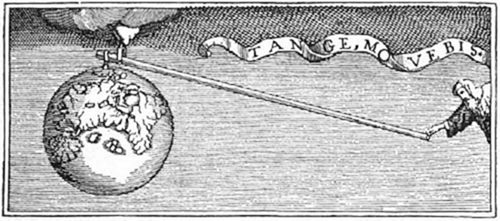
Fig. 1.—A Lever to move the Earth.
In that way they could exert a great force. Archimedes measured the force they could exert in this way, and found it was increased when the bar was made longer and the distance between the stone and the support was made less. When the distance between the support and the hand was five times the distance between the support and the stone, Archimedes found that the force of the hand was multiplied by five, and one man could lift a stone which it would take five men to lift without[Pg 4] a lever. “Now,” he said, “if you make the lever long enough there is no weight too heavy for us to lift.” He told the king about this discovery, and said to him, “If you gave me some place on which to stand, I could move the whole earth.”
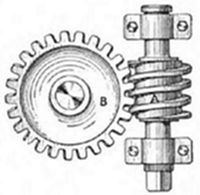
Fig. 2.—The Endless Screw.
Archimedes knew, of course, that the matter was not quite so simple as that. He knew that the lever required to move the earth would have to be exceedingly stout and strong, as thick, indeed, as the earth itself. For, otherwise, it would not stand the strain. Besides, he knew he would also require a fixed support against which to rest the lever. And the place on which he was to stand would have also to be firmly fixed, so as to allow him to exert the force required. We know now that the earth floats freely in space, and that there is no fixed place anywhere. Therefore we cannot, after all these 2200 years, try the great experiment suggested by Archimedes.
But many other things which Archimedes proposed are now used every day. One of these is the Endless Screw, by means of which Archimedes is said to have drawn a ship, with cargo and crew, along the sand as easily as if it were floating in water, to the great delight of his friend the king.
[Pg 5]
Not long after this the king showed Archimedes a great mark of favour and confidence. This is how it came about.
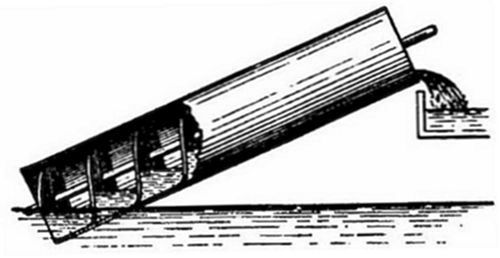
Fig. 3.—Archimedes’ Screw can be used to raise Water.
The king had given one of his goldsmiths a certain weight of gold, and instructed him to make it into a golden crown which he wanted to present to one of the temples. After a few weeks the goldsmith came to the palace and brought the crown to the king. The king weighed the crown, and found it was the same weight as the gold he had given out. But somebody told him that the goldsmith had mixed a quantity of silver with the gold, and kept the remaining gold for himself.
The king was a just man, and did not want to accuse the goldsmith of the crime without having a proof of his guilt. He therefore sent for Archimedes and gave him the crown, asking him to find out whether any silver had been mixed with the gold, or whether it was made of pure gold.
Archimedes was long puzzled over this problem.[Pg 6] He weighed the crown, and found the weight was correct. It also looked like pure gold, so that the amount of silver could not be very much. Archimedes made two blocks, one of silver and the other of gold, of exactly the same size, and found that the block of gold weighed nearly twice as much as the block of silver. “Now,” he said to himself, “if I could melt up the crown and make it into a square block, and make another block of exactly the same size of pure gold, both should weigh the same if the crown is pure gold, but if it is not, the block made from the crown should be lighter.” He wished for a moment to melt up the crown, but it was beautifully made, and he thought it a pity to throw away the fine work. If he could only find out the exact bulk of the crown, he thought he could determine easily if it was the proper weight which it should be if made of pure gold. The problem then was how to find out the total bulk of the crown without melting it up into a block.
Archimedes was in the habit of following up a problem steadily until he had solved it. He allowed nothing to come in the way. Sometimes he was found tracing lines and circles in the ashes of the grate, working out some problem. Sometimes, even, when he had had his bath, and his slaves had rubbed him with oil to make his skin[Pg 7] smooth, he traced diagrams with his fingers on the layer of oil on his skin. He could think of nothing but the problem he was trying to solve.
The problem of the crown puzzled him greatly; but one day the solution flashed upon him just as he was having his bath. He was taking a bath in a kind of large cup of his own size, as the Greeks used to do. The cup stood on a pedestal, with a sink round it to let the water flow off. When he got in, the cup was full of water to the brim, therefore it overflowed as he was getting in. He dipped himself entirely under water, head and all, and when he got out again the water was no longer up to the brim, but considerably below it. The amount of water which had flowed out was exactly the bulk of his own body. The truth came upon Archimedes like a flash. He had found a way of determining the bulk of his own body without melting himself down into a block, and why should he not find the bulk of the crown in the same manner?
He was so excited that he forgot to dry and clothe himself, but ran home just as he was, calling out, “I have found it! I have found it!”
He took a big jug full of water to the brim, and carefully let down the crown into it, holding it by a thread. A quantity of water overflowed, and when the crown was taken out the water was on[Pg 8] a lower level. He took a measuring glass, and carefully measured how much water was required to bring the water up to the brim again. That quantity of water had the same bulk as the crown.
He then measured out a quantity of gold and a quantity of silver, both quantities weighing exactly the same as the crown. These quantities he melted up into blocks. In this manner he got three things weighing exactly the same: a block of gold, a block of silver, and the crown which the goldsmith had made. He then dipped the gold block into the jug filled to the brim. It displaced a certain amount of water. Again, he dipped the silver block into the jug. It displaced nearly twice as much water. Finally, he dipped the crown into the full jug. It displaced more water than the gold block, but less water than the silver block. And so it was proved that the crown contained a quantity of silver.
Archimedes next made some other blocks, containing gold mixed with various proportions of silver, but always of the same weight as the crown. In the end he obtained a block of silver and gold which displaced exactly as much water as the crown. He went to the king and told him exactly how much silver was in the crown, and how much gold the goldsmith had stolen.
The king thanked his clever friend. He sent for the goldsmith and told him he had found him[Pg 9] out. The goldsmith confessed his guilt, and the king made him restore the gold and kept him in prison until he had been justly punished for his crime.
Archimedes continued his experiments with all sorts of bodies and substances.
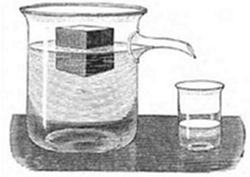
Fig. 4.—An Archimedes Cup.
He weighed things in air and in water, and found that when they were suspended in water by a thread, and the thread was attached to one arm of a balance, the weight necessary to counterbalance it was less than when the body hangs in air. The difference in the counterbalancing weight is equal to the weight of the water which the body displaces. This may be proved by a simple experiment.
A glass beaker with a spout, like that in Fig. 4, has water poured into it until the water just runs out of the spout. The beaker with the water in it is placed in one pan of a balance, and weights are put in the other pan until the balance is even. A block of wood is then weighed and floated on the water in the cup. Some of the water flows out of the spout and may be caught in another beaker. But when the cup is weighed with the floating block it is found[Pg 10] that the weight is exactly the same as before. The wood exerts no additional weight, since its weight is equal to that of the water which flowed over, as may be proved by weighing the water caught in the small beaker. Archimedes put this rule into a few words as follows: “Every body loses as much weight in water as the displaced water weighs.” This is called the Principle of Archimedes.

Fig. 5.—Ancient. War-Engine for throwing Rocks.
When, after fifty years’ peace, the Romans made war on Syracuse, Archimedes took charge of the defence of the city. He made great war-engines which threw rocks upon the attacking army, and sank the enemy’s ships in the harbour. Marcellus, the Roman general, could not help admiring the genius of the great Syracusan engineer, and when he captured the city at last he ordered[Pg 11] his soldiers to spare Archimedes. One of them came upon the great inventor just as he was working out a problem with a stick in the sand on the floor. When the soldier asked his name, he told him to wait till he had solved the problem, and not to tread upon his circles. Thereupon the soldier killed him.
Marcellus was greatly grieved, and tried to atone for this by showing great kindness to the relatives.
Archimedes was buried near the city. On his grave was put a monument in the shape of a cylinder enclosing a ball or sphere. It was one of his proudest achievements to find that a ball enclosed in a cylinder of the same height fills up just two-thirds of its bulk. No more suitable device could have been placed on the grave of one of the greatest men of science that ever lived.
WHEN Alexander the Great overcame the Egyptians, he sailed along the African coast past the mouths of the river Nile until he came to a place which seemed to him suitable for building a great city.[Pg 12] It was a strip of land on the sea-shore with a great lake behind it and an island in front. “Here,” said the mighty conqueror, “shall be my capital city, to be called Alexandria after my name.” So he sent for his great architect Dinocrates, and told him to plan the streets and palaces of the new royal city. Thousands of slaves were soon set to work. The streets were made straight and wide, and canals were dug to join the lake to the open sea and to the Nile, so that great merchant vessels would find shelter from the storms.
The island was joined to the city by a causeway a mile long, and a lighthouse 400 feet high was built on the island. The lighthouse was in the shape of a round tower. On the top of the tower a bright fire was kept constantly burning, so that the smoke by day and the flame by night should guide ships safely into the harbour. This tower was the first lighthouse ever built, and is said to have cost a quarter of a million pounds (£250,000).
Within fifty years of its foundation Alexandria became one of the foremost centres of commerce. The second of the Egyptian kings founded the famous Library of Alexandria, and thus secured for the city a place in the front rank of learning, which it kept for six hundred years.
Many of the great works of Greek writers were[Pg 13] saved from destruction by being preserved in Alexandria. The third king compelled every stranger who passed through Alexandria with a book in his possession to leave a copy of it at the Library. He also built a Museum, which was an institution closely resembling what we should now call a University. It had dwelling-rooms for professors, it had lecture halls, and a great dining-room. The University grew and flourished, and attracted clever young men from all the shores of the Mediterranean Sea. One of these students was Euclid, who wrote the books on Geometry. There were also poets, critics, and historians. Many books from all nations were translated into Greek, including the Old Testament, at which seventy scribes are said to have worked.
It was an Alexandrian astronomer named Aristarchus, who about 270 B.C. first determined the distance of the sun from the earth in comparison with that of the moon. He knew that the moon was a round ball, and that its various shapes or phases were produced by the sun shining upon it at different angles. He carefully watched the growing sickle of the moon from day to day, waiting for the time when the moon should appear to be exactly a half-circle. When this is the case an imaginary line drawn from the eye of the observer to the centre of the moon is at right angles to a similar[Pg 14] line drawn from the centre of the moon to the sun, as shown in the picture (Fig. 6). At the instant when the sun’s light was seen to be shining squarely on the moon, that is just before sunset, Aristarchus pointed one leg of an instrument like a pair of compasses to the moon, and the other leg to the sun. The angle between the two directions was found to be not quite a right angle. It measured, in fact, 87 degrees (Fig. 6), whereas a right angle contains 90 degrees.

Fig. 6.—Comparing the Distances of the Sun and Moon.
Now, if a triangle be drawn like that in Fig. 6, in which the angle at M is a right angle, and that at E is 87 degrees, this triangle illustrates the results of the observations. The moon’s distance is represented in the triangle by the line EM, and the sun’s distance by SM. It does not matter how large or small the triangle is drawn; for, if the lines are inclined at the proper angles, the line SM will always be the same number of times longer than EM.
Aristarchus concluded from his observations that the sun was eighteen or nineteen times farther away than the moon. In reality, it is about four hundred times that distance, but considering that[Pg 15] the ancients had very imperfect instruments, and that it is almost impossible to decide the exact instant when the moon is just half-full, it is not remarkable that the result obtained was far too small. As the result of other observations, Aristarchus found that 720 suns, placed edge to edge, would just circle the sky, and this is very close to the truth. Men of science honour him for his ingenious methods of measuring the sun’s distance and size, and for his painstaking observations, though the results were not perfect.
Another famous astronomer of Alexandria, who was also the custodian of the Library, was the first to measure the size of the earth. He was in the habit of sailing up the Nile, and found that the farther he sailed the more new stars appeared in the south, while the northern stars disappeared gradually. This fact convinced him that the earth, like the moon, is a round globe, and he thought that if he could go very much farther in the same direction towards the south, he would eventually circle the earth, and arrive at Alexandria again from the north. But to measure the circle of the earth it was not necessary to travel all round it. It was sufficient to find the fraction of the circle traversed by travelling a certain distance, and this could be done by measuring how much higher the southern stars appeared in the sky after[Pg 16] travelling a certain distance. Since the stars are very much farther away than the sun, the difference in their height could not be due to the distance travelled, but only to the roundness of the earth.
The astronomer sailed from Alexandria as far as the Falls of Aswan, and carefully measured the distance he had travelled, which he found to be 520 miles. He found that at midday the sun stood about 7 degrees higher in the sky at Aswan than at Alexandria. This angle was just about 1-50th of a whole circle. The astronomer concluded that if he continued to travel south for fifty times that distance he would travel round the globe, and in doing so he would cover the distance of 26,000 miles. The real circumference of the earth is 23,700 miles, so that the learned Alexandrian was not far wrong. But he would have been even more correct had he known that Aswan is not really due south of Alexandria, but a little east of south. This made his line too long.
The name of this great astronomer was Eratosthenes. His end was a sad one. He lost the sight of his eyes and his powers of observation. He starved himself to death, saying that life without the means of pursuing his studies was not worth living.
Another remarkable man who lived in those days at Alexandria was Heron. He was employed at[Pg 17] the Museum, lecturing on Mechanics, Optics, and the principles of Surveying.
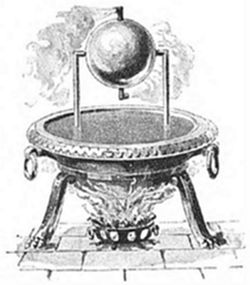
Fig. 7.—Heron’s Steam-Engine.
He invented a number of contrivances and machines which were the wonder of his age. The people of Babylon had invented clocks driven by water.
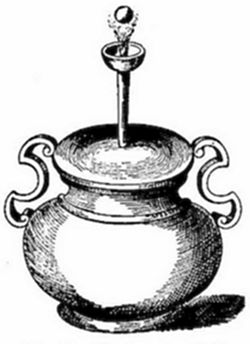
Fig. 8.—The Jumping Ball.
Heron improved these by letting the water drop through a small hole bored in a precious stone of great hardness, so that the water should not be able to enlarge the hole and to make the clock run faster. The water dropped into a vessel containing a little boat. The boat had a mast which was graduated, so that as the water rose, one graduation after another appeared above the edge of the vessel.
[Pg 18]
These graduations indicated the hours. He also made the boat turn a wheel, which at each hour caused a number of balls to fall into a silver goblet. The number of balls indicated the number of hours, so that the clock struck the hour very much like our clocks of to-day. Heron is famous for having invented a kind of steam-engine, consisting of a hollow ball with two nozzles pointed in opposite direction (Fig. 7). The steam passed into the ball through the arms by which it was suspended, and the steam hitting against the air outside caused the ball to spin round. In another form of the apparatus (Fig. 8) a ball was kept jumping up and down by the steam issuing from a vertical pipe.
[Pg 19]
Heron found that when a narrow tube is put into water, and the upper end is stopped with the finger while still under water, then on lifting the tube out of the water with the stopped end uppermost, the water does not flow out at the open end below until the finger is removed. He, therefore, constructed a vessel (Fig. 9) which became known as the “Vestal’s Goblet”; it was filled by plunging it into water, stopping the upper opening with the finger, and lifting it out. The water escaped in a spray through the small holes below on removing the finger.
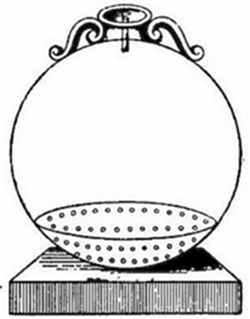
Fig. 9.—The Vestal’s Goblet.
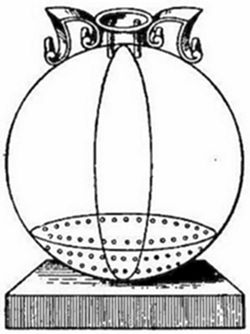
Fig. 10.—The Double Goblet.
In another form of the instrument there were two compartments which were filled in the same manner with wine and water respectively. It was a custom among the Greeks to mix wine with water, and offer the same mixture to the gods in the temples.
Heron also made a self-feeding wick for oil lamps, which were then in common use. The oil was burnt in an open vessel (Fig. 11), and as it burnt away the wick was consumed also, but Heron made the oil itself turn up the wick. He made a plate of wood float on the oil; as the oil burnt away the plate of wood gradually sank, and in doing so it moved a cog wheel. The cog wheel in turning moved a straight rack, or toothed bar of wood, at the end of which the wick was fastened. In this way the wick was moved on as the oil was consumed, and the lamp was kept steadily burning.
[Pg 20]
The most important instrument which Heron improved was the Surveyor’s Level. Egypt depends for its fertility upon the floods of the Nile, as there is very little rain in Egypt.
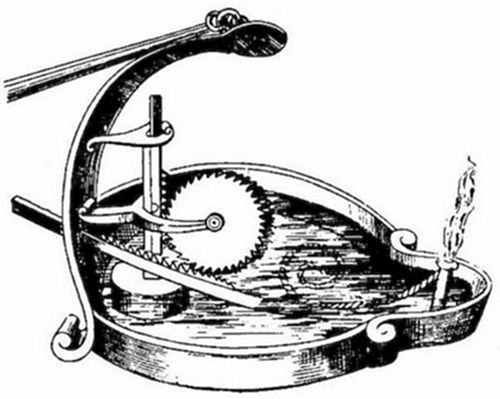
Fig. 11.—Heron’s Self-Feeding Wick for Lamps.
From the oldest times the Egyptians had to see that they could distribute the land after the flood in the same way as it was distributed before, each man getting his own land back. This was found to be very difficult, as many landmarks were destroyed by the flood. The art of Surveying was practised at a very early date in Egypt, and there is no doubt that the science of Geometry was born in Egypt, as it was necessary in order to be able to determine the extent and boundaries of land.
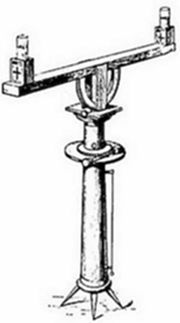
Fig. 12.—Modern form of Heron’s Level.
An important problem in connection with Surveying was to find when two points are on the[Pg 21] same level. This is done nowadays with a spirit-level if the points are close together, or with an instrument called a theodolite if the points are far apart. But a theodolite requires a telescope, and the Alexandrians lived long before the telescope was invented. Heron, however, got over the difficulty by constructing a long box filled with water and provided with openings, in the form of a cross, at each end. Above the crosses were glass tubes communicating with each other, in which the water was kept at the same level, and when that was the case the two crosses were exactly at the same level, and any object seen through both crosses together was at the same level as the crosses themselves. Heron probably used rods very similar to the black and white rods used by surveyors at the present day for measuring distances and levels.
Heron also invented a mechanical stone crusher, an organ driven by water power, a counting[Pg 22] machine to show the distance travelled by a ship or a chariot, and an arrangement of mirrors which he called a spy-glass.
Many of the works of Heron have been preserved to us. They are written in Greek, which was the language used in Alexandria since its foundation. Heron was always careful to make his reasoning quite clear to his pupils, and he insisted that they must not believe anything without proof.
“It is necessary,” he said, “that those who wish to become acquainted with mechanical art should know what causes are at work in every motion. It is important that nothing should be put before students without proof, and that nothing should remain doubtful for them. In our presentation every problem is to find a solution. We therefore recall various principles taught by the ancients which are connected with our subject.”
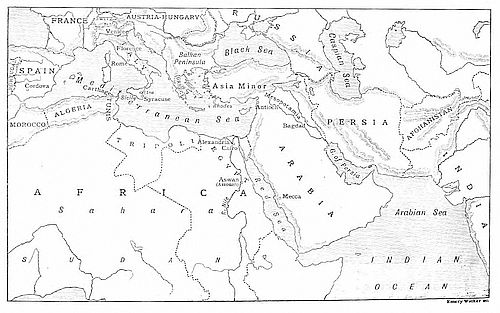
TO the east of the Red Sea there is a land called Arabia. Part of it is a desert over which a wind, called the simoom, blows its suffocating blasts.[Pg 23] Another part is fertile mountain land, where the red anemone blooms. The third part adjoins the Indian Ocean and the Gulf of Persia. This part is rich and green, and planted with date-palms and coffee shrubs.
From Arabia comes the Arab horse, small and grey, but beautiful to behold. It can go for forty-eight hours without a drink. The Arabs ride it without a saddle or stirrup, and only guide it by the pressure of the knee and a kind word. Its greased hoofs traverse the Arabian desert from end to end.
Sometimes the Arabs ride on a white ass, mounted on a side saddle. They also ride the camel with a single hump, and from it good milk and wool are obtained. It can travel eighty miles per day and goes for a week without water; but it never learns to know or love its master. Jackals, panthers, and hyenas prowl about the desert, which is also infested with ants, scorpions, and locusts, as well as a horrible kind of spider with double pincers. The Arabs are called the sons of Ishmael. They are traders and workers in leather. They are calm and dignified in appearance, and have never been conquered.
Thirteen centuries ago these Arabs were divided into a great number of tribes who made war upon each other. Then Mohammed arose, and proclaimed that he was a prophet sent by God to teach the[Pg 24] Arab people, and through them to convert all the world to a new religion. He suffered much persecution at first, but in the end he overcame all his enemies and ruled the whole of Arabia. He destroyed all idols, and taught his people to give up alcoholic drinks, gambling, and usury. His successors, who were called Khalifs, went forth to conquer the world. Those who would not be converted to the Mohammedan religion they forced to pay heavy taxes, those who resisted by force of arms they slaughtered without mercy, but those who became Mohammedans they rewarded with a share of their booty and power of government. They captured Damascus and Jerusalem, they conquered Egypt and North Africa, and besieged Constantinople. In the end they conquered Spain in the west and Persia in the east, so that their Empire stretched from the Atlantic Ocean to India.
The Arabs destroyed many kingdoms, but they also knew how to build. They founded great cities, the most glorious of which was Bagdad on the river Tigris, where Harun-al-Rashid reigned and Queen Scheherazade told her tales of goblins, battles, and treasures, and Aladdin worked his wonderful lamp. They also founded Cairo, within sight of the Egyptian pyramids, and made it the capital of Egypt after they had pillaged Alexandria. But Mecca in Arabia, where Mohammed first preached his new doctrine, remains the centre of the Mohammedan religion to this day.
[Pg 25]
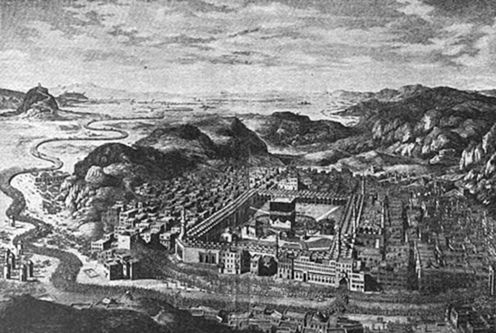
Fig. 13.—View of Mecca in the Seventeenth Century.
[Pg 26]
When the Roman Empire was destroyed by the barbarians from the north, it was the Arabs, strange to say, who took up the cultivation of science where it had been left by the Greeks and Romans. The Khalifs who built Bagdad, Cairo, and Cordova in Spain, loved to surround themselves with learned men from all parts of the world. An Arabian writer says, “To Cordova came from all parts of the world students eager to cultivate poetry, to study the sciences, or to be instructed in divinity or law, so that it became the meeting-place of the eminent in all matters, the abode of the learned, and the place of resort for the studious. Its interior was always filled with the eminent and the noble of all countries, its literary men and scholars were continually vying with each other to gain renown, and its precincts never ceased to be the arena of the distinguished, the recourse of readers, the halting place of the noble, and the repository of the true and virtuous. Cordova was to Spain what the head is to the body, or what the breast is to the loin.”
The sciences generally cultivated among the Arabs were Chemistry and Optics. In chemistry they discovered a number of new metals and acids. They knew how to distil a liquid and crystallise a solid, and how to mingle various metals to form new alloys with variable properties. They were excellent makers of sword-blades, and their scimitars or curved swords were dreaded by all the soldiers of Christendom.
[Pg 27]
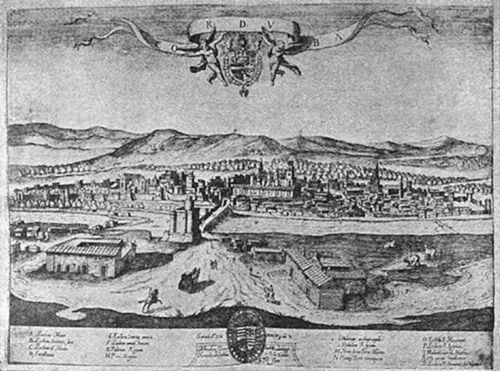
Fig. 14.—Cordova after the Expulsion of the Moors.
[Pg 28]
The science of Optics was originally cultivated by a native of Mesopotamia named Alhazen, who died in the year 1038 A.D. Alhazen was called to Egypt by one of the Khalifs who had heard that he had thought out plans for regulating the flow of the Nile in such a manner that each year there should be plenty of water for inundations. Alhazen went to Egypt and inspected the land, but found that his plan was not suitable. The Khalif was angry, and would have punished Alhazen, but the latter pretended to be mad, and managed to hide himself until the Khalif died. He then reappeared and became famous as a scholar and instructor of youth, copying old manuscripts and writing books on Astronomy, Mathematics, and Optics.
Alhazen’s greatest work was done on the subject of the laws which govern the production of light. He proved, first of all, that light travels along straight lines. “If the light of the sun,” he says, “or the light of the moon, or the light of fire, enters a dark room through a narrow slit, and dust is in the room, or dust is made to fly in it, the light entering through the slit is made clearly visible in the air mixed with dust; it is also visible on the floor or[Pg 29] on the opposite wall of the room. And it is found that the light travels through the slit to the floor or to the opposite wall along straight lines. And when a straight rod is held along that visible light, it is found that the light travels along the straight rod.
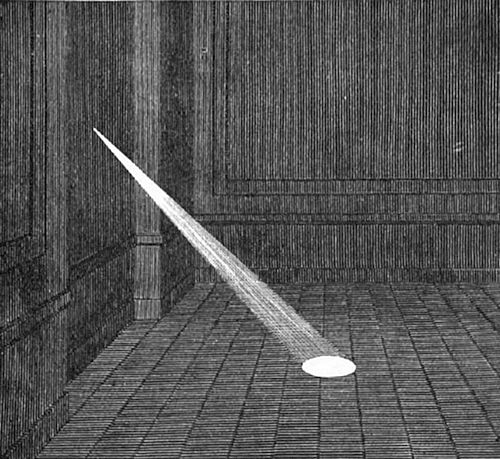
Fig. 15.—Light travels in Straight Lines.
But if there is no dust in the room, and the light appears on the floor or on the opposite wall, and a straight rod is held between the slit and the patch of light, or between both a thread is stretched, and a body is brought between the patch and the slit, the light becomes visible on the opaque body[Pg 30] and disappears from the place at which it was visible. If then the opaque body is moved to and fro in the space indicated by the rod, the light always remains visible on the opaque body. It is, therefore, clear that the light proceeds along straight lines from the slit to the place where it is visible.”
That light travels in straight lines is only true so long as it travels through air or through the same kind of substance. When a looking-glass is held in the path of the rays in a dusty room, it is seen that a beam of light starts from the looking-glass in a direction quite different from that of the original beam. This fact did not escape the notice of Alhazen, and he carefully observed the direction taken by the reflected beam in various circumstances. He had read the books written by the learned Greeks, and he knew from them that the reflected beam makes the same angle with the mirror as the original beam does. To this observation he added another, and a very important one. He found that when a flat surface, such as a piece of paper or cardboard, is held against the mirror so that it touches the original and the reflected beam, that surface or sheet is always upright on the mirror, and stands at right angles to its surface. This law, discovered by Alhazen, explains how we see trees reflected in a river or a pond pointing straight down, and not slanting to the right or to[Pg 31] the left. If we had a big fiat surface which we could make to stand vertically on the water, that surface, if made to pass, through the tree, would also pass through its reflection in the water.
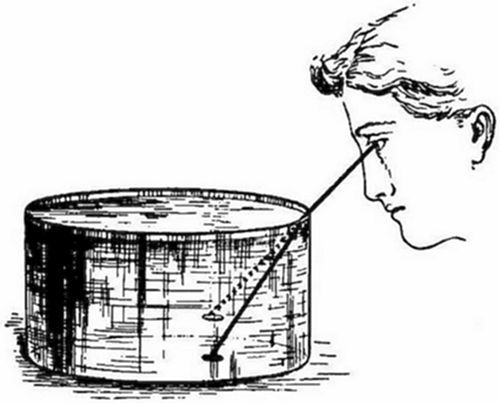
Fig. 16—Effect of Refraction of Light by Water.
Most of us have observed that when a kitten sees its image in a looking-glass for the first time, it takes it for another kitten, but after a few attempts to make friends with the supposed companion it finds out that the image is only an illusion. This observation was explained by Alhazen, by pointing out that the eye always perceives objects in the direction in which the beam of light enters the eye. He investigated another curious illustration of this. When a coin is placed at the bottom of a dish, and we move away from the dish until the rim just hides the[Pg 32] coin, the latter is, of course, invisible. But on filling the dish with water without changing our position, we find that the coin becomes visible again, being apparently raised, although it really remains at the bottom of the dish as before.
Alhazen proved that this is another case of illusion due to the bending of the beam of light. He showed this bending of the beam of light in a very ingenious manner. He took a big glass vessel, and filled it with water containing a few drops of milk. He took it into a dark room where he had already studied the reflection of light. He found that when the water in the glass vessel was placed in the beam of light, the beam appeared broken at the surface of the water, bending suddenly down more towards the floor, and making it shorter. The beam was made visible in the air by the suspended particles of dust, and in the water by the suspended particles of milk. Alhazen showed that the beam under water always makes a greater angle with the surface than does the original beam, but he did not succeed in finding out the exact relation between the two angles, nor was that relation discovered until several centuries afterwards.
Like a true Arab, Alhazen was very fond of studying illusions of all kinds. But there was one appearance which was before his time not[Pg 33] considered an illusion, but a reality. The sun and moon appear much larger when they are rising or setting than they do when they are high up in the sky. Alhazen, however, showed that the apparent size is in reality the same in both cases. He held a coin at arm’s length so that it just covered the rising moon. He again held the same coin at the same distance from his eye between himself and the moon when she was up in the sky. He found that the coin again just covered the moon, but that if the moon were seen reflected in a distant mirror so that it was apparently on the horizon it again appeared larger. This, he said, was simply owing to our habit of judging things on the earth by comparison with earthly objects.
The Arabs, whether in Bagdad, Damascus, Cairo, or Cordova, were well acquainted with the principle of Archimedes, and they knew that a body in water weighs less than in air, the difference being the weight of the water displaced by the body. But they were first to use the idea of what is now known as specific gravity, and they explained that the specific gravity of a body is obtained by dividing the weight of the body by the weight of the same volume of water. This definition is used even now, and tables of specific gravity are found in all books dealing with the properties of various materials.
[Pg 34]
Before the destruction of the great Arabian Empire, which put an end to the cultivation of science by the Arabs, and transferred their work to the new nations of Europe, they had reached the summit of fame in the whole world. Their last achievement was one which gave rise to many remarkable developments. It is described in a book called The Book of the Balance of Wisdom. The Arabian author says in this book that even air must have some weight, and that the true weight of a body cannot be the weight as measured in air, because air, like water, must somewhat reduce its weight. This was the observation upon which later the great inventions of the barometer and the air-pump were based.
THE ancients were in the habit of consulting books written by old masters whenever they were puzzled by an unknown power or force of nature. Instead of making experiments they went to their bookshelves, and read what the wise men of long ago had written on the same or similar subjects. They[Pg 35] thought that they could not surpass the old masters in wisdom, and that what the old masters did not know was not worth knowing. This habit accounts for the slow progress made in science in Europe during the Middle Ages, that is, from about the sixth to the fifteenth centuries. But when Columbus discovered America, and broke through the traditions of the ancients by his courageous exploration of the unknown, a new era began to dawn.
One of the heralds of this new era was Dr. William Gilbert. He was born in Colchester, in Essex, in the year 1540, and was the son of the Recorder of that city. He was educated at Cambridge, and became a medical doctor at the age of twenty-nine. He was appointed physician to Queen Elizabeth, and was elected president of the Royal College of Physicians in the year 1600.
It was Dr. Gilbert who founded the science of Magnetism and the science of Electricity, collecting all that was known on these subjects, and making many new and valuable experiments of his own. All these facts he expounded in a great book which was published in London in the year 1600. It is called, On the Magnet and Magnetic Bodies, and on the Great Magnet, the Earth. In his introduction he lays down new principles to guide scientific work in the future, in words somewhat as follows:—
[Pg 36]
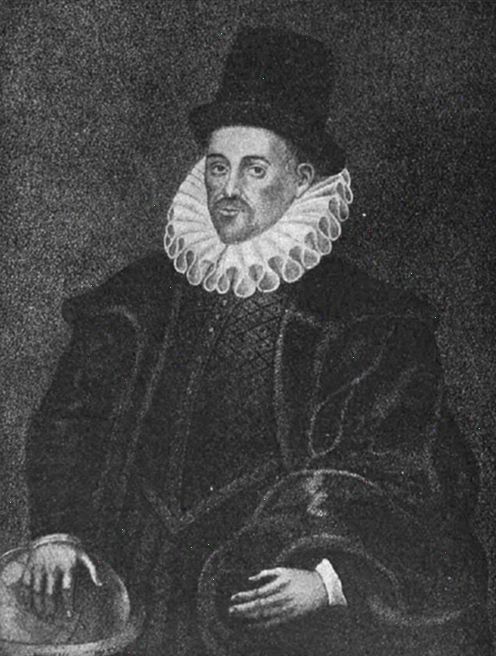
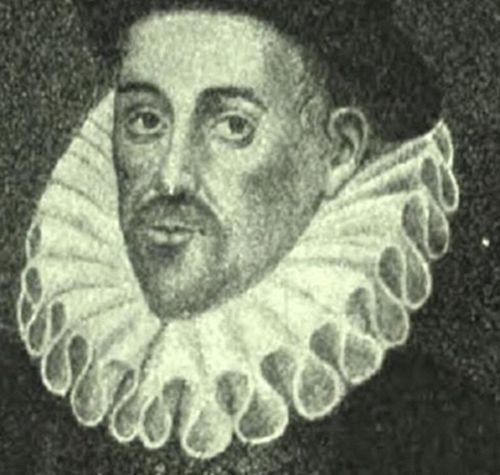
Fig. 17.—Dr. William Gilbert, who founded the Sciences of Magnetism and Electricity.
“In the discovery of secrets and in the investigation of the hidden causes of things, clear proofs[Pg 37] are afforded by trustworthy experiments rather than by probable guesses and opinions of ordinary professors and philosophers. In order, therefore, that the noble substance of that great magnet, the earth, hitherto quite unknown, and the exalted powers of this globe of ours may be better understood, I shall first of all deal with common magnets, stones, and iron materials, and with magnetic bodies, and with the near parts of the earth, which we can reach with our hands and perceive with our senses. After that I shall proceed to show my new magnetic experiments, and so I shall penetrate for the first time into the innermost parts of the earth.
“After I had seen and thoroughly examined many of those things which have been obtained from mountain heights and ocean depths, or from deep caves and hidden mines, I applied much prolonged labour on investigating magnetic forces, which surpass in wonder all other things about us. This labour has not been idle or unfruitful, since daily, during my experimenting, new and unexpected properties came to light. In this manner my knowledge has increased so much through actual observation, that I felt able to explore the interior parts of our globe, and explain its substance upon magnetic principles, and to reveal to mankind the earth, our common mother, and point it out,[Pg 38] as if with the finger, by real demonstration and by experiments appealing to the senses.
“As geometry ascends from very small and very easy principles to the greatest and most difficult, so our magnetic doctrine and science sets forth in convenient order the things which are less obscure. From these have come to light others that are more remarkable, and at length in due order are opened the concealed and most secret things of the globe of the earth, and the causes are made known of those things which either through the ignorance of the ancients, or the neglect of moderns, have remained unrecognised and overlooked.” Dr. Gilbert then proceeds to ask why he should expose himself to the violent attacks and criticisms of men, calling themselves learned though unacquainted with the facts:—
“Why should I, in so vast an ocean of books, by which the minds of men are troubled and fatigued, by which the world and men, without reason, are intoxicated and puffed up, books written by people who profess to be philosophers, physicians, mathematicians, and astrologers, but who yet despise and neglect men of learning,—why should I, I say, add anything to this disturbed republic of books and expose this noble science, which seems new and incredible by reason of so many things hitherto unknown, to be torn to pieces by those who are[Pg 39] either sworn to the opinions of other men, or are little better than idiots? To you alone, honest and true men of science, who seek knowledge, not from books only, but also from things themselves, do I address these magnetic principles and this new sort of philosophy. If any disagree with my opinion, let them at least take note of the experiments and discoveries which have been worked out and demonstrated by me, with many pains and vigils and expenses. Let them rejoice in these, and employ them to better use if they are able.”
The remarks by Dr. Gilbert as to the careful way in which experiments should be made, the plain words in which they should be described, and the attention that should be paid to the work of others, are as true to-day as they were in his time. He said:—
“Whoever wishes to try the same experiments let him handle the substance, not carelessly, but prudently, deftly, and in the proper way, and when the thing does not succeed let him not in ignorance denounce my discoveries, for nothing has been set down in these books which has not been many times performed and repeated. This nature knowledge is almost entirely new and unheard of, save what a very few writers have handed down concerning certain common magnetic powers. Therefore I but seldom quote ancient Greek authors in[Pg 40] my support, because neither by using Greek argument nor Greek words can the truth be demonstrated more precisely, for our magnetic doctrine is at variance with most of their principles.
“Nor have I brought to this work any pretence of eloquence or ornamentation of words, I have only put difficult and unknown things in such a form of speech, and in such words, as to be clearly understood. Sometimes I have to use new and strange words, not in order to throw a veil of mist over the facts, as alchemists are in the habit of doing, but that hidden things which have no name, never having been observed before, may be plainly and correctly described. To the early fathers of philosophy let due honour be paid, for by them wisdom has been handed down to posterity. But our age has detected and brought to light very many facts which they, if they were now alive, would gladly have accepted. I have therefore not hesitated to expound by demonstration and theory those things which I have discovered by long experience.”
Dr. Gilbert, as announced by himself, began by studying the various ores of iron, and soon found that it is only the black iron ore which is naturally magnetic. He made many experiments with the magnetic needle, which had been used before his time by the Italians and the Arabs, and long[Pg 41] before them again by the Chinese. He was the first to show that the natural magnet, or lodestone, is not the only possible form of magnet, and that a bar of iron may be made into a magnet by simply hanging it in the direction in which the magnetic needle points, or by heating it, and hammering it while holding it in the same direction. He considerably increased the power of the natural magnet by providing it with an iron cap, or armature, at each end.
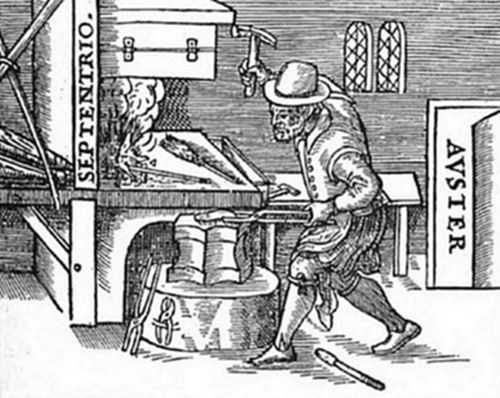
Fig. 18.—Magnetising a Bar of Iron by hammering.
Dr. Gilbert disposed of many mistakes made by previous investigators. One of these was that, in[Pg 42] order to preserve its strength, the lodestone had to be fed on iron filings. They tried to test it by taking a lodestone of a certain weight and burying it in iron filings, which they had also weighed carefully. After leaving it for many months they took out the stone and weighed it, and thought they found the stone a little heavier, and the filings a little lighter. The difference, however, was so small that they doubted whether there was any. Dr. Gilbert said that some of the filings might easily have stuck to the stone and made it appear heavier. In any case there was no evidence that the stone had to absorb any nourishment to keep up its strength.
Another mistake was committed by Paracelsus, who thought that the power of the magnet could be increased ten times by heating it nearly to red heat, and slaking it in oil of saffron. In this way, he said, a lodestone could draw a nail out of a wall, and accomplish many other wonderful things which are not possible for any ordinary lodestone. This, however, was just the reverse of the truth. Dr. Gilbert found that a lodestone treated in that manner does not gain power, but actually suffers a certain loss of strength.
It was Dr. Gilbert who first proved that the strongest magnetic force is found at two opposite points of magnetic bodies. These points he called[Pg 43] the Poles. He proved that two poles which point in the same direction, when the magnet is free to move, repel each other, and those which point in the opposite directions when suspended attract each other.
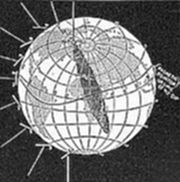
Fig. 19.—The Earth as a Magnet.
Magnets may be of very different shapes, and whatever shape a piece of iron may have it can be magnetised, and when fully magnetised it will show two poles.
Dr. Gilbert asked himself whether a magnet could have the shape of a sphere. He cut a sphere out of iron, like a cannon ball, and magnetised it by touching and rubbing it with a lodestone. Having done that he took a small magnetic needle and brought it near the magnetic sphere of iron.
He found that the magnetic needle behaved just as if the iron sphere were the earth itself, pointing to the poles and showing different directions at different distances from them. The thought flashed into his mind that the earth itself might be a great magnet. This thought was entirely new. The ancients had imagined that the[Pg 44] attraction of the magnetic needle was due to some magnetic mountains in the north, or some star in the tail of the Great Bear, a group of seven stars which appear to move round the north pole of the sky.
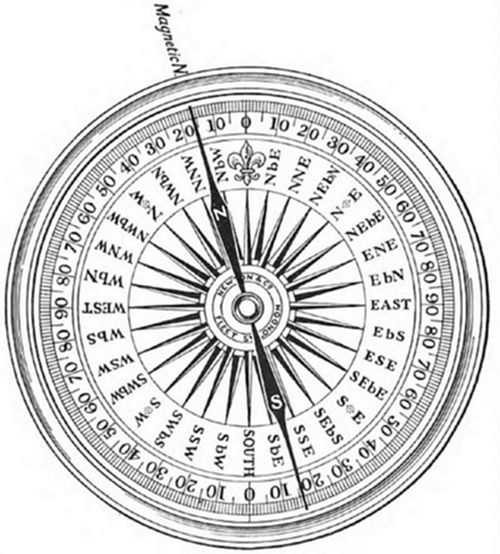
Fig. 20.—A magnetic Compass.
This supposition could not be maintained as the facts became better known. In the first place,[Pg 45] since the stars appear to be carried round the north celestial pole, one would naturally expect that the direction of the magnetic compass would change in the course of every twenty-four hours, which it did not.
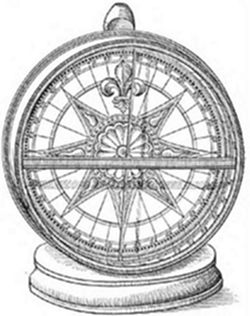
Fig. 21.—Old form of Magnetic Dip. Circle.
Then, as to the magnetic mountains, if they were situated at the north pole, the compass would point in a horizontal direction only in the region near those mountains. In southern lands and seas the needle would have to point below the horizon, since the pole itself is at a considerable angle below the horizon. The angle between the needle and the horizon would have to become less and less as the ship sailed towards the pole. This is, however, just the reverse of what actually takes place. When a needle is balanced carefully before it is magnetised, then on touching it with the magnet, and so[Pg 46] magnetising it, it is found that it balances no longer. The pole which points to the north points down, and the pole which points to the south is raised. This might be taken to indicate the existence of magnetic mountains at the pole of the earth. But on proceeding to the equator, this so-called “dip” of the needle becomes less, and on sailing towards the pole it becomes greater and greater, until a point is reached at which the needle points vertically downwards.
Dr. Gilbert found that a small needle brought near a magnetic sphere behaves in a similar manner. At a distance midway between the two poles the needle points in a direction parallel to the axis of the sphere. At the two poles the needle points vertically downwards towards the centre of the sphere. If this variation of the “dip” were quite regular, sailors might discover their latitude on the sea by simply observing the “dip,” and Dr. Gilbert thought that it was quite possible. In this he was mistaken, because not only does the “dip” vary in an irregular manner, but it also varies from century to century, being greater or less at the same place from time to time.
Another property of the new compass discovered by Dr. Gilbert was the magnetic “declination,” or the deviation of the compass from the true north. This deviation he attributed to the irregular[Pg 47] distribution of land and sea. He thought that the mountains attracted the magnetic needle towards themselves, and so disturbed the action of the earth as a whole. Here again he was mistaken.
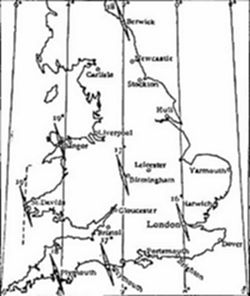
Fig. 22.—The Compass Needle does not point due North and South except at a few parts of the earth. The deviation from the true North is shown in the diagram at a few Places in England.
The observations made since his time have proved that the deviation, like the “dip,” is not constant, but varies from century to century. It is, therefore, absurd to suppose that the mountains of the earth, which keep their outline unchanged for many centuries, should be the cause of the observed deviation.
Dr. Gilbert, like those who went before him, made mistakes. But his mistakes we can easily forgive. So far as he was able, he reasoned only from actual facts. He could not make personal observations extending over a century, and he had at his hand no records of observations[Pg 48] extending over long periods. So far as the facts known to him extended, he reasoned wisely and well. New facts observed by others who came after him would naturally lead in many cases to new conclusions, and Dr. Gilbert, had he lived in our own time, would have been the first to acknowledge and welcome any new facts duly proved and established, even though they contradicted some of his own theories. In the world of science there can be no absolute master or dictator. Gilbert himself was the first to overthrow the opinion that any master mind, however gifted or distinguished, can govern the thoughts and ideas of all men who come after him, and in this way he established one of the principles of modern science.
When all the facts known are collected carefully together, it is right to arrange them all in a certain order, and look at them from a certain point of view, guided by certain principles. This principle, or point of view, is called a scientific theory. The establishment of such a theory enables us to survey the various facts and bewildering details at a glance. It is useful as a means of lessening the brain work required to remember a large number of facts. It also indicates the directions in which new facts may be looked for, and when such new facts are found it indicates probable[Pg 49] explanations for them. But at that point the usefulness of a scientific theory ends.
There is no such thing in science as absolute truth. A theory is only true in so far as it covers all the facts. As soon as new facts are discovered which do agree with it the theory falls to the ground. As thousands of people are seeking every day to discover new facts, no theory can be considered absolutely perfect. Actual facts, or results of accurate observation, remain the same; but the explanation of the effects observed changes as knowledge of nature grows from more to more. This is a matter in which we nowadays differ from the ancients. We want our science to be living and progressive. We do not want to lose the fruits of the work of our ancestors. We find a place for it in our theories, and keep those theories unchanged until we are compelled to change them by the discovery of a new truth. But we insist that the new truth shall be a real truth proved as carefully and laboriously as the older truths were proved. And so we advance, step by step, to the conquest of realms the limits of which no man can see.
[Pg 50]
THE man who is considered the greatest of all pioneers of science was born in the year 1564 at the city of Pisa, in the north of Italy. He first studied medicine, but after a few years he turned his attention to Mathematics and Science, which suited him much better. When only twenty-five years of age he was appointed for three years as Professor of Mathematics in Pisa. He soon showed that he did not intend to follow slavishly in the footsteps of the old masters. He lived at a time when a new spirit of independent inquiry was beginning to be felt in the universities of Europe.
Galileo’s most remarkable early achievement was connected with the famous leaning tower of Pisa. That tower had been built on a weak foundation, and after it was finished it began to lean over towards one side, owing to the ground giving way beneath it. However, the tower did not fall, but remained in a leaning position. It was used by Galileo in order to prove that the old Greeks were wrong when they said that a[Pg 51] heavy body would fall more quickly than a light body.
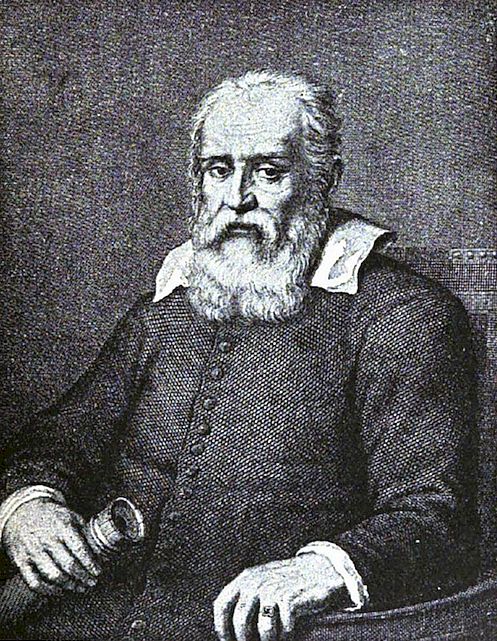
Fig. 23.—Galileo.
This is true, of course, when we compare a feather with a stone. But that is due to the resistance of the air. If no air were present the stone and the feather would fall to the ground[Pg 52] together, and the feather would make a little rattling noise just as if it were a piece of wire. This, of course, could not be proved by Galileo, as he had no means of obtaining a space free from air. But at all events he was well able to compare the rates at which a large stone and a small stone fell.
The old Greeks had stated that large stones and small stones fall at different rates, and nobody seems to have taken the trouble to find out whether that is the case. Galileo did try on many occasions. He took up a large stone in one hand and a small stone in the other hand, and let them drop together. He found that they reached the ground at the same instant. When he showed the experiment to his friends, they said there was a difference in the rate at which the two stones fell, but that the distance through which they fell was not great enough to allow this difference to appear. To answer this objection Galileo went to the top of the tower of Pisa. He took with him a cannon ball weighing a hundred pounds and a shot weighing one pound. These were contained in a box, and were dropped by overturning the box. They therefore started together, and the people who watched the experiment also found that they arrived at the bottom of the tower at exactly the same moment. They seemed to hit the ground at the same time.
[Pg 53]
This famous experiment was the starting-point of a revolution.
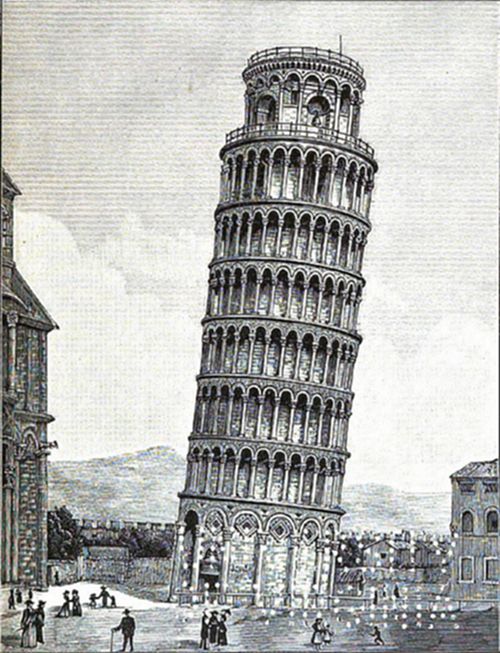
Fig. 24.—The Leaning Tower of Pisa.
The fall of those two balls marked the fall of the old system by which the[Pg 54] advance of science had been so long delayed. Henceforth Galileo did not stop to consult the old masters before he tried an experiment. Nature, he said, was always ready to answer questions. The only thing necessary was to put the question to her in a clear and unmistakable manner. Nature never hesitated with her answer. He therefore proceeded during the rest of his life to question Nature constantly and methodically. In this way he was able to discover a great number of new laws, and his method has since been accepted as the only sure method by which our knowledge of the structure and constitution of this world can be extended.
Wishing to determine the speed of falling bodies more accurately, Galileo varied the experiment in different ways. In one method, which he used a great deal, he made spheres or balls of solid brass run down a groove cut into a wooden board. This groove was lined with smooth parchment, so that there should be as little resistance as possible to the motion of the balls. He measured accurately the time at which the balls were started and the time at which they arrived at the bottom of the groove. These measurements would nowadays be made by means of a watch, but at that time there were no watches except water-clocks, such as had been used in Babylon, and, later on, in Alexandria.[Pg 55] Galileo measured time as best he could with the help of one of these. He attached a small spout to the bottom of a pail of water, so that the water ran out in a thin jet. At the instant when he started the ball on its way down the groove he placed a little cup under the water tap, and at the instant when the ball reached the bottom of the groove he took the cup away.
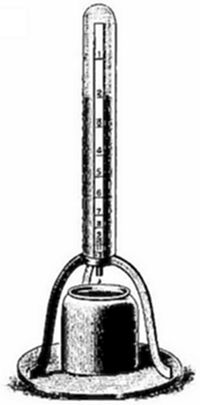
Fig. 25.—A Simple Water-Clock.
He then weighed the cup with and without the water, and so found the amount of water that had flowed into the cup. By comparing the amounts of water obtained in different experiments he was able to compare the times.
His first object was to find in what way the speed of the body varied with the distance over which it travelled, or the time during which it was travelling. He first of all thought that the speed was proportional to the distance travelled. He soon found, however, that when the distance is doubled the speed at the end of the fall is not doubled. It is less than double what it was before.[Pg 56] This can be proved by letting a ball roll along a very smooth surface after it has reached the bottom of the groove. Galileo found at the end of a long set of experiments that the speed attained by a body is exactly proportional to the time during which it is exposed to a force capable of moving it. This discovery was the origin of the whole science of motion. Galileo called the speed which a body acquires in the unit of time the “acceleration” of that body.
Galileo was the first to establish the idea of what is known in science as Momentum. He found that the amount of motion in a body must be judged not only by its speed, but also by the weight of the body. It was evident to him that a heavy body moving at a certain speed is equivalent to a number of lighter bodies moving with the same speed, their combined weight being the same as the weight of the heavy body. In order, therefore, to determine the amount of motion in a moving body, it was necessary to take into account both the weight of the body and the speed. Galileo used the word “momentum” to signify the result obtained by multiplying together the two numbers expressing the speed and the weight of a body. He also started the idea of centrifugal force, or the force with which a body stretches a string when it is swung round by the string.
But the most important work of Galileo was[Pg 57] that which he did with the pendulum. When still quite a young man, it happened that he was at the cathedral at Pisa during a service. He noticed that a great lamp suspended from the ceiling far overhead had been left swinging after it had been lighted. He watched the lamp swinging to and fro for a long time, and noticed that the swinging gradually diminished. But while the amount of swinging diminished, the time of swinging appeared to remain the same. In order to test this he counted the number of times his own pulse would beat between one swing and the next. He had no clock or watch in his possession, and was unable, in the circumstances, to use such a thing as a water-clock, considering that he was supposed to be engaged at his prayers. By counting his pulse he found that the time of swinging remained exactly the same until the swing had quite died away.
Any ordinary young man would not have found anything very interesting in that, but to Galileo the observation was a kind of revelation. He thought that if he could work out a machine driven by swinging weights, such a machine could be made to go quite steadily, and could be made into a clock which would show the time accurately. He did contrive a kind of counting machine by means of a pendulum which would count its own swings, but he did not succeed in making a clock[Pg 58] that would keep going any length of time. He designed a clock which could be wound up and driven by means of a weight, but this was not done until he was very old and blind, and he could only dictate the description of the clock to his son, and the latter did not succeed in constructing the clock until ten years after his father’s death. Nevertheless Galileo must be regarded as the inventor of the pendulum clock.
In the year 1609 a rumour reached Galileo which started him on an entirely new line of discovery. He had heard that a Dutch optician had presented to a German prince an instrument constructed in such a manner that objects which were distant could be seen as if they were near. A letter which he received from Paris confirmed the news, but could not give him any information as to how the instrument was constructed. Galileo thought about this discovery for a whole night, and in the morning he had found out the secret of it. He took two lenses, one of them a magnifying glass, and the other a glass which made things smaller. The magnifying glass he fixed at one end of a leaden pipe, and at the other end he fixed the other glass. This end he held to his eye, and the other end he directed towards a distant object. At first he saw nothing, but on moving the magnifying glass to and fro along the pipe, he found the position in which[Pg 59] distant objects appeared magnified to three times the ordinary size. He straightway set to work to improve the instrument, and in a short time he succeeded in constructing a telescope which brought objects thirty times nearer and magnified their surface a thousand times.
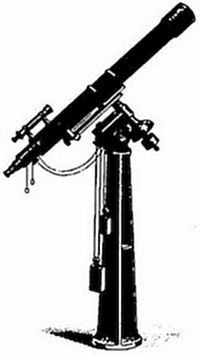
Fig. 26.—A modern Astronomical Telescope.
Galileo went to Venice and showed it to the chiefs of the Republic. He took them up to the highest church tower in the city, and mounted his telescope so as to look out to sea.
He said, “Many noblemen and senators, although of great age, mounted the steps of the highest church towers at Venice to watch the ships, which were visible through my glass two hours before they were seen entering the harbour.” This remarkable invention made Galileo world-famous. The kings, princes, and learned men of the world all wanted telescopes, and asked Galileo to make them. Such requests even came from Holland, where the principle of the telescope had first been discovered.
But although the great men of Europe used the telescope on many occasions both in peace and in[Pg 60] war, Galileo put it to a greater use. He conceived the idea of turning it to the heavens and examining the celestial bodies. In doing so he obtained a most surprising series of revelations. He first of all turned it on the moon, and saw at once that the markings on the surface of the moon were really mountains and level plains. He could watch the shadows of the mountains grow and diminish with the varying direction of the sun’s rays, and he could even prove that some of the mountains were higher than others. He then turned his telescope on the great planet Jupiter, and noticed to his great surprise that Jupiter had near it four smaller companions which circled round it in a few days. In fact, he found that Jupiter has four moons where the earth has only one. This discovery was entirely opposed to the ancient idea, then universally held, that there were only seven planets or moving stars, namely: the Sun, the Moon, Mercury, Venus, Mars, Jupiter, and Saturn.
On pointing the telescope to another great planet, Saturn, Galileo found that another surprise awaited him. It looked as if the planet had two handles, like a jug. This strange appearance was really owing to the fact that Saturn is surrounded by a fiat ring, which being slightly tilted gave the appearance of the two handles. This, of course, was not known at that time to[Pg 61] Galileo, but he certainly was the first to observe that Saturn had a very unusual appearance.

Fig. 27.—The Planet Saturn and its Rings.
Galileo next turned his telescope on the sun at a time when it was near the horizon, and not strong enough to blind him. He observed that the sun was not evenly bright all over its surface, but that there were spots on it. These spots came and went, and could be seen to appear at one edge of the sun, to move round, and to disappear at the other edge about a fortnight later. This gave Galileo the idea that the sun revolves on its axis.
After that, Galileo turned his attention to the planet Venus, and found, contrary to all accepted opinions, that this glorious planet showed phases[Pg 62] like the moon, and was sometimes seen in the shape of a crescent. Such appearances were not presented by Jupiter or Saturn, and it struck Galileo that the probable explanation of this must be that Venus revolves round the sun at a lesser distance than the earth, and the other planets at a greater distance.
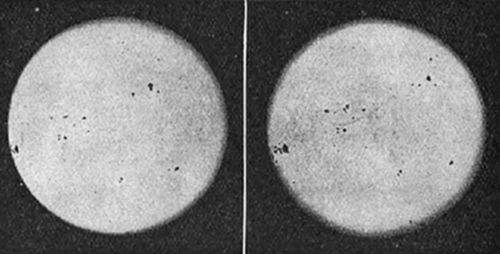
Fig. 28.—Photograph of the Sun on two successive days, showing Sun-Spots and the Rotation of the Sun.
Now at the time of Galileo the accepted opinion was that the earth stood still, and that the sun and all the planets revolved round the earth. This opinion the professors and philosophers of the time sought to justify by quoting the Holy Scriptures, pointing out such a passage, for instance, as that in which Joshua is said to have commanded the sun to stand still. Galileo replied that the Bible was intended as a guide in religious matters, but not as a text-book of science, and that the only method[Pg 63] of arriving at truth in science was by carefully observing the phenomena and seeking for their most reasonable explanation. However, he was faced with a strong opposition. Some of the enemies refused to believe their eyes, saying that although the telescope was useful in observing objects on land or sea, it was misleading when pointed at the stars. Others refused to look through it at all.
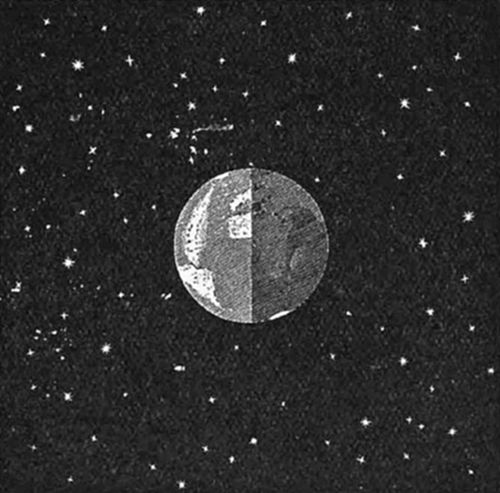
Fig. 29.—The Earth in Space.
About one of these objectors Galileo wrote to his friend Kepler, “Oh, my dear Kepler, how I wish that we could have one hearty laugh together!
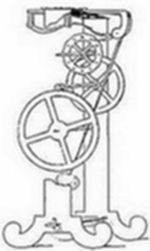
Fig. 30.—Galileo’s Pendulum Clock.
Here at Padua is the principal professor of Philosophy, whom I have repeatedly and urgently requested [Pg 64] to look at the moon and planets through my glass, which he obstinately refuses to do. Why are you not here? What shouts of laughter we should have at this glorious folly! And to hear the professor of Philosophy at Pisa labouring before the Grand Duke with logical arguments, as if with magical incantations to charm the new planets out of the sky.”
At length the enemies of Galileo denounced him in Rome, and Galileo was called before the Inquisition to answer for his strange doctrines. The court before which he was judged decided that his doctrines were contrary to divine revelation, and threatened him with torture if he should continue to teach them. Galileo had no choice but to renounce his doctrine that the earth moved round the sun, and to do penance for having taught it. He was now seventy years old, and although he was allowed to[Pg 65] return to his home his useful work was nearly at an end. He devoted the remainder of his days to Mathematics and to the invention of the pendulum clock, as already stated.
The centuries which succeeded Galileo have fully justified him and his teachings. The idea that the earth moved round the sun is now completely established, and is universally accepted by all educated people. Not only that, but science is now free to pursue its course without regard to the errors and prejudices of the old schools of Philosophy. It is now recognised that no artificial limits can or must be put in the way of the march of the human intellect, and that the increase of knowledge makes invariably for the increased happiness of mankind.
THE ancient philosophers divided all things into four elements—earth, water, air, and fire. Of these, or a mixture of them, they thought that all visible things were made up. Nowadays we recognise about seventy different substances, which we call elements, and we know that what the ancients[Pg 66] called earth is a mixture in various proportions of about a dozen of our elements. When we use the word element, we mean a kind of substance which cannot be obtained by mixing other substances together, and cannot be split up into two or more substances possessing different properties. We know that water can be split up into two substances, and that air is a mixture of at least two other substances. As regards fire, it is now generally thought that it is composed of hot bodies having the consistency of air. Such bodies we now call gases. One of the most familiar examples of gas is that which is used for lighting a room or a street. But the gas is only one of a great variety of similar substances.
Instead of four elements, we now speak of three states of matter. These three states are the solid state, the liquid state, and the gaseous state. When a substance has a certain amount of hardness, when it does not flow, and does not assume a level surface if left to itself, we call it a solid. If a substance flows, and fills up a vessel into which we pour it, and yet remains visible and tangible, we call it a liquid. Lastly, if the substance fills up completely any space into which we place it, and expands as far as it can, we call it a gas. Nearly every liquid and most solids may be converted into gases by heat, and this circumstance[Pg 67] accounts for the great variety of gases which are known to exist.
A great difference between a solid and a liquid is that a solid left to itself only presses down upon its support, whereas a liquid also presses sideways and upwards. In this respect fine sand partakes somewhat of the nature of both solid and liquid. If the stalk of a dandelion, or some other hollow stalk, is planted in a box of sand, it can be crushed by packing the sand very tightly. This shows that the sand is capable of exerting a pressure sideways. But the coarser the grains of sand, the less readily does this sideways pressure follow upon the pressure on the surface. On the other hand, if the sand is extremely fine it readily exerts pressure in all directions. If we could produce sand about a thousand times more finely grained than the finest sand known, we should obtain a substance which would instantly transmit the slightest pressure on the surface through the whole of the substance. We should have, in fact, a liquid.
That water is able to exert pressure in all directions may be proved by means of a small bladder attached to the end of a tube, as in the toy which is blown up and makes a squeal on letting the air escape. If, instead of letting the air escape, the tube is stopped up, and the bladder attached to a long rod and gradually lowered into a tank of[Pg 68] water, the bladder is observed to become smaller and smaller as it gets lower down in the water. At the same time, it remains as round as it was originally, thus showing that the pressure of the water is exerted in every direction, and not on the top, bottom, or sides only.
Another way of showing that water exerts a pressure is by tying a sheet of thin india-rubber over the end of a long and wide tube of glass, and lowering the end into the water. The india-rubber is seen to bend into the tube more and more as it is lowered farther and farther into the water. This shows that the pressure is in proportion to the depth. The pressure is not altered by putting any solid object into the water, so long as it does not change the level of the water. The pressure on the bottom of the vessel is the same so long as the level of the water remains constant. If the bottom of the tank is weak in any particular place, we can protect that place by laying a plate of iron across it, so long as there is no water between the iron and the weak place. For if there is any water between the bottom of the tank and the iron plate, that water hands on the pressure just as well as when the iron is not there at all.
If instead of an iron plate, we put a solid block of iron suspended from above, the pressure[Pg 69] on the bottom of the tank remains the same. The pressure simply depends upon the height of the surface of the water above the bottom of the vessel, and is not changed when the surface is made either very much larger or very much smaller. This curious fact was discovered by Stevin. He was Inspector of Dikes in Holland, and had a great deal to do with the pressure exerted by water upon the dikes which keep the sea away from the low-lying Netherlands. It was his business to make sure that the pressure of the water was not sufficient to break through the dikes.
It was already surmised by the ancient Greeks that air had a certain amount of weight, but it was not suspected by them that the amount of air which fills a room would weigh as much as one hundredweight. If liquids are capable of exerting a pressure in all directions, it follows that gases, which naturally exert a pressure, will certainly be able to do the same. But it was very long before the world found that out. The Greeks thought that an empty space could not exist because Nature had a horror of it, and hastened to fill up any empty space that might be produced with any substance that happened to be close by. Therefore, if a pipe was stopped up with a close-fitting stopper, and the stopper or piston was drawn in one direction, the air in the pipe naturally followed the[Pg 70] piston. If the end of the pipe was stopped up the piston could only be drawn with great difficulty.
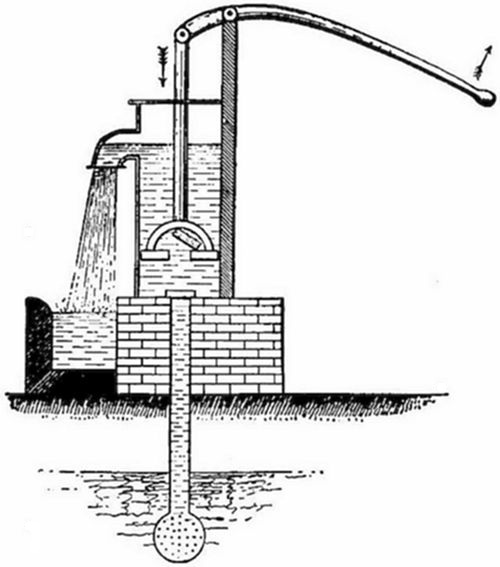
Fig. 31.—Water retained in the Cylinder of a simple Pump as the Piston sinks.
The Greeks thought that this difficulty was due to Nature’s horror of an empty space, and on closing the tube or pipe with the finger, they found that the finger or the skin was drawn into the tube. So “anxious” was Nature to fill up the empty spaces. This supposed horror was made useful by constructing pumps of much the same kind as[Pg 71] those still used to raise water. The tube of the pump dips into the water, and upon raising the piston water rises up the tube.
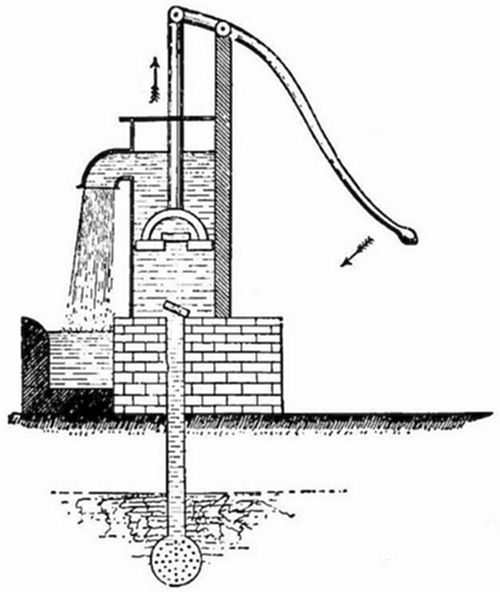
Fig. 32.—Water rising in the Tube of a simple Pump as the Piston rises while Water above the Piston is being lifted out.
People succeeded in raising water in this manner as high as thirty feet, and they did this for centuries without finding any limit to the height to which water could rise, probably because they could not very well make pipes much longer than thirty feet.
But in the time of Galileo some people made a pipe forty feet long, hoping to pump up water[Pg 72] through that distance. They found, however, that no amount of pumping could raise it more than about thirty-three feet, and that at that point Nature’s “horror of vacuum” or empty space seemed to cease. This observation showed that there was something wrong about the supposed horror, and people began to suspect there was no such thing. Galileo himself, who was consulted on the matter, admitted that there was a certain difficulty about producing an empty space, or a vacuum as it is called, but thought that difficulty, which he called the “resistance of a vacuum,” had certain limits. Galileo died before he could solve completely the problem of the resistance of a vacuum, but his friends and disciples pursued it ardently, and finally arrived at a complete explanation of the difficulty.
The most famous of these successors of Galileo was a man of the name of Torricelli, who lived in Rome. He had studied the works of Galileo as a boy of sixteen, and had himself written a book on Mechanics. Galileo saw the book and invited the young man to stay with him in Florence. It is said that the two became great friends, and that when Galileo was very old and blind his declining days were cheered by the conversation of young Torricelli. When Galileo died, his patron, the Grand Duke of Tuscany, made Torricelli Professor[Pg 73] of Mathematics at the Academy in the place of Galileo.
It was not long before Torricelli thought of a new and striking experiment concerning the vacuum. He decided to fill a glass tube with the heavy liquid quicksilver or mercury instead of water, and expected that the so-called resistance of the vacuum would be about fourteen times greater in the case of quicksilver than in the case of water, so that quicksilver could only be sucked up something between two and three feet instead of thirty-three feet. He found great difficulty in getting a suitable glass tube, since the glass-blowers of that time had not yet learned to make strong glass tubes, although they were very clever at making all kinds of bottles. Torricelli himself never carried out this experiment, but it was performed by a friend of his in the year 1643. It was described by Torricelli in some letters which he sent in the next year to a friend in Rome. That friend straightway wrote to some of his friends in Paris, and the news he conveyed to them created a great sensation.
This was the experiment: A glass tube three feet long, and closed at one end, was filled with mercury. It was then stopped at the open end with the finger, and that end was carefully brought under the surface of a dish of mercury. On removing the finger it was found that some mercury[Pg 74] flowed out of the tube, leaving a space of about six inches vacant at the top. This space was a vacuum. When Pascal, the great French man of science, heard of this experiment, he said, “It appears that the vacuum is not impossible in Nature, and that she does not shun it with so great a horror as some imagine.”
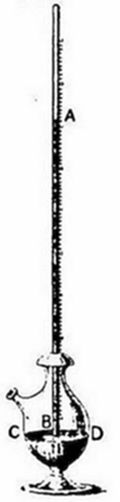
Fig. 33.—Early form of Barometer.
The next problem was to give a reasonable account of the extraordinary observation. Both the Italians and the French were not long in arriving at a correct explanation, which was based upon the facts observed when two vertical tubes are joined at the bottom and filled with different liquids. A heavy liquid in one tube can counterbalance a longer column of a lighter liquid in the other tube. If two tubes could be constructed each one hundred miles high, they would reach nearly to the top of the atmosphere. Now, if one of the tubes was left full of air, and if instead of air mercury could be poured into the other tube, a very short column of mercury would balance the whole column of air in the other tube. The length of the mercury column would be as many times shorter than the air column as the mercury is heavier than air. The[Pg 75] two tubes would in fact form and any change in the amount of air in the air tube would be indicated immediately by a rise or fall of the balancing column of mercury.

Fig. 34.—The pressure of the air upon the mercury in the short open tube keeps up a column of mercury about 30 inches long in the closed tube.
In a barometer it is therefore sufficient to close the tube containing the mercury at a height of about three feet, so that a tube one hundred miles high is not required there. Nor is such a long tube required on the other side either. For, as we have already seen, the pressure of a liquid simply depends upon the height of its surface above the bottom upon which it presses, and as the width of the tube makes no difference the air tube may be made as wide as we please, or may be taken away altogether, so long as we prevent the air bubbling up into the vacuum. This can be done by bending round the lower end of the mercury column until it points upwards. The mercury then rises and falls both in the long tube and in the short tube, and the pressure of the air upon the short tube is[Pg 76] measured by the difference of level of the mercury in the two tubes.
It would, of course, be more convenient if the height of the mercury by itself indicated the pressure of the air, and this can be secured by dipping the lower end of the mercury tube into a large vessel full of mercury, so that its level does not perceptibly change when a little mercury flows in or out of the barometer tube. This is, in fact, the modern form of the mercury barometer.
Torricelli himself was quite aware of the importance of his experiment. He wrote, “I do not mean simply to produce a vacuum, but to make an instrument which shows the changes of the air, now heavy and dense, and now lighter and thin.”
Pascal said that if it is the pressure of the air which raises the mercury under the vacuum, then the mercury in a barometer must stand lower on the top of a mountain than it does when the barometer is on the ground near sea-level. He asked a brother-in-law who lived in the south of France to take a barometer up a high mountain. It was found that the mercury column fell three inches, since less air remained above to exert any pressure. “This,” said the observers, “ravished us with admiration and astonishment.” Pascal also took a balloon half-full of air up a mountain. He found that it gradually filled out until it was quite[Pg 77] tight, and that it collapsed again on descending. This result showed that the pressure which was not sufficient to fill out a balloon on the lower ground was quite sufficient to counterbalance the reduced pressure of the air upon the mountain.
There were some who would not accept the view that the pressure of the air was sufficient to uphold a column of mercury against gravitation. They could not believe that the enormous pressure required could be furnished by such a rare substance as air. They weighed the pressure exerted by mercury on the supporting surface, and found that a column of mercury thirty inches long presses with a force of fifteen pounds upon every square inch of the supporting surface. They would not acknowledge that the air could exert such an enormous pressure, and showed that this pressure, exerted by the air on the surface of the human body, must amount to several tons. The inventors of the barometer replied that that enormous pressure on the human body was counterbalanced by the pressure of the air which is contained within the body itself, so that no inconvenience is felt.
One philosopher claimed to have found that the mercury hangs by invisible threads from the upper end of the tube, and that he could feel those threads when he stopped the upper end of the tube with his finger.
[Pg 78]
But that air is easily able to exert great pressure was proved afterwards by an Irishman called Robert Boyle, who showed that when air is compressed to half its volume, it exerts a pressure of quite thirty pounds to the square inch.
The vacuum above the column of mercury was intensely interesting to its discoverers. So far as they knew, it was a perfectly empty space, and the first of its kind ever discovered. In appearance it was just as if it were filled with air, and it was just as transparent, so that it was evident that light had no difficulty in shining through empty space. This fact suggested the idea of trying whether sound could also travel through empty space, and the Experimental Academy established in Rome after Galileo died, tried in various ways to discover whether sound was propagated through a vacuum. But they did not succeed in arriving at any decision. A little bell which they brought into a vacuum, suspended by a thread, kept on ringing quite audibly. But in that case the sound might easily have been communicated by the thread to the glass, so that the experiment proved nothing. The real decision of the question only became possible with the next triumph of human genius, the invention of the air-pump.
Fig. 35.—An Aneroid Barometer.
The barometer is now a household instrument, used for indicating the weather. The mercury falls[Pg79] rapidly when a storm is approaching, and warns the mariner to make for the harbour or the open sea. Every ship is now provided with a barometer, but not always with one containing mercury. The instrument used frequently has a round dial, like a clock, with two hands. One of the hands can be set from outside, and marks the position of the second hand at a certain time. The second hand moves to the right and left, as the pressure rises or falls. The hand is driven by a mechanism which connects it with a metallic box from which the air has been pumped. The pressure of the air presses more or less on the lid of the box, and so drives the index on the dial.
[Pg 80]
WHILE Galileo’s plan of work was to consider a theory, and then to test it by experience, other men of science went to work in the opposite way.
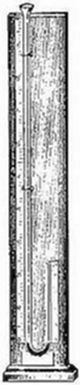
Fig. 36.—Shape of tube used by Boyle to show that air exerts pressure.
They made a large number of experiments, and gradually allowed the results of the experiments to force them into a certain way of looking at things. One man of science who adopted the second method was Robert Boyle, an Irishman, who made himself famous by his studies on what he called “the spring of the air,” meaning the pressure which compressed air can exert. He took a long glass tube and bent it into a hook at the lower end, which was closed. He then poured in mercury through the top, until the bent end contained only a little air, which was compressed by the weight of the mercury in the long tube. He poured in more and more mercury, and found that the space [Pg 81] filled up by the air became smaller, the greater the pressure of the mercury was. He found, in fact, that the air behaves very much like an elastic spring, which can be stretched and compressed.
After some experience of this kind, Boyle heard of an apparatus which a German had invented, and with which he performed the most astonishing experiments. This man’s name was Guericke. Guericke had the idea of finding out all about the stars, and how they moved through space. He believed that they did not move through air, because if they did they would gradually be stopped by the resistance of the air. He decided that if he wished to find out how they moved, he would have to obtain a space similar to that in which the heavenly bodies moved. This space, he said, would have to be an empty space. He therefore tried to make an empty space.
The first method Guericke adopted was a very curious one. He took a big cask filled with water, and containing only one opening. Into that opening he screwed a pump, and tried with all his might to pump the water out of the cask. This was more difficult than he had expected, for the air, pressing on the water with the force of fifteen pounds per square inch, held the water in the cask. If the opening had been free, the air would have got into the cask in bubbles, and would have pressed the[Pg 82] water out through the opening. But Guericke did not allow any air bubbles to get into the cask, and so he had to work against the whole pressure of the air in trying to pump the water out of the cask. If he could but pump it out, he was convinced that he would leave only empty space in the cask.
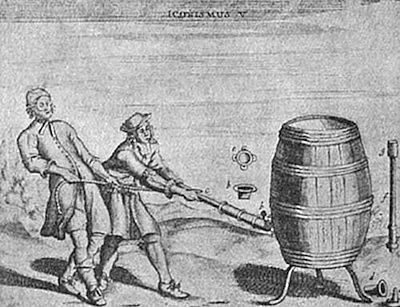
Fig. 37.—Guericke’s experiment of trying to draw Water out of a full cask in order to leave a Vacuum.
Well, he did get a large portion of the water out of the cask by working the pump with all his might, but as soon as the water flowed out, he heard a gurgling, or bubbling, sound made by the air which was pressed in through all the joints which were not[Pg 83] quite air-tight. Then he put one cask inside another, but he did not succeed much better, because again there was a noise resembling hissing and the twittering of birds. This experiment continued for several days, and in the end the cask was found full of air. Guericke therefore was convinced that he could not get an empty space while using a wooden cask.
He then tried a ball made of beaten copper. Three men pumped the air out of this ball, and no sooner had most of the air been pumped out than the ball collapsed with a loud report, crushed by the pressure of the outside air. He then had another copper globe made. It was divided into halves, and these were joined by means of a ring of leather which was well soaked in a mixture of wax and turpentine. When that globe was emptied of air by means of the pump, the halves stuck so well together, that no human power was able to separate them; but when air was let in by turning a cock, they immediately fell apart. This experiment was performed again and again, and on one famous occasion it was performed before the German Emperor and his Parliament. On this occasion the two half-globes were fixed so firmly together by the pressure of the air merely, that it took sixteen horses to pull them apart. The total force with which they stuck together was about equal to the weight of a ton.
[Pg 84]
When Boyle heard of these experiments, he made an air-pump of his own. He arranged it so that he could easily pump the air out of a glass globe which had a valve.
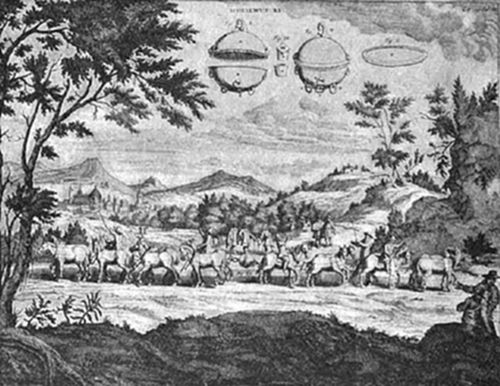
Fig. 38.—Old Print showing horses trying to pull apart two Magdeburg Hemispheres from which the air had been pumped.
He could put in various objects from above by opening the valve, and then pump out the air and see what happened. The whole globe could be taken off the pump very easily, since it had a brass nozzle which fitted into the pump. The brass nozzle was fixed to the glass by means of a cement consisting of pitch, resin, and potash.
[Pg 85]
After the air-pump had been discovered, everybody set to work to try it in various ways. Boyle brought a small closed bladder into the globe and worked the pump. He found that the bladder at once expanded, and finally burst; evidently because the pressure of the air inside the bladder was no longer balanced by the pressure of the air in the globe. He also put a little cup of water under the air-pump, and found that it gave off bubbles and finally appeared to boil, although it was not hot. Boyle thought that water could be converted into air, but in this he was wrong, because we know now that steam is given off from water under low pressures of air even when the temperature is very low. Boyle found also that water falling in a vacuum makes the sound of some metallic object.
Meanwhile, Guericke was also actively improving his apparatus, and soon he was able to pump out nearly all the air, and to leave only one-thirtieth of the original amount in the vessel he employed. He next succeeded in proving that a vacuum does not allow sound to pass through it. He placed a clock into the vacuum, and as he pumped the air out more and more, the striking of the clock was heard more and more faintly, until it became quite inaudible. He was so convinced of the powerful effect of the suction of an empty space, that he said that if a[Pg 86] man were to blow his breath into a large vacuum, that breath would be his last.
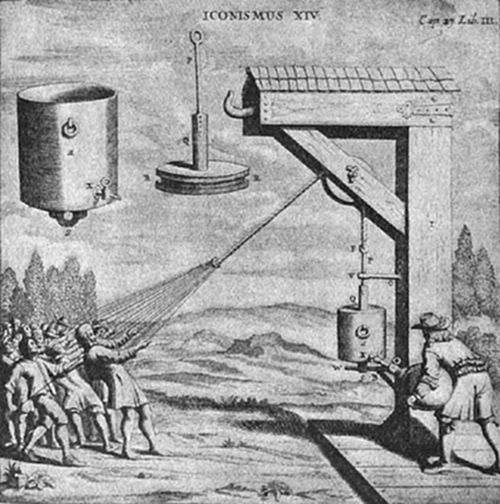
Fig. 39.—Guericke’s experiment to show the pressure upon the piston of a cylinder from which air was being extracted.
The Marshal of the Emperor refused to believe this, but Guericke undertook to convince him of the truth in another manner. He constructed a cylinder with a piston which moved in it air-tight. This piston was suspended by a rope over a pulley,[Pg 87] and to the end of the rope twenty small ropes were attached, and each of these was held by a strong man. They pulled up the piston until it was at the top of the cylinder. Into the bottom of the cylinder a small hole was bored, and into this hole Guericke introduced the nozzle of his empty globe, which was stopped by means of a cock. On turning the cock, the air in the cylinder rushed into the empty globe, or rather it was driven in by the force of the outer air. So great was this force, that the twenty strong men holding the ropes were pulled violently forward and were quite unable to keep the piston up. A somewhat similar arrangement was used for firing shots without powder.
It is remarkable that all this time Guericke had not heard of the wonderful experiments made in Italy by Torricelli, the pupil of Galileo. Had he done so, he might have been led to try to obtain a good vacuum by means of mercury, as is done nowadays. But in some respects his apparatus was greatly superior to that used by the Italians. In order to find whether animals could breathe in rarefied air, some of the Italians brought birds and other small animals into the vacuum at the top of the column of mercury. It was found, of course, that the animals could not live, partly because air was necessary for breathing, and partly because their whole structure and[Pg 88] constitution was disturbed by the pressure of the air within them, which was no longer counterbalanced by the pressure outside. Such experiments as these, together with others on combustion, could be performed much better with the air-pump as constructed by Guericke; although it must be borne in mind that such experiments on animals are not now necessary, since we know that animals cannot survive after they are deprived of air.
The effect of the invention of the air-pump was very great. Men realised for the first time that they lived at the bottom of an ocean of air; and that if all air were removed, the world would be quite different. It would be a world in which neither animals nor human beings could live. The air-pump in the course of the next century led to two other great inventions, the steam-engine and the balloon.
IT has long been supposed that the steam-engine was invented by an Englishman of the name of James Watt. But the real inventor of the steam-engine[Pg 89] was Denis Papin, a French doctor, who invented the engine while in Germany, and described it in a book which he published in England, where he lived for many years. He made friends with Huygens in Paris, and assisted him in carrying out his experiments on the air-pump.
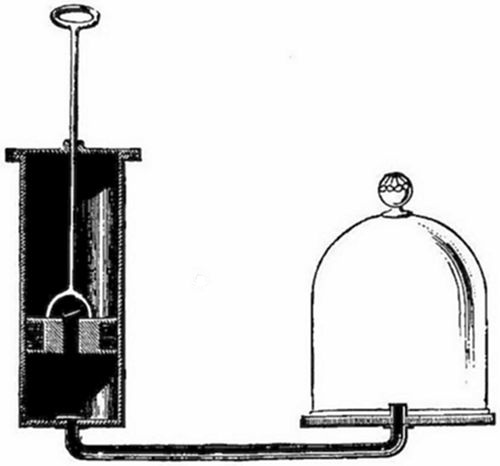
Fig. 40.—Papin’s improved Air-Pump.
Huygens was very busy with a great variety of inventions, and was glad to have this young assistant, who would carry out experiments for which he himself had no time.
Papin made a number of improvements in the air-pump. One of these was a cock, constructed on the principle of a gas cock or water tap, but having two channels through it. Another great improvement which he made in the air-pump was that he[Pg 90] put the objects under a glass shade instead of in a bottle. The shade was placed upon a flat plate, and its edge was well greased, so that no air could enter from below.
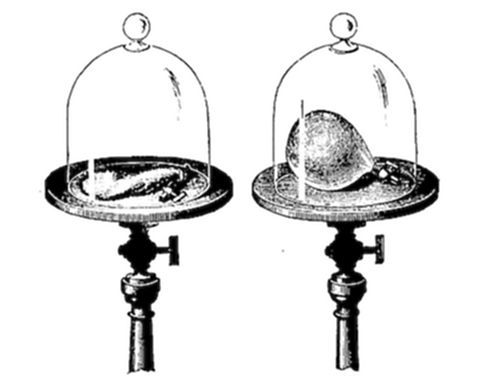
Fig. 41.—One of Papin’s Experiments. A bladder containing very little air swells up when a vacuum is produced in the bell-jar, owing to the expansion of the air contained in it.
In the middle of the plate was a hole, and the air was pumped out from below through this hole. Air-pump experiments could thus be made with a great number of different objects, one after the other, by simply lifting off the shade and replacing it after putting the object upon the plate. This method was easier than screwing off the cap of the bottle used by Huygens.
Fig. 42.—Papin’s Mining Pump. Water flowing over the water wheel Q turns the shaft P, provided with a double crank. This drives the double air-pump OO, which sends air through the tube R alternately out of the cylinders H and L at each turn of the cock S. The pistons wind and unwind the ropes E and F, and draw up water in the bucket C attached to the wheel B.
Papin described these improvements in the year[Pg 91] 1674 in a little book called Experiments on Empty Space, with a Description of the Machines by which it is obtained. The little book was dedicated to his master Huygens, to whom he wrote as follows:—“These experiments belong to you. I have made nearly all of them according to your instructions. But I know that they are only a recreation to you. You would never have written them down, and certainly you would never have published them. And so, I am sure, you will not mind my doing it for you.” Ten years after his book was published, Papin was appointed by the Royal Society of London a curator of experiments, his duty being to devise and show experiments to the members of the Society.
Papin was greatly interested in mining, and he was always puzzling about some way of pumping up the water out of a mine. At that time the pumping had all to be done by hand, and it was done by a string of buckets, such as are used in wells. Papin had the idea of making a water-mill—driven by a brook—pump the water out of the mine. But this method was difficult unless a brook was close to the mine. However, Papin designed a system by which the water-power could be transported easily to the shaft of the mine. The water-mill drove the pistons in two cylinders connected with a long pipe. The pistons compressed the air and drove it along[Pg 92] the pipe till it got to the mine. At the mine there was a big wheel, or pulley, bearing a rope with buckets attached to it. Other ropes were attached to the shaft of the pulley, and were fixed to two other pistons moving in two cylinders. These cylinders were connected with the pipe containing the compressed air. First one cylinder was connected, and the buckets were lowered; then a tap was turned which connected the other cylinder instead, and this raised the buckets full of water.
This plan was a great improvement[Pg 93] on the hand-pump (p. 70), but it was not quite satisfactory; and it failed when the brook ran dry in summer or was frozen in winter. Also the pump was rather a clumsy one. Papin invented a better instrument, which he called the centrifugal pump, and it is used to the present day. The pump consisted of a round, flat box containing a paddle wheel which whirled the water round. The water entered the box at the centre of the paddle-wheel, and on one side of the box was a pipe through which the water escaped on being whirled round. Papin tried to use this pump for pumping water, but he found that he had no machine for moving it quickly enough, nor did he get such a machine until he had invented the steam-engine. This, however, he did not succeed in doing for many years, and meanwhile he invented a number of other instruments.
One of these was a submarine boat. The first man to invent a diving-bell which could move under water was named Drebbel. He was said to have taken a trip under the Thames, disappearing entirely under water and coming up in a distant place. Some years after this, Boyle asked a medical doctor who had married a daughter of Drebbel, how it was that Drebbel and his crew were not suffocated under the water. He was told that Drebbel possessed a certain extract of air which enabled him to breathe in a confined space.[Pg 94] We are nowadays not able to tell how much truth there was in the story concerning Drebbel.
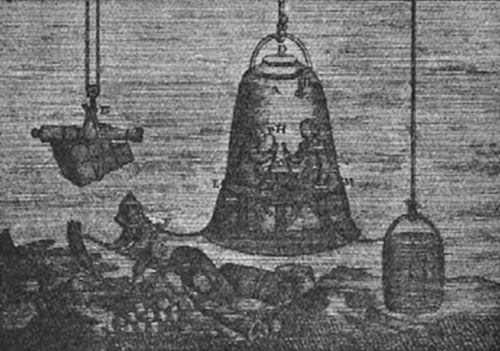
Fig. 43.—An early form of Diving-Bell.
But it is certain that Papin succeeded in constructing a diving-bell, and in using it under water. His diving-bell was not a bell at all, but a round box 6½ feet high, in which three men could stand upright. When sunk under water it did not disappear entirely, because a pipe stuck out of the top through which fresh air could enter or the used-up air be pumped out. The pump which did this was one of Papin’s own centrifugal pumps. On one side of the diving-bell was a very wide tube, through which a man could crawl. It had a little door at the extreme end which could be[Pg 95] opened under water. This would, of course, let in the water, but Papin, with one of his pumps, drove air through the tube from within the diving-bell. This stream of air kept the water back, and the poor man in the tube (he must have been very uncomfortable) could do some work in the water outside, such as laying a mine for exploding an enemy’s ship.
Few people know that Papin was the real inventor of the steam-engine. But everybody acknowledges his invention of a kettle for cooking food under high pressure. He called it a “digester.” When water is boiling it cannot be made any hotter by putting greater heat under it. Greater heat simply makes it boil away more quickly. But it can be made hotter by preventing the steam from escaping. When the lid is stuck on tight, and the spout is stopped up, the steam cannot escape until it reaches a high pressure, and this means a higher temperature at which the water boils.
Papin, therefore, constructed a kettle which was closed at the top by means of a heavy weight. He did not close up the kettle with a screw, since that would have led to an explosion. He only made sure that the steam could not escape until it was hot enough and strong enough to lift the heavy weight. People thought at that time that if they could cook things at a very high temperature, they could get[Pg 96] nourishment not only out of meat, but out of the bones as well. They thought they could make the bones eatable. Papin thought so too, and he cooked some bones in his new kettle. The hardest bones of beef and mutton were made as soft as cheese, and the extract from them made thick jelly, though the bones themselves were not good to eat. The digester is used to obtain gelatine from bones in this way at the present time.
Fig. 44.—Papin’s Cylinder, in which the Piston was raised by boiling water under it.
When Papin seriously set about inventing the steam-engine, he was guided by what he remembered about a machine invented by Huygens. In the year 1674 he had himself constructed this machine. It was intended to raise water by an explosion of powder. The water was intended to be used for the great water-works in the palace of the King of France. A long cylinder containing a heavy piston was fixed in an upright position. In the bottom of the cylinder was a plug which could be screwed in. Before it was screwed in, some gunpowder and a slow match were placed on the plug. Shortly after the plug was screwed in, the match lighted the powder, the powder exploded, and drove the piston up to the top of the cylinder. When the cylinder cooled down, the pressure of the air drove down the piston. The piston was made to pull a chain going over a pulley to which buckets were attached.
[Pg 97]
In the year 1690, Papin took the first step towards constructing the steam-engine by inventing a cylinder in which the piston, instead of being driven by the explosion of gunpowder, was forced upwards by boiling some water under it. This plan made the plug unnecessary. The piston A was driven up by the steam, and fixed at the top by a rod E until it could be taken off the fire and made to do some work. There was one difficulty about this cylinder. If the piston fitted tight, it was not able to sink down to the level of the water at the bottom of the cylinder, because in doing so the air in the cylinder would be compressed, and would resist with a great force.
This difficulty was got rid of by Papin by means of another rod M, which fitted in a hole in the piston. This rod was pulled out so as to let the air escape. When the piston was down far enough, the rod was pushed into the hole again so as to stop it up.
The great fault of this machine was that the[Pg 98] cylinder had first to be heated in order to drive out the piston and afterwards cooled, both of which processes took time. About the year 1704, a German prince gave Papin the order to build a steam-engine for pumping up water.
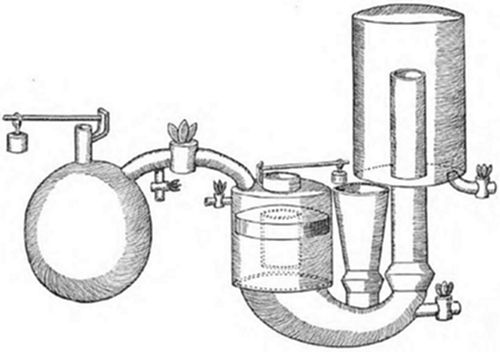
Fig. 45.—Papin’s Steam-Engine.
Just at about that time Papin had seen a design of a machine by a man of the name of Savery, which was not, however, a success. His own machine consisted of a boiler which was to be put in the fire and kept there. The steam from this boiler was conducted into a cylinder half-filled with water. On the top of this water there was a wooden float, so that the steam hardly came into contact with the water at all. The float contained an iron box, into which a[Pg 99] red hot iron ball was placed. The steam, therefore, was not cooled on entering the cylinder, but drove the float to the bottom of the cylinder and forced the water into an upright pipe which was surrounded by another cylinder. This water compressed the air in the second cylinder, and valves were so arranged that the air could not turn back. It was therefore used for forcing water up a pipe. Water was then allowed to return into the first cylinder, and the operation was repeated. The first cylinder afterwards always remained sufficiently hot to preserve the power of the steam. In this respect Papin’s machine was a great improvement on Newcomen’s machine set up at Wolverhampton in the year 1711.
Papin tried his machine in the presence of the German prince in the year 1706. He did succeed in pumping water seventy feet high, but the long pipes began to leak, and the German prince was so disgusted that he would not give the money necessary to carry out any further experiments. Papin, therefore, went back to London, and in the next year he published a book called New Art of Lifting Water with the Help of Fire in a most Successful Manner. He had great plans about his machine. It was not only to pump water out of mines, but also to fire guns, and to drive ships and carriages.
[Pg 100]
But Papin died a few years afterwards without being able to carry out his great ideas beyond constructing a paddle-boat. He was one of the world’s greatest inventors, but the engineers of his time were not able to carry out his great inventions. Though his engine differs very greatly from the steam-engines now made, it certainly contained a piston working in a cylinder, and a safety valve, which are essential parts of a modern steam-engine.
WHEN the ships of the Carthaginians sailed round the coast of Spain and France so far as Cornwall, to sell their purple cloth in exchange for tin, they sometimes brought home with them small pieces of a stone which had the colour of gold, but was transparent, and could be cut more easily than glass. This stone came from the shores of Germany, mostly from the Baltic Sea. It was not really a stone, but the hardened sap of a sort of pine tree, which had lain long underground; and it sometimes showed traces of forest life, such as bodies of insects, embedded in it.
[Pg 101]
This stone, or “amber” as we call it now, was a source of wonder and delight to the ancient Greeks and Romans. It was thought to possess all kinds of magic properties. Besides looking very beautiful in a necklace it was supposed to have a kind of soul of its own; for it sometimes attracted little pieces of straw, or dust. The ancients could only imagine that this was the effect of some kind of will or desire possessed by the amber. They only knew of one other substance which showed similar power. This was the lodestone which attracted iron, and which the ancients therefore sometimes called “quick iron,” meaning “living iron,” just as the lively liquid mercury was called quicksilver.
It was Dr. Gilbert of Colchester who first proved that these two powers are entirely different from each other. He called the power shown by amber “electric” power, and the power shown by lodestone he called “magnetic” power. Electric power, he said, had to be excited by rubbing the amber with a piece of cloth; but magnetic power could only be excited in a piece of iron by rubbing it with lodestone, or hanging it in a direction pointing to the North Pole. It was Dr. Gilbert also who invented a little instrument resembling a compass which showed electric attraction. It was a short piece of straw mounted on the point of a needle in the same way as a magnetic needle.
[Pg 102]
Although Gilbert had proved that electric and magnetic forces are quite different, an event occurred in the year 1681 which showed that there is some kind of connection between the two. In that year a ship bound for Boston was struck by lightning.
Fig. 46.—Gilbert’s Electric Needle.
It was found by comparing the direction shown by the mariners’ compass with that found by means of the North Star, that the north pole of the compass pointed south, and the south pole north. In fact the needle had been reversed, and the ship was steered into Boston harbour with the compass reversed.
Even at that time people had guessed that the lightning had something to do with electric force, a guess which Benjamin Franklin afterwards proved to be true. Robert Boyle observed that hair easily shows electric attraction. It can be “electrified,” as we say now. When a cat has been lying by the fire for some time and we stroke her with the hand, we hear a slight crackling noise as if from small sparks. Some parts of the fur stick together, others stand apart. This is also observed by ladies when they comb their hair. When the hair is very dry, individual hairs fly apart.
[Pg 103]
False hair, which is usually drier than growing hair, shows electrical attraction very strikingly. Boyle observed this more than two hundred years ago. He wrote to a friend, “false locks of hair brought to a certain degree of dryness are attracted by the flesh of some persons. Of this I had proof in two beautiful ladies who wore them. For at some time I observed that they could not keep them from flying to their cheek and sticking there, though neither of them had any occasion for paint, nor used it. One of them gave me leave to make a further experiment, and asking her to hold her warm hand at a convenient distance from one of those locks taken off and suspended in free air, as soon as she did this the lower end of the lock which was free attached itself to her hand.”
It was soon found that other substances besides amber and hair show electric attraction. Isaac Newton hung a round piece of glass in a brass ring fixed about an inch above a table. He rubbed the glass with some “rough and raking stuff,” till some very small fragments of very thin paper laid on the table beside the glass began to be attracted and moved nimbly to and fro, leaping upon the glass and remaining there a while, then leaping down and resting there, then leaping up and perhaps down and up again. This experiment is repeated easily by rubbing a stick of[Pg 104] sealing wax with a woollen cloth, and holding it over small bits of paper.
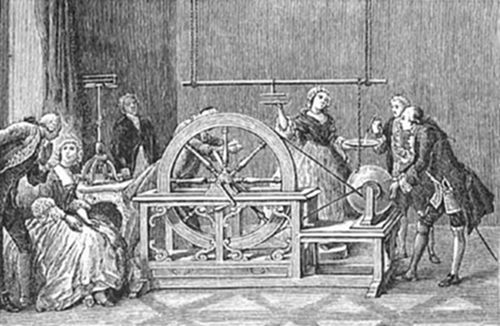
Fig. 47.—Guericke’s Electrical Machine made with a Ball of Sulphur.
Instead of rubbing amber or glass, Guericke rubbed a ball of sulphur with his hands. He made this ball by filling a round bottle with flowers of sulphur and melting the sulphur until it was quite liquid. Then he let it cool until it was solid, and then he broke the bottle and took out the sulphur ball. He attached the ball to a stick, and when he had electrified it by rubbing, he used it to attract feathers, which he succeeded in leading all round a room by this electric force only.
About the year 1730, a pensioner of the name of Stephen Gray found that electric force may be produced at one end of a wire by holding an[Pg 105] electrified body near the other. He expressed this fact by saying that the wire “conducts electricity.” He found that all bodies may be divided into conductors and non-conductors. He proved that the human body is a conductor, and created a sensation by suspending a boy on a network of silk and showing that he conducted electricity. Instead of suspending the boy on a silk net, he found that it was sufficient to let him stand on a cake of resin, which did not conduct electricity.
This experimental work with the electric force was taken up in France with great interest. The French experimenters found out that when a body is electrified strongly, sparks may be drawn from it. One experimenter had himself suspended on a silken net, and got the others to electrify him. When that was done sparks could be drawn out of his body by any one who touched him. These sparks made a crackling noise and produced a pricking sensation. “I shall never forget the surprise caused by the first electric spark which was ever drawn from the human body,” exclaimed one of those who were present.
So great was the interest roused by these new observations that people began to make electric machines. One of the best of these was made by Professor Bose in 1744. It consisted of a glass[Pg 106] globe mounted in a frame and kept rotating by means of a pulley.
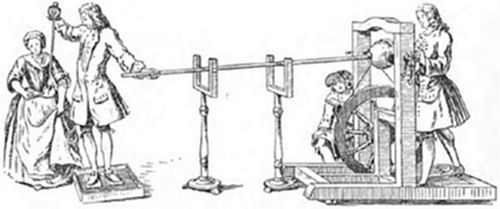
Fig. 48.—Electricity produced by Friction with Glass and conducted by a Metal Tube.
One of the experimenters held his hands on the glass globe, and so electrified it. The electricity was conducted by a long tin tube suspended by silk threads. The end of the tube next the glass globe was provided with linen threads, which collected the electricity into the tube. At the other end stood an assistant on a cake of pitch or resin. He held a sword in his hand, and from the end of that sword sparks could be drawn as soon as the assistant touched the tin tube with his other hand. These sparks could be made to set fire to spirits of wine held in an iron dish by a servant who stood on the floor.
About the same time another German professor used a glass cylinder instead of a glass globe, and did away with the necessity of rubbing the glass with the hand by letting a leather cushion rub[Pg 107] against it. This leather cushion was a kind of artificial hand. But it was not sufficiently like the human hand to be very useful, and was afterwards improved by covering with a mixture of tin and mercury. Later still, glass discs were used instead of globes or cylinders.
It was in the year 1745 that electric experiments became very popular, owing to the accidental discovery of a piece of apparatus by which the electric discharge, or spark, could be made much stronger. This discovery was made about the same time in Pomerania and in Holland. In both places people were trying to electrify water in a bottle. The electricity was conducted into the water by a long nail, which stuck out of the bottle at the neck. The bottle was held by an assistant, and when enough electricity had been conducted into the water, the assistant took the nail out of the water. In doing so he received a great shock which paralysed his arms and shoulders. In Holland, this experiment was performed at Leyden, and the jar which can be made to give such a great shock is therefore called a “Leyden jar.”
The man who received the electric shock said that he would not take another for the kingdom of France. But this feeling was not shared by others, and many people tried the electric shock just to see what it was like. Professor Bose went[Pg 108] so far as to say he wished he might die by the electric shock so that the account, of his death might furnish an article for the French Academy of Sciences.
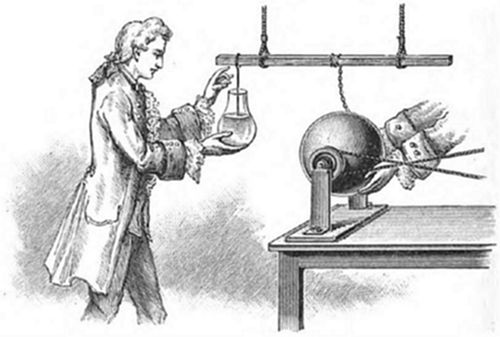
Fig. 49.—Discovery of the Leyden Jar.
The new apparatus became so popular that a great number of people made a living by going from place to place to exhibit it. In France especially such entertainments attracted large crowds. On one occasion an electric discharge was sent through a row of 180 soldiers. At another time several hundred monks were made to join hands in a row 900 feet long, and a strong electric spark was sent through the whole row. It made all the monks jump at the same moment.
It was not long before these experiments were[Pg 109] repeated in America, and when they did so they soon attracted the attention of a man who was able to develop them much further. That man was Benjamin Franklin, who was then engaged in the printing business. He saw the first experiment in the year 1746, and at once began to investigate the subject. He was the first to observe what a very important effect metallic points have in drawing out, or throwing off, what the French called the “electric fire.” He constructed a Leyden jar, and made many experiments with it. When the hot summer weather came he proposed to his friends to wind up his experiments with an electric dinner, for which a turkey was to be killed by an electric shock and roasted in front of a fire lighted by electricity.
In the year 1749, Franklin had an idea of making experiments to prove that lightning was really a great electric spark. Before he saw the electric experiments, he had thought that the lightning was due to some kind of sulphurous breath coming from the earth and collecting in the atmosphere. Other people thought that the lightning was due to a gas explosion. The truth of such guesses could be decided only by experiment. For when a thing has to be explained it is not sufficient that it shall be more or less like some other thing. Things are sometimes very similar and still have[Pg 110] nothing to do with each other. The flowers of frost on a pane of glass look very much like the leaves of ferns or other delicate plants. But the force which makes the fern grow in the wood is quite different from the frost which makes the crystals grow on the glass, and it would be a great mistake to suppose that the same causes are at work in both cases. For in one case we must have a germ, nourishment, and a certain temperature, whereas in the other case we require moisture and cold only.
Benjamin Franklin had the true scientific spirit. When he found that the electric spark and lightning both looked bright and made a noise, he did not jump at once to the conclusion that they had the same nature. By careful study he found that lightning and the electric spark have nearly the same colour. The electric spark looks like a small flash of lightning. Both are equally swift, both are conducted by metals, both are capable of tearing or breaking bodies they pass through, both are capable of killing animals instantly, both can melt metals and fire inflammable substances, and finally both give rise to the same kind of smell.
It only remained now for Franklin to draw an electric spark from the clouds to prove that lightning was an electric discharge. To do this he proposed that a pointed iron rod should be mounted on the top of some high steeple as near as possible[Pg 111] to the clouds, so as to draw electricity out of them. Near the top of the tower a man was to be placed on a stool with glass legs, and connected with a pointed rod. If the rod collected electricity from the clouds it would be possible to draw sparks from the man. Franklin proposed this experiment in a letter to the Royal Society of London, but the Society did not encourage him. He then tried to start a lottery in order to obtain the money necessary to build a tower for the purpose, since there was no building in Philadelphia high enough for the experiment.
While Franklin was still making plans, he heard that the experiment had been performed successfully near Paris. A man named Dalibard had mounted a metal rod forty feet high on the roof of a small cabin and rested the foot of the rod on a table inside the cabin. Dalibard set an old dragoon to watch for thunder clouds, and had a wire ready near the rod to draw off any sparks that might be obtained. After several days a thunder cloud appeared, and sparks flew from the rod to the wire. The dragoon thought they smelt of sulphur and that some demon was at work. He sent for the priest, but the priest knew that this was not the work of a demon; and he proceeded to draw sparks out of the rod with the wire, after which he told Dalibard what had happened. The latter was[Pg 112] delighted, and exclaimed that Franklin’s idea was no longer a guess but a reality.
Franklin, however, did not regard the experiment as a sufficient proof, and he conceived the new idea of sending up a kite with an iron point in order to draw electricity from the clouds. He sent up a kite, holding the string by a silk ribbon, so as not to get the sparks into his hand. A thunder storm came on, but no effect was observed although Franklin had tied a key to the end of the string. But when the rain began to fall and the string got wet, a strong spark was obtained on bringing the knuckle near the key. This conclusive experiment had a great effect all through the civilised world. It was repeated in every country, and Franklin’s idea of drawing electricity out of the clouds by means of pointed rods connected with the earth was adopted in many places. Such rods were called Lightning Conductors.
Sometimes these lightning conductors were not connected with the earth, but with some apparatus for measuring the amount of electricity, or with a Leyden jar for collecting it. Such an arrangement was put up in St Petersburg by a man of the name of Richmann. But while he and a friend were observing the measuring instrument, the friend suddenly saw a ball of blue fire come out of the rod and hit Richmann on the head, killing him[Pg 113] instantly. This death of an experimenter did not excite horror, but rather envy. One great discoverer is said to have exclaimed that it was not given to every electrician to die in so glorious a manner. Men of science were interested greatly in the manner in which the electric shock had affected the head and body of Richmann, and those effects were investigated closely. Richmann himself was so devoted to the cause of science that we may well believe that he would have been proud of being the first to be killed in an experiment of this kind. Besides, he was also the last, as his successors were able through his death to protect themselves from similar dangers.
THE electric machine was used for extracting what was called the “electric fluid” out of a body by rubbing. The fluid in its passage through the air made a spark and a noise. It pricked the finger. In larger quantities it gave a severe shock, sufficient to kill small animals. In the form of lightning it killed men.
[Pg 114]
Franklin called the fluid the “electric fire,” and supposed that it was a very subtle and delicate fluid distributed through all nature, and was the reason and cause of all electric happenings. When he found that two silk threads when charged with electricity repelled each other, he came to the conclusion that one portion of the electric fluid repels any other portion. When one body was rubbed against another he supposed that some of the fluid was extracted from one and absorbed by the other, but that after the exchange the two bodies attracted each other in proportion to the amount of electric fluid which had been extracted. There was, therefore, both an electric attraction and an electric repulsion. The attraction existed between the electric fluid and a body which had lost its ordinary quantity of that fluid. The repulsion took place between the portion of the fluid itself, and also between two portions of matter which had both been deprived of some of their electric fluid. Franklin believed that the whole science of electricity could be built up by studying the motion and distribution of the electric fluid.
Franklin also tried to find out whether a body, after losing some of its natural quantity of electric fluid, weighs less than before, but he could not find any difference in weight. This result made him think that the electric fluid had no weight. He[Pg 115] knew the difference between conductors of electricity and bodies which did not conduct it. He supposed that conductors could take up a great quantity of the fluid, and store it away in the interior of their substance. He knew that not more than a certain quantity of electricity could be extracted from a body however hard it was rubbed. He supposed that the amount of electricity in a body was limited, and that after some rubbing the limit was arrived at. The fact that the electric machine gave a constant supply of electricity he explained by supposing that the electricity returns to it through the air. There was, therefore, a constant circulation of electricity, a kind of electric current. But in Franklin’s time there was no way of producing a really steady current of electricity.
If we compare the electric current with a current of water, we may express the case as follows:—Lightning and the electric spark are like splashes of water falling from a great height, and making a great deal of noise and disturbance. The electric machine gives a kind of current which may be compared to a brook running along a stony bed, and making a great deal of noise with but little water. The next great discovery in electricity was how to produce a steady current, which we may compare with the full, steady,[Pg 116] and noiseless flow of a good water-tap. This discovery was made in a very roundabout way.
Towards the end of the eighteenth century, it was found that certain curious fish called “torpedoes,” or cramp fish, were capable of giving their enemies a severe electric shock. When this was proved, men of science inclined to the idea that all movements of muscles are electric. One of them, who made experiments with frogs, ventured the guess that a kind of electric vapour moves through all muscles and nerves, and produces not only the movements of animals, but also their sensations. Great efforts were made to discover this electric vapour or “animal electricity.”
It was, however, not till the year 1790 that the first actual observation of something like animal electricity was made by a professor in Bologna of the name of Galvani. We are told that his wife, being in poor health, was ordered to eat frogs’ legs, and that the professor experimented with a few of those; but in his own account there is nothing about his wife or about frogs’ legs considered as food. He simply relates how he placed the hind legs of a frog together with a piece of its backbone upon a table on which his electric machine stood, but without the conductor of the machine touching the frog. One of his assistants happened to touch the nerves of the legs with[Pg 117] a knife, and he observed to his surprise that a kind of shudder seized the legs of the dead frog. Another assistant thought that this only took place when a spark was coming from the electric machine. Galvani says:—“Astonished at this new observation he drew my attention to it. Although I was engaged in some quite different work, I was inflamed by an incredible zeal and desire to examine it and bring to light the cause that was hidden in it. I, therefore, touched one or other of the nerves with a knife, and at the same moment one of the assistants drew a spark from the machine. The effect was always the same. In every case the muscles of the legs were violently contracted at the moment at which the spark burst, just as if the animal had been seized with a cramp.”
Professor Galvani was quite certain that he had discovered animal electricity. He found that whenever the frogs’ legs were touched with two different metals, they gave a jerk. He tried combinations of iron with brass, and lead with silver, and finally concluded that silver is the best conductor of animal electricity. Galvani upheld his theory of animal electricity until the time of his death, which occurred eight years after his discovery. But his theory was attacked by another Italian whose name was Volta.
Volta was distinguished already by his invention[Pg 118] of a simple little machine which gave a continual supply of electricity. It consisted of a cake made of resin mixed with turpentine and wax, which was cast into a flat mould, and allowed to cool until it was hard. A flat tin plate was cut large enough just to cover the cake, and was provided with a glass handle. The cake was beaten with a piece of catskin or woollen cloth. The tin plate was placed on top of the cake and touched with the finger, which drew a small spark. After that the plate was lifted off the cake by the handle, and was then found to have a strong charge of electricity. By repeatedly putting the plate on the cake, touching it lightly, and then taking it off by means of the glass handle, any amount of electricity could be obtained without renewing the charge on the cake by another beating. That little instrument was called the “electrophorus.”
Volta was all his life the greatest opponent of Galvani’s theory of animal electricity, and at the end of a long series of brilliant investigations and experiments he succeeded in demolishing the theory entirely. He was helped by a curious experiment. It consisted in taking a plate of lead and a plate of silver, and putting one on the top of his tongue and the other under his tongue. As soon as the edges of the two plates touched each other he perceived a queer taste. There was no[Pg 119] such taste when the pieces did not touch, and two different tastes could be got by putting one or the other plate on the top of the tongue. No effect was obtained if the two pieces consisted of the same metal. He therefore concluded that the effect observed by Galvani was really due, not to animal electricity, but to the contact between two pieces of different metals. The frogs’ legs in Galvani’s experiment, or the tongue in his own experiment, simply acted as a conductor, for the electricity produced as soon as the two metals touched each other.
Volta experimented with a great many different metals, and he soon was able to show that the electricity produced by contact can be proved to exist by one of the measuring instruments called electroscopes, which he had himself done much to make more delicate and sensitive. He found also that metals behaved very differently, some of them giving much electricity, and others little. Zinc and copper were found to be a good combination. The zinc was found after contact with copper to have the same kind of electrical condition as glass when rubbed with silk. That kind of electricity was at that time usually called glassy or “vitreous” electricity. The copper was found to be in the same kind of electric state as sealing wax or resin after they have been rubbed with wool or catskin.[Pg 120] This was called “resinous electricity.” The two kinds of electricity were known to attract each other, and when they were allowed to combine, they rushed together in a spark, and completely disappeared, the one just neutralising the other. Following the practice of arithmetic and algebra, the two electricities were also called positive and negative.
Franklin thought that the positive electricity was the real electric fluid, and that the negative electricity was simply the want of that fluid. It was a mere guess of his, and he might have guessed just the other way. If he had done so, he would have been much more correct, for it has since been found out that the resinous electricity is best considered as the real fluid, and vitreous electricity as due to a want or shortage of that fluid. However, at that time there was no way of telling what was the real electric fluid, and even the number of electric fluids which existed. Volta was sure of the existence of vitreous and resinous electricity, but in addition to this Galvani maintained the existence of a third fluid, which he called animal electricity.
After many more experiments, Volta was able to arrange the chief metals in a row or series, in such a manner that any metal, when in contact with any other metal further on in the series, would acquire vitreous electricity. This series was the following: Zinc, lead, tin, iron, copper, silver, gold.[Pg 121] He found that zinc could not be made to acquire resinous electricity by contact, nor could gold be made to acquire vitreous electricity. The strongest effect was obtained by the contact of metals as far apart in the series as possible. The strongest effect of all was obtained by touching zinc with gold.
Fig. 50.—Volta’s Pile.
It occurred to Volta that perhaps the strongest effect might be obtained by combining several pairs of the same metals in succession. He usually used zinc and copper, because silver and gold were too expensive. He fixed four glass rods in an upright position, and cut a large number of round plates of zinc, copper, and leather or cardboard. The leather or cardboard he soared in salt water. He laid a plate of copper at the bottom between the four glass rods. On this he placed a plate of zinc, then a piece of cardboard, then a plate of copper, then a plate of zinc, then another piece of cardboard, and so on until he had made a big pile of such combinations. This pile is known to this day as Volta’s Pile.
Volta found that such a pile gave a little spark[Pg 122] on attaching a wire to the top of it, and bringing the other end of the wire in contact with the bottom of the pile.
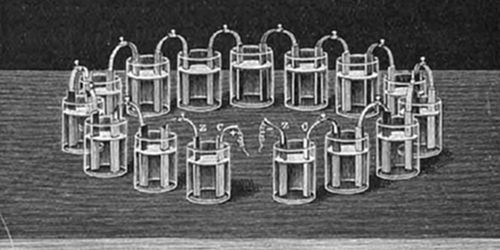
Fig. 51.—Volta’s Crown of Caps.
He therefore called such a pile an “artificial electric organ,” in order to direct attention to its similarity to the electric organ of a cramp fish. The pile did not last long. It either dried up, or if there was too much water, the water ran down the sides and interfered with the proper contact of the metals. Volta, however, improved it by using salt water in a row of cups in order to conduct the electricity from one pair of metals to the next. Instead of using round plates, he used the metals in the shape of flat bands, soldering together a copper band and a zinc band, and arranging the cups in the form of a crown.
The spark obtained with the pile, or crown of cups, was not sufficient to prove that the electricity produced by it was the same as that furnished by[Pg 123] the electric machine. But the proof was not long in coming. In the year 1789, water had been separated into the two gases of which it is composed by conducting the discharge of a Leyden jar through the water a great many times. The same effect was found to result also from the action of the electric current obtained from one of Volta’s piles. This coincidence was discovered accidentally.
A man named Nicholson had attached a wire to the bottom plate of one of the piles, and brought the other end into contact with the top plate. In order to improve the contact, he put a drop of water on the plate just where the wire touched it. He then observed that very small bubbles appeared in the drop of water, and although the quantity of the gas produced was very small, he thought it smelt of hydrogen. He at once tried the experiment of attaching two brass wires to the upper and lower end of the pile, and bringing them side by side into water, without touching each other. He then found that small bubbles were given off at one wire, and that the other was eaten away. He collected the bubbles of gas, and found that when it was mixed with air it exploded on bringing a lighted match to it. This proved that the water had indeed been broken up into two gases called oxygen and hydrogen. It was the first service to which the newly discovered electric current was put.
[Pg 124]
WHEN two persons engage in ordinary conversation, they really use two methods of communication. Both methods are extremely complicated. By means of mouth, tongue, and throat, the speaker changes the current of air issuing from his lungs, and throws it into a great variety of vibrations. These vibrations are communicated to the outside air and find their way into the ears of the other person. Such is speech. At the same time, people when speaking employ signals which appeal to the eye. They move their lips, eyelids, eyebrows, and sometimes their hands, and each motion gives a slightly different quality, or stress, to what they are saying. These motions produce an effect upon the waves of light which are constantly passing to and fro between the two people. In this way speech is assisted by sight.
When two persons are far apart and still wish to communicate they have to shout. When the distance becomes greater, their voices become less and less able to cover it, and, finally, they are driven to communicate by sight only. So, we find them waving[Pg 125] their hands, or handkerchiefs, or hags at the end of sticks. When the distance is many miles, this method fails again, and communication becomes very difficult. In ancient times people used to get out of the difficulty by lighting big fires which could be seen for ten or fifteen miles in the dark. The smoke from the fire could be seen for about the same distance in the day-time. Some savage tribes use the same method even now, and manage to convey a great deal of information by it. But nowadays we use the electric telegraph for all such purposes, and the story of its invention is one of great interest.
The immediate predecessor of the electric telegraph was the optical telegraph invented by Hooke, Newton’s assistant. The first occasion on which the optical telegraph was put to practical use was about the time of the French Revolution. In the year 1792 the whole of France was covered by a system of signals. The system consisted of a number of towers on the top of which “semaphores” were mounted which looked very much like the railway signals of the present day. By means of this system a message could be sent from Paris to the end of France in a few hours. When the war broke out in Austria in 1809, the great Napoleon profited by it to fall upon the Austrians unawares, giving them no time to make preparations to meet him.
[Pg 126]
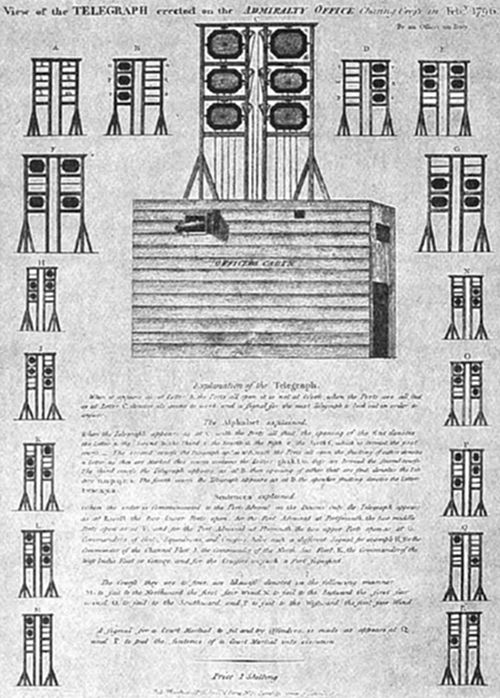
Fig. 52.—Optical Telegraph.
The Austrians were in alliance with the Bavarians, who suffered greatly by the war with Napoleon,[Pg 127] and the Bavarian Government asked one of the professors at Munich to devise a system of telegraphy which should be superior to that used so successfully by Napoleon. The name of the professor was Soemmering.
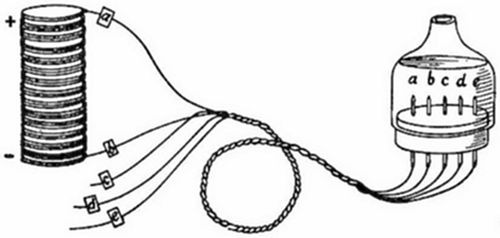
Fig. 53.—Soemmering’s First Electric Telegraph.
He started on the work at once, and four days after receiving the request he had devised the first electric telegraph which was capable of transmitting the letters a, b, c, d, e. That was all. The apparatus was quite simple and very ingenious. It consisted of one of Volta’s piles made of fifteen pairs of silver and iron plates separated by layers of felt soaked in salt water.
This arrangement was the source of electricity. At the station to which the signals were to be sent there was a bottle or small tank of water with a large cork in the bottom of it. Through this cork five wires were drawn, and they led into water with which the bottle was filled. The five wires were[Pg 128] made very long. They were covered with shellac varnish, and then they could be twisted together without being in actual contact. The strand of wire was stretched between the sending station and the receiving station.
At the sending station the strand of wire was unravelled, and the five loose ends were marked with the letters a, b, c, d, e. The top of the Volta pile placed at the sending station gave positive electricity, and the bottom of the pile gave negative electricity. Now, suppose that the wire marked a was brought into contact with the top of the pile, and the wire marked b was brought into contact with the bottom of the pile. Then an electric current travelled all along the strand, through the pile and the two wires, and through the water between the two wires, thus making a complete circuit. The water in the bottle was then split up into hydrogen and oxygen, and bubbles of hydrogen appeared at the wire b where it entered the water. The observer at the receiving station then understood that his companion at the sending station wanted to telegraph to him the letter b.
Whenever the man at the sending station wanted to telegraph a letter, all he had to do was to bring the corresponding wire into contact with the bottom of the pile, and to bring any other wire into contact with the top of the pile. The wire at[Pg 129] the top was usually the wire which came next in the message, so that the two letters could be telegraphed at the same time, the second letter being that which gave off a very small quantity of oxygen gas.
The instrument so constructed was only capable of sending five different letters. In order to send a complete message, it was necessary to have as many wires as there are letters in the alphabet. Twenty-six wires were therefore twisted together in a strand, after being covered with varnish and silk thread. The ends of the wires at the sending station were nailed to a frame by means of nails with perforated heads. A wire was kept touching the top of the Volta pile, and another was kept in contact with the lower end of the pile. These wires ended in small plugs which could be inserted into the perforations of the nails, so that the sender could pick out any two letters he wished to telegraph. At the other end the wires were laid through the bottom of a vessel containing water, and were marked with appropriate letters. The telegraph was then worked on the same principle as the smaller one made for five letters.
In addition to these letters, the inventor devised a mechanism by which a bell could be sounded in order to attract the attention of the man at the receiving end. This apparatus was extremely[Pg 130] ingenious. It consisted of a lever to which a spoon was attached.
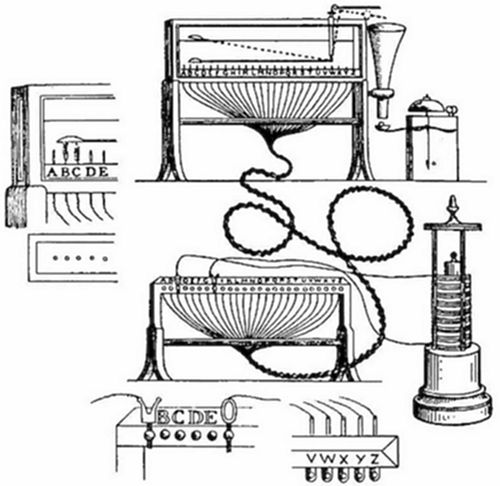
Fig. 54.—Soemmering’s Telegraph.
The spoon lay in the water, just above two of the wires, with its open surface down. When the current was sent through these two wires, the hydrogen and oxygen collected in the spoon, and raised it. This set a little ball rolling down into a funnel. Through the funnel it dropped into a small pan, and removed the catch of an alarm clock. This set the alarm going and attracted the attention of the man at the receiving[Pg 131] station. When the message was finished, the man had to put back the ball to its original place, and wind up and set the alarm clock as before.
It was not long before the Emperor Napoleon heard of the Bavarian invention. One of his officials told him about it and asked leave to explain it to him. The Emperor listened to the explanation, but then swept it aside as worthless. “It’s only a German idea,” he said. He considered it impossible to lay a strand of wire across country and to preserve it from damage. He preferred to rely on his optical telegraph which had done him such good service.
The electric telegraph did not come into real use until the magnetic needle was adopted as an indicator. Ten years after the first telegraph was invented, a Danish electrician made a very important discovery, which exercised a far-reaching effect upon electric science. He was trying to discover some connection between electricity and magnetism, and made all sorts of experiments with magnetic compasses. He found at last that a magnetic needle is affected powerfully by a current passing in a wire close by. When a wire bearing an electric current is stretched along a table from north to south, and a magnetic compass is placed on the top of the wire pointing in the same direction, the needle swings round every time the[Pg 132] current is sent through the wire, and swings back into its ordinary position as soon as the current is interrupted. So long as the current flows, the needle tends to set itself at right angles to the wire, and will do so almost exactly when the current is very strong.
This discovery made a great impression on the scientific world, and many men of science proposed to use it for the purpose of telegraphy. But it was not until the year 1833 that the first telegraph was constructed on this principle. Two professors in Heidelberg, whose names were Gauss and Weber, established a telegraph of this kind between the Physical Institute and the Observatory. The wire had a total length of nearly two miles, and they produced at the receiving station a deflection of a magnetic needle to the right or left. This arrangement was afterwards improved by a young student, who attached pens to two magnetic needles, and made them write dots on a strip of paper passing along under them. Using two different inks, he got different sets of coloured dots for each letter. These could be easily recognised afterwards and read off the paper.
The current used in these experiments was not a steady current from a Volta pile or electric battery. It was a so-called induction current. The induction current had been discovered in 1831 by a great Englishman of the name of Michael[Pg 133] Faraday, who found that when a wire is placed by the side of another wire through which electricity can pass, then as soon as the current is sent through this wire by connecting it with the battery, a momentary current flows in the opposite direction through the other wire.
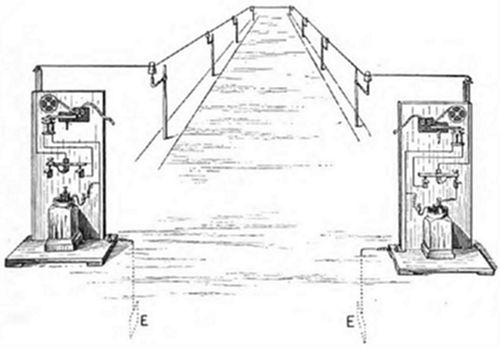
Fig. 55.—Diagram of Morse System of Telegraphy.
For this to happen, however, it is necessary that the second wire should also form a closed circuit, and not have any free ends. Such an induction current, or induced current, can also be obtained by means of a large magnet. All that is necessary is to take a coil of wire and suddenly slip it upon a bar magnet, or suddenly slip it off. The more rapidly the slipping on or off is done the stronger is[Pg 134] the current. In this way, therefore, it is possible to produce an electric current without any piles, or batteries, or chemicals.
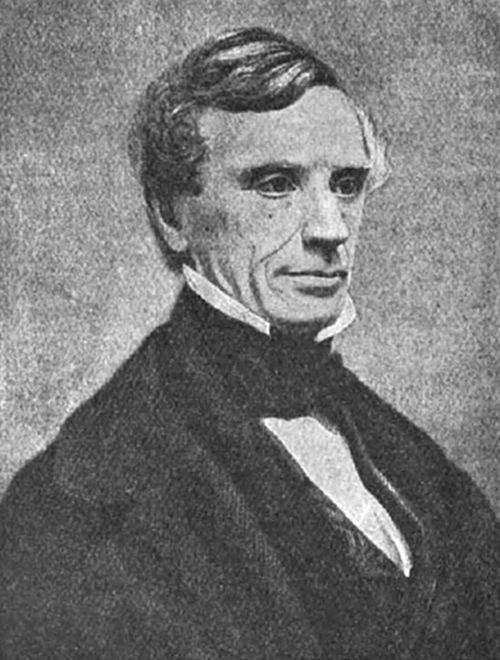
Fig. 56.—S. F. B. Morse.
This kind of current was found very effective for telegraphy, especially as the magnet was always ready, whereas the electric batteries, or cells, were liable to get exhausted and useless. It was only when the electric battery was improved greatly and made more trustworthy that it was adopted again for telegraphy, and it is used for that purpose at the present day.
[Pg 135]
A great improvement was introduced into telegraphy by S. E. B. Morse, who invented the alphabet known as the “Morse Code” and also a recording machine which writes down the message in dots and dashes. The alphabet is as follows:—
| a • — | h • • • • | o — — — | u • • — |
| b — • • • | i • • | p — — • | v • • • — |
| c — • • • • | j • — — — | q — — • — | w • — — |
| d — • • | k — • — | r • — • | x — • • — |
| e • | l • — • • | s • • • | y — • — — |
| f • • — • | m — — | t — | z — — • • |
| g — — • | n — • |
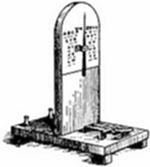
Fig. 57.—The Needle Telegraph.
The word “alphabet” appears on the paper strip like this:—
| • — | • — • • | — — • | • • • • | • — | — • • • | • | — |
| a | l | p | h | a | b | e | t |
For work in which no record is required, the needle telegraph is employed usually. But the Morse code is used in this case also, the needle moving to the right when a dot is intended, and to the left when a dash. Telegraph clerks get after a while to understand a message by simply listening to[Pg 136] the sound of the needle. Nowadays the needle is a stout magnet, which as a rule rests against a piece of iron belonging to an electromagnet. When the current passes, it knocks against a different piece of iron, and the operators learn to read the message from the sound of the knocks. The instrument is therefore called a sounder.
IN the electric telegraph, the electric current is made to turn a magnetic needle, or move an electric pen at a distance. When the distance becomes very great, as in the telegraph cables which connect us with America, a more delicate instrument is used for receiving the messages. It consists of a kind of small ink bottle, which is turned this way or that by the electric current. It squirts out a fine jet of ink, and the ink falls on paper which is moved past the instrument. In this way the signals are recorded on paper without any friction.
The electric telegraph, however, is a very simple and coarse instrument in comparison with the[Pg 137] telephone, for the telephone enables us to send speech itself over several hundred miles, over distances which the most powerful light from the highest lighthouse could not cover.
That any one can speak into an instrument in London, and that at the same time a friend in Paris can hear his voice, and understand what he is saying, is a thing so wonderful that a person must have tried it for himself before he can quite believe it. Yet what is wonderful about it is not so much the fact of speech being communicated, as the distance across which the communication is made. Why should we not be able to cover such great distances by shouting?
The reason is, that when we shout we create a wave of sound in the air. Such a wave of sound is in many respects like a wave in water. When we throw a stone into a pond, the wave starts from the place where the stone fell into the water, and travels out in circles which become wider and wider. Not only do the circles become wider, but they also grow fainter and fainter the wider they get. If the pond is very large, the wave may get so faint that when it reaches the bank it is too faint to be perceived.
If, instead of a pond, we have a long channel or gutter filled with water and make a splash in it at one end, we find that the wave can travel a[Pg 138] very great distance along the channel without growing much feebler. That is because it cannot spread out sideways. Similarly, if we speak into a long pipe or tube, our voice carries much farther than it does in the open air, again because the wave of sound cannot spread out sideways. This is the reason why it is so easy to talk through a speaking-tube.
If we could send the same waves along a wire, we might succeed in carrying the sound much farther than we do even through a speaking-tube. This fact can be proved by taking two small tin cans, and stretching a wire from a hole in the bottom of one to a hole in the bottom of the other. Then, if one person speaks into one of the cans, and the other person holds the other can to his ear, and the wire is stretched between them, the second person will hear distinctly what the first person is saying. In this case the wave of sound travels along the wire, stretching it and compressing it in turn, until it reaches the other can, and throws the air into similar vibrations. Such an instrument could be called a telephone, but nowadays the word is used only for instruments which are worked by electricity or magnetism.
To understand the difficulties which the inventors of the telephone had to overcome, let us consider for a moment the nature of the sound[Pg 139] waves which represent speech. Spoken language consists of vibrations of the air. These vibrations are very small and very quick puffs of air, which we produce by means of our throat and mouth. Now if we were to try to give a very rapid succession of puffs, we could not give more than about ten per second. But if we had a machine which could puff much more quickly than that, we should find that after the puffs had become more than twenty per second, there would be a kind of hum. This result can be illustrated by means of a toothed wheel such as we find in clocks. When such a toothed wheel is turned quickly, and we hold the edge of a piece of paper against it, then, as it is made to turn more and more quickly, the little ticks of the paper merge more and more into a hum, and finally become a musical note. The faster the wheel, the higher the pitch of the note.
Every note has its own pitch, that is to say, it has a certain number of vibrations per second. The notes in the middle of a piano have from two hundred to five hundred vibrations per second. The same note may be either loud or soft, just as a wave of water may be either high or low. The high wave corresponds to a loud sound. Very small ripples on the surface of water correspond to a very high, but faint, note of music, like the singing of an insect.
[Pg 140]
Each note has its own pitch and its own loudness. In addition to that, it also has a certain “quality” of its own. We may, for instance, play the same note on a violin, a trumpet, or an organ. They may have the same pitch and the same loudness, and yet we can distinguish them from each other easily. What is this “quality” which enables us to distinguish the note of one instrument from the same note played on another instrument? It must be something in the position of the waves which travel through the air and reach our ear.
This question long remained in doubt, until people found out that no musical sound was quite simple. Even in water one usually sees little ripples on the top of big waves. A wave with a perfectly smooth surface is very rare. In the same way, a perfectly simple and pure sound wave is hardly ever produced. Each wave has little ripples on it. The wave from a piano has one kind of ripples, the wave from an organ has another kind, and the wave from a trumpet—which is particularly shrill and penetrating—has a great number of very tiny ripples, which mean very high notes. These facts can be proved by playing a soft note on an organ, and playing a number of very high notes at the same time. If the high notes are properly chosen, the sound becomes shrill and penetrating, like the sound of a trumpet.
[Pg 141]
Musical sounds are therefore quite fixed as soon as we know their loudness, pitch, and quality. But not all sounds are musical. There are such things as noises, and many forms of human speech are anything but musical. As a matter of fact, speech consists of a very rapid succession of all kinds of notes, which last only a very short time, and rapidly change from one to the other.
Of these notes, the highest in pitch are the hissing sounds, such as s and sh, and these are most difficult to send through the telephone. Shortly after the electric telegraph was invented, the idea occurred to many electricians that it ought to be possible to send speech along the wire conducting the electric current. They knew that sound consisted of waves, and they thought that if an electric current could be interrupted a great many times per second, a musical note would be produced at the other end of the wire.
An observation made in America in the year 1837 confirmed this idea. It was found that when a current is sent suddenly through a long coil of wire wound round a piece of soft iron, a little sound is heard. Such a coil is called an electromagnet, because the soft iron is a powerful magnet so long as a current is passing through the coil. Another sound is heard when the current is broken suddenly. This observation suggested that if the[Pg 142] electromagnet were at the other end of a long wire, and the current at one end were made and broken rapidly, the electromagnet would give a musical note at the other end.
In the year 1854, a French telegraphist proposed to send speech by electricity on that principle. He proposed to stretch a skin over a drum, and fix one end of a fine wire to the middle of the skin. The end of the wire should dip into a drop of quicksilver connected with another wire, and this contact should establish an electric circuit. On speaking into the drum the skin would vibrate, the wire would move in and out of the drop, and the electric circuit would be made and broken in turn. It would be made and broken very rapidly when a high note was sung into it, and less rapidly in the case of a low note. It would follow all the various notes of ordinary speech, and would produce the necessary vibrations at the receiving end.
The Frenchman never carried out his proposal. In the year 1861 it was again taken up by a German professor of the name of Reis. His instrument was able to transmit musical notes, but not spoken language. It was a very wonderful instrument at the time, but it could not give the correct quality to notes. The sudden induction of the electric current was too jerky to give the very fine ripples on the sound waves, and especially to[Pg 143] render the delicate shades of human speech. The inventor died poor and neglected in 1874, and it was not till 1876 that the telephone problem was solved really.
The credit of the successful solution of this great problem is due to an American of the name of Graham Bell. As is very often the case, the successful instrument was extremely simple, so simple indeed that people were disappointed on seeing it. It could be put together by a schoolboy, and yet it was able to talk. From the very first, Bell had seen the correct principle which must govern the construction of a good telephone. The fault of Reis’s telephone was that it could not follow the delicate wavelets of sound which constitute human speech. It was necessary to make an instrument which should be extremely sensitive and delicate, as much so as the human ear, which is saying a great deal. In order to do this Bell used Faraday’s induction currents.
We have seen already that when Faraday pulled off the cap of the electromagnet a momentary current was induced in the coil of wire. Small currents could be induced by simply shaking the cap to and fro. Now, Bell had the idea of mounting a small piece of iron in front of the bar of an electromagnet. The ends of the coil of wire of the electromagnet were pulled out to a very long[Pg 144] distance and passed round another electromagnet. The small piece of iron was stuck upon a piece of parchment, which was stretched on a drum in front of the first electromagnet. On speaking into this drum the parchment was set into vibration, and with it the small piece of iron. This produced slight and very rapid currents in the coil of the electromagnet, and these were transmitted along the wire to the other electromagnet.
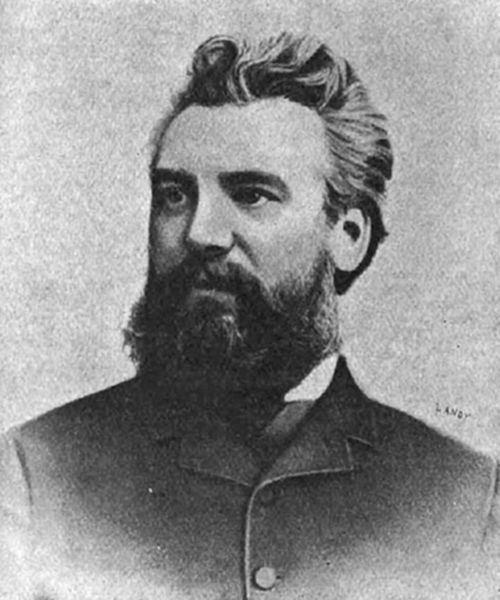
Fig. 58.—Graham Bell, inventor of the Telephone.
Another parchment with a similar small piece of[Pg 145] iron was mounted on a drum in front of the second electromagnet, and it was found that the second drum reproduced exactly all that was spoken into the first drum. For the small currents arriving at the second electromagnet made its magnetism stronger and weaker in rapid succession, and attracted the iron sometimes more and sometimes less. Every motion of the first parchment, therefore, was rendered faithfully by the second parchment, and the vibrations of the air inside the first drum were reproduced accurately in the second drum. That was all that was necessary for the complete transmission of human speech.
But this apparatus was still capable of considerable improvement. In the first place, we know that an electromagnet loses all its magnetism when the current in its coil is stopped. But Graham Bell found that it was not at all necessary to use an electromagnet.
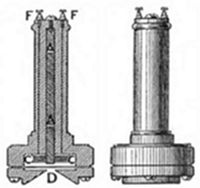
Fig. 59.—Bell’s Magnetic Telephone.
Instead of a piece of soft iron, he found he could use a similar piece of steel which had been magnetised strongly. Such a piece of steel is called a permanent magnet. The little horseshoe magnets with[Pg 146] the red paint on them that are sold in shops are such permanent magnets. This discovery simplified matters greatly, as it was no longer necessary to use a battery at all.
Another improvement was to do away with the parchment. Graham Bell found that a sheet of tin would do very well instead of the parchment. What is called “tin” is usually in reality a sheet of iron covered on both sides with a very thin layer of metallic tin; and as the magnetism acts quite easily through tin, the tinned iron acts like a sheet of pure iron. When a sound wave reaches it, it is set vibrating; and its vibrations slightly alter the magnetism of the permanent magnet, and produce the small and rapid currents mentioned above. The whole apparatus, therefore, consists simply of two steel magnets, two discs of tin, sufficient wire to make coils round the magnets and cover the distance between the two stations, and the necessary boxes to keep the discs and magnets in the proper position. It is surely the simplest instrument ever invented to perform such a wonderful task. What is almost quite as wonderful is that this telephone is still in general use for receiving telephone messages.
It says a great deal for the excellence of the instrument that thirty-three years of active search for improvements have not been able to suggest[Pg 147] any real improvement in Graham Bell’s instrument. Bell’s receiver is still used at the present day.
But his instrument is not as good for sending or transmitting speech as some other instruments which have since been invented.
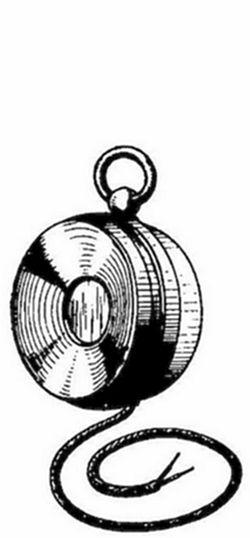
Fig. 60.—Carbon Transmitter.
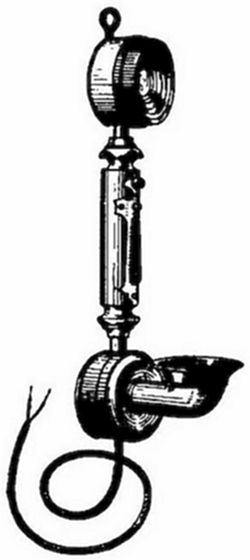
Fig. 61.—Combined Receiver and Transmitter.
It was found that Bell’s transmitter was rather feeble as regards loudness, and an improved instrument has been invented in America since his time.
It was Edison, the inventor of the phonograph, who first proposed to use carbon for sending the message. The new instrument was in some ways a[Pg 148] revival of the idea of Reis, but instead of breaking and making the circuit, it was thought better to make the contact between the ends of the circuit weaker and stronger in succession. This is now done in an instrument called the Blake transmitter.
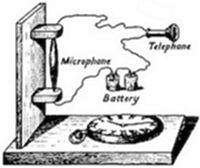
Fig. 62.—Microphone.
An electric circuit containing a battery is interrupted at one point, and joined again through a little ball of platinum and a ball of carbon, such as is used in electric batteries. This contact is connected with a vibrating plate which transmits the speech. The circuit is never really broken, but is weakened and strengthened alternately by a more or less perfect contact between the two balls. The result is that human speech is conveyed with great clearness.
This principle of loose contact has since been employed for another instrument which is perhaps even more wonderful than the telephone. It is the “microphone,” which was first constructed by Edwin Hughes in 1878. A current was sent through a Bell telephone and through two pieces of carbon joined by a rod of carbon which[Pg 149] was laid loosely across them. The slightest sound produced on the board which held the carbons was converted into a loud sound in the telephone. When a fly walked across the board, the patter of its feet could be heard in the telephone.
MAN is not the only living being which sees by artificial light. Cats’ eyes shine in the dark. So do glow-worms, and in South America there are some insects which shed so bright a light that they are used by the natives as lamps. These lights produced by animals are much superior to the artificial lights which we can produce. They are very economical. The animal expends very little of its strength in producing the light, and the light is much cooler in proportion to its brightness than any other light we know. Ever since man has learned how to kindle a fire he has been able to light up the darkest night. He no longer depends upon the sun and moon. But the fire which savages make with logs of wood not only gives light, but also heat. It gives far more heat than light.[Pg 150] It is so hot that one cannot touch it, and yet we can look into its blaze without feeling hurt by the glare. It could be much brighter than it is without blinding us.
Lamps were invented probably by the ancient Egyptians. They consisted of a shallow vessel full of oil, with a wick dipping into it. Candles were used later, when it was found that certain kinds of fat could be made to melt just where the wick touched them. But even the best candles give a poor light, unless hundreds of them are lighted at the same time, and then they give a great deal of smoke. The best light of all would be a light which was very bright, but gave no heat, smoke, or smell. It would have to be also very cheap, and so arranged that it could be lighted at once at any time and in any place.
The last century has seen wonderful improvements made in lamps, and further improvements are made every day. The most convenient light invented up to the present time is the electric light. It gives no smoke, it is clear and bright, it can be turned on with a slight touch, and it is cheap. It is better than oil lamps, since there is no trimming of wicks and no oil to fill up. It is better than gas, since it requires no match for lighting it, and there is no danger of explosion.
Fig. 63.—An Arc Lamp.
The invention of the electric light belongs[Pg 151] entirely to the nineteenth century. Sir Humphry Davy was the first to produce it. He had a great battery of two thousand cells at the Royal Institution, and he found that when he joined the two ends of the battery by wires and separated the wires again, a vivid light played between the two ends of the wires. This light or flame was so hot that it melted all metals, including platinum, which is extremely difficult to melt. He tried to find some substance which would not melt, but would yet conduct electricity. He tried charcoal, but found it conducted the current very badly. He plunged it in mercury, and so obtained a fairly good conductor, which did not melt in the electric flame, but burned away rather quickly. However, he showed this light at the Royal Institution so long ago as the year 1808, and it excited great wonder and curiosity.
For many years this remained the only experiment, and it was only towards the middle of the century that a substance was found which burned away very slowly. That substance was discovered at the bottom of the crucibles used for making coal gas. When all the coal gas had been driven out of the coal by heat, and only the coke remained, it was found that a very hard and compact black mass remained at the bottom of the crucible. That substance was called “gas carbon.” It conducted electricity well, and made a very good substance[Pg 152] for experiments on the electric flame. It was cut into small rods, and the flame was made to play between the ends of two such rods.
The flame was always seen to be in the form of an arch or arc, curving upwards between the two rods. This was due to the heat of the flame which produced an upward current of air between the pencils. The flame was therefore called the “electric arc,” and a lamp containing it was called an “arc lamp.” Such arc lamps are used to the present day for lighting streets and squares. One such lamp is as bright as several thousand candles burning together. The light which comes from the white hot ends of the carbons is the brightest that it is possible to produce artificially.
But the arc lamp is really too bright for ordinary use. It is quite blinding, and it would not do to bring it into an ordinary room. For many years electricians were busy trying to make another kind of electric lamp which would not give such a glaring light as the electric arc. The two men who did most to solve this problem were Thomas Edison in the United States of America and Joseph Swan in England.
[Pg 153]
Edison was born in the year 1847. He never went to school. All the education he ever got was given to him by his mother.
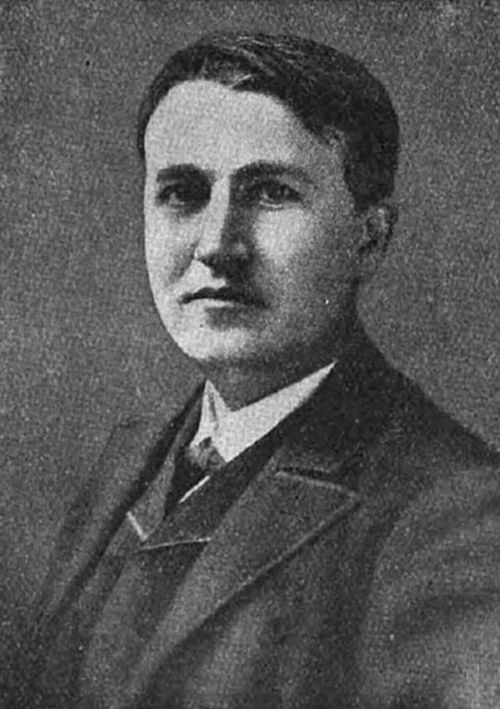
Fig. 64.—Thomas Edison.
At the age of twelve he was put to work on a railway. Having a great deal to do with newspapers, he managed to pick up the art of printing, and by and by he printed a newspaper of his own in a luggage van. One day he rescued a station-master’s child which was nearly run over by a train. The station-master, out of gratitude, taught him how to work the telegraph,[Pg 154] which had been introduced just then. Young Edison very soon acquired great skill at the telegraph, and was soon employed as a telegraphist.
When only twenty-one Edison invented a new telegraph which could print its own message. That invention was found extremely useful, and several telegraph companies asked him to invent other things for them which were wanted badly. Edison set up a factory of his own for making printing telegraphs, but within a few years he sold his factory, which had become too small, and set up a large new establishment at Menlo Park, in the city of New Jersey. That establishment has since grown to a great size, and Edison is still working in it at many wonderful inventions.
Edison’s great idea was to use electricity to make life easy and pleasant. In order to do this he proceeded in a rather different manner from the earlier discoverers. In Europe the object of men of science has usually been first to discover a new truth, and then to find in what way the discovery could be made useful to humanity. Some scientific men consider that the first object is much more important than the second.
It is told of a certain professor who had made a great discovery in chemistry, that his greatest satisfaction was the thought that it was never to be of the slightest use to anybody. The story,[Pg 155] of course, is not true, or at least it is greatly exaggerated, for no great discovery in science can be entirely useless. It enlarges our knowledge of the nature and constitution of the world, increases our power over matter, and with every increase of power we are better able to improve our surroundings and make nature do our will.
Edison, however, proceeded in a different way. He first of all asked himself what great problem wanted a solution. Having found the problem, and stated it clearly, he collected all the facts and observations that had any connection with the problem. Then he looked for the best way in which to attempt the solution, and if necessary he made a vast number of new experiments and investigations. In this way he not only made great inventions, but great scientific discoveries as well.
When he set himself to find a convenient electric lamp, he knew that when a strong current is sent through a thin wire, that wire becomes red hot, or even white hot, and therefore gives a light. Such a light is not a glaring one, and therefore is better in one respect than an electric arc. Edison tried a great many different wires, and although many of them gave a good light, they did not last long. A platinum wire could be made white hot for some time, but in the end it always broke in some place.
[Pg 156]
As the electric arc had been constructed successfully with carbon, Edison naturally tried carbon next. Charcoal was found to be too porous, and gas carbon could not be drawn into wires. It then struck Edison that if a silk thread were subjected to great heat, it was turned black. It would, so to speak, be made into carbon like charcoal, and would not require thinning down, as it would be quite thin. He tried the threads of silk, cotton, and flax, and heated them strongly in a closed vessel. They produced very fine threads of carbon, but these threads broke when they were in the least disturbed. Of all the substances which Edison tried, a bamboo fibre was found to be the best, but even that wore away after being used in a lamp for six hundred hours.
Edison next invented what he called an “electric candle.” It was a short rod made of platinum powder mixed with lime. But he shortly afterwards came to the conclusion that nothing but a fine thread resembling a wire, but made of carbon, would really answer the purpose. It is strange that this conclusion was reached just about the same time by Mr. Joseph Swan in England. The two inventors were working along the same lines, and in the end they arrived at the same point. Edison obtained good results by mixing lamp black and tar, and drawing it into a fine thread. Joseph[Pg 157] Swan, on the other hand, soaked a thread of carbon in sulphuric acid, which made it into a kind of parchment. He then blackened it by exposing it to great heat. Both inventors were very successful, and produced lamps which were in every respect satisfactory.
Both men had patented their inventions, and for some time there was great rivalry between them, but in the end they decided that it was better to be friends than enemies. They formed an alliance, and their lamps were all made in the same way, and distinguished by the word “Ediswan,” which is a combination of “Edison” and “Swan.” Cotton wool was soaked in a solution of chloride of zinc. This gave a pasty substance called cellulose. A lump of this was forced by pressure through a very small hole, and so drawn out into a fine thread. The thread was then blackened by heating it in a crucible made of plumbago, and so the fibre was finished. The fibre was called a filament.
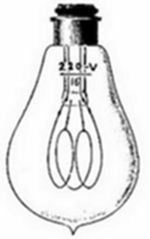
Fig. 65.—Electric Glow lamp with Carbon Filament.
The next thing was to enclose the filament in a glass globe in which not a trace of air would get near it. For if even the smallest quantity of air got near the filament while it was glowing, it would at once burn up. It was easy enough to pump all the air out of a glass globe, and leave only some other gas in the globe that would do no harm, but the difficulty was to mount a filament in the globe[Pg 158] and to conduct a current through it from the outside.
This was done by melting thin platinum wires into the glass. Platinum wires were the only wires which would not break the glass. For when platinum is heated it expands in the same way and to the same amount as glass, and therefore it does not break away from it. The filament was joined to the platinum wires by a special cement. After all this had been done, the air was pumped out, and the globe was melted off the pump at the lower end where the little point of glass is seen. The glass globe is called a bulb. It is provided with a brass collar from which two points stick out sideways. These points fit into recesses in another brass collar into which the wires bearing the electric current are led. This kind of joint is known as a bayonet joint.
The current for the lamps is furnished from a special factory in which a steam-engine is made to turn an electric machine called a dynamo. Such a dynamo is constructed on the principle of the induction currents discovered by Faraday. Faraday’s whole life was spent in discovering new truths. He did not think first of all of the use his discoveries[Pg 159] might be to mankind. He knew well that there were plenty of engineers and inventors ready to take advantage of his discoveries. It is very well that the discoverer and inventor should work hand in hand. The discoverer shows the way in which great achievements can be attained. The inventor makes these great practical achievements, and the good that results from them comes back to the discoverer in the gratitude of those who have been benefited by his discoveries and the happiness which followed from them.
IT is strange that the man who did most for the progress of the science of electricity in the nineteenth century was the son of a London blacksmith. That man was Michael Faraday. He did not get much schooling, and what he did get was not more than reading, writing, and arithmetic.
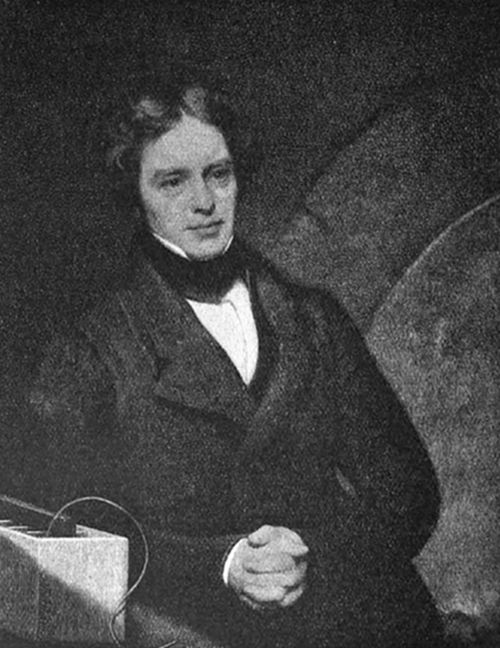
Fig. 66.—Michael Faraday.
His spare time was passed at home or in the streets. At the age of thirteen he was engaged as an errand boy to a bookbinder. After a year of running errands he was apprenticed to the trade of bookbinder, but the trade did not suit him at all, and all the time he[Pg 160] could spare from it he spent in making chemical and electrical experiments. When he could get[Pg 161] somebody to pay his admission fee, he attended lectures on these subjects.
When Faraday came of age he heard four lectures delivered at the Royal Institution in London by Sir Humphry Davy, the great Cornishman, who invented the safety lamp for miners. He was fired with the ambition to become a man of science. He had a great dislike for trade, and thought that all men of science were good and kind, and that it was the science which made them so. He took careful notes of the lectures, and when they were finished, he had the happy thought of sending his notes to Sir Humphry Davy, and explaining to him that his dearest wish was to follow in his footsteps. Davy was the best man he could possibly have written to on such a subject. He received Faraday’s letter very kindly, and promised to find some scientific work for him as soon as he could. He kept his word, and engaged Faraday the very next year as his assistant at the Royal Institution. At the age of thirty Faraday married, and brought his wife to the Royal Institution, where they lived together for six years. In that institution Faraday, in the year 1825, succeeded Davy as director.
Faraday’s first great achievement in electricity was to prove that an electric current could be produced by means of a magnet, without any electric battery. He made this discovery in the year 1831.[Pg 162] Eleven years previously, the first connection between magnetism and electricity was discovered in Denmark. It was found that when a wire is stretched under a magnetic needle in the direction in which the needle points, and a current is sent through the wire, the needle turns round and tries to set itself in a direction across the wire. In this way an electric current produced some effect upon a magnet. Shortly after that fact was discovered, a great Frenchman of the name of Ampère found that one electric current attracts another that flows in the same direction, while it repels a current which flows in the opposite direction.
It struck Faraday that it might be possible to produce an electric current in a wire by simply starting a current in a neighbouring battery. He tried the experiment by stretching two wires side by side, and attaching the ends of one of the wires to an electric battery. In order to discover whether a current was travelling through the second wire, he brought a little magnetic compass up to it to see if the compass would set itself at right angles to the wire and so indicate a current. The needle indicated no current. Faraday then attached the ends of the second wire to an instrument called a galvanometer. That instrument consisted of a coil of wire in the centre of which the magnetic needle was placed. The current would pass through the[Pg 163] coil of wire over the needle in one direction and under the needle in the opposite direction, and in each case it would tend to set the needle at right angles to the coil. The more turns the coil of wire had, the more powerful would be the effect. In this way, therefore, Faraday hoped to observe even a very small current.
But however long the current was kept passing through the first wire, the galvanometer showed not the slightest current in the second wire. This appeared very strange, because it was known that bodies may be made electric, or magnetic, by bringing them into the neighbourhood of electrified or magnetised bodies. It was natural, therefore, to suppose that a coil of wire could be made to carry an electric current by bringing it into the neighbourhood of another coil of wire which was already carrying an electric current. But in such things it is useless to endeavour to answer questions offhand. The only proper way is to try an experiment. Faraday did try the experiment as already described, and the result showed him that he was mistaken.
But Faraday was not discouraged easily. Thinking that perhaps the effect could be strengthened by winding the wires round a piece of soft iron, he took a ring of iron and wound two coils of wire round it, taking care that no[Pg 164] part of the wire was touching any other part, or touching the iron. He then observed a curious effect, which was quite different from what he had expected. He found that the galvanometer gave a little start as soon as he turned on the current in the first coil. Then it came to rest again, although the current was still flowing. On turning off the current, the galvanometer gave a little start in the opposite direction, and soon returned to rest again. Faraday was in doubt whether this was really such an effect as he had been looking for. He wrote to a friend, “I think I have got hold of a good thing, but cannot say. It may be a weed instead of a fish that after all my labour I have at last pulled up.”
Faraday was a first-class experimenter, and his method is a good example of truly scientific work. When he found an effect which he could not quite account for, he changed the experiment in a great many different ways, in order to disentangle the causes and effects. The next time he tried to obtain a current by means of a magnet instead of another current. He took a natural magnet and wound a long coil of wire round and round it. The natural magnet had a cap of iron, and on pulling the cap off, a short momentary current appeared in the coil of wire. This momentary current could be shown either[Pg 165] by attaching the ends of the coil of wire to a galvanometer or by bringing them close together. When that was done a small spark passed between the two ends of the wire.
This was another remarkable discovery, and Faraday proceeded to put it into another different shape. He wound a coil of wire round a bar of soft iron, and connected the ends with a galvanometer. Nothing happened so long as the bar of iron was not magnetised. But on suddenly placing the bar of soft iron between the two poles of a magnet, the bar became magnetised, and the galvanometer gave a momentary start. He removed the magnet, and the galvanometer gave a start in the opposite direction. Faraday expressed this by saying that a momentary current is induced in a coil of wire by starting or stopping a current in a neighbouring coil, or by creating or destroying a magnet near the coil.
Such induced currents are also called “induction currents.” They are familiar to many through the “induction coils” which are used to give electric shocks. In these induction coils there is a cylinder of iron surrounded by a coil of copper wire, and another coil of very fine wire round that again. A current is started and stopped in rapid succession in the first coil, and each starting and stopping induces a momentary[Pg 166] current in the outer coil. These momentary currents are made to travel through the person who holds the handles. It is they that produce the curious pricking sensation.
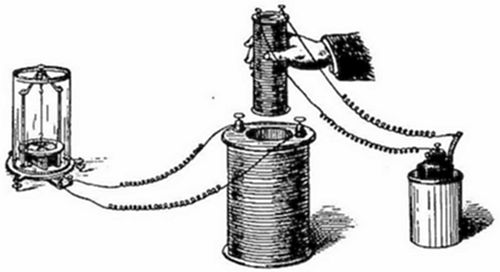
Fig. 67.—Induced Currents.
Instead of sending a current through one coil inside another, we may take a coil through which a current is already passing, and put it inside another coil connected with a galvanometer. Each time the current-bearing coil is put in or taken out, the needle of the galvanometer moves, showing that a momentary current is passing through it.
When we consider that great cities are now lighted by means of these induced electric currents, it will be understood what a vast importance Faraday’s discovery bore within itself. When we pass the electric light works, a “central station” as it is called, we hear the throbbing[Pg 167] of the engines which turn the machines designed to produce the electric current. These machines are called “dynamos.” A dynamo consists of two things. One of them is a great magnet which produces a powerful magnetic field. The other is a set of coils of wire which, driven by a steam engine or gas-engine, move through the magnetic field.
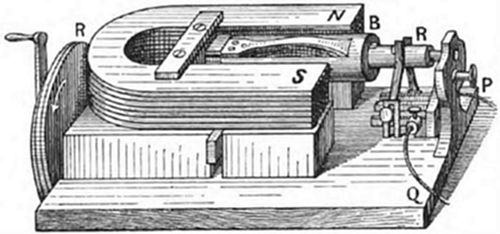
Fig. 68.—A Simple Dynamo.
Each coil, as it moves in and out of the magnetic field, becomes the bearer of a momentary induction current, for to move a coil through a magnetic field produces the same effect as to make or unmake an electromagnet near the coil, or to start or stop a current in a neighbouring coil.
Great inventors have been working ever since Faraday’s time to improve and perfect the dynamo; some worked at collecting all the momentary induced currents into one smooth current always flowing in the same direction; others at providing ways and means for increasing the strength of the[Pg 168] magnetic field or the speed of the engines. And thus to-day we have a vast industry occupying millions of men the world over, all due to a man who worked quietly and steadily in his laboratory, observing everything, neglecting nothing, and extracting the nuggets of golden truth from the mean-looking dust and dross of commonplace facts.
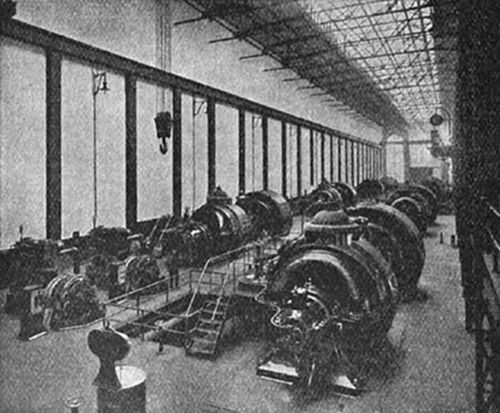
Fig. 69.—Dynamos in an Electric Light Central Station.
Faraday made a great number of other discoveries. He investigated the connection between chemistry and electricity, and founded a new science called “electrochemistry.” He also studied the action of a magnet on light, and found that a[Pg 169] strong magnet is able to give a certain twist to a beam of light while it passes through certain substances (such as sulphide of carbon). Whenever he made such a discovery he was transported with delight. He was always of a vivacious and merry disposition. He said of himself: “I was a very lively, imaginative person, and could believe in the Arabian Nights as easily as in the Encyclopædia; but facts were important to me, and saved me. I could trust a fact, and always cross-examined an assertion.”
Towards the end of his life he suffered greatly from loss of memory. He helped himself by carrying about in his waistcoat pocket packets of cards, on which he wrote everything he wanted to remember. One of these has been preserved, and on it are found the following excellent maxims:—
“Remember to do one thing at once. Also to finish a thing. Also to do a little if I could not do much.”
[Pg 170]
THE telegraph pole is one of the signs of civilisation. Along every railway the telegraph poles, with their insulating cups and strands of wires, stand like a military guard, connecting each station with all the rest, and preserving the necessary communication with headquarters. Along the high roads also, and sometimes over hill and dale, these outposts of civilisation stretch their long arms. They resemble human beings in this respect that they suffer from heat and cold and exposure to the weather. In hot weather the wires expand, in cold weather they contract, and in stormy weather they groan and howl. Sometimes they are blown down, and then they are as useless for purposes of telegraphy as a fallen soldier is useless for war. When protection from storm is specially necessary, the wires are sometimes buried in the ground. They are insulated properly and twisted together into a cable, which looks very much like a wire rope; and the cable is laid in the ground surrounded by a leaden tube. Such cables are used when we want to connect two stations across the sea, and when that sea is the[Pg 171] Atlantic Ocean, the cables have to be very stout and strong.
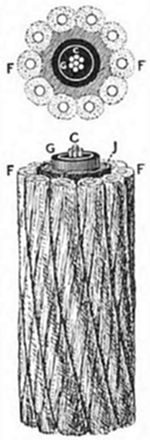
Fig. 70.—Section of Transatlantic Cable. C, core; G, gutta-percha; J, jute fibres; F, steel wires embedded in hemp.
All this trouble would be saved if there were some way of telegraphing without wires. We do not use wires in communicating with each other by speech or sign, and there is no reason why a similar system should not be invented for great distances. This has really been accomplished, after long-sustained efforts, and now we have systems of wireless telegraphy by which ships in mid-ocean can keep in constant communication with the land, and even print a daily newspaper containing all the latest news.
We have seen that when an electric current is sent through a coil of wire wound round a piece of soft iron we get an electromagnet. The electromagnet is capable of turning a magnetic needle at some distance. If we could make the needle turn at a distance of a mile, we should have a simple system of wireless telegraphy. It would be sufficient to send the current into the electric magnet now in one direction and now in another.[Pg 172] The needle would then turn towards the West or the East, and we could arrange with our friend who observes the magnet as to what we mean by the various signals. The action of the magnet is felt all over the world, but it is felt much less at a great distance from us than within a few feet or inches. In fact, when the distance becomes more than a few yards, the effect is so small that it is quite invisible. That is why this simple system cannot succeed. We want a system the power of which is not confined to close quarters. Our success will depend upon the rate at which the power of our instrument diminishes when the resistance is increased.
If we drop a stone into water, it sends out circular waves which become gradually feebler and feebler as the distance increases. At a distance of twenty feet they are twice as feeble as they are at a distance of ten feet. Their crests only reach half the height. Bad as this is, it is much worse in the case of light, and very much worse in the case of magnetism. In the case of light only a quarter of the strength remains when we double the distance, and in the case of magnetism only one-eighth remains. If, however, we could have some system of telegraphy resembling water waves it would be a great deal better than any other kind. And this is precisely the way in which[Pg 173] the inventors of wireless telegraphy attained their triumph.
The first man to produce waves of electricity, and to prove that they were waves of electricity, was a German professor of the name of Hertz. He lived at Bonn on the Rhine, and spent a great deal of time trying to prove that electric force does not spread out into space instantly, but takes time to reach a distant point. He found that this time was very short indeed. He found, in fact, that the speed of electricity is the same as the speed of light. He proved that if electricity is made to surge up and down an electric wire, a wave of electric force travels out in all directions. If such a wave falls upon a sheet of metal, it is reflected just as light is reflected from a mirror. A similarity to light also appeared in many other properties of the electric waves or radiations. These could be concentrated by a curved mirror, and refracted by a large prism of pitch. These waves of electric force are indeed a kind of light waves. But whereas light waves are so short that some fifty thousand of them go to the inch, the waves which Hertz discovered were each several yards long.
The first practical system of wireless telegraphy was invented and carried out by a young Italian engineer of the name of Marconi. Strictly speaking, it may be said that Marconi discovered nothing.[Pg 174] What he did was to apply the scientific discoveries of his predecessors and make them practically useful. Marconi made the electric discharge pass between two round knobs, and to these two knobs he attached two wires. One of the wires went high into the air, and the other went down into the ground. The consequence was that when the discharge passed between the two knobs, electricity was in turn thrown up into the air and thrown down into the ground. The effect was very much like that produced by throwing a stone into water. A wave of electric force started from the wire and spread out all around it. As soon as any electricity was thrown into the earth, it spread out along the surface in great waves, which travelled over the ground at an incredible speed. As soon as electricity was thrust up along the wire, a want of electricity was produced in the earth, and this electric vacuum, as we might call it, spread out along the ground in the same way as the first pulse. It was indeed a process resembling the crest and the valley of a wave of water.
This was, therefore, the state of things likely to produce the best results. Any other vertical wire at a distance along the surface of the earth would experience the effect of such waves. The electricity would surge up into the wire when the crest of the wave readied it, and would rush down again as the[Pg 175] wave subsided.

Fig. 71.—Guglielmo Marconi.
Now, every such motion of electricity constitutes an electric current. It remained to discover this current, and to devise a delicate instrument for discovering it even when it is very weak.
[Pg 176]
The instrument which Marconi used for this purpose was called a “coherer.” It was a little glass tube filled with some metallic powder. When an electric wave passes through such powder, the particles cohere or stick together, and then the powder conducts the current easily. That being the case it was only necessary to have a battery in readiness to take advantage of the new state of affairs. That battery was connected to both the end wires of the coherer, and as soon as the wave reached the wire and the coherer began to conduct it, a current from the battery passed through and worked an ordinary telegraph apparatus. When the coherer was shaken or tapped with a little hammer, it lost its conductivity and was ready to receive the next wave. Marconi had a little hammer tapping the coherer at very short intervals, so that it was always ready to receive any wave that might be sent out from the sending station as a signal.
That is, in a few words, the principle of Marconi’s system of wireless telegraphy. It was first tried at a regatta on the Thames, being fixed up on board a steam launch which followed the racing boats and sent news of the exact position of the boats to the receiving station on the shore. It was next tried on the open sea during a regatta off Kingstown, in Ireland. Later it was used to send messages[Pg 177] a distance of forty miles over Salisbury Plain. For this purpose the wire had to be taken very high into the air, and this was done by means of kites.
Wireless telegraphy was also tried on board an Italian war vessel which sailed from Italy to Gibraltar, and round the coasts of France, Denmark, and Germany as far as Russia. The war-ship remained all the time in telegraphic communication with a wireless telegraphic station in Cornwall. But the greatest triumph of all was when Marconi succeeded in establishing communication between Cornwall, and Connemara, on this side of the Atlantic, and Canada on the other side. To cover this great distance large sending stations had to be erected and several thousand horse-power had to be used. But this system had the enormous advantage over the cable system of being free from any dangers threatened by the Atlantic Ocean.
Wireless telegraphy has been the means of preventing great disasters at sea by enabling vessels in distress to summon the aid of other vessels, notably during the sinking of the Republic off Nantucket and stranding of the Slavonia on Flores Island, Azores.
[Pg 178]
IT is not given to many men to make such a wonderful discovery as fell to the lot of Professor Röntgen in the year 1895. If anyone wishes to mention something very new and wonderful, some great revelation of science during the nineteenth century, he usually puts the Röntgen Rays or X-rays in the first place. This is very natural, for these rays give men powers of vision which they could hardly expect ever to possess. They enable us to see through many dark bodies, and even through the human body itself. The discovery of these rays forms one of the most romantic chapters in the history of science.
The discovery was made in the course of some work with a vacuum tube. A vacuum tube is a bulb of glass from which all the air has been pumped. An electric lamp is a kind of vacuum tube, but it would not be suitable for the experiments of Professor Röntgen unless the filament were removed and nothing but the two platinum wires remained. If the current were sent through the bulb as usual, it would have some difficulty in passing from one[Pg 179] platinum wire to the other, and indeed it could not pass at all unless some slight trace of air remained in the bulb.
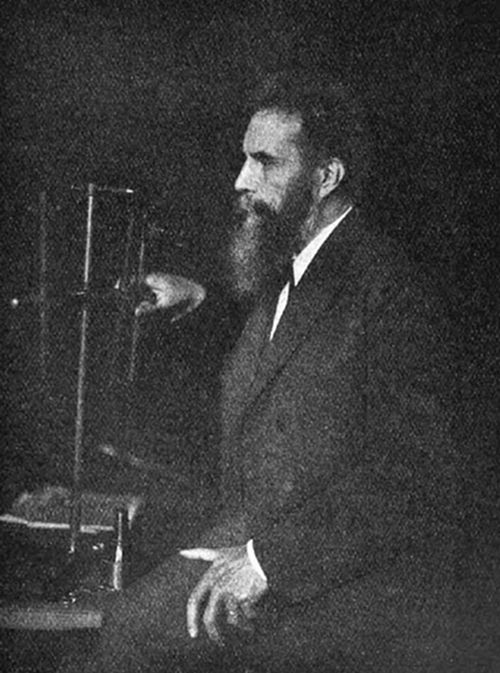
Fig. 72.—Professor W. C. Röntgen.
Even then a higher pressure of[Pg 180] electricity is required than is used for lighting the filament in the ordinary way. Instead of having the two platinum wires side by side, they are usually placed at opposite ends of the tube when the ordinary experiments with vacuum tubes are being performed. Also, instead of ending in sharp points the platinum wires usually end in small discs or caps.
When a current is sent through a tube of this kind the trace of gas in the tube shines with a strange light. The light usually shows some beautiful colours, and is arranged in layers. These layers are generally in the neighbourhood of the positive wire, which is called the anode. At the negative wire we find a layer of white, or violet, light, and next to this a dark space, which separates it from the glowing space beyond. When special care is taken to get rid of as much gas as possible, the dark space expands until it fills the whole of the tube. Then a strange thing happens. A green glow plays on the whole of the tube opposite the cathode, and it is in this green glow that the X-rays are born. But before we describe how the X-rays originate, we may say a few words of what happens in the vacuum tube, and gives rise to the green glow.
If we could see the cathode through a microscope of a magnifying power greatly beyond that of any existing microscope, we should find it to be the[Pg 181] scene of a very intense activity. We should see great jets of small particles start from the cathode at a tremendous speed, and shoot away in straight lines until they reached the glass wall opposite, there producing the green glow. These small particles are thought to be the real particles of electricity which constitute the electric current.
An electric current consists of a stream of these extremely small particles, which are called “electrons.” They are much smaller than the atoms of a wire; and thread their way slowly between the atoms, knocking against them every now and then, and producing a great deal of heat. The same number of electrons passes through every section of the whole circuit in the same time, and naturally, when a wire in the electric circuit is very thin the electrons must pass at a greater speed in order to get through and make room for those that come after them. In a thin wire, therefore, the heat is very great, and when the wire becomes a filament, the heat is great enough to make it shine with a bright light. This gives us an electric glow-lamp.
Now, when these electrons arrive at the end of the cathode wire, they are urged strongly to cross into an open space beyond the wire, partly by the crowds of electrons following them, and partly by the strong attraction which the anode[Pg 182] opposite exerts upon them. But the atoms of the wire themselves attract and hold the electrons, and there is therefore always some difficulty to overcome before the electrons can leave the wire. Once they are free from the cathode, they are impelled forward by the repulsion from behind and the attraction in front. Like stones falling from a great height they rush on more and more quickly.
The force which plays upon the electrons is enormously greater than the force of gravitation. It is more than a million times greater. On the other hand, the particles or electrons are very small, and, therefore, do not produce any very destructive effects, however high their speed may become. But their speed is something enormous. It is something like fifty thousand miles per second. No wonder that when these particles are stopped by a glass wall they produce some very curious effects. These effects become much more intense when they are concentrated upon a sheet of platinum placed opposite the cathode. That sheet becomes white hot and sends out the famous Röntgen Rays, which Röntgen himself called “X-rays.”
Now as to the history of the discovery of these rays. Professor Röntgen was one day experimenting with such a vacuum tube, and trying to get the[Pg 183] electrons to go out of the tube into the open air. This experiment had been done many times before him by using a little window made of very thin aluminium, which can be penetrated by electrons.
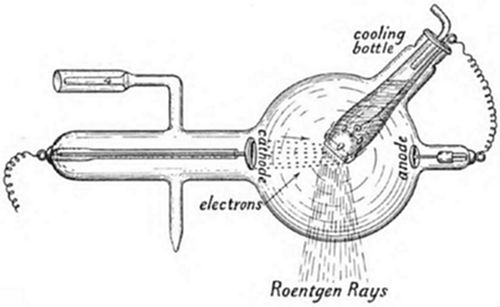
Fig. 73.—Vacuum Tube for producing Röntgen Rays.
He was studying the effect of these electrons upon a sheet of some phosphorescent substance. He wished to find out whether the electrons would still come out if the vacuum tube were enclosed completely in black cardboard. He also wished to observe the effect in complete darkness. He was surprised to find that the phosphorescent screen was lighted up, and that some influence from the vacuum tube reached the screen through the black cardboard.
Greatly struck by this observation he tried various other arrangements. He put a deal board[Pg 184] between the tube and the screen, but found that the board made no difference whatever, and that whatever rays from the tube were lighting up the screen, these rays could pass through the deal board. He then took away the board and put in its place a thick book, but again this made no impression whatever upon the rays. Thinking that perhaps the rays were coming round to the screen in some unexplained way, he held his hand between the tube and the screen. Imagine his surprise on seeing, not the shadow of his hand, but only the shadow of the bones in his hand on the phosphorescent screen. It must have given him something of a shock, and we may suppose that he quickly turned on the light to see if his hand had really shrivelled up into a skeleton. But no, the hand looked just as usual, and yet on holding it in the path of these wonderful rays, the shadow of the bones was again distinctly visible, the flesh showing only in faint outline. It was a most wonderful discovery.
The great news was not long in travelling all over the world. The experiment was repeated thousands of times, and it was soon found out that a great new fact had been added to the range of human knowledge. It was found that metallic bodies such as coins, bullets, and needles could be located in the flesh by means of the rays playing[Pg 185] through it on to the screen. Instead of the screen, a photographic plate could be used, and pictures of these bodies could be obtained in a few minutes.
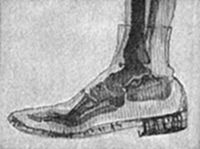
Fig. 74.—A Foot inside a Boot as seen by means of the Röntgen Rays.
Surgeons were not slow in using the great discovery in the hospitals, and every large hospital has had a special staff of men trained in the use of the Röntgen Rays.
But it often happens that the blessings of a new discovery are endangered by evil effects which they bring in their train, and this was very much the case with the Röntgen Rays. The men who spent all their days taking photographs by means of the new rays found to their dismay that wherever the rays played upon them for a long time the skin became dry and hot. The hair fell off, and even the nails dropped out. Worse than that, very painful sores began to appear after a time, which it was found almost impossible to heal. In some cases death was the result of prolonged exposure to the Röntgen Rays; but, as usual, science eventually succeeded in separating[Pg 186] the good from the bad effects, and protected the skin by means of screens of lead which cannot be pierced by X-rays. Now this new great aid to surgery and medicine has been established properly and regulated satisfactorily.
The X-rays were not the only kind of new rays discovered towards the close of the nineteenth century. In fact they ushered in the discovery of quite a number of new kinds of radiation, each more wonderful than the last. We have already mentioned the green glow on the glass, and the white light on the platinum screen which catches the electrons. Somebody put forward the supposition that it is the phosphorescent light itself which sends out the X-rays. He supposed that whenever anything shines with phosphorescent light, X-rays are sent out, and these make an impression upon a photographic plate. This supposition was tested by a great Frenchman of the name of Becquerel. His father had made a great name by investigating phosphorescence, and what more natural than that the son should study the behaviour of phosphorescent bodies as regards X-rays!
But by a very extraordinary and lucky chance he chose among the many phosphorescent bodies known to him the only body that could have led him to the great new discovery which he[Pg 187] made. That body was a substance called uranium. He exposed some crystals containing uranium to sunlight until they glowed with a thin blue light.
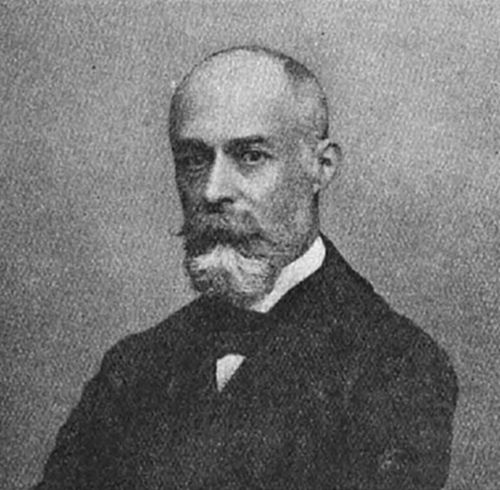
Fig. 75.—Henri Becquerel.
Then he shut up those crystals in a dark box with some photographic paper, and left them there for a few hours. At the end of that time he found that the crystals had blackened the photographic paper. This, he thought, was either the effect of the bluish light, or the effect of X-rays from the crystals. He decided to try the experiment again,[Pg 188] but he waited in vain day after day for the sun to come out.
This, as the sequel showed, was another fortunate chance. For all this time the crystals lay ready in a drawer in the neighbourhood of a photographic plate, waiting to be exposed to the sun. Tired of waiting any longer, Becquerel thought he had better close the experiment for the present by developing the photographic plate. To his great surprise, he found that the crystals had made a strong impression upon the plate, although it had been protected by black paper, and although the crystals had not been exposed to sunlight. It then struck him that perhaps the crystals had been exposed to the sun some considerable time before, and were now only very gradually giving up the light which they had absorbed. He therefore kept them for months in complete darkness, and then exposed another plate to their action. But contrary to all expectation, he got the same result as before, so that it was clear that the action of the uranium was quite independent of light, and continued without interruption.
Even greater surprises were yet in store, for this power of uranium to give out a new kind of rays which impressed a photographic plate was found to be quite indestructible. No matter if the uranium was melted up in a crucible, pounded to a[Pg 189] fine powder, mixed with other substances, melted or boiled, or treated with all kinds of acids, the effect was always the same so long as the quantity of uranium remained the same. The new and strange power seemed to lie in the very atoms of the uranium themselves.
This power was quite new, and therefore had to be called by a new name. The wife of another French professor of the name of Curie, who greatly distinguished herself in studying this new power, called it “radio-activity,” and this name is now used generally. Professor Curie and his wife went to a great deal of trouble to concentrate the uranium and make it as highly radio-active as they could. They found that some preparations of uranium were more active than others, and, therefore, they found that a certain sediment of the uranium ore was quite extraordinarily radio-active. They extracted this sediment from several tons of the ore.
It was an extremely expensive operation, but it was richly rewarded by another marvellous discovery, for at the end of a great deal of work they found a new substance which was a million times more radio-active than uranium. This substance they called “radium.” So intensely active was this new substance, that if shown in the dark, a small piece of it made a phosphorescent screen brightly luminous. But the radium proved as dangerous as[Pg 190] the X-rays, for Madame Curie, who wore a small quantity of it in her sleeve, found that it gave her a sore which took several months to heal.
After the tragic death of her husband in a motor accident Madame Curie was appointed Professor of Chemistry in the Paris University, being the first lady ever appointed to such a post in that ancient city of learning.
WHEN we read of the great inventions of the past, we are apt to think that they would in any case have been invented some time or other, even though the great inventors themselves had never lived. But to tell the truth, each inventor had before him a great number of difficulties which he could only overcome by patient and persistent effort. It often happened that some attempt to solve the problem had been made before him, and had failed. Such a failure would lead men to believe that success was impossible. Somebody would try to prove that the problem could not possibly be solved, and that one might as well give it up as hopeless. It is[Pg 191] just this kind of attitude which is most disturbing to inventors and discoverers. They are surrounded by friends who never cease to tell them that they are simply wasting their time in trying to solve a problem which cannot be solved.
Such a problem is that of flying through the air. The birds have solved it long ago, but even a few yearn ago it was taken for granted that no machine or engine could be built which would lift its own weight into the upper air. But within the last year the problem of human flight has been solved completely, and probably in a few years’ time the flying machine will be seen by nearly everybody every day.
This achievement means an entirely new development of civilisation. We are fortunate to live in the time of an invention which is more important than the steam-engine or the steam-ship, and will do more to bring people together than the telephone or the telegraph. We are doubly fortunate in being able to watch from day to day the manner in which the various difficulties of flying are overcome one by one. Instead of reading of great discoverers of far-off times, we can read about the triumphs of the great men of our own time. We can follow and admire the work of the heroes of science of to-day.
The first instrument which enabled man to rise into the air like a bird was the balloon. Nobody[Pg 192] knows when the first balloon was sent up. But it is reported that at Pekin, the capital of China, a balloon was sent up at the coronation of the Emperor of China so long ago as the year 1306. In the year 1709, a priest of Lisbon is reported to have ascended into the air in a balloon filled with hot air, but the first authenic account we have of such an event dates from the year 1783.
Several years before that, Cavendish in England had found that hydrogen is fourteen times lighter than air, and that it therefore ascends through air. This was proved by filling a soap bubble with hydrogen instead of with air. It floated quickly up to the ceiling and then burst. This experiment set many people thinking about the possibility of getting things lifted up into the air by gas. Two of these people were brothers of the name of Montgolfier, who owned a paper factory in France. One day they made a great bag of paper and held it over the fire, thinking that the smoke from the fire would raise the bag into the air. But the paper was too heavy, and the balloon did not rise.
Most people would have been discouraged by such a failure, but the brothers Montgolfier guessed the cause of it, and proceeded to manage things better. They built another balloon in the shape of a box, with its opening downwards, and this time they employed silk instead of paper.[Pg 193] They held it over a fire of straw and wool, thinking that such a fire developed a kind of gas which was very light, or which was repelled by the earth. They found, however, after a while, that the nature of the fire did not matter so long as it was hot enough. They found, in fact, that it was the hot air which really caused the balloon to rise, and that a flame burns upwards simply because it is lighter than air. How this should be so is quite clear from the principle of Archimedes, according to which a body loses as much in weight as the weight of the fluid it displaces.
We have seen already that the weight of the air inside an ordinary sized room is about a hundredweight. If therefore we construct a balloon of the same bulk as a room, and fill it with a gas much lighter than air, the balloon will weigh less than its ordinary weight by about a hundredweight. If the balloon together with a light gas which fills it weighs 60 lbs., it will be able to lift 52 lbs., or rather it will require 52 lbs. to keep the balloon down on the ground. By making the air inside the balloon hot, about 45 lbs. of air can be made to balance the pressure of the outside air, so that 60 or 70 lbs. may be the weight of the balloon itself. But by using hydrogen the weight of the gas can be reduced much further. For eight pounds of hydrogen exert the same pressure as a[Pg 194] hundredweight of air, so that these eight pounds of hydrogen can lift 104 lbs.
The silk balloon constructed by the brothers Montgolfier rose up into the air, but fell down again as soon as it cooled. They therefore made a new balloon 40 feet high, constructing the envelope of packing-cloth covered with paper. The lower end was open, and under it was hung an iron cradle filled with moist straw and wool, which gave a slow fire, and helped to keep up the heat of the balloon. The new balloon rose into the air in June 1783, and soon sailed out of sight, bearing a message up to the clouds that mankind was about to enter their territory.
The news of this great success quickly reached Paris, and led to many attempts to imitate and develop the striking invention. In Paris, the work was taken up by the brothers Robert, makers of scientific instruments, and Professor Charles, a young and promising physicist. They made a balloon 12 feet in diameter and filled it with hydrogen gas. It rose into the air and sailed away before a huge crowd of people. A few days afterwards, the brothers Montgolfier brought to Paris a giant balloon 72 feet high, which also rose into the air, but was held back by ropes. A week after that they attached to the balloon a car of wickerwork, in which they put a sheep, a cock, and a[Pg 195] duck. The balloon came to the ground somewhere out in the country, and all the three animals alighted safe and sound.
The success of these first three navigators of the air encouraged the human inventors of the balloon to venture themselves into cloudland, and in November of the same year two Frenchmen ascended in a fire-balloon and sailed over Paris across the river Seine. To show that the same could be done in a balloon filled with hydrogen, Charles and Robert made an ascent in a gas balloon a few days later. The balloon was made in lengths of red and yellow silk. It was provided with a net, to which the car was attached, with a valve for letting out the gas, with a barometer for measuring the height, and with bags of sand. The sand was taken as ballast, and was used to lessen the weight of the balloon when it was sinking too quickly.
The great hopes built upon the balloon were not fulfilled for many years. Benjamin Franklin, when he first saw a balloon, said he had seen an infant which he hoped to see grow into a giant. But for ninety years no decided improvement was made in the construction of the balloon. Bold investigators of the air were found to cross the Channel from Dover to Calais, or from London to Germany, as Green did in 1836 in a giant balloon filled with coal-gas. Some great heights were reached. In[Pg 196] 1862 two Englishmen named Glaisher and Coxwell rose to a height of seven miles, the greatest height ever attained by people in a balloon. Their pulses rose till they gave 110 beats per minute instead of about 70 or 80 beats per minute. Their faces became purple, and finally Glaisher became unconscious. Coxwell lost the use of his hands in the extreme cold of the upper air, but he managed to pull the valve rope with his teeth, and so they both returned safely to Mother Earth.
During the Franco-German war a number of balloons were sent up from Paris when it was besieged by the Germans. These balloons carried no fewer than two and a half million letters into the provinces of France. But the people in the provinces could not answer these letters, as no balloon could be relied upon to reach Paris. It is not surprising, therefore, that after the conclusion of the war, the French people should have made many efforts to construct balloons which could be guided to any particular destination. One such balloon was built in 1872, and another eleven years afterwards, but those balloons were not suitably constructed, and the engines and screw propellers were not powerful enough to take them against the wind.
It was only when motor cars were built in great numbers that people acquired sufficient experience to[Pg 197] build very light and powerful engines suitable for propelling balloons. This shows how one class of inventors may help another class. A balloon which can be driven in any chosen direction is called an “air-ship.” Many such air-ships have been built within the last few years. They are shaped very much like a cigar. Some of them have cars made of light rods of steel or aluminium, and such air-ships have been navigated from one city to another over distances of sixty miles.
One of the most remarkable of these air-ships is that constructed by Count Zeppelin, a German officer (Fig. 76). It is 420 feet long, and 38 feet high. It is cylindrical in shape, and is covered with silk or gold-beater’s skin stretched over a stiff frame of aluminium rods. It is divided into sixteen air-tight compartments, so that if a hole should be cut in it at any point, the whole balloon would come to the ground very slowly. One such balloon travelled down the Rhine in August 1908 for over eleven hours. On its homeward journey it was caught in a storm and burnt up, but it was thought that it was built on a good plan, and the Germans at once set to work to build more ships of the same kind. In 1909 one of these made a trip from the Lake of Constance, in Switzerland, across Germany, to a place almost within sight of Berlin.
But while inventors were busy constructing[Pg 198] balloons, the solution of the problem of flight was undertaken along an entirely different line.
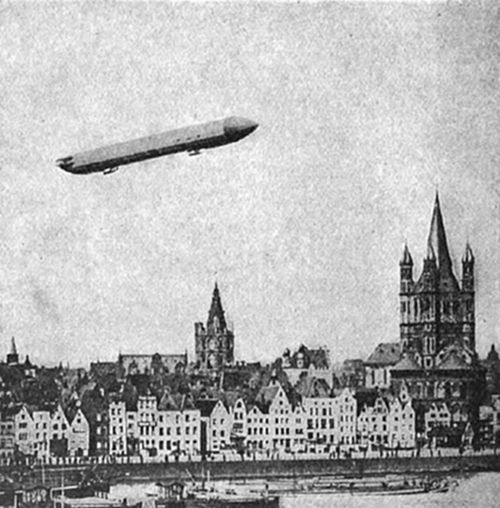
Fig. 76.—Zeppelin II. on its Flight over Cologne.
Many men did not see why we should not to some extent imitate the flight of our successful rivals, the birds. It is true that from the earliest times many men have tried to make wings that could fly, but these attempts always ended in failure or disaster. The human body is too heavy in proportion to the power of the muscles. Birds are much stronger in[Pg 199] proportion to their weight than we are. Their bones are built on a lighter plan, and there is no probability that we should be able to alter the construction of our own bones for the purposes of flight. Nor is that necessary. There are many ways of keeping a body afloat in air. Some birds can keep afloat for a long time without flapping their wings at all, and most people are acquainted with the trick of making a card fly through the air by giving it a rapid turning motion.
It was an American, Professor Langley, who first constructed a small machine which could fly through the air by means of its own mechanism. He found that the faster a flat surface is moved through the air in a horizontal direction, the less power it requires to keep it up. He concluded that if a machine is provided with horizontal wings, and driven very fast through the air, it will not require a very powerful engine to keep it up once a fairly high speed is attained. He launched his apparatus over a lake, and had the pleasure of seeing it fly for miles before it fell into the water. When this principle had been established other inventors straightway proceeded to apply it.
Two American motor manufacturers of the name of Orville and Wilbur Wright constructed a machine capable of carrying a man. Two years ago the first public trial of a flying machine was successfully[Pg 200] made in Paris, when Mr. Santos Dumont, a young Brazilian balloonist, flew several hundred yards in a machine heavier than air. This machine consisted of a number of boxes open at both ends and covered with tightly-stretched canvas.
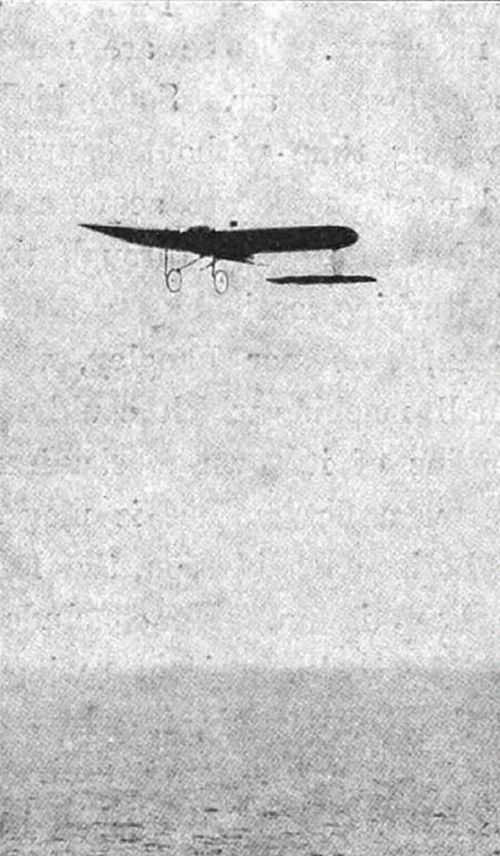
Fig. 77.—Blériot’s Aeroplane leaving France.
At that time it was found impossible to steer such a machine. But on December 30, 1907, Mr. Henry Farman succeeded at last in Paris in describing a complete circle in the air, covering a distance of more than half a mile, without once touching the ground. In July 1908 Mr. Farman remained in the air twenty minutes, covering a distance of eleven miles. This speed was afterwards increased to sixty miles an hour. Meanwhile Mr. Wilbur Wright had gone to France, and he soon eclipsed all the French records. On September 16, 1908, he flew a distance of a mile[Pg 201] and a half with a passenger on board, and on September 21 he remained in the air one hour and a half, covering a distance of fifty-six miles. He remained in the air after darkness had set in, and it was strange to see his machine fly about like some gigantic night-bird. On the last day of 1908, Mr. Wright accomplished a flight lasting two hours twenty-three minutes, and covered a distance of nearly seventy-eight miles. This has since been exceeded both as regards distance and duration, and there seems every prospect that flights lasting several hours will soon be of common occurrence. On July 25, 1909, M. Louis Blériot, a French engineer, performed the great feat of crossing the English Channel from Calais to Dover in thirty-three minutes, in an aeroplane of his own construction. For ten minutes of the flight he was entirely out of sight of land.
Civilisation has now arrived at a new stage of immense importance. For the first time in its long history mankind has entered into full possession of the realm of air. We have now a new road which needs no repairing, and extends all round the globe. Our race enters on a new era, and nobody can say what great changes and improvements in our daily life are yet in store for us.
Printed by R. & R. Clark, Limited, Edinburgh.
BY
Professor E. A. GREGORY
AND
H. E. HADLEY, B.Sc.
Globe 8vo. 4s. 6d.
Parts I., II., and III. Fundamental Measurements, Hydrostatics and Mechanics, Heat. 2s.
Parts III., IV., V. Heat, Light, and Sound. 2s.
Parts IV. and V. Light and Sound. 1s. 6d.
Parts VI., VII., and VIII. Magnetism, Static Electricity, Voltaic Electricity. 1s. 6d.
EDUCATIONAL NEWS.—“In this book of 487 pages is given a concise, lucid, and well-arranged outline of the subjects of Mechanics and Hydrostatics, Heat, Light, Sound, Magnetism, and Electricity. Many excellent exercises, numerical and otherwise, add to the value of the book. It should be added that the volume is well illustrated and well printed, and that it has a full and therefore useful index.”
OXFORD MAGAZINE.—“In spite of the great improvement in text-books of elementary physics during recent years, the authors’ experience has enabled them to produce one that marks a further advance on its predecessors. The chief features of the book are the lucidity with which it is written, and the large number of excellent illustrations which serve to elucidate many points often imperfectly understood.”
TEACHER.—“The candidate who is preparing for an elementary examination in any branch of Physics, and who has worked through this book and mastered its contents will have but little cause to fear the examiners’ questions. The matter is concisely stated, methodically arranged, and, needless to remark, from the standing of the authors, it is both accurate and complete within the limits stated. A large number of diagrams illustrate the text and are mostly original and new. Searching exercises are placed at the end of each chapter.”
MACMILLAN AND CO., Ltd., LONDON.
GENERAL
AN ELEMENTARY COURSE OF PHYSICS. Edited by Rev. J. C. P. Algous, M.A. Extra Crown 8vo. 7s. 6d. Or in Three Parts. Part I., by Rev. J. C. P. Aldous. 4s. 6d. Part II., by W. D. Eggar. 2s. 6d. Part III., by F. R. Barrell. 2s. 6d.
A TEXT BOOK OF THE PRINCIPLES OF PHYSICS. By Alfred Daniell, M.A., D.Sc. Third Edition. Medium 8vo. 21s.
PRACTICAL LESSONS IN PHYSICAL MEASUREMENT. By Alfred Earl, M.A. Crown 8vo. 5s.
PRACTICAL SCIENCE. By Hugh Gordon, M.A. Part I. Pott 8vo. 1s.
AN EXERCISE BOOK OF ELEMENTARY PRACTICAL PHYSICS. By Prof. R. A. Gregory. 4to. 2s. 6d.
EXERCISES IN PRACTICAL PHYSICS. By Prof. R. A. Gregory and A. T. Simmons, B.Sc. In two Vols. Globe 8vo. 2s. each.
LESSONS IN ELEMENTARY PHYSICS. By Balfour Stewart, F.R.S. Fcap. 8vo. 4s. 6d. Questions. 2s.
PRACTICAL PHYSICS. By D. Rintoul. Globe 8vo. 2s. 6d.
THEORETICAL AND PRACTICAL MECHANICS AND PHYSICS. By A. H. Mackenzie. Crown 8vo. 1s. 6d.
MACMILLAN AND CO., Ltd., LONDON.