The Jack-in-the-Box Books
THE QUEER LITTLE MAN
MARION AMES TAGGART
The Jack-in-the-Box Books
BY
MARION AMES TAGGART
Illustrated by
ANNE MERRIMAN PECK
AT GREENACRES
THE QUEER LITTLE MAN
THE BOTTLE IMP
POPPY’S PLUCK
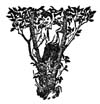
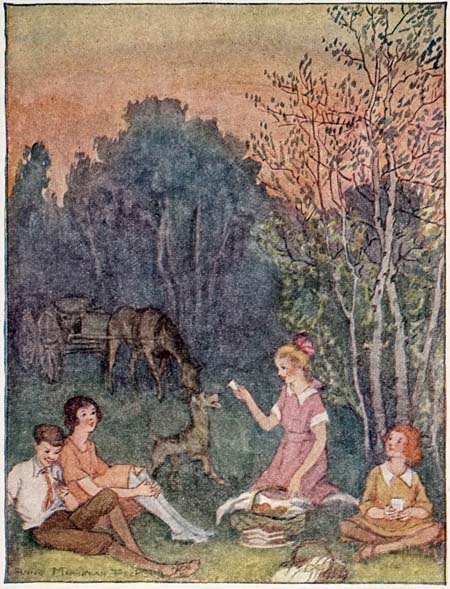
“WHY NOT SIT UP ALL NIGHT,” SAID ISABEL. p. 213
The Jack-in-the-Box Books
BY
MARION AMES TAGGART
AUTHOR OF “THE LITTLE GREY HOUSE,”
“THE DAUGHTERS OF THE LITTLE
GREY HOUSE,” ETC.
Illustrated by
ANNE MERRIMAN PECK
NEW  YORK
YORK
GEORGE H. DORAN COMPANY
COPYRIGHT, 1921,
BY GEORGE H. DORAN COMPANY
PRINTED IN THE UNITED STATES OF AMERICA
DEDICATED
TO
HAROLD GERHART
THAT DEAR LITTLE BOY
WITH LOVE
| CHAPTER | PAGE | |
| I | Opening Day | 13 |
| II | Saws, Hammers and Nails—Two Kinds! | 27 |
| III | Hurrah and Hurrahing | 43 |
| IV | The Cloud in the Sky | 57 |
| V | “The Lucky Four” | 71 |
| VI | The Dear House | 85 |
| VII | The Queer Man | 99 |
| VIII | Round Red Radishes | 113 |
| IX | Queer Happenings | 129 |
| X | “You’d Hardly Know Greenacres!” | 145 |
| XI | The Shadow of Parting | 161 |
| XII | Merrily Putting Off Sorrow | 177 |
| XIII | Gypsying | 191 |
| XIV | Under the Stars | 205 |
| XV | A Clear Day | 221 |
| XVI | Hawthorne House Abloom | 237 |
[viii]
| “Why Not Sit Up All Night,” Said Isabel | Frontispiece |
| PAGE | |
| Poppy Held the Lines and Isabel and Prue Jounced Up and Down Singing | 32 |
| So They Went On, Sowing the Whole Garden Full of Old-Fashioned Flowers | 64 |
| Poppy Called, “Radishes! Round Red Radishes! Grown by a Red-Head” | 120 |
| “We’re all Together, all Together, Forever and for Aye,” They Sang | 240 |
[x]
THE QUEER LITTLE MAN
[xii]
THE
QUEER LITTLE MAN
FOUR children sat around a large room which was empty of all furniture except wooden packing cases, in attitudes that indicated their various temperaments. Prue Wayne, twelve years old, sat up straight; she was as trim in muscles as in her tightly braided fair hair, her fleckless deep collar, her correctly laced shoes which were crossed, one over the other at the ankles above her sturdy feet.
Isabel Lindsay, also twelve years old, half lay over the arm of her chair on her elbow, every line of her body graceful and expressive of interest, although her position might easily have been a lazy one. She was far prettier than neat and shining Prudence; her dark hair turned into rings [14]wherever it could steal the chance, her gray-blue eyes were brilliantly soft under their dark lashes; she had delicate, flexible lips, and clear, healthy pallor of complexion.
The third little girl was not yet ten. No one, even if he had not merely kissed, but had dined on the Blarney stone, could have said she was pretty. Fiery red hair was the first thing one saw about Poppy Meiggs, and that could be seen afar. She was a thin little creature, with light lashes, a sharp face, now covered with more than its ordinary quantity of freckles, because March had been and gone and had left upon poor little Poppy’s sensitive skin a crop of these brown reminders of its sunny days and strong winds.
Poor little Poppy was plain plus; she was downright ill-looking, but those who loved her—and there were now several of these—forgot her looks.
Her temper was as fiery as her hair; she had no patience, not yet much self-control, but she was loyal and generous, and loved her beloveds with all her tempestuous heart. She was clever, too. Now that dear little Mrs. Hawthorne had rescued her from destitution, after her father had died and her mother had run away and left her children, Poppy was fast learning more than most children of her age know. “She grabbed [15]everything she heard with both hands and fairly crammed it into herself,” Mark Hawthorne said.
Mark Hawthorne was the one boy in this group; he, like Poppy, was perched on a window sill, but where Poppy sat up keen and small and tense, like a sharp little splinter of redwood, Mark sat lightly poised, swinging his crossed legs, giving the effect of a woodland, winged thing that was his wonderful attraction. He was a beautiful creature, lithe, graceful, his hair a tawny brown, his eyes brown and gold, flecked like a goldstone. His face was full of witchery. He made older people long to seize him in a tight embrace, yet feel as though he would still be free, however tight they held him. Isabel and Prue had dubbed him Jack-in-the-Box when they had first known him, because he had appeared and disappeared so suddenly; like a jack-in-the-box he was there and then he was not. But now that he and his father were making a beautiful home for dear little Mrs. Hawthorne, Mr. Gilbert Hawthorne’s mother, after years of cruel sorrow and separation and bitter poverty for her, the nickname was passing into disuse.
“Well, am I housekeeper or amn’t I?” demanded Poppy. “That’s what I want to know. Motherkins said I was to look after the men age; that’s French for men and boys—Mr. Hawthorne [16]and Mark—and it means the whole shebang. So if I say we can have this room you don’t have to ask, so there!” Poppy was excited, but then she usually was excited.
“I think we ought to ask her,” Prue said firmly. “My mother says no matter if we know she’ll say yes about a thing, give her the chance to say it. She calls it ‘proper deference.’”
“Oh, gosh!” Poppy exploded disgustedly. “It’s all right to be good, but you’re a regular fussy! Ain’t what I say enough, Isabel?”
“Of course a housekeeper settles things, but if I were you I’d always show little Motherkins you have her on your mind. She’ll love to be told, Pops,” said Isabel, the tactful, who could get around Poppy’s danger signals without causing an explosion, as Prue never could.
“Well, of course I like to tickle her,” conceded Poppy, her scowl abating, and the question was settled.
“We’ve decided that this is Opening Day, and it sounds all right, but I don’t know what we mean, not really! We’re to have this room for our headquarters; Mrs. Hawthorne won’t care when Poppy asks her, because they don’t use this half of the house, and we’re to furnish it in packing boxes, and meet here and sit on the boxes, and have one for a table. Please don’t [17]any one tell me this, because we’ve said it over and over and I’m kind of tired of it. But that’s all I do know. We ought to open something, or open for something—or something!” Prue apparently had got herself tangled up in the word and could not shake it off.
“We’ll open—open—open to begin, like spring!” cried Isabel with a laugh. “Just to be nice and have good times, and be ready for everything, anything that comes along. It’s the twenty-fifth of April, and Mark is thirteen years old to-day. He’s opening his ’teens; we’re opening a club in his honor.”
Isabel seemed to feel that this explanation covered the case.
“Oh, well, my gracious!” cried Prue in a sort of patient exasperation; “we were all together before now, and ready for good times. What I say is if a thing doesn’t mean anything, why—why—well, what does it mean?”
“It means to run around all the faster, particular Prue; like Pincushion when she tries to catch her tail. Now that doesn’t mean anything, but look at the fun she has!” cried Mark catching up his round kitten, Pincushion, now grown into a rounder little cat. “I’ll tell you what, Prue: You’re thinking about opening things that are full—like sardine boxes, or nuts, or a prize package. [18]This club isn’t like that! It’s opening up; not just opening. You open up something to be filled after a while—like a new country, or a mine, or possibilities! That’s it! We’re opening up possibilities! We don’t know what we’re for; we just open up, don’t you see?” Mark explained this with much waving of hands and with his shining eyes full of laughter, but nevertheless he was not a little impressed by his own discovery. It instantly became clear to him that wonderful things were to fill this opening they were making.
Isabel kindled with him. These two were “of imagination all compact”: they got out of every play and every day not only more than Prue, but more than was there to get.
“You can’t tell what will happen!” declared Isabel. “Look how we went to the woods that day last spring, Prue! Just happened to race the way we do, and we found Jack-in-the-Box-Mark! Shall I ever in all my life forget how I thought maybe he was a fairy, or some one like Peter Pan, when he told us to shut our eyes and count and then was nowhere to be seen? Oh, you never can tell! I sort of think it’s better not to know what we mean by Opening Day, because then we can feel it’s too big to understand.”
[19]Prue had not been following Isabel’s enthusiastic reasoning.
“Is that why you were named Mark, because you were born to-day?” she asked. Prue-like she had been plodding along by herself the path indicated by Isa’s allusion to the twenty-fifth of April.
“Surest thing you know!” Mark nodded hard. “Daddy liked naming me after St. Mark, as long as I was born on his feast. He said he wouldn’t have called me Martha or Clotilda if I’d been born on those days, but St. Mark was just right.”
“How do you make packing box chairs?” asked Poppy, in her turn not heeding what was said.
“I’m going to put one on top of another, instead of making legs; they’d wobble, sure,” said Mark. “Then I’ll knock out one side and leave the other three sides. Then I’ll wad it soft and easy. Then I’ll cover it with some kind of nice stuff. Then——”
“Then I’ll sit on it!” shouted Poppy in high glee. “I bet it’ll be funny! You can’t make ’em, Mark! Four, besides some for comp’ny—Motherkins and your dad.”
“Certainly I can make them,” said Mark with scorn.
[20]“I could do that, too,” said Prue, who had a taste for using a hammer, and never failed to hit a nail on the head, nor ever hit her own nail. “I can carpenter as well as you, Mark Hawthorne!”
“Carpenter away, Prudence! We’ll be able to use another hand in my shop,” Mark smiled with the kindly toleration of the sex made by nature to wield a hammer.
“I can’t build the chairs, but I can make the covers fit and plan how they’ll be prettiest,” began Isabel, but Poppy, who had been looking sharply from one to another, broke in upon her.
“Well, I shall sweep up! A nice mess you’d make if I didn’t keep it nice! And I shall get what there is for eats, and I shall fix it, so now!” she announced.
“Oh, mercy, you’ll do more than that, Poppy!” cried Isabel.
Sometimes it was a slight burden to keep in order Poppy’s touchy desire to equal the rest. She was a jealous little creature, but in her jealousy seemed less mean than in others. She adored Mrs. Hawthorne, Mark and Mark’s father, and loved Isabel Lindsay with a sort of furious worship. A poor, untaught child, made motherless by her mother’s desertion, which was so much sadder than to lose a mother by death, Poppy had set out in life with heavy handicaps. [21]It was natural that she should be on the watch lest these happier children should surpass her. They never resented her touchiness, but understood and helped her. Isabel especially made a point of smoothing the feathers which Poppy was always ruffling up in the fear of being ever so little out of things.
“I hear her!” shrieked Poppy suddenly, and darted out of the room at top speed.
She came back panting, towing by the hand sweet little Motherkins, like a little craft with a prize captured on the high seas.
“Here she is,” announced Poppy. “Now tell her and ask her.”
Motherkins smiled inquiringly, but calmly. She was used to Poppy’s ways. She was a very dear little woman; that was to be seen at a glance. She had soft brown hair turning gray; it had a sheen over it like exquisite silk. Her face had an expression of playing laughter, yet with it the patient sadness left by her long years of desolate grief when she had been poor and had thought that her one child, Mark’s father, was lost to her forever. He had come back rich enough in money, richer by far in Mark, the dear lad! Now little Motherkins, brought back into the big house that had been her home before trouble came, was the happiest person outside a [22]fairy tale. But her face still bore the imprint of what she had suffered; it had made her tender to all things, great and small.
The children’s name for her showed what she was. Mark could not think of calling one as youthful and tiny as she was “grandmother,” so he called her Motherkins, and she was a little mother to the other three.
“Dear me, Poppy,” Motherkins remonstrated as Poppy breathlessly tugged her into the big unfurnished room. “I’ll come along peacefully! I won’t run away. Why use violence?”
“We’re going to tell you something,” said Poppy putting her capture on the most comfortable box, more comfortable than the others because it was a better height to sit on, though not softer. “We’re having Opening Day.”
“Are you?” asked Motherkins glancing about with a little laugh. “What are you opening—or is it only the day that opens?”
“That’s it, Motherkins!” Mark leaped down from the window sill and ran over to pat her approvingly. “That’s what I told ’em when they were fidgetting to find out what it was about. It’s Opening Day; that’s all.”
“And my dear boy is opening his ’teens to-day!” Motherkins looked up with shining eyes into the golden-brown eyes bent toward her. “It [23]sounds nice and uncertain, as if anything might come of it, from the four and twenty blackbirds that were in the pie, to a congress! All sorts of things are opened, when one comes to think of it.”
“You’re the one to catch on!” cried Mark with a triumphant crow of delight, but Prue, steadily intent upon her duty, said:
“We thought, Mrs. Hawthorne, we ought to ask you if you cared if we used this room? Right along, to meet in? We kind of think we’ll do things and have it for our headquarters. Do you care?”
“Not in the least wee bit, except to be honored to have something so cloudily splendid sounding in the house,” declared Motherkins. “The room is yours from this instant.”
“We wanted it because of the balcony out that window and the piazza roof,” said Isabel as though that explained the mystery.
“Oh!” said Motherkins, and Mark laughed.
“Might be handy,” he added.
“Certainly, but do be careful not to slip if you get in and out that way,” said this understanding little lady.
“Thanks, oh, thanks, you darling Motherkins!” cried Isabel. “Is that Bunkie I hear? I know it’s his voice.”
[24]“It is Bunkie and has been for some time; he thinks you have been in session without him long enough,” said Mrs. Hawthorne, rising. “And I have a sort of Opening Day of my own. Mine is opened downstairs, and it is not only a day, but a freezer opened! In honor of Mark Jack-in-the-Box having a birthday. Won’t you come down to the dining room and celebrate with me?”
With a shout the children rushed to the door, Poppy turning three cartwheels in rapturous welcome of these tidings.
“I’d like to know where you hid it,” she panted coming right side up once more. “I kinder thought maybe you and Mr. Daddy’d be doing somethin’ for the birthday, and I sorter snooped, but not a freezer did there be, nowheres.”
Poppy’s English still failed her under excitement.
Motherkins laughed. “Mark’s daddy and I can play tricks, too, little Miss Gladys Popham Meiggs!” she cried.
“Well, there ain’t much I can’t hunt out when I try,” boasted Poppy justly.
Dashing out of the room she fell over Isabel’s little rough haired dog, mostly Scotch terrier, who had been named Bunker in honor of his christening day, the seventeenth of June, and [25]whom, like Poppy, Mrs. Hawthorne had adopted when he sorely needed kindness, but against whom Poppy harbored a little jealousy. Isabel had taken him into her heart and home, but still Poppy disliked loving little Bunkie.
“Gee, that Punk!” Poppy exclaimed as she tripped over the small creature, who was rapturously running to meet the children. “Pretty near I went kersmash over him! He’s the snarledest looking dog! He’s the limit. If you’d of made me tumble, you raggedy ravelledy thing!”
Laughing and shouting the three children, with Bunkie barking and leaping, and Poppy stalking behind, really angry for a few minutes, went down to the dining room. Only part of the house, occupied but six months, was in order, but this room was one that was beautifully furnished. A fire of logs blazed on the hearth in the library beyond, its color reflected in the dark mahogany in line of the open door.
Mr. Hawthorne, Mark’s wonderful father who knew all sorts of woodland lore and was in every way a child’s ideal, stood at one end of the table. Before him sat a platter with a sliding mound of delectable brown, pink and creamy white, which he was ready to serve.
[26]“Many happy returns, dearest boy of mine!” he said giving Mark his ice cream last of all.
“Yum-Yum; opening day!” said Mark significantly, stretching his mouth wide to admit a heaped teaspoonful of ice cream.
PRUE sat back on her heels, her thumb in her mouth and that mouth sagging at its corners.
Mark was sawing on the side of a packing case, making a cheerful whistling through his teeth, but the saw was slender; it swayed and bent a good deal, and the course it had so far followed through the side of the box was as scalloped as if it had been cut by a cheese scoop.
Isabel and Poppy were tacking bright colored chintz in deep pleats over a much smaller box. Isabel was silent; she looked pale and her lips were closed in a line that was almost grim. Poppy on the other hand was red even to the tips of her ears, and she betrayed a decided tendency to scold some one, any one who gave her the least opening.
As no one paid any attention to Prue, who had been hammering nails out backward from a third box, she was forced to voice her woes in a bid for pity.
[28]“I shouldn’t be surprised if I had lockjaw,” she said plaintively. Isabel looked up, saw her best friend’s miserable face and the thumb in her mouth, around which she had spoken indistinctly, and jumped up to run over to her.
“Did you hurt yourself, Prue darling?” she asked.
“I struck my nail like—like—I struck my thumb nail awful hard, Isabel! Do you suppose it doesn’t hurt? I just about can’t stand the way it aches. I think likely I’ll have lockjaw, or lose the nail, or something.” Prue struggled to keep back the tears, but her voice was sadder than tears.
“Oh, no, dear!” cried Isabel. “It must be fearful, but it won’t come off, or make lockjaw. Let me see. Poor, poor thumbling! It’s a dark red!”
Isabel examined the short, sturdy little thumb with the air of a whole college of physicians, and Prue bitterly turned it and bent it back and forth as if newly introduced to it.
“I was not meant for a carpenter,” she said, feeling unjustly put upon.
“Well, who was?” exploded Poppy. “I can’t get these darned——”
“Poppy! You must not say darned!” cried [29]Prue, forgetting her pain in her passionate desire to keep Poppy straight.
“They are!” said Poppy. “Well then: These sweet pretty red and blue chintz parrots, or hens, or something! I can’t get ’em on straight. And Isa keeps a-pulling the stuff all round and how can I?”
“Some job to saw through this box straight with a saw like a lemonade straw, if you want to know,” Mark added to the lamenting chorus.
“Let’s chuck it!” cried Poppy. “It’s too hard to make our own furniture, and ’twon’t be one bit of good if we do fuss and muss it, and all our poor fids get pounded bust!”
“We’ve got to furnish this room, and where’d we get the money? It would cost a lot. Mother bought some new piazza chairs, and she said the kind that used to be about three and a half she paid seven for,” said Prue removing her thumb to say this. It was like Prue to know about high prices, and like her to be ready to keep on with the work in hand, though for her it had proved to be work on hand, most painful to endure.
The instant she had spoken she jabbed her thumb quickly between her lips again and wriggled the fingers on the same hand because it hurt so much.
“Let’s go out and do stunts in the streets and [30]people’d give us money for it, and we’d buy furniture,” cried Poppy.
“Oh, Poppy! They’d know us!” Isabel’s voice was horrified.
“Sure. And not be afraid we’d be gypsies, or something, if they gave it to us,” Poppy answered as if being known were a good thing, but she understood Isabel nevertheless.
“’Course we couldn’t go around like that,” said Mark. “Maybe we could get some stuff out of people’s attics; I mean maybe people have things they don’t use and we could borrow them, or pay for ’em by doing errands or weeding—if they’d sell them. I’m kind of thinking we shan’t make much of a go at tinkering boxes into chairs and tables, and by the time we got done we’d be too old to sit down if we could do it. By the time we got ’em done we’d be ninety-nine, and stiff from old age.”
Isabel laughed. “Prue and I would be only ninety-eight when you were ninety-nine, and Pops would be a young thing of ninety-six, nearly! We’d have to stand, and let our callers sit down. Well, then, what are we to do, Jack-in-the-Box? You’re the one that was so keen to make the furniture, and Motherkins has given us this lovely chintz that I know she wanted herself.”
[31]“Beg,” said Prue. She found it sounded like “beck” with her thumb in her mouth, so she removed it, and went on.
“My mother has lots of kind of wobbly chairs in the attic; so has yours, Isa. It would be easier to brace ’em up than to fuss like this. Besides there are some kind of outgrown, odd ones, that used to be pretty. They are strong, but they got ugly. I don’t see why, but mother always says when we go up there: ‘Do see those really awful chairs! And when I was first married, and my mother bought them for me, we thought they were beautiful!’ So they’d do for us; we’d be younger’n she was when she was married, and maybe we’d think they were beautiful. Anyway they’re chairs, and they’re heaps prettier than our packing box ones would ever be, and I know mother’d let us have them.”
“Well, so would mother,” said Isabel, her meaning, if not her expression clear. “I suppose—But we were planning to do it all ourselves.”
“It’s awful silly to do things when you can’t,” said Poppy decisively.
“I think that would be pretty clever, Miss Gladys!” laughed Mark. “All right, then; jig’s up! Jig saw? Mine wasn’t that kind. We’ll gather up these tools and put them all back in dad’s bench drawer. Nothing gets my sweet-tempered [32]dad going like having me use his tools and not put them back! Then we’ll go out begging furniture, like survivors of a fire.”
“I know!” cried Poppy hopping around on her right foot, holding her left ankle in her hand. “We’ll dress up! We must put on funny tastic things and pretend we were all burnt up—I mean all we had in our houses.”
“Trust you to see a chance to dress up, Popsy!” laughed Mark. “The word is fantastic, my dear, but I shouldn’t wonder if funny tastic was better when you’re the one dressing up!”
“It don’t make no odds to me, Mark Hawthorne,” said Poppy with dignity. “I’m getting my learning as I go along, and I’m not near done with it, and I don’t put on one single luggs, making believe I was to college.”
Isabel dove into one of the packing cases, pretending to be searching for a screwdriver; it never would do to let Poppy see her laugh when Poppy was so solemnly in earnest as she then was.
Isabel emerged flushed and short breathed.
“We might go right to Prue’s house and mine and see what’s there,” she said.
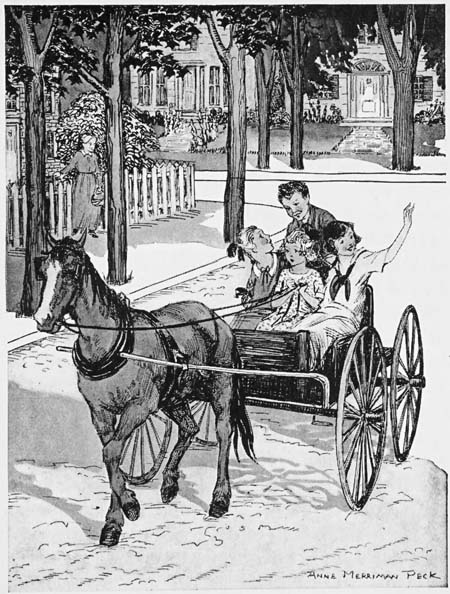
POPPY HELD THE LINES AND ISABEL AND PRUE JOUNCED UP AND DOWN SINGING.
The spring was coming on so fast that now, on the 27th of April, the sunshine was warm enough to do away with the necessity of much preparation[33] for going out. Prue and Isabel and Poppy needed no more than their blue serge coats, all similar, and their hats. Mark pulled a slip-on sweater over his head, caught up a cap, and they were ready. Stopping only long enough to put the borrowed tools back in their place, the four sallied out.
The big house, the old Hawthorne house, stood just beyond the woods. There was a subterranean passage that had been made in Revolutionary days, leading up to the house from the woods. It was because Mark knew this passage and used mysteriously to appear and disappear through it, to the wonder of Prue and Isabel, who almost suspected him of being Peter Pan, or another citizen of fairyland, that they had dubbed Mark Jack-in-the-Box when they had first seen him.
Now they did not go through the hidden passage, though they had come to use it freely themselves, but they did go by the woods; no matter where they were going, these four children nearly always were able to persuade themselves that the nearest way to get there was to start by going through the woods. Much as they loved them, well as they knew them, there was always more to love, more to discover in the woods each time that they went into them. To-day, with the buds swelling to bursting on the trees, the willows, [34]distant along the brook, showing a golden mist through the shadows; the maples red in bud; the ferns palely green, with brown caps on their full heads, turned over like a bishop’s shepherd-crozier, the woods were lovely as a dream, a dream that was at the same time an assured promise of joys to come. And the air was fragrant with arbutus, lying deep under the damp brown deposit of last year’s leaves, modestly anxious to hide its perfection, but, like a lovely soul, revealing itself by its sweetness as it hid.
Isabel drew a long, inward breath. “Oh, how can it be so heavenly!” she sighed.
“We must go down to the brook soon and see how Château Branche is getting on,” said Prue, forgetting to nurse her thumb.
“Dad said we must not get up into it till he examines it, to make sure it is strong after the winter,” said Mark. “But I’m sure it’ll be all right. Dad built it to last. Say, isn’t it pretty nice to have a house like that in a pine tree waiting for us when spring comes back? We’re lucky kids!”
“Of course it is only a platform in the branches, really,” said Prue, the exact. “But that’s nicer than a house with a roof—and it doesn’t rain on us unless it simply pours down.”
“Château Branche is a house; don’t you spoil [35]it, Prue Wayne, calling it a platform,” cried Poppy. Prue’s literal way of getting everything labelled exactly exasperated Poppy, and there was always within her heart jealousy of Isabel’s affection for Prue; to Poppy Isa was adorable perfection. On the other hand Prue had less patience with Poppy than Isa had; her impatience, her flaming quick temper, her sudden extremes of mood tried sensible Prue; she had to struggle to be just to Poppy. It is to Prue’s credit that she did struggle to do her justice, kept in mind her unfortunate childhood, and did not let Poppy feel coolness toward her. Prue was a thoroughly good little girl, though she was not as interesting as brilliant Mark, nor as exquisite Isabel, nor as clever, wild little Poppy herself.
“I won’t spoil Château Branche, Poppy; I just was thinking it was a platform after all. But I always think of it as our house in the tree, same’s you do,” Prue answered gently.
“You can get some rustle in the dry places, but not like in the fall,” said Poppy. She had forgotten her warning about Château Branche, and was going along scuffling her feet through the piles of leaves which eddying winter winds had heaped in places.
“I’ll be glad when we can come here and sit [36]around; it’s a little weeny bit damp yet,” said Isabel with a slight shiver.
“Race me out, the way we always did; you’ll get cold,” said Prue with an anxious look at more delicate Isa.
“Oh, but I can’t go straight to your house, either of your houses,” said Poppy unexpectedly, and with trouble as to her plurals. “I forgot! Motherkins told me this morning I had to go to the store for her some time to-day, and this is the last chance. Come with me.”
“Why didn’t you say so before, Poppy?” cried Prue.
“Well, what’s the odds? We’d go through the woods anyway, and turn around,” Poppy reminded her.
“Nice to know,” observed Isabel, but they did “turn around,” and struck out of the woods by another path leading to the business end of the town, instead of keeping on toward Prue and Isabel’s homes.
Poppy’s errand was at the grocer’s, but she also went to the druggist to get an insect destroyer for Motherkins’ beloved garden, to do away with the hungry slugs waiting for her plants to put up their tender shoots. The drug store was next to the post office. Greenacres’ postmaster was a character, a small, weazened, [37]deformed man named Babcock, toward whom all the children of Greenacres held two distinct attitudes of mind in the first and second stages of their knowing him. When they were small they were all afraid of him; his deformed body, and sharp, curious face filled them with terror. After they were past seven they swung from fear of him to love for Mr. Babcock; he was eccentric, but kind, and did many things for the children that won their gratitude; it mingled with pity for him to make them love him.
Now, as Isabel, Prue, Poppy and Mark came out of the drug store they saw Mr. Babcock in the post office doorway.
“Saw you out of my private office,” he said. “How are you, Hawthorne sprig? And how are you, Isabel Lindsay and Prudence Wayne? And you, Miss Meiggs? Want a horse, Poppy?”
“Oh, my gracious!” gasped Poppy. “What do you mean?”
“A horse, a horse, a horse,” Mr. Babcock thrice repeated. “H-o-r-s-e, an animal that used to be common, but got side-tracked by gasoline engines and the farmers’ flivvers, but is still useful, and to my mind beats autos. I’ve got a horse, a buckboard—old-time, sagging buckboard!—to give away, and I sort of picked you out as the one to have it.”
[38]“Me! Me!” Poppy sat straight down on the sidewalk regardless of everything.
“I won’t sell him. I could, to some one who’d get what was left in him out of him in a year and let him starve after that,” said Mr. Babcock, in a fury at his own imagining. “I won’t sell him. He’s twenty-two years old, but he’s good for a long time, decently treated; sound and can trot right along, not a bad looking fellow, chestnut, came of good stock. Think your folks’d let Poppy have him, Mark?”
“I think so, I’m sure so,” said Mark, as surprised as Poppy, but rising to the occasion as she was too overcome to do. “My father said he’d like to have a horse on the place. I think he’d keep yours for Poppy, if she’d let dad use him sometimes.”
“I won’t sell him,” said Mr. Babcock again, shaking his head hard. “I’d just’s lieves as not Gilbert Hawthorne’d use him. When he was a littler boy’n you are now he was as kind to animals as a lamb! But he’s to be Poppy’s horse, mind that! And her buckboard! Want to see him? Will you have him, Poppy?”
“Oh, my days, my days!” cried Poppy, bursting into excited tears. “I don’t want to see him! He’s a horse, he’s alive, he goes, don’t he? Oh my, a horse! Say, I’ll die! He’ll haul me to the [39]cemetery first thing! Oh, Mr. Babcock, you ain’t postmaster, you’re an angel, just an angel! Le’me hug you! Oh my land of lollypops, I’ll bust!”
“Well, come along to the stable; it’s better for busting than the street, and you can see the horse,” said Mr. Babcock, laughing. “Here, get up off the walk! I’ll hitch him up, or do you want to ask your father first, Mark?”
“No. Dad’ll say yes, but if he doesn’t I’ll bring the horse back. I’d better take a bag of oats home on the buckboard,” said Mark.
Isabel and Prue had not spoken. This was too amazing to allow of speech. They silently followed to the stable, and were introduced to the horse, whose long brown nose thrust itself forward over the stall door as they entered, showing that it was used to sugar in the pockets of visitors.
“I’ve done my best for you, old man; I’d keep you if I could, but you’ll be all right where you’re going. I wouldn’t sell you,” Mr. Babcock said with a quaver in his voice.
Poppy solemnly took the brown face between her palms and kissed the middle of the boney nose.
“My little darling, you are to be my child,” she [40]said with rapturous tears running down her own short, freckled nose.
Mr. Babcock led the horse out. He proved to be decidedly well-built, with fine, straight legs, a full tail, a good head.
Mr. Babcock put on the harness and led the horse out to be backed into the shafts of the buckboard, standing in the stable yard.
“Get up on the seat, Poppy. He’s yours, so you drive home. He won’t play a trick on any one, not for the world. Mark, you might get up along side of her. Good-by, all of you. Good-by, old friend. I’ve done my best for you. I wouldn’t sell you,” Mr. Babcock said, handing Poppy the lines.
Isabel and Prue climbed up on the buckboard. There was no question in their minds of not going back to the Hawthorne house; this was too exciting an adventure to leave unfinished.
As the horse began to move, obedient to Poppy’s tightening of the lines, and Mark’s order to: “Get up,” Poppy being unable to speak, Isabel found her tongue for the first time.
“What’s his name, Mr. Babcock?” she asked.
“Hurrah. He was born on the day of Dewey’s victory in Manila Bay,” said Mr. Babcock.
He did not smile, but Isabel, Prue and Mark fell over rocking with laughter.
[41]Poppy was unable so much as to hear the horse’s name.
The quest of furniture was completely forgotten. Slowly and with decorum, the buckboard started away, drawn by Hurrah and watched and watched out of sight by Mr. Babcock whose eyes glistened with moisture.
After they had gone beyond the business streets, Hurrah voluntarily began to trot.
Poppy held the lines and Isabel and Prue jounced up and down on the body of the buckboard, singing with Mark at the tops of their voices: “Hurrah, Hurrah, Hurrah!”
[42]
POPPY ate her supper in a daze that did not interfere with her appetite, but did keep her from knowing what she ate.
Mark was not much less excited. It really was an amazing thing to come home from the post office with a horse and buckboard, “precisely as if it had been sent parcel post,” Mark said.
“And you would have to go down to get it, if it had come that way, because the carrier won’t carry awful big packages,” Poppy added.
Mr. Hawthorne had raised his eyebrows doubtfully when they asked him if Hurrah might stay on the place, but he had not the heart to say no, and when he saw the horse he said yes, willingly.
“He’s not a colt, but he’s a healthy, good looking elderly gentleman, and he’s welcome,” Mr. Hawthorne said. “You and Mark must take care of him between you, Poppy, bed him, curry him and feed him; that’s fair if I buy him feed. [44]We’re the sort of people, thank God, that a horse, or even a child more or less, can be tucked away among and not worry us.”
“Oh, dad, you peach! I like everything about you best of anything else; I think the best thing about you is whatever I happen to think of, but the very best thing about you, straight, right along, all the time, is the way you are with birds and beasts and us kids!” cried Mark, beaming adoringly on this ideal father of his.
After supper Mark came out on the piazza. Poppy’s rockers were making such a racket that she did not hear him, so he stood still, shaking with laughter, watching and listening to her.
She was deep in a great porch rocker, clasping its arms with her thin, well-shaped little hands. She was rocking furiously, swinging her body forward and back with the motion of the chair. Her flaming red hair swung forward and back as she rocked; it had the effect of flames in the wind—and indeed her excited little brain was on fire.
The rockers struck hard on their rear tips, then just as hard on their front tips and made a great noise on the piazza floor as they rocked, but high over their noise soared Poppy’s remarkably clear, true and sweet voice, fairly shouting a song [45]which she had just made. It relieved her feelings, but the words were hardly poetry.
She sang:
In her ecstasy Poppy lurched over an arm of the chair and caught sight of Mark, crimson from suppressed laughter, his hand over his mouth.
“Laugh if you want to!” she shouted. “Just laugh! It’s all so, and I’ve got a horse, and if I don’t die in the night thinking about it I’m going to sing a whole uproar about it to-morrow. Oh, Jack-in-the-Box, honest to goodness, am I Poppy; honest, am I?”
“You dear child, don’t you know no one but Poppy could be so glad?” said Motherkins coming out past Mark and taking the quivering little body in her arms. “Dear, your head is burning and your hands are icy! You must quiet down, childie, or you won’t be able to look after Hurrah. [46]Come, sit on the arm of my chair, and let us plan how we’ll drive through sweet, shady roads with Hurrah, when it is June.”
“You don’t know how it feels to have a horse given you. Who’ll wipe the dishes?” cried Poppy.
Motherkins laughed. “You and I, perhaps, after a while, but we’ll rest first. And the day after to-morrow we shall have some one to do it for us.”
Mr. Hawthorne drew a chair into the farther corner of the piazza and Mark came to sit on the arm of his chair, as Poppy sat on Motherkins’.
“Are you bothered, dad?” whispered Mark, sensing something unnatural in his father’s silence.
Mr. Hawthorne rested a hand on the boy’s shoulder as the other dropped on the rough coat of Semper Fidelis, “Semp,” his devoted dog, never far from his master.
“S-sh!” warned Mr. Hawthorne. “Don’t let Motherkins hear that! I don’t know, my laddie, whether I am bothered or not, or rather whether I’m reasonably bothered or not. I suppose I do know that I am a little uneasy in my mind.”
“Could I know?” hinted Mark.
“Not to-night. If there’s anything to tell you [47]shall know, of course. I’m not sure that there is. You tell me, instead, what you are going to do about furnishing your club room—isn’t it a club room? You told me that you’d given up making the furniture,” Mr. Hawthorne diverted Mark’s thoughts.
“I guess the furniture gave up letting us make it!” Mark laughed. “We’re going to see if we can’t get some, enough, from Mrs. Lindsay and Mrs. Wayne; old stuff stored in their attics. We’re going in the morning, Poppy and I, with Hurrah in the buckboard, and if there’s any for us we’ll load it up.”
“I’ll drive,” Poppy called across. She had not heard anything else that Mark and his father had said, but she instantly caught the allusion to Hurrah.
Before it was light Poppy was out of bed the next morning, creeping down the stairs, her shoes in her hand, making no more sound than a red maple leaf makes eddying down from the tree in the wind of October.
She put on her shoes on the back porch and sped over the wet grass, frantic to get into the stable to see whether Hurrah were a fact or a dream. Almost she had convinced herself that she had dreamed the whole marvelous story, and [48]there was no one about to tell her that her joy was real.
There was Hurrah, real enough, looking immense in the dim light. But Poppy’s anxiety underwent a swift change. Hurrah was a fact, but he was lying down! Poppy had never before seen a horse off his feet; instantly she made up her mind that he was desperately ill.
“Oh, my darling, my darling, my darlingest!” she wailed, bursting into a tempest of tears. “It’s those nasty little sharp oats! I thought they’d stick you! Oh, Hurrah, Hurrah! That you can’t do! Get up and speak to me, angel!”
Hurrah looked at Poppy languidly, then he yawned prodigiously, and this finished her hope of him. She had never seen anything so alarming as this cavernous mouth, stretched to show uneven brownish teeth. She did not know that Hurrah was not accustomed to being called at four in the morning and was not anxious to waken.
Poppy turned away with a great rending sob, and rushed back to the house, crying so hard at the top of her penetrating voice that by the time she got to the house Motherkins, Mr. Hawthorne and Mark all had their heads out of windows on the side of the house nearest to the stable.
“Poppy, dear, what is it?” cried Mr. Hawthorne. [49]He was sure that some one had stolen Hurrah in the night, or else that he had hung himself in his halter.
“Come, come, come! He’s dying! My horse is dying!” shrieked Poppy.
“Choking in his halter probably,” said Mr. Hawthorne. “All right, Poppy; wait there. I’ll be down in a minute.”
“But, daddy, we didn’t put a halter on the horse,” said Mark as they both hurried to their rooms to throw on some clothes and go to Hurrah’s rescue. They ran to the stable, Mark and his father out-stripping Poppy, whose breath was nearly used up from running.
Hurrah had risen and stood sleepily looking over the low door at the rear of his stall as his new friends entered.
“What’s wrong with you, old chap?” asked Mr. Hawthorne, putting one hand on the soft brown ears, the other under Hurrah’s fore leg to try his temperature. “Why, Poppy, I don’t see anything wrong with your horse, except that he feels, like the Sluggard: ‘you have waked me too early, let me slumber again.’ Why did you think he was dying?”
“He—he was lying down,” sobbed Poppy, “and he opened his mouth fearful, as if he was sick at his stomach and gasping for breath.”
[50]Mark uttered a shout of pure joy and his father laughed.
“Horses lie down to sleep; didn’t you know that, little Poppy? And he was yawning. He doesn’t want to be called at four in the morning, at his age. To tell the truth, neither do I! Let’s all turn in again, and I’m afraid I’ll have to forbid your visiting Hurrah till we’re all up. Never mind this time; I’ll wager you thought you’d dreamed him, and came out to see if he were real.”
Mr. Hawthorne gently rumpled Poppy’s hair, which was already sufficiently disturbed by a night of restless tossing.
After breakfast Mark, seated on the rear of the buckboard, with his feet dangling, and Poppy on the seat to drive, started away in pursuit of furniture.
Mr. Hawthorne called after them to say that Mark must get up beside Poppy to be ready to help her if she needed help, but otherwise their triumphal start was not hindered, and Hurrah showed no sign of dangerous illness.
They found Prue at Isabel’s house. Both little girls hailed them gleefully.
“We didn’t believe it was so; we thought we must have imagined it, but there he is, and you have him!” cried Isabel. “Mother, motherums, [51]come see the horse! Poppy’s driving him. Where’s your whip, Pops?”
“I never strike him,” said Poppy sternly, as if she had driven Hurrah for years.
“Well, he’s really a nice looking horse. Really very nice! And how happy you are, little Poppet! I am delighted that you have him.” Mrs. Lindsay looked delighted. She had a beautiful face, sweet and calm, with a lovely light in her eyes, the beauty of one who had suffered. She had lost her other children in an epidemic of diphtheria; only Isabel had been left to her, and through the brightness of her smile shone the strength that had conquered grief unselfishly.
“I asked my mother, and she says we may have some things she stowed away,” said Prue.
“And you are welcome to several chairs and a table from my attic,” added Mrs. Lindsay. “Shall we go up and look them over? Tie Hurrah, Mark, and come up with us.”
The children trooped up the stairs, up the first and second flights, but Poppy lagged behind unnaturally; she was usually ahead of the others. She was sorely tempted to stay with Hurrah and keep flies off him, though the flies were still not abundant.
Mrs. Lindsay was one of those delightful people who remember precisely what they liked [52]when they were in short skirts with their hair braided and ribbon-tied.
She selected a low rocking chair that would fit any one not above four feet high; another with a cheerful design of flowers painted on its wooden back; a low, bulging willow armchair that had seen better days, but might then have been stiffer; a queer old footstool covered with worsted embroidery, and a table of oak with a drawer in it and a shelf across the bottom which would comfortably hold games and sizable books, besides not being too good to put one’s feet on, in case one were writing at the table.
“Now, with Mrs. Wayne’s contributions, you will have enough,” said Mrs. Lindsay dusting her hands as she emerged from beneath the eaves. “But I think I shall contribute some dishes, for I’m sure you’ll like to have your own, in case you ever entertain. And I have a small kerosene stove I’ll let you use, if Mrs. Hawthorne isn’t afraid of fire; it’s really quite safe. You can boil water and make tea on it, or candy, if you watch it and don’t let it boil over.”
“Isn’t she the duckiest duck of a mother!” cried Isabel hugging this Lady Bountiful of the Understanding Heart. “You see we can sort of keep house.”
“And my mother has a cot bed she’s going to [53]let us have for a couch, with a cover thrown over it, so if anything happened we could stay right there, over night, one or two of us!” Prue added.
“We’ll have to make a lot of trips to haul this all up on the buckboard, but we can take our time at it,” said Mark.
“I’m perfec’ly willing to lend my horse, but I don’t want him tired out,” said Poppy with much dignity.
“We’ll all walk beside him and sing to him as we march, Pops,” said Mark, as Isabel and Prue chuckled over Poppy’s magnificence.
It did require many trips, but the loads were light, and even Poppy was satisfied that the effort was not too much for Hurrah’s health since they themselves bore up well trotting along beside him.
Mrs. Wayne had an old rug that gave the last touch of completeness to the Club Room. They spread it in the middle of the room, and though it did not reach far in either direction, as Prue pointed out, it made the room look quite different than it would if the floor had been entirely bare.
With the cot set up and spread with a faded striped cover, and the chairs carefully set in careless positions, as if they had just been used, and the table with books on its four corners and a [54]checkerboard and steeple chase and a box of Lotto, and Authors on the shelf underneath, and an inkstand and paper and pens and pencils placed exactly in the middle of the table top, the room looked as though there might be a reason for calling it a Club Room. If there were such reason the children had no notion of what it was. There was a Club Room, but in no true sense was there a club.
“You may come in to see it, Motherkins,” said Mark, as Mrs. Hawthorne peeped in at the door, asking if she might see what they had done. “Of course we do want you to see it, but we shall ask you to come formally, you and daddy, and Mrs. Wayne and Mrs. Lindsay—our Benefactors’ Day, it will be, and then you must try to feel as if you hadn’t seen it before. But come right in; we say it looks nifty; what do you say?”
“Nifty indeed!” cried Motherkins admiringly. “Why, it’s a regular treasure house of grandeur! And it’s in bad taste to have everything spick and span new, as if you were all varnished, and never had anything in all your lives before! I see that the fastening is off that window, but that doesn’t matter.”
“Oh, dear, no; nobody will bother these windows,” said Mark confidently.
“Your father could put a fastening on,” [55]Motherkins went on, as if not satisfied to feel that the window could not be fastened.
“Little Motherkins-wee is afraid some one will creep in here and carry her off,” chanted Isabel, catching Mrs. Hawthorne around the waist and making her dance.
“Because she’s so little and so nice, nice nice!” Poppy joined in the song, dancing around Isabel and Motherkins, waving her hands to the rhythm.
The children all treated Motherkins as if she were a superior sort of toy.
“No fear of any one getting into the Club Room,” said Mark again.
And this showed exactly how much he knew about it!
[56]
“SAY, Isa, I’m perfectly sure something is bothering dad,” Mark said drawing his brow into an anxious knot.
“So am I,” Isabel agreed. “He thinks and thinks, not pleasant thoughts. He frowns and looks straight through you as if you were cheesecloth, and he is pale. You don’t suppose he is sick, and knows it, and is worrying about you and Motherkins?”
“Oh, no-o-o!” Mark shook his head so hard that the negative came out in syllables. “There’s nothing like that the matter! I can always tell when dad doesn’t feel well. It’s bother. I wonder what can be worrying him now, when everything has come out so just right!”
Isabel and Mark were on their way to get certain flower seeds which Motherkins needed to plant her old-fashioned flower garden with all the kinds of flowers which she had grown in that same garden long before Mark was born. Then this great house had been her home; in the meantime [58]it had been lost to her, and now that she had got it back through the return of her lost son, with a modest fortune with which to buy the old place back, she was happily restoring her beloved garden in its old place, with its old flowers.
The children had offered to help Motherkins with her planting. Prue stayed with Poppy, getting ready the seeds already on hand, while Isabel and Mark went to supply deficiencies from the store and also to buy a new hoe and rake “to tuck them into the bed,” Mark said.
They came back sooner than they were expected, each with a long-handled tool over their shoulder, and quite breathless and heated from hurrying.
Their haste was explained by the pasteboard box which Mark carried by its tape handle. It was a treat for the stay-at-homes—strawberry and vanilla!—to square accounts; Isa and he had eaten their cream in the drug store and did not want to take advantage of their friends.
Isabel and Mark sipped cold water and watched Prue and Poppy eat their ice cream, recovering breath meanwhile. Then all four went out and began to dig and hoe vigorously in the garden that lay under the eastern wall of the house under the direct rays of the morning sun, [59]in the best possible place for the well-being of flowers.
It had grown warm as the sun mounted. The dining room windows were open and Motherkins sat in one of them studying a seedsman’s catalogue when her son came into the room.
She looked up to greet him, and must have been struck by the troubled look on his face which the children had been seeing, for they, working below the window in the garden, heard her exclaim in a startled voice:
“Why, Gilbert, dear, what is wrong? You look distressed!”
Mr. Hawthorne dropped wearily into a chair opposite to her and rumpled his hair in a way he had when things went wrong. Then he rumpled Semp’s hair; he had come after him and was leaning against him.
“Oh, distressed is a strong word, small mother!” he said laughing at her with no sound of merriment in the laugh. “I’m all right.”
“Aren’t you going to tell me about it, Gilbert?” said Motherkins quietly, as if he had said that he was not all right. “I have noticed that you looked anxious, as if something were on your mind, for several days, but when you came in just now you startled me. You’d better tell me, dear.”
[60]“You’re a great little woman for seeing what lies behind people’s foreheads!” said her son. “When I was a child you always knew what I didn’t tell you quite as well as what I told! I remember believing firmly that you had a sort of X-ray wireless apparatus—only I couldn’t have called it that—which looked through me and caught my thoughts. Well, then, I’ll own up! I have been somewhat troubled for a few days over what must prove to be nonsense, and to-day I had a letter that increased the worry.”
“A letter from——?” Motherkins waited for him to complete her sentence.
“From a firm of lawyers of shady reputation as to honor, but with a reputation for skill in winning cases by their tricks. I have been keeping off telling you, but I suppose you’ve got to know.” Mr. Hawthorne looked disgusted, but he settled back in his chair to tell the story, pulling Semp’s ears as he talked.
“You know, mother, I saved the life of young Maurice Ditson. He was the son of James Ditson, who was the wealthy manufacturer—you know all that, and how to prove his gratitude Mr. Ditson left me all the money Mark and I have, except Mark’s small inheritance from his mother. Well, Maurice Ditson turned out so badly that I’m afraid if his father had lived to know about [61]it he’d have felt that it would have been better if I hadn’t saved his son, that it would have been better if he had died innocent rather than lived to disgrace his father’s honorable name. In any case, Maurice could spend all that his father and several other millionaires could give him, and he wants now to get away from me the money his father left to me. He’s trumped up a tale that is too long to go into, that would set aside the will, if it could be proved. He’s engaged Sharp and Geiger to take the case, and they have plenty of skill and no conscience at all. So I don’t know! It’s an outrageous attempt, of course, but that’s not saying it may not succeed, and if it does——” Gilbert Hawthorne paused and looked at his mother.
“If it does,” she said, “we shall lose this dear place and be poor again?”
“Oh, mother dear, that’s exactly what would happen!” cried Gilbert.
“Let us hope and pray that the wickedness will be foiled. It would be cruelly hard when we are so happy, so gratefully, cloudlessly happy in our old home! Somehow I think the plot can’t succeed. But in any case I have you, my son; nothing can take from me my greatest joy in having you again. And with you our dear lad, who seems to give me you again twice over! So [62]at the worst I shall not be as I was before, heartbroken, alone! You must do all that may be done to prevent this dishonesty from succeeding, dear, and after that we will try not to worry,” said the brave little mother.
“You little wonder!” cried her son, jumping up to pick his small mother up bodily and hug her hard in his relief that she took his dreaded revelation so quietly. “You may be sure I’ll do all I can to defeat Maurice Ditson! Why, mother, the few thousands his father left me, and which the fine old fellow wanted me to have—and more!—was nothing out of the great fortune which he left Maurice, and which he has already wasted!”
“No. Mr. Ditson was deeply indebted to you; it was justice to prove his gratitude. Well, dear, in the meantime the garden is to be sown, I hope for us to enjoy, but whatever is to come, to-day the garden is to be sown and planted! Will you help us? Try to put this whole dismal matter out of your mind. It is a lovely day to be making a garden!”
Little Mrs. Hawthorne arose as she spoke and crossed over to gather up from the table the boxes into which Prue and Poppy had put the envelopes of seeds which they had assorted. She was a tiny woman, almost like a creature all soul [63]and no body, but the spirit in that little frame was high and brave; it knew how to meet prosperity or misfortune.
The children beneath the window had clearly heard every word that had been said by the mother and son. They had made no pretense of working, but had stood listening, horror-stricken, to what had been said.
Now Mark, white-faced, with blazing eyes, threw down the hoe upon which he had been leaning.
“It can’t happen, you know!” he whispered hoarsely. “It would be too awful. It can’t possibly happen.”
“But you know, Jack-in-the-Box, the things too awful to happen are the ones that do happen, quite often. It frightens me!” said Isabel, and her dilated eyes showed that it did frighten her.
“If you had to leave this dear, dear old house——” began Prue, looking grim, but Poppy interrupted her with a scream of rage, dancing up and down in a frenzy.
“We won’t, we sha’n’t, we won’t!” she cried. “We’ll get guns and drag ’em up the secret passage! We’ll boil water and pour it on ’em! We’ll chuck ’em in the cellar with straw on top ’em and set ’em afire! Let ’em try to take this house! And if they took it I’d earn money for [64]Mis’ Hawthorne, ’nough, too! I’ll get that nice glass bottle man, what deals in ’em, over to Hertonsburg, what picked me up the day I went off, long ago, last year, and took me home to his house, to show me how to make money out of bottles, or something. His wife was awful smart—and nice. I’ll take boarders. Oh, Mark, Mark—Oh, Motherkins, Mr. Daddy, don’t let ’em take your money and your life!”
Poppy hurled herself upon little Motherkins and her son as they came into the garden, ending her appeal with a form of words which she must have somewhere heard and retained.
“Oh, dear, we forgot the children, especially Poppy!” said Mrs. Hawthorne in dismay. “Of course they heard every word! Poppy, child, it’s far better to be poor than not to be able to control yourself. You must learn to be quiet. You are shaking and are cold! None of us is excited. You never will be helpful, a useful, wise, strong woman, if you fly off like a Fourth of July sparkler over everything that stirs you. But I know it is because you love me.”
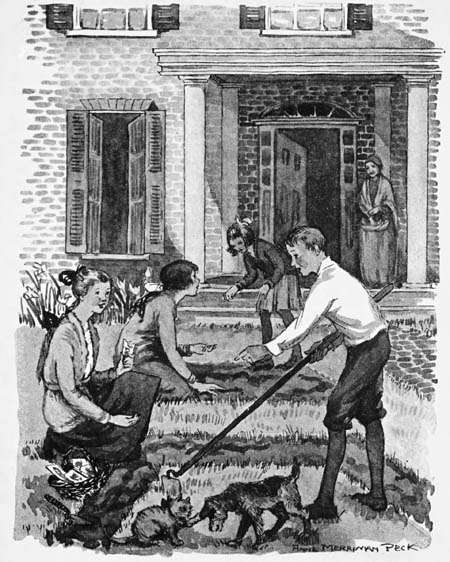
SO THEY WENT ON SOWING THE WHOLE GARDEN FULL OF OLD-FASHIONED FLOWERS.
Motherkins stooped to stroke the frizzy, flaming hair and to kiss the quivering face.
“All little Motherkins’ pills are sugar coated,” laughed Mark.
Poppy choked, and shook, and swallowed hard [65]for a few moments, while Motherkins continued to soothe and smooth her. Then she straightened herself and said:
“I will, I will, honest to goodness, I will! I’ll keep the lid on. That time I ran off and stopped over night to Mr. Thomas Burke’s, my nice bottle man’s—906 North Street, Hertonsburg, is where ’tis—he told me I’d be fine if I’d only keep the lid on, so I shall. I’d love to have you poor if I could earn tons of money and give it to you, to sorter pay back.”
“I shouldn’t be poor, Poppy dear, if you gave me tons of money,” laughed Motherkins. “Don’t worry, child! You are too little a girl to worry, and I’m sure we shall all be happy till the stars have eaten up the moon because it is made of green cheese!”
The four children laughed over this suggestion, then Prue frowned and began to say: “But it isn’t, you know, Mrs. Hawthorne,” when Mark drowned her out, crying:
“They’ve begun to nibble at it already, Motherkins! There’s only a half piece in the sky; I saw it last night. Does the Dog Star—Sirius—eat the most?”
“Silly thing!” said Poppy, with a grown-up manner. “There’s terrible much place for garden everywheres on this place. I wish I could [66]have a piece to raise stuff to sell, if we get poor.”
“Why, so you may!” cried Mr. Hawthorne, kindly refraining from pointing out the fact that if they became poor the place would no longer be theirs.
“Help yourself, Poppy! Pick out the spot you like best and I’ll have it dug up for you and raked smooth and we’ll see what sort of a farmer you’ll be.”
“I’ll be a very good raiser, I know that, because I ain’t lazy,” said Poppy, with no mock modesty. “If you want to raise things you’ve got to work like everything, that’s what you have. And I ain’t—am not lazy.”
“We could help you,” remarked Isabel wistfully, her eyes and voice betraying how much she would like a share in this enterprise.
“Mr. Daddé,” as Isa used to call Mark’s father when she first knew him because his name was a secret and she only knew Mark’s name for him—Daddy, “Mr. Daddé” saw that Isabel envied Poppy her promised garden, and he also saw what profitable pleasure there might be in a garden apiece for them all.
“Instead of helping Poppy, why don’t each of you take a piece of land and see what you can get out of it? I’ll spade the gardens myself, four of them, each wherever its owner prefers it, and [67]then do whatever you like, each of you; plant what you please, make your garden the kind you’d rather have. We’d have a sort of county fair of our own when they all got bearing!” he said.
“Say, daddy!” cried Mark struck with admiration.
“I’d perfectly love it!” Isabel spoke with bated breath. Immediately she added: “And I’d raise mignonette and sweet peas in mine——”
“Me for lettuce!” shouted Prue excitedly.
“Radishes! Red ’uns, like me!” shouted Poppy. “And peas—to eat, not your no-good kind, Isa.”
“Well, string beans seem about all I can choose,” said Mark. “I suppose as long as I’m Jack-in-the-Box I may as well be Jack and the Bean Stalk, too.”
“Splendid!” cried Mr. Hawthorne. “No two alike, so each of you can be first in your own class. Come along and pick out garden sites.”
“Oh, Gilbert, my poor flower seeds!” his mother remonstrated.
“Well, daddy!” cried Mark. “Walk right off like that and leave tiny Motherkins to shift for herself! Come on, girls. I’ll make a trench and you come over the top and take it, and fill it up with whatever our General-in-chief, Motherkins, [68]says. We’ll pick out gardens after we plant this one. What’s in the front trench, General Motherkins? That’s the most dangerous line.”
“Brave little dwarfs, Mark—candytuft. They’re not afraid of the enemy,” said Motherkins entering into the play-work, and giving the three little girls each a paper of seeds to scatter in the shallow trench which Mark made with a stick and stood ready to cover as they sowed.
So they went on sowing in rows, in squares, in circles, the entire garden full of old-fashioned flowers, fragrant and modest, flaunting and graceful, tall and short, “Just as I used to have it years ago!” sighed Motherkins contentedly. Then she sighed again anxiously, remembering that Gilbert had said that it was possible that she might lose again this beautiful old place, and that if it did happen the parting from it would this time be final.
At last the garden was sown and all the seeds “tucked into their beds,” Isabel said. Dirty and tired, but with their enthusiasm unabated, the four children followed Mr. Hawthorne across the grass to inspect the various sites for possible gardens. Semp—Semper Fidelis, living up to his name—Bunkie, and round, gray Pincushion, who adored Bunk, all of whom had [69]superintended the laying out of Motherkins’ garden, marched behind their human friends to seek for more gardens to lay out.
There was considerable difference of opinion as to the best spots. The discussion stood in some danger of growing unpleasant because Poppy was tired enough to be more than ordinarily inflammable, and Prue was tired enough to have less patience with her than ordinarily—and at best Prue had not great patience with excitable little Poppy.
The decision was made easier by Isabel, the peacemaker, who suggested that it would be far pleasanter to have all four gardens close together.
“You see,” she said, in her sweet, soothing voice that always fell on the ear like the soft touch of a cool hand on a fevered head, “we’d be tired to death working and working when it got hot, all by ourselves, where we couldn’t call over to one another, back and forth. If Daddy-dear doesn’t mind, why not divide off that nicest easterly field into quarters, and give us each a corner quarter?”
“Daddy-dear” did not mind; he cordially approved, and so it was done. By the next day the ground was plowed, harrowed and raked [70]fine, and the gardens, one exactly as good as the other, were apportioned. Thus the children were installed as gardeners, precisely as if there were no threat of the Hawthorne place being lost to its owners.
“ISA, child, do you realize that you and I are growing to be merely calling acquaintances? That you are gone all day long, after your practice and reading are done, and that we meet only at meals, sometimes not then? It is painful to see my only child slipping into a calling acquaintance, and to foresee that some day I may say: Miss Lindsay? Miss Isabel Lindsay? Oh, yes; I do know her! She calls on me occasionally; I do not return her calls.”
Mrs. Lindsay tried to look pathetic, and succeeded so well that Isabel, though she knew that her mother was playing with her, threw herself upon her with a rush and hugged her violently.
“Mother, you darling, dreadful mother! You know I’m not so awful as that!” she cried. “But there’s so much, so very much to do!”
“I had to try not to be pleased that school closed in April,” Mrs. Lindsay went on in a pensive tone as she smoothed her disordered garments. [72]“It seemed wicked to be glad when the school had to close because so many children had measles, but I had to try hard not to be glad—and I’m not sure I succeeded!—because I was to have my daughter at home. And she deserts me! It is a blow. She gives me our twilight hour’s talk, but I may lose that.”
“Mother, stop!” begged Isabel. “I know you don’t mean it, but it’s horrid, because it would be so horrid if you did mean it! You know I wouldn’t miss my hour for anything in the world! It’s the loveliest thing ever to sit down with you every night in the dusk and tell you every single thing that I’ve done all day! But, mother, only think all that we four have now! There’s the Club Room, all our own, and we love it! And our gardens, and the things are poking right up since it came so warm after this rain! And the woods to go to, which we’ve got to love best of all, forever. And the secret passage, though we don’t like to go through it much; it’s so dark and damp and probably spidery, but it’s great to know it’s there, and it’s another of our places. And there’s Château Branche. We haven’t been up in it yet, but now it’s warm we thought we might go up and sit there this afternoon. Really, we are so busy! I think we are pretty lucky to have all these [73]places our own. We are a sort of society, or club, or something now; our name is ‘the Lucky Four,’ and our badge is a four-leafed clover. I named us; isn’t it fine?”
“Fine, indeed!” Mrs. Lindsay dropped her pretense of feeling abused, and sympathized with Isabel’s pleasure, which was also her own pleasure; the greatest joy she had was her beloved little girl’s happiness.
“Are you going to Château Branche this afternoon? Because if you are I’ve a fairly good-sized box of candy that might enjoy the Château, if you’d take it with you and open it there,” she said.
“Mother, mother, there’s no other mother on earth like you!” Isabel declared, as she declared so often that it was like a refrain to a song that was hard to stop singing. “You think of such nice things!”
“Candy?” queried Mrs. Lindsay.
“And having it to take up into Château Branche to open there; that’s one of them,” Isabel tempestuously embraced her mother over again. “Now, I’ve got to go, duckie mother, or I’ll be late. Good-by till half-past five.”
Isabel ran out calling: “Hoo-hoo-oo-oo,” for Prue to hear and join her.
Prue heard; she had been listening for the call, [74]and was ready to run the moment it fell on her ear. The two inseparable friends put their arms around each other and went on happily, chattering as if they had parted a month before, instead of at dinner time.
They met two little girls of their own age, schoolmates of theirs, who stopped them. Kathie Stevens, the taller of the two, moved and spoke energetically; she had a wilful face, with a snap in her eyes. Dolly Harding, her friend, was shorter, decidedly plump, with round features and a placid look that at the same time hinted of obstinacy. Dolly was inclined to be lazy, while Kathie was more energetic than was always pleasant. Prue and Isabel liked them, but they were too satisfied with each other and Mark—Poppy, too, added to their pleasure—to have much interest left to give any one else.
“Hello, Prue ’n Isa!” cried Kathie as they came toward one another from opposite directions. “Say, we saw that funny Poppy Meiggs just a while ago!”
“Did you?” Isabel answered. “What made her funny?”
“She is, all the time; she’s funny!” Kathie found it easier to repeat her statement than to explain it. “She said you’d got up a club.”
“Well, kind of,” Prue admitted warily, foreseeing [75]danger. “It’s just us, same’s before, only we call it a club.”
“Lucky Four, Pop said it was,” Kathie persisted.
“Well, that’s what we call it,” Prue said, as if it might, nevertheless, be almost anything else.
“Say, girls,” Kathie spoke so vehemently that the two words seemed to pop like corn on a popper, “say, let us be in it! Don’t be piggish with your club. Let us belong. We want to, don’t we, Doll?”
“Surest thing in the world, we want to,” Dolly approved her. “We think you might. We’d like to know why not? We wouldn’t hurt it, would we? More the merrier!”
“It wouldn’t be the Lucky Four if it was six,” said Isabel, uttering the first words that came into her head, to gain time. She knew instantly that she and Prue did not want Kathie and Dolly to join the club, and that Mark and Poppy would not want them; she was not at all sure that “more” would be “merrier,” but she had no idea of how to refuse the petition.
“Oh, well, my gracious! Can’t we change the name? Lucky Six is just as good, even if you can’t have a four-leaf clover for the badge—Poppy said that’s what you took. Have six rings all hitched together, in a circle, like doughnuts, [76]for the badge. Just ’s good!” Kathie resumed her pleading.
“I shouldn’t care about doughnuts for my club badge,” said Prue, coming to Isabel’s rescue before she could speak again. She knew it was hard for Isa to say no to any one who wanted her to say yes, and Prue was afraid Isa’s tender-heartedness would give them two more club members on the spot unless she interfered.
“We couldn’t let you join right off like this, Kathie. We’d have to put it to Mark and Poppy and let them vote on it, have a club meeting or something, to decide, you know. We’re not the whole club; we’re only half,” she said.
Isabel looked at Prue with profound admiration. She certainly was the most sensible person! And her sense kept her out of scrapes into which Isabel’s greater sweetness, her sensitive desire to make everything pleasant, often landed her.
“Well, I suppose that’s fair,” Kathie admitted grudgingly. “We’ll go right along with you now and put it up to Mark and Poppy, then we’ll know how it went.”
“Oh, but clubs have to vote by themselves; only members there. You mustn’t come unless we let you belong,” Prue cried.
Dolly set her chin in a way she had that meant [77]she had first set her mind. “It isn’t so much of a club. We’re going now,” she said.
And go they did, Kathie taking Prue by the arm, Dolly linking herself with Isabel with so much decision that poor Prue and Isa saw no way to prevent what they felt was an unwarrantable intrusion.
Mark and Poppy would be waiting for them at Château Branche; not in it, for they would be sure to wait for Isabel and Prue to help them up, and not choose places till they were there to choose fairly. There was one side of the platform in the tall pine tree, which was the children’s beloved summer house, that was not quite level, and these four honorable comrades were all equally anxious not to get the best of one another. So Mark and Poppy would surely wait till they had all assembled to mount together into their beautiful perch.
“This is the first time this year,” said Prue, as they came through the spring-green woods and espied the tree, with Mark and Poppy waiting beside it, as they had expected.
“I know it is,” said Isabel, her voice answering in its mournful tone Prue’s meaning, which was: “The first time this year, and Dolly and Kathie here!”
“Well, hello, Dolly; hello, Kathie,” said Mark, [78]striving to greet the guests politely, but unable to greet them cordially.
Poppy frowned openly. “It’s a club now,” she remarked.
“We met the girls,” Prue at once plunged into an explanation to give Mark a clew to what had happened. “They want to join our club—we’d have to change the name, of course. And we said we couldn’t let ’em without talking to you. So they came along. I told them we had to meet first.”
Kathie saw the dismay that Mark could not keep out of his eyes, and that Poppy fairly glowered, looking ready to do more.
“You let us join this,” she said instantly, “and we’ll do something for you. We’ll kind of belong hitched on, not inside, so you can keep on being the Lucky Four, if you want to. That can be the real club, and we’ll be—I don’t know what we’d call it—just kind of belong, hitched on. And I’ve got a whole nice, awful nice, collection of old coins. I don’t want ’em, but they’re perfectly fine; I know that. You and Prue and Isa love history, Mark, so you’d be crazy over ’em. Some of ’em were Roman emperors’ money; pretty near two thousand years old, they are. I’ll divide ’em up with you three—Poppy wouldn’t care any more’n I do for ’em—and I [79]won’t keep one myself, if you’ll let Doll and I—Doll and me—into the club. How’s that? We could pretend the coins were the club’s treasure!”
“Is that bribery, Mark?” asked Isabel.
“N-no,” Mark decided slowly. “It’s a fair offer. It’s kind of like tribute paid to the king to be allowed to belong to his kingdom. That’s all right. I’d love the coins. But, honestly, Kathie, you see this is just ourselves, and we have such nice times! It’s kind of risky to let in some one else. Suppose we let you come on trial? I don’t want to let any one in for keeps till we know how it works.”
“But he doesn’t want to be selfish with our lovely times, and we do like you both, you know that,” Isabel hastily interposed with her smile that always disarmed wrath, for she saw that Kathie looked indignant, and that Dolly was by no means pleased.
“Everybody keeps their own house for themselves, no matter if ’tis nice, and they are happy. They don’t take in boarders, just ’cause it’s nice,” said Poppy, her meaning only too plainly showing through her figure of speech.
“Oh, well, on trial,” said Prue. “Want to join that way, girls?”
“All right. Any way you say,” agreed Kathie, banishing her annoyance. “You’ll like [80]us; we’ll be good clubbers. And I’ll bring the coins to-morrow.”
“Just to look at. We wouldn’t let you divide them till you are taken in,” said Mark firmly, as if he were afraid that he might be tempted.
“Now, let’s get up,” said Dolly, weary of waiting so long to get her way.
The children clambered up into Château Branche. Mark’s father had improved its entrance by footholds of wood nailed to the side of the tree; last year the climb had been difficult for the girls.
“O my! It’s worth more than coins to come here!” cried Kathie, catching her breath delightedly.
“We just love it,” said Isabel, softening toward the intruder when she found her so enthusiastic. “But we have company here. You could come here, if you didn’t belong, and without any coins.”
It was beautiful. No one could have resisted its loveliness. Lying back on their abundant pillows, the children looked up through the dark green pine, now pungent with the spring scent of newly mounted, resinous sap, to see the flecks of deep blue that were revealed as the branches moved in the breeze. Birds hopped about, most of them bits of motion, rather than color or [81]shape, so thick were the pine needles, so heavy the shadows. But close above the branches which held Château Branche robins were darting in and out, nest-building. At first they doubted the children, discussing them between themselves with sharp chirps and nervous tail twitching, but finally they decided that human beings who had bird habits and nested in trees must be trustworthy, and resumed their work without any more delay. It was easy to see, by the short time between their trips after supplies and the rapid way they tucked those supplies into the growing nest, that there was no time to lose. For a long time—a long time for six children to be still—no one spoke. Then Isabel said softly:
“It would be nice to be dead and lying out under the trees, all quiet and lovely, among birds and grass and flowers, if only your body could know it was there, wouldn’t it be?”
“Oh, Isabel!” cried Dolly, in strong protest and horror.
But Mark smiled at Isabel and nodded.
“I’ve thought that, too, Isa,” he said. “But we can have it all and be alive; that’s still better.”
“Mother gave me a box of candy to open,” said Isa, sitting up and throwing off her dreams by an effort that showed.
[82]She produced the box, two pounds, and the six fell upon it as if Château Branche were a desert island on which they had been shipwrecked without food for days.
It doesn’t take long to do away with two pounds of candy when there are six to eat it; after all, that is only a wee bit over five ounces apiece! Mrs. Lindsay had not reckoned on the extra two. When the candy was gone the spell of the quiet woods seemed broken; Kathie and Dolly grew restless and wanted to go down again.
“You can’t keep quiet a whole afternoon,” said Kathie.
“We do. We read and talk and just sit and look. We never get tired,” said Prue disapprovingly.
But they all came down, Mark with Pincushion on his shoulder in the fashion of the preceding summer when Isabel and Prue had first known him and Pincushion had been a kitten. Bunkie was waiting for them, and they all wandered slowly through the woods, toward the Hawthorne house.
“Show us the Club Room, too; Pops said you had a club room,” said Dolly.
“We have,” said Mark. “This way, then.”
He led the way through the house, into the [83]room at its rear which the children claimed. It was furnished abundantly with the contributions from the families which had helped it to completion, albeit the odds and ends effect was somewhat queer, decidedly odds-and-endish.
“Now, I like this!” cried Kathie delightedly. “Isn’t it great to have this all our own? And dishes! Why, what fun! I’m going to give a party here—just us members!” she added, seeing disapproval of her instant taking possession gathering on the other faces. “You could climb up outside. Why don’t you come in that way always? Lots nicer.”
“Isabel and I like the stairs,” said Prue primly.
Poppy looked for the first time as if she found Kathie an addition to the club ranks.
“We will,” she said. “Us, anyway, Kathie.”
“Let’s be the Lucky Four and a Half—six, you know!” cried Dolly.
“We’ll see,” Mark said cautiously. “Maybe yes; maybe no. But you come and try. We don’t want things happening here to change it.”
But Mark was to discover things happening there, and that soon.
[84]
DOLLY and Kathie did not appear the next day. “The Lucky Four” had been sure that they would come, they were so delighted with the idea of the club and so anxious to belong to it.
It was the second day before they came, however. Isabel, Prue, Mark and Poppy were working hard in their gardens. Poppy always worked hard in hers; it seemed doubtful if anything planted in it could escape being hoed up, so hard and so recklessly did she weed it.
Kathie and Dolly came across the grass toward the workers so slowly, and Kathie’s face was so flushed and woe-begone that Isabel noticed it and called: “What’s the matter?” as soon as she could make Kathie hear.
“Nothing. Aren’t you going up to the club room?” Kathie called back.
“We’re going to work out here exactly one hour; we’ve been at it twenty minutes, only, so [86]you may as well find the nicest seat on the ground there is and wait for us,” said Mark.
“Oh, my land! More’n half an hour!” groaned Kathie, but Dolly bumped down under a tree, where the grass grew thick, and, picking a blade, began to blow on it without wasting time on argument.
“Why don’t you leave it, and do it in the morning before it gets hot?” Kathie asked impatiently.
“We work one hour in the morning, one in the afternoon, Miss Stevens, for we are out after first-class gardens,” Mark answered loftily.
“If I had a hoe I’d help, then you’d get through sooner,” said Kathie.
“No, you wouldn’t—thanks just the same,” Prue spoke with decision. “Nobody who hadn’t planted it could tell what to dig up when things are starting. I wouldn’t let any one loose to dig my garden for the world.”
“You might think I was a hen!” grumbled Kathie, throwing herself down beside Dolly and joining in her blade of grass solo with a louder, shriller blade.
“Bet you didn’t bring those cones!” exclaimed Poppy, who had been eyeing the pair sharply.
“Did, too; here they are.” Kathie motioned to a box which she had carried as if it were [87]heavy. “They’re not cones; they’re coins, Poppy Meiggs, and I got them; they are here. I won’t open them till we’re in the club room, and then I’ll tell you something.”
“We’ll be as quick as we can, Kathie,” said Isabel.
“We can’t be quicker than twenty minutes, because we said we’d work an hour, and we can’t stop sooner.” Prue was the firm person who made this announcement. “Jack-in-the-Box keeps the time; we’re wasting some.”
One worker in each corner of the lot given over to these gardeners, the hoes dug fast from this moment in a silence broken only by the dreadful cries of the grass blowers, getting horrible sounds, now high, now low, from the helpless blades.
“Time’s up!” Mark announced at last, looking at his wrist watch. “Say, it’s a whole lot easier to eat vegetables than it is to raise them!”
“I guess it is! I’ve got a crick in my back from my neck all the way to my heels,” Prue said, straightening herself with a heavy sigh.
“Quite a long back, Prue. You’ll be tall when you’re grown up,” remarked Isa.
“It begins as a crick in my back. I suppose it gets to be cramp in my legs after a while. [88]Let’s make lemonade in our glasses in the Club Room,” Prue suggested.
“No lemons, no sugar! I’ll go buy ’em,” cried Poppy, tired, but always ready to do errands.
“But there are! Both things, Pops; I took them there yesterday. There are nice lemons, the plump, smooth kind, and two pounds of sugar.” Prue enjoyed the triumph of her foresightedness, though the rest expected Prue to think of things of this sort.
The six children went toward the house, the workers mopping their crimson faces, Kathie and Dolly still blowing grass till Isabel, warm and tired, begged them to stop.
“All right; I don’t like it myself, much, but it’s something you keep right on doing, once you start, though I get awful sick of it before long,” said Dolly, amiably throwing away her grass blade.
“I’m going to climb in,” announced Kathie, surveying the balcony, which was built out from one of the windows of the Club Room, and the roof of the piazza, which ran all along the rear of the house, below the room.
“Oh, don’t, Kathie! The posts may be weak,” protested Isabel.
“’Course they’re not!” Kathie maintained. “I love to climb. Now, you all watch me go up! [89]Here, some one, take my box. Don’t lose it; it’s the coins. Now, watch!” Kathie spat on her hands like a boy, but she went up the piazza post and swung on the balcony like a monkey. Wriggling her body expertly, she got herself into position to catch the top of the balcony rail, from which it was no feat to get over and open the window into the club room.
“Hey-yeh, pokies, I’m in! Hurry up if you’re coming through the house!” she called down.
The others made haste to join her by the usual way, and the moment that she got inside the door Prue made a dash for her lemons, while Poppy caught up the club’s own private and particular water pitcher, and ran off for water.
“Do show us the coins, Kathie,” said Mark. “I’m wild to see them.”
“Well, I will,” began Kathie slowly. “But, look here! You said you wouldn’t divvy them up till I regularly belonged? Well, if I never divvied, couldn’t I belong?”
“Oh, oh! Injun giver!” exclaimed a frowning Poppy, appearing in the doorway with a steaming water pitcher, spilling its contents over the top.
“No, honest; no, I’m not!” Kathie cried eagerly. “But my father says I can’t give them away, and so I can’t. ’Tisn’t my fault. I’d do [90]it in a jiffy, but if he says I can’t, why, how can I?”
“Thought they were yours!” observed Prue, disgustedly, not because she cared the least bit for the coins, but because she thought she had caught Kathie pretending.
“They are mine. But they aren’t mine to do what I please with; not now,” Kathie was quick to explain. “They were left to me, in a will; some one father knew left ’em. They are mine, but father says I can’t do one thing with them till I’m grown up and can tell a hawk from a handsaw. That’s what he said; I don’t know what he meant, but I suppose that’s two kinds of coins. I’ll show you how they are; they’re awful old! Some of ’em go all the way back to Julius Cæsar and to old Egypt.”
“Oh, Kath, honest!” cried Mark, instantly excited; he was studying Cæsar with his father, out of school, and the great Roman was one of his heroes—Mark had many heroes, and so had Isabel.
Kathie opened the case that held the coins and began laying them out on the table.
“I couldn’t bring all. This isn’t half, but it was so heavy Dolly and I had to keep shifting hands; she helped me carry them,” Kathie said.
“We know it’s heavy; we carried it up stairs,” [91]said Prue, coming over with the brown paper bag of sugar in her hands. “They’re not so much; just pieces of money. Our money’ll be nice ages from now.”
“Lots of people think it’s pretty nice now,” laughed Isabel. “I think these coins are perfectly wonderful! Only think, when this one was made in England George Washington was a little boy——”
“Cutting down a cherry tree!” Prue interrupted her unexpectedly. “What of it if he was? We all know he had to be a little boy first. I think it’s silly to make a fuss over that! Like it very sweet, Kath and Doll? I don’t want to put in so much sugar that it stays at the bottom.”
“I guess I like it same as the rest,” said Kathie, and Dolly also thought that she did.
“Oh, Mark, Mark, please see! This one is Queen Elizabeth! Shakespeare had one like this in his pocket, most likely!” sighed Isabel, almost tearful from emotion.
“He didn’t have much money in his pocket, did he?” laughed Mark. “Yes, Isa; it does make you feel funny, doesn’t it? But only see this one! Cæsar!”
“You didn’t say whether it made any difference about my belonging, now I can’t divide up the coins,” hinted Kathie anxiously.
[92]“Oh, it won’t; it isn’t your fault,” said Dolly easily. “And I’m going to belong, and I haven’t one thing to do with the coins.”
“We thought we’d call it half-membership for awhile. Then we can go either way with the other half. That’s fair, not to decide too soon, isn’t it?” Isabel’s voice betrayed her anxiety not to offend Kathie and Dolly.
“I’ve thought of such a splendid plan! There’s the secret passage into this house! Nobody, hardly, knows about it, and nobody ever goes into it. Put the box down there—it’s as safe as safe; safer than in any house—and let’s play it is buried treasure. We could have lots of fun knowing it was there and keeping it secret. Will you do that, Kathie?”
“And I belong?” Kathie would not yield her point.
“Y-es, but half-membership!” said Isabel, and Kathie accepted the terms.
“Well, this lemonade certainly does taste fine!” said Dolly, sipping hers with a spoon and letting the refreshing drops trickle down her throat. “I’d rather have this than the coins!”
“They’re different,” Kathie needlessly remarked. “Both are good, I guess; I can tell more about lemonade myself. Doll, we’ve got [93]to get back. Didn’t your mother say something about your getting dressed early?”
“Oh, mercy! ’Course she did! Her aunt, my great aunt, is coming, and I’ve got to be fixed up; mother’s terribly anxious to please her. And she’s as big as a haystack and just as deaf! Come on, Kathie; mother’ll never forgive me if I don’t get to the station to meet her.” Indolent Dolly sighed with real dismay at the prospect before her and slowly got on her feet.
“I’ll take you down,” said Poppy, with a splendid air of young ladyhood. “I can harness my horse myself now; he’s just as gentle as a cream peppermint, and I’ll drive you home.”
“Maybe we would get there quicker if we walked; maybe he is as slow as a cream peppermint!” cried Kathie cruelly.
“Then walk ’f you think so!” cried Poppy, angry in an instant. “Hurrah is a lovely, lovely horse, and he goes like everything! Just walk! Serves you right!”
“You harness and let me go, too, Pops! Show them how Hurrah trots,” whispered Isa into Poppy’s burning ear. “Take us all down; Prue, too, and meet Mr. Daddé and bring him home. He’s coming on the 4.30 train.”
“All right, Isa, for you I will. Not for any one who consults Hurrah,” said Poppy. She [94]meant “insults Hurrah,” but Isabel did not correct her.
It was true that Poppy had learned to harness her pet. She was small for her not-great age, and had to stand on a box to do it, but Hurrah knew, like the good and intelligent creature that he really was, that a small girl must be considered. He put down his head for the bridle, and moved over exactly as Poppy bade him, she meanwhile straining her arms over his back, but refusing help, for her joy in Hurrah and being about him increased with each day.
The five little girls piled on the buckboard, leaving to Mark, who was not going with them, the task of placing the box of coins in the secret passage.
Bunkie jumped up beside Isa as a matter of course; the small dog enjoyed and approved the sociable, springy buckboard with all his might.
Poppy gathered up the lines and ordered Hurrah to “get up,” with a dignity intended to show how many years she had driven spirited steeds.
Hurrah had preserved through his two decades an excellent gait. As he trotted off down the driveway, and thence on down the street, Poppy glanced scornfully over her shoulder at Kathie and Dolly, as one who would say:
“Now do you see?” yet disdained to say it.
[95]But she did say as they drew near the Harding and Stevens houses, which stood next each other:
“I hope I can stop him! You get off quick, girls, ’cause Hurrah hates to stand.”
“Good-night. We’ll be right up to the club!” Kathie called back as Hurrah started up the instant they were off, as if he were young and impatient, but Isabel, sitting beside Poppy, saw the twitch that young jockey gave the lines.
Isabel and Prue stayed with Poppy as she drove toward the station, instead of going straight home. It was understood between them and Mark that Poppy was not to be left alone with her horse; quiet though Greenacres streets were, Poppy was capable of getting into trouble in them.
Mr. Hawthorne came from the train before they reached the station. He took off a new straw hat and waved it gayly at the children, but all six sharp eyes saw that the handsome face beneath the hat was grave and anxious.
“Oh, dear Mr. Daddé, is it all right?” Isabel ventured to ask, after he had jumped on the buckboard and it had been turned around, a feat that always frightened Poppy more than it would have done had she realized that Hurrah attended to the doing of it himself, leaving nothing [96]to her. Evidently he had no more confidence in Poppy’s wisdom in directing him than she had herself.
“Dear little Isa, we must try to feel that it is all right, but it looks as though it might not be as we want it to be,” said Mr. Hawthorne sadly. “My lawyers told me to-day that Maurice Ditson has made out a case that promises success for him. He claims that his father’s will was not valid—I won’t try to explain to you how he proves it. My lawyers are sure that he is hiring false witnesses, that the whole thing is what they call ‘a frame up,’ fraud, you know! But the thing is to prove that it is fraud, and my lawyers seem to fear it may be more than difficult. If Maurice Ditson gets his case I lose the money his father left to me, and——”
“The house? Oh, the house?” cried Isabel, clasping her hands.
“The house. Not because Ditson can claim that, but because it would have to be sold; I put some of the money into buying it.” Mr. Hawthorne showed how hard this was to say.
With a wail that made a man passing stop short and stare at them, Poppy burst out crying.
“Hurrah, oh, Hurrah? Would my darling go?” she shrieked.
“Perhaps we can keep him to help us to earn [97]our living, little Poppy,” said Mr. Hawthorne, smiling, though his eyes were profoundly sad.
“I was so happy in putting my little mother back into her old home,” he added.
“Oh, yes, oh, yes! And her garden, and the old flowers, and everything!” cried Isabel. “Oh, dear, Mr. Daddé, it can’t happen, it can’t possibly happen! But if it does, Motherkins has you and Mark, and that’s more than a house.”
“I try to remember that, dear little loving heart!” Mr. Hawthorne’s smile for the child he dearly loved was tender and grateful. “I know it is true.”
“It is true,” said Prue dismally. “But, oh, the dear house!”
“Ah, yes; the dear house!” echoed Isabel.
“Oh, my jiminy, the dear house!” Poppy chimed in most tragically of all.
[98]
“MOTHER,” said Isabel with all the emphasis she could get into her voice, “we want to sneak!”
“Do you, dear? And can’t you?” asked Mrs. Lindsay with no apparent shock.
Mr. Lindsay looked up from his paper with a laugh in his eyes; they were at breakfast and Isabel had followed up her announcement by corking her lips with the biggest, most luscious strawberry on her plate.
“Just a general sneak, or a special sneak, do you crave, Miss Lindsay? Is it merely that you feel sneaking, or do you wish to sneak away from something?” Isabel’s father inquired.
Isabel always said that she “loved the way her father treated her.” He used toward her a playful, exaggerated politeness that delighted her soul; needless to say, his love for this sole little girl left to him was far beyond expression in words.
[100]“Well, Mr. Lindsay,” said Isabel, hastily disposing of the big strawberry and replying after his manner of asking, “it’s a special sneak. We want to get away to Château Branche without Kathie and Dolly. They’re nice, you know, but we did so like to be there by ourselves!”
“I realize that I don’t know what I’m talking about, but why you have to take on new members of your Lucky Four Club, if you’d rather not, is beyond me,” said Mr. Lindsay. “I suppose it’s because you are all girls, all but Mark, and he can’t behave as he would if he weren’t muffled in girls, so to speak. Now, if boys had a club and didn’t care about new members, they’d say so, straight from the shoulder, not ill-naturedly, but honestly, and the would-be members would see that they were within their rights and take themselves off, unoffended. But you seem to feel obliged to be wax, and give in. It will end in a fuss—you see if it doesn’t! I want you to learn to take a stand firmly, but amiably, my dear, and, having taken it, stand pat on that stand!” Mr. Lindsay shook his head, as if this weakness in his Isa annoyed him.
“But they do want awfully to belong,” said Isabel, “and it seems so mean to keep lovely things to yourself—though we are four selves! [101]Prue says we might as well take people to live with us because we have nice homes.”
“Prue is a sensible little person,” Mrs. Lindsay said. “She’s always obliging, but she can tell clearly which are the boundaries of her own fields, to use a figure that seems to express what I mean. Prue is just, in a common-sense way, while my little lass gets weak-kneed, fearing to hurt some one when she steps out.”
Mrs. Lindsay smiled most tenderly at Isabel, plainly finding her weakness very lovable.
“Run right away as soon as you have finished those berries; get Prue and the Hawthorne house pair, and climb up into Château Branche so early that nobody else will be there—for a while, at least. That’s my advice this perfect June morning,” Mrs. Lindsay added.
“And pull our legs up after us, so they won’t show?” cried Isabel gayly. “All right, motherums; you’re a dear to help me sneak.”
“There is a cake,” remarked Mrs. Lindsay slowly. “A fresh, round, two-story-and-basement cake, made late yesterday for a possible trip to Château Branche. I think I’ll get it and put it in a box, with a knife to cut it, and send it with you on your sneaking trip.”
“Oh, mother!” cried Isabel, rapidly eating her [102]juicy strawberries as her mother went in pursuit of the cake.
She came back in a moment bearing it aloft on the palm of her outspread hand. Isabel’s back was toward her, but she heard the rustle of paraffine paper and she sniffed the air as Bunkie might have done, as Bunkie did do, in fact, for he lay at Isabel’s feet, under the table.
“Smells like fudge!” Isabel said.
“Wise little nose! It is fudge; fudge icing and middle coatings!” cried Mrs. Lindsay, setting the cake where Isabel could see it.
She folded the paraffine paper over and around the cake and dropped it deftly into a box that might easily have been too small for it, and was so exactly the right size that it took skill to get the cake into it unharmed.
“I’m ready!” cried Isabel, hastily taking a long drink of water and folding her napkin with her left hand as she did so.
“May I walk with you, Miss Lindsay, as far as Miss Wayne’s door?” asked Mr. Lindsay, pushing back his chair.
As “Miss Wayne’s door” was the next door, the Wayne and Lindsay places adjoining, this did not seem too much to ask, and Isabel giggled as she tried to consent with dignity.
Hatless and happy, the cake in its box, resting [103]on one arm, Isabel started out beside her father and pulled his head down to kiss him when they paused at the Wayne gate.
“Come on, Prue; we’re going early to have a little while all to ourselves, if Kathie and Dolly should come,” Isabel called, standing in the hall and trusting to luck that Prue would hear her.
“I’ll telephone Mark to be at Château Branche with Poppy when we get there, save time going after them,” said Prue, the practical, ringing up the Central as she spoke from the bend in the hall where the telephone table stood, and where she happened to be when Isabel came in.
After this was done, the two little girls sallied forth, Bunkie running ahead and pretending to startle himself with important discoveries along the way. They proceeded to Château Branche by a short cut into the woods.
Mark and Poppy were there waiting for them, thanks to Prue’s foresight, when they reached the great pine in which Mr. Hawthorne had built their house.
“We’ll get right up,” said Prue, beginning to climb the footholds which led into Château Branche.
Isabel handed up the cake to Prue and followed; Mark and Poppy seemed less to climb [104]than to run up, like nuthatches, so agile they both were at this sort of feat.
“Ah!” Mark drew a long breath of delight. “It seems to smell more piney so early in the morning. Isn’t it great to be up in these dark branches?”
“Hark!” whispered Isabel, holding up her hand.
A song so sweet, so liquid, so heart-stirring, that it was like the voice of the woods, of the sky, the green leaves, of June itself, pierced the stillness from a point near at hand.
“Oh, it’s the veery!” whispered Mark, his eyes dilating. He had been taught by his father, wise in woods lore, the note of nearly every bird, and could himself imitate many of them, calling around him the little feathered denizens of the trees.
“It’s a thrush; the veery,” Mark repeated, and the four sat so still that they hardly seemed to breathe, listening to this exquisite song.
At last the veery flew away. The children saw the brown body come out from an oak that stood next to their pine, brighten as it crossed the sunshine, and disappear.
“Why do you sort of want to cry when things are nice that way?” asked Poppy.
“I think because they don’t last,” said Isabel, [105]the poet, who always saw deeper than the others.
“You see one reason we don’t care about having Kathie,” said Prue unexpectedly, for the rest had forgotten all about Kathie for the moment, “is because she always wants to be doing something. When we come here we—we—well, we’re just here, don’t you see? We don’t want to do one thing but—be here.”
“I do, now,” said Poppy. She laughed apologetically, but she said her say. “It’s awful early after breakfast, but I want to try Isa’s cake right off.”
“’Course!” cried Isabel, getting it out. “It doesn’t matter when we eat it; it’s when it tastes good. There!”
She produced the cake, its icing slightly rubbed, and thrust the knife into its creamy middle. “Cut it, Prue.”
“Cut it yourself.” Prue promptly declined the honor. “It’s yours, and besides, I won’t; I’d jig it.”
“Sakes, don’t jig it! What is jigging it?” Mark laughed at Prue.
“Hacking,” explained Prue, watching Isabel, who was slowly penetrating the center of the three layers, her head on one side, her tongue out of the corner of her mouth, her wrist held [106]stiff, her face expressive of the deepest concentration and anxiety.
“There, sir!” Isabel exclaimed at last. “If I get one piece cut I won’t mind the rest. Catch it, somebody. You, Pops!”
Poppy needed no urging. She held out both her hands, palms up, side by side, to receive the thick pointed piece which Isabel deposited in them.
“Um-m-m! Land, what cake!” Poppy tried to say, rolling up her eyes at her first mouthful, but because her mouth was indeed full, what she really said, all in one word, was: “Lawbake!”
In a few minutes there was complete silence in Château Branche because all four of its tenants were merrily—and also messily—devouring great wedges of a cake so creamily fresh and soft, so thickly spread with fudge-filling, that talking was out of the question.
Consequently any one coming along through the woods, past the tree, would not have suspected it of being different from other trees, inasmuch as it was occupied by children instead of birds. And some one was coming along! Mark was the first to spy him. He leaned forward and touched Prue and Isabel and Poppy, signaling them to keep quiet. Poppy nearly [107]cried out, but Prue, with great presence of mind, clapped a fudgey hand over her mouth.
The four children peered down through the branch, which Mark pulled forward, the better to conceal them.
They saw a small man with a queer, thin, wavering sort of face. He had dark eyes, that roved perpetually from side to side, but never were raised, for which the tree dwellers were duly grateful. His nose was so long and sharp that, set in the middle of his thin, narrow face, it lent itself to the children’s first thought of him as being some sort of wild creature. His short body was painfully thin; his shoulders were high; it took a few minutes for the children to discover that he was slightly deformed, one shoulder higher than the other, his back a little curved.
The queer little man seemed to have no plan as to the movements which he was restlessly making. He walked short distances in every direction, returning to the pine tree. Each time he started off the children hoped that he was going on, away from there, but he returned to the pine tree as if it were a magnet that drew him.
To their great terror, the children soon discovered that he was talking to himself. It struck them as past bearing that this queer little man should talk to himself alone, as he believed himself, [108]in the middle of the woods. Stray words came up to them; he spoke too low for them to hear many.
“The brook,” he said. “Over there. Nice brook. Nice place. Should think they would live here, want to.”
Did he mean themselves? the children wondered. No one lived beside the lonely little brook that ran, talking to itself, much as this queer man did, near Château Branche all day and every day.
Isabel and Poppy were frightened almost out of their wits. Prue was frightened, too, as was Mark, but Mark was on fire with curiosity, and Prue’s imagination did not build all sorts of awful fancies upon the deformed creature as Isabel’s did. Poppy was so excitable that anything so out of the ordinary as this adventure would be sure to wind her up to the highest pitch.
“Better rest,” they heard the queer man say, and with that he lay down on the carpet of brown needles which for years the great tree had spread at its own feet.
“How shall we get away?” Isabel signaled to Mark.
Mark shook his head; he had no idea.
Presently, after a time of utter stillness and waiting, during which eight young legs and arms [109]developed prickles of nervousness and grew numb from keeping so long in one position—no one dared to move—the children in the tree saw Kathie and Dolly coming through the woods, on their way to join them.
“Mercy me, he may kill them!” groaned Isabel, white to her lips and almost forgetting caution for themselves.
The queer little man sat up, listened; got quickly on his feet, listened.
With unspeakable relief the children saw that he was himself afraid of being seen. Of being caught? They could not tell what he feared, but he was evidently on the alert to get away unseen.
Their own fear vanished under this welcome discovery.
Mark grew positively rash. He had a beautiful, flexible singing voice, which, though it was still a high soprano, was capable of doing many queer feats. Dropping it low, Mark chanted in a way that even his companions found rather awful: “Get out, get out, get out of here!”
The queer man gave one wild glance all around him, and then he acted on the command. He got out of there, running like a deer, dodging around trees, looking over his shoulder, but not slackening speed, till, in a moment, he was gone.
[110]Kathie and Dolly had not seen him; he had chanced to take the opposite direction from the one in which they were coming.
Isabel, Prue, Poppy and Mark lost no time in coming down from Château Branche.
“How could you, Mark; how dared you?” Isabel panted as she came down backward, very fast, talking as she came. “Suppose he hadn’t run? Suppose he had killed us!”
“I thought I’d try it before he saw Kathie and Dolly. You couldn’t tell what he might have done to them,” said Mark, by this time in high glee.
“What? Who?” demanded Kathie as she and Dolly came up in time to hear this answer.
All talking at once, the four children told the story of the queer little man. The story lost nothing of mystery and terror in the telling.
“Well, no more Château Branche for me, thank you!” said Kathie decidedly, as the tale ended.
“Not much!” Dolly supplemented her.
“We’ll be members in the club room, come there, I mean, but not up in that tree; not ever!” Kathie continued.
“But are the woods spoiled?” asked Prue piteously.
“That’s according as you look at it,” said Mark [111]sagely, trying to catch Prue’s eye to convey to her that if Kathie and Dolly so looked at it the Lucky Four might be the gainers.
“I think it was perfectly dreadful to sit there, penned up there, and see that man lying at the foot of the tree, so we couldn’t get down, just as if he was a dog and we were ’possums!” said Prue. “Why, where is Bunkie? He didn’t bark!”
For the first time since she had owned him Bunkie had left Isabel and gone home.
“It’s a pretty queer time, every way,” said Isabel gravely. “Here, have some cake, Kathie and Dolly. Mother gave it to us, and I need some more after this fearful experience.”
[112]
“THERE was an old Woman, as I’ve heard tell,
Went to market her eggs for to sell!”
sang Isabel close to Poppy’s ear, who was far too interested in what she was planning to hear her.
“Five cents a bunch ’s awful little,” Poppy was saying, frowning over her calculations. “But if you have a whole lot o’ bunches——”
“They ought to be ten cents a bunch. Everything is twice as much as it was, and think what it would cost to go around peddling them if you had a car, when gasoline is so high! You’ve got to think of gasoline when you go out with the buckboard and Hurrah,” said Mark so gravely that it did not seem as if he were talking nonsense.
Isabel laughed, but Prue said:
“Would she have to? Anyway, Hurrah has to eat, so you could think of oats just as well, if you’d rather. I say ten cents a bunch, too, Poppy.”
[114]“Now, for pity’s sake, Pops, don’t open another pea pod!” remonstrated Isa, as Poppy pinched one of her pods to see how full it felt. “You won’t have any peas at all if you keep on trying them! When they’re ripe you can tell without opening the pods. It won’t be long; they’re getting big.”
“My lettuce is nice,” remarked Prue with satisfaction. “It isn’t headed up, but it’s as sweet and tender! Let’s start soon.”
“We’re to have an early lunch. I’m going to feed Hurrah now, ’cause you hadn’t ought to drive a horse on his dinner,” said Poppy, turning from the contemplation of her garden and picking up the can of glowing balls of radishes which she intended to offer for sale that afternoon.
“No; it’s better to drive a horse on the road than on his dinner. And it’s better to say ‘you ought not’ than ‘you hadn’t ought,’” hinted Mark.
“Well, I gotta get something wrong once’n a while,” Poppy said cheerfully. “You caught talking right from your families; I gotta learn it. Do you s’pose I’ll sell ’em?”
“Gladys Popham Meiggs, that’s the nine hundred and ninety-ninth time—pretty near—you’ve asked that! And how can we tell?” cried [115]Prue. “Do you think my lettuce will sell? That’s just as much to find out.”
“Where is your lettuce, Prue?” asked Mark.
“I picked it early, came up before Isa did and picked it. It’s on the ice. Motherkins lent me a flat tin pan—it would be great to cool taffy in!—and we set it right on the ice, on top. I was going to put it in a basket all trimmed with dandelions when we started—yellow and green are so pretty!—but the dandelions would all shut up on the way, so what’s the use?” Prue sighed over the ways of dandelions.
Isabel pulled Mark’s sleeve, and he fell behind the other two with her as they went toward the house.
“Any more news? About the will? Did your father hear?” Isa asked.
Mark nodded without speaking.
“Oh, dear! It’s true!” groaned Isabel.
“Looks bad, dad’s lawyers say,” Mark said soberly. “This Maurice Ditson is going to put it over. He’s got people to swear to another will that left all Mr. Ditson had to his son, so that lets us out. I’m afraid, Isa, dad and I will have to take Motherkins on our shoulders—and I’ll have to carry Pincushion, too!—and go out of this house. It makes us pretty sick!”
“Anybody as nice as Motherkins, who did so [116]much for everybody, gave Poppy a home and Bunkie, too, even when she was quite poor and didn’t know how she could do it, ought not to lose this house,” said Isabel emphatically. “Of course, you wouldn’t care for yourself; you’d be happy in any house till you were old enough to earn a really nice one.”
“Suppose we had to leave Greenacres?” suggested Mark.
Isabel stopped short and stared at him, growing a little pale.
“Jack-in-the-Box! Why? Why should you leave Greenacres?” she cried.
“Dad would have to earn money; we wouldn’t have enough, and suppose he couldn’t find a way to do it in Greenacres? We’d have to go, wouldn’t we?” Mark spoke gently, as if to soften to Isabel the edge of his words; her eyes were dilating with tears which brimmed on their lids, but did not fall, and her lips were parting with her quickened breath.
“I never once, not ONCE, thought of that! I never ONCE thought you could go away, Jack-in-the-Box!” she whispered, sharply realizing what it would be to lose this dear boy, his quick fancy, his merry ways, like a creature of the woods, half wild, wholly gentle; his charm, his unfailing [117]understanding of the thoughts, the imaginings which Prue never could enter into.
“Well, there’s no saying how I hope we won’t have to go,” sighed Mark.
“Oh, you can’t go, Jack-in-the-Box!” cried Isabel. She used the first name by which she had called him, unconsciously connecting her meeting him with the awful threat of losing him.
“I can’t stay if I can’t, Isa. What do people do when they must do a thing? They do it and try to stand it, don’t they?” asked Mark sadly.
Isabel looked at him long and steadily, trying to adjust her mind to this new idea. Then she straightened herself, throwing back her slender shoulders, and tossed her dark, breeze-rumpled hair out of her tear-dimmed, blue-gray eyes.
“It won’t happen! It can’t happen! Anything so dreadful can’t happen. I won’t think of it for another single minute!” she declared. “Hurry and catch up with the others, and talk about what we’ll do this afternoon, when we go to take our garden things to market. If only my flowers were ready! They’re budded. I dread to go, do you know that! It seems funny to be hucksters right in Greenacres. Poppy always—well, you know! The Meiggs family was poor, but my father is president of the bank and Mr. Wayne is a lawyer, and your father is Mr. [118]Hawthorne, and people know the Hawthornes. You don’t think they’ll call it something like going around begging, do you?”
“Selling isn’t one bit like begging, you know, it’s going into business, Isa. But don’t, if you don’t want to! Let Poppy have all we raise and sell it, and keep the money,” suggested Mark.
“Oh, she never would,” declared Isabel. “Besides, it’s rather backing out. I’ll go, but I do feel rather queer about it.”
At the last minute, as it happened, Isabel did not go. Her mother telephoned for her to come home because a friend of her mother’s, who had not seen Isa since she was a baby, had unexpectedly arrived on a tour which she was making in her car, and Isabel had to be summoned home to see her for the brief hour which was all that she could spare to visit Mrs. Lindsay.
So all that Isabel shared of this expedition to market with Prue’s lettuce and Poppy’s radishes was storing the baskets, two of them, under the seat of the buckboard and seeing her friends start. After this she ran home.
Hurrah was in no mood for hurrying; the day was growing warm, the air heavy, showers threatened to come up at night. Poppy sat straight and stiff, driving, with Prue beside her. Mark sat on the end of the buckboard, dangling his [119]long legs, amusing himself by turning the toes of his shoes toward each other, and admiring his ribbed brown stockings, or else experimenting in keeping his legs out stiff and straight while he raised himself on his hands and tried to hold himself thus as long as he could while they jolted along.
They had decided to go first of all to Mrs. Wilkins’. She was a merry, kindly old lady, nearing seventy, so friendly to children that half of the youngsters in Greenacres called her “Grandma Wilkins,” though she had no grandchild to give her the title.
“Whoa!” shouted Poppy, louder than was necessary, since Hurrah was not in the least deaf. She hoped that Mrs. Wilkins would hear and come out.
This happened, and when she appeared on her piazza Poppy called:
“Radishes! Round, red radishes! Raised by a Red-head! Round red radishes!” in a voice worthy of her new occupation.
“For goodness’ sake, Poppy! And you, Prudence Wayne! And Mark Hawthorne! Are you turning into hucksters? Well, I want to know!” cried Mrs. Wilkins.
“We’ve got gardens, and this is the first out o’ them, Mis’ Wilkins,” said Poppy. “The other [120]things ain’t ready, but just lettuce and round red radishes—they’re mine, and the lettuce is Prue’s. We’ve gone into business. This is our first trip; you’re our first stop.”
“Because you knew I’d want a lot of radishes! Though I don’t eat ’em myself, other people do, and I like to send my neighbors some tidbits occasionally. But lettuce I’m partial to; it’s a great help to a good tea, with nice bread and butter. Give me all you can spare of your stuff,” said the dear old plump person cordially.
“Now, Mrs. Wilkins, you mustn’t say that just to help us,” interposed Prue, scowling anxiously. “We want to sell, but we don’t want to have people do what isn’t fair, take what they don’t want.”
“Trust you, Prudence Wayne, to want to deal square,” laughed Mrs. Wilkins. “But it isn’t good business to talk folks out of buying, my dear! Don’t you worry; I’ve got a use for anything I buy.”
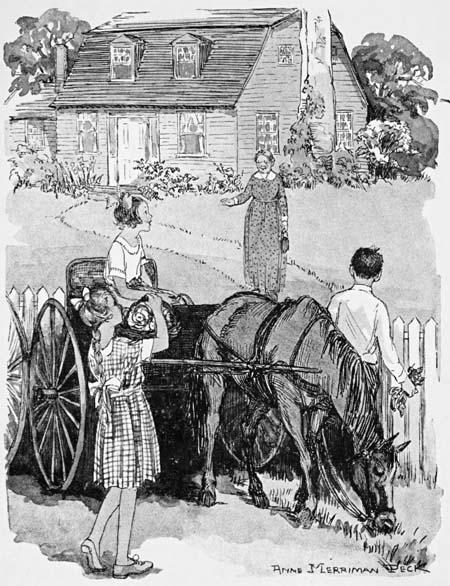
POPPY CALLED, “RADISHES! ROUND RED RADISHES! GROWN BY A RED-HEAD.”
She produced a worn pocketbook, with a nickel clasp, and a bill fold, and pocket for change. Mark said afterward “it looked as if it belonged to her.”
Prue put into the bright new pan, which Mrs. Wilkins fetched, a large quantity of the tender young lettuce and three bunches of Poppy’s [121]“round red radishes.” The combination was pretty against the shining tin.
“Well, we’ve begun!” Prue remarked, taking a long breath as they went on their way with cordial good-bys and good wishes from Mrs. Wilkins, the money of their first sale in Mark’s pocket, he being elected treasurer, and four perfectly fresh, creamy cookies apiece, deliciously sprinkled with cocoanut, held on the cookie by a coating of melted sugar. No one, it had long ago been decided by Greenacres children, ever made such cookies as Grandma Wilkins did.
“We can’t have such luck everywhere,” said Poppy, speaking with difficulty as she removed cocoanut from her cheek at the extreme reach of her tongue’s length because Hurrah had whisked his tail over the lines and spoiled her aim when she took a bite of cookie. “There ain’t many people so awful nice as she is. But we’ll keep right at it.”
They “kept right at it,” and, selling a little lettuce here, a bunch of radishes there, soon got rid of all the stock except a few ragged lettuce leaves.
Most people regarded the new vendors as a great joke, but one severe person held them up to lecture them on taking trade from the poor—and [122]did not buy when Prue and Poppy refused to cheapen their wares.
“Gee, she might of took the stuff when we had to let her preach at us!” said Poppy, too disgusted to remember the lessons in English which the other children gave her, and which she was so anxious to learn.
Hurrah was turned homeward—he went that way more willingly than he started out—and the children were wondering how much they had made.
“Don’t take it out to count it, Mark!” cried Prue. “It joggles so, you might drop some. Help me count up in my head. I can remember just what we sold.”
Prue began to recall aloud where they had stopped, what sales they had made, and Mark added for her as she went along. He was a marvel at mental addition; indeed, his quick brain excelled in all feats demanded of it.
Poppy took no part in this calculation except to correct Prue sometimes when she made a mistake in her recollection of sales.
There was a wagon ahead of them, a long one with a top, and it emitted a pleasant sound of a bell hung somewhere upon it.
Poppy’s sharp eyes had been upon it for some time. At last she said:
[123]“I like Hurrah terrible well, but I do wish I could hurry him up to catch that wagon! He won’t hurry for a cent.”
“I’ll hurry him; he’ll go for me, Pops,” said Mark. “He knows your soft heart by this time. I always can make animals do things, you know.”
As Poppy, to his surprise, instantly accepted Mark’s offer, he added:
“Why do you want to overhaul that wagon, Poppy?”
“It looks like a friend of mine,” said Poppy, mixing the wagon with its driver in her reply. “If I know what, that’s Mr. Thomas Burke, 906 North Street, Hertonsburg, what took me along home that time I went off, and I’d just love to see him, and I know he’d be crazy to see me.”
“Is it, honest?” cried Mark. “Well, we’ll overhaul him, all right. See Hurrah!”
Sure enough, true to Mark’s prophecy, Hurrah was trotting along to oblige Mark as he never did for Poppy. Soon the buckboard came up close to the wagon, and Poppy made sure that the bulky form on its seat was, indeed, her rescuer, the bottle dealer, and she shrieked wildly:
“Mr. Burke, Mr. Burke! Turn around and see me!”
Mr. Burke turned, not his head, but his whole body, which was a large and thick one.
[124]“Well, if it ain’t little Redtop!” shouted Mr. Burke, and, stopping his horse, got down to greet Poppy, his broad face red with pleasure.
Poppy took him around the neck with gusto. She hugged him hard.
“You’re just as welcome as a flower in the spring!” she poetically said.
“Which I ain’t so strikin’ like!” said Mr. Burke with a grin. “Lucky I haven’t got a gas truck, or you couldn’t have caught me. Say, how are you, anyway, little Redtop? Just as calm an’ sort of slow an’ lazy as you was? Don’t move around quick, nor fly off these days, do you? Are these your friends you told me about? Miss Isabel Lindsay, that you wrote the post card to?”
“This is Miss Prue Wayne; Isabel didn’t come,” explained Poppy, and as Mr. Burke touched his hat to Prue she added: “This is my own horse and buckboard, Mr. Burke.”
“Never!” exclaimed Mr. Burke.
“Ever!” Poppy corrected him. “It was a present to me from another friend of mine, Mr. Babcock, the postmaster; he’s very nice, not quite straight—I mean his back ain’t.”
“Well, you do be the great one for friends, little Poppy Redtop,” said Mr. Burke admiringly. “It’s congratulations that’s due you, an’ that’s [125]the truth. Now I’ve met you, I might tell you my errand. I was aimin’ to see your—well, I don’t know the title you give ’em, but whoever takes care of you—Mr. Gilbert Hawthorne, ’tis. I’ll not be goin’ to the house, now I can tell you what I had to say.”
“Oh, yes, Mr. Burke,” Mark cried. “Please come. Dad will be glad enough to see you. He would be annoyed with us, with me, if you didn’t come. Please come. We all know you well through Poppy. Motherkins—my grandmother, Mrs. Hawthorne—would love to thank you for taking care of Poppy last summer.”
“You’re a little gentleman!” declared Mr. Burke, regarding with frank admiration Mark’s radiant face. “It’s no thanks are due me for pickin’ up a bit of a girl, out gettin’ herself into trouble. But I’ll go along with pleasure. I’ve something to tell your father that maybe he ought to know, an’ maybe it’s no matter. Will I lead an’ will you follow, or will we turn it the other way, an’ me follow that war horse of Poppy’s? How do you name him?”
“Hurrah,” said Poppy. “He’s not a war horse; he’s peaceful and loving.”
“’Deed, then, he looks it! An’ Hurrah is a name that couldn’t be beat for belongin’ to a horse that you own, little Redtop; you’re the one [126]to go with a hurrah, as the sayin’ is!” Mr. Thomas Burke grinned at Poppy so warmly that she could not suspect him of looking down on Hurrah, as she at first thought he might do.
Mr. Burke went back and climbed up on his wagon, with grunts that revealed the effort it cost him, and the two vehicles took their way up to the Hawthorne house, Mr. Burke in the lead, Hurrah and his friends in the rear.
At the gateway they were met by Isabel, too excited to stand still or to wonder at Mr. Burke.
“Oh, I’ve been dying! I thought you’d never come back!” she cried, jumping from one to the other foot. “Mother’s friend went and I came back here to wait for you. I went up to the Club Room, and what do you s’pose?”
Isabel barely paused at the end of her question, which she did not expect answered. The other children murmured something, but Isabel went on hurriedly.
“Some one’s been up there, in our room! They’ve been eating, and moved things around. And they took out a pillow!”
“Who?” demanded the other three together.
“Well, who?” echoed Isabel. “I think it was Kathie and Dolly. Kathie can climb up as easy! You know she did the other day. They aren’t members yet; I don’t think they ought to go [127]there when we’re not there, and, of course, they can’t take anything out. Even one of us couldn’t; we own those things together.”
“Well, that’s rather queer,” said Mark slowly. “I wouldn’t think they’d do that. Maybe it was some one else—but who?”
“Yes, who?” echoed Isabel again. “Well, anyway, I’ve been crazy to have you get back and come up to see.”
“We’ll come,” said Mark. “I’ve got to find dad and introduce Mr. Burke to him. This is Mr. Burke, who found Poppy for us that time; this is Isabel Lindsay, Mr. Burke.”
“Pleased to meet you, miss,” said Mr. Burke, again touching his cap. His eyes lighted with pleasure at the sight of lovely little Isa. “I had the honor to write you a post card, but I’d rather see you, an’ that’s no lie for me.”
[128]
“COULD we hear what you are going to tell, Mr. Burke?” asked Poppy. Her sharp little face almost looked as though it had been whittled, so much was its natural pointedness increased by her devouring curiosity. Poppy was always as curious as a cat.
Mr. Burke looked down on her with kindly amusement.
“Considerin’ it’s next to nothin’, unless Mr. Hawthorne has some missin’ bits to put to it, like them pitcher puzzles, you may hear what I’ve got to tell’s far’s I’m concerned—which is next to nothin’, as I’ve just said,” he replied.
“But first be sure you will not have something more—one more cup of tea?” suggested Motherkins hovering, anxious to do all that she could for this kind man who had once been good to Poppy.
“’Deed, then, ma’am, there’s no more desire nor space left in me!” declared Mr. Burke. “But [130]I’d dearly love my pipeful of tobacco, if there’s a place on the grounds where I could smoke it an’ not be puttin’ you out.”
“My mother lets me smoke on the piazza, in the house, too, when it is too chilly to sit outside. Come, then, Mr. Burke, and open your budget of news!” said Mr. Hawthorne.
“It’s not much,” began Mr. Burke, when they were seated and he had drawn deeply on his wooden pipe to get it going. All four children—Isabel and Prue had obtained permission by telephone to stay on at the Hawthorne house—sat close to Mr. Burke, not to miss a word.
“Well, then,” Mr. Burke fairly launched himself in his story this time, “it was this way: I was drivin’ along one day, I’d say ten days back, but it might be a matter of a few days more; time does be greatly alike, seen from a cart seat. I came up wid a small man trampin’ along the side of the way, an’ when he looks up at me I passed the time o’ day with him, civil like. He answered kind of funny, not just grumpy like, but yet not ready; sort of hesitatin’. An’ the queerest face I ever set me two eyes on was on the front side of the head of that same little man! He had a nose you might use as a screwdriver, on a pinch, that long and thin ’twas! He had a pair of dark eyes that shone like a glass bottle beside the road [131]when the sun strikes on it, an’ they was never still a minute. He was a little misshapen creature besides——”
“The queer man in the woods!” cried Mark and Isabel at the same instant, as Poppy shouted: “We saw him! We saw him! Out by Château Branche and we were scared!”
“Did you see him now!” exclaimed Mr. Burke. “Small blame to you for being scared, says I, for one! Then it’s you who knows how he looked without me tellin’ you. Did he find you, sir?”
“No,” said Mr. Hawthorne. “This is the first I’ve heard of him; the children did not speak of seeing any one so peculiar in the woods.”
“For fear you’d think we hadn’t ought—ought not to go there,” explained Poppy.
“I certainly should want his record investigated,” said Mr. Hawthorne. “Why did you ask if he found me, Mr. Burke? Was he looking for me?”
“When he’d eyed me for a minute, queer and uncertain like,” Thomas Burke resumed, “he asked did I know the countryside well? An’ I told him I ought to, drivin’ it constant for upwards of seven years. An’ he asked did I know any one named Hawthorne, Gilbert Hawthorne, an’, says I, I do. Leastways, I know a little about him, nor did I say he was lookin’ after me [132]friend, Poppy, though I might have, I might have!” Mr. Burke smiled into Poppy’s face, thrust forward as she perched on the edge of a chair as if afraid that a word might slip past her.
“Then he asked me, an’ I told him where you lived, sir, an’ he listened tight, an’ he sort of muttered that maybe he’d see you. ‘Maybe I will,’ he said, an’ he shook his head hard. I misdoubted he was right in his mind, but I let him go on—he wouldn’t ride wid me, though I asked him. Ever since it’s been botherin’ me that maybe it was something you ought to know about, an’ more an’ more did it bother me the longer I thought about it, till the missus says: ‘Gwan wid you, Tom, an’ see Mr. Hawthorne. Make it your way to go to Greenacres sooner than you’re due there, an’ see him an’ tell him the little there is to tell, an’ get it off your conscience.’ So I’m here, an’ you’re told, an’ for my part of it, there’s no more about it. You don’t know the man; there’s no mischief afoot, is there?”
“Not that I know of; no, I don’t know any one like the person you describe. Curious, too, especially that he was in the woods near the children’s tree house—if it were the same man,” said Mr. Hawthorne slowly.
“Oh, it was, daddy; it had to be!” cried Mark. [133]“There couldn’t be two like that in one neighborhood. Say, isn’t it great? It sounds like a story with a plot to it.”
“It sounds like a fairy story. The queer man is a gnome, or wicked fairy, or maybe he is enchanted and unhappy and is trying to do good to you, to get free of the spell upon him!” cried Isabel, who always wove stories out of all material that came to her hand. “I think it’s terribly interesting! And strange! Last year we found Jack-in-the-Box in the woods and thought he was a fairy at first, and now it is a gnome!”
Prue had sat in rigid silence, listening, but not speaking. Her face betrayed her alarm. Now she jumped up and said:
“I hope you don’t think they’re anything alike! Jack-in-the-Box was the nicest thing that ever happened to us, but this is horrid! Perfectly, horrid-awful! And I’m going home before it gets any darker, and, Mark and Poppy, you must go half way with me, even now!”
“Let me see you home, little misses,” said Mr. Thomas Burke, rising. He had received and accepted an invitation to stay over night at the Hawthorne house, and his big horse, Cork, was to keep Hurrah company in the next stall to him.
“Oh, we sha’n’t be afraid with Mark and Poppy,” said Prue hastily.
[134]Prue was a proper little person, with considerable respect for social distinctions; she did not care to be taken home by a bottle dealer.
Isabel, cleverer and finer than Prue, made friends with all sorts of people, knew how to get pleasure out of talking to them, yet never for an instant was less than an exceedingly fine little fine lady.
“Well, if you wouldn’t mind, if you aren’t tired, Mr. Burke, it would be much nicer to have you come with us,” Isabel said, adding in an undertone that only Prue could hear:
“Don’t be a goose, Prue Wayne!”
So Mr. Thomas Burke, dealer in second-hand bottles, escorted Isabel Lindsay and Prue Wayne to their homes, Poppy trotting beside him, holding his hand, admiringly looking up at him as he talked nonsense and made the children laugh.
“He’s splendid!” said Isabel, when Mr. Burke had bade her and Prue good-night and had gone off with Poppy and Mark. “He is as kind as kind, and doesn’t he tell wonderful stories! I would like to ride in his cart all over the country, hearing him talk and seeing life. To-morrow, Prue, we must pitch into Dolly and Kathie for taking things out of the Club Room, though, of [135]course, it was only Kath climbed up. Fancy lazy Dolly climbing up there!”
“We’ve got to ask them first if they did it,” said Prue justly. “Kathie will not say she didn’t if she did. It seems to me rather queer for her to do that; I can’t seem to believe she did.”
“Who else?” demanded Isabel. “I think it’s queer, too, but who else would it be likely to be?”
“It isn’t likely to be Kathie, either,” persisted Prue. “Anyway, find out before you say anything.”
“I’ve got to say, ‘did you?’ haven’t I, or how shall I find out? Good-night, Grandma Wayne! Didn’t they know just how you were going to turn out when they named you Prudence!”
Isabel kissed Prue hard; she loved her when she was so sensible and cautious, partly because, though she, too, was sensible, Isabel was likely to be rash.
Then Isabel ran into the house for her hour which she always spent in intimate talk with her mother at twilight, and for which to-night she was late.
The next morning Isabel was awake early, having a great deal on her mind. The story of the queer man lost nothing of its interest in telling it to her mother; she had gone to bed excited over its mystery.
[136]Then there was the fact that the Club Room had been entered from outside. Isabel was impatient to see Kathie and Dolly and find out what they knew about it. She was tempted to feel a little hard-used that she could not omit her lessons that morning. School had been closed in the middle of April because of an epidemic of measles that hung along, a new case coming on when it all seemed to be over, so late that there would be no more school that season. Isabel and Prue were compelled to keep on with their studies at home; this morning Isabel found the rule hard. It was eleven before she was ready to go to call Prue, and set out to find Kathie and Dolly.
They met Poppy running with all her might to meet them.
“I thought you’d be coming,” she panted. “I knew you’d go for those girls soon’s you could get done. Mark’s taken Hurrah to the blacksmith; his feet’s long, Mr. Burke said. Ain’t he a peach? I just love him! He’s coming again and bring his missus. He calls her ‘the missus.’ I like that name. They’re both’s peachy as they can be. I might go help c’lect bottles, if Mr. Hawthorne’s prop’ty gets swiped by that nasty Ditson man. Say, what I run to tell you was that one of the dishes out o’ the Club Room’s [137]under a tree. So it was took out, and who done it?”
“Oh, Poppy, there were more bad mistakes in what you’ve just said than you’ve made for I-don’t-know-how-long!” sighed Prue, not to be torn from her duty of correcting Poppy by any interest, however strong. And this was an absorbing interest, the entering of the Club Room.
“Oh, well, I’m going to be a lady if I bust, but you can’t keep right at it, no matter what you’re thinking about!” cried Poppy. “Who done—did it?”
“We’re going right off this minute to ask Kathie and Dolly what they know,” said Isabel, swinging around to carry out her words. And Poppy joined her and Prue as a matter of course.
They found Dolly and Kathie eating strawberry sundaes in the drug store.
“We can’t treat because we had just enough money to pay for two, but we’ll wait for you, if you’re after some,” said Kathie nobly.
“We’re not,” said Isabel, though Poppy looked exceedingly sorry that this was true. “Walk with us if you’re through, we want to ask you something. Now: Who climbed up into the Club Room by the piazza roof?”
“Me; you saw me,” said Kathie promptly, taking instant offence from a tone in Isabel’s [138]voice of which she was herself unconscious, but which sprang from her certainty that Kathie had climbed in again, alone.
“Yes, but since; just the night before last, or that day,” Isabel went on her voice still more accusing. “Do you know anything about it?”
“Why don’t you ask straight out if I did it?” demanded Kathie.
“I will: Did you?” said Isabel.
“I wouldn’t tell if I did, and I won’t say I didn’t,” said Kathie angrily. “I’d just like to know, Isabel Lindsay, why you come at me like this?”
“She—I mean we—aren’t coming at you, Kathie,” interposed Prue. “Isabel is speaking sort of hard because she’s so bothered—I mean we are. Some one went in there, and they took out a few little things, and we’ve got to know if anybody’s breaking in. Greenacres is a little queer lately; there’s a man in it.”
Kathie burst into mocking laughter, not in the least soothed by Prue’s evident desire to keep the peace. “I always knew there was a man in Greenacres! You silly, Prue Wayne!”
“Silly nothin’!” broke in Poppy in a blaze of wrath. “Think you’re smart! Anybody that wasn’t a gump would know she meant a queer man——”
[139]“You tend to your own affairs, you meddlesome monkey!” Dolly now took a hand in the fast thickening atmosphere of thunder and lightning.
“Poppy, please don’t!” begged Prue distressed. “I don’t care what Kathie said.”
“No! I’m not worth caring about! That’s what you mean, so just say so,” stormed Kathie.
“I did not! I meant I didn’t feel mad,” cried Prue beginning to cry, dismayed to find the battle around her head when she had but meant to head off a battle.
“Well, but that isn’t the thing,” Isabel began over again. “There’s no sense scrapping, saying things back and forth. What I want to know is was it you who went up there alone and took out a pillow and a dish or two? If it wasn’t you, it’s awful. If it is you, you hadn’t any right to do it, for you’re not even a real member, and we real members can’t take things away. So I want to know.”
“Oh, you want to know, do you!” echoed Kathie in a towering temper by this time. “Well, then, find out! You won’t get me to tell you. I might have told, if you hadn’t talked as if I was a thief or something! Now you can find out any way you can work it, but not from me. Why [140]don’t you get up a detector from New York and lock me up, if I’m the one?”
“Detective,” murmured Prue in spite of herself, which did not make things better.
“Oh, Kathie, how can you!” cried Isabel, following Prue’s tears with sobs that brought no tears, but which shook her delicate little body from head to foot.
“Oh, I hate a fuss, I can’t stand a fuss! I did not speak as you say. I didn’t mean to speak unkindly. I just want to know, Kathie! Oh, Kathie, don’t you see it’s dreadful to have some one coming in there and not know who it is? Won’t you please, please, Kathie, tell if it’s you? Just if it’s you, you know!”
“I won’t tell you one single thing, Isabel Lindsay,” said Kathie. “And Dolly shall not!” she added, seeing Prue about to turn to Dolly.
Kathie put her hand on her chum’s shoulder with no gentle touch, and Dolly would not have spoken for the world.
“’Cause you’re the one, that’s why!” shouted Poppy at the top of her voice.
“Oh, hush, Pops!” cried Isabel, suddenly calm again. “I’m afraid that is the reason, Kathie,” she added with great dignity. “I am afraid that Poppy is right and that you did go up there, and that is why you won’t answer. I’m afraid [141]you can’t be a member, ever, and I think you’d better stop being on trial now.”
“I suppose everything’s as you say! I suppose Mark hasn’t one thing to say, only just mind you! Well, we wouldn’t be in that club, not for the wealth of Indians! We resign. Dolly and me resign—don’t you, Doll?” Kathie demanded shaking her friend without knowing that she did so.
“Sure!” said frightened Dolly, who never quarreled nor exerted herself when she could help it.
“Isa said it first! Isa said it first! You can’t—what-do-you-call-it! Isa put you out first!” chanted Poppy dancing around the girls so excited that she had no consciousness of being in the street, nor of the amazed amusement of some grown-up on-lookers.
“Because she knew we wouldn’t stay in!” cried Kathie, quite beside herself at this triumphant war dance of Poppy’s.
“Well, it’s horrid! It’s awful! Why, why do we have such a row? Just asking—just asking—just asking——” Isabel broke down in another storm of tearless sobbing.
“Come on home, Isa, my darling! I’ll wipe my shoes of their dust!” said Prue, herself now [142]in a white heat of anger since her beloved Isa was so shattered.
“Dust! Yes, I guess! Shoes! Wipe!” Kathie’s scorn was scathing, though its expression was not striking.
The two parties turned without another word and walked in opposite directions, every muscle in each of the five bodies tautly declaring the indignation that burned within them.
Isabel walked on sobbing uncontrollably, but not crying. Prue was no longer in tears; her anger had dried them when she saw Isabel so hurt. Poppy was in such a rage that it might have been funny if either of the others had been capable of seeing it. She spun around and around, making progress, but always as a top progresses, and she ceaselessly uttered funny sounds, almost as if she were a furious little beast.
“Oh, it’s awful, it’s awful! It’s just like having a sort of fight!” mourned Isabel.
“’Course!” cried Prue, and to her own surprise she laughed.
“Be nicer to fight,” said Poppy.
“Well, I think the worst is not knowing who got into that room,” said Prue. “If Kathie wants to act like this, let her. You did speak sort of stern, Isa darling, but anybody’d know you were stirred up; you’re so gentle and not-hurting [143]always, not even flies! I don’t care about Kathie, because—I don’t! But who was it?”
“Oh, it was Kathie. I know it was now, and I knew it before—I mean I was as sure as anything. Well, it won’t happen again. She’s too mad with us to come either climbing in, or walking in and up the stairs,” sighed Isabel.
“If only we hadn’t let them half-come, be the least bit members!” Prue said, also sighing.
[144]
ISABEL had not found relief, as Prue had, in tears while the scene with Kathie and Dolly was enacted. She kept from crying till she poured out the story of the quarrel to her mother that night at twilight, but then she poured out tears with the story and cried till, big girl as she was getting to be, her mother gathered her into her lap—all of her that it would hold!—and tried to check the flood.
Isa was not a child that cried easily, but, like most people to whom tears are difficult, when she did cry she cried so hard that it often made her a little ill. Mrs. Lindsay dreaded one of her breakdowns.
“There, there, my dear; there, my little Isabel!” she murmured patting Isa’s heaving shoulder. “It really is not so bad as you think it is. It will be straightened out. Kathie resented being questioned, but it will look different to her to-morrow morning. You still think she is the [146]one who climbed up into your room? Her being so angry over the suspicion might mean that she had not been there, or it might mean that she was angry at being found out.”
“I’d believe her if she said she hadn’t gone, but she wouldn’t say it, so I think it was—her? She?” Isabel tried at once to speak correctly and to speak at all, keeping down her sobs.
“She. After was, or is, you know,” Mrs. Lindsay helped her in both ways, supplying the pronoun and smoothing Isa’s hair. “It wasn’t a crime to climb up and go in, after all. If Kathie did it, I think she must be forgiven.”
“But taking out our things, mother?” cried Isabel, sitting erect with symptoms that the storm was past.
“Oh, I forgot about that! No, that was not right. It doesn’t seem to me like Kathie Stevens, either! Curious little affair, isn’t it? I hear what story books might call ‘a well-known footstep!’ I think a person called Harvey Lindsay is coming in!” Isabel’s mother arose as Isabel got off her knees, and went to meet her husband, Isabel languidly following.
“Why, what’s wrong, Lady Bird?” cried Mr. Lindsay at once.
“Isa is greatly troubled by a falling out between her and Kathie Stevens, in fact between [147]our four intimate children, and Kathie and Dolly. Isa may have made a little mistake in the way she approached a question that had to be asked Kathie, but she has not provoked the quarrel, and I’m sure it will be healed soon.” Mrs. Lindsay explained to her husband, but smiled hopefully at her tear-stained and swollen daughter.
“Come now, that’s everything, not to be the cause of a rumpus, and to be in the right!” Mr. Lindsay’s big voice sounded heartening. “I don’t mind greatly what the other fellow does, not after a time, though I may at first. I do mind like the mischief to see, when I cool off, that I was in the wrong! Your trouble is not going to last, my dawtie! And when I was about your age and had cried my fill, I found nothing as refreshing to my throat and to my spirits as ice cream! So I’ll slip back to Ebers’ and bring up a quart in a nice little tape-handled box. What flavor, Lady Isabel-ladybird?”
“Maple walnut and strawberry,” said Isabel without an instant’s hesitation. “Thank you, you dear Person,” she added with a smile rather like melted ice cream, sweet, but lacking vigor.
When her father returned her mother helped herself and her husband to a little less than a third of the cream apiece and handed Isa the box, because she preferred it thus. Seated on the [148]upper step under the brilliant summer stars, taking heaped spoonfuls of the delicious cream for which Ebers was famous for miles, and licking the top of each spoonful into a cone to get the full flavor, a mannerless way of eating that the night and out-of-doors allowed, Isabel began to feel comforted. The strawberry ice cream was dotted with seeds to prove that fruit, not flavoring gave it its flavor; the maple walnut was as strong of maple syrup taste as a Vermont sugar camp vat.
Isabel licked her spoon blissfully, if inelegantly, since no one could see her, and felt that life still held a great deal to enjoy. As to her father, who had taken the walk to get the cream for her when he was surely tired, how could she express the flavor of his love for his girl?
“Father, you blessing, my throat does feel scrumptious after that cream, and I hope some day, I’ll have a big, hard thing to do for you and mother, just to show you!” Isabel said at last, getting up from the step with a contentedly-weary yawn, and going over to kiss her best-beloveds good-night.
The first thing in the morning, while Isa was still at breakfast, there appeared Mark in a state of great excitement.
“Well, what do you suppose!” he burst forth [149]at once. “Oh, good morning, Mrs. Lindsay! I forgot. But what do you suppose, honest?”
“What are we to suppose about, Mark?” hinted Mrs. Lindsay.
“I’d say about ’most anything,” returned Mark. “Things are happening in all directions. You couldn’t guess this; you didn’t know about it, I suppose. Say, Isa, you know Kathie Stevens’ coins?”
“’Course,” said Isa, leaning forward breathlessly.
“Gone!” cried Mark.
“Gone?” echoed Isabel. “Where? How do you mean gone?”
“If I only knew where!” said Mark. “Don’t you know I put the box down in the secret passage? They stayed there all right; I’ve looked once in a while. Nobody on earth but us—father and Motherkins and we four youngsters—knew a word about that passage. Kathie and Dolly knew there was one, but they didn’t know how you got into it, not either from the house, nor the woods end of it. I heard Kath once telling the girls at school how we had a secret passage, made in the Revolution, when Tories were around here, but I could tell she had no sort of idea where it was. And somebody has got into it and taken off that box with the coins in it! [150]Isn’t it tough luck? What do you suppose Kathie will say, or her father, for that matter? You see they are valuable. The minute Pops came home and told about the fuss, how mad with you Kathie was, I thought of the coins, and made up my mind I’d have them out of there, ready to hand her if she came after them this morning—as I’m pretty sure she will. So I got right out after them the first thing—and there you are! Or there they’re not!” Mark waved his hands outward as if to signify a flight.
“Well, of all awful things!” said Isabel slowly.
“It is awful,” agreed Mark. “It’s bad as it can be to lose the coins, but it’s almost worse to have somebody know that secret passage and be wriggling around in it! I never in all my life heard of anything like these things—father going to lose that money almost certainly; that queer little man in the woods, and the same man asking Mr. Burke for father, and our club room entered, and now this! Why, you’d hardly know Greenacres!”
“Well,” said Isabel slowly, weighing her words, “I don’t like it; I’m sure I don’t like it, but I do think it is interesting—all but your money being taken away; that’s just awful, every side and up and down of it! But the other things are exciting! And interesting! We always knew [151]nothing would happen when we went to the woods, but now you can’t tell.”
“Ah, but that makes me feel that I can’t tell whether you may go there now,” interposed Mrs. Lindsay. “I am far from pleased to think that our safe woods are invaded by this queer little man.”
“Oh, mother, please don’t be afraid!” begged Isabel. “And he is in lots of other places. Mr. Burke met him over toward Hertonsburg. We wouldn’t like it a bit if we couldn’t go. We’ll take Semp; he could hold a man down. Mark’s father says he would take any one by the throat who tried to touch us, and you know how big and strong he is. Besides, the man seemed to be afraid himself; he ran away when the girls came that day. We want to go to Château Branche this very morning!”
“Oh, not to-day! Wait till your father decides it. I think, perhaps, some one must lie in wait for this queer little man and find out about him. The loss of the coins puts a new color on the case; that is theft, you know,” said Mrs. Lindsay.
“But maybe he found them in the secret passage and didn’t think they belonged to any one; maybe he isn’t a thief, Mrs. Lindsay,” cried Mark.
[152]“Jack-in-the-Box, you are defending him, less from charity than because you want to be free to roam the woods as you always have!” laughed Isa’s mother. “And so do I want you still free, but we must wait to find out more, so be content to keep away from Château Branche a short time, please, dear!”
“All right, motherdy, but we want to go!” said Isabel kissing her mother, and going with Mark to find Prue, and to work in their gardens at Hawthorne House. The exciting events of the recent days had given a chance to the weeds which they were quick to use, and, to be quite truthful, the children’s enthusiasm for gardening cooled in proportion as the weather warmed, nor had their first trip to market their produce yielded the fortune that they had hoped to count.
Prue came out tying a last ribbon on her tight, light braid of hair; she had seen Isabel and Mark coming and wanted to lose no time.
She listened with tense attention, frowning severely, to the story of the disappearance of Kathie’s ancient coins.
“Well, she will be madder’n a whole army,” said Prue when it was ended. “She will be right up this morning to get them, and when she doesn’t——!” Prue did not attempt to describe [153]what would happen when Kathie did not get her coins.
“But, my goodness gracious, she knew where they were, and she let them be put there!” cried Isabel. “It isn’t our fault, is it?”
“When you’re mad, you’re mad, and you’ve got to blame somebody,” said Prue, with deep knowledge of human injustice. “Kathie will blame us; you’ll see! I say let’s go down the secret passage first, and look for the box again. I’ll run back and get my searchlight, and I’ll borrow mother’s. We’ll go right in there and hunt!”
Now this was a much more heroic proposition than it sounds, coming from Prue. She was deadly afraid of spiders, snakes, rats, of black beetles almost most of all, and she had always had a horror of the secret passage greater than Isabel’s, because she felt sure that it was inhabited by all these things and others similar to them which she had never seen, and she had not Isabel’s imagination to turn the passage into a romantic story and thus off-set the dread of reptiles, insects and beasts.
Isabel knew how Prue hated to explore the underground way that had been a refuge in Revolutionary days. She stopped short and regarded her friend with respectful admiration.
[154]“You are great, Prue! You are truly great! I think if there were a war you’d fire cannon, like Molly Stark, and hang out flags like Barbara Frietchie, and do all those things, though when there isn’t a war you don’t seem quite so brave,” Isa declared.
“I don’t know what I’d do, but, sometimes, I suppose you’ve got to do what you hate. I’d heaps rather fire—well, hang out a flag, anyway!—than walk on a squishy bug, or something,” said Prue trying to look modest.
There was a walled opening to the secret passage in the woods, at the place where Isabel and Prue had first seen Mark; they had dubbed it “the Toy Shop” because there was where they got their Jack-in-the-Box, and again Mark was a “jack-in-the-box” because he appeared and disappeared through this opening.
The opening was so thoroughly hidden by shrubbery and trees that the little girls had not then suspected it was there, nor could it be better seen now.
This morning Mark went down first and turned back to help Isabel and Prue. Prue had first nobly gone back after searchlights and had overtaken the other two, breathless, scared, but resolute.
Both little girls were struggling to hold their [155]skirts tight around their legs, which did not help their progress.
Mark laughed at them as he watched this strapped-in descent.
“Nothing will get on you!” he said.
“It’s all very well for you, Mark Hawthorne, in knickers, but we’ve got skirts, and anything could cling on them,” said Prue sternly. “It makes me sick!” She persisted nevertheless, and the three went rapidly to the spot where Mark said he had set the box of coins.
“You see!” said Mark, holding up the searchlight which he carried to show a rock in the side of the wall with nothing on it. “I put it there and now where is it?”
“Let’s hunt all around—but of course it didn’t walk off itself, and whoever took it would take it—I mean carry it off!” Isabel said. “Oh, dear, oh, dear! We are in trouble! Kathie will be nearly crazy, and there’s her father! He will—why, we can’t tell what he’ll do to us! We hardly know him at all; we don’t know whether he’s one of those awful stern men, or not! Oh, if only we hadn’t brought it here! But how could we guess there was a thief around, in this place? Do you suppose it is a den of thieves now?”
The secret passage was full of turns, dark, sharp turns, around which no one could see; only [156]by making the turn and throwing a light ahead could whatever chanced to be around these bends be seen.
“I am not a thief!” came a voice out of the darkness as Isabel finished speaking.
Prue shrieked and shrieked. Isabel uttered one agonized scream, and fell to trembling silently. Mark gasped, almost a groan, and after an instant’s pardonable hesitation, went toward the sound of the voice.
“Say, keep off!” the same voice said in a high, squeaky tone. “Don’t you come after me! I’ll run faster’n you can and I’ll never be caught. You stay off. I’ve’s good a right in here’s you have; better! If you want that black box of money just go look for it where I say, but don’t you chase me! Count your turns. Count three turns back the way you come. Then go down a short little narrow path somebody must of dug and got sick of once. There’s a box, and it isn’t one penny lighter’n ’twas when I found it. If you want it, take it. But I ain’t any more a thief than you are, and I won’t let you call me one. I’ll make you good’n sorry if you do.”
“My goodness, whoever you are!” cried Mark, his spirits rising as he found a chance to answer the mystery. “If you return the box you’re not a thief, so why should we call you one?”
[157]“We’re very much obliged; you are very kind,” Isabel managed to say faintly, feeling compelled to politeness for the favor done them.
“I won’t make trouble for kids,” said the voice. “Good-by.”
“Oh, come out and let us see you!” cried Prue, all her fear wiped out by the sentiment the voice had just expressed, and curiosity seizing her.
No answer came to this appeal. The children called several times, but no sound came in return. A bat, aroused by the lights, flapped heavily across Prue’s head, so close to her face that she screamed louder than she had when the voice had first startled her.
“Oh, for mercy’s sake, get the old box and come out of here!” she cried. “I don’t want to be buried first, and then killed by bats and stuff!”
Isabel and Mark began to laugh, but there was no resisting the fervor of poor Prue’s voice. They began to retrace their steps, counting as the voice had bade them count. There, at the spot it had indicated, they came upon the black box, and, as Mark lifted it, he said:
“It does feel exactly as heavy as ever! Maybe it is all right.”
The children came out of the secret passage at the end which led them out into the grounds of [158]Hawthorne House. Motherkins came to meet them.
“Kathie and Dolly are waiting for you,” she said. “If only you could find the coins!”
“We have found them, Motherkins!” cried Isabel. “Just you wait till you hear!”
Without delaying for the soap and water that the three faces needed after passing through the secret passage, the children went in to find Kathie and Dolly in the library.
“We came to get my coins, Mark,” said Kathie, ignoring Isabel’s feeble “Hallo,” and not so much as seeing Prue, who did not attempt to speak to them.
“All right; they’re here. We went to bring them up from where I put them,” said Mark. “I don’t know how many there were, but I don’t believe any are lost.”
“Thank you, Mark,” said Kathie with dignity. “You needn’t think we’re mad with you, Mark, because we’re not. You didn’t ask us mean questions!”
“Nobody did; we all wanted to know if you’d been into that room. I asked the question just as much as any one else, if that’s all, but there’s no sense in being mad about it. Only if mad you are, please count me in. It’s just as much my [159]mess as the girls’.” Mark spoke so firmly that Isabel and Prue were proud of him.
“Just as you like. Then we’ll be mad with you, too. Come, Dolly!” Kathie took the yielding Dolly under her command with a stern glance. Neither Kathie nor Dolly had any desire to quarrel with Mark, whom they admired greatly, but if he joined himself with Isabel and Prue, there was no help for it. Mark escorted them to the door, polite in his own home.
“Good-by; come again!” he said with a laugh as they departed.
[160]
“OH, dear, dear!” sighed Isabel watching the retreat of Kathie and Dolly, who stalked away so wrathily that “they looked as if their backs were calling names,” Isabel said. “They are staying mad. I hoped they’d be over it when they’d had a night’s sleep. Mother says never to let the sun go down upon your anger, but they did, and they let it rise again, and still they’re mad!”
“Well, I don’t think their not speaking is half as much consequence as that voice that did speak,” said Mark, who could not get up great interest in Kathie and Dolly’s doings. “I’d like to know who, or what that was.”
“I should—think—so!” Prue spoke with slow and awful emphasis. “It gets worse every minute I remember it. I just about can’t stand it! Everything is getting so queer! I wonder if we’re asleep and dreaming these things? It’s like a queer, mixed-up dream.”
[162]“All of us asleep, and dreaming the same thing?” laughed Mark. “And how could we know what the rest of us were dreaming?”
“We couldn’t. But we could dream we were all together and heard the voice, and saw that little man. And then I’d only be in your dream, or Isa’s, and you’d only be in my dream—Oh, mercy! I’ll go crazy!” Prue clapped her hands to her head and shook it hard, burrowing her chin into her neck wildly.
“And how could we tell which was the one dreaming?” Isabel cried gleefully; she dearly liked this sort of game. “There’d only be one real one, the other two would be the dream, and how should we know which they were? And there’s Poppy.”
“Where?” cried Prue.
“I mean she saw the queer little man, and the only reason she didn’t hear the voice is because she wasn’t there, so she had one-half the dream and not the other half,” Isabel explained. “I sort of think that proves we are awake, but I don’t know how it does it. First we saw a queer little man without a voice; then we heard a voice——”
“Without a queer little man!” cried Mark. “It’s like Alice and the Cheshire cat! She said [163]she’d seen cats without a smile, but never a smile without a cat.”
“If you don’t stop talking about crazy things I’ll go crazy myself!” Prue warned them sharply. “It’s making me feel all crawly inside me. It almost has sense, but it hasn’t any! It’s like trying to catch the wet soap in the bath tub. I’m so scared when I think of that awful, awful voice I could curl up and die. I declare I think Greenacres is getting dreadfully funny!”
“It wasn’t an awful voice, though; it was a pretty nice voice, telling us where to find Kathie’s coins,” Isabel reminded her.
“What puzzles me is why the man—or the beast, or the bird, or the ghost, whoever that voice belongs to—stole the box, and then right away told us where to get it! What’s the use?” Mark observed.
“Probably he didn’t steal it; just happened to find it and took it.” Isabel clearly saw the difference in these two actions, though it might seem to another much the same. “Where’s Poppy?” she suddenly demanded; it was odd for Poppy to absent herself for so long.
“I don’t know; queer, isn’t it?” said Mark. “When we were coming up out of the secret passage I just barely saw her tearing off through the trees, ever so far down the middle path through [164]the woods. ’Tis queer she doesn’t come back, now I think of it.”
“Dare you to go home that way, Prue, and see what she’s up to,” said Isa.
“I’m scared,” Prue admitted honestly, “but we’ve got to keep on going into the woods, or else there wouldn’t be any use in living at all. So I’ll go. You’re probably just as scared as I am, anyway, Isabel Lindsay! And the way you’ll do is hold it down, and then not go to sleep to-night.”
“Oh, well, I never pretended not to mind, and of course it’s much worse to be afraid of something you can’t understand than of burglars, or rats, or anything sensible,” Isabel did not shrink from admitting her nervousness.
“Let’s go home through the woods, Prue. We can play we are pioneer mothers daring wild beasts and Indians; that will help a whole lot. If we put off going it will be much worse when we do go, as you said. And let’s start now.”
“Mark, Mark dear, will you come here? I want you,” called Motherkins.
“Oh, I was going part of the way with you,” said Mark regretfully. “Now I can’t, so good-by. I’ll see you after a while, maybe.”
“We’d rather not have you come; we’ve got to get used to being brave alone,” said Prue. [165]“Good-by. If anything should happen to us, why, you know where we went.”
“Oh, gracious, Prue, don’t!” shuddered Isabel, profoundly disturbed by the awful picture of herself and Prue lying wounded in the woods which this suggestion at once called up.
Prue and Isabel wound their arms around each other for mutual support in their adventure, but resolutely faced the woods and walked toward them, not hurrying, but not loitering, with that steady pace that betokens steady purpose.
“Let’s go the longest way, past Château Branche, then we’ll know we didn’t get out of one thing because we were ’fraid-cats,” proposed Prue.
“Well, if here isn’t Bunkie coming to meet us!” cried Isabel surprised. “I left him at home because he might get lost in the secret passage, I always think. How could he know we were coming here when we didn’t know it ourselves?”
The little dog came tearing toward Isabel, ears streaming backward, tail wagging as fast as it could at the speed he was making. He leaped up to his mistress with a great show of joy, gave Prue a rapid, but cordial welcome, then turned in the direction from which he had come, looking back to see that they were coming. At [166]that moment the little girls heard a sound of wailing and stood still.
“Now what’s that?” cried Prue sharply. “There’s something else awful, and it’s quite new.”
“Doesn’t it sound horrible? But maybe it’s a panther—no, there aren’t any! Maybe it’s a wild cat, and maybe they cry the way panthers do. They say you can’t tell a panther from a baby; they fool hunters; don’t you remember? In books I’ve seen that.” Isabel was trying to be cheerful, though her teeth almost chattered, but Prue was not appreciative.
“Yes, and maybe it’s an orphan asylum and they are real babies crying,” she said scornfully. “There are just as many orphan asylums in these woods as there are panthers and wild cats. Shall we go on, or do you say to turn off right here?”
“I say to go on,” answered Isa, pale but heroic.
Their decision rejoiced Bunkie, who while they hesitated had been imploring them by every sign he knew to come on.
The blood curdling wailing continued and grew louder as they advanced; it took strong resolution to proceed. Prue clutched Isabel’s arm so tight that she found it black and blue that night when she went to bed, though she did not [167]feel it then, while Isabel held Prue’s side in a grasp that ticklish Prue could not have borne for a moment if her mind had not been too fully occupied to notice it.
Slowly, trembling from head to foot, these Greenacres heroines advanced, and their courage was rewarded, for in the midst of the wailing two words came out clear, and these words were: “Oh gosh!”
It was Poppy! There was no mistaking the way she uttered her favorite vent for her feelings, and Isabel and Prue laughed out in their relief, though in another instant they began to feel troubled to find Poppy like this, prone on her face, crying desperately, alone in the woods, in which she, as well as Isabel and Prue, were beginning to feel afraid to wander.
Bunkie darted ahead and up to Poppy, nosing her anxiously, but she ungratefully pushed him away, not being minded to accept his pity then.
“Why, Poppy! Why, Poppy dear, what is it? Is anything the matter?” cried Isabel and Prue together, running up and dropping on their knees beside Poppy’s prostrate, sob-shaken little body.
At this Poppy’s crying began afresh, so violently that Isa and Prue were frightened and [168]there was no hope of getting a word from her.
“May as well wait,” said Prue, sitting back on her heels with a resigned despair.
“Oh, try to stop, try to tell us what is wrong, Poppy!” begged Isabel. “Is anything wrong?”
“Don’t you—don’t you know? Didn’t no one tell you?” Poppy managed to gasp, losing her hold on English.
“No, indeed!” Isabel said. “Tell us, quick!”
“It’s settled!” Poppy moaned, and fell back into worse crying.
“For pity’s sake!” exclaimed Prue impatiently. “What is settled, Poppy Meiggs?”
But Isabel had a sudden enlightenment.
“Oh, Poppy, is it really? Oh, Poppy!” she cried.
“Well, for pity’s sake!” Prue exclaimed again desperately. “Are you going to be a puzzle, too! How do you know what she means?”
“She means it is settled that Mr. Hawthorne has to lose the money that Mr. Ditson left to him, and that they will have to give up that dear, dear house, and Motherkins’ garden and everything, don’t you, Poppy?” said Isabel pale to her lips over her shocking discovery.
Poppy nodded hard, raising her head to do so, and instantly burying her face in the moss again.
[169]“That’s not the whole of it,” she said in a muffled voice.
“Oh, not, not that they’re going away!” cried Isabel.
“They are, too!” Poppy sat up suddenly and spoke out of a gust of anger. “We shall go away, away! Out of Greenacres! Mr. Hawthorne can’t get anything here, he said—he means work. He’ll be poor; he must work. They’ll go away, away! And I sha’n’t see you no more, Isabel, my darling, dear! But Hurrah! They can’t take him along, my own, own horse! They can’t feed him; it costs. And I love him more’n anything in all this world, and they’ll leave him here. Oh, Hurrah, Hurrah, Hurrah!” Poppy’s voice rose higher with each repetition of the name, till it became a shriek, and had the effect of cheering.
But Poppy was far away from a cheer. She fell down again on the ground and pulled up handfuls of mossy turf, kicking the while with such violence that her striped gingham skirt fluttered as if it were in a gale and one of her shoes flew off.
“There’s no use kicking, Poppy,” remarked Prue, picking up the shoe and stooping to replace it. “Hold still, and I’ll put your shoe on again. Goodness knows it makes me sick, [170]if it’s true that Mark and all are going away. How do you know it is true?”
“I heard Motherkins and Mr. Gilbert talking about it. They said the lawyers had written a letter and said there wasn’t any show to help it. And Motherkins kind of cried a little, then she said never mind, Gilbert, because I shall not mind much, and I know you feel bad for me. And that was worse’n her crying. Nearly kills me when she bucks up brave that way! And they said they’d tell Mark’s soon as you two’d gone, and now you’re here they likely telling him. And, oh, Hurrah, Hurrah, Hurrah!” Once more Poppy gave herself up to the anguish of the thought of parting from her horse, whose cheerful name so ill-fitted this use of it.
“Now, Poppy, I’m going to tell you something,” said Isabel in her sweet little womanly way, putting aside her own sharp pain over this news to try to comfort Poppy. “If you don’t want to leave Hurrah, you needn’t. My father and mother were talking about this, what would happen if the Hawthornes had to give up the money, and father said—they both said—that you could come to live with us, if you wanted to, and stay right on in Greenacres, and keep on in our same school. And father said he’d keep Hurrah for you; he said he was sure you’d feel [171]perfectly terrible to give him up. So now you know all about it. You needn’t give up Hurrah, nor Greenacres, if you’d rather not. You can stay with us and Hurrah’ll be yours just the same.”
Poor Poppy! She was in a bad state of nerves from grief and her tempestuous crying, and at best she too easily flew into a temper.
Now she sprang up like a rocket, on her feet, and waved her arms up and down, as if she wanted to hit something either in the sky, or beneath it.
“I guess I won’t! I guess I won’t! I guess I won’t!” she screamed. “What d’jer think I am! Leave Motherkins! Leave her! Didn’t she take me in when she was poor’n poorhouses, and take care o’ me when nobody wouldn’t, but her, but went and took all the rest o’ the Meiggses, ’cause there wa’n’t none of ’em red headed and freckled noses but me? I guess I won’t live with your folks, not if I do love you cartloads, Isabel Lindsay, and I won’t stay, not with no horse, Hurrah, nor nobody, ’stead o’ Mis’ Hawthorne—Motherkins. So there!”
“Well, Poppy, I’m sorry,” faltered Isabel sincerely. “I didn’t mean to make you mad. You said you loved Hurrah best of anything, so [172]I thought you’d like to know you might have him if you really did love him best. That’s all.”
“Any gump’d know I didn’t mean Hurrah ’stead of Motherkins,” said Poppy still disgusted and offended. Then with one of her sudden changes, she threw her arms around Isabel and half crushed her in a tremendous hug, crying, but with a new and gentler misery, as she did so.
“Oh, you darling Isa,” she moaned. “I’m the nastiest! I’m sorry, Isa! And how shall I ever stand it without you?”
“Well, Poppy,” said Prue, who found Poppy trying, as she so often did, “do you think you’re the only one feeling bad? Don’t you suppose we care? Isn’t Mark—isn’t Mark—our own Jack—Jack-in-the-Box?”
Prue had great difficulty in getting to the end of her sentence, and when she did haltingly reach it her own tears were flowing, but quietly.
“Shall we sit in Château Branche just a few minutes to get rested so we can go home? I feel sort of weak,” said Isabel, and Prue saw that she was as white as a white rose petal, even her lips colorless; it was Isa’s way to take a blow silently, but with tragic intensity.
They climbed up into their house in the great pine, each one thinking how beautifully Mark’s father had prepared this for them, as well as [173]so many other things which they enjoyed. And Isabel, looking off with great tears on her lashes, her gray-blue eyes black from their dilated pupils, with black hollows below them, realized how she and Prue might come here by and by—provided they had the courage to come—and sit here, as to-day, without Mark, forever without Mark. The thought was unbearable.
Down went Isa’s head on her knees, which she was clasping with tense fingers.
“Oh, it’s too awful, too awful!” she murmured. “It can’t be true! I’m going to hope something will happen! I’m going to pray for it! Let’s all pray for something to happen to let us keep our Jack-in-the-Box.”
“But it won’t,” said Prue dismally.
“It might!” cried Isabel, raising her head and tossing her hair out of her eyes. “We must believe it will, and pray hard!”
“It could, couldn’t it, Isa?” cried Poppy, enkindled by the idea. “Should we call this Church Branche, instead of Château Branche, and pray and pray, right here?”
“Oh, here comes Mark! See how slowly he’s coming, and Semp marching beside him! Oh, it must be true when he comes so very slowly!” said Prue, before Poppy’s question could be answered.
[174]“Are you up here?” asked Mark preparing to swing himself up into Château Branche.
“We’re coming down, Mark,” said Isabel. “Don’t come up; we have to go home.”
The three little girls descended, Mark quietly offering each his hand. It was as if he had grown up since they had last seen him, so grave, so kind, so gentle was his manner.
Isabel was last to get down. She stood where she alighted and looked at Mark, and quietly Mark looked at her, his lips twitching.
“It is all true,” said Isabel slowly. “I hoped Poppy was mistaken. It is all true that—that—you are going away, Jack-in-the-Box.”
“Hard luck, Isa,” muttered Mark. “But daddy has no chance at good business here, and he has in Boston. Yes, Isa, it is true. Daddy and Motherkins told me themselves. I—I—I’m horribly sorry, Isa, but we’ve got to stand it the best that’s in us.”
“If we can stand it at all that’ll be the way we must,” said Isabel. “It will take the best we can do even to live, let alone stand it! Will—will you go soon, Jack-in-the-Box, dear?”
“About September first, daddy thought,” said Mark.
“Oh!” cried Isabel brightening; her mind had been keyed up to a parting at once. “A lot can [175]happen before then. We’re going to pray for something to stop it, and that gives us time!”
She smiled quite cheerfully, as if the working of a miracle was made more probable by allowing more time for it.
[176]
“YOU’RE to come home with Poppy and me, Isa and Prue; Motherkins said so,” said Mark. “She was going to call up your mothers, and ask them to let you stay to supper. She said we might get it ourselves. We’re going to have ice cream.”
“Whatever in this world for?” demanded Prue. “Funny time to have a party when we’re too miserable to talk!”
“Motherkins said we must have all the good times, and just as good times, as we can while we—before we—go away.” Mark’s voice trembled over the end of this sentence. “And of course it isn’t a party; just ourselves puttering into things in the kitchen, the way we always do.”
“And of course we’ll love it!” Isabel came to Mark’s rescue. “Poppy, try not to show how you feel about Hurrah, and don’t cry before Motherkins.”
“H’uh! Don’t you s’pose she knows about [178]Hurrah and me? I’ll bet she hates to leave him her ownself!” said Poppy with a scornful sniff. “I b’lieve you’n Prue’s full as likely to cry as me.”
“Well, we’ll all do our very best to be jolly,” said Isabel.
“I’m saddest now in my stomach; it aches, I cried so hard,” said Poppy, and the other three could not help laughing, which proved to be a helpful start toward cheerfulness.
Bunkie, blissfully ignorant of the misfortune that had befallen his friends, ran back and forth ahead of them as the children started for Hawthorne House. Pincushion came to meet them down the grass at the rear of the house, talking, as she always did, with every step, softly cooing: “M-m-m-m,” at the sight of Bunkie whom the little cat loved with as great fervor as when she was a kitten.
“Oh, and there are Bunkie and Cushla! They love each other so; how will they stand part——”
“Prue!” Isabel interrupted Prue’s lament. “Now, don’t begin that! Aren’t we forgetting every single minute, with all our might, so why do you want to remind us?”
There was no chance to be dismal in meeting Motherkins. She stood at the top of the steps waving her hands girlishly. Behind her stood the [179]grim person who had come to Hawthorne House to do the housework, and was so exceedingly gloomy that she made everybody else cheerful. Flossie Doolittle was her name, not one bit suitable, for she was a great worker, and nothing could have been less like her than “Flossie.” But the trifling name, worn by the solemn and rather elderly woman, was so funny that the children never got used to it.
“Ice cream, my guests!” called Motherkins the moment the children were within reach of her voice. “My son Gilbert, your Mr. Daddé, has brought us up a quantity of ice, and I have cream so heavy it will hold up a spoon! Flossie is going to let you do anything that you please in her kitchen, and not interfere, unless you ask her help. And I am going to get out the plates you like best—those thin French ones with the bronze-gold border—and we shall have one of those nicest parties, the kind that you don’t plan, and which are not celebrating anything, but having a good time. What will each of you make for supper? And what sort of cream shall it be? We’ll have to take a vote on that.”
“Well,” said Prue with a vivid remembrance of an attempt she had once made to get up a half dozen delicacies, and what a failure it had been, “I say don’t try a whole lot of things. Don’t [180]each of us make something different, but let’s make about two things, and work together. We don’t need such a lot—I think ice cream is enough for supper.”
“Prudence always proves true to her name!” laughed Motherkins. “That’s a sensible sugges—what shall it be?”
“I can frazzle—I mean frizzle dried beef nice,” said Prue, and they all laughed.
“I can do potatoes in the oven, sliced and baked in milk,” said Isabel. “We could use some of the milk you skimmed for the ice cream, Motherkins.”
“Economical Isa! And that sort of potatoes is delicious. But not everything done in milk, please! Prue, what else besides frizzled beef could you offer us?”
“I’ll make cake,” said Prue, and they saw that she did not quite enjoy having her beef laughed at.
“Oh, Motherkins, there’s cold chicken left! If only you’d let me make those croquet ball things—you showed me how you did it; I’ll bet I could!”
Poppy spoke as if she had long yearned to do this.
“Croquettes, funny Poppy!” cried Motherkins. [181]“But they are balls, it’s true. I don’t believe you could ever go through two wickets at a time with one! Croquettes be it; isn’t that enough?”
“Too much,” said Prue decidedly. “What sort of cream?”
“Let’s make ourselves into a convention; daddy told me how they nominate the president. I nominate chocolate ice cream. Anybody else want my candidate?” asked Mark.
“I do,” said Poppy.
“I don’t; I want brown sugar caramel cream,” said Isabel.
“O-o-oh, so do I!” cried Prue, smacking her lips.
“Convention is evenly divided—unless you’ll vote, Motherkins-wee?” said Mark.
Mrs. Hawthorne shook her head decidedly. “All your choice, this supper,” she said.
“Then one of you must vote with us, or one of us with you,” said Mark. “I don’t care; I’ll say caramel——”
“No, listen!” interrupted Isa. “I say make plain cream, without any flavor, or else the weeniest little drop of vanilla in it—and make a chocolate sauce to pour over it. We all like that.”
“That’s the dark horse in the convention!” cried Mark. “When they don’t get enough votes for [182]one candidate they put up a bran new one nobody thought of, and get together on him. We’ll have the chocolate sauce candidate, the dark horse Senator Isabel nominated!”
“It is dark; chocolate sauce always is,” observed literal-minded Prue thoughtfully.
“I suppose I may’s well get out pans for you young ones; young ones always uses a great many they no need to,” said Flossie mournfully. “I think you’ve got comp’ny to your party unexpected. There’s a wagon drivin’ in, and if I’m not much mistook it’s the bottle man again that come here not so long back, and is a friend o’ Poppy’s, who ought to be called by her name and not such a no-name ’tall as Poppy, even though her name is Gladys, which is by far too silly and ornamental for the Meiggs part of her name.”
“Well, you should worry!” said Poppy indignantly. “Oh, Motherkins, it is Mr. Thomas Burke, 906 North Street, Hertonsburg, and his wife’s along!”
Poppy had run to the window in the pantry from which she could see the barn and her friends alighting from the wagon, which they were leaving in the barnyard. She ran back with her tidings, her face radiant; she always gave Mr. Burke’s address when she spoke of him as if it were part of his name.
[183]“I’m glad that they’ve come,” said Motherkins heartily. “And the moral of this, as the Duchess would say, is always to have a party ready in case unexpected guests arrive.”
She went out to welcome and bring in the Burkes, and the children looked after her admiringly. Sweet and calm, ready to give the children a good time and to take part in it, who that had not known would have guessed that brave little Motherkins had received a hard blow and bore a heavy heart in her breast?
“I hope I shall grow up like her, just exactly like my mother and her!” said Isabel, and it was not necessary to say why, for Prue echoed:
“So do I hope I shall!”
Poppy had run after Motherkins and now returned leading a large, sunny looking woman, with a broad hat trimmed with cornflowers, much askew from riding in the jolting wagon, crowning disordered hair.
“Yes,” she said, continuing something she had been telling Motherkins, who followed her into the room, “my man had to be over beyond here to-morrow, so he came around this way to-day to tell your husband—I mean your son, ma’am—something about that little man he met one day, as he was telling you the time he was here previous. It seems that little hunchback man had [184]something on his mind to do with you folks. He was to the doctor’s over to Hertonsburg and was hinting at it. When Poppy wrote us—’twasn’t just so easy to read, but we made out you was in trouble and a-going to lose your fine home, and so we kinder put two and two together, as the saying is, and wondered if the little man was mixed up with your trouble some way.”
“Poppy wrote you about it?” Motherkins looked at Poppy with surprise, and a little disapproval.
“I told Mis’ Burke that most likely you was goin’ to get poor again, and I asked her, if you did, could they take me into the bottle business and let me work for ’em? And I said I’d let ’em use my horse—Hurrah, I mean—and I’d tag along behind on the buckboard, working for ’em, if they’d take me into business,” said Poppy with great dignity.
Mrs. Burke winked at Motherkins mysteriously, though a child less bright than Poppy could not have missed that wink, nor failed to see that it meant admiration of herself.
“She did that, ma’am,” said Mrs. Burke. “We’d be proud to travel like a circus, as Tom said, with Poppy following the big wagon, but we didn’t want to make a bargain by mail, not letting you in on it.”
[185]“We’re having a kind of a party,” said Poppy, changing an unpleasant for a pleasant subject, “and we’d ought to be fixing things.”
“Leave me help!” said Mrs. Burke, instantly unbuttoning and rolling up her sleeves. “I know how to do most anything, if I do say it, and I ain’t fond of not doin’ most anything, all the time—I hate loafin’!”
So in a short time the kitchen hummed with industry. Isabel was slicing potatoes; Poppy was shredding chicken from its bones; Prue was beating eggs, and Mark, pinned up in a roller towel, was scraping chocolate for the sauce, a dark streak on one cheek that suggested—but it was not sweetened chocolate, so perhaps he had not been taking toll-tastes of his material.
When the table was set—Flossie had attended to that at a hint from Motherkins—Isabel brought in her potatoes in their casserole, trying not to look proud of the wrinkled brownness of their milky top. But when they were served she tried—less successfully—not to look mortified; the slices of potatoes were hard; the milk had boiled and browned, but the potatoes were raw.
Poppy’s croquettes fell apart when they were taken out of the boiling fat, and she had not been sure that she had salted them, so she had put in a generous amount, which, as it was the second salting, [186]made the croquettes something to taste once, choke over and forever after to avoid.
“Oh, well, who wants anything but ice cream and cake when it’s around, anyway?” asked Poppy, winking back her tears of mortification.
“Got a whopping freezerful!” cried Mark. “I thought of a way to make it three kinds, too! First, plain—and it’s good that way; it’s rich. Then with chocolate sauce over it. Then with strawberry jam over it. Flossie said we might do that, and it’s great.”
“Guessing, or knowledge, Mark?” hinted his father.
Mark laughed. “Knowledge; I tasted it,” he owned up.
Mark served the cream. Eight saucers were brought in by him heaped and running over.
“Oh, Mark, dear, where are we to put the sauce? I am sure there is a pint of ice cream in this saucer! Poppy, dear, please hand me another plate to put half of this on,” cried Motherkins.
“Oh, Motherkins, the freezer is full and it holds two gallons!” remonstrated Mark. “Don’t take any off; we’ve as much again all around.”
“Sure you can pack it!” said Mr. Burke, speaking for the first time.
“Thank you, Mr. Burke; this boy cares more for the safety of the cream than for his poor [187]little grandmother!” said Motherkins pathetically.
“Eat a crater in the top first, and then put on sauce to fill it,” advised Prue, rapidly taking helpings of cream from the top of her piled-up plate, carefully keeping the sides alike by turning the spoon around like a drill. “I think my cake is all right.”
“Your cake is delicious, Prue,” said Mr. Hawthorne, though everybody else laughed at Prue. “And the ice cream is too good for it to grieve us if we can’t find room for sauce over it. This is a nice party!”
“Oh, we have nice parties! We have nice parties!” Isabel’s voice quavered as she said this and she bent forward and scooped out the middle of her cream to hide her emotion, scooping so hard that the melted cream at the base of the cone overflowed the edge of her plate without her seeing it.
For a moment there was a dangerous tendency on the part of the four children to tears; it was easy to understand that Isabel was thinking of the day, now drawing near, when there would be no more of these impromptu good times.
“Well!” It was Mr. Burke who saved the day by speaking as if he were unconscious of this danger. “What I would be sayin’ is that if Mrs. [188]Hawthorne would trust me an’ my wife, an’ well she may, for we’d look after Poppy our best an’ Mrs. Burke’s best is as good as best comes, we’d take Poppy along to-morrow for a trip. We’ll be coming this way again, back on our tracks, three days from now, an’ Poppy might harness up her Arabian race horse an’ follow along on the buckboard, an’ try how she’d like the business. What do you say to it?”
“Oh, yes! Oh, yes!” Poppy started up, clapping her hands. Then she stopped, and fell back in her chair with a sudden gust of tears. “Oh, no! Oh, no; I couldn’t! I couldn’t leave Isabel for so long, not now—nor Prue,” she added, but plainly as an afterthought.
“Well, if that’s the only objection, take them along,” suggested Mr. Burke. “An’ Mark, too. Even if you ain’t parting from him, like the girls here, it’ll do no harm to have him with us. If it’s too big a pull for Hurrah’s well-known delicacy of constitution, there’s room in the wagon for the lot of ye, or any one of ye, to ride amongst me an’ Mrs. Tommy Burke an’ the bottles.”
“And sell our garden truck, the way we planned!” cried Prue. “It’s ready this minute! We’ve got to sell it, because that’s why we raised it, and we said we would, even if it is too late to save up money enough for this house.”
[189]“Might we, Mrs. Hawthorne? If you said Poppy and Mark could go, I know mother would think I could. I’d love it.” Isabel leaned over the table, her eyes shining, her lips parted by her quick breath.
“I don’t see any objections. It would be great sport for you,” said Motherkins.
“You’re such a darling!” cried Prue. “You always see why things are nice, just as we do. Hurry up with that cream, Mark. I’ve got to go up to the Club Room for the scales.”
“What for?” asked Mark, filling the crater he had made in the middle of his ice cream with a great spoonful of chocolate syrup. “My, but it’s luscious! I will not hurry!”
“To weigh our vegetables. I left the scales up there.” Prue nearly choked herself with ice cream covered with strawberry jam; she did not mind that the others laughed. “We’ll be gypsying. We’ll sleep outdoors, shan’t we? I want to! Poppy and Isa and I will roll up in blankets and sleep on the buckboard! Mark can sleep in the wagon, or use his father’s tent that he used to have last summer. Oh, Mr. Burke, you are an angel!”
“I’ll be after getting a new sign painted: ‘T. Burke, Angel. Dealer in Glass Bottles,’” said Mr. Burke with his twinkle.
[190]“Come with me,” said Prue to Isa, as she hastily took her last spoonful of ice cream, so large a spoonful that she clapped her hand to her cheek, for it made her teeth ache.
Isa followed her out of the door and up to the Club Room. Nobody had visited the room that day. As the little girls opened the door and rushed in, being in a great hurry to get the scales, they stopped short and looked around, then stared at each other.
The couch was pulled forward, its cover thrown off, its pillows piled up and the top one dented with the unmistakable impression of a head in it.
“Some one has slept here!” cried Prue.
“And it surely wasn’t Kathie,” added Isabel, pointing to a cigar stub and ashes and burnt matches which lay on one of the saucers of their cherished set of cups and saucers.
THE children stampeded down stairs.
“Some one slept in the Club Room last night!” Isa shouted. “Some one’s been there! Not Kathie, because there’s the end of a cigar on the table.”
“It wouldn’t be Kathie if there weren’t a cigar,” said Prue. “Kathie wouldn’t come there to sleep!”
Mr. Hawthorne looked at his mother, she at him, and Mr. Burke gave his wife a startled look which he tried to change into a careless one and carry on to the sideboard, as if he were examining the silver on it, because he did not want to alarm the children more than they were already frightened. They could easily see, however, that the four grown people took their announcement seriously.
“There’s no kind of use in letting this go on longer without trying to find out who is at the bottom of all these mysterious happenings,” said [192]Mr. Hawthorne. “I believe I’ll sleep in that room for a while.”
“Oh, daddy, let me!” implored Mark.
“You’re going gypsying with the Burkes in the morning, aren’t you? You can’t watch that room till you get back; then we’ll see.” Mark’s father evaded a direct answer. “If you are going you ought to be ready to-night, by the way. Gather your garden products while it is still light, and get together whatever you need for an early start.”
“Is that really a go? I was afraid it was fooling,” Mark said, looking delighted and forgetting the mystery of the Club Room for the moment.
“It’s a go an’ a going ’s far ’s I’m concerned, my young Hawberry,” said Mr. Burke, looking with admiration at Mark’s eager, handsome face, all alight with anticipation.
“You are nice to us, and we like you a great deal, Mr. Burke. It’s a pity you haven’t any children to go around with you,” Prue said in her elderly fashion.
“Whist!” said Mr. Burke, glancing anxiously at his wife to see if she heard.
“Oh, Prue, you mustn’t speak of that; they died!” whispered Isabel nervously.
“We’d take Poppy along the whole season, if [193]she’d come,” Mr. Burke said loudly. “But it’s not every youngster we’d say it of.”
“I wouldn’t go, much ’s I love you. Come on and pick vegettubles,” said Poppy, pulling Isabel out of the room by her belt.
“I’ve gotter curry Hurrah. I thought you done—did—it with curry powder, but you don’t; Mr. Thomas Burke showed me how.”
“You can’t reach to curry him; he’s a tall horse, and you are a whippet, as the Burkes say,” Mark reminded her.
“I’ll curry all I can reach,” Poppy answered, not at all discouraged. “It’s elegant to do. You use something you call a comb, but ’tain’t, and you kind of hiss through your teeth when you rub him. Mr. Burke showed me. He says the hiss you mustn’t leave out, ’cause no one ever does it right who ain’t a hisser currying. I got heaps of radishes now to sell, and my second peas. We gotter hustle and pick things.”
“My string beans are as good as the best, and I’ll have a bushel to take, I’m pretty sure,” Mark said proudly.
“It’s been pretty dry for my lettuce, but some is tender,” said Prue anxiously.
“You can see for yourselves my flowers are lovely. But I wonder if there’s any use of taking them to sell?” sighed Isabel.
[194]“I don’t see a bit of use in any of it,” said Prue. “We were just plain silly! We know now we couldn’t raise enough to keep the house, so what’s the use of doing a little?”
“Maybe they’ll need money till Mr. Hawthorne gets well started in business,” said Isabel, with a sense of delicacy upon her in alluding to Mark’s family affairs before him.
Poppy was not wasting time. She had taken a hoe out with her and was digging radishes so recklessly that she cut many of them, but she said she “didn’t care; there were tons too many of ’em.”
Then she picked peas, tearing down the vines to get them, and had her basket filled in an amazingly short time. Prue selected tender lettuce heads with care; Mark gathered a bushel basketful of crisply tender wax beans, and Isabel gathered quantities of sweet peas, mignonette, alyssum, which, piled on a tray, filled the air with fragrance.
“It seems ’s if we ought to make a good business. Now, you watch me curry!” said Poppy.
Without the least fear, nor reason for fear, for the tall horse knew and loved her, Poppy went into Hurrah’s stall and began to curry him, “hissing through her teeth” in approved hostler fashion.
[195]Poppy could reach only Hurrah’s shoulders and chest and legs, so the currying left a good deal of him undone, but she rubbed and hissed and got warm and dusty over all that she could reach of her comrade, and suddenly threw her currycomb from her and burst into tempestuous tears.
“Oh, oh, oh! When you think I can’t keep on doing it!” she screamed.
Isabel vainly tried to soothe her, privately thinking that it was not a good reason for crying that one could not curry a horse, however dear.
There was an early and most exciting start in the morning of the remarkable expedition. First, the blue wagon, boxes in its body, rattling with bottles of sorts and sizes; on its high seat the jolly Burkes, both red in the face and full of laughter. And on a blanket, thrown over an empty box, set bottom-side-up, Mark, carrying a fantastic flag which he had hastily made after he had gone to his room the night before. It was a square of flaming scarlet, ornamented with pasted designs in white. Dangling from the two corners which were not attached to its pole hung a small bottle to announce to the world the business upon which this wagon rolled through it.
Behind the wagon came the buckboard drawn by tall Hurrah, all sorts of bundles lashed on its [196]floor; on its seat three little girls, cleaner than they would long be, seated so low, driving through dusty roads; the smallest, with her flaming hair almost as conspicuous as Mark’s red flag on the big wagon, holding the lines, her brow knit, her lips pursed, her eyes intent, exactly as if Hurrah would be likely to do anything but follow his leader.
“Good-by, and we’ll be back the day after to-morrow, ma’ams,” said Mr. Burke to Mrs. Hawthorne and Mrs. Lindsay and Mrs. Wayne, who had come up to see the start.
“Oh, bring them home safe, Mr. Burke!” cried Mrs. Lindsay, her heart suddenly sinking as she wondered at herself for consenting to let her one ewe lamb go on this fantastic excursion.
“Sure, ma’am, if I was dead myself I’d look after them, that anxious am I to bring them back safe!” replied Mr. Thomas Burke, giving his horse the signal to start as he waved his hat in the air and grinned broadly over his shoulder.
“You may as well do your selling in Trout Brook, to which we’re coming shortly,” suggested Mr. Burke. “It’s a summer cottagers’ paradise, so ’tis, an’ they’ll buy fresh vegetables like crazy. An’ same with Isabel’s flowers.”
Mr. Burke proved a true prophet. At Trout Brook people were so tired of the lack of events [197]in the quiet place where they had come for rest that they were eager to buy.
String beans and Poppy’s peas went in a trice. Isabel’s flowers were in such demand for the adornment of living rooms and dining tables that she was sold out in a few minutes, and hardly knew how to meet the rush of trade.
Lettuce was less desired, because, being so easily raised, some of the cottagers had planted it in their gardens. But most of that sold, too, and when the big and the little equipages and drivers started on there were no vegetables nor flowers left on the buckboard, only a little lettuce which Isa said would come in beautifully with their own lunch. Mark was made the cashier; he buttoned nearly sixteen dollars into his jacket pocket, the result of the children’s garden products.
They went off in a gay mood, trying not to laugh, because they heard a lady say as they started away, a lady who had evidently spent years abroad and wanted it known:
“What an extraordinary country America is! Really, do you know, those children appeared quite refined and intelligent! Not in the least like hucksters’ children!”
“Some of us ought to be refined, and some of us intelligent. No fair any one being the whole [198]show!” muttered Mark softly. “Which do you choose to be, Poppy?”
“Don’t know what you mean. Don’t bother me; I’m driving,” said Poppy.
Mark had come over to ride on the buckboard with the other children, now that it was emptied of the vegetables.
“Here’s a watering place,” called Mr. Burke, putting his hand on the back of his seat and swinging half around to the children behind him.
“This is the brook that the village is named after. We’ve got to stop an’ let both horses drink. Drive ahead, Poppy, an’ I’ll let down Hurrah’s check.”
He prepared to dismount, but Mark called to him that he could and would let down Hurrah’s check rein, and the big wagon drew to one side of the road to let the buckboard go by.
Hurrah drank long and blissfully, knee deep in the middle of the brook, sucking up water and blowing it out, sniffing it into his dusty nostrils after he had had enough to drink.
“My, but it looks good! Makes you feel cool to watch him,” said Mark, reluctantly crawling out on the shaft to pull up Hurrah’s head and fasten the check rein again, the other horse whinnying and pawing, impatient for his turn.
The buckboard came up safely on the opposite [199]bank of the watering place, going right through the brook; Isabel and Prue were nervous over the feat, but Hurrah knew his duty and did it.
“Well, he may not be so awfully young, nor fancy, but it’s pretty nice to know you can trust Hurrah,” said Isabel emphatically.
But, alas, horseflesh, like human nature, is likely to have some weakness that may make it break its record of sober good behavior!
Hurrah feared no automobile, not the biggest truck; locomotives, whole trains, were to him nothing to look at. But paper blowing around his feet was one thing that he could not endure. This the children had not yet found out, yet if they had known it they could hardly have helped what happened.
A large sheet of paper, which had got detached from a billboard, advertising an auction that had been held the previous spring, came rollicking down the road, and fluttered and flourished between Hurrah’s forelegs, and rustled noisily against his hind ones.
Hurrah drew himself together with a snort; all his insulted legs seemed to be bunched for an instant. Then he plunged, and ran down the road at a speed no one could have imagined he could have struck, the buckboard, and the children holding to it, bounding and curving behind him, [200]Poppy still holding the reins, but only at the buckle, screaming at the top of her voice and powerless to check Hurrah.
Mr. Burke was still standing beside his horse in the stream. He could not go after the flying Hurrah for a moment; if he had been able to, he could not have hoped, with his lumbering wagon, to catch Hurrah and the light buckboard.
“Oh, angels in heaven, go after that horse!” Thomas Burke groaned. “Oh, it’s killed entirely they’ll be! However will I face their mothers! Oh, sweet guardian angels, take care of them.”
Mrs. Burke was clambering down backward from the wagon, not aware that she was coming down into the brook.
“What’ll you be doin’, Ellen Burke? Do you think you can catch ’em walkin’?” demanded her husband.
“I’m no angel, but I’m going after that mad horse to see what I can do for them children when I come up to where they’ll be lyin’, alive or dead,” said Mrs. Burke, pale and resolute.
“Well, well, I’m goin’ to drive after ’em, ain’t I? Stay where ye are, me poor woman, an’ I’ll make Cork go his best after the track of ’em,” said Mr. Burke.
Cork, the big Burke horse, was urged forward and did his best, but Hurrah had a start, a light [201]load, and was frightened, so he went far beyond the Burkes’ power to help.
None of the children jumped. Mark bade them hold on for their lives and not try to jump out of the buckboard.
“It’s low, if we do tip over, and we’ll take the chance of Hurrah’s stopping soon,” he said, keeping his presence of mind and trying to speak courage to the cowering little girls.
Prue sat with her head bent, her eyes closed, holding to the seat. Isabel, deadly white, held herself fast by one hand; the other grasped Poppy, whom Mark also held, and who was so frightened that she could not understand anything said to her, nor in any way help the situation; she would have thrown herself out if Isa and Mark had not clutched her tight.
Suddenly, while Hurrah was still in full flight, there sprang out of the thick growth on the side of the road a figure that seized Hurrah’s bridle.
So suddenly it happened that the horse was flung back on his haunches; he threw back his head so high that the man, a tiny creature, was swung off his feet. But he held on pluckily, and Hurrah stopped. The children were saved.
After a moment, in which all that they could understand was that they were not killed, not [202]harmed, and were not going to be, they looked at the one to whom they owed their escape.
It was the queer little man whom they had seen in the woods! There was no mistaking his long nose, his thin, dark face, his crooked little body.
“Oh, how do you do?” gasped Prue.
In spite of the fact that Isabel was crying quietly, Poppy noisily, from the nervous relief of being saved, the others giggled at this remark from Prue.
“I’m pretty well,” said the queer little man in a thin, high, queer little voice that seemed, when you heard it, to be the only voice that could come out of that body.
“I don’t think you’d oughter drive such a mettlesome horse. It’s dang’rous to be run away with—for little girls like you,” he said.
Mark and Isabel giggled again, but Poppy, drying her eyes with a swift stroke of the back of her hand across them, cried indignantly:
“He ain’t meddlesome. He never meddles. That old paper meddled with him and scared him. He never run away before, and it’s because a big paper went and flew all through his legs!”
“That’ll do it, that’ll do it! That’ll scare ’em when trains a-rushin’ won’t,” said the little man, not in the least tempted to laugh.
[203]“Well, I’m kinder glad I happened to be here to keep you from getting killed. I think most likely your folks’d been awful upset if you’d been killed.”
“They wouldn’t have liked it,” Mark admitted without a smile. “We’re grateful to you. We’re so grateful that we don’t know how to say it! What can any one say for thanks when it’s like this?”
Mark jumped over the buckboard wheel and went up to the little man with his hand out; his beautiful eyes, which were the color of an oak leaf in autumn, shone out through tears and his voice shook.
“Goodness me, ’twan’t anything; I happened to be here,” said the little man. “You’re entirely welcome.”
“Please tell me your name,” said Mark. “Isabel, Prue, Poppy, come; aren’t you going to thank him?”
“You’re a wonderful sweet, pretty child,” said the little man to Isabel. “My name is Ichabod Lemuel Rudd. You’re perfectly welcome, ’s I said. I’d like to hear how you’re called, if ’tisn’t impudence.”
“Well, considering what you’ve done, I wouldn’t call it that,” said Mark. “Mr. Rudd, this is Prudence Wayne. This is Poppy Meiggs. [204]This is Isabel Lindsay. I am Mark Hawthorne.”
“What!” fairly shouted the little man. “Not Gilbert Hawthorne’s boy? How’d you come here? Gilbert’s boy! And I caught that horse! Well, well!”
He stood staring at Mark, forgetting the little girls completely, excitement in his eyes and manner.
“Do you know my father?” asked Mark. “Come home with us and let him thank you. There’s a big wagon coming along soon; we were driving behind it, in the man’s care. You can ride with him. Come home with us and see my father.”
“No, no, no! Maybe I’ll see him some day before long; maybe not. I can’t seem to get it right in my mind. Jiminy cats, it’s the bottle man!” Ichabod Rudd cried, the first to catch sight of the Burkes tearing, in a cloud of dust, toward them. “Good-by, Gilbert Hawthorne’s boy!”
Turning, the queer little man plunged into the thick undergrowth, out of which he had sprung to save the children, and instantly disappeared.
MR. BURKE’S wagon came rattling down the road, its load of bottles jumping around in their boxes in a way that threatened their existence as bottles.
“Whoa, there!” shouted Mr. Burke when he espied the children standing at the side of the road. He pulled in his horse so suddenly that he threw the reliable beast back on his haunches.
“Well, thank the Lord, you’re all right!” cried Mrs. Burke, clambering down from the wagon backward in her usual fashion. Her face was deadly pale. “You are all right, ain’t you?” she added.
“All right; every one of us!” Mark called back.
“Well, by cricky, that was goin’ some!” said Mr. Burke.
“It was stopping some!” cried Mark, letting Mr. Burke take his hand, which he had come down out of the wagon to do. But Mark was too [206]much absorbed in the fact of their rescue by the queer little man to be interested in the danger they had escaped.
“Say, Mr. Burke, who do you suppose caught Hurrah?” he said.
“Yes, who’d you s’pose? Who’d you s’pose?” echoed Poppy, dancing about like a firefly. “That man! The queer little man! And we know his name; it’s Kickabout! Did you ever!”
Poppy was in such haste to tell all the news herself that her tongue tripped over her words and she stammered.
“Oh, Poppy, it is not! It’s Ichabod!” Prue said disgustedly. “He said Ichabod Lemuel Rudd. Kickabout! Whoever heard such a name!”
“No, nor the other one, the right one,” said Poppy. “Ain’t Hurrah just fine? I tell you, he can go like a colt!”
Poppy spoke with great enthusiasm thrown into her voice, because she felt considerable fear of Mr. Burke’s disapproving of Hurrah’s running away.
Mr. Burke shook his head, frowning.
“Well, I’m not so sure about the performance bein’ fine! It depends on how you look at it. There’s a lot of people wouldn’t call a horse that [207]ran away so killin’ fine for a little girl to drive,” he said.
“Oh, but it was paper! There’s hardly ever handbills blowing around in the road. You don’t see ’em!” Poppy swept the road in both directions with a wide gesture of her right arm, meaning to prove that handbills were not to be seen. “It came along just flopping, and it flopped right in under Hurrah’s legs. You couldn’t blame him for getting nervous. I think it’s great the way he ran, and folks saying he’s old!”
“If you want a good jounce it’s the old horse you think you know’ll be givin’ it to you,” said Mr. Burke, again shaking his head dubiously. “I’ll be watchin’ out for handbills cavortin’ along after this, for I suppose you’ll have to drive back, seein’ as none of you, nor my wife no more, could drive the wagon. Whatever did you do with your little friend, wid the long nose on him, Mark? There’s no sign of him.”
“He dropped down through the undergrowth and took to his heels like a rabbit when he saw you coming. He said, ‘Oh, it’s the bottle man!’ and off he went,” said Mark. “I was asking him to come to see my father; he seemed half to want to, but instead he melted off quicker than an icicle.”
“Which is about the shape an’ size of him! [208]Maybe he was afraid the bottle man would put him in one of them flat, thin bottles, an’ be off to set the black little wisp of a man he is on the shelf, mistakin’ him for ink! It is a queer one he is, whatever’s the matter wid him!” laughed Mr. Burke.
“Now, I’m thinkin’ that we’ll make a camp for the night, for I promised ye we’d sleep out, though we might push on an’ find a place under cover, did you vote for it.”
“We vote to sleep out!” cried Isabel, who had been so badly frightened by the runaway that she now spoke for the first time.
“Oh, mercy, yes; all the nights,” said Poppy decidedly.
“Well, I’d not wonder if this was the one night we were gone. I’m thinkin’ I’ll be turnin’ back to-morrow an’ make the rest of the trip the next time,” said Mr. Burke, not caring to explain to Poppy that Hurrah’s running had brought his wife and himself to this decision as they gave chase to the buckboard with hearts frozen with fear.
“Let us once get them, and no great harm done, and it’s back we’ll go with those children to-morrow, Thomas Burke, and take no risk of another scare,” Mrs. Burke had said, as she and [209]her husband tore down the road in pursuit of Hurrah amid the rattling bottles.
“We should be willing to stay longer,” said Poppy, most politely.
“Now, that’s kind of you!” Mr. Burke spoke with extreme heartiness, but though she looked at him quickly, Poppy’s sharp eyes could not discover that he was making fun of her. “All the same, I’d forgotten to remember, but now I’m remembering not to forget, that I must go back to Greenacres to-morrow an’ take in the country beyond another time. I’d like the opinion of the sailors on the good ship Buckboard as to the best place to anchor for the night.”
“Take soundings, Captain,” said Mark, responding in kind to Mr. Burke’s fooling, offering him a piece of ribbon that had been around a candy box, hardly long enough to “take soundings” in a bath tub.
Mr. Burke tied the horses to trees and started out, followed by the four children.
“I’ll stop where I am,” Mrs. Burke announced, making herself comfortable in the wagon. “I’m that tired with the fright and holding myself fast when we walloped along, chasing you young ones, that sittin’ down looks good to me. When you’ve found the place to sleep you’ll be back here, anyways, [210]to get the things there’s here, and I may as well be one of ’em.”
It was not necessary to go far to find a camping place that could not have been bettered. Isabel was right when she said it was a pity not to use it for more than one night, so perfect it was.
They came upon a glade surrounded by trees, reached by a sloping clearing, so that there would be no difficulty in bringing the horses to it. A little spring was just beyond, making its presence known by a thread of sound as it trickled down over rocks on its way to the river that flowed on to the outskirts of Greenacres. It was such a sweet, refreshingly restful little sound, so full of hints of flowers watered by the spring, of far-off, hidden places where the stream rose, such a gentle lullaby to which to sleep, that Mr. Burke said it was a shame not to stay awake to think how nice it was to sleep by, and he couldn’t see why Isabel and Mark laughed.
“Well, unless we marched on to Eden, an’ I’m not clear where we’d be findin’ it, since Adam an’ Eve destroyed the map of the road there, we’d never come upon another such spot to spend the night, so it’s back Mark an’ I go to bring the chariot an’ band wagon of this circus, an’ the star performer, who is Mrs. Thomas Burke, by the same token!” announced Mr. [211]Burke, leading the way again to whence they had started out.
“Put a fire in the range, Poppy, an’ cut the fruit cake, while Isabel an’ Prue lays the damask an’ the silver, for we’ll have supper once we get here,” Mr. Burke turned back to say.
Neither the fire, nor the range to hold it, nor silver, nor damask were to be seen when the Burkes came back with Mark, bringing horses and belongings. But the little girls had laid the largest leaves which they could find for plates in a circle on the grass, and Isabel had cleverly bound twigs into an approach to the shape of a vase and had put them in the center of the circle, which represented the table, so that it really might be imagined to be a table, if one brought to it a respectable amount of imagination.
There were wonderful things to eat—or was it that the shadowy, poetic spot transformed everything with its charm?
Bread and butter is every-day enough to us lucky people who have not been taught what it is to lack it, yet this white bread, with its golden-brown crust—“the color of Mark’s eyes,” Prue said, unexpectedly observant—the yellow, yellow butter, fragrant of the grass and clover which had gone to make its cream, seemed raised above bread and butter known in houses, and to be a sort [212]of fairy food. And there were slices of beef as thin as leaves, and of ham, all rosy and white; and jams and jellies in glasses—surely no jam and jelly had ever looked like this at home! And cake! Golden, with white icing, as if a peach had stayed out too late on its tree and got caught in the first light snow of November. There was white cake with a brown coating in layers and on top, that proved, when bitten into, to be not ordinary chocolate icing, but fudge. It was fudge delicious enough to make any one’s very palate sing, all crumbly, yet smooth and soft, chocolatey, yet buttery—the sort of fudge that every fudge-maker knows comes by luck in boiling and beating, and may or may not ever be got a second time!
And there were big, bulging blackberries, full of juice and sweetness, but not of seeds, all ready to go to pieces and yield up their perfect flavor when any one pressed them, with a delighted tongue, up against the roof of a mouth that would surely promptly open to get another such berry! And, last of all, there was lemonade, kept cool in stone jugs, because thermos bottles, not even all that the Hawthornes and Waynes and Lindsays owned, would not hold enough.
“Some supper!” said Poppy, or meant to.
What she really said was, “Thum thupper!” a [213]thick lisp, because of too large a mouthful of fudge cake and the fudge clogging her tongue.
“If you asked me,” said Mark solemnly, “I’d say it wasn’t a supper, but a banquet.”
“Does it make it a banquet to eat too much?” asked Prue. “Because, if it does, it is; I have eaten too much, a great deal too much, and I’m so uncomfortable that I love it—to feel so tight! Because I never, NEVER in all my life, ate such good things!”
“Why not sit up all night?” suggested Isabel, her eyes fixed on the afterglow of the sunset seen through the trees, its soft colors still more softened by the half-veiling green, and upon the few stars beginning to appear in the east, opposite the purpling pinks of the west.
“We all turn in at nine,” said Mr. Burke, consulting his able-bodied, open-faced watch. “It’s now eight o’clock an’ fifteen minutes. Mark my words, by nine there won’t be one of you hardly able to see where you’re turnin’ in, that sleepy will you be! I’m goin’—with Mark’s help—to turn the buckboard over an’ let the three little girls have plenty blankets an’ sleep under it; ’twill make a kind of roof over ’em for keepin’ off dampness. The big wagon’s not altogether comfortable, but Mark’ll make out in it, along wid us. You’re not so fussy, sleepin’ out, as you [214]do be in your homes, when you complain if there’s a small wrinkle in the sheet under you! How’d it be to be givin’ us a small concert till bedtime—if there’s enough breath in you after that supper? Some nice songs, an’ then hymns, last of all, for a help to night prayers an’ safe sleepin’?”
The children all sang well, all but Prue, whose ear was not wholly reliable. Isabel was decidedly musical; she was alive to beauty in every form, and her voice was sweet and true. Mark had a rarely lovely voice, a pure, high boy soprano that was a delight, but Poppy, Poppy with her plain little face, her red hair and freckles, had the gift of a voice so exquisite that no one could think of her as a child while she was singing; she became only a voice to be listened to with the same sort of joy felt when the little brown thrasher sings unseen on a tree near by. She seemed only a song so lovely that it was impossible to consider the body from which it sprang.
“All right,” said Poppy, at once assenting to Mr. Burke’s suggestion.
Without waiting for any one else, she at once began to sing “Loch Lomond,” that haunting, sweet, pathetic song, filled with patient sorrow for a joy that is done.
The others joined in, Isabel singing softly her [215]true little alto, keeping it down because she loved to listen to Poppy and Mark.
They sang and sang “Annie Laurie,” “Bonny Charley,” “Sweet Afton,” “Bonny Doon,” for they all loved the Scotch songs best, and Isabel Lindsay, as her name showed, had a right to, if the blood of her Highland forebears was truly in her.
“Well, now, some Irish ones, the best of all!” hinted Mr. Burke, and he started them with “Believe Me If All Those Endearing Young Charms,” which they all knew. He was half offended that they knew few others, but Mark saved his feelings by singing “Kathleen Mavourneen” as it should be sung, and making him cry a little without being ashamed that they all knew it.
By this time there were many stars in the east and south. Cassiopeia’s Chair and Andromeda and Perseus were up, as well as the Great Bear, in the north, though only Isabel and Mark knew them all. Isabel’s mother had taught them to her in the twilight talks they always had, and which Isabel was missing that night, and Mark had learned them from his father when he was a tiny lad, out under the stars, camping with his wonderful daddy.
“Now the hymns,” said Mr. Burke, once more [216]looking at his watch. “An’, moreover, there’s not time for half I’d like of them, if we keep to the hour.”
“Let us not keep to the hour, dear Mr. Burke; let us keep to the singing,” whispered Isabel, putting her hand on his arm.
“I’ll not believe you’re of Scotch descent at all; it’s Irish your ancestors were, acushla!” declared Mr. Burke, looking fondly down on her. No one could ever resist Isabel; her sweetness was of the sort that penetrates and softens hearts.
So they did not “keep to the hour,” but sang their hymns until Prue fell asleep and Mark was drowsy. Isabel could have sung on all night, and Poppy grew more like an electric spark the later the evening wore on.
Mr. Burke and his wife tipped over the buckboard; Mark tried to help, but he was too sleepy to be of much use. Isa thought that it looked unpleasantly queer, propped up with its seat beneath and its wheels in the air, and Prue voiced her feeling.
“I hate it; it’s scarey for night, wouldn’t matter in daytime,” she said.
“We can’t see it when we’re asleep under it,” said Isa, careful not to show that she agreed. “It will be like a nice, funny little house.”
Leafy branches made a good mattress, a new [217]horse blanket that had never been used was so heavy that the cool hours after midnight would not chill the three little girls, snuggled up together under the buckboard, with the big brown and red plaid blanket spread over them.
Mark said good-night and crawled into his own shelter in the big wagon the moment the buckboard was established upside down.
“Goodness, but I’m sleepy!” he said, yawning and staggering as he walked off.
Nobody was to undress. Prue’s orderly soul was further afflicted by lying down to sleep, even on a wildwood bed of boughs, with all her clothes on.
“Isn’t it queer?” she whispered, welcoming with both arms Isa, who was to sleep in the middle, because both Prue and Poppy wanted to be next to her.
It was decidedly queer, but it really was exceedingly nice!
The night seemed deep and vast out here under the stars, surrounded by its complete silence. The little sounds of earth went on, the children discovered after the first few minutes, when they had thought the stillness unbroken. Leaves rustled steadily; sometimes a twig snapped; little birds stirred and chirped softly, sweetly; the crickets and other insects played a ceaseless symphony [218]of the night with their legs drawn over their wings, or their wings whirring in the air. Yet, with all these many soft sounds of earth, the stillness of the night seemed somehow to brood over them and remain unbroken. Isabel and Poppy had been sure that they should not go to sleep all night. It was a pity that going off tight asleep in a few minutes kept them from knowing and being very much surprised that they were not awake one-half hour!
Isabel woke with a great start. She did not know how long she had been asleep, but it seemed to her a long time, though it still was dark. Something had touched her face, something damp and cold!
Poppy was gone; Isabel put out her hand, groping for her, though the space in which they lay was so small that she could not have missed Poppy if she had been there. Poppy was gone! Prue was there, asleep. Isabel grasped her and spoke her name close to her ear.
“Prue, Prue, something is here! Poppy’s gone!” she said.
“Oh, are you awake! I’m dying!” said Poppy hoarsely from somewhere near in the darkness.
“Oh, did you feel it, too?” whispered Isabel, putting out her hand and catching Poppy’s arm [219]as she came, crawling and shaking, toward the bed.
“It got—it got up on—on—me,” Poppy managed to gasp.
With that, Isabel shrieked horribly and dove under the blanket, and Prue and Poppy ably seconded her screams.
“Mr. Burke! Mr. Burke! Mrs. Burke! Mark!” the three little girls screamed.
“Well, what in the name of Mike——” said Mr. Burke, coming toward them.
He turned a flashlight in upon the terror-stricken three and burst out laughing.
“Well, wherever did you get Bunkie? An’ why do you scare the poor little beast’s hide off of him?” Mr. Burke inquired.
“Bunkie!” shouted the three little girls in one breath, and threw off the blanket to sit up and see if it possibly could be Bunkie.
It certainly was Bunkie, standing afar, wistfully wagging his tail, puzzled to be received so unkindly when he had followed the trail of his beloveds’ journey, wearily and patiently, and was so delighted to have overtaken them, so sure that Isa would be as glad to see him as she always was, as he was to see her. But Poppy and she had both jumped up when his nose touched their cheeks, and they had thrown him off the bed [220]where he had joyously leaped to say that he had come up with them at last, shrieking as if he were a rat!
Poor Bunkie, low in his mind, tired and longing, stood wagging his tail and eyeing his mistress wistfully.
“Oh, Bunkie, Bunkie, my dearest!” cried Isabel, holding out her arms.
This was as it should be! With a whine of happiness, Bunkie sprang into these arms and curled down between Isa and Prue to finish the night.
MARK came singing over to the buckboard in the morning. He sang a tune of his own, but the words were Tweedledee’s.
“You aren’t eaten, are you? I sure thought you were going to be last night! My goodness gracious, but you did yell! And all about Bunkie!” he cried.
“Bunkie feels as awful as a wild animal when you don’t see him, and his nose’s just as cold!” Poppy answered, and her manner was far colder than poor Bunkie’s nose could have been. “Anyhow, [222]I just got right out; I didn’t yell, nor anything.”
“Well, then, as long as you aren’t eaten you’ll be trotting home again?” Mark returned to the idea of his song. “Mr. Burke told me to tell you that it was going to be ‘a day right off the griddle’—that’s exactly what he said—and that he wanted to start back early. So you get ready for breakfast—the only thing you’ve got to do when you don’t undress is to wash your face and hands in the spring over there—and we’ll soon break camp.”
Mark ran back to make himself useful in the preparation of breakfast, taking out the food that they had brought with them, carrying sticks for the fire to boil the coffee which Mrs. Burke, who was an experienced camper, was to make for herself and her husband; the children were to drink the water from the nearby spring, cold and delicious as only spring water can be.
“Now, pack up; every one of us is to get at it, an’ we’ll be off for Greenacres in good time. It’ll be one of the days when you’ve got to take a step-ladder to read the thermometer, the mercury’s going that high! We’ll get as far’s we can before it is too uppish, an’ let the horses have a noontide rest, in a shady place, for a good bit. Cork is going to want it, an’ Hurrah’ll have not [223]a word against it,” said Mr. Burke, setting an example by gathering up his cup and saucer and throwing his paper plate on the fire.
“Cork! Is that your horse’s name? I don’t think I ever heard his name before, Mr. Burke,” cried Isabel, laughing. “How funny!”
“I’d like to know what’s funny about it?” said Mr. Burke. “My father come from County Cork, for one thing. An’ for another, ain’t I the bottle man? An’ what goes better with a bottle than a cork, would ye be tellin’ me?”
“Yes, but you pull corks, and this Cork pulls you!” laughed Isabel.
“Sure; isn’t turn about fair play? He’s payin’ the debts of his namesakes! Now, then, let’s set Cork to pullin’ us as soon’s may be, for in no time we’ll feel like St. Lawrence when they roasted him over the fire, barrin’ his sanctity,” said Mr. Burke, and he pushed Poppy before him a few steps in the direction of the buckboard to emphasize his wish.
There was little to do to get this small gypsying party started. In twenty minutes they were going along the road at a good pace, the rested horses not unwilling to trot, especially as they were headed homeward.
All four children were on the buckboard this time, the wagon ahead.
[224]“I’ll go first,” said Mr. Burke, “an’ if I see any poster, or the like, gambolin’ along the road, I’ll meet it first an’ politely hold it up, askin’ it to let me roll it up an’ take it in, as the fine gentleman haulin’ the equipage in the rear of me wagon is that nervous he’d never be able to stand the sight of it.”
Following this arrangement, therefore, Hurrah came trotting along behind Cork, in the big wagon, holding his head up and showing no sense of disgrace at his scandalous behavior when he was going in the opposite direction the day before.
The children chattered happily, but quietly; the country road was soothing, lined with beauty on either hand. Not a bird escaped Mark’s trained eye, taught as he had been by his father to know them and to imitate their notes. Sometimes he would lay his hand over Poppy’s, holding the lines, and stop Hurrah while he whistled to some small feathered acquaintance he spied on a shrub. The bird would answer the note, mistaking it for the call of one of his nearer kin than this brown boy who, nevertheless, always seemed to Isabel and Prue near kindred to the birds.
So they jogged on pleasantly homeward, with a long nooning, as Mr. Burke had planned. The [225]day grew almost unbearably hot as the sun mounted, but the road was shady, so the heat was somewhat softened, though there was little air under the trees. Isabel and Prue tipped over against each other and fell asleep. Poppy was wide awake, giving her whole mind to driving, and Mark waked with her, giving his whole mind—though Poppy did not know it—to seeing that nothing went wrong because she drove.
Isabel sat up and rubbed her eyes.
“Mercy, my neck is cracked! It’s all stiff holding my head on one side!” she said.
“What do you think of me?” demanded Prue, also waking. “My shoulder is more than cracked; it’s ruined, holding your head! Where are we; near home, Mark?”
“Not so far from it,” said Mark. “Ought to be about an hour more getting there.”
“I’ve been thinking——” began Isabel.
“Never would have guessed it! Any one would have guessed you were asleep,” interrupted Mark.
“Jack-in-the-Box, go down into your box and pull the lid down; you’re impertinent, sir!”
Isabel pretended to be angry. “I thought before I went to sleep, and while I was waking up; kind of a sleep sandwich, with thinking between! And I was thinking that something must happen [226]to keep you from going away, Mark. It just plain must!”
“I don’t see what can,” Mark began, but got no farther.
“I say don’t talk about it,” Prue said firmly. “We came to gypsy, and have a good time, and I say let’s have it to the end. It’s hot enough, too! Isa, will you take Bunkie a while? I’ve held him all this time, and he’s just like a chestnut roaster; he’s burning right through my skirt, and cramping me besides! Take your ragged little dog and let me stretch.”
“Little scalawag to follow us! But I’m glad he found us, as long as he came!” commented Isabel, relieving patient Prue of Bunkie’s warmth and weight.
The subject of losing Mark was thus dropped for the time, and it was not long before the gypsies turned in at the gate of the Hawthorne house. They stirred Cork and Hurrah up to their best speed, drove up singing, “Marching Through Georgia,” which Poppy had said was “Hurrah’s national hymn,” because of the words of its chorus.
Motherkins hastened out to meet them, but she looked pale and her eyes showed that they had lately been swollen with tears.
There, on the piazza, stood trunks, three of [227]them, new ones, with their lids set back against the wall, as if waiting to be filled!
Mark laid a hand on the buckboard wheel and vaulted it to run up the steps and seize his tiny grandmother, who always seemed too young and too small for that title, around the waist and kiss her hard.
“Motherkins, little wee Motherkins, what are these for?” he cried, pointing to the trunks.
“Oh, Mark, dear, I can’t bear to have your pleasant trip end in grief! We did not look for you till to-morrow,” Motherkins said.
“Hurrah got scared and ran away; it wasn’t safe to let Poppy drive further, so we came back,” Mark said, forgetting that Poppy was not to know why Mr. Burke had changed his plans, and not seeing the anger with which she heard him. “What do you mean by grief, Motherkins? What is wrong?” Mark asked, almost as if he were grown up.
“Your father, dear, has found that he must leave here at once, since he is to go, or else lose the business opening which is too good to lose. So we are to go away from Greenacres within a few days. Oh, Isabel, Isabel, I know, and I’m so sorry, dear child! But, remember, it is hard for us, too.” Gentle Motherkins patted Isabel’s head and smoothed her hair, as, with a cry, she threw [228]herself into Motherkins’ arms and sobbed uncontrolledly.
There was a sad supper eaten in silence by Poppy and Mark at the Hawthorne house, by Isabel and Prue in their own homes. It did not seem possible that they had all been light-hearted and had set out pleasuring so short a time ago. As long as the Hawthornes were not to leave Greenacres until September the children could postpone grief at parting. But trunks all ready to receive their contents! The parting but a week distant! Ah, there was no shaking off this horrible reality.
“Mark will come to us summers, Isa, darling; I have that promise. We shall not lose him,” Mrs. Lindsay strove to console Isabel, whose head lay on her mother’s shoulder as they sat in the deep window seat spending “Isabel’s hour” together at the close of this eventful day.
“We shall not lose him, we shall keep friends, but, oh, mother, a friend on a telephone, or writing letters, is not the same at all as a friend where you can touch him!” sighed Isabel, and Mrs. Lindsay could not answer. She knew better than Isabel could, with her longer experience, that separation is a wedge that often makes friends completely forget.
Early in the morning Isabel and Prue met [229]Mark and Poppy by appointment at Château Branche.
There had been a shower in the night which had refreshed the heated earth and put new beauty into every growing thing and had left them all shining with brilliance in the early morning sunshine.
Birds were singing everywhere, the birds which Mark could name and call. Flowers brightened the woods here and there; Mark knew them all. How everything was going to speak of Mark and emphasize his loss when he was gone! And Poppy! Funny, excitable, explosive, but honorable, devoted, high-hearted little Poppy! Isabel and Prue felt that her plain face was almost beautiful when they realized that they were not long to see it.
Mark sat whittling, whistling between his tight closed teeth. He was so miserable that he did not attempt to disguise it, nor to speak. For once Poppy was not talking. Pale under her many brown freckles, her lips drawn and drooping, she stared at Isa, trying to learn her face by heart to take away with her each detail of its sweetness.
“Let’s go over to the Toy Shop,” said Prue.
No one answered, but one after another they all slid down from Château Branche to follow Prue, knowing that she wanted to go there because [230]it was the spot in the woods where she and Isa had found their Jack-in-the-Box. They went along single file, till Poppy stepped back and, without a word, put her arm around Isabel’s waist.
The Toy Shop was a pleasant little glade; on one side of it was the hidden opening to the secret passage up to the Hawthorne house. As they came into the Toy Shop now, there, just outside the bushes which concealed this opening, sat the queer little man whom now they knew as Ichabod Lemuel Rudd.
“Jiminy cribs! Look who’s here!” cried Poppy, as Prue fairly shouted:
“Ichabod Lemuel Rudd!” as if she had gone to school with him.
“Good morning, young ladies,” said Ichabod, in his high falsetto voice.
“And good morning to you, Gilbert Hawthorne’s boy! Now, what I want to say is: Take me right on to your father, and do it quick, ’cause I’ve got my mind on it, and cats can’t say how long it will stay set!”
“All right; come on,” said Mark, taking this as part of the strange doings of recent days and not stopping to discuss why cats should be able to tell how long Ichabod’s mind would stay set.
“That’s the ticket!” said Ichabod, in evident [231]relief. “If you knew what a time I’ve had! I’ve fairly hung around. Been down in that secret passage—I found it when I fell into it—and going up to the house, and then going back——”
“Secret passage! You found the box of coins in there?” cried Mark.
“Returned ’em, too, undisturbed. More’n could be said of me, these days,” said Ichabod, nodding hard. “Been skinning up outside the house, into a room where I judged you youngsters played——”
“What!” cried all four children together.
“Sure!” said Ichabod. “Once I slept there. And yet I couldn’t make up my mind to tell what I’m going to tell to-day—provided you get me there quick enough. I tell you, Gilbert Hawthorne’s boy, I’ve been that exercised in my mind, what with wanting to do one right, and wanting to do another right——There, if we talk about it I may slip my cogs and not tell!”
“Sure, you’ll tell!” said Mark, beginning to feel that there really must be something important behind all this. “And it was you came up into our Club Room! And you slept there? And you took out our cups——”
“Not to steal ’em!” cried Ichabod quickly. “They’re safe. I needed ’em for tea, so I borrowed ’em, but I’ve got ’em for you.”
[232]“And we thought maybe it was Kathie!” said Prue, as one talking in her sleep.
“Been troublous times. Trouble for your father, and in my mind! Oh, jiminy cats, are we there? Oh, I’d rather do a whole lot of worse things than tell!” cried Ichabod, as they came suddenly upon the house from the side entrance.
“Daddy, daddy, come here, quick!” Mark called, as he ran ahead of the rest up the steps.
But Mr. Hawthorne was out under the trees; he came forward from the opposite side of the house from that around which the children emerged.
“Oh, jiminy cats and jiminy kittens!” cried Ichabod Rudd. “As sure as death, ’tis you, Gilbert Hawthorne!”
“Well,” said Mr. Hawthorne, “it doesn’t seem to me strange that I should be myself.”
“No, not put that way, but it’s strange to me to see you at last, when I’ve been backing and filling about seeing you for dear knows how long! I’ve been hanging around here, climbing up outside your house, getting into a room on that rear side. Been up to every sort of hanging around stunt! Once I asked a bottle dealer about you, but when I found he did know you I faded right out,” said Ichabod earnestly. “I guess I’ll fade now. Glad to have seen you, Mr. Gilbert.” He [233]turned as if to go rapidly away, but Mark caught him.
“Not much!” he cried. “Whatever this thing is you’ve got to tell, tell it and get it over with, quick!”
“Is there something you want to say to me? Shall we go inside? Where have I ever seen you? I have a sort of recollection of seeing you somewhere,” said Mr. Hawthorne.
“I don’t mind the kids,” said Ichabod. He began to speak quickly, as if he were in danger of not speaking, and he got his strange tale over with briefly.
“You saw me once at Mr. Ditson’s house. I worked for him for years. He was the best friend to me I ever could have had. He liked me; I loved him. His son is putting up a job to get the money his father left you. He don’t need it; he has too much. He near killed his father, sorrowing over him. I got the proof it’s a put-up job. I can prove the money’s yours. I hated to speak because, after all, Maurice is a Ditson. But he near killed his father, and his father wanted you to have the money. I always tried to do what my dear old employer wanted done; alive or dead, I’ve always tried to please him. So I hated to tell on his son, but I had to tell to get his way for Mr. Ditson. Take me down to [234]the lawyer’s and I’ll come over with the goods. I can prove by line and word, written and my own knowledge, that Maurice Ditson has faked the whole plot. There! It’s told!”
For a moment no one spoke. Gilbert Hawthorne looked steadily into the eyes of the queer little man, but they never flinched.
“Ichabod Rudd——”
“Ichabod Lemuel Rudd,” said the little man.
“Ichabod Lemuel Rudd.” Mr. Hawthorne adopted the correction with a slight smile. “We were getting ready to give up all that we love, our home and its associations, for I have bought back my mother’s old home with part of Mr. Ditson’s legacy. I don’t know how to tell you what this means to us. And two days ago you caught the horse, and perhaps saved the children from a horrible accident. I think it is safe to say that Mr. Ditson would bless and thank you, if he could speak to you. I think he does bless and thank you, but that we are not able to hear it. I hope he will; I can’t!”
“It was right,” said Ichabod Lemuel Rudd, struggling with strong emotion. “I hated to give away a Ditson, but Maurice was the worst sorrow his father ever had; my dear old master told me so. And he had money enough, anyway.”
“Come in and see my little mother; you’ll love [235]her, too,” said Mr. Hawthorne, and gently drew the queer little man into the house.
The children stood motionless, gazing after them and at one another, speechless.
Then the great truth rushed over them, and they fell upon one another, yelling like Comanches, even gentle Isa and staid Prue equaling Poppy in yelling.
“We’ve got you all, we’ve got our Jack-in-the-Box forever, ever, ever!” screamed Isabel, and Prue and Poppy and Mark joined her, madly echoing:
“Forever, ever, ever, forever!”
[236]
PRUE was the first to sober somewhat after the first delirium of joy had been vented.
“I feel as though we’d all been hung up to die, and some one had come along and cut every single rope, just as we were going to squirm our last squirm,” she said, which graphic bit of inelegance made Isabel exclaim in protest:
“Oh, Prue!”
“It’s just like that, a what-do-you-call-it? A relieve?” Prue persisted, ignoring Isa.
“A reprieve,” Mark told her. “So it is, Prue! In stories some one comes riding madly, his horse white with foam, just as the hero is standing blindfolded against the wall, waiting to be shot—they don’t hang heroes in stories. The rider turns out to be the king’s messenger. He waves a paper in the air, shouting: ‘Reprieve! Reprieve!’ The king has found out the hero is innocent, and has sent the messenger with the reprieve; he gets there barely in time. It’s always [238]like that in stories. This is like that! Is Ichabod the king’s messenger? But I don’t dare be glad till after he has told the lawyers what he knows. Let’s wait till daddy’s had him down to their office and they say we’re all right. Then let’s raise the roof!”
It needed no more than a suggestion that everything might not be all right to quiet the little girls; it would be worse to be disappointed than not to have hoped, as it always is.
Mr. Hawthorne went away to the city in the earliest train that left Greenacres in the morning. He would not return until the second day, and the four children were in difficulties with the intervening time.
How to fill the weary hours till they could know positively that the cruel parting was not to be—they would not consider Ichabod Rudd’s testimony being useless to the Hawthornes—was a hard question to solve.
Prue withdrew herself from her playmates. She said she “did not want to see Mark till she knew that she could see him right along.” She set her bureau drawers in apple-pie order, though they did not need tidying; Prue was an orderly child. She got her mother to give her long-promised lessons in cutting and putting together a middy blouse—altogether, Prudence filled in her [239]time in ways so useful as to be absorbing, which kept her from fretting too much and gave her the pleasant sense of being “womanly” under affliction of mind.
Isabel, on the other hand, haunted Mark’s footsteps. She was not capable of thinking of anything else than of his loss, and now that in so short a time she was to know whether or not she should lose him, now that there was likelihood of keeping him, she could bear the strain of waiting only by keeping him in sight, and dogged his footsteps as Bunkie followed hers.
Poppy did not bear the delay at all. It had to be put up with, but she did not bear it; she fumed her way through the two days, getting so cross that even Motherkins herself, so patient and understanding, found it hard to excuse her, though she knew that the child’s nerves were on edge.
But Mark, sunny, even-tempered Mark, would not admit that there was anything to worry over. He alone of the four was his natural self while his father was gone to get the evidence that was going to make such a tremendous difference in his life.
With Pincushion on his shoulder, where she best loved to be, Mark went calmly about his work and play.
[240]“No good fussing, Isa Bell,” he said, smiling into Isa’s worried eyes and using the twist of her name which he had invented by way of caress.
“You don’t care, Mark Jack-in-the-Box!” Isabel reproached him.
“Don’t I, though! Maybe I care too much to dare to begin to be afraid it will come out wrong,” said Mark, and Isa caught a note in the boy’s voice that betrayed that his anxiety was intense.
When the train was due on which Mr. Hawthorne’s return was hoped for, Poppy went down to the end of the driveway and climbed up on the stone post. There she sat like a statue, eyes set rigidly, looking in the direction from which Mr. Hawthorne would come, although it was long before he could appear.
Isabel and Prue had come up to the Hawthorne house to be there when the decision of their fate was made known. They and Mark prowled up and down, from room to room, unable to keep still. Motherkins tried to hem a napkin, but her hands trembled and her thread knotted a great deal; her sewing was not a success.
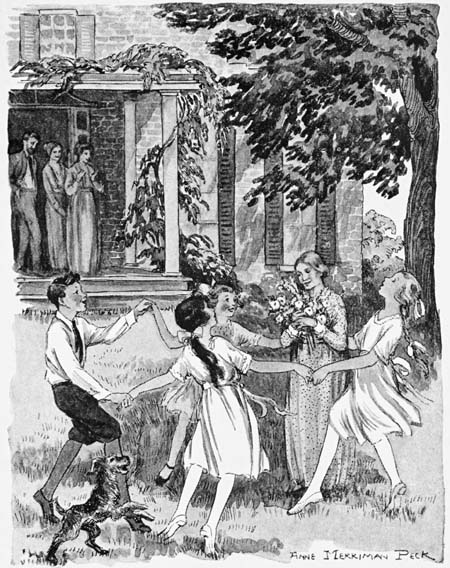
“WE’RE ALL TOGETHER, FOREVER AND FOR AYE,” THEY SANG.
At last Poppy came tearing into the house.
“They’ve come! They’ve come!” she shouted. “Ichybod’s along. Oh, gosh!”
Everybody who heard her echoed what Poppy [241]meant when she exclaimed: “Oh, gosh!” It didn’t sound prayerful, but Poppy’s feeling when she said it made it a prayer for good news.
“Hello, daddy!” shouted Mark, without turning to see the expression on his father’s face. If he were the bearer of ill-tidings Mark wanted one cheerful greeting to reach him before his family knew it; afterward no one would be able to speak quite cheerfully.
But as Gilbert Hawthorne came into the room, followed by queer little Ichabod Lemuel Rudd, before any of the children had ventured to look at him, Motherkins cried:
“Oh, Gilbert! Oh, my son!”
Then the children turned to see. Motherkins sat erect, leaning forward in her chair, her work fallen, her hands clasped, her face radiant.
One glance at Mr. Hawthorne, and they all knew the gist of what he had to tell. He looked triumphantly young and happy; his eyes were beaming. He strode over and caught up little Motherkins, as he might have swung Poppy, high in his arms.
“Surest thing in the world, Motherkins!” he cried, laughing in joyous excitement. “Ichabod told what he knew, and the lawyers cross-examined him—Maurice Ditson’s fellows were present, too—and he couldn’t be tripped up; besides, [242]he had his proofs! And Ditson’s lawyers advised him to drop it as quick, and considerably quicker, than he could! He should be grateful not to be prosecuted for attempted felony. Of course, nobody wants to bother with him, but it’s not a pretty thing to have known about a man that he has tried to steal!”
“I wouldn’t of told,” said Ichabod, in a worried voice, “but I knew my dear old friend, the kindest friend a man ever had, would have wanted me to. He’d have blamed me if I hadn’t. I wish Maurice wasn’t his son; I wish his name wasn’t Ditson! But often and often his father wished the same. He was a sore trial to his father, a sorrow that ate right into him. I know he’d say I must stop his doing any more harm, if I could.”
“Surely he would! Whether we were to gain or lose by it, I should say the same, you faithful Ichabod!” said Motherkins, touching the queer little man’s arm, and as he revered Motherkins beyond all words, this consoled him for the pain of doing something that distressed him to do.
“And we are safe, Gilbert dear?” she added, turning to her son.
“Completely safe, and for always,” said Mr. Gilbert. “Mark, old chum-son, I haven’t spoken [243]to you. Good news, laddie; everything is all right.”
“Pretty good to hear, daddy,” said Mark. “I’m too glad to know how glad I am.”
Isabel, Prue and Poppy had stood motionless, soundless, listening and watching.
Now Isabel stirred, pale from excitement, and seized Prue around the neck, hugging her till she choked her.
“They—are—not—going! They—are—not—going—away—at—all!” Isa said slowly, in a sort of rapturous trance.
This set free Poppy’s pent-up emotion; she realized that what Isa said was true.
With a shriek that made everybody jump, Poppy threw herself over on her hands and cartwheeled all around the room and out of it before Motherkins, a little shocked, could stop her. Out of the room she went and down the hall. Then they heard her singing at the top of her really wonderfully beautiful voice, the song growing fainter, and they knew she was running around the house, just as Bunkie and Pincushion ran when they wanted to have a celebration.
The words of her song reached them; they were simply these:
“Oh, whoop, whoop, whoop, whoopity whoopity [244]whoop. And whoop, oh, whoop, oh, whoop! Forever whoop, whoop, whoop, amen!”
“What we’re going to do,” announced Isabel after they had laughed at Poppy, “is to trim this house all over with all the flowers we can get! We’re going to take Hurrah—please, Motherkins!—and get flowers from every one we can. And we’re just going to hang them all over Hawthorne House to show it how we feel about it’s staying Hawthorne House.”
“Second the motion!” cried Mark, starting up ready to go.
“Oh, but, Isabel, Hurrah may meet paper in the road!” objected Motherkins.
“Not in such a neat town as Greenacres! Oh, Motherkins, we took him all the time before that one day when it happened, so please don’t be afraid!” Isa pleaded.
“We must take some risks,” Mr. Hawthorne said, to Isa’s intense relief, when his mother looked at him for an opinion. “We don’t have papers flying around our streets; Isa is right. The children must have a vent, little mother!”
So in a short time the buckboard, with its three girls and a boy, started off to get a load of flowers. Poppy had thoughtfully taken the clothes basket, and Mark played at juggling with a bushel basket, seated on the end of the buckboard, [245]facing outward and dangling his slender legs, as he always did.
At the Wayne and the Lindsay houses there were many flowers, so many that it seemed likely that the children could not pick them in time to go farther.
Mrs. Lindsay had run across to her neighbor’s to enjoy the children’s good news with her, and she said:
“Helen, we will gather all the flowers that we have, you and I, and take them up to Hawthorne House, while the children go on begging for more; shall we?”
And Mrs. Wayne had answered:
“Yes, Margaret; we couldn’t keep away, could we? Aren’t you quite beside yourself to see dear little Mrs. Hawthorne with her last anxiety forever laid at rest? The dear little soul! I’ve been so troubled over it all!”
“Drive on, then, Merry Beggars, and ask all Greenacres to give you blossoms!” cried Mrs. Lindsay, looking like a happy child herself.
Flowers! Isabel, Prue and Mark had to walk beside the buckboard, there were so many! They had no expectation of what happened, but everybody loved Motherkins, the whole town knew how sad her life had been and rejoiced that another sorrow had not fallen upon her, so the [246]Greenacres women showed this feeling by stripping their gardens of all their bloom to adorn Hawthorne House for its rejoicing.
Walking up the street, with Poppy’s red hair topping masses of red blossoms in the buckboard abreast of them in the road, Isabel and Prue met Kathie and Dolly coming around the corner of a side street, turning in the direction in which they were going.
All four little girls stopped and looked at one another, half smiling, hesitatingly, sheepishly. None of them had the slightest desire not to speak, but no one knew whether the others felt like answering.
“Hello,” said Isabel, realizing that something must be done by somebody; it would never do for every one to stand there always, waiting for some one else to break the ice.
“Hello. Are you mad?” asked Kathie.
“We never were, so we’re not now,” said Prue reasonably.
“I was,” Kathie said, “but I’m over it. I’d like to make up.”
“We only wanted to know who it was went into that room; we only asked,” Prue said unwisely.
“But if we get to talking about that we shall not make up,” Isabel interposed.
[247]“Call it made up and let it go at that,” Mark advised. “Every one agreed?”
“Yes. Agreed!” the four little girls repeated.
“Come on up to the house. We’re going to trim it up and be glad. We know now who it was climbed up into the Club Room; the same one who took the coins and returned them; the queer little man we saw in the woods. Oh, it is a wonderful story!” cried Isabel, taking Kathie’s arm, who at once pulled it away to put it around Isabel’s waist in closer token of reconciliation.
“Tell it,” Kathie said, and Isabel told it, frequently helped and hindered by Prue’s and Mark’s additions, or Kathie and Dolly’s exclamations.
“And we’re going to trim the house with flowers everywhere; in all the rooms, anyway. It looks as though we had enough to trim all the trees outside, but they don’t reach as far as you’d think when you see them like that.” Isabel ended the story of the narrow escape and the queer little man, with a gesture toward the buckboard, heaped high with blossoms.
“There are our mothers with more!” cried Prue, as they turned into the driveway and caught sight of Mrs. Wayne and Mrs. Lindsay on the lawn, shaking out and assorting the baskets of flowers which they had got Prue’s big [248]brother to help them bring to Hawthorne House.
It was lucky that Kathie and Dolly had come up to the rejoicing. There were such quantities of flowers to place! Everybody talked at once, but it did not matter; nobody waited for, nor wanted a reply.
With amazing speed Hawthorne House was set abloom. In every room there were flowers, masses of flowers, and over the front door, on the ledge of its old-fashioned transom, Mr. Hawthorne had the bright idea of setting bowls, from which long festoons of vines and blossoms of nasturtiums made a glory that looked almost as if a bonfire were blazing there.
At last it was done; Hawthorne House was abloom!
“Well, it truly does look glad!” sighed Isabel in profound contentment, leaning her head, all ringed with her disordered dark hair, against her mother.
“What shall we do with Ichabod Lemuel Rudd, children?” asked Mr. Hawthorne. “Quick before he comes! He is alone in the world. Mr. Ditson looked after him, but since his death the queer, devoted little chap has gone solitary, with a lonely heart. And he saved us from the loss of this house and one another. Who can suggest a plan for him, to be told him when he comes back?”
[249]“I can!” said Poppy instantly. “Adopt him, like you did me, and we’ll give up the Club Room, and it can be his, and he can shin up outside whenever he wants to.”
Mark laughed, but he said: “Pops hit it! There’s room enough for the queer little man in this great place, and we all like him a whole lot now.”
“Mother?” queried Mr. Hawthorne, turning to little Motherkins.
Motherkins smiled her placid smile, eyes and lips warm with it.
“I adopted Bunkie when he was hurt—to be sure, Isabel took him afterward—but I did adopt him! And Poppy, too. And then I had no home that was my own, and no certainty of enough for myself. I think we ought to give a share of our happiness to Ichabod Lemuel Rudd—I’m sure he’ll give us as much as we do him, in another way! And think of the pleasure of calling his name!”
“Trust Motherkins to cover up her goodness with a laugh!” cried her son.
“A laugh doesn’t cover up goodness; I think it often proves it, Gilbert—that kind of laughter!” said Mrs. Lindsay.
“He’s coming; tell him, Mark,” murmured Motherkins.
[250]“Ichabod, we—I mean Motherkins and my father—well, all of us—oh, gracious! Say, Ichabod, we want you to live with us, here, you know; take that room we had to play in, where you climbed in and slept, you know. Live with us right along; will you?” Mark said rapidly after he had hesitated for a beginning; he blushed painfully, embarrassed by his office.
“Oh, jiminy cats! Oh, what’ll I say? I—I—I appreciate it,” said poor Ichabod, and burst into tears. He was indeed a lonely, longing little creature, and it seemed to him that heaven had almost opened when Mark voiced a desire on the part of these dear people to befriend him.
“I’ll do things; I’ll help; you shall never be sorry,” he managed to say, gulping down great sobs.
“Do you remember, Prue and Poppy, the day we opened the Club Room, we said it was just opening it, and we didn’t know what would go into it?” whispered Isabel, drawing Prue and Poppy’s heads together, the better to hear her. “It was true, wasn’t it? Isn’t it nice to have the dear little queer man, who so needs it and all of us, go into it?”
“I feel that there is ice cream somewhere!” said Mr. Hawthorne, sniffing the air. “I smell ice cream and beau-ti-ful cream puffs somewhere! [251]Come on and find them, all of you! I guess there’s an ice cream freezer full, and that it holds four gallons—one vanilla, one chocolate, one strawberry, one caramel! Come and see how well I can guess!”
“Because you know!” shouted Poppy with shrill ecstasy. “Oh, you great Mark’s-daddy! You treated!”
“It’s the house,” Mr. Daddé corrected her solemnly. “The house treats us all—treats us the best it can. Let’s cheer the house gratefully, thankful it’s to hold us all together.”
The cheers arose, loud and prolonged, and Bunkie and Semper Fidelis barked their parts in them, while Cushla-machree, alias Pincushion, ran up a tree to be on the safe side, in case it meant danger.
Mark caught Isabel’s hand; she understood and took hold of Prue, Prue of Poppy, Poppy of Kathie, Kathie of Dolly, Dolly of Mrs. Lindsay, she of Mrs. Wayne, and Isabel completed the circle by taking Mr. Hawthorne’s hand in her other hand.
“Oh, gracious, there’s Ichabod!” cried Poppy, and widened the circle to let in the queer little man, just as they had widened their home circle to take him in.
Then, with shrieks of joy, they danced around [252]and around Motherkins, and Isabel put the meaning of the dance into words:
“We’re all together, all together, all together forever and for aye,” she sang.
The others joined in her song, and thus they wheeled and danced, grown-ups and children, quite dementedly singing the words that mean so much when people love one another:
“We are all together, all together, all together forever and for aye!”
TRANSCRIBER’S NOTES:
Perceived typographical errors have been corrected.
Inconsistencies in hyphenation have been standardized.
Archaic or variant spelling has been retained.