CIRCE
A
Dramatic Fantasy
by
Isaac Flagg
With a Frontispiece
by
Bernard Maybeck
Copyright
1915
By Isaac Flagg
Acting Rights Reserved
To
Mabel Lammé Hays
PRINTED AND BOUND BY
THE ROYCROFTERS
EAST AURORA, NEW YORK
[1]

Homer relates that Ulysses, king of Ithaca in Greece, sailing homeward after the capture of Troy, drifted into unknown seas in consequence of the wrath of Neptune; and after losing all but one of his twelve ships, landed with the sole remaining vessel upon the island of the enchantress Circe, who transformed one-half of his ship’s company, twenty-two in number, into swine. He relates further that Ulysses, apprised by Mercury of the fate of his companions, and furnished by the god with an antidote for the spells of the sorceress, compelled her to restore his men to their human shape. Thereupon, at the invitation of Circe the rest of the crew join their mates at her palace, where all spend a year in festivity and merry-making before proceeding on their way with precise instructions from the Enchantress regarding the homeward voyage.
The experiences of Ulysses and his followers, as described in the Odyssey, immediately previous to their arrival at the Isle of Circe, had been of an extraordinary and alarming character. A number of men had been devoured by Polyphemus the Cyclops in his cave, where he had entrapped a party, the survivors escaping by riding out, clasped under the bellies of his sheep, after they had made the monster drunk and blinded his one eye with a fiery stake. Later, they came to the domain of Æolus, king of the winds, who [2]presented Ulysses with a number of bags holding the adverse winds in confinement. But during the sleep of their commander, when already near their native shore, some of the men through curiosity untying the bags, the winds broke loose and swept them back to Æolus, who drove them all forth with contempt. They next encountered the Læstrygones, a race of man-eating giants. Being shown the way to the town by a daughter of the giant king, some men were seized and devoured on the spot; while from an attack made upon the ships collected in the harbor only one vessel succeeded in escaping.
No mention is made of Penelope, the wife of Ulysses, at any point in the story of Circe; but we read that Ulysses lingered in the enchanted island, until his men were finally compelled, seizing an opportunity when Circe was away, to remonstrate with their chief and rouse him to thoughts of a return to his home.
Homer says that the attendants of the Enchantress in her palace were nymphs, such as derive their being from the fountains, the groves, and the rivers flowing to the sea.
The First Act of the play brings Ulysses and his companions into Circe’s palace; the Second Act takes them out of it.
[3]
A
Dramatic Fantasy
| CIRCE, the Enchantress | ||
| Philinna | } | Nymphs, companions and attendants to Circe |
| Thermia | } | |
| Myrto | } | |
| Thrattis, the lute-girl | ||
| Graea, the dumb swine-maiden | ||
| Other nymphs attending Circe | ||
| Mikkos, an ape | ||
| ULYSSES, a Commander | ||
| Eurylochus, his mate | ||
| Theron, the ship’s cook | ||
| Elpenor, a feeble-minded youth, the cook’s assistant | ||
| Glaucus | } | Sailors |
| Phorbas | } | |
| Philemon | } | |
| Xenias | } | |
| Other members of Ulysses’ ship’s-company | ||
| Mercury, Messenger of the Immortals and Luck-bringer to men | ||
The Place: A small woody island, inhabited only by the Enchantress and her Nymphs, who dwell in a palace at the centre and summit of the isle.
[6]



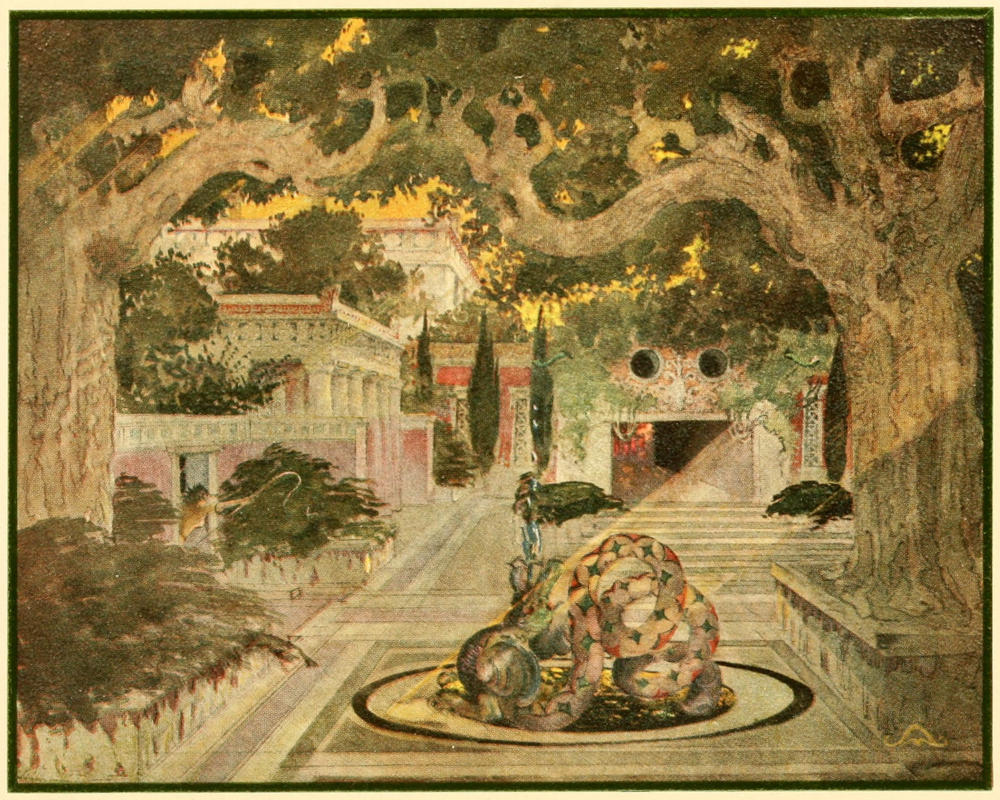
A preliminary scene of mute action. The front of Circe’s palace at the hour just after sunset. The edifice is of variously tinted stone, a combination of several architectural masses. The windows of the building are tall and very narrow, overshadowed with creeping plants. Its main entrance, at the Left of the Centre, is from a massive porch with gargoyles of serpents at the corners of its roof. The porch is reached by a flight of wide, low steps; the doorway itself, low and wide, deeply receding and darkened by the ample foliage of overhanging vines. The palace faces eastward upon a smooth open court-yard enclosed by a wall of stone with spacious gateway at the Right. The entrance to the court at the Left corner of the building is inconspicuous. At the main gateway there is artificial representation of wolves and leopards as if tame and serving as watchdogs. Behind the court-yard wall rise large trees throwing deep shadows in the twilight. A fountain, dragon-shaped, with circular basin, is centrally placed in the court, that is just at the Right of the porch steps.
As the curtain rises, a humming sound as of a swiftly turned spinning-wheel is heard behind the scenes; and [7]presently the music of Circe’s song (the words of which are sung in a later Scene) is played upon flute and violin. The fountain is playing, and its spray, rising and falling intermittently, gleams with a golden light, occasionally changing to a faint blue, and then becoming golden again. Some of the serpentine gargoyles are seen to sway and writhe like living snakes. A large ape emerges from a small window above the porch, stands upon its roof at first erect like a man, then poses upon all fours at the edge, trying to look underneath into the doorway, and remains in this position. A glimpse also is caught of the Swine-maiden, a tall, gaunt, witch-like figure robed in gray, trailing behind her a very long cowhide whip. Appearing suddenly from some place of concealment she passes furtively and silently, with long strides, across the Left corner and disappears behind the palace.
Interior. The banquet-hall of Circe’s palace. A long, low apartment, clearly but not brilliantly illuminated by torch-wood burning upon cressets in the rear, Right and Left. The walls and ceiling of the room are of neutral tint, light shades, but nowhere white; the decorations, of simple Grecian type. Two wide entrances at the rear afford glimpses of a back corridor dimly lighted; between these doors a large spinning-wheel of fantastic pattern stands near the wall. On the Right a curtained opening leads to the boudoir of Circe; and another door is situated further back on this side. On the Left, directly opposite the boudoir, is an entrance from an alcove or passage-way communicating with the porch; [8]in front of it a dais or platform, raised one step higher than the floor of the apartment. Near another door far back on the Left stands a large sideboard or buffet showing the usual garniture. Between the boudoir and the dais, thus centrally placed but a little forward, are two large, low tables nearly square, standing end to end, but far enough apart to allow free passage between them, and showing clearly the spinning-wheel behind. Three tall armchairs or thrones stand, one at the end of the table on the Left, in front of the dais; another at the opposite end of the other table, by the entrance of the boudoir; the third at the left hand of the second throne, behind the table. There are numerous other small Greek chairs without backs. Each table is spread with a light brown cloth. Upon the table at the Right are several pieces of plate and a low spreading vase of flowers near its centre; a flagon and goblets upon the other table. As the curtain rises the music ceases, but the humming of the wheel is continued. Circe is seen seated upon the throne at the head of the table by her boudoir. Her slender golden wand is carelessly thrown upon the table before her. Her black robe she has pushed away from her shoulders over the back of her chair; but she wears her coronal of pearls confining massy black hair, with long, light, pearly veil depending from the diadem behind. Her tunic is of canary-colored silk; she wears crimson sandals, and a golden serpent bracelet encircles her left wrist.
Philinna, a blonde, of beauty comparable to that of Circe herself, but of the opposite type, in dress and in all other respects forming a contrast to the Enchantress, stands behind the throne at her mistress’ left hand.
[9]
The place of Thermia, a nymph of elegant figure and winsome expression, is behind the table on the Left, near the throne at its head by the dais.
Myrto, who has dark hair like Circe, but is of small stature and not marked by especial beauty, sits facing the Enchantress by the spinning-wheel, which, as she swiftly turns it, gives forth the melodious hum that fills the air when the curtain rises.
The predominant color of Philinna’s dress is mauve; of Thermia’s, azure; of Myrto’s, dark green. Other nymphs are drest in light gauzy material, never pure white. All wear Grecian costume.
As Circe turns toward her with a slight gesture, Myrto stops the wheel.
Circe
Philinna
Circe
Myrto
Circe
Myrto
Circe
Myrto
Philinna
Circe
Thermia
Circe
[13]
[The door at the Left is opened by Thermia, showing a golden-gleaming light in the passage-way behind it. Immediately Mercury enters, standing as he first speaks upon the dais. His winged serpent-twined wand is brilliant with inlaid mother-of-pearl. Dewdrops glisten upon the wings of his cap and sandals. The mutual demeanor of Mercury and Circe is friendly, but not familiar. Neither makes show of deference toward the other. Mercury does not remove his cap. He takes no notice whatever of the nymphs.]
Mercury
Circe
[Mercury seats himself upon the throne at the head of the table near which he stands. Thermia takes his wand and lays it upon the table.]
Circe
[14]
[Thermia serves him from the sideboard and remains standing in attendance.]
Mercury
Circe
[15]
Mercury
Circe
Mercury
[Thermia hands Mercury his wand as he rises from the throne and steps upon the dais.]
Circe
Philinna
Circe
[Philinna seats herself in the throne near Circe. At the same time Thermia takes her seat upon one of the chairs at the other table, resting her left arm on the table.]
Circe
[17]
Thermia
Myrto
Circe
Philinna
[18]
Circe
Myrto
Philinna
Thermia
Circe
[Laying her left hand upon Philinna’s right arm]
Myrto
Thermia
Myrto
Thermia
Philinna
Thermia
Philinna
[Springing from her chair and drawing back behind it]
[22]
Circe
Philinna
Circe
Thermia
Circe
[Circe leans back in her chair, playing with the wand that lies on the table. Then straightening up and looking across the room she claps her hands twice. Directly the lute-girl Thrattis enters at the Left corner. She stands leaning against the sideboard and strikes chords upon her instrument as prelude.]
Myrto
Circe
[She signs to Thrattis, who begins a dancing tune. Other music is heard in accord with the lute. Philinna and Thermia dance, not as partners, but singly, with Grecian or Turkish movement, passing round alternately between the tables and in front and behind them. Circe leans back and looks on with evident pleasure, beating time informally with her [25]wand. Immediately when the dancing begins, Myrto runs out at the Right centre for Mikkos; but at the same time Mikkos darts in at the Left centre, drops into Myrto’s seat, and begins to turn her wheel. The ape wears a handsome collar with about four feet of light brass chain hanging from it. Myrto follows laughing, seizes the chain, and pulling Mikkos to his feet the girl and the ape dance, confining themselves to the back part of the room. Myrto’s dancing is similar to that of the other two nymphs, except that she does not display the same arm movements. Mikkos dances only as an ordinary trained simian might succeed in doing. Next, Graea the swine-maiden enters at the Right centre and joins in the performance. Her dancing, which she confines to the corner of the room opposite Thrattis, consists in snaky, gyratory movements, stooping and with long steps trailing her great whip slowly in circles upon the floor.—Presently Circe, drawing her black robe over her shoulders, still holding the wand, rises from her throne. The music ceases. Thrattis, Mikkos, and Graea disappear, and the three nymphs come to a standstill at about their usual places in the room.]
[26]
Circe
Thermia
Myrto
[27]
Philinna
[The curtains of Circe’s bower are drawn away, revealing some part of its interior and a nymph standing on either side. Circe moves slowly backward to the bower entrance; and her three nymphs move backward toward the several exits.]
Circe
[The music of Circe’s song is again heard, and the drop-curtain falls while all are just disappearing. Philinna goes out at Right 2; Thermia at Left 2; Myrto at Left centre.]
[28]
A camp by the seashore just before sunrise. The ground rises at the back and Right, rough with shrubbery and rocks. A galley of antique build has been drawn upon the sand crosswise at the Left and there are glimpses of the sea on this side. The mast has been unstepped and a few long oars lean against the side of the vessel. There are other signs of a recent disembarcation. Articles of nautical and warlike use lie on the ground or hang upon bushes and rocks; wine-jars, cups, plates, etc. have been deposited. The forms of a numerous company of men are seen sleeping on the ground, wrapped in their blankets, here and there near the ship.—In the foreground at the Right centre a fire of small sticks is beginning to burn under tripod and kettle. Theron, the cook, is seen seated on the ground near the fire, washing strips of meat for roasting. From the low branch of a tree near him hangs the well stripped carcass of a deer, the hide and the head bearing large antlers in full view near by. Elpenor, the cook’s helper, is at work trying to make the fire burn.
Theron
Scratch together another stick or two of wood, youngster.
[Enter Glaucus at Right with a jar of water which he sets down near Theron.]
That will do for water, Glauc. Take a hand now and help the lad blow the fire a bit.
[29]
Glaucus
So I will, though I be a trifle blown myself, tramping up and down to that spring.
Theron
That’s where the commander pinked the deer yesterday, eh?
Glaucus
Ay, ay; the old man hasn’t forgotten how to let slip an arrow since we became water-dogs, for certain.
Theron
’Twas a crack piece of venison he fetched in and no mistake! There’s a strip or two left for breakfast; but I reckon we’ll have to make a soup of the hide for dinner—that is if other game doesn’t turn up. [He lays pieces of meat spitted over the coals.]
Glaucus
The soup’ll do them. They took solid meat enough aboard yesterday to last for a week’s voyage.
[30]
Elpenor
When I saw them eating, it made me think of father feeding the hogs up in Cephallenia.
Glaucus
They’re grunting yet. Just hear the beggars snore! And we turned in before sunset too.
Theron
The Pramnian’s responsible for that: we tapped four jars. It’s the same as keeled over that beastly hulk of a Cyclops.
Elpenor
The commander took a mighty round swig himself; I saw him.
Glaucus
Trust him for keeping his head level. Besides, he can carry more of the rosy than any three of us.
Theron
Pass over those barley spats, boy—ah! you’ve got them too wet, you monkey.—Say, Glauc, how would you like to see such a thing as a woman again, eh? [Theron grins and nudges Glaucus’ knee with his elbow.]
[31]
Glaucus
Well, you’re right; it is a long time since.
Elpenor
Wasn’t that a woman you saw at the last landing-place?—there where they smashed all the ships we had but this one.
Theron
What!—the giant’s daughter? Bless you, boy, that was a waddling mountain, not a woman!
Glaucus
You might throw your arms round her waist twice, Elpy, and never touch the tips of your fingers.
Theron
By the powers, she was a hogshead to tackle; ha, ha!
Glaucus
If there be female inhabitants of this prickly country, it’s to be hoped they’re not built after that pattern. But everything here wears horns, so far. [He taps the antlers of the stag.]
[32]
Theron
Well, we’re nigh about ready. Set those plates round in just a little order. Call ’em up, Elp! Take my knife here and hammer on that shield hanging by the tree. The sun’ll be on us shortly. One more jar of water, Glaucus. [Exit Glaucus.]
Elpenor
[Pounding on the metallic shield] Ding, dong! Cling, clang! Breakfast! Get up! Get up! Breakfast! Ding, dong! Cling, clang!
[The men rise one after another from their beds on the ground and adjust their garments, which look stained and weather-worn. Glaucus re-enters and pours water into several basins for the men to wash their hands. They gradually find seats on the ground near the fire and begin to eat, the cook and his assistant serving them informally. The conversation begins while they are dressing and getting ready, before they sit.]
Phorbas
[Looking around him suspiciously] I wonder on which side the sun rises in this blessed country.
[33]
Philemon
On the east side, maybe; leastwise it ought to come up opposite to where it went down yesterday.
Phorbas
Well, who remembers where that was? Split me if I do!
Glaucus
Avast there! the sun’ll peep over in a jiffy—by the spring yonder. [He turns his thumb backward to the Right.]
Phorbas
All the same we don’t any of us know where we are.
Theron
We’re supposed to be at the breakfast table now, lads. Fall to if you’ve got any appetite left over from yesterday!
Xenias
We’ve got more appetite left over than you have chops, cook.
[34]
Theron
Ay, every chop’s a sparerib this morning—except a few choice cuts here for the commander and the mate. They’re done now.
[He takes the meat from the fire into a platter.]
Here, young man; take ’em over to him round the other side of the ship.
Elpenor
[As he goes out] We’re going to have soup for dinner. [He disappears behind the vessel.]
Philemon
Look here, Theron; did you put the charcoal in these barley cakes before baking or after?
Glaucus
Pooh, pooh! Never mind the grit, man; it’s an aid to digestion. We’re lucky enough to have groats aboard, anyway.
Phorbas
We’re lucky to be alive! By Apollo, how I shiver when I think of that Æolian duffer and the cursed wind-bags he palmed off on us!
[35]
Xenias
’Twas worse than a hurricane on the wrong quarter when they blew up—took us straight back to the old boy himself.
Philemon
He was a windy humbug! You’d have thought, to hear him talk, we’d be back home in Ithaca inside of twenty-four hours.
Phorbas
And now we’re only here! Another cannibal island, I’ll bet my pile! Ye gods! I wouldn’t go up ten rods from the shore for a gold mine.
Theron
Well, the commander took a little walk yesterday and nobody ate him up. He didn’t make much of a report as to what he saw; but I’ve a notion he’ll say something about it to-day.
Glaucus
Sh—here he comes now! Mind your taps, men!
[36]
[Enter Ulysses and Eurylochus at the Left from behind the ship. The men finishing their meal salute without rising and arrange themselves comfortably and informally on the ground in a sort of circle looking toward Ulysses in the centre. Elpenor re-enters behind the two and sits down with the others. Eurylochus also seats himself upon the ground at the right hand of Ulysses. In appearance the mate is distinguished from the crew mainly by wearing fresher and less weather-beaten garments. Ulysses wears a helmet and carries his sword and baldric in his hand. He throws the weapon upon the ground, and as he begins to speak takes off his helmet, holding it swinging by its strap in his left hand while he stands and speaks. The rays of the rising sun now strike over the bank behind him.]
Ulysses
Several Voices
[37]
Eurylochus
Ulysses
Philemon
We thought you might tell us, sir, what the prospect showed when you stepped out yesterday and got the deer.
Phorbas
We’re hoping to sail away from here directly.
Ulysses
[As Ulysses pauses, some of the men, all of whom are looking to him intently, shake their heads or rock themselves to and fro, and faint groans are heard.]
[The men give utterance to loud sighs and groans.]
[39]
[The men manifest great perturbation; some gesticulating and shaking their heads; others rising to their knees and striking themselves. Mutterings and faint outcries escape them.]
Eurylochus
[40]
Ulysses
Eurylochus
Ulysses
[At a sign from Eurylochus men to the number of one-half the crew arise and group themselves around him on the Right. The rest remain seated nearer Ulysses. Eurylochus’ company includes Glaucus, Theron, Elpenor, and Phorbas.]
Ulysses
[All of the men are visibly disturbed and give increased and anxious attention.]
[Sensation among his hearers]
[Eurylochus with assistance from others finds upon the beach two small flat stones. These he scratches with his dagger, marking one with a V, the other with an E.]
[42]
[As he speaks Ulysses passes the helmet which he has hitherto held in his left hand to Glaucus. The two lots are thrown into the helmet; and Glaucus, standing in an open space and watched with intense expectation by all present, shakes it violently with a circular movement until one of the lots flies out and falls to the ground. The men strain their eyes toward the stone as it is picked up by Glaucus.]
Ulysses
Glaucus
[The announcement produces various effects upon the men. The party of Ulysses, seated upon the ground, strive not to show too plainly their sense of relief; while the standing company of Eurylochus are more openly affected. Phorbas in particular is in a highly nervous state, glancing now toward the hill, now toward the water. A few other timid ones in the same party demean themselves similarly.]
Ulysses
[To Eurylochus] Enough; make ready directly, and proceed with reasonable haste.
[43]
[The mate’s company move apart and make preparations, helped to some extent by the others. There is lively motion in both groups. They gather up things needful for an expedition, spears, staves, water-flasks, etc. Theron, a portly figure, does not change his cook’s garb, but buckles on a very broad belt with hanging straps, and whets his butcher’s cleaver with a stone. Shortly they are ready to start.]
Eurylochus
Ulysses
Eurylochus
[Eurylochus’ followers draw closer to their leader, apart from the others. All are serious. Individuals take leave of one another here and there with hand-shaking, etc.]
[44]
Ulysses
Xenias
[Seriously] Have an eye to Theron, Glaucus; let him not be too forward with that meat-knife of his!
Elpenor
[Taking hold of a strap at Theron’s belt] I shall hold him back.
Ulysses
Eurylochus
Several Voices on Both Sides
[45]
[The mate’s company go out at the Right and upward. Eurylochus himself is abreast of the foremost on their left. The vanguard consists of Glaucus, Theron (cleaver in hand), and Elpenor (a fragile, attenuated figure) behind the cook, holding at his belt. Phorbas and other timid ones bring up the rear. The drop-curtain falls as they move off while the rest watch them and wave their hands to them.]
[46]
The same as Scene I. The front of Circe’s palace. No music or other sound is heard when the curtain rises. The fountain plays as before.—Enter at the Right by the main gateway Eurylochus and his party, the men grouped similarly as at the close of the last scene, but in the reverse order. In advance are Phorbas and the other timid ones; they enter hurriedly, casting glances of alarm behind them. The rest of the party immediately follow; Eurylochus, Glaucus, and Theron last. Elpenor is in front of Theron, who pushes him forward. The whole company quickly come to a standstill in a single close group with considerable space between them and the steps of the porch. They scan the building and its environs with looks of wonder, especially fascinated by the fountain with its changing hues.—Eurylochus stands apart from the rest, his demeanor indicating hesitation and perplexity. While the others are talking he walks slowly to and fro, occasionally pausing and scanning suspiciously the various features of the scene.
Theron
It’s a rum go so far! eh, Glaucus?
Glaucus
[Shrugging his shoulders] Rum’s the word! An outpost of tame tigers! It beats anything we’ve walked into yet. Cyclops’ cave wasn’t a circumstance.
[47]
Theron
I had a notion to crack the skull of that overgrown wolf-cub when he landed his dirty paws on my shoulders. But he looked sort o’ gentle like, and besides I thought the old chap who owns the menagerie might take a miff—whoever he is.
Glaucus
It’s some retired show-man or prize-fighter, I reckon.
Theron
He’s got a blue devil penned up in his fountain, sure! Just look at that, old man; hock first, and blue vitriol at the tail end of it! There’s bitters for you with a vengeance!—Blast me, but I’m thirsty as an oyster, whacking a way up through that pesky brush-wood! If there’s a chance to wet our whistles inside the house it’ll be worth the dog-show twice over.
Phorbas
I tell you it’ll pay to be cautious about the inside. Ugh! it did make my flesh creep, crossing that cordon of wild-cats! There’s no knowing what we’ll put our foot on if we go farther.
[48]
Elpenor
I put my foot on a snake.
Glaucus
They put an architect to work here that saw snakes, anyhow. Take a look at those water-spouts, boys! [Pointing to the gargoyles]
Eurylochus
[Approaching the group] Well, men; what’s the next step? The commander said go ahead if the people weren’t unfriendly. The wild beasts out there were friendly enough, you might say; but there’s an uncanny look to it all.
Theron
I vote to go ahead and knock up the owner. If he’s no worse than his own whelps we can stand it;—especially if he stands for the drinks.
Glaucus
There’s no two-legged craft within hail outside—nothing but four-footed gentry out here.
Eurylochus
We might mount the stairs, then, cautiously, and [49]see how things look under the doorway yonder. [Shaking his head] But I fear enchantment.
[As they approach the steps the hum of the spinning-wheel begins to be heard. The men pause again, and look at each other a moment in silence. Eurylochus starts at the sound of the wheel, his features betraying heightened anxiety.]
Theron
[Slapping Glaucus on the shoulder] God-a-mercy, it’s womankind after all, Glauc! Come on! Ha, ha!
Elpenor
Maybe it’s a mountain.
[They all move toward the steps again. Theron, with Elpenor holding to his belt, and Glaucus are now in advance; Eurylochus is at one side; Phorbas and others are behind. As the first man sets foot on the steps the wheel stops humming and faint music strikes up as prelude to Circe’s song. Immediately a clear soprano voice is heard behind the scenes singing the air, the chorus of the song being performed by a quartette of women’s voices. The hearers are sensibly [50]affected, showing their feelings by appropriate pantomime as they alternately pause and mount slowly higher and higher upon the stairs. Eurylochus alone exhibits symptoms of horror and repulsion; the others seem to be charmed and lured on by the song. All of them except the leader are gathered together upon the porch close to the doorway when the last stanza is sung.]
Glaucus
[Loudly, in a musical tone] Hola!—hola!
[Directly upon the utterance of this call the low, shaded recess of the doorway, which was dark before, [53]grows bright with the same golden radiance that had shone intermittently upon the fountain; and the throng of visitors, excepting their leader, press swiftly forward and disappear through the opening. Again immediately the light in the doorway changes to blue, with electrical sparks. Eurylochus, who is directing his gaze toward the opening, shrinks back in alarm; and at the same moment the spray of the fountain becomes blue and remains of that color. Descending to a lower stair Eurylochus peers under the doorway, listening intently. No sound is heard. Then, his attention being drawn to the sombre hue of the fountain, while he is looking away from the entrance, a large serpent lets down its coils from the roof of the porch; and as the man turns again toward the entrance he is confronted with its wide-open jaws, forked tongue, and glittering eyes. As he retreats precipitately from the stairs the serpent draws itself up out of sight. Eurylochus stops once more in the foreground to watch and listen for some sign of his men within the palace; but as he turns toward the building, the head of a wolf with glowing eyes is protruded from a clump of shrubbery. Upon encountering this final apparition he flees in consternation from the scene.]
[54]
The Seashore again. The curtain rising discovers the men left behind at the camp sitting irregularly grouped near the fire-place. Ulysses stands apart from them by the ship, busied in inspecting his arms, the spear, bow, and sword, which hang near or lean against the vessel. When he unsheathes and sheathes the sword to examine it while his men are talking it is seen to have a brightly polished, rather broad, but not heavy blade. Most of the time he stands with face turned toward the water, his back to the Right.
First Sailor
Look here, lads; we can’t wait till noon for a bite! The commander ordered breakfast so rattling early this morning I’ve got a brand-new appetite already.
Xenias
Well, take a nibble on that pile of Theron’s charcoal cakes left over. They need a good appetite to make ’em slip down.
First Sailor
Maybe the mate or Glaucus’ll fetch in another stag or a wild goat on their way back.
[55]
Second Sailor
A wild goose more like; I wonder how far they’ve got anyway.
Philemon
They ought to turn up before noon. The commander said they might get up there and return in a couple of hours, as he judged—that is, if they scratched gravel lively.
Xenias
They’ve got Theron with ’em, remember; he can’t pass between two trees when they grow too near together.
First Sailor
No, but he can clear a path with his cleaver for two men—him and Elpy spindle-shanks.
Second Sailor
[In undertone] By the way, the commander’s pretty busy over there with his own cutlery. I wonder what he expects next.
[56]
Philemon
He expects to be ready, whatever comes. You don’t catch him napping. Besides, who wants a speck of rust on a hanger like that? The war’s an old story now; and this salt air’s the devil’s own invention to make a blade stick to the scabbard.
Xenias
’Twas a pity he couldn’t draw it on that Cyclops hog. But if we’d let the blood out of him it wouldn’t have let us out of his pesky cave with a giant’s tomb-stone clapped up to the door!—[Whistling low as he looks up. Xenias sits facing the Right.] Whew!—What’s in the wind now?
[All turn quickly toward the point indicated by the speaker, not excepting Ulysses, whose attention has been attracted by the whistle. At the Right from above Eurylochus enters slowly and hesitatingly, looking pale and haggard, his clothing torn and disordered by the brambles. Observing that all eyes are directed upon him he stops as if afraid to approach the company. [57]Most of the men rise to their feet and move toward him.]
Several Voices
Hi! hi!—what’s the good word?—News, news? Where’s Glauc? [Eurylochus responds only with deprecatory gestures.]
Ulysses
What? ho, Eurylochus! Hast tidings? Why alone?
What ails thee, mate? Speak out; tell us thy story!
[With gestures of dismay Eurylochus moves nearer to Ulysses, but does not speak. Ulysses regards him with an expression of deep concern. The other men gather more closely round the pair.]
Xenias
Wake up, man! What’s in your eye? We’re here to help; cheer up!
Philemon
[Patting Eurylochus on the shoulder] Out with it; out with it!—Go ahead; palaver!
[58]
Xenias
Open up, old fellow. You’re not dead, anyway. We’re used to funerals by this time. [Eurylochus remains in his despairing attitude and is still unable to speak.]
Ulysses
[Severely; taking a step nearer to Eurylochus, while the men fall back slightly.]
Eurylochus
[With effort; after further hesitation.]
[Immediately upon the conclusion of Eurylochus’ narrative Ulysses, who has listened intently, reaches for his sword near by; takes a quick look at the blade as he draws it partly out and then pushes it back into the scabbard; slings the weapon over his shoulder, puts on his helmet, and then turns to Eurylochus again. The latter exhibits fresh dismay at seeing [61]Ulysses thus arm himself. The other men also are visibly affected by their commander’s movements.]
Ulysses
Eurylochus
[Falling at the feet of Ulysses and clasping his knees]
Ulysses
[62]
[Eurylochus retreats and cowers while Ulysses speaks, at the same time gradually rising to a standing posture with his face toward the speaker. He does not join the group of the other men. These have their eyes fixed on the commander, some of them moving anxiously toward him. With his last words Ulysses starts to go out at the Right. Eurylochus turns away and sits upon a stone near the ship and the water at the Left, covering his face.]
Philemon
Ulysses
Several Voices
[The curtain falls as Ulysses disappears, while the men stand following his footsteps with their eyes.]
[63]
The same as Scene II. Circe’s banquet-hall.—As the curtain rises the party who entered the palace at the close of Scene IV are shown seated at the table on the Left, while Thermia and other nymphs serve them with food and wine. The cups are filled by pouring from tall slender pitchers of silver, and these in turn by dipping the wine with ladles from the punch-bowl on the sideboard. The Enchantress and her companions are in their usual places. Myrto turns her wheel slowly and intermittently without noticeable sound. Circe, seated as before at the head of the table on the Right, wears the same dress as in Scene II, but her black robe is not thrown off. The wand lies upon the table near her right hand, neither carelessly nor conspicuously placed. The throne at her left hand, behind which Philinna stands, is occupied by Mikkos, who wears a brightly polished collar.
The guests are all at the table farthest from Circe. The throne at its head, opposite her throne, is occupied by Elpenor. At his left, near the corner of the table, sits Phorbas, partaking freely of the banquet, but glancing nervously, now toward Mikkos and now toward the door behind the dais where they had entered. At the left of Phorbas sit some feasters with their backs to the audience. On the other side of the table, facing the audience, are Theron the cook (at Elpenor’s right) wearing his cap; Glaucus (the farthest in the direction toward Mikkos); and other men between Theron and Glaucus.
[64]
It is near the close of the entertainment. Appearances indicate that the banqueters have begun to feel the effects of the wine that is still poured freely. They are also partly dazed and partly exhilarated by the presence of the Enchantress and her elegant nymphs. The symptoms of intoxication and bewilderment on the part of the men become by degrees more manifest as the conversation proceeds. Glaucus preserves his dignity rather better than his companions; but he seems fascinated by Circe, to whom he is the nearest in his position at table; and he does not refrain from drinking copiously, nor show due caution or a disposition to remember the details of the mission with which Eurylochus had been entrusted.
Circe
Elpenor
Theron
Circe
[Some of the men are seen to be startled by this remark.]
Phorbas
Elpenor
[66]
Circe
[Patting the ape lightly]
Glaucus
Circe
[Here Myrto without looking up sets her wheel [67]a-spinning loudly for a brief moment, causing the banqueters to turn their eyes in her direction.]
Myrto
[Upon hearing Myrto’s voice Mikkos without turning toward her begins to raise himself by his hands upon the arms of the chair, but at a sign from Circe lowers himself to sitting posture.]
Theron
Circe
Theron
Circe
[68]
Thermia
Circe
Phorbas
[Looking anxiously at a platter before him]
Circe
Theron
Elpenor
Circe
[69]
Elpenor
Theron
Circe
Theron
Circe
Theron
[70]
Glaucus
Phorbas
[Rousing himself excitedly]
[Glaucus looks fiercely at the speaker and Theron extends his fist threateningly toward him. Phorbas shrinks away.]
Circe
Theron
Elpenor
[71]
Glaucus
Circe
Elpenor
Phorbas
Circe
Glaucus
[72]
Circe
Glaucus
[Glaucus is gazing at Circe admiringly.]
Elpenor
Glaucus
Circe
Theron
Circe
[73]
Glaucus
Circe
Theron
Circe
Theron
Elpenor
[74]
Circe
Theron
Circe
Phorbas
Theron
[He detaches the cleaver from his belt and lays it on the table, at the same time loosening the belt.]
[75]
Elpenor
Theron
Circe
Several Voices
Theron
[He leers again at Philinna, drains his cup and [76]waves it toward her.—Other men seem to pay increased attention to the nymphs serving them.]
Glaucus
Circe
[Here the ape slowly raises himself by the hands until all four extremities rest upon the arms of the chair, remaining a moment or two in this position before lowering himself.]
Theron
[He points to Philinna and indicates Thermia behind him with his left thumb over the shoulder.]
[77]
Elpenor
Circe
Philinna
Circe
[Philinna goes out at Right 2. The other nymphs present, except Myrto and Thermia, leave the room quietly and unobservedly, closing the Left central door. Theron’s song begins as Philinna disappears. The refrain and chorus are joined in by all the men except Elpenor and Phorbas, who look at each other and laugh.]
[78]
Theron
[Sings; still looking toward the door where Philinna went out.]
All
Theron
All
Theron
All
Theron
All
[79]
Circe
[To Glaucus] Would that song paralyze your leader, sir?
Glaucus
The allusion would prick him, madam; depend upon it.—
[Turning to Theron] One more, Thee,—till she’s back with the bitters.
Theron
All
Theron
[Here Theron takes his cap from his head and lays it over a plate.]
All
Theron
[80]
All
Theron
All
[With the last chorus Philinna re-enters bearing a punch-bowl of elegant pattern, smaller than the one on the sideboard at the opposite end of the room. She places the bowl upon the table before Circe, while the men become silent as they look on.]
Myrto
My lady, may Mikkos have a drop?
[At these words the ape begins to draw himself up by the hands again. Circe nods assent to Myrto.]
Circe
Philinna!
[Philinna fills a cup from the bowl and hands it to [81]the ape. She also sets a small cup of wine before Circe. Mikkos drains the beaker, holding it with both hands and throwing his head very far back; and while the eyes of all the men are directed toward him with amused attention Circe, opening a very small silver casket that hangs at her girdle, takes a fine powder therefrom and quickly throws it into the bowl. She draws the wand nearer to her hand.]
Circe
Thermia!
[At the word, Thermia passes up to Circe’s table and she and Philinna, filling pitchers from Circe’s bowl, proceed to refill the cups of the banqueters in regular order, Thermia from left to right, Philinna from right to left. Then as they meet at the centre both the nymphs retire together to the extreme Right near Circe. Meanwhile the sombre figure of Graea the Swine-maiden is discovered lurking in the corridor behind the Right central doorway.]
Circe
[Raising her cup] To the health of your backward leader, my brave guests!
[82]
Glaucus
[Half-rising; unsteadily] Out, out! To hostess, hostess! Here’s to hostess!
[All drink; and the effects of the drug straightway become apparent. An expression of stupefaction and horror passes over the faces of the men. They look at each other vacantly with forced smiles; their heads and arms sway and droop; they swing round in their seats and are evidently unconscious of their situation. At the first symptoms of this delirium the Enchantress rises deliberately from her throne, wand in hand; and gliding along the line toward the Left taps lightly and quickly each man with the wand without pausing in her course. Then she steps upon the dais.]
Circe
[Sternly; with wand pointed upward and back toward the Right centre]
[Directly Graea, who during Circe’s movements has stridden noiselessly into the room and has passed along its edge behind Thermia and Philinna and the Enchantress’ throne until in front of the other table near the point where Phorbas sits, raises her [83]long whip and cracks it fiercely with sharp detonation at the men’s feet. In a huddle they rush tumultuously away with drooping heads and arms to the open rear doorway and out through it, passing in front of Myrto and her wheel and followed by Graea lashing furiously. Some of the fugitives, as they drop on all fours near the exit, are seen to have already developed curly pigs’ tails at their posteriors. As the victims rush forth Mikkos springs upon the empty throne of Circe and balancing himself upon its arms gazes intently into the bowl on the table before him, while Myrto sets her wheel revolving and humming loudly. The drop-curtain falls just as the door closes behind the herd and Graea disappearing over the corridor.]
The several positions at the fall of the curtain are as follows: Circe stands upon the dais with wand raised in the attitude described. Myrto sits at her wheel, which turns more and more slowly as the curtain descends. Philinna and Thermia stand near the boudoir, still holding their pitchers, the hand of one girl resting on the other’s shoulder. Mikkos, poised upon Circe’s chair, his head lower than his tail, pores intently over the punch-bowl. No person exhibits signs of amusement or excitement of any sort. Their faces are serene, their figures motionless. The wheel comes to a standstill just as the descending curtain hides it.
[84]
The same as Scenes III and V. The Seashore. Eurylochus is still seated on the stone by the ship, gloomy and dejected. The other men stand in a group not far from him, apparently discussing some serious proposal.
First Sailor
Anyway he ordered us to stay here and guard the ship.
Philemon
Just so; I believe in obeying orders myself; but, lads, this is an extraordinary case.
Second Sailor
A case it is! But the commander’s equal to it I reckon.
Xenias
The commander’s equal to anything on a square deal. But it’s odds here against one man; he’ll need help if the land lies the way the mate makes it out.
Eurylochus
[Turning and facing the others without rising]
Several Voices
Xenias
Bother the ogre! The commander’s started now to pull half the ship’s company out of a hole and if a human subject could compass the business he’s it. But if there’s a dash of witchcraft here, we ought to be with him and shoulder our share.
First Sailor
Eurylochus
[86]
Several Voices
Philemon
Mark my words, lads; if the other fellows have got to trot round in wolf and tiger skins we’re bound to go on all fours along with ’em and not leave ’em in the lurch. If the commander’s beating his way back we shall meet him on the trip; if he isn’t, he’ll need help for certain. We’ll walk into that domicile, witch or no witch!
Second Sailor
Take her by storm!
Several Voices
Right, right! Come on! come on!
Xenias
Eurylochus here’ll stand shipguard. He won’t shove her off all alone I reckon.
Philemon
[87]
[The men stir about, making ready for their departure.]
[They march away briskly, going out as the other party and Ulysses had gone. Philemon leads; Xenias brings up the rear, watchfully.]
Xenias
[Turning back, at the last moment]
[As the party disappears Eurylochus with a gesture of despair flings himself down by the keel of the vessel.]
[88]
A grove upon sloping ground near Circe’s palace. Large trees cast deep shadows with sunny spaces between. The mansion itself is not visible; but on the Left at some elevation a glimpse is afforded of the court-yard wall. A faint pathway amid shrubbery winds from the Right front upward and out on the Left at the rear.
Enter Ulysses at the Right, tracing the path slowly and cautiously. Perceiving the wall above and before him he pauses, moves his right hand involuntary toward his sword-hilt and lifts the left to his lips meditatively. While he thus stands reconnoitering and pondering, Mercury suddenly appears before him, stepping noiselessly from the shadow of a tree upon the Left. At this apparition Ulysses draws back an instant with head slightly bowed, while his hand leaves the sword and is lifted to a reverential gesture. The demeanor of Mercury is easy and gracious. His insignia, though plainly recognizable, are less conspicuous and brilliant than they appeared in Scene II.
Mercury
[Taking the up-lifted hand of Ulysses]
[As the god speaks he withdraws his hand and indicates the direction of the palace. Ulysses recoils slightly at the last words of Mercury.]
[Mercury pulls from the ground, moving aside the undergrowth which concealed it, a small plant and shows it to Ulysses.]
[Ulysses receives the herb from the hand of the god with an air of profound attention and a shade of wonder.]
[90]
[Ulysses shifts his attentive regard from the plant in his hand to the speaker.]
[Ulysses’ look of wonderment increases as Mercury pauses.]
Ulysses
Mercury
[While Ulysses again looks down reflectively at the plant he holds Mercury suddenly disappears. Ulysses, looking up and seeing the god no longer, throws a keen glance in the direction of the wall. He then tastes and swallows a morsel of the herb; and as he moves on and goes out at the Left with firm step the music of Circe’s song is faintly heard behind the scenes.]
[92]
The same as Scenes II and IV. The banquet-hall. The common chairs have been removed. There are cups and a bowl on the table at the Right. The Enchantress and her three nymphs are in their usual places when the curtain rises: Circe sitting; Philinna and Thermia standing; Myrto seated at her wheel which she turns slowly. The attitude of the persons is one of expectancy. In a moment Circe, without turning her face, signs to Myrto with her left hand while with the right she draws the wand on the table nearer. The wheel ceases to revolve.
Circe
[Thermia throws open the door behind the dais. An instant later Ulysses enters, slowly but unhesitatingly, pausing as he stands on the platform exactly where Mercury stood in Scene II. His look is directed straight at the Enchantress. His right arm is crossed downward upon his breast, the hand under the mantle. A trace of wonder or fascination passes over his face on meeting Circe’s gaze, while a similar feeling of surprise is for a moment betrayed by her also. As she speaks she rises from her chair.]
[93]
Circe
[Ulysses bows slightly. He does not remove his helmet.]
[Ulysses bends his look more sternly upon the speaker.]
[He moves slowly forward. Philinna draws well back the throne of Circe and presents the other one. With a gracious gesture Circe waves Ulysses toward the second throne. He passes in front of her and seats himself. She sits again, served by Philinna.]
[While speaking she fills a beaker from the bowl.]
[94]
[Her right hand closes firmly over the wand, while with the left she presents the cup.]
[Still keeping his eye fixed upon Circe, Ulysses raises the cup to his lips and drains it. Immediately the gracious look of the Enchantress changes. Rising partly in her seat and bending forward, she strikes him smartly with her wand and holds it threateningly as she speaks.]
Circe
[Instantly, feeling that the potion has not harmed him, Ulysses springs erect, swiftly draws his sword and raising it aloft rushes upon the Enchantress as if to kill her. With a loud cry she starts back, causing the throne to slide away behind her; then dropping her wand she springs forward under the threatening sword-arm in suppliant attitude. Philinna, at first shrinking back in terror, directly as Circe falls at Ulysses’ feet follows her; and kneeling, shelters her mistress’ head with her right arm, while the left is raised in deprecating gesture. At the same time Thermia starts a step forward with her right hand [95]lifted, the left pressed to her bosom. Myrto, after a first look of alarm, reaches behind her and throws open the Left rear door, where Mikkos appears. He seems excited. Myrto seizes his chain. At the Right rear entrance, Graea is seen glaring furtively into the room.—Circe speaks as Ulysses seems to hesitate to strike the fatal blow.]
Circe
[Ulysses lowers his weapon, still grasping it firmly. His stern look relaxes slightly as Circe and Philinna, kneeling, lift their faces to him with aspect softened to the expression of pleading. Thermia steps nearer, intently observing the scene; while Graea, entering [96]the room, and Myrto, holding Mikkos’ chain, also move slightly forward. At this juncture all of the persons have come to form nearly a single group.]
Circe
[Ulysses steps back a pace, and Circe rises to her feet, holding the hand of Philinna who has risen first.]
[With deliberation Ulysses sheathes his sword, falling back still farther. Circe and Philinna move forward toward him.]
Thermia
[His countenance remains unmoved as he divides his attention between Circe and Thermia after a suspicious glance at Mikkos and Graea.]
[97]
Circe
[She signs to Thermia, who shows Ulysses to the throne which Mercury had occupied in Scene II. As he sits he doffs his helmet, which Thermia receives and hangs upon the wall. Circe resumes her seat. She speaks while Thermia serves Ulysses at the other table.]
[A pause. With troubled look he barely tastes what is set before him.]
Ulysses
Circe
Ulysses
Circe
Ulysses
Circe
Ulysses
Circe
[To Myrto and Graea who have hesitated as if awaiting further command. They go out at Right C, accompanied by Mikkos.]
[Ulysses bows to Circe. He unslings his sword, which Thermia receives and hangs up near the helmet. She then conducts him out at Left 2. At the same moment when Ulysses puts off his sword, Philinna lifts Circe’s wand from the floor where it had fallen.]
Philinna
[Handing the wand to Circe, who receives it as it were unconsciously]
Circe
[Philinna, who looks wonderingly at Circe and seems hardly to comprehend her demeanor, withdraws slowly, going out at Right 2. Circe casts a glance where Ulysses had gone out; then, looking down at the wand held loosely in her hand, soliloquizes.]
[She clasps her hands at her back, holding the wand behind her.]
[Re-enter Thermia, who begins to put the table in order where Ulysses had been served.]
[Thermia sounds a whistle which hangs at her girdle, and other nymphs enter and proceed to deck the tables.]
[103]
[A clambering and murmur are heard. The door leading from the porch flies open, and Ulysses’ company, headed by Philemon and Xenias, enter precipitately, though not in rude disorder, their faces beaming with the excitement of wonder and expectancy. Circe stands at her usual place, holding the wand with her hands clasped in front of her, and Philinna appears at the door behind. Thermia and her helpers desist from their task at the tables as the men enter, and draw back near the exits. The nymphs stand motionless and placid during the remainder of the scene, taking no part in the action and unnoticed by the other persons.]
Philemon
Madam, we’re a bit unceremonious, no doubt. But our errand’s an urgent one; and we encountered an invitation after a manner, if there be no mistake about it.
[104]
Circe
Philemon
We’re Ulysses’ men, lady! come to seek him and deliver him—by your leave. He cast off alone when the leader of the other watch came back from here in such a blue funk; and he ordered us to wait for him by the ship. But we felt a trifle uneasy, after that yarn of snakes and fireworks Eurylochus spun for us, and followed to help. We’d nigh about made the top, when we met your two maids, ma’am, and the monkey. We knew they must hail from some witch-pen or other for certain, when we spied such a bunch of triplets, and we veered off a point or two at first; but the little black-eyed one—she as had the ape in tow—spoke us so fair and told such a straight story, how the commander was safe and sound and everybody happy up here, and you had sent specially to invite us, that we felt mighty encouraged to believe her and headed [105]straight for the top again, while they went down to fetch Eurylochus;—especially seeing we had made up our minds—begging your pardon again, lady—to effect an entrance anyway.—But where is he?
Circe
[Ulysses enters at Left 2 behind the group of men, who turn quickly. His appearance is imposing, his dress brilliant.]
Circe
[Philinna signs affirmatively, and as Ulysses greets his men Circe goes out at Right 2, Philinna remaining at the doorway.]
Ulysses
[106]
[All throng about their commander with hand-shaking and joyous exclamations.]
Philemon
Ulysses
Xenias
But it wasn’t long before we slipt after you! Mind you, sir, we didn’t wait for the summons.
Ulysses
’Twas a pardonable impatience, I acknowledge.
[A voice raised in sharp tone of command, followed by a sudden uproar, is heard behind the scenes. Circe enters quickly at Right C, with her wand raised high, which as she comes in she lowers and points backward. Both the rear doors fly open. In their proper persons the men who were changed to swine burst in abruptly upon the scene, one or two or three at a time, stopping and gazing about them with [107]puzzled and amazed expression. They rub their eyes or tap their foreheads, till gradually recollecting themselves they recognize their situation. The restored men seem to have gained in comeliness; their faces are fresh, their clothing is new, presenting a contrast to the well-worn garments of the other party. Theron appears even stouter than before; his cook’s cap and dress are dazzling white. Elpenor, near him, has become sleeker, though no less slender than ever. All the men are serious; and the re-transformed exhibit profound emotion, weeping as they recognize their companions and the commander. The meeting is an occasion rather for action than for speech: its words are chiefly outcries and the ejaculation of familiar names. The throng becomes more calm and quiet when the Enchantress, who has herself been visibly moved, at length speaks, standing at the head of her table.]
Circe
Ulysses
Gracious lady, I am confident that Eurylochus will conclude to join us when once informed of our situation and finding himself left permanently alone.
Xenias
Belike he may take to the woods, your honor, when the triplets heave in sight.
Circe
O, Mikkos will manage that!
[109]
Elpenor
Eurylochus climbs trees.
Theron
Avast there! Mikkos is the monkey. Hast left thy memory in the hog-pen, boy?
Glaucus
[Who has been on the lookout] Sail ho! They are boarding the gangway already, ma’am.
[Enter from the porch Myrto, leading Mikkos; then Eurylochus; Graea behind him. The mate advances hesitatingly, but is closely followed up by the swine-maiden. As he perceives Ulysses and the men his expression is partly of relief, partly of shamefacedness. His alarm has not entirely left him, but he casts shy and suspicious glances toward Circe while Myrto speaks.]
Myrto
We have fetched him, my lady, though I believe he never would have been caught if there had not been three of us together. We found him down by the little bay where their ship is drawn ashore; and when he saw us he started [110]to run into the water. But Graea waded out farther than he dared to go. Then he climbed up into the fig-tree; but Mikkos climbed up still higher, so he had to come down directly where I was standing close to the roots of it; although he seemed to fear me the most of all.
Elpenor
[Interrupting] You turn the whirligig.
Myrto
We had him between us now, where he couldn’t get away; and I assured him the captain was safe, and told him how we had just met a party of his companions and invited them for you. For all that he didn’t want to come; but Graea stood close behind him and kept walking until we got him here.
[The men do not laugh at Eurylochus, though some smile faintly, and Circe is visibly amused.]
Ulysses
[111]
Circe
Indeed, sir, it is as your commander says. There is naught to fear; and all is well, now that you have deigned to make up the perfect number of my company, so the entertainment may proceed. The tables are ready garnished, waiting for the viands only. You shall all find seats.
[All the men except Eurylochus seat themselves in a quiet and orderly manner at both tables without discrimination of the two watches. Ulysses sits at the head of the table by the dais. Myrto and Graea have withdrawn to the back of the room. Circe, still standing, claps her hands and the nymphs at the exits disappear, to bring the courses.]
Eurylochus
You make occasional exceptions no doubt, madam; nevertheless I would take my oath upon it that that was once a man!
[He points at Mikkos, who, released by Myrto, has just jumped into his chair by Circe as she seats herself. The ape shows his teeth and begins to raise himself by the hands.]
[112]
Circe
[Laughing] That was a manful thinker once. Sit; sit, kind sir!
[The curtain falls as Eurylochus takes his seat near Ulysses amid a buzz of merriment.]
END OF FIRST ACT
[113]



The back of Circe’s palace, late in the afternoon, one year later than the occurrences of the First Act. The back of the building lies toward the setting sun, whose declining rays are now intercepted and softened into shade by foliage and flitting clouds. The pale yellow walls and tall narrow windows and the one central entrance on this side are not obscured by vines and trailing plants, but cleanly sheltered by a lofty colonnade which runs the entire length of the edifice, with wide low pavement only a step higher than the lawn that borders it. The veranda-floor and the plinth are dewy with freshly sprinkled water. The green sward of the foreground is varied by flower-beds and dotted with luxuriant trees, a bower and seats near by. Here there is no fountain; but a streamlet, issuing from an archway at the Right corner of the palace, winds its way downward across the flowery slope. A peacock struts and spreads his fan in one of the open places. Some utterances of persons represented indicate that the situation affords glimpses of the sea.
There are no suggestions of witchcraft or magic in the present scene. Where the anterior façade of the palace seemed weird or uncanny, the rear elevation and its belongings wear rather an idyllic aspect.
The curtain rising discovers three couples severally grouped. Upon the veranda, at the Left, Circe and Ulysses are seated [114]opposite each other at a small table, upon which are cups and a vase of flowers, while a nymph occasionally passes to and fro, serving them with wine from within. Circe is not attired as enchantress. She wears neither her black robe nor the coronal of pearls. The prevailing color of her Grecian dress is amethyst, and her hair is loosely confined by a narrow band of gold.—On the Right, at the farther end of the veranda, Philemon and Philinna sit side by side in confidential attitude.—Upon the lawn, in the foreground near the centre, far enough from the others to converse gently without being overheard by them, are seen Xenias and Thermia: the former seated carelessly facing sidewise toward the colonnade; the latter standing by a tall shrub, cutting flowers which she gathers in the fold of her garment.
Thermia
[Who stands with her back to the veranda]
If you will take a good long look, Xenias, just where you are looking now, you will see exactly why you and I are a whole lot luckier than some others I might name.
Xenias
How is that? What’s the mystification now, Miss Inscrutable? I see only what we see every day; and no great signs of bad luck about them yet.
[115]
Thermia
Of course we see it every day! And every day is making it worse for them, friend Xenias. Do you suppose they can keep this sort of thing up forever?
Xenias
Well, what if they can’t? I’ve no doubt the illusion is mighty pleasant while it lasts.
Thermia
And so much the more painful when it comes to an end—but you and I have kept our wits about us, Xenias.
Xenias
And have been uncommon good friends all the time, you mean, Thermia—Well, I admit it’s the best way. But they don’t think so.
Thermia
They think of nothing! But it will set them thinking, when the time comes for you to sail away.
Xenias
If that time ever does come! The commander has got to order it; and he doesn’t seem very likely [116]to speak the word until your lady orders him. It’s true some of the lads are getting restive and tired of dilly-dallying, as they call it, here in this blessed island!
Thermia
Yes, and Graea gives me to understand that Eurylochus is going about secretly stirring them up and wants them to put on a bold front and demand that something shall be done.
Xenias
Ah, so? He hasn’t said a word to me or Philemon. I reckon he thinks Philemon and Xenias are in the same box.
Thermia
Eurylochus doesn’t know the difference, of course! I shall be sorry when you have to go, Xenias; I shall miss you sadly after you are gone. But it will simply kill Philinna.
Xenias
Well now, what if Philemon should take her home [117]to Ithaca with him for his wife? He hasn’t got any Penelope waiting for him there.
Thermia
O heavens! And do you believe Philinna would ever leave Circe, or that Circe would ever let her go?
Xenias
And do you believe Philemon would ever leave Philinna behind, or that Philinna would ever let him go without her?
Thermia
Xenias, it’s a pity about them both—the greatest pity in the world! As for Circe, she really admires your captain; great men are scarce enough, she says; but Circe will never lose her head, even if Ulysses has lost his; nor will either of them be quite heart-broken, be sure. But Philinna! Philinna!
[Circe, who has been laughing merrily with Ulysses, claps her hands twice.]
Yes, now; here comes the music they feed on.
[118]
[Thermia begins to move away as Thrattis the lute-girl enters from the palace in response to Circe’s summons.]
Xenias
But stay, Thermia, and let us hear it.
Thermia
O, it will only be the same old songs! Besides, I have my vases to fill.
[She goes out round the Right corner of the building. Xenias settles himself in a listening attitude.]
Circe
Ulysses
Circe
[119]
Thrattis
[Standing midway between the two couples on the veranda, after a brief prelude upon her instrument, sings.]
Circe
[While an interlude is played] Our Thrattis echoes thy thought, Ulysses; and indeed I find a certain sort of wisdom in the ditty.
Ulysses
Yet methinks it carries somewhat of a different effect from the open intention of it.
Circe
[120]
Thrattis
[The singer bends her head to hide her face as she sweeps the strings again.]
Circe
Good Thrattis, thou art tired standing. Sit and sip of the wine. Thou need’st sing no farther now.
Philinna
She weeps, my lady.
[As Thrattis, declining the offered refreshment, turns and goes within.]
Circe
Poor soul! truly I pity her.
[121]
Philemon
But why does the girl weep, sweet Philinna? Has she some express sorrow attending her?
Philinna
O yes, Philemon; nor will she put it entirely away. ’Tis three years agone since she floated to our island, lashed to some fragment of a vessel from the north which the hurricane had wrecked; but her father and two brothers who so saved her life themselves perished in the sea.
Philemon
O, sad story; unhappy Thrattis! Yet so I do much wonder at the song she chose to sing.
Philinna
We could do little to assuage her grief. But Circe has been kind to her and taught her the songs she sings so sweetly to her lute.
Ulysses
Perchance some such strains would comfort the child as the captive Trojan maidens might [122]listen to betimes among us at the ships when the harp was struck.
Circe
Ulysses
Circe
[Circe laughs heartily as she utters the last words and she and Ulysses rise from their seats. Ulysses joins in the laugh. Philinna smiles faintly and seems loth to part from Philemon as these two also rise.]
Circe
[Circe and Ulysses go into the palace followed by Philinna.]
Xenias
[As Philemon turns toward him, stepping down from the veranda]
The commander and our Lady of the Herbs seem to be in a right merry mood, Philemon.
Philemon
That they are indeed, to judge by the colors they fly.
[124]
Xenias
You take it not quite so. And yet methinks you have as good cause as they to be blithe.
Philemon
I take your meaning, Xenias. Nevertheless I’m sheer doubtful now and then—as though too great happiness should somehow have a sobering effect, as you might say, upon a fellow.
Xenias
Then belike when the commander sobers down a bit he will pass the word for a home start.
Philemon
Ay, truly I have thought of it.
Xenias
[Laughing and clapping his friend on the shoulder]
But you’re not in a raking hurry about it; eh, Philemon?
[Re-enter Thermia round the Right corner. She comes quickly toward the men.]
[125]
But here’s Thermia again, in a hurry about something or other surely.
Thermia
O Xenias! I’ve seen Graea again and have learnt that Eurylochus has called all the men to a meeting at the shore to-morrow morning early about that business.
Philemon
Ah, what business, Thermia?
Thermia
You tell him, Xenias.
Xenias
Philemon and I were just upon the same matter—about the commander passing the word to cast off.
Philemon
Well, it seems the mate hasn’t invited me yet.
Xenias
No, nor me; he thinks you and I would pull on [126]the wrong quarter, laddie. But I shall be on hand just the same to see how the wind does blow. Don’t you go, Philemon; you haven’t the heart for it.
Thermia
Ah, thou art sad, Philemon; I feel for thee.
Philemon
O, let it come; let it come!
Thermia
Yes, the day is bound to come, sooner or later. I would I could belate it. But farewell now. [She goes out.]
Philemon
[127]
Xenias
[While the last words are exchanged between the two men the figure of Graea the swine-maiden, unobserved by them, is seen passing furtively behind and occasionally halting as if to listen.]
Philemon
Xenias
[128]
Philemon
Xenias
[Xenias seizes the hand of Philemon and they go out together at the Left.]
[129]
The Seashore, early in the forenoon of the next day. The scene is the same as in the First Act, but the signs of a temporary encampment have disappeared and the hull of the vessel is encumbered with grass and weeds. The curtain rising discovers both watches of the crew (excepting Glaucus and Philemon) disposed in scattered groups; some of the men sitting or reclining; others standing. All seem pre-occupied and the faces of most wear an anxious look. The demeanor of Eurylochus, who stands in a conspicuous position, is more confident and dignified than in former scenes.
First Sailor
Well, I suppose the devil knows how long we have got to wait before they show up.
Second Sailor
We’re lucky if they ever show up at all. Ten to one Glauc’ll come back without him.
First Sailor
Ay, ay! It’s a question whether even Glaucus can get the commander’s ear—leastwise he’ll have to get Madam Circe out of the way first.
Phorbas
Mark me; we aren’t safe yet! There’s no knowing [130]what sort of beasts she might turn us all into even now, just to keep him with her a year longer!
Second Sailor
I’ve a notion we’d have done better to send a man of the commander’s own watch—some one that never was a hog.
Xenias
Bravo! where will you find such a one? Glauc’s all right; it’s enough to have a man who wasn’t always a hog.
First Sailor
Ha, ha! Theron, that’s one on you.
Theron
To hell with it! hang the hogs!
Elpenor
My father sticks his.
First Sailor
That’s the talk, Elpy; keep the culinary department straight!
[131]
Second Sailor
But what if he’s so bewitched he won’t come and talk anyway?
Eurylochus
Xenias
Eurylochus
Xenias
Theron
Damn me, too, if we’re the only ones that have [133]learnt to mumble spoon-victuals and dance with tree-toads in the moonlight!
Eurylochus
First Sailor
Hi, yi! [He points upward to the Right] They’re coming! There’s old Glauc digging down this way.
Second Sailor
[Spying through his hand] Alone! by the living gods!
[Groans are uttered by some of the men, with gestures of disgust and disappointment.]
Eurylochus
[134]
[Enter Glaucus bare-headed, carrying a staff with oak-leaves attached, which he waves to and fro.]
Glaucus
All’s well! all’s well, lads! It’s a go; the commander has struck his colors. We’re off, sure!
[The men throng about Glaucus, some hurrahing and throwing up their caps.]
Several Voices
But where is he? What’d he say? When’s he coming?
Glaucus
O, belay there! Everything takes time. He had to go and talk with madam first, of course—and not take French leave like an orang-outang. He’ll be here in a jiffy.
Phorbas
Yes; but what’ll she make him say when he does come? I tell you we’re not well out of this kettle of fish till we’ve cut loose into high water!
[135]
Glaucus
Avast! He’ll say what comes into his head. The lady’s got a head on her too: she’s not the kind of a craft to capsize at the first catspaw of wind, don’t you believe it!
First Sailor
Put on a life-preserver, Phorb! Shin up the mast!
Elpenor
The mast isn’t shinned up itself yet.
Eurylochus
Glaucus, we owe thee thanks.
Glaucus
Not a bit of it! I doubt if we’d have dared to tackle him for another year if you hadn’t put us up to it, old man. But you may set me to walk the plank if he doesn’t talk fair now.
Xenias
Hold on, lads! Seats again! there he comes! Stilly, stilly!
[136]
[Enter Ulysses at the Right, wearing sword and helmet. His aspect is gracious as he comes to a stand near the men, who sit in silence. Before speaking he casts a contemplative glance seaward, then turns toward the vessel.]
Ulysses
Eurylochus
Trust your men, sir, for that—leastwise if past experience avail them anything in the way of instruction for the future.
[138]
Ulysses
Several Voices
[As the men, who have already sprung from their seats, gather round the vessel]
Glaucus
Look lively, lads! Knock away those props! Clear out the ways there for’ard!
Several Voices
Clear it is! Lively, lively!
Ulysses
Eurylochus
[To the men, some of whom have climbed on deck]
Drop the bow-chains over there, boys! Catch on, half a hundred of you! There she goes; steady, steady!
[The curtain falls as Ulysses goes out at the Right and the ship, pulled and pushed by many hands, begins to move toward the water.]
[140]
The back of the palace, in the evening of the same day as Scene II.—As the curtain rises Ulysses and Circe are discovered in the foreground: the former occupying a low seat by a tree; the latter reclining near him. Upon the veranda, forming a group by themselves though not far removed from the others, Philemon, Xenias, Thermia, and Philinna are seated at a table, apparently playing at some game by the light of a hanging lamp. Ulysses and Circe are revealed to view by the rays of the moon, which near its full is rising above the palace roof.
Circe
Those children are making a brave effort to play at their game, Ulysses. They pretend to-morrow will be soon enough for parting salutations.
Thermia
[Who has overheard the remark] O Circe! Philinna cannot play at all; she throws amiss every time.
Circe
Well, I doubt if her Philemon does much better.—There are at least two aching hearts over there, Ulysses.
[141]
Ulysses
Yet I have remarked Philemon seems not exactly depressed by it. Indeed both he and Xenias surprise me, how cheerily they await the event.
Circe
They are men: new scenes, new labors summon them; thoughts of their home. But my poor nymphs must rest contented hereafter with only me and the even sameness of our days.
Ulysses
Circe
Ulysses
Circe
Ulysses
[142]
Circe
Ulysses
Circe
[143]
Ulysses
Circe
[While the last few words are pronounced there has been brisk talking, not distinctly overheard, on the part of the other group.]
Thermia
Philinna
Circe
[Turning toward the veranda, where Philemon and Xenias have just risen to their feet]
[144]
Thermia
Circe
Philemon
’Tis only, my lady, a certain business calls us forth expressly at this time.
Ulysses
So, my men? A strange time for business, is it not?
Xenias
It were so, sir, but for a slight affair of our own, to which we should properly give our attention by high moonlight only.
Circe
[Laughing] Holy Diana! Have they, too, turned to magic?
[145]
Xenias
Pray excuse us, all!
[The two young men go out by the Right corner. Philinna, bending over the table, covers her face with her hands, while Thermia rising attempts to soothe her.]
Circe
[The two nymphs go into the palace.]
Ulysses
Circe, I like not this foolery of the high moonlight. Though it be a trifle ludicrous, the lads seemed right serious about it nevertheless. ’Tis unlike Philemon. I like it not.
Circe
[147]
Ulysses
Circe
Ulysses
[148]
Circe
Ulysses
Circe
Ulysses
Circe
[150]
Ulysses
Circe
[Thus far Circe has been reclining, with occasional changes of attitude due to the earnestness of her discourse. She now rises to a sitting posture.]
[She gives her hand to Ulysses, who assists her to rise.]
[She leads out at the Right, Ulysses following with downward thoughtful look.]
[151]
The grove upon sloping ground, at noon of the day following the previous scene.—Enter from the Left downward Myrto leading Mikkos. With a glance toward the path on the Right she seats herself under the tree by which Mercury appeared to Ulysses, while the ape, whose chain Myrto continues to hold, swings himself to a low branch above her.
Myrto
Well, Mikkos, they are not here yet.—But Graea never loiters and they will soon come. Now I charge thee once again; and be thou, as a reflecting animal, less slow to curb thy native animosities, Mikkos! Look not upon Eurylochus as thine enemy, receiving him with angry and unseemly gestures. Eurylochus is our friend to-day; and his co-operation in the present emergency is invaluable.—Hear’st thou, Mikkos? [The ape grins and wags his head.] Very well; now conduct thyself like a rational being! I hear them coming.
[Enter from the Right upward Eurylochus, followed closely by Graea. The former, after a suspicious glance at Mikkos, who shows his teeth and tries to shake his chain, turns inquiringly toward Myrto who remains seated while the others stand.]
[152]
Eurylochus
Graea has by her signs made known to me, Myrto, that you would have me attend you here at this time; and I have inferred from the earnestness of her manner that the message is of importance.
Myrto
Important indeed it is, Eurylochus: I need your assistance; and not for myself alone—perchance even somewhat for thine own weal; but especially on behalf of the lady Circe and all of us her poor companions—whom to be sure thou lovest not.
Eurylochus
One may love not, Myrto, and yet be nowise lacking in good-will. You would not have called in an unfriendly hand to aid you.
Myrto
In the present matter at any rate thou wilt be sure to side with us.—Wouldst thou choose to take one of us home with thee in the ship, Eurylochus?
[153]
Eurylochus
How? What? Forbid it, mighty Apollo! Is your mind wandering, Myrto?
Myrto
It is not I, but a pair of your pretty comrades whose wits are wandering; for they would carry away Philinna, unbeknown to Ulysses and the rest of you, hiding her in the vessel.
Eurylochus
Ah! we know of Philemon’s madness—and the girl consents to this?
Myrto
No indeed! they will put her to sleep with Circe’s drug—
Eurylochus
[Interrupting] O Heracles!
Myrto
And so bring her aboard the ship to-night, while you are all at the palace partaking of the farewell feast.
[154]
Eurylochus
Then if you have discovered this plot, why not warn her straightway and cut it short?
Myrto
[Myrto rises and addresses herself earnestly to him.]
Eurylochus
Myrto
Eurylochus
Myrto
[Eurylochus goes out at the Right downward.]
[157]
[Graea by signs gives her assent, Mikkos jumps down from the tree, and all go out by the Left upward.]
[158]
The same as the first scene of the play. The Front of the Palace in the afternoon. The porch and its steps are already in the shade. The curtain rising discovers Thermia seated upon one of the lower steps thoughtfully regarding the fountain, which plays faintly. Enter Myrto upon the porch from within.
Myrto
[Taking her seat upon a step] Yes, there is shade here now; Circe will come soon.
Thermia
I know not why I feel so anxious, Myrto,—wondering what communication you can have to make while Ulysses and his men are away at the lading of their vessel.
Myrto
Now pray, Thermia, if what I shall say to Circe startle you in some degree, restrain yourself and show not perturbation. Circe, as you well know, likes not hasty suggestion in what concerns her deeply.
Thermia
[159]
Myrto
[Circe entering descends the stairs to a seat just within the lengthening shadow by the fountain. She wears her canary-colored tunic, but not the black robe.]
Circe
Myrto
Circe
Myrto
She will sleep long this time, Circe: Philinna will not wake to-day.
Circe
[Starting to her feet] What! Not wake to-day? Dost thou trifle with me, girl?
[160]
Myrto
Indeed I do not trifle with you. But fear not, dear lady; there has been mischief, but harm will not come to Philinna.
Circe
Mischief—mischief? Methinks I divine somewhat. But speak; explain thyself forthwith!
Myrto
They have given her the sleeping-plant which last night they gathered under the moon.
Thermia
[To herself] Ah, I see my precious Xenias’ finger here; the traitor!
Circe
[161]
Myrto
Circe
Myrto
Circe
Myrto
Circe
[162]
Myrto
Thermia
Circe
Myrto
Circe
Thermia
[163]
Circe
[The two nymphs go into the palace.]
Circe
[She ascends the steps and goes into the palace.]
[164]
The banquet-hall late at night. The feasting is near its end and the wine has begun to be poured at the farewell entertainment given by Circe to her guests in the last hours before they set sail. The Enchantress sits at the head of her table, wearing her black robe and coronal of pearls. Thermia and Myrto are in their usual places; but Philinna is absent and the throne at Circe’s left has been removed. Ulysses sits at the head of the table by the dais. His demeanor is serious; but the men though orderly are in high spirits as they join in the chorus, with the exception of Philemon and Xenias, who seem pre-occupied, seated together near the exit behind Ulysses. Eurylochus is so placed as to face Myrto at her wheel. The first chorus following is sung before the rise of the curtain.
(Chorus of men’s voices behind the scenes)
[Curtain rises]
[165]
Glaucus
Glaucus
Glaucus
[166]
Glaucus
Circe
Our friend Glaucus would usurp the role of his captain, apparently, when he celebrates that famous scene, Ulysses.
Ulysses
And right welcome is he to any glory he may borrow therefrom. Verily there was little enough for me to boast of in the adventure.
[167]
Glaucus
It’s true the commander got us into the scrape, madam, if he will allow me; but there would need a longer song than any we have sung yet to tell the whole story, how cleverly he got us out of it.
Theron
Damme! a great song! Not a word about the tipple that did it all!
Elpenor
And the sheep-ride too.
A Voice
Ay, ay!—’twas the tipple that did for him. Let the old sinner play blind-man’s buff with his bell-wether now!
Ulysses
[168]
Circe
[She claps her hands twice and Thrattis enters with her lute, standing by the sideboard. While the attention of all is thus drawn away Myrto gives the sign to Eurylochus, who slips out unobserved.]
Circe
Our guests have just sung a gay song in honor of their ship, Thrattis. Perchance thou canst match it with one from thine own store.
[Thrattis smiles faintly and begins a slow prelude upon her instrument in a minor key.]
[169]
Elpenor
She knows how to make it cry.
Theron
Hush, boy; mar not the music!
[The girl sings slowly with irregular pauses and interludes at significant points in the recital. The music itself is marked by chromatic changes, with the last two stanzas taking on distinctly the character of a funeral march. Before that part of the performance is reached Philemon and Xenias, taking advantage of the rapt attention of the company, steal out unnoticed.]
Thrattis
[171]
Ulysses
[After a pause, when the chords struck in conclusion of the song have ceased to sound]
The maid hath not sailed the south seas in vain, upon my soul, Circe!
Glaucus
By the twin gods, ye would think she came straight from Davy Jones’ locker, let out alive!
Circe
The words of Circe are interrupted by the entrance at the Right rear doorway of Eurylochus and Graea bearing the rustic couch upon which the form of Philinna is extended as upon a bier. As they enter, Graea, who sustains the rear end at the head of the sleeper, swings to her right backward and the two bearers set the couch and its burden down by Circe’s side in full view of the company. Eurylochus quickly resumes his seat among the men, while the swine-maiden, [172]wearing her long whip coiled as a girdle round her waist, retires to a position near the lute-girl, where the two remain standing side by side. Mikkos, who had sprung into the room close behind the bearers, is seized by Myrto and tied fast with shortened chain to the spokes of her wheel. The form and features of Philinna are motionless as in death. She is clothed in her gauzy dress of noonday. The banqueters in profound silence gaze with horror at the apparition. Circe, laying hand upon her wand, faces her guests steadily with a trace of irony in her look, while a few notes of solemn music fall from the lute of Thrattis.
Ulysses
[Half rising from his chair with gesture of inquiry and deprecation]
Circe
Ulysses
[Who has risen to his feet and scanning the company [173]perceives for the first time that not all his men are present]
Eurylochus
[Saluting] They encountered us, sir, as we ascended hither bearing the sleeping maid. They were on their way to seize her, but when they saw themselves cheated of their prey they cried out and fled incontinently to the woods.
Ulysses
Great Zeus! no flight shall save them! Up, Eurylochus!
[With a stern gesture of command]
Take Glaucus and three others of your watch; go forth; seek out, arrest the caitiffs! Put them in irons and wait for us on board!
[Eurylochus and Glaucus stand up, several other men spring to their feet as volunteers. Mikkos exhibits excitement, and Graea slowly uncoils the whip from her waist. Thermia turns pale and cannot conceal her agitation.]
[174]
Circe
Ulysses
[To whom Eurylochus and Glaucus are looking expectantly]
The door behind the dais opens, a golden light fills the passage-way thus revealed, and Mercury, brilliantly arrayed as in the second scene of the play, stands forth upon the platform. His step gives no sound; and, as he extends his hands (one holding the winged wand) gently forward over the company, all the men feel the soothing influence without turning their heads to observe its source; while Ulysses, and the others who stand, sink quietly to their seats in motionless attitude. Ulysses slightly bows his head. The inmates of the palace are not affected like the guests; they maintain their former demeanor; but Circe lowers her hand with the wand to the table before her.
[175]
Mercury
[Without turning, the god raises his wand gently with backward movement of the hands, and in the wide opening behind him the forms of Philemon and Xenias appear, standing side by side. Their eyes are closed; their features pallid in the weird light; their look is of complete unconsciousness. Thrattis strikes major chords.]
[Mercury sways the wand slowly from behind forward, and the two sleepers (Philemon first, Xenias close behind him) guided by the spell pass across the dais, gliding down behind the banqueters until they reach a position between Thermia and Philinna’s couch. Their footsteps give no sound; their movement is mechanical; in the place indicated they stand stiff and motionless with closed eyes.]
Mercury
[Ulysses stands up; and simultaneously his men all rise silently to their feet.]
[The funeral march which closed the song of Thrattis is played softly, and the men pass out behind Mercury in single file, moving noiselessly and with [177]the utmost precision, as if under the hypnotizing influence of the wand waved above them. The company of Eurylochus marches first, headed by their leader and Glaucus, Theron and Elpenor bringing up the rear. The other company, excepting Philemon and Xenias, immediately follows. Ulysses, who has donned his helmet, begins to speak as the last man passes and the music ceases.]
Ulysses
[Ulysses turns and goes out. The music begins again in the major key. Mercury, poised upon one foot in an attitude similar to that presented by a familiar statue of the god, leans far forward with wand pointed straight at the sleepers. Philinna opens her eyes and slowly rises to a sitting posture on her couch. Philemon [178]and Xenias open their eyes and draw long breaths. Philinna, turning first toward Circe, with one hand clasps the left hand of the Enchantress; then, with the other, recognizing Philemon, takes his right. Thermia, when Xenias wakes, seizes his left hand with her own, and with a joyous look lays her right upon his shoulder. The two youths have themselves joined hands. Myrto seated, whom Mikkos strives to reach, holds him firmly at arm’s length by the collar. Graea, standing beside Thrattis, whip in hand, glares fiercely at the exit.
The countenance of Circe is deeply sad. Her wand lies relinquished upon the table. She continues to gaze, as if into vague distance, in the direction of her departed guest.]
CURTAIN
