

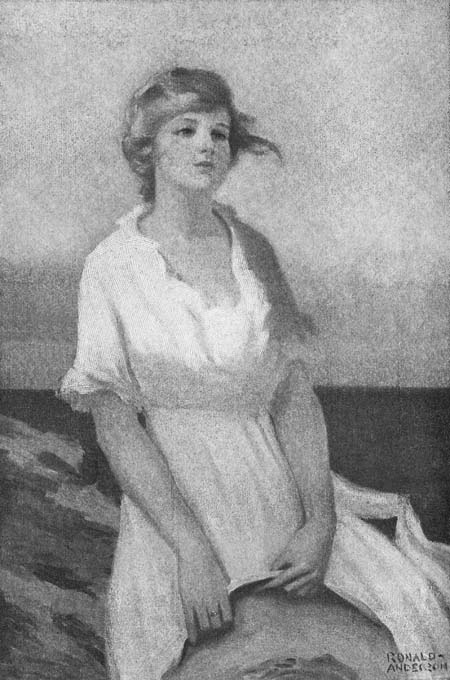
[See p. 3
FOR SOME TIME ISMA STOOD MOTIONLESS LOOKING OUT TO SEA

THE
IMMORTAL FLAME
By
MARIE BJELKE PETERSEN
Illustrated
Harper & Brothers Publishers
New York and London
The Immortal Flame
Copyright 1919, by Harper & Brothers
Printed in the United States of America
Published September, 1919
I-T
TO MY FATHER
| Part I | ||
|---|---|---|
| CHAP. | PAGE | |
| I. | The hiding-place | 3 |
| II. | The palm-grove | 11 |
| III. | Useless cargo | 19 |
| IV. | The sea pearl | 27 |
| V. | The black cross | 37 |
| VI. | The devil’s acre | 49 |
| VII. | On friendship’s altar | 55 |
| VIII. | Ring-barked | 60 |
| IX. | The thunder-storm | 75 |
| X. | The bell-bird | 79 |
| XI. | The fireweed | 97 |
| XII. | Bursting bubbles | 107 |
| XIII. | The ball | 117 |
| XIV. | A sinister sunset | 134 |
| XV. | The moonlit road | 147 |
| XVI. | The bomb | 155 |
| Part II | ||
| I. | The hurricane | 169 |
| II. | Paying toll | 177 |
| III. | Barred gates | 187 |
| IV. | Trampled friendship | 200 |
| V. | The fatal key | 213 |
| VI. | The flame god | 228 |
| VII. | The staring cliff | 249 |
| VIII. | The dawn | 259 |
| IX. | Crucified | 277 |
| X. | Migrating birds | 290 |
| XI. | Thistle-down | 297 |
| XII. | Summer | 305 |
| XIII. | The nettle | 320 |
| XIV. | Bloodwood | 332 |
| Part III | ||
| Remembered | 341 | |
THE IMMORTAL FLAME
“MY hiding-place—my beautiful retreat!” she exclaimed, under her breath, and looked with passionate intensity at the wild, rocky coast-line which stretched as far as eye could see on either side of the cliff where she was standing.
“I am safe at last,” she whispered, a calmer expression taking the place of the haunted look in her eyes. “No one will find me here—I shall live and die in this secluded spot.” She walked a few steps backward and forward on the narrow conelike rock. “Who would follow me,” she cried, defiantly, as if challenging some sudden fear. “No, no, here I am secure—quite safe,” she repeated, emphatically, in her low musical voice, making a further attempt to quell her stirring misgivings.
For some time she stood absolutely motionless, looking out to sea. The late afternoon sunshine fell on her tall, white-clad form making it look [4]like a statue carved out of some strange ethereal substance.
All at once she glanced again at the long line of massive cliffs, and stretched out her arms as she whispered in soft, yearning tones, “Oh, you big immovable crags, give me some of your calm, let me learn to be still as you are still!”
Her arms dropped to her side, but she continued to gaze at the great imperturbable headlands—nothing affected them! Giant waves, ferocious tempests, had flung their fury against the bulky battlements, yet nothing had conquered their colossal strength.
Isma Folkestone turned toward the land. Behind the cliffs lay a long, low plain, covered with stunted trees, spider-bushes, grass-trees, and other flowering shrubs, and between these a little silvery road crept gingerly toward the distant, heavily timbered hills.
The girl looked down with unseeing eyes on the shrubby flats. The blue shadows on the plain were lengthening. The slanting sunbeams caught the spider-bushes, rich in scarlet blossoms, and made them flame like blood-red jewels. A lofty silence began to descend on everything around her, a hush peculiarly accentuated by the soft murmurs of the sea as it settled to rest at the feet of the purple headlands.
The woman on the cliff felt the mellow calm stealing into her heart also. She closed her eyes and breathed very slowly. Then suddenly she [5]looked up in terror; the vision her mind had conjured up behind her closed lids drained the color from her face. Oh, those pleading, fiery eyes, would they never cease to torment her—would they follow her wherever she went? Was there no respite from the burning shame they evoked? Why could she not forget? She would never look into them again—that at least was certain; but why did the memory still scorch her with its humiliating degradation!
A blush as vivid as the gleaming spider-flowers on the plain spread under her flawless skin. The last lingering rays of the setting sun turned the thick waves of her flaxen hair to flaming gold.
Isma raised a white, perfectly shaped hand and put a shimmering strand into place. She sighed as she felt its silken texture. What use had great beauty been to her? It had brought nothing but heartache and humiliation. Her red lips parted into a bitter smile. But the smile soon faded and a fixed, determined expression came into her eyes, the alluring eyes with their wide, bewildering lids and their thick fringe of black lashes; they had done harm enough, brought shame and anguish enough; now no one except her old governess should look into them again.
If only her beauty had brought her a gleam of real happiness, she could perhaps have endured the rest, but it had not done so. It had brought admiration, favor, homage in the teeming world [6]from which she had fled, but it had not given her one single draught of unalloyed joy.
There had been moments when she hated her extraordinary loveliness; she hated it now. What was the use of adulation if with it had come envy, slander, shame, and mortification!
What was the use of the world’s clamorous adoration, its fierce desire to possess her, when the only man— She trembled and a stinging mist blinded her eyes at the thought of his ironic glances and scarcely veiled contempt. She straightened proudly; she had come to this retreat to forget that also. Those protecting headlands would not only shut out the mad, excited world with its fiery, insistent pleading, the world which had petted and worshiped her and at the same time envied and slandered her, but those huge, immovable stones must also blot out the memory of the handsome Australian soldier with his mocking smiles and cruel sneers.
She glanced across the low plain to the far-away hills, behind which the sun was setting amid a shimmering haze of lilac and saffron yellow. Beyond this high range of hills lay her cousin’s estate; she was only a few miles from his boundary! But she was quite safe; he had not visited his old home for many years, and it was not likely he should come back now. The gay, sparkling world held too many attractions for the fascinating guardsman; it had opened all doors to him, showered distinctions and invitation-cards [7]upon him, bestowed admiration and honor. He had been sought out and idolized as much as Isma herself, and when they had danced together at brilliant balls and elaborate functions they had always been considered the handsomest couple in the room. But as they swayed over the highly polished floors in rhythm to enchanting music the girl had been conscious of the cold contempt in his touch and the sarcasm in his polite speeches. How he hated her for bearing his name and having allowed scandal to tarnish it! If only she had not been related to him, not been his second cousin, he might have treated her differently, but he could not forgive her for having smirched the name in which he took such a pride. However, she must forget that, too; the massive cliffs must shut out the whole of the past, and she would hide in her little home by the sea.
She turned to the right, where a wide beach curved far below her between the two giant capes. At the back of the sand was a short stretch of coarse, stiff grass and beyond that the bay was lined with palms which almost hid a red two-story house.
The girl looked out to sea again. The great expanse of water was unrippled and lay like a polished surface of lavender-tinted calm. The ocean would teach her that even the wildest turmoil can cease and the immense spaces above would lift her thoughts from herself to loftier things. All at once she became conscious that [8]there existed bigger things than those she had encountered in the world she had left behind her. There was a wild, daring place in this boundless solitude which suggested something colossal she had not been aware of before. She wanted to reach out after it. If only she could forget the past! If only the burning shame might be lifted from her! She bent her head and her lips quivered. She, too, had been proud of the fine line of ancestors from which she had sprung. But now the splendid old name stood soiled before the world, and she—she had stained it!
Her head sank lower. The horrible irony of it all—the pity of it!
But she refused to think of it any more. Had she not thought and writhed till the mortification had nearly maddened her? Had not the endless months she had spent in India and Ceylon on her way to Australia—months of torture and consuming pain—been punishment enough, purgatory enough, to atone for what had never been her fault? Might she not have respite now? She had come to this vast loneliness in order to forget—she would not remember any more! Her brilliant life had been a mockery, a failure. Why had it been so? Why? Why?
She glanced into the primrose-tinted spaces hovering over the wide plain below. Could not the greatness, brooding out there in the yellow sunset, answer her burning question? She must find the answer, and here in the seclusion by the [9]sea, in this immense aloneness, far from the cruel, merciless world which had laid such homage at her feet and at the same time thrust a dagger into her heart, she would come to understand.
But suppose the world should penetrate even to this seclusion—if it should pursue her here—?
She laughed suddenly at her own fears. Such a thing was impossible! The world was too far away to reach her, and her cousin—? His estate was certainly only a few miles away, still he never came to look after it; he had left it all these years in the hands of his trusted overseer and would probably go on doing so. The great metropolis held Falcon too closely; he could never tear himself away from all it contained and the brilliant career it offered him.
Yet if he should come?
She made a violent gesture with her shapely hands. No! No! Fate could not be so unkind! It had been cruel enough; surely it could not be so maliciously brutal as to allow this man to come and mock her in her loneliness!
No, she was at least safe from that. What could be more improbable than that the delightful officer of the guards should come out and look after his sheep!
Again she glanced down the darkening plain. The saffron hues had faded, and a soft, impenetrable dusk crept over the extensive flats below, giving them an air of subtle mystery.
The huge wings of night were spreading over [10]the earth, and under those dark pinions brooded a strange silence.
“There is rest here,” murmured Isma as she made her way between the shrubs down the steep slope to the little house nestling among the palms. “My sweet haven, my little hiding-place, here I shall find solace.” She added, confidently, “He will not come.”
From one of the larger trees a night-bird all at once uttered a fierce, piercing shriek.
The girl shivered a little and hurried toward the palm-lined bay below.
ISMA FOLKESTONE sat on a rustic seat in her palm-grove, her white-robed figure a moving network of shade and palpitating light. The sunbeams and the swaying shadows from the great fan-shaped leaves vied with each other in adding elusive enchantment to her rich, colorous beauty. Her hair under the picturesque garden hat was the color of summer-kissed plains; in her cheeks glowed the vivid flush of dawn and her lips were red like spider-flowers. Her large golden-gray eyes—the shade so frequently seen in Australia—were wide-spaced and luminous and so full of expression that they seemed almost weighted with loftiness and undaunted courage.
Just now the girl was gazing dreamily into space and there was an air of aloofness and unearthly calm about her whole personality. For some time she remained in reflective abstraction, then gradually she became more conscious of her surroundings and began to listen to the leaves switching noisily about her. They [12]seemed eager to attract her attention and rustled in unhappy agitation as they bent toward her.
Miss Folkestone looked up at them and smiled.
“You dear whispering things, what are you so excited about to-day? What are you trying to tell me? Is the breeze teasing you, or are you—lonely? Be thankful to be alone; it is life’s greatest gift—it holds nothing better.” She sighed a little as she continued, “Once I thought differently; I longed to be out in the gay thronging world and drink deep of its joys—” Her splendid eyes lowered and a tremor passed through her. “I have tasted all I wanted and—more. Now my only wish is for loneliness and my only prayer for peace.” She sighed again and added, “But rest is coming to me now—I am in harbor at last.”
The palm leaves crackled uneasily and shook in excited protest. Then they whispered more loudly, more hoarsely, as if desperately anxious to make their meaning clear; but Isma had stopped listening to the palms, her ears had caught the sound of a horse cantering on the road. People rarely passed that way, as there were no houses in the near neighborhood, only stretches of sheep-runs, marshes, thickly timbered hills, beaches, and great dominant headlands.
The horse had stopped, or had she only lost the sound of its hoofs as it passed the damp corner where a little stream bubbled across the road?
There was the click of the gate.
Isma glanced down the long palm avenue. A [13]visitor to her retreat—who could it be? Perhaps it was only a stranger who had lost his way, or possibly the manager of her cousin’s estate had heard of her arrival and come to see her. She remembered him quite distinctly, though she had not seen him since she was sent to England ten years before to finish her education.
The horse was on the gravel drive now; she heard his crunching steps on the pebbles, and a few moments afterward he and his rider came into view.
The girl’s heart gave a sudden bound and she gripped the wooden seat hard as she caught sight of the tall, soldierly figure on the gray, foam-flecked thoroughbred. But she recovered her composure instantly, rose quickly, and went forward to meet her distinguished-looking visitor.
He dismounted lightly, slipped the bridle over his arm, then, raising his smart riding-cap, bowed ceremoniously over her outstretched hand and said, smiling satirically, “So it is really true that my beautiful cousin has entombed herself in this vast solitude—”
The woman he addressed stood before him, tall, dignified, and there was a reflection of his irony in her voice as she replied, “You don’t mean to say you have come all this way to find out?”
“Why not? We were all astonished when we heard that our gorgeous bird of paradise had left the gilded cage and flown back to its native haunts in Australia. We were naturally a little [14]skeptical at first—can you wonder?—but I, having more curiosity than the rest, came to see.”
For a moment the rich rose tint in Isma’s smooth, perfectly molded cheeks deepened. Falcon had actually torn himself away from the life he loved, his brilliant position—everything, and had traveled those thousands of miles for her sake! A strange tumult surged up within her, then subsided as suddenly as it had come. Of course he had only taken all this trouble because she bore the same name as he, the name he had always guarded with the jealousy of a lover. He had merely come to discover if she was really in earnest and meant to settle down in safe seclusion, severed from the dangers and temptations of the past. And when he had satisfied himself on this point he would probably return to all that was dear to him.
“And now that you have seen that I am really here,” she said, her eyes measuring him with a touch of mockery, “I hope you are satisfied.”
The gray thoroughbred was pushing its soft muzzle against Captain Folkestone’s sleeve, but he had no thought for the animal.
“Satisfied—what about? That your new rôle is as—becoming as—the old?” he suggested, with courteous insolence, his handsome blue eyes taking in every detail of her attire and noting that the extreme simplicity of her white gown only accentuated the rich curves of her lovely form and that her simple garden hat with its [15]swathe of turquoise crêpe de Chine was remarkably becoming.
Isma flushed under his gaze. So, he thought, she was only posing, after all, striving after effect, merely changing a rôle! “I suppose you would have liked me to take the veil,” she flung at him, indignantly.
“It is hardly fashionable to join sisterhoods nowadays; besides, it is so inconveniently binding, the garb is so hideous and the setting of such a life most monotonous. This,” he glanced round at the idyllic beauty of the palm-grove with its glimpses of blue sea and rocky headlands between the great fanlike leaves—“this is a far more artistic way of doing it; the background is enchanting and everything is so delightfully unfettered—the way back is always open.”
“No,” she replied, emphatically, “the way back is not open—it is barred.”
“Most effectively barricaded with cobwebs,” he assented, smilingly.
The girl straightened as she looked coldly into his deriding eyes.
“By Jove! the rôle is becoming!” he exclaimed, with fresh mockery in his tones.
“I suppose you would prefer to see me behind real cloister walls,” she observed, a dull flush of anger staining her face.
“My pretty cousin, how can you suggest I should prefer anything so outrageous!” he exclaimed, with mock horror. “If you were cloistered, [16]I should not even have the pleasure of seeing you, and it would have other appalling disadvantages—the sacrifice of your glorious hair, for instance,” and he glanced at the silken yellow waves before adding, “it would be a thousand pities to go to such fatal lengths; I am sure your modification is far wiser.”
She turned a little impatiently from him toward the house half hidden among the trees.
“Won’t you come in and have some tea? I am afraid I have been rather inhospitable, keeping you standing out here all this time,” she said, with frosty politeness.
“No, not to-day, thank you. I arrived only this morning; now I must go back and get my car in order after its long journey. I just came over to see that you were all right; though I am only a cousin, I have the privilege of looking after you occasionally. But you are not living here alone, are you?”
The horse had grown tired of caressing Falcon’s unresponsive sleeve and was now fidgeting to get enough rein to reach Isma.
His master pulled him back with a jerk as the girl replied: “No. Miss Livingston, my old governess, is with me.”
“I am glad of that. But do you really intend to settle down here?”
“Yes. Why not?”
“It will be very lonely and you might find it—dull.”
[17]“I shall not find it dull and I like solitude.”
“Indeed!” There was polite doubt in the exclamation.
The girl made no reply, so her cousin went on. “Perhaps you will fill in the time with some serious thinking,” he suggested, smilingly, taking off his cap and allowing the breeze to play with his brown hair, which had a charming tendency to wave at the ends.
“What would you recommend me to—think about?” she asked, her eyes looking probingly into his.
“Well, as you ask my opinion, I should strongly advise you to give some thoughts to the subject of—prudence.”
She winced and the warm blood leaped for a moment into her face. When it had died away she stiffened, and her cold, angry eyes met his as she said, “Why should I think about—that?”
Her companion smiled amiably. “Because—well, don’t you think it quite possible that while you have been so much occupied with—other subjects you have neglected this important one?”
Miss Folkestone laughed scornfully. “Perhaps, as you consider me so ignorant in this direction, you might even think it advisable for me to get a coach.”
“It would certainly not do you any harm to have one.”
“Possibly you would like to offer your services,” she scoffed.
[18]“I am afraid you would not accept them,” he replied, quietly.
“Why not? Do you think I should be afraid that your vast amount of knowledge on the subject would discourage me?”
Captain Folkestone looked at his cousin in feigned surprise. “Discourage you! Could anything do that? I was under the impression that was an impossibility!”
The gray horse had given up fidgeting; now it gave a loud, impatient snort.
“Oh, well, I must be off,” said the soldier, lightly, “but I am delighted to have found you looking so radiant—more bewitching than ever!”
With courtly grace he bent over her rather reluctant hand as he said good-by, and a few moments afterward he and his Arab mount disappeared in a bend of the avenue.
When the sounds of the cantering hoofs had died away the girl clasped her hands tightly together. “Merciful God!” she murmured, brokenly, closing her eyes, her face white to the lips, “he has come—he has come—”
Above her the palm leaves drooped in silent consternation and occasionally a convulsive shudder passed through them.
ON a small creeper-veiled balcony facing the sea Isma and her old governess were having tea half an hour after Captain Folkestone’s departure. A slight breeze from the ocean had sprung up and moved the bignonia trails heavy with golden blossoms rhythmically to and fro. From the garden below rose the strong scent of jonquils, freesias, and stocks, and from the bench a short distance away came the thud of waves with regular precision.
Miss Livingston, reclining in a deck-chair among a pile of green cushions, regarded her companion with a pucker between her scanty eyebrows.
The old governess was a small, thin woman with drooping shoulders, iron-gray hair, and a kind, humorous face. She was very plain, but there was an air of genial guilelessness and youthful optimism about her which gave the impression that she had not met disillusions in her journey through life, or if she had encountered any she had had the rare uncommon sense to look the [20]other way while they passed. Also Miss Livingston had preserved her love of romance, or rather the love of romance had preserved her, from the hideous disease which destroys youth in the soul more quickly than any other malady, that fatty degeneration of the emotions called complacency. So though the little ex-governess was over sixty, she was still young in the things which matter; her mind was sunny and her heart still warm.
Just now she was puzzling about the change in her beloved charge. The girl had looked so radiant after luncheon, when she saw her stroll out under the palm-trees, and now, only a couple of hours afterward, she was pale and there was a strange, perturbed light in her eyes. What could have brought about the change? She kept wondering as they talked about indifferent things, but as she could not come to any satisfactory conclusion she asked at last:
“Baby, what is the matter with you? You looked so bright and splendid this morning, and now you are so white— Are you not well, dearest?”
Her companion put her cup down on a small wicker table standing near her as she replied: “Thank you, I am quite well—I am always well, you know. But,” she went on, turning the conversation into another channel, “why do you still persist in calling me ‘Baby’? Don’t you think it is rather absurd, now that I am over twenty-five and so big? If I had been a small, [21]fluffy kind of woman, it might not have sounded so absurd; but for my type—”
“That is all nonsense,” interrupted the old lady, vigorously; “because you are so tall and magnificent do you think it makes any difference to my feelings for you? I came to you when you were a wee, motherless mite, a little bundle of white, pink, and gold lovableness, who adored being kissed and cuddled. You became my Baby then, and my Baby you shall stay till the end of the chapter!”
The flaxen-haired girl rose, came over and sat down on a footstool beside her friend. “You darling!” she murmured, slipping an arm round the drooping figure; “how good you were to me in those dear old days!” She sighed regretfully. “If only they could have lasted always! But your Baby is grown up now, terribly grown up. She has lived—she is a woman of the world to-day,” she finished, a slight tremor in her voice.
“Now you are talking nonsense again,” the small lady protested, fondly. “You are just as much a baby as ever, only you have been out in the world and found it is not peopled with innocent children—that is what makes you feel so grown up.”
The girl shook her head sorrowfully. “No, deary, that is not it. If only you knew all, why I am here to-day, you would not talk like that.” There was deep pain in the large gray eyes as she turned them to an opening among the creepers, [22]where she could see the northern headland beyond the garden jutting out sharply against the clear blue sky.
Miss Livingston took the soft white hand lying close to her own brown one and pressed it tenderly. “Girlie, I am not going to ask any questions about the past. What you wish to keep from me I do not want to know. Only, if the past hurts, try and forget it. Don’t you know that the same Kind Spirit who invented memory also invented forgetfulness, and that it is just as important to cultivate forgetfulness as to train memory?”
“Do you think so?”
“Of course. Forgetfulness is simply throwing useless cargo overboard. If you overladen a ship, it will go down. If you overburden a soul, it will do likewise. In life much cargo, good and bad, is put into our ships; we must simply fling the useless away into forgetfulness or we shall be swamped.”
The girl sighed. “A good many ships go down, I am afraid.”
“Yes, and all because they have not the sense or perhaps the courage to fling away the useless cargo.”
“Still, it is difficult, for some things cannot be flung away.”
Isma rose and went to the edge of the veranda; there her hand began to pluck restlessly at the orange-tinted flowers. “I have had a surprise [23]this afternoon—a great surprise,” she said. Then after a pause she added, with difficulty, “Falcon is here.”
Her companion started. “Falcon here!” she exclaimed, excitedly. “You don’t mean to say so! Are you quite sure? How do you know? No letters or wires have come to-day.”
“Yes, I am quite sure, for he was here just after lunch for a little while.”
“Why, girlie, that is the best news I have heard for a long time! To think that the dear fellow should actually be here—how delightful! Now we shall have an interesting time, for of course he must be desperately in love with you—”
The girl moved suddenly. “In love with me! Why, he hates me—positively detests me!”
Miss Livingston laughed heartily. “How perfectly ridiculous! As if any man could! Anyhow, do you think he would travel half across the world after you if he hated you? Nonsense! By the way, is he as handsome as ever? I have not seen him since he left Australia all those years ago.”
“Yes, I think you would consider him even better-looking now. He is terribly run after and admired. Women make him enough pretty things to fill a palace.”
“But—you don’t mean to say he has turned out that kind of man?” There was real distress in the old lady’s tones.
“Oh no, he doesn’t court that sort of thing—he likes being popular, of course, but I think the [24]tokens of conquest rather bore him; he is too much the open-air independent Australian to care for overmuch petting and pampering. However, you will be able to judge for yourself, for he is sure to come over and see us soon, and when you see the way he—treats me you will never again accuse him of being in love with me!” she finished, in a tone which greatly puzzled her companion.
It was night. A land breeze stirred fitfully among the palm leaves and made them rattle noisily together. The sky was clear, yet the stars seemed strangely distant and dim. The ocean lay wide and calm. Near the shore breakers rose as dark, finlike ridges, that became darker and sharper as they advanced and finally broke with a loud crash into a white blur on the shadowy sand. The headlands terminating the small bay in front of the palm-grove bulged black and monstrous against the dull sky. The night was quiet, but it held a brooding awe, a savage majesty.
The red house near the beach was in darkness, and it seemed as if its inmates were restfully asleep. But after some time the front door opened noiselessly and a tall figure made its way softly down the stone steps, through the perfumed garden with its whispering shrubs and stirring leaves, then crossed a stretch of rustling grass and a few minutes afterward reached the firm, gently sloping sand.
[25]The girl stood for some moments looking out on the big expanse of dimly lit water, her breast heaving as if she had been running fast. Then she began to walk up and down the beach in frenzied agitation. At last she stopped abruptly and, flinging her hands out before her, cried under her breath: “Falcon—why did you come—oh, why! Why couldn’t you leave me to my loneliness in peace! Why have you come to torment me, fling your taunts at me, your contempt! Are you trying to hunt me into a real nunnery, where you can be sure your name will be guarded and protected behind the pitiless walls?”
A bat swooped down and brushed against her hair, but she hardly noticed the insolent touch of its furry wings.
“If only you would believe in my sincerity, that I will never return to the dangers of the past, that I am not posing—not acting a part—” she murmured, brokenly.
Her hands dropped to her side and she raised her head in sudden pleading. “If only you would treat me differently—be serious, angry with me, anything but lashing me with your caustic irony!”
Why should she not go to him, explain all and—
But what would be the use? He would not believe her when appearances were so strongly against her. No, she would not explain. She lifted her head proudly. Let him think what he liked! She would continue to meet him with his own weapons. She would treat his insolence, [26]his insinuations, with icy contempt. The Folkestone blood ran in her veins, too; their people had not been cowards, never cringed nor flinched at pain. She would show him he was dealing with one of his own race, who was strong enough, courageous enough, to walk in lofty indifference to his scathing derision and stinging mockery! Her eyes flashed and she straightened haughtily as she began to pace up and down the beach again.
It was long past midnight when at last Isma made her way back through the scented garden to the sleeping house.
CAPTAIN FOLKESTONE stood by the sea, near the palm-grove, and looked searchingly about him. He had been told at the house that his cousin was on the beach. Now he glanced up the sunlit curve of sand to find her, and it was not long before he saw a splash of glittering gold near the southern cape and made his way toward it.
As he approached the spot he saw the girl lying closely wrapped in a tawny gold-tinted garment. She was evidently not expecting visitors, for her hair was done in a long thick plait which fell over her strong, firm shoulder and lay glittering on the warm, dry sand.
The soldier stood suddenly quite still and breathed unevenly.
Isma was motionless and her eyes were closed. Was she asleep? He took a step nearer in the soft sand, but she did not hear him and her face was calm with the serenity of slumber.
He watched with a curious expression in his Irish-blue eyes, which held no irony or contempt [28]now. How perfectly her features were chiseled, from the fine straight brow, half veiled by the yellow waving hair, to the well-rounded, forceful chin! And her skin—could marble have been whiter or rose petals more delicately smooth?
As he gazed the sleeper made a slight movement—there was a sudden flash of dazzling white limbs and a bewildering form half concealed by a cream Canadian bathing-suit.
The man watching changed color.
Merciful Heavens, what alluring loveliness was given to some women! Isma had inherited the renowned beauty of the Folkestones, and what a curse it had been to her! He made some inarticulate sound between his teeth, his eyes riveted on the maddening display of snowy splendor and bewitching contours.
Could she really be asleep in the bright sunlight? He came a little closer and looked full into her upturned face. As he gazed, the inner corners of her well-marked brows lifted slightly as if she were in pain, and a tremor passed through her like the half-convulsive shudder of a sob, her long lashes quivered and all at once he noticed that they were moist. Had the girl been weeping in her sleep? He caught his breath. Isma’s lashes wet—!
“Isma,” he said, in a strained voice. “Isma.”
The wide, clear lids opened slowly and eyes, still heavy with sleep, looked up, dazed and bewildered. Then she discovered the man beside [29]her and an agonized flush spread over her face. She sat up quickly and gathered the wrapper closely about her.
“I must have been asleep,” she faltered, in deepest confusion. “I—I—was just going to have a bathe.”
The strange expression had vanished from Captain Folkestone’s face and there was no trace of it as he apologized profusely for disturbing her and added, in cool, bantering tones, “But don’t you think it is unpardonable waste to lavish those enchanting blushes on a mere relative?”
The girl had risen and drew herself up to her full height as she said, coldly, “I think it would have been better if you had stayed at the house while they sent for me.”
“I am deeply sorry for intruding—as I said before, but how could I know you were on the point of bathing and that you would object to a most appreciative audience? You forget that mixed bathing is in vogue here; however, I suppose your excessive modesty would not permit such laxity!”
The irony in his words stung her. Would he never forget, never be merciful! She turned her face away for a moment, then, lifting her head a little higher, without replying, she began to walk back to the house.
Her cousin followed her, his eyes on the heavy trail of flaxen hair reaching almost to her knees [30]and gleaming in glossy radiance against the duskier gold of her gown.
“Isma,” he said, coming to her side, “why do you hurry so? I want to talk to you.”
“When I am presentable I shall be at your disposal.”
“But you don’t need to bother—I have already seen you—and I assure you you have never looked more charming than in this artistic wrap. When that artist admirer of yours wants to paint your portrait again I should advise you to wear that shade of gold.”
The girl met his remark with disdainful silence and quickened her steps.
She felt his watchful scrutiny. Did he think she was merely posing, acting a part? Was that why his face had hardened?
When they reached the house Isma took her cousin into the drawing-room and asked him to wait for her there.
After she had gone Captain Folkestone sank down on a sofa and began to look round. It was a delightful room, not too large or too small, spacious without being aloof and stately, and furnished with a taste that gave evidence of unusual refinement as well as a great love for harmonious color schemes. The predominating shades in the room were vieux rose and dull umber; these hues mingled in the covering of chairs, divans, cushions, carpet, curtains, blinds, and ornaments. The woodwork and doors were a [31]deep umber and the paper on the walls a dull rose. On the mantelpiece, and everywhere else where flowers could be placed, were big bowls filled with stocks of various shades—mauve, white, rose, and dull purple—scenting the air with their sumptuous fragrance.
It was not long before the girl returned. She was dressed in ivory-white, and as she sat down on a low chesterfield the room made a soft colorous background for her vivid yet mellow loveliness.
She did not speak, but with hands lying idly in her lap waited for her cousin to tell her what he had come to say.
“Isma,” he began, glancing down at his wristlet-watch, “Benson tells me he has heard that you want to sell some of your coast land.”
“Yes, I thought of doing so.”
“Is it—necessary?” he asked, without raising his eyes.
She ignored the point of his inquiry. “I should like to sell some of it.”
“Isma,” he said, with slight hesitation, “if you are in difficulties, won’t you tell me—won’t you let me—?”
She interrupted him quickly. “No, thank you, I am not in any difficulties.”
“Still—you want to sell?”
“Yes.”
“Then I should like to buy the land.”
“Why do you want it? It is no good for sheep—”
[32]“No, but I should like to put up a cottage. I have always wanted some sort of a place close to the sea.”
“But what is the use when you are not there—not living here, I mean?”
“But I am going to live here, going to use it,” he answered, regarding her steadily. “I am sending in my resignation to the Guards, and for the future I shall stay in Australia.”
His cousin looked at him incredulously. Falcon coming back to live at his old home, leaving his regiment! What could it mean?
A flood of warmth rushed through her as she listened breathlessly to his next words.
“You are a little surprised, no doubt; but I really ought to give some attention to my places—I have neglected them shockingly for years and Benson is getting old—they are too much for him.”
The girl leaned a little forward and clasped her hands round her knees. “What will London do?” she asked, with a touch of friendly banter.
“My departure will have scarcely been noticed in the face of more important exits.” He watched her intently. However she was quite unconscious of the significance of his words.
“Who else is leaving?” she asked, the friendly smile still hovering round her lips.
“Surely you know?”
“How could I? I have been traveling for months, till quite lately—”
[33]“But letters—they can always reach you.” His tones were hard and unapproachable.
“I have had very few since I came home—I didn’t want any.”
A few moments ago their attitudes to each other had relaxed, but now Isma was conscious that the old hostility had returned, and she vaguely wondered why.
“Do you mean to say you don’t know who has taken The Bluff and is arriving almost immediately?” asked the man, a sharp edge in his voice.
The Bluff was a magnificent house situated on a big craggy headland a few miles down the southern road. Who could have taken it? As the girl looked at the hard glitter in the soldier’s eyes a terrible apprehension made her feel suddenly cold.
“Who?” she asked, scarcely able to formulate the word. Who else could be coming to spoil her solitude and pry into her seclusion?
Her cousin’s eyes were like points of steel probing into hers as he said:
“Lord Berriedale.”
Isma caught her breath and every vestige of color ebbed from her face.
For some moments there was a deathlike stillness in the room, a stillness harsh, uncompromisingly cruel. Then the girl made a desperate attempt to veil her agitation from the stern gaze fixed upon her.
[34]“Why—why—” she began, but the sentence ended in a gasp.
The sternness in Falcon’s face vanished instantly and gave place to the ironical expression she knew so well.
“Why should Lord Berriedale come out here, and to this particular neighborhood? Could anything be more obvious? For his wife’s health, of course—what else could it be? You know her delicate state; the doctors have ordered her to a warm climate—there are evidently no warm climates nearer than Australia, and apparently The Bluff is the only suitable house available on our large continent; so naturally Berriedale is only too glad to secure it, especially as it has the great advantage of being near The Palms so that his wife can resume her delightful friendship with you.”
Isma did not speak. She had leaned a little farther forward and her hands were clasped round her knees so tightly that her fingers were quite bloodless.
Lord Berriedale at The Bluff! All her difficulties, her pain, her humiliation back again! Her flight had been useless. Her hiding-place would afford no security now. She might as well have stayed in the old life, for she would have been far safer there. In this lonely spot everything would play into the fowler’s hands, all would be against her and help him to track down his prey.
[35]She scarcely noticed Falcon’s stinging sarcasm. After all, he was only voicing what their world thought and said. Did not every one believe that her friendship for Lady Berriedale was only a blind, a cloak hiding her relation with her husband? But her cousin’s next words stabbed her.
“I always admire friendships between women, it is so beautiful to see the way they treat one another—they are so loyal, so true.” He smiled deridingly at her.
She straightened and flushed hotly as he goaded her to retort. “Women are true to one another and they sometimes think more of a friend’s happiness than their own reputation!”
“Of course, and that is why the world, looking on, applauds such sacrifice so vigorously!”
Isma rose and went over to an open window. What was the use of trying to convince her cousin or any one else that she was innocent? Explanations only met with scorn and distrust. There was no help for her. Still, what was she to do? Should she attempt another flight? No, she could not do that; it would only rouse Lady Berriedale’s suspicion, and, whatever happened, the invalid must not be made unhappy, but be allowed to live the few paltry years yet allotted to her, in her fool’s paradise. So she must stay—stay and be compromised again. If only Falcon had not been there, a cruel, merciless spectator, mocking and judging her in her pitiful plight!
[36]Captain Folkestone had also risen and stood near the mantelpiece, regarding the silent girl at the window, the soft, rose-tinted curtains making a splendid background for her graceful form.
Why had this woman been given a beauty which drew men with such maddening longing to possess her, and made them ready to go to the end of the world, even face ruin, on her account? Why should the fate of men be placed so irrevocably in one woman’s hands?
“Isma,” said Falcon, after a long pause, in quiet tones, “what about that land?”
She turned to him slowly. Why did he want to buy it? To be nearer and able to spy more readily upon her?
“I don’t think I will sell it, after all,” she said, evenly.
“Very well, then,” the soldier replied, picking up his cap. “I suppose for the future you will be so much taken up with Lady Berriedale that you will not have much time for me,” and after a formal good-by he left the room.
When he had gone Isma stood by the window for a long time so motionless that she scarcely seemed to breathe. Then at last she lifted her head. After all, she was a Folkestone; she would show Falcon that no circumstances could terrorize her, and she would at least face the perilous future with fearless dignity!
THE spring morning sunshine poured its buoyant radiance on the big, forbidding-looking bluff which made an imperial basis for the imposing house situated on its summit.
The Bluff, named after the rocky battlement on which it stood, was not only stately, but picturesque. Its lower story was of rough-cast and the rest of the building covered with bronze-green shingles, also it was ornamented with heavy beams, numerous wooden gables, balconies, and verandas stained dark green.
The house on the headland faced the sea, but on its landward side, sloping gently down to the main road a quarter of a mile away, was a beautiful garden and a long avenue of great Moreton Bay fig-trees.
The Bluff had not only a magnificent view of the ocean and the broken, imperious coast-line, but it also commanded an extensive vista of undulating tableland which rolled in monotonous grandeur toward the far-away horizon.
[38]Just then the sunlight fell full on the tree-sprinkled plateaus, flooding them with an amber-hued, unearthly brilliance, accentuating their vastness and making them look as if they were moving, striding wearily onward farther than eye could see. It seemed as if these sunburnt plains had always stumbled forward, through years, through lifetimes, through centuries, always exhausted, yet dragging tired feet to a still farther horizon.
On one of the broad balconies at The Bluff stood Lady Berriedale, her large, restless eyes looking beyond the garden and the long drive shadowed by the fig-trees to the great stretch of tree-dotted tableland.
“Australia—Australia,” she murmured, half aloud. “How strange that we are actually here!”
There were slow, gentle footsteps behind her. The hectic flush on her thin cheeks deepened as she turned to the man coming toward her.
Lord Berriedale was distinctly good-looking. He was tall and carried his rather slight figure well, though not with the bracing straightness of a soldier, and there was a refined grace about him which gave charm to his personality. His skin was as fair as a girl’s, his hair, brows, and small mustache the color of honey, making a strange contrast to his large coal-black eyes, which in spite of their dark hue had not usually an intense, but generally a calm, enigmatic expression. All the same, those jet-black orbs, almost feminine [39]in their liquid softness, gazing lazily beneath golden drooping lashes, could at times light up with volcanic fires and produce a very disquieting effect.
“Neville,” said his wife, in a high-pitched, slightly rasping voice, “I believe I shall get quite strong here in this wonderful climate. How splendid of you to think of it and bring me here—you are always so kind and thoughtful!” She raised her eyes, brimming with gratitude and devotion, to her husband, but he was not looking at her; his gaze was fixed on the vast country before them, where stanch old gum-trees glittered in the warm sunshine. Torrential rains had swept over them, hot summer suns bleached them, but nothing had been able to vanquish their gaunt, persistent strength.
“I am glad you feel like that, dear,” replied Lord Berriedale, without turning to her. “Australia is, I believe, the healthiest country in the world—and you think you will like being here?”
“Like it—I shall love every minute of it! It is so different from any place we have seen before. It is so huge and the gum-trees so wise-looking and clever. Look at them now out there in the brilliant sunlight—don’t they look human! and there is a sinuous strength about them which appeals to me. They remind me of strong men who have done a hard day’s work and gone out in the plains to reflect. They have such a wondering air, as if they were solving big questions; [40]gum-trees are philosophers—not like the exotic variety who dabble in mere theories, but the deep thinker who has toiled and deals with realities.”
“Yes,” agreed her husband, half absently, stroking his small, fair mustache.
“Neville,” continued his wife, “this seems to be a place one can think in—it compels thought. At home one had no time; each day was crowded to overflowing with things which appeared important at the time, but how trivial they seem when one is confronted with—this!”
“Didn’t India have the same effect on you?” inquired her companion, with apparent interest.
“No, not at all. India is so teeming with humanity, every available space occupied, one could not get away from people. Here it is different. Australia is so roomy it is possible to take a step backward without treading on any one or having somebody step in front and obscure the view. When too close to the seething masses of men one cannot understand life, and it is apt to become a moving blur, drawing one into its chaotic confusion.”
“I wonder if you take a step backward and look at life that way, what you will see?” remarked her husband, with well-disguised indifference.
“I don’t know yet. It takes time, for the panorama is so great, but I somehow feel it is going to alter my attitude toward everything.”
“You don’t think you have viewed life correctly before?”
[41]“No, I have a strange feeling that I have missed something vitally important.”
“I wonder what that can be?”
“I cannot tell at present, but it seems as if the gum-trees are nearer the truth than I. Do you know these lines of an Australian poem? They keep coming into my mind,” and in her thin, rasping voice she quoted:
“Aren’t they beautiful!” she exclaimed, after repeating the verse. “But I am afraid we are not as devoted as the gum-trees—we do not pray as much as they do.”
“Perhaps not.”
“But Neville, in this vast continent there is prayer,” she went on, impulsively, her brown eyes burning; “not the conventional elegant prayers uttered in churches, but wild, daring prayers, wrung from souls battered by tempests, cauterized by tropical suns; souls who have fought untamed elements, wandered alone in trackless plains; souls grown sinewy, virile, strong, whose prayers [42]are like fire-balls shooting straight to the feet of the Infinite.”
“My dear, how imaginative you are to-day!” Lord Berriedale replied, without enthusiasm.
Instinctively his wife changed the subject.
“Neville, wasn’t it wonderful that you should have heard of this house so near Isma—doesn’t it seem as if some kind Providence had arranged it all for us?”
Her companion moved his position and again his long slim fingers went up to his fair mustache.
“Yes, it does seem rather remarkable that The Bluff should be available just now and that we should have happened to hear of it,” he replied, evenly.
“I wonder Mr. Lambert could bear to leave it for so long! It is such a lovely house and the gardens and grounds so fine.”
“His wife and daughters got tired of the loveliness—they preferred Europe for a few years. I believe Lambert would rather be here, though. However, he was delighted to let us have the place—so much better to have it tenanted than shut up with a caretaker.”
“Neville,” there was childish joy in the emaciated face, “won’t Isma be surprised to see us this afternoon! It must be so lovely for her out here. I wonder whatever made her come?”
“It is her old home, you know, and I suppose the place appeals to her, as it does to you.”
“But it can’t have the same effect on her as [43]it has on me, for she has not you to enjoy it with her, and that makes all the difference!” She took a step toward her husband and looked up at him with glistening eyes; however, he had evidently not noticed her advance, for his attention was fixed on the crimson roses winding up the pillars of the balcony and sending their vigorous trailers along the railing.
Lady Berriedale began to regard the flowers also, and her thoughts returned to her friend. “Poor Isma has no Neville to make life beautiful for her! I wonder why she has not married yet, with her scores of admirers? But you don’t know how I have missed her all these months. Somehow, once she has entered into one’s life, she becomes a necessity ever afterward—she has such a way of coming in and taking possession! Neville, if I were a man, I know I should fall desperately in love with her—I couldn’t help it—”
“Dear, you are really talking too much, and you know the doctor has forbidden you to talk much in the morning. Come in and lie down for a while, or I am afraid you will not be able to go out this afternoon.”
His wife placed a thin, transparent hand on his arm and leaned on him heavily; but her leaning was not merely weakness seeking support, it was more the weight of a great love abandoning itself to the object of its affection.
“Darling,” she murmured, “it is so lovely to [44]have you all to myself! At home you were always so busy, but now—we can have a second honeymoon.”
He pressed her hand gently. “Yes, I do hope you will be happy here; we will go for long drives, have picnics by the sea, and when you are strong enough you shall bathe—”
“Oh, Neville, how lovely that will be—I feel ever so much better already! Only,” she added, a little wistfulness coming into her voice, “it seems far too wonderful, as if it could not really come true!”
“My dear, it will come true right enough,” he assured her, as they walked down the wide, spacious hall and entered the morning-room facing the ocean.
Lord Berriedale led his wife to a couch near an open window and made her lie down among a profusion of lilac-tinted cushions; then he placed a rug over her and turned to look out on the huge sheet of water spread out before them.
The invalid lay back and closed her eyes in deep content. “Neville, this is new life to me,” she whispered, restfully, breathing in the soft, warm air from the sea.
The sun was withdrawing from the morning-room; still, through a large end window a narrow streak of light fell on the wall, across a picture of an interior of a church, illumining a large black cross over the altar and making it stand out with startling prominence.
[45]After a short pause Lady Berriedale looked up and her eyes lighted on the black cross so luminously clear in the sunlight.
“Neville!” she cried, half frightened, “look at that cross. See how it stands out from the picture—it seems to be moving toward me! Can it be a cross waiting for a—grave— Oh, Neville—”
He came to her quickly. “Deary, you have overtired yourself this morning, and that makes your nerves bad and you imagine all these ghastly things. I am afraid I cannot let you go this afternoon; we shall have to wait till to-morrow.”
“No, no,” protested the invalid, “I am not really tired, only my nerves are silly—but just sit down beside me— No, here; then you can hide that awful cross—”
Lord Berriedale sat down so that he obscured the ominous part of the picture and skilfully diverted his wife’s attention to other subjects.
“Did you see Rita driving that car this morning? Isn’t she getting on well! She will soon be able to go out alone.”
“Will that be safe? Are the roads good in this district?”
“I think so. When I was talking to Folkestone this morning on the ’phone he said they were excellent, on the whole. By the way, he wanted to call this afternoon, but I asked him to wait till to-morrow, as we were going out.”
His wife turned to him reproachfully. “Neville, [46]how could you? Have you forgotten about Rita? Think how disappointed she will be! Why didn’t you ask him to lunch or dinner? You might have done that.”
“I am sorry, dear, I didn’t think of it. However, she will have plenty of opportunities of seeing him, now we are so close to his station. But do you really think he—cares?”
“Yes, I think so. They were a great deal together the last few months in London.”
“But—but”—the tapering fingers played with the fair mustache again—“was that—his doing—”
“Oh, Neville, how blunt you are! Of course Rita is violently in love with him, and who can blame the poor child, he is so awfully handsome and fascinating? All the same, I trust no sister of mine should so far lower herself as to—”
Lord Berriedale retreated hastily before the cold dignity of the last words. “Of course I didn’t mean anything like that. No doubt he is quite infatuated, too, and of course Rita is an uncommonly pretty girl with her Spanish eyes and black hair. She is wonderfully like what you used to be.”
The woman at his side was appeased at once and a glad flush mounted under her sallow skin. “Neville, surely I was never as—pretty as Rita, was I?”
“Of course you were, only far prettier!” he assured her, with his most charming smile. Then he went on in a different tone: “It really [47]would be a good thing if Rita married Folkestone. He is a decent fellow, comes of good stock, and has money enough to make any wife comfortable.”
“Yes, I am sure Rita would be ideally happy with him. So now, dearest, you won’t forget and spoil the young people’s fun, will you?”
“You talk as if we were quite old.” He laughed, but there was a forced note in his merriment.
“So we are, dear. I have turned twenty-nine and you will be thirty-eight next birthday.”
“Folkestone must be over thirty, too.”
“I believe he is just thirty.” Lady Berriedale turned her engagement-ring, blazing with diamonds, thoughtfully as she said, “I wonder if Isma will ever marry—”
Her companion rose and went over to a window. At the same time there was a knock at the door and Fred Cockhill Rex, Lord Berriedale’s secretary, entered. He was a round, dapper little man with scanty, nondescript hair; his face was pale with the peculiar pallor of great smokers, and it was overrun with a network of fine wrinkles. He had a prominent, sharp nose, long, thin lips, and pale-blue eyes which always seemed to be smiling, and the smile was a curious mixture of malice and amiability. However, most people only noticed the affability, perhaps because the secretary’s manners were so polished and good-natured they entirely disarmed suspicion. Rex was a great favorite with his employer and had [48]been in his service for some years; but Lady Berriedale neither liked nor trusted him.
“What is it?” asked the tall, fair man at the window.
“One of the squatters in the neighborhood has rung up to see when it will be convenient for him to call; he is at the ’phone now.”
“Any afternoon next week will do,” replied Lord Berriedale, with not wholly concealed irritation.
“And the gardener wants to know about the conservatory—”
“All right, Rex, I’ll go and see him myself,” interrupted his lordship, cutting him short.
The two men left the room together, and when they had gone Lady Berriedale closed her eyes drowsily and was soon fast asleep.
SOON after lunch Lord and Lady Berriedale went off in their big Rolls-Royce to call on Miss Folkestone.
After Rex had sent them off he went into the library and stood by the window smoking a Turkish cigarette as he watched the long cloud of dust whirling after the receding car.
“Going to see her already—h’m! a little indecent haste surely! And her ladyship there, too! Holy saints! what fools some women are! How they have managed to hoodwink her so long I can’t imagine! But she will shake off the winkers one of these days and see her adorable Neville in his true light.” The secretary slapped his fat thighs. “By George! we’ll have a fine show then!”
The door opened suddenly and a girl with a small, dainty figure bounced into the room. She moved rather gracefully, but in a quick, impetuous way.
Miss Brentford did not appear to be in a very [50]happy frame of mind and was ready to be irritated by trifles.
She glanced at the man by the window and exclaimed, petulantly, “Rex, don’t you ever stop smoking!”
“Of course I do. I give you my word of honor that I never smoke when I am asleep.”
“You dream about it then,” came the short retort.
“Indeed I don’t. Dreams are only for the lovesick and the dyspeptic. But,” he added, in a different voice, “why don’t you sit down and make yourself comfortable in the devil’s acre?”
The girl looked puzzled. “The devil’s acre! What on earth is that?”
“The library, of course.”
“I don’t see the connection.”
“Why, it is quite simple. God puts the dead into coffins and buries them in His acre; but the devil has other methods. He entombs living thoughts into books and buries them in libraries.”
“You are not very complimentary to books.”
“Indeed I am. The books will feel flattered, I assure you. They like to keep up with the times. Years ago it was an insult to call any one bad; now it is an insult to call them good.”
“I wonder why it is fashionable to be wicked?” mused Miss Brentford.
“Because most people haven’t brains enough to excel at anything else.”
[51]“Still, respectability is very dull, don’t you think?”
The secretary smiled blatantly. “That depends on what you call dull. Of course it is only passion-flowers that bear passion-fruit: passionless flowers alone bear—respectability.”
The girl blushed. “Now you are talking like a French novel.”
“And you are annoyed. That is always the way. The people who sneer most at respectability are generally the most prudish of all, just as the most harmless beings like to pose as incorrigibly bad!”
“You are quite wrong about that,” Rita said, half absently, her thoughts straying back to her grievance as she added, fretfully, “Fancy a whole afternoon and nothing to do.”
“You don’t mean to say you are getting bored already! Why didn’t you go with the others? That would have been more entertaining than moping at home.”
“Ugh! Do you think I want to spend the whole afternoon with Miss Folkestone? I hate that cold creature!”
“I don’t think she is cold, but she is undeniably beautiful,” observed Rex, apparently unconscious that he was pouring petrol on the fire. “Even women go quite mad over her.”
“I don’t think she is beautiful at all; she is too over-colored. Her hair is so yellow and her cheeks so red.”
[52]“I should have termed the color in her cheeks a vivid pink.”
“Then she is too big,” went on Miss Brentford, glancing down at her own small, rather insignificant figure. “I don’t admire large women; they are heavy and clumsy.”
“I don’t think any one could accuse Miss Folkestone of being ‘heavy and clumsy’; I have heard her described as stately, handsome, magnificent, even called slender, but heavy, never!” replied the secretary, looking into the girl’s frowning face with smiling satisfaction. He always enjoyed making people angry—with some one else, and he was specially pleased to promote ill feeling toward Miss Folkestone, as he owed her a grudge for snubbing him severely on one occasion when he had made rather daring advances.
“Slender!” flashed his companion. “She is awkward and ungainly, and I don’t really think she is so much admired, after all, except by a few overstrung, nervy people like my sister—”
“And Captain Folkestone,” interjected the man, in his most silky tones.
The brunette flushed hotly. “He doesn’t like her at all—he can’t bear the sight of her!”
“Oh, is that so! Of course when he left London so soon after her departure and followed her here it made one naturally think that—”
“Oh, that was only because he is her only relative and he must look after her a little.”
“Yes, of course, and a woman like that would [53]need a little supervision. These very fair women, though they look so cold and—virtuous, are really warmer and more dangerous than the ordinary kind.”
“Dangerous?”
However, the secretary was not to be drawn out any farther. He really felt he had said as much as was wise just then; he could drop other hints on future occasions. He would have greatly enjoyed giving the girl a full explanation at once, but dared not draw her attention to her brother-in-law’s indiscretions too clearly. Still, he might set his companion’s mind working in the right direction by throwing out vague hints and stimulating her already jealous hatred of Miss Folkestone, but this was as far as he thought it safe to go at present. However, with her suspicious nature and his suggestions to guide her, she might yet arrive at the truth, tell her sister, and then— The malicious gleam in the small blue eyes deepened.
Shortly afterward Rita left the library. The secretary picked up a novel, seated himself in a deep armchair, and lighted another cigarette. As the pale-bluish ringlets floated into the atmosphere, he reflected. “She is in galloping consumption, and when she is out of the way”—he nodded meaningly, “they will marry, of course, but in the mean while we can make a fine scene. She has it in her to make a good one; by Jupiter! she has!” he chuckled. For some time he sat [54]musing, turning the cigarette greedily between his fat fingers, then he laughed under his breath. “The beautiful Isma clumsy! Great Christopher! So that is what she thinks, the jealous little cat! As if she would have half a chance with Folkestone or any other man while that fair daredevil is about. The conceit of these insignificant little women!”
ISMA FOLKESTONE had gone up to the big cone-shaped headland on the northern side of her small bay. But she did not stand expectantly with dim hope in her heart, gazing out to sea, as she had done some weeks before. She sat with her back to the ocean, leaning wearily against a big boulder, her elbow on her knee and her softly curving chin resting in the pink palm of her hand, while her eyes looked with intense sadness on the vast plain below, where the little silver road stretched contentedly toward the slumbering hills.
The sun had set and left behind it a flood of molten gold that throbbed with an intensity almost human. But the world seemed strangely unresponsive to the pulsating beauty above. It lay back calm and dreamy as a tired child, blissfully unconscious of everything except its own delicious need of rest.
The still figure by the rock watched all while she tried to fight back the bitter despair in her heart. [56]So it was in vain she had made the big flight and hidden in this immense loneliness by the giant headlands! It had all been useless! Her hiding-place had been discovered. The enemy had followed and was now confronting her with new vigor, fresh determination to track her down. She had considered her life broken before, but now she found how much valuable substance had remained among the ruins. There had been the hope of peace left her and the certainty that she had done with sordid things, that even memories could in time be flung away, but now— She was not merely disquieted by recollections, but the hideous thing itself which had made the stinging memories had returned to her life and leeringly announced it had come to—conquer.
She looked long at the narrow track winding across the low flats. Then she suddenly whispered, “You little peaceful road creeping so leisurely over the tranquil plain, if only I could be like you and lie at rest among the friendly spider-flowers and sheltering she-oaks!”
She made a little movement with her hands, as if stretching them out to something which had turned its back on her.
Lord and Lady Berriedale had been with her that afternoon. Beatrice had been delighted with the little red house among the palms and greatly excited at seeing her again. Isma could still feel the convulsive embraces of the thin arms, she [57]could still see the deepening of the hectic flush in the wan cheeks. Lady Berriedale had been ecstatically happy as they sat on the balcony behind the glowing veil of bignonia flowers. While the little dark woman talked incessantly, she had frequently sent frankly adoring glances at her grave, unresponsive husband. But his lack of enthusiasm did not seem to quench her fervor, for at times when disquieting thoughts troubled her she told herself that Neville was not impulsive, he had no Spanish blood in his veins like herself; he was English, reserved, and hated to show his emotions. But she would have awakened to the truth that afternoon if she had seen the passive expression in her husband’s dark eyes give place to a sudden flash of fire whenever he gazed unobserved at their beautiful hostess. However, the tall, fair man was guarded, and it was only from behind his wife’s chair he permitted the burning appeals to reach the girl, who responded only with the coldest disdain.
As Isma’s guests were leaving, Lady Berriedale had taken the girl’s slim hand in her own feverish ones and begged her to come to The Bluff every day. She would send a car for her, and insisted on her friend promising to come. The girl could not refuse the hollow, pleading eyes, encircled by those fatal shadows, and she had yielded. Yes, whatever happened, the sufferer should have all it was in her power to give during the inevitably short time granted her by destiny.
[58]Now Isma sat fully considering what this promise would mean to herself. She shivered. Could any one be compelled to pay a costlier price for the gift she was laying on the altar of friendship? She had already been branded before the world because of her sacrifice to this friend. However, now a much greater demand was made upon her. When she had fled from danger might not people learn to believe in her sincerity in wishing to evade disaster? But when they heard about present developments—that she was constantly at The Bluff with the Berriedales, would not the world turn from her in disgust and conclude that her flight had merely been a step toward a deeper intrigue?
And what would Falcon think? That Lord Berriedale should pursue her might not wholly condemn her in his eyes; but if she resumed the old intimacy with his wife, and he found her constantly in the way of danger again, would he not irrevocably lose every vestige of respect for her?
“Good God!” she moaned, “why am I called on to make such a sacrifice to a dying woman? Can friendship demand such a stupendous offering?” Her head dropped. All at once she knew that friendship cannot only ask for all that one holds dear, but it can exact that life itself be laid in full surrender at its feet.
Isma rose slowly. The sunset had faded and a delicate gloom was creeping into the great spaces [59]above her. She remembered when she stood looking into them some weeks ago and felt they held vast, lofty things, that she had expected somehow to come into touch with them; but now, though she was still conscious of their presence, they seemed utterly unapproachable and out of reach, for had she not been thrust back into the whirlpool? Lofty things were not for her!
She glanced up the coast-line. In the distance a big scarred bluff, its head a little tilted, stared with half-blind eyes out to sea.
The girl watched it for some moments. “Yes, that is life,” she muttered under her breath; “a half-blind staring into the greatness that broods above the whirlpool of earth, but never descends to the men and women who are in such desperate need of its infinite peace!” she exclaimed, bitterly, as she walked down the rough slope of the headland to her home among the palms.
The soft violet tints on the coast-line faded and a thick, uncompromising darkness strode in from the ocean and wrapped rocks, beaches, and cliffs in its austere mantle of night.
DURING the following weeks Isma did not visit her favorite cliff. She was back in the old life, almost daily seated in the purple-crested car with its mauve lining and silver fittings belonging to the Berriedales. It called for her constantly, and she was whirled to numerous beauty spots on the coast and inland with her friends.
The weather had been fine, and for weeks the sun had swept the turquoise heavens in golden majesty. Lady Berriedale had enjoyed the long days in the brilliant spring sunshine; she certainly looked better and was able to stand the outings without distressing symptoms of fatigue. Captain Folkestone joined all the excursions, but he was generally beside Miss Brentford, so Isma saw very little of him. She rigorously avoided being alone with Lord Berriedale and devoted herself entirely to the friend for whom she was making the colossal sacrifice.
So for a little while danger had been kept at bay and the girl had been able to avoid unpleasant [61]encounters. But the fiery glances which found their way from the black eyes to her own told her that the scene she dreaded could not long be postponed. One day a picnic had been arranged to a beautiful lagoon some miles away, but on the morning of the trip Lady Berriedale did not feel well enough to go. It was impossible to put off the outing at such short notice, as some of the neighboring squatters and their families had been invited. But Isma refused to leave her friend, and after seeing the party off she joined her in the morning-room facing the ocean.
The invalid was lying on a couch, looking worn and ill. Her skin was sallow and parched, but near her cheek-bones were dark-red patches.
Miss Folkestone sat down beside her and took up some embroidery. “Perhaps you would rather I read to you?” she asked, as she threaded a needle with some jade-green silk.
Her companion did not reply for a moment; her big eyes were fastened on the picture with the large black cross over the altar. The sun had left the room some time ago, so no illumining rays picked out the fatal symbol and made it prominent and important. All the same, the patient watched it with peculiar interest. At last she said:
“No, I don’t want you to read to me just now, thank you. I want to talk— There is something on my mind I want to ask you about.”
“Yes, dear—what is it?”
[62]“Do you believe in omens, in forebodings?”
“I don’t know; I have never thought about them.”
“But don’t you think it feasible that big, dreadful events should be felt before they actually happen? Look how birds feel a storm coming and cry out in terror long before the gale is actually there. And if you have been in the vicinity of icebergs, you know how you feel the terrible cold long before they are visible, and on the same principle don’t you think big, horrible events are felt beforehand?”
“Yes, perhaps they are.”
“Well, lately I have had an awful feeling that”—she removed her large, solemn eyes from the painting and fixed them on Isma, and there was a peculiar glassy expression in them as she said—“that—death is near.”
The girl shuddered at the unearthly gravity in the gaze fastened on her and the hollow sound in the weak voice. She dropped her work and bent over her friend quickly.
“Deary,” she pleaded, anxiously, “don’t talk like that—please don’t!” She would have liked to make light of the premonition and brush it emphatically aside, but she was always strictly truthful, and falsehood on such an occasion seemed specially abhorrent to her.
However, the frail woman among the silk cushions could not have been turned aside by any protest. “Isma, I must tell you about it, for I [63]cannot talk to Neville. Don’t you see it would grieve and upset him if I spoke of—leaving him?”
The girl looked suddenly away; the unconscious pathos of the last words went strangely to her heart, and at that moment she felt unutterably thankful that she had put her own happiness aside in order to keep her friend blind—keep her from knowing the truth which would break her heart.
“What is the matter, dear?” asked Lady Berriedale, a little fretfully, glancing toward the averted face.
Miss Folkestone turned to her quickly. “Oh, Beatrice, can’t you understand that I—?”
“Yes, of course I can!” interrupted the invalid, penitently, taking one of the girl’s hands. “Of course it is hard for you, too, and I know how deeply you will feel it. Still, do let me talk about it. It will help me— It is so hard to brood over things—alone.”
“Then tell me all about it—just how you feel,” responded her companion, kissing the lined, damp brow.
“Well, several times lately I have had a most extraordinary sensation, as if some dreadful chilly presence was near me, something indescribably awful, and I know—it has been death itself—”
The girl’s grip tightened on the wasted fingers. What was there to say in the face of the tragedy confronting her? She felt utterly powerless. For some moments she sat silent, casting about [64]in her mind for words which might bring comfort. At length she said: “Do you think there is a real death? So many poets and writers say there is not, that what we call death is only—”
“No death!” interrupted the woman beside her. “Those people cannot know what they are talking about! Such sentiments are written by strong men in robust health, who have never been in the vicinity of the terrible Icy Presence,” she concluded, her eyes glistening with fevered brilliance.
“But, dear,” remonstrated Isma once more, “you are only having these feelings because this is one of your bad days. To-morrow you will be better and all will seem different.”
“Yes, I know; still, bad days are the times when Death reveals his presence and—takes a step nearer.”
“But to-morrow he will depart again.”
“No, Death never retreats. He may stand inert for a while, yet his cold, hollow gaze never leaves his prey for a moment.”
Miss Folkestone bent over her friend in deep distress. “Beatrice, do you think it wise to dwell on that subject? Isn’t it a pity to endow Death with too great importance?”
“Dear, Death has awful powers. You cannot know because you have never felt them. But think of it, he takes life—life itself. Isma,” she went on, impressively, “can’t you imagine what that means?”
[65]“But does he take it? That is the question. If he did, he would be the Monarch of life and there would be no life beyond, as we are told there is.”
Lady Berriedale shook her head. “That does not follow. It seems to me Death takes life very much as an executioner does. However, he cannot interfere with what is beyond any more than an executioner can.”
Isma looked reflectively out of the window on the sunlit coast-line. “Perhaps Death is an executioner?” She turned an inquiring gaze on her friend. “Still, that makes us criminals, and criminals of the worst type, for only they are dealt with in such a terrible way.”
As her companion was silent, she went on. “Perhaps that is why this world is so sad and full of anguish. It may be a great prison-house, keeping the spirit-criminals of the universe till their sentence is carried out—”
She was suddenly interrupted, for Lady Berriedale had half raised herself and her shrill voice pierced through the room.
“Isma—Isma—I feel so ill! Quickly ring for Abbott and let her get me to bed!”
It was four o’clock in the afternoon when Lady Berriedale awoke from her long, heavy sleep. Her dark eyes opened slowly and strayed round the room as if she did not recognize her surroundings immediately. Then they lighted on the fair girl sitting beside her.
[66]“Isma,” she said, moving her hand across her brow, “what a horrid day this has been for you!”
“No, no!” protested her companion, brightly. “I am only too glad to be with you.”
“You are a darling and no one in the world is as kind and good as you, except, of course, Neville.”
Miss Folkestone lowered her eyes and began to smooth the lacy pillow.
“Isma, I feel so much better now I could almost get up; still, perhaps it will be wiser to stay here. But, deary, would you mind going into the drawing-room and singing me some songs? If you leave the doors open I shall be able to hear—only sing me something full of life and beauty, something throbbing with romance, which makes one realize all we are meant to enjoy!”
The girl’s face brightened and she bent and kissed her friend happily. “Of course I shall love to sing to you!” She left the room, and as she crossed the hall the invalid called to her:
“Don’t forget to finish with my favorite from ‘Samson et Dalila.’”
“Very well,” Isma replied, entering the large drawing-room, which faced north and west so that from its many windows the extensive coast-line as well as the rolling plains could be seen.
Black, mauve, and purple predominated in the lavishly furnished room. On the black, highly polished floor lay a large velvety black carpet bordered with bunches of violets and mauve-ribbon [67]true-lovers’ knots. The easy-chairs, divans, and high-backed settees were covered with shadow tissue and provided with a profusion of shirred purple, black, and mauve silk cushions, and the many deep-cream curtains had rows of wide mauve, black, and purple ribbons at their lower edges. The tables and mantelpiece were of polished ebony holding numerous vases filled with spring flowers. In front of the hearth lay two big shirred bouffées and in the northern recess of the bay-windows stood the ebony grand piano. By it and close to a writing-desk were tall standard lamps with purple-beaded shades.
On the walls hung a fine collection of Australian pictures, big canvases by Streeton aglow with riotous sunlight; a few animated portraits by Longstaff—children’s heads, alive, warm, kissable; delicious water-colors from Lindsay’s brush, one or two very imaginative studies by Norman Carter, and some beautiful pastels by Florence Rodway.
Isma walked over to the piano.
As she sat down at the instrument the sunlight fell fall upon her luxuriant yellow hair and made her lime-colored frock strangely luminous. Her white fingers ran lightly over the keys, creating a delicate, smooth atmosphere into which she might pour the songs she loved. No true artist can bear to send forth a strain of favorite music into an unprepared world. The air must first be warmed, [68]subdued, made a soft cradle for the tender song-notes to rest in.
Then Miss Folkestone began to sing. She had a rich contralto voice which harmonized strangely with her loveliness—it was curiously part of it. Some voices seem a thing apart, as if they had no connection either with the singer’s appearance or individuality; but Isma’s voice was herself, it throbbed with her vital personality and in it quivered her extravagant beauty.
The invalid had asked for romantic music, and love-song after love-song pulsated through the room. Isma sang with great feeling; it seemed as if every tender word, every passionate avowal, was a spontaneous utterance from her own heart.
At last the singer struck the fluttering, breathless chords of her friend’s favorite song, and into the afternoon radiance floated the thrilling words:
Then followed the refrain with its haunting music heavy with passionate sweetness.
[69]
As the last notes of the second verse trembled into space a figure moved from the other end of the room; it was Lord Berriedale.
The dreaded encounter had come. There was no escape, for the fair man approaching her, his footsteps entirely muffled by the thick black carpet, was between herself and the only door leading from the apartment, and she was now aware that it had been noiselessly closed while she was singing.
Isma rose instinctively.
“You seem a little surprised to see me,” began the man, in soft tones. “I left the picnic early—had to come back and see how Beatrice was getting on, of course, but she is not needing either you or me at present, for she is fast asleep, so we can have our long-delayed tête-à-tête, as the others will not be back till dinner-time,” he said, coming up to her.
The girl made no outward sign that her heart was throbbing wildly. She was not afraid, but she loathed the inevitable scene before her.
“Isma,” said Lord Berriedale, as she made no reply, “do you think you have treated me very kindly, giving me this long chase across the world after you?”
[70]“I did not wish you to follow me. In fact, I think it a great impertinence that you have done so!”
“But you knew I would come.”
“I had hoped that after a little time to reflect you would have—”
“Time to reflect indeed!” He interrupted her scoffingly. “As if I should stop for that! From the moment you left I began to make plans for pursuit, of course. Isma,” he took a step nearer, his eyes alight with something which made a cold shiver pass through the girl, “you know my love is not the kind which can be balked.”
“Lord Berriedale, I have forbidden you to mention love to me,” said Isma, with a sudden proud tilt of her head.
“That is most unfortunate, for it happens to be the very subject I have come to talk about.”
“Please let me pass. I want to go back to Beatrice.”
“I tell you she is asleep, so I am afraid you will have to put up with my society for the present.”
“You surely will not keep me here against my will?”
“I shall be sorry to do that, but you so rarely favor me with a talk I can’t afford to waste this splendid opportunity.”
“Lord Berriedale, I am your wife’s friend and guest. Please let me pass.”
He blocked the way more obviously. “Isma, to-day you must listen to me.”
[71]“I will not listen!”
His eyes bored themselves into hers. “Do you think it wise to—play with me like this? Don’t you know it is dangerous to play with fire?”
“I am not playing, and you know it.”
“Believe me, it would be wiser of you not to try me too much. If you strain my powers of endurance too far, there is no telling to what lengths you may drive me. At present my only intention is to talk to you; but if you refuse to listen, can’t you see you only force me to use more desperate means of securing your attention?”
Miss Folkestone did not reply, yet her silence was not an acquiescence; rather it seemed a louder protest than any words could have been.
Still, the man would not be silenced.
“Isma, I heard you singing that last song. Do you realize what such words coming from your lips mean to me—?”
“I only sang them because Beatrice wished it. I had no idea you were listening,” she explained, coldly.
“You might have known I should come back early. I loathe picnics. Heavens! how they bore me! Fancy being dragged out with a lot of stupid people I have no more interest in than the pebbles on the shore! I only put up with those affairs because you are generally there and they are part of the scheme which keeps me near you.”
“Perhaps now that you have said all this, you [72]will let me go back to Beatrice?” said Miss Folkestone, quietly.
“Let you go now? Why, I haven’t even begun to say what I want to. Isma,” his tones changed and he came still closer, “I can’t stand this any longer. Your coldness is intolerable! To see you daily, be near your maddening loveliness, witness your tenderness and devotion to another, while you give me only frosty indifference—how do you expect me to stand it? You put a greater strain on me than I can bear!” He spoke jerkily, his eyes burning upon her face.
“How often shall I have to tell you that I will not listen to such talk!”
“But you must listen. I can’t go on like this any longer. You must treat me differently. Be kind, Isma.” A note of pleading crept into his voice. “I only ask for kindness. Give me a little friendliness!”
“How can I give you friendliness when you talk to me as you do?” she said, fixing her steady gaze upon him.
“Most women like devotion—”
“I do not appreciate it from my friend’s husband.”
“But you could learn to value it—I could teach you.”
“Never!” cried the girl, indignantly. “Whatever you said, you could not teach me such treachery!”
“No, perhaps words could not teach you to—love, but—my arms—”
[73]“How dare you suggest such a thing—how dare you insult me!” she flung at him, her face aflame, her superb eyes flashing.
The man before her turned white. “Great God! you are magnificent! It is worth while making you angry to see you like this!”
“You are cruel and heartless!”
“Cruel and heartless?” His black eyes narrowed till they were mere points of burning flame. “You should be the last being in the world to accuse me of that! Now you force me to prove to you that I am not heartless, that I—”
He came nearer and made a movement as if he would have caught her to him.
The girl drew back quickly and stood leaning against the light-tinted wall with its panels of purple flags, every vestige of color drained from her face, but entrancingly lovely in its proud, marble-like whiteness.
“Isma”—he spoke with difficulty—“you are enough to turn the sanest man love-mad!”
The girl stiffened and pressed herself against the wall as if she expected it to recede with her weight.
He was bending toward her now, his breast almost touching her own. His arms moved—
Her eyes dilated with horror and she drew a shuddering breath—
The door at the other end of the room had opened and Captain Folkestone’s pleasant voice said, in light, inquiring tones: “Is my cousin here. Lord Berriedale? Oh, Isma, I see you are [74]there,” and after crossing the floor he continued: “There is a big thunder-storm coming, so our picnic broke up sooner than we expected. I am going home now,” he went on, addressing the girl, “and if you would like to come, there is room in my car. But we must hurry or we shall not escape the rain,” he urged, apparently unconscious of the tenseness of the situation he had interrupted.
“It is a splendid thing this thunder-storm should come along just now,” remarked Falcon, when his cousin had left the room. “These spells of—heat are very disastrous sometimes.”
“I should have thought you would consider the storm a confounded nuisance, breaking up the picnic,” replied the other man, with scarcely veiled irritation.
“That was a pity, of course! Still, such things are only trifling annoyances compared with the great misfortunes such storms may avert. That is the best of this country—if heat presumes too much, the revenger is always close at hand. I am speaking of thunder-storms, of course,” said the soldier, in a tone which was careless yet at the same time held an ominous meaning.
Isma appeared at the door just then and put an end to further conversation between the men, and after a rather formal good-by the cousins left The Bluff.
ON the way home Captain Folkestone was very silent. He sat at the wheel looking straight in front of him, tense, absorbed, white. Isma had expected him to hurl sarcasm at her or speak with fierce bitterness, but he did neither. He hardly looked at her, and yet she felt that he was acutely conscious of her presence. She caught glimpses of his face sometimes, when she glanced beyond him at the large, glittering beaches, obtruding headlands, and the darkened horizon, above which the sky was banked with huge inky clouds reflecting their threatening mien in the heaving waters below. Once as she looked a shaft of yellow fire flashed out from the dark, ominous masses, there was a slight hesitation, then followed a long, low growl which rumbled angrily over the cowering sea.
Isma started a little.
Her companion turned to her at once as if curiously aware of her slightest movement.
“Are you afraid?” he asked, in a voice she hardly recognized as his.
[76]“No, thank you,” she replied, in tones which were not too even. “I am not afraid, only—”
“Yes?” he asked, not looking at her.
“Oh, I can hardly explain.” She shuddered slightly.
“Thunder-storms make you think of—corresponding upheavals in life?” he suggested, his grip on the wheel tightening.
She made no reply, but turned her face away and looked inland. A greenish, unearthly light lighted up the hills and the intervening stretch of bush—everywhere there were traces of the overhanging storm.
But it was not long before they approached The Palms.
As the machine slowed down Isma said, “Won’t you come in and wait till the storm is over?”
“No, thanks. I think I had better get home.”
“Well, if you won’t come in I will get out here. The rain may come down any moment and—”
From the lowering clouds burst a long, forked streak of light and a deafening clap followed almost immediately, shaking the earth beneath them.
“Go quickly,” she urged, springing out of the car. “The rain coming will be terrible.”
“That kind of storm will not hurt me,” he said, grimly, walking over to the gate and opening it for her to pass through.
She held out her hand to him. “Thank you, Falcon,” she said, in a soft, low voice.
[77]He raised his cap with an odd gravity and held her hand for a moment as he said good-by.
She walked away into the breathless stillness: under the palms. Then some impulse made her all at once stop and look back. It happened so quickly that the man leaning over the gate watching her had not time to move away, and she surprised a look in his eyes which made her heart give a sudden suffocating bound, while her gaze was riveted to his. But it was only a second before the mask dropped over her cousin’s face, and, raising his cap once more, he tore himself away, sprang into the car, and drove away.
As the girl reached the house great drops splashed heavily on the garden path; their vehemence increased till they pelted leaves and flowers with savage ferocity. Lightning flashed, thunder-clap upon thunder-clap rolled through the huge inky spaces. Between the wet, drooping palm leaves Isma saw her cousin’s motor climb up the steep ascent toward her favorite cliff.
The front door opened and Miss Livingston rushed out. “Come in quickly. Don’t stand out there in the awful rain. You are getting absolutely soaked!” she called, anxiously.
The girl came up the steps mechanically, and after replying to the usual questions about Lady Berriedale’s health, and how she had spent the day, went up to her own room.
That night Isma went to bed early, for she was [78]tired, but she did not sleep till late. She lay listening to the torrential rain beating peremptorily on the stiff, resisting palm leaves. At times the downpour ceased and a rough wind rushed across the bay and charged madly at the loudly protesting trees.
The girl listened absently, her senses numbed by delicious stupor. She heard the sounds from without through the wide-open windows, but they seemed strangely distant; everything seemed far away; even the scene with Lord Berriedale in the drawing-room was remote now. Her mind was absorbed by a confused sweetness, caused by the look she had so unexpectedly caught in her cousin’s eyes. What did his expression mean? Why had he gazed after her like that? His eyes haunted her, causing a joyous languor to creep over her; she was unable to stir. At last, after hours of dreamy wakefulness, she fell asleep.
MISS LIVINGSTON and Isma had just finished breakfast the following morning when Captain Folkestone’s car drew up at the front door and a moment later the owner entered the dining-room, his handsome face lighted up with his irresistible smile.
“I have come to carry off my cousin for the day,” he said, taking the old lady’s hand with the courtly charm which had brought him so much favor in the outer world. “She looked pale last night after her long day in the house, and now I am going to take her out in the sunshine—it is such a lovely morning after the storm.”
“But—” began the girl, astonished and hesitating.
“There are to be no ‘buts’ at all. Lady Berriedale is much better. I rang up before leaving home and let her know you would not be able to see her to-day—that I claimed you.”
Isma glanced at him gratefully. How tactfully he was managing the embarrassing situation so as not to rouse Lady Berriedale’s suspicions [80]regarding her absence from The Bluff! Yet why this change of front toward herself? He had never treated her like this before. He was generally delightfully pleasant to others, but for her he had so far only reserved cold cynicism and pitiless scorn. Perhaps the change in his attitude was due to that long, mute look which had passed between them the night before.
When Isma came down ready for the outing she wore a full-length, pale, putty-tinted motor-coat, a Dutch-looking bonnet of sand-colored straw, with its narrow brim turned slightly back from her face and lined with deep bignonia-pink silk, and a long veil of the same hue draped her in its warm, colorous sheen.
Captain Folkestone breathed a little unevenly as he caught sight of her, then quickly smiling he exclaimed, lightly, addressing the governess to whom he had been talking: “Miss Livingston, do you wonder that we succumb at once at the sight of such bewildering loveliness? How on earth is a man to remain level-headed with this vision beside him?”
“Of course you can’t help being in love with my big, adorable Baby. No one can—”
“Falcon, don’t listen to her,” the girl interrupted, coloring and laughing as she went out to the car.
It was a glorious morning; every trace of the storm had disappeared. The sun shone, the earth glistened, birds sang, and the ocean broke [81]into dazzling smiles, showing its white, gleaming teeth as it approached the shore. The air was fragrant with the smell of freshly washed things, the scent of flowers, and the pungent odors from the sea. The world was intensely young, with the exuberant youth of spring! The sunlight throbbed with a tense vitality; it was peculiarly alive with chirping notes, the flutter of happy wings, and the hilarious boom of waves.
“And may I ask where you are carrying me off to?” the girl queried, with a happy smile, as they sped toward the northern headland.
His blue eyes answered her smile as he said:
“We are going thirty miles up the coast and will lunch at a small hotel. I took the precaution to order our meal by ’phone, and then—”
The girl’s laugh interrupted him suddenly.
“You made very sure that I would come!” she said, the gleam still in her eyes.
“Of course I knew you would not be going to The Bluff to-day,” he began, in graver tones; then, seeing a cloud pass over her face at the mention of The Bluff, he added, more lightly, “But in any case, whatever engagements you had, I meant to carry you off.”
The brightness came back to her eyes again.
“Isn’t this a real Australian day!” she remarked, after a short silence. “It reminds me of one of Streeton’s pictures. Isn’t it marvelous the way he gets the Australian atmosphere and its vivid sunlight!”
[82]“Yes, indeed! But then Streeton is one of our finest artists. He has reached the highest in art, when it ceases to be art and becomes nature.”
“You put it well! But doesn’t that rather sound as if you thought that things could not be at their best unless they had ceased to be themselves and become something else?”
“Everything at its highest is always something else.”
“I don’t quite see that.”
“Paint is not at its greatest as paint, but when it has ceased to be paint and becomes a flower, a sunset, or a beautiful girl’s head. And isn’t water at its highest when it ceases to be water and becomes cloud? Or coal when it becomes fire?”
“Yes, and a painter when he ceases to be a painter and becomes an artist.”
“What would you say was the difference between a painter and an artist?”
“I should say a painter is a skilled workman who sees the shell of his subject and can represent that, while an artist sees through a shell to the kernel and can reproduce it for others to see.”
“Yes, certainly, it is always far cleverer to see what isn’t there than what is! But talking about art,” he went on, “there is a picture in the Sydney Art Gallery which impressed me greatly as a boy—I have never forgotten it and I can see it still. It is one of Lister Lister’s called ‘The Ever-restless Sea.’ It is a fine piece of work. The sand is real sand, and there is splendid [83]movement in the waves, they look so somberly restless! By the way,” he added, “why is the sea so restless?”
“Do you think it is restless? It does not strike me as that. It seems rather that the sea is so big, so strong, that it has to move because of its overwhelming exuberance. The crash and roar of the waves are only ways of letting off superfluous energy. The sea cannot help booming and thundering any more than a bird can help singing. The boom and crash are only songs of the sea.”
“And what are its songs about? Love?” He was looking at the girl again.
“I should hardly think so. They seem too boisterous, too loud and wild for that.”
“Sometimes love is very boisterous and—wild.”
“Real love?”
“Yes, certainly, and it can clamor louder in the heart than any wave on the shore.”
“Yes, that may be so,” replied Isma, a half-sigh escaping her unawares, though it did not escape the notice of her companion. “Still, it seems to me that love is too sacramental a thing for noisy vehemence.”
“That is one side of it, but it has others. When you stand on a cliff in a storm and watch the heaving waters below flinging themselves against the rocks—what swirling! What seething! The crushed waves positively boiling with the violence of their own passion. That, too, is like love.”
The girl looked away and made no reply, but [84]her cousin felt the slight sigh which passed through her. A few moments afterward she began to talk brightly about other things.
The road did not run along by the coast all the way. Once they had to turn inland for miles, to cross a large river and travel another long distance before they could skim along by the sea again. Often they had to drive very slowly, as the track was rough, but the scenery was so beautiful that it was a delight to take a longer time passing it. The car pushed up steeply graded hills, went through colossal forests where giant gums, blackbutts, and turpentine-trees met overhead, where bronze-winged pigeons flashed among the leaves and the roadside was lined with cotton-bushes and lantana smothered in pink and cream blooms.
At the top of a small rise Captain Folkestone stopped the machine as he said, “I remember years ago you could hear the bell-bird just here—”
“Do you think they would keep to the same spot all that time?”
“Most likely. They hardly ever move away from their favorite locality.”
When the throbbing of the engine had subsided Isma and her cousin sat quietly listening, gazing expectantly into the green blur of foliage.
There was a great stillness in the forest; not a dull, dead silence, but a stillness keenly and eagerly alive, which held stirring forces and throbbed with unknown wonderful possibilities. Occasionally a leaf fluttered to the ground or a [85]dry twig cracked, and sometimes a falling piece of bark rustled noisily among startled leaves.
But after a pause there came into the breathing quiet two liquid notes like the tinkle of a silver bell.
The man and woman started and looked at each other.
The idyllic tinkle sounded again—then again.
“Isn’t it wonderful to hear the fairy-bells again, as we used to call them when we were children!” cried the girl, under her breath.
“Yes, indeed,” replied Falcon, with a happy, reminiscent smile. “And I shall never forget how, as a boy, I rushed all over the bush in search of the bird—you know what a splendid ventriloquist it is—and it led me an awful dance, and often after I had been all over the place and come back to the starting-point I found the mischievous little imp must have been sitting in the same tree all the time, enjoying watching my chase! I used to call it the Australian will-o’-the-wisp! Other countries have a light for that purpose, but we, being different from the rest of the world, have another variety—our will-o’-the-wisp is a musical call, a silver bell tinkling in many directions, and leading those who will follow it widely astray.”
“What a splendid name for the bell-bird, the Australian will-o’-the-wisp!”
For a while the cousins were silent again, listening to the liquid notes dropping into the velvet-green stillness.
[86]At last Falcon set the engine throbbing once more as he said:
“I wonder if, after all, the thing we pursue most ardently, most persistently, does not in the end turn out to be a—will-o’-the-wisp—?”
“If it happens to be as unreliable as the notes of a bell-bird!” replied the girl, laughing his sudden gravity away.
“I wonder if it is?” he said, turning to her.
But the girl made no reply. She was watching a box-tree they were passing just then, covered with clematis, the long, frail trailers foaming with soft creamy blossoms and hanging inert and motionless in the brilliant sunlight.
After they had left the forest the road took them through a huge mangrove swamp alive with nesting birds, and when that was left behind the sea came into view again. Close to the heavy track lay large mounds of drift sand, some covered with bunches of stiff grass and others nakedly glimmering in the noon sunlight. On solitary beaches foaming breakers curled up on the wet forget-me-not-tinted sand.
The car went on. At times it crashed through thickets of great bottle-brushes aflame with orange-colored cones, and stretches of lillypilly which reached out branches laden with mauve, pink, and white berries to detain the travelers. But the motor plodded onward. It passed through jungles of ti-tree, the tall stems with their paper-like bark appearing like skeletons seen in moonlight, [87]and their fine network of branches looking like herring-bones and seeming oddly incapable of supporting the thick pads of dark-green foliage growing at their extreme ends.
All too quickly the morning passed away and lunch-time found Isma and Falcon at the small hotel where he had ordered their meal.
It was a wooden place built in bungalow style, with large overhanging verandas.
The landlady took the visitors into the dining-room and asked them to sit at a small table decorated with purple bush-lilies.
Another motor party had arrived before them and were already having their dinner at a large table at the other side of the room.
Isma looked radiant as she sat opposite her cousin, talking brightly. The reserve between them had vanished, and there was a new gladness in Captain Folkestone’s eyes the girl had not seen there before. He was generally vivacious, but the brightness just then was something quite apart from his usual brilliance and had a strange, stimulating effect on her. He watched her intently as she chatted and laughed, showing her white, dazzling teeth and changing color in her vivid animation.
After all, was Lord Berriedale to blame for losing his head so completely before such confusing loveliness! Falcon glanced at her again. He did not seem able to keep his eyes from her—and Isma always wore such becoming hats. The [88]one she had on just then made her look perfectly bewildering, and there seemed to be an occult league between its rich silk lining nestling so softly against her yellow hair and the rose tints in her cheeks.
“How very discontented that lady looks over there at the other table!” remarked Isma, when they had finished their first course. “I wonder why?”
“Most likely because she has everything she wants.”
“That is a strange reason for being discontented, surely.”
“It is the usual one.”
“Perhaps so. I see you are a keen observer, Falcon.”
The man looked long at the girl opposite him before saying, “On the same principle, I suppose you cannot have all you want, as you look so far from unhappy?”
The golden-gray eyes met his. “Perhaps I haven’t—”
“I wonder what it is you—want,” he queried, after a slight hesitation, “and if I—could give it to you?”
“How generous of you to think of such a thing!” she replied, a little embarrassed, looking out of one of the windows at a lake shimmering in the distance; then after some moments she changed the subject.
After lunch they went farther up the coast. [89]By a long, quiet beach Captain Folkestone stopped the car and they walked along the shore for a short distance.
“Now we must have a rest,” said Falcon, surveying the scene appreciatively. “Isn’t this a delightful spot! You are fond of sleeping on the beach, I know,” he added, with a twinkle in his blue eyes.
She blushed under his smiling gaze.
He spread a rug for her on the sloping sand and she lay down, her hands behind her head, looking into the quivering atmosphere. Over the horizon was a long belt of soft white clouds which were mirrored in the scarcely stirring sea. A ship glided slowly past, drawing a long trail of smoke after it, which hung like a narrow dark mist over the far-away water. The waves broke languidly on the restful shore, casting numerous pearls of white sparkling foam toward the figures basking in the sunlight.
“Isma, have you noticed how few people we have seen to-day, and there is not a soul in sight? We seem to have the world to ourselves.”
“Yes, it looks like that,” she replied, reflectively.
“If we had the whole world to ourselves, could you be happy?”
Some note in his voice roused her from her reverie.
“Yes, I think so, if we had the earth to ourselves, we need not be much in each other’s [90]way. You could have one hemisphere and I the other.”
The man broke off a long stalk of grass and put it between his teeth. “I am afraid that arrangement would not suit me.”
“You are too sociable,” she teased. “You should be more fond of your own company.”
“I have better taste—I prefer yours.”
“Now you flatter me!”
“Is truth ever flattery? But,” he harked back, “tell me, would you be happy if we were alone in this beautiful world, not on different hemispheres, but much closer?”
“That depends,” she replied, guardedly.
“On what?”
“On several things, one of them on the way you treated me.”
He rolled over on his side so that he faced her.
“Isma, how should I have to treat you so that—well—you wouldn’t be bored to death—under those circumstances?” He had been trying to speak lightly, but had not quite succeeded.
The girl sat up and looked out to sea.
“Well, to begin with, you would have to stop hurling sarcasm and contempt at me,” she replied, quietly, her gaze still fixed on the ocean.
“If we were alone in the world I should not need to do that. I should treat you very differently.”
She turned a pair of laughing eyes upon him. “I wonder in what way?”
[91]Falcon sat up, too, and edged a little closer.
“I shall not tell you that unless—”
“No—I don’t suppose you know, yourself.” Her eyes still laughed at him beneath their long, drooping lashes.
“Don’t I! That is all you know!”
“I wonder should I like it,” she mused, in her provoking banter.
“Ah, that is just the point—if I could only be sure—” he replied, with a slight sigh as he lay back on the sand once more and looked into the azure dome above, a strange gravity in his eyes.
The girl turned to the sea again. She could not make any reply. Surely Falcon was not in earnest; he had only been talking as men so often talk when they are alone with a pretty woman? She had taken for granted that this was the case and had accordingly given him flimsy, bantering replies. Yet could there be a deeper meaning in his light words? Why this sigh and his silence now? Why that intense look last night?
Her heart throbbed tumultuously. But no, he could not really be in earnest or he would have said more. All the same, she was conscious that her want of response had in some inexplicable way separated them; and though later, when it was time to go, Falcon held her hand a little longer than necessary as he helped her to rise, and though he was as kind and concerned for her comfort as before, yet somehow she was aware [92]that their gay intimacy of the morning had vanished.
They had afternoon tea at the small hotel where they had lunched, and then they turned homeward toward the rocky headlands lying misty and dreamy in the distance.
When the road was good Falcon let the car out, and it dashed along exuberantly through the sun-kissed spaces. He talked fitfully, but often for long stretches of time he was curiously silent.
Half-way home they passed a series of small lakes. The lagoons were a deep nattier-blue and on their gently sloping banks grew a profusion of reeds and bulrushes from which came the peremptory squabble of ducks and the prattle of other water-birds. A number of black cormorants sat on a protruding snag, and as the car rushed by the birds flew up, noisily flapping their long, narrow wings and protesting loudly at being disturbed.
On the last lake near the shining line that divided the deep-blue water from the brown stone-strewn shore a pair of large white pelicans waded knee-deep in the liquid splash of color. One of them had its colossal beak open in the act of swallowing a good-sized fish, while the other went on calmly searching for prey. The birds were rare and not often found on the coast, so Isma was glad to have seen them.
As they crossed the wide plain near The Palms Captain Folkestone slowed down the speed and looked round with strange interest.
[93]Some of the spider-bushes were still in blossom, and mauve orchids, bush-lilies, and flowering shrubs bloomed in rich profusion among the stiff sedges and grass-trees.
Presently the motor began to ascend the cliff.
When they reached the highest point on the road Falcon stopped the engine and suggested they should get out of the car, as they could get a better view of the beauty lying behind them.
For some moments they stood without speaking, looking over the great plain, where the last rays of the setting sun had scarcely faded from the flowers and bushes.
“This view always reminds me of a favorite song of mine, ‘The Little Winding Road.’ Do you know it?” said Isma, after a pause.
“No,” he replied, still gazing at the vast scene before them. “I don’t think I have ever heard it. Won’t you sing it?”
“I will hum it if you like.” And in her low, rich voice she began to lilt the romantic song.
When she had finished Falcon said: “Yes, both music and words must surely have been written for this place! But would you mind letting me hear the second verse again?”
Her soft voice repeated the words:
[94]A half-sigh escaped her companion. “The will-o’-the-wisp again,” he murmured, gravely. “We see the vision on the plain, rush after it, and find we are only confronted with—a steep hill.”
What could Falcon mean? Why did he talk like that? Was he in earnest, after all? Ah, if only that were so, how well she would know how to deal with him! But perhaps his thoughts had no connection with herself.
The colors in the landscape suddenly faded. Still, whatever was in his mind, she must try and comfort him. She could not endure that sad note in his voice.
“Oh, you must not take those words too literally. They may only be written for effect—”
“Anyhow, it is an effect one often finds in real life,” he remarked, turning to start the car.
As they descended the cliff the lights from the house, like yellow stars, gleamed among the palms.
“You will come in and have some dinner, won’t you?” asked the girl, watching the twinkling lights in the valley.
He accepted readily.
When they reached the house the first thing which caught Isma’s and her cousin’s attention as they entered the brightly lighted hall were two letters lying on a silver salver on the table. The girl picked them up hastily, but the man beside her had already recognized Lord Berriedale’s full-blooded writing on the uppermost envelop.
[95]An instant change came over Captain Folkestone’s features; he looked suddenly hard.
Isma stood hesitating for a moment, the brightness fading from her cheeks and eyes; then she led the way into the sitting-room, went over to the softly shaded lamp, and tore open the letter addressed in Beatrice’s thin, upright hand, apologizing to her cousin for reading it then.
It was evidently only a short note, and soon the girl put it down as she said, “Beatrice is better; still, she is not at all well and simply begs me to go to her to-morrow.”
With the lamplight on her face, Falcon noticed how pale she had become and that the fingers holding the unopened letter were trembling.
“But of course you will not think of going to The Bluff after—”
Isma looked out of an open window into the dark-purple dusk for some moments before saying, “I’m afraid I—must.”
“Isma, you can’t mean that!” His tones were stern.
“Falcon, I shall have to go to her.” There was pleading as well as decision in her voice.
A steely look came into her cousin’s blue eyes.
“Of course if you are bent on playing about on precipices, I have nothing more to say.” Then, picking up his cap and gloves, he added: “If you don’t object, I think I will change my mind and not stay to dinner, after all. Good night,” and he strode toward the open door.
[96]“Falcon!” There was searching pain in the word.
But he did not appear to have heard the cry.
She followed him to the car. “Falcon, please try to understand. I am not playing— Can’t you see—?” she began, tremulously.
“Yes, I do see and I do understand,” he replied, coldly. “Your decision makes it quite impossible to mistake your intention.” Then his manner changed and he held out his hand with the old mocking courtesy as he continued, “My beautiful cousin has been a most intelligent pupil in the world’s school and has learned the advantage of money, titles, and high position, and no doubt all she desires will come to her—soon.”
Isma did not take the proffered hand, but stood pale, erect, motionless, her form flooded by the light from the hall.
“Good-by,” said her cousin again as he took his seat at the wheel, and soon the throb of the receding car pulsated through the obscuring gloom.
As Isma mounted the stairs to her room she was strangely conscious that for one brief day she had rambled among the sweet flowers on the plain, and that now she had come to the uncompromising hill on the other side of her Eden.
ON the morning that Isma and her cousin were driving up the coast Rex was sitting in the avenue in the shade of the big Moreton Bay fig-trees, when he saw Miss Brentford coming toward him. He smiled complacently, lighted a fresh cigarette, and settled down to enjoy himself. Of course he knew why she was seeking him out. The news that Isma could not come to The Bluff because Captain Folkestone claimed her for the day would naturally have a galling effect on the jealous girl, and she was coming to extract from him every detail of the telephone message—he always attended to the ’phone and was therefore able to supply her with full particulars. Also Miss Brentford wanted his sympathy. It was a strange thing that, though the secretary never gave sympathy, a good many people brought their troubles to him and expected comfort, in spite of the fact that they always left him with a fresh sting in their wounds. He was like a soft cushion with a needle in it; just as some one laid a tired head back for a rest there came a nasty scratch.
[98]Miss Brentford had reached the seat, and she closed her red-silk parasol and sat down beside him.
“Rexie,” she began, a slight pucker between her black brows, “I don’t think Australia is nearly as nice as I thought it was going to be.”
“My dear girl, how can you find fault with this charming place! The sky is always blue and the sun is always shining! Of course things are a little reversed here—at home it was the sun which shirked and did not know its business, but the servants were excellent. Here the servants are incapable and the sun works like blazes! However, it is a most delightful country!”
Rex had only that morning, in a letter to a chum at home, said, “Australia is like a book without a climax, it just goes on and on without ever coming to anything, and if it were not that dear, virtuous Neville has such an obvious reason for being here, I should think he had gone clean out of his mind, bringing us all to this monotonous hole!” At the end of the letter he had added a postscript: “It may interest you to know that we have been fortunate enough to strike the very spot on this long coast where the beautiful Miss Folkestone has cloistered herself. Her retreat is a most idyllic place among clumps of palms, and it has no iron gates barring the way, so she is very approachable and administers her presence freely to her dull neighbors, and I must say she is most generous to us at The Bluff.”
[99]The secretary thought of this letter just then and smiled enigmatically.
The girl jerked her parasol impatiently. “Australia delightful! I think it is hopelessly stupid. It is as boring as people with a sense of humor!”
Her companion sat up straight with a shocked expression on his face. “Now you are talking rank heresy, you are indeed going pell-mell against all our modern notions of excellence! Why, don’t you know that a sense of humor is the most popular virtue of to-day? In the old times it used to be, ‘The greatest of these is love,’ but we twentieth-century people read it, ‘The greatest of these is a sense of humor!’ So how on earth can you object to people who possess this supreme modern grace?”
The girl shrugged. “People with a sense of humor are always wanting to display it, in and out of season. They are obsessed with it, like a person with a grievance or an old lady with her ailments. Anyhow,” she went on, in a different tone, “isn’t it frightfully dull here!”
The man beside her looked concerned. “Miss Rita, if you are really tired of the place and would like to go back, it could easily be arranged. I would cable—”
“Rex, don’t be so silly! How could I leave just now!” she exclaimed, kicking a small stone viciously with the point of her low-cut shoe.
“It certainly would be very—unwise.”
[100]“Unwise—it would be heartless when my sister is so ill!” she said, drawing herself up.
“Ah yes, Lady Berriedale, of course—for the moment my thoughts went in another direction.”
Miss Brentford blushed at his bluntness; however, she was too much disturbed in mind to resent it. She picked a twig from an overhanging branch and studied the thick, dark leaves absently. Then she began very deliberately to tear them off one by one.
“Are you saying to yourself, ‘he loves me, he loves me not’?” suggested Rex, with a provoking smile.
The girl flung away the bare stalk. “Rex, you are perfectly hateful to-day. I am not a school-girl any longer; you are apt to forget that. Besides, I am not in love.”
“I thought all girls were in love!”
“That is because you don’t know anything about them.”
“No, perhaps not. Well, will you come and have a game of tennis?”
But Miss Brentford had not come out to play tennis.
“No, thank you, it is too hot for that sort of thing. Rex,” she continued, in a different voice, “do you think things come right in real life the way they always do in books?”
“Great Christopher! no! That is why books are so much more popular than reality. They give people what they want and reality never does.”
[101]“Do you really believe that?”
The secretary took out his gold cigarette-case, very deliberately selected another cigarette, and lighted it before replying. “Of course. Look round for yourself and see. Do people like to sit down and watch what goes on round them? No, because if they did it would give them the blues! Everybody, all the world over, tries to run away from reality. We all try to forget it exists. That is why we play cards, gamble, go to races, dance, flirt, attend picture-shows, pay our last pound for a seat at the opera—all to forget the horrid, brutal thing we call reality.”
The girl frowned. She did not want philosophical discussion just then. “Rex,” she said, plunging straight into the subject she had wished to reach all the time, “did Captain Folkestone really say he was going to—take his cousin out for the day?”
“Not in so many words. Still, I am sure that is what he means to do. What a lovely day they will have for their outing! It is just made for romance and love-making, especially out here in these lonely places where—”
“He has not taken her out to make love to her,” interrupted Rita, digging the point of her parasol savagely into the ground.
“What else is he doing it for?” asked the man, with his most suave air.
“Why, he has to take his cousin out sometimes. It is merely his duty.”
[102]“Duty!” smiled Rex, meaningly. “He might pay her duty visits lasting exactly half an hour while he swallows a cup of tea; but when a man wants to spend a whole day with a woman there is generally no duty about it. He does it for pleasure or, more correctly, because he means business and—”
“But I tell you he doesn’t like her.” The girl cut him sharp. “Haven’t you noticed that he never talks to her when they are here together—?”
“No, he doesn’t talk to her, but he looks.”
“How absurd you are! I have never seen him glance at her except in the coldest way.”
“He is too much a man of the world to carry his heart on his sleeve. However, watch him when he thinks himself unobserved. Why, he looks at her then as if he would like to elope with her the next moment.”
“Rex, you are dreaming!” cried Rita, in exasperation, and, forgetting herself for an instant, she went on, hotly: “I will not allow it. She shall not have him—she shall not!”
“My dear Miss Rita, for goodness’ sake keep calm. Don’t excite yourself on this warm day. It is truly most injurious. Besides, what difference can it make to you if he wants to marry his lovely cousin? You are not in love with him, not in love with any one, so it can’t hurt you. I always find it such a good plan never to get excited about other people’s affairs. It saves an awful lot of nerve fag. Leave them to it, I say.”
[103]“Leave them to it, indeed!” The girl was growing frantic. “Do you think I am going to allow a splendid man like that to be taken in by an unscrupulous woman—?”
“I wouldn’t bother myself about that if I were you. It is too hot out here for such exertion. Anyhow, Miss Folkestone is only playing with him. He will never be able to marry her for—she would never have him.”
“Not have him! Oh, Rex, you must be going dotty. Why, it is the very thing she has been aiming at all the time! And haven’t you noticed how strained and different she seems when he comes into a room?”
“That is only part of the game.”
“Part of the game! Why—”
“Why, indeed! You would surely think he was good enough for her. Most other girls would accept him readily enough, but the wise and prudent Miss Folkestone has higher ambitions. She knows where to aim.”
“Rex, what do you mean?” Rita leaned forward and looked into her companion’s face with half-relieved anxiety.
“My dear girl, it is not for me to give a beautiful woman away. You are pretty observant, why don’t you see for yourself?”
Just then their conversation was interrupted as Lord and Lady Berriedale came down the avenue toward them.
The secretary rose and Lady Berriedale sat [104]down on the seat he had just vacated, a little breathless from her walk.
“Rita,” commenced the elder woman, watching her husband and Rex walk farther down the avenue, “Neville and I have just been talking of having a house-party. We ought to return the hospitality shown us in Sydney. The governor and Lady Carson were awfully good to us the week we stayed with them. We certainly ought to entertain them here. The Bluff is big enough to hold a good many people and we could give them an enjoyable time.”
“My dear Beatrice, they would be bored to death. What on earth could we do with them?”
“We would give a big dance one night; so many of the squatters about have called; they all have cars and could come to the ball and we could have a good number. It would be no trouble to us; the caterers can do all the work. Another day we can have a picnic; the men can fish, and the women, too, if they like. We can take them to that lovely river where you went a little while ago. I am sure they would enjoy it. Neville and I were thinking it would be a good idea to arrange it for the next full moon, and he is going to write to the governor to see if that time would suit him and Lady Carson.”
“But Beatrice,” remonstrated her sister, “it would be far too much for you, entertaining all those people. Talking a lot always exhausts you, and even with caterers to do the work you will [105]have to supervise, and that is very tiring, and you know I am no good at that sort of thing.”
“I am going to ask Isma to come and stay with us for those days and do that part of it for me.”
“Always that Miss Folkestone! Whatever can you see in such an icicle?” said the girl, glancing sullenly down at the black-silk sash on her parasol.
“Now, Rita,” began Lady Berriedale, gently but firmly, “don’t let us open that subject again. We have discussed it quite enough already. You know how I feel about Isma, and you ought not to grudge me the pleasure her friendship gives me. I believe you only dislike her because you are jealous.”
“Jealous—” shrugged, the girl, disdainfully. “What is there to be jealous about?”
“Never mind, only, Rita, don’t ever say anything against her to me, and, while talking on the subject, I wish you to be pleasant to her. Remember you are in my house and you must be civil to my guests.”
Miss Brentford flushed angrily. “Very well, I will try to remember that in your house I am called upon to be nice to women, even of that kind,” and as she rose she added, “Perhaps you would like me to take you back now.”
“No, thank you. I will wait here till Neville comes.”
“Poor little Rita is jealous of my beautiful [106]Isma,” mused Lady Berriedale to herself as she watched the girl’s red parasol disappearing among the trees. “Such a pity she cannot conquer that feeling of dislike; it makes her look so small and childish.”
AS Isma stepped into the purple car the following afternoon one little word lost—lost—lost! hammered in upon her consciousness as the breakers thudded in upon the sand.
Falcon had gone out of her life and would never come back. For a brief moment he had begun to believe in her and had shown signs of being strongly attracted to her; however, by deciding on the present course of action she had destroyed his faith in her. Honor stood above everything with him. He would have nothing but contempt for crooked dealings and sordid conduct. In his eyes she stood branded once more. He did not understand the sacrifice. To him she appeared merely an ambitious woman unscrupulous enough— She straightened suddenly in the motor and a burning wave of humiliation surged through her.
She looked out on the sea imploringly as if pleading with it to rescue her, while the syllable lost—lost dinned itself with bursting force into her [108]sore heart. Falcon had been insulting, she was angry with him, and yet—anger and love fought desperately in her soul.
She glanced down over the rocks and saw glimmering emerald waves swelling high round the stones and heard the heaving splash of the gulping water. Above it circled sea-gulls uttering loud, fierce cries; one swooped across the road and spread its silver wings for a moment over the girl leaning wearily against the mauve cushions in the car, then it gave a horrible shriek and flew away.
Isma shivered in the warm sunshine.
For her all sunlight had faded; she was in cold darkness, and the future held nothing but a gaping emptiness.
The machine had passed the rocks and was now skirting a great beach where snow-crested breakers thundered in upon the sand.
Was that not the way generation after generation had been hurled in upon life, peopling its shores with sparkling foam-souls, iridescent bubbles that twinkled in the sunlight for a moment and then vanished as quickly as they had come, while new waves cast new foam upon the sands? Yes, that was life! A frail little bubble thrust in upon the strand, gleaming and glittering for a few seconds and then suddenly bursting—was it into nothing?
Isma looked on the waves again. She saw how discolored the pure foam became as it lurched [109]against the dark-tinted beach. Life was sordid. The souls hurled on its shores became terribly discolored, but—what about the little bursting bubbles, did they completely vanish? Was their tiny sparkle only a flash which disappeared into a hollow void to be no more?
Along the shore a white mist had gathered over the waves and rose slowly higher and higher in the glowing afternoon sunshine.
The girl watched it half absently. So the bubbles had not vanished into nothing! They had risen, and were now set free from the cruel battering and crushing on the hard beach. They had been purified from the ugly, earthly discoloration and were mounting white, spiritlike, into the wide, clear vault of blue.
Isma sighed. “If I might but be free from the sordid battering on the sand!” she murmured. “If only—”
The car had swung up the last hill near The Bluff; in a few minutes it would be turning into the drive leading to the house.
By the roadside grew a number of gum-trees; some of them looked very worn and ragged and their leaves drooped like bundles of faded green threads. A flock of parrots flew up from some of the lower branches and darted with shrill screams past the motor, their breasts flaming red against the brilliant azure sky.
Isma started.
More alarming shrieks! Had the birds come [110]to warn her? Was she really on dangerous ground—so dangerous that not even the most virtuous strength could protect her there? And yet could there be real peril to herself? To her reputation and interest it certainly meant ruin, she knew that; however, that was the cruel renunciation she was called on to make for her dying friend. She was willing to lay all upon the altar which might be laid there, without staining her womanhood. Still, was the path she was treading really perilous to her honor? Lord Berriedale had gone to greater lengths two days ago than ever before; he had never previously lost control of his feelings to that extent, and if Falcon had not come when he did—
She paled at the thought.
But had she not received a humble letter of apology from Lord Berriedale that morning, assuring her that what had taken place the last afternoon she was at The Bluff should not be repeated, as he had himself in hand again? He begged her to forgive him, and if she could not do so at once, at least not to vent her anger on his frail wife by depriving the invalid of her cheering presence. Lord Berriedale had made no excuses for himself, simply pleading that her cold aloofness had driven him to desperation and momentarily he had given way to his emotions. However, he promised that in the future all should be different. There was an air of sincerity about the letter which made her feel that she could venture to go [111]to The Bluff again if she were specially careful not to be alone with him.
When she arrived at the house Beatrice was sitting on the veranda, eagerly waiting to tell her of the plans they had made for the house-party.
“But,” expostulated Isma when she had heard about the new scheme, “that would be far too much for you. Even with all the help you can get from caterers and others you would still have to look after everything yourself.”
Lady Berriedale took one of the girl’s hands and looked at her pleadingly. “Isma, that is just what I am going to ask you to do. Come and stay here and—” She stopped abruptly, for Isma had suddenly turned white and a look of anguish had come into the golden-gray eyes.
“Isma, whatever is the matter with you? Are you not well? Would you like some wine?”
“No, no, I am all right, thank you—” she stammered, struggling for calmness, the color gradually coming back to her cheeks again.
“Dearest, you did frighten me so. I really thought you were going to faint.”
The girl assured her she was better and Lady Berriedale repeated her request. “Isma, you will come and stay here and help me, won’t you?”
Her companion looked agitated again. “Beatrice, I will help you as much as I can, but I cannot come and stay here—that is quite impossible. I have left Miss Livingston so much, when she came to live with me in that lonely place she [112]understood I should be there. In the daytime it doesn’t matter being away, but I really could not ask her to spare me at night.”
“But of course, dear, she must come and stay here, too. She will enjoy a little change and seeing all these people.”
“No, really, Beatrice, she doesn’t like being with a lot of strangers. She would so much rather be quiet.” The girl was making a frantic effort to escape from the new danger confronting her.
“Still, she could be quiet here, too. I can give her a room in the south wing, and she need not see any of the other people unless she likes. Now, Isma, surely you can arrange just for those few days!”
“Truly, Beatrice, I cannot,” replied the girl, with a troubled yet strangely determined expression in her eyes.
Lady Berriedale drew herself up and a dark flush spread over her sallow face. “Of course if you won’t come that settles the matter. I shall not ask you again,” she answered, icily.
“Beatrice!” The name came as a cry of pain.
But the invalid did not relax. “I don’t think friendship is much good if it is not practical. You are always so unwilling to do me favors. When I asked you to come to me every day I had to plead and implore. You showed the same disinclination to be with me then. If you really cared, you would want to come to me and prove your love in practical ways.”
[113]Prove her love in practical ways! Good Heavens! hadn’t she made sacrifices enough? Hadn’t she given all her happiness to the woman who regarded her so coldly now?
She sank down on her knees and buried her face on her friend’s narrow lap. “Beatrice, you cannot realize what you are saying—you don’t know what you are asking,” she murmured, between half-stifled sobs.
Lady Berriedale was suddenly seized with a fit of coughing. The girl was on her feet instantly, her arms round the emaciated form which was shaken ruthlessly by the fierce paroxysm.
When the attack had passed the patient lay back in her chair, exhausted and worn. She put a lace handkerchief to her lips, and when she removed it there were bright red stains upon the linen fabric.
The girl looked at her companion in sudden fear, then she whispered, remorsefully: “Beatrice, I am so sorry to have excited and vexed you. Do forgive me? Of course I will come and stay here and do anything you want.”
Lady Berriedale was mollified. She pressed the fair head to her bosom and kissed the soft round cheeks with her feverish lips.
When Isma drove home that evening she sat motionless and cold in the car. The net had tightened about her; struggling was useless. She was like a bird which had beaten impetuous wings against imprisoning meshes till at last, [114]bleeding and exhausted, it lay crushed in the relentless snare.
A few days later Lord Berriedale received a letter from the governor saying he and Lady Carson would be delighted to spend a day or two at The Bluff.
Other invitations were then quickly sent out for the house-party and ball, and preparations were commenced immediately.
“I do hope all this will not be too much for you,” said Isma one day when she and her friend had spent a busy morning making arrangements for the coming functions. The girl did all in her power to save the invalid trouble, but of course she had to talk everything over with her before making any final decisions.
Lady Berriedale smiled. “With your splendid help I am sure it will not hurt me, and I am so much better, you know.”
“I wish you had not tired of the quiet so soon,” sighed her companion.
“I tired of the quiet! I should never do that. I could live here always with just you and Neville! But of course we have to return the hospitality given us in Sydney, and another thing, I think Neville is a little dull. He tries to hide it from me and pretends he does not miss the gay life at home; still, he cannot deceive me. He has become so grave lately and so absent-minded. This is certainly very comfortable and nice; still, it is not home, and he is used to clubs and having [115]crowds of people about him. I am afraid this is boring him. Of course he is so delightfully good and patient and never complains. Still, I know he only came out here on my account, though he tries to make out he came to please himself—so dear and sweet of him!”
Isma had risen and stood looking out of the window over the plains, with her back to the room.
The last three weeks had been easier than she expected. Lord Berriedale had kept his word. He had not tried to be alone with her nor by look or word embarrassed her; in fact, he had treated her with courteous indifference and had almost gone out of his way to avoid her.
Falcon, too, had left her severely alone. Though he was constantly at The Bluff, he rigidly avoided all conversation with her, and when it was necessary to speak to her he did it as briefly as possible. There was no doubt about his attitude. He had lost all respect for her and was now in a cool, passionless way giving himself up to humor Miss Brentford and becoming the gallant attendant she so ardently desired.
Isma was not staying at The Bluff yet, but spent all her time there. However, the day after to-morrow the visitors from Sydney would arrive, and then it would be necessary for her to be in the house, arranging everything for Beatrice and helping to entertain the guests.
As she went about her daily duties she was utterly unconscious that a pair of dark, hostile [116]eyes watched her constantly. The secretary’s words had gone home and the jealous girl wondered perplexedly who the man could be her enemy wished to capture. It could not be Captain Folkestone, for Rex had said she aimed higher, and Rex was a shrewd man and rarely missed the mark in his observations. The only man of higher rank than the soldier in the neighborhood was her brother-in-law, and of course it could not be he; yet, who could it be? She watched carefully, for it would be most interesting to find out Miss Folkestone’s secret. It was a good thing her attention was fixed in another direction, for then she, Rita, could have the delightful Captain Folkestone to herself.
But who could the mysterious man be, she wondered continually as she observed her sister’s friend, who seemed wholly absorbed by her devotion to the invalid.
THE night of the dance had come. The long avenue leading to The Bluff was lined with motors, and uniformed chauffeurs strolled up and down smoking and talking under the great Moreton Bay fig-trees.
The house was ablaze with lights and the many windows flung out a yellow, agitated radiance which lost itself in the soft moonlit spaces. The strains of haunting music floated out into the garden and blended in exotic sweetness with the heavy perfume of the flowers.
A broad red carpet lay over the stone steps before the front door, and in the wide hall dainty, gossamer-clad figures flittered to and fro with their partners.
The large ball-room was thronged with dancers, and its walls lined with numerous spectators who were watching the brilliant scene and the gay movement of the fox-trot.
On the dais, beautifully decorated with ferns and flowering plants, at the upper end of the room, sat Lady Carson, the governor’s wife, a handsome [118]woman, faultlessly gowned and flashing with diamonds, talking to her hostess. Lady Berriedale was dressed in claret-tinted silk and the rare old lace on her corsage was richly studded with rubies; her thin face was glowing and her dark eyes shining with abnormal brilliance.
As she and her companion watched the colorous stream of dancers she remarked: “I am much struck with the grace of the Australian girl. It is quite unique! There is no stiffness in her movements. I suppose her healthy out-of-door life has not only made her strong, but also lithe and graceful. When you see a room full of them like this they remind me of a flock of their own beautiful birds.”
“Yes,” agreed the governor’s wife, “they really resemble them, and just as some of the Australian birds are the most intelligent in the world, so the girls here have a bright, sunny wit of their own, and Australians, both men and women, are so resourceful in emergencies. They can think like lightning and act almost as quickly; yet there is not the slightest ostentatious cleverness about them. They are simple and natural and such irresponsible, lovable dears in their every-day life!”
“Look!” cried Lady Berriedale, suddenly interrupting the conversation as her husband and Miss Folkestone glided past in a graceful tango-waltz. “Don’t they look splendid and how perfectly they dance together!”
“Yes, indeed!” exclaimed Lady Carson, with [119]unmistakable admiration. “They are quite the handsomest pair on the floor.”
“Doesn’t Isma look simply heavenly to-night?” went on Lady Berriedale, enthusiastically. “She is always lovely, but to-night she is gorgeous! Doesn’t that rainbow gown suit her with its dominant note of yellow! It seems to blend with her hair, and it shows up the whiteness of her skin and the exquisite color in her cheeks.”
Miss Folkestone created a sensation wherever she moved. Eyes followed her constantly, eyes which held wonder and startled admiration. There was a dewy freshness about her which suggested newly opened flowers, and she seemed so strangely untouched, as if life had not been able to mar the bloom resting on her. She wore a rainbow gown consisting of layers of mauve turquoise and yellow-silk tulle, which shimmered iridescent in the brilliant light, as cobwebs glitter rainbow-hued at dawn. The dress was sleeveless, but a pair of turquoise bands on her upper arms held wings of yellow tulle which gave the effect of sleeves and made her look ethereal and nymph-like. The girdle was a twist of the various tints in her gown and a similar twist ornamented her thick yellow hair. Her slippers were golden, so were her silk stockings, and round her soft throat lay a topaz necklet of antique design.
In the garden under an arbor of roses Fred Rex sat talking to one of the Sydney visitors, a slim, flat-backed girl of twenty.
[120]“Isn’t this a glorious evening—far too good to spend indoors,” remarked the girl, glancing round the garden aquiver with white unearthly beauty.
“Yes, it is just the kind of night made for lovers,” replied the secretary, blandly. “Lovers are so keen on half-lights and shadows. I suppose that is because semi-darkness harmonizes so perfectly with their own half-lighted intelligence.”
“‘Half-lighted intelligence’!” exclaimed his companion, slightly nettled. “Do you consider lovers semi-idiots, then?”
“I shouldn’t put it just like that. Still, it can’t be denied that lovers never use their brains, they might as well hire them out till after they are safely married.”
“You don’t think it takes brains to make love, then?”
“My dear Miss Alcot,” began her companion, spreading out his hands deprecatingly, “does it take brains to do what every one else is doing? It is only when you strike out and become original that you need intellect.”
“But surely one could make love in an original way?”
A full-blown rose from the branches above suddenly collapsed and fell noiselessly over the girl’s shoulder into her lap.
After Rex had helped her to pick off the dark-red petals he replied: “Now how can a man be original in kissing a girl? There is only one way of doing it, and the greatest fool can accomplish [121]it as well as the most learned professor, probably a little more effectively.”
The girl moved her small bronze-slippered feet impatiently. “You have not very high ideals of love, Mr. Rex!”
“How could I? Falling in love is not very elevating—it is very much the reverse.”
“What a horrid idea! I don’t like it a bit!” combated Miss Alcot.
“You speak as if it were merely my idea, but the very expression itself shows it has a downward tendency; ‘falling’ means not only a step downward, but even suggests groveling in the dust.”
“That is entirely your way of looking at it, Mr. Rex. The expression conveys something quite different! The word ‘falling’ was only meant to suggest that people may love as suddenly and unexpectedly as they may fall, and also that in the process they frequently get—hurt. And now after this interesting little talk I am afraid we must go back, as my next partner will be waiting for me.”
Near the door of the conservatory stood Rita Brentford and Captain Folkestone. The brunette was dressed in petunia-red crêpe de Chine; her dull-black hair was done high and in its lusterless meshes gleamed a number of jewels. Her vivacious face was unusually animated and her eyes shone with starry brightness. She had never looked prettier nor more fascinating; but as Isma [122]and her partner glided by, Rita seemed shriveled and insignificant by comparison.
As the dark girl caught sight of her brother-in-law and Miss Folkestone her features stiffened.
“Don’t they look well together!” she remarked, with a little movement of her black fan and a side-glance at her companion, who looked pale and grave.
As she saw his face a quick pain shot through her heart and, scarcely knowing what she said, only conscious of a desire to wound, she continued: “Neville and your cousin are such friends! It is a good thing my sister is not jealous—”
“Lady Berriedale is a good judge of character. She knows who she can trust,” replied the man beside her, coldly.
“I beg your pardon, Captain Folkestone,” Miss Brentford apologized, quickly, closing her fan with a snap. “I forgot you were cousins.”
“Pray don’t distress yourself on that account. I should have said just the same, I assure you, had we not been related. But,” he added, in a different voice, “perhaps you would like to have an ice now?”
The girl assented, and they walked off together to the supper-room.
Lord Berriedale had just finished his dance with Isma, and was now talking to the governor, whom he had known at college years ago.
“And do you intend to stay on this coast all the time you are in Australia?” asked Sir George [123]Carson, a fine-looking clean-shaven man with genial brown eyes and an impressive personality.
“Yes. Traveling about does not agree with Beatrice.”
“No, too much of it might not be good for her. Still, you will find the climate on this coast very trying. The heat is so humid here. I should imagine the Blue Mountains would suit a case of her kind far better.”
“No, I think not. I hear they have very strong westerlies up there, and my wife hates wind.”
“Ah well, you know best. By the way, Berriedale, how does this country strike you?”
The host’s left hand went to his mustache. “I have not been about much yet, but,” he went on, with a lazy smile, “it seems to me Australia is a cross-breed between a desert and an oasis. Some parts of it chiefly resemble the father, the desert; others take wholly after the mother, the oasis, and some places are a most extraordinary mixture of both.”
“’Pon my word, that is not a bad description!” laughed the governor, pleasantly.
“What do you think of the country, Carson?”
The elder man considered for a moment before replying. “I have always thought Australia like one of those fascinating women who hold—for good or bad, we do not know at first, but she holds. We cannot be sure we shall be happy with her, yet one thing is certain, we shall never be happy without her! But here is Folkestone [124]coming up. I shall have a few words with him. I hear he is resigning from the Guards. I wonder what is making him do such a thing,” and he turned and began to talk to the soldier.
“Have you come to take Isma away?” asked Lady Berriedale a short time afterward, when Falcon joined the little group on the dais.
“Yes, I believe this is my dance,” he replied, smilingly.
As he led his cousin away he talked pleasantly, not appearing to notice her apparent reluctance to be with him. When they had walked some distance down the room he stood still for a moment as he placed his arm round her before joining the dancers.
At his touch the girl suddenly paled, her nostrils quivered, and her heart fluttered.
Her partner watched her closely. Were these outward signs of agitation only symptoms of embarrassment and dislike?
As they glided into the colorous sea of moving figures Isma closed her eyes for an instant. The room and the swirling forms receded; she was conscious only of the man who held her and the confusing sense of his nearness. She bent her head. How was she to remain calm when he was so close to her and his breath came warm and uneven against her cheek? She stiffened in a great effort at self-possession, then relaxed almost as quickly, and Falcon felt her yield to his arm.
He changed color and drew a sharp breath. Her sumptuous white shoulder was so near his [125]own. “Isma,” he muttered, in a strained voice, “it is very warm in here. You are feeling the heat. Let me take you into the garden?”
His words startled her into composure. So she was betraying her feelings to Falcon! Merciful Heavens! how could she have sunk to that! Had he understood and pitied her?
She straightened instantly. “No, thank you,” she answered, stiffly. “I am not feeling the heat at all. I am only a little tired. The last few days have been so very busy, you know; but I should like to go back to Beatrice soon. I am afraid she is exerting herself too much.”
By some palms in a corner of the ball-room one of the governor’s aides-de-camp sat out a dance with Rita, and the girl’s restless eyes were following Captain Folkestone and Isma, as she talked spasmodically to the man beside her, who was watching the same pair.
“By Jove!” he remarked, feelingly, “Miss Folkestone is ripping! I have always heard she was—”
“She is dancing with her cousin,” interrupted Miss Brentford, hastily. “He is leaving the Guards and going to live here.”
“So I hear. Fine-looking fellow. What a handsome pair they are!”
His companion turned a darkened face away.
“Captain Folkestone doesn’t like her,” she could not refrain from saying.
“Not like her! Why, he looks like a man [126]pretty badly smitten! Did you see the way he bent over her then—?”
“I think you are quite mistaken,” observed the girl, with scarcely veiled ill humor. “As a matter of fact, they detest each other.”
“They can act jolly well, then,” replied the man, with a smile, as Miss Brentford’s next partner came up to claim her.
As the night wore on the gaiety increased, talk became more animated and laughter more spontaneous, restraints relaxed and the dancers had an air of greater abandonment. Men talked more freely to their favorite girls and young couples strayed oftener into the moonlit garden and remained there for longer periods.
Lord Berriedale had danced with Isma again, and now he stood talking to her in the middle of the room during an interval.
In spite of the girl’s apparent calmness and polite interest in her host’s conversation, at times there was a flicker of restlessness in her luminous eyes which suggested she would rather not be in such a conspicuous position.
Many eyes were upon the distinguished-looking pair. Miss Folkestone had been the center of attraction all the evening, heads had been turned in her direction, and people had whispered and exclaimed at her extraordinary beauty. Now she was evoking a deeper interest, a more piquant curiosity.
Lord Berriedale was fully conscious of the observation his marked attention to her was exciting; [127]but he was not displeased. He was playing a game and fully realizing the effect of each move. Isma should be his some day, and if he could not gain her along the straight-open main road, there were always byways leading to the same destination. He was quite aware that Captain Folkestone was aiming at the same goal and that the fascinating officer might be a greater obstacle in his path even than his wife. But, then, there were means of disarming his rival if he should really become dangerous; at present there was no sign of this. The soldier was too cool, and coolness never won a woman’s heart. However, if he should intrude, there was a weapon in the making to be used against him. The captain made a god of honor and would never marry a woman whose character was tarnished, no matter how infatuated he might be; so if he could be convinced that Isma was really his, Berriedale’s, property, her cousin would fall out of the ranks at once and his rivalry be at an end. Lord Berriedale’s present plan was to show Folkestone that his cousin was an unsuitable mate for him. This could be done in different ways; the first step was to get the girl’s name coupled with his. This had already been accomplished at home and some very nasty gossip had been started. However, now while they were in Australia things must be given a more direct and convincing aspect.
Of course it was distasteful to Lord Berriedale [128]to bring such a slur on the character of the woman he meant to make his wife later on. But he knew that once they were married things would soon be forgotten, and, even now, though society slandered her, it still received her with open arms, for she was a great ornament to its drawing-rooms and there had never been any actual proofs against her. As for the pain he was causing her in the mean while, he would make up for that by and by. He would pour his love upon her when she was his, lavish upon her everything his position and wealth could bestow! She should be clothed like a princess, her beauty enhanced by priceless jewels. He glanced down at her now with something in his dark eyes which made Isma involuntarily shrink from him.
“I should like to go back to Beatrice,” she said, in a level voice.
“No,” his half-closed eyes still caressed her under their golden lashes, “you cannot run away from me at present. Every one is looking and you would only make yourself more conspicuous by flight. Flights are useless things. Haven’t you found that out by this time?” Then his manner changed. “Isma,” he went on, in low, seductive tones, “come with me into the garden. I want you to see the moonlight on the roses. Night’s kisses, the dew-pearls, are on their soft petals. Let me show them to you?”
“Lord Berriedale, how can you suggest such a thing?”
[129]“Why not? Flowers cannot hurt you, and there we should be away from spying eyes.”
The girl paled. “Please do not talk like that—people will hear you.”
“People will not hear me, but they can see you turning white. Isma,” he went on, with a touch of pleading, “you surely cannot grudge me a few moments’ joy? Haven’t I kept my promise to you all these weeks, barely glanced in your direction, kept out of your way, and now this evening when you look so entrancing and I want a little kindness don’t you think you might give it to me?”
“You are breaking your promise now.”
“No, for I am not making love. I am only asking for friendliness. What could be more innocent? Every one is admiring you. Why may I not have the same privilege as a crowd of strangers? Isma,” he broke out, his love flaming up, “how can I help adoring you? You look as radiant and shimmering as your own Australian sunshine! Isma, my beautiful—”
“Isma,” said another voice close beside them, “Miss Nelson, a friend of your mother’s, is most anxious to meet you; but she is going home almost immediately, so will you come and speak to her now? You will excuse my cousin, Berriedale, won’t you?” added Falcon, turning to the other man.
As the girl and Captain Folkestone walked toward the other end of the room the band struck [130]up an alluring melody and dancing commenced again.
The officer talked easily as they made their way over the polished floor, and in his light, pleasant conversation there was not the faintest suggestion that he knew he had been acting as a rescuer.
When they were about to enter the sitting-room he said, in the same easy tone, “Miss Nelson is in here, and I thought it a good plan to take you to her at once.”
His companion faced him questioningly. “She did not ask you to bring me?”
“Well—no,” his eyes met her gaze steadily. “Still, I knew she would be charmed to meet you. Who would not?”
The pink in the girl’s cheeks deepened. Was he only thinking of his name again, always and only guarding that? A hot wave of annoyance leaped up within her.
“Your thoughtfulness is praiseworthy, no doubt, but has it never occurred to you that some thoughtfulness borders on—interference?” she said, lowering her eyelids, but not before he had seen the smoldering anger between her lashes.
Falcon did not reply, but led her through the open door to a small room where a lady with gray hair and smiling eyes sat on a high-backed settee talking to a rather forbidding-looking woman in black.
Captain Folkestone introduced his cousin to [131]the lady with the amiable face, and after chatting with them for some minutes he went away, and did not speak to Isma again that night except to say a brief good-by when he was leaving.
As Miss Folkestone went to her room after the guests had gone she met her host on the landing. He had not been there when she began to ascend the stairs and must have come from a small room opening on to the landing. Had he been waiting there to speak to her? A sudden fear clutched at her heart.
He stood before her now, holding out his hand, and she could not very well avoid taking it.
“Good night, my love with the glorious eyes and the maddening hair,” he murmured, in a low voice, lifting her hand suddenly and pressing it to his heart.
“Lord Berriedale, how dare you!” she cried, in an undertone, wrenching her hand away from him. “Please let me pass.”
He stood aside and allowed her to walk on.
At the same instant a door on the first floor shut noiselessly and Miss Brentford stepped back into her room.
Rita stood for some moments ashen, her dilated eyes staring vacantly before her; then her sharp white teeth closed over her lower lip and she drew a long, gasping breath.
So that was what Rex had meant! She understood [132]his hints now! How blind she had been not to have discovered it before! But how could any one suspect such treachery!
Of course her sister must be told as soon as the visitors had gone back to town. There must be no upheavals while they were in the house. However, the day after to-morrow when they had all departed Beatrice should hear the news then. The girl’s dark eyes gleamed with a catlike brilliance. Never again need she fear the beautiful Miss Folkestone as a rival. She was powerless to hurt her any more!
Rita stood for a long time looking absently into space, her white face working, horror and triumph mingling in the unearthly glitter in her eyes.
Only one more day and then—
At the same time Captain Folkestone dashed along the moonlit road by the sea at a frenzied pace. He gripped the steering-wheel as if his fingers were steel; his face looked ghastly and his lips were tightly compressed.
When he was near the avenue leading to Isma’s house he stopped the car, got out, and stood leaning over the gate, gazing down the drive under the stirring palms. The girl was not there. The little red house was empty of her presence; so was the flower-scented garden. She had stood under the swaying palm leaves and looked back at him once and in her eyes there had been a strange emotion which seemed to match his own, [133]and as their gaze met something in them had leaped together; but now—
Into the face above the gate came an anguish which was terrible.
Suddenly the man turned away, sprang into the motor, and sped up the steep road leading over the moonlit cliff.
THE following morning the viceregal party returned to Sydney. The remaining visitors spent the morning playing tennis, croquet, and strolling about the garden.
A fishing picnic had been arranged for the evening and the cars were to start at five o’clock. It was impossible for Lady Berriedale to venture on such a long outing after the late hours and excitement of the previous night, so she had decided to stay at home. Of course Isma was anxious to remain with her, but her friend would not hear of it.
“You must go and take my place and look after everything,” she said, finally; and as her husband came into the room she added, “Fancy, Neville, Isma wants to stay at home with me, but I have just told her that she is to go and take my place.” She finished with a mischievous smile, looking at her companions as if she expected some light response. However, they were both singularly silent. The girl had suddenly turned to look out of the window and Lord Berriedale was regarding [135]one of his long, shapely hands with detached interest.
“I am sure Miss Folkestone will look after our guests perfectly, so you need not worry about it in the least,” he said, at length, and, murmuring something about having promised to take some one round the cliff, he strolled out of the room again.
Late in the afternoon four large cars stood panting in front of the house and the picnickers came out and took their seats.
Captain Folkestone and other guests from the neighborhood were to join the party at the river where the fishing had been arranged.
The sky was gray with soft glimpses of remote blue. The distant hills were wrapped in a larkspur-tinted haze through which the shape of trees was faintly indicated. Out of the calm ocean rose green breakers moving imperiously toward the shore, flinging themselves headlong on the quivering sand. Silver gulls glided lazily by on silent wings and made occasional swoops into the foaming water.
A mile down the road the motors turned inland toward the tense blue hills. Vast plains opened out before them, where mallee-fowls darted in and out among the bushes and the sunburnt grass stood stiff and yellow at the feet of the ring-barked trees.
The road led through immense forests, dusky with jungle gloom, brooding with heavy mystery, [136]and where the occasional twitter of birds sounded timorous and grave. At times the cars mounted steep hills, and at others descended into gaping, timber-lined valleys.
After about two hours’ traveling there was a gleam of water in the distance, and soon afterward a calm, wide river which ran beside the road for a mile or two was reached; then, after passing a sharp bend, the picnickers arrived at their destination and found the rest of the party already awaiting them.
Greetings followed, and presently small groups began to stroll about the river-bank, while the chauffeurs lighted a fire and boiled the billy.
Toward the west ran a plain fenced in by rough-looking hills smothered in trees. The main part of the stream still flowed beside the track, but it had subdivided into three long arms, which spread in erratic contortions over the wild, marshy flats, forming deep pools in lower places and growing narrow and sleek near the more sloping banks. The place was a terrible conglomeration of tangled thickets, wriggling streams, deep lagoons, and treacherous, rush-covered bogs.
Wild shrieks of birds rang spasmodically through the air, fishes jumped, and there was the continual whir of large-winged insects.
The plain was two miles long, and near its upper end, at the feet of the challenging hills, stood the only house in sight, belonging to the man Lord Berriedale had engaged to take the party across [137]the river in his boat, so that they could walk over to the second arm of the stream, where the best fishing was obtained.
It had been decided to have tea before crossing the river. The long table-cloth had been spread out on the grass and Isma was decorating it with fluffy yellow wattle. Once as she looked up from the blooms she saw a beautiful kingfisher skimming over the surface of the stream, his gorgeous plumage of azure and deep orange reflected in the pearly gray water.
The girl sighed a little. If only she might be free like that bird! she thought, as she went on with her work. Presently the billy boiled and the visitors seated themselves round the impromptu table on the grass.
The men were in a hurry to commence the sport, so there was not much time given to superfluous conversation.
Miss Folkestone was pouring out tea and the drivers were handing the cups to the guests. She had not spoken to Falcon that day, but only bowed to him in the distance. He was now sitting next to Miss Brentford, talking rather gravely to the animated girl.
When the meal was over the boatman began to row the picnickers across the stream.
Lord Berriedale, the secretary, and some local men went in the front load, as they were to arrange where the rods were to be placed. Then gradually the others followed, till there were only [138]Isma and the chauffeurs left; the girl stayed till the last to see that everything was carefully packed up, and when the baskets were stowed away in the cars she strolled on to a small rise surrounded by tall shrubs and sat down on a log, feeling glad to have a little time alone.
In the east the clouds had cleared, but toward the west they had thickened and hung like an impenetrable curtain, hiding the sinking sun. All at once there was a rift in the sooty masses—the slit widened, and presently a large sun swelling into hugeness thrust a gross yellow face into the aperture and fixed its ferocious stare on the scene below till, helpless and abject, the earth sank into hypnotic stupor. The long, shrubby plain turned a seasick green, even the pools and streams swooned with ghastly horror.
For some moments the sun hung quivering with fiery intensity; then with a sinister reluctance the great blazing ball sank below the opening in the black, smokelike clouds.
Isma sat as if petrified, watching the awful sunset, and when the yellow glow had disappeared, through an opening among the stunted trees she saw the marshland with its many glimpses of water, the bluish, unhealthy hue of one in a seizure.
The girl shuddered.
There seemed forces lurking about her which had power to subdue even the most desperate resistance.
As she looked a smudgy, colorless twilight [139]crawled from nowhere and spread over the bush-tangled flats; it climbed up the sides of the bold, imperious hills and reached toward the dim, sullen sky. The dusk advanced on stealthy feet, but with unhesitating determination. It folded trees and rushes in a swarthy embrace and stooped to kiss the breathless waters. It seemed as if the evil power blazing from the setting sun had returned and was now claiming the victims it had cowed, as it advanced ruthlessly through thickets and bogs.
Suddenly the weird call of the boo-boo owl rang through the twilight.
Isma started, a sense of horror came over her, a feeling of awful foreboding.
Why had she been kept waiting so long? Why had the boat not returned for her sooner?
She listened for the splash of oars.
She heard it now, but it seemed curiously distant. She waited, listening, growing more uneasy—the faint splash had ceased altogether.
But now there was another sound—some one was coming up behind her. She turned, expecting to see one of the drivers, but the tall form approaching was—Lord Berriedale.
“Is the boat ready?” she asked, mechanically, her senses numbed by the shock of finding herself alone with her host.
“No,” replied the man, coming closer. “It has gone with the chauffeurs. I came over myself to send them off.”
[140]“But—but—it will come back for—me,” she faltered, rising.
“No, it will not come back for either you or me. I have sent the boatman down the river to fish. He is in my pay to-night, you know,” said her companion, peering into her face in the dusk.
“Lord Berriedale, what does this mean?” asked Miss Folkestone, now thoroughly roused.
“It simply means this, that you and I are to spend a long time together to-night. Isma, I have waited so long I can wait no longer. I have been tormented enough; now it is my turn to have a little respite! Why, even my own wife suggested you should take her place this evening, and by the gods you shall!” he said, in a tone which made the girl stiffen with horror.
“So you have trapped me,” she murmured, in a voice which did not seem her own.
“There was nothing else to do. You would not listen to pleadings. I warned you not to strain my endurance too far—”
“And you had no consideration for me—or my reputation?” Life was coming back to her voice.
“I considered your reputation, I assure you. No one over there knows we are here alone. I have seen to that. They axe not all fishing in the same place, as we arranged at first, but are divided up into small parties, only two or three together and each group a long distance apart. I had a purpose in placing them like that. I am supposed to be fishing with Rex in a dark bend, [141]and if any one should find our corner and ask for me, they will be told that I have gone to visit some other rods. The whole place is one wild tangle of bends, sudden turns, matted shrubberies, and though it looks so flat there are steep banks as well as the sinking marshland. It would be most dangerous to start straying about. Besides, it would take half the night to track any one in that great wilderness. Now, you see, I have thought it all out, so that we can be quite sure we shall not be disturbed and that no one will know we are here. You are, of course, also supposed to be fishing somewhere over there, and each group thinks you are with one of the others. I have arranged everything with the utmost care.”
“Now I know you are absolutely unscrupulous!”
“Isma, it is quite impossible for me to live without you. I must have you—I must! To-night my arms shall teach you what love means—”
The girl had closed her eyes for a moment and even in the twilight she looked pale.
Good God, what was she to do out here in this savage loneliness, the rest of the party too far away to hear her call, separated from her by that impassable stream, the terrible thickets, the lagoons and bogs! The man was in earnest; his voice, his demeanor held remorseless determination. His arms should teach her! She shuddered with a revulsion of loathing—to be touched by him! She shivered again. But perhaps, after all, [142]if she appealed to his better nature, he might relent; she would make the attempt.
“Lord Berriedale,” she began, in a softer tone, “think of Beatrice, her high opinion of you, her love for you. If she ever found out about—this, it would kill her! Won’t you be merciful? You could make her ideally happy. Won’t you—?”
“Of course I will,” he responded, quickly. “I will lie, pretend—do anything, if only you will promise to be mine—afterward?”
“How can you suggest such a thing—when your wife is still—?”
“Yes, she is still—here, but she will not be here—long.”
“You are cruel, utterly pitiless, and you—married her,” she reminded him, sternly.
“Good Lor’! and haven’t I suffered for that mistake! However,” he went on, in a different voice, “I warn you I am not going to do penance for it all my life. Sooner or later I mean to take my happiness and you shall be mine.”
“Your fidelity is worthy of a woman’s trust, isn’t it!” she flung at him, scornfully. She stood before him erect; all fear had vanished.
“I swear I would be true to you.”
“Yes, you have given me a fine display of your faithfulness!”
“Isma”—he had paled—“don’t you know you could hold any man forever—?”
A sudden glimmer on the trees made him turn for a moment and look at the big moon which had [143]risen above the black eastern hills. Long rays of silver stole over the plain and lay caressingly upon the silent lagoons. Leaves began to shine, grass stems and stalks to glitter; shadows crept sullenly away to the shelter of trees and matted undergrowth. A metallic radiance flooded the whole scene. Lord Berriedale’s dark figure stood out against the silver-lit background and the gleaming light fell full upon the girl who stood motionless before him.
“Isma,” he said, suddenly, and in his eyes was something akin to the power she had seen in the stoking sun and felt in the glowering dusk. “I can see your wonderful eyes, your hair—the hair I am always longing to touch and the lips I—dream about. Isma, to-night I shall touch that hair and your lips shall be mine—”
The girl looked round for some way of escape, but there was none. They were standing on a small rise inclosed by thick shrubs; there was only one opening and her captor was standing in front of that. She might be able to press through the thicket, but it would be too slow a process; the branches would only imprison her and make her more helpless.
Her companion had guessed her thoughts.
“My dear Isma, it is no use looking for ways of escape, for there are none—you are utterly in my power to-night. But,” he went on, changing his tone, “I quite understand your scruples—why you are reluctant to surrender at present, [144]and to show you that I respect your principles I am willing to make a compromise with you. I will let you go and not touch you at all if you give me your word of honor that you will be mine the moment I am—free. Now, Isma, I warn you I am terribly in earnest, and if you will not make the promise I shall take what I want to-night.”
There was a moment’s hesitation, then came the steadfast, courageous reply, “No, I cannot make such a promise, for I could never be yours.”
“Isma, I will give you five minutes to make up your mind. When they are over you must either give me your word of honor that you will marry me or I—take—”
There was no answer.
By the light of the moon the man looked at his watch. “Five minutes from now,” he said, quietly.
Again there was no reply.
A ghastly silence followed. The two figures stood motionless in the moonlight; the man’s eyes were fixed upon his watch, the woman stood resolute, determined, but pale as death itself.
“The five minutes are up,” said Lord Berriedale at last. “Which shall it be, your promise or—?”
“I cannot make the promise, for I should only break it afterward.” Her voice was low, but firm.
“By Jove! you have pluck! Still, even that [145]fine courage of yours will not save you now.” He moved toward her.
“Lord Berriedale, I warn you—I am strong.”
He gave a hollow laugh. “My love is strong enough to conquer your resistance. But, Isma, you might as well give me what I want. Believe me, it would be much better for you if you did.”
“I can give you—nothing.”
“Not even those—kisses?”
“Nothing.”
“Very well.”
Then, before she had time to draw back, his arms were round her, crushing her to his wildly beating heart while his stormy kisses beat upon her hair.
She made a desperate attempt to free herself; but her efforts were useless, and the more she struggled the more steely became the arms of the man who held her. He was far stronger than she had imagined and she realized her utter helplessness, yet she strove to resist him, turning her face away that he might not touch her lips. He should not—
But after a time her strength began to wane; it was oozing from her. God in heaven, would no one come to her rescue! If only Falcon knew of her plight, he would find a way to reach her!
Then quite unexpectedly Lord Berriedale relaxed his hold, and Isma, too, heard the sound which had startled him.
There were running footsteps on the road.
[146]As the girl sprang away she gave a sharp, piercing cry.
A few seconds afterward there was a crashing and tearing aside of bushes; then another figure emerged from the tangle and stood in the full white light of the moon.
AFTER an awkward pause Lord Berriedale said: “Good Lor’, Folkestone, whatever has happened to bring you over here at this breakneck speed? Was there an accident? Has any one fallen in the river?”
“No, nothing has gone wrong over there, but—I was not quite sure that my cousin was happy here, so I came to see, and, judging from the appearance of things, it was just as well I did,” Falcon replied, with quiet significance. “That cry sounded anything but a happy one.”
“Miss Folkestone was no doubt nervous at hearing the hasty footsteps, and naturally thought something terrible had taken place. However,” he continued, turning to go, “now that you are here and can look after your cousin, I must get back to my other guests.”
The officer glanced anxiously at the girl, and in the moonlight saw that she looked utterly exhausted and that she was trembling violently.
“I shall take my cousin back to her own home [148]to-night. She looks quite ill. Will you be good enough to explain to Lady Berriedale? You and I will have a talk another time,” he called after the retreating figure.
Isma never quite remembered how she reached Falcon’s car that evening. After the awful terror and strain, she was only conscious of a boundless relief, and retained merely blurred impressions of the weird scene, with its glinting trees, matted tangle of bushes, and the snakelike, curving river, silvered in places by the moon, and ominously black where the tree-covered banks flung their inky shadows into the deep, still waters. She was only aware that Falcon was with her, that she was safe; that he was helping her, touching her, leading her gently to the motor, and, when she was seated, tucking a rug carefully about her before he took the wheel.
They drove some moonlit miles in silence, while she leaned back in almost drowsy content. It was good to be there, near her cousin, and feel the strong shelter of his presence! But after a time something disturbing crept into the sweet relief. The events of the evening began to intrude themselves upon her consciousness. She saw again the dreadful sunset, the terrorized plain; once more the menacing dusk gathered about her, the ghastly scene by the river came back to her; she felt the steely arms crushing her—those suffocating embraces! She closed her eyes and shivered in horror.
[149]“What is it, Isma—are you cold?” came the anxious question from her companion, and one hand reached over and tucked the rug more closely about her.
“No, thank you, I am not cold.”
Falcon looked at her again and clenched his teeth.
Presently he moved a little nearer so that their shoulders touched. His supporting touch had a strange effect on her; it made all which had taken place fade into dimness again and brought back the delicious sense of rest. It was lovely to sit beside him and feel the comforting strength emanating from him, while the steadily rising moon poured its cool, soothing radiance on a fevered world.
All at once she felt a great sigh pass through her companion. Why did he sigh? Was she the cause of it? What an anxiety she had been to him and how splendidly he had come to her rescue! He had been so tactful and gentle, not uttered a word of reproach! And she had not even expressed her appreciation, her gratitude. Suddenly she felt acutely alive; her tiredness and inertness had all gone. How had Falcon crossed that dark, foreboding-looking river? How had he reached her? She must find out, but first she must thank him.
“Falcon,” she began, her voice soft and warm, “you have been too wonderfully good to me—you have simply been—”
[150]He interrupted her quickly. “Please don’t say anything about that—only, but tell me, are you feeling better yet?”
“Yes, ever so much better, thank you, but,” she went on, a little timidly, “how did you—I mean, what made you leave the others and—come?”
“Well, I was not at all happy about the whole arrangement. It looked a bit queer, especially when you stayed behind. However, I thought the chauffeurs were there, till I saw them come over without you and they told me that—Lord Berriedale was with you.”
“But—I thought you had gone to the other arm of the river where you could not see the boat arrive?”
“So we had. Miss Brentford and I were stationed a good way down the stream. But I left her with some of the other people while I went over to see what had happened to you. Before I reached the main portion of the river I met the drivers and they told me you were on this side with Berriedale. I hurried down to the landing-place to get the boat. However, it had gone a long way down the river and the old boatman either could not or would not hear my call. That, of course, made me still more anxious to get across.”
“Yes, and how did you manage?” she asked, breathlessly.
“Well—it was a little difficult. I did not dare [151]to risk swimming so far in such icy water; but I remembered there was a ridge at the rapids a mile higher up, which I had often crossed as a boy, when the water was low as it is now. So I hurried as fast as bogs and thickets would allow, reached the falls, and then fate was kind to me, for the moon had risen and showed me the right crossing. That made all the difference, for there are deep pools on either side; however, I got over all right, reached the road and when near the camping-ground your voice guided me to you.”
“Oh, Falcon, I shall never be able to thank you enough!” she said, a deep tremor in the words.
“I don’t want any thanks—don’t trouble about that.”
They had joined the coast road now; only another mile and they would be at Isma’s home.
The car hummed along by the sea which lay like a sheet of shimmering silver between the great towering headlands.
When they came to the entrance to The Palms Captain Folkestone slowed down, stopped the car, and helped his cousin to alight; then he walked over to the gate with her, but stood still without opening it.
“Isma, I must ask you one question before you go in. Tell me,” he looked away from her, “what had Berriedale done to make you cry out like that?”
The girl started. “Falcon, please don’t ask me.”
“But I must know.”
[152]“Well, of course, I did not like being there—”
“There was more than dislike in your voice; there was—terror.” He had turned to her now and in the bright moonlight he saw her agitation. “Tell me why?” he insisted.
“I can’t—I can’t—”
“Then I shall have to ask him.”
“No, no,” she cried, “you mustn’t do that.”
“Then tell me yourself.”
There was no answer.
“Was it really—as bad as that?”
“Falcon, please don’t!” There was deep pain in her tones.
“You mean me to infer—?”
“No, don’t infer anything.”
“Is there nothing to—infer?”
Again there was no reply.
“There is something, then?”
Her head suddenly drooped.
“Isma, tell me.” He came a little closer and went on, in a strange, moved voice, “Isma, couldn’t you confide in me just this once?”
“Oh, Falcon, it isn’t that—” Her tones were imploring and her fingers caught at the gate convulsively.
“What is it, then?” he asked, his face almost touching her own. “Did he take any—liberties with you?”
She started violently.
“So he touched you?”
She placed her elbows on the top railing of the [153]gate and buried her face in her hands while a half-stifled moan escaped her lips.
Captain Folkestone blanched. “Great God! what has the man done to her!” he muttered through his teeth, and after a pause he said, hoarsely, “For Heaven’s sake, Isma, don’t keep me in this awful suspense!”
His voice wrung her heart. Must she really tell this clean, honorable man the degrading thing, that she had been embraced and kissed by her friend’s husband! She pressed her hands to her face in an agony of shame. Her mortification was greater than she could bear!
“He—he—” She began her confession with a desperate effort.
“Yes, what did he do?” The words came from panting lips. “Did he—kiss you?”
Her head sank lower. “My—hair,” she scarcely breathed.
“And did he—embrace you?”
“Y—e—s—”
“Anything else?” The question held a startling intensity.
“No,” she whispered.
He drew a long breath, then took her hands from her face and crushed them in his own.
For some minutes neither of them spoke.
“I must not keep you standing out here any longer; you are tired and must rest,” he said, at length, releasing her reluctantly and opening the gate for her to pass through.
[154]Silently they walked toward the house, where the lights in the lower rooms mingled feebly with the brilliant moonlight.
When they had reached the front door the girl held out her hand to her companion and said, tremulously, “Falcon—I can’t thank you—I can’t—”
“Don’t try. I want no thanks, only some day perhaps you will—” He did not finish the sentence, but raised her hand and laid his burning lips against her fingers.
A moment afterward he was gone.
Isma went to sleep at once from sheer exhaustion that night, but even in her slumbers she could still feel the burning kiss pressed against her fingers.
“THE mail has just arrived and there is quite a budget of letters for you, Miss Rita,” said Rex, the next morning, as he came into the drawing-room where the girl sat limp and tired in a deep armchair well piled with cushions.
The secretary was in a motor-coat and carried a cap in his hand; he was evidently on the point of going out.
Miss Brentford turned a white face and large, vague-looking eyes toward him. “Are you going out—before breakfast?” she asked, absently.
“Yes, going on most important business for his lordship,” and he handed a bundle of letters to the girl huddled in a weary heap among the violet-tinted cushions.
The letter lying on top was addressed to Miss Folkestone in Lord Berriedale’s large, characteristic writing.
A sudden animation came into Miss Brentford’s listless face. “What is this?” she asked, holding up the envelop, with a curious gleam in her eyes.
[156]Rex made a quick movement to secure the letter.
“Oh, I am so sorry, Miss Rita! What a stupid mistake! I suppose in my hurry I put it among yours. Well, I must be off. Can’t wait a moment. This is most urgent,” he said, striding out of the room, and a few moments afterward the girl heard a car buzzing down the drive.
So Neville had written to Isma and Rex was taking the letter to her. He had received instructions to hurry, the business was urgent—so that was it! Of course last night when her brother-in-law had told them that Miss Folkestone had been taken home by her cousin, as she suddenly felt ill, she, Rita, had guessed that this was only an excuse, for the girl had looked splendid during tea, and she was too strong and healthy for such unexpected turns of indisposition, and that the real cause of her departure must be looked for in another direction. However, the excuse given was good enough to pass muster with the other guests. But the question was, why had she gone home? Rita would not have attached so much importance to the incident had it not been for Captain Folkestone’s strange behavior. During tea he had been restless and moody, and when they had crossed the river and arrived at the spot where they were to fish he had removed their rods and joined another group of friends; then he had suddenly left and not returned again. Rita had spent a miserable evening wondering what had made him go off like that; but her misery [157]reached its climax when they returned to the camping-ground and found he had taken his cousin home. The thought that the man she loved had been with the woman she hated on the moonlit road together for hours nearly maddened her, and she had lain sleepless till dawn, tortured by the vision of them alone in the vast white solitude of night!
There could be no doubt about it, his cousin had cast her spell over Captain Folkestone, too. Rex had suggested it long ago, but she had not believed it then; now she could not close her eyes to the horrible certainty. Had he not quite voluntarily chosen to leave her, Rita, to take the other woman home!
Miss Brentford shut her tired, pain-racked eyes. Oh, what suffering Isma had brought her, what pain! What magic could this girl possess to make all the men mad about her!
She had noticed that one of the aides-de-camp, even on that short acquaintance, had also succumbed to her mysterious power, and as for Neville—a withering smile of contempt played for a moment round her bloodless lips. He was making a complete fool of himself. How she loathed that flaxen-haired creature! But what could have passed between her and Neville last night to make her leave so suddenly? She had noticed that her brother-in-law was not himself when he joined them the previous evening; he had been grave, very absent-minded, and had [158]given quite impossible answers to casual questions. A deep pucker crept in between Miss Brentford’s heavily marked brows. Whatever could have happened? Neville had been in the first boatload to cross the river and Isma was going to wait till the last, so how could they have quarreled? Could he have returned to the camping-ground after he had arranged all the fishing groups? Yes, that must have been it! She had not seen him for two hours; during that time he must have gone over to Miss Folkestone. Her cousin must also have crossed and had evidently disturbed them, then the scheming, unscrupulous girl had pleaded that she was not well and asked him to take her home—apparently she meant to keep her hold on him as well.
Miss Brentford suddenly sat up and clenched her small hands, while an awful look came into her dark eyes. She was able now to put an end to his infatuation and must do so at once. Isma should not be allowed to rob her of this splendid soldier! If he knew that his cousin was flirting desperately with Neville, a married man, he would turn from her in disgust. Yes, his eyes must be opened immediately. But of course her sister must be told first—only, how would such knowledge affect her in her delicate state of health?
The girl moved uneasily and an expression of fear passed momentarily over her haggard face. The doctors had said that Beatrice must on no account have worry or shocks. Still, how could [159]she keep this dreadful news from the one it concerned so vitally? Wasn’t it better for her sister to know, so that she could stop the thing before it went any farther? Yet, suppose the shock should kill her? After all, wasn’t it kinder to let her brother-in-law go his own way and allow her sister to be deceived both in husband and friend? She was quite happy at present, so why disturb and disillusion her?
Then her thoughts went back to the man she loved gloriously alone with his cousin on the silvered road. Her pale face looked all at once distorted; that sort of thing must end, at all costs. She could not endure another night of torture like the last!
The hollow boom of the breakfast gong rumbled through the house.
Miss Brentford started slightly, rose slowly, and stumbled wearily across the room.
In the hall were bustle and life. Ladies dressed for traveling descended the stairs, servants carried down monogramed suit-cases; groups of men stood talking by the open front door, looking into the blazing sunshine and making remarks about the heat of the morning, and discussing the sport of the night before.
However, soon all the guests were assembled in the large dining-room and Rita took her sister’s place at the table, as the invalid never came down to breakfast.
The girl had not seen her that morning; she [160]had purposely avoided going to her room, as she wanted Neville to tell her that Isma had gone home. He always went in to see his wife before going down to breakfast, and he would naturally tell her then.
It seemed to Miss Brentford as if the meal would never end. Every one was talking gaily—the visitors had evidently enjoyed their stay at The Bluff and were going home in high spirits.
When at last the guests left the dining-room their hostess had just come down-stairs. She looked decidedly better that morning, her skin was not so sallow as usual, the color in her cheeks less hectic, and the hollows round her eyes not so prominent. She smiled happily and made gracious remarks to everybody; but after a while she looked round as if searching for some one, and, turning to her sister, asked: “Where is Isma? Hasn’t she come down yet?”
So she had not been told, after all—why not?
“Didn’t Neville tell you this morning?” asked Rita, evading the questioning glance. “Miss Folkestone was not well last night and her cousin took her home soon after tea.”
“Not well, Rita—and no one has told me till now! How strange! I must drive over and see her presently.”
The visitors were crowding round to say good-by; they had all decided to leave early so as to avoid traveling in the hottest part of the day, and Lady Berriedale had to give them her [161]full attention. But when the last car had vanished down the long gravel drive she followed her sister into the drawing-room and said: “Tell me about Isma. Whatever was the matter with her?” Then Rita’s white face caught her attention. “My dear child, are you ill, too? You look as if you hadn’t slept all night.”
“No, I am not ill,” began the girl, turning to the window, a slight tremor in her voice, “but—” She stopped irresolutely. Now, when there was such a good opportunity for striking the fatal blow, she wavered. Should she not be merciful to the invalid who had so little of life left to her? But again the picture of the handsome Guardsman driving alone with the fair-haired temptress came up before her. No, she could not afford to be generous—she could not! It was impossible to endure another night like the last!
“Well,” demanded her sister, watching her with some perplexity.
The girl swallowed hard. “I was awake all last night, and that naturally makes me tired to-day,” she replied, making the plunge.
“Child, how was it that you did not sleep? That is not like you.”
The girl stiffened. She had committed herself. Now she must go on.
“I was thinking of something—something which had upset me horribly.” Her voice was uneven and her breathing labored.
“Something upset you horribly? Whatever is [162]it?” asked Lady Berriedale, coming closer and looking at her sister with a puzzled air.
Rita’s heart hammered in her breast, her throat tightened. Should she draw back? Could she draw back? No, she had said too much for that: she must go on.
“Yes, something which will upset you, too, when you hear it. That is why I hate telling you.”
“What can it be?” There was sudden fear in the thin, weak voice.
“It is about—”
“Yes, tell me quickly—”
“Neville.” The word almost choked her.
“About Neville?”
“Yes, and—”
“And some one else?”
“Yes—” She turned quickly and threw her arms round her sister’s trembling form. “Don’t let it make you ill, Beatrice dear, will you?” she pleaded. “I shall never forgive myself if it does, and yet I think you ought to know about it.”
“Tell me,” replied the elder woman, without returning the embrace, a terrible foreboding making her voice cold and strange.
“He and Miss—”
Lady Berriedale tore herself from the girl’s trembling arms and looked at her with angry eyes. “If you mean Isma, I will not have you say another word. You have always disliked her and been jealous of her and I refuse to listen to your nasty insinuations.”
[163]“All the same they are true,” remarked her companion, in chilly tones. The last words had killed her pity and roused her opposition. “I first noticed it the night of the dance. Neville was paying her a lot of attention, you remember, but I had heard hints of it before.”
Lady Berriedale laughed harshly. “Ah, is that all your mean little soul has to go on? I tell you they are both innocent! Neville has always been true to me and a splendid husband, and Isma is the most noble, the most honorable woman in the world!”
“If you had seen them on the stairs together after the ball, you would not have thought them so innocent,” retorted the girl, coldly.
“What were they doing there?”
“You should have seen that before you defend them so blindly. I was in my room, every one else had gone to bed, when I heard low, murmuring voices. I opened my door gently and there was your noble Isma standing close to your husband while he pressed her hands against his heart.”
“You are mistaken. Your jealous mind puts such a horrible interpretation on what was probably an absolutely harmless act.”
“I suppose it is also invention on my part that your precious friend went home unwell last night—by the way, she looked perfectly splendid at tea; but she and Neville must have quarreled, for he was in a bad humor after she had gone and would [164]hardly speak to any one, and this morning Rex had to rush off before breakfast with a fat letter for her—trying to appease the offended goddess, I suppose.”
“I refuse to believe it. I shall ask Isma herself.”
“Yes, go and face her with it. Ask her if what I have said is not true and make her show you Neville’s letter. Ask her why she went home early and make her swear that she is speaking the truth, and then see who is right! It has made me perfectly furious that you, poor, trusting dear, should be so completely deceived by this unscrupulous person, who does not even consider friendship too sacred to use to gain her own ends! All the time she has pretended to be your friend it’s only Neville she has been after!”
“Don’t—don’t, Rita! I will not believe it! I will not listen to you!” cried her companion. Still, the pain in her voice showed that the cruel words had gone home. “I will go and ask Neville at once.”
“No, don’t ask him yet. Get the truth out of Miss Folkestone first, then you can face Neville with it afterward.”
“I shall go to her this afternoon, and Rita,” she added, a terrible expression in her dark eyes, “if what you have told me to-day is untrue, I will never have you inside my house again.”
“Very well; but insist on seeing Neville’s letter; for after all these other things your devoted friend might not stop at falsehood, either, when [165]she is in a tight corner. See the letter, then you will be able to judge for yourself.”
“Yes, I will do that,” said Lady Berriedale, moving toward the door, and there was great dignity in her bearing as she left the room and went up-stairs to her own apartment.
“After all, it did not upset her so very much,” thought Rita, sinking down on a lounge in the cool drawing-room. “Neville is not worth worrying about. However, it is all done now, anyhow, and when Beatrice sees that letter—”
When Lady Berriedale came down to lunch there was a great change in her. The hollows round her eyes had deepened, her sallow skin looked parched, the feverish expression in her eyes had intensified, and she breathed in a jerky, irregular way. She carried herself with an almost stiff dignity, but she seemed perfectly composed.
“My dear, whatever is the matter? You looked so well this morning,” began her husband, with real concern.
“I am very well, thank you. I am going over to see Isma directly after lunch.”
“Indeed, you mustn’t dream of doing such a thing. You would faint on the way in this heat. Miss Folkestone can come to you.”
“You forget she is not well.”
“She will be more fit for the drive than you. I shall go over presently and bring her back with me.”
[166]Rita shot a meaning glance at her sister, but the elder woman did not appear to notice it.
“Thank you. I wish to go myself.”
Then suddenly a great rush of blood mounted to Lady Berriedale’s face; she drew a long, gasping breath and fell back in her chair.
“Rita,” she whispered, faintly, “please tell Thomas to get Abbott to help me up-stairs.”
Her husband was beside her in a moment, ready to assist her, but she brushed him aside and preferred to wait for her maid.
When Lord Berriedale was alone he stood with drawn brows, gazing out into the brilliant sunshine. Whatever could have gone wrong to make his wife refuse his assistance? She had never done such a thing before. He would go at once and persuade Isma to come. She would be able to soothe the invalid and make her happy again.
But would she come? He had not much hope that the letter he had written that morning would effect a reconciliation and bring the girl back to The Bluff; but if he went himself and explained that Beatrice was ill and upset it would bring her. He knew her kind heart could not refuse to minister comfort to her friend and she would have courage enough to return with him in spite of what had happened the night before.
His eyes flashed with a strange fire.
Yes, Isma would come when she knew about Beatrice—his difficulty was all at once solved.
ISMA sat by the window in her cool drawing-room, looking out into the glaring, dust-laden atmosphere. A hot wind was blowing, bending the flowers in the garden and bruising them against one another. The scorching breeze rushed noisily through leaves, shook slender branches, made palm-trees rattle in angry defiance, and lifted grit and small pebbles high into the air and hurled them rudely at window-panes and doors.
But the girl scarcely noticed the fierce tempest. Her eyes were fixed on the road leading over the northern cape, where dense columns of sandy dust whirled along the track and finally hurled themselves over the steep bank sloping down toward the beach.
The girl watched the road expectantly.
Would Falcon come to see her to-day? She wanted him to come, and yet she shrank from meeting him. What did he think of her now, after the confession she had made him as they [170]stood by the gate in the moonlight? He had been most kind, not uttered one word of reproach, yet she knew what such a disclosure would mean to a nature like his. He had shown signs of terrible agitation, her words had moved him deeply; but—had his emotion been merely due to wounded pride? It must have been a painful ordeal to listen to her degrading experience; yet had his agonized concern only been caused by anxiety for the family honor? What about the burning kiss still scorching her fingers?
The hot blood mounted to her face and her heart beat in a queer, uneven way.
Could he care, after all? But if so, why had he not told her before? They were both free and could have been happy years ago. The rich color in her cheeks paled a little. No, he could not love her. Still, why that desperate agitation?
Another thought darted into her mind. There had been a difference in his attitude toward her since the night of the ball. Could it be that she had betrayed her feelings to him then and that he was moved with deep pity for her?
She started visibly.
Could that be the reason for the change in him? She was painfully aware that for a short time she had lost control of her emotions during their one dance together. After those weeks of cold aloofness, the blinding sweetness of being so close to him, feeling his strong arm round her, [171]had unnerved her and made her momentarily forget everything but the tortuous joy of his nearness! And during that brief yielding had he seen and understood?
She leaned suddenly back in her chair, her whole body aflame with shame.
If he had cared, he would have told her then—must have told her; it would have been inhuman to leave her in the throes of her emotion without relieving her by laying bare his own. No, it was clear he did not love her; he only pitied her and was distressed on her account.
She sat up straight again. She had been appallingly wanting in dignity and reserve; however, she must make amends immediately; she must drive her love into the background and show Falcon she cared for him only as a cousin who had been wonderfully kind to her and to whom she owed a debt of gratitude. Yes, she owed him much—what had he not saved her from the night before!
The awful scene by the river and everything connected with Lord Berriedale came back to her. He had written that morning and actually been thoughtless enough to send the letter by his impudent secretary and allowed such a man to know that he had private important communication with her. Had he not the least mercy, not the slightest consideration for her name!
The letter had been apologetic enough; still, of course, she could not trust him any more, and she [172]had made up her mind never to enter The Bluff again. It would not be safe, for he would only trap her at the first opportunity.
Suddenly the toot of a motor-horn made her start. Could it be Falcon coming now? He had not come down the cliff road, but perhaps he had gone to The Bluff first and was calling at The Palms on his way back.
She rose tremblingly.
A machine crunched heavily on the gravel as it swung up to the front door. Falcon would be in the room in a moment. She sat down again, feeling choked with the violent throbbing of her heart.
The door opened, somebody entered. The turmoil within suddenly ceased and she felt herself turning to stone. The man coming into the room was not Falcon, but Lord Berriedale.
Miss Folkestone rose mechanically. She did not move toward her visitor, but stood motionless, measuring him with proud, angry eyes.
“How dare you come here!” she said, in tones quivering with suppressed fury.
“Isma,” began the man, his face white with tense emotion, “Beatrice is very ill. Something has happened this morning. I don’t know what it is, only it has upset her horribly and made her look awful. She was coming to see you this afternoon, but she nearly fainted at luncheon and had to be taken to bed at once. She wouldn’t let me touch her or do anything for her.”
[173]“I am very sorry for Beatrice. Why didn’t you send for the doctor?”
“Send for the doctor, as if that would do any good! It is not medical treatment she needs. She looked much better this morning; but since then something has happened which is worrying her. It would be useless to try and make her confide in me at present. However, I am sure she would tell you all about it, and you could talk to her and put things right the way you always do and she would soon be better again.”
“There are some things I could never talk her out of—” said the girl, regarding him with cold, accusing eyes.
“You mean that she has found out—that she suspects—?”
“Very likely.”
“But it can’t be—that.” The man was gently caressing his short mustache.
“And why not—?”
“Because, Isma, I have taken special care that she should not be worried with—this. However, even if she imagines something is wrong, you could easily set her mind at rest.”
“Put her mind at rest—that she has a faithful husband?” Her eyes blazed out her contempt for him.
“Isma—don’t. I may deserve your scorn; still, this is hardly the time to express it—every moment is of importance.”
[174]“But you don’t seriously think that I would ever enter your house again?”
“Isma, don’t waste time. Can’t you realize how every second might—?”
“And how am I to know this is not merely another trap you are setting for me?”
“Your own heart will tell you that I am sincere,” he replied, with profound earnestness. “I am not now pleading for myself, but for another who is in terrible need of you. Isma, you who are so strong and well, have pity on your suffering friend! Come at once. If you wait—you may be too late,” he urged, a tremor in his tones.
The girl wavered. “Is it really as serious as—that?”
“It may be. When any one in Beatrice’s state of health becomes as upset as she is at present one cannot be sure what will happen.”
Miss Folkestone did not answer at once. She stood looking up toward the big headland veiled in a glaring haze. What was she to do? Merciful Heavens! why was she always placed in these impossible situations! Was she never to be freed from the sordidness she loathed? Why must she, who had fought so desperately for security, be constantly plunged into new danger?
And if Falcon should come, what would he think if he were told she had gone to The Bluff again and with the man who had insulted her the night before? He could draw only one conclusion from such a course of action.
[175]But Beatrice was ill and in trouble. Her frail body was already ravished with a dreadful disease and a worse calamity hung over her. What if she were already on the point of discovering her husband’s unfaithfulness? No, no, such a catastrophe must be prevented at all costs! She must go and avert this disaster. Surely, there was yet time to stay the hand of Fate? She must go to The Bluff—there was no help for it.
Lord Berriedale watched the silent girl as she gazed intently at the haze-covered cliff, and in his eyes smoldered a suppressed eagerness which was not unlike the glitter in the eyes of some jungle animal as it stalks its prey and watches its every movement from under cover.
“Isma,” he said, at length, “come! Don’t be afraid of me. The chauffeur is there. In any case, if you prefer it, I will walk back. Only come quickly, before it is too late!” he pleaded, with fevered anxiety.
“Very well, I will come this once,” replied the girl, very gravely, “but remember, it is only because Beatrice is so ill, and my coming does not mean that I will ever forgive last night.”
Half an hour after Isma and Lord Berriedale had gone another car sped up the avenue and stopped at the front door of The Palms.
Captain Folkestone sprang up the steps and pressed the bell emphatically.
As the maid opened the door the hot wind [176]rushed into the hall and set the pictures rattling against the walls.
“Isn’t Miss Folkestone at home?” asked the visitor, as the servant did not invite him to enter the house.
“No, she went away with Lord Berriedale half an hour ago,” replied the maid, holding the door open with one hand and vainly trying to keep strands of hair from blowing across her eyes with the other.
A great change came over the soldier’s face. However, the girl was too much blinded by hair and wind to notice any difference in his appearance.
“Perhaps you would like to see Miss Livingston?” she asked, anxious to put an end to the interview and be able to close the door.
“No, thanks, I will not trouble her,” said Captain Folkestone, moving away.
After the door had closed the man stood by the car irresolute for a moment.
Good God! Had Isma taken leave of her senses or was she, after all—? He murmured something inarticulate under his breath and leaped into the motor. Then he plunged into the furnace-like breath of the gale. A cloud of dust enveloped him, showers of grit pelted him; but, heedless of the onslaught, he dashed down the avenue at a reckless speed, and when he reached the road he turned the car toward The Bluff.
MISS FOLKESTONE did not speak to Lord Berriedale during their drive to The Bluff. She sat away from him in a corner of the car, closely veiled, aloof and dignified. The hood of the motor was up and the side-curtains fastened, yet the hot, stifling air was laden with dust.
When they reached the house Isma went up to the invalid at once.
The green blinds were half drawn in Lady Berriedale’s room and below them a fiery glare came into the apartment, mixing oddly with its prevailing gloom.
The patient lay very still in the large blackwood bedstead; her face was pale and her lips compressed; one transparent hand clutched nervously at the embroidered counterpane and the dark eyes turned restlessly toward Isma as she entered.
“Are you better?” asked the elder woman, holding out her hand in a formal way.
Isma took the proffered hand and at the same time bent over the invalid and kissed the wasted [178]cheek. “Yes, much better, thank you; but you are not well, dear. Tell me, what has gone wrong? Why are you so strange? You are not a bit glad to see me!” There was gentle hurt in the low, musical voice.
Instantly the face among the lacy pillows changed. “Oh, Isma, kiss me again! I know I am perfectly hateful and you are a saint to come to me. Darling, I am not worthy of your love!” she broke out, clasping the girl to her convulsively.
Miss Folkestone stroked the burning forehead soothingly. “Deary, what has upset you so?”
“I am really ashamed to tell you, for now when I hear your dear voice and look into your true, beautiful eyes I cannot forgive myself for having doubted you.”
“You have doubted me, Beatrice?” asked the girl, the pink bloom fading from her cheeks.
“Yes, I have been perfectly wicked all the morning. I have doubted both you and—”
Her companion drew back slightly.
The patient noticed the movement. “Sit down, please. You must not stand any longer; the heat is very trying to-day. Sit down; then we can talk.”
Miss Folkestone dropped into a chair, feeling suddenly limp with apprehension. So the blow she had paid such a price to avert was about to fall, after all! What evil powers had been at work? Who had sown these seeds of distrust [179]and suspicion? But she would know all too soon. The thin voice trailed on.
“Isma, I feel so horrid, so absolutely brutal, telling you this. Still, it is best you should know; then you will see how nasty I really am and not a bit like what you and dear Neville think me—”
She stopped. How strange her companion looked! She was leaning back, with her eyes closed and lips set, as if preparing for some terrible ordeal.
When Lady Berriedale ceased speaking the girl looked up and in her eyes burned a pain which smote her friend with new penitence.
“Dearest, don’t look like that!” she exclaimed, beseechingly. “I know it has been most cruel to doubt you and no one hates hurting you more than I; but when I have told you all and you have denied it I will be so contrite and do all in my power to make up to you both for my horrible suspicions.”
Miss Folkestone leaned over the bed quickly. Perhaps the calamity could yet be prevented; perhaps even now, on the brink of disaster, there might be a way of escape. “Beatrice,” she said, grasping at the straw, “wouldn’t it be much better for you not to talk about it? It will only upset and exhaust you, and, now that you are feeling all right about it—”
“No, dear, I would much rather tell you,” replied her friend, firmly, “for then it gives you [180]the opportunity of denying everything. It is not for my sake I want to give you this chance, but for your own and—his.”
The room all at once swam before Isma. So there was no escape, after all! The trusting little woman looking up at her with large, beseeching eyes must have her heart lacerated by the cruel truth she would have given life itself to keep from her! But, merciful God, why should she be called on to strike the death-blow to such confiding trust! Why must women always bear the brunt of men’s misdoings? Why had Beatrice not faced her husband with the slander? Why did she spare him and tax her, the innocent victim, with his cruel wrong?
“Isma,” went on the high-pitched voice, “I have been told that—that—Neville is not true to me and that—he cares for you.” She finished with an effort. “Of course it cannot be true, but Isma—tell me it is not?” and her eager black eyes looked pleadingly into the gray ones.
“Beatrice, why did you listen to such horrible gossip? Whoever could have told you such a thing?” replied the girl, desperately avoiding the direct denial.
Her friend noticed the evasion and her lips stiffened. “I have been told,” she continued, in more even tones, “that on the night of the ball you and Neville were seen on the landing after the rest of us had gone to bed, and he was pressing your hand to his heart.”
[181]Miss Folkestone sat rigid in her chair. Whoever could have seen them? The world seemed to be tumbling about her. She glanced down at the rich peacock-green carpet, aghast.
“So you can’t deny it,” said the cold voice from the bed.
The girl pulled herself together quickly. She must say something to soothe the woman hiding her wounds under this icy exterior.
“Beatrice, I was coming up late after seeing to things down-stairs and we accidentally met on the landing. Lord Berriedale admired my gown. Oh, Beatrice, you know that men are often impulsive if one looks nice, just the way we are about flowers—”
“Yes, you looked bewildering that night. I don’t wonder you turn the head of every man who comes near you, and of course my husband admired you, too; he danced with you and talked to you a good deal. Still, there is a great difference between admiring a girl and—making love to her on the stairs late at night. You cannot deny that he pressed your hand to his heart?” her friend concluded, in a hard voice.
“Beatrice, such things may mean absolutely nothing,” said Isma, suddenly thinking of the way Falcon, who did not love her, had kissed her hand the night before.
“Very well, then, we will let that pass. But what about last evening? You certainly look tired to-day, but not ill. Were you ill? Was [182]that the reason you went home? Isma, tell me honestly?”
The girl’s eyes wavered before the searching dark ones. “No,” she stammered, at last, “that was not the reason.”
“Why, then, did you go home? Tell me that?”
Miss Folkestone turned a full, large gaze upon her friend. “Beatrice,” she said, in gentle tones, “please don’t ask me all these questions. I would gladly tell you everything, only, believe me, it is far better not.”
“Better not tear the veil from my eyes and let me see I have lived on illusions all this time? But,” her voice became strangely weary, “I am tired of this hoodwinking. I would rather know the truth—rather hurt me, my friend, than deceive me.”
Isma winced. Lady Berriedale had emphasized the words “my friend” and “deceive.” The situation was horrible—gruesome.
“Beatrice,” began the girl, her golden-gray eyes looking with desperate sincerity at her companion, “I am not deceiving you—truly I am not.”
“Then tell me what happened last night. Tell me why Neville wrote to you this morning, a letter so important that Rex had to be despatched with it before breakfast. What was in that letter?”
“Lord Berriedale had hurt me last night and he apologized this morning,” replied Isma, gazing steadily into the flushed face on the pillow.
[183]“Have you destroyed that letter?”
“Not yet.”
“Will you let me see it?”
“No, I cannot do that; it wouldn’t be— You wouldn’t understand.”
“Don’t you think it would be more correct to say that I would understand too well?” said the invalid, a grim smile twisting her thin lips.
“Beatrice, if only you would trust me!” Miss Folkestone had risen and stood, tall and beautiful, her face glowing with pitying love and yearning anxiety.
“Trust you, indeed! Haven’t I trusted you, and what is the result, that I have been most grossly, most appallingly deceived!”
“No, Beatrice, no!” cried the girl, in agony. Then, sinking on her knees beside the bed, she put out her arms to clasp her friend to her, but she drew coldly away. “Beatrice, I have not deceived you—I have not!” she protested, appealingly.
“Very well, if you are truly innocent, then look at me and swear by your mother’s memory that there never has been any talk of love between you and Neville.”
The kneeling figure drew a shuddering breath, but made no reply.
“Oh, I thought so,” muttered the harsh voice from the pillows. “You are guilty, terribly guilty, and—I trusted you so!”
For a moment Isma raised her head and opened [184]her lips to speak—how easily she could clear herself! She need only tell Beatrice the whole truth, that Neville loved her and had pursued her with his devotion, but that she did not care for him and had never for a moment been disloyal to her friend. How easy to lay the blame on the one to whom it belonged! However, such a disclosure would only mean deeper anguish to his wife, so it was better she should think the guilt lay with her, Isma, and that her husband was not much to blame. The girl closed her lips again and her head sank dejectedly down on the bed. She would not speak, would not clear herself.
There was a pause so chilly that it seemed as if a wall of ice had risen up between them; then the invalid said: “Isma, I could have forgiven you more easily if you had come and told me the truth yourself. However, to deceive me and let others inform me, that is— But never mind. I know at last. Still, to think that I, poor fool, who thought myself loved by husband and friend,” she went on, in a different tone, “should have thrown you together—how ludicrous! To think that I was actually encouraging you both, drawing you to him and almost pushing you into his arms—I, his devoted wife, who thought myself so secure in his love, who adored him with a passion which would have died a dozen times for him if it had been possible—I, who doted on every line of his form and the least touch of his hand—that I should actually have been the one to keep you near him [185]and put such a temptation in his way! Can’t you see the ghastly humor of it?” and Lady Berriedale laughed an ugly, harsh laugh which sounded hollow and weird, like the echo of footsteps in a vault.
Miss Folkestone shivered. She put her hand across her eyes as if something had blinded her. “Don’t!” she whispered, faintly; “don’t!”
“Surely, Isma, you see the comedy it has been, don’t you?” Beatrice added, with the same mirthless laughter.
Her companion lifted her head with a proud little movement. The red glare from the window fell on her wonderful hair. She stood tall, lovely, her face burning with a wordless pain and in her large eyes glistened a dumb agony.
“Good God! you are beautiful, Isma—your worst enemy could not deny that! I don’t wonder poor Neville has succumbed! However, I know now that your lofty beauty is only a shell and below it you are heartless, cruel, and false! But you are clever—oh, how clever! What a feat to accomplish, to make the husband your ardent lover and his wife your trusting friend—”
The girl had suddenly reeled, but she straightened quickly and stood motionless for a moment, her face ashen and her eyes looking long and intently at the woman who derided her. Then, without a word, she turned and walked slowly out of the room.
She saw nothing as she made her way down the [186]thickly carpeted stairs. On reaching the hall she was not even aware that Falcon was there talking to Miss Brentford, that Lord Berriedale came out from the library and spoke to her. She did not notice that he opened the door for her and followed her to the motor. She was oblivious to everything but the cruel fact that up-stairs lay her friend, facing the worst agony any woman is called upon to bear, and that she, Isma, could do nothing to comfort her.
She sank down among the cushions in the car and was barely aware that the machine darted forward into the teeth of the fiendish hurricane.
Falcon had gone into the sitting-room and had been watching her from the nearest window. When Lord Berriedale helped Isma into the motor the man looking on clenched his hands and ground his teeth. What had they done between them to make his cousin look like that! He choked back the angry words rising to his lips.
He would follow her presently, after she had recovered a little from the ordeal she had been through up-stairs.
Captain Folkestone stood for some time looking out at the great dust-clouds flying before the pursuing blast. His face was set and grim, and though his blue eyes were following the dust-columns among the fig-trees of the avenue, yet Miss Brentford knew he did not see them, but that his brain was preoccupied, busily working at something which filled her with instinctive dread.
“I SUPPOSE Isma is in now?” inquired Captain Folkestone when he arrived at The Palms an hour after his cousin had returned from The Bluff.
“I am afraid you are going to be disappointed again,” replied Miss Livingston, sympathetically. “Something has upset Isma dreadfully this afternoon. She looked awfully white when she came home. I thought at first that the wind and heat had knocked her up, but it must have been something worse, for she would hardly say a word and went straight to her room, locked the door, and wouldn’t even have tea sent up to her. By the way,” she added, “you must need some refreshment after your hot drive in the gale. Would you like an iced drink or shall I get you some tea?”
“No, thank you, I had tea at The Bluff,” replied the soldier, and continued, in a different tone: “I am grieved—very grieved, about Isma. But would you mind telling her I am here and that I want to see her most urgently? And while you [188]are away may I go and have a wash? I feel too horribly grimy and gritty to talk to either of you at present.”
When Falcon returned to the sitting-room some minutes later the governess told him that Isma was sorry, but she could not possibly see him that day.
Captain Folkestone stroked his smooth cheek thoughtfully, then he said: “I feel horribly selfish giving you all this trouble, Miss Livingston, but might I ask you to take my cousin one other message? Tell her that I am not in a hurry and if she wants to rest I can wait for hours. However, I must see her before I return home to-night.”
The old lady went up-stairs once more, and the second message had the desired effect, for Isma said she would be down presently.
When she entered the room a little later Falcon was alone.
“I am sorry to bring you down against your will,” he began, looking at the girl’s pale, set face, “but there is something I must say to you at once—it can’t even wait till to-morrow.”
“Yes,” replied Isma, listlessly, taking the chair by the window she had occupied earlier in the afternoon and glancing out into the hazy, dust-laden atmosphere.
Her companion regarded her gravely from the hearth-rug, and his somber expression deepened as he noticed the red rims round her eyes and that her curving lips were pressed together as if she [189]were making some colossal effort to keep them from quivering.
The man standing by the mantelpiece breathed unevenly. For some moments there was a deep silence in the room, only broken by the rustle of leaves, the creaking of bending trees, and the muffled sobs of breaking waves.
Then Falcon went over to a small table, picked up a glass of egg and milk and passed it to his cousin as he said: “Drink this, Isma; it will do you good. You used to like that sort of thing when you were a little girl.”
She waved it aside, but he held it to her. “You must take it. I can’t talk to you till you do,” he persisted.
With a weary little sigh she took the glass and drank its contents.
When she had finished Falcon sat down on a small divan a short distance away from her. For some seconds he did not speak, but sat leaning forward, knees apart, looking thoughtfully at the carpet between his feet. Then he straightened suddenly and began: “I am not going to worry you by asking what took place this afternoon. Miss Brentford gave me some hints, and I can guess the rest.”
The girl by the window moved restlessly.
So Falcon knew already! Still, of course, he was bound to know in the end. Everybody would soon be told; Miss Brentford and Rex would see to that. Her character would be in shreds. [190]If anything happened to Beatrice, it would be given out that the trusting wife had at last discovered her friend’s deceit and the shock had killed her. In any case her illness would be laid at her, Isma’s, door as a result of her heartless behavior. It would be said that— The girl shivered visibly. She knew her world, knew what scandal it would make of the things which had happened, and that the name Falcon loved would be dragged into the mire! Society had not had any proof before; gossip had been started on surmises; but now when evidence was available it would not spare her. Every one knew of Beatrice’s devotion to her, and if she cast her off it could only be for most serious misconduct. There was no hope for her.
It would be terribly humiliating for Falcon, too, and he would feel the disgrace keenly. Of course he would try to vindicate the family honor. She was sure he had come to make some suggestion which he thought might mitigate the evil which had befallen her. But it would be useless; nothing could save their name now.
She turned and gazed into the wind-blown garden. How ugly it looked to-day! The leaves were all showing the wrong side; the flowers were disheveled and out of shape. Everything looked tattered and faded in the descending gloom. The sun had not yet set, but the haze hung like a glowering, hideous twilight. Life seemed all at once to have become ugly, colorless, and dark. [191]It had been turned inside out and was showing seams, stains, and frays.
But her cousin’s voice roused her from her dismal thoughts.
“Isma, something must be done at once. Things can’t go on like this—they can’t.”
“No, I suppose you mean that I ought to go away, somewhere out of reach—in the jungle of Africa or in the desert, anywhere out of sight,” she replied, tonelessly, her eyes on the swaying branches beating against the window-panes.
“No, I did not mean that.”
“Anyhow, I think that is the best thing I can do; hide in a place where no one shall be able to find me.”
“That is impossible. There is no such place, for I know one man who will follow you wherever you go.”
Of course Falcon was thinking of Lord Berriedale.
“He will get tired in time, when he sees it is absolutely useless,” she said, a little coldly.
The man on the divan rose and went over to the mantelpiece again. “Is it really quite useless, Isma?” he asked, in a voice which sounded hard by the restraint he put on it.
“Of course it is—quite,” she answered, with decision.
There was rather a lengthy pause. Her cousin had turned away and picked up a small bronze elephant which he pulled at ferociously.
[192]After some moments he put the ornament down and looked narrowly at his companion. Could this be the same woman who had driven beside him on the moonlit road the night before, who had leaned against his shoulder, spoken to him in rich, warm tones, looked at him with eyes so tender that they seemed to melt into utter yielding under his gaze, who now sat aloof and cold with scarcely a glance at him and told him, without a tremor of compunction, that it was absolutely useless to care for her!
He swallowed hard.
However, though Captain Folkestone was extremely sensitive, he was not easily thwarted, and to-day he was doubly determined, for his cousin’s honor as well as his own happiness was at stake.
“Very well,” he said, in a cool, measured way, “it is just as well to be clear on those points first.”
Isma turned and looked at him. But he did not see her glance. He was gazing across the room through an eastern window at the wind-swept, foam-flecked ocean.
His cold, distant manner gave her the impression he had not believed her. A sudden fire flashed into her eyes, but died away almost instantly. Could she blame him, after all? Had she not by her own actions that day made it impossible for him to believe in her? So, forcing back an angry retort, she said, quietly:
“But, Falcon, don’t you think you should have [193]known before? I wanted you to understand, so that you would not— I am so sorry if—”
“Don’t worry about that,” he replied, bruskly. “To be frank with you, I was not quite clear. Certain little things had made me think that perhaps—” He broke off, then after a slight pause he added, “Still, of course, I shall take your word for it.”
As he stood on the hearth-rug, his shoulders squared and hands clasped behind his back, his face white and lips set, he looked very much like a man who had just received a stunning blow and was taking it without flinching. But Isma’s senses were too numbed by all she had been through to comprehend.
“Well, I am glad you understand at last,” she said, still feeling uncomfortably certain he did not believe her and only out of pity made a pretense of thinking her innocent.
Falcon made no reply. He still gazed out of the window with narrowed, half-closed eyes.
“But if you don’t think it best for me to go away, what else am I to do?” asked Isma, breaking the lengthy pause.
Her companion suddenly braced himself as if preparing for some ordeal; then he said, in a low, even voice, “There is one thing you can do which will at once ease Lady Berriedale’s mind and remove all slander from you—”
“Yes?” she inquired, as he stopped.
Falcon turned and looked at her narrowly [194]through half-closed lids as he had looked at the sea a moment ago, and said, with visible effort, “You can become engaged to—me.
“Isma,” he urged, “if you become engaged to me, I think we can save—the situation. There will be no scandal then; you will at once set your friend’s mind at rest and give me the chance to protect you better than I can do at present.”
The girl was still silent and she had turned her face quite away so that he could not see the expression in her eyes and the bitter smile curving her lips.
So her heart’s desire had come to her at last! After years of waiting the thing she most desired was within her reach. But, great Heavens! what a mangled, distorted thing it proved to be! It came to her shorn of beauty, a worn, wizened, lifeless thing! The man she loved was asking her to become engaged to him, in an unemotional, business-like way, without one thought of love, not even thinking it necessary to apologize for its absence, expecting her to understand he was making the proposal for her sake, to save her from an appalling situation, yet making it clear she must not expect any sentiment from him! The cruel, mocking irony of fate!
“Well?” he said, at last, as she still did not speak.
“You must know that such a thing is quite impossible,” she said, in a hard voice, her face still averted.
“Why impossible?”
[195]“I simply couldn’t do it.”
No, she could not. This was too much to expect from her! Engaged to Falcon under such circumstances, being daily confronted with the meaningless, loveless bond, being hourly reminded of all it should have meant, moment by moment tortured by it, tantalized by it. No, no! she could not accept release on such terms. Rather a thousand times be disgraced and banished!
“I cannot, Falcon—I cannot,” she repeated, in broken tones.
Her companion winced. So that was the way she felt about becoming engaged to him! It was an intolerably painful thing—too horrible to be endured!
He winced again. Did not this indicate that she must be in love with some one else and found it abhorrent that another man should take his place? Did she care for Lord Berriedale, after all, and was she desperately fighting against this treacherous affection? Captain Folkestone clenched his hands and the veins in his neck swelled. For a moment he was tempted to walk out of the room and never again look on the woman who had brought this terrible thing into his life. But he fought back the temptation, for was there not an added reason why he must not forsake her, if this conjecture was right? He must stand by her and help her fight the awful odds against her.
“Isma,” he began, crushing back the vibration [196]in his voice, “even if it is hard for you, try and put up with it. Can’t you see that it would set everything right? Think what poor Lady Berriedale is suffering at this moment. Do it to relieve her!”
The girl tossed her head in hot rebellion. Must she always suffer for this friend, always be called on to make greater and yet more impossible sacrifices for her sake!
“O God!” moaned Isma, half aloud, dropping back in her chair and closing her eyes.
The soldier changed color and bit his lip. He was at least finding out the truth now when she was off her guard, thrown off her balance by the terrible events of the day. The softness in her eyes and voice the evening before had meant nothing! Her show of emotion when his arm had held her as they danced together two nights ago had also been meaningless! All his dreams mere foam and bubble bursting into a stinging emptiness!
For some seconds the room reeled round him; then he pulled himself together sharply and said, “Isma, don’t you think you are just a little—needlessly—ungracious about it?” Though his tone was restrained, it held the merest suggestion of pain, which made the girl turn and look at him at once. However, the increased density of the atmosphere had made the room dusky, so she could not see that the handsome face was pale and drawn. Still, her voice was very gentle as she said:
[197]“Falcon, I am sorry I have seemed so—ungrateful. Of course I know how noble you are in making such an—offer. Only you would have thought of such a thing! And believe me I value greatly your kind thought in wanting to help me. Still, of course, you must know I could not allow you to make such a—sacrifice.”
“How can you call it a—sacrifice?” he asked, almostly roughly.
“Of course it must be—under the circumstances, and I cannot let you make it—it would be too much for us both.”
“But, Isma, it is absolutely necessary. It is the only way out of the difficulty. Can’t you see that for yourself? Still, of course, our engagement can be just as—you like. We need not—treat each other any differently from—what we do now.”
The bitter smile came back to her lips. Falcon could be satisfied with—that! How little he cared! It was only the family name he was anxious to save. Well, she owed him her help in that. She was too tired to think out other plans, so there seemed nothing else to do but submit to his suggestion. Her cousin had a reputation for such punctilious honor that every one would know there could be no flaws in the character of the woman he intended to marry. And poor Beatrice would be comforted. Yes, it seemed the only solution of the difficulty. She must submit to the inevitable, even if it tore her heart to shreds.
[198]“What is it to be?” asked Captain Folkestone, as he had not received any reply. “Of course you know,” he went on, as Isma still did not speak, “that you are not obliged to—marry me afterward.”
“No, of course not,” came the scornful rejoinder.
“Well, then?”
“I suppose I might as well consent. The farce need not last—long.”
“No, not very long,” he agreed, with a strange flatness in his voice.
Another silence fell between them.
Then Falcon said, “I may announce our—engagement?”
“If you like.” She was still peering into the red dusk in the garden.
“Very well. I must go now. I want to ring up Miss Brentford and tell her at once.”
Isma started. She knew how such news would affect Rita. “No, no, not to-night!” she pleaded, turning to him.
“For Lady Berriedale’s sake it ought to be done as soon as possible. If I tell Miss Brentford, she can pass the news on to—the others.”
Isma sighed in resignation.
Her cousin held out his hand. “Good-by, Isma,” he said, in a strained, low voice, his eyes upon her face in the gloom.
“Good-by,” she replied, tonelessly, placing a cold, lifeless hand in his.
She watched him walk across the room, listened [199]to his footsteps in the hall, the opening and shutting of the front door. She heard his car leap into panting life and its crunching on the gravel as it sped down the drive, and then there was only the mournful soughing of the wind as, exhausted by its savage onslaughts, it sank moaningly to rest among the trees.
Isma left the window.
Falcon had come to the rescue again. Her reputation would be saved, Beatrice comforted, Lord Berriedale forced to retreat; but—but— She groped her way blindly to the door and crept up-stairs to the sultry loneliness of her room.
WHEN Miss Folkestone had left The Bluff Lord Berriedale went into his study and stood for some time looking up the dusty road as if his eyes were still following the car which had vanished from view some minutes before. After a while he turned from the window and began to pace the floor with even, regular steps. Between his brow was a deep furrow and now and again he stopped for a moment and listened, but no one came to summon him to his wife, and he continued to walk up and down the room with well-controlled restlessness.
What had happened between Beatrice and Isma? Evidently his wife had suspected something was wrong. Had she charged the girl with treachery? It was apparent when she came down-stairs a few minutes ago that she had been through a terrible ordeal. Why had Beatrice not sent for him? Had Isma told her the truth, that she was innocent and he alone guilty? No, she would not clear herself at his expense; she was too noble for that!
[201]But how was it all going to end?
The furrow on his brow deepened and he stroked his fair mustache as he slackened his pace and listened again.
Up-stairs, Lady Berriedale lay in her elaborate bed, her narrow face pinched and ashen, her thin lips tightly drawn together, and a terrible light burning in her deep brown eyes. She was absolutely still. Only her eyes flitted from one object in the room to another, yet seeing none of them.
At times her furtive gaze strayed to the windows, and under the half-drawn blinds she could see the crumpled ocean which in the gale looked like a huge sheet of creased brown paper. She glanced absently at the stunted trees on the nearest cliff, their stems now bent and their leaves looking like tattered rags in the ferocious storm. She heard the weird moans of sea-gulls half stifled by the tempest and saw fragments of clouds flying toward the horizon as if they were being swept ruthlessly into the sea.
But Lady Berriedale had no thoughts for clouds, waves, wailing birds, or whining trees. Her whole consciousness was drawn within, centered on some awful theme which made her oblivious to everything else, and sometimes her lips moved as if she were talking inaudibly to herself.
At last she sat up very slowly and glanced furtively toward the door, then she very deliberately put on a pair of rose-red slippers, and with [202]wavering footsteps crossed the floor and stood still before a full-length mirror, looking long and intently at herself in the glass. A bitter smile played about her rigid lips as she surveyed the reflection of her shriveled form in its rose-tinted crêpe-de-Chine night attire. How pitiful that the luxurious elegance should only cover such an unsightly object! She picked at the ribbons at her breast as if she would have torn them to pieces. What business had such a creature with embroidered silks and dainty ribbons! She looked mercilessly at her scraggy neck, the wizened pallor of her skin, and her dark, sunken eyes encircled by those ghastly shadows.
Then suddenly she turned away from the mirror with a hasty, nervous movement, and her fevered glance sought a large photograph of Isma in a solid-gold frame standing in the center of the broad mantelpiece. It was a lifelike portrait, picturing the girl in all her subtle, vital loveliness. The camera had caught the full, rich gaze of her wonderful eyes, their lofty calm, undaunted courage, and tender sweetness.
Lady Berriedale stood transfixed, staring at the picture with sharp, severe scrutiny.
All at once she dashed across the room, tore down the picture, and threw it violently to the floor, the heavy frame and glass crashing loudly as they struck the tiled hearth.
Beatrice looked with defiant scorn at the splintered glass and Isma’s eyes with their magnificent [203]tranquillity gazing at her now from the peacock-green tiles.
“False!” cried the angry woman, her cheeks ablaze and her white hands clenched; “utterly false! Your beauty is a mask—a mask,” she shrieked, “and you still dare to look me in the face with those deceptive eyes of yours. You are bold and heartless, you cruel, horrible creature!” and one of the small rose-slippered feet stamped all at once across the face of the lovely girl who still looked with untroubled serenity at the excited woman insulting her.
“How dare you look at me like that!” cried the shrill voice in suffocating fury, stamping on the photo again and again. “How—dare—”
Her words were suddenly choked by a violent fit of coughing, and a gush of warm fluid forced itself between her lips, poured down her gown, staining it with a streak of deeper red and running into a dark-crimson pool on the carpet.
A look of horror came into the wide, dark eyes. Was she bleeding to death?
She gasped noisily and turned a ghastly white. She was strangling.
Again she gasped, then swayed and fell heavily against the mantelpiece.
The blow against the hard wood roused her for a moment and she stood half dazed, leaning against the shelf, her eyes stiff and glassy. Good God! Was she—dying here alone!
Suddenly the black cross she had seen illumined [204]in the picture the first morning they had spent at The Bluff flashed into her mind. She could see it standing out from the canvas, moving toward her. Yes, it was coming; it had been waiting for—her grave!
She gave a piercing shriek of terror.
Then something numbed her senses and everything began to fade from her consciousness. She scarcely noticed the door opening, her husband springing to her side and snatching her to him just as she was slowly sinking to the floor.
When she became conscious again it was evidently night, for the gas was alight. There were strangers in the room, a nurse in uniform, and a man came quickly toward her as she moved, bent over her, and she felt a prick in her arm. Then she caught sight of her husband standing at the foot of the bed, his face looking anxious and haggard, and farther away still Rita was huddled wearily in a low chair.
She glanced up at the man who had removed the needle from her forearm and recognized him. He was the doctor she had consulted in Sydney and who had arranged to come to The Bluff if she needed medical attention. It must be very late if he had come all the way from town.
She tried to think what made her ill, but a strange stupor began to steal over her. Why were all these people in her room? Why didn’t they go to bed and sleep? Sleep was so delicious—sleep—
[205]The next time she woke there was faint daylight in the room. The people had all gone—no, the nurse was still there, sitting beside the bed with her eyes closed and her cap a little to one side. She must be asleep; it would be a pity to disturb her.
Lady Berriedale glanced about her wonderingly and gradually memory returned. She remembered Isma’s visit—everything. Her life was at a complete standstill—nothing would ever set it moving again.
She shuddered.
The nurse opened her eyes and spoke in a kind, gentle voice; then she went over to a small table and came back to the bed. There was another prick in her arm and soon afterward the ghastly thing which had happened did not matter, after all. Nothing mattered; the only important thing was this long, delicious sinking into oblivion.
In another wing of the house stood a slender, white-robed form by an open window, looking out into the stirring dawn. There was no wind; only a cool breath came from the pansy-colored hills. Beyond the grounds of The Bluff the long, wide plain lay wrapped in mystic shadows, but trees and bushes were beginning to disentangle themselves from the dusky meshes of night.
Rita Brentford laid her cool cheek against the window-frame and closed her tired eyes. The pale-gray light creeping into the room fell on her [206]white, drawn face. What a night she had spent! A shudder ran through her. How had she lived through this ghastly nightmare! However, dawn had come at last and the black hours were ended, but what about the nightmare? She shivered again—that had not left her; it would never leave her. She knew it would follow her, dodge every footstep for the rest of her days. It seemed as if she had entered into a league with it, made a compact with it, by which she had given this phantom monster the right to shadow her life forever.
One of her cold, limp hands moved across her brow, yet it could not brush away the thing which tortured her. Though her body was weak and spent, her brain worked with pitiless activity. It was like the electric advertisements she had seen from the Sydney harbor flashing out one announcement after another with unvarying precision. Her mind worked with the same ruthless automacity; it brought one scene before her after another. She heard again the piercing shriek, felt herself rushing to her sister’s room, just in time to see Neville gathering the fainting, blood-stained figure in his arms. She could still see the big blotch of dark red on the green carpet, she lived again the endless, merciless hours before the doctor arrived, felt again the nerve-racking waiting for his verdict—hemorrhage of the lungs combined with a severe heart attack. Beatrice’s heart had been weak for some years, but it had [207]never before given any active trouble; the syncope had been brought on by shock.
Rita leaned her head more heavily against the woodwork and a tremor passed through her closed eyelids; her face in the weird light of early dawn looked old and gray.
Her sister was still in a precarious condition; the doctor was not at all hopeful about saving her.
The girl at the window suddenly opened her eyes and there was a terrible glitter in the shadowy orbs. She had nearly killed Beatrice. The news she had imparted to her the day before might yet do the deadly work of taking her life.
A luminous rim appeared over the far-off horizon and gilded the trees and shrubs on the plain. The gold on the flats deepened, leaves shone, grass blades shimmered, and the flowers in the garden received color. But daylight brought no joy to the heart of the girl standing mute and limp, looking into its new-born radiance.
She pressed her hands against her throbbing eyes.
She was a murderess, a black, guilty murderess! She knew her sister could not stand shocks, yet she had deliberately imparted news which she knew might have a fatal effect, and all because— Yes, she saw her action in its hideous selfishness, now the dark hours had revealed her deed in its naked ugliness and shown her that she had sacrificed her sister’s life for the sake of separating [208]Captain Folkestone from his cousin and securing him for herself!
Beatrice still lingered, but she might yet die. In any case she, Rita, had committed the crime which could take her life. Murderess! Murderess! The dreadful word tolled in her brain with maddening persistence.
She lifted her arms as if to ward off a blow. Then she sank into a chair and closed her eyes. But instantly she opened them again and a malicious gleam shot into them. Her cold, proud rival was disarmed at last—her words had at least accomplished that! Captain Folkestone would never have any more to do with her when he knew all that had happened.
Yesterday he had not allowed her to say all she had meant to tell him. He had courteously, yet decidedly, changed the subject. Still, she had been able to throw out enough hints to show him how treacherous Isma had been to her friend!
However, even the thought that Miss Folkestone could no more stand in her way had no power to comfort her now. Her conscience cried loudly, vehemently, and would not be silenced. Again Rita could see the livid face with its gruesome, deathlike calm resting on the pillow. Would no smile again soften the tightly compressed lips? And would the shrunken form in a few days be laid under—
No! no! She could bear no more. Her thoughts [209]in the lonely room would drive away her reason! She must get away from the stillness which held these awful specters. She would go to the sea, the ever-stirring, restless ocean. It was never silent, always roaring or muttering under its breath. Was it always noisy because, like herself, it could not endure the austere, accusing silence?
She snatched up a long coat, made her way hurriedly out of the house, down the garden path, till she reached a small track which led past the cliff to the beach.
As she approached a belt of weather-worn she-oaks she came upon Rex sitting on a bench, one knee across the other, and a cigarette between his lips.
His presence brought her a sudden sense of relief.
“Rex,” she exclaimed, stopping in front of him, “whatever brings you out so early?”
“My dear Miss Rita, I should be absolutely heartless if I could sleep when her ladyship is dy—so ill.” He corrected himself.
The girl winced, but sat down beside him.
“Rex, isn’t it appalling! I haven’t slept, of course, not closed my eyes once, and I didn’t sleep the night before, either. It is all too dreadful!” Her horror was beginning to find vent in words.
“Yes, indeed! But have you heard how the patient is this morning?”
[210]“No, not yet. Nurse promised to let me know if there was any change, so apparently there is not.”
“That is a good sign. She is holding her own at present, then. All we can expect, isn’t it? I wonder,” he continued, with puckered brow, “what could have given her such a nasty turn! Something must have done the mischief. I wonder could some meddling gossip have—”
He stopped and glanced at his companion, who had gripped the seat for support. “Miss Rita, I do believe you are ill, too!”
“Nonsense, Rex! I’m all right.”
He looked at her with indolent scrutiny as he added: “I suppose his lordship hasn’t told you the news yet. He wouldn’t have the heart. I mean he would not be able to think of such things just now—”
“What news?” asked the girl, sitting up quickly.
“Captain Folkestone rang up last night and asked for you, but as you were with her ladyship I couldn’t disturb you. However, Lord Berriedale was down-stairs just then, so I asked him to come to the ’phone, and Captain Folkestone evidently told him about his engagement, for I heard his lordship congratulate him—”
“Engagement!” stammered Miss Brentford, her pale face becoming grayer. “Who—?”
“Is there any need to ask? His beautiful cousin, of course. Who else could it be?”
[211]Rita sank back against the seat, her bloodless lips uttering an inarticulate cry.
“Great Cæsar!” exclaimed the man beside her. “I believe you are going to faint. Let me take you indoors.”
“Don’t be an ass, Rex,” Rita almost screamed at the secretary. “Of course I am not going to faint. Still, are you really in earnest? Aren’t you just—?”
“As if I should joke on such a solemn subject—at such a serious time, I mean. How could you suggest I should be so brutal? But as soon as you can you must ring up the happy man and tell him how delighted you are. He will be in the tenth heaven to-day. Think what times they will have together now. Shouldn’t like to come upon them unexpectedly under the palms on a moonlit—”
He stopped suddenly, for the girl had risen and stood livid and trembling before him. “Rex, if you say another word, I’ll—I’ll—strangle you,” she shrieked.
Then the white, shaking form with the desperate black eyes turned suddenly and fled back to the house. She made her way hastily to her own room, locked the door, and, moaning loudly, threw herself on the bed.
So she had committed that hideous crime—for nothing! Her sister lay at death’s door—for nothing! Her life was endangered to no purpose! Her own nightmare, her future sufferings, [212]would be for nothing! All her plans had been thwarted while the unscrupulous Miss Folkestone with her siren-like charm robbed her of the man she had become a—murderess to obtain!
A WEEK after Lady Berriedale’s collapse Isma entered The Bluff once more. She mounted the wide staircase quickly. Her friend was much better and had sent for her. The rose-pink in her cheeks deepened.
The past week had been a ghastly one. Falcon had brought her the news of Lady Berriedale’s seizure the day after it had taken place, and the same afternoon a note had come from Lord Berriedale telling her of his wife’s critical condition and adding more details than her cousin could supply. The letter also told her that the patient had to be kept absolutely quiet; that she was under the influence of narcotics and asleep most of the time. Two days afterward Lord Berriedale had written again to say that his wife seemed to be rallying, her pulse was much stronger, and that as soon as she could bear his confession he was going to make a clean breast of everything, of course as briefly and mercifully as possible. He was very anxious Isma’s name should be cleared with his wife for the patient’s sake as well as her own, for [214]he felt sure, once she knew her friend had been true and he only was to blame, the invalid would wish to have the girl beside her again and Isma’s presence would help her greatly to regain her hold on life. Lord Berriedale implored her to forgive and be merciful.
He did not know what had occurred that fatal afternoon, but he pleaded with her not to judge Beatrice’s words and actions too hardly.
That morning another note from him had arrived, saying he had told his wife everything, that she had most generously forgiven him, and that she sent a message asking the girl to come to her at once, as she was longing to see her and ask for her forgiveness. Lord Berriedale had not congratulated her on her engagement or made the slightest allusion to it in any of his letters.
Falcon had come over immediately after breakfast to take her to The Bluff. He always rang up early to inquire after Lady Berriedale, and when he was told she was much better that morning and had sent for Miss Folkestone he had gone to The Palms at once to drive his cousin to the invalid.
Now the girl entered her friend’s room, her face flushed and her eyes shining.
The nurse glanced with tense curiosity at the beautiful visitor and then quietly withdrew.
“Isma, you are a saint!” cried Lady Berriedale, stretching out her arms and pressing the girl to her heart. “Can you ever forgive me?”
[215]“Don’t, Beatrice, don’t,” whispered Isma, trying to keep the patient from becoming excited. “There is nothing to forgive, deary. You simply made a mistake, and even the wisest and best make mistakes sometimes.”
“Darling, you are too good to me!” There were tears in the high-pitched voice.
“Beatrice dear, please don’t get upset, or nurse will never allow me to sit with you again.”
The elder woman made an instant effort to calm herself and said, in a different tone: “Neville has told me everything, and I know now how true and good you have been. But Isma”—the large black eyes looked up at her wistfully—“he loves you deeply—”
Miss Folkestone put out her hands protestingly.
“Beatrice, it can’t really be love—only a slight infatuation—”
“No, you are wrong about that,” replied the solemn voice from the pillows. “It is real love. He doesn’t only admire your outward beauty, but your nobility, courage, your intense sincerity and marvelous generosity. He—” She stopped suddenly and looked up at the girl with deep pain in her glance. “But how terrible of me to talk to you like this, when I ought to be congratulating you! Isma”—she stretched out her arms again—“kiss me and let me wish you all the happiness you so richly deserve—”
Her companion stooped over her quickly, interrupting the words with a caress.
[216]“Darling, what is the matter? Why are you trembling so?” asked the elder woman, pushing the girl a little away from her so that she might look into her face. “Why, there are tears in your eyes, tears when you ought to be all smiles and joy. Why—?” she persisted, regarding the long, moist lashes with deep concern. Then all at once she exclaimed: “Oh, Isma, I know what has made you sad in the midst of your happiness. It is I—”
Her companion silenced the words with another kiss. “Beatrice, don’t let us speak of it again.”
“But now that everything is right between us and I am much better you won’t grieve any more, will you?”
“No, no; I shall feel much happier now.”
Still her friend missed the note of conviction in the voice and looked at Isma with troubled scrutiny.
The girl colored painfully and her head dropped.
“Isma,” began Lady Berriedale, with strange solemnity, “are you quite sure that you love Captain Folkestone?”
Instantly the flaxen head lifted and two steady gray eyes looked at her with intense sincerity from under the wet black lashes. “I love him with all my heart. I have never loved another man.”
The patient breathed a sigh of relief. “You have always loved him?”
“Yes, ever since I met him in London, when I came out and hadn’t seen him for some years.”
[217]“So that is why no other man has been able to make an impression on you, why you have been immune to all love and wooing! But,” she went on, a little perplexedly, “why didn’t you marry him before? This long delay seems an awful waste!”
“He didn’t—care.”
“Not care! How absurd! But is it really only lately that he—?”
The fair head sank down on her friend’s breast. “I don’t know. I have not—asked him.”
“You strange girl! Fancy not asking your lover such an important question. I should have wanted to know the exact moment when he fell in love with me. I should like to know when your cousin first began to care; and if you won’t ask him I will.”
Her companion started. “Beatrice, for Heaven’s sake don’t do such a thing. Promise me you will not!” she cried, in panic.
“My dear child, you are quite incomprehensible. I believe you are afraid of him. But of course I won’t do it if you would rather I didn’t. By the way, I suppose he drove you over this morning?”
“Yes, and he is coming back for me presently.”
“What a dear he is to spare you! Darling,” she continued, looking up at her friend with a tremulous tenderness in her gaze, “I do hope you will be happy—as happy as I thought—I was.”
Miss Folkestone’s arms enfolded the shrunken [218]form. “Beatrice, don’t say was—for you are going to be just as happy as you thought.”
Lady Berriedale looked away into space. “How do you think there could be any joy for me, when my husband cares for—another woman?”
“Deary, that is only a passing fancy. It is nothing, and, now that I am engaged, he will not think of—me at all. If only you knew how deeply distressed he has been during your illness you would know how much he really cares!”
The nurse came in just then. It was time for medicine and the patient was not allowed to talk any more.
The next morning Isma found her friend much better and awaiting her eagerly.
“Darling, I feel so much stronger to-day, and I am so glad, for I am longing to have a good talk.”
“Yes,” said the girl, settling down by the bedside when the nurse had left the room, “now we can enjoy ourselves.”
“Isma,” began the rasping voice, “I have been thinking such a lot lately—that is, of course, when I have not been under the influence of drugs.”
“Yes? What have you been thinking about?”
“Do you remember I told you that Neville and I were standing on the balcony on the first morning after our arrival, looking out on the great plains? It seemed to me then that this vast country was a place which compelled one to pray—no, not the stale, lifeless prayers so often uttered [219]in churches, or the sentimental ones prompted by beautiful music, but the impetuous, volcanic prayers bursting from exploding souls. It seemed to me that souls living in this vastness would be strong, lofty, great, capable of majestic passion, and I felt my own life had been so small and mean by comparison. I longed for gigantic strength, to be able to pray like that, and I had a feeling that in this country I should learn. Isma,” she turned her face slightly away and her tones lowered as she said, “I am learning. The explosion has taken place—”
Her companion looked at her with troubled sympathy.
“Oh, Beatrice, if only I could have spared you—that!”
The black eyes looked up at her steadily.
“No, dear, it is a good thing you could not. You have been an angel standing between me and sorrow all this time, yet believe me it is best—this should have come. My soul was so weak and flabby before, it had no strength to rise, no power to look beyond the dust-heap on which it lay. It was a heap of gold-dust, still a dust-heap all the same. However, now, though the explosion has shattered my heart, it has shot my soul out of the dust, given it wings, and though it may still be in a feeble way, yet it is beginning to rise, beginning to mount with its own prayers, and no prayer can go very far unless the soul who prays ascends with it.”
[220]“I am afraid I have never prayed like that,” murmured Isma, with downcast lashes.
“Then the explosion in your life has not taken place.”
“The explosion not taken place!” Miss Folkestone closed her eyes and her cheeks paled. Could her heart be more cruelly shattered than it was at present? She had prayed, too, at times, but prayer had seemed so useless, so ineffective; perhaps that was because, as Beatrice said, her own soul had not risen with the petitions. But her friend was speaking again.
“Isma,” she was saying, “I thought I was—dying—that afternoon. It really seemed as if I were; and even though I may get over this attack, still,” she added, in almost a whisper, “I shall not be—here for long.”
The girl pressed her hand silently; she could not speak.
“And, deary, I have been wondering where I am—going. It is so strange to think of leaving all which is familiar and known and not have the faintest idea where one is going and what the next life will be like. I have thought so much about it and wondered—”
“Perhaps the next world will not be very different from this.”
“In some respects perhaps not. It must at least have as many varieties of existence as this, only each one magnified in the same proportion as eternity is larger than time.”
[221]“Do you mean to say you believe there would be as many grades of joy and happiness, sorrow and misery, as here, and each state magnified by the huge scale of eternity?”
“Yes, surely. Life there will be of colossal dimensions, whether it be a state of joy or—anguish.”
“That is very terrible to contemplate.”
“Everything can be terrible. Eternity is vaster than anything we have ever known, anything we could imagine, and its sorrows and joys must be on the same enormous scale.”
“In that case, it would be an appalling thing to strike a state of misery.”
“You say ‘strike’; do you really think it would be a case of chance, a mere coincidence, what state we reach? That would be too haphazard to fit in with the laws of a universe where everything is worked out with mathematical precision.”
“No, I don’t for a moment suppose our ultimate fate will be determined by chance; still, I wonder what will decide it?”
“It seems to me that in this life we must find the key which will unlock our destiny for us. And Isma,” the invalid turned to her quickly, “do you remember our talk some time ago about Death being an executioner and that only criminals are executed? If that is so, we shall have a very poor chance. Fancy entering eternity as criminals—”
The door opened quietly and the nurse entered.
[222]“I suppose you have come to send me away?” queried Miss Folkestone.
“I am afraid so,” the woman in uniform replied, smilingly.
The girl stooped over her friend and kissed her.
“Don’t worry,” and lowering her voice, so that the nurse, who had gone to the other end of the room, could not hear her words, she added, “remember you can pray, and that will help you to find the right key.”
Every morning Falcon called for his cousin and drove her to The Bluff. He either returned to his own home and came for Isma late in the afternoon or he spent the day at The Bluff and waited till she was ready to go back to The Palms.
Lady Berriedale made rapid progress, and having Isma with her constantly helped her greatly toward recovery. She deeply regretted depriving Captain Folkestone of so much of his fiancée’s society; still, she comforted herself with the thought that the engaged couple would spend their evenings together, and she would have been greatly surprised had she known that Isma and her cousin separated as soon as they reached her gates, and that even during the brief drives they spoke very little to each other.
As strength returned the patient was able to walk into the drawing-room, where she and Isma spent long days together. Frequently Captain Folkestone joined them. He did not always take [223]part in the conversation, but often sat at the other end of the room, occupied with a book or papers.
It was after Lady Berriedale had seen Isma and her cousin together in this way for nearly a week that she began to feel that all was not right between them. They treated each other with every courtesy, of course, still they seemed to avoid talking to each other, and the girl especially fought shy of being alone with her lover. Lady Berriedale had several times suggested they should go for a walk together. However, Isma always declined and insisted on remaining with her friend. Of course that might have been merely an act of unselfish devotion on her part; still, there were other disturbing symptoms which made the elder woman uneasy. The thing which troubled her most was that neither of them looked happy, and she could not understand why. She did not doubt that a deep love existed between them. Had not the girl herself told her how much she cared for the man whose ring she was wearing, and had she not sometimes surprised an expression in the soldier’s eyes when he looked at his fiancée and thought himself unobserved, which told her plainly enough that there was no lack of love on his side? Still, if they both really cared, why did they not seem happy?
One day Lady Berriedale thought she had discovered the reason. Isma was so reserved and she had such strict notions of propriety that perhaps she did not allow the man to whom she was [224]engaged a lover’s privilege, and that this restraint was causing their unnatural attitude toward each other. The more she thought of this explanation of the difficulty the more she felt sure it was the correct one, and, being certain she had come to the right conclusion, she made up her mind to speak to the girl about it at once. So the same day, when the afternoon-tea things had been cleared away, and Captain Folkestone sat reading at the other end of the room, Lady Berriedale began:
“Isma, I am going to give you a good lecture. Do you know your lover does not look a bit happy, and as an engaged man he ought to be brimming over with happiness! I believe it is because you are too prudish and you won’t allow him to show you any—”
She stopped abruptly, for her companion made a violent gesture to silence her as she looked with a terrified expression toward Falcon, who, to her relief, was still reading and had apparently not heard the embarrassing words.
Lady Berriedale continued: “He can’t possibly hear over there, and I must say this, it is not right you should put such a strain on him. If a man loves a woman he naturally wants to—”
“Don’t—don’t—” cried the girl, in a frantic whisper, interrupting her again.
Still her hostess would not be silenced. “It is even hard on yourself—far too great a strain on you both; but on the man it is specially—”
[225]“Beatrice, do be quiet. You don’t know what you are talking about. It is quite all right, I assure you. Falcon doesn’t like that sort of thing,” Isma murmured, in a frenzied undertone, looking fearfully toward her cousin, who was still so absorbed in his book that he did not appear to notice what was going on at the other end of the room.
“Nonsense!” replied Lady Berriedale, emphatically, lowering her voice a little, but its high-pitched quality still striking terror into the embarrassed girl beside her. “Now you are talking rank nonsense. All men like that ‘sort of thing,’ as you call it, when they are in love. Do you mean to tell me that you don’t let your fiancé kiss you when you are alone and—”
“Beatrice,” implored the distracted girl, “for Heaven’s sake don’t talk like that! He will hear you—”
“It doesn’t matter if he does. Isma, don’t be so absurd. I never heard anything like it. You are really most unnatural! When you are engaged to a man you certainly ought to allow him a lover’s privileges. It is cruel not to. Now don’t try to interrupt me all the time. Do you know the best thing to cure you of this silly shyness,” she added, with a flash of mischief in her dark eyes, “would be for me to ask your lover to kiss you here before me—”
There was a movement at the other end of the room. Falcon had risen and looked out of [226]the window, contemplating the weather thoughtfully.
“Isma, if you are ready, I think we had better make a start. I have one or two things I must attend to before dinner. I believe this dry weather is going to last for ages,” he added, joining the ladies.
The girl rose quickly and left the room.
When she had gone Lady Berriedale said: “Isma will be glad to get away from me this afternoon. I have been lecturing her and she did not like it. On the way home you might ask her what I was scolding her about, I believe you will agree with me on the subject. But,” she continued, in a different tone, “I am afraid I have been horribly selfish keeping Isma so much with me. However, now that I am better you must assert your rights and see more of her; you have been far too kind and generous! Now I am going to suggest that you have her to yourself to-morrow; then you can take her out and have a good time together.”
On the way home Falcon did not ask Isma any questions about the lecture; he was rather more silent than usual. He had evidently not heard the embarrassing conversation, for he did not make the slightest reference to it, and his companion was greatly relieved. Not till they approached The Palms did he tell Isma that Lady Berriedale had suggested he should take her for a trip the following day, and added: “You have [227]been in the house far too much lately; it will do you good to have a day in the open air. So may I call for you to-morrow morning?”
It seemed impossible to refuse, for Beatrice would be sure to ask when next they met if they had been out together, and if she had not it would only rouse her friend’s suspicion afresh. So she accepted the invitation and arranged that Falcon should call for her soon after breakfast the following day.
“ARE you quite sure you would like the same run we did before?” asked Captain Folkestone, when he and his cousin left The Palms the next morning.
“Yes. It was so beautiful. I should like a whole day exactly like the last one.”
“Exactly like it?” he inquired. “Don’t you think we might improve on it to-day?”
“I am afraid that is impossible.”
“Why it was only spring then; now it is summer.”
“Would that make any difference?”
“Certainly, for spring is only the promise; summer is the fulfilment.”
Isma did not answer, but looked doubtfully into the white haze quivering over the road.
Last time she and Falcon had driven this way together they had both been exuberantly happy; they had talked freely and looked at each other with shiny eyes. It was spring then. Nature had throbbed with vital life; it had been so gay, so irresponsible, so youthfully joyous, and she [229]and her companion had been joyous, too. Hope had pulsated through her being. She had loved sitting next to her cousin while they were whirled into the radiant sunlight. Of course she still loved being beside him, yet there was a terrible difference in her feelings to-day, for there was no hope in her heart; youth and spring seemed to have died out of her life. Since that other delicious day together ghastly things had happened, and among them there was the farcical engagement to the man beside her. Now she knew for certainty that he did not care. He had made that quite clear on the afternoon when they had entered the meaningless bond; there could be no hope of happiness for her now.
Still, as she gazed into the illumined atmosphere the sorrow in her soul lightened.
It was a typical Australian summer day, both ethereal, mystically unreal, and at the same time throbbing with a sensuous, vital life. The golden sunlight of spring had ripened into the white radiance of summer, a radiance which had condensed into haze and hung shimmering over the road, between trees and bushes, as if it were a living, palpable thing.
“It is going to be very hot to-day,” observed Falcon, after a short pause. “I hope you will not mind.”
“No, not at all. I love the heat,” replied the girl, looking dreamily at the cliffs half hidden by the wistaria-tinted gossamer veil of summer.
[230]Through the glimmering haze the sun peered down on the earth, its face strained and white with vehement intensity.
Isma looked up toward the pallid ball of fire and caught her breath a little. Yes, summer was the mysterious fulfilment of spring. The gay, hilarious season of youth had matured into this tense, pale thing. There was no light-hearted laughter in summer, no mischievous banter, no childish glee, but there were blinding heat, unswerving purpose, blazing passion.
Isma breathed more quickly. Summer held deeper joys than spring. She had never understood summer before. However, she was beginning to understand it now.
A strange elation began to stir within her. Sorrow and trouble fell away; there was no room for sadness in this vast whiteness. But there was room for joy. She was all at once aware that a fiery joy burned everywhere about her. It was not an exuberant, buoyant gladness, but a still, concentrated ecstasy, so fierce that it had blanched the earth and made it gasp by its violent intensity.
The day was passionately virile, it was pale with emotion, yet audaciously triumphant!
Isma felt its hot, tenacious life, and as she became aware of it, it seemed as if its trembling fingers touched chords in her being which had not been touched before.
She was suddenly conscious that she had been waiting as winter waits, as spring waits, and now [231]all at once summer had come to her, bringing with it this luminous heat, breathless excitement, and luxuriant maturity. She felt something within her expand and enlarge, as life expands and enlarges under the powerful rays of the sun. What an extraordinary effect summer had on her to-day! It thrilled her and filled her with a peculiar anticipation.
She and the man she loved were going out together into this white beauty of the sun. They were going into the fiery radiance. They would be alone in the world which was heated and set throbbing by the great Flame God riding in majestic insolence through the burnished heavens! It was wonderful! The thought that Falcon did not care for her did not trouble her now. It was cast into the background, pushed out of sight, and with her was only the consciousness that she was near him, that they were speeding together into the burning splendor of summer!
They had driven in silence for some miles, but the silence between them held no embarrassment now; rather it appeared to hold a mute understanding. It seemed as if barriers, reserves, and the terrible constraint their empty engagement had caused had vanished and that they were now free to enjoy the long day which lay before them.
And what would this summer day bring?
Surely it could not pass without laying some gift at their feet. It was too vital, too richly laden with mystic treasures, for that!
[232]Isma glanced again at the pulsating splendor enveloping the distant hills, half veiling the sea, descending on breakers and headlands, penetrating jungles, caressing leaves and flowers, folding trees in smothering embraces, and lying, panting and mute, on crescent beaches.
“Isma, what are you thinking about?” asked her companion, at last.
“I don’t know that I was thinking at all,” she replied. “I have just—lived.”
“Lived? What have you lived?”
“I am not sure, but just—summer.”
Her cousin glanced at her quickly. “Summer is the time when nature lives its hottest, its intensest, life. Were you living like that just now?” There was a peculiar quiet in his tone like the breathless quiet around them.
“One could not help it—to-day.”
“Isma”—he bent toward her—“I want us both to live like that to-day.”
“Yes,” she answered, with averted face and a curious softness in her voice.
For a while they sped on without speaking. It was exquisite to fly together through the illumined spaces by the glimmering, half-hidden sea!
After a time they left the coast-line and turned inland, dashing through great stretches of sun-bleached country, which gleamed in the fierce light like wastes of shimmering stars.
“Our sun-bleached Australia!” murmured the girl, her eyes on the creamy white plains. “Green [233]fields are very good to look at, only they always seem to me very earthy and substantial. These,” she pointed to the grass-covered flats, “look so ethereal and spiritual—as if they were all soul.”
“Their greenness had been consumed by the sun. They are bleached with the pallor of death. Summer has done that.”
“Yes, I know the sun’s power can be terrible as well as beautiful. Still, it seems to me there is something grand about this bleaching into ethereal whiteness.” She spoke with exaltation. To her it appeared just then wonderful to be consumed by the hot passion of the sun. It seemed to her that the devouring heat was cleansing, that it had power to purify and make spiritual.
Her companion turned and looked at her. “You really think so?”
She did not meet his glance. “I do.”
He sighed a little. “You evidently don’t know how it can—hurt.”
She looked away into the luminous haze.
Not know how it could hurt—how little he understood! Was not her heart like these great sun-bleached plains, parched, laid waste by scorching powers! But she was not sorry; to-day she felt strangely glad because of it. It seemed a superb thing to be dominated by, wholly yielding to, these fiery emotions!
The elation within her increased. It was wonderful to feel her whole being aflame with the fire which burned in the dazzling splendor about her! [234]And the warmth in her was all for the man beside her. She felt herself opening out to him in a new, extraordinary way, as if she had all at once received a wonderful gift for loving. She was nothing but love, every part of her a burning cinder, body and soul one leaping flame of love! Everything else had fallen away from her; the past was forgotten, the future did not exist; all beings save the man at her side had been wiped off the face of the earth; only Falcon and her great love lived; she herself did not exist any more except as one big, blazing fire.
The mortification she had felt before because of her emotion had died out of her heart. There was no need of shame for this exalted thing; she wondered now that she could ever have felt shame because of this heat that purified, that burned away not only selfishness, but the whole of the self-life with its detailed sordid smallness. It was something to revel in, feel proud of, even if the man she cared for should have discovered its existence.
But the more she was subjected to this immense power the more she was conscious that it would bring greater suffering into her life. It must bring deepest sorrow. Falcon did not love her, would never really care. She would have to love alone, suffer alone, feel parched with her need of him.
Still, even with this anguish staring her in the face, she was unspeakably glad she loved him. [235]No thought of future pain could daunt her elation now.
They had turned toward the coast again, and all at once Falcon stopped the car.
“Look!” he cried; “there is a rifle-bird on that low branch over there,” and he leaned over Isma and directed her gaze to a bird the size of a magpie sitting on a low bough close to the road.
“Oh, isn’t it lovely!” exclaimed the girl, in an excited undertone so as not to frighten the gorgeous, timid thing. “I have never seen one before.”
“It is one of our birds of paradise.”
“What a wonderful black! It is like the richest plush and satin rolled into one, and look how it gleams fiery purple and emerald green—”
The bird suddenly moved from under some shading leaves into the opening, and the half-veiled sunlight fell on its plumes. It preened its feathers, opened and shut its wings, its luster varying with each new movement from a red metallic purple to the richest shades of green, and each riotous hue a mere ethereal sheen on its plushy black plumage.
Then, uttering a strange note, the winged thing of color and velvet flew away.
When Falcon had started the engine again he said, “Isma, do you know it is a good omen to see a bird of paradise?”
“Is it? Why?”
“Because it indicates you are close to—Eden.”
[236]“Summer is generally close to Paradise, isn’t it?”
“Yes, except when it takes the wrong turning and leads to—drought.”
“It very often seems to do that. Still, if one has had the beauty of summer even for a little while, one oughtn’t to mind about the drought—afterward.” There was strong conviction in her voice.
“I quite agree with you—only, when Eden is so close, why not go straight on and reach it?”
“If it were possible, yes.”
“Isma, it is possible, and I hope to prove it to you before the day is over.” He spoke with sudden earnestness.
She looked away into the bush. What did he mean? Could he know what Paradise meant to her? Perhaps he only thought it meant giving her an enjoyable day!
However, it did not matter. Nothing mattered but being with him, being together, speeding into summer, losing themselves in the filmy haze which enveloped the hills, the bush, the sea, the breakers, and made all seem peculiarly soft and unreal.
Then through the veil of heat the hotel where they were to lunch appeared, the morning had already passed.
Captain Folkestone stopped the motor and once more they made their way into the quaint, long dining-room to the small table where they had sat before, which was now decorated with greeny-white flannel-flowers.
[237]Isma took her seat as in a dream. Still, her dreamy state did not last long, for now when she sat opposite her cousin, when he looked full into her face and she met the strong light in his eyes, the elated loftiness she had felt out in the dense sunlight vanished. She became human again. Little things returned to her life. She was conscious of embarrassment once more. One look from Falcon could set her face aflame and make her strangely, sweetly confused. It had been glorious to feel the exaltation dominating her during the morning, but it was even more exquisite to realize how Falcon’s every glance, his movements, the least inflection of his voice, affected her. During the drive she had been wholly absorbed by her love for him; now she was wholly dominated by himself, and her joy was intensified.
After dinner they drove farther north till they reached the beach they had visited before.
They walked along the sand, looking for the spot where they had rested on their previous outing. It was not long before they found it. However, this time they went higher up among the sand-dunes in the shade of a thicket of bottle-brushes.
Isma did not want to lie down, but sat leaning against a sand-bank, while her companion threw himself down close beside her. He lay on his side, gazing at her with intent blue eyes.
[238]She had thrown back her long, golden veil, and her hair, under the wide brim of her black hat, looked weighted with gold; her skin, fair as the petals of white magnolia-flowers, was strangely radiant, and her eyes, very golden in the suffused brightness, burned with a dazzling intensity. She seemed curiously, vitally alive as the day was fiercely, hotly alive.
She sat with her hands clasped round her knees, looking at the incoming waves breaking languidly on the shore.
The haze had thickened. It shut out the horizon, the hills and bush, everything, except the immediate foreground, and it gave the man and woman on the sands a sense of being peculiarly isolated and alone. Through the dense layers of gossamer the sun burned down with violent persistence, all the more powerful, perhaps, because the Fire God was entirely obscured from view and attacked from its safe fort in the heavens.
“Isma, tell me,” said Falcon, after a lengthy pause, “are you not happier to-day than you were—last time we were here?”
The girl began to sift the sand through her fingers. “Yes, I think so.”
“I wonder why?”
“I suppose because it is—summer.”
“Not because of—anything else?”
“Isn’t that enough? Summer means so much.”
“I wonder what it really means to you?”
She smiled as she picked up another handful [239]of sand and allowed it to trail slowly back to the beach.
“Could one explain?”
“I think you could if you tried.”
She made no reply, and her companion, still regarding her intently, began to play with one end of her long veil.
After a while he released the silken texture, moved restlessly, and, turning over on his back, lay for some time with closed eyes.
Isma could feast her eyes on him now. She loved looking at his well-cut features, his firm but tender mouth, the resolute chin, his delightful hair. He was so close to her she could have stretched out her hand and touched him—if only she had the right! A great stillness crept into her soul, a wonderful awe. If only their engagement had been real, then at this very moment she might have— But her thoughts were interrupted by a sudden smile curving the well-formed lips she was watching.
“Falcon, why are you smiling?” she asked, the sense of the intimacy which might have been still strong upon her.
He looked up at her quickly.
“Would you really like to know?”
“Yes. You looked as if your thoughts were interesting.”
“They were, I assure you,” he replied, the twinkle still in his eyes.
“Then tell me.”
[240]He turned on his side again, facing her. “I was just wondering what would have happened if Lady Berriedale had carried out her threat yesterday afternoon—”
For a moment the girl did not stir. Yesterday was so far away it almost seemed as if it had not been. Whatever did Falcon refer to? She glanced at him wonderingly. “What—threat?” she asked, a sudden instinctive fear sending the blood to her cheeks.
“Why, the threat Lady Berriedale made, when I stood up and rescued you by asking if you were ready to go home— Have you forgotten so soon?”
So Falcon had heard those awful remarks, after all! A wave of heat surged through her. She did not speak, but her eyes fell before his disconcerting gaze.
“I was wondering just now what you would have done if Lady Berriedale had asked me to—” He stopped a moment before adding, “For of course I should have had to do it—just to save the situation, you know.”
Isma turned her face away hastily. Still, he saw the deep flush creeping over her white throat and dyeing her perfectly shaped ear a vivid pink.
“I can’t make out what made you say I did not like that sort of thing. I never remember telling you that I did not.”
“No—but of course you wouldn’t,” she stammered, confusedly.
[241]“I wouldn’t be quite so sure about that if I were you. By the way, I hope you have taken your friend’s advice to heart and that you will act on it.”
The girl made no reply; her face was still averted, but the color in her adorable ear had grown pinker.
Captain Folkestone sat up now. “Isma,” he said, in low tones, “you are wearing my ring. Don’t you think you might give me a few of the privileges such a ring generally bestows?”
She started, and the soft, rich curves of her breast rose and sank in fluttering confusion.
The light in his eyes deepened. He looked very alert, every muscle tense, ready to move at the least sign from her.
“Isma, tell me, would it really be so hateful to you if I—kissed you?”
In spite of her overwhelming shyness, she glanced up at him. It seemed as if he compelled her. But her eyes dropped instantly before his and she felt herself tremble as if he were already touching her lips. A dreadful weakness came over her. Falcon’s lips against her own, his arm round her folding her to him—
She turned giddy. It seemed impossible not to yield. She was almost swaying toward him, making the one movement, however slight, he was waiting for, watching for.
Then an awful thought arrested her. He had not spoken of love: he was merely asking for her [242]kisses. Did he only ask because it was summer and the world was astir with passionate abandonment, because she was beautiful and her beauty appealed to him? Even in the days when he hated her her beauty had strangely affected him. Now when he no longer disliked her did he feel it would give him pleasure to caress her and enjoy her physical charm? After all he had done for her, did he consider she might grant him this intimacy? Were these his only reasons for wanting her kisses? Surely, for if he had cared would he not have told her that first?
She straightened involuntarily.
The man watching her with alert scrutiny paled as he saw the movement.
Or perhaps Falcon was testing her, the girl continued to reason. Perhaps he only wanted to see if she held her caresses cheap and was ready to give them to any fascinating man audacious enough to ask for them. Was he trying to see if she were temptable?
If this were so, good Heavens, what cruelty! How could any man be so merciless! But of course he could not know how desperately she cared; could not know that her whole being was quivering to give him what he desired.
She pulled frantically at some grass blades and broke them into small pieces. Then she made a colossal effort to speak calmly:
“You have no right to ask—under the circumstances—”
[243]“Under the circumstances I have. We are engaged.”
“You know quite well that does not mean anything. It is only—”
There was a short, sharp pause.
The face of the man had undergone a great change. All at once he jumped up, took a few steps, bent down and examined a shell, straightened again, and walked still farther away.
Isma watched him with strange, wide eyes; her face, too, had become colorless.
Was he angry with her? No, he did not seem annoyed. He walked about as if leisurely contemplating the bunches of coral seaweed and the various flotsam on the beach.
The girl gazed after his tall, splendid form hungrily. Why had he left her—oh, why? Was he displeased in spite of his apparent nonchalance? Had he expected her to yield, to understand that he was a man and that he wanted what other men coveted? Somehow she had never thought of this before. Falcon had always seemed to her a being apart—made of different material from the other men she had known, a man who lived up to a punctilious standard of conduct; but did he, after all, yearn for the warm, soft things women could give? Of course if only he had cared, how gladly she would have given what he asked!
After a while he came back and suggested it was time to start for home.
As they got into the motor he said, “On the [244]whole the advice Lady Berriedale gave you was excellent, and if you were wise you would take it.” With that he closed the subject and did not refer to it again.
On the way home Falcon talked in his brightest, most entertaining way. But he sat well away from her, and their shoulders did not touch as they had frequently done during the morning.
That was the worst of her cousin, he was such an adept at covering his tracks. If he retreated, no one knew if it were a retreat or if the move had not been part of his original plan.
As Isma listened to his easy conversation she felt confused and puzzled. Was this really the man who had asked for her kisses, whose eyes had looked so irresistibly into her own, who now talked in this nonchalant way as if nothing unusual had happened? But his eloquence saddened her, his amusing stories hurt her.
She looked at the many sand-dunes bordering the seaward side of the road with pensive eyes. She remembered that in the morning as they passed them they had seemed glimmering mountain-tops aglow with an exultant peace; now they appeared to her mere grotesque shapes, gloating monsters watching by the shore for prey.
The whole world had changed. The great white radiance round them held no breathless ecstasy now; it was only a huge, opaque void holding nothing but smarting disappointment.
Falcon had said earlier in the day that spring [245]was the promise and summer the fulfilment—where was the fulfilment? The bird of paradise had not brought them to Eden. There was no Paradise; summer only led to—drought.
All at once the haze warmed and reddened as if some huge fire burned behind its gauzy entanglements. In the bush the white sheen had deepened to lavender and purple and hung with caressing softness between majestic trees and matted undergrowth. Opaline sun glints dipped into the reed-edged pools and motionless lagoons.
Then a faint breath of air came in from the sea. It blew very gently against the filmy, iridescent haze, which shivered perceptibly, then slowly drifted toward the heavily timbered hills.
Isma watched its hesitating, retreating footsteps. She saw the trees and shrubs creep out from the violet sheen in the forest and stand out with definite clearness. The red disk of the sun became visible in the smoky heavens and hung as a huge round furnace dropping slowly toward the western hills.
The breeze from the ocean gained strength; it grew cooler and stilled the throbbing fever in the sweltering atmosphere.
The cliffs near Isma’s home were in sight now and stood out, bulky, plum-colored shapes against the pale lavender-tinted distance.
As the car approached the last plain the girl could see the breeze moving among the trees and bushes. It appeared to her as if it were some distraught, [246]demented thing let loose on the flats, seeking frantically for a lost treasure in the wild chaos of shrubbery.
The waves on the beach had grown noisy and hoarse and sounded as if moaning in sudden pain.
Isma became silent.
Did her companion notice her short replies or their entire absence? If so, he did not betray his observation by look or word.
They had crossed the plain and were ascending the last cliff. Would Falcon stop the motor where he had stopped it the other day? Surely he would give her another chance before they parted! If only he would, how gladly she would yield to him now!
But no, he rushed on without even glancing at the spot where they had stood together and watched the scenery and she had hummed to him “The Little Winding Road.”
Isma’s heart contracted in a suffocating anguish and her eyes filled with blinding tears. She turned her face away quickly, still not till her companion had seen something moist drop from her lashes to her cheeks. He paled and bit his lip, but a moment afterward he continued the conversation.
As they came in sight of her gates a terrible desperation seized her. It made her almost cry out for mercy, implore him to take what she so frantically yearned to give—for, after all, even if he had not spoken of love, were not her lips his? [247]Had they not been kept for him all these years! Of course he had a right to them. How foolish she had been not to have realized this before!
However, he evidently did not want her kisses now. But was he so capricious that he ceased to wish for a thing if he could not have it the moment he asked for it? No, that was impossible; he must have merely been testing her. Still, why had his smiling eyes gazed so irresistibly into her own? Why had he said earlier in the day he wished them both to live summer, that they were on the road to Paradise?
The car stopped.
Her cousin helped her to alight. She thanked him for the beautiful drive, and then, as in some ghastly trance, she found herself walking away from him. But even as she went some awful power tugged at her and almost compelled her to return to him. She walked with difficulty; the violent force dragging at her made it almost impossible to proceed.
Then she heard the hum of the motor—he had gone! She stood still, feeling suddenly faint with longing and disappointment.
She had refused his request; but, merciful God, how he had punished her—how he had revenged himself!
As the man drove up the steep ascent he caught a glimpse of Isma among the palms, standing perfectly still, her head thrown back and her hands tightly clasped.
[248]He gripped the steering-wheel ferociously and looked for a place to turn the car. However, what would be the use of going back? Hadn’t she already refused his love that day? Of course she knew that he cared, yet she chose to put this terrible strain on him. He gave up the idea of returning and proceeded up the headland, his face ashen and grim.
But on the other side of the cliff he stopped the machine and, suddenly covering his face with his hands, groaned aloud.
“Great God! Isma,” he muttered under his breath, “why are you torturing me like this—making us both suffer! You do care, I know it now—but why in Heaven’s name do you pretend you don’t! Is it your pride standing in the way, your shyness, or—what—? Isma, if you go on like this you will drive me to distraction—”
He sat for a long time bowed and unmovable; then at last, with another ejaculation, he set the motor throbbing down the headland.
ISMA passed a wakeful, restless night.
When she came down to breakfast, rather late the next morning, she found a note from Falcon saying there had been serious trouble on one of his northern stations; that he would have to go and settle the difficulty himself, and would therefore be unable to see her that day. He also said that he had rung up and inquired after Lady Berriedale and explained that he and his cousin would be unable to see her till the following morning. In conclusion he begged her on no account to go to The Bluff in his absence. The note was very brief; he had evidently written it in a hurry before starting on his long journey, and sent it over by a special messenger.
The girl strolled out under the palms and read the letter again.
So she would not see Falcon for a whole day! The news brought a sickening dullness to her heart. How colorless the day stretched out before her! It seemed as if all light and warmth had [250]gone out of it—it would only be to her now a succession of weary hours of clamoring emptiness. She looked into the sunlit atmosphere, which seemed to have paled. The world around her had all at once faded, its brightness departed; the big, fan-shaped palm leaves had grown uninteresting and dull; even the profusion of roses in the garden looked colorless and without beauty.
And Falcon’s absence had caused this terrible change in everything!
She rose suddenly, as if she would have fled from something which filled her with panic. But she sat down again. What was the use of running away? She could not escape. Months ago it had been possible to take flight. It had been awful to cut herself away from Falcon, but it had been possible—now it could no longer be done. The color ebbed away from her cheeks as she realized this. If her life depended on it she could not go away, could not leave him now. If even one day without the sound of his voice, the touch of his hand, a look into his dear eyes, was a hideous blank, what would a lifetime away from him be like!
She shivered.
She could not live without him; he had become an absolute necessity. He was to her what the sun was to the world, the giver of light, warmth, and life itself. Falcon had become her life; she was utterly dependent upon him for everything which made existence tolerable.
[251]She looked down on the diamonds glittering on the third finger of her left hand. She was wearing his ring. At present she and her cousin met constantly; they drove together to and from The Bluff, saw each other daily—the engagement which had caused her so much pain had at least brought her that; but this state of things could not go on forever. Some day soon she would have to return his ring. After that, of course, they would not meet. People who had been engaged and broken it off could not go on seeing each other; that was impossible. And even if in the distant future they might resume the intercourse afforded by their relationship, what comfort could such a cold, lifeless thing bring her?
She sat, pale and wide-eyed, looking unseeingly at the radiant world about her.
She thought again of the previous day—how beautiful it had been and how terrible! Every detail came back to her—her fancies, the deep exaltation she had felt as she and the man she loved sped into the quivering white heart of summer! Her own heart had been aflame with a heat as intense and white as the blazing force throbbing in the illumined spaces, and even when the thought came to her that it might bring anguish which blistered and blighted, her elation had not diminished. She had felt strong and able to bear, if need be, a sorrow which could crush a world. But Falcon had been with her then, and that had made all the difference!
[252]She remembered, too, when they passed the sun-scorched plains she had remarked that it seemed a grand thing to be bleached into that spiritual whiteness, and her cousin had said, with a little sigh, that she could not know how such a scorching hurt. All at once it struck her, though it had not occurred to her at the time, that Falcon had spoken as if he knew, knew only too well what an experience of that kind meant. So Falcon had cared—cared like that!
She sat up quickly.
Of course she was quite aware he could not have reached his mature manhood without love having come into his life. She was used to seeing him extremely nice to women, and she had guessed that some one must at some time or other have touched his heart; but that he should have felt any emotion strong enough to make him connect it with powers that bleached and scorched had not suggested itself to her, and the thought made her suddenly feel cold.
Who could the woman be he had loved like that? Her mind ran quickly over his women friends in London; but she could not recall any one he had specially singled out. However, Falcon was so reserved and sensitive he would not show his feelings to others. In any case, the affair must have ended in disappointment, as he had not married. She had often wondered why he had remained single; this must be the reason. Poor Falcon, so he, too, had undergone this awful [253]scorching, and was evidently suffering still, or why had he sighed? Yet, why had he spoken to her yesterday about Paradise and summer in the way he did? Why had he asked for her kisses? Why the burning kiss on her fingers weeks ago? Why so many other things?
She was deeply perplexed.
Perhaps he was trying to fill the aching void, trying to see if she could not bring him comfort and teach him to forget! There could be no other explanation of his conduct.
Isma drew a gasping breath. The pain within almost strangled her.
She got up and began to walk about among the palms; it was impossible to keep still.
And he was her summer, her light, warmth, her life—everything! She could not do without him, she could not! She clasped her hands together in anguish. What was she to do?
Her wonderful eyes looked suddenly blank with agony. Falcon loving another woman—like that! She felt giddy and faint.
She sank down on the seat in a heap, her face deathly white, her nostrils quivering. A half-stifled moan escaped her trembling lips. She could not bear this blinding pain—
She looked up as one dazed and stunned.
She was like the plains they had passed yesterday, helpless and powerless, lying passive and defenseless while the Flame God scorched her by his cauterizing power.
[254]She groaned aloud and closed her eyes.
“Love bleached—love bleached,” she murmured under her breath in suffocating tones.
She had admired the spiritual whiteness of the flats yesterday. Green fields had seemed earthly and material in comparison with them. Falcon was right: the bleaching hurt, it was death-agony to have the green changed to white!
Then she suddenly thought of Beatrice. That frail little woman had suffered—this; had even said she was glad the grief had come, for it had been the explosion to propel her spirit upward; that before it came her soul had lain on a dust-heap, but the dynamite of sorrow had shot her out of the dust.
All at once Isma realized that her soul had also lain in the dust. It had reared its head once or twice and looked up wonderingly, but had soon lain down again and forgotten. However, was this splintering agony the explosion which would send her soul on its upward flight?
That night Isma went up to her favorite cliff.
She stood for some time gazing out to sea over the great expanse of soft, lilac-colored water, toward the misty, opal-tinted horizon. Ocean and sky seemed peculiarly blended into one. It looked as if the sky had descended and that the ocean was slowly rising out of itself, spiritualized into the unexplored dome of heaven.
The girl watched absently. Then she turned a [255]little and glanced up the coast-line and caught sight of the distant bluff with its tinted face and its half-blind eyes gazing out to sea. She remembered watching it some months ago. Had it been lying staring into space ever since? Why was it so preoccupied? Other headlands stood complacently absorbed in themselves. But this far-away block of stone had turned its back entirely on earth and gazed beyond the coast-line and the heaving waves into the unfathomable spaces above.
Isma looked toward it with deeper interest. Had that silent, rocky monster found what it was seeking, what it had stared itself half blind to find, or was it still pursuing its quest with undaunted persistence? How bare, how uncompromising it looked! It seemed as if it had worn off every blade of grass, every vestige of foliage, in its relentless search.
Its crude barrenness suddenly fascinated her. She saw in it a resemblance to her own life. Had she not been stripped of everything that was dear to her, everything that could make her life glad and beautiful? She had possessed so much, but gradually everything had been torn from her till, naked and bare, her soul stood alone in a vast desolation.
Would her spirit, too, learn to turn its back on earth and stand ever gazing into the spaces beyond the boundary-line of time? What would she find in these mighty spaces?
[256]What was the distant headland seeking? Or had it already obtained satisfaction? And was that the reason it could be so silent and unstirring, so oblivious to its own cruel nakedness, its austere isolation?
Would such a satisfaction come to her if she gazed long enough in the same direction? Was life only one incessant fumbling for something beyond the border-land of earth and sky? What was this elusive something which needed this terrible, concentrated seeking, this cruel stripping of earth glamours, before it could be found? It must be something colossal, something overwhelmingly satisfying, if it were worth the cruel rigors by which alone it could be obtained.
Then suddenly she knew that the great, majestic something hiding in the lofty spaces, who required this all-concentrating seeking, was the Infinite Himself.
She had not thought much about Him before; she had taken Him for granted, as she had taken great abstract things for granted. But now He became a person, a living reality. Her spirit had all at once pressed upward, seen Him, found Him!
She knew now that, all unconsciously to herself, she had been groping for Him all her life, that all souls fumble for Him even though they may not be aware of it; but that very few press up to Him until they had been bleached white by sorrow.
[257]Now she knew He permeated all. His majesty hung like a trailing robe illumining the throbbing atmosphere. He was everywhere. He was everything. How dense she had been not to comprehend Him before!
As she looked into the shimmering spaces it seemed all at once as if her soul had become a filmy fragment of the luminous beauty above her and that it rose timidly, but eagerly, and touched the royal, majestic garments of the Infinite. And somehow she was aware that He felt her pressure and that for the rest of her life there would be some wonderful bond between them! He would never forget the touch, and she could not; it had been like touching the mainspring of life, coming in contact with the Power Station of the universe, the gigantic Power House that set all the machinery of stars, moons, suns, and comets in motion and kept them ever supplied with the forces they needed for their brain-reeling circuits. She had touched That, and it was not a that; it was a Person, a living, vital, magnetic Being, approachable, sensitive to touch, waiting for appeal, and eager to be sought!
She stood transfixed with wonder and amazement; so this was—God!
Why did not everybody talk about Him, rave about Him? Why had no one ever told her about Him!
And it was possible to lay a detaining hand on this great, wonderful Being and speak to [258]Him. Yes, prayer was laying a detaining hand on God and speaking to Him—she—knew it now!
She lingered for some time on the cliff, then at last very reluctantly she turned to go.
ISMA began to descend the headland; in her heart burned a great exaltation and in her eyes shone an infinite peace. A solemn, majestic twilight crept up from the plain below, wrapping its dusky mantle about the far-away hills and the imposing cliffs.
It was getting late; she began to hurry down to the road which climbed from the flats over the lower shoulder of the headland.
As she was half-way down the steep slope she saw a tall figure coming up toward her.
Could Falcon have returned earlier than he expected? He did not think he could reach home till midnight or the next morning. Her heart gave a joyous bound. But no, this was not her cousin’s strong, broad-shouldered figure.
All at once she stood still, for she had recognized the man—it was Lord Berriedale.
For a moment a horrible fear seized her. The thought of the utter loneliness of the place, Falcon miles and miles away, not a house in sight, her home too far away for protection, no one able to [260]hear her call, made her waver in alarm. But she shook her fears from her. Why should she be afraid? Were not the spaces above her filled with the Infinite to Himself, the God she had just discovered? Nothing could harm her in His presence. Her lofty peace returned.
The man had climbed rapidly and reached her now.
“Good evening, Isma,” he said, a little out of breath, and the girl noticed he looked strangely excited. “Isma,” he continued, with curious agitation, “I have come to—take you—away.”
She glanced at him quickly. “Is Beatrice worse?” she inquired, anxiously.
“No, she is not worse. But we are not going to The—Bluff—”
“Whatever do you mean?” the girl asked, perplexedly.
“Why, just this, that I can’t stand things as they are any longer and that I am going to—take you away.”
“Take me away?” she repeated, in uncomprehending astonishment.
“Yes, away from everything and everybody and have you all to myself,” he said, with feverish doggedness.
“But you surely can’t be in earnest—”
“Of course I am. I have never been so much in earnest about anything.”
“But—but—” she still spoke with vague bewilderment.
[261]“There are to be no more ‘buts’; the car is here, our suit-cases in it. I have ordered rooms—”
“Our suit-cases—mine?” Her eyes had widened.
“Yes. Everything is arranged. I went to your house first, you know, saw Miss Livingston, who directed me here. I told her Beatrice was much worse and that I am going to take you back with me and asked her to put you up a few things, and she packed your suit-case, and your coat and hat and everything are in the car.”
“Lord Berriedale, have you gone quite mad?” she exclaimed, regarding him in utter amazement.
“Yes, I think I am mad, but it is all with love for you. I only know that I want you and that I am going to have you.”
Isma had turned very pale. She began to realize that the man before her was desperate. Whatever could she do with him?
However, before she could reply, he continued, rapidly: “Isma, if you will only come with me I promise to make you happy! I know you are afraid of a conventional law which binds me at present to—another. But I tell you conventions are nothing; they are only like obstacles in a race made to be leaped over by those who have courage and dash enough to take them! And you need not fear the censure of the world. Society always applauds those who audaciously clear the barriers placed to scare away the feeble from their desired goal.”
[262]“You are quite mistaken, Lord Berriedale. Conventions are not like hurdles in a race; they are protecting fences, keeping people from slipping into horrible ditches.” She spoke evenly and calmly.
“Even pitfalls may be safely crossed. I will see that you do not get hurt. I swear it! We will soon be able to marry and in a few years go home, and then everything will be all right.”
“I absolutely refuse to believe you can be serious, that you really mean to insult me by making such an outrageous proposition!” Isma suddenly seemed to have grown taller.
“Of course I am serious—”
“But even if you have forgotten about Beatrice, your wife and my friend, there is—my cousin.”
He laughed mirthlessly. “Now don’t refer to that sham engagement of yours. Good Lor’! Isma, what do you take me for? Do you think I am taken in by that hoax! Why, any fool can see it is only a fake, one of your cousin’s ingenious devices to shield you from—scandal.”
“You have no right to say that.”
He took a step nearer and looked her full in the face. “You know it is the truth. Now, Isma, can you give me your word of honor that you are really going to marry your cousin? Is your engagement a real one, with kisses and hot embraces?”
There was no sound in the dimness but the flutter of dusky wings and the deep thud of waves [263]crashing against the rocks far below them on the seaward side of the cliff.
“So he has not even kissed you! I knew it!”
“I refuse to answer your impertinent questions.”
“They are not impertinent. I have a right to find out; for if you are not another man’s property, it is all the more reason why you should be mine.”
“Still, I do belong to my cousin, for I—love him.”
The man confronting her laughed again. “Do you really expect me to believe that, when you don’t even allow him to kiss you? No, Isma, women do not treat men they love the way you treat him.”
“All the same, I am speaking the truth. I love him with all my heart.” She made the confession with superb dignity.
“But, Isma, I can teach you to forget him. If you are taken from him, you will in time love me. I can always make women love me, if I try.”
“You could never make me forget him, and I could never love you in any case.”
“Isma, I can make you care. Only give me a chance. Come away with me where I can have you to myself—”
“Please don’t repeat that horrible insult.”
“And do you mean to say you blankly refuse to link your future with mine?”
“It is unnecessary to answer such a question. And now I really must go home.” She made a [264]movement toward the road, but he stepped in front of her and blocked the way.
“You don’t suppose I shall let you go, do you? After all this waiting and these weeks of torment I mean to have what I want now, and if I cannot have it with your consent I must take it without. But, Isma”—he had spoken bruskly; now he added, in a softer tone—“I do not want to hurt you, do not want to use force.”
“Force?” she questioned, incredulously. “Nowadays a man cannot take a woman and run away with her against her will. It can’t be done.”
“I did not mean that. There are other ways of gaining my end.”
What could he mean? Would he embrace and caress her as he had commenced to do on the night of the picnic? Her heart beat with sudden alarm; the thought of his touch was revolting. Still almost instantly she grew calm again. God was there, brooding over the earth. He would protect her.
As there was no reply, her companion said, “Isma, don’t drive me to anything that might be—distasteful to you.”
“I don’t understand you,” she said, confident he was powerless to hurt her.
“Then I will explain. It comes to this. I mean to have you at any cost. If you will not do as I ask, I will keep you here all night, and when to-morrow comes—you will be glad enough to—comply with my terms.”
[265]She drew a hard breath. “Lord Berriedale, is it possible you can be such a fiend as to deliberately set about ruining my reputation? Haven’t you hurt me enough already?”
“I don’t want to do it; that is just what I am trying to make clear to you. But if you refuse my request—can’t you understand there is nothing else for me to do? You see,” he continued, “though that fool engagement of yours does not mean anything, it has annoyed me a good deal. I can’t stand seeing you regarded as another man’s property. You have dangled that confounded cousin of yours before me too long, and now the engagement must come to an end.”
“But—I should not break off my engagement because of—that.”
“No, but he will.”
“No, he will not. He would believe me when I told him the truth,” she cried, in panting anger.
“What truth?” inquired her companion, with a leering smile.
“That—that—”
“My dear Isma, when to-morrow comes you will not want to meet your cousin’s searching eyes.”
She gasped in the darkness. “Have you become a demon as well as a maniac?” she asked, her eyes wide and dark with horror.
“I may be both to-night; still I—love you! And Isma,” he went on, “if you want to know who loves you most you can find out now. After [266]to-night your cousin will never come near you again; he will not touch you or have anything more to do with you—that is the extent of his affection! Now mine is different! I would take you stained, smirched, any way, anyhow, as long as I had you. Your cousin will only take you if he can have flower, bloom, and all. I would receive you even if all the bloom had been rubbed away. Still, of course—I would rather have you as you are—”
While he was speaking she had crushed back her dread. She refused to believe that God could forsake her; her soul had pressed up toward Him, she had touched Him, He would not forget that touch!
“But you cannot have—me at all.” There was no fear in her voice; it was serene and unwavering.
Lord Berriedale looked at her wonderingly. Was her courage unconquerable or did she fail to realize her imminent danger?
“What is to stop me? I am stronger than you.”
“God,” she said, raising her face suddenly. “Don’t you believe in Him?”
“God,” he repeated, taken aback. “I dare say there is such a Being. I wouldn’t refute the theory; but what has He got to do with it?”
“He will take care of me.”
“Do you think He has time to patrol these lonely shores looking after one woman? He is too much occupied with stars, suns, and millions of worlds.”
[267]“He is everywhere,” she said, with quiet solemnity. “He is here filling these great spaces, bending over the world. I have found that out to-night. He is great enough to look after everybody. He has fought even for one woman who needs Him on these lonely shores.”
“Time will tell. However, I did not come here to talk theology; I have arranged a far more interesting program.”
The dusk had deepened; but even in the semi-darkness Isma looked beautiful. The suggestion of white skin, flashes of luminous eyes, the slender lines of her form, the grace of shoulders and hips, were made mystically alluring by the veiling shadows.
“Great Cæsar! you are lovely!” the man cried, a wild gleam in his eyes.
Then he made a movement as if he would have caught her to him, but she recoiled in horror, her face blanched to a deathlike pallor.
Was Lord Berriedale right? Had God no thought for one individual? Was He too much occupied with worlds and stars to notice her pitiless plight!
She heard the gulping of the waves on the other side of the headland. It seemed as if they were trying to attract her attention, hoarsely calling her to them.
If God would not protect her, the sea might; in its cold arms she would be safe. Of course that would mean she could never see Falcon again, yet [268]if the Infinite did not send her help she would not be able to look into her cousin’s clean, questioning gaze in any case. There was no alternative but—the waves.
She turned quickly and rushed up the steep slope that led to the cone-shaped summit.
But her companion guessed her intention. In a moment he was beside her and laid hold of her arm.
“Isma,” he said, in a voice shaking a little, “you shall not do that, you shall not! Isma,” he went on, facing her, “would you really rather be embraced by the cold waves of death than by—me?”
For a moment her confidence had wavered, and in her desperation she would have thrown herself into the sea. Now her trust returned. God could not, would not leave her in the lurch. He must protect her!
The man before her repeated his question.
“A thousand times yes,” she answered, with a courage and dignity he could not comprehend.
“But you have no choice.” He laughed, in an ugly, blood-curdling way. “To-night we shall see who is the stronger, your—God or the demon in me.”
In the dimness his eyes suddenly glittered upon her with ungoverned rage and something even more hideous.
She shuddered and drew back, but he sprang forward and clutched her to him.
[269]She closed her eyes in terror and everything reeled into an agonized blackness. But instantly she pulled herself together. No, she must not faint, must not lose courage; even on the brink of ruin help would be sent her; the man holding her in the strangling embrace would not be allowed to conquer.
She opened her eyes and as she looked over his shoulder her attention was arrested by two points of light rushing madly across the plain. It was a motor, driven at a frenzied speed toward the cliff.
Some human being was near, help was at hand! If only she could reach the road before the car passed the top of the track and turned down the other side of the headland! But how was she to get away from the iron grip which held her?
Another desperate prayer-rocket flashed from her soul.
In the struggle they had moved and Lord Berriedale suddenly stumbled over a large stone. His hold on Isma relaxed for a second. She wrenched herself away. He fell heavily to the ground and she ran frantically toward the road.
The car was mounting the steep ascent now. In a few minutes it would reach the summit of the hill; she rushed on faster. To call would be useless; no voice could be heard from a distance above the loud panting of the machine. She hastened her flying steps. She must not stumble; if she fell— But no, she would not fall on the [270]rough, uneven slope— He who was helping her would see to that!
A few more steps and she had reached the road and stood, a white, ghostlike figure, a few yards in front of the rapidly approaching motor.
There was a quick clapping on of brakes, the car stopped almost instantly, and a well-known form leaped from the driver’s seat.
It was Falcon! She was safe!
She took a step forward, made a little appealing movement; then his arms caught her and gathered her to him.
“Oh, Falcon!” she moaned, piteously, the swift relief and the sense of the awful horror she had been through mingling in the cry.
“Good Heavens! Isma, whatever has happened?” her cousin asked, in terrible agitation.
But she did not reply. She stood leaning against him, her body shaking with long, sobbing breaths.
“Isma, what has happened? For God’s sake, tell me!” he implored, with frantic concern. “Is it—Berriedale again?”
She shuddered and suddenly clung to him.
He breathed in a tense, jerky way as he drew her closer and asked no more questions.
They stood for some time in deep, agitated silence, heart throbbing against heart, frenzied anxiety mingling with remembered terrors and quivering relief; a silence which held clinging arms, enfolding protection, a strength steadying weakness.
[271]Then gradually into the stillness crept an exquisite peace. The girl’s shuddering sobs abated. The ghastly horrors, the hideous scene on the cliff receded, and Isma was conscious only of the man who held her. She was resting against his breast and in his embrace was something stronger than protection. A great joy stole into her heart; her breathing became deep, even, calm.
“Are you feeling better now?” asked Falcon, at length, bending over her.
He felt the long sigh of utter contentment that passed through her.
“You are—too good to me, Falcon,” she whispered, in a voice heavy with happiness.
“This has—comforted you?”
Something in his tone roused her.
“Oh, Falcon, you know it,” she breathed, tremulously, dropping her head to his shoulder.
His breast heaved as he strained her to him.
Her languorous serenity had gone. A wild joy rushed into her soul! He loved her! She knew it now! There was famine in his arms, an insatiable hunger. His touch reminded her of the drought-stricken plains, his words about the pain of being scorched came back to her. He had been terribly scorched; she could feel how cruelly he had burned and suffered. The knowledge strangely excited her and set her aflame with a desperate yearning to satisfy his parched emotions. And with her longing to comfort him she became more acutely conscious of his nearness; the delight of [272]lying pressed against his breast grew into an agonized sweetness almost too intense to be borne! The strength went out of her limbs, her whole body trembled with an ecstasy of weakness.
“Good God! Isma, how shall I ever let you go!” he ejaculated, as he crushed her to him afresh.
He had drawn her away from the glare of the motor-lamps and the soft darkness enveloped and isolated them. They stood panting, moved with an agitated rapture, conquered by their emotions, cemented together by an anguish of love.
There were footsteps approaching, but in their delirious oblivion they had not heard them. Now Lord Berriedale spoke close beside them.
Dazed, they drew slowly apart.
“Sorry—very sorry to—disturb you,” he was saying, “but I am afraid I must trouble you to drive me home, Folkestone.”
Instantly Isma and her lover became conscious of their surroundings. They were standing on the cliff road beside the car. Their minds began to pick up the threads of the past. The horrible experience the girl had passed through came back to her, only softened and robbed of its power to hurt her.
Falcon remembered the long, harassing day he had spent, the terrible speed at which he had traveled all those hot sun-scorched hours, beset by fear and awful foreboding that urged him ever at a more frantic pace toward the girl who might need him! He had not stopped at his own home [273]on the way, but was rushing straight on to The Palms when Isma’s terror-stricken form arrested him on the road.
But he must reply to the man who had just spoken.
“I wonder you dare to come near me, Berriedale,” he said, trying to control his anger. “Don’t you know that I am the last man you should encounter just now?”
“You are not a brute, Folkestone, and I am badly hurt—arm smashed, knee injured as well; can’t possibly drive my car back, and I am alone to-night.”
Isma came up to him quickly. “Lord Berriedale, did you get hurt—when you—fell?”
“No,” he answered her, hastily, “not then, only as I was trying to reach the track I must have got out of my course a bit, for I stepped into air and landed on some jagged rocks—that did the damage.”
“Come here into the lamplight and let us see what is the matter,” said Captain Folkestone, moving to the front of the motor.
But the injured man refused. “No, thanks,” he said, decidedly. “I am not going to have Miss Folkestone harassed with that sight. However, if you will be kind enough to let me sit down and take me home at once I shall be grateful.”
Falcon opened the door of his motor and Lord Berriedale limped into the nearest seat, and they noticed his left hand held the right arm bent against his chest.
[274]Captain Folkestone started the engine quickly, Isma sat down beside him, and silently they stole down the steep descent.
The girl looked into the soft darkness where the cliffs stood out like phantom battlements against the dim summer-night sky. The air was warm and laden with languorous fragrance from the bush and the pungent odor from the sea. Far down in the swarthy gloom she could hear the passionate sighs of the waves as they cast themselves against the rocks.
As they approached The Palms, Isma said, without looking at her cousin: “Falcon, will you let me come with you to The Bluff? I may be of some use and—I—” she added, in a lower voice—“I want to come.”
“No, not to-night,” he said, reluctantly. “You see, I may be very late getting back. I must get Berriedale to bed and wait till the doctor arrives. It would be too much for you; you are tired—”
“But you are tired, too, after that long, strenuous day. Please let me come,” she urged, turning to him.
“No, I mustn’t be so selfish. You need a good sleep—”
They had reached the avenue.
Falcon sprang out to help the girl to alight and walked over to the gate with her. There she stopped him, saying: “Now don’t come any farther. I shall be all right. Take him home quickly. He is in great pain.”
[275]“I think I had better come up to the house with you.”
“No, no, please don’t. Get Lord Berriedale home as soon as possible. He must be suffering dreadfully.”
She held out her hand to him as she said, in moved tones: “Falcon, I can’t express all I want to say to-night. I—”
“Neither can I—just now.”
He pressed her hand in a deep, intimate way in the darkness and his touch was an embrace.
“Good night,” she whispered.
“Good night,” he said, stooping over her. “Isma, I am coming to you to-morrow for my summer and—my Paradise.”
Isma was still by the gate when the throb of the machine had died into silence. She stood riveted to the spot where her lover’s hand had touched her and where he had bidden her the brief but significant good night. She felt dazed and numb, yet curiously alive. So much had happened since she left the palm avenue some hours before. The night had been crowded with events. First, there had been the exalted experience on the cliff—the never-to-be-forgotten finding of God! The headland had been a lofty temple, a sacred Bethel where the spaces had revealed to her the presence of the Infinite.
Then had come the horror of her encounter with Lord Berriedale. She shivered again as she thought of it. But the fearful wrestling with evil [276]had given her new confidence in God. He had not forsaken her. He had sent Falcon to rescue her, save her! Her eyes suddenly shone in the darkness. This beautiful, dreadful evening had also brought her the revelation of her cousin’s love. Her breathing fluttered and one hand went up as if to steady her throbbing heart. The thought of their time together on the road overwhelmed and bewildered her.
Above her the palm leaves murmured drowsily and at intervals she heard the dull crash of sleepy waves as they tumbled headlong and confused on the dreaming sand.
The girl also began to feel oddly confused. She tried to think clearly, but could not. Everything had all at once become blurred and unreal; nothing was real any more except the burning pressure of Falcon’s arms and—her great trust in the Infinite.
She made her way slowly toward the house. She was very tired. She must go to bed, sleep long, and dream of her lover’s embraces and the watching, caring—God.
IT was nine o’clock. The sun streamed into Isma’s room, but the girl was still fast asleep, her long hair billowing like a cloud of flaxen gold around her.
Miss Livingston opened the door gently and entered the room with a breakfast tray.
“Still asleep, Baby?” she said, softly moving nearer the bed and gazing with admiring devotion on the fresh, luxuriant beauty of the sleeper.
“I brought your breakfast up, deary,” she said, a little louder, placing the tray on a small table near the bed, and as the girl stirred and opened her long-fringed eyelids, heavy with sleep, she continued, “so you came back, after all, last night. Minnie heard you come in. Here is a letter for you,” she added, as Isma, now awake, held out gleaming white arms for her morning embrace.
“You had better read the note, dearest. It came from The Bluff just now and the man—”
Her companion sat up, tore open the envelop, and read its contents hurriedly. As she read the rich bloom faded a little from her cheeks.
[278]“Lord Berriedale had an accident on the cliff last night,” Isma explained to the elder woman when she had put down the note. “He stepped into one of those deep, rocky hollows and was very much hurt. Falcon drove him home. Beatrice says his right arm is badly fractured, a nerve is injured, and the doctor doesn’t think he will ever get the use of his arm again. Also one knee is sprained. Of course Beatrice is dreadfully upset. I must get up and go to her immediately. I won’t wait for breakfast.”
“You needn’t hurry so much as that. The chauffeur has to find Lord Berriedale’s car. It appears he left it somewhere up on the cliff road last night. That will take a little while, so you will have plenty of time for breakfast. By the way, I thought Falcon had gone up north. How did he happen to be in this neighborhood, too?”
“He must have hurried terribly to get back so early—”
“I suppose he came to look after you. Isma, I wonder do you half appreciate his wonderful care of you? It is really marvelous the way he watches over you. I have never seen such devotion! And you are so horribly cruel to him. Fancy, all the time you have been engaged you have not given him one single evening. It is a wonder he puts up with it!”
The girl laughed happily. “Are you going to lecture me on that subject, too! But there is no [279]need now, I assure you. For the future I am not going to neglect him, I promise you!”
When Isma was ready to start she said to Miss Livingston: “If Falcon comes over this morning, please explain that Beatrice sent for me, and ask him to come back this afternoon. I shall be home by three o’clock; but tell him I don’t want him to come to The Bluff for me. I want to see him here.”
Lady Berriedale was lying on a couch in the sunny morning-room when Miss Folkestone arrived. She stretched her hand out to the girl and said, in a choked little voice: “You are a dear to come. I want you specially to-day, for you will be able to—comfort Neville. I—cannot.”
Isma bent and kissed the tremulous lips. “Beatrice dear, don’t say such things. Of course you can comfort—him.”
The frail, agitated woman took the girl’s cool hands between her own feverish ones and pressed them solemnly. “Isma, you don’t know what it means to see the man I worship suffering as Neville is suffering and being unable to make things easier for him! You can have no idea what it is like to stand aside helpless and inert—lie in here because I am not wanted—there.” She made a pathetic little gesture in the direction of her husband’s room. Then all at once she turned her large, burning eyes on her companion. “But you can soothe him, you can comfort him.” She waved the girl’s attempt at protest impatiently aside. [280]“No, Isma, it is no use bolstering me up with false hope. I have had my eyes opened. Neville told me—this morning”—she lowered her eyes and the flush in her cheeks deepened—“what he—meant to—do— All. Only, Isma”—she glanced up imploringly—“don’t judge him too harshly. Remember he was desperate, beside himself, mad with longing and love! Life had become unbearable without you. Can’t you understand? But he does love you, he does—in the same hot, impetuous way that I—love him.” She stopped suddenly, choking, then, making a great effort to control her voice, she continued, “Isma, do you really—love your cousin, for—if you don’t—”
The girl started. “You know I do, Beatrice.”
“You have said so, but you have not acted like it, and that made me think that if, after all—you didn’t—care for him, there might be—hope for—Neville—later,” she finished with supreme courage.
“Beatrice, how can you—suggest such a thing?” cried the girl, her eyes wide with pain. “It is too terrible! Besides, I swear to you I love Falcon. There was a misunderstanding between us, but it has been cleared away now—”
“Ah, I see. I am glad for your sake. Still—how I wish it might have been—otherwise for—Neville.”
“Beatrice, you surely can’t wish that!” Isma exclaimed, unutterably touched by the depths of her friend’s selfless devotion.
“I do wish it, Isma; I mean it. I should feel [281]happier when I—go if only you might have—cared for him.”
Great tears sprang into the golden-gray eyes and splashed down the girl’s softly curving cheeks.
“Beatrice,” she whispered, “I can’t bear it—I can’t!”
“You see, I love him—and you,” said her companion, simply.
After a sad, tremulous pause Lady Berriedale continued: “Isma, will you go to him now? He—needs you.”
Miss Folkestone drew back quickly. “Not that, Beatrice—not that!” she pleaded, in alarm.
“Yes,” persisted the woman on the couch, eagerly. “I want you to do it, Isma. Do it for my sake if you will not do it for—his.”
“Oh no, Beatrice, don’t ask that,” she replied, still struggling against the inevitable.
“Now, Isma, be kind. You will have so much happiness in the future, can’t you at least spare him a little sympathy?”
Her companion saw it was useless to try to escape the ordeal. “Very well, if you insist on it, I will go, but only if you come with me.”
The invalid rose from among the cushions and, leaning on the arm of her tall, strong friend, they walked together to the injured man’s apartment.
On the threshold Lady Berriedale stood still and said, “Isma has come to see you, Neville”; then she pushed the girl gently into the room and closed the door behind her.
[282]Lord Berriedale lay white and large-eyed among a pile of elaborate pillows, his damaged arm, bandaged and in splints, resting stiffly on the coverlet. His face was drawn and its pallor accentuated by his black eyes and his pale-blue silk sleeping-suit.
A light flittered over his features as Isma came toward him. The color had died out of her cheeks, but her face looked peculiarly calm.
The man on the bed moved his left hand as if he would have held it out to her, then suddenly checked himself.
“I suppose you would rather not shake hands,” he said, a little awkwardly.
“It is hardly necessary,” replied his visitor, in a voice that harmonized with the serenity of her expression.
He gazed at her with questioning scrutiny. “I wonder why you have come?” he reflected, aloud.
“Because Beatrice wished it and because you are in—pain.”
He laughed in a hollow, mocking way. “And so you are sorry for me because of—this.” He pointed scornfully to the bandaged arm. “A slight hurt like that will rouse your pity, but when I am racked body and soul in the inferno itself you pass me by unmoved!” He tried to raise himself, dragging at the injured arm in his effort to reach out and draw a chair nearer the bed.
“Don’t—please don’t move,” said Isma, hastily, moving the chair closer and sitting down beside him.
[283]“What does it matter about these wretched limbs!” He laughed again. “The pain in them is a mere pin-prick, a pleasure, a delight, compared to—the other!”
“Please don’t refer to that,” replied the girl, looking away.
“I thought you had come to give me a little—sympathy!”
“So I have.”
“Then give it to me about the thing I need it most.”
The fierce appeal in his voice made her glance at him. He looked haggard and his eyes seemed strangely glazed.
Miss Folkestone sighed suddenly.
“Isma,” he began, regarding her intently, “are you—sorry at last?”
“I am,” she replied, steadily.
“You don’t—hate me quite as much as—usual?”
“I should never have hated you at all if—” She ceased speaking and looked down at her hands moving restlessly in her lap.
“I have been a consummate ass! I might have known you were not won the way I have always tried to—gain you,” he said, bitterly. “Your cousin was wiser than I, after all. Last night I thought him a perfect fool for not making better use of his opportunities; but I see now he knew what he was about; he could wait, and that is where I have failed!”
[284]“Is that the—only thing you have—found out?” Her clear eyes looked questioningly into his.
“No,” he replied, a faint color creeping into his pallid face, “I have been more than a—fool—I have been—”
She stopped him with a gesture. “You need not say it.”
“Isma,” he said, after a silence, “I should like to ask you to—forgive me; but I suppose that is too much to expect—”
She did not reply at once, so he continued: “I meant to— Well, you know what I—intended last night—but please remember that I was maddened with longing for you. I couldn’t endure the talk of your marrying your cousin, couldn’t tolerate seeing him near you—though he had little enough for an engaged man, Heaven knows! But you made it all up to him last night, didn’t you! Can you imagine what it meant to me to see you together—like that! The sight has been with me ever since. I can’t forget it; it has been burned into the very tissues of my brain! Isma, I am being punished—fearfully punished—”
“I am so—very sorry,” murmured his companion, confused and troubled.
But the man did not seem to hear her.
“I wonder,” he reflected, aloud, “how many men you have driven to distraction.”
“Lord Berriedale, I have not come to discuss these things with you,” she said, with gentle firmness.
[285]Again he did not heed her. “Isma, why don’t you understand? Why have you no sympathy with the poor devils you are sending—to hell!”
The girl shivered. “How can you say that to me! I have never given men any—encouragement!”
“I know it. It is not your fault, of course. It is your magnetic, extravagant womanhood, your bewildering loveliness, which does the damage! You are no coquette; no one knows this better than I. You are the purest, the most noble woman I have ever come across; still, you draw us to our destruction all the same. Your personality is like champagne that goes to the head—”
“Lord Berriedale, please don’t talk like that or I shall have to leave you. You mentioned beauty of character. Why are you so blind? Why can’t you see that the most beautiful, most self-sacrificing woman who ever lived is the one linked to your life? She is the personification of selflessness and goodness! If you had heard what she said to me this morning, I think it would have touched even your heart and made you rejoice that you had been given such a wife!”
The man beside her sighed deeply. “Beatrice is good,” he assented, “and if I had only been her brother— But her husband—” A shudder passed through his frame. “Isma, you can’t know what it means to be—that to a woman you feel toward as a—sister, while your whole vitalized manhood clamors for—some one else! Isma, it is—hell—hell!” [286]He reiterated the last word in a voice which made the listening girl turn cold. She thought all at once what it would mean to surrender her womanhood to any one but Falcon. It would be ghastly! So the man beside her had suffered like that!
Instantly she stretched out her hand to him and he clasped it eagerly. “Isma, do you understand—at last?”
“I think so,” she replied, very softly.
Lord Berriedale released her hand and took a pocketbook from under his pillow, opened it, and took out a few loose papers on which were written some verses.
“This is a Danish poem,” he said, handing her the sheets. “A friend of mine translated it and gave me a copy. The translation is a very rough one, but the meaning is clear. Read it and you may understand a little more fully what I have been through.”
Isma read:
CRUCIFIED
For a long time she did not raise her eyes from the paper, but when at last she looked up tears glistened in her lashes and her lips trembled. “Is it like that?” she breathed, a sob in her voice.
“Yes,” he murmured, an odd glassiness in his gaze.
Impulsively the girl bent over him. “I forgive you—now,” she whispered.
“Because you have seen—the cross?”
“Yes,” she faltered.
Lord Berriedale looked out of one of the windows at the stirring, sunlit ocean, and the curious fixedness in his glance made Isma think suddenly of the bare cliff she had watched the night before, gazing abstractedly out to sea.
“Lord Berriedale,” she said, softly, “perhaps it is only from the cross that we learn to look beyond the scenes of earth—”
“Yes, perhaps so. But what do we find—there?” he asked, almost wearily.
A very bright color leaped into the girl’s face and she dropped her eyes for a moment in reverent [289]shyness. Then she lifted them suddenly and said, in a low, clear voice, “There we find—God.”
The man turned to her. “And—God protected you, after all—last night. He did not fail you and—He was stronger than the demon in me. Isn’t it strange,” he continued, looking down on his bandaged limb, “that the arm which held you so cruelly will never be of—use to me—again.”
She gazed at him with dazzling tenderness.
“I am sorry—so very grieved. Still—perhaps from your cross you, too, will find—the Infinite.”
He shaded his eyes with his hand, and they were both silent for some minutes.
“Perhaps,” he murmured, at last.
Then with another gentle pressure on his fingers Isma stole softly out of the room.
WHEN Isma left Lord Berriedale’s room she walked out on the balcony and stood looking over the vast country that stretched beyond the garden and avenue.
She wanted to be alone and have time to think. Her whole being was in a turmoil. She felt as if she had been standing at the foot of a cross and witnessed a terrible crucifixion. The man she had just left was hanging on the cruel wood; she had never realized his suffering before. Now her heart went out to him in burning pity. He had sinned, sinned hideously; he had made desperate attempts to tear away from the nails which held him; but each effort had only torn at the wounds and increased his pain.
And Beatrice? She was on the same cross, enduring fresh lacerations each time her husband tried to break away.
Isma sat down in one of the low balcony chairs.
The world was full of crosses; she could see them now. It seemed as if it held nothing but those instruments of torture—a whole vast globe [291]full of them! Cross beside cross, rearing up their naked, cruel forms, as desolate sentinels on graves! The earth had been changed into a great cemetery—not a calm resting-place for the dead, but a graveyard for the living. This acre of the dead held alive men and women, who could moan, weep, laugh harsh, bitter laughter, abuse one another, tear at one another’s wounds, men and women who bled, who made themselves and one another bleed!
Isma pressed her hands, tightly against her eyes. So this ghastly thing was—life!
Presently her hands dropped from her face and she looked into the cloudless blue spaces arching high above the endless sun-bleached plains.
For some time she sat motionless, gazing into the immense blueness. Out there was the Infinite and peace. But if He were all-powerful, living Himself in the region of calm, why did He allow this agonized suffering on the earth? Could He not bring peace there also? He had made the earth beautiful, ravishingly lovely! It was a vast, enchanting paradise ablaze with flowers, alive with chirping birds, humming with insects, shimmering with white, radiant sunlight. Why had this place of wonderful beauty been turned into a graveyard? Why—why?
Then suddenly as she glanced dreamily about her the bare, ugly crosses seemed to change. They were no longer instruments of torture, hewn together to rack their unfortunate victims. They [292]had all at once become pillars which raised those who hung on them above the earth, so that they might have a clear vision of the Infinite who was trying to draw their attention to Himself.
The girl closed her eyes. Understanding had suddenly come to her.
“So here you are, Isma! I did not know you had left Neville. How is he? Were you able to comfort him?” asked Lady Berriedale, who had just come out on to the balcony.
“I don’t know about that, but don’t worry over him, Beatrice. All will come right. He is fighting through.”
A great tenderness welled up in Isma’s heart for the friend who loved so desperately, so selflessly, the man chained to her who had failed to satisfy her burning passion.
“Beatrice,” said the girl, taking the hot, restless hands, “I do feel all is going to come right between you—”
“How can you say that when you know everything as you do?” There was deep reproach in the rasping voice.
“I can’t explain, Beatrice, but I feel it. It came to me quite suddenly just now.”
“That all will come right?”
“Yes.”
Lady Berriedale sighed. “I don’t see how it can.”
“No, you may not see that; still, it will.” There was conviction in the words.
“Do you really think he will ever—love me?”
[293]“Yes,” Isma replied, with a far-away look in her eyes. Apparently she was gazing at something so distant that it was beyond the scene spreading before her.
“Isma,” said her friend, with awe in her voice, “you are not thinking of—earth.”
“No, I was thinking of a beautiful experience I had early last evening,” and she told her eager listener about the staring bluff and the discovery she had made on the headland. “And do you know, Beatrice,” she continued, a flush in her cheeks and warmth in her voice, “that it has made everything different. On the way here this morning, as I looked at the sea, the coast-line, the breakers, the flowers, the hills, the clouds, it came to me that all the color, the exquisite outline of form, the grace, the radiance, were merely the shadow of His wonderful personality; that the tender loveliness here was only God’s shadow cast on the earth to remind us of Him and His gorgeous beauty.”
“Isma, how glorious! How I wish I had thoughts about God like that! Still,” she continued, perplexity coming in her voice once more, “I don’t see the connection between that and Neville loving me again.”
“Why, don’t you see when He is so close, when He has power to do everything, He can put things right for you? There was a terrible misunderstanding between Falcon and myself, but He put it right last night.”
[294]“I am truly glad to hear that, but—I have only such a little time—left.” The big black eyes glistened with a dewy brilliance.
“Life for all of us is only brief. We are like birds that come here for the summer, build nests, and then migrate to another shore.”
Her companion shivered. “Isma—the migrating is so—terrible—the flight over the fathomless ocean with its engulfing water awful!” She trembled again. “If only, like the birds, we might migrate in flocks, have warm companionship, familiar forms taking the journey with us— But for one solitary little bird to start alone across those heaving waters—”
There were footsteps in the hall. Now Rex appeared in the doorway. “Captain Folkestone is at the ’phone and wants to speak to you,” he said, addressing Isma.
The girl rose. The thought of Falcon suddenly overwhelmed her; she had been living in the sorrows of others. Now her own happiness returned to her with the suddenness of a delicious shock.
She hurried down-stairs, picked up the receiver and said a very breathless “Hullo!” into the instrument.
“Is that you, Isma?” came Falcon’s low, pleasant voice in her ear.
“Yes,” she answered, her heart beating so rapidly she could scarcely speak.
“How are you—terribly knocked up to-day?” There was keen anxiety in the words.
[295]“No, splendid, thank you!” she assured him, with a sudden radiance in her tones. His tender concern had steadied her and brought her an exuberant joy.
“That sounded fine! I was so afraid you would be tired out.”
“Not at all; but—did you go over to The Palms this morning?”
“Of course. Do you think I could wait till this afternoon?”
Her happy laugh rippled into the ’phone. “How nice of you!”
“I should have come to The Bluff after you if it hadn’t been for your message telling me to wait. I really came to carry you off for the day. I wanted to take you a few miles up the coast and make you rest on the sands all day and—play with me.”
“That would have been—lovely! I am so sorry I have missed it; but there is still—to-morrow.”
“I have other plans for that.”
“Really? What are they?”
“I can’t explain just now—I will tell you this afternoon.”
“Is it something—nice?”
“Yes, heavenly!”
“Then I am longing to hear it.”
“You sha’n’t wait a moment longer than I can help! But I mustn’t keep you standing any longer. You won’t be late this afternoon, will you?”
[296]“No, of course not.”
“Alas! I must say good-by till then,” he said, reluctantly.
“Never mind, time will soon pass and this afternoon will come—”
“This morning seems to be the longest I have ever spent—but I suppose three o’clock is bound to come round some time.”
“Yes—it won’t be long now—so good-by.”
“Good-by till—summer.”
CAPTAIN FOLKESTONE had just finished speaking to Isma on the ’phone and had gone into his sitting-room and stood by the mantelpiece looking at a large bowl of sulphur-colored roses; his cheeks were flushed and in his eyes was still the strong light his talk with the girl had brought there.
The room was very charming with its high-paneled wainscoting of blackwood, its dark-brown felt carpet strewn with golden-brown rugs, its handsome blackwood furniture and long tusser curtains that hung in graceful folds by the large open windows through which the warm summer air, heavily perfumed by flowers, came softly into the room.
An excited bee shot in from the garden and darted noisily about the room.
Falcon watched it with detached interest. The bee made a sudden exit just as his attention was arrested by the buzzing of a motor.
He glanced out into the riot of sunshine and flowers, in the direction where the long drive [298]lined with flame-trees opened into the garden, and saw a car making its way rapidly toward the house.
He started a little; it was Lord Berriedale’s big motor. It took the turning to the front door with an elegant swing and stopped abruptly.
The chauffeur opened the door and a small, closely veiled woman got out—it was Miss Brentford.
If Captain Folkestone was surprised, his face did not betray his feelings when presently the visitor was shown into the room and he greeted her in his usual courteous manner, which held graceful ease as well as a touch of formality.
“How very delightful of you to come and see me, Miss Brentford!” he said, taking her proffered hand. “This is an unexpected pleasure.”
The girl had thrown back her veil. “What a delightful room!” she exclaimed, looking round the sunlit, luxurious apartment with its valuable paintings, numerous books, fine bronze statues, and Persian rugs with their long silk fringes.
Captain Folkestone drew forward a low easy-chair and asked his guest to be seated.
Rita sank down among a profusion of yellow cushions, allowing herself a few minutes’ pleasant talk with her handsome host before disclosing the real object of her visit, which she knew would be distasteful to him.
For some time they chatted in their usual friendly way; then Miss Brentford caught sight [299]of a clock on the mantelpiece and saw it was getting dangerously near lunch-time. She sat up with a jerk and her face looked all at once perturbed as she said:
“I suppose you are rather surprised I should come to you like this?”
“Not at all. It is the most natural thing for my friends to come to see me and they are always welcome here,” he assured her, graciously.
“It is very nice of you to be so cordial. However, I wouldn’t have come—unasked—unless there had been—serious issues at stake,” she ventured, heading in the direction of her goal.
Captain Folkestone smiled in his disarming way.
“Serious issues! Why, that sounds quite formidable, and formidable things are not for the summer. If I were you I wouldn’t worry about them on a day like this. Come out in the garden and let me show you my flowers; that is far more appropriate in this splendid weather.”
“No, thank you, I would rather stay indoors; the sun is very warm.”
“I am sure the drive must have been hot. Let me get you an iced drink.”
“Thank you, I don’t want anything like that. I only want to talk to you.”
“That is very charming of you; but let us leave serious things alone; they are only meant for dull climates and—winter.”
“But this one cannot wait. When winter comes it might be too late—”
[300]“It is always wise to wait with formidable things till it is too late,” her companion observed, pleasantly.
“Now you are talking nonsense and you ought to be serious,” the girl replied, a little petulantly.
“My dear Miss Rita, I always find it such a good plan never to be what I ought to be,” he laughed.
“That is most tiresome of you.”
“Not at all. It is the people who are what they should be who are tiresome, for they have the annoying habit of expecting every one else to come up to their own immaculate perfection, and that is horribly aggravating of them! And, by the way, talking nonsense is most sensible, for then people do not believe you mean what you say.”
“Is that an advantage?”
“Certainly, for no one will stop to contradict you or argue with you, then.”
Miss Brentford looked toward the clock again. She moved uneasily. Too much time was being wasted before she disclosed her errand.
“Captain Folkestone,” she said, a little nervously, for it was very difficult to screw herself up to the point of attack when confronted by those smiling, dominating eyes, “I have come to speak to you on a very delicate matter this morning, and I do hope—you will not be offended with me—”
The man before her laughed genially. “I am [301]never offended at anything people say to me. Why should I be? Words are only like thistle-down, and no one in their right mind will take thistle-down seriously. One only brushes it away and—forgets.”
“Still, if a friend came to warn you about some—awful danger—” said the girl, making a violent plunge toward her object.
“No friend ever comes to warn one; only enemies do that.”
“I cannot agree with you there. If you were on the point of making some terrible mistake, undoubtedly it would be your friend’s duty to try and prevent it—”
“My dear Miss Brentford, you surely wouldn’t be cruel enough to prevent any one from making a mistake, would you? Why, the only enjoyable thing in life is making mistakes.”
“And the consequences?” inquired his companion as one who had scored a point.
The Guardsman shrugged easily. “One is far too busy making other mistakes to bother about them.”
It was just dawning on the girl that her host was deliberately keeping her from accomplishing her plan, and a hot anger leaped up in her toward the woman who was so sacred to him that he courteously yet decidedly made it clear he refused to discuss her.
She drew herself up and her dark eyes flashed as she said, “Captain Folkestone, I believe you [302]know what I have come to say this morning and you are trying to keep me from saying it.”
“In that case I suppose you will see that it is quite superfluous to—say it.” His quiet, agreeable tones held an underlying significance.
“No, indeed, for what I have to—tell you would open your eyes—”
“Open my eyes! Whoever wants his eyes open! Why, the reason the world is so interesting and people so fascinating is because one always looks at them with one’s eyes shut.”
“But if you marry with your eyes closed you will marry the wrong woman,” she retorted, making a desperate attempt to break through his wordy entanglements.
He laughed with unruffled serenity.
“And what man wants to marry the right woman? It is far more amusing and entertaining to marry—the wrong one.”
There was a knock at the door and a servant announced that luncheon was ready.
“Of course you will take pity on my loneliness and have lunch with me?” said Captain Folkestone, hospitably.
The girl stood for a moment, pale, irresolute, her face working, her hands moving nervously. She had been defeated, hopelessly defeated, and now there was nothing for her to do but to make as dignified a retreat as possible.
“No, thank you, the car has to be back in time to—take—your cousin home at two o’clock. It [303]appears she has a very important engagement early this afternoon. The other motor has gone to town, so I must hurry back.”
Her host saw her to the car, shook hands elaborately, and then the girl was whirled hastily away from the flower-laden garden that gleamed in the midday sunlight as if it had been strewn with gorgeous jewels.
However, Rita did not notice the flowers. She leaned back in the mauve-colored, well-padded seat, feeling suddenly weak with impotent rage. She had been beaten, horribly beaten. The soldier had rendered her utterly powerless! It had cost her a good deal to make this attempt to save him from a disastrous fate; but her endeavor had been a failure, her purpose thwarted, and her thrust foiled. In fact, she had not even been permitted to strike; her smiling host had politely but uncompromisingly taken her weapon from her before she could use it.
She recognized her complete helplessness as she sped homeward under the glittering flame-trees. Why had she been so ineffectual? How was it her words never carried weight? No one took any notice of her opinion; she could not influence anybody, not even her sister. Why was it—why? But everybody listened to Miss Folkestone. She could sway all the people around her. Was this merely because of her beauty? Ah, that fatal fairness! It seemed to the girl like a dreadful juggernaut crunching its way [304]relentlessly over all her plans and desires. If only she could see that vivid, colorous blondness lying cold and inert, deprived of its riotous vitality in the narrow bed of the dead! Then alone she would be safe and able to have her way!
A hard glint came into the black eyes burning behind the closely drawn veil as she looked unseeingly into the effulgent sunlight.
ISMA stood by the mirror in her room fastening some deep-pink roses into the corsage of her pastel-blue crêpe-de-Chine gown. She had returned from The Bluff half an hour before; it was now five minutes to three and Falcon might arrive at any moment. Her fingers moved with nervous haste. She dropped a dawn-flushed bud, picked it up quickly and pinned it in more securely. Then she surveyed her superb reflection in the glass with absent-minded scrutiny. She had made her toilet carefully; on this day of days everything must harmonize with the greatness of the occasion. She had chosen this frock with its rich embroidery and girdle of tawny gold because Falcon had specially admired it.
“Captain Folkestone is in the drawing-room,” a maid announced and withdrew.
[306]The color in Isma’s cheeks deepened. A strange, fierce excitement made her suddenly tremble, feel weak and unable to move. She stood gazing into the mirror with parted lips and unseeing eyes. The roses on her bosom shook. How was she to walk down-stairs and into that room? How was she to face her cousin, meet that intent blue gaze and greet him calmly? If only she could have rushed to him and buried her blushing face on his shoulder before he had time to look at her! She wanted to hide—must hide. Her shyness was overwhelming!
But she must not keep Falcon waiting. With a violent effort she pulled herself together and hurried down-stairs. However, as she opened the drawing-room door and entered, everything swam before her. She saw only a blurred vision of roses, masses of roses everywhere, dark red, pink, and cream, their perfume scenting the air with heavy sweetness. Amid this profusion of flowers a stalwart figure was coming toward her. One look into his eager, smiling eyes and her vision was blurred no longer; it cleared instantly. She lost consciousness of the flowers, their drowsy perfume, her own nervous shyness, and her whole attention became absorbed by the man approaching her. In one glance she took in every detail of his appearance. It seemed to her he had never looked so adorable as he did at that moment, his face flushed and his eyes shining with something which sent a riotous joy pulsating through [307]her veins! Then very gently his dear hands were laid on her shoulders and, holding her at arm’s-length, he looked at her with an expression which made her feel completely in his power.
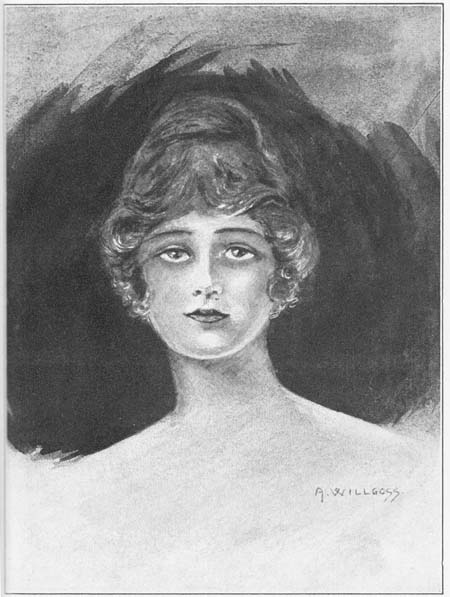
ISMA
“Isma,” he said, “I have come for those—kisses you wouldn’t give me the other day—”
A hot wave of color mounted to her face and her glance fell before his.
As no answer came he went on: “Isma, why wouldn’t you give them to me? Why have you been pretending you did not—care? Did you want to see what I look like when I am demented?” He was still smiling, but his tone held a slight unsteadiness.
She looked up at him reproachfully. “Oh, Falcon, you know it wasn’t—that.”
“Then why in the name of wonder did you—?”
“I didn’t think—you wanted—”
“Isma, you couldn’t seriously have thought such a thing.”
“But I—did.”
“How could it be possible? And how was it your own feelings didn’t help you to understand mine? Tell me, Isma”—he bent over her now—“didn’t you ever want me—close? Want me to—?”
“Of course,” she breathed, in burning confusion.
“Then why on earth have you racked us both like this?”
“I—I—didn’t think you—cared,” she faltered.
[308]He drew back in utter astonishment and his hands fell from her shoulder. “Not cared!” he exclaimed, incredulously. “After I had thrown up everything and followed you across the world, been at your beck and call ever since—simply lived for you! Besides, I told you myself on the day we became engaged—in this very room, don’t you remember?—that I would follow you wherever you went, and you said it was absolutely useless. You didn’t give me one ray of hope—”
“But you did not say you would. You only said ‘one man,’ and I naturally thought you referred to—”
“Berriedale? And do you think I should be pressing his—unlawful suit?”
“I only thought you meant it as a—warning.”
He looked at her in perplexed amazement. “Good God! Isma, what a misunderstanding! Still,” he added, after a pause, “what a mercy I discovered you did care—a little bit, after all!” As he said the last words he laid his hands caressingly on her shoulders again.
His touch unnerved her and she was silent for some moments before asking, timidly, “When did you find out—last night?”
“No; I knew before then.”
The girl glanced up at him quickly. “Before—?”
“Two days ago I was certain.”
“What—made you certain—then?”
“Well, you didn’t seem—very happy on the way home—”
[309]“And you guessed why?”
“I—couldn’t very well help it. Besides, there were other things that day. To be quite frank with you, there had been things all along which pointed—in that direction; for instance, on the night of the ball when my arm—touched you, you seemed to find it difficult to—”
“Oh, Falcon, I was so—miserable that night. I couldn’t help showing—it,” she said, brokenly.
He drew her a little closer. “Isma, what made you so—miserable that night?”
Her drooping lashes trembled.
“Tell me, Isma,” he pleaded, as she did not speak.
“Falcon, you know,” she breathed.
“Were you—wanting—me as much as I—wanted you?” he murmured, close to her ear.
“Of course,” she admitted, almost inaudibly.
He made no reply, but his breath came in short, panting gasps. Then suddenly he caught her to him.
For some minutes they stood without speaking, silenced, made motionless by the paralyzing sweetness of the contact.
At last Falcon said, “Tell me, how long have you—cared?”
The question roused her from the physical lassitude his embrace had produced in her. “Ever since we first met—in England,” she replied, in a low voice.
He started. “All that time! Heavens! If I [310]had only known! Isma, how could you keep it from me so long?”
“Several times I was afraid you had guessed—”
“I did think now and again that— But whenever you had given me the least ray of hope you always took such care to be specially indifferent and aloof afterward—that put me off the scent.”
“Anyhow, I gave my secret completely away the other day,” she said, her voice becoming faint again with the narcotic of his embrace.
“Yes, but I had to drag it from you—use horribly brutal methods—”
“You knew all the time you were—hurting me?”
“Yes, but I couldn’t help it. It seemed the only way of making you—surrender, and I assure you it hurt me more than it hurt you.”
At last she lifted her head slightly and said, “But Falcon, how could you—love me if you doubted me and thought that I—?”
“Isma, I never really doubted you. In my heart I knew all the time that you were the dearest, most unselfish little girl in the world!”
“But till quite lately you were always so sarcastic and contemptuous—”
“That was only because I was desperate. I saw how the world misjudged you, and I was just trying to sting you into prudence. Isma, can’t you understand how I felt about it? It was terrible to have such a slur cast on you—”
“Still, you knew all the time that I didn’t—”
[311]“Of course I knew—knew that you were only sacrificing yourself, your reputation—everything for your friend. All the same, I was distracted with anxiety in case your courage might be the means of entrapping you. Isma, I was at my wit’s end to know how to guard you!”
She looked up at him with shiny eyes. “Oh, Falcon, you have been perfectly wonderful! No one in the world would have been so good to me!”
He stroked her soft cheek tenderly.
“Isma,” he said, after a pause, “when we are married and you have got used to me I want you to tell me about—last night—”
A tremor passed through her. “And—you don’t want to know—before?” she breathed into his coat.
“No, for whatever happened, it could not have been your fault.”
“Oh, Falcon,” she whispered, “you do care as much as, or more than—he.”
He frowned. “Who dared to say I didn’t?”
“He said—”
“What did he say?”
“That—you wouldn’t have anything more—to do with—me if—if—”
He held her to him with bruising force. “He dared to talk to you about—such things—”
In the silence that followed he felt her burning humiliation and hastened to say, “Isma, don’t let us think of it just now—”
[312]“But, Falcon, I must tell you this,” she whispered into his shoulder. “I was wonderfully protected last night. God sent you to me—”
“Heaven be praised I managed to reach you when I did!” he murmured, huskily.
The underlying depth of feeling in his tone made the girl all at once realize it would be lovely to confide to him her beautiful experience on the cliff; but she would wait a little. He was sure to stay for the rest of the day, and when twilight came they would stroll out under the palms. That would be the time to share with him her sacred things. The thought of telling him about God thrilled her suddenly; the intimacy it implied held a new, delicious sweetness!
“Falcon. I have something beautiful to tell you—”
“Yes, little girl,” he replied, in a low voice. “You don’t know how I long for your confidence, have you talk to me freely—open out to me, share everything—”
“But I think I would rather wait till to-night. You will stay all the evening, won’t you?—so after dinner we will go out under the palms and talk.”
“That will be perfectly delightful. What a gorgeous evening we shall have, and evening is the time for confidences, isn’t it?—and we have so much to say to each other, so much to make up!”
“But Isma,” he went on, after a pause, “do you know you haven’t given me those kisses yet?”
[313]Her breathing grew perturbed and she pressed her face nervously against his shoulder.
“Isma, you are surely not shy with me again? Just give them to me at once and you will feel much better.” As he spoke he raised her head and she made no resistance.
For some moments he stood looking into the confused, upturned face, with its flushed cheeks, quivering nostrils, and long, downcast lashes. Then beneath his gaze the heavily fringed lids opened slowly and the golden-gray eyes lifted timidly to his. But the cloudy shyness vanished as their glances met, caressed, melted into one and clung together, and something which was half a gleam and half a mist came into the two pairs of eyes which held each other as if they could not tear apart.
“Good God! how I love you, Isma!” cried Falcon, in a voice stifled with emotion.
The girl paled and something blinded her.
The next moment their lips had met in a long, convulsive kiss.
Staggering and stunned, they drew apart, only to be swept together again and again.
“Oh, Falcon,” she half sobbed, reeling against him as his lips released her at last, “I can’t—”
His iron strength steadied her, and, leading her to a couch in a corner of the room, he sat down beside her and took her into his arms, pillowing her head on his breast. For some time he sat regarding the golden head resting against his [314]heart with strange, glistening eyes; then he said, in a curious, vibrant tone: “Isma, do you know what happened just now? In those kisses you gave yourself to me body and soul.”
She stirred slightly. “Didn’t I do it—before?” she asked, faintly.
“Not fully. You gave me your love before. Now you have given me yourself, made that complete surrender it has been so hard for you to—”
She was fully roused again. “Falcon, it wasn’t hard, truly it was not. I—I—have just been longing to—” she assured him quickly, raising her head and looking up at him with eyes which were deep and dark with passionate yielding.
He bent over her and drank thirstily of the love-wine her soul poured out to him.
His kisses and the paroxysms of emotion which had swept over them had in some mysterious way brought them closer, and it seemed to Isma that every thread of obscuring garment had for the moment been torn aside and that he looked straight into her heart. Her shyness vanished as if by magic. It became a delight to lay her inmost feelings bare to him. She could have no secrets from him any longer; she did not wish to have any. She was his, every part of her belonged to him; he had a right to every emotion stirring in her soul. The passion of their lips had made them one. And the knowledge of this brought with it a deep elation, an overwhelming happiness. She could not repress it, could not keep it out [315]of her eyes; they sparkled suddenly into his, brimmed with a reckless joy which dared to look at him with the triumphant right of a possessor. She regarded his immaculately shaved cheeks, the brown waves of his hair, the soft cleft in his firm chin with adoring scrutiny.
He responded at once to her changing mood.
“Well,” he said, at length, “and what do you think of—your property?”
She colored slightly, but met his probing gaze with dauntless approbation. “I think it is just the dearest, the most lovable thing God ever made!” Her golden eyes caressed his every feature.
He suddenly paled.
But the emotion he showed spurred her on to gayer abandonment, and she laughed the happiest, silvery laugh that had ever rippled over her scarlet lips. “Oh, Falcon, it is a perfect disgrace, the way I show you how much I love you—but I can’t help it!”
He caught her to him and there was fire in his embrace. “It is the most delicious thing you ever did, you adorable little summer witch!”
She leaned back in his arms and surveyed him laughingly, teasingly. “But you don’t really love me as much as I—”
He closed the red, tantalizing lips with his, and his kisses leaped through her like flames. “Take that back! If you dare to say these outrageous things and smile at me in that bewildering way, I shall—”
[316]“Falcon,” she half cried and half laughed, “I am so happy I don’t know what I am doing or saying.”
“Isma, stop being so absolutely bewitching! Can’t you see you are making my brain reel, that you are confusing me, intoxicating me—with your alluring ways!”
“But, Falcon, it doesn’t really matter if we go quite mad over each other, does it?” she said, regarding him with eyes that smoldered with love and tenderness under their long, drooping lashes.
“No, it doesn’t matter in the least, provided we have enough sense left to go through the—marriage ceremony to-morrow.”
She sat up quickly. “What are you talking about?”
“Your and my wedding, of course,” he replied, in a level voice.
She looked at him in breathless astonishment. “Falcon, you are not serious?”
“I was never more serious in my life. It is all being arranged—”
Her mood changed again. “But I can’t—” she whispered, in sudden consternation.
“My dear little girl, you can. All you have to do is to step into my car to-morrow morning and say—‘I will’ a little later on—”
A rich color dyed her face and throat. “Oh, not so soon!”
“Isma, don’t you love me well enough to want to be with me—all the time?”
[317]The hurt in his tone touched her. “Of course, but, Falcon, you don’t understand—” she said, beginning to tremble.
“Of course I do,” he answered, his eyes eloquent with comprehension. “Don’t you think I knew you were shy and nervous when you came into the room this afternoon? But—wasn’t it all right? I didn’t overwhelm you too suddenly, did I—and don’t you think you can trust me to make everything all right for you to-morrow and—afterward?”
She clung to him suddenly. “You know I trust you absolutely. You always make everything easy for me, and you don’t know how much I love you for it!” she murmured, her lips close to his neck.
“So you want me to make love to you again!” he smiled, cuddling her to him. “Isma, when we are married I am going to show you what I really can do in that line.” Then he held her at arm’s-length and gazed at her with passionate adoration.
She laughed blushingly.
“Now don’t you look like that again or I shall have to— Oh, Isma,” he broke off all at once, “why won’t you understand that I can’t possibly wait! First you dazzle and bewilder me till I go clean off my head with longing for you, then you wonder why I love you so frantically that I can hardly wait another day to have you!”
“But—I love you—as much—”
[318]“Yet you don’t want to marry me!”
“Yes, I do—”
“So you do, do you! All I can say is you have a funny way of showing it.”
She leaned against him suddenly and there was utter abandonment in the movement.
“Then you will—come with me—to-morrow?”
“Of course—if you wish it,” she breathed, tremulously.
It was dark. But a mellow, roseate light found its way into the garden through one of the drawing-room windows and fell softly on Isma’s figure as she stood under an archway of creepers saying good night to her lover. Her black Ninon evening gown was sleeveless and in the semi-darkness her lovely shoulders and arms gleamed strangely white.
Falcon regarded her silently for some moments. Then all at once he folded her to him and buried his face against the sumptuous whiteness of her shoulder.
Her soft arms stole about his neck as she gently pressed him to her.
The soldier drew a long, blissful sigh. “Isma—this is—heaven,” he murmured, in tones laden with ecstasy.
After a pause he raised his head reluctantly. “But I must tear myself away. It is getting late and you must have a good sleep. But think of it—to-morrow about this time we shall be together [319]at the Blue Mountains, and, Isma—I shall not need to—say good-by.” His voice held a curious exultation.
“Falcon,” she whispered, laying her cheek against his, “I can’t think— It will all be too—wonderful—”
“You are glad now I arranged it so—soon?”
The glistening arms about his neck tightened. “After being with you like—this I couldn’t—bear it—if you—hadn’t—”
He crushed her to him. “Isma, only this one good-by and—then—”
In the warm, perfumed darkness two figures clung tremblingly together, while their lips met in a caress which held agonized longing as well as rapturous anticipation.
“NEVILLE, what do you think has happened?” cried Miss Brentford, almost hysterically, as she swept into her brother-in-law’s room.
“My dear Rita, how can I guess what happens anywhere when I am a prisoner between these four walls?” replied the pale man on the bed, with a touch of irritation.
The girl began to pace the floor in frenzied excitement.
“What is it?” inquired the patient, realizing that something unusual had taken place.
Miss Brentford stood still and there was a wild, desperate look in her black eyes as she said: “Captain Folkestone has just rung up to say—good-by. He and Isma were just starting for Sydney. They are to be—married this afternoon. All is arranged.”
She stopped breathlessly, waiting for some fiery response, but none came; the man among the pillows did not stir.
“Neville, how can you lie there so quietly, [321]staring into space as if this meant nothing to you? Stop acting—you don’t need to pretend with me.” She almost screamed at him in her exasperation.
Lord Berriedale’s dark eyes moved slowly from the windows through which long rays of sunlight streamed into the room and lay in large golden pools on the purple carpet, to the trembling form standing before him.
“Rita, I am not pretending. Only,” he sighed deeply, “I knew this had to—come—”
“How did you know that?” his companion demanded, fiercely. “She did not love him and—” She stopped, making a little choking sound in her throat.
“Didn’t love him, Rita! If ever a woman loved a man she loved—him!”
“I don’t believe it. She could not love anybody—doesn’t know the meaning of the word!” she flung at him, hotly.
An odd, ghostlike smile hovered for a moment about Lord Berriedale’s pale lips and his gaze seemed all at once fixed upon a scene which was not visible to the girl beside him. “Rita, you don’t know what you are talking about. In any case, do you think she could satisfy a man like Folkestone if she could not answer fire with fire? I used to think him cold, but, by Jove!—” Again his eyes looked abstractedly into space.
“Neville, I went to him two days ago to try and—make him give her up. I was going to tell him everything and open his eyes—”
[322]Lord Berriedale’s abstraction had vanished. “Yes, and what did he say?”
“He didn’t say anything. He simply refused to discuss her; wouldn’t even let me mention her name.”
“How could he prevent that?” One slim hand began to tug at his honey-colored mustache.
“Oh, you know his way! He just smiled, looked more handsome than ever, fenced and talked; everything I said he turned off—wouldn’t allow me to approach the subject.”
“Rita, that was because he knew you don’t understand his cousin.”
“Who can understand such depths of treachery!”
“You are absolutely wrong. There is no treachery about—Isma. She is the finest, grandest woman—”
“You ought to be the last man to say that, for you know better—” she interrupted him, vindictively.
“I know better than any one how utterly—untemptable she is.”
“You men always shield a beautiful woman!”
The girl began to pace the room again, her ungoverned despair sweeping over her once more. “Oh, Neville, I shall go absolutely crazy. I—I—can’t bear it—I can’t!”
Her companion sighed heavily, but he did not speak.
“I shall go mad—I know I shall—”
All at once she came over to the bed and threw [323]herself into an easy-chair beside it and buried her face in the counterpane.
One long, slim hand was laid on the black, girlish head. “Poor little Rita!” whispered a voice so full of sympathy that she hardly recognized it as her brother-in-law’s. “If only I could make it easier for you!”
The girl lifted her face and looked long into the kind eyes regarding her. “Neville, do you think my going to him spurred him on to—?”
“No, dear, not at all. Folkestone would have done it, anyway. He has waited a long time, shown excellent self-control, and behaved with a restraint I envy him. But a man like that will not wait always, and when he does act he means business.”
Miss Brentford looked at him in amazement. “How can you bear to talk of it so—calmly! You speak as if it did not concern you in the least.”
“I am resigned—that is why,” he replied, meeting her glance calmly.
“Don’t you want to—kill the man and take her from him?” Her eyes held a fierce, merciless glitter, and the man beside her felt thankful that Isma was safely out of Rita’s way at present.
“What would be the use? I am helpless. I must stay—here, while another—”
The expression on his face made the girl all at once realize what he was passing through. “Poor Neville!” she murmured, for a moment forgetting her own grief in her realization of his.
[324]“You need not pity me. I deserve it all; besides, I could never have made her happy.”
“Would that count as long as you—had her?”
“It didn’t count before. I would have taken her at all costs. But it counts now.”
“Why now?”
“I can hardly explain, only I have been thinking about—God.”
His companion, stared at him in astonishment. “Good gracious, Neville, you don’t mean to say you are turning religious!”
“Why not?” he asked, in level tones.
“Well—you are hardly a—suitable subject for—that kind of thing, are you?” she replied, with merciless candor.
“It is men like me who need religion most—”
“And what good can it do you?” she challenged him, scornfully.
“I don’t know yet. Perhaps religion may not help me, but God might.”
The girl had risen. She stood looking in cold defiance at her brother-in-law. Then she suddenly burst out laughing, a hideous, horrible laugh. “Neville, you are crazy already, absolutely dotty!” and with another ugly laugh she bolted out of the room.
“Rex, is the world coming to an end or what?” asked Miss Brentford, bursting into the library where she knew the secretary was comfortably installed with a novel and his cigarettes.
[325]The man in the deep armchair put down the book he was reading and looked up in indolent anticipation. He had heard the girl’s conversation on the ’phone with Captain Folkestone and knew about the coming wedding, and looked forward to an interesting talk on the subject.
“Has anything else gone wrong?” He spoke with solemn intonation which seemed to refer to Lord Berriedale’s accident and that the secretary hoped no more calamities had taken place.
“Anything gone wrong indeed! What do you think, Neville has turned—religious!”
Rex showed distinct signs of disappointment.
“Is that all?” he said, indifferently, picking up his book again. “You really frightened me and made me think it was something serious.”
“Well, isn’t it serious that Neville is going mad?”
“Do you consider religion a madness?”
“Of course. Don’t you?”
A light shot suddenly into the pale-blue eyes. The secretary saw a new excitement ahead of him, a fresh way of tormenting another being. “No, on the contrary, I think it shows jolly good sense,” he answered, settling down to enjoy himself.
“Rex!” exclaimed Miss Brentford, angrily, “you are only playing, and I am in no mood for jokes.”
“Indeed I mean what I say.”
“But you are not religious—far from it.”
“That doesn’t say I don’t approve of it. I [326]don’t take exercise myself, yet I thoroughly believe in it, all the same.”
“You are too lazy,” commented his companion.
“Exactly. Most people are too lazy to be religious. It is too great a strain on their intelligence and too great a strain on their bodies.”
“Strain on their bodies?” queried the girl, in surprise.
“Yes, of course. When people become religious the body has to toe the line as well as the soul, and between ourselves I believe it is the strain on the body that keeps most people from religion. They don’t say so, naturally. They have far nicer little ways of explaining the situation. They are either assailed by doubts or they are too enlightened and clever or too large-minded to accept such old-fashioned ideas. But all the time it is the strain on the body it involves that frightens them off.”
“Still, if you believe in it, why aren’t you religious yourself?” interrogated the girl, uncertain whether her companion was in earnest or not.
“For the simple reason that others fight shy of it. I don’t want my habits interfered with. I like too many things religion condemns, so I keep away from it and stick to my habits.”
“Isn’t that rather foolish?” suggested Rita, with a veiled display of interest in spite of her scoffing tones.
“Of course, madly foolish. But then, with all our twentieth-century culture, cleverness, and [327]knowledge, we are nothing but a set of innate fools! We know the great monster Death is after us, that sooner or later it will track us down. If we had one iota of sense, we would—”
“What would be the use—we can’t alter the fact,” interrupted Miss Brentford, impatiently.
“We certainly cannot alter the fact that Death is at our heels, yet we might alter—others.”
“What others?”
“Our fate Beyond.”
“Rex, do you really mean you believe in a state Beyond?”
“Of course I do; no one with any reasoning power could help it. There is no waste in nature; life everywhere rises out of life; death is just a crisis, a horrible, disgusting crisis; still, merely a critical juncture—an autumn crisis in which decaying vestures are shed. But the real life is not cast off in autumn. It is left free to be robed again in fresh garments, and the new garments will be on the same pattern as the old.”
The girl regarded the secretary skeptically; however, in her skepticism smoldered a secret fascination. “That sounds very plausible; yet, after all, we don’t know—no one has told us.”
“No, but we have been given minds which can think, conjecture, reason. We were never told about the power of electricity, still, by conjecturing and reasoning it was found.”
Rita sat in silence for a while. Before her mind had risen a torturing vision of two people flying [328]along in a car on dry, summerlit roads, and soon—soon— No! She could not tolerate the idea; it was preposterous, unthinkable! She must make Rex talk again, anything to keep her brain from the picture it insisted on bringing before her. It was difficult to switch off her mental energy into another direction, yet these new thoughts and the astounding fact that Rex should expound them made them seem peculiarly interesting.
“Yes,” she admitted, half absently, “but we have got away from the main issue. I don’t see that that has anything to do with it. If there is an after-state, we shall arrive at it whether we are religious or not.”
“Certainly. All the same, religion has a great deal to do with it, for it makes people sow wheat and not tares; it is very insistent on that point. Now don’t you see the connection? The coming life must spring from the seed of this one, and, as a plant cannot one season be a nettle and the next a rose, it follows that if we are nettles here we must be nettles There and be treated as obnoxious weeds.”
The girl rose hastily. Nettle—nettle! The horrid little word pressed itself into the tissues of her brain.
A couple of days ago she had wondered why she had so little power over other people; why her words carried no weight; why she was ineffectual, influenced nobody; why no one had come very intimately into her life; why every one kept [329]her at arm’s-length, and now she suddenly saw the reason—she was a nettle, a horrible nettle which stung anybody who touched it. She had nearly stung her sister to death; she wished to sting Isma into her grave; her words had been full of spite and venom, her actions obnoxiously selfish! She saw herself as a loathsome nettle stinging all who touched her life. And if there really was a state Beyond, what would happen to her? Would she still go on stinging so poisonously, so venomously, that she would be forever unloved and abhorred? What a terrible destiny!
“Some people think Death transforms us into angels,” Rita flung at the secretary, after a pause. “That is a much nicer theory than yours.”
Rex smiled ironically. “Yes, and almost as reasonable as the Santa Claus illusion.”
“And why shouldn’t it be true?” demanded Rita, defiantly.
“The Santa Claus myth?”
“No, no, you stupid man, not that—”
“Oh, I see; you mean the angel theory?”
“Of course.”
Rex sighed patiently. “Now do use your brains! How could Death transform one into an angel? Can the canker-worm develop the bud it attacks into a flower? Death has no power except to decay. It is like a moth getting into a garment; it doesn’t beautify—it destroys.”
“In that case it kills outright.”
“Yes, the garment, but not the wearer.”
[330]Rita walked toward the window. However, the sight of the hot sunshine glistening on trees and flowers made her turn away hastily, for in this blinding radiance two people were driving—
“I hate all this sunlight!” she said, her cheeks all at once paling. “This is a horrid country; everything is ablaze; it is a land on fire that glitters and burns. I loathe it!” she cried, turning on the secretary with sudden vehemence.
“My dear girl, I assure you I had no hand in inventing or making Australia.”
“But you like it,” she protested, wrathfully.
“This certainly is a flame-land. It is vivid like fire. Its breath is like the breath of a furnace; even the wide spaces above are scorched by the heat from its great body; its voice is the roaring voice of flames! It is a land that sets people on fire, and, Miss Rita, if I stay here much longer”—Rex looked up at her with eyes that glowed with a sudden, mysterious light—“I shall be in flames myself.”
Australia was an extraordinary country. It had changed her whole world, made all familiar things crumble into dust and strange new ones take their place. Captain Folkestone had gone out of her life—she writhed again. Neville had become religious! Beatrice was dying! Rex talked like a bishop and said he was catching fire! And Australia was responsible for this horrible conglomeration of upheavals! Why had she come to this place of wild, abnormal things to be [331]whirled like an atom into fathomless immensities, to be thrown into its flaming purgatory? Ah, why?
The girl stood still, regarding Rex for some moments in curious silence, then she turned and walked slowly out of the room.
WHEN tea was over that afternoon Lady Berriedale went to see her husband and sit with him for a while.
She had a nasty paroxysm of coughing as she sat down beside the bed. When the coughing had subsided she made a few preliminary remarks before saying, a little nervously:
“Neville, I have been so—sorry for you all day—”
Lord Berriedale made a restless movement as if he wished to check her, but she would not be interrupted. “Dear,” she continued, making a further effort, “I am going to say what I want, so just listen to me. I should like you to know that I had planned—everything so differently. I wanted you to have had what you—desired, after I had—gone. But now—” She hesitated.
The man’s left hand closed over his wife’s trembling one. “Beatrice, you have been far too generous,” he said, in a voice which shook slightly. “I have not deserved such—kindness.” Then [333]he drew his hand away and moved it shadingly across his eyes as if to hide something he did not wish her to see.
Lady Berriedale turned her head away and her brimming glances searched the room for something to distract her attention and help her to composure. After a time her eyes lighted on some loose papers lying on a small table in front of her. Mechanically she picked up the sheets and saw that they held some verses written in a hand she did not recognize. Half absently she began to read “Crucified.”
Her attention became suddenly fixed, the hectic flush in her cheeks deepened, and she sat so still that her husband looked up, wondering what kept her so motionless.
A deep stain crept into his pallid face as he discovered what she was reading. “Beatrice, don’t; please don’t,” he said, in agitated tones. “It will only hurt you.”
She dropped the paper and met his disturbed gaze with eyes that held an unearthly calm, then she said: “Nothing can hurt me more than I am already hurt. I have lost—all; or, rather, found—I had nothing to—lose.”
She picked up the paper again and finished the verses, while the color in her husband’s cheeks faded to an ashen pallor.
For some time she sat with the thin sheets before her, staring fixedly at the words as if they had cast a hypnotic spell over her.
[334]The stillness in the room was like the silence that follows the verdict of doom; it held an awful fatality, a sense of irrevocable destiny.
“Neville,” she said, at length, breaking the dreadful pause, “your life has been—like that?”
He made no answer, and his eyes evaded hers.
“Neville, why didn’t you—let me—know sooner and I would have—set you free?”
If she had spoken such words before, he would have assured her he did not want release; but now empty avowals were useless and the moment too solemn for prevarication. To have uttered an untruth just then would have been like uttering it before Eternity itself. Their naked souls stood face to face with each other at last; all veiling garments of falsehood and insincerity had fallen away.
“You could not,” he replied, after a short silence, forced to undeviating sincerity.
“Yes, I could. I would have—gone away, and after a time you could have had a—divorce on grounds of desertion.”
“That would have been—useless.”
“You mean she would not have—married a divorced man?”
“Yes, she wouldn’t have done that even if she had—cared: But,” he went on, in a different tone, “do not regret anything. It could not be—helped. Nothing could have altered it. Marriage binds till—death.”
Lady Berriedale sat looking vacantly before [335]her as if her inner eyes were gazing into some terrible reality she must accustom herself to face. After a pause she repeated, absently:
The man on the bed shuddered. “Don’t, Beatrice, don’t,” he pleaded, closing his eyes.
For some time neither of them spoke and in the silence the wide, black chasm of despair stretched out before them in paralyzing desolation.
“The cross holds till—death,” she said at last, staring fixedly at the fatal verses; then after what seemed another interminable pause she rose and walked slowly out of the room.
It was midnight. Through Lord Berriedale’s wide-open windows gleamed the summer-night sky with its myriad host of tranquil stars.
The door opened gently, and a white-clad form moved softly toward the bed.
“Are you asleep, Neville?” whispered his wife, coming close to him.
The figure among the pillows shrank away a little, but the merciful darkness hid the sudden movement, also the hostile expression in the sleepless eyes.
“No,” he replied, in schooled tones, “I am not.”
Lady Berriedale hesitated, her fingers fidgeting [336]with the silken bedspread, while her husband lay gazing at the white blur beside him, not choosing to assist her in overcoming her evident embarrassment.
“Neville, I want to—talk to you,” she said, with apparent effort.
“Couldn’t you talk to me—in the daytime? If you become—excited now, you know you will not be able to—sleep at all,” he said, with a distinctly uncompromising note in his voice.
“I shall not be able to—sleep, anyhow, and—it will help me to—talk to you. I have been thinking of those—verses and—everything,” she went on, more hurriedly. “How could I help it! It all seemed so hopeless, such an irremediable tragedy! Life, generally, appeared a fearful chaos, a cruel muddle, and I was almost distracted as I thought about it. Then all at once some talks with Isma came back to me. We were speaking about life and came to the conclusion it was only a prison-existence; that this planet was merely a prison-house for the criminals of the universe—the worst criminals, for every one sent here is executed. It seems to me this thought alone can explain all the suffering, misery, and heartache abounding on this earth. But, Neville, fancy entering the next world as criminals! Isn’t it awful! What chances of happiness could we have under such circumstances! And perhaps Death is not even the execution; it may merely be a door, a horrible door, that leads to—a worse [337]doom. Neville, when I am so—near, when I shall enter it so—soon, can’t you understand that I should be terribly anxious?” She spoke rapidly, excitedly now.
Her husband clasped her hand in quick sympathy. “Of course, Beatrice, of course I can.”
After a slight hesitation she went on more calmly, a gentle hush coming into her tones. “But, Neville, I have been praying lately, not just offering formal petitions to some far-away, unheeding Being, but talking to a real Person—what Isma calls laying a detaining hand on God and speaking to Him. I have asked Him about—everything and to help me when all alone I shall enter the Great Beyond. I have been horribly afraid of it, Neville; but”—in the starlit gloom he saw the sudden light that came into her large, shadowy eyes—“I am not afraid any more, for all at once I remembered something I have not thought of for years, and it has taken away all my fears. It is this.” She lowered her voice before saying: “Neville, God so loved us that He sent His only Son down to this desolate prison-house to die for us poor criminals. Think of it—die for us! He was put on the scaffold of the cross for our sakes, and now—we can enter eternity, not as malefactors, but—free! Oh, Neville, you can’t imagine what this means to me!
“I unearthed my Bible to read about it, and do you know the first place my eyes lighted on as I opened the hook was the passage about the [338]dying thief, and as I read it seemed to me he really represents the whole of suffering humanity—dying on the cross of sorrow and pain—yet unable to open the gates of—Paradise. It was only when the thief asked the Spotless One at his side to remember him when He came into His kingdom that he received the immediate promise of—Eden. And Neville, isn’t it wonderful! We can all ask Him—everybody can—to remember us; and He is not far away; He is beside us, and the moment we really ask we receive the promise that we shall be with Him in Paradise! Isn’t it beautiful!”
The soft darkness veiled the trembling form among the pillows and the moisture glistening in the black eyes.
There were some moments’ silence; then Lord Berriedale raised his wife’s emaciated hand to his lips and kissed it reverently before saying, brokenly, “And, Beatrice, it is only when we are on the cross ourselves that we learn to think of—the Crucified One and ask Him to—remember us.”
In the dimness he saw her face transfigured as she said, softly, “The cross is the trysting-place between heaven and earth; the cross is the ladder to—Paradise.”
Outside in the still, warm night a shuddering sigh went through the dreaming flowers in the garden and the stars gleamed as if they were smiling down on the earth through tears.
THE nurse came down-stairs as Captain and Mrs. Folkestone entered The Bluff.
Isma scanned the older woman’s face anxiously as she said, “We are not too—”
“No, you are not too late,” the woman in the pink uniform hastened to assure her, “but I am afraid there is not much time left. Lady Berriedale is sinking fast. I saw your car coming, so hurried down to let you know how she is.”
“Can I go to her at once?” asked Mrs. Folkestone, her large eyes glistening with troubled eagerness.
“Well, she is hardly conscious just now; she lies for hours in a semi-conscious state. His lordship is with her. He has been in her room all the morning. He hardly ever leaves her, day or night. He is a most devoted husband. I will tell him you are here. Will you come into the library for a little while, and when Lady Berriedale is fully awake I will let you know.” As she spoke she opened the library door, and after they had entered she closed it gently behind them.
Isma looked round the familiar room and her [342]face showed that it did not bring back happy memories.
She took off her hat and long dust-coat; then she sighed deeply and went over to the window.
Her husband followed her. “Isma, I am so awfully sorry you should have—this—just now,” he said, coming up and standing close behind her. “I wanted our”—his voice lowered—“honeymoon to have been all joy.” His hand caught one of hers and held it closely.
“I am more grieved for you,” she replied, without moving.
Her husband bent lower, looking over her shoulder at her beautiful profile. Then he drew her slightly backward till she rested against him.
She closed her eyes for a moment. “Oh, Falcon, it is lovely to have you with me!” she murmured under her breath.
The pressure on her hand increased. His touch was warm, close, intimate. It not only held intensest sympathy, it held more; it reminded her of all their happiness, what they had been to each other during the last few weeks, their riotous joy, the wonderful satisfaction their new relationship had brought them, the blinding rapture they had tasted in each other’s arms. She felt that Falcon meant his touch to recall this to her mind so that it might strengthen her for the heartrending scene which awaited her.
“Falcon,” she said, turning to him, after a [343]pause, “it must be terrible for Beatrice to—go.” She shivered slightly.
“Yes, little girl,” he replied, with serious tenderness, “but remember she is going out to your beautiful God of the wonderful spaces—don’t forget that.”
She looked up at him with eyes which held a dewy radiance. “Of course! What a dear you are to remind me!”
He smiled down on her. “You impressed it so strongly on my mind, now I can’t forget it, you see.”
There were footsteps in the hall.
Isma and Falcon drew gently apart.
The door opened slowly and Lord Berriedale, looking pale and worn, his arm still in a sling, entered quietly.
When the brief greetings were over he said: “Beatrice is conscious now and wants to see you. I am deeply grieved to have called you back so soon; but she was always asking for you. In fact,” he went on, addressing Isma, “your name has been constantly on her lips since you have been away, and when the doctor said last night that—the end was so near I—wired.”
“We are so glad you did,” said Captain Folkestone, and there was a strong undercurrent of sympathy in his even tones.
“I wish you had let us know sooner that Beatrice wanted me,” murmured Isma, regretfully.
“She wouldn’t allow me to disturb you until [344]it was absolutely necessary. But you had better come at once—she wants you both,” and silently he led them up-stairs.
As they entered the sick-room Isma glanced anxiously toward the luxurious bed with its fine, embroidered linen and rich silk hangings.
The patient lay waxlike and shrunken, her eyes looking enormous in the wasted face and staring with glassy fixity into space.
In a moment Mrs. Folkestone was beside the bed, stooping over the shriveled form and kissing the sunken cheeks.
Slowly recognition dawned into the lusterless eyes and a feeble smile hovered over the purple lips. But she did not speak for some minutes.
The silence in the room was heavy with an awful pall.
At last the patient’s lips moved.
The girl bent over her quickly and caught the words, “Isma—I am—going.” After each word there came a slight rattling sound.
Her friend dropped on her knees and took the emaciated form in her strong young arms. “Beatrice,” she whispered, a little unsteadily, “you don’t—mind?”
“No—not now.” Her voice had grown stronger, and she added, “Isma—you remember the letter I wrote you—telling you about—the dying thief—on the cross?” The dusky eyes were turned full on the fair, girlish face.
“Yes, dearest, of course.”
[345]“And you will not forget—what I asked?”
“No—never.”
The dying woman’s glance strayed to her husband, who was standing at the other side of the bed, as if to include him in what she said. “I want you both to promise me that—you will tell everybody about—Paradise. Tell them to read about it in the—Book. Tell them to ask Him to—remember them—” She stopped and gasped for breath.
“Yes—yes, we will,” Isma assured her, quickly.
The dark eyes looked up with terrible intensity.
“Tell them it is awful to—to pass into—eternity unless He will—remember us.”
She looked at them imploringly till they had both made the promise; then her eyes closed wearily and she lay very still.
By one of the farthest windows stood Rita, looking out on the hot, glittering sea. There was a sullen despair in her coal-black eyes. She was left out again; no one took any notice of her; but then she was the nettle, and no one wanted a stinging nettle; it was left severely alone. An expression of morose hopelessness settled on her face.
Lady Berriedale turned to Captain Folkestone and her glance summoned him to her. When he was beside her she looked up at him with mute appeal; then her eyes dropped to the flaxen head pressed closely against her breast.
The soldier understood at once. “Yes, I will [346]take care of her,” he said, as one making a solemn vow.
After a pause Beatrice looked up at her husband with a deep wistfulness in her glassy eyes and her lips moved as if she were trying to speak.
Isma rose and Lord Berriedale stooped over his wife, his face close to hers. At last she was able to formulate the words. “Neville—don’t grieve.” One of her thin hands sought his. “Wherever I go, I shall always—love you, and”—her lips twisted into a smile—“our—romance will come right—some day.”
A sob shook the man bending over her. “Beatrice—if only you could stay with me and it could come right—here!” and he kissed her as he had not kissed her for years.
For an instant a beautiful smile lighted up her face and her eyes looked happily into his. Then the smile faded and a peculiar, far-away expression took its place. It seemed as if her attention was being gradually withdrawn from her surroundings and gently fixed on something else. At the same time her face grew more waxy and the pinched look about her features increased.
Then under her rattling breath they heard her murmur the words:
“Lord, remember—me—now Thou art in—Thy kingdom—”
For a time there was no sound in the room but the tense breathing of people holding back tears.
Suddenly a marvelous change came over the [347]dying woman. The lines, the sallowness, the pinchedness vanished from her face and in their place came a strange look of youth—not the youth of flesh and blood that fades and withers, but a spiritual youthfulness that suggested an eternal preservation. And with it came an abnormal strength; it seemed as if all weakness had dropped from her like a worn garment flung aside. She sat up in bed, her arms outstretched, her face illumined with a white, unearthly radiance. She did not appear to see the little group about her. She gazed beyond them, gazed with passionate intensity at something no one else could see.
“Paradise—Paradise!” she cried, her voice ringing through the room with triumphant clearness. “It is there—there!” Her eyes widened, dilated with rapturous awe, and once more her voice sounded through the breathless chamber.
“The portals are opening—opening! And—He has—remembered—me—”
The next instant the frail form fell back among the pillows—dead.
To the tear-blinded eyes watching it did not seem as if life had ebbed away; it rather appeared as if a new strength had vitalized the departed, giving her power to burst the casket which held her to earth and, leaving death in her wake, she had soared in sublime ecstasy through the portals that opened into—Paradise.
THE END
TRANSCRIBER’S NOTES:
Perceived typographical errors have been corrected.
Inconsistencies in hyphenation have been standardized.
Archaic or variant spelling has been retained.