Large-size versions of illustrations are available by clicking on them.
KHARTOUM,
AND
THE BLUE AND WHITE NILES.
VOL. I.
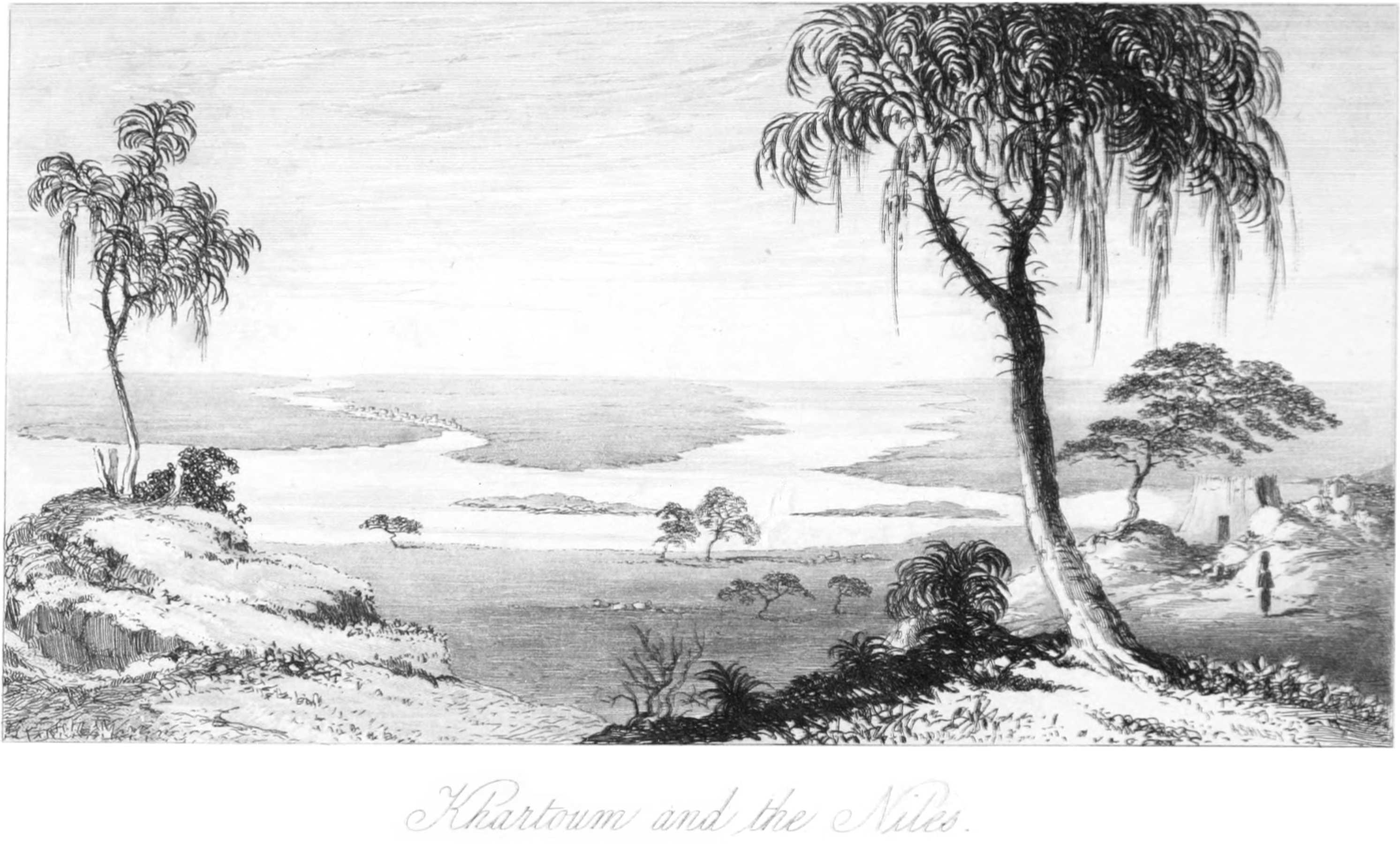
Khartoum and the Niles.
London, Colburn & Co. 1851.
KHARTOUM,
AND
THE BLUE AND WHITE NILES.
BY GEORGE MELLY.
![[Illustration: dragomen]](images/i2.jpg)
Second Edition.
IN TWO
VOLUMES.
VOL. I.
LONDON:
COLBURN AND CO., PUBLISHERS,
GREAT MARLBOROUGH STREET.
1852.
LONDON:
Printed by Schulze and Co., 13, Poland
Street.
LIST OF ILLUSTRATIONS.
![[Decoration]](images/decor1.jpg)
| VOL. I. | |
| KHARTOUM AND THE NILES | Frontispiece. |
| DRAGOMEN | Vignette. |
| MAP OF NUBIA | To face page 237 |
| VOL. II. | |
| IPSAMBOUL | Frontispiece. |
| THE AUTHOR | Vignette. |
[vii]PREFACE.
The Work now presented to the public, is nothing more than a transcript from a Journal kept by the Author during a tour in Egypt and Nubia, (undertaken in company with other members of his family) only a few months ago. The peculiarity of the relations of Egypt and the Porte at the present moment, affords the Author the best excuse he can put forward for appearing in print, and he hopes that observations so recently made over a very interesting portion of the[viii] dominions of the Pasha of Egypt, by a perfectly disinterested spectator, may be though not unworthy the attention of the reader.
It is only here necessary to add, that we succeeded in penetrating Nubia as far as Khartoum, the place of junction of the Blue and White Niles, where few travellers had preceded us, and to which town no ladies had ever penetrated before.
LONDON,
OCTOBER 5, 1851.
[ix]CONTENTS
OF
THE FIRST
VOLUME.
| CHAPTER I. | |
| The Adriatic — Alexandria — The Grand Square — Pompey’s Pillar — English invaders — Egyptian Cemetery — Cleopatra’s Needles — Stroll through the streets — The Great Canal — The first pipe | 1 |
| CHAPTER II. | |
| Up the Canal — Arab boats — Shoal of swimmers — Beautiful mirage — Egyptian tillage — Atfeh — The lock — The Nile | 19 |
| [x]CHAPTER III. | |
| Cairo — Description of the inhabitants — Treatment of women — Adventure of an Arab boy — Encounter with a native lady — Courtship and marriage in the East — Taking home the bride | 36 |
| CHAPTER IV. | |
| The water-carriers of Cairo — An Egyptian bath — The bazaars — Turkish gallantry — Shopping in the East — The slave market — The Court of the Cadis — Turkish justice | 51 |
| CHAPTER V. | |
| The Citadel of Cairo — Mosque of Mehemet Ali — Moslem Carnival — The College of Dervishes — Curious religious ceremony — Presentation to the Viceroy — The Nepaulese Ambassador — Visit of the ladies to Ibrahim Pasha’s hareem | 70 |
| [xi]CHAPTER VI. | |
| Disgrace and flight of Artim Bey — Visit to Achmed Bey — Palace of an Egyptian noble — Arabian horses — Tombs of the Caliphs — The gardens of Shoobra — The imprisoned lady — Grotto of the Virgin Mary — Heliopolis — Boulac — Ishmael Bey — The boats | 87 |
| CHAPTER VII. | |
| Departure from Cairo — Ascending the Nile — Invasion of rats — Our dragoman and retinue — The Pyramids — Nile etiquette — An evening on shore — The Tombs of Beni Hassan — The first crocodile — Shock of an earthquake | 106 |
| CHAPTER VIII. | |
| Ossioot — The city gate — The mountain of tombs — Visit to Ismail Pasha — Encounter with a Latin monk — Ekekian Bey — Story of a cat — Arrival at Keneh — Visit to Hassan Said — The dancing girls — Departure from Keneh | 127 |
| [xii]CHAPTER IX. | |
| The Plain of Thebes | 151 |
| CHAPTER X. | |
| Karnac and Luxor | 165 |
| CHAPTER XI. | |
| Esneh — Dancing girls — Mehemet Ali — Summary justice — The mountain of the Chain — Angling in the Nile — A battle with the natives | 183 |
| CHAPTER XII. | |
| Assouan — The treaty with the Reis — The quarries — The Persian invasion — Caravan of slaves — Hunting for jackalls — Daireh’s love story | 177 |
| CHAPTER XIII. | |
| Philæ | 208 |
| [xiii]CHAPTER XIV. | |
| The first Cataract of the Nile | 227 |
| CHAPTER XV. | |
| Korosko — Shooting excursion — Crocodiles — Ipsamboul — Colossal statue | 231 |
| CHAPTER XVI. | |
| Retrospect | 255 |
| CHAPTER XVII. | |
| Itinerary for the Desert | 282 |
| Appendix | 285 |
[1]KHARTOUM,
AND
THE BLUE AND WHITE NILES.
CHAPTER I.
The Adriatic — Alexandria — The Grand Square — Pompey’s Pillar — English invaders — Egyptian Cemetery — Cleopatra’s Needles — Stroll through the streets — The Great Canal — The first pipe.
After a pleasant journey through Lombardy, and a very agreeable stay at the city of gondolas and palaces, we arrived at Trieste on the 25th of September, 1850, on our way to Egypt. Our party consisted[2] of my father and mother, my brother and sister, and myself. We had all travelled much, and were thus pretty well accustomed to the small annoyances, which those who leave comfortable homes in England to visit other lands, must expect to encounter. But it should be borne in mind that two of our number were ladies, which may show that the journey we contemplated was neither too fatiguing nor too difficult; many may therefore follow in our steps, and enjoy, as we did, a tour full of new and interesting scenes.
We hoped, before returning, to be able to penetrate far into the depths of Nubia; departing from the beaten track of Nile travellers, to reach the 14th degree of north latitude, and add our names to those of the few English who have gazed on the junction of the White and Blue Niles. Some of us might have had wild[3] wishes relative to the undiscovered source of that mighty river: while others might have looked with some degree of apprehension to the task of making a road where none existed, and traversing a country hitherto explored only by men. We all agreed, however, to go as far as it appeared safe and easy; meanwhile to bind ourselves to nothing, but to be ruled entirely by circumstances; which, in fact, are the real guide-books of travellers—more especially in an unknown country.
The morning of the 27th of September, far as the year had advanced, was a most charming one; for summer, like other visiters, lingers long on the beautiful shores of the Mediterranean—never leaving the southern, and but for a few brief months the northern coast of that blue lake.
In the middle of the harbour of Trieste, gay with Austrian frigates, and Neapolitan[4] corvettes, lay the ‘Europa,’ a large steamer, which was to start for Alexandria at half-past eight. Before that hour we were all on board; soon afterwards we bade adieu to Europe, and doubling the Pirano point, stood down the Adriatic, skirting its rocky shores that were backed by the distant blue hills of Illyria. Up to this moment we had scarcely been able to look round us, so crowded were the decks with shore-people, bidding adieu to Indian passengers, and Alexandria merchants; but when delivered from these intruders, we found ourselves in a large and commodious vessel, about the size of the boats plying between Liverpool and Glasgow. Some thirty persons were walking the deck, a few smoking cigars, and others lighting long chibouques, as if, on weighing anchor to quit Europe, we were already in the East. We might have thought that this was indeed the case;[5] for the thick awning could not protect us from the intense heat of the sun; and the Gulf of Venice, unruffled by a single wave, looked more like a mirror than a sea.
As soon as we were well off, I observed a young Englishman, in a spirit characteristic of our country, attack the captain about the passage—as to whether it was likely to be rough or pleasant, with many similar unanswerable questions as though the weather could be insured for the next five days in the most changeable of waters. The captain—and when does that authority not pretend to know the future movements of the winds and waves?—averred that it would be a dead calm to Corfu, and thence a “nasty bit.” That the dead calm might to a landsman be a stiff breeze, I well knew; but the prospect of the “nasty bit” was really serious, and remained a bug-bear to all concerned till[6] the end of the voyage. Like many such things, however, it proved more imaginary than real; and we arrived at Alexandria after a beautiful passage of five days, no one on board having any cause for disagreeable impressions.
Alexandria is flat, as is indeed all Egypt, up to the mountains which form the Valley of the Nile. We were nearly at the end of our voyage before we discerned any trace of the famous shores of Egypt; and then we saw only the summit of Pompey’s Pillar, rising up, like some witness from the past, to notify their antiquity and fame. Almost at the same moment, we distinguished the masts of the Pasha’s fleet, and about half an hour afterwards we could see the sand hills of Alexandria. At length, we reached the port, entering through a channel between two rocks, not two hundred yards apart, which constitute the natural defence of one[7] of the strongest harbours in the Mediterranean.
The instant we dropped anchor, the steamer was surrounded by boats, some bringing off friends, and others sanitary officers; while many twenty-four or thirty oared boats, full of sailors of the Pasha’s fleet, dressed in white, kept continually passing and repassing, spite of the burning sun, with all the animation of a regatta. In a few moments our deck was covered. We had several ladies on board, who had come to rejoin their husbands: they had deserted them and fled to Trieste on the approach of the cholera—notwithstanding their conjugal vow as to sickness and health. Their neglected spouses had hastened to receive them, and were much affected at the reunion, sobbing like so many children. Whether this, however, was in token of gladness, or in lamentation for the loss of[8] the liberty enjoyed during their bereavement, it were hard to say. I observed that the gentlemen kissed one another, and was surprised to find, on inquiry, that no relationship existed between them, but that they were merely acquaintances. The ladies, though it is their peculiar privilege in our own happy land, were not complimented with these marks of affection; so completely is the order of things reversed in this country!
Accompanied by a friend, who had kindly taken rooms for us at the principal hotel, we made our way to the shore, where a carriage and some donkeys, the animals most in fashion here, were pressed into service, and we proceeded towards the great square, the chosen quarter of the Franks. In the afternoon Mr.—— acted as our cicerone to the lions of Alexandria.
This, the first Eastern town to Europeans,[9] and last of their country to the Arabs—is of considerable extent. The houses are all flat-roofed, and being chiefly white, look peculiarly glaring under the burning sun of Egypt. The principal European square is a very gay place; and there the traveller may take a last look at the mantillas, polkas, silks, crapes, large-pattern trowsers, and black hats, which adorn the English and French visitors and merchants, as they walk up and down on the shaded side, parading themselves in the latest imported fashions. Each Consul has his national flag flying from a high flagstaff, surrounded by a circular staircase, from the top of which he can command a view of the flat-roofed houses; the harbour sparkling with the flags of all nations, and the beautiful blue sea beyond. English people, averse as they are to public scrutiny, would, if exposed to it, consider these points of view extremely disagreeable, they afford[10] the means of discovering all that is going on in neighbouring houses which they overlook.
In our way round the town we were obliged to resort once more to the donkeys, and, to say the truth, they made no bad steeds. They are a different race from those of England. The Egyptian donkey is always pulling away at his bit, and is anxious to be off as fast as possible. He never lies down, goes well, and scarcely ever seems spent. Instead of a saddle, his equipment is a cushion of carpets, strapped over his sleek and well-kept hide affording a comfortable seat.
The first of the Alexandrian antiquities that we visited was Pompey’s Pillar, which, though it bears the name of the renowned General, was raised by Diocletian. We could not but approach it with feelings of veneration, as a tribute paid in a remote age to genuine heroism, and majestic misfortune;[11] but were disappointed to find that it was simply a column of red granite, of great height, placed on the top of a hill. We here, for the first time, noticed the disgraceful practice which has grown up among travellers in the East, of defacing the temples and other monuments of antiquity, by printing, smoking and carving their names on stones which, apart from historical associations, Time has rendered venerable. Pompey’s pillar has not escaped this irruption of the Huns and Vandals; it is emblazoned in letters, two or three feet in length, with the names of its barbarian invaders. I am sorry to add, that they are British, as were most of those which we met with subsequently. After expressing our disgust at the bad taste of such people, and their effrontery in so parading it, we left the spot, wondering how so noble a monument could have been subjected to such an outrage.
[12]The hill on which this pillar stands, overlooks the burial-ground of Alexandria, which, like all cemeteries in the East, is outside the town. We learnt, on inquiry, that it is the custom to inter only one body in every grave; and we were much struck with the curious appearance the cemetery presented, each grave being marked by a little dome of plaster, instead of a tombstone; being thus covered over as a protection from the attacks of the numerous dogs that here prowl about at night. They are also often surmounted by an aloe, the emblem of Eternity.
We rode homeward by Cleopatra’s Needles,—two fine obelisks of red granite; one of them now lies prostrate, but the other, seventy feet in height, may yet stand for ages. The fallen column is the property of the English government, to whom it was presented by the Pasha; but a[13] disgraceful parsimony has hitherto prevented its removal.[1] Though erected in honour of Ramesis III., an early King of Egypt, it is the name of the wondrous Queen, that serpent of old Nile, that lends interest to the spot, and we lingered to recal her strange, eventful history, not without a feeling of sadness at the change which, since that epoch, has come over her once mighty realm.
The streets of Alexandria are made of mud, battened down, which renders them[14] very dusty; and it is difficult, as there are no pavements, and many people in the streets, to move along rapidly. Indeed, the crowds in the Eastern towns excite great surprise in travellers; and it was not till I went into the houses of some of the inhabitants, that I was able to account for them. In England there are always, except in the leading thoroughfares, more persons in the houses than out of them; but in Egypt, during the afternoon especially, the entire population is from home, except a few women employed in domestic duties. The children are playing in the streets; the industrious are buying and selling in the bazaars; and the idle, if poor, are lolling against the street walls, or, if rich, smoking pipes and drinking coffee in the coffee-shops. Here and there a carriage, full of gaily-dressed Frank ladies, preceded by an out-runner, dashes by, in the avenue cleared[15] for it by the Nubian’s thick-lashed whip. Here a troop of soldiers, dressed in white, march past, to the beat of a drum, which sounds as if it were broken; and with the accompaniment of a fife, like a penny whistle, played grievously out of tune; while in another quarter janissaries, in their hideous costume, and armed with cracked pistols, hustle the people out of their way, as they walk up and down. Every place is full of people, all trying who can do the least, and kill time in the easiest manner; though occasionally, at rare intervals, some young English clerk may be seen bustling along, with his head full of business, quite indifferent to the scene around. He is a new-comer, animated by our national activity, and it will take some months to make him walk, and smoke, and loiter like one thoroughly acclimated.
In the way back to our quarters, we[16] passed the Mahmoudieh Canal, which connects Alexandria with the Nile. This is one of the vast works of Mehemet Ali, and the one, perhaps, in which he most signally displayed his indifference to human suffering, and recklessness of human life. It is said that 30,000 men were carried off by hunger and disease in the prosecution of this gigantic undertaking—a fact which almost makes one forget its great utility.
Here we saw many boats, but though they appeared sufficiently commodious, they were generally very large, and we determined to wait till we reached Cairo to select there the kind which we required, to ascend the first cataract.
The thermometer being at 103°, the heat was very oppressive; we were therefore anxious to get away as soon as possible, leaving the remainder of the Alexandrian lions till our return. Accordingly, we made interest with the Overland Transit[17] Administration, who kindly entered into an arrangement for providing a steamer to convey us up to Cairo.
Before we started, I was initiated into the art of smoking. We went to call on a merchant, who received us in a room furnished all round with divans—low sofas piled with cushions; and on our entrance, three servants at once presented us with our first pipe of Latakia. I found it more agreeable than I had expected, though—perhaps on the principle that practice makes perfect—not so pleasant as many I smoked subsequently. After this, little coffee-cups, holding about two spoonsfull, came on. The cups were mounted in silver filagree; the coffee made thick, and was extremely fragrant. I have never tasted any equal to what is made in Egypt, though I am convinced it might be had, if we took as much trouble to prepare it. The Orientals[18] only roast the coffee when it is actually wanted, and then put it, ground rather coarse, in boiling-water in a little pot, containing just the quantity wanted. The moment it rises, it is ready, and must be instantly drunk.
The custom of smoking, and coffee-drinking, is universal here, even amongst the poorest Arabs, and you often see a peasant, arrayed in rags, smoking out of a chibouque, the mouth-piece of which is worth at least two or three pounds. It is often an hereditary pipe, handed down as an heir-loom.
[19]CHAPTER II.
Up the Canal — Arab boats — Shoal of swimmers — Beautiful mirage — Egyptian tillage — Atfeh — The lock — The Nile.
The wind was blowing strongly from the south on the day we left Alexandria. Thus we were at once to be exposed to all the hardships of Eastern travelling, beginning the day with the sirocco, followed by the worst night we ever had in Egypt. At an early hour we quitted our hotel, and leaving our baggage to come on in an omnibus, proceeded in cars past Pompey’s Pillar to the canal,[20] where we discovered the small steamer which was to convey us to Cairo. We at once proceeded on board, and found more than a dozen other passengers assembled, including several Jewesses, and the Indian officers and their ladies who had accompanied us from Trieste. A few minutes afterwards we heard with surprise, and with some degree of pleasure, the familiar direction to “go a-head.” Soon our ears caught the corresponding cries of “stop her,” “ease her,” we therefore made no doubt that the engineer was an Englishman; but, on inquiry, he proved to be a black slave, whose whole stock of English was summed up in these words. An Arab, anything but prepossessing in appearance, was stationed in the prow, and kept up an interchange of abuse, fortunately in his native tongue, with all the trading boats, which seemed to make it their aim to offer us every interruption; and[21] certainly it was not their fault that they were unsuccessful.
We saw some pretty villas, though, for the most part, the passage on the canal was in the highest degree monotonous. Its tedium was relieved, however, from time to time by our watching the troops of children, of all ages, who sprang into the water as our boat approached, and followed us for some distance, gamboling alongside like a swarm of porpoises. Indeed, water seems almost the natural element of the Egyptian; and it was most amusing, when the wind fell, to see the crews of sailing vessels jump into the stream, headed by a man with a rope in his mouth, and swim ashore, where they towed away till, turning some sweep, the white lateen sail again caught the breeze, when they all returned on board. They swim well, but not in the European manner, for they use only[22] one hand at a time, which, though more expeditious, is much more fatiguing.
When about ten miles from Alexandria, we came on a rare, and, to strangers, most novel spectacle. It was the Egyptian mirage; and the illusion was so perfect, that for some time, I could not be persuaded that what I saw with such distinctness was not real. The vast plain of sand, stretching far into the distance, assumed the appearance of a boundless lake, smooth and serene as glass; the trees bordering the Desert, became capes and headlands, washed by the tranquil waters, and the white towers of the Suez telegraph, far in the background, were transformed into a fleet of ships. The scene held us spell-bound, and it was with a strong feeling of disappointment that we saw it vanish.
I have already mentioned that a sirocco was blowing; and though we had a thick[23] awning overhead, the heat was intense, rendering the steamer a floating furnace. At last, we were fairly driven from the deck, and took refuge in a small, close cabin, where, with every contrivance our ingenuity could suggest, we were unable to obtain a breath of air. In this situation, it was a relief to learn that we were approaching Atfeh, the point at which we should quit the canal, and be launched on the waters of the Nile.
Atfeh is a large village, composed of miserable mud huts, about six feet high, surrounded by pigeon-houses; for everybody seems to keep pigeons. We landed for a short time, and walked through the place, which we found inhabited by the lower class of Arabs, and dreadfully infested by dogs. What particularly struck us, was the ugliness, if I may be allowed so harsh a word, of the Arab women; yet we found, as we[24] proceeded further, that it could be even more striking—in the lowest depth, a lower still. The children suggested the idea of a plague of locusts, they were so numerous; and, as if clothing was considered a superfluity in such a climate, were all perfectly naked. And here I may remark, that in the villages we visited, we found the inhabitants were all either very young, or elderly; there were no persons of middle age; and it can scarcely be conceived what a strange hiatus the absence of this link created.
Returning on board, our steamer entered the lock, and as the water poured in, gradually rose to the required level, when the flood-gates were opened, and we floated on the Nile.
This was only an arm of the river, here scarcely broader than the Thames at Putney, and muddier than ever was Thames at Blackfriars. Yet how can I describe the[25] feelings it awoke in us? or how eager and earnest was our first glance at its waters?
From the earliest antiquity, the Nile has been everything to Egypt, and, though no longer held in such high veneration, it is still her nurse and mother. But for the Nile, her soil would be barren; her rich valleys, a desert; her interior inaccessible. It is the Nile that fertilizes her fields and pastures; the Nile that opens a highway to her remotest villages.
It was, no doubt, for these reasons, that their great river was associated by the ancient Egyptians with everything they held sacred. On its waters they performed their solemn pilgrimages; celebrated their festivals and triumphs; and when life was extinct, the bodies of the dead were ferried over to their final resting-place. No wonder that they regarded it with superstitious[26] reverence—that they loved it as a benefactor and worshipped it as a god.
Of course, till this moment, we held as an article of faith that the Nile annually overflowed its banks, and inundated the whole country; we found, however, that this was a vulgar error, as the river was now at its highest elevation, yet remained within bounds. Indeed, the natural level of the country is almost everywhere nearly two feet above the reach of the water, and where this is not the case, artificial banks have been raised, which effectually confine the river, while sluices supply the means of irrigation. We saw this attained by other means as we proceeded,—the water being drawn up in earthenware jars, secured round large wheels, turned by oxen or camels; and each jar, as it came up full, was emptied into a large trough, which poured[27] its contents in moderate quantities over a portion of soil. This machine is called a sakiea. Another plan is to place a pole between two mud pillars, with a weight at one end, and a goat-skin bucket attached by a rope to the other. A man pulls the rope down till the bucket is filled with water, when the weight brings it up again, and he overturns it into little dykes, which, emptying themselves into sluices, are gradually discharged on the land. Four men are required day and night to work one of these shadoofs, and two or three are generally seen asleep, or smoking, while another is hard at work. There is a similar contrivance every forty or fifty yards, and thus the country is profusely watered.
We had gone but a short distance, when we came in view of a most charming scene, and in the midst rose the little village of Foua, composed of only a few mud huts,[28] which, however, in this spot looked exceedingly picturesque. A beautiful Egyptian sunset shed its glories around, gleaming like gold on the tall palm trees, while the minarets of the mosque, white as snow, stood strongly out on the dark blue sky. Flocks of pigeons careered to and fro overhead, or alighted on the glaring pigeon-house; and before us flowed the Nile, in her calmest mood, giving a look of completeness and repose to the picture. It came opportunely to compensate us for our hitherto monotonous passage, and our eyes were unwilling to withdraw from it, for we now began to find that the sketches of Roberts were not altogether imaginative, and that we could recognise some of the places pourtrayed by his pencil.
This little oasis was succeeded by a flat, uninteresting country, overgrown with reeds,[29] and by extensive marshes, which abounded with various species of birds; I noticed, among others, plovers, pigeons, gray crows, variegated king-fishers, and huge hawks. Soon afterwards we discovered two beautiful gazelles, which stood looking at our little vessel for a moment, as if lost in amazement, and then flew with the swiftness of light across the plain. Nothing could exceed the grace and nimbleness of their movements, and we watched their progress with the greatest interest. They are, I learnt, seldom found so low down the river, though met with in great numbers up the country.
We were much amused by seeing a herd of buffaloes swimming for one of the numerous islands. They were in charge of several men, who sat on the hindmost of the drove, controlling the movements of the rest. It was, however, no easy task to[30] keep them in order, and the men had frequently to jump from one buffalo to another, at the imminent risk of a ducking, to reach some unruly beast which would not be restrained by moral influence. I was surprised to see that these animals swam almost entirely under water, only their heads being visible; yet they are always drawn with the whole back above the surface. Such are the tricks of artists!
It was now time to think of how we were to pass the night, and, with our limited accommodations, this became a very grave question. The Jewesses had taken possession of the ladies’ cabin, and with their inherent predilection for garlic, and other national peculiarities, possession on their part was tantamount to an exclusion of the English ladies. After a consultation, however, it was determined to dispatch an embassy to the fair Hebrews, to see if it were[31] possible to effect some arrangement as to windows, so as to secure a circulation of air; but, of course, the mission proved abortive. We were now in a dilemma, and it required all our ingenuity and gallantry to suggest a means of relief. At length, it was resolved that the Jewesses should be left undisturbed, and that the whole of the representatives of Christendom, numbering some twenty persons, should pack in the gentlemen’s cabin—a little close place, which gave an admirable idea of the black-hole of Calcutta.
Now Greek met Greek, and English good-humour and good-nature came out in the most favourable colours. Here lay a captain of the Indian army, a most agreeable fellow; but, in our restricted space, about a foot too long, being of the unconscionable stature of six feet two. His head rested on a sofa, and his feet on the table, in a very comfortable-looking[32] slant. In another corner, a Scotch lieutenant arranged some cushions for his bride, whose wedding trip was by the Overland Mail; and good care he seemed to take of her, though he took much more of himself. My party disposed themselves as they best could. For my own part, I made a good pillow of a carpet-bag, and went off to sleep with as little delay as possible.
Morning found us very early on deck, in a tolerably dirty condition, from the steam and soot which had poured through the open windows, and with very narrow resources for amending the same. Indeed, a resolution seemed to have been tacitly adopted, that henceforth every one was to eschew razors, and moustachios and beards were to be allowed to develop themselves in the wildest luxuriance.
On looking round, we found the country much improved, and could well imagine it a[33] land of perpetual plenty. The richly-cultivated plain, scarcely two feet above the level of the river, was a perfect garden of wheat, sugar-canes, beans, and lentils. Hundreds of men were baling water with shadoofs, which discharged themselves over the fields, while milk-white oxen, worthy successors of Pharaoh’s fat kine, walked round and round in little sheds, turning the creaking sakiea. It was indeed a scene such as only Egypt could furnish.
After breakfast, we came in sight of the Pyramids, which loomed out of the horizon like huge mountains. They were still an immense way off, and we were able to form some notion of their real height, when, though standing on a plain of sand, they assumed at a distance such gigantic proportions. From the moment they became visible, we could talk of nothing else; and every one looked with impatience for the time when[34] he should stand at the foot of these Alps of art, and be able to inspect them closely. Even the Jewesses were in raptures,—perhaps they went back in their minds to that dark period when “the officers of the children of Israel, which Pharaoh’s taskmasters had set over them, were beaten, and demanded, wherefore have you not fulfilled your task in making brick as heretofore?”
Early in the afternoon, we reached Boulac, the Wapping of Cairo, having accomplished the passage from Alexandria in about thirty hours. We landed amidst the greatest hubbub imaginable—as if all the population had turned out to receive us. With some difficulty we made our way through the crowd,—which had assembled to witness the arrival of the boat, and conducted our ladies to a perfect London omnibus that we found standing in readiness. We then saw[35] our luggage hoisted on camels, which bore our enormous packages, some weighing a thousand pounds, with the greatest ease; but we were afterwards less astonished at this, when we beheld a porter walk nimbly up a flight of stairs with a box weighing three hundred weight, supported solely on his back, by a cord round his forehead.
All being ready, we joined the ladies in the omnibus, which was dragged off by four miserable Arab horses; and we soon found ourselves in comfortable quarters at the Hôtel de l’Europe.
[36]CHAPTER III.
Cairo — Description of the inhabitants — Treatment of women — Adventure of an Arab boy — Encounter with a native lady — Courtship and marriage in the East — Taking home the bride.
Alexandria had enabled us to form a conception of what we should see at Cairo; but, in some respects, we found Cairo essentially different. What first struck me, was the variety of race and caste distinctly marked in the inhabitants, and the consequent diversity of costume, producing an[37] effect highly picturesque. Three-fourths of the population are Arabs, and these are divided into two classes—rich and poor, or traders and working-men. The latter are fine, well-made fellows, and being generally about six feet high, with noble foreheads, and dark eyes, would present an imposing appearance, were it not marred by a bad expression of countenance. They have been denounced as excessively dirty, but I must confess, that, on a pretty close view, I saw nothing to create such an impression. Nor did I observe among them so many cases of blindness and ophthalmia as I had been led to expect—though these diseases certainly are more prevalent here than in Europe. In other points, however, I found the labouring class in a much better position—healthier and better fed, than the poor in our large towns; and I have seen more squalor and wretchedness in the back streets[38] of Liverpool than among the very dregs of the people of Egypt.
The dress of the poorer sort of Arabs is generally a blouse of brown cloth, or blue calico, sometimes it consists solely of a piece of cloth thrown with something of a classic grace over the whole person; and a tarboosh, or Greek cap, which, wrapped round with a roll of white calico—a fashion much discouraged by the Pasha, as injurious to health—becomes a turban. Their wives wear a long robe, also of blue calico, a square of the same material thrown over the head; and a strip of white or black cotton, secured across the nose by a brass clasp, covering the whole face, except the eyes—the only attraction they have to display. None but the very poorest and—since the dreadful truth must be told!—the very plainest, have their faces uncovered in the streets; hence it is fair to[39] presume that these are the ugliest of their sex. Indeed, though it may seem inexcusable to speak of the Arab women with so little gallantry, I believe that they might all show their faces without exciting the least sensation. Their complexions are very bad; and, when married, they are tattooed over the chin, and their eyes, though fine, are insufficient to light up features utterly vacant. They seem to be regarded with consideration by their husbands, and are treated with great politeness by the Arab donkey-boys, and others of the male sex, with whom they come in contact in the streets.
The next class are the shop-keepers and native merchants, who dress much better, wearing wide Turkish trousers, of white cotton or cloth, richly braided; a jacket of the same colour, covered with braid; satin waistcoat, and red pointed shoes. Their[40] favourite colours are black, blue, and chocolate, though many adopt a mixture of all. In this class, besides the richer Arabs, must be included Greeks, Armenians, Copts, and Jews. The Jews are marked by a slight difference in their costume, having the trousers much longer, and wearing heavy turbans, made of muslin and gold thread. Some of their dresses are very handsome, and all are exceedingly expensive—the price of a common suit of cloth, including gaiters, which, in wet or dirty weather, entirely cover the stockings, being about eight pounds. Of course, it is easy to increase this to thirty or fifty pounds, and even the last-named sum does not include the magnificent turban and belt, and richly-ornamented sword. In this superb attire, the rich citizen presents himself in public, riding a donkey—a steed which may be thought very ill-adapted to such an equipment,[41] though here it does not present the sorry appearance that might be supposed.
The wives of these bourgeois are costly articles, and their apparel often amounts to a little fortune. A large, very full dress, slightly fastened at the waist, and commonly made of shot silk, ranging over such bright tints as red, yellow, orange, blue, and lilac, falls over wide silk trousers, fitting on yellow boots, like demi-Wellingtons, which are thrust into thick-soled clogs of the same colour. Over all this, from head to heel, comes a sort of capacious cloak, of black silk; and a rich lace veil completely covers the face and neck. Such a heap of clothes naturally forms itself into a bundle; and it is no exaggeration to say that one of these ladies, when in proper walking costume, takes the street to herself, filling up the passage from wall to wall.
The highest class of native inhabitants[42] embraces the Beys and Pashas, or nobility. These personages dress something in the European manner, with frock coats buttoned up the front, decorated with a star or crescent of diamonds, which, by their degrees of splendour, denote the rank or office of the wearer. Their wives are never seen in public, and a glimpse of them can only be caught by great alertness, when they are taken out, with an ostentatious cracking of whips, in a large close carriage, emblazoned with gold or silver, and so jealously guarded and curtained that even the air can scarcely reach them.
The vehicle is drawn by four horses, driven at full speed, and preceded by a Nubian outrunner, whose long whip secures it a clear passage. The adroit observer may then distinguish, through the half-screened windows, certain piles of silk and muslin, and a few pairs of eyes; this[43] is all that appears of the lights of the harem.
The Nubian outrunners exercise their vocation in a very merciless way; however, with equal surprise and pleasure, I saw one thwarted in his vindictive purposes, in a manner that I cannot but record. An Arab boy, with the mischievous propensities of his age, had scrambled up behind the carriage of Ali Bey, a son of Ibrahim Pasha’s, when proceeding through one of the streets of Cairo; but being perceived by the Nubian, sprang down again, and made off. This, however, did not satisfy the outrunner, who instantly dashed after him, his face distorted with rage, leaving no doubt that he intended to inflict a most severe chastisement. The poor little urchin ran for his life; at least one blow of the Nubian’s whip, wielded by such a muscular arm, must certainly have crippled him. So desperate[44] were his efforts to escape, now darting up the street, and then wheeling round and round, that the chase became quite exciting, causing every one to stop and look on, though only one dared to interpose. Just as the boy was sinking from exhaustion, a Turkish lady drew him towards her, and threw her robe over him. Oriental chivalry forbade the Nubian to advance; after a few moments’ hesitation, he turned sullenly away, and the boy was set at liberty. Thus, the ministering gentleness of woman everywhere makes itself apparent, and her influence is felt and acknowledged.
Egyptian ladies of rank, as I have already remarked, are seldom seen in the street; but soon after the adventure here described, it was my good fortune to encounter another. I was alone in a narrow street, on my way to the Consulate, when I saw a heap of female attire coming towards me, taking up, as usual, the whole passage. My dismay[45] may be conceived, as I looked around in vain for some recess, where I might instal my poor proportions till the pile had passed by. I was on the verge of despair, when the lady, possibly in endeavouring to squeeze herself into a smaller space, put her foot on her veil, which instantly brought it down, disclosing a face of the most perfect beauty, a brilliant complexion, and dazzling eyes, at this moment lit up by a smile. As she picked up her veil, I caught a glimpse, through her half-open domino, of a red silk dress, tied with a blue sash, white satin trowsers, and red boots. She was evidently of high rank, and if so, could only have got out alone in some clandestine manner.
The cruel seclusion in which the sex are kept by the Turks and Egyptians, commences with infancy, and is preserved till death. This makes an Eastern courtship and marriage as matter-of-fact an affair as can well be imagined.[46] As women are never seen by any of the opposite sex but their husbands—not even by their cousins or brothers, except in the streets, when it would be a gross breach of decorum to address them—a gentleman who wishes for a spouse, having no opportunity of choosing for himself, is obliged to communicate the circumstance to his mother, and this worthy matron, who in all probability has previously well considered the subject, soon indicates one whom she considers suitable. The candidate for matrimony then requires a list of the lady’s good qualities and attractions, which, of course, are in every case of the most unexceptionable kind; and when he has made up his mind, he waits on the lady’s father, and makes his proposals. These are to pay down a certain sum, varying from £1000 to £20,000, not as a settlement on the wife, but as compensation to the father, wives being always purchased[47] here. A part, however, of this money is laid by as a provision for the wife, in case of her being divorced; and, as the husband would then have to refund this, it serves to strengthen the bonds of matrimony in a surprising manner. All being arranged, the father, suitor, and friends repair—without the lady—to a mosque, where they celebrate the marriage, which is little more than a simple question and answer. The question is put to the father by the bridegroom, who asks, “Will you give me your daughter to be my slave?” The reply is equally to the point, “My daughter is your slave.”
Some days now elapse, when the bridegroom, accompanied by his friends, proceeds to the house of his father-in-law, and brings away the bride, who is placed, completely veiled, in a palanquin, which is covered by a canopy, borne by the bridesmaids, who are[48] under the direction of the bridegroom’s mother. The palanquin is preceded by a grand procession, composed of the bridegroom and his friends, a company of soldiers, and two or three camels, carrying young children; and the whole are marshalled forward by a band of music. In this way they traverse the town, and at length reach the bridegroom’s residence, where the bride is conducted by him, with great ceremony, to the apartments prepared for her. He then offers her some magnificent presents, which she receives in silence; and his mother and the other matrons, who are standing round, politely recommend him to go and pray. On his return from the mosque, he repairs to the apartment where he left his bride, and finds her alone.
He has not seen her face, or heard her speak, and a thousand anticipations of her beauty flash across his mind. What if[49] these should disappointed? if her charms should be only imaginary, and her loveliness an invention of his mother’s? With eager steps he approaches her, and throwing off her veil, for the first time beholds his bride!
As I was not present at this interesting moment, it cannot be expected that I should be able to state what the gentleman said. As a conscientious traveller, I feel myself obliged to have recourse to that extremely original phrase—the scene may be more easily imagined than described.
[50]CHAPTER IV.
The water-carriers of Cairo — An Egyptian bath — The bazaars — Turkish gallantry — Shopping in the East — The slave market — The Court of the Cadis — Turkish justice.
The water-carriers of Cairo, who rejoice in the not very flattering appellation of beasties, form a large section of the population, there being one attached to every house. An abundance of water, everywhere so desirable, is here an absolute necessary, and, at the same time, is made the means of[51] the most luxuriant enjoyment. Who has not heard of the cool fountains of the East, and of the value which is set upon them by Oriental nations? Those of Cairo, with the ever-flowing Nile, furnish a lavish supply of the precious element, which is carried in the goat-skin buckets of the beasties to every house, and poured in floods into the baths.
The baths are a feature in Eastern life, with which every European is impatient to be acquainted, and I had been but a short time in Cairo, ere I made my way to one—not, I must confess, without some dread of the severe handling of the attendants for which I had been warned to prepare. On entering, I found myself in a large octagonal room, encircled by a raised divan, several feet wide, and covered with matting. Here I resigned myself to a valet, who, after fulfilling the duties of his office, conducted[52] me into a narrow passage of white marble, having a stream of tepid water, about an inch deep, running through it, leading to a small room, where the water, now quite warm, covered my feet, and ran over a marble slab on which I sat, enveloping me in vapour. I was then taken along another marble passage, where the water was warmer, into a second room, where it was still hotter, and so, through another passage and another room, in which the temperature gradually increased, to a large marble chamber, where the water was very hot, forming a complete vapour bath. This prepared me for the Arcanum, a room about nine feet square, as hot as a furnace, where the water, at scalding heat, was continually running over the floor, which sloped downwards, and was very slippery. There I was rubbed with a horsehair glove, then plunged into a bath of the hissing water, about five feet deep, and,[53] being dragged out, was well soaped and scrubbed, drenched with cold water, turned on my back, and treated in the most violent manner. This process was followed by a second immersion, when I was again pulled out, and shaved—a difficult operation in a dark room, filled with steam; but which was happily accomplished, and all traces of it effaced by a third and final plunge in the bath which completed the course.
I had yet to undergo the severe operation of shampooing, for which I was led back through the various passages, with the graduated scale of water-heat, to the octagonal room, where beds had been laid out, and every other preparation made. Reclining on one of the beds, I gave myself up to the Philistines, and was shampooed till I seemed almost at the last gasp, when, to my great relief, I learnt that all was over. Coffee and pipes were then brought, and,[54] under their soothing influence, I began slowly but steadily to recover. Two shillings was the charge for this luxury, which was certainly most agreeable in its effects, but must be very enervating if used frequently.
The bazaars of Cairo constitute one of the attractions of the city. A rather wide street, to the left of the Hôtel de l’Europe, leads to the European bazaar, which is, in fact, nothing but a succession of small and miserable shops, where every English luxury is sold, and, considering the distance they have travelled, at not very exorbitant prices. This is succeeded by a new street, the haunt of usurers and money-changers, conspicuous among whom stand the sons of Judah; who may be seen, with not a few Arab millionnaires, sitting at their well-worn desks, with a large Milner’s safe open behind them, their features impressed with that[55] peculiar look of cunning, and sharpness, which stamps the Shylock. Hence you immediately emerge on a more crowded thoroughfare, and here, at last, a Babel of contending voices, and a scene of bustle, baffling description, announce the native Arab bazaar.
The street, nowhere more than ten feet wide, is thronged in every part, and the purchasers bargaining at the shops, are unceremoniously jostled by donkeys, which are continually passing, laden with flour, sand, and water, giving the idea of a Lilliputian market, while every now and then they are pushed aside by a cart, drawn by a buffalo, and loaded with sumptuous furniture, plate, or china, which the Pasha is removing, under an escort of soldiers, from one palace to another. On one occasion I was much surprised at the indifference with which the guards saw a piece of gilding[56] chipped off a magnificent looking-glass as the cart moved clumsily by, crashing against a massive archway.
The whole of the people are in the street, as the shops, which are more like little cages, can hold only the proprietor, who sits on a floor, four feet from the ground, from which he can put his hand on all his commodities, ranged in a small chamber behind. These consist chiefly of the produce and manufactures of the country, such as pipe mouth-pieces, and tobacco, corn, fruit, and every species of grain, Arab cotton fabrics, and abundance of hardware and shoes. A savoury odour calls your attention to a shop, where a quantity of little pieces of meat, pinned through by a wire, are roasting at innumerable charcoal fires. They are just a mouthful, and such a mouthful! the toughest beefsteak ever cooked being tender to these kabobs. Yet[57] the people eat them, with the coarse bread bought at a neighbouring floor, with wonderful relish; washing all down with water, which they buy for the tenth of a penny of the water-carrier, who walks past calling out “moira! moira!” After this plain breakfast, they adjourn to the coffee-shop, and regale themselves with the never-forgotten pipe, and a cup of pure and fragrant Mocha, undefiled by chicory, and pleasant in taste as in smell.
As the stranger advances, a different scene meets his eye. He has escaped from the throng, and only two or three rich natives, mounted on gorgeously-housed donkeys, are in the street, or a few Turkish ladies, closely veiled, each attended by two of the watchful ogres of the hareem. The richly-carpeted shops are enclosed in front by a divan, and an old Turk or wealthy Arab sits in the midst, smoking a handsome[58] silver or gold narghileh, and complacently looking round on his wares, which consist of Parisian jewellery, splendidly-mounted pipes, mouth-pieces of lemon-amber, worth almost their weight in gold, rich silks from China, muslins from India, swords from Damascus, and costly hilts from Constantinople. A chain runs across the street in some places, and it becomes necessary to dismount from the donkey and walk. Strangers attract little attention, and I walked about here alone without exciting any observation; but when accompanied by an English lady, she became the centre of all eyes, and I have no doubt the old Turks were much shocked at such a public exhibition of an unveiled lady, though I overheard them likening her to a beautiful full moon, and making other flattering remarks on her charms.
But though not stared at, the moment I[59] accosted any of the merchants, they replied to me in the kindest manner, and I was invited to sit on the divan, and smoke the best pipe, whilst gold filigree coffee-cups were dispatched for the thickest coffee, which made its appearance in the most complimentary quantities. My hosts did not talk much, and were very laconic in their replies to my questions as to the state of the nation. They inquired after our ladies, but had I made any such inquiry of them, they would have deemed it an unpardonable liberty. They were, however, very communicative about their children, and, from what I could learn, they all had a beautiful daughter at home. I went sometimes with the dragoman, and sometimes alone, when, indeed, I was best received, though I could only converse by signs, and this amused them much. But I soon picked up a few words, particularly “taib,” good, which I told an[60] old Turk was the only word wanted there, as all was “taib.” He immediately set to work unlocking case after case for my amusement, displaying, among other precious things, some very rare slippers, which I was afterwards assured were worn by ladies in bed. They were one mass of pearls, and cost about £40 a pair. I was shown handkerchiefs of the Parisian open work, in every stitch of which was a pearl, rendering the article entirely useless; and mouth-pieces of amber were produced, varying in price from £100 to £150, the value being thus raised by diamonds, mounted in the gold rings between the joints.
I was never tired of this old man, and I saw him very often. He always addressed me as the “Cavaghi,” a word which I had at first half suspected to mean “dog of a Christian,” but was subsequently persuaded, meant “Illustrious Stranger.”[61] He never seemed to expect me to buy anything—which indeed I never did, being content to see this done by others. A lady, very richly dressed, came to him one day, and negotiated for a pair of pearl slippers. She began by talking of all sorts of things, and then offered about one third of the price named. The Turk turned to me, and a long smoke ensued, when he came down a fourth, and she came up, after another interval, to within about six pounds of his last offer, and then she went off with the slippers, having stood the best part of an hour. While the negociation was in progress, I offered her my seat; but she did not seem to have the least idea of what I meant, and stared at me with her beautiful but expressionless eyes, as if she thought me extremely restless.
Lower down are numerous streets, composing[62] the Greek bazaar and the guild of the shoemakers’. In the former are the Manchester goods; the latter is a sort of museum of red and yellow leather shoes.
One of the first of the public places in Cairo that I visited, was the slave-market. It is a small square, the four sides of which form a sort of barrack, or lodging-house, for the accommodation of the female slaves. The males are exposed without, and I found here some eight or ten little boys, from six to twelve years old, lolling about as they pleased. They were a jet black, with very glossy faces, and thick hair, matted with grease. They had a stolid look, and seemed very drowsy, but appeared to be well-fed and contented. From them I turned to the female slaves, and was introduced to one who was a beauty in her way, though of the negro style, having large lips and a reduced nose, but remarkably[63] fine eyes, which, however, a tinge of dark blue round the lids sadly disfigured. I put several questions to her, for the purpose of ascertaining how far she was reconciled to her condition, and was surprised to find, from her replies, that she did not consider captivity irksome, preferring Cairo to her own country, and having a sanguine expectation that she should obtain a good master. One of her hopes for the future was, that she would be able to procure a good supply of grease, to use in the adornment of her hair, which was dressed in little plaits, having a very peculiar look, but was not at all dirty. Her ambition being so humble, I could not refrain from gratifying it on the spot, and won the life-long gratitude of herself and three other young slaves, by giving them sufficient money to command the largest supply of grease they had ever possessed. The price of these girls, I was[64] informed, was about thirty pounds each, but some younger ones were rated at forty pounds. The boys ranged from five pounds to ten pounds. One point in this melancholy exhibition I remarked with pleasure, not the less because it was unexpected; and that was, the good understanding that seemed to subsist between the slaves and their masters, and the care with which the poor creatures were treated.
Our next ramble was to the Court of the Cadis, which, from its notorious corruption, should be called the court of injustice. Here the scales of justice are turned, not by the merits of the cause, but by the weight of the bribe; and witnesses as well a judge must be purchased. The judgment-hall includes three distinct tribunals, each of which has its separate Cadi, and its own particular jurisdiction. The Cadis are all appointed by the Sultan, at Constantinople, and pay a[65] high price for their offices, which invest them, in return, with the power of dispensing justice to the highest bidder, and of practising the most audacious acts of oppression.
The Court of the third Cadi, who tries the least important causes, was a large open gallery, having a divan at one end, on which the reverend functionary was seated, while a group of lawyers and scribes sat in a semicircle before him. In this space two miserable Arabs, who had had a quarrel, were arraigning each other with great acrimony, and witnesses were called on both sides, who flatly contradicted each other in every point—a common occurrence here, where a witness may be obtained to swear anything for twopence halfpenny. Such petty causes are usually decided in a summary manner, and the party who has the least money, not only loses his cause, but is severely bastinadoed into the bargain.
[66]In a large room above, we saw the second Cadi, a fine old man, with a long white beard, which gave him a very venerable appearance. None but great civil causes are tried by this court, which consists only of the Cadi, and his clerk. We were passing on, when the Cadi invited us to stay, and on our complying, ordered us coffee. Being accompanied by an interpreter, we were able to converse with him, which we did for about twenty minutes, and found him a strange compound of good sense, shrewdness, and simplicity. He was very inquisitive about English jurisprudence, and would hardly believe that corporal punishment was not administered in our courts of justice, or that there was frequently a long interval between the commission and the expiation of an offence. In the East, a man commits a theft, and is tried, convicted, and punished within the half-hour.
Leaving this hospitable magistrate, we[67] proceeded to another room, where we found the first Cadi, who is the supreme judge of the vice-royalty, and tries only very difficult causes. He was magnificently dressed, in red and gold, and was sitting alone, in great state, on a divan of rich silk, where he smoked his long pipe in perfect ease. He seems to have duties corresponding with our Lord Chancellor’s, is perfectly independent of the Pasha, and subject only to the Sultan, from whom he derives power, when the ends of justice require it, to summon the Pasha and all his officers into his court, and call them to account. But I have already intimated that no one well supplied with money need have any misgiving about this great functionary. I must record one curious instance of this. Mr. P——, the agent of a well-known house, had a bill on a native, which he wished to recover, but it was necessary, as a first step, to prove that the bill[68] belonged to him, and, of course, it bore the name of the firm. The difficulty seemed insurmountable, but a native lawyer suggested a resource; and a shilling being invested in witnesses, it was proved in court that Mr. P—— was the son of the firm; on which the money was ordered to be paid.
[69]CHAPTER V.
The Citadel of Cairo — Mosque of Mehemet Ali — Moslem Carnival — The College of Dervishes — Curious religious ceremony — Presentation to the Viceroy — The Nepaulese Ambassador — Visit of the ladies to Ibrahim Pasha’s hareem.
On the heights, behind Cairo, rises the citadel, commanding a splendid view of the city, and of the surrounding country. It forms the eastern boundary of Cairo, and is strongly fortified and garrisoned. From its ramparts, the spectator may survey[70] all the public buildings, which rear their stately minarets and cupolas on every side. Chief among these, is a mosque founded by Mehemet Ali, and now nearly completed. It is an extensive structure of stone, supported by twelve massive pillars, formed of large pieces of Oriental alabaster, and surmounted by a lofty and capacious dome, and two minarets of great height and beauty. A large quadrangle, in the centre of which is a covered fountain, of polished alabaster, gives a character of solemn quietude to the whole. But it is impossible to do justice to the grandeur and beauty of the interior of the edifice, which, when finished, will exceed in magnificence the far-famed mosque of St. Sophia.
The majestic proportions of the dome, empanelled to the very top with blue and gold, rise from many rows of stately pillars, superbly polished, and gleaming in the[71] light like mirrors, while the vast walls and floor are of purest marble. The expansive ceilings are overlaid with gold, and rich blue mosaic, producing a most imposing effect, subdued by the chaste elegance of the alabaster columns. Hundreds of gilt chains hang down from the roof, to which lamps may be attached during festivals.
The structure is in the form of a Maltese Cross, and I should suppose the interior to be larger than our St. Paul’s; but as hundreds of men were at work there at the time of our visit, I could only make a guess at its dimensions.
Only three of the mosques are open to the inspection of Europeans; and these have, from some circumstance or other, almost lost their sacred character in the eyes of the natives. One was polluted by Napoleon,[72] who converted it into a stable, quartering a regiment of cavalry in its holiest precincts. Another is the mosque of Hassan—a very large building, inclosing a square, in the centre of which is a magnificent fountain, where the devout, carrying out the Moslem ritual, may perform their ablutions before they enter the place of prayer. Four spacious arches surround the quadrangle, one of which spans the pulpit, and another extends itself over the reading-desk.
Our stay at Cairo was enlivened by a Moslem festival, which lasted four days. It seemed to be a sort of carnival, and booths were erected under the trees, the coffee-houses were crowded, every one turned out in holiday attire, and some of the dresses were magnificent. No one could be induced to work, and the feasting was general and lavish.
[73]I witnessed a curious religious ceremony at the college of Dervishes. Entering a large court-yard, I found between twenty and thirty persons seated on cane divans, smoking pipes, and apparently waiting the time appointed for commencing the service. A young boy offered me a seat, and invited me to take a pipe and some coffee; so indiscriminate and spontaneous are Eastern hospitality and courtesy, displayed even to strangers, in the most public places. After a considerable interval, we took off our shoes, and entered a spacious hall, rising to a dome of great height, and hung round with knives, bucklers, and bows. Five Dervishes were seated in a circle in the centre, on sheepskins; and round the sides of the hall, bear and tiger skins were spread for visitors. The Dervishes were now joined by others, and by a crowd of devotees, on which they all[74] began a low and rather monotonous chant, though the effect, from the union of so many voices, was not inharmonious. The Dervishes now numbered thirteen, but the devotees, who seemed equally zealous, amounted to twenty-four, and were composed of a captain in the army, a janissary, three or four soldiers, several men in rich dresses, and a residue of beggars. Gradually their tones rose higher, and they marked time with a motion of the body, swinging gently from side to side. As the chanting grew louder, the swinging became more violent, till, after an interval of about half an hour, they suddenly became silent, and, jumping to their feet, threw off their coats and waistcoats, and ranged themselves in a row, still standing on the sheepskins. The singing was now resumed, and the whole party began to swing their heads backwards and forwards; at first gently, but gradually[75] declining lower and lower both before and behind, till their heads almost touched the ground each way, at every oscillation. So rapid was the motion, that I counted fifty declinations in a minute.
From time to time, the dervishes left their places, in regular rotation, and, rushing into the circle, incited the devotees to accelerate their movements, seizing each by the hands, and making him a profound bow. Suddenly a dervish darted round, and tore from every head its cap or turban, which he flung into a heap in the middle of the hall. On this two half naked negroes started up, and whirled furiously round on one toe, keeping their arms outstretched, and moving so rapidly, that the eye could scarcely follow them. In about a quarter of an hour they stopped with the same abruptness, but only for[76] an instant; they commenced jumping to and fro, sometimes rising three feet from the ground, and one young dervish, who joined in the exhibition, performed feats that were worthy of Risley. This ended the first act, but so exhausted had the performers become, that when, after a brief interval, the second act commenced, only nine came forward; for the third there were only four. As a denouement, one of the most zealous of these fanatics, who had become excited into a perfect frenzy, endeavoured to kill himself, by dashing his head against the wall. Being prevented from accomplishing his design, he made a rush at me, which it was with some difficulty I avoided. All the others, however, seemed calm and serious; and I particularly remarked the grave demeanour of the soldiers, whom I observed go home very quietly,[77] beguiling the way with their pipes. I then left the place, after paying about a shilling towards the entertainment.
We desired, before leaving Cairo, to be presented to the Viceroy, Abbas Pacha, and thought to have obtained this distinction on the occasion of the presentation of the Nepaulese Ambassador, who had just arrived here at this time, on his return to India. Our wish, however, could not be complied with, as the Court was held expressly for the illustrious envoy, and it would be an infringement of etiquette to make it a general reception. All we could obtain, therefore, through the good offices of Mr. Walne, her Majesty’s Consul, was permission to go in the ambassador’s suite, and be passive witnesses of the spectacle.
At three o’clock in the afternoon—an early hour for courtiers—we mounted our donkeys, and proceeded in full evening[78] costume to the palace. Here we waited for the ambassador’s cortège, which soon arrived. It was composed of three carriages, the first of which, drawn by four horses, contained the ambassador and his two brothers, with Mr. Walne, the Consul; and the other two, his personal suite, and Major Cavanagh, the political agent. We joined them on the grand staircase, and, ascending a flight of marble steps, passed through two or three ante-chambers to the reception-room, a large saloon, with a fine, chastely-carved ceiling, terminated by a spacious recess, raised two steps from the floor. This was fitted up with a divan of rich Indian shawls, and some state chairs; which, however, failed to give it an imposing or even a furnished appearance. The Pasha was seated in a chair, dressed in European clothes, and wearing a tarboosh. We all took our seats on both sides of him, Mr. Walne then[79] advanced, and presented the ambassador, his brothers, and one English officer; and the ceremonial was completed.
The striking figure of the Pasha, in his state chair, occupied the chief place, giving greater effect, by the sober colour of his attire, to the sumptuous apparel of the ambassador, which consisted of a complete suit embroidered with silver lace, trimmed with rare sables, and his far-famed turban, radiant with precious stones. His two brothers stood next, in robes scarcely less royal, though of far less value. Four Nepaulese nobles were gorgeously attired; and the uniforms of the British officers had a particularly handsome appearance. Mr. Walne wore the full consular dress, which is very rich. And a group of the Pasha’s ministers and principal officers stood on one side, in the usual stately dresses of the Egyptian court.
[80]A series of complimentary speeches were now interchanged, commencing with one from the Nepaulese Ambassador, which was repeated by Major Cavanagh to an interpreter, who communicated it to the Pasha; and the Pasha’s reply went the same round. All was in the most flattering strain; which, if we are to put any faith in proverbs, this is the practice at all courts, and is most certainly the etiquette in the East.
A more agreeable ceremony followed, which was the appearance of eighteen white slaves, dressed in extravagant Parisian costume, each carrying a splendid pipe, with bowl of gilt clay, and sticks embossed with gold and silver lace, alternating on red or blue silk. The mouth-pieces were of the most choice description; and rich tassels hung from the stem. One was presented to each person, but I observed that there were scarcely two of the same kind, and[81] that each above me, was a degree more costly; the choicest remaining with the Pasha, who had one about nine feet in length, with a mouth-piece of lemon-amber held in the highest degree of estimation, encircled by a ring of very large diamonds. The ambassador’s pipe was even more valuable than this, and was magnificently decorated.
As soon as we had received our pipes, another troop of slaves advanced, bearing brazen saucers, on which to rest the bowls whilst smoking, to prevent injury to the fine matting which covered the floor. A third troop, dressed in the same style, presented us coffee, the cups decreasing in splendour, like the pipes, as the recipients were removed from the Pasha. Those of the Pasha and ambassador were overlaid with diamonds and pearls; mine was of wrought gold. As it contained only half a[82] tea-spoonful, I thought it had been emptied by mistake, but I found afterwards, when I became more familiar with Eastern customs, that the presentation of an empty cup is a high compliment, while one two-thirds full is considered an insult.
We remained in the divan for about twenty minutes, when we all took leave, and my party returned to our hotel, very much gratified by their reception.
Our ladies were, of course, excluded from this visit to the Pasha, but they were admitted to a higher privilege; and obtained access to the late Pasha’s hareem. They left our hotel about one o’clock, accompanied by an Italian lady, who, being in the habit of introducing European ladies to these imprisoned houris, undertook to be their chaperon. A long drive through the narrow streets of Cairo brought them to the palace, alighting, they crossed a spacious court, filled[83] with Nubian slaves, and entered a lofty and commodious hall, hung with lamps, and the floor covered with fine matting. Here they found a number of female slaves, whose forms were models of grace, and some with features almost beautiful. They were dressed in white calico, with wide or full trousers, and a Cashmere shawl wrapped round them. Passing these, our ladies ascended a superb staircase, almost lined with slaves, some very fantastically attired; and were met on the landing by a daughter of Ibrahim Pasha—a beautiful girl, about seventeen years of age, possessing a dazzling complexion, and lustrous black eyes. The young princess wore a bodice, scarf, and trousers of rich green brocaded silk, embroidered with gold and coloured flowers, with priceless slippers covering the tiniest of feet. Her long black hair was gathered up on one side, and fastened by a brooch; on the[84] other it was cut short, though behind it fell in long plaits down her neck, and its luxuriance was partially concealed by a turban of light green satin, put on very naïvely, which gave an exquisite completeness to her appearance. At the summit of the stairs they were received by the first wife—the head of the hareem—a woman of commanding appearance, dressed in black brocaded silk, with a very long train. By her they were led into a stately room, furnished with silk divans, piled with cushions, and—what looked strange amongst such Oriental furniture—two or three tables, the velvet coverings of which were heavily embroidered with gold. Here they were joined by two other wives, who, being extremely plain, had probably been married from mercenary motives, though it is impossible to fix a limit to Turkish taste. After a little time, two or three sons—of course, only children—were[85] introduced; and the company was further augmented by about thirty slaves. The wives and their fair visitors now began to converse, and, as usual in the East, paid each other some flattering compliments. The former were very curious in their inquiries respecting a young lady of the party, who they were astonished to find that she was not yet married, concluding that she was at least betrothed, and would shortly be claimed by her lover. When undeceived on this point, and assured that she was perfectly free, they expressed their surprise in the most amusing manner. During the conversation, a slave presented sweetmeats and water, with napkins embroidered with gold. A second slave then came forward, and kneeling, offered coffee in gold cups. Sumptuous pipes were given to some of the ladies, but not to our party, who, as Europeans, were known not to smoke.[86] All this time the conversation proceeded, and, turning on the subject of dress, was maintained with great sprightliness—dresses on both sides being very closely examined. The entire of the hareem were very animated, and seemed perfectly happy and contented, as if their imprisonment and bondage, so mourned over by Europeans, never cost them a sigh. At parting, the principal wife attended our ladies to the foot of the stairs, and the door of the court; and after an offer of sherbet (which was declined) the gratified visitors came away.
[87]CHAPTER VI.
Disgrace and flight of Artim Bey — Visit to Achmed Bey — Palace of an Egyptian noble — Arabian horses — Tombs of the Caliphs — The gardens of Shoobra — The imprisoned lady — Grotto of the Virgin Mary — Heliopolis — Boulac — Ishmael Bey — The boats.
As soon as we were settled in Cairo, we proceeded to deliver our letters of introduction; one was for Artim Bey, who had for many years held a high post in the government. To our great disappointment,[88] however, he was not to be found, having absconded only a few days previously, in order to avoid an examination of his accounts, which had been called for by Abbas Pasha. It was said that he had gone to Italy, but it afterwards turned out that he made his way to Constantinople, where he was favourably received by the Sultan, and is now filling a distinguished office in his service.
Another of our letters was for Achmed Bey, a son of Ibrahim Pasha, and third in succession to the Vice-regal throne. I may here observe that the title of Bey, which is hereditary, is given to all the sons of Pashas; it is also frequently bestowed on men eminent for their scientific attainments. Pasha denotes a much higher rank, though this is sometimes conferred on Beys. Achmed Bey is by far the richest man in Egypt. He possesses one of[89] the largest estates in the vicinity of Cairo; this alone brings him in £10,000 a year. He has numerous other estates, and many ships and manufactories, besides upwards of five hundred slaves, and last year he shipped from Alexandria twelve thousand bales of cotton. He is said to be worth altogether about £200,000 a year.
On calling at the town residence of the great Bey, we found he was from home, but were most politely received by his agent, with whom we had a long conversation. The next day, this Afendi, as he was called, brought us a message from the Bey, apologising for not visiting us, on the ground of illness, and requesting that, as he was unable to shew us Cairo himself, we would make use of his carriage for our ladies, and his horses for ourselves, and go wherever we pleased. We thankfully accepted his offer, and on the morrow,[90] at nine o’clock an elegant English carriage was driven up to the door, drawn by four Arabian horses, and attended by two outrunners, with one of the Prince’s Afendis for our guide: in this order we set off.
Our destination was one of the Bey’s palaces, a suburban residence, then undergoing extensive repairs. We soon arrived there, and found it a large white structure, of two stories, the lower one spanned by arches, which had a very stately appearance. There were two wings, one of which was to be appropriated to the white, and the other to the black slaves. The lower apartments were intended for offices, and are on a scale commensurate with the Bey’s dignity. On the first floor, opening from a spacious hall, of greater dimensions than any I ever saw in a private house, are the receiving and withdrawing-rooms, the guard-chamber, and the apartment of the agent. The floor above[91] comprises another large hall, of the same size as the first, and four lofty rooms, painted with the most exquisite art, and hung with dazzling chandeliers; while very high windows, (inaccessible from the floor), give abundance of light. These are the apartments of the four wives, or chief ladies of the hareem, and could not have been approached at another time. I ought to add that the upper floor is reached by a fine staircase, and that all the recesses, both above and below, are gorgeously painted, and furnished with superb candelabras.
On leaving the house, we drove to the stables, having had our curiosity greatly excited by the stories we had heard respecting his stud. We were first shown the great stable, which is about one hundred and twenty yards long, and affords stabling to thirty-six horses, eighteen on each side, every horse being allowed a space of about[92] seven yards. They are not kept in stalls, as in England, but are tethered by a rope to the manger. The large stable was devoted exclusively to first-rate Arabs; some of these were certainly very beautiful creatures, though small, being not more than fourteen hands high. I particularly admired their fetlocks and cleanness of limb, yet I have seen horses in England, which, in my judgment, presented a more striking ensemble, and especially excelled them in the shape of the head. The Bey’s horses were all estimated at very high prices, varying from £500 to £1500, and a filly three months old was valued at two hundred bourses, or £1000; but these sums were merely nominal, as such animals are never bought or sold. In an adjoining stable, we saw twenty or thirty carriage horses: fine animals, but in no way remarkable. There was one magnificent horse in the stud.[93] He was an iron-grey Arab, thorough bred, with his pedigree as carefully preserved, and as much prized as that of a German prince. That we might see him to greater advantage, he was brought out of the stable; and stood with lamb-like gentleness till an Arab boy, an Eastern “petit Ducrow,” sprang on his back, when he became the wild horse of Mazeppa. But the young slave was his master, and galloped him furiously about, making him turn on one leg, and plunge and rear and kick in a manner truly astonishing. During this performance, he quite realized the masterly conceptions of Horace Vernet.
From the stables we strolled round the gardens, which are laid out in the Italian style, without beds; are traversed by covered walks, while streams of water, running in stone channels, (form continual cascades), imparting a delicious coolness to the air. Shaded paths lead to a circular pavilion,[94] rising from marble columns, and overgrown with the most beautifully-variegated creepers, red, blue, and jasmine. In the centre is a bath of white marble, and a large marble fountain, carved and polished in as finished manner, as if it had come fresh from the chisel of Canova. Several handsome chairs and sofas were ranged around.
We were presented, on leaving, with two large baskets of fruit, containing pomegranates, pears, grapes, peaches, and walnuts, all of immense size, and of rare excellence. With these we returned to our hotel, gratefully impressed by the civility and kindness of the Pasha.
We desired to see as much as possible of the environs of Cairo, particularly the antiquities, and early one morning rode out to the Tombs of the Caliphs; a most disagreeable ride, through a perfect Sahara of sand. The tombs lie in a[95] hollow, between some hills, from which may be obtained a charming view of Cairo, the Pyramids, and the Nile, which almost compensates for the blinding glare of the sand, and the scorching heat.
At a distance, the place has the appearance of a large town, but it is a city of the dead, being merely a collection of tombs and mosques, among which the Caliph’s mosque, an extensive and stately building, now falling into decay, is pre-eminent. Here, in a stone which no chisel can cut, or impress with the slightest indentation, we saw some of Mahomet’s footmarks, with indelible traces of his toes, left as a memorial to believers through all time. The tombs, fast mouldering away, were of every kind of architecture; varying in date from as early as 400, to the present year.
Having ended our meditations among the tombs, we once more mounted our donkeys,[96] and an hour’s ride brought us to the petrified forest—an area of about a mile square, covered with pieces of petrified wood, the largest of which is not more than two feet in length. We were shown three or four fragments, half embedded in sand, which still retain a resemblance to trees. Searching about, I found some helix, which I never met with before, and some fossils, chiefly fan-shells. The whole journey, including Caliphs-Town, and our return home, occupied us from nine till four o’clock.
Through the good offices of a Turkish merchant, with whom we had made acquaintance, we obtained permission to visit the gardens of Shoobra. The road thither, unlike that to Caliphs-Town, is one of the most pleasant imaginable, winding through a picturesque avenue of acacias and mimosas. The gardens are very extensive, and are laid out with admirable taste. More flowers[97] are grown here than at any spot near Cairo; and most of the walks, radiating from the centre to every part of the grounds, are covered with trellis-work, overgrown with beautiful creepers. Abbas Pacha, however, has destroyed the retirement of the place, by laying out carriage drives, which cut through the finest walks.
The great feature of Shoobra is the fountain: it rises from an immense basin, seventy yards square, and nearly two in depth, and is surrounded by a balustrade, dividing it from a sort of cloister, from which kiosks project into the water. At each corner is a handsome room, expensively fitted up, in the European manner, with easy chairs and sofas, and divans, each in a different style of rose-coloured satin. The fountain, which is the work of some eminent Italian artists, is supported by columns of marble, of the most chaste and elegant design, and[98] is ornamented with curiously carved fishes and quadrupeds, over which the water falls in glittering showers. In another part of the gardens is a pavilion, the interior formed entirely of alabaster. From the windows, looking in every direction, the eye may range over the gardens and a wide extent of country, including the Nile and surrounding hills.
A palace, one of the residences of the Viceroy, rises in the midst of the gardens. It is a stately structure, commanding a varied and extensive prospect, and is fitted up with Asiatic splendour. It derives a higher interest from its connection with a mystery, that has excited many conjectures and speculations, and an incalculable amount of curiosity; but has never yet been penetrated. That palace is a prison; and the captive who pines within its walls, amidst everything that dazzles and enchants the eye, is a young and lovely woman. Who[99] she is, or what has been her offence, no one can tell; or if a few possess the secret, fear and prudence have effectually sealed their lips. Her captivity has already extended over several years, and will probably last till her death.
An hour’s ride from Cairo, along the picturesque bank of the river, brought us to Old Cairo, a walled city, about a mile in circumference. Here there is little to admire, though there are some strange-looking buildings; and the archæologist, versed in antiquarian lore, will find many objects of interest. The city is chiefly inhabited by Greek and Coptic Christians, who seem to be a very simple and credulous people. We were shown a Greek church, erected over a grotto, in which the Virgin Mary, on reaching Egypt, is said to have found refuge from the Herodian massacre; the building is regarded with the greatest veneration by[100] the devout Greeks. We were much more impressed by the flowing white beard of the high-priest, than we had been by his Church.
Heliopolis, another vestige of antiquity, is a ride of two hours from Cairo. The obelisk is very fine, resembling that in the Place de la Concorde at Paris, though it is not in such good preservation. The English Vandals have been at their work here, covering with vulgar names a memorial honoured by a Ptolemy and a Cleopatra. A tree pointed out to us as having given shelter to the Virgin and Child, during the flight into Egypt, does not appear to be of this great antiquity; judging from some I have seen, I should conceive its age not to exceed eight centuries.
We frequently visited Boulac, the distance being not more than a mile and a half; the road leading through the public gardens,[101] under an avenue of fine trees, chiefly acacias. The grand drive is terminated by three immense mounds, looking like enormous barrows, enclosed by walls ten feet high. We were surprised to find that these miniature mountains were composed of provisions, such as corn, barley, beans, and lentils, which the Pasha, like another Joseph, had laid up for the winter.
The streets and houses of Boulac are more spacious than are generally seen in an Arab village; though much less clean, and commodious, than those of Cairo. There is, however, quite a European air of bustle in the town; the population having no lack of employment, is not seen, as at Cairo, lolling about the leading thoroughfares, and in the coffee-shops, eternally smoking and idling. On approaching the river from the bank, one is nearly stifled by the clouds of dust rising, where vessels are being loaded[102] with corn or cotton, beans or lentils, shipped for every country of Europe; and the stir among porters and lightermen strongly recalls to mind an English dock.
There is a fine palace at Boulac, formerly a residence of Ishmael Pasha, one of the sons of Mehemet Ali—a monster of iniquity and vice, who came to a terrible end. He was engaged in a war with the Ethiopians, on whom he had practised the most refined cruelties, when they fell upon him in an unprotected spot, called Shendy, and heaping his huts round with reeds, set them on fire, and burnt him alive with his whole hareem.
We availed ourselves of the opportunity afforded by our excursions to Boulac to inspect the Arab boats, hoping to procure two, with suitable accommodations for our transit up the Nile. We found a great many in the river, of all classes and sizes,[103] and with some difficulty escaped the polite attentions of the Arab owners, who, whenever we presented ourselves, would insist on our joining them with a pipe. Not seeing any boats that exactly met our wishes, we one day proceeded from Boulac to an arsenal belonging to Ali Bey, some distance up the river, where we hoped to be more successful. Two young urchins, of the respective ages of six and seven, carried us off in a small ferryboat, the cumbrous lateen sails of which, puffed out by a strong north wind, were almost more than they could manage. About an hour and a half brought us to our destination, where we had our choice of boats; and having fixed upon a pleasure-yacht, very clean, and just ready, were brought back by our juvenile navigators, whom we dismissed with two piastres, (anglice 5d.,) as a handsome remuneration for their services.
[104]At Boulac, we picked up another boat, for which we were asked £20 a month; we secured it at the rate of £20 for the first month, and £17 10s. for every subsequent month, and the contract was signed at the Consul’s the next day. This we named ‘The Fanny,’ and it was taken formal possession of by my brother and myself, as joint occupants and commanders. The pleasure-yacht, which was not secured till after some days’ bargaining, and considerable difficulty, at the high terms of £30 a month received the designation of ‘The Eagle;’ and was appropriated to my father and our two ladies.
We had now to make our preparations. ‘The Eagle’ was soon equipped, and ‘The Fanny,’ to get rid of all redundancies, was first sunk, and then painted inside and out, the divans being covered with new calico, the floors matted, and muslin curtains suspended[105] as a protection against the swarms of flies. The awning was repaired, and the provisions and luggage stowed. At length, after four or five days’ incessant toiling, everything was announced to be ready. We had then to wait a day for the Pasha’s firman, or letter of command, and it was not till the very last moment that we received our game-certificates, which serve as a kind of passport. Our boats, meanwhile, had been brought together, between Rhoda Island and Old Cairo, about half a mile from the grand city, and there awaited our arrival.
[106]CHAPTER VII.
Departure from Cairo — Ascending the Nile — Invasion of rats — Our dragoman and retinue — The Pyramids — Nile etiquette — An evening on shore — The Tombs of Beni Hassan — The first crocodile — Shock of earthquake.
A lovely full moon rose clear and calm on the blue sky, shedding its silver radiance over the islet of Rhoda, and its dark green woods, and over the calm and majestic Nile, which looked like a stream of light. On the other side, the sun sank behind the[107] hills, leaving his last rays, upon the stately minarets of Cairo, whose groves of tall date-trees grew darker every instant. The huge sails were loosed, and expanded to a mild breeze, that had just strength enough to blow out the folds of our Union-Jack, which waved proudly over our heads. It was an exciting moment, but I cannot say that it was wholly free from melancholy; for while we looked up the mysterious river with eager impatience for the wonders we anticipated, we could not but feel, when our anchor was hauled, that we threw off our last hold of society and completely severed ourselves from all communication with our friends and country, for we had crossed the confines of barbarism.
It was late before I went to bed, and I had scarcely fallen asleep, when I was aroused by a pressure on my feet. At first, I thought some one must be sitting upon my bed and[108] was about to remonstrate but a sudden squeaking undeceived me, and there I discovered that the intruders were three enormous rats, which had settled themselves very comfortably on the coverlet. Fortunately my boots were at hand, and I flung one into the midst of them, on which they scampered off in great dismay, vehemently protesting against such uncourteous treatment. I then got up, and barricaded the door, in which I was assisted by one of our servants; these men being rare specimens of their class, now claim a word of notice.
Abdel Fateeh el Daireh, our dragoman, is a native of Ossioot. He was recommended to us by the English Consul, Mr. Walne, and can produce a heap of testimonials, all commending him in the highest terms, some particularly lauding him as a lady’s man, in which light he was certainly most attentive to our own ladies. He has attended several[109] distinguished characters, and been mentioned with praise in some well-known works on Egypt. Being thus eminent in his vocation, the reader may wish to hear what he is like, and I am but too glad to find a niche for him in these ephemeral pages.
Daireh is thirty years of age, is not stout, and is about five feet seven inches in height. His face, which is rather long, has the usual Eastern expression of gravity and is adorned with scanty outlines of a beard, moustache, and whiskers, apparently destined, spite of the pains bestowed on them, never to arrive at luxuriance. A gay handkerchief covers one eye, which he has lost by ophthalmia; the other beams out kindly and bright. He wears a suit of fine brown cloth, à la Turque, and a dashing red tarboosh. Daireh speaks Italian, French, English, Turkish, and Arabic; harangues the crew, waits at table, washes up, and performs a dozen other[110] inestimable duties; charging for the same the sum of thirty dollars a month, which those who know him consider very reasonable.
Next comes Mahomet el Daireh, the brother of the dragoman. He is a good valet, and when required, an excellent cook; is very clean and willing. He speaks Italian and Arabic, and can wash, wait, and cut hair. He lets out his services at ten dollars a month.
Our cook was Abbas, esteemed the best on the Nile, and the same who attended Miss Martineau and Mr. Yates. He is a very handsome man, and his dinners might be compared with any in the best restaurants of Paris. His wages were twenty dollars a month.
Our fourth native servant was an Arab boy, whom we had impressed into our service; and who, after being well washed,[111] and dressed in a new suit of clothes, made a most respectable page. Under the tutelage of the servants, he became very useful, and especially excelled in lighting pipes.
I should now add, that each boat had a reis or captain, a pilot, and a crew of twelve men, all of whom were restricted from entering the cabin. An order was also issued prohibiting smoking abaft the drawing-room, in consequence of the proximity of the powder magazine.
After my first night on board, I rose early, and by six in the morning was on deck. The sun was already high in the heavens, pouring his dazzling beams over the sky, and making wood, field, and river sparkle with light. We had advanced but little during the night, Cairo, where we had spent so many pleasant hours, was still only three miles distant. Its thousand cupolas and minarets, its marble[112] palaces, and winding streets, its groves and gardens watered by refreshing fountains, could still be seen, spread out against the hills; hills that had looked down on the wide plain for fifty centuries, unmoved by the fall of empires, of dynasties, and of nations.
Mahomet made us some coffee and maccaroni, and we went on shore, taking our guns, in case we should start any game. We passed through a number of date plantations, and several villages, in one of which, called Turnond, we found a manufactory of indigo. The country was so interesting, and the objects so novel, that we were induced to walk a considerable distance, beguiling the way with an occasional shot, by which we brought down a crow, an owl, and several doves and hoopies. At half-past nine we returned on board to breakfast, which on the[113] Nile is a perfect banquet; ours spoke volumes for the skill and proficiency of the renowned Abbas.
After breakfast, we passed the pyramids of Abou-seer, Sakara, and Dashour, and then beheld the mountains from which the stone used in their construction had been excavated. We did not stop, intending, in accordance with the established usage, to examine them narrowly on our return. The landscape, as we advanced, became strikingly picturesque. From the deck we could see a great distance—the banks of the river, now at its highest point, rising but little above the level of the water, and opening to view a wide sweep of richly cultivated land, interspersed with villages and groves of date trees. Some interesting spot continually presented itself, surpassing all that we could imagine of Nile[114] scenery. As day closed, the Mokatam mountains, on the east side of the river, lent a thousand new features to the landscape, elevating their rugged and fantastic peaks into the sky, to which the moon gave a clearness and softness of tone impossible to describe. Surrounded by such objects, we could scarcely tear ourselves from the deck; for even at midnight—so marvellous is the light of the moon—this land of beauty does not veil its charms.
The wind dying away, we were tracked up the river for some hours, at a very good speed, by our active crews; they were at last relieved by a fine fresh breeze, which carried us cheerily onward. We found the scenery as interesting as on the previous day, though rather flat. Striking objects, however, were not wanting; and the False Pyramid on one side, and on the other a range of irregular[115] rocky hills, stretching far into the desert, varied its character. We anchored at about 8 P.M.
The next morning, a brisk wind earned us up to Benisooef, a large town, situated on a picturesque bend of the river. It peeps out from a grove of mimosas, of great size, that screen with their rich, green foliage all the Arab quarter, disclosing only the dwellings of the wealthy, among which two large white palaces, are pre-eminent. The mimosas yield a delicious fragrance, that was wafted to us over the rippling water; on looking round, I counted no less than fifteen plantations of date-trees. We flew swiftly past, impelled by the fairest wind we had yet obtained, aided by a spirit of emulation in the respective boats’ crews, growing out of the most ridiculous rivalry. The race tested the relative sailing qualities of the boats, and it was ascertained,[116] on a comparison of the result with their feats on other occasions, that “The Eagle” carried the palm in a high wind, but in a mild or light air, “The Fanny” was her equal, or even superior. This, as “The Eagle” was a Pasha’s yacht, exceeded our most sanguine expectations; but I should not omit to say that she was far the most heavily laden, as she carried all our stores. The racing was kept up all day, and sometimes very unfairly: “The Eagle,” on one occasion, in trying to get the bank, where there is less current, ran her second mast straight through our mainsail, and tore it to shreds. We had several other collisions, but this, the most serious of all, obliged us to anchor for five hours, in order to repair the tattered sail.
It can never be said that Nile travelling is tedious or irksome. With a fair wind, the boats move rapidly along, and one finds[117] abundance of amusement in contemplating the changing scenery, so full of novelty and interest, or watching the amusements of the crew. When the light breeze dies away, leaving the broad and deep river beautifully calm, and the tall woods silent and stationary, the traveller can go on shore with his gun, and stroll through fields, meeting with abundance of objects to engage his attention.
Our boats communicated with each other about four times a day. Generally this could be done without difficulty, but in a very high wind, the task was not so easy. “The Eagle” then came before us, and letting her gig drift astern, we jumped into it, and were towed alongside, returning to her consort in the same way.
Off Benisooef, we were entertained by a ludicrous demonstration of Nile etiquette. It is the custom, it should seem, in passing this[118] place, to give the crews a dollar to buy a sheep. The douceur was thankfully received by the crew of “The Fanny,” but as “The Eagle’s” men were employed by Government, the reis, after some hesitation, thought it would be infra dig to accept it, and declined. The men, however, were not so particular as their captain; his conduct gave rise to a very lively debate, ending in a compromise, by which it was agreed that the present should be increased to two dollars, when it might be accepted with perfect propriety. But this arrangement was decided on without reference to a very important party—namely, the donor; he naturally demurred, considering it unreasonable that the dignity of these men should be maintained at his expense, and refused to advance a farthing beyond the dollar. We considered the affair at an end; but in this were[119] premature, for soon afterwards the crew, wisely resolving to pocket their dignity, sent a deputation to my father, and carried off the dollar!
On the third day from Cairo, we for the first time saw several pelicans, and flocks of herons. Next day, owing to the lightness of the winds, we made but little progress. About half past five we anchored off a miserable village: in the evening my brother and myself went on shore, accompanied by Mahomet, and bent our steps to the coffee-house. There, to our surprise, we found the crews of our two boats, drinking coffee and smoking; we could not refrain from joining them with a pipe, while we contrived, through the medium of Mahomet, to engage some of them in conversation. The moon was glancing through the branches of the date trees with a light so serene, it gave an air of holiness to the entire landscape,[120] which was marked by the most attractive features of Eastern scenery. In the midst flowed the Nile, reflecting the stars of heaven, winding past a village on her opposite shore, which reposed under the shade of a forest of palms. Through the trees we beheld the figures of the villagers engaged in a rustic dance: what most impressed us was the appearance of the women, loitering about at that late hour, in their singular drapery.
We left this place next morning, with a fair, though mild breeze, that was soon succeeded by a dead calm. This made the heat very oppressive; and it was decidedly the hottest day we had yet experienced. A rack of clouds, of which we had not seen any since our departure from Milan, would now have been a welcome sight, as the sun was never screened, and the glare was almost[121] beyond endurance. We passed the fine cliffs of Beni Hassan, starting up abruptly from the water like the heights of Dover, by their white front reminding us still more strongly of the chalky shores of Old England. But here the resemblance ended; and the face of the country, the character of the landscape, the drooping palms, and the majestic mimosas, with the almost naked forms of tall, copper-coloured Nubians, constantly appearing, told too plainly how far we were from home.
As night came on, our Arabs were still propelling the boat, accompanying every movement of the pole with a general shriek,—a poor substitute for the Canadian boat-song. It was very dark, as the moon had not yet risen, and our little craft floated gently along, leaving a streak of light in her wake. Suddenly, I heard a louder cry than usual, and starting round, saw one of[122] the crew, who had dropped his pole in the river, spring headlong overboard. In an instant he rose to the surface, struck out manfully through the waves, and, seizing the stray oar with his left hand, swam after us for about fifty yards, when he scrambled on board, and was soon seated again at his oar.
We were grumbling at the long calm, when morning brought us a favourable wind, which carried us gallantly along, and we got over a greater distance than we had gained on any previous day. About noon we passed Min’ieh, a very large village, containing a sugar-refining establishment belonging to Mehemet Ali, which looks like a small Manchester factory. Mountains of bones were heaped on the shore ready for use. The country presented much the same appearance as before, occasionally opening very beautiful vistas.
[123]To wile away time, I asked the crew to sing. My request met immediate compliance; to divert us still more, one man, a particularly sprightly fellow, bundled himself up in a heap of clothes, and proceeded to dance in a wild manner to very exciting music. Gradually he took off every article of dress, flinging each in a different direction, with singular dexterity. When perfectly stripped, he sprang overboard, and dived under the vessel, then re-appearing on the other side, he clambered to the deck, and, with similar antics, resumed his clothes. Throughout the performance, the whole crew accompanied the music with terrific yells.
We were much won by the simplicity and the ingenuous nature of these men, who were always desirous to please, and gratified at being noticed. The most trifling acts of kindness made a sensible impression[124] upon them, and were in every case appreciated. They set a high value on everything we did for them; I may as well add that they considered us perfect Crichtons in our attainments. One of them, while employed aft, having caught sight of a sketch of the diabeheeh, described it in such glowing colours to the others, that I had no rest till it was displayed. I asked them if they observed a resemblance, and they clapped their hands, and pronounced it “taib catere” (very good). The feeling was unanimous; every man instantly requested that a sketch might be made of himself.
For three successive days we made but little progress, the wind being too feeble to impel us against the stream. The men did their best to track us, but the towing ropes, owing to the continual strain upon them, were constantly breaking; and in the whole three days we did not get over thirty miles.
[125]We passed Manfaloot, whence our course lay under a range of towering crags, starting boldly up, and overhanging the river for some miles. Their appearance was very grand and imposing.
Soon afterwards we caught sight of the Tombs of Benihassan, scarcely visible in the distance; they made us long for the moment of our return, when we agreed to examine them carefully. Other marvels, however, were before us, luring us eagerly on. We had gone but a short distance further, when we discovered our first crocodile. It was quite a young one, about five feet long, and was lying comfortably on a bank, basking in the sun. We flew for our rifles; they were unloaded, and before we could get them ready for action “the illustrious stranger” took the alarm, and toppled into the water.
On the third day, about half-past nine in[126] the morning, we encountered a slight shock of earthquake. The boat was aground, and I was writing in the cabin, when I was startled by a concussion, like the trembling of the engine on a steam-boat, and rushed on deck to see what had happened. One of our party was ashore, and felt it much more perceptibly. The earth, we found afterwards, split in many places a full inch; and though the shock lasted only half a minute, it extended for many miles.
We arrived at Ossioot, or Siout, or Essoot—for it is spelt thus differently—at one o’clock on the following morning, having been ten days in coming from Cairo; the journey is usually accomplished in seven.
[127]CHAPTER VIII.
Ossioot — The city gate — The mountain of tombs — Visit to Ismail Pasha — Encounter with a Latin monk — Ekekian Bey — Story of a cat — Arrival at Keneh — Visit to Hassan Said — The dancing girls — Departure from Keneh.
At six o’clock I was aroused by Mahomet, with an intimation that the donkeys were in attendance to take us to the mummy tombs of Ossioot. They would have been reserved, like all the other antiquities, for our return, but in their contract, the men had made a stipulation[128] that they should halt here to make bread. And while they halted, we explored.
The way led through a grove, or, more properly, an avenue of fragrant mimosas and umbrageous oaks, interspersed with sycamore and fig trees, which extended for more than a mile, when we passed through a very pleasant garden, teeming with luxuriant vegetation, to the town. The first view of Ossioot is very striking—no less than eleven dazzling minarets, towering over the grove of mimosas, above which also peer the cupolas of several mosques. A gate opens into a small square, planted with fine trees, that offer a grateful shade, in which scores of Arabs and turbaned Musselmen, in their picturesque attire, were strolling or staring in admiration at two or three richly caparisoned horses, in attendance on Ismail Pasha, who was transacting business in a range of offices which form one side of the square.[129] Round the other side is a kind of exchange, where the merchants, of whom there is a tolerable sprinkling, assemble and trade in corn, beans—and human beings!
Crossing the square, we came out at a bridge, which spans a branch of the Nile, then almost overflowing its banks, and brought us to the town. This is exceedingly well built, in which respect it surpassed any town we had yet seen, not excepting Cairo, though it is much less populous, and the streets have less animation. We soon made our way through it, and arrived at a viaduct, bordered with beautiful trees swarming with doves. This led us to what appeared to be another town, but, though it displayed a profusion of domes and minarets, peeping through a forest, and covered almost as much ground as Ossioot, I learnt from Daireh that it was the cemetery. A bridge immediately adjacent crosses a wide canal, constructed for[130] the purpose of irrigation, and comes out in front of a mountain, the resting-place of thousands of mummies.
A steep ascent brought us to one of the massive entrances, and in a moment we stood among a multitude of dead. The mountain seems to be entirely hollow, and serves the purpose of a vault, on a prodigious scale. A strange but ample light was admitted through the portal, penetrating to the inmost recesses; but, disregarding the close, earthy, sepulchral smell, we pushed our way forward. Pitfalls and heaps of rubbish, the result of antiquarian researches, met us at every step; and mingled with the stones and earth were fragments of mummies, encased in their parchment skin. Numerous chambers diverged from this centre, strewn with these sad reliques. Never had so many vestiges of mortality been presented to me: nor can I say that the spectacle was either pleasing or profitable.
[131]After inspecting several of the chambers, I crawled through an aperture into a dark cave, filled by myriads of skulls, heaped curiously round. I hastily retraced my way to the hall. As I reached the entrance, a far different prospect met my eye, for, through the yawning porch, I caught a glimpse of the pleasant corn-fields and luxuriant trees without, watered by the bright blue river, and backed in the distance by the lofty hills.
An hour’s ride took us back to the boats, where we enjoyed a hearty breakfast, which I think we had fairly earned. About ten o’clock I again went on shore, for the purpose of paying my respects to Ismail Pasha, the Governor of Upper Egypt. He received me with marked courtesy, and I found him a most gentlemanly and agreeable man. His person is strikingly handsome; and sitting on his divan, in an easy and graceful posture,[132] he looked the model of Eastern satraps. He entertained me with pipes and coffee, and much more, by his conversation, which, though displaying a strange ignorance on what we consider in England, ordinary points of information, showed him to be extremely shrewd and intelligent. His mode of accounting for the difference of climate between England and Egypt, a subject we happened to touch upon, is extremely original. He thought that it admitted of easy explanation, and that, as we descended the Nile in going from Ossioot, London was so much colder because it was two thousand miles further from the sun! But Ismail Pasha makes a very adroit governor, notwithstanding the paucity of his acquirements; I could not but admire the dexterity with which, while wholly destitute of military power, he contrives to carry on and administer the government. Even the lawless Bedouins submit to[133] his rule, and dare not violate his commands. An instance of this transpired while we were at Ossioot. A murder, no uncommon occurrence in Egypt, was committed by a Bedouin, who effected his escape; not being able to discover him, Ismail sent a message to the Sheiks of his tribe, requiring them to give him up, or surrender themselves, and be punished in his stead. It might be supposed, that being without soldiers to enforce obedience, his commands would have been treated with derision; but the Sheiks knew that he possessed another power. In fact, the various tribes regard each other with the most rancorous hatred; and the Pasha has but to give the word, when they would fall on any who might be refractory. By thus setting man against man, Ismail succeeds in keeping them all in order.
On taking leave of the Pasha, I made a tour of the town, and visited several grinding[134] mills, and some indigo works; passing thence to the bazaars. These are of some importance, and are well stocked with goods, among which I noticed a number of bales bearing the widely-know impress of Manchester. The entente cordiale subsisting among the traders in these emporiums is very new to an Englishman. Here you have a whole street of persons embarked in the same trade, or following the same calling; you pass from a range of pipe-shops into an avenue of tailors, or through a hive of shoe-makers.
In another quarter of the town, I noticed some slaves, but they had not the same happy look as those I had seen at Cairo, and, moreover, seemed fagged and jaded. They are brought here from Darfour, a long and wearisome journey, to them a most trying one, many dying of fatigue on the road. They are not all for sale here, but Ossioot, from its central situation, is a halting-place[135] for the caravans, and thence they diverge to the most opposite points.
On my way back to our boats, I encountered a Latin monk of the Franciscan order; as he was dressed in Turkish costume, I should have set him down for a devout Mussulman had he not answered my salaam with a “buona notte.” We fell into conversation, and I found that he was attached to a mission sent out by the Propaganda, who have established no less than ten churches in this country, over a space extending from Alexandria to Khartoum. He had been out ten years, and had yet to remain at Ossioot two years longer, ere he would be recalled to his convent at Rome, to which he looked forward with tears of joy. During his long exile, he had met with but one or two missionaries like himself, proceeding to the different stations; and he described his life as very lonely. I took him on board[136] our boats, and showed him round, by which he was much gratified; and, after partaking of some refreshment, he invited me to accompany him home.
It was a delightful evening, and as we stepped ashore, a gentle breeze wafted us the fragrant odour of the woods. At the same moment, the deep sonorous voice of an Imaum uttered the call to prayer from a neighbouring mosque, and True Believers turned to respond. It acted like a spell on a motley crowd in the street, collected round a convicted thief, who was undergoing the ordeal of the bastinado, and, at every touch of the lash, yelled out most manfully. While all turned to the temple of the False Prophet, I followed the priest through a low door, and found myself in a chapel dedicated to the Messiah.
My surprise was great when I looked about me; I could almost have imagined[137] myself in Italy. The little church was clean and neat in the extreme, with a quiet religious light creeping through the windows, and falling softly on the three altars, each of which was adorned with an admirable painting, such as one does not see often out of Italian cities. The centre dome contained a picture of St. Ferdinand, presented by the Emperor of Austria: there was another of St. Catherine, the gift of the Empress. The good priest, who took great pride in his church, was much pleased at my surprise, and at the estimate I formed of his paintings; this led to a long conversation. His flock, he told me, consisted of about seven hundred Copts, converted Turks and Armenians. We smoked a friendly pipe, and took leave of each other with the most cordial feeling on both sides.
We brought out some newspapers for Ekekian Bey, a distinguished officer of engineers,[138] who had been some time in the service of Abbas Pasha, but, like all the Viceroy’s scientific officers, had just been dismissed. The Bey is an elderly man, well-informed, and of courteous manners, though rather abrupt. He is accustomed to English society, having been educated at Stonyhurst, and resided for a long time at Leasowes Castle, near Liverpool. By such intercourse, he has been led into more enlarged views than are generally adopted by his countrymen. He came on board to dinner, and entertained us with some amusing stories and anecdotes, interspersed with shrewd remarks upon his countrymen, to whose peculiarities, as a travelled man, he was singularly awake.
One thing he mentioned, in which we all most heartily concurred—that the Egyptians have no idea of truth, time, or distance; and it requires but one day in Alexandria to[139] impress this on the dullest understanding. The Bey had made part of the Khartoum journey, and gave us a lively narrative of what we should have to encounter; encouraging our ladies to look forward to the deserts with courage, and even confidence.
We left Ossioot early the next morning, and proceeded slowly up the river, unwilling to remove our eyes from the scene we were leaving. The wind was, for the first time, decidedly adverse, and we tacked all day, moving at a very slow rate, and only accomplishing about six miles in ten hours. The sun blazed fiercely the whole time, and seemed to concentrate its rays upon our boat. We should have spent the day more pleasantly, and perhaps as profitably, among the tombs, but on the Nile it is well not to lose time; these six miles is a step onward.
[140]Three more days of adverse winds, or calms, under a still raging sun, were spent much in the same way; the Arabs towing us along very unsteadily; with our stoppages, we did not cover more than five miles each day. Our crews were certainly very lazy fellows; but their good-humour was so perfect, that it almost atoned for their indolence. As we proceeded, we saw many ibis and pelicans at a distance, but we did not shoot any; and, during the whole time, we had but little sport.
On the third morning, we missed our cat, a most sprightly animal, which had been engaged at Ossioot, and had become a particular favourite with the crew, who were much dejected at its disappearance. Hearing, however, that a heaven-born cat had fallen from the clouds into the other boat, I thought that such a prodigy might possibly be able to give some account of ours. On[141] boarding our consort, I found its resemblance so striking, that when four of ‘The Fanny’s’ crew made a solemn declaration it was the same, I laid claim to it. ‘The Eagle’s’ men, undaunted by our scepticism, persisted in asserting that they had seen it come down from heaven; but the earthly character of the cat was proved beyond dispute, and she was carried back in triumph, to the great joy of our crew.
A fair wind came with the following morning, and carried us along rapidly for about a dozen miles, when it grew so boisterous, that we were obliged to draw up by the bank, and drop the anchors. It continued blowing all day, and during the greater part of the night, whirling past our cabin windows in furious gusts, such as might be looked for in rough weather on the coasts of England. It lulled towards[142] morning, and with the first light we hoisted sail, and resumed our voyage.
This day we gained sixty miles, passing Giorgeh, and many other towns and villages, all nestling under the pleasant shade of date and palm trees. These trees, viewed at a distance, appear like dwarfed oaks, with sturdy, wide-spreading branches, covered with luxuriant foliage, but on coming nearer, their leaves take a fan-like shape, and their graceful boughs are found to be loaded with fruit, some of the clumps comprising as many as two or three hundred separate nuts. Soon after passing Giorgeh, we saw an enormous crocodile, which, as if to show its fair proportions, scrambled out of the water on to a small islet, where he strolled leisurely about. Unfortunately we could not get a chance of a shot, for before he came well out, the breeze bore us swiftly past, and[143] he was soon out of sight. By the evening we advanced as far as Shandowak.
The wind continuing propitious, we made considerable progress next day; and on the day following we had a gentle breeze, which earned us past Farshook, with its countless tall chimneys and busy sugar-works, and in front of Dishnek, and graceful Esneh, famed for its Almi or dancing girls. At eight o’clock on the morning of the 5th of November, in honour of which day we had hoisted our three flags, the boats came to anchor about five miles from Keneh, having accomplished the journey from Cairo in seventeen days, the time it usually occupies.
Early next morning we reached Keneh, and immediately going on shore, proceeded to our Agent, who is Her Majesty’s Consul, for our letters, which were to await us here. We were directed to the bazaar, and on our way, passed through several spacious coffee-shops[144] already pretty well attended. Among the company, we noticed some fine-looking Arabs, in their high turbans and flowing robes, with long white beards falling on their breasts. Pipes and coffee were in great request among these sages.
The bazaar, whither we soon arrived, was equal to that of Ossioot. Our dragoman brought us to the Consul, a son of Anak, of colossal dimensions, and upwards of a century old, having confessed to ninety-seven five years ago, though, in accordance with Eastern custom, he has since retrograded to ninety-four. He was enveloped in no less than five togas, the outermost of which was a blanket, and the one next his skin composed of fine linen. His head was immured in a turban, at least three feet in diameter, forming a perfect mountain of white muslin, intervolved with a Cachmere shawl. This venerable patriarch, who bore the name of[145] Hassan Said, was seated in a sort of box, in front of his shop, which was stored with a variety of commodities. By his side sat his grandson and great grandson, the former of whom had reached the mature age of twenty-five.
Hassan, though a very intelligent old man, and the representative of England in these parts, can neither read nor write. He was a good ripe age when the French invaded Egypt, and talks very glibly about Napoleon and Kleber. He is reputed extremely wealthy, and possesses a great deal of land, and herds of camels and sheep. His grandson, by his direction, conducted us to his house, where we obtained our letters, and our firman, giving us permission to traverse Nubia. Some chairs were brought into the court-yard, which was cold and muddy; and here we were regaled with pipes and coffee, both of inferior quality.
[146]We lost no time in looking over our letters, and were thus engaged, when a man came into the court, dressed in a short English pea-coat, and ci-devant fashionable trowsers, the work of a Parisian artist; and introduced himself as a Greek merchant, who could give us some information about the country. The fellow made the most extraordinary gestures I ever saw; the attitudes he assumed were so ludicrous, that it was with difficulty I could refrain from laughing. By his own account, he was familiar with the route to Khartoum, and had often crossed the desert; it is but justice to say, that when we resumed our journey, the information he had given us proved both valuable and correct. I invited him on board ‘The Fanny’ to smoke a pipe, and, on our way down, questioned him about the hippopotami and millia, on which he stopped in the middle of the road, and commenced a[147] series of antics, illustrative of the habits of those animals, till all the Arab children within hail, though not easily aroused to action, came rushing up to see what was the matter. Then he showed me how the gazelle runs, and how it could best be shot, winding up with a lesson in camel riding, during which he swung himself backwards and forwards in the drollest manner, as if he were actually on a camel’s back. I was glad to retreat to the boat, where we had two pipes, and talked about Khartoum, with illustrations by the Greek, till the subject was exhausted.
Meanwhile, our Consul, being lifted on his ass, came down, heavy with years and turban, to call upon us, under the pretext of paying his devoir to our ladies, but his real mission was maraschino. The fact is, old Hassan is noted for his impudence, and his penchant for brandy, and is always on[148] the look-out for presents. We gave him a pipe and some coffee, but he was disappointed in the brandy; and finding, after an interval of about half an hour, that it was not forthcoming, he went off.
In strolling through the town, I saw some of the dancing girls. They were standing at their doors, laughing and joking, and seemed a merry and reckless set. Their forms, more liberally displayed than was strictly consistent with Oriental decorum, seemed elastic and graceful, and were attired in gorgeous dresses of pink silk, bedizened with jewellery.
A melancholy contrast to these nymphs met us on the beach—a party of wretched old hags, bent with age and want, and having their half-naked forms hung with rags. These were the dancing girls of a past age.
By noon, Daireh, who acted as our caterer, had completed his purchases, and hoisting[149] our sail, a mild breeze bore us away. We kept on our course for five hours, when we hauled in the sails, and anchored for the night. The evening passed in comparing notes respecting what we had seen, in looking over and filling up our journals, in making drawings, and—in talking about home.
The next two days we had but little wind, and were obliged to resort to tacking. Meanwhile, one of our Arabs, whose services could ill be spared, went on the sick list, and I had a strong suspicion that he was skulking. Whether he were or not, his docility and obedience to orders made him a pattern patient; could we imitate the Arabs in these points, we should prove much less profitable to the doctors. He was given a dose of medicine, and kept without food for twelve hours, when he came aft, and petitioned for a pipe. This was refused, but gruel allowed, and next[150] day he was convalescent, and showed himself very alert.
As we advanced further up the river, the flies, which had all along been very troublesome, became a perfect torment, and so bold, that we had great difficulty in keeping them out of our eyes. The breeze dying away, left us completely at their mercy; when evening fell, we had the mortification of learning that we were still two hours’ sail from the point we had hoped to reach. Even the next day brought us no wind, and it was not till one in the afternoon that we anchored off a grove of sycamores, and turned our eyes on the majestic ruin around. It was Thebes!
[151]CHAPTER IX.
The Plain of Thebes.
Many miles from the renowned city, we could distinguish in every direction its vast remains, lying about in confused heaps. Rounding a bend in the river, a wide plain extends from either bank, sweeping back to a range of mountains, which lock it in on every side. It is cultivated to the water’s edge, and groups of date-trees rise amidst waving sugar-canes, or encircle the fields of golden[152] corn, that stretch far back, covering with verdure the fragments of one of the noblest capitals of the ancient world.
Geologists have displayed to us the changes which the crust of the earth has undergone from a period long anterior to any history, sacred or profane; and have made known its strange inhabitants, during these remote times. On the surface, there are wonders quite as marvellous as those beneath it, in the various strata which have been created by the convulsions of Time, wherein are fossils, apparently as extravagant in their proportions, as any that figure in Palæontology. Thebes stands prominent among the wonders of the buried Past—the most stupendous of the Saurians of history—colossal in its proportions, extraordinary in its character, and totally distinct in all its features from the cities of the Present. The fossils of Natural History,[153] however different as organized beings from the fossils to which I am alluding, possess much similarity with them. To carry the simile further, Egypt may be looked upon as the old red sand-stone of history, abounding in traces of a remote age, and a different state of being. It is impossible to express the sensations which the modern traveller, with his modern sympathies and associations, experiences on being, for the first time, brought under the influence of a long-buried century. In gazing upon Thebes, he looks back upon the world some thousands of years. There is nothing, either in art or in nature, in the observation of which he is so completely detached from himself and his era.
It was Sunday, and an atmosphere of silence and repose spread from one ridge of mountains to the other, as if the Sabbath here extended even to nature. The[154] sun, as we advanced up the river, had risen slowly over the heights, breaking the mist into silvery fleeces, and steeping the lofty peaks in the most radiant tints. We saw the temples in the distance, looming through the haze, like cities of refuge; and it seemed as if they would never come nearer. A breath of wind filled our sail, propelling the bark for a few moments, and inspiring us with new hope; but soon we were again becalmed, and slowly and with difficulty made any progress. The telescope passed from hand to hand; and as we looked more narrowly, the confused mass took shape and order, and we gazed with wonder over the acres of ruin, which bear the proud name of Karnac, to the summit of Medeenah Haboo, under whose picturesque crags lie the tombs of the kings.
On reaching the anchorage by the famous sycamores, we were obliged to wait two[155] hours for ‘The Eagle,’ which had been left far in our wake; and we spent the interval in making arrangements for an excursion on shore. At length she came up, but took the wrong side of the river; and it was not till after considerable further delay that our party united, and were all safely landed. We were then quickly in the saddle, and after passing through several fields of corn and sugar-cane, emerged on an expanse of bare stony land, full of holes; doubtless once smooth as a lawn, and tracked with the fairest avenues of the city. It now verges on the desert, near which is the small temple of Gournou—an interesting ruin, but from its humble dimensions, scarcely noticed by the traveller. After strolling through it, we spurred forward with increased impatience, and a short ride brought us to the Memnonium.
The astonishment and awe which the[156] first view of this stupendous fabric inspires can scarcely be conceived. We glanced from one pillar to another, on every side of the vast area, till we became perfectly bewildered, and felt inclined to doubt that we were contemplating a work of man. The grandeur and magnitude of the structure, wrought out in the minutest details, revealed the hand of those reckless builders who thought to raise “a city and a tower whose top should reach unto the heavens;” beholding what they achieved, one hardly wonders at what they designed. They have, indeed, made themselves “a name upon the earth,” which the storms of thirty centuries have failed to obliterate. The enormous pile, surviving the fall of thrones, and the extinction of races, still rears its countless columns, erect as cedars, and immoveable as rocks. Unincumbered by the heaps of fragments which entomb the fair proportions[157] of other ancient works of art, it stands up in massive nakedness, invulnerable to the attacks of weather or the encroachments of time.
The propylon, which is almost perfect, is covered with masterly sculpture, depicting a triumph of Rameses, who, is represented by a gigantic figure, at least thirty feet high. His hand grasps a club, with which he is in the act of smiting a number of comparatively pigmy captives, whose stature does not exceed six feet, and whom he holds up by their hair. His queen Amnure looks on with admiration, strangely blended with queenly dignity and repose. The effect of the whole is singularly grand.
The propylon is exactly opposite the temple of Karnac, on the other side of the river; and an avenue of sphinxes, leads from each edifice to the water’s edge, but whether they were connected by a bridge or a ferry,[158] no fragment remains to declare. From the propylon we passed to a large chamber, enclosed by peculiarly light and graceful columns, the capitals of which, still in their prime, are ornamented with rich paintings, in red, green, and other bright colours, as fresh as though they were of yesterday’s creation. Close by is a prodigious block of grey granite, which, on nearer inspection, proved to be a portion of the celebrated statue of Memnon. Its dimensions may be conceived from our knowledge of its weight, which has been computed at 887 tons. It was hewn in one piece out of the rocks of Assouan; but how it could have been removed to this place, a distance of so many miles, is one of the mysteries of ancient science. The monster idol was represented sitting on his throne, his hands resting on his knees, and his face and posture impressed with majestic repose. Every morning,[159] if we are to believe the testimony of certain chronicles, he greeted with a melodious welcome the rising sun, and at night lamented his setting, giving utterance to a sound full of melancholy sadness. Age followed age—the boundaries of nations were changed—empires past away—still this Colossus was firmly seated on a throne that appeared likely to last out the world. At length, it was overthrown by Cambyses, the Eastern Attila, and only the upper part of the statue now remains. This, however, sufficiently attests its once colossal proportions, and it seems likely to outlast many a modern monument.[2]
[160]The temple of Memnon, though in a state of exquisite preservation, was much larger than its present appearance suggests. Two only of its nine chambers now exist. A centre circle of columns, which marks another precinct, is still standing, and the earth is strewn with the fragments of the massive roof, gleaming with stars on a ground of deep blue.
The sun was sinking behind the hills, before we could tear ourselves away, to finish, if possible, in one day our hurried inspection of the left bank of the river. Galloping along the stony ground between the Memnonium and Medeenah Haboo, we passed by the Sphinxes—which the receding waters prevented us from approaching very close.
We gazed in wonder down the line, mutilated and deranged thought it was, remarking the solemn and majestic features,[161] bearing the impress of their mystic character; and even where the face was broken, we could trace the same expression of thoughtfulness and sorrow. In strange contrast with these wondrous ruins, hundreds of paddy-birds, the loveliest birds of Egypt, were stalking about, displaying their brilliant plumage in all its beauty, and hovering round the fallen temple like the birds which Jupiter called from Memnon’s funeral pile, when it flamed on the plains of Troy.
We soon reached Medeenah Haboo, which is almost buried by the modern buildings that surround it. After scrambling over heaps of crude bricks and mud walls, we at last gained entrance to one of the largest and most interesting of the Egyptian monuments. It consists of the usual propylon and several chambers beyond, one of which is more than one hundred and twenty feet square.
[162]This spacious area was once encompassed by two rows of pillars, measuring in circumference almost as much as in height; many of them still stand erect. In the midst are the remains of an early Christian church, the unpretending dimensions of which contrast strongly with the vastness and solemn grandeur of the surrounding structures. But the church is characteristic of the faith that was taught within its walls: that had its origin in simplicity, modesty and humility. It was left for later times to make the worship greater than the God, and the temple a grand accessory in establishing the deification of the priest.
While strolling through the chambers, some Arabs, with a great show of secrecy (the sale of ancient reliques being prohibited by the Government), offered us a number of rings, scarabæi, and other antiquarian[163] treasures, which, however, our dragoman, Daireh, pronounced to be “no original, all home manufacture,” and there was no denying that they wore a very Brummagem look. We procured some, however, of a less questionable character, among which was a mummy hand—the hand of a young girl, looking painfully perfect, though dug up, we learnt, only a few days previously from its tomb of three thousand years. What if it were the hand of a Pharoah’s daughter—perhaps a sister of Thermeuthis, who looked on when the favoured child, the future lawgiver of Judah, was rescued from his ark on the Nile! It may, in its day, have a crowd of suitors, and power to interpose between life and death; now—none so poor to do it reverence!
We left the temple just in time to see the sun sink behind the hills, leaving his last beams on their craggy points, and[164] casting a gleam of light far beyond, on the hoary walls of Karnac and Luxor. In a few minutes more, the Union-Jack, which floated proudly over our boats, was hauled down, and the shadows of evening began to creep over the plain. We had no time to lose, and therefore started at once for the anchorage.
On our way, we were overtaken by two Bedouins, mounted on camels, which bore them quickly past. As we were now shortly to adopt the same mode of transit, when we should commence the passage of the desert, our eyes followed them, as they rode on, with the greatest interest; but their forms gradually grew more and more shadowy, and, before long, were lost in darkness.
[165]CHAPTER X.
Karnac and Luxor.
A brilliant Egyptian morning succeeded our visit to the left bank of the river, and found our boats moored, pursuant to a plan previously arranged, under the opposite shore, close to the frowning ruins of Luxor. A fresh breeze came cheerily up the stream, as if to tempt us onward; but not the sweet south, stealing o’er a bank of violets, could that day have lured us from Thebes. The[166] sky was cloudless, as it ever is here, for in Egypt at this season there are neither clouds nor rain. Indeed the fertilizing shower so precious in other regions, is not required in such a region as this, where art irrigates the thirsty soil with its thousands of sluices, drawn from the inexhaustible Nile. In Egypt all is the Nile.
Our two captains would gladly have prevailed upon us to take advantage of the fair wind, and push forward; deferring the inspection of the remaining section of Thebes for our way down—an arrangement frequently made by travellers, though it leaves too much to be done—almost a surfeit of temples and tombs in a very limited period, while the curiosity is tantalized during the first part of the voyage. At the same time, progress, when there is a favourable breeze, is only too agreeable to the crews, who abhor the labour of tracking, and like[167] to take advantage of the wind when it blows. The dragoman, equally eager to proceed, lends his powerful aid to the conspiracy, and the traveller usually yields. In our case, however, all pleaded in vain, happily as on our return we did not even land, and it was determined to devote the day to Thebes.
We soon completed our equipment, which included the very important item of water, secreted from light and heat in a capacious “goolah,”—a kind of bottle, made of undressed clay, in which, when wrapt round with a wet towel, let the sun blaze as it may, the water lies as cool and as fresh as in a well. All travellers, particularly if they meditate a journey beyond Wady Halfa, should provide themselves with a good supply of these bottles at Keneh, where they are made, as it is impossible to procure them afterwards, and the want of them would[168] be severely felt. We found ours invaluable and in the desert they were a never-failing spring, yielding us delicious draughts of cool and sweet water, during a scorching torrid heat, under which we must have sunk but for such aid. So useful had they been, that when we learnt, towards the end of our southward journey, that our last goolah was broken, we felt as though we had lost a friend, and it was long before we could bring ourselves to endure the warm and nauseous water which swung in leather bottles at our saddle-bows.
Daireh wiled away the time, as we proceeded, with reminiscences of his former visits to Thebes; and we were much amused by his anecdotes of gentlemen sallying forth, like knights-errant, armed with dagger and pistol, in search of adventures for their journals, and finding none. In fact, Egypt[169] under Abbas Pasha, has become so provokingly quiet, that a second Don Quixote might traverse the whole country without finding occasions for the display of his valour.
We deferred visiting Luxor till our return, and galloping through some fields of wild grass, came out on a wide tract savouring more of the neighbourhood of Birmingham than of Thebes. This is the site of a large powder manufactory; we found whole acres covered with heaps of charcoal, while a number of Arabs, whose dark skins were perfectly coated with grime, moved to and fro like so many demons. A powder manufactory on the sight of ancient Thebes, overlooked by the propylon of Karnac! The sublime and matter-of-fact in singularly close conjunction. But such are the metamorphoses of Time. In some future age[170] perhaps, the gunpowder manufactory may give place to a Club for the use of the Peace Congress.
Clearing this Cimmerian waste, we arrived at Karnac, the grandest and most renowned ruin of Egypt. It is approached through an avenue of sphinxes, of which nothing remains but the mutilated bodies, half embedded in sand. This leads to a triumphal arch of extreme beauty, covered with hieroglyphics and sculpture, in many parts still fresh and perfect. Beyond is a wide tract of ruin, heaped with blocks of time-worn stone, of extraordinary magnitude, each weighing several tons; while, here and there, a few columns stand up, transformed from decorations of a populous city, to be monuments of a deserted sepulchre. Hence the spectator, passes to “the grand hall of the temple,”—a noble area, surrounded by a[171] forest of columns, rising to the height of eighty feet. Right and left, at each point of the compass, the eye is carried down vistas of pillars, uniform in height and girth, and differing only in the quaint and grotesque capital. Occasionally the order is broken by a column half impending, but held up by a monster block, which attaches it by its weight to the roof. Many of the blocks composing this roof have fallen, and through the apertures the eye comes on the clear blue sky, that lights up the vivid colours immediately beneath, leaving only gloomy shadows beyond. At the end rise up walls twenty-five feet in thickness, from which colossal stones have fallen, forming a sort of ascent almost to the roof. Here a boundless prospect is opened, and vast ruins, now grouped in perfect order, now thrown in mighty heaps,[172] rear themselves on every side. There was something even touching in the spectacle presented at intervals, of a solitary pillar, the last vestige of a court or vestibule, standing up amidst mounds of prostrate and crumbling fragments, while far in the distance rose two triumphal arches, once entrances to the temple.
We stood in silence on the roof, and looked round in wonder and awe. We felt that it was a time and place for reflection. It afforded us an opportunity from the world of the Present to look back upon the world of the Past—to contrast a period of the highest social elevation, and intellectual development, with another marked by the most degraded slavery and the most intense ignorance—a state of existence enjoying the advantages of railway travelling, steam voyaging, and electric communication,[173] contrasted with one which wrapped every phase of life in mystery, and shrouded all the better impulses of humanity in a darkness more gloomy than that of the grave.
At length we tore ourselves from Karnac, and rode home by Luxor, which is approached through a village of wretched hovels, branching off from the magnificent obelisk presented by the Pasha to the English government, is the companion to that erected in the Place de la Concorde, at Paris. This obelisk is of red granite, hewn out of the rocks of Assouan, and is covered with symbolic sculptures and hieroglyphics. The propylon follows, opening on the temple, now so completely perverted to modern purposes, that it furnishes a site and materials for a mosque, which is reared against a part of its wall, and rests its little[174] weight on several of its columns. We found the place a perfect hive of Arab children, mingling in happy harmony with sheep, kids, and fowls; while howling dogs, mounted on every heap and wall, kept up an incessant barking.
Beyond the mosque are many ancient chambers, and spacious areas, crowded with lofty and colossal pillars, which open on a colonnade of great beauty, formed of noble and very massive columns. This is the most striking part of Luxor, and is peculiar, as no vestige of wall remains. When the ground was unencumbered with rubbish, so grand a range of pillars, extending over such a space, must have had a singularly imposing effect from the Nile; but it is now intercepted by a mountain of sand and fragments, choking up numerous chambers, and almost shutting out the river. We[175] had hardly time to scramble through all these marvels; for the sun, our real cicerone, was fast sinking to a level with the hill, and we were soon warned to withdraw.
At six we returned on board; the dozing crew, lying on the deck, wrapped up in their coarse blankets, were aroused, and the boats were cast from their moorings. ‘The Fanny’ swung slowly round the creek of Luxor; the large sail was unloosed to the too eager breeze, and she darted off. As ‘The Eagle’ wore after her consort, we all assembled under her awning, and turned our lingering eyes on the classic shore. The stupendous obelisk of Luxor, and the propylon of Karnac, loomed up against the blue sky, as the last gleam of sunlight crowned them with gold, and a solemn hush seemed to fall on the scene. The[176] Union-jack was hauled slowly down, and ‘The Fanny,’ obedient to the concerted signal, struck her flag at the same moment. The sun had set!
[177]CHAPTER XI.
Esneh — Dancing girls — Mehemet Ali — Summary justice — The mountain of the Chain — Angling in the Nile — A battle with the natives.
Our dragoman, Daireh, had made a solemn prediction, that the favourable breeze, which lasted all the time we lingered at Thebes, would, on the morrow, entirely die away; and though modern prophesies are seldom realized, the result proved him a[178] complete Murphy. For two days we were becalmed, and with our utmost efforts, could only accomplish ten miles. But the morning of the third brought out Æolus once more, and the huge sail swelled to the wind, and bore us rapidly on. Gradually the breeze increased, and the water became quite troubled, making the motion extremely disagreeable. This lasted till three o’clock, when we arrived at Esneh, distant from Thebes between fifty and sixty miles; here we anchored, being under an engagement to remain twenty-four hours, that our crews might bake a fresh supply of bread.
Esneh is, in point of size, a town of some importance, but has little else to recommend it. It is the Egyptian Botany Bay,—all loose and depraved characters being sent there from Cairo. We had[179] a glimpse of the staple of the population in some dancing-girls, who, immediately on our arrival, came down to the shore, and danced for some time before our boat. The performance was anything but graceful, and by no means delicate. All the time it lasted, these Eastern Undines kept up an incessant cry for baksheesh, making our ears ring with their voices; and certainly, if a douceur could ever be turned to account, baksheesh would have been well bestowed in getting rid of them.
Soon afterwards we had a visit from a person of a different stamp, but who was scarcely less importunate. This was an officer in the service of the Governor, who, with as little ceremony as can well be imagined, quietly ensconced himself in our cabin, and seemed determined on retaining possession. He was very inquisitive, asking[180] questions with American avidity, and took a strange fancy, which he by no means strove to conceal, to everything his eye fell upon. One moment he wished to be presented with our rifles; the next, he begged hard for the inkstand; and what was more amusing, refusal made not the least impression upon him. It was with some difficulty that, after repeated efforts, we got rid of him, at last, with the help of some cigars and a little wine.
The people on shore were at the same pitch of barbarism; on going over the town, we were mobbed in every street, while swarms of children, who followed in the background, cheered us in the most vehement manner. This did not prevent our visiting the various places of resort, and I had the satisfaction of hunting out a temple, which almost escapes the notice of[181] travellers, and is not mentioned in the guide-books with sufficient praise. It is approached from the bazaar, on emerging from which it presents itself. Thirty-six lofty and massive columns, with capitals of distinct orders, support the roof, which is entire, and in beautiful preservation. Three of the sides, embellished with hieroglyphics, both indented and in relief, are also standing; and, having been cleaned by Mehemet Ali, look amazingly fresh. The columns are extremely grand, and are untainted by the grotesque. Antiquaries, fix the date of the structure at about A.D. 20, which would make it of Roman origin; and from the unique character and beauty of the architecture, superior to anything we had yet seen, we were inclined to concur in their verdict.
Esneh also boasts a royal palace, which, as one of the retreats of the renowned Mehemet[182] Ali, we could not leave unvisited. It is a quiet little villa, furnished with innumerable divans, and painted and decorated in the usual manner. In one of the rooms we found a handsome French bedstead, which seemed strangely out of place, the rest of the furniture being so essentially Oriental. The grounds, though not extensive, are laid out in good taste, and include a tolerable kitchen-garden. In the time of Mehemet Ali, they were kept in admirable order, though on one occasion, arriving unexpectedly, the great Pasha found they had been neglected, and sending for the Governor of Esneh, admonished him to take care this did not occur again, giving him two hundred lashes with the bastinado to impress it on his memory. The lesson had its effect, and there never was any further cause for complaint.
[183]We were much concerned, in our way through the town, to observe the numbers of men who had maimed or mutilated themselves to escape the hateful yoke of the conscription. So great is the repugnance to this cruel servitude, that in Esneh there is scarcely one man in five, between the ages of twenty and fifty, who has not been hideously disfigured by his own hand. Some have deprived themselves of an eye; others have torn out their teeth; and several, more desperate, have chopped off their fingers, or their good right hand. Such are the horrors of Eastern despotism!
It was nearly five o’clock before we could get away from Esneh, when the wind, which had been pretty steady hitherto, began to fall, and our progress became slow. On the two following days we had a succession of little breezes, carrying us on a few miles, and[184] then dying away. The second evening brought us to Gebel-Silsilus, or the Mountain of the Chain, where, according to Arab authorities, one of the ancient kings fixed a chain across the river, and exacted toll of all vessels passing beneath. Here we went on shore, and climbing a lofty hill, obtained a commanding view of the desert, which stretched far away on either side, while the Nile, girded with a narrow strip of vegetation, growing every moment “beautifully less,” lay stretched out below. The desert was not the boundless, unbroken plain of sand of our home traditions; and ridge upon ridge of towering hills met our eyes, following at intervals upon each other, nearly all crowned with the tomb of a Sheik, which in the distance formed a most picturesque object. There was one of these rude memorials on the hill where we stood; and[185] a few of our sailors, who had followed us up from the boat, deposited some five para-pieces in its centre heap, as an offering to the mouldering bones beneath.
While our boats were at anchor, we made some experiments in fishing, and not without a degree of success. First we hooked up a turtle, eighteen inches long, and weighing twelve lbs., which our ingenious Abbas very soon converted into capital soup. Our next prize was a more startling one, though no great delicacy, being nothing less than an alligator-lizard, about four feet long, supposed by the ignorant natives to be the product of an addled crocodile’s egg. We preserved its skin as a trophy.
These tranquil occupations were interrupted by a dire uproar, such as would have disturbed the serenity even of Izaak Walton. Our two crews, like all Arabs, had very[186] imperfect perceptions of meum and tuum, and in this respect, were aptly described by the dragoman as “very rascal people.” It was their constant practice, whenever an opportunity presented itself, to carry off from the shore every fragment of wood they could lay their hands on, wholly regardless as to who was the lawful owner; and on the present occasion, being hard pushed for fire-wood, and finding nothing portable, they had pounced upon a shadoof, at that moment actually in operation, and brought it bodily off. This outrage aroused the indignation of some labourers, by whom it had been observed, and they collected on the shore, demanding restitution. Our men, however, were in no mood for it—stripping to the waist, they snatched their sticks from the boat, and announced their determination to retain their spoil. On this, the enraged[187] labourers set up a yell, that would have done honour to Tipperary, at the same time throwing handfuls of dust in the air, which, I presume, is the Egyptian mode of declaring war, being invariably followed by an onslaught. The tocsin sounded by their voices elicited a prompt response; and from every quarter—
At least fifty half-naked savages came rushing down, armed with murderous-looking clubs, and not a few with spears, while one gaunt fellow, a very Ramesis in stature, ostentatiously brandished a sword. They made a desperate attempt to board the boat, but were driven off, when the fight was continued in a cotton-field, the owner of which,[188] a poor, inoffensive old man, had his arm broken in the mêlée. At length, the enemy gave way, though not till we had lost a tarboosh, belonging to one of the crew, that was displayed as a trophy by its captor, who, however, made an overture for the suspension of hostilities. Orders had already been given to restore the shadoof; and, now that a truce was established, it was most amusing to see some of our men, who were natives of this part of the country, recognizing brothers and kinsmen among their antagonists, and kissing them in the most loving manner. To render the spectacle more ludicrous, these fraternizing warriors exhibited on their faces significant tokens of each other’s prowess. On the whole, however, the casualties were slight. Our dragoman, who greatly distinguished himself, received a blow in the height of the[189] combat, from one of his own comrades, which sprained his wrist; and our two captains were both severely bruised. One had maintained, for some time, an unequal contest with an Arab, armed with an axe, which he most adroitly parried with a stick, though, with all his dexterity, it frequently came much too near his head. But the occurrence, however annoying in some respects, taught all a lesson, and strict orders were issued that no such provocation should be given again, and no more wood stolen. Meanwhile, peace was re-established, and all but the crew and two or three of their friends dispersed, leaving the shore deserted—
A light wind brought us next morning to[190] Assouan, after a passage of twenty-seven days from Cairo—an average run, the range of passages being from twenty-one days to thirty-one.
[191]CHAPTER XII.
Assouan — The treaty with the Reis — The quarries — The Persian invasion — Caravan of slaves — Hunting for jackals — Daireh’s love story.
The approach to Assouan is through a scene singularly beautiful. The river, sweeping abruptly round, opens into a kind of bay, shut in by the picturesque island of Elephantina, and terminated by high, bold rocks, looking like the boundaries of a lake. Assouan lies, like a nest, under towering crags,[192] crowned with ruins, the remains of a town of importance, and is itself a village of some pretensions. It is on the left bank of the river, here much contracted, entering upon a region of a totally different character. The prospect from the heights is of great extent, and surpassing interest, including a wide sweep of Egypt and Nubia—countries most distinct in their features—and a noble expanse of wood and water, hill and lowland, in the midst of which lie the lovely shades of Elephantina.
We had arranged to receive our letters at Assouan; and after being so long without intelligence from home, and a full month having elapsed since we had even seen a European face, we were most impatient to ascertain what awaited us. We were soon on our way to the Post-office, where the postmaster, a fine old Arab, received us very[193] courteously, and produced two budgets of letters and a copy of the “Times,” for which we paid the not unreasonable charge of six shillings and sixpence. These treasures had been brought from Cairo overland, by pedestrian messengers, called runners, who relieved one another at stated distances; and the packets had been fingered by every Pasha and Bey of the various towns on the route. The “Times” was a month old, but quite fresh to us; even the advertisements were devoured, and proved tolerably digestible.
Assouan is the porch to the first cataract of the Nile; and our news from England was scarcely discussed, when the cataract authorities, ever alive to business, paid us a visit, and set to work to get as high a price as possible for carrying us over. One would have supposed, however, from the tenor of their conversation, that such a project was[194] the very furthest from their thoughts, and it was long before they could be entrapped into the most remote allusion to it. Daireh predicted that the negotiation would last three days; but we were determined, if our united tact could accomplish it, to finish all at one sitting. Pipes and coffee were introduced, and the most alluring hints thrown out; but the Reis of the cataract, who saw a trap in every word, would speak of anything but what he had come about. At length, he remarked, with great gravity and decision, that it was quite out of the question to think of taking our boat up, as it was too large, and could not possibly be got over. Hereupon the bargaining commenced, and after a contest of two hours’ duration, it was definitively settled that we should be taken up the cataract on the morrow, and let down on our return, for the sum of £7, being £3 10s. for each boat.
[195]While the various articles of this important treaty were being discussed, a crowd collected in front of the boats on shore, gradually increasing to several hundreds, and giving great animation to the scene. Some had friends among our crews, a few of whom, as old hands, had ascended the cataract again and again; and these kept up a dialogue of the most sprightly character. Others were connected with the Reis of the cataract, or felt interested in the negotiation; and many were venders of articles of vertu, as it is understood here, embracing in their stock an assortment of spears and clubs, ostrich eggs and feathers, and some genuine modern antiquities, among which I noticed the blade of a knife, marked with the hieroglyphics of Rogers & Co. But as soon as the contract was settled, the Reis took his departure, and the crowd dispersed.
[196]In the afternoon, when the heat of the day had subsided, we rode out to the quarries of red granite and sienite, which are a short distance from the village, on the other side of the Nile. The excavations are on a scale commensurate with the vast works they were destined to construct, and the rocks have been hewn out as easily as if they had been clay. The wedge, which seems to have been used from the earliest ages, was the great power in requisition for such service. When the block was marked out by wedges, water was poured in, which, causing the wood to swell, the rock burst asunder, and gave forth material for a column, or a god. The shattered heights are covered with rude inscriptions, referring to blocks cut out, and some commemorating victories of the ancient Pharoahs, by whose command the excavations were made. All seems as if it[197] were the creation of yesterday; as if the artificers, called off by some emergency, had but just left their mighty labour. Even the traces of the wooden wedges are still apparent in the rocks; and the obelisk which was hewn out for removal, but in consequence of some flaw not taken away, still stands where it was left by the workmen. The excavations are said to have been arrested by the Persian Conquest, which, at the same time, overthrew the proud temples they had helped to raise, and heaped the country with ruins. It would almost seem, on glancing round, that the same imperious hand had diverted the natural course of the river, as a strip of desert lies between the quarries and the high ground near the water, strewn with enormous boulders, looking as though they had but just been washed from the heights by some resistless torrent, while the Nile forces a[198] passage over rocks beyond, forming the first cataract. But this may appear an idle speculation, and standing here, only one problem presents itself—how such stupendous blocks, cut in one mass from the quarries, could be removed to such a distance as Thebes? The exact means of transit indeed must ever remain a mystery, but it seems certain that they were conveyed by land; and Herodotus, who took infinite pains to arrive at the truth, mentions that two thousand men were employed three years in transporting one block to its destination.
It was with some reluctance that we turned from these strange diggings, and retraced our steps to the boats. On our way we descried a covey of partridges, the first we had yet seen, but which proved the harbingers of many others. Fortune,[199] however, delights in cross-purposes, and it so happened that this was the only time we had come on shore without our guns, being utterly weary of carrying fire-arms for no purpose. But we had now a prospect before us, and for the future went prepared.
Just before reaching the boats, we came upon a large party of female slaves, on their way down to Cairo, where, in the lottery of the slave-market, they were to pass to new masters. They were penned like sheep in a range of little huts, formed by hanging matting round a clump of palm trees, which spread their grateful shade above. It was most amusing, as we drew near, to see the rush they made to gain cover, and how they ducked their heads under the matting, to avoid being seen, though curiosity, the weak point of the[200] sex, brought up again many a pair of bright eyes, to look at us as we passed. They were nearly all young girls, varying in age from twelve to sixteen; and a merrier set could not be met with. The woods rang with their pleasant laughter; and one might have thought—what perhaps was not very far from the truth—that in place of now entering the house of bondage, they had left it behind in their own country. Their masters, from all we could learn, are uniformly kind to them; and whenever we encountered a party, we found that the girls were much attached to the head of their caravan. The bevy we now saw was from Abyssinia—whence, indeed, most of the female slaves of Egypt are drawn—and was destined, as the Abyssinian girls usually are, for the Turkish hareems, or as wives of shop-keepers and affluent Arabs. Their colour was a[201] glossy black; they were exceedingly well made, and had bright cheerful faces, lit up by sparkling black eyes. They all seemed very shy, and could not be induced to come out of their huts, or even to let us approach them. There was but one who showed more confidence, a very fine young woman, apparently about twenty-five years of age, who brought out her baby, a most beautiful child, almost a Murillo in colour, and exquisitely formed. We offered to purchase it, but, though she seemed flattered, the mother’s heart clung to her child, and she could not be tempted to part with it. We gave her some money for grease, which had an immediate effect on her spirits, and then left her, the envy of the whole sisterhood.
In the evening we went out with our guns, and accompanied by a guide, in[202] quest of jackals, which he undertook to find for us. It was quite dark, and we walked silently along, in Indian file, over the hill, keeping both eye and ear on the alert, and our guns ready for service. We soon discovered traces of the enemy, and heard his wailing cry, but this was the limit of our success. The moon rising, rendered it light as day; and though our companion, putting a good face on the matter, was still profuse in promises, it required no long time to convince us that there was but little chance of our obtaining any sport. The pursuit, however, had not been unattended with excitement, and we were amply compensated for our walk by the brilliant landscape, which, in that mystic light, surpassed anything that could be imagined.
Returning on board, we found that the[203] crew had retired, and all was made snug for the night. Daireh, our dragoman, was lying on his rug at the cabin-door, his usual resting-place, and was half asleep; but quickly aroused himself, and in another moment was seen smoking. The two watchers were amusing each other by recounting the Arabian Nights; and Daireh, between the long puffs of his pipe, translated one story, recording the eventful fortunes of the prince who was carried off from Damascus in his drawers, in the dead hour of the night. From this, being in a communicative mood, he turned to some incidents of his own life, and then related how he first fell in love, and with what result, expressing himself with indescribable delicacy and feeling.
Poor Daireh, it should seem, was attending a traveller in the Syrian desert, when they[204] encountered a large caravan of slaves, one of whom, a lovely young girl, who had seen some fifteen summers, won the dragoman’s heart. He described her as very fair, with beautiful soft eyes, like a gazelle’s, and raven hair, and as having a light, ringing laugh, which struck on his ear like music. All at once, Daireh discovered that he should be very lonely when he returned home, and he mentioned the subject to his master, who, with the sagacity of Achitophel, recommended marriage. Accordingly, Daireh, only too eager, went to the head of the caravan, and bought the girl for fifteen pounds, on which, with a delicacy very foreign to the usages of his country, he asked her to marry him, at the same time telling her that she was perfectly free, and could act as her own choice directed. Even if she could, under such[205] circumstances, have hesitated, a tempting promise of the dresses and delicate food, with which Daireh adroitly backed his offer, was irresistible, and the fair enslaver gave a glad consent. They were married at Beyrout, and thence proceeded to Cairo, where, having a competent income, they lived very happily for two years, in the course of which Daireh was presented with a very fine boy, on whom both he and the fond mother centred all their hopes. Now came the blight on the honest dragoman’s life. The child sickened and died!
It was most touching to hear the poor fellow describe, in his mournful tones, how he had tried to console and support his wife under their sad bereavement. Like all the women of the East, she had a passion for dress, and he thought to win her from her sorrow by costly presents; but the time was gone when, in the freedom of a happy[206] heart, such things could bring light to her eye, or a smile to her lip. Her tears still flowed, and the world, which had just before been so full of promise, had for her lost all its charms. Her heart was weary and heavy-laden, and pined for that last resting-place, which held in its cold embrace her buried treasure. On the third day the poor mourner died.
Such was Daireh’s tale, evincing a tenderness and a flow of sentiment which seemed quite incongruous in one of his race and caste. Who, under so rugged an exterior, would have looked for the pearl of genuine love, or the cherished memories of a secret sorrow? But nature asserts her sway under every peculiarity; and savage indeed is the bosom that is not moved in some way by the impulses of human kindness!
[207]I could offer him no consolation, when he had finished his story, though I felt, without a word being said, that his emotion was all the more painful for being repressed. Perhaps the unwonted stillness, and the solemn repose of the surrounding scene, resplendent with almost unearthly light, were more in unison with his feelings, and exercised over him both a soothing and consoling influence. He finished his pipe in silence, when I bade him good night, and left him to his reflections.
[208]CHAPTER XIII.
Philæ.
Eight o’clock on the following morning brought us the various authorities of the cataract, eager to secure their prize; and we instantly set sail, beating up the river with a fair wind, without which it would have been impossible to force our way against the current. The Nile, hitherto as broad as an estuary, is here very narrow,[209] and strewn with islands and shoals. The richly-cultivated banks, the groves of palm and date trees, the busy shadoofs, and the troops of husbandmen, giving such animation to the scene, have vanished; and in their place, we now see a wild and desolate shore, choked with sand-banks, over which frown high precipitous rocks. Though attended with danger, the passage was full of novelty, which made it agreeable and nature appeared more striking in her naked grandeur and simplicity. Perhaps a sense of peril was not without effect on the crew; I never, during our stay in Egypt, knew Arabs so quiet, and never saw them so active and prompt.
At every turn, there was something to excite new caution; and the river, opening like a lake, wound its way through banks and rocks, where the least oversight would[210] have led to the most disastrous consequences. In these intricate channels the steering was inimitable, and showed a thorough mastery of the navigation. The water, usually so smooth and gentle, had become a rapid, and in mid-channel dashed along like a torrent; but our boats pushed on, and stemmed it bravely. Once only a fall of about two feet impeded their progress, but the Sheik, with surprising alertness, immediately sprang overboard, and with a rope over his neck, made his way through the current to a small rock, round which he fastened the rope, and then pulled us on. In two hours a sweep in the river opened the view to some distance, and we came in sight of the cataract, pouring down its volume of water in a sheet of foam, which sparkled in the sun like light. We now drew on one side, and anchored under[211] the lee of an island, whose eastern shore, girded by bold and rugged rocks, forms one of the barriers of the cataract.
At this place we expected, according to our agreement with the Sheik, to find a number of natives assembled, for the purpose of dragging us up the falls; but, of course, not a solitary individual could be seen. The Sheik, who was one of the coolest fellows imaginable, understood all this, and very deliberately went on shore, loaded with the imprecations of the crew, to enlist the men whom he had promised to have awaiting us on the spot. We found, therefore, that grumbling would have no effect, and that we must be content to remain stationary for the next twenty-four hours, as there was not the least chance of our being able to proceed earlier.
The scenery was such as might have reconciled[212] us to a longer sojourn, and the eye was never weary of its attractions, glancing from the whirl of waters, as they dashed over the fall, to the abutting rocks, which reared their flinty summits in a thousand fantastic shapes, or at the little islands further down, rising from the rapid waves through a framework of lupins and beans, with their gay blossoms washed by the stream. But we were impatient to visit a spot, pre-eminent even here for its beauty and renown. Philæ, was only a short distance above the cataract, and we determined to spend the day in an excursion to its shores.
Our two jolly-boats were hoisted over the cataract in a quiet way, with the greatest facility, and now awaited us just beyond. We walked round, and on reaching the rendezvous, were surprised to find that, notwithstanding[213] our unobtrusive movements, a crowd had assembled to see us set off. There were the usual venders of antiquities and ostrich eggs, and all the idlers the neighbourhood could furnish. Some, who could devise no other means of laying us under contribution, proposed to swim across the river, at the point where the current was most violent, for the smallest consideration imaginable; and it was with difficulty we escaped from their overtures. No feat they could perform in the water would have excited our astonishment, being aware, from what we had seen on our way up, that habit had made it almost their element. As we shoved off, we saw a woman ferrying herself over on a plank, which she moved along by paddling her feet, at the same time bearing an enormous load of grass on her head. It was amazing to see how composedly[214] she sat, while piloting herself among the rocks and reefs, and supporting such a heavy weight.
The river here opens into innumerable little creeks and channels, flanked by rocks, which assume at a distance the appearance of temples, and on coming nearer, are found to impend over the water in the most singular manner, as if the slightest touch would hurl them down. Through this romantic avenue the traveller obtains his first glimpse of Philæ, which rises up out of the deep-blue of the Nile, its whole front covered by the temple, the chaste columns and granite walls of which are overshadowed by trees.
On either side, the main land is embanked by mighty boulders, piled up with such a show of art, and so much precision, it is difficult to believe that they have been thrown there by the hand of Nature.
[215]One immense heap surprized us greatly. It was by far the highest, and rose at the summit in the form of a triangle—one half abutting from a huge mass below, hung in mid-air, while the boulder on which it thus partially rested appeared also to be suspended. We could not resist the temptation to climb these dangerous heights; looked down from their grotesque peaks on the fairy island below, which, Narcissus like, seemed to be contemplating its image, so faithfully mirrored in the bright, clear waters.
Philæ undoubtedly owes much to its position, which combines with its peculiar attractions, to render it the most beautiful island in the world. It is belted round with a quay, though the work of very early times, some still in good condition; and where the stones have mouldered away, or fallen, some ministering hand has planted lupins, which clothe[216] the whole place with verdure. The island seems to have formed one vast temple, and its crumbling ruins, spread over its surface, still retain an appearance of order, and of completeness, strange even in Egypt. We landed at some broken stairs, and made our way through a court-yard, heaped with fallen pillars, to a spacious hall, decorated with paintings, in red, yellow, green and blue, brighter and fresher than any we had yet seen. The ground was carpeted with grass; moss and wild flowers sprang from the ancient stones; and, here and there, a tall palm-tree threw its shadow on the wall, or a mimosa drooped gracefully over a broken column. Thence we wandered away into the dark chambers, which the light of day had never entered. There are a great number of these rooms, and it is impossible to conjecture the purpose they were devoted to.[217] Perhaps here were solemnized, under a veil of darkness, rites which outraged every feeling of humanity; or mysteries which masked, in idolatrous myths, the principles of true religion. Here the candidate for the priesthood may have been taught the duties of his office; here the sacrifice may have been prepared and adorned for the altar. The long range of chambers once probably resounded with midnight orgies, and bacchanalian shouts; or, which seems more probable, may have been the prison of groaning captives, destined as a propitiation to Moloch.
From these mysterious precincts we passed to a propylon, and then, through a noble porch, into a large open court, once enclosed by double rows of columns, most of which still remain. It was no doubt in this area that the laity congregated, previously to entering the temple to worship. Some authorities[218] have asserted that, on certain great days, the priests assembled here to prophesy, and even to display their erudition to the people.
A massive staircase, constructed in the thickness of the wall, brought us to a platform above, where we came on a beautiful little temple, standing quite alone, on the verge of the quay, which commanded a magnificent prospect of the river. The columns, that run along the whole front, are surmounted by square blocks, instead of the usual elaborate capitals, and have a very striking effect. The island here expanded before us like a map, showing all its picturesque features at a glance; and, with one consent, we instantly fixed upon it as our most eligible resting-place.
In sauntering through the ruins, we fell upon some amusing and even ludicrous inscriptions. By one it appeared that, in those[219] olden times, Philæ was a favourite haunt of the Egyptian nobility; who, however, with an eye to economy worthy of more modern days, expected, on visiting this sacred retreat, to be feasted and lodged at the expense of the priesthood. The consequence of this custom was, that the priests were impoverished, and the temple left unprovided; at last the former, losing all patience, made a representation of the circumstances to the King. The petition is duly set forth on the stone; and above, couched in the same magniloquent phrases, is the King’s answer, which prohibits the nobility for the time to come victimizing these holy men.
In strange conjunction with these venerable memorials, stand inscriptions by the travellers of to-day, usurping equal prominence on the time-honoured walls. All who are interested in the sentiments of a[220] tourist named Smith, who lately visited the ruins, may find his impressions of the place legibly recorded, with his classic and unique name written in full, below. A long list of other names, with kindred pretensions to renown, are paraded on the adjoining wall, in letters of fearful length, and the traveller has the satisfaction of ascertaining that he has been preceded in his visit by divers representatives of the Thompsons and the Browns. To impress this more indelibly on his memory, the fact is emblazoned on fragments which even the ruthless hand of Time has scrupled to touch, that retain the perfect beauty and even the bright fresh colours with which they were originally decorated.
Our boatmen, indifferent alike to the beauties of nature and the wonders of art, had become impatient at our long stay, and[221] at length we gratified them by returning. They pulled along most vigorously, and soon reached the landing-place, where we scrambled ashore, and made our way round the cataract to our vessels.
[222]CHAPTER XIV.
The first Cataract of the Nile.
The cataract is an incline of about one hundred feet in length, and eight or ten feet in depth. The river narrowing just above, precipitates its immense volume of water down this slope, with prodigious violence, and with a noise like thunder. The rocks on either hand, washed by the flood, make the picture more striking, and add to the difficulty and the danger of the ascent.
[223]Soon after breakfast, a very long and staunch rope was fastened round the masts of ‘The Fanny,’ and then laid along the rocks as far as it would go, to be pulled on a concerted signal; a shorter one was laid out in the same way; and a third was fastened midships, and thrown ashore, to keep the vessel, on her way up, close to the rocks, as the current would otherwise drag her into the middle of the stream, when certain destruction would ensue. This catastrophe nearly happened a few years ago, when one of the Pasha’s boats got into the rapids, and his Highness, who was on board, had a narrow escape of his life. From that time, the greatest precautions have been taken to prevent any similar occurrence.
Hundreds of people had now assembled on shore to witness the ascent; at length[224] the boats were manned, and the boat loosed from her moorings. The cataract pilot seized the helm; the Reis, a fine, hale old man, gave the word to proceed; and a hundred and thirty men on shore, and about thirty on deck, hauled away at the ropes. The cataract came thundering down; the air rang with the cries and shouts of the pullers; the water flew past in foaming waves, dashing its clouds of spray over the deck; and the gallant boat held on her way. In a moment more, she bounded against the bottom; the rushing flood seemed to struggle for the mastery, making her tremble in every plank. But instantly the old Reis darted overboard, dived under her stern, and, with a desperate effort, shoved her on. Then he sprang ashore, struck in among the lazy pullers, who were invoking help from Allah, and laid about him right and left with[225] a whip. Thus driven, the men hauled away at the ropes, while those on bread, who worked with great diligence, kept thrusting planks between the vessel and the rocks, to prevent her grazing against them. Others ran alongside, and every now and then plunged into the water, to shove her off a sunken shoal, or over a shallow. Stronger and stronger became the torrent; the waves beat more furiously against the boat; the spray and the foam whirled over her; the roar grew more and more deafening; and then, with one mighty lift—one lurch forward, she passed the fall, and floated in smooth water.
The hauling-up occupied sixty-five minutes, though less than half the number of English sailors would have accomplished it in half the time. Indeed, ‘The Eagle,’ though a heavier boat, was hoisted up within the[226] fifty minutes, and moored alongside her consort.
A small island lay between the boats and the shore, and over this the men brought all our stores and baggage, which, in order to lighten the vessels, had been taken out below the cataract, and piled up on the bank. It was really quite exciting to watch them coming across this romantic spot, bearing every kind of burden, in regular succession, as if the place were a haunt of pirates or smugglers collecting their booty. This booty constituted a very miscellaneous assortment; but barrels of flour and rice, bags of sugar, books and guns, formed, after all, no bad supply of the munitions of war.
At noon our sails were again loosed, and expanding to the breeze, bore us steadily on. After proceeding a short distance, we hove-to for a few minutes, to land the Reis[227] of the cataract, who, as the navigation was somewhat difficult at first, came with us till we were perfectly clear of all obstacles. I was much taken with this old man, whom Mr. Warburton, in his widely-known work, has already introduced so favourably to the English reader. Having a copy of ‘The Crescent and the Cross’ at hand, I showed him his portrait, and made Daireh translate what the Author has said of him, at which, as may be imagined, he was much gratified. He remembered Mr. Warburton very well, and expressed a hope that he would soon come to Egypt again, and pay him another visit.
We now entered the narrow channel that washes the banks of Philæ, and as we sailed past, obtained a charming view of the island, which at different points, broke upon us like a fresh scene. Then we came[228] on the wild and desert shores of Nubia, with their battlements and pinnacles of rock, starting up in every diversity of height and form. At long intervals, villages of wretched huts crown the heights, or straggle down to the river; and a few palm-trees or acacias, instead of groves of date trees, and plantations of the fragrant mimosa, throw a scanty shade around. The people, too, have changed; and the hardy Nubian, with his unveiled wife, and dark, chubby children, forms a striking contrast to the effeminate Egyptian. A fine open countenance, lit up by expressive eyes, with stalwart limbs, and magnificent proportions, express both his character and his strength. The Nubians have the same reputation in Egypt that has been won by the Swiss in Europe, and are distinguished alike for honesty, courage, and sagacity. The women, tutored only by[229] nature, have a style and beauty peculiarly their own. Their little blue dress, which but half veils their forms, is worn with an air almost classic, and they possess in a high degree the grace of motion. This is especially apparent in the young girls, whose only attire is a girdle of leather, thickly hung with beads. The children abandon dress altogether, though in presence of strangers, they go about very timidly, and can hardly be tempted to closer acquaintance by any amount of biscuit. When once their diffidence is overcome, however, they are extremely docile; indeed, in their conduct, they might teach a lesson to the children of the polite world. It is a pleasant sight to watch a troop of the little urchins following their mother or sister from the well, playing merrily about her, with shouts of mirth and ringing laughter, as she walks[230] thoughtfully along, bearing on her head a large jar of water, and displaying in every movement a grace unstudied and unconscious.
[231]CHAPTER XV.
Korosko — Shooting excursion — Crocodiles — Ipsamboul — Colossal statue.
Korosko, situated on the bend of the river, was the first Nubian village we visited. It is merely a collection of huts, formed of mud walls, covered in at the top with matting. There are no turreted pigeon-house towers over the roof, as in the villages of Egypt, and there is an absence of all attempt at ornament. The little hovels, however,[232] are much cleaner, and there is even an appearance of comfort about them, which is never seen in Arab domiciles. As we stayed here all night, we saw a good deal of the people, and were much prepossessed by their simplicity and integrity. They possess many excellent characteristics; in short, they present us with the Oriental character under one of its most agreeable aspects. In personal appearance they differ from the Egyptians only in colour, but their fine limbs have no covering, and a cloth round their loins is all their dress. They wear their beard long, and reeking with oil; and, like the Eastern nations of antiquity, have the nose hung with a ring, generally of gold or silver. The women also wear these pendants, both in the nose and ears.
A caravan had just arrived, which, with our boats, made the little community quite[233] busy, and brought every one out of doors, flocking to the river, just in front of our anchorage: the scene, as evening came on, was exceedingly animated and picturesque. The camel-drivers, a rugged, unsophisticated race, were prominent figures in the crowd; from them the eye turned on the patient and submissive camels, lying down by their huge burdens, after their long march over the burning sand. The drivers trafficked in ostrich feathers and eggs; and, to make friends with them, we bought some of each, paying almost a London price for the feathers; which, however, were very fine ones. They told us, among other things, that we need be under no fear of wanting water in the desert, as it had lately rained there, and this would insure a good supply. We found they had been thirty days coming across from Khartoum, and had suffered much from the heat.
[234]At Korosko, we lost what, in our emigrant vessels, is called a stow-away; a man, named Ali Suleiman, who had come on board at Cairo without our knowledge, and obtained a passage to Nubia. After we started, he well earned this indulgence by his assiduous attention and diligence, and we had learnt to consider him an acquisition. He was a most devout Mussulman; and, in accordance with the Prophet’s command, knelt five times a-day in prayer. I have seen his fine form bending on the deck under the glare of the noon-day sun; and frequently, when I have come late on deck, have found him praying at midnight. He was still some distance from his native village, which we should not reach till the next day; but, impatient to arrive at home, he determined to walk on, and was soon on his way.
[235]We left Korosko ourselves early in the morning, and borne along by a fine southerly breeze, the first we had had from that quarter since our departure from Cairo, came to Dour by half-past three in the afternoon. The shore, as usual, was crowded with persons awaiting our approach; and foremost in the throng was honest Ali Suleiman, easily distinguished by his flowing robe of white calico, and his yellow turban, drooping at the end. He came to renew his thanks, and to present us an offering of dates—a simple but gratifying tribute, rendered in the most graceful manner.
Soon afterwards we went on shore, taking our guns, but there was little shooting, except doves, of which we might have brought down any number. As we proceeded we met a boy with a camelion, which he offered for sale, and we were only too willing to become[236] its purchasers. This, however, was no easy matter, as its owner, like the robber-boy in the “Heart of Midlothian,” who preferred the white siller to the more precious and unknown gold, knew only one class of coin, and could not be brought to appreciate any other. We offered him half a piastre, but he refused it, demanding ten paras, about half the sum in copper; and it required our last halfpenny to make up the amount. At length we concluded the bargain, and carried off our camelion.
The day closed with a sunset of surpassing beauty, such as no language could adequately describe, or any imagination conceive. The brilliant red glow gradually softened away in a thousand varied tints, appearing in the distance with new distinctness, in numberless bright reflections like liquid flame. Then the gorgeous colouring blended with the first[237] shades of twilight, ushering in the dawn of Venus, followed by the rising moon, in whose silver light, as it spread over the heavens, the planet set. Beneath were the creeping shadows, the calm, placid waters, and the silent and quiescent landscape, composing altogether a scene bright enough to awaken inspiration.
INDEX MAP
TO
KHARTOUM
AND
THE NILES,
BY
GEORGE MELLY.
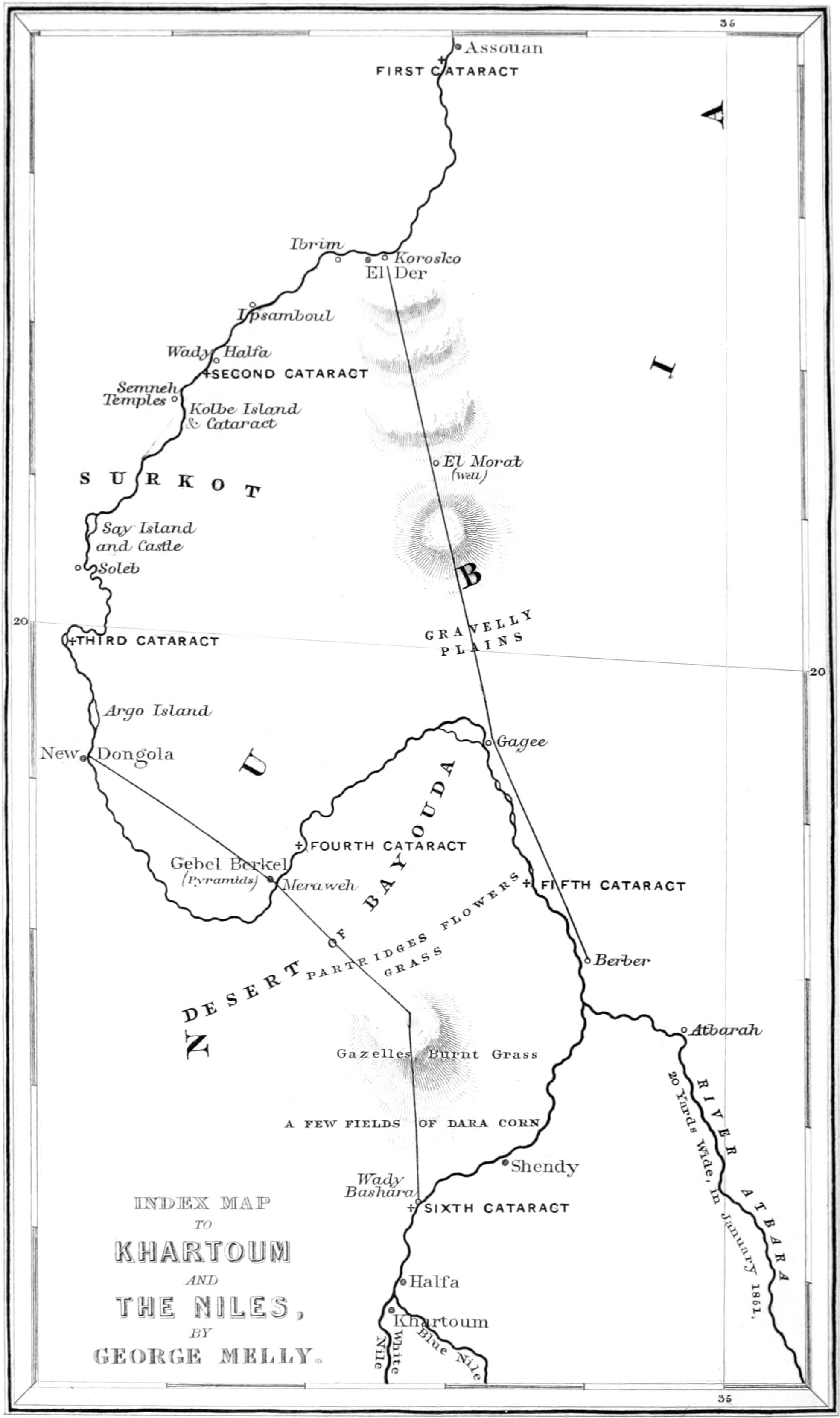
Becker’s Patent on Steel.
LONDON, COLBURN & Co., 1851.
As we penetrated further, the country underwent a material change. Palm trees, of which there had hitherto been but a sprinkle, increased in number; and, no longer stripped of their upper leaves, assumed a beautiful appearance. Doom trees, too, though not so numerous as in more northern latitudes, started up here and there along the heights, and attained great luxuriance. In the fields, durra and castor-oil plants, the staple of Nubian vegetation, quite superseded the crops of cotton; and lupins and beans grew[238] in the mud on the banks. At intervals, the ground was lying waste, too sterile and too stubborn to invite the labour of the husbandman; here the banks were clothed with thorny mimosas, over which, at every dozen yards, bright green creepers threw their graceful festoons, and we could see the golden sand pouring in a stream between the stems below, like a tributary to the river. These strips of desert became more and more frequent as we advanced; and even where tillage resumed its sway, the cultivated tracts were rarely more than half a mile in breadth. Animal life, too, had more than proportionately decreased. There was no game; iguanos comprised the whole of what we met with in the way of sport, from the time of our leaving Assouan. These were by no means scarce; and we killed one, which, on being dissected, was found to contain twenty-seven[239] eggs. They were immediately handed over to our cook, the ingenious Abbas, whose skill in gastronomy would have procured him immortality under the Caliph Haroum Alraschid; and he served them up at dinner, converting them into a very palatable, if not a dainty dish.
We kept a sharp look-out for crocodiles, but for some time were disappointed, though once, in the evening, when it was too dark to distinguish objects, we heard a loud splashing close by, which we had no doubt was caused by some of these monsters gamboling in the water. Next morning we heard from an old shepherd, who came to sell us some milk, that a man had been carried off by a crocodile during the night, while mending his sakeia. It appeared that the monster had first struck him down with his tail, and then seized him, and threw[240] itself into the river. The same crocodile carried off a man last year, in a similar manner, and about the same hour. It is said to be a well known individual, though very rarely showing itself; that in consequence of its cunning, careful observation of its habits is extremely difficult. From the moment the circumstance was reported, our crews, who were incorrigible news-mongers, would talk of nothing else; they were not so willing to plunge into the water as they had been heretofore, though they had shown no hesitation in places where crocodiles are more common, as at Manfaloot.
At Kreem we anchored under a lofty crag, crowned by a ruined castle, which formed a most striking object from the river. The cliff contains several caverns, once repositories of the dead, who, though in their day, mighty men on the earth, have[241] left no name behind. Being almost perpendicular, the ascent was very difficult, but with the aid of a rope, fastened to one of the lintels above, we managed to scramble up. Our first discovery was a square chamber, in which we found three idols in a sitting posture, niched in the rock, each recess being enframed in hieroglyphics. The ceiling was coloured yellow, in square patterns. With the help of a rope, we made our way to two other chambers, constructed on the same plan. They were, however, in better preservation, and in one there were four idols, tolerably perfect. Another cave is of comparatively modern date, and is inscribed with hundreds of names.
We had now two days’ calm, and it was not till Sunday evening that we reached Ipsamboul, having been just a week from Philæ, and two from Thebes. For miles[242] before we arrived, we could see the colossal statue which watches over the temple, standing up erect at his post, a landmark and a beacon to all who approach. The temple is an excavation in the heart of the rock, and the three great figures which guard the entrance, as if it were the portal of another world, are cut out on the face of the rock, in one solid piece. The expression of the face is solemn repose, and, judging from the portion still visible, the attitude is full of grandeur and majesty. The pedestals are embedded in sand, which rises to the knees, and, indeed, has covered one of the figures as high as the neck. It falls down between the two hills like a mountain torrent, and has been converted into an ascent to the idol’s beard, on which, with their usual discriminating taste, several of the Thomsons and Smiths have inscribed[243] their names. The poor god’s face, too, still retains traces of the cast in plaster of Paris, which was taken for the British Museum. I followed in the steps of more notable travellers, and paid my devoir to his remains. Standing on his lips, a man of ordinary height will be unable to reach his eyes—a fact which may give some idea of the enormous magnitude of the figure. There was formerly a fourth statue, of the same gigantic dimensions; but some relentless antiquary, in a paroxysm of love and devotion, cut it down. Such is the fate of gods and men!
The entrance to the wondrous temple, which is nearly blocked up by sand, and threatens to be completely so in a short time, is through an aperture about four feet high, which can only be penetrated in a stooping posture. The visitor, to gain[244] admittance, slides down on his back, carrying with him a good addition to the accumulations of sand; and then, with the aid of a torch, which the darkness renders indispensable, finds himself in a wide and lofty chamber, forming the principal hall of the temple. On either side rise four square pillars, massive and tall; each faced by a huge figure, cut, as usual, in one piece. I climbed on the shoulder of one, and standing there, was not able, with my arms extended, to reach the top of the head. The walls of the chamber are covered with representations of battle scenes and triumphs, as if the heroes of those olden days despised the fugitive page of history, and would only record their deeds on imperishable stone. From this chamber we passed to a smaller one, adorned on each side with similar rows of square pillars, though of smaller dimensions.[245] This was terminated by a sanctuary, in which, as we advanced, our torch flashed upon the mutilated remains of four colossal idols, sitting on a stone divan, fronting a block of granite, which had probably been an altar. A number of chambers opened beyond, and we wandered through room after room—formerly, perhaps, accessible only to the priesthood. The walls are carved and coloured with an almost endless picture, commemorating new scenes of conquest and triumph, illustrated by hieroglyphics; many of which, though we had seen them in almost every direction, were quite new to us. We particularly noticed a troop of black slaves, and copper-coloured natives, drawn with great boldness and power. In another chamber, all the figures from the foremost to the last, wore black bracelets, armlets, and necklaces. The[246] vigour of outline, and brightness and delicacy of colouring, apparent in every figure, could scarcely be surpassed. Many of the faces were beautiful, and we were especially impressed by the serene and benevolent expression, and the air of greatness and dignity which characterized all the colossi. Rameses, the hero of the pictures, was represented at his customary pastime, holding up a bunch of captives by the hair; but, as usual, his vast stature made the achievement anything but difficult. In another place, he is dismounting from an immense chariot, while his Queen, a woman of great beauty, stands by, and presents him with a goblet of wine. There are many other drawings of women in this temple, more than we have ever seen in one place before; and the hieroglyphics, designed to illustrate the marvellous[247] pictures, present an almost endless variety.
The subordinate temple, constructed on the same plan as the other, is of much smaller dimensions. There are several suites of chambers, all adorned with figures and sculptures, but everything is on a reduced scale, and the impression created is not so striking. The colossi, unlike those in the larger temple, are represented standing, and, though executed in a masterly manner, have not the same majestic appearance. The façade of the temple, however, which is hewn out of the rock overhanging the river, is very grand and imposing.
After exploring the whole, we returned to the principal chamber of the great temple, and regaled ourselves with a pipe. The silence around was absolute, and we did not care to break it. For the scene was of a[248] character to engross all our thoughts. Around and above were the dark mysteries of the past: while our torch, flashing brightly up, threw its ruddy light over our own figures, lying at the feet of those grim idols.
In the background were our Arab attendants, sitting or lying down, and half shrouded in the darkness. A legion of bats, which had been startled by our invasion, flew wildly about; the only tenants of the temple.
With reluctance we turned our steps from this wondrous fabric, and as evening was now stealing on, repaired to our boats. Next morning, however, we were up at sunrise, and took one more look at its mystic chambers. Then all was over, and we bade an unwilling adieu to Ipsamboul.
As soon as the anchor was weighed, a[249] fresh breeze, which had been blowing all night, swelled our sails, and carried us merrily on. It lasted through the day, and by five o’clock we reached Wady-Halfa, where our water journey was to terminate.
From the size of Wady-Halfa on the maps, we had expected to find a large town, or, at least, a place of some importance; but, to our great disappointment, it proved a miserable Egyptian village, with about three hundred inhabitants. We paid a visit to the Governor, who, on being shown our firman, treated us with marked courtesy, and promised his aid in making an arrangement for our transit across the desert. Whether his interference was of any service, or did not tend to raise the terms, is a difficult question to decide, but such good offices are generally dictated by self-interest in this part of the world.
[250]Next morning we crossed to the other side of the river, the rendezvous for camels, and thus escaped both the noise of the busy sakeias, and the gaze of the idle crowd, to which we had hitherto been subjected. Here we landed, and for the first time mounted some camels, and tested their capabilities. The experiment was satisfactory; and we found the new way of riding, though a little difficult at first, by no means uncomfortable. From this we made our way to the Mount of Names, and the second cataract.
The mount so enviably distinguished, rises perpendicularly from the river, but to no great height, and on the land side, the elevation is only a few yards. These elevations are entirely covered with names, including some of European celebrity. On a spot dedicated to the purpose, we felt a pleasure in[251] inscribing our own, a task of no great difficulty, as the rock, which is composed of white lime-stone, is easily marked. We could not but think, on inspecting the great tablet, that the name of Belzoni appeared to more advantage here than on the sphinx at Karnac, or the doorway of Ipsamboul; and it was a satisfaction to ascertain that a name so widely popular as Miss Martineau’s could be found nowhere else. I am happy to say that we can make the same boast of ours.
It was not till the following morning that we reached the Cataract, which we skirted, on our way back, in our little boat, and viewed its whole extent from the summit of a cliff. It is inferior to the Cataract of Assouan, both in the grandeur of the fall, and in its situation. The river is so broken and contracted by a number of little islets[252] of black rock, sprinkled through it for about three miles, and nowhere leaving the channel wider than from twenty to thirty yards, that the water is necessarily impeded, and descends with but little force. The flat shores, almost level with the river, offer no object of interest; and memory reverts with more pleasure to the romantic heights and rushing waters of the first Cataract.
We have now reached the first stage of our journey, and have accomplished the passage from Cairo in thirty-six days, which is about the usual time. The boats, with a fairer allowance of wind, would have done it in less, having throughout sailed in the most creditable manner; but we have had many calms, and the process of tracking is very slow and tedious. Of the winds on the Nile it is impossible to speak in anything but the most severe terms. They are of the[253] most variable nature, and more fickle than Fortune. It is impossible to count on a breeze for a single day.
We had every reason to be satisfied with the boats, though ‘The Fanny,’ spite of the precautions of the Reis, was, at starting, somewhat infested with rats. But the strong remedy of a cat obviated this inconvenience, and we had no further ground for complaint.
The two crews I cannot commend too highly. For Arabs, they worked uncommonly well, and were exceedingly willing. The plenary power of the Reis, as administrator and disciplinarian, were exercised very seldom, when one or two of the men received a box on the ear, in the heat of argument or remonstrance; and once a sailor was bastinadoed for being tipsy. This was but a lame affair, the Reis being, in[254] fact, very reluctant to administer the punishment at all; however, as he had sworn to do so, he made the man lie down, and receive a dozen over his coat, which, being of no common thickness, effectually protected his skin.
[255]CHAPTER XVI.
Retrospect.
Before I proceed to describe our journey through the desert, it may be as well to take a glance at the country we have passed, and look once more at its people.
The Egyptian Fellah, who forms the staple of the population, rarely exceeds the middle stature. His head, and the whole of his face is generally shaved; of course leaving him neither moustache nor beard. He is[256] not industrious; nature has not given him much to do, and he has scarcely energy to do that.
The land will annually produce, at least four times as much as is required for the subsistence of the people. With a rude instrument, not unlike the pointed stick with which cabbages and lettuces are planted in England, he bores a hole in the mud, on the islands left by the receding river, and the beans or lentil-seeds, which are dropped into it, will become ready for gathering without further attention. More labour is necessary to make the land, not immediately on the banks of the river, produce its wonted harvest, and shadoofs, so often spoken of in these pages, are requisite for its irrigation.
This is managed in the following way: the ground is parcelled out in beds about[257] twelve feet square, which are raked in the most careful manner; while little acqueducts run round each, and a slate filling up the sluice, lets the water, ever running from the shadoofs, on and off, as it may be required.
As far as I could learn, these fields, if properly attended, will produce three crops annually. Pigeons, and sometimes hares, are devouring the seed as it is thrown into the prepared mud, or nibbling the cornsprouts as they raise themselves to the surface. Every two or three days, the little sluices are thrown open, and the flowerbeds covered with an inch or two of water.
As you walk along, you are struck with the great amount of population; five or six fellahs are working in each field, and their wives and children are assisting them, or[258] play about, awaiting their return to the village. These villages, as I have already shown, are exceedingly pretty. Up to Ossioot they are all on the brink of the river, which flows tranquilly past. A dozen mud dwellings, a whitewashed mosque, with its tall minaret, and a grove of waving palms form the picture; and a very charming one it is. A few clumsily-built boats are lying moored against the high bank, and the gaudy blue and yellow dhabehee of the Cavaghi adds another feature to the scene.
In entering their humble dwellings, you must stoop low to pass through the doors. There are four or five rooms, all filled with smoke, from a miserable fire in the outer room, made of little cakes of dung and sand, emitting a most disagreable odour. A few old women, often as many as four or[259] five, are warming their withered hands over the embers, or stirring the large cauldron in which the soup of lentils, or the mess of beans is preparing for the family repast. These ancient women almost suggest the question:
But they are not witches, and as they hurriedly drop their veils (I always thought they meant a kindness to the spectator), they resume the very domestic occupations of spinning, and nursing some little grandchild.
Around the outer room hang household utensils and agricultural implements; in the others, mats stretched on the ground, or[260] little bedsteads covered with undressed sheepskins, constitute the only furniture. Dogs, sheep, and pigeons dispute every inch of territory, and the smoke soon forces you to retire.
Women, in their ever-graceful blue robes, carry up jars of water from the river side, while their children are playing on the shore, or swimming round the boat for backsheesh. I was particularly struck with the invariable good-humour of the little urchins on the Nile. They have not the sharp, impertinent look of the juvenile mendicants in our large towns, and are as far removed from the stolid stupidity of the youth of our rural and agricultural districts, who, as they open a gate not a mile distant from some large village, respond to your question as to its whereabouts, with a “Doan’t know,” or a long stare. They[261] seem intelligent and bright; familiar, though always respectful. I never saw them ill-treating each other; might does not, in their estimation, essentially constitute right, nor did I ever observe any bigger boy bullying a weak or delicate child, as is too often done in England.
What I missed most in my visits to these people, was the affection and filial tenderness which should naturally subsist between children and their parents; but this, though not ostentatiously displayed, is not always wanting. The existence of such feelings was strikingly evinced in the behaviour of our Reis to his son.
The Reis had brought his son away from home, preferring the corrupting influences of boat life to the chances of his being torn from his mother’s care by the hateful conscription, and a parent more affectionate,[262] or a child more dutiful, I never beheld. Said—so the boy was named—was about ten years old, and of most engaging appearance, with fine bright eyes, and a clear copper complexion, beautifully shaded. He was very intelligent, and from the day of his appearance amongst us, we dressed him in bright chintz, always clean.
We promoted him from the office of do-nothing to the very important one of gun-cleaner and pipe-bearer, and he always accompanied us on our shooting excursions, proving himself a capital retriever. On one occasion, he had broken some dinner knives of ours, and as far as I could learn had not confessed with his usual veracity, as he was a very honest boy. For this, he was most mercilessly punished—a duty his father evidently disliked; this clouded the harmony previously existing between them,[263] as the son did not take the well-deserved chastisement in the way he probably would have done previously to the indulgence and independence he had enjoyed on board. The next night, as he was leaning over the prow of the boat, then darting forwards under a heavy gale, he fell overboard, and instantly disappeared beneath the waters. I was standing by his father, who was at the helm, on the top of the high cabin, and was a witness of the catastrophe. He would not, even to save his son, neglect his duty, which at that moment involved the safety of others, and it was left to strangers to rescue his only child from destruction. Quick as thought, however, three men dashed overboard; the boat was lowered to pull them up; and in a few minutes, the boy, though in a state of insensibility, was restored to his father. The latter neither exhibited deep[264] anxiety at his threatened loss, nor intense gratitude at his child’s almost miraculous preservation; we were much surprised at his apparently stern indifference and apathy. But in his desire to conceal his feelings which nature had given him, he had overrated his strength; the same night he was taken very ill, and several days elapsed before he recovered his usual energy.
As I lay on the deck one night talking to Daireh, and enjoying the exquisite moonlight and soft cool air, among other stories which he told me was the following, accounting as he said in a curious manner for the origin of the three varieties of Arab character.
“When Noah was about to enter into the Ark, he went to the first shipwright then dwelling in the world, and asked him if he would build him a boat, according to[265] the measurements he had prepared; but the man answered:
“‘You have asked God to make us equally rich, and as I am as rich as you, why should I build you a boat?’
“Noah answered:
“‘I will give you my beautiful daughter in marriage.’ Then the great builder of ships agreed, and built the Ark.
“But in its construction, they wanted the great worker in iron, and Noah offered him in vain heaps of that money which he possessed in as sufficient quantities as himself; and again the much-coveted daughter was promised as the price of the iron fittings. The Ark was built, but had to be furnished for its long voyage, and the corn merchant refused to stock the vessel with the requisite provisions, except at the already twice promised price of the beautiful daughter. This was agreed to, and now all was prepared, the[266] ark was ready, and the three sons-in-law wended their way towards the embarrassed parent. The young maiden was carrying water from the ever-flowing well, as, every one being equally rich, no one would work for another; but her dog had strayed into her room, and as the father entered the house with the great ironmonger, he found a beautiful daughter where he had only left a dog, and the happy man departed with the miraculously changed animal. Then came the grain factor, and departed with an ass transformed into the shape of its mistress; and Noah felt relieved of the anxiety which his indiscreet promises had caused him. And now together approached the real daughter, conversing with the shipwright, and Noah joined their hands, and they all went into the Ark together, and when the waters rose, they sailed away.”
As Daireh finished his tale, he turned to[267] the least intelligent of the sailors, and as he called him, and he answered with a long and stupid “What?” He said: “you see he come from the donkey mother; and that man which so quarrel with the other Reis, you see, he come from dog parent; and when you see our young lady, you no can doubt she descend from real Noah daughter.”
“But Daireh,” said I, “do you really believe that tale?”
“Why! clever Dervish tell it me.”
I was unable, by frequent conversations with the dragoman, to discover what position the Dervishes filled among the village people. An old grey-headed man was always to be seen smoking or idling about in the court-yard of the mosque; he, though having evidently no salaams, was attached to these Dervishes, who have the monopoly of professional begging, and are always wonderfully dressed in piles[268] of clothes, of all ages and fashions, from European frock coats, to untanned tiger and lion skins. They made very free with our party, always laying their hands upon me, and invoking many blessings on my head, in which, if I am to trust the interpretations of Daireh, length of years and eternal youth figured conspicuously.
These are the real Dervishes, or priests, but all clever Arabs are called by the same title. We have a sailor on board one of the boats, or rather a man taken by the crew as a servant, who we were assured, “was quite real Dervish.” He was dressed as the rest of the crew, and used to read aloud from some dirty manuscript, which he kept in his hat, nearly every night; it was generally the “Arabian Nights,” but sometimes a more modern work. He wrote all the agreements, kept all the accounts of the other men,[269] and prayed much more frequently than any of them.
The people pray on rising and on going to rest, and once or twice besides, in the middle of the day. In our boats, these devotions were very regularly performed; and nearly all day some one or other of the crew was prostrating himself on the roof, his face turned towards the city of his Prophet; or washing, previously to his devotions, in the little boat behind.
Most of the crew were married, and some had many children, though they all seemed to have lost a good number, whom they talked of meeting again in Heaven.
Women are invariably spoken of with great respect, and always treated with kindness. “He very bad man, beat his wife,” was Daireh’s severest censure; nor could I find any who had had more than[270] one wife at a time. They divorce themselves, however, very easily; a quarrel, or even a difference of opinion, seems to constitute sufficient cause for a separation; while the wife can demand a divorce, in Egypt, because her husband does not give her as much sweet-smelling scents as she wishes, or in Nubia because he does not give her the quantity of oil and grease to which her rank, as his wife, entitles her.
I was surprised, under these circumstances, that divorces were not more frequent; but on Daireh’s explaining the manner in which the dowries are managed, I began to understand it without difficulty. At the wedding, the husband settles a dowry on his wife—perhaps a pigeon-house and its feathery occupants, or a few acres of land, or a diabeheeh, or some household[271] utensils; and should he dismiss her, from whatever cause, except, of course, those which would seem sufficient in more civilized lands, he must hand over her dowry, which, as no odium is attached to the discarded wife, speedily procures her another husband.
The Arabs are very tenacious of property, and one can hardly guess how many matrimonial squabbles are happily prevented by the wholesome fear of losing the pigeon-house, or having to give up the diabeheeh.
Pigeon-houses, as the reader may have observed from my descriptions, are quite a feature in Nile scenery; and the upper story of every dwelling, in some villages, is crowded with pigeons and their nests. They are kept solely for their manure, and seem in themselves common property. We were always allowed, and even encouraged to kill as many[272] as we liked, except close to the village, where the owners were afraid we should scare them. Not so the doves, which, as Abbas told me, “are not lucky for man to kill,” though, when killed, he appeared to have no objection to cooking them in the most approved style; and very good they were, our ladies preferring them to partridges.
I expected to have found the Arabs more superstitious than they are. Our servants were as much so as any one we met; our crews, wild and courageous, were the reverse. The most popular and deep-rooted prejudice was against Wednesday; and all the undertakings commenced on that day, were, they thought, sure to be disastrous. At Cairo, bricklayers will not begin a work, or finish it, on Wednesday; nor will native merchants be easily induced to buy or sell; business on[273] Wednesdays, therefore, is “very dull,” and articles “heavy of sale.” On Friday, on the contrary, business is peculiarly “brisk,” as on that day there is a lucky hour, which is to be seized upon, as the unlucky one on Wednesday is, if possible, to be avoided.
It often occurred to me, that what was lucky to the seller might be unlucky to the buyer; but this does not seem to have struck the Egyptian, and he persists in being very prudent on Wednesdays, and very rash on Fridays.
Our crews were a constant source of amusement to us, they were always merry and good-humoured, and particularly so when the wind blew strong from the north, filling our huge sail; and then our Reis at the helm, telling his son some tale, in a low and monotonous[274] voice, would leave the sailors free to amuse themselves as they liked. They had but one enjoyment, but it seemed never to fail. Gathering round the man whose duty it was to sit at the rope which held the mainsail, the drum was produced—a sheep-skin stretched over a kind of earthenware jar, open at the other end—and a pipe wonderfully constructed; and then commenced a concert, the airs being all in one key. They had but few songs; and some I recognised as having been thought worthy of translation. I insert two, the composition of a kind friend—
At the end of each verse, which is sung by one person, the crew join in, sometimes with a yell of horror, sometimes with a shout of delight, as the occasion may require, and sometimes only repeating the last line in chorus. That apathy which so especially distinguishes the Arab, disappears altogether[279] when under the influence of music; and I have seen some of the men worked up to a state of wild enthusiasm, or fearful rage, by a well-sung account of their domestic circle going wrong during their absence. But Daireh had such an aversion to translating the words of their numerous effusions all to one tune, that I was obliged to conclude that there were but few of them adapted to “ears polite.” I have often thought, however, that Daireh was a very free translator. The first time I had any doubt about his veracity as an interpreter, was at Ossioot, where the following conversation ensued between the Governor and myself, through his agency.
“Daireh, tell his Excellency, that I could not pass through this city without having the honour of seeing him.”
“No, Herr George, I not say that, I[280] say his having honour to see you: then give you pipe directly.”
The Pasha. “What are you saying?”
Daireh. “He say he very great man from England, come on purpose all the way to call upon very mighty Governor of Ossioot.”
The Pasha. “Taib, hat tchibouque.” (Good, bring a pipe for him.)
“Daireh,” I asked, “what did you tell him?”
“Oh! I tell him he ought to make much honour to see you. You very great man.”
“Undeceive him directly. Tell him I am an English traveller.”
Pasha (evidently uneasy about our prolonged “asides”.) “Is the Cavaghi come by himself?”
Daireh. “No; he have very big family on very fine boat.”
[281]Pasha. “Taib” (and a long smoke ensued).
I now began to insist on a real translation of my speeches, and I made some progress in Oriental conversation. I think it was in this interview I discovered that crossing one’s legs whilst sitting in a divan or chair, and putting one’s hand’s in one’s pockets, were abominations to the Egyptians.
[282]CHAPTER XVII.
Itinerary for the Desert.
Our plan was to ride from Wady Halfa to Dongola, cutting off all the bends of the river, but endeavouring to sleep nightly on its banks. From Dongola, we intended to cross over to Gebel Berkel, passing through the desert of Argab-Teschagoa. We should cross the river at Merowah, and make our way through the desert of Bayiouda to Metamneh, or Wady Bashara, as our guides, in that country the supreme authorities, should direct. From this point, we should[283] proceed to Khartoum, whence boats were to carry us to Berber, where we could procure camels to Korosko, about seventy miles above Assouan. No ladies had ever as yet succeeded in penetrating to the south of Dongola, and we by no means bound ourselves to that adventurous course.
Our three tents, and innumerable boxes were got out of the hold of the two boats: the Cairene water-skins, which of course all leaked, were repaired, and our small desert wardrobe was already stowed in our little carpet-bags. We then explained to the Reis that five weeks were to elapse before he left Wady Halfa, on his downward journey to Korosko, but Daireh took the word out of our lips, and said:
“You see the moon; when it go away, and come again big as now, you still wait till you have prayed seven times on the top[284] of the cabin, in the night; and when the moon come small before it go, and you have had your prayer seven times, then turn the boat, and row.”
In my anxiety to try how a tent served for a bedroom, I carried up all my things, and pitched my canvass dwelling on the shore, regardless of a violent gale blowing at the time, I installed myself within; but my house was indeed founded on the sand, and about midnight, the whole fabric was blown down. I passed a very uncomfortable night indeed, but the morning broke at last, and we prepared for our first real day in the desert.
[285]APPENDIX
TO
VOL. I.
[286]The annexed observations were made by my father up to the time of his death, and have been continued with, I hope, the same accuracy and attention.
We used an aneroid barometer, which we found had not varied the least during this long journey, when we compared it at Cairo on our return there. As the greater portion of the observations refer to the journey described in the first volume, they are introduced here, in preference to placing them at the end of the work.
| [287]Date. | Hour. | Place. | Barometer. | Heat. | Maximum. | Observations. | |||||
|---|---|---|---|---|---|---|---|---|---|---|---|
| 1850. | |||||||||||
| 6 | Oct. | 12 | A.M. | Cairo, Hôtel d’Europe. | 29·90 | 86 | 104 | Cloudless, Sirocco. | |||
| 7 | .. | .. | .. | .. .. | 29·92 | 86 | 92 | .. N.E. light. | |||
| 8 | .. | 9 | A.M. | .. .. | 29·91 | 81·5 | 90 | .. .. .. | |||
| 9 | .. | 12 | A.M. | .. .. | 29·72 | 86·5 | 89 | Very light clouds. | |||
| 10 | .. | .. | .. | .. .. | 29·82 | 87 | 90 | .. | |||
| 11 | .. | .. | .. | .. .. | 29·91 | 82 | 90 | Cloudless. | |||
| 12 | .. | .. | .. | .. .. | 29·93 | 83 | 87 | .. | |||
| 13 | .. | .. | .. | .. .. | 29·96 | 83 | 84 | .. | |||
| 14 | .. | .. | .. | .. .. | 29·99 | 80·50 | 83 | .. | |||
| 15 | .. | 2 | P.M. | .. .. | 29·94 | 83 | 84 | .. | |||
| 16 | .. | 12 | A.M. | .. .. | 29·90 | 81 | 83 | Cloudy for a couple of hours, a few drops of rain. | |||
| 17 | .. | 1 | P.M. | .. .. | 29·80 | 84 | 86 | Cloudless. | |||
| 18 | .. | 12 | A.M. | .. .. | 29·75 | 80 | 84 | Very slight clouds. | |||
| 19 | .. | .. | .. | .. .. | 29·81 | 77 | 83 | .. | |||
| 20 | .. | .. | .. | Boat, near Memphis. | 29·83 | 77·5 | 83 | Cloudless. | |||
| [288]21 | .. | 12 | A.M. | .. at False Pyramids. | 29·95 | 78 | 80 | Cloudless. | |||
| 22 | .. | 1 | P.M. | .. Benisooef. | 29·95 | 79 | 81 | .. | |||
| 23 | .. | 12 | A.M. | .. Sheik Embarak. | 29·92 | 78 | 82 | .. | |||
| 24 | .. | .. | .. | .. Colosaneh. | 29·83 | 81 | 85 | .. | |||
| 25 | .. | .. | .. | .. Minieh. | 29·81 | 86·50 | 89 | .. | |||
| 26 | .. | .. | .. | .. Sheik Abadeh. | 29·79 | 84·50 | 93 | .. N.N.E. breeze. | |||
| 27 | .. | .. | .. | .. Deir el Cossair. | 29·79 | 77·50 | 86 | Clouds early, N. | |||
| 28 | .. | .. | .. | .. Ossiout. | 29·72 | 83 | 85 | Light clouds, no wind. | |||
| 29 | .. | .. | .. | .. .. | 29·71 | 82·50 | 91 | .. .. | |||
| 30 | .. | .. | .. | .. near Ossiout. | 29·75 | 83 | 87 | Cloudless, light S.E. | |||
| 31 | .. | .. | .. | .. Calieh. | 29·79 | 82·50 | 88 | .. N.E. very light. | |||
| 1 | Nov. | .. | .. | .. Meshrala. | 29·80 | 81 | 91 | Light clouds, no wind. | |||
| 2 | .. | .. | .. | .. Sondfi. | 29·74 | 83 | 91 | Cloudless, S.E. very light. | |||
| 3 | .. | .. | .. | .. Shendowill. | 29·76 | 79 | 90 | .. N.E. fresh breeze. | |||
| 4 | .. | .. | .. | .. Samatar. | 29·79 | 73 | 83 | .. .. | |||
| 5 | .. | .. | .. | .. near Dishneh. | 29·77 | 72·50 | 77 | Cloudless, N.E. light breeze. | |||
| [289]6 | .. | 12 | A.M. | .. Keneh. | 29·76 | 78 | 79·50 | Light clouds, N.E. light breeze. | |||
| 7 | .. | .. | .. | .. Ballas. | 29·76 | 73 | 82 | Cloudless, | |||
| 8 | .. | .. | .. | .. Demfig. | 29·74 | 74 | 81 | .. no wind. | |||
| 9 | .. | .. | .. | .. near Thebes. | 29·73 | 77·50 | 80 | .. .. | |||
| 10 | .. | 8½ | .. | .. Luxor. | 29·73 | 68·25 | 80 | .. N.W. fresh breeze. | |||
| 11 | .. | 12 | .. | .. Gebelein. | 29·76 | 75 | 77·50 | .. .. | |||
| 12 | .. | .. | .. | .. Esneh. | 29·73 | 67 | 74 | .. .. | |||
| 13 | .. | .. | .. | .. Eilethya. | 29·71 | 70·50 | 71 | .. N.W. very light. | |||
| 14 | .. | .. | .. | .. near Silwa. | 29·70 | 71·50 | 78 | .. N. light. | |||
| 15 | .. | .. | .. | .. Koom-Ombo. | 29·69 | 76·50 | 80 | .. N.W. very light. | |||
| 16 | .. | .. | .. | .. near Assuan. | 29·67 | 75·50 | 81·50 | .. N.W. fresh breeze. | |||
| 17 | .. | 5 | P.M. | .. First Cataract. | 29·69 | 82 | 82 | .. .. | |||
| 18 | .. | 12 | .. | .. Philæ. | 29·83 | 70 | 78·50 | .. .. | |||
| 19 | .. | .. | .. | .. Kalabsheh. | 29·80 | 69 | 73·50 | Very light clouds, N.W. fresh breeze. | |||
| 20 | .. | .. | .. | .. Seboua. | 29·82 | 68 | 71 | .. .. | |||
| 21 | .. | 12 | A.M. | .. Korosko. | 29·79 | 71 | 73 | S.W. very light. | |||
| [290]22 | .. | 12 | A.M. | .. Ibrim. | 29·72 | 74 | 79 | Cloudless, N.E. light. | |||
| 23 | .. | .. | .. | .. past Ibrim. | 29·68 | 78 | 78 | Light clouds, no wind | |||
| 24 | .. | .. | .. | .. Ipsambul. | 29·69 | 75·50 | 82 | Very light clouds, no wind. | |||
| 25 | .. | .. | .. | .. past Ipsambul. | 29·71 | 74 | 82·75 | Few clouds, N.W. fresh breeze. | |||
| 26 | .. | .. | .. | .. Wadi Halfa. | 29·70 | 60 | 76 | Rather cloudy, N.W. light breeze. | |||
| 27 | .. | .. | .. | .. .. | 22·71 | 62 | 79 | .. N.W. fresh breeze. | |||
| 28 | .. | .. | .. | .. .. | 29·57 | 59 | 78·50 | Light clouds, N. very light. | |||
| .. | .. | 5½ | P.M. | Tent, Desert nr. River. | 29·45 | 81 | ⎫ ⎬ ⎭ |
no regular register kept. | Cloudless, .. | ||
| 29 | .. | 5½ | A.M. | .. .. | 29·40 | 58 | Light clouds, .. | ||||
| .. | .. | 5½ | P.M. | .. .. 2nd day. | 29·41 | 78·50 | Cloudless, .. | ||||
| 30 | .. | 6 | A.M. | .. .. .. | 29·40 | 58·50 | ⎱ ⎰ |
midday heat. | Light clouds, N. fresh breeze. | ||
| .. | .. | 6 | P.M. | .. .. 3rd day. | 29·20 | 80 | Cloudless, N. very light. | ||||
| 1 | Dec. | 5½ | A.M. | .. .. .. | 29·14 | 62 | ⎱ ⎰ |
95 | .. N.E. .. | ||
| .. | .. | 3 | P.M. | .. .. 4th day. | 29·34 | 83 | .. .. .. | Hours Travelled. | |||
| 2 | .. | 5½ | A.M. | .. .. .. | 29·39 | 66 | ⎱ ⎰ |
93 | Some clouds, N.W. .. | ⎱ ⎰ |
9h. 10m. |
| .. | .. | 6½ | P.M. | .. .. Dahl. | 29·20 | 83 | Cloudy, .. .. | ||||
| [291]Date. | Hour. | Place. | Barometer. | Heat. | Mid-day Heat. | Hours Travelled. | Observations. | |||||
|---|---|---|---|---|---|---|---|---|---|---|---|---|
| 1850. | H. | M. | ||||||||||
| 3 | Dec. | 5¼ | A.M. | Tent, Succout. | 29·21 | 71 | ⎱ ⎰ |
in tent. 88 |
7 | 5 | Cloudy, W.N.W. fresh breeze. | |
| .. | .. | 5¾ | P.M. | .. 6th day. | 29·20 | 81 | Light clouds, .. | |||||
| 4 | .. | 5½ | A.M. | .. .. | 29·19 | 62 | ⎱ ⎰ |
in tent. 90 |
7 | 40 | Cloudless, N. strong breeze. | |
| .. | .. | 6 | P.M. | .. Sadaenga. | 29·25 | 78·50 | .. N. fresh breeze. | |||||
| 5 | .. | 6 | A.M. | .. 7th day. | 29·27 | 62·50 | ⎱ ⎰ |
in tent. 88 |
7 | 30 | .. .. | |
| .. | .. | 6½ | P.M. | .. Open desert, high ground. | 29·16 | 74 | Cloudy, N. stormy. | |||||
| 6 | .. | 5¼ | A.M. | .. .. | 29·14 | 56 | ⎱ ⎰ |
in tent. 86 |
8 | 50 | Cloudless, N. fresh breeze. | |
| .. | .. | 6¾ | P.M. | .. nr. River, 9th day. | 29·30 | 74·50 | Cloudy, .. | |||||
| 7 | .. | 6 | A.M. | .. .. .. | 29·24 | 62 | ⎱ ⎰ |
in tent. 88 |
8 | 0 | Cloudless, .. | |
| .. | .. | 6 | P.M. | .. Haffir country, 10th day. | 29·23 | 79 | Light clouds, N. light. | |||||
| 8 | .. | 5½ | A.M. | .. .. .. | 29·16 | 57 | ⎱ ⎰ |
in shade, open air. 84 |
10 | 18 | .. .. | |
| .. | .. | 7 | P.M. | .. Dongola. | 19·14 | 73·50 | .. no wind. | |||||
| 9 | .. | 7½ | A.M. | .. .. | 29·13 | 56 | ⎱ ⎰ |
in tent. 92 |
0 | 0 | .. N. light breeze. | |
| .. | .. | 6 | P.M. | .. .. | 29·12 | 85 | .. .. | |||||
| 10 | .. | 7 | A.M. | .. .. | 29·07 | 57 | ⎱ ⎰ |
in tent. 85 |
0 | 0 | Cloudless, N. high. | |
| .. | .. | 7 | P.M. | .. .. | 29·11 | 73 | Light clouds, light breeze. | |||||
| [292]11 | .. | 7 | A.M. | .. Dongola. | 29·16 | 56 | ⎱ ⎰ |
in tent. 82 |
0 | 0 | Cloudless, N. high. | |
| .. | .. | 6 | P.M. | .. .. | 29·19 | 69 | .. N. light. | |||||
| 12 | .. | 7 | A.M. | .. .. | 29·20 | 47 | ⎱ ⎰ |
in tent. 84 |
1 | 0 | .. N. fresh breeze. | |
| .. | .. | 6 | P.M. | Desert of Argab-teschagoa East side of the Nile. | 29·23 | 72 | .. .. | |||||
| 13 | .. | 5½ | A.M. | Tent, .. 1st day. | 29·21 | 56·50 | ⎱ ⎰ |
in shade. 82 |
7 | 45 | .. N. high. | |
| .. | .. | 6¼ | P.M. | .. .. .. | 29·22 | 70 | Light clouds, .. | |||||
| 14 | .. | 6 | A.M. | .. .. 2nd day. | 29·25 | 52 | ⎱ ⎰ |
open air. 82 high wind. |
8 | 17 | Cloudless, N. light. | |
| .. | .. | 6½ | P.M. | .. .. .. | 29·07 | 69 | Light clouds, N.E. fresh. | |||||
| 15 | .. | 5½ | A.M. | .. .. 3rd day. | 28·97 | 48 | ⎱ ⎰ |
open air. 84 high wind. |
9 | 3 | Cloudless, N.E. light. | |
| .. | .. | 8¼ | P.M. | .. .. .. | 29·01 | 64 | .. .. | |||||
| 16 | .. | 7½ | A.M. | .. .. 4th day. | 28·97 | 53 | ⎱ ⎰ |
open air. 83 |
9 | 57 | .. N.E. very light. | |
| .. | .. | 8 | P.M. | .. Merawah River. | 29·09 | 75 | .. N.E. light. | |||||
| 17 | .. | 7½ | A.M. | .. East side. | 29·08 | 56 | ⎱ ⎰ |
open air. 84 |
To Gebel Berkel and back. | .. N.N.E. high. | ||
| .. | .. | 7½ | P.M. | .. .. .. | 29·07 | 71 | .. N.N.E. light. | |||||
| 18 | .. | 7½ | A.M. | .. Desert of Bayouda. | 29·09 | 55 | ⎱ ⎰ |
open air. 86 |
6 | 35 | .. N.N.E. very light. | |
| .. | .. | 7 | P.M. | .. .. 1st day. | 28·94 | 75 | .. N.N.E. light. | |||||
| [293]19 | .. | 6 | A.M. | .. Desert of Bayouda. | 28·89 | 55 | ⎱ ⎰ |
in shade of trees. 80 |
8 | 45 | Cloudless, N.N.E. very light. | |
| .. | .. | 7 | P.M. | .. .. 2nd day. | 28·64 | 81 | Light clouds, N.N.E. light. | |||||
| 20 | .. | 5½ | A.M. | .. .. | 28·55 | 57 | ⎱ ⎰ |
open air. 96 |
7 | 58 | Cloudless, .. | |
| .. | .. | 6¼ | P.M. | .. .. 3rd day. | 28·28 | 76 | .. .. | |||||
| 21 | .. | 5½ | A.M. | .. .. | 28·20 | 66 | ⎱ ⎰ |
open air. 100 |
8 | 52 | .. N. light. | |
| .. | .. | 6 | P.M. | .. .. 4th day. | 28·35 | 80½ | .. N. very light. | |||||
| 22 | .. | 5¾ | A.M. | .. .. | 28·39 | 72 | ⎱ ⎰ |
in tent. 88 |
9 | 20 | .. N.E. very light. | |
| .. | .. | 7 | P.M. | .. .. 5th day. | 28·24 | 82 | .. .. | |||||
| 23 | .. | 5¾ | A.M. | .. .. | 28·20 | 70 | ⎱ ⎰ |
in shade of trees. 94 |
9 | 48 | Light clouds, .. | |
| .. | .. | 7 | P.M. | .. .. 6th day. | 28·45 | 81 | .. .. | |||||
| 24 | .. | 5 | A.M. | .. .. | 28·39 | 79 | ⎱ ⎰ |
open air. 104 |
7 | 4 | Cloudless, .. | |
| .. | .. | 7 | P.M. | .. River at Hafir. | 28·55 | 86 | .. .. | |||||
| 25 | .. | 5½ | A.M. | .. .. | 28·50 | 73 | ⎱ ⎰ |
open air. 102 |
8 | 33 | .. N.E. light. | |
| .. | .. | 7 | P.M. | .. Saial, near River. | 28·52 | 84 | .. .. | |||||
| 26 | .. | 5 | A.M. | .. .. | 28·53 | 70 | ⎱ ⎰ |
open air. 96 |
9 | 42 | .. N.E. fresh. | |
| .. | .. | 8 | P.M. | .. Opposite Khartoum. | 28·55 | 72 | .. .. | |||||
| [294]27 | .. | 7 | A.M. | .. opposite Khartoum. | 28·54 | 62 | Travelling in Dihabieh day and night | Cloudless, N.E. high. | ||||
| .. | .. | 8 | P.M. | .. .. | 28·54 | 75 | .. N.E. very high. | |||||
| 28 | .. | 7 | A.M. | .. .. | 28·50 | 62 | ⎱ ⎰ |
in shade. 96 |
.. N. very high. | |||
| .. | .. | 6 | P.M. | Mud Palace, Khartoum. | 28·49 | 82 | .. N.E. fresh. | |||||
| 29 | .. | 7 | A.M. | .. .. | 28·51 | 70 | ⎱ ⎰ |
open air. 94 |
.. N.E. light. | |||
| .. | .. | 9 | P.M. | .. .. | 28·53 | 79 | Light clouds, .. | |||||
| 30 | .. | 7 | A.M. | .. .. | 28·50 | 76½ | ⎱ ⎰ |
open air. 96 |
Cloudless, N.E. very light. | |||
| .. | .. | 10 | P.M. | .. .. | 28·48 | 80 | .. no wind. | |||||
| 31 | .. | 7 | A.M. | .. .. | 28·48 | 77 | ⎱ ⎰ |
open air. 92 |
.. .. | |||
| .. | .. | 6 | P.M. | .. .. | 28·44 | 85 | Light clouds, no wind. | |||||
| 1851. | ||||||||||||
| 1 | Jan. | 7 | A.M. | .. .. | 28·44 | 78 | ⎱ ⎰ |
open air. 95 |
.. .. | |||
| .. | .. | 4 | P.M. | Boat, opposite Halfay. | 28·41 | 87 | Cloudless, .. | |||||
| 2 | .. | 6½ | A.M. | .. near Saial. | 28·46 | 67 | Light clouds, N. strong. | |||||
| .. | .. | 6 | P.M. | .. .. | 28·61 | 80·50 | .. .. | |||||
| 3 | .. | 7 | A.M. | .. near Rayan. | 28·63 | 59 | ⎱ ⎰ |
open air. 80 |
Cloudless, N. fresh. | |||
| .. | .. | 6 | P.M. | .. near Habisher. | 28·67 | 77 | Light clouds, .. | |||||
| [295]4 | .. | 6¾ | A.M. | .. near Habisher. | 28·59 | 64 | ⎱ ⎰ |
open air. 82 |
Light clouds, N. strong. | |||
| .. | .. | 6 | P.M. | .. Metameh. | 28·64 | 74 | Cloudless, N. fresh. | |||||
| 5 | .. | 7 | A.M. | .. Shendy. | 28·71 | 65 | ⎱ ⎰ |
open air. 82 |
.. .. | |||
| .. | .. | 7¼ | P.M. | .. Kaboushir. | 28·69 | 76 | Light clouds, N. light. | |||||
| 6 | .. | 6 | A.M. | .. .. | 28·69 | 69 | ⎱ ⎰ |
open air. 81½ |
Cloudless, N. light. | |||
| .. | .. | 6 | P.M. | .. opposite Halyhab. | 28·66 | 77½ | .. .. | |||||
| 7 | .. | 6½ | A.M. | .. before Damer. | 28·70 | 66 | ⎱ ⎰ |
open air. 86 |
.. N. fresh. | |||
| .. | .. | 6½ | P.M. | .. at Berber. | 28·71 | 81 | .. N. light. | |||||
| 8 | .. | 9 | A.M. | .. .. | 28·75 | 70 | ⎱ ⎰ |
open air. 92 |
1 | 20 | .. N. very light. | |
| .. | .. | 7 | P.M. | Tent, Desert, nr. Berber. | 28·69 | 82 | .. N. light. | |||||
| 9 | .. | 6 | A.M. | .. .. .. | 28·62 | 63 | ⎱ ⎰ |
open air. 92 |
10 | 15 | .. .. | |
| .. | .. | 10½ | P.M. | .. .. nr. 5th Cat. | 28·72 | 82 | .. .. | |||||
| 10 | .. | 7 | A.M. | .. .. .. | 28·67 | 64 | ⎱ ⎰ |
Desert hot-wind, shade 96 |
4 | 54 | Light clouds, N. light. | |
| .. | .. | 7 | P.M. | .. .. past 5th Cat. | 28·61 | 81½ | .. .. | |||||
| 11 | .. | 6½ | A.M. | .. .. .. | 28·60 | 64 | ⎱ ⎰ |
in shade. 88½ |
7 | 10 | Cloudless, N. very light. | |
| .. | .. | 6½ | P.M. | .. .. along the Nile. | 28·69 | 88 | .. .. | |||||
| [296]12 | .. | 6½ | A.M. | .. Desert along the Nile. | 28·67 | 65 | ⎱ ⎰ |
open air. 93 |
7 | 0 | Light clouds, N. very light. | |
| .. | .. | 7 | P.M. | .. .. .. | 28·69 | 82 | .. .. | |||||
| 13 | .. | 6½ | A.M. | .. .. .. | 28·67 | 64 | ⎱ ⎰ |
in shade. 92 |
3 | 25 | .. .. | |
| .. | .. | 6 | P.M. | .. .. Gagee, Nile. | 28·67 | 89 | .. .. | |||||
| 14 | .. | 6½ | A.M. | .. .. at Gagee. | 28·71 | 65½ | ⎱ ⎰ |
in shade. 92 |
Cloudless, N. fresh. | |||
| .. | .. | 6 | P.M. | .. .. .. | 28·72 | 88½ | .. N. high. | |||||
| 15 | .. | 9 | A.M. | .. .. .. | 28·77 | 74 | shade. 92 | .. .. | ||||
| 16 | .. | 9 | A.M. | .. .. .. | 28·76 | 68 | shade. 94 | .. .. | ||||
| 17[3] | .. | 9 | A.M. | .. .. .. | 28·71 | 75 | shade. 85 | Slight clouds, N. high. | ||||
| 18 | .. | 9 | A.M. | .. .. .. | 28·73 | 81 | ⎱ ⎰ |
in shade. 88 |
Cloudless, .. | |||
| .. | .. | 7 | P.M. | .. .. .. | 28·69 | 85 | Slight clouds, no wind. | |||||
| 19 | .. | 12 | A.M. | .. .. .. | 28·81 | 81 | Cloudless, N. very high. | |||||
| 20 | .. | 6 | A.M. | .. .. .. | 28·61 | 55 | ⎱ ⎰ |
shade, very high wind. 69 |
7 | 0 | .. no wind. | |
| .. | .. | 9 | P.M. | .. near Abouhamed. | 28·76 | 72 | Cloudy and windy. | |||||
| 21 | .. | 7 | A.M. | .. .. | 28·76 | 57 | ⎱ ⎰ |
in shade. 76 |
1 | 45 | Slight clouds, no wind. | |
| .. | .. | 6 | P.M. | .. Abouhamed. | 28·71 | 56 | Cloudless, N. strong. | |||||
| [297]22 | .. | 8¼ | A.M. | .. Desert of Korosko. | 28·81 | 74 | ⎱ ⎰ |
tent. 75 high N.E. wind. |
7 | 10 | Cloudless, N. very strong. | |
| .. | .. | 9 | P.M. | .. .. 1st day. | 28·73 | 66 | .. light. | |||||
| 23 | .. | 8 | A.M. | .. .. | 28·71 | 51 | ⎱ ⎰ |
tent. 73 cloudy, very high wind. |
8 | 30 | Light clouds, .. | |
| .. | .. | 9½ | P.M. | .. .. 2nd day. | 28·65 | 63 | Cloudy, N.E. light. | |||||
| 24 | .. | 8 | A.M. | .. .. | 28·65 | 53 | ⎱ ⎰ |
tent. 74 fresh N. wind. |
8 | 25 | Cloudless, .. | |
| .. | .. | 9 | P.M. | .. .. 3rd day. | 28·79 | 71 | .. N. fresh. | |||||
| 25 | .. | 7½ | A.M. | .. .. | 28·72 | 53 | ⎱ ⎰ |
tent. 76 light E. wind. |
8 | 20 | .. .. | |
| .. | .. | 8 | P.M. | .. .. 4th day. | 28·63 | 73 | .. no wind. | |||||
| 26 | .. | 7½ | A.M. | .. .. | 28·57 | 54 | ⎱ ⎰ |
tent. 79 slight clds. no wind. |
4 | 30 | .. .. | |
| .. | .. | 7¼ | P.M. | .. Well in middle of Desert, 5th day. | 28·60 | 78 | Light clouds, light. | |||||
| 27 | .. | 7 | A.M. | .. .. | 28·56 | 64 | ⎱ ⎰ |
tent. 78 very cloudy, calm. |
8 | 25 | .. no wind. | |
| .. | .. | 8 | P.M. | .. Desert of Korosko, 6th day. | 27·99 | 75 | Cloudy, .. | |||||
| 28 | .. | 7½ | A.M. | .. .. | 27·88 | 62 | ⎱ ⎰ |
tent. 92 very cloudy. |
8 | 30 | .. .. | |
| .. | .. | 7½ | P.M. | .. .. 7th day. | 28·26 | 84 | Very cloudy, rain. | |||||
| 29 | .. | 7½ | A.M. | .. .. | 28·18 | 66 | ⎱ ⎰ |
tent. 92 light clouds. |
9 | 10 | Cloudy, calm, drops of rain. | |
| .. | .. | 8 | P.M. | .. .. 8th day. | 28·59 | 86 | Slight clouds, calm. | |||||
| [298]30 | .. | 5½ | A.M. | .. Desert of Korosko. | 28·50 | 74 | ⎱ ⎰ |
very cloudy, drops of rain. | 10 | 25 | Slight clouds, calm. | |
| .. | .. | 7½ | P.M. | .. .. 9th day. | 28·95 | 71 | Cloudy, N. | |||||
| 31 | .. | 7¼ | A.M. | .. .. | 28·95 | 62 | 2 | 45 | Cloudy, rainy, no wind. | |||
| 1 | Feb. | .. .. 11th day. | ||||||||||
| 2 | .. | 10 | A.M. | Boat, at Assuan. | 29·65 | 63 | Cloudless, calm. | |||||
| .. | .. | 7½ | P.M. | .. near Assuan. | 29·75 | 70 | .. N. fresh. | |||||
| 3 | .. | 9 | A.M. | .. at Daraou. | 29·70 | 57 | .. calm. | |||||
| .. | .. | 6 | P.M. | .. Koom-Ombo. | 29·71 | 69 | .. N.W. fresh. | |||||
| 4 | .. | 10 | A.M. | .. near Edfou. | 29·70 | 62 | Light clouds, S. light. | |||||
| .. | .. | 7½ | P.M. | .. near Esneh. | 29·69 | 75 | .. .. | |||||
| 5 | .. | 9½ | A.M. | .. at Esneh. | 29·69 | 61 | Very foggy, calm. | |||||
| .. | .. | 64 | P.M. | .. below Esneh. | 22·60 | 69 | Misty, drops of rain. | |||||
| 6 | .. | 12 | A.M. | .. Thebes. | 29·50 | 69 | Cloudy, drops of rain, S. light. | |||||
| 7 | .. | 7 | P.M. | .. Keneh. | 29·49 | 63 | .. hard rain all night, N.W. fresh. | |||||
| 8 | .. | 11 | A.M. | .. .. | 29·56 | 67 | Cloudless, S. light. | |||||
| .. | .. | 8 | P.M. | .. below Keneh. | 29·50 | 63 | .. S.W. light. | |||||
| 9 | .. | 9 | A.M. | .. Farshoot. | 29·59 | 58 | .. calm. | |||||
| [299]10 | .. | 10¾ | A.M. | .. past Girgeh. | 29·66 | 64 | Cloudless, S.E. light. | |||||
| .. | .. | 8½ | P.M. | .. at Ekhmim. | 29·78 | 68 | .. calm. | |||||
| 11 | .. | 11 | A.M. | .. at Gow El Kebir. | 28·81 | 64 | .. S. light, all day. | |||||
| .. | .. | 5 | P.M. | .. near Ossiout. | 29·76 | 75 | .. N. light. | |||||
| 12 | .. | 9 | A.M. | .. Ossiout. | 29·79 | 59 | .. N. fresh. | |||||
| .. | .. | 6½ | P.M. | .. .. | 29·61 | 68 | .. N. light. | |||||
| 13 | .. | 10½ | A.M. | .. past Ossiout. | 29·80 | 61 | .. N. very light. | |||||
| .. | .. | 9 | P.M. | .. Mahabdi. | 29-79 | 68 | .. N.E. very light. | |||||
| 14 | .. | 10 | A.M. | .. Darout-e’-Sherif. | 29·84 | 62 | .. calm. | |||||
| .. | .. | 10 | P.M. | .. Beni Hassan. | 29·70 | 65 | .. .. | |||||
| 15 | .. | 8½ | A.M. | .. past Minieh. | 29·52 | 57 | .. S. strong. | |||||
| .. | .. | 7½ | P.M. | .. Gindieh. | 29·54 | 65 | Hazy, S.E. light. | |||||
| 16 | .. | 11 | A.M. | .. near Benisooef. | 29·66 | 64 | Slight clouds, S.W. fresh. | |||||
| .. | .. | 7½ | P.M. | .. Eddeir. | 26·75 | 67 | Cloudy, W. very light. | |||||
| 17 | .. | 10 | A.M. | .. Atfieh. | 29·93 | 63 | Light clouds, N. light. | |||||
| .. | .. | 6 | P.M. | .. Dashour. | 29·95 | 67 | .. .. | |||||
| 18 | .. | 8 | A.M. | .. Cairo. | 29·93 | 52 | Cloudy, calm. | |||||
LONDON:
Printed by Schulze and Co., 13, Poland
Street.
FOOTNOTES:
[1]Since the above remarks were written, public attention has been called to this neglected relic of antiquity through the all-powerful medium of The Times. In such hands the question may be very safely left; but surely the nation that can throw away untold sums on a fabric like the Marble Arch, can spare £2,000 for the preservation of this fine column, which, transplanted to English soil, might commemorate the deeds of an Abercrombie or a Nelson.
[2]The remains of the statue of Memnon, as well as a splendid obelisk at Karnac, are, like the prostrate Cleopatra’s Needle, the property of the English Government, but the wealthiest nation of the earth cannot afford the outlay required for their removal, and they are, therefore, left unclaimed.
[3]At 6½ P.M. on the 17th there was a partial eclipse of the moon, which lasted two hours.
Transcriber's note:
- pg 124 Changed: "a sketch of the diabekeeh" to: "diabeheeh"