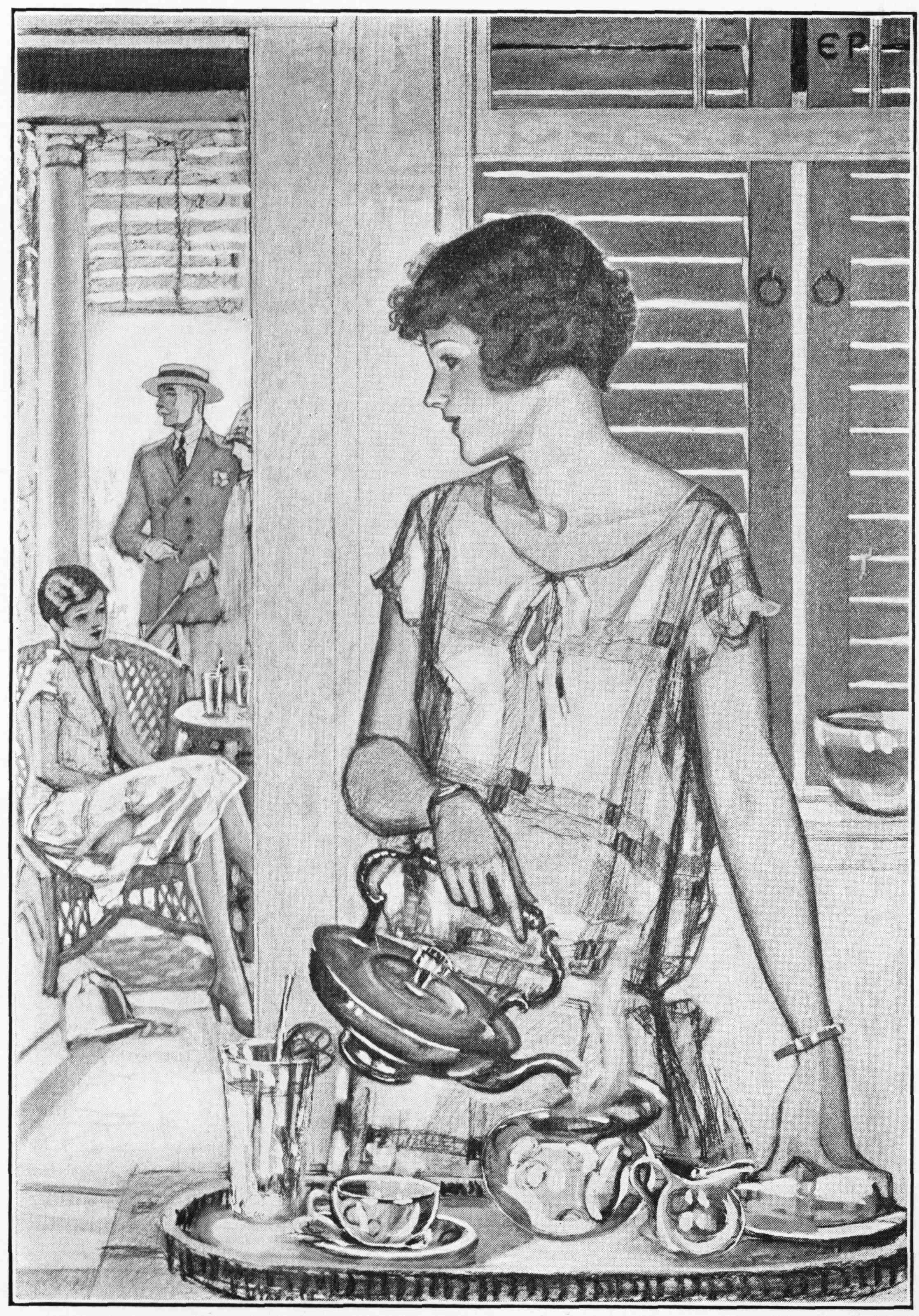
PEGGY HAD HER HANDS FULL BEHIND THE SCENES
THE GREEN DOLPHIN
PEGGY HAD HER HANDS FULL BEHIND THE SCENES
by
Sara Ware Bassett
Author of “The Harbor Road,” etc.
THE PENN PUBLISHING
COMPANY · PHILADELPHIA
1926

COPYRIGHT
1926 BY
THE PENN
PUBLISHING
COMPANY

The Green Dolphin
First Printing, September, 1926
Second Printing, October, 1926
Third Printing, October, 1926
Fourth Printing, December, 1926
Fifth Printing, February, 1927
Made in the United States of America
Probably the thought most remote from the mind of Asaph Holmes, as his dingy wagon gritted along the ribbon of sand that bound together the hamlets of Belleport and Wilton, was matrimony.
He was a shy man with only a limited acquaintance among women. Moreover he considered himself to be well enough off as he was. His small cottage overlooking the horseshoe enclosure of Belleport harbor was cosy as a schooner’s cabin and within it he could do as he pleased without running the risk of being nagged, prodded or reformed.
Just why Asaph should have associated a wife with this trilogy of vices was an enigma, for his mother, gentle soul, had never been a nagging, prodding, or reforming woman and hers was the only marriage he had had opportunity to study at close range. Certainly the theory had not been deduced from viewing her tyrannies, and from what source Asaph had evolved it was a puzzle difficult of solution.
Perchance Hannah Dole was responsible for the credo.
She was a lean, stern-visaged Cape Codder who came periodically from the village to clean him up. Asaph Holmes dreaded her visits as he dreaded the Day of Judgment and would joyfully have done away with them had they not become indispensable. Gradually, however, it had developed that whenever his solitary existence waxed too complex and he found himself face to face with a state of things he was powerless to untangle, he summoned Hannah Dole, that paragon of method and orderliness, to extricate him from his unhappy dilemma.
The feat sounded simple enough and under ordinary conditions would doubtless have proved so, but in Asaph’s case the conditions were not ordinary.
Unfortunately he was possessed of two hobbies: an admiration for Daniel Webster abnormal in its proportions; and a passion for horticulture in consequence of which he collected everything having even a remote connection with this delightful pursuit. He sent far and wide for flower catalogues; he invested in patent seed shakers, pruning shears, and self-watering window boxes; he dabbled in every heralded variety of fertilizer and insecticide; he spent his last jingling copper for perennials that never came up. To these heterogeneous treasures he added reels of wire, tags, balls of twine, markers, volumes of garden lore, not to mention innumerable clippings culled from every periodical he could lay hands on.
It was these latter intellectual wisps that complicated his existence. He could have managed very well had he not had them to reckon with. But as they were of a precarious nature and must be guarded against the gusts that howled through his wind-swept abode, he found it necessary to make them secure by weighting them down with books, vases, candlesticks, or any other object that chanced to be within reach. He tucked pearls of wisdom beneath the clock, behind the mirror, under the chair legs. He was never separated from his pocket scissors and whenever he read (and he read a great deal), snip, snip, snip they went and more information was added to his mounting pile of knowledge.
As a result his dwelling was a place perilous of habitation. Whenever the door opened a snowstorm of whirling paper greeted the visitor, forcing him to grope his way through its blinding thickness as through a winter’s blizzard. Ordinarily Asaph was a mild-tempered person who seldom raised his voice in anger; but on such occasions he would bawl shrilly:
“Shut that door, can’t you, you blasted idiot! Don’t you see you’re turnin’ loose all my cuttin’s?”
Then the unlucky invader, startled by this wrathful reception, would bang the door with a vim that did but increase the havoc he sought to check. What a scramble would ensue forthwith, what a chase to recapture the winged fragments of learning! Behind pictures they skimmed; they lodged in odd cracks and unfrequented corners, sailing away as if bewitched. Often, in the excitement of the moment, the hunters would inadvertently release wisdom already imprisoned and this would augment the squall.
When at length as many items as it was possible to corral had been gathered together and anchored, Asaph Holmes would drop panting into a chair, if he could find one not already preëmpted as a paper-weight; but when it proved that every seat the room possessed had been pressed into service and the interior rendered uncomfortable he would gaze about him for a moment in helpless irritation, then sigh deeply, and tiptoeing out would turn the key in the door and move into the adjoining apartment where in due time he repeated the drama.
A month of hoarding would usually throw the four modestly proportioned rooms on the ground floor out of commission and another month serve to make the bedrooms uninhabitable; and then, chagrined and mortified, Asaph Holmes would creep out the back window to the shed roof, drop softly to the ground, lock up his abode and flee to Lemmy Gill’s, from which haven he would telephone Hannah Dole to come and set him to rights.
Hannah was quite accustomed to the summonses; indeed she looked for them as a means of making both ends meet and would have been disappointed enough had they not been received. It was never necessary, therefore, to explain details or give her instructions. She arrived with her apron under her arm, took the key from behind the kitchen blind, and opening the door just wide enough for her spare body to wriggle through the crack she went to work. She knew before leaving home exactly what she would find and she invariably found precisely what she expected.
Her only comment was a muttered: “Humph! At it again!”
With that she would start in unceremoniously gathering up the clippings and jamming them along with hundreds of their predecessors into the faded blue sea chest beneath the stairs. It mattered not to her that they were gems of learning. Helter-skelter, in they went! Then she would collect the stray trowels, shears, envelopes of seed, boxes of sifted loam, and, having sorted the collection, would transfer it to the destination she deemed most suitable. The tools she carted to the shed; armfuls of pamphlets and catalogues were borne to the attic; boxes of sprouting plants were thrust out of doors. Afterward, having emptied the various poisonous sprays out of pails, teapots and pitchers and scoured the premises from top to bottom, she would return the key to its accustomed peg behind the blind and telephone the master of the house that he might come home.
She never supplemented the permission with social pleasantries nor did he. There was a quality in her tone that discouraged airy nothings even had Asaph been skilled to utter them. The crisp timbre of her voice and her scantily worded message was courteous enough but somehow it conveyed a rebuke that caused the proprietor of the estate to shrivel and feel sheepish as a whipped schoolboy. To carry off the situation and make possible a continuance of their relations he habitually scrawled a jaunty line of commendation and, enclosing it with his check, sent it promptly away to the autocrat by mail.
He could as well have left the money behind the blind in advance, for Mrs. Dole was unimpeachably honest, and, being a rutty creature, never varied her charges by the fraction of a cent. But, although he knew beforehand what the bill would be, he invariably mailed the wage. The more formal method restored to some extent his injured dignity and at the same time avoided the possibility of an encounter with his rescuer. He had not looked Hannah in the face since he could remember. The acquaintance of these two being of such limited and laconic a character, it can easily be seen that to accuse Hannah Dole of naggin’, proddin’ an’ reformin’ was base injustice. And yet so cameo-cut are certain personalities that all unvoiced their opinions emanate from them. Thus it was with Mrs. Dole.
Never in her life had she been guilty of uttering the assertion that Asaph Holmes was a disorderly old fogy or framed the sarcasm that he never would glance a second time at the litter of printed matter he amassed. Yet in spite of her forbearance she might as well have voiced the charges, for they breathed in the very corner-to-corner precision with which the seed catalogues were stacked and the firmness with which the cover of the sea chest was clamped down.
Nevertheless, if the spirited and flawless performance of her task was intended as an example, the lesson she sought to convey made but a shallow imprint on Asaph Holmes’s conscience, for, beyond the fact that he shrank more timidly each time from sending for his deliverer and confessing he had again perpetrated the crimes he knew her to deplore, he did no better for all her teaching.
Whenever he returned from exile he would beam upon his domain from the threshold and after a second or two of pleased contemplation would proceed to search out the sprouting seeds and the dislodged trowels. Other penates, too, he would restore to their accustomed haunts until before an hour had elapsed one might well have questioned whether the beneficent presence of Hannah Dole had pervaded the place or not.
Still, there undeniably was in the interior a subtle sense of spaciousness that awakened in its owner a feeling of luxury and the impulse to expand. With zeal he immediately set about culling more clippings, mixing fresh sprays, recruiting additional catalogues even though all the time he was doing it he was dimly aware of the abyss of disgrace into which such backsliding would lead him. Hence by the end of the allotted two months he was again an outlaw and compelled to subpoena Hannah Dole.
As this cycle of events made its rotation, he resolved every time that this visit should be her last. He would no longer submit to the ignominy of being chided by a supercilious female. Tomorrow he would begin to peruse, classify, and arrange his cuttings and paste them into books. He would sort his bulb from his seed catalogues and tie them in bundles. But the utopian tomorrow he pictured never came.
Having been born into the world with a personality of this ilk, is it to be marvelled at that Asaph Holmes prized his bachelorhood as his brightest jewel and in no unmistakable terms derided matrimony?
As he bowled along to Zenas Henry Brewster’s to haggle about the wood he proposed to purchase, who would have imagined an event of such stupendous proportions impended? Certainly not he. He turned into the yard trustingly as a child and, pulling up at the back door, dismounted from his wagon. Even when he entered the kitchen he had no premonition that Fate stood jeering impishly at his elbow.
Then without warning he spied the woman!
She was, as it happened, washing dishes, but she might as well have been gathering the apples of the Hesperides, so glorified seemed her task.
Meantime Abbie, Zenas Henry’s wife, came forward.
“Good-mornin’, Asaph,” ejaculated she. “Why, we haven’t seen you for weeks. Where have you been keepin’ yourself? Pity Zenas Henry or the Captains ain’t in. They were speakin’ of you only the other day. Draw up a chair. I want to make you acquainted with my friend Althea Morton who’s up from Provincetown visitin’ me.”
In a haze of wonder such as that in which Adam must have first surveyed Eve, Asaph turned toward the woman. He had, however, one advantage over his distinguished progenitor—he had previously beheld the sex. But alas! his superiority did him no good for the woman he now confronted was like unto no other woman he had ever set eyes upon.
Not that she was so different in appearance, although with her bright color, vivacity, encouraging smile, and well-proportioned figure she presented a bewildering ensemble. The characteristic he found novel and appealing was the gracious simplicity with which she welcomed him. Females were wont to scent out the fact that he was shy in their presence and make scant effort to draw him out. But this one either failed to recognize his limitations or, having detected them, overleaped them as matters of no consequence. Never had he been approached with such a degree of understanding, never addressed with so much courtesy and ease. Under the genial spell he waxed fluent or thought he did until he afterward discovered that it was Circe and not he who had done the talking. But he could have talked, that was the miracle. His tongue was unloosed and to its tip came a score of observations he might have uttered had the conversation lagged.
Half an hour later he drove home conscious that he had been transformed into another being altogether. The silent, serene man who had gone to Wilton to bargain for wood—where was he?
Next day he went to the Brewsters’ again, having recollected that he had forgotten in his confusion to stipulate that he wished the wood split, and once more he beheld Althea Morton. How full of spirit she was! How wholesome and natural! He could not recall ever having met so enthralling a woman. Asaph’s mental processes, however, were slow and therefore the possibility of securing the continual companionship of this peerless creature did not occur to him until a fortnight later, during which interval he had repeatedly pondered on what a desirable wife Althea would make for some lonely, quiet man like himself. How her alert, ingratiating personality would enliven a home! Then gradually out of these abstractions the realization took form that he was quiet and lonely and Althea Morton might enliven him. It was a new and disturbing idea yet withal a pleasant one. Idly conceived, it grew until it assumed such compelling force that might became must and Asaph set resolutely to work to possess himself of this gem of womanhood.
There was nothing to hinder the marriage, for he was well-to-do and his solitary home stood ready to receive a mistress. Moreover, he had neither kith nor kin to oppose the match. There was no one to object, no one to rate the inspiration as preposterous except Lemuel Gill.
Here Asaph paused, his enthusiasm experiencing a check.
What was Lemmy going to think of the amazing move—Lemmy, who up to the present moment had been the paramount consideration of his life?
He knew all too well without asking and if he entertained doubts he could have them forever set at rest by inquiring, for not only was Lemmy honesty itself but between the two men existed a friendship tough of fibre and redolent with frankness. Lemmy could be depended upon to state without reserve exactly what his opinion of the venture was.
Then of a sudden it came over Asaph that he did not want to know what Lemuel thought, did not care. Should his crony’s judgment be unfavorable to the plan it would in no way hinder it. It would merely create disagreement and hard feeling. For Lemuel would disapprove, that he knew perfectly well. Had they not often exchanged felicitations on their untrammeled independence and dwelt with satisfaction on the compensations of single blessedness?
Furthermore, his friend knew him through and through and was acquainted with every quirk of his character—his absorption in books, his horticultural bent, his unmethodical habits. These idiosyncrasies he would feel it his Christian duty to drag into the daylight as barriers to any matrimonial enterprise.
Indeed Asaph himself had been obliged to acknowledge there was something to be said for such arguments. Having granted this, however, he considered he had done all that honesty required and finding the facts disagreeable he forthwith swept them aside. Much better reflect on Althea and her varied charms.
But although he valiantly attempted to do this the thought of Lemmy Gill would persist. It was going to be awkward to explain his change of heart to Lemuel; to make clear just why he, who had revelled in pursuing his tastes unmolested, should now prefer a stranger’s continual companionship. Besides, Lemmy was sensitive and easily aggrieved. It was going to cut him to the quick to have a third person come between them.
Asaph frowned.
The entanglement in which he found himself was embarrassing and unluckily it was not one from which Hannah Dole could deliver him. He must face the perplexity alone.
He admitted it was only just, only decent, to consult Lemmy before taking a step so revolutionary. Why, the two had never so much as planted a rose-bush without first discussing for a good half-day all the pros and cons of the project. But with regard to this larger and more vital issue he confessed, after searching examination, he had not the courage to take Lemuel into his confidence. He was determined to wed Althea Morton whether or no, with Lemuel’s consent or without it. That was what the matter sifted down to.
The discovery of this monstrous breach of friendship appalled and dismayed him. What enchantment was upon him? What magic spell? It was the first time during the long span of years they had known one another that he had ever kept a secret from Lemuel Gill.
Asaph’s mighty secret would have been less easy to guard had Althea Morton been staying at Belleport, for gossip travels quickly in a small Cape Cod village and before a day had elapsed all the town would have been cognizant of the romance. As it was his pilgrimages to Wilton had to be explained.
“I’m negotiatin’ with Zenas Henry about some wood,” announced he in offhand fashion at the post-office, and forthwith the excuse sped about the hamlet and further speculation was silenced.
But to satisfy Lemuel Gill’s curiosity was not such a simple matter. Friendship granted him the privilege of asking questions, any number of them, and no snub or subtle display of reticence discouraged him in the least.
“Goin’ over to Zenas Henry’s about that load of wood again?” queried he. “But you’ve been to the Brewsters’ about that blamed wood twice already. What you goin’ a third time for?”
The sharp little eyes bored like gimlets through his colleague. Nevertheless there was nothing offensive in Lemuel’s gaze. He was interested, that was all, and the inquisitiveness he now manifested was no greater than that in which he had habitually indulged for the past quarter of a century. Under other circumstances Asaph would scarce have noticed it or would even have welcomed the interrogations, cheerfully replying to them with a good-humored grin and a statement as to his exact reason for making another journey to the adjoining village. Furthermore he would, in all probability, have urged Lemuel to accompany him.
But today he did none of these things.
Instead he flushed irritably and tried to shift the conversation into another channel.
“So I have,” he murmured. “Still, you can’t get nothin’ in this world without takin’ some trouble about it.”
“But a load of wood,—” pressed Lemuel. “Why ’tain’t worth goin’ eight miles for once, let alone travellin’ the distance three times. You’ll double its cost in wear to your wagon.”
“Mebbe. Still the ride’s a pleasant one an’—”
“Oh, if you’re just goin’ a-ridin’!” sniffed the inquisitor. “But with the work you’ve got laid out—cultivatin’, weedin’ an’ the like, I didn’t look for you to go ridin’ out. You said yesterday you figgered on sprayin’ your roses this mornin’.”
“So I did! So I did,” hedged Asaph.
“You certainly don’t expect to do it when you get back; ’twill be near noon.”
“Likely I may not be gone that long an’ if I am I can do my sprayin’ tomorrow.”
“You told me I could use the sprayer tomorrow,” came from Lemmy in an aggrieved tone.
“You can an’ welcome.”
“But I’ve no notion of borrowin’ it when you’re plannin’ to use it yourself.”
“I can wait. It don’t matter a mite when I do my roses.”
Through wide-open blue eyes Lemuel Gill scanned his friend’s countenance.
“Why, Asaph Holmes, you were declarin’ not three days ago that every one of them roses in that front bed bid fair to be et up by aphids unless you got after ’em straight away.”
In sickly fashion Asaph grinned.
“I reckon I was sorter het up when I made that statement, Lemmy.”
“Still, there’s aphids on your Dorothy Perkins’s. I saw ’em myself.”
“I’m goin’ to tend to ’em.”
“When?”
“Late this afternoon, mebbe.”
“’Tain’t good to spray roses toward nightfall. You read that to me out of one of your clippin’s once and cautioned me against doin’ it.”
“Did I? I’ve got so many of them confounded clippin’s I can’t for the life of me remember what half of ’em say.”
The jauntiness of the tone more than the words that accompanied it caught Lemuel’s attention, and spreading his legs far apart, he riveted his eyes on his comrade’s face.
“Say, Asaph, what’s the matter with you anyway?” he demanded.
Here was Asaph Holmes’s golden opportunity! If he was ever going to impart to Lemmy Gill the great tidings of his contemplated change of plans, a natural opening now presented itself. In one sentence he could clear his conscience of the load that weighed it down. The secret trembled on the tip of his tongue. He glanced furtively at Lemmy.
Standing there in the sunshine, his eyes starry with curiosity and his sandy hair up-ended in the breeze, his crony’s short figure appeared ridiculously youthful—too youthful to be entrusted with such important intelligence. Moreover, Asaph remembered his artlessness, and how prone he was to prattle ingenuously to the first person he met any news that interested him. No, he dared not impart so fragile a tale as his love affair to Lemuel. Indeed, when all was said and done, what was it but a dream, a mad and beautiful imagining? Why, he had only seen Althea Morton twice! On the strength of those two short interviews it would be preposterous to assert he was going to marry her.
Therefore he fumbled with the button on his cuff and responded nonchalantly:
“Nothin’ in the world. Mebbe after all I had better put off the Wilton trip till afternoon an’ do my sprayin’ now.”
“You’d much better,” beamed Lemuel, wholly satisfied. “Delay goin’ till after dinner an’ I’ll flax round an’ go with you.”
“Oh, I’ll have to be leavin’ before that time,” Asaph hastened to protest. “I’ve got a peck of errands to do. Were I to wait till noon I wouldn’t get ’em done before nightfall.”
“What you goin’ to buy?” asked Lemmy, too much interested to let the rebuff he had received ruffle him.
“Collars, chicken-feed—lots of things.”
“Goin’ to get ’em at Wilton?”
“I may’s well, long’s I’m drivin’ through.”
“’Twill hurt Eben Snow’s feelin’s to have you go patronizin’ the Wilton store instead of his.”
“He won’t know nothin’ about it.”
“Oh, he’ll know all right. Everybody knows everything in this town. Folks read your inmost thoughts almost before you think ’em.”
At the words Asaph colored uncomfortably.
“Nobody’s goin’ to read my inmost thoughts,” he answered with a touch of humor. “Eb Snow ain’t goin’ to be the wiser for any shoppin’ I do unless you tell him.”
“I sha’n’t tell him nothin’. But he’ll know for all that. People will see you drivin’ home an’ spy the bags of grain in the wagon.”
“I can’t help it,” returned Asaph with a mild suggestion of impatience. “I’ve got the right to buy things where I please, ain’t I?”
“It’ll be nuts for Silas Nickerson to have you comin’ to Wilton to shop. He’ll make no end of talk about it. He’ll tell folks you couldn’t get no collars nor chicken-feed in Belleport an’ so had to tote over there for ’em. He’s always crackin’ up his town. I thought he’d never have done talkin’ when Bijah Sole picked a Wilton wife. Si said that evidently our place couldn’t boast a smart woman. But when Lyman Bearse up an’ answered that the trouble was the Belleport women were too smart to marry Bijah he kinder quit braggin’.”
Asaph, however, failed to echo the guffaw that concluded the story.
He had started precipitately for the house.
“I must get to sprayin’,” called he, “before the sun rises higher.”
As he disappeared into the shed he caught a glimpse of Lemmy jogging off down the lane, and to make sure no hard feeling existed between them he waved cordially to his comrade. Then as he bent to stir into a can a turquoise mixture of Bordeaux his brow wrinkled.
It was not pleasant to reflect that Silas Nickerson would probably make similar assertions with regard to his marriage. Still Belleport would be more ready to forgive him for wedding a Provincetown wife than if she were a native of Wilton. That was some comfort.
Feverishly he sprayed his roses, and by keeping a tight rein on his inclinations and not allowing himself to be led into hunting cut-worms, thinning out his poppies, which sorely needed it, or weeding his iris border, by eleven o’clock he was ready to set out for the adjoining town. As he stole off as quietly as he could in his wagon he felt guilty and selfish not to have delayed until afternoon and taken Lemmy with him. The little man had no horse and keenly enjoyed a drive.
“But I just can’t take him today,” replied he to his conscience. “Things are too ticklish. He might mess up everything. Some day I’ll make it up to him. He shall have three or four rides—half a dozen.”
Thus quieting the accusations that assailed him, he turned into the highway that edged the Belleport shore.
It was a day when to the very horizon the ocean was a dazzling reach of blue flecked into splendor by the gold of the sun and the snowy sails of scudding schooners. Little creeks that gave back the azure of the sky cut paths across the marshes, dredging channels for themselves amid swaying sedge, tough, salt, and vividly green. Inland in the bordering swamps azalea was just coming into bloom and purple flags stained to amethyst the dark pools of tide water. A vague satisfaction in this beauty mingled with Asaph’s reveries as he drove along. The sea, the ships, the tiny winding inlets were things he loved, things he would not have been parted from at any price and yet things he every day passed by with nothing more than a subconscious realization of their existence.
Today his mind was much more engrossed by the thought of Althea or even the collars and chicken-feed than by the glory of the world about him. Nevertheless, he could not have been oblivious to it for he drank in the cool breeze with pleasure and was dimly aware of the perfume of sun-dried pine and budding roses.
The riot of color had faded into dull mist when he returned, and Lemuel Gill was sitting on the front steps awaiting him.
“You’ve been an awful while,” called he in a tone of relief. “I was ’most afraid somethin’ had befell you.”
“Oh, no.”
“But you’ve been gone so long. I s’pose you ran afoul of Silas Nickerson an’ couldn’t make your escape. What a critter he is for wormin’ gossip out of folks! He’d keep a man in that store till doomsday pumpin’ him. Get your collars?”
“No, I didn’t.”
“Don’t tell me Silas didn’t have the size! My eye! Sorry as I am you should be disappointed, I’m tickled to death he was out of ’em. Reckon he was peeved enough to have somebody from Belleport ketch him nappin’. He prides himself no end on never lettin’ his goods run out of stock. Wait till I tell Eben Snow there warn’t a sixteen collar in the place. He’ll be so pleased ’twill mor’n make up to him for your goin’ to Wilton to shop.”
As Lemuel rubbed his hands and smiled, a dull red flush rose to Asaph’s forehead.
“Silas warn’t out of collars fur’s I know.”
“What?”
“I didn’t ask for ’em.”
“O-h! Forgot ’em, eh?”
Receiving no answer he waited; then his face, clouded with ebbing triumph, brightened.
“But you got your chicken-feed,” ventured he.
“I didn’t get anything. I didn’t go near the Wilton post-office.”
“What on earth have you been doin’ till this time of night?”
“Visitin’ at Zenas Henry’s.”
“You mean to say you’ve been at Brewsters’ ever since eleven o’clock this mornin’?”
“I didn’t get there till close onto noon,” explained Asaph, a warning note of annoyance giving crispness to his embarrassment.
“An’ you’ve been hangin’ round there till now?”
The picture presented was so unflattering the lover flinched.
“I’ve been there, yes.”
“What doin’?”
“Talkin’.”
“Zenas Henry must have had an awful lot to say. What was the news?”
Lemmy drew closer, his eyes avid with interest.
“I warn’t talkin’ with him. He warn’t home.”
“Oh, the Three Captains were holdin’ forth, were they? Benjamin Todd’s a great gossip. He can spin a yarn out of most anythin’. I like to listen to him myself when he gets well a-goin’.”
There was no help for it. Asaph saw the truth must out.
“None of the Captains were home, neither. They’d gone fishin’.”
“Wal’, Abbie Brewster is an entertainin’ woman but I never knew of your spendin’ hours in her company before.”
“She warn’t there. She’d gone to Brockton.”
Mystified, Lemmy stroked his chin.
“Then who in tunket was you talkin’ to?” he burst out.
“A friend of Abbie’s who’s a-visitin’.”
“A woman?”
Asaph nodded.
Lemuel looked dazed.
“Seems to me I did hear down to the store the Brewsters had somebody stayin’ with ’em,” said he slowly. “But you certainly warn’t talkin’ to her from high noon till most supper time.”
“’Twarn’t really long when you come to think of it.”
“’Twas about five hours.”
“Mebbe.”
“’Twas all of that.” Lemuel appeared for a moment to be bereft of words. Then he added with a touch of malice: “She must ’a’ been almighty interestin’.”
“She was,” was the curt retort.
Something in its tartness, something in his friend’s flushed countenance and the sudden movement he made to bend and pull a blade of grass from the roadside caused Lemuel Gill to crumple up weakly against the picket fence.
“Lord!” he murmured.
“It ain’t goin’ to make a mite of difference twixt you an’ me, Lemmy,” his companion declared eagerly. “We’re goin’ on with our gardenin’ an’ all same’s before. Althea’s got to expect that. In fact as I figger it, I’m goin’ to have more time for diggin’ round an’ workin’ at my plants married than single. More leisure for readin’ too, I hope. Althea’s an awful nice woman, Lemmy. You’ll like her. You can’t help it. She’s a fine cook, too. I had a chance to sample some of her bakin’ this noon an’ ’twas good as any I ever ate. Take everything together seems to me I’m goin’ to be better off than I ever was in my life. If only you—” The onrush of his words was halted by sudden timidity.
“If I don’t mind, you mean?” Lemmy contrived to stammer. “Pshaw! ’Course I don’t. ’Most everybody marries—some of ’em two an’ three times. I’d be a great kind of a friend if I was to stand in the way of your bein’ happy. Don’t go worryin’ about me. Most likely I sha’n’t give the matter a second thought.”
For all his bluster, the bravado the little man tried to maintain weakened toward the final clause of his sentence and there was a quaver in the words.
A wave of self accusation swept over Asaph.
Only too well he realized his happiness had been purchased at a price—the price of Lemmy Gill’s.
It was July when Asaph Holmes made Althea his wife and brought her home to Belleport. The marriage was a quiet one, taking place at Abington, the residence of her sister, and even Lemuel Gill did not attend it.
“’Course I’ll go, Asaph, if you say the word,” asserted the little man, “though it does seem kinder foolish for me to traipse way up there for a ten-minute ceremony. Nevertheless if there’s aught of comfort in havin’ me at hand I’m ready to stand by.”
“I know you are, Lemmy,” was the earnest reply. “But there wouldn’t be the least use in your goin’.”
“I ’magined there wouldn’t,” Lemuel answered with evident relief. “It’s one of them times, I guess, when only heaven can help you. So I reckon the best thing I can do is to stay behind an’ keep a weather eye on your belongin’s. There’ll be ice to get in against your return, an’ butter, too; an’ should the weather be dry the garden will need waterin’. You can’t leave the whole place to go to the dogs even if you are gettin’ married.”
The tart comment that concluded Lemuel’s words was the first he had uttered and his crony generously passed it by.
“It will be mighty reassurin’ to know somebody’s at this end of the route,” declared he. “A house gets musty when it’s shut up an’ though I don’t plan to be away mor’n a few days I’ll feel a lot easier with you on the spot. Of course there’ll be Hannah Dole. I had to send for her to come an’ straighten things up. There’s been so many odds an’ ends round lately owin’ to spring plantin’ an’ all that I’ve run into one of them crowded spells. However, this visit will be her last—thank the Lord for that!”
For the first time he smiled into the eyes of his colleague—one of his frank, whimsical smiles—and Lemuel smiled back.
“Under those conditions you may’s well give Hannah your blessin’ an’ let her do her darndest,” drawled he.
Each man drew a breath of relief that the delicate situation had been so amicably adjusted.
Lemuel never went on journeys now-a-days. In the past he had been a continual wanderer, cruising as cook on a freighter to almost every port under the sun and having no permanent abode. But now that he had abandoned the sea and had a domicil of his own he could not be coaxed away from it. For years he had not been out of Belleport. Having indulged himself in this stay-at-home habit he had become so unaccustomed to travel that its complexities terrified him until even a short detour from his own threshold assumed the nerve-racking proportions of a voyage round the globe.
In the particular instance of Asaph’s marriage, he not only dreaded going away but also shrank from braving through in the presence of strangers an event which at best could be nothing for him but an ordeal. Besides, he had nothing to wear—a feminine reason, he humorously conceded, but in his case a very real one. His wardrobe was not a thing that normally interested him. Indeed it was the last consideration in his budget (if he boasted a budget). So long as his garments could be coaxed to hang together he wore them regardless of their appearance, rating such accessories as shirt and collars of very slight importance when weighed against the possession of a Lafayette rose. It was calamity enough that so large a percentage of his meagre income must be expended for bread and butter; but he had long ago discovered one could exist with astonishingly few coats and trousers.
All these facts Asaph understood far better than Lemmy could have explained them and therefore was only too glad to spare his pal not alone the expense but also the exactions the Abington trip would entail. Moreover, everybody did not appreciate Lemuel and he had a premonition that perhaps Althea’s relatives might not. He was an unconventional creature. Too sincere for pretense, he made no effort to appear other than he was—a shabby, simple-minded, ingenuous fisherman into whose cheek was burned the brine of the deep and whose eyes were faded by the glitter of its dancing waters.
Asaph Holmes was not ashamed of Lemmy. On the contrary he was far too proud of him, too sensitive to his worth to place him where he might not be appraised in his true value. Abington was a bigger town than Belleport and the Tylers liable to be governed by more worldly standards than those that prevailed in his own village. But more weighty than any of these arguments was the fact that Althea had never yet seen Lemuel and he was eager the first impression she received of his friend should be under the most favorable of circumstances. Lemmy, awkward and ill at ease in city clothes and irritated by the unaccustomed restraints of collar and tie, would, he realized, present anything but an ingratiating appearance.
Even Asaph himself winced before the prospect of the approaching festivities and inwardly confessed he should be heartily glad when they were over and he and his bride safe at home. However, the tomfoolery had to be gone through with, and buoying up his courage by the philosophy that everything has an end he struggled not to betray to Lemuel his perturbation.
“Thank goodness I ain’t got to stay at Abington with them Tylers forever,” muttered he when alone. “I guess I can manage to stand ’em for a couple of days. Once I get Althea away from ’em I don’t plan to do much visitin’ in that quarter, nor mean she shall neither. Abington’s a good distance off. I’m almighty thankful it’s no nearer.”
Yet, in spite of this stoical point of view, when the moment for his departure came he was obviously nervous and so was Lemuel Gill who, fighting to conceal his emotion, bravely watched him out of sight down the road that edged the harbor.
Everything had been left in what the prospective groom termed apple-pie order. The key for Hannah Dole hung on its peg behind the blind; a saucer of fish had been put out for the cat; the annuals sending up delicate green shoots in the shelter of the hollyhocks had been carefully cultivated.
“The place is in the pink of condition, Lemmy,” he asserted as the two friends parted. “I’ve sprayed every rose an’ pulled up every durn weed. You won’t find a thing to do.”
Notwithstanding the declaration, however, no sooner was the owner of the establishment out of sight than Lemuel decided to investigate.
“He’s so addle-pated ’bout that woman he much as ever knows which way he’s goin’,” soliloquized he. “He ain’t been himself since first he clapped eyes on her. An’ tellin’ me his marryin’ warn’t goin’ to make no difference. Lord! Why, he’s changed a’ready. He’s begun to worry even now lest Althea won’t like this an’ won’t like that, an’ will go shiftin’ things around when she gets here. An’ she will, too—mark my words. She’ll start straight in reformin’ the premises before her hat’s off. See if she don’t. All women do. It’s in their blood.
“Look at Hannah Dole. Is she content to kinder dust off Asaph’s possessions an’ leave ’em where she finds ’em? Not she! Nothin’ will satisfy her but to heave round every article in the place an’ whisk a broom where ’twas standin’. Let a room just get so’st things are handy an’ easy of reach an’ in she comes an’ begins cartin’ off everything in sight till it’s a marvel Asaph ever finds ’em again. She relishes doin’ it, too, even if she does pretend the job is almost mor’n she can bear.”
There may have been an element of truth in Lemuel’s accusation.
Certainly when Mrs. Dole came hither on this, her final pilgrimage, the weathered cottage on the bluff received an extra overhauling. Her zeal was as the zeal of ten. She beat and brushed, mopped and scoured with a zest never before equalled.
“Poor Asaph!” lamented Lemuel, who had crept up to peep through the blinds at the unconscious toiler. “He’ll be a month locatin’ his tools an’ catalogues. The very devil seems to be at Hannah’s heels this time. Most likely she realizes it’s her last chance; or mebbe she has a notion to demonstrate to another woman what she can do in the cleanin’ line when once she puts every ounce of elbow grease she’s got into the job. Anyhow she’s scrubbin’ like a demon. Almost before light she was out emptyin’ all the sprayin’ mixtures into the glory-hole an’ rinsin’ out the cans. Asaph won’t thank her for that. He’ll just have to stir more together soon’s her back is turned. But there’s no use tellin’ her so. Once she sets out on a course there’s no stoppin’ her. Besides, Hannah ain’t one you’d dare meddle with. Were I to object to what she’s doin’ she might up an’ leave an’ then where’d I be? No, she better be left free rein to do her worst unmolested. The foundations of the house are firm an’ the roof’s nailed on.”
Hence Lemuel placed no restraining hand on Mrs. Dole’s efforts. But after her sweeping orgy was over and she had hung the key in its usual place he came to get it, and viewing with consternation the spotless stark interior she had left behind her, exclaimed:
“My eye! It looks more as if there’d been a funeral goin’ on here than a weddin’. It actually seems as if I’d oughter strew somethin’ round to make the place seem homelike. Still, I figger I’ll not tinker with Hannah’s handiwork; she might come back an’ discover it. Besides, ’tain’t as if the rooms were goin’ to stay this way. Once Asaph returns he’ll have ’em all easy an’ comfortable again in no time.”
But when Lemuel beheld Althea he did not feel so certain of this sanguine prophecy coming true.
He was at the gate to welcome the newly wedded couple on their arrival, having spent the entire morning in preparation for the event. Awake at sunrise, he resolved to offer on the altar of friendship his dearest treasure, and steeling himself to the sacrifice he cut an armful of his choicest peonies and delphinium and arranged the flowers in a vase beneath the red worsted motto: God Bless Our Home.
Then he aired the house; purchased ice, bread, butter and sufficient provisions to tide over the mistress of the domain until she should have opportunity to assume for herself these domestic cares. Afterward, having plucked the last straggling weed from Asaph’s garden, clipped from the rose bed the fading blooms, and watered the window boxes, he sat down to wait, turning his back on the house lest he yield to the persistent temptation to strew a few catalogues and clippings about the interior.
As the moment of meeting drew nearer misgivings assailed him. Suppose he did not like Althea? Or, what was more terrifying, suppose she did not like him. The latter was the possibility that alarmed him, for he was determined to vanquish the former contingency. Indeed, he would not give the thought of not liking Althea harborage. He was going to like her. Asaph did. Why should not he?
Nevertheless, stoutly as he maintained this attitude he realized full well that do what he might he could not control Althea’s preferences. What if she should regard him with animosity and make no effort to check the impulse?
That was the dread that weighed on his spirits and that was why he today donned collar and tie, put on fresh overalls, plastered his rebellious locks sleek to his forehead, and cut the spires of larkspur that it wrung his heart to sever from the stalks.
“I’ve got to expect to make some effort to please her,” reasoned he. “Then if I do my full part an’ fail to make a go of it, I’ll have nothin’ to cuss myself for. A lot depends on the three of us startin’ right.”
Apparently Asaph also realized this truth, for during the homeward journey, naturally as an April shower falls from the clouds, the name of his crony fell from his lips.
“You’re goin’ to like Lemmy, Althea,” he remarked as they drove along. And later he said:
“I’m bankin’, Althea, on you an’ Lemmy bein’ great friends.”
And when at last a curve of the shore was reached from which the silvery grey cottage could be seen, with an anxiety he could no longer conceal he ventured earnestly:
“I do hope you are goin’ to take to Lemmy for he’s the best friend I have on earth—that is, outside of you,” he amended with haste. “You won’t, mebbe, find him much at first. He ain’t great on appearances, Lemmy ain’t. But the heart inside him—” Emotion halted further utterance and to bridge his embarrassment Althea inquired kindly:
“Tell me about him.”
“Lord! I thought I had. Seems to me I’ve been talkin’ of him most of the time I’ve been away. You mean his looks? Wal, I ain’t sure’s I can. I’ve never thought much about ’em.”
“But you know whether he’s short or tall.”
“He’s short, I guess. Yes, he must be, ’cause I recollect he’s always havin’ to take a slice off the legs of his new overalls quick’s he buys ’em.”
The bride laughed. She had fine white teeth and was at her best when showing them. Asaph liked to see her laugh.
“He’s short, then; that’s settled. Now for his complexion. Surely after all these years you should know whether he is light or dark.”
“I reckon I should,” agreed her husband, “but I’m not certain I do. You see I’ve never picked Lemmy to pieces. I’ve just taken him as he was. Mebbe his eyes are blue. They’d oughter be ’cause his hair is sorter light—carroty, some folks call it; but I don’t consider it that color. It may be sandy an’ I reckon ’tis. But it ain’t carroty—it certainly ain’t that.”
“Does Mr. Gill—”
“Oh, for pity sakes don’t call him Mr. Gill, Althea. Nobody ever called him that in his life an’ should you begin doin’ it ’twould scare him so’st he’d most likely start runnin’ an’ never stop. Furthermore, he ain’t Mister. If you must put a handle before his name (which I pray you won’t) make it Captain.”
“Oh, he has commanded a ship, has he?”
Asaph looked disconcerted.
“Wal’, no—not quite that—at least, not exactly. But he was somethin’ important aboard a freighter once an’ so folks have dropped into speakin’ of him as Cap’n.”
It did not seem opportune just then to explain to his wife precisely the nature of the important post Lemuel had held aboard the Clara D.
“I hope he’s goin’ to like me,” mused Althea aloud.
“Like you! ’Course he is. Lemmy likes everybody.” Then, sensing the assurance contained no great compliment, he foundered on: “Furthermore, my likin’ you will be enough for Lemmy.”
“But I want him to like me for myself,” protested Althea prettily.
Here was a chance for a courtier’s tongue, and had Asaph been skilled in making graceful speeches he would doubtless have seized on the opportunity to bestow on the lady beside him a few words of delicate flattery; lacking this training he answered instead:
“Oh, he will; don’t you fret about that. Lemuel ain’t hard to please. Give him a little time. Folks can learn to like anything if they keep tryin’ long enough. I remember as a lad I never could abide turnips; but my mother fed ’em to me till now I’ve come to relish ’em most as much as any other vegetable.”
Althea drew in her chin. Then her sense of humor came to her aid, and reaching over she patted the hand of the big, clumsy man at her elbow.
There was time for no further demonstration for just at this juncture the stage drew up before Asaph’s door, and Lemuel Gill, hatless and smiling, came forward to greet the travelers.
His welcome carried something that would instantly have disarmed antagonism had Althea been armed with it. Good will spoke in his every gesture, and even a tender solicitude was evident in the care with which he helped her out of the grimy wagon and took her bag.
His eyes, as Asaph had surmised, were blue, and they shone now with bright, unwavering friendliness. But prejudiced indeed must one have been who failed to recognize his hair as carroty. Yet, notwithstanding the hue of his locks and the casualness of the garments that covered his loose, slouching figure, there was a buoyant youthfulness about him, a warmth and sincerity that charmed.
Althea gave him her hand and felt the color flood her face as with curiosity his artless gaze swept it.
Then Asaph put to rout the tension of the moment by exclaiming jovially:
“Bless my soul, Lemmy! If you ain’t all dolled out in a collar an’ necktie! Althea can’t say you ain’t paid her the highest honors.”
“I meant to,” was the grave retort.
What woman could resist such homage?
Certainly not Althea, who saw in the little man a quality all women love.
“I hope we’re goin’ to be friends—you an’ I,” she responded timidly.
“We’re goin’ to if it rests with me,” beamed Lemuel.
They had gone indoors and the bride turned to look about her.
“My, Asaph, how neat your house looks!” commented she. “I’m glad to find you such an orderly housekeeper. If there’s anything I can’t abide it’s dirt an’ untidiness.”
Lemuel cast a quick glance at his comrade, and seeing him on the brink of a confession interrupted with feverish haste:
“Asaph’s an all-right housekeeper in his way, marm; but his biggest talents show outdoors. Did you twig his garden as you came along?”
“Phoo, phoo, Lemmy—nonsense! Why, I ain’t ever raised a thing could compare with your lilies an’ delphinium.”
They were sauntering from the hall into the sitting room and a cry from Althea cut short the argument.
“Oh!” murmured she, pointing to the mass of bloom that all but concealed the motto opposite her.
“You didn’t cut down your larkspur, Lemmy,” gasped Asaph, aghast at the sight.
“I snipped some of it off,” answered Lemuel, lightly. “Folks ain’t married every day.”
“But your best hybrids—an’ the peonies!”
“They’re beautiful,” broke in Althea softly. “I couldn’t have had, Lemmy, a present that would have pleased me more.”
With feminine understanding she laid her hand shyly on the arm of the little man.
The Rubicon had been crossed. They were friends.
“I reckon ’twas worth it,” drawled Lemmy Gill, when, that evening, alone in his garden, he ruefully surveyed the naked stalks that towered into the gloom. “Flowers have a way of sayin’ for you things you can’t say yourself. Had I tried a lifetime I couldn’t ’a’ made clear to Althea what them delphiniums did.”
Belleport experienced no slight shock in the whirlwind courtship and marriage of Asaph Holmes, and immediately the romance became the chief topic of interest in the town’s social calendar. Curiosity to see the bride and hear about her obsessed old and young.
A few of the villagers had been fortunate enough to meet Althea at the Brewsters, and these found themselves besieged with queries concerning her. She must be a paragon indeed to have transformed a confirmed bachelor like Asaph into a benedict. Why, nobody dreamed he would ever marry. He wasn’t the marrying sort. Moreover, were not he and Lemuel Gill almost twin souls?
What did poor Lemmy think of the affair? It must have been a staggering blow to him.
Thus they whispered and speculated together.
It was not malicious gossip, merely the chatter of neighbors who had known Asaph from boyhood and known his father and mother before him. Not a twist of his character was there with which they were not familiar. They knew of his veneration for Webster; his garden, his clippings, his catalogues; knew, too, of the visitations of Hannah Dole with an intimacy that would have appalled the shy man had he been aware of their knowledge. Oh, there was little about him they did not know. Hence when it came to checking him up there was no need for them to give his personal history more than a cursory glance.
But the woman he had married, this outlander from down the Cape, who was she and what was her ancestry? These were the burning questions. The seal of friendship set upon her by the Brewsters counted, to be sure, for something, for they were persons of standing whose sanction carried weight. Sensing this and hopeful of wresting from them more information, some of the more inquisitive Belleporters made a pilgrimage to Wilton to glean from Zenas Henry and his wife such facts as were procurable. Zeke Barker, in the meantime, outdid them in enterprise and became the hero of the hour by driving to Provincetown and acquiring from Althea’s neighbors additional data with which to augment the common fund. By piecing these scattered fragments together, and putting with them items contained in a letter Mattie Bearse received from her Abington cousin, a fairly accurate idea of Althea Holmes and her forebears was obtained, and, disappointed that the investigation yielded such a meagre foothold for scandal, the populace was obliged to concede there seemed to be nothing in the past of Asaph’s bride for which she need blush.
Apparently she came of the same rugged Cape stock as did they themselves, and her history paralleled that of the average New Englander of sea-faring ancestry. This summary must content them until such time as she should make her advent into the community and they be granted a more intimate glimpse of her.
When, therefore, the happy pair arrived in town the waiting hamlet was a-tiptoe with excitement, and immediately a stream of visitors began to flow toward the silver cottage on the bluff. Some came to bear friendly greetings; others to invite the wedded couple to supper or urge Althea to join the Ladies’ Sewing Circle, the Eastern Star, or the Reading Club.
To the master of the house this influx of guests was a novel and, it must be owned, a not altogether welcome experience. Shy by nature and having fostered the tendency by a hermit-like existence, he found the rôle of jovial host a difficult one to portray. He had at his command little talk that did not relate to his hobbies and it hardly seemed worthwhile to offer this to the flitting herd that swarmed his doors. Furthermore, years of solitary living had solidified the ruts in which he moved until to be jolted out of them by intruders jarred and irritated.
When at last he had been constantly interrupted until the weeds were knee deep in his iris border and his roses showed signs of blackspot, he felt it necessary to offer the suggestion of an apology to Lemuel Gill.
“’Course I s’pose it’s to be expected folks will come troopin’ here at first,” remarked he. “Likely they consider it polite. Their galavantin’ will soon be over, though, an’ their curiosity gratified, an’ then I’ll have a chance to get to work. I’m about beat out with company an’ I guess Althea is, too.”
Later he ventured to commiserate his bride on their common misfortune.
“It’s too bad you’ve been so pestered with folks comin’ to see you,” he said sympathetically. “I reckon, though, there’s nothin’ to be done about it but brave through the hurricane till it blows over. Our marryin’ seems to have stirred up quite a tempest. But it’ll calm down before long an’ the public will leave us alone.”
Althea glanced quickly into his face.
“I hope not,” answered she. “I like visitors. At home folks were always droppin’ in to talk or borrow somethin’. It livened us up an’ kept us from gettin’ lonesome.”
Her husband sobered.
“I hope you ain’t goin’ to be lonesome here, Althea,” he returned, a note of anxiety in his voice.
“I don’t look to be,” was the grave response. “I’ve my housework, an’ plenty to do don’t leave a body leisure for mopin’. Besides, ain’t you here to cheer me up?”
The great fellow colored with pleasure. Until lately Althea had maintained toward him a piquing reserve that continually left him speculating as to the heights and depths of her regard; but since marriage, although still charmingly elusive, she had gradually lowered the bars that held him in check, a fact that delighted her husband. Had he been of more intuitive a nature he would have understood that this change of demeanor was largely the result of his own attitude toward her. Asaph Holmes had been brought up under the tutelage of a good mother, who early in life had instilled into him both chivalry and consideration for all womanhood. Hence, although his circle of feminine acquaintances did not extend any great radius beyond his own doorsill, he was much better versed in what constituted a happy marriage than was many a man of wider experience. This Althea was learning, and in proportion as the truth seeped in upon her she gave freer rein to her affection, congratulating herself that her union with this silent, awkward man had been no mistake. To marry was at best a venture, and to embark on the experiment late in life was, her level head told her, a madness to be matched by no other human undertaking. Yet in her sudden romance there had been qualities that convinced her the affair could not culminate in disaster.
Had Asaph Holmes been an ardent, hot-blooded wooer she would have feared to trust his promises. But this man, earnest, pleading, self-effacing, scorning to pledge himself to more than he knew he could honestly perform, appealed to her truth-seeking heart. What mattered it that his words were few; that he was studious, matter-of-fact, and a good ten years her senior? He could be trusted, and experience told her every man could not. Long ago, in girlhood, a lover dashing and debonair had crossed her path, and the black shadow he had left behind him caused her even yet to shrink from any repetition of his type.
But Sarah Tyler, more worldly-minded and eager for family advancement, could see in the match little to commend it.
“I can’t for the life of me, Althea, understand why you should want to go marryin’ that big, hulkin’ fisherman. Not only is he years older than you but he’s dumb as an oyster. A whistlin’ buoy off the coast would be cheerful company compared to him. With your looks and figger you ought to be able to do better’n that.”
Althea did not vouchsafe to this criticism any of the several retorts she might have been justified in offering. She did not, for example, reply that Asaph Holmes had plenty to say to anyone who had the brains to talk with him; neither did she utter the tart response that when it came to husbands she did not see that Sarah herself had selected from the myriad masculine varieties with which the universe was peopled, a particularly flawless specimen of the sex. She did not even trouble to lay bare for her sister’s inspection the heart that like a jewel lay beneath Asaph’s prosaic exterior. Instead, she laughed off the comment by declaring good-humoredly:
“After all, Sarah, it’s I and not you that’s got to live with him,” and ruefully acknowledging the truth of the assertion, Mrs. Tyler said no more.
In Belleport, however, where Asaph was known and universally respected, judgment assumed precisely the opposite tack.
“A woman don’t half know how lucky she is to get a husband like Asaph Holmes,” announced Marcia Snow to the assembled sewing circle. “He may be deliberate and scant of talk, but he’s kindness itself an’ as dependable as the sun. He won’t go whiskin’ round an’ start chasin’ off in some other direction after he’s married. The wife that’s got him has got him for life.
“But what’s he drawn, I’d like to know? Oh, I’ve seen her an’ I don’t deny she’s pleasant to meet; good lookin’, too, with her curly hair, red cheeks an’ all. But what kind of a wife is she goin’ to make him—that’s the question I’m askin’? She must be younger than he by a dozen years an’ is evidently one of those chatty, sociable creatures that’ll drag him round a-visitin’ an’ break up all the quiet of his home. She ain’t a-goin’ to be no person to live out on that lonely point of sand with a bookworm like Asaph Holmes. She’ll never be contented there in the world. Before a year’s out there’ll be ructions—you see if there ain’t!”
The pair concerning whom this dubious prophecy was uttered were in the meantime evidently oblivious to their impending fate, and not anticipating any violent domestic upheaval Althea took possession of her new home with interest. She hung ruffled curtains at the windows, invested in additional china, put plants, table-covers, and bric-à-brac about, made fresh sofa cushions.
With conflicting emotions her husband surveyed her innovations. There was no disputing the fact that they rendered the cottage more pretentious and up to date. But did they make it more homelike? Amid the galaxy of objects that now adorned the rooms little space was to be found for his catalogues and clippings. To be sure he still collected them, tucking them into obscure corners, since he dared not weight them down with Althea’s bridal ornaments. As a result they more frequently took wing. For these literary cyclones he was always apologetic and his wife forgiving. Nevertheless, beneath their courtesy simmered mutual irritation.
Then there were the tools, the cans of insecticide, the boxes of loam, the strings, wires, and markers that gradually stole beyond the confines allotted them by Hannah Dole. Althea did not allude to their presence at first, and mistaking tolerance for sanction her helpmate gave his repressed impulses freer scope and proceeded to drag out his entire array of agricultural paraphernalia. He splashed Bordeaux and Pyrox about the shed until its floor was blue; he brewed bottle after bottle of evil brown, yellow, or black liquids and whistled with complete contentment as he stirred the deadly mixtures, thinking all the while what a fortunate marital choice he had made and what a blessing wedlock was under conditions such as these. Had a woman been created purposely for him she could not have been a more perfect wife.
Occasional clouds, to be sure, blurred his sunshine. There was no denying Lemuel Gill was sensitive, and Althea—well, perhaps all women were jealous. Be that as it may, jars did occur and moments of tension when he was compelled to flit solicitously between the opposing factions, soothing Lemmy and comforting Althea. Gradually he realized that this rôle of peacemaker was to be a more or less permanent one. It was a taxing post, the office of interpreter between the two individuals who loved him best; but since the friction rose because of him, he granted he was preeminently the one to bear its annoyances. Moreover, the strife never expanded into open warfare; it remained petty and unacknowledged, taking vent in a toss of the head, an upward tilt of the chin, or a whiffle out the front gate.
In the meantime, notwithstanding these rifts in the general serenity, the months wore tranquilly along, and by the time winter came the trio had learned to adapt themselves more amiably to one another’s crooks and corners. This was indeed fortunate, for as the Holmeses and Lemuel Gill were the sole residents of the bluff where their houses stood, they had few outside resources and were continually thrown upon each other’s society.
Asaph had never found cold weather irksome. Incontestably gales did howl round his cottage, and a northeaster with the ocean lashed into fury and sending the spray high in air was a sight not to be lightly contemplated. Nevertheless, there was grandeur and exhilaration in the spectacle as well as awe and terror. Besides, the sea was not always in cruel humor. Often it was merely sullen, its leaden expanse flooding out to meet a lowering sky. Or the sun shone on it from a cloudless heaven flashing on waves that curled white and fretted with feathery beauty the vast sweep of sapphire. Oh, there was many and many a winter’s day when in spite of snow-buried dunes and tingling fingers it was good to be alive!
These kaleidoscopic moods of the deep Asaph Holmes knew and loved, and the season meant to him a warm kitchen; a high-backed rocker before the fire; chowder steaming on the stove; and a well-thumbed volume of Webster or one of his precious seed annuals before him. At such moments Paradise had seemed very near, and now, with Althea and her knitting added to the picture, it seemed nearer than ever.
Each morning Lemuel Gill dropped in to bring the mail and retail the village gossip, and while the men talked, smoked, and built air castles around their summer gardens, Althea baked, cleaned, and mended. Sometimes she would join them; but more frequently she seized the opportunity to steal off by herself and pursue interests of her own.
She always returned, however, in time to press Lemmy to remain to dinner, which he usually did after having protested there were a hundred reasons why he must immediately return to his shanty.
Thus the winter passed, and with spring all unforeseen came the earthquake that turned peace into chaos and the grey cottage on the Belleport sands into a maelstrom of activity.
Alas for Asaph! Alas, too, for Lemuel Gill!
Out of a sky placid as a noonday in June fell the bolt that left the former man dazed and breathless and the latter murmuring to himself:
“Certainly marriage does lead folks into unexpected byways!”
Of course it was all Althea. But for her it would never have happened. One must, however, be just, and taking the bitter with the sweet concede that had Asaph Holmes never ventured upon matrimonial seas he would have missed immeasurable depths of happiness. Indeed, he himself granted that after having once been blessed with such a wife he looked back on the empty years that preceded his marriage and marvelled how he had even contrived to get on without this peerless woman.
It was not yet a year since the wedding, and in that brief interval Althea had become a prop he could not well have lived without. How capable she was! What a caretaker!
Before her advent he had often been wont, when engrossed in horticultural pursuits or the allurements of a Websterian oration, to become oblivious to the milk bottles, the ice card, or the pan beneath the refrigerator. Now these nagging duties along with a score of others like them Althea had taken into her keeping. She never suffered lapses of memory; never even tied strings round her finger to help her to remember details. Responsibility came so easily to her one felt she could carry in her head ten times the number of things she did, and still not be conscious of having anything on her mind.
Care, on the other hand, nettled her husband. When in addition to weeding and transplanting he had the milk bottles, the ice card and the refrigerator to remember, he veered as close to irritation as his phlegmatic temperament ever approached. This Althea speedily sensed, and after her arrival it took her not more than twenty-four hours to shift from his shoulders to her own all the harassing routine of the household.
She did not, however, make the transfer to the blowing of trumpets. That was the delightful part of it. So quietly was the exchange accomplished that Asaph could not have told the moment when the burden slipped from him. All he was conscious of was his wife’s voice announcing with a finality not to be questioned:
“I will attend to the ice-chest and the other things in future, dear.”
And yet for all her amazing executive ability Althea was very modest. She did not perch herself on a pedestal and from its elevation look down with superiority on her less capable helpmate. In fact it is doubtful whether the idea that she was superior ever occurred to her. She was a proud woman, to whom the bare notion of being linked with an inferior husband would have been unendurable. No, she certainly did not hold Asaph to be lower down the evolutionary ladder than herself. Instead, she evidently considered he maintained the intellectual balance of their union by making up in information with regard to Saturn’s rings, the campaigns of Napoleon, and Webster’s reply to Haine what he lacked in knowledge concerning the catch on the back door or the leak in the shed roof. She was immensely proud of his learning. Not every woman in Belleport was married to a man who could tell offhand the name of the hero who first glimpsed the Pacific. To be sure, Balboa and his discoveries offered no remedy for the door that continually blew open, nor were they of assistance in tarring over the shed roof. Nevertheless as a background they lent dignity to these commonplace phenomena.
When, therefore, such a pillar as Althea casually declared on an afternoon in late May: “I’ve had a letter from Sister Sarah, Asaph, an’ she sounds to be in such a sea of trouble that I’ve decided to go up to Abington an’ straighten her out,” what wonder the blow was more overwhelming than the fall of Sebastopol or the destruction of the Spanish Armada?
Asaph cringed before it in consternation.
Not that Abington was far away. In actual miles it was no great distance off. But it might as well have been at the other end of the world if Althea were to betake herself hither. As Mercutio remarked of his death wound, it would serve.
Deep in his heart Asaph cursed Sarah Tyler. She was constantly foundering into calamities that all but submerged her, and then appealing to Althea to rescue her from them. He did not for the moment appreciate that he himself committed dozens of similar offenses, and if he had he would doubtless have offered the excuse that a husband’s privileges were very different from those of a sister. If he chose to amble into seas of tribulation and then shout to Althea for help he had a perfect right to do so; but Sarah Tyler should keep her troubles to herself.
Possibly had the hapless Sarah been born with a relative less capable she would have pursued this very policy; but to be linked with Althea by ties of blood and aware of her ability was fatal. Why endure the slings and arrows of outrageous fortune when succor so potential was within reach? In every crisis of her life Althea had been her guiding star. Why shift pilots at this late hour? Therefore, if the children had the mumps (and they had a faculty for catching everything within catching distance); if Jabez was out of work; if her taffeta silk had to be made over, Sarah sat down and graphically described on paper the nature of her dilemma; then having gummed her trials up in a pale blue envelope and hurried them into the mail box she sat serenely down to await the magic solution which experience had taught her would surely follow.
Asaph had come to dread the appearance of those blue envelopes. Had he dared, he would have burned them unopened as fast as they arrived. Not possessing this measure of courage he habitually delivered them to his wife with the edged interrogation:
“Well, what’s up with the Tylers now?”
For it was safe to assume something was up. When affairs went prosperously Sarah never wrote at all.
This time a heavier thunderbolt than usual assailed her. Teddie had had a bad fall and his mother must take him to Boston for an X-ray examination. Could Althea come in the meantime and keep house for the family? There was no one else she dared leave the children with. Surely in such an emergency she could be spared, especially as she would not be long away.
Asaph grunted ungraciously. How ready some people were to settle everybody else’s affairs for them! Nevertheless he was a tender-hearted man and of all the Tyler brood Teddie was his favorite. The present catastrophe certainly justified Althea’s being summoned, and under ordinary conditions he would have urged her to go and do what she could. But just now the conditions were not ordinary. Althea herself must realize that. Was it not she who was responsible for them?
Vividly Asaph called to mind the fatal evening when the adventure of the Green Dolphin had first been presented to him. He and his wife had been sitting together in the March twilight, he absorbed in the Bunker Hill oration and she silent over her knitting. The click of her needles and the faraway sobbing of the surf were the only sounds in the room, and he had thought how delightful the stillness was. Often through the winter they had sat thus, and his serenity had been so profound it had not occurred to him that Althea was not finding their wordless companionship as satisfying as did he.
Then suddenly, without warning of any sort, she had burst out:
“I wish to goodness, Asaph, this house stood on the main road!”
Startled not alone by the words, but by an unusual quality in her voice, her husband crashed down from the heights amid which he was soaring.
“W—hat?” stammered he.
“I say,” repeated Althea, “that I wish to mercy we lived on the main road; then there’d be some passin’.”
“It wouldn’t be so quiet,” objected the man uncomprehendingly.
“I don’t want it so quiet,” was the sharp answer. “It’s all very well for you to have it still, readin’ as you do day in an’ day out. But I’d like somethin’ goin on—like to see folks an’ talk to ’em.”
Aghast, Asaph stared.
“Why, Althea, I never dreamed but you were contented enough.”
“I am contented,” returned his wife. “Nevertheless, that doesn’t prevent me from wantin’ to get a look at my kind once in a while, does it? A woman enjoys a bit of gossip an’ an occasional peep at what the rest of the world is doin’.”
“My soul an’ body!” was all her spouse contrived to ejaculate.
“It ain’t no crime as I see,” went on Althea, gaining eloquence now that the subject was fairly launched. “We ain’t all made alike. You could sit in one spot an’ read that talk of Daniel Webster’s till the chair dropped to pieces under you; but I’m different. I like sociability, meetin’ people an’ hearin’ what they have to say. I can put up with a certain amount of quiet; but when it nears spring I begin to long for some sound besides the boomin’ of the sea.”
“My soul!” reiterated Asaph under his breath.
“Now if we were on the main road there’d be folks goin’ by from April till October—Enoch Morton in his fish cart, the butcher, an’ Ephraim Wise with the mail.”
“Humph!”
“They’d be better’n nothin’,” asserted Althea, instantly on the defensive. “Besides, there’d be the summer people—streams of ’em in their automobiles.”
“Precious little good they’d do you, shootin’ by as if the devil was at their heels,” sniffed the man with sarcasm.
“They’d do me good if I was on the main road,” was the significant response.
“I don’t see how.”
“I’d open a tea-room. Other women do it an’ make money hand over fist.”
“But you ain’t in want of money, are you?” inquired her husband, concern evident in his face. “I thought—”
“No, Asaph,” answered Althea more gently. “No, I don’t lack anything. You’ve been very generous an’ given me whatever I needed ever since we were married. ’Tain’t that. It’s just that I’d like the fun of havin’ folks comin’ an’ goin’ here same’s they do over at Mattie Bearse’s Yaller Fish. Why, there’s days when Mattie has much as a dozen or fifteen people at the house drinkin’ tea an’ laughin’, talkin’, an’ havin’ a good time. It’s most like livin’ in a hotel.”
Without intending to, Asaph shuddered.
“Mattie has opened up every room in the house; an’ she’s usin’ her pink lustre china as well as her gold banded set. An’ what do you think? The first day she had the lustre out some lady from the city wanted to buy it right off the table—offered fifty dollars for it an’ would hardly take no for an answer. Of course Mattie didn’t sell it. She told me she was afraid the woman warn’t right in her head to set such a price on that old stuff. Moreover, Mattie warn’t anxious to part with it, it havin’ belonged to her Great-aunt Experience Howland. Still, it was gratifyin’ to have outsiders take a fancy to it. It gave Mattie somethin’ to talk of for days.”
“An’ you’d like to have a parcel of strangers come here an’ try to buy the dishes you were eatin’ off of?”
Althea laughed good-humoredly, showing her strong white teeth.
“Yes, I would,” admitted she without a blush. “It would amuse me same’s readin’ Daniel Webster amuses you. This ain’t the first time I’ve thought of it. All winter I’ve been kinder drawin’ plans in my head as to how I could manage. It’s been most entertainin’. While you were busy with that long history of the Civil War, I’ve been doin’ it.”
Asaph opened his mouth; then uttering only a faint gasp closed it again.
It was incredible that anyone presenting the peaceful appearance Althea had displayed should in the meantime have been engaged in so monstrous a mental mutiny. While in imagination he was marching through the South with Sheridan, he had not thought to question what she was doing. Had he speculated at all on her pursuits he would have rated her as being intent on fashioning socks to ward off the winter’s cold. And all the time her mind had been on teacups, gossips, and silliness! He could scarcely credit her with such frivolity.
“Yes,” continued his wife, shamelessly, “I planned it all out just how we could arrange tables on the screened-in porch, the sittin’-room an’ the dinin’ room. There’d be space enough to do things real tasty.”
As with rapidity she sketched her plans Asaph became wordless before the magnitude of her conception. The screened-in porch—his favorite refuge on a July day! And the sitting room where he always took his afternoon nap! Of course the possibility of these quiet corners being infested by unending tea parties was preposterous, but the thought nevertheless disquieted him.
Meanwhile, mistaking the trend of his silence Althea hastened on:
“There’s quite a few broken chairs in the shed that you could fix up an’ paint—old ladder-backed things that came from Provincetown along with my other stuff. Mattie says folks like ’em an’ they’d save buyin’ more. I’ve figgered that for a hundred dollars, or a hundred an’ fifty at most, we could get all that would be necessary to make a start.”
Spellbound the man listened.
Why, she actually spoke as if the enterprise were a practical scheme and as if she meant to drag him into it with her! The absurdity of it!
“You know I’ve never touched a penny of the money that belonged to Mother,” she went on, “though you’ve urged me times without number to spend it for somethin’ I’d really take pleasure in doin’. Up to the minute I’ve never found the thing I wanted to use it for. But now I’ve decided I’d like to lay out part of it startin’ the Green Dolphin.”
“The—the—what?”
“The Green Dolphin,” repeated Althea, impatient at his stupidity. “A tea-room has to have a name, you know. They all do. Mattie’s is the Yaller Fish an’ the one over at Sawyer’s Falls is the Blue Whale.”
“An’ darn silly names they are,” retorted Asaph, his scientific mind offended by the inaccuracy of the terms and his irritation accumulating. “There ain’t any such thing as a blue whale.”
“That’s just it!” agreed the undaunted Althea. “Of course there ain’t. But that’s no hinderance. Folks like queer names. The queerer they are the better. They attract attention.”
“An’ you think a Green Dolphin would catch people’s eyes?”
“Yes, I do,” nodded his wife with spirit. “The very sound of one would set me wonderin’; wouldn’t it you? We’d have to do more, though, than just call the place that. We’d have to have a carved dolphin over the door an’ mebbe one in the front yard.”
Of what avail were feeble protests before such a perfectly constructed plot? As each new horror his wife’s fertile brain had conceived passed before Asaph’s vision the blood froze in his veins. For behind the fantasy lay the terrifying realization that this embryonic monster, the Dolphin, would certainly be born. No power could prevent it. It was already alive, the child of Althea’s imaginings, and her face was alight with the joy of its coming. To strangle it before its birth would break her heart.
“I don’t see—” began he helplessly.
“You don’t need to, dear,” came that reassuring voice that up to now had meant comfort and consolation. “Just leave the whole thing to me. You needn’t worry about any of it. I’ve thought out every detail an’ will tell you exactly what I want done. All you’ll have to do will be to do it.”
And that was the way the Green Dolphin came into being!
Opposition was futile. As soon object to the sunrise which despite your languor steadily crimsons the east; or the setting of the young moon which for all your amorous pleading drops like a bow of silver into the blackness of the night. Althea, alert and armed to vanquish every difficulty, mowed to earth each obstacle as soon as it was presented. The only mountain Asaph failed to put in her path was his personal detestation of the whole undertaking; his hatred of tea-rooms in general and this one in particular; his repugnance at having his peace and privacy invaded—selfish reasons when his just mind came to analyze them.
If he preferred solitude what was it after all but a matter of taste? Althea apparently liked sociability and for months had been deprived of it. Was it not fair that she should now have her fling?
As inch by inch he surrendered his ground the Green Dolphin took on bodily form. Tables were purchased, and curbing inward rebellion he painted them emerald as the caverns of the sea. He repaired decrepit chairs and tinted them a like hue, after which Althea stencilled dolphins on their backs. She stopped at nothing. The dolphin pattern was all cut and ready, and as she flew to fetch it there seeped into his consciousness the realization that for a long time she must have been preparing these accessories against the great day when her dream would be fulfilled. Had he vetoed the project his veto would have been overruled. The Dolphin was to be and acquiescence to its existence was merely an empty courtesy.
Hence preparations for the adventure went steadily onward.
“I don’t see how you’re goin’ to get folks to your tea drinkin’,” he grumbled one day. “We’re so far off the highway nobody’ll know there’s a tea-shop within miles.”
“Oh, yes, they will,” contradicted Althea cheerfully. “I’ve thought that all out an’ prepared for it.”
Into the shed she bustled to return a moment later with a good-sized wooden dolphin set on the top of a bar of steel. As she held the object up to his astonished gaze she murmured modestly:
“It seemed to me I did a rather neat job.”
Words failed Asaph. Was there any contingency she had not foreseen?
“Say,” interrogated he, when at last he summoned breath to speak, “how long have you been gettin’ ready for this thing? An’ when under the sun did you make all this stuff?”
“Oh, off an’ on. When you were readin’ mostly. An’ sometimes when Lemmy Gill was here.”
The historian cursed Sherman, Sheridan, and Lemuel Gill along with them.
“We can put up this dolphin where the cross roads branch, over toward Wilton,” explained Althea. “I’ve printed out a notice to go with it, tellin’ just where our house is situated an’ the hours the tea-room will be open.”
She heard a faint groan but did not heed it.
“You won’t mind walkin’ over there an’ settin’ the sign in place, will you?” she coaxed. “It isn’t far.”
The assertion that it was a good mile to the Wilton fork if it was a step trembled on the victim’s tongue, and but for the grace of God would have fallen from it. But a power greater than himself helped him to nod acquiescence.
Althea beamed upon him.
“I knew you’d come to the rescue,” said she. “It’s twice the fun for us to run the Dolphin together.”
“I ain’t runnin’ much of it,” was the grim retort.
“You’re doin’ your full part,” comforted his spouse, mistaking irony for an apology. “Of course a man can’t do so much at a scheme of this sort as a woman—especially at the outset. Still, it’s nice to have you sympathetic an’ later on there’ll be more for you to do.”
The sobering effect of the latter clause prevented Asaph from refuting the commendation contained in the former. He would have proclaimed in no uncertain terms that when the Dolphin was once launched he intended to wash his hands of it had not Althea’s eyes shone so brightly.
“I’ve set my heart on openin’ the place the first of June,” went on his wife. “I reckon we can manage to get things ready by that time.”
Sadly he agreed. Althea’s efficiency! Alas, how he had prided himself upon it and lived secure within its shadow; and now what a boomerang it was proving! With all his heart he wished she had been a helpless, clinging parasite instead of this mountain of ability. However, such wishes were futile now.
Meanwhile, as the tea-room materialized, wonder, admiration, and awe hypnotized mutiny into subjection. He finished the chairs, stencilling the last hateful dolphin upon them, and when his wife declared herself pushed for time he heard his voice volunteering to hang the chintz curtains. He had not meant to be beguiled into this concession and was surprised to discover he had been.
Later in the same somnambulistic mood he found himself at the Wilton cross roads, the wooden dolphin in one hand and in the other the invitation to all the world to come and drink tea on his veranda or in his sitting room. The indignity of it! What peace would there be for him henceforth, he mused. What possibility of quiet with his books?
If only Althea had not clung so tenaciously to the word we and the delusion that they were partners in the venture! Or if, even at this eleventh hour, he had the courage to rise up, repudiate the Dolphin and its attendant ignominies, and flee to Lemuel Gill’s! Lemmy would grant him a refuge. Lemmy always granted everybody everything. But alas! this avenue of escape disappeared like a mirage even as the thought of it came before his imagination, for to cast off the Dolphin would mean to cast off Althea as well, and to such an alternative he refused to subscribe.
Jealously as he resented the fact that her fate and that of the hated cetacean were irrevocably intertwined, there was no denying it. He loathed the very thought of the monster. Moreover, it really wasn’t a dolphin at all. Althea’s zoölogical knowledge had its limitations, and so, too, had her artistic prowess. What she had actually created was a mongrel habitant of the deep, a fictitious combination of sea-serpent and whale—interesting, perhaps; decorative—but in no way true to life.
Althea had always attacked science from this casual angle. It was the outstanding flaw in her. Zealously as he had tried to correct it and mold her mind into grooves of greater technical accuracy, he had failed. It seemed not to matter to her how far away Mars was, whether a mastodon was a mammal or an aquatic. She listened, to be sure, when the matter was discussed, but afterward she either forgot the information vouchsafed her or garbled it so heedlessly one regretted having imparted it.
Perhaps no defect a wife could have been born with would have been more patience-trying to a person of Asaph Holmes’s peculiar bent of mind than was this vice of Althea’s. Nevertheless, human nature has its idiosyncrasies, and we are what we are.
Althea had not many corners to be avoided, excused, and made light of.
Certainly loyalty to her own flesh and blood could scarcely be condemned as a blot on her character. And yet in the present instance this devotion took on the guise of a flagrant crime. At least the result of it appeared heinous, for to be left alone with a tea-shop on one’s hands—a tea-shop to which he had never whole-heartedly subscribed—was no small calamity to face, and that was the dilemma that now confronted Asaph Holmes.
“It’s too bad I have to go to Sister Sarah’s just when the Dolphin is booked to start,” apologized the promoter of the project. “Still, I’ve no choice in the matter. My relations, of course, come first. I guess you can manage somehow. It’s early in the season yet an’ most likely folks won’t have seen the sign.”
“You—you—don’t mean you’re intendin’ to open the shop same’s if you were at home?” quavered her astounded helpmate.
“What else can we do? The date is all announced.”
“’Tain’t much announced,” was the quick argument. “It’s only posted on the board at the cross roads an’ I can go over there double quick an’ take it down.”
“But it’s announced in other places besides,” returned Althea bending intently over her sewing.
“What places?”
“Now, Asaph, what use would it be to start a thing unless folks knew you’d done it? I stuck some notices in the papers.”
“Papers? The newspapers? Which ones?” demanded the man in a high-pitched voice.
“Oh, the Wilton Trumpeter; the Sawyer’s Falls Clarion; the Eastport Signal—quite a few of ’em. I can’t name ’em all now. I can get you the list.” List! There was a whole list of ’em? Good Lord!
Althea’s parting admonition as she drove down the sandy road bound for Abington was:
“Now, Asaph, you’ll do the best you can with the Dolphin till I get back, won’t you?”
And then she disappeared behind the curving shore and was lost in the depths of the plumy-tipped pines crowding one another for a peep at the highway.
Asaph was still half resentfully pondering her injunction when Lemmy Gill’s droning whistle reached his ear and his crony was seen turning in at the gate.
Now for the last two days Lemuel had been occupied carting kelp from the beach to spread as fertilizer on his lawn, and therefore tidings of Althea’s proposed visit had escaped him. Hence in high good humor he hailed Asaph with the jovial salutation:
“Well, at last the great day’s come, Asaph. It’s certainly a prime one for business, I’ll say that. The Dolphin couldn’t set sail under a fairer sky. I s’pose Althea’s in the seventh heaven.”
Lemuel knew all about the Green Dolphin, oh, yes, indeed! Had he not followed its progress step by step? He always knew everything with which Asaph Holmes was concerned, and Asaph expected he would. But today, for some reason the Captain’s leisurely attitude toward life and the inquisitive gleam in his sharp blue eyes irritated his comrade, who turned away and began bustling about the piazza in the hope of conveying the impression that he was too busy for gossip.
“Althea’s gone away,” he called over his shoulder with crisp brevity.
“Gone—gone away!”
“Yes. She had to go up to Abington.” He imparted the news in offhand fashion struggling to make it appear that such visits were every-day events and that he regarded them as matters of no importance.
But Lemuel Gill was neither to be rebuffed nor deceived.
“Land alive!” ejaculated he, drawing nearer and dropping expectantly down on the steps. “Must have been somethin’ magnitudinous that would coax her to Abington today. I s’pose the Tylers are in the fryin’ pan again. Wouldn’t you know that Sarah’d contrive to get herself into hot water just when ’twas least convenient? What’s the matter now?”
When Lemuel Gill wished to know a thing he adopted the direct method of asking; and if this means failed to bring forth the information he sought, he asked again. He saw no reason why he should not, since for almost thirty years Asaph’s affairs had been quite as much his property as his own. Did he not reciprocate the courtesy by recounting to his colleague all his doings? He had, to be sure, little to tell, for Lemmy’s horizon was not an extended one. How many eggs his Plymouth Rocks laid each day; what he had had for supper; the number of buds on his Regal lilies; the size of the lobsters caught in his traps; these together with the gossip picked up at the store formed the boundaries of his world. Nevertheless, had he been blessed with weightier concerns he would as unreservedly have prattled them into Asaph’s listening ear.
Such being the case, it was beyond his understanding that the advent of a woman should in any way interfere with the former arrangement. To condone with his comrade as he habitually had done seemed only to be expected; and when the misfortune included wife as well as husband, why, his interest was simply doubled.
Meanwhile, Asaph, the apex of the triangle, found his position a far less complicated one to maintain. On the one hand was Lemmy, who, sensitive as a girl, was deeply wounded by even a hint of reticence on his part; on the other was Althea, reserved to the verge of secretiveness, in whom the discovery that every thought emanating from her mind, every observation that crossed her lips, was passed on to Lemuel Gill, awakened a disconcerting degree of indignation.
“I do wish, Asaph, you hadn’t told Lemuel about my makin’ over my weddin’ dress, an’ how I painted the furniture in our bedroom. It’ll be all over town. You tell him everythin’ that goes on in this house, I do believe.”
Her husband did not refute the charge.
“Lemmy’s interested,” replied he mildly.
“’Tain’t likely he cares hearin’ how I managed to eke out my sleeves,” retorted Althea sharply.
“Yes, he does.”
“Well, I ain’t goin’ to tell him,” protested his wife with spirit; “Lemuel Gill’s a perfect sieve; whatever goes in his ears comes straight out his mouth. He’ll retail every word told him down at the store before nightfall.”
“I don’t believe so,” came from Asaph.
“Well, whether he does or not I don’t want you should babble to him all our doin’s. What goes on in this house is no concern of Lemuel Gill’s.”
For an instant the man was silent.
“I’ve always been in the habit of tellin’ Lemmy everythin’,” he said presently. “Were I to stop doin’ it now ’twould hurt his feelin’s. Besides, he never does any harm with what he hears.”
“Didn’t he go blabbin’ all over Belleport about the Dolphin before the paint was dry on the tables?”
“He did kinder spread the news around. But that was only ’cause he was tryin’ to help. Remember you did worse yourself, Althea—you put all about the tea-shop in the newspapers.”
“That was different. I was advertisin’.”
“So was Lemmy. There ain’t a better advertiser to be found in town. Tell him what you want told an’ he’ll strew the tidin’s about like wildfire.”
“Tell him what you don’t want told an’ he’ll strew ’em just as far.”
“Not always,” corrected Asaph stoutly. “There’s things wild horses couldn’t drag out of Lemuel. He ain’t, for instance, ever uttered a word about the dance your Uncle Ben led the family, or how he skipped to Mexico with the money from the Allentown bank.”
The blood shot scarlet to Althea’s cheeks.
“He knew?” she whispered.
Asaph nodded.
“Some feller who came down here from Boston told him. But Lemmy’s never mentioned it to me an’ ’twas only by accident I found he’d heard the story. A corkscrew couldn’t twist it out of him.”
Althea’s expression softened.
“Lemuel Gill may go round boastin’ how smart you were to cut over your dress so’st ’twould look like new; but you’ll never find him breathin’ to a soul any scandal of Uncle Ben an’ how he ended up.”
The wife turned away. She had fineness enough to appreciate the distinction contained in Asaph’s defense of his friend. Moreover, she was born with sufficient worldly wisdom to realize that her family escutcheon was in Lemmy’s hands to sully or leave spotless as he saw fit. The result was that henceforth she seldom cautioned her husband as to what information he should or should not impart to Captain Gill.
Nevertheless, the episode served as a warning, and when Asaph found himself confronted by opposing loyalties, the devil on the one hand and the deep sea on the other, he exercised as great a degree of prudence and restraint as Lemuel Gill would permit him to.
Such a dilemma now faced him.
At the thought of Althea’s desertion Lemmy could scarcely contain his ire. He stood primed to take up the cudgels in his friend’s defense, and assert in no uncertain terms that she who had instigated the Green Dolphin should have remained at home and attended to it. Asaph saw war in his eye, and admitted that even a less interested person would doubtless have held the same view. It did seem reasonable.
Evidently Lemuel sensed that right was on his side and had no intention of surrendering his ground.
“What’s got the Tylers that they must see Althea today?” persisted he, after he had waited a proper length of time and received no answer to his first question.
Inwardly Asaph sighed. There was no help for it. Unless Althea was to be misjudged and berated he must divulge the facts.
“Teddie’s had a fall an’ has to go to the city for an X-ray.”
“Humph! I don’t see what Althea can do about that.”
“Sarah wanted she should come up an’ keep house for the family while she took the little chap to a Boston hospital.”
“Keep house!” blazed the Captain. “Keep house! An’ in the meantime what’s to become of her own place an’ this infernal Dolphin? Who’s to look out for them, I’d like to know? What’s Althea thinkin’ of? She can’t clear out an’ leave you high an’ dry now.”
“But she has cleared out.”
“She’s gone already?”
Timidly Asaph nodded.
“An’ ain’t comin’ back today?”
“She feared she mightn’t be back for a week. There’s reasons why—”
“My soul! What in mercy does she think is goin’ to become of her tea-shop in the meantime? Ain’t she advertised it in ’most every newspaper on Cape Cod? I’ve read the notices—trudged way up to the village readin’ room a-purpose to see ’em in print:”
“‘The Green Dolphin will open June first for tea an’ light refreshments. Hours three to six. Come for a quiet hour to the Sign of the Dolphin, Shore Road, Belleport.’”
“Quiet hour!” broke in Asaph. “Did she say that? She ain’t givin’ ’em leave to stay an hour, is she?”
“Oh likely that was just her way of wordin’ it,” consoled Lemuel on witnessing his companion’s horror. “Most of ’em wouldn’t want to stay an hour anyway. City folks can’t sit still that long; they have to keep movin’.”
“But if she’s promised ’em they can stay an hour they’ll have the right to,” insisted Asaph, his sense of equity to the fore. “’Twouldn’t be square to shoo ’em out short of their full time. It’ll mean dishin’ ’em gallons of tea, though.”
“Oh, they won’t be drinkin’ tea all that time,” was Lemmy’s answer.
“But what’ll be the use of their hangin’ round here if they ain’t?”
“They’ll be lookin’ at the view, smellin’ your flowers—”
“She didn’t tell ’em they could do that, did she?” cried the man indignantly.
“No, not in so many words.”
“Then I sha’n’t let ’em,” snapped out Asaph. “Smellin’ my flowers! I guess not. I ain’t goin’ to have every Tom, Dick, an’ Harry treadin’ my garden down an’ mebbe spoilin’ it.”
“I don’t blame you for feelin’ so,” agreed Captain Gill. “If folks was to go pickin’ them irises of yours now—”
“They ain’t goin’ to pick ’em,” shouted his crony. “Ain’t I sent far an’ wide to get them plants? There ain’t a garden anywhere round here that has so many kinds of iris as mine. My iris an’ my hollyhocks can’t be beat. Roses I ain’t so much on. That feller up to Bridgewater has me skun to a finish. Still I ain’t so bad on Ramblers; an’ my Silver Moon will reach the ridgepole this season, see if it don’t. How’s yours doin’, Lemmy?”
“Growin’ like a queen. Some of the blossoms are a good seven inches across.”
“Huh!”
“What?”
“I just said nonsense. You can’t stuff me with a yarn like that. No Silver Moon livin’ ever had a seven-inch blossom.”
“Mine has.”
There was no reply.
“I tell you it has!” blustered Captain Gill in a louder tone.
“There, there, Lemmy—don’t go gettin’ het up. Have it your own way,” soothed his peaceable host.
“You don’t believe it, though.”
“I didn’t ’xactly say that.”
“But you don’t, do you?”
A menacing silence followed.
“In other words you put me down for a liar. All right, Asaph Holmes. If that’s your ratin’ of me I may’s well go back where I come from.”
Magnificently the Captain rose and drawing his spare little figure up to the last quarter inch he strode with dignity toward the gate.
“You might at least have told me your Madonnas had come out,” called he in an aggrieved tone as he passed into the road.
“I didn’t know they had,” declared Asaph hurrying after him. “I’ve been so upset about Althea goin’ I forgot to look at ’em.”
“They’re out—every durn one of ’em,” exclaimed Lemmy, forgetting his anger in the excitement of the moment. “Even the little sickly one that we thought was goin’ to dry up an’ not blossom at all is bloomin’ like a star. Did you ever see a prettier sight? How white they look against the sky! That big one on the second stalk must be full as large as my Silver Moon rose,” concluded he magnanimously.
“It can’t be,” protested the delighted gardener, who, proud as a father glimpsing his first son, triumphantly surveyed the flower.
“Yes, it is—every mite. How much should you say it measured across?” pressed Lemmy.
“I don’t know. Five inches, mebbe.”
“I reckon that after all my rose ain’t bigger’n that,” admitted the horticulturist. “Sizes are misleadin’.”
“So they are.”
For an interval the two men stood bending over the lilies, drinking in their perfume. Then as if nothing had occurred Captain Gill wheeled about and sauntered with his friend back to his place on the steps.
“Say, Asaph, how you goin’ to manage without Althea?” questioned he, abruptly.
“I don’t know,” confided the proprietor of the Dolphin, ignoring in his turn the recent unpleasantness. “She was of the opinion that folks wouldn’t be comin’ for tea much at first. You know it always takes the public a while to get started on a new idea. In case, though, anyone should straggle in she baked a lot of cake an’ stuff an’ I’m to give ’em that.”
“Most likely nobody’ll come,” was the comforting retort. “Should they heave in sight remember you can signal me. I can brew tea an’ coffee that’s good as anybody’s; an’ I can turn out a rip-snorter of a clam chowder—if I do say it myself.”
“I’ll back your chowder makin’, Lemmy,” attested his friend. “You have the world beat on that dish. I’d like some this minute.”
“What do you say we go dig a bucket of clams an’ make one?” suggested Lemuel, catching up the idea. “’Twould seem like old times. We ain’t had a chowder together—I don’t know the day. The tide’s goin’ out an’ ’twill be low water soon. Let’s make a spree of it. Come on over to my shack with your pail an’ fork an’ we’ll stew up such a chowder as never was!”
“Oh, I couldn’t do that, Lemmy,” objected Asaph. “What would become of the Dolphin?”
“Lock it up.”
“Althea wouldn’t like it.”
“Why not?”
“Somebody might come.”
“Let ’em pound. If you warn’t here you’d be saved that much trouble.”
“They might break in an’ take somethin’.”
“You ain’t carin’ if my things are stole,” responded Lemuel, reproach in his tone.
“They wouldn’t be. Who’s goin’ to wade waist high through a jungle of tick grass an’ sand to overhaul a shanty that ain’t ever locked day or night, an’ that’s been invitin’ thieves to come an’ carry it off for the last quarter century? But it’s different with the Dolphin. Everybody knows Althea must have laid in knives, forks, an’ spoons, an’ while I ain’t boastin’ they’re solid silver, still they’re skun over with it thick enough to attract some mean cuss.”
“So you ain’t goin’ to have the chowder after all.”
“Sure I’m goin’ to have it,” contradicted Asaph, unable to endure the disappointment in Lemmy’s face. “You didn’t think I intended to give it up, did you? No, siree! Only we’ll make it here, Lemmy, instead of over to your place. We’ll dig the clams an’ shuck ’em in our shed. I’ve pork, crackers, potatoes, and onions in the house, an’ luckily plenty of milk, too. I’ve got all the fixin’s right in the pantry.”
Lemuel beamed until his beady blue eyes threatened to be swallowed up.
“You know, now I come to think of it, that Silver Moon rose of mine ain’t a mite more’n four inches across,” announced he irrelevantly.
Probably the person who would have been most concerned could she have known what was happening at home would have been Althea, who while entertaining for Lemuel Gill a warm esteem was not blind to his happy-go-lucky standards of living. She was a realist, and to pretend to one of her unimaginative temperament that Lemmy was not idle, shiftless and shabby would have been futile. Although an ocean rolled before his door into which he might have dived for pearls; dropped nets for food; and plunged for cleanliness and refreshment, he seldom troubled its waters for any of these services, contenting himself merely with gazing at its flashing foam.
Day after day and year after year he had looked upon the vast expanse before him, delighting in its smiles and frowns and failing to appreciate the material advantages of its proximity. Nevertheless he must have derived something of value from its presence, or he would not have remained where its surge and swell all but lapped his doorsill.
Just what the immensity of blue meant to him he could not, perhaps, have put into words. There were golden June days when a spray of his Dorothy Perkins, pink with blossoms and swaying against the sweep of sea and sky, sent a throb of delight pulsing over him; the fairness of a lily opening its chalice to the sun was lovelier, in his opinion, when its perfumes mingled with the salty air; and the whisper of the tide was a song he never tired of hearing.
Lemuel Gill may have been careless and untidy of body, but over his soul there broke a hundred times a day floods of beauty that kept it pure and unspotted.
Then there was his code of honor, for casual as he was he had his own particular credo. He did not hesitate to borrow a clam fork and forget to return it; or borrow money, either, in the same irresponsible fashion; and he gossiped like a magpie. But the town agreed he never passed on a slander or failed a friend.
“Lemmy’s made up of a streak of fat an’ a streak of lean, Althea,” explained Asaph to his wife; and possibly this characterization of his crony was as just a summary as any that could be made. At least Althea accepted Lemuel at this baconian rating.
Yet notwithstanding the admission of the little man into her circle of intimates, she would not at all have relished the idea of his cavorting unrestrained about her orderly kitchen and making chowders therein, and no sooner had the artist begun culinary operations than Asaph, semi-educated out of his bachelor abandon, experienced a realization of the fact.
For once launched on a project Lemuel forgot all else; and since in this case his aim was to open clams, the utensil he used to perform the office mattered not a whit; neither was it of moment to what bourne the shells hurtled. He had pounced on Althea’s favorite paring knife as a desirable weapon, and gone zealously to work, while his companion trembled to see the slender blade writhe and quiver in his resolute grasp. The shells he strewed about could be picked up from the shed, lawn, driveway, and kitchen after Lemuel’s departure, but if Althea’s treasured knife was injured the damage was not to be so easily repaired. Nevertheless, he knew Lemmy’s disposition too well to risk even the most delicate suggestion that the tool he wielded might break. But he did contrive to frame some fable about the hens’ needing shells and gather those most distantly lodged into a basket. Then having done all he deemed prudent, he set about producing the ingredients that were to go into the kettle.
Lemuel liked an early supper, and by four o’clock the mixture on the stove was sending heavenward an aroma which the chef who bent over the kettle affirmed was enough to make the mouths of the four-and-twenty elders water.
“But now th’ month is up, ol’ Turk!
(An’ we says so, an’ we hopes so)
Get up, you swine, an’ look for work!
(Oh, poor—ol’—man!)”
roared he. “I ain’t thought of that chanty of the Dead Horse for years. Let’s see! How does it start off?”
It started off in a fashion so different from that either Asaph Holmes or Captain Gill anticipated that the hair rose erect on their heads.
There was a crunching of wheels on the driveway, the tooting of a horn, a babel of voices, and a loud rap at the screen door.
“Who’s that?” demanded Lemmy in a tense undertone.
“Hush!”
“Of course they’re at home,” piped a shrill feminine voice. “I can smell cooking.”
“Clam chowder—or I’ll eat my hat,” a man asserted.
“I guess that’s all you’ll get,” laughed another woman.
“Clam chowder! M—m! I haven’t had a real one in years. I’d pay five dollars for a plate of it.”
“Nonsense, you’re not so starved as all that, Eric.”
“I am, too. Haven’t you coaxed us past every tea-room on the road, Mother, promising us a delicious meal at the Green Dolphin? There was a fish of some fantastic color back there on the border of the town that we might have gone to. But nothing would do but for us to hunt up this place.”
“You won’t be sorry you waited, son. Someone told me Mrs. Holmes was a marvellous cook.”
“What good will that do us if we can’t get in?”
“Of course we can get in. Isn’t the shop advertised to open today?”
“You may have been mistaken in the date, my dear,” suggested her husband.
“It was posted in black and white at the Wilton cross roads; you saw it yourself.”
Asaph held his breath, but Lemmy Gill, who had raised the cover to give his chef d’oeuvre a stir, caught the words and dropped the tin with a crash that reverberated through the silence like a charge of artillery.
“We’re done for now,” whispered Asaph angrily. “Why on earth couldn’t you have kept still?”
“I was tryin’ to.”
“Well, you didn’t succeed very well. I’ll have to go to the door now.”
“An’ tell ’em Althea’s gone?”
“Of course not—let ’em in for tea.”
“Tea!”
“Ain’t that what they’ve come for?”
“But—but, Asaph—hold on a minute. How can we? There’s two great cars swarmin’ with folks. I can see ’em through the blind.”
“That can’t be helped now. If you hadn’t welcomed ’em with cymbals—”
“Quit bawlin’ me out. I tell you the confounded cover slipped.”
“Well, it’s of no account now what happened to it. You might as well have tossed it up to the ceilin’ in joy fur’s the Dolphin’s concerned. We’ll just have to open the door an’ let the whole crowd in. Althea’d never get over it to her dyin’ day were I to send ’em off.”
“But the chowder—it’s ’most ready,” wailed Lemuel.
“Shove it back where it won’t burn an’ bear a hand.”
As the reluctant host disappeared through the doorway and Lemmy grudgingly shifted his masterpiece from its position of honor, he overheard Asaph saying:
“To be sure, marm. Come right in. Yes, the Dolphin’s open today. Mebbe you’ll make yourself comfortable at some of the tables on the porch while I fetch the dishes. The flowers in the garden? Yes, I raise ’em myself. What’s that? Sell you the Madonna lilies? I’m afraid I couldn’t. No, not for five dollars or ten, either. No, nor the larkspur. The flowers ain’t for sale. Only the food.”
Even in the distant kitchen Lemuel quailed before the indignant voice. It did not sound like Asaph’s. He waited anxiously until it again modulated into his friend’s customary tone:
“What have we got? Well, I ain’t thought that fur. I’ll have to take a look round. Of course there’s—there’s water, an’ bread, an’—”
“We’re not convicts, Cap’n.”
“I’m not the Cap’n,” explained Asaph, simply. “He’s out in the kitchen makin’ chowder.”
“Chowder!” A shout went up from the hungry motorists.
“I told you I smelled clam chowder,” put in one of the women triumphantly.
“It was the crash of the tin cover that convinced us somebody was at home,” explained a laughing voice.
Lemuel cursed his awkwardness.
“Well, fetch us something,” a male visitor interrupted with impatience. “We’ve been on the road since morning with only a few sandwiches ’twixt us and starvation. We’ll have your whole menu from beginning to end—price be damned.”
“Henry!”
“I tell you I’m hollow to my ankles,” her husband declared. “A dozen muslin sandwiches and an egg don’t go far with an able-bodied man.”
“I’ll fix you up some victuals fast as ever I can,” answered Asaph. “Just make yourselves at home an’ be patient till I can flax round a mite.”
Then he bustled back into the kitchen.
“You’ll have to come to the rescue, Lemmy,” whispered he. “I’ve got ten folks in there who don’t ’pear to have eaten since they turned their teens. We may’s well make the tea in the wash boiler. Althea’s little toy teapots ain’t goin’ to make no impression on ’em.”
“What do you want I should do first?”
“Clear the deck of the chowder an’ set some water a-boilin’,” returned the flustered proprietor of the Dolphin. “My eye, but I’m thankful you’re at hand! I hardly know where to ketch a-holt. Let me think. There’s fruit cake somewhere; I remember hearin’ Althea say she’d baked a batch of it ’cause ’twould keep. An’ there’s molasses cookies, too. I ain’t sure but there’s pies tucked away under some of the big yaller bowls; there often is. You might cut up some bread while you’re waitin’. Give ’em good thick chunks—not those little lace slices you can see through such as Mattie Bearse deals out. If folks are comin’ here to eat I mean they shall get their money’s worth.” He paused to wipe the perspiration from his dripping forehead, then continued: “The tea dishes are in the pantry. You’ll spy ’em on the shelf. They’re green. Tote ’em out.”
With alacrity Lemuel leaped to obey orders.
“Found the china ware?” called Asaph, when after a reasonable pause his assistant did not reappear.
“Aye, aye! But the cups ain’t bigger’n thimbles an’ they’re thin as scallop shells. I’m scat of my life to meddle with ’em. Were I to grip ’em tight enough to hold onto ’em they’d cave in.”
“Don’t smash ’em, Lemmy! Don’t smash ’em, whatever else you do. Althea bought a pretty close pattern an’ ain’t got one extra piece.”
“I ain’t layin’ to, the Lord knows. But they’re so slippery. Oh, say, you’ll have to come an’ set me loose from this one. I’ve got my forefinger through the handle an’ can’t budge it.”
“Hold on an’ don’t pull at it. I’ll be there in a minute.”
With anxious haste Asaph put down the loaf of cake he had just dislodged from beneath a great earthen bowl and sped to his comrade’s aid.
But to extract Lemuel’s plump digit from the ring of frail porcelain through which it had forced itself proved to be no simple task. He was shackled as firmly to the green cup as if he were a manacled prisoner.
“You can’t pull it off with your hands all buttery,” fretted the captive. “Go wash ’em so’st they won’t slip.”
“What’d you jam your whole joint through the handle for, anyway?”
“You don’t s’pose I did it a-purpose, do you?” snapped Lemuel. “Them cups have a glaze on ’em like ice. I slid through the hole unawares.”
“I wish to mercy you could slide out as easily. Well, it’s no use putterin’ here. Come out to the sink an’ douse your hand in some hot suds. That’s the only remedy I know,” sighed Asaph impatiently. “All is if you can’t manage to get the thing off you’ll have to set down an’ wait till we have more time to tackle it.”
“S’pose it won’t come off?”
“Then you’ll have to tag Althea to Abington an’ let her get you free; or else wear it till she comes home.”
“You don’t mean you’d expect me to wear this trinket hangin’ to me a week,” fumed Captain Gill, splashing the soapy water wildly about.
“What would you do—smash it? I don’t know what Althea’d say if you did. She counted noses on them cups. Besides, if you break the cup you throw out the saucer too.”
“But how can I go round with a sea-green teacup clingin’ to me like a barnacle?” whined Lemmy.
“Ain’t it stirrin’ at all?”
“No, not a peg. An’ what’s more my finger’s swellin’ up bigger every minute.”
In spite of his annoyance Asaph smiled.
“You’re weddin’ the Dolphin, Lemmy, like the Doges of Venice used to wed the Adriatic,” observed he drily. “It beats me how you contrived to wriggle that ring on in the beginnin’.”
“I told you it slid onto me. I had a notion I’d string a few cups on my hand an’ bring ’em out that way. I thought ’twould save time.”
“Humph! Well, I reckon the old-fashioned method of carryin’ ’em is good as any,” was the brutal comment.
A pause followed the words.
“You ain’t goin’ to leave me like this, are you?” Lemuel presently wailed in a reproachful tone.
“I can’t go botherin’ with you any more just now. I’ve wasted a full ten minutes as ’tis. ’Fore we know it them folks will be out here hollerin’ for their tea. You sit down somewhere, Lemmy, out of harm’s way an’ leave me to feed ’em. Once I’ve filled ’em up I’ll launch in on you again.”
Reluctantly the abashed victim sank into a chair.
“I ain’t a-goin’ to fuss to cut up the cake or put the cookies on plates. There ain’t time,” continued Asaph as if thinking aloud. “They can slice what they want off the loaf an’ help themselves out of the cookie jar. Let me see—cake, bread, butter—” he checked the articles off on his fingers. “Seems if some beach plum preserve would go good along with the rest.”
“The tea ain’t made,” suggested Captain Gill, rising timidly from his corner.
“Sit—down, Lemmy!” thundered his friend. “I know the tea ain’t brewed. I’ve got it in mind. The water’s boilin’ an’ I can make it in a jiffy. What I want to do is to hunt up that special tea Althea ordered from Boston. She got it a-purpose an’ ’twas supposed to be pretty fine. It’s only fair to give them folks the best we’ve got. Now where’d she tell me she was goin’ to stow it?” He scratched his head.
Search, however, as he might, effort failed to reveal this very necessary commodity. He pulled out the contents of neatly arranged drawers and boxes, scattering his wife’s possessions recklessly high and low; he swept bowls and tin cans from the pantry shelves. The tea was not to be found. And not only was it missing but none of an inferior quality came to light to take its place. At last having overturned a pitcher of sour milk into the ice-chest he halted his frenzied chase.
“I can’t find the durn stuff,” fumed he, wearied out. “An’ now the ice-chest’s awash with milk.”
“S’pose I was to—”
“Do set down, Lemuel Gill. Ain’t I got trouble enough without you instigatin’ more? The kindest thing you can do is to keep out of this clutter. I know you want to help; but how can you when you’re handcuffed? All is I’ll just have to break the news that there ain’t no tea. They’ll have to content themselves with water.”
“But Althea advertised tea,” objected Lemuel. “’Twas the chief thing she promised people. A tea-house without tea is like a weddin’ without a bride.”
“Don’t I know it? If you can’t offer comfort cheerier than that you better hold your tongue.”
For an interval nothing was heard in the kitchen but the frantic bubbling of the kettle.
“You—you—ain’t goin’ to give ’em those kitchen plates to eat off of, are you?” Lemmy inquired, when he could contain himself no longer.
“Yes, I am,” came curtly from his crony. “I don’t mean to run the risk of wearin’ rings on my fingers—nor bells on my toes, neither. One of us has got to remain able-bodied an’ seaworthy an’ that green china’s wicked slippery. Besides, if I don’t use it none of it will get broke.”
The mention of the offending porcelain brought freshly to Lemuel’s mind his tribulation.
“My finger’s all purple an’ numb as a dead fish,” lamented he.
“I’m sorry, but I can’t help it,” was the meagre comfort Asaph hurled over his shoulder as he disappeared on to the veranda. “You’ll have to grin an’ bear it.”
Left to himself Captain Gill settled gloomily back into his rocker and with indignation surveyed the fragile barrier that stood betwixt him and liberty. He revelled in gossip and would dearly have loved to behold the visitors and mingle in the general hilarity.
“I knew this infernal Dolphin would ketch Asaph,” grumbled he in an undertone. “From its christenin’ I felt squeamish about it. Dolphins bring bad luck. I never sighted a school of ’em at sea that the breeze didn’t die down afterwards. Asaph will be a slave to this critter all summer—see if he ain’t! Take a dolphin into your home an’ you’ve annexed a boarder that’ll leave you no peace. What chance is he goin’ to have henceforth for fishin’, clammin’, gardenin’, or readin’? Fur’s that goes what chance am I goin’ to have myself?”
He was still mulling over these depressing thoughts and ruefully regarding the calamity into which his initial encounter with the Green Dolphin had plunged him when the door opened and his pal appeared.
“The feller they call Henry has offered me a five-dollar bill for a dish of clam chowder,” cried he excitedly. “’Pears he comes from Denver an’ ain’t visited New England for years. He says he ain’t seen a clam since he can remember. An’ no sooner did he pipe up for chowder than all the rest of ’em, findin’ there was no tea, did the same. They’re ready to pay ’most any price for it.”
“Is there enough?”
“Oh, there’s plenty of it. I poured in a generous lot of milk so’st we could warm it over. There’s no danger of it fallin’ short. I just didn’t know how you’d feel about sellin’ it. You see ’twas you made it.”
“I’ll own I didn’t have in mind feedin’ it to a gang of starvin’ motorists,” retorted Lemmy. “Still, I dunno but we may’s well let ’em have it. You’re in a tight place an’ I ain’t been able to help you none.”
“You were tryin’ to, anyhow, Lemmy.”
The glance Asaph flashed his friend widened into a smile and with it the cloud of irritation that hung between them vanished.
“Bail out the chowder, pardner,” ejaculated Captain Gill, instantly in his normal spirits. “Don’t spare it. I can make another one tomorrow.”
“I reckon you’ll have to,” was the melancholy forecast.
This prediction proved to be only too true a one. Plate after plate of the steaming viand disappeared through the kitchen door never to return. Then at last, hot and exhausted, the panting host of the Dolphin poked his head in at the window.
“They will have you out, Lemmy—there’s no stoppin’ ’em. Mr. Hollingsworth—that’s Henry, from Denver—says there warn’t ever a chowder made that could match this one. He insists on meetin’ the cook who concocted it. An’ there’s a girl here, a Miss Margaret Davidson (Peggy, they call her), who’s so plumb crazy over the garden she can scarcely eat. You’ll have to come an’ tell her about the flowers.”
“But—but—how can I?” With a wan expression Lemuel held up his captive finger.
“That? Pooh, never mind that blasted teacup, Lemmy. Smash it!” responded Asaph with high-pitched gaiety.
Peggy Davidson, it subsequently proved, had forgotten more about flowers than both Lemuel Gill and Asaph Holmes put together had ever known. She had studied landscape architecture and her intelligent comment soon had the two men enthralled, and as oblivious to the trials of tea-shops and Green Dolphins as if they never existed.
“Your lilies are lovely,” exclaimed she. “And you’ve placed them beautifully—just in front of that larkspur and blue veronica.”
“Bless your heart, I didn’t place ’em,” honest Asaph protested. “I only planted ’em where they’d show up. White things have to have somethin’ behind ’em or they’re lost.”
“That’s placing them.”
“Is it?” queried the man in surprise. “I just call it usin’ common sense. If you like posies you want they should grow where they’ll look their best. Clim’in’ roses, now, ain’t ever so satisfyin’, to my way of thinkin’, as when twinin’ over grey shingles or a cedar post; pink, white, red, yaller—they all look fine that way.”
“So they do,” agreed Peggy, with a delighted nod. “They’re nice against the sky, too, and the blue of the water.”
“They are, marm—they are indeed!”
Asaph did not address Miss Davidson by this austere title either because her age demanded it, or because there was condescension or superiority in her manner. Rather the word dropped from his lips as an involuntary tribute of respect and admiration. Perhaps the girl realized this and was the more pleased. At least she smiled into his eyes with an unaffected camaraderie that instantly established a sympathetic bond between them. She was wont to bestow this frank, radiant smile on the especially favored, and adamantine indeed would have been the recipient of it had he not experienced a thrill of pleasure when it was flashed upon him. Such a response now stirred the blood of both Asaph and Lemmy Gill. There was a wholesome, appealing quality in the girl that was irresistible. Young as she was (and she could not have been much over twenty) she already had a remarkably clear-cut personality. The shifting gravity and laughter in her grey eyes held one captive, and so did the curving mouth with its mischievous dimples; even her hair rippled with venturesome independence, refusing to stay primly in place. As Lemuel Gill remarked afterward, she was winsome.
“I have a garden of my own in Cambridge,” explained she, “and so I know what it means to raise flowers like these. I spend hours digging and weeding. Mother says I drudge like a day laborer and is continually imploring me to hire a man to do the cultivating. But you know how it is. You can’t pass your flowers over to strangers to take care of. How would they know which ones needed coaxing along?”
“That’s right,” chimed in Lemuel Gill. “Why, I’d no more turn my garden over to hired help than I’d send somebody to represent me at the Day of Judgment.”
Peggy laughed.
“So you have a garden, too, have you?”
“Oh, Lemmy has a regular Eden down by the shore,” interpolated Asaph. “He’s carted loam an’ worked no end. If once you clapped eyes on his place you’d pass mine by without a second glance.”
“Pooh, Asaph, pooh!” blushed Lemuel. “Nonsense!”
“But it’s true,” maintained his friend stoutly. “Why, marm, Lemuel can hypnotize plants into growin’ big as cabbages. They clean forget when to stop. I believe,” continued he with impressive solemnity, “that was he to put ’em in the ground roots uppermost they’d grow for him.”
“I’d love to see your flowers, Captain Gill.”
“I’d be proud as ’lection to show ’em to you. Mebbe you’d like to step over now an’ take a look at ’em. ’Tain’t far—just down that little lane toward the shore.”
“I’m afraid I can’t,” answered the girl with genuine regret. “You see, I’m with the Hollingsworths and must not delay them.”
“That’s a pity. If you were only summerin’ somewheres on the Cape you might come another day an’ see ’em.”
“Oh, I am summering here. I’m close by. Mother and I are staying at the Belleport Inn, your village hotel.”
“Don’t call it my hotel,” objected Captain Gill. “I ain’t runnin’ no boardin’ house—no, nor tea-shop neither,” added he, a mutinous gleam in his eye.
“You can’t, however, deny having some connection with one,” retorted Peggy, dimpling, “for I spy its trade-mark right on you.”
Lemuel glanced down and for the first time realized that from the finger with which he was gesticulating dangled the green teacup.
“Haw, haw!” roared Asaph. “Haw, haw, haw! That’s a good one, Lemmy! Trade-mark indeed! My soul! I’d forgotten you were still in the stocks. Why didn’t you bust your fetters? I gave you leave.”
“I know you did. But when it come to actually doin’ it I hadn’t the heart. I knew Althea’d feel bad to get home an’ find her china broken. Besides, I tore outdoors in such a hurry I didn’t wait for nothin’; an’ once out here, with the talk of gardens an’ all, the thought of the pesky cup went clean out of my head.”
“Why do you keep it on there?” questioned the mystified Miss Davidson.
“’Cause he can’t get it off, marm. When the crowd of you hove into sight he was that flustered he rammed his finger through that handle like you’d run a sword through something ’way up to the hilt. He could never do the trick again, I’ll wager. How he managed it this time beats me. We’ve tried an’ tried to wriggle his joint back through the hole again but it’s no use.”
“Can’t you start it with warm suds?” asked Peggy with incredulity.
“We’ve experimented with soap an’ water but it don’t do nothin’,” Lemmy returned with a wry smile. “I reckon the damn thing is on there for life.”
“Pledged to the Dolphin ’til death do you part, ain’t you, Lemmy?” taunted Asaph.
“You bet I ain’t,” shot out Captain Gill.
“Maybe I could get it off,” ventured Peggy.
“Oh, leave it on him, marm,” drawled Asaph. “He may find a teacup handy; or p’raps he can make his fortune by goin’ in a show.”
“It would serve you right, Asaph Holmes, if I never helped bail you out of your troubles again,” exploded Lemuel, stung to the quick by his comrade’s jests.
Suavely Peggy stepped between the two men.
“Certainly,” declared she, “no person who can make such wonderful clam chowder should be on the disabled list. Suppose we come into the kitchen and see if we can’t release him.”
“A capital idea,” Asaph rejoined with good humor. “The two of us together ought to be able to put him out of his misery.”
Even Lemuel, ruffled as he was, smiled as he followed them indoors.
“My scheme is to oil him up good an’ slippery with kerosene an’ then slide the thing off him,” announced Asaph. “What do you think of the notion, marm?”
“We can try it and see how it works. But there—how silly of us to blunder round when young Doctor Hollingsworth, who’s a surgeon, is right here and will know exactly what to do.” She sped to the door. “Eric!”
“Now ain’t that lucky, Lemmy? There’s a live surgeon right here on the premises an’ he can operate on you. Will he need ether, Miss, or will it be painless?”
“Oh, do shut up, Asaph,” pleaded Lemmy.
“Don’t you s’pose I feel a big enough fool as ’tis without you jokin’ an’ jibin’ at me?”
But for once his colleague was deaf to his appeal.
“Won’t this be a yarn to tell Althea when she gets back?” he went on. “She’ll laugh her head off to hear the mess her Dolphin got you into, Lemmy.”
“Oh—h! Then the tea-room isn’t your own venture,” said Peggy, quickly glancing up.
“Did you think it was?” grinned Asaph. “Do I look like I could run a tea-shop?”
“Well—” she hesitated.
“No, I ain’t so stuck on teacups as my friend Captain Gill is.” He nudged Lemuel in the ribs. “’Twas my wife started the Dolphin. She was kinder lonesome an’ wanted company.”
“But where is she?”
“Gone to Abington to haul her sister out of an unlooked-for dilemma. ’Twas a pity, too, she had to go just now for she’s been weeks gettin’ this place ready for the openin’.”
“And you?”
“Well, tea-shops ain’t in my line,” was the simple answer. “Still, I promised her I’d do the best I could till she got back. To be honest I warn’t bankin’ on much trade. When you folks hove in sight my knees most crumpled up under me.”
A peal of musical laughter came from Peggy.
“I don’t wonder,” she answered, instantly sympathetic. “And then you couldn’t find the tea! Oh, it was a shame! And now we’ve eaten up all the chowder you had made for your supper.”
“I ain’t doin’ no kickin’,” smiled Asaph.
“But I am. I think we’ve been horrid. Oh, here comes the doctor. What on earth have you been doing, Eric?”
“I went out to the car to rummage for my instruments—gauze an’ stuff. What’s the matter?”
“Cap’n Gill’s kinder laid up,” explained Asaph. “Had he got the noose round his neck he has round his finger he’d be a dead man by now.”
“Don’t laugh at him any more,” implored Peggy, who saw rage again gleaming in Lemuel’s eye.
But mirth already convulsed young Hollingsworth.
“You don’t think there’s danger of this provin’ fatal, do you, Doctor?” Asaph inquired. “I’m afraid Lemmy ain’t drawed up his will.”
“If I had an’ had left you anythin’ in it I’d revoke it,” snapped the little man.
Professional skill speedily proved its ascendency over amateur methods and it did not take long for the surgeon to remove the Dolphin’s insignia from the luckless Captain. And no sooner was complete release effected than Hollingsworth Senior called from the lawn:
“All aboard, youngsters! Come, Eric, and start your engine. Come, Peggy! Now, how much do we owe you, Mr. Holmes?”
“Eh?” repeated Asaph. “Oh, the food, you mean? I don’t see as you owe me anything. You had no tea an’ that was what we contracted to give you.”
“But we had something better—the chowder.”
“That? I’d be a nice cuss to charge you for chowder me an’ Lemmy were goin’ to have anyway. The clams didn’t cost us a cent; an’ fur’s the potatoes an’ onions go I raised ’em myself.”
“But you had the trouble of doing it,” laughed the stranger. “Furthermore, the chowder was to have been your supper and we’ve devoured every smitch of it.”
“’Tain’t all gone,” was the prompt protest. “There’s dredgin’s in the bottom of the kettle yet.”
“You’ve forgotten the cake, cookies, and preserves.”
“Now, see here,” interrupted Miss Davidson, sweeping them aside with a pretty gesture of authority, “I’m going to make out this bill. I go round to tea-rooms much oftener than you men do and therefore know more about them. Will you trust me to square the account for you, Mr. Holmes?”
“I’d trust you to do anything on earth,” was the fervent response. “But don’t you see it ain’t money I’m after? We’ve had the pleasantest kind of an afternoon talkin’ gardens an’ operatin’ on Lemmy. Let’s call it quits.”
“You shall do nothing of the sort,” Peggy asserted. “What would Al—your wife say to such an arrangement?”
“Oh, Althea ain’t in it for money; she said so at the outset.”
“That’s fortunate, if you are to have the handling of the finances,” chuckled the Westerner.
“Well, Peggy, you and I will just have to settle the charges ourselves. I can see that. Good-bye, Mr. Holmes, and we thank you for your hospitality. Some day you’ll see us driving back for another chowder. Come, Peggy!”
Amid hurried adieux the visitors rolled away, the two men silently watching them out of sight.
Then as if reflecting aloud, Asaph murmured:
“Mebbe, after all, it’s goin’ to be as Althea said.”
“What is?”
“The Dolphin. P’raps it will kinder shake us up an’ give us somethin’ to think of. Spite of the mess the kitchen’s in an’ the bother ’twill be to clean it up, the afternoon’s been worth it.”
“Worth it! I should say it had!” announced Lemmy, holding before his companion’s gaze a crisp ten-dollar bill.
Dully Asaph stared at it.
“Where’d you find that, Lemmy?” interrogated he.
“They left it under a stone on the gate-post.”
“My soul an’ body! Why, they must ’a’ made a mistake. ’Tain’t right. The very notion of anybody payin’ ten dollars for that chowder, cake, an’ stuff. It’s ridiculous. Take it, Lemmy. It’s yours. ’Twas you made the chowder an’ you who got disabled in the Dolphin cause. You can consider it a sort of veteran’s pension.”
But Lemuel shook his head.
“When you see me takin’ money from this Green Dolphin, Asaph Holmes, you’ll see me nearer poverty than I am now,” returned he with dignity. “Why, ’twas worth every cent of that greenback to meet that girl.”
“So ’twas, Lemmy—so ’twas!” agreed the other man heartily.
“Say, Lemmy, do you know I’ve been mullin’ this Dolphin business over in my mind since sunrise,” announced his friend after the two had exchanged greetings the next morning. “I woke up an’ couldn’t get to sleep again for thinkin’ of it. I’m beginnin’ to feel panicky. I don’t for the life of me see how we’re goin’ to swing the thing till Althea gets home. We squeaked through alive yesterday, to be sure, but that was chiefly ’cause the folks was reasonable; but s’pose today a load of those nose-in-the-air city boarders should loom up in the offin’? We couldn’t hope to fool ’em with the chowder game. To begin with it’s et up; an’ if ’twarn’t they mightn’t hanker for it. To advertise tea an’ hand out chowder instead is much like givin’ a man a pair of overalls when what he wants is a collar. It makes the Dolphin sail under false colors.”
“Humph! You made ten dollars yesterday, didn’t you?” grunted Lemuel comfortably. “If you can contrive to mint money at that rate what do you care what colors the Dolphin sails under? They could be Zulu well’s Irish fur’s I was concerned.”
“Irish?”
“It’s a green Dolphin, ain’t it?”
“That’s got nothin’ to do with its nationality,” objected the literal Asaph.
“It ain’t?” scoffed Lemuel. “Did you ever see anything green sailin’ under another flag?”
“Quit your nonsense, Lemmy,” broke in his comrade impatiently. “I ain’t in no mood for it. What I’m tryin’ to tell you is that I mean to set sail today on a different tack. I’m goin’ to be prepared to ration folks properly on bread an’ tea.”
“You ain’t layin’ for another crowd this afternoon!”
“I ain’t a-goin’ to be caught nappin’ like I was yesterday,” was the grim retort. “Already I’ve got tables out on the porch spread with the green china. No automobiles are comin’ tootin’ into the driveway this afternoon an’ have me rushin’ hither an’ yon till I don’t know which way my head’s aimin’.”
“’Tain’t likely anybody’ll come.”
“That’s their hunt. I shall have the kettle bilin’ an’ my part done.”
“You’ll have to tote out somethin’ for ’em besides tea, an’ where are you goin’ to lay hands on it? As I remember it there warn’t no twelve baskets full of fragments gathered up after last night’s spree.”
“Somethin’ was salvaged from the wreck. Miss Davidson told me, though, I made a mistake to give em’ the cake an’ let ’em hack what they pleased off the loaf. She said I should ’a’ sliced it, allowin’ half a slab to each person.”
“It certainly would ’a’ gone farther.”
“But it’s such a durn stingy way to do. Besides, s’pose they were minded to have more?”
“That’s what these folks were, I guess,” grinned Lemuel drily.
“Well, I’m thankful they liked what we gave ’em well enough to want a second helpin’. ’Twill please Althea. She’s mighty proud of her cake makin’.”
Captain Gill did not reply immediately. To judge from the frown puckering his brows the conversation was not taking the turn he had anticipated.
“I kinder hoped,” ventured he at last, “you’d got your fill of tea parties an’ would be ready to shut up shop today. You see I hauled two of the handsomest lobsters you ever clapped eyes on out of the traps this mornin’ an’ I was calculatin’ we’d turn the key on the Dolphin, go over to my house, bile, an’ eat ’em.”
A reckless light blazed up in Asaph’s eyes; then flickered and went out as he answered dully:
“But I can’t, Lemmy. The tea-shop—”
“Leave it to itself.”
“It wouldn’t do.”
“Shucks! What would be the harm? Drinkin’ tea ain’t a matter of life an’ death, is it? ’Twouldn’t hurt those city swells to go without tea one afternoon, I reckon. Like as not it keeps ’em awake, anyhow,” urged the tempter.
“But Althea—”
“Huh! Don’t you s’pose she’d a sight rather have her Dolphin quit swimmin’ altogether than waller amid the high seas it foundered through yesterday?”
“I—I dunno.”
“Well, I bet you dollars to doughnuts she would. What she’s after is to make a name for herself an’ build up trade. That bedlam of yesterday ain’t a-goin’ to add to her reputation. She promised folks tea an’ a quiet hour. What they got was clam chowder an’ a hullabaloo side of which a typhoon in the Indian Ocean would be peace itself.”
“It was kinder noisy an’ confused; but I warn’t rigged for visitors,” argued Asaph. “They come on me unawares, you know that. Besides, we weren’t the ones made all the clatter. They made some racket themselves.”
“That’s just the point!” cried Captain Gill, triumphantly. “They made the devil of a noise. They didn’t want a quiet hour. So why give it to ’em?”
“I promised Althea I’d—”
“Oh, Lord! Well, go ahead then. Have it your own way since you’re bound to. I can eat my lobsters myself,” and turning on his heel Lemuel sailed out of the yard.
“There!” ejaculated he, gazing after his crony in dismay, “now he’s miffed an’ gone whifflin’ off in a rage. I wonder if I oughtn’t to run after him. When he’s mad there’s no knowin’ what he may do. Lemmy!” he bawled. “Lemmy! Hold on a minute.”
As if expecting an olive branch to be extended, the Captain slackened his pace.
“Say, Lemmy,” cautioned his anxious comrade, “don’t you go eatin’ both those lobsters just out of spite. They’ll make you sick.”
“Hope they do,” piped the little man with evident disappointment. “Hope they kill me.”
For a second Asaph stood watching the departing figure as it moved unrelentingly down the lane. Then with a sigh he came back into the kitchen.
“Well, I can’t help it,” he murmured. “If he’s determined to put an end to himself he’ll have to do it. Tore as I am ’twixt him an’ Althea an’ this blamed Dolphin, it’s a marvel I ain’t dead myself. Most likely, too, spite of tryin’ to do the right thing my trouble will go for nothin’ an’ I’ll not only miss the lobsters but find I’ve riled Lemmy all to no purpose.”
Asaph’s preparations, however, proved not to be futile, for at five o’clock a motor car containing an old gentleman and his two daughters stopped before the door and these guests were soon followed by a group of college girls.
“There, now! Ain’t I thankful I didn’t desert the ship,” soliloquized the chef. “An’ ain’t I glad I’m armed for ’em?”
The bread was at hand, the butter, too. The cake was sliced and on a plate; and on the stove steamed the water. Only the tea remained to be made. It was, to be sure, not the tea; but it was the best to be found. With tranquillity Asaph set about brewing it. Why, running a tea-shop was child’s play when one was primed and ready.
Proudly he bore the beverage in and put it down before the primmer of the two ladies, who placed her hand on the pot, drew it away with a little scream, and complimented him on the hotness of it. In sheer delight he lingered awkwardly while she turned it out and passed the cups around. It steamed up amber from the green china. Then the old gentleman, after putting in cream and a plentiful supply of sugar, gulped down a swallow, gasped, and made for the piazza rail, where he wrathfully dashed what remained in his cup over a syringa bush.
“Pa!” cried his daughters in chorus.
“What in goodness is the matter with him?” inquired Asaph. “Does he think to still spite the British that he’s heavin’ his tea overboard?”
“You—you—sir!” sputtered the visitor. “Do you call this tea? And do you consider it the part of a gentleman to play practical jokes on your patrons?”
“Jokes?” Helplessly the proprietor of the Dolphin wheeled on the lady who was nearest. “What’s got him?” he whispered.
“I said jokes,” thundered the stranger. “Do you mean to pretend you were ignorant of the contents of that teapot?”
The consternation suffusing Asaph’s honest countenance bore more emphatic testimony to his innocence than any argument could have done.
“What is it, Pa?” cried the lady with the cameo brooch of Caesar Augustus beneath her chin. “What was in the teapot?”
“I don’t know,” responded the old gentleman with dramatic solemnity. “I don’t know what it is I’ve drunk.”
“It couldn’t have been poison, could it?” demanded the elder daughter, of Asaph, in a quick undertone.
Her father caught up the word.
“Poison!” repeated he. “Maybe it was. I have no way of knowing. But if these are my last moments I mean to spend them—”
“Better spend ’em sendin’ for a doctor,” cut in Asaph. “There’s a good one over to the Inn who can be fetched in a jiffy. Meantime I’d advise you not to fly all to pieces about the stuff you swallered. You can rest easy ’twon’t hurt you. Althea always keeps everything labelled an’—”
“Was this labelled?”
“Wal,—no. The dampness had kinder peeled the writin’ off it. ’Twas just in a tin box I found on the pantry shelf. But I thought much as could be it was tea. I’d ’a’ staked my oath on it. It looked like it.”
“Well, it wasn’t,” came testily from the victim.
“What could it ’a’ been?”
During the dialogue the lady of the cameo had lifted the cover from the teapot and now sat sniffing the thin vapor that rose from it.
“I’ve smelled this smell before, Clara,” declared she. “What is it?”
The other lady took a whiff.
“M—m,” she reflected, as she drew in her nostrils. “Yes, Sophie, I have smelled it too; the odor is perfectly familiar.”
“That doesn’t help anything,” cut in her father. “The point is, have either of you ever drunk the mixture as I have just done?”
The lady of the pin, who apparently was the more daring of the two, bent over the untasted liquid in her cup; then with sudden resolution she raised it to her lips and sipped a little of it.
“Clara!” remonstrated her sister.
“It’s sage—sage tea,” announced she calmly. “I knew I couldn’t be mistaken. It’s only sage, Pa, and won’t hurt you at all; on the contrary it may do you good.”
But the old gentleman, instead of rejoicing at this eleventh-hour deliverance from a premature grave, only waxed more angry than ever. He apparently did not relish finding himself suddenly transformed from the hero of a tragedy to the dupe of a comedy.
“I’ll have you prosecuted, sir,” roared he. “I’ll warn all Cape Cod against you and your Green Dolphin. You’re a swindler, a miserable swindler. I told you, Sophie, I had no opinion of all this promiscuous tea drinking. It’s a foolish custom. When I want anything to eat I want a square meal and not a cup of milk and water.”
“You didn’t get milk and water this time, Pa,” put in Clara demurely.
“I’d have been better off if I had,” snapped her father.
“Say,” drawled a gentle voice from somewhere in the shrubbery, “you wouldn’t like to forget your troubles in a nice fresh lobster, would you?”
Beaming up from among the roses stood Lemuel Gill, jauntily dangling from either hand a great scarlet lobster.
His coming was so unexpected that even Asaph Holmes was startled. As for the fuming old gentleman, surprise cut short his anger. He gazed with astonishment down on Lemuel and the mammoth lobsters.
“Say the word,” continued Lemmy, holding one of the shellfish enticingly aloft in the air, “an’ I’ll open her up for you an’ have her on the table before you can say Jack Robinson.”
Something in her father’s eye must have warned Sophie of impending danger, for she ejaculated:
“Now, Pa, you know lobster always disagrees with you.”
“It will give you indigestion and keep you awake all night,” asserted Clara.
“I think I’ll have the lobster,” announced the old gentleman, determination crystallized into stubbornness by the opposition of his daughters.
“Pa!” came in horrified tones from Sophie and Clara.
“That’s the talk,” applauded Lemuel. “What’s the use of livin’ if we don’t get some pleasure out of it?”
As he hastened away to prepare the feast the four college girls called after him:
“We couldn’t have the other lobster, could we?”
“Sure you could, ladies!”
Nothing had been farther from Lemmy’s intentions when leaving home than to part with his trophies. The temper that had so quickly flamed up had been as quickly extinguished, and as the day wore on he decided to postpone his treat until evening and share it with Asaph, when both of them would be at leisure to enjoy it. But happening in and beholding his colleague in the toils of disaster banished every consideration but that of rescue from his mind.
“What do I care about lobsters,” sniffed he, with a contemptuous shrug, when the two men met in the kitchen. “I set no great store by ’em. Besides, I can fish more out of my traps any time.”
“’Tain’t so easy to waylay fellers like these.”
“They ain’t swimmin’ in all waters, I’ll admit,” confessed the altruist. “Still, ’tain’t probable I’ve cleared the sea of ’em. They must have sisters, cousins, or aunts. Anyhow, somethin’ had to be done with that cantankerous old codger; he was just in the mood to go out an’ run down the Dolphin if he warn’t muzzled, an’ we couldn’t let that happen. We had to square things with him, live or die.”
“I had to—you didn’t.”
“It’s all the same,” returned Lemmy.
“Lemuel, you’re the best friend I’ve got on this earth,” Asaph burst out, a wave of emotion sweeping him out of his habitual reserve.
“Pooh, Asaph. Don’t go gettin’ theatrical. Them lobsters are yours as much as mine. I was bringin’ ’em over to you, anyway.”
Thus ended, or appeared to end, the second day of the Dolphin’s career, but the effect of it was far reaching, for Asaph Holmes, intimidated by his initial failures, could no longer be prevailed upon to pursue conventional tea-shop methods and serve tea.
“I’ve had bad luck with drinks,” he explained, a remnant of old sea-faring superstition cropping up in him. “Twice now tea has proved my undoin’. The third time I’d likely poison somebody outright an’ later swing for it. No, siree, Lemmy! Nobody’s goin’ to coax me into dishin’ up more tea. We’ll leave that to Althea. I’ll stick to the things I’m used to.”
Thus it came about that the Green Dolphin was metamorphosed into a mongrel variety of eating house, where, with Lemuel Gill’s help, Asaph served chowders, fried clams, clam fritters, and the sea foods with which he was familiar, and as a result its fame travelled broadcast the length and breadth of the Cape. Lines of cars, like gigantic serpents, stretched down the narrow, grassy lane, and every seat at the tables was filled.
The owner of the place puffed and panted in frenzied attempts to care for the legion of guests.
“Land alive, Lemmy!” murmured he. “What have we set a-goin’? There’s more folks crowdin’ in here than we have chairs for. I can’t account for it no way. There ain’t any tea. I’ve explained that. An’ there ain’t no lace mats, flowers, or one of the fixin’s Althea maintained was necessary to draw trade; an’ still the people come.”
“Mebbe it’s the garden,” suggested simple-minded Lemmy Gill.
“Mebbe.”
“Or mebbe the sage tea done the trick.” The Captain darted from his small, beady eyes a quizzical glance at his friend.
“There, I’m glad you spoke of that tea,” rejoined Asaph. “I’ve been meanin’ to have a look at the syringa bush. ’Twill be interestin’ to see what effect a tonic like that has on flowers.”
On Saturday, to the consternation of the tea-shop managers, a letter from Althea arrived announcing that owing to a tangle of circumstances too complex to explain, she should be forced to prolong her absence from home for an indefinite period; she was both sorry and apologetic and she offered half a page of regrets. Nevertheless in spite of them it was evident she had not the least intention of shortening her stay.
“Them Tylers!” wrathfully exploded Captain Gill. “Them damn Tylers! I wish to mercy Althea had either been born without relations or else without such a conscience. What does she gain by bendin’ herself backwards to do her duty? It only gets her an’ the rest of us into trouble.”
Asaph offered no response. He dared not reply lest in this moment of weakness and discouragement he endorse Lemuel’s philosophy.
“It will mean mannin’ the boats for another pull, I s’pose,” ventured he wearily. “Still, I reckon we can do it; eh, pardner?”
“Folks can always do what they have to,” grunted Lemuel. “All the same I think Althea’d oughter come home. What does she ’magine is happenin’ to her Dolphin?”
“I dunno. She ’pears to have forgotten there is such a critter.”
“Ain’t you written her how business was boomin’?”
“No. To tell the truth I ain’t had time. Furthermore I’ve been expectin’ every day she’d come walkin’ in. I did send her one postal but there warn’t room on it to—”
“Don’t you believe if she knew how the shop’s blossomed out she’d—”
“Hurry back?” interrogated Asaph, completing the unfinished sentence. “No, I don’t. Once she made up her mind her duty was to bail Sarah out she’d stand by till she was bailed. That’s the way Althea’s made. Her sense of right an’ wrong is somethin’ prodigious. A letter would no more move her than a charge of dynamite. She’d just say folks must do the will of the Lord no matter what fate overtook ’em. Althea’s a powerful good woman, Lemmy.”
“I know that,” promptly agreed Captain Gill. “If all the world was as Christian the millennium wouldn’t be long a-comin’. Still in this case—”
Alas, Abington was too far away to render Lemuel’s ethical opinions of value. Thus it came about that the two cronies launched forth on a second week of the Dolphin, and as the days dragged on and the glories of their success began to be overshadowed by fatigue, Peggy Davidson suddenly made her appearance.
She knocked timidly at the kitchen door early one warm afternoon.
“May I come in?” she asked.
Asaph, who with gingerly care was bringing the sacred green china from the pantry, started at the sound of a feminine voice and all but dropped the plates he was carrying.
Framed in garlands of climbing roses that arched the entrance and with gown snowy against the blue of the distant sea, the girl presented a fair and cheering picture.
Lemmy sprang to let her in.
“I haven’t come to interrupt you,” she explained with a smile. “I’ve come to help.”
“To—to—what?” stammered Asaph.
“To help. Ever since I was here the other day I’ve been wondering how you were getting along, and today, on hearing in roundabout fashion that Mrs. Holmes had not yet returned, I decided to run in and offer my services. Not that you need me. Everyone I meet is singing the praises of the tea-house. There’s an old gentleman at our hotel who hasn’t done talking yet of the wonderful lobster he had here last week. Nevertheless I know it must all mean lots of work, especially when you’re not accustomed to such duties. So I’ve come to beg a job. I should have done so before if the Hollingsworths had not kept Mother and me on the jump every minute until they went away.”
“They’ve gone, have they?” interposed Lemmy Gill. “I’m sorry to hear that for I liked ’em. I kinder thought from what they said they might turn up here again.”
“They wanted to. But the days were so full—”
“I know, I know,” nodded the little man. “Sort of a pity, though, this sightin’ folks you hanker to see more of an’ havin’ ’em swallered up as if by a fog. Prob’ly we’ll never glimpse ’em again this side of the grave.”
“Oh, yes, you will. They haven’t all gone,” explained the girl, turning pink as the rose tucked in her dress. “The young doctor is still here. He had to remain behind on some business or other.”
A significant “Oh!” escaped Lemuel.
“You will let me help you, won’t you?” pleaded Peggy, hurriedly changing the subject. “There must be things an extra pair of hands can do.”
“It’s mighty kind of you to offer,” replied Asaph.
“Offer? But I mean to do it. I came on purpose. See, here is my apron in testimony,” and she held up a wee muslin affair from which dangled pertly starched strings.
“But the very notion—” Asaph began.
“Why not? I’m bored to death sitting round that hotel piazza with nothing to do. It will be quite a lark.”
Resolutely she laid aside her hat and shaking out her bobbed curls she donned her wisp of an apron.
“I’ll set the tables,” announced she, taking the plates from Asaph’s hand. “What are you going to have today?”
“That’s what we were just cogitatin’ about,” Lemuel Gill responded. “We’re kinder on the rocks this afternoon. We’d intended diggin’ clams; but the tide was wrong. For an hour ’most I’ve been rackin’ my brain for another inspiration.”
“What is there in the house?” interrogated Peggy, with businesslike directness.
“Not much of anythin’, I’m afraid. You can come into the pantry an’ take a look around,” was Asaph’s spiritless answer. “There’s more sour milk than anythin’ else. Seems to be seas of it. I’ve been meanin’ to stop that milkman leavin’ so much but ain’t got round to it.” He motioned gloomily toward the array of pans and bowls scattered about the shelves.
“Here’s cheese,” exclaimed Peggy.
“Yes, there’s plenty of that. Sour milk an’ cheese—nothin’ very appetizin’ in that layout,” commented the disheartened chef. “I can’t make ’em into nothin’ an’ neither can Lemmy.”
“But I can,” Peggy cried with enthusiasm. “I can make delicious sour milk gingerbread.” Her eye traversed the cupboard. “We’ll have sandwiches, iced tea, hot gingerbread and cheese—an excellent menu for a warm day. Now where is the flour?”
Already her sleeves were rolled up and she was lifting down a huge earthen bowl.
“You ain’t actually goin’ to cook?” gasped Asaph.
“Yes, I am. Why not? But I must have a good fire. Hadn’t we better put on a little more wood?”
In a moment she had enlarged the Dolphin staff from two to three members, and set the men to work with such spirited leadership that their waning courage revived, and long before the fumes of the bronzing gingerbread scented the cottage they were once more in high feather and leaping to do her bidding.
“Was she to suggest puttin’ Pyrox in the tea I believe I’d do it,” whispered Lemuel Gill in an aside to his confederate. “Ain’t she the clear-headed little pilot, though? Sure of the channel as if she’d towed a tea-room along all her days.”
She certainly was. Without hesitation she whisked the revered green china on to the tables, arranging it daintily with some paper doilies produced from goodness only knew where; she placed the knives, forks, and spoons so they lay amicably side by side; then she hunted out several small glass vases Althea had purchased and stored away.
“Could you trust me to cut a few flowers?” she asked. “I’ll be very careful and take them where they won’t be missed.”
“You can help yourself to whatever you like,” assented Asaph. “Here’s my scissors. Snip off anythin’ you take a fancy to.”
Oh, he had indeed been reduced to a state of utter subjection when he gave such wholesale permission as that!
Peggy did not, however, take advantage of the freedom granted her. Within a short space of time she returned from the garden bringing only a few sprays of roses and mignonette, which she put in the centre of each table. This touch of artistry, however, immediately transformed the place.
“We might ’a’ done that, Lemmy, if we’d had the brains,” said Asaph. “Looks pretty, don’t it? I wish Althea could see it.”
With fervor Lemmy nodded. He wished so with all his heart.
As they trooped after Peggy into the kitchen Lemuel stopped to peep out of the window and presently inquired:
“Ain’t that Doctor Hollingsworth comin’ in the gate?”
Blushing furiously the girl bent over the stove.
“Mercy!” she ejaculated. “What do you suppose he wants here?” Then taking refuge in the shadow of the oven door she called:
“This is no place for you, Eric. We’re busy.”
“I thought maybe—”
“You’d get more chowder and fruit cake? Well, you won’t. We’re leading the simple life today and you’ll get nothing but gingerbread.”
“But I like gingerbread,” the unabashed intruder announced.
“Oh, do you?” retorted Miss Peggy, with a toss of her rippling locks.
Eric ventured farther into the kitchen.
“What have you done, Mr. Holmes—sold out your business?” he asked.
“He’s had it took away from him,” chuckled Lemuel Gill.
“I warn’t sorry to surrender it,” explained Asaph with a faint sigh. “You see a dolphin’s all well enough so long as it keeps mild an’ docile; but when it turns into a whale an’ starts runnin’ away—line, harpoon an’ all—it has you beat.”
“Fie, Mr. Holmes! You weren’t beaten,” smiled Peggy. “Instead, every day in every way you were growing better and better.”
Eric Hollingsworth laughed, but Asaph, to whom Coué’s optimistic philosophy was a sealed book, responded literally:
“If I have it’s chiefly due to Lemmy. The chowder was his, an’ the lobsters, too.”
“Your clam fritters made a great hit Wednesday, I heard.”
“They didn’t go a-beggin’,” admitted the man modestly. “But we couldn’t ’a’ remained on such heights as that forever. Our list of accomplishments was gettin’ played out. Sooner or later there’d ’a’ been a drop to baked beans. Mebbe today, marm, if you hadn’t happened in.”
With frank admiration he regarded the girl in the microscopic apron.
So did young Hollingsworth.
To judge from his eager glance he would have been quite content to watch her indefinitely had she not cut short this agreeable pastime by saying:
“Suppose, Eric, since you are here uninvited, a drone in a hive of bees, you make yourself useful by hunting round outdoors for some mint.”
“Mint! Shades of Volstead! You’re not going to make a surreptitious julep?”
“Nothing so good,” laughed Peggy. “Only a fourth cousin to one. I simply wish to put some mint into the iced tea.”
“How are the mighty fallen!” groaned the doctor.
“Oh, there’s shoals of mint in the garden,” asserted Asaph. “I can get you all you want. I don’t know, though, as I ever heard of puttin’ it in tea.”
“After what happened Friday Asaph’s goin’ kinder slow on herbs,” put in Lemmy Gill.
“An’ is it to be wondered at if I am?” returned his comrade good-humoredly. “If you’d all but poisoned a man an’ two women you’d move careful too.”
It was a merry afternoon, a day of friendly jest and nonsense. And when it proved to be one of the most popular in the tea-shop’s history, Asaph Holmes’s gratitude knew no bounds.
“My eye, Miss Davidson, you’ve set a pace for us now,” he beamed. “What with your gingerbread, your mint, an’ your flowers you’ve given us a pretty high mark to shoot at.”
“Your mint, and your flowers, Mr. Holmes,” corrected Peggy.
“Nonsense! I didn’t know enough to use ’em,” came humbly from the owner of the grey cottage. “Most likely, too, there’s other blessin’s starin’ me in the face that I’m too stupid to see.”
“One of ’em is lookin’ you between the eyes right now,” said Lemmy Gill, directing a gallant bow toward Peggy.
“Oh, I ain’t missin’ that one,” smiled Asaph. “I do hope you know, marm, how grateful Lemmy an’ me are to you.”
“You needn’t be,” answered the girl. “I’ve had all kinds of fun. It’s always been one of my ambitions to run a tea-room.”
“Queer how the notion gets women,” the man muttered.
“It does, though,” confessed Peggy. “There is fascination in the very mention of cakes and tea. I shall be back again tomorrow. Oh, yes, I shall. You cannot rid yourself so easily of me. Haven’t I been satisfactory?” She dimpled in distracting fashion.
“You’re always satisfactory,” burst out Eric Hollingsworth, impulsively.
“I wasn’t talking to you,” retorted the girl with magnificent hauteur. “I was addressing Mr. Holmes.”
“Satisfactory ain’t quite the word,” said Asaph slowly. “I met a line would fit you like a cap in somethin’ I was readin’ lately. I wish I could think how it went.”
“Somethin’ Daniel Webster wrote, I’ll bet a penny,” interrupted Lemuel Gill in a proud undertone. “Asaph’s great on books, you know. Before we launched away on this Dolphin he was always readin’. But he gets little time for that sort of thing now.”
“I can read this winter,” returned his pal, a hint of wistfulness in his tone.
“When the Dolphins cease from troublin’ an’ the weary are at rest,” interpolated the irrepressible Captain.
But Asaph ignored the jest.
“’Tain’t hurt me to rest my eyes, I guess,” said he brightly. “Readin’ is taxin’ business. Besides, I’ve got my flowers. One rose will keep you goin’ for quite a spell,” he added with a smile.
Apparently roses, combined with Peggy Davidson’s skill, Lemuel’s constant assistance, and the daily visits of Doctor Hollingsworth kept Asaph Holmes serene for an entire week. Then one afternoon, all unheralded, in walked Althea. No, she did not walk in. That had been her intention; but instead of carrying it out she halted at the gate of her dwelling and stared incredulously about her.
As far as eye could reach there extended down the lane an array of automobiles such as, in her limited experience, portended no function but a funeral. They stood parked along the edge of the bayberry-bordered meadow; they jostled each other for space beside the vine-covered wall. She did not remember ever having seen so many cars together at one time, and wondered what had brought them. Then presently she observed they stretched away from her own door and a great fear assailed her. Suppose, during her absence, something had happened to Asaph, and through a prank of fate she had failed to receive word of the tragedy? He would have a large funeral, for not only was he one of the oldest residents of the village, but a deacon of the church and a trustee of the library as well. The next moment, however, the absurdity of the idea put her terror to flight. Of course nobody could proceed with such a function without her. Furthermore, the gathering had not a funereal atmosphere. Fashionably gowned women with gay parasols loitered on the lawn or paused on the steps to exchange laughing gossip. There were men about, too, in sporting togs. The verandas swarmed with people.
Then it flashed upon her that the moving crowd with its kaleidoscopic dashes of color was the fulfillment of her dream. It was the Green Dolphin!
Yes, it was the Dolphin as she had in her maddest moments pictured it—the Dolphin a-hum with life and joviality!
As she passed in between the little tables and beheld them tempting with roses and her treasured green china, it seemed as if the vision could not be real, the beauty of it so far outstripped her ideal. There were flowers everywhere and masses of bayberry in bowls, in hanging baskets, and in nice old blue jars. Oh, the place had an air, she realized that immediately. But how in the world had Asaph managed it? He had scarcely mentioned the tea-house in the one hurriedly scrawled postal he had sent her, and from his silence she had gathered that the enterprise had gone to rack and ruin, and been the more impatient to get back and grasp the tiller before the chance of salvaging the wreck had vanished forever.
Could the shop have been going on like this all the while she had been away? Oh, it was impossible. Asaph and that blundering Lemmy Gill could never have contrived such a triumph.
For it was a triumph—every step she took convinced her of that. She had thought Mattie Bearse’s Yaller Fish the pinnacle of elegance. But her own Green Dolphin—!
Dragging her suitcase after her she went on through the house. Nobody heeded her coming. It was too busy a spot for one more visitor to be noticed. The tables were crowded, and as she passed along she glimpsed her husband and Lemmy Gill moving in and out the room bearing aloft trays laden with her precious china tea-sets. There was a stranger, too, hovering about, a handsome young city man in conventional summer garb, who was collecting money in a smart little wicker basket. She should never have thought of using a basket; but how nice it was! She speculated as to who this cashier could be. Apparently he was entirely at home, for he chatted right and left with the guests and seemed to be a general favorite with them. For that matter, Asaph and Lemmy were gossiping and joking with people as if they had met them times without number, especially a wizened old man in the corner whose daughter was objecting:
“Now, Pa, I wouldn’t drink a second glass of that iced tea if I were you. It will surely keep you awake.”
“Didn’t I have two yesterday, Sophie, and sleep like a top afterward? Keep me awake! I guess not!”
So there had been a yesterday and perhaps a day before! The marvel was, then, nothing new.
Althea threaded her way on into the kitchen and there on the threshold stood transfixed, the enigma that had baffled her plain to her quick understanding.
Amid a methodically arranged collection of tea bags, boiling kettles, and moistly wrapped sandwiches was a young girl, bewilderingly pretty, placing frosted cakes on a plate with a deftness that bespoke the practised hand.
Althea had but to look at her and the mystery was solved.
Asaph had been compelled to summon professional aid! That explained everything.
It was just as this answer to the conundrum flashed upon her that the creature in the ridiculous apron turned and confronted her.
“Oh,” cried she, with a smile that fairly dazzled, “are you Mrs. Holmes?”
“I am,” was the stiff response.
“How splendid to see you home again! I’m Peggy Davidson.”
Althea scanned her critically. She was not of the cheap class of wage earner, that was evident. Doubtless she was some domestic science graduate who commanded a fabulous price. Poor Asaph! He was so impractical. Likely as not he had plunged helplessly in and hired her without so much as referring to wages. That would be his way. He wouldn’t have an idea whether her fee was large or small or whether he was making money or losing it. It was safe to assume he was losing it. The establishment was without question swamped, this very minute, with debts. She ought never to have gone away and left such a project in his hands and in the hands of that scatter-brained Lemuel Gill.
“I don’t believe I shall need you after today,” announced she to the girl in her loftiest tone. “Now that I’m home I can look after things myself.”
“Of course you can,” was the cordial reply. “Mr. Holmes will be thankful enough to have you, too. Does he know you’re here?”
“No. He was busy when I came in.”
“It’s been frightful today,” said the sprite in the wee apron. “We have been rushed to death. If the popularity of the Dolphin continues we shall have to be putting tables on the lawn.”
The use of the word we indicated so obvious a participation in the Dolphin’s affairs and familiarity with its interests that Althea once more stole a sharp glance at the girl’s face.
She had finished with the cakes now and stood idly fanning herself with a newspaper, and every time this improvised weapon swayed it set in motion myriad soft little curls that clustered about her forehead. Oh, her hair was pretty, very pretty—almost too pretty, thought the elder woman with resentment.
“How did you leave Teddie?” Peggy suddenly inquired.
So she knew about Teddie, too! Probably Asaph, simple-minded and confiding, had told her everything. Men were weak as dish-water when a pretty girl was concerned.
“My nephew is better,” was her chilly response.
“I am glad! Mr. Holmes will be relieved. He has been worried about the little chap. He is so sympathetic, he can’t bear to have a child suffer.”
Then, beaming guilelessly at Althea, she added, “What a dear he is!”
At the audacity of the compliment the woman caught her breath. Oh, it was full time she came home, thought she to herself. Not but that she trusted Asaph. She would have trusted him to the other end of the world if he were let alone. But men were human and none of them proof against the wiles of a fascinating female, especially one that talked of books, flowers, and favorite nephews.
It should be said to Althea’s credit that so tremendously proud was she of Asaph, it never occurred to her there was anything incongruous in a girl, however young, being attracted to her husband. He was one man in a thousand, and such being the case was it to be expected all the world but herself would be blind to his exceptional qualities? This minx in the absurd apron, for example, had evidently already discovered what a paragon he was.
Nevertheless, commendable as was her taste, some sort of rebuke was certainly due her, and as Althea stood hesitating whether to put the upstart in her place or ignore her brazen observation, Asaph himself came hurrying into the kitchen.
“More cakes, Miss Davidson!” cried he. “They’re disappearin’ like live bait. Haven’t we had a crowd, though?”
It was then he turned and caught sight of his wife.
“Althea! In all my born days I never was so glad to see a human bein’! When did you get here?”
“Just now.”
“I didn’t notice you comin’ in.”
“You were too busy.”
Had she cherished a shadow of doubt as to her welcome it was forever banished by the eagerness with which the great fellow seized her bag and kissed her. They never had been much given to demonstrative greetings, and for a person of his New Englandism to so far forget his reserve as to embrace her in public caused her to flush like a schoolgirl.
“I see you’ve made Miss Davidson’s acquaintance already,” he continued. “She’s been my mainstay—she an’ Lemmy. I’d have sunk plumb to the bottom but for them.”
“Oh, no, you wouldn’t, Mr. Holmes,” Peggy protested. “You and the Dolphin were getting on perfectly well before I butted in.”
“Butted in!”
“Well, that is what I did, you know. I came over here from the hotel all uninvited, Mrs. Holmes, just for the lark of it. I’ve always wanted to try my luck with a tea-room.”
“You could run one to the queen’s taste!” came enthusiastically from Asaph.
Light was breaking in on Althea’s confused mind.
“Was it you, Miss Davidson, fixed the tables, flowers an’ all?” asked she.
“I helped. I enjoy doing such things.”
“You do them well.”
Althea might have said more but she was not given to slopping over; perhaps for that very reason her praise, scantily doled out, carried the more significance.
“Where’s the cakes you came after?” broke in Lemmy Gill, appearing in the doorway. “Mr. Haverford an’ his old maid daughters are beat to a frazzle waitin’ for ’em.”
“My soul! I clean forgot,” gasped the delinquent.
“No matter, Mr. Holmes. The Haverfords will be all the better for digesting their tea,” laughed Peggy. “Here are the cakes, Captain Gill. You take them in.”
Lemuel, born with a sweet tooth, looked longingly down on the freshly filled plate.
“Ain’t they cute!” observed he. “How you ever contrived to frost ’em so smooth I don’t see. I’ll bet, too, they’re good as they look. I could swaller the dishful at one gulp.”
“You needn’t do it, though,” ordered Peggy, holding up a warning finger. “Wait until by and by and you shall have some. I’ve a panful tucked away on purpose for you.”
“That’s welcome tidin’s. And—my soul an’ body—if here ain’t Althea! That tidin’s better yet. Oh, if we ain’t prayed night an’ day for your comin’, Althea.”
“You seem to be makin’ out pretty well without me,” smiled the woman.
“We’re makin’ out,” granted Lemmy, “with the help of Miss Peggy here, an’ Doctor Hollingsworth; we’re doin’ fine!”
“Doctor Hollingsworth?” repeated Althea, vaguely.
“He’s number four of the crew. Guess you ain’t met him yet.”
“An’ what is he doin’ here?” demanded the still puzzled sponsor of the Green Dolphin.
Glancing furtively at Peggy, Lemuel cocked his head and with solemnity winked one of his sharp little eyes.
“We found ’twas safer to keep a physician on the premises,” drawled he.
That evening when the grey cottage had resumed its tranquillity; when the sea flickered silver and a broad moonglade shimmered from the doorway straight up to heaven, Asaph, seated on the rose-scented piazza with his wife and Lemuel Gill, told Althea the story of the Dolphin. He spun the yarn graphically with all a seafarer’s love of the dramatic, and Althea laughed at its lights and shadows as she had not done in years. Then, the tale finished, he went indoors and returned carrying a cracked blue sugar-bowl from whose azure depths resounded the tinkle of coins.
“Here’s what we’ve made,” announced he. “I’ve been too busy to figure out what it comes to, but you’ll find it all in here.”
“How much do you reckon ’twill add up?” speculated Lemmy Gill, the financial angle of the venture for the first time stirring his interest. “We’d oughter counted it an’ found out. But we were so dead beat when night come we didn’t care. Had we taken in a million dollars I wouldn’t ’a’ turned my hand over for it. Still ’twill be amusin’ now to find out. Let’s give a guess.”
“Twenty-five dollars,” hazarded Asaph.
“Nonsense!” jeered the more worldly-minded Captain. “It’s nearer seventy-five.”
“Oh, it couldn’t be so much as that, Lemmy,” contradicted Althea.
“Have a look an’ see if ’tain’t,” urged Lemuel.
“Seventy-five dollars is a mint of money, Lemmy. It would never come to that,” rejoined Asaph. “Tip it out, Althea, an’ give us the total. Then we’ll know without doin’ more guessin’.”
Obediently his wife tumbled the disputed contents of the sugar-bowl into her lap and while the men sat by and in antiphonal chorus repeated the addition after her, she sorted the bills and counted the jingling silver. Then in awed silence she looked down upon it.
Lemuel’s mad surmise of seventy-five dollars had been modest when compared with the little fortune her apron contained.
“I don’t see how you contrived it,” murmured she at last. “Are you sure you didn’t make mistakes in change?”
“Folks didn’t do no kickin’,” replied Lemuel.
“Maybe you haven’t paid for everything, Asaph. Ain’t there a bill at the store needs settlin’?”
“Nope! I squared everythin’ with spot cash. I was afraid not to, lest I get in deeper’n I knew. So, you see, what’s here is net profit—all ’cept Lemmy’s share of the plunder.”
“’Cept what?” piped Lemuel.
“’Cept your portion.”
“But I ain’t got no portion,” answered the little man simply.
“’Course you have. The lobsters were yours, warn’t they? An’ a good part of the fish an’ clams, too. Besides, your services come to somethin’.”
“Who ever heard of anythin’ so plumb ridic’lous!” guffawed the Captain scornfully.
“Asaph is right, Lemmy. Part of the money belongs to you,” agreed Althea.
“Nonsense, marm! Non—sense!”
“But you’ve earned it, an’ neither Asaph nor I will be happy unless you take what’s yours,” insisted she firmly.
“An’ what would I be doin’ with a sugar-bowl full of money?” blustered Lemuel derisively. “Buyin’ a diamond ring for myself?”
“What’s the matter with your gettin’ a new suit of clothes?” suggested Asaph.
“Clothes? I’ve got all the clothes I want to sew buttons on already,” objected Lemmy. “Had I more they’d keep me patchin’, darnin’ an’ tinkerin’ with ’em all the time an’ leave me not a minute for weedin’ an’ cultivatin’ my garden. No, siree! Folks that want closetfuls of clothes are welcome to ’em. I wouldn’t be bothered riggin’ myself up in white pants an’ silk shirts like some of the jackanapes do that come here tea drinkin’. The more things you get the less peace you have, in my opinion.”
“You could find a use for the money, I guess,” smiled Althea. “If worse came to worst, Lemmy, you could lay it out in rose bushes.”
“I—I—s’pose I might do that,” faltered the horticulturist, tempted by the artful suggestion.
“Of course you could,” went on Althea quickly. “Haven’t you been wantin’ some white Killarneys for a long time? Now’s your chance to get ’em. ’Tain’t as if the money was a gift. It’s your own earnin’s.”
“You can hand me ten dollars, then—ten dollars—not another cent. ’Twill be like manna fallin’ from heaven it’s so unexpected. In fact, ’bout all the money I’ve ever had has descended upon me without warnin’. When I’ve gone after it an’ tried to earn it, it’s been as hard to lay a-holt of as the end of the rainbow. Durin’ my life I’ll bet I’ve set out to get a job a hundred times—actually gone nettin’ one—an’ ’twas never any use; but just you let me set down an’ put money as fur from my reckin’ as Mars is an’ ’twill drop like a meteor at my feet.” Reminiscently he smiled. “I’ve ’bout come to the conclusion that when you chase a thing too hard an’ vow you’ll have it whether or no you seldom capture it.”
“An’ yet we’d have nothin’ in this world if we didn’t determine to get it,” Althea remarked. “The Dolphin, now—hadn’t I aimed for it an’ worked for it I’d ’a’ been without it to this day.”
“I reckon you would,” Lemmy admitted. “Mebbe, though, you’d ’a’ been as well off.”
Instantly the woman bristled.
“What do you mean?” demanded she. “Ain’t it turned out well? Ain’t folks come to it?”
“Oh, folks have come right ’nough,” answered the little man. “They’ve trooped in here like as if their eternal salvation depended on a cup of tea. I’m afraid you’re goin’ to think so too when once you get the place into your own hands.”
“Oh, no, I’m not,” was the assured retort. “Crowds of folks ain’t goin’ to bother me. Warn’t it for the sake of seein’ people I opened the tea-room?”
“If that was your reason, Althea, you’ll have enough of ’em now to content you,” drawled the Captain. “They’ll drift past you like so many movin’ pictures—all sorts an’ kinds. There’ll be the woman in the pink hat who carries away the lump sugar in her handkerchief; an’ the sharp-nosed old maid from the Inn that drinks her tea so black you feel guilty lettin’ her have it. Then you’ll see the girl that fixes up her drink with lemon, cloves, ginger, an’ sugar like she was intendin’ to make it into sweet pickle. I can’t imagine puttin’ such a mixture into my tea. I’d as soon think of dishin’ spices into an oyster stew. Still, if that’s what city folks want, they’re welcome to it.”
“That’s what I say,” rejoined Asaph. “They can doctor their beverage up with Paris green if they have a mind to. I don’t care.”
“Oh, I do,” promptly averred Althea. “It all interests me—the folks, what they wear, what they eat, how they eat it—everythin’. I shall admire to watch ’em.”
“I’m afraid you won’t get much chance to do that, penned up in the kitchen as you’ll be,” was Lemuel’s disheartening comment. “It’ll take ’bout all your time to dish up the food an’ keep things movin’.”
It was evident from the swift change in Althea’s expression that the assertion dismayed her. “Didn’t Miss Davidson mingle round with the people same’s you an’ Asaph?” she questioned. Lemmy shook his head.
“Peggy had her hands full behind the scenes,” was his reply. “She was either bilin’ water, spreadin’ sandwiches, slicin’ lemon, fillin’ cake plates, makin’ tea, or doin’ somethin’ else. I’d a notion it was because of her bein’ imprisoned in the kitchen Doctor Hollingsworth kept goin’ out there for drinks of water. He was continually makin’ journeys to the pump. I’ll bet he swilled down a gallon of water every afternoon he was here.”
Althea’s laughter rippled out upon the quiet air.
“Well, he can quit his drinkin’ now,” said she.
“What do you mean?” demanded Lemmy, a startled expression dilating his eyes.
“Why, after this Miss Davidson won’t be a captive in our kitchen. She won’t have to be. Certainly you an’ Asaph didn’t expect a girl young an’ pretty as she to keep right on slavin’ here all summer. She’s away on her vacation. What rest would she get to be cooped up in the house day after day, washin’ dishes an’ cookin’?”
“I dunno.” The little man was silent. “I hadn’t thought of it that way. She seemed so sorter contented—” His voice trailed off and died in a murmur of disappointment.
“We mustn’t forget, Lemmy, Miss Peggy an’ the Doctor have been awful kind,” interrupted Asaph. “They’ve come to our rescue like Trojans. But as Althea says, they’re young, an’ ’twouldn’t be right for us to keep ’em from enjoyin’ themselves. They don’t have the ocean to look at all the year round, same’s we do.”
“But I thought they were enjoyin’ themselves,” lamented the Captain, with spirits at a low ebb. “It’s goin’ to make the Dolphin awful different to have ’em gone. They were so pleasant an’ lively! There won’t be no more jokin’ now, nor frosted cakes, nor—”
“Yes, there will, Lemmy,” cut in Althea briskly. “Can’t I make frosted cakes well as Miss Davidson? Besides, ’tain’t as if she was goin’ away for good. She’ll be at the hotel an’ will come droppin’ in here now an’ again of an afternoon. She promised she would. So don’t go mournin’ her like as if she was dead an’ buried. Most likely when it’s rainy an’ she can’t go ridin’, sailin’ or walkin’ she’ll come visitin’ us.”
“I shall pray for rain then,” was Lemmy’s instant answer. “I’m goin’ to raise a petition to heaven right now that it rains forty days an’ forty nights same’s it did in the time of Noah.”
“Don’t you do no such thing, Lemuel Gill,” cried Asaph. “If you was to send up a prayer like that what do you s’pose would become of the garden?”
“Sakes alive! I clean forgot the flowers,” gasped Lemuel. “I reckon I’ll have to let the weather go its own gait an’ Peggy go hers. Still that don’t alter the fact we’re goin’ to miss her somethin’ alarmin’. However, we’ve got Althea back so t’ain’t all loss,” added he more cheerily. “Now if them Tylers will only keep out of mischief an’ stay right side up I guess we can manage—Peggy or no Peggy. All the same you can’t deny girls like her are scarce as hen’s teeth.”
“I reckon that’s what the young Doctor thinks,” returned Althea with a significant smile.
“Eh?” questioned Asaph.
“I just said I guessed Doctor Hollingsworth was of that opinion.”
“Pooh! Nonsense, Althea. Why, them young folks are only a boy an’ girl—nothin’ but children,” protested her husband.
“The Doctor’s thirty if he’s a day. An’ Miss Davidson—”
“I never thought of such a thing,” said Asaph slowly. “The idea of there bein’ anythin’ ’twixt ’em never crossed my mind. ’Course there was the water drinkin’ an’ the pleasant talk but—law!”
Dumbfounded, he halted.
“Asaph Holmes, you beat the Dutch,” laughed Althea. “Still, I wouldn’t expect otherwise. You’re that innocent should Romeo an’ Juliet go to love-makin’ under your very nose you’d never have an’ inklin’ they entertained a partiality for one another.”
“I reckon men ain’t as quick at smellin’ out romances as women,” was the mild defense.
“Lemmy warn’t so blind. He saw what was goin’ on, didn’t you, Lemmy?”
“I—well, it did seem as if the Doctor was takin’ aboard considerable water,” confessed Lemuel with caution.
“I’m glad you got that far,” answered Althea, good-humoredly. “There’s hope for you. Why, I didn’t have to do more’n glance at ’em to size up the whole situation. He’s dead in love with her. That’s plain as the nose on your face. She likes him, too, up to a certain point; but she ain’t as sure of herself as he is. She’s kinder waverin’—tryin’ to make up her mind. It bothers him no end. That’s why he laughs that nervous, uncertain way; an’ scowls when he thinks nobody’s lookin’.”
“For the land’s sake, Althea!” ejaculated Asaph with unconcealed admiration. “How in goodness did you find all that out? You ain’t been in the house more’n a couple of hours.”
“’Twarn’t difficult to see,” responded his wife with a shrug of her shoulders. “A child could ’a’ read the story. All is, now I’ve told you the state of affairs, you an’ Lemmy must on no account go blunderin’ in. You might upset the whole kettle of fish. Remember, love affairs are delicate as cobwebs an’ easily spoiled.”
“Oh, neither Lemmy nor me would think of doin’ any meddlin’,” was the reassuring answer. “Fallin’ in love ain’t in my line nor yet in his.” Musing, he stroked his chin. “Wall, wall! Just to think of it! Peggy an’ the Doctor! They’ll make a fine couple.” Then, after an interval of thought he continued: “Mebbe, all things considered, it’s as well, they won’t be comin’ here every day, from now on, for I’d be so took up with watchin’ ’em, an’ worryin’ lest things warn’t goin’ right I’d get nothin’ done.”
“That’s my feelin’ too,” echoed Lemuel. “I figger the turn affairs has took is all for the best.”
With Althea’s return life at the Belleport cottage speedily shifted from a summer’s idyl into more ordinary routine, and in consequence both Asaph and Lemuel Gill had occasional mornings when, no work being required of them, they were free to snatch an odd hour or two for gardening.
“It’s high time, too,” Lemmy announced. “The weeds are gettin’ the upper hand somethin’ shameful among my annuals, an’ every rose I own needs cultivatin’. Seem’s if flowers, like children, knew when your back was turned an’ took that chance to go cuttin’ up. Them phloxes of mine now—they never mildewed before; why should they suddenly start out doin’ it when I ain’t lookin’?”
“I know,” returned Asaph with an understanding nod, “for ain’t the clover playin’ fox an’ geese in the same sneakin’ fashion among my aster plants? I’ve got to give the whole bed a regular overhaulin’.”
Lemuel puffed a ring of smoke meditatively toward the sky.
“Heard anythin’ yet from those Canterbury bells you set out this spring?” he interrogated.
“Not a yip. Althea said when I ordered ’em I was throwin’ my money in a hole an’ I begin to believe her. But the catalogue read so temptin’:
“’A noble border plant with large cup-an’-saucer-shaped flowers.
“’Extremely handsome. Will succeed in any well-drained soil.’
“Now wouldn’t that coax you into buyin’? As it happens I ain’t, mebbe, quite so keen on cups an’ saucers as I was a while back; I figger I’ve seen too many of ’em. Still that ain’t the fault of the flowers.”
“My clarkia ain’t come up neither,” commiserated Lemmy. “Them new-fangled things don’t pay, an’ every time I’m hypnotized into attemptin’ to raise ’em I call myself a fool. Yet for all that I wouldn’t be content not to try. That’s the devil of it. You buy an’ you’re sorry; an’ you don’t buy an’ you’re sorry. You’re bound to be sorry anyhow.”
A scowl settled on his forehead as he continued:
“When it comes to temptation, a garden makes three times the spendthrift of you strong drink does. Last summer, for instance, I tucked away quite a tidy sum to have my roof mended. During the winter the rain an’ snow had kep’ me runnin’ hither an’ yon with buckets an’ basins till I was clean out of patience. I was just on the point of waylayin’ Lyman Bearse at the store an’ gettin’ him to come an’ put fresh tar paper over the leaks when in my letter box I spied a bulb catalogue advertisin’ Darwin tulips. Right off I sez to myself: ’What’s a few holes in the roof?’ So while I had the cash I made out my list an’ with the first snowfall rigged the washtubs an’ basins in place again, reckonin’ I’d lived that way four or five winters an’ likely could worry through another.”
“You ain’t regretted it, I’ll bet.”
“Regretted it! Why, just the sight of Clara Butt a-blowin’ in the wind made swabbin’ the floors all winter of no account.”
“Them catalogue fellers should hear you, Lemmy. They’d give you a job advertisin’ their goods.”
“Me? Oh, I ain’t got the smooth tongue of them rascals. Talk of mermaids an’ sirens! Were you to take their word you’d be believin’ every vine you planted was goin’ to bust the trellis inside a season. Yet in spite of the fact I know better, there’s somethin’ so convincin’ in the way they put things it drives what few grains of common sense I’ve got clean out of my head. Call their talk bosh as I may, those sentences about ‘mammoth blooms’ an’ ‘flowers of tremendous size’ get me. They keep echoin’ through my mind till they have me seein’ pansies bigger’n butter-plates.”
He paused to crowd more tobacco into his corn-cob pipe.
“I’d oughter be content with flowers of normal size,” he went on. “That’s the trouble with me. I’m graspin’ an’ want the biggest I can get. That’s why I get punished, I reckon. Any flower is pretty when you come down to it. You don’t need to go feedin’ it up with fertilizer to make it blossom different from what the Lord meant it to. Neither is there call for chasin’ the highty-tighty ones. Those that’ll ‘grow in any poor soil’ are full as good as the others if we only thought so.”
Straightening up, Asaph regarded his comrade soberly.
“I’ve always thought that was a shabby advantage to take of a plant,” declared he. “Just ’cause a flower can manage to struggle along in poor soil is no reason to announce in print to all the world that it relishes growin’ that way. Blazin’ star, now, for all it perks up an’ makes the best of a junk heap, puttin’ out blooms brave as can be, would most likely appreciate tryin’ somethin’ richer if it got the chance.”
“I dunno whether it would or not,” replied Lemuel. “’Course it seems so on the surface. Nevertheless, after all don’t you s’pose there’s plants like folks that are full as happy not to be growin’ in marble urns? I know I’m that way. Transplant me to Buckingham Palace an’ inside a day I’d be pinin’ for Cape Cod an’ my shack. I warn’t meant for any great amount of prosperity. Like blazin’ star, I’m just one of the common things that’ll succeed in any poor soil.”
He rose, put his pipe into his pocket and, stretching his arms, yawned with profound contentment.
“Wal’,” announced he, “I must be gettin’ under way. By the by, Asaph, you ain’t got a handful of bone meal I could have, have you? Mrs. Aaron Ward needs somethin’ stimulatin’ the worst way; an’ so does the Duchess of Wellington.”
“Seems to me that Duchess of yours is always demandin’ nourishment.”
“No matter. She’s a lady an’ pays for what she gets. There ain’t a better bloomer in my whole garden.”
“Ain’t goin’ to stand by an’ hear her slandered, are you?” grinned his companion. “That’s right. A gentleman should always speak a good word for the weaker sex. I’ll fetch over the fertilizer by an’ by.”
“I can take it myself.”
“No; don’t you wait. It’s in a barrel out in the shed an’ mebbe Althea—”
“Oh!”
Asaph ignored the significant monosyllable.
“I’ll be pokin’ over your way in a little while, an’ will fetch it along in a bucket.”
“Suit yourself. You know where to find me,” called Lemmy as he ambled off down the lane.
Lemuel Gill seldom hurried, but today visions of weeds and rose beetles stimulated him to move with more purpose than he customarily displayed. Yet for all his haste he halted when part way on his journey to look seaward to where the ocean, jade green above shoals of sand, rippled with whitecaps. It was a brief glance. Nevertheless it was sufficiently extended for the picture to etch itself on his consciousness and lift him into a state of exaltation that prompted him to burst into a lustily rendered bar of “Bonnie Sweet Bessie.”
He was still singing this refrain when he turned in at his gate, where he again paused to gaze with satisfaction about him. Lemuel was very proud of his domain, which to his mind never looked prettier than in the gold of the morning sunshine.
In the little clearing of lawn was the faded green pump and the tub beneath it dimpling with water that mirrored the blue of an azure heaven. Along the clam-shell path leading up to it nodded tall Madonna lilies flanked by spires of the lapis delphinium in which he took such pride. Farther down the walk bloomed early phlox and Shasta daisies nestling amid foliage dense and green as the tropics. In the dark he could have put his hand on each one of these flowers in turn, so well did he know their haunts.
In spite of the fact that the house was a mere toy of rose-buried shingles and the grass plot before it nothing more than a pocket handkerchief affair, no laird of sweeping acres held dearer his estate than did Lemuel Gill.
“The place is mine, every inch of it—an’ mortgage free, too,” he was frequently heard to boast.
“An’ what my roof ain’t big enough to cover I put outside under God’s canopy.”
Unfortunately so trusting was Lemmy’s nature that a heterogeneous collection of his possessions had gradually accumulated under the latter shelter, and although they lent to the dwelling a certain atmosphere of picturesqueness, they did not enhance the tidiness of the place.
For example, there was Lemuel’s old yellow dory, the Sally, which he had always meant to overhaul and repaint. He did not need her now that he owned a motor boat. Once, long ago, when rigged with a leg-o’-mutton sail, she had been capable of outdistancing any boat in the bay; but that day, alas, was far in the past and the Sally was at present only a shell of rotting timbers. Nevertheless, Lemmy clung to her. One did not lightly cast aside the companion of so many happy hours.
About this heirloom huddled a conglomeration of mackerel kegs, dilapidated lobster traps, nets, oars, and a wheezy old blue wheelbarrow which, though it creaked in every joint and constantly threatened to fall in ruins, held together sufficiently well to be of occasional service. And out of the resulting confusion stuck defiant wooden handles, some of which terminated in rakes, hoes, and shovels, and many that terminated in nothing at all but fragments of rusted metal. To enumerate the tin cans and old iron that augmented this unsightly heap would be impossible.
Altogether God’s canopy covered a so much larger proportion of Lemuel’s belongings than did his own rooftree, that Althea Holmes could scarcely be condemned for challenging the Captain’s right thus to impose on the indulgence of the Almighty, and asserting he took too many liberties with Divine Providence.
Perhaps he did. Lemmy had a childlike soul that trustingly expected kindness. It was a soul very much at peace with itself and all the world, and never had it been more entirely so than today, when, amid the splendor of the morning’s early beauty the little man, still humming to himself, stood delightedly regarding what was his.
The mundane world, however, offers few perfect moments to any of us, and no sooner had Lemuel Gill abandoned himself to ecstasy than he was brought abruptly to earth by the sight of a startled small boy darting out of the garden.
“Hi!” bawled Lemuel. “Hi, there, you varmint! What are you doin’ among my roses?”
The frightened child merely fled the faster.
“Stop where you are, you young devil, or I’ll flay the daylights out of you.”
Appalled by the threat the trespasser ran faster yet.
In a twinkling the irate Captain was after him. He knew the boy would be unable to scale the pile of rubbish lying directly in his path, and the assumption proved to be true, for he soon overtook the little fellow, who was now sobbing with terror.
Lemuel seized him by the arm.
“What you doin’ in my garden?” repeated he in a voice that might have been heard to the tip of the Cape. “How dare you come in here breakin’ down my flowers an’ tramplin’ on ’em?”
“I—I—didn’t break ’em down,” the child panted. He was a shabby urchin, tow-headed and with bare feet, which a worn pair of faded overalls, sizes too large for him, all but concealed. Over his face, streaked with dirt, now rolled two great crystal tears.
“I’ll have you hung for comin’ in here,” thundered the Captain. “I’ll shake the life out of you. I’ll flay you till every bone in your body is broken.”
With every threat the unlucky youngster cowered miserably.
“I’ll hang you up by the thumbs,” continued Lemmy, “an’ tar an’ feather you afterwards.”
The captive uttered a strangling moan of fear.
“What brought you in here, anyhow?” fumed the little man in a voice that began to evince exhaustion.
“I—I—wanted to—to see the roses,” gasped the boy.
“Do what?”
“See the—the roses,” reiterated the intruder with accumulating courage. “I spied ’em from the beach. We ain’t got any at our house.”
“Where do you live?”
“Over Wilton way.”
“How’d you get here?”
“Father sailed some boarders over for a picnic.”
“An’ where are the rest of ’em?” demanded Lemmy, doubtful of the story.
“Down on the shore. I ran away.”
“You did, did you! Well, now you see what comes of it. Runnin’ away ain’t ever the thing to do. It gets you into trouble. If you’d stayed with your folks you wouldn’t ’a’ got the larripin’ I’m goin’ to give you now.” He glowered down on the offender. “Whereabouts in the garden have you been?”
“I didn’t go nowheres in the flower beds—only along the edge of the border to look at this red rose,” whimpered the child.
“Humph! Like roses?” inquired Lemuel in a gruff tone.
“Yes.”
“What do you like about ’em?”
“The smell best—an’ the color,” answered the little boy, venturing for the first time timidly to raise his eyes to those of the man standing beside him. “The wild ones along the road smell nice, but not like these. Besides, none of ’em are red.” With delight he pointed toward the bloom of a giant Jacqueminot.
“So you like red roses, do you?” said Lemmy, letting the hand that had gripped the urchin’s arm slip slowly down until it clasped the small, clinging fingers.
“Yes.”
A pause ensued during which each of the combatants sought to recover his breath.
“Do—do—you like red roses?” the child presently asked, drawing closer to his captor.
“Yes, I do. I love all colors.” Involuntarily Lemmy gave the hand he held a sympathetic squeeze.
Instantly the child smiled up at him.
“How would you like to have a red rose?” suddenly interrogated the owner of the garden.
“One of these!” With shining eyes the small boy motioned in the direction of the velvety flowers nodding in the breeze.
“Any one you choose. You can pick it out yourself. How’ll that do? Then I’ll pin it on your shirt. What’s your name, sonny?”
“Danny Watson.”
“Wal’, Daniel, you certainly fell into a lion’s den when you came here. Lucky for you I didn’t eat you up.”
The child laughed merrily.
“Fortunately there’s tame lions same’s there’s wild ones,” went on Lemuel, whimsically. “Mebbe you’ve seen ’em at the circus.”
The boy’s eyes grew big and bright and he nodded.
“Well, that’s the kind I am; I’m a tame lion,” explained the Captain. “I roar just the same as a wild one, but when it comes to bitin’ I stop just short of it. Still, you don’t want to bank on that, ’cause some day I might. Now s’pose after I’ve pinned this rose on you an’ given you a cookie you an’ me set out to find your dad. He may be worryin’ about you. Have you any notion where you left him?”
“Round the curve of the beach.”
“My soul!” Lemmy ejaculated. “That’s quite a stretch of ground for your little legs to cover. Ain’t you tired?”
“Kinder.”
“I reckon you are. Did you ever ride pig-a-back?”
“Dad often carries me that way.”
“You know how to mount up, then, don’t you? Keep a tight hold round my neck so’st you won’t fall, Danny boy. I’ll ride you part way down the shore. You can play you’re ridin’ a lion.”
“But you ain’t a lion,” objected the child, as with two soft arms he obediently clasped Lemuel. “Lions are cross.”
“Warn’t I cross?”
“Only at first.”
“That’s because I’m a tame lion,” grinned the Captain.
It was fully an hour later when Lemmy, hot and exhausted from trudging through the sand, returned to find Asaph Holmes awaiting him.
“Where in thunder have you been?” called his visitor impatiently. “You told me I’d find you right here in the garden. I’ve been hangin’ round with this bucket of fertilizer goodness knows how long.”
“I meant to be here, an’ I’d oughter been,” responded Lemuel. “The whole mornin’s gone an’ I’ve nothin’ to show for it. Look at these weeds. Did you ever see such a jungle of ’em?”
He indicated a few microscopic shoots of clover.
“Where were you?”
“Trouncin’ a small boy I found in the garden.”
“The scalawag! I hope you gave it to him good.”
“Yes, I did—that is—well, you see he was such a mite of a critter—too little to shake. Besides, he liked flowers.” Then catching sight of Asaph’s twinkling eyes he blustered: “But I walloped him, the rascal! Don’t you fear I didn’t. He won’t be meddlin’ again with my roses.”
In this prediction he was fully justified. Little Danny Watson would have been drawn and quartered before he would have harmed a petal of Lemuel Gill’s flowers.
For another week Althea wrestled heroically and silently with the complicated problems the Dolphin presented, relying for aid on the inadequate assistance of her husband and Lemuel Gill and the sporadic visits of Peggy Davidson and the young doctor; then one morning, after passing a sleepless night, during which twinges from a rheumatic shoulder warned her of excessive fatigue, she observed at breakfast:
“I wouldn’t wonder, Asaph, but I’d have to get a woman in to help with the tea. This bein’ in all places at once ain’t provin’ as easy as you might think. With Peggy dashin’ in only haphazard I’ve nobody I can actually rely on to bear a hand.”
“Ain’t you got me an’ Lemmy?”
“To be sure I have,” amended his wife with haste. “Still, as I’ve often told you, men ain’t like women. Furthermore, we’ve no right to be draggin’ Lemuel Gill here every afternoon to tote tea.”
“Pooh! Lemuel don’t care. He might’s well be doin’ that as anythin’ else. If he warn’t at the Dolphin he’d just be moggin’ round at home weedin’ or else settin’ down on the beach with Zeke Barker. I’ve a notion he enjoys comin’ here. He’s struck up quite an acquaintance with some of the folks—that old Mr. Haverford, for instance, an’ the woman from out West that raises prize dahlias.”
“Notwithstandin’ that, we’ve no claim to pin him down to comin’ day in an’ day out,” persisted Althea. “Had I a woman to help he’d likely feel freer to stay away when he wanted to.”
“I s’pose he might,” conceded Asaph, to whom the thought of Lemmy at leisure to devote himself to horticulture while he himself toiled amid the teacups did not altogether appeal. “Still, for all that, I don’t see why we can’t pull along as we are for another spell. Ain’t we makin’ out all right?”
Althea hedged. She was too proud to confess thus early in her Dolphinic career that she was tired. Besides, fatigue was not her sole reason for the move to which she was so diplomatically leading up.
“Oh, of course we’re makin’ out,” she answered. “Still, I believe ’twould be wiser to be breakin’ in a woman. S’pose I was to be sick?”
“Lemmy an’ me could bridge the gulf, I reckon, same’s we did before.”
“You had Miss Davidson an’ the Doctor to turn to then.”
“Not at first.”
“Well, you couldn’t be goin’ on like you did for long. Folks are willin’ to take a chowder in place of tea for a joke; but when it comes to doin’ it right along they’d balk. I’m moral certain, lookin’ at it from every angle, ’twould be better to get a woman in. You see, servin’ tea with all the fuss an’ frills city folks demand ain’t like dishin’ up a bean supper at the church. I could feed a hundred people there in half the time it takes me to putter round with these mites of sandwiches, morsels of lemon, an’ cinnamon toast. Then, too, the china’s delicate to wash an’—”
“I said from the first that china was an idiotic investment,” interrupted Asaph, manifesting unwonted asperity. “If there’s any sight in the world more foolish than one of those silly teacups, thin as vanity an’ not holdin’ more’n one good swallow, I’ve yet to see it.”
“That’s what folks use.”
“Wal’, they’re jolly welcome to,” was the grim retort. “I wouldn’t be hired to have my drink turned out into any such egg-shell.”
“It may be thin—I ain’t denyin’ it is,” admitted Althea, who sensed nothing was to be gained by a display of irritation. “But for all that it seems to wear uncommon well. So far not a piece of it has been broken.”
“I know that,” bridled Asaph. “An’ why? ’Cause ever since that crockery crossed our threshold neither Lemmy nor me have drawed one comfortable breath.”
In spite of her annoyance Althea laughed.
“If I got in a woman you could,” was her instant response.
“Mebbe.”
“Besides, with a capable person to leave in the kitchen, I could keep a closer eye on what was goin’ on out front.”
“You mean you’d have more chance to visit with the people,” amended the man shrewdly.
“I mean I could be surer they were gettin’ what they wanted,” retorted Althea with chilling dignity.
Her clear-sighted husband greeted the explanation with a significant chuckle.
“Wal’, have it your own way,” said he good-humoredly. “The Dolphin’s yours to run as you please. I don’t care a hang what you do. Only where could you find a woman, should you decide to hire one? The folks in town have their hands full already, I guess, without takin’ on Dolphins an’ tea drinkin’s.”
“Oh, I shouldn’t think of engagin’ any of the village people,” sniffed Althea. “I wouldn’t take ’em at any price even if they’d come. I’d rather have somebody from outside who wouldn’t go retailin’ our business all over Belleport. I don’t care about havin’ every man, woman, an’ child from here to Provincetown knowin’ exactly how many visitors we have afternoons an’ how much money we’re makin’—though fur’s that goes the way Lemmy Gill bets with the fishermen each day on the number of folks who’ll come keeps the public pretty well informed of our doin’s.”
“Lemuel don’t harm nothin’.”
“Don’t he traipse down to the shore an’ put up actual cash with that no-account Zeke Barker about it?”
“He may do a bit of friendly jokin’ with Zeke,” admitted Asaph, cautiously.
“Friendly jokin’! Now, Asaph, do be honest. Lemmy bets with Zeke Barker; you know he does. Folks have told me so. It’s regular gamblin’—a thing that’s against my Christian principles. It oughter be against yours, too, an’ you a deacon.”
“Oh, Lemmy don’t put up much, just coppers. It’s his way of boomin’ trade.”
“I don’t see how you can be so easy goin’ an’ indulgent about Lemuel Gill, Asaph. You are never willin’ to measure him up squarely an’ condemn his sins same’s you would other people’s. Bettin’s bettin’, be it done with coppers, dimes, or dollars, an’ I don’t enjoy feelin’ me an’ my concerns are the cause of it, innocent though I am of blame. You’d oughter have conscience enough to object to it, too. But I s’pose you’d no more own Lemmy was wrong an’ take him to task than you’d cut off your head. You’re always standin’ up for him.”
Instead of denying the charge Asaph smiled blandly.
“I know it,” agreed he in a placid drawl, “an’ what’s more I figger I’ll be doin’ it to the last minute of my life. I may even be backin’ him at the judgment throne if he needs backin’.”
“But why won’t you ever admit his shortcomin’s?” interrogated Althea, impatience crisping the question.
“Admit ’em? What use would there be in that? Ain’t they there stickin’ out like sore thumbs so all the world can see ’em? But law, they don’t bother me none. Lemmy’s sins are part of him. That’s the difference twixt you an’ me. I like Lemuel as he is, faults an’ all. You, on the other hand, are continually itchin’ to cut him to another pattern.”
“Yes, I am,” snapped Althea with spirit.
“You’re silly,” droned Asaph, “an’ wastin’ your energy, for in the first place you never can do it; an’ in the second, you’re missin’ meanwhile the enjoyment you might be gettin’ out of Lemmy as he is.”
“Oh, I like Lemuel—don’t think I don’t,” his wife hastened to assert.
“I hope you do—hope so indeed. I’d feel almighty sorry if you didn’t, ’cause next to you there ain’t a bein’ on earth I set such store by as Lemuel Gill.”
Considering the case closed he took up his hat and sauntered toward the door.
“But about this woman, Asaph,” called Althea, staying him on the threshold. “You’re willin’ I should get one?”
“Certain I am if you can snare her. But I reckon ’twon’t be easy as you imagine. How are you goin’ to work to waylay anybody?”
His helpmate directed toward him a Mona Lisa smile, in which condescension and pity were blended.
“Well, to tell the truth,” responded she, “I’ve somebody in mind already. When I saw how things were goin’ I wrote up to Sister Sarah to hunt me up a person in case—”
“Oh!”
Althea ignored the innuendo contained in the monosyllable.
“I thought it would do no harm to have somebody in reserve,” continued she in an even tone. “Sarah knew of a woman who’d been actin’ as housekeeper for an invalid gentleman who lives across the street. She said she was just the caretakin’ person we wanted—capable, an’ smart as a whip.” For the first time she hesitated and nervously fingered the hem of her apron. “In fact, she’s comin’ down to see me today. I thought I might’s well look her over. It commits me to nothin’.”
“Humph!” By this time, Asaph told himself, he ought to understand Althea’s methods and cease to be surprised by her quiet way of carrying her point. Yet every time she confronted him with her perfected plans he was equally taken aback.
“Yes, she’s comin’ down from Brockton today,” his wife repeated.
“I don’t see why you troubled to ask me about havin’ her, then.”
“Now, Asaph, don’t be silly. I ain’t hired her.”
“N——o.”
“Then why get so uppish?”
“I ain’t uppish. I was just— Is this her stoppin’ at the gate?”
“Mercy on us! I believe it must be. Well, I certainly didn’t bank on her puttin’ in her appearance so early in the day. The whole place looks as if it had been struck by lightnin’. However, if she’s comin’ here to live she may’s well see us as we are.”
She bustled to the window and peeped out through the closed blinds.
“Kinder perky an’ independent lookin’,” murmured she in accents colored with faint disappointment. “Still, looks are often deceivin’. Yes, marm, this is the Green Dolphin an’ I’m Mrs. Holmes. Come right in, won’t you? We ain’t very tidy round here yet ’cause I ain’t got the breakfast dishes washed up. You know how ’tis.”
If the sharp-eyed individual in the much-furbelowed hat and gown knew, at least no sympathetic gleam from her countenance evinced the fact. It was a hard face framed in the blackest of hair and adorned with an inquisitive nose and a mouth that came together with the precision of the slot in a penny bank.
Having swept a comprehensive glance over the interior of the room and its occupants she turned with businesslike directness to Althea.
“There are just the two of you?”
“Yes.”
“And you’d want me to cook your meals?”
“Oh, I’d help. You see—”
“Your husband has his dinners at home?”
“Yes. We—”
“Cookin’ for two ain’t much when there’s no children,” announced the woman as if thinking aloud. “I could give you your breakfast at eight. That wouldn’t get me up early an’ yet, with dinner at one, would leave me a nice long morning for work. There’d be a hot meal with meat, vegetables an’ puddin’, I s’pose; or maybe pie. I never eat fish. Supper you could have about five. Then I’d get everything washed up in time to go to the movies. I s’pose there’s a picture show in town.”
“There’s one at Sawyer’s Falls; but—”
“How far’s that?”
“Six miles.”
“Humph! It might be nearer. Still, maybe I could manage. Have you got a car?”
“No.”
“But there must be some way of gettin’ over there in the evening. Ain’t there a bus?”
“A six-seated barge goes to the Falls every night with the mail.”
“That would do,” broke in the visitor taking up the thread of her conversation. “Sundays I’d want off so I could go up to Brockton and see my brother’s family. However, that wouldn’t interfere with you much, for I’d cook you some beans an’ brown bread before leaving and you could heat ’em up. Other days I’d be on hand to turn off the morning’s work. I make it a rule never to do anything afternoons—I rest—read, write or take a nap. There,” concluded she with a swift nod, “I guess everythin’s settled. It looks as if we’d get on splendid together. I can start right in Monday an’ my wages will be—”
Asaph, who was lounging against the frame of the door regarding the stranger with a smile of quiet amusement, broke in upon her torrent of words.
“Say,” demanded he in a slow, drawling voice, “just what gave you the notion we’d get on splendid together?”
“Why—”
“An’ made you so sure we’d want you to start in Monday mornin’?”
“I understood from Mrs. Tyler—”
“An’ what led you to imagine we’d fall in with the schedule you’ve just set forth?”
Spellbound with amazement the woman subsided into silence.
“We don’t want our breakfast at eight o’clock,” went on Asaph. “We have it at six every mornin’ of our lives. Dinner’s at twelve, not one. Supper’s a sort of no-account meal an’ comes at all kinds of hours, bein’ made up chiefly of what’s left over from the Dolphin. As for your readin’ an’ sleepin’ afternoons, you don’t appear to be aware my wife’s runnin’ a tea-room an’—”
“Asaph!” ejaculated the astounded Althea.
“Well, why don’t you tell her somethin’ before she moves in bag an’ baggage an’ gets her trunk unpacked?”
“I was goin’ to soon’s I could get a chance. But I couldn’t get a word in edgewise.”
With snapping eyes the woman sprang indignantly to her feet.
“I didn’t understand from your sister, Mrs. Holmes, that I was expected to have anything to do with the tea doings.”
“Bless your heart, it’s because of the Dolphin we’re hirin’ help,” explained Asaph.
“In that case I wouldn’t consider the position—not for a moment. I couldn’t think of drudging round both morning and afternoon. Besides, the tea would be liable to drag on and make me out late evenings.”
“You couldn’t go out evenings,” said Althea. “Often the cups an’ saucers ain’t washed before eight or nine o’clock.”
As the stranger tossed her head a large jet ornament on her hat tinkled through the stillness.
“I wouldn’t take the place on any account,” repeated she, moving toward the door. “Mrs. Tyler gave me the wrong impression altogether. She told me—”
Whatever the picture the unfortunate Sarah had painted the black-haired creature in the jangling bonnet was evidently too deeply incensed to tarry and re-sketch it. Instead, muttering to herself, she sailed out of the house and down the clam-shell path like a frigate-of-war with steam up and every gun charged.
“My soul!” gasped Althea, crumpling weakly into a chair.
“Wouldn’t you know Sarah’d send you some half-cocked critter like that?” stormed Asaph. “Prob’ly she didn’t even explain what was wanted, but just aimed the hussy down here all unprimed an’ knowin’ nothin’. Sarah’s that impractical she wouldn’t think farther’n her nose. Even if the jade was good lookin’—”
“I didn’t consider her good lookin’.”
“I said even if she was,” repeated Asaph, carefully.
“She was a pert, insultin’, lazy upstart, if you want to know my opinion of her,” his wife frowned.
“I wouldn’t have her in the house for no money.”
“Nor I!”
A pause fell between them.
“Well, that’s that!” acclaimed Asaph at last. “Now what are you goin’ to do?”
“Try the other one.”
“Try the—eh?” stupidly.
“Try another woman I’ve got track of, one from down the Cape,” elucidated Althea.
Too dumbfounded to speak the man stared at her a full minute.
“Where’d you run afoul of her?” he inquired when he had got his breath.
“Through the fish-man. It’s always as well to have two strings to your bow, to my way of thinkin’; so one day when he was here I asked him did he know of anyone I could get in case it come to my hirin’ somebody, an’ he told me of a Miss Rebecca Crosby, who, he vowed, was a treasure. He said if he could snap her up before other folks did we’d be the luckiest of mortals. ’Pears the brother she’s been keepin’ house for has recently died an’ left her without a home. She ain’t ever worked out before an’ wouldn’t be doin’ it now but for circumstances. ’Course she ain’t up in city ways—wouldn’t know nothin’ about afternoon tea, for instance; but he assured me she was willin’ an’ agreeable an’ that counts for a lot.”
“From the sound I’d a hundred times rather have her than that Jezebel of Sarah’s.”
“So would I. I reckon she’s more our kind. I’ll drop a line to Enoch an’ tell him to bring her to see me the next trip he makes.”
As a result when the altruistic Enoch next made his rounds, in company with him and the cod and cunners came Rebecca Crosby, and she never went hither. One glance from Althea’s discerning eye was enough.
“She’s just the comfortable sort I shall admire to have round,” confided she to her husband. “Had I scoured the length an’ breadth of the Cape I couldn’t ’a’ found a woman more to my likin’. She actually seems made a-purpose for us. Moreover, she’s full as pleased with the idea of comin’ as I am with havin’ her. Wages are of less account in her estimation than the securin’ of a good home, an’ we certainly can give her that.”
Asaph fingered the chain of his big silver watch.
“You don’t think you’re rushin’ in a mite hurriedly, do you?” he mildly suggested.
“No!” was the assured answer. “I know what I want when I see it. It don’t take me long to make up my mind. In my opinion we’re blest of heaven to get such a person. You’ll be sayin’ so yourself before the week is out.”
Daring as was the prophecy, it was not a whit too sanguine, for the span of days Althea had set apart had not passed ere Asaph was joining with his better half and chanting the praises of Rebecca. That a stranger could enter their doors and so speedily adapt herself to the new environment seemed incredible. Without a vestige of intrusiveness her quick intelligence fathomed the ins and outs not only of the Holmes’s menage, but of its master and mistress. Her enjoyment of harmless gossip delighted Althea as did also her interest in the fashions and her feminine pleasure in a romance. Ah, here was a companion after her own heart! Together they chatted of love affairs and hair dressing; of ailments and crocheted lace; and while they compared notes the routine of the Dolphin slipped lightly and airily along.
Nor were Rebecca’s talents exhausted in cake and sandwich making. In the remote days of her youth she had taught school, and in consequence an alert, well-ordered mind stored with much of lasting value had been bequeathed her. Hence she was able to discuss with Asaph, Webster, Clay, and Jefferson, and touch his books with a hand as reverent as his own. As for flowers—why, she had always grown them, she modestly confessed.
Incidentally, with unobtrusive tact, she smoothed away many a rough corner in the home and by her ready wit prevented friction.
For there was no denying that life with a horticulturist had its drawbacks.
“Seems’s if I never lift a foot that I don’t stumble over some plant that’s bein’ nursed along under a flower-pot, or a starch box filled with rootin’ geraniums,” complained Althea to her newly acquired confidante. “Gardenin’ is awful tryin’, take it by an’ large. Asaph’s as good a husband as ever was born. Don’t think for a minute I’m malignin’ him. But his catalogues, clippin’s an’ fertilizer drive me ’most beyond endurance. There’s days I could pitch ’em all into the sea. I no mor’n get the shed tidied up than he’s out there again siftin’ more sand, stirrin’ together more soot an’ wood ashes. As for them tins full of poison, it raises my hair to contemplate ’em.”
Sighing, she took up another slice of bread and began to butter it.
“There’s scarce a corner of this house that ain’t stuffed full of articles on how to grow artichokes or raise mushrooms in the cellar. Let a door open an’ away they blow. Now Asaph ain’t ever goin’ to do nothin’ with artichokes. He ain’t ever seen one, to begin with; an’ were he to he’d never eat it. An’ the same’s true of mushrooms. Still, he can’t resist gatherin’ together every word that’s written about ’em. It’s terrible tryin’. I’ve got him trained now so he puts whatever he cuts out in the table drawer an’ when I spy it bulgin’ so it won’t shut, I simply clear it out an’ cart all that’s in it to the attic. He seldom notices it’s been moved. Fur’s I can see, he never gives the cuttin’s a second glance, though, to be sure, I occasionally hear him murmurin’ of pastin’ ’em into books.”
Rebecca smiled but maintained silence. She possessed the rare gift of looking sympathetic yet never taking sides.
“An’ it’s the same with the seed catalogues,” went on Althea, reaching for another loaf of bread. “He an’ Lemmy Gill send all over the face of the earth for ’em an’ read ’em threadbare; then they collect an’ collect on the sittin’-room table. I wait till the pile gets so high I can’t see the lamp over the top of ’em, an’ then up the whole batch goes to the garret. I used to scold about them an’ the clippin’s when I first got married; but gradually I learned better. I found there was no makin’ Asaph over. Furthermore, hectorin’ as he was his sins were harmless. I decided a husband might be doin’ far worse things. Every man, I reckon, has some faults—every woman, too, for that matter. It’s far more peaceable to get on with ’em than to keep arguin’ about ’em all the time.”
Cordially Rebecca nodded. She did nothing more at the moment. But one day not long afterward she casually suggested:
“Why don’t you bring that box of perennials round under my bedroom window, Mr. Holmes? There’s fine sunshine there an’ they’ll be less liable to get stepped on or tipped over than on the back stoop.”
Gratefully Asaph welcomed the plan.
How pleasant to find somebody interested in the well-being of his beloved progeny!
As for Rebecca’s passion for seed catalogues, it almost equalled his own! With what marvellous dispatch and understanding she grouped together the spring and the fall volumes and neatly tied them up! Ah, the price of this woman was above rubies!
“I don’t see how we ever managed ’fore ’Becca came,” said the simple-minded Asaph to his wife after a day in which the virtues of this paragon had shone with especial resplendence.
“Nor I,” echoed Althea.
It did not take long for the intuitive Rebecca Crosby with her keen scent for romance to detect the delicately poised and altogether delightful state of affairs twixt Peggy Davidson and the young doctor, and vastly interested was she therein.
“It’s easy enough to see how matters stand there,” commented she to Althea after her first meeting with the young people. “He’s so in love with her he scarcely knows which way he’s goin’. I don’t wonder at it either, for she’s pretty as a picture; sensible, too, an’ common.” (By common Rebecca meant democratic.) “Moreover I like him full’s well as I like her. A fine, upstandin’ young chap as you’d find anywheres. Sometimes, though, I pity him he’s so harassed. I s’pose it’s a girl’s way to hector; but there’s moments when it almost seems as if she carried it too far an’ pushed him beyond the limits of endurance. ’Twould serve her right were he to turn on her an’ hand out a bit of her own teasin’.”
“You think she’s too sure of him?”
“Yes. He gives his hand away too plain.”
“Why don’t you put a flea in his ear?”
“I? Law! Why, I hardly know the man. He’d rate me as a meddlesome old maid, I guess, were I to dip my finger into his pie; an’ rightly, too. Besides, there’s no real need for interference. In the long run Doctor Eric will win Miss Peggy without your help or mine, even though she is a mite skittish at present. The two were made for one another.”
“That’s what I told my husband. A blind man could see that. An’ yet, will you believe it, Asaph was as took aback as if I’d put a bomb under his chair when I first mentioned their bein’ in love. He hadn’t even suspected it, an’ here the affair has been goin’ on for weeks right under his nose. He’s awful innocent that way.”
“Men are. My brother Thomas, now, never took in fallin’s in love. There was times when he ’peared stupid as a codfish. The way he’d open his eyes an’ stare at me when I’d tell him a morsel of gossip actually turned me red an’ made me feel pryin’ an’ vulgar to have been suspectin’ what warn’t on the surface.”
“I know,” asserted Althea.
Ah, how perfectly Rebecca understood humanity and what comfort there was in having a person of her wisdom and perspicacity to confide in! Althea wondered she had ever been content with an environment that entirely barred out feminine companionship.
Oh, the satisfaction in discussing with a representative of her own sex whether the cake wouldn’t have been a mite tastier if flavored with burnt almond instead of vanilla; and talking over what the tea-shop patrons wore! Many a time she would tiptoe back with a tray and beckon her associate to peep through a crack at some unsuspecting guest who had figured conspicuously in their conversation.
“That woman settin’ back-to at the middle table is the one I was speakin’ about last night,” she would whisper. “The rich one from out West. Lemmy Gill is positive the man with her is her husband; I say he’s her son. His eyes are the same color as hers an’ his hair, too. Take a look, do, an’ see what you think.”
Or Mrs. Holmes would hurry into the kitchen and remark sotto voce: “’Becca, I could trim my black straw hat over exactly like that pink one on the piazza without it costin’ me a cent. There’s nothin’ on it but a rosette of ribbon.”
Nor were these trifling confidences the only ones that passed between the discreet Miss Crosby and her employer. Many matters less trivial were poured into Rebecca’s sympathetic ear and with the unburdening the weight of their annoyance vanished. When Asaph was more disorderly, absent minded, and phlegmatic than usual, and continually placed boxes of sifted loam under foot, what could be more consoling than to discover that during his lifetime Brother Thomas had been addicted to this identical mania.
Indeed, this relative of Rebecca’s appeared to have run the gamut of experience, and duplicating each emotion, fault, and virtue to have embodied the total in an all-embracing philosophy applicable to every issue that could possibly confront human clay.
Was the wheelbarrow left out over night to rust in the fog? Brother Thomas had had to be reminded times without number to bring his in. Or were the eggs forgotten, Brother Thomas, it proved, when present in the flesh had been prone to forget the eggs. Then would follow an amusing recital of what had been done to dry out the weather-beaten wheelbarrow and counter-balance the tragedy of the missing eggs. Such tales, when set forth with Rebecca’s dramatic skill, never failed to be entertaining, dwarfing by their interest present misfortune and wooing one into the best of humor.
Or was the issue less prosaic in content—a filament of ethical or imaginative nature, Brother Thomas had either felt precisely that way or had uttered wise counsel concerning a similar dilemma.
The phrase, “Brother Thomas used often to say,” was perpetually on Rebecca’s lips, until her listeners were forced to the conclusion that if a quarter of the observations credited to this worthy had actually been vouchsafed, Brother Thomas during his earthly pilgrimage must have been a deplorably garrulous talker.
Indeed, so frequently did this absent relative come to the fore that by degrees he became a presence as real as Rebecca herself, lurking like Banquo’s ghost in the background of all the Dolphin affairs, and making at its tea parties the fifth member of the household. Blessed with every virtue, damned with every fault, his modest soul would have been aghast could it have returned to earth and beheld the cenotaph reared to him by an adoring sister.
Yet despite the laurels that wreathed his brows, Brother Thomas was a likable shade, so likable that Lemuel Gill affirmed had he stumbled upon the spirit in the dark, or rounded some corner and found him unexpectedly standing there, far from being alarmed he should clap the apparition on the shoulder and hail him with delight. Unquestionably, Thomas was a cheery phantom. A practical one, too, if Rebecca’s rating of him was to be trusted. One could not picture him in wings and a halo. Instead, it seemed certain that unabashed by the celestial light that played forever on the Great White Throne, Brother Thomas was still arrayed in his blue overalls hitched up by the particular make of suspender he had so vehemently advocated in life.
It was the knowledge of Brother Thomas’s preferences in these intimate matters that made of him so vivid and living a spirit and drove from his personality every taint of the supernatural. One knew exactly what kind of shoe, collar, and razor he had patronized; what make of underwear; what color sock. And so excellent were his ideas concerning these articles that both Lemmy Gill and Asaph gradually found themselves creeping into the specific varieties he had made immortal, and constantly projecting into the other world their congratulations on his unparallelled good taste.
Lemuel, for example, gave over fastening on the buttons of his clothes with wire or catgut, as had been his custom, and proceeded to sew them to his garments with the especial make of linen thread Brother Thomas had discovered to be enduring. He even went farther, and tested out the paragon’s pet cut of tobacco.
As for Asaph, he in turn adopted as his own innumerable methods practised by the departed. Certain of these, it is true, were forced on him by Rebecca, who darned his socks, patched his coat, ironed his shirts after the manner Brother Thomas had preferred.
A kindly creature was Rebecca; one who was always doing some thoughtful act for others. Before she had been at the Holmes’s a day she had remarked:
“As I was passin’ through the entry I noticed the rug needed fixin’ so I took a stitch in it.”
She was continually taking such stitches. She took them here, there, and everywhere. From her belt dangled a red tomato cushion stabbed with needles threaded with black, white, brown, and grey cotton, and whenever she espied a feebly attached button, an escaping hem, the first subtle ravages of a rent, out of her pocket came her blue celluloid thimble and grasping one of the needles adorning the tomato, Rebecca “took a stitch.” Asaph declared no better characterization of her could be given than that afforded by these few significant words, and asserted the phrase should be graven on her tombstone. The stitches were humble, understanding, sympathetic ones, and never failed to promote happiness.
She mended Asaph’s frayed cuffs; shortened Althea’s petticoats; even went so far as to volunteer to darn Eric Hollingsworth’s stockings. It was noticeable, however, that she never presumed to suggest meddling with Lemuel Gill’s precariously constructed wardrobe. Whether she curbed her altruism because of diffidence, or whether the omission resulted from a sense of maidenly propriety, the slight was evidently intentional, for no one of Rebecca’s quick observation could have failed to be aware of the legion of stitches the Captain’s garments required.
To be sure, she occasionally performed for him some especial service, such as offering to secure for him a slip of the hydrangea growing on Brother Thomas’s grave. It had been a signal honor, and Lemmy had been overwhelmed by it, since to get the cutting had meant a trip to Truro. But for all that, a reserve she had not at the outset displayed, almost imperceptibly began to rear itself ’twixt her and the little man. Lemmy, sensitively attuned, sensed the barrier and screwing up his courage tried now and then to surmount it by consulting her about a tailoring problem that outdistanced his amateur skill. But though courteous, Miss Crosby did not encourage these advances, and it was to Althea he subsequently came with his difficulties.
“Seems to me Lemmy’s gettin’ terrible puckered up an’ queer with ’Becca,” remarked Asaph to his wife one night when the two were secure within the fastness of their bedroom.
“Is he?” Althea went on indifferently, braiding her thin pigtail down to its very tip, appearing vastly interested in the process.
“Ain’t you noticed it?”
“I’ve noticed he was extra polite to her, if that’s what you mean.”
“He’s too polite. ’Tain’t natural for him to be that way. He never jokes with her or calls her by her first name, same’s the rest of us do—at least not to her face. Sometimes I wonder has he took a slant against her.”
Althea smiled down at the strand she was weaving.
“I wouldn’t worry about it if I were you,” said she, soothingly. “Everybody can’t take a fancy to everybody else in the world. Besides, he’s no more stilted an’ odd with her than she is with him,” and then she laughed a strange, enigmatical laugh.
“But ’Becca’s such a good soul,” persisted the man, still unsatisfied. “I don’t see how Lemmy can help takin’ to her. What on earth can he find in her to dislike? I can’t for the life of me make it out. You don’t s’pose he’s miffed an’ jealous because of our havin’ her here an’ makin’ so much of her, do you?”
“Mebbe.”
“Wal’, I call it very silly of him an’ I shall tell him so.”
“Now, Asaph, you let Lemmy alone,” commanded his wife with sudden spirit. “Don’t you go meddlin’ with him. You can’t talk people into likin’ others.”
“N—o. No, I reckon you can’t. Still—”
“You know you can’t. You’re far more likely to drive ’em the other way.”
“P’raps you’re right.”
“Of course I am,” came positively from the woman. “You just keep your mouth shut an’ don’t go botherin’ with what don’t concern you.”
“But Lemmy’s affairs do concern me.”
“Possibly—some of them. But there’s others that don’t. Rebecca Crosby’s one. Take my advice an’ hold your tongue regardin’ her.”
“I will if you say so,” mumbled Asaph. “Only I don’t see why—”
“You don’t need to,” Althea retorted and laughed again.
Accordingly Asaph held his peace, and having unloaded this quandary upon his better half’s trustworthy intellect, he dismissed the puzzle from his mind. Even if he had not he would doubtless soon have forgotten it, for there were times when the obstruction estranging Lemmy and Rebecca seemed to disappear altogether and leave them as merry and unrestrained as they had been at first.
On such an evening, the aftermath of a particularly felicitous day, Asaph and his comrade chanced to be dallying in the garden while the women sat nearby, silent in the quiet and coolness of the long summer twilight.
“Can’t you step over an’ have a look at my dahlias, Asaph? They’re comin’ on fine.”
“Not tonight, Lemmy. I’m trackin’ down white grubs. They’ve gnawed away the roots of three of my best campanulas, drat ’em!”
“The pests! Ain’t that always the way?” commiserated the Captain. “There’s no comfort raisin’ flowers. When you ain’t sprayin’ your roses for aphids or black spot you’re chasin’ cut-worms, red spiders, or some other hectorin’ critter. There’s always some fly in the ointment. I can’t for the life of me ever recall just settin’ down to enjoy in peace an’ quiet what I’ve planted. No sooner do I get comfortable on the steps an’ think how pleasant the breeze is than I spy a rambler that needs trainin’ up; a vine that wants prunin’; or some corner that’s smothered in weeds. There’s no such thing as rest. Seem’s if a garden, like the Evil One, was always steppin’ on your heels.”
“Still, for all your grumblin’ you wouldn’t be without one,” responded Asaph, elbow deep in dirt.
“You bet I wouldn’t,” was the prompt reply. “Much as it plagues me I’d be uneasy as the Wanderin’ Jew were I without flowers. Growin’ things are rare company. My dahlias now—from the day I set ’em out I’ve had no end of pleasure watchin’ ’em. Mebbe I was foolish to squander so much money on ’em. Folks would say so. Nevertheless, I figger to get full returns for every penny I’ve put into ’em. Not only shall I enjoy the blossoms when they come, but this fall every plant oughter yield at least three good tubers. I’ll give you some of ’em, Asaph.”
“I’ll buy ’em of you.”
“You will! Well, I’d like to see you do it,” protested Lemmy indignantly. “Ain’t you given me slips without number? Why, those hybrid delphiniums were worth a generous batch of dahlias. Furthermore, I like the fun of distributin’ my wares to my neighbors. That’s half the satisfaction of raisin’ flowers. No-siree! You’ll buy no bulbs of me. In the autumn, though, you shall have as many as you can plant.”
“Now, Lemuel Gill, don’t you go givin’ Asaph more dahlia bulbs,” called Althea, who had overheard the offer. “He ain’t goin’ to have one more’n he’s got already. Those have caused trouble enough.”
“What do you mean—trouble?”
“Ain’t we been tendin’ ’em all winter like we would a family of children—keepin’ ’em warm; keepin’ ’em moist; keepin’ ’em dry? My soul! We’ve tugged them boxes from one end of the cellar to the other over an’ over again. I could have brought up half a dozen babies in the time I’ve spent haulin’ them bulbs round.”
“Oh, come, come, Althea! ’Twarn’t so bad as all that,” contradicted her husband, grinning.
“It was every bit as bad. You can’t tell me anything about dahlias. Ignorant as I am about flowers, that’s one branch of horticulture I’m primed on.”
“How come you to be so up on that?” asked Rebecca Crosby.
“I’ve had experience. Sister Sarah’s husband went to the Barnstable fair once an’ got so addle-pated lookin’ at the exhibits nothin’ would do but he must bring home a dozen prize dahlia bulbs. Some man coaxed him into the belief he could raise blooms as big without turnin’ over his hand. He learned better.” She gave a short, disagreeable laugh.
“Couldn’t he make ’em grow?” inquired Rebecca, with interest.
“Make ’em grow! Oh, they grew fast enough,” Althea sniffed.
“Then what was the matter?”
“There wouldn’t ’a’ been any matter, I s’pose, if Sarah, Jabez, an’ the rest had had nothin’ to do in life but tend those dahlias; but unfortunately they had.”
“Pooh, pooh, Althea! Nonsense! Dahlias ain’t the trouble all that comes to,” objected Lemuel Gill, who had drawn near and seated himself on the steps.
“Maybe they ain’t. Still, I guess I know what happened to my own kith an’ kin,” was the tart retort.
“What did happen?” queried Lemmy, all meekness.
“Well, as I said, Jabez fetched home them bulbs an’ all winter long had Sarah totin’ ’em from Dan to Beersheba, same’s Asaph’s had me. First they’d start wizzlin’ up an’ Jabez would spray ’em; then they’d go to moldin’. He had ’em covered with burlap, an’ covered with newspapers, an’ did everythin’ but sit an’ fan ’em. Sarah said she was never so thankful in all her born days as when spring came an’ ’twas time to put the pesky things into the ground.”
“Mercy! I’d no idea dahlias were that much bother,” asserted Miss Crosby.
“Accordin’ to Lemmy’s tell they ain’t,” was the scathing answer. “His neither dry up nor rot.”
“Wal’, I could hardly say that,” Lemuel was forced to own.
“You mean you have to be fussin’ with ’em durin’ cold weather same’s Althea says?” inquired Rebecca.
“I do have to kinder keep an eye on ’em,” confessed the discomfited Captain.
“You do? You surprise me,” taunted Althea. “I gathered from what you said you never had to take a second look at ’em.”
“There, there, Althea,” Asaph put in, “Lemmy means that once they’re in the ground they’re little care.”
“He does, does he? Well, I beg to differ from him. Little care! They’re care from start to finish. To begin with, puttin’ ’em in the ground’s a care—an’ there’s where Jabez imposed on poor Sarah somethin’ shameful. He got her to help him dig the holes to plant ’em in; search out a pole for each one; an’ print a tag so’st its name could be posted above it like a headstone. The poles had to be set in the ground before the tubers were planted, he said, because if you drove ’em down afterward you were liable to drive ’em through the bulbs. Poor trustin’ Sarah! So innocent was she an’ so anxious to see the earth close over them sprouts, that she worked like a beaver helpin’ Jabez chop the poles an’ label ’em. She’d ’a’ done anythin’ he asked, be it what it might, to be clear of them roots; she told me so herself. Lemmy, of course, makes nothin’ of strippin’ poles an’ settin’ ’em out; or mebbe his bulbs don’t have to have any.”
“Yes, they do,” the little man growled.
“Oh! Well, you make terrible light of gettin’ ’em in place.”
“I didn’t say dahlia plantin’ was no work.” Signs of a rising storm were apparent in the tone.
“If the plantin’ was all, I’d not be dwellin’ on it,” came instantly from Althea. “It’s the unplantin’ that’s the trouble—as poor, deluded Sarah learned to her sorrow. That’s where Jabez tricked her. All the time she was workin’ an’ exultin’ at gettin’ them tubers into the ground, he knew perfectly well that in the fall they’d got to come up again; but Sarah didn’t. She slaved away steadyin’ the poles, writin’ the tags, an’ even cultivatin’ the wretched plants all summer.”
“Did they blossom well?” piped Lemuel, his irritation submerged for the moment in horticultural sympathy.
“Yes. The blossoms warn’t nowhere near the measurement, though, Jabez had said they’d be. He had ’em big as the top of a barrel at first; afterwards he backed down to a water pail; then gradually he reduced ’em to dinner plate size, an’ that was pretty near the dimensions they turned out to be. But they were handsome enough to make Sarah feel they’d been worth the trouble, an’ she was just beginnin’ to think that mebbe after all she was goin’ to get a sight of pleasure out of ’em, when one day late in the autumn Jabez remarked kinder casual:
“‘Well, Sarah, it’s about time, I reckon, we were diggin’ the dahlias.’
“You never saw a more flabbergasted individual in your life. I happened to be there at the time an’ the sight of Sarah’s face was a study.
“‘What do you mean?’ stammered she.
“‘The dahlias have got to come up before the frost, you know,’ replied Jabez, offhand as could be.
“‘Roots an’ all?’ gasped Sarah.
“‘Of course.’
“‘You—you mean we’ve got to—’ she eyed him stupid as a dogfish.
“‘We have to take in bulbs, poles, an’ everythin,’ Jabez answered.
“‘Oh,’ was all she said. I guess ’twas all she was capable of utterin’, poor soul!
“Well, they got ’em in, carted ’em to the cellar, an’ nursed ’em through the cold weather same’s I told you. Then in the spring, when Sarah was prayin’ for strength to plant ’em again, Jabez began cuttin’ ’em up, explainin’ how the tubers had multiplied an’ how he now had three or four times as many as he’d had the season before. He seemed tickled to death an’ proud as a peacock at the thought. But Sarah warn’t. It meant cuttin’ three times the number of poles; writin’ three times the number of labels; diggin’ treble the number of holes. She was clean discouraged; an’ when she thought how they’d all have to be dug up again in the fall, she was more discouraged still. Likely Lemmy’s dahlias don’t increase this way—”
“They do!”
“There, there, Lemmy, don’t go gettin’ irritated,” soothed Asaph. “Althea’s only jokin’. Let him alone, can’t you, Althea? He’s gettin’ all riled up.”
“Well, anyhow, Jabez’s dahlias went on accumulatin’ that way,” continued Althea serenely, “till poor Sarah was at her wit’s end. Every fall there were more an’ more of ’em, an’ there was no such thing as coaxin’ Jabez to give one away. He always had some reason why he must keep ’em. The red ones sorter matched the pew cushions an’ looked good in church; the yaller ones cheered up the house; the white ones couldn’t be equalled for weddin’s an’ funerals. As for the pink ones—he liked those best of all, an’ certainly wouldn’t think of givin’ those away on any account.
“So finally one day when the cellar was bulgin’ with boxes an’ barrels of bulbs, an’ they’d overflowed till every shelf in the cold closet was loaded with ’em, Sarah just up an’ told Jabez he’d have to choose ’twixt them an’ her. Either they went out of the house or she did.”
“Land alive! She did bring him up with a sharp turn,” ejaculated Rebecca.
“He had to be brought up,” was the brief response.
“Somehow such decisiveness don’t sound like your sister Sarah,” ventured Lemuel Gill after a pause. “’Twarn’t one of them times when you went up to sorter advise her, was it?”
A flush crept into the woman’s cheek, and seeing it Lemmy smiled.
“Wal’,” drawled he, “don’t worry, Althea. I won’t give Asaph no dahlias. Then he’ll be saved the trouble of choosin’ ’twixt ’em an’ you.” And feeling he had repaid in full the taunts that had been heaped upon him, the Captain rose, and chuckling to himself, departed down the lane.
Monday proved to be a record-breaking afternoon at the Dolphin. Golden with sunshine and cooled by a gentle southwest wind, it was one of those rarely beautiful days that seldom fail to lure pleasure-seekers out into its glory. Never had the sky arched over a bluer sea, or meadow and marsh been clothed in more vividly resplendent green. Through the wee Cape villages motor cars raced this way and that, and long before tea time every table on the Holmes’s piazza brimmed with guests.
All the morning Althea and Rebecca had been preparing for the rush experience had taught them such weather was sure to bring, and the reluctant Asaph, who had sneaked surreptitiously away to dig a bit of bone meal in around his hollyhocks, was promptly recalled from this congenial task and set to gathering fresh bayberry for jars and baskets.
He lent his services grudgingly. The fascinations of tea drinking were beginning to pall on him, and now that his wife had a competent helper he had fallen into the habit of letting one after another of his former duties slip off on to Rebecca’s willing shoulders.
Today he obeyed Althea’s summons with even less alacrity than usual, causing her to exclaim with impatience:
“Do hurry up, Asaph. Seem’s if it’s the least you can do to fetch the greens if ’Becca an’ I ’tend to the rest of the work. Since you’re bound to potter with flowers anyhow, why not do it to some purpose? All that diggin’ don’t amount to anything except to make the hollyhocks shoot up higher, an’ goodness knows we can hardly see the tips of ’em as ’tis.”
“Cultivatin’ keeps ’em bloomin’.”
“I wouldn’t have the face to urge human plants to blossom more’n they have,” was the curt retort. “Ain’t they crowded with buds this minute?”
“That’s ’cause I’ve put fertilizer on ’em,” returned the man with triumph.
“Pooh! How can you be sure they wouldn’t ’a’ bloomed that way anyhow?”
Asaph sighed. To prove horticultural truths to one as skeptical as Althea was well-nigh hopeless.
“Here’s a basket to gather the bayberry in,” went on his wife, in no mind to abandon her purpose until she beheld her victim safely on his way. “An’ before you go, do move these cloth-covered boxes off the back steps. Somebody’s goin’ to break their neck over ’em if you don’t. I thought I asked you yesterday to tote ’em round behind the house.”
“These are others.”
“What’s in ’em?”
“Young asters, a new kind. I got the seed from a New Jersey nursery an’ am tryin’ it.” Asaph bent tenderly over his treasures. “They ain’t very strong yet, so I’m protectin’ ’em from the sun for a few days.”
“You ain’t got my cheese-cloth duster over ’em!”
“I don’t know. It’s a piece of thin stuff I found lyin’ round.”
“It is my duster—one of my weddin’ ones—all feather-stitched round the edge. I hunted high an’ low for it yesterday,” announced Althea. “An’ that muslin—if it ain’t the shed sash curtain that I took down to wash!”
“Is it?” The florist, interested in his plants, spoke with indifference.
“Yes, it is!” reproached Althea. “Now, you can’t have either of those things. The very idea! A good sash curtain to cover over your boxes of dirt. It’s a wonder you wouldn’t take the parlor draperies. Why don’t you ask me when you want somethin’ instead of catchin’ up whatever’s in sight without so much as lookin’ to see what it is? My nice scrim curtain—an’ scrim costin’ what it does today!” She sighed a disheartened sigh. “Likely it’s torn, stained, an’ good for nothin’ now.”
“I’m sorry,” murmured the penitent. “I’d no idea ’twas of any account.”
“Nothin’s of account to you ’cept that garden,” flared Althea in an outburst of indignation. “I’m actually gettin’ so I dare not put a thing out of my hand lest it be grabbed up an’ used for plant growin’. Every tin in the pantry would ’a’ had poison mixed in it if I hadn’t set my foot down. As ’tis it’s a marvel we ain’t all been killed long before this with your blue sprays, brown sprays, an’ yaller sprays. Now you take my sash curtain straight off that soap box; an’ the duster, too.”
“But, Althea, I’ve got to have somethin’ thin to shade them seeds,” protested her husband.
At precisely this juncture Rebecca Crosby, bearing a basketful of freshly washed silver towels, sauntered carelessly out the door.
“My, what a day!” exclaimed she, breaking cheerily in on the scene. “These towels will dry in no time.” Then glancing down she remarked casually: “What you got there, Mr. Holmes? The new pink asters? I’d no idea they were up so far. Ain’t they a mite young for the bright sunlight? I’ve a scrap or two of muslin you might spread over ’em if you’d like it. ’Twas an apron I thought mebbe I’d take a stitch in sometime; but it’s really too old to mend.”
“I’d admire to have it.” There was no mistaking Asaph’s gratitude.
“You would? Well, well! I hardly thought you’d care for it. I’ll run an’ fetch it. Goodness knows I’ll be only too thankful to have it used an’ out of the way.”
In a trice Rebecca returned, the cobweb of cloth in her hand.
“It don’t look worn,” commented Althea as she stooped to reclaim her property.
“I know it,” agreed ’Becca, her cheeks turning pink. “But for all that it’s rotten as can be. A touch would send it into ribbons. However, I guess ’twill serve to shade these seedlin’s till they’re big enough to do without protection.” Then addressing Asaph she said in a lower tone: “Why don’t you lay a board or two out beyond the currant bushes an’ put your boxes there? Then they’ll be out of harm’s way an’ certain not to get stepped on.”
“I s’pose I might.”
“Here’s Captain Gill a-comin’,” proceeded the diplomatist swiftly. “Like’s not he’ll help you move ’em an’ help about gettin’ the bayberry, too.” As she spoke she whisked about and caught up her basket.
“’Mornin’, Miss Rebecca,” called the new arrival when he was within hailing distance.
“Good-mornin’, Cap’n.”
“Not leavin’ us, are you?”
“Yes, I must go an’ hang out my towels. We’ve a busy day ahead.”
“Expectin’ lots of folks for tea?” It was a foolish question and Lemuel knew it, but at the moment it was the only one he could think of to arrest Rebecca’s departing footsteps.
Miss Crosby, however, was not to be detained by so transparent a ruse. She even scorned to reply to it. Instead she nodded over her shoulder and moved unrelentingly off in the direction of the clothes yard.
“What’s she always in such a damned hurry for?” Lemmy interrogated.
“Has things to do, I reckon,” was his crony’s guarded answer.
“So do I,” grumbled Lemuel. “I have oceans of things to do. So does everybody. All the same I don’t set about ’em as if I’d been shot out of a gun.”
“Mebbe you’d have more to show for it if you did,” grinned the other man. “Come, bear a hand an’ help me h’ist these boxes, will you, Lemmy? I’m goin’ to move ’em over beyond the currants.”
“What for? I thought we decided yesterday this exposure would be—”
“Althea says—”
“Oh!”
Without further argument Lemuel rolled up his sleeves and the two confederates tugged the offending seedlings away.
When they were well out of sight Rebecca came with deliberation back from behind the house. She was humming softly and the sunshine or some other agency as potent had brought a flush of rose into her cheeks. If she had previously been in haste, her hurry was to all appearances now forgotten, for she stopped and, as if she had the whole day before her, centred her attention on fastening into her crisp print gown a spray of heliotrope she had gathered. It was while she was thus engaged that Eric Hollingsworth turned in at the gate.
Rebecca greeted him with a welcoming smile.
“A glorious mornin’, Doctor.”
“M—yes. The weather’s all right.”
“Where’s Peggy?”
“I couldn’t say.”
“You’ve not seen her today?”
“Oh, I’ve seen her. She’s got company though.”
The newcomer gazed moodily out to sea.
“Company! Now that’s nice,” returned Miss Crosby, with instant interest. “I was thinkin’ only the other day how pleasant ’twould be if there were more young folks over at the Inn. Some friend of hers from Cambridge?”
No answer came from the Doctor.
“I reckon it must be,” soliloquized Rebecca, after having waited a second and received no reply. “Likely it’s some girl from Cambridge—or mebbe Boston.”
“It isn’t a girl,” burst out Eric irritably. “It’s some darn navy chap plastered all over with brass buttons.”
“My soul an’ body! An’ when did he arrive?”
“Saturday night, just before the dance.”
“You don’t say! He was a dancin’ man, I s’pose.”
“All those popinjays dance,” growled the physician.
“Prob’ly they do,” came serenely from Rebecca, who bent to smooth out the hem of her apron. “They’re taught on shipboard most likely to make themselves agreeable no matter what.”
“Well, they can be agreeable for all me,” sneered Doctor Hollingsworth with a short laugh. Nevertheless the rebuke had its effect, for the frown furrowing his brow lessened and he contrived to direct toward the woman at his elbow a wry smile.
Faint as was this apology, it had upon Rebecca, accustomed habitually to go more than her half way, immediate effect.
“Prob’ly he won’t stay long,” soothed she in a voice reassuring with comfort and sympathy. “Those officers only have short spells of shore leave. They always have to get back to their ships within a few days.”
The Doctor did not appear to have heard the words, but the viciousness with which he kicked the turf abated noticeably.
Rebecca eyed him from under her lashes.
“I don’t s’pose you’d have the leisure to stay an’ help us a bit today,” ventured she presently. “I’ve no business to ask you, an’ Althea’ll likely trounce me for doin’ it. But we’re kinder put to it to get ready for the throngs of folks we’re expectin’ this afternoon, an’ if you could give us a little lift—”
“I’ve all the time in the world.”
“Really? You’re sure I’m not takin’ you away from somethin’ you’d planned on doin’?”
“Certain sure!”
“Now ain’t that lucky! You couldn’t ’a’ happened along at a better time. With the weather what it is another pair of hands will be a positive blessin’.”
The subtle implication that somebody was eager for his society flattered the disheartened lover, who brightened very considerably.
“I’ll do anything you order—gather greens or slice lemon,” laughed he magnanimously.
“Gather greens! Now how did you come to think of that? Mr. Holmes an’ Cap’n Gill are settin’ out this very minute to cut bayberry an’ cedar. If only you’d go along with ’em an’ see they get the right sort of sprays it would be the biggest comfort. You know what we want so much better’n they do.”
Ah, Eric knew! Had he not helped Peggy arrange the decorations scores of times?
“You can take my basket,” pursued Rebecca, giving him the empty one that was in her hand. “Get cedar that has berries on it if you can; it’s so much prettier.”
With boyish jubilance the Doctor caught up the basket. Already the spell of the summer day was upon him, its enchantment, like an opiate, deadening the poignancy of his wounds.
Rebecca waved him out of sight. Then when he was lost amid the pines that edged the little lane she hastened indoors.
“What do you s’pose has happened?” cried she, bursting breathlessly in on Althea. “One of those brass-trimmed navy chaps has chased Peggy down here!”
“Land alive! How’d you know?”
“The Doctor was here an’ told me. Gloomy as the grave he was; an’ mad as a hatter. We’ve got to do somethin’ with him or he may get himself into mischief. I’ve sent him off gatherin’ evergreens. When he comes back we’ll put him to work. Can’t he slice bread?”
“Oh, he’d get it too thick.”
“Well, some chore has got to be provided for him till he pulls himself together.” Rebecca pursed her lips thoughtfully. “I have it!” she exclaimed. “We’ll set him to foldin’ paper napkins.”
“Law! That’s child’s play. He’d have ’em done in no time.”
“Let him fold a lot—dozens of ’em. Trot out all you have stowed in the attic. They’ve got to be folded sometime, an’ may’s well be done one time as another. They’ll take his mind up an’ keep him from thinkin’ of himself.”
“I can’t for the life of me see why he didn’t clinch matters with Peggy an’ make sure of her when the coast was clear an’ he had the chance,” grumbled Althea. “Here he’s had her to himself since June. Why ain’t he perked up an’ said somethin’ instead of dallyin’ round day after day?”
“Mebbe he hadn’t the nerve to speak,” excused the more charitable Rebecca. “Brother Thomas used often to say the bravest men turned weak-kneed when it came to proposin’.”
“Well, his philanderin’ may cost him a good wife,” sniffed her companion.
“Not if he goes at things right,” asserted Miss Crosby sagely.
Curiously enough, despite her spinsterhood, it was Rebecca who was conceded to be the authority in all affairs of the heart. Her lynxlike eyes were ever on the unconscious Peggy and her swain, studying the amatory barometer and passing on her observations to her less acutely observant associate.
The times she had coaxed Asaph out of the grape arbor that the youthful pair might enjoy its seclusion, and prevented Lemuel Gill from breaking in upon a tête-à-tête of delicious nothings were innumerable. Like an anxious mother bird fluttering protectingly over her fledglings she would remark:
“Seem’s if she’s sorter offish this afternoon. When I took in their tea they weren’t speakin’. She was just settin’ lookin’ at the table an’ playin’ with her spoon. I hope to mercy nothin’s wrong.”
Or:
“He’s terrible cast down today. I’m most afraid they’ve had a fallin’ out.”
“They were all right when I saw ’em five minutes ago,” Althea would respond.
“A lot of damage can be done in five minutes,” would be the oracle’s sagacious answer.
So the days had passed, Cupid’s temperature being taken every time his form ventured into sight.
Hence it was scarcely a wonder that the advent of a hero bedizened with gold braid set both Althea and the watchful Rebecca into almost as violent a flurry as it had Eric Hollingsworth.
“I wish to mercy this brass-buttoned chap had stayed away,” wailed Althea for the twentieth time. “What will happen now, I wonder? Ain’t you worried to death, ’Becca? I am. Girls are so foolish an’ those uniforms—” She paused helplessly.
“Pooh! Don’t go takin’ too much stock in all that gilt trumpery,” was Rebecca’s contemptuous response. “Let this navy officer be what he will, I’ll risk the Doctor against him. His good looks alone will carry him. Women think a lot of that.”
“Mebbe. Still I’m sorry the man’s turned up, ain’t you?”
“Not altogether. It makes things more excitin’. You certainly couldn’t expect a girl pretty as Peggy to have but one string to her bow. Livin’ in Cambridge as she does right alongside of that Harvard College crammed with men, ’twould be queer enough had no one noticed her.”
“Goodness, ’Becca! What an upsettin’ notion!”
Miss Crosby appeared to enjoy her friend’s chagrin.
“I don’t see how you can take it all so lightly,” went on Althea. “The whole thing is gettin’ me so on edge I feel’s if ’twas I the Doctor was in love with. Asaph’s growin’ jumpy, too; an’ only last night Lemmy Gill told me he thought fallin’s in love were terrible unsettlin’.”
“Captain Gill said that?”
“Yes. He declared a love affair was as uncomfortable as anything he’d ever had dealin’s with.”
“I wonder he don’t let ’em alone then,” sniffed Miss Rebecca. Nevertheless, something in the Captain’s observation seemed to amuse her vastly, for she laughed beneath her breath.
“What you laughin’ at?”
“Nothin’. Just somethin’ I was thinkin’ of.”
“I wish I could laugh as you do over Peggy an’ her concerns,” Althea sighed. “You ’pear to relish the mess. The more tangled up it gets the better you seem to like it. I believe you’re a born match-maker.”
“I’ll own to havin’ had my finger in quite a few love affairs in my day,” smiled Rebecca.
“How ever did you dare?”
“Providence needs aid occasionally,” was the retort. “I know the sayin’ goes that marriages are made in heaven; but they have to take place on earth for all that. I’ve made four marriages to my certain knowledge durin’ my lifetime—possibly five. An’ I’ve helped on dozens.”
“Rebecca Crosby!”
The horror in Althea’s ejaculation was unconcealed.
“Yes,” added Miss Crosby, ignoring the interruption and proceeding with serenity, “I’m sure I can take credit for five marriages at least.”
“How’d they turn out?”
“All right; as well as most. They had their ups an’ downs, to be sure, but that’s to be expected. The fifth one warn’t much to boast of. Still, I didn’t look for it to be ’specially successful. It wouldn’t ’a’ been anyhow.”
“What do you mean?”
“Oh, both him an’ her were harpies. Either one of ’em was bound to make somebody miserable. So I conceived the idea they’d do less damage yoked together an’ I set ’em on one another,” answered Miss Crosby placidly.
“’Becca!”
“Well, warn’t that plain common sense? Warn’t it far better for their characters they should get as good as they sent than bully an’ tyrannize all their days over some meek, timid soul who’d knuckle under to ’em an’ just make ’em worse?”
“E—r—p’raps so,” foundered Althea, who obviously felt herself beyond her depth when confronted by such novel ethics.
“I reasoned that way, anyhow,” continued the philosopher, “an’ I ain’t ever seen cause to change my mind. It certainly was better two folks should be miserable than four.”
“I dunno but ’twas,” groped Althea uncertainly.
For an interval the loud ticking of the clock and the distant murmur of the surf were the only sounds in the room.
“Queer you never married yourself, ’Becca—an’ you so keen on match-makin’,” ventured Mrs. Holmes, having completed in thoughtful silence the buttering of the pyramid of bread before her.
“I? Oh, mercy! I’ve seen enough of men,” Rebecca bristled. “I wouldn’t be bothered with ’em. Besides, I had Mother an’ Aunt Feemie to think of; an’ afterward there was Brother Thomas.”
“You nursed all those folks?”
“I was glad to do it. It was because of Mother’s sickness I gave up teachin’, you know.”
Althea did not reply at once. Instead she meditatively beat to a cream the butter in the blue china bowl before her.
Then she remarked softly as if half to herself:
“It was kind of a pity, ’Becca.”
“My givin’ up teachin’ you mean?” came in an even tone from the other woman. “Well, I was sorter sorry because—”
“I didn’t mean that.”
For response Miss Crosby cocked her head critically to one side and let a spoonful of fragrant orange frosting drip with gentle, clock-like beats into the dish in her lap.
“Should you say this icin’ was stiff enough?” was her irrelevant query.
The afternoon was at its height and the Dolphin gay with patrons, when a low grey car rolled up to the Holmes’s gate and from it alighted Peggy Davidson and a young naval lieutenant. The girl was wearing a clinging gown fashioned from some soft woolen fabric, and a saucy little hat cast a warm rosy shadow over her face.
It was plain from the deliberation with which the pair dallied along between the tall foxgloves and nodding purple monkshood bordering the path that they were far more interested in one another than in afternoon tea. Nevertheless, they at length ascended the steps leading to the veranda and, searching out a table just vacated by a couple no more hungry than themselves, they sat down.
Althea spied them and hastened forward.
“Oh, Mrs. Holmes, how good it is to see you!” cried Peggy, placing her hand with a gesture of caress on the elder woman’s arm. “I want you to meet Lieutenant Shattuck who is here from Annapolis.”
The officer rose. He was a fine specimen of young manhood—erect, clean-shaven, and with a frank, appealing smile that instantly put Althea at her ease.
“I tell him,” continued Peggy, “that the Dolphin has the best tea to be found anywhere in the world; and that is a daring claim to make to a connoisseur who has travelled the globe and sampled tea in almost every port under the sun.”
“I shall be afraid to offer him ours,” smiled Althea half timidly.
“You needn’t be. We do not need to apologize for our Dolphin brew,” dimpled the girl. “Besides, he is just home from a cruise to the Orient and at present everything American has a halo resting on it.” She toyed with her spoon to avoid the glance her companion flashed her. “Do tell me how things are going here,” she went on, addressing Althea. “Miss Rebecca is still with you?”
“Oh, yes, indeed! We couldn’t live without ’Becca.”
“She’s wonderful, isn’t she?” agreed Peggy. “And Mr. Holmes and the Captain are as busy with their flowers as ever, I suppose.”
“Still a-putterin’ same’s they were when you were here. They’d be in the garden from sunrise to sunset if they were let alone.”
“A garden is a tremendously engrossing thing,” laughed Peggy. “I must see them before I go and hear just what’s in bloom. And speaking of flowers, how lovely yours are today!” She motioned toward a jar of cedar where blue berries starred the foliage like jewels.
“They do look nice. Doctor Hollingsworth fixed ’em.”
“Eric! Why, I’d no idea he had so much artistic ability. He has been hiding his light under a bushel. Offer him my compliments when next you see him.”
“You can offer them yourself. He’ll be here in a minute; he’s out in the kitchen.”
“Is he?” Peggy seemed taken aback. “Well, I’m glad to know he is making himself useful. With such a crowd as you have today you certainly need all the aid you can muster. I actually felt guilty to come and swell the number you already have to wait upon.”
“You needn’t have,” was Althea’s instant retort. “I guess if anybody’s earned the privilege of bein’ waited on at the Dolphin it’s you. What shall I bring you with your tea? We’ve lobster salad sandwiches, cheese dreams, cinnamon toast—”
“You choose for me, Mrs. Holmes. I adore being surprised, you know. Lieutenant Shattuck gave me a genuine thrill when he appeared unannounced at the Inn Saturday.”
“Are you stayin’ long, sir?” questioned Althea, addressing the stranger.
“I hope so,” responded the officer, smiling in friendly fashion. “It all depends. My ship is to pick me up later at Provincetown; but I do not know when.”
“In the meantime I shall bring him here very often,” announced Peggy, with a pretty air of proprietorship. “I want him to become acquainted with all the nice things the Cape has to offer, and I hold the Dolphin to be the very nicest of the collection. Now we must not monopolize you for another second, Mrs. Holmes, or your other guests will be mobbing us. Already Miss Haverford, who is just behind you, has been motioning for at least ten minutes. She probably wants hot water. She is always diluting the poor old gentleman’s tea.”
Off bustled Althea.
“Well?” interrogated Miss Crosby, who detected an unwonted excitement in her friend the instant she entered the kitchen. “What’s up now?”
“Peggy Davidson’s in there with him,” Althea panted in a whisper.
“The brass-buttoned chap?”
Nervously Mrs. Holmes nodded.
“I’m terrible upset. The Doctor’s helpin’ wait on table an’ he’ll be sure to spy ’em sooner or later.”
“What if he does? He can’t expect every male but himself to be brushed off the face of the earth.”
“But it’s awful they should run afoul of one another here.”
“Not if they’re gentlemen an’ have any sportin’ blood,” replied Rebecca, straightening in her chair as if she rather anticipated the prospective encounter. “The thing for Eric to do is to perk up an’ pretend he don’t care a straw. If I was in his place I’d carry in their tea myself an’ thump it down on the table as if they were nobodies. Ketch me givin’ myself away an’ showin’ the white feather.”
“You’d oughter been a man, ’Becca,” responded Althea with admiration.
“There’s times when I wish I had been. The parts they have to play are so interestin’. Makin’ love now—I’d like nothin’ better than to do it. There’s so many cute little speeches a man can make to a girl if he’s smart enough to think of ’em. It’s like bein’ on the stage. I always did have a leanin’ toward dramatics.”
“I don’t s’pose it seems dramatic to them.”
“But it is. Only it’s a real play instead of a make-believe one—that’s the difference. Life is the theatre right over again. That’s what makes it so fascinatin’. Why, we’ve got somethin’ good as any movin’ picture right here under our noses this very minute—the heroine, the two rivals, all the fixin’s for a first-class show.”
“I wish we hadn’t.”
“Nonsense, Althea! Why are you so timorous? You’d oughter rise up an’ get enjoyment out of it all since you’ve got the chance. You would if ’twas a book. You’d delight in such an excitin’ story.”
“I know it. But you see when it’s goin’ on before my eyes—”
“You don’t hanker for it? I do. I can take as much pleasure watchin’ Peggy an’ those two men as if I was at a play. It’s thrillin’ beyond expression. I hope the navy feller is good lookin’, ’twould be a pity she should be wasted on a plain man.”
“Oh, his looks are all right.”
“Is he handsome as the Doctor?”
“M——m, I hardly know. Mebbe you’d say so. The Lieutenant is light complected, though.”
“One light an’ one dark! Ain’t that perfect?” ejaculated Rebecca, softly clapping her hands. “I told you it was all like a book.”
“Why don’t you carry in their tray an’ then you can get a peep at the new beau.”
It was plain the suggestion tempted Miss Crosby, for she seemed on the point of acquiescing; nevertheless, after a moment of thought, she resolutely swept the idea aside.
“I mean Eric shall,” was her answer.
“Rebecca! You wouldn’t send that poor young man on such an errand as that—not really!”
“Indeed I would,” promptly asserted Rebecca. “He’ll much better do it than your husband or Captain Gill. They’d be sure to say the wrong thing.”
“Men are sorter blunderin’,” Althea admitted. “Mebbe—”
But Miss Crosby did not delay to hear her confederate’s cautious philosophy.
“Doctor Hollingsworth!” called she as the young man passed through the doorway, “how’d you feel about takin’ this tray in to Peggy? She an’ that friend of hers are havin’ tea out on the piazza.”
The man started, a wave of color surging from neck to forehead.
“Both the Captain an’ Mr. Holmes are busy an’ the dishes are too heavy for Mis’ Holmes to lift,” went on ’Becca in an even tone.
Despite her innocent air, however, fun and excitement danced in her eyes, and catching their challenge Eric darted her an understanding smile. Then, squaring his shoulders with a determination that showed the humor of the situation was not lost upon him, he took up the tray.
“Certainly I’ll carry it,” nodded he.
“Just set it down an’ don’t loiter, ’cause there’s somethin’ else I want done when you get back. You won’t need to do more’n just greet ’em, I guess.”
The remark dropped lightly as a rose petal—so lightly that only the keenest observer would have sensed the demure little woman, intent on spreading with mayonnaise flakey bits of lobster, was in reality coaching the star actor of an engrossing comedy.
“I’ll be back directly.”
Again the glance of the two met, and heartened by the realization that he had a stanch ally, young Hollingsworth departed.
In the meantime Rebecca waylaid both Asaph and Lemmy Gill and announced to them quite as if it were an every-day happening:
“Peggy Davidson’s in there havin’ tea with some friend of hers. Doctor Eric is talkin’ to ’em now. By an’ by you must go in an’ see her.”
It seemed wiser to let it go at that. Indeed, before she had opportunity to explain further, Hollingsworth was at her elbow.
She lifted her eyes inquiringly to his face.
“Well?”
“They said to tell you everything was delicious. What else do you want done?”
As if she had crossed a reach of foaming rapids, Rebecca drew a quick breath.
“Sit down a second an’ let me think. It’s gone clean out of my head,” she murmured. “’Twill come to me in a moment. It was somethin’ quite important.”
But although the young physician remained for some time at her side, the elusive task Miss Crosby wished to have performed failed to present itself to her memory. Whenever he stirred and threatened to leave her she would exclaim:
“Wait just another jiffy; I’m almost rememberin’. I shall have it in a trice. Meanwhile, since you’re settin’ here would you mind dryin’ some of this lettuce. Here’s a towel. Just sop it off gently. I can’t endure wet lettuce, can you?”
The diplomat might as well have fastened a ball and chain to the foot of her victim so securely was he bound to her apron strings. And when at length the task she had set was finished and he was free to go, behold, Peggy and her swain had departed.
“Not a bad beginnin’,” acclaimed she to Althea later on. “But it’s got to be followed up. The man can’t be left hangin’ round that hotel with nothin’ to do but stare, glare, an’ make himself cheap. Somethin’s got to be done with him.” She meditated. “I’ve a sort of cousin in Springfield—a cute little mite of a thing who goes to Smith College. Eleanor Parker, her name is. I wish to mercy I had her here.”
“What for?”
“Althea! If you ain’t ’most as stupid as your husband! Why, as a sort of counter-irritant, of course—to take up Eric’s mind an’ give Miss Peggy somethin’ to think of.”
“You wouldn’t meddle in any such fashion as that, would you, ’Becca?” was Althea’s horrified query.
“Indeed I would—in a good cause.”
Mrs. Holmes vouchsafed nothing more, nor did Rebecca force her to further conversation. But after the two had sat in silence for almost an hour it was no surprise to the arch conspirator to have her say timidly:
“I s’pose you might invite that cousin of yours down to make you a visit, ’Becca. That wouldn’t commit anybody to anythin’. We’ve plenty of room an’—”
“You’d really like me to?” asked Miss Crosby in a tense whisper.
Apparently a measure of her excitement communicated itself to her more conservative companion, for presently, casting hesitation to the winds, Althea replied in accents as reckless as her own:
“Yes, I would. You could explain to her how the land lies an’ coach her up, couldn’t you?”
“Certainly.”
“Do you s’pose she’d come?”
“Oh, she’d come fast enough,” declared Rebecca with assurance. “She’d like nothin’ better than to get a whiff of salt air. She used to come down to see Brother Thomas an’ me when she was a child, an’ admire to. But of late I’ve had no place to invite her to. I happen to know she ain’t had any vacation this summer. She an’ her mother are in moderate circumstances, an’ Eleanor can’t afford to board away from home. Should she come she’d gladly help round in return for her keep, an’ p’raps another pair of hands wouldn’t be amiss.”
“They certainly wouldn’t on days like this,” smiled Althea. “You go ahead an’ ask her. Send her word tonight an’ tell her to start quick’s she gets the letter. Nobody need know about it but ourselves. I’ll fix things with Asaph. What more natural than your relatives should make a trip to the Cape to see you?”
“You’re sure you want her? I warn’t actually serious about it, you know, when I begun. I was just kinder thinkin’ aloud an’ turnin’ over in imagination what could be done, when the idea popped into my head.”
“But you’d enjoy havin’ the girl here for a while, wouldn’t you?”
“Yes, indeed! I’m fond as can be of her an’ her mother. They’re the only folks I have in the world. Ever since Brother Thomas’s death they’ve continually urged me to come to Springfield an’ live with them. But I’d rather be independent. You know how ’tis. When you’re in somebody else’s home you’re neither hay nor grass—neither one of the family nor a visitor. Besides, I reckon I’d never be content such a distance away from the sea. After livin’ always on the coast the brine gets into your blood an’ you feel like a fish gaspin’ for breath if you go inland.”
“I know,” agreed Althea. “I wouldn’t live in the country were I to be given a farm an’ acres of land. ’Twould be no inducement.” Then, with mind still intent on the scheme in hand, she added, as if to calm the clamors of an uneasy conscience: “Likely comin’ to Belleport for a time will do your cousin worlds of good. You write her so’st the letter will be ready to go in the evenin’s mail an’ I’ll send Asaph to the post-office with it.”
“It’s awful kind of you, Althea.”
“Heavens to Betsy! Don’t put it that way. I like havin’ company. Furthermore ’twill be excitin’. I believe, Rebecca, I’ve caught your match-makin’ spirit. I never was mixed up in anythin’ of the sort before; but I’m bound to confess the adventure of it does set one’s blood to tinglin’.”
“Of course it does,” chuckled the contriver of the plot. “In my opinion there’s nothin’ can compare with a good live love affair for interest. Now if Eric will only brace up an’ do his part—”
“Mebbe he won’t take a fancy to your cousin.”
“No matter if he don’t. He can manage, I guess, to put up with her for a little while. Don’t worry about that. Leave him to me. I’ll make him understand the arrangement is for his good. Hush, here comes your husband an’ Captain Gill. We’d best keep the matter to ourselves if we don’t want the fat in the fire.” Then in quite another tone Miss Crosby called:
“Folks all gone, Cap’n?”
“The last bloomin’ one went out the gate just now. I’m tired to death an’ hungry as an elephant. What a day!”
“How many people have we had? Got any idea?”
“I lost track of ’em. They got to pilin’ in at such a rate all I could do was to whirl round an’ round with the cake like a dancin’ dervish. I’ll bet every smitch of food’s et up,” concluded he despondently.
“No, it ain’t,” contradicted Rebecca, “I saw to that. There’s salad in the ice-chest; an’ sandwiches an’ iced tea besides. Moreover, there’s a plate of your favorite little orange cakes under the big yaller bowl on the pantry shelf.”
“You’re an angel, Miss ’Becca!” began Lemuel. “In all my life I never met—”
“Instead of talkin’ nonsense you an’ Mr. Holmes better go an’ fetch some chairs,” interposed Rebecca. “We’ll have a picnic supper right here. Persuade the Doctor to stay, too. He must be hungry as the rest of us.”
“Who said eats?” called Eric.
“Come, bring along a chair,” put in Althea.
“There’ll be nothin’ for you at the Inn at this hour, so you may’s well have your supper here. Besides, we’ve a bit of news we want you should hear. ’Becca’s cousin is comin’ from Springfield to make her a little visit—at least we hope she is. She ain’t been away all summer, an’ I thought a breath of Cape air would do her good. We’re aimin’ to give her a real good time if she comes. She’s young, you see. Still, spite of the fact we’re all old folks—all but you, Doctor—I reckon we can make things pleasant enough for her so she won’t be lonesome.”
“I’m sure we can,” returned Asaph, his kind heart touched by his wife’s appeal. “I’m glad, ’Becca, some of your people are comin’ to see you.”
“What age is your cousin?” piped Lemuel Gill.
“She’s in the twenties.”
“Bless my soul! Nothin’ but a girl!”
Miss Crosby nodded.
“It’s her mother who’s really my cousin,” explained she. “But I always rank ’em together.”
“That’s why we may have to call in the assistance of somebody younger’n ourselves to entertain her,” Althea interpolated, “I’m dependin’ on Doctor Hollingsworth to do some of the honors.”
“I shall be glad to.”
“That’s good of you,” Rebecca declared. “I sha’n’t let the child bore you, I promise you that.”
“No relative of yours could possibly be a bore, Miss Rebecca,” responded Eric with a gallant bow to the little woman.
And with this introduction the prologue to the approaching drama ended.
“The Dolphin is certainly increasin’ with amazin’ rapidity,” remarked Lemuel Gill to Asaph a few days later, while the two were sprinkling with sulphur the mildewed leaves of a giant pink phlox.
“We are gettin’ together quite a houseful,” acquiesced his crony. “Now Eleanor Parker’s come the rooms are full of people as a pod is full of peas. Still, I was almighty glad to ask her. It pleased ’Becca no end, an’ I’d go a good bit out of my way to give happiness to Rebecca Crosby. Furthermore, we’re enjoyin’ havin’ the girl round. She’s like a fresh west wind—so cheery an’ wholesome. Old folks like us need young folks about ’em or they get crabbed an’ set in their ways. Now you couldn’t get very set with a person such as Eleanor is. She’s forever dashin’ in an’ dashin’ out—goin’ clammin’, crabbin’, bathin’, rowin’, an’ I don’t know what not. I never saw such energy in all my born days. An’ everythin’ she does she has such an elegant time a-doin’. It’s fun just to set back an’ watch her. Althea’s havin’ the time of her life with so much company. There’s three females now to talk bunnits an’ fol-de-rols.”
“Meantime it certainly leaves us more to ourselves,” murmured Lemmy with a sigh of satisfaction. “We ain’t had a chance to do so much cultivatin’ an’ transplantin’ all summer. My garden looks like another place an’ so does yours. You can’t work to much purpose when ’twixt every weed you pull somebody’s summonin’ you to go to the store for eggs; forage the fields for mint; or go chasin’ cedar boughs. How Althea manages to hang onto her enthusiasm for all this tea business beats me. I must own that even fudge cake is beginnin’ to have only a faint attraction. I’ve et so much of it I—”
“An’ I, too,” Asaph nodded. “That sweet stuff gets terrible cloyin’ after a while. I’d give more for a bowl of blueberries an’ milk than for all the cake ever frosted. But the women wouldn’t. This little cousin of ’Becca’s now, she nibbles down slabs of chocolate cake like as if she was a squirrel munchin’ nuts. It’s amusin’ to see her. I find myself continually starin’ at her for sheer pleasure. ’Tain’t that she’s so pretty. She can’t hold a candle to Peggy Davidson, not in my opinion. But she has a way with her you can’t help likin’—a kinder of a takin’ way same’s a kitten has.”
“Zeke Barker says she’s a hummer,” grinned Lemuel. “Already she’s been down to the shore an’ took the men by storm. Zeke is for askin’ her fishin’, an’ has bet me a silver quarter she wouldn’t dare take a squid off the hook should she jig one. But he don’t know her. She’d go to a squid or an eel same’s a man would. Still, I didn’t tell him that. I let him put up his money.”
Asaph bent to twitch a faded leaf from the plant beside him.
“Mebbe ’twould be just as well not to mention that joke at the Dolphin,” responded he with obvious embarrassment. “You see, Althea’s got strong notions about—”
“About my takin’ money from Zeke?” cut in the unabashed Lemuel.
“Uh—huh.”
“’Gainst her principles, eh? Well, well! Think of Althea concernin’ herself about my morals!” He sobered. “I can’t remember the day a woman’s given my soul a thought. You thank her, won’t you?” He seemed touched. “Still at the same time you might assure her that while the little wagerin’ I do with Zeke ain’t harmin’ me, it’s doin’ a lot for his Christian character. You’ve got to be mindful of your neighbor’s good’s well’s your own, you know. Partin’ with money ain’t Zeke’s strong point. It costs him a pang every time he does it. Now, my theory is that his spendin’ muscles want exercisin’. I reason every copper I wring out of him makes ’em that much more limber. By an’ by, if I keep at him long enough, I figger to get him so’st he can hand out a dollar bill without havin’ to be rubbed down with liniment afterwards. You might put it to Althea that way. Mebbe she’d feel different.”
“I’m afraid she wouldn’t.”
“Humph! That’s too bad. Well, we can’t all feel alike. This Parker girl now, she saw my point right away, agreein’ there was nothin’ like gymnastics for strengthenin’ one’s weak parts. For a girl so young she’s tremendously understandin’. Have you noticed how took with her Eric seems to be? He’s hung round her ever since she came, takin’ her ridin’ an’ dancin’ till I’ve hardly known what to make of it. Sometimes I’ve thought Peggy wondered at it, too. Why, ’twarn’t no time ago he was danglin’ at her heels like as if he couldn’t bear her out of his sight. An’ now look at him!”
The little man stroked his chin.
“Kinder surprisin’, ain’t it?” echoed his friend.
“Surprisin’ ain’t the word. I call it disconcertin’,” announced Lemmy. “In my day if you toted a girl round ’twas because you were keepin’ company with her an’ meant to marry her. But now—Lord! Today everybody goes with everybody—married or single, it don’t make no difference—an’ it means nothin’ in the world. Look at the folks that come to the Dolphin for tea—husbands with other men’s wives, an’ wives with other women’s husbands; fellars that take out a different girl every day in the week. It’s too much for my understandin’. S’pose you was to invite Ephriam Wise’s wife a-ridin’ an’ Eph was to take out Althea? Or s’pose I was to go meanderin’ out with Rebecca Crosby—”
He came to an abrupt halt as if the sentence so thoughtlessly begun had presented to his imagination a situation never before contemplated.
“I know,” interrupted Asaph, who, bending low over a kaleidoscopic mass of portulaca, had failed to take note of his colleague’s startled expression. “Belleport would be doin’ some pretty stiff talkin’, I guess. Likely it’s all custom. City folks do heaps of things different from what we do ’em here. I’m always tryin’ to remember that. Take Peggy an’ Eric, now. There ain’t two better young people livin’; an’ yet here they are, she shiftin’ from him to that navy chap, an’ he swappin’ her off for ’Becca’s cousin with less fuss than the tide makes a-turnin’.”
Lemuel, deep in thought, offered no reply.
“I’m kinder sorry ’bout it, too,” went on the man, “’cause Peggy an’ the Doctor were a couple pleasin’ly matched, to my eye. Wal’, I reckon there’s no use wastin’ tears about it. Worry helps nothin’. Besides, like as not they’ll whiffle round again an’ next we know the navy lieutenant may be matin’ up with Eleanor Parker an’ the Doctor with ’Becca Crosby.” Chucklin’ at the jest he awaited Lemmy’s answering guffaw.
But no sound of merriment came from the Captain. Instead he stood glowering down upon the riot of color at his feet as if its gaiety irritated him.
“Those spranglin’ things make me tired,” he growled. “I’ve got a bed of ’em over to my place an’ they spread round as if they owned the earth. I’ve been tempted a hundred times to pull ’em all up.”
“I thought you liked ’em,” ventured Asaph, puzzled by Lemuel’s sudden change of mood.
“I don’t.”
“Ain’t that funny, now? Folks’ tastes do certainly differ concernin’ flowers. I set a lot of store by my portulacas. As for Rebecca Crosby, she admires ’em above everythin’. She has a leanin’ towards bright-colored flowers anyhow. Only yesterday she was remarkin’ how cheery the sight of this bed was.”
“Likely it is,” came grudgingly from Lemmy. “Oh, I s’pose I’ll leave mine since they’re planted an’ doin’ well; still, they do take a sight of room.”
Having dragged himself out of his reverie far enough to participate in the argument he promptly settled back into it again.
Asaph, however, was too much interested in his work to heed his preoccupation.
“What do you figger Rebecca makes of this cousin of hers tearin’ the length of the Cape with Eric Hollingsworth?” he inquired, chatting on.
Lemuel yawned and with visible effort once more came back to life.
“I dunno. She don’t seem to take no notice of it. Likely she’s as put to it to understand the goin’s on of this generation as are the rest of us. What has Althea to say about it? Have you talked with her? She must have an opinion.”
“I did sorter hint to Althea one night that it looked to me as if affairs ’twixt Peggy an’ the Doctor were goin’ awry, an’ she just laughed an’ said not to bother my head about ’em; ’twas all right. So I reckon it must be. Even if ’twarn’t I don’t see what you an’ me could do about it.”
In the meantime, while the two men scratched their heads and pondered, Althea and Rebecca, the instigators of the plot, sat in the kitchen cracking nuts and stoning raisins.
“It’s goin’ better’n I hoped,” Miss Crosby was saying. “The Doctor is playin’ up splendid. I’d no idea he’d take hold so well. An’ the best of it is he seems to be really enjoyin’ it. You’d think he’d known Eleanor months instead of days.”
Althea’s answer came with less exultation.
“Oh, there’s no trouble about the way they’re gettin’ on,” said she. “The thing that’s worryin’ me now is whether they ain’t puttin’ up with one another ’most too well.”
“What do you mean?”
“Havin’ too good a time.”
Lightly Rebecca laughed.
“Oh, mercy! Don’t fret about that. It’s only a game. They’re just pretendin’.”
“I s’pose so.”
“Don’t you know they are?”
“I wish I could be sure. What’d you say to your cousin, anyway?”
Rebecca paused to extract a pecan from its shell.
“Nothin’,” was her astounding admission. “I meant from the first to explain the situation to her. That was my idea. But on turnin’ matters over in my mind I decided that to give away the scheme might spoil the whole thing. The minute I paraded the plan out into the daylight ’twas goin’ to make her self-conscious an’ foolish feelin’. So I decided to keep mum.”
“You mean to say you ain’t breathed a word to her of Peggy an’ Eric?” Althea gasped.
“Not a syllable. It seemed to me the fewer people we let into the secret the better. Eleanor warn’t born yesterday. She has eyes in her head. Furthermore, girls ain’t as innocent now as they were in your day an’ mine. They’ve common sense enough to look after themselves.”
“Common sense ain’t a commodity that comes much to the fore in love affairs,” was the dry comment.
“I’ll risk Eleanor,” smiled Rebecca tranquilly. “She ain’t goin’ to get into any snarl. She’s just havin’ a royal good time.”
“I hope so,” responded Althea with uncertainty. “Sometimes I get worried an’ most regretful I ever meddled with Peggy an’ Eric. It’s a solemn thing to take a hand in marriage makin’ an’ try to guide other folks’ futures. ’Tain’t no subject for humans.”
“I do believe you’re losin’ your nerve, Althea,” accused Miss Crosby, regarding her companion with amazed countenance.
“I am. I’m perfectly willin’ to admit it. When I saw Eric an’ Eleanor startin’ off in his car yesterday, an’ glimpsed Peggy’s face as she spied ’em disappearin’ down the road, a panic swept over me. I said to myself: ‘Althea Holmes, what have you set a-goin’?’”
“Why shoulder all the blame? You didn’t do the whole of it.”
“I helped.”
“I did the biggest part. ’Twas my idea,” consoled Rebecca.
“Ain’t you some scared?”
“Not a mite,” averred Rebecca serenely.
“You certainly are an uncommon person, ’Becca,” said Althea gazing with puzzled intensity into the other woman’s face. “How you can start a ball a-rollin’, an’ then set back an’ watch unmoved when it gets to whizzin’ faster’n you planned, beats me.”
“I don’t see as it’s whizzin’ much,” was the unruffled retort. “’Course Eric an’ Eleanor are havin’ a pleasant holiday together. But why shouldn’t they? Ain’t Peggy an’ her lieutenant doin’ the same?”
“But Eleanor’s walkin’ in the dark. She don’t know nothin’ of the purpose of her comin’ here.”
“N——o. Still—”
“You’ve talked with him, though, so he understands it’s only actin’,” Althea said, a sudden ray of comfort lighting her horizon.
Something in the concentrated attention Miss Crosby focused on the walnut she was cracking caused Althea to put down her bowl of raisins and exclaim:
“Didn’t you say nothin’ to Eric neither?”
“No, I didn’t,” blurted out Rebecca. “I meant to, honest I did. But the time never came right. Before I could get him alone an’ talk the matter over with him, Eleanor’d come an’ things had got to movin’. After that it didn’t seem of any use.”
“You mean to say both those young critters are just rushin’ along haphazard without an idea where they’re goin’?” cried Althea in dismay.
“If you choose to put it that way,” her ally confessed with a cool shrug. “Don’t look so paralyzed with fright, Althea. After all, it’s nothin’ more’n what’s done every day. Folks’ paths cross an’ recross. In books they call it destiny.”
“But this ain’t destiny,” objected Mrs. Holmes with horror. “This is what you an’ me have done by outright schemin’.”
“Likely that was destiny, too. Warn’t we kinder led into it?”
“I was!” It was the first sharp answer she had ever made to Rebecca, and no sooner were the words out of her mouth than she regretted them. But Rebecca charitably ignored their tartness and, passing over the silence that followed them, said in her customary tone:
“We both were.”
Nevertheless, for all this comforting assurance Althea’s conscience was not to be soothed.
“It’s terrible,” she wailed. “We’ve interfered, mebbe, with the workin’s of Divine Providence.”
“Law sakes, Althea, don’t go gettin’ so tragic!” interposed her friend, now evincing impatience. “’Tain’t anythin’. You’re makin’ a mountain out of a molehill. If Peggy an’ Eric Hollingsworth were mismated ain’t it better they should find it out before it’s too late?”
“Mismated?” repeated the bewildered Althea.
“Yes, mismated—matched up wrong.”
“But they warn’t,” protested Althea dramatically.
“Then they’ll find that out too,” was the confident reply.
While these amorous events thus shaped themselves, a surge of tensity and disquiet began almost imperceptibly to undermine the tranquillity of the Green Dolphin. The transformation, however, was too subtle a one to be evident upon the surface. The tea, cakes, and sandwiches were as delicious as of yore and presented the same appetizing appearance. Nor did the patronage of the place decrease; on the contrary, if anything a greater number of guests crowded house and veranda than before. Mr. Haverford, in the custody of the cautious Sophie and watchful Clara, had become an habitué, and regardless of his digestion indulged in every tempting viand the menu afforded. Long ago his daughters, realizing the futility of attempting to thwart his gastronomic orgies, had abandoned him to his fate, daily expecting to see him barter away his life in exchange for a broiled live lobster or a Welsh rarebit. Up to date, however, no such tragedy had befallen him. The irascible invalid actually appeared to thrive on cheese dreams and fudge cake, not only gaining weight on this ambrosial fare but juvenility as well. And there were other regular visitors who, ferreting out the system Althea pursued, motored miles on the days fried chicken and waffles were served, declaring no other spot on the Cape furnished such faultless cooking.
No, there certainly was no cause for the Holmes to worry lest their enterprise fail for want of financial support.
Neither did Althea or the faithful Rebecca Crosby slacken in their devotion to the undertaking. They offered up as painstaking service as ever, and if their ardor betrayed any signs of abating it was rather because experience had solved for them their most balking problems, and routine rendered the excessive effort they had formerly displayed unnecessary.
Oh, no one could accuse the Dolphin of change. The mutation so gradually taking place was in the temper of its staff. Althea was slowly developing an edge of sharpness quite new to her, and even the constantly serene Rebecca showed symptoms of possessing nerves. As for Lemmy Gill, he had lapsed into periodic spells of melancholy and absent-mindedness that totally unfitted him for any work.
Hence of the charter members of the Dolphin’s retinue, Asaph Holmes alone remained normal, and even his tranquillity was little by little being sapped away by the odd behavior of his associates.
“What in the name of goodness has got everybody?” he one day demanded of Lemuel, dragging his comrade into the seclusion of the vine-covered arbor that flanked the garden. “It’s gettin’ to be like a funeral round here—or a volcano.”
“You couldn’t ’xactly say the two were off the same piece,” grinned the Captain.
Asaph, however, was too deeply in earnest to be deterred by jest.
“Ain’t you noticed nothin’?” persisted he.
Lemmy pursed his lips as if to consider the matter.
“U——m. If you mean Althea I’ll own she’s waxin’ a mite tart,” he admitted. “Only the other day I asked her was she sick or only spleeny from spreadin’ so many sandwiches, an’ she well-nigh took the head off my shoulders. She’s tired and putchicky, I reckon.”
“But Rebecca?”
“Miss Crosby?” The little man glared down at his boots. “Damn those shoe lacin’s!” he abruptly exclaimed. “If I’ve tied ’em once today I’ve tied ’em a hundred times. They must be greased or somethin’. They undo quick’s I fasten ’em. Did you ever have shoe strings that slipped? That’s what these do—they slip—slip like the devil!”
Waiting until Lemuel had snapped the offending laces into a tight knot Asaph innocently repeated his question:
“But what’s come over Rebecca?”
Seeming not to hear the query Lemmy wandered off to the adjacent grass, from which he selected a long spray and began chewing it.
“Ears goin’ back on you, Lemuel?”
“Eh? Oh, you were askin’ me somethin’, warn’t you? What was it?”
“I was talkin’ of ’Becca.”
“So you was. Rebecca. Miss Rebecca Crosby. To be sure. You were speakin’ about her, warn’t you?” The Captain’s gaze was centered upon the sweep of distant sea.
“I maintain she ain’t the same, either,” continued Asaph. “Somethin’ strange has got her, though what it is I can’t for the life of me make out.”
“Likely she’s just wore out, same’s Althea. They say women haven’t much endurance.”
“But I don’t recall Althea ever mindin’ work before.”
“It’s all this cussed Dolphin!” Lemuel burst out with sudden vehemence. “What we’re runnin’ it for beats me. Althea’s boasted from the outset she didn’t want the money. ’Twas her idea merely to get fun out of it—see folks an’ listen to their gossip. But fur’s I can make out she ain’t enjoyed it much.”
“I’m afraid she ain’t lately,” admitted Asaph, with a perplexed frown.
“’Twas a fool scheme anyhow,” blustered Captain Gill. “I’ve no opinion of all this tea drinkin’. Stuffin’ folks up between meals so’st they’ve no hankerin’ for their supper—folks that have plenty to eat at home, too! It warn’t worth workin’ Althea an’ ’Becca to the bone for.”
Not wishing to cast fuel on the flames Asaph prudently held his tongue.
“I never did like dolphins either,” Lemmy grumbled on. “Didn’t I tell you long ago they always brought bad luck?”
“But we ain’t had any bad luck,” was the mild demurrer.
“Mebbe not yet; but we ain’t through,” retorted the Captain with sinister emphasis. “What are you goin’ to say of Peggy Davidson an’ the Doctor? You certainly can’t call the breakin’ up of that match ’xactly a pleasant happenin’.”
“But you surely can’t lay that at the Dolphin’s door!”
“How do you know I can’t?” blustered Lemmy. “How do you know that ain’t precisely where the blame belongs? Are you able to prove the varmint had no hand in it?”
“Dolphins don’t have hands.”
For the space of a second Lemuel Gill appeared nonplussed.
“No matter if they don’t,” he growled. “This particular Dolphin had his part in stirrin’ up trouble—you can bank on that.”
“Mebbe he did, Lemuel—mebbe he did,” his companion hastened to affirm. “P’raps he did sorter cast an evil eye round an’ start the fuss. An’ yet if Peggy an’ her lieutenant, an’ Eric an’ the Parker girl are satisfied, I don’t see’s there’s call for us to worry.”
“But they ain’t satisfied—I’m moral certain they ain’t,” announced the little man with a sage shake of his head.
“Heavens, Lemmy! How’d you come to be such an authority on love affairs?” questioned Asaph, making a jocose attempt to divert the discussion into less irritating channels.
“I ain’t an authority,” flushed Lemmy. “I wish to mercy I was.”
“What!”
“I mean,” amended the Captain with flurried haste, “that if I knew more of women I might be wiser at straightenin’ out the mess we’re in. But how’s a human bein’ goin’ to fathom ’em?” Moodily he dug his heel into the turf. “Take Rebecca Crosby for example— One minute she’s kindness itself, admirin’ my flowers; savin’ cakes for me; advisin’ about next season’s plantin’. Then when I go to bein’ friendly an’ bring her a bunch of roses—ones that kinder needed clippin’ off—she turns her shoulder plumb upon me an’ goes shootin’ off into the house as if I’d offered her a rattlesnake. How’s that for Christian conduct? I’m blessed if I can solve her—blowin’ first hot an’ then cold, an’ all in the same breath.”
“I never saw ’Becca behave like that.”
“Mebbe you think she don’t. Mebbe you fancy I’m imaginin’ it,” Lemuel said in an aggrieved tone. “But just you watch her some day. Keep an eye on her when I’m by. Then you’ll see how she smiles one minute an’ the next tosses her head like a pert schoolgirl an’ whiffles out of sight.”
“You ’pear to have made quite a study of Rebecca, Lemuel,” jested Asaph.
“Study? Lord, no! Why should I spend time thinkin’ of her? It’s only that bein’ right here under my nose an’ I can’t help noticin’ her goin’s on.”
“You don’t have to bring her roses,” objected Asaph mildly.
“If there don’t go that blasted shoe string again!” cried Lemuel, bending once more to adjust the dangling lacing and continuing his conversation with averted head. “N—o. No, I grant I don’t have to do that. Still, the bushes need prunin’ an’ it seems sorter a pity to toss the blooms on the rubbish heap. Givin’ ’em to Miss Crosby is a good way to use ’em up.”
Asaph ruminated.
“Ain’t all this prunin’ somethin’ new?” he asked. “I don’t recall your ever thinnin’ down your bushes at such a rate before.”
Lemuel straightened up and smiled pleasantly.
“It is kinder a new notion,” admitted he suavely. “In fact it’s an experiment. Mebbe I never shall try it again. It’ll depend on how it works out.”
“It oughter benefit the plants,” asserted the literal-minded Asaph. “Books say it will. I’ll be interested to see what comes of it.”
“So shall I.” Smiling to himself Lemmy began to hum a little tune.
For an interval neither man spoke. Then Asaph presently continued:
“Puttin’ Rebecca aside, what of Peggy Davidson? You say you ain’t comfortable in your mind about her.”
“I ain’t. I can’t for the life of me help feelin’ that navy feller ain’t the one for her to marry; an’ what’s more I suspect both Althea an’ Rebecca feel same’s I do about it.”
“Althea ain’t never breathed any such word to me.”
“Mebbe not. Mebbe she wouldn’t think she’d oughter express an opinion concernin’ Peggy’s affairs. She might rate ’em as none of her business. I know she holds marriages to be terrible solemn, an’ don’t approve of ordinary mortals meddlin’ with ’em. She told me so once herself.”
“Oh, you wouldn’t ketch Althea meddlin’ with matrimonial doin’s,” agreed Asaph. “She believes matin’ folks is the Lord’s lookout. Still, her convictions wouldn’t prevent her bein’ distressed if she saw a match goin’ awry.” He paused to twine a slender tendril of the grapevine round an adjacent wire. “What makes you think she an’ ’Becca are bothered about Peggy?”
“I dunno. I ain’t really got no reason. I just sorter feel it in my bones. Now an’ then I’ve caught Althea eyin’ Eric an’ the Parker girl almost as if she somehow held herself to blame for their bein’ together.”
“Nonsense! Why, she’s pleased to death they’re so happy.”
The argument did not appear to convince Lemuel. However, he did not pursue the subject, but occupied himself for a time by cramming fresh tobacco into his pipe. Then at last when the smoke began to ascend skyward in a thin blue spiral, he inquired in a musing voice:
“Do you subscribe to your wife’s notion that marriages are made in heaven, Asaph?”
Asaph deliberated.
“Wall, as to that I ain’t fully prepared to say,” returned he with judicial caution. “’Course I believe the Lord throws folks in other folks’ way.”
“But after gettin’ ’m there?”
His crony rocked back and forth on his heels.
“That’s where the rub comes. I’d hardly be ready to state He then left ’em there high an’ dry—kinder washed His hands of ’em,” philosophized he. “Still, you couldn’t actually expect Him to do more, could you? ’Tain’t ever His policy to put through the whole of a job. He always shifts some part of it off onto us. For example He leaves us to save our own souls. He don’t land us in the Kingdom of Heaven without we make some effort of our own to get there. An’ I call that square dealin’, too.”
“Then as you figger it, Peggy, Eric, that Lieutenant Shattuck, Eleanor Parker, an’ Rebecca Crosby were all of ’em kinder coaxed to Belleport a-purpose,” Lemuel said, with an earnestness he seldom displayed.
“What you includin’ Rebecca for? She’s got nothin’ to do with marriage.”
“No,” squeaked Lemmy. “No, of course not. She’s got nothin’ in the world to do with it. I only mentioned her ’cause she happened to be here.”
“True enough! So she does. Likely, too, the Lord had an aim in sendin’ her hither. When I see what a place she’s made for herself here at the Dolphin I can well believe it. She an’ Althea are like sisters. Even I feel towards ’Becca as if she was my own flesh an’ blood. ’Twill be a sad day for us when she leaves town.”
“Leaves town!”
“Why, yes. Much as I hate to think of it, I s’pose she will have to go when the season’s over. There won’t be any cause for her to stay on after the tea-shop closes. The Dolphin will be shuttin’ its doors by October.”
“But—but—” Helplessly Lemuel halted.
“Not but what we’d admire to keep ’Becca with us an’ give her a home through the winter,” Asaph went on. “But she has her livin’ to earn an’ I s’pose must go where folks can pay her. We couldn’t afford to do that. Already Althea’s suggested her remainin’ an’ she’s refused.”
“When did you say the Dolphin would be closin’ up?”
“By the middle of October, at the latest.”
Lemuel began to count in absent fashion on his fingers.
“What you doin’?” demanded Asaph, watching him curiously.
“I? Doin’?” He started. “I—I—dunno. I was just kinder—”
“I’ll bet I know,” came in triumph from his comrade. “You were figgerin’ how many weeks it would be before the green china would be in dry dock an’ we’d be free to work in our gardens. Now warn’t you?”
But to the prophet’s astonishment the suggestion failed to produce a jubilant echo in his brother horticulturist. Instead, Lemmy looked gravely before him out over the water.
“I ain’t minded the tea drinkin’ a mite; nor the green china neither,” said he. “In fact, I’ve enjoyed ’em.”
Having delivered himself of this astounding intelligence, he turned abruptly on his heel and without another word walked moodily off in the direction of his own domicile.
It was an alluring spot, the little lane through which his path took him. Hedged in between sweet fern and bayberry, and tangles of wild grape that climbed the stunted oaks until their faint pink tips levelled one’s head, it was a place to bewitch the eye and charm the imagination. Across its shade danced fantastic splashes of sunlight, and far at the end of its green-arched vista lay the sea, brilliant as sapphire and shimmering with gold.
Whenever Lemuel traversed this dim, silent path the spell of its loveliness smoothed every wrinkle from his brow and brought to his heart a sense of companionship and peace. But today, although his feet lagged along the shadowy expanse, the tranquillity he sought eluded him. Instead, out of a turmoil of misery that seethed like a tempestuous sea, there crystallized the realization that his whole future was futile and hopeless.
What had he to live for? A few roses; a stalk or two of delphinium; a blaze of dahlias—fair weather comrades who deserted when blue skies and sunshine gave way to the chill of winter. That was all raising flowers amounted to.
To be sure, he had Asaph Holmes. But even Asaph’s friendship, stanch as it was, was not what it had been in the halcyon days before his marriage. Not but that he was every inch as loyal. Indeed, whenever occasion presented he took particular pains to exaggerate the unalterableness of his affection. Nevertheless, for all his bravado he was different. Marriage was bound to transform a man. The very fact of a wife’s presence restricted the old-time freedom.
Lemuel had not been blind to his crony’s frenzied diplomacy, or the attempts he made to cajole, translate, smooth, and keep the peace. To be sure, he and Althea, by mutual forbearance, had succeeded in getting on surprisingly well together. He would not have dreamed he could come to regard her with such a measure of esteem. Nevertheless, he was perfectly aware he was not her sort.
Was he anybody’s sort, he speculated. An indulgent world overlooked his faults and even good-humoredly applauded his virtues in a careless sort of way. But did anyone really entertain for him more than a surface regard? Did Eric Hollingsworth rate him as worthwhile? Did Peggy Davidson? Or, to narrow the interrogation down to a very specific point, did Rebecca Crosby?
Ah, that was the all-important question. To deny it and beat about the bush was useless. Rebecca was the one individual out of the entire universe who mattered. The others, worthy and delightful as they were, were mere flotsam and jetsam on the tide of humanity. Peggy Davidson was uncontestably a gem of her sex; but Rebecca! There was a woman for you! Beside her the fascinations and virtues of every other female paled into nothingness.
What a tower of strength she was! How versatile and many sided! Why, she was resourceful as a magician and yet withal so simple, modest, and human. How could she have escaped being arrogant and self-esteeming when everything she turned her hand to was done so well? Her cooking now—it couldn’t be surpassed; you could tell with your eyes shut just which dishes were of her concocting. She never over-salted or under-sweetened; never used too much pepper or too little butter. And her darning! It looked better than the cloth itself. As for her buttons, they seemed to be held in place by a superhuman power, so firm and immovable were they.
Then she was such a cheery person—always with something sparkling at the tip of her tongue. She was never at a loss for words, as he was. Strange how stupid he had become of late. He used to be quite a wit—at least Zeke Barker and the men down on the shore seemed to consider him so. But, alas, whatever brilliancy he had once boasted had vanished, leaving him tongue-tied and abashed as a gawky schoolboy.
Rebecca Crosby must consider him a clumsy hulk of a man. Indeed, it was evident she did by the fashion in which she avoided him. He could see her now whisking into the house or out into the garden every time he put in his appearance. What a figure she had! Trim and neat as a girl’s. And how up-and-coming she held her head!
Then there was her love for flowers. Didn’t it beat all how she understood their ways and liked the very kinds he was most partial to?
And her disposition! She was never ruffled or flurried, never impatient or on edge, like Althea.
And to cap these many virtues she could see a joke!
Oh, she was a rare woman truly—one out of a hundred, a thousand, a million; in fact she was the only absolutely perfect being on the globe.
He could, he confessed, do with less of Brother Thomas. But was not that, perhaps, because he was peeved that another man should hold in Rebecca’s affections a position of such paramount importance? Who could help being jealous of a smug ghost that so proudly flaunted his supremacy in one’s face? And yet during his lifetime Brother Thomas, despite the halo that now encircled his head, had undoubtedly been a faulty bit of clay like everybody else. Affection certainly minimized flaws and magnified virtues; so did absence—there could be no question about that. Deeply as he respected Rebecca’s sisterly devotion, he could not but wish she would let the dead past bury its dead, banish the shade to the background of her thoughts, and put her mind on the present, or rather on the future, for after all the present was well enough as it was.
Although she scoffed at him, avoided him, tossed her head and laughed at him over her shoulder, he at least had the morbid satisfaction of seeing her do it. That was something. Tantalizing as it was, it was better than the future Asaph Holmes so vividly pictured—the time when she would be far away and the sun descend from its heaven into an abyss of blackness—that was a day that would mark the end of the world so far as he was concerned. What was to become of him then?
What would be the use of dwelling longer upon such an empty and purposeless planet? How futile it would be to go on living, moving, and raising flowers! Why, there would be nobody to enjoy them; nobody to hold them up, caress their curling petals, sniff their perfume, touch them with gentle fingers. In fact, flowers would no longer thrive if Rebecca left Belleport, for there would be no more sunshine.
He had just reached this dismal conclusion and sunk unresistingly into the Slough of Despond, when, behold, down the vista of the fairy lane came Rebecca herself! In a limp white gown that clung to her figure, and a violet scarf that floated out against the green of the landscape, she seemed an apparition of his own conjuring, a phantom beautiful and unreal. Breathlessly he watched, fearful lest the vision perish. Airily she moved along, a veritable dryad of the woodland. Then of a sudden she spied him, faltered, started to turn back, thought better of it, and resolutely came on.
“What a day!” called she in her full, clear voice.
“It is fine weather.”
“And the lane—I never saw it lovelier.”
With desperate determination Lemmy pulled himself together.
“A regular lovers’ lane, ain’t it?” quavered he.
“‘Hamlet’ with Hamlet left out, I’m afraid,” fluted Miss Crosby. “However, it is just as pretty for all that. Youth is wonderful, though, isn’t it?”
“Bein’ young is in the feelin’s,” replied the Captain gallantly.
“So they say. And yet when rheumatism cricks my fingers I know better.”
So grave was her smile and so positive the assertion, Lemuel decided to abandon that tack and try another.
“Age ain’t so bad,” he ventured. “Folks come to a time when they’re full as willin’ to settle down.”
“I don’t mean ever to settle down,” was the disconcerting response.
“But—”
“What is the use of becomin’ stodgy an’ old until you have to?” continued Rebecca with spirit.
“There ain’t none. I didn’t mean that. What I was intendin’ to say was folks reach an age when it seems good to ’em to set an’—an’—let the world go by.” Inspired by a memory from his tangled past he seized avidly upon the words.
“I sha’n’t sit an’ let the world go by—not till I have to,” Rebecca announced. “I mean to enjoy life till I collapse into my grave. Brother Thomas used often to declare that was the way to do. Why, on the very mornin’ of the day he died he was out puttin’ in onion sets.”
Feeling that some expression of sympathy should be forthcoming, Lemuel leaped frantically into the breach.
“I never was partial to onions,” he murmured.
“Thomas’s death had nothin’ to do with the onions,” Miss Crosby said with dignity.
“No, likely not—no, indeed! Nevertheless you must always sorter associate him with ’em.” Then catching a glimpse of his lady’s stiffening countenance he hurriedly added: “I mean they must always kinder remind you of him.”
“I associate my Brother Thomas with far more beautiful things,” was the icy retort.
“Yes, of course!” Lemuel wretchedly agreed. He took a wild, quick breath and an onlooker might have seen his figure straighten as if for a plunge.
“He certainly had the most beautiful thing in the world handy by him,” gasped he.
Rebecca turned and as he met her puzzled gaze he crumpled weakly. Still, clinging tenaciously to his purpose he floundered on:
“I mean bein’ brother to you he—you—you were his—his sister.”
“I should hope so.” Rebecca’s laughter echoed down the lane like a chime of bells.
The Captain mopped his brow.
“Oh, damn it!” he burst out. “What I want to say is—wall, you must have some notion. Ain’t you got no inklin’ at all?”
With averted head he moodily scanned the turf, fearing to confront the eyes of the coy Rebecca.
Silence greeted his query.
Ah, she was, perhaps, as shy as he. The possibility reënforced his waning courage and prompted him to look up. He even took a bold step forward, but the next minute recoiled, aghast.
The lady of his heart was nowhere to be seen. She had vanished!
“Now I’ve made a nice variety of ass of myself,” soliloquized the dejected lover, dismally kicking the grass. “I was fool enough before. But after this she’ll rate me a jibberin’ idiot. ’Twas Brother Thomas did it. I got launched an’ away all right an’ could, mebbe, have breasted the current but for him. A plague on him an’ his onions!”
As in utter dejection Lemuel slunk gloomily homeward, it pleased his fancy to seek out the solitude of a dim grove of pines that lay secluded from the highway. It was just the spot for a man whose fortunes were at a low ebb to rail against Fate and curse himself in, and hungering to indulge in this consoling and diverting pastime he hastened eagerly hither.
He had not, however, more than planted foot within the confines of this haven before, to his mingled chagrin and amazement, he espied Peggy Davidson lying face down on the pine-matted ground sobbing as if her heart would break.
“For goodness’ sake, Miss Peggy,” he cried, rushing to her side, “what’s the matter? You ain’t hurt, are you?”
She lifted to him a tear-stained countenance.
“Only my feelings,” answered she wanly.
“But what’s the trouble? Why, I never saw you cry before in all my life.”
“People have been known to cry for their sins,” she said, making a brave attempt at lightness.
“But that ain’t what you’re cryin’ for.”
“Yes, I am—in a way.” Then the next instant, as if conscious that the artificiality of the reply was an insult to the genuineness of Lemmy’s sympathy, she added in a confidential outburst: “I’m crying because I’ve been such a fool. Did you ever do anything silly and then repent it in sackcloth and ashes?”
“Bless your heart, yes! Were I to sum up the times I’ve been a fool ’twould take me till sundown. I’ve been one this very mornin’.” He loitered, scanning her distress with affectionate solicitude. “Do you want I should set down; or would you rather I mogged along an’ left you to yourself?”
“Please stay. I shall die if I don’t talk to somebody.” She motioned to the carpet of bronze beside her. “I believe you’re the only person in the world I could tell it all to.”
There was a quality appealingly childish in the words. Nevertheless, despite her evident wish to unburden the griefs that oppressed her, the foreshadowed confession was so long in coming that at length Lemmy himself broke the silence:
“It’s about Eric, ain’t it?” began he, encouragingly.
“How did you know?”
“I just gave a guess, thinkin’ mebbe it might be. I’ve been kinder upset about him, too.”
“Really!”
“Yes,” nodded Lemuel impressively, “I’ve been considerable concerned about him—considerable concerned. It’s sorter seemed to me things warn’t goin’ ’xactly as they’d oughter. That Shattuck chap, glistenin’ as his buttons are, ain’t no feller for you to marry.”
“I know it.”
“You do? Wal’, wal’! I’m thankful to hear you say so. It takes a load off my mind.” He patted her hand with satisfaction. “So you’ve actually come to that conclusion, have you?”
Peggy bowed her head.
“I decided so yesterday,” she responded, following with thoughtful eyes the flicker of the shadows spangling the pine-strewn earth. “He went away this morning.”
“He’s gone already?”
“Yes.”
“My land! An’ now you’re cryin’? You ain’t sorry so quick, I hope.”
“I’m not sorry at all.”
It was plain from the long breath Lemmy drew he was relieved.
“U——m! Then that’s done an’ over with!” announced he jubilantly.
Nevertheless, notwithstanding his approval of this initial step toward the unravelling of Peggy’s difficulties, he halted, aware that those to follow were not so simple.
“An’ now what happens?” he questioned cautiously.
“Nothing.”
“Nothin’! But bless my soul! Surely you don’t mean that. If nothin’ was to happen afterwards what was the use of packin’ young Shattuck off bag an’ baggage?”
“He bothered me—stirred me up. I couldn’t think when he was at my elbow.”
“Oh, that was it, eh? Then his goin’ had nothin’ to do with Doctor Hollingsworth after all.” The Captain could not conceal his disappointment.
“Eric Hollingsworth?” He saw her flush. “Why should it? Eric and I are just old friends. Besides, he’s all taken up with that Miss Parker. He is with her every minute of the day. Not that I care,” she continued, drawing in her chin. “He has a perfect right to trail round with anybody he pleases. She’s an awfully nice girl and I don’t blame him an atom. Only—”
“I don’t ’xactly see how you could,” drawled Lemuel. “You left him kinder high an’ dry, you see. Naturally he had to take up with somebody.”
“I suppose in a man’s estimation one girl is as good as another,” cut in Peggy, for the first time displaying irritation.
The thrust, however, failed to penetrate Lemuel Gill’s good humor.
“No,” contradicted he in the same slow, placid tone, “generally speakin’ men have their preferences same’s women. Still, when a girl’s comely as Eleanor Parker is sorter lyin’ round loose a man would be next to a numskull not to anchor to her—particularly after you’d showed him you warn’t interested in him.”
“But I am!” came instantly from Peggy.
“Mebbe—after a fashion. Nevertheless, you don’t set any ’special store by him.”
“Yes, I do!”
“Oh! Wal’, wal’! That changes matters, don’t it? Makes ’em awkward. Pity Eric warn’t made aware of the fact before, ’cause now with you carin’ for him at such a rate an’ he apparently carin’ for this Parker girl—”
He heard a stifled sob.
“I—I—told you I’d been—been a fool.”
Lemuel covered the slim white hand with one of his brown ones.
“There, there, I wouldn’t cry about it if I was you,” said he. “Cryin’ ain’t goin’ to mend nothin’. You’d much better put a brave face on it an’ keep a stiff upper lip. Why, if I was to cry because of the way Rebecca Crosby turns up her nose at me I’d be drowned in brine.”
“Rebecca Crosby!” Peggy, startled out of her own misfortunes by the remark, stared at him.
“I s’pose you think ’cause I’m three times your age I’ve no feelin’s,” continued Lemmy, with wounded dignity.
“You know I don’t,” was the indignant protest. “Nobody in the world has a bigger heart than you. But you see I never—why, the idea of your falling in love never crossed my mind.”
“Nor mine either,” confessed the swain with frankness. “Yet had I considered the possibility fore an’ aft for the last twenty years an’ mapped out precisely what I’d do if I ever found myself in such a predicament, ’twouldn’t ’a’ had much weight when it come to the scratch. Fallin’ in love ain’t one of the things you set out to do, same’s you plan to go a-fishin’. It’s more like walkin’ blindfolded into a puddle of water—first you know of the puddle you’re in it.”
In spite of herself Peggy laughed.
“Carin’ for folks makes you terrible wretched,” commented Lemmy after a long, dreamy silence.
“Doesn’t it! Why, I lay awake nights and—”
“I don’t,” cut in the Captain. “I ain’t got that far—at least not yet. Much as I love Rebecca, I sleep every night like a top. I find there’s plenty of time durin’ the day to keep her in mind an’ get fussed up. Evenin’s, too, when I don’t need to weed an’ it gets too dark for pickin’ off dead blossoms or cultivatin’, I fall to thinkin’ of her. It’s lonely over to the shack after dusk. So as I set there with nothin’ to do but shoo off the mosquitoes I get to considerin’ how senseless ’tis she should be goin’ through the world alone an’ I committin’ a similar foolishness, when we could just as well be spliced together an’ cheerin’ one another up. We could live cosy as two squirrels at my place. She likes flowers an’ is a prime cook. An’ then over across the way there’d be Althea for her to visit with.”
“So there would!” exclaimed Peggy with enthusiasm. “Why, it would be ideal. Have you suggested it to ’Becca?”
“Kinder faintly. But she didn’t seem to swaller the bait. While I was skirmishin’ round gettin’ het up to present the notion so it would sound temptin’ she melted away somewheres. So you see you’re the only person I’ve actually discussed the scheme with. I’d give my eye teeth, though, to know what Asaph’s opinion would be of such a match.”
“Suppose I ask him.”
“Oh, no—no! Don’t do that on any account. Like as not he’d be all riled up thinkin’, prob’ly, my marryin’ would interfere with our flower raisin’. I wouldn’t want his feelin’s hurt. No! Better leave things as they are for the present, I reckon. Mebbe I won’t go no farther with the idea, anyhow.”
“But it would be such a wonderful—such a suitable marriage,” the girl persisted. “Here’s Rebecca with no home and practically no relatives; and she loves the Cape. She would transform your wee house into—”
“Don’t I know it? You don’t have to remind me of that. Ain’t I pictured it to myself a dozen times? Meanwhile I could look out for her an’ make her feel somebody cared about her. I’ve a bit of money tucked away in the bank, an’ though, to be sure, it ain’t as much as it would ’a’ been hadn’t I gone buyin’ bulbs an’ perennials with it, with plannin’ it could be stretched to cover the wants of two people well’s one.”
“Do let me see what I can do.”
But once more the Captain became panic-stricken.
“No, no!” implored he. “I couldn’t let you stir a peg, kind as you are to propose it. But to prove I ain’t without appreciation, Miss Peggy, s’pose I have a word with Eric Hollingsworth an’ see if I can’t switch him off the Parker girl. Mebbe if he was to know you—”
“Oh, please don’t! Promise me you won’t breathe a syllable of what I’ve told you,” cried Peggy, displaying in turn a terror violent as his own.
“You don’t want I should?”
“No, indeed. It would be dreadful. I should go through the floor.”
“There, there, dear child. Don’t look so frightened. I won’t even whisper it unless you want me to. I only thought mebbe if I—”
“I know, and it was dear of you, Captain Gill. But I couldn’t—”
“Wal’, that’s all right. You know your own business best.” He gave her hand a reassuring squeeze.
It was just at this juncture that the sound of a snapping twig caused the condoning lovers to glance up.
Standing in a little patch of sunlight regarding them with bewilderment and incredulity they beheld Rebecca Crosby.
Whether she had sought out the same refuge as the others in which to berate herself for some action she regretted; whether she was melancholy, lonely, or as out of sorts with life as they, who can say? There at least she stood eying them with an astonishment so profound it held her transfixed as a statue.
The surprise of Lemuel and Peggy equalled if not outdid her own and for an instant the trio remained speechless.
Peggy was the first to assemble her scattered wits.
“Oh, Miss Rebecca,” cried she, springing to her feet and seizing the golden moment before it should be too late, “you are the very person we were talking about. Captain Gill has something to say to you—something tremendously important. Do let him tell you what it is.”
Then, flashing Rebecca a smile and patting Lemmy encouragingly on the shoulder, the girl took flight down the wooded path and was out of sight before either the agitated Lemuel or the dismayed Rebecca could stay her steps.
All thought of her own troubles temporarily banished by her interest in the romance of Lemuel Gill, Peggy with light step retraced her way through the pines until she reached the lane leading from Lemmy’s shack to the Holmes’s. She had not been to the Dolphin for several days lest she encounter Eric there. But now, swept out of herself, Eric did not seem to matter. She was too happy to give him a thought.
Who would have dreamed of dear, artless little Lemmy being mixed up in a love affair! Certainly Cupid was no respecter of persons—or ages, either. With all her soul she prayed his cause might prosper. She could not imagine a woman denying so appealing and lovable a suitor. Only the stony-hearted could resist him and Rebecca was far from being that.
How fitting the marriage would be, and what a home ’Becca would make for poor, incompetent Lemmy, who, since Asaph’s desertion, had put up such a brave fight against loneliness! Already in imagination she could picture the new mistress ensconced in the wee house; see her moving cheerily about the garden; hear Lemuel call to her to come and inspect his budding roses, and catch echoes of Rebecca’s delight at their unfurling bloom. The pair would be like another Darby and Joan. And close at hand would be Asaph and Althea. Why, the match was heaven-made!
Buoyed up by the joy of it Peggy felt gayer than she had in weeks, and with swift resolution decided to run in while yet the mood possessed her and make a morning call at the Dolphin, such a call as she had been accustomed to making before misery and misunderstanding had clouded her sky. With this end in view she moved merrily down the lane and unobserved entered the Holmes’s garden.
Drowsy in the sunshine the place was fragrant with honeysuckle, roses, and the scent of blossoming grapevine. Only the music of the surf, the humming of bees, and the whisper of the breeze that stirred the crowns of the surrounding pines disturbed its stillness. For a moment the girl stood motionless, letting the balm of its beauty seep with healing into her soul. After all God was in His heaven and all must be right with the world. She reproached herself that she had ever doubted it.
For an instant she lingered on these Elysian heights, then crashed to earth and recoiled, breathless.
Invading her Eden she saw two figures. One was Eleanor Parker’s and the other that of a man whose arm was stealing tenderly about her.
There was no need for her to see more nor, indeed, had she the desire to do so. Creeping miserably away she moved off toward the shore.
Ah, what a sorry tangle she had made of life! With happiness well within reach she had capriciously tossed it aside until it had slipped too far beyond her grasp for her to recover it. Vanity had beckoned and she now reaped its harvest. Well, she had no one to blame for the tragedy but herself. Nevertheless that fact did not make it easier to view as an idle spectator the joy that might have been hers.
To surrender the man she loved to another woman! Her unselfishness was put to a terrible test. Could she forget herself and think only of him? That was the question. If she really cared she must desire he should have every blessing. She did desire it. Her task would now be to show him how genuine was this wish—show him with such self-effacing devotion that neither he nor anyone else should suspect her secret or the price of her sacrifice. Pride would help her to play out the game in true sporting spirit.
Occupied with these thoughts she sped on, seeking a curve of the beach that made up into a meandering little creek that was a favorite haunt of hers. The breeze sweeping the sea brought with it the refreshing tang of measureless miles of ocean and, calmed by its breath, she at length sat down on the solitary beach and watched the tide steal higher and higher up the reach of sand.
The stillness of the place and the dull, monotonous rumble of the surf soothed her and gave her courage. Already she felt strengthened for the coming ordeal.
Then she became conscious of a presence beside her and turning saw Eric Hollingsworth.
His appearance was so unexpected that she could not make it real, and she gave a low, nervous cry of fear.
Had she not left him in the Holmes’s garden?
Evidently the sight of her caused him a corresponding shock, for it was the last place in the world he expected to encounter anybody—much less Peggy.
With wordless wonder the two regarded one another. Then Eric dropped to the ground and whispered her name.
“Peggy!”
A power miraculous must have been in the word, some potent charm that breathed love rather than voiced it, for with the utterance jealousies and misunderstandings vanished and eye spoke to eye, heart to heart. What further need was there of speech?
“But—but—Eleanor?” the girl stammered at last.
“Eleanor?”
“Yes. Miss Parker. I thought—wasn’t it you in the garden just now?”
“I!”
“There was somebody with her—a man. I thought it was you.”
“I haven’t been near the Holmes’s today.”
“I certainly thought—it looked like you. But of course I must have been mistaken. I begin to think the entire day a dream.”
“This is no dream, sweetheart. It is the last few weeks that have been the hideous unreality.”
“Oh, I’ve been so wretched, Eric—so wretched and so silly!”
“And I, too, Peggy!” He held her closer.
“I thought you—”
“And I was sure that you—”
They laughed into one another’s faces.
“Isn’t it wonderful!” Peggy cried.
“It’s like magic! Why, only half an hour ago I had resolved to leave Belleport tomorrow.”
“Go home!”
“Yes. What use was it for me to stay if you preferred Shattuck?”
“But I didn’t!” dimpled Peggy.
“How was I to know that, pray?”
“You didn’t seem to care much,” pouted his lady. “You were so taken up with Eleanor Parker—”
“Taken up with her! Dear child, do you realize she is already engaged to a chap in Springfield? She confided the secret to me at the outset.”
“O——h!” Then, as if an inspiration had come, Peggy cried: “Do you suppose it could have been he I saw in the Holmes’s garden?”
“Perhaps,” answered Eric carelessly. “She said she was expecting him down here sometime soon. I hope he’s a good sort, for she is a corking fine girl and worthy of the best.”
“She isn’t going to have the best for all that,” laughed Peggy as they rose from the sands.
For a long, delicious interval, forgetful of all else, they stood at the water’s edge. Then the girl said:
“We must go back, dear.”
“I suppose so—sometime. But don’t let’s go yet.”
“We must,” Peggy repeated.
Yet for all that they did not stir.
“Come, Eric—please!”
“W—e—ll. But where shall we go? Whom shall we break the news to first? What do you say we hunt up Lemmy Gill and give him the surprise of his life?”
“He’s not at home. He and Rebecca Crosby—” she clapped her hand over her mouth.
“Peggy! You don’t mean to say that they—By Jove! Why, I never suspected such a thing! Think of Lemmy the hero of a romance!”
“I only hope the affair will turn out right,” Peggy declared earnestly. “He is such a dear!”
“I hope so with all my heart. Well, if Lemuel has gone a-courting let us find the Holmeses. It is almost their due to be the first to hear the tidings, anyway.”
“So it is!”
Nevertheless, in spite of this resolution there proved to be many additional rites that had to be gone through with before the lovers left the sea’s margin. There were more explanations, tears, kisses. Higher and higher the sun rose into the blue; brighter and brighter flashed the water.
“Why, it must be near noon,” gasped Peggy at last. “Where has the morning gone?”
Of the flight of its jewelled hours only the sandpipers, the quietly advancing tide, and the zephyrs that stirred the bronzed marsh grass could tell.
In the meantime as the day wore on and Lemuel Gill failed to make his customary appearance at the Dolphin, Althea continually raised her eyes from the cakes she was frosting to glance down the lane in search of his familiar figure.
“Where’s Lemmy, Asaph?” she at length inquired. “He’s most always here by now. You don’t s’pose he’s sick, do you?”
“He warn’t when I saw him early.”
“But he generally comes long before this.”
Her husband, who was transferring trays of cups and saucers from the pantry to the veranda, did not answer immediately and when he did an unusual note in his voice arrested his wife’s attention.
“Mebbe he’s gettin’ tired of totin’ tea day after day.”
“Are you gettin’ tired of it?”
“No more’n the rest are, I reckon.” He set down the china with a resounding clatter.
“The rest?” repeated Althea vaguely.
“Yes—Rebecca, Eric, Peggy—the whole lot of ’em. Even the Parker girl don’t seem to be so keen on tendin’ up as when she first come, an’ has gone flyin’ off with this young feller who’s just put in his appearance. Nobody acts same’s they did at the outset. Looks to me as if tea was losin’ its charm. Rebecca now, where’s she this mornin’? I ain’t laid eyes on her for an hour or more.”
“She went out to hunt some mint.”
“She don’t ’pear to have found it.”
“Likely she’s doin’ somethin’ else besides. She’ll be back soon. She’s no shirker, ’Becca ain’t.”
“But Peggy—Eric? Even you yourself are different, Althea. The whole crew seems to be in the doldrums. I can’t make it out.”
“It’s easy enough to account for Peggy an’ Eric. She’s waverin’ ’twixt him an’ the lieutenant, an’ not bein’ sure which to take is kinder down in the mouth about it.”
“Lord! Why, I thought Peggy an’ her sailor man were in the seventh heaven.”
“They ain’t.”
With admiration the big fellow looked down at her.
“Wal’, wal’! Who would ’a’ dreamed that!” he murmured. “You beat me, Althea. How come you to know so much about it?” He took a turn or two across the floor, thoughtfully studying the broad plank on which he walked. “So you think Peggy ain’t as contented with young Shattuck as she pretends to be, eh?”
“No. Eric’s the one her heart is really set on.”
“That’s what Lemmy thinks. But as I was sayin’ to him she had Eric hard an’ fast in the first place an’ ’tain’t probable—”
“Girls are like that. They’re skittish as colts, playin’ fast an’ loose with men an’ takin’ up with all manner of silliness. Now an’ then they get trapped doin’ it an’ that’s what’s happened to Miss Peggy.”
“She can’t be very happy about it.”
“She’s miserable. All three of ’em are.”
“But Eric’s got the Parker girl.”
“Asaph Holmes! Well, you’re no more stupid than I was myself, so I’ll have to forgive you. At one time I thought that too, an’ was sorter up a tree about it. But my soul’s at rest now, I’m thankful to say, an’ I can assure you positively that Eric Hollingsworth cares nothin’ for Eleanor Parker an’ never did. It’s lucky for him, too, because she’s promised already to this chap that hove in sight today.”
“Bless my soul! Why, I figgered much as could be that she an’ Eric—”
“Well, they warn’t.”
The man halted.
“Wal’, I’ll throw up my hands,” he sighed. “This love-makin’ business is too much for me. I never saw the beat of the snarl they’re all in. Fur’s I can make out the whole lot of ’em are tangled up with the wrong folks.” Then as Althea made no response he added: “Don’t you most think somebody should take a hand an’ set ’em right?”
The effect of the remark was electrical.
“No!” she cried. “Outside people have no earthly right to be meddlin’ with marriages. I’ve always said so an’ lately I’ve had it proved to me.”
Her earnestness piqued her husband’s curiosity.
“How?” inquired he, scanning her face.
“Oh, I’ve—well, no matter. It’s a long story. I’ve just happened to see my theory demonstrated, that’s all,” answered she with haste. “The less humans go dabblin’ with the Lord’s affairs the better, in my opinion. Nobody thanks ’em for puttin’ in their oar an’ like as not they do more harm than good by meddlin’.”
“You seem awful roused about it,” he smiled, making a clumsy attempt to lighten her depression.
Althea ignored his comment.
“I’ve made a vow that in future I’ll ’tend strictly to my own business an’ leave others to ’tend to theirs,” was her irrelevant response.
“What’s that got to do with Peggy, Eric, an’ the Parker girl?”
“U——m. Nothin’, perhaps. I was just talkin’ on general principles.”
“Wal’, it is a pretty safe rule,” he agreed, strolling to the window and looking out. Then after a moment he called over his shoulder: “You don’t think I’d better go outside an’ see if I can find ’Becca, do you?”
“No, I don’t.”
“Or Lemmy? I might step over there an’ just see what’s detainin’ him.”
“You’ll do nothin’ of the sort. He don’t have to come here every day an’ help around if he don’t want to. Mebbe he’s got things of his own to do. He may be transplantin’ somethin’; he said he was goin’ to some day.”
“But he wouldn’t be transplantin’ in the boilin’ sun.”
Would Althea never learn the rules of gardening?
“I guess he ain’t that particular. He’d do it, most likely, when he got time.”
“You can’t transplant in the daytime.”
She laughed musically.
“Anybody’d think, to hear you talk, transplantin’ was a sorter clandestine thing or else somethin’ disrespectable. Well, grantin’ it can’t be done except under cover, I ain’t goin’ to have you go postin’ over to Lemmy’s to hunt him up. ’Twould look as if you’d come after him.”
“But he may be sick—had a sunstroke or—”
“Humph! I don’t believe so. Lemmy never has anything the matter with him.”
“That’s no sign he never will.”
“Oh, he’s all right. Don’t go flyin’ into a hundred pieces about him. He’ll turn up before long. You’d never have thought of it if I hadn’t put the notion into your head.”
Nevertheless, in spite of Althea’s comfortable prediction, on sped the hours and nothing was seen of either Lemuel Gill or Rebecca Crosby.
“I wish I’d gone lookin’ ’em up when I first suggested it,” fidgeted Asaph. “Don’t you want I should set out now an’ try an’ find ’Becca?”
“Mercy, no.”
“But she always helps with frostin’ the cakes, don’t she?”
“Usually, yes. Still, I’m managin’ to slither ’em over without her.”
“Mebbe somethin’s befallen her. She may have sprained her ankle—”
“Rebecca’s no blunderer. She’s light of foot as a fairy. She’s prob’ly just takin’ the air.”
“Takin’ the air a busy mornin’ like this! Who ever heard of such an idea? Besides, it’s most noon.”
“I told her not to hurry.”
“Wal’, she certainly hasn’t. You could get all the mint in Barnstable county in this time. It’s strikin’ twelve this minute. She’s been gone two mortal hours.”
“I know it.”
“It don’t take two hours to gather a few sprigs of mint.”
“Do stop fumin’, Asaph,” interposed his wife impatiently. “You’re not goin’ out either to hunt up Rebecca or drum up Lemuel Gill, so you may’s well stop talkin’ about it. If they’re dead an hour or so ain’t goin’ to make any difference with ’em; an’ if they’re livin’ they’ll show up in time. I’m perfectly capable of runnin’ the Dolphin without their help. If they don’t want to lend a hand I’m the last one on earth would urge ’em to. Thank goodness, I’ve some pride if you haven’t.”
“But—but,” began Asaph, making a last feeble protest, “’Becca came here for the express purpose of—”
Whatever Rebecca’s purpose was was never stated, for at that instant both the delinquents appeared in the doorway.
Rebecca walked ahead, blushing and wreathed in smiles; Lemuel, triumphant but a trifle shamefaced, ambled after her.
Asaph sped to greet them.
“Wal’, if I ain’t thankful to see you back!” ejaculated he. “I was just comin’ to find you.”
“To find us?” Rebecca asked.
“Yes. What kept you? There warn’t nothin’ the matter? You warn’t hurt, lost or anythin’? We were gettin’ terrible worried.”
“Hush, Asaph!” cautioned Althea beneath her breath.
“’Tain’t late, is it?” Miss Crosby inquired with surprise.
“It’s noontime.”
“Noontime!” echoed the guilty pair.
“Why, I’d no more idea of it than a child unborn!” declared Rebecca.
“Nor I!” asserted Lemuel Gill.
“Did you bring the mint?” Asaph interrogated.
“The mint?” Blankly Rebecca regarded him. “What mint?”
“Althea said you’d gone huntin’ mint for the tea.”
“I forgot all about it,” confessed the lady, obviously much confused.
“Then what in the name of goodness have you been doin’ till now?” asked the puzzled cross-questioner good-humoredly.
“Asaph Holmes, stop botherin’ ’Becca this minute,” cut in his wife. “The mint ain’t of no account. Mebbe she couldn’t find any.”
“She—I—we—didn’t look for none,” piped Lemmy, apparently feeling it time that he came to his inamorata’s rescue.
“Were you huntin’ it too?”
“I warn’t. But I could have if I’d known you wanted any,” apologized the Captain. “The truth is, ’Becca an’ I was—wal’, we was otherwise occupied.” He fumbled sheepishly with a button on his coat and stole a glance out of the corner of his eye at his crony. “We were sorter talkin’ together—sorter plannin’ how we could—could—”
“Rebecca!” Althea burst out, leaping to her feet and rushing to her friend’s side. “You don’t mean that you an’ Lemmy are—”
Nodding, Rebecca laughed nervously.
“I never was so pleased, so delighted over anythin’ in all my life!” Althea continued. “Think of havin’ you just across the field for the rest of your days! ’Twill be like heaven.”
She caught Rebecca’s hands and kissed her.
In the meantime Asaph stood looking uncomprehendingly from one face to another.
“Mebbe when you get through talkin’, kissin’, an’ takin’ on, you’ll tell me what it’s all about,” he said with a hint of peevishness. “Blamed if I can make anythin’ out of it.”
“Why, Lemmy an’ ’Becca are goin’ to get married!” returned his wife in the highest of spirits.
“Married? Who said so?” He sniffed at the absurdity of the announcement.
“Rebecca—just now.”
“I didn’t hear her say anythin’ of the sort.”
“I didn’t,” contradicted the woman, blushing scarlet. “’Twas you said so, Althea.”
“Well, it doesn’t matter who ’twas so long’s it’s true,” retorted Mrs. Holmes jubilantly. “Ain’t you a word to say to ’em, Asaph? You stand there as dumbfounded as if the earth had opened before you.”
“I feel as if it had.”
“You didn’t suspect it?”
“’Course I didn’t.” The bewildered expression on his face furnished incontestable proof of the assertion.
“You wouldn’t, I reckon.” Althea flashed a glance toward Rebecca and they both laughed.
“But you’re glad, ain’t you, pardner?” put in Lemuel anxiously. “You ain’t disapprovin’ of what I’ve done, are you? You mustn’t be, for my marryin’ ain’t goin’ to make a mite of difference with our gardenin’. In fact, with ’Becca to see to the house I figger I’ll have more time for plantin’ than ever. We’ve been sayin’ so just now, ain’t we, ’Becca? ’Becca loves gardens, you know. She’s got all sorts of ideas about fixin’ up the shack. She wants I should clear away the truck litterin’ the yard an’ start a vegetable garden behind the house. An’ she has a notion the Sally would look nice hauled round to the front lawn an’ filled with petunias. Oh, we’re goin’ to make a great place of the cottage before we’re through.”
Lemmy had never looked more absurdly young nor had his ginger hair been more riotously up-ended. Asaph scanned his starry eyes.
“If I warn’t so plumb thunderstruck—” he began.
“It ain’t that you mind, then?” cried the little man eagerly.
“Mind? How could I, Lemmy? I’d have a pretty slim case, seein’ as how I got married myself. Bless your heart! It’s only that I’m bowled completely over an’ every word in the dictionary seems to have got away from me. To think of your gettin’ married—just to think of it! Wal’, you couldn’t ’a’ chosen a wife I’d ’a’ liked better. Had I had the selectin’ she’s the one I’d ’a’ picked for you. But what beats me is why the thought of you an’ her matin’ never come to me before. Althea don’t seem flustered by the news like I do.”
“Flustered by it! Why, since first I spied ’em in the kitchen the thought of their pairin’ off has scarcely been out of my mind.”
“Althea!”
“Well, it hasn’t. What’s more I’ve prayed about it every night.”
“An’ yet you deny bein’ a match-maker,” taunted Rebecca.
Instead of laughing at the jest Althea’s face clouded and she answered gravely:
“Mebbe I’d no business to petition the Lord about it. Still, I was so interested I couldn’t seem to help joggin’ His elbow.”
“I reckon you did no harm,” Lemmy declared, reassuringly patting her arm. “The Almighty meant ’Becca ’an me for one another anyhow, whether you reminded Him of it or not. As for the other couples frequentin’ the Dolphin—there won’t be no call for you to send up prayers about them, for fur’s I can see they’re quite capable of matchin’ themselves up without Divine guidance. As we come along we passed Eleanor Parker an’ her young man settin’ hand an’ hand in the grape arbor as if their destiny was settled. As for Peggy an’ Eric—I gather they, too, are equally well fixed.”
“Are they? Do tell me about it,” Althea demanded.
“P’r’aps I hadn’t oughter tell tales out of school,” drawled Lemuel. “I won’t tell you much. In fact there ain’t much I can tell. Still, ’cordin’ to polite standards, a gentleman don’t kiss a lady under a rose-bush an’ she return it unless—”
“Mercy on us! Were they doin’ that?” gasped Althea. “What do you s’pose has become of the lieutenant?”
“I don’t know nor care,” Rebecca affirmed with amazing callousness.
“He’s gone home—I happen to know that,” Lemmy explained.
“Glory be!” came fervently from Asaph. “He warn’t never the right husband for Peggy, anyhow. It kinder proves, don’t it, that Providence knows what it is about? Still, I can’t help feelin’ that after all ’twas the Dolphin that actually made most of these marriages. But for him ’Becca would likely never have come to Belleport; nor Eleanor Parker, neither. Even Peggy Davidson might never have decided to hook up with Eric hadn’t they toted tea together. So you can never say again, Lemuel Gill, dolphins bring bad luck. Ain’t this one brought you the best fortune that ever come your way?”
The following Sunday noon Althea and Asaph were alone at dinner. Eleanor Parker had returned home and Rebecca had accompanied her to Springfield for a week-end visit. The house was unwontedly still and so were the Holmeses.
Usually during the meal, Althea, brightened by a trip to the village and a glimpse of something beyond the boundaries of her own home, discussed the sermon; commented artlessly on what the other women wore to church; or passed along to her husband fragments of gossip gleaned from her neighbors. But today she had scarcely a word to say, and when at length she did speak it was to hurl a bomb into the conversational arena.
“What should you think, Asaph, of closin’ up the Dolphin?” was her abrupt query.
Her astounded helpmate regarded her blankly.
“Eh?”
“Of shuttin’ up shop,” she elucidated. Then she smiled feebly. “I ’magined the idea would surprise you. Still, I don’t see why it should. Sooner or later everythin’ has to come to an end.”
She flicked a crumb jauntily from the table-cloth and stole a peep at her husband.
“Likely after the trouble an’ expense I’ve been to it may seem kinder early in the season to be givin’ up. It’s only the middle of August, to be sure. Still, I’ve had my fling an’ am satisfied. It’s been worth every cent I’ve spent.”
“I warn’t thinkin’ so much of the money,” Asaph stammered. “It was the notion of your doin’ away with the tea-house that dumbfounded me. What’s the matter? Gettin’ tuckered out?”
“Yes, I’m tired. You see I ain’t used to bein’ on my feet so much.”
“’Becca oughter save you some.”
“But I sha’n’t have ’Becca much longer. She an’ Lemmy are crazy as two children to get married, an’ of course there’s no reason for ’em to delay. They ain’t young an’ it’s only natural they should want to spend what life’s left ’em together. Anyhow, bein’ tired ain’t my only reason for abandonin’ the Dolphin. I saw Mattie Bearse at church this mornin’ an’ what she said to me has bothered my conscience ever since. She’s goin’ to give up the Yaller Fish.”
“Do away with it altogether?”
Gloomily Althea nodded.
“But I thought Mattie was doin’ fine with her tea, trinkets, an’ all. What’s set her whifflin’ round like this? She ain’t got the money to toss up a job just ’cause she’s sick of it. Moreover she’s only just cleared her expenses. To stop now when she is startin’ in to turn a penny is the height of foolishness. What’s her idea?”
“We’ve taken all her folks. She can’t make the place pay.”
“My soul an’ body!”
“Oh, she was real nice about it—not nasty a mite. She said ’twas all fair enough an’ she was glad we’d succeeded so well with the Dolphin, that no doubt it was a heap better’n her place. But for all she put so brave a front on it I could see her lip trembled an’ that she was terrible cut up. As you said a minute ago, she has no money to waste, an’ she’s laid out a lot on the Fish.”
“Why, she was dependin’ on what she made this summer for her year’s livin’; she told me so herself one day when I was there.”
“I know.”
“An’ you mean to say that after she got well under way we come along an’ took all the wind out of her sails?”
“I’m afraid so. I hadn’t, though, the least notion in the world when we started the Dolphin it was goin’ to affect her. If I’d foreseen that I’d never have stirred an inch to do it. It seemed to me there was room in Belleport for two shops.”
“You’d think so, wouldn’t you? ’Specially as ours is on a side road.”
“I’m afraid ’twarn’t wholly the two shops that made the hitch. The rub comes in ours bein’ better—a sight better,” explained Althea. “You see the Dolphin’s had all the newest wrinkles an’ made quite a name for itself. We may’s well look the facts squarely in the face; since precious little of the credit belongs to us, there’s nothin’ boastful or vainglorious in admittin’ it. It’s all been due to Peggy. She knew how everythin’ oughter be done an’ passed the latest quirks on to me. Folks have raved about the sandwiches, little cakes, an’ fancy fixin’s. Mattie hadn’t any of ’em an’ the public likes novelties. Such notions take like wildfire.”
“Wal’, wal’!” mused Asaph. “Poor Mattie! It’s a durn shame! Why, I’d no more ’a’ done her an ill turn than I’d ’a’ cut off my head.”
“Nor I, neither. Let alone her havin’ her way to make in the world, ’twould ’a’ been a mean, unneighborly trick.”
The dinner progressed in uncomfortable silence.
“Besides,” went on Althea presently, “’tain’t as if we needed the Dolphin money. We’re only runnin’ our place for fun.”
Her husband allowed the statement to pass unchallenged.
“Then, too, our whole tea-shop staff is beginnin’ to crumble to pieces,” Althea continued, a fresh angle of the dilemma coming before her vision. “We’ll soon be left stranded without any help. ’Becca’ll be marryin’, an’ Peggy goin’ back to Cambridge within a week or two.”
“I thought the Davidsons meant to stay all summer.”
“They did till this romance come about. But now with this weddin’ on the carpet they’ve changed their plans. Eric insists on the marriage takin’ place right away. He can’t seem to wait a minute.”
“I don’t blame him.”
“Mebbe it’s as well,” agreed Althea. “Girls are flighty an’ changeable now-a-days, an’ while I don’t accuse Peggy of bein’ that sort, still I reckon they’re as well married. Their families are for havin’ the weddin’ soon, too. So Peggy an’ her mother are goin’ home to get ready.”
“Why don’t she get married here? She could have our front parlor, same’s ’Becca’s goin’ to.”
His wife’s laughter rippled through the room.
“I s’pose you’d have her married early some afternoon an’ go straight to servin’ tea afterwards.”
“Why not?”
“Because she’s an only daughter, that’s why—an’ her mother wants the pleasure of toggin’ her out in white satin an’ marchin’ her down a church aisle. Like as not Peggy herself has a hankerin’ for a big weddin’, too. Most girls have. In all probability they won’t get more’n one chance in their lives to marry, an’ are therefore desirous of havin’ all the fuss an’ feathers.”
Far away the mutter of the surf could be heard.
Asaph stroked his chin reflectively.
“The Dolphin would be somethin’ of a fish to handle with Peggy, Eric, an’ ’Becca gone,” he conceded.
“Then there’s Mattie—don’t forget her,” cut in Althea.
“I ain’t forgettin’ Mattie. She’s the biggest consideration of all, to my way of thinkin’.” Rising from the table he began to walk about the room. “Wal’, Althea, I guess you’re right. Lookin’ at it every way I reckon we’d better bid the Dolphin good-bye. As for the money, most of what’s been spent was yours anyhow, an’ if you don’t mind sinkin’ it in a flyer it ain’t for me to moralize.”
“But we sha’n’t have sunk it,” his wife objected promptly. “We’ve already taken in more’n enough to clear expenses. I put out a lot at the start, I’ll own, so we won’t much more’n break even; but we’ll lose nothin’.”
“Oh, law, then, what are you arguin’ about? I wouldn’t give the matter a second thought. Pull down the curtains; stick out a sign directin’ folks to Mattie’s; an’ call the whole thing off. We’ll bury the Dolphin ten fathoms deep without loiterin’ for any partin’ ceremonies.”
“You speak as if you’d enjoy doin’ it.”
“I sha’n’t shed no tears, that’s sure,” Asaph grinned.
“I think you’ve been real good about it,” ventured Althea, tardily voicing her approval. “Considerin’ how it’s deprived you of your readin’, gardenin’, an’ pretty much everythin’ you like to do, you’ve shown true Christian patience.”
“Oh, there have been compensations,” smiled the man. “Peggy, Eric, ’Becca—we might never have known any of ’em but for the Dolphin. He’s done us that good turn. There’s other folks, too, that I’ve come to have a real regard for. Old gentleman Haverford, for all his indigestion, ain’t so bad as one would think. The woman from St. Louis, too, an’ even the old maid from the Inn that drank tea strong enough to float a plank on—they each had redeemin’ features, all of which goes to prove you never can tell about folks from the outside. That’s one lesson this tea business has taught me.”
“It’s taught other lessons besides that,” responded Althea, seriously. “One of ’em is that there’s such a thing as havin’ too much company. I’ve enjoyed the visitors an’ the people who’ve helped us—enjoyed ’em no end. But for all that I’ve had my fill of gossip an’ will be almighty glad to set down with you an’ have the house to myself without a procession troupin’ in an’ out the doors every afternoon. I ain’t been free to go a-visitin’ for weeks, or go to sewin’ meetin’ or anywhere else. I’ve missed a lot of the town doin’s. Why, when I met Hetty Nickerson at church today she spoke every other breath of somethin’ I didn’t even know had happened. I realized then how out of the runnin’ I’d got.”
Asaph chuckled. Althea’s artless confessions never ceased to entertain him.
“What’ll you do with the Dolphin layout?” he suddenly inquired, a new thought coming to him. “You’ve got dishes an’ silver enough to stock a ship.”
“I’ve been turnin’ that over in my mind,” Althea answered. “Of course the stuff could be sold second-hand an’ somethin’ realized on it; but a queer feelin’ of sentiment holds me back from doin’ that. I’d rather give it away. The church would admire to have the dishes, I s’pose; an’ so would the Eastern Star.”
“Why not pack up the outfit an’ turn it over to Mattie as a token of our good will?”
Althea shook her head.
“I thought of that the very first thing; but it wouldn’t fit in. Mattie’s place is yaller—the Yaller Fish. Green china—”
“Pshaw! I guess a few green dishes wouldn’t hurt it.”
“They wouldn’t match or go with the name.”
“Let her re-christen her shop then—call it the Green an’ Yaller Fish. ’Twould be just as well. In fact ’twould be a sight truer to life, for you stand ten times the chance to meet a striped or speckled fish in the sea than you do a plain-colored one.”
“Mebbe.”
“Ask any fisherman. He’ll tell you so. A green an’ yaller fish would be real cheerin’. I say we pack up all our truck—dishes, knives, forks, spoons—the whole kit—an’ let Lemmy an’ me tote ’em over to Mattie’s before the settin’ of another sun. Some of her dishes must be broken by now, anyhow.”
“They are. A woman who went there for tea told me some of the plates an’ cups were chipped an’ real shabby, an’ that it was worth your life to lay hands on a spoon.”
“Give her ours! Give her ours!” cried Asaph fervently. “Give her everythin’ we’ve got. ’Twill serve two purposes. ’Twill please her no end an’ at the same time get the lot of it out of the house. An’ while you’re at it, why not make a clean sweep an’ write off for her your receipts for cakes, sandwiches, an’ the flummeries Peggy’s taught you how to concoct? Mattie has brains an’ with her gift for cookin’ she could likely dish some of ’em up.”
“Oh, she could make ’em right ’nough if I told her how.”
“Then do it! Turn the Dolphin over to her, bait, line, an’ sinker, so’st there’ll never be danger of our hookin’ him again.”
Althea laughed, any vague regrets she may have cherished dispelled by her husband’s rejoicing.
“I reckon you an’ Lemmy won’t be sorry to see him go,” said she.
“We sha’n’t go wearin’ crape bands on our hats, if that’s what you mean,” affirmed her spouse. “An’ you?”
For an instant Althea paused, half regretfully.
“Me? Well, with ’Becca Crosby livin’ next door, I guess I sha’n’t miss him either.”
Transcriber’s Notes
Perceived typographical errors have been silently corrected.