[Pg i]
[Pg ii]
[Pg iii]
THE SECRETS
OF
STAGE CONJURING
By ROBERT-HOUDIN
TRANSLATED AND EDITED, WITH NOTES
BY
PROFESSOR HOFFMANN
AUTHOR OF “MODERN MAGIC.”
WITH ILLUSTRATIONS
LONDON
GEORGE ROUTLEDGE AND SONS, Limited
BROADWAY, LUDGATE HILL
1900.
[Pg iv]
[Pg v]
TO THE ORIGINAL EDITION.
In the volume published by Robert-Houdin under the title of Les Secrets de la Prestidigitation et de la Magie,[1] the author expressed his intention of issuing at an early date a sequel to that work. Death unhappily prevented his carrying his design into execution; but he left behind him materials sufficient, if not, as he had wished, for an exhaustive treatise on the art of conjuring, at least for the compilation of a new work of a highly interesting character.
It is this posthumous work which is now offered to the public. Not only is it both [Pg vi]instructive and amusing, as revealing the curious secrets of the professional wizard, but, further, with the aid of the diagrams with which the text is illustrated, it will enable the hitherto uninitiated to repeat on their own account those experiments which Robert-Houdin modestly describes as “tricks,” but which are in reality marvellous applications of mechanical and physical science, worthy in many instances of the genius of a Vaucanson.
[Pg vii]
[1] An English version of the above extremely interesting work, by the present translator, is published by Messrs. George Routledge and Sons, under the title of “The Secrets of Conjuring and Magic.”
[Pg 9]
THE SECRETS
OF
STAGE CONJURING
Before I proceed to the practical discussion of my subject, it may be as well perhaps to give a few particulars concerning the theatre founded by me under the title of the Théâtre des Soirées Fantastiques de Robert-Houdin,[3] in which I exhibited, during a long series of years, the majority of the illusions which I am about to describe in this book. And I fancy it may be agreeable to the reader if I prelude my description by an anecdote whose details (if I may judge from the effect which its mere recollection, after twenty years’ interval, produces on myself) cannot fail to excite his lively interest.
[Pg 10]
I have related in my Confidences[4] how from a mechanician I had developed into a conjuror; but I was not then at liberty, from reasons which will presently appear, to state the singular circumstance to which I am indebted for having been enabled to build my theatre with pecuniary resources much more limited than such an undertaking would ordinarily demand. I may now speak freely upon the subject, and shall do so with the greater pleasure that I am thereby afforded an opportunity of paying a grateful tribute to one whose noble nature and delicate generosity the following narrative will illustrate. This exordium will further serve as a dedication [Pg 11]to the memory of my deeply regretted benefactor and friend.
In 1843, when I was as yet only a clockmaker and constructor of mechanical curiosities, I chanced to sell a chronometer-clock to the Count de l’Escalopier. This clock, to which I had devoted special attention, was the cause of my noble client paying me sundry visits in order to express his satisfaction with its performance. I had some reason to think, however, that my customer, who was passionately devoted to the arts in general, and to mechanics in particular, was rather glad to avail himself of the excuse of offering a fairly-earned compliment to the mechanician, in order to pay me an occasional call. He was sure to find, at each visit, some new curiosity in course of construction, and he used, without ceremony, to take his seat beside my workbench in order to watch me at work.
At the date I speak of, as I have elsewhere mentioned, while employed with my workpeople in the production of articles of a saleable character, I was engaged in the fabrication of sundry [Pg 12]mechanical pieces destined to figure, though possibly at a very remote date, in the public performances which I intended some day to give.
A kind of intimacy having thus become established between M. de l’Escalopier and myself, I was naturally led to talk to him of my projects of appearing in public; and, in order to justify them, I had given him, on more than one occasion, specimens of my skill in sleight-of-hand. Prompted doubtless by his friendly feelings, my spectator steadily applauded me, and gave me the warmest encouragement to put my schemes into actual practice. Count de l’Escalopier, who was the possessor of a considerable fortune, lived in one of those splendid houses which surround the square which has been called Royale, or des Vosges, according to the colour of the flag of our masters of the time being. I myself lived in a humble lodging in the Rue de Vendôme, in the Marais, but the wide disproportion in the style of our respective dwelling-places did not prevent the nobleman [Pg 13]and the artist from addressing each other as “my dear neighbour,” or sometimes even as “my dear friend.”
My neighbour then being, as I have just stated, warmly interested in my projects, was constantly talking of them; and in order to give me opportunities of practice in my future profession, and to enable me to acquire that confidence in which I was then wanting, he frequently invited me to pass the evening in the company of a few friends of his own, whom I was delighted to amuse with my feats of dexterity. It was after a dinner given by M. de l’Escalopier to the Archbishop of Paris,[5] with whom he was on intimate terms, that I had the honour of being presented to the reverend prelate as a mechanician and future magician, and that I performed before him a selection of the best of my experiments.
At that period—I don’t say it in order to gratify a retrospective vanity—my skill in sleight-of-hand was of a high order. I am warranted in [Pg 14]this belief by the fact that my numerous audience exhibited the greatest wonderment at my performance, and that the Archbishop himself paid me, in his own handwriting, a compliment which I cannot refrain from here relating.
I had reserved for the last item of my programme a trick which, to use a familiar expression, I had at my fingers’ ends. In effect it was shortly as follows:—After having requested the spectators carefully to examine a large envelope sealed on all sides, I had handed it to the Archbishop’s Grand Vicar, begging him to keep it in his own possession. Next, handing to the prelate himself a small slip of paper, I requested him to write thereon, secretly, a sentence, or whatever he might choose to think of; the paper was then folded in four, and (apparently) burnt. But scarcely was it consumed and the ashes scattered to the winds, than, handing the envelope to the Archbishop, I requested him to open it The first envelope being removed a second was found, sealed in like manner; then another, until a dozen envelopes, one inside another, had been [Pg 15]opened, the last containing the scrap of paper restored intact. It was passed from hand to hand, and each read as follows:—
“Though I do not claim to be a prophet, I venture to predict, sir, that you will achieve brilliant success in your future career.”
I begged Monseigneur Affre’s permission to keep the autograph in question, which he very graciously gave me.[6]
After the evening above mentioned, M. de l’Escalopier never ceased urging me to “strike the decisive blow,” as he called it, and was frequently quite importunate upon the subject. In answer to these friendly solicitations I urged the non-completion of certain indispensable apparatus, which, however, was not the precise truth. The real cause of my successive delays was the inadequacy of my pecuniary resources.
[Pg 16]
Whether rightly or wrongly, I was too proud to admit the fact, trusting that hard work would sooner or later bring me to the desired goal. However, one day, being driven into a corner over our often repeated discussion, I was compelled to make a half admission of the truth.
“The very thing,” said the Count, in the heartiest manner possible; “I have at home, at this very moment, ten thousand francs or so, which I really don’t know what to do with. Do me the favour to borrow them for an indefinite period; you will be doing me an actual service.”
I was wholly unprepared for this generous offer, and declined it. Why I did so I scarcely know, save that I hesitated to risk the interests of a friend beforehand in the uncertainties of my speculation. M. de l’Escalopier tried various arguments to conquer my scruples, the cause of which he rightly conjectured; not succeeding, he left me, evidently somewhat annoyed.
It was some time before I saw him again, to my great regret—for I must own that his visits, which had till then been very regular, gave [Pg 17]me much pleasure, and afforded an excitement which greatly aided my labours; in fact, my noble neighbour had become indispensable to me; and I had all but made up my mind to go and look for him when, one afternoon, he made his appearance at my workshop. He looked greatly disturbed, and appeared to be labouring under some strong emotion.
“My dear neighbour,” he said, as he came in, “since you are resolved not to accept a favour from me, I have now come to beg one of you. This is the state of the case. My mother, my wife, and myself are threatened with a serious danger—I may say with a frightful calamity. This misfortune you may be able to guard us against. Listen, and judge for yourself. For the last year my desk has been robbed from time to time of very considerable sums of money. Not knowing who was the culprit, I have sent away my servants, one after another. I have adopted all possible kinds of safeguards and precautions—having the place watched, changing the locks, secret fastenings to the [Pg 18]doors, etc.—but none of these has foiled the villainous ingenuity of the thief. This very morning, I have just discovered that a couple of thousand-franc notes have disappeared. Only imagine,” added the Count, “what a frightful position the whole family is placed in; the robber, whoever he may be, judging by the cool audacity he has displayed, would be likely enough, if caught in the fact, to murder one or more of us in order to effect his escape. Do, pray, suggest, without delay, some means of discovering, and, if possible, catching this rascally thief.”
“Count,” I replied, “you know that my magic power, unfortunately, only extends to the tips of my fingers, and, in the present instance, I really don’t see how I can help you.”
“You don’t see how you can help us!” replied the Count. “Surely, you have a mighty aid in mechanics!”
“Mechanics! Stop a bit. You have given me an idea. I remember, in truth, that when I was a boy at school, I did, by the aid of a rather [Pg 19]primitive contrivance, find out a rascal who was in the habit of stealing my boyish possessions. Improving on the same idea, perhaps I may be able to contrive some new trap for the robber. Let me think the matter over, and to-morrow you shall hear the result.”
When I was left alone, urged on by that feverish excitement which an inventor can provoke at will, I had speedily found an answer to the problem propounded to me. I at once made a sketch of my intended contrivance, and set to work without delay, assisted by two of my workmen, who remained with me the whole of the night. At eight o’clock in the morning the apparatus was finished, and ready to be fixed.
M. de l’Escalopier, to whom I forthwith went, had been beforehand cautioned by a line from me, and had, under various pretexts, sent all his servants away from the house, so that no one should be aware of our visit.
While I was placing the apparatus in position, the Count, who did not know how it was [Pg 20]intended to operate, repeatedly expressed his surprise at seeing my right hand covered by a very thick padded glove. I would not, however, explain the secret until my arrangements were completely finished.
“Look,” I said, after I had closed the desk, “let us suppose that I am the robber. I put the key in the lock. I turn it as carefully as possible; but scarcely is the lid ever so little open, when—” here the report of a pistol was heard, and on the back of my glove, printed in indelible characters, appeared the word “Robber.”
Wishing to explain to the Count the effect which had been thus produced—
“The report of the pistol,” I said, “is to give the alarm, and summon you to the spot, in whatever part of the house you may chance to be. In the next place, you observe, as soon as the opening of the desk allows sufficient space, this claw-like apparatus, attached to a light rod and impelled by a spring, comes smartly down on the back of the hand which holds the key. The [Pg 21]‘claw’ is, in truth, a mere tattooing instrument; it consists of a number of very short but sharp points, so arranged as to form the word ROBBER. These points are brought through a pad impregnated with nitrate of silver, a portion of which is forced by the blow into the punctures, and makes the scars indelible for life.”
Upon hearing my explanation, M. de l’Escalopier looked very grave, not to say shocked.
“Good Heavens! my dear friend, that would be a fearful thing to do. Justice alone has the right to brand a criminal. Such an indelible mark, which the poor wretch could only get rid of by a horrible self-mutilation, would be but too likely, by classing him permanently among the enemies of society, to close the door of repentance to him altogether. Such a course would be inhuman, indeed, unjust. And besides,” he added, with a look of horror, “might it not happen that, through carelessness, forgetfulness, or some fatal mistake, one of our own people was the victim of our stern precautions; and then——”
[Pg 22]
I had, however, at the very first words of the Count perceived the justice of his apprehensions, and interrupting him—
“You are quite right,” I said, “I had not thought of those objections; but there is no harm done. I only ask an hour or two to make such an alteration in the apparatus as shall leave you nothing either to fear or to wish for.”
I hastened to shut myself up again in my workshop, and before the close of the day I had taken back the instrument in an altered form. In place of the branding apparatus, I had inserted a kind of cat’s-claw, which would make a slight scratch on the hand, a mere surface wound, capable of being easily cured. We closed the desk, and my neighbour and myself parted company, to wait further events.
In order to stimulate the cupidity of the robber, M. de l’Escalopier sent more than once for his stockbroker—money was ostentatiously passed from hand to hand—a pretence was made of going away from home, of a trip to a short distance, and complete absence of the [Pg 23]heads of the family. But the bait was a failure, for a week passed without any result whatever. The Count, who came to see me each morning, invariably saluted me with the same words, “Nothing as yet.”
The l’Escalopier household almost began to believe in the supernatural. For my own part, I racked my brains in vain to imagine the cause of my ill success.
We had reached the sixteenth day of waiting, and I had at last made up my mind not to bother myself any more about the affair, when, early in the morning, M. de l’Escalopier suddenly made his appearance, looking much excited.
“We have caught the thief at last,” he said, wiping his forehead, like a man who has just finished some laborious task; but before I tell you who he proves to be, I will relate exactly what has happened. I was this morning in my library, which, as you know, is some distance from my sleeping-room, when I heard a loud ‘bang.’ Recognizing at once the report of our [Pg 24]‘trap,’ but having no weapon at hand, I snatched up a battle-axe from a stand of armour, and ran to seize the robber. In the hurry of the moment, I acted, perhaps, rather rashly, for I had not the least notion what sort of adversary I might have to tackle, and my rather primitive weapon might have been but a scant protection. However, when I reached the spot, I pushed the door vigorously, and rushed boldly in. Imagine my astonishment, when I found myself face to face with Bernard,[7] my confidential servant, my factotum, I might almost say my friend—a man whom I have treated in the most familiar way for over twenty years. Completely bewildered, scarcely believing my own eyes, and not knowing what to think,—‘What Bernard,’ I stammered, ‘what was that noise, and how do you come to be just now in my room?’
“‘That is easily explained, Count,’ replied Bernard, in the coolest manner possible. ‘I came, as you yourself have done, at the sound [Pg 25]of the explosion, and as I got here, I saw a man just making his escape down the back stairs. I was so alarmed, that I hadn’t the power to follow him. He must be out of the house by this time.’
“Without a moment’s thought, I ran down to the foot of the staircase which he indicated. But the door was locked, and the key inside. A frightful thought struck me. Could Bernard himself be the culprit? I retrace my footsteps, and now the truth is evident, unpleasant though it be. I notice that Bernard keeps his right hand behind him. I drag it forcibly in sight, and showing the blood with which it is covered—
“‘Wretched man!’ I exclaim, flinging him from me with disgust, ‘there is the witness of your crime!’
“The rascal, who, up to the latest moment, had tried to keep up the deception, now threw himself at my feet, begging for mercy. I turned a deaf ear, and left him, taking care, however, to place him under lock and key first.
[Pg 26]
“You know,” added the Count, “my worthy doctor, G——; he is a man whose advice is always worth having. I hurried off in search of him, and told him what had taken place. After having discussed over the best course to adopt, we returned to my house.
“‘Now, then,’ I said sternly to Bernard, ‘how long have you been robbing me?’
“‘For nearly two years.’
“‘And how much have you taken, pray?’
“‘I cannot tell exactly. Perhaps 15,000 francs, or thereabouts.’
“‘We will call it 15,000 francs,’ I replied, ‘I will make you a present of the rest, for I have no doubt you are deceiving me still. And what have you done with the money?’
“‘I have invested it in Government Stock. The scrip is in my desk.’
“‘We took him to his room, where he handed over to us scrip equivalent to the amount which he admitted having robbed me of; after which, I made him write, then [Pg 27]and there, a declaration in the terms following:—
“‘I, the undersigned, hereby admit having stolen from the Count de l’Escalopier the sum of 15,000 francs, taken by me from his desk by the aid of false keys.
“‘Bernard X——.
“‘Paris, the — day of —, 18—.’
“Lastly, the doctor, addressing the culprit, said, sternly—
“‘It is to your own interest, beginning from to-day, to return to a life of honesty, and thereby to endeavour to redeem your shameful past; if otherwise, this document, which will remain in my hands, shall be handed over to the proper authorities, and you will be called upon to supply in a criminal court the details of this confession. Now, be off with you, and remember that you are forbidden ever to enter this house again.’”
[Pg 28]
(I may here mention that Bernard died the following year, and his former master, only too ready to forgive, shed a tear to his memory, telling me that he felt certain that the weight of his remorse had killed him.)
Having concluded his story, M. de l’Escalopier drew from his pocket a pocket-book, took from it some folded papers, and handing them to me with delightful cordiality—
“I do hope, my dear friend,” he said, “that you will no longer refuse me the pleasure of lending you this sum, which I owe entirely to your ingenuity and mechanical skill; take it, return it to me just when you like, with the understanding that it is only to be repaid out of the profits of your theatre.”
At this generous offer I was fairly overcome by emotion, and I remained for some moments without being able to get out a single word. At last, controlling myself by an effort, I rose, and flinging my arms round the neck of my noble-hearted friend—
“Etiquette be hanged!” I said; “you must [Pg 29]really let me embrace you for your generous kindness.”
This embrace was the only security which M. de l’Escalopier would accept from me.[8]
Thanks to this augmentation of my finances, I was able to give immediate effect to my architectural intentions, and without further delay I built, in the Palais Royal, a theatre whose interior and surroundings I propose briefly to describe.
The galleries which surround the garden of the Palais Royal are divided into successive arches, occupied by shops which are, with reason, reputed to contain the richest, most elegant, and most tasteful wares that Paris can boast. Above these arches there are, on the first floor, spacious suites of apartments, used as public assembly rooms, clubs, cafés, restaurants, etc. It was in the space occupied by one of these suites, at No. 164 of the Rue de Valois, that I [Pg 30]built my theatre, which extended, in width over three of the above mentioned arches; and in length the distance between the garden of the Palais Royal and the Rue de Valois, or, in other words, the whole depth of the building. The dimensions of my exhibition-room were therefore, as will be seen, very limited; a couple of hundred persons could barely be accommodated therein; it should, however, be mentioned that the benches were comfortably divided into separate seats. Though the seats were few in number, their prices were tolerably high, which made up for their scarcity, so far as my interests were concerned. The reader may judge by the table following—
Children were paid for as grown persons.
At the outset, the portion known as the amphitheatre was called the “pit,” which in [Pg 31]truth it was. But, later on, perceiving that many people were shy of occupying seats so described, I had recourse to an euphemism, and employed the word “amphitheatre,” to designate the seats in question. The alteration answered very well indeed, for among the occupants of these seats there was a large proportion of ladies. My stage was small, but in due proportion to the size of the auditorium; [Pg 32]it represented a sort of miniature drawing-room of the Louis XV. period, in white and gold, furnished solely with what was absolutely necessary for the purpose of my performance. There were a centre table, two consoles, and two small guéridons;[9] a broad shelf, in the same style, extended right across the back of the stage, on this I placed articles intended for use in my performance. The flooring was covered with an elegant carpet. On each side of the stage, right and left, was a pair of folding doors, the width of opening thereby created being necessary to allow of the passage of my mechanical pieces. The accompanying sketch (Fig. 1) will render my explanation complete.
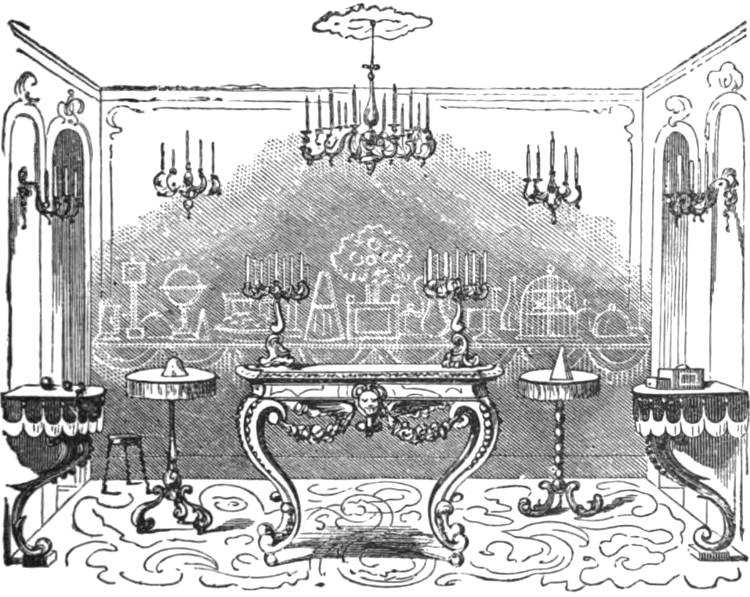
The door on the right of the stage led to a room, in which, in the evening, I made my preliminary preparations for my tricks, and which, in the morning, served as my workshop. A large window, looking out over the [Pg 33]garden of the Palais Royal, made this a very pleasant room, and it was here that I contrived the greater number of the tricks which I am about to describe.

[2] In the original a chapter entitled “Introduction dans la demeure de l’Auteur” is here introduced, but being merely a reprint of a similar chapter in Les Secrets de la Prestidigitation et de la Magie, which has been already translated in our English version of that work, it is not here repeated.—Ed.
[3] The public materially shortened the above title, Théâtre Robert-Houdin now fully indicating both the place and the nature of the performance.—R.-H.
[4] Les Confidences d’un Prestidigitateur, the title under which Robert-Houdin wrote his autobiography.—Ed.
[5] Monseigneur Affre, killed at the barricades in 1849.—R.-H.
[6] This slip of paper I preserved as a religious relic. I kept it in a secret corner of a pocket-book which I always carried about my person. During my travels in Algeria I had the misfortune to lose both this pocket-book and the precious object which it contained.—R.-H.
[7] I change the name, for obvious reasons.—R.-H.
[8] The singular favour with which my performances were received by the public, enabled me to repay my generous creditor within a year after the opening of my theatre.—R.-H.
[Pg 34]
[9] Small round tables.
The furniture of a conjuror’s stage is not merely designed to please the eye of the spectator, but serves, in addition, to facilitate the execution of many of his marvels. The tables, in particular, have important duties to discharge, for by their aid is generally effected the appearance or disappearance of articles too bulky to be concealed in the hands or the pockets of the performer.
The conjurors of the old school[10] derived great assistance in this particular even from the ornamentation of their tables. These were covered with richly-embroidered cloths, [Pg 35]extending downwards to the floor, as shown in the accompanying figure (Fig. 2).
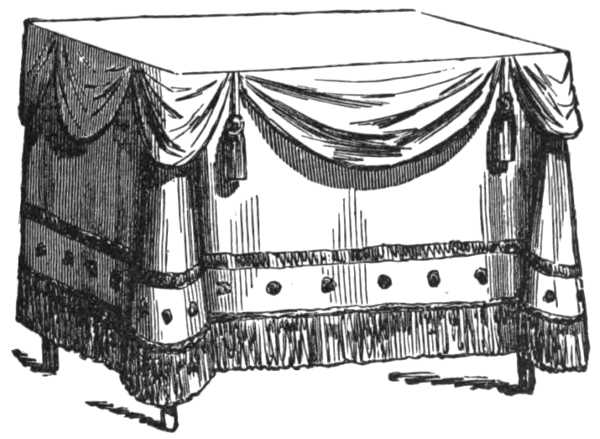
It was not uncommon to see four or five of these tables on the stage, and sometimes even more. In order to mislead the spectator as to their real purpose, they were loaded with candlesticks and other articles, ostensibly intended to be used for the purposes of the performance.
In the background, the principal object, extending quite from side to side, was a kind of sideboard composed of several stages, one above the other, also loaded with pieces of [Pg 36]apparatus made of polished brass, which, however, generally speaking, had no connection whatever with conjuring.
This miscellaneous but showy collection was rendered still more dazzling by a considerable number of lamps and wax candles.[11] This gorgeous exhibition, which the conjuror of that day denominated pallas,[12] was simply intended, to use a homely phrase, to throw dust in the eyes of the spectators.
When, in the year 1844, I undertook the erection of my own theatre, I made very considerable alterations in my stage arrangements, as compared with those of my predecessors. The most important was the suppression of the long table-covers, under which the public always suspected, and not without reason, the presence of an assistant to facilitate the execution of the tricks performed. For these bulky “confederate-boxes,” I substituted gilt tables and consoles in the Louis XV. style, of which I subjoin a specimen (Fig. 3).
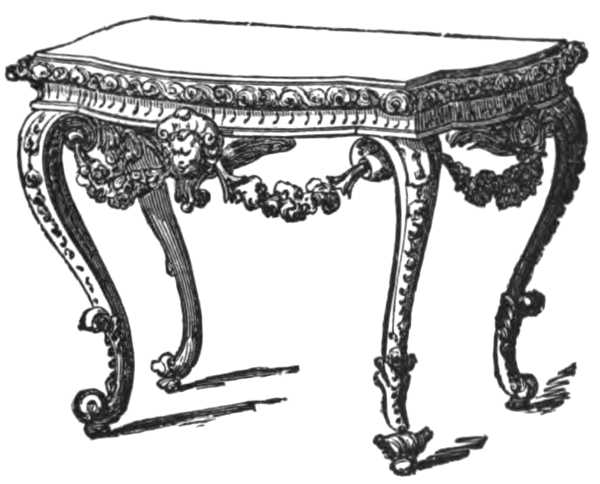
[Pg 37]
The number of these latter was very limited: a centre table (that represented by the figure), two side consoles, and two small light guéridons. At the back a broad shelf in the same style, on which were arranged the pieces of apparatus intended to be used in my performance.[13] Those [Pg 38]enormous metal covers, polished or japanned, under which articles to be vanished had hitherto been put, were no longer to be seen. I had replaced them with covers of glass, opaque or transparent, as the case might be. Boxes with false bottoms, and all apparatus of polished brass or tin, were completely banished from my stage.
The decoration of my miniature drawing-room was of white and gold. The visible lighting arrangements consisted simply of four girandoles, and two small candelabra of crystal, placed on my centre table. But in order that my audience might have a perfect view of the smallest details of my experiments, I had fitted my stage with special appliances, which gave a sufficiency of light without hurting the eyes of the spectators. For this purpose, I had fixed just behind the proscenium-border[14] a gas string-light,[15] with a reflector, which brightly illuminated my centre table and my two consoles, the only spots at which my feats of magic were executed.
[Pg 39]
The reforms which I had introduced in the form and ornamentation of the “tables” did not by any means render them less valuable than their predecessors for conjuring purposes, as the reader may judge by the following details:—
As I have already stated, there were on my stage but three tables—one in the centre and two at the sides; these last, which were in the form of consoles, were fixed to the panelling of the side-scene. I had also two little guéridons,[16] of the lightest possible description, which I brought forward, as occasion demanded, to the front of the stage, for any experiment which required close proximity to the spectators.
[Pg 40]
The majority of my tricks were performed at my centre table. The only specialities of this table were a servante, with its gibecière, and a set of “pistons.” I have already described in a preceding work, and illustrated by a diagram[17] the arrangement and utility of the servante. It is a shelf (behind the table on the side farthest away from the spectators) on which are placed the articles destined to be produced in the course of the performance. In the middle is placed a small square box (the gibecière) made of cloth padded with wadding, and quilted so as to give it a certain degree of stiffness. Its use is to receive noiselessly any article dropped therein.[18]
[Pg 41]
The set of pistons, which is fitted to the under surface of the table, serves to work the [Pg 42]automata and mechanical pieces exhibited to the spectators. These automata being supposed to obey the word of command, it is necessary that their mechanical intelligence should be guided by an assistant, and this result is obtained by the use of pistons.
A piston is a group of three steel rods; two of them are fixed, and form what in mechanical parlance is termed a cage, the third is movable, and may be made, by pulling the string attached to it, to rise above the other two. A spring placed beneath, serves to bring the rod down again as soon as the string is released.
When several of these pistons are placed side by side in a straight line, they form what is known as a set of pistons. Supposing that, [Pg 43]as in the case of my own table, the set is composed of ten pistons; the ten cords will travel right and left (over pulleys) down the legs of the table, and passing under the floor of the stage, will terminate at a “key-board,” to which they are attached in the same order which they occupy in the table.
When the piston-rods rise above the surface of the table, they come in contact with corresponding pedals in the base of the mechanical piece; which pedals move, as the case may be, the arm, the head, or any other part of the automaton, or whatever the apparatus may be.
The side tables, or consoles, fixed to the panels of the side-scene are furnished with various traps, specially adapted for different tricks. An opening made in the side-scene, immediately behind the console, enables the assistant to introduce his arm for the performance of whatever duty may devolve upon him. The under surface of the consoles forms a closed case, so that articles passed through the traps cannot fall on the floor. This case, which is [Pg 44]about seven inches deep, is concealed by the ornamental work of the table, and the gold fringe which surrounds its edges.
Besides these tables, which are intended for the general requirements of the performance, there are others specially designed for some one special trick, and which are placed on the stage as they happen to be needed. We may instance that which serves to vanish a human being, and which we shall describe later on, when we come to deal with the trick in question.[19]
The conjuror’s servant fills on the stage a like office to that which is discharged by the assistant of a lecturer on chemistry or natural science; it is his duty to provide the operator with all that is needed for the performance of his experiments, and not unfrequently he gives his personal assistance, unknown to the spectators, in aid of some particular trick. The [Pg 45]costume of the servant is a matter of taste, but he should be of smaller stature than the conjuror, so as not to draw too much attention to himself; a young lad answers the purpose very well. I used to be assisted on the stage by one of my sons, who wore the dress which the fashion of the day rendered appropriate to his age, who at that time (in 1844) was thirteen.
There is a second servant, of whose existence the spectators know nothing. This is the alter ego of the conjuror, the invisible hand which really effects sundry appearances, disappearances, and substitutions, of which magic has the credit. This servant remains behind the scenes, eye and ear constantly on the alert; and at certain moments, duly arranged beforehand, he lends a hand in ready aid of the skill and the “patter” of the principal performer. The due discharge of this office demands great dexterity, constant watchfulness, and, above all, instant readiness in execution. Women perform this duty to perfection.
[10] As, for example, Conus, Bosco, and Philippe, to name those only of whom many of the present generation will retain a recollection.—R.-H.
[11] Philippe may claim the credit of having reached the highest pitch of extravagance in these dazzling exhibitions; he used not less than five hundred wax candles on his stage.—R.-H.
[12] It was formerly a common thing, in speaking of a rich and showy mise en scène, to say, “C’est très pallaseux.”—R.-H.
[13] I should state that the other members of the profession quickly adopted these modifications, always excepting, however, Bosco the elder, who, to his latest hour, would give up neither his short sleeves nor his long table-covers.—R.-H.
[14] This is the term applied to the festooned drapery behind which the curtain is hidden when drawn up.—R.-H.
[15] A “string-” or “border-light,” in theatrical parlance, is a long gas-pipe, to which are fitted, at very short distances apart, fish-tail burners, forming a kind of ribbon of light the whole length of the stage.—R.-H.
[16] Small round stands or tables. See Fig. 1.—Ed.
[17] See “The Secrets of Conjuring and Magic,” p. 284
[18] For a detailed description of conjuring tables, and the various mechanical arrangements connected therewith, see “Modern Magic,” pp. 437 et seq. An improved table, not there noticed, is known as the “Lynn” table, after the well known professor who first used it in public, and claims to divide with a certain noble amateur the honour of its invention. Its speciality is that, by an ingenious mechanical arrangement, both back and front may be shown without suggesting the presence of a servante, and that to further prove its innocence of mechanism, a drawer, apparently occupying the whole body of the table, may be taken completely out, shown empty, and replaced, though the interior of the table is, in fact, fully “loaded” with the requirements of the performance. The table in question has been further improved, in certain details of construction, by Mr. Bland, of New Oxford Street, a leading manufacturer of magical apparatus, and in its final shape forms as perfect a conjuring table as any performer could desire.
We are indebted to Mr. Bland, above named, for the opportunity of examining a “magic chair,” which possesses many of the advantages of a mechanical table, in addition to sundry special faculties of its own. In appearance it is a handsome drawing-room chair, with a figured cloth seat and open back. In the first place, the upright centre rail of the back revolves, and so discloses a borrowed watch, after the manner of the Watch Target (see “Modern Magic,” p. 200). At the back of the top rail is a cunningly-devised apparatus for instantaneously producing three cards, which, by an ingenious arrangement, are made to fold down behind the back till wanted (in which condition they are quite invisible). At the word of the performer, they spring up above the top rail, at the same time spreading fanwise, the marvel being where they could possibly have been concealed.
The production of the cards and watch, as above, is effected by a single string, pulled by the assistant behind the scenes, and which may, at the pleasure of the performer, be made to produce either the cards only, the watch only, or both together. The seat of the chair contains a piston for working mechanical pieces, the same string already mentioned being made by an instantaneously effected alteration, to perform this duty also. Two other strings serve to actuate an elaborate mechanical trap in the seat, producing a succession of startling changes: while the hinder part of the seat, which is open on the side remote from the spectators, serves at need as a receptacle for a bowl of gold-fish, or any other article the performer may desire to produce or get rid of.—Ed.
[Pg 46]
[19] This intention was never carried into effect by Robert-Houdin. For a brief description of a similar table, see “Modern Magic,” p. 449.—Ed.
Among the articles which the spectators are in the habit of entrusting to conjurors for the execution of their tricks, handkerchiefs, both silk and cambric, play a prominent part.
I propose to give, in due course, a description of the various tricks in which handkerchiefs are specially concerned, such as the Orange Tree, the Handkerchief Cut up and Restored, the Instantaneous Combustion, etc.[20]
[Pg 47]
Here is, meanwhile, a pretty little trick (as yet unpublished) performed with a handkerchief, and which I used at my séances as a kind [Pg 48]of interlude. I can recommend it as producing a very great effect.
[Pg 49]
The Handkerchief which Vanishes in the Hand.—“The magicians of old,” you remark, “were not subject to any of the minor inconveniences of life. They felt neither cold, hunger, nor thirst, so long as they were engaged in their mystic rites. Their close relations, however, with the fiery potentates of another sphere exposed them pretty frequently to a very high temperature, the effect of which showed itself in copious perspiration.
“The wizards, thus playing with fire, were much troubled by water, which streamed from their countenances; but they removed it by wiping their faces with their handkerchiefs, just as ordinary mortals do.
“One of their number, who, I suppose, found this troublesome, hit upon a curious expedient for shortening the task of drying himself; he [Pg 50]caused his handkerchief, after having discharged its duty, to go back of its own accord into his pocket. I have discovered the secret of his cabalistic process, and, if agreeable to yourselves, I will repeat it in your presence.
“Let us suppose that, for the reasons I have suggested, I find it necessary to wipe my brow. I take my handkerchief from my pocket for that purpose. Here it is, you see.”
You wipe your forehead, and gently fan yourself with the handkerchief; then clapping your hands, with the handkerchief between them, it instantly vanishes.
“Do you know, gentlemen, where the handkerchief is? No? Then I will tell you. It has gone back into my pocket.”
You again take the handkerchief out of your pocket, and make it vanish a second time.
“You see, gentlemen, how much time this arrangement saves; you have only to take your handkerchief out of your pocket. You have no occasion whatever to put it back again.”
[Pg 51]
This amusing little interlude served the double purpose of gaining a few moments in my performance, and of affording a relaxation to the spectators.
The trick is performed as follows:—
This trick, I repeat, is extremely striking in effect. It may, perhaps, appear somewhat difficult, but let not the student be discouraged; with a very moderate degree of practice, it should readily be conquered.

[20] These promised explanations were never given. The effect of the “Orange Tree Trick,” as described by Robert-Houdin himself in his “Confidences d’un Prestidigitateur,” was as follows:—
“I borrowed a lady’s handkerchief. I rolled it into a ball, and placed it beside an egg, a lemon, and an orange upon the table. I then passed these four articles one into another, and when at last the orange alone remained, I used the fruit in question in the manufacture of a magical solution. The process was as follows: I pressed the orange between my hands, making it smaller and smaller, showing it every now and then in its various shapes, and finally reducing it to a powder, which I passed into a phial in which there was some spirits of wine. My assistant then brought me an orange-tree, bare of flowers or fruit. I poured into a cup a little of the solution I had just prepared, and set fire to it. I placed it near the tree, and no sooner had the vapour reached the foliage, then it was seen suddenly covered with flowers. At a wave of my wand, the flowers were transformed into fruit, which I distributed among the spectators.
“A single orange still remained on the tree. I ordered it to fall apart in four portions, and within it appeared the handkerchief I had borrowed. A couple of butterflies with moving wings took it each by a corner, and flying upwards with it, spread it open in the air.”
Without professing to give precise details, it is easy to form a general idea of the working of this very artistic trick. The borrowed handkerchief is of course exchanged for a substitute, and the original “passed off” to the assistant, who places it in position for the dénouement, and then brings forward the orange-tree. Meanwhile, the performer, partly by sleight-of-hand and partly by the aid of traps, causes the successive disappearance of the substitute handkerchief, the egg, and the lemon. (See the “Secrets of Conjuring and Magic,” pp. 284 et seq., and “Modern Magic,” pp. 437 et seq.). The orange is then changed for others of smaller size in due succession, and finally vanishes altogether. (For description of similar effects in the Crystal Balls, see “Modern Magic,” p. 426.) The supposed solution of the orange in the spirits of wine is, of course, merely a part of the boniment or mise en scène. The orange-tree, which is a marvel of mechanical ingenuity, is constructed as follows: The oranges, with one exception, are real, and are stuck on small upright spikes, and concealed by hemispherical wire screens, covered with foliage, which, when released by the upward pressure of a piston, make a half turn, and so disclose the fruit. The flowers are hidden behind smaller screens, similarly covered; in this instance, however, the screen does not revolve, but the flower rises above it. A single orange, near the top of the tree, is artificial, and made to open in four portions; while two butterflies flutter out one on each side of the tree, and draw out of the orange the borrowed handkerchief. The butterflies are attached to the upper extremities of two light arms of brass, at the back of the tree, working on a pivot at their lower ends. A mechanical arrangement compels these arms to rise up behind the tree, at the same time spreading apart, and so causes the butterflies to appear.
The handkerchief cut up and restored has been worked, in various forms, by successive generations of conjurors. (See “Modern Magic,” pp. 246-249.) Doubtless, the method adopted by Robert-Houdin bore (as indeed did everything he touched) the stamp of his original genius; but unfortunately we have not been able to obtain any note of his special working.
The instantaneous combustion was probably produced by means of what is now known as a “flash” handkerchief, i.e., a handkerchief so treated with a mixture of nitric and sulphuric acid as to transform the fabric, in effect, to gun-cotton. A handkerchief of this kind held to a lighted candle, or merely touched with a hot glass rod, disappears with a flash, leaving not even a shred of tinder behind.—Ed.
[Pg 54]
[21] In making this attachment, you must carefully avoid creating any impediment which might interfere with the passage of the handkerchief up the sleeve. This difficulty is best avoided by sewing the string to the handkerchief.—R.-H.
Among the illusions which I have, from time to time, contrived, in order—if I may venture to say it—to cheat my friendly spectators, I do not think, modesty apart, that I ever invented anything so daringly ingenious as the experiment I am about to describe.
I do not here allude to the “light and heavy chest,” whose secret I have already revealed in my autobiography,[22] but of an addition I made to that trick in order to throw the inquiring minds of the public off the scent.
Even at the risk of repeating myself in the eyes of those who have read the book above mentioned, I think I ought, in the first place, to say a few words as to the manner in which I performed my original experiment of the light and heavy chest; after which we will proceed to describe the trick to which I now refer.
[Pg 55]
The heavy chest was a small strong-box, which, placed in a particular spot among the audience, had the faculty of becoming light or heavy at my command. At one time a child could lift it without difficulty; at another, the most powerful man could not stir it from its place.
In order that the reader may fully comprehend the working of the trick, I must, in the first place, give a short explanation of certain electrical principles on which it is founded.
By the aid of electricity, as is now generally known, we can render a piece of iron temporarily magnetic. This artificial magnet, which is known as an electro-magnet,[23] retains its power of attraction so long as the electric current circulates around it; but the moment that the electric circuit is broken, the iron completely loses its magnetic force. By this means magnets may be produced of such immense power, that when a piece of iron is brought in contact with them, no human power can tear it away.
[Pg 56]
It was upon this principle that I based the secret of the trick of the “light and heavy chest,” which I produced in the course of my performances.
In the middle of the pit, and upon a broad plank which served as a “run-down” to enable me to communicate with the spectators, I made an opening in which was fixed a powerful electro-magnet, concealed by a thin cloth which covered it. The conducting wires were carried behind the scenes, whence, at the proper moment, the current necessary to magnetise the iron was to be despatched. On the under side of the strong-box, which was to be subjected to the magnetic influence, there was a stout iron [Pg 57]plate let into the wood, and disguised by a mahogany-coloured piece of paper, which apparently formed part of the substance of the box.
These arrangements being duly made beforehand, when I placed the strong-box upon the electro-magnet, a spectator would either lift it without difficulty, or exhaust himself in fruitless attempts to move it, according as my concealed assistant made or unmade the electric circuit.
When, in the year 1845, I performed this trick for the first time, the phenomena of electro-magnetism were wholly unknown to the general public. I took very good care not to enlighten my audience as to this marvel of science, and found it much more to the advantage of my performances to exhibit the “heavy chest” as an illustration of white magic, of which I alone possessed the secret. I also exhibited it as an imitation of a spiritualistic effect, the fiction with which I introduced it being as follows: “This chest,” I gravely announced, “serves me as a strong-box when I have any money to lock up; in such case, I don’t trouble myself in the [Pg 58]least to put it out of reach of thieves. I simply make a mesmeric pass over it, and I am quite certain to find it again wherever I may have left it. I will give you a proof of my assertion. Let us suppose that this chest, the lightness of which you have proved for yourselves, contains a few thousands of francs in bank-notes, which would be very easily run away with. Well, I have only to pass my hand over it, like this, and you may now satisfy yourselves that the strongest man would waste his strength in vain in the endeavour to remove it from its place.”
After sundry attempts had been made to no purpose, I added:—
“And yet, at my command, the chest is no longer heavy, and you see that I can raise it with ease with my little finger.”
At a later period, when electro-magnetism had become more generally known, I thought it advisable to make an addition to the “light and heavy chest,” in order to throw the public off the scent as to the principle on which the [Pg 59]illusion was based. The following was my method of presenting this new trick, which to the eyes of the public, was merely a second phase of that which had preceded it:—
“Gentlemen,” I continued, “in order to prove to you that the additional weight which I impart to the chest is genuine, and does not depend on any external artifice, I will attach it to one end of this cord,” (a cord passing over a pulley attached to the ceiling), “and if you will hold the other, you will be able to form a fair estimate of the amount of its downward pressure.” So saying, I hooked the chest to the cord; after which, I requested one of the spectators to be good enough to keep it suspended by holding the other end of the cord, which he did with perfect ease. “Just at present,” I remarked, “the chest is extremely light; but as [Pg 60]it is about to become, at my command, very heavy, I must ask five or six other persons to help this gentleman, for fear the chest should lift him off his feet, or even carry him away altogether.”
No sooner was this done than the chest came heavily to the ground, dragging along and sometimes actually lifting off their feet all the spectators who were holding the cord.
This marvellous effect is produced entirely by mechanical means; but their operation is so well disguised, that no one could possibly suspect the truth.
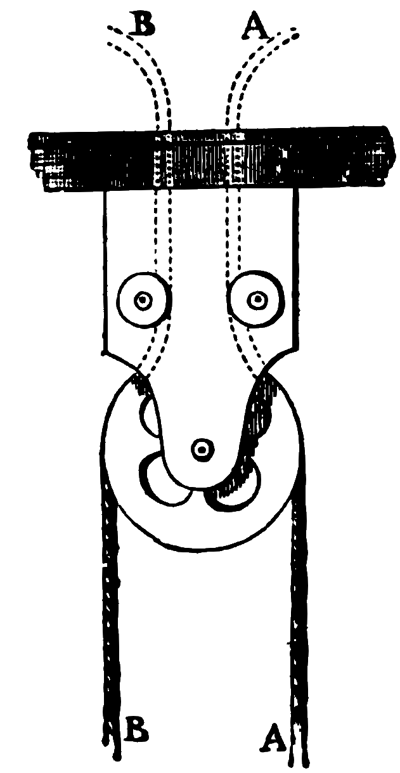
I shall now proceed to give a more detailed explanation, for the purpose of which I must refer the reader to the accompanying diagram:—
On a casual inspection of the pulley and block, everything appears to indicate that, as usual in such cases, the cord passes straight over the pulley, in on one side and out on the other; but such is not really the fact, as will be seen upon tracing the course of the dotted lines, which, passing through the block and through [Pg 61]the ceiling, are attached on either side to a double pulley fixed in the room above.
One circumstance that favours the illusion is that, before the box is hung on the hook, by pulling the latter the cord wound upon the double pulley above unwinds itself, while the portion of the cord on the opposite side is wound up to the same extent. Now, to the eye of the spectator, this pulling of the cord to right or left produces precisely the same effect as if the cord simply passed over the visible pulley.
To any one who has the most elementary acquaintance with the laws of mechanics, it will be obvious that the strength of the person who holds the handle of the windlass above is multiplied tenfold, and that he can easily overcome even the combined resistance of five or six spectators.
This experiment cannot well be performed save in a place of exhibition whose ceiling is not very lofty.
[22] “Confidences d’un Prestidigitateur,” vol. ii., p. 265, and “Secrets of Conjuring and Magic,” p. 79.
[Pg 62]
[23] For the construction of electro-magnets, the reader is referred to works treating of physical science, particularly those which treat specially of electricity, e.g., those of Count Dumoncel and Edmond Becquerel.—R.-H.
We say “the hundred candles,” in order to preserve to the trick the title under which it has been generally exhibited, but, as will presently be seen, even a larger number may be lighted, if desired.
This trick, which is, in truth, only the application on a large scale of an old scientific experiment known as the briquet électrique,[24] was first exhibited by the conjuror Döbler, in the course of the performances which he gave in 1840, at the St. James’s Theatre, in London.
[Pg 63]
In order to enable the reader the better to comprehend the arrangements for the trick of the “hundred candles,” we will first recapitulate those of the briquet électrique. The accompanying diagram (Fig. 5) will assist our description.
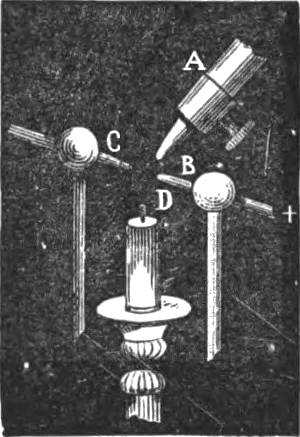
A is the extremity of a tube or burner in communication with a reservoir of hydrogen gas; B and C are two thin metal wires, whose points are very near together. One of these wires (B) is insulated by means of a glass support; the other (C) is fixed on a brass rod in communication with the ground.
When the gas escapes from the burner A, it impinges directly upon the wick of the candle D, passing between the points B and C. If at the same instant an electric current is communicated to the point B, the spark will in its journey to the opposite point pass through the gas and [Pg 64]ignite it. The jet of flame thus created will in turn light the wick of the candle.
Given a few modifications in point of form, and increasing the number of the gas-jets, points, and candles, we have the experiment of M. Döbler.
In the illustration which next follows (Fig. 6), the reader will see the new arrangement complete. All the supports (S S S S) of the conducting wires, however numerous, with the exception of the last, are insulators. All the burners (G G G) are attached to a single pipe, which keeps them supplied with gas. The letters B B B indicate the position of the candles.
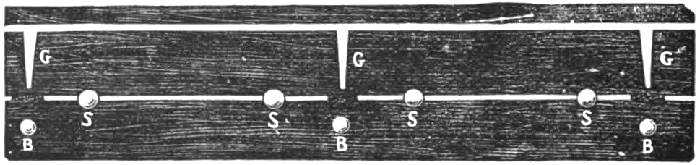
As in the experiment already described, the gas is turned on at the common main, and [Pg 65]escapes at each burner. At the same moment an electric current is brought in circuit with one of the insulated conducting rods, and instantly leaping over all the intervals, sets light, as we have said, to the gas-jets, and by their aid to the candles.
To ensure greater certainty in lighting, the wick of the candle is charred a little beforehand, and then moistened, by the aid of a camel-hair brush, with spirits of turpentine.
The greater the number of interruptions in the circuit, the stronger need be the current of electricity to enable it to conquer all the successive resistances to its flight.
Formerly the spark was produced by means of a large frictional machine, but however powerful such machine might be, it happened now and then, when the weather was damp, that the quantity of the electric fluid produced was inadequate, and that the experiment was a failure. At the present day, with the aid of the Rhumkorff induction coil, the [Pg 66]performer need have nothing to fear in this particular, so long as he takes care that the size of his coil is in due proportion to the number of candles he desires to set light to.
[Pg 67]
[24] Literally, “electric tinder-box.” We are not aware that the experiment in question has any special cognomen among English electricians.—Ed.
The trick known as the “ghost illusion” is one of the most curious ever produced by optical science. The apparitions produced by its means are most startling in effect, and leave the spectators scarcely room to question their actual existence.
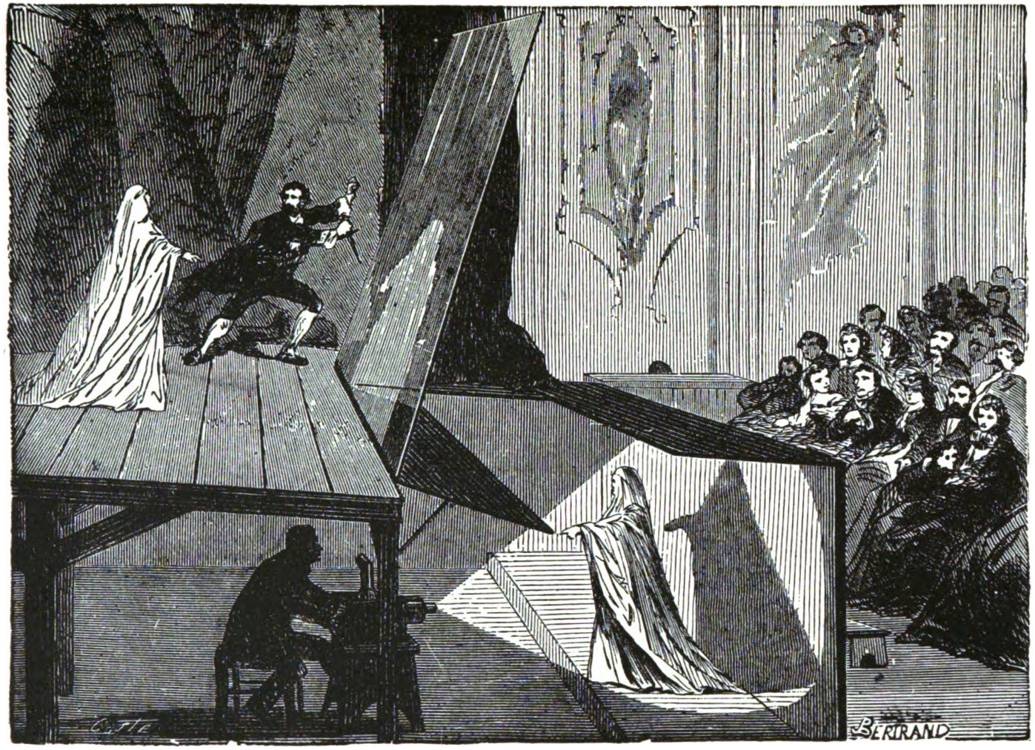
Two persons, for instance, as in the accompanying illustration (Fig. 7), are seen upon the stage. They walk and move in all directions, they are heard to converse with one another, and every indication leads to the belief that they are beings of like organization, though differently attired. In truth, however, the one is a flesh-and-blood personage, the other but a ghostly shade, an impalpable spectre.
The living personage tries in vain to grapple with the phantom. He slashes at it with his [Pg 68]sword, and even passes right through its body, as he might pass through a cloud of vapour. But the shadowy form shows no signs of injury; it remains intact, and gesticulates as though in defiance of its adversary, until at last it vanishes into thin air, and the mortal is left alone upon the stage.
This singular illusion depends upon certain optical principles, which we propose, in the first place, to explain, and to which we shall have occasion to recur a little later in describing the stage arrangements necessary for their dramatic development.
An illustration of the most simple character will at once enable the reader to understand the principle on which the phenomenon in question rests.
Place in a vertical position on a table a piece of unsilvered plate-glass, or if plate-glass cannot be obtained, then a piece of ordinary window glass free from air-bubbles or striæ, about ten inches in height, and the same in width.
[Pg 69]
[Pg 70]
Then place a lighted taper on your own side of the glass, at about three inches from it, and behind this place a book, which will serve the purpose of a screen. Fig. 8, below, will make clear the details of the arrangement.
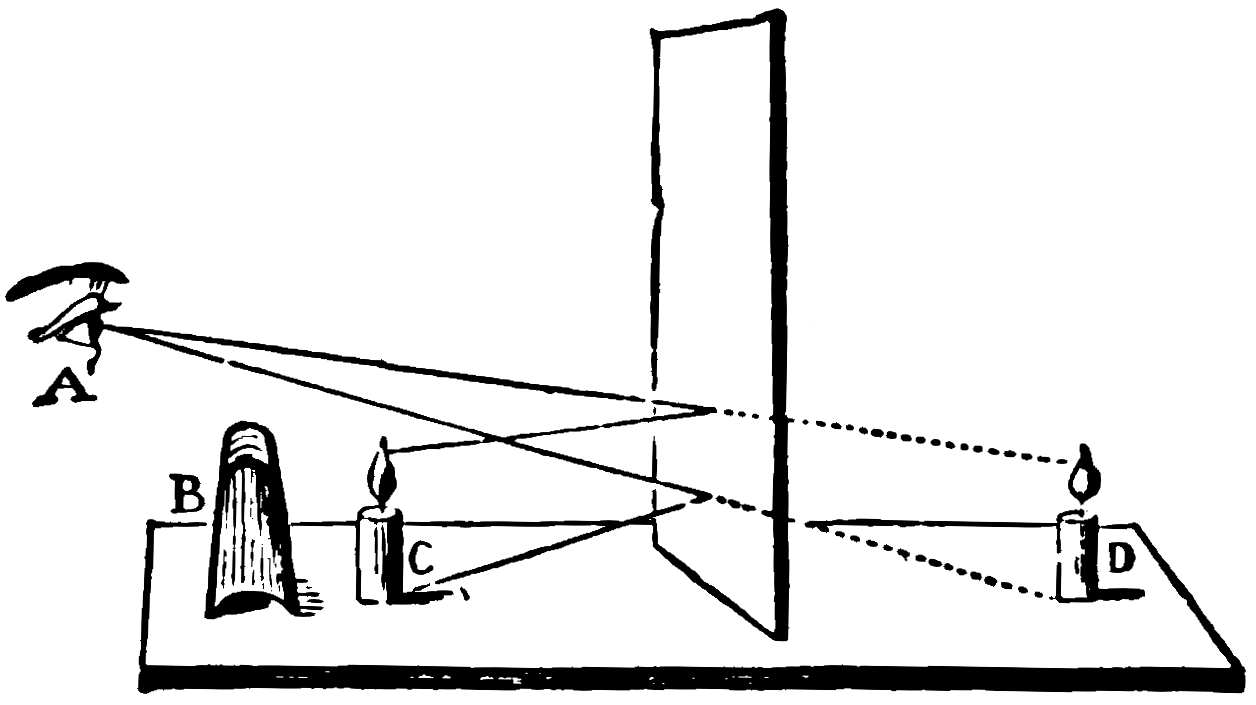
On looking over the top of the book at the glass, you will see therein the reflected image of the taper C, which is screened by the book from your direct view, and this image will in effect appear to you to be at D, behind the glass, at the same distance as the real object, C, is removed from it.[25]
[Pg 71]
If, while still keeping the eye in the same position, you extend your hand behind the glass, you can pass your fingers right through the phantom taper, D, and this latter, which previously appeared to be substantial, will instantly become diaphanous and impalpable.
If, in the stead of the taper C, you place in the same position any white object strongly illuminated, you will have a miniature reproduction of the ghost illusion as represented on the stage.
It is of course understood that there must be no other light in the room save that which is essential to the experiment.
The effect produced as above may be explained as follows:—When a piece of unsilvered glass is placed in a position in which it receives equal light on both sides, there is no reflection from either the one or the other of its surfaces. Such, for instance, is the case with the panes of a window, so long as the outside and inside of the room receive the same amount of light. But if either side of the [Pg 72]glass is more strongly illuminated than the other, the latter, in such case, loses in transparency but gains in reflection, in precise proportion as the light is diminished, the darkness in this case serving the purpose of a more or less perfect “silvering.”
We will now proceed to trace the application of this principle in the stage trick known as the “Ghost Illusion” or “Living Phantoms.”
Fig. 7 represents a scene between a spectre and a living being; and indicates the general arrangement of the process employed to produce the illusion. A plate of unsilvered glass, inclined at a proper angle, is placed between the actors and the spectators. Beneath the stage, and just in front of this glass, is a person robed in a white shroud, and illuminated by the brilliant rays of the electric or the Drummond (oxy-hydrogen) light. Matters being thus arranged, the image of the actor who plays the part of spectre, being reflected by the glass, [Pg 73]becomes visible to the spectators, and stands, apparently, just as far behind the glass as its prototype is placed in front of it.
This image, in accordance with the principles of reflection which we have explained above, is only visible to the audience. The actor who is on the stage sees nothing of it, and in order that he may not strike at random in his attacks on the spectre, it is necessary to mark beforehand on the boards the particular spot at which, to the eyes of the audience, the phantom will appear.
In order that the experiment may be completely successful, it is necessary to pay particular attention to the following points:—
Dimensions of the Glass.—The dimensions of the glass which is to be used for the experiment are practically determined as follows:—
After having decided at what particular part of the stage the shadowy form is to appear, you fix, in an upright position on the spot in question, a deal board of the height and breadth of the phantom. Then fastening a thread to each side of the base of this board, you carry it straight across the flooring to the stage boxes, or those seats on the extreme right and left which are nearest to the stage.
[Pg 76]
The angle formed by these two will indicate the necessary width of the glass for any position on the stage in which you may decide to place it. The height is determined with equal facility. You fasten to the top of the board a third thread, which you carry in a straight line to the highest seat at the opposite side of the auditorium. This line will indicate the height to which the glass must extend, whatever be its angle of inclination. The three threads in question represent the extreme lines of sight of the audience. All eyes will therefore necessarily find space on the glass for the reflection of the spectral form.
It is obvious that in arranging the glass according to the limits defined by these lines, the nearer it is placed to the spectators the larger it must be, and vice versâ.
The Angle of Inclination of the Glass.—Let us suppose, as indicated in Fig. 9, that the phantom is to appear at the point A, distant five yards from the front edge of the stage.
Such being the case, let us place our glass, G, [Pg 77]a couple of yards in front of A, and incline it at an angle of 20°.
Position and Arrangement of the Ghost-Actor.—Let us continue the line G downwards upon the paper till it extends about three or four times the length of the glass. Taking the lower extremity of this line as a centre, let us describe with a pair of compasses two arcs, one extending from E to C, the other from A to D,[27] [Pg 78]and join them by a line, C D, which should form with the glass a like angle to that which the line E A forms therewith.
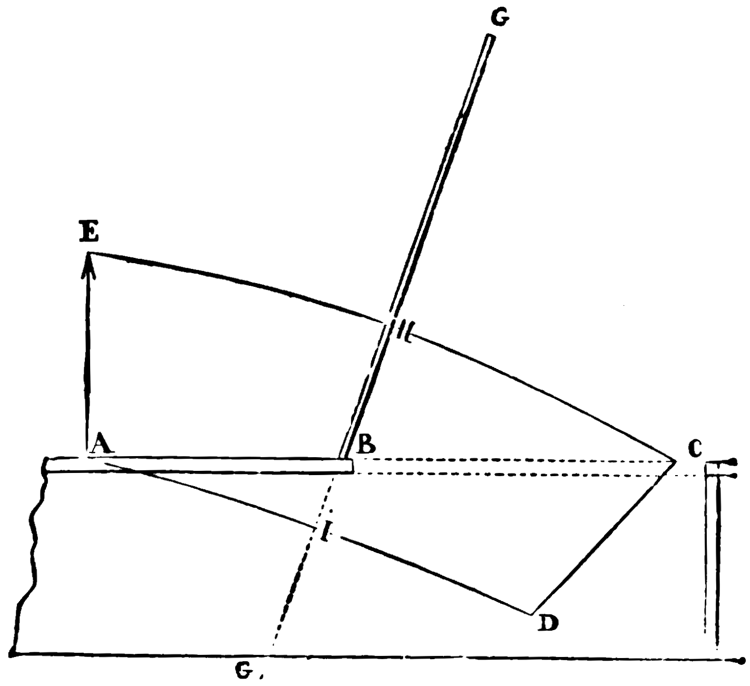
The plane and inclination of the line C D will be those which the actor must assume in order that his reflected image may appear in an upright position at the point A.
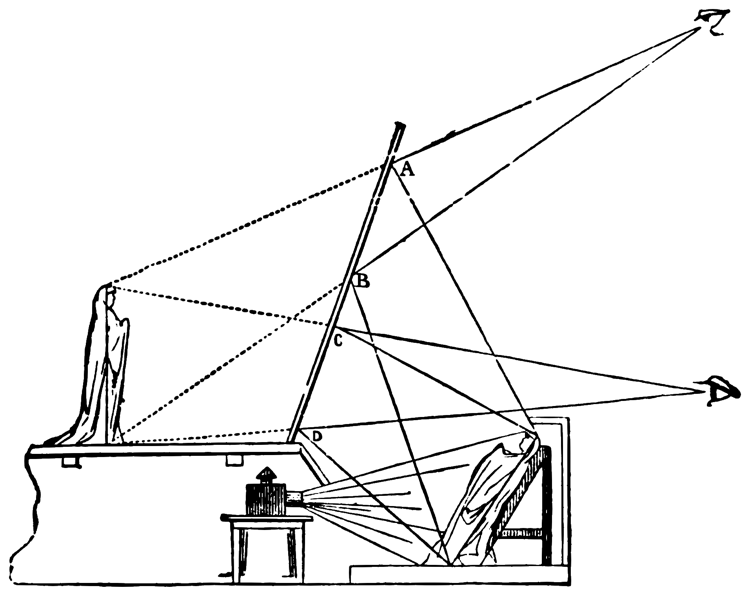
It will be readily understood that the more upright the glass, the less sloping will be the position of the actor; but, on the other hand, the higher will he be brought above the level of the stage. Under such circumstances, the portion around the opening, being necessarily made higher in order to conceal the actor, would also hide a portion of his reflected image from the spectators in the orchestra or stalls.
Fig. 10 exhibits the optical effect of a glass placed according to the conditions we have just described. The particular spot on which the reflection appears varies with each spectator, according to the position which such spectator occupies. Thus, for the spectators in the topmost [Pg 79]row, the reflection will be on the portion of the glass marked A B, while for spectators at the lowest level it will be on the portion marked C D. It will be observed that, whatever be the spot at which the image appears, the angle of incidence equals the angle of reflection, and that these same angles of incidence are likewise equal to the corresponding angles of the reflected image which we have traced behind the glass.
[Pg 80]
When the ghost-actor is not called upon to move from a given spot, he poses himself upon a support which is inclined at the necessary angle, and which leaves him still full power to move his limbs as may be desired. But if the exigencies of the scene require that he should move from one spot to another, the inclined position of the body creates a difficulty. However, as he can only be required to move in a direction parallel with the plane of the glass, he may, under cover of the robe with which he is attired, bend the leg on the side towards which he leans, which will enable him to walk without much difficulty with his body inclined at an angle of thirty-five to forty degrees. But the actor’s gait under such circumstances is sure to be a little awkward; and a better plan is to arrange behind him, at a proper angle, a support, moving on castors, and which is easily concealed by the drapery appropriate to his spectral character. This support does not prevent the actor from moving his legs, and, thus sustained, he is enabled to walk [Pg 81](apparently) backwards and forwards in the direction in which the support travels. In some cases, the actor himself keeps motionless, but the wheeled carriage on which he leans, being drawn forward by a cord, causes him to advance towards the living actor in genuine ghostly fashion. This movement produces a most startling effect.
The difficulty as to the inclined position of the actor may be avoided by arranging in the position which he would otherwise occupy, and parallel to the unsilvered glass, a mirror of comparatively small size (say of about six feet by three). Where this plan is adopted, the actor will stand upright before this mirror, and his reflected image therein will be again reflected to form the ghost.
The necessary light will be afforded by a lamp placed in front of the actor, and beside the mirror in question.
A Novel Application of the Ghost Illusion.—In the year 1868, there was exhibited at the [Pg 82]Ambigu Theatre, Paris, a melodrama (La Czarine) founded on an episode related in my Confidences,[28] and in which an automaton chessplayer, constructed by myself for that purpose, played an important part. My collaborateurs, Messrs. Adenis and Gastineau, had asked me to arrange a ghost effect for the last act. I had recourse to the “ghost illusion” above described, but I presented it in such guise as to give it a completely novel character, as the reader will be enabled to judge from the following description.
The scene is laid in Russia, in the reign of Catherine II. In the last act, an individual named Pougatcheff, who, on the strength of a personal likeness to Peter III., attempts to pass himself off as the deceased monarch, is endeavouring to incite the Russian populace to dethrone Catherine. A learned man, M. de Kempelen, who is devoted to the Czarina, [Pg 83]succeeds, by the aid of scientific expedients, in neutralizing the villainous designs of the sham prince.
The scene is a savage glen, behind which is seen a background of rugged rocks. Pougatcheff appears, surrounded by a crowd of noisy adherents. M. de Kempelen comes forward, denounces the impostor, and declares that, to complete his confusion, he will call up the spirit of the genuine Peter III. At his command a sarcophagus appears from the solid rock; it stands upright on end. The lid opens, and exhibits a corpse covered with a winding-sheet. The tomb falls again to the ground, but the phantom remains erect. The sham Czar, though a good deal frightened, makes a pretence of defying the apparition, which he treats as a mere illusion. But the upper part of the winding-sheet falls aside, and reveals the livid and mouldering features of the late sovereign. Pougatcheff, thinking that he can hardly be worsted in a fight with a corpse, draws his sword, and with one blow cuts off its [Pg 84]head, which falls noisily to the ground; but at the very same moment the living head of Peter III. appears on the ghostly shoulders. Pougatcheff, driven to frenzy by these successive apparitions, rushes at the figure, seizes it by its garments, and thrusts it violently back into the tomb. But the head remains unmoved; though severed from the body, it remains suspended in space, rolling its eyes in a threatening manner, and appearing to offer defiance to its persecutor. The frenzy of Pougatcheff reaches its culminating point. Grasping his sword with both hands, he tries to cleave in twain the head of his mysterious adversary; but his blade only passes through a shadowy being, who laughs to scorn his impotent rage. Again he raises his sword, but at the same moment the body of Peter III. in full imperial costume, and adorned with all the insignia of his rank, becomes visible beneath the head. The re-animate Czar hurls the impostor violently back, exclaiming, in a voice of thunder, “Hold, sacrilegious wretch!” [Pg 85]Pougatcheff, terror-stricken, and overwhelmed with confusion, confesses his imposture, and the phantom vanishes.
The stage arrangements to produce these effects are as follows. An actor, robed in the brilliant costume of Peter III. reclines against the support, which is sloped as above described. His body is covered with a wrapper of black velvet, which is designed to prevent, until the proper moment, any reflection in the glass. His head alone is uncovered, and ready to be reflected in the glass so soon as the rays of the electric light shall be directed upon it.
The phantom which originally comes out of the sarcophagus is a dummy, whose head is modelled from that of the actor who plays the part of the Czar. This head is made readily detachable from the body.
Everything is placed and arranged in such manner that the dummy image of Peter III. shall precisely correspond in position with the person of the actor who plays the part of Ghost.
[Pg 86]
At the same moment that the head of the former falls to the ground, the electric light is gradually made to shine on the head of the actor who plays the part of Peter III., which, being reflected in the glass, appears to shape itself on the body of the dummy ghost. After this latter is hurled to the ground, the veil which hides the body of the actor-Czar is quickly and completely drawn away, and the sudden flood of the electric light reflects his whole body where his head alone was previously visible.
Where it is desired to exhibit the ghost illusion in a hall which has no space beneath the stage, it becomes necessary to modify the reflective machinery, and to arrange it as shown in Fig. 11. Let us suppose A B C D to be the stage, C D being the front, A D and B C the “wings,” C the actor who plays the part of the spectre, H his image in the glass, and G the glass itself, set at an angle of 30° to the front of the stage.
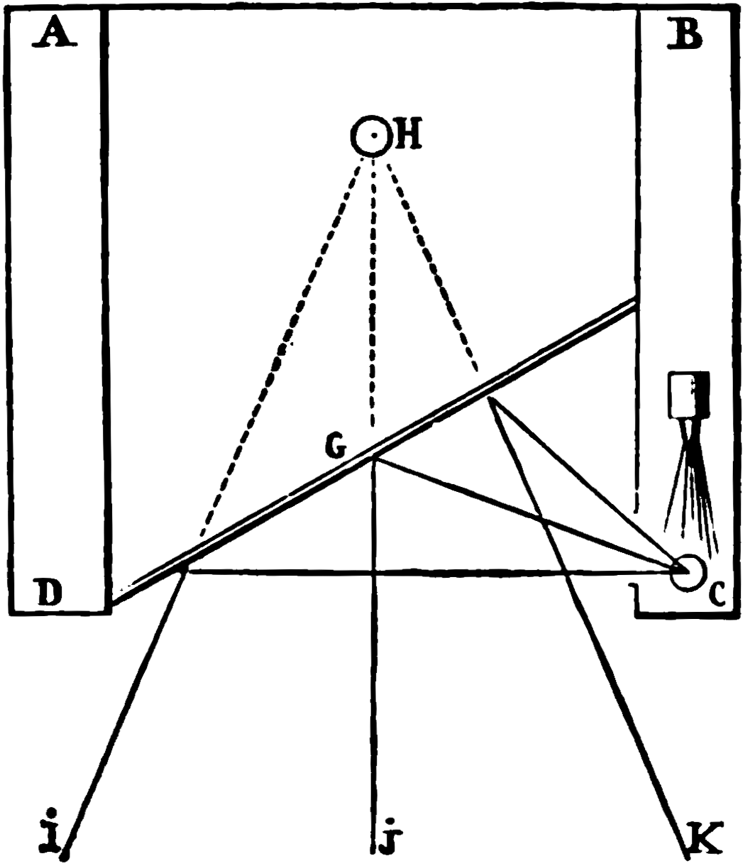
The actor, C, is out of sight of the spectators; [Pg 87]but his body, brightly illuminated by the electric or oxy-hydrogen light, is reflected in the glass, G, and appears as if standing at the point H. The letters I, J, K, indicate various “points of sight” among the audience, and serve to show that, whatever be the position of the spectator in the hall, the spectre must, according to the laws of reflection, always appear at the point H.
After the various explanations above given, the reader will readily comprehend certain stage arrangements which I have had made for my [Pg 88]own use in order to produce at will spectral apparitions, or, as the English call them, “dissolving spectres.”[29]
The arrangement which I refer to is set up, for the amusement of myself and my friends, in a summer-house specially built for that purpose in the middle of my park.
In the case of this exhibition, there are no seats; the few spectators who may patronize it stand in front of an opening, A B (Fig. 12), representing in miniature the proscenium of a theatre. This proscenium, or stage front, indicated by the letters A B C D, is within the summer-house. The annexe, C E F D, is built out behind, and contains the stage on which my optical illusions are displayed. This annexe is so constructed that the sunlight may readily find its way in at the trap-doors, I, J, when opened.
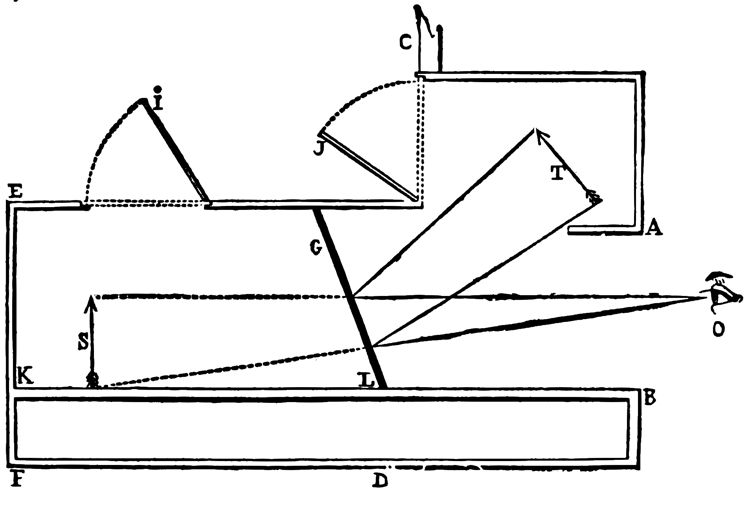
G is the glass, which forms with the stage-floor, K, L, an angle of 70°. T is the object to be [Pg 89]reflected in the glass, so as to appear, when the daylight shines upon it, at S. This spot, S, is also designed for the placing of objects to be seen directly through the glass, G, by the spectators. The eye, O, indicates the mean point of vision of those present.
With the aid of these arrangements, the following effects, among others, may be produced. The scene becomes slowly lighter, passing by gentle gradations from the first glimmer of dawn to full daylight. There then appears, at S, an owl [Pg 90]perched on a tombstone. A few moments later, a statue of the Virgin appears, mixed up, so to speak, with the gloomy objects we have mentioned. The outline of this figure, growing gradually more and more defined, takes the place of the tomb, which fades away from view. The Virgin, in her turn, undergoes a transformation; her cheeks acquire a roseate tint, her features assume life and expression, and the figure becomes animate under the guise of a young girl, robed in white and wreathed with flowers. These flowers gradually increase till they assume the semblance of a gigantic bouquet, beneath which gradually appears a vase, which takes the place of the young girl.
This scene might be prolonged indefinitely, all that is needed being the substitution of new objects in place of those which have already appeared.
Explanation of the Preceding Scene.—Before the commencement of the exhibition, the tombstone we have referred to must be placed at [Pg 91]S, while the statuette of the Virgin is placed at T.
Both stage and “auditorium” must be in total darkness. To that end, all the openings, and especially the trap-doors, I, J, must be shut as closely as possible.
Now, if, by the aid of a cord, appropriately arranged, we gradually open the trap I, the daylight will by slow degrees illuminate the object placed at S, which will be seen directly by the spectators. After this trap is completely open, it should be again slowly closed, while the trap J is proportionately opened. The sunlight will now fall on the Virgin placed at T, and at a particular period it will be found that the two images (direct and reflected) receiving an equal share of light, will become confused the one with the other. But the image T, gradually receiving more light, while the image S gets less, will at last be alone visible to the spectators, and the substitution will be complete.
The stage being now left in darkness by [Pg 92]the closing of the trap I, the young girl will be able to take the place of the tombstone, which she may remove, or which may sink down below the stage, and she will remain invisible until the last-mentioned trap-door, again opening, shall bring the light to bear upon her. This opening is made simultaneously with the closing of the trap J, producing, as in the former instance, first confusion of the two images, and then substitution of the one for the other. When the Virgin is in her turn left in darkness, she is replaced by the vase of flowers, which is destined, to the eyes of the spectators, to take the place of the young girl by a repetition of the process already described.
Thus the spectator, placed at O, is made to see at S four different pictures—namely: 1st, the direct image of the tombstone; 2nd, the same object in combination with the reflected image of the Virgin placed at T, which is afterwards seen alone; 3rd, this latter image in combination with the direct image of the young girl [Pg 93]placed at S, which also is afterwards seen alone; 4th, this image in combination with the vase of flowers placed at T, and whose reflected image is finally left alone upon the scene.
In arranging this experiment, it is essential that the distances between the glass and the various objects should be the same, so that their real or reflected images shall meet at precisely the same points on the stage.
The “Ghost Illusion” was invented in 1863, by Professor Pepper, the manager of the London Polytechnic, and was exhibited at that Institution, where it excited the liveliest interest.
In the course of the same year, M. Hostein, manager of the Imperial Châtelet Theatre, purchased from Mr. Pepper the secret of the “Ghost,” in order to introduce it into a drama entitled Le Secret de Miss Aurore.[30] M. Hostein spared no expense in order to ensure the success of the illusion. Three [Pg 94]enormous sheets of unsilvered glass, each five yards square, were placed side by side, and presented an ample surface for the reflection of the ghost-actor and his movements. Two Drummond lights (oxy-hydrogen) were used for the purpose of the trick.
But before the trick was in working order at its new destination, several of the Parisian theatres, in the face of letters patent duly granted to Mr. Pepper, had already advertised performances wherein it was included.
M. Hostein had no means of preventing the piracy; unluckily for himself, and still more so for the inventor, the plagiarists had discovered among the French official records a patent taken out, ten years before, by a person named Séguin for a toy called the Polyoscope, which was founded on the same principle as the ghost illusion.
In view of this unfortunate precedent, of which he was wholly unaware, Mr. Pepper, though the undoubted inventor of the trick as above described, had no alternative but to give [Pg 95]way to his numerous imitators,[31] and to acknowledge the truth of the stern axiom, enforced by dint of many cogent illustrations, that “there is nothing new under the sun.”

[25] The reader will probably have noticed, in travelling by rail on a dark night, that the light in the carriage is accompanied by a ghostly “double” at a little distance outside. This is another illustration of the effect above described.—Ed.
[26] The illustration (Fig. 7) is faulty in this particular. With a black velvet background, there would not, as a matter of fact, be any visible shadow behind the figure. Were there such, it would be reflected with the figure on the glass.—Ed.
[27] The French illustrator, by an oversight, has made A to D a straight line, instead of an arc of a circle.—Ed.
[28] “Les Confidences d’un Prestidigitateur,” the title under which Robert-Houdin issued his autobiography.—Ed.
[29] Sic. Robert-Houdin is but an indifferent authority for English sayings or doings.—Ed.
[30] A French adaptation of “Aurora Floyd.”—Ed.
[Pg 96]
[31] Among these, the conjurors Robin and Lassaigne were the most successful, among Paris exhibitors, in presenting the illusion with adequate effect.—R.-H.
The Indian Basket Trick was exhibited in London in the year 1865, by Colonel Stodare, at his Theatre of Mystery, Egyptian Hall, Piccadilly.
It was asserted that the illusion in question had been brought over from India by the conjuror-colonel; but in such case, as the reader will judge from the following description, the original mise en scène of the Indian Basket Trick must have been very considerably modified in arranging it for exhibition before the British public.
Upon the rising of the curtain, the spectators beheld a wicker basket, of oblong shape, placed upon a light, undraped table.
[Pg 97]
The colonel came forward, followed by a handsome boy, wearing with native grace the traditional costume of an Indian prince. His tunic was of white cashmere embroidered with gold, and his head-dress adorned with a peacock’s feather looped up with an aigrette of diamonds.
“What do I behold!” exclaimed the colonel; “a descendant of that hated race which has shed so much English blood!”
“Nay, I am only a child,” gently replied the prince.
“That will not prevent me from putting you to death.”
“Spare me! spare me!” shrieked the child.
“I cannot spare you; you must die!”
The boy sought to escape, but in vain. The colonel seized him, and, holding him at arm’s length, thrust him into the basket, the lid of which he closed and fastened. He then drew his sword, and after proving its sharpness by thrusting its point deep into the flooring of the stage, he made repeated lunges at the basket, [Pg 98]thrusting it completely through and through from side to side.[32]
At every thrust, the child uttered a scream of agony. The sword was withdrawn each time, dripping with the blood of the victim. Then gradually the shrieks grew weaker and weaker, and after a few moments all was silent.
[Pg 99]
The spectators were under the influence of an indescribable horror; ladies hid their faces with their fans, and begged for mercy. The male spectators cried, “Enough! enough!” The audience were worked up to a pitch of the most intense excitement; so painfully real was the bloody drama. Colonel Stodare was within an ace of experiencing very rough treatment; but all at once changing his tone, and smiling pleasantly, he addressed the audience as follows:—
“Need I remind you, ladies and gentlemen, that all I exhibit here is illusion? Calm yourselves, I beg, and rest perfectly at ease as to the fate of my young Indian friend, who is at this moment safe and sound; indeed, he has already made his escape from his narrow prison.”
Then, opening the basket, the magician showed it empty. The boy, in truth, was no longer there.
[Pg 100]
While the company were still lost in amazement, the colonel with a wave of the hand called attention to a private box, in which the young prince, cool and comfortable, appeared, joyously taking his ease, and kissing his hands not only to the company, but to his mock executioner.
Explanation.—Colonel Stodare’s basket was placed on a table similar in all respects to that which we shall later on have occasion to describe in relation to the “Decapitated Speaking.”
Once fairly shut up in the basket, the child lifted a trap in its under side, corresponding with the opening in the top of the table; then, under cover of the two silvered glasses which extend from leg to leg, he slipped down behind the screen thereby formed, and thence uttered the screams of agony demanded by the mise en scène. Finally, having played his part here, he passed under the stage and to the “box” which had been reserved for his use.
A sponge saturated with a crimson fluid, and properly arranged within the basket, gave the [Pg 101]appearance of blood, and ensanguined the sword which was thrust through it.
The reader will readily comprehend that, in the performance of this trick, the colonel had to take care not to pass across the front of the table. Without this precaution, his legs would have been reflected in the mirrors, and the mysterious secret of the Indian Basket would have been a secret no longer.
According to Colonel Stodare’s own account, he brought this trick from India, and performed it in exactly the same manner in which he had seen it performed by the native conjurors. This statement is only partly correct; the basket, indeed, is the same; but the mise en scène differs considerably.
The Indians who, for ages past, have performed this trick on the public highway, have certainly never made use of the famous mirror-table, whose very existence, indeed, must be unknown to them, inasmuch as it is of quite recent invention.
[Pg 102]
The consideration which in all probability induced the colonel to alter the form of the trick, was that, in order to exactly follow the method of his magical brethren, he must have assumed for the nonce the traditional robe of the Hindoo magicians, which would scarcely have assorted with his American costume, and the tokens of his military rank.[33]
The genuine Indian Basket Trick is much less elaborate in form than that which we have above described, as the reader will perceive from the description following, which we can guarantee as being strictly correct.
The “basket” was exactly similar to that used by Colonel Stodare, and we need not therefore describe it a second time. We shall only deal with the disappearance of the boy, and with his subsequent re-appearance among the spectators.
[Pg 103]
When the child is once fairly shut up in the basket, which is placed on the bare ground, the Indian fastens the lid down with leather straps, and to facilitate the operation, rests his knee against the basket. The bottom of the basket being thus turned towards the performer, the boy slips out through a cunningly contrived “trap” in the basket, and quickly conceals himself under the flowing robe of the magician, whose attitude renders his so doing a comparatively easy matter. Then, while the principal performer stabs the basket with his sword, and the general attention is thereby directed to that special quarter, the little Indian, escaping from the opposite side of the garment, sneaks away to some little distance from the company, and quickly returns and makes his way in among the spectators, uttering joyful cries. The magician then shows that the basket is empty.
According to the testimony of the person to whom I am indebted for these particulars, the [Pg 104]trick, thus executed, is completely bewildering in effect.[34]
[Pg 105]
Second Method.—There is another method of performing the Indian Basket Trick, without [Pg 106]making use of the “Sphinx Table.” Two simple trestles in this latter case suffice to support the basket, which, however, has a mechanical arrangement within to conceal and so cause the disappearance of the child who has been placed in it.
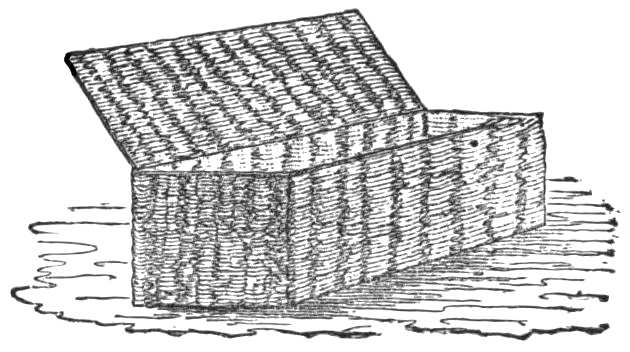
The accompanying diagrams will render the arrangement of the trick extremely easy to comprehend.
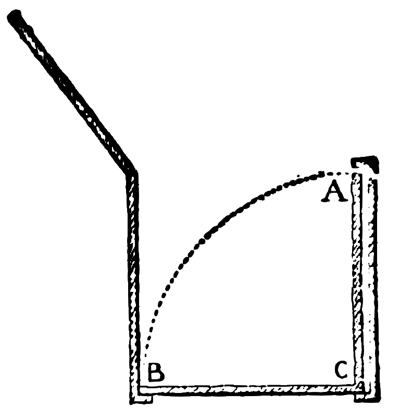
Fig. 13 represents the basket open ready to [Pg 107]admit the child. Fig. 14 is a sectional view of the same.[35]
The reader will perceive, indicated by the letters A B, a double bottom working on a pivot at C. This movable bottom is more completely shown in Fig. 15, but it has there changed its position, as we shall proceed to explain.
In order to cause the disappearance of the child, you turn over the basket with its top towards the spectators. But the bottom A and the portion B, which is fixed thereto, take no part in such movement. The weight of the child, pressing on the bottom A, compels it to remain at rest, and thereby the part B is made to fill the space which would otherwise be left [Pg 108]in the basket, following the dotted line in Fig. 14.[36]
In order to be able to thrust the sword through the basket without any risk of injury to the boy, the magician proceeds according to a particular routine and with certain appropriate precautions; there are marks made on the basket to show where the sword is to be thrust, and to still further guard against mistake it is agreed that the sword shall be thrust in, in the first instance, only a very little way, and that when it has once penetrated, the boy shall himself direct it in such manner as to avoid being hurt by it. The basket is made large enough to allow of the child withdrawing himself towards the one or the other end at pleasure.
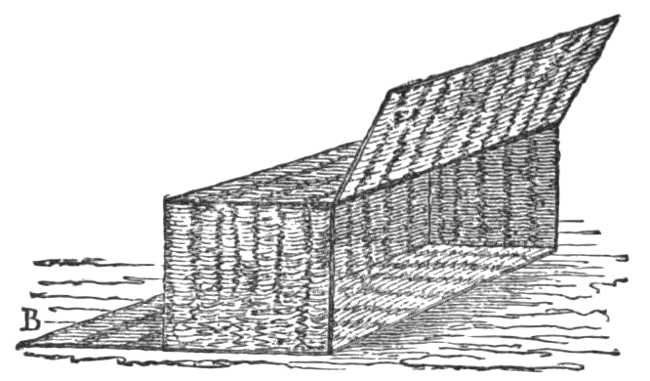
[Pg 109]
We have yet to explain how it happens that the performer is enabled to exhibit the child in a private box, although he still remains safely ensconced in the basket. To do this, the assistance of two children is required, who must be alike in stature, dress, and arrangement of the hair. One of these children is brought forward by the magician, who on some pretext or another (this depends upon the particular mise en scène adopted by the performer) states that he is about to shut him up in the basket, but in order that he may be the less nervous in his narrow prison, he ties a broad bandage across his eyes. The child, alarmed notwithstanding at the preparations made, runs away from the conjuror, but is caught again by his executioner just as he is darting through a side door on the stage, and is forced remorselessly into the basket.
[Pg 110]
The object of this little comedy is to effect a substitution of the one child for the other. The “twin” child, with eyes bandaged in the same manner as the other, stands close to the door in the side-scene, and takes the place of the original victim, while the latter makes his way to the private box, in which he is afterwards to appear. The new comer, who is naturally taken to be the same child who a moment before ran away, is shut up in the basket, and goes through the performance we have above described; and afterwards, when he has been made to disappear behind the false bottom of the basket, his comrade, whose face, having been seen uncovered, is at once recognized, appears in the box and waves his childish greetings to the company.
[32] There is a good deal of poetic licence about the above description. It is hardly likely that Robert-Houdin ever saw Stodare perform the trick, and, as probably many of our readers will remember, Stodare’s “victim” was in reality a young lady clad in ordinary female costume. The feat, as actually performed, was described by the “Daily News” of April 18th, 1865, in the following terms:
“Colonel Stodare has introduced one illusion which, though often heard of, has, we believe, never before been seen in this country—the famous Indian basket trick. A huge hamper is placed upon a stand, so as to leave a perfectly clear space between the bottom and the floor. A young lady is then shut up in this basket, and Colonel Stodare makes repeated passes through the wickerwork with a sword. The audience are horrified while this is going on by hearing piercing screams, and by seeing the blade come out dripping with blood; but when the cries have at length ceased, and a horrible murder has (notwithstanding Horace’s caution) been to all appearance committed in the presence of the assembly, the basket is found to be empty, and the victim is brought back into the room safe and sound. This part of his performance is unquestionably one of the most startling feats ever exhibited.”—Ed.
[33] We almost fear that this is “wrote sarcastic,” as Artemus Ward would say, and that Robert-Houdin is here indulging in a little quiet chaff at the expense of the “Colonel.” Stodare, though professing to be American, was actually a native of Liverpool, and though an unquestionable artist, was a very doubtful colonel.—Ed.
[34] We will not venture to question the fact, vouched for by so high an authority as Robert-Houdin, that the Indian Basket Trick may sometimes be performed after the manner above described, but we doubt very much whether such is the usual or customary method. It will be remarked that Robert-Houdin does not claim to have himself seen the trick performed by Indian jugglers, nor does he name his informant; and it may be taken as an axiom that no person is qualified to give a correct description of even the simplest conjuring trick unless he be himself a conjuror. The recent performances of some Hindoo jugglers (warranted to be the genuine article) at the London Aquarium, have revealed to keen observers the fact that nine-tenths of their much-vaunted tricks rest on the simple expedient of burying articles in the ground beforehand (probably in some convenient receptacle) to be clawed up again in due time with the fingers, under cover of much pottering beneath shawls and inverted baskets. The great “Basket Trick” itself was worked by the performers in question on the same principle; the basket being screened from view for some moments by a fence of heavy drapery (which fact the uninitiated spectator invariably omits to mention in describing the trick), and the boy disappearing by means of a trap-door through the stage and its superincumbent layer of earth, and coming into the room again from some other quarter, while the principal performer marched gravely round the basket, to obliterate the traces of his passage. This plan could not, obviously, be carried out in its entirety in India, where the jugglers almost invariably perform in the open air. But what is there to prevent the conjuror, or his “agent in advance,” quietly preparing for action by digging, at some convenient opportunity beforehand, a hole at the spot where the performance is afterwards to come off, and burying a good-sized basket therein? When the critical moment arrives, the boy has only to creep out of the visible and into the invisible basket, whence he can shriek and cry for mercy to any extent, while the juggler tramples the earth into good condition again, and goes through the stabbing performance, afterwards showing the basket empty. Meanwhile another little black boy comes running from some external hiding-place, and thereby effectually diverts the minds of the spectators from a too close examination of the basket, or of the ground beneath it. When the performance is over, and the troupe are packing up their belongings to depart, there will be but little difficulty in bringing the buried boy to light again, the basket being left still in the earth to be fetched away a few hours later, when there is no longer any fear of observation.
It is obvious that the use of the above expedient would not be always practicable. The performer must sometimes be called upon for a specimen of his powers where no previous preparation is possible. In such a case he has another “string to his bow,” depending on the peculiar shape of the basket used, which is a short oblong, large at the bottom, but tapering upwards to the top, of which the lid occupies only the centre portion. In a basket so shaped the lithe and agile Hindoo boy coils himself without difficulty against the outer surface, leaving the centre free to receive the stabs of the sword, and finally to admit the performer, who steps inside and stamps freely to prove the basket empty, while any lingering doubt is removed by the appearance of the boy himself (really his double) outside the circle of spectators.—Ed.
[35] The original says Fig. 14 “est la coupe de ce même panier lorsqu’il est fermé et qu’il contient le jeune acteur.” This is obviously inaccurate.—Ed.
[Pg 111]
[36] Readers who are conversant with theatrical appliances will recognize this basket as being employed in sundry fairy pieces under the name of the “harlequin box.”—R.-H.
The gradual rise and suspension in mid-air of a human being, the uplifting of a table, and its removal from one point to another are spiritualistic “manifestations,” by dint of which Mr. Home, the celebrated American medium, for some time passed among us as a being possessing supernatural powers.
Science has succeeded in reproducing these surprising phenomena, and certain clever individuals have made them the basis of a very interesting exhibition.[37]
These stage illusions have an advantage over the real (?) marvel, in the fact that they are not in the least dependent on the goodwill of the spirits of the other world, and never fail, therefore, in producing their desired effect.
[Pg 112]
Scenic Effect of the Trick.—The stage upon which the spiritualistic manifestations are to be produced is devoid of all furniture, with the exception of a table, to all appearance tolerably heavy, and a single chair. The table is pushed back to one side of the stage.
A door at the back of the stage opens; a gentleman comes forward conducting a lady, whom he introduces to the audience as a “medium” of unusual power. The introduction completed, the gentleman brings forward the chair, places it in the centre of the stage, and the lady takes her seat upon it.
The pseudo-spiritualist in the first place relieves the lady of a large bouquet which she is holding in her hand. This he places on one corner of the table, and returning, with imperturbable gravity, makes passes, more [Pg 113]or less mesmeric, in the direction of his subject.
After a little while the lady falls, or pretends to fall, asleep, and, still seated in her chair, rises gently in the air and remains suspended there, without any visible support; she then, in a dreamy sort of way, extends her hand towards the table, and forthwith this in its turn rises in the air, and comes near enough for her to take her bouquet, which, indeed, spontaneously offers itself to her hand. The table then returns to its former place, and in due time the lady, gently sinking to the ground again, wakes from her trance, rises from her chair, and leaves the stage.
Explanation.—The chair and the lady are lifted by means of a piece of unsilvered plate-glass fixed beneath them in a vertical position, and parallel with the spectators. The table is raised by a similar expedient, but somewhat differently arranged. The preparations for the trick are as follows:—
[Pg 114]
In the centre of the stage, and beneath the flooring, are fixed, in a vertical position, two wooden uprights, with grooves in which a thick but very clear sheet of plate-glass slides up and down. By means of mechanical arrangements, the nature of which will readily be imagined, the glass, sliding in these grooves, may be raised vertically above the flooring, passing through a slot cut therein. A wooden slab of about twenty inches square, securely fixed to the upper end of the glass, serves to support the chair and the lady seated in it. This tablet, when it is raised by the glass, is easily masked by the lady’s skirts, which fall naturally over it.
The tablet, however, being flush with the floor, leaves, on rising, a hollow space which it is necessary at once to fill up. To this end, a second tablet, forced upwards by springs or balance weights, takes the place of the first, again sinking down when this latter once more returns to its original condition.
The glass which supports the chair, if only it [Pg 115]is sufficiently thick, need not be wider than the wooden slab. Its vertical position, indeed, enables it to carry a very considerable weight without risk of breaking.
The uprights, in which the glass slides, may be joined together by proper cross-ties so as to form a rigid framework. This framework, which is mounted on castors on its under side, and runs on a small tramway, may be moved to right or left, carrying with it the person above, so as to simulate suspension in space. For this purpose, there must be cut in the flooring a slot sufficiently long to allow free movement of the glass.
The following points must be attended to in order to ensure the success of the experiment.
The raising and movement of the table are effected by the same means as already indicated for the raising of the chair; save that in this case the glass is above instead of below the [Pg 117]object to be raised. Instead of lifting the table by pushing it from below, it does so by drawing it up from above. A slot is cut in the ceiling, and through this is passed a piece of glass, which is fixed to the top of the table. The glass, being raised by similar appliances to those which we have described for the chair, draws up the table and causes it to move toward the lady. The one trick is in truth merely the converse of the other.
It will be found preferable, with a view to scenic effect, to place the table at one corner of the stage, and to make it advance to the lady in a diagonal direction.
I subjoin a much simpler and decidedly less expensive plan, which (though without any disparagement of the method above described) I venture to suggest for moving the table, for the purpose of this trick.
A table should be made of very substantial appearance, but in reality extremely light. This table might be made either of pasteboard, very [Pg 118]thin wood, or of pieces of cork; and suspended by very fine wires.[38] These wires would pass through slits of proportionate minuteness made in the ceiling. At a few paces distance, it would be impossible for the eye to detect either the wires or the slit, even with a greater degree of light than in the trick as above described. This is, at any rate, a method which I have myself employed, and which I have found a complete success.
[37] The performance in question was arranged by Messrs. Pepper and Tobin, in 1868, and was exhibited by them at the Polytechnic Institution (London).—R.-H.
[Pg 119]
[38] There is a wire sold, in the ordinary course of trade, which is nearly as fine as hair, and which would be quite strong enough for this purpose.—R.-H.
Let the reader picture to himself, completely isolated and suspended without visible support in the middle of the stage, a living bust with the features of Socrates. Notwithstanding this mutilation of the great philosopher, he is still able to speak, and introduces himself in a stanza of elegiac verse. An Athenian noble delivers the reply, the play of feature of the wisest of the sages of Greece being in strict accordance with the dialogue. Such is the mise en scène of the ingenious illusion represented in the accompanying illustration (Fig. 16).
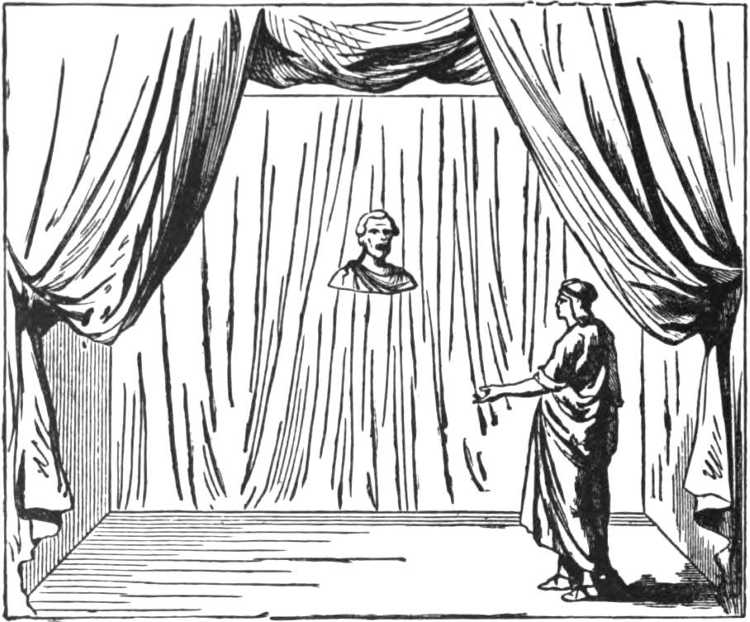
A, B, C, D (Fig. 17) represents a section of the stage on which the trick is exhibited. A sheet of silvered glass, G G, occupying the whole width of the stage, is placed in a diagonal [Pg 120]position, extending from the upper part of the stage at the rear, down to the footlights, so as to form an angle of 45° with the floor.
In the centre of the glass is an opening through which the actor passes his head and shoulders, as shown in the figure.
It should be further mentioned that the ceiling and the two sides of the stage are hung with wall-paper of the same pattern, and are brilliantly illuminated, either by means of [Pg 121]footlights at C, or by gas-jets placed behind the border A.
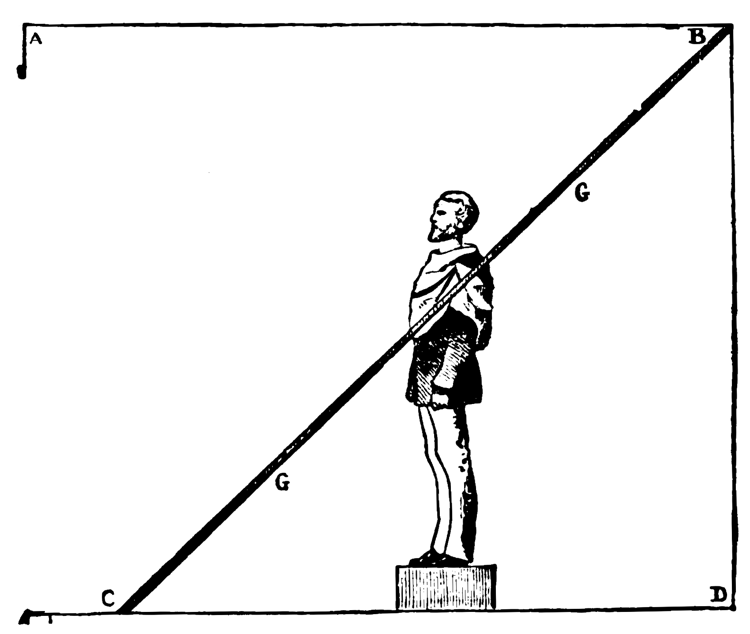
Such being the condition of things, the effect is as follows: The ceiling A is reflected in the mirror, and its reflection appears to the spectators to be the paper of the wall B D, which in reality is hidden by the glass.
By means of this reflection, of which he is of course unaware, the spectator is led to believe that he sees three sides of the stage; and there [Pg 122]being nothing to suggest to his mind the presence of the glass, is led to believe that the bust is suspended in mid-air, and without any support.
Unless the spectators are so placed as to have a downward view, the actor who is on the stage may venture quite close to the glass, its inclination excluding all fear of his being seen reflected therein. In a regular theatre, in which, as a rule, some of the seats are placed very high up, the actor would be obliged to stand clear of the stage, and upon a lower level.
[Pg 123]
This experiment, the invention of Mr. Wheatstone, the celebrated English physicist, was exhibited at the London Polytechnic Institution, in the year 1855.[39] The stage arrangements for producing this surprising phenomenon are as follows:—
In the middle of the stage are placed in a semi-circle four harps, by Erard, which are destined to reproduce the sounds of other instruments played in the spacious cellars of the Institution. These instruments are a piano, a violoncello, a violin, and a clarionet.
[Pg 124]
In order to produce this result, there are, attached to the sounding-boards of the harps, four small upright deal rods, about three-quarters of an inch in diameter (see Fig. 18) which, travelling vertically downwards, pass through the stage and the ceiling of the rooms below till they reach the cellar; where they are connected, the first with the sounding-board of the piano, the second with the belly of the violoncello, the third with the belly of the violin, and the fourth with the mouth of the clarionet.
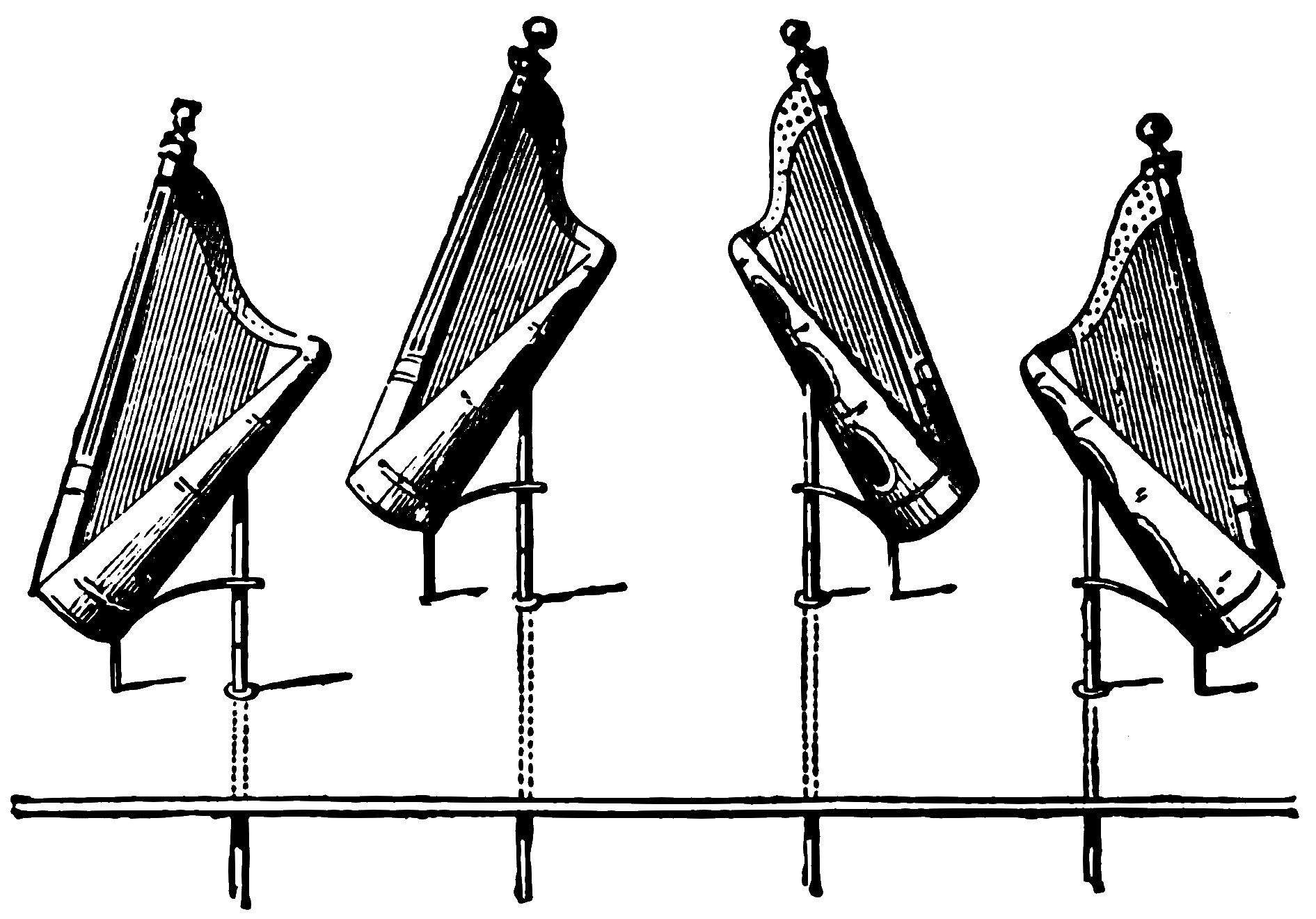
In order to be able, when desired, to interrupt the connection between the instruments [Pg 125]played and the harps, the rods are cut right through an inch or two above the stage. This, however, does not prevent the ends resting one upon another, and so transmitting the vibrations. By turning the harps round on their own axes, the rods are completely disconnected.
N.B.—The rods must be insulated from the floor boards through which they have to pass, so as to cut them off from any vibrations which might be prejudicial to the desired effect. This insulation is obtained by making the holes somewhat larger than the rods, or by supporting these latter with substances the least susceptible of vibration.
Professor Pepper conducts the experiment as follows:—By gently striking rod No. 1, he gives the signal to the pianist to begin to play. The sounds conveyed by the wooden rod, and reproduced by the sounding-board of the corresponding harp, are heard with perfect ease by the whole of the audience. They have lost scarce anything of their power, and not a single [Pg 126]note of the air played is altered either in tone, in volume, time, or tune. But if, while the musician still plays on, you turn round the harp and thereby break the connection, i.e., the contact of the conducting rods, not a sound is heard. All is absolutely silent.
Mr. Pepper proceeds in the same way with the three other instruments and their respective harps, and shows that the sound, which is completely inaudible so long as the rod attached to the sounding-board of the harp is not in contact with that attached to the playing instrument, is heard the moment that contact is re-established, as clearly as if the instruments were actually on the stage. He then, by striking all four conducting rods at once, transmits to the musicians the order to play a quartette. Such quartette is transmitted with the greatest precision to the sounding-boards of the harps; this concert without visible musicians producing a marked sensation among the audience. Finally, in the very middle of the quartette, Mr. Pepper, turning round the four harps one after another, [Pg 127]severs their communication with the instruments, and the concert comes to an end, not for lack of performers, since the latter still continue to play upon their respective instruments, but because the sound-vibrations, no longer aided by the sounding-boards, remain in their rudimentary condition of mere mechanical movement, and so are lost in space.[40]
Regarded as an illustration of a scientific principle, this experiment was very well arranged, and produced a striking effect; but as a piece of stage-magic, it would have been possible (assuming of course that the principle was kept a secret) to have made it extremely illusive, and to have founded on it one or two really capital tricks. To that end, however, it would have been necessary to have made some slight alterations in the mise en scène of the exhibition, and to present it, in fact, from quite a different point of view. I will give a couple of illustrations of these necessary modifications:—
[Pg 128]
Whatever the form in which the experiment was performed, the most important alteration to make would be to produce the phenomenon as closely as possible to the spectators, in order that they might be thoroughly convinced of the reality of the facts as stated to them; for at any considerable distance it is difficult to satisfy oneself on this point, and the public, who are generally somewhat suspicious, might not unnaturally imagine that they were being hoaxed, and that the sounds, instead of really coming from the harps, proceeded simply from behind the scenes, or beneath the stage. Such an idea once being entertained, good-bye to the “miracle” and all illusion to be derived from it, [Pg 129]The proper plan would be to erect a raised platform quite close to the spectators, and, if possible, in the very midst of them. The under side of this platform should rest upon deal supports, which should be tolerably numerous, and among which the vibrating rods should be intermixed. This lower portion, by the way, should be hidden by drapery, which might be lifted when desirable, so as to show that neither musicians nor musical instruments were concealed beneath.
These arrangements being made, and following the method laid down in the experiment already described, two harps would be placed on the platform, connected by wooden rods with two other harps in the cellar, each in the hands of a competent performer.
The experiment might then be announced under the title of—
The Eolian Harps made to perform by Spirit Influence.—The reader can readily imagine the astonishment which such a [Pg 130]performance would excite; two harps, completely cut off from all mechanical influence, playing a duet, ceasing to play, either one or both, at the command of the pretended medium; and at a fresh command again beginning to play. Such an exhibition would really savour of the miraculous.
N.B.—In order to transmit secretly to the musicians the command to play or to cease playing, a person placed in one corner of the hall might, upon certain agreed movements of the exhibitor, or upon his express order addressed to the pretended spirits, press, unknown to the spectators, a connecting stud communicating with an electric bell placed in the cellar.
In this form of the experiment there is no necessity that the musicians should be placed in a cellar; they need only take up their position in some lower room whence the sounds of the instruments would not be audible through the floor of the exhibition-room.
[Pg 131]
Here is another illusion, only differing in mise en scène from the preceding experiments, but very much more mysterious in effect.
At the four corners of the platform of which we have spoken above, are placed four little round tables, the pillar of each being hollow. As in the experiment of Mr. Wheatstone, a piano, violoncello, violin, and clarionet are placed in a lower room; the wooden rods attached to them travel vertically upwards to the platform, pass through the pillars of the small tables we have mentioned, and terminate a little above their upper surface. These rods, as already stated, must throughout their whole course be insulated, so to speak, from any vibrating substance, so that they may lose nothing of their own vibrations. These matters being arranged beforehand, we may proceed as follows to the experiment to which we have referred, and which we may entitle—
A Concert by the Spirits of another World.—The performer calls the attention of the spectators [Pg 132]to four locked money-boxes, made of very thin deal, explaining that he holds captive therein certain “spirits,” which, without the aid of any instrument, “discourse most excellent music.” With this introduction, he places the boxes each upon one of the rods in connection with the various instruments. The reader will already have perceived that the money-boxes supply the place of the harps, and answer the purpose of sounding-boards. The performer takes care so to place them that the bottom of each rests fairly upon the extremity of the deal rod. Each box has four little feet, so as to keep the bottom clear of the surface of the table, and to prevent the box from rocking.
As in the scientific form of the experiment, the exhibitor raps on the boxes as a signal to the musicians to play on their respective instruments, singly or together, as the case may be. A rap, given while they are playing, serves as a command to cease.
As the spectators completely surround the platform, they are enabled to make quite [Pg 133]certain that the sounds really proceed from the money-boxes; and this necessarily produces a very striking effect.
It may, however, suggest itself to some of those present that the boxes contain mechanism specially adapted to produce the sounds, as is the case, in fact, with ordinary musical-boxes. Should such be the case, the remark to that effect which would naturally be made, would tend to enhance the effect of the experiment, inasmuch as, when the concert is over, the boxes are opened to show that there is nothing within, and they are placed in the hands of the spectators, so as to be examined with the greater freedom.
As a corollary to this series of experiments, I may here describe two little tricks, based on the same principles, which I had fitted up in my own house for the amusement of my friends. The first of these bore the title of
The Rapping Spirit.—This was a partial imitation of that spiritualistic “manifestation” [Pg 134]by means of which, from time to time, certain persons specially gifted by a supreme power have conversed with the invisible spirits of another world.
I must here confess that I have never had the good fortune to assist at one of these mysterious conversations, earnestly as I desired to do so. In the year 1857, a friend of mine, who, by reason of his unquestioning belief in the supernatural powers of Mr. Home, had free access to that gentleman, tried in vain to procure for me an opportunity of being present at one of the private séances of the celebrated American medium. Home invariably shirked the encounter, and I was obliged to rest satisfied with the marvellous accounts which were given me by more privileged persons. Without any desire to dispute the truth of facts of which I only knew by hearsay, I thought I might fairly venture to reproduce one of the marvels in question by artificial means, and I thereupon constructed my “spirit-rapper.” If the spiritual power of the mediums has any foundation in [Pg 135]fact, this innocent practical joke can certainly do them no injury.[41]
The appliances of my spirit-rapping trick were fitted up in a dining-room, which served also as an informal reception-room for intimate friends. I gave the preference to this particular room because the table served to conceal a certain portion of the apparatus of the experiment.
The trick was exhibited as follows:—Taking a piece of iron wire of about five feet in length, with a hook at each end, I hooked it into a ring or screw-eye which was attached to the ceiling, and from which it hung. To the lower hook I attached the handle of a small deal box, which was thereby held suspended about twelve or thirteen inches above the table.
[Pg 136]
The company took their places around the table, joining hands in order to establish a magnetic circle; and, after a few moments of sober meditation, of which I set the example by maintaining a demeanour of unbending seriousness, we proceeded to ascertain the presence of the spirit, which according to my account was imprisoned in the box.
“Spirit, are you there?”
Three smart raps inside the box gave a reply which carried conviction to the minds of the hearers.
Each person then proceeded to put questions, to which the spirit replied as briefly as possible; for, as is well known, in a conversation of this kind, the talkers of the other world are much behind ourselves in respect to linguistic methods. They are obliged, in order to express a word, to take the letters which compose it separately, and to indicate each of them by [Pg 137]striking a number of raps corresponding with the numerical position which such letter occupies in the alphabet. One rap for A, two for B, three for C, &c., and so on, a process which for some words becomes of necessity rather long-winded; but one is disposed to be patient when engaged in the investigation of facts of so surprising a character as those now under consideration.[42]
After a few minutes’ conversation, the “spirit” abruptly took leave of the company, answering one of the questions asked by the word “Good-bye;” and, however pressing the company might be for a prolongation of the sitting, not another sound was heard.
The box being just level with the faces of the spectators, each was able to satisfy himself that the raps really proceeded from thence; and the astonishment was therefore great, when, [Pg 138]unhooking and opening the box, I passed it round for examination. As a general rule the company departed without knowing quite what to believe as to the real cause of the effect produced.
The idea of this trick was suggested to me by the experiment of Mr. Wheatstone above described. I had, however, considerably modified its practical working. Thus, instead of causing the sound-vibrations to pass upwards through a deal rod, I made them pass downwards through an iron wire to the money-box, which served as a sounding-board to concentrate the sound.
The mechanical arrangements of the trick were as follows:—The ring attached to the ceiling formed one end of a metal rod which passed through the flooring and terminated in the room above, where it was attached to a small flat piece of deal. This piece of deal was supported by little indiarubber feet, to prevent the communication of its vibrations to the floor [Pg 139]of the room. An electro-magnet placed on the little wooden slab (see Fig. 19) was so arranged that its keeper should strike on the continuation of the metal rod. Lastly, an electric connecting stud placed close to my right foot, enabled me, by pressing it, to close the circuit, and so to strike the number of raps appropriate to the answer which I desired to give. It was, therefore, as the reader will perceive, my own foot which played the part of the rapping spirit.
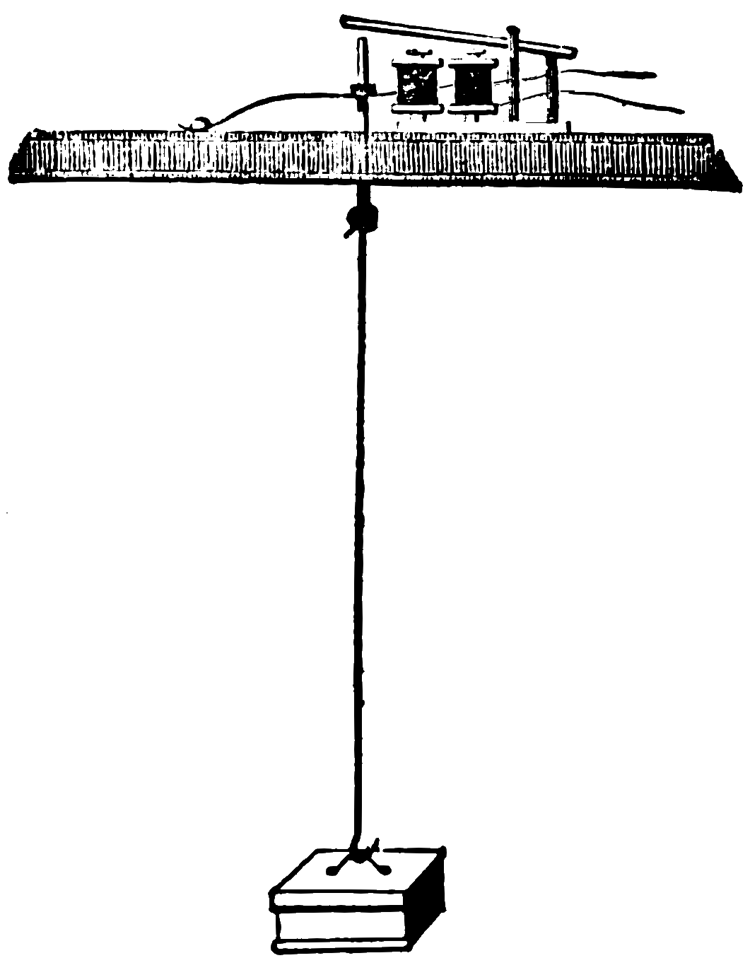
[Pg 140]
The explanation which I have above given and the annexed diagram will sufficiently indicate what really takes place in this surprising experiment: the sound of the percussion produced by the electro-magnet is concentrated by the sounding-board, and this latter transmits its vibrations to the money-box through the medium of the iron wire. The spectators hear only the sounds which appear to come from the box.
When spirit-rapping had gone out of fashion, and my trick no longer had the same foundation to rest upon, I transformed it into another, of a still more interesting character, and which I entitled
Waves of Sound.—The modification here made was very slight: there was still the money-box suspended from the ceiling as before; but the flat piece of wood above was replaced by one of those large musical-boxes known as “Geneva” boxes, and it was to the [Pg 141]bottom of this box, which in this case formed the sounding-board, that the continuation of the screw-eye was attached. The reader will perceive that by this arrangement, whenever the musical-box was made to play, all the sounds were reproduced in the money-box below, by reason of the same principle already explained in the preceding trick.
In order to give a finish to the experiment, I had placed on a shelf in one corner of the room another musical-box, the tunes played by which were precisely identical with those of the box on the floor above.
I introduced the trick as a scientific experiment, and under the title of “the transmission of waves of sound.”
After giving some few explanations as to the nature of sound-waves, I declared that sounds could be made to travel from one sounding-board to another, so long as both were tuned to precisely the same pitch, and that, in illustration of the principle in question, the isolated and suspended money-box would repeat the [Pg 142]airs played by the musical-box. (The musical-box below was of course alone in question, the existence of the other being unknown.) I then pressed the stop (of the visible box), but scarcely was the first phrase of the air completed, than I abruptly stopped it. Instantly the company heard repeated by the wooden box that portion of the air which had been played. I resumed, making the musical-box play another phrase which was in like manner repeated, and this was continued to the end of the tune.
This repetition of musical phrases was produced by the musical-box placed on the floor above; and it was by the aid of electricity that this latter was made to play when the other ceased to do so.
This illusion produced a very great effect, particularly when, as in the previous experiment, the box was opened and handed round for examination.
[39] Under the title of the “Telephonic Concert.”—Ed.
[40] The deal rods at the Polytechnic were forty feet in length, and passed through two intervening stories of the building. A still more striking effect was obtained by transmitting (by the aid of a single harp) a vocal quartette, the performers holding their faces down as close as possible to the sounding-board of a piano. The absurdity of their position was occasionally too much for the gravity of the singers, and the quartette came to an abrupt conclusion amid peals of laughter, which were faithfully transmitted by the harp to the astonished audience.—Ed.
[41] The reader will note with interest the impartial spirit in which Robert-Houdin approaches the vexed question of spiritualism—in his day a comparative novelty. In default of absolute certainty, he wisely reserves his opinion. Where, however, as in the case of the Davenports, he had an opportunity of personally observing the alleged “phenomena,” he has neither difficulty in penetrating nor hesitation in denouncing the imposture. (See page 181, et seq.) We venture to believe that any of the so-called spiritualistic manifestations which had come under the test of Robert-Houdin’s examination would have met a similar fate, and that Mr. Home showed a very sound discretion in not submitting his “levitation” and “elongation” to so keen a critic.—Ed.
[Pg 143]
[42] It is to be presumed that the more modern plan (of pointing with a pencil at the letters of the alphabet in succession, a rap indicating when the right one is reached), was not yet in use when Robert-Houdin wrote.—Ed.
This ingenious illusion did not originally bear so ghastly a title. It was exhibited under the name of the “Sphinx,” at the Egyptian Hall, London, in 1865, by a conjuror known as Colonel Stodare. The inventor of the trick, Mr. Tobin, the secretary of the Polytechnic Institution, sold the secret to M. Talrich, a skilful modeller in wax, who was then exhibiting on the Boulevard de la Madeleine, in Paris, a wax-work collection, under the title of the Musée Français. His collection was composed of a number of groups, mythological and otherwise, executed with extraordinary perfection, particularly a scene representing the celebrated surgeon, Dupuytren, delivering an anatomical lecture to his numerous pupils. The scene in [Pg 144]question was a happy thought of M. Talrich, inasmuch as it gave him the opportunity to bring prominently forward specimens of those anatomical preparations to which he owed his reputation.
The trick of the Sphinx suggested to M. Talrich the idea of adding to his museum an exhibition of like nature to that of the famous Chamber of Horrors, which Madame Tussaud had established in London, in connection with her wax-work collection. With this notion, he was induced to alter the mise en scène of the Sphinx, which he regarded, reasonably enough, as too mild for his intended purpose. He transformed it into the Decapitated Speaking, and arranged it for exhibition as follows:— Underneath his museum there was a large unoccupied cellar, accessible by means of a winding stair, the door of which opened in the exhibition-room. This vacant space was appropriated to the exhibition of the bodiless head. The cunning artist knew better than to clean up and replaster the walls; on the [Pg 145]contrary, he carefully preserved their greenish mould and earthy dampness, and took special pains that the surroundings should be in strict harmony with the spectacle which was intended to be exhibited there, as the reader may judge for himself by the following description. The staircase had no light, save the dim yellow glimmer of one or two antique lamps which hung from the vaulted roof. When the visitor reached the bottom, he found himself face to face with a group, modelled in wax, representing a scene under the Inquisition, every detail of the torture chamber being represented in the most realistic manner. A burning torch, held by an assistant executioner, alone illuminated the ghastly scene. Moving onward and turning to the right, the spectator passed through a dimly lighted corridor, and found himself in front of a balustrade, breast-high, which extended across the entrance of a narrow recess. In the middle of this gloomy cellar, the floor of which was carpeted with musty straw, was seen a table, on which rested a human head [Pg 146]leaning slightly to one side, and apparently asleep. On being addressed by the exhibitor, the head raised itself, opened its eyes, and related its own history, including the details of its decapitation, after which it replied, in various languages, to questions put by those present. The whole exhibition was intensely horrible. So far, this eccentric exhibition promised very favourably, and it is likely enough that the public curiosity, which at once manifested itself, would have continued for a long period, but the proprietor made one great mistake, and that mistake was the ruin of his whole exhibition. The charge for admission to the Musée Français was one franc each person, which was undoubtedly a very moderate price; but, if the visitor desired to see the Decapitated Speaking, he had to pay five francs additional. Five francs, for an exhibition which lasted for only five minutes, was out of all reason. However, curiosity generally carried the day, and five, ten, fifteen or twenty francs were handed over, according to the number of the party. But the [Pg 147]gentleman doing the polite to a party of ladies, the paterfamilias with his children, the bachelor treating his friends, though they paid without openly grumbling, felt a suppressed annoyance, which not unfrequently expressed itself in the form of some petty act of mischief. It was doubtless under the influence of a feeling of this kind, that some persons were guilty of decidedly unjustifiable conduct with reference to the Decapitated: they threw pellets at the enchanted head, in order to test whether it had entirely lost all sensation. At the first shot, the unhappy performer whose head alone was visible, or at any rate, the head itself, made a wry face; at the second, it looked very savage; at the third, forgetting its passive character, it began to roundly abuse the offenders, and the exhibitor to call for help, and to drive the spectators before him down the corridor. Scenes of this kind got noised about in society, and sundry “swells,” having nothing better to do, found it very good sport to go and take out the worth of their five francs by shooting pellets at [Pg 148]the infuriated head, an amusement which they christened “pop-gun practice.” Some of the pellets, being aimed by unskilful hands, struck certain portions of the table, which were apparently open, but from which they rebounded, clearly indicating that the supposed vacant space was really a sheet of looking-glass. From this time forward the trick was “blown,” and the public seemed to take a spiteful pleasure in spreading as widely as possible the secret of the famous Decapitated. M. Talrich had put a stop to the projectiles by placing a close-meshed wire grating between the spectators and their victim, but the precaution came too late, and proved superfluous. The struggle ceased for lack of combatants; and the day of the Musée Français was over. The Decapitated Speaking had been the ruin of the Olympian Deities, as well as of Dr. Dupuytren’s scientific lecture.
The cause of M. Talrich’s failure was the same that brought disaster to the brothers Davenport. Too great a confidence in the indulgence of the Parisian public led both parties [Pg 149]to offer what, after all, were but ingenious conjuring tricks, as supernatural phenomena. On the other hand, their imperfect acquaintance with our habits caused them to raise the price of their exhibition beyond all reasonable limits.
Colonel Stodare, more sagacious or better skilled in theatrical management, placed no such exaggerated value on his Sphinx, he simply introduced it in his performances as an interlude between other attractions, and claimed for it no higher prestige than that of an ingenious trick. However, the mise en scène demanded that some sort of story should be told respecting it; and, accordingly, the trick was presented after the following manner. The Colonel came forward to the audience, carrying in his hand a closed box, and told them how, in the course of his travels in Egypt, he had made the acquaintance of a Magician, who, happening to die, had bequeathed to him the small box in question, in which had been contained for ages past, the living head of a Sphinx endowed with the [Pg 150]faculty of answering any questions put to him. The performer then addressed the Sphinx by name; when it was heard to answer him from within the box. (It should here be stated that Colonel Stodare was a ventriloquist.) He then placed the precious chest upon a table, and let down the front, revealing to the public gaze a handsome Sphinx’s head, wearing an Egyptian head-dress ornamented with golden fillets. The space under the table on which the box was placed appeared to be entirely open. The Sphinx, intelligent and ready-witted, replied with much tact and appropriateness to the questions proposed by the spectators; after which, the Colonel closed the box, took it again in his hand, made the prisoner say “Goodnight” to the company, and retired behind the scenes with his precious burden. Thus arranged, the trick became extremely popular, and its success was only interrupted by the untimely death of the talented exhibitor.
The explanation of the trick is the simplest possible, and will be understood without the [Pg 151]slightest difficulty. The head which is seen on the table belongs to the body of some poor devil whom poverty has compelled to play daily the uncomfortable part of a man in the pillory. Under cover of an arrangement of mirrors fitted to the legs of the table, the confederate can place himself under the table, unseen, and pass his head through a hole in the top. A special collar hides the edges of the opening.
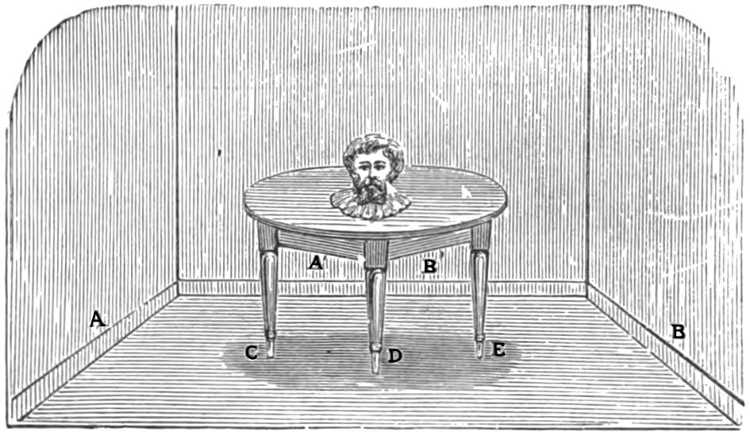
The table rests only on three legs—C, D, E (Figs. 20 and 21), although to the eye it appears to have four. Between these three [Pg 152]legs, in grooves made on purpose, are two sheets of silvered glass, G, G (Fig. 21), behind which, as we have said, the confederate conceals himself, taking up his position at H. These glasses are at a right angle to each other, and at an angle of about 45° to the hangings on either side of them. These latter, A and B, when reflected, correspond with A′ and B′, and replace, to the imagination, that portion of the drapery which is concealed by the two mirrors; so that the spectator is persuaded that he still sees, under the table, the drapery in the rear.
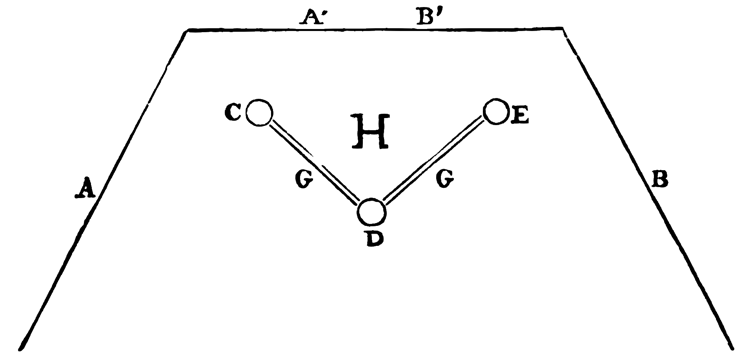
The Sphinx was arranged after the same [Pg 153]manner. The chest was empty when Colonel Stodare first brought it forward; his ventriloquial faculty producing the supposed voice from within. As soon as the chest was placed on the table, the confederate beneath opened the trap which closed the hole in the top, passed his head through the opening, and, lifting up the bottom of the chest, which was movable, introduced his head without any difficulty. The conjuror had then only to let fall the front of the box, in order to display the head therein.
With a very slight knowledge of the laws of reflection, the reader can easily satisfy himself that, unless they were quite close to and at the side of the table, it is impossible that the spectators should see in the mirrors anything but the reflected drapery. In point of fact, matters are purposely so arranged that it cannot be otherwise. In the case of Talrich’s exhibition, the actual walls of the cellar were reflected in the mirrors.
[Pg 154]
The accompanying illustration will give some idea of the piece of furniture used in the performance of the trick which we are about to describe. It is, as will be seen, a kind of wardrobe with folding doors, mounted on four feet with castors, which facilitate its being brought forward on the stage and moved about as may be required.
Description of the Trick.—A person steps into the cabinet, and the doors are closed. The cabinet is turned completely round, in order to show that there is no possible mode of exit for the captive, after which, the doors are opened, and the cabinet is empty. Again the doors are closed. The cabinet is once more turned [Pg 155]completely round, and, when the doors are opened for the last time, a transformation is seen to have taken place: it was a man who originally entered the cabinet—it is a woman who now comes from it.
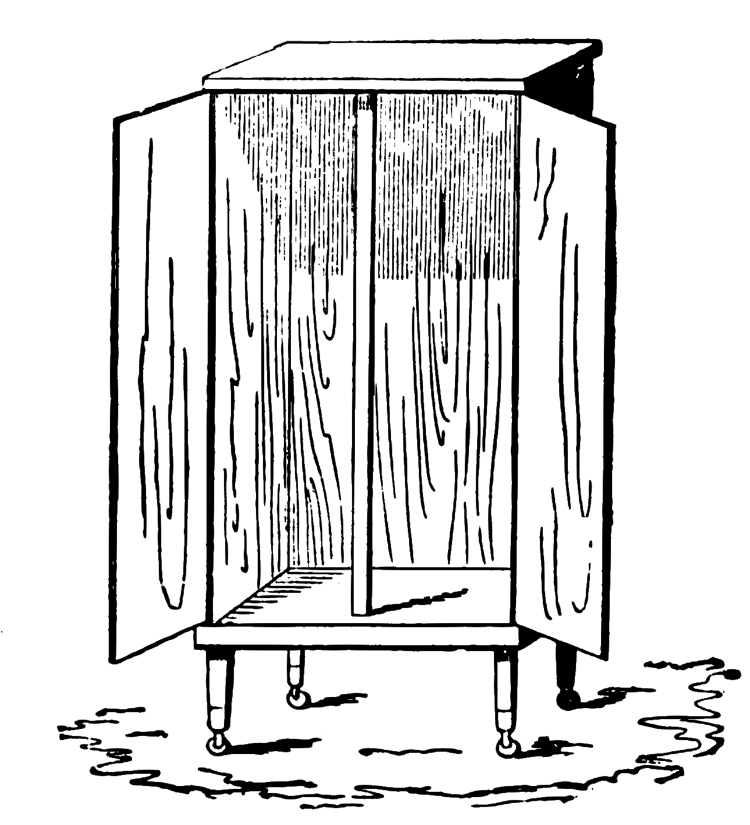
Explanation.—The principle of the trick has a close analogy to that of the “Decapitated.” Two mirrors, suitably placed at the critical moment in the cabinet, give it the appearance of an empty piece of furniture, though it actually contains a human being.
[Pg 156]
Fig. 23, annexed, is a ground plan of the cabinet, whose elevation is shown in the preceding figure.
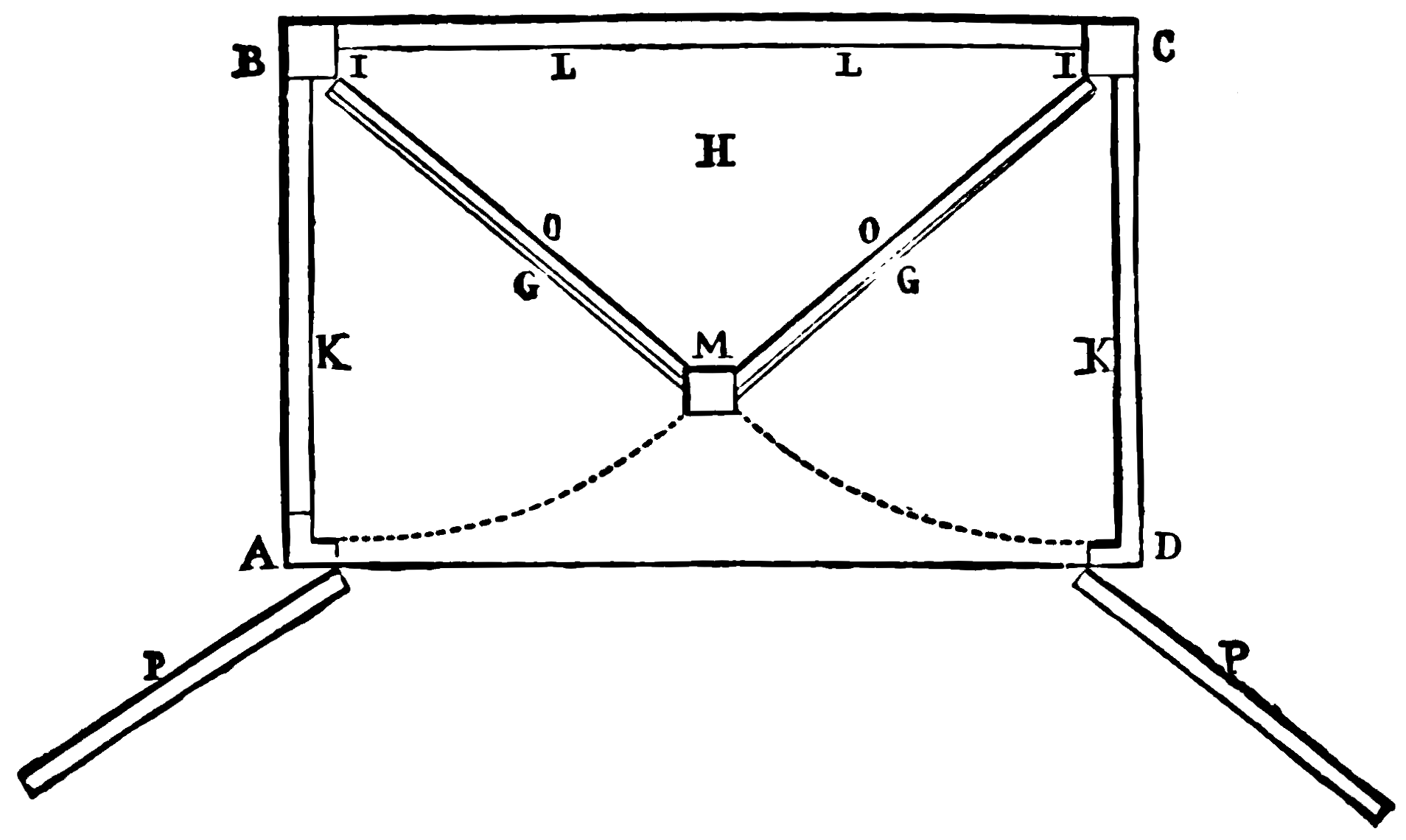
A, B, C, D are the sides of the cabinet; P, P, its outer doors; M, a wooden upright placed towards the front of the interior; G, G, two doors or divisions of the same height as the inside of the cabinet. These doors are hung on hinges working on the points I, I. They may either be made to close against the upright M, or may be rendered invisible by folding them back against the inner surface of [Pg 157]the sides A, B, C, D. This last is the position which they occupy when the doors are first opened. At this stage of the proceedings, the gaze of the spectator can penetrate into every part of the cabinet, which is really empty.
When, however, the performer has entered the cabinet, and the outer doors, P, P, are closed upon him, he places himself at H, pulls towards him the two mirrors, thus bringing their edges against the upright M, and forming a triangular enclosure, I, M, I, in which he is shut in, and which conceals him from the eyes of the public. When the outer doors are again opened, a similar illusory effect is produced to that which we have described in the case of the Decapitated; the mirrors of the cabinet reflect, to the eyes of the spectators, the paper with which the sides K, K, are hung, and cause them to believe that they see the back, L, L. There is nothing to suggest the existence of the mirrors, and all appears to be in the same condition as before.
[Pg 158]
It is indispensable, for the success of the experiment, that the interior portions of the cabinet, K, K, and L, L, as well as the backs, O, O, of the mirrors should be hung with paper of the same pattern.
After having shown the company that there is nothing in the cabinet, and having again closed the doors, the individual within (while the cabinet is being turned round and a few explanations are given for the purpose of gaining time) pushes G, G, back against K, K, to give himself room to operate, and, as is sometimes done in pantomimes, rapidly strips off his masculine raiment, beneath which he wears a female costume, and conceals the discarded suit in a secret receptacle in the upper part of the cabinet. As soon as his transformation is complete, he gives an appointed signal for opening the doors, and appears in his new character.
The transformations which I have above described are only incidental to the trick proper. I only refer to them in order to give some [Pg 159]idea of the effects that may be produced by means of the illusion in question.[43]
[Pg 160]
[43] With the hint afforded by the above description the intelligent reader will have little difficulty in solving the mystery of the much improved Protean Cabinet employed by Messrs. Maskelyne and Cook in their comic sketch entitled “Will, the Witch, and the Watch,” and will be the better enabled to appreciate the ingenuity displayed not only in the construction of the cabinet, but in the rapid and complicated “changes” of the various characters.
In the month of September, 1865, two Americans, Ira and William Davenport, landed in France for the purpose of giving a series of marvellous performances, under the title of Spiritualistic Manifestations. They came direct from England, where for a period of two years they had enjoyed an extraordinary run of popularity. The press of the United Kingdom had taken a lively interest in their mysterious evolutions, and the fame of the discussions they had excited had even spread to France.
The arrival of these wonder-workers assumed the importance of a political event. The Moniteur du Soir, the official paper, announced their appearance in its issues of the 6th and 8th [Pg 161]September, and all the organs of the press vied with each other which should be first to repeat the interesting intelligence.
Before they reached Paris, the brothers Davenport had made a short stay at the Château de Gennevilliers, whose owner, a fervent believer in spiritualism, regarded the visit of the illustrious travellers as a special privilege. It was under this hospitable roof that, by way of experiment, the first exhibition of the Spiritualistic Manifestations took place. A select party of journalists and other literary men were invited, and were fully agreed as to the marvellous and inexplicable character of the phenomena they had witnessed.
The American mediums could not speak a word of French, and were therefore obliged to avail themselves of the services of an interpreter, who was at the same time their impresario, or, so to speak, their “Barnum.” They had been recommended to apply to M. Derosne, a literary man residing at Passy, and to whom we are indebted for excellent translations of [Pg 162]sundry English works. This gentleman accepted the proffered position, and by way of introducing his protégés, he arranged that they should give, in his own drawing-room, specimen séances before certain chosen spectators, whose good opinion might be expected to have a powerful influence on the future success of the performances which they intended to give in the capital. Immense posters, in the American style, were placarded about Paris, announcing in enormous characters that the first séance of the Brothers Davenport would take place on the 12th September, at the Salle Herz. The performance, which was divided into two parts, consisted of (1) the “Cabinet” performances, and (2) the “Dark Séance.” The price of admission was fixed at 25 francs for the entire exhibition, or 10 francs for those who witnessed the first part only.
At such prices, what a rich harvest in prospect! Unfortunately, the bright anticipations of the two brothers as to their future success in the capital were doomed to disappointment; the [Pg 163]friendly reception which they had met with at their preliminary séances was the only substantial satisfaction which they were destined to receive from the nation which is at once the most intelligent and the most sceptical of the civilized globe. A cloud, quite unexpected by themselves, was gathering over spiritualism in general, and over their own performances in particular; and this cloud became more and more threatening as the day of the first public performance drew near. The friendly criticisms of some of the papers had been succeeded by a host of energetic protests against an exhibition which was regarded, not without reason, as dangerous to the mental health of the public, and particularly to those weaker intellects which are always ready enough to accept as gospel the tricks and artifices of the adepts of sham witchcraft.
The following passage, extracted from an article in the paper called the Opinion Nationale (of the 10th of September, 1865,) will give some idea of the state of excitement [Pg 164]of the Parisian press on the subject of the American mediums. This article appeared just two days before the first public performance of the Brothers Davenport.
“These estimable Americans reach our shores preceded by a reputation of a kind to crush all opposition. Their gospel has appeared before them. It consists of a volume of three hundred pages, in which Mr. Nichols, the author of the work in question, assures us that the Brothers Davenport have from their earliest youth possessed the faculty of becoming lighter than air; and that on various occasions they have been wafted to the ceiling, and floated over the heads of those present. If I venture to cast a doubt on the testimony of Mr. Nichols to this effect, it is not merely because the assertion is absurd in itself, but because it is distinctly insulting to the Brothers Davenport. What, gentlemen, do you allow it to be put forth that you have flown without wings in a drawing-room, while it is at the same time stated [Pg 165]that you can do so no longer? You had then once a power which is now exhausted, a virtue which is gone out of you? Must we conclude that you were undeserving of your ghostly familiars, that you have no longer over your aërial bearers the same authority as of yore, that at the age of twenty-five or twenty-three you are already played out; that you proceed from the greater marvel to the less, and that in the land of Nicolet?[44] Do you come and show us mere stock marvels, after having in America worked miracles which a God might envy? Do you take Paris for one of those twopenny-half-penny country villages whither used-up, unappreciated, and out-of-date performers come and try to scrape up some scanty remnant of success?
“Is it not passing strange that in the year 1865,—when the whole of the human race is pressing with rapid strides in the direction of progress, when the spirit of positivism is abroad [Pg 166]on all sides, and when every branch of science, freed from the burden of the old nonsensical beliefs, is stepping resolutely forward to the goal of truth,—an attempt should be made to revive these supernatural tomfooleries?
“And if the time is inaptly chosen, the selection of the instruments is scarcely less absurd. What! here are two favoured mortals who have subdued the powers of the unseen world; spirits minister to their behests; they have at their command an army of beings unknown, indeed, but, in any case, of higher power than man; and by the aid of these supernatural powers, they actually—do what? Play the fiddle in a cupboard! Verily, demigods have become singularly unassuming in these days.
“These gentlemen appear to have travelled from America to France in order to show us phenomena. This is the word they themselves use, and they take care to add that ‘these phenomena have been attested by the most celebrated men of science in England and America.’ Their gospel is entitled, ‘The phenomena of the [Pg 167]Davenport Brothers.’ Phenomena be it, then; the word is familiar in the language of science, and equally so in that of the country fair. The fair of Saverne does not begin till Sunday next, but the market-place is crammed with ‘phenomena’ already. There are even living phenomena, every one ‘attested’ by the Emperor of China and the Sultan of Morocco, and none the prouder even for that!
“But to return to your ‘phenomena,’ since you really possess phenomena, and appear desirous of finding a market for them. Are you not aware that ‘phenomena’ are nothing of themselves? It is necessary to refer them to some law, known or unknown, new or old; they have no interest for persons of sense, save in so far as they prove something. What do you profess to prove? What conclusion do you draw from your trumpery racket in the dark? What new contribution do you bring to science? Come, deal openly with us; new ideas have no terrors for us. Indeed, they alarm us so little that it is quite needless now-a-days to enforce [Pg 168]them by miracles. A good sound truth makes its own way in the world, without any accompaniment of luminous guitars or phosphorescent fiddles.
(Signed)
“Edmond About.”
So judicious a criticism, and the stern and uncompromising logic of so celebrated a writer, of necessity dealt a heavy blow to the credit of the American mediums, and shook the faith even of the firmest believers in the occult sciences. The mediumistic powers of the two brothers, their spiritualistic “evocations” and “manifestations” stood thenceforth condemned. To any rational man, the Brothers Davenport were mere performers of juggling tricks. Nevertheless, public curiosity had for some time past been so keenly excited, that every one wished to see the men who had been so much talked about; and the miracles, true or false, which had been the subject of such lively controversy. The day of the first performance [Pg 169]was looked for with impatience, and the public rushed in crowds to be present at it.
In consequence of my great distance from the metropolis, I could not manage to be present at this memorable performance; and I am therefore obliged to borrow my account of it from M. Henri de Pène, reserving to myself the privilege of afterwards giving an exact description of the remarkable performances in question, as I myself saw them exhibited before an orderly and favourably-disposed audience.
The following are the terms in which the witty chronicler of the Gazette des Etrangers relates, under the title of the “Attack on the Davenport Brothers at the Salle Herz,” the tragi-comical incidents of the evening of the 14th of September:—
“The first performance of the two Brothers before a paying public took place, as had been previously announced, on Tuesday evening. [Pg 170]The hall was lighted up, and every seat was filled. But the performance was lost in a tumult worthy of a meeting of infuriated shareholders. There was a great deal of noise and a good deal of spite displayed. The dark séance, the more interesting of the two, and poetically entitled, ‘an hour of darkness,’ and which was only to be witnessed by a small number of spectators at a high price, never took place at all.
“The first portion, alone, of the so-called ‘public’ séance, to be seen at comparatively low prices, raised such a tumult, that after about three-quarters of an hour’s row, the spectators had to be cleared out of the hall with the police at their backs. It should be mentioned, by the way, that the money was honestly returned at the doors; indeed, we are informed that more money was paid out of the treasury than had actually been paid into it.
“The poor Davenports! I saw them face to face; I spoke to them; I examined their cabinet, their famous ropes, the tambourine, [Pg 171]the bells, the guitars, in a word, all the elements of that miraculous symphony which is said to be their strong point. I was called by the universal suffrage of the audience to the perilous honour of going upon the platform to inspect the operations,—to tie, to untie, and do all that might concern my office of inspector.
“Can I venture to say that there was a cabal against the Brothers even before the commencement of the performance? It may have been so, but I should hesitate to assert it as a fact. The worst enemies of the Davenports, at the performance in question, were themselves. Do not let me be misunderstood: I regard them as very clever fellows, inasmuch as, in the presence of other credible witnesses and myself, they, more than once, by the aid of some agency, whether of this world or the other, did some really marvellous things. Their reputation and their personal merits as conjurors, mediums, or wizards, whichever you may please to call them, remain still unaffected in my eyes. But [Pg 172]they have not the most elementary notion of the temper of a Parisian audience; and to judge from the style in which the mise en scène of their miracles (!) was arranged, one would think that they had never come out of their cupboard.
“It was at once obvious that they had to deal with a mistrustful and keenly watchful audience, who should have been attacked with energy, with a light steady hand, as when a skilful rider ‘lifts’ a horse which hesitates at a leap. If the rider hesitates as well as the horse, he is lost. The performance was opened by a speech from an interpreter, whose intention was excellent, and whose wish to conciliate was evident, but who was also excessively nervous. What he said was, in effect, as follows: ‘Gentlemen, the Brothers Davenport, who have for ten years past enjoyed an extraordinary reputation in America and in England, have not the advantage of being able to speak your language. I am commissioned, therefore, on their behalf to assure you that they do not desire, in [Pg 173]any way, to induce the public to believe that they have dealings with spirits. They introduce themselves to you neither as wizards nor as conjurors; they propose simply to enable you to witness phenomena, of the causes of which they themselves are ignorant, leaving you alone to judge of the effects which will be produced.’
“Such a platform seemed fair enough, and was well received. Unfortunately, the interpreter, presuming too far on the friendly encouragement which was vouchsafed to him, continued to speak, and drifted into long and tedious explanations, which at last exhausted the patience of the audience. The Davenports were loudly called for. They came forward, and the tumult ceased.
“At last, then, the performance is about to commence. Not so fast! The performers are actually on the stage, the three doors of the cabinet stand wide open to receive them, but their ignorance of the French language, their desire—real or assumed—for substantial [Pg 174]tests, the eagerness with which they unresistingly accept the most minute examination, the obstinacy with which they compel the representative of the general incredulity (alas! I was that unhappy person) to poke his nose everywhere,—all these produce delays, and more delays. It would be almost better to be cheated, if only one was cheated a little quicker. The spectators begin to groan, to sing, to hiss, to laugh aloud, to yell, and finally to lose their temper.
“During this critical period we discharge the duties with which we have been entrusted. We verify, we measure, we handle everything; and finally, after examining the ropes which are provided for our use, we tie, as best we may, the two Brothers to the seats of their cabinet. The audience, in answer to an inquiry from the interpreter, reply by acclamation that they are satisfied with our exertions. But a gentleman with fair hair, whom I have since heard to be an engineer, rises, and says, ‘The gentlemen are honestly tied up, but the method of tying is weak; I will tie [Pg 175]them myself in such a manner that they cannot possibly get loose.’ He ties them accordingly, and returns to his seat with a triumphant air. The doors of the cabinet close upon the two Brothers, who, after a few minutes’ interval, appear, released from their bonds. The audience applaud. The Davenports had therefore succeeded in what I will call, provisionally, their ‘rope trick,’ when the fair-haired gentleman, burning to avenge his defeat, leaps impetuously on the platform, and shouts, ‘They are making fools of us; it is a shameful hoax: the planks on which these gentlemen are seated are hinged, and so enable them to get loose.’ So saying he deals a vigorous blow on the plank in question, which breaks with a loud noise, and, as happens when anyone pulls away the chair on which one is seated, one of the Brothers Davenport naturally comes to the ground. Everyone is on his feet in a moment, the storm spreads throughout the assembly; everyone leaves his seat and goes to examine for himself. Everybody is on the platform at [Pg 176]once. People talk to total strangers, just as happens in a political disturbance. M. Herz begins to tremble for the safety of his hall.
“At this point the constables make a sharp and energetic entry, and the performance comes to an end by the peremptory order of the commissary of police.
“Even at the late hour at which I write these lines (Tuesday, midnight) the Boulevards are still in a high state of excitement, and nothing is spoken of but the Davenports. They will be quoted as ‘gone down’ on the Stock Exchange to-morrow. The opinion which appears to me to be most general is that they have been condemned with a sort of coarse ferocity and without a fair trial. In truth, the very worst of all hateful things, to my own mind, is violence. It disgraces the fairest cause, and would prejudice us even against law and order themselves, were we to find it enrolled under the same flag. I am ready to suppose that the Davenports are clumsy impostors; but it is none the less true that, in [Pg 177]their Waterloo at Salle Herz, the public has treated them with brutality, and therefore, in my eyes, the public has placed itself in the wrong, even though it may be right in the opinion it has formed.”
If they formed their opinion on the reception they had just met with, the Brothers Davenport must have had a queer impression of French hospitality. Many persons, in their place, would have been completely disheartened at such a reception, and would have then and there abandoned their enterprise. But they were determined to have a return match with their impulsive antagonist, whom they regarded, with some reason, as the principal cause of their unfortunate misadventure. The very next day, they invited several of the leaders of the press to come and examine their cabinet, which was then in course of repair. They showed readily enough that the mechanical arrangements referred to by their antagonist only existed in his own imagination, and that the hinges and [Pg 178]movable portions of the piece of furniture in question had no other object save that of folding-up for convenience of packing.
The triumph of the fiery engineer was therefore of short duration. He might have read in several papers (the Epoque, the Temps, and the Patrie) of the very same day, a special article as follows:—
“M. D——, who was persuaded that he had discovered the trick, and who had induced us, up to last evening, to share his conviction, was clearly mistaken.
“The movable wooden cross-piece is not, in any sense, the deus ex machinâ of the apparatus. In fact, this cross-piece is now attached to the upright portion of the cabinet by very substantial screws. The whole affair is made of very slight boards, in whose thickness it would be absolutely impossible to insert any mechanism, even of the smallest dimensions. Neither above, below, or on either side, have we discovered anything in the slightest degree [Pg 179]suspicious. In vain have we examined everything, sounded walls, taken up carpets, turned chairs upside down; we are constrained to admit that if there is any mechanism employed, it is utterly and absolutely invisible.”
Emboldened by this declaration, the Davenports inserted in all the newspapers a letter in which, after protesting against the violence to which they had been subjected, they announced their intention to continue their performances. The following is an extract therefrom:—
“M. D——, the engineer who, after having taken the platform by assault, cried out, ‘We are the dupes of a shameful hoax,’—in order to justify his exclamation, forcibly tore away an innocent stretcher, which supported the seat on which one of us was seated in bonds. The stretcher in question is of solid oak, contains no spring or other mechanical device; and was only moved from its place by being broken to pieces. We challenge M. D—— to come forward [Pg 180]and himself verify the truth of our statement, and like an honourable man, to admit that he was mistaken.
“Our cabinet may be examined by any one who pleases; it contains no appliance of any kind which can facilitate the phenomena which take place in it. Further, if any one chooses to supply us with a cabinet of the same form and dimensions as our own, constructed wholly without our intervention, he can prove for himself that the séance of September 12 was but a series of premeditatedly hostile demonstrations. We should at once have bowed to a judgment delivered in a calm and equitable spirit; but we protest, with all our strength and with just indignation, against the abuse and the brutality of which, for some time past, we have been the victims; and we appeal in all honesty from the judgment of an excited and partial mob to the deliberate and fair examination of disinterested persons; nay, even persons who start with a prejudice against us. With this view, we shall continue to give our séances in the Salle Herz, [Pg 181]not entertaining for a moment any doubt as to the ultimate result of our appearance in public.”
The Davenport Brothers gave, in fact, a series of séances, which they had the good sense to exhibit in a room of smaller dimensions than the concert hall, and consequently better adapted for an exhibition of this kind. These performances passed off with comparative quietness. Every now and then there was a slight skirmish, or a passage of words, but they never degenerated into downright disorder. More frequently they assumed a comic character, leaving the laughers sometimes on the one side, sometimes on the other.
I myself was present on more than one occasion at these performances, and I derived therefrom the same amusement as I should have done in witnessing well-executed conjuring tricks; for I knew exactly how much to believe as to the nature of the “spiritualistic” manifestations of the two Brothers, and I often enjoyed a laugh at the calm assurance with [Pg 182]which they played the part of passive instruments of the spirits of another world. To put it plainly, the Davenports were simply clever conjurors, who, in order to give greater prestige to their performances, thought fit to ascribe the effects of mere sleight-of-hand to the supernatural intervention of spirits. From a purely business point of view they were unquestionably wise, inasmuch as, up to the time of their misadventure at the Salle Herz, their receipts had been enormous. It was not, in truth, either rope tricks or dancing guitars that the public went to see: they attended “spiritualistic manifestations” in order to witness supernatural and inexplicable phenomena, and this alone induced them to pay so high an amount as twenty-five francs for admission. All said and done, the performances of the American Brothers were extremely interesting; and the mise en scène was calculated to make a great impression. In order to give the reader some idea of the performance, I will describe it in detail; noting, at the same time, the impression [Pg 183]which, to my own knowledge, it produced on the spectators. After having duly described these very surprising effects, I propose, in the next place, to give full explanations of the manner in which they were produced.
Part I.—The Cabinet.—We are in one of the smaller rooms belonging to the Salle Herz, in the Rue de la Victoire, a room which may accommodate some sixty persons. The apartment is divided by a railing of a little more than a yard high into two equal portions. On the one side of this division are the seats allotted to the spectators, and on the other the cabinet which is intended to be used for the performance. This piece of furniture, which is of the slightest possible construction, rests on trestles, and is of such a size as just to contain three persons, seated or standing. To the sides of the cabinet, on the inside, are hung divers [Pg 184]musical instruments, such as violin, guitar, trumpet, tambourine, and bell. Three doors, to be closed as occasion may require, serve to screen the mediums from the public view.
Before the commencement of the performance, several of the spectators are invited to come within the railed-off portion of the room, and to place themselves in a circle round the cabinet, so as to bar all communication from without.
The first point is the binding of the two Americans. All present agree in selecting, for the performance of this delicate task, a veteran naval officer, who is expert in knots of every description, and in whose skill every one appears to have the utmost possible confidence.
The ropes which are intended to be used are first tendered for examination. We search the two young men as if we were representatives of the police force; and having taken every possible precaution against any trick or artifice, we turn our attention to the actual tying.
[Pg 185]
The Americans step into the cabinet, and place themselves on the seats to which they are to be tied. Our naval representative takes a cord, marks it to make sure that there is no substitution; he takes note of its precise length; and then, by means of regular “sailor’s knots,” hitherto reputed invincible, he ties up, first one brother, then the other. He pinions their arms to their sides, ties their legs firmly together; in fact, he so ties and lashes them to their seats and to the cross rails, that every one regards the defeat of the Americans as a foregone conclusion; they must, beyond a doubt, be driven to cry for quarter.
We have stated that the cabinet has three doors. In the middle is cut, at about the height of a man’s head, a lozenge-shaped aperture. The side-doors are first closed, simultaneously, and lastly the centre door, but, mirabile dictu, scarcely has this last been closed, than we see appear, at the opening above mentioned, the arms of the right-hand prisoner, still rosy with the friction of the famous “sailor’s [Pg 186]knot.” The surprise, the astonishment, nay, the stupefaction of the spectators are beyond description: they hesitate to believe the testimony of their own eyes; they furtively glance around, each seeking to confirm his own impressions by those of his neighbour, but all are in the same condition of bewilderment, and equally unable to afford the slightest guidance. Finally, they give up the riddle as hopeless, and render to the performers a well-earned tribute of applause.
A little later, and the three doors are opened. We see the two brothers, with smiling countenances, step down from the cabinet freed from their bonds, which they now carry in their hands. More than ten minutes had been occupied in tying them up; a single minute had sufficed for their release.
This first feat concluded, the young men again step into the cabinet, and take their seats. The cords are laid in a heap at their feet, and the doors are closed. Two minutes later, the doors are opened, and we find the [Pg 187]mediums again in bondage. They have tied themselves up in the darkness, and their hands are found firmly secured behind their backs. The tying is examined, and is declared to be as secure as on the first occasion. It should here be repeated that, during the whole of the séance, sundry spectators keep constant watch on all sides of the cabinet; that this latter is raised on trestles; and that the hall is kept sufficiently light to enable any one to see without difficulty.
Now, however, still more astonishing phenomena are about to take place. The doors are put to with the utmost possible quickness, but scarcely is the last one closed than a concerto of the most eccentric character becomes audible; the violin strikes up under the touch of a vigorously handled bow, the guitar is thrummed, the tambourine marks time, the bell rings, the horn is vigorously blown, the whole forming a discord of the most awful description. Occasionally a variety of other noises, knocks, and heavy blows is added to the infernal concert. [Pg 188]Suddenly, there is a dead silence, and an arm, bare to the shoulder, is seen to pass through the hole in the door, ringing the bell with frantic energy.
At the very moment when the noise is most deafening, if the doors of the cabinet are suddenly opened, the musical instruments are seen in the place they originally occupied, and the two Brothers are motionless on their seats, and tied up as before. As soon as the doors are closed, the hullabaloo begins again; but each time that the doors are opened, the mediums are found, calm, motionless, and still firmly tied. I have forgotten to mention that at each of the “spiritualistic manifestations” the horn and the bell are flung through the opening in the door, and fall at the feet of the spectators.
By way of check upon these tricksy sprites, it is requested that some one of the company, to be selected by the audience, will take a seat in the cabinet between the two Brothers. A representative is selected accordingly; he places himself on the seat in the centre, and in order [Pg 189]to ensure his giving no assistance to the mediums, one of his hands is tied to the shoulder of one of the Brothers, and his other hand upon the knee of the other brother. This arrangement further ensures that there can be no movement on the part of the mediums without the knowledge of the person thus chosen. As soon as the doors are closed, however, the witches’ sabbath is again heard in the cabinet, the various musical instruments appearing to vie with each other, which shall make the most noise. An instant, and the hubbub ceases; the doors are opened, and the unlucky visitor is seen with his head wrapped in his own pocket-handkerchief, with the tambourine by way of head-dress, while his cravat is neatly tied round the neck of his right-hand neighbour, and his spectacles are on the nose of his left-hand neighbour, and his watch, even, is found to have travelled from one pocket to another. The representative of the public is freed from his encumbrances, and is instantly surrounded and cross-questioned. He declares that all he felt was a slight tickling [Pg 190]of the nose, when, at the self-same moment, he was covered with his pocket-handkerchief and robbed of his spectacles, and can give no other explanation. Meanwhile, the wrists of the mediums are still found firmly tied behind their backs. Flour is produced, and a little is put, with a spoon, into each hand of the mediums. No sooner is the door closed than the coat of one of the prisoners is passed through the aperture. The doors are instantly opened, the knots are examined, the doors again closed, and scarcely two minutes elapse before the two Brothers step out of the cabinet entirely freed from their bonds; they come forward to the spectators, and show that their hands are still full of the flour which had been placed therein. It should be stated that the young men are dressed in black, and that not the slightest trace of flour is to be seen on their garments.
Part II.—The Dark Séance.—The scenic arrangements of this exhibition are of the simplest possible character. The cabinet [Pg 191]and its trestles are removed and put on one side, and are replaced by a small table, on which are placed two guitars and a tambourine, which we have already seen employed in the first part of the performance.
These preparations, which are very deliberately made, have given the two Brothers time to take a little rest in an adjoining room. They speedily return, and seat themselves on two slightly made chairs, one on each side of the table. Each places at his feet a coil of rope.
At their request, made through their interpreter, some fourteen or fifteen members of the audience come and take seats near the Americans, and, joining hands, form an impenetrable circle round them. Two gas-jets, one on each side of the enclosed portion of the hall, are alone lighted. A person is posted beside each of these burners, to turn the light up or down as may be required.
At a signal given by one of the two Brothers, the room is placed in complete darkness for a [Pg 192]space of about two minutes. A solemn silence prevails throughout the assembly; so much are all present impressed by the weird singularity of the scene. The privileged spectators who form the protective circle are so close to the mediums, that the least movement on the part of the latter, the slightest rustle of their garments, would be distinctly audible. Each lends an attentive ear, and seeks to catch the slightest sound of a suspicious character; but, in the very midst of this strained attention, the light is suddenly turned up, and the two Americans are seen securely tied; their legs, arms, and bodies are alike covered with a network of cords binding them to the chairs on which they are seated; their wrists are pinioned behind their backs, and lashed to the “stretchers” of the chairs. The chairs are likewise firmly tied to the table. Spectators gather round, they examine the various knots, and are constrained to admit that they are honestly tied.
Again we are placed in darkness, and instantly the musical instruments placed on the [Pg 193]table are heard in mysterious harmony. Suddenly, the gas is turned up, and, simultaneously with the appearance of the light, the concert ceases. The instruments show no sign of having moved from their places, and the mediums are tied up as before.
The spectators begin to experience an indescribable sensation of “all-over-ishness.” There is very little applause: a performance of this kind is not calculated to produce a feeling of exaltation. On the contrary, it rather tends to make one feel a kind of nervous depression. True believers regard the phenomena in question as the genuine work of spirits; and even the incredulous and the sceptical are forced to admit that these pretended supernatural manifestations are, to say the least, remarkably well executed. As yet, moreover, we have by no means arrived at the most remarkable phenomena of this mysterious performance.
In order to afford the company absolute certainty that the ligatures are not unfastened, one of the spectators who happens to be nearest is [Pg 194]asked to apply some melted sealing-wax to the knots which bind the wrists, and to impress a seal thereon. Meanwhile, the guitars and the tambourine are smeared with a phosphorescent liquid which renders them distinguishable in the dark.
The moment that the room is again placed in darkness, the guitars and the tambourine begin to move, and leave the places they occupy, at the same time producing the most lugubrious sounds. They are seen to rise in the air, and to move about in luminous curves; then, to take an erratic course, and wander about the hall, flitting just over the heads of the spectators. One guitar just ruffles this gentleman’s hair, another brushes against that gentleman’s coat; and yet, though frequently moving in an abrupt and jerky manner, neither of the instruments comes in actual contact with either the spectators or the ceiling; at most, as they pass close to your face, you feel a sudden draught, a puff of wind which causes you instinctively to draw your head back, for fear of receiving a [Pg 195]blow. The situation is rather painful than pleasant. One experiences a sort of indefinable feeling of dread, which for the time being paralyses the reflective faculties.
In the middle of these eccentric evolutions the lights are turned up, and the instruments are found resting on the laps of the spectators. The seals on the knots are examined, and are found to be unbroken.
A further precaution is now taken to guarantee the spectators against any trickery, if they still entertain a doubt on the subject. A sheet of paper is placed under the feet of each of the mediums, and the outline of his boots is traced with a pencil thereon. If by some mysterious means they manage to get free from their bonds, and to leave their seats, this sheet of paper will betray them. If it has shifted but a quarter of an inch, trickery stands confessed. The public appear to put complete faith in this test. In addition, a spectator is requested to take off his coat or overcoat, and to lay it across his knees.
[Pg 196]
These arrangements being completed, the gas is extinguished, and during some few minutes of darkness, the guitars again strike up their unearthly music, and recommence their eccentric movements. But, even while these musical will-o’-the-wisps are still hovering in space, one spectator finds himself suddenly deprived of his hat, which is wafted several yards away; another has his hair dishevelled by mysterious fingers; a third feels his hand shaken by an invisible hand; the coat, above referred to, is whisked away from its owner, while another spectator finds on his lap some indistinguishable garment-like object. When the gas is re-lighted, the two Brothers are seen perfectly composed, still bound, and apparently quite innocent of any concern with what has just taken place. A rush is made to examine the seals, they are found intact; the sheet of paper is inspected, the sole has not shifted by a hair’s-breadth from the outline traced around it. But the fact which puts a climax to the general astonishment is, that one of the Brothers, though still tied up and the [Pg 197]knots sealed, is wearing the spectator’s missing coat, while the other has a hat on his head and a pair of spectacles on his nose. These three articles belong to three different spectators. The medium’s own coat is found in the hall on the lap of one of the spectators.
At this stage of the proceedings, the astonishment, indeed, one might say the stupefaction, the bewilderment of the audience reaches its utmost limit; spiritualistic manifestation or imposture, supernatural phenomenon or mere conjuring tricks, the performance is perfect of its kind. Putting aside for the moment reflection or investigation, we simply make up our minds to pay the performers a well-earned tribute of applause.
Ordinary conjurors, as a rule, use special apparatus to facilitate the execution of their [Pg 198]marvels. The Davenports have, strictly speaking, nothing but their “ropes.” The cabinet lends no assistance whatever in the actual execution of the tricks. An ordinary screen and a couple of chairs might, on emergency, be used in its stead. It serves, in truth, simply to cover the manipulations of the mediums. The musical instruments may be considered as mere accessories.
The ropes used are of a cotton fibre; their make is the same as that of the cords which are used to draw curtains backwards and forwards, and they present therefore smooth surfaces, adapted to slip easily one upon another. In length they are about ten feet each.
When, at the outset of the performance, a certain number of spectators are invited to step upon the platform, and to surround the cabinet, they are requested to join hands, under the pretext of establishing a magnetic circle round the mediums. In reality, the object is to preclude the possibility of individual attempts to solve the mystery. For the same reason, the spectators [Pg 199]in the front row are required to join hands in like manner.
The two Brothers place themselves on the seats of the cabinet, and each hands three ropes to the person selected to secure him to his seat. At first sight it may be imagined that this is a very easy matter, but in truth it is quite the reverse. To begin with, upon what system will you proceed, and where will you commence? You have in all probability never before had occasion to bind a prisoner. Sometimes the person appointed is of an easy-going disposition; he thinks less of creating difficulties for his victim than of getting his task well over: he ties his man up “anyhow,” so to speak. In such case everything is in favour of the success of the trick. But very often, on the other hand, the medium has to do with a keen and vigorous antagonist, who takes a serious view of the duty he has undertaken, and considers his own reputation for smartness at stake. His first proceeding is to place the hands of the patient behind his back and to fasten them [Pg 200]there securely. He next brings the cord to the front, thence back again; passes it under the arms, and finishes off with a knot which he regards as invincible. With the two remaining cords he surrounds the feet, the thighs, and arms of the medium, and lashes these parts also firmly to the seats of the cabinet. Vain precaution! Every knot, every form of ligature is necessarily capable of being again untied.
While he is being tied up, the medium places himself in any position which may be required of him; but with his keen Yankee eye, he sees at once the kind of person with whom he has to do. The easy-going representative he does not trouble himself about; he lets such a person do just as he pleases. But with the other kind of delegate he is keenly on the watch, and strives silently to neutralize his hostile intentions. If he finds himself being too tightly tied, he utters a faint cry of pain, which, however, he makes believe at once to repress. This little piece of acting nearly always succeeds; [Pg 201]the rest of the ligatures are almost invariably tied with a certain amount of forbearance. Or again, the medium, without appearing to do so, expands various portions of his frame, either by slightly raising his shoulders, holding the arms away from the body, or lastly, by opposing a secret resistance in the direction in which the pressure is the strongest.
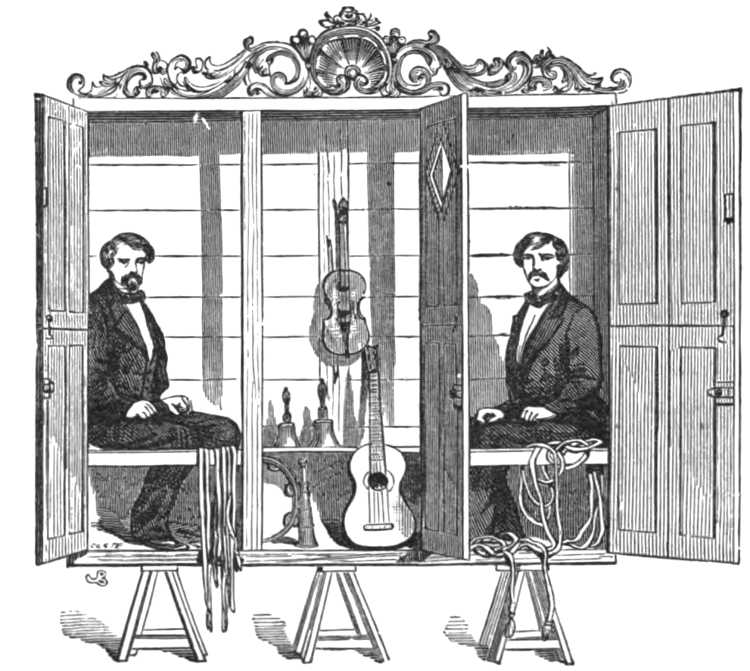
[Pg 202]
When the tying-up is complete, the first endeavour of the medium is, by dint of a particular movement which it is impossible to describe, to work up towards the shoulders the cords which are round the forearms, so as to give these last a little freedom. Next comes a process of pulling and straining; the wrists drawn vigorously apart operate as levers straining against the loops through which they pass, and by persistent pulling, they stretch such parts of the cord as may be susceptible of such extension. A quarter of an inch, or little more, of play, will suffice for the deliverance of one or the other hand. It should be stated, that by dint of special practice on the part of our mediums, the thumb is made to lie flat in the hand, when the whole assumes a cylindrical form of scarcely greater diameter than the wrist.
The first to get free of the four hands is passed through the opening, and shows itself to the spectators, while the three others still labour for the common deliverance. The hands once [Pg 203]free, the remaining cords and the knots are then untied; the teeth rendering valuable service in this particular.
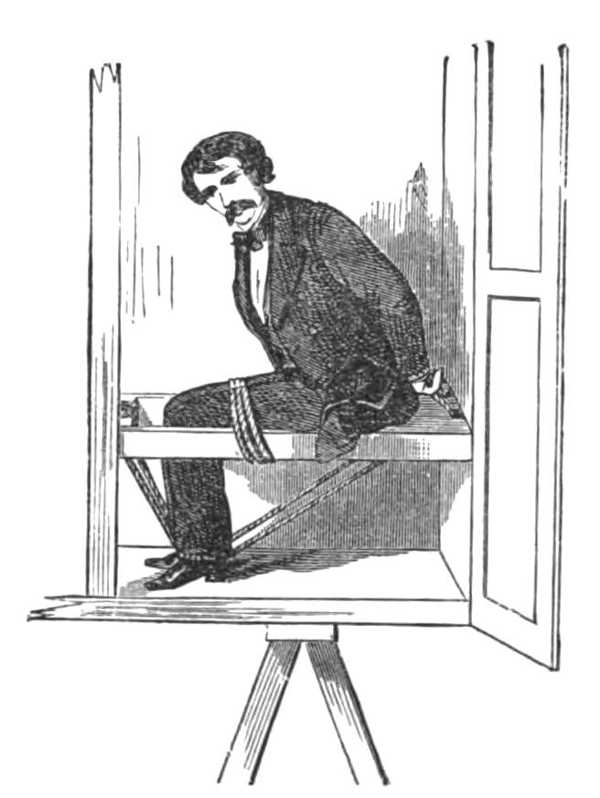
Ira Davenport (who in Fig. 24 is represented as being to the right hand of the spectator) is cleverer and more active than his brother, and is almost invariably the first to release himself. When this is so, he helps [Pg 204]William. In any case, the first to get free assists the other.[45]
When the mediums bind themselves in their cabinet, the mode of tying which they employ enables them to free themselves and again secure themselves in an extremely small space of time. Fig. 25 will give some idea of the arrangement of the cords.
To produce such arrangement they proceed as follows: They take one of the cords by the middle, and form at that point a bow or double loop, as represented in Fig. 26.[46]
The reader will perceive that this is in fact a [Pg 205]double slip-knot, the loops of which may be diminished or increased in size, according as the ends A and B are drawn tight or released.
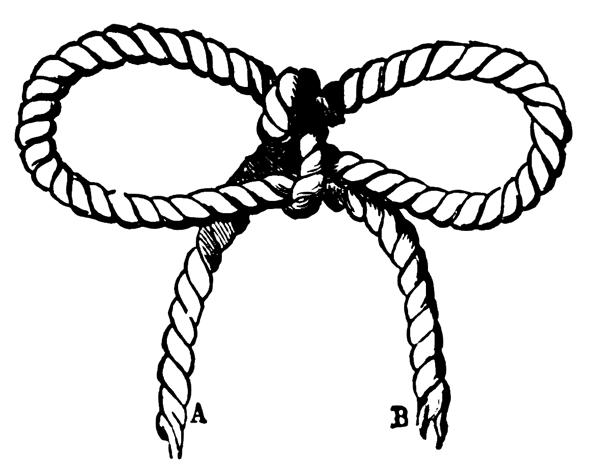
Leaving the two loops open as above, the performers pass through two holes, bored purposely in the seat, the two ends of the cord, which is long enough to be tied round their feet, and attached to the cross-bar in front. With the two other cords, they bind their thighs to the side rails, and sometimes also the arms close to the body. This done, they pass their hands through the loops, which they then draw tight by extending their legs slightly forward. Upon this “dodge” rests the whole pretended [Pg 206]intervention of the spirits and the racket in which they indulge. In point of fact, no sooner are the doors of the cabinet closed than the two Brothers draw back their legs a little and slacken the knot, thus enabling themselves to draw out their hands and to become free. The violin, the guitars, the tambourine, and the bell are almost instantaneously set in motion, making a row of the most hideous description, which is still further enhanced by occasional kicks and thumps on the sides of the cabinet itself. After a short interval the instruments are restored to their original positions, the wrists are replaced in their ligatures, the doors are flung open, and all appear in due order as at first.
A representative selected by the audience is requested, as already described, to step upon the platform; he takes his place in the cabinet upon the seat in the middle. One of his hands is tied to Ira’s shoulder, and the other to William’s knee. But is it not obvious that this precaution, which is ostensibly taken against [Pg 207]the two Brothers, is really in their favour? They have no need, in truth, to stir either knee or shoulder in order to carry out their mischievous pranks; and the stranger, having his hands tied, has no control whatever over their proceedings. He becomes a mere dummy; and under such circumstances, there is not the least difficulty in removing his spectacles (if he wears any), his necktie, or his pocket-handkerchief, and in crowning him with the tambourine.
Placing flour in the hands of the two Brothers does not at all interfere with their drawing them out of the slip-knot. The hands once free, they pour the flour into a pocket made on purpose in their coats, wipe their hands on the inside of the pocket, then pass them one after another through the opening in the door, to show that they are free, and finally indulge, as before, in their noisy concerto; after which, one of the Brothers takes from a side-pocket a little paper bag filled with flour, pours some into the hands of his companion and into one of his own, [Pg 208]replaces the empty bag in its hiding-place, and then gives his other hand its due proportion of flour. The doors are opened, and the two Brothers, freed from their cords, come forward to show the public that their hands are still full of flour.
This little “flour test” terminated on one occasion in a manner which was rather embarrassing to the mediums, though highly diverting to the spectators. The person deputed to place the flour in the mediums’ hands hit on the cute idea of using snuff instead. The mediums saw nothing of the change, for at the moment in question their hands are held behind their backs. The two Brothers reappeared with flour in their hands. The trick which had been played them was then explained, and there was a hearty laugh all round, except, indeed, on the part of the discomfited tricksters.[47]
[Pg 209]
The explanation of the second portion, or Dark Séance, will be readily understood, inasmuch as the tricks still mainly rest on the famous “slip-knot” of which we have already spoken. The two Brothers are seated on either side of a table, on which are laid the guitars and tambourines; they have at their feet a heap of cords; around them is formed the magnetic circle of spectators, each holding the hand of his neighbour. The lights are turned down, and forthwith the two Brothers lash themselves to their chairs after the manner above described, and in the position depicted in Fig. 25. The only difference lies in the form of the seats used. Just as in the case of the cabinet, they can at pleasure fasten [Pg 210]or unfasten themselves, and play the instruments which are on the table.
But, it may be asked, how do they manage when the knot which attaches them is sealed? The reader will note on inspection of Fig. 26, that it is quite possible to put wax on the middle of the knot, and even to seal the two portions of the cord at this point firmly together, without the movement of the ends A or B, or that of the loops themselves being at all interfered with. When the wrists are placed in the loops, this portion of the knot is always uppermost. And, further, the interpreter takes good care to indicate the precise point at which the seal is to be applied, adding a request that the investigator will be careful not to allow the melted wax to touch the wrists. This remark is sure to induce an amount of reserve which is very favourable to the success of the trick. Finally, it should be remarked, that the cord being as thick as the little finger, the impression of the seal cannot possibly extend beyond the point of junction of the two fixed portions.
[Pg 211]
We have, however, still sundry marvels to explain, viz., the fantastic evolutions of the guitars, the sheet of paper under the feet, the coat taken off and replaced, &c.
The guitars and the tambourine are smeared with a phosphorescent liquid whose faint glimmer does not shine brightly enough to reveal the outline of surrounding objects. The company are therefore in total darkness. Ira frees himself from his bonds, and, by the aid of a faculty which he has acquired of seeing in the dark,[48] he seizes one of the luminous guitars by the neck, steps forward with it as close as possible to the circle of spectators, and waves it over their heads, at the same time twanging the strings with the third and fourth fingers. The absence of any other object wherewith to compare prevents the spectator forming any decided judgment as to the distance of this vaguely [Pg 212]luminous body; indeed, I have myself known a guitar which was almost touching my head appear to be several yards away. Meanwhile, the other medium, having also sufficiently freed himself from his bonds, holds up the other phosphorescent guitar and tambourine as high as he can, and with these two instruments makes as much noise and as much movement as possible.
The trick of the outline of the feet marked on the sheet of paper is very ingenious. Ira, after the above measure of precaution has been duly taken, quits his position on the sheet of paper in order to approach the spectators, but when he returns to his seat, takes care to turn over the sheet of paper before placing his feet upon it; and then, by means of a pencil, which he takes from one of his pockets, he traces another outline, which is taken to be the same which had been made by the public.
The “coat” trick is worked as follows:—Ira, freed from his bonds, takes off his coat, throws it into the middle of the hall, and catching [Pg 213]up one which he has had placed on the lap of a spectator in the front row, puts it on instead, then replaces himself in his ligatures, and the trick is done.[49]
[44] The motto of the Théâtre Nicolet was “De plus fort en plus fort”—“From one marvel to a greater.”—Ed.
[45] Hence the preference of rope-tying mediums for working in couples. Were they always to perform single-handed, the failure of a medium to get free would be a matter of much more frequent occurrence than at present; but the chances, which in any case are considerably against the medium being tied so securely that he cannot escape, are almost infinite against two mediums being so tied by different persons on the same occasion. If one gets free, it is obviously merely a question of time to release the other, however securely tied.—Ed.
[46] To produce this knot, all that is necessary is to wind the cord once round the fingers, and through the ring thus formed to draw a small portion of the cord on each side, in opposite directions.—Ed.
[47] The naïveté of the “flour test” is about on a par with that of the “water test” as applied to the “direct spirit voices.” The medium fills his mouth with water; the lights are turned down, and ghostly voices are heard. The lights being turned up again, the medium shows that his mouth is still full of water; ergo, he could not possibly have produced the uncanny sounds which have just been heard. The intellect of the average spiritualist seems to be incapable of conceiving that the medium may have swallowed the original water under cover of the darkness, and refilled his mouth from a pocket flask.—Ed.
[48] This (medically known as nyctalopia) is a faculty which may be cultivated or developed by circumstances: witness the instances of prisoners confined for a long period in dark dungeons, who have thereby acquired this peculiar sense.—Ed.
[49] Readers who chance to have had the opportunity of witnessing the Davenports’ performances will be impressed by the fairness and accuracy of Robert-Houdin’s description of the effects produced, not less than by the extreme simplicity of the mystery when explained. We may add that there is no possibility of question as to the correctness of the explanation given, which fully accords with the conclusions formed by all skilled observers of the Davenport “phenomena.” It must be conceded, in favour of the Brothers, that their performance of their difficult task was perfect of its kind, and far ahead of the majority of their imitators. One of their most successful rivals on their own ground, i.e., working wholly without mechanical aids, is Dexter, “the Man of Many Mysteries.” This gentleman equals the Brothers themselves in the quickness of his manipulations, while in one particular he may even claim to have surpassed them, viz., that his manifestations, including the startling “coat” feat, are produced without apparent disturbance of the original knots tied by the audience. The Davenports, it will be remembered, only produced their most startling effects after they had freed themselves from the original ligatures, and tied themselves in their own fashion, thereby gaining the benefit of the slip-knot described at page 205. Working in a somewhat different direction, the ingenuity of Messrs. Maskelyne and Cooke and others, by the introduction of mechanical aids, has developed the rope-tying and other spiritualistic “business” to an extent never dreamt of by their original promoters. Handcuffs, sacks, and locked and corded boxes have been added to the original appliances of bondage, and yet the captive is free to “manifest” in a variety of eccentric ways. We are indebted to Mr. Bland, of Oxford Street, for the opportunity of examining one of the latest appliances in this direction: a substantial brass collar, by means of which, after the closest and most careful scrutiny, the performer is secured to an equally substantial staple. It would seem that nothing short of a skilled locksmith could effect his release; but no sooner are the lights lowered than the captive is free, again instantly securing himself after completing his “manifestation” for the time being. The mechanism of this collar, which we must own completely baffled our most careful scrutiny, is a marvel of ingenious simplicity. In examining this cleverly constructed piece of apparatus, we could not avoid the reflection that large numbers of very honest people, (even including fellows of learned societies, and others who ought by profession and practice to know better) constantly accept, as conclusive, so-called “tests” offering infinitely less assurance than this deceptive collar; and we are led to suggest, as an almost obvious moral, that, human intelligence being fallible, wherever there is a sufficient motive for deception, means will always be found to deceive.
It would scarcely be possible, within the limits of a footnote, even to enumerate the thousand-and-one dodges of the professed medium. We will, however, give one or two examples, selecting our illustrations from such of the so-called “phenomena” as appear more particularly to stagger unbelievers.
A party of inquirers engage a medium to come to the house of one of their number. He comes, we will suppose, alone (this, by the way, no medium will ever do if he can possibly help it).
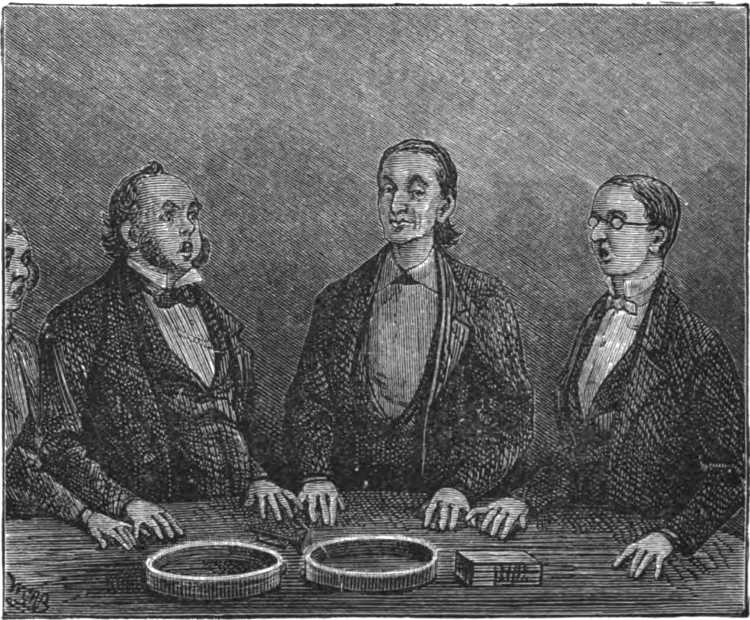
The other members of the party are all known to each other, and above suspicion. All sit round the table, joining hands in the usual manner (i.e., the hands laid flat on the table, the little fingers of each person crossing those of his neighbours on either side). The medium is placed, say, between Mr. A. and Mr. B. (see Fig. 27), both thorough sceptics, and both fully determined that he shall not stir a finger without their knowledge. And yet, the gas being extinguished, sundry mysterious things happen, which, the members of the party being ex hypothesi innocent of complicity in the matter, can only be the work either of the medium or some unknown agency. Mr. A. and Mr. B. are both absolutely certain that the medium’s little fingers have rested beneath their own during the whole performance; and therefore the “supernatural agency” solution is only too frequently accepted.
Now for the true explanation. After the party have sat long enough in darkness (possibly singing “Hand in hand with angels,” or some similarly inspiring strain) to begin to feel chilly and uncomfortable, the medium is seized with convulsive starts and twitchings, which are understood to be the premonitory symptoms of the approaching “influence.” Little by little, in the course of these convulsive spasms, he brings his hands gradually nearer and nearer, till they are at last quite close together, those of Mr. A and Mr. B. conscientiously accompanying them. At last, in the course of a more than ordinarily violent spasm, the right hand is drawn away with a jerk. The hand of Mr. A. (the guardian on the right) makes an instant effort to regain its position over the emancipated little finger, and apparently succeeds, really coming down on the outstretched left thumb of the medium, which is only a couple of inches distant. The condition of things is now altered as shown in Fig. 28. Mr. A. and Mr. B. are both carefully mounting guard over the left hand of the medium, while the right is free to pull hair, tweak noses, ring bells, rattle tambourines, or otherwise “manifest” as maybe desired. Still the convulsive twitching on the part of the medium continues. Presently the left hand also is jerked away. Mr. A. and Mr. B. each make a “grab” to regain it, and each meeting the other’s hand, settle down, in the calm assurance that they still command the movements of the medium, though in reality they are each carefully guarding the fingers of the other, while the medium is free to fetch chimney ornaments from the mantle-piece and place them on the table, personate “John King” or “Peter,” ring bells, strum guitars, or execute any other piece of tomfoolery which he may deem most adapted to the gullibility of his audience (see Fig. 29). If it is desired to jingle tambourines against the ceiling, or to execute any other manifestation requiring special length of reach, the performer calls to his aid a light, handy instrument made after the manner of the “telescope” toastingfork. This may be drawn out for use to a length of several feet, but when closed may be concealed in the pocket without difficulty. With this apparatus the enchanted tambourine or musical-box may be made without difficulty to describe a circle of fifteen or sixteen feet in diameter above the heads of the audience. When the medium has “manifested” sufficiently, he has only to resume his seat, and give a violent upward lurch to the table. This necessarily breaks the chain, and enables him to make a plunge to his original position, the hands on either side immediately closing on his own, in blissful unconsciousness that they have ever lost control of them.
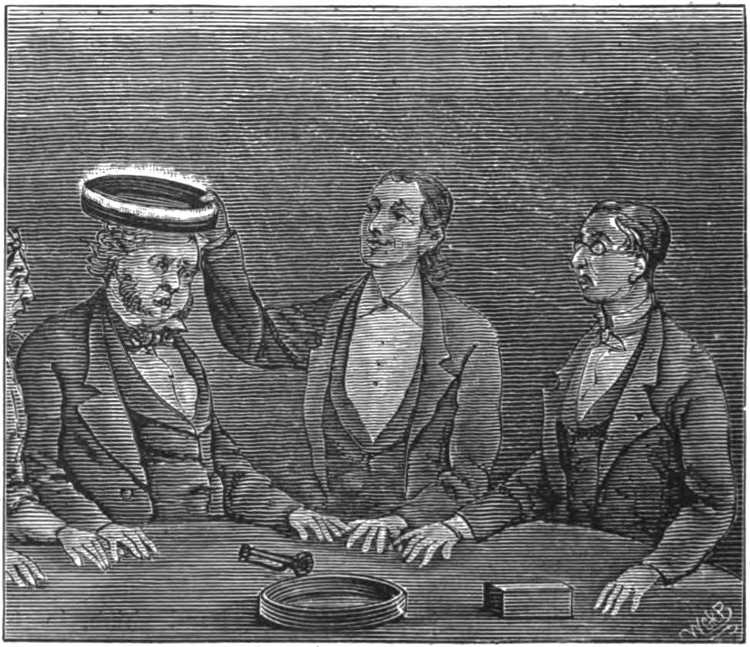
A favourite “manifestation” is that of the “icy hand,” a hand which wanders in an erratic manner among the audience, giving to one a clammy touch, to another a sudden grip, the icy coldness of its touch being amply sufficient (in the dark) to prove its supernatural origin, and to compel a shudder of horror from the least nervous of temperaments. This pleasing “phenomenon” is produced by nothing more uncanny than—a damp kid glove! A kid glove is clipped into cold water, and any superabundant moisture squeezed out of it. Thus prepared, it lies perdu in the tail pocket of the medium till wanted—when it is quietly slipped on in the darkness, and the hand, thus attired, begins to frolic playfully about the ears of the company, its clammy coldness having (to the imaginative) a charmingly corpse-like character, and provoking screams of delicious horror from the members of the “circle.”
But what are we to say to the mysterious hand which, in the “dim” but not particularly “religious” light of the all but extinguished gas, creeps from beneath the table-cover, and shows itself above the edge of the table (testibus the late Serjeant Cox and other credible persons)? We do not undertake to give of this or any other “manifestation” an explanation which shall apply to all recorded cases, each medium having his own peculiar modus operandi; but it will probably be in the recollection of the reader that this was one of the special “manifestations” of Dr. Monck, originally a Unitarian Minister, subsequently a professional medium, and ultimately adjudged, with unquestionable propriety, a rogue and vagabond, a year or two since. Dr. Monck was confessedly a medium of the first rank; indeed, notwithstanding the exposure at Huddersfield, we believe some of the more thorough-going spiritualists retain their faith in him still. By favour of Mr. Lodge, the gentleman to whose courage and acuteness the public are indebted for the exposure of a peculiarly mischievous impostor, we are enabled to give Dr. Monck’s special method of working this and a few other leading “manifestations.”
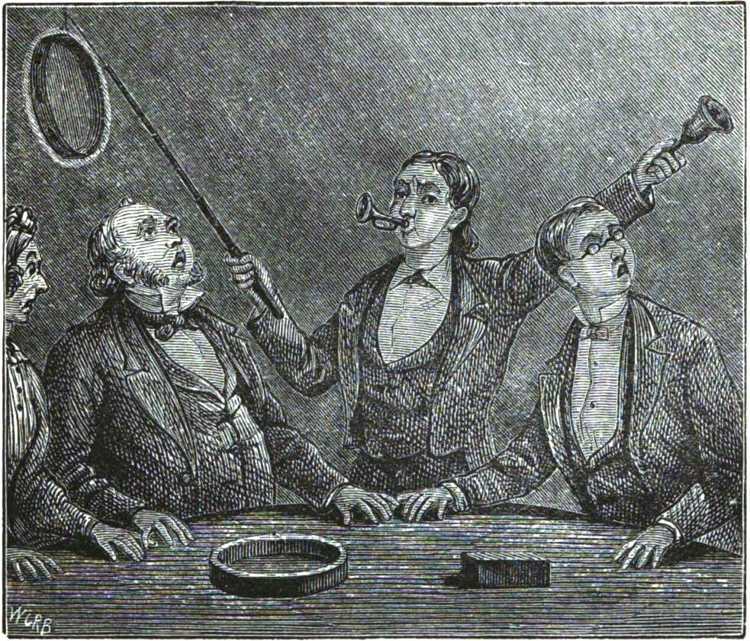
A dummy hand of small size, with the fingers slightly bent, is attached to a piece of broad elastic about three feet in length. This in turn is fastened to a belt round the performer’s waist, and thence passes down (say) his left trouser leg, the hand reposing, when not wanted, within the garment, a few inches above the ancle. To the wrist of the hand is appended a kind of elastic sleeve of five or six inches in length. (In Monck’s case, if we remember right, it consisted of the upper portion of an ordinary sock.) The medium, thus prepared, takes his seat at one side of a square table, with an overhanging table-cover, allowing no one else to be seated at the same side of the table. (Those who had the privilege of seeing Dr. Monck produce this particular “manifestation” will remember that the above conditions were always strictly insisted on.) Some one present is requested to lower the gas. “A little lower, please. A little lower yet!” till, as a natural consequence, it goes out altogether. “Dear me!” says the medium, “I am extremely sorry! I did not intend you to turn it out. Pray light it again.” This is done, and it is again lowered, but this time only to a dim twilight. Meanwhile, under cover of the momentary darkness, the medium has quietly crossed his left foot over his right knee, pulled down the dummy hand, slipped the “sleeve” portion over the toe of his left boot, and, with the foot masked by the table-cover, calmly bides his time. Presently, on the right hand of the medium, something is seen to be moving under the table-cover, making apparent efforts to come out. The medium, at the same time, prepares the minds of the spectators by declaring that he sees a hand floating about,—that it has touched him, and so on. Presently he gradually draws his foot, still crossed over the right knee, from under the table-cover, and allows the hand to show itself just above the surface, the effect to the spectators being as in Fig. 30, the ridiculous reality as in Fig. 31. Dr. Monck went so far as to offer a set of “fairy bells” to the touch of the spirit hand, and partly by scraping the hand against the wires (or rather the wires against the hand), and partly by a judicious use of his own fingers, produced sounds which, though not particularly harmonious, passed muster fairly enough as the production of a hand without a body. The manifestation over, the performer has only to place the left foot on the ground, and with the other foot dislodge the dummy hand, which is forthwith spontaneously drawn back by the elastic band beneath the sheltering trouser. The gas being turned up, sceptical gentlemen may search beneath the table, but in vain.
The working of the above feat demands of course some amount of lissomness in the lower limbs, but nothing beyond what any ordinarily active man, particularly if of spare build, could readily accomplish after a week or so of practice. The use of the lower limbs in a quadrumanous fashion is a stock artifice among the mediums. There is little doubt that a good many of the manifestations of the notorious “Dr. Slade,” of Bow Street celebrity, were produced in this manner, his unusual length of limb being a great advantage to him. The medium in this case wears light Oxford shoes or Albert slippers, which can be readily slipped off or on. The tip of each sock is cut off, leaving the toes completely bare. Thus equipped, the medium has but to slip his shoe off under the table, and with the great and second toe he is enabled to pull ladies’ dresses, pinch gentlemen’s legs, ring a bell placed under the table, &c., &c.
A second speciality of Dr. Monck was a mysterious power of attraction, by virtue of which, tambourines, photographic albums, &c., moved in the twilight across the table towards the medium. If some daring sceptic asked the Doctor whether he could not induce them to move to one side, or in the opposite direction, he was wont discreetly to reply that he found it better “not to attempt to dictate to the spirits in such particulars.” The reader will appreciate the wisdom of this reply on hearing the explanation of the modus operandi. Like most great inventions, it is simplicity itself when explained. The trick literally hangs on a thread—a black silk thread of about 2 feet 6 inches long, with a bent pin at each end. One of these is hooked into the elastic side of the performer’s right boot, the other into the cloth of his trousers, at the point which tailors describe as the “fork.” To work the trick, the medium (the lights being first duly lowered), lifts the right foot on to the left knee, thereby slackening the thread, unhooks the upper bent pin, and attaches it to the edge of the tambourine, or hooks it into the surface of a sheet of paper, newspaper, or the like, on which some article has been placed. His hands may now lie motionless on the table, or even be securely grasped by inquirers on either side, for they have no more to do with the matter. A gradual extension of the right leg tightens the thread, and causes the article attached to it to move towards the performer. The arrangement above described does not admit of a movement in any other direction. Doubtless, Dr. Monck found his cool evasion of this little difficulty so readily accepted by the faithful, that it was hardly worth while to seek to conquer it, though an expert conjuror would find but little difficulty in doing so.
Another manifestation was the performance of the “spirit musical-box”: an ordinary musical-box, which, being placed on the table, and shielded from interference by, say, an empty cigar-box placed over it, played or ceased to play at the command of the medium.
This effect was produced by the aid of a second musical-box, playing the same airs as the first, and attached by an elastic band to the leg of the medium, just above the bend of the knee, of course within the trouser. When not in use the box rested beneath the knee, but when required for action it was brought round to the front of the leg, resting above the knee. The box was so arranged that pressure upon a stud at top caused it to play, the music immediately ceasing when such pressure was removed. The working of the trick will now be clear. The box on the table remains silent throughout, but when it is commanded to play, the medium with his knee presses the concealed box against the under surface of the table, again relaxing the pressure when it is desired that the music shall cease. The illusion, so far as sound is concerned, is perfect.
The above explanations, be it remarked, are not merely speculative. Dr. Monck beat such a hurried retreat from the scene of his disaster, that he left all the above appliances, with others too numerous to mention, behind him. They were taken possession of by the chief constable of Huddersfield, and told their own tale to any skilled observer.
We could multiply instances almost ad infinitum. There is hardly a professional medium now before the public, who has not been, at some time or other, detected in barefaced imposture; and there is hardly a stock trick of the mediums (slate trick, writing on the ceiling, et hoc genus omne), that is not perfectly well known to legitimate conjurors, although, as a matter of professional policy, they find it more profitable to keep, than to expose, the secret. To those who have any lurking doubt as to the real nature of spiritualism, we cannot do better than commend a perusal of Mr. Maskelyne’s clever little book, “Modern Spiritualism,” wherein he has described, in a light and amusing form, the rise and progress of this most discreditable craze, and chronicled the exposures which the leading professors of the craft from time to time have met with. We are glad to note that he promises, at some future time, to supplement this work with another, explaining the whole secrets of the mediumistic art, a task which no man is better qualified to perform. Meanwhile, the seeker after truth combined with amusement cannot do better than pay a visit to the great anti-spiritualist himself at the Egyptian Hall, where he will witness “manifestations,” though introduced in comic guise, to the full as “genuine,” and infinitely more surprising, than the stock achievements of the spiritualists. Here he will see Mr. Cooke—though bound and sealed and enveloped in network from head to foot—ring bells, rattle tambourines, exhibit spirit-hands, &c., &c., finally carrying the cabinet with him in an aërial flight about the hall. Here he will find walking-sticks justify their name by walking spontaneously across the stage, tables defying not only the vis inertiæ but the power of gravitation, tambourines that “rap” visibly in answer to questions, and, finally, see Mr. Maskelyne himself, not under the convenient shade of darkness, but illumined by a very respectable amount of gaslight, float gently upwards towards the roof of the hall. The reader who has carefully followed Robert-Houdin’s description of the “floating table” in an earlier section, may probably make a shrewd conjecture at the nature of the means (of course mechanical), by which this particular effect is produced.
Here we pause to anticipate an objection which will inevitably be raised by “true believers,” if any such chance to peruse these humble pages. “Mechanical means!” it will be said. “Of course! Mr. Maskelyne performs upon a stage, and has full command of stage appliances. But how do you account for the well-authenticated instances of the medium having been floated about the room in a house which he then visited for the first time, and where the use of any mechanical means for such a purpose was clearly out of the question?”
We do not pretend to account for it, gentle reader, for we utterly deny that any such impertinent interference with the laws of nature ever took place. The “well-authenticated instances” referred to have invariably happened in darkness, and the utmost the most positive person can say is, that during such darkness, something or other happened which gave him the impression that the medium’s manly form had quitted terra firma, and was floating about the room. Now such an impression can be produced by the simplest possible means. Note the conditions. A circle of persons is seated in a room in total darkness; they are warned to expect something supernatural. They wait in this unpleasant expectation until they perforce become more or less nervous. They are kept in an attitude of fixed attention, which, long maintained, tends to merge, as the physiological student is well aware, into the “hypnotic” or morbidly impressionable state. Every creak of a chair, every sound, however minute, may be the outward and visible sign of a message from another world. Under such circumstances, when the musical-box spontaneously strikes up “Home, sweet Home!” when the medium remarks “I am leaving the floor; don’t notice me; talk of something else;” and then a shadowy something, with an unmistakable perfume of leather, passes over the heads of the assembled group, the heel of a boot perhaps resting lightly on a head or a shoulder in its passage,—who so sceptical as to doubt that the medium has really been “levitated” in the manner suggested? Who so sceptical, indeed? unless in truth he was aware, or was shrewd enough to suspect, that the medium, under cover of the darkness, had quietly taken off his boots, slipped them upon his hands, and gently moved them backwards and forwards over the heads of the awe-stricken investigators (Fig. 32).
The process of reasoning is obvious. “Here are the medium’s boots, floating in the air on a level with our faces. Where a man’s boots are, there his feet must be; and if a man’s feet are floating in the air, his whole body must be floating also. Ergo, we are henceforth prepared to make affidavit that the medium did at such and such a time actually float about such and such a room in our presence.”
[Pg 229]
Lest the simplicity of the explanations we have here given should tend to discredit their genuineness, we may remind the reader that the art of conjuring consists not half so much in doing wonderful things (for what is actually done is often very simple), as in persuading the spectator that wonderful things are done. It is a matter of common knowledge among conjurors, that not one spectator in a hundred, unless he be himself a conjuror, can give even a fairly correct account of what has been visibly done in the performance of a trick. And if such be the case in broad gaslight and with every opportunity of observation, how much more is it likely to be so in darkness or semi-darkness, with scarce half of the physical senses permitted to be used, and the mental vision obscured by the belief or semi-belief of supernatural intervention.—Ed.]
Every one knows that it is an axiom of physics, that that which is contained is smaller than that which contains it, and conversely. This incontestible truth, or axiom, however, appears to receive a practical contradiction from the trick which we are about to discuss. The reader will be enabled to form his own opinion on the subject from a perusal of the brief descriptive sketch with which I propose to preface my technical explanation.
The magician comes forward with a drawing portfolio under his arm, rests it on slight trestles placed well forward on the stage, and takes from it in succession,—
[Pg 230]
It should be specially mentioned that the portfolio is at most not more than an inch and a quarter thick, and that the performer closes it each time, after producing one of the objects above mentioned.
Before proceeding to give the explanations necessary for the performance of the trick, it will be as well to first describe its scenic arrangement, with the addition of the “patter” which serves to give colour to the appearance of the articles.
[Pg 231]
When the portfolio has been placed on the trestles, and the ribbons have been untied, you commence by producing an engraving representing a charming half-length portrait of a lady, life-size, but without head-dress. You close the portfolio.
“I observe,” you remark, “that the lady has come out of the portfolio bareheaded. Probably she forgot to bring out her bonnet with her. Ah, yes! here it is.”
You produce the first bonnet, and close the portfolio. “This bonnet is for winter wear; it should surely be accompanied by one for summer also.”
You open the portfolio again, and produce a satin bonnet; close the portfolio, immediately opening it again and taking out another drawing representing a bird—
“Ah, here is a bird. It is pretty certain that we shall find none but pictorial specimens here. However, here is a dove which has tried to get in; but, good Heavens, in what a sad condition!”
[Pg 232]
You here exhibit a stuffed dove crushed quite flat.
“It is dead! But I see there is another, which has resisted the pressure. This one seems lively enough.”
You exhibit it, then another, and another, and lastly a fourth. You have in this way produced four doves, which you place in succession on the edges of the portfolio, which has remained open. (At night doves are so docile that they do not flutter about, but remain just where they happen to be placed.) After having put them on one side, you close the portfolio; then, an instant later, open it again, and take out a drawing representing two cooks, fighting with stewpans.
“Aha, here is a row in the kitchen.[50] The culinary utensils cannot be very far off. In fact, here is a large stewpan filled with haricot beans.”
You take out the article in question, and [Pg 233]place it on a side table, then, returning to the portfolio, you take out another stewpan, full of water.
“Ah, no doubt this is the water they were going to put the haricots in, it is quite boiling.”
(You dip your finger in, and withdraw it smartly, though the water is not really hot.)
“—And no wonder, for here is the fire with which it was boiled.”
You take out the third stewpan, and place it on one side with the other, and close the portfolio, almost immediately opening it again.
“Here is an article which I had forgotten to take out.”
You produce the cage full of birds, which you bring forward to the audience for inspection. On going back to the stage, you give a smart rap on the portfolio, which has remained open.
“Nothing here now, at any rate,” you remark. “Neither anything nor anybody.”
“Yes, there is somebody,” says the child, lifting his little head above the edge of the [Pg 234]portfolio; “and I should like to come out and get a little air, for it’s terribly close in here.”
You take out the child, and instantly come forward to show the spectators the inside of the portfolio, which does not differ in any respect from ordinary portfolios.
This trick requires great neatness of execution to perform it satisfactorily, particularly as to the production of the child.
Explanation. Of the various articles which are produced from the portfolio, some are placed there beforehand, and the remainder are introduced during the course of the trick. The former are the drawings, the bonnets, the flattened dove, the cover or false bottom of the stewpan, containing the beans, and the cage. The latter are the stewpans, the living doves, and the child.
Preparation and Arrangement of the various objects prior to the execution of the trick.—The portfolio, as we have already stated, has an [Pg 235]external thickness of an inch and a quarter. This allows about three-quarters of an inch of inside space for the concealment of the different objects. The portfolio is made of very stiff mill-board. (Latterly I substituted for the pasteboard a couple of pieces of sheet-iron covered with paper and leather, which, while affording greater strength, gained an additional sixth part of an inch of internal space.) As is frequently the case in portfolios, in order to protect the works of art within, a piece of green cloth was attached to one of the outer edges, and thence spread over the interior. This cloth flap, (whose purpose we shall presently explain,) instead of being laid over the various articles, is placed under them. At one side, just within the portfolio, is a jointed elbow-piece, holding the portfolio, when occasion requires, open at an angle of 45° to 50°.
The Engravings.—These serve to hide the movements which the performer makes in [Pg 236]taking from his own person the articles which are introduced into the portfolio. The better to serve this purpose, they are pasted upon thin sheets of cardboard, in order to give them some little stiffness.
The Ladies’ Bonnets.—These are made upon skeletons of watch spring, bent to a form corresponding with the prevailing fashion. By the aid of a slit which is made down the back of the bonnet, it may be spread out and laid flat in the portfolio, taking up scarcely any room in point of thickness. Before it is produced, and while it is yet hidden by the portfolio, it spontaneously re-assumes its proper shape, while the hinder part, which works on a hinge, also resumes its position. A hook and eye secure the whole in a substantial manner.
At the date when I first invented this trick, it was the fashion to wear very large bonnets, which gave additional effect to the illusion.
The Stewpans.—These, when they are taken [Pg 237]out of the portfolio, appear to be all of the same size, but in reality they are made to fit one within another. Their handles each terminate with a bent portion, which fitting one within another, make one only, and may thus be attached simultaneously to the stewpans, as will be explained shortly. We proceed to show how, at a given moment, they are made to contain fire, water, and haricot beans.
In order to facilitate our explanation we will call the largest stewpan No. 1, the next in size No. 2, and the smallest No. 3.
No. 3 is destined to hold water. To that end, after it has been filled with that liquid, it is covered over with a piece of waterproof cloth, tied strongly round the edge with thread, after the manner of a pot of preserves. In order that there shall be no fear of the thread slipping, a slender bead of brass wire is soldered all round the edge. There is, however, a gap in this wire bead, at the point of junction with the handle, for a space of about a couple of inches. This enables the performer to get the [Pg 238]cover off with greater ease, by taking hold of it at this point. No. 2 is provided with a false top of three-quarters of an inch deep, a sort of hollow cover which just fits into the stewpan. When this false top is filled with haricot beans and placed in the stewpan, it makes the latter appear quite full of beans. Stewpan No. 1 has no speciality. This is destined to contain fire, as will be explained in due course.
The Four Doves.—These are placed in a little bag of so simple a construction as scarcely to need any explanation. They are each stowed in a separate compartment which partly covers them. These compartments are placed in rows of two each, one above the other, forming a package of regular shape, and but little bulk. A hook of iron wire, three and a half inches long, is so arranged as to keep the package closed as long as it is suspended; but as soon as the doves are placed within the portfolio the whole simultaneously opens, and the doves are free.
[Pg 239]
The Bird Cage.—It would demand too great a space to give an exact description of this cage;[51] but I doubt not I shall be able to give the reader a sufficiently clear idea of it from the explanation which follows.
The cage has four larger and two smaller sides, the former constituting the top, bottom, and two of the sides. The four larger sides of the cage, instead of being made solid at their angles, are hinged one to another, thereby allowing the cage to be flattened out, and so present but very little thickness. The two smaller sides, or ends, are also movable, but are attached to the cage by one side only, and serve to keep the whole in position when restored to its proper shape. The bottom of the cage is of sheet-iron, and so arranged as to allow sufficient space to accommodate the canaries even in its flattened condition.
[Pg 240]
When the performer unfolds the cage, he quickly closes the two smaller sides, so that the birds shall not have time to escape. The handle of the cage is also on hinges, so as to lie flat when necessary.
The Child.—The child, at a particular moment, places himself in the portfolio without the spectators perceiving it; in fact, he is, so to speak, shot into it, after the manner we are about to describe.
On the side towards which the portfolio opens, and immediately beneath its outer edge, a small trap, working on hinges, is cut in the floor of the stage. Beneath this trap is placed, in a vertical position, an oblong box, in which the child stands erect. The bottom is movable, and may be elevated by a lever so as to raise the child to a level with the portfolio. We shall see later on the manner in which the operation is effected.
Preparation of the Portfolio before its Introduction on the Stage.—You first spread the [Pg 241]cloth flap, over the inside of the portfolio; and then place thereon the following articles:—
Preparation of the Stewpans.—Fill stewpan No. 3 with water, cover it over, and tie on the cover as already explained. Place at the bottom of No. 1 a little bag made of very thin paper, and filled with a powder which, when burnt, produces a red flame.[52] A quick-match, [Pg 242]communicating with the powder, projects from the bag, so as to be quickly set fire to; for which purpose a lucifer match is placed beside the bag in the stewpan. This done, you place the stewpans one within another.
The doves, as already stated, are placed in a bag, so as to form a single parcel.
When you are about to perform the trick, you hook the group of stewpans on to a wire staple which you have behind you, beneath your coat, as explained in my work entitled “Les secrets de la prestidigitation,” pp. 397, 405.[53] The doves are hooked on in like manner, so as to rest immediately above the stewpans.
All these arrangements being made, and yourself equipped as above, you take the portfolio and make your entrance on the stage. Then, after having placed the portfolio upon the trestles, you proceed to extract the various [Pg 243]objects, making the most of your “patter,” as already described.
First time of opening.—The young lady’s portrait, and the two bonnets.
Second time of opening.—The bird picture. In the act of lifting the drawing above the portfolio, as though merely taking it out with the left hand, the performer’s body is for the moment masked by the portfolio, and he avails himself of the opportunity to rapidly unhook the bag with the doves, and place it within the portfolio.
Third time of opening.—The representation of the “row in the kitchen” serves in like manner to mask the body while the group of stewpans is introduced into the portfolio. Once fairly introduced, they are then placed side by side. The false bottom, with the haricot beans, is slipped into No. 2. Before bringing out No. 1, you strike the match and set light to the composition, inducing the belief that the stewpan is quite full of fire.
Fourth time of opening.—You put the cage [Pg 244]in shape, and produce it from the portfolio, which from this point remains open, being supported by the jointed elbow-piece.
Here begins a little bit of acting, designed to facilitate the introduction of the child into the portfolio without detection by the spectators. The performer comes quickly forward to the audience in order to exhibit the cage, and passing his hand within it, makes believe to be about to distribute the birds, exclaiming:
“What lady or gentleman would like to have one of them?”
The spectators, thinking the trick concluded, and, on the other hand, each wishing to have one of the little birds, have all their attention concentrated on the cage. Meanwhile, however, this is what takes place on the stage: The conjuror’s assistant, who is close to the portfolio at the moment when the cage is taken therefrom, watching his opportunity when the whole attention of the public is directed to the cage, lets fall from the portfolio the green cloth flap, which hangs down to the [Pg 245]ground, and thereby hides the space between the portfolio and the flooring. Taking his cue from this, a person placed at the “wing” moves the lever of which I have already spoken, and thereby “shoots” the child, so to speak, up to the level of the portfolio, into which he instantly creeps. His entrance once effected, the assistant coolly lifts up the cloth again, as though setting right a mere accident.
The whole movement was executed on my stage with such promptitude, that even to a spectator who, we will suppose, had never taken his eyes from the portfolio, there was nothing more than the bare fact of a cloth accidentally dropped, and immediately picked up again. I have often timed the introduction of the child, which did not occupy more than four seconds.[54]
[Pg 246]
I have treated this trick at considerable length, as being one of my special favourites, and because I regard it as being one of the most astonishing that can be exhibited to an audience.
[50] “Une batterie de cuisine.” The pun of the original is unavoidably lost in translation.—Ed.
[51] Robert-Houdin elsewhere states that this cage, which, in fact, formed the germ of the trick, was the invention of an amateur, M. Bouly, of Cambrai. The remaining effects were added by Robert-Houdin himself.—Ed.
[52] The red-fire powder is composed as follows:—1. Nitrate of strontian, in powder, and carefully dried, 20 parts; 2. Gum benzoin, 4 parts; 3. Flower of sulphur, dried, 1 part.—R.-H.
[53] In the English version, “The Secrets of Conjuring and Magic” (Routledge), the corresponding passages will be found at pp. 358, 367.—Ed.
[54] We can confirm the above statement from personal experience, having had the opportunity of seeing the trick performed in Paris by M. Robert-Houdin the younger. Some of the details, as above described, were omitted, but the introduction of the child was retained; and, though fully conversant, theoretically with the modus operandi, found it difficult to believe, until assured by the event, that the child had been introduced in the mere moment of time during which the piece of cloth was permitted to hang down from the edge of the portfolio.
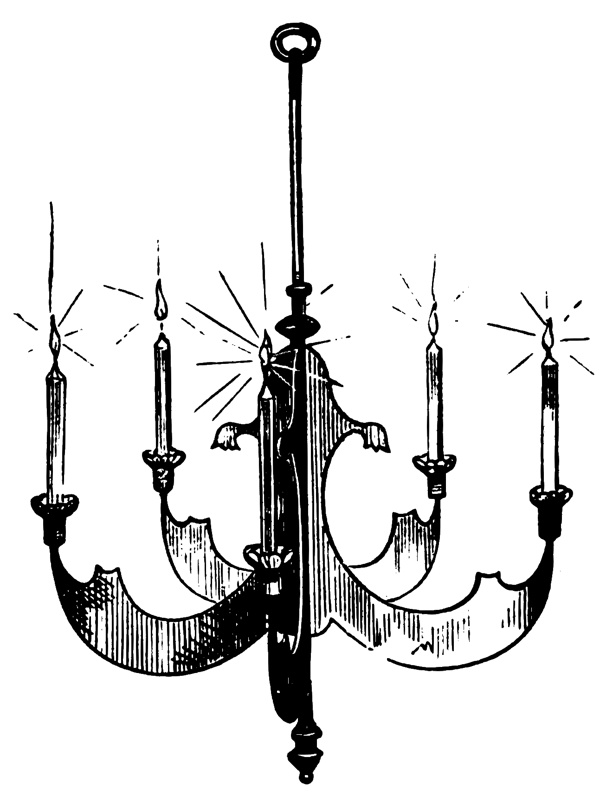
The ingenuity of later inventors has added new incidents to the trick. One is the production of a large five-branch chandelier, with lighted candles, as shown in Fig. 33. The central rod, or stem, of the chandelier is telescopic, one part sliding within the other. The five arms, which are slightly unequal in length, work on this as a pivot, folding flat one against the other, as shown in Fig. 34, and in that condition occupy but very little space. The candles, the wicks of which are touched with paraffin or turpentine, to cause them to ignite readily, are lighted with an ordinary lucifer under cover of the portfolio, before the chandelier is expanded into the shape in which it is afterwards produced.
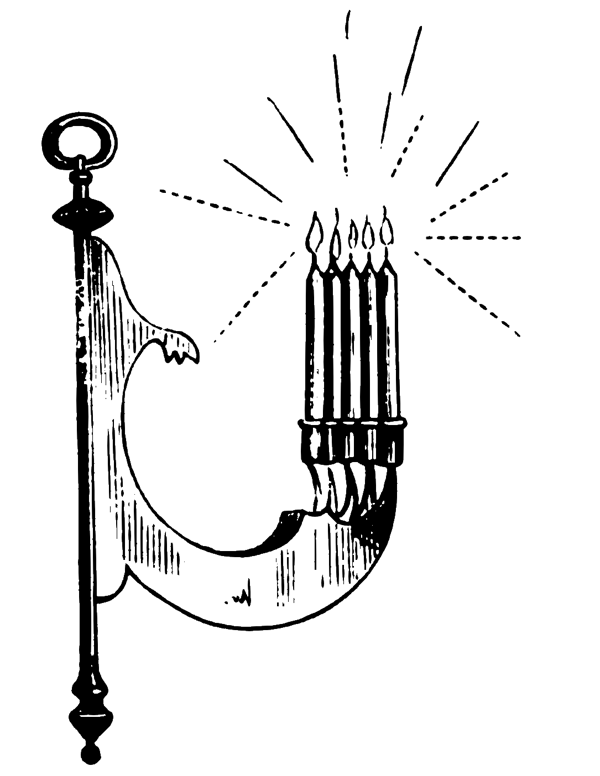
Another object, which is now frequently produced from the portfolio, is a square fernery with glass sides, standing about 15 inches high, and of the appearance depicted in Fig. 35. The framework of the fernery is made of tin. The feet—which are not solid at the angles, as they at first sight appear to be, but each consist of two separate pieces of tin—may be folded flat against the bottom, and the top and sides in like manner fold, down one by one, the whole occupying ultimately a space of little more than an inch deep. Of the ferns, the greater number are glued flat against the glass sides, while a few in the centre are attached to a spring flap, folding down with the sides, but rising as soon as these are lifted.—Ed.
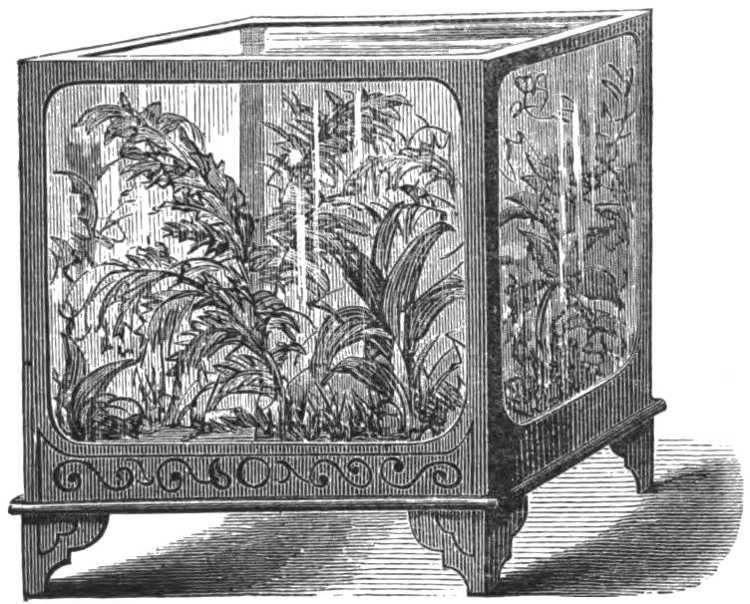
[Pg 249]
At the command of the magician, a drum, placed upon a slender tripod-stand, beats sundry marches with the skill and precision of a regimental drum-major; with this difference, however, that the magic drum sounds without the aid of drum-sticks, and without any visible controlling power.
This performance takes place in the first instance upon the stage, but in order to preclude all suspicion of an acoustical illusion, the performer afterwards hooks the drum on to a couple of cords hanging from the ceiling of the hall. The instrument, swinging backwards and forwards over the heads of the spectators, seems to acquire fresh vigour and spirit in the execution of its marches and roulades.
[Pg 250]
This marvellous performance, which might readily be made to pass for a spiritualistic manifestation, rests on an extremely simple principle. Within the drum is a vibrateur de la Rive, more commonly known as an “electric bell” movement. (The reader will find a full description of this kind of bell in any work on electro-dynamics, and particularly in the treatises of Count du Moncel.) The hammer of this movement is so arranged as to strike on the skin of the drum by way of “bell.”
It is well known that, as part of the mechanism of an electric bell, there is always, at a greater or less distance from the bell itself, a stud or “push,” which has only to be pressed in order to set the apparatus in motion. So long as the finger rests upon this stud, the metallic vibrations continue to be heard; only ceasing when the pressure is removed.
This stud is placed behind the scenes, ready to the hand of an assistant, who plays the part of the invisible medium. Artfully concealed wires and metallic connections communicate [Pg 251]with the inside of the drum, whether placed on the tripod, or hanging by the cords.
With these appliances the execution of any military music is an extremely simple matter, since you have at your disposition raps and rolls of any given duration.
In point of fact (and the experiment may be tried upon the push of an electric bell) if you press the stud for an extremely short time, the value of a semi-quaver for instance, the hammer will only strike a single tap. This is the “rap,” or single stroke of the drumstick. As to the various rrrrr or “rolls,” they are produced by durations of pressure equivalent to quavers, crochets, minims, &c. The drum becomes simply an instrument on which the assistant plays, with greater or less execution.
To give greater spirit to the performance of the drum, a second vibrator may be added within, and a second push under the hand of the assistant, who can then with one hand keep up a continuous roll, while with the other [Pg 252]he beats the measure of the march. This, in drum practice, is a special feat, to be executed only by the most skilful performers.
In order to make the execution more perfect, a “barrel” may be constructed as in organs, the pins upon which, duly placed, will transmit the electric fluid at the exact intervals necessary for the due execution of the roulades desired.
THE END.
PRINTED BY LOVE AND WYMAN, LTD., GREAT QUEEN STREET, W.C.
[Pg 253]

MODERN MAGIC. A Practical Treatise on the Art of Conjuring. Tenth Edition. 528 pp. Price 5s.
MORE MAGIC. Second Edition. 469 pp. Price 5s.
DRAWING-ROOM AMUSEMENTS AND EVENING PARTY ENTERTAINMENTS. Third Edition. 512 pp. Cloth, 2s. 6d.
THE SECRETS OF CONJURING AND MAGIC; or, How to become a Wizard. Fourth Edition. 394 pp. Price 2s. 6d. By Robert-Houdin. Translated and Edited, with Notes, by Professor Hoffmann.
THE SECRETS OF STAGE CONJURING. Third Edition. 260 pp. Price 2s. 6d. By Robert-Houdin. Translated and Edited by Professor Hoffmann.
DRAWING-ROOM CONJURING. Second Edition. 192 pp. Price 1s. From the French. Translated and Edited by Professor Hoffmann.
THE BOOK OF CARD AND TABLE GAMES. Second Edition. 650 pp. 5s. Edited by Professor Hoffmann.
HOYLE’S GAMES MODERNISED. Twenty-first Edition. 32mo. 454 pp. Picture Boards, 1s. 6d.; Cloth, 2s. Edited by Professor Hoffmann.
HOME GYMNASTICS. Third Edition. Revised and Enlarged. Cloth. 208 pp. 1s. (Oval Series.)
THE GAMES OF GRECO (CHESS). In Fancy Boards, 1s. 6d.; Cloth, 2s. 272 pp. (Pocket Hoyle Series). Translated and Edited by Professor Hoffmann.
THE ILLUSTRATED BOOK OF PATIENCE GAMES. Crown 8vo. 127 pp. Price 2s. 6d. From the German. Translated and Edited by Professor Hoffmann.
DOMINOES, by Professor Hoffmann; and DRAUGHTS, by R. McCulloch, Editor of Anderson’s Great Work. Combined in One Volume. Price 1s. 6d.; Fancy Boards, or Cloth, 2s. (Pocket Hoyle Series.)
EVERY BOY’S BOOK OF SPORT AND PASTIME. Edited by Professor Hoffmann. Demy 8vo. 926 pp. With 530 Illustrations. Handsomely bound in Cloth. Price 5s.; with Gilt Edges, 6s.

GEORGE ROUTLEDGE & SONS, LIMITED,
Broadway, Ludgate Hill, London.
Obvious printing errors such as missing letters, accents, and punctuation have been silently corrected in this version. Minor inconsistencies and archaic forms have been retained as printed.
Some illustrations have been moved slightly within their chapters to better fit the ebook format.
The footnotes have been relocated to the end of their respective chapters and renumbered to better fit the ebook format.
The table of contents has been expanded in this version.
The image Fig. 23. on page 156 has been rotated so the letters are the right side up in this version.