*** START OF THE PROJECT GUTENBERG EBOOK 77890 ***
Footnotes have been collected at the end of each chapter, and are
linked for ease of reference.
Minor errors, attributable to the printer, have been corrected. Please
see the transcriber’s note at the end of this text
for details regarding the handling of any textual issues encountered
during its preparation.
There are reproductions of sea charts some of which were quite
faded. These chart are provided with a link, accessed by clicking
on the chart, which will display a larger chart which may be inspected more closely.
Any corrections are indicated using an underline
highlight. Placing the cursor over the correction will produce the
original text in a small popup.
Any corrections are indicated as hyperlinks, which will navigate the
reader to the corresponding entry in the corrections table in the
note at the end of the text.
THE
AUTOBIOGRAPHY OF A SEAMAN.
VOL. II.
ILONDON
PRINTED BY SPOTTISWOODE AND CO.
NEW-STREET SQUARE
THE
AUTOBIOGRAPHY OF A SEAMAN.
BY
THOMAS, TENTH EARL OF DUNDONALD, G.C.B.
ADMIRAL OF THE RED, REAR-ADMIRAL OF THE FLEET,
ETC. ETC.
VOLUME THE SECOND.
Second Edition.
LONDON:
RICHARD BENTLEY, NEW BURLINGTON STREET,
Publisher in Ordinary to Her Majesty.
1861.
The right of translation is reserved.
vii
CONTENTS
OF
THE SECOND VOLUME.
| CHAPTER XXIV. |
| A NAVAL STUDY FOR ALL TIME. |
| |
|
| Charts, &c., supplied by the present Government.—Refused by a former Government.—Alteration made in the Charts.—Mr. Stokes’s Affidavits.—Letter to Sir John Barrow.—Singular Admiralty Minute.—Second Letter to Sir John Barrow.—The Charts again Refused.—My Departure for Chili.—Renewed Application to the Admiralty.—Kindness of the Duke of Somerset.—Difference of Opinion at the Admiralty |
Page 1 |
| |
|
| CHAP. XXV. |
| A NAVAL STUDY—continued. |
| |
|
| viiiFrench Hydrographic Charts.—One tendered by me to the Court.—Rejected by the President.—Grounds for its rejection.—The object of the rejected Chart.—Would have proved too much, if admitted.—Rejection of other Charts tendered by me.—Mr. Stokes’s Chart.—Its Fallacy at first sight.—Judge Advocate’s Reasons for Adopting it.—Its Errors detected by the President, and exposed here.—Probable Excuse for the Error.—Imaginary Shoal on the Chart.—Falsification of Width of Channel.—Lord Gambier’s Voucher for Stokes’s Chart.—Stokes’s Voucher for its Worthlessness.—Stokes’s Chart in a National point of View.—Taken Advantage of by the French |
15 |
| |
|
| CHAP. XXVI. |
| A NAVAL STUDY—continued. |
| |
|
| The Evidence of Officers present in Basque Roads.—Admiral Austen’s Opinions confirmatory of my Statements.—Fallacy of alleged Rewards to myself, in place of these Persecutions.—Treatment of my eldest Son, Lord Cochrane.—Letter from Capt. Hutchinson confirmatory of the Enemy’s Panic.—A Midshipman near taking the Flag-ship.—Evidence of Capt. Seymour, conclusive as to Neglect, which was the Matter to be inquired into, in not sending Ships to attack.—Attempt to Weather his Evidence.—Capt. Malcolm’s Evidence confirmatory of Capt. Seymour’s.—Capt. Broughton’s Testimony proves the complete Panic of the Enemy, and the Worthlessness of their Fortifications.—Lord Gambier declares them Efficient on Supposition arising from Hearsay.—Enemy unable to fight their Guns.—The imaginary Shoal.—A great Point made of it.—Mr. Fairfax’s Map.—Lord Gambier on the Explosion Vessels.—Contradicted by Mr. Fairfax.—Contrast of their respective Statements.—Fairfax’s Evasions.—His Letter to the Naval Chronicle.—These Matters a Warning to the Service |
40 |
| |
|
| CHAP. XXVII. |
| CONDUCT OF THE COURT-MARTIAL. |
| |
|
| ixLord Gambier’s Defence.—Second Despatch ignoring the First.—Attempt of the Court to stop my Evidence.—Evidence received because opposed to mine.—I am not permitted to hear the Defence. The Logs tampered with.—Lord Gambier’s Defence aimed at me under an erroneous Imputation.—My Letter to the Court confuting that Imputation.—Admiralty Accusation against Lord Gambier on my Refusal to accuse his Lordship.—His Insinuations against me uncalled for.—Assumes that I am still under his Command.—Enemy escaped from his own Neglect.—The Shoals put in the Chart to excuse this.—Attempt to impute blame to me and Captain Seymour.—The Truth proved by Captain Broughton that Lord Gambier had no Intention of Attacking.—Lord Howe’s Attack on the Aix Forts.—Clarendon’s Description of Blake. |
82 |
| |
|
| CHAP. XXVIII. |
| THE VOTE OF THANKS. |
| |
|
| My Motion for Minutes of Court-martial.—Mr. Tierney’s Opinion respecting them.—Mr. Whitbread’s Views.—The Minutes indispensable.—Mr. Wilberforce on the same point.—Lord Grey’s Opinion of the Ministry.—The Vote of Thanks leaves out my Name, yet the Credit of the Affair given to me.—Inconsistency of this.—I impugn the Decision of the House.—Sir Francis Burdett’s Opinion.—Mr. Windham’s.—Lord Mulgrave turns round upon me.—His Lordship’s Misrepresentations.—Yet admits the Service to be “Brilliant.”—Lord Mulgrave Rebuked by Lord Holland.—Earl Grosvenor’s Views.—Lord Melville hits upon the Truth, that I, being a Junior Officer, was left out.—Vote of Thanks in Opposition to Minutes.—The Vote, though carried, damaged the Ministry |
104 |
| |
|
| CHAP. XXIX. |
| REFUSAL OF MY PLANS FOR ATTACKING THE FRENCH FLEET IN THE SCHELDT. |
| |
|
| xRefused Permission to Rejoin my Frigate.—-I am regarded as a marked Man.—No Secret made of this.—Additional cause of Offence to the Ministry.—The Part taken by me on the Reform Question, though Moderate, resented.—Motion for Papers on Admiralty-Court Abuses.—Effect of the System.—Modes of evading it.—Robberies by Prize-Agents.—Corroborated by George Rose.—Abominable System of Promotion.—Sir Francis Burdett committed to the Tower.—Petitions for his Liberation intrusted to me.—Naval Abuses.—Pittances doled out to wounded Officers.—Sinecures cost more than all the Dockyards.—My Grandmother’s Pension.—Mr. Wellesley Pole’s Explanation.—Overture to quit my Party.—Deplorable Waste of Public Money.—Bad Squibs.—Comparison with the present Day.—Extract from Times Newspaper |
126 |
| |
|
| CHAP. XXX. |
| MY PLANS FOR ATTACKING THE FRENCH COAST REFUSED, AND MYSELF SUPERSEDED. |
| |
|
| Plans for Attacking the French Coast submitted to the First Lord, the Right Honourable Charles Yorke.—Peremptorily ordered to join my Ship in an inferior Capacity.—My Remonstrance.—Contemptuous Reply to my Letter.—Threatened to be superseded.—Mr. Yorke’s Ignorance of Naval Affairs.—Result of his Ill-treatment of me.—My Reply passed unnoticed, and myself Superseded |
151 |
| |
|
| CHAP. XXXI. |
| VISIT TO THE ADMIRALTY COURT AT MALTA. |
| |
|
| The Maltese Admiralty Court.—Its extortionate Fees, and consequent Loss to Captors.—My Visit to Malta.—I possess myself of the Court Table of Fees.—Ineffectual Attempts to arrest me.—I at length Submit, and am carried to Prison.—A mock Trial.—My Defence.—Refuse to answer Interrogatories put for the purpose of getting me to criminate myself.—Am sent back to Prison.—Am asked to leave Prison on Bail.—My Refusal, and Escape.—Arrival in England |
166 |
| |
|
| CHAP. XXXII. |
| NAVAL LEGISLATION HALF A CENTURY AGO. |
| |
|
| xiInquiry into the State of the Navy.—Condition of the Seamen.—The real Cause of the Evil.—Motion relative to the Maltese Court.—Its extortionate Charges.—My own Case.—A lengthy Proctor’s Bill.—Exceeds the Value of the Prize.—Officers ought to choose their own Proctors.—Papers moved for.—Mr. Yorke’s Opinion.—Sir Francis Burdett’s.—My Reply.—Motion agreed to.—Captain Brenton’s Testimony.—French Prisoners.—Their Treatment.—Ministers refuse to inquire into it.—Motion on my Arrest.—Circumstances attending it.—My right to demand Taxation.—The Maltese Judge refuses to notice my Communications.—Afraid of his own Acts.—Proceedings of his Officers illegal.—Testimony of eminent Naval Officers.—Proclamation on my Escape.—Opinion of the Speaker adverse.—Mr. Stephen’s erroneous Statement.—Motion Objected to by the First Lord.—My Reply |
181 |
| |
|
| CHAP. XXXIII. |
| OPENING OF PARLIAMENT, 1812. |
| |
|
| Sir Francis Burdett’s Address seconded by me.—Employment of the Navy.—Naval Defences.—The Address rejected.—Curious Letter from Captain Hall.—Perversion of Naval Force in Sicily.—A Nautico-military Dialect.—Uselessness of our Efforts under a false System, which excludes Unity of Purpose |
215 |
| |
|
| CHAP. XXXIV. |
| MY SECRET PLANS. |
| |
|
| My Plans submitted to the Prince of Wales.—Negotiations thereon.—A modified Plan submitted, which came to nothing.—Inconsiderate Proposition.—Recent Report on my Plans.—Opinions of the Commissioners.—Plans probably known to the French.—Faith kept with my Country in spite of Difficulties.—Injurious Results to myself both Abroad and at Home.—Opposition to my Plans inexplicable.—Their Social Effect.—The Subject of Fortifications: these greatly overrated.—-Reasons why.—The Navy the only Reliance |
227 |
| xiiCHAP. XXXV. |
| NAVAL AND OTHER DISCUSSIONS IN PARLIAMENT. |
| |
|
| Sinecures.—Admiralty Expenses ill directed.—What might be done with small Means.—Flogging in the Army and Navy attributable to a bad System: nevertheless, indispensable.—National Means wrongly applied.—Injurious Concessions to the French.—Denied by the Government.—Explanations of my Parliamentary Conduct on the Dissolution of Parliament.—Letter to my Constituents.—Appointment of Officers by Merit instead of political Influence the true Strength of the Navy.—My Re-election for Westminster.—Address to the Electors.—Ministerial Views.—Treatment of an Officer.—My Interference |
246 |
| |
|
| CHAP. XXXVI. |
| MY MARRIAGE. |
| |
|
| Romantic Character of my Marriage.—Unforeseen Difficulties.—Family Results |
269 |
| |
|
| CHAP. XXXVII. |
| NAVAL ABUSES. |
| |
|
| Greenwich Hospital.—Droits of Admiralty.—Pensions.—My Efforts fruitless.—Contradiction of my Facts.—The Manchester Petition.—Naval Debates.—Resolutions thereon.—Mr. Croker’s Reply.—Remarks thereon.—Sir Francis Burdett.—My Reply to Mr. Croker.—Resolutions negatived without a Division.—Sir Francis Burdett’s Motion.—Mr. Croker’s Explanation.—-His Attack on me confirming my Assertions.—The Truth explained.—Another unfounded Accusation.—Official Claptrap of his own Invention.—My Reply.—Its Confirmation by Naval Writers.—Lord Collingwood’s Opinion.—My Projects adopted in all important Points.—Official Admissions.—The Result to myself |
273 |
| xiii |
|
| CHAP XXXVIII. |
| THE STOCK-EXCHANGE TRIAL. |
| |
|
| Necessity for entering on the Subject.—Lord Campbell’s Opinion respecting it.—Lord Brougham’s Opinion.—His late Majesty’s.—My Restoration to Rank.—Refusal to Reinvestigate my Case.—The Reasons given.—Extract from Lord Brougham’s Works.—My first Knowledge of De Berenger.—How brought about.—The Stock-Exchange Hoax.—Rumours implicating me in it.—I return to Town in consequence.—My Affidavit.—Its Nature.—Improbability of my Confederacy.—My Carelessness of the Matter.—De Berenger’s Denial of my Participation.—Remarks thereon.—Significant Facts.—Remarks on the alleged Hoax common on the Stock-Exchange |
317 |
| |
|
| CHAP. XXXIX. |
| |
|
| Admiralty Influence against me.—Appointment of Mr. Lavie as Prosecutor.—The Trial.—Crane, the Hackney Coachman.—Indecision of his Evidence.—Lord Ellenborough’s Charge, and unjustifiable Assumptions.—Report of the Trial falsified; or rather made up for the Occasion.—Evidence, how got up.—Proved to be positive Perjury.—This confirmed by subsequent Affidavits of respectable Tradesmen.—Another Charge in Store for me, had not this succeeded.—The chief Witness’s Conviction.—His subsequent Transportation and Liberation.—Affidavits of my Servants, Thomas Dewman, Mary Turpin, and Sarah Bust.—My second Affidavit.—Appeal from my Conviction refused.—Expulsion from the House.—Minority in my Favour. |
344 |
| |
|
| CHAP. XL. |
| |
|
| xivRemarks on Lord Ellenborough’s Directions.—Proofs of this Fallacy.—His Assumption of things not in Evidence, and unwarrantable Conjectures, in positive Opposition to Evidence.—His Desire to Convict obnoxious Persons.—Leigh Hunt, Dr. Watson, and Hone.—Lord Ellenborough a Cabinet Minister at the time of my Trial.—My Conviction a ministerial Necessity.—Vain Attempts to get my Case reheard.—Letter to Lord Ebrington.—The Improbability of my Guilt.—Absurdity of such Imputation.—Letter of Sir Robert Wilson.—Letter of the late Duke of Hamilton.—Mr. Hume’s Letter.—Causes for my Persecution.—Treatment of the Princess Charlotte, who fled to her Mother’s Protection.—Sympathy of the Princess for my Treatment—My Popularity increased thereby.—Mine really a State Prosecution.—Restoration of Sir Robert Wilson.—My Restoration incomplete to this Day |
372 |
| |
|
| Appendices |
401 |
xvDIRECTIONS TO THE BINDER.
| Chart A |
to face page 15 |
| ” B |
” 101 |
| ” C |
” 24 |
| ” D |
” 37 |
1AUTOBIOGRAPHY OF A SEAMAN.
CHAPTER XXIV.
A NAVAL STUDY FOR ALL TIME.
CHARTS, ETC., SUPPLIED BY THE PRESENT GOVERNMENT.—REFUSED BY A
FORMER GOVERNMENT.—ALTERATION MADE IN THE CHARTS.—MR.
STOKES’S AFFIDAVITS.—LETTER TO SIR JOHN BARROW.—SINGULAR
ADMIRALTY MINUTE.—SECOND LETTER TO SIR JOHN BARROW.—THE
CHARTS AGAIN REFUSED.—MY DEPARTURE FOR CHILI.—RENEWED
APPLICATION TO THE ADMIRALTY.—KINDNESS OF THE DUKE OF
SOMERSET.—DIFFERENCE OF OPINION AT THE ADMIRALTY.
It will be asked, “How is it that the matters recorded
in the present volume are, after the lapse of fifty years,
for the first time made public?”
The reply is, that it was not till after the publication
of the preceding volume that I have been enabled to
place the subject in a comprehensible point of view[1],
and that only through the high sense of justice manifested
by the late and present First Lords of the
2Admiralty, in furnishing me with charts and logs,
access to which was prohibited by former Boards of
Admiralty. On several previous occasions the attempt
has been made, but from the obstinate refusal of
their predecessors to afford me access to documents
by which alone truth could be elicited, it has not
hitherto been in my power to arrive at any more
satisfactory result than that of placing my own personal
and unsupported statements in opposition to the sentence
of a court-martial.
The necessary materials being now conceded, in such
a way as to enable me to prepare them for publication
in detail, it is, therefore, for the first time in my power
to vindicate myself. A brief recapitulation of former
refusals, as well as of the manner in which I became
possessed of such documentary testimony as will henceforth
exhibit facts in a comprehensive point of view,
is desirable, as placing beyond dispute matters which
would otherwise be incredible.
My declaration previous to the court-martial—that
it was in my capacity as a member of the House of
Commons alone that I intended to oppose a vote of
thanks to Lord Gambier, on the ground that no
service had been rendered worthy of so high an
honour—will be fresh in the remembrance of the
reader[2]; and also that when, at the risk of intrenchment
on the privilege of Parliament, the Board of
Admiralty called upon me officially to accuse his lordship,
I referred them to the logs of the fleet for such
3information relative to the attack in Aix Roads as they
might require[3];—it nevertheless became evident that
I was regarded as his lordship’s prosecutor! though,
throughout the trial, excluded from seeing the charts
before the Court, hearing the evidence, cross-examining
the witnesses, or even listening to the defence![4]
On the acquittal of Lord Gambier, the ministry did
not submit the vote of thanks to Parliament till six
months afterwards, viz. in the session of the following
year, 1810. To myself, however, the consequences
were—as Lord Mulgrave had predicted—immediate;
bringing me forthwith under the full weight of
ministerial displeasure. The Board of Admiralty prohibited
me from joining the Impérieuse in the Scheldt.
The effect of this prohibition in a manner so marked
as to be unmistakeable as to its cause, produced on my
mind a natural anxiety to lay before the public the
reasons for a proceeding so unusual, and, as a first step, I
requested of the Board permission to inspect the charts
upon which—in opposition to the evidence of officers
present at the attack—the decision of the court-martial
had been made to rest. The request was evaded, both
then and afterwards, even though persisted in up to
the year 1818, when it was officially denied that the
original of the most material chart was in the possession
of the Admiralty. Even inspection of a copy
admitted to be in their possession was refused.
An assertion of this nature might be dangerous were
not ample proof at hand.
4It having come to my knowledge, from certain affidavits
filed in the Court of Admiralty by Mr. Stokes,
the master of Lord Gambier’s flagship, on whose chart
the acquittal of Lord Gambier had been based—that,
after the lapse of eight years from the court-martial!
material alterations had been made by permission of the
Board itself and under the direction of one of its officers—I
naturally became suspicious that the charts might
otherwise have been tampered with; the more so,
as neither at the court-martial, nor at any period subsequent
to it, had I ever been allowed to obtain even
a sight of the charts in question.
The very circumstances were suspicious. On the
application for head-money to the Court of Admiralty
in 1817, the Court had refused to receive Mr. Stokes’s
chart, on account of its palpable incorrectness. On
this, Mr. Stokes applied to the Admiralty for permission
to alter his chart! The permission was granted, and in
this altered state it was received by the Court of
Admiralty, which, on Mr. Stokes’s authority, decreed
that the head-money should be given to the whole fleet,
contrary to the Act of Parliament, instead of the ships
which alone had taken part in the destruction of the
enemy’s vessels.
Fearful that material erasures or additions had been
made, I once more applied to the Board for permission
to inspect the alterations. The request was again
refused, though my opponents had been permitted to
make what alterations and erasures they pleased.
The following are extracts from the above-mentioned
affidavits of Mr. Stokes:—
5Extract from the affidavit, sworn before the High Court of Admiralty
on the 13th of November, 1817, of Thomas Stokes, master
of the Caledonia, as to the truth of the MSS. chart, upon which
the acquittal of Lord Gambier was based; before the Court of
Admiralty rejected his chart, and before the alterations were made.
“And this deponent maketh oath that the annexed paper
writing marked with the letter A, being a chart of Aix Roads,
is a true copy[5] made by this deponent of an original French
chart found on board the French frigate L’Armide in September,
1806, which original chart is now in the Hydrographic
Office in the Admiralty, and by comparing the same
with the original chart he is enabled to depose, and does
depose that the said chart is correct and true, and that the
soundings therein stated accurately describe the soundings at
low water, to the best of his judgment and belief.”
Extract from a second affidavit, sworn by Mr. Stokes, before the
High Court of Admiralty, on the 17th of April, 1818, after the
Court had refused to admit his chart from its incorrectness; and
after the alterations had been made!
“Appeared personally, Thomas Stokes, master in the Royal
Navy, and made oath that the original MSS. chart found on
board the French frigate L’Armide, and marked A, annexed
to his affidavit of the 13th of November, 1817, were delivered
at the Hydrographic Office at the Admiralty, and this deponent
for greater convenience of reference! inserted a scale of a
nautic mile!! the original manuscript chart having only a
scale of French toises; that in inserting a scale of a nautic
mile, this deponent had allowed a thousand French toises to
a nautic mile, and that Mr. Walker, the Assistant-Hydrographer,
accordingly made the erasures which now appear
on the face of the chart!” &c.
In these affidavits Mr. Stokes first distinctly swore
6that his chart, copied from a French MSS. was correct;
2ndly—when detected by the Court of Admiralty—that
it was incorrect; 3rdly—that the original was deposited
in the Hydrographic Office at the Admiralty.
My application to Sir John Barrow, then Hydrographer
to the Admiralty, was as follows:—
“May 4th, 1818.
“Sir,—As it appears by the affidavit of which I enclose a
copy that two charts of Aix Roads, the one stated to be a
copy of the other, were deposited in the Hydrographic Office,
and that the one purporting to be the copy has been delivered
up for the purpose of being exhibited as evidence on the part
of my opponents in a cause now pending in the High Court of
Admiralty, and as it further appears that an alteration in the
last-mentioned chart was made by Mr. Stokes, and a further
alteration by Mr. Walker, Assistant-Hydrographer, I have
to request that the Right Honourable the Lords Commissioners
will be pleased to permit me to see the other or
original chart of Mr. Stokes still remaining at the Hydrographic
Office, in order that I may be enabled to judge
for myself of the nature and effect of the alterations now
acknowledged to have been made on the charts. The
reasonableness of this request will, I presume, be manifest to
their Lordships, and the more especially, seeing that my opponents
are not only allowed similar access, but have been
permitted to withdraw one of the said charts for the purpose
of exhibiting it in evidence, notwithstanding that a variation
from the original has been avowedly made therein.
“Sir John Barrow, Hydrographer, &c.”
To this request Sir John Barrow, on the 6th of
May, returned the following refusal:—
“As Mr. Stokes’s charts have been restored to him, and a
copy made for the use of the office, I am directed to acquaint
7your Lordship that my Lords cannot comply with your request
in respect to the original chart, and as to the copy of the
chart made in this office and now remaining here, their Lordships
do not feel themselves at liberty to communicate it.
“I have the honour, &c.
“John Barrow.”
This refusal was accompanied by the following copy
of a minute from the Admiralty: in which it was pretended
that Stokes had only lent the original chart
to the Hydrographer’s office, to be copied for the use of
the Hydrographic Department—though it had been
made use of to acquit an admiral, to the rejection of
the charts of the fleet, as will presently be seen.
“Mr. Stokes lent the original chart to the Hydrographer’s
office, to be copied for the use of that department.
“Mr. Stokes then went abroad.
“On his return he applied for his chart, which being
mislaid they gave him the copy.
“Stokes, finding the alteration objected to in a court of
law, applied about a month since for his own chart, the
original of which was restored to him, copy being made.”—23,
141, 147.
To this singular communication and minute I returned
the subjoined reply:—
“13, Henrietta Street, Covent Garden.
18th May, 1818.
“Sir,—Your letter of the 6th of May was delivered to me
as I was going out of town, consequently I had no opportunity
of referring to documents which I have since consulted,
in order to refute the statements which the Lords of the Admiralty
appear to have received.
“You inform me, by command of their Lordships, that
‘it appears by a report from the Hydrographer that Mr.
Stokes had become possessed of the original chart which he
8lent to the Hydrographer’s office for the use of that department.’
This appears to imply that Mr. Stokes became
possessed of the original chart at the time of the attack
in the Charente under Lord Gambier, whereas Mr. Stokes
made oath that it was taken from the Armide in 1806, two
years and a half previous to the attack in question. As it
does not appear from the Minutes of the court-martial on
Lord Gambier that the original chart was then produced,
and as it is not now forthcoming in the cause now pending
in the Court of Admiralty, I am compelled to disbelieve its
existence, or at least to believe that it underwent material
alterations after it came into Mr. Stokes’s possession. The
original ought to have been exhibited with the copy at the
trial of Lord Gambier, and both either were or ought to
have been filed in the office of the Admiralty with the
Minutes of the proceedings; but whether either are so filed
their Lordships have not permitted me to ascertain.
“If the original were filed, it could not afterwards have
been ‘lent by Mr Stokes to the Hydrographer’s office to be
copied for the use of that department.’ Even had the copy
only been filed—sworn as it was by Mr. Stokes ‘to be correct!’
there could have been no necessity—if Mr. Stokes
was deemed worthy of belief—for the Hydrographer to borrow
the original. Eight years having elapsed since the court-martial
on Lord Gambier, you inform me that ‘Mr. Stokes
on his return from abroad applied for his chart accordingly,
which chart happening to be mislaid, he was furnished with
the copy in question,’ viz. that ‘made for the use of the
Hydrographer’s department.’ It is important to observe that
this is completely at variance with the affidavit of Mr. Stokes,
who swears that ‘he himself made the copy,’ and that ‘both
the copy and the original were delivered at the Hydrographic
Office!’ It cannot fail to be observed, that to ‘deliver’ a chart
at the Hydrographic Office, and to ‘lend a chart to be copied
for the use of that department’—the language of the letter
before me—are different expressions, conveying widely different
meanings.
9“It is also material to observe that it is strange alterations
at all should have been made on a chart represented to be a
copy of an original, and exhibited as evidence in a court of
law. That such original is not forthcoming is a very material
and a very suspicious circumstance. If it be true, or if
there really be any other chart than that which is described
as a copy and admitted to be altered, I may fairly infer
that such altered copy differs so materially and so fraudulentlyfraudulently
from the original, or that the original—so called—is itself
so palpable a fabrication, or has so obviously been altered,
that Mr. Stokes and his employers do not dare to exhibit it
in a court of law; and have withdrawn it from the Hydrographer’s
office for the purpose of suppressing so convincing a
proof of the fraud practised on Lord Gambier’s trial.
“Exclusive of the glaring contradiction between the statements
of Mr. Stokes on the court-martial, and that which you
have been commanded to make to me, when it is considered
that Mr. Stokes is detected in having altered a document
which he exhibits in a court of law as a correct copy of an
original, and that he is no sooner detected than he endeavours
to defend the alteration by declaring that it proceeded from
the Hydrographer’s office, where the original was deposited;
and that upon such defence leading to an application for
leave to inspect the original, answer is made that such
original had merely been borrowed of Mr. Stokes, and had
been returned to him at his own request, and that request,
too, made in consequence of the alteration in the alleged copy
having been detected—it is impossible not to infer a juggle
between Mr. Stokes, the Hydrographic Office, and others
whom I shall not here undertake to name, for the purpose of
defeating the ends of justice.
“Cochrane.
“Sir John Barrow, Hydrographer, &c.”
Receiving no reply to this letter, I subsequently
addressed the following to the Secretary of the Admiralty.
10
“9, Bryanstone Street, Portman Square,
2nd July, 1818.
“Sir,—I feel it proper to inclose to you, as Secretary of
the Admiralty, a copy of an affidavit, accompanied by a
general outline of the chart of Basque Roads, the originals of
which are filed in the High Court of Admiralty, by which
their Lordships will clearly perceive that five more ships of
the line might and ought to have been taken or destroyed,
had the enemy been attacked between daybreak and noon
on the 12th of April. And I have to request, Sir, that you
will have the goodness to lay these documents before their
Lordships (as well as the inclosed printed case which they
have already partly seen in manuscript), with my respectful
and earnest desire that their Lordships may be pleased to
cause the facts therein set forth to be verified by comparing
them with the original documents, logs, charts, and records
in their Lordships’ possession. I am the more solicitous that
the present Lords Commissioners of the Admiralty should
adopt this mode of proceeding, as it will enable them decisively
to judge on a subject of great national importance,
and also to ascertain (what a portion of the public know)
that it is not by false evidence from amongst the lower class
of society alone that my character has been assailed, in order
not only to perpetuate the concealment of neglect of duty,
but to prevent an exposure of the perjury, forgery, and
fraud by which that charge was endeavoured to be refuted.
“I beg, Sir, that you will assure their Lordships on my
part, that as a deep sense of public duty alone induced me
formerly to express a hope that the thanks of Parliament
might not be pressed for the conduct of the affair in Basque
Roads, so, in addition to that feeling, which made me disregard
every private interest, I have formed a fixed determination
never, whilst I exist, to rest satisfied until I expose the
baseness and wickedness of the attempts made to destroy my
character, which I value more than my life.
“As the affidavits of Captains Robert Kerr and Robert
Hockings (which, as well as my own, are filed in the High
Court of Admiralty) may immediately be made the subject of
11indictment in a court of law, and as the proceedings in the
Admiralty Court have been put off under the pretence of
obtaining further evidence in support of the mis-statements
of these officers and the claim of Lord Gambier, I have
respectfully to request that when the Lords Commissioners of
the Admiralty shall have instituted an inquiry into the logs,
charts, and documents, and ascertained the conduct of the
before-named officers, they will be pleased to cause public
justice to be done in a matter involving the character of the
naval service so deeply.
“If, Sir, through their Lordships’ means, a fair investigation
shall take place, it will be far more gratifying than any other
course of proceeding.
“I have the honour to be, &c. &c.,
“Cochrane.
“Jno. Wilson Croker, Esq., Secretary, &c., Admiralty.”
After the above correspondence I gave up, as hopeless,
all further attempts to obtain even so much as a
sight of the charts without which any public explanation
on my part would have been unintelligible.
In the year 1819—when nearly ruined by law
expenses, fines, and deprivation of pay—in despair
moreover, of surmounting the unmerited obloquy which
had befallen me in England—I accepted from the
Chilian government an invitation to aid in its war of
independence; and removed with Lady Cochrane and
our family to South America, in the vain hope of finding,
amongst strangers, that sympathy which, though
interested, might, in some measure compensate for the
persecutions of our native land.[6] I will not attempt
12to describe the agonised feelings of this even temporary
exile under such circumstances from my
country, in whose annals it had been my ambition to
secure an honourable position. No language of mine
could convey the mental sufferings consequent on finding
aspirations—founded on exertions which ought to
have justified all my hopes—frustrated by the enmity
of an illiberal political faction, which regarded services
to the nation as nothing when opposed to the interests
of party.
On my return to England, from causes which will
appear in the sequel, the subject of the charts was not
again officially renewed.
Latterly, however, considering that at my advanced
age there was a probability of quitting the world with
the stigma attached to my memory of having been
the indirect cause of bringing my commander-in-chief
to a court-martial—though in reality the charges were
made by the Admiralty—I determined to make one
more effort to obtain those documents which alone
could justify the course I had deemed it my duty to
pursue. In the hope that the more enlightened policy
of modern times might concede the boon, which a
former period of political corruption had denied, I
applied to Sir John Pakington, late First Lord of the
Admiralty, for permission to inspect such documents
relative to the affair of Aix Roads as the Board might
possess.
13Permission was kindly and promptly granted by Sir
John Pakington; but Lord Derby’s ministry going out
of office before the boon could be rendered available, it
became necessary to renew the application to the successor
of the Right Honourable Baronet, viz. his Grace
the Duke of Somerset, who as promptly complied with
the request. The reader may judge of my surprise on
discovering, in its proper place, bound up amongst the
Naval Records, in the usual official manner, the very
chart the possession of which had been denied by a
former Board of Admiralty!
The Duke of Somerset, moreover, with a consideration
for which I feel truly grateful, ordered that whatever
copies of charts I might require, should be supplied
by the Hydrographic Office; so that by the kindness
of Captain Washington, the eminent hydrographer to
the Board, tracings of the suppressed charts have been
made, and are now appended to this volume. His
grace further ordered that the logs of Lord Gambier’s
fleet should be submitted to the inspection of Mr. Earp,
with permission to make extracts; an order fully carried
out by the courtesy of Mr. Lascelles, of the Record
Office, to the extent of the logs in his possession.
It is, therefore, only after the lapse of fifty-one years
and in my own eighty-fifth year,—a postponement too
late for my peace, but not for my justification,—that I
am, from official documents, and proofs deduced from
official documents which were from the first and still
are in the possession of the Government, enabled to
remove the stigma before alluded to, and to lay before
the public such an explanation of the fabricated chart,
14together with an Admiralty copy of the chart itself, as
from that evidence shall place the whole matter beyond
the possibility of dispute. It will in the present day be
difficult to credit the existence of such practices and
evil influences of party spirit in past times as could
permit an Administration, even for the purpose of preserving
the prestige of a Government to claim as a
glorious victory! a neglect of duty which, to use the
mildest terms, was both a naval and a national dishonour.
The point which more immediately concerns myself is,
however, this:—that the verdict founded on this fabricated
chart, together with the subsequent official enmity
directed against me in consequence of my determination
to oppose the vote of thanks to Lord Gambier, was
persevered in year after year, till it reached its climax
in the consequences of that subsequent trial which was
made the pretext for driving me from the navy, in
defiance of remonstrance at the Board of Admiralty
itself. I have not long been aware of the latter fact.
Admiral Collier has recently informed me that Sir
W.J. Hope, then one of the Naval Lords of the Admiralty,
told him that considering the sentence passed
against me cruel and vindictive, he refused to sign his
name to the decision of the Board by which my name
was struck off the Navy List.
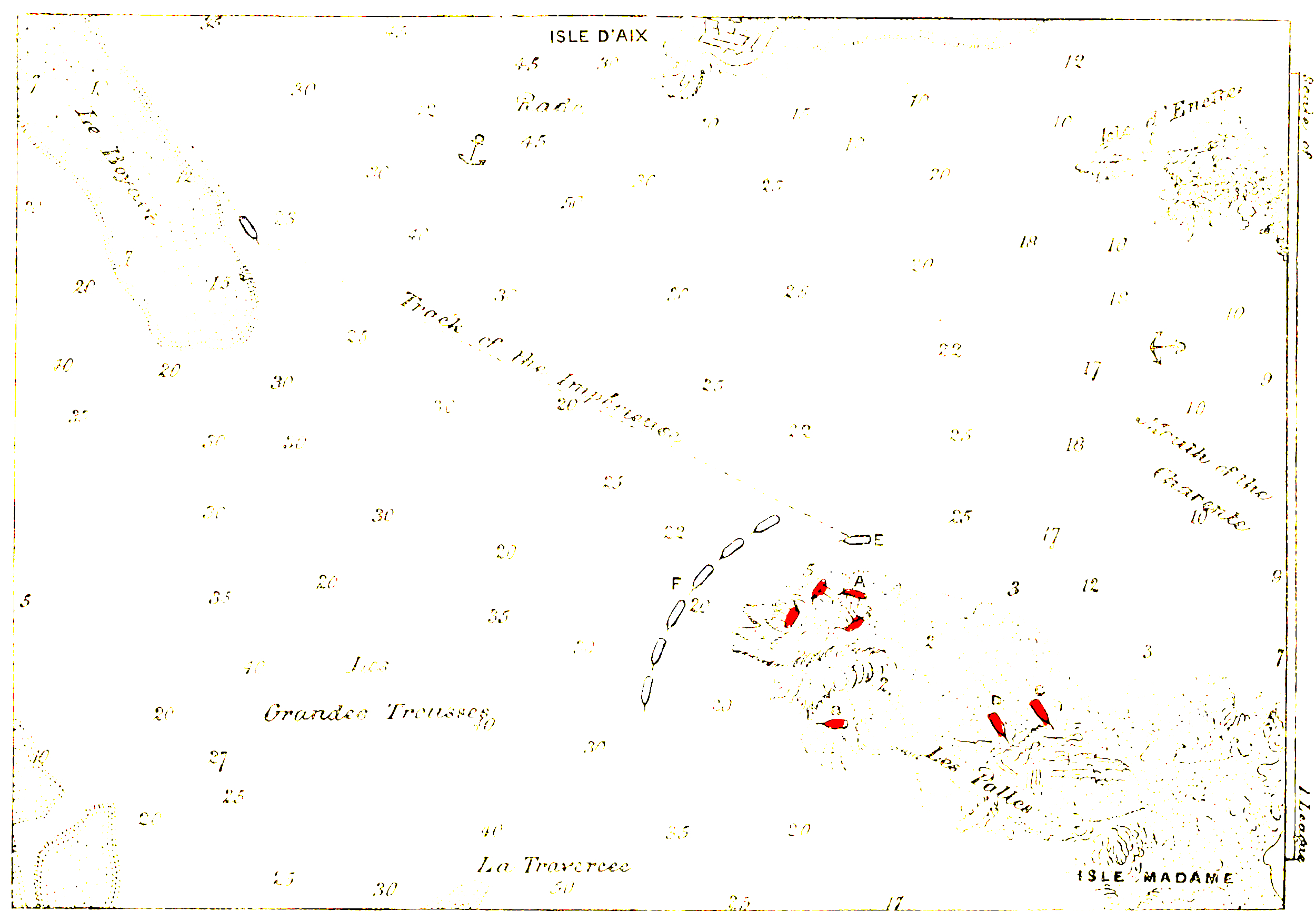
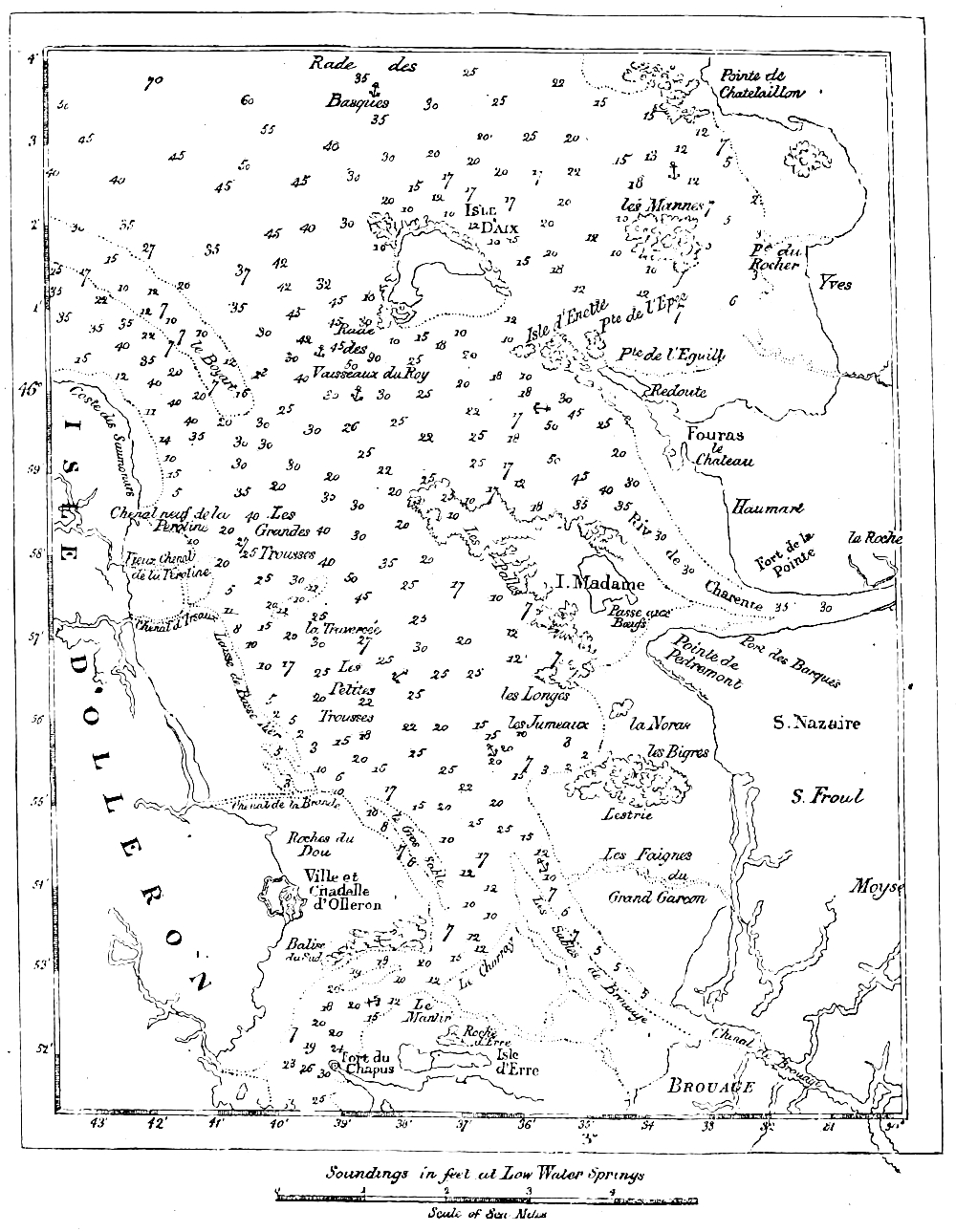
CHART A.
Tracing from the official French Chart of the isles of Ré and d’Olleron. Tendered to the Court-Martial by Lord Cochrane, and rejected.
Soundings in feet at Low Water Springs
London: Richard Bentley: 1860.
15
CHAP. XXV.
A NAVAL STUDY—continued.
FRENCH HYDROGRAPHIC CHARTS.—ONE TENDERED BY ME TO THE COURT.—REJECTED
BY THE PRESIDENT.—GROUNDS FOR ITS REJECTION.—THE
OBJECT OF THE REJECTED CHART.—WOULD HAVE PROVED TOO MUCH, IF
ADMITTED.—REJECTION OF OTHER CHARTS TENDERED BY ME.—MR.
STOKES’S CHART.—ITS FALLACY AT FIRST SIGHT.—JUDGE ADVOCATE’S
REASONS FOR ADOPTING IT.—ITS ERRORS DETECTED BY THE PRESIDENT,
AND EXPOSED HERE.—PROBABLE EXCUSE FOR THE ERROR.—IMAGINARY
SHOAL ON THE CHART.—FALSIFICATION OF WIDTH OF
CHANNEL.—LORD GAMBIER’S VOUCHER FOR STOKES’S CHART.—STOKES’S
VOUCHER FOR ITS WORTHLESSNESS.—STOKES’S CHART IN A NATIONAL
POINT OF VIEW.—TAKEN ADVANTAGE OF BY THE FRENCH.
The charts to which the reader’s attention is invited
are those alluded to in the last chapter, as having,
after the lapse of fifty-one years, been traced for me
by Captain Washington, by the order of his Grace
the Duke of Somerset. The subject being no longer
of personal but of historical interest, there can be no
impropriety in laying before the naval service, for its
judgment, materials so considerately supplied by the
present First Lord of the Admiralty.
is a correct tracing of Aix Roads from the Neptune
François, a set of charts issued by the French Hydrographical
Department—bound in a volume, and supplied
for the use of the French navy previous to
161809[7]; copies from the same source being at that
period supplied under the auspices of the Board of
Admiralty for the use of British ships on the French
coasts—these, in fact, forming the only guides available
at that period.
Chart A shows a clear entrance of two miles, without
shoal or hindrance of any kind, between Ile
d’Aix and the Boyart Sand; the soundings close to
the latter marking thirty-five feet at low water, with
from thirty to forty feet in mid-channel. The chart
shows, moreover, a channel leading to a spacious anchorage
between the Boyart and Palles Sands, marking
clear soundings at low water of from twenty to thirty
feet close to either sand, with thirty feet in mid-channel.
In this anchorage line-of-battle-ships could not only
have floated, without danger of grounding, but could
have effectively operated against the enemy’s fleet, even
in its entire state before the attack, wholly out of range
of the batteries on Ile d’Aix, as will hereafter be corroborated
by the logs and evidence of experienced
officers present in the attack, and therefore practically
acquainted with the soundings. To a naval eye, it will
be apparent that, by gaining this anchorage, it would
not at any time have been difficult for the British
force to have interposed the enemy’s fleet between itself
and the fortifications on Ile d’Aix in such a way as
completely to neutralise the fire of the latter.
Further inspection of the chart will indicate an inner
17anchorage, called Le Grand Trousse, to which any
British vessel disabled by the enemy’s ships—two only
of which, out of thirteen, remained afloat,—might have
retired with safety to an anchorage capable of holding
a fleet—the soundings in Le Grand Trousse marking
from thirty to forty feet at low water. Between these
anchorages it will be seen on the chart that there is
no shoal, nor any other danger whatever.[8]
The rise of tide marked on the chart was from ten
to twelve feet[9], consequently amply sufficient on a rising
tide for the two-deckers and frigates to have been sent
to the attack of the enemy’s ships aground on the
Palles Shoal, as testified by the evidence of Captains
Malcolm and Broughton.[10] The flood-tide making
about 7·0 A.M. gave assurance of abundant depth of
water by 11·0 A.M., which is the time marked in the
Commander-in-chief’s log[11] as that of bringing the British
ships to an anchor! in place of forwarding them to the
attack of ships on shore!
This chart was tendered by me to the Court, in explanation
of my evidence. It was, however, rejected,
18because I could not produce the French hydrographer
to prove its correctness! though copies of a similar
chart, as has been said, were furnished to British ships
for their guidance! Being thus repudiated, my chart
was flung contemptuously under the table, and neither
this nor any other official chart was afterwards allowed
to corroborate the facts subsequently testified by the
various officers present in the action, they being imperatively
ordered to base their observations on the
chart of Mr. Stokes alluded to in the last chapter, as
having been—eight years after the court-martial—pronounced
by the Court of Admiralty so incorrect as
to require material alteration before it could be put in
evidence in a court of law! To this point we shall
presently come.
A singular circumstance connected with the rejected
chart should rather have secured its reception, viz. that
it was taken by my own hands out of the Ville de
Varsovie French line-of-battle ship shortly before she
was set fire to, and therefore its authenticity, as having
been officially supplied by the French government for
the use of that ship, was beyond doubt or question.
I also produced two similar charts, on which were
marked the places of the enemy’s ships aground at
daylight on the 12th of April, as observed from
the Impérieuse, the only vessel then in proximity.
The positions of the grounded vessels are marked on
Chart B.
The manner of the rejection by the Court—at the
suggestion of the Judge-Advocate—of the chart tendered
by me, is worthy of note.
President.—“I think your lordship said just now, that you
19thought there was water enough for ships of any draught
of water?”
Lord Cochrane.—“Yes.”
President.—“Have you an authenticated chart, or any
evidence that can be produced to show that there is actually
such a depth of water?”
Lord Cochrane (putting in the charts).—“It was actually
from the soundings we had going in, provided the tide does
not fall more than twelve feet, which I am not aware of. I
studied the chart of Basque Roads for some days before. The
rise of the tide, as I understand from that, is from ten to
twelve feet. It is so mentioned in the French chart. I have
no other means of judging.”[12]
Judge-Advocate.—“This chart is not evidence before
the Court, because his lordship cannot prove its correctness!!”
President.—“No! It is nothing more than to show upon
what grounds his lordship forms his opinion on the rise
and fall of the tide!!”[13]
It was not put in for any purpose of the kind—for
I had expressly said that I had no opinion as to the
rise and fall of the tide, except as marked on the
French official charts. The object of my putting in
those charts was to show the truth of the whole matter
before the Court. The president, however, flung the
chart under the table with as much eagerness as the
Judge-Advocate had evinced when objecting to its reception
in evidence.[14]
The object of the chart was in fact to prove, as indeed
was subsequently proved by the testimony of eminent officers,
and would have been proved even by the ships’ logs
had they been consulted, that there was plenty of channel
room to keep clear of the batteries on Ile d’Aix, together
with abundant depth of water[15]; and that the commander-in-chief,
in ordering all the ships to come to an
anchor, in place of sending a portion[16] of the British
21ships to the attack of the enemy’s vessels aground
on the north-west part of the Palles Shoal, on the
morning of the 12th of April, had displayed a “mollesse”—as
it was happily termed by Admiral Gravière—unbecoming
the Commander-in-chief of a British force,
superior in numbers, and having nothing to fear from
about a dozen guns on the fortifications of Aix; which,
had the ships been sent in along the edge of the
Boyart, could have inflicted no material damage, either
by shot or shell.[17]
These were precisely the points which the ministry
did not want proved, and which—as will presently be
seen—the Court was no less anxious to avoid proving.
Had the French chart been received in evidence, as
it ought to have been—I do not say mine, but
those on board the flagship itself, or indeed any copy
supplied by the Admiralty to the fleet—a vote of thanks
to Lord Gambier would have been impossible, and with
the impossibility would have vanished the Government
prestige of a great victory gained by their commander-in-chief,
under their auspices.[18]
The French official chart being thus adroitly got rid
of by the Judge-Advocate, the other charts tendered
by me to mark the positions of the enemy’s ships
22aground shared the like fate, though not open to the
same objection. The exactness of the positions was
moreover confirmed by the evidence of Mr. Stokes,
the master of the Caledonia, Lord Gambier’s flagship;
though his chart, substituted for those in use amongst
the British ships, was in direct contradiction to his
oral evidence.
The positions, of the ships aground as marked on my
charts, were as follows.
The Ocean, three-decker, bearing the flag of Admiral
Allemand, and forming a group with three other line-of-battle
ships close to her, lay aground on the north-west
edge of the Palles Shoal, nearest the deep water, where
even a gun-boat, had it been sent whilst they lay on their
bilge, could have so perforated their bottoms, that they
could not have floated with the rising tide. All were
immoveably aground, and were therefore incapable of
opposition to an attacking force[19]; whilst each of the
23group of three lay so much inclined towards each other
as to present the appearance of having their yards
locked together.[20] They had, in fact, drifted with the
same current, into the same spot, and being nearly of
the same draught of water, had grounded close to each
other. The one separate was a vessel of less draught
than these, and had gone a little further on the shoal.
The correctness of these positions, as marked on my
chart, was completely confirmed by Mr. Stokes, master
of the flag-ship, in his oral evidence as subjoined.
Question.—“State the situation of the enemy’s fleet on
the morning of the 12th of April.”
Mr. Stokes.—“At daylight I observed the whole of the
enemy’s ships, except two of the line, on shore. Four of them
lay in group, or lay together on the western part of the
Palles Shoal. The three-decker (L’Océan, flagship) was on
the north-west edge of the Palles Shoal, with her broadside
flanking the passage; the north-west point nearest the deep
water.”[20]—(Minutes, page 147.)
This was the truth as to the positions of the grounded
ships which escaped; these being referred to in Mr.
Stokes’s evidence precisely as marked on my rejected
chart. That is, his evidence showed, in corroboration
of my chart, the utter helplessness of an enemy which
a British admiral refrained from attacking, though
aground!
24The French charts produced by me being thus rejected,
those in the possession of the Commander-in-chief
not produced, and those connected with the fleet not
being called for, the court decided to rely upon two
charts professedly constructed for the occasion by the
master of the Caledonia, Mr. Stokes, and the master of
the fleet, Mr. Fairfax, neither of whom was present in
the attack.[21]
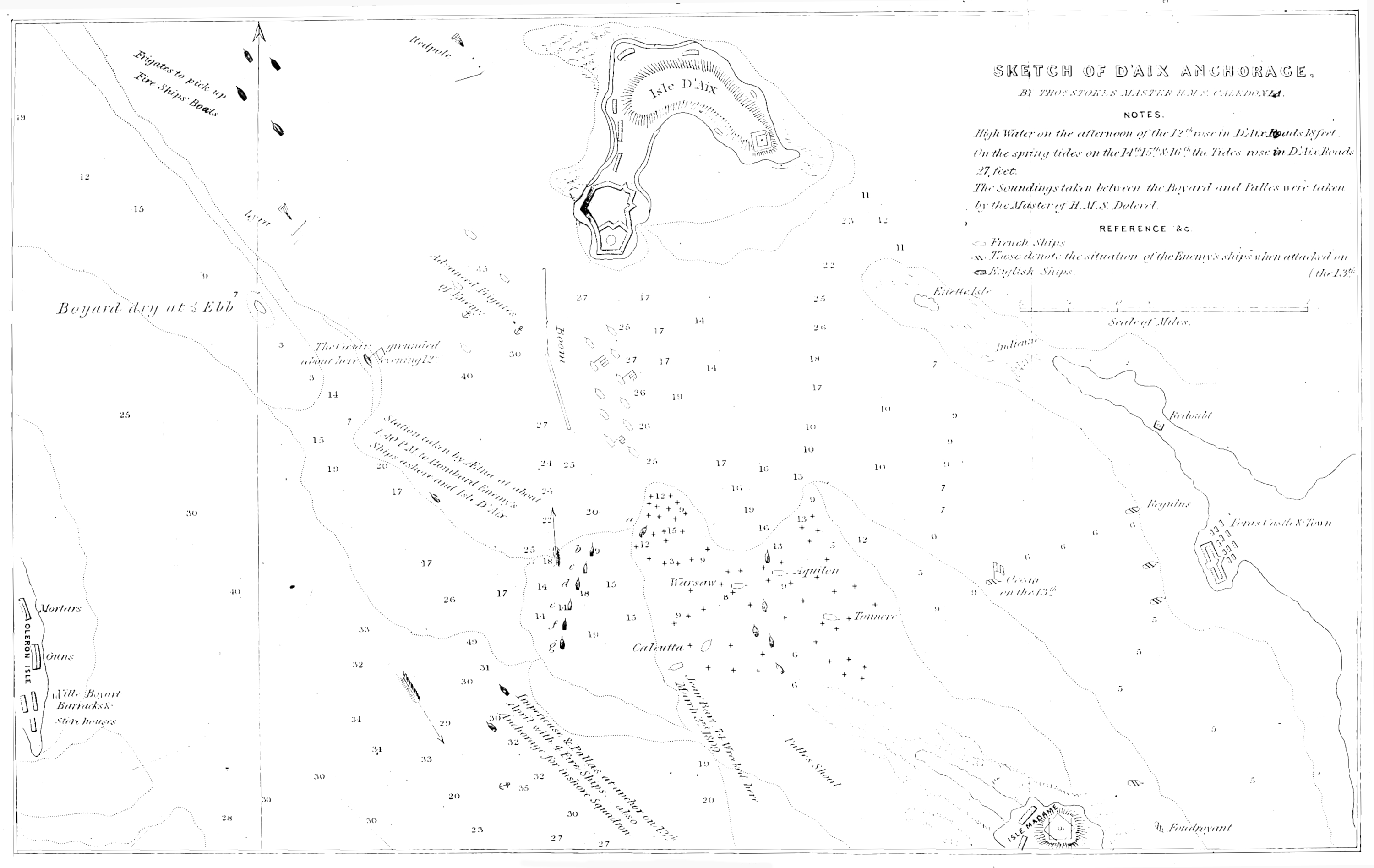
was tendered to the Court by Mr. Stokes, the master
of Lord Gambier’s flag-ship Caledonia.
CHART C.
Constructed by Mr Stokes for the purposes of the Court Martial, and exclusively adopted, though it narrows the channel to Aix Roads to one mile only, the official French Charts marking two miles.
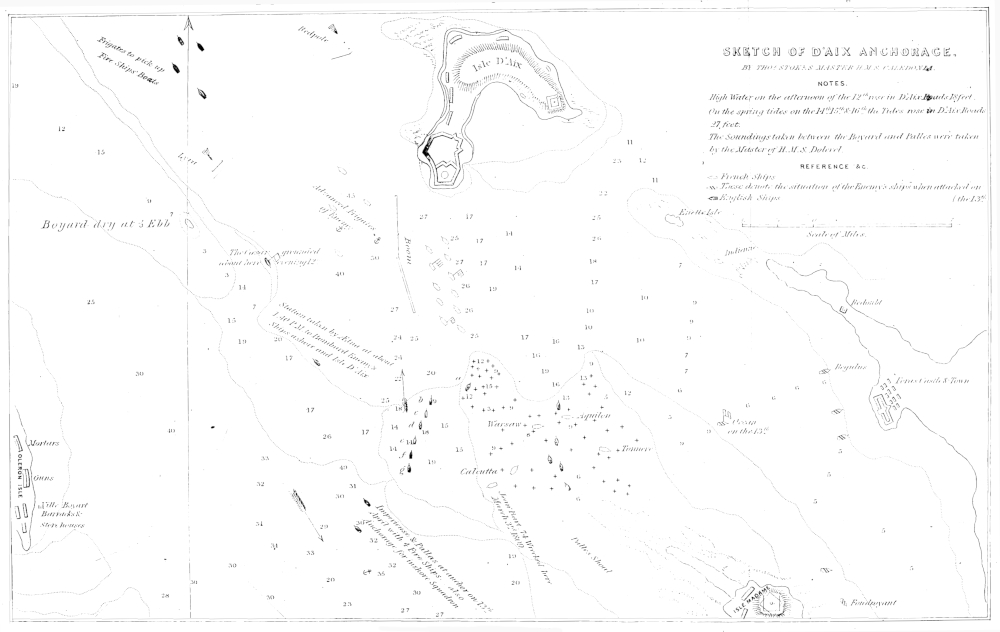
SKETCH OF D’AIX ANCHORAGE.
London: Richard Bentley, 1860.
This chart professed to show, and was sworn to by
Mr. Stokes as showing, the positions of the enemy’s
ships aground on the morning of the 12th of April, before
the Ocean three-decker, together with a group of
three outermost ships near her, had been permitted by
the delay of the Commander-in-chief to warp off and
escape. Instead, however, of placing these on his chart
as they lay helplessly aground “nearest the deep water”
as he had sworn in his evidence, they were placed in
25on the other side of the sand, in the positions occupied
after their escape! and to this Mr. Stokes swore as their
position when first driven ashore! The Ocean three-decker,
and group in particular, which, according to Mr.
Stokes’s oral evidence, must, as already stated, have
been an easy prey to a gunboat had such been sent
on the first quarter instead of the last quarter flood,
was thus placed on his chart where no vessel could
have approached them![22]
This falsehood on Mr. Stokes’s chart, in opposition
to his oral evidence just given, as well as to the evidence
of other officers, formed one of the principal
grounds of Lord Gambier’s acquittal; and it was for
this end that the official French charts presented by me
for the information of the court were rejected by the
judge-advocate.
On the presentation of Mr. Stokes’s chart to the
court, the subjoined colloquy took place as to the methods
adopted in its construction.
Mr. Bicknell.—“Produce a chart or drawing of the
anchorage at Isle d’Aix, with the relative positions of the
26British and French fleets, and other particulars, on and
previous to the 12th of April last.”
Mr. Bicknell.—“Did you prepare this drawing, and from
what documents, authorities, and observations; and are the
several matters delineated therein accurately delineated, to the
best of your knowledge and belief?”
Mr. Stokes.—“I prepared that drawing (Chart C),
partly from the knowledge I gained in sounding to the southward
of the Palles Shoal, and the anchorage of the Isle of
Aix.[23] The outlines of the chart are taken from the Neptune
François, and the position of the enemy’s fleet from Mr.
Edward Fairfax, and from the French captain of the Ville de
Varsovie, and the British fleet from my own observation.”
The distance between the sands was copied from a French
MS. which will be produced, and that I take it is correct.
Mr. Bicknell.—“Are the matters and things therein accurately
described?”
Mr. Stokes.—“They are.”
President (inspecting Mr. Stokes’s chart).—“There was
a large chart you lent me?”
27Mr. Stokes.—“That is the chart I allude to. This chart
I produce as containing the various positions.”
Judge-Advocate (to the President).—“This Chart is
produced to save a great deal of trouble!!” (Minutes,
pp. 23, 24.)
No doubt—the trouble of confirming the Commander-in-chief’s
neglect of duty in not following up a
manifest advantage, as would have been shown had
the court allowed the Neptune François itself to have
been put, in evidence; for it would have shown a
clear passage of two miles wide, extending beyond
reach of shot, instead of the one mile passage in Mr.
Stokes’s “accurate outlines” of the French chart, and
no shoal where he had marked only twelve feet of
water![24] That the president should have allowed this
to pass, after having himself detected the imposition
practised on the court, is a point upon which I will
not comment.
Mr. Stokes further admitted his chart to be valueless,
as regarded the position of the enemy’s fleet ashore, for
he said that position was taken “from Mr. Edward
Fairfax and the captain of the Ville de Varsovie”, and
the British fleet from “his own observations.” That
is, he confessed to know nothing but from hearsay as to
the position of the enemy’s fleet, the important object
before the court; but only of the position of the British
fleet, lying at anchor nine miles from the enemy’s fleet
ashore, a matter with which the court had nothing to do;
he being all the time on board the flagship, at that
distance. Yet the court insisted on this chart being exclusively
28referred to throughout the court-martial![25] It
is strange that such a chart should have been used at
all, when the charts of the fleet were available, but
more strange that, when the court saw the two miles
passage in the French chart was reduced to little more
than one mile in Mr. Stokes’s chart, he was not even
asked the reason why he had not conformed to the scale
of the French chart, to the correctness of the outlines of
which he had sworn!
But the most glaring contradiction of Mr. Stokes’s
chart is this: he swore to his chart as truly depicting the
positions of the Ocean and other grounded ships, as they
lay on the morning of the 12th of April, which was the
point before the Court; but being further questioned,
reluctantly admitted that he had marked the Ocean
29as she lay on the 13th of April, viz. on the following
day when an attack was made on her by the bomb
vessel! though he had just sworn to the positions of
the ships on the chart as being those on the morning of
the 12th, immediately after having run ashore to escape
destruction.
The fact was, as will be seen on inspection of the
chart, that not one of the ships under the cognizance of
the court is marked on Stokes’s chart as they lay on the
morning of the 12th, which position, and not that on
the 13th, was the subject of inquiry. Though as already
said this misrepresentation was detected by the President,
the court nevertheless persisted in the exclusive
use of Mr. Stokes’s chart throughout the trial, in accordance
with the suggestion of the Judge-Advocate,
that it was produced to “save a great deal of trouble.”
The President thus commented on the manifest contradiction.
President.—“I observe in the chart I had from you the
situation of the Ocean particularly is not marked on the
12th. She is marked on the 13th as advanced up the
Charente!”
Mr. Stokes.—“The only ships marked on the chart on
the 12th are those that were destroyed. The reason I marked
her on the 13th is, that a particular attack was made on her
by the bombs. I observed her from the mizentop of the
Caledonia[26], and I also had an observation from an officer,
so that I have no doubt her position is put down within a
cable’s length.” (Minutes p. 147.)
There is something in this evidence almost too repugnant
30for observation. Mr. Stokes first swore that
his chart accurately described the positions of the
enemy’s ships ashore on the morning of the 12th. He
then admitted that the most material ship of the enemy’s
fleet was marked as she lay on the 13th!! On this mis-statement
being detected by the president, he then
swore that the only ships marked on the 12th were those
which were destroyed, viz. on the evening and night of
the 12th!—a matter foreign to the subject of inquiry;
which was how the ships lay on the morning of the 12th,
and whether Lord Gambier was to blame for refraining
from attacking them at that particular time? So that
the positions of the enemy’s ships aground on the
morning of the 12th, according to Mr. Stokes’s own
admission, were not marked on his chart at all! though
he had sworn to this very chart as giving those positions
accurately to the best of his knowledge and belief; and
with the full knowledge that their position on the
morning of the 12th, when they were helplessly aground,
was the point before the court,—not their position
in the evening, and on the following day after their
escape to a spot where the British ships could not have
pursued them.
The fact is, Mr. Stokes swore to their positions after
their being warped off in consequence of the British fleet
being prematurely brought to an anchor—as being their
positions previous to their escape! which was the
matter of inquiry before the court, viz. as to whether
the Commander-in-chief had not committed a neglect
of duty in permitting them to escape by the
rising tide, when and before when the British force
could have operated with every advantage in its favour.
31The court had nothing whatever to inquire about
with regard to the ships which were destroyed, respecting
which there could be no question; the subject
of inquiry being whether the escape of the other
ships run ashore from terror of the explosion vessels on
the night of the 11th, and still ashore on the morning
of the 12th, ought to have been prevented.
Not so much as one of the ships marked on Mr.
Stokes’s chart formed part of the “group” to which
he had sworn, in his oral evidence, as lying on the
“western and northernmost edge of the Palles Shoal,
nearest the deep waterwater, all of which escaped towards
the Charente, where he truly enough placed the Ocean
three-decker, but as she lay on the 13th instead of
the 12th, he having sworn to the truth of his chart
as showing her position on the morning of the 12th!
It was a desperate venture, and can only be accounted
for by the supposition that, in reality, Mr. Stokes had
never seen the chart to which he was swearing. It
was no wonder, as proved in the first chapter, that
Mr. Stokes applied to the Admiralty for permission to
alter his chart before producing it in a court of law,
where it must have fallen under my inspection!
I will indeed so far exonerate Mr. Stokes from a
portion of blame, by declaring my belief that he never
had looked at the chart to which he had sworn. There
is little question in my mind but that this chart had
been fabricated under the auspices of Mr. Lavie, Lord
Gambier’s solicitor, the only hope of success consisting
in affirming a false position for the grounded ships;
the chart being then given to Stokes for paternity.
Had it been otherwise, Stokes could not possibly have
32sworn to a chart in diametrical opposition to his oral
evidence, which truly stated that on the morning of
the 12th, the Ocean and group lay on “the north-west
edge of the Palles shoal, nearest the deep water,” where
they were easily attackable. On his chart they were
placed on the opposite side of the shoal! where no ship
could have got near them.
Lord Gambier no doubt saw the mistake committed
by the evidence of his Master, and adroitly relieved
him from the dilemma, by putting a question of a
totally different nature. With this course the court
complacently complied, notwithstanding that the president
had detected a discrepancy so glaring.
Another material point on Mr. Stokes’s chart was his
marking a shoal between the Boyart and the Palles
Sands, where Capt. Broughton and others present in the
action, who actually sounded there, testify in corroboration
of the French chart to there being no shoal whatever.[27]
Yet Mr. Stokes marks only from twelve to
sixteen feet, in the deepest part. That this statement
was a misrepresentation on the part of Mr. Stokes, is
proved by Lord Gambier himself, who, in his defence,
says that “Mr. Stokes found on this bar or bank from
fourteen to nineteen feet”feet” (Minutes, p. 134). When closely
questioned on the point, Mr. Stokes deposed to these
soundings as “having been reported to him to have been
found”! (Minutes, p. 150.) The Neptune François
gives from twenty to thirty feet at low water, which
was no doubt correct.
But even had there been only nineteen feet of water
Mr. Stokes again forgot his chart when he gave oral
33evidence that “the rise of tide in Aix Roads is twenty-one
feet, which is more than we ever found in Basque Roads”
(Minutes, p. 150). I had put the rise of tide at
twelve feet only, so that by the oral evidence of Mr.
Stokes there was abundance of water for the British
force to have operated with full effect.
A still further falsification of the chart was, that it
reduced the channel by which the British fleet must
have passed to the attack to little more than a mile in
width, in defiance of the fact that on all the official
French charts the minimum distance between the
Boyart Sand and the fortifications on Ile d’Aix was
nearly two miles, and that Admiral Stopford, the
second admiral in command, confirmed the correctness
of the French charts so far as to admit a width of a
mile and a half. The object of Mr. Stokes’s statement
was to prove the danger to which, in a channel only a
mile wide, the British ships would have been exposed
from the batteries on Ile d’Aix had they been
sent to the attack. To this end was the chart no doubt
produced, and as narrowing the channel to a mile only—to
meet the occasion—gave a colour to this view,
his chart was accepted by the court, whilst the French
charts which marked two miles, were rejected.
A yet more flagrant contradiction is—that within
pistol shot of the western and north-western edge of the
Palles Shoal, where Mr. Stokes first truly swore “the
Ocean three-decker and a group of four lay aground on
the morning of the 12th,” he has placed the attacking
British ships, where their logs show that they never
touched the ground, notwithstanding that they took up
34their positions on a falling tide. If they could float
in safety much more could other ships have done so at
11 a.ma.m on a rising tide? How such a manifest discrepancy
could have passed without comment from
any member of the court-martial, is a point which is
not in my power to explain.
Such are some of the leading features of this famous
chart, upon which the acquittal of Lord Gambier was
made to rest, though the chart was admittedly constructed—not
from personal observation, otherwise than
from the mizentop of the Caledonia, nine miles off—but
from unofficial sources—from an anonymous manuscript,
and even from hearsay!
Yet Lord Gambier did not scruple to introduce this
chart for the guidance of the court, in the following
terms:
“I have to call the attention of the Court to the plan
drawn by Lord Cochrane of the position of the enemy’s ships
as they lay aground on the morning of the 12th of April,
and to that position marked upon the chart verified by Mr.
Stokes; the former laid down from uncertain data, the latter
from angles measured and other observations made on the
spot[28]; the difference between the two is too apparent to
escape the notice of the Court, and the respective merits of
these charts will not, I think, admit of a comparison.”
(Minutes, p. 133.)
This statement was made by Lord Gambier in face
of the admission previously made by Mr. Stokes,
that his observations were taken from the mizentop of
the Caledonia, three leagues off—that he had never
35sounded in Aix Roads—that the soundings were only
reported to him, the name of the reporter being
omitted—and that he had only marked upon his
chart, “the ships that were destroyed” on the evening
and during the night of the 12th, the destruction, in
fact, not being complete till the morning of the 13th.
This contradiction is so important to a right comprehension
of what follows, that I will, at the risk of
prolixity, bring into one focus Mr. Stokes’s admissions
as to his data for the construction of his chart.
“I prepared that drawing partly from the knowledge I
gained in sounding to the southward of the Palles Shoal.
The outlines of the chart are taken from the Neptune François
(narrowed from two miles to one!). The positions of
the enemy’s fleet are from Mr. Fairfax and the captain of the
Ville de Varsovie. For the distance between the sands I
must refer the court to a chart which I copied from a French
manuscript!” (Minutes, pp. 23, 24.)
For this confused jumble from unauthoritative
sources, the French charts were rejected as not being
trustworthy, and Lord Gambier did not hesitate to
endorse Mr. Stokes’s fabrication as being “from angles
measured and other observations taken on the spot;”
whilst by this act he decried the use of the French
charts by which his own fleet had been guided!
Comment, whether on Lord Gambier’s statement or
on Mr. Stokes’s involuntary contradiction thereof in
his oral evidence, is superfluous. If such were
wanted, it must be sought for in the fact already
adduced in the first chapter, viz. that, in 1817 and
1818, Mr. Stokes, when conscious that his fabrication
must become public, and that it might fall into my
36hands, thought it prudent to make affidavit before the
Court of Admiralty that this chart, produced at the
court-martial nine years before, was incorrect, and
therefore required alteration!! for which purpose the
Admiralty gave him back his chart, though this,
as already observed, remains to this day bound up
amongst the Admiralty records. The affidavits of Mr.
Stokes will be in the remembrance of the reader.
In a national point of view, Mr. Stokes’s chart has
another and even more important feature. A comparison
between the French chart and that produced by
Mr. Stokes will show that the latter narrowed the
entrance to Aix Roads—which on the French charts
is two miles wide—to one mile, and that it filled a
space with shoals where scarcely a shoal existed. Of
the imaginativeness of Mr. Stokes in this respect, the
French Government appears to have taken a very justifiable
naval advantage, calculated to deter any British
admiral in future from undertaking in Aix Roads
offensive operations of any kind.
A chart of the Aix Roads based on a modern French
chart has recently been shown me, as on the point of
being issued by the Board of Admiralty, on which
chart the main channel between Ile d’Aix and the
Boyart sand is laid down according to charts copied
from fabricated charts produced on Lord Gambier’s
court-martial, and not according to the hydrographic
charts of the Neptune François. The comparatively
clear anchorage shown in the new chart is also filled
with Mr. Stokes’s imaginary shoals! the result being
that no British admiral, if guided by the new chart,
37would trust his ships in Aix Roads at all, though both
under Admiral Knowles and at the attack in 1809
British ships found no difficulty whatever from want
of water, or other causes, when once ordered in.
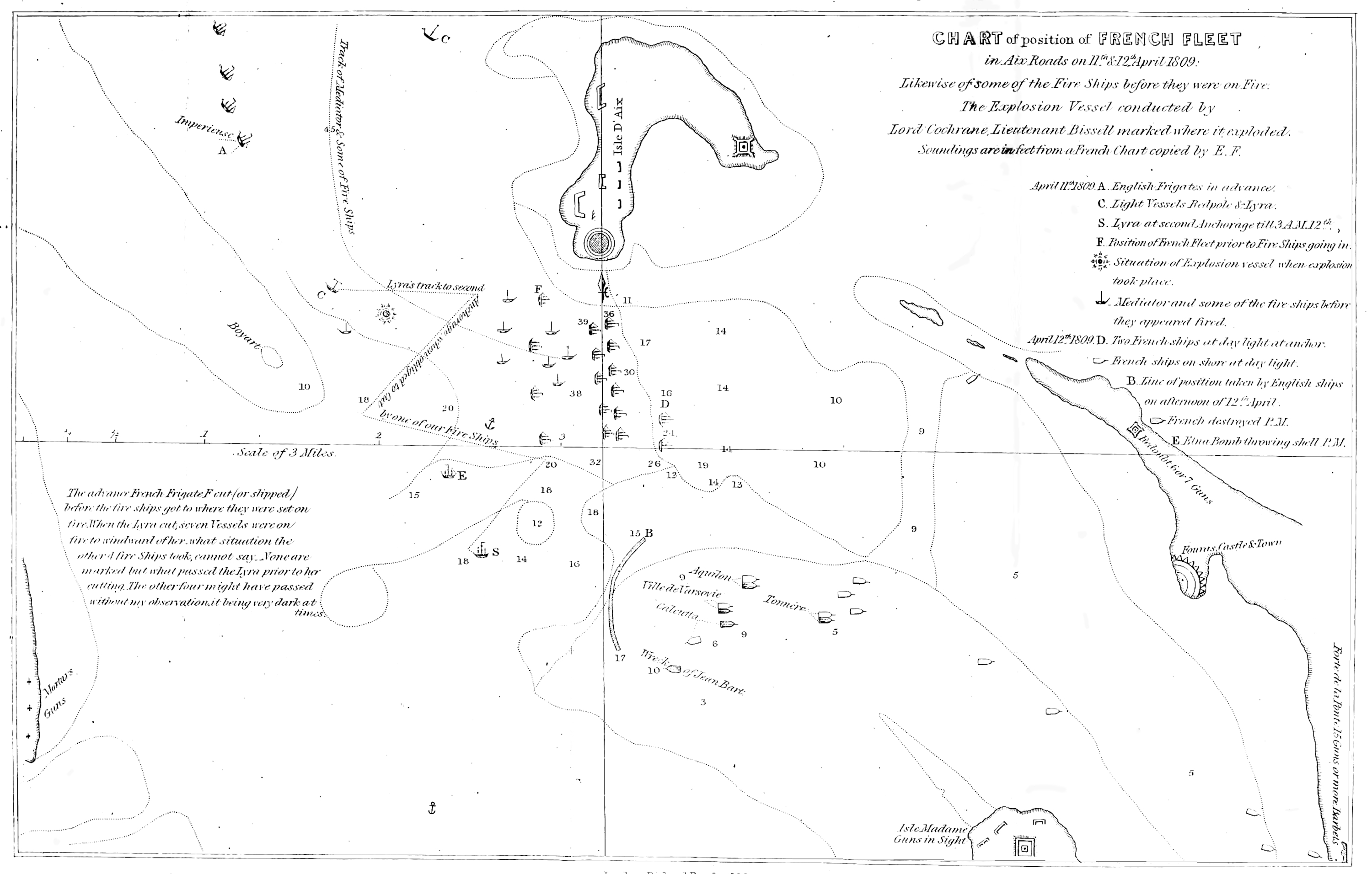
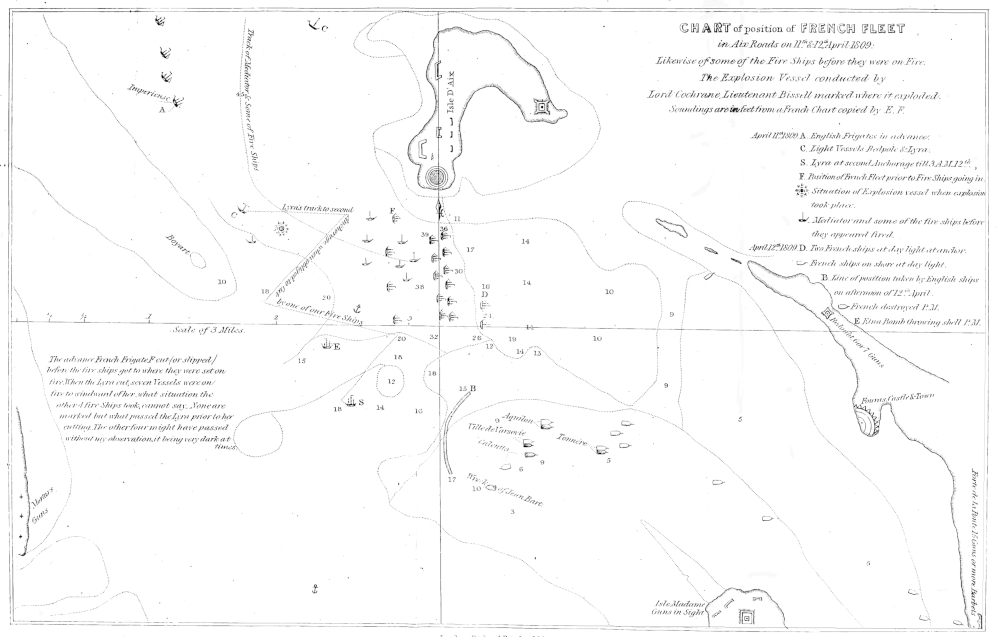
CHART D.
Constructed by Mr Fairfax and produced for the guidance of the Court Martial. Like Stokes’s Chart, it narrows the channel to Aix Roads from two miles to one mile though also like him professing to be an exact outline of the French Official Chart.]
London Richard Bentley, 1860
The solution of the matter is not difficult. For
the purpose of deterring a future British fleet from
entering Aix Roads, the modern French Government
appears to have followed the chart of Mr. Stokes in
place of their former official chart; and the British
Admiralty, having no opportunity of surveying the
anchorage in question, has copied this modern French
chart; so that in future the fabrications of Mr. Stokes
or rather I should say, the ingenuity of Lord Gambier’s
solicitor, or whoever may have palmed the chart on
Mr. Stokes, will form the best possible security to one
of the most exposed anchorages on the Atlantic coast
of France. Assuredly no British Admiral, with the
new chart in his hands,—should such be issued—would
for a moment think of operating in such an anchorage
as is there laid down, notwithstanding that former
British fleets have operated in perfect safety so far as
soundings were concerned.
was constructed by Mr. Fairfax, the Master of the
Fleet, and was used by the Court as confirmatory
of Mr. Stokes’s chart, agreeing with it, in fact, on
nearly every point; a circumstance not at all extraordinary,
as in his examination Mr. Stokes first
says that “his marks arose from the knowledge he
gained in sounding in the anchorage of Aix” (Minutes,
38p. 23), whilst Mr. Fairfax swore that he “gave Mr.
Stokes the marks.”!![29] A fact subsequently proved by
Mr. Stokes, who admitted that he had “never sounded
there at all.all.” The credibility of either witness may
be left to the reader’s judgment.
In one respect, the chart of Mr. Fairfax might have
been considered by those interested to be an improvement
on that of Mr. Stokes. The latter gentleman had
narrowed the two mile channel of the French charts to
a little more than a mile, but the chart of Mr. Fairfax
reduces it to a mile only!
Mr. Fairfax’s chart was introduced to the Court
with the same flourish as had been that of Mr. Stokes.
Mr. Fairfax.—“This chart shows the state of the enemy’s
ships at daylight on the 12th of April. This chart is correct,
except that the head of the Calcutta is placed by the engraver
too far to the southward. It should have been about
N.W. by compass, and the head of the three decker Ocean
is to the eastward, but not sufficiently far to the northward
by compass.”
Not much correctness here, but abundance of misrepresentation.
Mr. Fairfax is very particular about
the positions of the heads of the grounded ships, but,
like Mr. Stokes, not at all particular to a league or
two as to where they lay aground. For instance, he
is very sensitive about the position of the Ocean’s head,
yet the Ocean herself is not to be found on his chart!!
39though the names of other enemy’s ships aground, not
far from where she had lain before her escape, are
given, to mark the care with which the chart had
been constructed!
I will not in this place make any further observations
upon Mr. Fairfax’s chart, this being identical with
that of Mr. Stokes. The exposure of the one in the
next chapter will serve for the confutation of the other.
The reader will, from what has been stated, be able
to form a pretty correct idea as to why—in, and
subsequently to 1809—inspection of these charts was
refused to me. At that period it was in vain that
I published explanations, which, without access to
the charts, were incomprehensible to the public; my
unsupported declarations, as has been said, falling to the
ground unheeded, even if they were not the cause of
attributing to me malicious motives towards the commander-in-chief,
after his acquittal by sentence of a
court-martial. But for the consideration of his Grace
the Duke of Somerset a stigma must have followed me
to the grave. It is now otherwise, and I am content to
leave the matter to the judgment of posterity. I must,
however, remark, that neither the charts of Mr. Stokes
or Mr. Fairfax were shown to me on the court-martial,
though shown to nearly every other witness, one—Capt.
Beresford—being told that he “must” base his
observations on those charts. Had they been shown to
me, I should in an instant have detected their fallacy.
40
CHAP. XXVI.
A NAVAL STUDY—(continued).
THE EVIDENCE OF OFFICERS PRESENT IN BASQUE ROADS.—ADMIRAL
AUSTEN’S OPINIONS CONFIRMATORY OF MY STATEMENTS—FALLACY OF
ALLEGED REWARDS TO MYSELF, IN PLACE OF THESE PERSECUTIONS.—TREATMENT
OF MY ELDEST SON LORD COCHRANE.—LETTER FROM CAPT.
HUTCHINSON COMFIRMATORY OF THE ENEMY’S PANIC.—A MIDSHIPMAN
NEAR TAKING THE FLAG-SHIP.—EVIDENCE OF CAPT. SEYMOUR, CONCLUSIVE
AS TO NEGLECT, WHICH WAS THE MATTER TO BE INQUIRED
INTO, IN NOT SENDING SHIPS TO ATTACK.—ATTEMPT TO WEATHER
HIS EVIDENCE.—CAPT. MALCOLM’S EVIDENCE CONFIRMATORY OF CAPT.
SEYMOUR’S.—CAPT. BROUGHTON’S TESTIMONY PROVES THE COMPLETE
PANIC OF THE ENEMY, AND THE WORTHLESSNESS OF THEIR FORTIFICATIONS.—LORD
GAMBIER DECLARES THEM EFFICIENT ON SUPPOSITION
ARISING FROM HEARSAY.—ENEMY UNABLE TO FIGHT THEIR GUNS.—THE
IMAGINARY SHOAL.—A GREAT POINT MADE OF IT.—MR. FAIRFAX’S
MAP—LORD GAMBIER ON THE EXPLOSION VESSELS.—CONTRADICTED
BY MR. FAIRFAX.—CONTRAST OF THEIR RESPECTIVE STATEMENTS.—FAIRFAX’S
EVASIONS.—HIS LETTER TO THE “NAVAL
CHRONICLE.”—THESE MATTERS A WARNING TO THE SERVICE.
The matters related in the preceding chapter will
appear yet more extraordinary when contrasted with,
and confirmed by, the evidence of eminent officers
present in the action of Aix Roads; that is, of such
officers commanding ships as were permitted to give
their testimony, for those who were suspected of
not approving the Commander-in-chief’s conduct, were
not summoned to give evidence before the court-martial!
In one instance—that of Captain Maitland, of the
Bellerophon, whose opinions on the subject had been
freely expressed—this gallant officer was ordered to
41join the squadron in Ireland, so as to render his testimony
unavailable.
To a gallant officer still living, Admiral Sir Francis
William Austen, K.C.B., who was present in Basque
Roads, but, like other eminent officers, not examined
on the court-martial, I am indebted for a recently-expressed
opinion as to the causes why the majority
of the enemy’s ships were suffered to escape beyond
reach of attack, as well as of the persecution which
I afterwards underwent, in consequence of my conscientious
opposition to a vote of thanks to the Commander-in-chief.
The following is an extract from the gallant Admiral’s
letter:—
“I have lately been reading your book, the ‘Autobiography
of a Seaman,’ and cannot resist the desire I feel of stating
how much pleasure I derived from its perusal, especially of
that part which has reference to the movements of the fleet
in the Mediterranean from 1798 to 1800. Having been
serving for the greater part of those years on that station,
your narrative excited in my mind a vivid recollection of
former times—as it were living that part of my life over
again.
“With reference to the latter part of the volume which
details the proceedings in the attack on the enemy’s squadron
in the Charente, I wish to say as little as possible which may
inculpate the conduct of the Commander-in-chief, to whom,
as you probably know, I owe a debt of gratitude for his kindness
to me.
“But at the same time I cannot but admit that he appears
to me to have acted injudiciously. It would have been far
better had he moved the squadron to a position just out of
reach of the batteries on Isle d’Aix, when he would have
been able to see the position of the enemy’s ships, and thus
have decided for himself whether they could have been attacked
42without needless risk, and not have been compelled to
form his determination entirely on the report of others.[30]
“Had he done so, it seems probable that he would have
seen things in a different point of view, and decided to send
in a force sufficient to have captured or destroyed the whole.
“I must, in conscience, declare that I do not think you
were properly supported, and that had you been so the result
would have been very different. Much of what occurred I
attribute to Lord Gambier’s being influenced by persons
about him who would have been ready to sacrifice the honour
of their country to the gratification of personal dislike to
yourself, and the annoyance they felt at a junior officer being
employed in the service.[31]
“I will only add that I consider your services in the Speedy,
Pallas, and Impérieuse will entitle you to the warmest thanks
of your country, as well as to the highest honours which have
been awarded for similar services. Instead of which, you
have in numerous instances been persecuted in the most cruel
and unrelenting manner.
“I desire to subscribe myself, with much respect and esteem,
“My dear Lord Dundonald,
“Yours very faithfully,
“Francis W. Austen.
“Admiral the Earl of Dundonald.”
If anything could alleviate the remembrance of the
bitter persecutions originating with this one-sided court-martial,
it is an unsolicited expression of opinion like
that of the gallant Admiral Austen, whose name, for
evident reasons, was not included in the list of those
summoned to give testimony on that remarkable occasion.
43That other gallant officers still living entertain
similar sentiments, I make no doubt, for the simple
reasons that, as honourable men, it is impossible for
them to entertain other opinions. What would have
been the result of the court-martial had such testimony
as that of Admiral Austen been permitted, may safely
be left to public decision.
The gallant Admiral and the naval public at large
will perhaps be surprised to learn that my persecutions
have not ceased at this day. Despite my restoration to
rank and honours, my banner has never been restored
to its place in Henry the Seventh’s Chapel, the unjust
fine inflicted on me in 1814 has never been remitted,
nor other rights withheld during my forced expulsion
from the Navy conceded; the excuse being want of
precedent, though with that of the gallant Sir Robert
Wilson fresh in the archives of the nation.[32]
A few words may here be devoted to a point intimately
connected with this subject. In several reviews
on the first volume of this work, the public has been
told of the handsome rewards which have been bestowed
for my services. The reader will perhaps be scarcely
prepared to learn, in answer to such statements, that
with the exception of the ordinary good service pension
granted for general service in 1844, thirty-five years
after the action in Aix Roads, I never in my life received
a recompense from my country in any shape, the Order of
the Bath alone excepted. For my services in the Pallas,
44that of destroying three heavily-armed French corvettes
at the embouchure of the Garonne, and cutting out the
Tapageuse—all performed in one day—not a shilling
was awarded to myself, officers, and crew, though in
the late war with Russia I have been told that the
destruction of a Russian gunboat was scrupulously
paid for. For my services on the coast of Catalonia
in the Impérieuse, to which Lord Collingwood testified
that, single-handed, I had stopped the advance of
a French army, not a farthing was conceded, whilst
the thanks of Lord Collingwood were the only expressions
of the kind ever awarded for what English
historians have eulogised even more highly than did
his Lordship.
For the partial destruction of the enemy’s fleet in
Aix Roads not a farthing was given to myself, officers,
or crew; but nine years afterwards, when told that
I might take my share of head-money with the rest of
the fleet, I replied by refusing both the offer and the
money, on the ground that the ships only which took
part in the action had a right to it.
The reader will pardon this brief digression, which
has arisen from Admiral Austen’s allusions to the
persecutions unworthily inflicted on me, and I have
chosen the opportunity to set the public right on a
subject which has been much misapprehended, to the
detriment of myself and family. Neither directly nor
indirectly have my services throughout my whole career
ever cost the country a penny beyond the ordinary
pay and the ordinary good service pension to which
my rank entitled me; nor did any of my family ever
receive a place under government, other than that to
45which they have risen in the ordinary course of naval
promotion.[33] After this positive assurance on my part,
I feel confident that the portion of the press which has
expressed an opinion that “I had been amply rewarded
for my services,” will do me the justice to acknowledge
an unintentional error.
Since the receipt of Admiral Austen’s letter, I have
been favoured with another, from Capt. Hutchinson, who,
46at the time of the action in Aix Roads, was a lieutenant
in the Valiant, one of the two line-of-battle ships reluctantly
sent to the assistance of the Impérieuse, when
engaged single-handed with three of the enemy’s ships.
Captain Hutchinson was, therefore, in action throughout
the whole affair, but, like Admirals Austen and Maitland,
was not summoned to give evidence on the court-martial.
Capt. Hutchinson’s letter, whether in point of fact or
ability, deserves to be put on record as a proof that
when naval officers have the opportunity of speaking
their minds on any subject connected with their noble
profession, there are few amongst them who will let
self-interest outweigh the honour of the service. So
complete is the information voluntarily given by Capt.
Hutchinson, with whom I have not the pleasure of
being even personally acquainted, that it might have
saved me much of the lengthened critical explanation
into which my sense of duty to the naval service, as
well as to my own reputation, has compelled me to
enter. As a further corroboration of my own proofs,
written before the reception of Capt. Hutchinson’s letter,
I can only tell that gallant officer how highly I appreciate
it, and shall be surprised if the rest of my
brother officers do not form the same judgment.
Cumberland House, Chilham, Canterbury,
June 8th, 1860.
“My Lord,
“I have read, with very great interest, the first volume
of your Autobiography, and if the second is not yet published,
it is possible that what I have to communicate may be
47of some service in any further notice you may give of the
attack upon the French fleet in Aix Roads. I would not
otherwise have taken the liberty of writing merely to express
the interest taken in your Memoirs, since I can only entertain
that in common with every naval officer who has any true
love for his profession, and of esteem for those who have so
eminently adorned it by their gallantry and skill.
“I was fifth or junior lieutenant of the Valiant, on the
mortifying occasion above mentioned, and can bear testimony
to the indignation which pervaded the whole fleet in witnessing
the total want of enterprise, and even common sense
of duty, which then permitted so many of the enemy’s ships
to escape, when they were entirely at our mercy.
“I have, however, to mention some circumstances which
may throw light upon the mystified despatch of Lord Gambier,
which certainly surprised all those who were present.
In the first place, Lord Gambier can have given no positive
orders to Capt. Bligh of the Valiant to attack the French
ships which were aground at the time indicated in the despatch,
for after we had anchored off the Boyart Shoal, Capt.
Bligh, seeing you go in with the Impérieuse unsupported
(after waiting some time, expecting to be ordered by the
Commander-in-chief to assist you) went in his gig on board
the Caledonia to volunteer his services. Lord Gambier
expressed himself greatly obliged, but said some other ship
must accompany, upon which Capt. Bligh selected the Revenge,
from regard for Capt. Kerr, who had been acting for
him in the Valiant some time before, when he had occasion
to go on leave of absence for private affairs.
“We accordingly ran in, as your Lordship has detailed, and
I have nothing to remark as to what followed but one circumstance,
of which your Lordship does not appear to have been
aware. No doubt you would have observed that on the
evening of the 12th the crews of the Ocean and two other
enemy’s line-of-battle ships near her, were evidently flying
from them in a panic, numerous boats from the shore assisting
in conveying them from the ships.
48“This was so apparent that our Captain, Bligh, went in his
gig, with two other Captains, as soon as it was dark, to
reconnoitre these ships, with a view to take possession of them
with boats, if they were deserted.
“These Captains returned, however, reporting that they
had found them surrounded by boats, &c., and that, consequently,
they could not be attacked. In the morning, however,
no boats were near them, nor were any persons seen
stirring on board them; and it was not till about ten o’clock,
I think, that the crews, finding that we had not taken possession,
took courage, ventured to return on board their
ships, and immediately began to warp them out of our
reach.
“Captain Bligh was a man of the firmest nerve I ever
knew, and therefore I can only suppose that the boats he saw
were still engaged carrying the crews on shore, though I
believe it was at least ten o’clock at night when he went to
reconnoitre, and I know we were greatly puzzled at the time
to account for the presence of these boats. As a proof that
these ships were totally deserted that night, I need only refer
your Lordship to the account of Admiral Gravière, quoted by
you, where he says, ‘The panic was so great, that ships
which had not even been attacked were abandoned by their
crews.’
“But, my Lord, we heard soon after this disgraceful affair,
by means of some French vessel which had been boarded or
taken, that such was the case. I do not now perfectly recollect
how this information reached us, but we had no doubt of
the fact at the time, it being only in accordance with our own
observations and conjectures. I exceedingly regret that I
did not make note of this at the time, but the belief in the
fact of the crews having deserted those three ships was so
general and undoubted, that it never occurred to me that it
might be questioned.
“The report went further, and added one singular circumstance—that
there was one man who did remain when all
the remainder of the crews had quitted. This was a quarter-master
49on board the Ocean, who, indignant at the cowardly
desertion of the ships, hid himself, when the crews were
ordered to quit, and this was the salvation of that three-decker
and the two other ships, in a very extraordinary way.
A little midshipman belonging to one of our smaller vessels
(I believe a brig) had been sent in a jolly-boat that night with
a message to another ship, and having delivered it, instead of
returning immediately to his own vessel, he proposed to his
men to go and look at the French ships from which the crews
had been seen to fly. His men of course were willing, and
they approached cautiously very near to the three-decker (the
night was very dark) before they could observe any stir on
board or around her. They were then suddenly hailed by the
quarter-master before mentioned with a loud “Qui vive!”
Of course the poor little midshipman took it for granted that
the ship was occupied by more than that one man, and he hastily
retreated, glad to escape capture himself; but had he known
the truth, that little midshipman, with his jolly-boat and
four men, might have taken possession of a three-decker and
two seventy-fours!
“This seems more like a story of romance than an actual
occurrence, and I greatly regret that I did not then make
note of every name and circumstance, which at this distance
of time I cannot call to mind, but I have never entertained
any doubts as to the facts here detailed, and I have always
mentioned them in speaking of that most unsatisfactory
affair of Basque Roads. Admiral Gravière’s account is a
positive confirmation of what we observed and fully believed
as to the abandonment of the ships, and I only wonder that
he should not have mentioned the noble conduct of the
quarter-master.
“Admiral Gravière, however, would probably not have
heard of the approach of the boat, and the quarter-master
himself would not perhaps have reflected upon the possible
danger the ships were in from the approach of only one little
boat; yet if he had not been there to hail that boat, it is
more than probable that the little midshipman would have
50continued cautiously to approach, till he discovered that the
ships were entirely deserted, and he would either have
ventured to take possession himself, or would certainly have
returned to report the circumstance, and a proper force would
have been despatched to take advantage of the abandonment,
if it had been found to be as he reported.
“It was the supposed abandonment of the ships, indeed,
which induced him to approach them at all, and it was this
also which induced Capt. Bligh to reconnoitre. These, my
Lord, are the only circumstances I had to communicate, and
no doubt they will be in some degree interesting, though not
wholly satisfactory, from my inability to establish the perfect
correctness and truth of them. I have not, and never had,
any doubt myself, though I am by no means inclined to believe
cock-and-bull stories. Of one thing I am very certain, that
there was a universal conviction, that, but for the ingenious ruse
adopted by your lordship of running in singly with the Impérieuse,
and then making a signal of distress, or rather of
want of assistance, nothing whatever would have been
effected against the French fleet.
“I remain, my Lord,
“Your very obedient servant,
“Chas. Hutchinson, Capt. R.N.
“The Right Honble. the Earl of Dundonald.”
To return to the testimony of eminent officers at the
court-martial, by which evidence Admiral Austen and
Captain Hutchinson will be pleased to find their disinterested
opinions corroborated.
The first evidence adduced shall be that of another
distinguished officer, also still living, viz. Admiral Sir
George Francis Seymour, K.C.B., G.C.H., who commanded
the Pallas frigate at the action in Aix Roads,
and remained by me when the line-of-battle ships left
the roads on the morning of the 13th of April.[34]
An attempt was made to stop the evidence of Captain
Seymour nearly at its commencement, by Lord Gambier
remarking that he had “no further questions to propose
to Captain Seymour;” who however promptly asked
whether he was not “bound by his oath to relate every
circumstance within his knowledge, respecting the
proceedings of the fleet.” (Minutes, p. 190.)
To this pertinent query the President replied; “If
the questions that are asked you should not seem to
embrace all the circumstances to which it refers, you are
still bound to relate them.” (Minutes, p. 190.)
Capt. Seymour.—“From what period am I to give my
answer?”
President.—“From the time of your being sent in to
attack the enemy, and your having remained there.”
Capt. Seymour.—“Without going back to the 11th?”
President.—“No! I take it from your going in on
the 12th.” (Minutes, p. 193.)
The President thus authoritatively stopped Captain
Seymour from saying a single word relative to the
neglect of the Commander-in-chief in not having sent
ships to the attack before the Ocean and group floated
away, as the Pallas and the other vessels were withheld
until the afternoon of the 12th. This, however,
did not prevent Captain Seymour from taking the
course which he had evidently proposed to himself.
Capt. Seymour.—“I think the ships might have floated in
sooner; that they might have come in on the last half of the
flood-tide.”[35]
52President.—“How much sooner would that have been
than the time they actually did go in?”
Capt. Seymour.—“At eleven o’clock.”
President.—“What time did the line-of-battle ships go
in?”
Capt. Seymour.—“Within a short time after two o’clock.”
(Minutes, p. 193.)
These three hours made all the difference in the
result of the action, and were in fact the point of inquiry
before the court. At eleven o’clock the whole fleet
came to an anchor in Little Basque Roads, instead of detaching
a force to attack the enemy, as Captain Seymour
testifies they might have done. The French ships were
at that time helplessly aground. Seeing the British
fleet come to an anchor, the enemy took heart, and
strained every nerve to warp off, in which, being unmolested,
they succeeded—by throwing their guns
and stores overboard—and soon after one o’clock had
effected their escape.
At two o’clock—seeing me go in with the Impérieuse,
in order to prevent the other ships from escaping also,
and rightly appreciating the risk I was running single-handed,
the Commander-in-chief then, but not till then,
reluctantly sent in two line-of-battle ships and some
frigates, and this only after repeated signals—the final
one necessarily being in want of assistance. So that
no attack was made on the enemy’s ships till after the
escape of the Ocean, and all those nearest the deep
water, though these were most easily attackable; nor
would any attack have been made at all, but for my
last signal. Had Admiral Seymour been permitted to
speak to this point, his evidence would have been most
53conclusive, as the President must have seen when he
ordered the witness to speak only as to what occurred
after he was sent in; that is, after the French ships
had escaped, which was the subject of inquiry, about
which Admiral Seymour was thus ordered to say
nothing!
This forms, in fact, the history of the whole affair;
three French ships only being attacked in the afternoon,
after all the outermost had been quietly permitted
to heave off and escape during the morning, and with
a rising tide in favour of the British force. Captain
Seymour’s highly honourable pertinacity in giving the
above important opinion as to what was clearly the
duty of the Commander-in-chief at eleven o’clock, after
he had been cautioned by the President not to speak
of anything which occurred previous to two o’clock,
when the Pallas was sent in, will be regarded—as it
deserves to be regarded—in the light of truth and
honour holding itself superior to power. For the sake
of the service no less than for that of Admiral Seymour,
I am proud to record this instance in which self-interest
weighed nothing in comparison with the interest
of the country, and the service which Captain Seymour
evidently considered to be at stake.
This reply of Captain Seymour took the Court by
surprise, as opening the very point sought to be
avoided. This led to the subjoined angry remonstrance
from Admiral Young.
Admiral Young.—“The general question is not meant to
subject the general conduct of the Commander-in-chief to
the opinions of all the officers serving under his command.
54If you think the two ships (Revenge and Valiant) not going
in so early as you think they might have floated to be an
instance of neglect, it is your duty to state it, that we may
inquire into it, and hear any other evidence upon it.”
The tendency and peculiarity of this remark to
Captain Seymour, is worthy of note. It more than
insinuates that he was incapable of forming a correct
judgment, and plainly tells him that his evidence will
go for nothing, but “to hear any other evidence” upon
it. A perusal of the minutes of the court-martial will
show the meaning of this expression, viz. that when
any officer in command spoke his mind on the subject,
the next witness was a master or other inferior officer
to contradict his evidence. For this purpose masters
and others were recalled over and over again—which
is one of the most curious features of the court-martial.
Captain Seymour had said nothing about the two ships,
but that the ships—meaning the British line-of-battle
ships—might have gone in to the attack at eleven
o’clock, and thus replied to the insinuation.
Capt. Seymour.—“I have already stated that I cannot say
it was misconduct. I state the fact and leave the court
to judge.”
Admiral Young.—“You state an opinion that the fleet
would have floated in at eleven o’clock.”
Capt. Seymour.—“Yes, THAT THERE WAS WATER ENOUGH.”
Admiral Young.—“Is that all you mean to say, that
there would have been water enough for them to have floated
in?”
Capt. Seymour.—“Yes. That is all I have said.”
Admiral Young.—“When you say that the ships of the
55line would have floated in at eleven o’clock, do you mean to
speak to the depth of water alone?”
Capt. Seymour.—“I confine myself to the meaning of
the words, that there WOULD HAVE BEEN WATER ENOUGH FOR
THE LINE-OF-BATTLE SHIPS TO HAVE FLOATED IN. That is
what I mean to say. With regard to the opposition they
would have met with, THE COURT HAVE AS MUCH BEFORE
THEM AS I HAVE.”[36] (Minutes, p. 195.)
That is, in Captain Seymour’s opinion, the fleet
ought to have proceeded to the attack at eleven o’clock
instead of then coming to an anchor, and by that act,
giving the enemy’s ships aground ample time to warp
off and escape, which they would not otherwise have
attempted; a point on which all French writers
agree.
Attention must here be drawn to Admiral Young’s
constantly repeated expression “floated in.” The expression
appears to have been used, not more to prevent
Captain Seymour from using any other, than to
convey the idea that there was no room in the Channel
for operations, but that the ships, if sent to the attack,
must have floated or drifted in, exposed to the fire of
the enemy, had Lord Gambier directed them so to do!
At the conclusion of Captain Seymour’s evidence, so
56clear and so conclusive, the Commander-in-chief had
the bad taste to remark that he “did not consider it
of the least consequence!” (Minutes, p. 196.) An
opinion in which posterity will assuredly not coincide.
I must here repeat that I was not permitted to be
present in the court during the examination of the
witnesses, or to know who had been summoned to appear,
the evidence of Captain Seymour, and that of
several other eminent officers, would not have been
taken at all, had I not contrived to ascertain the names
of those summoned. Finding that most of these had
either not been present in the action, or were known
to be in the interest of the Commander-in-chief, I went
on the half deck of the Gladiator, and wrote a note
to the Court, pointing out the unfairness of such proceeding,
and naming other officers who ought to be
examined. They were then summoned, and their
evidence will be conclusive to the reader, as it ought
to have been to the Court, and would have been so
had not the Court itself been picked by the Government,
i.e. principally composed of officers who had
been ordered to hoist their flags to qualify them for
sitting on the court-martial, which, being ended, they
were ordered again to strike their flags!
As a contrast to the evidence of Captain Seymour,
I will turn to that of three officers who were not present
in the action, and in fact, do not appear to have
been in Aix Roads at all, either before or after it;
though without a minute knowledge of those Roads
they could not be competent to give even a general
opinion on the subject. Without reason assigned—as
57indeed it was not in their power to assign any—each
thus delivered his testimony.
Question (put to each in succession).—“Was everything
in your judgment done that could be done, to effect the destruction
of the enemy’s ships?”
Capt. Burlton.—“I think there was.”
Capt. Ball.—“I think there was everything done.”
Capt. Newman.—“Perfectly so.”
Question.—“From the time the Commander-in-chief
arrived in Basque Roads to the time of your quitting it, can
you state any instance of neglect, misconduct, or inattention
on his part to the public service?”
Capt. Burlton.—“I know of none.”
Capt. Ball.—“No; I cannot.”
Capt. Newman.—“None.”
Widely different was the testimony of Captain Malcolm
of the Donegal—the late Admiral Sir Pulteney
Malcolm—-whose love of truth, like that of Captain
Seymour, was not to be fettered by negatives in reply
to leading questions. Captain Malcolm thus spoke of
the only two enemy’s ships afloat, Foudroyant and
Cassard, which two ships Lord Gambier in his defence
said “must have entirely crippled” the whole British
force, had it attempted to pass the channel leading
to Aix Roads.
“When those ships quitted their stations there was then
no obstacle to prevent the small ships from going in; by
which I mean the frigates, or even SEVENTY-FOURS. The
fire from Isle d’Aix they nearly avoid by keeping near the
Boyart.” (Capt. Malcolm’s evidence, Minutes, pp. 208,
209.)
Lord Gambier had stated in his defence that he refrained
58from sending in the ships on account of the
danger from the fire of the fortifications. Mr. Stokes
supported this view by swearing that the ships would
have been “within point-blank range of shot.” The
assertion of Captain Malcolm that they would be nearly
out of reach of shot, which was true, was malapropos,
though not to be shaken by the testimony of an inferior
officer. It was therefore dangerous to recal Mr. Stokes
in opposition to so high an authority as Captain Malcolm;
Captain Kerr was consequently recalled whilst
Captain Malcolm was under examination! to say that
his ship was once hit from the batteries. After which
extraordinary interruption Captain Malcolm was suffered
to proceed with his testimony.
President.—“Was the enemy’s three-decker in a situation
on the morning of the 12th to have done any mischief to
ships that had been sent in?”
Capt. Malcolm.—“Till about noon she was heeling considerably,
and appeared to me to be throwing her guns
overboard. When she righted, she could have annoyed ships
coming in.”
Question.—“At what time did the three-decker remove
from the situation where you saw her on shore heeling?”
Capt. Malcolm.—“About two o’clock. I took no note of
the time.”
Question.—“Would you have sent ships in before the two
ships were removed and the three decker got off?”
Capt. Malcolm.—“Had it appeared to me that there was
no other chance of destroying those ships but by such an
attack, I certainly think it ought to have been made. It was
understood that they must all again ground in the mouth of
the Charente where it was the received opinion they could be
attacked by bombs, gun-vessels, and fire-ships again, without
risk.”
59Question.—“Upon the whole, are you of opinion that, of
all the French ships which got ashore on the night of the
11th of April, any more could have been destroyed than were
destroyed had the British ships been earlier sent in on the
12th of April to attack them?”
Capt. Malcolm.—“Had they been attacked by the British
ships, in my opinion they could not have been warped off
from the shore, as it was necessary to lay out anchors to
heave them off. Those that were not aground had always
the option of running further up the Charente. It should
be understood that it must have been at the risk of our fleet,
as I have already mentioned.”mentioned.” (Minutes, pp. 209 to 211).
Of course, every naval combat must be at the risk
of fleets; such risk, in my judgment, forming the chief
object in building fleets for the purpose of encountering
it. But the risk to a whole squadron from two ships
afloat, and a three-decker ashore, “heeling over, and
throwing her guns overboard,” is what no brave seaman
would ever take into consideration. The chief risk, as
has been alleged by Lord Gambier, was from the fire
of the batteries on Ile d’Aix, which he had shortly
before pronounced “no obstacle.” What this was, may
be judged from the fact that Captain Seymour, in the
Pallas, Captain Woolfe, in the Aigle, and myself in the
Impérieuse, lay for two days in this formidable position
without loss of any kind.
The reply to the next question put to Captain Malcolm
ought to have been conclusive with the Court.
Question.—“Would you, had you commanded the British
fleet, have sent in ships to attack the enemy’s ships on
shore?”
Capt. Malcolm.—“The moment that the two ships quitted
60their defensive position the risk was then small of sending
ships, and, OF COURSE, I WOULD HAVE SENT THEM IN INSTANTLY.”
(Minutes, p. 212.)
This was spoken like a seaman. No greater contrast
can be set in juxtaposition with such evidence than that
of the chartmaker Stokes, the master of Lord Gambier’s
flagship, who, though of no higher rank than
that of a warrant officer, was gravely consulted as to
what, in his opinion, was the Commander-in-chief’s
duty!!
The subjoined evidence of Mr. Stokes is very curious,
not only from its effrontery in contradiction of superior
officers, but in its own flat and unblushing contradiction
to itself. The portion of Mr. Stokes’s evidence placed
in a double column is truly wonderful; but it is more
wonderful that any tribunal should have so far forgot
itself as to act upon it.
“The ships would have been at half range of shell and
point-blank shot.” (Minutes, p. 148.)
“They would have remained under the fire of the enemy’s
batteries till the tide floated them to the southward of the
Palles Shoal; but this retreat, in my opinion, they would not
have been able to have gained.” (P. 148.)
“If we had made the attack on the morning of the 12th,
we should have sacrificed our own ships without making any
impression on the enemy, or destroying any of their ships.”
(P. 148.)
“The enemy’s ships were
fast on the ground with their
sterns to the westward; and
they could not bring their
guns to bear on the ships
that attacked them. Had the
61French ships grounded with
their broadsides flanking the
passage, they could not have
been attacked with the least
prospect of success.” (P.
151.)
“I told Sir H. Neale that
perhaps we might destroy
some of their ships, but that
we should sacrifice our own.”[37]
(P. 151.)
“The three decker lay with
her broadside flanking the
passage. They all three
could have fired with complete
effect on any ships that
might approach!!!” (P.
149.)
“Had four sail of the line
run into Aix Roads when
Lord Cochrane made the
signal, the whole fire of Isle
d’Aix, as well as the fire of
the Foudroyant, Cassard, and
Ocean, three-decker, would
have been directed on them!!”
(P. 152.)
The only comment here necessary is, that nothing in
the evidence volunteered by Titus Oates in former years
displayed greater effrontery. The evidence of the other
chartmaker Fairfax is almost as astounding.
Question.—“Would ships of the line sent in have been
within range of shells and shot from the enemy’s batteries?”
Mr. Fairfax.—“From every chart I have seen they
certainly would.”
Question.—“Could any of the enemy’s ships before they
run up the Charente have annoyed and raked (!!) any of the
king’s ships that might have been sent to attack them?”
Mr. Fairfax.—“They certainly lay in a favourable place
for it.”[38] (Minutes, p. 144.)
62Question.—“Had even two or three ships of the line been
sent in to attack those two ships, were any of the enemy’s
ships aground(!) in a position to annoy our ships, either in
the anchorage or in their approach to it?”
Mr. Fairfax.—“Some of them certainly were.” (P.
145.)
Question.—“If a part of the fleet had gone into Aix
Roads when the Impérieuse made the first signal, must it
have remained within three quarters of a mile of the batteries
till the ebb made?”
Mr. Fairfax.—“They might have shifted with the flood!”
(P. 146.)
The ingenuity of Mr. Fairfax in avoiding straightforward
answers to embarrassing questions is remarkable.
He was one of Lord Gambier’s tract distributors
spoken of in the first volume, but though he had no
objection to construct an imaginary chart to serve his
chief, his conscience would not permit him to swear to
its contents. Nevertheless such evasion ought not to
have been tolerated by any tribunal. Yet on the charts
and evidence of Stokes and this man was the result of
the court-martial made to rest, in opposition to the
testimony of officers of standing and character.
The opinion of another eminent officer, Captain
Broughton of the Illustrious, will be even more to the
purpose.
President.—“From the first attack on the ships of the
63enemy on the evening of the 11th of April to the time of
your leaving Basque Roads, according to your judgment, was
everything done that could be done to effect the destruction
of the enemy’s ships?”
Capt. Broughton.—“I think it would have been more
advantageous if the line-of-battle ships, frigates, and small
vessels had gone in at half flood, which I take to be at
about eleven o’clock A.M. or twelve.”[39]
“The French admiral and two more got off and made
sail towards the river, very soon after the two that were
afloat.”
Question.—“By the French admiral you mean the Ocean?”
Capt. Broughton.—“Yes.”
Question.—“As the two ships that remained at anchor did
not change their position till about noon, and the Ocean continued
in her position till about the same time, if the British
fleet had been ordered in at eleven o’clock, which you thought
would have been the proper time——”
Capt. Broughton.—“I would rather say between eleven
and twelve, which, in my judgment, was more advantageous.”
Question.—“Would not the ships sent in have been exposed
to the fire of the two ships that remained at anchor,
the French Admiral’s ship, and the batteries of Isle d’Aix, at
the same time?”
Capt. Broughton.—“Certainly; but I conceive they were
partly panic struck, and on the appearance of a force coming
in might have been induced to cut their cables, and try to
make their escape up the river.” (Minutes, pp. 219-221.)
There was not much to be feared from a “panic-struck”
enemy, with only two ships afloat out of
thirteen, eleven being on shore. Yet those who peruse
64the minutes of the court-martial will marvel to find
these two ships set up as bugbears to a British fleet.
I will next adduce Captain Broughton’s testimony
as to the trifling opposition to be anticipated from the
batteries on Isle d’Aix, which three weeks previous to
the action had been pronounced “no obstacle” by the
Commander-in-chief, in his letter to the Admiralty[40],
but were now considered formidable enough to prevent
a British fleet from passing within two miles of
them!
It may here be remarked that Captain Broughton
was well acquainted with these batteries, from having
previously been here under Admiral Keats, as they
were familiar to me from having been employed on
the same spot under Admiral Thornborough, and
having, in fact, engaged the Minerve frigate under
their fire[41], which I held so cheap as not to consider
them or their ineffectual fire worthy attention. As
Admiral Austen well remarks—all Lord Gambier knew
respecting them was from the reports of others, who
had not even ventured closely to reconnoitre the batteries.
The report of Captain Broughton, who had
reconnoitred them, was not acted upon.
President.—“In your services in Basque Roads had you
any opportunity of making observations upon the state of
the enemy’s fortifications on Isle d’Aix?”
Capt. Broughton.—“Yes, I had.”
President.—“Narrate those observations.”
Capt. Broughton.—“I was on board the Amelia when
she was ordered to dislodge the enemy from the Boyart
65Shoal, and, being nearly within gunshot[42], I observed the
fortifications. They appeared to me in a very different state
to what I observed them when serving two or three years
before under Sir Richard Keats. I thought they were repairing
the works from the quantity of rubbish that was thrown
up; and I counted on a semicircular battery which commanded
the roadstead where the enemy lay between fourteen
and twenty guns, I am not positive as to the exact number.
There was a small battery lower down, nearer the sea. I do
not know the exact number of guns; there might be six or
nine, I suppose. What I had before taken to be a block-house
above the semicircular battery seemed to have no guns
whatever; it appeared to be a barrack for containing the
guard. I thought from this observation that the fortifications
of the island, at least in that part, were not so strong as
we supposed, and I reported my opinion to that effect to
Lord Gambier.”
President.—“Are those the only guns you observed on Isle
d’Aix that could bear upon the anchorage?”
Capt. Broughton.—“They were all that I observed; there
might be more.”
Question.—“Did it appear to you that the enemy was
constructing new works in front of the old ones, and nearer
to the sea?”
Capt. Broughton.—“I think the rubbish was the remains
of the old works that had been taken down.
President.—“Would your Lordship wish to ask any
questions on the subject?”
Lord Gambier.—“I would wish Capt. Broughton to point
out on the chart the situation of the Amelia when he was on
board her and made those observations?”
Capt. Broughton.—“The south point of Isle d’Aix was
66just shut in with Fouras Castle, and I think the bearing was
nearly S.E. and by E. when it was open. When it was touching
the point we were just out of gunshot from both sides.
They fired at us from both sides, but the shot did not
reach us.” (Minutes, pp. 218, 219.)
This was decisive, and in his defence, the Commander-in-chief
thus attempted to evade the facts which
had been officially reported to him by Captain Broughton.
To contradict them was impossible.
“With respect to the force of the Aix batteries, I apprehend
what appeared to Lord Cochrane and to the master of
his ship as ruins of the fort were, in fact, materials for improving
or increasing the work! Indeed, can it be natural
to suppose that the enemy, who are so active in forming
batteries wherever they can be useful, and whose engineers
are considered to be equal to any, would, of all moments,
choose that for dismantling or blowing up works when they
expected those works would be most required; for it is very
certain the enemy was as fully apprised of our intentions of
attacking their fleet as myself!!![43] And it will perhaps be
considered less likely that the enemy should weaken their
defences on Isle d’Aix, raised evidently for the protection of
their fleet, when at the same time they were endeavouring to
form others on the Boyart Shoal as a protection for it.”
(Minutes, p. 135.)
There was no “supposition” in the matter, nor any
necessity for hypothesis, in face of the fact that the
fortifications were for the most part débris, or as Captain
Broughton termed them, a mass of “rubbish.” No one
said that they had been “blown up” or that the enemy
were weakening their defences! The fact is, that only a
month before the action Lord Gambier had himself set
the matter at rest, by writing to the Admiralty as
follows:—“The advanced work between the Isles of
Aix and Oleron, I find was injured in its foundation,
and is in no state of progress, it is therefore no obstacle
to our bombarding the enemy’s fleet[44],” yet it was now an
“obstacle” to even attempt attacking ships on shore;
and Lord Gambier condescended to resort to the just
quoted assertions, in contradiction to his own letter to
the Admiralty.
On the utter worthlessness of the batteries, as calculated
to impede the operations of a British fleet, there
was abundant evidence before the Court, as will be
seen on an examination of the minutes of the court-martial,
such testimony confirming the correctness of
Lord Gambier’s letter to the Admiralty on the 11th of
March, and completely disproving his Lordship’s contradictory
assumptions in his extraordinary defence read
to the Court.
Captain Broughton was next examined with reference
to the imaginary shoal, which forms so conspicuous an
object on Mr. Stokes’s chart (C).
“If the ships had been damaged in masts and rigging,
68considering the direction and strength of the wind at that
time, was there any place those ships could have retired to?”
Capt. Broughton.—“I think as the wind was north-westerly
and northerly, they might have found safe anchorage
and protection in what is called in the French chart
I had on board “Le Grand Trousse” (see Chart A), where
there is thirty or forty feet of water OUT OF RANGE OF SHOT
OR SHELLS IN ANY DIRECTION.”
Question.—“How many ships would you have thought it
necessary to send into Aix Roads to attack the enemy?”
Capt. Broughton.—“I should think five or six ships of
the least draught of water.”
“I conjecture that the discomfited French squadron would
have made very little resistance.”
“From the situation in which the enemy were, not having
recovered from the fright of the night before, I think our
loss would have been very little, as few of the French ships
were in a situation to FIGHT THEIR GUNS!!”
Question.—“Do you know that from the anchorage in
Aix Roads to the anchorage you have just now described,
that there is A BAR GOES ACROSS?”
Capt. Broughton.—“No! I do not know anything of it;
I sounded from the wreck of the Varsovie to that anchorage,
and FOUND NO SHOAL THERE!!”
President.—“That is not the place! It is marked in
some of the charts that between the Boyart and the tail of
the Pallas there is a bar!”
Capt. Broughton.—“I sounded as I came in from the
fleet BUT DID NOT FIND ANY BAR.” (Minutes, pp. 221-233.)
The extraordinary conduct of the President in saying
“That is not the place” and then that “in some of the
charts there is a bar,” in the place which was “not the
place,” needs no comment. The evidence of Captain
Broughton, who had sounded there, should have been
fatal to the chart of Mr. Stokes, who had not by his
69own admission taken soundings. The fact was, that
this bar, made for the occasion, formed one of the
main points in the Commander-in-chief’s defence, and
Mr. Stokes’s chart was retained in spite of the testimony
of those who, from having sounded, could alone know
anything of the matter.
But Mr. Stokes shall first prove and then disprove his
imaginary bar or shoal.
Notwithstanding that Mr. Stokes admitted that his
knowledge of the supposed shoal between the Palles
and the Boyart was only founded on an anonymous
French MS., he subsequently forgot the admission, and
swore to his own personal knowledge of the minutest
particulars connected with the imaginary shoal!!
Lord Gambier.—“Is there not a bank between the
Boyart and the Palles Shoal?”
Mr. Stokes.—“Yes.”
“What water is there generally upon that bank at low
water?”
Mr. Stokes.—“From twelve to sixteen feet in the deepest
part, but that part is very narrow.”
“If there are only sixteen feet, line-of-battle ships could
not pass over it at all times?”
Mr. Stokes.—No[45], not until nearly two-thirds flood.
You must reckon on going over that part at twelve feet.”
“To get to the anchorage, it is necessary to pass over the
bank just mentioned?”
Mr. Stokes.—“It is.”
Admiral Young.—“Is there a channel of sixteen feet all
across?”
Mr. Stokes.—“There is a channel of sixteen feet all
70across, but that is narrow. There are about the middle of it
patches of twelve feet.”
President.—“There is no going into the channel of
sixteen feet without, in some instances, passing over that of
twelve feet?”
Mr. Stokes.—“You may go over the channel of sixteen
feet, but it is so narrow that I should calculate going over
that part which is only twelve feet.”
President.—“It is so intricate, you must count on passing
over some part with only twelve feet?”
Mr. Stokes.—“I should calculate on going over part of
the twelve feet, because it is so narrow, it is difficult to hit
the passage of sixteen feet.”[46]
This is pretty minute for a man who was not present
in the action, who confessed that he was “ignorant of
the distance between the sands,” and had, in fact,
“never sounded there at all,” that his survey had been
made from the mizentop of the Caledonia, nine miles
off, and that he had his information from Mr. Fairfax
and an “anonymous French MS.,” which was not even
produced in Court, nor demanded by the Court, so that
it is not known to this day who was the author of that
MS., or, indeed, whether it ever existed; a matter
which, from its non-production, I do not hesitate to
doubt.
The President was, however, bent on confirming Mr.
Stokes’s shoal, but the result was most unfortunate. In
order further to substantiate the alleged fact, Captain
Woolfe of the Aigle, which vessel was present during
the action, thus replied to an interrogation on the point.
71
“I think four or five sail of the line might have lain clear
of the enemy’s batteries. I lay there with the Pallas and
fifteen or sixteen brigs, gun-brigs, cutters, and schooners!”
(Minutes, p. 86.)
President.—“Would the casting your eye upon this chart
(Stokes’s) give you a clearer comprehension!!!”
Capt. Woolfe.—“No! I have it all in my mind. I
received orders to assist Mr. Stokes on a survey.
President.—“What was the report of the depth of water
at any particular time of tide in the situation I have pointed
out between the Palles and the Boyart, if you can recollect
it?”
Capt. Woolfe.—“Mr. Stokes said HE HAD FOUND DEEPER
WATER AND A LITTLE MORE ROOM FARTHER TO THE SOUTHWARD.”
Is it not wonderful that in face of such facts, the
Court should have acted on Mr. Stokes’s chart or his
evidence? Where Mr. Stokes had found “deeper
water” he had marked on his chart a shoal, on which
no admiral in his senses would have trusted a frigate,
though the Revenge and Valiant line-of-battle ships,
with five or six frigates had found plenty of water, and,
whilst destroying two enemy’s ships, remained there
through a whole tide without grounding! The following
are extracts from the logs of the ships present.
“3·0 p.m. Shortened sail and anchored in 7 fathoms, near
the outer ship of the enemy, Valiant in company.” (Log of
the Pallas.)
“3·30. Came to with the best bower in 6 fathoms.” (Log
of Valiant.)
“4·0. Anchored in 5½ fathoms.” (Log of Unicorn.)
“3·30. Anchored in 7 fathoms.” (Log of Indefatigable.)
“2·30. Anchored in 6 fathoms.” (Log of L’Aigle.)
The subjoined evidence of Mr. Spurling, the master
72of the Impérieuse, will render further allusion to the
subject unnecessary.
“Where we anchored, which was out of the reach of shot
and shell, we lay in five and a half fathoms at low water.
Three or four cables’ length nearer to the Pallas Shoal than
we lay, was a good berth for three or four sail of the line to
anchor in five and a half or six fathoms dead low water.
The marks for such anchorage I took myself.” “I know
this from my own observation. It was marked on the French
chart, but I did not choose to trust it, but wished to prove it.
The lead was kept going the whole of the time on both
sides.”
President.—“What water did you find in working out
between the tail of the Pallas Shoal and the shoal towards
the Boyart, when working to and fro?”
“From six and a half to seven fathoms.”
“Did you make any observation before you began to
engage?”
“Yes. On the morning of the 12th I was desired by Lord
Cochrane to lay a buoy on the Boyart Shoal, which I did in
six and a half fathoms water, a sufficient distance to allow
any ship to tack round that buoy.”
The reader must not imagine that I am too minutely
descending into particulars. I am writing history—naval
history—in which Lord Gambier is nothing—myself
less, except as unavoidably connected with the
proceedings of the court-martial. I have no wish to
speak of Lord Gambier where it can be avoided. The
subject is, however, one in which the nation is collectively
interested, and the national, no less than naval
character, involved. Now that the justice of the Duke
of Somerset has given me the means of incontrovertible
explanation, I am personally gratified in availing myself
73of it; but I repeat that my object is now, as it ever
was, national; and having at length those means, it is
my duty, no less than my pleasure, to use them as a
warning to future generations of the noble service to
which I have the honour to belong.
I must reluctantly turn for a moment to the evidence
founded on Mr. Fairfax’s chart (D). First premising,
that when Mr. Fairfax was asked to “state the situation
of the enemy’s ships at noon,” he replied, that “at
eleven o’clock he went down below, and did not come
up again till near two.” (Minutes, p. 143). That is,
during the whole of the three hours’ delay, and the
consequent escape of the grounded ships, which constituted
the question before the Court, Mr. Fairfax had
been, by his own voluntary admission, in his berth,
recovering himself from the fatigues of the previous
night.
During these three hours, as has been said, the Océan,
three-decker, and the three other line-of-battle ships
had quietly hove off, and were running into the Charente.
This was proved by the concurrent testimony of all the
witnesses, and their escape formed the neglect, if any,
of the Commander-in-chief. Yet Mr. Fairfax unblushingly
testified that his chart showed their position
on the morning of the 12th, and that when at two
o’clock he returned from his three hours’ nap, the
enemy’s ships were “NEARLY IN THE SAME POSITION
as when he went below at eleven o’clock!” All the
other witnesses, without exception, stating the fact that
they had warped off and escaped beyond reach! Yet
the Court made no comment on Mr. Fairfax’s evidence.
74When pressed to describe their position more minutely,
Mr. Fairfax, with real or assumed indignation,
replied, “I have described them in the chart produced
by me.” The Court complacently declined further question,
and Mr. Fairfax thus escaped the struggle between
his chart and the truth, which had so much embarrassed
Stokes, who had not the sagacity to perceive
that his silence would have been more acceptable than
his volubility.
Mr. Fairfax’s minute description of the “nearly same
position” of the ships which had escaped while he was
below! is yet more extraordinary.
“Were any of the enemy’s ships aground lying so close
together as to have the yards of two of them locked
together?”
Mr. Fairfax.—“By perspective those near the Tonnerre
seemed to be very close. If you draw a line they appear in
one.”
President.—“The question is, whether these two ships
were lying so close together that their masts and yards might
be locked in, or whether they were distinct?”
Mr. Fairfax.—“They were distinct at night!”
“Were you in any situation which enabled you to determine
that they were not near each other?”
Mr. Fairfax.—“No; it was prior (i. e. before daylight)
that I distinguished them separate.”
“Can you determine how far they were asunder?”
Mr. Fairfax.—“I should think a ship’s length from each
other, those three.”
Yet even the reluctant vision of Mr. Stokes, at a
distance of nine miles, could perceive at daylight four
of the enemy’s vessels lying helplessly “in a group.”
Mr. Fairfax—from whom a straightforward answer
75could not be got—said, when pressed, that amidst
pitch darkness, and by “perspective,” he could plainly
distinguish them as distinct from each other; and was
thus, with difficulty, made to tell almost the truth as to
how they lay when driven ashore on the preceding
night. He could see in the darkness that their yards
were not locked together, but they were only “a ship’s
length from each other”—a distinction almost without
a difference.
The whole affair was made to turn on the evidence
of these two masters, Stokes and Fairfax, who unhesitatingly
contradicted in that evidence the testimony of the
most experienced officers present in the action, though
the latter, had it not been for my pertinacity, as before
described, would not have been allowed to give evidence
before the Court. It has been shown that the charts of
Messrs. Stokes and Fairfax were used to the exclusion
of the actual charts of the enemy’s coast supplied under
sanction of the Admiralty itself, because there were none
more reliable in existence.
It would be easy to extract from the evidence of
Fairfax much more to the same effect; but the subject
is nauseating, and the naval reader may, if he choose,
search the Minutes of the court-martial for himself.
The young officer could scarcely occupy himself more
profitably, if he wish to become acquainted with the
practice of the service fifty years ago.
A short extract from Mr. Fairfax’s evidence relative
to the explosion vessel and the Mediator is necessary,
as Lord Gambier avowed in his defence that the “explosion
vessels failed in their object;” and to corroborate
76this, Mr. Fairfax falsely placed on his chart the
spot where the explosion took place, in a false position,
in order to confirm to the eye of the Court the asseverations
of the Commander-in-chief in his defence.
Like Mr. Stokes, Mr. Fairfax swore the truth in his
evidence in contradiction to his chart.
The assertion of the Commander-in-chief in his defence,
with regard to the explosion vessels, is as follows:—
“The explosion vessels, conducted by Lord Cochrane,
failed in their object, as will be seen with reference to the
small chart which I now deliver into Court. (Mr. Fairfax’s
chart D.) This points out where two of them blew up. The
situation in which, and the time when, those vessels blew up,
proved prejudicial to the enterprise in several respects....
In fact, had not Captain Wooldridge and some of the other
officers, wholly disregarding the explosion, taken their fireships
in a proper direction for the enemy, it is more than
probable that none of them would have produced any effect
on the enemy’s fleet.” (Lord Gambier’s Defence, Minutes,
p. 124.)
Lord Gambier uttered this with the full knowledge
that NOT A SINGLE FIRESHIP DID TAKE EFFECT ON THE
ENEMY’S FLEET, a fact which his lordship openly states
in another part of his defence; so prematurely were
the fireships kindled, and so badly were they directed.
That Captain Wooldridge took his fireship in “a
proper direction,” is wholly disproved by the very man
upon whose chart his lordship relies; viz. Fairfax, who
states in his evidence that after the explosion had
taken place he “hailed the Mediator to alter her
course, or she would miss the French fleet!!
I am sorry to bring such evidence as the subjoined
77to confute the unfounded assertions of a British
admiral, but justice to myself leaves me no alternative.
Question.—“Do you recollect when and where the explosion
vessel blew up on the night of the 11th of April?”
Mr. Fairfax.—“She was about two cables’ length from
the Lyra. The Lyra is marked in the chart produced by
me, as well as the explosion vessel. When she blew up the
fire vessels all seemed to steer for that point. I hailed four
of them and the Mediator, and desired the Mediator to steer
south-east, or else she would miss the French fleet.”
Here Mr. Fairfax proved; 1st, that the explosion-vessel
took effect before a single fireship was kindled.
2ndly, that the Mediator was steering in a wrong direction,
not a “proper direction,” as alleged by Lord
Gambier. 3rdly, and that therefore the boom was
destroyed before the Mediator could have got near it.
The Mediator’s log is, however, luckily amongst the
Admiralty records, and is carried up to the time the
ship was set on fire, viz. 9·30 P.M., but not a word is
said of breaking any boom, or even coming in contact
with one, though had she done so the shock must have
shook her from stem to stern. The subjoined are the
Mediator’s last log entries previous to her being set on
fire.
“8·30 P.M. Cut the cable and made sail for the French
squadron.
“9·30. Set the ship on fire.”
The preceding extract from Mr. Fairfax is taken from
the “revised” minutes. He says: “When the explosion
vessel blew up all the fire-vessels seemed to steer from
that point.WhatWhat he really said was, “I was below at
the time of the first explosion! which I supposed was
78some shells bursting in the top, but I got on deck time
enough to see her blow up!” This was expunged, and
the above version substituted. The fact was, as every
seaman will comprehend in a moment, that there was
not a grain of powder, or a single shell, anywhere but
in a mass in the hold, and this, as a matter of course,
exploded in an instant! I do not say that Mr. Fairfax
can be accused of this perversion of his evidence, as it
was evidently the work of the person who revised the
minutes for publication by a Portsmouth bookseller.
The Mediator’s log was taken out of her previously
to her being set on fire, and is subsequently continued
up to midnight, two hours and a half afterwards, but
still not a word is mentioned of coming in contact with
a boom. This should be conclusive on the subject, and
it is not my fault that a fact beyond dispute, must
necessarily disprove the asseverations of the Commander-in-chief
in his defence before the court-martial.
These, however, are both facts. Let the reader make
the most of them.
Yet in his letter to the Admiralty of April 14th,
Lord Gambier stated that “the weight of the Mediator
broke the boom,” in that letter also ignoring the effect
of the explosion vessels altogether. His Lordship says,
in his defence, that they were signals for the fireships!!
The subjoined are his Lordship’s words:—“Their explosion
was to point out the proper time for the officers
commanding the fireships to set fire to their respective
vessels, and to intimidate and prevent the enemy from
towing off the fireships.”[47] Three explosion vessels
79fitted at an enormous cost for ammunition, &c., to do
that which a signal rocket could have done as well!!
If the explosion vessels did not strike terror into the
enemy assuredly nothing did, for at page 125 of his
defence he admits that “not one of the enemy’s ships was
actually destroyed by means of fireships.”
This perseverance on the part of the Commander-in-chief
in persisting that the explosion vessels “failed in
their object,” though according to his own admission
that the fireships failed also, was attempted to be
corroborated by the evidence of Mr. Fairfax, but in a
different way, viz. by swearing that she blew up at too
great a distance from the enemy to produce any effect
at all!
President.—“To the best of your judgment, what was
the distance of the explosion vessel from the enemy when
she blew up?”
Mr. Fairfax.—“About a mile.”
Admiral Young.—-“What sort of a night was it?”
Mr. Fairfax.—“Very dirty, and blowing strong. The
Lyra was pitching bows under.”
“Was the night light or dark?”
Mr. Fairfax.—“Very dark at intervals.”
“How then did you, in a very dark night, ascertain that
the explosion vessel blew up within a mile of the enemy?”
Mr. Fairfax.—“By her computed distance from us in
the Lyra, judging the distance she was from the enemy.”
[Minutes, p. 177.)
At first sight, these questions on the part of the
Court seem impartial, but their object was to make
Mr. Fairfax say that she might have been more than a
mile from the enemy, as appears from the subsequent
evidence. Mr. Fairfax would not say this. He, however,
80placed her on his chart on this “very dark” night
near the Boyart shoal, and not close to the Ile of Aix
and the boom, where Captain Proteau, who was lying
under the lee of the boom, says she blew up.
Unfortunately for the veracity of Mr. Fairfax on this
point, he had previous to the trial unwittingly written
a letter to the editor of the Naval Chronicle, evidently
not for publication, but in explanation of a chart. The
editor of the Naval Chronicle, however, published the
explanatory remarks, which are in complete contradiction
to Mr. Fairfax’s evidence on the court-martial—in
fact, this portion of the letter tells the truth in the
following language:—
“I have it from good authority that the fuses on board
one of the explosion vessels only burned six minutes and a
half, instead of twenty.[48] Had they burned twelve minutes
longer nothing could have been better placed! I saw the
French ships with lights up immediately after the explosion,
before any of the fireships got near!!—Edward Fairfax.”
(Naval Chronicle for 1809, vol. xxii. p. 49.)
With this glaring contradiction between his evidence
and his previous honest assertion to the editor of the
Naval Chronicle, I take my leave of Mr. Fairfax and
the subject, being quite content to rest my character
on the contradictory evidence of those suborned to
serve the cause of an administration in want of the
prestige of a victory, at the expense of truth and even
common sense, had such been relied on in the investigation.
81I will conclude with the remark, that had I been
permitted access to the charts before the lapse of fifty-one
years from the date of the action—or could I
after the court-martial have prevailed on Parliament to
investigate the matter, by demanding the production of
the minutes of the court-martial before voting thanks
to the Commander-in-chief, the Administration of that
corrupt day would never have dared to treat me as an
officer maligning my Commander-in-chief unjustly, nor
to have followed up their malignity to its final consummation
of driving me from the British Navy, on the
imputation of an offence of which I had not the smallest
cognisance, as will by and by appear as plainly, and I
trust as satisfactorily, as do these extraordinary revelations
concerning a court-martial which will stand a
beacon and a warning to the naval service as long
as that service may exist. God grant that the records
of that noble service to the latest day of its
existence may never again be sullied in like manner!
82
CHAP. XXVII.
CONDUCT OF THE COURT-MARTIAL.
LORD GAMBIER’s DEFENCE.—SECOND DESPATCH IGNORING THE FIRST.—ATTEMPT
OF THE COURT TO STOP MY EVIDENCE.—EVIDENCE RECEIVED
BECAUSE OPPOSED TO MINE.—I AM NOT PERMITTED TO HEAR
THE DEFENCE.—THE LOGS TAMPERED WITH.—LORD GAMBIER’S
DEFENCE AIMED AT ME UNDER AN ERRONEOUS IMPUTATION.—MY
LETTER TO THE COURT CONFUTING THAT IMPUTATION.—ADMIRALTY
ACCUSATION AGAINST LORD GAMBIER ON MY REFUSAL TO ACCUSE HIS
LORDSHIP.—HIS INSINUATIONS AGAINST ME UNCALLED FOR.—ASSUMES
THAT I AM STILL UNDER HIS COMMAND.—ENEMY ESCAPED FROM HIS
OWN NEGLECT.—THE SHOALS PUT IN THE CHART TO EXCUSE THIS.—ATTEMPT
TO IMPUTE BLAME TO ME AND CAPTAIN SEYMOUR.—THE
TRUTH PROVED BY CAPTAIN BROUGHTON THAT LORD GAMBIER
HAD NO INTENTION OF ATTACKING.ATTACKING.—LORD HOWE’S ATTACK ON THE
AIX FORTS.—CLARENDON’S DESCRIPTION OF BLAKE.
The most damnatory point connected with the court-martial
is—that on finding me inflexible with regard
to the vote of thanks to Lord Gambier, the Board of
Admiralty ordered his lordship, After his return to
England, to write a second despatch containing fresh
details of the action! thus superseding the first despatch
written by himself as Commander-in-chief at the time
of the action!!
With this extraordinary demand Lord Gambier appears
to have gladly complied on the 10th of May, 1809;
so that there are two despatches (Appendix A, written
on the spot, and B, written in England), the first highly
praising me for what I neither did nor intended to
do—the second Ignoring my services altogether!!
83In fact, only mentioning me by name, as lying “about
three miles from the enemy.” One step more in the
second despatch, viz. that I was not in Aix Roads at
all! would only have been in keeping with the assertion
just quoted. Were not these contradictory documents
now adduced, the denial of such an act by suppressing
all mention of it in the despatches would be incredible.
Nevertheless, I fearlessly assert, that to my personal
conduct of the explosion vessel was solely attributable
the panic produced in the enemy’s fleet, and that such
conduct was one of the most desperate acts on record.
There, however, they are—printed in the Appendix
at the end of this volume. The naval reader may
regret their reproduction, as I do, for the sake of
the service, but he can no more ignore them than I
can pass them over.
There is nothing like this in the records of the
British or any other naval service, and the reasons for a
precedent so unusual must themselves have been extraordinary.
It is clear to me, that from the order of
the Board of Admiralty to the Commander-in-chief to
make a second report of the action in Aix Roads the
court-martial took its cue. This may be a harsh
conclusion, and perhaps would be so were it not corroborated
by circumstances, not the least significant of
which was, that the Commander-in-chief’s official report
had been long before published in the Gazette! No
naval reason to invalidate this official report was
alleged, or could have existed.
During my examination before the Court I alluded
to the fact of having “reported to the Commander-in-chief
84the ruinous state of the Ile of Aix, it having the
inner fortifications completely blown up and destroyed.
This I not only ascertained from the deck of the Impérieuse
with perfect precision as to the side towards
us, but also as to the opposite side, from personal
observations made from the main-topgallant mast-head.
There were thirteen guns mounted.” (Minutes, p. 58.)
This evidence, if admitted, and its truth was fully
proved by the testimony of other officers, completely
confirmed Lord Gambier’s previous statement to the
Admiralty, that “the fortifications were no obstacle.”
But now it was expedient that these fortifications should
constitute the bugbear which, as was asserted, would
have destroyed any British ships sent in to attack the
enemy’s ships aground! and that the issue of the court-martial
mainly rested on establishing the formidable
character of the fortifications, a second despatch was
called for. When, in my evidence, I was explaining to
the Court the little danger to be apprehended from
these fortifications—one of the principal points before
the Court, Admiral Young stopped me with the query,
“Will you consider, my Lord Cochrane, before you go
on, HOW FAR THIS IS RELEVANT?”
On my insisting upon further explanation the Judge-Advocate
attempted to stop me, by demanding—“Can
this relate to the question asked?” The President—seeing
that I would not be stopped—remarked—“Lord
Cochrane states this as his reason for not taking a
particular line of conduct.” I stated it for no purpose
of the kind, but to show that opposition from such
fortifications was hardly worth taking into consideration,
and thus continued:—
85
“I have felt that if I had answered ‘Yes’ or ‘No’ to all
the questions which had been put to me, I ought to be hung,
and that if a court-martial were held upon me and only the
answers ‘Yes’ or ‘No’ appeared to those questions, I should
be hung for them.”
Judge-Advocate.—“I believe nobody has desired your
Lordship to answer merely ‘Yes’ or ‘No!’”
A still more striking instance of the animus of the
Court was the following attempted stoppage of Captain
Beresford’s evidence.
Capt. Beresford.—“The only thing I know with respect
to the Calcutta being fired, was by a conversation between
Lord Cochrane and myself in the presence of Captain Bligh,
Captain Maitland, and others.”
President.—“Is this strictly evidence, Mr. Judge-Advocate?”
Judge-Advocate.—“Yes! I should think it is; because
I conceive it is to affect the evidence of Lord
Cochrane!!!” (Minutes, p. 163.)
At the present day such proceedings in any tribunal
would be thought impossible. There, however, they are
on record—showing that the openly-avowed object of
the court-martial was the suppression and invalidation
of my evidence by any means that could be brought to
bear, rather than an inquiry into the conduct of the
Commander-in-chief on the merits of the case.
One point more must be noticed, relative to the
manner in which the Court was conducted. Having
reason to believe, as has been shown, that the inquiry
was being directed against myself, I was naturally
anxious to be present at the reading of the Commander-in-chief’s
defence, in order to judge how far I might
thereby stand affected. With this view I presented
86myself at the Court on the fifth day of the inquiry,
when it was known that the defence would be made.
To my surprise the Court saw fit to refuse the
privilege.
President.—“All the witnesses must withdraw.”
Lord Cochrane.—“With all due respect to the Court, in
some former courts-martial the witnesses have been permitted
to hear the defence.”
President.—“I never heard such a thing in my life.
The Court have ruled the point.”
Lord Cochrane.—“The case of Admiral Harvey is a case
in point.”
President.—“Lord Cochrane, the Court have determined
the contrary.”
“(Lord Cochrane withdrew”.) (Minutes, p. 105.)
One of my reasons for wishing to be present was to
ascertain what use would be made of the logs of the
small vessels present in the action; it being quite clear
from circumstances which had come to my knowledge
that some of these had been tampered with. As such
an assertion may readily be doubted, it must be confirmed.
When Mr. Earp inspected the logs at the Record
Office, several, for the date of the action, were found
missing from the log books. One—the log of a line of
battle ship—had been torn out and was put back loose!
This, however, is after-knowledge, I will rather rest
the matter on circumstances at the time.
When the master of the Beagle was under examination,
the subjoined conversation took place:—
President (to the Master).—“Were these things written
(in the log) day by day as they occurred?”
87Master.—“Yes; everything was written every day at
twelve o’clock.”
“Then what is called the log of the 6th of April was
written on the 6th of April?”
Master.—“Yes.”
“And what is inserted here as of the 7th, was written on
the 7th in this book?”
Master.—“Yes.”
“Is this the identical book into which it was copied from
the board?”
Master.—“Yes.”
“And there never was any other log-book kept?”
Master.—“No.”
“Who kept this?”
Master.—“I kept it myself.”
President.—“It is written so fair and so neat that it
bears every mark of being a fair copy!”
Judge-Advocate.—“I tell the gentleman I am sure no
imputation rests upon him!”
President.—“No; not the least!”[49] (Minutes, pp. 30, 31.)
It was nevertheless a fact that it had been tampered
with, as was unwittingly elicited by Mr. Bicknell from
the same witness.
Question.—“You say, on your oath, that you believe
everything in this log to be correct.”
Master.—“Yes.”
Question.—“How does it happen that the signals of the
Impérieuse are inserted in the margin of the log amongst
the columns, and not in the body of the log?”
88Master.—“I wrote that at the same time the log was
written!”
“Why did you not put it in the body of the log in the
narrative?”
Master.—“I made a mistake! in copying it from the
log-board!” (Minutes, pp. 29, 30.)
It will thus be seen that my most material testimony
was attempted to be stopped by the Court as “irrelevant;”—that
the Judge-Advocate gave as a reason for
receiving testimony really irrelevant, that it ought to
be received because “it would affect the evidence of
Lord Cochrane;”—that garbled logs were resorted to—that
the whole proceedings were directed against
me, and carefully in favour of Lord Gambier, by
leading questions which abound in almost every page,
that I was not allowed to be present whilst the
witnesses were under examination, so that I had no
opportunity of cross-examining them in my own vindication—a
right granted to every man by the constitution
of his country; and that I was refused admission
to the Court during the delivery of Lord Gambier’s
defence, by the Judge-Advocate himself! a most unusual
course, that defence being full of the most
injurious insinuations against my honour, though these
were not borne out by evidence. In short, I was
refused admission to the Court, though I quoted a
precedent not two months old, in support of my right
to be present—a right the more important to me
if only from the fact of Lord Gambier having written
a second despatch relative to the action in Aix Roads,
in which despatch my services were altogether omitted,
notwithstanding his lordship’s praises of my conduct
89in his first despatch written on the spot, where everything
had transpired under his own observation.
I must now briefly advert to his lordship’s defence,
but only so far as personally concerns myself.
Lord Gambier stated at the outset of his defence,
that he had been compelled to demand a court-martial
in consequence of “the insinuations thrown out against
him by Lord Cochrane, which not only compromised
his own honour, but that of brave officers and men
serving under his command.” (Minutes, p. 105.)
I never threw out against his lordship a single insinuation,
nor does one exist, either on the records
of the Court or elsewhere. I merely told Lord
Mulgrave, as narrated in the first volume, that I did
not consider Lord Gambier’s services worthy of a vote
of thanks from Parliament, and that on this ground,
as bound by public duty to my constituents, I should
resist it. As will presently be seen, this was also the
opinion of many eminent men in Parliament, and on
the same ground too—that of public duty. If I committed
any offence in this, it was that of refusing to
have my name coupled with that of Lord Gambier in
the vote of thanks, and resisting an offer of an independent
squadron and a regiment[50], not to persist in my
determination of opposing it.
That my objection to the vote of thanks to Lord
Gambier included any of the officers serving under
him was a gratuitous assumption to secure sympathy
for himself. As I have shown, the opinions of those
officers present in the action, whose opinions were to
90be relied on, were anything but in Lord Gambier’s
favour. Not a single word did I utter against any
officer; though, on the ninth and last day of the court-martial,
it was with the greatest difficulty, and after a
positive refusal, that I succeeded in getting a denial of
Lord Gambier’s unfounded assertion attached to the
Minutes. It will be better to give the whole transaction.
The Right Honourable Lord Cochrane called in.
President.—“Lord Cochrane, I have received the note
which you addressed to me, and have taken the sense of the
Court upon it. The decision of the Court is, that as the
matter to which your lordship refers does not at all bear
upon the trial of Lord Gambier they cannot enter into
it.”
Lord Cochrane.—“I would request, sir, that that letter
may appear as an official letter to you, and that it may be
entered upon the Minutes.”
President.—“The Court will take that into their consideration.”
The Court was cleared.
The Court was re-opened at one o’clock.
President.—“Lord Cochrane, the Court have taken into
their consideration the note you addressed to them, and have
agreed that it shall be attached to the Minutes.”
The letter was read, and is as follows:—
“August 4, 1809.
“Sir,—Having learnt from my brother officers that a
report has gone abroad that I censured, in general terms, the
conduct of the officers employed in the Road of Aix, on the
12th of April, I wish to have an opportunity to declare the
truth on oath; considering reports of that nature highly
injurious to the service of our country. I am also desirous
to lay before the Court the orders given to the fireships for
91their guidance, as these will tend to elucidate and clear some
of those who consider that blame has been imputed to them.
“I have the honour to be, sir,
“Your most obedient humble servant,
“Cochrane.
“Admiral Sir Roger Curtis, President.”
Let the reader mark that expression of the president,
“it does not at all bear upon the trial of Lord
Gambier!” Though the very first sentence of Lord
Gambier’s defence was an accusation of myself upon
an assumption for which there was no foundation
whatever. Nothing but fear of a parliamentary debate
caused that letter to be attached to the Minutes.
So clumsily was this accusation made against me,
that Lord Gambier, despite the unwarrantable assumption
just quoted, subsequently admitted my objection
to the vote of thanks to have been solely aimed
at himself, and not, as he had just said, at the officers
and men of the fleet. Here are his lordship’s words:—
“Lord Cochrane warned the noble lord at the head of the
Admiralty that if this measure (the vote of thanks) were
attempted he should, if standing alone, oppose it; thus,
without specifically objecting to thanks being given for the
service performed, directing his hostility personally at me.”
(Minutes, p. 107.)
That is—I should not have objected to a vote of
thanks to the officers and men of the fleet, but only to
himself personally. Yet in the same breath he accused
me of traducing the officers and men of the fleet;
with the intention, no doubt, of sheltering himself
under the pretence of my having traduced them also.
Could anything be more puerile? I gave no other
92“warning” to Lord Mulgrave than that which Lord
Gambier correctly stated, and that I certainly did give,
but without a word which could give rise to the
slightest imputation on the officers and men of the fleet.
The fact is, that I never accused Lord Gambier at
all, not even to Lord Mulgrave, to whom I only expressed
an intention of opposing a parliamentary vote of
thanks. It was the Board of Admiralty who accused
him. Here are their accusations in full:—
“By the Commissioners for executing the office of Lord
High Admiral of the United Kingdom of Great
Britain and Ireland, &c.
“Whereas Admiral the Right Hon. Lord Gambier has, by
his letter to our Secretary, of the 30th of May, 1809, requested
that his conduct, as Commander-in-chief of the
Channel Fleet employed in Basque Roads, between the 17th
day of March and the 29th day of April, 1809, may be
inquired into by a court-martial:
“And whereas, by the log-books and minutes of signals
of the Caledonia, Impérieuse, and other ships employed on
that service, it appears to us that the said Admiral Lord
Gambier, on the 12th day of the said month of April, the
enemy’s ships being then on shore, and the signal having
been made that they could be destroyed, did, for a considerable
time, neglect or delay taking effectual measures for destroying
them: We, therefore, in compliance with his lordship’s
request, and in consequence of what appears in the
said log-books and minutes of signals, think fit that a court-martial
shall be assembled for the purpose of examining into
his lordship’s conduct, and trying him for the same: We
send you herewith his lordship’s said letter, and also his
letter of the 10th of the said month therein referred to,
together with an attested copy of a letter of our Secretary,
dated the 29th of last month, and addressed to Lord Cochrane,
93and his lordship’s reply thereto, with the log-books and
minutes of signals above-mentioned: and we do hereby
require and direct you to assemble a court-martial on Monday
the 19th day of this month (if the witnesses shall be then
ready, and if not then ready, as soon after as they shall be
so) to try the said Admiral the Right Hon. Lord Gambier,
for his conduct in the instance hereinbefore mentioned; and
also to inquire into his whole conduct as Commander-in-chief
of the Channel Fleet employed in Basque Roads,
between the 17th day of March and the 29th day of April,
1809, and to try him for the same accordingly.—Given under
our hands the 5th day of June, 1809.
(Signed) “Mulgrave.
“R. Bickerton.
“Wm. Domett.
“R. Moorsom.
“To Sir Roger Curtis, Bart., Admiral
of the White, and Commander-in-chief
of his Majesty’s ships and
vessels at Spithead and in Portsmouth
Harbour.
“By Command of their Lordships,
“W.W. Pole.”
There is nothing here from which it can be inferred
that—to use Lord Gambier’s own words in his defence—I
had driven him “to defend himself against the loose
and indirect accusations of an officer so much his inferior
in rank.” I had made no accusation whatever against
him, having merely and only declared that the service
rendered was not worth the thanks of Parliament; the
frequency of such thanks for trifling service being at that
period so notorious as to become subject for sarcasm, as
will appear in the next chapter. Had Lord Gambier
construed my parliamentary opposition rightly, he might
94have thanked me for saving him from himself, and
would have done so, had not his peculiar failing, vanity,
demanded an ovation for services which under evil
advice he had prevented from being fully consummated.
So far from accusing Lord Gambier, I was ordered by
the Admiralty to do so, and refused, to my own detriment[51];
telling the Board to go to the logs of the
fleet, and frame their own accusations, if they had any.
Yet, even this consideration did not prevent Lord Gambier
from giving utterance to the following bombast;—
“Whether Lord Cochrane supposed that he might with
impunity endeavour to lower me in the opinion of my country
and of my sovereign, signal marks of whose favour had at
that instant been exclusively conferred upon himself,—whether
his Lordship thought to raise his own reputation
at the expense of mine,—and whether he expected that his
threat would intimidate me to silence, I know not.” (Minutes,
p. 108.)
How could I “raise my own reputation” at the expense
of Lord Gambier, who had, in his first despatch,
said that my conduct in the action of Aix Roads
“could not be exceeded by any feat of valour hitherto
achieved by the British navy;” though in his second
despatch, substituted for the first after his return to
England, and that too by order of the Board of Admiralty,
he only remembered that I “lay with my ship
about three miles from the enemy!” His lordship was
not once within gunshot of the enemy, whilst my frigate
was throughout engaged, and for some time single-handed,
against two line-of-battle ships, and a fifty
gun ship, the Calcutta, which I captured.
95So far from “raising my reputation at the expense
of Lord Gambier’s,” I voluntarily stated on the court-martial,
that “the feelings of Lord Gambier for the
honour and interest of his country were as strong as
my own.” (Minutes, p. 40.) For which mark of good
nature, his lordship said in his defence, that even “in
the present proceedings, Lord Cochrane stands in a
situation only as an officer under my command!” (Minutes,
p. 107) the meaning of which evidently was that
I ought not to say anything but by order. The expression
could not have had any other meaning.
I will not enter further into Lord Gambier’s unfounded
recriminations upon myself, further than to
remark, that even had they any foundation, in no way
did they bear upon the subject of the trial, much less
were they in any way connected with his defence to
the inquiry as to why it was, that with a favourable
wind, a rising tide, and plenty of water, he had refrained
from attacking eleven ships helplessly ashore,
allowing all but three to escape? This was the inquiry
before the court, which, departing from the subject
of inquiry, connived at its being substituted for recriminations
on me for accusing Lord Gambier—though I
had never done so.
Upon the real point Lord Gambier in his defence
wisely abstained from trusting himself, except in such
terms as the following. “If he had sent in any ships,
and they should have been necessitated to remain a whole
tide in the Roads of Aix; if they had been crippled in
going in; if the wind, which was favourable for carrying
them in, should not have shifted so as to bring
96them out again; and that even, if the wind were fair
and they should lose their foremasts, the crews would
not have been able to get the ships before the wind.”
To this, I will add that “if,” instead of conjuring up
these absurd dangers to be apprehended from an enemy
of whom Lord Gambier had said to Captain Broughton,
that they were “already destroyed,” his Lordship had
sent in ships to finish the work, the court-martial
would never have been heard of, and he would have
enjoyed a legitimate triumph. I was not his enemy.
Those who persuaded him not to second my efforts
were so unquestionably.
Quitting these “ifs,” and calculations of possible risk
and conjectural disasters, one or two points professionally
connected with the defence remained to be noticed.
Lord Gambier knew, that during the ebb and rising
tide, the enemy’s ships ashore were preparing to warp
off with the flood, and he also knew that the only two
enemy’s ships at anchor, the Foudroyant and Cassard,
which at the court-martial were converted into bugbears
to the whole British fleet, would be prepared in
case of the attack which they naturally expected, to
cut or slip, and so run for the mouth of the Charente
as they did, the moment the ships aground had warped
off and escaped.
When the British fleet weighed from Basque Roads,
the enemy was, as Captain Broughton testified “panic
struck.” When, in place of proceeding straight on to
the attack, the British ships came to an anchor in Little
Basque Roads, the enemy, as their own writers declare,
considered “la mollesse de Lord Gambier” an unexpected
97stroke of good luck, and set energetically
to work to warp off their ships from the bank on
which they were stranded. As Captain Broughton
rightly says, had the frigates and smaller vessels been
then sent in, and a demonstration only made of others
ready to follow, the destruction of the whole must have
been complete. This is neither a matter of naval
tactics nor science, but a commonplace consequence.
It was this which caused Captain Malcolm to say,
“Had it appeared to me that there was no other
chance of destroying them, but by such an attack, I
certainly think it ought to have been made.” (Minutes,
p. 211.) And again, “Had they been attacked by the
British ships, they could not, in my opinion, have been
warped off from the shore, as to do so, it was necessary
to lay out anchors to heave them off.” (Ibid.) There
are no “ifs” or contingent disasters in Captain Malcolm’s
opinion, which, as Captain Hutchinson pertinently
remarks, was that of every officer in the fleet.
But even after the enemy’s ships had escaped, and
the two at anchor, the Foudroyant and Cassard had
run for the Charente, the Commander-in-chief allowed
an hour and a half to escape before a single ship was
sent into the inner roads, nor would any have been
sent at all had not I taken the Impérieuse in alone,
and then hoisted the signal “in want of assistance.”
Had not this been done, not a single ship of the enemy’s
fleet would have been destroyed, unless from the impossibility
of getting her again afloat, and I am not
aware that any such instance occurred.
To excuse this neglect, the hypothesis of banks and
98shoals, in the charts of Messrs. Stokes and Fairfax was
resorted to, for they neither existed in the French
charts, nor in reality. Coupled with this was the
alleged danger of point blank shot from the dilapidated
batteries!
“Scarcely,” says Lord Gambier, “had the Cæsar
reached Aix Roads, before she grounded, and lay in a
perilous situation exposed to the point blank shot of the
batteries.” (Minutes, p. 128.) Unfortunately for this
hypothesis, a careful search in the Cæsar’s log shows
that she was never once touched by shot or shell!! and
that in place of grounding in Aix Roads, she grounded
on the Boyart Sand—on her way to Aix Roads—and
that she lay there beyond the reach of shot; thus proving
what other officers testified, viz. that there was plenty
of room in the channel to avoid shot. The Cæsar
only went a few feet too far, and came off next morning
without damage of any kind.
A still less worthy part of the defence was, in laying
the fault on myself and Captain, now Admiral Seymour,
of the Pallas that nothing more was done. “Lord
Cochrane,” says the Commander-in-chief, “remained
in the Road of Aix, during the 13th and 14th, accompanied
by the Pallas, sloops and gun-brigs, but nothing
was attempted by those two frigates.” (Minutes,
p. 129.) The fact was, that in the fight with the line-of-battle
ships destroyed on the evening of the 12th,
before any assistance came, the Impérieuse was severely
damaged, so much so, as to occupy the whole of the
13th in repairs. This was why Admiral Seymour so
gallantly stood by us, and the 14th was occupied in
vain attempts even then to get a force sent in. Had
99Admiral Seymour run the Pallas alone amongst the
line-of-battle ships which remained, at the mouth of
the Charente, he would not have earned the high reputation
he now enjoys. But when Lord Gambier
threw out this questionable insinuation, he forgot to
mention that Admiral Stopford lay at a short distance
with two line-of-battle ships and half a dozen frigates,
besides having our two frigates and all the smaller
vessels under his command. Had Admiral Stopford
been asked why, with such a force under his orders, he
remained inactive, the reply would have not been to
the Commander-in-chief’s credit. Admiral Stopford
would not have been a spectator only, could he have
helped himself.
I now quit this miserable subject for ever. The real
fact is, that from over-persuasion of those who were
jealous of a junior officer originating and being appointed
to carry out plans deemed impossible by
others, Lord Gambier declined to second my efforts, as
Admiral Austen has plainly said in his letter previously
quoted, the fact being as completely confirmed by
Captain Hutchinson. This decision of his lordship was
no doubt arrived at, when a council of officers were
summoned on board the flag-ship, on the morning of
the 12th, at which time the enemy’s fleet was lying
helplessly ashore.
That, after such council, his Lordship never intended
to make any attack at all on the French ships, is proved
beyond question, by the subjoined testimony of Captain
Broughton.
“A ship or two might have been placed, in my opinion
100against the batteries on the southern part of Ile d’Aix, so as
to take off their fire AND SILENCE THEM. I mentioned to Sir
H. Neale, when the signal was made for all captains in the
morning, that I thought they were attackable—speaking of
the confused state in which the French ships appeared to be
at the time.”
“I heard my Lord Gambier the same morning say (at this
council) it had been his intention to have gone against the
batteries I now speak of, but as the enemy were on shore he
did not think it necessary to run any unnecessary risk of the
fleet when the object of their destruction seemed to be already
obtained.” (Minutes, pp. 221, 222.)
That is, he admits my exertions to have destroyed
the French fleet, (which was not destroyed—all except
three ships having escaped) and plainly tells Captain
Broughton that he will do nothing more! This should
for ever decide the point.
If, however, proof be still wanted of the utter worthlessness
of any opposition in the power of the enemy
to offer, whether by fortifications or ships, it is to be
found in the following statement at the close of Lord
Gambier’s defence:—
“I conclude by observing that the service actually performed
has been of great importance, as well in its immediate
effects as in its ultimate consequences; for the Brest fleet is
so reduced as to be no longer effective. It was upon this
fleet the enemy relied for the succour and protection of their
West India colonies, and the destruction of their ships was
effected in their own harbour, in sight of thousands of the
French. I congratulate myself and my country that this
important service has been effected, under Providence, with
the loss only of ten men killed, thirty-five wounded, and one
missing. Not even one of the smallest of our vessels
employed has been disabled from proceeding on any
service that might have become necessary.” (Minutes,
p. 138.)
101By this voluntary admission of Lord Gambier I am
willing to be judged—feeling certain that posterity will
be as fully convinced of the inability of the enemy to inflict
material damage on our ships, as was Lord Gambier
himself, according to his own testimony, as quoted in
the above passage. As Lord Gambier truly says, no
damage worth mentioning was done to any of our
ships, to which I shall add, that at no period after the
enemy’s ships were driven ashore were they in a condition
to inflict damage. This his lordship not only
admits, but proves, in the concluding paragraph of his
defence, and yet the whole point of the trial is made to
rest on the surmise that had Lord Gambier done anything
against the enemy’s ships aground, the destruction
of the British force must have been the consequence. That
is, by doing nothing the enemy’s ships were destroyed;
though by doing anything our own would have been in
danger!!!
The subjoined chart B will show, at a glance, the
whole affair.
ISLE D’AIX AND LES PALLES,
Being a tracing from the official French Chart, and showing the positions of the enemy’s ships as they lay ashore on the morning of the 12th of April 1809, previous to their escape.
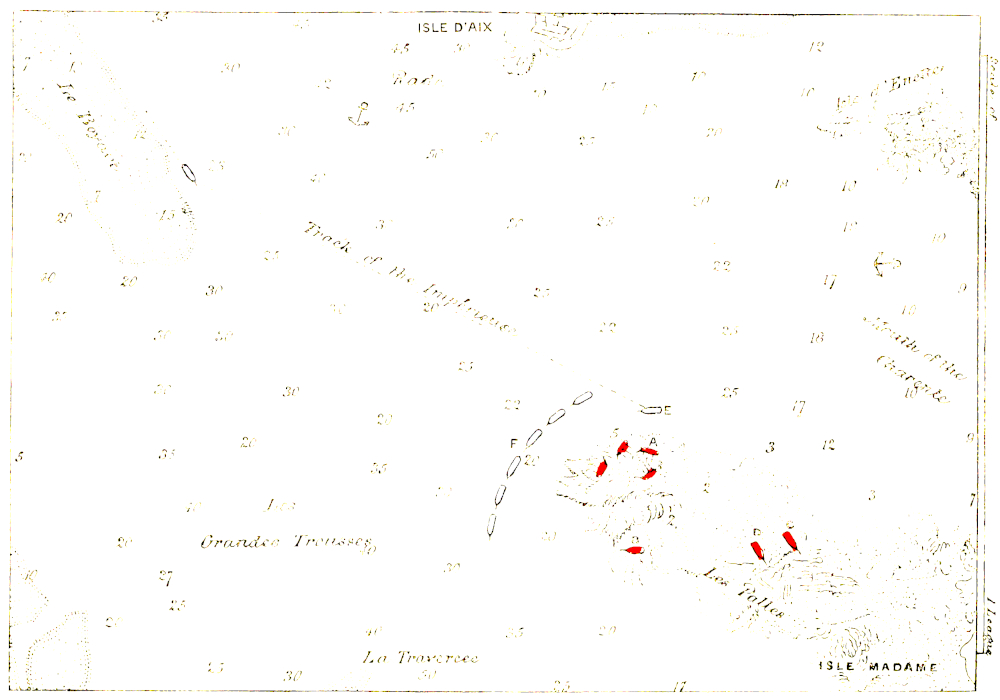
London: Richard Bentley: 1860.
A. Ocean three-decker and group on the north-west edge of the
Palles Shoal. These were permitted to escape.
B. Calcutta, captured by the Impérieuse and set on fire.
C. Ville de Varsovie, hauled down her colours to the assisting
ships. Afterwards burned.
D. Tonnerre, ditto, ditto.
The last three were destroyed on the falling tide, but no others!
These being the only enemy’s ships which, after the escape of the
other four, remained assailable.
E. The position taken up by the Impérieuse, she being at the
time of the arrival of the assisting force engaged with the Calcutta,
and with the other two ships.
F. Position of the British ships sent in after the Ocean and group
had warped off, viz. within pistol shot of the sand on which the
escaped ships lay till 1 p.m. aground.
102The best comment, perhaps, on the whole affair of
Aix Roads is what had previously been effected with a
less force than that under Lord Gambier, and when
the fortifications were perfect. The subjoined historical
facts should for ever put an end to all controversy on
the subject, and at the same time to the untenable
defence set up at this memorable court-martial.
“A well-planned and vigorous attack on the coast of
France being in 1757 much desired, with a view to give a
decisive blow to the marine of that kingdom (the very purpose
for which Lord Gambier was sent, and which Lord
Mulgrave especially impressed on me), a fleet was ordered to
be got in readiness, under the command of Sir E. Hawke,
Rear-Admiral Knowles being appointed second in command.
On the 20th of September the fleet made the Island of Oleron,
and Sir E. Hawke ordered the Vice-Admiral to proceed to
Basque Road, to stand in as near to Ile d’Aix as the pilot
would carry him, with such ships of his division as he thought
necessary, and to batter the fort, until the garrison should
either abandon it or surrender.”
“On the 22nd of September the fleet entered the bay
called the Road of Basque, between the islands of Rhé and
Oleron. About eight the next morning Admiral Knowles
in the Neptune, with the Magnanime, Barfleur, America,
Alcide, Burford, and Royal William, made sail towards
Aix. Captain Howe (afterwards Earl Howe) in the Magnanime
led the van. At half-past twelve the fort upon the
island began to fire, but he continued to advance without
exchanging a single shot, continually urging his pilot to lay
his ship as close to the fort as possible. He dropped his
anchor under the very walls. It was, however, near an hour
before the fort struck its colours.” (Biographical Memoir
of Earl Howe in the Naval Chronicle, vol. i. 1799; see also
Campbell’s Lives of the Admirals.)
This was the very fort, only now in ruins,—or to
103use Lord Gambier’s words, “no obstacle, from the dilapidated
condition of the fortifications”—that his lordship
adduced as a reason for not endangering the
British fleet by exposing the ships to its fire. Admiral
Harvey had perhaps Lord Howe’s exploit in his
mind’s eye when he told Lord Gambier to his face
that “had Nelson been there, he would not have
waited for fire-ships, but would have dashed at once at
the enemy;” an assertion of which there can be no
doubt, though poor Harvey was dismissed the service
for this and similar opinions.
Another extract, from Lord Clarendon’s remarks on
Admiral Blake, shall close the subject.
“He despised those rules which had been long in practice,
to keep his ship and men out of danger, which had been
held in former times a point of great ability and circumspection;
as if the principal art requisite in the captain of
a ship had been to be sure to come home safe again! He
was the first man who brought ships to contemn castles on
shore, which had been thought ever very formidable, and
were discovered by him to make a noise only, and to fright
those who could be rarely hurt by them.” (Clarendon’s
History of the Rebellion.)
104
CHAP. XXVIII.
THE VOTE OF THANKS.
MY MOTION FOR MINUTES OF COURT-MARTIAL.—MR. TIERNEY’S OPINION
RESPECTING THEM.—MR. WHITBREAD’S VIEWS.—THE MINUTES INDISPENSABLE.—MR.
WILBERFORCE ON THE SAME POINT.—LORD GREY’S
OPINION OF THE MINISTRY.—THE VOTE OF THANKS LEAVES OUT MY
NAME, YET THE CREDIT OF THE AFFAIR GIVEN TO ME.—INCONSISTENCY
OF THIS.—I IMPUGN THE DECISION OF THE HOUSE.—SIR
FRANCIS BURDETT’S OPINION.—MR. WINDHAM’S.—LORD MULGRAVE
TURNS ROUND UPON ME.—HIS LORDSHIP’S MISREPRESENTATIONS.—YET
ADMITS THE SERVICE TO BE “BRILLIANT.”—LORD MULGRAVE
REBUKED BY LORD HOLLAND.—EARL GROSVENOR’S VIEWS.—LORD
MELVILLE HITS UPON THE TRUTH, THAT I, BEING A JUNIOR OFFICER,
WAS LEFT OUT.—VOTE OF THANKS IN OPPOSITION TO MINUTES.—THE
VOTE, THOUGH CARRIED, DAMAGED THE MINISTRY.
From this time forward I never trod the deck of a
British ship of war at sea, as her commander, till
thirty-nine years afterwards I was appointed by her
present most gracious Majesty to command the West
India squadron; the greater portion of the interval
being marked by persecution of which the court-martial
on Lord Gambier was only the starting-point.
The commencement of the parliamentary session in
1810, was remarkable for its votes of thanks, and the
refusal of all information which might justify them.
This led Lord Milton to declare in the House of Commons,
that “votes of thanks, from their frequency, had
lost their value, and ceased to be an honour. They
had got so much into the habit of voting thanks that
it was almost an insult not to vote them.” (Feb. 1st.)
On the 25th of January 1810, Lord Grenville adverted
105in the House of Lords to notice of motion for
a vote of thanks to Lord Gambier, for his services in
destroying the enemy’s ships in Basque Roads; and
observed that as the last intimation on the journals
respecting Lord Gambier was his arrest, it would be
necessary that the Minutes of the court-martial should
be laid before the House, in order to enable it to judge
of the necessity for a vote of thanks. To this Lord
Mulgrave strongly objected, on the ground that it
“would appear as if it was wished to retry the case.”
Laying the sentence of acquittal only before the House,
said his lordship, would be “sufficient to render their
proceedings regular, and would answer all the purposes
of the noble lord.” With this the House was obliged
to be content, though how that sentence had been
obtained the reader is now made aware.
On the 29th of January, in pursuance of notice previously
given, I made a motion for the production of
the minutes of the court-martial in the House of Commons;
as being, from the extraordinary discrepancy
between the nature of the evidence and the sentence,
absolutely necessary, in order to enable members fairly
and impartially to decide whether the thanks in contemplation
of ministers were due to Lord Gambier for
the part he took in what had been by them denominated
a victory in Basque Roads.[52]
In support of this production of the minutes, I
adverted to a previously expressed opinion of the
106Chancellor of the Exchequer (Mr. Perceval), that
Lord Gambier had been honourably acquitted, but
that an officer’s having done no wrong did not entitle
him to the thanks of the House; which, if bestowed
on trifling, or, indeed, on any but brilliant achievements,
would dwindle into contempt, even with those
on whom they should be conferred. Votes of thanks
were already lightly esteemed in the Navy, and I
pledged myself—if the House would insist on the production
of the minutes—to prove that “Lord Gambier’s
defence was contradicted by itself—by his lordship’s
official letters—and by his own witnesses; many of
whom, as to essential facts, were at variance with
themselves and with each other.” Lastly, I undertook
to prove to the House, that the chart of the 12th of
April was “in a most material point false—and in
every respect a fabrication.”
I will not inflict on the reader a recapitulation of
the long discussion which followed, but the opinions of
some whose names are to this day held in respect are
too much to the point to be passed over. The opinion
expressed by Mr. Tierney is so remarkable that I shall
give it entire as reported.
“The question was not as to the noble lord’s (Gambier)
innocence, but as to his claim to a most distinguishing reward.
The honours of the House were high things, dear and valuable;
but dear only because they implied merit, valuable only
because that merit must be rare. Honours too frequently
bestowed lost their value, and became signs of nothing but
the weakness which lavished them, or the worthlessness on
which they were to be thrown away.
“He would vote for the minutes, but in his vote he begged
to be understood as merely calling for matter to enable him
107to shape his opinion. He could mean no slight to Lord
Gambier. He respected his lordship’s character. He had
some opportunities of hearing him spoken of, and it was
always in a high strain of praise and estimation. But he had
never understood that Lord Gambier took any share of the
merit of the achievement to himself. He had not approached
the French fleet nearer than seven miles. Ministers had
praised Lord Gambier for discretion; he hoped they had not
intended this as an instance in the enumeration of its proofs.
“It became the House to be cautious of being prodigal of
honours entrusted to their distribution. Lord Cochrane
ought to be heard; his judgment and character, his signal
gallantry and signal honours[53] deserved the serious attention of
the House. Even his feelings, led as they were, perhaps,
astray by an excess of strength and sensibility, deserved all
the attention which could be paid to them.”
The opinions of Mr. Whitbread are no less remarkable.
Sir C. Hamilton had said that the reason
why no more ships were destroyed was solely attributable
to me! and that he would engage to prove it
to the House.[54] Mr. Wynne also declared, on behalf
of the Ministry, that the evidence was all on Lord
Gambier’s side! and opposed to it only my solitary
evidence. This called up Mr. Whitbread, whose remarks
are reported as follows:—
“The noble lord (Cochrane) had done wrong in returning
any answer to the application of the Admiralty.[55] He ought
to have told them, as a member of the House of Commons,
he had no answer whatever to make; and if they thought
the logs inconclusive why did they not manfully come down
and try the question in that House?
108“The hon. gentleman (Mr. Wynne) talked of the injustice
of trying an officer in that House! Must not the merits of
every officer be inquired into when it is proposed to confer
on him a vote of thanks? Was he not then on his trial?
Was not that a species of trial to which any officer must
necessarily be exposed before he could receive the high honour
of the thanks of Parliament? After a court-martial, by
which Lord Gambier had been acquitted, did it follow, as a
matter of necessity that they must grant him the thanks of
that House? He presumed this by no means followed.
“What then was the situation to which the House was
reduced? The noble lord (Cochrane) had committed himself
more than he had ever heard man do in that House to prove
his statements respecting the conduct of Lord Gambier. And
now a member (Sir C. Hamilton) came forward and said that
the duty intrusted to Lord Cochrane had not been properly
executed, and that if it had been he might have done far
more injury to the enemy’s ships. The hon. baronet (Hamilton)
said that at the time Lord Cochrane was in command, and
made signals to the vessels employed under him, ‘some of
them obeyed and others disobeyed the instructions they received,
and that those who disobeyed were ultimately successful,
whilst those who obeyed at the moment failed.’ The
worthy baronet also added that ‘those who disobeyed the
signals were promoted, whilst those who obeyed were not.’
What would become of the subordination of our Navy if our
officers were to be informed, in any one instance, that those
who obeyed the instructions of their superior officer were to
be passed by, while those who disobeyed his signals might
expect to be promoted![56]
“From the disagreeable situation in which the House was
placed on both sides, he thought they must unavoidably have
the Minutes.”
109Various other opinions were expressed. Mr. Wilberforce
thought acquiescence in my motion for the
production of the minutes “most important, as throwing
a stigma on all the members of the court-martial;”
which was true enough, one of my objects being to
show that the influence of a corrupt government had
been used to vitiate a tribunal upon which the very
safety of the Navy depended. How far I should have
succeeded in this may be left to the reader’s judgment.[57]
Mr. Ponsonby would not agree to the motion because
its adoption would be a violation of the fundamental
principles of jurisprudence. Sir Francis Burdett
said, that “Lord Gambier’s plan seemed to be a
desire to preserve his fleet—my plan, to destroy the
enemy’s fleet. He had never heard that the articles
of war held out an instruction to preserve the fleet.
What if Nelson, at the Nile or Trafalgar, had acted
on this principle? He had never heard that Lord
Gambier, in the affair of Basque Roads, pretended to
have done any hard, or even important service. His
only merit seemed to consist in what he omitted to
do.”
Having thus been put on my defence by direct accusation
on the part of a Ministerial supporter that I had
not done my duty, I implored the House to give me an
opportunity, not only of defending myself, but of laying
bare matters of more importance to the country than
either my judgment or character. I again pledged myself
to prove all I had asserted, and to stake everything
110that was valuable to man on the issue, at the same time
telling the House that, if the minutes were granted, I
would expose such matters as might make the country
tremble for its safety—and entreating it well to consider
that there was another tribunal to which it was answerable,
that of posterity, which would try all our actions
and judge impartially.
Neither argument nor a sense of justice availed, and
the word “sentence” was substituted for “Minutes,”
in an amendment carried by a large majority of the
faction, in that day dependent on and wielded by
Ministers—of whose general conduct Lord Grey, in
the opening debate of the session, thus thought it necessary
to express himself:—“He was glad to find from
the humble and chastened tone of Ministers that they
appeared to feel some remorse for the numerous miseries
which, by their imbecility and misconduct they had inflicted
on their country. Had it been otherwise, he should
have supposed the Almighty vengeance was hanging over
this nation, and that therefore the hearts of its rulers had
been hardened in proportion as their understandings were
darkened.” This merited censure from one of the great
lights of that day and of all time, passed unheeded in
the conduct of the session, which outdid its predecessors
in acts of subserviency to the faction in power by whose
supremacy it was felt that the rotten-borough interest
could alone maintain itself against the national execration
which was now beginning to make itself heard.
At the conclusion of the preliminary debate, the
Chancellor of the Exchequer rose to move a vote of
thanks to Lord Gambier for his eminent services in
111destroying the French fleet in the Basque Roads! My
name, as having effected anything, was purposely and
very ingeniously left out! but warm thanks were accorded
to those who directed the fireships,—not against
the enemy, but against the banks of the Boyart and
Palles shoals!
The passage in the vote of thanks is curious: “for
their gallant and highly meritorious conduct on this
glorious occasion, particularly marked by the brilliant
and unexampled success of the difficult and perilous
mode of attack by fireships, conducted under the immediate
direction of Captain Lord Cochrane!” Yet
Lord Gambier stated in his defence, “The success of
the first part of the enterprise arose from the terror
excited by the appearance of the fireships! as they
failed in the principal effect they were intended to
produce.” (Minutes, p. 131.) If the House had been in
the possession of the minutes of the court-martial,
would they have voted thanks to officers of whom the
Commander-in-chief says that they “failed in their
object”? Not a word of thanks to me for having conducted
it, but to the Commander-in-chief, then twelve
miles off, his only merit consisting in coming three miles
nearer, anchoring out of gunshot—and to men whom a
ministerial supporter had praised by saying they had
been promoted for “disobeying my signals!” And this
though the First Lord of the Admiralty had offered me
his own regiment—a squadron of frigates, with carte
blanche to do what I pleased with them—and a vote of
thanks, conjointly with Lord Gambier, if I would not
offer any opposition!
112The value of such a vote under such circumstances
had been rightly estimated, even by those who acquiesced
in it. The value of the service rendered was
paltry, in comparison with what it ought to have been;
and the vote, either to myself or my superiors, would
have been worthy of it. I had from the first refused
to have my name coupled with such pretence, as a
fraud on national honours.
Yet, leaving me altogether out of the vote of thanks,
so long as thanks were voted, and giving them to the
Commander-in-chief and the officers under “my immediate
direction,” was a specimen of party spite
so transparent that it could deceive nobody. The
Chancellor of the Exchequer, either ashamed of his
subject, or forgetting the purpose in hand, most unaccountably
gave me in his harangue the credit of the
whole affair! He could only have done this from two
motives. Either he was too much a gentleman to
permit his personal honour to be trampled under foot
by his colleagues, or he could not have read the vote
of thanks till he came to it at the conclusion of his
speech. There is, however, a third hypothesis. The
subjoined eulogy might have been pronounced to blind
the House.
“The attack having thus recommenced on the night of
the 13th successively[58] was followed up on the next day by
the noble lord (Cochrane)[59] with peculiar gallantry. The
113consequence was that no less than three sail of the line and
a fifty-gun ship were completely destroyed. The House
would not, therefore, he trusted, be disposed to refuse its thanks
for eminent services when performed under such great
peril and risk, whilst the enemy were possessed of the protection
of their own batteries[60], and other advantages which
they could bring into play for the security of their own
vessels. It was an enterprise of great and peculiar hazard
and difficulty. The result had been highly injurious to the
enemy, and had the effect of not only disabling but of removing
the enemy’s whole squadron from the possibility of
being for a considerable time available for the purposes of
the naval campaign. Was not this an object of great
magnitude?”
From this speech it is clear that the Chancellor of
the Exchequer considered that the whole success was
attributable to my exertions, and it is no less apparent
that he contemplated my being included in the vote of
thanks.
Then why leave me out of the vote of thanks, and
give thanks to those who had nothing to do with this
“work of great magnitude?”
Lord Mulgrave made no such blunder in the House
of Lords, nor even mentioned my name except in
terms of reprobation—possibly because I refused his
lordship’s temptation of a squadron and a regiment to
hold my peace! Yet it may be that the Chancellor
of the Exchequer made no mistake. His eulogy
might have been merely intended to appeal to
the popular ear, whilst contemptuously excluding me
114from the vote. Be this as it may, the trick succeeded,
and my voice was drowned amidst the clamour
of faction, as were the voices of those who supported
me in the House.
Still I was not disposed to allow the vote to pass
without further protest. I again warned the House
that “even their verdict was not conclusive upon
character, but that there was another tribunal to
which even that House was amenable, and that the
public would one day exercise a judgment, even
though the House might shrink from a just decision.
I inquired what portion of Lord Gambier’s exploit
merited thanks, or what had been the nature of his
exploit? He lay at a distance—never brought his
fleet to the place of action, or even within danger, and
yet for such supineness he was to receive the highest
honours of his country! The ground taken by ministers
was frivolous—that where the subordinates
admittedly deserved the praise, the superiors must
receive it. The public would one day read the
minutes, though the House would not. The public
would judge from the facts, though the House would
not. The public would not submit to have its eyes
bound because the House chose to keep theirs shut.
Let a single reason be adduced for this vote of thanks,
and I was ready to vote for it—but the reasons which
had been obtruded on the House were unworthy the
name of arguments.”
Sir John Orde, of all the supporters of the ministry,
gave the only honest reason for his vote in favour
of Lord Gambier, though probably his argument might
115not pass current at the present day. It was this:—“As
thanks to his Lordship have been proposed, I shall
vote for them, because I entertained this opinion of
Lord Gambier’s conduct before the prorogation of
Parliament, and their Lordships of the Admiralty appeared
to do the same!!” Poor Sir John! He must
have had better reasons for his arguments than arguments
for his reasons.
A few more reasonable opinions than that of worthy
Sir John shall be transcribed verbatim, and first those
of Sir Francis Burdett:—
“Sir Francis Burdett wished to know whether the service
of Lord Gambier was worth the thanks of Parliament, even
admitting it to have all the value attributed to it by anything
but the unblushing and profuse spirit of ministerial favouritism.[61]
He would not ask whether, on the other hand, there
was not the full and decided testimony of a man competent
to give his judgment, and of whose admirable valour and
good fortune the House and the nation had but one opinion?
He felt that in making these observations he might be treading
on perilous ground. He was probably bringing on himself
some charitable retorts, particularly those of a gentleman
whose charity was of a very peculiar nature. But he was
careless about such remarks; for though he deprecated that
person’s charity, he would not shun but would rather court
his hostility.[62]
“Had there been anything said to make out a reason of
the vote demanded? Where was the evidence of the Commander-in-chief’s
116intrepidity or skill? Of that boldness
which bursts its way through all obstacles? Of that genius
before which obstacles vanish? In place of this, the House
was insulted with a dry catalogue of negatives, and an account
as to how the noble Admiral inspected the action at a distance
of seven miles.[63] The question had been treated lightly;
but levity was unbecoming the grave matter for their
deliberation.”
Mr. Windham said:—
“The thanks of that House did not deserve to be lavished
on any man, unless his services were of that rank which forced
itself into universal report and universal admiration. It was
not to be evolved in some obscure process of official chemistry,
not to be drawn out under bundles of obscure records,
not to be elicited by any keen, cunning, recondite, subtilising
process[64] beyond the practice or perception of the general
mass of mankind. To be praised, it must be known; to
become matter of thanks, it must be matter of public fact.
In voting thanks it was time to pause. These old rewards
had become worthless. It had been said that nothing was
left but the peerage, and even of that high honour ministers
had been most lavish. This was the natural process when
there was no distinct scale of merit and reward. It was high
time to stop. They had in their hands the great provision
for national virtue. They had the honours of the country
intrusted to them, and it became them as legislators not to
suffer its streams to be idly diverted, nor to be prodigally
and profusely poured forth to slake the thirst of undeserving
ambition, still panting, still insatiable.”
Argument and fact were alike unavailing, and Sir
John Orde’s extraordinary reasons and opinions prevailed.
To 161 of the Admiralty opinion, only 39
117could be found alive to a true sense of legislative
dignity or functions.
A few remarks on what passed in the House of
Lords, where similar thanks were voted, are necessary.
Lord Mulgrave said that it was with great surprise
that he first heard that a noble lord serving under the
noble Admiral, and a member of another House, had
intimated his intention to oppose the vote of the House
of Commons, on the ground that his commander had
not done his duty to the utmost. Lord Mulgrave, of
course, alluded to my conversation with him nine
months before, though I never said anything of the
kind to his Lordship. What I said was, “that the
Commander-in-chief had not done anything deserving
the thanks of Parliament.” Had the Minutes been
allowed to be produced in either House, this would
have been proved beyond question, in spite of the
sentence of acquittal, which was alone laid on the table.
Lord Mulgrave was no less unjust in attempting
to convince the peers that I had done nothing but carry
out Lord Gambier’s plan of fireships; referring them
to Lord Gambier’s letter of March 19th, 1809, in
which, instead of recommending an attack by fireships,
Lord Gambier had denounced such an attempt
as “hazardous, if not desperate,”[65] as would have appeared
had the minutes of the court-martial been laid
before them.
Mine, as explained in the first volume, was not an
attack by fireships alone, for such an attack could only
have ended in the boarding of the fireships by the
118enemy’s row-boats, and the murdering of the crews.
It was an attack by means of explosion-vessels, which
should impress the enemy with the idea that every fireship
was similarly charged, so as to have the effect of
deterring them from boarding, and thus, the fireships,
had they been properly directed, must have done their
work in spite of the enemy’s row-boats.
Yet Lord Mulgrave followed Lord Gambier in this
“suppressio veri.” On the very day Lord Gambier had
not recommended the use of fireships—though Lord
Mulgrave’s speech would lead the House, in the absence
of the minutes of the court-martial, to infer that he
had recommended their use—the Commander-in-chief
had stated that an attack with fireships would be
“hazardous, if not desperate.” A curious way, truly, of
recommending the use of fireships; though, had he
recommended them, they would have been of no use
without the explosion-vessels, the terror created by
which formed the very essence of my plan, and was
the sole cause even of the trifling success gained. Again,
said Lord Mulgrave:—
“Lord Cochrane arrived at Plymouth. He had on a
former occasion been employed in blockading Rochefort, and
was acquainted with the coasts. He was, therefore, consulted,
and spoke with greater confidence of the success of the attempt
than those who wrote from that quarter, It was not,
however, merely the zeal and desire of execution he showed,
but also the talent he displayed in meeting the objections
started by naval men, which induced the Admiralty to
employ his Lordship.”
This representation was thoroughly incorrect. So
far from there being any “desire of execution” on
119my part, I tried every means in my power to avoid
being intrusted with the execution of my own—not
Lord Gambier’s,—plans as Lord Mulgrave insinuated.
He, however, unconsciously admitted that other naval
men “started” such objections, that they could not
be got to undertake an attack with fireships, and
therefore the duty was thrust on me, with the addition
of the explosion-vessels I had suggested, thus convincing
the Admiralty Board that an attack, on my
plan, was both easy of execution and certain in its
result. Lord Mulgrave’s expression of “those who
wrote from that quarter,” viz Lord Gambier, showed
that the Commander-in-chief had no confidence in fireships.
Neither had I, unless accompanied by my plan
of explosion-vessels.
Still persisting that this was an attack by fireships
merely, Lord Mulgrave told the House that it was
nothing new, which was the case, if the explosion-vessels
were left out, but that—
“In the course of the last century there were two services
performed by fireships; the first in 1702 at Vigo, and the
second off Minorca in 1792. But what was the present
service? Recollect, a fleet protected by shoals and currents,
in sight of their own coast, and in presence of their countrymen.
Nothing in the annals of our Navy was more
brilliant!”
Who, then, performed that “brilliant” service, than
which nothing could be more satisfactory? Lord
Mulgrave told the House that Lord Gambier did,
whilst lying with his fleet nine miles off, and reluctantly
sending two line-of-battle ships and some frigates to my
120“assistance,” when almost too late to rescue me from
the dilemma into which, in sheer despair of anything
being done, I had voluntarily rushed, with the determination
that if my frigate was sacrificed, while he
was calmly looking on, he should take the consequences,
and what they would have been I need not say. It
was this act of mine, and this only, which caused the
paltry service to be effected of destroying two line-of-battle
ships and a store ship, instead of the whole
enemy’s fleet!
Lord Mulgrave’s statements were severely rebuked
by Lord Holland:—
“Lord Holland represented in strong terms the light in
which ministers placed themselves before Parliament and the
country by coming forward, so hastily in the first instance to
procure thanks, and then suddenly sending Lord Gambier to
a court-martial with the thanks on their lips. He thought
that in a case of parliamentary thanks the case should be
clear and strong to receive such a reward. What said Lord
Cochrane in his reply to the Admiralty?[66] ‘Look at and sift
the log-books! and not ask me for accusations.’ He (Lord
Holland) condemned the precipitancy of ministers, who by
their measures had endeavoured to stultify the House as they
had already stultified their own administration.
“After sending Lord Gambier through the ordeal of a
court-martial, Lord Mulgrave now came down, pronounced
his praises, and called upon the House to vote him their
thanks! It was not in this manner that the French government
conducted itself towards their admirals and generals.
They instituted a very severe inquiry as to this affair at
Basque Roads, and many of their commanders were most
severely punished.[67] They did not give thanks to General
121Monnet for his defence of Flushing, but, on the contrary,
censured his conduct most severely.[68]
“If the barren thanks of both Houses of Parliament were
often to be voted in this way, they would soon cease to be of
any value. The noble Lord (Mulgrave) had said a great
deal about the battle of Talavera, and the resistance made to
the vote of thanks in that instance. Now it did not appear
to him (Lord Holland) that the battle of Talavera could
have anything to do with the action of Basque Roads or
with the conduct of Lord Gambier. But if resistance to the
vote of thanks to Lord Wellington were adduced as a proof
of party motives, it might well be considered a proof of
party spirit on the other side to bring forward motions of
thanks for services of such a description as were those of
Lord Gambier.”
The remarks of other noble lords were more to the
purpose:—
“Earl Grosvenor did not think the services of Lord Gambier
of such a nature as to require the particular thanks of
the House. He thought such should only be given on very
signal and important victories. Nobody could doubt they
were due to Lord Howe for his victory on the 1st of June,
to Lord Duncan for his victory at Camperdown; to Lord St.
Vincent for his glorious achievements near the cape which
gave him his title, or to the immortal Nelson for the
splendid exploits with which he had adorned our naval history.
122These were things which spoke for themselves, and
nobody could doubt the propriety of voting thanks, as it
were, by acclamation. He thought, however, the services of
Lord Gambier were of a very inferior description, and
called for no such reward.”
“Earl Darnley had no objection to the vote of thanks,
but at the same time he thought the present vote one of the
efforts now too often resorted to to throw a false lustre on
the Government. To compare the services rendered by Lord
Gambier at Basque Roads with the battles of the Nile or
Trafalgar would be the height of presumption!”
Lord Darnley was right; the vote itself, no less
than the assumption of victory, where, through the pusillanimity
of the Commander-in-chief, none had been
achieved, had no other object than to “throw a false
lustre upon a Government” powerful in rotten-borough
influence, but justly mistrusted by all besides, whether
in Parliament or out of it. Because I acted practically
and conscientiously on these sentiments, I have been
marked through life an object of party malevolence.
However dexterous might be the ministerial legerdemain
which could convert into victory the admitted
intention of the Commander-in-chief not to fight,[69] Lord
Melville alone exposed the real secret of the matter:—
“Lord Melville conceived the Admiralty to have acted
extremely wrong in giving to Lord Cochrane a command so
contrary to the usual rules of the service, and which must
have been so galling and disgusting to the feelings of other
officers in Lord Gambier’s fleet. He respected as much as
any man could the zeal, intrepidity, and enterprise of Lord
Cochrane, but it was wrong to presume that these qualities
123were wanting in officers of that fleet of superior standing to
his Lordship. Such a selection naturally put Lord Cochrane
upon attempting enterprises whereby great glory might be
obtained.”
Here lies the gist of the whole matter. Had I
devised the plan of attack, and had the Board of Admiralty
acceded to my earnest wish, and left it to my
seniors to execute, or had I persisted in my determination
to refuse a command which the Admiralty
literally forced upon me, all would have been well.
Even had Lord Mulgrave fulfilled his promise of satisfying
the amour-propre of the fleet—which he neither
did nor intended to do—all might have been well. As
it was, I was exposed to the full amount of hostility
which formed my reason for declining the command
in the first instance.
It was felt—as Admiral Austen plainly says—by
the officers of the fleet in Basque Roads, that a decisive
victory would elevate me in national estimation over
my seniors, as it unquestionably would have done.
Lord Gambier was an easy man, and the “shoal and
current” bugbear was successfully used to bring the
fleet to an anchor in place of going on to the attack,
he knowing no better, and having taken no trouble to
ascertain the fact; in short, confining himself to mere
blockade. This was the fault of the Commander-in-chief,
but it did not justify him in bringing forward
charts made up for the purpose of proving imaginary
dangers from ruined fortifications and shoals where none
existed.[70] Nor did it justify the evidence of influenced
124witnesses to prove danger—in defiance of his Lordship’s
own admission that no ship suffered injury![71]
It did not justify his Lordship in assuming many
things in his defence, which were not in evidence
at all, and many more things that were totally at
variance with the evidence contained in the minutes.
To have declined pushing an advantage to victory, in
deference to the jealousy of senior officers, was one
thing; to trump up a story of an old storeship breaking
up a boom of more than a mile in lineal extent, and
moored with a hundred anchors, was another.
It will now be seen why the Government of that day
refused the production of “minutes”minutes” of the court-martial,
almost every page of which would have rendered the defence
of the Commander-in-chief—or rather that of his
solicitor, Mr. Lavie, for I will do Lord Gambier the
justice of believing that he did not write the defence
read to the Court by the Judge-Advocate—untenable
for a moment. That the Ministry of that corrupt day
should have resorted to such a subterfuge can, however,
scarcely add to the contempt with which history already
regards them.
I told the House of Commons that “posterity would
judge their acts.” Here, then, is matter for that judgment.
That it was not made public at the time arose
from two causes. First, that in those days the bulk of
the press was influenced by the Ministry; and a jackal
howl, from one end of the kingdom to the other, would
have been—and was, the reward of my pains. Secondly,
that until his Grace the Duke of Somerset gave me, a
125few months since, the chart and other official materials
requisite to lay the matter before posterity, it was not in
my power to do so; except, as on my previous attempts
at justification, by assertions, which would have had no
more effect on the public mind than now would those
of the factions which persecuted me. As I belonged
to no party in the House, I found no friends but
the few who, like myself, stood alone in their independence
of party. Those were themselves disorganised,
and deceived by the well-timed eulogy of
the Chancellor of the Exchequer, into the belief that
the vote of thanks included me also. The numbers of
the independent party were, however, as nothing compared
to the organised masses in power, or eager to
place themselves in power. The debate was felt to
have most seriously damaged the party to whom I was
politically opposed, and that party ever afterwards
made me a mark for their revenge. In this brief
sentence may my whole subsequent history be comprised.
126
CHAP. XXIX.
REFUSAL OF MY PLANS FOR ATTACKING THE FRENCH FLEET IN THE SCHELDT.
REFUSED PERMISSION TO REJOIN MY FRIGATE. I AM REGARDED AS A
MARKED MAN.—NO SECRET MADE OF THIS.—ADDITIONAL CAUSE OF
OFFENCE TO THE MINISTRY.—THE PART TAKEN BY ME ON THE REFORM
QUESTION, THOUGH MODERATE, RESENTED.—MOTION FOR PAPERS
ON ADMIRALTY COURT ABUSES.—EFFECT OF THE SYSTEM.—MODES OF
EVADING IT.—ROBBERIES BY PRIZE AGENTS.—CORROBORATED BY
GEORGE ROSE.—ABOMINABLE SYSTEM OF PROMOTION.—SIR FRANCIS
BURDETT COMMITTED TO THE TOWER.—PETITIONS FOR HIS LIBERATION
INTRUSTED TO ME.—NAVAL ABUSES.—PITTANCES DOLED OUT
TO WOUNDED OFFICERS.—SINECURES COST MORE THAN ALL THE
DOCKYARDS.—MY GRANDMOTHER’S PENSION.—MR. WELLESLEY POLE’S
EXPLANATION.—OVERTURE TO QUIT MY PARTY.—DEPLORABLE WASTE
OF PUBLIC MONEY.—BAD SQUIBS.—COMPARISON WITH THE PRESENT
DAY.—EXTRACT FROM “TIMES” NEWSPAPER.
Just at the period of the court-martial on Lord Gambier,
great national expectations were excited by the
combined military and naval expedition to Walcheren,
under the Earl of Chatham and Sir Richard Strachan.
The object of this armament, the most formidable
England had ever sent forth, was the capture or destruction
of the French fleet in the Scheldt, and of the
arsenals and dockyards of Flushing, Terneuse, and
Antwerp, at the latter of which ports Buonaparte was
carrying on naval works with great vigour.
The force employed for this purpose comprised
12740,000 troops, 35 sail-of-the-line, 2 fifty gun-ships, 3
forty-four gun-ships, 18 frigates, and nearly 200 smaller
vessels, besides dockyard craft; the first portion of the
expedition quitting the Downs on the 28th of July,
1809, and anchoring the same evening near the coast of
Walcheren.
To the reader acquainted with the views expressed
in the first volume of this work, it will not be surprising
that I viewed the departure of this force with
regret; as had one half of the troops been placed, as
suggested in my letter to Lord Mulgrave, on the islands
of the French coast, and had half the frigates alone
been employed, as had been the Impérieuse and other
vessels in the Mediterranean, not a man could have
been detached from Western France to the Spanish
peninsula, from which the remaining portion of the
British army might have driven the French troops
already there.
Full of these views, and knowing that short work
might be made of the Walcheren expedition, so as to
liberate both the naval and military force for service
elsewhere, I laid before the Admiralty a plan for
destroying the French fleet and the Flemish dockyards,
somewhat analogous to that which would have
proved completely effectual in Basque Roads, had it
been followed up by the Commander-in-chief. My
new plan had, moreover, received an important addition
from the experience there gained, and was now
as formidable against fortifications as against fleets.
The first measure of indignation against me for my
late services to my country was the summary rejection
128of my plan, and not only this, but a refusal by
Admiralty letter, given elsewhere, to proceed to the
Scheldt to join my frigate, which had been sent there
under the temporary command of the Hon. Captain
Duncan, a most excellent and gallant officer.
Of the disastrous failure of the Walcheren expedition—the
destruction of a large portion of the army by
disease—and the retreat of the remainder, I shall not
speak; these matters being already well known to
the student of English history. I will, however, assert—and
the assertion will be borne out by the plan of
attack submitted by me to the Admiralty—that had
my recommendation been adopted, even though not
carried out under my own supervision, nothing could
have saved the French fleet in the Scheldt from a similar
fate to that which had befallen their armament in Aix
Roads. Even—as with the disaster in Aix Roads fresh
in remembrance, is probable—had the French fleet in
the Scheldt taken refuge above Antwerp, it could only
have placed itself in a cul-de-sac; whilst there was
ample military and naval force to operate against the
dockyards and fortifications during the period that my
appliances for the destruction of the enemy’s fleet were
in progress; for I in no way wished to interfere with
the operations of the general or admiral commanding,
but rather to conduct my own operations independently
of extraordinary aid from either.
The cost of this plan to the nation would have been
ten rotten old hulks, some fifty thousand barrels of
powder, and a proportionate quantity of shells. The
cost of the expedition, which failed—in addition to the
129thousands of lives sacrificed—was millions; and the
millions which followed by the prolongation of the
war, by the refusal of the Admiralty to put in operation
any naval expedition calculated to effect a beneficial
object—who shall count? So much for war
when conducted by cabinets! But I was now a
marked man, and the Government evidently considered
it preferable that the largest force which England had
ever despatched from her shores should incur the chance
of failure in its object, than that the simple and easily
applied plans of a junior post-captain should again jeopardise
the reputation of his Commander-in-chief.
It was very curious that whilst this animosity was
being directed against me in my professional capacity,
I had shortly before received from His Majesty George
the Third the highest decoration of the order of the
Bath for my professional services!
So little secret did the Government make of their
determination not to employ me again, that the public
press regarded this determination as a settled matter.
It was nothing that I had been instrumental in destroying
the fleet so much dreaded by our West India merchants
and the nation generally, or that I had offered
to serve the French fleet in the Scheldt in the same
way. I was now an obnoxious man, and the national
expenditure of millions for defeat, was by the ministry
of that day deemed preferable to cheap victory if
achieved by a junior officer, to whom the Chancellor
of the Exchequer—whilst denying him thanks for the
service—had attributed the destruction of a fleet
quite as formidable as the one in the Scheldt.
130It may be scarcely credible to the present age that
the Government should have openly announced such a
determination. On the principle adopted throughout
this work, of adducing nothing without proof, it will
be necessary to place the preceding facts beyond dispute.
From one of the most talented periodicals of
the time I extract the following passage: “The worst
injury which the radical reformers have done the
country, has been by depriving it of Lord Cochrane’s
services, and withdrawing him from that career which
he had so gloriously begun.”[72] The pretence was, that
I had withdrawn myself! at the time I was entreating
the Admiralty to permit me to return to my frigate!
This matter will shortly be made very clear.
One grave cause of offence to the Ministry, in addition
to my determination to oppose the vote of
thanks to Lord Gambier, had been the part I took at
the famous meeting; held at the Crown and Anchor in
the Strand. For a junior naval officer in that day
to associate with such persons as Sir Francis Burdett
and Major Cartwright was bad enough, but that he
should act with them was a thing unheard of in the
naval service.
At this meeting many irritating things were said,
though not by me. The late trial of the Duke of
York was freely handled, and Colonel Wardle, the
principal promoter of it, held up to public admiration.
The “borough-mongering faction,” as it was forcibly
termed by Sir Francis Burdett, was painted as involving
the country in perpetual misfortune, and consigning to
131hopeless imprisonment all who ventured to expose
their practices; whilst, it was said, even His Majesty
could not carry on his fair share of government, being
compelled to choose his ministers from a faction
which not only oppressed the people, but controlled
the King himself.
The resolutions moved by good old Major Cartwright
at this celebrated meeting were at that time
regarded as treason, though at the present day sound
doctrine, viz. that “so long as the people were not
fairly represented corruption must increase—our debts
and taxes accumulate—our resources be dissipated—the
native energy of the people be depressed, and the
country be deprived of its best defences. The remedy
was only to be found in the principles handed down to
us by the wisdom and virtue of our forefathers, in a
full and fair representation of the people in Parliament.”
This was perfectly true, and singularly enough, after
the lapse of fifty-one years, the very same question
forms the principal feature of the present session of
Parliament, the debates on the subject in our day
differing very little from their predecessors of half a
century ago, if we may credit the following picture
from a Times leader of April 23rd last. “Call Reform
what you will, it is almost anything you please, except
legislation. The belligerent parties will fight and cheat
one another, and both together will cheat the people!”
If after a battle of fifty years the people have not
achieved the victory which early Reformers began, I
have some right to call on the public to estimate the
amount of obloquy which befell myself for my volun-
132*tary enrolment amongst the combatants on their side;
and in the belief that the public of the present day
will do my memory that justice which through life has
been denied me, I shall not shrink from laying these
matters before them. If such a picture of our present
legislators be truly drawn, what must have been that
of the faction against which I had to contend?
The speech made by me at the Crown and Anchor
was very moderate, and indeed was spoken of by the
ministerial organs as expressing less of the spirit of
faction than any which had been delivered on that day.
The worst part of it, so far as I can recollect, was that
generally recorded, that “I hoped the time would come
when ministers would not be employed all day in
thinking what they were to cavil about all night, and
all night in useless debate—whereby the real business
of the country was neglected; so much so indeed, that
when the newspapers had reached me abroad, I felt
ashamed at the manner in which the government of
my country was conducted.”
I had even gone further in moderation, though the
Ministry did not know it, viz. by observing to Sir
Francis Burdett that I thought he was going too far.
His reply was characteristic. “My dear Lord Cochrane
you don’t know ministers. If you wish to get
anything from them, you must go for a great deal more
than you want. Even then you will get little enough.”
“Oh!” replied I, “if those are your tactics, go on,
I’ll follow.”
The real grievance was, however, my support of the
motions in Parliament which arose from the meetings
133at the Crown and Anchor. Mr. Madocks distinctly
charged the Ministry with trafficking in seats, offering
to prove to the House that Lord Castlereagh had,
through the agency of the Honourable Mr. Wellesley,
been instrumental in purchasing for Mr. Quintin Dick
the borough of Cashel; and that when in the matter
of the Duke of York Mr. Dick had determined to
vote according to his conscience, Lord Castlereagh
intimated to that gentleman the necessity of voting
with the Government, or resigning his seat, which
was accordingly done. The Ministry declined to accept
the challenge.[73]
The subsequent motion of Mr. Curwen went further.
But I must not forget that I am writing my autobiography,
and not political history; I never made pretensions
to parliamentary eloquence, and shall not
inflict on the reader my humble efforts, excepting only
those connected with the naval service.
On the 19th of February I moved for certain papers
relative to the conduct of the Admiralty Court, and as
my speech on that occasion was sufficiently comprehensive,
134I will adduce it with some slight explanations
indicative of the practices which at that time were in
full operation:—
“If these papers are granted it will be in my power to
expose a system of abuses in the Admiralty Court unparalleled
in this country, even exceeding those prevalent in
Spain under the infamous administration of Godoy.
“The whole navy of England was, by the existing system,
compelled to employ one individual to carry on its business
before the Admiralty Court; a person perhaps in whose
competence or honesty they might have no confidence. But
admitting his ability and integrity to be unquestionable, still
the thing was preposterous. Would any man like to employ
an attorney who at the same time did business for the other
side? Was such a regulation consistent with equity or
common sense?
“Even the personal liberty of naval officers was answerable
for some seizures, the produce of which notwithstanding went
to the Crown, and the most abominable compromises sometimes
took place. Whether the profits of these compromises
found their way into the pockets of any particular individual
I was not absolutely sure, but had evidence to presume that
this was the fact. What indeed could be the design of confining
the captors to one proctor, except that secrecy as to
these questionable transactions may be preserved.”
One case was my own. In the first volume of this
work is narrated the capture of the King George privateer,
or pirate, for which seizure by any vessel of war
a reward of 500l. had been issued. The King George in
part actually belonged to parties connected with the
Maltese Admiralty Court. As her condemnation was
unavoidable, she was condemned as a droit to the
Crown; and costs to the extent of 600l. were decreed
against myself, officers, and crew, for having taken
135her! A subject which will hereafter have to be further
alluded to.
The effect of this system was to indispose officers to
look after prizes, and thus many an enemy’s vessel was
suffered to escape. One of my reasons for harassing the
French on the coasts of Languedoc and Catalonia was,
that it appeared more advantageous to effect something
of service to the country, than to take prizes for no
better end than to enrich the officers of the Maltese
Admiralty Court, and at the same time to be ourselves
condemned in costs for our trouble.
Some curious stories might be told of the effect of
the system. It was my own practice, when any money
was captured in a prize, to divide it into two portions,
first, the Admiral’s share, and next our own. We then
buried the money in a sand-bank, in order that it might
not be in our possession; and, as opportunity occurred,
it was afterwards taken up, the Admiral’s share being
transmitted to him, our share was then distributed at
the capstan, in the usual proportions. As I never
made any secret of my own transactions, the Maltese
officials regarded me with perfect hatred; they, no
doubt, honestly believing that by appropriating our
own captures to our own use, we were cheating them
out of what they had more right to than ourselves!
By their practices they appeared to entertain one idea
only, viz. that officers were appointed to ships of war
for the sole purpose of enriching them!
In a case narrated in the first volume, where I had,
in Caldagues Bay, taken thirteen vessels laden with
corn for the French army in Barcelona, after having
136sunk two small ships of war protecting them—we sold
the corn vessels and their cargo to the Spaniards for a
trifle, dividing the dollars amongst us, after sending
Lord Collingwood his share. We afterwards took the
vessels of war after raising them to Gibraltar, where I
purchased one as a yacht. Had I sent those corn
vessels to Malta, and had them condemned there—in
place of obtaining anything for the capture, a
heavy bill of costs for the condemnation of such small
vessels would have greatly exceeded the sum realised
by their sale.
To return to my address to the House:—
“The Navy was paralysed by this corrupt system. The
most insignificant vessels were condemned at an expense
equal to that of the largest, so that the condemnation of a
fishing lugger might be swelled up to the expense of condemning
an Indiaman, the labour of capture ending in
nothing but putting money into the proctor’s pocket. As an
instance within my own knowledge, Moses Griffin, a Jew
agent at one of the outports, received two thirds out of the
produce of a vessel, the remaining third being the whole
share distributed for admiral, captain, inferior officers, petty
officers, seamen, and marines. What was the effect of such
a system but to paralyse the Navy? It prevented exertion
on the part of the officers. Could it possibly be necessary to
have 120 ships of the line in commission to blockade twenty-three
ships of the enemy, if proper exertions were made. To
insure alacrity in harassing the shipping and commerce of
the enemy, the abuses of the Admiralty must be stopped,
and nothing else would be effectual.”
A more startling practice was the following:—
“The commerce of the enemy was carried on to an immense
extent by a system of licenses, which permitted the
137enemy to trade where they pleased. These licenses, issued
by us, formed an article of common sale in Hamburgh and
other places, and by means of such licenses the enemy’s ships
were seen coasting along by hundreds in perfect security,
even filling the river Thames, contrary to the Navigation
Act! We were thus raising up sailors for Buonaparte, to
whose commerce and navy our ministers were the best
friends.”
My representations were met by Sir William Scott,
the Judge of the Admiralty Court, with the inquiry as
to “how that Court could possibly be answerable for
the accounts of the agents on which I had founded my
invectives? Lord Cochrane was a prompt accuser, but
an unfortunate one, and he pledged his credit these
accusations would prove as unfortunate as any that had
preceded them.”
Unluckily for Sir William Scott’s allusion to my “unfortunate
habit of making unfounded accusations,” Mr.
Rose, the treasurer of the Navy, got up and officially
confirmed my statements, by admitting the abuses complained
of!
“This evil,” said Mr. Rose, “had been so strongly represented
to him, that soon after he had become treasurer to
the Navy he had bestowed many days and nights in its investigation.
The result was, that he had before him no less
than 153 cases, nine out of which were now before the judge
of the Admiralty Court (Sir W. Scott himself!) in consequence
of the enormous charges which their accounts contained. In
one case the charges of an agent at Portsmouth, who had
62,000l. to distribute, amounted to 9462l., of which 1200l.
was stated to be for postage!”
Mr. Rose recommended me to alter my motion, and
to move for papers relative to a particular ship. I
138took this advice and moved for documents relating to
two vessels, which was carried. Sir William Scott,
however, never forgave me.
On the 9th of March, when these papers were laid
before the House, I moved for others in order to
elucidate them. This gave rise to another debate, in
which some curious facts were brought to light by
Colonel Wardle:—
“In the Navy Pay Office it was usual to promote junior
clerks over the heads of men who were many years their
seniors in the service. One junior clerk, eleven years in the
office, was promoted to a place of 300l. a year, over the heads
of senior clerks from twenty-seven to thirty years in the
service. In another case a gentleman was obliged to retire
against his will on 170l. per annum, and a boy of fourteen
was appointed to his situation with a raised salary, and
over the heads of many senior clerks. The Secretary of the
Sick and Hurt Office was pensioned off at his full salary of
500l., and an assistant appointed in his stead with a salary
of 1000l.!!”
On the 12th of March, my respected colleague, Sir
Francis Burdett, than whom a purer patriot never
breathed, moved that Mr. Gale Jones should be discharged
from Newgate, to which prison he had been
committed by order of the House, for placarding a
handbill, the contents of which were construed into a
violation of the privileges of the House. Sir Francis—conceiving
that the people had privileges as well as
those claiming to be their representatives, or rather
that the popular voice constituted the power of their
representatives—demanded the release of Mr. Jones, on
139the ground that the House possessed no privilege to
commit a man for asserting his right to discuss its
measures, and that neither legally nor constitutionally
could such privilege exist.
The debate which ensued, not coming within the
scope of this work, may be omitted. Suffice it to say
that Sir Francis published in Cobbett’s Weekly Register
a revised account of his speech, in which he declared
that the House of Commons sought to set aside Magna
Charta and the laws of England by an order founded
on their own irresponsible power.
Accompanying this revised speech was a letter addressed
by Sir Francis to his constituents of Westminster;
and these coupled together the House chose
to construe into a breach of their privileges also. The
result, as every one knows, was a motion for the
committal of Sir Francis Burdett to the Tower.
My worthy colleague, however, refused to surrender.
As there was no knowing to what lengths the despotism
of the House might extend, a rumour of breaking
into the honourable Baronet’s house being prevalent,
a number of his friends, myself amongst them, assembled
at his residence in Piccadilly to see fair play;
but one morning, during our absence, an officer, armed
with the Speaker’s warrant, forcibly entered, and Sir
Francis was carried off to the place of his imprisonment.
It is quite unnecessary to detail these circumstances,
as they are well known to every reader of English
history. On the day after my excellent colleague’s
capture the electors of Westminster held a meeting in
140Palace Yard, and adopted a petition which fell to my
lot to present to the House.
The petition went even farther than had Sir Francis,
by denouncing the House as “prosecutor and juror,
judge and executioner,” and denying its right to exercise
these combined offices. It taunted the House
with evading the offer of a member to prove at the
bar that two of the ministers had been distinctly
charged with the sale of a seat on their benches, and
that such practices were “as notorious as the sun at
noonday.” They therefore prayed not only for the
release of their member, but for a reform of the
House itself, “as the only means of preserving the
country from despotism.”
To have committed the whole of the electors of
Westminster for adopting such a petition would have
been inconvenient. To have committed me for presenting
it would have been scarcely less dangerous, as
depriving Westminster of both its representatives.
The predominant feeling in the House appeared to
be that of astonishment that a naval officer should
dare to meddle with such matters. One member
opposed its reception at all, another begged me to
withdraw it, which I refused to do; and, therefore,
the House adopted the only possible alternative of
“ordering it to lie on the table.” The feeling towards
myself may be conceived.
A similar petition from the freeholders of Middlesex
was presented by Mr. Byng, and denounced by
Mr. Perceval as a “deliberate and unparalleled insult
to the House;” the petition denying the right of the
141House to imprison Sir Francis, and accusing Mr. Perceval
and Lord Castlereagh by name as openly trafficking
in seats; the petitioners further declaring that the
presence of Sir Francis Burdett in the House was
necessary to “enforce his plan of reform.” Angry
debate followed, but neither Sir Francis nor Mr.
Jones were released till the following month of June.
On the 11th of May Mr. Croker proposed a vote
for the ordinances of the Navy, when I embraced the
opportunity of making what was at the time termed
“one of the most remarkable speeches ever delivered
in that House.” The speech indeed was remarkable—not
for its eloquence, for it had none, but for some
very awkward statistics which my enforced leisure had
enabled me to collect and arrange. And let me here
remark, that when my parliamentary speeches are
adduced, the object is to give a faithful picture of the
condition as well of the House as of the Navy at that
period, not as specimens of an eloquence to which I
had no pretension. My parliamentary efforts, such as
they are, are on record, and the reproduction of a
portion may save both myself and the reader the
trouble of further dilating thereon.
One besetting sin of the Administration was the bestowal
of pensions, which was carried on to a wonderful
extent. Wives, daughters, distant relatives, &c., of
all sorts of people who had votes or influence claimed
a pension as a matter of right. Another besetting sin
of the Government was doling out pittances scarcely
sufficient for the support of life to those who had
fought and bled for their country.
142Bearing this in mind, the reader will readily comprehend
the following “remarkable” address—as it
has been termed by historical writers—to the House of
Commons:—
“An admiral, worn out in the service, is superannuated at
410l. a year, a captain at 210l., a clerk of the ticket office
retires on 700l. a year! The widow of Admiral Sir Andrew
Mitchell has one third of the allowance given to the widow
of a Commissioner of the Navy!
“I will give the House another instance. Four daughters
of the gallant Captain Courtenay have 12l. 10s. each, the
daughter of Admiral Sir Andrew Mitchell has 25l., two
daughters of Admiral Epworth have 25l. each, the daughter
of Admiral Keppel 24l., the daughter of Captain Mann, who
was killed in action, 25l., four children of Admiral Moriarty
25l. each. That is—thirteen daughters of admirals and captains,
several of whose fathers fell in the service of their
country, receive from the gratitude of the nation a sum less
than Dame Mary Saxton, the widow of a commissioner.
“The pension list is not formed on any comparative rank
or merit, length of service, or other rational principle, but
appears to me to be dependent on parliamentary influence
alone. Lieutenant Ellison, who lost his arm, is allowed 91l. 5s.,
Captain Johnstone, who lost his arm, has only 45l. 12s. 6d.,
Lieutenant Arden, who lost his arm, has 91l. 5s., Lieutenant
Campbell, who lost his leg, 40l., and poor Lieutenant
Chambers, who lost both his legs, has only 80l., whilst Sir
A.S. Hamond retires on 1500l. per annum. The brave
Sir Samuel Hood, who lost his arm, has only 500l., whilst
the late Secretary of the Admiralty retires, in full health, on
a pension of 1500l. per annum!
“To speak less in detail, 32 flag officers, 22 captains, 50
lieutenants, 180 masters, 36 surgeons, 23 pursers, 91 boatswains,
97 gunners, 202 carpenters, and 41 cooks, in all 774
persons, cost the country 4028l. less than the nett proceeds of
143the sinecures of Lords Arden (20,358l.), Camden (20,536l.),
and Buckingham (20,693l.).
“All the superannuated admirals, captains, and lieutenants
put together, have but 1012l. more than Earl Camden’s
sinecure alone! All that is paid to the wounded officers of
the whole British navy, and to the wives and children of
those dead or killed in action, do not amount by 214l. to as
much as Lord Arden’s sinecure alone, viz. 20,358l. What is
paid to the mutilated officers themselves is but half as
much!
“Is this justice? Is this the treatment which the officers
of the Navy deserve at the hands of those who call themselves
His Majesty’s Government? Does the country know
of this injustice? Will this too be defended? If I express
myself with warmth I trust in the indulgence of the House.
I cannot suppress my feelings. Should 31 commissioners,
commissioners’ wives, and clerks have 3899l. more amongst
them than all the wounded officers of the Navy of England?
“I find upon examination that the Wellesleys receive
from the public 34,729l., a sum equal to 426 pairs of lieutenants’
legs, calculated at the rate of allowance of Lieutenant
Chambers’s legs. Calculating for the pension of Captain
Johnstone’s arm, viz. 45l., Lord Arden’s sinecure is equal
to the value of 1022 captains’ arms! The Marquis of
Buckingham’s sinecure alone will maintain the whole ordinary
establishment of the victualling department at Chatham,
Dover, Gibraltar, Sheerness, Downs, Heligoland, Cork,
Malta, Mediterranean, Cape of Good Hope, Rio de Janeiro,
and leave 5460l. in the Treasury. Two of these comfortable
sinecures would victual the officers and men serving in all
the ships in ordinary in Great Britain, viz. 117 sail of the
line, 105 frigates, 27 sloops, and 50 hulks. Three of them
would maintain the dockyard establishments at Portsmouth
and Plymouth. The addition of a few more would amount
to as much as the whole ordinary establishments of the royal
dockyards at Chatham, Woolwich, Deptford, and Sheerness;
whilst the sinecures and offices executed wholly by deputy
144would more than maintain the ordinary establishment of all
the royal dockyards in the kingdom!
“Even Mr. Ponsonby, who lately made so pathetic an
appeal to the good sense of the people of England against
those whom he was pleased to term demagogues, actually
receives, for having been thirteen months in office, a sum
equal to nine admirals who have spent their lives in the
service of their country; three times as much as all the
pensions given to all the daughters and children of all the
admirals, captains, lieutenants, and other officers who have
died in indigent circumstances, or who have been killed in
the service!”
This portion of the speech, true in every figure, was
not incorrectly termed “remarkable;” and it made an
enemy of every sinecurist named, as I had afterwards
but too good reason to know. Nevertheless, the Administration
had made a mistake. I was not permitted
to be employed afloat, and was determined to effect all
the good I could for the naval service by advocating
its interests ashore.
But the worst was yet to come. My very excellent
grandmother, of whom I have spoken in the first
volume of this work in terms feebly expressive of her
worth, had a pension of 100l. for the services of her
gallant husband, Captain Gilchrist; and though she had
been dead eight years, some patriotic individual had
been drawing her pension, as though she were still
living! Given, a hundred dead widows, with a pension
of 100l. each, and some one was at the national expense
the richer by 10,000l. per annum!
On this point, I thus proceeded, no doubt to the
intense disgust of the party enjoying the defunct
pensions:—
145
“From the minute expenses noticed in the naval estimate,
viz. for oiling clocks, killing rats, and keeping cats, I suppose
that great care has been taken to have everything correct. It
was, therefore, with great surprise that I found the name of
my worthy and respected grandmother, the widow of the late
Captain Gilchrist of the navy, continuing on the list as
receiving 100l. per annum, though she ceased to exist eight
years ago!”
Notwithstanding the unanswerable argument of my
grandmother’s pension, and the equally unanswerable
comparison of sinecures and naval rewards—the Secretary
of the Admiralty, Mr. Wellesley Pole, considered
that he satisfactorily replied to both, by pronouncing
my statements “inaccurate, and my complaints inconsistent!
As to the pensions to the children of
admirals, Lord Cochrane must know very well that
the widow or children of an admiral were not entitled,
strictly speaking, to any pension!”
In his defence to the sinecures of his own family,
Mr. Wellesley Pole was even more infelicitous:—
“Lord Cochrane has thought proper to make an attack on
the Wellesley family, of which I am a member. He asserts
that the Wellesleys receive from the public no less than
34,000l. a year in sinecure places, and then makes a calculation
of the number of arms and legs which that sum would
compensate. In answer to this, I must observe that no
member of the Wellesley family, except the noble lord at the
head of it, possesses any sinecure. That noble lord certainly
did, many years ago, receive the reversion of a sinecure
which had since fallen in, when he was about to go to a distant
part of the world, in a most arduous and important
public situation. He was at that time in a delicate state of
health, and had a large family!”
146That is, Mr. Wellesley Pole confirmed my calculation
of the arms and legs. Though one sinecure had
“fallen in,” he neither said when, nor what other
sinecures had since accrued to the head of the family.
His general reply to the matter is curious even at the
present day. Mr. Wellesley Pole proceeded:—
“There is a considerable degree of eccentricity in the
noble lord’s manner, but at the same time he has so much
good British stuff about him, and so much knowledge of his
profession, that he will always be listened to with great respect.
It is, therefore, the more to be lamented that he does
not follow the dictates of his own good understanding, instead
of being guided by the erroneous advice, and adopting the
wild theories of others. Let me advise him that adherence
to the pursuits of his profession, of which he is so great an
ornament, will tend more to his own honour and to the advantage
of his country, than a perseverance in the conduct
which he has of late adopted, conduct which can only lead
him into error, and make him the dupe of those who use the
authority of his name to advance their own mischievous
purposes.”
This overture was unmistakable. If I would quit
Sir Francis Burdett, sell my constituents, and come
over to the ministerial side, the Government would—despite
the affair of Lord Gambier—put me in the way
of advancement. If I did not forsake my party, the
high professional character drawn by Mr. Wellesley
Pole would avail me nothing—not even to get employed
again! I need scarcely say that the overture,—politely
insinuating, as it did, that I was to be bought—was
rejected on my part.
The remainder of my speech consisted of a contrast
between this reckless extravagance in pensions and sinecures,
147and the petty saving which rendered the Navy
useless:—
“Such are some of the pretended savings by which, when
any are made, the country is duped. Were there a prospect
of success, I could point out some savings better worthy
attention. By adopting canvass of a better quality, a saving
equal to the additional income-tax imposed by the Whigs
may be made, equal, in fact, to one fourth of the Navy. The
remaining three fourths of the ships will be more effectual
than the whole, as their velocity would be increased by upwards
of half a mile in seven, and they would thus be
enabled to capture those vessels which at present escape from
them all. The enemy distinguish our ships of war from
foreign ships by the colour of the wretched canvass, and run
away the moment they perceive our black sails rising above
the horizon, a circumstance to which they owe their safety,
even more than to its open texture. I have observed the
meridian altitude of the sun through the foretopsail, and by
bringing it to the horizon through the foresail, have ascertained
the latitude as correctly as I could have done otherwise.
The paltry increase of cost will be more than compensated
by the superior strength of the canvass, on which
depend the safety of the ship and the preservation of all the
lives on board.
“I shall, no doubt, hear it urged that a remedy is about
to be applied, and so it has ever since I can remember, but
remedies at public boards are sought in vain.”
To comprehend the preceding statements, it may be
necessary to observe that we had at that time more
than 1000 ships of war of all classes afloat, and that
from the general bad character of their sailing and
equipment, the enemy, who had little more than a
tenth of the number, fairly laughed at us. Under any
circumstances, the waste of money was deplorable, but
under the corrupt system by which worthless ships
148were then introduced into the Navy, to which subject
allusion is made in the first volume, it was utter
paralysation of every natural effort.
The amount of obloquy these efforts to raise the
condition of the naval service brought on me, amongst
persons who held that afloat or ashore the duty of a
naval officer was implicit obedience to the ministry of
the day, will be readily understood. Reply to my
statements being impossible, the ministerial organs made
me the subject of numerous bad squibs, one of which is
subjoined:—
“You fight so well and speak so ill,
Your case is somewhat odd,
Fighting abroad you’re quite at home,
Speaking at home—abroad;
Therefore your friends, than hear yourself,
Would rather of you hear;
And that your name in the Gazette,
Than Journals, should appear.”
The wit is somewhat obtuse, but the feeling here
expressed was no doubt sincere. The Ministers
indeed began to suspect that they had committed an
error in preventing me from joining my ship, and
shortly afterwards attempted to repair it by ordering
me immediately to sea! With what effect will appear
in the next chapter.
To the credit of the present age, wilful corruption
has passed away, but false economy still prevails. It is
only six years ago that we commenced a war without
a single gun-boat, the only description of vessel that
could operate with effect in the enemy’s waters. The
consequence was that nothing was effected. At the
149close of the war we built gun-boats by the score, but
now that they may be required for the defence of our
own coasts, only to find them so rotten, as to be in
danger of crumbling under the concussion arising from
their own fire.
In the absence of a more assignable reason, it may be
assumed that they have been cheaply built, for it cannot
for a moment be supposed that the disaster arose
from want of proper supervision. The subjoined extract
from a leading article of the Times of April 25th,
1860, will tell the story better than I can, and by that
the public will see that the vice of what may be termed
extravagant saving is not yet extinct:—
“Five years ago we were compelled to denounce the
management of our military and naval establishments. The
public and the Government have long since done us justice
in this matter, the former by demanding that ‘the system’
which paralysed the efforts of Englishmen should be at once
reformed, the latter by setting about those reforms with
more or less activity. We have now, most unwillingly, to
return to the charge, and to lay before our readers a sad
history of mismanagement and waste.
“At this time, we are told, there are forty-seven gunboats,
besides mortar vessels, hauled up at Haslar yard. All the
world remembers the pæan which was sung over this miniature
fleet. Christened with coquettish little names, the gunboats,
built according to the newest model and commanded
by gallant young officers, were the pets and the pride of the
country. It was told how after the war they were all drawn
up ready for use on the shortest notice, how they could be
brought down to the water in less than an hour, and the
enemy confronted in less than a week with an extempore
fleet as formidable as any that could issue from Cherbourg.
Twenty-two, we are told, have been repaired at a great cost,
150and, with the exception of coppering, are fit for launching.
Nine vessels are under repair, fourteen are waiting examination.
These repairs began more than three years ago, and
have been continued at intervals to the present time. It
will appear singular that vessels built only in 1854 and 1855
should so soon require such extensive reconstruction. Very
quietly do these repairs seem to have been carried on. The
decay has been attributed to the fact that the gunboats had
been stripped of their copper, and placed high and dry in a
current of air. But now it is announced that the decay
must be attributed to another cause. Some gunboats which
had been kept afloat have been hauled up, and have been
found to be ‘far more defective than those stored beneath
the sheds, and the only conclusion which can be arrived at is
that the whole of our gunboats afloat are unfit for service.’
They have been constructed with the most reckless disregard
to the quality of the material. If those which have been
examined are a sample of the whole, we are at this moment
without an efficient gunboat. Scarcely a sound piece of
wood can be seen about them, every part bearing marks of
‘sap,’ and some of the ribs are completely enveloped with it;
the pressure of the hand on their frame crumbles it to dust.
Much more to this effect is given in our Naval Intelligence.
The copper bolts, also, which should have gone through and
been clinched on each side, ‘were found to have been
changed into short ends of about two inches, driven in on
each side;’ a fact which, if correct, convicts either the
builders or their workmen of a deliberate and most disgraceful
fraud.
“It may bebe that the Government price was too low, and
it is said that the only two sound vessels were built by a
firm which lost money by their construction. But that cannot
be an excuse for the others. The public will demand a
searching and unsparing inquiry into these delinquencies,
and if it should appear that men holding a foremost position
in the community have been guilty of such malpractices,
they should be duly exposed and punished.”
151
CHAP. XXX.
MY PLANS FOR ATTACKING THE FRENCH COAST REFUSED, AND MYSELF SUPERSEDED.
PLANS FOR ATTACKING THE FRENCH COAST SUBMITTED TO THE FIRST
LORD, THE RIGHT HONOURABLE CHARLES YORKE.—PEREMPTORILY
ORDERED TO JOIN MY SHIP IN AN INFERIOR CAPACITY.—MY
REMONSTRANCE.—CONTEMPTUOUS REPLY TO MY LETTER.—THREATENED
TO BE SUPERSEDED.—MR. YORKE’S IGNORANCE OF NAVAL AFFAIRS.—RESULT
OF HIS ILL-TREATMENT OF ME.—MY REPLY PASSED UNNOTICED,
AND MYSELF SUPERSEDED.
It has already been stated that the Impérieuse frigate
under my command had been placed by the Admiralty
under the orders of the Honourable Captain Duncan,
son of the distinguished admiral of that name, as acting-captain;
but that permission to resume her command
in the Scheldt had been refused on my application
to rejoin her; no doubt with the intention of
preventing me from effecting anything more which might
become obnoxious to another admiral.
Now that my presence in the House of Commons
had become inconvenient, the Admiralty affected to
consider that I was unjustifiably absenting myself from
my ship! and an intimation was given that I must join
her within a week!
So far from my absence being voluntary, it had
been forced upon me from the necessity of attending
the court-martial and an acting-captain was to be put
152in my place. When I found that this step was determined
on, I asked that Captain Duncan might be
appointed, knowing that he would carry out my views
in the management of a crew to which I was attached,
as from long and arduous service they were attached
to me. But notwithstanding this temporary appointment,
I was anxiously urging on the Board of Admiralty
the necessity of further operations in which it was my
earnest wish to bear a part.
The correspondence which took place with the Admiralty
will not only show this, but the record may
prove useful in case of future wars.
On the 7th of June, 1810, I transmitted the subjoined
letter to the Hon. Charles Yorke, who had
succeeded Lord Mulgrave as First Lord of the
Admiralty:—
“London, 7th June, 1810.
“Sir,—When I had the honour to present myself to you
the other day, I used the freedom to submit to your judgment
the mode by which the commerce of the enemy might,
in my humble opinion, be greatly injured, if not completely
ruined, and that such mode, whilst assisting the present,
would be providing for the future, exigencies of the State.
The subject has pressed itself so forcibly on my attention,
that I am induced to address you by letter, which is perhaps
the best means to avoid engaging too much of your time.
“Passing over the points I then noticed as a stimulus to
the Navy, which, unfortunately for this country, though for
the benefit of our inveterate foe, is checked and restrained in
its operations, I shall beg permission to call your attention
to other parts of the subject I had then the honour to
introduce.
“I am the more impelled to the intrusion by the intelligence
recently received of the islands of Las Medas on the
coast of Catalonia having been taken by the French, who
153were doubtlessly influenced by the motive that ought to actuate
us to possess ourselves of the islands on the coast of France,
or such of them as tend to aid her best interests.
“In the present state of our Navy, the French rest in the
fullest confidence of assured security, and are, therefore,
entirely at our mercy, as regards the objects in my contemplation.
“In the present state of French security, L’Ile Groa at
the mouth of the Loire, and L’Ile Dieu on the coast
of Brittany, may be easily seized by 800 men, in defiance of
any opposition; and by a coup de main a fourth part of that
number would be sufficient. These islands would afford safe
anchorage to our cruisers, with the wind on shore, and when,
in the winter season, it is dangerous to approach them.
“The islands at the entrance of the port of Marseilles
could be taken by 100 men, and their importance is demonstrable
by their situation. United with the possession of one
of the Hières, they would enable us to cut off the communication
between that part of France which consumes the
commodities of Italy, and thus the trade of Leghorn and
Genoa—once of importance to us—would be lost to our
enemy, who now exclusively enjoys it.
“The port of Bayonne, whence the French supply their
dockyards at Rochefort and Brest with timber, may be
rendered useless by sinking a few old vessels laden with
stones. In like manner the anchorage of Ile d’ Aix might be
destroyed—the passages in the entrance of the Garonne
rendered impracticable—and that of Mamusson filled up.
“Proceeding on a more extensive scale, Belle Isle offers
itself to particular notice, and would be a most valuable
acquisition, as it gives shelter at all times to shipping. At
Cette—commanding the entrance of the canal through which
the whole produce of Italy and the shores of the Mediterranean
are transported to the north of the French empire—the
locks might be seized on with facility, and held or blown
up, in defiance of the whole power of Buonaparte now in
France. The island of Elba might be reduced with as little
difficulty, and as it contains two excellent harbours, and
154protects the anchorage in the Piombia passage, it is well
calculated to interrupt all intercourse between the Roman,
Italian, and Tuscan States. Were it in our hands at this
moment, it would be an invaluable depôt for our manufactures,
which, on cutting off the trade with France, would be
in the greatest demand throughout the whole of Italy. It
was given up at the termination of the last war in ignorance—as
may be presumed—of the great advantage which it
affords in this respect.
“I need not suggest to you, Sir, that if the measures on
which I have thus slightly touched were carried into effect, it
would—even should the enemy be disposed to disturb us—require
a large portion of the force intended for the subjugation
of Spain, to be diverted from its purpose. If these
measures were to be followed up by a flying naval expedition
of trifling extent, and with comparatively only a handful of
troops, the enemy might be held in check, or at any rate
their plans elsewhere would be frustrated in part, and the
remainder must become insignificant from perplexity and
embarrassment.
“I submit to you, Sir, that were it not for our naval superiority,
and a few thousand troops were at Buonaparte’s
disposal, our coasts would not be safe—the vessels in our
ports would be swept away—and very possibly the ports
themselves laid in ashes. As we have at least physical
powers, and more honourable incitements than Buonaparte to
aid our energies and direct our objects, we ought bravely to
pursue all that he would dare to attempt.
“If, Sir, these points should appear to interest you, and
you should think it necessary to require of me further detail
or information, I shall be happy to wait on you for that purpose
at any time you may be pleased to name. I had intended
to bring this subject before the House, but a variety
of obvious reasons showed me the propriety of addressing you
in the first instance.
“I have the honour, &c.,
“Cochrane.
“The Right Hon. Charles Yorke.”
155In reply to this letter, I was told by Mr. Yorke that
the acting-captain had been appointed to the Impérieuse
for “my accommodation”!! instead of Captain
Duncan having been appointed from the necessity
before mentioned! Mr. Yorke concluded his letter
with a peremptory order for me to proceed to sea
within a week:—
“Admiralty, June 8th, 1810.
“My Lord,—I had the honour this morning of receiving
your Lordship’s letter of yesterday, communicating your Lordship’s
opinions on various points of service connected with
operations on the French coast in the Bay as well as in the
Mediterranean, which appear to be nearly of the same effect
with those which I had the honour of hearing from your
Lordship personally some days ago.
“I beg to return you my thanks for this communication
of your sentiments, and have now to inform you that as your
Lordship’s ship, the Impérieuse, is now nearly ready for sea,
and destined for the Mediterranean, and as the period of the
session of Parliament during which your Lordship has
been accommodated with an acting-captain to command
the frigate in your absence (!) has now nearly reached its
close, I presume that it is your intention to join her without
loss of time, and to proceed in her to join Sir Charles Cotton,
who will no doubt employ your Lordship in the annoyance
of the enemy and in the protection of our Allies in the
manner best suited to the exigencies of the service.
“I request that your Lordship will have the goodness to
inform me as early as you can on what day next week it is
your intention to join your ship, as His Majesty’s service will
not admit of her sailing being much longer postponed.
“I have the honour, &c.,
“C. Yorke.
“Capt. Lord Cochrane.”
The assertion that an acting-captain had been appointed
156to the Impérieuse for my accommodation as a
member of Parliament was monstrous, for after the court-martial
was ended I begged to be allowed to join her;
first, soon after the Walcheren expedition sailed, and
again when it failed to satisfy the national expectations;
even then offering to destroy the enemy’s fleet as had
been done in Aix Roads. I afterwards asked permission
to view the siege of Flushing as a spectator only, and
was refused, the refusal being fortunately still in my
possession:—
“Admiralty, Oct. 11th, 1809.
“My dear Lord,—I have mentioned your request to the
Naval Lords at the Board, and find it cannot be complied
with.
“I am, my dear Lord,
“Your very faithful servant,
“Mulgrave.
“The Lord Cochrane.”
Notwithstanding Mr. Yorke’s version of the reason
of my absence from the Impérieuse, I determined to
make one more effort for permission to carry out my
plans for harassing the enemy’s coast, and thereby preventing
them from forwarding troops to Spain. My
object was to get two or three frigates and a few
troops under my command. Had I been able to accomplish
this, what had been effected with the Impérieuse
alone on the coast of Catalonia will be my
excuse for saying, that such a force would have been
the most valuable aid to the British army in the
Peninsula.
Preferring, therefore, the service which I was desirous
to render to my country to my own wounded feelings,
I addressed another letter to Mr. Yorke:—
157
“London, June 11th, 1810.
“Sir,—In acknowledging the receipt of your letter of the
8th I confess much embarrassment. The measures submitted
to your judgment were, in my humble opinion, of great
national importance. They had in view to weaken the hands
of our enemy and strengthen our own. I therefore indulged
in the hope that they would have received your countenance
and support.
“It must have been apparent to you, Sir, that I did not
offer them on light grounds, nor without calculated certainty
of success in the event of their prosecution. I flattered
myself with the hope of being employed in the execution of a
service on which my previous observations would have enabled
me to act with confidence.
“But although, Sir, you are pleased to thank me for my
communication, you pass over in silence the objects it embraced;
and do away with even the expressions of courtesy
bestowed on it by asking ‘on what day in this week it was
my intention to join my ship, as His Majesty’s service would
not admit of her sailing being much longer postponed;’ thus
leaving me to conclude that in taking the liberty of approaching
you I had trespassed too far, and that to prevent
my importunities in future you had deemed it advisable to
order me to join my ship, and further, to join Sir Charles
Cotton, who, you signify, ‘would no doubt employ me in
the annoyance of the enemy, and in the protection of our
Allies, in the manner best suited to the exigencies of the
service.’
“I have throughout life been accustomed to do my duty
to the utmost of my power, and my anxiety to render the
performance of it acceptable to my country, whilst it stimulated
me to inform myself on the best means for that purpose,
may have led me to intrude on those with whom alone
rests the power of encouraging my expectations. Yet I
might have imagined that my motives would sufficiently
plead my excuse. On the present occasion I had an additional
inducement in addressing myself in the first instance
158to you, Sir, instead of the House of Commons. I felt that
I was paying the respect due to the First Lord of the Admiralty.
“It appears, however, that I have inadvertently offended,
and am sorry for it, as the public interest may be injured by
the step I have taken. I should have been gratified had you
done me the honour to call for details of the sketch which I
laid before you, when I should have been happy to supply a
properly digested plan by which I propose to secure the objects
there shadowed forth.
“Had this plan, been brought under your consideration, I
may venture to say that you would have directed it to be
carried into execution; and I should have envied any person
whom you might have honoured with the charge of it, however
much I might have regretted the refusal to permit me
to share in it, I should nevertheless have cheerfully rendered
every information required of me, or that I might have
conceived necessary.
“I have now no alternative than to submit to the wisdom
of the House the propositions you have thought proper to
reject, or rather suffer them to die away without further
notice. I do not pride myself on the accuracy of my judgment,
but may be allowed to understand those matters that
come under my own immediate observation better than those
who have had no experience in such kind of warfare.
“The capture of Los Medas by the French has confirmed
me in the opinions I gave to Lord Mulgrave on my last reconnaissance
of Ile d’Aix, and which I had the honour to
state to you in my last. I again submit that a similar
course pursued by His Majesty’s Government towards France
would distract the purposes of Buonaparte, and injure him
infinitely more than any other step likely to be taken. The
capture of even one of the islands enumerated in my former
letter would be felt by him much as we should feel if a French
force were to capture the Isle of Wight.
“In another part of your letter you say that I have been
‘accommodated with an acting-captain to command the
159frigate during my absence.’ I have to assure you that it
was an accommodation I never solicited, and one which, far
from conveying a favour, was extremely painful to my feelings,
as it prevented my going on a service which I was extremely
desirous of witnessing. I even made an application to Lord
Mulgrave for permission to be a spectator only of the scene
of Flushing, so as to avail myself of the opportunity to
acquire information about the Scheldt and its environs, but
was refused, although others not connected with the service
obtained leave to proceed there.
“In conclusion, I beg permission to say that I have yet
some objects of moment to bring forward in Parliament, and
that as there is no enterprise given to the Impérieuse, I have
no wish that she should be detained for me one moment.
“I have the honour, &c.,
“Cochrane.
“The Right Hon. Chas. Yorke.
“P.S. Your letter, Sir, is marked ‘private,’ which I consider
as applying solely to the destination of the Impérieuse,
and, of course, shall be silent on that subject.”
The reply of the First Lord was that it was “neither
his duty nor his inclination to enter into controversy
with me!” A proof how the interests of a nation
may suffer from the political pique of a single man in
power. Not an individual of the Ministry considered
me incapable of carrying into execution, even with an
insignificant force, the plans foreshadowed; yet they
were treated with contemptuous silence, and a command
to proceed immediately on a subordinate service.
“Admiralty, June 12th, 1810.
“My Lord,—I have had the honour this morning of receiving
your Lordship’s letter of yesterday. As I do not
conceive it either my public duty so it is by no means my
160private inclination to be drawn into any official controversy
with your Lordship, either in your capacity of captain of
a frigate in His Majesty’s service or of a member of
Parliament.
“For this reason I must beg to decline replying to several
parts of your Lordship’s letter, in which you appear to have
much misconceived my meaning, as expressed in my former
letter, or to observe upon the turn and direction which
your Lordship is pleased to endeavour to give to our correspondence.
“I have thought it proper to lay the two letters which I
have received from your Lordship, being on points of service,
before the Board of Admiralty for their consideration; and
have only now to request to be distinctly informed whether
or not it is your Lordship’s intention to join your ship, the
Impérieuse, now under orders for foreign service, and nearly
ready for sea, as soon as Parliament shall be prorogued.
“I shall be much pleased to receive an answer in the
affirmative, because I should then entertain hopes that your
activity and gallantry might be made available for the public
service. I shall be much concerned to receive an answer in
the negative, because in that case I shall feel it to be my
duty to consider it as your Lordship’s wish to be superseded
in the command of the Impérieuse.
“I am, my Lord,
“Your most obedient servant,
“C Yorke.
“Capt. Lord Cochrane.”
A more unjust order from a lay Lord of the Admiralty
than this, to join the Impérieuse and proceed on
foreign service, was never issued from the Admiralty.
As a lay Lord, he was wholly ignorant of naval
affairs, but nevertheless refused even to listen to the
advice of an experienced sea-officer, who had at least
seen some service, and was therefore capable of offering
161an opinion. In place of this he ordered me to sea,
without the semblance of promotion in any shape, or
even the offer of a larger ship.
I had nevertheless received the warm thanks of Lord
Collingwood for—as his Lordship expressed it—having
with a single frigate stopped a French army from
penetrating into Eastern Spain. With the same inadequate
means I had kept the whole coast of Languedoc
in alarm, so as to prevent any combination
of troops on the Spanish frontier, this voluntary service
being executed in such a way as to induce Lord Collingwood
to write to the Admiralty, that “my resources
seemed to have no end.” Weighed down with fatigue
and anxiety I had returned home, in the hope of relaxation,
when the Admiralty, even before there had
been time to pay off my ship, ordered me to prepare
plans for destroying the French fleet in Aix Roads,
Lord Gambier having plainly told them that, if he
made the attempt, “it must be at their peril and not
his.” I prepared those plans, with the addition of a
novel element in naval warfare, and drove ashore the
French fleet, which afterwards became a wreck, in spite
of the want of proper co-operation on the part of the
Admiral who had hesitated to attack them.
On my return to England I had been offered by
Lord Mulgrave the thanks of Parliament in conjunction
with the Commander-in-chief, but refused to couple
my name with his. After all these services, for which
I never received reward nor thanks—except the red
ribbon of the Bath from the hands of my sovereign—another
First Lord ordered me to proceed to sea
162in a week, and that in a capacity as subordinate as
the one occupied before any of these services had
been performed! nay, more, in spite of my pointing
out to him, how, with a trifling force, I could do far
more than I had done—a proposition which he treated
with contemptuous silence. There is nothing worse in
the records of the Admiralty even at that period.
Nevertheless, this ill-treatment determined me not
to shrink from my duty, though I was resolved
that Mr. Yorke should neither get an affirmative nor a
negative from me as to joining the frigate. If the
command of the Impérieuse, under the orders of Sir
Charles Cotton, were forced upon me I would take it,
but of this the Admiralty should be the judges—not I.
Had Lord Collingwood lived to reach England the Admiralty
would not have ventured to thrust such a command
upon me after my services of the previous three
years and my plans for future operations, which, as I
have once or twice said, would have saved millions
spent on prolonged strife in the Peninsula.
In the vain hope that the national welfare would,
on calm deliberation, rise superior to petty official spite,
I again addressed Mr Yorke as follows:—
“Portman Square, June 14th, 1810.
“Sir,—When I had the honour to present to you in writing
those ideas that I had previously communicated verbally, it
was far from my views and contrary to my intention to draw
you into any unofficial correspondence. My solicitude to see
the interests of my country promoted and the power of the
enemy reduced were my only objects. I presumed that
amidst the pressure of business any hints thrown out in
163desultory conversation might escape your memory, but that
committed to paper they would meet your consideration.
This was my chief reason for addressing you by letter.
“As a member of Parliament I never harboured a wish to
intrude myself on your notice. I know that as a captain of
a frigate I do not possess any consequence, and am conscious
that I never assumed any. But, Sir, I submit that if information
promising essential benefit to the State is procured, the
source from which it flows, however insignificant, is not of
the least moment.
“With an impression which I must lament, Sir, that you
decline entering on those parts of my letter which alone
prevailed with me to trouble you, I regret having done so.
I am not in the habit of entreaty, but when the public
service is to be advanced entreaty becomes a duty. I trust,
therefore, that you will pardon me if I repeat the hope that
you will be pleased to regard the subject in a more favourable
light, and examine the grounds and principles on which my
opinions are founded. I feel convinced that any other
officer possessed of the knowledge necessary to form his
judgment will tell you that the measures I have proposed
may to a certainty and with great ease be carried into execution;
and that the enemy would, in consequence, be entirely
crippled in his best resources.
“Had I been fortunate enough to receive the least encouragement
from you I should have brought forward other
objects than those noticed. Amongst these is one that has
reference to the coast of Catalonia, where the maritime
towns are occupied by troops of the enemy just sufficient to
keep the peasantry in awe and exact from them provisions.
These, by possessing the open batteries, the French convey
coastways in fishing boats and small craft to their armies,
which, from the scarcity of cattle, fodder, and the state of the
roads, they could not obtain by any other means.
“The few troops stationed along the coast for these purposes
might be seized and brought off with a trifling force
employed in the way I have indicated. As a proof of this,
164the aid-de-camp of General Lechu, and a whole company were
brought off by the marines and crew of the Impérieuse
alone, to whom they surrendered, well knowing that had
they left the battery they would have been put to death in
detail by the oppressed and irritated Spaniards.
“I am thankful, Sir, for your kindness in laying my letters
before the Lords Commissioners. The flattering terms in
which you speak of my humble abilities also demand my
acknowledgment; and, whilst again tendering them to the
service of my country, I beg permission to say that it is the
first wish of my heart and the highest aim of my ambition
to be actively employed in my profession, and that from
former associations I prefer the Impérieuse to every other
frigate in the Navy. But as she is to proceed immediately
on foreign service, I fear it is impossible for me to be in
readiness to join her within the time specified.
“I have the honour, &c.,
“Cochrane.
“The Right Hon. Chas. Yorke.”
To this letter no reply was vouchsafed, and the
Honourable Captain Duncan was confirmed in the
command of the Impérieuse, which in the following
month sailed to join Sir Charles Cotton off Toulon.
Parliament being prorogued within a few days after
the date of the last letter, I had no opportunity of
bringing the subject before the House.
On the publication of the first volume, it was said
by some gentlemen of the press, when kindly reviewing
its contents, that something more might have been said
of that excellent and gallant admiral, Lord Collingwood.
This, I admit, would have been an easy task
as regards the gossip of others relative to his Lordship,
but that is not the principle upon which this work
165is conducted, every incident therein having befallen
myself personally.
The fact was, that though I had the good fortune to
serve under Lord Collingwood, it had never been my
lot to serve with him. His Lordship’s first act on
joining him was, as is narrated in the first volume, to
appoint me as the successor of the officer in command
of the squadron in the Ionian Islands. Shortly after
my arrival at Corfu, I fell in—as has also been said in the
first volume—during a cruise with a number of enemy’s
vessels bearing the commandant’s license to trade! and
in spite of the license captured and sent them to Malta
for condemnation. The commandant, as shown in the
first volume, hereupon denounced me to Lord Collingwood
as an unfit person to command a squadron. I
was immediately afterwards recalled, and, as the reader
knows, was subsequently employed in harassing the
French and Spanish coasts, without further personal
intercourse with his Lordship, except when paying a
flying visit to the fleet blockading Toulon.
166
CHAP. XXXI.
VISIT TO THE ADMIRALTY COURT AT MALTA.
THE MALTESE ADMIRALTY COURT.—ITS EXTORTIONATE FEES, AND CONSEQUENT
LOSS TO CAPTORS.—MY VISIT TO MALTA.—I POSSESS MYSELF
OF THE COURT TABLE OF FEES.—INEFFECTUAL ATTEMPTS TO ARREST
ME.—I AT LENGTH SUBMIT, AND AM CARRIED TO PRISON.—A MOCK
TRIAL.—MY DEFENCE.—REFUSE TO ANSWER INTERROGATORIES PUT
FOR THE PURPOSE OF GETTING ME TO CRIMINATE MYSELF.—AM
SENT BACK TO PRISON.—AM ASKED TO LEAVE PRISON ON BAIL.—MY
REFUSAL AND ESCAPE.—ARRIVAL IN ENGLAND.
At the commencement of 1811, finding that, in place
of anything being awarded to the Impérieuse for numerous
prizes taken in the Mediterranean, the Maltese
Admiralty Court had actually brought me in debt for
vicious condemnation, I determined to go to Malta, and
insist on the fees and charges thereon being taxed according
to the scale upon which the authority of the
Court in such matters was based.
It is not my intention to enter generally into the
nature of the demands made by the Maltese Court, but
rather to point out the manner in which, after realisation
of the prize funds, costs were inflicted on the
officers and crews of ships of war, till little or nothing
was left for distribution amongst the captors. This
167will give a good idea of the practices which prevailed;
preventing officers from harassing the coasting trade of
the enemy, as the expenses of condemning small craft
were ruinous, being for the most part the same as
those charged by the Court for the condemnation of
large vessels.
One of the customs of the Court was as follows:
to charge as fees one fourth more than the fees of
the High Court of Admiralty in England; this one
fourth was practically found to amount in some cases
to one half, whilst any scale of charges by which the
conduct of the Court was guided, remained inaccessible
to the captors of prizes.
The principal officer of the Court in this department
was a Mr. Jackson, who held the office of Marshal.
This officer, however, though resident in Malta, performed
his duty of marshal by deputy, for the purpose
of enabling him also to exercise the still more profitable
office of proctor, the duties of which he performed
in person. The consequence was that every prize
placed in his hands as proctor had to pass through
his hands as marshal! whilst as proctor it was further
in his power to consult himself as marshal as often
as he pleased, and to any extent he pleased. The
amount of self-consultation may be imagined. Right
profitably did Mr. Proctor Jackson perform the duty
of attending and consulting himself as Mr. Marshal
Jackson!
Subjoined is an extract from the charges of Proctor
Jackson for attending himself as Marshal Jackson:—
| 168 |
| |
Cro. |
reals. |
sc. |
| Attending (as proctor) in the registry and bespeaking a monition |
2 |
0 |
0 |
| Paid (himself as marshal) for said monition under seal, and extracting |
9 |
0 |
0 |
| Copy of said monition for service |
2 |
0 |
0 |
| Attending the Marshal! (himself) and feeing and instructing him to execute the same! |
2 |
0 |
0 |
| Paid the Marshal (himself) for service of said monition! (on himself) |
2 |
0 |
0 |
| Certificate of service! (on himself) |
1 |
0 |
0 |
| Drawing and engrossing affidavit of service! (on himself) |
2 |
0 |
0 |
| Oath thereto, and attendance! (on himself) |
2 |
2 |
3 |
By what ingenious process Marshal Jackson managed
to administer the oath to himself as Proctor Jackson I
know not, but the above charges are actual copies from
a bill in my possession, the said bill containing many
hundred similar items besides. Some idea of its extent
may be formed from the statement that, previously to a
debate on the subject, I pasted together an exact copy
the different sheets of which the bill of charges was
composed, formed them into a huge roll, and, amidst
the astonishment and laughter of the House of Commons,
one day unrolled it along the floor of the
House, when it reached from the Speaker’s table to
the bar!!
In addition to this multitude of fees and charges, the
Marshal also claimed, and received as his own especial
perquisite, one half per cent on the inspection of prizes,
one per cent for their appraisement, and two and a half
per cent on the sale. This, with one fourth added as
169aforesaid, made just five per cent on all captures for the
Marshal’s perquisite alone, irrespective of his other fees;
which, being subjected to no check, were extended according
to conscience. So that, for every amount of
prizes to the extent of 100,000l. the Marshal’s share,
as a matter of course, would be 5000l., wholly irrespective
of other fees of Court calculated on a similar
scale. When numerous other officials had to be paid
in like manner, also without check on their demands,
it scarcely needs to be said that such prizes as were
usually to be picked up by ships of war on the
Mediterranean coast entailed positive loss on their captors;
the result, as has been said, being that officers
avoided taking such prizes, and thus the enemy carried
on his coasting operations with impunity. In other
words, the most important object of war—that of
starving out the enemy’s coast garrisons—was suspended
by the speculations of a colonial Admiralty
Court!
Foiled in procuring redress in the House of Commons,
where my statements were pooh-poohed by the
representatives of the High Court of Admiralty as rash
and without proof, I determined on procuring, by any
means whatever, such proof as should not easily be set
aside.
Embarking, therefore, in my yacht Julie, one of the
small French ships of war captured at Caldagues and
afterwards purchased by me, as narrated in the first
volume, I set sail for the Mediterranean.
On arriving at Gibraltar I considered it prudent to
quit my yacht, fearing that so small a vessel might fall
170a prey to the French cruisers, and embarked on board
a brig-of-war bound to Malta.
My first demand upon the Admiralty Court on arriving
at that place was, that the prize accounts of
the Impérieuse and Speedy should be taxed according
to the authorised table of fees. This revision was
refused.
Entering the Court one day when the Judge was not
sitting, I again demanded the table of fees from Dr.
Moncrieff, then Judge-Advocate, who denied that he
knew anything about them. As by Act of Parliament
they ought to have been hung up in the Court, I
made careful search for them, but without success.
Entering the Judge’s robing-room unopposed, I there
renewed the search, but with no better result, and
was about to return tableless; when, having been
directed to a private closet, I examined that also, and
there, wafered up behind the door of the Judge’s
retiring-chamber, was the Admiralty Court table of
fees! which I carefully took down, and reentered the
Court in the act of folding up the paper, previously to
putting it in my pocket.
Dr. Moncrieff instantly saw what I had got, and rose
from his seat with the intention of preventing my
egress. Reminding him that I had no cause of quarrel
with or complaint towards him, I told him that guarding
the Judge’s water-closet formed no part of his
duties as Judge-Advocate; and that it was rather his
place to go and tell the Judge that I had taken possession
of a public document which ought to have
been suspended in Court, but the possession of which
171had been denied. He seemed of the same opinion,
and suffered me to depart with my prize; this in half
an hour afterwards being placed in the possession of a
brother-officer who was going over to Sicily, and promised
to take charge of it till my arrival at Girgenti.
This “Rape of the Table,” as it was termed in a
poem afterwards written on the occasion by my secretary
and friend, Mr. Wm. Jackson, caused great merriment,
but the Judge, Dr. Sewell, was furious, not perhaps
so much at the invasion of his private closet, as
at losing a document which, when laid before the House
of Commons in connexion with the fees actually charged,
would infallibly betray the practices of the Maltese
Court. A peremptory demand was accordingly made
of me for the restoration of the table, this being met
by my declaration that it was not in my possession.
The Judge, believing this to be untrue, though in fact
the tables were in Sicily, finally ordered me to be
arrested for an insult to the Court!
The duty of arresting me devolved on my friend
in duplicate, Mr. Marshal Mr. Proctor Jackson. I reminded
him that the Court was not sitting when the
alleged offence was committed, and therefore it could
be no insult. I further cautioned him that his holding
the office of proctor rendered that of marshal
illegal, and that if he dared to lay a finger on me, I
would treat him as one without authority of any kind,
so that he must take the consequences, which might be
more serious to himself personally than he imagined.
The proctor-marshal, well knowing the illegality of
his double office, which was not known—much less
172officially confirmed in England—prudently declined the
risk, on which the Judge ordered the deputy marshal,
a man named Chapman, to arrest me. Upon this I
informed Chapman that his appointment was illegal
also, first as holding the office of deputy marshal to
an illegally constituted person, and secondly, from his
also exercising the duplicate office of deputy auctioneer—the
auctioneer being a sinecurist resident in
London!! So that if, as deputy marshal combined with
deputy auctioneer, he ventured to arrest me, he too
must put up with the consequences.[74]
This went on for many days, to the great amusement
of the fleet in harbour, no one being willing to incur
the risk of arresting me, though I walked about
Malta as usual, Chapman following me like a shadow.
At length the Judge insisted on the deputy marshal-auctioneer
arresting me at all risks, on pain of being
himself committed to prison for neglect of carrying
out the orders of the Court. Finding himself in this
dilemma, Chapman resigned his office.
On this a man named Stevens, unconnected with any
other official position, was appointed in a proper
manner; and all the legal formalities being carefully
173entered into, I no longer resisted, as that would have
been resistance to law.
The manner in which the arrest was made showed
a spirit of petty malevolence quite in keeping with the
dispositions of men who were making enormous fortunes
by plundering the officers and crews of His Majesty’s
ships of war. I was on a visit to Percy Fraser, the naval
commissioner, when the newly appointed deputy marshal
who had watched me in was announced, and on
entering told me he was come to arrest me. On
demanding his credentials, I found them to be signed
by Mr. Proctor Jackson, and as I wanted this proof of
his acting as marshal illegally, admitted myself satisfied
with them.
The deputy marshal then requested me to accompany
him to an inn, where I might remain on parole.
I told him that I would do nothing of the kind, but
that if he took me anywhere it must be to the town
gaol, to which place he then requested me to accompany
him. My reply was:—“No. I will be no party
to an illegal imprisonment of myself. If you want me
to go to gaol, you must carry me by force, for assuredly
I will not walk.”
As the room was full of naval officers, all more or
less victims of the iniquitous system pursued by the
Maltese Court, the scene caused some merriment.
Finding me inflexible, the Vice-admiralty official sent—first
for a carriage, and then for a piquet of Maltese
soldiers, who carried me out of the room on the chair
in which I had been sitting. I was then carefully deposited
in the carriage, and driven to the town gaol.
174The apartments assigned for my use were the best
the place afforded, and were situated on the top story
of the prison, the only material unpleasantness about
them being that the windows were strongly barred.
The gaoler, a simple worthy man, civilly inquired what
I would please to order for dinner. My reply was:—“Nothing!—that,
as he was no doubt aware, I had
been placed there on an illegal warrant, and would not
pay for so much as a crust; so that if I was starved
to death, the Admiralty Court would have to answer
for it.”
At this declaration the man stood aghast, and shortly
after quitted the room. In about an hour he returned
with an order from Mr. Marshal Jackson to a neighbouring
hotel-keeper, to supply me with whatever I
chose to order.
Thus armed with carte-blanche as to the cuisine, I
ordered dinner for six; under strict injunctions that
whatever was prized in Malta, as well in edibles as in
wines, should be put upon the table. An intimation to
the gaoler that he would be the richer by the scraps,
and to the hotel master to keep his counsel for the
sake of the profits, had the desired effect; and that
evening a better-entertained party (naval officers)
never dined within the walls of Malta gaol.
This went on day after day, at what cost to the
Admiralty Court I never learned nor inquired; but, from
the character of our entertainment, the bill when presented
must have been almost as extensive as their
own fees. All my friends in the squadron present at
Malta were invited by turns, and assuredly had no
175ward-room fare. They appeared to enjoy themselves
the more heartily, as avenging their own wrongs at
the expense of their plunderers.
At length the Admiralty authorities thought it high
time to decide what was to be done with me. It was now
the beginning of March, and I had been incarcerated
from the middle of February without accusation or
trial. It was evident that if I were imprisoned much
longer, I might complain of being kept out of my place
in Parliament, and what the electors of Westminster
might say to this, or what the House of Commons
itself might say, were questions seriously to be pondered
by men whose titles to office were unconfirmed.
They had at length discovered that I had committed
no offence beyond the fact of having been seen to
fold up and put in my pocket a piece of dirty paper,
but what that paper might be, or where it was, there
was no evidence whatever.
At length they hit upon a notable expedient for
getting rid of me, viz. to get His Excellency the
Governor to ask me to give up the table of fees. This
I declined, telling His Excellency that as I had been
incarcerated illegally I would not quit the prison
without trial.
It was accordingly determined that I should be put
on my trial, the puzzle being as to what offence I
should be accused of. The plan, as I afterwards found,
was to interrogate me, and thus to entrap me into
becoming my own accuser.
On the 2nd of March I was taken to the Court-house,
accompanied by the naval commissioner Mr. Fraser,
176Captain Rowley the naval officer in command, and
nearly all the commanding officers in port.
Two clerks, one a German and the other a Maltese,
were said to have deposed to “seeing a person, whom
they believed to be Lord Cochrane, with a folded paper.”
On the strength of this evidence, the following charge
was made out:—“That I had entered the Registry of the
Admiralty Court, and had there taken down the table
of charges; that I had held up the same, so as to
cause it to be seen by the King’s Advocate, Dr. Moncrieff,
and had then put it in my pocket, and walked
away.”[75]
To this I replied that “there must be an error, for as
the Act of Parliament ordered that the table of charges
should be displayed in open Court, it could not possibly
have been the paper which I saw in the Judge’s water-closet.
That the paper showed by me to Dr. Moncrieff
was folded up, so that he was necessarily ignorant of
177its purport or contents. Finally, I denied having taken
down the table of charges, as established by Act of
Parliament, from the Court-room.” After this reply I
demanded to be confronted with my accuser, for the
purpose of cross-examining him.
This the Judge would not allow, but said he should
consider my denial in the light of a plea of “not
guilty.” He then put to me a series of interrogatories,
for the purpose of getting me to criminate myself; but
to these I refused to reply in any way, merely repeating
my assurance that his Honour must have made a mistake,
it being highly improbable that the lost table
of fees should have been hung anywhere but in open
Court, as the Act of Geo. II. prescribed, viz.: in an
open, visible, and accessible place, which his Honour’s
retiring-closet was not. Dr. Sewell then admitted that
the charges entered on the table of fees had not been
ratified by the King in Council! and that he had therefore
not caused them to be suspended in open Court,
according to the Act. On which declaration I protested
against the whole proceedings as illegal.
Finding that nothing could be done, the Judge then
asked me to go at large on bail! This I flatly refused,
alleging myself to be determined to remain where I
was, be the consequence what it might, till the case
should be decided on its merits. At this unexpected
declaration the Court appeared to be taken
aback, but as I refused to be bailed, the Judge had no
alternative but to remand me back to prison.[76]
On arriving there, my friends were of opinion that
the affair had been carried far enough, and that I should
apologise for taking the table of charges, and send for
it to Girgenti. To this counsel I refused to listen, as I
wanted the tables for exhibition in the House of
Commons, and would in no way compromise the
matter.
On this the senior naval officer, Captain Rowley, said
to me:—“Lord Cochrane, you must not remain here;
the seamen are getting savage, and if you are not out
soon they will pull the gaol down, which will get the
naval force into a scrape. Have you any objection to
making your escape?” “Not the least,” replied I, “and
it may be done; but I will neither be bailed, nor will I
be set at liberty without a proper trial.”
In short, it was then arranged that my servant,
Richard Carter, should bring me some files and a rope;
that I should cut through the iron bars of the window;
179and that when everything was in readiness, on the first
favourable night, a boat should be manned at the sallyport,
and that I should be taken across to Sicily, to
pick up the table of fees at Girgenti.
Some three or four nights were occupied in cutting
through the bars, the marks being concealed in the
day-time by filling up the holes with a composition.
When all was in readiness, my friends and I held our
last symposium at the expense of the Admiralty Court.
The gaoler was purposely made very tipsy, to which he
was nothing loth; and about midnight, having first
lowered my bedding into the streets, to be carried off
by some seamen under the direction of my servant,
I passed a double rope round an iron bar, let myself
down from the three-story window, pulled the rope
after me, so that nothing might remain to excite
suspicion, and bade adieu to the merriest prison in
which a seaman was ever incarcerated.
On arriving at the harbour I found the Eagle’s gig
in readiness, and several brother-officers assembled to
take leave of me. The night was dark, with the sea
smooth as glass, it being a dead calm. When pulling
along the island we came up with the English packet,
which had sailed from Malta on the previous day, she
having been since becalmed. As she was bound to
Girgenti, to pick up passengers and letters from Naples,
nothing could be more opportune; so, dismissing the
gig, I went on board, and was on my way to England,
doubtless, before I was missed from my late involuntary
domicile at Malta. I had thus a manifest advantage
in those days of slow transit, viz. that of arriving in
180England a month before news of my escape from Malta
could be sent home by the authorities of the Admiralty
Court.
As I afterwards learned, nothing could exceed the
chagrin of the Admiralty officials at having lost, not
only their table of charges, but their prisoner also. No
one had the slightest suspicion that I had gone to sea,
and that in a man-of-war’s boat. Yet nothing could
better show the iniquitous character of the Maltese
Admiralty Court than the fact that my escape was
planned in conjunction with several naval officers present
in harbour who lent me a boat and crew, for the purpose;
the whole matter being previously known to half
the naval officers present with the squadron, and, after
my escape, to not a few of the seamen, all of whom must
have been highly amused at the diligent search made
for me the next day throughout Valetta, but still more
at the reward offered for those who aided me in escaping.
Yet not a word transpired as to the direction I had
taken, or the time occupied in searching for me on the
island might have been turned to better account by an
endeavour to intercept me at Gibraltar, where I remained
long enough to dispose of my yacht, and amuse
the garrison with a narrative of my adventures since I
left the Rock two months before!
181
CHAP. XXXII.
NAVAL LEGISLATION HALF A CENTURY AGO.
INQUIRY INTO THE STATE OF THE NAVY.—CONDITION OF THE SEAMEN.—THE
REAL CAUSE OF THE EVIL.—MOTION RELATIVE TO THE MALTESE
COURT.—ITS EXTORTIONATE CHARGES.—MY OWN CASE.—A
LENGTHY PROCTOR’S BILL.—EXCEEDS THE VALUE OF THE PRIZE.—OFFICERS
OUGHT TO CHOOSE THEIR OWN PROCTORS.—PAPERS MOVED
FOR.—MR. YORKE’S OPINION.—SIR FRANCIS BURDETT’S.—MY REPLY.—MOTION
AGREED TO.—CAPTAIN BRENTON’S TESTIMONY.—FRENCH
PRISONERS.—THEIR TREATMENT.—MINISTERS REFUSE TO INQUIRE
INTO IT.—MOTION ON MY ARREST.—CIRCUMSTANCES ATTENDING
IT.—MY RIGHT TO DEMAND TAXATION.—THE MALTESE JUDGE
REFUSES TO NOTICE MY COMMUNICATIONS.—AFRAID OF HIS OWN
ACTS.—PROCEEDINGS OF HIS OFFICERS ILLEGAL.—TESTIMONY OF
EMINENT NAVAL OFFICERS.—PROCLAMATION ON MY ESCAPE.—OPINION
OF THE SPEAKER ADVERSE.—MR. STEPHEN’S ERRONEOUS STATEMENT.—MOTION
OBJECTED TO BY THE FIRST LORD.—MY REPLY.
On my return from the Mediterranean, having no prospect
of employment, I devoted myself assiduously in
Parliament to the course I had marked out for myself,
viz. the amelioration of the condition of the naval
service; whether by originating such measures of my
own accord, or assisting others who had the same object
in view.
At this period it was the custom to compel naval
officers on foreign stations, in whatever part of the world
located, to draw bills for their pay. The consequence
was that the bills had to be sold at a discount sometimes
182amounting to 35 and 40 per cent, the whole of
the loss falling on the officers negotiating the bills.
A motion to place officers of the navy upon the
same footing as officers of the army was made by
Captain Bennet, and strenuously opposed by the First
Lord of the Admiralty, Mr. Yorke, as an innovation on
old rules and customs, which, when once sanctioned, no
one could tell where it might stop.
Upon this I inquired “what greater difficulty there
could be in paying officers of the navy abroad than in
paying officers of the army? There were consuls at
all the foreign stations, who could certify what the rate
of exchange really was. Under the present system, to
my own knowledge, officers on the Gibraltar station were
25 per cent, or a fourth of their scanty pay, out of
pocket, and it was with great difficulty that they could
provide themselves with proper necessaries.”
The effect of these remarks was, that Sir C. Pole
moved as an amendment that a Committee should be
appointed to inquire into the state of the navy generally,
and this was seconded by Admiral Harvey.
The debate having taken this turn gave me the opportunity
of entering more minutely into particulars. I will
transcribe my remarks from the reports of the time:—
“Lord Cochrane said an increase of pay to the seamen in
the navy would be of little advantage to them, so long as the
present system continued. He had in his hands a list of
ships of war in the East Indies. The Centurion had been
there eleven years—the Rattlesnake, fourteen years, came
home the other day, with only one man of the first crew—the
Fox frigate, under the command of his brother, had been
there fifteen years—the Sceptre eight years—the Albatross
twelve, &c. Not one farthing of pay had been given all
183that period to all those men. He had made a calculation on
the Fox frigate, and supposing only one hundred of the men
returned, there would be due to the crew 25,000l., not including
the officers. What became of these sums all the
while? The interest ought to be accounted for to Government
or to the seamen themselves. The Wilhelmina had
been ten years, the Russell seven years, the Drake six years,
of which the men would be exiles from England for ever,
and another vessel four years. Nothing would be of greater
service than the frequently changing the stations of ships,
which might be done without any inconvenience, and even
with much advantage to the East-India Company’s ships.
“The seamen, said Lord Cochrane, from the want of their
pay, had no means of getting many necessaries of the utmost
consequence to their health and comfort. They drew less
prize-money under the existing acts than formerly. He instanced
a vessel, the proceeds of which came to 355l.; by the
present mode of distribution the seaman would receive
13s. 5½d., whilst by the old mode he would have received
15s. 1½d. From the officers’ share there was deducted in all
75 per cent, allowing only 10 per cent for the prize courts.
“The Minister had exultingly asked, what had become of
the commerce of France? But he would undertake to show
him, before he was 48 hours on the coast of France, at
least 200 sail of the enemy’s vessels. If they were to pay
more liberally the Judges of the Admiralty Courts, and
operate a proper reformation in them, he would undertake
to say that they might score off at least one third of the
present ships of the navy. Ministers said there were no
vessels on the coast of France, but he said there were; and,
if they would go with him, he would show them how they
could be got at.
“He rather thought that the inattention of Government to
the profligate waste of the public money, arose from their
unwillingness to believe anything contrary to their own crude
notions on these subjects. He stated, and he begged the
House to attend to it, for it was as important as the subject
184of Mrs. Clarke, that in the reign of James the Second the pay
of a captain of a first-rate was 80l. more than at present.
King William, when he came over with his Dutch troops,
whom he was much more anxious to attend to than he was
to attend to his subjects here, took up his pen and cut off
one half of the pay. So much for foreign troops; but still,
taking the advance of prices into view, King William left it
far better than it is now. His Lordship then again called the
attention of the House to the extent to which the French
coasting trade was carried on, and observed that it could not
be checked, unless greater encouragement were given to the
captains. If he commanded a ship on the French coast, by
keeping at a good distance he might go to sleep, but in order
to intercept those coasting vessels the captain must be on
deck watching all night. It was impossible officers would
do this merely to put money into the pockets of those who
practised in the Admiralty Courts.
“Mr. Yorke said that at this late period of the session it
would be impossible to enter upon a subject of such detail.
As to ships being detained so long upon foreign and distant
stations, it was much to be regretted, but it was often unavoidable.”
These were singular reasons for not entertaining a
subject of such importance. According to Mr. Yorke,
it was too late in the session to conduct the war successfully,
whilst the other evil complained of could only
be “regretted!”
For want of better argument, I was accused of insinuating
that without the chance of prize-money
officers would lose a great incentive to duty. I only
took human nature as I found it, and it is not in human
nature to exercise unremitting vigilance and exertion
without the hope of reward; much less that unceasing
vigilance, by night as well as day, requiring almost
constant presence on deck to intercept an enemy’s
185coasting trade, carried on almost solely in the night,
when the enemy felt secure of our vessels being run
out to sea, from want of motive to remain in shore.
On the 6th of June I entered on the subject of the
Maltese Court of Admiralty. As the debate in the
House is sufficiently explicit, previous comment is unnecessary.
“Vice-Admiralty Court of Malta.
“Lord Cochrane rose to make the motion of which he had
given notice. The noble lord began by stating that he had before
had occasion to trouble the House on this subject, but he then
failed in his attempt to obtain justice, on the ground that
there was not sufficient evidence of the facts stated to warrant
the House in entertaining his motion. He had since, however,
personally been at Malta, and had procured such a chain
of evidence, that if the House should now be pleased to
entertain his motion, he had no doubt but he should be
able to lay before them such a connected string of evidence
of flagrant abuses in the Vice-Admiralty Court at that island,
as would astonish all who heard it.
“He would undertake to prove that, if the Court of Admiralty
at home would do their duty, one third of the naval
force now employed in the Mediterranean would be sufficient
for all purposes for which it was employed there, and that a
saving might be made in the naval service alone of at least
five millions sterling a year. If the Committee for which
he moved last year had been granted, the evidence to prove
this might now have been before the House.”
There was no question at the time, and many naval
officers are yet living to confirm the assertion, that the
rapacity of the Admiralty Courts and their extravagant
charges for adjudication and condemning prizes did
prevent the interception and capture of the majority of
the numerous small vessels employed in the coasting
trade of the enemy, this forming to him the most vital
186consideration, as the means of provisioning his armies.
At the commencement of the war, the capture of large
vessels coming from distant parts with valuable cargoes
gave so much prize-money as to render both officers
and crews careless about a little exertion more or less,
but when the enemy’s foreign trade was destroyed
nothing remained to be looked after but small craft, and
as the Admiralty Court charges had increased in an
inverse ratio to the worthlessness of small craft, few
would run the risk of looking after them, with the certainty
of small gain, and the more than probability of
being brought in debt for their pains. The consequence
was, that little or no destruction was offered to the
enemy’s coasting trade, which, important as it was to
him for subsistence, ought to have been far more so to
us, as its destruction would have deprived him of the
means of subsistence.
Between the years 1803 and 1807, the naval establishment
was increased from 200 to 600 vessels of war,
notwithstanding which the coasting commerce of the
enemy still went on, and it should have been obvious
that when the navy was increased to upwards of 1000
ships, nothing more was done. The amusement of
cutting out coasting vessels when under the protection
of batteries ceased to operate as an incentive. The
logs of frigates showed that their commanders avoided
the risk of keeping their ships in contiguity with the
shore at night, and secured a good night’s rest for their
men by running into the offing. Hence the enemy’s
coasting convoys proceeded by night, and in the day
ran into some port or other place of protection. The
187result in the frigates’ daily journal,—“Employed as
usual,” was no less true than comprehensive.
For telling such truths as these, an outcry was raised
against me for depreciating the character of officers!
The case was my own. I took prizes in the Mediterranean
and elsewhere by dozens, for which neither my
officers nor crews got anything, the proceeds being
swallowed up by the Admiralty Courts. I then turned
to harassing the coast armies and forts of the enemy,
without hope of reward, deeming this kind of employment
the most honourable to myself, and the most advantageous
to my country. So far from my pointing
out the effect on the mind of officers in general being a
reflection on their honour, it was only creditable to their
common sense. They could not reasonably be expected
to sacrifice their rest and that of their crews, or
to run their ships into danger and themselves into debt,
for the exclusive emolument of the Courts of Admiralty!
I have no hesitation in asserting that had the
Ministry diminished the navy one half, and given the
whole cost of the other half to the Admiralty Court
officials in lieu of their charges, the remaining ships
would of themselves have turned the course of the war,
and their commanders would have reaped fortunes.[77]
These remarks will enable the naval reader to comprehend
what follows. They are not intended so much
for a history of past maladministration as a beacon for
the future.
188
“The noble lord then read a letter from a captain of
a vessel at the Cape of Good Hope, complaining ‘that
the officers of ships of war were so pillaged by those of
the Vice-Admiralty Courts, that he wished to know how
they could be relieved; whether they could be allowed
the liberty to send their prizes home, and how far the
jurisdiction of the Vice-Admiralty Court extended; for that
the charges of that court were so exorbitant, it required
the whole amount of the value of a good prize to satisfy
them. In the case of one vessel that was sold for 11,000
rupees, the charges amounted to more than 10,000. This
was the case at Penang, Malacca, and other places, as well
as at the Cape.’ He would not, however, wish to dwell on
this, but put it to the feelings of the House, whether naval
officers had any stimulus to do even their duty, when the
prizes they took would not pay the fees of the Vice-Admiralty
Courts merely for condemning them? It had been
stated the other day at some meeting or dinner by a very
grave personage, the Lord Chancellor, that the ships of France
were only to be found in our ports. If that statement were
believed by Ministers, he should be glad to know why we at
this moment kept up 140 sail of the line, and frigates and
sloops of war in proportion to that number.”
What follows is very curious, as establishing the magnitude
of the charges for adjudication in the Vice-Admiralty
Courts. The bill for the condemnation of
the King George privateer, the first vessel taken by the
Impérieuse, had brought me 600 crowns in debt, and
was of such magnitude that I had an exact copy made
of it, and pasted continuously together. The result
will be gathered from what follows.
“His Lordship then produced the copy of a Proctor’s Bill
in the island of Malta, which he said measured six fathoms and
a quarter, and contained many curious charges. [The unrolling
this copy caused a general laugh, as it appeared long enough
189to reach from one end of the house to the other.] This Proctor,
the noble lord said, acted in the double capacity of Proctor
and Marshal; and in the former capacity feed himself for
consulting and instructing himself as counsel, jury, and
judge, which he himself represented in the character of
Marshal; so that all those fees were for himself in the one
character, and paid to the same himself in the other. He
then read several of the fees, which ran thus:—for attending
the Marshal (himself) 2 crowns, 2 scudi, and 2 reals; and
so on, in several other capacities in which he attended, consulted,
and instructed himself, were charged several fees to
the same amount. An hon. member, not then in the house,
had last year opposed the motion he had brought forward,
for a Committee to inquire into this subject; but, on seeing
these articles of this his own Proctor’s bill, his Lordship
flattered himself that the hon. member would now join in
the support of the present motion. The noble lord said he
had produced the copy of the bill to show the length of it.
He then showed the original; and to show the equity and
moderation of the Vice-Admiralty Court, he read one article
where, on the taxation of a bill, the Court, for deducting
fifty crowns, charged thirty-five crowns for the trouble in
doing it. A vessel was valued at 8608 crowns, the Marshal
received one per cent for delivering her, and in the end
the net proceeds amounted to no more than 1900 crowns
out of 8608—all the rest had been embezzled and swallowed
up in the Prize Court. He was sorry, he said, to trespass on
the time of the House, on a day when another matter of
importance was to come before them. He pledged himself,
however, that no subject could be introduced more highly
deserving their serious attention and consideration.”
I am not sure that by late treaties prize-money in
future wars is not in effect abolished, though how treaties
can exist during war I am not aware. If this be so, or
anything like the spirit of such an arrangement, certain
I am that the prestige of our navy is gone till the old
system is restored. The United States Government has,
190I am told, had the good sense not to conform to any
arrangement of the kind. If my life be longer spared
I may in a future volume revert to this subject.
However, even as the matter now stands, something
must be captured, and I would suggest as a remedy for
this enormous Admiralty Court evil to assimilate the
regulations of those courts to the courts of law. Pay
the judges and officials as other judges and officials are
paid. Permit officers of the navy to choose their own
proctors, as suitors in other courts choose their own
attorneys. It is not honourable to the Government nor
just to those serving under its authority, to compel
officers to place the litigation of all prizes—even detained
neutrals—in the hands of one individual, who,
under the name of proctor, may have hundreds of causes
in hand at the same time. The detention of a neutral
may compromise a captain’s fortune in the event of an
unfavourable or hurried decision, for in such cases the
liability to damages falls exclusively on captains, the
admirals and crews having no responsibility. For my
own part, as it was neither my bounden public duty,
nor safe to my personal interests, to interfere with
neutrals, I avoided their detention, however apparently
flagrant the violation of their nominal neutrality.
“He (Lord C.) would not trouble them with anything concerning
himself, because he trusted he had a remedy elsewhere.
The noble lord then stated that altering or regulating the fees
established by the King in council, for the island of Malta, was
contrary to Act of Parliament, that when he went to Malta five
years ago he found the fees very exorbitant; and, in order to
prove to the House that the fees demanded now were fees which
had been altered since the table of fees was sent out, the
191noble lord mentioned an instance of thirteen small vessels
which had been taken by the gallant Captain Brenton, who
lately lost his arm in the service, being brought into the Vice-Admiralty
Court for condemnation; the charge made for
doing that act (which must be done before the prizes could
be sold) was 3767 crowns; but on a severe remonstrance
from Captain Brenton, the Judge deducted 3504 crowns, and
was glad to accept 263 crowns instead of 3767, rather than
have a noise made about it in England.
“He (Lord C.) could assure the House the subject was
well worthy their attention; and, if the Lords of the
Admiralty knew all the circumstances, he was confident
that, instead of opposing, they would support his motion.
He meant to accuse the Judge, the Marshal, and the Registrar
of the Court with abuse of their offices, and concluded
by moving, ‘That there be laid before this House,
1. Copy of the Commission or Appointment of Dr. Sewell to
officiate as Judge of the Vice-Admiralty Court of Malta. 2.
Copy of the Commission or Appointment of Mr. John Jackson
to the office of Marshal to the said Court. 3. List of the
Proctors officiating in the said Court, with the dates of their
admission. 4. Copy of the Appointment of Mr. Locker to
execute the office of Registrar of the said Court. 5. Copies
of the several deputations given by the Registrar and the
Marshal of the said Court to their respective deputies to the
end of February last; together with the notifications of those
appointments to the High Court of Admiralty, or the Board
of Admiralty, with the reasons assigned for such nominations
or appointments. 6. Copies of any representations made to
the Lords Commissioners of the Admiralty regarding the
incompatibility of the situations of Proctor and Marshal,
united at Malta in the person of Mr. Jackson, and the consequent
correspondence with the Court of Admiralty, or the
Judge of the Court of Admiralty, on that subject. 7. Copy
of any Table of Fees established by His Majesty in Council,
and furnished to the Courts of Vice-Admiralty under the Act
of 45 Geo. III. c. 72, or any other Act of Parliament. 8.
192Copy of the Table of Fees by which the charges were made
on the suitors in the Court at Malta. 9. Copy of the Authority
by virtue of which the Judges of the Vice-Admiralty
Courts are empowered to alter or amend the Table aforesaid;
or to make any other Table of Fees, to regulate the charges
incurred by the suitors in that Court. 10. Copies of Official
Demands made, or Official Correspondence which has taken
place, between the Judge of the Vice-Admiralty Court at
Gibraltar, or at Malta, and the High Court of Admiralty,
or the Judge of the High Court of Admiralty, requiring
or regarding a Table of Fees to be sent for the guidance of
those Courts, or either of them. 11. List of the number of
vessels that have been prosecuted in the Court of Vice-Admiralty
at Malta, and which have been liberated on payment
of costs and damages or otherwise. 12. Copies of the Appointments
which —— Wood, Esq., late Secretary to Lord
Viscount Castlereagh, holds in the island of Malta.’
“Mr. Yorke said that he did not mean to object to the
production of the greater part of the papers moved for by
the noble lord. His motion seemed to charge with extortion
the persons connected with the Admiralty Court at Malta;
and certainly the prima facies appeared to justify it, and
some reform might be necessary in some of the departments,
which induced him to acquiesce in the general features of
the noble lord’s motion; but some difficulty might exist in
the production of one or two of the papers he moved for, as
they possibly implicated some private correspondence which
it would be improper to produce. Many of the papers moved
for must be brought from Malta, and therefore it would be
impossible that the investigation could take place this session;
and he hoped the noble lord would, on examination, if he
found just ground, persevere in his motion, as it was certainly
highly improper for the dignity of the House and the due
management of the affairs of the country that a remedy
should not be applied to those evils, if they existed.
“Sir John Nicholl (King’s Advocate), while he admitted
with the First Lord of the Admiralty, that the case, as it stood
193at present called for inquiry, thought proper at the same
time to state, in the absence of his learned friend (Sir W.
Scott), that he had no control over the Vice-Admiralty Court
of Malta in matters of prize. The appeal lay to the King
in Council, and his learned friend was not in the smallest
degree responsible. If the abuses charged by the noble lord
existed, they ought to be corrected; but his doubt was as to
the means. His Majesty in Council had authority to correct
abuses as to fees, &c.; but no application, as far as he knew,
had been made in that quarter. It was the fashion now to
come to Parliament in such cases. As to the character of the
Judge of the Prize Court at Malta, he not having been in the
habit of corresponding with him could not undertake to
speak positively to that point. Having practised with him
for some time at the same bar, he had every reason to believe
that he was a man of talent and integrity, and the noble lord
knew that he was not wanting in spirit to execute what he
thought right. He was absent, and he was a Judge—and
no prejudices ought to be admitted against him till he had an
opportunity of being heard in his defence. He hoped the
noble lord was under a misapprehension. The regulation of
the fees had been probably left to the Judge because he himself
could hardly have any interest in augmenting them.
They could hardly fall below 2000l., to which sum only he
was entitled out of them. From the failure of the noble
lord in substantiating charges made by him on former occasions,
it might be fairly inferred that accusations preferred by
him might possibly turn out to be unfounded.
“Sir Francis Burdett said he should have made no observation
on the subject, after having seconded the motion,
but from what had fallen from the right hon. gentleman who
had just sat down, that his noble colleague had not substantiated
the charges he formerly brought forward. The reason
of this was obvious; the noble lord had never had an opportunity
given him to substantiate his charges. He had pledged
himself to prove them at the bar of the House, but his motion
for a committee was negatived.
194“Mr. Rose said that when abuses in the Vice-Admiralty
Courts abroad were detected, measures were always taken to
rectify them, and proceedings were at present pending against
three of those courts. But he defied the noble lord to point
out any impropriety in the Admiralty Courts at home. After
the minutest investigation, he could not find a single ground
of complaint against the officers of that Court. The proctor
for the navy was remarkable for his attention and integrity,
and his charges were more moderate than those of any other
proctor. The interests of the officers of the navy were as
well attended to as those of any individual. The noble lord
had failed in two charges on former occasions. He had
brought charges against the Admiralty Court, and against
the Government for the treatment of the prisoners of war.
Both were utterly unfounded. The prisoners, as had been
found on inquiry, were even more healthy than our militia
regiments.
“Mr. Lyttleton said the right honourable gentleman who
had spoken last allowed abuses existed; he did not know
whether it was so or not, but he knew several officers of the
navy of the highest character who complained loudly that
there were, and this was in his opinion good ground for
granting the present motion.
“Lord Cochrane stated that, having complained to the
Admiralty here of a grievance in being obliged to submit to
exorbitant charges in the prosecution of a prize cause at
Malta, the opinions of the Attorney and Solicitor-General, and
other lawyers, had been put into his hands, purporting
that his plan was to apply to the Judge at Malta. He wrote
to the Judge accordingly, who referred him to the Proctor,
as he did not choose to enter into private correspondence
with suitors in causes before him. He then wrote to the
Proctor, who sent for answer that it was unprecedented to
demand a bill to be taxed that had been paid so long ago as
1808; so that he thought his having got the money a good
reason for not parting with it. He then wrote to the
Judge but got no answer, and this was the redress he got in
195the quarter where the crown law officers had advised him to
apply. The noble lord further observed, that in opposition
to the act of the 45th of the King, the Judge at Malta had
not only established but altered the table of fees. An allusion
was made to the spirited conduct of the Judge; but he had
affidavits of Captain Maxwell and others, who were present,
that the Judge had admitted that he had no proof of the
crime for which he (Lord C.) had been sent to gaol. Against
him, however, he would proceed in another way, unless he
should find it necessary to call for the interference of the
House to bring this Judge home. He had consulted lawyers,
and understood that he could not proceed against him till he
came to this country. As to his former charges, he had been
denied the opportunity of proving them. He concluded by
repeating his charges of extortion, &c., against the Judge and
Marshall.
“Mr. Whitbread said that if the official correspondence
did not clear up the case, he would move for further papers
if no one else did.
“Some alterations were then made in the motion, in consequence
of a difference of opinion as to the construction of
the 45th of the King, relative to the establishment of tables
of fees in the Prize Courts, after which they were all carried.”
Notwithstanding the admission of the First Lord of
the Admiralty that the papers were necessary, and that
they were produced, it is scarcely creditable that the
Government subsequently refused to act in the matter,
thus turning a deaf ear to proofs that the enactments of
the Legislature were defeated by the rapacity of distant
Admiralty Courts, which continued to impound without
scruple the rewards which the Legislature had decreed
for effective exertion.
The naval reader who may wish to know more respecting
the extortionate fees of these courts may refer
196generally to Capt. Brenton’s “Life of Lord St. Vincent.”
I will extract one passage. He says (vol. ii. p. 166):—“Lord
Cochrane made a statement of some facts to this
effect in the House of Commons, but he might have
gone much further. The proctor’s bill for a prize taken
by the Spartan, when my brother commanded her, was
1025l., which, when refused payment and taxed, was
reduced to 285l!”
Capt. Brenton thought “I might have gone much
further.” So I might, but with as little effect. Even
the facts I did state were impudently denied or shamelessly
defended.
On the 14th of June an attack was made upon me by
the Secretary of the Treasury, on account of some
remarks which I had deemed it my duty to make on
the condition of the French prisoners at Dartmoor.
In consequence of circumstances which had come to
my knowledge, I visited that prison and was refused
admittance the moment my name was announced. This
did not, however, prevent my surveying the prison from
an eminence on the exterior: this cursory inspection
confirmed the information I had received.
“Mr. Rose observed that it would appear from these
documents that the total number of French prisoners remaining
in England amounted to 45,939, and that the
returns of the sick were 321. The number on parole were
2710; and the sick 165. This statement, he conceived, would
be a sufficient answer to the imputations of negligence upon
the part of the Government which had been thrown out by a
noble lord.
“Lord Cochrane referred to the manner in which he had
been reproached by Mr. Rose’s pointed address, and thought
197it incumbent upon him, considering the repeated assertions
of that hon. member, that he was unable to prove facts which
he had stated to the House, to justify his conduct in having
given notice of a motion relative to the prison in Dartmoor;
but in which he did not persevere, for reasons very different
from those assigned by the right hon. gentleman. His Lordship
had never asserted that which he could not establish.
The time that had elapsed would sufficiently evidence his reluctance
to bring the matter to the knowledge of the public,
fearing that a disclosure might add to the misfortunes of his
countrymen in France.
“Having received many letters stating the condition of
the prisoners of war at Dartmoor to be truly deplorable,
he determined to investigate the subject; and, having had
occasion to go to Exeter, he proceeded to Launceston and
other depôts, whence he obtained the intelligence, and, being
satisfied that the complaints had some foundation, he went
to Dartmoor; but was refused admittance, even in his capacity
as a member of Parliament (a laugh). Though members
might laugh, he thought members of Parliament should
be entitled to admission there, or to any other prison in the
kingdom. Having contributed to place many individuals there,
he applied for permission to see the interior, but was refused
leave, except to look through a grating into the outer courtyard.
He found the climate of the prison accurately and
faithfully described, and he was the more anxious to see the
interior, owing to the refusal directly given him. He inquired
the reason for building a depôt in such a barren,
elevated, and extraordinary situation, and was told that it
was for the purpose of attracting inhabitants. He proceeded
to Plymouth, where he obtained a plan of the prison, which
fully corroborated one complaint, that the health of the prisoners
had suffered by exposure to heavy rains whilst standing
in an open space for several hours receiving provisions
issued at a single door; the cooking-room being several
hundred feet from the prison, which then contained six
thousand prisoners, divided into messes of six; consequently
198one thousand were soaked through in the morning attending
for their breakfast, and one thousand more at dinner. Thus
a third were constantly wet, many without a change of
clothes. He was told, however, that they gambled or sold
them. On his second visit to Dartmoor his Lordship, being
again refused admittance, began to explore the exterior, and
found, by a very peculiar coincidence, that the manure from
this prison had been placed on the only spot in Devon
whence the stercoraceous matter of the depôt could descend
on a neighbouring and elevated estate belonging to the
Secretary of His Royal Highness the Prince Regent (Mr.
Tyrwhitt). Had such a circumstance happened in the island
of Walcheren to an estate of the Secretary of Louis Napoleon,
he would not have been surprised. The prison of Dartmoor
was built in the most inclement part of all England, on the
top of the highest mountain in Devonshire, involved in perpetual
rains and eternal fog. That the prison was not built
there on a principle of economy might be seen by inspecting
the contracts for provisions, coals, and necessaries furnished
at Dartmoor and at Plymouth. He thought he calculated a
difference of more than seven thousand pounds a year on
the provisions alone. It might be very proper, he imagined,
that prisoners should not be collected in great numbers at
Plymouth, but he asserted that Dartmoor depôt ought not to
have been placed upon the top of the highest and most
barren range of mountains in Devonshire, where it is involved
in constant fog, and deluged with perpetual rain.
He had relinquished his intention of entering into the
matter, because he received assurances that the situation of
the prisoners would be immediately attended to. He would
abstain from remarking upon the manner in which Mr. Rose
had taken him by surprise, and wrested from him those facts
in his own defence. Had he brought that matter forward
voluntarily, his Lordship would have cleared the House, to
prevent publicity.”
Capt. Brenton, in his “Life of Lord St. Vincent,” when
199speaking of the treatment of our prisoners of war, bore
testimony to the truth of my representations, which
Mr. Rose had so emphatically denied:—
“The charge of sick and wounded prisoners of war fell
into the hands of a set of villains, whose seared consciences
were proof against the silent but eloquent pleading of their
fellow-creatures—sick and imprisoned for no crime, in a
foreign land, far away from their friends and relations.”
(Vol. ii. p. 165.)
No one supposed the Government to be guilty of the
matters complained of, but they refused to inquire into
the conduct of those who were, thereby protecting them
in their iniquity. I saw at Dartmoor old and recently
mutilated bulls, covered with dust and gore, driven
along the road towards the prison, leaving tracks of
blood behind! Thus the contract for supplying the
prisoners with ox beef was fulfilled by some partisan
of the government, who had sublet his contract to
a Devon butcher. It was not always in those days
that a contract was given to the tradesman who fulfilled
it.
On the 18th of July I brought forward a motion on
the subject of my arrest at Malta:—
“Conduct of the Vice-Admiralty Court at Malta.—Arrest of Lord Cochrane.
“Lord Cochrane rose and said:—
“Sir,—The delay that has taken place since my return to
England, and the legal authorities that I have consulted, will,
I trust, evidence that I trespass on your attention with reluctance,
relative to the conduct of the Judge and members of
the Court of Vice-Admiralty at Malta; partly from a desire
to avoid the possibility of private motives being imputed to
200me, but chiefly from a conviction that Parliament should not
interfere in matters cognisable in the courts of justice.
“How far, under the last impression, I am warranted in
calling upon this House to exercise an authority in the present
instance, will appear by the opinions of Sir A. Piggott,
Mr. Holroyd, Mr. Leach, and of another learned gentleman
who is not now in his place. ‘Process of the Courts,’ says
Sir A. Piggott, ‘does not extend to Malta: there is no mode
whilst they are abroad to compel appearance to actions here.’
The answers of the other learned gentlemen being the same
in substance, I need not detain you by reading them.
“Three years have passed since I memorialised the Admiralty
on this subject; it cannot therefore be said that I
have acted with precipitation. Indeed, I have had time
enough to reflect, and I do assure you that I am fully aware
of the responsibility which I shall incur if I fail in establishing
whatever accusations I bring against a judge presiding in
one of His Majesty’s courts, and against those acting under
his authority; but furnished as I am with original documents,
having the signatures of the judge and members of
the Court, I am not inclined to shrink from the task of
proving their violation of the Acts on your table, especially of
the 37th, 38th, 39th, and 41st sects. of the 45th of his
present Majesty, c. 72. The first of which empowers the
King in Council alone to make or alter a table of fees to
regulate the charges in Courts of Vice-Admiralty, and yet
the members of the Court of Malta fabricated one for themselves,
which the judge subsequently altered by affixing a
note in his own hand, abolishing the table in toto, except by
reference to certain unascertained charges made in a distant
court, which were not set forth. This note is as follows:
‘At a meeting of all the members of the court shortly after
its arrival, for the purpose of settling what should be considered
as reasonable fees, it was agreed, that in no instance
they should exceed the proportion of one third more than
those paid for similar services in the High Court of Admiralty
in England,’ signed ‘J. Sewell;’ who thus assumed
201the authority of the King in Council, in open violation of
the 37th, and in contempt and defiance of the penalties
enacted by the 38th and 39th sections, which declare that
‘receiving or taking any fee or fees beyond those specified in
the table aforesaid,’ that is, the table authorised by the King
in Council, shall be punished by the loss of office; and
further, ‘demanding or receiving any sum or sums of money
other than the fees aforesaid shall be deemed and taken to
be extortion and a misdemeanour at law, and shall be
punished under and by virtue of this Act.’ Words cannot
convey a more distinct prohibition, and yet I hold in my
hand demonstration of an opposite line of conduct being
pursued by the Court. This is not all; the law directs that
the ‘Table of Fees, authorised as aforesaid, shall be suspended
in some conspicuous part of the Court in which the
several judges of the Vice-Admiralty Court shall hold their
courts.’ At Malta, however, it was concealed, first, during
five years in a drawer, and when taken therefrom in consequence
of loud complaints on the subject of their charges,
it was affixed, not ‘in some conspicuous part of the Court,’
not in the Court at all, but on the door of a private room
behind the Registry, where suitors could have no access to it.
“Sir, The fabricating, altering, and concealing the table
of fees is, perhaps, the least profligate part of their conduct.
What will the House think when they find that John
Jackson the marshal, who, to the knowledge of the judge,
acts also as proctor in defiance of the law, is in the constant
habit of charging his clients of the navy for attending, feeing,
consulting, instructing, and admonishing himself, and
this in the very teeth of the 41st section, which enacts that
‘No registrar or deputy-registrar, marshal or deputy-marshal,
of or belonging to any of His Majesty’s Courts of Vice-Admiralty,
shall, either directly or indirectly, or himself or
themselves, or by any agent or agents, or any person or
persons whomsoever, act or be concerned in any manner
whatsoever, either as an advocate or proctor.’ Mr. Jackson’s
charges are so ingenious that I must beg leave to read a few
202of them. ‘Attending in the Registry and bespeaking a
monition, two crowns; paid for the said monition, under
seal and extracting, nine crowns; copy of the said monition
for service, two crowns; attending the marshal (himself,
observe) and instructing him to serve the same, two
crowns; paid the marshal for service of said monition, two
crowns; certificate of service, one crown; drawing and engrossing
an affidavit of service, two crowns; oath thereto
and attendance, two crowns, two reals, and three scudi.’
How exact! ten shillings and two-pence three farthings for
an oath that he had attended on himself with a monition!
One of these bills was taxed by the deputy registrar, who
admitted these iniquitous charges. Yes, Sir, they were
allowed and admitted by Stevens, the deputy registrar, who
treats his friends with Burgundy and Champagne out of the
proceeds of captures made by the navy, from which fund,
John Locker, the sinecure registrar, like the sinecure registrar
at home, also derives his unmerited emoluments. I ask,
is it fit that the reward granted by His Majesty and the
legislature to the navy, for the toil and risk which they
undergo in making captures from the enemy, should be thus
appropriated?
“That I had a right to demand the taxation of such a bill
as that which I have shown there can be no doubt, even if I
could not produce the opinion of His Majesty’s Attorney-General
to that effect. Yes, the opinion of Sir V. Gibbs, and
of the Solicitor-General, signed also Charles Robinson, William
Battine, T. Jarvis, to all of whom the memorial which
I presented to the Admiralty was referred in April, 1809.
‘The expenses,’ say these learned gentlemen, ‘in this case do
not appear to have been brought to the knowledge of the
Court so as to have given the judge an opportunity of exercising
his judgment upon them; that would be the proper
mode of redress for grievances of this description.’
‘Thus instructed, I addressed the judge on my return to
Malta, in February last, soliciting that he would be pleased
to direct my bill to be taxed, to which he returned the following
203answer, addressed on His Majesty’s service:—‘My Lord,
In reply to your letter of yesterday’s date, I beg leave to
refer you to your proctor for the information you are desirous
of, it not being the practice of the Vice-Admiralty Court
here, any more than the Court of King’s Bench in England,
to enter into private correspondence with suitors on the
subject of their suits or of any matters connected with them.
Signed J. Sewell.’
“It appeared extraordinary that I should be referred to
the person complained of, as judge in his own cause. Still,
however, in compliance with Dr. Sewell’s advice, I directed
my agent to make the application, and the following, as
might have been anticipated, was the ingenious gentleman’s
reply:—‘Sir, My bill in this case having been delivered to
you so long ago as the 8th of August 1808, and having been
paid by you soon after, I was a good deal surprised at your
note, received yesterday, informing me that Lord Cochrane
wishes to have the said bill taxed, and therefore I beg that
you will apprise his Lordship that it is a thing quite unprecedented
to tax a bill which is paid. I should have supposed
that the advice I gave his Lordship, not to proceed in
this cause, would have exempted me from the suspicion of
having made unwarrantable charges. Signed John Jackson.’
As the unwarrantableness of the charges did not rest on suspicion,
I wrote to Mr. Jackson myself, who answered:—‘I
humbly conceive that your Lordship is not now entitled to
demand a copy of your account, and therefore I beg that you
will excuse me from complying with such demand.’ I next
required him to submit my account for taxation, this he also
declined as follows:—‘My Lord, In reply to your letter of this
day, I have to inform you that I cannot consent to open an
account that was closed two years ago, and that is my only
objection to my bill in the cause of King George being
taxed, which I hope your Lordship, on reflection, will see to
be a reasonable objection.’ I confess I did not consider the
lapse of two years to be any objection at all, particularly as I
was absent from Malta when the bill was paid, and no earlier
204opportunity had offered to call for a revision of the charges;
for this reason, and fortified with the opinion of the learned
gentleman opposite (Sir V. Gibbs) about a month afterwards,
I again addressed Dr. Sewell on the subject, who, so far from
‘exercising his judgment’ on the marshal’s iniquitous bill of
costs, did not condescend to take the slightest notice of my
communication, though furnishing him with extracts from
Mr. Jackson’s written refusals. Neither did the judge reply
to a note delivered to him on the following day.
“Being thus excluded from the ‘proper mode of redress
for grievances of this description,’ I proceeded to the court-room
of the Vice-Admiralty for the purpose of comparing the
charges contained in numerous bills in my possession with
the established fees, which I was instructed by the Acts of
Parliament, ‘should be suspended in some conspicuous part
of the Court,’ every part of which I searched in vain; neither
was the table in the Registry, where His Majesty’s Advocate
directed me to look for it, who, on my returning into Court
again, to make further inquiry, said that I would find it
affixed on a door leading to the adjoining room.
“That mutilated paper, concealed contrary to law, I was
accused of having taken down and carried away from a place
where it could not have been affixed, except in defiance of
these statutes, and in contempt of justice. That, Sir, was the
paper for which I was followed through the streets of Malta
for the space of a week by the deputy auctioneer, styled in
the judge’s warrant and attachments by the title of ‘deputy
marshal,’ but who, in fact, never had an authority from the
marshal; perhaps, because the marshal was conscious of
having vitiated his powers by the illegal acts of which he
was guilty, and thus thought to escape the consequences
which might arise from the acts of his nominal deputy. So
loosely are things conducted in that Court! Surely no
reasonable man can blame me for refusing to be taken to gaol
by the deputy auctioneer. Indeed, Chapman admits, in his
affidavit of the 24th of February, that my objection was to
his want of authority; for, I naturally concluded that unless
205he was an officer of the Court his acts might be disowned, and
thereby the guilty would escape punishment.
“That this was the view which I took of the case, will
appear by my offering no resistance to James Houghton
Stevens, who was appointed on Chapman’s nominal resignation;
I say, Sir, that I offered no resistance, for, by refusing
to walk to gaol, I did no more than decline, by an act of my
own, to contribute to illegal proceedings.
“It is not my intention to trouble the House at length
relative to this affair, which is of trifling importance compared
with the mischiefs that arise from the system of plunder
and abuse practised in the Courts of Vice-Admiralty. However,
it may not be improper to mention that I was conducted
by the keeper of the gaol to a place with a broken window
barred with iron, furnished with an old chair, and a close-stool
in the corner. From this, however, I was removed, as
the judge began to fear the consequences of his illegal acts;
and on the third day, being brought from the keeper’s room
to the Court of Vice-Admiralty, there, without an accuser,
except the judge, that learned and worshipful gentleman
attempted in the absence of proof to administer a long string
of interrogatories, which I, of course, refused to answer, and
thereby furnished what might be construed by him into evidence
of my having taken away his illegal table. Being
further pressed and threatened, I delivered a protest in
writing, ‘against the illegal warrant issued by William
Stevens, an examiner and interpreter to the Vice-Admiralty
Court of Malta, registered merchant, commission broker, and
notary public, calling himself deputy registrar of the Court,
and professing to act under an appointment of John Locker,
sinecure registrar, and further against the illegal endeavours
to execute the warrant by John Chapman, deputy auctioneer,
acting for and on behalf of —— Wood, late private secretary to
Lord Castlereagh, a non-resident, enjoying an income of
about seven thousand pounds sterling per annum, derived
from the sale of prizes and the goods of merchants trading to
Malta, but calling himself deputy marshal of the Vice-Admiralty
206Court, and professing to act under an appointment from
John Jackson, proctor and marshal, contrary to law; and
farther against all acts of the said John Jackson, in the
capacity of marshal, by himself or his deputy, and against
John Locker, sinecure registrar, and William Stephens,
calling himself deputy registrar: John Locker having, under
the signature of William Stephens, taxed bills of fees and
expenses of the Court of Vice-Admiralty, wherein the fees of
the said John Locker and William Stephens in their capacity
of registrar, deputy registrar, examiner, interpreter, &c. &c.
&c., are made and examined by themselves, and in which
various illegal charges were allowed and suffered to be made
by John Jackson, as proctor, for attending, feeing, consulting,
and instructing himself as marshal; in which double capacity
he acts, in defiance of the 41st and of the 45th Geo. III.
chapter 72.’ And further, I solemnly protested John Sewell,
styling himself judge of the aforesaid Court, for refusing, by
letter dated the 13th January, 1811, to order satisfaction to
be given by the said John Jackson, referring to him a judge
in his own cause; and likewise for not having given any
answers to official letters delivered to him, bearing date the
19th and 20th of February, 1811, on the same subject. And
further, I protested against the said John Sewell, for not
complying with the Act of Parliament, which directs that
‘a table of fees shall be suspended in some conspicuous part of
the Court, in which the several judges of the Court of Vice-Admiralty
hold their sittings.’
“Sir, The judge at first refused to receive any protest, but
afterwards did so; and afterwards I was re-committed to
prison, not for contempt of court, but for the old accusation
of not having complied with certain warrants addressed to a
person styled deputy marshal, who never had an authority to
act as such. That no proof existed of my having taken the
table of fees will appear from the following affidavit of Commodore
Rowley, Commissioner Fraser, and Captain Murray
Maxwell, of the navy:—
“Be it known to all persons whomsoever it may concern
207that on the 2nd day of March, in the year of our Lord 1811,
personally came and appeared before me the undersigned
notary-public Percy Fraser, commissioner of His Majesty’s
navy, resident in the island of Malta, Charles Rowley, Esq.,
captain of His Majesty’s ship Eagle, and Murray Maxwell,
Esq., captain of His Majesty’s ship Alceste, and solemnly
made oath that on the aforesaid 2nd day of March, whilst the
Court of Vice-Admiralty of the said island of Malta was sitting,
they severally and distinctly heard John Sewell, LL.D.
the judge thereof, and whilst sitting in his judicial chair,
admit in open Court, and in the presence of divers persons
there assembled, to the Right Honourable Lord Cochrane
that there existed no proof in the aforesaid court of his said
Lordship’s having taken down the paper in question, by the
judge aforesaid called the table of fees.
(Signed) Percy Fraser, C. Rowley, Murray Maxwell.’
‘On the second day of August, 1811, the aforegoing attestation
was duly sworn at Malta, where stamps are not used,
before me, Chas. Edw. Fenton, Notary-Public.’
“Notwithstanding the confession of the judge in open Court
thus attested, I remained unnoticed three days longer in the
public gaol, where I now clearly saw that it was the intention
of the judge to detain me until the packet had sailed for
England, and probably until she returned to Malta with instructions.
I therefore wrote to the Governor, who, having
consulted Messieurs Moncreiff, Forrest, and Bowdler, three
gentlemen of the law, sent me their opinion, that His Excellency
should not interfere with a Court, acting, as they
were pleased to call it, under His Majesty’s authority, although
in violation of the law. I addressed the President also, who
said, that the Courts of Malta could not interpose. Indeed,
had it been otherwise, little good could have been expected
from an appeal to these Courts, which are still governed by
the iniquitious and oppressive code of Rhoan, to the disgrace
of all the ministers who have ruled since the surrender of
the island to England. Sir, The Maltese stipulated then that
208a constitution securing property and rights should be granted,
and trial by jury; but these have been denied, and examinations
are still taken, and sentence pronounced, with shut doors,
by their judges, whose appointments are during pleasure. I
do not impute blame to His Excellency the Governor, for
whom I have a high respect, yet I must say that the system
of blending the military and civil authority cannot fail to
become oppressive. Ministers have no better excuse for this
union of power contrary to the express stipulations of the
inhabitants of the island, than a despicable petition signed
by the dependents on Government, and shamelessly transmitted
and received as the voice of the people! Being
furnished with an affidavit that the judge did not intend to
proceed in the matter on the next Court day, I resolved, as
the door was locked and guarded, to get out by the window,
which I according effected; and the following proclamation
was issued for my apprehension, in which I am designated
by as many names as if I had been a notorious thief:—
ce
“‘Escape of Lord Cochrane.
“‘Whereas, the Honourable Thomas Cochrane, esquire,
otherwise the Honourable Sir Thomas Cochrane, Knight
Companion of the most Honourable Order of the Bath, commonly
called Lord Cochrane, escaped out of the custody of
James Houghton Stevens, the Deputy Marshal of the Vice-Admiralty
Court of this Island, from the prison of the Castellanea
during the course of last night. This is to give
notice, that whoever will apprehend or cause to be apprehended
the said Lord Cochrane, and deliver him into the
custody of the said Deputy Marshal, shall receive a reward
of Two Thousand Scudis currency of Malta, and that whoever
will give such information as may lead to the apprehension
of any person, or persons, who was or were aiding and
assisting the said Lord Cochrane in such his escape, shall
receive upon such conviction, if only one person was so aiding
and assisting, the sum of One Thousand Scudis, or if
more persons than one were so aiding and assisting, then
209upon the conviction of each of such persons the sum of
Five Hundred Scudis, notwithstanding that in such latter case
the person so giving information shall himself have been
aiding and assisting to the said escape. Witness my hand,
this sixth day of March, 1811.—Jas. H. Stevens, Deputy-Marshal.
No. 188 Strada Stretta.’
“Now, Sir, although the treatment which I received is
altogether foreign to the main point, yet I am desirous to
learn from you as Speaker of this House, whether my imprisonment
was or was not a breach of the privilege of parliament?”
The Speaker.—I do not know whether the House expects
me to reply to the questions which the noble lord has put to
me, perfectly new as one appears to be; but, as far as my
information goes, I will give it, if the House thinks fit that I
should do so. (Hear, hear!) With respect to the privileges of
the House, I know of no means of enforcing its privileges, but
in the usual way, from time immemorial, by its own officers;
and I never knew one instance of any officer having been
sent across the seas at the instance of any member, on a
complaint of insult offered to him personally. (Hear, hear!)
So much for the question of privilege. In the next place I
never knew an instance in which any member of parliament,
properly before a court of justice, was at liberty to treat
with impunity the proceedings of that court, or to say that
what was done in respect to himself was done in contempt,
or that could authorise him to say that the privileges of parliament
were infringed in his person for such conduct.
Lord Cochrane.—Sir: It was at first my intention, to
have moved an address to the Prince Regent, to recall the
judge, registrar, and marshal, to answer for their conduct
and proceedings, contrary to the express words of acts of
parliament; but on consideration, and in compliance with
the suggestion of the First Lord of the Admiralty, I have
thought it better to move, “That a committee be appointed
to examine, into the conduct of the judge, registrar, and
marshal, and their deputies, of the Court of Vice-Admiralty
210at Malta, for the violation of the 37th, 38th, 39th, and 41st
sections of the 45th, Geo. 3, cap. 72.”
Mr. P. Moore seconded the motion, not from any knowledge
of its merits, but thinking that if the matter of charge
was not inquired into it would reflect upon the House.
Mr. Stephen could not avoid applauding the benevolent
motive of the honourable gentleman who had seconded the
poor outcast of the noble lord. With respect to the conduct
of the learned judge alluded to, he was satisfied it was the
opinion of the House that he had done nothing amiss—that
the dignity of his office required that he should exert his
authority after the direct insult that the noble lord had
offered to the court. The charge against the noble lord was
for taking down the public document of the court, a charge
which he had not denied, nay, indeed, the noble lord had
exhibited what he termed a fac-simile of the table of fees,
and so closely imitated, that the very impression of the
wafers—the document itself, and its smoke-dried appearance,
seemed to proclaim its originality. The conduct of the
noble lord, when required to answer for this contempt, was
not merely that he refused to obey the monition, but that he
pulled out a pistol, and threatened to shoot any man who
attempted to execute it upon him. Chapman, the officer,
therefore (and the fact was confirmed by two witnesses),
thought it not prudent to execute a warrant at the point of a
pistol, and had not the courage to act. The noble lord had
stated that he refused to answer interrogatories, and that he
made a protest against the proceedings of the court. It was
not regular for the court to receive protest arraigning its proceedings,
and upon the inquiry it did not think there was sufficient
grounds for discharging the noble lord from his arrest.
If, however, he was aggrieved, there was a channel through
which he might have had redress, without coming to the
House, by appearing before the Privy Council, and stating
his charges against Dr. Sewell, who would, if proved, be removed.
But should there not have existed, in the executive
government, a disposition to redress the noble lord’s grievances,
211then it would have been open for him to appeal to the
House, but to come at the end of the session was not very
regular. Dr. Sewell was a person of correct conduct, and unlikely
to act with injustice to any individual.
Mr. Yorke objected to the motion on three grounds: first,
because the case was one of the most frivolous ones he had
ever met with; secondly, because the noble lord, if he had
just cause for complaint, should have made it at the Admiralty,
and that Board would have investigated the complaint;
and thirdly, because the complaint, instead of being
made by the noble lord, was by his own showing a complaint
against himself. He had this to state to the noble lord, that
if he had not been an officer on half-pay he would have
heard from the Board of Admiralty in a different way. With
respect to the marshal exercising the office of proctor, in
conjunction, he would recommend an inquiry to be made, as
it was contrary to the express provisions of the Act of Parliament.
But with respect to the noble lord’s case it was, he
must repeat it, one of the most frivolous cases ever brought
before Parliament.[78]
“Mr. Rose,” said his lordship in reply, “has expressed
his persuasion that the interests of the navy are best protected
by being in the care of the king’s proctor; that is,”
continued his lordship, “under the absolute control of one
man, who, in addition to the management of his majesty’s
business in two courts, and the monopoly of libelling and
prosecuting to condemnation all the captures made by the
navy, possesses also the exclusive privilege of conducting the
numerous and intricate litigations which have arisen of late
years out of the seizure of neutrals; causes in which not only
the property detained is at stake, but all that a captor possesses
is answerable for the costs of suit and demurrage, which, if he
is unable to pay, he may be thrown into gaol, not for errors
or misconduct of his own, but owing to neglect arising from
confusion in an office where there have formerly been from
2121800 to 2000 causes in progress at one and the same time;
an evil which, unfortunately for the country, is working its
remedy in a way highly prejudicial to its best interests. Let
me ask, would the right honourable gentlemen opposite exert
themselves with zeal, if every motion they made subjected
them to risk of costs, damages, and imprisonment? They
would not sit on these soft cushions unless they were amply
paid, although it is easier to do so than to make captures on
the enemy’s coast. How would they like to be compelled, as
the navy is, to employ one attorney to conduct all their
affairs, even if he had not their opponent’s interests also to
promote, as is the case with the procurator-general? Will
such management of their affairs encourage the navy to
impede suspicious commerce in neutral bottoms? And if
the condemnation of a boat costs as much as the condemnation
of a ship, is not the capture of the enemy’s coasting commerce
virtually discouraged?
“Nothing,” he continued, “can better demonstrate the
effect which the dread of fraud and neglect in the procurator’s
office has on the exertions of the navy, than an account
before the House, by which it appears, that the numbers of
causes belonging to the whole navy amounted only to ninety-two,
including droits of the Admiralty and Crown; while
about three dozen privateers, possessing the inestimable privilege
of employing counsel of their own choice, had actually
110,—not injudicious captures, but such as had been sanctioned
by the decisions of the lower courts. The navy are
told, by a public minute in the procurator-general’s office,
6 that it is the king’s proctor’s particular desire, in respect to
his bills, first, that in all successful cases they should be made
out moderately; secondly, that in unsuccessful cases they
should contain those fees only which are allowed on taxation.’
Permit me,” said Lord Cochrane, to ask what fees he is
entitled to that are disallowed on taxation; and permit me to
ask the treasurer, who is desirous to remove the misconception
that prevails in the navy, if he thinks that were the commanding
officers all compelled to employ one tailor, (the
213chancellor’s for instance,) that it would be quite satisfactory
to learn, whilst there was a certainty of their cloth being
damaged, that being cut and sewed by old women it was
made up cheaper, as might be ascertained by a minute behind
the shop-board; ‘that it was the master tailor’s particular
desire, in respect to his bills, first, that the old ladies should
be moderate in their cabbaging if the coat fitted; and secondly,
if spoilt, that they should take only what they could
get,’ would not persons thus restricted, and desirous of expedition
or care, stimulate the old ladies by a dram; and
would not they quit one job and take up another? Would
the interests of all be best protected thus?”
Lord Cochrane instanced a case of capture, wherein the
captor had a balance of 11l. 14s. against him in the prize
courts, after the prizes were condemned. He stated a case
wherein 63l. were deducted from a bill upon taxation, and
the same sum to a farthing charged for taxing it; and he
asked the attorney-general, whether he did, or did not, receive
twenty-two guineas out of the pockets of the navy for
every cause which came before the Court of Appeals, though
he had attended but once there since the court commenced
sitting in November. “Is this,” said he, “one of the law
charges which the treasurer has no occasion to disapprove of?
And does he think it right that the procurator, the boasted
guardian of the interests of the navy, should not only pay
the attorney-general for staying away, but fee another for
coming to court, and performing his duty? I have passed
nearly twenty years in the navy. Having been constantly
employed until lately, I have had full opportunity to be
acquainted with the feelings of those with whom I have
mixed, and I believe that, unless the laws and regulations
made to guide the Courts of Admiralty are reformed, captures
will soon cease to be made. Were that done, the
enemy would then suffer the loss of all the trade which is of
such importance to France and her dependent states. Two
thirds of our present naval establishment would be quite
sufficient for the purposes of blockade, and all others; nay, I
214am clearly of opinion, that if the courts were reformed, it
would be a benefit to our country if one third of our ships
were converted into fire-wood. I am sure that the First
Lord of the Admiralty would not vote against the production
of papers and full investigation, if he knew the extent of the
evil. He has, however, no means personally to become acquainted
with the facts, and there are but few who will
venture to inform him.”
The motion was negatived without a division.
215
CHAP. XXXIII.
OPENING OF PARLIAMENT, 1812.
SIR FRANCIS BURDETT’S ADDRESS SECONDED BY ME.—EMPLOYMENT OF
THE NAVY.—NAVAL DEFENCES.—THE ADDRESS REJECTED.—CURIOUS
LETTER FROM CAPT. HALL.—PERVERSION OF NAVAL FORCE IN SICILY.—A
NAUTICO-MILITARY DIALECT.—USELESSNESS OF OUR EFFORTS
UNDER A FALSE SYSTEM, WHICH EXCLUDES UNITY OF PURPOSE.
The opening of the session of 1812 was in many ways
remarkable. The speech of the Prince Regent, read
by the Lords Commissioners, made everything couleur
de rose, both as regarded our foreign wars and domestic
policy. Notwithstanding that we were on the brink of
war with America, both Houses were assured that the
affair of the Chesapeake had been “finally adjusted,
though other, discussions were not yet brought to a
close.” The finances were represented as being in a
flourishing condition, and His Royal Highness had no
doubt of the liberal disposition of Parliament “to
sustain the country in the great contest in which it
was engaged.”
The hollowness of these representations was met by
Lord Grenville, who contrasted it with the “critical
circumstances of the times, and the present alarming
state of the country. The framers of the speech, said
216his Lordship, were the very men who by their obstinate
blindness had brought the country to the brink of ruin,
but who, in the midst of the distresses they had
themselves occasioned, still held forth the same flattering
and fallacious language. He would protest
against a continuance of those measures which had
brought such calamities upon the country. People
might choose to close their eyes, but the force of truth
must dispel the wilful blindness.”
Lord Grey similarly denounced the policy which
was “the source of present and impending calamities.
Yet these very complications were brought forward in
assertion that the system of the government had contributed
to the security, prosperity and honour of the
country!” &c. &c.
In the House of Commons an unusual circumstance
occurred. After the speech had been read by the
Speaker, Lord Jocelyn was rising to move the usual
complimentary address, but Sir Francis Burdett, having
risen at the same time, first caught the eye of the
Speaker, who decided that Sir Francis was in possession
of the House.
One of the honourable baronet’s cutting speeches
followed, in which he denounced the Ministers as an
“oligarchy of rotten-boroughmongers”—who alike
imposed upon the people and the Prince Regent. “A
system of taxation had been created which ruined
many and oppressed all. This fiscal tyranny being
carried to its height, the lower orders had been reduced
to a state of pauperism—whilst the desperate resistance
which such pauperism was calculated to produce
217was kept down by the terrors of a military force.
Depôts, barracks, and fortifications had been established
in all quarters, and foreign mercenaries, who had been
unable to defend their own country, had been brought
over to protect the native land of courage and patriotism,
or rather to protect its rulers against an indignant and
oppressed people, and to support the scandalous invasions
of the liberty of the press, and the severe
punishments with which those who ventured to express
popular opinions were visited by the courts of justice.”
This interruption by Sir Francis took the House by
surprise, but still greater was its astonishment when the
honourable baronet proposed, in place of the ordinary
address to the Prince Regent, a memorial of remonstrance,
laying before his Royal Highness all the instances
of misgovernment and oppression—of infringement
of the public liberty, and accumulation of abuses,
which had been characteristic of the system pursued
by Government for many years past.
As a matter of course, the address proposed by Sir
Francis was read by the Speaker, amidst the ill-concealed
dismay of those most affected by it. I then
rose to second the address, denouncing the impolicy
of the war, and more still the way in which it was
conducted, so far as the policy of ministers was concerned.
The subjoined is from the usual reports of
the period.
“Lord Cochrane rose for the purpose of seconding the
address of the honourable baronet. He agreed with the
speech delivered in the name of the Prince Regent, that a
high tribute was due to the bravery of our army in Portugal,
218and to the conduct of the Commander-in-Chief, but he would
deny that the war in the Peninsula would come to speedy or
successful conclusion. The forces of Great Britain there were
insufficient to cope with those Buonaparte could bring against
us as soon as he had completed the subjugation of Spain and
obtained command of its resources. Of this, we were quiet
spectators. To what was our army indebted for its success
and for maintaining itself in Portugal, but to the unproductiveness
of that country. Every credit was due to Lord
Wellington for his conduct of affairs, but even his lordship
expected little from the Portuguese, who were dragged to the
army more like slaves than soldiers, to support, they did not
know what. At Peniche he had seen ten thousand of them
collected, almost naked, and in want of every necessary.
“The Portuguese were themselves despots. The dungeons
of the Inquisition were full of victims, and the British minister,
who formed part of the Regency, was lately under the
necessity of retiring from Lisbon that he might not appear to
countenance arrests and imprisonments which he could not
approve. He would not scruple to assert that the Portuguese
government was obnoxious to every class of society in that
country. Nay, farther, that both in Sicily and in Portugal the
British name was detested, because of the support which this
country gave to the respective governments of each with all
their oppressive abuses.
“With regard to Sicily, he thought that the real purpose
of ministers was not so much to keep the French out of that
island as to keep the people subject to one of the most
despotic governments in existence. With regard to Portugal,
which was considered of such importance, he would ask,
How long would our army defend that country? Only till
the French had made themselves masters of Spain, and then
it would be compelled to retire within its fortified lines, the
whole extent of which could not afford grass enough to feed
bullocks for six weeks’ subsistence of the troops alone. He
would assert, as a fact, extraordinary as it might appear, that
even at present the bullocks and flour for the supply of Lord
219Wellington’s troops passed through the French army with
licenses from the interior of Spain. This was a notorious
fact, and he would leave the House to make reflections
upon it.
“The noble lord then adverted to that part of the honourable
baronet’s proposed address, which referred to the internal
state of the country, and professed his concurrence with the
greater portion of the sentiments therein contained. All
must own that the freedom of the people had been greatly
encroached upon, particularly by the oppressive mode of
levying taxes, the produce of which, he regretted to say, was
grossly misapplied. No part of a man’s house was free from
the visits of the tax-gatherer, and a man could not remove
articles that had paid duty on importation, without a permit,
even so much as a dozen of wine. The noble lord trusted
that a committee would be appointed to take both the conduct
of the war, and the state of the nation into consideration.
“Lord Cochrane then adverted to that part of the speech
which referred to the naval defences of the country, and
maintained that our naval force was not rendered efficient in
annoying the enemy. Commanding the seas, as this country
did, our navy ought to be employed in threatening the coast
of France in all directions, by which means Buonaparte
would be compelled to keep his armies at home, instead of
sending them to be fed, clothed, and paid by our allies! for
the purpose of their own subjugation. Were the gigantic
naval force of England used as it ought to be, the whole force
of France, vast as it was, would prove inadequate to the
defence of its widely extended shores. Perhaps demonstrations
of attack might prove sufficient. If the enemy despised
these, it would then be, as at this moment it was, easy to
destroy everything on the French coasts, for England could,
in spite of all the efforts of the enemy, being a force to any
given point far superior to anything the enemy could assemble
for our annoyance, and thus we might effect most powerful
diversions.”
220The address proposed by Sir Francis and seconded
by myself was, of course, unsuccessful. The mover of
the address originally intended was Lord Jocelyn, who,
when I had concluded, made not a word of allusion to
any part of the speeches of Sir Francis or myself,
beyond stating that “he wholly disapproved of all we
had said.” Such was legislation in those days, that
the arguments of those who did not belong to the
ruling faction were not listenedlistened to, much less answered.
Lord Jocelyn’s address, which was only an echo of
the Lords Commissioners’ speech, had, however, to be
proposed as an amendment to that of Sir Francis, and
was carried without a division.
The feeling towards myself for having—as was
said—“thought fit to countenance Sir Francis”—needs
not be animadverted on. Yet I had given some
good advice as to the way in which our naval power
was frittered away to no purpose. English historians,
by their silence on this point, appear to have little conception
as to the extent of the evil.
As in seconding the address of Sir Francis Burdett, I
had mentioned Sicily, I will give a remarkable example
of the way in which war was carried on in that quarter
against the French! The reader may deduce from that
why I was not permitted to put my plans of harassing
the French coast into execution.
The following letter is from Captain Robert Hall,
commanding what was singularly enough called the
“army flotilla” at Messina. The document is a curious
one, and may do something towards enlightening future
English historians:—
221
“Messina, Jan. 14, 1812.
“My dear Lord,—It is so long since I heard of you, and
being disappointed at not seeing you in this country, as the
papers gave us reason to believe, that I must take the liberty
of asking you how you are. We were led to expect you in
the Mediterranean with a flying squadron, but I am sorry to
see there is now no probability of it.
“I am serving here in an amphibious kind of way—having
the rank of brigadier to command an ‘army flotilla!’‘army flotilla!’
but why it should be an ‘army’ one I cannot find out,
though I have well considered the matter for the last eighteen
months.
“There is an immense naval establishment here of a
hundred and forty vessels of different descriptions quite
independent of the Admiral![79] These are maintained by
the British Government, at an expense of at least 140,000l.
per annum. I have, in fact, lessened its expense by 60,000l.
a year, merely by reducing the pay of the seamen to the
standard of our own, though they have been paid at double
the rate of English sailors, whilst the padrones of gunboats,
taken from the streets, are paid more than our lieutenants.
“It is a singular thing that this establishment cannot be
thrown into its proper channel—the navy. The island of
Zante has another flotilla of 60,000 dollars a month to protect
it, and the commandant of the barren rock of Lissa—not
content with his gunboats—sent in, the other day, a
serious memorial, stating the necessity of defending his
island, by placing gunboats all round it, wherever there
were no guns on shore! If this flotilla mania should reach
our West India Islands, what will be the consequence? At
least, I should think as army matters are conducted, an expense
equal to one half that of the whole navy! It is the
duty of officers to serve where they are ordered, but this
222mixture of services is, I believe, altogether new, and may, if
followed up, be fatal to the independent spirit of the navy.
If that spirit perishes all ardour is gone, and we shall be like
some foreign countries where the services are mixed—neither
the one thing nor the other.
“My Lord, I believe you know me. You may therefore
guess my feelings, after eighteen years’ service, to be ordered
to serve under a person who is a perfect stranger to the
service to which I belong. What do you think of an order
to make a passage to Zante in the dead of winter by sailing
close to the land in the Gulf of Tarento? It is too
ridiculous—and really deserves the consideration of the
Admiralty.
“If we can combine our naval and military tactics, it will
be a greater effort of human ingenuity than has hitherto
been devised. We may then dispense with the rapidity of
our manœuvres and ‘march in ordinary time.’ Figure to
yourself eighteen subalterns of different regiments commanding
divisions of the flotilla! When I took it out to sea,
they were all sea-sick, and——about the decks! Each of
these subalterns received seventeen and sixpence a day for
this extraordinary and fatiguing service;—nearly three
times as much as a lieutenant in the navy!
“Endeavour, my Lord, to reconcile the meaning of such
an establishment, glancing your eye at the same moment on
the manner of conducting the flotilla establishment at Cadiz.
We have at this moment more troops on the Faroe line, than
the French have in both Calabrias—independent of those
which, under our nautico-military chief, sacrificed our friends
in Catalonia.
Yet there is a sad outcry here. We tell the Sicilians that
they mean to murder us all, and there is no doubt their will
is good enough.[80] Numerous are the remonstrances against
sending a single soldier out of the island. The firm and
223manly mind of Lord William Bentinck was proof to this outcry,
and it is to be regretted that circumstances did not admit
of this zealous and active officer accompanying the expedition
himself. Nothing can equal my respect for Lord William
Bentinck as a soldier and a gentleman, but I must say with
old Neptune, when jealous of the interference of some “long
shore” Deity,
‘Non illi imperium pelagi sævumque tridentem
Sed mihi—sorte datum est.’
What end, what purpose, can it answer, to put a naval establishment
under the command of a person who acknowledges
that he does not know how to use it? As it was formed
under the auspices of my Lord Mulgrave, this arrangement
may probably have been made with a view of simplifying
naval matters. For example, my Lord, the long sentence
of “back the main topsail,” might be more readily expressed
by the short word “halt!” “Filling and making sail,” according
to the strength of wind, might be called “marching
in quick or ordinary time!” Instead of boatswain’s mates
to “march off” the different “detachments” of the watch,
it would, according to our present system, be more regular to
“march them off with corporals!” though in squally
weather this might be inconvenient. In short, there might
be many improvements. The army officer appointed to
command one of our vessels mislaid what he called the
“route given him by the Quarter-Master-General!” “lost
his way,” as he expressed it, and got ashore in the Gulf of
Squillace. On his exchange he reported to me that “the
night was so dark, he could not see the rock on which the
vessel ran!” and that when fast, “a board broke in her
bottom, so that the water ran in so fast, he could not scoop
it out again! Thus it is, that Mr. Bull is humbugged. For
my part, I have remonstrated repeatedly on the folly of this
establishment, and it only remains with me to serve where I
am ordered.
224“Of the politics of this country the public journals will
have informed your Lordship. We are certainly doing
nothing in the way of amelioration, and all parties seem
discontented. The newfangled constitution strikes too much
home to be popular amongst those who profited by the old
system. Our views are certainly for the prosperity of Sicily,
yet no Sicilian thinks so. They dislike us, and I believe
they know not why. Some of the knowing ones appear apprehensive
of our assuming the government altogether; and
urge their fears of our treating them as we do the Irish
Catholics! The French partisans, of course, make the most
of this state of things.
“It is to be hoped that Buonaparte’s failure in Russia will
blast his other prospects, or Sicily will be his in a short time,
if we do not oblige the Government to adopt some energetic
measures. If they would only put the troops we have here
on shore in Calabria, there would be no necessity for gunboats.
They would excite an immediate insurrection, and
would throw plenty of grain, of which we are in want, into
Sicily. But if the Sicilian troops should intend running
away on the approach of a French regiment—as they did
formerly—we had better remain and colonise at Messina.
“Your Lordship’s faithful servant,
“Robert Hall.
“The Lord Cochrane.”
The above will show the useless manner in which
our best naval force and officers were employed—no
less than their testimony to their own uselessness. Yet
with upwards of a thousand ships in commission, we
had no naval enemy to oppose, and persisted in employing
our seamen anywhere but on the enemy’s
coast! For simply urging the common sense employment
of our numerous navy, and a proper investigation
into the minor details which crippled its action, I was
225regarded as a common disturber of the ministerial
peace.
Yet it had not been my intention to throw blame on
the Admiralty, but simply on the system under which
they continued to act, but which, for all practical purposes,
had become obsolete. The Admiralty, whatever
might be its wish, was unable to do its work for want
of some one of high professional skill and resolute character,
whose business it should be authoritatively to
investigate the efficiency of naval establishments, and
personally to superintend investigation alike into inefficiency
and suggested improvements. Had this been
done, many evils, hidden from the knowledge of successive
Admiralties, would be perceived and remedied.
The Admiralty, even as at present constituted, is not
sufficiently numerous to execute so many and such
varied duties, even though the ability of the members
comprised all professional knowledge, and that their
industry was indefatigable. The overwhelming pressure
of detail renders inquiry into, and deliberation on, important
matters impracticable, whilst on minor matters
it is prohibitory, and thus abuses remain unremedied,
because unperceived.
The Board, at all times within my recollection, has
been one of reference to persons in inferior departments.
These persons pronounce an unquestioned
verdict on all matters referred to them; their reports
remaining concealed under a rule adopted to avoid
trouble or correspondence, the framers of the rule not
anticipating that such concealment may be fraught
with the most injurious consequences to the navy, whilst
226it may shield from exposure the most self-interested
and flagrant impositions.
This, however, is not the place to enter on a subject,
the ramifications of which have penetrated into every
department, till beyond the control of the most patriotic
and unflinching; who, with all their pains, can only
arrive at the one fact, that the whole system requires
renovation, which, as it is nobody’s business, is never
undertaken.
So long, however, as such a system exists, so long
shall we be in danger of being taken unawares by
powers fully alive to the importance of unity of purpose
and action. To such a system we have nothing to
oppose in case of emergency but our own embarrassment.
227
CHAP. XXXIV.
MY SECRET PLANS.
MY PLANS SUBMITTED TO THE PRINCE OF WALES.—NEGOTIATIONS THEREON.—A
MODIFIED PLAN SUBMITTED, WHICH CAME TO NOTHING.—INCONSIDERATE
PROPOSITION.—RECENT REPORT ON MY PLANS.—OPINIONS
OF THE COMMISSIONERS.—PLANS PROBABLY KNOWN TO THE FRENCH.—FAITH
KEPT WITH MY COUNTRY IN SPITE OF DIFFICULTIES.—INJURIOUS
RESULTS TO MYSELF BOTH ABROAD AND AT HOME.—OPPOSITION
TO MY PLANS INEXPLICABLE.—THEIR SOCIAL EFFECT.—THE
SUBJECT OF FORTIFICATIONS: THESE GREATLY OVERRATED.—REASONS
WHY.—THE NAVY THE ONLY RELIANCE.
Soon after my return from the Mediterranean, I had
the honour of laying before His Royal Highness the
Prince Regent, a new and most formidable method of
attacking and destroying an enemy’s fleet, and of performing
other warlike operations on a large scale. His
Royal Highness was pleased to refer the plans laid
before him to a Secret Committee, consisting of the
late Duke of York, as president, Lord Keith, Lord
Exmouth, and the two Congreves, one of whom, Sir
William, was the celebrated inventor of the rocket
which bears his name.
These officers—as stated to me in a private letter
from Lord Keith, who took a warm interest in the matter—gave
it as their opinion that under the circumstances
228detailed in my explanatory paper, such a mode of attack
would be irresistible, and the effect of the power and
means proposed, infallible; adding, however, that if the
plan was divulged, it might become perilous to our
Colonial possessions; an observation marked by no little
foresight, for had the same plan been known to the rebels
in the late Indian mutiny, not a European in India
would have escaped.
The Prince Regent and the Duke of York fully concurred
with the Committee in the destructive character
of the plans submitted, for their consideration as well as
in the danger of divulging them. His Royal Highness
sending for me to Carlton House, commanded secresy
on my part. I told His Royal Highness that my plans
were only known to Sir Alexander Cochrane, and to
my uncle, Mr. Cochrane Johnstone, who had, in fact
written out for me the papers which had been laid
before His Royal Highness, but that I would obey his
injunctions, and had no fear of my relatives disclosing
so important a secret. The investigation being secret,
of course no official report was made on the subject.
Not long after this interview Lord Melville signified
to me his intention to put in execution a portion of my
plans, and requested my attendance at the Admiralty
for the purpose of conferring on the subject. To this
partial execution of the project I of course demurred,
as unfair to the invention and necessarily incomplete in
operation, whilst development of a portion might give
the enemy such an insight of the whole as would
enable him to turn it against ourselves on a large scale;
his lordship, nevertheless, did not seem inclined to give
229way, and I quitted the Admiralty without having been
enabled to arrive at any satisfactory conclusion.
Lord Melville having mentioned to Lord Keith the
result of our interview, Lord Keith urged me to acquiesce
in the First Lord’s views, adding, that he
was too well acquainted with the soundness of my
plans to doubt the practicability of destroying with a
portion only the enemy’s ships in Genoa harbour and
the outer roads of Toulon. His lordship further urged
that a success once achieved, the popular voice would
place it in my power to enforce the execution of the
more destructive portion of the invention within the
enemy’s inner harbours.
In deference to Lord Keith’s opinion I at once prepared
a plan of attack on the outer roads of Toulon,
in accordance with the views of Lord Melville. That
communication, omitting the essential parts of the
plan, I now subjoin.
“12 Portman Square, May 12th, 1812.
“My Lord,—In consequence of the conversation I had
the honour of holding with your Lordship yesterday, and of
your desire that I should state what force would be required
for carrying into execution the plan submitted for the destruction
of the Toulon fleet, I beg to submit the following
arrangements as applicable to this particular object.[81]
“One seventy-four.
“Two 38-gun frigates.
“Two 18-gun brigs.
“Two cutters or schooners.
“The above force is requisite as an escort, and to protect
the boats.
230“In order to ensure success, although one-half will probably
be sufficient, the subjoined will be necessary.
[Here follow particulars.]
“As your Lordship permitted me to recommend such
officers as I thought best calculated for this service, I beg
leave to name the following:—
“Captain Robert Baine.
“Sir Thomas Staines, now of the Hamadryad.
“Captain Johnstone, now commanding the Avenger, if he
has not sailed; and if he has—
“Captain Hall, now commanding the gunboats at Messina,
and lastly
“The Honourable Lieutenant Napier, now in the Mediterranean.
“My late first Lieutenant, Travers, now in the Impérieuse,
to be first of whatever ship your Lordship may be pleased to
assign to me, which, in order further to conceal the enterprise,
may, if your Lordship should think proper, be placed
under the command of my brother Captain Archibald Cochrane,
late of the Fox frigate. I can furnish him confidentially
with all the necessary instructions, so that I might at
once proceed to Lisbon, apparently in a private capacity, so
as to disarm suspicion.
“I have taken the liberty of submitting the names of the
above officers to your Lordship, because I am well acquainted
with their characters and zeal for the service, and am sure
that whatever is undertaken by them will first be well
weighed, and then executed with determination.
“The above operation is calculated without the assistance
of troops, but if your Lordship wish to secure the ships, instead
of destroying them, 4000 troops should be embarked at
Messina[82] as though under the destination of Catalonia, and
having been shifted into the ships of war now blockading
Toulon, should be held in readiness to be disembarked in the
231peninsula of Cape Cepet, the heights of which may be held,
although not yet fortified, against any force that may be
brought against them. When I was last there, with Lord
Collingwood’s fleet, I stood particularly close in, within point
blank range of shot, and there were not sufficient men in any
of the batteries to train more than one gun at a time—indeed,
they appeared merely to be stationed there to take
charge of the stores. There was neither smoke in the
chimneys of the barrack-rooms, nor was there a door or
window open, though the weather was extremely hot.
“If the operations are to be extended along the coasts,
your Lordship will see the propriety of embarking 300
marines on board the seventy-four, and 100 in each of the
frigates.
“The expense of the expedition will be within three
months’ cost of that of the blockading force, and half the
stores enumerated may accomplish the service.
“I have, &c. &c.
“Cochrane.
“The Right Honourable Lord Melville, &c. &c.”
Inconsiderable as was the expense, in comparison
with other armaments producing little or no result,
Lord Melville hesitated to incur it; or rather, as I
have reason to believe, his lordship was overruled by
the ill-feeling against me at the Admiralty, as the concurrence
of the Board would have placed me in command
of a squadron, with my flag flying in a line-of-battle
ship. This was evidently considered too high a
position for one who had been for three years kept
unemployed from political and personal dislike, was
evidently not to be thought of, and the project after
long fruitless expectation was dropped.
I then proposed to conduct a similar expedition
against Flushing, but this also was declined. As,
232however, public dissatisfaction began to manifest itself,
Lord Melville informed me that I might make
an attempt on Toulon on a small scale! In other
words, that I might, “on a small scale,” show the
enemy how to put my plans in operation against
ourselves on a large scale! The permission was so
preposterous, besides being not altogether free from the
suspicion that failure would be more acceptable than
success, I declined it, notwithstanding the renewed
recommendation of Lord Keith to close with Lord
Melville’s offer. As at this time only a few sail of the
line remained at Toulon, I hesitated to comply, considering
that the result of destroying these would have
been badly compensated by the disclosure of the means
whereby their destruction had been effected.
Soon after the accession of William IV. I submitted
my plans to His Majesty’s consideration, and being
himself a practical seaman, His Majesty at once admitted
their importance and honoured me with personal
interviews on the subject, at which I explained my
methods of putting them in execution under various
circumstances. His Majesty was further pleased to
observe that I ought to be rewarded as well for the
plans as for the secrecy which had been observed, yet
not the slightest reward did I ever reap for the invention
or for having kept my secret out of pure love to my
country, a motive which will be better appreciated
when subsequent temptations to divulge it come to be
shown.
An incontrovertible proof of the efficiency of the
plans submitted by me to various ministries is on
233record in the shape of a report from a comparatively
recent commission, one of the commissioners—who
ranks amongst the highest in his profession—being
still living. As from the non-employment of those
plans on any occasion, an opinion may have gone
abroad that their destructive character is illusory, I
feel myself justified in dispelling the illusion by subjoining
the report.
Towards the close of 1846, when the late Lord
Auckland was at the Admiralty, suspicion being excited
as to the motives and intentions of the then
French government, another commission was appointed,
to decide upon a mode of trying my inventions in a
way to satisfy the public as to their efficacy, and at the
same time to preserve secresy. This being found impracticable,
the trial was never made, but the commission
proceeded to report on the plans. The members
were Sir Thomas Hastings, Sir J.F. Burgoyne,
and Lieut.-Col.Lieut.-Col. Colquhoun.
The subjoined is their report, addressed to the then
Master of the Ordnance and forwarded to me by Lord
Auckland.
“Ordnance Office, Jan. 16, 1847.
“My Lord,—In conformity with your Lordship’s instructions,
we, the undersigned, have met to consider and report
on the secret war plans of Vice-Admiral the Earl of Dundonald,
transmitted to us by the First Lord of the Admiralty,
the Earl of Auckland.
“These plans may be classed under three heads:—
“1st. One, on which an opinion may be formed without
experiment, for concealing or making offensive warlike operations;
and we consider that, under many particular circumstances
234this method of his Lordship may be made available
as well by land as by sea, and we therefore suggest that
a record of this part of Lord Dundonald’s plans should be
deposited with the Admiralty, to be made use of when in the
judgment of their Lordships the opportunity of employing it
may occur.
“2nd. One on which experiments would be required before
a satisfactory conclusion could be arrived at.
“3rd. Nos. 1 and 2 continued for the purpose of hostile
operations.
“After mature consideration, we have resolved that it is not
desirable that any experiments should be made. We assume
it to be possible that the plan contains power for producing
the sweeping destruction the inventor ascribes to it; but
it is clear this power could not be retained exclusively by this
country, because its first employment would develope its
principle and application. The last observation applies
equally to plan No. 1.
“We considered in the next place, how far the adoption of
the proposed secret plans would accord with the feelings and
principles of civilised warfare. We are of unanimous opinion
that plans Nos. 2 and 3, would not do so.
“We therefore recommend that, as hitherto, plans Nos. 2 and
3 should remain concealed. We feel that great credit is due
to Lord Dundonald for the right feelings which prompted
him not to disclose his secret plans when serving in war as
naval Commander-in-Chief of the forces of other nations,
under very trying circumstances, in the conviction that those
plans might eventually be of the highest importance to his
own country.
“We have only to add that we have sealed up, under one
cover all the papers which have been submitted to our consideration
by the First Lord of the Admiralty and the Earl
of Dundonald, and our correspondence with the latter in
another—both of which we have marked ‘secret.’
“With regard to the disposal and future custody of these
papers, we await instructions from your Lordship, or the Earl
235of Auckland, to whom we propose this letter should—after
your Lordship has perused it—be transmitted.
“We have the honour to be,
“Your Lordship’s obedient servants,
“Thomas Hastings, Capt. R.N., and
Principal Storekeeper.
“J.F. Burgoyne.
“J.S. Colquhoun, Lieut.-Col. R.A.
“To the Marquis of Anglesey, K.G. and K.C.B.”
Let the public now judge of the nature and value
of those plans—of the merit of never having disclosed
them, though exposed to severely trying circumstances,
and also whether they are impracticable.
I have been told, on indubitable authority that
during the late war with Russia an interchange of
warlike plans took place between the English and
French Governments. It was further pointed out
to me but the other day, that a French journal of high
authority had remarked to this effect, “should a war
arise between England and France, the latter power
would bring warlike engines into play to which rifled
cannon were a trifle.” From this I make little doubt
but that my plans are known to the French Government,
and if so, whenever they are applied, the people
of this country will find them no “trifle”—for as
the report just adduced infers, no power on earth
can stand against them. It is one of my most bitter
reflections that such plans have been utterly thrown
away as regards our own nation, and that from the
imprudence of Governments they may one day be
turned against my own country.
236In the late war with Russia, I twice offered these
plans to the Government. The first time they were declared
“inexpedient!” The second time I offered to
conduct them myself, either against Cronstadt or Sebastopol—old
as I was—the forts of Cronstadt being
especially open to their application. As regarded
Sebastopol, the question was put to me whether I would
instruct two engineer officers in applying them? My
answer was, “No, I have offered to risk my own life
and reputation on their efficacy, but will not impart
my mode of applying them to others, who may not,
either from preconceived notions or professional jealousy
of naval inventions, comprehend them.”
Had I not adduced the report of the last committees
appointed to examine the plans, this might be
thought the bombast of an old admiral whose physical
vigour had outlived his judgment. I flatter myself,
however, that more years of sharp experience than
usually falls to the lot, even of admirals, has fixed my
judgment of warlike operations too firmly to be shaken
even by age. I repeat that should those plans ever be
turned against ourselves, the English public will be in a
condition to pronounce an opinion on that point.
The report of the committee gives me great credit
for not having made use of those plans elsewhere.
As before stated, I promised the Prince Regent never
to divulge them except for the honour and advantage
of my own country, and although driven from the
profession of my choice I did not forget my promise.
It may be permitted me to add that when, in 1820,
I came with four ships before the Castles of Callao,
237it was perfectly well known to me that money and
property considerably exceeding in value a million
sterling, besides all the plate in Lima, had been sent
to these castles for security. I could, with the aid
of a small portion of my plans only, and in spite of
opposition, have possessed myself of this treasure in
an hour, and my share could not have been less than
half a million sterling.
Let posterity judge of my conduct, as compared with
the blind enmity of those who persecuted me wrongfully.
Yet there was every inducement to employ my
own plans for my own benefit. When I entered the
service of the South American States, my private income,
never large, and entirely of my own creation,
had been wholly wasted by the expenses consequent
on forced litigation and in defending myself from an
iniquitous prosecution. For more than four years I
had been deprived of my professional income, and at
forty years of age found myself thrown on the
world to seek the means of making provision for myself
and an increasing family.
Had I been indifferent to the welfare of my own
country, my position, as Commander-in-Chief of the
squadrons of Chili and Peru, and afterwards of the
Brazilian squadron, would have enabled me to amass
an immense fortune, by putting an early end to the
wars of those countries through the adoption of secret
plans, as the Governments of those states expected.
For not having done so, they manifested their displeasure
and declined to pay me the stipulated rewards for what
I effected towards their liberation.
238It was forcibly urged upon me by the South
American governments that the unjust deprivation
of rank and honour in my own country released me
from any obligation to obey the injunction of secresy
which had been imposed upon me, and that I ought
to profit from my own discovery, by applying it to
the ample opportunities before me. I can safely say,
that love of country, alone restrained me from listening
to their temptations, and that I did not yield to the
great necessities of my position is now one of the
proudest consolations of my life.
Yet I repeat—and the assertion will one day be
confirmed—that these plans afford the infallible means
of securing at one blow our maritime superiority and
of thereafter maintaining it in perpetuity—of at once
commencing and terminating war by one conclusive
victory. A hundred millions employed in war could
not complete the ruin of our maritime opponents so
effectually as could be done by the simple methods
indicated in my plans; and that too in spite of the
apparently formidable fortifications and other defences
of ports and roadsteads. The expenditure of millions
in the construction of such works on the coasts of
any country would be in vain, when any hostile power
in possession of the knowledge of such means of attack,
could at a trifling cost and with the utmost facility
accomplish in a few hours any assignable amount
of destruction without impediment from such costly
but really impotent safeguards. Still more easily might
this country protect itself by destroying at one blow
the marine of an enemy, and that by a process which
239our most eminent engineer officers—as has been seen—have
pronounced infallible.
It is somewhat singular—that, notwithstanding my
admitted experience, as demonstrated by the acts and
success of my early life, and notwithstanding the destructive
character of my plans as certified by committees
of the most eminent men to be found in both
services, I have never, throughout my whole life, been
officially consulted on the means of defence of this
country!
This cannot have been accidental. It is not probable
that any prime minister should consider himself so well
up in naval matters as to despise my experience. Nor
is it probable that he should prefer consulting officers
who never saw a shot fired in actual warfare,—as
was frequently the case previous to the Russian war,—to
the opinions of one whom committees of the highest
professional character had declared to be the inventor
of plans which would totally change the aspect of
war, and supersede every known system of warlike
operations.
When the dominion of the sea, the existence of our
mercantile marine, and the peace of Europe were—as
they are at this moment—in question, it is nevertheless
difficult to conceive this extraordinary inconsistency.
Still there is the fact. None to whom my plans have
been submitted, have ever pretended to throw doubt
on their efficacy. Some, it is true, have said, “For
heaven’s sake, don’t encourage such plans,—what is
to become of us?” What? Universal peace: for
after their disclosure not a man would be found to
240engage in war except for defence of his country,
when, as was said of the cholera by an eminent French
surgeon, “Il cadavreisera le monde.”
What can have been the cause of such neglect and
contumely as I have suffered, under the full knowledge
that such a secret was in my power? There can only
have been two causes,—unmerited personal aversion
without reason, or want of political courage to put my
plans in execution. Whether of the two causes be
accepted, they form the highest compliment which
was ever paid to man, viz. that no amount of neglect
or persecution could induce me to betray my country.
The report of the committee paid me the compliment
which is at least my right, and how great a compliment
it is, futurity may one day unexpectedly have
to decide.
No doubt to use such powers for ambitious purposes
would be wicked; but what guarantee have we
that if in the possession of ambitious nations, they may
not be turned against us. To use them in the defence
of order and civilisation would be praiseworthy, but to
let the world know that we are at all times prepared
to use them against aggression, would be a protection
of the best interests of mankind no less than of our
own. Such knowledge can only be dangerous to those
who have cause to fear it, but to those possessing it
it is power, strength, and safety.
The public is now in possession of all material circumstances
connected with the subject, except the plans
themselves, which, for obvious reasons, are, it is to be
hoped, still secret.
241I am not certain whether—were the plans disclosed—the
advantage would not be in favour of publicity.
Such disclosure would demonstrate that there could
be no security in coast defences and other stationary
asylums, on the construction of which it is now
proposed to expend so many millions of the public
money. It would show the inexpediency of an expenditure
of ten—which may mean twenty—millions
for the construction of forts and harbours, instead of
applying half the amount to remodel and renovate
the navy. The disclosure might have the effect of
preventing useless expenditure, and of averting the
danger of future parsimonious naval administration, by
leading to the adoption of essential measures of nautical
improvement, by which alone the safety of the country
can be preserved.
The disclosure of these plans would also have the
effect of binding over nations to keep the peace. Still
less would the English public countenance the extravagant
and inefficient projects devised for the protection of
their insular position, open at all points, and only to be
protected by a superior naval force, which shah avert
danger on the first menace.
As the subject of fortifications is now uppermost in
every man’s mind, I will venture a few remarks on my
experience of this mode of defence.
A story is told of the Duke of Wellington which
embraces the whole subject. On his appointment as
Warden of the Cinque Ports, the inhabitants of Dover,
well known for their keen scent of a profitable job,
applied to the Duke for an increase of their fortifications,
242already a stupendous monument to the folly of
those who have added to them.
The Duke’s reply was the perfection of military
wisdom. “The fortifications of Dover would be, no
doubt, very useful if an enemy came in that way, but I
don’t think he would! They might also be very useful
if an enemy went out that way, but I don’t think he
would!” In that sentence is comprised the whole
subject of fortifications, unless erected specifically for
the defence of a dockyard or an arsenal, as at Portsmouth,
Plymouth, &c. It is true that in his last years
the Duke retracted his opinion in some degree, but
I could never learn the reasons he assigned for so
doing.
Why should an enemy go to a coast fortification
when he can land miles away from it? I will take the
instance of the Dover fortifications, which are amongst
the most stupendous in this country. What is there to
prevent an enemy from landing at Walmer, where there
is nothing to oppose him but the six popguns in the
flower garden of the Castle? He may effect a debarkation
there at all times of the tide, in any wind and
almost in any weather. The distance from the fortifications
of Dover is little short of seven miles. By
making a strong feint by sea on Dover, the garrison
could not quit their works to prevent the disembarkation
at Walmer, for if they did the feint would
be turned into a real attack. Neither, when the disembarkation
had been effected, would they be likely
to quit their works for the purpose of harassing the
invaders, for so surely as they marched out for this
243purpose a sufficient portion of the enemy would march
in. The whole would simply amount to this, that the
garrison, say 10,000 or 20,000, would be cut off from
communication with the army elsewhere, and would
thus be completely neutralised. Lastly, when disembarked
at Walmer, the fortifications of Dover could
not in the slightest degree interrupt the enemy’s communications
by sea. Nothing but an efficient navy
could do that; and with an efficient navy the disembarkation
at Walmer would never be attempted. All
this is plain enough; for, after all, military tactics are
founded on common sense, and the amount of common
sense decides their superiority.
Where fortifications are the key to a province,
frequently advisable to capture them, and this may
be an easier matter than military men in general
are willing to admit. Of course, if they sit down
before fortifications secundum artem, the matter is
one merely of time and calculation, as we have learned
at Sebastopol.
When on the coast of Chili I captured a province
with 120 men only, and that by storming its fortifications.
These were thirteen in number, and were garrisoned
by 2000 men. I was accused of rashness for the
attempt; yet no more doubted the fact of my success
than I doubted the reality of the attack. It was simply
a matter of well matured deliberation and calculation,
in which, of course, the panic of the enemy formed
an important item. The result was that I did not lose
a man, whilst the enemy’s killed and wounded amounted
244to more in number than my whole force! With this
in addition to my former experience it perhaps will not
be wondered at that my respect for fortifications is by
no means great, though my respect for an efficient navy
is excessive.
Full discussion of this matter would, however, require
more space than can here be devoted to it, and
should my life be spared I will on a future occasion
enter more extensively into this and other cognate
subjects. Were I now to do so, I am afraid public
faith in some of its newly cherished fortifications would
be materially shaken, and will therefore refrain from so
doing, in the hope that improvements in our navy, the
only true basis of national safety, will render such
remarks unnecessary.
In short, immovable stations of defence as a protection
against invasion, are not only costly and of
doubtful utility, but a reliance on them is, in my mind,
an indication of a declining state. It is little short of
national imbecility to suppose that because we erect
imposing fortifications an enemy will come to them!
when he can operate elsewhere without the slightest
regard to them; and the more so, as the common experience
of warfare will tell him that numerous fortifications
are in the highest degree national weakness,
by splitting up into detail the army which ought to be
in the field against him, but who are compelled to
remain and take care of their fortifications. Yet half
the sum required for fortifications as defences in case
of war, would suffice to place the navy in a condition
245of affording far more effectual protection. There is
no security equal to that which may be obtained by
putting it out of the power of an enemy to execute
hostile intentions. This can never be effected by forts,
but may be accomplished by the adoption of proper
measures, which I shall at present refrain from commenting
on.
246
CHAP. XXXV.
NAVAL AND OTHER DISCUSSIONS IN PARLIAMENT.
SINECURES.—ADMIRALTY EXPENSES ILL DIRECTED.—WHAT MIGHT BE
DONE WITH SMALL MEANS.—FLOGGING IN THE ARMY AND NAVY ATTRIBUTABLE
TO A BAD SYSTEM: NEVERTHELESS, INDISPENSABLE.—NATIONAL
MEANS WRONGLY APPLIED.—INJURIOUS CONCESSIONS TO
THE FRENCH.—DENIED BY THE GOVERNMENT.—EXPLANATIONS OF MY
PARLIAMENTARY CONDUCT ON THE DISSOLUTION OF PARLIAMENT.—LETTER
TO MY CONSTITUENTS.—APPOINTMENT OF OFFICERS BY MERIT
INSTEAD OF POLITICAL INFLUENCE THE TRUE STRENGTH OF THE
NAVY.—MY RE-ELECTION FOR WESTMINSTER.—ADDRESS TO THE
ELECTORS.—MINISTERIAL VIEWS.—TREATMENT OF AN OFFICER.—MY
INTERFERENCE.
At the commencement of the session of 1812, it became
known that His Royal Highness the late Duke of
Cambridge had voluntarily given up a military emolument
of nearly 5000l. a-year. The patriotism which
moved His Royal Highness to relinquish a lucrative
command which had dwindled into a sinecure, was too
conspicuous to be lost sight of, not only on account of
his disinterestedness, but because there was hope this
practical specimen of reform, proceeding from so high
a quarter, might be brought to bear on others in such
a way as to induce them to emulate the example.
On the 23rd of January, I therefore moved for a
copy of His Royal Highness’s letter of resignation, for
the purpose of grounding thereon a resolution expressive
of the opinion of the House on the subject, at the
247same time intimating to sinecure-holders in general the
desirableness of imitating the magnanimity of the royal
duke. The effort was, however, in vain.
On the 23rd of February, a question was raised by
Mr. Bankes respecting the payment of 2790l. a-year to
the Secretary of the Prince of Wales, as paymaster of
widows’ pensions. A former report on a committee of
the House had pronounced this office a perfect sinecure,
of no public utility whatever, and that the office of
deputy-paymaster was little better, the whole business
being transacted by a clerk in the War Office at a
salary of 100l. a-year. The reply of Mr. Perceval
(then Prime Minister) to this statement was “that there
was more danger to the country from declamations
against sinecures than from the sinecures themselves!”
On this occasion I supported the retention of the sinecure,
on the ground that the abolition of so insignificant
a sum might deceive the public into a belief that their
interests were watched in that House. The House had
suffered the reports of various committees on the subject
to lie dormant for thirty years, and now wished to abolish
three only out of the long list of sinecures, which their
committees had declared to be useless and burdensome
to the country. It was the bounden duty of the House
to have pronounced on the whole class, and not partially.
They ought to have enumerated the sinecures
to be abolished, and thus put it out of the power of
ministers to exercise any discretion on the subject;
instead of singling out a comparatively insignificant
place from a long list of enormous sinecures, upon
which the House had not so much as expressed an
248opinion, notwithstanding the numerous representations
of its committees.
On the motion of the First Lord (the Right Hon.
C. Yorke) that a sum of upwards a million should be
granted for the contingent expences of the Admiralty,
I spoke as follows:—
“Lord Cochrane hoped, that, as a deviation from mere
detail was allowed when the army estimates were in a committee,
it would not be entirely out of course to offer a few
general remarks while the supply of the navy was before the
House; not with a view to oppose the supply for the ordinary
establishment of the navy, but as to the proper application of
the enormous sums granted for that service generally.
“To this nothing could, in his opinion, contribute more
than that the Board of Admiralty should not be considered
as a mere appendage to the minister of the day, and be displaced
by every agitation of the political system—whereby
misapplication of means was rendered perpetual; for, just as
the members acquired some knowledge of their complicated
duties, and of the powers they ought to direct against the
enemy, they were then displaced, to make room for others of
no experience.
“The observations which he had to address to the chairman
related chiefly to the means of annoying the enemy,
which means the Government possessed in a right disposal of
the naval force of the country. This was at present totally
useless, except for the purpose of passive blockades. Had
5000 men, with attendant naval transports, been kept in
readiness in such a central situation as Minorca, for instance,
it would have been impossible for the French to have made
any progress on the eastern side of the Peninsula; for no
sooner should the enemy have laid siege to Tarragona, Valencia,
Alicant, or any other place on the Mediterranean
coast of Spain, than their affairs might have been reversed
at the other extremity. Rosas, for instance, was within
twelve hours’ sail of Minorca, and about eighteen from
249Alicant, whereas on the other hand it was twenty-five days’
march at least from Alicant to Rosas.
“Comparing the respective populations of Britain and
France, it was impossible to think of carrying on an equal
warfare in the Peninsula. A greater number of men than
all the British who were at present there, must perish before
it could be possible to drive out the French. The desultory
nature of naval warfare was, in his opinion, the best calculated
for that purpose, and for this we had the highest
authorities in ancient and modern times. If the French,
with a contemptible flotilla, could keep this country in alarm,
what was our gigantic navy not capable of doing? The
whole of France lay at the mercy of the British ministry.
Had the enemy a naval superiority, and only 10,000 disposable
troops, on what part of the shores of England could
people repose in tranquillity?
“The war as at present conducted could not possibly have
a successful termination. It was a great misfortune that the
House of Commons listened to nothing which was beyond
the sphere of their own knowledge; and when any professional
man, like himself, rose up to give information, party
was immediately thrown in his teeth; factious motives were
instantly imputed, however pure his wishes for the good of
his country. He put it to the committee, whether the whole
force of this country was not on the alert, and almost concentrated
on the coasts of Kent and Sussex, when an invasion
was threatened by a contemptible flotilla of the enemy; and
if so, what might not be done, if the gigantic naval power
of England was to threaten the enemy’s shores? It was his
sincere opinion, that the whole coast of France was completely
at the mercy of His Majesty’s ministers.
“The noble lord next adverted to the coasting trade carried
on by France, and which it was in our power to destroy.
That trade existed to an extent almost incredible. It was in
our power to dismantle their batteries,—to blow up their
towers,—and, above all, to destroy that chain of signal-posts,
by which a telegraphic communication was kept up from
250Flushing to Bayonne, and from the south-east point of Spain
to Venice. Each of those signal-posts could be successfully
attacked by ten men, as, except in a few situations, they
were exposed, and seldom had above two or three maimed
soldiers to conduct them. He had no interest whatever in
forcing those observations on the attention of the committee,
and he hoped the right hon. gentleman would not think
them altogether unworthy of his consideration. He should
not, he said, at that time attempt to say more; but he
trusted that members who were far more capable to do justice
to the subject than he could pretend to be, would turn
it in their minds, and bring the subject forward, or that His
Majesty’s ministers would investigate the truth and act accordingly.
In either case he was certain attention to the hints he
had thus thrown out could not fail of being attended by the
most beneficial results to the country. He did not think
ministers, in not having attended to the subject, were so
much to blame as the House itself, for they were, or ought
to be, the guardians of the public purse; but he was sorry
to say, the practice of the House was to vote estimates to
a very great amount, without at all troubling themselves
to inquire how those estimates were applied.
“Besides the signal-posts he had mentioned, there were
placed along the whole coast of Spain many small parties
of soldiers in churches, convents, and other buildings, for the
purpose of keeping the people of the maritime towns in awe,
and passing along supplies to the armies, which supplies it
was in our power to intercept, as the only practicable military
road was within a pistol-shot of the margin of the sea. The
smallest assistance would encourage the people to rise upon
them; but without such assistance they are afraid to do
so, knowing that the French would burn their houses, violate
their wives, and murder themselves. This he had seen
them do.
“During all the time he was off Catalonia, the French had
barely sufficient force to defend themselves against the natives,
and in every enterprise which they undertook they
251were foiled. It was notorious, however, to all the world, that
the attention of ministers was always engaged exclusively on
one or two objects, and that they never took an extended
view of things. If our commander on that coast had had
discretionary powers to supply Figueras, which was the key
of Catalonia, with provisions, it could not have been taken
by force, for it was impregnable. If Government would only
act in a proper way, it was impossible that Buonaparte could
go on a twelvemonth longer.
“The noble lord then referred to the American war: had
ministers during that war, instead of marching large armies
through the country, only transported 10,000 men from one
place to another, they would soon have laid waste the whole
sea-coast, and the country must have submitted.
“Mr. Hutchinson deprecated the species of warfare recommended
by the noble lord, which he thought would not
be productive of the effects he expected.
“Lord Cochrane, in explanation, defended the system which
he had recommended, as peculiarly calculated to injure the
enemy’s coasting trade, which was the great nursery of his
seamen.
“After a few questions from Admiral Markham and Mr.
Tierney, as to the decrease in the estimates, and replies from
Mr. Yorke, the resolution was agreed to, as were also the other
usual annual resolutions relating to the navy.”
As the subject of flogging in the army and navy
forms a prominent subject in the present day, I may be
pardoned for putting my own views, then and now, on
record. On the 13th of March, on the motion for the
third reading of the Mutiny Bill, Sir Francis Burdett,
in a speech distinguished for humanity and eloquence,
animadverted on the punishment of flogging in the
army and navy, as a system derogatory to our country,
where the principles of liberty, of humanity, and of
252civilisation were better understood and practised than
in any other country.
On this occasion, I delivered my sentiments as
follows:—
“Lord Cochrane hoped that, by degrees, this punishment
might in due time be abolished, but declared that it was impracticable
to govern any large body of men without having
the power of recourse to it. He believed, however, that
much of the mischief which arose from the punishment of
flogging, especially in the navy, had been caused by the influence
of that House. Great parliamentary interest had
enabled the first families in the kingdom to force their
children into the service, when too young to understand the
nature of the authority entrusted to them. Many of them
insisted on their decks being as clean and as shining as the
floor of a drawing-room, and that their kitchen utensils should
be scoured as bright as silver, with a variety of other useless
and fantastic commands; and if such commands were not
obeyed, they flogged severely those who had those articles in
charge.
“The discipline of the navy depended on the commanding
officer of each ship; and if they continued to flog for such
offences, the navy must suffer. Gentlemen might think
otherwise, but he knew it to be true, and he was afraid they
would be convinced of it too soon. The family interest he
had alluded to prevailed also, to such a degree, that even
the Lords of the Admiralty had lists made out, and when an
officer went to offer his services, or to solicit promotion for
services performed, he was asked—‘Are you recommended
by my Lady this, or Miss that, or Madam t’other?’ and if he
was not, he might as well have stayed at home.
“He could not, however, vote for the motion. It would
be better to look to those to whom power was entrusted, than
to take away the power of punishing altogether. If it were
so taken away, it would ruin the service. The best seamen
in the navy would say so, and if put to the vote among the
253sailors, he was sure the decision would be in favour of the
present mode of punishment; but they would at the same
time tell the Lords Commissioners of the Admiralty that they
ought to be commanded by persons of experience, and not
by young men appointed by parliamentary or any other
influence. He hoped he should see the practice of flogging
abolished, while the power of inflicting it was suffered to
remain.”
Good seamen are thoroughly aware that they have
nothing to fear from a judicious and well-regulated
captain, a man of sense, who knows his duty and
that of those under him. Such captains have indeed
no difficulty in manning their ships, whilst those in
whom the men have no confidence find difficulty.
Good men on board ship stand as little in awe of the
cat as do the good people ashore—who make so
much fuss about what they cannot possibly understand.
Amongst many hundreds of men there are always
some vagabonds, who, were it not for the fear of
punishment, would throw their whole work on the
hands of others. On such men reasoning has no effect,
nor have good seamen any sympathy with them. On
the contrary, they would rather see them compelled to
do their duty by the dread, or even the application of
the lash, than be obliged to do the work of lazy men
in addition to their own.
Landsmen also forget that a naval officer cannot get
rid of a worthless vagabond. He has to account for
him to the Admiralty. Were it possible to give an
officer power to turn such over the side, as a landsman
can turn away an unprofitable servant, and he would
have no occasion for the lash. But so long as he is
254obliged to retain such men, he must secure their
obedience by the only means which will control them.
On the 16th of March came on one of those questions
which added so materially to our national debt. Lord
Castlereagh proposed a sum of two millions sterling as
a subsidy to Portugal. He declared that the circumstances
of Portugal were so much improved, and her
troops exhibited so much valour, that he did not expect
any opposition to the measure. This was, however,
opposed by several members, on the ground of impoverishing
ourselves by a system which did not produce
the results the nation had a right to expect. By
myself it was not opposed, but I embraced the opportunity
of giving my opinion to the following effect:—
“Lord Cochrane considered Portugal to be defensible
against the French arms chiefly at the lines of Torres Vedras,
which were so strong as not to require so great an army as we
had there, and which gave us a free communication with the
sea; whereas our operations were conducted on a much more
extensive scale between Ciudad Rodrigo and Badajoz,—places
which, if we got possession of them both, were not tenable
unless we had a force perfectly capable of coping with the
French forces in the open field. Both these places stood on
plains, and the French, it should be recollected, were much
superior to us in the number of their cavalry, and had often
brought a much larger general force into the field.
“The war would be much less expensive, were the lines of
Torres Vedras considered as the true defence of Portugal; by
which means, instead of our keeping 60,000 or 70,000 men in
Portugal, comparatively idle, or, at least, not in a state of
military activity, we might detach just now, as we might
have done before, a portion of our army to Cadiz, and raise
the blockade of that city. A small portion of our army
might also be sent to Catalonia, where they might reverse all
255the success of the enemy; and we might act all along the
margin of the Mediterranean with the best effect. There
were numerous small forts on the coast which we might get
possession of, and thereby command all the neighbouring
country. We might have done much on the whole eastern
side of Spain—at Valencia particularly, and might probably
retake Barcelona. All this was not only useful, but practicable
at a much smaller expense than our present system.
Thus we might have constantly checked and counteracted the
objects of the French.
“This suggestion he did not make as his own. It had
been the recommendation of others as well as his, and seemed
obvious to anybody. For the principles on which it was
founded he had the advantage of great authority, which he
quoted. He declared that he saw nothing in the war to
occasion our despair, if we conducted it on principles by
which we might be enabled entirely to clear the sea-coast,
and have, at the same time, a large proportion of our army,
now in Portugal, disposable at home or elsewhere, for such
objects as we desired to obtain. The vote for the two millions
might, if applicable to these views, prove very beneficial; for
no service could be more important than to sweep the French,
as we might do with one effort, from the neighbourhood of
Cadiz, and clear the whole Mediterranean coast from their
intrusion.
“The resolution was then put and carried.”
On the 4th of May, I gave notice of a motion for an
account of the quantity of French silks imported into
this country under licence. The effect of this system
has on one or two occasions been brought under the
notice of the reader, as encouraging the French Navy,
by encouraging their shipping whilst our own laboured
under every species of discouragement.
On the statement of Mr. Rose, Vice-President of the
Board of Trade, that he had no objection to the motion,
256I then said that, if agreeable to the House, I would at
once proceed with it, and adverted to the fact that
large quantities of French silks were openly exposed
for sale in this country to the prejudice of our manufacturers,
to whom not the slightest concession was
offered in return. Whether rightly or wrongly, it was
the established policy of the legislature to prevent the
importation of French manufactured goods, but the
licence to do so to a small extent had been construed
into a licence to import to any amount, and that without
the necessary introduction through the Custom-house.
I had been credibly informed that silks, to the
value of several hundred thousand pounds, were at
that moment lying in the river, whilst the only clause
in the licences under which these goods were suffered
to be imported, and which went to secure any reciprocity
whatever to this country, was one requiring
that sugar or coffee, to the value of 5l. per ton burden,
should be exported in lieu of these rich manufactured
goods of the enemy. If this were the policy of our
ministry at the present period of unexampled distress
to the manufacturing interests, the great dissatisfaction
of the manufacturers was by no means surprising.
The correctness of the statement being denied by Mr.
Rose, I remarked that if no silk goods had really been
imported, the return would effectually show this, and as
effectually calm any dissatisfaction that might prevail.
After some further unimportant discussion, the motion
was agreed to.
On the order of the day for the third reading of the
Sinecure Offices Bill (June 15th), I expressed my conviction
257of the propriety of abolishing all unnecessary offices
during the present state of the country, feeling persuaded
that sinecures were the bond of union which held
parties together in that House, and that if sinecures did
not exist, much more attention would be paid to public
expenditure. I did not so much object to the expense
which necessarily devolved on the public, as to the
influence which the power of giving sinecures gave to
the ministry for the time being.
The Parliament being shortly afterwards dissolved,
my explanations, to the electors of Westminster relative
to the conduct I had deemed right to pursue in Parliament
were comprised in the following letters:—
“Portman Square, 28th September, 1812.
“Gentlemen,—Being conscious that I have not used the
trust reposed in me to my private advantage, or to promote
the interests of those with whom I am connected by the
bonds of consanguinity or friendship, and that I have no
personal object to attain, I shall venture to submit my conduct
to the scrutiny it must undergo, on presenting myself
with a view of again becoming one of the representatives of
this great city; an honour which I do not aspire to from a
vain notion that I possess the qualifications requisite to perform
its duties, otherwise than by acting uniformly according
to the best of my judgment, uninfluenced by considerations
of a personal nature. Should it appear, however, that I have
erred, I am ready to assign the reasons which have determined
my vote on every occasion.
“It is unnecessary to apprise you, Gentlemen, who are so
well acquainted with the fact, that it is impossible for an
individual, unconnected with either party, to succeed in any
measure which has for its object a diminution of the means
of corruption, or, in other words, the power of rewarding
those who are base enough to support men in office, regardless
258of their measures. Had the list of places and pensions,
possessed by the members of the House of Commons and
their relations, been granted, which list I moved for shortly
after my return to Parliament, the public would long ago
have been convinced that sinecures ought not to be considered,
as they generally are, a burden of a known amount.
It has ever been my opinion that their abolition alone would
relieve the Crown from the thraldom in which it is held; and
restore the depreciating currency, by promoting the proper
inquiry into the general application of the public money,
particularly as to the sums demanded for our enormous and
disproportionate military establishment.
“I have frequently stated, without avail, that simply by
enforcing the acts relative to prize concerns, two-thirds of
the navy now employed would be more efficient than the
whole is, under the mortification of finding the fruits of their
toil, and often more, taken for the mere condemnation of
legal captures! History shows, without the example of the
House of Commons, that this is not the way to stimulate
men to undergo fatigue, and encounter that kind of danger,
from which no honour is to be derived. On this subject I
have not been able to induce the House to look at the proofs
which I held in my hand, and offered to produce. I am
averse to trespass on your time, though I feel that I have
material points to explain; but these I shall defer to a more
fit opportunity.
“I am, however, anxious to add, that my absence lately,
on occasions when you have had a right to expect my attendance,
has been occasioned solely by ill health, and not by a
disposition to tamper with ministers for employment, even in
the execution of important plans which I had suggested; and
which, if prosecuted on a fit scale, would afford France full
employment in her own defence, instead of suffering her
troops to employ themselves in the subjugation of our allies,
by whom they are paid and maintained!
“Whether I am returned to Parliament or not, as soon as
I shall have tried every means to promote measures which,
259if disclosed at present, would prove highly prejudicial to the
public interests, I pledge myself to prove to the country,
that ten millions sterling may annually be saved, and that
the relative military force of England will be increased.
“Viewing your exertions in the cause of freedom and the
purity of election with that admiration which they so justly
deserve,
“I have the honour to be, Gentlemen,
“Respectively, your obedient servant,
“Cochrane.”
“Portman Square, Sept. 30, 1812.
“Gentlemen,—Since I had the honour of addressing you,
by letter, at your last meeting, I have been informed by the
public prints and otherwise that some gentlemen deemed it a
material omission that I had neglected to state my opinions
therein relative to Parliamentary Reform,—a course which
I adapted, perhaps erroneously, as most respectful to the
Committee for promoting the Purity of Election; under the
conviction that they would judge of the future by the past,
and not by professions. Now, however, to clear up this
doubt, if any, after reflection, remains on their minds, I
hereby pledge myself to vote on all occasions for Reform,
from a persuasion that the ruin of the country can be averted
by that means only. I will likewise support every measure
for the abolition of sinecures, which form the bond of union
in the House of Commons against the interests of the people.
Indeed, reflection impresses this fact so strongly on my mind,
that I am disposed to think, if the advocates for Parliamentary
Reform were to direct their efforts first against these glaring
evils, that an efficient Reform would not be so far distant as
the difference of sentiments amongst its advocates unhappily
indicates.
“As to the Catholic Question, Gentlemen, it is proper to
inform you that so long as its inquisitorial auricular confession
and its principles so favourable to despotism prevailed
on the Continent, I was hostile to it; but that I am now
260inclined to grant the claims of the Catholics of Ireland,
provided that they are content to receive the privileges of
Englishmen, and to relinquish their predilection in favour
of the jurisdiction of the Pope, which, however, they seem
anxious to establish in that part of these kingdoms.
“Having said thus much on the most important questions
that occur to me, I have only to add, relative to the objection
made to a naval officer being a representative for Westminster
(which I conclude is meant to extend to all other parts of
the kingdom) that one half of the taxes levied on the people
of England is disbursed on the navy—for objects which the
ability of all the civil members of Parliament cannot detect
to be erroneous from the inspection of accounts. Neither
are they judges of the means best calculated to give protection
to trade, and annoy the enemy by that mode of warfare
to which England must at last resort.
“I had nearly omitted to notice that I am no advocate for
flogging; although I maintain, from a knowledge of fact,
that your fleets could not be governed at present if the
power did not exist,—a power which will cease to be abused
when Parliamentary influence shall cease to place incompetent
persons in command, and that in a great measure depends
upon your exertions.
“I have the honour to be,
“Gentlemen,
“Your most humble obedient servant,
“Cochrane.”
The concluding paragraph of this letter will bear
comment, even in our day. The appointment of officers
to commands ought to be regulated less by interest than
desert. The truth of this is now practically admitted
in other departments of the State, but unhappily the
Admiralty, to which is confided our only protection
from invasion, is, to a great extent, looked upon as a
ministerial patronage preserve, and to this supposed
261necessity the national safety may one day be sacrificed.
It has been urged, in defence of the system, that it is a
matter of little consequence, for that steam having
bridged the Channel, invasion is only a question of a
few hours, whoever may be in command of our ships.
This I deny. If our ships are in a fit condition, and
properly commanded, it is as easy to destroy the
enemy’s “bridge” as ever it was, and we shall be as
much at liberty to use our own bridge as in former
days.
If the Admiralty could be freed from its political
trammels, there is no question but that those who
direct its affairs would be generally guided in their
appointments by merit alone. That it is not so, is a
proof that, under the unfortunate prevalence of political
influence and patronage, no fair and well-understood
system of promotion can be established. Hence boys
and subordinate officers, if destitute of influence, have
no stimulus to acquiring a knowledge of their profession.
Far otherwise, for whatever may be their proficiency
or services, the only certainty they have is that
some one with more influence and perhaps inferior
claims may be promoted over their heads. It is not
reasonable to suppose that such a system can produce
energetic captains or admirals, except by accident.
As one ship well officered and manned is more
effective than two of an opposite description, a defined
and well-regulated system of promotion upon
which all can rely will cost less to the nation, and
become the most economical as well as the most
effective. The true strength of the navy is not in the
262multitude of ships, but in the energies and alacrity of
officers and crews; and the repression of these qualities
by a false system of political influence, renders a double
force requisite for the accomplishment of the vital
objects of the naval service. This is as much a waste
of power as the system itself is want of power.
The necessity of wholesome stimulating encouragement
was deeply felt in the wars consequent on the French
Revolution, and it will be felt in future wars whenever
they arise. No one unacquainted with the matter can
imagine how much was lost during those wars from a
total disregard of the fitness of individuals appointed by
political influence. The subordinate officers appointed
to ships of war were frequently so incompetent as to
paralyse the exertions even of the most able commanders,
who could not be expected to sustain the
fatigue of being always on deck. For my own part, I
was so annoyed by the description of persons attempted
to be palmed upon me, that, as I have somewhere else
said, I preferred going to sea with midshipmen of my
own training, making them perform the duties of lieutenants,
rather than run the risk of receiving such lieutenants
as were frequently appointed to situations in
active frigates, through aristocratic or political influence.
I am sorry the names of my midshipmen have
for the most part escaped my memory, but I may point
to three of my own making—the late Lord Napier,
Captain Marryat, and the present gallant Admiral Sir
Houston Stewart. These were my officers in Basque
Roads, where I had only one lieutenant. On quitting
Plymouth in the Impérieuse to undertake that perilous
263duty, I sailed with one lieutenant only, to avoid the
encumbrance of persons in whom I feared to repose
confidence.
To return to my subject. On my re-election for
Westminster, I published a long address to my constituents.
From this I shall only adduce the following
extracts:—
“Gentlemen,—Being unable to convey in words the sensations
I experience in reflecting on the manner in which
you have returned me to Parliament, I shall leave it to you,
who are capable of such acts, to estimate my feelings.
“Gentlemen, no part of the cant of the times seems to
me more hypocritical than the declamation by party-men
against what they term the ‘overwhelming influence of the
Crown;’ when the fact is notorious to us all that the ruling
faction in Parliament seize the offices of state and share them
amongst themselves. If a doubt as to this truth exist in the
mind of any one, let him reflect on the language of the
parties themselves, ‘Such an administration cannot stand.’
And why, Gentlemen?—not because the royal protection has
been withdrawn, but because a sufficient number do not
agree as to the division of the spoil. Our liberties in these
days are not in danger from violent and open exercise of
regal authority; such acts, being free from the deception
practised by the mock representatives of the people, would
not be tolerated for an instant. No, Gentlemen, it is by the
House of Commons alone that the Constitution is subverted,
the prerogatives of the Crown usurped, the rights of the
people trampled upon.
“Gentlemen, I shall not attempt to enumerate the decisions
of the late House of Commons,—these stamp little
credit on the memory of the principal actors, who cannot
escape from the contempt of posterity, as may, from their
insignificance, the nameless individuals who composed their
corrupt majorities. The effects, however, of this system of
264corruption may be thus briefly stated; the prolongation of
war, the increase of the national debt, the depreciation of our
currency, the disappearance of our coin, the stagnation of
our commerce, and the consequent unexampled embarrassment
of our manufactures.
“Hurtful, however, as the measures pursued have been,
our total neglect of others has proved still more prejudicial;
for whilst France has inflicted on us the evils of war, intimidating
surrounding states into compliance with her views,
we, who have possessed facilities to direct every portion of
our force to unknown points within the extensive range of
2000 miles of unprotected shore, have never even made a
demonstration with intention to disturb the enemy’s projects
and force him to keep his legions at home, but have left him
at full liberty to prosecute his plans at the expense of our
allies, or in the way most conducive to his interests; and,
surely, none could suit him better than to fix the little army
of England in the centre of the Peninsula, where its movements
are not of a desultory nature, and where, admitting
the great ability of its commander, a comparatively small
portion of the enemy’s force is fully adequate to counteract
its known movements! What part of these kingdoms would
be secure from attack if the French possessed a naval superiority,
with only 20,000 troops at their disposal? It is
obvious that there must be in every district a force equal to
that which the enemy could bring against it.
“Gentlemen, I cannot avoid stating a fact to you which I
have often offered to prove at the bar of the late House of
Commons, namely, that whilst our commerce has decreased,
that kind of trade which is most beneficial to a state has
augmented on the shores of the enemy, in a prodigious ratio;
and the produce of the northern and southern provinces is
freely interchanged under the protection of the abuses of our
Admiralty Courts, which afford better security than all the
batteries of France. The plain reason for this is, that each
of the numerous coasting vessels must, for the benefit of the
court, be separately condemned, at an expense greater than
265was formerly demanded for the adjudication of an Indiaman!
Gentlemen, the rapacity of these courts is frequently not
satisfied by appropriating the whole proceeds to themselves,
but the captors are compelled to pay an additional sum for
thus performing a service to their country. Gentlemen, that
you may have a correct notion of a proctor’s bill, I take the
liberty of inclosing one for your inspection, which, I assure
you, may be considered very moderate, being only six
fathoms and a quarter long, or thirty-seven feet six inches,
whereas I now possess others that extend to fifty feet; but I
prefer sending this to your committee, as it is the one produced
by myself in the House of Commons, and by the
venerable Earl of Suffolk in the House of Lords; the exhibition
of which was pronounced by the present Lord Chancellor
Eldon (the brother of the judge of the Admiralty
Court) to be a species of mummery never before witnessed
within those walls, and altogether unbecoming the gravity
of that branch of the legislature.
“The example of the industrious bee demonstrates by the
laws of nature that the drone is not to live at the expense of
the community, notwithstanding what the Whigs have said
of sinecures being held by tenure equal to that of freehold
property.”
From the preceding incomplete enumeration of my
parliamentary efforts, it will be apparent that as regarded
my profession I had not been idle; but every
step I took appeared to remove me farther from my
chance of being again employed. Notwithstanding
that in those days the language of members frequently
passed those bounds which the modern practice of
the House of Commons has prescribed, in no instance,
that I am aware of, could I be accused of intemperate
treatment of any subject under discussion. Independently
of the sore point of Lord Gambier’s court-martial,
266which was no act of mine—my offending could have
been none other than the one of attempting to rouse
the authorities to an effort for the amelioration of the
navy, for objects which under the old system were
notoriously not achieved, viz. crippling the energies of
the enemy. It was in the circle of my political opponents
considered that as member for Westminster I had
no right to interfere with naval matters—because I
was a post-captain!
It is, nevertheless, a singular fact—and one which
cannot be said of any other officer of my then standing
as a post-captain—that from 1801 to 1812,—on
no occasion, not even for a single day was any vessel
of war—save the one in which my pennant flew—once
placed under my command, or once offered to
me, with the single exception of the affair of Basque
Roads, when I was for a few days appointed to organise
and make use of a flotilla of explosion and
fireships, the command of which had been declined
by several other officers to whom it had been proposed,
and then thrust on me contrary to my inclination.
That one cause of my being thus passed over was
my unceasing advocacy of the navy, admits of no doubt.
It must be apparent that my motions relative to the
Courts of Admiralty raised the enmity of all who profited
by their abuses, and these were neither few nor uninfluential,—that
my repeated invectives against sinecures
and pensions arrayed against me all who benefited by
them—whether personally or through their connections.
It is, indeed, not too much to say, that those interested
in sinecures and pensions comprised in those days a
267majority of the House of Commons, who stood up for
their own interest at the national expense as for a
right.
My motion respecting the treatment of French
prisoners, and especially my declaration of the probable
motive for erecting the prison of Dartmoor in a
dreary, desolate, and unhealthy position, such as ought
not to have been selected for convicts, served to increase
the ministerial anger. Nor was the evil abated. On
a second visit to the place, I encountered a spectacle
which made me ashamed of my country.
The reader will remember the action between the
Pallas and Minerve in Basque Roads, as narrated in the
first volume. My gallant adversary in that frigate was
Captain Collett, who kept the deck after every one of
his crew had been driven below by our fire, which, as
the Minerve had taken the ground, swept her decks.
My gallant opponent, however, kept the deck, or
rather stood on a gun, with as much sang-froid as
though we had been firing a salute. On our becoming
entangled with the Minerve’s rigging, he raised his
hat, with all the politeness of a Frenchman of the old
school, and bowed to me, a compliment which I returned.
Judge of my surprise, when refused admission
into the prison at Dartmoor, and prowling about
its out-offices, at finding my gallant enemy located in
the stall of a stable, he having been recently made
prisoner. I promised to use my best endeavour to
get him removed, and on my arrival in London did so.
I believe with effect, but to what other locality has
passed from my memory.
268There is no necessity to enumerate other matters
already familiar to the reader in order to show the
estimation in which I must have been held by those
who opposed what they considered innovations, though
they must have been as well aware of the evils of a
rotten system as myself.
269
CHAP. XXXVI.
MY MARRIAGE.
ROMANTIC CHARACTER OF MY MARRIAGE.—UNFORESEEN DIFFICULTIES.—FAMILY RESULTS.
The event recorded in this chapter is the most important
and the happiest of my life, in its results,—the
“silver lining” to the “cloud,” viz. my marriage
with the Countess of Dundonald. It has been said
by a Scottish writer that “the Cochranes have long
been noted for an original and dashing turn of mind,
which was sometimes called genius—sometimes eccentricity.”
How far this may be true of my ancestors, I
shall not stay to inquire. Laying no claim to the
genius, I however dispute the eccentricity in my own
case, notwithstanding that appearances, so far as relates
to my past life, may be somewhat against me. Without
a particle of romance in my composition, my life
has been one of the most romantic on record, and the
circumstances of my marriage are not the least so.
Early in the year 1812, it was my good fortune to
make the acquaintance of the orphan daughter of
a family of honourable standing in the Midland Counties,
Miss Katherine Corbett Barnes. In consequence
of the loss of her parents, the lady had been placed
270during her minority under the guardianship of her
first cousin, Mr. John Simpson of Portland Place and
also of Fairlorn House, in the county of Kent, of which
county he was then High Sheriff. The story is the old
one. Shortly after my introduction to this lady I made
proposals of marriage, and was accepted.
But here an unexpected difficulty arose. I was at
that time residing with my uncle, the Hon. Basil Cochrane,
who had realised a large fortune in the East
Indies. My attachment—though not my engagement—to
my fiancée had by some means reached him,
and he at once attempted to divert my purpose by
proposing to me a marriage with the only daughter
of an Admiralty Court official who had realised a very
large fortune by the practices which have already been
made familiar to the reader.
I cannot describe the repugnance which I felt even
to the proposition, and pointed out to my uncle the
impossibility of marrying the daughter of one of those
persons whom I had so severely denounced; adding
that not only would such a step be a deviation from
those principles which ought to guide a well-regulated
mind in the selection of a wife, but must be destructive
of my public character, which would be so clearly
sacrificed for money, that it would render me contemptible
to my constituents, and would prevent my again
meriting public confidence. His reply was brief and
caustic. “Please yourself: nevertheless, my fortune and
the money of the wife I have chosen for you, would
go far towards reinstating future Earls of Dundonald in
their ancient position as regards wealth.”
271This conversation was communicated to the lady to
whom I was affianced, on whom I urged a consent
to a secret marriage,—a proposition in which she refused
to acquiesce. My uncle, however, continuing
firm in his resolves, I at length prevailed upon her to
overcome her repugnance, and we were, on the 8th of
August 1812, married at Annan in Scotland.
On my return my uncle again renewed the subject,
and one morning, during our walk he informed me
that he had made his will, leaving me one half his
fortune. He, however declared, that compliance with
his wish as to my marriage with the heiress of the
Admiralty Court official was essential to its eventual
confirmation. On arguing this, on the same grounds
as before, he observed that some other person of wealth
must be sought for, as his object was to retrieve the
family fortunefortune. Meanwhile he required my assurance
that I would not marry without his sanction. Compliance
with this was declined for the best of all
reasons, that I was already married.
The fact of our marriage was not long concealed,
and I did not inherit a shilling of my uncle’s
wealth, for which loss however, I had a rich equivalent
in the acquisition of a wife whom no amount of wealth
could have purchased. A yet more singular sequel has
to be told. On the discovery of the marriage, my
uncle, though then an old man, also married, and was
easily made to believe that non-payment of a large
sum due to him from Government, on account of some
contracts undertaken before he quitted India, had been
delayed on account of my parliamentary opposition to
272the Ministry. This may or may not have been the
case, but it induced my uncle to request that our
future association might be less frequent. An intimation
followed by the still more questionable course of
his requesting an interview with Lord Liverpool, for
the purpose of informing his lordship of the step he had
taken with regard to myself, and assuring him that
he had never countenanced my conduct in Parliament.
Singularly enough, my uncle’s demands upon the Government
were soon afterwards settled.
It was my wish here to have spoken of my wife’s
devotedness to me amidst the many trying circumstances
in which, I have been placed. They do not
however, come within the scope of this volume, as
regards their chronological order, I therefore postpone
their narration.
273
CHAP. XXXVII.
NAVAL ABUSES.
GREENWICH HOSPITAL.—DROITS OF ADMIRALTY.—PENSIONS.—MY
EFFORTS FRUITLESS.—CONTRADICTION OF MY FACTS.—THE MANCHESTER
PETITION.—NAVAL DEBATES.—RESOLUTIONS THEREON.—MR. CROKER’S
REPLY.—REMARKS THEREON.—SIR FRANCIS BURDETT.—MY REPLY TO
MR. CROKER.—RESOLUTIONS NEGATIVED WITHOUT A DIVISION.—SIR
FRANCIS BURDETT’S MOTION.—MR. CROKER’S EXPLANATION.—HIS ATTACK
ON ME CONFIRMING MY ASSERTIONS.—THE TRUTH EXPLAINED.—ANOTHER
UNFOUNDED ACCUSATION.—OFFICIAL CLAPTRAP OF HIS
OWN INVENTION.—MY REPLY.—ITS CONFIRMATION BY NAVAL
WRITERS.—LORD COLLINGWOOD’s OPINION.—MY PROJECTS ADOPTED
IN ALL IMPORTANT POINTS.—OFFICIAL ADMISSIONS.—THE RESULT TO
MYSELF.
Soon after the commencement of the session of 1813, I
made an attempt to direct the attention of Parliament to
the administration of the funds of Greenwich Hospital,
in the hope of restoring them to their legitimate purpose
of rewards for wounds and long service in the navy. At
this period their perversion had become notorious. In
place of old retired seamen, not a few of the wards
were occupied, and pensions enjoyed, by men who had
never been in the navy at all, but were thus provided
for, to the exclusion of worn-out sailors, by the influence
of patrons upon whose political interest they
had a claim.
As the only way to arrive at the full extent of the
274evil, in the absence of definite knowledge as to the
specific documents required, I moved in the House of
Commons, on the 11th of March 1813, for all papers
relative to the chest at Greenwich.
The motion was met by a suggestion from the
Speaker—that “if those papers had been laid on the
table during the present session there would be no
difficulty in granting them, but that if not, I must
specify the particular papers required.” This, of course,
I was unable to do, but gave my reason for the motion
as follows.
“Lord Cochrane then proceeded to express his wish that
the state of the funds in Greenwich Hospital should be
known, in order to ascertain whether they were sufficient to
make provision for that great body of seamen and petty
officers who would be entitled to be placed on the establishment
at the conclusion of the present war. The House, he
was satisfied, could have no objection to this information
being laid before them. One of his reasons for moving for
it now was, the fact of his having learned that it was in contemplation
to devote the Droits of the Admiralty to the
current services of the year. The noble lord concluded by
moving, ‘That there be laid before this House an account
showing the revenues of Greenwich Hospital and the sources
whence they are derived, also the disbursements for management
and the number of pensioners in each class; distinguishing
those maintained within the hospital from the
out-pensioners; also an account of the number admitted in
each year since 1800, and the amount of the pensioners at
that time maintained within and without the hospital.’
“Lord A. Hamilton seconded the motion.
“The Chancellor of the Exchequer said it was perfectly
new to him that there was any intention to devote the Droits
of Admiralty in the manner stated by the noble lord. He
knew of no right which existed in His Majesty’s Government
275to make such an application of those Droits, and if they were
so applied, it must be considered entirely as arising from an
act of royal bounty. The noble lord had adduced no reasonable
ground for the production of the papers for which he
had moved. Whether they were of an objectionable description
or not he was unable to judge; but he could not see
why the table of the House was to be crowded with useless
and unnecessary documents. He should, therefore, move the
previous question.”
It was true that my having heard of the intention of
the Government with relation to the Droits of Admiralty
might not be a parliamentary ground for their production,
but it was a ground for asking the question.
Had I, however, stated my real motives, the only effect
would have been prompt denial of the fact by all interested
in the continuance of the abuse, which could
only be proved by the papers themselves. I therefore
endeavoured to procure them on other grounds.
“Lord Cochrane persisted in the propriety of the House
having before them the information for which he had moved.
There never was a period at which it was more desirable that
some steps should be adopted to ameliorate the situation of
His Majesty’s navy. Those brave men of which it was composed
were subject to the most heartrending oppressions;
and, in his opinion, had every cause to complain of their
situations. After having been released from the labours of a
long and arduous service, they were not, as they richly deserved,
suffered to return to the bosoms of their families,
but were kept almost to the last hour of their existence in a
constant and unremitting state of servitude, unless where
they determined to sacrifice that reward which their country
had provided for them as a consolation for the buffeting they
had undergone to purchase their discharge.
“This had frequently been the case; and he had received
276constant applications complaining of this species of hardship.
Two men had lately applied to him, who, after a service of
seventeen years and a half, as petty officers, had been sent to
perform that most scandalous of all duties—harbour duty;
where there was no distinction whatever between petty
officers and private men; and, who, rather than submit to be
longer disgraced, had expended 80l. or 90l. each, to obtain
their discharge. These men were entitled to pensions of 12l.
or 14l., a year; and he was convinced that there was not an
insurance office in town that would not have given, at their
age, for the sums they had paid for their discharge, annuities
equal to their pensions. Instead of Greenwich being a source
of advantage and reward to aged seamen it was made a means
of recruiting for the navy.
“Unless some alteration was made in this system he should
feel it his duty to move for leave to bring in a bill to limit
the service of the navy. The House, he was convinced,
would see the necessity of pointing out some term at which
a seaman’s service was to be brought to a conclusion, and at
which he might have some hope of resting his frame, after
an arduous and gallant service, in the lap of domestic happiness
and retirement. In consequence of the present
arrangements, men were employed who were absolutely incapable
of performing their duty, and in his own ship he had
found men who, if he had the power, he would much rather
have discharged than have suffered to remain on board. In
other instances he knew men, who had been invalided three
times and sent into harbour duty, volunteer into active service
three times, in order to avoid that disgrace, and finally die
amidst the roar of battle, when their tottering limbs were
scarce able to support them to their quarters.
“Mr. Rose could not see that any grounds whatever had
been laid for the noble lord’s motion. The statement into
which he had entered tended to censure the practice that at
present existed with respect to the discharge of seamen. He
recollected that this subject had been before under discussion
in the House, and that it was then stated that the present
277practice had been introduced in order to exempt the men
from the necessity of finding two substitutes, under which
they before laboured. This question, however, had no connection
with the motion, which referred entirely to the
management of Greenwich Hospital. He believed that the
affairs of that department were as well and regularly conducted
as any other branch of the public service.
“Lord A. Hamilton said he understood the noble lord
complained of the present system by which the allowance
received by seamen from Greenwich Hospital was rendered
useless to them, in consequence of the large sums which they
were compelled to pay for their release.
“Mr. Wynn confessed he could see no connection between
the matter of the speech and the motion itself of the noble
lord. As the case, however, to which he had called the
attention of the House, was undoubtedly hard, it was very
desirable that information should be communicated in some
mode.
“The previous question was then put and carried, when
Lord Cochrane immediately gave notice that he would, that
day month, move for leave to bring in a bill to limit the
service of the navy.”
There was not, in fact, much apparent connection
between my speech and the motion, because the
Speaker had prohibited me from making the motion in
such a way as would establish the connection. Nevertheless,
that both the House and the Ministry well
understood my aim, was evident from the fact, that the
Secretary of the Treasury was sufficiently alarmed by
the attempt which had been made, to induce him to
come down to the House after I had quitted it, and
at the last moment of its sitting, in order to defend
the Admiralty from the effects of a motion which had
been refused!
278
“Mr. Croker, before the House adjourned, rose to make
a few observations upon what had fallen from the noble lord
in the early part of the evening, when he did not happen to
be present. If, however, he had correctly understood what
had fallen from that noble lord, he begged leave to say, that
the noble lord had been wholly misinformed with respect to
the sums of money taken instead of substitutes for the navy.
The fact was, that the grossest frauds having been practised
upon the poor men under pretence of providing substitutes
for them, the Admiralty had come to the resolution of receiving
a certain sum of money from them, and to find substitutes.”
Notwithstanding the want of connection, Mr. Croker
perfectly understood the point to which I was coming
in the end, and hence his taking the course of flatly
contradicting the premises after I had quitted the
House. My early connection with this gentleman has
been stated in the first volume[83], as well as the fact,
that believing in his sincerity as an ardent opponent of
administrative abuses of all kinds, I had, during our
acquaintance, without reserve, and in the belief that I
had an able coadjutor, unbosomed to him my views
with regard to the abuses of naval administration. Now
that he was in an official position which required him
to defend all abuses, and considering that I stood
almost alone in exposing them, he was in possession
of all my plans of action! There can, however,
be no better proof of the soundness of my views,
than the fact, that although he had previously been
made well aware of my line of argument, he never
attempted to meet me by argument, but always by
279flat contradiction of my facts. We shall presently come
to some remarkable instances of this nature.
On the 2nd of June I presented to the House a petition
from the inhabitants of Manchester, a petition complaining
of ill usage, false imprisonment, and malicious
prosecution, whilst peaceably assembled to petition Parliament
for a reform. It is unnecessary to advert to
these allegations, as they are now an historical record,
but that the people of Manchester should have selected
me as the exponent of their grievances, only added to
the ministerial aversion with which I was regarded.
On this occasion, an attempt was made by Mr.
Bathurst to procure the rejection of the petition, on
the ground that the petitioners, if aggrieved, “could
seek redress in a court of law, but that the House could
not afford them relief!” There was something so heartless
in such an attempt that it called up some members
by no means hearty in the popular cause.
“Mr. Whitbread supported the motion, contending that to
men in the circumstances of the petitioners (some of them
being now prisoners for debt), it was a mere mockery and
taunt to tell them that the courts of law were open to them,
where they might bring actions for malicious prosecutions.
It reminded him of a saying of the late Mr. Horne Tooke,
who, on being told that the courts were open to all classes,
replied, “Yes, and so is the London Tavern, if you have
money enough.” As the petition was couched in respectful
terms, he thought it would be setting a bad precedent to
reject it; it was usual, even though Parliament could not
interfere, to see the magistrates did not exceed the bounds of
their jurisdiction.
“Mr. Wynn observed that the House had been at all times
peculiarly jealous that no obstructions should be given to the
280exercise of the right of petitioning; and as the present complaint
related to an alleged obstruction of that nature, it
ought to be received.
“The petition was ordered to lie on the table.”table.”
The circumstances which brought upon me the subsequent
vengeance of the Admiralty will be found in
two debates which took place in the House of Commons
shortly before its prorogation—the one on the
5th, and the other on the 8th of July 1813.
As the subject matter of these debates possesses
great naval interest, and as the causes which led to
them are not wholly inoperative in our day, I shall
adduce them at some length, not so much for my own
vindication, as in the light of history teaching by
example.
The subject matter of the debates being sufficiently
included in the reports of the time, very little comment
will suffice.
“Lord Cochrane rose, pursuant to notice, to bring forward
his motion for increasing the remuneration and limiting
the service of seamen. He thought it was his duty to lay
before the House the reasons why our seamen preferred the
merchant foreign service[84] to that of their own country, to
enter which they discovered a very great reluctance.
“The facts by which he meant to prove this he had compressed
into one resolution; as he was anxious that when the
members of that House retired from their Parliamentary
duties, they might consider these facts at their leisure, and
satisfy themselves as to the correctness of the statement, in
order that when they met again they might have no hesitation
in adopting such propositions, the object of which would
281be the redress of those grievances which were the subject of
it. As he did not conceive that any objection could be made
to the mode of proceeding he had adopted, he would not
occupy the time of the House any longer than by reading
the resolution. The noble lord then read the following resolution:—
“‘That the honour of His Majesty’s Crown, the glory and
safety of the country, do, in a great degree, depend on the
maintenance, especially in time of war, of an efficient naval
establishment:
“‘That during the late and present war with France,
splendid victories have been gained by His Majesty’s fleets
and vessels of war, over a vast superiority in the number of
guns and men, and in the weight of metal:
“‘That these victories thus obtained were acquired by the
skill and intrepidity of the officers, and by the energy, zeal,
and valour of the crews:
“‘That during the present war with the United States of
America, His Majesty’s naval service has, in several instances,
experienced defeat, in a manner and to a degree unexpected
by this House, by the Admiralty, and by the country at
large:
“‘That the cause of this lamentable effect is not any
superiority possessed by the enemy, either in skill, valour,
nor the well-known difference in the weight of metal, which
heretofore has been deemed unimportant; but arises chiefly
from the decay and heartless state of the crews of His Majesty’s
ships of war compared with their former energy and
zeal; and compared, on the other hand, with the freshness and
vigour of the crews of the enemy:
“‘That it is an indisputable fact, that long and unlimited
confinement to a ship, as well as to any other particular spot,
and especially when accompanied with the diet necessarily that
of ships of war, and a deprivation of the usual recreations of
men, seldom fails to produce a rapid decay of the physical
powers, the natural parent, in such cases, of despondency of
mind:
282“‘That the late and present war against France (including
a short interval of peace, in which the navy was not paid
off) have lasted upwards of twenty years, and that a new
naval war has recently commenced:
“‘That the duration of the term of service in His Majesty’s
navy is absolutely without any limitation, and that
there is no mode provided for by law for the fair and impartial
discharging of men therefrom; and that, according
to the present practice decay, disease, incurable wounds, or
death, can alone procure the release of any seaman of whatever
age or whatever length of service:
“‘That seamen who have become wholly unfit for active
service are, in place of being discharged and rewarded according
to their merits and their sufferings, transferred to
ships on harbour duty, where they are placed under officers
wholly unacquainted with their character and former conduct,
who have no other means to estimate them but on the
scale of their remaining activity and bodily strength; where
there is no distinction made between the former petty officer
and common seamen, between youth and age, and where
those worn-out and wounded seamen who have spent the
best part of their lives, or have lost their health in the
service of their country, have to perform a duty more
laborious than that of the convict felons in the dockyards—and
with this remarkable distinction, that the labours of the
latter have a known termination:
“‘That though the seamen thus transferred and thus
employed have all been invalided, they are permitted to
re-enter ships of war on actual service; and that such is the
nature of the harbour duty, that many, in order to escape
from it, do so re-enter—there being no limitation as to the
number of times of their being invalided, or that of their
re-entering:
“‘That to obtain a discharge from the navy by purchase,
the sum of 80l. sterling is required by the Admiralty,
which, together with other expenses, amounts to
twenty times the original bounty, and is equal to all that
283a seaman can save with the most rigid economy during the
average period in which he is capable of service; that this
sum is demanded alike from men of all ages and of all lengths
of servitude—from those pensioned for wounds, and also from
those invalided for harbour duty; thus converting the funds
of Greenwich, and the reward of former services, into a
means of recruiting the navy:
“‘That such is the horror which seamen have of this
useless prolongation of their captivity, that those who are
able, in order to escape from it, actually return into the
hands of Government all those fruits of their toil which
formerly they looked to as the means of some little comfort
in their old age:
“‘That, besides these capital grievances—tending to perpetuate
the impress service, there are others worthy the
serious attention of this House; that the petty officers and
seamen on board of His Majesty’s ships and vessels of war
though absent on foreign stations for many years, receive no
wages until their return home, and are, of course, deprived
of the comforts which those wages, paid at short intervals,
would procure them; that this is now very severely felt,
owing to the recent practice of postponing declarations of
war until long after the war has been actually begun, by
which means the navy is deprived, under the name of Droits,
of the first fruits and greatest proportions of the prize-money
to which they have heretofore been entitled; and thus, and
by the exactions of the Courts of Admiralty, the proportion
of captures which at last devolves to the navy is much too
small to produce those effects which formerly were so beneficial
to the country:
“‘That while their wages are withheld from them abroad,
when paid at home, which, to prevent desertion, usually
takes place on the day before they sail out again, having no
opportunity to go on shore, they are compelled to buy slops
of Jews on board, or to receive them from Government at
fifteen per cent. higher than their acknowledged value; and
being paid in bank-notes they are naturally induced to
284exchange them for money current in other countries, and
which, it is notorious, they do at an enormous loss:
“‘That the recovery of the pay and prize-money by the
widows, children, or relatives of seamen is rendered as difficult
as possible; and, finally, the regulations with regard to
passing of the examination requisite previous to an admission
to the benefits of Greenwich Hospital, subject the disabled
seaman to so many difficulties, and to such long delays, that,
in numerous cases, he is compelled to beg his way in the
pursuit of a boon, the amount of which, even in the event of
loss of both eyes or both arms, does not equal that of the
common board-wages of a footman:
“‘That one of the best and strongest motives to meritorious
conduct in military and naval men is the prospect of promotion;
while such promotion is, at the same time, free of
additional expense to the nation; but that in the British
naval service this powerful and honourable incitement has
ceased to exist, seeing that the means of rewarding merit has
been almost wholly withdrawn from naval commanders-in-chief
under whose inspection services are performed; in fact it is a
matter of perfect notoriety that it has become next to impossible
for a meritorious subordinate petty officer or seaman to
rise to the rank of lieutenant; that in scarcely any instance
promotion or employment is now to be obtained in the navy
through any other means than what is called parliamentary
interest, that is to say,—the corrupt influence of boroughs:
“‘That owing to these causes chiefly the crews of his
Majesty’s ships of war have in general become in a very considerable
degree worn out and disheartened and inadequate
to the performance, with their wonted energy and effect, of
those arduous duties which belong to the naval service; and
that hence has arisen, by slow and imperceptible degrees, the
enormous augmentation of our ships and men, while the
naval force of our enemies is actually much less than in
former years:
“‘That, as a remedy for this alarming national evil, it is
absolutely necessary that the grievances of the navy, some of
285which only have been recited above, should be redressed;
that a limitation of the duration of service should be adopted,
accompanied with the certainty of a suitable reward, not
subject to any of the effects of partiality; and that measures
should be taken to cause the comfortable situations in the
ordinary of the dockyards, the places of porters, messengers,
&c. &c., in and about the offices belonging to the sea
service, the under-wardens of the naval forests, &c., to be
bestowed on meritorious decayed petty officers and seamen,
instead of being, as they now generally are, the wages of corruption
in borough elections:
“‘That this House, convinced that a decrease of energy of
character cannot be compensated by an augmentation of the
number of ships, guns, and men, which is, at the same time
a grievous pecuniary burden to the country, will, at an early
period next session, institute an inquiry, by special committee
or otherwise, into the matters above stated, and particularly
with a view to dispensing suitable rewards to seamen; that
they will investigate the state of the fund of Greenwich
Hospital, and ascertain whether it is necessary to apply the
Droits of the Admiralty and the Droits of the Crown as the
natural first means of compensation to those who have
acquired them by their valour, their privations, and their
sufferings.’”
“Sir Francis Burdett seconded the resolution.”
“Mr. Croker thought that, when the noble lord had
adopted his present method of proceeding, he would have
acted only consistent with the courtesy of Parliament had he
given notice[85] of his intention to those persons whose duty it
might be to take part in any discussion. The honourable
member said he would have felt obliged by any information
the noble lord might have imparted; but though wanting
such, he had come unprepared into the House to meet the
noble lord’s resolution. He should be wanting in his duty if
he did not state most positively, that, excepting the tribute of
286just praise, which, in the commencement of his resolution,
the noble lord had paid to the gallantry and heroism of our
own seamen, every other part of it was liable to the charge
of being wholly unfounded in fact, or very much indeed
exaggerated. The statements those resolutions contained
were so astonishing—true it was less astonishing when
coming from the noble lord than from any other person—but
still even from him they were so astonishing, that surely
they ought not to have been so suddenly, and with so little
preparation, brought under the consideration of that House.
There was no one but the noble lord who conceived that the
disasters which we had experienced in the course of the present
war with the United States were not to be attributed to
a superior force on the part of the enemy, but to a decay of
all ardour in our seamen in the defence of their country.
Was the crew of the Java then, who had maintained so stubborn
a conquest, dispirited? Was the crew of the Macedonian
disheartened and reduced by hard-usage to imbecility
and cowardice? So far was that from being the fact, that it
was in the latter part of the action the spirit of the crew of
the Macedonian was most conspicuous, that the spirit of her
officers and her brave commander was most conspicuous. So
little broken was the spirit of that crew which the noble lord
had described as utterly heartless and imbecile, that till
the very last they met the attacks of the enemy with loud
and repeated cheers.
“Now for another fact on which the noble lord had formed
his resolution. He had stated that seamen were obliged to
purchase their discharge by no less a sum than 80l., no matter
what was the condition of the individual. Now he had to
state most positively that this was not the case.[86] The sum
specified might, indeed, be required from able seamen who
wished for their discharge; but the sum of 40l. only was required
from ordinary seamen; from ordinary seamen transferred
to harbour duty, only 30l.; from persons who were
originally landsmen, not more than 20l. And he had to state
287further that many persons transferred to harbour duty, and
considered unfit for service, were discharged without any consideration
whatsoever. The noble lord had stated formerly
in the House the case of a harbour duty man who had been
obliged to pay 80l. for his discharge.
“When the noble lord had thought proper to make that
statement, he had answered in his place that he could not
take upon him to vouch for the individual case. He had,
however, subsequently been at considerable pains to discover
the particular case alluded to by the noble lord, and had examined
every document in which he thought it could be
traced—but in vain—he could find nothing of the kind;
he had then applied to the member for Bedford to procure
for him the name of the man from the noble lord, but this
had not been done, and he had never had the pleasure of
seeing the noble lord since. Now he thought that under
such circumstances the noble lord should have abstained from
receiving the statement unless he was disposed to give the
name of the individual, and thus supply the means of confuting
it.
“Our seamen, said the noble lord, were heart-broken;
they would indeed be heart-broken had they heard his resolutions;
that was provided always, though, he retained so
much authority with them, as would impart to his unjust
assertions, with respect to them, the power of inflicting pain
which they would once unquestionably have possessed. They
would be heart-broken if the House passed a resolution
which constituted the grossest libel that was ever put forth
against them. Formerly, said the noble lord, they were full
of vigour and life under a better system; now they were deprived
of every comfort, penned up on board of ships which
were rendered prisons to them, and their health injured by
defective sustenance.
“Now he had to state an improvement in the condition of
those men whose hardships the noble lord had deplored, which
would enable them to form fair conjectures as to the justice
of his statement in general. A practice had been adopted
288within these few years of granting seamen leave of absence
on a plan more liberal and better adapted to promote their
comfort than any that had been previously thought of. When
a ship returned from a foreign station, all the men who had
three years pay due to them got leave of absence for three
months, for the purpose of enabling them to visit their
friends; if the individuals were Scotch or Irish the time was
prolonged. This practice was now so well understood, that
every ship’s company looked upon it as a matter of right,
and he was ready to say that though ill effects had been expected
to result from it, the expectation had been found
delusive. Several officers had anticipated desertion, others a
relaxation of discipline; but, he was happy to have to state,
that so far from their expectations being answered, the men
returned to their duty with their minds refreshed—new
strung, and better fitted for the toils imposed on them by
their duty; and much fewer desertions took place since the
adoption of such a system of indulgence than before it. He
stated this to show what a tissue of false promises, as well as
false inferences, were contained in the resolution of the noble
lord.
“The noble lord’s resolution asserted that there was no fair
system of promotion in the navy; that everything was conducted
upon a principle of corruption. Was, then, the
commission of the noble lord himself given him upon such a
principle? Did he obtain the red ribbon, which was before
him never given to an individual of his rank, through corruption?
Was it through corruption that a relative of the
noble lord’s had made his way to the top of his profession,
and had been appointed governor of Guadaloupe? Was it
through corruption that the influence of the noble lord had
had considerable weight in effecting the promotion of those
persons on whose behalf he had used it? He was aware that
an answer to this last question in the affirmative might be
grounded upon the assumption that the naval acquaintance
of the noble lord were persons of little worth, and such as
could owe their promotion to nothing but corruption. But
289he who well knew the reverse would not allow him even this
miserable refuge. Was the promotion of Captain Duncan
the effect of corruption? Were the honours which that
gallant officer’s father had obtained the result of corruption?
The friends of the noble lord had felt the benefit of his interference,
and much was it to be wished that it had been confined
to promote their wishes, and through them the interest
of the country, and had never been mischievously exercised
on such occasions as the present. Did not the noble lord
recollect, when he had left his ship, that he had been consulted
as to who was the fittest to succeed him, and that his
recommendation had been acted upon?[87] If indeed he had
never left that ship it would have been well for his own
reputation, as it would have been well for the interests of his
country. Most heartily did he wish the noble lord had stayed
in her to be serviceable to the public instead of coming here
to be the reverse. The noble lord loved to deal in generals.
He talked loud about corruption, but he wished him to state
who paid and who received the wages of corruption.
“He was conscious that he had spoken with much heat, and
hoped for the indulgence of the House; but he could not say
that he had not meant to reprehend, and that with as much
severity as he could use, the conduct of the noble lord; that
he did not mean to set in as strong a light as possible the
futility of those labours for six months’ duration, which had
so engrossed the noble lord, that he had been unable to attend
his parliamentary duties; and which he now imagined would
enable him to call out in triumph to his constituents, ‘Behold,
if I have appeared to desert my duty, I have only appeared
to do so; I have not spent my time in idleness. Here are
the fruits of my industry; here is the operose conclusion of
my labours, and the debt you, my constituents, suppose me
to have contracted, you now find fully liquidated.’
“Now, I beg the House to recollect that these accusations of
the noble lord have not been couched in fleeting and evanescent
290speech, but have been regularly arranged in a written
document, which it is the wish of the noble lord should be
studied by every member in the leisure which the cessation
of parliamentary duty will allow him. The noble lord, I
contend, has taken a very unfair method of conveying his
opinion; he would have acted more fairly in making them
the subject of a pamphlet. If he had done so, I certainly
have not much time for writing, but out of respect for the
noble lord, I should certainly have answered him, and I
should have been glad of the opportunity of answering him
when I could have used freely those terms which he had deserved
should be applied to him. I must express my sanguine
hope that the house will not, by adopting such motions as those
moved by the noble lord, sanction the gross libel which they
contain against the navy, against parliament, and against the
country. I wish to lay aside all little considerations to suppose
that the resolutions are not meant to apply more to the
persons now engaged in the management of our naval affairs
than their predecessors; but if it be otherwise, still I wish to
sink any feeling that might be supposed to arise in my mind
in consequence, and to answer the noble lord only as the
defender of that gallant body of men who have stood so long
forward as our firmest bulwark against the vileness of our
foe, and who are well entitled to the warmest feeling of gratitude
we can cherish towards them. I hope, therefore, that
if the noble lord does dare to push the House to a division,
that he will be left in a minority such as will not merely
mark their sense, but also their indignation.”
The reader will not fail to observe the way in which
the resolution was met by the Secretary of the Admiralty,
Mr. Croker. In defiance of the fact that the
notice required by the regulations of the House had
been given, Mr. Croker openly accused me of discourtesy
for not having given proper notice! He then
stated that he was “unprepared” to meet the resolution;
291whilst his next words in the same sentence were,
that the facts set forth in the resolutions were positive
falsehoods, “wholly unfounded in fact!” This being
the mode in which Mr. Croker now chose to meet all
unpleasant resolutions relating to the navy when originating
with myself, well knowing that they could
neither be contradicted nor controverted!
In order to show the efficiency of our navy, Mr.
Croker then instanced two of our ships, the Java and
the Macedonian, both of which were in a high state of
discipline; but he did not notice the fact of one of those
which had been defeated by the enemy from the inefficient
state of their crews and the inadequacy of their
equipment, to both which facts numbers of officers now
living can testify. I do not know whether I am justified
in bringing forward an anecdote which I have
heard from Sir Charles Napier, who had the misfortune
to command one of these miserable craft; viz. that
expecting shortly to engage a United States frigate
which bore down upon him, he sat down and wrote a
letter to the Admiralty in case of his capture or death,
informing their lordships that his frigate had been lost
from inefficiency of her crew and equipment, when, to
his surprise, the American sheered off, and he was in
no condition to follow. I have no doubt the gallant
admiral will repeat the anecdote to any one whom it
may interest.
Mr. Croker stated, that so far from the Admiralty
demanding 80l. for the discharge of a seaman, they
only demanded 40l., and sometimes not more than 20l.
In the course of the debates it will be shown that in
292some cases the seamen in reality paid 90l. The man
who made the former statements should not have asserted
that mine were false. Even the stale trick of
“virtuous indignation,” the invariable resort of a practised
orator when he has nothing better to say, was
here out of place, otherwise than to indicate to the
partisans of the Government the course to be pursued.
Further, Mr. Croker himself admitted the bad condition
of the navy by saying, now that it suited his
purpose, “he had to state an improvement in the condition
of the men.” The instances which he adduced in
proof were unfounded in fact or practice, so that my
only way to meet Mr. Croker’s assertions was of necessity
to imitate his example when commenting on mine,
viz. to deny them in toto.
Mr. Croker’s allusion to my own career as an instance
of promotion apart from political corruption,
was amusing; the inference being that nothing but
actual deeds could possibly command promotion! His
adducing the case of promotion by the exercise
of my influence, was pure invention, the rule of the
Admiralty being that no man, whatever his deserts,
should be promoted on my recommendation. In the
first volume I gave the instances of Lieut. Parker, my
first lieutenant in the Speedy, and Lieut. Haswell in
the Pallas[88], for neither of whom could I obtain promotion
till, from my presence in the House of Commons,
it was no longer deemed politic to withhold it.
Even then, in the case of poor Parker, a mock promotion
was given which proved his ruin and that of his
293family, who were afterwards plunged in the lowest
depths of poverty.
Claptrap of this nature was considered a sufficient
reply to my resolutions, which embraced the whole
subject of the abuses of naval administration. The
object was to mislead the House, ignorant as it was of
facts, and to throw doubt on my statements, though
these had been carefully based on the clearest evidence.
The oratorical display of Mr. Croker was met by my
excellent colleague Sir Francis Burdett. As no opportunity
has occurred in the course of this work whereby
the reader may judge of the comprehensive nature of
his parliamentary efforts over any to which I could
make pretension, I will adduce the speech of the
honourable baronet on this occasion.
“Sir Francis Burdett said that the honourable secretary
had indulged in a warmth and severity of animadversion
which the occasion by no means justified. His noble friend
had asserted much, and the honourable gentleman had denied
much, and that on a very important subject; but it remained
to be seen who was in error. He was willing to admit that
the late period of the session rendered the motion inexpedient;
but he conceived that if his noble friend was induced
to withdraw it, he would feel himself in duty bound to bring
it forward at an early period of the ensuing session, when,
of course, the present strong objections to it would be removed.
“The honourable member had taxed his noble friend with
exaggeration, but it was impossible to conceive anything
more exaggerated than the whole of the honourable gentleman’s
speech. He had stated his noble friend to have described
our seamen as having wholly lost the energy and
294valour which had once distinguished them. Now, his noble
friend had never so described them. He had stated that
their spirits were depressed by long confinementlong confinement and various
other hardships, but he had never stated that their hearts
were subdued, or that when brought into action they did not
forget everything, but that they had their own character and
the character of their country to support.
“The honourable baronet then proceeded to contend that
as it was not denied that in some cases the sum of 80l. was
taken for the discharge of a seaman, his noble friend’s assertion
on that head had not been refuted, and went on to
remark on the impropriety of the harbour-duty men being
mixed with convicts (“No, no,” from the Treasury benches).
He knew nothing of the matter, and therefore would support
the inquiry, because the facts stated were of the last importance,
and it ought to be generally known whether they were
correct or incorrect. He hoped his noble friend would not
withdraw his resolutions without giving notice that he would
bring them again under the consideration of the House at an
early period of next session.”
“Lord Cochrane replied. He said he was not displeased
at the warmth with which his proposition had been met. It
certainly would be injurious to no one except to the feelings
of certain members of that House. The honourable secretary
had met his statements with individual instances of
gallantry. The existence of these he had not denied. But
he asserted that the physical power of our seamen was
decreasing partly from the length of the war and partly
from the system of harbour-duty established in 1803, from
which service decayed seamen re-entered the navy. He had
heard that the system was about to be changed; and he
should be happy to learn from the honourable secretary that
such was the fact.
“The honourable secretary had challenged him to show
him an instance of a petty officer having purchased his discharge
from such service. He would name a William Ford,
who had served with him in the Impérieuse, who had done
295so, Nelson, his coxswain, and a person of the name of Farley,
who had been returned to him and died on board completely
worn out in the service. These were facts which he was
prepared to prove at the bar, as he was all those which had
been denied with so much warmth by the honourable secretary.
“To show further that the crews of British ships of war
were unequal to themselves heretofore, he would relate what
was the opinion of a person not at all likely to be disaffected
to the order of things—he was the son of a bishop, who
had taken an American privateer, the crew of which consisted
of only 130 men; and he had declared publicly, that he
would rather have them than the whole of his own crew,
consisting of 240. If the honourable secretary doubted
this fact, he might inquire, and he would easily verify it.
The noble lord had heard that the sailors taken prisoners by
the Americans had been found running away into the back
settlements; that forty of them had been brought back by
force, and that from the manifestations of this propensity the
exchange of prisoners had been broken off.
“The lateness of the period at which he had brought forward
his resolution had been complained of. He did intend
to bring in a bill to limit the term of service, but circumstances
had prevented him; but he would carry his intention
into effect in the next session. With respect to parliamentary
influence, the honourable secretary had asked whether he had
found it of service to himself in his profession? He certainly
had not, because he had never prostituted his vote for
that purpose; but he knew others who had found that influence
of great avail!! When he again brought forward
the subject he should prove all the facts he had adduced, and
he hoped so much ignorance of important facts would not
then be found to prevail. He had chosen the present form of
his motion in order to put his statements on record in a way
not susceptible of misrepresentation.”
“Mr. Croker replied that the Government had at all times
been very watchful over the harbour-duty, but that it had
296not taken any new steps[89] since the suggestions of the noble
lord. He had never heard of any disposition in the seamen,
taken by the Americans, to run away to the back settlements;
nor of forty men being brought back by force. The exchange
of prisoners was broken off in consequence of some
wrong done to the British seamen, and not in consequence
of any fault of theirs.”
The resolution was then negatived without a division.
Astonished at the result of the debate, which, by
negativing my resolutions without a division, amounted
to a decision of the House that the naval administration
of the country required neither amendment nor even
investigation, and that the platitudes of the Secretary
of the Admiralty formed a sufficient answer to the
subjects sought to be inquired into, it was determined
by the few independent members of the House that
the subject should be renewed during the present session,
notwithstanding that the prorogation of Parliament
was at hand.
Accordingly, Sir Francis Burdett gave notice of a
motion respecting seamen’s wages and prize money,
this being the form in which the renewed debate, on
the 8th of July, took place.
“Sir Francis Burdett called the attention of the House
to the motion, of which he had yesterday given notice,
respecting the difficulties which presented themselves to
the obtaining by the relatives of deceased seamen and
marines the proper information and the means of recovering
the wages and prize-money due to them on the
ships’ books. The bonds required of the clerks in the navy
pay office, to prevent them from giving the necessary information,
297which might be applied for, were, in his opinion,
more calculated to produce fraud and mischief than to be of
any real utility. They would, in fact, be subject to become
the instruments of collusion between the persons in possession
of the means and information, and persons desirous of converting
those means to their own fraudulent views and emolument.
“If these bonds were of real benefit, and operated, as it
had been represented, to prevent imposition, he would ask,
why were they not introduced into other branches of the
navy department where the clerks were as well acquainted
with the sums respectively due as in the pay-office? He
could not discover any satisfactory or solid reason for continuing
the practice or confining it to one particular office.
It seemed to him that the best mode both of preventing
frauds and of giving to the relatives of deceased seamen fair
and easy opportunities of ascertaining the amount of what
was due to them on the ships’ books, would be to publish the
names of such seamen and marines every six months in the
Gazette, with the sums due to them respectively at the time
of their death. He concluded with moving ‘That every six
calendar months a list be published in the Gazette of the
unclaimed wages and prize-money due to deceased seamen
and marines upon the books of His Majesty’s ships of war,
expressing the places where they were born.’”
“Mr. Croker said that the honourable baronet had made
no statement to justify the House in agreeing either to the
propositions he had advanced in his speech, or to the motion
which he had made. He could not perceive any ground
stated by the honourable baronet for convincing the House
that the practice of which he complained ought to be altered,
and a new system introduced. Was it not right that the
lower clerks should be prevented from disclosing that information
which was in other places at all times to be had?
Was the Treasurer of the Navy, the Secretary of the Admiralty,
or the Comptroller of the Navy more obscure than any one of
the petty clerks who had entered into the bonds of which the
298noble lord had complained? Was it not their duty to supply
the information when duly applied for; and was there any
charge preferred, or any case made out, of their having
refused to do so?”
This mode of meeting the case showed, beyond a
doubt, the justice of the complaint and the necessity
for the acquiescence of the House in the motion of
the honourable baronet. Sir Francis complained that
bonds were taken of the clerks, subjecting their securities
to penalties and themselves to dismissal if they
gave information of any matters within their respective
departments. Mr. Croker not only admitted
but justified this, on the ground that it was the duty
of the Secretary of the Admiralty and the Comptroller
of the Navy to supply the information “when duly
applied for.”
Before commencing his attack on me, Mr. Croker
curtly informed Sir Francis that “if he wished to
know what became of the wages and prize-money
which remained due to the seamen, he would tell him.
It was carried to the chest at Greenwich. The interest
was employed in paying the pensions of meritorious
seamen, and the capital was preserved untouched for
the claimants whenever they might appear.”
Had this been in reality the case, Mr. Croker would
gladly have proved the fact to the House, as an answer
to my previous motion for all papers relating to Greenwich.
In place of so doing, he made it convenient—as
has been shown in a former chapter—to stay away
from the House during the debate on that motion,
which it was “his duty” to meet. After I had
quitted the House, he then appeared in his place and
299said that my statements were without any foundation
in fact, though he had not listened to them! and could
only have heard them at second-hand from those
whose interest it was to misrepresent what I had said.
Imagine a secretary of the treasury pursuing the same
course and adopting the same language in the present
day, and the reader will have little difficulty in arriving
at the motives or the accuracy of Mr. Croker’s imaginary
statements, in reply to one who made the Navy his
entire study, and was practically acquainted with everything
relating to its administration.
The preceding reply was all that was vouchsafed to
the honourable baronet, Mr. Croker converting the
subject into a lengthened attack on me, a course which
the House permitted without question. As the speech
of the Secretary of the Navy admitted of easy refutation,
and as—amongst civilised persons in modern times—it
tells far more against himself than against me, Mr.
Croker shall enjoy the benefit of it with posterity.
“He was happy to see the noble lord opposite in his place
(Lord Cochrane), as he would give him the opportunity of
making amends for the mis-statement of which he had been
guilty on a former evening. He could now flatly contradict
the noble lord’s assertions in point of fact, as he had before
contradicted them in point of principle. The first case was
that of William Ford. The noble lord had stated that William
Ford had paid 80l. for his discharge from harbour-duty.
He had not paid 80l. nor any other sum for his discharge.
The fact was directly contrary. William Ford was an able
seaman on board the Impérieuse, the very ship commanded
by, and which exposed the ignorance of, the noble lord.
Ford’s wife wrote a letter to him requesting her husband’s
300release on providing proper substitutes. It was attended to
by the Admiralty and Ford was discharged, having never been
invalided, and having been favoured by those very arrangements
on which the noble lord had founded this charge.
“The next case stated by the noble lord was that of J.
Milton, his coxswain. The assertion made by the noble lord
was, that John Milton, after being invalided for harbour-duty,
and a Greenwich pensioner, had also paid 80l. for his discharge.
“Now, what would the House think of the veracity of the
noble lord when he could prove beyond a possibility of doubt
that J. Milton was neither a harbour-duty man nor a Greenwich
pensioner? He had also received a letter from J.
Milton’s wife requesting the Board to discharge her husband
upon the usual provision of substitutes being made. A
compliance with the prayer of the letter took place, and her
husband was discharged. He surely, after such misrepresentations,
would not be thought to go too far in maintaining
that the noble lord’s assertions should have little or no
weight, since it was so very clearly proved that he was
ignorant of what passed in his own ship. John Milton,
however, after having been discharged, contrived, through
the means of Gawler, whose frauds he himself had detected,
to obtain upon a false certificate a pension of 12l. a year
from Greenwich. The fraud was discovered, and the pension
was withdrawn.
“But the noble lord did not seem satisfied with exposing
his own ignorance, where he had the best opportunities of
being informed; he went much farther, he exposed his own
faults and condemned himself. The noble lord declared he
had discharged sixty men belonging to the Pallas in consequence
of their incapacity, and risked all the responsibility
of the measure at the hazard of a court-martial. If the
noble lord did so, he would tell the noble lord he had done
that which he ought not to have done—he had falsified the
books of the ship entrusted to his honour and care. (Hear,
hear.) For the books which he had signed with his own
301hand contradicted his positive assertion. The fact was, that
fifteen men only were discharged from the Pallas within the
period mentioned by the noble lord; no such entry there
appeared; and he could not have exchanged them for supernumeraries,
because from these books it was seen that only
twenty-nine supernumeraries had been taken on board.”
When I said that Ford had been obliged to pay 80l.
for his discharge, instead of the representation being
false the amount was much understated. He had been
compelled to find four substitutes, which cost ninety
pounds! and was then, as a matter of course, discharged
without further personal payment. The case of Milton
was a matter of veracity between myself and Mr.
Croker. I offered to prove to the House that Milton
had paid nearly 100l. for substitutes, which Mr. Croker
construed into paying nothing, for his discharge, an
offer which Mr. Croker did not accept, though he
admitted the substitutes! which had been provided—a
fact which he did not attempt to disprove otherwise
than by his own perverted statements. As Mr. Croker
himself said “he had contradicted my main assertion;
how did I get rid of that?” Not anticipating an
attack on myself, I had not come to the House
prepared with documents, so that the only way in
which I could possibly have got rid of Mr. Croker’s
“contradictions” would have been to imitate his example,
viz. to convert myself into a bully for the sake
of outbullying him, a resource from which I was, as a
gentleman, averse. My reply, presently to be adduced,
will, I have no doubt, be sufficiently satisfactory to the
reader.
Again, Mr. Croker appealed to the House whether
302my veracity was to be depended upon, for having stated
that Milton was a Greenwich pensioner, and in the
same breath himself stated that he was one! though
through, as he alleged, a false certificate obtained from
another man, about which, if true, I could have known
nothing except from Admiralty investigations, which
were kept secret. All I could have known was, that
when Milton’s case was brought under my notice he
was a Greenwich pensioner, which Mr. Croker, when
appealing to the House not to trust my veracity, confirmed
by stating “that he had a pension of 12l. a year
from Greenwich!”
Mr. Croker’s explanation with regard to Farley was
even less to his credit. My complaint to the House
had been that Farley, a man useless from hard service,
had been returned to me on board the Impérieuse, and
that he had died completely worn out. As an instance
of my want of veracity, Mr. Croker assured the House
that “he was not invalided for harbour-duty, neither
died in the service.” The fact was, that the man was
not invalided at all till within a few days of his death,
when, unable to return to his friends, I retained him
on board from a motive of humanity after his discharge,
and he died on board the Impérieuse. Mr.
Croker spoke truth when he said he “was not invalided
for harbour-duty, and that he did not die in the service;”
but he most unwarrantably concealed truth when
he suppressed the circumstances under which the man
really died, which were more disgraceful to the nation
than invaliding a worn out man for harbour-duty.
Unworthy as was this course, it was as nothing compared
303with what fell from the lips of Mr. Croker in the
subsequent portion of his address to the House; in
which address he asserted that my resolutions were
“gross and scandalous libels against the honour, the
valour, and the character of the British navy”—accused
me of having traduced the commander of the Java and
Macedonian, though the names of either ships or their
commanders had never passed my lips, nor were in my
thoughts—and wound up by asserting that I had
grossly libelled Captain Broke of the Shannon frigate!!!
though I had never mentioned the name of one or the
other in the House, and only regarded them either in
or out of the House with the highest admiration!
As this would be incredible were I not to introduce
Mr. Croker’s own words, Iwords, I shall do so without abridgment.
1st, to show the impudence of the falsehood,
and 2ndly, as a really clever tribute to the gallant
Captain Broke, had it been uttered in common honesty
and not to get rid of Sir Francis Burdett’s motion; which
was thus converted into a pretext of vilifying me in
such language as no modern House of Commons would
for a moment tolerate.
“Having shown, he trusted, to the satisfaction of the
House, the ignorance and unfounded statement of the noble
lord, he could not suffer the present opportunity to pass by
without also showing that the resolutions lately proposed by
his Lordship were gross and scandalous libels against the
honour, the valour, and the character of the British navy.
The noble lord appeared to be peculiarly and most unseasonably
unfortunate both in his mis-statements and libels. It was
not necessary for him to tell either the noble lord or the House
that he alluded to the gallant action fought by the Shannon
frigate with the Chesapeake American frigate. The communication
304which he was about to make to the House had
not been sought for or prepared by him. It had presented
itself to him as if from a divinity to confute and confound
the noble lord’s misrepresentations and libels, and rescue the
honour of the British navy from unfounded aspersions, and
raise the glory of the British flag still higher than ever. As
he was coming to the House the official information of that
glorious engagement was put into his hands!! He should not
trouble the House at any length with the character of Captain
Broke, who commanded the Shannon. It would be sufficient
for him to say that Captain Broke was an officer no less
distinguished for his indefatigable activity and unwearied
enterprise than for his skill and valour. With many occasions
of making and preserving the valuable prizes which
must have materially contributed to increase his private
fortune, he had uniformly preferred the cause of his country
and the good of the service to his own interests. Cases had
even occurred, when, although he might have fairly preserved
his prizes, he rather chose to send them, with all they contained,
to the bottom of the sea than let any opportunity
slip in which his exertions and co-operation could be useful
in another quarter. The action which he fought with the Chesapeake
was in every respect unexampled. It was not—and he
knew it was a bold assertion which he made—to be surpassed
by any engagement which graced the annals of Great Britain;
the enemy’s ship was superior in size, superior in weight of
metal, superior in numbers. She entered into the contest
with the previous conviction of all her superior advantages,
and with a confirmed confidence of victory resulting from
that conviction. All this superiority served but to heighten
the brilliancy of Captain Broke’s achievement. What,
continued Mr. Croker, will, or rather what can, the
noble lord say now? Will he persist in still maintaining
that the captures made by the Americans have been caused
by the decayed and disheartened state of our seamen, and
not by the enemy’s superiority in numbers and weight of
metal? He begged leave to assure the House, that he had
305not introduced the account of the glorious victory gained by
Captain Broke as a single instance of the success of one
of our frigates; but it had come so opportunely to confound
the noble lord’s statement and confute his misrepresentations,
that he felt he would be doing an act of injustice
to our gallant officers and seamen, to the House, and to the
country at large were he to pass it over unnoticed, at a
moment so peculiarly fitted and seasonable for its introduction.
It was not, he knew, the day or the hour which could
enhance the value and glory of Captain Broke’s great achievement,
nor had he any occasion to strengthen by its effects his
arguments and statements against the noble lord, for he
sincerely believed there could not be any day or hour in the
course of the year in which he would not have more than
ample means of contradicting and disproving such assertions
as the noble lord had made on this occasion. Mr. Croker
concluded with observing that he trusted he had shown not
only the impropriety, but the danger of adopting the motion
proposed by the honourable baronet.”
The reader may possibly inquire what this tirade
could possibly have to do with Sir Francis Burdett’s
motion? or with anything that I had said? He
may wonder too that the House should have patiently
listened for an hour to an imaginary charge against
me for what I had never said! and the Secretary
of the Navy’s refutation of a charge which his own
ingenuity had trumped up! In our day it could not
be that gentlemen by birth or education should
have endured such claptrap, when its object was to
malign one of their own body without a shadow of
foundation for the malice displayed. The history of
the period, however, so fully details the reasons
for all this, that I may be spared the trouble of recapitulating
them.
306Unpractised in oratorical arts, whether professionally
or as the hired advocate of a faction, my reply may
appear tame; yet what it lacked in eloquence it made
up by facts which had been contradicted, because they
could not be impugned.
“Lord Cochrane admitted all that could be said of the
gallantry of our seamen; but maintained that a great and
a rapid decay had been produced in their physical powers by
the cause to which he had felt it his duty to call the attention
of the House. He was pleased that he had done so in the
form of a resolution which could neither be misrepresented
or misquoted without detection. It was in the recollection of
the House that he had not cast the slightest reflection either
on officers or men, collectively or individually, although the
honourable secretary had chosen to defend them in both
cases. Such a line of conduct might be best calculated to
excite a feeling of disapprobation towards him (Lord Cochrane)
in the minds of those who had not attended to the
subject, but it was not an honourable or a candid mode of proceeding
to put words into his mouth and then argue to
refute them. He had never mentioned the name of Captain
Broke or alluded to him in the slightest degree, although the
secretary had spared no pains to defend him. Captain Broke
had done his duty; his men proved adequate to the task he
had imposed upon them; but, if his information was correct,
the Shannon was the only frigate on the American station in
which the captain would have been justified in trusting to the
physical strength of his crew.
“The honourable secretary seemed to flatter himself, from
the exulting manner in which he had delivered his speech,
that he had also refuted those facts, which he (Lord Cochrane)
did state. ‘Ford,’ says he, ‘did not pay 80l. for his
discharge, or any other sum.’ But does not the honourable
secretary know that this man raised four substitutes, and that
he (W. Ford) could not procure them otherwise than by
307money?[90] Was not the difficulty of getting seamen such that
the Admiralty demanded four men for the discharge of one?
Under such circumstances it was obvious that the navy was
manned not by the national bounty or the prospect of reward
from the service, but out of the funds of those who had long
served their country. The noble lord pledged himself to
establish at the bar of the House every circumstance stated
in the resolutions which he had moved on a former evening.
Ford, he repeated, paid 90l. for his discharge—a sum equal
to all that he could have saved during eighteen years’ service!
No man of feeling could justify the continuance of such a
practice.
“As to the case of Farley, the honourable secretary assured
the House that he was not invalided for harbour-duty, neither
had he died in the service—facts which will not be deemed
important when it is known (and it can be proved) that this
respectable petty officer, who had been in thirteen general
actions, and thirty-two years in the navy, was not invalided
until within a few days of his death; and that, unable to
return to his friends, he died on board the Impérieuse. Ought
not seamen to be entitled to their discharge before they are
reduced to this state? Can ships be efficient whilst men so
debilitated form part of their crews?
“It is impossible. The honourable secretary laid particular
emphasis on the case of Milton, as above all the most unfounded
of his (Lord Cochrane’s) unfounded assertions. He
had discovered that Milton had received his pension through
Gawler, perhaps this was the easiest way; but he (Lord
Cochrane) knew that Milton deserved that pension, having
been wounded under his command. He was the first man who
boarded the Tapageuse in the river of Bordeaux, when that
ship’s corvette was captured by the boats of the Pallas alone.
This led him to observe that the lieutenant of the Pallas,
who executed this service was not promoted by the Admiralty
until Sir Samuel Hood’s first lieutenant had brought out
308another sloop, long afterwards, from the same place with the
boats of a whole squadron—nor, is it probable that he ever
would have obtained the reward of his gallant conduct, unless
the Admiralty had felt that the one could not longer be neglected
if the other was promoted. So much for impartiality!
He pledged himself to prove to the House the literal fact that
Milton had served seventeen years, and had paid nearly 100l.
for his discharge. Surely such length of service should entitle
seamen to some deduction from so oppressive an expense!
This was not the case, however; neither was there any period
fixed to which they could look forward as the termination of
their compulsory confinement.
“He (Lord Cochrane) did not accuse the present Admiralty
of originating these abuses; possibly they were even ignorant
of their existence. Boards never listen to individuals, and
therefore he had adopted the present mode of calling the
attention of parliament and of the country to the state of the
navy. Could any person have believed that the Admiralty,
instead of decreasing the sum to be paid by meritorious
seamen after long service, actually increase the amount?
He wished that the present first lord would look into his
father’s papers, who had it in contemplation to have made
many alterations and improvements in naval affairs, with
which he was well acquainted. Probably had he remained
in office the seamen would have had no cause now to lament
the continuance of those evils of which he (Lord Cochrane)
was desirous to inform the House, with a view that they
might investigate the subject.
“Here the noble lord read an extract from a letter he had
received that morning from a seaman’s wife, the mother of a
family, and whose husband was compelled to pay 60l. for a
discharge, which left their children without bread. She
owed 7l. to her doctor, who had written to Mr. Croker,
stating her extraordinary exertions for her family’s support as
the cause of her illness. The husband after a long service
had but 17l. remaining; and he was obliged to go down to
Plymouth before he could get his discharge. Was this the
309situation in which British sailors should be placed? He was
in the judgment of the whole navy, and he would prove his
facts at the bar. If the honourable secretary had any
feelings they ought to wring his breast, and prevent him
from daring to defend such abuses. He would not detain
the House longer than to say that the army was now a model
on which to form the navy—so much had circumstances
changed. Their service was limited, and officers who did
gallant acts were rewarded by promotion and brevet. He
named Lieutenant Johnson, who served under his command
in the Basque Roads, as an instance to prove the unwillingness
of the Admiralty to do justice unless by favour.”
“Mr. Croker would not permit the noble lord to lead
the House away! by stating that his material facts had not
been disproved. He (Mr. Croker) had contradicted his
main assertions. The noble lord had not got rid of that;
and if he would give him further opportunities he would
give him an equally satisfactory answer!
“Lord Cochrane admitted that the honourable secretary
had contradicted his assertions, but he defied him to disprove
one word contained in his resolution. As the feelings of his
brother officers might be excited by the statement of the
honourable secretary who had stood forward in their defence,
though they had not been attacked, he would again add,
that he had not even thought disrespectfully of any individual
to whom the honourable secretary had alluded. He admired
the gallant conduct of Captain Broke, and asserted that if
the Admiralty did their duty no 38-gun frigate of ours need
shrink from a contest with the Americans.
“Lord Cochrane repelled with scorn the accusation made
against him of endeavouring to excite dissatisfaction in the
navy.”
The end of Mr. Croker’s attack on me was fully
answered, viz. that of averting the attention of the
House from Sir Francis Burdett’s motion, which fell to
the ground.
310So far I have vindicated myself, I will now appeal to
authorities far more reliable than Mr. Croker.
“You may guess my surprise and disappointment on
viewing forty-five of the most filthy creatures that ever were
embarked, sent as part of our complement.”—(Letter of Lord
St. Vincent to Admiral Markham, quoted by Brenton.)
If such men were sent as part of the complement
of the ship of the commander-in-chief, the public
may judge of the description furnished to private
ships of war. Captain Brenton when confirming
the above opinion of Lord St. Vincent, shall describe
them.
“I can vouch for the correctness of the above picture
of the men who used to infest our ships. Their personal
appearance, in spite of every attention, was most miserable,
particularly the importations at Plymouth. I remember
being ordered on a survey of some of them in 1811; and so
truly wretched and unlike men did they appear, that I took
portraits of them, which I gave to Captain Nash, of the Salvador
del Mundo. My wonder is that more of our ships
were not taken by the Americans in the late struggle, when
it is considered how shamefully they were manned”!!—(Brenton’s
St. Vincent, vol. ii. p. 246.)
Yet for speaking of them in 1813, after our ships
were everywhere beaten by the Americans, I was
denounced by Mr. Croker as wanting in veracity!
My arguments all pointed to the reorganisation of a
noble service whose cause of failure was solely attributable
to a want of proper ships, well-trained men,
and an armament capable of contending with a nation
which, in this respect, had gone ahead of us.
This is not the place to enter into a description of
311our disasters in the American war, or it would be easy
for me to show their origin in the abuses embodied in
my resolutions. Nor is it to be wondered at that
seamen who were so ill treated, and who suffered so
much in former wars, should have recounted their
sufferings to their descendants, now arrived at manhood.
Which of them, who could obtain a better
livelihood, would be likely, after such a description of
the miseries of naval life, to enter on board an English
man-of-war? It was no wonder they preferred the
American service.
Had Mr. Croker been candid, he would, when
speaking of the victory of the Shannon, have adduced
the fact, which must have been known to the
Admiralty that one-third of the Chesapeake’s crew
were British seamen, driven from their own national
service by ill-treatment. A man in Captain Broke’s
frigate found his own brother amongst the enemy’s
wounded!
I will adduce the following extracts from Brenton.
“Sir Sidney Smith never spared himself. He was ever
present in danger, and the last to retreat from it. He was
equally gallant and enterprising with his contemporary,
Cochrane, but less cautious and less of a sailor. Both these
valuable officers were latterly lost to the service, because the
Admiralty would not, when they might have done it, give
them sufficient employment at sea to keep them at work.”
(p. 461.)
“Vernon owed much of his celebrity to his manly and
straightforward dealing in the House of Commons.” (p. 347.)
“The services of the gallant Vernon were rewarded by his
being struck out of the list by a weak and wicked government.
312Vernon was supposed to have been the author of two
pamphlets, reflecting on the conduct of the Admiralty, and
the gallant Admiral very shortly afterwards received a letter
from Mr. Corbett, the secretary, announcing that His Majesty
had been pleased to direct their Lordships to strike his name
off the list of flag officers.” (p. 345.)
“If we would have good and faithful seamen to man our
ships, we must give them full and ample remuneration for
their services, with security from want and penury in old
age. I most earnestly pray God that the next parliament may
have sense and influence enough to listen to men belonging
to our profession who will fearlessly advocate the cause of
our sailors.”—(Brenton.)
It would not be difficult to multiply these extracts by
dozens from naval writers of this and a subsequent
period. These, however, being well known to students
of naval history, need not be recapitulated. The following
extract from a letter of Lord Collingwood,
quoted by Brenton, vol. i. p. 436, embraces the whole
subject.
“What day is there that I do not lament the continuance
of the war? Nothing good can happen to us short of peace.
Every officer and man of the fleet is impatient for release
from a situation which daily becomes more irksome to all.
I see disgust growing around me very fast.”
The debates in parliament sealed my fate.
It is, however a remarkable fact, that, notwithstanding
my resolutions respecting the navy were thrown
out without a division—that everything I advanced for
the good of the navy was pooh-poohed—and that
every fact I brought forward was flatly denied by Mr.
Croker, in his position as Secretary of the Admiralty—the
Government secretly proceeded to adopt nearly
313every one of the reforms which had been originated
and advanced by myself. Thus instead of my plans,
my efforts for the removal of naval abuses became their
plans!
This would certainly never have been known to me,
but for the recent publication of the “Diaries and
Correspondence of the Right Hon. George Rose,” the
Treasurer to the Navy. From this work I will cull a
few extracts. Mr. Rose thus writes:—
“I dined at Lord Mulgrave’s with the Board of Admiralty,
to discuss some points respecting my plan for ensuring
regular adjudication and speedy distribution of the proceeds
of prizes.... At the Levee to day, Mr. Wellesley Pole
kissed hands as principal Secretary for Ireland, and Mr.
Croker as his successor as Secretary to the Admiralty. I
continue to think this last appointment, without any impeachment
of the gentleman’s character, VERY MUCH TO BE
REGRETTED.” (Vol. ii. p. 411.)
Nothing of the kind, Mr. Rose, Mr. Croker was
the only man who could be found to contradict my
facts, and then induce his superiors to act upon them—to
ridicule my plans, and then adopt them. So far
from being out of his place, he was a necessity, since
being thoroughly acquainted with all my plans and
aspirations in our days of friendship, he could effectively
defeat my efforts in the House of Commons and
profit by them in Whitehall. Mr. Rose possibly did
not suspect the causes for Mr. Croker’s appointment.
At page 503 of the same work, is an intimation
from Mr. Perceval to Lord Bathurst of “some future
arrangement of the interests of Greenwich Hospital in
314prize-money;” the very subject I had for the first time
introduced into the House under the disadvantage of
not knowing what papers to call for! My motions
for the proper payment of seamen, though repudiated
in the House, were completely successful in the Administration,
as is shown by the subjoined correspondence
between Lord Melville and Mr. Rose on the subject:—
“Admiralty, September 15th, 1814.
“Dear Rose,—I do not trouble you with the inclosed
from any special consideration of the particular case, but as
a specimen of a considerable and increased number which I
have of late received. The circumstance may be accidental,
and I have little doubt that the several instances may be
satisfactorily accounted for.... I have no doubt that
real neglect does not occur, but it is very desirable that there
should not be even the appearance of it. On your return to
town, you will probably examine into the subject, with a view
to ascertain whether in the inferior branches of the Pay
Office, the business is conducted to your satisfaction.
“Believe me, &c. &c.
“Melville.”
The business was not conducted to Mr. Rose’s satisfaction,
for in his reply to Lord Melville, he says:—
“I gave the most positive orders, accompanied by strong
assurances of my severe displeasure if they should not be
complied with, for insuring early answers to all applications,
and, finding these ineffectual, from not knowing on whom
individually to fix blame, where there was an appearance of
neglect, I divided the alphabet amongst the clerks in the
inspection branch, assigning to each certain letters in it, that
I might know with whom the responsibility rested, who
should not perform his duty. That has been followed up by
mulcts and reprimands. At one time I had the whole branch
into my room, and stated to them in the most impressive
315terms, my fixed determination to dismiss the first person
against whom a well founded complaint should be made; on
which I had remonstrances for having disgraced the branch!
“My servants have general orders, never, under any pressure
of business, to refuse admittance to seamen or their relations,
or, indeed, to any poor inquiring person. I have sometimes
picked up stragglers in the country and maintained them
till I could ascertain whether I could be useful to them,
either in getting their prize-money, or obtaining for them
admission to Greenwich Hospital!... I have by the
aid of a law I brought in, punished frauds of every description
practised upon the seamen, even in cases where only
larger prices have been exacted than ought to have been paid
for articles sold to them.”
Formidable admissions, truly, despite the virtuous
indignation of Mr. Croker on the supposition that anything
could be wrong at the Admiralty. Yet here,
after my attempts at remedying abuses, the Treasurer
to the Navy testifies to the difficulty of seamen obtaining
access to the Admiralty—to their begging about
the country in the character of common tramps for
want of their prize-money, whilst even the wounded and
aged required Mr. Rose’s humane intervention to get
them a chance of Greenwich Hospital—to the fact, that
frauds of all kinds were practised upon them—whilst
the “branch which was disgraced,” by merely being
told of its misconduct, was in the habit of charging
to the seamen “larger prices than ought to have been paid
for articles sold to them!!”
I had brought nothing before the House half so bad
as this testimony of the Treasurer of the Navy. Yet
316for bringing forward what I did on behalf of the navy,
I was, as will presently be seen, hunted on a false accusation
into prison, whilst those who marked me
down were quietly adopting as their own the reforms
I had advocated!!
317
CHAP. XXXVIII.
THE STOCK EXCHANGE TRIAL.
NECESSITY FOR ENTERING ON THE SUBJECT.—LORD CAMPBELL’S OPINION
RESPECTING IT.—LORD BROUGHAM’S OPINION.—HIS LATE MAJESTY’S.—MY
RESTORATION TO RANK.—REFUSAL TO REINVESTIGATE MY CASE.—THE
REASONS GIVEN.—EXTRACT FROM LORD BROUGHAM’S WORKS.—MY
FIRST KNOWLEDGE OF DE BERENGER.—HOW BROUGHT ABOUT.—THE
STOCK EXCHANGE HOAX.—RUMOURS IMPLICATING ME IN IT.—I
RETURN TO TOWN IN CONSEQUENCE.—MY AFFIDAVIT.—ITS
NATURE.—IMPROBABILITY OF MY CONFEDERACY.—MY CARELESSNESS
OF THE MATTER.—DE BERENGER’S DENIAL OF MY PARTICIPATION.—REMARKS
THEREON.—SIGNIFICANT FACTS.—REMARKS ON THE ALLEGED
HOAX COMMON ON THE STOCK EXCHANGE.
I now approach a period of my life in which occurred
circumstances beyond all others painful to the feelings
of an honourable man. Neglect I was accustomed to.
Despite my efforts to rise superior to the jealousies
of others, it has followed me through life. Exclusion
from professional activity at a period when opportunity
for distinction lay before me, was hard to bear;
but I had the consolation of exerting myself ashore
for the benefit of the noble service, in the active duties
of which I was not permitted to participate. But
when an alleged offence was laid to my charge in 1814,
in which, on the honour of a man now on the brink
of the grave, I had not the slightest participation, and
from which I never benefited, nor thought to benefit
318one farthing, and when this allegation was, by political,
rancour and legal chicanery, consummated in an unmerited
conviction and an outrageous sentence, my
heart for the first time sank within me, as conscious
of a blow, the effect of which it has required all my
energies to sustain. It has been said that truth comes
sooner or later. But it seldom comes before the mind,
passing from agony to contempt, has grown callous to
man’s judgment. To this principle, I am thankful to
say, I have never subscribed, but have to this hour remained
firm in the hope and confidence that by the
mercy of God I shall not die till full and ample justice
of my fellow-men has been freely rendered me.
It may be thought that after the restoration to rank
and honours by my late and present Sovereigns—after
promotion to the command of a fleet when I had
no enemy to confront—and after enjoyment of the
sympathy and friendship of those whom the nation
delights to honour,—I might safely pass over that day
of deep humiliation. Not so. It is true that I have
received those marks of my Sovereign’s favour, and it
is true that from that day to the present I have enjoyed
the uninterrupted friendship of those who were then
convinced, and are still convinced of my innocence;
but that unjust public sentence has never been publicly
reversed, nor the equally unjust fine inflicted on me
remitted; so that if I would, it is not in my power
to remain silent and be just to my posterity. The
Government of my country has, though often invoked,
refused to re-investigate my case, as impossible in form,
and from fear of creating a precedent. Nevertheless, I
319will, repugnant as is the subject, re-state the facts, and,
posterity being my judge, have no fear as to the
verdict. The coronet of my ancestors, and the honour
of my family, which will, in the course of nature ere
long be committed to the keeping of a devoted and
sensitively honourable son, demand no less at my
hands.
It must not, however, be imagined that the recital
of leading facts, is for the first time adopted in pursuance
of the dictates of family duty and affection.
Neither would it have been possible to write my autobiography
without entering on this most important and
painful portion of my life, because such an omission
would be fatal to my reputation, as it might be construed
into an admission of my culpability.
At a period before the experience of the present
generation, the circumstances about to be recorded
were over and over again submitted to public judgment,
but at a time when the rod of justice was suspended
in terrorem over the public press, which did
not venture openly to espouse my cause on its own
merits. Yet even then my efforts were not in vain.
The press, instead of being, as in those days it was,
the organ of ill-concealed public dissatisfaction, has
now become the exponent of the public voice; which,
through its medium, is heard and felt throughout
the length and breadth of the land. Though approaching
the subject with distaste, I do so with
confidence that my unvarnished tale will not be told
in vain.
For the more ready appreciation of the reader in the
320present day, as regards facts, the details of which the
lapse of half a century has nearly obliterated, I may be
permitted to introduce the subject by extracts from
the works of two of the most learned and distinguished
lawyers and statesmen of the age in which we live—two
noblemen, of whose learning, of whose judgment
and integrity it is unnecessary for me to say one word,
because they are much above my praise, and therefore
can receive no addition from it—viz. Lord Brougham,
formerly our Lord High Chancellor, and Lord Campbell,
the present Lard High Chancellor of England. I will
take those of Lord Campbell first, because they embrace
points into which Lord Brougham does not enter,
and also because Lord Campbell, in addition to the dignity
which he now adorns, for many years occupied the
same high position as did Lord Ellenborough, when he
presided at the trial to which the reader’s attention is
now directed.
Lord Campbell, at page 218, vol. iii. in his valuable
work, entitled “The Lives of the Chief-Justices of
England,” says:—
“I have now only to mention some criminal cases which
arose before Lord Ellenborough in later years. Of these,
the most remarkable was Lord Cochrane’s, as this drew upon
the Chief-Justice a considerable degree of public obloquy,
and, causing very uneasy reflections in his own mind, was
supposed to have hastened his end.”
“Lord Cochrane (since Earl of Dundonald) was one of
the most gallant officers in the English navy, and had gained
the most brilliant reputation in a succession of naval engagements
against the French. Unfortunately for him, he
likewise wished to distinguish himself in politics, and taking
321the Radical line, he was returned to Parliament for the city
of Westminster. He was a determined opponent of Lord
Liverpool’s Administration; and at popular meetings was in
the habit of delivering harangues of rather a seditious aspect,
which induced Lord Ellenborough to believe that he seriously
meant to abet rebellion, and that he was a dangerous character.
But the gallant officer was really a loyal subject,
as well as enthusiastically zealous for the glory of his country.
He had an uncle, named Cochrane, a merchant[91], and a very
unprincipled man, who, towards the end of the war, in concert
with De Berenger, a foreigner, wickedly devised a scheme
by which they were to make an immense fortune by a speculation
on the Stock Exchange.”
“For this purpose they were to cause a sudden rise in
the funds, by spreading false intelligence that a preliminary
treaty of peace had actually been signed between England
and France. Everything succeeded to their wishes; the intelligence
was believed, the funds rose, and they sold on
time bargains many hundred thousand pounds of 3 per cents.
before the truth was discovered.”
“It so happened that Lord Cochrane was then in London,
was living in his uncle’s house[92], and was much in his
company, but there is now good reason to believe that he
was not at all implicated in the nefarious scheme. However,
when the fraud was detected,—partly from a belief in his
complicity, and partly from political spite,—he was included
in the indictment preferred for the conspiracy to defraud the
Stock Exchange.”
“The trial coming on before Lord Ellenborough, the
noble and learned Judge, being himself persuaded of the
guilt of all the defendants, used his best endeavours that
they should all be convicted. He refused to adjourn the
trial at the close of the prosecutor’s case, about nine in the
322evening, when the trial had lasted twelve hours, and the jury,
as well as the defendants’ counsel, were all completely exhausted
and all prayed for an adjournment. The following
day, in summing up, prompted, no doubt, by the conclusion
of his own mind, he laid special emphasis on every circumstance
which might raise a suspicion against Lord Cochrane,
and ELABORATELY EXPLAINED AWAY WHATEVER AT FIRST
SIGHT MIGHT SEEM FAVOURABLE to the gallant officer. In
consequence the jury found a verdict of Guilty against all
the defendants.”
“Next term, Lord Cochrane presented himself in Court to
move for a new trial, but the other defendants convicted
along with him did not attend. He said truly that he had
no power or influence to obtain their attendance, and urged
that his application was founded on circumstances peculiar to
his own case. But Lord Ellenborough would not hear him,
because the other defendants were not present. Such a rule
had before been laid down[93], but it is palpably contrary to the
first principles of justice, and ought immediately to have
been reversed.”
“Lord Cochrane was thus deprived of all opportunity of
showing that the verdict against him was wrong, and in
addition to fine and imprisonment, he was sentenced to stand
in the pillory.[94] Although as yet he was generally believed
to be guilty, the award of this degrading and infamous
punishment upon a young nobleman, a member of the House
of Commons, and a distinguished naval officer, raised universal
sympathy in his favour. The judge was proportionably
blamed, not only by the vulgar, but by men of education on
323both sides in politics, and he found upon entering society
and appearing in the House of Lords that he was looked
upon coldly.
“Having now some misgivings himself as to the propriety
of his conduct in this affair, he became very wretched.
Nor was the agitation allowed to drop during the remainder
of Lord Ellenborough’s life, for Lord Cochrane being expelled
the House of Commons, was immediately re-elected
for Westminster. Having escaped from the prison in which
he was confined under his sentence, he appeared in the
House of Commons. In obedience to the public voice, the
part of his sentence by which he was to stand in the pillory
was remitted by the Crown, and a bill was introduced into
Parliament altogether to abolish the pillory as a punishment,
on account of the manner in which the power of inflicting
it had been recently abused. It was said that these matters
preyed deeply on Lord Ellenborough’s mind and affected
his health. Thenceforth he certainly seemed to have lost
the gaiety of heart for which he had been formerly remarkable.”
(Lord Campbell’s “Lives of the Chief-Justices,” vol. iii.
pp. 218, 219, 220.)
Such are the recorded opinions of one of the most
learned and acute men of the age, one who now does
honour to the judgment-seat of the highest tribunal of
our country; and who, at the time those opinions
were given to the world, held the scarcely less
dignified position of Chief-Justice of England, sitting
in the very court in which that cruel sentence—the
unmerited cause of so much misery to me—was
pronounced. From such an authority—as much
judicial as historic—may the reader form his own conclusions.
It is with no less satisfaction that I add the opinions
of another learned and highly gifted peer of the realm,
324who has also adorned the dignified office of Lord High
Chancellor of England, viz. my friend Lord Brougham,
to whose name, as the untiring advocate of everything
nationally progressive and socially expansive, no testimony
of mine could add weight.
In the year 1844, when I submitted to Her Majesty’s
Government how incomplete I considered the restoration
of my honours, I wrote to Lord Brougham, ever my
constant and steadfast friend, to ask his opinion of the
step I was taking. The subjoined was Lord Brougham’s
reply:—
“Grafton Street, March 29th, 1844.
“My dear Lord D.—I think, upon the whole, the time
is favourable.
“I have well considered the matter as of importance, and
have read the papers through. I don’t think the best way of
bringing the subject before the Duke is to send that correspondence,
but rather to make a statement, and I authorise
you distinctly to add to it these two important facts.
“First, that William IV. only objected to the Bath being
restored at the same time with your rank, and not absolutely
at all times.
“Secondly, that your counsel were clearly of opinion that
the verdict as concerned you was erroneous, and I always
concluded that you had sacrificed yourself out of delicacy to
your uncle, the person really guilty.
“The restoring you to rank without your honours is too
absurd and unfair. It means ‘we will take all we can get
from you in service, and give you nothing.’
“Yours ever truly,
“H. Brougham.”
No one knew better than His late Majesty, King
William the Fourth, the injustice under which I had
laboured, and the causes of the political spite which
had been directed against me. Before His Majesty
325came to the throne he warmly interested himself in
my behalf, and intimated to Sir Francis Burdett, that
if I were to memorialise the Government, he would
use his influence to procure my restoration. This
was accordingly done, but in vain, His Royal Highness’s
influence then proving insufficient for the purpose,
but not so after His Majesty’s accession to the
throne.
The following extract of a letter from Sir Francis
Burdett, coming shortly before my restoration to
rank, will show the continued interest taken by
His late Majesty and those near him to remove
unmerited obloquy from a brother sailor, notwithstanding
the failure of His Majesty’s previous effort
when Duke of Clarence. The same intimation to
Sir Francis Burdett being made, a similar memorial
was laid before His Majesty in Council; this time
with effect.
“My dear Lord Dundonald,—I went to the Levee on
Wednesday to give your memorial to Greville, the Clerk of
the Council, to present—but the King returned to Windsor
immediately after the Levee and no council was held. Had
it been, I can entertain no doubt that your memorial would
have been presented and granted.
“I went to see Greville about it the next day—he was so
kind and so desirous of doing everything in his power to expedite
it, even proposing to take it out of its usual turn, that
I cannot but feel quite satisfied and assured that there will
be not a moment’s unnecessary delay. A little patience and
all will be right. I should like to see you for a day or two,
and perhaps may.
“Yours sincerely,
“F. Burdett.”
326My restoration not long afterwards followed, and
no one knew better than His Majesty the justice of
reversing the unjust sentence which had so long and
so undeservedly excluded me from a service which from
my youth upwards had been my pride.
I shall ever consider this interferenceinterference on my behalf as
a testimonial from His late Majesty not only to my
innocence, but also to my unjustifiable persecution, for
had he not believed me innocent, His Majesty would
have been the last person to interfere so pertinaciously.
Still less when, on coming to the throne, his former
influence had become authority.
I was not restored to my honours till the reign of
Her present Most Gracious Majesty, and on this restoration
being made, I again requested of Her Majesty’s
Ministers a reinvestigation into the causes which led to
my unjust conviction, alleging that my restoration to
rank and honour might be construed into an act of
mercy, were not my innocence of the Stock Exchange
hoax fully established. In this sense I addressed the
late Duke of Wellington and Sir Robert Peel. The
following was his Grace’s reply.
“Walmer Castle, Sept. 12th, 1844.
“My Lord,—I have just received the package from your
Lordship, containing your Lordship’s letter to myself of the
10th inst. and other papers, which I will peruse with attention
according to the desire and for the purpose expressed in
your Lordship’s letter.
“I have the honour to be, &c.
“Wellington.
“Admiral the Earl of Dundonald, &c.”
The reply of Sir Robert Peel was more explicit, and
327gave as a reason why my request could not be complied
with, that just, or unjust, it was not, from lapse
of time, in the power of the Government to attempt to
reverse a decision in a court of law.
“Whitehall, Nov. 7th, 1844.
“My Lord,—Her Majesty’s servants have had under their
consideration the letter I received from your Lordship, bearing
date the 10th of September 1844, together with the documents
by which that letter was accompanied.
“On reference to the proceedings which were adopted in
the year 1832[95], it appears that previously to the restoration
of your Lordship to your rank in the navy a free pardon
under the great seal was granted to your Lordship, and, adverting
to that circumstance, and to the fact that thirty years
have elapsed since the charges to which the free pardon had
reference were the subject of investigation before the proper
judicial tribunal of the country, Her Majesty’s servants
cannot consistently with their sense of public duty advise
the Queen to re-open an inquiry into those charges.
“I beg leave to refer your Lordship to the letter which the
Earl of Haddington, the First Lord of the Admiralty, addressed
to your Lordship in the year 1842—as I am not
enabled to make any communication to your Lordship on the
part of Her Majesty’s Government differing in purport from
that letter.
“I have the honour, &c.,
“Robert Peel.
“Admiral the Earl of Dundonald, &c.”
Here was the whole secret why I had never been
able to obtain an investigation of my case, and why
the Admiralty, which deprived me of rank and honour,
declined to investigate it, notwithstanding that an
appeal from the verdict had been refused by the Court
328of King’s Bench, though I had then in court such
additional evidence as must have set aside the verdict,
which evidence will shortly be laid before the
reader who will now be in a condition to understand
the following explanation of Lord Brougham,
given, under the article “Ellenborough,” in his “Historic
Sketches of British Statesmen in the time of
George the Third.”
“On the bench, it is not to be denied that Lord Ellenborough
occasionally suffered the strength of his political
feelings to break forth and to influence the tone and temper
of his observations. That he ever, upon any one occasion,
knowingly deviated one hair’s breadth in the discharge of his
office is wholly untrue. The case which gave rise to the
greatest comment, and even led to a senseless show of impeachment
was Lord Cochrane’s. * * * I must, however,
be here distinctly understood to deny the accuracy of the
opinion which Lord Ellenborough appears to have formed
in this case, and deeply to lament the verdict of guilty
which the jury returned, after three hours’ consultation
and hesitation.
“If Lord Cochrane was at all aware of his uncle Mr.
Cochrane Johnstone’s proceedings, it was the whole extent of
his privity to the fact. Having been one of the counsel
engaged in the cause I can speak with some confidence respecting
it, and I take upon me to assert that Lord Cochrane’s
conviction was mainly owing to the extreme repugnance
which he felt to giving up his uncle, or taking those precautions
for his own safety which would have operated against
that near relation. Even when he, the real criminal, had
confessed his guilt, by taking to flight, and the other defendants
were brought up for judgment, we, the counsel,
could not persuade Lord Cochrane to shake himself loose
from the contamination by abandoning him.
“Our only complaint against Lord Ellenborough was his
329Lordship’s refusal to adjourn after the prosecutor’s case closed,
and his requiring us to enter upon our defence at so late an
hour—past nine o’clock—that the adjournment took place
at midnight, and before we called our witnesses. Of course,
I speak of the trial at Guildhall only. Lord Ellenborough
was equally to blame with his brethern in the Court of
King’s Bench for that most cruel and unjustifiable sentence,
which at once secured Lord Cochrane’s re-election for Westminister
when the House of Commons expelled him upon his
conviction.
“In 1833, the Government of which I was a member restored
this great warrior to his rank of Admiral in our navy.
The country, therefore, in the event of hostilities, would now
have the inestimable benefit of his services, whom none perhaps
ever equalled in heroic courage, and whose fertility of
resources, military as well as naval, place him high amongst
the very first of commanders. That his honours of knighthood,
so gloriously won, should still be withholden is a stain,
not upon him, but upon the councils of his country; and
after his restoration to the service, it is as inconsistent and
incomprehensible as cruel and unjust.” (Lord Brougham’s
“Historic Sketches.”)
A brief outline of the circumstances which led to
the trial will enable the reader to comprehend the
grounds upon which the opinions just quoted were
based.
At the commencement of 1814 I was appointed by
my uncle, Sir Alexander Cochrane, then commanding
the British fleet on the North American station, as his
flag-captain; and in the month of February was busily
engaged in getting the Tonnant line-of-battle-ship, then
fitting at Chatham as my uncle’s flag-ship, ready for
sea. The presence of Sir Alexander being imperatively
required upon the station, he had previously quitted
330England in a frigate; and it had been understood
between my uncle and myself that, on joining him
with the Tonnant, the most efficient measures should
be adopted to compensate for our late defeats with the
better manned and equipped vessels of the United
States.
Previous to my uncle’s departure at the latter end of
1813, he had, in pursuance of this object, repeatedly
though unsuccessfully applied to the Admiralty for
permission to engage an officer in the Duke of Cumberland’s
regiment of Sharpshooters, as having a
reputation not only for skill in teaching rifle practice,
but also for his pyrotechnic acquirements, as
an engineer officer; this proficiency having become
known to Sir Alexander through his brother, who,
strongly urged the employment of the person alluded
to, a Captain De Berenger, with whom Mr. Cochrane
Johnstone had been for some time acquainted. It
was thus that I was subsequently brought in contact
with a man who eventually proved my ruin, by involving
me in an appearance of complicity in an attempt
to raise the public funds by the dissemination
of groundless news to the prejudice of the Stock
Exchange speculators, one of those common deceptions
which, I am told, were then, as now, practised
by parties connected with the transactions of the Stock
Exchange.
In the month of January Mr. Cochrane Johnstone
invited De Berenger to a dinner, at which I was present.
Towards the close of the evening this person
asked me to step aside with him for the purpose of conversation.
331His object was to request me to take him on
board the Tonnant in any capacity, for having failed
to obtain the consent of the Admiralty he would be
happy to trust to Sir Alexander’s generosity to employ
him in any situation for which he was qualified.
With this view he begged me to peruse his testimonials
as Adjutant of the Duke of Cumberland’s rifle
regiment, as well as other documents of a similar
character.
Finding the testimonials satisfactory, I expressed my
regret at not being able to take him in the Tonnant
without an appointment, or at least an order, from
the Board of Admiralty; adding, that no person
could possibly have less influence with their Lordships
than myself, and that therefore it was useless for me to
apply to them on his behalf, especially as they had
refused the application of Sir Alexander Cochrane.
Knowing, however, that it was the wish of Sir Alexander
that De Berenger should go if possible, I recommended
him to exert himself to secure the influence
of those under whom he appeared to have served
so satisfactorily; adding that, if he succeeded, I
should have great pleasure in taking him in the
Tonnant.
With these prefatory remarks the reader will readily
comprehend what follows:—
About midnight on the 20th of February, according
to the current report of the transactions hereafter to be
named, a person calling himself Colonel de Bourg, aide-de-camp
to Lord Cathcart, presented himself at the
Ship Hotel at Dover, representing that he was the
332bearer of intelligence from Paris, to the effect that
Buonaparte had been killed by the Cossacks—that the
allied armies were in full march for Paris—and that
immediate peace was certain. After this announcement
he forwarded similar intelligence by letter to the Port-Admiral
at Deal, with a view—as was supposed—of
its being forwarded to London by telegraph; thus
making the Port-Admiral the medium of communication
with the Government.
This person, as was afterwards known to the Stock
Exchange only through my instrumentality, was the
before-named De Berenger. The intelligence was false,
having been concocted for the purpose of causing a
rise in the public funds.
On the 7th of March, the Committee of the Stock
Exchange published an advertisement offering a reward
of two hundred and fifty guineas for the discovery of
the person who had perpetrated the hoax; a report
being at the same time current that the pretended Du
Bourg had, on the morning of the 21st of February,
been traced to my house in Green Street.
At this time I had joined the Tonnant at Chatham,
and was preparing to sail for the North American
station, but on learning the injurious report above
mentioned, and being aware from the ordinary channels
of public intelligence of the nature of the transaction—being
moreover indignant that the perpetrator
of the deception should have dared to visit me, I
determined to denounce him, in order that if he
were really the guilty person, his name should be
made public at the earliest possible moment, so that
333no time might be lost in bringing the matter home
to him.
In pursuance of this determination I obtained leave
of absence from the ship. On my return to town, I
found that although the authorities were ignorant of
the name of the person who came to my house on
the 21st of February, public rumour did not hesitate
to impute to me complicity in his transactions, simply
from the fact of the suspected person, whoever he
might be, having been there.
To rebut these insinuations was of the first importance.
Accordingly I immediately consulted my legal
advisers.
The result was that an affidavit was prepared and
submitted to an eminent barrister, Mr. Gurney, to
whom I disclosed every particular relative to the visit
of De Berenger, as well as to my own previous, though
very unimportant transactions, in the public funds. I
was advised by him and my own solicitors to confine
myself simply to supplying the authorities with the
name of De Berenger as the person seen in uniform
at my house on the 21st ultimo.
With this suggestion, wisely or unwisely—but
certainly in all honesty, I refused to comply, expressing
my determination to account for all my acts on the 21st
of February, even to the entire occupation of my
whole time on that day. Finding me firm on this
point, the affidavit was settled by Mr. Gurney, and
sworn to, the name of De Berenger for the first time
thus becoming known to those who were in quest of
him. (See Appendix.)
334A circumstance may here be mentioned which has
an important bearing on the subject. My letter to
the Admiralty, giving my reasons for asking leave of
absence for the purpose of rebutting the insinuations
against my character, contained most material matter
for my exculpation. It was written to Mr. Secretary
Croker, but when I afterwards moved for and obtained
from the House of Commons an order for the production
of my correspondence with the Admiralty,
this letter was not to be found, though all others asked
for were!! Had the letter been produced, it must
have had great weight with the House, the adverse
decision of which I mainly ascribe to its nonproduction.
Unfortunately, in the haste of the application, no copy
was taken.
I have been particular in recording dates, because
it has been insinuated to my injury that I had been
tardy in giving the information in my power. It
is hence my desire to put on record that the moment
the necessity for vindicating myself arose not an hour
was lost by me in giving the Stock Exchange a clue
to the offender, if such De Berenger should turn out
to have been.
I will here notice another circumstance, viz. that
the very Mr. Gurney who had advised me in the
matter of my affidavit, and to whom I had unreservedly
communicated every circumstance connected with
my private affairs, as well as those connected with
the visit of De Berenger, was afterwards chosen by
Mr. Lavie, the solicitor to the committee, as the leading
counsel for the Stock Exchange at the subsequent
335trial against me! I simply relate the fact, without
comment.
It is not necessary here to weary the reader by the
insertion of a lengthy affidavit, which accounted for
every act of mine on the day of the alleged hoax.
The main facts, as relating to the visit of De Berenger,
are these. That early on the morning in question I had
gone to a lamp manufactory in the city, for the purpose
of superintending the progress of some lamps patented
by me, and ordered for the use of the convoy of which
I was about to take charge on their voyage to North
America. Whilst thus engaged, my servant came to
me with a note, which had been given to him by a
military officer, who was waiting at my house to see
me. Not being able to make out the name, from the
scrawling style in which the note was written, and
supposing it to have come from a messenger from my
brother, who was then dangerously ill with the army
of the Peninsula, and of whose death we were in daily
expectation of hearing, I threw down the note, and
replied, that I would come as soon as possible; and,
having completed my arrangements at the lamp manufactory,
arrived at home about two hours afterwards,
when, to my surprise, I found De Berenger in place
of the expected messenger from my brother. The
reader may gather from my affidavit what occurred at
this interview. (See Appendix.)
The comprehensiveness of the voluntary disclosure
contained in the affidavit has been termed indiscreet,
and may have been so, as entering on much that
might be deemed unnecessary. But I had nothing to
336conceal, believing it could in no way affect me—nor
would it have done so but for the trickery subsequently
resorted to. There was nothing extraordinary in the
document. A poor but talented man—a prisoner
within the Rules of the King’s Bench—came to me in
the hope that I would extricate him from his difficulties
by taking him to America in the Tonnant. After my
renewed refusal, on professional grounds, De Berenger
represented that he could not return to the Rules in
his uniform without exciting suspicion of his absence.
The room happened at the time to be strewed with
clothes, in process of examination, for the purpose of
being sent on board the Tonnant, those rejected being
thrown aside; and at his urgent request I lent, or
rather gave, him a civilian’s hat and coat to enable
him to return to his lodgings in ordinary costume.
This simple act constituted my offence, and was construed
by the Court into complicity in his fraudulent
conduct! though under ordinary circumstances, and
I was aware of no other, it was simply an act of compassionate
good nature.
A very remarkable circumstance connected with this
affidavit, and afterwards proved on the trial, was this—that
on De Berenger’s arrival in town from Dover, he
neither went to the Stock Exchange, nor to his employers,
whoever they might be, nor did he take any
steps on his arrival in town to spread the false intelligence
which he had originated. He was proved on the
trial to have dismissed his post-chaise at Lambeth—to
have taken a hackney-coach—and to have proceeded
straight to my house. The inference is plain, that the
337man was frightened at the nature of the mission he had
undertaken, and declined to go through with it, preferring
to try once more whether he could not prevail on
me to take him on board the Tonnant, where he might
remain till the ship sailed for North America.
Had I been his confederate, it is not within the
bounds of credibility that he would have come in
the first instance to my house, and waited two hours
for my return home, in place of carrying out the plot
he had undertaken, or that I should have been occupied
in perfecting my lamp invention for the use of the
convoy of which I was in a few days to take charge,
instead of being on the only spot where any advantage
to be derived from the Stock Exchange hoax could be
realised, had I been a participator in it. Such advantage
must have been immediate, before the truth came
out, and to have reaped it, had I been guilty, it was
necessary that I should not lose a moment. It is still
more improbable, that being aware of the hoax, I
should not have speculated largely for the special risk
of that day.
Neither, had I been his confederate, is it more probable
that I should have declined to take him on
board the Tonnant, when, by so doing, I could have
effectually concealed him under another name, together
with every trace of the plot, and could have either
taken him with me, or have shipped him in safety to
the Continent.
I will here repeat what has been previously stated,
that before my affidavit the committee of the Stock
Exchange was ignorant even of the name of any person,
338that my affidavit alone disclosed the necessary information.
In other words, I voluntarily gave the only information
upon which the subsequent trial was based,
and this disclosure was so complete as to leave the Stock
Exchange nothing to do but to prosecute De Berenger.
Let me ask the common-sense question, whether this
was the act of a guilty person, who by concealing
his knowledge could have effectually prevented all
further investigation? Or, to put the question in
another form—would it not have been the act
of an insane person, if guilty, to have denounced
another to his own conviction, when by holding his
peace both would have been safe from detection?
To have done such an uncalled-for act, would have
been little in accordance with the acumen for which
the public had for many years given me credit. In
one respect, my affidavit might have been an error,
but it was not the error of a guilty man; viz. in not
deferring to the opinion of my legal advisers, who
wished me to confine myself to the single fact that the
pretended Du Bourg had been traced to my house, and
that I suspected De Berenger to be the person.
My fault was, that being conscious—till too late—that
nothing in the whole affair could in any way concern
me—I was careless about my defence—had nothing
to do with the brief beyond a few rough notes (see
Appendix)—and never even read it after it was finally
prepared for counsel. This was not the act of a guilty
man. Yet, had I been guilty, I should have had every
chance in my favour of acquittal; first, by concealing
the fact that De Berenger was the stranger who
339came to my house on the 21st of February, in
military uniform—and, without this voluntary information
on my part, the case must have disappeared;
secondly, had I really been guilty, my chance
of acquittal would have been greater than if innocent—because
the knowledge of facts which I must have
possessed if guilty, and could not have possessed if
innocent, would have enabled me to make an effectual
defence in place of the aimless defence which was made.
If proof of my non-participation in the hoax were
required, it existed, so far as the statement of such a
person was credible, in the handwriting of De Berenger
himself, immediately after my affidavit disclosing his
name in furtherance of the purposes of justice; a proceeding
on my part which might naturally be supposed
to embitter him against me. So far from this being the
case, an innate sense of justice on the part of De Berenger
led him to admit even the truth of the declaration
contained in the affidavit as regarded himself.
“13, Green Street, April 27th, 1814.
“Sir,—Having, I trust, given ample time and opportunity
to those who have endeavoured to asperse my character to
learn from your own mouth the circumstances which induced
you to call upon me on the 21st of February last, I feel it
now due to myself no longer to delay this my earnest request,
that you will afford me that explanation.
“I am, Sir, your obedient Servant,
(Signed) “Cochrane.
“Baron de Berenger.”
[De Berenger to Lord Cochrane:—]
“King Street, Westminster, April 27th, 1814.
“My Lord,—I have the honour of acknowledging the
340receipt of your Lordship’s favour, which has this moment
been delivered.
“Rest assured, my Lord, that nothing could exceed the pain
I felt when I perceived how cruelly, how unfairly my unfortunate
visit of the 21st of February was interpreted
(which, with its object, is so correctly detailed in your affidavit);
but my agony is augmented, when I reflect that acts
of generosity and goodness towards an unfortunate man have
been, and continue to be, the accidental cause of much mortification
to you: a fear of increasing the imaginary grounds
of accusation caused me to refrain from addressing you.
“I have the honour, &c.,
“Chas. Random de Berenger.”
The tone of this letter, which, without answering
in express terms my query as to the object of his visit
on the 21st of February, declares the truth of my
affidavit as to the same, and also to what occurred
during the short time he remained there.[96] This indisposed
me for further communication with the writer,
who, finding such to be the case, commenced a series
of vituperative epistles, the object of which was evidently
the extortion of money. The whole of these
letters were transmitted by me to the public press,
without reply or comment, and were so published at
the time.
A no less important admission emanated from De
Berenger. The press had by some means or other got
hold of the fact that this man, whom I had denounced
to the Stock Exchange, was in communication with
certain members of the Government for the purpose of
implicating me! The communication does not appear
341to have resulted in anything further than was known
from my affidavit, and I have reason to know that
from fear of the man’s character, the Government abstained
from committing themselves with him.
“King’s Bench, July 19th, 1814.
“Whereas several newspapers have asserted that I have
written to Lord Sidmouth, whilst others state that I have
addressed the committee of the Stock Exchange, &c. disclosing
particulars to prove Lord Cochrane’s guilt, I feel
justified thus solemnly, publicly, and positively to declare,
That, since my confinement here, I have neither written, or
otherwise applied, directly or indirectly, to any of the offices
of Government for the purpose of disclosure. That I have
not written to any one on the subject of the 21st of February
last, since the 11th instant (July), excepting one private
letter to Lord Cochrane. That the assertions in the newspapers
are totally false, &c. &c.
“Charles Random de Berenger.”
The plain inference is, that De Berenger did so before
the trial, and whilst he was writing to me that the contents
of my affidavit, as regarded himself, contained
the exact truth. That he had such communication
with both Government and Stock Exchange, before
the trial, is beyond doubt, and part of the reasons
which warrant my assertion, that a higher authority
than the Stock Exchange was at the bottom of
my prosecution. Deeply degraded as was the man,
he affords the strongest presumptive evidence of my
non-participation in the hoax. In the next chapter I
trust to adduce such positive evidence as shall place
the matter beyond doubt.
I do not blame the Judge for not taking these matters
into account, for, confident in my entire innocence, I
342could not see their importance or bearing, and did not
even communicate them to my solicitor till too late.
Bitter after-knowledge has however convinced me
of the error of carelessness—even from a consciousness
of innocence—when once entangled in the meshes of
law—a word by no means synonymous with justice.
Of the subject of the prosecution itself, I will
here say one word. It was that of one set of stock-jobbers
and their confederates trying—by means of
false intelligence—to raise the price of “time bargains”
at the expense of another set of stock-jobbers, the
losers being naturally indignant at the successful hoax.
The wrong was not then, and still is not, on the statute-book.
Such a case had never been tried before, nor
has it since—and was termed a “conspiracy;” or
rather, by charging the several defendants—of most of
whom I had never before heard—in one indictment, it
was brought under the designation of a “conspiracy.”
The “conspiracy”—such as it was—was nevertheless
one, which, as competent persons inform me, has been
the practice in all countries ever since stock-jobbing
began, and is in the present day constantly practised,
but I have never heard mention of the energy of the
Stock Exchange even to detect the practice.
I do not make these remarks to palliate deception,
even at the expense of Stock Exchange speculators.
My object is, that the present generation, knowing that
in my early life I was imprisoned and fined 1000l. for
an alleged offence against the Stock Exchange fraternity,
may understand the exact character of the accusation.
It is clear that the influence and vindictiveness
343with which this most unjustifiable prosecution was
carried out as against me, arose from motives far deeper
than the vindication of stock-jobbing purity, viz. from
a desire in more influential quarters to silence, if
possible, an obnoxious political adversary; the visit of
De Berenger to my house, as disclosed by myself, and
his acquaintance with my uncle as before stated,
affording a basis for the accomplishment of this object.
Happily, Providence has implanted in the breast of
man an amount of moral and physical energy proportioned
to the wrongs and inflictions he may be
called upon to bear, and, even in my eighty-fifth year,
I am still left sound in mind, and with a heart unbroken,
to tell my own story.
344
CHAP. XXXIX.
ADMIRALTY INFLUENCE AGAINST ME.—APPOINTMENT OF MR. LAVIE AS
PROSECUTOR.—THE TRIAL.—CRANE, THE HACKNEY COACHMAN.—INDECISION
OF HIS EVIDENCE.—LORD ELLENBOROUGH’S CHARGE, AND
UNJUSTIFIABLE ASSUMPTIONS.—REPORT OF THE TRIAL FALSIFIED;
OR, RATHER, MADE UP FOR THE OCCASION.—EVIDENCE, HOW GOT
UP.UP.—PROVED TO BE POSITIVE PERJURY.—THIS CONFIRMED BY SUBSEQUENT
AFFIDAVITS OF RESPECTABLE TRADESMEN.—ANOTHER CHARGE
IN STORE FOR ME, HAD NOT THIS SUCCEEDED.—THE CHIEF WITNESS’S
CONVICTION.—HIS SUBSEQUENT TRANSPORTATION AND LIBERATION.—AFFIDAVITS
OF MY SERVANTS, THOMAS DEWMAN, MARY TURPIN, AND
SARAH BUST.—MY SECOND AFFIDAVIT.—APPEAL FROM MY CONVICTION
REFUSED.—EXPULSION FROM THE HOUSE.—MINORITY IN MY
FAVOUR.
Had I been aware of a very curious coincidence connected
with the trial which followed, my confidence,
arising from consciousness of innocence, would have
vanished in an instant; so that instead of indifference
about the result, I should have seen the necessity of
meeting every accusation with the most deliberate
caution, supporting the same by every attainable evidence,
in place of no evidence at all.
The fact alluded to is this—that the same Mr. Lavie
who had displayed so much tact on Lord Gambier’s
court-martial was selected as solicitor to the prosecution
in the present case, to the exclusion of the appointed
solicitor to the Committee of the Stock Exchange!
The fact was significant, as affording additional suspicion
345that an influence other and higher than that of
the Committee was at work.
As in various publications connected with Lord
Gambier’s trial I had spoken very freely of Mr. Lavie as
regarded the fabricated charts, exposed at the commencement
of this volume, there could be no doubt of
his not unreasonable personal animosity towards myself.
But when, after the trial, I became for the first time
aware that he had been employed to conduct it, the
enigma was solved as to how I, from having voluntarily
given the only information upon which the case could
have originated at all, came to be mixed up in one
common accusation with a number of persons, of most
of whose very names I had never before heard.
More than this, it then became but too apparent that
from the selection of Mr. Lavie as prosecuting attorney,
I was not so much the subject of a Stock Exchange
prosecution as of the political vindictiveness of which
I have spoken, and which had gone out of the usual
course to secure his services. That there was collusion
between a high official at the Admiralty and the Committee
of the Stock Exchange on this point, I do not
hesitate for one moment to assert; nor do I think, from
previous revelations in this work, that many of my
readers will be inclined to differ with me.
I will not, however, dwell upon this matter. Whoever
selected Mr. Lavie had a perfect right so to do, as
Mr. Lavie had to accept the conduct of the case; the
result of which is attributable to my being so satisfied
of my own innocence as to decide that an accusation
which so little concerned me ought not to take
346me from the more important duties in which I was employed.
Had I been aware at the time of Mr. Lavie’s
appointment, I should have known its meaning, and
prepared accordingly.
The principal circumstance which was held to have
implicated me in the hoax practised on the Stock
Exchange was this:—That (as gathered from my own
voluntary information) De Berenger came to my house
on the 21st February; but that instead of being dressed
in a green uniform, as set forth in my affidavit, he was
in scarlet uniform, that being the alleged costume in
which he had disseminated the false intelligence at
Dover. If this point could be proved, it was inferred
that I must have had a motive in wrongly describing
the uniform in my affidavit, and that motive could be
none other than my own knowledge of the hoax which
had been perpetrated. How this inference was arrived
at will appear in the sequel.
The main question relied on by the prosecution
related to the colour of De Berenger’s coat, whether
scarlet or green: the point held by the Court being, that
if scarlet, I must have made a false declaration in my
affidavit as to its colour, and therefore must have at
least known how De Berenger had been engaged.
A non sequitur truly, but nevertheless the one relied on
for my conviction as one of the conspirators.
The evidence was this—that when De Berenger
arrived from Dover at the Marsh Gate, Lambeth, he
exchanged the post-chaise in which he had been travelling
for a hackney coach, in which he drove to my
house,—which was true enough. The waterman on the
347stand was called as the first link in the chain; but as he
said “he did not see that he could recollect De Berenger,
having only seen him for half a minute,” (Report,
p. 120,) this evidence is not worth commenting on,
unless to remark that, failing to recognise De Berenger
in court, the extraordinary course was taken of pointing
him out, and then asking the witness if “he thought
he was like the man who got into the coach?” The
reply was “he thought he was, but he only saw him for
half a minute.”—(Ibid.)
The next witness brought forward was a man named
Crane—the hackney coachman who drove De Berenger.
In his examination, Crane did not say a word
about the colour of De Berenger’s coat, but in his
cross-examination swore that he had on a “red coat
underneath his great coat” (Report, p. 124). At the
same time he stated that De Berenger had with him
“a portmanteau big enough to wrap a coat in.” Other
witnesses proved that he had drawn down the sun
blinds in the vehicle, so that he had abundant opportunity
to exchange his red coat in which he appeared
at Dover, for the green sharpshooter’s uniform, and
this no doubt he had done. The person of whom the
red uniform had been purchased also deposed, that he
had carried it away from his shop in a portmanteau, so
that there was no doubt of the capacity of the latter to
contain the coat. In short, he left London in the uniform
of the rifles, and put on the scarlet uniform at Dover,
to assume the pretended rank of a staff officer. On
his return to London he in like manner, no doubt,
changed his uniform by the way.
348It has been shown that the waterman who opened
the coach-door for De Berenger refused to identify
him, but swore that the person alluded to had a red
coat beneath his military coat. It is also remarkable
that the hackney coachman, Crane, could not be got to
identify him, though, like the waterman, he swore to
the red coat. The subjoined is Crane’s evidence on the
subject:—
Mr. Adolphus.—“Have you seen that person since that
you drove that morning?”
Crane.—“Yes; I saw him in King Street, Westminster.”
(At the messenger’s house, where Crane was taken by Mr.
Lavie for the purpose of being identified by this witness.)
Mr. Adolphus.—“Do you see him in court?”
Crane.—“I think this is the gentleman here.”
Mr. Adolphus.—“Were you of the same opinion when you
saw him in King Street?”
Crane.—“When I came down stairs he looked very hard
at me.”
Mr. Adolphus.—“Did you know him then?”
Crane.—“Yes: it was something of the same appearance,
but he had altered himself very much by his dress.”
Mr. Richardson.—“He was pointed out there as being the
person in custody?”
Crane.—“No: I walked down stairs, and met the gentleman
coming up stairs.”
Mr. Richardson.—“You thought you saw a resemblance?”
Crane.—“Yes, I thought he was something like the same
gentleman that I had carried.”
Mr. Richardson.—“You do not pretend to recollect every
person you carry in your hackney coach every day?”
Crane.—“No, but this gentleman that I took from a post
chaise and four: when he got out at Green Street, I saw
that he had a red coat underneath his great coat.”
349Thus, neither the waterman nor the hackney coachman
would swear to the man, but to a red coat only.
I have no hesitation in saying, that in a court of justice
in the present day no weight whatever would have
been attached to such evidence. I will, however, assume
that the evidence was such as to carry weight,
and that it was in every respect unexceptionable, because
I shall shortly come to the reason why they swore
to the coat, but not to the man who wore it.
The case against me then stood thus. One witness
(the waterman), but no more, swore to the under coat
of a person whom he had seen step from one vehicle
into another; and one witness, but no more (the
hackney coachman) swore to the person whom he
brought to my house, as having on a red coat beneath
his military coat, but would not swear positively to the
wearer. It was, however, to support this extraordinary
evidence that my voluntary declaration in my affidavit,
of lending De Berenger an old hat and coat, because
he alleged that he could not return to his lodgings in
the King’s Bench in uniform, without exciting suspicion
of his absence from the rules, and thus endangering
his securities—was charged against me as involving
confederacy.
On the evidence here adduced—and there was not
a tittle beyond it, on the subject of the coat—the
point was held by Lord Ellenborough to be established
that De Berenger stripped off the red coat in my
house! and as it was afterwards found in the river, his
lordship charged the jury in a way which bore the
construction of my having been also a participator in
350that act, though there was not a particle of evidence
on the trial which could give even the shadow of
such a conclusion, nor was there even a pretence on
the part of the prosecution that such was the case.
His Lordship’s address to the jury on this head is
amongst the most remarkable that ever fell from the
lips of an English judge.
“Now, gentlemen, he (De Berenger) is brought to the
house of Lord Cochrane; further evidence afterwards arises
upon the subject of his being there. We will at present
follow the dress to its conclusion. George Odell, a fisherman,
says, ‘In the month of March, just above Old Swan
Stairs, off against the Iron Wharfs, when I was dredging for
coals, I picked up a bundle which was tied with either a
piece of chimney line or window line in the cover of a chair
bottom; there were two slips of a coat, embroidery, a star,
and a piece of silver, with two figures upon it; it had been
sunk with three pieces of lead and some bits of coal; I gave
that which I found to Mr. Wade, the Secretary of the Stock
Exchange; it was picked up on the Wednesday, and carried
there on the Saturday. I picked this up on the 24th of
March.’ You have before had the animal hunted home,
and now you have his skin, found and produced as it was
taken out of the river, cut to pieces; the sinking it could
have been with no other view than that of suppressing this
piece of evidence, and preventing the discovery which it
might otherwise occasion; this makes it the more material to
attend to the stripping off the clothes which took place in
Lord Cochrane’s house.”—(Report, p. 478.)
That this unwarrantable assumption, based on no
evidence whatever, of De Berenger’s stripping off his
clothes at my house, could have anything to do with
a coat found in the river, was positively absurd, and
was not supported by a particle of evidence. Besides
351which, I had some reputation for shrewdness, and
should not have been likely to tie up the coat “in an
old chair cover, with three pieces of lead and some
lumps of coal!” when the winter’s fire in my grate
would in five minutes have destroyed the coat and its
evidence together, had it been “stripped off” in my
house, or had I been a party to its destruction. The
position in which the coat was found, showed where
it came from, viz. from the Southwark side of the
river, where De Berenger’s lodgings were.
The Judge thus proceeded:—
“De Berenger must have had that dress with him, whatever
it was in which he had come in the coach, and it does
not appear that he had any means of shifting himself. If
he had on an aide-de-camp’s uniform with a star, and so presented
himself to Lord C., how could Lord C. reconcile it to
the duties he owed to society, to government, and to his
character as a gentleman, to give him the means of exchanging
it? It must be put on for some dishonest purpose.
“It is for you, gentlemen, to say whether it is possible he
should not know that a man coming so disguised and so
habited,—if he appeared before him so habited,—came
upon some dishonest errand, and whether it is to be conceived
a person should so present himself to a person who
did not know what that dishonest errand was, and that it
was the very dishonest errand upon which he had so recently
been engaged, and which he is found to be executing in the
spreading of false intelligence for the purpose of elevating
the funds. If he actually appeared to Lord Cochrane stripped
of his coat, and with that red coat and aide-de-camp’s uniform,
star and order, which have been represented to you, he
appeared before him rather in the habit of a mountebank
than in his proper uniform of a sharpshooter. This seems
wholly inconsistent with the conduct of an innocent and
honest man; for if he appeared in such an habit, he must
352have appeared to any rational person fully blazoned in the
costume of that or some other crime.” (Report, pp. 484,
485, 486.)
The preceding quotations from his Lordship’s address
to the jury are taken from the “revised” report of the
trial. They will appear still more extraordinary as
quoted from the report of the Times newspaper, taken
verbatim at the time. Of this no one acquainted even
with ordinary newspaper reports will doubt the accuracy,
and after having perused it, there will be as little doubt
but that the “revised” report was subsequently altered
from what really occurred in Court.
The subjoined is the Times report of the Judge’s
speech:—
“Having hunted down the game, the prosecutors showed
what became of his skin, and it was a very material fact that
the defendant De Berenger stripped himself at Lord Cochrane’s.
He pulled his scarlet uniform off there, and
if the circumstance of its not being green did not excite
Lord Cochrane’s suspicion, what did he think of the star and
medal? It became him on discovering these, as an officer
and a gentleman, to communicate his suspicions of these
circumstances. Did he not ask De Berenger where he had
been in this masquerade dress? It was for the jury to say
whether Lord Cochrane did not know where he had been.
This was not the dress of a sharpshooter, but of a mountebank.
He came before Lord Cochrane fully blazoned in
the costume of his crime!!”
The reader will not fail to perceive that in the
Times verbatim report, which is no doubt correct, the
Court in every sentence affirms my positive guilt. In the
“revised” report, his Lordship is made to go throughout
on the hypothetical “if,” whilst in the revised report
353of the trial,—which revised report, I affirm, was made
up for the occasion,—I am represented to have been
treated with all proper fairness! Every evil which followed
afterwards was inflicted on the strength of this
revised report, and not on the actual transactions at the
trial, as reported in the daily papers.
This “revised” report was, indeed, a very serious
matter for me. From the reports in the daily papers,
which were unquestionably accurate, the public mind was
in a state of great ferment at the unfairness of the trial
as regarded myself, and therefore the prosecution got up
the “revised” report. On its appearance, the Attorney-General
said in the House of Commons (July 20th)
“He was glad the period had arrived when the trial
could be read at length, and thus do away the effect of
those imperfect statements (the reports of the daily
papers) which misled the public mind.” The Solicitor-General,
on the same date, went farther, and accused
me of having in my defence misrepresented and misquoted
the Judge, because I had quoted the reports of
the daily papers, not having in fact any other to quote.
On the testimony of that “revised” report further investigation
was declined by the Admiralty, and I was
dismissed from the naval service.
On the strength of Crane’s evidence, the Court had
held that “De Berenger appeared before me blazoned in
the costume of his crime—that he pulled off his scarlet
uniform in my presence—and that, if the circumstance
of its not being green did not excite my suspicion,
what did I think of the star and medal?” It is
certain, that, even in the “revised” report of the trial,
354these unqualified assertions, which, put as they were to
the jury, were sufficient for my conviction, are not
supported by one particle of evidence!!
But more has yet to be said of Crane’s evidence,
which led to these expressions on the part of the Judge.
It will admit of little doubt that a man who would
swear to the colour of a coat, and would not swear
positively (by the “revised” report) to the identity
of the person who wore it, must have had cogent
reasons for a course so extraordinary.
I will now adduce those reasons:—
It has been stated, that, conscious of my innocence,
I took no personal steps for my defence, beyond forwarding
a general statement of a few lines to my solicitors
(see Appendix), that I never even read the
completed brief which they drew up for the guidance
of my counsel, nor was I present in court to suggest
questions in cross-examination. After my conviction,
however, it became necessary to seek additional evidence
to support an appeal from the conviction, or an
application for a new trial as against myself.
Lord Ellenborough refused the application, because
all the persons tried were not present to concur in it,
though the law gave me no power to compel their
attendance. The evidence on which it was grounded,
however, is none the less conclusive because Lord
Ellenborough and his colleagues declined to receive it,
or even to hear it!! but in place of so doing, at once
delivered their outrageous sentence against me.
This appeal was grounded on the evidence of several
respectable tradesmen, residing in the neighbourhood
355of Crane, the hackney coachman, they voluntarily and
unsolicited by me, but as an act of public justice, going
before the Lord Mayor, and making the affidavits
from which the subjoined extracts are taken. Not
one of these tradesmen was even known to me or my
solicitors:—
James Miller, butcher, of Marsh Gate, Lambeth, made
affidavit that he saw De Berenger “get out of the chaise into a
hackney coach—that he was dressed in green, with a grey great
coat, and that there was no red on any part of his dress.”
Joseph Raiment, fishmonger, Westminster Bridge Road,
made affidavit that he saw De Berenger “get out of the
chaise into the hackney coach—that his great coat was partly
open, and that the under dress was dark green, like that of
the sharpshooters.”
Charles King, stable-keeper, Westminster Bridge Road,
made affidavit that he met William Crane accidentally, and
asked him what he had been doing with Sayer?[97] He answered,
that “he had been to see De Berenger, in order to identify
him, but he could not swear to him, as many faces were
alike.” But he said, using a protestation in the most
horrible language, too gross to repeat—“he would have a
hackney coach out of them,” meaning, as deponent believed,
the prosecutors. During this conversation, a person passed
dressed in a grey great coat, which Crane said was just like
De Berenger’s, and that he (Crane) did not see De Berenger’s
under-dress, as his coat was closely buttoned up.
“Deponent further saith, that after the trial he saw Crane’s
father, who told him that ‘he was going after the money’
(meaning the reward), adding that ‘his son was considered a
first-rate witness!’ On this deponent asked Crane the elder
‘how he could consider his son in that light, as he knew very
well that had he (deponent) been examined, he must have
356beat him out of Court.’ To this Crane’s father replied, ‘that
if he had appeared, there was the place where the clothes were
bought, and the post-boy.’ On deponent being severe in his
remarks, the father said, ‘I don’t know what they did with
the boy, they had him two days locked up in the police
officer’s house, that he might not be tampered with.’[98] Deponent
asked him if there had been any advances by the
opposite party. He said, ‘None.’
“Deponent further saith, that he has seen William Crane
since the trial, and on deponent accusing him of going too
far with his evidence, he said, ‘he would swear black was
white, or anything else, if he was paid for it!’
“Deponent further saith, that before the trial, the said
William Crane’s coach and horses were of a most miserable
description, but that since the trial he has purchased a
hackney coach and horses of the best description!
“Deponent further saith, that the said William Crane’s
general character is most infamous, and his mode of expressing
himself so obscene and blasphemous as to preclude
deponent from stating the exact words made use of by the
said William Crane. This deponent further saith, that Mr.
Keir, and the groom of Colonel Taylor, were present when
Crane said that ‘he would swear black was white, or anything
else, if he was well paid for it.’”
Richard Baldwin, servant to Mr. Keir, made affidavit
“that, on the 2nd of July, he was present at a conversation
between Charles King and William Crane, when he heard
Crane, in reply to King, who had accused him of having gone
too far in his evidence, say that ‘he would be damned if he
would not swear black was white, or anything else, if any
one would pay him for it.’”
Thomas Critchfield, Westminster Bridge Road, coach-maker,
made affidavit “that he knew William Crane, and
that he heard him say, previously to the said trial, when
357speaking of his father, that ‘he did not care a damn for his
father, that he was twenty-one years of age, and should soon
have more money than ever his father had.’
“Deponent further said that since the trial the said
William Crane has been enabled to purchase a very good
hackney coach, with horses and harness, though previous to
the trial his coach and horses were of the most miserable
description. Deponent lastly saith, that the said William
Crane is a man of the most infamous character, and this
deponent positively declares that he would not believe him
on his oath.”
James Yeowell, of Silver Street, Falcon Square, ticket
porter, made affidavit “that a few days after the 21st of
February, William Crane told him that the person whom he
took from a post-chaise and four at the Marsh Gate, was no
other than Lord Cochrane himself! that he knew Lord
Cochrane as well as he knew him (deponent). That he had
driven Lord Cochrane from the Opera House, and other
places of amusement twenty times, and described Lord
Cochrane as a tall man, with a long face and red whiskers.
“Deponent further saith, that after the trial he (deponent)
accused the said William Crane of perjury, in having sworn
to De Berenger as the man taken up by him at the Marsh
Gate, whereas he had previously declared before the Stock
Exchange Committee that Lord Cochrane was the person!
Whereupon Crane refused to converse with him further on
the subject.
“This deponent further saith, that having on the same day
again met William Crane, he inquired if he had received the
reward offered by the Stock Exchange Committee, when he,
the said William Crane, admitted that he had received a part,
and expected more.”
James Lovemore, of Clement’s Lane, made affidavit “that
he heard the said James Yeowell interrogate William Crane
as to the person of Lord Cochrane, and that Crane said he
knew Lord Cochrane as well as he did him (Yeowell), and
that he had driven Lord Cochrane from the Opera House
358and other places of amusement, twenty times, and Crane
further declared that it was Lord Cochrane whom he drove
from the post-chaise and four at the Marsh Gate, Lambeth,
and described his Lordship as a tall man with a long face and
red whiskers.”
Such was a portion only of the facts which I was
prepared with in my appeal to Lord Ellenborough and
his colleagues. But, as before said, the same judge refused
to listen to the appeal, not on the ground of my
having no evidence to rebut the perjury of Crane, but
because all the persons convicted were not present in
Court to join in the appeal. It was the rule of Court,
which I had no power to alter, though, as has been
seen in a recent chapter, Lord Campbell, in his “Lives
of the Chief Justices,” states, that such a case had
only been ruled once, and that in this case it ought to
have been overruled.
In the two affidavits last adduced there is abundant
proof that if the resource of the red coat had not been
adopted, Crane was prepared to swear that it was I
whom he had driven from the Marsh Gate to my own
house! the conclusion being that I was the pretended
De Berenger. Crane evidently knew my personal
appearance, as did most persons in London, and said,
further, that he knew me from having driven me twenty
times to the Opera; the fact being that I was never at
the Opera but twice in my life, and once in the vestibule,
when I was refused admittance from not being
in full evening dress, the deficiency consisting in wearing
white pantaloons on a very hot day.
It should be remembered, that Crane stated this
359before the Committee of the Stock Exchange soon
after the 21st of February, i. e., before I had given
the clue to De Berenger in my affidavit as the person
who visited my house on the morning of that day.
After I had thus disclosed the name of De Berenger,
the project of proving by the perjury of Crane that I
was the pretended Du Bourg, was given up by the
prosecution,—from the dissimilarity of his personal appearance
to mine; and then—but not till then—was
the equally atrocious perjury of the red coat resorted to.
Upon the evidence of such a man as Crane was I
convicted, and refused an appeal from the conviction,
or a new trial because the defendants to the indictment
were not all in Court!! It was “a rule of Court,”
which, as Lord Campbell says, ought to have been in
my case overruled, but Lord Ellenborough refused to
hear a word of the abundant evidence then in my
hand and available for my exculpation. Crane’s evidence
that De Berenger had on a red coat, was relied
on, but the far more reliable evidence that the coat was
“green,” as I had stated, was repudiated. Crane had
boasted that “he would swear black was white, if well
paid for it”—and I held in my hand the most reliable
evidence that from the money he had been paid for
his perjury, he had bought “a new coach, horses, and
harness.” None of these circumstances were allowed
to be received in Court, or even listened to, because
all the persons included in the indictment were not
present, though, as Lord Campbell has well said, the
rule of Court in my case ought, under the peculiar circumstances,
to have been overruled.
360A few more particulars relative to this convict, Crane,—for
such was his subsequent fate,—are necessary to
enable the reader to judge of my prosecution and those
who selected this man as their chief witness.
Not long after the trial, the solicitor of Mr. Cochrane
Johnstone wrote me to the following effect relative
to a discovery made when too late as to Crane’s
character:—
“This fellow has lately been prosecuted by Mr. Dawson,
before the Commissioners of the Hackney Coach Office, for
brutality and general misconduct. This offence was so flagrant
that the severest punishment was inflicted, and at
present he is under a long suspension. He is a worthless
rascal, and if Mr. D. can do your Lordship any service, you
have only to command it.”
Enclosed in the above communication was the following
extract from the Times newspaper of May 25th,
1814:—
“On Friday last, William Crane, driver of the hackney
coach No. 782, was summoned before the Commissioners on
a charge of cruelty to his horses, and for abuse to a gentleman
who noticed his conduct. The circumstances detailed
were so shocking as to induce the Commissioners to observe
that they never heard a more atrocious case. They would
have inflicted a pecuniary penalty, but as it must necessarily
be paid by his father, they ordered him instead to be suspended
from driving any hackney coach for three months.”
The trial, which resulted in my conviction, on this
very man’s evidence, took place on the 8th of June,
1814, only a fortnight after his conviction of the atrocity
just quoted! so that at the moment of giving his evidence
361this man was himself under punishment for an
offence pronounced by the Commissioners to be “so
shocking that they never heard of a more atrocious
case”!!! Had this information been available at the
trial, the jury would have paid but small attention to
Crane’s evidence.
Crane was convicted of stealing twenty sovereigns
and other property under circumstances no less atrocious.
He was sentenced to transportation for seven
years, but at the expiration of three years received a
free pardon from the Government on his own petition.
The subjoined certificate from the officials of Newgate,
however, place his conviction and premature
pardon by the Secretary of State in 1830 beyond
doubt:—
“Office, Newgate, 23rd October, 1830.
“I do hereby certify that William Crane (aged 33) was
committed to this gaol on the 17th of February, 1826, by
J.C. Conant, Esq., for ‘stealing a box, a pair of scissors, and
twenty sovereigns, the property and moneys of William Bucknall;’
tried before Mr. Sergeant Arabin on the 20th of
February, convicted and sentenced to transportation for seven
years, and that he was removed on the 23rd of March following,
on board the Justitia hulk at Woolwich.”
Endorsement at the back of this certificate:—
“William Crane has been discharged from the hulks on
petition to the Secretary of State, and is now again driving
the coach No. 781, belonging to his father! Crane’s discharge
took place Thursday before last.
“13th November, 1830.”
(No signature, but evidently a police memorandum.)
These facts will be sufficient to convince the reader
362of my innocence as regarded the evidence of Crane,
the hackney coachman. Yet his evidence was laid
before the jury as of the highest reliable kind, whilst
the very facts relative to his character, even to his
being under conviction whilst giving his evidence, Lord
Ellenborough and his colleagues refused to hear, because
all the parties convicted were not present in
Court. It is scarcely possible to imagine greater injustice
and folly, even in that day.
So little apparent danger was there of the possibility
of my being declared implicated in this hoax, that even
my solicitors had not taken the precaution of summoning
my servants to give evidence as to the kind of dress
worn by De Berenger; though during the period he
remained in my house, previous to my arrival from
the lamp-maker’s, where, on receiving his letter, I was
busily engaged, and amidst the busy operations of packing
my clothes, and other effects, to be sent on board
the Tonnant, he had been seen by nearly all my servants,
the selection of clothing being carried on in the
very room in which he was waiting my return for
nearly two hours.
On my appeal to the Court of King’s Bench, I provided
myself with the following affidavits from such
of my servants as had come in contact with De Berenger,
whilst waiting at my house:—
“Thomas Dewman, servant to Lord Cochrane, maketh
oath, and saith, that he, this deponent, has lived with
branches of Lord Cochrane’s family for nearly twenty years;
that he attended Lord Cochrane last year to take letters and
go on errands, and that he has been in the habit of going
363to Mr. King’s manufactory almost every day; that this
deponent was in Lord Cochrane’s house, in Green Street,
Grosvenor Square, on the 21st day of February last, when
an officer came in a hackney-coach, about ten o’clock in the
morning; that this deponent opened the door and spoke to
the officer in the coach, who asked if Lord Cochrane was at
home; that this deponent replied he was not, upon which
the officer asked the deponent, if he knew where Lord
Cochrane was gone to, which deponent answered that he
believed his Lordship was gone to breakfast with his uncle
in Cumberland Street; that the officer then asked him if he
could let him have a slip of paper and a pen and ink, which
this deponent said he could; that this deponent then opened
the coach door, and the officer came into the house, and went
into the parlour, where this deponent gave him a small slip
of paper, upon which he wrote a few lines by way of note,
and desired this deponent to take the same to Lord Cochrane
in Cumberland Street; that this deponent went immediately
into Cumberland Street, but finding that Lord Cochrane
was gone, he returned with the note to the officer in Green
Street; that on his return the officer asked deponent if he
knew where he could find him, that deponent then told the
officer he had been ordered by Lord Cochrane to follow him
to Mr. King’s manufactory with a glass globe, and thought it
probable he might meet with his Lordship there, and if he
did not, he would then go to the Admiralty, where he understood
his Lordship was to go that day; that the officer then
took back the note from this deponent, opened it, and wrote
a line or two more, and then re-sealed it and gave it to deponent,
requesting him to take it immediately to Mr. King’s
manufactory, and that if he did not meet with Lord Cochrane
there, he would take the note to the Admiralty, and if
his Lordship had not been at the Admiralty, to leave it
there; that on the officer’s requesting deponent to go to Mr.
King’s manufactory, he told the deponent that his finding
Lord Cochrane was of consequence, and therefore begged
deponent to be as expeditious as he could, and, if necessary,
364to take a coach; that this deponent did not take a coach,
but went instantly to Mr. King’s manufactory, where he met
Lord Cochrane, and delivered him the note, which he opened
in deponent’s presence; that upon opening the note, Lord
Cochrane asked deponent several times if he knew who the
gentleman was that had written it, and upon deponent’s informing
him that he did not, Lord Cochrane made several
inquiries as to his appearance and dress, observing that he
could not make out the whole of the note, or who it came
from; to this deponent answered, that he was an army officer;
upon which Lord Cochrane having torn the note, threw it
down, and then said, ‘Very well, Thomas, I’ll go back;’
that from Lord Cochrane’s manner and appearance, and the
questions he put to deponent, on his delivering the note, this
deponent verily believes that his Lordship did not know from
whom it came. And this deponent further saith, that when
the officer came into Green Street, as above stated, he was
dressed in a great grey coat, such as the Guards wear, which
was buttoned very close round the body up to the breast,
and that such part of the under coat as he could see was of
a dark-green colour; that upon the officer’s coming out of the
coach into Lord Cochrane’s house, he brought with him a
sword, and a small leather clothes-bag or portmanteau, which
deponent believes might have held a change of clothes.
That this deponent further saith, that he was hired by his
Lordship at Christmas last to go into the country, and relieve
Richard Carter, his Lordship’s sea-steward; that this
deponent left London about the 25th day of February, and
Richard Carter, the sea-steward, then came to town, for the
purpose of accompanying Lord Cochrane to his ship.
“Thomas Dewman.
“Sworn in Court, June 14th,
“1814. By the Court.”
“Mary Turpin, cook-maid to Lord Cochrane, maketh oath
and saith, that she went into his Lordship’s service on the
18th day of February last, and that she was in the house on
365the 21st day of February, when an officer came there, and
that she was in the kitchen at the time the coach drove to
the door; that she saw an officer alight from the coach and
come into the house; that he arrived a little before nine
o’clock; that this deponent went twice into the parlour
while the officer was there, and doth most positively swear,
that he wore a great grey coat, buttoned up, with a dark-green
collar or facing under it. That the officer had with
him a dark military cap with a gold band round it, and also
a sword, and a small portmanteau.
“Mary Turpin.
“Sworn in Court, June 14th,
“1814. By the Court.”
“Sarah Bust, of No. 4, Great Marylebone Street, in the
county of Middlesex, spinster, maketh oath and saith, that
she lived a servant to Lord Cochrane for nearly twelve
months, and that she quitted his service on the evening of
the 21st of February last; that she well remembers an officer
coming to his Lordship’s house in Green Street, on the
morning of that day; that the officer sent the man-servant
out; that the officer had on a grey great coat, which was
buttoned up to the breast, and that the neck of his under
coat or such part as she could see, was a dark green, and he
had also with him a military cap.
“Sarah Bust.
“Sworn at my Chambers,
“June 13th, 1814. Before me,
“S. Le Blanc.”
To this I will append my second affidavit:—
“Sir Thomas Cochrane, commonly called Lord Cochrane,
one of the above-named defendants, maketh oath and saith,
that the several facts and circumstances stated in his affidavit,
sworn on the 11th day of March last, before Mr. Graham
the Magistrate, are true. And this deponent further
saith, that in addition to the several facts and circumstances
stated in his said affidavit, he deposeth as follows; that is to
366say: That he had not, directly or indirectly, any concern
whatever in the formation, or any knowledge of the existence,
of an intention to form the plot charged in the indictment,
or any other scheme or design for affecting the public
funds. That the sale of the pretended omnium, on the 21st
day of February, was made in pursuance of orders given to his
broker at the time of the purchase thereof, on or about the 14th
of that month, to sell the same whenever a profit of one per
cent. could be realised: and that those directions were given,
and the sale thereof took place, without any knowledge, information,
hint, or surmise, on the part of this deponent, of
any concern or attempt whatever, to alter the price of the
funds; and the said sale on the 21st took place entirely
without this deponent’s knowledge. That when this deponent
returned home from Mr. King’s manufactory on the
21st of February, which he did directly after the receipt of
a note, he fully expected to have met an officer from abroad,
with intelligence of his brother, who had, by letter to this
deponent, received on the Friday before, communicated his
being confined to his bed, and severely afflicted by a dangerous
illness, and about whom this deponent was extremely
anxious; but this deponent found Capt. De Berenger at his
house, in a grey great coat, and a green jacket. That this
deponent never saw the defendants Ralph Sandom, Alex.
M’Rae, John Peter Holloway, and Henry Lyte, or any or
either of them, nor ever had any communication or correspondence
with them, or any or either of them, directly or
indirectly. That this deponent, in pursuance of directions
from the Admiralty, proceeded to Chatham, to join His Majesty’s
ship the Tonnant, to which he had been appointed
on the 8th day of February last. That the ship was then
lying at Chatham. That, previous to the 8th day of February,
this deponent applied to the Admiralty for leave of absence,
which was refused, until this deponent had joined the said
ship, and had removed her down to Long Reach; that this
deponent, in pursuance of those directions, removed the said
ship from Chatham to Long Reach, and after that was done,
367viz. on Saturday the 12th day of the said month, this deponent
wrote to the Admiralty to apply for leave of absence
for a fortnight, for the purpose of lodging a specification for a
patent, as had been previously communicated by this deponent
to their Lordships; that leave of absence was accordingly
granted for fourteen days, commencing on the 14th of the
said month; that this deponent was engaged in London,
expecting the said specification, till the 28th of the said
month, when the said specification was completed, and this
deponent left town about one o’clock on the morning of the
1st of March, and arrived at Chatham about daylight on
the same morning: that on the 8th or 9th of the same month
of March, this deponent received an intimation that placards
were posted in several of the streets, stating that a pretended
Colonel De Bourg had gone to this deponent’s house in
Green Street; that at the time this deponent received this
intimation, he was on board the said ship at Long Reach,
and in consequence went to Admiral Surridge, the Port
Admiral at Chatham, to obtain leave of absence, which was
granted; previous to the receipt of the leave forwarded by
the Lords Commissioners of the Admiralty, this deponent
arrived in London, on the 10th of that month, to the best of
his belief; and that after his trial, he himself, conscious of
his own innocence, and fearing no consequences from a development
of his own conduct, and desiring only to rescue
his character from erroneous impressions, made by misrepresentations
in the public prints, he, without any communication
whatever with any other person, and without any
assistance, on the impulse of the moment, prepared the
before-mentioned affidavit, which he swore before Mr. Graham,
the Magistrate, on the 11th; that at the time he made
such affidavit, he had not seen or heard the contents of the
Report published by the Committee of the Stock Exchange,
except partial extracts in the newspapers; that when the deponent
understood that the prosecution was to be instituted
against him, he wrote to Admiral Fleming, in whose service
Isaac Davis, formerly this deponent’s servant, then was, under
368cover to Admiral Bickerton, at Portsmouth, and that Admiral
Bickerton returned the letter, saying that Admiral Fleming
had sailed for Gibraltar; that this deponent sent his servants,
Thomas Dewman, Sarah Bust, and Mary Turpin, on
the trial of his indictment, to prove that an officer came
to this deponent’s house on the morning of the said 21st of
February, and to prove the dress that he came in; but that
the said Thomas Dewman only was called, and, as this deponent
has been informed, he was not interrogated as to the
dress in which the said officer came to his house; and this
deponent further saith, that had the said witnesses been examined
according to the directions of this deponent, and who
were in attendance on the Court for that express purpose,
they would, as he verily believes, have removed every unfavourable
conclusion respecting this deponent’s conduct,
drawn from the supposed dress in which the said De Berenger
appeared before the deponent on the 21st of February,
and on which circumstances much stress was laid in the
charge to the jury, the said De Berenger’s dress being exactly
as stated in this said deponent’s former affidavit hereinbefore
mentioned: and this deponent solemnly and positively
denies, that he ever saw the said De Berenger in a scarlet
uniform, decorated by medals, or other insignia; and he had
not the least suspicion of the said De Berenger being engaged
in any plot respecting the funds, but merely believed
he wished, for the reasons stated in deponent’s former affidavit,
to go on board this deponent’s ship, with a view to
obtain some military employment in America; and this deponent
declined complying with his request to send him on
board his ship without permission, or an order from the
Admiralty: and this deponent further saith, that he was in
no degree intimate with the said De Berenger; that he had
no personal knowledge of his private or public character;
that he never asked the said De Berenger to his house, nor
did he ever breakfast or dine with this deponent therein, on
any occasion whatsoever; and further, this deponent saith,
that he had been informed, and verily believes, that the jury
369who tried the said indictment, and the counsel for the defence,
were so completely exhausted and worn out by extreme
fatigue, owing to the Court having continued the trial
without intermission for many hours beyond that time which
nature is capable of sustaining herself without refection and
repose, that justice could not be done to this deponent.”
“Cochrane.
“Sworn in Court, June 14, 1814.
By the Court.”
With such documents in my hand I was refused a
new trial, for reasons hereafter to be adduced. Of the
vindictiveness with which I was pursued, there can be
no better proof than that the other parties convicted on
clear evidence were let off with imprisonment and half
the fine inflicted on myself and Mr. Butt; whilst we,
who had nothing to do with the matter, were fined
1,000l. and in addition sentenced to the barbarous
punishment of the pillory. I advisedly say “we,” for I
will here put on record my conscientious belief that
Mr. Butt had no more to do with the hoax than
myself. I give this testimony to the memory of a truly
excellent man, whose misfortune it was to have become
the dupe of others, without the least hope of benefit to
himself.
It is impossible in an autobiography like the present
to go into the entire case seriatim, as it would be easy to
bring forward other proofs as clear as those now adduced.
The evidence of Crane was, however, the important
point. I have now laid before the reader the documents
which the Court of King’s Bench declined to
entertain, and have no doubt as to what his decision
370must be. Whether was it the more probable, that a
man in my position, with nothing to gain by it,
should, in order to commit a fraud, conspire with
several other persons of whose names he had never
before heard, and then swear that I did not commit
it—or, that such a man as Crane, at the moment of
giving his evidence, himself under conviction and sentence
for a heinous offence, should swear falsely to
the colour of a coat for a pecuniary reward? I, to
whom the public voice, and the rewards of my sovereign,
had elevated to an honourable rank in my
profession, or a hackney coachman, under conviction
at the moment of giving his evidence, and known in
his own line of life to have been the most depraved of
one of the most depraved classes of society?
My conviction was followed by expulsion from the
House of Commons, and was voted by a majority of
140 to 44. But that in a House like the one with
which the reader is now well acquainted, forty-four
independent gentlemen should be found to believe in
my innocence, in the teeth of the ministers of the day,
of whom Lord Ellenborough was one, the same ministryministry
being, as personified in Lord Castlereagh and
Mr. Croker, is perhaps as good proof of innocence as
could be desired,—certainly as great as could be
expected.
It is with no small pride that I publish the names
of the minority. There are those amongst them whose
testimony will weigh with posterity:—
WHO VOTED AGAINST THE EXPULSION OF LORD COCHRANE.
Allan, G.
Atherley, A.
Barham, S.
Bennet, Hon. H.
Brand, Hon. T.
Brown, D.
Brydges, Sir E.
Burdett, Sir F.
Burrel, Hon. P.
Butterworth, Jos.
Challoner, R.
Ebrington, Visc.
Flood, Sir F.
Gaskell, B.
Grant, Ch., sen.
Grant, J.P.
Hughes, W.
Lambton, J.
Lloyd, H.
Macginnis, —
Maddox, Wm.
Martin, J.
Mildmay, Sir H.
Mills, Rt.
Montgomery, Sir H.
Moore, P.
Newman, Rt.
Nugent, Lord.
Ossulston, Lord.
Ponsonby, Rt. Hon. G.
Power, R.
Rancliff, Lord.
Rashleigh, Wm.
Richards, Rt.
Ridley, Sir M.
Russell, Lord Wm.
Simpson, G.
Smith, W.
Tavistock, Marq. of
Western, C.
Whitbread, S.
Williams, Sir R.
Wortley, J.
TELLERS.
Lord A. Hamilton.
A. Brown.”
372
CHAP. XL.
REMARKS ON LORD ELLENBOROUGH’S DIRECTIONS.—PROOFS OF THIS FALLACY.—HIS
ASSUMPTION OF THINGS NOT IN EVIDENCE, AND UNWARRANTABLE
CONJECTURES, IN POSITIVE OPPOSITION TO EVIDENCE.—HIS
DESIRE TO CONVICT OBNOXIOUS PERSONS.—LEIGH HUNT, DR.
WATSON, AND HONE.—LORD ELLENBOROUGH A CABINET MINISTER AT
THE TIME OF MY TRIAL.—MY CONVICTION A MINISTERIAL NECESSITY.—VAIN
ATTEMPTS TO GET MY CASE REHEARD.—LETTER TO LORD
EBRINGTON.—THE IMPROBABILITY OF MY GUILT.—ABSURDITY OF SUCH
IMPUTATION.—LETTER OF SIR ROBERT WILSON.—LETTER OF THE
LATE DUKE OF HAMILTON.—MR. HUME’S LETTER.—CAUSES FOR MY
PERSECUTION.—TREATMENT OF THE PRINCESS CHARLOTTE, WHO FLED
TO HER MOTHER’S PROTECTION.—SYMPATHY OF THE PRINCESS FOR
MY TREATMENT—MY POPULARITY INCREASED THEREBY.— MINE REALLY
A STATE PROSECUTION.—RESTORATION OF SIR ROBERT WILSON.—MY
RESTORATION INCOMPLETE TO THIS DAY.
If such evidence as has been exposed in the last chapter
was unreliable, the use made of it by the Bench
was unjustifiable. Crane deposed to De Berenger’s
having with him “a portmanteau big enough to
wrap a coat in.” The person of whom the coat was
bought deposed to his taking it away in this portmanteau,
yet the judge—despite the obvious consideration,
that De Berenger could not have gone to Dover in this
splendid and ornamented dress, but must have had
some other dress for his journey—charged the jury
that “it did not appear that De Berenger had the
means of shifting himself!” He had the means of
putting on the red coat at or near Dover, and what
doubt could there be that his portmanteau supplied
the means of again shifting it after his return? The
373evidence on the trial showed that shortly before reaching
London he drew down the sun-blinds of the chaise,
when there can be no reasonable doubt that he changed
it for the green one in which he went to Dover, and
which had been temporarily placed in the portmanteau.
Crane, as has been shown by his own words, gave his
evidence under the expectation of reward, and had no
doubt been instructed that a red coat was the very
thing wanted.
On the evidence of this man Crane, the jury was further
charged that De Berenger not only entered my
house in a red uniform, but that it was also decorated
with a star and medal! There was nothing in the testimony
of Crane or the waterman, which even related to
a star and medal. They never gave the slightest intimation
of De Berenger’s wearing any such ornaments;
but as he appeared to have worn some ornaments of
the kind at Dover, this is prima facie proof that he
had changed his coat on his return, otherwise both
Crane and the waterman must have seen ornaments so
conspicuous.
Still a star, like a red coat, was wanted to convict
me, and a leading question to the postboy—who admitted
that, previous to the trial, he had received 52l.!!!
was, whether he had seen a star? His reply was
that he had seen something of the kind, but that “he
could not swear what it was.” He nevertheless said
that he had “opened the chaise-door,” and therefore
must have been within a yard of the star, if star there
were, so that his refusal to swear to it is palpable proof
that De Berenger wore no star on his return, this being
374no doubt on the red coat in the portmanteau. Yet,
said Lord Ellenborough to the jury, “He pulled off
his scarlet uniform at Lord Cochrane’s house.
He came to Lord Cochrane fully blazoned in the
costume of his crime.” (Times’ report of the trial.)
The fact that De Berenger had with him, according
to Crane’s evidence, “a portmanteau big enough to
wrap a coat in,” was not laid before the jury, nor the
obvious inference, that he must, beyond doubt, have
conveyed his scarlet coat to Dover in that portmanteau,
because a man whom the Solicitor-General said
“was no fool,” would not have committed such an act
of folly as prematurely to array himself in so remarkable
a dress, intended for so criminal a purpose.
A circumstance strongly inferential, occurred which
went far to prove that De Berenger had changed his
dress before coming to my house. On the first part of
the journey he was proved to have worn a sword, unquestionably
as essential to his assumed character.
But before he came to my house, he had disengaged
himself from the sword, for Crane swore that on entering,
he “took out of the chaise a portmanteau and a
sword, and went in.” So that, according to the evidence
of Crane himself, the chief witness for the prosecution,
he had made one material alteration in his
appearance. Why should De Berenger have worn his
sword up to the last stage from Dover, during which
he “pulled down the sunblinds,” and then have taken
it off, but for the plain reason that he could not change
his scarlet coat for his green uniform without first taking
off his sword, which he had not replaced, but laid
it on the chaise-seat during the operation. Not a word
375of this was allowed to go to the jury, though if—as
Lord Ellenborough argued—he had been regardless of
exhibiting himself to me in the false character of a
military officer, he would hardly have taken off his
sword! These facts were not only proofs that a partial
change of dress had been made, but that an entire
change had been effected, to which the removal of the
sword was absolutely necessary. Had my servants
been called upon the trial, their testimony, as seen in
their affidavits contained in the previous chapter, must
have been decisive.
It has been stated, that at the instance of Mr. Cochrane
Johnstone, Sir Alexander Cochrane applied to
the Admiralty for permission to engage De Berenger,
and the records of the Admiralty would then, as no
doubt they will now, prove the fact. There was not a
word passed on the subject at the trial, nor any witness
brought from the Admiralty to decide the point. Yet
Lord Ellenborough put it to the jury as beyond doubt,
that it was I or Mr. Cochrane Johnstone, who was also
a defendant in the same prosecution, who applied to Sir
Alexander for his engagement!—thus making this unfounded
but important fact part of his direction to the
jury. Here are the judge’s words:—
“There is no doubt that Sir Alexander Cochrane had, on
some application from Mr. Cochrane Johnstone, or Lord
Cochrane, applied for him.” (Report, p. 483.)
It is difficult to account for the judge’s motive in
making such a statement, wholly unsupported by evidence.
Neither was there even an attempt to show
376that I had ever interfered or even interested myself in
any application on De Berenger’s behalf. The fact of
Sir Alexander Cochrane having made the application
was most important for my defence, because it added
greatly to the probability of my statement in my affidavit,
and accounted for the conduct of De Berenger
in presuming to call on me to request a passage to
America. This Lord Ellenborough completely neutralised
by telling the jury that it was I who applied to
Sir Alexander for his employment; the impression
made on the minds of the jury being, that notwithstanding
I disclaimed all knowledge of the man, I had
been on terms of intimacy with him before the application
was made!
The judge then declared as follows:—“But it does
not rest there; for he himself lends to this person the
immediate means of concealment,—he lets him have a
hat instead of his laced cap; and what had such a cap to
do with a sharpshooter’s uniform?” (Report, p. 485.)
I had never said a word about a “laced cap,” nor had
I ever seen De Berenger’s cap, for, as one of my servants
testified, it lay in the hall. After this direction
to the jury and my consequent conviction, I made it
my business to ascertain what kind of cap was worn
by the adjutant of Lord Yarmouth’s rifle-corps, and, to
my great surprise and indignation, discovered that the
regimental head-dress of De Berenger was a black cap
with a spacious gold band upon it, a long gold tassel
pendant, and a death’s head and marrow-bones in
bronze!—so that sharpshooters had something to do
with laced caps.
Still more extraordinary was the judge’s observation
377to the jury:—“The uniform of the rifle-corps is of a
bottle-green colour, made to resemble the colour of
trees, that those who wear it may hide themselves in
woods, and escape discovery there.” (Report, p. 478.)
This was in direct opposition to the evidence, for Lord
Yarmouth had actually testified in Court that the
uniform of the corps was “waistcoat-green, with a
crimson cape!”
Mr. Park.—“What is the uniform of your corps?”
Lord Yarmouth.—“The uniform is the waistcoat-green,
with a crimson cape.”
Mr. Park.—“A bottle-green, is it not?”
Lord Yarmouth.—“Some have got it a little darker than
others, but it should be a deep bottle-green, with a crimson
collar.”
I have merely taken these instances at random, and
without comment further than necessary to enable the
reader to comprehend them. As my judge is no longer
here to reply to me, I abstain from comment, however
much it might tend, now that the party spirit which
ruined me has died out, to establish my innocence.
Still I cannot refrain from adducing a few extracts from
Lord Campbell’s work, relative to the trials of politically
obnoxious persons.
Lord Ellenborough’s efforts to convict Leigh Hunt of
libel, and the verdict of “Not Guilty” pronounced by
an indignant jury, are matters within the memory of
many now living. “Such scandal,” says Lord Campbell,
“was excited by the mode in which Government
prosecutions for libel were now instituted and conducted,
that Lord Holland brought the subject before
the House of Lords. The violence of Lord Ellenborough
378when opposing Lord Holland’s motion, is
foreign to the subject of the present work. Sir James
Mackintosh, who heard it, expressed himself ‘disgusted
with its dogmatism.’” (Lord Campbell, vol. iii. p. 205.)
The subjoined are Lord Campbell’s remarks when
introducing the subject:—
“He did his best to convict Leigh Hunt, then the editor
of the Examiner, upon an ex officio information for publishing
an article against the excess to which the punishment
of flagellation had been carried in the army.
“‘Gentlemen;’ said he to the jury, ‘we are placed in a
most anxious and awful situation. The liberty of the country—everything
we enjoy—not only the independence of
the nation, but whatever each individual amongst us prizes
in private life, depends upon our fortunate resistance to the
arms of Buonaparte and the force of France, which I may
say is the force of all Europe, combined under that formidable
foe. It becomes us, therefore, to see that there is not,
in addition to the prostrate thrones of Europe, an auxiliary
within this country, and that he has not the aid for the furtherance
of his object of a British press.’”
“‘This publication is not to draw the attention of the
legislature or of persons in authority with a view to a remedy,
but seems intended to induce the military to consider themselves
as more degraded than any other soldiers in the world,
and to make them less ready at this awful crisis to render the
country that assistance without which we are collectively and
individually undone. I have no doubt but that this libel
has been published with the intention imputed to it, and
that it is entitled to the character given to it in the information.’
“Nevertheless, to the unspeakable mortification of the
noble judge, the jury found a verdict of Not Guilty.”
(Lord Campbell’s Lives of the Chief Justices, vol. iii. pp. 201-203.)
379The following are Lord Campbell’s remarks on the
verdict in the seven days’ trial of Dr. Watson on a
charge of high treason. After charging the jury,
“He asked them whether they would take some refreshment
before they left the bar, when the foreman, in a tone
which made the Chief Justice’s countenance visibly collapse,
said, ‘My Lord, we shall not be long.’ Accordingly, after
going through the form of withdrawing and consulting
together, they returned and pronounced their verdict, to
which they had long made up their minds—Not Guilty.”—(Vol.
iii. p. 222.)
The case of Hone, in 1817, is another in point. I
know nothing of Hone’s works, nor of the libels of
which he was accused, but Lord Campbell says, that
“he defended himself with extraordinary skill and tact,
and at the end of the first day’s trial was acquitted.”
“This being related to the enfeebled Chief Justice, his
energy was revived, and he swore that, at whatever cost, he
would preside in Court himself, so that conviction might be
certain!” (He did so, and thus charged the jury:) “‘I will
deliver to you my solemn opinion, as I am required by Act
of Parliament to do; under the authority of that Act, and
still more, in obedience to my conscience and my God, I pronounce
it to be a MOST IMPIOUS AND PROFANE LIBEL.[99] Hoping
and believing that you are Christians, I doubt not but that
your opinion is the same.’”
The jury almost immediately pronounced a verdict
of “Not Guilty.”
“Still,” says Lord Campbell, “the Chief Justice was
undismayed, and declared that he would next day proceed
with the indictment. This was a most indiscreet
380resolution. The whole of Hone’s third trial was a
triumph, the jury plainly intimating their determination
to find a verdict in his favour.... After a
similar summing up as on the preceding day, there was
the like verdict.... The popular opinion
was, that Lord Ellenborough was killed by Hone’s trial,
and he certainly never held up his head in public
after.” (Lord Campbell, vol. iii. p. 225.)
These facts prove, that subsequently to my trial, whenever
Lord Ellenborough, in a popular case, charged the
jury to bring in the defendant “Guilty,” the jury made
a point of finding “Not Guilty.” It was unfortunate
for me that such a course was not previously adopted,
but, perhaps, it may be said, that my case brought about
this result.
One most material point connected with the trial
cannot be overlooked; one, in fact, which not only
concerned the liberties of obnoxious persons like myself,
but also the liberties of every man in the country.
At the period of my trial, Lord Ellenborough was
not only Chief Justice of the King’s Bench, but at the
same time a Cabinet Minister!!! This terrible combination
of incompatible offices was for the first time
under constitutional government effected in the person
of Lord Ellenborough, and, to the credit of subsequent
administrations, for the last time also. No other Chief
Justice ever came hot-foot from a Cabinet Council to
decide the fate of an accused person, politically obnoxious
to the Cabinet; the trial going on from day
to day, so as to become open no less to Cabinet than to
forensic discussion.
381The thing was monstrous, and could only have been
acted on in this instance for the purpose of suppressing,
by the expedient just shown, the rising spirit of public
liberty, which the Government was ever on the watch
to keep down. The Quarterly Review, when commenting
on the “Life and Correspondence” of Sir Samuel
Romilly, thus treats the matter (No. 132, 1840,
page 612):—
“The Whigs, by way of including all the talents, had
given the Chief Justice of the King’s Bench (Lord Ellenborough)
a seat in the Cabinet, and upon this before unheard-of
combination of the judicial and ministerial characters, this
monstrous attempt to tinge the ermine of justice with the
colour of party!!”
The chance I had may be readily estimated with a
Cabinet minister for my judge, and the Cabinet of
which he was a member composed of ministers to
whom I had become deeply obnoxious by determined
opposition to their measures; having, in fact, given them
more trouble than any other of my party, because my
knowledge of naval abuses and profligate expenditure
enabled me to expose both. It might, with one of my
most bitter opponents for a judge, have been a still
greater marvel had I been acquitted, than that I was
convicted without and in opposition to evidence. Had
Lord Ellenborough possessed a true sense of delicacy,
he would never have presided at that trial. Still less
would he have refused me a new trial when more perfectly
prepared; a proceeding no doubt adopted as the
best means of silencing further discussion, which had
begun to harass him personally, and to cause uneasiness
to the ministry. The shortest course, if not the justest,
382was to screen himself and them by immediately crushing
his adversary. But the injury went farther than
my conviction in the Court of King’s Bench. After
my subsequent expulsion from the House, which, as
Lord Brougham rightly says, “secured my re-election for
Westminster,” on its adverse note hung the fate of the
ministry. Had that vote been in my favour, the Chief
Justice could not have held his seat in the Cabinet, and
his evacuation could scarcely have been otherwise than
followed by that of the whole ministry. Of this, however,
there was little danger, the great bond of adhesion
to the Ministry, as has been fully shown in the course
of this work, being the pensions and sinecures so
freely distributed amongst an unreformed House of
Commons.
The question, however, became thus one of ministerial
existence. Had the House, as it ought to have done,
irrespective of me or my case, repudiated the anomaly
of a Chief Justice holding a seat in the Cabinet, the
retirement of Lord Ellenborough must have been indispensable
and immediate. He could not have maintained
his political office for an hour. In place of an
individual member being heard in his own defence, the
question really was the right of a Chief Justice to hold
a seat in the Cabinet, or in legal phrase, the issue was,
Lord Cochrane versus Lord Ellenborough, the Admiralty,
and the Cabinet. In the unreformed House of
Commons Lord Cochrane, as a matter of course, went
to the wall, no one expecting otherwise.
Of the guilt or innocence of the other parties convicted
I know nothing, but this I will say, that, if guilty,
there was nothing in their guilt half so bad as the deliberate
383malice which on two occasions had conspired to
ruin me. My appointment as flag captain to my uncle
was gall and wormwood to those who, for opposing a
vote of thanks to Lord Gambier, had condemned me
to five years’ deprivation of employment, at a time
when my services would have been honourable to
myself and beneficial to my country. I had gained
employment in a way beyond their control, and my
unjust conviction of having participated in a trumpery
hoax, which common sense might have convinced them
was beneath my notice, was converted into the means
of preventing the future exercise of my abilities as a
naval officer.
I have to apologise to Lord Campbell for the freedom
with which I have used his great work, but though
an unjustly maligned man, my reputation is as dear to
me as though no spot had ever rested upon it, and I
have adduced these extracts to show that Lord Ellenborough,
in his zeal for justice, might have possibly
mistaken my case. His biographers ascribe to him
pure motives, and I am bound not to set my opinions
against those of his biographers, nor have I done so.
But for forty-six years I have been vainly endeavouring
to get my case reheard, and much allowance should
be accorded me. I would not ask for mercy, if guilty,
but for increased severity of punishment, as I should
most richly deserve. To demand a hearing of my case
was my first public act after my trial. It shall be my
last. That public act was a letter to Lord Ebrington,
deprecating his Lordship’s interference for a mitigation
of my outrageous sentence. The following is a copy of
this letter:—
384
“King’s Bench, July 13th, 1814.
“My Lord,—Although I claim no right to interfere with
the Parliamentary conduct of any member, or to interfere
with the motions which he may judge proper to originate,
yet I owe a duty to myself which demands that I should
apprise your Lordship that the motion of which you have
given notice respecting me, has a tendency to bring down
upon me a greater indignity than any which has been offered
to me by my enemies. I had flattered myself, from a recent
note of your Lordship, that, in your mind, I stood wholly
acquitted; and I did not expect to be treated by your Lordship
as an object of mercy, on the grounds of past services,
or severity of sentence. I cannot allow myself to be indebted
to that tenderness of disposition, which has led your Lordship
to form an erroneous estimate of the amount of punishment
due to the crimes of which I have been accused; nor can I
for a moment consent, that any past services of mine should
be prostituted to the purpose of protecting me from any part
of the vengeance of the laws against which I, if at all, have
grossly offended. If I am guilty, I richly merit the whole
of the sentence which has been passed upon me. If innocent,
one penalty cannot be inflicted with more justice than
another. If your Lordship shall judge proper to persist in
the motion of which you have given notice, I hope you will
do me the justice to read this letter to the House.
“The Lord Ebrington.”
Independently, however, of these or any other considerations,
I might point to my previous general services
as a naval officer, for which I had not received public
reward of any kind;—to my refusal of a squadron of
frigates, and Lord Mulgrave’s own regiment, if I would
consent to a vote of thanks to Lord Gambier conjointly
with myself,—an offer which, had it been
385accepted, would have been tantamount to the acquisition
of half a million of prize-money;—to my unceasing
opposition in Parliament to the abuses of the Admiralty
Courts and naval administration in general, in direct
opposition to my own pecuniary interests;—to my
rejection of the openly-expressed proposal of the Secretary
to the Admiralty to quit the Radical party, and
come over to that of the Government;—to my anticipated
employment on the coasts of the United States,
and the great pecuniary proceeds which there was
every reason to expect as the result of putting my
previous experience in practice. I would then put it to
the common sense of the reader, whether the acquisition
of a few paltry hundred pounds—by means of the imputed
frauds on the Stock Exchange, was a likely motive
to actuate me in joining a conspiracy with persons,
some of whom I never knew nor heard of, which, if
detected, must have destroyed my future prospects,
when on the eve of an expedition calculated in all
human probability to have raised me above all political
enmity? The reply is self-evident.
I would again ask, whether, with a guilty knowledge
of the act in which De Berenger had been
engaged, I should have perpetrated the consummate
folly of voluntarily disclosing all that took place on
unexpectedly finding him at my house; this voluntary
information on my part affording the only clue to
the case, which could otherwise never have been developed.
If guilty, such disclosure on my part would have
been an act of absolute insanity. Had I been aware
386that his asking me for the means of concealing his
uniform,—first, on his representation that, not being a
drill day, he could not appear in it before his colonel,
Lord Yarmouth; and secondly, that he could not return
in it to the rules of the King’s Bench without exciting
suspicion that he had been violating the rules,—is
it likely that I should have voluntarily become my
own accuser, when there existed no necessity for me to
say a single word, on the subject. Should I not rather,
if guilty, have given him the order to go on board the
Tonnant, and thus place both him and myself beyond
the reach of danger?
In place, however, of further vindication of my
character as having had any participation in this
wretched hoax, I will, in addition to the legal opinions
already adduced, bring forward others since pronounced
by men in whom the public repose the most implicit
confidence.
And first the voluntary statement of a gallant
General, who had been equally ill used with myself,
and by the same political adversaries and clique who
persecuted me. I mean Sir Robert Wilson, who happily
survived his persecution, was reinstated in his military
rank and honours, and died honoured and lamented.
“Regent Street, 14th March, 1823.
“My dear Lord,—It has been mentioned to me that a
memorandum I once held with the late Mr. Whitbread on
the subject of your persecution, and which I have frequently
repeated, might be a document of some utility; my compliance
with the expressed wish is not an act of friendship,
but of duty and justice to all parties.
“I therefore do affirm, upon my honour, to the accurate
387truth of the following statement, being ready, if required, to
give it any legal character of which it may be susceptible:—
“Being at Southall Park in the year 1814, I took an
opportunity of asking Mr. Whitbread for his opinion on the
subject of Lord Cochrane’s trial and sentence, stating to him
that as I had been out of England at the time, I was very
imperfectly acquainted with the proceedings; but feeling
much interested about the character of an officer so eminently
distinguished, I was desirous to pin my faith upon his (Mr.
Whitbread’s) judgment; but if, from any political or personal
consideration, he could only give me a partial or half
compliance, I begged him to be silent altogether, as my
object was to know the whole truth, and to be put in possession,
for my future guidance, of his most secret feelings on
the transaction.
“Mr. Whitbread replied, that he had no hesitation to
acquiesce with my wish; that there never was a case to
which he had given more attention, or which had caused him
more sleepless nights, as he had been resolved to probe the
matter to the bottom, if possible, and come to a just conclusion.
That he had formed his conclusion; and, if they were
the last words he had to utter before appearance in the presence
of the Creator, he should say that he was convinced
that Lord Cochrane was totally and entirely innocent of the
whole or any part of the offence laid to his charge,—that he
felt certain that Lord Cochrane was in no way privy to the
proceedings so far as they related to any imposition.
“Mr. Whitbread added, ‘My family know this to be my
conscientious opinion, and I am persuaded that time will
prove it to be the correct one[100];’ but, in any case, you have it
388from a man who has endeavoured to form it honestly, and
also, for that purpose, divested his mind, as much as possible,
of every bias.
“I remain, my dear Lord,
“With much regard, yours,
“R. Wilson.”
The following warm-hearted letter was written me
by the late Duke of Hamilton on my appointment to
the command of the West India fleet:—
“Hamilton Palace, Jan. 6, 1848.
“My dear Lord,—Your letter of yesterday has awakened
the liveliest sensibilities of my heart. If I ask myself whether
they proceed from the love of justice, or the love of a friend,
my reply is, from both.
“The communication you have just made to me is most
gratifying; and the First Lord of the Admiralty has done
himself immortal honour in appointing that naval officer
Commander in one hemisphere who had previously illustrated
his name by his most brilliant exploits in the other.
Everything, I think, has now been done to undo the foul
aspersions with which you have been assailed, and I am sure
everything will be now done that will most serve to establish
the ability of the officer and the delicacy of the gentleman.
“I congratulate you most sincerely upon your appointment,
and hope you will meet with difficulties when you arrive at
your destination. Don’t be surprised at my wish. It proceeds
from knowing the ample resources of my friend to
overcome them, and his constant desire to sacrifice everything
to duty and honour.
“My good wishes will follow you across the ocean, and reside
with you in your future destinies. Let me have the
satisfaction of hearing from you, and with every sentiment of
affectionate regard, believe me to be, my dear lord, your
truly attached friend and cousin,
“C.H. and B.”
389Without multiplying communications of a similar
kind, I will merely adduce a portion of a letter written
to me by a gentleman, in whose opinions and sterling
honesty the public has been accustomed to repose the
highest confidence, viz. the late Joseph Hume. The
occasion of the letter was my having consulted him in
an attempt to obtain a re-investigation of my case so
late as 1852:—
“Bryanstone Square, May 10, 1852.
“I knew at the time the alleged offence was committed,
Mr. Cochrane Johnstone, and my conviction at the time
was, and still is, that you were the dupe of his cupidity, and
suffered from his act. With David Ricardo, who was the
prosecutor on the part of the Stock Exchange on that occasion,
I have often conversed on the subject[101].
“I considered that you were incapable of taking the means
resorted to, and for which you suffered, and was pleased to
learn that you had been restored to your rank. I considered
that act a proof that the Government which had restored you
to the rank and honour of your profession, and had afterwards
appointed you to the command in the West Indies, must have
come to the same conclusion; and until the perusal of your
draft petition, I concluded that you had had all your arrears
paid to you as a tardy, though inadequate, return to your
Lordship, whose early exploits did honour to yourself, and
gave additional lustre to the naval service of your country.
“Sir Robert Wilson, acting with me as a friend of the late
Queen Caroline, in our desire to see justice done to her, was,
390by a secret and most unjust decision of the Government of the
day, under Lord Liverpool and Lord Castlereagh, dismissed
from the military service, of which he had been a distinguished
ornament, and had all his honours taken away. The honour
he had received from the Court of Vienna, for the preservation
of the life of a member of that family (in a river in
Flanders) under Colonel, afterwards Lord, Lake, was also
taken from him!!
“The offence of Sir Robert Wilson was his supposed interference
in obstructing the funeral cortége of the late Queen Caroline
in its progress towards the City. The progress was ordered
by the Government to have been by the New Road to Essex.
The people obliged Sir Robert Baker, then at the head of the
police and in charge of the escort, to proceed through the
City of London, contrary to the express order of the King
(George the Fourth), and under that suspicion Sir Robert
Wilson was dismissed and unjustly treated.
“I knew that Sir Robert Wilson had arrived from France
in company with Mr. Edward Ellice, and did not reach the
house of Mr. Alderman (the name is illegible) where I was
until eight or nine o’clock of the evening before the funeral.
His offence was his accompanying the funeral along with Sir
John Hobhouse, myself, and others; and when the troops fired
on the people at Hyde Park, Sir Robert Wilson endeavoured
to prevent bloodshed. I was present, and heard and saw
everything that passed. For that supposed offence he was
cashiered, and remained for years, as your lordship did, under
the disgrace.
“His Majesty, King William, was satisfied of the innocence
of Sir Robert Wilson of the offence charged against him, and
he was restored to the service, and I understood was paid all
the arrears of pay and allowance during his suspension, and
afterwards appointed to the command at Gibraltar. I was
pleased at the result, and it would give me equal pleasure to
learn that your application to her Majesty should be attended
with an act of justice to you equally merited.
“I think other instances of restoration to rank, accompanied
391with payment of arrears of pay and restoration to all
military honours, will be found if you should adopt the same
course to seek justice.
“I remain, &c.
“Joseph Hume.
“The Right Hon. the Earl of Dundonald.”
This letter narrates the arbitrary and unjust dismissal
of an eminent officer without trial, without accusation,
and without having in any way rendered himself politically
obnoxious, otherwise than to stop the indiscriminate
slaughter of an unarmed people. The act of his
dismissal was one of pure despotism, committed by a
ministerial faction, of which history affords scarcely a
redeeming feature. It is not surprising that I, of all
others in the House of Commons the most politically
obnoxious to the same faction, should have been for
years selected as the mark for their unscrupulous
hatred. Still less is it probable that men who regarded
and defended place, pensions, and sinecures as a right,
would stick at the practices which have been laid bare
in this work, when a political adversary who exposed
their greediness for national plunder could be crushed.
To say more of them, than that they were the men who
crushed Sir Robert Wilson, would be superfluous.
I will add yet one more illustration. At my re-election
for Westminster—the consequence, as Lord
Brougham has well said, of the outrageous treatment
to which I had been subjected—an incident occurred
with which my wrongs became indirectly mixed up.
Whilst the electors of Westminster were securing the
triumphant return of one who was in durance, under
392an infamous sentence, the daughter of the Prince Regent
was flying from Court tyranny.
On the day preceding my re-election, the greatly
beloved Princess Charlotte, then under age, escaped
from her father’s protection, and, having called a
hackney coach from the stand at Charing Cross, fled to
her mother’s residence in Connaught Place. The public
mind was at the time in a state of great excitement on
account of the vindictive sentence passed upon me, and
the electors of Westminster having determined to sustain
me, every precaution was taken by their leaders
to keep alive the public sentiment.
In the midst of this excitement the flight of the
princess became known, together with the fact that
she had been treated by her father with an amount of
unbecoming violence and coercion, and through some
of his acquiescent ministers outraged by an injudicious
pressure, the object of which was to force upon her a
marriage to which she had not only a personal objection,
but towards which she had publicly expressed
a decided and insuperable aversion.
Notwithstanding this, the Regent, regardless of his
daughter’s feelings, insisted on proceeding without loss
of time with the preparations for her marriage; and it
was on repeating his fixed determination as regarded
her fate, that she took the step of placing herself under
her mother’s protection, the terror inspired by the interview
with her father being such that, without bonnet
or shawl, she ran down the back staircase of Warwick
House, and escaped by the servants’ entrée.
Not many hours elapsed before the fact of her
393flight and its cause became publicly known. This
act of political tyranny towards a princess, who, though
so young, had, by her powers of mind and engaging
manners from her childhood, secured the universal affection
of the people, created an amount of sympathy which,
coupled with the excitement and irritation at my outrageous
treatment, almost amounted to public frenzy.
The Government became alarmed. Crowds beset
the house of her late Majesty Queen Caroline, where
their favourite was safely sheltered. The carriages of
the Royal family and of the ministers, including those
of the Lord Chancellor, Lord Ellenborough, and the
Law Officers of the Crown, were all in attendance, their
occupants having been sent to use their influence with
Her Royal Highness to induce her to return, but in
vain. She even refused to see any of the royal family
except the Duke of Sussex, for whom she had sent, as
well as for Mr. Brougham, the latter to advise her in
the difficult position in which she had been compelled
to place herself. The advice was to return; but she
declared in strong terms that she could not overcome
her repugnance to the violent treatment she had received,
or to the attempt to force her into a marriage
which she held in aversion.
The day following this scene was the day of my
re-election for Westminster. The same overtures were
repeated to the princess, but without making the slightest
impression on her wounded feelings. At length
the Duke of Sussex took his niece to the window of
the drawing-room, and drew her attention to the angry
multitude assembled before the house, explaining to
394her that such was the public sympathy in her favour,
and such the interest the people took in her happiness,
that they would form a shield for her protection against
which her oppressors would scarcely venture to array
themselves.
Still the princess remained inexorable, till the danger
of continued public excitement was pointed out to her.
She was told by the Duke of Sussex, that the irritation
was twofold, for that very day was appointed for the
re-election of Lord Cochrane for Westminster, after the
unjust sentence which had been passed upon him, and
which also formed another great cause of public excitement,
whilst the two causes combined might lead to a
popular outbreak, which it was to be feared would end
in bloodshed, and perhaps in the destruction of Carlton
House itself. It was further urged, that in case of
mischief, no small portion might be laid by ministers to
the account of Her Royal Highness.
These considerations sensibly affected the princess,
who was moved to tears, and exclaimed: “Poor Lord
Cochrane! I heard that he had been very ill used
by them (meaning her father’s ministers); should it
ever be in my power, I will undo the wrong.”
With a magnanimity which her persecutors could
neither feel nor comprehend, the princess then declared
her perfect readiness to render herself a self-sacrifice,
in order to prevent the dreadful result which she felt
might be possible; and shortly afterwards returned to
Warwick House, accompanied by her uncle the Duke
of York. Her courage and firmness relieved her from
further importunity from her father and his ministers
395on the subject of the hateful marriage, which was
broken off, and this noble-minded woman afterwards
contracted with the present King of the Belgians a
marriage of affection, approved by the whole country.
Such instances of tyrannical oppression as these will
be read with amazement by the present generation,
though there are those yet living who can corroborate
their recital. When even a princess of the blood royal,
the idol of the whole nation, was not exempt from persecution,
what hope had I of escaping ministerial vengeance,
backed by a House of Commons, the majority
of which consisted of sinecurists and placemen, whose
fortunes in esse and in posse depended on them subservience
to the place-givers?
It is true, I had with me the sympathy of the public,
and this alone sustained me under such an accumulation
of injury. Men do not become popular for nothing;
but I have no hesitation in saying, to the honour of my
constituents, that the injustice done to me by an adverse
ministry gave me far greater popularity than
anything I had accomplished in my professional capacity.
For five years my adversaries had taken care
that no fresh achievements in war should be added to my
professional reputation; and it was only when, by my
uncle’s favour, I had once more an opportunity of distinguishing
myself in spite of the Admiralty, that the
concentrated malice of the faction I had offended by my
pertinacious opposition in parliament burst on my
head in the shape of a prosecution, in which my judge
was a member of the very cabinet to which I was
politically and personally obnoxious.
396In a general point of view, there can be no two
opinions on the impropriety of a Cabinet Minister
occupying the bench of the highest law court of the
realm. In all State prosecutions—and mine was one—it
would fall to his lot to decide in the Cabinet as to
their commencement, though in my case this was apparently
avoided, by the law officers of the Crown
keeping aloof from the proceedings; care, however,
being taken to employ as my prosecutor an attorney of
tried shrewdness, having a personal dislike to myself.
A judge thus politically connected had to leave the
Cabinet in order to carry out its decisions, himself presiding
at all trials which might result, adjudging and
sentencing the unlucky offenders; of which mode of
prosecution the instances of Leigh Hunt, Dr. Watson,
and Mr. Hone are cases in point, the parties accused
being only saved by the indignant firmness of the
juries. Happily, no such combination of political and
judicial offices has occurred since Lord Ellenborough’s
time, nor can it occur, unless some retrograde spirit of
despotism shall again—to use the significant language
before quoted from the Quarterly Review—“tinge the
ermine of justice with the colour of party.”
A few words in addition are necessary. In Mr.
Hume’s letter before quoted was an enclosure which he
had, in his anxiety to procure full justice for my sufferings,
with great difficulty obtained. It is an enumeration
of the tardy steps taken to reinstate Sir Robert
Wilson in the rank, honours, and emoluments of which
for eleven years he had been unjustly deprived by the
mere caprice of a political faction.
397
“30th October, 1830.—Restoration of his rank submitted
to the King.
“22nd August, 1832.—Sir Robert Wilson claimed the
pay of a General Officer from 27th May, 1825, the time
when his commission states his rank is to be considered as
hearing date.
“8th October, 1832.—Letter of Secretary at War to the
Hon. J. Stewart, recommending Sir Robert Wilson’s claim of
pay to the Treasury as a special case, considering the act of
Royal favour to extend to pay as well as rank. The letter
also refers to Sir Robert Wilson’s signal services hitherto unrewarded,
and adverts to the fact, that even should the
request be granted he will have suffered a considerable
pecuniary penalty in the loss of pay from 1821 to 1825, although
no military tribunal has tried his conduct.
“16th November, 1832.—Letter of Mr. Stewart, announcing
the concurrence of the Treasury, but desiring the opinion of
the Commander-in-Chief to be taken.
“19th November, 1832.—Letter from Secretary at War to
Lord Hill, acquainting him that he had, in consequence of a
communication from Sir R. Wilson, recommended to the
Treasury that the arrear of back pay from the date of his
restored rank of Lieut.-General should be allowed[102], and that
the Treasury was inclined to acquiesce in this recommendation,
but requested his Lordship’s concurrence in the first
instance.
“22nd November, 1832.—Lord Hill’s concurrence.
“21st December, 1832.—Treasury sanctions the amount of
Sir Robert Wilson’s unattached pay as a general officer from
the date of his commission being included in the estimates of
1833.”
It has been said that Sir Robert Wilson’s dismissal
from the service differed from mine, inasmuch as his
was a consequence of ministerial displeasure, whilst
398mine arose from the verdict of a court of law. How
that verdict was procured, I trust has been satisfactorily
shown, and if so, both Sir Robert Wilson and
myself were sufferers from ministerial displeasure. On
the word of a man about (at no distant date) to give
an account to his Maker, I was no more guilty of the
act attributed to me, than Sir Robert Wilson was of the
disloyalty attributed to him.
Sir Robert Wilson claimed his back pay as a right
consequent on his unjust deprivation, and obtained it.
I have unceasingly done the same, not from the pecuniary
value of the amount due, but from the consideration
that its being withheld still operates as a stigma on
my character and family, which is inconsistent with
any restoration to the service. My efforts have been
hitherto without success.
Sir Robert Wilson’s application was recommended to
the Treasury as a “special case.” My applications
have not been so regarded.
Sir Robert Wilson’s application was further recommended
on account of “services hitherto unrewarded.”
I will here repeat what has been stated in a previous
chapter, in reply to writers who have assumed that I
had been handsomely rewarded—that on no occasion
did I ever receive the reward of a single shilling for
any services which it was my good fortune to render to
my country, beyond the ordinary pay of my rank, and
the good service pension of 300l. a-year, conferred
upon me by Sir James Graham, in 1844. Yet Lord
Collingwood testified that with a single frigate I had
done the work of an army, by keeping a French army
399from overrunning the Mediterranean coast of Spain.
Neither for this nor the destruction of the enemy’s
ships in Aix Roads, did I ever receive reward or
thanks.
The reader, who is now well acquainted with my
services, can pursue the subject for himself. With the
exception of the Red Ribbon of the Bath, which as the
gift of my sovereign I highly prize, my reward has
been a life of unmerited suffering. Even the stipulations
of the South American Governments, to whom I
gave freedom, are violated to this day, from a conviction
that no sympathy will be accorded by the Government
of my own country.
These are the requitals for my “hitherto unrewarded
services.”
Amongst the curiosities shown to visitors of the
Bank of England, there was, and no doubt is still, a
thousand pound bank-note, No. 8202, dated 26th June,
1815, on the back of which are endorsed the following
words:—
“My health having suffered by long and close confinement,
and my oppressors being resolved to deprive
me of property or life, I submit to robbery to protect
myself from murder, in the hope that i shall live to
bring the delinquents to justice.
(Signed) “Cochrane.
“King’s Bench Prison, July 3rd, 1815.”
There is the reward bestowed on me by a ministerial
faction, memorable only for its political corruption.
With that protest I close the book.
401
APPENDICES
403
APPENDIX I.
LORD GAMBIER’S FIRST DESPATCH, GIVING ME CREDIT FOR THE CONDUCT OF THE ATTACK IN AIX ROADS.
Caledonia, at anchor in Basque Roads,
April 14th, 1809.
Sir,—The Almighty’s favour to His Majesty and the
nation has been strongly marked in the success He has been
pleased to give to the operations of His Majesty’s fleet under
my command; and I have the satisfaction to acquaint you,
for the information of the Lords Commissioners of the
Admiralty, that the four ships of the enemy, named in the
margin[103], have been destroyed at their anchorage, and several
others, from getting on shore, if not rendered altogether
unserviceable, are at least disabled for a considerable time.
The arrangement of the firevessels, placed under the
direction of Captain the Right Honourable Lord Cochrane,
was made as fully as the state of the weather would admit,
according to his Lordship’s plan, on the evening of the 11th
instant; and at eight o’clock on the same night they proceeded
to the attack under a favourable strong wind from the northward,
and flood tide, preceded by some vessels filled with
powder and shells, as proposed by his Lordship, with a view
to explosion, and led on in the most undaunted and determined
manner by Capt. Wooldridge, in the Mediator fireship,
the others following in succession; but owing to the
darkness of the night, several mistook their course, and failed.
On their approach to the enemy’s ships, it was discovered
that a boom was placed in front of their line for a defence.
This, however, the weight of the Mediator soon broke, and
404the usual intrepidity and bravery of British seamen overcame
all difficulties, advancing under a heavy fire from the forts in
the Isle of Aix, as well as from the enemy’s ships, most of
which cut or slipt their cables, and from the confined anchorage
got on shore, and thus avoided taking fire.
At daylight the following morning, Lord Cochrane communicated
to me, by telegraph, that seven of the enemy’s ships
were on shore, and might be destroyed. I immediately made
the signal for the fleet to unmoor and weigh, intending to
proceed with it to effect their destruction. The wind, however,
being fresh from the northward, and the flood-tide
running, rendered it too hazardous to run into Aix Roads
(from its shallow water), I therefore anchored again at the
distance of about three miles from the forts on the island.
As the tide suited, the enemy evinced great activity in
endeavouring to warp their ships (which had grounded) into
deep water, and succeeded in getting all but five of the line
towards the entrance of the Charente before it became practicable
to attack them.
I gave orders to Capt. Bligh, of the Valiant, to proceed
with that ship, the Revenge, frigates, bombs, and small vessels,
named in the margin,[104] to anchor near the Boyart Shoal, in
readiness for the attack. At twenty minutes past two P.M.
Lord Cochrane advanced in the Impérieuse, with his accustomed
gallantry and spirit, and opened a well-directed fire
upon the Calcutta, which struck her colours to the Impérieuse;
the ships and vessels above-mentioned soon after
joined in the attack upon the Ville de Varsovie and Aquilon,
and obliged them, before five o’clock, after sustaining a heavy
cannonade, to strike their colours, when they were taken
possession of by the boats of the advanced squadron. As soon
as the prisoners were removed they were set on fire, as was
also the Tonnerre, a short time after by the enemy.
I afterwards detached Rear-Admiral the Hon. Robert Stopford,
in the Cæsar, with the Theseus, three additional fireships
405(which were hastily prepared in the course of the day),
and all the boats of the fleet, with Mr. Congreve’s rockets,
to conduct the further operations of the night against any of
the ships which lay exposed to an attack. On the morning
of the 13th, the Rear-Admiral reported to me, that as the
Cæsar and other line-of-battle ships had grounded, and were
in a dangerous situation, he thought it advisable to order
them all out, particularly as the remaining part of the service
could be performed by frigates and small vessels only; and I
was happy to find that they were extricated from their perilous
situation.
Captain Bligh has since informed me that it was found
impracticable to destroy the three-decked ship, and the others,
which were lying near the entrance of the Charente, as the
former, being the outer one, was protected by three lines of
boats placed in advance from her.
This ship and all the others, except four of the line and a
frigate, have now moved up the Charente. If any further
attempt to destroy them is practicable, I shall not fail to use
every means in my power to accomplish it.
I have great satisfaction in stating to their Lordships how
much I feel obliged to the zealous co-operation of Rear-Admiral
Stopford, under whose arrangement the boats of the
fleet were placed; and I must also express to their Lordships
the high sense I have of the assistance I received from the
abilities and unremitted attention of Sir Harry Neale, Bart.
the Captain of the Fleet, as well as of the animated exertions
of the captains, officers, seamen, and marines under my command,
and their forwardness to volunteer upon any service
that might be allotted to them; particularly the zeal and
activity shown by the captains of line-of-battle ships in preparing
the firevessels.
I cannot speak in sufficient terms of admiration and applause
of the vigorous and gallant attack made by Lord
Cochrane upon the French line-of-battle ships which were on
shore, as well as of his judicious manner of approaching them,
and placing his ship in a position most advantageous to annoy
406the enemy and preserve his own ship; which could not be
exceeded by any feat of valour hitherto achieved by the
British navy.
It is due to Rear-Admiral Stopford and Sir Harry Neale,
that I should here take the opportunity of acquainting their
Lordships of the handsome and earnest manner in which both
these meritorious officers had volunteered their services before
the arrival of Lord Cochrane to undertake an attack upon the
enemy with fireships; and that, had not their Lordships fixed
upon him to conduct the enterprise, I have full confidence
that the result of their efforts would have been highly creditable
to them.
Not having had it in my power, as yet, to ascertain the
conduct of the officers commanding the fireships, except that
of the Mediator, I am under the necessity of deferring to
state how far they fulfilled their duty on this hazardous service
in which they were engaged.
I should feel that I did not do justice to the services of
Capt. Godfrey, of the Etna, in bombarding the enemy’s ships
on the 12th, and nearly all the day of the 13th, if I did not
recommend him to their Lordships’ notice; and I cannot
omit bearing due testimony to the anxious desire expressed
by Mr. Congreve to be employed wherever I might conceive
his services in the management of his rockets would be useful;
some of them were placed in the fireships with effect, and I
have every reason to be satisfied with the artillerymen and
others who had the management of them, under Mr. Congreve’s
direction.
I send herewith a return of the killed, wounded, and
missing of the fleet, which, I am happy to observe, is comparatively
small. I have not yet received the returns of the
number of prisoners taken, but I conceive they amount to
between 400 and 500. I have charged Sir Harry Neale with
this despatch by the Impérieuse, and I beg leave to refer their
Lordships to him, as also to Lord Cochrane, for any further
particulars of which they may wish to be informed.
I have the honour to be, &c.,
(Signed) Gambier.
407
April 15th.—P.S. This morning three of the enemy’s
line-of-battle ships are observed to be still on shore under
Fouras, and one of them is in a dangerous situation. One of
these frigates (L’Indienne) also on shore, has fallen over, and
they are now dismantling her. As the tides will be off in a
day or two, there is every probability that she will be destroyed.
Since writing the foregoing, I have learned that the Hon.
Lieut.-Colonel Cochrane (Lord Cochrane’s brother), and Lieut.
Bisset, of the navy, were volunteers in the Impérieuse, and
rendered themselves extremely useful, the former by commanding
some of her guns on the main-deck, and the latter
in conducting one of the explosion vessels.
APPENDIX II.
LORD GAMBIER’S SECOND DESPATCH IGNORING MY
SERVICES ALTOGETHER.
London, May 10th, 1809.
Sir,—I have received your letter of the 2nd instant,
acknowledging the receipt of the list, containing the names
of the officers and men employed in the fireships and explosion
vessels on the night of the 11th ult., with my observations
on the result of my inquiry respecting their conduct
on that occasion; and signifying that you are commanded by
their Lordships to acquaint me, that, in order to have before
them full and complete information of the proceedings of
the several ships employed by me on the various branches of
the very important operations carried on against the enemy’s
fleet in Aix Road, it is their Lordships’ direction that I should
call upon Rear-Admiral Stopford, Captain Bligh, Captain
Lord Cochrane, and any other officer I may have entrusted
with any part of that service, to report to me their proceedings,
together with such observations and remarks as
they may have made whilst they were executing my orders
against the enemy; and that I should transmit the same to
408their Lordships, with any observations I may think proper to
make thereon.
You will be pleased to acquaint their Lordships that I
have written to those officers to make reports to me accordingly,
and shall lose no time in transmitting them to you
as soon as they are obtained, but some time must elapse
before they can reach me.
From communications I have since had with their Lordships,
I am led to understand that a more full and detailed
account than I have transmitted of the proceedings of the
fleet under my command, during the whole of its operations
in Basque Roads, would be desirable. I shall, therefore, in
making such a statement, endeavour to omit no incident that
may be in any degree connected with those operations, or
serve to elucidate the various movements and proceedings of
the fleet, persuaded that doing so cannot fail to promote the
satisfaction which, in common with the officers and men
under my command, I feel upon that occasion, and on the
success which has resulted from it.
Their Lordships are aware that soon after I had taken the
anchorage of Basque Roads, I stated to them the strong position
of the enemy’s fleet in Aix Roads; that their ships were
moored in two compact lines, and the most distant ship of
each line within point blank range of the batteries of Isle
d’Aix, explaining, at the same time, that they were under the
necessity of mooring in such close order, not for the purpose
of opposing a more formidable front, but to avoid the shoals
close around the anchorage; and their Lordships will also
remember that I then pointed out the impracticability of destroying
them by an attack with the ships of the line in the
position they occupied; but that I conceived them to be
assailable by fireships, having previously suggested to Lord
Mulgrave the expediency of sending out twenty or thirty
vessels for that purpose.
This suggestion was anticipated by their Lordships, and
they were pleased to order twelve sail of fireships to join
me, and to direct me to fit out eight others on the spot.
Upon the arrival of Captain Lord Cochrane, whom their Lordships
409had ordered me to employ in conducting the execution
of the service to be performed by the fireships, I was induced,
at his suggestion, to add the Mediator to the number.
These preparations were completed on the 11th ultimo
at night, and having previously called on board the Caledonia
the commanders and lieutenants who had volunteered
their services, and who had been appointed by me to command
fire vessels, I furnished them with full instructions for
their proceedings in the attack, according to Lord Cochrane’s
plan, and arranged the disposition of the frigates and small
vessels to co-operate in the following manner.
The Unicorn, Aigle, and Pallas, I directed to take a
station near the Boyart Shoal, for the purpose of receiving
the crews of the fireships on their return from the enterprise,
to support the boats of the fleet which were to accompany
the fireships, and to give assistance to the Impérieuse,
which ship was still further advanced. The Whiting schooner,
King George, and Nimrod cutters, were fitted for throwing
rockets, and directed to take a station near the same shoal
for that purpose.
The Indefatigable, Foxhound, and Etna bomb, were to
take a station as near the fort on the Isle of Aix as possible;
the two former to protect the bomb vessel, whilst she threw
shells into the fort.
The Emerald, Dotterel, and Beagle sloops, and Growler,
Conflict, and Insolent gun-brigs, were stationed to make a
diversion at the east end of the Isle of Aix.
The Redpole and Lyra I directed to be anchored by the
Master of the Fleet (one near the Isle of Aix, and the other near
the Boyart), with lights hoisted, to guide the fireships in their
course to the attack; and the boats of the fleet were ordered to
assemble alongside the Cæsar, to proceed to assist the fireships,
under the superintendence of Rear-Admiral Stopford.
With these preconcerted movements the fleet was at this time
unmoored, in readiness to render any service that might be
practicable; but being anchored in a strong tide-way, with the
wind fresh from the N.W. upon the weather tide making, it was
again moored, to prevent the ships falling on board each other.
410At about half past eight P.M. the explosion vessels and fireships
proceeded to the attack; at half past nine the first explosion
vessel blew up, and at ten most of the fireships were
observed to be on fire; the enemy’s forts and ships firing upon
them. Many of the fireships were seen to drive through
their fleet, and beyond the Isle of Aix.
Shortly after daylight, Lord Cochrane, who, in the Impérieuse
lay about three miles from the enemy, made the signal
to me by telegraph, that seven of the enemy’s ships were on
shore, and that half the fleet could destroy them. It was
visible from the Caledonia what ships were aground, and that
two or three had made their escape up the Charente. I immediately
ordered the fleet to be unmoored, and at half past
nine weighed and run up nearer to the Isle of Aix, with the
view, when the time of tide should render it advisable, that
some of the line-of-battle ships might proceed to attack the
enemy’s ships on shore; but the wind blowing fresh from the
N.N.W. with a flood tide, I judged it unadvisable to risk any
of them at that time in so perilous a situation. The fleet was
therefore anchored. I made the signal for each ship to prepare,
with spare or sheet cables out of the stern ports, and
springs on them, to be in readiness for any of them to go in
that I might judge necessary; in the meanwhile I ordered
three additional fireships to be prepared.
Observing the Impérieuse to advance, and the time of
flood nearly done running, the Indefatigable, Unicorn, Aigle,
Emerald, Pallas, Beagle, Etna, and gun-brigs, were ordered,
by signal, into the attack; at 2·20 P.M. the former opened
her fire upon the enemy’s ships aground, and the others as
soon after as they arrived up. I then ordered in the Valiant
and Revenge to support them, and they soon joined in the
action.
The enemy’s ship Calcutta struck her colours at 4·10 P.M.
and the Ville de Varsovie, and Aquilon, in about an hour
afterwards; all three were taken possession of by the boats
of the advanced squadron, and set on fire as soon as the prisoners
were removed; a short time after the Tonnerre was set
on fire by the enemy.
411Perceiving, towards the close of day, that there were some
of the enemy’s grounded ships lying further up towards the
Charente, which appeared to be exposed to further attack, I
sent in the three additional fireships, and all the boats of the
fleet, with Mr. Congreve’s rockets, accompanied by the Cæsar
and Theseus, under the direction of Rear-Admiral Stopford,
with discretional orders for his acting as he should think fit,
and according as circumstances should render it expedient.
On the following day (the 13th) the Rear-Admiral perceiving
that nothing further could be effected by the line-of-battle
ships, which had grounded, as had also some of the
frigates, and how imminent the danger was in which they lay,
and being satisfied that the remaining part of the service
could be performed only by frigates and smaller vessels, he
most wisely took advantage of a providential shift of wind,
and returned with the line-of-battle ships to Basque Road.
Captain Bligh, on his return, reported to me that it was found
impracticable to destroy the enemy’s three-decked ship, and
others, which were lying at the entrance of the Charente, as
the former (which was the outer one) was protected by three
lines of boats placed in advance from her.
During the remainder of the 13th the Etna was employed
in throwing shells, the Whiting schooner in firing rockets, and
the other small vessels in firing upon the enemy’s ships on
shore when the tide permitted.
On the 14th, at daylight, I observed three or four of the
enemy’s ships still apparently aground at the mouth of the
river. I ordered Captain Wolfe, of the Aigle, to relieve Lord
Cochrane in the Impérieuse, in command of the small
vessels advanced, and to use his utmost endeavours to destroy
any of the enemy’s ships which were assailable. At 2·50 the
Etna bomb, and small vessels in shore, began their fire upon
the enemy’s ships at the entrance of the Charente, and continued
to do so during the remainder of the day.
On the 15th, in the morning (the day on which I despatched
Sir H. Neale to their Lordships, in the Impérieuse),
three of the enemy’s line-of-battle ships were observed to be
412still aground under Fouras, and one of them in a dangerous
situation; one of their frigates (L’Indienne), also on shore,
had fallen over, and the enemy were dismantling her.
It blew very strong from the westward the whole of the 15th
and 16th, so that no attempt could be made to annoy and
harass the enemy; on the latter day their frigate, which was
on shore, was discovered to be on fire, and blew up soon after.
All the remainder of the enemy’s ships got up the river by
the 17th, except one (a two-decker), which remained aground
under the town of Fouras; in the afternoon of this day it
was observed that another of the enemy’s frigates had got on
shore up the river and was wrecked, which was afterwards
confirmed by the master of a neutral vessel from Rochelle.
On the 19th it blew too violent for any of the small vessels
to act against the enemy; but on the 20th, the Thunder bomb
having arrived, and the weather having become more moderate,
I sent her to assist the Etna in bombarding the enemy’s ship,
on shore near Fouras. The Etna had split her 13-inch mortar
on the 15th, consequently had only her 10-inch effective.
State of the Force of the Enemy, transmitted in Lord
Gambier’s second Letter to the Hon. W.W. Pole, of the
26th March 1809.
Statement of the enemy’s force moored at Isle d’Aix,
anchorage in two lines very near to each other, in a direction
due south from the fort on Isle d’Aix; the ships in each
line not further apart than their own length, and the most
distant ships of the two lines within point blank shot of the
works on that island.
| One three-decker |
|
Flag at the fore. |
| Ten two-deckers (one a fifty-gun ship, late Calcutta), |
} |
One flag at the mizen, and one broad pendant. |
(Signed) Gambier.
Caledonia, in Basque Roads, March 26th, 1809.
413Statement of the names of the enemy’s ships in Aix Roads,
previous to the attack on the 11th April 1809; and of
the killed and wounded in the action of the 12th of
April 1809.
L’OcéanL’Océan, 120 guns, Vice-Admiral Allemande, Capt. Reland.
Repaired in 1806; on shore under Fouras.
Foudroyant, 80, Rear-Admiral Gourdon, Captain Henri.
Five years old; on shore under Fouras.
Cassard, 74, Capt. Faure, Commodore. Three years old;
on shore under Fouras.
Tourville, 74, Capt. La Caille. Old; on shore in the river.
Regulus, 74, Capt. Lucas. Five years old; on shore under
Madame.
Patriote, 74, Capt. Mahee. Repaired in 1803.
Jemappe, 74, Capt. Fauvan. On shore under Madame.
Tonnerre, 74, Capt. Clément de la Roncière. Nine months
old; never at sea.
Aquilon, 74, Capt. Maignon. Old.
Ville de Varsovie, 80, Capt. Cuvillier. New; never at sea.
Calcutta, 56, Capt. La Fone. Loaded with flour and military stores.
Indienne, Capt. Proteau. On shore near Isle d’Enette, on her beam-ends.
Elbe, Capt. Perrengier.
Pallas, Capt. Le Bigot.
Hortense, Capt. Allgand.
N.B. One of the three last frigates on shore under Isle Madame.
Return of the killed, wounded, and missing:—Two officers,
eight men, killed; nine officers, 28 wounded; one man
missing. Total,—48.
Gambier.
414Return of the names of Officers killed, wounded and missing.
Caledonia, Mr. Fairfax, Master of the fleet; contusion of
the hip.
Cæsar, W. Flintoft, Acting-Lieut.; killed.
Theseus, R.F. Jewers, Master’s-Mate; severely wounded
in the head and hands by powder in the fireship.
Impérieuse, Mr. Gilbert, Surgeon’s Assistant, wounded;
Mr. Marsden, Purser; ditto.
Revenge, J. Garland, Lieut.; severe contusion of the
shoulder and side.
Mediator, J. Segess, Gunner; killed.
J. Wooldridge, Capt.; very much burnt.
N.B. Clements, Lieut.; slightly burnt.
J. Pearl, Lieut.; ditto.
N.B. The last three blown out of the Mediator after she
was set on fire.
Gibraltar, J. Conyers, Master’s Mate; very badly scorched
in the face and hands.
Gambier.
Received since the above was written.
Etna, R.W. Charston, Midshipman, slightly wounded.
APPENDIX III.
STATEMENT IN THE ADMIRALTY COURT RESPECTING THE
AFFAIR OF AIX ROADS, SHOWING WHY PART OF
THE FLEET ONLY WERE ENTITLED TO HEAD MONEY.
On Friday, the 15th day of December 1815.
On which day Pott appeared for the Honourable Thomas
Lord Cochrane, late Commander of His Majesty’s ship Impérieuse,
415his officers and crew, in obedience to the monition
issued in this cause from this Right Honourable Court, citing
the said Lord Cochrane to appear and show cause why distribution
of the head or bounty money, for the destruction of the
said ship and other French ships of war, should not be made
to and amongst the admirals, captains, officers, and seamen of
all the ships composing the fleet under the command of the
Right Honourable Admiral Lord Gambier, at the time of the
attack and destruction of the said ships, and on behalf of his
said parties objected to such distribution, and in support of
such objection alleged that the said ship, Ville de Varsovie,
was a French ship of war—and together with Le Tonnerre,
L’Aquilon, Calcutta, and L’Indienne, and several other French
ships of war, were in the month of April, 1809, at anchor in
Aix Roads, on the coast of France, and an expedition was
formed under the orders of the Right Honourable Admiral
Lord Gambier for the purpose of endeavouring to capture or
destroy the said French ships of war. That the said expedition
consisted of His Majesty’s line-of-battle ships, Caledonia,
Valiant, Revenge, Cæsar, Theseus, Illustrious, Gibraltar,
Donegal, Hero, Bellona, and Resolution; His Majesty’s
frigates, Impérieuse, Indefatigable, L’Aigle, Emerald, Pallas,
and Unicorn; His Majesty’s sloops, Lyra, Dotterell, Foxhound,
Redpole, and Beagle; and His Majesty’s gun-brigs,
Conflict, Insolent, Fervent, and Growler; and several bomb
vessels, fireships, explosion vessels, schooners, and cutters,
and on the 11th day of the said month of April, the preparations
for that purpose being completed, and the whole of the
said fleet at anchor in Basque Roads, on the outside of Aix
Roads, and distant about six miles from the said French
ships of war, the explosion and firevessels proceeded into
Aix Roads under the immediate command of the said Lord
Cochrane, who was on board one of the same, and he commenced
the attack on the enemy while several of the frigates
and sloops, gun-brigs and smaller vessels also advanced on
various points to support them; that in consequence of such
attack seven of the enemy’s ships were driven on shore, and
416on the following day, April 12th, His Majesty’s ship Impérieuse,
commanded by the said Lord Cochrane, together
with His Majesty’s ships Valiant, Revenge, and several of
the frigates and smaller vessels, forming the inshore or advanced
squadron, proceeded in and engaged the said enemy’s
ships so driven on shore; that about three o’clock the said day
the Impérieuse attacked the Calcutta, one of the said ships,
mounting 56 guns, and after an obstinate resistance she
struck her colours to the Impérieuse and was immediately
taken possession of and burnt; that the Ville de Varsovie,
mounting 80 guns, and Aquilon and Tonnerre, mounting 74
guns each, three more of the enemy’s said ships were also
attacked by the said inshore or advanced squadron, and after
sustaining a heavy cannonade the two former about four
o’clock struck their colours, were taken possession of by the
boats of the said inshore squadron, and burnt, and the Tonnerre
was soon afterwards burnt by the enemy to prevent her
from being taken by the British ships.
That in the evening of the said day His Majesty’s ships
Cæsar and Theseus, together with some additional fireships
were sent into Aix Roads from the fleet to make a further
attack upon the enemy; but the Cæsar having grounded
before she could get within gun shot of the enemy’s ships,
the said two ships returned before daylight next morning and
rejoined the fleet without being able to effect anything
against the enemy; and on a subsequent day L’Indienne,
another of the said French ships, mounting 36 guns, which
had been driven on shore by the first attack, was also burnt
by the enemy. And the said Pott further alleged, that during
the aforesaid attack and destruction of the said enemy’s ships,
Calcutta, Ville de Varsovie, Aquilon, and Tonnerre; His
Majesty’s ship, Caledonia, bearing the flag of the Right
Honourable Admiral Lord Gambier, together with the Cæsar,
Theseus, Illustrious, Gibraltar, Donegal, Hero, Bellona, and
Resolution, remained at anchor in Basque Roads above three
miles distant from the nearest of the enemy’s ships, and were
not within reach of shot and never were actually engaged
417with any of the said ships; and by reason of the premises
the said several line-of-battle ships are not entitled by law to
share in the head or bounty money payable for the attack
and destruction of the said several French ships of war, and
in verification of what he so alleged the said Pott craved
leave to refer to extracts from the log books of the said line-of-battle
ships to be by him exhibited, and to the despatch
sent by the said Lord Gambier to the Lords Commissioners
of the Admiralty, bearing date 14th April 1809.
Wherefore he prayed the Right Honourable the Judge
to reject the claim of the said ships, Caledonia, Cæsar, Theseus,
Illustrious, Gibraltar, Donegal, Hero, Bellona, and
Resolution, and to decree the several ships of war belonging
to the said fleet who were actually engaged with the enemy
to be the only ships legally entitled to the said head or
bounty money, and to direct the distribution to be made
to them and to the said ship Impérieuse accordingly.
APPENDIX IV
CONFIRMATION OF THE PRECEDING.
It appears by the log-books of the ships and vessels under
the command of Admiral Lord Gambier, in Basque Roads,
on the 11th and 12th of April, 1809, and also by his Lordship’s
official letter to the Admiralty, and by the Minutes of
Evidence on his Lordship’s court-martial, that, in consequence
of an attack made on the evening of the 11th upon
the French fleet, then lying at anchor in the Roads of Aix,
by explosion vessels and fireships, under the command of
Lord Cochrane, the greater part of the French ships cut or
slipped their cables and ran on shore.
It further appears that Lord Cochrane in the Impérieuse
frigate remained in an advanced position during the night,
418and that at daylight the following morning he made the
signal by telegraph to Lord Gambier (who remained with the
fleet at its anchorage in Basque Roads, at the distance of
about six miles from the enemy) that seven of the enemy’s
ships were on shore and might be destroyed.
It further appears that, in consequence of the above-mentioned
signal, or of subsequent signals of a similar or nearly
similar purport, Lord Gambier caused the fleet to unmoor
and weigh, either immediately after the first signal, according
to his Lordship’s aforesaid official letter, or after an interval
of some time, according to the evidence of some of the witnesses
on his Lordship’s court-martial: but that he again
caused the fleet to come to an anchor at a distance of more
than three miles from the enemy.
It also appears that Lord Cochrane, in the Impérieuse,
without assistance and without orders, proceeded to the attack;
and that it was not till after his Lordship had made
the signal that the enemy was superior, which is coupled with
the signal of distress, that Lord Gambier sent in a part of the
fleet to his assistance; and it further appears by his Lordship’s
aforesaid official letter, and by a due comparison of the
minutes of evidence on the aforesaid court-martial, that the
Calcutta had surrendered to the Impérieuse before any of the
vessels ordered to her assistance had joined.
And it further appears that the ships and vessels which
were ordered to join the Impérieuse, in consequence of the
last-mentioned signal, or, according to a further official letter
of Lord Gambier, in consequence of the Impérieuse being
observed to advance, did arrive shortly after the surrender of
the Calcutta, and joined in the attack on such others of the
enemy’s ships as had not had time to effect their escape; and
it further appears that, in consequence of such attack by a
part of the fleet only, the Aquilon and Ville de Varsovie
were captured and destroyed, and the Tonnerre set on fire by
the enemy.
And, lastly, it appears that the only ships participating in
the attack were the following:—
| 419 |
| The |
Impérieuse, |
|
|
| The |
Valiant, |
|
|
| The |
Revenge, |
|
|
| The |
Indefatigable, |
|
|
| The |
Unicorn, |
|
|
| The |
Aigle, |
|
|
| The |
Emerald, |
|
|
| The |
Pallas, |
|
|
| The |
Beagle, |
|
|
| The |
Etna bomb, and |
|
| The |
Insolent, |
 |
|
| |
Conflict, |
|
| |
Encounter, |
Gun-Brigs. |
| |
Fervent, |
|
| |
Growler, |
|
| and that the |
Caledonia, Admiral Lord Gambier, |
| the |
Cæsar, Rear-Admiral Stopford, |
| and the |
Donegal, |
|
|
| |
Resolution, |
|
|
| |
Theseus, |
|
|
| |
Gibraltar, |
|
|
| |
Illustrious, and |
|
| |
Bellona |
|
|
remained at anchor with the commander-in-chief, and were
in no respect aiding or assisting in the attack upon the
enemy’s ships, or accessary to their capture or destruction.
April 12.
Captain’s log erroneous, and date of the Calcutta’s striking
altered.
Captain’s log.
At 12·30 saw the Impérieuse and Etna bomb open fire
upon the enemy. At 1·30 answered signal 236. (Note.—By
the Caledonia’sCaledonia’s signal, log 336): one hundred having
been added to the numbers that day.
Ship’s log
10·30 answered signal 314. Commander went on board
420the Admiral. (Note.—No notice is taken of the fleet weighing.)
Ship’s log.
Weighed at 11 A.M.
P.M. at 1 made sail for the anchorage of Isle d’Aix. At
3 came to, and commenced action with the enemy’s ships
on shore. At 4·30 answered signal as per margin[105] made by
Imp \. At 5 observed four of the enemy’s ships on
fire! left off action. (Note.—Two of which were not burnt
till next day.)
Captain’s log.
At 11·40 weighed for signal in company with the squadron.
No ship’s or master’s log from March 15 1809!]
At 12·15 shortened sail to let go the anchor. At 2 P.M.
answered signals No. 166 and 366, with compass signal
south. Weighed and made sail in for Isle d’Aix Roads, to
assist H.M.S. Impérieuse. Then engaged with the enemy’s
line-of-battle ships. At 3·30 shortened sail and came to
in seven fathoms with a spring on the cable, and commenced
firing on the enemy.
April 12, Ship’s log.
At 11·30 weighed for order of the Admiral. At 2 P.M.
anchored in six fathoms. At 3 weighed and observed Calcutta
had struck.
At 12·15 anchored H.M.S. Caledonia.
No Master’s or ship’s log.
No Captain’s log.
Lieut. Garland, who had sent in previous logs has furnished
no account of the proceedings in April 1809 until
the 24th, and the date of the commencement of the said log
is obviously altered, as will clearly appear both as to the
month and the day.
421Lieut. Millon, also of the Revenge, ends his log on the
31st of March 1809; although on the title-page he states
it to contain the transactions of that ship between the 18th
of July 1808, and the 19th of July 1809! And the
Captain’s certificate annexed, is dated the 17th of July
1809!
The logs of the other Lieutenants do not appear.
At 11 A.M. the Captain went on board the Admiral’s ship.
Weighed and made sail by signal, as did the fleet to the
southward. At 12, fleet anchored about three miles from
the Isle d’Aix. At 1 the Captain came on board, steered in
for the enemy’s fleet.
At 11 A.M. starboard and larboard division weighed with
with fleet—standing off and on. Fleet anchored; the Impérieuse
and Etna bore up for the enemy. At 2·15 Impérieuse
made signal to Admiral and anchored with springs
and opened her fire. At 2·30 Admiral made sign to frigates
Pallas, L’Aigle, Emerald, Unicorn, Indefatigable, Growler,
Encounter, Insolent and Conflict to anchor in Charente
River.
Extract from the Log-book of H.M.S. Gun-brig Insolent.
April 12th, 1809, P.M.
At 3, weighed and observed Calcutta had struck.
Extract from the Signal-book of H.M.S. Caledonia.
April 12th, 1809, P.M.
2·50, Impérieuse—General, 208. [Being the signal to
close, in consequence of which, the Insolent weighed as
appears by her log-book at 3 o’clock.]
422
AFFIDAVIT MADE BY ME, DISCLOSING DE BERENGER AS THE VISITOR TO MY HOUSE ON THE 21ST OF FEBRUARY 1814.
Having obtained leave of absence to come to Town, in
consequence of scandalous paragraphs in the public papers,
and in consequence of having learnt that hand-bills had been
affixed in the streets, in which (I have since seen) it is asserted
that a person came to my house, No. 13 Green Street, on the
21st day of February, in open day, and in the dress in which
he had committed a fraud, I feel it due to myself to make
the following deposition, that the public may know the truth
relative to the only person seen by me in military uniform at
my house on that day.
Cochrane.
Dated 13 Green Street, March 11th, 1814.
I, Sir Thomas Cochrane, commonly called Lord Cochrane,
having been appointed by the Lords Commissioners of the
Admiralty to active service (at the request, I believe, of Sir
Alexander Cochrane) when I had no expectation of being
called on, I obtained leave of absence to settle my private
affairs previous to quitting this country, and chiefly with a
view to lodge a specification to a patent, relative to a discovery
for increasing the intensity of light. That in pursuance
with my daily practice of superintending work that
was executing for me, and knowing that my uncle Mr. Cochrane
Johnstone went to the City every morning in a coach,
I do swear on the morning of the 21st of February (which
day was impressed on my mind by circumstances which afterwards
occurred) I breakfasted with him, at his residence in
Cumberland Street, about half-past eight o’clock, and I was
put down by him (and Mr. Butt was in the coach) on Snow-hill
about ten o’clock; that I had been about three quarters
of an hour at Mr. King’s manufactory, at No. 1 Cock Lane,
when I received a few lines on a small bit of paper, requesting
me to come immediately to my house; the name affixed,
423from being written close to the bottom, I could not read; the
servant told me it was from an army officer, and concluding
that he might be an officer from Spain, and that some accident
had befallen to my brother, I hastened back, and found Captain
Berenger, who, in great seeming uneasiness, made many
apologies for the freedom he had used, which nothing but the
distressed state of his mind, arising from difficulties, could
have induced him to do; all his prospects, he said, had failed,
and his last hope had vanished of obtaining an appointment
in America, he was unpleasantly circumstanced on account of
a sum which he could not pay, and if he could that others
would fall upon him for full 8000l. He had no hope of
benefiting his creditors in his present situation, or of assisting
himself; that if I would take him with me, he would immediately
go on board and exercise the Sharpshooters (which
plan Sir Alexander Cochrane I knew had approved of[106]); that
he had left his lodgings and prepared himself in the best way
his means allowed. He had brought the sword with him
which had been his father’s, and to that and to Sir Alexander
he would trust for obtaining an honorable appointment. I
felt, very uneasy at the distress he was in, and knowing him
to be a man of great talent and science, I told him I would
do everything in my power to relieve him, but as to his going
immediately to the Tonnant with any comfort to himself, it
was quite impossible; my cabin was without furniture, I had
not even a servant on board. He said he would willingly
mess anywhere; I told him that the ward-room was already
crowded, and besides, I could not, with propriety, take him,
he being a foreigner, without leave from the Admiralty. He
seemed greatly hurt at this, and recalled to my recollection
certificates which he had formerly shown me from persons in
official situations: Lord Yarmouth, General Jenkinson, and
Mr. Reeves, I think, were amongst the number. I recommended
him to use his endeavour to get them or any other
friends to exert their influence, for I had none, adding that
424when the Tonnant went to Portsmouth, I should be happy
receive him, and I knew from Sir Alexander Cochrane that
he would be pleased if he accomplished that object. Captain
Berenger said that not anticipating any objection on my part,
from the conversation he had formerly had with me, he had
come away with intention to go on board and make himself
useful in his military capacity. He could not go to Lord
Yarmouth or to any other of his friends in this dress (alluding
to that which he had on), or return to his lodgings, where it
would excite suspicion (as he was at that time in the rules of
the King’s Bench), but that if I refused to let him join the
ship now, he would do so at Portsmouth. Under present circumstances
however he must use a great liberty, and request
the favour of me to lend him a hat to wear instead of his military
cap. I gave him one which was in a back room with some
things that had not been packed up, and having tried it on, his
uniform appeared under his great coat, I therefore offered him
a black coat that was lying on a chair, and which I did not intend
to take with me; he put up his uniform in a towel, and
shortly afterwards went away, in great apparent uneasiness
of mind, and having asked my leave he took the coach I
came in, and which I had forgotten to discharge, in the haste
I was in. I do further depose, that the above conversation
is the substance of all that passed with Captain Berenger,
which, from the circumstances attending it, was strongly impressed
upon my mind; that no other person in uniform was
seen by me at my house on Monday, the 21st of February,
though possibly other officers may have called (as many have
done since my appointment); of this, however, I cannot
speak of my own knowledge, having been almost constantly
from home, arranging my private affairs. I have understood
that many persons have called under the above circumstances,
and have written notes in the parlour, and others have waited
there, in expectation of seeing me, and then gone away; but
I most positively swear that I never saw any person at my
house resembling the description and in the dress stated in
the printed advertisement of the members of the Stock
425Exchange. I further aver, that I had no concern, directly or
indirectly, in the late imposition, and that the above is all
that I know relative to any person who came to my house in
uniform on the 21st day of February, before alluded to.
Captain Berenger wore a grey great coat, a green uniform,
and a military cap. From the manner in which my character
has been attempted to be defamed, it is indispensably necessary
to state that my connection in any way with the funds arose
from an impression that in the present favourable aspect of
affairs, it was only necessary to hold stock in order to become
a gainer, without prejudice to anybody; that I did so openly,
considering it in no degree improper, far less dishonourable;
that I had no secret information of any kind, and that had
my expectation of the success of affairs been disappointed, I
should have been the only sufferer. Further, I do most
solemnly swear, that the whole of the omnium on account
which I possessed on the 21st day of February 1814
amounted to 139,000l., which I bought by Mr. Fearn (I think)
on the 12th ultimo, at a premium of 28¼; that I did not hold
on that day any other sum on account, in any other stock,
directly or indirectly, and that I had given orders when it was
bought to dispose of it on a rise of 1 per cent, and it actually
was sold on an average at 29½ premium, though on the day
of the fraud it might have been disposed of at 33½. I further
swear, that the above is the only stock which I sold, of any
kind, on the 21st day of February, except 2000l. in money
which I had occasion for, the profit of which was about 10l.
Further, I do solemnly depose, that I had no connection or
dealing with any one, save the above mentioned, and that I
did not at any time, directly or indirectly, by myself or by
any other, take or procure any office or apartment for any
broker or other person for the transaction of stock affairs.
Cochrane.
426
APPENDIX V.
LETTER FROM RICHARD GURNEY, ESQ. TO LORD|COCHRANE.
King’s Bench, Sept. 9th, 1814.
My Lord,—In replying to your Lordship’s letter of yesterday,
I beg to observe that several applications have been
already made to me from several quarters, for the purpose of
obtaining the particulars of the conversation between the
Honourable Mr. Murray, another gentlemen, and myself,
alluded to in your letter, but that I have hitherto refused to
comply with such applications, for reasons which must be
sufficiently obvious to every delicate and honourable mind.
Being requested, however, by your Lordship, to say whether
“your name” was said to have been connected “by De
Berenger” with the imposition which he had “in contemplation,“in contemplation,”
I can no longer hesitate in giving, to the best of my
recollection, a statement of the facts relating to your Lordship.
A few days before the late trial against your Lordship and
others, I was informed by Mr. Murray, that he was to be examined
as a witness on the approaching trial. I asked him
what was the nature of the evidence he had to give? He
replied, that De Berenger had some time ago told him that
he, De Berenger, and Mr. Cochrane Johnstone, had a plan
in contemplation, which would be the means of putting a
large sum of money into each of their pockets: that he joked
De Berenger, and asked him to let him into the secret of the
plan: that De Berenger laughed, and refused to tell him
what the plan was, saying it was too good a thing to be made
known.
Mr. Murray added that this conversion with De Berenger
took place a short time previous to the hoax on the Stock
Exchange; and that it was imagined, from a combination of
circumstances, that De Berenger must have had the hoax in
view when he spoke of the plan between Mr. Cochrane
Johnstone and himself.
427I asked Mr. Murray if your Lordship’s name was mentioned
by De Berenger? He replied, “Oh, no; nothing
was said about Lord Cochrane.”
I observed that I was glad of this, as I conceived De
Berenger would certainly have mentioned your name as well
as Mr. Cochrane Johnstone’s, had your Lordship been in
the plot.
Mr. Murray rejoined, “Yes, I think it very probable.”
The morning after, Mr. Murray, in accidentally recapitulating
the conversation between De Berenger and himself,
remarked, that upon recollection he thought your Lordship’s
name was mentioned by De Berenger, and presently afterwards
he observed, that, on reconsideration, your Lordship’s
name certainly was mentioned. I naturally felt surprised at
this statement, it being so contradictory to that of the preceding
day, and took the liberty of observing to Mr. Murray,
that I conceived he would act wrong, however correct his intentions
might really be, to give any evidence respecting your
Lordship, after so strangely forgetting himself as to the only
part of the conversation which could affect your case.
Other conversation passed, but I am not so positive and
clear in my recollection of it as of that which I have detailed
to your Lordship.
I have the honour to be, &c.,
Richard Gurney, Jun.
APPENDIX VI.
LETTER FROM LIEUT. PRESCOTT TO LORD COCHRANE.
King’s Bench, Nov. 28th, 1814.
My Lord,—Having been requested by your Lordship to
commit to writing the information which I communicated to
you some months ago, I have no hesitation in complying with
your request.
428The substance of the account which I received from the
persons whose names I mentioned to you, and who may be called
upon if required, is, that they were of the party at a dinner,
which was termed, “The Stock Exchange Dinner,” provided
by order of Mr. Harrison, at Davey’s Coffee-house in the
Bench, on the day before the trial; at which dinner the
Honourable Alexander Murray was also of the party, which
consisted of seven or eight persons: that after they had dined,
and the bottle had gone briskly round, Harrison said to
Mr. Murray (who was then, and still is, a prisoner for debt)
that he would get his affairs settled; and as he should receive
a large sum from the Exchange for the conviction of Lord
Cochrane, if he (Murray) wanted 50l. he should have it to-morrow;
proposing at the same time, “Success to the Stock
Exchange,” which was drunk in claret with loud cheering:
that this took place in the public coffee-room, before many
persons both in the room and looking in at the windows, the
dinner attracting considerable attention from its style, which
was unusual in the Bench: that Mr. Harrison, in answer to
a remark from one of the bystanders, that the dinner would
cost a round sum, said, it did not signify if it cost 50l., as the
Stock Exchange would pay for it: that when the majority of
the party had drunk as much as they could or were willing to
drink, Mr. Harrison ordered several full bottles to be placed
on the table; and the task of finishing the wine which
remained devolving at length on the Honourable Alexander
Murray, and he being unable to accomplish it by himself, he
went into the lobby of the prison, and procured two of the
turnkeys to assist him.
The further account of one of the persons above alluded to
(who usually messed with Mr. Murray), is, that for some time
previous to the trial Harrison was daily with Mr. Murray,
dining and drinking with him; and that he was present when
Harrison visited Mr. Murray, accompanied by the solicitors,
Messrs. H. and R.; on which occasion Harrison said to
Mr. Murray, “Here are the gentlemen who will accomplish
your wishes;” and one of those gentlemen replied, “Yes,
429Mr. Murray, after this trial of Lord Cochrane has past,
we will then attend to your liberation:”[107] that he heard Mr.
Harrison declare in the lobby, as did many other persons,
that he should receive a sum of money if he could procure
evidence which would convict Lord Cochrane; intimating at
the same time, that he was induced to offer his services to the
Stock Exchange, in procuring evidence against him, by his
personal antipathy to the whole family of the Cochranes,
which he said would never subside while he breathed; that,
subsequent to the trial, he has repeatedly heard Mr. Murray
express himself sorry for having appeared in Court against
Lord Cochrane, and acknowledge that he had been the dupe
of Harrison, in persuading him that his solicitors would
undertake the arrangement of his affairs and effect his
liberation, provided he would appear as an evidence against
Lord Cochrane at the trial.[108]
Shortly before the trial I addressed two letters to your
Lordship on the subject of Harrison’s visiting and tampering
with Mr. Murray, who was expected to appear as an evidence
against you; but your Lordship did not answer those letters,
nor attend at that time to my communications. The fact,
however, was notorious in the Bench. Of my own knowledge
I have only to add, that on the day of the Stock Exchange
Dinner (as it was called), my attention was attracted
by the noise of the entertainment and the number of people
collected; and I went into the coffee-room and saw the party
at the table, as did many other persons; and towards the
close of the evening I saw Mr. Murray return from the lobby
into the coffee-house, accompanied by one of the turnkeys.
430It was well known that Harrison was in a state of extreme
indigence previous to the trial[109]; but shortly afterwards, I
was present when he took a considerable number of bank-notes
out of his pocket, and saw him place a 50l. note in the
hands of a gentleman, to remain till an account with Mr.
Lewis was investigated. I have also heard Harrison declare,
in the presence of other persons, that he would ruin the
whole Cochrane family.
I am your Lordship’s most obedient servant,
Thomas Prescott.
APPENDIX VII.
MINUTES FURNISHED TO MESSRS. FARRER AND CO. MY
SOLICITORS AT THE TRIAL, AT THEIR OWN REQUEST,
AND ENDORSED BY THEM, “LORD COCHRANE’S MINUTES
OF CASE.”
Lord Cochrane was not in habits of intimacy with De
Berenger.
De Berenger never broke bread in Lord Cochrane’s house;
and never, as far as Lord Cochrane knows, sat down in it.[110]
Lord Cochrane’s servants never carried a note or letter
to De Berenger, or put any note or letter into the post for
him.
De Berenger’s servants never brought any note or letter
to Lord Cochrane, or forwarded any addressed to him.
The only person who came to No. 13 Green Street, on the
21st of February, in uniform, or the appearance of uniform,
was De Berenger.
De Berenger wore a grey great-coat, without any trimming;
431and had a green coat, or a coat with a green collar,
under it.[111]
De Berenger sent a note to Lord Cochrane, which was
delivered to him at Mr. King’s manufactory, where he was
in the daily habit of going.
The Hon. Major Cochrane was dangerously ill, and confined
to his bed, at that time in Spain.[112]
Lord Cochrane was appointed to command the Tonnant
but had obtained leave of absence to draw up and lodge the
specification to a patent.
His leave of absence was to expire on the[113]
and he did write such specification, and lodge it on the[114]
The man who happened to open the door to De Berenger
had been hired for the express purpose of going into the
country to relieve Lord Cochrane’s sea-steward, and did so
accordingly.
No man whatever lived in Lord Cochrane’s house, except
himself and one or two servants.
The servants, who were discharged, had received a regular
month’s warning, and left in consequence thereof.
On[115] \, Lord Cochrane directed Messrs. Lance
and Smallbone to purchase for him 5000l. omnium for
money[116]; but on going to the office[117] with the intention to
pay for it, he found that he had neglected to bring the
necessary sum; and having only about 50l. with him, he
borrowed of Messrs. Fearn, Lance, and Smallbone, a sum
equal to the deficiency, except 200l. which was lent to his
Lordship by Mr. Butt.
Mr. Fearn was repaid on the following day[118] by the sale of
the omnium, Lord Cochrane having given orders to sell it, in
the event of his not being able to come into the city, which
was the case.
432Messrs. Lance and Smallbone repaid themselves, and Lord
Cochrane returned Mr. Butt the 200l. when he received the
balance on Saturday the 19th.
APPENDIX VIII.
King’s Bench, July 25th, 1814.
Gentlemen,—In consequence of what passed in the House
of Commons on Tuesday last, I feel it my duty to call upon
you, as my solicitors on the late trial, for answers to the
following questions:—
Did I ever give you, in writing, any other instructions
for the brief, than a few observations contained in one sheet
of paper, which was afterwards endorsed by you, “Minutes
of Case”?
Was not the description of De Berenger’s dress as contained
in those minutes, namely, “a grey great-coat, without
any trimming, and a green coat, or a coat with a green
collar, under it,” understood by you to have reference to
what could be proved only, and not to imply a doubt in my
mind as to the colour of the under coat, but merely to
intimate that the witnesses might only be able to speak to
the colour of the collar, on account of the body of the coat
having been concealed by the great-coat?
Did not I, at your request, send my servants, Thomas
Dewman and Mary Turpin, to your office to be examined
by you preparatory to your drawing the brief? And were
not you previously in possession of my affidavit, in which
the coat worn by De Berenger in my presence on the 21st
of February, is sworn to have been green? And were not
you aware that my said servants had also made affidavits
that the officer they saw at my house on that day wore
a grey great-coat, buttoned up, with a green collar underneath?
433Did you not particularly question them as to the colour of
the under-coat? Did you not expressly ask them whether it
was a red coat? And whether they could swear that it was
not a red coat? which they could not, because it was worn
under a great-coat, which was buttoned up.
Was it not in consequence of repeated questions that they
were induced to admit that the under-coat might be red?
Did either of my servants admit that any part which he or
she SAW of the under-coat was red?
Did you not, in consequence of the examination of my
servants, insert in the brief that the under-coat worn by De
Berenger was a red coat with a green collar?
Did you ever call my attention to that part of the brief,
by word or letter? And do you really believe that I was privy
and consenting to the fact of my counsel being authorised by
the brief to admit that coat to be red, which I uniformly declared
to you was green, and which I had sworn to be green?
Did you read the whole of the brief to me, or merely detached
parts? Did I peruse it myself in your presence, or to
your knowledge? Did you ever, previous to the trial, furnish
me with a copy of it?
Did I ever make any alterations in the depositions of the
servants, or in any part of the brief, relative to what they
could depose on the important subject of De Berenger’s
dress? Did I ever desire you to re-examine them on that
point?
Did I ever, as far as you know and believe, give instructions
to my counsel? Did I ever attend any consultation? Was
not my defence mixed with Mr. Johnstone’s contrary to my
orders? and did you inform me that Mr. Johnstone’s counsel,
and not my own, was to plead my cause?
Was I not, as far as you know and believe, absent from
London for near three weeks, previous to and up to the
Monday preceding the trial?
Did you ever call the attention of the counsel, by word or
letter, to the difference between the statement in the brief
and the affidavits of myself and servants, respecting the dress
434of De Berenger? When did the counsel, to the best of your
belief, discover that difference?
Did I not send my servants to Guildhall on the 8th of June,
the first day of the trial, to be examined? Did I not send you
a note by them, to inform you that I had sent them for that
purpose? Did I not send them again on the second day of
the trial? and did I not write to you on that day, particularly
requesting that they might be examined? When did you
receive my second letter? Was it not prior to the close of my
defence? and if subsequent, was it not at least several hours
prior to the close of De Berenger’s defence? Had the counsel,
to your knowledge, resolved at all events not to examine my
servants? Did you communicate to me such their determination?
Have you any reason to believe that I had the least
knowledge, prior to the trial being closed, that my servant
would not be, or had not been, examined?
If I had been informed that the counsel had refused to
examine them, might I not have gone into Court, and personally
demanded the examination of my witnesses?
Messrs. Farrer & Co.
Lincoln’s Inn Fields, Aug. 3, 1814.
My Lord,—We were duly honoured with your Lordship’s
letter of the 25th ult. requiring our answers to many questions
relating to the late prosecution; but after what has
passed, and the communications we have already made, we
hope your Lordship will agree with us in thinking, that it
would be highly improper in us now to answer any more
abstract or partial questions. We have, agreeably to your
uncle’s desire, made out, and now beg leave to inclose you
our bill in that business, in which you will find most of the
facts to which your questions relate stated as they occurred.
We are, &c.
Farrer and Co.
435
APPENDIX IX.
WESTMINSTER ELECTION.—LETTER FROM THE RIGHT
HON. RICHARD BRINSLEY SHERIDAN TO ARTHUR MORRIS,
ESQ., HIGH BAILIFF OF WESTMINSTER.
Saville Row, Sunday evening, July 10, 1814.
Sir,—Observing that you have called a meeting to-morrow,
to be held in Palace Yard, to consider of a fit person to fill
up the present vacancy in the representation of the City
of Westminster, and having myself received very earnest
applications from numerous and independent bodies of its
inhabitant householders, requiring that I should meet their
wishes by proposing myself as a candidate, I take the
freedom of addressing these lines to you, to say that I
absolutely decline to be put in nomination in opposition to
Lord Cochrane.
I send you this my determination without concert or
communication with the respectable persons to whom I have
above referred, and towards whom I must ever continue to
give the utmost gratitude.
I trust that I need not declare that I should have felt
greatly honoured by having been again returned the representative
of Westminster; my title to aspire to that distinction
is simply that after more than thirty-one years’ service
in Parliament, I can, without fear of successful contradiction,
assert that I never gave a vote that was not in
support of the truth of liberty, and in assertion of the
people’s rights, duly respecting at the same time the just
prerogatives of the Crown, and revering the sacred principles
upon which was founded and maintained the glory and the
security of our unrivalled Constitution.
Holding these opinions, as a public man, have I hitherto
sat in the House of Commons; and never will I accept a
seat there but on the sole condition of being the master
of my own vote and voice—the servant only of my conscience.
436As to the present question, which occasions your meeting
to-morrow, I enter not into it. No man feels more the
reverence due to the seats of justice, or the confidence due
to the verdicts of juries. But under the circumstances of
an expulsion from the House of Commons, I do not hesitate
to say, that I have a decided opinion that the expelled
member has a right to appeal to his constituents, with a
view to the restitution of his seat and the rescue of his
character.
On these grounds, Sir, I will not allow myself to interfere
with the present appeal made on the part of Lord Cochrane,
and to which I conceive him to be so justly entitled.
In adopting this determination, I beg leave distinctly to
state, that I waive my claim to solicit the suffrages of the
electors of Westminster in favour of Lord Cochrane alone.
I have the honour to be, Sir, &c.
Richard Brinsley Sheridan.
APPENDIX X.
[The Times, July 12th, 1814.]
Yesterday there was a very numerous meeting at Palace
Yard, convened by the high bailiff, for the purpose of nominating
a fit and proper person to represent the City of
Westminster in Parliament.
The high bailiff shortly stated the purpose for which the
present meeting was convened. He had received two letters,
which it would be his duty to read to them. The one was
from Lord Cochrane (loud shouts of applause), the other
from Mr. Sheridan (cries of “No Sheridan!” and loud expressions
of disapprobation from the multitude who supposed
that Mr. Sheridan was offering himself as a candidate).
The letter from Lord Cochrane was first read. He enclosed
437to the high bailiff a full and unmutilated account of the
defence made by him at the House of Commons, which he
requested him to read to the meeting.
(Many voices called out, “Read, read!” while many others,
both on account of the great length of it as well as the
danger of publishing certain passages of it, cried “No, no!”).
The high bailiff declined to read it. He then read the
letter from Mr. Sheridan, waiving his claims in favour of
Lord Cochrane.
The high bailiff then asked if any gentleman had anything
to propose.
Sir F. Burdett came forward amid the loudest applause.
He had on many occasions witnessed with pleasure the
generous feeling and independent spirit of the electors of
Westminster; but he had never on any occasion witnessed
the ebullition of their feelings with such satisfaction as on the
present occasion, as there never was one in which it was more
important. The question now was, whether an innocent individual
(loud applause), for so he conceived him to be,
should be destroyed by the machinations of corruption and
power, or whether he should be supported by the voice of his
constituents. He hoped that by the suffrages of the electors
of Westminster, that character would be maintained which he
thought had never in any instance been forfeited. They had
heard a letter read from Mr. Sheridan, who had with great
propriety and prudence withdrawn his pretensions, such as
they were. Of the value of that gentleman’s claims and
pretensions he would not now judge; but he thought that it
was prudent and polite of him not to press them at present
against the popular feeling and the current of public opinion.
They had heard also a letter from Lord Cochrane, who wished
his defence to be read to them at length. It was not
surprising that the high bailiff should decline reading that
statement, or that no other person should be found bold
enough to do so. At a time when libel was an offence so undefined
in its nature that no man knew when he might be
speaking or writing libels, he could not himself say whether
438he was not about to speak libels, but that consideration should
not prevent him from speaking the truth. Lord Cochrane had,
however, with that fortitude which he had so often displayed
in the defence of his country, and which had never been more
strongly displayed than during the late trying occasion,
ventured boldly to speak his mind in the House of Commons,
and was now ready to incur all the additional risks of publishing
the statement he had there made. When he had
made that statement, the minister of the country, or, as he
should term him, the nose leader of that illustrious and
august body (a laugh), not having the power of gagging
Lord Cochrane, or preventing his assertion of his innocence,
and knowing well the effect that such an appeal to the public
would naturally produce, rose, in all the blushing honours of
his blue ribbon, to impose silence upon the corrupt and
degraded press that is still suffered to exist in this country.
At the moment when the House of Commons was going to
stigmatise Lord Cochrane with an additional vote conveying
censure, the minister thought that it was not proper that the
people should hear his defence. Lord Cochrane, feeling,
however, as a man of honour must do, that no risk was comparable
to the loss of character, wished, at every hazard, to
support his hitherto unsullied character and reputation. He
therefore wished that his address should be read to the
meeting; but the high bailiff must, on such an occasion, be
allowed to exercise his own discretion and judgment. When
the uniform conduct of their chairman was taken into consideration,
everybody must be convinced that his motives were
always just and honourable, and therefore it would be most
unhandsome in them to press him to act contrary to his own
judgment in this particular instance. He felt it now unnecessary
to detain the meeting with entering into a detail of
the case: the statement of the noble lord had, however,
explained those circumstances which appeared to require
explanation. He should not now find fault with the jury that
tried Lord Cochrane (who were, as he was informed, very respectable
persons); but he should for ever find fault with that
439mode of picking out a jury which Lord Cochrane had called
packing them. He did not mean to find fault with the
verdict which they found upon the evidence that was laid
before them—evidence which was so skilfully and so artfully
got up against him by those who had the arrangement of the
prosecutor’s case, and which had been so feebly met by those
who undertook the defence of Lord Cochrane. On such
evidence they had found Lord Cochrane guilty of a fraud of
which he was sure that he was as incapable as any gentleman
whom he had then the honour of addressing. The noble lord
had certainly charged the noble and learned judge who tried
him with a false statement of the facts of the case, and with
a gross misdirection to the jury. As Lord Cochrane had been
prevented, by the rules of law from having the opportunity of
having his case re-tried, he now came before the public for
the vindication of his character. He should contend, however,
that the rule which was set up against the granting to his
Lordship a new trial was contrary to the law, as the law never
requires a man to do impossibilities. As, however, some of
those who were tried with Lord Cochrane had fled from the
country, and others were evidently not under his control, it
was impossible that he should have been able to bring them
all into court at the time he wished to move for a new trial.
The principle, however, that the law never requires of a man
to do impossibilities was maintained on another occasion with
respect to those proceedings. When, on the part of some
others who had been tried with him, an objection had been
made to the indictment as not being sufficiently specific, the
answer was, it was impossible to make it comprehend every
point, and that the law did not require impossibilities. If the
law, however, did not require impossibilities in the one case,
neither would it require them in another (great applause).
They must all remember what an impression had been made
on the public mind before the trial by the publishing of
evidence, if evidence it could be called, which was given
before that body that designated themselves the Committee of
the Stock-Exchange. He was convinced that almost every
440man in the court had formed his opinion from this publication
of evidence, before the Stock-Exchange Committee, before
Lord Cochrane had been put upon his trial. He had heard
of what was called the summing up of the noble judge; but
his idea of a summing up was, the statement of all the items
on the one side and on the other, without addition or subtraction,
and presenting to the jury a fair balance. His idea
of a judge was that he should be a person free from passion
or strong feeling on the case he was to try; but that he was
to assist the jury by a clear and impartial statement of the
evidence on the one side and on the other.
The noble judge who tried Lord Cochrane was an eloquent
person, and, as he thought, his eloquence on this occasion
had been unfortunate for himself. He thought that he had
been as eloquent as an advocate, and as an impassioned advocate.
Indeed, some of his phrases and metaphors appeared
to him more nearly to resemble the language of poetry (a
laugh), and would, as he thought, give him fairer pretensions
to the situation of Poet Laureate, than some who had aspired
to it (laughter). When he had spoken of “hunting down
the chase, and getting the skin,” it reminded him of the old
proverb, “that the man who sold the lion’s skin, while the
lion was yet alive, was himself killed in the chase.” He believed
that Lord Cochrane was not yet hunted down; but
that, on the contrary, he was now turning against his hunters.
It now remained for the electors of Westminster to vindicate
the character of an illustrious person who had rendered great
services to his country (loud applause); services which, if
he had even been guilty of the meanness imputed to him,
should, as he thought, have protected him from the degrading
infamy which it was now intended to have inflicted upon him.
(“No, no!” from many persons, as expressing a hope that the
sentence would not be inflicted.) He should hope that the
malice of his enemies would not prevail; but even if he were
to suffer that degrading punishment, he would confidently
look for his acquittal to the unpacked and uncorrupted verdict
of his constituents and his countrymen at large. He
441say, that if Lord Cochrane was to stand in the pillory, he
should feel it his duty to attend also (loud shouts of applause,
which lasted for many minutes). The disgrace that might
be intended for Lord Cochrane, would, so far from stamping
him with infamy, remove in the public opinion the idea of
infamy from the punishment of the pillory. No man, that
had hitherto conceived it an honour to follow the noble Lord
would, for the future, conceive it infamy to stand in the pillory
in which he had stood. It appeared to him that instead
of destroying Lord Cochrane, the infliction of that part of the
sentence would destroy the punishment of the pillory for the
future. If even Lord Cochrane had been guilty of the offence
with which he was charged, would it be supposed that it was
for that offence he had incurred such vengeance, or would it
not rather be supposed that the real crime, which could not
be forgiven, was his bold and independent conduct in the
defence of their rights and liberties? (applause). This was a
crime as unpardonable in the eyes of some men as that which
is called by religious men the sin against the Holy Ghost.
How marked a difference was there between the punishment
inflicted upon him and the treatment of the most notorious
delinquents and depredators of the public purse. They, forsooth,
are all honest gentlemen, and meant to pay back at
some time or another; and by places and pensions they were
often enabled to pay back to the public out of their own
money. This put him in mind of a story he had once heard
of a Scotch gardener, who flourished and grew rich while
his neighbours were failing. One of them, however, having
got up very early in the morning, met him with a cartful of
wall-fruit, which he had stripped from their gardens, and
asked him, “Where are you going?” The Scotchman
answered, “I am going back again” (a laugh). This was
the case with the great public delinquents: when they were
found out, they were let go back again. He had no doubt
but that with the sense they appeared to entertain, both of
the innocence and merits of Lord Cochrane, they would enable
him again to go to the House, not for the purpose of
442pruning that hateful system whose branches had extended so
wide, but for the purpose of laying the axe to the root of
corruption (applause), in order that a natural and wholesome
vegetation might take its place. He had exerted himself to
rescue the property of his gallant brethren in arms from the
gripe of legal harpies; he had acted with independence in
circumstances where it was not easy to act independently.
He thought that a real independent representative, a man not
connected with or swayed by any party, stood in rather a
forlorn and difficult situation. Having said so much, he
should leave the case of Lord Cochrane to their decision; to
them he should commit not his life, for that he had freely
and often risked for honour at the cannon’s mouth, but that
immortal part, which was far dearer to a man of honour than
his life, his reputation and his character. To them he now
confidently made his appeal, and he trusted that he should
not be disappointed. After a few more observations, he concluded
by moving the following resolution:—
“Resolved, that in the opinion of this meeting, Lord
Cochrane is perfectly innocent of the offence for which he has
been sentenced to receive an infamous punishment.”
Mr. Wishart seconded the motion. Great pains, he said,
had been taken to trace one part of the route of De Berenger;
but not so much with respect to the other. He did not think
that the witnesses on the trial were perjured; but Berenger
might have brought the coat along with him in the bundle
which he held in his hand. Lord Cochrane came forward
like an innocent man, and stated all that he knew of the
transaction; nor could it be reasonably inferred that he was
implicated in the fraud because Berenger came to his house.
The rule of the Court had placed Lord Cochrane in a most
difficult and perplexing situation; a rule wholly unknown to
the best times of the constitution. Judges thus took the law
in their own hands, and encroached upon the functions of
Parliament. He did not intend to arraign the conduct of the
jury, though the verdict of the juries who had condemned
Russell and Sidney had been subsequently reversed (loud
443applause), because it had been improperly obtained, and the
memory of those illustrious patriots would remain embalmed
in the recollections of the latest posterity. Many judges had
been an ornament to the country that gave them birth, such
as Sir M. Hale, Lord Camden, and others; and would to God
judges like them always presided in the seat of justice. Every
man who was actuated by a cause of justice, or by the feeling
of humanity, would pour the balm of consolation into the
wounded spirit of the noble Lord, who had deserved so well
of his country, and who, from some, at least, of his countrymen,
had met with such an ungrateful return.
Major Cartwright said there was nothing in any part of
the evidence which warranted the learned lord (Ellenborough)
in stating that De Berenger came to the house of Lord Cochrane
emblazoned in all the costume of his crime. Such an
assertion would only be accounted for upon the supposition,
that in his charge to the jury he had trusted rather to his
memory than to his notes. The evidence against Lord Cochrane
was like a grain of sand in one hand, while that in his
favour was like Westminster Abbey in the other (loud and
reiterated applause).
Mr. Walker thought that it was the duty of the noble
Lord’s constituents to replace him in his situation as Member
for Westminster (shouts of applause).
Mr. Alderman Wood, when he first heard of the charge
against Lord Cochrane, had said he was innocent, and that
he had not the heart nor the disposition to commit a fraud
(applause). After the trial he was of the same opinion, and
everything that had since taken place contributed still more
to strengthen that belief. He had heard from one of the
jury (who had assured him that others of that jury were of
the same sentiment), that had the evidence since produced
been brought forward upon the trial, or had Lord Cochrane
been in Court and made his own defence, it would have been
impossible to have found him guilty (bursts of applause). If
necessary, he could bring the individual alluded to before
them (“Bravo, bravo!”). When he first heard of the result of
444the trial, he, as an elector of Westminster, had been turning
in his mind whom it might be proper to propose for their representative.
He was happy to think that now there was no
opportunity for any deliberation of that kind, for the electors
of Westminster would do justice to an injured character, and
return him by their verdict to that House from which he had
been expelled (loud applause). The resolution was then put
and carried by acclamation.
Sir F. Burdett then moved the second resolution:—
“That it is therefore the opinion of this meeting, that
Lord Cochrane is a proper person to represent the City of
Westminster in Parliament, and that he be put in nomination
at the ensuing election.”
This was seconded by Mr. Sturch, and carried unanimously,
and with great applause.
Sir F. Burdett then moved the third:—
“That a Committee be appointed for the purpose of carrying
into effect the foregoing resolutions, with power to add to
their number.”
This was also agreed to, and Sir Francis proposed several
names, among which were Mr. Alderman Wood, Mr. Brooks,
Mr. Adams, and Mr. Jones Burdett, &c.
The Hon. Baronet next moved the fourth resolution:—
“That a subscription be entered into to defray the expenses
of the ensuing election, toward which it is the bounden duty
of every elector and friend to purity of election to contribute.”
It was seconded by Mr. Wishart, who said that as the
City of Westminster had set an honourable example in returning
members free of expense, it became their character
to continue the practice: but their treasury was not inexhaustible,
and he hoped that every friend to the purity of
election would come forward and contribute on this occasion
(applause).
Major Cartwright moved the fifth resolution:—
“Resolved—That the thanks of this Meeting be given to
445Sir Francis Burdett, and the forty-three honourable members
who voted against the expulsion of Lord Cochrane.”
Sir F. Burdett returned thanks; and, after a vote of thanks
to the high bailiff, the meeting broke up.
APPENDIX XI.
[The Morning Chronicle, July 18th, 1814.]
On Saturday last, in pursuance of the notice of the high
bailiff, a numerous body of the Westminster electors met at
the porch of St. Paul’s, Covent Garden, to choose a fit person
to represent their city in Parliament. At ten o’clock proclamation
was made and the writ read, when Sir F. Burdett
came forward on the hustings, and, addressing the electors,
said, that in pursuance to the unanimous resolutions of the
electors of Westminster in Palace Yard, he had appeared to
put in practice that which was unanimously determined on at
that time, by putting in nomination the person whom they
had then determined to be worthy to represent them. And such
was the effect which that unanimous expression of opinion
had produced, that, almost for the first time, they were not
faced by any Court candidate; for such was the weight that
it carried, that it had imposed silence in all quarters
(applause). It would ill become him to detain them long
from that great purpose—great it was, for it was the purpose
of doing justice and maintaining the oppressed which they
were that day assembled to accomplish, but he thought it his
duty to add a few words on so novel and important an occasion
(marks of approbation). The assembly of that day
presented the most august spectacle to the mind of man—it
was the image of a free people—of a body of free men,
appealed to in the last resort, from all minor and inferior
jurisdictions, by an oppressed individual—oppressed by corrupt
446machinations and artful combinations. From whatever
cause this oppression arose, it was enough that he was oppressed,
and that he had appealed from his oppressors to the
justice of the people at large—for the character by which
the people of England was most distinguished was the love of
justice (applause). It was needless to attempt to display any
of the merits peculiar to Lord Cochrane, because whatever
these merits or demerits, if any such existed (of which he,
Sir F.B. was not aware), were of little consequence. It was
not in the view of personal merits or demerits, but in the
defence of a man oppressed unjustly, as they believed—in
support of justice, that they were called on to give their
suffrages on this occasion. Though idle reports or malignant
artifices had been played off against Lord Cochrane, even had
they not carried in themselves their own refutation, they
would have had no weight with the electors of Westminster.
Free bodies of electors had always shown a disposition to
support the oppressed, and particularly in the case of that
individual whose apostacy had done such injury to the cause
of liberty, and who had always been thought by those who
knew him intimately, to have been unprincipled—John
Wilkes. In that case, despite of all dislike to the character
of the man, he was maintained because he was an object of
oppression, and because he had avowed those principles of
public liberty which could never fail to vibrate in the hearts
of the people of England (loud applause). We had lately
had amongst us the great sovereigns of distant states, to
whom we had shown that respect and kindness which they
claimed, from the regard they had shown to human liberty
and human happiness; when, had they appeared in their
artificial characters of princes only, they might have passed
unheeded without any marks of our affection and regard
(applause). He regretted that they had now departed from
this country without seeing what he (Sir F.B.) then saw, and
which outshone all the shows and entertainments (a laugh)
with which, as a mark of respect, they had been justly entertained—the
spectacle of a free people in the act of
447maintaining an oppressed fellow-citizen against the arm of
corruption and power (applause). Such a spectacle as this
no other nation on the earth could afford....
We had heard a great deal lately about hoaxes, especially
of that in which my Lord Cochrane had been so innocently
and unfortunately implicated. We have been told of a trial
by jury, who are supposed to be impartial men, taken at
random; now my Lord Cochrane has been tried—tho’ I
think no blame attaches to the jury who tried him, who, I
think, under the circumstances did their duty—not by a
jury of the country, but by a packed and selected jury.
There is no greater hoax than to try a man by such a jury
(applause and laughter),—and to tell him he had been
tried by a jury of his country. We have been told that the
judge should not only be impartial, and sit on the bench as
a stone, with no feeling, but with all judgment, but that he
should be a counsel for the prisoner. What sort of counsel
for Lord Cochrane was my Lord Ellenborough? (Loud
laughter and applause). Indeed my Lord Cochrane has been
the most hoaxed of any man (applause).
That very morning he (Sir F. Burdett) had been looking
into a newspaper which was famous for hoaxing, and which
formerly produced the fabricated French news—he meant the
Morning Post (a laugh). In that paper there was a paragraph,
stating that the Princess Charlotte was delighted at
her residence at Carlton House, and was highly gratified to
see her old friends about her. This he should conceive was
somewhat of a hoax (a laugh). It was given out to the
public that those gew-gaws in the parks, that the childish
amusement of squibs and crackers, were all intended solely
for the delight of the British public, which public, by the
way, would have to pay all the expenses out of its own
pockets. Was not this a hoax? (A laugh.) But there was
one still greater. There was a large body of placemen who
grow rich with the public money, and yet were so fastidiously
delicate that they could not endure that any peculator of a
different stamp should associate with them. Those immaculate
448persons who thus lived by the public purse chose to
call themselves the representatives of the people of England.
He trusted that the example set by the City of Westminster
would spread through every part of the kingdom, and that
the corrupt would be taught that England was not to be so
represented. If other places would act like Westminster, and
return their members to Parliament not only without expense,
but without the least solicitation, in that case Corruption
would receive, if not her death-blow, yet such a wound as
would prevent her from ever re-assuming an influence pernicious
to the best interests of the country. He would now
propose to them Sir Thomas Cochrane, commonly called
Lord Cochrane; as a fit representative to serve them in Parliament
(great applause).
Mr. Sturch seconded the motion. He had never had any
personal or political connection with Lord Cochrane till he
visited his Lordship in prison; and he should support his
Lordship because he was persuaded that he had been condemned
on imperfect evidence, and because the severity of
his sentence was such as to astonish the whole nation.
The high bailiff then put the question, which was carried
with acclamations and unanimously, and the high bailiff then
declared Lord Cochrane to be elected (loud applause).
Alderman Wood next addressed the meeting. He began
by alluding to some newspapers which had called his conversation
with the juryman chit-chat. He denied that it was
chit-chat; it was a solemn assertion made by a gentleman
in the name of himself and some of his fellow-jurors. He
begged the electors to dismiss from their minds these calumnies
which had appeared respecting Lord Cochrane’s treatment
of his father. He had made the most anxious inquiries into
that matter, and had gone late last night to gain more particular
information; and he was able to assure them positively
that Lord Cochrane had always been distinguished for his
kindness, generosity, and attention to his poor unfortunate
father. It was evident that there existed somewhere a very
vindictive feeling towards Lord Cochrane. As a proof, he
449would mention that order of the Secretary of State which
directed that the punishment of the pillory should take
place on the 10th of August (cries of “No Pillory”). Now
it had always been usual to leave the time to the discretion
of the Sheriff, who never inflicted this punishment at so early
a period after the sentence. If he himself were Sheriff he
should refuse to obey such an order; and should content
himself with alleging that the time appointed did not suit
him (great applause). The worthy Alderman concluded by an
allusion to the paragraph concerning the Princess Charlotte.
He had reason to know, that in spite of all that high satisfaction
which she was said to feel in her own residence, she
had made three attempts to escape (laughter and applause).
The usual thanks followed, and the meeting dispersed.
APPENDIX XII.
[Cobbett’s Political Register, July 30th, 1814.]
RE-ELECTION OF LORD COCHRANE.
In consequence of the unanimous return of his Lordship to
fill his seat in Parliament, as one of the representatives for
the City of Westminster, the following letters passed between
his Lordship and Mr. Brooks, Treasurer of the Westminster
Committee. It is a fact, perhaps not generally known, that,
with the exception of one or two newspapers, the London
journals have thought proper to refuse giving publicity to
this correspondence. Such, indeed, is the degraded state of
our press, that the editor of a Sunday paper, in giving his
Lordship’s letter, omitted several of the most striking passages
in it, which, as was done in publishing his defence, he
supplied with stars!
450Committee-room, King Street, Covent Garden,
July 16th, 1814.
My Lord,—I am directed by the Committee of Electors of
Westminster, appointed at the general meeting held in New
Palace Yard, on Monday the 11th instant, to acquaint your
Lordship that you were this morning nominated as a fit and
proper person to fill the vacancy in the representation of the
City of Westminster in Parliament, occasioned by your Lordship’s
expulsion; and that you were immediately re-elected,
without opposition, and with the most lively expressions of
universal approbation. The Committee further direct me to
convey to your Lordship their sincere congratulations on an
event so happily demonstrative of the sense which your constituents
entertain of the accusation which has been brought
against you, and of the very extraordinary proceedings by
which it has been followed up; and to assure your Lordship
that it affords them the highest gratification to find that you
are able to oppose to the envenomed shafts of malice and
party spirit the impenetrable shield of conscious innocence.
They rejoice to see that the prejudices occasioned by gross
and shameless misrepresentation are fast wearing away from
the public mind; and they trust that the time is near when
your Lordship’s character will appear as fair and unblemished
in the view of every individual in the British empire,
as it now does in the eyes of the electors of Westminster.
I have the honour to be, my Lord,
Your Lordship’s most faithful and obedient servant,
Samuel Brooks, Chairman.
To Lord Cochrane.
King’s Bench, July 18th, 1814.
Sir,—Amongst all the occurrences of my life, I can call to
memory no one which has produced so great a degree of exultation
in my breast as this, which, through a channel which
I so highly esteem, has been communicated to me, that, after
all the machinations of corruption (bringing into play her
451choicest agents) have been able to effect against me, the
citizens of Westminster have, with unanimous voice, pronounced
me worthy of continuing to be one of their representatives
in Parliament. Merely to be a member of the
House of Commons (as now made up) is something too
meagre to be a gratification to me; but when I reflect on
that love of country, that devotion to freedom, that soundness
of judgment, that unshaken adherence to truth and
justice which have invariably marked the proceedings of the
citizens of Westminster, and when I further reflect that it is
of Sir Frances Burdett whom they have now, for the third
time, made me the colleague, how am I to express, on the
one hand, my gratitude towards them, and, on the other, the
contempt which I feel for all the distinctions of birth, and for
all the wealth, and all the decorations which ministers and
kings have it, under the present system, in their power to
bestow. With regard to the case, the agitation of which has
been the cause of this, to me, most gratifying result, I am in
no apprehension as to the opinions and feelings of the world,
and especially of the people of England, who, though they
may be occasionally misled, are never deliberately cruel or
unjust. Only let it be said of me:—the Stock-Exchange
have accused; Lord Ellenborough has charged for guilty;
the Special Jury have found that guilt; the Court have sentenced
to the pillory; the House of Commons have expelled;
and the Citizens of Westminster HAVE RE-ELECTED. Only let
this be the record placed against my name, and I shall be
proud to stand in the Calendar of Criminals all the days of
my life. In requesting you, sir, to convey these my sentiments
to my constituents at large, I cannot refrain from
begging you, and the other gentlemen of the committee, to
accept my particular and unfeigned thanks.
I am, Sir, your most obedient, humble servant,
Cochrane.
To Samuel Brooks, Esq., Chairman of the Committee
of the Electors of Westminster.
452
APPENDIX XIII.
TO THE ELECTORS OF WESTMINSTER.
King’s Bench, Aug. 10th, 1814.
Gentlemen,—It is fresh in your recollection that when
Lord Ebrington, contrary to my opinion, which was conveyed
by letter to his Lordship, and at my request read by him
to the House, made his motion for a remission of that part
of the sentence which was to have been executed this day,
Lord Castlereagh was empowered to state that the Prince
Regent had already done that which it was the object of
Lord Ebrington’s motion to effect. You will also remember
that Lord Castlereagh, instead of immediately making his
communication, and preventing an unnecessary, and consequently
improper discussion, withheld it from the House for
a considerable time, and thus afforded the Attorney and
Solicitor-General and himself an opportunity of making a
new and violent assault upon my character and conduct.
Although many of their arguments had been previously refuted,
and others were well answered at the time, yet it
was impossible for those honourable Members who entertained
a favourable opinion of me to answer every accusation
which the Solicitor-General and others brought forward by
surprise. It remains, therefore, for me to offer some observations
in my own defence, in which my reason will appear for
having suffered some delay to occur in the execution of this
important duty.
In the course of the Solicitor-General’s speech he asserted
that, in my defence, I had mis-stated the circumstances of
the transaction, and had charged my solicitors with a gross
dereliction of duty. I shall show that I have neither mis-stated
circumstances nor made any unfounded accusation.
He further asserted that he would take upon himself to say
that the brief had been drawn up from my own instructions.
The fact is, I have never denied that I gave instructions for
453the brief. It is true, however, that I gave no specific instructions
to counsel, and attended no consultation; but it is
obvious that without some instructions or some information
from me to my solicitors there could have been no brief
at all. My solicitors themselves applied to me for written
instructions, and I, of course, furnished them with such particulars
as occurred to me on the subject, which are written on
one sheet of paper, and might have been written on one page.
This paper is indorsed by my solicitors, “Lord Cochrane’s
Minutes of Case,” and may be seen in my possession.[119]
I apprehend that it was the duty of my solicitors to have
sent me a copy of the brief, which, however, they did not;
and I repeat that, previous to the trial, I never read it.
It appears that they particularly called my attention to an
unimportant circumstance which they had inserted in the
brief, or the examinations attached, in consequence of an
erroneous communication from my servant, who had confounded
the circumstances of two different occurrences.[120]
This was the “one particular” which the Solicitor-General
says that I myself corrected. I admitted that this error
was expunged by my authority, and opposite the four lines
which contained it, is written, “Read this to Lord Cochrane,”
which I think is an argument that the greater part of the
454brief was not read to me; particularly as there are twelve lines
expunged in another place, opposite which my name does
not appear. My solicitors, however, assert, that though I
did not read the brief myself, they read the greater part of
it to me; and on their assertion I will admit that they did
so, though I have no recollection of the fact. But if it
could be shown that they drew my attention to every line
of the brief, except only to that one most important point,
the description of De Berenger’s dress, which immediately
follows the four lines expunged, I still think that they were
guilty of very reprehensible negligence. In my affidavit,
which was before them, and was introduced into the brief,
the coat worn by De Berenger is sworn to have been green; and
in the examinations attached to the brief it is stated to have
been red. It is impossible that this most important difference
could have escaped their observation, and yet it is true that
they never called my attention to it. I may affirm, without
fear of being again contradicted, that I did not know that
the dress of De Berenger, which I had sworn to be green,
was in any part of the brief, much less in the examinations
of my servants, described to be red; because it is
impossible, unless I had been absolutely insane, that I should
not only have been satisfied with a brief which authorised
my counsel to contradict my own affidavit, but have been
anxious to send my servants into court to give evidence against
me.
If my solicitors actually read this part of the brief to
me, it was obvious that I was not giving that attention which
a man conscious of guilt naturally would have given. The
word “RED,” if I had heard it, must have instantly excited
my particular notice. But “if the difference between red and
green escaped my observation,” what did my solicitors “think”[121]
of it? My accusers chiefly depended for my conviction
455on proving that De Berenger appeared before me in the red
coat in which he committed the fraud. Is it possible that
one of my solicitors should have read it to me and not have
said, “You observe, Lord Cochrane, that this is contradictory
to your affidavit?” To have read it to me without a
pause, and have suffered it to pass without observation, is,
I think, as negligent as not to have read it at all; and is
wholly irreconcileable with the assertion of Mr. Abercrombie,
that both parts of the brief were read over to me with the
utmost care.
If, in my defence in the House of Commons, I did not
state the manner in which I apprehend the difference between
the brief and the affidavit originated, it was because
I could not have stated it without throwing the more blame
on my solicitors than I felt inclined to do. I have been
challenged by the Attorney-General to unseal the lips of
my solicitors and counsel. My solicitors, however, did not
wait for me to unseal their lips, as is evident by what is
called the counter-statement, with which they thought proper
to furnish Mr. Abercrombie and others; and I think it
rather unreasonable to require me to unseal the lips of my
counsel to qualify them to give evidence against me, when
I could not succeed in unsealing their lips on the trial to
speak one word in my behalf. My own counsel, Mr.
Topping and Mr. Scarlett, whom I fully expected would have
advocated my cause, never spoke in my defence. In saying
this, however, I cast no blame on those gentlemen, because
I have no doubt that, under the circumstances then known to
them, they acted as they thought best. Neither do I mean
to blame Mr. Serjeant Best (the counsel for Mr. Johnstone),
who, contrary to my expectation and direction, defended
my cause in conjunction with that of his own client. He
made as able a speech as any advocate could have done,
with the information he possessed, and under his then
circumstances; but he intimated at the time, and afterwards
authorised me to assert, that he was not able to do
justice to the cause; and it is a just ground of complaint,
456that after Mr. Serjeant Best had been exhausted by fifteen
hours’ close attention and confinement, he was not allowed
a few hours to recover himself and prepare for the defence.
To return: I do, however, accept the daring of the Attorney-General,
and freely release my solicitors and counsel from
every obligation of secresy.[122] I might perhaps have done this
sooner, but the delay has not been occasioned by any doubt
in my mind as to the propriety of the step, or fear of the
consequences. I thought, however, after the statement which
has been circulated by my solicitors, that it was my duty,
in the first place, to put to them certain questions, which I
was not aware would have occasioned much delay; but after
a lapse of nearly a fortnight, they wrote to inform me, that
they thought it would be improper to answer those questions.
I now lay them before the public.
I particularly authorise the counsel employed for the defence,
to state their reasons for determining to defend me
conjointly with Mr. Johnstone, contrary to the opinion of
Mr. Adam expressed on the 6th of May, contrary to their
own opinion expressed on the 24th of May, and contrary
to my opinion and direction expressed on the 29th of May;
and I also particularly authorise them to assign the reason
for their opinion, that no witnesses ought to be examined on
my part[123]; and especially their reasons for not examining my
457servants on the subject of De Berenger’s dress, notwithstanding
my earnest desire to have them examined. I am also
willing, nay, I am anxious, that Mr. Serjeant Best should
state, whether, when he admitted that the coat was red, and
not green, he did not imagine that I had sworn falsely by
design? I know that in his speech he attributed my description
of the coat to error only, but I am anxious to know
whether he did so from his feelings as a man or his sense of
duty as an advocate? Until I am better informed, I shall
incline to the opinion that he was actuated by the latter feeling
only; because, if he really imagined that he had to
defend an innocent man, I do think that he would not, without
previously communicating with me on the subject, have
had recourse to the dangerous expedient of admitting that to
be red which I have sworn to be green, however embarrassed
he might have been by the confusion of his brief, or exhausted
by the fatigue and long confinement which he had
undergone.
I stated in the House of Commons that I gave no instructions
to counsel, and attended no consultation. I now see
the folly of this negligence; for if I had personally attended
to my interests, and conferred with my advocates on the subject,
I have no doubt that I should have fully convinced them
of my innocence. I believe that, subsequent to the trial,
there is not a single individual with whom I have conferred
on the subject who has not left me with that impression.
To come now to the manner in which the error in the
brief originated, I have no hesitation in acknowledging that
I am at issue with my solicitors on that point. Their account
is, that two of my servants, whom I had sent to their
office to be examined as to the evidence they could give on
the trial, admitted that De Berenger wore a red coat with a
green collar. My servants, on the contrary, assure me that
they did not, and could not, admit that it was a red coat;
because, when they saw De Berenger, he wore a great-coat
buttoned up, and they neither saw the body nor the skirts of
the under coat; but the collar, and so much of the breast as
458they saw, were green: but they admit, that on being questioned
by my solicitors, whether they could swear that it was
not a red coat; they confessed that they could not, and admitted
that it might be red, and that the green which they
saw might be green facings to a military coat: but they have
constantly declared that no part which they saw was red, and
they deny that they ever admitted that they saw any red.
My solicitors were in possession of their previous affidavits,
describing De Berenger to have worn a grey great-coat buttoned
up, and a coat with a green collar underneath. I shall
not deny that my solicitors considered the admissions of the
servants to amount to an acknowledgment that the coat was
red; but I shall ever believe that such admissions actually
went no further than that, since they did not see the body of
the coat, it might, for aught they knew, be red—and possibly,
that they supposed it was red, because the wearer having a
sword and military cap, they conceived him to be an army
officer. The description which my solicitors introduced into
the brief, in consequence of this examination, namely, a red
coat with a green collar, neither accords with my description
nor with the coat actually worn by De Berenger on his way
from Dover, which, as proved by the witnesses on the trial,
was either wholly scarlet, or turned up with yellow.
If I had been a party to the fraud, and had sworn falsely
as to the colour of the coat, I doubtless might also have been
wicked enough to have endeavoured to suborn the servants
to perjure themselves in my behalf; but I should
hardly have ventured to send them to my solicitors to be
examined on the subject, without previously instructing them
myself: and it can hardly be supposed, that if they had been
on their guard from any previous instructions of mine, that
my solicitors, in the common course of examination, would
have obtained from them any evidence which militated against
my own statement. I should naturally, too, have felt some
anxiety to know the result of their examination; yet the
truth is, that I never asked them a single question on their
return from the solicitor’s office. Indeed, if I had questioned
459them as narrowly as one may suppose a guilty man who had
sent his servants on a guilty errand of so much danger and
importance would have questioned them, I should in all probability
have discovered whether they had or had not executed
that errand to my satisfaction. At all events, I should have
been anxious to know the result of their examination as
entered in the brief; and if it be true that it was actually
read to me by my solicitor, I must, under such circumstances,
have lent too attentive an ear to have suffered the ruinous
word red to have escaped my observation. I must, too, have
shown certain symptoms of uneasiness on hearing that word,
which could not have escaped the observation of the reader,
particularly as the contradiction between that word and my
oath must have been present to his mind. And lastly, with
the knowledge that the brief contained a flat and fatal contradiction
to my own affidavit out of the mouths of my own
servants, I should hardly have suffered it to have gone to my
counsel in that state; and then have pressed, in the way in
which I did press, to have those servants examined at the
trial.
How my solicitors could admit so fatal a contradiction into
the brief, without drawing my attention to it immediately by
letter, it is for them to explain; yet they admit that they
never wrote to me on the subject. They very quietly, however,
inserted it, and let it remain in the brief until I should happen
to discover it; which, as I have pretty clearly proved, never
did happen previous to the trial. It was on the second day of
the trial, and not before, that, to my very great surprise, I discovered
in a newspaper the admission of my counsel in contradiction
to my affidavit. “Yet,” says the Attorney-General,
“there was no mistake and no surprise: if there had, the
Judges would have dispensed with their rule, and granted a
new trial: but, no! there was nothing of that sort here.”
In whatever way my solicitors took the examination of my
servants on the subject of De Berenger’s dress, it is indisputable
that nothing can justify their neglect in not immediately
drawing my attention to the difference between the result of
460that examination and the statement in my own affidavit.
“It never can be permitted,” said the Solicitor-General,
“that a person accused should try in the first instance how
far he could go without his own witnesses; and then, should
the result prove unfavourable, how far he could go with them.”
How unjust this observation is, as applied to me, is well
known to my solicitors—they well know how anxious I was
to have my witnesses brought forward in the first instance.
Those witnesses would and could conscientiously have sworn
to the green collar, which would have sufficiently corroborated
the description in my affidavit, as it never was pretended that
De Berenger wore a green collar to his scarlet coat.
It was asked by the Attorney-General “if the servants
could have confirmed the affidavit, where was the advocate
who could have been stupid enough to hesitate to produce
them?” It is possible, however, that advocates may be
prejudiced, may be mistaken, and may be misled by their
brief.[124]
I hope that it will now appear to be satisfactorily proved,
not only that I did not see De Berenger in his scarlet coat,
but that he did not come to my door, nor even enter the hackney-coach
in that dress.—(See the annexed affidavits.)
In reply to the Solicitor-General’s observation, that I
had sought to establish my own innocence by recrimination
upon the Judge and Jury, I shall at present merely ask the
learned gentleman whether he is of opinion that a like sentence
for a like offence would have been passed on any nobleman
or member of Parliament on his side of the House?
Would a punishment which, according to the unfortunate
admission of the Attorney-General, is calculated “to bow
down the head with humiliation ever after,” together with
fine and imprisonment, and the privation of every office and
honour, have been thought little enough for a ministerial
defendant on such a charge? And if the candour of the
learned gentleman impels him to answer in the negative, is it
461not fair to inquire whether he thinks that such an one would
even have been convicted on similar evidence? The Attorney-General
observed, “that he was glad that the period had
arrived when the trial could be read at length, and thus do
away the effect of those imperfect statements which misled
the public mind.” Reserving my remarks on the trial for a
future opportunity, I shall at present just ask the Attorney-General
how it comes that he, who is so anxious that the
public mind should not be misled, should have made the
unfounded assertion, that I not only pocketed a large sum
of money by the fraud, but put off absolute ruin? Such an
assertion is the more inexcusable in the Attorney-General,
who had every facility of obtaining more correct information.
His own broker could have told him that the Omnium which
I possessed on the 19th of February, when the fraud must
have been in agitation, could have been sold on that day at
27⅝. The average cost was 27⅞; so that the whole loss on
the 139,000l. Omnium, if sold on that day, would not have
amounted to above 400l. And when it is considered that the
result of my previous speculations was a gain of 4,200l. received,
and 830l. in the hands of my broker, how does the Attorney-General
make it out that I had so embarrassed myself by such
speculations, as to have no other than fraudulent means of escaping
absolute ruin? Besides, I can assure the learned gentleman,
if he is not already apprised of the fact, that if I had held the
Omnium till the 1st, 3rd, or 4th of March, I should have sold
it at a profit; and if I had held it till the settling-day, when
I must of necessity have sold it, I should not have lost half
the sum I had previously gained. But if upon the whole I
had lost a few hundreds, or even thousands, how would
the Attorney-General be justified in inferring my absolute
ruin? It is well known that I had been more successful at
sea than almost any other officer of my standing in the navy,
and that I have constantly lived, not only within my income,
but at less expense than almost any other person of my rank
in society. On what grounds, therefore, is the Attorney-General
warranted in representing me as a person in such desperate
462circumstances as to be obliged to have recourse to the lowest
knavery in order to avert absolute ruin?
With respect to the other assertion, that I pocketed a large
sum of money in consequence of the transactions of the 21st
of February, did not the learned lawyer know that the Stock
Exchange Committee had seized not only 1,700l. of my money,
which was my actual profit from that day’s sale, but also a
further sum of 770l. to answer their exaggerated calculation
of that profit? and that the aforementioned sum of 830l. was
also lost through the proceedings of that Committee? If the
learned gentleman knew nothing of all this, I can only observe,
that he ought to have informed himself on the subject
before he made such statements in the House of Commons.
I have the honour to be,
Gentlemen, with great respect,
Your most obedient and faithful servant,
Cochrane.
APPENDIX XIV.
Canal Street, Paisley, Aug. 18th, 1814.
Sir,—By inserting the following addresses to Lord Cochrane
and the electors of Westminster, you will oblige your readers
in this place. Accustomed as we have been to the acts of the
abettors of corruption, it is with a mixture of pity and contempt
we have witnessed the eagerness with which they have
endeavoured to heap every sort of contumely upon Lord
Cochrane’s head. Thanks to his numerous friends, they have
in this instance been wretchedly disappointed, and though he
has been stripped of those honours which “the breath of
kings can bestow,” he still retains what they have not the
power to give or take away—the applause and admiration of
his grateful countrymen.
Yours, with great respect,
John M’Naught.
W. Cobbett, Esq.
463At a meeting of a number of inhabitants of Paisley, in the
Salutation Inn, upon August the 5th, 1814, for the purpose
of celebrating the triumph of Lord Cochrane, the following
addresses to the Electors of Westminster, and to Lord Cochrane,
were agreed to:—
TO THE ELECTORS OF WESTMINSTER.
Gentlemen,—The times in which we live have been denominated
a new era. They have produced so many extraordinary
and marvellous events, that we cannot help thinking
the designation just; but such has been their effect on
the public mind, that we almost cease to wonder at anything,
however extraordinary. Were it not for this apathy, this
callous effect, scarcely anything in modern times would have
made a deeper impression than the trial and condemnation of
your representative, Lord Cochrane. In spite, however, of
this disadvantage, we rejoice to find that this event has produced
the very impression it ought to have made; it has
produced an impression at once calculated to confound the
malice of his enemies, to cheer the heart of every patriot, and
to cherish that spirit of justice and independence which has
long been dear to every Briton.
Allow us, therefore, to congratulate you and our country on
the signal triumph which justice has obtained in your re-election
of Lord Cochrane,—an election which could only
proceed from a universal consciousness of the innocence of his
Lordship, and which has placed that innocence on an immovable
foundation. You have had many struggles with
corruption, in all of which you have appeared as illustrious
examples to mankind. In this last instance you have, if
possible, surpassed yourselves; you have appeared as the
focus of justice; it has been your prerogative to give the
public feeling effect.
We would by no means be understood to insinuate anything
to the prejudice of the jury which tried his Lordship.
Trial by jury we hold so sacred and invaluable that we deprecate
464any reflection that would seem to throw a shade on so
glorious an institution; but we may freely observe that, like
every other human institution, it must be liable to abuse.
We can easily imagine that a jury may be placed in such
circumstances as to be rendered absolutely incapable of knowing
the truth; a villanous arrangement of the evidence to be
produced, a malicious and undue influence on the part of the
judge, &c. may deceive a jury, and produce as much evil
under the forms of law, as private vengeance could inflict.
But while it is said that Lord Cochrane was tried and condemned
by a special jury, it will also be said that he was
tried by the electors of Westminster; he was tried by his
country and acquitted.
We conclude by expressing our hope that whenever the
hydra of corruption shall put forth her head, you will be
found at your posts, ready to strike it off, or inflict a mortal
wound; the times are still ominous, and the nation has its
eyes fixed on you; we trust that you will not relax in your
vigilance till malice and injustice hide their diminished
heads, and innocence no longer find its only solace in heart
corroding grief.
We are, gentlemen, &c.
John M’Naught, Chairman.
My Lord,—There is such a dissonance between conscious
innocence and imputed guilt, that an upright mind must
necessarily be confounded on receiving an atrocious charge;
and even when the falsehood of the charge is made apparent,
the recollection of it is often so bitter, and its consequences
so injurious, as almost to equal the pangs and the deserved
punishment of real guilt. Your case, my Lord, is one of a
singular complexion. Trained in the paths of honour, habituated
to patriotic deeds and high exploits, and possessing in
an eminent degree that noble disinterestedness, that open
frankness peculiar to a naval life, to you the recent charge
465must have been extremely galling. Convinced of your innocence,
permit us to approach your Lordship to express the
interest we have taken in that extraordinary affair. When
the charge was first preferred, we considered its improbability
so great as to require the strongest evidence to make it good.
We rejoice to find such evidence was wanting; nay, more,
the lofty spirit of independence, the keen sense of honour,
which you manifested throughout the whole affair; your
astonishing address before the House of Commons, and subsequent
illustrations, has destroyed every vestige of guilt, and
placed your Lordship’s innocence in the most advantageous
point of view. The universal sentiment in your favour, but
especially the admirable conduct of the electors of Westminster,
have raised you to a higher eminence than that from
which you had fallen. You were, indeed, guilty of a crime,—a crime
unpardonable in the eyes of corruption; you had
dictated energy and efficiency to warlike measures; you
sought the glory and happiness of your country, you sought
for justice to your associates in war; was it then to be wondered
at that malice should make you a favourite mark?
No, my Lord; but thanks to this enlightened age, her shafts
have been diverted in their course, and by their obliquity
have centred in herself.
My Lord, allow us to conclude by expressing our confidence
that the circumstances which have called forth this
address will, if possible, strengthen your habits, and elevate
your patriotic views, that when the time arrives for resuming
public functions, you will be found the same intrepid, fearless
champion of public and private right you have ever been.
Accept, my Lord, the assurance of our regard,
John M’Naught, Chairman.
466
APPENDIX XV.
Address presented to Lord Cochrane by the inhabitants of Culross.
We, the inhabitants of the royal burgh of Culross and
neighbourhood, beg leave to offer your Lordship our heartfelt
congratulations on being re-elected a member to serve in the
House of Commons for one of the first cities in the kingdom;
which event may be considered as the verdict of the last
tribunal to whom you had appealed from the charges lately
preferred against you. While the firmness with which you
met those charges has called forth our highest admiration, we
rejoice that they have now been so clearly proved to be unfounded,
and that the cloud which threatened your destruction
has been dispelled. In the joy everywhere diffused on this
occasion, none can more cordially participate than the inhabitants
of Culross; and we beg to assure your Lordship of
their unabated attachment to, and respect for, the family of
Dundonald.
Calling to mind the many heroic actions your Lordship has
performed in your country’s cause, we look forward with confidence
to a renewal of your ardent and gallant exertions for
her advantage, notwithstanding the persecutions you are now
suffering. And we sincerely hope that in defiance of party
and faction, you shall again shine forth an ornament to your
profession, an honour to your country, and the boast of this
place, the ancient residence of your noble family.
We beg also to express our wish that your Lordship may
speedily forget those sufferings an honourable mind must
sustain whilst struggling against gross and unfounded accusations.
Signed in the presence and by the appointment of the
meeting,
W. Melville, B.
John Caw, Secretary.
467
APPENDIX XVI.
LORD COCHRANE’S ANSWER TO ADDRESS FROM CULROSS.
King’s Bench, Aug. 18th, 1814.
Sir,—I take the earliest opportunity which the pressure of my
affairs afforded me of conveying to my much-respected friends
of Culross my heartfelt thanks for the interest they take in
my character and welfare, and for the truly gratifying manner
in which they have demonstrated their feelings, which are at
once an honour to themselves and to me. You may, with
great truth, assure our respectable townsmen that their unfeigned
congratulations on my re-election add greatly to the
satisfaction which I derive from that triumphant event; and
that whatever may be the value of my actions, the motives
in which they originate ever have been, and ever shall be,
such as may claim the reward of their good opinion. I send
you a newspaper containing the letter of De Berenger, by
which you will perceive that my enemies have now an agent
even within the confines of my prison. But I shall eventually
triumph over all their machinations.
APPENDIX XVII.
ADDRESS OF THE INHABITANTS OF KIRKALDY TO THE ELECTORS OF WESTMINSTER.
Kirkaldy, Sept. 8th, 1814.
In consequence of previous intimation, a considerable number
of the well-disposed and respectable inhabitants of Kirkaldy
assembled at the Wellington Inn here, for the purpose
of forming a congratulatory address to the honourable,
free and independent electors of Westminster, on their re-election
of the Right Honourable Lord Cochrane; when the
468following was publicly read and approved of; ordered to be
signed by the chairman in the name of the meeting, and
transmitted by the secretary to the Honourable Sir Francis
Burdett, Baronet.
WILLIAM DAVIDSON in the Chair.
Gentlemen,—In imitation of the very respectable inhabitants
of Paisley, we now presume to step forward to congratulate
you on the laudable and praiseworthy step you have
lately taken in re-electing the Right Honourable Lord Cochrane
as one of your members for Westminster, whom the
base time-servers of the day had, through wicked and deceitful
means, unwarrantably deprived of his seat in Parliament. Not
satisfied with this, his Lordship’s enemies pushed matters so
far as to obtain a sentence of pillory, fine, and imprisonment,
as if he had been a common felon; nay, more,—deprive him
of those laurels he had so magnanimously won, and so justly
merited at the hand of his country. His Lordship’s firmness
and praiseworthy resignation under these uncommon sufferings
we cannot too much admire and respect; and we fondly hope
that, notwithstanding all these afflictions, his innocence will
soon be confirmed by the exposure of those base intriguers
and their intrigues, to the utter confusion of all time-serving
placemen and their confederate hirelings. We rejoice that
his Lordship possesses laurels more noble and lasting, which
it is not in the power of princes nor their advisers to bestow
or take away. We also trust that when his Lordship shall
assume his honourable seat he will be more emboldened than
heretofore, in conjunction with your other Honourable Member
Sir Francis Burdett, in opposing corruption and its abettors,
till the nation, roused from its lethargy, shall unite in behalf
of all those who have been unjustly wronged; and thus will
our little happy island outvie and triumph over all her
enemies, both at home and abroad.
Gentlemen, we hope and flatter ourselves that you will
have no cause to lament the re-election of your Right Honourable
Member; we have no doubt his Lordship will be proud
469of the honour you have done him, as it cannot but attach him
more closely to you and to the interests of the nation. We
know that many thousands in Great Britain rejoice at the
step you have taken, and the victory obtained by his Lordship,
who nevertheless are afraid to show themselves lest, like
some of old, they are put out of the Synagogue. We still
hope, however, that the stigma cast on his Lordship’s friends,
instead of intimidating them will rather embolden them to
come forward and publicly declare the sense they have of his
Lordship’sLordship’s innocence. That the honourable and praiseworthy
electors of Westminster may prosper and succeed in all their
laudable undertakings, and long enjoy the distinguished services
of their able and truly honourable representatives; and
when they shall have done their duty in their day and generation,
that others in succession may fill their place who shall
equal them in abilities and fortitude, is the ardent wish of this
meeting.
Signed by appointment,
William Davidson, Chairman.
APPENDIX XVIII.
[The Times, July 13th, 1814.]
Sir,—A constant reader of your journal takes the liberty of
inquiring whether any measures have been adopted on the
Stock Exchange to put a stop to that illicit practice of time-bargaining,
which could alone present a sufficient temptation
to the authors of the late imposition, and will, if not abolished,
continue to hold out similar inducements to the commission
of similar frauds. To punish the invention of false
news, with the particular view to affect the funds, and yet to
suffer such practices in the funds as are both of themselves
470illegal, and also give occasion to the invention of the falsehoods,
must appear to every one to be highly preposterous;
in fact, the invention of false news and time-bargaining, must
be considered but as different parts of the same act; they
sprung up together—have grown and thriven together—and,
whatever some may suppose, are of no very recent birth.
Lord Cochrane has, in truth, been found guilty of that
which has been, in a less degree perhaps, practised without
disgrace almost every week in the year upon ’Change,
namely, a conspiracy to affect the price of Stock, by the invention
and circulation of false news; and if it was necessary
for the noble conspirator and his friends to put in motion a
greater apparatus than usual for the execution of their plans,
they have only thereby facilitated the means of detection, and
proved their want of dexterity in such enterprises, while the
hackneyed jobbers, managing their repeated impositions with
less ostentation, are, in length of time, enabled to effect
much greater mischief, as the mildew does more harm to the
hopes of an honest husbandman than a thunderstorm.
Of the sentence passed upon Lord Cochrane, I shall say
little; but as the most offensive part of it is matter of feeling
and of character connected with feeling, I think that the
characters and feelings of those at whose expense the imposition
was chiefly successful, should have been likewise taken
into consideration. If they are men immersed in habits of
that nature of which Lord Cochrane’s offence only constituted
a single act, I say that they had not a right to require, or to
be gratified by, so severe a sentence as if they had come into
court wholly unconnected with such proceedings in their own
persons.persons.
What I have to demand, therefore, is, whether the gentlemen
of the Stock Exchange, with this notable example of
punishment before their eyes, have any idea of adopting some
new system,—of forming some new resolution against those
usages which have hitherto prevailed among them, but have
never till now been visited by so tremendous a sentence? If
they have not, I think it a pity that the learned judge who
471passed the late sentence did not endeavour to awaken their
caution by some warning of the danger of persevering in
those courses which had led in the passing instance to so
calamitous a result; in short, an officer in the public service
has fallen by a conviction for conspiring with others to raise
the funds; the public has therefore a right to expect from
all those connected with the sale of national property some
general expression of their detestation of that offence of
which Lord Cochrane has been convicted. Have they, or the
major part of them, seemed by their general practice to
consider it to be a crime till they came to suffer by it themselves,
from any alien to their profession? Then they raised
clamours about it, no doubt. I ask farther whether the Committee
who advertised for evidence against Lord Cochrane
mean to stop at the exposure of this single offence? or
whether they are resolved, as in justice they ought to be, to
hunt out and eject from the Stock Exchange all time-bargainers,
hoaxers, bangers, and other practisers of fraud,
for the raising or lowering of the funds? Or, if these are
too powerful to be attacked, whether they mean at least
simply to date a new era from Lord Cochrane’s conviction, to
proclaim an amnesty of the past, and to give notice that in
future hoaxing, banging, and everything that leads to the
illegal practice of time-bargaining, as well as time-bargaining
itself, shall be no longer practised among them with impunity?
I call upon these gentlemen of the Committee particularly
to explain to the nation what, in their opinion,
ought to be the future regulations of stock-jobbing from this
time, when a public example is to be made of one, who, to
say the worst of him, has only carried the old practice to the
utmost extent of its limits. I call, Sir, upon the members of
the Stock Exchange, universally, for an answer to these
queries, founded upon facts of which none of them can deny
the existence; and I further denounce prospectively against
them, that, if they will make no rules for themselves, Parliament
will interfere, and either make some for them, or will
at least vivify the old ones by such means of discovery as
472themselves have used, when they have been the dupes. In
expectation of a reply,
I remain. Sir, &c.
Byrsa.
To the Editor of The Times.
APPENDIX XIX.
[The Champion, Sunday, July 3rd, 1814.]
THE PRETENSIONS OF THE LAWYERS, AND THE
SENTENCE ON LORD COCHRANE.
After referring to the pretensionpretension of lawyers to being held
infallible, the article continues: “It has, we believe, been
urged by the lawyers that, as the verdict of a jury is to be
considered the voice of the people, the latter can have no
right to rejudge their own decisions, but the idleness of the
plea is evident. It most frequently happens that the verdict
of the jury is but a small part of the legal proceedings in
any particular case. A jury may be so trammelled by technicalities,
imposed upon them in peremptory language; they
may be so overpowered by a violent charge, or so confused by
a subtle one, that their decision cannot, in fairness, be regarded
but as the result of an overwhelming influence,
leaving them, at least as they fancy, without an alternative;
so that, after all, what have we but an emanation from an
official quarter—tinctured with the interests, the prejudices,
the passions, and the corruptions of a ministerial officer—in
the natural existence of which the framers of our constitution
believed, and the effects of which they desired to
check by the healthy and unperverted sense of men who,
being taken from common conditions, were likely to be animated
solely by feelings for the common advantage. But
when the verdict of the jury—however it may be induced—is
pronounced, can it be said that the most important part of
the business is over? No, certainly not. The sentence is to
come, which, in many of the most weighty cases, as affecting
473the welfare of society and the safety of persons, is left entirely
to the discretion of the Judge, so that here there is unbounded
room for the exercise of his disposition, whatever it
may be. If he be an ill-tempered and vindictive savage, and
be, from political or personal motives, irritated against the
unfortunate individual who is at his disposal, he may sentence
him to a punishment which, as applied to the offence, shall
outrage public feeling by its cruelty, and public justice by
a prostitution of its penalties to gratify private resentments.
Has he ambitious views, which lead him to seek the favour of
the court? He may, as the professed guardian of morals, do
them the fatal injury, by apologising, in the language of authority,
and with all the imposing adjuncts of a dignified and
grave station, for those crimes, which, as practised by persons
of the highest rank, have the most extensive influence in the
way of example. These are mischiefs which, under the cover
of legal proceedings, may be perpetrated on the country; and
it is evident, from their very nature, that we can have no
security against them but in the vigilance of the public’s
observation of whatever passes in the courts of law, and their
firmness in expressing their opinion on its propriety.
Secondly. Experience fully supports this reasoning. English
history shows that the worst enormities of abused power
have been committed through the medium of the Judges.
To no other class of official persons is half the execration
owing, that is justly due to the lawyers for their frequent
perversions of both law and justice in a base subserviency to
the temporary feelings and purposes of guilty rulers. And,
be it remembered that the most abominable of their proceedings
have had the sanction of a jury’s verdict, procured
by such means as have already been suggested; either by
direct intimidation, or by drawing close an artificial network
of legal complications and restrictions, which leave to jurymen
about as much freedom of finding as he has of motion
who is placed with his face close to a wall, and told to jump
backwards or forwards, which he pleases.
Thirdly. But perhaps the character and conduct of those
474who are at present Judges are calculated to inspire an unlimited
confidence in them, however distrustful of the profession,
and anxious as to its functions, we have reason to be.
This is, in some respects, a delicate inquiry, and, indeed, an
almost unnecessary one, for the vigilance of the people as to
the discharge of public duties should never be permitted to
slumber through reposing on personal qualities. It is, then,
only the arrogant and dictatorial tone of pretension, held by
the satellites of Westminster Hall, that induces us to bestow
a line on those of any one of our present administrators of
the laws. We are told, in the most fulsome terms, that they
are incorruptible,—that it is the boast of British justice to be
clean-handed, &c. &c. This boast, as rested on a contempt
of actual bribery, need be no singular one in these days.
Who now takes bribes from individuals? No one, we venture
to affirm, above the station of a Custom House officer. Perhaps
in no department of the public service could a pecuniary
consideration for infidelity be more conveniently given and
received than in the military: a military man, of inferior
rank, and slender hopes, has often an opportunity of giving
the most decided advantage to the enemy, by acting traitorously,
and the reward would never be wanting; yet who ever
hears of such an act of baseness? When was there ever an
instance of it in the army? Why then should a Lord Chief
Justice, with an income of twenty thousand pounds a year,
be highly complimented on a virtuous self-denial, which he
only shares with the subaltern who starves on four and sixpence
a day? His Lordship’s claims to peculiar confidence
and honour must be of a rare kind to be valid. He must
represent to us in his behaviour the exalted attribute of justice—simple,
impartial, purified from passion, partaking of the
nature of a heavenly presidency, rather than of power vested in
a frail and feverish being, liable to be misled by his interests
and habits, and every now and then to be carried away to the
strangest lengths by a storm of anger. If Lord Ellenborough
aspires to deserve this, the best praise that can be bestowed
on one in his exalted station, his ambition is of the proper
475kind; but without meaning to convey any imputation against
his integrity, we must even take the liberty of telling him
plainly what the public think—that as yet he has by no
means entitled himself to it. His boisterous vulgarisms in
the House of Lords; his impatient fretfulness with counsel,
particularly shown in cases where defendants may be supposed
obnoxious to the palace, or to himself personally; the
extraordinary views he takes of moral questions, so favourable
to certain princely profligacies; and the unqualified terms
of his charges in those trials that are calculated to rouse
political feelings and partialities, are circumstances that have
made a strong impression on the public mind. People,
therefore, without indecently denying his honesty, are much
inclined to doubt his discretion; and it must be admitted,
that his Lordship’s temper is not precisely of that poised and
regulated kind which would be the best plea for an exemption
in his favour from that popular superintendence
and judgment of his conduct, the exercise of which he finds
so irksome, and which his friends represent as so indecorous.
Having thus vindicated the right of the people to express
their sentiments freely on the conduct of the Judges, as on
that of any other public men, we shall shortly exercise it by
joining in the general disapprobation which the sentence
recently pronounced against Lord Cochrane has excited. We
never remember any sentiment to prevail more universally
than this now does: the firmest believers in his Lordship’s
guilt are loud in their reprobation of that part of his
punishment which includes the exposure of the person of a
naval officer, whose gallantry in the service of his country
has been of the most devoted kind, on a stage of infamy
which is trodden by the miscreant whose crime is not to
be named. The public feeling has received a shock by this
unexpected award, from which it will not soon recover; and
surely it must be censured as highly indiscreet, to have turned
the horror that ought to have been engrossed by the crime,
entirely against the punishment with which it has been
visited.
476It is not our intention to enter at all on the question of Lord
Cochrane’s guilt or innocence; it would be very wrong in
every point of view to do this at present. His Lordship has
signified his intention of defending himself before the House
of Commons, and of explaining what he affirms are the misconceptions
on which the verdict of the jury was founded.
The public will listen attentively to his second appeal; but,
in the meantime, we shall confine ourselves strictly to those
circumstances which are sufficient to justify the general condemnation
of the sentence passed on his Lordship, although
the decision of the jury be confirmed.
In the first place, admitting that the evidence may have
been such as to compel a conviction, yet there are evident
features of extreme hardship in Lord Cochrane’s situation
when put on his trial, and when brought up for judgment,
which enlist sympathy in his behalf, and make it possible
that matters of alleviation, affecting his case only, may have
been concealed by the harsh formalities of the practice of
the Court. The law concerning conspiracy is enough to
make every individual tremble for his own safety. Through
mistake or malice, an innocent man may be included in one
indictment with several guilty ones—he is compelled to
take his trial with them; the testimony that proves their
crime raises a prejudice against him; it is almost conviction
to him to have his name called over with theirs; the chain of
evidence becomes complicated, and where are jurymen to be
found sufficiently clear-headed to mark exactly the connection
between the facts sworn to and each of a dozen accused persons?
If there is a hostile disposition towards the innocent
individual existing in the breast of any in court, who may
have an opportunity of influencing the jury, how shall he
escape being involved in the deserved fate of those with
whom he has been confounded? If, after his conviction, he
prepares himself with evidence suited to remove the misconceptions
by which his guilt has been presumed, he is
granted or denied the opportunity of bringing it forward,
according to the conduct of others, over whom he has no
477control, and who, in consequence of his innocence, and their
guilt, have an interest directly the reverse of his. Should they
abscond he is denied a new trial, although he presents himself
fearlessly to meet its result. These are rules which Sir W.
Garrow, the Attorney-General, calls the perfection of wisdom;
to common understandings they seem the perfection of hardship.
But what legal absurdity or cruelty, that has given
way to the growing intelligence of society, has not been so
eulogised and pertinaciously defended by the lawyers of the
day!
Lord Cochrane, it is clear, has been thus placed in a situation
extremely disadvantageous to him as an accused person,
and the public sentiment is roused in indignant alarm at the
condemnation of an individual to the punishment of the pillory
(a punishment more severe than that of death to one in
his Lordship’s situation of life), who complains in touching
terms of hardships, which, to common understandings, involve
palpable injustice, and which are of a nature to render any
innocent person unable to establish his innocence. It would
have been but prudent in the judge to have avoided raising
this popular feeling against the sentence of the Court, by
keeping it more within the bounds of moderation. Its odious
severity sets every one on scrutinising the soundness of the
conviction, and the justice of the legal rules applied to his
Lordship’s case.
The further regards that influence the public to this strong
commiseration of Lord Cochrane, and disapprobation of his
sentence, are the unsuitableness of the latter for infliction on
one of his Lordship’s condition, and, we had almost said, its
ingratitude, with reference to his very distinguished past services.
It is very certain that justice may be as much violated
by a disproportionate punishment, as by the offence against
which it is awarded; and when we consider that Lord Cochrane
is one of the most esteemed officers of the navy, that his
courage is of the true Nelsonic kind, that he is a member of
Parliament, and a man of rank, the disgrace of the pillory to
him must be deemed a thousand times worse than the mere
478infliction of death, for with this latter his Lordship has been
familiar. Now, without meaning to extenuate the crime of
spreading false news to raise the public funds, we may say
that the state of the general feeling and practice in the
country does not at present warrant that a punishment worse
than death shall be pronounced against him, who, after the
long forbearance of justice, is first convicted of this offence.
Statesmen of high name and station are shrewdly suspected
to gamble in the funds, and this practice also is illegal;—since
such loose and improper feelings as to what is honourable
prevail, it would have been but fair, at the first interference
of the arm of the law, to have permitted it to fall
more lightly.
Lord Cochrane’s politics are of a kind to excite the displeasure
of the Court against him; one of his relations has
stirred in behalf of the Princess of Wales, and, we
believe, he has himself made, or assisted, some little scrutiny
into Lord Ellenborough’s perquisites of office. These are
considerations by which the Lord Chief-Justice will indignantly
disclaim being at all influenced; but we say that he
ought to have been influenced by them, inasmuch as they rendered
his situation towards the accused extremely delicate.
APPENDIX XX.
[The Champion, a London Weekly Journal, Saturday, July 9th, 1814.]
The Case of Lord Cochrane.
Lord Cochrane’s case is pregnant with the most weighty
interests and most touching considerations. Every subject
of this country who has access to a knowledge of the facts is
bound, as a matter of positive duty, to investigate its merits,
with a view to behaving afterwards, according to the means
arising out of his condition, in the best way calculated to
479assist the vindication of what his conviction shall tell him to
be justice, as it relates to the public and to the party. It
contains the most forcible appeal to every one distinctly to
bring his opinion to bear on it, that the irresistible strength of
the popular sentiment may either furnish to an injured person
his remedy, or solemnly confirm the disputed decision of the
tribunal which has adjudged him guilty of a serious offence.
On one side, the common feelings of humanity, as well as a
regard for the national honour and the general welfare, as
composed of the safety of individuals, are warmly excited,
that an innocent man should not be suffered to perish, to sink
down and be overwhelmed in the gulf of infamy and ruin,
in the sight of us all standing around him, while he in vain
cries to us for help, and extends his arms to us for protection.
If Lord Cochrane shall be left by his countrymen to be sacrificed
pursuant to his sentence, and if there shall nevertheless
appear to be good grounds for disbelieving his guilt, we must
blush for England; considering the advantages which its
people possess, they would be more disgraced by the occurrence
among them of a calamity of this kind, than the French
were by the murder of the Calas family,—we had almost said
than by the wholesale murders of the revolution, which were
committed by a few wretches possessed of power, whose
atrocities were stupidly submitted to by an ignorant and
debased nation. The judges and others officially concerned
in convicting and punishing Lord Cochrane, have not by any
means their characters implicated in the correctness of these
proceedings to the same degree that the national character is
implicated in the conduct which its people shall now adopt
between the parties. A Court, during the judicial process,
which only lasts a few hours, may be misled by some great
error; the administration of the law must be regulated by
prescribed forms, and these, however generally useful, will
often become hardships in their application to particular
cases;—the accused party may not be prepared with all the
evidence bearing on his cause, or may mar it by his injudicious
conduct, or his employed advocate may take a wrong view
480of what is for the interest of his client. These possibilities
should render us cautious in attributing an erroneous judgment
and unmerited sentence to corrupt motives existing in the
tribunal from whence they proceed; but they also abundantly
prove how much depends on holding no official decision
whatever exempt from scrutiny. We are astonished when we
hear such a man as Mr. Wilberforce declare that it is improperly
disgracing a court of law to submit the correctness of
its proceedings to public investigation; that gentleman, for
whom we have the greatest respect, is even averse to the
interference of the House of Commons to discharge such a
duty, although facts of acknowledged difficulty and of a
nature to excite the keenest sympathy, thrust themselves on
the most superficial observation, forcing doubt, and, therefore,
demanding deliberation. This, if we understand him right,
he does not deny, but in their very teeth would acquiesce
silently and impassively in what has been done, lest, as he says,
we should throw reproach on the administration of justice—“the
purest among the pure,”—the “fairest among the
fair,” and so forth. Does, then, Mr. Wilberforce forget, that
not only is the House of Commons legally competent to judge
of every act of authority up to the very highest, but that the
real superiority of this country’s political condition, and the
conscious feeling which we all have of the value of our constitution
are to be traced to its exercise of this right. What
should we have been if this doctrine as to the indelicacy of
scrutinising the conduct of public functionaries had been always
adopted? What enormities have been the consequence of its
temporary prevalence? Then, again, how can it escape his
acuteness that, as no human institution or person is infallible,
none ought to claim or receive an exemption from a superintending
cognisance? Farther, admitting, as he must when
put to it, that the Courts may pronounce wrong judgments,
will he affirm that they will be more disgraced by having the
injurious effects of these prevented by timely interference,
than by an acquiescence in that worst of all calamities and
disgraces, the punishment of innocence? This is the point
481which is so unaccountably overlooked by those who take Mr.
Wilberforce’s view of the question; they think, or at least by
their arguments would seem to think, that the correction of
an error is more disgraceful to the party who is wrong than
its perpetration; they do not seem to understand that the
most honourable thing that can be said of the institutions of
any country, is that, as a whole, they render it impossible
that there should be any wrong without a redress, an evil
without a remedy,—and that each of these institutions derives
a respectability and strength from this general eulogium, of a
far more legitimate and lasting kind, than can result from an
impunity which tends to foster its worst errors and assist its
progress towards destruction.
We have said enough to show that, in our opinion, the
House of Commons ought to have conducted for itself an inquiry
into Lord Cochrane’s case; more particularly when facts
were laid before it which raised grave doubts of his Lordship’s
guilt in the minds of some of its most respectable and
impartial members. It is the object of this article to impress,
that it now devolves on the public, and more particularly on
his Lordship’s constituents the electors of Westminster, to
investigate the whole business for themselves, by means of the
various documents and evidence which they can command.
Our readers must not look for these in our weekly sheet; we
cannot among our miscellany furnish them even with a correct
outline of the proceedings of the Court, the debates in the
House of Commons, his Lordship’s defence, and the affidavits
supporting it. Most of these, however, are to be procured,
and justice, manliness, and humanity require they should be
attentively considered. We shall proceed to state and justify
our own sentiments on this most interesting affair, as they
have been influenced by the progressive information we have
received. This will be expected of us; but, we repeat, in a
case like this, each ought to investigate and judge for himself.
As we have hitherto rested our remarks on the possibility of
Lord Cochrane’s innocence, it is proper now to add that the
voice of the public should now be raised in defence of their
482legal authorities, and in reprobation of an indecent obstinacy
of denial, supported by falsehood wearing its most atrocious
features, should inquiry convince them of Lord Cochrane’s
guilt.
We are impelled to mention first that, whether properly or
improperly, we previously cherished no particularly favourable
opinion of Lord Cochrane as he was known to the public.
He always seemed to us more likely to throw discredit on the
cause of honest politics, by joining the word reform with
hasty, intemperate, and undignified proceedings, than to
accomplish any real good by his efforts, notwithstanding they
were generally directed to the removal of what was wrong.
Besides this, we thought we observed about him too little
selection in his companionships, and too little of what is high-mindedly
delicate in his conduct. We heard of the charge
brought against him by the Stock-Exchange certainly with no
disposition to turn from it as incredible; on the contrary, we
leaned, with the majority, to a belief of his guilt, through
the weight of the accusation, and a certain weakness, arising
chiefly from incoherency, in his Lordship’s inconsiderately
published defence. The trial came on, and, by the reports of
it in the newspapers, our original belief was strengthened:
we saw no reason to doubt the propriety of the conviction; we
began, indeed, from what we heard and read, to fancy that
Lord Cochrane’s guilt might be less heavy than that of the
others who were included in the indictment; we suspected
that he had not been made privy to the mysteries of the plot,
although he might have culpably connived at what he knew
to be going on, understanding that it would tend to his advantage,
but not perfectly acquainted, nor seeking to be, with
all the particulars.
With this impression on our mind, we at the same time
felt that Lord Cochrane had been exposed to various hardships
and disadvantages, in the course of the legal proceedings
against him; and that these were sufficient to put even innocence
in a very precarious situation on its trial; in short, to
justify what an hon. member said in the House—that
483he had need to be not only fully, but fortunately guiltless,
who should escape conviction under such circumstances. The
being included in an indictment with a number of persons,
several of whom he had never seen, by which the evidence
and the jury’s attention were confused, and an odium was
thrown on all the accused should the guilt of any be proved;
the refusal of the judge to attend to the counsel, when they
prayed that the trial might be adjourned before they commenced
the defence, after a sitting of fifteen hours, and when
the jury were incapable of giving close thought to the statement,
the adjournment taking place immediately when the
defence was concluded, by which the prosecutors had given to
them a great advantage in framing the reply; the very fierce
and unqualified terms of the judge’s charge to the jury,
putting every fact in the strongest language against his
Lordship, and laying little or no stress on the other side of
the supposition;—all these things combined, constituted, as
we thought, a case of hardship, of which the convicted party
might reasonably complain.
The proceedings after the trial were more unequivocally
severe. The rule of the court, under which Lord Cochrane
was refused a new trial, because others over whom he had no
control did not appear with him to seek it, was plainly inconsistent
with justice as distinct from law—at least, as it
operated in this instance; it therefore shocked the public
sense, and raised a strong feeling in favour of the aggrieved
party. It is pleasing to find Mr. Ponsonby, who is not only
an eminent lawyer, but one by no means to be suspected of a
disaffected turn, declare that this rule is as little founded in
law as in justice or reason; that it has, moreover, no ancient
custom to plead in its behalf, but is of very novel introduction.
We have some ground, then, for hoping that this
piece of “profound wisdom,” as Sir W. Garrow luminously
termed it, which every one scouts as senseless and cruel, and
which is besides an innovation, will shortly give place to a
more liberal, and useful, and ancient form of practice.
The facts contained in Lord Cochrane’s defence, made
484personally in court when he was brought up to receive sentence,
and which has since been published in its entire form, threw
a new light on many important points of his case, and gave
an explanation, reconciling with his innocence several matters
which served before to prove his guilt. This is a document
which our readers should not fail to peruse.
At last came the sentence, and, in common with all the
world, we were astounded by it. It thunderstruck the prosecutors,
who felt abashed and have petitioned against it; it
amazed both sides of the House of Commons; it disgusted
all persuasions of people—those who acquiesced in as well as
those who dissented from the conviction. It seemed of most
forgetful severity, when Lord Cochrane’s naval services were
considered; of most injurious severity when his political
conduct was looked at in connection with the happier fate of
certain peculators and delinquents whose turpitude to the
public had nothing to relieve its atrocity but their subserviency
to the court. In short, the punishment awarded by the judge
(we allude to the pillory) appears almost to everyone over-charged,
as it relates to the crime, unsuitable as it relates to
the person convicted, and unseemly as it relates to him who
presided at the trial. It is but fair to notice one exception,
by quoting from Sir Francis Burdett’s speech:—“The sentence
he thought cruel, disgusting, and severe beyond all example.
The noble Lord who was the object of it was the only person
he had met with who was not of this opinion. His Lordship,
when he (Sir F. Burdett) visited him in the King’s Bench
Prison, said that he had not to complain of his sentence, but
of his conviction. Were he guilty, the whole of his punishment,
and more than the whole, was justly due to him.”
We come now to the proceedings in the House of Commons.
His Lordship’s defence there ought certainly, in some way or
other, to be got before the public: with his feelings highly
strung and irritated, as it would seem, in an extraordinary
degree, it contained passages reflecting on the conduct of
Lord Ellenborough, which the newspaper reporters were told in
plain terms they would publish at their peril. Lord Cochrane
485evidently delivered himself under the almost maddening
consciousness of having been the victim of gross injustice;
some of his accusations, pronounced with great bitterness, it
may be found necessary to keep back; but the narrative and
argumentative part of his statement should certainly be
printed. It had a prodigious effect on those who heard him:
several of the most impartial and steady Members declared
that, in their view, it established that there had been on the
trial a misdirection of the jury by the judge of a most
material nature, and to the prejudice of his Lordship as one
of the accused; they added, that on the facts which everyone
thought told most against his Lordship, he had shed a
totally new light, either by offering to rebut them with
testimony that deserved attentive consideration, or by explaining
circumstances which altered their import, or by showing
with much simplicity and indication of general feeling how
they had been misconceived, and to what unlucky accidents it
was owing that they had operated to his prejudice. Persons
whose respectability and judgment will not be impeached from
either side of the House protested that under the weight of
what they had heard they could not sleep on their pillows
were they to vote for Lord Cochrane’s expulsion without
further inquiry: many affirmed that the case had always
appeared to them doubtful, and that now their doubts had
become of the most serious kind. A gentleman who interrupted
his Lordship in the course of his animadversions on
the Chief-Justice, avowed that however injudicious and unfounded
these circumstances were, he could not shut up his
opinion from facts so strong as those contained in the defence,
nor could he reconcile it to his conscience to add confirmation
to a verdict of the soundness of which he saw reason to doubt,
and bitterness to a fate which it was more than possible might
be undeserved.
Yet the House voted the expulsion of Lord Cochrane, not
however without a division. Forty-four were for further
inquiry, and 140 for expulsion. On the face of this proceeding
it appears that forty-four intelligent and honest men
486think that there is at least a strong call for further investigation,
yet Lord Cochrane has been sentenced to the pillory!
But if we read the speeches of the Members, we shall find it
by no means follows that the 144 who decided for expulsion,
are satisfied as to his Lordship’s guilt. Mr. Wilberforce,
for instance, speaks of the case as very distressing, and as
very painful to his feelings—but adds that he deemed it his
duty to bow to the decision of the judge and jury. Now,
this is not an exercise but a surrender of judgment; and,
indeed, we may infer that Mr. WilberforceWilberforce attaches at least
doubt to the case, for otherwise he would not regard it as distressing,
but rather as one in which the offender had deprived
himself of every claim to compassion, by shameless obstinacy
and abandoned perjury. It is observable that the propriety
of expulsion was almost invariably rested on the propriety of
supporting the court of law, and on the many inconveniences
which, as it was truly enough said, would attend a reinvestigation
of the proceedings. The reader sees that these considerations
have no connection with Lord Cochrane’s guilt or
innocence; yet, judging from the temper and sentiment
manifested by the House, we are inclined to believe that it
was these which chiefly produced its decision, and that a very
large proportion of the majority are far from satisfied in their
minds that their late associate has been properly convicted.
For ourselves, we have no hesitation to say, after a most
impartial study of the various documents, that our opinion is
changed, and that from thinking the weight of evidence on
the side of Lord Cochrane’s guilt we now think it on the
side of his innocence. This, at least, is incontestible, that
great difficulties were imposed upon him by legal forms;
that the most important facts were misrepresented to his
prejudice on his trial; and that if the charge of the judge
was adopted by the jury as a clue to their decision, they have
been misguided.
The best statement of Lord Cochrane’s defence that we
have seen was in the Morning Herald; the reports in the
Times and Chronicle gave no idea of it; but we suppose it
487will speedily be published in a more perfect form than any in
which it has yet appeared. It makes perfectly clear that the
Chief-Justice’s most important assertion to the jury, that
Lord Cochrane received De Berenger “in the costume of his
crime,” is utterly unsupported by any evidence given on the
trial, and that it is in contradiction to several strong probabilities:—it
directs attention to the singular fact that Lord
Ellenborough, in some instances, quoted Lord Cochrane’s
voluntary affidavit for proof against him, and in others denied
it all authority and truth:—it does all but prove that De
Berenger’s dress, when he came in the hackney-coach to
Lord Cochrane’s house, was falsely described by the coachman,
and it convicts this witness of other falsehoods, while it
justifies a belief that he may have been actuated by a corrupt
desire for the reward, by showing that he is a convicted
ruffian of the vilest kind:—it satisfactorily accounts for the
non-examination of Lord Cochrane’s servants by counsel on
the trial, for whose examination his Lordship pressed by note
when the proceedings were going on, who would have proved
that De Berenger’s dress was not of a kind to excite suspicions
in any breast:—it makes very manifest that Lord
Cochrane has suffered by being joined with others whose
guilt must be presumed; conscious of his own innocence,
and therefore believing theirs, he left to them the trouble of
arranging the defence to the indictment, and neither his
wishes nor his interests seem to have been consulted:—it
establishes that he had no connection with De Berenger’s
defence, and gives reason to believe that he was but little
acquainted with his person:—it tenders fresh testimony, on
the oaths of five respectable witnesses, as to the manner in
which Lord Cochrane’s bank-notes found their way into
De Berenger’s hands:—in fine, it mentions a multiplicity
of circumstances furnishing presumption of innocence, and
makes it indubitable that the case might have had much
assistance of which it has been from one cause or another
deprived.
(Signed) “Ed.”
488I have only selected such opinions of the press as
may serve to elucidate what has been advanced. Were
I to collect public opinion as expressed at the time,
such collection would far more than exceed this volume
in bulk. If necessary for my fuller defence, it must
yet be adduced, should my life be spared. That my
days have been thus far prolonged, is, under Providence,
to be attributed to the skill of my physician, Dr.
Bence Jones, and to the unremitting care and attention
of my constant medical attendant, Mr. Henry Lee,
of Savile Row.
Dundonald.
END OF THE SECOND VOLUME.
LONDON
PRINTED BY SPOTTISWOODE AND CO.
NEW-STREET SQUARE.
In the Table of Contents, the Appendices were shown to begin
on p. 410. The correct page number is p.401.
Several compound words appeared midline both with and without a hyphen
(e.g. fire-ship/fireship). Where the hyphen appears at a line break,
it is either removed or retained, depending on other instances of the
word.
At 222.9 and on the following page, the printer failed
to use single quotes to delimit embedded quotes of words and
phrases: ‘army flotilla’, ‘army’, ‘march in ordinary
time’.
Other errors deemed most likely to be the printer’s have been corrected, and
are noted here. The references are to the page and line in the original.
| 9.8 |
and so fra[u]dulently from the original |
Inserted. |
| 31.12 |
the deep water[”] |
See p. 32 line 4. |
| 32.24 |
to nineteen feet[”] |
Added. |
| 34.3 |
at 11 [a.m./a.m.] |
Replaced. |
| 38.4 |
there at all[.] |
Added. |
| 59.13 |
as I have already mentioned.” |
Added. |
| 77.32 |
that point.[”] What he really said |
Added. |
| 82.15 |
NO INTENTION OF ATTACKING[.] |
Added. |
| 124.13 |
the production of “Minutes[”] |
Added. |
| 150.30 |
“It may [h/b]e that |
Replaced. |
| 220.9 |
were not listen[d]ed to |
Removed. |
| 233.19 |
Lieut.-Col[.] Colquhoun. |
Added. |
| 271.17 |
the family fort[n/u]ne. |
Inverted. |
| 280.4 |
to lie on the table.[”] |
Added. |
| 294.3 |
by long[c o/ co]nfinement |
Shifted. |
| 303.15 |
Croker’s own words[ I,/, I] shall do |
Replaced. |
| 326.6 |
I shall ever consider this inte[r]ference |
Inserted. |
| 344.7 |
HOW GOT UP[.] |
Added. |
| 370.23 |
the same mi[m/n]istry |
Replaced. |
| 413.5 |
[I/L]’Océan, 120 guns |
Replaced. |
| 419.35 |
[Caledonia’s/Caledonia’s] signal, |
Italicize. |
| 426.15 |
he had [“]in contemplation” |
Probable. |
| 469.10 |
they have of his Lordship’[s] innocence |
Italicize. |
| 470.30 |
in their own persons[.] |
Added. |
| 472.11 |
the pretens[i]on of lawyers |
Inserted. |
| 486.10 |
Mr. Wilbe[r]force attaches |
Inserted. |
*** END OF THE PROJECT GUTENBERG EBOOK 77890 ***