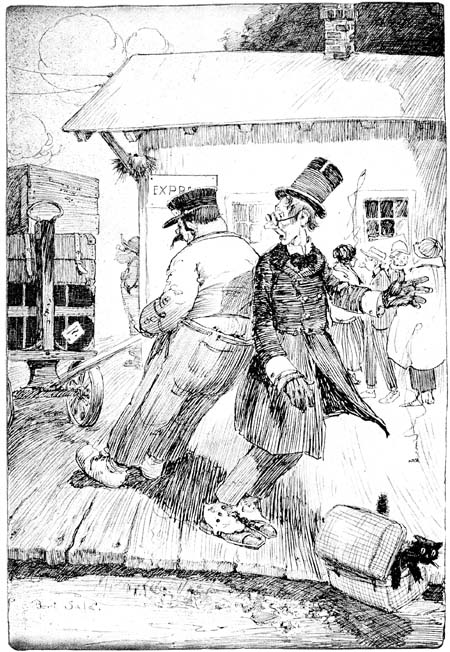
HE ACCIDENTALLY RAN INTO THE MAN WITH THE BIG SPECTACLES.
Jerry Todd and the Rose-Colored Cat. Frontispiece—(Page 4)

BY
LEO EDWARDS
Author of
THE JERRY TODD BOOKS, ETC.
GROSSET & DUNLAP
PUBLISHERS : : NEW YORK
Made in the United States of America
Copyright, 1921, by
The Sprague Publishing Co.
Detroit, Mich.
Copyright, 1924, by
GROSSET & DUNLAP
The mystery part of this adventure really started the day we got Mrs. Kepple’s letter saying she was shipping us her famous rose-colored cat, Lady Victoria. Professor Stoner declared on the spot there was no such thing as a rose-colored cat—only he called it a feline. But right there in front of our eyes was the letter. And just as plain as day it read: “rose-colored cat.”
So we were all excited and went to the depot in a body the morning the cat arrived. When we squinted into the box we got the surprise of our lives. And I imagine you’ll get something of a surprise when you read about it.
For the most part the people in Tutter regarded our cat troubles as a joke. We didn’t mind that. And you can snicker all you want to as you read down through these pages. If you like the story well enough to wish another like it, suppose you try my first book, JERRY TODD AND THE WHISPERING MUMMY. In case you already have enjoyed the “mummy” story, there is still my third book, JERRY TODD [vi]AND THE OAK ISLAND TREASURE, and also JERRY TODD AND THE WALTZING HEN, book number four. These are all stories about Scoop and me and Red and Peg. Full of mystery and packed with clean fun.
My fifth book, JERRY TODD AND THE PUZZLE ROOM MYSTERY, is about a haunted house. I guess this old house is the only one in the world having a puzzle room. Therein lay the mystery. There is a ghost, and heaps of fun. I imagine you’ll enjoy this book more than some of the others if you particularly like spooky stories.
Your friend,
Jerry Todd.
HERE again I am providing a “Chatter-Box” for a book (this is Leo Edwards speaking) that was published several years ago without a “Chatter-Box.” As I explained in the new “Chatter-Box” in Jerry Todd and the Whispering Mummy, “Our Chatter-Box,” a department open to all readers of my books, both girls and boys, began with my sixteenth book. Made up mainly of youthful contributions (letters, poems and so on) this department soon gained great popularity. More and still more young readers wrote to me, hoping to see their letters in print; and now my publisher has given to me the very pleasing job of incorporating many of these letters in brief “Chatter-Boxes” for all of my early volumes.
Writers of accepted poems will receive, as a reward, a free autographed copy of the book in which their poem appears. Many fine poems, featuring the characters in my books, are contained in the “Chatter-Boxes” in the new Trigger Berg books and also in Andy Blake and the Pot of Gold and Jerry Todd, Editor-in-Grief. It will pay you to read these poems. Then, if you wish, send me one of your own original poems.
The many thousands of letters that I receive yearly from my loyal young readers are a source of great inspiration to me. Boy, some of these letters are hot! And how I enjoy them. I’m glad, too, that readers of my books like long “Chatter-Boxes.” For that will give me a chance to use a lot of letters in the big “Chatter-Boxes” in my new books. If you haven’t written to me, please do so right away. We’re good buddies, you know. I want to hear from you. And I sure will try and find a place for your letter if it is interesting.
FIRST on the list is a letter signed by two boy pals (now Freckled Goldfish), [viii]Frank Johnson and Robert Dansby of Dallas, Texas.
“You sure must be a regular guy to write such swell boys’ books. We’d like them better, though, if Jerry had a dog. Is there such a town as Tutter? Are Jerry, Poppy, Scoop, Peg and Red real boys? In your book, Jerry Todd, Pirate, who opened and closed the door and started and stopped the clock in Al’s grandmother’s room? We certainly hope you’ll keep on writing books of this kind.”
As I’ve said before, I try to be a regular guy. I sure love boys and am with them a great deal, which, I suppose, explains why my stories seem so real to young readers. Boys liking dogs will particularly enjoy Jerry Todd, Caveman, in which Jerry’s new dog makes its first appearance. The majority of the characters that I write about are real, including Poppy, Red, Scoop, Peg, Al, Slats and Tail Light. Tutter is the town (it has another name) in which I was raised. The full explanation of who performed the “ghostly” movements in Jerry Todd, Pirate, is given on page 246.
“I would like to have Jerry and his gang play baseball against the Stricker gang,” writes Freckled Goldfish (No. 5069) George Ott (no relation to Poppy!) of Brooklyn, N. Y. “Also I’d like to have Trigger Berg and his gang play baseball against Tony Crooker’s mob for the town championship. I think Trigger is the cat’s whiskers, and almost as good as Jerry Todd. I notice in the Elephant book that you said Jerry collected stamps. I’m glad to see that, for stamp collecting is one of my hobbies.”
“I’m a great reader,” writes Bud Lovett of Cleveland, Ohio, “and in sleuthing May Company’s department store the clerk in the book section suggested that I read one of your books. I did. Since then I’ve invested almost ten bucks in your books. And do I ever love you for writing such peachy books! I think you have made some mistakes in your books. For instance, in the Whispering Cave Jerry dreamt about a cork tree. In the Bob-Tailed Elephant Uncle Jonah tells Jerry and Henny the same story, almost word for word. Some of your books are masterpieces and some seem not so good—more of an effort. That part is funny in the Talking Frog where the frog and the talking machine had a fight. It was funny, too, in another book (I think it was the Stuttering Parrot) where Jerry, with the arm of the law watching him, ate everything in sight, only to suffer later on when the stuff started playing leapfrog inside of him. Though your Trigger Berg books haven’t as much plot and mystery as your other books, I like [ix]the Bergs even better. Gee, Leo, I’ve always lived in the city and never was in a gang or owned a boat or had pals or adventures, so you are my only hope. Please don’t stop writing! I wish that Jerry, Poppy, Andy, Trigger, Peg, Red, Scoop, Al, Henny, Bud, Chuck, Friday, Slats, Tail Light, Dynamite and all the rest were my honest-to-gosh pals.”
One time I wrote a short story called “Uncle Jonah’s Cork Tree.” Later I used a small part of this story in the Whispering Cave. But when I came to the Bob-Tailed Elephant I had a much better chance to use the story, so repeated it, giving all the interesting little details, figuring that the boys who missed the Cave book would enjoy the story in the Elephant book. Bud isn’t the first reader who has called my attention to this “mistake.”
I wish I had space for more general letters. But I have been told to confine these added “Chatter-Boxes” to about eighteen hundred words. But, as I say, we’re going to have some dandy big “Chatter-Boxes” in all of my new books. So get your letter in as soon as possible, and make it interesting.
OUT of my book, Poppy Ott and the Freckled Goldfish, has grown our great Freckled Goldfish lodge, membership in which is open to all boys and girls who are interested in my books. Thousands of readers have joined the club. We have peachy membership cards (designed by Bert Salg, the popular illustrator of my books) and fancy buttons. Also for members who want to organize branch clubs (hundreds are in successful operation, providing boys and girls with added fun) we have rituals.
To join (and to be a loyal Jerry Todd fan I think you ought to join), please observe these simple rules:
(1) Write (or print) your name plainly.
(2) Supply your complete printed address.
(3) Give your age.
(4) Enclose two two-cent postage stamps (for card and button).
(5) Address your letter to
Leo Edwards,
Cambridge,
Wisconsin.
TO HELP young organizers we have produced a printed ritual, which any member who wants to start a Freckled Goldfish club in his own neighborhood can’t afford to be without. This booklet tells how to organize the club, how to conduct meetings, how to transact all club business, and, probably most important of all, how to initiate candidates.
[x]The complete initiation is given word for word. Naturally, these booklets are more or less secret. So, if you send for one, please do not show it to anyone who isn’t a Freckled Goldfish. Three chief officers will be required to put on the initiation, which can be given in any member’s home, so, unless each officer is provided with a booklet, much memorizing will have to be done. The best plan is to have three booklets to a chapter. These may be secured (at cost) at six cents each (three two-cent stamps) or three for sixteen cents (eight two-cent stamps). Address all orders to Leo Edwards, Cambridge, Wisconsin.
IN SENDING for a ritual, for organization purposes, Freckled Goldfish (No. 2096) Franklin C. Massey of Philadelphia, Pa., writes: “I enjoyed Trigger Berg and His 700 Mouse Traps very much. I liked the part where Trigger got the dog better than any other part because I have a dog and know what they do.”
“Please enroll me as a member of the Freckled Goldfish lodge,” writes Russell A. Smith of Port Richmond, Staten Island, N. Y. “I am thirteen years old and have read all of your books, of which I like the Trigger Bergs the best. I’ve often wondered what Scoop’s real name was.”
Scoop’s name is Howard.
“Your Jerry Todd and Poppy Ott books are the best books I have ever read,” writes George B. Koelle of Philadelphia, Pa. “I wish, though, you would give them names that better fit the book. For instance, I think Jerry Todd, Pirate, should have been named Jerry Todd and the Oak Island Treasure. I particularly like the way in which Jerry tells the story himself. When I heard about your Freckled Goldfish lodge I immediately wanted to join, hence this letter.”
“Our club,” writes William Hadley of Uxbridge, Mass., “would like to buy a big framed picture of Poppy’s goldfish to put in our club-room. Also we’d like to buy a big picture of you, our favorite author. Everything is fine so far as the club is concerned, but I’m out of luck myself—I’ve got the chicken pox. Let me know if you can furnish the pictures and how much they will cost.”
Sorry, Bill, but I can’t supply you with an enlarged picture of Poppy’s goldfish. Why don’t you make a cutout of a goldfish, or draw a picture of one? You can do that. My publisher will send you one of my pictures if you send ten cents in stamps to Grosset & Dunlap, 1140 Broadway, New York, N. Y.
“I am sending you the minutes of the tenth meeting of [xi]our Goldfish club,” reports Norman Wengert of Milwaukee, Wis. “Meeting started at 7:30 P.M. Dues were collected, giving us a total in the treasury of more than four dollars. Members voted to attend the ‘Sky Hawk’ at a local theater.”
There is a great deal more to Norman’s report. This certainly is an active club. It holds checker and horseshoe tournaments and has its own baseball nine. Recently the club raffled off a book, selling tickets only to club members. Club leaders who sometimes wonder “what to do” will do well to write for suggestions to Norman Wengert, 1019 Grant Blvd., Milwaukee, Wis.
HAVE you heard about our School Club? Here’s the idea: Just as my Jerry Todd, Poppy Ott and Trigger Berg books are written primarily to fill the lives of boys with clean, natural fun, so also would I like to have my young readers share this book fun of theirs with others. Which can be done individually if you will prevail upon your teacher to read one of my Todd, Ott or Berg books aloud. That will be fun for the whole room. I might mention, too, that these books are written to read aloud.
If your teacher, through your personal efforts, reads one of my books to the school, you automatically become a member of our “School Club,” and should so notify me. Your name will be published in a later “Chatter-Box.” At the end of each year names of all members (who haven’t already drawn prizes) are put “into the hat.” Not less than ten names (sometimes twenty or thirty) are drawn at random. And each of these ten (or more) boys or girls will receive an autographed copy of my latest book.
A more complete announcement of the club was given in the “Chatter-Box” in Jerry Todd, Editor-in-Grief.
| CHAPTER | PAGE | |
| I | The Feline Rest Farm | 1 |
| II | Cats, and More Cats! | 21 |
| III | The Rose-Colored Cat | 44 |
| IV | Lady Victoria Disappears | 55 |
| V | An Unsuccessful Operation | 63 |
| VI | A Mysterious Visitor | 76 |
| VII | Wanted: One Hundred Cats | 97 |
| VIII | Our Barrel Trap | 109 |
| IX | The Fire in the Brickyard | 133 |
| X | Six Pink Pearls | 150 |
| XI | Two Mrs. Kepples | 160 |
| XII | The Copper Collar | 172 |
| XIII | At the Infirmary | 191 |
| XIV | Indians! | 215 |
| XV | We Solve the Mystery | 234 |
Here is a list of Leo Edwards’
published books:
THE JERRY TODD SERIES
Jerry Todd and the Whispering Mummy
Jerry Todd and the Rose-Colored Cat
Jerry Todd and the Oak Island Treasure
Jerry Todd and the Waltzing Hen
Jerry Todd and the Talking Frog
Jerry Todd and the Purring Egg
Jerry Todd in the Whispering Cave
Jerry Todd, Pirate
Jerry Todd and the Bob-Tailed Elephant
Jerry Todd, Editor-in-Grief
Jerry Todd, Caveman
Jerry Todd and the Flying Flapdoodle
Jerry Todd and the Buffalo Bill Bathtub
Jerry Todd’s Up-the-Ladder Club
THE POPPY OTT SERIES
Poppy Ott and the Stuttering Parrot
Poppy Ott’s Seven-League Stilts
Poppy Ott and the Galloping Snail
Poppy Ott’s Pedigreed Pickles
Poppy Ott and the Freckled Goldfish
Poppy Ott and the Tittering Totem
Poppy Ott and the Prancing Pancake
Poppy Ott Hits the Trail
Poppy Ott & Co., Inferior Decorators
JERRY TODD AND THE
ROSE-COLORED CAT
Did you ever hear of a feline rest farm? We never did till the day we came across Professor Ellsworth Stoner at the Rock Island depot. Till that time we had always thought a cat was a cat, but the professor, after telling us that he was an authority on cats, having studied them all his life along what he termed scientific lines, told us that a cat was a “feline.”
I guess Peg Shaw and I would have particularly noticed the professor even if Scoop Ellery hadn’t pointed him out to us. He was a noticeable man. I don’t mean he was distinguished-looking, like some of the professors and doctors in our college on the hill. What made him noticeable [2]was his odd appearance and queer actions.
I am a great hand to study people’s faces. When I see a man with a kindly face I am naturally attracted to him. Where a man has a mean face I make it a point to keep out of his way. The tall, thin stranger, I noticed, had an unusually kindly face. I knew right off that here was a man who wouldn’t harm a flea. But even in my respect for him I had to smile as I regarded him closely, taking in the big-rimmed spectacles that rested loosely on his big nose, and the old-fashioned collar and necktie. He had on a black suit and a black soft hat. From his general appearance I took him to be a minister. He was mixed up in the crowd of Chicago people who were leaving the train, headed for the Walkers Lake Sanitarium.
Spider Phelps, who drives a summer bus between Tutter and the sanitarium, had his outfit backed up against the depot platform. His homely face screwed all out of shape, he was yelling into the crowd:
“Right over here, ladies and gents. Here’s the bus for the sanitarium. Goin’ right out.”
Walkers Lake is about three miles south of Tutter and the sanitarium built on its shore is a [3]pretty swell joint. It is a cluster of buildings, the largest of which contains fully two hundred rooms. I guess it costs a lot of money to stay there and that is why the guests are mostly rich people from Chicago and Peoria—Tutter being situated about half way between these two cities. The visitors come and stay for two or three weeks at a time, not so much because they are sick but because they are tired and want to rest up in a fashionable way. It’s something of a fad, I guess, for rich people to patronize places like the Walkers Lake Sanitarium.
“Gee, fellows, lamp the deacon,” Scoop cried, pointing to where the man with the funny spectacles had paused on the platform, glancing about him uncertainly. He had no suit-case or traveling bag like the other passengers—just a covered basket, which he carried on his right arm. Scoop laughed and jabbed Peg in the ribs with his elbow. “Why don’t you go over,” he suggested, “and carry the basket? You’ll get a tip—maybe.”
Peg had a reflective look on his face.
“Queer,” said he out of his thoughts.
“What’s queer?” Scoop wanted to know.
“That he should be going to the sanitarium. It’s a pretty lively place for a minister.”
[4]Scoop laughed.
“Maybe he’ll get the shock of his life when he sees the way they dance and carry on. I guess they play cards, too.”
I didn’t say anything. But I had the feeling that the stranger wasn’t heading for the sanitarium as Peg and Scoop imagined. I don’t know what gave me that thought unless it was the uncertainty and bewilderment pictured in the man’s thin face.
Red Meyers, who is the fourth member of our gang, was helping a big fat lady with black earrings carry a couple of fuzzy-haired dogs and a big traveling bag from the train to the bus. She looked as though she might be worth a lot of money. Anyway Red had picked her out as likely to give him a good tip.
While we were watching, the baggage man came down the platform with a truck piled high with trunks and boxes. He accidentally ran into the man with the big spectacles, causing the latter to drop his basket. The basket rolled along the platform and bumped against Red, who was having an awful time trying to carry the two dogs and the big traveling bag at the same time. When the basket struck his legs the cover flopped back and out popped a frightened coal-black cat.
[5]Gee-miny crickets! It was as good as a circus to see the way those two dogs got into action when they spied the cat. Red tried to hang onto them but they clawed and scratched till he had to drop them. When they landed on the platform they gave a wild yelp and started pell-mell for the cat. Around and around the platform they went, making a fearful racket and commotion. Women screamed and ran for the bus. Peg and I and Scoop pretty nearly yipped our heads off we were so tickled.
The fat lady with the black earrings got excited when she saw her dogs hotfooting it after the black cat. She danced around and scolded Red who dropped the traveling bag and tried to grab the dogs. He yelled for us to help him. By this time everybody on the platform was yelling except the stranger with the big spectacles.
“Dear me! Dear me!” the tall man said slowly, looking on in a bewildered way. Picking up his hat, which had been jostled from his head, he dusted it carefully with his handkerchief and then reached for the basket. When he noticed that the basket was empty he gave a startled cry and stared helplessly into the faces about him.
Red was skidding around the platform grabbing at the dogs. They were small dogs, but for [6]their size they made a lot of noise. He managed to get hold of one by the tail. It turned and snapped at his fingers, which made him mad. It doesn’t take much to make Red mad. His temper is as fiery as his hair. When the fat lady began scolding him for pulling her dog’s tail he told her she could catch her own dogs for all he cared.
Then some one yelled to forget about the dogs and rescue the cat. Scoop saw it heading his way and grabbed it just in time to save its tail from being snapped off by one of the dogs. After that the fat lady had no difficulty rounding up her pets. She cuddled them in her arms and I thought for a moment she was going to kiss them. The last we saw of her she was indignantly climbing into the bus, a dog under each fat arm, Spider Phelps following with the traveling bag.
Scoop ran up to the man with the big spectacles.
“Here’s your cat, mister,” he said, offering the pet to its owner. The stranger looked the cat over with a great deal of concern. A sigh of relief escaped from his lips when he found the cat’s tail and everything else in proper shape.
“Dear me!” he murmured, stroking the cat with the tips of his long thin fingers. “How unfortunate that my little companion should be subjected [7]to such rude and savage treatment.” He beamed at Scoop over the top of his spectacles. “I am deeply grateful to you, my boy, for interposing and saving my little pet from those very vicious and ill-bred canines.”
Scoop turned to me and grinned. Calling dogs canines was something new to us. No one in Tutter had ever called dogs by such a fancy name. I figured that the man must be a college professor instead of a minister.
Then, when the crowd had melted away and we were seated on the platform, the stranger told us that he was a professor—though he had no connection with the Tutter College. His name was Professor Ellsworth Stoner and he told us in a modest way that he knew more about cats than any other man in the whole world. He further explained that he had come to Tutter to start a feline rest farm.
Well, I wanted to laugh. A feline rest farm! It struck me as being a crazy idea. I thought at first he was joking. The others thought so, too. I could tell from their actions. But he wasn’t joking. No, sir-e! It was his idea to fix up a place where the cats could be taken care of, then advertise it as an exclusive feline rest farm. He told us he would soon be swamped with business.
[8]In telling us about his scheme he used a lot of big words. He said among other things that the cat was one of the most glorious creatures in the world—that years and years and years ago the Egyptians used to embalm their cats just like human beings. That was the “golden age of her Feline Majesty,” is the way he put it. He told us about the big cat cemeteries along the River Nile. It was interesting. I could see he knew a great deal about cats.
“The many years of exhaustive study that I have given to the subject will excellently fit me for the work that I am about to take up,” he went on. “My first step will be to establish a suitable feline domicile and then——”
“Establish a which?” Scoop interrupted, letting his forehead go puckered.
“A feline domicile.”
“What’s a feline domicile?” inquired Scoop.
“I am referring, of course, to the home I shall establish for my feline guests,” explained the professor.
Scoop grunted.
“If you go talking that dictionary stuff around town you’ll establish something, all right, but it won’t be a home for sick cats.”
The professor looked bewildered.
[9]“I—er—fail to comprehend,” he murmured.
“You’ll establish a reputation for being a nut,” Scoop said bluntly.
“A nut?”
“Yes, a nut.”
“How extraordinary!”
Scoop saw that it was no use talking slang to the professor.
“Never mind,” he grinned. “Go ahead with your yarn. You left off where you were establishing a dormitory, or something.”
“A feline domicile,” the professor corrected. “When this has been provided I shall advertise in the Chicago newspapers. I am sure the wealthy people who have occasion to depart from their homes during the sultry summer months will be extremely glad to learn that their pet felines can be accommodated at my rest farm and cared for along strictly scientific lines.”
I could see doubt in Scoop’s face.
“You say the rich people will pay you real money for taking care of their cats?” he questioned, regarding the other with narrowed eyes.
The professor frowned in mild disapproval.
“I much prefer the term ‘feline’ to ‘cat,’” he said. “To my cultured ear the term ‘cat’ sounds very vulgar. Yes,” he went on, “I shall make a [10]charge of one dollar per feline per week. At first I shall arrange to accommodate one hundred felines—a matter of one hundred dollars per week.” He paused and cleaned his spectacles with a handkerchief. When they were polished to his satisfaction he returned them to his nose and added: “You seem to be nice, bright boys. I am wondering if I can engage you to assist me in the undertaking.”
Scoop backed off. I knew why. Right away I got suspicious, too. One time a shyster came to town and told us what smart boys we were and skinned us out of five dollars for memberships in his fake detective agency. I told about that in my book about the whispering mummy. Now another stranger was giving us the same line of soft-soap. It wouldn’t do him any good. We were wise. What little money we had would stay right in our pockets.
“There will be a suitable remuneration,” the man continued. “Suppose we say five dollars each per week.”
I saw now that we had been overly suspicious.
“You mean you want us to work for you; and that you will pay each of us five dollars a week?” Scoop questioned shortly.
The professor nodded.
[11]“I rather feel that five dollars a week will be a just stipend,” he said gravely.
Peg threw up his arms and pretended he was going to faint.
“Help!” he cried. “Some one fan me with a dictionary.”
Scoop turned and scowled.
“Cut it out,” he ordered. Then he said to the professor: “What do we do to earn the five dollars?”
“I shall train you in the scientific care of my feline guests. There will be regular feeding hours; and, of course, systematic recreation. I cannot possibly manage the business and attend to all the details of operation. If you feel you would like to assist me in the work——”
“You can consider us hired,” Scoop cut in. “This is vacation time and we’ll work for you as long as there’s a regular pay-day. What do we do first?”
The professor seemed pleased at Scoop’s decision. But he wasn’t half as tickled as I was. Here was an easy way to earn five dollars a week was my contented thought. Lots easier than hoeing corn in the river bottoms, which I did one summer for fifty cents a day and almost chopped my big toe off. I knew Dad and Mother would [12]be pleased when they heard about my swell new job. Dad says a boy should always keep his eyes and ears open and learn useful things. I figured that in associating with the professor I would learn a lot of useful things about cats. When you come to think about it there aren’t very many people who know very much about cats. A cat is born and lives and dies and that is the end of it. We know a lot about horses and cows. Magazines print stories about dogs, showing that dogs are well understood. But I never saw a story about a cat. I like cats, too. It would be nice to learn all about them. Every day I would learn something new. I was anxious to get started on my new job.
In answer to Scoop’s question the professor explained that the first thing to do was to find a suitable location for establishing the rest farm.
“We shall require a somewhat sizable building,” he outlined. “It should be rather apart from the community so that we shall not be disturbed.”
Scoop’s thoughts carried him away. Then he came back to earth and gripped my arm.
“Say, Jerry, how about the old cement mill back of your pa’s brickyard?”
“Just the place,” I said, sharing his excitement.
[13]The old mill wasn’t good for anything. Years ago the machinery was junked for old iron. There are holes in the wooden walls and roof, but I figured this wouldn’t interfere very much. In talking it over Peg suggested that we see Dad before going any further with our plans, so we took the professor along with us to find out would it be all right to turn the old mill into a cat farm.
It took us ten minutes to reach the brickyard, which is near the canal on the west side of town. Dad was in his office. He looked kind of surprised when we entered with the professor. I guess he thought, like we did at first, that our new friend was a minister.
“Howdy, gang,” he greeted, grinning down at us as he shook hands. Dad’s always friendly and full of fun. “Some one getting married to-day?—or are we taking up a missionary collection for the Hottentots?” he added.
“This is Professor Ellsworth Stoner,” I introduced. “He knows all about cats and——”
“You mean catalogs?” interrupted Dad, looking from me to the professor.
“No; just plain cats,” I said.
The professor came forward. He looked comical with the big-rimmed spectacles jiggling on the end of his big nose and the basket on his arm. [14]He had a funny way, too, of peering solemnly over the top of his spectacles.
A grin crept into Dad’s face.
“Might I—er—suggest,” the professor interrupted in a mild voice, “that hereafter in our reference to the felis domestica we use the term ‘feline’ instead of ‘cat.’ To me the term ‘cat’ seems common and does not do justice to the gorgeous creature that in the days of Egypt’s splendor held the awe and admiration of even the mighty Pharaohs.”
Dad’s stenographer went, “Tee, hee, hee!” and stuffed her handkerchief into her mouth. But Dad didn’t giggle. He has better manners than Miss Tubbs. Maybe he wanted to laugh, but if he did he choked it down, like I do in church when something funny happens. Dad has a lot of consideration for other people’s feelings.
“I’m mighty glad to meet you, professor,” he said, again pumping the thin arm up and down. This jiggled the basket and started the black cat to yowling. “All my life,” added Dad, running off into his nonsense, “I’ve been wanting to meet some one who was an authority on cats. Yes, sir, I’m tickled pink to make your acquaintance.”
The professor beamed.
“And I, sir, am de-lighted to meet you. This [15]is an honor I long shall remember! If, as you say, you are scientifically interested in felines, we shall, in the days to come, enjoy many happy moments discussing their anatomy, their physiology and magnificent personality.”
“Absolutely,” said Dad. “You took the words right out of my mouth. Anatomy is what I’m most interested in. We’ll discuss that first if you have no objection. Now I wonder——” and he ran his fingers through his hair, letting his forehead go puckered.
There was a brief reflective silence.
“I am wondering,” continued Dad, “if it will be best for us to start in on the anatomy at the ears and work down, or start in at the tail and work up.”
I didn’t know how far he would carry his joke, so I decided to butt in. Very quickly I told about the professor’s cat farm scheme and asked would it be all right for us to use the old mill. I explained that I was to work for the professor and earn five dollars a week.
Dad had a puzzled look when I finished.
“Let me get this straight,” he said slowly. “As I understand it you are going to start a—er—feline rest farm in the old mill, advertise in the Chicago newspapers for ca—I mean felines, and [16]have a bunch shipped in here with the idea of collecting a dollar a week per feline from the owners. Am I right?”
The professor beamed at Dad and nodded.
“Sir,” he said, “you have given in brief a very comprehensive outline of my contemplated project.”
“And you are going to start with one hundred ca—I mean felines?”
“Exactly, sir; exactly.”
Dad’s eyes twinkled like he was all bubbly inside.
“What’s the use of being pikers?” said he. “Let’s make it two hundred cats. Shucks! Let’s make it a thousand. That will be a thousand dollars every week. This is a wonderful scheme,” he added, letting on like he was terribly excited over the proposition. “You’re to be congratulated, professor. Any common dub can see money in bricks but it takes a genius to see money in cats. Yes, sir, I’m with you till Niagara falls. Absolutely. Use the old mill by all means. Do anything with it that you want to.”
We thanked Dad and passed on through the brickyard. The old mill is located on the side of a hill. There is a door in front that opens into the lower floor, but we decided to use the second [17]floor, which was reached by climbing the hill and entering a wide door at the back. The second floor was in every way the cleanest and there was better light here.
The professor teetered about the room on his long, willowy legs, as tickled as a small kid with an all-day sucker.
“How does it strike you?” said Scoop, acting like he wanted to be handed a little praise for being smart and suggesting the old mill as a good place to establish the cat farm.
“Excellent,” murmured the professor. “I can, in fact, imagine no place better adapted to our immediate needs. Roomy, airy, dry. Um—— We shall require a goodly supply of boxes of suitable proportions in which to house our feline guests. Doubtless we can acquire them at the mercantile shops in the village.”
“You won’t get ’em for nothing,” Scoop said quickly. “I know, because my father runs a grocery store.”
“I venture to say the charge will not be exorbitant,” returned the professor. “I have some money with me. Suppose we see how many suitable boxes we can purchase for five dollars,” and producing a pocketbook he handed Scoop a crisp greenback.
[18]We had a lot of fun that day helping the professor arrange things in the old mill. And as we worked with him we absorbed much of his confidence in the scheme. Like Peg said, in the big cities they have hospitals for dogs and other pets. He read about it in a magazine. And he told us about a doll hospital in New York City. All they do in this hospital is put new arms and legs on old dolls. If people could make a success of a doll hospital I saw no reason why we couldn’t make a success of the feline rest farm. Take the rich people who patronize the Walkers Lake Sanitarium. They cheerfully pay two prices for everything. What would a dollar a week mean to them in considering the welfare of their pet cats? Not a drop in the bucket, hardly. Yes, sir, we were every bit as excited over the proposition as the professor and fully as confident that it was going to be a money-making scheme.
There is a little room to one side on the second floor of the old mill and here we brought in a cot that Red found in his pa’s barn. The professor seemed to have plenty of money. He bought a small gasoline stove for cooking purposes and a lot of truck to eat. Mostly canned things like beans and cooked meat. When we were ready to go home to supper Scoop said it didn’t seem [19]right to leave the old gentleman all alone in the mill, so we got two more cots and prepared to stay with him nights, two of us at a time.
At the supper table that evening Dad was full of nonsense. He talked persistently of “felines,” reminding us of the swell time he was going to have visiting with the professor. After a bit Mother told him to quit acting the dunce. She pinched my knee under the table and said the feline rest farm was a dandy scheme and she hoped everything would turn out all right. That’s Mother for you! She knows how to stand by a fellow and believe in him.
“Of course,” she added, looking into my face, “you will want to be careful and not let the cats——”
“Felines,” Dad corrected with a grin. “My dear lady, must I again remind you that the term ‘cat’ sounds very common and fails to do justice to the gorgeous creature that put Egypt on the map?”
Mother reached for the salt.
“I said cats and I mean cats,” she sputtered, jiggling the salt shaker.
Dad sighed and shrugged his shoulders.
“All right,” he said, “have it your own way.”
“As I was going to say, Jerry,” she went on, [20]“I hope you will be careful and not let the cats bite you and give you hydrophobia.”
I slowed up on my potatoes and looked into her face.
“You are thinking of dogs,” I said. “Cats don’t give people hydrophobia.”
“The cats may give you something worse than hydrophobia,” she persisted. “I want you to promise me you will be careful.”
I told her there was nothing to worry about. I said it was going to be fun.
Tutter is a small town and it wasn’t very long before everybody thereabouts knew of the feline rest farm. On the few occasions when the professor went down town he attracted a great deal of amused attention. People meeting him in the streets looked at him and smiled. It is always that way with men who have the courage to start something new. I read one time that the man who invented the umbrella was arrested when he appeared in a London street on a rainy day with his new contrivance raised above his head. And when bathtubs first came out some of our big American cities passed laws against them, the doctors contending that people who took baths in the winter time would catch cold and die. So it wasn’t surprising that a lot of Tutter people saw fit to laugh at the professor’s scheme. They didn’t know any better.
[22]Once when we were down town getting a load of boxes we met the Stricker gang. We hate them like they hate us. Bid and Jimmy Stricker are cousins and one is just as mean as the other, only Bid is the ringleader, kind of. He went “meow!” at us. He didn’t do any more “meowing” though when Peg lit into him. Peg’s a scrapper, I’ll tell the world. We chased the whole gang into Zulutown. That part of town beyond the brickyard where the Stricker cousins live is called Zulutown. The kids who live there and pal around with Bid and Jimmy are a tough lot. All they want to do is fight and destroy things. The only time they ever go to Sunday-school is just before Christmas. That’s a pretty cheap way of getting a present.
While we were working in the old mill, getting the cat boxes fixed up with slats up and down the front and each box numbered, the professor wrote the advertisement about the feline rest farm and sent it to the Chicago Tribune. It was a dandy advertisement, we thought, with a lot of big words that made it sound important. When the advertisement appeared in the newspaper it attracted a great deal of attention. We came to realize this more fully in the days that immediately followed. Here is the advertisement:
[23]
Professor Ellsworth Stoner’s
FELINE REST FARM
Give your pet feline the same thoughtful care and scientific attention that you bestow upon your children.
I will help you. Having made a life study of the felis domestica I have arranged to give the public elect the benefit of my years of research and have established at Tutter, Illinois, the first Feline Rest Farm in the world.
For the small sum of one dollar per week you can have your pet feline domiciled in my Feline Rest Home. For this insignificant sum your feline will be given scientific care and attention. Should you be leaving your city home for the summer, arrange to have your feline placed under my care.
Only a limited number of felines will be accommodated, so act at once and avoid possible disappointment.
Professor Ellsworth Stoner’s Feline Rest Farm,
Tutter, Illinois.
The advertisement appeared in the newspaper Monday morning and on Tuesday the cats began to arrive. A box containing two cats came first, followed by two crates, one containing seven cats and the other nine. On the noon train from [24]Chicago a third crate arrived, packed so full of cats it was a wonder some of them weren’t squashed. We thought there must be fully thirty cats in the crate, but when we came to count them there were only eighteen.
We were kept so busy unpacking cats that we never once thought of going home to dinner. The professor was very much excited over the way things were turning out. We were excited, too. It was plain to us that the cat farm was going to be a humdinger of a success. A feeling of satisfaction grew up within us in the thought that we had taken hold of this new idea of the professor’s and were helping to make it work. Any one can copy another person’s idea. We weren’t copying. We were doing something that never had been done before. That is what filled us with quiet pride when success came crowding in. I bet Mr. Edison has the same happy feeling when he finally gets the kinks ironed out of his great mechanical inventions and the wheels and cogs spin around just as he wants them to.
We had placed the black cat in box number one. When the other cats were distributed thirty-seven boxes were occupied. And such a collection of cats! None of them looked like what you’d call high-toned cats. Rich people’s cats, I mean. [25]Scoop said they looked to him like alley cats. We were disappointed in this, having figured that cats coming from wealthy homes would be different than the cats we had been used to seeing in Tutter—something a little nicer, as it were, with long, silky hair, or something like that.
There were white cats and black cats; yellow cats and maltese cats; tiger cats and calico cats. There were cats with short tails and cats with long tails. One had lost a foot. Two had damaged ears. Another was blind in its left eye. Some of them had no pep at all; others wanted to be spitting and clawing all the time.
And could they yowl? I’ll tell the world! They were considerably frightened from their trip to Tutter in the baggage car and every time we walked past their boxes they set up a fearful racket. Each one seemed determined to yowl louder and longer than its neighbors.
According to the professor’s figures thirty-seven cats meant thirty-seven dollars a week, only one of the cats was Blacky, the cat he brought to Tutter in the covered basket, which made thirty-six dollars a week. That was a corking good start. The feline rest farm was going to be a big money maker all right.
Shortly after the one o’clock whistles blew Peg [26]came back from town with a letter addressed to Professor Stoner’s Feline Rest Farm. It was mailed from Chicago and we hoped it would contain money. It did. When Scoop, at the professor’s request, opened the envelope out dropped a ten-dollar bill. The letter was signed by a Chicago lady named Mrs. Peter Kepple. She stated that she was shipping us her prize rose-colored cat, Lady Victoria, valued at five hundred dollars. She mentioned in the letter that later on she planned to spend a few days at the Walkers Lake Sanitarium and would then call at our rest farm and get her cat.
Scoop dropped the letter and flourished the ten-dollar bill.
“Hot dog!” he cried, getting in a few fancy dance steps with his big feet.
Peg picked up the letter and squinted at it.
“A five-hundred-dollar cat,” he said in a reflective voice. “What do you know about that!”
The professor was plainly bewildered.
“Dear me!” he murmured. “How very extraordinary. I am at a loss to comprehend what the dear lady means in her reference to a rose-colored feline. Are you sure it says rose-colored?”
[27]Peg handed him the letter and he squinted at it over the top of his spectacles.
“Whoever heard of a rose-colored cat?” Scoop put in. “Why, rose color is a sort of pink and red mixed. I know, because one time we sold colored tissue paper in pa’s store. Whoever heard of a red cat?”
“Well,” I spoke up, “it would have to be red or green or some fancy color to be worth five hundred dollars.”
“Astounding!” came weakly from the professor. “Really, there must be some mistake. I quite assure you there is no such thing as a rose-colored feline.”
Scoop laughed and rustled the ten-dollar bill.
“There isn’t any mistake about the money,” he said. “We should worry what color cats the rich people send us as long as they send the necessary jack.”
The professor continued to frown in a bewildered way and teetered back and forth across the room, his hands working nervously behind his back. I guess it was an awful shock to him to learn that there was a certain kind of cat in the world he didn’t know about. After a few minutes he drew a small book from his coat pocket and seating himself to one side began checking up certain [28]items and references on various pages. He was mumbling to himself but we didn’t catch the words. Presently he glanced up at us and slowly shook his head.
“Impossible,” he murmured. “Quite impossible. The dear lady must be trying to spoof us.”
Scoop grinned.
“She can spoof us all she wants to at ten dollars a spoof,” said he.
I guess you can imagine how tickled we were. The letter and ten-dollar bill was evidence of our success. We had felt pretty enthusiastic when the cats arrived; but now that the money was coming in we were in a mood to bubble over.
While we were talking about the rose-colored cat we heard heavy footsteps without the door and two men in blue uniforms came into the mill. They were strangers to us and looked like street car conductors in the city, sort of. When the professor saw them he gave a screech and I thought for a moment that he was going to throw a fit.
One of the men quickly stepped forward and patted him on the arm.
“There, there, purfessor! Nothin’ to git excited about. Take it cool, old dear; take it cool. We just thought we’d drop in and see if you [29]aren’t through with your little vacation. Now, purfessor, don’t lose your head. Be calm; be calm. If you only knew how much we’ve missed you, you would want to hurry back with us.”
For a moment we were too astonished to say a word. We just stood there and stared, our lower jaws sagging like we didn’t know very much. It came to me in a vague way that the men were policemen or some kind of guards. The professor was whimpering like a baby. I realized from his actions that something was wrong.
Scoop recovered his voice.
“Wha-at’s the rip?” he wanted to know, looking first at the professor, then at the guards.
“He’s just a little off up here,” one of the men explained, tapping the side of his head. “Belongs over at the county infirmary. Harmless and all that, but a bug on cats. Thinks he’s the great know-it-all when it comes to cats. Plumb nonsense, of course.” Here the guard paused and glanced around the room at the cat boxes. A grin spread over his big red face. “I see he’s been working his hobby overtime.”
Scoop made a gurgling sound in his throat.
“But you—you aren’t going to take him away!” he cried.
[30]“Sure thing,” replied the guard.
“You can’t do that,” Scoop argued, “because this is his feline rest farm. He started it, and all these cats have been sent to him to be taken care of. What are we going to do with the cats if you take him away?”
The guard ran his fingers through his hair and shrugged his broad shoulders.
“Sorry, boys, but we’ve got to take him back with us. We came for him. If we were to go back without him the superintendent would fire us.”
In his actions Scoop made me think of a drowning man grabbing at straws.
“Maybe there’s some mistake,” he cried. “You say he belongs at the county infirmary, but he came from Chicago. We were at the depot the day he got here. He was right with the Chicago crowd.”
“Probably got on the train at Ashton,” said the guard, naming a neighboring town. Then he turned from Scoop and instructed his companion: “Look around, Taylor, and pick up his things. That’s his basket over there. Are you ready, purfessor? Fine! Well, good-by, boys. Thanks for taking care of our friend till we managed to locate him.”
[31]The professor didn’t want to leave. He tried to hold back, but the guards were big men and he was helpless in their hands. They took a firm grip on his arms and hurried him out of the mill and into an automobile standing in front.
Well, I can’t describe our feelings as the professor and the guards disappeared through the doorway of the old mill, leaving us alone with the cats. For several moments we stood there staring at one another. Sort of stunned and horrified-like. No one said a word. Then the guard named Taylor returned to the door.
“The purfessor seems kinda worried about somethin’ and asked me to come back and tell you there hain’t no sech animal as a rose-colored cat. A rose-colored cat! Wouldn’t that put a grin on Sober Sue! Haw! haw! haw! That’s all, boys. Good-by and good luck.”
We heard his footsteps die away. An automobile motor churned into motion. There was a clashing of gears. Then silence.
Scoop acted as though his knees were giving out.
“Good night!” he screeched, dropping onto the nearest cat box. “Just think, fellows: The professor loony and no one to take care of this gang of cats but us.” Then he let out another [32]yip as the cat beneath him yowled and slapped at his dangling legs with its claws.
Peg gave a sickly grin.
“I don’t know,” said he, “are we lucky or not.”
“Lucky!” snorted Scoop. “With this gang of hungry cats on our hands! How do you get like that?”
“Well,” said Peg in his deliberate way, “we’ll be lucky, won’t we, if we can run this cat farm and make a lot of money?”
“You’re crazy as a loon,” declared Scoop, which is the kind of bouquets he usually hands out when he gets excited. “The cat farm is a pipe-dream. I thought so when the professor told us about it at the depot. Like a boob, though, I let him kid me into thinking there was something to it.”
“There is something to it,” Peg defended. “Look how the cats are coming in. Thirty-seven the first two days. I don’t see why the feline rest farm has to be a failure just because they took the professor away. Why can’t we run it? No one has a better right.”
Like Peg, I was thinking to myself it would be fine if we could keep on running the cat farm and make it pay. He thought we could do it. I thought so, too. There was Lady Victoria, the [33]five-hundred-dollar, rose-colored cat. The fact that the woman who owned the cat had sent us ten dollars was a pretty good indication that the feline rest farm was a success. I told Scoop my thoughts and he looked more cheerful. We talked it over and decided to stick and see the thing through. We hoped, though, that no more cats would arrive for a week or two. Thirty-seven was all we could manage to care for at the present time. We hoped, too, that the people who had shipped us the cats would begin sending in their money. Having only the ten-dollar bill as working capital gave us an uncertain feeling. To run a business right a fellow needs plenty of capital. I’ve heard Dad say so. I realized now how necessary capital is.
Red happened to be down town when the guards took the professor away. Presently he tumbled into the mill all out of breath. He was so excited he could hardly talk.
“The baggage man—wants us to bring a truck—to the depot,” he panted.
“What for?” I inquired.
“To take away the cats that came in on the two-thirty. He says there’s five crates.”
Scoop gave a gasp.
“Five crates?” he repeated dully.
[34]“Yes, five crates,” said Red. “From the way they’re packed in I guess there must be at least ten cats in each crate.”
Scoop clawed at his hair.
“O-h-h-h-h!” he groaned. “Five more crates of cats. Cats, cats, cats! Nothing but cats. Catch me, fellows, I’m going to faint.”
Red was stepping around in high feather.
“Gee, fellows,” he enthused, “ain’t things working out slick? This makes nearly a hundred cats, and it’s only the second day after we opened up for business. That’s a hundred dollars a week! Hot dog! I guess we’ll be able to start a bank, what?” Here he paused and glanced around, a questioning look in his eyes. “Where’s the professor?” he wanted to know.
We told him.
“Now that you know what we’re up against,” Scoop said dismally, “maybe you’ll let me faint like I wanted to.”
He was fooling, of course. No one had any intentions of fainting—not with one hundred cats on our hands. Cats aren’t very husky when it comes to size, but they eat something, and just what that something was going to be was pretty much of an uncertainty in my mind.
We were preparing to leave the mill when one [35]of the baggage man’s kids thrust his tousled head in through the door and told us his pa wanted us to get busy and take the cats away from the depot.
“Two more crates just come in,” he told us, acting like he wanted to be patted on the back for bringing us good news.
Scoop went wild-eyed.
“You mean there’s seven crates instead of five?” he yipped.
“Yep,” grinned the kid. “And I bet you’ll be tickled when you see the way they’re packed in the last two crates.”
Scoop shoved the kid through the doorway. Then he sat down on a cat box and laughed.
“A hundred cats,” he gurgled. “Gee-miny crickets! It’s funny, fellows. It’s a scream.”
“Let’s hope the people who own the hundred cats don’t forget to send us plenty of money,” spoke up Peg. “I guess it won’t be such a laughing matter if the owners of the cats misplace our address.”
“I’ll say it won’t,” I agreed.
Before night everybody in Tutter knew about the guards taking the professor back to the infirmary. It seemed to strike a great many people as being a huge joke—the fact that he was crazy and had left the feline rest farm on our hands. [36]I guess, too, that nearly everybody in town knew about the seven crates of cats at the depot. When we went down to get the cats, driving Dad’s brickyard dump cart, there was quite a crowd at the depot. As we drove up the people stood along the edge of the platform and grinned at us and offered foolish suggestions. The crates containing the cats were piled on the platform and we could hear the cats yowling when we got within a hundred yards of the depot.
The baggage man wasn’t very friendly.
“You kids certainly are doin’ a thrivin’ business with your cat farm,” he growled. “I’m goin’ to look for a new job if this keeps up. I can stand crated chickens and dogs and pet pigs and even a nanny goat. But deliver me from crated cats! Listen to ’em scrap! That’s the way they go it all the time. I wish they’d kill each other. There’s cat fur all over the depot.”
But he came down from his high horse long enough to help us load the cats into the dump cart. Then we started back toward the old mill. When we passed down Main Street we attracted a lot of attention. The people stood on the edge of the sidewalk and laughed. They wanted to know where we were going to put on the circus—and did we have any elephants, or just cats?
[37]Maybe you never saw a dump cart. It is a one-horse outfit on two wheels. The body is balanced on the axle and by pulling a lever near the driver’s seat the front end of the box tips up letting the contents of the cart slide out at the back. Dad uses the car for dumping scrap brick onto the refuse pile near the canal.
When we turned into Grove Street Red Meyers tried to act smart and balance himself on the top cat crate. He’s always up to monkeyshines like that. I yelled at him to sit down and quit jiggling the cart, but he pretended not to hear me.
“Lookit, gang!” he yipped, standing on one foot. “‘Tilly Tinker,’” he cried, and swayed his body back and forth in imitation of the wooden nursery toy you frequently see in store windows.
I don’t know how the accident happened. Maybe I struck the dumping lever with my elbow when I turned in my seat to yell at Red. Anyway the hind part of the cart took a sudden dip and there was “Tilly Tinker” in the middle of the dusty street with seven crates of yowling cats piled on top of him.
I don’t know who made the most racket, Red or the cats. It was funny. When he crawled from under the pile of crated cats and found us laughing he wanted to fight the three of us.
[38]Then Peg yelled:
“The cats, fellows! One of the crates is busted,” and he jumped out of the cart and made a wild grab at a pair of furry tails. In less than seven seconds the street seemed full of scampering cats. They beat it in a dozen directions. We tried to catch all of them but it was a hard job. Maybe six or eight got away from us. I don’t know.
Peg likes to tease Red. I never suspected, though, that he was starting a joke when he said:
“Say, Red, there’s one of the cats over on Miss Prindle’s front porch. I bet you can’t catch it.”
“I bet I can,” bragged Red.
“Your feet are too big,” said Peg. “You move around like a steam roller. By the time you get within ten feet of the porch the cat will be in the next block.”
“Is that so!” snorted Red. Hitching up his pants he started across the street.
Pretty soon he came to the porch steps. The cat seemed to be sleeping and didn’t notice him. That was funny, I thought. Then I tumbled to the fact that it was Miss Prindle’s pet Angora.
Sneaking up the porch steps on his hands and knees, Red made a lunge for the cat. It gave an awful yowl. Miss Prindle appeared in the doorway [39]with a broom. I suspect she came to the porch to do some sweeping. She forgot all about sweeping, though, when she saw Red hanging to her cat. Down came the broom on his head.
“Tryin’ to steal my Tabby to put in your silly cat farm, are you?” she cried, getting in another lick. “I’ll teach you to keep out of my yard and leave my cat alone. Take that and that,” and poor Red got a couple more husky whacks.
He limped back to the dump cart rubbing his head.
“I’ll get even with her,” he growled, glaring in Miss Prindle’s direction. Then he saw us grinning and tumbled to the fact that Peg had put up a job on him. “Yes,” he gritted, scowling at Peg, “and I know some one else I’ll get even with, too.”
When we reached the old mill we took the cats out of the crates and shut them in the boxes we had fixed up. We counted seventy-nine. As we already had thirty-seven before this last bunch arrived, our total was now one hundred and sixteen. We had to double up with a number of the cats and put two in a box.
When the cats were taken care of we sat down to talk things over, because, as Scoop pointed out, the situation was getting complicated to say the [40]least. Twice that afternoon we had stopped in at the post office, hoping more money would arrive in the mail. Each time the post office box that Professor Stoner had rented was empty.
“So far,” said Scoop, “with the exception of the ten-dollar bill it has been all cats and no coin. Maybe you can tell me what we are going to do if the cats keep on coming and the money doesn’t show up.”
“I think the money’ll come pretty soon,” Red said hopefully. “We can’t expect everything to happen the first day or two.”
“The advertisement in the Chicago newspaper didn’t say that people had to pay in advance,” I reminded. “Maybe the owners of the cats expect us to send them a bill at the end of each week, like the storekeepers do.”
“Who are we going to send the bills to?” said Scoop, acting like he wanted to corner me.
“To the owners of the cats,” I said.
“Who are they?” he followed up.
Well, I couldn’t answer that. It is a fact that we didn’t have the names and addresses of the people who had sent us the cats. I knew it as well as Scoop did, but I had let it slip my mind.
There was a brief silence.
“I’m beginning to think,” said Scoop, “that [41]there is some joke about these cats. Every one around here thinks so. Anyway, if the coin doesn’t begin to come in pretty soon, or if we don’t get some letters from the owners of the cats, I guess we won’t be in doubt as to whether or not it’s a joke.”
Peg had a thoughtful look.
“If it does turn out that way,” he put in, “what’ll we do with the cats?”
Red giggled.
“That’s easy,” he cried. “We’ll turn ’em loose.”
“Oh, no you won’t,” Scoop said quickly. “That’s one thing we can’t do.”
“Why not?” said Red.
“Dad told me this noon,” said Scoop, “that Bill Hadley told him if we tried turning the cats loose in Tutter he’d put us in the cooler.”
Bill Hadley is the Tutter cop. He’s a pretty good friend of ours, like I wrote about in my whispering mummy book, but we knew if he told Mr. Ellery he would put us in jail he’d stand by his word. When it comes to enforcing the law Bill has no favorites.
“How did Bill come to tell your father that?” inquired Peg.
“Like I mentioned,” said Scoop, “everybody [42]around here seems to think this rest farm is a joke. The people expect that sooner or later we’ll have to get rid of the cats. I guess they told Bill to keep an eye on us so the cats wouldn’t be turned loose on them. Safety first, kind of.”
Peg giggled, his big mouth stretching from ear to ear.
“Let’s sell ’em to the butcher,” he suggested. “They ought to make fine sausages. We’ll help the butcher fix up a dandy advertisement to go in his window: ‘Try our famous feline sausages. Made from carefully-selected, hand-picked specimens, secured from Professor Stoner’s celebrated Feline Rest Farm.’ How’s that? Pretty nifty, eh?”
I continued the nonsense by suggesting:
“Or we can have a rummage sale and get rid of ’em that way.”
“Why not form a company,” grinned Red. “‘The Tutter Mouse Exterminator Company, Limited.’ We can rent the cats out in gangs at so much a day.”
Scoop gave a disgusted grunt and sprang to his feet.
“You’re getting worse and worse. As idea artists you’d make second-class bricklayers. I move we adjourn till some one gets a real hunch.”
[43]We started for town. A short distance from the old mill we met the baggage man’s boy coming on the run.
“Say, Scoop,” he yelled, before he reached us.
“Say it,” Scoop said without enthusiasm.
“There’s two more crates at the depot.”
Right away I thought of the five-hundred-dollar, rose-colored cat.
“Come on,” I yipped. “Let’s beat it for the depot. Maybe Lady Victoria’s arrived.”
“Nix,” said Scoop, “there’s been no train from Chicago.”
The boy shook his head.
“No,” said he, “these cats came from Peoria.”
Scoop looked like he had a pain in his stomach.
“Where’ll they come from next?” he wailed.
The one hundred and twenty-six cats that we had cooped up in boxes in the old mill certainly made an awful racket. They yowled as though they were getting paid for it by the hour and were afraid some one would come along and accuse them of loafing on the job. A thing that tended to make them exercise their voices was their empty stomachs. We realized that. But we had nothing to feed them. All the capital we had was the ten-dollar bill the Chicago woman had sent us and we were depressed in the thought that ten dollars wouldn’t go very far when it came to buying food for one hundred and twenty-six hungry cats. It was a critical situation. We talked it over with sober faces and worried minds.
“Maybe we can get some meat scraps at the butcher shop,” Peg suggested.
“Or some stale buns at the bakery,” I spoke up.
“Stale buns!” scoffed Red. “Whoever heard of a cat eating stale buns?”
[45]“Well,” I fired back at him, “I guess these cats’d rather eat stale buns than starve to death.”
“True enough,” said he. “And I suspect if you were starving to death you could keep alive on grasshoppers. But that doesn’t prove you would rather eat grasshoppers than fried chicken. What these cats want more than stale buns is mice and rats. Suppose we set some traps in the brickyard barn.”
“Milk is the food we ought to have,” said Scoop. “Maybe we can get some at the creamery.”
I told him if we got any milk at the creamery we’d pay for it. Old Bill Stewart, who runs the creamery, is the stingiest man in Tutter. I knew he wouldn’t give us a pint of skimmed milk if he had gallons of it going to waste.
Scoop scowled in a determined way.
“We’ve got to have milk,” he persisted.
“Why not try my scheme,” spoke up Red, “and feed the cats mice and rats?”
“A cat that eats nothing but meat is sure to have fits,” said Scoop, “and I guess we’d be out of luck worse than we are if this gang of cats started in on the fit business. No, that is a thing we must avoid. Your scheme for catching mice and rats is all right,” he told Red, “but in addition [46]we’ve got to think up another scheme for tapping a milk wagon, or something.”
On the instant I thought of Mrs. Maloney and her Jersey cow. Mrs. Maloney is a nice lady and one of my best friends. She is a widow, with no children of her own, and that is why Dad lets her live in one of his Zulutown houses rent free. In addition to her cow she has a flock of chickens and a goat. I suspect she makes a living selling butter and eggs.
Jumping to my feet I cried:
“I know how we can solve the milk problem, fellows. We’ll ask Mrs. Maloney to help us out.”
“Yes,” Peg said without enthusiasm, “and we’ll probably get turned down.”
“Not if we go about it in the right way,” I declared. My thoughts were skipping along. “I’ll go over and tell her about our cats,” I said. “She’ll naturally want to see them and I’ll bring her back with me. We’ll be real polite and show her around. Kind of offhand we can mention that the cats ought to have some milk. You see if she doesn’t offer to give us some. She’s awfully good-hearted. Besides, she must have a lot of skimmed milk to spare. I’ve seen her feed it to her chickens, a pailful at a time.”
Scoop said there was nothing like trying, so I [47]started for Mrs. Maloney’s house while Red and Peg headed for town. Red was going after traps and it was Peg’s intention to call at the butcher shop and see what he could scare up in the way of meat scraps.
Mrs. Maloney was in her kitchen.
“Well, well, if it ain’t me little friend, Jerry,” she greeted warmly, when I went onto the back porch and rapped on the screen door. “Sure, you’re jist in time for a bite to eat,” she added, holding open the door. “Come right in an’ have a cookie. Whin I was bakin’ ’em this mornin’ I says to meself: ‘Here’s hopin’ some nice boy like Jerry Todd comes along with a good husky appetite.’ Take another, Jerry. Put a couple in your pocket. And tell me, did the milkweed juice I sint over help your ma’s freckles any?”
I told her I knew nothing about Mother’s freckles. Then I mentioned the cats in the old mill and asked her would she like to come over and see them.
“We don’t make a business of showing them to everybody,” I explained, wanting her to feel that the invitation was very special.
“Now, would ye listen to that!” and Mrs. Maloney beamed at me in her usual kindly way. “Sure,” she added, “I did hear somethin’ about [48]your cat farm. An’ whin I seen ye comin’ along the back walk I says to meself: ‘I bet the little divil is here to wheedle me out of the two cats that keep me sich fine company.’ I tell ye what I’ll do, Jerry, seein’ as how it’s you: I’ll let ye have one of me cats, but ye can’t have both.”
“I—I wasn’t expecting a cat,” I fumbled. Good night! The last thing I wanted any one to wish onto me was another cat. Of course I couldn’t tell her so. In offering me the cat she thought she was doing a kindness. The thought came to me that if I refused to accept the cat we might not get the milk. I wasn’t going to take the chance of hurting her feelings.
“Sure, you’re welcome to the cat,” Mrs. Maloney said in a sort of liberal way. “An’ ye needn’t say another word about it, Jerry. I don’t know what ye want with so many cats, but it’s proud I am to be able to help, considerin’ all the fine things your pa and ma have done for me. Which one would ye rather have?—the white one, or the black one with the short tail?”
“Which one eats the most?” I inquired.
“Sure, they’re both good feeders,” Mrs. Maloney said reflectively. “They’re fine cats,” she added. “Maybe the black one eats a bit the most——”
[49]“Then I’ll take the white one,” I put in hurriedly.
“Have your own way about it, Jerry. The white one it is if ye say the word. What I was goin’ to remark is, that the black one with the bob tail eats the most at meal times, but the white one—heaven bless it!—eats all the time. Sure, he’d have his nose in a saucer of milk the livelong day if he had his way about it.”
“Well, he won’t have any such chance if we take him over to the old mill,” I cried, “because we haven’t any milk.” Maybe I was mistaken, but it seemed to me that she turned and regarded me with a sort of questioning look.
“Jerry,” she laughed, “whin it comes to havin’ a business head you’ve got your pa beat sivin different ways. Come! I’ve got me bonnet on, an’ I’m anxious to take a squint at these wonderful cats you’ve bin tellin’ me about.”
She caught the white cat just outside the kitchen door and handed it to me. I thanked her, hoping all the time that the blamed cat would slip from my fingers and make its escape. Then we left the yard, taking a shortcut across the brickyard to the old mill.
Her eyes got big and round when she saw our family of cats.
[50]“Mither of Moses,” she gasped, “an’ would ye look at the cats! Sure, I didn’t know there was so many cats in the whole state of Illinois. What the divil be you b’ys expectin’ to do with all these cats?”
“We haven’t decided yet,” Scoop evaded. Then he explained: “We’re supposed to get pay for taking care of them, but so far the only money we’ve seen is a solitary ten-dollar bill. Maybe you know what’s best to feed cats, Mrs. Maloney. You see,” he added, “we don’t know very much about cats.”
“Give a cat a mouse an’ a dish of milk an’ he’ll be perfectly continted,” said Mrs. Maloney. She was passing in front of the cat boxes, peeking in through the slats at the cats. “Sure,” she grinned, “they’ve got good strong voices.”
Scoop touched her on the arm.
“You said something about milk, I believe,” he put in quickly, not wanting her to get away from the subject that was uppermost in our minds.
“Yes, about milk,” I supplemented, touching her other arm.
She turned and squinted at us closely.
“My, what an attentive audience I have,” she laughed. “Sure, an’ I repeat: what your cats need mostly is milk.”
[51]“Thank you for telling us, Mrs. Maloney,” Scoop said politely. He turned to where I was standing. “You can feed them some milk, Jerry, while I show Mrs. Maloney around.”
I tumbled to his scheme.
“How can I feed them milk,” I said, “when we haven’t any?”
He scratched his head.
“That’s so,” he admitted. Then he looked into the face of our visitor. “You don’t happen to know where we can get a little skimmed milk for nothing, do you, Mrs. Maloney?—like people feed to chickens?”
She gave another hearty laugh.
“Do I? Sure, I do. You’re fine b’ys, outside of a few p’ints I needn’t mention, an’ if you’ll come over to the house this evenin’ after I’ve milked an’ siparated I’ll git ye fixed up in fine shape.”
It was mighty good of Mrs. Maloney to help us out. We told her so. Presently Peg returned from town with two pounds of meat scraps. That evening we gave the cats a filling up that took some of the yowl out of them.
The following day was Wednesday. The letter from Mrs. Kepple had reached us Tuesday afternoon, so we felt that the rose-colored cat [52]would surely arrive in Tutter within a few hours.
We were anxious to see this wonderful cat. We told each other it was wonderful in the first place because it was worth five hundred dollars. Never had we imagined a cat could be worth so much money. Then, too, the fact that it was rose-colored helped to make it wonderful. The professor had insisted there was no such thing as a rose-colored cat. Very shortly we were going to see for ourselves—and we were anxious to have the cat arrive so we could satisfy our curiosity.
When we went over to the depot to meet the morning train from Chicago the baggage man scowled at us.
“I hope you kids ain’t hangin’ ’round here for more cats,” he growled.
“You bet we are,” Scoop returned. “We’re expecting Lady Victoria to arrive this morning,” he added loftily.
The baggage man’s scowl deepened.
“Who’s Lady Victoria?” he wanted to know.
“Maybe,” countered Scoop, “you never heard of a rose-colored cat.”
“Naw,” growled the man, “an’ I never heard of a green pig, nuther.”
“Lady Victoria,” continued Scoop, “is a rose-colored [53]cat worth five hundred dollars. She belongs to a swell society lady in Chicago.”
The baggage man walked away, shaking his head and muttering to himself. I guess he thought Scoop was dippy.
When the train pulled into the station we ran down the platform to the baggage car. A box was unloaded that looked to us as though it might contain the cat we were expecting. In our excitement we would have climbed onto the truck if the baggage man hadn’t yelled at us to keep down.
“Here’s another cat,” he told us. Then his scowl turned into a grin as he better observed the cat in the box. “Calc’late it must be your rose-colored cat,” he added. “Who did you say was sending it?”
“Mrs. Peter Kepple,” Scoop returned quickly.
“Well, here she be,” and the man leaned down and handed us the box.
I guess we all held our breath as we gathered around and peered through the chicken netting that covered the top of the box. At last we were to get a glimpse of what we thought must be the most wonderful cat in the whole world. We took a good look. Scoop was the first one to fall back. He gave a cry of astonishment. Then he began to laugh. Pretty soon we were all laughing.
[54]“Yes,” said the baggage man, “it’s your rose-colored cat, all right. I’ve seen lots of yaller roses. Haw! haw! haw!”
“Well, I’ll be jiggered,” said Scoop. “Nothing but a yellow cat. Yellow. Rose-colored. A yellow cat is rose-colored when you come to think about it,” he added, “but it’s rose-colored only in the sense of a joke.”
Peg had a dizzy look on his face.
“It can’t be a joke on us,” he said slowly, “because the woman sent us ten dollars and people don’t pass out money in fun. Nope. Besides, the woman wrote in her letter that she was coming to the sanitarium. A rose-colored cat! Fellows, doesn’t it strike you that she’s got a reason for calling this cat rose-colored instead of yellow?”
Red was staring.
“You think there is some mystery about the cat?”
Peg nodded.
“Either that,” said he, “or the woman’s blamed queer.”
On the instant an excited thrill chased itself up and down my backbone. In a vague unexplainable way I knew that Peg had the right dope.
Lady Victoria disappointed us quite as much as she amazed and mystified us. Mindful of the cat’s value, as given in Mrs. Kepple’s letter, we had expected something classy; a high-toned cat, as it were. But here was a common yellow cat.
Scoop turned from the box with a disgusted look.
“If you were to give me my choice,” said he, “I’d take the five hundred dollars.”
“You and me both,” said Red.
Peg was squinting into the box.
“The only classy thing about this cat is her copper collar,” he put in.
My attention thus drawn to the cat’s collar, I noticed that it was copper, as Peg said, and apparently brand new.
“A two-cent cat,” laughed Red, “dressed up in a five-hundred-dollar collar.”
“The collar isn’t made of gold and diamonds,” I put in.
[56]“Of course not,” said Scoop. “You can buy a collar like that in any harness store for seventy-five cents.”
So completely did Lady Victoria and the copper collar hold our attention that we failed to take note of the fact that three more crates of cats had arrived on the same train that brought Mrs. Kepple’s five-hundred-dollar cat. When the baggage man shoved the cats at us we felt sort of weak in the knees.
Scoop touched me on the arm.
“Jerry,” said he, “you better go to the brickyard and borrow your pa’s dump cart.”
“All right,” I agreed.
“While you and Red and Peg are carting the cats to the old mill,” he added, “I’ll skin down the street to the Western Union office and send a telegram to the Chicago Tribune ordering them to discontinue the ad about the feline rest farm. I’ll have to bust the ten-dollar bill to pay for the message, but if we don’t send the telegram we’re likely to find ourselves with five hundred more cats wished onto us. This is getting to be too much of a good thing to suit me,” he concluded dismally, scowling at the crated cats.
The rest of us agreed with Scoop that he couldn’t send the telegram to the Chicago Tribune [57]any too soon. What we would do if more cats came in no one could imagine.
When we uncrated the cats that arrived that morning we counted twenty-three. Already we had one hundred and twenty-seven in the numbered boxes, so the new arrivals boosted the total to an even one hundred and fifty.
Though it was hard for us to believe that a plain-looking cat like Lady Victoria could be worth five hundred dollars, we nevertheless used special care in handling her. She was given one of the larger boxes and provided with a carpet roll for a bed. Acting the monkey, Red even put a hook on the side of her box and told us it was for her tooth brush. Peg said we should get her a powder puff. This fun helped to cheer us up.
The traps were baited that morning and set in likely places in the lower part of the old mill and in the brickyard barn. We were in hopes that we would catch a rat or a mouse in each trap. This would help a lot.
There was plenty for us to do. If you think it’s a snap to feed one hundred and fifty cats, just try it. Of course we got some help from the kids who hung around. Even the Stricker cousins came snooping that afternoon to see what we were doing. We chased them away. Then [58]they fired rocks at the old mill from the top of the hill. Every time a rock hit the roof the cats yowled like they were being killed.
When evening came we sat around and talked in a dispirited way. There was a general lack of enthusiasm. As yet we were unwilling to give up the cat farm; but, as Peg pointed out, this might become necessary and we ought accordingly to shape our plans for getting rid of the cats. We knew he was talking sense. But no one came forward with a suggestion worthy of consideration, and that is what put a sober feeling into us.
Mrs. Maloney came over about eight-thirty to see how we were getting along. She brought us a cherry pie. It was very welcome. As she was leaving for home she reminded us to come over in the morning and get some more milk for the cats.
“An’ maybe I’ll have some cookies for ye,” she added. Mrs. Maloney’s all right.
The moon came up at nine o’clock, a big white disc in the eastern sky where the Tutter slaughter house lifts its roof on Knob Hill. It was a very beautiful sight. Thirty minutes later we turned in, Peg and I sleeping in separate cots while Red and Scoop shared the big cot we had fixed up for the professor. An hour passed. I found it hard to [59]get to sleep, as the moonlight came through a window and fell on my face. Without the mill the world of living things seemed to expire into a tomb of silence. Canal frogs that croaked lustily in the gray dusk of early evening were now asleep in their muddy beds. The katydid chorus had disbanded. Through the open window I could see the trees that grew on the hillside, but the leaves had tired of the day’s adventures and rested with closed and unobserving eyes. It was a peachy night. Once I got up from my cot and went to the window. The shadows beneath the trees seemed possessed of goblin-like shapes. A creepy feeling came out of the night and touched me. Then I laughed at my vague fears and went back to bed. The others were asleep. Scoop was snoring. I counted a few hundred hurtling sheep and shortly joined my companions in the land of dreams.
I don’t know how long I slept. Maybe not more than half an hour. Suddenly I found myself sitting upright in bed. In a dazed way I realized something was wrong. The cats in the adjoining room were yowling and spitting. I could hear barking dogs and the low tones of tittering voices.
By this time the other fellows were awake.
[60]“Somebody’s got their dogs in there lettin’ ’em chew up our cats,” Scoop cried, springing to his feet.
The noise increased to a din. We could not doubt that a wild battle was in progress between our cats and a number of unknown dogs. Then I heard a giggle and a rock whizzed through the open window, narrowly missing my head.
“It’s the Stricker gang,” I cried, and the fear that had gripped me went down under a flood of anger. “It’s just like them,” I added bitterly, “to come sneaking around here after dark with a lot of dogs to try and bust up our cat farm.”
“We’ll chase ’em out of here,” cried Peg. “Everybody grab a club. Take a board—anything. All fixed? Atta boy! Come on, gang.”
He opened the connecting door. Four big dogs were bounding about the outer room, tipping over the cat boxes and clawing at the slats. Several of the cats had escaped and were clinging to the posts that supported the roof beams.
Peg raised his club and dashed forward. The Stricker cousins and the other members of the Zulutown gang were just inside the door. When they saw us they gave a jeering shout and ran away. Out through the open door we chased the dogs. I gave one a good whack with my club. [61]He let out a fearful yelp. I was glad I hit him. Only I wished it was Bid Stricker I was hitting instead of his dog. We didn’t try to follow the Strickers. We knew we couldn’t find them in the shadows that lay heavy and black beneath the surrounding trees. When they were gone from sight and the dogs had been chased away we returned to the mill to see how much damage had been done.
“Just wait,” Scoop declared, when we were putting the cat boxes to rights. “We’ll make the Stricker gang pay dear for this night’s work.”
“You bet your sweet life,” growled Peg, nodding his head.
“The only reason they got the upper hand of us to-night,” continued Scoop, “was because they caught us unprepared. To-morrow night we’ll lay for them.”
“I doubt if they’ve got nerve enough to come back,” said Peg.
“You never can tell,” returned Scoop. “Anyway, we’ll be on guard. If they do come back we’ll give them a trimming they won’t forget for a few weeks. Um—— Leave it to me, fellows. I’ll think up some kind of a scheme for trapping ’em.”
We corrected the disorder as best we could, repairing [62]the broken boxes and putting them in their proper places. Then we caught the cats that were loose in the room. I was happy under the thought that our job was almost completed when suddenly Scoop let out a screech that sent my heart skidding into my throat. I wheeled to find him dumbly pointing to Lady Victoria’s box. It was empty! In the fracas the box had been tipped over and the five-hundred-dollar, rose-colored cat had escaped into the night or had been carried away by the Stricker gang.
When I thought of what the loss of the cat meant to us I wasn’t surprised that Scoop’s voice was filled with dismay.
Following the discovery of the empty cat box we lighted a lantern and searched the room, peering into all the shadowy nooks and crevices.
“Now we are in a fix,” groaned Scoop, when it became plain to us that Mrs. Kepple’s five-hundred-dollar cat had positively disappeared from the old mill.
Red set the lantern on a box and hitched at his belt.
“Well?” he said shortly, meaning what should we do next in an attempt to locate the rose-colored cat.
About to shape a reply, I was cut short by an ear-splitting yowl. Never in all my life had I heard a yowl so chock-full of quivering terror. It appeared to come from the lower floor of the mill. Without a doubt some cat near us was in serious trouble.
Scoop leaped into action.
[64]“Lady Victoria, I bet,” he cried. “Quick, fellows,” and taking the lantern he dashed through the doorway into the open. We were close on his heels as he rounded the corner of the mill and tumbled pell-mell down the slope to the lower door.
The yowling grew sharper when we entered the basement room. Guided by the sounds we soon located a yellow cat in one corner. It was Lady Victoria beyond a doubt, because the copper collar on the cat’s neck glistened dully in the lantern’s light. At a second glance we observed that the jaws of a rat trap had closed midway on the long tail.
When we released the cat it was plain to all of us that the tail bone was broken. Four inches of the tail’s tip end hung by the skin. A five-hundred-dollar cat with a broken tail! I could not doubt that the damaged tail put Lady Victoria forever out of the blue ribbon class, the same as a broken leg ends a racing horse’s track career. She might have been worth five hundred dollars when she was whole; but only a person with a wild imagination would argue that she was worth that amount of money with a bob tail. In the thought that we would be held responsible I felt sick and discouraged.
[65]Returning to the upper room I replaced the cat in its box, handling it gently so as not to cause it unnecessary pain. The other fellows stood back of me looking on.
“Maybe,” said Red, “if we had some glue we could stick the tail in place and it would grow there. They do that with trees. Eh, Scoop?”
“Lady Victoria isn’t made of wood,” retorted Scoop.
“It might work,” persisted Red.
“Shucks!” snorted Scoop, giving the other a disgusted look.
Red got huffy, which is the easiest thing he can do.
“I suppose you know all about fixing broken cats—— I mean, fixing broken cat-tails—— I mean——” He clawed his hair. “Good night!” he fumbled. “I don’t know what I do mean.”
Peg snickered.
“Some one page the dingey wagon for Red Meyers,” he yipped.
Scoop pretended he was talking into a telephone.
“Is this the dingey house?” he inquired, putting a grave look on his face. “Very well, sir,” he added, “please send your hurry-up wagon to the Tutter Feline Rest Farm. Make it snappy. [66]We have a red-headed lunatic here who wants to engage one of your padded parlors.”
“Shucks!” I put in. “Cut out the nonsense and do something for the cat.”
“What can we do?” said Peg.
“The tail ought to be bandaged up,” I said “and salve put on it to make it heal.”
Scoop yawned.
“We’ll do that to-morrow. Come on and let’s go to roost.”
It occurred to us that possibly the Stricker gang might return to the old mill under the thought that we were asleep, so we took turns standing guard. But nothing happened.
The following morning we finished repairing the cat boxes and then Peg went over to Mrs. Maloney’s house for the skimmed milk she had promised to save for us. When Red inspected the traps he found fourteen mice and two rats. This was hardly a taste for our big family of cats.
In dividing the mice and rats among the cats Scoop said we better feed them in groups, so we selected the white cats for the first feast. It was fun to watch the cats fight. One would grab a mouse and run with it, clawing and spitting at the cats pursuing it.
“If they were wise,” laughed Scoop, “they [67]would work in pairs, one chewing the head and the other the hind feet. Then their scrapping would be confined to the final bite.”
“Which shows that you don’t know very much about cats,” I put in quickly.
He looked at me.
“A cat,” I added, “always starts eating a mouse at the head end, saving the tail till the last.”
“What’s the idea?” Scoop inquired.
“It uses the tail to pick its teeth with,” I grinned.
Here Peg came in with the milk and a sackful of cookies. We left Red to watch things and went home to breakfast. Afterwards I joined Scoop and Peg down town. They had stopped in at the post office but the cat farm box was empty as usual. I wasn’t surprised. Like the others I realized that with the exception of Lady Victoria the cats had been sent to us as a joke. I had persistently hoped, though, that a few dollars would show up. Our money was fast dwindling away.
Scoop had his pockets full of scissors and things.
“What’s the keyhole saw for?” I inquired, when we were hurrying along the path to the old mill.
[68]“I’ll likely need it in performing the operation,” he grinned.
“What operation?” I inquired.
“Well,” he countered, “we’ve got to fix Lady Victoria’s damaged tail, haven’t we?”
I nodded.
“That’s the operation I mean.”
“And you expect to use those wire cutters and that saw on the cat?” I cornered, staring at him.
“It’s just as well to be prepared for emergencies,” was his offhand reply.
“Good night!” I cried, and promptly told him I was sorry for the poor cat.
Presently we arrived at the old mill. When Red saw the scissors and wire cutters he made us promise to delay the operation till he returned from breakfast.
“I don’t want to miss a thing,” he told us. Then he beat it for home.
Viewed in the morning sunlight, Lady Victoria seemed very much dejected and shy of pep. Before the accident she was one of the scrappiest cats in the mill. Now she crouched in a corner of her box like a forlorn, hunted thing.
In planning the operation Scoop told us the first step was to cut the skin that held the dangling tail to the stub. Under his directions we [69]made an operating table of a box and flopped Lady Victoria onto her back. She clawed and spit. Red held to the front feet while I managed the hind pair. Peg stood around and criticized, handing the operating tools to Scoop as he called for them.
When everything was ready Scoop snipped the skin with the scissors and the cat doubled up like a jackknife.
“Steady now, fellows,” he cautioned. “I’ve got to examine the bone. Hand me that basin of water, Peg. Um—— Just as I thought. The bone is slivered.” Here he did something to the stub that caused the cat to double up a second time. “Don’t let her do that, fellows. Steady now. I want to saw the jagged bone.”
He ran the teeth of the saw across the end of Lady Victoria’s stub. In spite of all Red and I could do the cat squirmed under our grip and repeated the jackknife stunt.
Scoop ran his fingers through his hair in a thoughtful way. “Guess we’ll have to give her chloroform,” he decided.
“Will that fix the tail?” Red inquired quickly.
“It’ll put her to sleep,” explained Scoop. “Haven’t you heard how patients in hospitals are given chloroform when operations are being performed [70]on them? As I understand it the chloroform makes them sleep through the operation and they don’t know what the doctors are doing to them.”
“Maybe it won’t work on a cat,” Red said doubtfully.
“Sure it will,” declared Scoop. Presently he added decisively: “Yes, we’ll have to give Lady Victoria chloroform. That’s the only way to do the job up proper. It hadn’t ought to take a great deal. Here’s a dime, Red. You’re a good runner. Suppose you beat it for the drug store and tell the clerk you want ten cents’ worth of chloroform. If he thinks you’re going to commit suicide, tell him about the cat.”
Red scowled.
“Gosh!” he complained. “I have to do all the running.” He took the dime, though, and started for town.
I guess chloroform is pretty expensive. Anyway, Red didn’t bring back more than a thimbleful. We figured there wasn’t enough in the bottle to make Lady Victoria sleep very long, so decided it would be best to give the chloroform to her in one dose.
“You’ll have to work fast,” Peg told Scoop.
The latter had a puzzled look on his face as [71]he alternately squinted at the cat and chloroform bottle.
“Um— Which is the right way to give it to her?” he inquired. “Inside or outside?”
“Try it both ways,” I suggested.
He shook his head.
“Not enough chloroform,” he explained.
“I think you should let her smell of it,” said. Peg.
Acting on this suggestion, Scoop held the uncorked bottle close to Lady Victoria’s nose. Instead of putting her to sleep it started her to yowling.
“How long do I have to let her smell of it?” inquired Scoop, glancing up at Peg.
Red gave a laugh.
“I knew you fellows would be up against it when it came to using the chloroform,” he said.
Scoop straightened.
“Do you know how to do it?”
“Sure thing,” said Red. “I asked the man in the drug store.”
“What did he say?”
“You should put the chloroform on a cloth and hold the cloth over the cat’s nose and mouth. Then it will breathe the chloroform smell and go to sleep.”
[72]Scoop followed these directions. In no time at all Lady Victoria stopped squirming. When she was perfectly limp Red and I released her feet.
“Gosh!” I cried. “She ain’t dead, is she?” She looked dead to me.
Scoop was visibly uncertain.
“Feel of her heart, Red, and see if it’s still beating. Naw, that isn’t the place to feel of. Here, let me do it.” There was a brief silence. “I guess she’s still breathing,” he told us. “I can feel something wiggle under the skin. Um— I’ll have to hurry with the operation or she’ll be coming to her senses before I get the tail fixed.”
Here he took the saw and brought it down across Lady Victoria’s stub. This time the cat didn’t double up. When the jagged bone end had been sawed off he took a file and smoothed the corners. Then he drew the skin down over the stub and tied a string around it. It gave the cat a puckered look. Applying salve, he completed the operation by bandaging the stub with strips of cloth torn from an old pillow case he had brought from home.
Straightening, he drew a deep breath.
“There,” he said proudly.
Lady Victoria looked queer with the bandage [73]on her stub. We wondered how she would act when she recovered her senses.
A minute passed. Two minutes.
“Hadn’t she ought to be waking up pretty soon?” Peg inquired anxiously.
We looked at Red.
“I never asked the drug store clerk how to wake her up,” he confessed.
“Maybe we ought to fan her—like they do people who faint,” I suggested.
“Or sprinkle her with cold water,” Peg put in.
“We’ll try both,” decided Scoop. He sprinkled on the water while Peg and I did the fanning. This failed to do a bit of good. Lady Victoria lay through it all, perfectly motionless. I touched her and found that she was getting stiff.
By this time Scoop was thoroughly scared. His hands trembled as he felt up and down the cat’s sides to see if he could detect a heart action.
“Here’s a little bump,” he mumbled. “It’s either her heart or a button she’s swallowed. But it’s perfectly still,” he added in a hushed voice. He looked soberly into our faces. “Honest, fellows, I believe she’s dead.”
Dismay gripped us when we faced the fact that the five-hundred-dollar cat was really dead. The broken tail had been bad enough, but to have [74]the cat expire on our home-made operating table was a thousand times worse. We realized now, when it was too late, that the operation was a crazy mistake. A cat with a damaged tail was better than no cat at all.
Scoop felt pretty cheap over the way he had bungled things. Collecting the keyhole saw and other operating tools he grimaced at us.
“The man who started the report that a cat has nine lives sure guessed wrong.” There was a brief silence as he cleaned the blade of his pocketknife. “Well, fellows,” he added, “I guess the only thing for us to do is to wait till the Chicago woman arrives at the sanitarium. We’ll tell her what happened and face the music.”
His reference to Lady Victoria’s owner filled me with vague alarm. I still believed there was some sort of mystery connected with the rose-colored cat. It had been sent to us under that queer name for a reason known only to its owner. Beyond all doubt the woman wanted the cat returned to her alive. What would happen to us when she learned that the cat was dead I could only imagine.
An hour later we buried Lady Victoria on the hilltop back of the old mill. As she was no ordinary cat we placed her in a small cheese box [75]that had lost its strong smell and put some of Mrs. Maloney’s sunflowers on the grave. Red fixed up a marker on which he lettered:
Having thus paid our final respects to the rose-colored cat we went with Scoop to the brickyard office and listened while he telephoned to the sanitarium. The desk clerk informed him over the wire that Mrs. Kepple, having elected to motor to Tutter, was due to arrive at the sanitarium the following Monday morning.
That afternoon Scoop drove up to the old mill in one of his pa’s delivery wagons.
“What’s the idea?” inquired Peg.
“The idea is,” Scoop returned grimly, “that we’re going to get rid of these blamed cats.”
Red let out a crazy yip.
“I thought maybe you were going to put velvet cushions in the delivery wagon and take the cats out for an airing,” he giggled.
“You guessed it,” was Scoop’s unexpected acknowledgment.
Red stared.
“I’m going to take them on an airing trip into the country,” laughed Scoop, “and drop them at a farmhouse.”
“Yes,” I put in, “and have Bill Hadley land on us like a ton of lead. Help yourself,” I added, motioning him away, “but leave me out of it.”
“Bill Hadley doesn’t own the whole country,” [77]argued Scoop, bobbing his head. “Not so you can notice it. He can stop us from dropping the cats in town, but he has no authority outside of the city limits.”
“I never thought of taking the cats outside of town to get rid of them,” came thoughtfully from Peg.
“This noon,” proceeded Scoop, “pa was telling how he got stalled south of town in our auto and had to hoof it to the Walkers Lake dairy farm to borrow gasoline to get home. They keep their gasoline in a corncrib and pa says he never seen so many mice in all his life. One ran up his pants leg. I laughed when he told about it. Then I pricked up my ears when he suggested in a joking way that I go to the farm and sell Mr. Hibbey some of our best mousers. Right away I saw that here was a chance to get rid of the cats. Only we won’t try to sell them—we’ll let Mr. Hibbey have them for nothing.”
“All of them?” gasped Red, letting his eyes turn to the long row of cat boxes.
“All we can take in one load,” laughed Scoop.
“Who is the lucky man who gets the rest?” Peg wanted to know.
“Oh,” said Scoop, “we’ll drive north of town on our second trip and drop the remaining cats [78]along the Treebury pike.” He looked at his watch. “Three-thirty. Um—— Let’s make it snappy, fellows, so we can complete the second trip before supper time. I don’t mind telling you that I’m dead anxious to kiss this feline rest farm good-by.”
Under his directions we loaded the yowling cats into two of the biggest crates. When the crates were jammed full we drove out of town, whistling and singing so that the people we met on the road wouldn’t notice the cats. Coming within sight of the dairy farm we proceeded cautiously, because, as Scoop said, it was just as well not to let the farmer see us in the act of dropping the cats. When we were nicely screened by the trees and bushes that paralleled the roadbed on both sides we loosened the slats of the crates. Gee-miny crickets! It was a sight to see the cats boil out of the crates and disappear across the field in the direction of the big barn. I told the fellows that Mr. Hibbey’s mice and rats would have a bad case of heart failure when they saw that army of four-legged traps descending upon them.
“Let’s hope,” laughed Scoop, “that Mr. Hibbey doesn’t have heart failure.”
Returning to town we tied the old horse to a [79]telephone pole and ran up the hill to the cat farm. About to dash into the mill our attention was drawn to a letter thrust into the handle of the door latch. It was addressed to the Tutter Feline Rest Farm. Tearing open the envelope Scoop read aloud:
I want to buy a dozen of your cats and will pay fifty cents apiece. Put the cats in my basement. I am leaving the east window unlocked. When I get back from Ashton to-morrow I will pay you your money.
Miss Mary Prindle.
“Why,” spoke up Red, when Scoop’s voice trailed away, “Miss Prindle is the old maid who soaked me on the head with a broom.” His eyes searched ours. “What do you suppose she wants of twelve cats?” he added, a puzzled look settling into his freckled face.
“We should worry what she wants of them,” laughed Peg, “if we can get fifty cents apiece for them.”
Scoop walked quickly to the row of cat boxes.
“A dozen,” he mused. “I wonder if we have that many left.”
When we came to count the remaining cats all we could find was eleven.
[80]“Hot dog!” cried Red, as we loaded the cats into a crate. “Here’s where we make five dollars and fifty cents.”
It was twenty minutes to six when we drove up in front of Miss Prindle’s house and carried the crate of cats into her yard. Mrs. Wheeler, who lives next door and usually knows everything that goes on up and down the street, came inquisitively onto her porch and stared.
“Goodness gracious!” she cried. “What are you boys intending to do with all those cats?”
“They’re for Miss Prindle,” informed Scoop.
“She’ll skin you alive if you leave them in her yard.”
“She ordered them from us,” declared Scoop.
“Ordered them?”
“Sure thing. She’s paying us fifty cents apiece for them.”
Mrs. Wheeler had a dizzy look on her face as we took the cats one at a time and dropped them through Miss Prindle’s basement window. Then we carried the empty crate to the wagon and drove away.
“To-morrow,” said Scoop, as we rattled down the dusty street, “we’ll come back and collect our pay.”
That evening Red and I went to the first picture [81]show. We were full of giggles. What put us that way was the happy thought that henceforth we wouldn’t have to bunk with a flock of yowling cats.
“If I live to be five hundred years old,” said Red, “I never want to touch another cat.”
“You and me both,” I agreed.
“It’s like being turned loose from jail,” he added, “to be relieved of the worries of running that old cat farm.”
“Easy,” was my warm reply.
After the show we each bought a soda, because, as Red pointed out, there was no need of us being tight with half of Miss Prindle’s five dollars and fifty cents coming to us the following morning.
When the sodas were down we bought two peach sundaes. Then we stopped at a fruit stand and spent twenty cents for bananas. We got a lot for our money because they were so ripe.
“How about some apple pie smothered in cream?” suggested Red, when we came even with Mugger’s all-night restaurant.
“Hot dog!” I said, starting for the door.
Coming from the restaurant ten minutes later, we ran into Scoop and Peg. The latter had a big watermelon in his arms. What with the apple [82]pie in my stomach on top of the bananas and everything, I can’t say was I very hungry, but when Scoop invited Red and me to fall into line I didn’t back down.
“Where you heading for?” Red wanted to know.
“The Commercial House alley,” informed Scoop.
“Bid Stricker is up the street with his gang,” put in Peg, shifting his hold on the melon and squinting back. “They had their heads together like they were cooking up some scheme to get us, so we better watch out for them. Scoop says we can climb the hotel fire escape, then if they come into the alley we can soak them with our melon rinds.”
“I’d like to soak them with a donnick,” growled Scoop, “after the dirty trick they played on us last night.”
Pretty soon we came to the brick-paved alley that parallels the Tutter hotel on the dining room side. Here an iron fire escape zig-zags its way up the building’s brick walls to the roof. Mounting to the first balcony we got our pocket-knives in hand and waded into the melon.
Sure enough the Strickers were hot on our trail. They came sneaking into the alley, squinting [83]into the shadowy places and talking in whispers. It never occurred to them to look up the fire escape.
Bid Stricker stopped directly beneath us.
“They came this way,” he said in a low voice.
“Sure thing,” said Jimmy.
“Wonder where they are,” said Bid.
Peg touched each of us in turn to attract our attention.
“We’ll show ’em where we are,” he whispered, sort of gritty-like. “Each one get a rind. When I count ‘three,’ let ’er fly. Ready? One, two, three.”
I aimed for the top of Bid Stricker’s head. He let out an awful yip when my juicy rind landed “kerflop!” on his bean. It was as good as a circus to see him hipper out of the alley into Main Street, the others tumbling along on his heels.
“You guys think you’re awful smart,” he yelled at us from the mouth of the alley. “Just wait, though! You’ve got something coming when you git home to-night.”
“Please sell us some cats,” yipped Jimmy Stricker.
“Sure thing,” another cried. “We’ll pay you fifty cents apiece for them.”
[84]Then the whole gang went, “Haw! haw! haw!”
“They’re sore,” said Scoop, “because we sold the cats to Miss Prindle and made some easy money.”
After a bit we started for home and there was the Strickers half a block behind us. First one would hoot at us, then another.
“We’ll go to Jerry’s house,” suggested Scoop, “and lay for them.”
Shortly after that we turned into our lawn. The porch light was burning and I could see Dad and Mother and Red’s pa and ma. Miss Prindle was there, too. I wondered at that, because she and Mother aren’t very thick.
Dad got his eyes on us.
“Come here,” he called.
Standing on the porch steps, Miss Prindle wheeled and pierced us with a pair of angry eyes.
“How dare you put your cats in my basement?” she cried. “I should have you arrested.”
Dad held up his hand.
“Just a minute, Miss Prindle. Suppose we give the boys a chance to defend themselves. Maybe there is some mistake.”
“I know what I am talking about,” snapped [85]Miss Prindle. “They put the cats in my basement and my nearest neighbor saw them do it. One of the dirty creatures fell into a crock of fresh crabapple marmalade, and in addition there are broken fruit jars all over the basement floor.”
Dad turned to me with a sober face.
“How about this, Jerry? Did you put any cats in her basement?”
I nodded, sort of dizzy-like.
“She told us to,” I explained.
Miss Prindle gasped and stared at me as though I was the biggest liar that ever walked on two legs. It made me hot.
“Yes, you did,” I fired at her. “You wrote it in a letter.”
“I did no such thing,” she denied.
“How about this?” said Scoop, and he handed the letter to Dad, who read it aloud.
“I never wrote that,” declared Miss Prindle. “It’s just a part of your scheme to annoy me.”
“Maybe,” Dad put in quietly, “some one has played a joke on the boys. Have you thought of that, Miss Prindle?”
A joke! On the instant I went sick and disgusted in the thought that the Stricker gang had made monkeys out of us. Yes, sir, that was it. [86]I could see it now. And I felt the ice cream coming up in my throat, only it didn’t get up very far because the watermelon jumped on it and held it down and then the bananas jumped on the watermelon and the apple pie came up for air and I wanted to lay down on my stomach and groan.
“Joke or no joke,” snapped Miss Prindle, “they’ve got to come over to my house and get their cats.”
Dad put a steady hand on my arm.
“I reckon, Jerry, you better take the cats back to the old mill,” he advised. “And to-morrow,” he said to Miss Prindle, “I’ll stop in and settle for any damage the cats have done to your crabapple marmalade.”
“Of course,” said Miss Prindle, sort of coming down from her high horse, “I don’t want to be unnecessarily sharp. But when a neighbor told me how the cats came to be in my basement I naturally concluded they had been put there to annoy me.”
“I don’t think Jerry would do a trick like that,” Dad said quietly.
“Nor my Donald, either,” put in Mrs. Meyers, meaning Red.
Well, it was nice to have our folks stick up [87]for us, but I can’t say did it put any happiness into us. Growling to ourselves we got some sacks and went over to Miss Prindle’s house and caught the cats. We were good and hot and we didn’t care whether they went into the sacks tail end first or head end first. I guess not! On the way to the old mill we told each other that we’d get even with the Stricker gang if it took us seventeen years.
It was nine-thirty when we plodded up the hill and opened the door. Peg lit the lantern. Taking a cat from his sack he shoved it into the nearest box.
“Git in there,” he growled.
“You, too,” I said, grabbing a cat and shoving it into a box.
The cats disposed of, we sat in a circle and looked at one another.
“Weren’t we the champion dumb-bells,” wailed Scoop, “to let the Stricker gang pull that joke on us?”
“We sure were asleep at the switch,” Peg agreed unhappily.
“The thought that the Stricker gang got the best of us is what hurts the worst,” proceeded Scoop. “To-morrow we can easily get rid of the cats in the country; and I guess it won’t kill [88]us to bunk here one more night. But to think that we let Bid Stricker slip it over on us—— Oh, oh! It makes me sick.”
“They were watching us,” I informed, “when we went over to Miss Prindle’s to get the cats. They know we’re here in the mill. After what they did last night it may be well for us to be on our guard.”
Scoop jumped to his feet and snapped his fingers.
“Jinks! That reminds me that I never told you about my ghost scheme.”
“Ghost scheme?” we questioned in chorus.
“The idea came to me this morning,” said Scoop, “but I forgot to mention it.”
Before he could proceed with an account of his scheme the sound of creaking wagon wheels came to us from in front of the mill and a gruff voice called out, “Who-oa!” We stared at one another, wondering who was planning to make a call at that time of night. Then a lantern flashed in the doorway and a man bounded into the mill—the angriest man I ever set eyes on. It was Mr. Hibbey, the proprietor of the Walkers Lake dairy farm.
“Durn your measly hides,” he roared at us. “I got a notion to take a horsewhip to you.”
[89]“Wha-at’s the matter?” inquired Scoop, going white.
The man shook his big fists at us.
“You know well enough what I be talkin’ ’bout, you young pirates! Thought you’d be perty slick, heh, droppin’ your pesky cats on my farm? Thought I wouldn’t know ’bout it, heh? Well, I’ll show you a trick or two, by gum! Jest you trot out to my wagon an’ git your blamed cats an’ make it snappy.”
Scoop gave a gasp and clutched my arm like he had a bad case of wabbly knees.
“You—you haven’t brought the cats back?” he fumbled.
“You’re durn tootin’ I brought ’em back.”
The cats were in a big box on the farmer’s wagon. Discouraged and disgusted we lugged them up the hill into the mill.
“I’m lettin’ you off easy this time,” growled the farmer, as he untied his horse and climbed onto the wagon seat. “But if you put any more cats on my farm I’ll git the sheriff after you, an’ don’t you furgit it, nuther. I mean business, by heck!”
When the cats were distributed in their boxes, Scoop sat down and wiped the sweat from his face.
[90]“Fellows,” said he in a hollow voice, “this is awful.”
“Awful is right,” I put in.
Red gave a groan.
“And to think,” he reminded, “that a few hours ago we were gay and happy in the thought that we had kissed the old feline rest farm good-by.”
Peg was counting the cats. Suddenly he straightened and turned to us with a queer look on his face.
“Fellows,” he inquired, “how many cats did we have this morning?”
“One hundred and fifty,” informed Scoop, “including Lady Victoria.”
Peg gave a scattered laugh.
“Well,” said he, “I don’t know where the others came from, but we now have one hundred and fifty-five.”
“It’s that blamed farmer,” screeched Scoop. “He brought back cats that don’t belong here.”
“If this keeps up,” I put in, “we’ll soon have a corner on all the cats in the county.”
“Yes,” Scoop agreed dismally, “and a corner on all the troubles and worries.”
We went dejectedly into the side room where the cots were.
[91]“What is that ghost scheme you were going to tell us about?” Peg reminded.
Red brightened.
“Yes, Scoop, hurry and put us wise,” he said, “and we’ll work it on the cats and scare them to death.”
“It was my scheme,” said Scoop, “for two of us to dress up as ghosts and scare the Strickers. We can use these sheets,” he added, indicating the bed clothing on the cots.
“I’ll be a ghost,” offered Peg.
“And I’m the other one,” I put in quickly.
Peg was full of enthusiasm.
“We’ll fix up real spooky,” he said, “and if those Zulutown bums come sneaking around here to-night we’ll scare the liver out of them. It’ll be fun,” he added, with sparkling eyes, “and help to keep our minds off of our cat troubles.”
This kind of talk got us all excited. Like the others I could think of nothing more pleasing and satisfying than turning the tables on Bid Stricker and his companions. And I was glad I was going to be one of the ghosts.
“You two fellows can hide on the hillside,” planned Scoop, “and watch the door. If they come, creep down the hill and head them off.” He looked into Peg’s face and laughed.
[92]“Can you give an honest-to-goodness graveyard groan?” he inquired.
Peg’s grin put his mouth from ear to ear.
“Listen to this,” he bragged, and lifting his chest he went: “O-r-r-r-r-r! G-r-r-r-r-r!”
“Fine!” complimented Scoop. “If you do that well when you come up behind them in the dark you’ll scare them cold. Carry a club,” he added grimly, “and aim for their shins.”
Our plans completed, Peg and I took the sheets and started up the hill. It was necessary to pick our way because the moon that had painted the world with white light the previous night now lay hidden behind a bank of clouds.
I don’t know how long we crouched in silence, vague gray shadows against the black hillside. It may have been thirty minutes. An hour maybe. I have found that the minutes always drag when one is keyed up and expectant. My legs got stiff and the prolonged silence began to put an edge on my nerves.
Peg yawned.
“Sleepy?” I whispered.
He told me he was.
“So’m I,” I returned.
“Must be close to midnight.”
“Easy.”
[93]“Bet they won’t come. It was earlier than this when they came last night.”
“If they don’t come pretty soon,” I said, “we’ll——”
Peg’s fingers closed convulsively on my wrist.
“What was that?” he cut in.
My heart was racing.
“Sounded like some one in front of the mill,” I told him.
We lay perfectly still, straining our eyes and ears. In the faint light of the hidden moon we could trace the outline of the old mill. It seemed fearfully big and angular and grim. I was strangely reminded of a glowering, ill-natured giant. I experienced an unexplainable feeling of oppression, as though the giant were preparing to put forth a tremendous foot and squash me as I have seen ants squashed under people’s feet on concrete sidewalks.
Peg squeezed my hand.
“They’re coming, Jerry. Get your sheet ready.”
I put the sheet over my head. It was like being shut in a barrel.
“I can’t see a thing,” I complained.
There was a sound of tearing cloth.
“Poke a couple of holes through the sheet [94]for your eyes,” Peg suggested. “That’s what I’ve done. I can see pretty good.”
Fixing eyeholes in my sheet, I followed him down the hill. Each step was measured carefully so as not to make an unnecessary sound. It would upset our plans to have the Strickers hear us coming.
I was directly behind Peg when we reached the door of the mill. Glancing inside, I detected a round splotch of moving light. I suspected it was a flashlight in the hands of one of the Strickers.
Peg started forward with outstretched arms. Against the faint light that penetrated the room through the open door he looked fearfully spooky. I told myself, with satisfaction, that the Strickers were scheduled for the scare of their lives.
“O-r-r-r-r-r!” went Peg. This set the cats to yowling. It was a fearful din.
There came a frightened cry. The flashlight went out. Hearing some one near me I made a wide swing with my club. It struck goal. There was a terrified yell in the darkness. Then Scoop and Red tumbled into the room with the lantern.
“Head ’em off, fellows,” clamored Scoop. As he darted across the room, lantern in hand, his fast-moving legs made dancing shadows on the [95]wooden walls. These shadows gave the room the appearance of being full of hurtling people. But when I tore off my sheet I found that we had the room to ourselves. Whoever had stopped the full swing of my club had escaped through the doorway into the night.
“Where are they?” yelled Scoop, helping Peg out of his sheet.
The latter had a dazed look on his face.
“It wasn’t the Strickers,” he said slowly.
Scoop stared.
“It was some one else,” Peg continued. “A man. He had a flashlight. He seemed to be looking for something.”
“Looking for something?” Scoop echoed dully.
Peg nodded.
“I think he was looking for something in the cat boxes.” There was a brief silence as Peg let his eyes meet ours in turn. “If it wasn’t such a crazy idea,” he added, “I’d say the man was looking for a certain cat.”
I had wondered at the feeling of oppression that gripped me on the hillside. It was then unexplainable. Now I understood. The queer thought that the old mill was a formidable, destructive giant was a premonition. That is a big word, but I know what it means. And on the [96]instant I wondered uneasily if dangers as well as strange adventures lay ahead of us.
Not for one minute was I in doubt regarding the identity of the cat the man was seeking under cover of darkness. Of all the cats sent to us Lady Victoria was the only one possessing distinction. The rose-colored cat, of course, was dead and buried; but the mysterious prowler didn’t know that.
My mind crowded full of conflicting, puzzled thoughts, an involuntary cry dropped from my lips when Scoop darted across the room and pounced upon an object that lay just within the open door. It was a man’s cap.
The knowledge that a mysterious prowler had positively entered the mill in the dead of night to undoubtedly steal Mrs. Kepple’s rose-colored cat filled us with nervous apprehension and sent our minds into scattered speculation. Who was he? What did he want of the cat? And why did he come for it under cover of darkness?
A prolonged conversation failed to bring probable answers to these puzzling questions. So we decided to let the mystery rest and get some needed sleep. Before turning in, however, we barred the door and latched the windows in the thought that the prowler might possibly return to continue his strange quest.
The sun was high in the sky and the world without the mill lay tepid in the heat of a new summer day when I awakened. Running into the adjoining room I made sure that the door [98]bars and window latches were undisturbed. Then I got the other fellows out of bed.
Scoop squinted at his watch and yawned.
“Nine o’clock,” said he.
“Fat chance of ma cooking breakfast for me at this time of day,” grumbled Red.
“We’ll get our own breakfast,” said Peg. Crossing the room he squinted at the shelves containing the professor’s supply of food. “Here’s bacon and eggs,” he told us, “and corn flakes. If Mrs. Maloney will let us have some fresh milk I guess we’ll be able to make out a satisfactory meal.”
Shortly after breakfast Mother and Mrs. Meyers climbed the hill and entered the mill.
“We came to see if you were alive this morning,” laughed Mother, smoothing down my hair.
“Yes,” puffed Mrs. Meyers, like she was out of wind, “and we came to see the cats.”
“Well,” grinned Scoop, “they’re all in sight and ready for inspection. Just help yourself,” he motioned.
“Goodness gracious!” cried Mother. “What a lot of cats.” She turned to where I was standing. “I thought you told me you had gotten rid of all but eleven.”
[99]I explained about the farmer and the wagon load of cats from the dairy farm.
“How lucky you are to get the cats back,” put in Mrs. Meyers when I concluded.
“Lucky?” I repeated, wondering what did she mean by such a careless use of the word. Not for one instant did we consider ourselves lucky in the return of the cats. To the exact contrary we felt that we were a million times out of luck.
“When you can sell your cats for twenty-five cents apiece,” Mrs. Meyers continued, “it would be foolish to give them away.”
I thought, of course, that she was joking. It could not be otherwise, because there was no market for cats at a cent apiece let alone twenty-five cents.
“Don’t be so sure of that,” laughed Mrs. Meyers, and locating a newspaper clipping in her handbag she read:
WANTED: 100 cats by Saturday night. I will pay 25c. each. Phone 9044.
“If I were you,” advised Mother, on the instant that Mrs. Meyers’ voice died away, “I would get in touch with this cat buyer immediately. [100]Otherwise, some person with a supply of cats may get in ahead of you.”
Scoop reached for the clipping and regarded it with puzzled eyes. Presently he inquired:
“Was this in the Tutter newspaper?”
Mrs. Meyers nodded.
“Last night was the first I noticed it,” she informed.
“Maybe,” suggested Mother, “you can mark down the price of your cats and get rid of them in one lot.”
Scoop lifted his eyes from the clipping and gave a queer laugh.
“I can’t make myself believe that any sane person would advertise for cats and offer to pay twenty-five cents apiece for them,” he declared.
“But it says so in the advertisement,” Mrs. Meyers put in.
“I bet you,” Scoop added reflectively, “that the ad is a fake. Yes, sir! Just like the letter we got yesterday. Some smart geezer who knows we have the cats is trying to put up a joke on us. I don’t know what the joke is, but I suspect that if we called up 9044 we’d get instructions to deliver the cats at the Eureka Laundry to be washed, or some such crazy thing. Huh!”
I knew that Scoop was right. Absolutely. To [101]take any other view would be ridiculous. As he pointed out, no person with brains would advertise for one hundred cats in good faith and actually pay money for them. I told myself that whoever paid for the advertisement had wasted his money. We wouldn’t bite. Not so you can notice it. After what had happened in connection with the fake letter we were too foxy to be taken in by the advertisement.
Mother and Mrs. Meyers commented on our varied assortment of cats as they passed in front of the boxes.
“Oh,” cried Red’s mother, “what a cunning black cat.”
We told her it was the cat Professor Stoner brought to Tutter in the covered basket.
“I always liked black cats,” continued Mrs. Meyers, “because they are so easy to keep clean. Usually, though, a black cat has some disfiguring spots. This cat seems to be coal-black.”
“All except its tongue,” joked Scoop, “and that’s pink.”
I spoke up and told Mrs. Meyers she could have the black cat if she wanted it.
“Gosh, yes,” put in Scoop, “and you can have a dozen more if you say the word.”
She thanked us dryly and stated that one cat [102]was an ample sufficiency. Stooping, she raised the slats and took the black cat from its box.
“I hope you boys learn that the advertisement was inserted in the Globe in good faith,” said Mother, as she and her companion were leaving.
We politely said we hoped so, too, and thanked both of them for their trouble in coming to the mill to tell us about the cat buyer. Down in our hearts, though, we had not a particle of doubt that the advertisement was a fake. As Scoop told us, it was a good thing to keep away from.
That noon when Red came back from dinner he was so full of giggles he could hardly talk straight.
“What do you know,” he cried, “if the Strickers aren’t fine-combing the town for stray cats.”
Peg gave the newcomer a suspicious scowl and asked what the joke was.
“The joke is on the Strickers,” gurgled Red as he came up for air. “They saw the advertisement in the newspaper and it’s their bright idea to clean up a lot of jack selling cats.”
Scoop let out a yip.
“Ain’t they the poor boobs,” he laughed, “to fall for that fake ad? I tell you what, fellows: let’s make it our business to be on hand when [103]they deliver the cats, so we can give them the horselaugh.”
“Now you’re talking,” said Peg, his black eyes snapping.
It was important in the working of Scoop’s plan for one of us to keep an eye on the Strickers, so Red disappeared in the direction of town. At four-thirty he came back on the run.
“Quick, fellows! They’ve started out with their cats.”
Hurriedly locking the mill door, we beat it down the hill and followed on Red’s flying heels until we overtook the Strickers in Grove Street.
“They’re heading for the Treebury pike,” he explained.
A surprised look crept into Peg’s broad face.
“Is the cat buyer located in the country?” he inquired.
“It’s some one living in the big brick house near the Morgan crossroads. Tommy Hegan told me. He overheard Bid Stricker telephoning.”
Scoop gave another contented laugh.
“Yes,” he put in, “Bid thinks the cat buyer lives there. Like as not, though, the owner of the brick house knows nothing about the cat advertisement.” [104]There was a brief silence. “Yes, sir,” Scoop continued, “I’d be willing to bet my Sunday shirt against a last-year’s bird nest that the Strickers are due for a shock when they parade up the front steps of the house to deliver their cats. Huh! I hope they get doused with water.”
“Or get whacked with a broom,” supplemented Red, recalling his humiliation on Miss Prindle’s front porch.
“We’ll keep well behind,” planned Peg, “so they won’t see us or suspect they are being followed. Then when the door is slammed in their faces we’ll give them the hee-haw. Good and plenty. They’ll think we put up the joke on them.”
“And when they lug the cats back to town,” giggled Red, “we can hoot at them from behind: ‘Please sell us some of your cats,’ like they hooted at us last night.”
The gang ahead of us consisted of five boys. Bid Stricker pulled a coaster wagon containing a big crate. Just how many cats were shut in the crate we could only imagine. Jimmy Stricker steadied the crate on one side and another member of the gang did the same on the opposite side. In this way they passed out of town on [105]the Treebury pike, covering a stretch of possibly two miles before they came to the old brick house that is considered something of a landmark in our section.
Concealed in the shrubbery, we watched them pass up the front porch steps. And as Bid Stricker cranked the old-fashioned door-bell I tingled happily in the thought that he was sort of walking into the spider’s parlor, only he didn’t suspect it. There he stood all chesty and confident on one side of the closed door, and on the inner side Trouble was exercising its muscles. Very soon he’d catch it. I was glad.
Presently a young man came to the door. There was some low-voiced conversation; then, to our amazement, the young man came onto the lawn and interestedly inspected the cats through the slats of the crate.
Well, I don’t like to write down what followed. A fellow with pride in his system hates to admit defeat at the hands of the enemy. And, as Scoop said later, defeat, as a word, only mildly describes what we got handed to us. You’ll understand what I mean when I tell you that the man actually paid the Strickers money for their cats. We could see the silver pieces shine in his hands as he extended the money to Bid. And we could see [106]the silver sparkle in Bid’s hands as he counted the pieces to make sure he was getting all that was due him.
Right then and there we went sick and disgusted. Crowding up in our minds was the humiliating realization that the Strickers had gotten in ahead of us in supplying the buyer with cats we could have easily supplied had we been less quick to brag to one another how smart we were to detect the joker in the advertisement. Mother and Mrs. Meyers had expressed their opinion that the advertisement was sincere. We had paid no attention to what they said. We thought we knew more than they did. Now it was plain to us that they were wholly right. It was an unhappy situation for us.
There wasn’t much talk between us as we slunk into town in the wake of the jubilant Stricker gang. Our usual pep and self-confidence had deserted us. Ahead, the Strickers were singing and whistling. What filled them with happiness was the thought of all the ice cream sodas and chocolate bars their money would buy. It was our money, I told myself. And I hated Bid Stricker worse than ever for cheating us out of it. As a matter of fact, there was no actual cheating, and the Strickers were entitled to the money. [107]But I was angry enough to take the other view. You know how it is with a boy sometimes.
The tower clock on College Hill struck six times as we came dejectedly into town.
“I guess,” Scoop said quietly, “we’ll keep this to ourselves.”
“I guess you said a mouthful,” Peg agreed dismally.
“They didn’t have more than twenty cats,” continued Scoop. “The man wants one hundred. Bright and early to-morrow morning we’ll do some cat selling. Um—— Eighty cats at a quarter apiece will bring us twenty dollars.”
Red brightened.
“No need to be downhearted,” said he, “with all that money chasing after us.”
“Yes,” agreed Scoop, “our luck might be worse.” Scowling, he continued: “It galls me, though, to think that we were asleep at the switch and let the Strickers get in ahead of us.”
“They don’t know we trailed them into the country to give them the horselaugh,” Red reminded quickly.
“That,” returned Scoop, “is the only comforting thought.”
Peg had a reflective expression on his face.
“I can’t for the life of me figure out what a [108]man wants with one hundred cats. For my part I’d as soon have one hundred toothaches wished onto me.”
“Or one hundred baths,” I put in.
“It’s unusual,” agreed Scoop, nodding his head. His thoughts carried him away and we walked several paces in silence. “Um—— I wonder is there any connection between this sudden demand for cats and the prowler’s visit to the mill last night.” Pausing, he searched our eyes. “Maybe, fellows,” he added, a queer note in his voice, “this cat buyer and the man who got whanged with Jerry’s club are one and the same person.”
We couldn’t say with any certainty did Scoop have the right dope or not. He’s an easy jumper when it comes to forming conclusions. Lots of times in his jumping he gets himself tangled up. But what he said about the cat buyer gave us something to think about, to say the least.
Dusk settled low upon the land as we sat in the doorway of the old mill and planned how we would deliver our cats into the buyer’s hands early the following morning. If we could manage to crowd all the cats into one load so much the better. There was a chance that the buyer would accept the lot. In that event we would be in luck. We joyously pictured the envy in Bid Stricker’s homely face upon learning the story of our good fortune. He was welcome to his little old five dollars. Huh! We were going to earn twenty dollars. This happy thought took the keen edge from our dejection and humiliation.
“If the cat buyer wants only eighty cats,” said Scoop, “we’ll fill the order and then drive deeper into the country and drop the remaining cats here and there along the Treebury pike.”
Peg laughed.
“‘Here and there’ is the right way to do it,” he agreed, recalling, I guess, the unfortunate results [110]that attended our first attempt to get rid of the cats wholesale.
Scoop readily understood what the other meant.
“Yes,” he nodded, “if it becomes necessary to drop the cats along the turnpike we’ll spread them out and not release them in bunches like we did over by the dairy farm.”
The mysterious cat buyer was a target for a good bit of our speculative conversation. Was he indeed the prowler who had stopped the full swing of my club the previous night when Peg and I played ghost? And was he in the mill in quest of the yellow cat? To put answers onto these questions would likely clear up the mystery, and that, of course, is what we were anxious to do. But would we be able to pump the stranger as Scoop anticipated? The cat buyer was a man; we were boys. It didn’t seem possible to me that he would fall into any of our traps. Still I was hopeful.
Peg thoughtfully advanced the theory that the prowler might be an agent of Mrs. Kepple’s.
“I read in a story one time,” he explained, “how a woman had her pet dog insured against theft, then hid it and tried to collect the insurance money. That may be Mrs. Kepple’s game.”
[111]Listening with eager ears, I instantly thrilled under the thought that Peg’s theory supplied a reason for the unusual cat advertisement. Instructed to steal the cat, the prowler had made the discovery that the cat wasn’t in the mill. His next step was to run the advertisement in the newspaper under the hope that in rounding up all the stray cats in Tutter the desired cat would be delivered into his hands. This accomplished, Mrs. Kepple could safely file her five-hundred-dollar claim with the insurance company.
In tumbling, excited words I spilled my thoughts to the others. Scoop, though, couldn’t see it my way.
“You entirely overlook the fact,” said he, “that the cat advertisement was placed in the newspaper before the prowler visited the mill.”
He was right. My excitement subsided and I shut up.
The moon lifted its round white face into the sky as though to assure us of its friendship and support. A powerful electric searchlight could have given us no more complete protection. Nevertheless we safeguarded the cat farm against possible invasion, which task completed, we dropped onto our cots, sleeping the night through without disturbance. Awakening at the call of [112]the first factory whistle, we divided the work of preparing breakfast and crating the cats; then set forth happily, mindful of Mr. Ellery’s injunction that the borrowed delivery wagon must be returned to the store within an hour.
Our early-morning ride into the country touched up my pep and made me gladder than ever that I was alive. It was a magic world, sort of. The leaves tenanting the trees seemed washed and refreshed under the disappearing dew. Once we dipped into a hollow and a tang crept toward us from out of the low lands, putting imaginative pictures of colorful growing things into my mind. Not infrequently in such contented moments I have the industrious feeling that I want to be a farmer when I grow up. Running a farm is hard work; but there comes a fine contentment, I bet, from living close to fields and forests. Dad jokes about educating me to be a minister. He says I can do the preaching and he’ll take up the collection and we’ll split fifty-fifty. That is his nonsense, of course. When I do get to be a man as big and tall as he is, with number eight shoes and a safety razor of my own, he’ll likely forget about the minister business and let me be a farmer if I want to be one.
The clattering delivery wagon built a wall [113]about my thoughts and I gave critical attention as a future-day farmer to the adjacent fields of growing corn. There was one poor field. I told myself stoutly that there would be no crooked corn rows in my farm; nor would there be weedy patches. No, sir-e! Then we came to a sloping meadow spread upon the sunny hillside like a huge blanket, all green and soft and velvety, and I turned my attention to the grazing cattle, drawing a mental comparison between these cows and the cows that were to be a part of my farm. Pretty soon in imagination I got to be a big land owner and all the farms paralleling the turnpike were my farms and all the cattle were my cattle and I scowled back at the weedy cornfield, saying to myself that the hired man who had charge of that particular field would hear from me, all right, all right. I even had it figured out in my mind what I would hand the lazy bum, then Red gagged up a bug or something, and thus jerked out of my dream world I was made to realize that I was a boy in knee pants with a big patch on the seat and the only farm I owned was a quarter interest in a cat farm, which was nothing to brag about.
Pretty soon we came within sight of the brick house and Scoop pulled on the reins, slowing [114]the trotting horse into a jerky walk. A tree-hung lane gave entrance to the barnyard in the rear. Turning into this lane, we made use of the farmer’s hitching post to secure our horse, then unloaded the big cat crate onto the lawn in front of the house.
No one came to inquire our business, so Scoop went onto the front porch and twisted the tail of the door-bell. Footsteps sounded from within. Then the doorknob turned and a large woman stood framed in the opening.
“Good morning,” was her polite greeting, as she regarded us inquiringly.
“Good morning,” returned Scoop. Remembering his manners he slid from under his cap. “I believe,” he proceeded in a snappy, businesslike way, “that this is the place where we sell our cats.”
At this the woman’s face clouded and one hand moved nervously to her cheek.
“You are mistaken,” she returned quietly yet firmly. “This is the one place where you do not sell your cats—if I know anything about it!”
Well, to have her come back at Scoop that way was a knockout, sort of. The amazement that gripped us was reflected in our staring eyes. Was it her intention to step in between us and [115]the cat buyer and cheat us out of the chance of selling our cats? It would seem so.
But Scoop had his wits about him.
“A young man,” said he, “who lives in this house put an advertisement in the Tutter newspaper for cats. We would like to show him our unusual assortment of cats. I dare say he never set eyes on a finer collection. We even have a few choice rose-colored specimens.”
The friendly grin on the speaker’s face brought an answering smile from the woman. But when he asked her to call the cat buyer to the door to inspect our cats she stiffened.
“You can take your cats away from here and keep them away,” she returned shortly. “We don’t want them. Our farm is overrun with cats as it is. Humph! It may be some one’s idea of humor to clutter up our buildings with cats, but I don’t regard it as a joke.”
Right away all the joy and contentment that had filled my mind on the way from town went kerplunk! into a bottomless pit, as they tell about in church. Could it be possible that despite all precaution we had tumbled headlong into some joker’s trap? I shot a troubled glance at the cat crate. And I groaned in the thought of further chaperoning that bunch of yodelers. Cats! cats! [116]cats! Was there nothing in the world but cats? I wanted to grow wings and fly away to some distant planet where the nearest thing they had to a cat was a petrified cat-tail marsh.
Scoop is a persistent talker. Maybe he had a sickening chill like I had, but if so he didn’t let it freeze his gab. That is fortunate, because his questions kept the woman’s tongue in action and brought out the fact that the young man who had paid the Strickers real money for their cats was a boarder at the farmhouse.
“He rode his bicycle into the yard about a week ago,” the woman informed us. “Seemed like a nice young man, so I agreed to board him for a short time. It was a mistake, however. Yesterday my suspicions were aroused. I told myself that no man in his right mind would buy eighteen cats. Then the telegram came and he rode away, leaving the cats shut in the granary.”
Here was a new phase of the mystery. I didn’t wonder at the dazed look that flitted across Scoop’s face.
“You say the man got a telegram?” he fumbled.
The woman nodded.
“It was telephoned to him from town. When I went up to his room ten minutes later I found [117]on the dresser the money he owed me and a note saying he wouldn’t return.”
As though to dismiss us, she stepped back and took hold of the doorknob.
“Just a minute,” cried Scoop, lifting a detaining hand. “You see,” he tumbled on, “there is a mystery about your boarder and we need your help to solve it.”
The woman looked bewildered.
“A mystery?” she repeated.
Scoop quickly recited our adventures to date.
“You can see,” he concluded, “how we came to connect up the cat buyer with the prowler who entered our cat farm. We were hopeful that in meeting him here we would be able to pick up bits of information that would help in solving the mystery.”
“Land of Goshen!” cried the woman. “He might have murdered us in our beds.”
Scoop grinned.
“I don’t think he aims to murder anybody. What he wants is the rose-colored cat.”
The woman’s bewilderment deepened.
“But it seems ridiculous that a man should go to such trouble to get possession of a cat.”
“Lady Victoria,” informed Scoop, “is no ordinary cat. We realized that from the first. Even [118]before she arrived in Tutter we scented a mystery. Didn’t we, fellows?”
“Sure thing,” put in Red. “And when we saw the cat we told each other Mrs. Kepple had a reason for calling it rose-colored.”
“Then,” went on Scoop, “the prowler came searching for the cat in the darkness to further confirm our suspicions that Lady Victoria was a mystery cat. That was night before last.”
Here the woman gave a gasp.
“I do believe you’re right in connecting up the cat buyer with the prowler who disturbed you. Yes! You say it was Thursday night?”
“Between eleven and twelve o’clock,” Scoop nodded.
“On Thursday night,” said the woman in a steady voice, “the cat buyer left here shortly after supper and never returned till midnight.”
To thus learn that the prowler was positively the cat buyer gave me a queer nervous thrill. Then my mind went confused under the mystery’s befuddling and conflicting angles. Old questions confronted me. Who was he? What were his motives? I reached for the answers but fell short.
Scoop, though, shared none of my bewilderment. A reflective look clung to his face that [119]told me as plain as words that his thoughts were being put one on top of another in orderly sequence. Presently he turned to the woman and inquired:
“When the man left your house Thursday evening, did he have on a gray cloth cap?”
“Now let me think. Ye-es, he did.”
Scoop’s eyes snapped.
“And when he rode away last evening, did he have on the same gray cap?”
“No-o. He wore a black hat.”
“I suspected as much,” Scoop said quickly. Then he gave a scattered laugh. “I bet I can tell you the size hat your husband wears.”
The woman stared as though she suspected her ears of deceiving her. It was a crazy thing for Scoop to say. I wondered what was he getting at.
“The size,” grinned Scoop, “is seven and a quarter.”
“How did you know?”
“Because that is the size of the cap the cat buyer left behind when he paid us a visit night before last.”
Now I tumbled to what Scoop was driving at. It was his belief that the capless cat buyer had snitched the farmer’s hat rather than ride away [120]from the farmhouse bareheaded. I told myself it was pretty smart of Scoop to figure it out.
“I can’t believe it,” cried the woman, when the situation was explained to her.
“You can easy enough prove it,” returned Scoop, “by looking on the hook where your husband hangs his hat. But that can wait,” he added hastily, as she made a move to enter the house. “Um—— the telegram is more important. Suppose you tell us about it.”
“Well, I answered the ’phone, recognizing Carrie Mulliguy’s voice. ‘This is Western Union,’ says she. ‘Have you a cat buyer staying at your place?’ ‘Maybe you mean Mr. Barnes,’ says I. ‘He put an advertisement in the Globe for cats.’ ‘Yes,’ says Carrie, ‘Mr. Barnes is the party I want. Call him to the ’phone, please, as I have a telegram for him.’”
“She didn’t tell you where the telegram was from?” queried Scoop.
“No.”
“When the man got the message, did he act worried or happy or what?”
“Worried, I should say.”
“Then,” said Scoop, “it was bad news.” He drew a long breath. “Um—— I’d like to know [121]what was in that telegram. I suspect it came from Chicago.”
“From Mrs. Kepple?” I put in.
He nodded.
“Maybe,” he said reflectively, “we can find out from Miss Mulliguy.”
The farmer’s wife leaned forward, an eager light in her eyes.
“If you find out——” she began.
“Yes,” grinned Scoop, “if we find out we’ll let you know.” Here he glanced at his watch. “Crickets!” he exploded. “We’ve got to shake a leg and get back to the store.”
Red scowled.
“But you said we were going to drive into the country and drop the cats along the turnpike,” was his reminder.
“Not this trip,” Scoop returned shortly. “We haven’t time.”
“And do we have to lug that crate of yowlers back to the old mill?”
Scoop grinned.
“Let’s not worry about the cats,” said he, slapping Red on the back. “We can get rid of them later on. Just now I want to follow up the telegram clew. That is important. The message [122]probably connects up with the rose-colored cat in some way or another.”
“Gee!” said Red, shedding his gloom in the thought of possible adventures.
As we turned to leave, the woman touched Scoop on the arm.
“Maybe you would like some more cats——”
“Hardly,” Scoop declined before she could finish.
“But how in the world am I going to get rid of the cats in the granary?”
“You might put up a sign near the turnpike,” laughed Scoop, “offering the cats as premiums. For instance: ‘Fresh eggs, only thirty cents a dozen. Each customer given a beautiful full-grown cat absolutely free.’”
He meant it as a joke, of course. But the woman took him seriously. That to us was the funny part.
Loading the cat crate into the delivery wagon, we drove out of the lane lickety-cut, heading the horse toward town. It was a jolty ride. Our excited conversation was punctuated more or less by resentful yowls from the jostled cats. We gave little thought, however, to their probable discomfort. The telegram was the big thing in our minds.
[123]Upon meeting the Stricker gang in Grove Street we temporarily lost the keen edge of our enthusiasm. It was not pleasant to face them with the knowledge that we had failed where they had succeeded.
“Lookit the cat farmers!” jeered Bid. “What do you know,” he added, “if they hain’t bin takin’ their cats out tourin’ in a delivery wagon.”
“So kind of them,” yipped Jimmy Stricker, “to give their cats an early-morning ride.”
“I see the rose-colored cat on the front seat,” whooped Bid. “It’s got a red head and freckles.” Then the whole gang made a pretense of being cats and hissed at us. It was very disgusting.
“Some day,” growled Red, as we clattered past the smart alecks and beyond their hearing, “I’m going to push Bid Stricker’s face down his throat and let it strangle him to death.”
Peg grimaced.
“I’m glad they don’t know where we’ve been.”
“You and me both,” I put in feelingly.
Scoop went thoughtful.
“I’ve been wondering more or less,” said he, “if the man would have bought our cats had we delivered them to him yesterday afternoon.”
“Probably,” surmised Peg without enthusiasm. “He bought the Strickers’ cats.”
[124]Scoop went deeper into his reflections.
“It’s a queer mess,” he proceeded. “I can’t understand it. Evidently the man got instructions in the telegram to buy no more cats. But why should he beat it without saying anything of his intentions to the farmer’s wife?”
Peg gave a gurgle like he frequently does when he gets braced to recite his excited thoughts.
“Do you suppose,” said he, “it’s leaked out about the rose-colored cat being dead?”
“I never told anybody,” came quickly from Red.
“Nor me,” said Scoop and I in the same breath.
“If I had been sent to Tutter to get the rose-colored cat,” continued Peg, putting himself imaginatively into the cat buyer’s shoes, “and I got a telegram saying the cat was dead, what would I do?”
“Dig out,” Scoop supplied shortly.
“Exactly,” said Peg, complacently nodding his head.
“But no outsider knows the cat is dead,” came from Red. “How could any one telegraph what they don’t know?”
Peg’s only reply to this was a shrug of his broad shoulders.
We made short work of dumping the cat crate [125]into the old mill, then headed for the grocery store, hopeful that Mr. Ellery would overlook the fact that we were ten minutes late.
He came from the back door onto the loading platform as we drove up.
“Get rid of your cats?” he grinned in a friendly way.
“Not yet,” Scoop returned shortly.
“No? I thought you had a buyer?”
“We got fooled,” said Scoop.
Mr. Ellery’s laugh put an up-and-down motion into his over-sized stomach.
“I guess,” he chuckled, “you’ll have to keep your cats and start a fur farm. I understand there’s a profitable market for cat skins the right time of the year. And it ain’t no expense raising the cats, because you have a rat farm next door to the cat farm, and you feed the multiplying rats to the cats, then skin the cats and feed the insides to the rats.”
“Let’s go into partnership,” grinned Peg. “We’ll furnish the cats and you can catch the rats.”
“Um——” evaded Mr. Ellery, letting his forehead go puckered in a comical way. “Reckon I better go answer the ’phone; I hear it ringing.”
We waited on the platform while Scoop got [126]some gumdrops, then the four of us headed for the telegraph office. Miss Mulliguy smiled as Scoop stepped up to the counter to carry on the conversation.
“We’re trying to locate a cat buyer named Barnes,” he began. “The man,” he explained, “who got a telegram from Chicago yesterday afternoon.”
“You mean Springfield, not Chicago,” corrected Miss Mulliguy.
“Mr. Barnes has disappeared,” continued Scoop. “It is important that we locate him, because his firm buys cats and we’ve got cats to sell. Do you think we can secure his address by getting in touch with the party who sent him the telegram?”
“That is doubtful,” said Miss Mulliguy. “As I recall the telegram was received under the newspaper key.”
Scoop looked puzzled.
“I mean,” Miss Mulliguy explained patiently, “that Mr. Barnes’ name didn’t appear in the telegram. It was addressed to the Tutter Cat Buyer, ’phone 9044.”
“And it is your belief,” followed up Scoop, “that whoever sent the telegram didn’t know Mr. Barnes’ name?”
[127]“I’m quite sure that is the case, having in mind the nature of the message.”
Scoop leaned eagerly across the counter.
“I suppose you can tell us from memory what was in the telegram.”
Miss Mulliguy gave him a suspicious glance and stiffened.
“I can,” she returned coldly, “but I don’t intend to. Western Union operators are not permitted to divulge the contents of telegrams passing through their hands. It is a company ruling.”
There was some more talk, but Scoop couldn’t budge her. It was disappointing. I guess we said some mean things about the telegraph company as we kicked our way to the old mill.
“It surprised me,” said Scoop, “when she said the telegram came from Springfield. That’s the state capital.”
Red grinned.
“Maybe,” he suggested, “it’s a message from the governor.”
“Huh!” snorted Scoop, giving the joker a contemptuous up-and-down look.
“It surely can’t be Mrs. Kepple,” came thoughtfully from Peg.
Scoop shook his head.
“By every right in the world,” he reflected, [128]“the telegram should have come from Chicago. That’s where the yellow cat came from; and if thieves, for some unknown reason, are trying to get the cat away from us, you’d naturally conclude they were Chicago men. Otherwise how would they know about the cat?”
“Do you suppose,” said Peg out of his thoughts, “that the telegram is a blind?”
We stared.
“Maybe,” he continued in steady tones, “it’s a scheme to throw us off our guard. Then, when we least expect it, the prowler’ll descend upon the mill in further quest of the cat.”
Scoop’s forehead went puckered.
“I don’t know——” he began uncertainly.
“It would be my idea,” went on Peg, “to sort of pretend we’re asleep at the switch. That’ll fool the prowler and give us the advantage. We can even leave the mill door wide open when night comes. Instead of snoozing, however, we’ll be on the job with four stout clubs. And when the prowler does come——”
“We can rush up on him,” I cut in excitedly, “and knock him out.”
Peg nodded grimly.
“What if he has a gun?” reminded Scoop.
Here Red gave a yip.
[129]“I know what we can do,” he cried, his eyes sparkling. “We’ll set a trap for him and catch him in a barrel. Then he won’t have a chance to draw a gun on us.”
Well, when we were made to understand what Red was driving at we told each other it was a pretty slick scheme. And we had a good laugh among ourselves as we pictured the unsuspecting prowler hooked in our barrel like a fish trapped in a fyke net. Red is handy at rigging up mechanical things. He understands electricity, too. We knew he could make his scheme work.
Tumbling into the mill, we took a comprehensive survey of the overhead beams, deciding on the best place to suspend the barrel. It was our theory that the prowler upon entering the mill would pass quickly before the row of cat boxes, flashing his light through the slats. Naturally he would make longer pauses before the boxes containing yellow cats so as not to overlook Lady Victoria. It was our decision, therefore, to put a bright yellow cat in one of the central boxes and fix up the barrel trap at that particular spot. We would use for the trap a big sugar barrel with one end knocked out. This could be suspended by a rope and pulley and the loose end of the rope brought into the side room where we slept. [130]Then when we got the signal that the prowler was standing on Red’s electric floor switch we could release the rope and down would come the barrel.
“We’ll drive some shingle nails through the sides of the barrel,” grinned Red, “with the ends pointing up. That will let the barrel slide down over the prowler’s head and body; but if he tries to lift up on the barrel the nails’ll hook into his clothes.”
We put in a busy morning. First we took the cats from the crate and shut them in the boxes. Then Scoop and Peg rolled the required barrel from the store to the mill. I helped them get the barrel properly suspended, open end down. Under trial it worked as slick as a button, only once the rope came untied and poor Peg pretty nearly got his brains knocked out. While the three of us were rigging up the barrel, Red skidded here and there with a coil of wire on his arm and a pair of wire nippers in his hands. The floor switch he contrived was principally a copper strip nailed fast at one end. Under foot pressure it was made to form a contact with another copper piece, closing the dry battery circuit on a tiny electric light in the side room.
[131]“When the light goes on,” explained Red, “we’ll know the prowler is standing directly under the barrel. Then, bingo! we let go of the rope.”
“But suppose,” Peg put in thoughtfully, “that something gets out of kilter with your contrivance and the trap doesn’t work when it should.”
“No danger of that,” Red returned confidently.
“How would it be,” persisted Peg, “if we played safe by fixing another trap at the doorway? It’s a cinch we don’t want the prowler to escape us.”
“Aw, shucks!” growled Red.
Peg laughed.
“How long does it take to wash off ink?” was his queer question.
“You mean school ink?” I inquired.
He nodded.
“It doesn’t wash off; it has to wear off,” I told him. I ought to know! If there’s a school kid in Tutter who gets more ink daubed on him than I do I don’t know who he is.
“Exactly,” said Peg. “And if we gave the prowler an ink bath, would we recognize him if we met him in the street, or wouldn’t we?”
“What do you mean?” Scoop demanded.
[132]Peg took us to the doorway and explained how easy it would be to balance a bucket of ink water just above the top casing.
“We can fix a string,” said he, “so that anybody running into it will upset the bucket. Down will come the ink and Mr. Prowler’ll get a free bath.”
“But he’ll bump into the string coming into the mill,” was Scoop’s objection.
“The string will then be on the floor and he’ll step over it,” explained Peg. “I haven’t got it figured out, but I bet you we can fasten the string to the barrel rope so that when the barrel is released my string will tighten knee high.”
“Hot dog!” said Red. “Just leave it to me.”
“We’ll need plenty of ink,” concluded Peg. “Everybody bring a bottle this noon. If you can bring a couple of bottles, hop to it.”
“Golly Ned!” I put in. “This is fun.”
Yes, that is what I said. And I gave an easy, contented laugh. Like the other fellows, I felt pretty sure of myself. Had I known what was going to happen I would have been as hilarious as a clam with the toothache.
Ordinarily we get together on Saturday evening and head for down town. It is fun to be a part of the street crowd. But to-night we agreed to stick close to the old mill. As Scoop said, there was likely to be some exciting developments.
It came eight o’clock; then eight-thirty. Peg pointed to the clouds obscuring the moon.
“Not a star even,” said he.
“All the better for our purpose,” returned Scoop with satisfaction, meaning, of course, that the prowler would be more likely to pay us a visit if it were dark instead of moonlight. I told myself that if the man did come he was a gone goose. He couldn’t possibly escape both of our traps. In case the barrel trap failed in its purpose the ink brand would promptly lead to his detection.
As usual Red went uneasy with the fading of daylight and began fidgeting.
[134]“Do you suppose,” said he, squinting into the outside darkness, “that hidden eyes are watching us?”
“Probably,” Peg returned easily.
“Let’s go to bed,” suggested Scoop in a loud voice. Getting to his feet he stretched his arms and legs, whispering the while: “Don’t talk of being watched, you poor boobs! Act unconcerned.” He added in loud tones: “Guess we’ll leave the door open to-night. Pretty hot in here.”
“Sure thing we’ll leave the door open,” spoke up Peg. “We don’t want to roast.”
Then we went to bed—in pretense. With the lantern’s flame turned high so that any one without the mill could easily see us through the open window, we sat on the cots and unlaced our shoes, dropping them heavily to the floor. Next we skinned out of our shirts and pants.
“You fellows get into bed,” said Peg, “and I’ll blow out the lantern. Ready? Here she goes.”
There was an interval of silence as our eyes sought to pierce the room’s sudden darkness. Then Scoop whispered:
“Easy now, fellows. Get into your clothes, only don’t make a sound.”
[135]It was no small job dressing in the dark. First I got my pants on hind side to; then the sleeves of my shirt went twisted. When I reached for my shoes all I could find was the one fitting the left foot.
Here Red gave a tantalizing giggle and whispered:
I growled at Red to shut up and impatiently continued my search on the rough floor for the missing shoe. All I got for my pains was a sliver in my finger. Disgusted, I gave up the search. And with one shoeless foot I joined the others on Scoop’s cot.
There was very little whispering now. We sat there for the most part like stone statues, our eyes staring into the blackness to where the invisible electric lamp was mounted on the wooden wall. Red had hold of the barrel rope, ready to give it a quick unhooking jerk in case the light flashed. The cats in the adjoining room having quieted down for the night, the silence within [136]the mill seemed suddenly deep and deadly. Like a tomb.
The minutes dragged along. Ten minutes; a hundred minutes; a million minutes. At least it seemed to me that a million minutes were born and lived and expired in the space of time that we sat there. I began to share Red’s uneasiness. The crowding darkness; the brooding silence; the constant expectation that the light would momentarily flash put a jumpishness into my muscles, sort of.
Peg got up and tiptoed to the window. I was glad. Even to have him move silently across the room helped to break the unnerving monotony of the situation.
“Well?” Scoop whispered, when Peg returned.
“Couldn’t see or hear a thing,” the other replied in a low breath.
The springs beneath Red creaked and by a sharp jab of my elbow I signaled to him to quit his fidgeting.
“Must be getting pretty late,” he spoke up in a hollow voice.
“A quarter after ten,” informed Scoop, looking at his watch’s illuminated dial.
There was a brief silence.
“I’ve a good notion,” said Peg out of his [137]thoughts, “to slip outside and make a circle of the mill. I can find out easy enough if the prowler is near.”
“Yes; and he’d spot you in the time that you were spotting him,” was Scoop’s prompt objection.
“I don’t think so,” Peg returned confidently.
“I bet he’s watching the door at close range,” persisted Scoop.
“So much the better for my purpose,” Peg said quickly. “I can go safely through the window.”
“But it’s a drop of ten feet!”
“I’ll use a rope. There’s one under my cot.”
When Peg gets an idea fixed in his head you can’t budge him. So Scoop shut up.
Again the minutes straggled in endless procession in the time that it took Peg to get his rope fixed for a safe descent from the window. We could see nothing of him as he moved stealthily in the darkness, but from the slight sounds he made I figured he was tying one end of the rope to a roof post. The next step was to dangle the loose end of the rope from the window. When silence came I knew he was outside.
Suddenly the swift beat of running feet fell upon our startled ears. My heart jumped into my [138]throat and I sprang erect. Plainly an unknown peril was snapping at Peg’s flying heels. Red’s breath came hot against the side of my face and his fingers closed on my arm. Then:
“Fire! Your pa’s brickyard, Jerry. Come quick!”
My lung valves working again, I gave a gasp and ran quickly to the window. I was the next thing to crazy, I guess. Pounding on my brain was the awful thought that a fire in the brickyard could easily wipe out Dad’s business. That would make us poor. And dozens of workmen would be left without jobs. My darting eyes searched for and detected a tongue of flame. Just beyond the brickyard barn. I gave a glad cry in the knowledge that the fire wasn’t in the main building where the machinery is housed.
“The fire’s just getting a start,” yelled Peg. “Maybe we can put it out. Hurry, fellows!”
Our faces painted in the red glow of the mounting flames, we went out through the window. Me first, then Scoop, then Red. In the sliding descent the rope burned my palms. I didn’t mind. Peg was dancing up and down like a man with bumblebees in his pants. He gripped my arm and we started down the hill on the run.
“There goes the fire bell,” panted Scoop.
[139]Distant voices took up the hoarse cry of, “Fire! Fire!” We could hear the clatter of speeding feet. Then came the shrieking siren of the fire truck.
Slacking a bit, Peg cried in my ear:
“What’s the idea, Jerry? You run one-sided.”
“I don’t know,” I gasped.
“Why, you’ve lost a shoe,” cried Scoop, looking down at my feet.
“It’s in the mill,” I panted.
“You’ll need it,” said Peg, going dead still. “We’ll wait here while you run back and get it.”
I didn’t want to go back. I wanted to keep on running. Dad needed me. His brickyard was burning up. I should join him without delay and help put out the fire.
But in the brief interval that I wavered, Peg turned me around and started me off with a shove.
“Make it snappy,” he ordered.
Well, I was too utterly confused to stop and argue the matter. Vaguely I had the feeling that the forgotten shoe was not wholly necessary under the demands of the moment. I could go to the fire without the shoe, and should. But stronger in my jumbled mind than these impressions was Peg’s definite orders. Through long [140]association with him I have come to rely upon his judgment in emergencies. He said I needed the shoe. And, as usual, I accepted his view of things and acted on his directions.
Headed for the cat farm, I sped over the ground like an arrow, tumbling up the hill lickety-cut. Rounding the corner of the mill, I paused for an instant to get my wind. The open doorway was but a few feet away. About to dash into the mill, I was held in amazement to my tracks by the unexpected sight of a moving light. Some one was in the mill!
I don’t know how long I stood there. Poised and stonelike. Maybe it was not more than a second or two. Anyway, in the instant that my blood started flowing again, the confusion went out of my mind. I am like that. One minute I’ll be rattle-headed and half scared out of my wits. Then a reaction will set in, putting me cool and courageous. I was wholly cool and courageous now, only I don’t want you to get the idea I’m bragging about it.
I knew, of course, who was in the mill. And I had the conviction that the prowler’s presence at this particular moment was no coincidence. Unquestionably the brickyard fire was a ruse of [141]his to get us away from the mill so he could carry on his search undisturbed.
I went stiff and hot in the thought of what little regard the prowler had for Dad’s property. It seemed almost unbelievable that a man in his right mind would consider the destruction of a big industry in order to get possession of a yellow cat. Did the answer to the riddle lie in the fact that the man was crazy? Yes, that must be it. But even so the law would accept no excuses for the crime he had committed. He should be captured and put behind the bars where he could do no further harm. Grimly mindful of the barrel trap, I became possessed of a compelling determination to effect the capture single-handed. I could do it. I was sure I could.
Thus gripped with heroic courage and determination, I ran quickly to where Peg’s rope still dangled from the side window. Up I went hand over hand. Like a monkey. Only seconds elapsed before I was in the cot room. What slight noises I made were drowned by the clamor that came out of the adjacent brickyard. Automobile horns were honking in a continuous blast. Men’s voices were lifted in a hoarse chorus. Glancing back, I went momentarily sick in the [142]knowledge that the fire was gaining ground. Its hungry tongue was a mighty torch that sent fingers of red light into the mill, through the windows and countless wall crevices.
Grimly I let my right hand close over a stout club, more determined than ever to capture the firebug and bring him to justice. Thus armed, I grasped the barrel rope. My eyes went glued to the cold signal light. The thought came to me that I’d need a rope to tie my prisoner. Not daring to change my position, I took my knife from my pocket and cut a two-foot length from the barrel rope. This was for the captive’s hands. I cut another two-foot length for his ankles.
One, two, three, four, five. I counted the seconds subconsciously. As high as twenty-seven. Then I got the signal. The prowler was standing on the floor switch. Directly beneath the suspended barrel. Stifling an exultant cry, I jerked on the rope. There was a responding clatter in the adjoining room as the barrel fell to the floor. Then a wild cry rang through the mill. My head bent forward like a sprinting football player, I gripped my club and dashed into the cat room. And what do you know if I didn’t run headlong into a man’s stomach!
“Ouch!” came angrily from the prowler, who [143]in some unaccountable way had escaped the barrel trap. Before I could get the crick out of my neck a strong hand gripped me by the coat collar and I was jerked off my feet.
“You little imp! I’ll teach you to set traps for me,” and my teeth rattled in the terrific shaking I received.
But the collar grip relaxed when I kicked the man in the shins. “Thirteen” is our danger cry. Yelling the distress signal at the top of my voice I dashed for the outer door. I knew my waiting chums would hear me. Within a few feet of the open door something struck lightly at my knees. I never suspected it was Peg’s string till the ink water came down kerswish! With the bucket upended on my head and the ink water in my eyes and ears and mouth, I sort of melted into a heap, gurgling and spitting and coughing.
Well, if ever there was an inkspot that needed a blotter I was it. Laugh if you wish, but I want to tell you it was no laughing matter with me. Not so you can notice it! I was crazy in the thought that while I was plastered to the ground, sort of, the prowler would escape me.
So I struggled to collect my senses and get into action. The more so when a chuckle penetrated [144]my half-drowned ears. It was the prowler laughing at my predicament. Despair gripped me in the silence that followed. I knew from the absence of all human sounds that the man was fast making tracks into the night.
And I had planned to capture him single-handed! I wanted to do that because it was heroic. I burned with humiliation. I was a hero, all right! So was a brass doorknob a hero. I was a big boob, that’s what I was. A dumb-bell. When it came to a matter of brains a concrete hitching post had me outclassed seven ways for Sunday.
This train of thought put me good and mad. So I wasn’t long getting to my feet. And if you think I didn’t fling that old bucket a million and fifty miles you should have been here to see for yourself. I was mad at everybody and everything: at Peg for fixing up the blamed ink trap; at Red because his barrel trap flivvered; at the prowler for getting the upper hand of me; at myself for having no better sense than to run into the bucket string when I knew it was there.
Fortunately only a few splatters of the ink water got into my eyes. But the taste in my mouth couldn’t have been any inkier had I been living on ink soup for the past ten years. Ink [145]water dribbled from my nose and ears. My clothes were soggy. I had a bad smell, too. Plainly one of the fellows had put something into the bucket besides ink. Fish glue or stove polish.
While I stood there dripping ink water the sound of speeding feet fell on my ears. Even before the runner came into view I knew it was Peg. The others, I suspected, had gone on to the fire.
“I got caught in your confounded ink trap,” is what I fired at him, when he stopped dead still in front of me and stared.
“I should say you did,” he gasped. “Gosh! You look like ‘Topsy’ in Uncle Tom’s Cabin.”
He then wanted to know why I had sounded the danger cry and I explained about the man in the mill.
“You think it was the prowler?” he inquired excitedly.
“I know it was.”
“Queer,” said Peg, “that he should come here at the very moment when we were attracted to the fire.”
“Nothing queer about it,” I differed. “The brickyard fire was a scheme of his to get us out of the mill.”
[146]Peg was incredulous.
“No man would burn up a brickyard to get possession of a yellow cat,” he contended.
“How about a crazy man,” I returned.
He stared.
“You think the man is crazy?”
“Of course he’s crazy,” I declared, and I told why I was of that opinion.
Here Peg wanted to know if I had gotten a good look at the prowler’s face. I shook my head, describing the manner in which I had rammed into the man’s stomach.
“It put me dizzy,” I concluded. “The only thing I saw was stars.”
Peg was lighting the lantern when Scoop tumbled into the mill.
“The fire’s out,” he cried. “But it was a bully good fire while it lasted.”
“Was it the brickyard barn?” Peg inquired, turning up the wick.
Scoop shook his head.
“The oil house,” he informed. “Not a big loss. Two-three hundred dollars maybe.”
His voice sort of trailed away as he noticed my black face. Questions formed in his mouth but evaporated on his lips.
Again I recited my unhappy adventures. While [147]I was talking Red came in, jawing at Scoop for running away from him.
“They think some one set fire to the oil house,” he told us, when he got over his grouch. “I heard the fire chief say so.” He got his eyes on me and grinned. “What’s the matter?” he inquired. “Did the ink water fall on you?”
“Oh, no,” I snorted. “It didn’t fall on me. Of course not. I needed a bath so I got a ladder and lowered myself from the roof into the bucket. Huh!”
“Well,” giggled Red, “you better get out your ladder and lower yourself into some one’s cistern. You need rinsing.”
Peg told the other to shut up. He said I was out of luck and it wasn’t right for one pal to laugh at another in trouble. Red’s joke about the cistern, though, gave me an idea. I did need rinsing. More than that I needed a good scrubbing. I told the fellows I had best make a trip to the canal. Peg promptly invited himself to go along.
At the brickyard dock I stripped and dove in. It was moonlight now. Peg took my clothes to the water’s edge and rubbed them with soap while I scrubbed my head and body. A good bit of the ink came off. But I was far from white. [148]I could easy enough figure out what Mother would say when she got her eyes on me.
Returning to the mill in my wet clothes I hung them on a bush to dry, then joined the others in the side room.
“I’ve been thinking it over,” said Scoop from his cot, “and I’ve come to the conclusion that we’re up against a much bigger mystery than we imagined. Until to-night it seemed to be a boy-sized mystery. But if the prowler is likely to go around town starting fires I think it is high time we flagged the information to Bill Hadley.”
“To-morrow,” I said, “I’ll tell Dad. He’ll know what to do.”
“I bet he’ll hire an extra night watchman,” spoke up Red.
“That reminds me,” said Peg, “that we better do some watching to-night on our own hook. It’s the safest plan. I’ll stand guard till midnight. Then Scoop and Red can watch till daybreak. We’ll let Jerry snooze. He deserves it.”
With the sheet pulled up under my chin I shut my eyes and tried to go to sleep. But my nerves refused to quiet down. I thought of all the things that had happened to us. In conclusion I told myself that Scoop was right in contending that [149]the mystery was now a man-sized affair. The law should indeed step in and take charge of the maniac. Otherwise there might be another and more disastrous fire; a murder even.
Here Scoop sat up in bed and started talking.
“Did you say the prowler choked you, Jerry, when you bumped into him?” he inquired reflectively.
“No, he shook me.”
“Didn’t even hit you with his fists?”
“No.”
“Then he isn’t crazy,” Scoop declared firmly, and lay down.
“Of course not,” came from Red. “A crazy man would have choked you till your eyes popped. Besides if he is crazy, the farmer’s wife would have suspected it.”
My thoughts went scattered. If the man wasn’t crazy, as I had concluded, how could one reconcile the brickyard fire? We were of the opinion that the prowler was searching for the rose-colored cat. Conceding that Lady Victoria was actually worth five hundred dollars, would a sane man set fire to a fifty-thousand-dollar brickyard on the chance of getting possession of a five-hundred-dollar cat?
The more I thought about it the dizzier I got.
I didn’t go to Sunday-school the following morning. Mother said I wasn’t to go anywhere in public till I got bleached out. She used scouring powder on me and lemon juice and sweet cream. When she completed her rubbing and scrubbing I was only a few shades outside of my natural color.
“But your clothes are ruined,” she declared, looking them over with a frown. “I can’t possibly get the ink out of them. Oh, Jerry! How can you do such things?”
“It was an accident,” I defended, shifting my weight uneasily from one foot to the other.
“Of course. But it seems to me you have more than your share of such accidents. What will your father say?”
“Where is Dad?” I countered, running my tongue over my upper lip in search of more cream.
“He drove to Ashton to see about his insurance. [151]There was a fire in the brickyard last night.”
“I know all about the fire,” I returned quickly. “I even know who started it. That’s why I asked for Dad.”
She looked startled until I told her about our mysterious prowler. Then she gave a scattered laugh.
“Jerry! What queer ideas you do get.”
“Queer ideas?” I echoed stiffly.
“To imagine that a mysterious man is trying to steal your cats.”
“But it’s so,” I persisted.
“Nonsense. More than likely it’s some boy trying to bother you.”
“It’s a man,” I declared.
“But why should a man try to get your cats away from you?”
“That’s the mystery. We don’t know why the prowler wants the yellow cat. But it’s a cinch he started the brickyard fire last night.”
“Your father will have a good laugh when he hears this.”
I let my neck go stiff.
“All right,” I said, with a sharp bob of my head. “I won’t tell Dad if I’ve got to be made fun of. But you just wait and see who’s right.”
[152]When the boy came with the Sunday newspapers I rolled up the one that had printed the professor’s cat farm advertisement and beat it for the old mill. Peg was alone when I tumbled in through the door. He took the news section while I buried myself in the funny pictures.
Presently he gave a gasp, as though he had run across something in the newspaper that amazed him. I glanced up and found him staring into my face.
“Here’s a big article about Mrs. Kepple,” he said.
“Our ten-dollar woman?” I inquired quickly.
He nodded and handed me the folded newspaper, putting a finger on the article that had come under his attention.
When I saw the column heading I was so excited I could hardly read. “Mysterious Pearl Robbery” is what stood out before my eager eyes in big black letters. I quickly absorbed the news story, learning therefrom that Mrs. Peter Kepple had been robbed of six pink pearls. Valued at two thousand dollars each, the pearls had mysteriously disappeared from a wall safe in her Chicago home. In describing the pearls the article stated that they were of uniform size, unmounted, [153]and were considered remarkable in their unusual sheen and luster.
The thief, according to the newspaper, had seemingly left no clews behind him. The police and detectives were baffled. Exactly what day or hour the pearls had been lifted from the safe no one knew. Hurrying to get her household in order for a lengthy absence, Mrs. Kepple had only discovered that the gem case was empty when the representative of a bonded safe deposit company called at her home to receive her jewels into storage.
I was still buried in the absorbing article when the sound of squeaking shoes carried to my ears. A moment later Red and Scoop trailed into the mill dressed up in their Sunday clothes.
Peg promptly hoisted his big nose into the air and sniffed.
“Wough!” he cried contemptuously. “I smell perfume.”
“Ma made me use some of her toilet soap on my face,” Red confessed sheepishly.
“You look sort of 99-98/100% pure,” grinned Peg.
“I didn’t want to dress up for Sunday-school but she made me,” Red continued unhappily, giving [154]his starched collar a vicious jerk. “Blame it! How can any one expect a fellow to breathe with a thing like this clamped on his windpipe?”
“If your ma wants to dress you up like a preacher she ought to buy you some nice pink pearls for shirt studs.”
I could tell from this remark that Peg was itching to startle the newcomers with an account of the pearl robbery. So I let him go ahead. When he ran out of wind I offered to read the article aloud. It concluded with a reference to the rose-colored cat that had escaped my attention on the first brief reading.
“The unfortunate owner of the stolen pearls, as is well known along the North Shore, has the distinction of possessing the most valuable cat in Chicago, if not in the entire country. This remarkable feline, Lady Victoria, has secured for her mistress many coveted beauty prizes, and it has been reported that Her Majesty is valued at no less than five hundred dollars.”
“A lot of newspaper bunk,” snorted Scoop, when I concluded. “That alley cat win beauty prizes? Bah!”
“Yes,” followed up Peg, “if the cat we chloroformed is a prize-winner, like the newspaper says, Red here is entitled to a beauty medal the [155]size of a washtub,” and he gave us the wink.
“Hey!” scowled Red, going stiff and scrappy. “How do you get that way?”
I joined in the laugh that followed.
“Anyway,” I put in, tossing the newspaper aside, “it’s a cinch ‘Her Majesty’ won’t pull down any more beauty prizes.”
“Ain’t that a fact,” agreed Scoop, following me in thought to the cat grave on the crest of the adjacent hill.
“I have the feeling,” I added, “that there’s going to be a six-cylinder shake-up in the Kepple family when they learn that their prize-winner has kicked the bucket.”
“Let’s hope,” put in Scoop, with a shrug of his shoulders, “that we don’t get damaged in the shake-up.”
Peg went thoughtful.
“We do a lot of guessing,” he said slowly, “and more than half of the time we guess wrong. But I’m going to make the prediction that there’s some unknown connection between the rose-colored cat, the stolen pearls and the mysterious prowler. From the way the article reads I take it that the cat was sent to us about the time the pearls disappeared. That in itself strikes me as being more than a coincidence.” He let this [156]thought sink in, then added: “Possibly the cat buyer isn’t the mysterious prowler, as we think. The newspaper mentions detectives. Maybe the man who boarded at the farmhouse is a Chicago detective.”
Here Red gave a yip and jumped into the conversation.
“I know,” he cried. “The cat buyer is a detective, as Peg says, and the prowler is the pearl thief.”
This was contrary to Scoop’s theory that the cat buyer was in reality the mysterious prowler.
“Why should the thief hang around Tutter?” I put in, unwilling to immediately accept Red’s view. “The newspaper says he got away with the pearls. Why doesn’t he play safe and head for Mexico or South America?”
“I guess we know well enough why he’s hanging around here,” returned Red. “He wants the yellow cat. Don’t you see, Jerry? The thief is somebody who knows Mrs. Kepple pretty well. Not satisfied with hooking the pearls he intends to steal her cat. Um—— I guess there’s a lot of crooks who’d steal a five-hundred-dollar cat if they had a chance. Doesn’t that sound reasonable?”
[157]I told him his idea didn’t register with me at all. A hot argument followed. Then Peg flagged my attention, pressing me with questions bearing on the previous night’s adventure.
“And you say you didn’t get a look at the prowler’s face, Jerry?”
I shook my head “no.”
“And you don’t know whether the man is short or tall or skinny or fat?”
I squeezed my memory.
“He was a big man,” I said slowly. “Not fat, but well-built. Had he been skinny I would have knocked him over when I rammed into him.”
“You had a good look at the cat buyer the afternoon we followed the Strickers into the country,” proceeded the questioner. “Would you call him a big man?”
“No-o,” I returned slowly. “He seemed more like a boy just growing into a man.”
Peg’s black eyes snapped with satisfaction.
“Exactly!” said he, and turned to the others. “You’re right, Red. The prowler and the cat buyer are two different men. And, that being the case, what more likely than that one is a detective, as I say?”
“Nix,” scowled Scoop, unwilling to see his [158]theory go down in defeat. “The fact that we have the cat buyer’s cap is evidence that the man was in the mill last Thursday night.”
Peg crossed the room and removed the gray cloth cap from its peg.
“I happen to know,” he said quietly, “that this isn’t the cat buyer’s cap, as you imagine. When I was down town yesterday afternoon I met the farmer’s wife on the street and she told me she had found a gray cloth cap in the closet of the vanished boarder’s bedroom. Also the black hat he wore the evening he disappeared from the farmhouse was his own and not the farmer’s. You see, Scoop, you guessed wrong. I intended to tell you all the woman said but I forgot about it in the rush of fixing the ink trap.”
Scoop’s chestiness went punctured and he shut up. He’s a good pal, and I like him a lot, but I can’t say was I sorry to see him get tripped up. A fall now and then lets him know without us telling him that he’s just as likely to stumble over his own feet as we are to stumble over ours.
“Come along,” he growled to Red, “it’s Sunday-school time.”
Left alone, Peg and I went deeper into a discussion of the mystery. But the more we talked about the affair the greater became our mental [159]confusion. If the prowler were indeed the pearl thief, why was he risking his liberty to get possession of the yellow cat? Suppose he were arrested in the act of stealing it. The police would search his pockets and find the stolen pearls. That would mean a jail sentence for him. Easy. Why then did he invite a situation that was so likely to bring about his downfall?
Peg said it was the five hundred dollars. I argued in return that Lady Victoria wouldn’t be worth five hundred dollars to the thief because he couldn’t sell her. If he tried that he would be arrested.
And if the vanished cat buyer were a Chicago detective, as Peg still contended, why did he work so mysteriously in the dark, instead of coming to us openly to enlist our support? Where was he hiding out? Who sent him the telegram from the state capital?
“To-morrow,” reflected Peg, “is the day Mrs. Kepple arrives at the Walkers Lake Sanitarium. Let’s hope she’ll have an answer to the riddle.”
This concluding reference to the owner of the rose-colored cat recalled to my troubled mind the tragic outcome of Scoop’s operation. And anxiety settled deeper about me as my thoughts probed the future.
Sunday came quietly to a close, and in keeping with our plans Scoop and I headed for the Walkers Lake Sanitarium the following morning.
I can’t say were we very perky in the prospect of facing Mrs. Kepple with the information that her rose-colored cat had “passed beyond,” as they tell about in the Tutter newspaper when some respected citizen dies. On the other hand, it was not improbable that in her knowledge of things she could readily clear up the mystery surrounding the yellow cat. So, as we proceeded on our way, we were by turns depressed and eagerly anticipant.
Walkers Lake is situated three miles south of Tutter on what we call the river road. In the summer months there is a great deal of automobile traffic between the lake and town. Scoop said we would watch our chance and hook a ride. Accordingly when a truck came into view from behind us he signaled to me and we hopped on. [161]It was a Tutter truck and the driver recognized us.
“Where you kids goin’?” he called over his shoulder, lifting his friendly voice above the truck’s rumbling clatter.
“Sanitarium,” Scoop yelled back.
“Pretty soft for you. I’m goin’ there myself.”
When we came to the Illinois River the heavy wheels put a thunderous rattle into the bridge’s plank flooring. A crew of men were giving the ironwork a coat of red paint. We yelled at them as we passed and they flipped paint at us. It was fun, only the truck driver got sore when a daub of paint hit him on the nose. Gosh! It made him look like an old toper.
Just before we came within sight of the lake I asked Scoop if it were his intention to inquire the names of all the women we met in and about the sanitarium in order to get in touch with Mrs. Kepple.
“The best plan,” said he, “will be to ask for her at the desk where the people register. The clerk will know how to find her. That’s a part of his business.”
The driver was still grumbling about his red nose when the truck stopped at the sanitarium garage. We made the grinning suggestion that [162]he give his nose a gasoline bath and continued on foot till we came to the big main building facing the lake. Here we found a lot of people. Their easy laughter and idle conversation deepened our depression. Plainly they had no worries such as we had. Picking our way through several groups on the wide front porch, we entered the office.
Scoop told the desk clerk we had an important message for Mrs. Kepple and the man obligingly put in a call on the house telephone. Presently he thumped a desk bell, summoning a uniformed bell-hop. I pretty nearly fell over backwards when I found myself looking into Jimmy Stricker’s scowling face. Then I recalled that his older brother was a regular bell-hop in the sanitarium. I wondered if Jimmy had a steady job or was just substituting.
“Show these two young gentlemen up to parlor B,” the clerk directed briskly. “Mrs. Kepple is awaiting them.”
“Yes, sir,” said Jimmy, just as nice as pie; but when he turned to us you should have seen the ugly look on his face! It galled him to have to wait on us and show us around.
Scoop grasped the situation and grinned.
“A little service, Hoppy,” said he, as we [163]turned from the office into a long hall. “Step lively now.”
“Go chase yourself!” growled our furious conductor.
That made us laugh. But we went sober again in the presence of a stylishly-dressed elderly lady who glanced at us inquiringly from out of the comfortable depths of a big-armed rocking chair.
“You have a message for me I believe,” Mrs. Kepple prompted in a pleasing refined voice, lifting a silky-haired cat from a fancy floor basket into her lap.
Scoop gulped and shifted his cap from one fidgety hand to the other.
“We are two boys from the Tutter Feline Rest Farm. We come to tell you some bad news about your cat.”
“Yes?” and the white forehead went slightly puckered, as though Scoop’s words were vague in their meaning.
“Lady Victoria,” he announced soberly, “is dead.”
The woman stiffened and stared.
“What in the world are you talking about?” she demanded.
“Your rose-colored cat. As I say——”
“My what?”
[164]I could see that Scoop was rattled.
“I’m trying to make you understand, ma’am,” he floundered, “that your five-hundred-dollar, rose-colored cat is dead.” Then he tumbled on: “We’re awfully sorry, Mrs. Kepple. We’d willingly pay you for the cat if we had any money, but we haven’t.”
The listener gripped the chair arms. She seemed amazed.
“Are you boys trying to be rude and annoy me? Or are you out of your senses?”
Scoop resented this. I observed his shoulders stiffen.
“We aren’t dippy,” he returned shortly, “if that’s what you mean.”
“But why do you come to me with such an impossible story?”
“Why shouldn’t we come to you?” he countered quickly. “It’s your cat. You sent it to us at our rest farm and it died on our hands.” Here he proceeded with an account of the rat-trap accident and the operation. “You see,” he concluded, “we aren’t so terribly much to blame. It just happened, sort of.”
On the moment Mrs. Kepple relaxed into the chair’s depths, burying her face in a handkerchief. The muffled laughter that penetrated our [165]ears filled us with mingled anxiety and amazement. Was she out of her mind over the cat’s death? It would seem so. I wanted to beat it.
“You boys are plainly the victims of a practical joke,” she then explained.
“A joke?” came unsteadily from Scoop.
She nodded.
“It cannot be otherwise, because I know nothing of the cat you operated upon. I sent you no cat; nor did I send you any money. Certainly the cat you refer to is not Lady Victoria. This is Victoria in my lap.”
Well, that ended the interview. Dazed and dumbfounded, we retraced our steps to the office, then stumbled into the open air. Here our lungs got to working again.
“I’ll be jiggered,” said Scoop, when we were well on our way back to town. “Can you figure: it out, Jerry?”
I told him I couldn’t.
Presently he concluded a period of reflection with a scattered laugh.
“Anyway, we aren’t in debt five hundred dollars for the yellow cat. Lucky, I’ll say. But if that is one less worry for us, how do we know that a trouble more serious even than the dead cat isn’t in ambush just ahead of us? It’s something [166]to think about. Mrs. Kepple said the cat was sent to us as a joke. I don’t believe it. As Peg told us the day the ten-dollar bill arrived, practical jokers don’t give away real money. Nope.”
I agreed with him that the cat had been sent to us for a reason. And I further shared his view that our adventure was likely to become even more complicated if the prowler’s determination to get possession of the cat deepened into desperation.
Plodding along the dusty road, I recalled Red’s theory that the prowler was the pearl thief. Peg, too, contended that the thief was intent on stealing the five-hundred-dollar cat. What would they say when they learned from us that the rose-colored cat was of the valueless alley variety?
No, I concluded, it wasn’t the cat’s money value that made it attractive to the mysterious prowler, as Red and Peg declared. There was another value, the nature of which was unknown to us. Therein lay the solution of the mystery. I was sure of it.
Just before we came to the river bridge Scoop gave a low whistle, thereby lifting me out of my thoughts.
[167]“We forgot something, Jerry.”
“Yes?” I returned uncertainly.
“We never told Mrs. Kepple about our prowler.”
I shrugged my shoulders.
“If you’re thinking of going back to the sanitarium,” I said, “you can leave me out of it.”
I meant it, too. A fellow hates to be made fun of. And we had no assurance that the Chicago woman wouldn’t accept a continuation of our story with further indifferent laughter. I was in no mood to risk it, as I quickly explained to Scoop.
The morning was well advanced when we came briskly into town. Realizing that Red and Peg would be intensely interested in the amazing outcome of our trip to the sanitarium, we went directly to the old mill, taking the hill on the bound. Here we found Peg seated in the doorway, reflectively cleaning the spade we had used in digging Lady Victoria’s grave. In the greeting that followed our sudden appearance I conceived a worried look in his eyes.
Scoop and I had agreed between us that he was to tell the story of our experiences, so I yipped to Red to come from the mill and listen.
[168]“Red’s at the depot,” Peg told me.
“I hope, for Pete’s sake, it isn’t more cats!” Scoop spoke up in alarm.
The other gave a dispirited grin and got to his feet.
“No; it’s Indians.”
We stared as Peg set his spade inside the door.
“Some kind of a show troupe,” he informed. “Going to put on a real Indian war dance at the sanitarium, so Tommy Hegan said. He and Red are watching them unload the truck from their special car. I intended to go along, but before I could get away from here Mrs. Kepple came and——”
Scoop sucked in his breath.
“What’s that?” he interrupted, staring at Peg as though he doubted his ears.
“I said I couldn’t go with Red and Tommy to watch the Indians because Mrs. Kepple came here for her cat and I had to dig it up.”
Scoop acted as though he had parked his senses somewhere and couldn’t recall the location.
“Make it plainer,” he begged, touching Peg’s arm with a faltering hand. “My head’s in a whirl. Did you say Mrs. Kepple was here? In the mill?”
Peg nodded.
[169]“She came shortly after you fellows left. Riding in a classy green car with a chauffeur and everything. I suspected who the visitor was even before she handed me a calling card with her name printed on it. Then she asked for her rose-colored cat and I explained about the operation. Her face turned a greenish white. Getting control of herself, she asked me where the cat was buried. I told her. She said her distress would be less keen if she could have one final look at her unfortunate pet, so I got the spade and we climbed the hill, the chauffeur trailing along behind.”
Here Peg paused and moistened his lips.
“Well?” Scoop prompted with tense eagerness.
“Now comes the queer part,” Peg continued slowly, looking first into Scoop’s eyes, then into mine. “I dug up the carcass. Mrs. Kepple asked me to take it out of the box so she could get a better look at it. Ough! I had to hold my nose. ‘But where is my cat collar?’ says she. ‘It isn’t on the cat. How do I know this is my poor Lady Victoria?’ I told her it was the rose-colored cat, all right. ‘You are trying to steal my cat collar,’ she then accused. ‘You never buried it with the cat. Get it for me this instant or I shall have you arrested.’”
[170]During this recital the dazed look had completely vanished from Scoop’s face. Now he gave a jubilant cry.
“Hot dog!” he yipped, going through some crazy antics. “I’ve got the drift of things. Yea, boy! It isn’t the cat the prowler wants; it’s the copper collar.”
Again Peg nodded.
“That’s the way I have it figured out. But will you tell me where the blamed collar disappeared to?”
“I remember seeing it when I performed the operation,” came quickly from Scoop.
“It was on the cat when we buried her,” I followed up.
“There was no copper collar in sight when I unearthed the carcass,” Peg declared. “Mrs. Kepple wouldn’t believe me when I told her I knew nothing of where the collar had disappeared to. She left here in a huff, threatening to have us arrested. ‘I’ll give you just twenty-four hours to recover the missing collar and mail it to me at the sanitarium,’ is what she said when she drove away. Um—— Now where in Sam Hill did that collar go to? We’ve got to find it if we hope to save our hides.”
[171]“Rats!” exclaimed Scoop. “We have nothing to fear from that woman. It wasn’t Mrs. Kepple at all.”
“It was Mrs. Kepple,” Peg bridled in his characteristic stubborn way. “Didn’t I just tell you she gave me her calling card? Here it is. And she knew all about the rose-colored cat and the ten-dollar bill.”
Scoop motioned the other down.
“I tell you it wasn’t Mrs. Kepple,” he reaffirmed. “Jerry and I talked with Mrs. Kepple in the sanitarium. Certainly she couldn’t have been in both places.”
“Of course not,” I put in. “The woman you talked with,” I told Peg, “was some one impersonating Mrs. Kepple.”
But he was unwilling to back down.
“Maybe,” he said with narrowed eyes, “it was the impersonator you fellows talked with. Can you prove that it wasn’t?”
We couldn’t.
I guess you will agree with me that it was a queer situation. A yellow cat had been sent to our cat farm accompanied by a letter over Mrs. Peter Kepple’s signature representing the “rose-colored” cat to be worth five hundred dollars. Now an elderly woman registered at the Walkers Lake Sanitarium as Mrs. Peter Kepple denied all knowledge of the cat. And in the same hour a young “Mrs. Peter Kepple” from the sanitarium had called at the mill asking for her “rose-colored” cat.
Of course what Peg’s visitor wanted more than the cat itself was the copper collar, though she plainly had intended to keep this fact from us. What had put us wise was her unguarded hysterics at the cat’s grave, wherein her concern had been centered entirely on the vanished collar.
We had particularly noticed the copper collar the day the cat arrived in Tutter. Not because we considered the collar in any way remarkable, [173]but because it was unusual to see a cat wearing a collar. In our discussion of the matter Scoop had given as his opinion that the collar was worth possibly seventy-five cents.
Now we asked ourselves would the woman have been so nervously excited over the loss of a seventy-five-cent cat collar? And would the mysterious prowler repeatedly try to steal a collar of such small value? The answer being “no” in both cases, we promptly concluded that the collar held a value far and beyond what we had suspected.
As for the yellow cat, we were united in the opinion that it had been picked up in some Chicago alley. Calling it rose-colored was a clever scheme to excite our curiosity in the cat itself and not in its copper collar. Whoever had sent us the cat wanted the collar to escape close observation.
This being true, why then had the collar been sent to us? What was its secret? Were the woman and man linked together? Was the woman Mrs. Kepple or an impostor? And if the prowler were indeed the pearl thief, was the mysterious affair a peculiar attempt on Mrs. Kepple’s part to recover her stolen gems?
These were some of the confusing questions [174]that went unanswered in our reflective review of the situation. Nor could we in conclusion explain the collar’s disappearance.
Our thoughts were momentarily lifted from the mystery by the sudden appearance of Red, who tumbled into the mill licking an all-day sucker. We wondered at his hilarity till we learned from him that he had earned a quarter taking care of twin papooses while their mother went around town selling beaded bracelets.
“Help yourself,” he invited, passing us his sack of candy.
While we enjoyed Red’s treat I told him about the two Mrs. Kepples and the copper collar. The fact that one of us had dug into the grave to recover the collar for its owner struck him as being funny.
“I could have saved you all that digging,” he grinned at Peg, “if you had asked me about the collar.”
Here Scoop gave a jump and almost swallowed his sucker.
“Do you know where the collar is?” he gurgled excitedly.
Red nodded.
“I took the collar off of the cat just before we put it away in the cheese box,” he informed.
[175]This brought a yip from Scoop.
“Bully boy, Red ol’ kid!” he cried, spiritedly thumping the other on the back. “You get the hand-crocheted doorknob, all right, all right.”
Red promptly swelled up. That’s his way. Praise makes him top-heavy. Every time. I’m glad I’m not like that. A real hero doesn’t go around encouraging people to brag on him. I guess not. You never see me doing that.
“Yes,” Red reviewed importantly, his chest punched up, “I gave the cat the final once-over while Peg was straightening the cover nails. ‘That’s a good collar,’ I says to myself. ‘Worth savin’,’ says I wisely. And then——”
Scoop gave a gesture of impatience over the way the talker was throwing bouquets at himself.
“Where is it?” he cut in shortly.
“I took it home,” informed Red.
Scoop started briskly for the door.
“Come along, gang,” he called over his shoulder.
I knew, of course, that he was heading for Red’s house to inspect the copper collar. And as I closed the mill door behind me and ran after him I thrilled with excitement in the thought that only a few minutes now separated us from a probable solution of the mystery.
[176]Turning into Main Street, we passed our house and a moment later cut across Red’s lawn. Mrs. Meyers was on the front porch sprinkling insect powder into her cage of canaries. She gave us an inquiring glance as we tumbled up the steps; then centered her whole attention in Red, who was headed on a beeline for the door.
“Wipe your feet,” she cautioned sharply, “and don’t slam the screen. I’ve got a cake in the oven.”
Presently Red yelled down the stairs:
“Ma! Hey, ma!”
“Well?”
“What have you gone and done with my cat collar?”
“Cat collar?”
“I had it hung on the left arm of my Chinese idol. It’s gone.”
Mrs. Meyers’ face cleared.
“Oh, yes. I know what collar you mean.”
“Gosh!” growled Red. “If you ain’t the limit—always hiding my truck. I never know where to look for anything ten minutes after I lay it down.”
“I put the collar on Tarvia,” informed Mrs. Meyers.
[177]“Who’s Tarvia?” Red wanted to know.
“That’s the name your pa gave the black cat I brought home from the mill last week.”
Red’s feet clattered on the stairs.
“Is the cat in the barn?” he inquired from the doorway.
“Tarvia,” Mrs. Meyers stated quietly, “has disappeared.”
Red’s jaw dropped.
“The cat came up missing the very day I brought it home,” his mother continued. “That was last Friday, I believe. I fed it and put it on the back porch. That’s the last I’ve seen of it.”
Here Red showed his temper. But he came off of his high horse in a jiffy when his mother threatened to warm him up with a shingle.
“Just the same,” he growled, “you had no business taking my cat collar and losing it. Now we can’t solve the mystery.”
“I have the feeling,” Mrs. Meyers said helpfully, “that the cat is somewhere in the neighborhood. If you inquire for it up and down the street I imagine you’ll locate it.”
Scoop agreed that this was the proper thing to do.
[178]“You can take this side of the street,” he instructed Red, “and I’ll take the other side. Peg, you and Jerry can inquire in the side streets.”
An hour later we formed a somewhat discouraged group on Red’s back porch. Our systematic search throughout the neighborhood had failed to uncover any trace of the missing cat. Nor had a single person we talked with admitted seeing a cat of any color or description wearing a copper collar. No doubt the black cat was in Tutter as Mrs. Meyers maintained, but it might take us a week to locate it. And until we knew for certain that the young Mrs. Kepple was an impostor it was well to play safe and recover the collar within the time limits she had specified. How then were we to proceed?
“They say it pays to advertise,” spoke up Scoop, “and I believe it. So let us post a notice on the bulletin board at the town hall. If we work it right we can have one hundred Tutter kids searching for the cat within an hour. And the more kids we have on the job the sooner the cat’ll be found.”
Mrs. Meyers got for us a square of white paper and a bottle of black ink.
“Is it your scheme to offer a reward for the recovery of the cat?” she inquired.
[179]Scoop ran his fingers through his hair.
“Gee-miny, Mrs. Meyers, we can’t offer a reward when we haven’t any money.”
“Um—— You ought to have a reward,” she followed up. “Boys like to be paid for their work. Suppose you make it one dollar and send the bill to me.”
It was pretty fine of Mrs. Meyers to offer to put up the money for the reward. We told her so. Then we got busy and printed our notice. Here it is:
BOYS!!!
Find Tarvia and Win This Big Reward!
I will pay any Tutter boy one dollar who finds the black cat that strayed from 1014 Main Street last Friday. Cat’s name is Tarvia. Was last seen wearing a copper collar. Collar must be returned with the cat.
Donald Meyers.
Hurrying to the town hall we recited our scheme to Bill Hadley and asked his permission to post the notice on the bulletin board just without the door.
“Sure thing you can put up your notice,” consented [180]Bill, grinning at us in his usual friendly way. He’s awful homely but I try not to notice it when I talk with him. Anyway, he’s a good policeman. Dad says so.
Here Scoop screwed up his forehead under a new train of thought.
“Now I wonder,” he said reflectively, “if it wouldn’t seem more official if we had a man’s name signed to the notice instead of a boy’s name. Um—— How would it be if we used your name, Mr. Hadley?”
Bill promptly craned his neck.
“What’s that?” he inquired quickly.
In repeating his words Scoop explained that Red’s signature might suggest to some boys that the notice was a joke.
“They’ll know it’s sincere if you sign it,” he concluded convincingly.
“All right,” Bill laughed, patting Scoop on the back.
So we promptly erased Red’s name and substituted Bill’s. Scoop was right. The new signature gave the notice a desired touch of importance.
Here Peg and Red returned to the mill while Scoop and I put up the notice. A gang of boys came noisily down the street. Upon Scoop’s suggestion [181]I ran to the corner. Then in keeping with our plan he yipped at me:
“Hey, Jerry Todd! Here’s a chance for you to earn some money.”
The passing boys stopped and pricked up their ears.
“What’s that?” I yipped back.
“Come here and read this notice about a lost cat. If you find the cat you get a big reward.”
This brought the newcomers around the bulletin board. They said it would be fun searching for the cat, and off they started. Shortly another group of boys came into sight and we repeated our yipping stunt, thereby attracting them to the bulletin board. It was fun to see them leave on the run.
“Before noon,” laughed Scoop, “we’ll have every kid in town on Tarvia’s trail.”
“Let’s hope they don’t step on Tarvia’s tail,” I joked contentedly.
“Even the Stricker gang,” he added quickly, pointing down the street to where Bid Stricker was fast approaching, his chums hurrying along at his heels.
“Let’s move on to the corner,” I suggested as a matter of precaution.
Evidently some one had told Bid about the cat [182]notice. Going directly to the bulletin board he cried to the others:
“Here it is.”
“Reads like a joke,” came presently from another boy.
“Joke nothin’,” Bid argued sharply. “Lookit! It’s got Bill Hadley’s name signed to it.”
Here they put their heads together in guarded conversation.
“Yes,” Bid concluded aloud, “we’ll make it snappy,” and off they hurried, laughing and talking.
Scoop’s eyes were heavy with distrust.
“I wonder what they’re up to,” he muttered.
“They act to me as though they know something about that cat,” I returned.
“Um—— I believe you’re right, Jerry. Suppose we follow them.”
We did this, keeping well behind so as to escape detection. Presently the others turned to the right into the Treebury pike. This brought a cry from Scoop.
“Jerry!” he gasped, clutching my arm. “Don’t you tumble?”
“You think they’re heading for the brick house where they sold the cats?”
“Absolutely.” A queer sound came from his [183]throat. “When was it the black cat disappeared from Mrs. Meyers’ back porch?”
“Last Friday morning,” I supplied, recalling what Red’s mother had told us.
“And wasn’t it last Friday morning that the Strickers ransacked the town for stray cats?”
I nodded; and then my eyes sought my companion’s in a dumb stare as I grasped the truth of the situation. Mrs. Meyers’ black cat had not strayed from its new home as she imagined. It had been picked up by the Strickers and then sold by them to the cat buyer. Now they were deep in some kind of a scheme to recover the cat and obtain the reward.
Scoop’s forehead was clouded with reflection.
“Evidently,” he spoke up, “Bid knows about the barnful of cats left behind by the buyer. And he intends either to beg the black cat from the farmer’s wife or snitch it. Blame it! I wish we could get to the farmhouse ahead of him.”
We were now in the outskirts. Here the turnpike follows a winding course. My thoughts put into action by Scoop’s concluding remark, I told myself it would be no trick at all for us to get to the farmhouse ahead of Bid and his gang if we could only leave the turnpike and travel in a straight line. But to cut across the cultivated [184]fields would be hard walking. Any gain we might make by following that course would be slight.
Then I happily thought of the canal that lay just beyond the knoll to our left. We could travel the towpath as far as the old Morgan house, then cut through the fields to the crossroads. That would easily bring us in ahead of Bid and his chums.
There wasn’t a moment to spare, so with a hurried explanation I cried to Scoop to follow me into the roadside thicket. Running up the slope we soon came within sight of the towering oaks and elms that grow in the moist soil of the paralleling canal banks.
Soon we were headed north on the towpath. Here it was cool and quiet. The tang of the water got into our nostrils, building up thoughts of swimming and fishing. The old deserted Morgan house appeared in the distance. As we came closer its glassless window frames and broken-down doors recalled to my mind the Sunday morning we found Mr. Arnoldsmith bent over the crumbling fireplace cooking his breakfast of bacon and eggs. That was the day he told us about the strange mummy itchers and made us swear, as loyal Juvenile Jupiter Detectives, to keep his [185]secret. If you have read my book about the whispering mummy you will recall that Mr. Arnoldsmith was the president of our detective agency.
A grip on my arm brought me out of my thoughts.
“There’s the crossroads and the brick house,” Scoop pointed.
Turning from the towpath we dipped into a cornfield, then followed a lane leading to the barnyard. Here we cautiously squinted down the turnpike. As yet the Strickers were nowhere in sight.
Darting across the barnyard we ran up the steps of the kitchen porch. The clatter of our shoes attracted the farmer’s wife to the door.
“Dear me!” was her alarmed cry, as she caught sight of our flushed faces. “What has happened?”
Scoop quickly told her about the black cat and the copper collar.
“I’m sorry to disappoint you,” she said slowly, “but I gave away the black cat the same day you were here.”
She then explained that her “cat premium” sign had attracted the attention of a number of passing motorists.
[186]“My first egg customer,” she concluded, “was a lady who drove into the yard, accompanied by a little girl. I gave them their pick of the cats.”
Scoop moistened his lips.
“And they took the black one?”
“Yes. The girl preferred it to the others because of its resemblance to a cat she had recently lost.”
“And you threw in the copper collar?”
The other nodded.
“Was it a Tutter lady?”
“No; her home is in the country.”
Scoop brightened.
“Then you know her?” he followed up eagerly.
“I never set eyes on her before. During our conversation she spoke of living in the country. That’s how I came to know about it.”
Excusing herself, the woman gave brief attention to the dinner cooking on the stove, then hastened to inquire if we had seen anything of her vanished boarder. We wearily told her we hadn’t. Here a boy’s whistle fell on our ears. Thanking her for telling us about the cat we hurried out of sight. The Strickers, of course, would fare no better than we had, but it was just as well not to let them see us.
The noon whistles lifted their voices in a jazzy [187]chorus as we came into town, hot, tired and discouraged. Getting on the outside of a big dinner I hurried to the old mill. The others were already there. I could tell from the general air of depression that Scoop had told the story of our unsuccessful trip into the country.
Evening came. So far no black cat had been delivered into Bill Hadley’s hands at the town hall. Dispirited and out of sorts, I told myself that never again would we see anything of either the black cat or the copper collar.
The others talked of the prowler’s possible return.
“If he does come,” gritted Peg, “I hope I get first crack at him with my club.”
Scoop gave a nervous laugh.
“What if Mrs. Kepple decides to pay us a midnight visit? We don’t want to club her on the head.”
Peg turned quickly.
“You mean my Mrs. Kepple?”
The other nodded.
“No danger of her coming here in the middle of the night,” Peg returned confidently. “Nor the other Mrs. Kepple, either.”
“There’s only the one.”
“That’s what you think.”
[188]“This afternoon,” Scoop informed slowly, “I telephoned to the sanitarium to inquire if the two Mrs. Kepples arrived together. The desk clerk told me there was only one Mrs. Kepple registered; and she came last Thursday evening.”
Peg stared.
“But I thought she arrived this morning.”
“No; she came Thursday evening—four days ahead of time.”
There was a tense silence.
“Thursday evening,” Peg reflected. “Why, that’s the night we played ghost.”
Scoop nodded.
“I don’t understand it,” Peg cried in a daze. “The prowler can’t possibly be Mrs. Kepple. We know it’s a man.”
“I’m convinced,” returned Scoop, “that Mrs. Kepple brought the prowler to town with her. That’s why I say it wouldn’t be such a strange thing if she decided to do a little prowling to-night on her own hook.”
It came eleven o’clock before we realized how quickly the evening had slipped away. So we put aside our discussion of the mystery and turned in.
I was tired and went promptly to sleep. It [189]seemed to me that not more than ten minutes had passed when a whispering voice told me to get up.
“There’s some one at the door,” Peg informed in the same low breath.
Red and Scoop were standing in the puddle of moonlight that came through the window. Half asleep and half awake I got my club and joined them. Red’s teeth were chattering.
“First I heard footsteps,” Peg told us. “Then the door rattled. After that came a knock. Listen! There it is again.” He caught his breath.
“It can’t be the prowler,” spoke up Scoop, as the knocking grew louder.
Crossing to the window, Peg grasped the rope that still hung there.
“I’m going to find out who it is,” he declared grimly. “Keep quiet till I come back. And you better take hold of the rope. If I yell ‘thirteen’ drag me in quick.”
Then he went out through the window. I leaned over the sill and watched him creep to a corner of the building. The big door was now entirely within his vision. Suddenly he gave a cry and vanished. A moment later he called out: “Open up, fellows; it’s all right.”
[190]I wondered at the queer note in his voice till the door swung back on its hinges. Then I understood.
The man standing in the moonlit opening was Professor Stoner!
“Yes,” he murmured, taking note of our stupefaction, “it is indeed the wanderer returned to the fold,” and cackling over this silly joke he teetered into the mill, his willowy legs seemingly longer and more spider-like than ever.
The yowling cats drew his attention to the tenanted cat boxes and we stood speechless as he passed beamingly from one cat box to another, favoring each cat with exclamations of delight. His left arm supported the same basket he had carried the day we met him at the depot. Coming to an empty box he paused, threw back the basket’s cover, and brought from therein a coal-black cat. Very gently he shut the cat in the box, then turned to us with a contented sigh.
Here Scoop’s brain got to working again. Darting forward he took the black cat from its box. Red and I pressed forward.
“It’s Tarvia,” Scoop mumbled; then stared at us in bewilderment.
Yes, it was Mrs. Meyers’ cat. But there was no collar on its neck.
Where was the copper collar?
When we excitedly questioned Professor Stoner he seemed not to comprehend what we were talking about. A dazed look clung to his wearied face.
“Collar?” he repeated dully, regarding us in turn with vacant blue eyes.
Scoop nodded and put a hand on Tarvia’s furry neck.
“It ought to be right here,” he followed up. “A copper collar,” he explained, “with a small steel buckle. Where is it?”
Removing his spectacles the bewildered old gentleman bent over the cat until his long nose almost touched its ears. Then he silently lifted his blank eyes to the level of ours and waggled his head.
Scoop lost patience with the other.
“You ought to know about the collar,” he [192]pressed more sharply. “Where did you get the cat?”
“Dear me!” the professor murmured, trying unsuccessfully to replace his spectacles upside down. “I do believe it is long past my usual hour for retiring. So if you will excuse me I will immediately seek my repose.”
Here he pottered across the room to the connecting doorway, still fiddling with his contrary spectacles.
There was a dead silence among us as the stooped form vanished into the side room. Then Red shrugged his shoulders and exclaimed:
“Gosh! I don’t know as I care to bunk in the same room with him. He might try to play a tune on his razor in the middle of the night and whittle us into noodles.”
“Don’t worry,” Scoop spoke up sourly. “He probably isn’t half as loony as he lets on.”
“All the same,” Red persisted uneasily, “I’d just as soon be home. I never did have a hankering for crazy folks.”
We looked on as Scoop reflectively returned the black cat to its box.
“I imagine,” he said slowly, “the infirmary guards will be around to-morrow morning looking for their escaped patient. But before they [193]come we’ll make him talk up and tell us where he got the cat.”
“Like as not,” put in Peg, “he picked it up at the home of the lady who bought the eggs.”
Scoop’s forehead went corrugated.
“Um—— I think that you’re right. And that being the case she must live somewhere between here and the infirmary.”
There was more excited conversation; then Peg helped himself to a glance at Scoop’s watch.
“Nearly three o’clock! Wough! Here’s where I hit the hay,” he yawned. “With the professor ‘reposing’ on cot number one there’s only two beds left, and bu-lieve me I’m going to cop onto the big half of cot number two. Good night, you would-be sleuths!”
Here he darted for the door of the side room, the rest of us one jump behind. When he landed on the cot the springs gave a rasping metallic squeak. Turning in his sleep the professor murmured:
“Pretty pussy. Nice pussy.”
Scoop scowled uncertainly at the sleeper and shook his head.
“Nobody home,” he muttered.
I can’t say did I crawl into bed beside Red without apprehension. And the fact that the [194]latter kept raising his freckled face above my shoulder to squint anxiously at the long form on the nearby cot didn’t help to keep the fidgets out of my nerves. But I finally got to sleep. Then I had a crazy dream about a barking cat. The barking got louder and louder. I awoke to find myself sitting up in bed. The professor was snoring to beat the cars. Another such gurgling and snorting I never heard. But I listened to the music with silent satisfaction. Certainly no harm would come to us at his hands if he continued his solo into daybreak.
He was still sleeping soundly when we returned from breakfast. Scoop said we should awaken him and find out what he knew about the copper collar before the guards appeared to take him away.
So Peg gave the sleeper a shake and yipped:
“Last call for breck-fast. Now being served in the dining car in the rear.”
The blue eyes came unsealed in a blank stare. Then they went closed again and remained closed.
“Well, if he isn’t the champion sleepy-head,” growled Scoop in disgust.
Bending low, Red put his ear to the thin lips.
“S-h-h-h! He’s talking in his sleep.”
[195]“Better look out,” grinned Peg. “He may start dreaming of a ham and egg breakfast and bite a hunk out of your ear in the thought that it’s the sunny side of a fried egg.”
“If you guys’ll keep still I may be able to find out something about the cat collar.”
But the laugh was on Red when the sleeper again vacantly murmured something about his “pretty, pretty pussy cat.”
Scoop gave a grunt and turned away.
“Suppose we borrow your pa’s delivery wagon,” I suggested, “and drive over to the infirmary?”
“What for?”
“It was between the infirmary and town that the professor picked up the black cat,” I explained, “so the other end of the route is the logical place to start in on the collar’s trail. If we can find out what time he left the infirmary we likely can make short work of locating the farmhouse where he got the cat. Maybe he stopped there for supper, or to get a drink of water.”
“Jerry,” Scoop complimented, “that idea is worth a million dollars. Come on,” he concluded, starting briskly for the door.
Red chased after us.
“I’m going, too.”
[196]Scoop paused and glanced inquiringly at Peg.
“It’s all right,” the latter nodded. “I’ll stay here with the cats and the professor.”
“If the guards come,” instructed Scoop, “try and make the old boy talk before they take him away. I have an idea he knows more about the collar than he tries to let on.”
“Leave him to me,” Peg returned grimly.
So we got one of Mr. Ellery’s delivery outfits and started out—only Scoop had to do some tall coaxing to win his father’s consent. I suspect we wouldn’t have been able to borrow the horse and wagon for such a long trip if it had been a busy day like Wednesday or Saturday.
Our tongues ran in time to the lively clatter of the horse’s hoofs on the stony roadbed. For the most part our talk was about the copper collar. We now had a clew to its whereabouts. Within an hour or two we likely would recover it. Then, of course, we would learn its secret.
“And get the reward,” was the concluding thought I contentedly supplied.
Red straightway wanted to know what reward.
“It was printed in the Chicago newspaper last Sunday,” Scoop scowled. “Jerry read it to you. Don’t you ever remember anything?”
“I must have been asleep,” grinned Red.
[197]“You usually are,” I put in, “except at meal-time.”
“Anyway,” he laughed, “I’m awake now. Tell me about it.”
“The reward,” Scoop explained, “is one hundred dollars. And it’s ours if we help recover the stolen pearls or get the thief arrested.”
“Hot dog!” yipped Red. “Let’s figure how we’ll spend the money.”
“Of course,” Scoop reminded thoughtfully, “we can be dead wrong in our suspicions. There may be no connection at all between the copper collar and the pearl robbery. But I like to think that there is. Anyway, it won’t take us long to find out once we get our hands on the collar.”
“How can we tell?”
“We’ll search the collar inside and out for code marks. And if the marks are there we’ll know we’re on the right track. If not—— Well, we’ll be out of luck, that’s all.”
I knew what a code mark was, but Red didn’t. Scoop had to explain it.
“Any kind of secret writing,” said he, “is a code. For instance, we’ll suppose you’re a thief and I’m your confederate. You know what a confederate is, don’t you?”
“Sure thing.”
[198]“Between us we have made up a set of secret signs or marks, one for each letter of the alphabet. By using this code we can write to each other and no one else can read our letters. See? Well, you steal Mrs. Kepple’s pink pearls and hide them. You want me to know where the hiding place is, so you take your knife and scratch a lot of code marks on the flat surface of a new copper cat collar. Then you put the collar on a yellow alley cat——”
“And send it to my cat farm that you seen advertised that day in a Chicago newspaper,” I put in, wanting to help out with the illustration.
“Exactly,” nodded Scoop. “And I come to the cat farm in the middle of the night to steal the cat so I can read the message on its collar and find out where the pearls are hid. I don’t dare come in the daytime to ask for the cat because I’m afraid some one will spot me for a crook and put me in jail.”
Red looked dizzy.
“But why should I hide the pearls after stealing them? Why don’t I keep them?”
Scoop grinned at the other’s earnestness.
“Being your confederate,” said he, “I ought to know, but I don’t. Nor can I tell you why you put the code on a cat collar instead of writing [199]it in a letter. You had a reason, of course.”
“And you really believe there are code marks on the collar?” I put in.
Scoop nodded.
“But how can we read the writing?” I followed up. “We know less about secret codes than a hog does about grand opera.”
“Mrs. Kepple has detectives hunting for her pearls. We’ll let them work on the code.”
I saw then it was his intention to take the collar to the Chicago woman. And I went confused.
“But you said last night Mrs. Kepple brought the prowler to town with her. Can we trust her?”
“How else can we get in touch with the Chicago detectives and claim the reward? Um—— We’ve got to trust her.”
“It’s risky,” I concluded, wagging my head. “If she’s up to some crooked work we’ll likely get cheated.”
“Not if we use our wits,” he returned shortly.
Just before the infirmary’s tile roof came into view we overtook a girl in a blue dress. I put her age down at twelve or thirteen. And I grinned as I took note of the braided pigtail that hung down her back It was the same fiery color as Red’s topknot.
[200]“Must be your cousin,” I joked, fibbing him in the slats with my sharpened elbow.
“Shut up,” he growled in sudden confusion. A girl is the one thing that puts Red under his shell.
Scoop chuckled.
“Um—— Here’s where we show a little class.” Cocking his cap on one ear he punched out his chest and reached for the whip. “Step lively now, Sir Galahad,” he chirped throatily, tickling the old skate’s ribs with the whip lash.
It was fun to act up that way for the girl’s benefit. Even Red put aside his bashfulness long enough to join Scoop and me in our important pose. I guess we looked like lulus, all right. Three in a row. Then, as I debated in my mind whether or not I should wink at the girl as we clattered by, what do you know if a front wheel didn’t come off of the blamed old delivery wagon! Down went the axle. And in the time that it takes to say “Jack Robinson” the three of us did a “skyrocket” into the air, landing on our necks in the roadside ditch.
It was a dry ditch. But that fact gave me no contentment as I crawled up the bank. Not so you can notice it! I sort of staggered into the road. And I scowled at the girl. I wanted her [201]to know I was good and mad, so she would think twice before daring to laugh at me.
“You better look after Sir Galahad,” she snickered. “He’s trying to back up and roost on the dash of your three-wheeled cart.”
I yipped sharply to Scoop to come quick and take care of his blamed old nag. Two heads popped into view over the weeds fringing the ditch. I couldn’t tell which was which, their faces were so dirty. They were lots worse off than me. Just to look at them put me to laughing.
“I’m glad,” said the girl, as the others came sheepishly forward, “that no one is hurt.”
Scoop collected his wits.
“Oh,” he said glibly, “we do this for exercise. We’re used to it. Only we got mixed up in our signals and came out on the wrong side.”
“Well,” the girl returned with twinkling eyes, “if you really want to do it over again I’ll stand out of your way.”
“I guess,” shrugged Scoop, “we better get busy and repair our taxicab.”
It wasn’t much of a trick putting the wheel on, though we went tuckered from lifting the heavy wagon. Just one corner of it weighed a million pounds.
[202]“Have you boys been down the road very far?” the girl inquired, as we worked.
“Four-five miles,” informed Scoop, tightening the axle nut.
“Did you meet an old man?”
Red and I caught Scoop’s wink.
“We met two old men,” he joked. “They were riding in a flivver. The driver’s long whiskers blew in front of his eyes, and, thinking he was in behind a load of hay, he honked his horn for us to get out of the road.”
The girl never caught on that this was a made-up story.
“But the old man I am talking about was walking,” she persisted. “He ran away from the infirmary with my black cat. I thought maybe he would drop the cat along the road, so I have been searching for it.”
The wrench fell from Scoop’s hands into the dust and he stared.
“Are you talking about a man named Professor Ellsworth Stoner?”
The girl nodded and further explained:
“I live at the county infirmary. My daddy is the superintendent. We have many poor people and some crazy people. Professor Stoner is one [203]of our almost crazy ones. He talks of nothing but cats. And when I missed my black cat this morning I went directly to his room to get it. But he wasn’t there. So I knew he had run away again. And now I have no kitty!”
Well, in the short silence that followed I told myself that the ditch accident was the luckiest thing that could have happened to us. Yes, sir-e! Had we not been dumped out of the wagon we would have swelled past this girl without making her acquaintance. And plainly she was the one person who could help us the most.
“Don’t worry about your cat,” Scoop spoke up. “It’s perfectly safe.”
“Sure thing,” put in Red. “We’ve got it shut in a box.”
The girl clapped her hands.
“Goody! goody!” she exclaimed.
“And the box is in the mill where we have our cat farm,” I further supplied.
Here a light of new interest came into her twinkling eyes.
“Oh!” she cried. “Are you the boys?”
I knew then that she had heard all about the feline rest farm. Everybody had, I guess. All the people in the county, at least. And like the [204]others she could see only the funny side of our adventure. That is what put the twinkle into her eyes.
Scoop was alive to the course of her thoughts.
“Yes,” he admitted without enthusiasm, “we’re it.”
Here a roadster came along and stopped beside us.
“Why, Betty!” cried the woman at the wheel. “Where have you been all morning? I’ve searched the whole neighborhood.”
The girl ran forward.
“Oh, mamma! These are the Tutter boys who have all the cats. And my Blacky is shut in a box in their cat farm.”
The expression on the woman’s face invited a more complete explanation of things. So Scoop stepped forward and did the talking.
“I know where the collar is,” the girl cried, when Scoop concluded. “It’s in my room. I wouldn’t let Blacky wear it because I thought it was much too heavy.” She paused and looked into her mother’s face. “Shall we give them the collar, mamma?”
The woman met our eager glances with a warm smile.
“I think we should,” was her decision. “It [205]would appear from their story that we have no just claim on the collar.”
Here the girl danced up and down on the running board.
“Oh, let’s hurry home and get it! I want to see the code marks.”
So we touched up “Sir Galahad” with the whip and followed in the roadster’s dust till we came to the infirmary, where we were invited onto a porch to wait while the girl made the trip to her room.
“Professor Stoner is indeed a queer old gentleman,” the woman laughed, when we were seated. “Every one here loves him dearly, but it is a fact we do get tired at times listening to his endless cat theories. He is perfectly harmless and no attempt is made to guard or confine him. When we missed him this morning we rather felt he had returned to his cat farm. I imagine the guards will come for him some time this afternoon.”
Presently the girl came dancing through the doorway with the copper collar. In that moment I held my breath. Now we would learn the collar’s secret and solve the mystery! I was so eager to get a squint at the code marks that my nose almost pressed against the woman’s hands [206]as she turned the collar this way and that to complete her inspection of its metal surfaces.
“Here are some scratches,” she spoke up, “but they look very ordinary and meaningless to me.”
The indicated marks were on the inside of the copper band. Just a few scattered scratches. Scoop promptly declared the marks to be a secret message. I didn’t argue the matter. But I was disappointed.
“It certainly is a very peculiar looking collar,” the woman continued. And she definitely commented on the bumps that appeared at regular intervals in the outer surface. These bumps were somewhat larger than a bean. The collar, I noticed, was made of two copper strips riveted together and formed.
Scoop tucked the collar into an inside coat pocket and motioned us to the wagon.
“Let me know,” called the woman, “if you solve the mystery.”
“And don’t forget to return my cat,” reminded the girl.
“We’ll give it to the guards,” Scoop promised.
Anxious to get home, we urged the horse into a brisk trot. But we had proceeded not more than a mile when a fearful screeching and rattling [207]told us that something was out of kilter with our wagon.
“It’s the front wheel,” cried Red, pointing. “Lookit! It ain’t going ’round. It’s stuck.”
Scoop pulled sharply on the lines. Getting out, we tried unsuccessfully to turn the wheel on its axle. The hub was so hot we could scarcely touch it.
The sound of distant factory whistles came faintly to our ears.
“How in Sam Hill are we going to get home?” I inquired, going uneasy in the thought that it was dinner time.
“Guess we’ll have to walk,” said Scoop with a sickly smile.
“Walk nothin’,” retorted Red. “We’ll ride the horse.” Then he lifted his freckled nose into the air and sniffed. “Do I smell beefsteak?”
I pointed ahead to a farmhouse.
“There’s where your beefsteak smell comes from,” I told him.
“Let’s ask them for a hand-out,” he promptly suggested.
Scoop again tried the wheel. But its teeth still gripped the axle. So we put the horse to grazing in a grassy spot and approached the farmhouse.
[208]The closer we came to the kitchen door the hungrier we got. Oh, boy, such grand smells! Steak and cabbage and onions. Scoop rapped on the screen. Peering into the large kitchen over his shoulder, I pretty nearly fell off of the porch when Mrs. Maloney come into view and beamed at us. I told myself that luck certainly was coming our way!
“Well, well,” said she in a high-pitched voice, “if it ain’t the cat farmers! An’ what the divil be ye doin’ here?” she inquired sharply. “Lookin’ for more cats?”
“No,” I grinned, “we’re looking for a free dinner,” and I told her about our tight wheel.
“Um—— Mebby ye better talk with my sister. Sure, I’m only visitin’ here for the day; an’ I can’t say is she in the habit of feedin’ tramps or not. Maggie! It’s some Tutter b’ys beggin’ a dinner. Come an’ talk to ’em.”
Here Mrs. Maloney’s sister came forward.
“We don’t feed tramps,” she laughed, “but we always have a meal for a hungry b’y.”
“How about three hungry boys?” grinned Scoop.
“We have plenty. So if ye want to set up, wash your hands an’ come in.”
“There’s the pump an’ wash basin under the [209]mornin’-glory vine,” pointed Mrs. Maloney. “An’ you’ll find soap an’ a towel. Git busy.”
I was the last one into the kitchen. And as I paused in the doorway I took note of a man in the road on a bicycle. He turned into the farmyard and I saw who it was.
“There’s a man coming,” I told Mrs. Maloney excitedly. “But don’t let him in. He’s a crook.”
The two women neglected the cooking dinner and ran breathlessly to the door. Then they gave a hearty laugh as the cat buyer came whistling onto the porch.
“Sure,” said Mrs. Maloney’s sister, “it’s our Danny. Come in, Danny,” she called. “A b’y in here says you’re a crook.”
I felt pretty foolish when the young man came in and was introduced to us as Mrs. Maloney’s nephew. This was his home.
“I made a mistake,” I fumbled, my face going hot. “But you do look like a man who advertised in the Tutter newspaper for cats.”
“I’m the guy,” the young fellow admitted. And his quizzical grin seemed to add: “How did you find out about it?”
Here Mrs. Barnes patted me on the head.
“The poor b’y,” she murmured sympathetically. “See, Danny, you’ve got him all muddled. Go [210]ahead an’ tell him about your cat scheme. By the time you’re through your pa’ll be here an’ we’ll set up.”
“There isn’t much to tell,” the young man began. “I’m a medic in the university. In our surgical work we do considerable practicing on dead cats, so I thought I’d make some jack this summer buying cats and embalming them for use during the coming semester. I knew I could sell the embalmed cats for a dollar each.”
Here he paused and grinned warmly at his mother who was putting steaming dishes onto a long table by the door.
“Ma said she’d disown me if I had people lugging cats here, making her and dad a neighborhood laughingstock. So I conceived the idea of boarding at another farmhouse where no one knew me. In that way I could buy up all the cats I needed and no one would be the wiser. But just as I was nicely started, some member of the state humane society got hip to the scheme through seeing my advertisement in the Tutter newspaper——”
“And was it an officer of the humane society who sent you a telegram from Springfield?” I cut in excitedly.
He nodded.
[211]“How did you know about the telegram?”
“The lady where you boarded told us about it. It’s a nine days’ wonder to her where you disappeared to.”
“I guess I’ll have to go over to her house some day and explain the situation. But I’ll confess I felt pretty cheap the evening I got the telegram. You see I was threatened with arrest. The officer suspected what I was up to. It’s against the law. So there was nothing for me to do but to pay my board and come home.”
Well, that part of the mystery was cleared up. But I experienced disappointment. Scoop had contended there was a connection between the cat buyer and the prowler. Now we knew differently.
Here the farmer came in. We were introduced to him and everybody sat up to the table and had dinner. During the meal Mrs. Barnes told her husband about our locked wheel and he laughed.
“Why didn’t you fan the hub and cool it off?” he inquired. Reading the doubt in our eyes he added: “Sure, lads, I’m not joking. In putting on the wheel you must have got dirt in the bearing. This made the wheel run hot. When you heat a piece of steel it expands. That is what [212]happened to your axle. It is the expansion that made it lock. I dare say you’ll find the wheel loose when you go back to the wagon.”
He was right.
I don’t like to recall the trouble we had getting home that afternoon. Every six minutes or so the wheel put on a case of paralysis. And then we had to get out and fan it with our caps. Scoop came to the conclusion that the axle was bent; and I could see he was uneasy in the thought of what his father would say.
It was well after five o’clock when we came slowly into town. Right away we realized that something out of the ordinary had happened. The kids in the street were talking in excited groups. And when we passed the fire station the red truck was out in front.
Scoop stood up and pulled on the lines.
“Where was the fire?” he yelled.
“The old mill,” a kid yelled back.
This brought Red and me to our feet.
“You mean,” inquired Scoop, “the old cement mill where we have our cat farm?”
The kid laughed.
“You ain’t got no cat farm no more. The old mill’s all burnt up.”
[213]Well, it took us a minute or more to realize our good fortune. Then we let out some crazy yips. At last we were rid of the cats! They were burned up. Pretty tough on the poor cats, but we should worry.
Scoop whipped up the horse and drove directly to the brickyard. The ruins still smouldered. Peg came through the smoke to meet us, his face streaked with grime.
“You missed it, fellows. It was a peachy fire.”
I thought of the prowler who touched a match to Dad’s oil house and inquired of Peg if the same man were responsible for this fire.
He shook his head.
“The professor tipped over the oil stove. I was outside at the time. When I saw the flames I ran and turned in the alarm. In no time at all the brickyard was full of people. Everybody was yelling: ‘Save the cats! Don’t let the cats burn up!’”
Scoop took on a sick look.
“You—you don’t mean to say the cats are alive?”
Peg nodded wearily.
“They saved every one.”
Scoop gave a shriek.
[214]“Oh! oh! oh! I thought the cats were burnt up.” He made a wild gesture and clawed at his hair. “Take me quick and lock me up. I’m goin’ dippy.”
I shared Scoop’s unhappy feelings. And in a crazy moment I thought what a blessing it would be to the world if a wizard came along and changed all the cats into bedbugs. Not ordinary back-biting bedbugs, but a useful kind. Musical bedbugs, for instance. Certainly a bedbug would be useful and desirable if it knew how to play tunes and put people to sleep. I would like to own such a bedbug. It would be better than owning a mangy cat. I was sick of cats. I hated cats. More particularly I hated these cats.
We had gloomily picked our way through the smoke to a spot back of the ruins where the boxes were lined up, and now I glared at the yowlers.
“One escaped after the people rescued it from the fire,” Peg told us wearily. “Otherwise they’re all here. You can count ’em.”
My thoughts on the moment took a sudden turn. The professor! Where was he? There [216]in the smouldering ruins was a human skull. Horror stricken, I pointed.
“Oh,” Peg said without concern, “that’s an old yellow crock we kept grease in for cat sores.”
“I—I thought it was the professor,” I mumbled weakly.
The other laughed.
“No, Jerry. The professor was rescued along with the cats. He took after the escaping cat I just mentioned, and the last I seen of him he was hotfooting it over the top of the hill.”
“Well,” snorted Scoop, “let’s hope he keeps on hotfooting it and forgets to come back. All he brings us is bad luck.”
Peg dropped onto one of the cat boxes.
“I’ve been raking my brain for a scheme to get rid of the cats, and I think I know how we can do it.”
“Why not chloroform ’em?” suggested Red.
“A better plan will be to load them into an empty box car and let the railroad company give them a free ride.”
Here Peg’s thoughts switched and he searched our eyes.
“How did you fellows come out?” he inquired.
“Lovely,” informed Scoop. “We fell in a [217]ditch and found the copper collar and had dinner with the cat buyer.”
“Show me the collar and I’ll believe you.”
“How about this?” laughed Scoop, taking the copper band from his inside pocket. “Ever see it before?”
“Where’d you get it?” Peg presently inquired.
We told him the complete story of our adventure.
“And you think these scratches have a hidden meaning?”
“Absolutely,” declared Scoop. “We’re going to get in touch with the Chicago detectives through Mrs. Kepple. They’ll know how to figure out the code.”
There was a brief silence as Peg bent over the collar.
“Here’s how we’ll work it,” Scoop continued. “I’ll take Jerry with me to the sanitarium. Red, you borrow Mr. Todd’s dump cart and help Peg with the cats. You’ll find plenty of empty cars on the Happy Hollow siding. We’ll all meet down town.”
I knew Mother would worry if I missed two meals in succession, so I asked Red to stop in and explain the situation to her. Then Scoop and [218]I got into the delivery wagon and drove to the barn in the rear of the store. Here we unharnessed the horse and put it away for the night. Mr. Ellery was nowhere in sight. We were glad.
Presently Scoop came through the back door of the store with a package of crackers and a wedge of cheese. He had a pocketful of cookies, too, and some chocolate mice. I took my half of the truck and we started.
No friendly truck driver happened along this time to give us a lift. So we stretched our legs in order to get over the ground as quickly as possible. The six o’clock whistles blew when we were crossing the long river bridge, now completely painted. At the farther end the paint was still sticky. Scoop tried to daub my face but I ducked.
Another mile and the sanitarium came into view. The sun was now hurrying down from the sky as though eager to hide its red face in the treetops on the far side of the lake. The reflections on the water made a pretty picture, but I didn’t enjoy it. I was tired; and foremost in my mind was the thought of the long return walk. It would be dusk then. And the country road would be full of lurking shadows.
[219]“What do you know about this?” Scoop cried in surprise, as we rounded a corner of the main building and came upon an Indian village. Yes, sir, right there on the hotel lawn. Indians in feathered headdress and a dozen or more painted wigwams and a campfire and everything.
While we stood there staring a boy our age came running along. I knew he was from the city because he was all dressed up in a pair of white woolen pants and a white shirt. His stockings were white, too, and he had on a pair of canvas sport shoes.
“Wonder what he’s up to,” I said, as the owner of the white pants dodged behind an oak tree and whistled.
Scoop nudged me and stepped closer.
“I bet you can tell us,” he said aloud, sort of bearing down on the “you” to make the boy feel big.
It worked.
“Tell you what?” the other inquired freely.
“If these are real Indians.”
“Sure thing.”
“This is a queer place for Indians,” followed up Scoop.
“Oh,” informed the boy importantly, “they’ve been hired by the entertainment manager to put [220]on an outdoor show. Stick around and see it. It’s free.”
“What do they do?”
“Sing Indian songs and dance.”
Here a shrill whistle sounded from a thicket beyond the lawn stretch.
“There’s Strick!” the boy cried, going excited. “Jinks! I hope he’s got it.”
“Got what?”
“Old Rain Cloud’s head feathers. I’m going to play a trick on the two-legged dumb-bell who tends the rowboats. He’s a first-class crab, that Mick is! I’ll show him.”
“Did he get rough and take a rowboat away from you?” Scoop inquired, sort of leading the other on.
This brought a dark nod from the boy.
“I told him I’d get even with him. And when I say a thing I mean it. The old bat’s scared to death of the Indians. Thinks they’ll scalp him. So I’m going to put an Indian dummy in his room. Pretty good, eh? Strick said he’d swipe the feathers for me. I’m paying him, of course. My father’s rich.”
Here another boy’s head and shoulders appeared out of a bush in the foreground of the [221]thicket. Each uplifted hand contained a feathered headpiece.
I sort of stiffened when I recognized Jimmy Stricker. Until this moment I hadn’t suspected who “Strick” was. Now I scowled at the young dude in the white pants. He was my idea of a smart aleck, and moreover I wanted nothing to do with him if he were going to put himself in Jimmy Stricker’s class.
“Hey, Kepple!” Jimmy called. “Come here with your money. I’ve got two of ’em. You can take your pick.”
Scoop thrust out a detaining hand.
“Is your name Kepple?” he inquired in a queer voice.
“Peter Kepple, Jr.,” the boy informed, puffing up.
“And is your mother the Chicago lady who owns the five-hundred-dollar cat?”
“Sure thing.”
Scoop took the copper collar from his pocket.
“Ever see this collar on your mother’s cat?”
The boy shook his head.
“There’s a mystery about this collar,” Scoop hurried on. “We think it was sent to us by the thief who got away with your mother’s pearls.”
[222]Here the boy drew back and scowled.
“Aw, you can’t kid me!”
“I’m not kidding. Honest——”
But the other ran beyond hearing.
Skirting the circle of wigwams we passed up the porch steps and entered the office. A new desk clerk was on duty. I put him down for a smart guy the minute I set eyes on him.
“Well?” he snapped at us.
“We want to see Mrs. Kepple,” explained Scoop.
“Our guests don’t care to be annoyed by small boys. Run along now before you get stepped on and bent out of shape.”
Here a man wearing a chauffeur’s uniform came up from behind.
“Did I overhear these boys inquiring for Mrs. Kepple?”
The clerk nodded coldly.
“I’m Mrs. Kepple’s chauffeur,” the man informed. Eyeing us, he inquired: “Say, aren’t you the Tutter boys who have the cats?”
Scoop said that we were.
“Mrs. Kepple,” he added quickly, “will be glad enough to talk with us if you’ll explain to her that we have some important news about her stolen pearls.”
[223]The man gave a start and stared at us. Then he turned to the clerk.
“I’ll take these boys in hand. Come this way,” he beckoned.
We followed our guide down a long hall and up two flights of stairs.
“This is the servants’ wing,” he told us shortly. Unlocking a door he motioned us forward. “You can wait here in my room while I locate Mrs. Kepple.”
He returned a few moments later with a young woman wearing a funny little cloth jigger on her head.
“This is the maid,” he introduced. “She says Mrs. Kepple is dining with friends at the country club and isn’t likely to return for several hours.”
Here the maid leaned forward and searched our faces.
“What is it you know about the pearls?” she inquired.
“I’d rather wait and tell Mrs. Kepple,” Scoop returned uneasily.
“But I am her personal maid—you can trust me fully.”
“Yes,” the chauffeur put in quickly, “we both enjoy Mrs. Kepple’s complete confidence. And [224]if you have a clew, we ought to act immediately: instead of waiting for her to return.”
Scoop looked into my face.
“Shall we tell them, Jerry?”
“Why not?” I returned.
Reflecting momentarily, he proceeded with an account of the dead cat and the copper collar. Also he told about the prowler, and mentioned all of the things entering into the mystery.
The chauffeur stared in amazement as the story grew to a conclusion.
“Great guns!” he cried. “And you say you have the collar with you?”
“Here in my pocket,” replied Scoop, patting the bulge in his coat.
The maid was trembling with excitement.
“We must send for Mrs. Kepple,” she cried.
“I’ll get her on the telephone,” the chauffeur offered, walking hurriedly to the door.
The maid nervously excused herself and followed the man into the hall. We could hear them talking in low tones. Presently she returned with a tray containing a pitcher and two glasses.
“You look tired and thirsty,” she smiled, “and I imagine this lemonade will taste good to you.”
While we were enjoying the unexpected treat, [225]she questioned us about the collar. We let her take a look at it.
“Ever see it before?” Scoop inquired.
She slowly shook her head.
“This is mighty good lemonade,” I bragged politely.
“Do have another glass,” she urged. “There is plenty. And if you don’t mind I’ll leave you now to serve yourself as I have work to do. Just be patient till we hear from Mrs. Kepple.”
When we were alone Scoop winked at me over his third glass.
“This is the life, Jerry.”
“Easy,” I returned contentedly.
“I guess we’ve got ’em all excited—what?”
“I’ll say.”
“Um—— Wonder how long we’ll have to wait.”
“I’m not worrying about that as long as the lemo holds out.”
He pricked up his ears.
“Some one in the next room,” he motioned with his elbow.
“What of it?” I returned without interest.
“Sounds like Jimmy Stricker’s voice. The dickens! Did you hear that?”
“It is Jimmy Stricker just as sure as shootin’.”
[226]“I can hear the Kepple kid, too. Wonder what they’re up to.”
The two voices on the opposite side of the wooden partition carried to us plainly. And we soon got the drift of things. Plainly the hated boatman occupied the adjoining bedroom. And now Jimmy and young Kepple were in there rigging up the Indian dummy.
“How did you happen to get two headpieces?” we heard Kepple inquire.
“There happened to be two Indians,” laughed Jimmy.
“Both asleep?”
“Sure thing. Thought while I was about it I might just as well swipe two headpieces as one.”
“Glad you did.”
Jimmy laughed.
“I bet old Rain Cloud won’t sneak into the woods the next time he wants to take a snooze. He’ll have a fit when he wakes up and finds he’s been picked. The other Indian, too.”
“And the Mick who tends the boats will have seventeen fits when he finds these Indians in his room,” laughed Kepple.
Scoop gripped my arm and pointed to a transom [227]over a connecting door. Evidently this door was permanently closed, because the chauffeur’s bed was drawn up in front of it. Motioning for me to follow him, Scoop tiptoed across the room and climbed onto the bed’s iron foot rail. In a jiffy I was beside him.
“Can you see ’em?” he inquired in a low voice.
“Sure thing,” I told him, pressing my nose against the glass.
We watched while the others put an Indian dummy into the boatman’s bed. Then they fixed another in a chair by the window. Both dummies wore headpieces made of colored feathers.
“Wish we had a tomahawk to put in this guy’s mitt,” said Jimmy, giving the chair dummy a hitch.
“I know where I can get a fireman’s ax,” said Kepple. “I saw it on the hall wall outside the door of my room.”
“We need it.”
“Wait here and I’ll go fetch it.”
The iron rail was no comfortable footrest, so I got down. Crossing to a window I looked out. The big garage and automobile court lay below. While I stood there the chauffeur crossed [228]the court and began fussing around a classy green roadster. Evidently he was going after Mrs. Kepple.
Then my interest quickened as the maid came running across the court. She wore a coat and carried a small black traveling bag. There was some excited conversation between the two servants, and in conclusion the chauffeur opened the bag and transferred some small object to his coat pocket. The maid seemed to wholly resent this. Under her persistent demands the chauffeur angrily returned the article to the bag. Chucking the bag into the car’s rear luggage compartment he got behind the wheel and put the engine into motion.
I expected to see the car shoot up the grade just beyond the garage. Instead, the motor stalled. Getting out, the chauffeur squinted at the gasoline gauge, then yelled to one of the garage men to bring gasoline.
Scoop had earlier joined me at the window, but I now heard him rummaging around the center table.
“Jerry,” he cried hoarsely, “we haven’t the brains of a bat,” and his face in the gathering shadows seemed suddenly gray and strained. “We’ve let the maid bamboozle us out of the [229]copper collar. I just saw it in the chauffeur’s hands. They’re the real thieves, and we never suspected it. Oh-h, aren’t we the champion dumb-bells?”
I went dazed, but only for a few seconds. Then I dashed for the door. It was locked on the hall side.
“The telephone——” I cried, wildly searching the walls.
“None here. Pound on the door. Some one’ll hear us and let us out.”
Bang! bang! bang! went our fists on the thin panels.
“What’s the rumpus in there?” came a suspicious voice from the hall.
It was Jimmy Stricker. Ordinarily I would have resented his presence. But in this urgent moment I couldn’t think of him as an enemy.
“Unlock the door,” cried Scoop, “and we’ll give you a quarter.”
“Where’s the key?”
“Isn’t it in the lock?”
“No. Say, who are you guys, anyhow?”
I told him.
“Mrs. Kepple’s chauffeur is running off with our copper collar,” I cried. “If he gets away with it we’ll lose the reward.”
[230]“What reward?” Jimmy inquired through the keyhole.
Scoop jumped in with a hurried explanation of things.
“The green car’s stalled on the grade just beyond the garage,” he cried. “Run quick, Jimmy, and grab the black bag as they drive off. And if we get the reward we’ll divvy up with you.”
A diminishing clatter of shoes came from the hall. We ran to the window. The green car was still there. A garage man was pouring gasoline into the tank. I was crazy in the thought that Jimmy would be too late. He hadn’t come into sight. The chauffeur got into the car as the garage man screwed on the gas tank cover. A cloud of blue smoke shot from the exhaust pipe. The wheels quivered as they gripped the ground. Then, in the very instant that the car hurtled forward, Jimmy appeared out of nowhere seemingly and successfully hooked the black bag.
“Hurray!” yipped Scoop, hugging me in his excitement.
“Jimmy’s a pretty good kid after all,” I cried, feeling suddenly weak and dizzy in our victory over the chauffeur.
“You said it, Jerry ol’ pal.”
[231]I took another look from the window.
“Lookit!” I pointed, sort of going cold.
Four boys had joined Jimmy in the roadway. It took us not more than two seconds to recognize Bid Stricker and the rest of the Zulutown gang. They saw us in the window and hooted. Then they waved good-by and started down the road, Jimmy leading with the black bag.
“They intend to keep the collar and steal the reward on us,” I cried.
“No they won’t steal the reward,” Scoop gritted. “They won’t get a chance, the dirty traitors. We should have known better than to trust a Stricker.” The grip on my arm hurt. “Jerry, we’re going to get that collar away from them if we’ve got to fight the whole gang.”
Releasing my arm he ran and sprang onto the bed’s foot rail.
“We can get out through the other room,” he cried, raising the transom. “The door’s open.”
“But how are we going to get into the other room?”
“Watch me!”
Gripping the sill he drew himself up and through the transom. It took a lot of wiggling, but he made it. There was a dull thud as he landed in a heap on the floor.
[232]“No bones broken,” he cried. “Come on, Jerry. I’ll catch you.”
Putting a chair on the bed, I climbed up and went through easy, being skinnier than Scoop. But coming down headfirst put me dizzy. Staggering, I bumped against the Indian dummy in the chair.
“Grab the blanket and feathers,” Scoop cried on the moment, doing the same with the dummy in the bed. His brain works quick in a time like this. I knew he had some kind of a scheme up his sleeve.
“Come on,” he cried, darting for the door.
Shortly we were outside. I headed for the road running past the garage, but Scoop drew me into a footpath angling to the right.
“This is a shortcut to the river bridge,” he panted. “I followed it one day this summer when I was fishing.”
“Think we can head ’em off?” I cried.
“We’ve got to.”
“But it’s five against two,” I reminded with some anxiety. “They’ll lick the tar out of us.”
“Jerry, what do you think the Strickers would do if they were tackled by two Indians?”
“Either die of heart failure or twist their legs out of shape running for home.”
[233]“Exactly! And that’s why you and I are going to be Indians for an hour or two. Then the Strickers won’t dare fight us, even if it is five against two.”
I got the drift of his scheme. And I sort of chuckled as I hugged my blanket and feathered headpiece, only it was a jerky, nervous chuckle.
Our time was come! Now we’d get even with the Strickers for all the mean tricks they had played on us. Yes, sir, we’d hand them a jolt they’d remember with regret for the next twenty-eight years.
I never had been over this path. But I could tell from the general location of things that we were heading directly for the river bridge. The road the Strickers were following wound around a marsh sometimes called the Tutter Pond. In opposition, we were traveling in a comparatively straight line. So even with their start on us we stood a good chance of cutting in ahead of them.
The sun was now well out of sight, though the western sky still retained its heated glow. With the shadows of night creeping upon the land, we had to watch our flying steps lest we trip and fall over the tree roots that ribbed the uneven surface. Panting, we came within sight of the river, seemingly leaden and sluggish in the gathering darkness. Here a pier projected into the water; and anchored close by was a large motor boat. Plainly this boat was used by the sanitarium guests and it was their passage back and forth [235]through the wood that had worn the footpath.
We came under the high bridge and clawed our way up the steep bank of the approach. Clutching a rod, I drew my head above the plank floor. The Strickers were not on the bridge. Nor were they within range of my eyes in either direction.
“Dig into the bank with your heels, Jerry,” Scoop panted, “and get your wind. You’ll need it.”
I made to let go of the bridge rod but my fingers clung to it. Then I scowled as I saw the mess I was in.
Scoop hadn’t noticed my predicament.
“Indians,” he murmured reflectively, “always paint their faces when they start out on a scalping party. Um—— Wish we had some paint.”
I held up my sticky fingers.
“Here’s plenty of red bridge paint,” I told him. “Just help yourself.”
“This is luck,” he cried, dabbing his fingers against the overhead rod. “Pocket your cap, Jerry, and let me fix you up. Then you can decorate me.”
I’ll tell the world we looked like real honest-to-John Indians when we got through with each other. Scoop’s face all over was a sort of sunset [236]design. I helped him into his headpiece and blanket.
“Gosh!” I giggled. “If you jumped at me in a dark alley I’d kiss my old heart action good-by.”
He told me to hurry and get under my own feathers.
“Don’t let the blanket wind around your legs,” he cautioned. “We’ve got to chase ’em, you know.”
“We ought to have tomahawks,” I put in after a moment.
“Clubs’ll do. Look around for one.”
Here an automobile thundered over our heads.
“We may find ourselves in a pickle,” I pointed out uneasily, “if a car happens along while we’re in the road.”
“We’ll take the chance.”
I sharpened my ears.
“Some one laughed down the road,” I whispered hoarsely. “There it goes again.”
“Sounds like Bid Stricker’s yap. Can you see ’em, Jerry?”
“Too dark.”
“There they are! All ready?”
“You bet.”
“When I signal, jump out in front of them and [237]give a regular old gee-whacker of a war whoop. Make it blood curdling. Then take after ’em down the middle of the road and keep on their heels till Jimmy Stricker drops the black bag.”
We crawled into the road and like gray shadows crouched against the heavy safety railing that parallels the bridge approach on both sides. The enemy was now well in sight. We could distinctly hear their chatter.
“If they can get the hundred dollars,” said Jimmy, “we can.”
“Sure thing,” grunted Bid.
“Who pays us all this money?” another put in.
“Haven’t found out yet,” replied Jimmy.
“Don’t let that worry you,” said Bid. “We can find out from Bill Hadley.”
Jimmy laughed.
“It sure was lucky that you fellers came over to the sanitarium to-night to see the free show. I wouldn’t have dared pull this trick alone.”
“I bet Scoop Ellery’s mad,” chuckled Bid. “Huh! Thinks he’s pretty smart. But we out-witted him to-night.”
“Jerry Todd, too,” a new voice put in.
“When I see Jerry,” said Bid, “I’m going to ask him how he likes being locked up.”
Scoop gripped my arm.
[238]“Let’s go,” he whispered tensely.
Together we jumped in front of the surprised Strickers, flourishing our clubs and rivaling a whole band of fighting Indians with our war cry. The other boys stopped dead in their tracks. Scared out of their wits. Then, as we made a lunge at them, they got the paralysis out of their legs and ran screaming down the road. Say, it was bully!
We were right after them. But I suspect we never could have overtaken them. Fear puts added power into a fellow’s legs. And right now the Strickers were so jammed full of fear that it was hanging from their ears.
Realizing they were getting away, I drew back my club and let it fly full force at Jimmy Stricker’s head. He jumped seven feet when the club grazed him. Letting go of the bag, he grabbed at his neck, expecting, I guess, to find a tomahawk embedded there.
A motor car bore down on us from behind.
“Into the bushes,” cried Scoop, diving for the black bag.
“The driver never saw us,” I panted, as the car whizzed by.
“Just the same we’d better make tracks out of here,” Scoop counseled breathlessly. “The others [239]may stop the car and head the driver this way.”
“Easy enough for us to hide on ’em,” I told him, unwilling to let any worry disturb me now that we had the bag.
“I’ll feel safer,” Scoop returned, “when we’re across the bridge.”
There was a brief silence.
“The collar’s here, Jerry.”
“Atta boy! Put it in your pocket and we’ll dig for home.”
Rolling up our Indian toggery, we pitched the bundle deeper into the thicket. But not before we had wiped our painty faces on one of the blankets. Some of the paint refused to come off. This gave us no concern. Once we were home we could put our faces white again with turpentine.
The long bridge was a peril. If the Strickers hailed an auto and bore down upon us from behind, we could hardly hope to outrun the car to the other end; nor was there a place to hide on either side. So we made sure no auto lights were visible before entering the bridge. And once started we ran as fast as our wearied legs would carry us.
But nothing happened.
It was after nine o’clock when we came into town. And there under a corner light on south [240]River Street were Red and Peg waiting for us. Both bubbled with news.
“Mrs. Kepple’s green car,” cried Red, “is smashed to smithereens.”
“And there’s cats parked up every telephone pole on Main Street,” laughed Peg.
“They took the chauffeur to the emergency rooms with a big gash in his scalp and a broken neck——”
“You mean a broken rib,” corrected Peg.
“Well, whatever it was. Gee! You never seen so much blood in all your life. Just like a slaughter house. The fellow thought he was going to croak, and what do you know if he didn’t lose his grit and confess that he and a maid stole Mrs. Kepple’s pearls.”
“And the maid’s in the hospital, too,” Peg carried on, when Red ran out of breath. “Bill Hadley is going to put them in jail as soon as Doc Leland gets the chauffeur patched up.”
I went weak with disappointment. Bill probably had made the chauffeur tell where the pearls were hid and now he’d get the reward.
But Peg shook his head when I gave him a look into my unhappy thoughts.
“Bill never will get the reward. As I understand [241]it the chauffeur hid the pearls in the copper collar——”
“Under the bumps in the outer band,” Red put in.
“And they were running off with the collar when the accident happened.”
So the scratches weren’t code marks after all! I glanced at Scoop. He probably was disappointed to have his theory exploded. But he seemed unconcerned about it.
Giving me a nudge he put in:
“And did the thief tell how he stole the collar on us at the sanitarium?”
Peg’s face lengthened as he nodded.
“That was tough luck, fellows. If we had the collar we could produce the pearls and walk off with the reward.”
“But where is the collar?” persisted Scoop.
“The chauffeur had it in a black traveling bag in the luggage box. He says the car skidded on the bridge, and likely the bag was flipped into the river.”
Scoop reached under his coat.
“How about this?” he inquired, flashing the collar on Peg.
Explanations followed. Then Peg separated [242]the two copper bands and out dropped the missing pearls. Six of them, each as big as the nail on my little finger. Say, they were pretty! All I could think of was big pink teardrops. I felt pretty chesty as I held them in my palm. Twelve thousand dollars is a lot of money.
Scoop said we would put them in his father’s store safe for the night and take turns guarding the safe to make sure that no burglar got them. Then in the morning we would turn them over to their owner and thank her for the reward.
So I gave Scoop my handkerchief to tie the pearls in and we headed for the store. The wrecked automobile was drawn to one side on Main Street. And in the pile of rubbish I recognized many familiar cat boxes. Dad’s dump cart was there, too, with four ribs broken from the left wheel. Peg explained that he and Red were on their way to the Happy Hollow siding with the cats when the green car ran into them.
It turned out that the chauffeur and maid were a bad pair. It was their scheme to get the pearls out of the house by hiding them in the cat collar. Both servants knew Mrs. Kepple was planning to spend a few days at the sanitarium, so they sent us the cat, intending to quietly recover it when they were in the neighborhood. Of course, [243]it was the chauffeur who did the prowling; and it was the maid who called for the cat, representing herself to be Mrs. Peter Kepple.
Everybody in Tutter was excited over the arrest. Yes, and they were even more excited over the cats. Gee-miny! I guess we had more cats for the number of people than any town in Illinois. People who didn’t like cats sort of glared at us when they met us in the street. But it wasn’t our fault that the cart got bumped into and the cats spread over Main Street. It was an accident. And Bill Hadley couldn’t do a thing to us except jaw.
Dad said, though, it wouldn’t be at all unwise for me to take a vacation and stay with my Aunt Em in the country for a spell. Sort of safety first. The other fellows had no aunt to visit, and I guess the townspeople made it pretty hot for them. I wanted to take Scoop and the others along, but Dad put his foot down.
“Nothing doing, Jerry,” he told me. “If I were to turn you loose in the country with that blamed Scoop Ellery and that red-headed Meyers kid, I would expect nothing else than to hear of the state militia being called out.”
He was joking, of course. That is Dad’s way.
[244]Three weeks later he wrote me a letter saying it was safe to come home. The cats had thinned out until only a million were left, and it was his story that the neighbors were getting friendly again.
I was sick of the cats but I didn’t pick on them like a lot of others. As I could see they were no particular bother. Of course, at night they climbed the back fences and made unnecessary music; but that’s a cat’s way of visiting. And you can’t make a cat act any different than a cat. Of course not. But some people hadn’t the sense to take this view.
Besides, with plenty of cats on hand there wasn’t likely to be any rats to carry disease germs. But I guess it’s pretty hard to please everybody.
THE END
TRANSCRIBER’S NOTES:
Perceived typographical errors have been corrected.
Inconsistencies in hyphenation have been standardized.
Archaic or variant spelling has been retained.