Price $1.50
THE AUTOMOBILE BOYS
OF LAKEPORT
Or, A Run for Fun and Fame
Fifth Volume of “The Lakeport Series”
Illustrated 12mo Cloth
The author tells us in a manner that will please both young and old how the dauntless lads of Lakeport got their big touring car, how they went on a long trip through the mountains, and how they won a great race. Early in the story a mystery of a most peculiar nature is introduced, and this increases as the tale proceeds. There are likewise a thrilling ride down a steep mountain road, and the details of saving the costly automobile when the garage in which it was stored took fire. Some mean fellows were jealous because they did not own the car and once they decamped with it, carrying it on a flat-boat to an island in a lake. Mr. Stratemeyer, whose books are the most widely read of those by any living American writer for boys, loves motoring himself and understands his subject thoroughly.
EDWARD STRATEMEYER’S BOOKS
Old Glory Series
Cloth. Illustrated. Price per volume $1.25.
Soldiers of Fortune Series
Cloth. Illustrated. Price per volume $1.25.
Colonial Series
Cloth. Illustrated. Price per volume $1.25.
Mexican War Series
Cloth. Illustrated. Price per volume $1.25.
Pan-American Series
Cloth. Illustrated. Price per volume $1.25.
Dave Porter Series
Cloth. Illustrated. Price per volume $1.25.
Lakeport Series
Cloth. Illustrated. Price per volume $1.25.
American Boys’ Biographical Series
Cloth. Illustrated. Price per volume $1.25.
Stratemeyer Popular Series
Fifteen Volumes. Cloth. Illustrated. Price per volume $0.60.
DEFENDING HIS FLAG. Price $1.50.
LAKEPORT SERIES
OR
Rivals of the Clouds
Author of “The Gun Club Boys of Lakeport,”
“Dave Porter on Cave Island,” “Old Glory Series,”
“Pan-American Series,” etc.
ILLUSTRATED BY H. RICHARD BOEHM
BOSTON
LOTHROP, LEE & SHEPARD CO.
[iv]
Published, August, 1912
Copyright, 1912, by Lothrop, Lee & Shepard Co.
All Rights Reserved
The Aircraft Boys of Lakeport
Norwood Press
Berwick and Smith Co.
Norwood, Mass.
U. S. A.
[v]
This story is complete in itself, but forms the sixth volume in a line issued under the general title of “Lakeport Series.”
In the first volume of this series, which was called “The Gun Club Boys of Lakeport,” I told how several lads organized their club and went forth in the winter time for some sport in the woods.
With the coming of summer the thoughts of these boys, and many of their friends, turned to baseball, and in the second volume, entitled “The Baseball Boys of Lakeport,” I gave the particulars of several contests on the diamond. Then came “The Boat Club Boys of Lakeport,” showing how the youths became the proud possessors of some first-class shells and other water craft, and how they rowed in several races and won them.
With the end of the summer came thoughts of other sports, and in “The Football Boys of Lakeport” were given the particulars of some hard-fought rivalries on the gridiron.
[vi]
During all these days many of the boys had longed for a touring car in which to make a trip through the country surrounding their homes. At last came the opportunity to use a fine car, and in “The Automobile Boys of Lakeport” I have given the details of a trip that was full of mystery as well as excitement. Once the boys had to save the car from burning up, and another time some of their enemies ran away with the machine.
In the present volume some of the boys take up the art of aviation. A few learn how to manage biplanes and other flying machines; and the particulars are given of a thrilling flight through a thunderstorm, a grand long-distance race, and how one of the lads disappeared in a most unexpected fashion.
During the present summer I have been much interested in the efforts to conquer the air, and have witnessed the flights of many of our leading birdmen, and have examined with great interest the various machines used. As yet aviation seems to be in its infancy; but since man has at last learned how to fly, the working out of the details of the science seems to be only a question of time.
Edward Stratemeyer.
August 1, 1912.
[vii]
| CHAPTER | PAGE | |
|---|---|---|
| I. | The Man in the Biplane | 1 |
| II. | Something About the Boys | 11 |
| III. | A Strange Discovery | 22 |
| IV. | The Old Aviator’s Request | 33 |
| V. | The New Owners of the Biplane | 44 |
| VI. | In Which Some Old Enemies Appear | 54 |
| VII. | Joe Lays down the Law | 64 |
| VIII. | Learning to Fly | 75 |
| IX. | Harry in the Air | 85 |
| X. | Over the Lake | 96 |
| XI. | A Message of Importance | 106 |
| XII. | What the Black Box Contained | 116 |
| XIII. | A Matter of Business | 126 |
| XIV. | At the Fairgrounds | 137 |
| XV. | The Hydro-Aeroplane | 147 |
| XVI. | Joe in the Air | 157 |
| XVII. | Mr. Westmore Brings News | 168 |
| XVIII. | Link and the Big Kite | 178 |
| XIX. | Hunting for the “Skylark” | 189 |
| XX. | The Cabin in the Woods | 199 |
| XXI. | A Queer Conversation | 210 |
| XXII. | The Old Cistern | 221 |
| XXIII. | The First Aircraft Race | 231 |
|
[viii] XXIV. |
Caught in a Thunderstorm | 241 |
| XXV. | Plans for an Aero Meet | 252 |
| XXVI. | Harry Learns Something | 262 |
| XXVII. | A Strange Discovery | 273 |
| XXVIII. | To the Rescue | 283 |
| XXIX. | Preparing for the Big Meet | 294 |
| XXX. | The Aero Meet—Conclusion | 305 |
[ix]
| Then came a streak of lightning that was all but dazing | Frontispiece |
| FACING PAGE |
|
|---|---|
| There, in a heap, rested the aged aviator | 30 |
| Si Voup came rushing forth, followed by Ike Boardman and the two men | 62 |
| “Hi! hi! Don’t come down on us!” | 96 |
| “And I want all of you to tell me the truth” | 118 |
| Then it shot along for several hundred feet on an even keel | 156 |
| Then the kite went to pieces, scattering over the biplane and hanging there | 186 |
| “Hurrah! the Skylark wins!” | 312 |
“Speed her up, Joe; we can’t afford to waste any time on this auto trip!”
“We’re making thirty-five miles an hour now, Fred,” returned Joe Westmore, who was at the wheel of the big six-cylinder touring car that contained five of the liveliest lads of Lakeport.
“Oh, shove her up to forty!” cried Harry Westmore, Joe’s younger brother. “The road is clear and as straight as a string.”
“What a pity that you’ve got to give up this fine car after this week!” sighed Link Darrow, as he sank back on the soft cushions of the tonneau.
“Never mind, we’ve had some dandy times in it this summer,” returned Fred Rush.
“Couldn’t be beat,” put in big Bart Mason, who had been lolling back with his eyes closed. “Say, [2] a car like this rides as easy as a Pullman, doesn’t it?”
“Better, I think,” answered Harry. “Anyway, I think you can see the scenery better from an auto than you can from a railroad car.”
“Well, we needn’t complain,” observed Joe, as he increased the speed a little. “It was awfully kind of Mr. Corsen to let us use the car at all. Now he’s coming back I don’t blame him for wanting it.”
“Say, but we certainly did have some adventures on the road,” observed Harry, as Joe reached a turn of the highway and slowed down. “Remember how we were caught in that storm on the mountain?”
“Yes, and how we were caught by the constable of Coville,” added Fred, with a grin.
“The color-blind constable!” put in Joe, and then the boys began to laugh at the recollection of the countryman who had taken a green car for a red one.
“Oh, say!” burst out Bart, rousing up suddenly. “Did I tell you fellows the news?”
“What news?” demanded the four others quickly.
“Early this morning a flying machine passed over our house!”
[3]
“A flying machine!”
“Over your house?”
“Why didn’t you mention it before, Bart?”
“What kind of a flying machine was it?”
“Why—I—er—I didn’t see it—I only heard it,” stammered the big youth. “I was going to speak of it as soon as I met you, but, somehow, it slipped my mind.”
“It slipped his mind!” declared Link, sarcastically. “Well, if I saw an airship—or even heard one—I’d not forget it so quickly.”
“What did it sound like?” demanded Joe, slowing down to listen to what his big chum might have to say.
“Why, it sounded like a—er—a—well, like this auto when you’ve got the muffler cut out,” drawled big Bart. “Only, of course, it was up in the air, not on the ground. I was in bed, and I thought at first it was a cyclone or something like that, and so did dad. I jumped up and ran to the window and looked out. But it was only half-past four and rather dark and all I could see was a cloud in the distance. But it made some noise, I can tell you that!”
“I wonder if that’s the same noise Paul Shale said he heard a couple of nights ago?” mused Harry. “He heard it just about midnight and said [4] it sounded like a train of cars in the air. He looked out, but it was too dark to see anything.”
“Must have been the same flying machine,” answered Bart.
“I’d like to see it,” cried Fred.
“So would I,” added Link. “Wonder what it looks like, and why doesn’t the fellow who is running it fly in the daytime?”
“Maybe he is a bit bashful,” suggested Joe, with a smile. “Or maybe he hasn’t got his license to run.”
“Or he wants to wait until he can get a new pair of pink socks,” burst out Harry. “No, if he runs only at night, he must have some real reason for it. If he didn’t have some reason, he’d run in the daytime—anybody would.”
“All of which doesn’t settle the question of which road we are to take!” sang out Joe. “The forks are just ahead. Which shall it be, Cresco way, or towards Blockville?”
“Let’s go Cresco way,” came simultaneously from Fred and Harry.
“Whoop! I know why they want to go there!” cried Link, with a broad wink.
“Why?” demanded the pair, boldly.
“Because Joel Runnell lives there, and because Cora Runnell is so pretty, and——”
[5]
“Cut it out!”
“Throw him out of the car!”
“Well, we might go Cresco way,” came from Joe. “But I was thinking——”
“Here comes another auto!” interrupted Bart. “My! what a racket it’s making!”
Joe had by this time reached the forks of the road, and had brought the big touring car to a stop, not being sure of which road they wanted to take. At the cry from Bart he turned around to look back. Then he uttered an exclamation.
“Look! look!” He pointed upwards. “It isn’t an auto—it’s the flying machine!”
All gazed in the direction indicated, and there, high up in the air, they saw a flying machine moving along swiftly. The explosions of the motor could be heard plainly, and these had made Bart imagine an automobile was coming.
“It’s a biplane!” exclaimed Harry, as the machine came closer.
“One man is running her,” added Fred.
“Look out, he’s coming this way!” yelled Link, as the flying machine made a sudden dip in their direction.
“He’s making a circle,” added Joe, a few seconds later, as the biplane veered to the westward and then came around on a big curve. “Say, but [6] this is a sight worth seeing!” he added, earnestly.
“I’d not miss it for ten dollars!” affirmed his brother.
All the lads had leaped to their feet and touring in the car was for the time being forgotten. They saw the big biplane, with its snowy canvas stretches, cover a big circle and then cut an equally large figure eight. Only one man was aboard, an elderly individual, with gray hair and a gray beard.
“Say, that’s great!” murmured Harry, enthusiastically.
“Would you like to run one?” queried Fred.
“Indeed I would, Fred! Look at him skim along like a bird!”
“He’s giving us a private exhibition,” observed Link.
“Wonder who he is and where he is from?” said Bart. “I haven’t heard of any aviators around Lakeport.”
“Oh, they can sail miles in those machines,” answered Joe. “He may be from some large city—out on a trial trip, to see how the biplane acts. Maybe he is tuning up for some race.”
“I wish he’d come down—I’d like to get a near view of the machine,” cried Fred. “Say, this sort of thing beats a balloon all hollow, doesn’t it?”
[7]
“Yes, indeed, even a dirigible,” replied Link.
The biplane had swept off, over some open fields and a patch of woodland. Now it came curving back, the explosions of the motor becoming louder and louder. They could see the gray-haired old aviator bending over to one side, as if watching some of the machinery. Then the motor stopped for a few seconds, to start up again with a louder banging than ever.
“The engine is missing,” cried Fred. “Must be something the matter with his spark.”
“Look! look!” yelled Harry.
He had no need to utter the words, for all in the touring car were straining their eyes to the utmost. They saw the biplane tilt and veer and make a dash towards the ground. Then the old aviator changed the angle of his elevation rudder, and up shot the flying machine towards the clouds.
“Wow! what a narrow escape!”
“I thought he was coming down sure!”
“So did I! Say, flying isn’t so easy after all, is it?”
“If he had come down he would have been killed, sure!”
By this time the five lads were worked up to the top notch of excitement. Who was this daring aviator, and why was he performing in such a [8] fashion in this lonely section of the country? There were some farmed fields at hand, but the nearest farmhouse was all but out of sight.
“Maybe he is trying to perfect a new kind of a plane, or new kind of a motor, and doesn’t want any outsider to know about it,” suggested Joe.
“Here he comes back!” cried Fred. “And look how queerly the machine is acting!”
Once more the biplane was approaching, this time at a height of about a hundred and fifty feet. It was swaying from side to side, and the boys could plainly see that something had gone wrong. The aged aviator was bending to one side, working over the engine control. The machine made a dip and a dart, and for one brief second the boys thought the affair was coming down on their heads. Link ducked down in the tonneau of the car and big Bart sprawled on top of him. The biplane swept within fifty feet of them and the din from the motor was terrific.
“That engine is running wild, that’s what’s the matter!” yelled Joe, when the danger was past.
“Say, let us get out of here!” stammered Bart, as he got to his feet again, followed by Link. “It’s not safe.”
[9]
None of the others replied, for all were again watching the erratic movements of the big biplane. First it would turn to one side of the road and then the other, and then it made another circle and a dip. After that it appeared to shoot straight for the clouds.
“Either something is wrong or that aviator is crazy!” declared Joe. “I don’t know much about flying machines, but I know they shouldn’t act that way.”
The motor was still exploding loudly, occasionally missing fire. The biplane made another circle, and this time the boys saw the aviator full in the face. He looked pale and alarmed. He seemed to shout out something, but what it was they could not hear because of the noise from the engine and the propellers. The latter were flashing around in the sunlight like twin buzz-saws.
“That fellow will end up by wrecking that machine and killing himself,” was Joe’s comment.
With a final swoop the biplane left the vicinity of the road, heading in the direction of what was known locally as Owl Lake, a small sheet of water deep in the Cresco woods. As it shot away something fell from the machine, an oblong metallic box. It came crashing down in a tree, bounced off [10] from a limb, dropped to some brushwood, and disappeared from view.
“Did you see that?” cried Harry.
“Yes,” answered his brother.
“What was it?” questioned Fred.
“It was a box of some sort, a black box,” answered Link. “It fell in yonder bushes.”
“Let’s go see what it is!” cried Bart, and leaped from the automobile. The others were equally eager to learn what it was that had come down from out of the clouds, and all hastened forward to the spot where the object had landed.
[11]
“I think it came down over there!”
“No, it struck that tree and bounced off in this direction.”
“What do you think it was, Joe?”
“I haven’t the least idea, Fred. I don’t see what such an aviator could be carrying in a box.”
“Maybe it was a tool box,” suggested Link as he strode on beside his friends.
“A tool box would be fastened so it couldn’t drop, I think,” replied Harry. “Well, we’ll soon know. I only hope it wasn’t smashed to pieces by the fall.”
“Maybe he’ll come back for it,” suggested Joe, as he looked up in the direction of the biplane.
“Doesn’t look so now,” replied his brother, as the flying machine was all but lost to sight in the direction of Owl Lake.
“That aviator may not know that he dropped anything—being so busy looking after the machine,” [12] was Fred’s comment. And then all made their way into the bushes where they thought the strange object had dropped.
To the readers of the former volumes in this “Lakeport Series” the go-ahead lads already introduced will need no special introduction. For the benefit of others allow me to state that all belonged in the town of Lakeport, a bustling little place, located at one end of Pine Lake. In this town the father of Joe and Harry Westmore was the leading grain merchant, and Fred Rush’s parent kept a hardware store. Link Darrow was the son of the leading carpenter, while Bart Mason’s father was interested in various lines of business.
In my first volume, called “The Gun Club Boys of Lakeport,” I told how Joe, Harry, and Fred organized their club, and how they went forth for some winter sport in the woods. They took with them old Joel Runnell, a well-known hunter, and journeyed to Pine Island, near the head of the lake. Here the lads had a good time generally and incidentally managed to get the better of a miserly real-estate dealer who was trying to defraud the Westmore family out of some valuable real estate.
With the coming of summer the thoughts of the lads turned to baseball. From his father Link got [13] permission to use the upper part of the carpenter shop for a meeting place, and there the boys organized their ball club, as related in detail in “The Baseball Boys of Lakeport.” On this nine, Joe was the pitcher, while Fred was the catcher. Harry covered first base and Link second, with big Bart on third. A lively lad named Matt Roscoe was shortstop, and Walter Bannister was left fielder and Frank Pemberton right fielder. Among the substitutes was Teddy Dugan, a bright Irish lad, witty and loyal to the last degree. The lads played some great games, and also had much trouble with their rivals, Si Voup and his crony, Ike Boardman. Si was rich and a bully, and he and Ike did some things that came near getting them into trouble with the authorities.
Not a great many miles from Lakeport was the town of Brookside, and there some of the boys, led by George Dixon, had organized a boat club. At once the others caught the “fever.”
“If Brookside can have a boat club, so can we,” declared Harry.
“Sure thing,” returned Paul Shale, whose uncle owned a fine sailboat, and who often allowed Paul to use the craft. Then came a chance to buy some shells and other rowing things at a bargain, and how the boys got the outfit, and how they rowed [14] some great races, has already been related in “The Boat Club Boys of Lakeport.”
Football is a favorite sport everywhere, and at certain times of the year the lads of Lakeport found it impossible to keep off the gridiron. They joined a football league, as related in “The Football Boys of Lakeport,” being coached by an experienced man named Carl Bellman. They had an uphill fight for the pennant, and once again their old enemy, Si Voup, did all in his power to make them lose.
Following the football season had come a winter of hard work in school for nearly all the boys, livened up only by an outing around the holidays, when some of them had gone camping and hunting. Then had come spring, and the lads had wondered what they would do during the summer. Some wanted to play ball while others wanted to row.
Living on the outskirts of the town was a rich gentleman named Munroe Corsen. He had a daughter Violet, whom Harry had once saved from the savage attack of a bull. Later, Violet was abducted by some evil men, who held her hoping thereby to make Mr. Corsen do what they wanted. The boys got on the trail of the abductors and saved the girl and restored her to her parents. For this Mr. and Mrs. Corsen were deeply grateful, and [15] the gentleman insisted upon aiding the lads in many ways. He had a fine six-cylinder automobile, and when he and his family left Lakeport for a tour of Europe he asked Joe Westmore how he would like to have the use of the car for the time being.
“First-rate!” cried Joe; and a little later the big automobile was turned over to him and his brother and their friends. As soon as the boys learned how to run the machine they got up a party for a long tour, as related in the volume preceding this, entitled “The Automobile Boys of Lakeport.” They were followed by the envious Si Voup and Ike Boardman, and these unworthies did all they could, as usual, to spoil things. But once again the bully and his crony were outwitted, and then they returned home in disgust.
Following the long tour had come several shorter ones, Joe taking out the various members of the baseball and football teams, and the rowing club, and also some others, including his sister Laura and Cora Runnell, the daughter of the old hunter. Then had come word that the Corsen family were coming back and he knew that the big touring car would soon have to be returned to its owner.
“Let us have what fun we can with it,” he said to some of the others, and then Harry and Fred proposed an all-day tour around the lake. Link [16] and Bart were invited to go along, and the five lads took with them a substantial lunch to eat on the way.
For an hour the boys in the automobile had rolled along over the roads, all enjoying themselves hugely. Then had come the discovery of the biplane and the aged aviator, the eccentric flying of the machine, and then the falling of the object into the bushes.
“It certainly struck that tree,” remarked Harry, as he pushed forward. “See where it broke off two of the smaller limbs.”
“Then it must have bounced off in this direction,” returned his brother, turning to the right.
“Wow! look out for the thorns!” burst out Fred, who was somewhat stout and therefore not so well able to get between the bushes.
Joe had noticed the broken tops of some bushes not far from the tree and thither he made his way. Then he caught sight of a dark, square object caught between several upright branches, and he uttered a cry:
“There it is!”
“What is it?” queried Link and Bart in a breath.
“A black tin box, the kind they use for bank papers.”
[17]
“Oh, maybe it’s got money in it!” gasped Harry.
“How much do you suppose?” panted Fred, trying to worm his way from out of some bushes where he was stuck.
“I don’t believe there is any money in it,” answered Joe. “What would that man be doing with a box of money in a biplane?”
“He might be a bank robber,” suggested Link.
“Not that man,” answered Harry. “Why, he was quite old.”
“Well, criminals get old, don’t they?”
By this time Joe had managed to get within reaching distance of the black tin box. It was tightly wedged between the stalks of the bushes and he had considerable difficulty in dislodging it. It was scratched in several places and one side was dented in, but otherwise it was in good condition.
“What is in it?” asked Link, impatiently, as all gathered around their leader, for such Joe had always been.
Joe did not answer at once. He turned the box over several times. At one end were the initials A. A. A.
“Go on and open it, Joe,” put in Fred, who was as impatient as Link. Indeed all in the crowd were anxious to know what the box contained.
On one side of the box was a tiny keyhole. But [18] the key was missing. Joe tried in vain to pull up the cover.
“It’s locked,” he said, at last.
“Oh, pshaw! Can’t you open it at all?” pleaded Link.
“Not without a key.”
“Here, try my bunch,” cried Bart, and brought forth a ring full of keys of various kinds. But none was small enough for that box.
“Have we a right to open the box?” said Harry. “Remember, it belongs to that aviator.”
“It does if he is Mr. A. A. A.,” put in Fred. “Maybe that stands for Ancient American Aviators,” he added, and this sally caused a short laugh.
“Perhaps we had better not try to open it,” said Joe. “It may contain documents that A. A. A. would not want us to see. We had better look for that flying machine. He’ll be coming back when he learns that his box is missing.”
The matter was discussed for a few minutes and the others agreed that Joe was right. All made their way back to the automobile. There Harry took the box and shook it.
“Papers of some kind,” he announced. “Papers—or banknotes!”
“Supposing it is full of banknotes, and that [19] fellow never comes back for it,” cried Link, his eyes glistening. “What a find! We’ll be entitled to divide, won’t we?”
“Don’t be silly, Link,” replied Harry. “He’ll be back, don’t worry.”
“If he didn’t fall and break his neck,” murmured Bart. “That was sure the craziest flying I ever heard about.”
Now that the boys were back in the automobile they scarcely knew what to do. The black tin box was placed in the tonneau.
“I’ll tell you what we might do,” suggested Harry. “We might follow that side road up to Owl Lake and see if we can spot the biplane around there. The road is pretty good. I was on it once with a bicycle, with Paul Shale.”
“What would that aviator be doing at Owl Lake?” asked his brother. “I don’t believe he could land there—it’s too full of rocks and bushes.”
“Well, he went that way, anyway,” returned the younger Westmore.
The others were in favor of following the road to Owl Lake, and soon the automobile was on the way, Joe driving the car as before. They had to proceed slowly, for the road had many turns and was not nearly so smooth as the highway they had left.
[20]
It was a full two miles to the little lake nestling among the hills. Most of the way was between the trees, but there were some cleared patches, and when these were gained all in the touring car would look skyward, hoping for a sight of the flying machine. But not a trace of the biplane was to be seen.
“Well, here we are,” announced Joe at last, as they came in view of the water.
“And not a sign of the flying machine,” said Link.
“Are you going back, or going ahead?” questioned Fred.
“I don’t know anything about the road,” answered Joe.
“Humph! I guess it ends here,” cried Harry. “I don’t see any more of it.” And he was right, the wood road ran no further.
The boys got out and walked along the shore of the lake, and also scanned the sky. There was no breeze and not a leaf was stirring. It was extremely quiet.
“If that motor was going we could hear it miles off,” was Bart’s conclusion. “I reckon we may as well go back.”
“But the box——” began Fred.
“We can take it home,” answered Joe. “I guess [21] that’s the only thing to do. Maybe that man will advertise for it.”
The automobile was turned around and Joe started to pilot it back to the main highway. Then of a sudden he brought the machine to a stop and shut off the power.
“Listen!” he cried and held up his hand.
[22]
“It’s another auto!”
“No, it’s the flying machine!”
“Where is it?”
“It must be down among the trees!”
These and various other exclamations came from those in the touring car. All leaped to their feet and gazed up and down the narrow wood road and through the trees and bushes. The sound did not come from overhead.
“It’s in that direction!” cried Joe, pointing with his hand.
“Hark!” came from Harry, and at that moment came one grand explosion of the distant motor, followed by absolute silence.
“Guess she’s busted!” gasped the carpenter’s son.
“And maybe the man has been blown up!” added Bart.
“We’d better look into this,” advised Fred. “Come on!” And he leaped from the automobile [23] and started through the bushes in the direction Joe had pointed out.
The others were not slow to follow, Joe lingering just long enough to see that the power was well shut off and the hand brake applied. Fred led the way, with Harry close behind and the others not far off.
“I don’t see anything of it, do you?” remarked the stout youth, after several rods had been covered.
“That motor was a long distance off,” answered the younger Westmore boy. “The air is so clear here that the sound carries a long way.”
On and on they went, getting deeper and deeper into the woods. Several times they stopped to listen and once they thought they heard a faint cry for help. But this seemed to come from behind, not in front, of them.
“Hello! hello! Where are you?” yelled Bart, with all the power of his lungs. But no reply came to this appeal.
The boys did not know whether to go on or not. All came to a halt in a little glade and gazed questioningly at each other.
“Well, we certainly heard it,” said Harry.
“And it was in this direction,” added his brother.
“It can’t be far away,” said Fred. “Say, why not scatter around?”
[24]
“And get lost,” put in Link. He had been lost in the woods more than once and did not relish the prospect.
“Pooh! We can keep within calling distance of each other,” answered the stout youth.
They commenced to separate, Joe and Harry moving to the northward. Here there was a growth of saplings, close together, and the brothers had no easy task to get through.
“I see something!” cried Harry, a few minutes later.
“It’s the flying machine!” burst out Joe. “It’s caught directly on the top of those small trees!”
“Is the man in it?”
“I don’t see him.”
The Westmore boys dashed forward, at the same time shouting to their chums to join them. Soon all the lads were under the trees, gazing curiously at the big biplane overhead. The machine rested almost as evenly on the trees as the top of a table rests on its legs. Some of the canvas planes were slitted, and one of the rubber-tired wheels on which it was rolled when on the ground was bent, but otherwise the contrivance looked to be uninjured.
“Wonder where that old aviator can be?” murmured Bart.
“He’s either around here or he tumbled out before [25] the machine came down,” answered Joe. “Let us hunt around for him. He may have been knocked unconscious, or killed.”
For fully a quarter of an hour the boys searched the vicinity, without getting the slightest trace of the man who had been manipulating the biplane. Then they commenced to search further. But it was of no avail.
“He isn’t here, that’s certain,” was Harry’s comment. “He must have fallen out some distance back.”
“We might try to follow up the way the machine came,” suggested Bart.
“You’d have a hard job,” answered Link. “Why, that aviator made it turn and twist like a snake!”
“Well, the way it landed it must have come from that direction,” said Fred, pointing to the northward.
“Owl Lake is over that way, and he didn’t come from there,” replied Harry. “If he had, we should have seen him.”
The boys returned to the vicinity of the biplane and talked the matter over. What to do next they did not know.
“We’ll have to notify the authorities of this,” said Joe, at last. “Somebody will have to make [26] a regular search for that man, and without delay. If he fell and got hurt he may need immediate medical assistance. And if he’s dead, they ought to find his body.”
“And don’t forget we have that black tin box,” added his brother. “We’ll have to do something about that.”
“Maybe he’s in the machine, hidden by one of the planes,” said Bart. “One of us ought to climb up and make sure.”
“I don’t think he’s up there,” answered Joe. “Still, it wouldn’t do any harm to climb up and look. I’ll go up.”
“Take care that the flying machine doesn’t come down on your head,” cautioned Fred. “It might slip, you know, when you least expected it.”
“I’ll be on my guard.”
With anxious eyes the other lads watched Joe climb one of the small trees upon which the biplane rested. Soon he was beside the biplane and then he crawled out on a tree limb, so that he could see the seat and the engine.
“Nobody up here!” he called down. “He must have tumbled out before the machine landed.”
“Is there anything up there to tell who he is?” called Bart.
[27]
As well as he was able Joe looked the biplane over. He saw where the wires from the battery had caught in the tree and become broken, thus stopping the engine. Had this not occurred the motor would most likely have kept on running until the gasoline was used up.
“All I can see are those initials, A. A. A.,” Joe called down. “This machine and that black box belong to the same person.”
“Nothing else—no card, or address?” shouted his brother.
“Not that I can see from where I stand. We might find something if the biplane was on the ground.”
“Well, we can’t get it down, at least not now,” said Fred. “Besides, we had better find the owner first. Maybe he wouldn’t want us to touch the outfit.”
Joe took another look at the flying machine and then rejoined his companions. Once more there was a consultation.
“I don’t know of anything to do but to go on to Cresco and notify the authorities,” said Joe. “We are closer to that town than we are to Lakeport.”
“Supposing that man never shows up for his flying machine,” suggested his brother.
[28]
“Then it will belong to us—for we found it!” cried Link.
“Joe and Harry found it,” said Fred, quickly.
“Well, I mean them,” answered the carpenter’s son. “I don’t think we ought to turn the machine over to the authorities.”
“Oh, don’t bother about that now!” cried Harry. “I guess we’ll find that man, or some of his relatives. Why, for all we know, he may be some well-known aviator.”
Slowly the boys walked back to the automobile. As they came in sight of the machine they saw a man sitting on the front seat, smoking a pipe. The man had a fishing rod and a basket with him.
“Hello, it’s Joel Runnell!” cried Harry. “How are you?” he sang out.
“Pretty well, everything considered,” answered the old hunter. “I knowed this was your machine an’ that you couldn’t be far off, so I sot down to take it comfortable till you come back.”
“Been fishing?” asked Joe.
“Yes, up the Big Woods brook. But fishin’ is poor just now,” was the old hunter’s answer, as he knocked the ashes from his pipe. “How be you boys, anyway?” And he smiled broadly, for he liked them all very much.
“Oh, we’re all right,” answered Joe. “Did you [29] see anything of a flying machine while you were fishing?” he went on eagerly.
“Flyin’ machine? No. Wot put that in your head, Joe?”
“We saw one, run by an old, gray-haired man. He dropped a box and we picked it up. Now we’ve found the machine over in the woods, but the man is missing.”
“Great wildcats! You don’t tell me!” gasped Joel Runnell. And then he asked for the particulars, to which he listened with close attention.
“Must have fell out,” was his comment. “An’ got killed, most likely.”
“We hope not,” answered Harry. “We wish we could find him.”
“You yelled, didn’t you?”
“Oh, yes, a number of times.”
“Then he’s most likely as dead as a doornail. And why wouldn’t he be? Fallin’ out o’ one of them contraptions is wuss nor fallin’ off a church steeple, believe me!”
“Well, I guess it’s about as bad,” answered Joe, gravely. “We don’t know what to do, excepting to notify the authorities at Cresco, or Lakeport, or Brookside.”
“Let us take another look around Owl Lake,” suggested Harry.
[30]
“That wouldn’t do no harm,” returned Joel Runnell. “If you want me to, I’ll go along.”
“Why, come on, if you wish,” was the ready reply.
Soon the boys and the old hunter were scattered around the lake. While some followed a path leading to the east, the others took that leading the other way.
At the far end of the lake was a small stream known as Brown’s Brook, lined on either side with blackberry bushes. Where the stream emptied into the lake was a hunters’ lodge, now deserted.
“Hark!” exclaimed Harry, as he and his brother, with Fred and the old hunter, came in sight of the lodge. “I thought I heard somebody call!”
All listened and from some bushes came a faint moan. The boys gave a call and another moan was the answer.
“It must be the man!” exclaimed Joe, and ran forward, followed by the others.
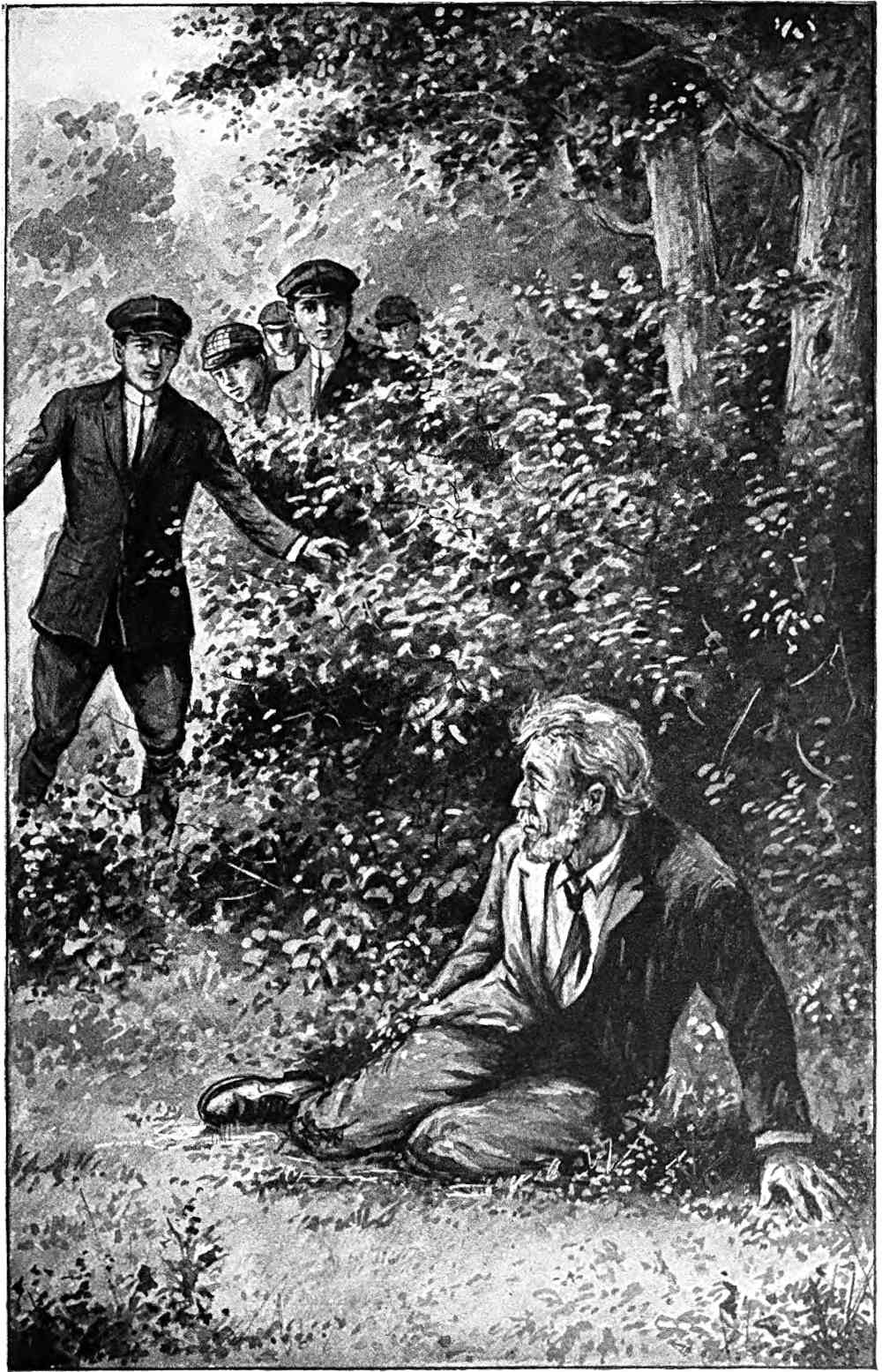
As the crowd rounded some bushes they came upon a strange sight. There, in a heap, rested the aged aviator. He was capless, wet through and through, and his face and hands were scratched and bleeding. One leg was doubled under him, as if wrenched or broken.
[31]
“Thank Providence somebody has come!” he murmured. “Oh, help me! Get a doctor, or somebody! I am about smashed to pieces!” And then he gave another groan and sank back in the bushes, all but overcome.
“He’s putty hard hit, I reckon,” was Joel Runnell’s comment, as he made a hasty examination.
“Let us bind up that cut on his head,” said Joe. “His arms seem to be all right, but that one leg is in bad shape.”
Fortunately the boys had had some lessons in first aid to the injured, so they knew a little about how to go to work. They got out their handkerchiefs and Harry tore off the sleeves of his linen shirt, and with the cloths they bound up some of the wounded man’s hurts. The medical kit taken on the auto tour was still in the machine and Fred ran for this, and then the wounds were washed and bathed in witch-hazel, and the sufferer was given a stimulant.
“Let us carry him to the cabin,” suggested Joel Runnell. “We can lay him on one of the cots. I know Tom Mason won’t mind.” Tom Mason was a rich man of Brookside who owned the lodge.
“Yes, and we’ll take the auto and get a doctor,” put in Harry.
“I don’t want a doctor!” cried the old aviator, [32] rousing up. “They are all butchers! I know ’em! They’ll want to put me in the hospital and saw my leg off, or something like that! Just you let me rest and I’ll be all right.”
“But your leg—it seems to be broken,” said Joe.
“I guess it’s twisted, that’s all. No, don’t get a doctor—I hate ’em! They killed my wife! I’ll be all right in a few days. Only take me to some place where I can rest, and get food.” And then the injured man suddenly gave a gasp and sank back unconscious.
[33]
“Now, what do you think of that!” gasped Harry.
“Maybe he’s crazy,” whispered Fred. “He certainly ran the biplane like a crazy man.”
“I don’t think he is crazy,” said Joe. “But he hates doctors—probably because his wife died through an operation, or something like that. Well, if he doesn’t want one, I don’t know what we are to do.”
“It looks to me like we ought to git a doctor anyway,” was the old hunter’s comment. “We can’t let him die on our hands.”
“Let us take him to the lodge first,” answered Joe.
With care they lifted the unconscious man and carried him down to the cabin. Joel Runnell knew where the key to the door was hidden and soon they were inside the place. A cot was handy, with blankets, and on this they placed the aged aviator. [34] A moment later he opened his eyes and tried to sit up, staring around wildly as he did so.
“You—you didn’t get that doctor, did you?” he gasped. “I don’t want him to come near me!” He gazed at the others, who had arrived.
“No, we haven’t any doctor,” replied Joe, soothingly. “Now just keep quiet and we’ll try to find out how badly you are hurt.”
“I will—but don’t get a doctor,” murmured the sufferer, and sank back and closed his eyes.
The boys and the old hunter made an examination and concluded that no bones were broken. One leg had been wrenched both at the knee and the ankle, and this was bathed in hot water and then bound up in witch-hazel. Joel Runnell carried a can of cold coffee in his fishing basket, and this was heated up and the sufferer drank it eagerly.
“He’s a pretty old man to be an aviator,” was Bart’s comment.
“He can be thankful he wasn’t killed, if he fell from the machine,” returned Link.
“And to think he doesn’t want a doctor!” mused Fred. “I’d want a couple of ’em if I was in his condition!”
“Well, I guess we’ve got to humor him,” answered Joe.
[35]
“Who is going to take care of him, if he won’t have a doctor?” asked Bart.
“We might take turns at it,” suggested Harry. “But we’d have to let the folks know.”
The old aviator had dozed off, and while he was thus resting the boys got their lunch from the automobile and brought it to the lodge. Some of the food they put aside for the hurt man and then they fell to eating, along with the old hunter, and all discussed the situation.
“Here is his name and address, anyway,” said Joe, looking over an empty envelope that had dropped from the man’s pocket. “‘Andrew A. Akers, Bralham.’”
“Bralham!” cried Fred. “That is where we used to play football! I didn’t know any aviators lived there.”
“Maybe this man simply got his letters there,” suggested Link.
“Oh, he may have his hangar there, as they call ’em,” said Joe. “You must remember that aviators are springing up all over the country, just like autoists did a few years ago. I dare say in a few years more flying machines will be as numerous as autos.”
“But not as safe,” returned Bart, with a grin.
“Perhaps. Of course it will take time to get [36] them just right, just as it took time to get the bicycles right. Don’t you remember the first ones, about six feet high, with a little bit of wheel behind? A fellow could easily break his neck riding one of that kind.”
For over an hour the aged aviator seemed to doze. Then of a sudden he opened his eyes once more and stared around wildly.
“The box—my box!” he gasped. “Where is my precious box?”
“Do you mean a black tin box?” asked Joe, bending over him.
“Yes! yes! It dropped from the biplane! Oh, I must find that box! It contains all—— But never mind that! I must find it! Oh, go and hunt for it, please!”
“We’ve got the box for you, Mr. Akers.”
“Ah! you know me?” The old aviator stared at the youth. “I don’t remember you.”
“You are Mr. Andrew Akers, are you not?”
“I am.”
“And you lost a black tin box, marked A. A. A.?”
“Yes! yes!”
“We found the box. We saw it drop and went after it.”
[37]
“And—and it—it is all right?—not broken open—the papers scattered——”
“The box is a bit dented, that’s all. It was locked, so we didn’t open it.”
“Yes! yes! Good! Where is it?”
“I have it right here. But please don’t excite yourself——”
“Give me the box, boy, give me the box!”
The box had been brought from the automobile when the lads went for the lunch. Joe handed it over to the aged man, who clutched it eagerly. His eyes lit up with pleasure when he saw that it was intact.
“Oh, I am so thankful!” he murmured. “You see, I have enemies, and so when I went on my trips I always carried the box with me, for I was afraid to leave it behind. I had it tied fast, but the cord broke and the box dropped. Then I had trouble with the engine, and with the steering gear, and then everything seemed to go wrong. I tried to fix the steering gear, and just as I was doing that the biplane gave a sudden tilt and I was thrown out. I landed in a tree and then fell in the water, and had all I could do to keep from drowning. At last I crawled out and then I got to where you found me.”
“And your machine sailed on?”
[38]
“Yes, the motor was running, and I don’t know where it went to—and I don’t care!” added Andrew Akers, emphatically.
“You don’t care?” cried Harry.
“Not a rap! I am done with aviation! Being a machinist and something of an inventor, I thought I could improve on the biplanes in use, but now I am done with them. I prefer to remain on the ground and die a natural death.”
“But that biplane is worth money!” cried Joe.
“I know it, but I don’t care. Whoever finds the machine can have it. I never want to set eyes on it again.”
“We found it!” cried Harry. “It’s stuck in the tops of some trees.”
“All right, let it stick there until the crack of doom—for all I care!” murmured the aged aviator, and then he sank back once more, his precious black box clasped tightly in his arms.
“Now, what do you think of that!” cried Harry. “He doesn’t want the flying machine any more! He says we can have it!”
“Oh, he didn’t mean it,” returned Joe, calmly. “He’s excited now. After he gets over this dose he’ll be as eager as ever to go up. I know how I’d feel myself.”
“But if he doesn’t want the biplane, Joe——”
[39]
“Would you want it, Harry?”
“Maybe. It would be great to learn how to fly!”
“And break your neck,” broke in Bart. “No flying for yours truly!” And he shook his head decidedly.
“That machine must be worth money,” said Fred. “Why, I read about some of ’em costing thousands of dollars.”
“Oh, they cost enough, you can be sure of that,” said Link. “Look at the fine motor—like that of an automobile—and look at the propellers, and the bamboo frame and airtight cloth,—and the bicycle wheels on the bottom.”
“Even if you had the machine, you couldn’t fly it,” went on Bart.
“A fellow could learn—I know Joe could learn. See how easily he learned to run the auto,” said Fred.
“Would you go up, Fred?”
“Sure—after I got the hang of it. But I’d want to be sure of what I was doing—or trying to do.”
“I don’t believe there is anything sure about aviation,” said the doubting Bart. “If you stay up, all right; if you drop, it’s all wrong; and there you are.”
[40]
“You couldn’t hire me to go up—not even in a balloon,” put in Joel Runnell. “When I fly I’ll do it on the ground—or on the water.”
The boys and the old hunter sat around outside the cabin, talking about the accident and about old times when the lads had gone hunting and fishing with Joel Runnell. They asked him about his daughter and learned that she was away, on a visit to some relatives.
“I am all alone at home,” said the old hunter. “So, if I am needed here, I can stay as well as not.”
About four o’clock in the afternoon the old aviator roused up again. He now seemed much better and spoke quite rationally. He said that he was sure he needed nothing but rest and food, and that if somebody would remain at the lodge to wait on him he would pay for the services.
“But don’t you want us to notify your family, or friends?” asked Joe.
“I have no family,” replied Andrew Akers. “I am practically alone in the world. I have a few relatives, but they are too far off to be reached for several days. I have some enemies, and I prefer not to let them know of my mishap, or where I am located.” And he smiled somewhat bitterly.
“Do you want me to nurse you?” asked Joel [41] Runnell. “I am an old hunter and have took care o’ sick men in camp more’n onct.”
“Then I guess you will be just the man!” cried the aged aviator, eagerly. “Take care of me and I will pay you well.”
“I won’t ask for no pay—only you can pay the store bills,—and fer usin’ the cabin, if Tom Mason wants pay.”
“Tom Mason—did you say Tom Mason!” gasped the hurt man.
“Yes.”
“What has he to do with this place—with my being here?”
“Why, this is Tom’s cabin—he built it for use when he takes an outing.”
“His place! That man!” murmured Andrew Akers. “It must be fate! But, no, I won’t stay here—I can’t!” He looked at the boys and the old hunter. “Take me away from here! Take me away at once!” he pleaded.
“Away from here?” several of them asked in surprise.
“Yes! yes! if this is Tom Mason’s place! I want nothing to do with that man! He is my—— But never mind that. But I want to go away, I must go away.”
In his eagerness the aged aviator tried to get up. [42] But he was too weak, and he fell back with a groan.
“This is certainly strange,” remarked Joe. “He seems to have a great grudge against Mr. Mason. I wonder why?”
“He said he had enemies,” suggested Harry. “Maybe Mr. Mason is one of them.”
“Mason is a close-fisted man—I’ve heard my father say that,” said Link. “He did some carpenter work for him and had hard work getting his money.”
“If we could get him to the auto we might take him to my home,” said Joel Runnell. “That is, provided he was willin’ to go.”
“Yes, I’ll go to your house!” cried the hurt man, rousing again. “Anywhere but in a place belonging to Tom Mason!”
“We have an automobile not far away,” explained Joe. “We could carry you to that, and then take you to Mr. Runnell’s home, where he could give you every care. Maybe he could get you a trained nurse——”
“I don’t want any trained nurse—no women folks and no doctors,” grumbled the aged aviator. “He’ll be good enough. If you can carry me to that auto I guess I can stand it.”
“Let us take him on the cot,” suggested Joe. [43] “We can bring the cot back afterwards;” and so it was arranged.
Half an hour later saw the auto, with the boys, the old hunter, and Andrew Akers, on the way to Cresco. They took a side road, so as not to attract attention, and presently reached the modest home that belonged to Joel Runnell. Here the aged aviator was put to bed, and then the boys prepared to leave, for it was growing late.
“We’ll come again to-morrow,” said Joe.
“Yes! yes!” replied Andrew Akers, eagerly. “I want to see you. And please remember, not a word of this mishap to Tom Mason, not a word!”
“We’ll have to tell our folks,” said Joe.
“You may do that. But please ask them to keep the affair quiet—very quiet,” said Andrew Akers; and then he sank back on the bed, once more exhausted.
[44]
“Well, it is certainly a queer case,” was Joe’s comment, as the five boys rode home in the Corsen touring car. “Either that man is a bit off in his head or he has good reasons for keeping out of Mr. Thomas Mason’s way.”
“He was mightily glad to get that black box back,” returned his brother. “It must be very valuable.”
“If it is, Joel Runnell ought to take good care of it for him until he is well,” put in Fred. “Maybe it ought to be placed in some safe-deposit vault.”
“Oh, I guess it will be safe enough at the Runnell place,” remarked Link. “They seldom have visitors, especially when Cora is away. Joel is a fellow who keeps by himself.”
“I think we ought to respect Mr. Akers’s wishes and say nothing to any outsiders about this whole affair—at least for the present,” continued the elder Westmore boy. “Of course we can tell our folks, [45] but we’ll ask them to keep it quiet, too.” And the lads all agreed to do this.
Various were the comments when the five boys got home and told their story. Neither Mr. Westmore nor Mr. Rush had ever heard of the aged aviator, and both knew little about Mr. Thomas Mason, excepting that he was supposed to be a close-fisted business man.
“I think he is interested in several manufacturing companies,” said the hardware dealer. “But I don’t know what dealings he can have with this Mr. Akers.”
“My idea of it is that Mr. Akers is one of those inventors who has allowed his inventions to run away with him,” said Mr. Westmore. “Some men of that sort go partly insane over their ideas, and that makes them imagine everybody they have business with is trying to swindle them.”
From Bart the other boys got no news, but when they met Link he had quite a story to tell.
“As I said before, dad knows quite a little about Mr. Mason,” said the carpenter’s son. “He never met this Andrew Akers, but he thinks he is an old man who is interested with Mason in a novelty-manufacturing company of Springfield. The company had a good deal of trouble once, and Mason was accused of trying some underhanded work. [46] Dad thinks that maybe he was trying to get Akers’s stock away from him, or something like that.”
All of the boys had various chores to do in the morning, but directly after dinner they met at the Westmore home and traveled by touring car to Cresco.
“How is he?” was Joe’s question, when Joel Runnell came to the door of the cottage to let them in.
“He’s putty weak,” was the old hunter’s reply. “He got shook up more’n he thought for, I reckon.”
“Can we see him?” asked Harry.
“Oh, yes, he’s been a-askin’ for you boys several times.”
All of the lads entered the house. They found Andrew Akers propped up in bed. He looked pale and weak. But he gave them a faint smile and insisted upon shaking hands all around.
“You boys were very good to me yesterday, and I’ve not forgotten it,” he said. “If you hadn’t come to my assistance—you and Mr. Runnell—I’m afraid I might have died. And then you got my box, too. That was worth much to me.”
“Mr. Akers, don’t you wish us to place the box in some bank for you until you get well?” asked Joe.
[47]
“No! no! I’ll take care of the box, don’t worry about that. I had some money in a bank once and the bank closed and I lost all but ten per cent. of it. No, I’ll look after my box. I’m going to hide it where nobody can find it.” And for the moment the face of the aged aviator took on a cunning look.
“Are you going to stay here?” asked Fred.
“Yes, until I am perfectly well. I have made the necessary arrangements with Mr. Runnell, and I find he is a good nurse and a fine cook. I’d rather have him around than any women folks, or trained nurses, or doctors.”
“Can we do anything for you?” asked Bart.
“I don’t think you can.”
“Send any letters, or telegrams, or anything like that?” put in the carpenter’s son.
“No, I wish to send word to no one. It would do no good, for, as I told you yesterday, my relatives are too far off to aid me. I know that under Mr. Runnell’s care I shall get along very well.”
“What would you like done with your flying machine?” asked Joe.
“Didn’t I tell you yesterday that I never wanted to see it again!” cried Andrew Akers. “I am through with aviation, and have taken a vow never to go up in a flying machine again. It was foolish [48] for me to take it up, at my time in life. Aviation is meant for a younger generation. I said whoever found the biplane could have it.”
“Joe and Harry found it,” said Fred.
“Then it is theirs—if they want it.”
“Oh, we were all together!” cried Joe.
“Of course we were!” added Harry, who wanted no benefit his chums could not share.
“But, Mr. Akers, that biplane is worth money,” insisted Joe. “You ought not to give it away.”
“It is my property and I can do as I please with it. The machine, with the numerous experiments I have made with it and in it, cost me several thousands of dollars. But if I was to offer it for sale, stuck up there in the trees, as you say, what would I get for it? Next to nothing. The engine might bring a hundred dollars or so, and that’s all. Now I want to reward you boys for what you did for me, so if you are willing to accept the biplane, supposing we let it go at that?”
“We didn’t expect any reward—at least, I didn’t,” said Harry.
“Nor I,” came from each of the others.
“But I want to do something,” insisted Andrew Akers. “I’d give you some money, but I have very little with me—only enough to pay my expenses here. I can afford to give you the biplane—and [49] if you don’t want to use it—and I suppose you don’t—you can take it apart and sell it, and divide the proceeds. That’s fair, isn’t it, boys?”
“We don’t want to rob you,” murmured Fred.
“It is no robbery, my boy. The biplane is yours, to do with as you please,” answered the aged man. “Oh, don’t think I can’t afford to give it away,” he went on, with a faint smile. “I am fairly well off, and this black box of mine——” He stopped short. “Never mind that. The flying machine is yours, it belongs equally to the five of you. Sell it, or use it, as you please. But if you use it, take care that you don’t have a tumble, as I did!”
“Well, if you want us to take it——” began Harry.
“I do—I insist upon it. Mr. Runnell, have you ink and a sheet of paper?”
“Yes, sir.”
“Very well. One of you boys write what I dictate,” said Andrew Akers. And a few minutes later a paper was drawn up, stating that the biplane, A. A. A., now located in the woods back of Cresco, was the free and clear property of Andrew A. Akers and that he hereby gave the flying machine to the five boys outright, mentioning each by name. This paper the aged aviator signed, and [50] he insisted that Joel Runnell be a witness to his signature. Then he handed the paper to Joe.
“Now I feel better,” he said, with a faint smile. “I’ve gotten rid of a property I never want to see or hear of again, and I have given you lads something of a reward for what you did for me. Later on, I shall reward Mr. Runnell also.”
All of the boys thanked the aged man for his kindness. Then, seeing that he was growing tired, they withdrew, promising to call again, to see how he was progressing.
“I’ll be glad to see you,” answered Andrew Akers. “But promise me one thing. Don’t mention that biplane. I want to forget it entirely and turn my attention to inventions that are more profitable.” And each of the lads agreed to do as he desired.
As the boys filed out of the cottage and entered the touring car they looked at each other with eyes full of anticipation. But not a word was said until they were on the road once more.
“Just to think, that flying machine is ours!” cried Harry.
“My, but won’t we have some gay old times with it!” added Fred.
“Provided we can learn to run it,” put in Joe.
[51]
“And our folks will let us try it,” came from Link.
“It may not be in condition to run,” said Bart, slowly. “The canvas planes were torn, and one wheel bent, and the engine may be broken. Besides, I—er—I don’t know if I want to go up or not,” he added, slowly. “It might be safer if we could sell the thing and get an auto with the money—now we’ve got to give this machine back to Mr. Corsen.”
“Oh, let’s try to fly it—it will be barrels of fun!” cried Harry, enthusiastically. “Why, see how you could skim through the air—just like a bird!”
“And come down as Mr. Akers did, or maybe harder.”
“Now, Bart, don’t be a wet blanket,” pleaded Fred. “I know you can go up, even if you are fat. Why, I’m fat myself. All a fellow has got to do is to learn how to manipulate the rudders and run the engine, and fly where he pleases. I was reading all about it last night, in an aero magazine.”
“Humph! much you know about it, Fred Rush! Do you know that sooner or later nearly all the well-known aviators lose their lives? Why, there was——”
“Drop it, Bart!” interrupted Joe. “If you don’t [52] want to fly, you don’t have to. We’ll see how the machine looks and acts first. Maybe all of us will want to sell it. If not, and you want to get rid of your share in it, we’ll buy you out.”
“Not much, you won’t buy me out! If you want to keep the biplane, well and good. I think it belongs to Joe and Harry, anyway, since they found it.”
“So do I,” added Link and Fred, quickly.
“No, it belongs to all of us,” replied Joe, just as quickly, and Harry nodded to show that he agreed with his brother.
Even though they might be late in returning home, the boys could not resist the temptation to run up to Owl Lake and then walk over to where the biplane rested among the trees. They found that the machine had settled a little, but otherwise was as they had left it.
“We’ll have some job getting it out of here,” observed the older Westmore boy. “We’ll have to bring up some rope and tackle, and maybe take the machine apart.”
“Let us come up to-morrow early,” said Harry. “I don’t think it’s safe to leave the machine here long. Somebody else might try to take it away, or a wind storm might come up and damage it.”
“We can get the tackle at my father’s carpenter [53] shop,” said Link. “He isn’t using it now. And we can bring along a couple of axes, to chop off the tree limbs that are in the way.”
All of the boys climbed up in the trees to get a better look at the biplane. Now that it was their property they felt quite proud of their possession. They spent so much time looking the machine over that they did not get home until long after the supper hour.
“Well, I don’t know about this,” said Mr. Westmore, when he heard the story his sons had to tell. “I don’t see what you can do with the machine, excepting to try to sell it.”
“We want to learn to fly in it,” cried Harry, eagerly.
“Fly in it?” screamed his sister Laura. “Oh, Harry!”
“No! no!” burst out Mrs. Westmore, firmly. “I can never allow that! Why, you might fall and kill yourselves! You mustn’t attempt it!” And she shook her head vigorously.
[54]
“But, mother, we learned how to run the automobile, and see what dandy times we have had in it,” said Joe.
“Yes, Joe; but an automobile is not a flying machine. Why, they aren’t safe! Only yesterday I was reading about a German birdman, as they call them, falling and killing himself.”
“But people get killed in autos,” put in Harry. “And look at us—we came through all right.”
“Flying through the air isn’t running a touring car,” remarked Laura.
“No! no! boys, you must not think of flying,” cried Mrs. Westmore. “It is too risky. Sell the biplane and buy something else. Why, even a motor boat isn’t as bad as a flying machine, although they occasionally blow up, or go on the rocks.”
“But if we were very careful, you wouldn’t mind our taking little trips, would you?” pleaded Harry. [55] “I mean just around the open fields, where the ground was soft.”
“O dear, Harry, I can see your heart is set on flying!” sighed his mother. “But you mustn’t. Try to think of something else.”
“She’ll come around—sooner or later—she always does!” whispered Joe, as he pulled his brother aside. “Don’t say any more now. Wait until we have the flying machine here, and get it in working order.”
“But, Joe, we won’t be able to run it without instructors. Why, I’ve read that they have regular schools of aviation in some of the big cities.”
“I know that. I don’t know what we’ll do. We’ll have to decide on that later—when we are sure the machine is usable. Remember, it may be so wrecked—the motor, I mean—as to be useless.”
“That’s true. But I trust it is O. K.,” added Harry, hopefully.
It was about nine o’clock when the two Westmore boys heard a well-known whistle outside. They ran out on the porch, to see Fred standing there, accompanied by Paul Shale.
“Hello!” cried Paul. “I understand you fellows are now the owners of an up-to-the-minute flying machine,” and he smiled broadly.
“Oh, Joe, Harry!” burst out Fred. “What do [56] you think I just heard as we were coming past the Voup place? Si and Ike Boardman were talking about a flying machine they and some others had found in the woods!”
“Was it our machine?” demanded Harry.
“I don’t know. They were getting ready to go out in their touring car and I only caught a few words. Paul heard more than I did. I thought I had best come right over and tell you.”
“Si said they’d go over in the morning early and get the flying machine,” said Paul. “Ike was to furnish some tackle and other things, and Dick Shallow and Tom Powers were to go along.”
“Shallow and Powers,” murmured Joe. He knew the fellows to be men employed at a garage in Brookside. One was a machinist and the other a washer, and both were fellows not to be trusted.
“How do you suppose they found the biplane?” said Harry.
“I don’t know. They may have watched it come down from a distance and then hunted for it,” answered Fred.
“Well, if it’s our machine they are after, they shall not touch it,” said Joe, firmly. “Did you tell ’em it was our machine now?”
“I hadn’t time—they got in the car before I [57] could make up my mind what to do. I didn’t want to have another row with Si and Ike.”
“The best thing we can do is to get away early to-morrow, and head them off,” cried Harry. “Let us start at daybreak. It will give us so much longer to work on the biplane anyhow.”
Fred was willing to do this, and he agreed to tell Link, while Paul said he would tell Bart. Paul also said he would like to go along and help get the machine from the treetops, and said he thought Matt Roscoe would like to go, too.
“All right, the more the better,” answered Joe, who felt that the task ahead would be no easy one.
It had been decided to go in the touring car, taking the ropes and blocks along, and also a number of tools. If the machine had to be moved after getting it to the road, Link was to go to Lakeport and get his father’s wagon and team of horses.
It can well be imagined that none of the boys slept much that night. All waited anxiously for daylight, that they might begin operations and head off any move by Si Voup and his followers.
“It would be just like Si to claim the machine,” said Joe. “He would say that ‘finding was keeping.’”
“But it is our machine—we’ve got that paper [58] to prove it,” answered Harry. “Joe, you must take good care of that paper.”
“I gave it to father to put in his safe,” returned the older Westmore youth.
The boys were astir by five o’clock, and inside of half an hour they had breakfast. A lunch was put up for them, and off they started in the touring car, calling for the others on the way, and getting the things to be taken from Mr. Darrow’s carpenter shop.
“I don’t see anything of Si or Ike,” remarked Fred, as they approached the home of the rich bully. “They must be in bed yet.”
“Don’t wake them up, Joe,” said Harry, and his brother ran past the Voup residence as quietly as possible.
It was a beautiful day in August, the sun coming up over the trees as clear as one could wish. The roads were practically deserted, except by the occasional wagon of a baker or milkman. Joe “let her out,” as he expressed it, being as anxious as anybody to reach the spot where the biplane had been left.
“Hope we don’t have any punctures or blowouts,” remarked Link, as they sped along.
“Perish the thought!” replied Matt Roscoe. “The only blowout I want is when the dinner bell [59] rings, and then I want a good one,” and this sally from the jovial Matt brought forth a general laugh.
On and on over the country road sped the big touring car. Several times the boys looked back, to see if Si and his friends might be following them; but no other automobile appeared.
“We got ahead of him that time!” chuckled Fred. “And I am glad of it. When he comes up, won’t he be surprised!”
At last they reached the spot where they had left the car on the other trips to Owl Lake. As they had expected, the place was deserted.
“Are you going to leave the car here again?” asked Link. “Aren’t you afraid Si and Ike will play us some trick, if they come up and find the auto deserted?”
“I was thinking I might run it out of sight among the bushes,” replied Joe.
“That’s the talk!” cried Fred. He looked around. “There is a good spot,” he continued, pointing with his hand.
The touring car was started up on low gear and they ran well in among the bushes, the boys holding the branches back, that the elegantly painted body of the automobile might not get scratched. Now that they were about to return Mr. Corsen’s property [60] to him they wished to make the best showing possible with it.
Satisfied at last that the touring car would be out of sight and safe for the time being, all walked towards the spot where the biplane had come down. They carried the ropes and tools, and as these were heavy, their progress was necessarily slow.
Harry and Fred stalked on in advance, Joe and the others following with the heavier things. Suddenly the younger Westmore uttered a cry of dismay.
“It’s gone!”
“What!” cried those in the rear.
“The flying machine is gone!” burst out Fred. “Si Voup and his crowd must have taken it!”
At once all the lads dropped the things they were carrying and rushed forward, to the trees in the tops of which the biplane had been stuck. It was certainly gone.
“They must have come last night and taken it away!” groaned Link. “Oh, what luck!”
“They must have known that we were coming for it to-day,” put in Bart.
The boys gazed around with interest. They could see how one tree had been chopped down, and how some ropes and tackle had been used from another tree. Then they found several nuts and bolts, indicating [61] that the machine had been more or less taken apart.
“Wonder where they went with it?” muttered Harry.
“I don’t know, but I am going to find out,” answered Joe, with determination. “That machine is ours, and they had no right to touch it!”
“That’s the talk!” cried Fred.
“Here are the marks of some kind of wheels,” said Link, pointing them out.
“The bicycle wheels on which the biplane rested,” said Bart. “That crowd must have straightened out the one that was bent. We can follow that trail easily enough. Come on.”
The others needed no urging, and leaving their tools and things where they had been dropped, they followed the trail through the woods until they came out on the border of Owl Lake. Here the trail came to an abrupt termination.
“I wonder if they floated it off,” suggested Harry.
“It looks like it,” answered his brother. “But if so, where did they get the boat, or raft, and where did they go to?”
“Let’s circle the lake and watch for more tracks,” said Link. “It isn’t very big.”
They divided into two parties, one going up the [62] shore and the other down. Nothing was noticed until Bart, Fred, and Link reached the upper end of the lake. Then they saw where a raft had been beached, and the flying machine dragged ashore. At once they set up a shout for their friends, who came up on a run.
“Here is the trail again, as plain as day!” cried Fred.
“They must have headed for the back road,” remarked Matt. “It is less than a quarter of a mile from here.”
Through the woods and bushes moved the boys, Joe and Fred in advance. Just before reaching the back road they caught sight of a small cabin, where an old man named Freedick lived. Freedick was something of a hermit and made his living by hunting, fishing, and weaving baskets.
“There she is!” cried Joe, as he pointed to the flying machine, the various parts of which lay in a heap on the ground.
“Where are the fellows who took it?” asked Bart, gazing around.
“They are in the cabin, getting breakfast!” exclaimed Harry, who had chanced to glance in through an open doorway.
By this time the noise outside had reached the ears of those in the cabin. An instant later Si [63] Voup came rushing forth, followed by Ike Boardman, and the two men, Shallow and Powers.
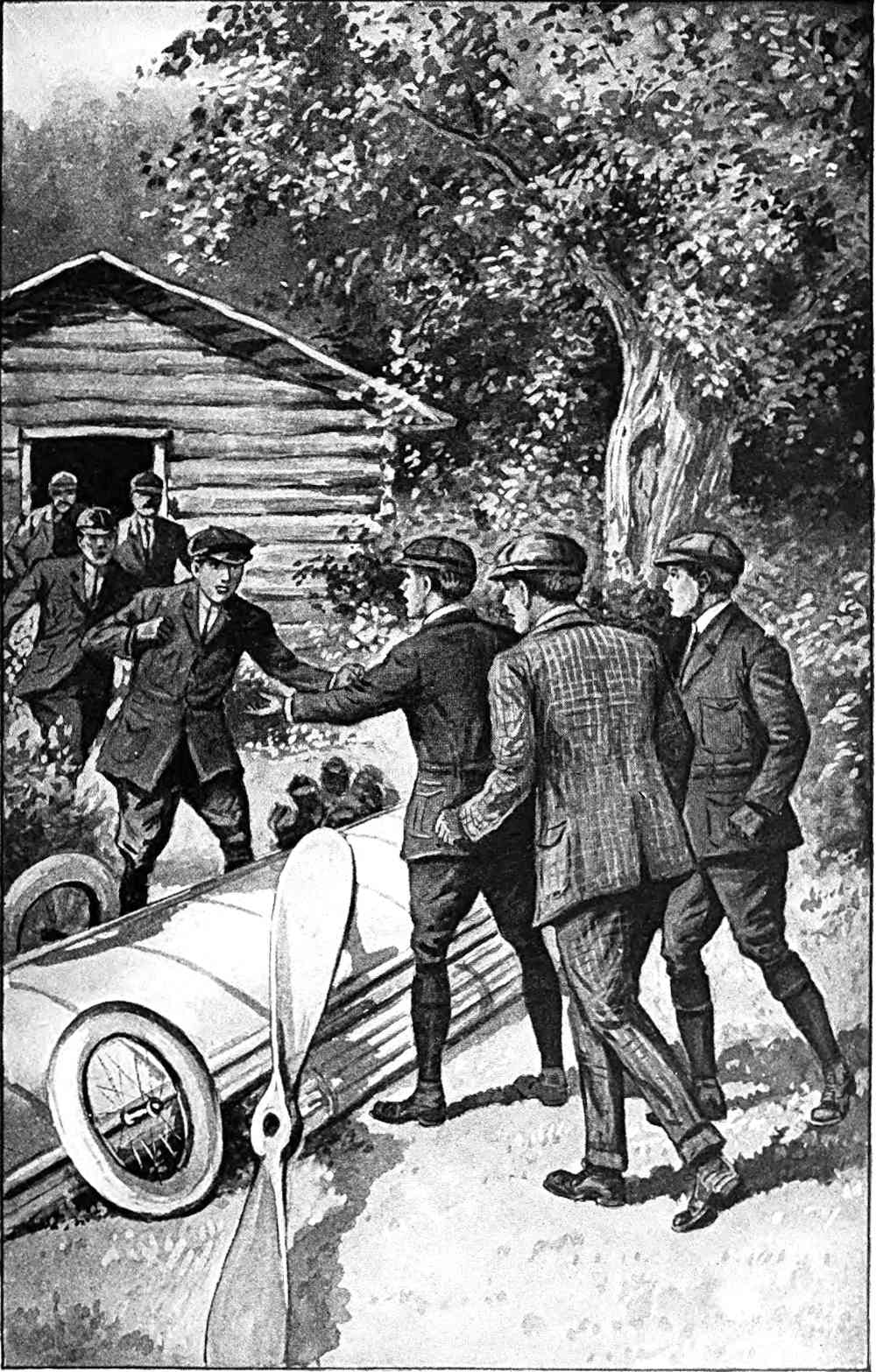
“Hi! what do you want here?” demanded the rich bully, as if he did not know well enough.
“We want our flying machine, that’s what we want, Si Voup,” returned Joe, sharply.
“Your machine?”
“Yes, our machine,” put in Fred.
“What right had you to touch it?” demanded Harry.
“Well, to hear them talk!” burst out Ike Boardman. “Their flying machine! If that ain’t rich. Why, you fellows never owned a flying machine!”
“This is our machine, and I guess you know it,” answered Joe, quietly but firmly. “It belonged to Mr. Andrew Akers, and he gave it to us.”
“It belongs to us!” bawled Si Voup. “We found it out in the woods, deserted.”
“That’s right, so we did,” put in Tom Powers.
“When you find a thing it’s yours,—unless the real owner comes to claim it,” added Dick Shallow.
“Exactly,” agreed Si. “And we found this machine and we are going to keep it,—at least until the real owner shows up.” And he placed himself in front of the dismantled biplane and his followers did likewise.
[64]
For a minute there was silence, as one crowd glared at the other. Joe and his friends hardly knew how to proceed. Old Freedick came out of the cabin, to see what was going on.
“Call that a flying machine?” he drawled. “I thought it was some newfangled reaper and binder.”
“It’s a flying machine, Mr. Freedick, and it belongs to us,” answered Harry. “These fellows had no right to touch it.”
“Don’t you believe that!” burst out Si Voup. “They never owned such a machine. We found it in the woods and we mean to keep it—at least until the real owner shows up.”
“Si Voup, you listen to me!” said Joe, quietly but sternly. “I tell you this machine belongs to my friends and me. It did belong to a Mr. Andrew Akers, but he got tired of owning it and he gave it to us. I have a paper to prove it, signed by Mr. Akers and witnessed by Joel Runnell. Now then, if you don’t give us our property, do you [65] know what I intend to do? Go right back to Lakeport and swear out warrants for your arrest,—and I’ll see to it that you are locked up and don’t get off as easily as you have in the past.”
“Have me locked up?” exclaimed the rich bully.
“Yes, you and Ike, and these men with you.”
“Lock me up?” queried Ike Boardman, and his voice quivered somewhat as he spoke.
“Exactly—and I’ll press the charge to the limit of the law,” went on Joe. “I am tired of putting up with your dirty actions. I’ve let you off several times—I’ll not do it again. So take your choice. Are you going to give up our property, or shall I swear out the warrants?”
“See here, you can’t scare us,” began Dick Shallow.
“Don’t let him bluff you, Si,” added Tom Powers.
“This is no bluff, as you’ll soon find out,” answered Joe. “What do you say, fellows?” And he turned to his companions.
“That’s the talk, Joe!”
“Have them locked up!”
“They ought to be in jail!”
“It will cool Si and Ike off to put them behind the bars for awhile!”
“Say, Si,” whispered Ike Boardman to his crony. [66] “Do you think they really mean it?” He was plainly growing nervous, and for a good reason. His parents had warned him not to allow Si to lead him into trouble, under penalty of sending him to a very strict boarding school.
“I—er—I don’t think so,” stammered the rich bully; yet he, too, was disturbed, for his father, only the week previous, had read him a lecture and told him to behave himself.
“Well, what are you going to do?” demanded Joe, sharply. He saw that the enemy was wavering.
“How do we know this is your machine?” demanded Si, lamely.
“I gave you the facts, Si, and every fellow with me knows they are true.”
“That’s right,” came in a chorus.
“You don’t suppose we’d say we owned the flying machine if it wasn’t true,” added Fred.
“Humph! Well—er—if it really is your machine you—er—you ought to pay us for getting it down out of the trees,” grumbled Ike Boardman.
“Of course they’ve got to pay us,” put in Dick Shallow, as he saw the prospect of getting some money out of the biplane fading away. He and Powers had been promised ten dollars each by Si for their assistance.
[67]
“I don’t see why we should pay you,” answered Harry. “You had no right to touch the machine. For all we know, you may have broken something on it.”
“We didn’t break a thing,” said Tom Powers.
“If we give the flying machine up, you’ll have to pay these two men for helping to get it down,” said Si, sourly.
“Not a cent!” cried Bart.
“If they are to be paid, you can do it, Si,” added Link.
“Me?” roared the bully. “Not much! Why, I worked like everything to get the thing out of the trees! I ought to be paid myself!”
“Well, you can settle that part of it between yourselves,” said Joe. “Now, what I want to know is: Are you going to give up the machine right now, or shall I get those warrants and have them served?”
“Oh, go on and let ’em take the old machine!” cried Ike Boardman. “It isn’t good for anything, anyway!”
“All right, you can have your old machine,” muttered Si, with very bad grace.
“But who is going to pay us?” demanded Dick Shallow.
“That’s right—we want our money,” added Tom [68] Powers. “I’m not going to work all night for nothing!”
“Did Si hire you?” asked Harry.
“Yes, he did,” came from both men.
“Then he ought to pay you,” answered Fred.
“He’ll have to do it,” growled Tom Powers, who was a big man and what is usually known as a “scrapper.”
“Sure, he’ll have to pay us,” added Dick Shallow.
“I won’t pay a cent!” roared Si. “Come on, Ike,” he went on, to his crony. “Let us go home.”
Both started into the cabin, to get some of their belongings. Their actions displeased the two helpers very much, and the men held a whispered consultation.
“You’ve got to pay us,” stormed Tom Powers, as Si and Ike came out again with bundles. “You can’t run off this way,” and as the boys hurried off, the two men followed them, arguing loudly and acting as if they wanted to fight.
“Si and Ike are in hot water now,” was Harry’s comment. “If they don’t look out they’ll both get a beating.”
“Well, let them settle their troubles themselves,” returned Joe. He drew a long breath. “I am glad they went away.” And the other boys echoed the sentiment.
[69]
“I don’t know if we are worse off, or better,” said Fred, after the sounds of the angry voices had died away in the distance. “The flying machine is out of the trees, but we are further away from home than we were.”
“I think we had better inspect the machine first, and see just what condition the parts are in,” said Joe.
“Oh, I hope the engine isn’t broken!” burst out Harry. “We can fix the other parts, I think, but an engine——”
The boys commenced to work over the dismantled biplane and soon had the canvas stretches and the rudders separated from the central portion, that containing the motor, the gasoline tank, and the steering apparatus. They looked at the engine with care.
“Seems to be O. K.,” was Joe’s comment. “But the best way to find out would be to try it.”
“Could we do that?” queried his brother.
“I don’t know; I’ll try to find out.”
“The gasoline tank is all right and has some gasoline in it,” announced Bart.
“And the battery wires look to be all right,” came from Link.
“Look out that you don’t blow us up,—if you do start the engine,” said Paul.
[70]
“And that the machine doesn’t run away with itself,” added Matt. “I’m too tired to hunt for a runaway biplane, or anything else.”
The boys set to work in earnest, old Freedick watching them curiously. The hermit wore a quiet smile.
“Made them fellers pay fer breakfast before they ate it,” he chuckled. “Glad I did—otherwise I’d be without my money.”
“More than likely,” answered Fred.
At last Joe announced that he was ready to test the motor. There was no crank as on an automobile, but instead the propellers had to be twirled around. The central portion of the biplane was propped up on some logs and tied down with ropes. Then the electric spark and gasoline were turned on and the boys got ready to turn the propellers.
“Now!” yelled Joe, and Bart and Harry gave a vigorous twist to the wooden blades. There was no response, and they repeated the operation several times.
“Dead!” was Matt’s laconic comment.
“Something wrong somewhere——” commenced Fred, when bang! bang! bang! went the motor, with such loud explosions that all the lads fell back in alarm, while old Freedick rushed into his cabin and slammed the door behind him. Then the propellers [71] commenced to whirl around, faster and faster, and the central portion of the biplane pulled harder and harder on the ropes that held it.
“Hurrah! she works!” cried Joe, in delight.
“Stop her!” screamed Harry. “If you don’t, you’ll have her flying away!”
Joe stepped forward and turned off the spark and the gasoline. At once the noise of the explosions died away and gradually the propellers came to a stop. For an instant there was silence.
“Hurrah!” yelled Link, throwing up his cap. And then a general cheer followed. Evidently the motor—the main portion of the flying machine—was in good working order.
“Is she—is she busted?” asked old Freedick, as he cautiously thrust his head out of the cabin doorway.
“Not at all, Mr. Freedick, she’s all right,” answered Fred.
“By gum! I thought by the noise she made she was a-going to blow us all to kingdom come!” murmured the old hermit. “Sounded like a company o’ soldiers firing rifles!”
“Well, now we are sure the motor is all right, let us start to get the machine to Lakeport,” said Joe, after a pause. “Link, what do you think—had [72] we better take it over to the main road, or go to the back road?”
“Why not go to the back road—it’s shorter,” answered the carpenter’s son. “I can bring the wagon up that way as well as the other.”
“Somebody will have to go back for the auto.”
“Sure—I want you to take me to Lakeport in it—I’m not going to walk back to get the wagon.”
“I’ll take you to Lakeport,” said Harry. “And then I’ll come out with you in your father’s wagon;” and so it was arranged, and the two boys started off a few minutes later, not only for the touring car but also for the tackle left in the woods.
Getting the biplane through the woods to the back road was no easy task, and the boys had to make two trips of it, taking the motor portion first and then returning for the planes and rudders. By the time they had accomplished the task it was noon, and all were glad enough to rest and partake of lunch. Old Freedick had aided them some and was grateful when the boys paid him a dollar for his services.
It was not until two o’clock that Link appeared with his father’s largest wagon, drawn by a pair of powerful horses. Harry was on the seat with him, and both had had dinner before leaving Lakeport.
[73]
“Now to get the motor part into the wagon,” said Joe. “I guess we’ll have to slide it up on logs.”
“I’ve got a plan,” cried Fred. “See that sloping rock? Put the motor on that and then Link can back up the wagon and we can slide the part right from the rock into the wagon;” and this was presently done. Then the planes and rudder and other portions of the biplane were loaded on the turnout, and the crowd was ready to start for home.
“We can’t all ride—it will be too much of a load,” said Link. “All I want is one fellow to steady the load going up and down the hills.”
“We’ll tie the load fast,” answered Joe, “and then all of us can walk but Link. No use in wearing the horses out.”
But Link would not hear of this, and in the end each of the boys was allowed to rest his legs by driving the team for awhile, the others tramping on either side of the wagon.
It was almost sundown when Lakeport was reached. Soon the news spread that the boys were bringing in a flying machine and a crowd of curious men and boys followed them to the Darrow carpenter shop. Here the entire lower floor of the big building was cleared, and then the lads proceeded [74] to unload the parts of the biplane, Mr. Darrow and several other men helping them.
“Going to fly in it?” asked one of the men, of Joe.
“I don’t know yet,” answered the youth. He hoped he would be allowed to make the attempt, but was afraid that, after all, his mother might withhold her permission for him to do so.
[75]
It soon became noised around the town that Joe and his chums had become the proud possessors of a flying machine, and the boys were asked innumerable questions concerning where they had gotten the biplane and what they intended to do with it.
“Why, it’s dead easy to fly,” said Walter Bannister, who had been visiting some relatives out on Long Island and had attended several aviation meets there, at one of the well-known parks. “I saw scores of flights and the aviators went up and came down without the least bit of trouble.”
“I guess it is easy enough after one learns how,” answered Harry. “But the thing of it is to learn.”
“Do you know what Si Voup is saying?” put in Fred, who chanced to be present. “He is telling everybody in town that he is sure none of us will have the backbone to try to go up.”
“Some more of Si’s sour grapes,” answered Harry; nevertheless his face commenced to burn. He could not help remembering what his mother [76] had said that very morning—that she did not wish him or Joe to think of using the flying machine.
The boys, with the aid of Mr. Darrow and a machinist, had put the biplane together and had again tested the engine. But so far nobody of the crowd had said much about flying in it.
“We’ve got a white elephant on our hands,” said Fred, dismally. “Oh, if only some aviator would come along to give us lessons!” He had made inquiries, but could learn of no birdmen excepting in the big cities, or at the aviation meets throughout the country.
Another day passed and then, just as the Westmore boys sat down to supper, their sister Laura came in, her cheeks flushed and her eyes flashing angrily.
“Oh, that horrid Si Voup, and that awful Ike Boardman!” cried the girl, as she gave a deep sigh. “I hope I never see them again!”
“Why, Laura, what’s the trouble?” asked Mrs. Westmore, pausing in the act of pouring out tea for her husband.
“They’ve been talking about Joe and Harry, that’s what’s the matter!” answered the girl. “Oh, it makes me sick! I’d just like to slap their faces for them!”
“Laura!”
[77]
“Well, I would, so there!”
“What have those boys done now?” questioned Mr. Westmore.
“They are saying that Joe and Harry are cowards!” burst out the girl. “They told Minnie Brown and Grace Shallock that Joe and Harry wouldn’t dare to try to fly in that machine. Minnie said she was sure our boys would fly some time, but Si only laughed and said, ‘Never! They haven’t the backbone!’ And Ike said, ‘They’ll never get off the ground with it, they’d be too scared.’ Oh, were ever there such boys!”
“I’d like to punch their heads for ’em!” murmured Harry.
“Why don’t Si and Ike try to do some flying on their own account?” asked Mr. Westmore, dryly.
“Oh, they haven’t any flying machine,” answered Joe. “But say, I don’t like this, father—being called a coward.”
“And I don’t like it, either!” cried Harry. “Now we have the machine everybody will expect us to do something with it.” And he looked pleadingly at his mother.
“Humph!” mused Mr. Westmore, and he looked very thoughtful.
The next day the flour and feed merchant received a call from Mr. Rush. The hardware dealer [78] had heard the report being circulated by Si and Ike, and some others, and it pleased him no more than it did Mr. Westmore.
“Fred is just crazy to try that flying machine,” said Mr. Rush. “He says if I will only let him try it he will be very careful, and he won’t go up until he is sure he knows all about it.”
“Well, Joe and Harry are just as crazy,” answered Mr. Westmore. “But my wife doesn’t like the idea.”
“Neither does Mrs. Rush—but she doesn’t want Fred branded as a coward.”
“What does Mr. Darrow say?”
“He says he might let Link try it, if he was very careful. He thinks they might try flying over the lake—with a boat near to pick them up if they had a tumble.”
“That’s an idea. Perhaps Mrs. Westmore wouldn’t mind it so much if they flew over the water. But they ought to have somebody to give them instructions first.”
“Fred has found somebody—that’s why I came over.”
“Found somebody? Who is it?”
“The new chauffeur Mr. Corsen has engaged to run his automobile. The man, whose name is Slosson, used to work around the hangars at one [79] of the aviation parks and told Fred he had made several short flights. He said he wouldn’t mind going up in the machine, and he’d give the boys some instructions, if Mr. Corsen was willing.”
“Hum. Well, I’ll think it over—and talk to Mrs. Westmore about it,” answered the grain merchant.
Two days later Mrs. Westmore and Mrs. Rush came home together from a meeting of the local sewing circle. Both were very thoughtful, for at the meeting something had been said about the biplane and what was to be done with it. Evidently the women as well as the men and young folks of the town had come to the conclusion that the only reason it was not being tried was because the owners were afraid to attempt it.
“I can’t stand it to have folks think my son is a coward,” declared Mrs. Rush. “Why, Fred is just as anxious to try it as he was to run that touring car!”
“It’s the same with Harry and Joe,” replied Mrs. Westmore. “Oh, if I only knew they’d get along as well with it as they did with the auto I’d not stop them another minute.”
“Mr. Rush said they might try it over the lake.”
“Yes, Mr. Westmore said that.” There was a [80] pause. “Do you think we ought to let them do it?”
“I don’t believe we’ll have peace unless we do.”
“But they will have to be very, very careful!”
“Yes, indeed! They must have lessons first.”
That evening the boys were told that they might try the biplane, if they were very careful and learned to run it first, and that they must not fly high, and must keep over the water until they were sure of what they were doing. All could swim well, so a tumble into the lake would be far less risky than a tumble on land.
“Hurrah!” shouted Harry, as he came running out of the house. “We can fly! Oh, this is the best yet!” And he took himself over to Fred’s home.
“Yes, I got permission, too!” said the stout youth. “But we must take it slowly, so my mother made me promise her.”
Joe followed Harry; and then the three youths hurried over to the Darrow carpenter shop, where they met Link and Bart.
“Good!” cried the carpenter’s son. “I was afraid the machine would just stand here all summer. Now we can have some glorious times!”
“If we don’t break our necks,” put in the big but timid Bart.
[81]
“We’ll show Si Voup and his crowd that we are not afraid,” declared Joe.
Matters were talked over, and it was decided to communicate with the new Corsen chauffeur the next day, when Joe was to return the big touring car to its owner.
The boys had cleaned up the car, and oiled it, until it was “in apple-pie order,” to use Harry’s manner of expressing it. The Corsens were back from their trip abroad and the mansion was open once more from end to end, and likewise the big grounds.
“Well, I am glad to know you had such a nice time,” said Munroe Corsen, when Joe had delivered the touring car. “What do you young men propose to do next, fly?” And he laughed. He had heard about the biplane.
“We’ll fly if we can learn how,” answered Joe. “Your chauffeur said he knew something about a biplane, Mr. Corsen, and I wanted to ask you if you had any objections to his teaching us the trick. Of course we’ll pay for his time.”
“There will be nothing to pay, Joe. I don’t know how much Slosson knows, but what he does he can teach you. When do you want him to give you lessons?”
[82]
“Any time you say, sir; and much obliged for letting him have the time to do it.”
“Well, we seldom go riding in the morning, after he takes me to the railroad station, so supposing we say every morning from ten to twelve, for the next couple of weeks?”
“That will suit us boys very well.”
“Then let it stand at that, and I will tell my man. But be careful of what you do. He comes highly recommended as a chauffeur, but I know nothing of his ability as an aviator.”
“He told Fred he could have gotten a job to fly at the exhibitions, only his wife didn’t want him to accept.”
“Yes, he told me that, too, so maybe it’s all right—I hope for your sake it is,” answered Mr. Corsen; and there the talk came to an end.
Joe spread the news among the others who held an interest in the biplane, and as a consequence every youth was on hand the next morning, awaiting the arrival of James Slosson.
The chauffeur had already visited the carpenter shop and inspected the biplane and pronounced it a fine one. He had said that it was something of a “cross” of two well-known makes—probably a production of Andrew Akers’s brain after seeing the other machines. The motor was entirely new [83] to him, although of the rotary type, and he had said he thought it must be patterned after some French machines,—which was the case, although Andrew Akers had added some so-called improvements of his own.
“Learning to fly is more of a trick than anything else, just like learning to ride a bicycle or learning to walk a tight-rope,” said the chauffeur, when giving the boys their first lesson. “It consists mainly in knowing how to keep your balance under any and all conditions. So long as you keep your machine on anything like an even keel you are safe; but once let it get away from you and you are apt to turn turtle and come down with a smash.”
Harry and Fred were quite disappointed to think that they could not try to fly during the first two or three lessons. But James Slosson was a careful man and he insisted upon their learning all about the motor first, and the steering gear, and how to manage the wheel and other appliances. He also superintended the repairing of the broken planes, and readjusted several of the wire stays. The biplane seat was so arranged that a passenger might be carried along.
“Well, we’ll have to take turns at flying,” said Harry. “One or two at a time.”
James Slosson was the first to try the biplane [84] and the boys assisted him in rolling the affair down to a big field bordering the lake. Then they held the flying machine while the propellers were started and the man got aboard.
“Let her go!” called the man, a moment later, and the boys did as requested. The motor banged away loudly, the propellers buzzed around at a lively rate, and with a rush the biplane traveled over the ground. Then up it shot into the air, higher and higher, until it was far out over the lake.
“Hurrah!” shouted the boys, and waved their caps.
“She’s all right!” was Harry’s comment.
“Just wait until we run her!” put in Fred.
“We’ll show Si Voup and all the others what we can do,” added Link.
With keen interest the boys, and a crowd that had gathered, watched the aviator as he circled around over the lake. The biplane appeared to be under perfect control, the explosions of the motor sounding out with regularity.
“He’s coming back!” said Bart, presently, and a minute later the sound of the motor ceased, and like some great white bird the biplane came floating down close to the spot from which it had started.
[85]
“Say, that was great!”
“How easy it seems, after all!”
“Well, I never thought I’d live to see a man fly like that!”
“The engine makes some noise, doesn’t it?”
These and numerous other comments went the rounds, as the crowd gathered around the aviator and the flying machine. Among those present were the fathers of the boys who owned the biplane, who had come to the field not only to see Slosson make his initial flight but also to make certain that their sons should not attempt to go up.
Many were the questions put to the aviator, and in the end he had to give a regular lecture on the make-up of flying machines in general and the biplane in particular.
“Flying machines at present are of three kinds,” he said. “The monoplane, the biplane, and the triplane. The monoplane, or single deck craft, is a swift machine and very good for racing, but it [86] is not as steady and reliable as a biplane. The triplane, or three-decker, is but little used, for the reason that most manufacturers see but little advantage in three planes over two.”
“But how do you get up into the air and how do you steer?” asked one of the men present.
“The propeller acts on the air just as a boat propeller acts on the water, and as soon as the force is strong enough the biplane is forced forward over the ground. It has to have a smooth field for a start or it can’t very well make a flight. When the forward motion is rapid enough, the operator of the machine moves his elevation rudder, and the air, striking against it, causes the biplane to run up on the current, and the machine will continue to go up just as long as the motor keeps going and the rudder is kept at an angle. When the operator is as high in the air as he wishes to go, he straightens out the rudder, so that it rests flat on the air.”
“How about when you want to come down?” asked another man.
“The easiest way to come down is to shut off the motor and glide, or volplane, down,” answered the aviator. “If you want to make a quicker landing, however, you can let the engine run for a bit and deflect the rudder.”
[87]
“How about steering to the right or left?” asked Mr. Rush. “Do you do that with the tail rudder?”
“Yes, by moving it just as you would the rudder of a ship.”
“Won’t steering around tilt the machine?” asked Mr. Darrow.
“It may, depending on the wind. If the biplane tilts to the right or left, the operator of this particular machine can bring it to an even keel by using the ailerons, or warping wings, at the far ends, on either side. Ordinarily, as you can see, those wings stand out straight, the wind rushing over and under them, as the biplane moves along. Now you see, by using this lever, or that, I can warp one tip or the other. When a tip is warped, or turned down, the air hits it, and this causes that side of the biplane to rise. Of course it also makes the biplane slue around, so that the operator, if he wants to keep to his course, must overcome this movement by the use of the tail rudder.”
“Humph! that’s easy enough,” murmured one of the farmers who chanced to be present.
“Flying would be quite easy, once a man knew how to manipulate his machine, were it not for two things,” went on James Slosson. “Those two things are, the wind and the soft spots, or holes, in the air currents. Now you all know something [88] about wind, but a birdman has to know a great deal. He soon finds out that air moves in all sorts of currents, just as a sea captain learns about the currents of water in the ocean. He finds straight currents and curved currents, and currents that move upward and currents that move downward. And then he finds what he calls holes, where there doesn’t seem to be any current at all. The holes are the worst of all, for when he is crossing one of these he doesn’t know what sort of a current he is going to hit on the other side. He may think the air is blowing one way when it is blowing the other, and he must be prepared to make a lightning shift of his rudders or tips.”
“All biplanes are not like this one, are they?” asked Mr. Mason.
“Oh, no, different makers have various contrivances, some of them patented. In some there are two sets of tips, and there are half a dozen ideas for rudders being used, many machines having the elevation control in front instead of behind. As you know, flying machines are of such recent date that they are bound to make great changes in them in the next few years.”
“What about the engine—how strong is that?” asked Mr. Rush.
“I think it is about fifty horse power.”
[89]
“Phew! And as small as that!”
“They have to be small and powerful for a flying machine. Some of the aircraft carry engines of one hundred horse power. Why, with a person on board this outfit will weigh eight or nine hundred pounds. It needs some engine to lift that weight into the air.”
“This biplane is about thirty feet wide, isn’t it?” asked Mr. Westmore.
“Thirty-four feet at the top plane and six feet less at the bottom.”
“Well, boys, do you think you can learn?” asked Mr. Westmore, as he looked at his sons.
“Sure!” cried Harry. “But, of course, it will take a little time,” he added. “There is more about the running of it than I thought.”
“Slosson has agreed to take each of us up as a passenger first,” said Joe. “He says that will give us a little confidence in the air, and give us a chance to see just how he manages the machine.”
“A good idea,” said the flour and feed merchant. A little later he had a private talk with the aviator and made him promise not to let any of the lads go up alone until he thought it was absolutely safe. One thing the man told him, comforted Mr. Westmore not a little.
[90]
“I’ve never known a beginner to meet with a serious accident,” said James Slosson. “The accidents come mostly from aviators trying to do daring stunts, for the benefit of the crowd. If the boys will keep to plain sailing, when the weather is good, they ought to get along finely.”
“I sincerely hope so,” answered Mr. Westmore.
It was not until two days later that James Slosson said he would take the boys up, one after the other. Lots were drawn as to who should go up first, and much to his delight, the choice fell upon Harry.
“Whoop! Me for the air!” he cried, throwing up his cap. “Here is where Slosson and I take a little run to New York and Boston and back!”
“Humph! Why not take in San Francisco and China while you are at it?” returned Fred.
“And South America and Hawaii,” added Bart. “Nothing like getting your money’s worth,” and he grinned broadly.
“We’ll try a trip over the lake,” said the aviator. “And I want you to have a boat handy, in case of accident.”
“We’ve got our rowboat,” said Joe.
“And Paul Shale is on hand with his uncle’s sloop,” added Link. “He said he’d follow the biplane in the Sprite, so long as we kept over the [91] water. Of course, he can’t make such time as the biplane can make.”
“Say, if they can give a sloop a name, why can’t we name the A. A. A.?” queried Harry.
“We can!” cried Fred.
“How will American Amateur Adventurer do?” asked Matt, who was present.
“Get out!” came from several of the others.
“We want a real nice name,” added Fred.
“Want something really sweet, Freddy dear?” went on Matt, in a childish voice. “If you do, darling, call her the Candy.” And then he dodged, as the stout youth threw a stick at him.
“The planes are so white, we might call her the Dove,” suggested Bart.
“‘Oh, fair Dove, oh, fond Dove!’” mimicked Matt. “‘Oh, would I could fly to thy bosom, and’—wow! Let up, Joe!” he spluttered, as the other youth caught him from behind and stuffed a handful of grass into his mouth. “Nice way to treat a friend when he is using up all his brain power to help you out of a hole!” he added, ruefully.
A dozen names were suggested, and finally Joe wrote the best of these on slips of paper, which he shook up in a cap.
“Let me draw the name for you, will you?” asked Matt, eagerly.
[92]
“All right,” answered Harry. “Now draw a good one, Matt.”
The fun-loving youth turned away for a moment, as if to fix his shoe, walking to a box near by to do this. Then he came back and thrust his hand into the cap, which Joe held high in the air.
“I’ll allow Link the honor of reading the name I have picked out,” said Matt, and extended a slip of paper that was between his fingers.
“All right, what is it?” cried the carpenter’s son, and took the slip eagerly. “Why, I declare! Who put this in?” he demanded, looking around in wonder.
“What is it, Link?”
“The White Pancake!”
“What’s that?”
“The White Pancake? Who ever heard of a flying machine, or anything else, being named that?” burst out Fred.
“It’s one of Matt’s jokes!” cried Joe. “He had that slip of paper in his fingers all the time. Just wait till I catch you!” And he made a dash for the joker; but Matt ran around the biplane and kept at a distance.
“Anyway, she’s white and almost as flat as a pancake,” said he.
“Huh! Don’t you dare insult our flying machine!” [93] roared Harry. “If you do you’ll not ride in her.”
“Take it all back,” replied Matt, promptly, and made a most profound bow.
“Bart, you do the drawing,” said Joe, and amid a general silence the big youth did as requested.
“Skylark,” he read.
“That’s the name I picked out!” exclaimed Harry.
“The Skylark, eh?” said Joe. “That’s all right.”
“If only she flies like a skylark,” said Fred. “It’s a pretty name, Harry.”
“All in favor of the name drawn please say aye!” cried Joe.
“Aye!” came from the crowd of owners, and Matt said aye, too.
“A good enough name for any aircraft,” was James Slosson’s comment. “You ought to have a lot of fun in the Skylark. I know I’d have, if I owned her.”
“Well, now she is named, supposing we go up?” said Harry, who was impatient to have his first flight.
“I’ll give her a little tryout and then take you up,” answered the aviator, and got aboard and in the air without further delay. The tryout proved [94] that the biplane was in good condition, and then he came down and told Harry to take the seat beside him.
“And be sure to hold on good and tight,” he said. “I won’t strap you in, because, in case of a fall, you might want to jump. But don’t let go unless I tell you to.”
It must be admitted that the younger Westmore boy was just a bit nervous as he took the seat assigned to him. It was one thing to talk about flying and quite another to really make a flight.
“I wish you luck, Harry,” said his brother, earnestly.
“We all do,” added Fred.
Once more the propellers were started and James Slosson cried out to “let her go!” With a rush and a roar the Skylark gathered speed and sped across the field. Then she slowly arose, heading in the direction of Pine Lake. Soon the biplane was a full hundred feet in the air and well out over the water.
“Hurrah!” cried Link and Fred. “Hurrah for Harry and his first trip through the air!”
“And may it not prove to be his last!” added Bart.
Slowly the Skylark sped onward, over the smooth water of the lake. It went almost to the opposite [95] shore, then made a wide turn to the northward and came slowly towards Lakeport.
“She’s running all right,” remarked Joe. But hardly had he spoken when the explosions of the engine suddenly ceased. Then the aircraft commenced to settle down rapidly, as if about to sink into the bosom of the lake!
[96]
“She’s coming down!”
“Something is the matter with the motor!”
“Look! look! she is heading directly for that motor boat!”
“It’s Si Voup’s craft, and Si and Ike are on board!”
These and other cries rang out, as the big biplane came swooping down, closer and closer to the surface of Pine Lake. A number of boats were out, the occupants watching the flight of the Skylark. Among the craft was the motor boat belonging to the rich bully, and he and his crony, Ike, were on board.
“Hi! hi! Don’t come down on us!” yelled Si, in sudden terror, as the aircraft swept closer.
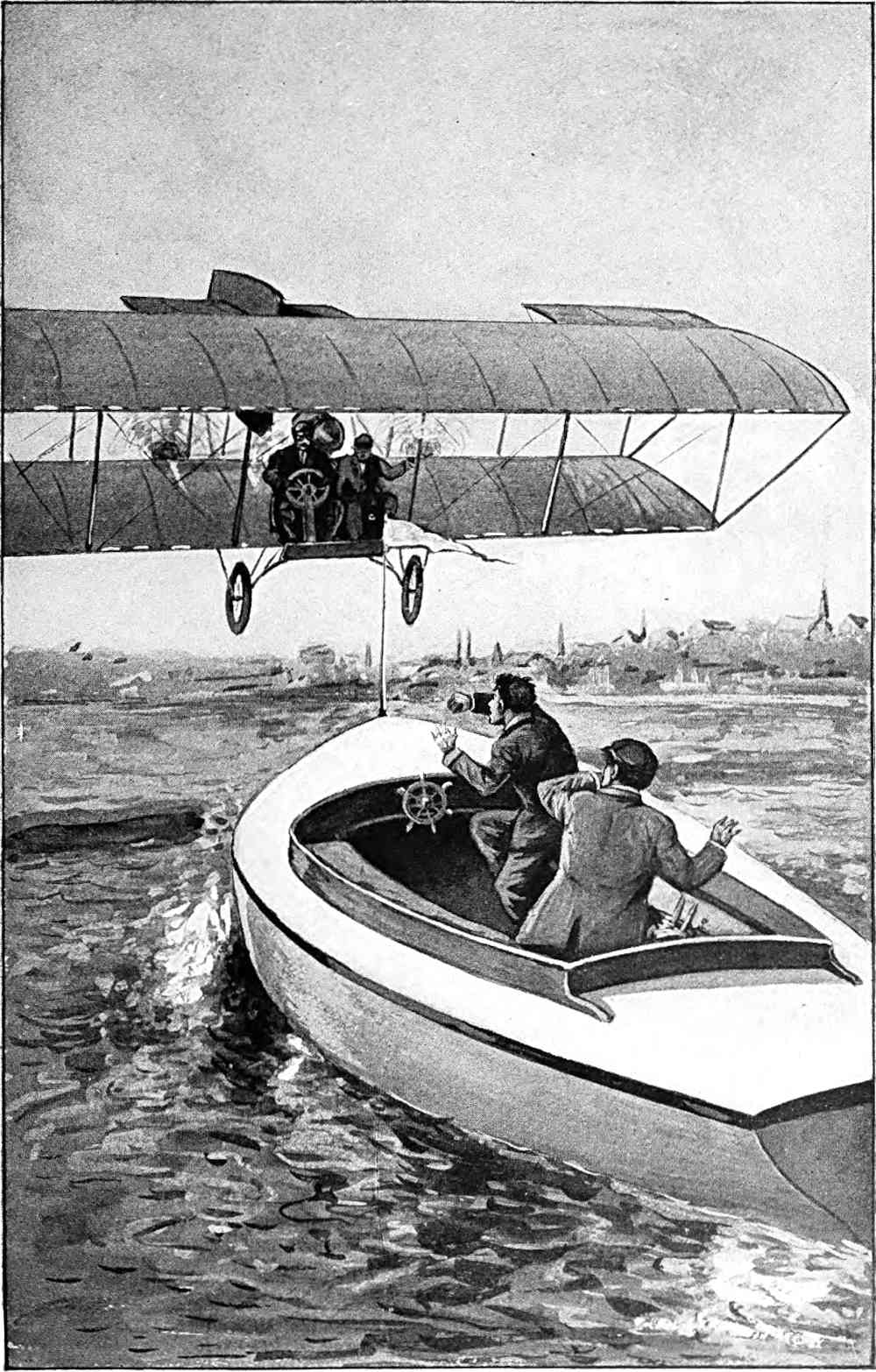
“Start her up!” yelled Ike. “We must get out of here, Si!”
The small boats were scattering in all directions, each person anxious to get out of the possible path [97] of the descending biplane. It could be seen that James Slosson was doing his best to gain the field from which he had started. Harry sat still, gripping the sides of his seat, but ready to jump should the occasion demand it.
Down came the Skylark, lower and lower, until it was scarcely ten feet above the Voup motor boat. Si and Ike screamed in terror, and both ducked down below the gunwale, seeking shelter. Then came a sudden puff of wind and the biplane soared up once more and over a long dock, piled high with lumber. A few seconds later the flying machine reached the open field and came down with scarcely a jar.
“Safe!” gasped Joe, and breathed a sigh of relief. He ran up and assisted his brother to the ground. Harry was pale, and for several seconds did not know what to say.
“Say, that was a close shave,” remarked Fred. “What was the trouble? You didn’t stop the engine on purpose, did you?”
“No, she stopped of her own accord,” answered the aviator. “I don’t know what the trouble was. I’ll have to find out.”
“You can be thankful that you didn’t go into the lake,” remarked Bart.
“It did look as if we’d have to swim for it, [98] didn’t it?” replied Harry, and he tried his best to force a smile.
“You about scared Si Voup and Ike Boardman to death,” remarked Paul Shale, as he came in from his uncle’s sloop. “They are as mad as hornets.”
A crowd commenced to gather, all anxious to learn why the Skylark had come down so quickly. The aviator inspected the engine and the ignition system.
“Seems to be all right,” he announced. “I can’t quite understand it.” He turned on the control, but there was no response from the motor.
“Perhaps it’s the gasoline,” suggested Joe. “I know the auto engine stopped once and it was nothing but some water in the gasoline. Dirt will do the same thing, you know.”
“Yes,” and James Slosson nodded. “We’ll have a look at the gas and the supply pipe.”
In a minute more the trouble was located—a tiny bit of waste that had fallen into the gasoline tank in some manner and clogged up the end of the pipe. It was speedily removed, and then the gasoline flowed as well as ever.
“And to think that such a tiny bit of waste as that might have tumbled us into the lake!” murmured Harry.
“Yes, or onto the ground,” added Fred. “A [99] fellow can’t be too careful, before he starts to fly.”
“It’s a lesson,” said James Slosson. “Never attempt a flight until you go over your machine from end to end. Don’t let a thing escape you. Look to the engine, to the steering outfit, to every wire and every nut and bolt.”
“Here come Si and Ike!” exclaimed Link, a minute later, while the aviator was getting ready to test the motor once more. “Say, Si looks pretty mad!”
“Hey, you fellows, what do you mean by trying to hit us?” demanded the rich bully, as he strode up and confronted the aviator and Harry.
“We didn’t try to hit you, Si—we wouldn’t be so foolish,” answered Harry.
“Yes, you did. You wanted to scare us.”
“Well, they scared you right enough,” put in a man in the crowd.
“I ain’t going to allow it,” stormed Si. “Do you hear? I ain’t going to allow it!”
“All right, then, don’t,” answered Joe, briefly.
“I’ll have the law on you!”
“Maybe they haven’t got a license to run,” suggested Ike, maliciously.
“No need of a license in Lakeport,” answered James Slosson.
“It ain’t fair to let you run around, endangering [100] folks’ lives,” stormed Si. “I’m going to speak to the authorities about it.”
“You’d better speak to the authorities about your motor boat!” cried Harry. “Many a time you’ve come close to running somebody down with that, Si Voup.”
“That’s true!” said a farmer who was present. He often rowed across the end of the lake for supplies and more than once had been in danger of a collision with the swiftly moving Voup craft. “I reckon the motor boat is a heap sight more dangerous than that airship!”
“Now that you’ve got a flying machine you think you are going to run everything,” grumbled Si. “But I’ll show you that you can’t! Just you wait and see!” And he walked off, motioning to his crony to follow.
“Si is so envious he doesn’t know how to contain himself,” was Joe’s comment, and his reasoning was correct. The rich youth hated to see any other lads have something that was better or more up-to-date than the things he owned. When the other lads had gotten plain shotguns for hunting, he had coaxed his father into getting him a fancy fowling-piece; when the others got rowboats and the use of a small sailboat, he had begged for the motor boat; and when Joe and his chums went touring [101] in the Corsen automobile Si had gone on a similar tour in another car.
“He’ll be wanting a flying machine himself, mark my words,” said Link. “And he won’t let his father rest until he gets it.”
“It would be fun if he did get a machine. Then we might have something of a race,” said Bart.
“I don’t know if I’d want to race with Si Voup,” answered Fred. “I’d not do it if there was anybody else to race with. I am willing to let him entirely alone—if he’ll only let me alone.”
“That’s the way I feel about it,” said Joe.
A short while later the aviator announced that he was willing to go up again. It was now Fred’s turn to fly and he took the seat Harry had vacated.
“We’ll sail to the end of the field and out on the lake away from the boats,” announced James Slosson. “Then, if we come down, we’ll do no damage excepting to ourselves.”
“I don’t want to come down—that is, not until we’re ready to do it,” answered the stout youth, grimly.
With much interest the others started the propellers and watched the rising of the Skylark. The biplane made a beautiful “get-away,” as some aviators call it, and sailed to the far end of the field before turning out over the water. On this flight [102] James Slosson made two large circles, remaining aloft about eight minutes.
“Why, that was grand!” declared Fred, on alighting. “When we first went up my heart was in my throat. But I soon got used to it. The Skylark sails like a sloop on a mill pond.”
“That is because the air is just right,” said the aviator, with a smile. “On a windy day it would be quite different.”
Bart was the next to go up. He begged that the flight be a short one, so only a single circle was covered, lasting less than five minutes. He came down looking somewhat pale.
“It’s good enough, I suppose,” he said, when questioned. “But I don’t think I was cut out for a birdman.” And this was probably true, for though Bart went up a few times later on, he never seemed to get the enjoyment out of it that the others did.
Link came next, and on this trip the aviator made a figure eight and flew clear to the other side of the lake. The carpenter’s son was delighted. The biplane came down just as the sawmill whistle blew for twelve o’clock.
“I guess I’d better postpone my flight until after dinner,” remarked Joe, who knew his folks would be waiting for him.
[103]
“Might as well,” returned the aviator, who had previously remarked that Mr. Corsen had said he might spend the entire day with the boys. “I can come back at half-past one. But what about the machine? Do you want to leave it here?”
“I’ll watch it for you,” put in an old man named Rabig. He did odd jobs around the lumber docks of Lakeport.
“Will you?” returned Joe. “If so, we’ll pay you for your time.”
“I’ve got my dinner in my pail,” went on Rabig. “I can sit here and eat it as well as not.”
“Well, don’t let anybody touch the machine,” was Harry’s warning.
“Nobody won’t touch it while I’m around,” answered the old man, and then he sat down in the shade of the biplane to eat his dinner. By this time the crowd had dispersed, the most of the men and boys going home for their midday meal.
Promising each other to be back by half-past one, Joe and Harry and their friends hurried home.
“Oh, Joe, did you go up in the air?” asked Mrs. Westmore, anxiously. She had not had the courage to go with her husband to the field.
“No, I’m to go up after dinner, mother. Harry went up, and so did Fred and Link and Bart.”
“Oh, Harry, how did it feel?” asked Laura.
[104]
“It was fine!” he answered, enthusiastically. “I thought autoing the best ever. But flying beats it all hollow.”
“Somebody said there was an accident,” went on Mrs. Westmore. “The engine wouldn’t run, or something.”
“Oh, that wasn’t much,” answered the son quickly, so that his parent might not become scared. “A little waste got in the supply pipe of the gasoline. We took it out, and now the motor runs as good as can be.”
“Somebody said you almost fell into the lake!”
“Not quite as bad as that, mother. We took a dip down, that’s all—but we landed in the field, just as originally intended.”
Dinner was ready, but all waited for Mr. Westmore, who had gone from the field to his store. Presently he came in and sat down.
“Joe, you must be very careful how the biplane is used in the future,” said the flour and feed merchant, as he carved the steak on the platter before him. “That Voup boy and the Boardman boy are telling everybody you are reckless and will smash into somebody before long. Folks will be getting nervous, unless you can show them that there is no danger.”
“We’ll be as careful as possible, sir,” answered [105] Joe. “And when I see Si and Ike again I’ll tell them they had better mind their own business,” he added, somewhat warmly.
“Oh, do not get into another quarrel,” pleaded Mrs. Westmore. “You boys seem to quarrel all the time!”
“Well, Si and Ike have no right to talk as they do,” said Harry.
“True. But remember the old saying: ‘The least said the soonest mended,’” answered the mother.
“So you are to go up this afternoon, Joe,” said Mr. Westmore. “I wish you success.”
“Wouldn’t you like to try it yourself, Dad?”
“Hardly!” and Mr. Westmore laughed. “I’m too old to learn such new tricks. I’ll stay on the ground. When are you going up?”
“About two o’clock, I think.”
“Then I may be over to see the flight.”
[106]
The boys were just finishing their pie when the front door bell rang and Laura Westmore went to answer the summons. She found there a boy who did odd jobs around the railroad station and telegraph office.
“Joseph Westmore lives here; doesn’t he?” asked the lad.
“Yes,” replied Laura.
“Here is a telegram for him.”
“A telegram?” repeated the girl, in surprise, for such things were scarce with the Westmore family. “Joe!” she called.
Her brother came out and took the yellow envelope the lad handed forth, and signed for it.
“Any charge?” he questioned.
“No, it’s paid for,” said the messenger, and hurried away, anxious to get home for his own dinner.
“Who is it from, Joe?” asked Harry, coming out into the hallway.
“Don’t know yet,” was the answer. Joe ripped [107] the envelope open and scanned the yellow sheet inside. “Hum! This is queer!” he murmured.
“What is?” asked Harry and Laura, in a breath, and even Mr. and Mrs. Westmore listened, to hear what Joe might have to say.
“The telegram is from Mr. Andrew Akers. He wants us boys to come up and see him at once. He says it is very important.”
“Doesn’t he say what he wants?” asked Harry.
“No.”
“Maybe he wishes the flying machine back,” suggested Laura. “Now he is getting better he may wish to fly again.”
“No, I don’t think it is that,” answered her big brother.
“Well, we’ll have to go to Cresco and see him, that is all there is to it,” said Harry, after glancing at the brief message, which gave no hint of anything more than Joe had told. “From the telegram I should say he wanted to see all of us.”
“Yes.”
“How can we go? We can’t get a train, or a boat, just now, and we haven’t the auto any more.”
“But we have our wheels, and we can go up, just as we did when we played football up there,” answered Joe. “This settles one thing,” he added. [108] “I don’t fly to-day. We’ll have to put the biplane away.”
The two brothers discussed the situation for a few minutes, and arranged that while Harry got out the bicycles and looked them over, and notified Fred and Bart of what was wanted of them, Joe should notify Link and see to it that the flying machine was stored away once more in the carpenter shop.
“If we only knew enough, we could fly to Cresco,” said the younger Westmore youth.
“The biplane wouldn’t carry all of us,” answered his brother. “But never mind, it will be a nice run up there on our wheels.”
Joe was soon on his way to Link’s home. The carpenter’s son was just finishing his noonday chores, having had dinner some time before. He listened with interest to what his chum had to tell.
“That surely is queer,” was his comment. “Of course we’ll go, and my wheel is ready for use any time. Wonder what he wants?”
“I give it up,” answered Joe.
The two lads hurried to the field where the biplane had been left. As they came closer, they saw two other boys running off in the opposite direction.
“Look there!” exclaimed the carpenter’s son. [109] “Do you know who they are, Joe? Si Voup and Ike Boardman!”
“Then they must have been around our flying machine!” was the quick response. “Hope they didn’t injure it.”
“It would be like them to ruin it if they could,” said Link, bitterly. “They hate to see us enjoying anything they can’t have.”
Both of the boys quickened their footsteps until they reached the spot where the Skylark rested. As they came up they saw Rabig jump to his feet, stick in hand.
“Oh, I thought them pesky fellers was a-comin’ back,” said the old man, when he recognized the lads.
“What pesky fellows?” demanded Joe.
“Two boys as was here a bit ago. They was very snoopy, an’ I had all I could do to keep ’em away from the machine.”
“I hope you didn’t let them touch it,” cried Link.
“Not much! I told ’em to clear out an’ mind their own business. They said they only wanted to look the engine over, but I wouldn’t have it nohow,” went on Rabig. “When I say I’ll watch a thing, I watch it.”
“Weren’t they Si Voup and Ike Boardman?” asked Joe.
[110]
“One of ’em was Mr. Voup’s son, yes, an’ tudder was that boy as is allers with him. I don’t like that Voup boy. He onct played a mean trick on Mrs. Mallow—an’ a boy as will play a trick on a poor widder ain’t o’ no account, my way o’ thinkin’,” concluded old Rabig.
Matters were explained, and soon the biplane was being rolled back to the carpenter shop, where it was put under lock and key. Before doing this, the boys sent a message to James Slosson, stating that they would not be able to take any more lessons in flying that day.
Less than half an hour later the five chums were on their bicycles and on the way to Cresco. The road ran, as my old readers will remember, through the town of Brookside and the village of Dartley. As far as Brookside the way was smooth and in fine condition, and all “let out for all they were worth,” to use Fred’s manner of expressing it. In the town they met a few lads they knew, but did not stop to talk to them.
Beyond Brookside came a more hilly country, winding around the rim of Pine Lake. Going up some of the hills was slow work, and the boys were glad enough when the long coasts on the down side were reached. The sun was out full and clear and it would have been very hot had it not been [111] for the fact that they were riding through a thick forest, with immense trees on either side shading the roadway.
“Here is where we got caught in the forest fire!” cried Harry, when they came to the burnt-over portion. “Phew! but that was a narrow escape!”
“Yes, and we might not have gotten out at all if it hadn’t been for Joel Runnell,” added Fred.
“Any danger of forest fires now?” asked Bart, who was puffing roundly because of the long hill just ascended.
“I haven’t heard of any fires this summer,” answered Joe. “Since that last burn-over the farmers and hunters are very careful about starting a blaze.”
“They ought to be careful!” cried Link. “See what valuable trees they burn down. And my dad says good lumber is getting scarce enough as it is.”
At the top of the longest of the hills the boys sat down to rest. Bart had brought some juicy apples along and each munched one of these. As they took it easy they talked over the matter that had brought them on the journey.
“Well, it’s possible he wants his flying machine back,” said Bart. “And if he does, I guess it is up to us to give it up.”
“Oh, that will spoil everything!” exclaimed [112] Fred. “And just when we are learning how to fly, too!”
“Wonder if we couldn’t build a machine—if we have to return the Skylark?” said Link. “I could get the carpenter’s tools, and maybe the wood.”
“But how about the engine?” asked the stout youth. “That’s the very heart of the flying machine.”
“Couldn’t we get some engine out of an old auto?”
“It wouldn’t do,” answered Joe. “The engine of a flying machine must not only be powerful but it must also be light in weight. You could never sail up into the air with an old auto engine.”
“Oh, I don’t think he wants the flying machine back,” said Harry. “It’s something else—but what I can’t imagine.”
“It’s queer he wanted all of us to visit him,” went on Bart, as he got up, followed by the rest. “Why didn’t he ask just Joe, or some one else?”
Nobody could answer that question, so nobody tried. On they went again, down the hill and over a flat stretch of country. Then they passed over another hill, from the top of which they could see the church spires of Cresco.
“Only a couple of miles more, boys!” cried Joe. “And a pretty good road all the way.”
[113]
“And I’m glad of it,” answered Fred. He was so short and stout that the long stretch on the bicycle was beginning to tell on him.
A little further on they left the forest behind and came out on a country road lined on either side with farms. One farm had a hooded well close to the front gate, and here Harry insisted upon stopping for a drink.
“Might as well wait until we get to Runnell’s,” grumbled his brother, who was anxious to learn the true meaning of the message sent to him.
“Oh, we don’t want to show up there all out of breath,” was Harry’s reply. And he drew up a bucket of ice-cold water and each lad drank more than was perhaps good for him in that over-heated condition. Then they were off once more.
“No use of going into Cresco proper,” said Fred. “We can take the side road that runs right past the Runnell cottage.”
“Just what I calculated to do,” answered Joe.
In a few minutes they came to the side road in question and turned down this, past more farms. Then they crossed a brook spanned by a quaint wooden bridge. Just beyond was a side street of Cresco and on this was located the home of the old hunter who had been their friend for so many years.
[114]
As they rode up, Joe gave a long whistle that was well known to Joel Runnell. He was about to repeat it, when the front door of the cottage was thrown open, and the old hunter came out. He held up his hand as if to warn the boys to keep quiet, and at the same time closed the cottage door carefully behind him.
“What is it? What’s the matter?” asked Joe, quickly, for he could readily see by the old hunter’s manner that something was wrong.
“He just fell into a doze a while ago an’ I don’t want you to wake him up,” answered Joel Runnell. “He’s had a bad day an’ night o’ it, I can tell you! I was ’most tempted to git a doctor two or three times, only I knowed he didn’t want ’em around.”
“But what is wrong? Why did he send for us?” asked Harry, as the boys dismounted and rolled their wheels to a shed in the rear of the cottage.
“I don’t know exactly. But it’s something about that black box that he dropped from his flyin’ machine and you found an’ brung back to him. He wanted to know if I had opened it, an’ when I said I hadn’t he went wild-like an’ insisted on sendin’ that message to Joe.”
“The black box!” cried Joe.
“We didn’t open it, either,” put in his brother.
[115]
“It was locked and we had no key,” explained Fred.
“Why, he said the contents of the box were all right when we were here before,” added the carpenter’s son. “He was very thankful that it was so, too.”
“Well, I can’t understand it,” returned Joel Runnell. “He had the box an’ was lookin’ in it, all by himself, an’ all to onct he let out a scream an’ almost fainted. Then he asked me about the box an’ got wilder an’ wilder, and had me send the message in his name. I hated to leave him to do it, but he made me go, an’ I run all the way to the telegraph office an’ back. Then he had another wild spell an’ I had all I could do to quiet him. At last he got so exhausted he dropped into a doze, an’ he’s dozing now—an’ I am mighty glad of it.”
“What can it mean?” asked Joe.
“I don’t know what it means, Joe. But something is all wrong,—you can be sure o’ that,” answered Joel Runnell.
[116]
Not to disturb the sleeping man, the boys followed Joel Runnell out to a barn behind the cottage, and there the old hunter told them how Andrew Akers had been since they had seen him last.
“He is a very nervous fellow,” said Joel Runnell, “and very weak. But I thought as how he was gettin’ right smart until this business o’ the box came up. Now he has gone down ag’in, an’ there ain’t no tellin’ when he’ll git up once more.”
“The contents of the box must be very valuable,” said Fred. “Did he hide it, as he said he would?”
“Yes,—one day when I went to the store for some meat. He had been to the woodshed an’ the barn, weak as he was. But I dunno where he put the box. Then, when I went to the store yesterday, he got the box back ag’in.”
“Has anybody been here to see him?” questioned Harry.
[117]
“Not to see him exactly. Some folks come here, to see me an’ to sell stuff. One day a feller came with farmin’ machinery an’ asked the way to Dickerson’s farm. He happened to see the old man through a crack o’ the door an’ he was awfully astonished. He wanted to know wot he was a-doin’ here, and I said he was sick an’ restin’. Then the feller went off mumbling to himself.”
“Who was he? Did you get his name?” asked Link.
“No, I didn’t. I never see him before, nor since.”
“Hark!” interrupted Joe, holding up his hand for silence. “I think Mr. Akers is calling!”
All listened and heard a feeble cry from the cottage. Joel Runnell turned at once in that direction.
“I’ll tell him you’ve come,” he said.
The boys waited for a few minutes. Then the old hunter came back.
“He’s sittin’ up an’ wants to see all of you,” he said. “But you better not excite him too much, or he may have another sinkin’ spell.”
Silently the boys, led by Joe and Harry, filed into the cottage and to the side room, where Andrew Akers sat propped up with pillows in bed. The old inventor looked pale and worn, and his eyes had a hungry, anxious look in them.
[118]
“So you are here, are you?” he said, in a low voice. “Got the message, eh?”
“Yes, Mr. Akers, and we all came as quickly as we could,” answered Joe, softly.
“I am glad of it, because I want to ask you some important questions. And I want all of you to tell me the truth—the strict truth, understand?” the old man went on, in a rising voice.
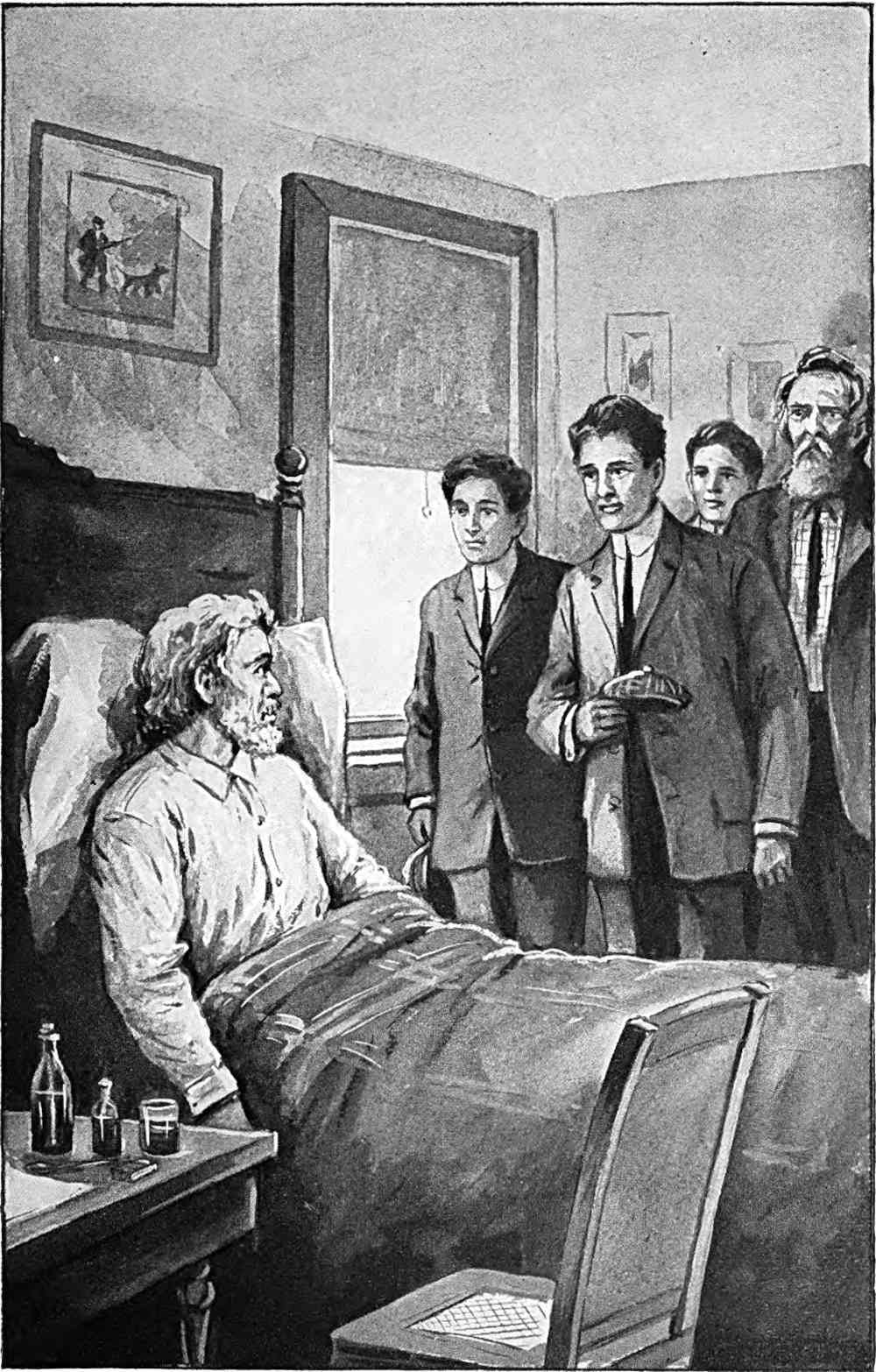
“We’ll tell you everything we know, sir. But please don’t get excited, Mr. Akers. It makes you sick.”
“Never mind about my being sick, young man. You tell me the plain truth. All of you tell me the truth,” and Andrew Akers glanced from the elder Westmore boy to his four companions.
“We’ll tell you the truth,” said Bart; and the others nodded.
“I want to know all about that black box—my box,” continued the aged man. “Did you open it at all?”
“We did not, Mr. Akers. I told you that before,” answered Joe, promptly.
“Did any of you open it?”
“No, sir!” came from each of the others.
“It was locked and we had no key,” added Fred.
“You said you saw it fall from the biplane when I was in the air?”
[119]
“We did,” replied Joe.
“Did anybody have a chance to get to it before you picked it up?”
“I don’t think so,” went on the elder Westmore youth, and the others shook their heads to show that they agreed with him.
“And did anybody outside of you have a chance to open it between the time you found it and when you gave it to me?”
“I hardly think so, sir,” replied Joe. “Of course such a thing might have occurred; but I don’t think it did.”
“But they are gone! My valuable papers are gone!” groaned the old man. “I thought them so safe, and now they are gone!” And a look akin to agony crossed his countenance.
“You mean the papers that were in the box when it fell from the biplane?” asked Harry.
“Yes! yes!”
“But you told us they were safe when you opened the box after we gave it to you,” continued the younger Westmore boy, thinking the aged inventor had forgotten what had occurred.
“So I did, but I was mistaken. I looked only at the envelopes of two of the packages,—I did not attempt to examine the contents. When I came to look at them more closely yesterday I found [120] the original contents gone, and in place of them some worthless paper, of no value to anybody!”
“Well, we didn’t take a thing, Mr. Akers, I can give you my word of honor on that!” cried Joe. “As soon as we found that the box was locked we put it in the auto and brought it to you. Of course while we were caring for you somebody might have opened the box and taken your things. But I didn’t see anybody around.”
“Neither did I,” added one and another of the lads present.
“Mr. Akers, would you mind telling us what is missing?” questioned Bart, after an awkward silence, during which the suffering man clasped and unclasped his hands nervously.
The old inventor looked keenly at first one boy and then another. Then he fell back with a sigh and for a moment closed his eyes.
“You look like honest lads, and I will trust you,” he replied, slowly. “I fancy you have done what you could for me, and I know Runnell has done his best, too. Forgive me for having suspected you of wrongdoing. But I have been very sick and this has upset me terribly. If I do not get those documents back I may be ruined—ruined!” And his voice sank into a hoarse whisper.
[121]
“Now take it easy, Mr. Akers,” said Joel Runnell, soothingly. “It won’t do you no good to git excited—take it easy.”
“Very well—I shall try to be calm,” answered the sufferer. He paused for a moment. “If I tell you boys my secret will you do what you can to help me?” he questioned, brokenly.
“Yes, indeed!” cried Harry, quickly, and the others said practically the same.
“The packages contained two things of great importance,” went on the aged inventor. “One was the plans of my new gasoline engine—an engine not yet quite perfected and so not yet patented. The other was my certificate of stock in the newly-reorganized Springfield Novelty Manufacturing Company.”
“Well, can’t you duplicate the plans?” asked Link.
“That is not the point, my boy. I have enemies and bitter rivals, and they would like nothing better than to get hold of my plans and inventions and patent them in their names—and thus leave me in the cold. And what is true regarding the inventions is likewise true of the certificate of twelve thousand dollars’ worth of stock in the Springfield Novelty Company.”
“Why, I thought stock in a company was always [122] registered, or something like that,” put in Joe, who had heard his father talk over such matters.
“So it is, but in this case the registering was done—had to be done, in fact—by an enemy of mine, Mr. Thomas Mason, of Brookside. Now if he or any of his tools got hold of that certificate of stock, don’t you see how easy it would be for him to wipe my name off the records and place the stock in his name?”
“Would he be bad enough to do that?” asked Harry.
“After the way he has treated me in the past, I think he would do anything to get the better of me. Some years ago I exposed some of his underhanded work in the organizing of a windmill company and he has never forgiven me for it. I saved the money of a number of poor and needy stockholders and came close to sending Mason to prison. That made him very bitter, and since then he has done all in his power to corner me. I knew he was after my new gasoline-engine ideas, but I did not know he was in the newly-organized Novelty Manufacturing Company until I had agreed to put my cash into it,—and then it was too late to withdraw. Then I got interested in aviation, and I did not give him another thought until I heard that he was snooping around, watching me like a cat watches a mouse. [123] That made me nervous, and that is why I carried the black box with me, as I told you before. Now I reckon I would have done better had I hidden it somewhere,” added Andrew Akers, bitterly.
“Have you seen this Mr. Mason around anywhere?” asked Joe.
“No, he has not dared to show his face here. But I feel sure he is keeping track of me.”
“But you haven’t any proofs that he has your documents,” said Bart, bluntly. “After all, Mr. Akers, you may be misjudging the man.”
“Possibly; but I don’t think so. If you boys didn’t take those documents—and I believe now that you didn’t—then I feel certain that Mason or somebody acting for him took them.”
“Well, we wouldn’t dare go to him and accuse him without some proofs,” said Link. “He might have us locked up if we did that.”
“No, that would do no good, my boy. But I know what one of you might do!” cried the aged inventor, brightening. “You might go to Springfield and find out about that stock—see if it is still in my name. You could say that I wanted to sell it to your father, and that he wanted to know if it was all right. If the clerk in charge says it is there on the books, in my name, that will be proof in court that the stock is mine. I can sign a letter [124] offering the stock to Mr. Westmore, or Mr. Rush, or whoever you please,—just for a blind.”
“All right, sir—I will do that,” answered Joe, readily. “I can run up to Springfield on the train to-morrow.”
“Take somebody along as an additional witness.”
“I’ll go with Joe,” put in Fred. “I’ve got an aunt in Springfield and we can call on her and get dinner there.”
By this time the aged inventor was almost exhausted and he had to rest a while before dictating the letter which he later on signed. He told something of his business, and also let fall the information that he had hidden the black box in the barn, just as Joel Runnell had surmised.
“I was afraid Mason or his tools would come in here while Runnell was away and rob me,” he said.
“Maybe they took the documents while the box was in the barn,” suggested Link.
“Possibly, although I hid it in a safe place, under some old lumber.”
“If we find the stock is all right in your name, maybe you can cover your ideas for the new engine, too,” added Harry, hopefully.
“I doubt it. If they have the working plans, they can go ahead and get the patent while I am [125] sick here,” answered the sufferer, with a long sigh.
More talk followed, but soon it was plain to be seen that Andrew Akers was on the verge of a collapse, and the boys withdrew, Joe carrying the signed letter with him.
“Better try to keep him quiet,” said Joe to the old hunter. “Tell him we’ll do all we can for him.”
“I’ll keep him as quiet as possible. But he gits mighty nervous-like sometimes.”
Soon the boys had their bicycles out on the road and with a waving of hands to Joel Runnell, they mounted their wheels and set off in the direction of Brookside and Lakeport. It was nearly five o’clock and they knew they would not get home until long after the supper hour. But this did not worry them, for they had told their folks that they would not be home until late.
“I know what I am going to do,” remarked Joe, as they pedaled along, over the bridge outside of Cresco.
“What?” asked the others.
“Stop at the Dickerson farm and try to find out who that man was with farming machinery who asked about Mr. Akers.”
[126]
“That’s the talk!” cried Harry. “For all we know, he may be a tool of this Tom Mason.”
“Say, Harry, what are you going to become, a detective?” queried Bart, with a grin. “First thing you know, you’ll be on the New York force.”
“Never mind, it’s a good idea,” broke in Link. “Joel Runnell said the fellow acted suspicious-like.”
“The Dickerson farm isn’t much out of our way, so it won’t do any harm to stop there,” remarked Fred.
Now that the sun was getting lower in the west, it was not so hot riding and, refreshed by their rest at the cottage, the five youths made good time over the hills leading to the Dickerson farm, which was less than a quarter of a mile up a side road midway between Cresco and Brookside.
They found Henry Dickerson and his wife in the [127] barnyard, milking the cows. The farmer often came to the Lakeport stores for supplies and knew the Westmore boys and Fred fairly well.
“Hullo, lads, what can I do for you?” he asked, pleasantly, as he set down his milking pail.
“I’d like to ask you a few questions, Mr. Dickerson,” replied Joe, and without preliminaries spoke about the man who had stopped at the Runnell cottage.
“Oh, yes, I remember that chap,” answered Henry Dickerson. “He was agent for a new kind of plow. He wanted to sell me one the worst way, but I told him my old plows were good enough for me.”
“What was his name?” asked Harry.
“I forget his name. But he left his card. It’s in the kitchen. I’ll get it for you.” And the farmer did so.
“Lamar Chase,” said Joe, after reading the name. “Representing the Double Weld Plow Company, Springfield.”
“Oh, I’ve heard of that chap!” cried Bart. “Why, he used to be located in Brookside—had a small hardware shop there.”
“Yes, I remember now,” returned Joe. “He gave it up two or three years ago.”
“Yes, and let me tell you something more,” cried [128] Link. “He used to be in the same building where Mr. Thomas Mason had his office.”
“Anything wrong with that chap?” questioned Henry Dickerson, curiously.
“Oh, we only wanted to find out who he was,” answered Joe. He handed back the card, after noting the man’s address. “Much obliged. We’ll have to get home, for it is late.” And in another minute the five boys were off.
“That man came from Springfield!” cried Harry, when they were out of hearing of the Dickersons.
“Exactly!” returned his brother. “Boys, I feel sure of one thing: This Mr. Lamar Chase knows Mr. Mason. He knew him in Brookside years ago and now he is located in Springfield, directly across the street from the Springfield Novelty Manufacturing Company. His location is 52 River Street and the novelty company’s address is 49 to 53—just on the other side.”
“And he knows Mr. Akers,” added Fred.
“I’m going to investigate some more, when I get to Springfield,” went on the elder Westmore boy.
The lads put on a burst of speed, and while riding hard but little talk was indulged in. Soon they reached Brookside, and just as the town clock tolled out the hour of seven they came in sight of home.
[129]
“I wish you’d come over to our house to-night, Fred,” said Joe. “And ask your father if he won’t come, too.”
“All right, I’ll do it,” responded the stout youth.
While eating supper the Westmore boys told their father of all that had happened. Mr. Westmore was deeply interested.
“I don’t know much about Mason, excepting that he is reported to be rather close-fisted,” he said. “But I do know this Lamar Chase—and Mr. Rush knows him even better. They once bought some hardware supplies together, and Chase didn’t pay his part of the bill and it gave Mr. Rush a good deal of trouble.”
A little later Fred and his father appeared, and all sat down in the Westmore sitting-room to discuss the situation.
“Lamar Chase is a trickster,” said Mr. Rush. “He caused me no end of trouble in that hardware deal. And I know that he and Thomas Mason are well acquainted, and both have something to do with that Springfield Novelty Company. It is quite possible that Chase is aiding Mason to get the better of this Andrew Akers.”
“My opinion is, this Mr. Akers ought to hire a first-class lawyer to protect his interests,” said [130] Mr. Westmore. “It is a mistake to leave it to you boys.”
“Well, he asked us to go to Springfield for him,” answered Joe. “He has no use for lawyers, any more than he has for doctors or a hospital. I think myself he is a queer man; but I think we are bound to respect his wishes.”
“Oh, it won’t hurt for the boys to go to Springfield,” said Mr. Rush. “They can take that letter and probably get as much information as anybody could.”
“Very well, they shall go,” answered Mr. Westmore. “But be sure and keep out of trouble.”
The morning train for Springfield left at quarter of eight and long before that hour Joe and Fred were ready for the trip. Joe had the letter that had been signed by Andrew Akers, offering his stock in the novelty company to Mr. Westmore. The boys purchased excursion tickets to the city and then waited impatiently for the train to come along. There were less than a dozen passengers to get on, and the lads found the cars only half filled, and so had a double seat to themselves.
“Why, say, here is news!” cried Fred, who had bought a Springfield daily newspaper at the depot stand. “Do you remember the County Fair at Springfield?”
[131]
“Yes, that’s no news, Fred. I don’t care for ’em much—same old cows and pigs and horses, and pumpkins and patchwork quilts.”
“Oh, I don’t care for that myself. But the paper says that they are going to have an added attraction, which is to take the place of the lady lion-tamer, who is sick. They have engaged Mr. Frank Dimity, the world-famous aviator, to give several flights in his new hydro-aeroplane, from Crystal Lake, at the fairgrounds.”
“That’s different!” cried Joe, his face showing his interest. “A hydro-aeroplane, eh? That’s one of the kind that can sail on the top of the water as well as in the air. I’d like to see it.”
“So would I.”
“Will the aviator be there to-day?”
“Yes, from three to six o’clock this afternoon.”
“Then, if we get through in time, Fred, why not go out to the fairgrounds before we go home? We can take the eight-fifteen train to Lakeport instead of the four-forty.”
“That’s the talk!” exclaimed the stout lad, his face beaming. “I’d like to see that chap scoot over the water and in the air.”
For the time being the business that was taking them to Springfield was forgotten, and both lads pored over the advertisement and over the reading [132] account of what Mr. Frank Dimity had done in the past with his new air and water machine.
“From this account the hydro-aeroplane isn’t so very much different from our machine, excepting that it has air-tight pontoons under it, instead of bicycle wheels,” remarked Fred. “There are two pontoons under the center of the machine and a little pontoon at the far end on either side. I suppose he drops down on the water just as our machine drops on a level field, and he can run on the top of the water just as our machine can run over the field before it rises in the air.”
“That’s the size of it,” returned Joe. “But I reckon a chap has got to be careful that he doesn’t hit the water sideways, otherwise he’ll go under. He has got to come down just as flat as a pancake.”
The run to the city occupied an hour, for the train was an accommodation, making eleven stops. Soon the seats began to fill up, with many folks bound for the fair.
The boys had been to Springfield before, both by train and in the automobile, so they did not feel strange when they alighted at the depot. They soon found out where River Street was located, down in the factory district.
“It’s a little bit early yet,” said Joe, consulting his watch. “Perhaps we had better walk around [133] a little before we call at the office of the novelty company. The man in charge of the office may not be there. Some of these rich men don’t get to work until ten o’clock or after.”
“Oh, I guess we’ll find somebody there,” answered Fred. “If not, we can sit down and wait.”
A ten-minutes’ walk brought them in front of the big factory building occupied by the Springfield Novelty Manufacturing Company, as announced by the big sign across the front of the structure. At one end were the offices. Looking through a window the lads saw two young clerks standing at a tall desk writing in some books. At a stand in a corner was a young lady at a typewriter. On the other side of the office a portly man sat back in a chair, reading a newspaper. His feet were up on a desk, and he was evidently taking his ease.
“That man must be the manager,” said Joe to his chum. “Come ahead.” And he braced himself for the coming interview.
As they entered, Fred purposely shut the door rather hard, so as to attract the attention of the man who was reading. He dropped the newspaper and looked at the visitors inquiringly. The young lady at the typewriter arose and came towards him.
[134]
“What is it you wish?” she asked.
“I would like to see the office manager,” answered Joe.
“The office manager? Do you mean Mr. Mason?”
“Is he the manager here?”
“He is the general manager, yes.”
“Then I’d like to see him, if he is here.”
“What do you want?” demanded the portly man at the low desk, without making any movement to arise. Both boys noticed that his face had a shrewd, hard look on it.
“Are you Mr. Mason, the manager?” asked Joe.
“I am.”
“Then I’d like to see you on business, Mr. Mason.”
“What is it?”
“I came to see you about some stock in this concern, now owned by Mr. Andrew Akers.”
“What’s that?”
The words were uttered quickly, as if Mr. Mason had been taken very much by surprise. His feet came to the floor with a bang and he hurried over to where Joe and Fred stood.
“I said I had come to see you about some stock in this manufacturing company that is now owned by Mr. Andrew Akers. He has offered the stock [135] to my father, and I wish to get some particulars about it.”
“Um! Ah!” muttered Thomas Mason, and for the moment he looked very much disturbed. “If you—er—want to see me about our stock, please step into my office.” And he pointed to a side apartment, separated from the main office by a ground-glass partition reaching to the ceiling.
The two boys followed him into the other office and he motioned them to chairs. Then he closed the door carefully and confronted them.
“Now, then, what did you say?” he asked, of Joe, although the Westmore boy had told him twice.
“I came to see about the twelve thousand dollars’ worth of stock that Mr. Akers owns in this concern,” answered Joe. “He has offered it to my father, and I want to find out how this concern stands and if it would be a good investment.”
“Humph! Who are you?”
“I am Joe Westmore, of Lakeport. My father is Horace Westmore, the flour and feed dealer.”
“Oh, yes, I know him,” and Thomas Mason nodded slowly. “And who are you?” he asked, turning to Fred.
“I am Fred Rush, also of Lakeport.”
[136]
“Oh, yes, that Rush boy! Your father is in the hardware business, isn’t he?”
“Yes.”
“Humph!” Thomas Mason dropped into a chair in front of a big roll-top desk. “Well, let us come to business. Let me see that certificate of stock that this Andrew Akers claims to own.”
[137]
Joe had been afraid this question would be asked, and he was, therefore, prepared for it.
“I didn’t bring the certificate with me,” he said. “My father said it wouldn’t be necessary—that you had the record of the stock on the books.”
“Hum! Well, what do you want to know?”
“My father would like to know something of the way business is running, and all that,—and he also wants to know if that stock is free and clear.”
“You can’t expect me to open our books to you, a stranger,” cried Thomas Mason. “Our books are open to our stockholders, but not to the general public.”
“Here is a letter from Mr. Akers to my father about the stock,” went on Joe, producing the missive. He hardly knew how to proceed.
The general manager of the novelty company perused the communication closely.
“When did Mr. Akers give this?” he demanded, noting that the letter was not dated.
[138]
“Yesterday.”
“Yesterday. Where is he?”
“That I cannot tell you, Mr. Mason.”
“Don’t you know?” And the portly man looked at the youth and at Fred sharply.
“Yes, I know, but—er—I cannot tell you. If you know Mr. Akers you know he is a strange man. At present he wishes to keep his whereabouts a secret.”
“For what purpose?”
“That is his business.”
“Is it? Well, the running of this company is my business. I have nothing to tell you.”
“Won’t you tell me if that stock is free and clear? My father doesn’t want to buy stock that isn’t fully paid for.”
“If Mr. Akers has stock in this concern the certificate will show if it is paid for or not.”
“Well, he has the stock, hasn’t he?”
“I don’t know—I’d have to look up the records, and I am not going to do that just now. If he has the stock his certificate will show it, and also show if it is paid for in full, and also whether it has been transferred or not. We have in all two hundred thousand dollars’ worth of stock out and I do not keep a personal list of our stockholders—that is on our records. As for this business, we are doing [139] nicely and our stock is worth par, if not more.”
“How long has Mr. Akers held this stock?” asked Fred, after a short pause.
“I haven’t said that he owns any stock,” snapped back Thomas Mason. “As a matter of fact, I do not remember seeing his name in the list of stockholders. But of course, if he has a certificate, he must own the stock, and the records will show it. Tell your father to bring the certificate and I will look the matter up and give him all the information I can. Now you boys will have to excuse me, for I have many matters of importance to attend to.” And the general manager of the novelty company drew himself up as if to close the interview.
“Then you won’t look up this record for us?” asked Joe, as he backed to the door.
“No—not until you bring me that certificate. Then I’ll be assured that you and Mr. Akers really mean business and I’ll do what I can for you.” And thus speaking Thomas Mason bowed them out of his private office and turned his back on them.
Joe and Fred felt that they had been beaten—that they had failed to trap Mr. Mason as they had hoped to do. They wanted to remain—to question him some more,—but he gave them no opportunity. Much crestfallen, they left the building and walked slowly down the street.
[140]
“What do you make of it, Joe?” asked Fred, as they came to a halt on the corner.
“He is bluffing us, Fred. He knows all about that stock.”
“Just my idea. But he wouldn’t admit that it was on the books. That looks bad.”
“Yes, but on the other hand, he didn’t say that Mr. Akers didn’t own the stock. Now, if he has the certificate, and wants to defraud Mr. Akers, why didn’t he come right out, pretend to look up the records, and then say that Mr. Akers didn’t have the stock?”
“Maybe he was afraid that we had seen the certificate before it was stolen and that your father and Mr. Akers would demand to know how the stock had been transferred, or something like that. I think his plan may be to lie low and say nothing until he is sure of his ground. In the end he may forge Mr. Akers’s name to some transfer of the stock, using the stolen certificate.”
“Yes, or else—Hello, there he is, looking after us!”
Both boys wheeled about, to behold Thomas Mason on the steps of the factory office, gazing earnestly after them. Then they walked around the corner.
[141]
“He’s disturbed, that’s sure,” remarked the stout youth. “I wonder if——”
“There he goes—across the street!” cried Joe, who had turned back to glance around the corner. “Do you know what I think? He is going over to see that Lamar Chase. His office is opposite, if you will remember.”
Both boys watched the portly figure of the novelty company manager as he crossed the somewhat dirty roadway. They saw him pause on a set of steps, look up and down the street, and then disappear through an open doorway.
“Do you know what I’ve a mind to do?” said Joe.
“Follow him?”
“Yes. Maybe we’ll learn something, Fred. Come on, it’s early yet.”
“We don’t want to get into trouble, Joe.”
“Oh, we can run for it, if we have to. Come on.”
Both boys turned back and walked swiftly towards the building into which Thomas Mason had gone. They found an open hallway, leading to a lower loft. A flight of steps and a freight elevator led to another loft above, that occupied by the plow concern represented by Lamar Chase.
[142]
“Hey, Jackson!” they heard a voice call, in the upper hallway.
“Is that you, Mr. Mason?” came back from the freight elevator.
“Yes. Is Mr. Chase in?”
“No, sir, he has gone over to the fairgrounds, to look after the exhibit.”
“When will he be back?”
“Not to-day, sir. The man that was to be at the fairgrounds had to go to New York, so Mr. Chase is going to take his place and see if he can’t book some orders.”
“I see. Well, maybe I’ll go over to the fairgrounds myself,” responded Thomas Mason, and then the boys heard him turn on a landing of the stairs and start to come down.
“Come on!” whispered Joe, and ran noiselessly out of the building, followed by his chum. Both paused behind a pile of packing cases on the sidewalk and saw Mr. Mason come out and re-cross the street to his own offices. Then they took to a side alleyway, so that they might not be seen.
“Did you hear what he said!” cried the stout youth, excitedly.
“I did, Fred. Mr. Chase is at the fairgrounds, and Mr. Mason may call to see him.”
[143]
“He seems rather anxious, don’t you think?”
“Oh, I don’t know.”
“But to go to the fair to see Chase!”
“Oh, he may have intended to go anyway—to see the exhibits and the hydro-aeroplane stunts.”
“No, I think he wants to see this Lamar Chase—maybe about that stock!”
“Well, if we go we can hunt up Mr. Chase ourselves,” returned Joe.
“Let us watch for Mason and try to find out what he has to say to this man Chase.”
“It might not do any harm to do that.”
The boys walked out of the alleyway on to one of the main streets of Springfield, and then Fred led the way to where his aunt lived. She was somewhat surprised to see him, but speedily made both him and his chum feel at home.
“I thought some of you boys would come to see the fair,” said Mrs. Powelson. “They are going to have a flying machine there. You’ll want to see that.”
“Sure, especially as we have a flying machine of our own, Aunt Emma,” responded Fred.
“A flying machine! You!” gasped the aunt.
“Yes;” and the stout youth gave a few of the particulars.
[144]
“Well, I never, Fred Rush! What in the world is the world coming to! Of course you are not going to fly in it.”
“Sure we are, Aunt Emma. Some day I’ll take you up!” And Fred winked at Joe.
“Indeed, you’ll never get me off the ground in one of those things!” declared Mrs. Powelson, firmly. “Why, I think it is flying in the face of Providence! If you fall you’ll be killed!”
“I don’t intend to fall.”
“That is what they all say—but they do fall, just the same.” And shaking her head dubiously, Fred’s aunt went off to get the dinner ready. She lived alone, being a widow.
It was a simple but well-served meal, of chicken potpie with dumplings, and berry pie, and it is perhaps needless for me to say that the lads ate as only hungry and growing boys can stow away food. The lady was glad to see them enjoy the repast, and insisted upon giving each an extra helping of chicken and a second piece of the pie.
“Certainly very nice,” murmured Joe, on arising from the table.
“I am glad you enjoyed it,” said Mrs. Powelson. “Come again—I like company.”
“Wouldn’t you like to go to the fair with us, Aunt Emma?” asked Fred, politely.
[145]
“No, Fred, you two boys run along alone. I am going to-morrow, with some lady friends.”
A quarter of an hour later saw the two chums on a trolley car, bound for the fairgrounds, which were some distance out of the city. The car was crowded and they had to stand on the running-board, along with many other boys and some men. Many were talking about the fair and about the aviator who was to be there, and all hoped to see some daring flights into space.
When the grounds were reached, the lads found a larger crowd than ever, and they had to fairly shove their way up to one of the ticket booths, to get the cards of admission. But once inside, they found ample room, and they roamed around, past several exhibition buildings and tents, and numerous refreshment stands.
“There is the lake!” cried Joe, pointing it out. “But I don’t see anything like a flying machine.”
“It’s behind the boathouse,” said a man standing near. “They are fixing something on it. They ain’t going to use it until half-past three o’clock, so the man told me.”
“Then we’ve got over an hour to wait,” said Fred. “Come on, Joe, let us look for that plow exhibit and Mr. Chase.”
Joe was willing, and together the youths strolled [146] along, to where some big banners announced the wares of the various farming implement companies.
“Here is the Double Weld Plow!” cried Joe, presently. “And there is a man talking business to several farmers. Maybe that is Mr. Chase.”
“We’ll soon find out,” answered Fred, and together they drew closer, behind some farmers. They soon learned that the man selling plows was Lamar Chase. He got one order for a plow, and then the crowd dispersed, but soon another commenced to collect. Then of a sudden Joe caught Fred by the arm.
“Get back here, behind this tent!” he whispered. “Here comes Mr. Mason!”
[147]
The general manager of the Springfield Novelty Manufacturing Company was plainly anxious and he could hardly wait for Lamar Chase to get rid of the new crowd that was gathering.
“I want to see you about something, Chase,” the two boys heard him say, as he leaned over a small counter that had been put up for writing purposes.
“All right, in a minute, Mason,” returned the plow man. “I’ve got to ’tend to the people here.”
“Well, hurry up—I can’t stay here all day,” grumbled Thomas Mason.
Joe and Fred looked at each other knowingly. They were behind the wall of a tent that covered some farming machinery, and neither of the men could see them.
“Now, what is it?” they heard Lamar Chase ask, presently, after he had explained the working of the patented plow to some farmers and waited until he had answered their questions and gotten them to take some of his pamphlets.
[148]
“I had some visitors this morning, Chase—two boys from Lakeport,” said Thomas Mason.
“Well, how does that concern me?” growled the plow man.
“They came to see me about some stock in our concern—some stock they said Andrew Akers had offered to Horace Westmore, father of one of the boys.”
“Phew!” whistled the plow man. “Said he had offered it, eh?”
“Yes. They wanted to know if it was good stock and O. K., and all that.”
“What did you tell them?”
“I told them they would have to bring me the certificate from Akers before I would give them any information.”
“Did they say they would get it?”
“No. They tried to make me admit that he owned the stock, but I told them I didn’t keep a list of the stockholders in my head and I wouldn’t look up the company’s records for them without they showed the certificate.”
“I see,” responded Lamar Chase, dryly.
“Now look here, Chase, we have got to get down to business,” pursued Thomas Mason, earnestly. “I’ve got to know just what I can do [149] and what I can’t do. You must know that just as well as I do.”
“I told you what you can do, Mason.”
“I can’t do that, Chase.”
“All right, then; we’ll let the matter drop.”
“But what good will that do you?” cried the manager of the novelty company, angrily. “You can’t do anything alone and you know it.”
“Perhaps I can—anyway, I can try.”
“And lose the chance to make a couple of thousand dollars,” stormed Thomas Mason.
“If I do it will be my loss, not yours, Mason. This is the first chance I have had in years to make real money and I am going to take it. You can either take my offer, or—well, I’ll see what I can do on my own hook.” And Lamar Chase spoke with great earnestness.
“You want too much, I tell you.”
“Only my share.”
“You don’t realize that I am running all the risk.”
“Who ran the first risk?”
“We won’t quarrel about that. Then it’s your idea to share and share alike?”
“Absolutely.”
Thomas Mason growled something under his breath that the two boys could not catch. Then [150] Lamar Chase started to speak, but at that moment came a sudden cry from a crowd near by.
“Look out for that horse!”
A small boy with a toy balloon had walked in front of a horse attached to a buggy, scaring the animal. The horse danced from one side to the other and tried to get away from his driver, and there was considerable confusion. Part of the crowd backed into the tent where Fred and Joe were standing, and the lads were forced to raise a back flap in order to get out. Then they found themselves in another crowd and jostled still further away from the place presided over by Lamar Chase.
“We had better be getting back,” said Joe, when the temporary excitement was over and the horse had been quieted down. “We are losing the most important part of that talk.”
“Come on, I’m ready to go back,” answered the stout youth.
But getting back was not so easy, for the crowd was still thick, and two policemen had run up and they forced the boys to go another way, around a shed devoted to poultry. But the lads hurried all they could, and when they got close enough saw that Thomas Mason and Lamar Chase were still talking earnestly.
[151]
“Then that is settled?” they heard the novelty company man say.
“Yes.”
“And you will see me in a day or two?”
“Just as soon as the fair closes and I can wind up matters here, Mason.”
“And I can depend upon you, Chase?”
“Absolutely. I never yet went back on my word—you know that.”
“All right, then. I’ll go ahead as we agreed,” said Thomas Mason; and a moment later he turned and walked away rapidly, in the direction of the fairgrounds gate.
“Too bad!” cried Joe. “I believe we missed the most important part of their talk.”
“So do I,” returned Fred. “What shall we do next, follow him?”
“I don’t think it would do any good. And, besides, we’d miss the hydro-aeroplane exhibition.”
“Joe, do you think Mr. Mason has the missing certificate?” went on the stout youth, as the pair turned in the direction of the lake. The majority of those on the grounds were now moving in the same direction, all anxious to see what the aviator might do with his new air and water machine.
“No, I do not, Fred.”
[152]
“You don’t!” cried the stout youth, in astonishment.
“That is what I said.”
“Do you mean to say you don’t think Mr. Akers was robbed?”
“Oh, no. But I think this Lamar Chase has the certificate.”
“Oh!”
“This is the way I figure it, although I may be all wrong. I imagine that both Mason and Chase know Mr. Akers and have had dealings with him, and we know that these two men here are friendly and have had numerous dealings in the past. Now I think both knew about this stock and one or the other suggested that they get hold of the certificate. Lamar Chase, on the day he visited Joel Runnell’s cottage, saw Mr. Akers there and made up his mind to watch the old man. He did so, saw Mr. Akers hide the black box, and opened it and took the certificate and maybe the other papers. Then he let Thomas Mason know about it. Mason wanted to give him two thousand dollars for the certificate, and perhaps the other papers, but Chase wanted more—he wanted to share and share alike. And now that is what Mason has agreed to do.”
“I believe you are right—it all fits in so well [153] with what we know and have heard!” cried Fred. “But what is our next move?”
“We’ll go home this evening and tell my father and yours about it. I think we’d better leave it to them. They may set a private detective at work.”
Once at the lake shore the two lads, for the time being, forgot all about the errand that had brought them to Springfield. They got as close to the hydro-aeroplane as they could, and examined the craft with interest.
The machine was about the size of the Skylark, but had a far more powerful engine—one of a hundred horse power, so one of the working-men said. The rudders were all far to the rear, and instead of a steering wheel there were several levers to be manipulated. At the bottom were four air-tight pontoons, or flatboats, of heavy sheet metal, painted green, two in the center and a smaller one at either side. The machine was fastened to the pontoons by means of hollow metal rods, of the gaspipe variety, and by a number of wire stays.
“There she goes!” cried the crowd, presently, and as the cry arose the hydro-aeroplane was shoved across a smooth float onto the calm waters of the lake. There the curious craft floated as on an even keel but with a slight tilt backward.
“Wants a little weight in front,” remarked Fred.
[154]
“And here it is,” replied Joe, and then a cheer arose as the aviator appeared, clad in a waterproof suit and cap. He crawled forward through the machine and took the single seat, and then the affair looked to be balanced evenly all around.
“All ready! Let her go!” came a minute later, and then followed a popping from the engine and the propellers began to whir around, faster and faster. The crowd stopped cheering and gazed in open-mouthed expectancy.
Suddenly the hydro-aeroplane left the float and went skimming up the long lake. On and on over the surface of the water it skimmed, sending a fine spray flying around it. The crowd sent up a roar.
“Look at that thing go!”
“A regular sea-bird, ain’t it?”
“Say, that beats a motor boat all to pieces!”
“Talk about your ferries! A fellow could cross the lake in about ten seconds in one of those things!”
The crowd watched the hydro-aeroplane almost out of sight. Then the air-and-water machine made a wide curve and started to come back. Closer and closer it came to the float and the lake shore, lined with many thousands of spectators.
“Say, maybe he’ll run into us!”
“No, he won’t! He knows what he is doing.”
[155]
Presently the explosions of the motor increased. Then the rudder control was shifted, and with a whizz the hydro-aeroplane suddenly left the bosom of the lake and slanted skyward, over the heads of the gaping crowd. Up and up it went, into the sunshine, until it was fully three hundred feet in the air. Then the aviator began to circle the main fairground buildings and the race course.
“Say, that’s fine!” cried Joe. “It’s immense!”
“What a fine getaway he made from the lake,” added Fred. “Why, he sailed up like a wild duck leaving the water!”
The chums watched the course of the hydro-aeroplane with rapt attention, as did everybody else in the crowd. It circled around twice and then made a figure eight.
“By gum! I never thought I’d live to see it!” gasped an old farmer, standing by. “Sails on the water an’ in the air! Well, I’ll be switched!” and he shook his beard in wonder.
“He’s coming back!” said Fred, a minute later, and this announcement proved true. Straight for the lake sailed the hydro-aeroplane, coming down lower and lower. Then it shot along for several hundred feet on an even keel and at last touched the surface of the water with a slight splash. Up the lake it went once more, and then made a slow [156] turn and came back. The power was shut off, and like some gigantic white swan it came silently back to the float and stopped there.
For several seconds the crowd was silent, then came a cheering and a handclapping that could be heard a long distance off. The daring hydro-aeroplanist got up and bowed and smiled and raised his cap. Then he leaped to the float and disappeared into a boathouse, leaving the machine to his assistants. The show was over for the day, and gradually the larger portion of the crowd dispersed, only a small number remaining behind to inspect the hydro-aeroplane and see it rolled back to an ice-house that was being used for a hangar.
“And now for home!” cried Fred. “Joe, wasn’t that fine?”
“Yes, indeed! I am glad we saw it. It’s great sport!”
“Better than plain flying, eh?”
“As good, anyway. But I’m going to learn plain flying first,” added the Westmore youth, with a smile.
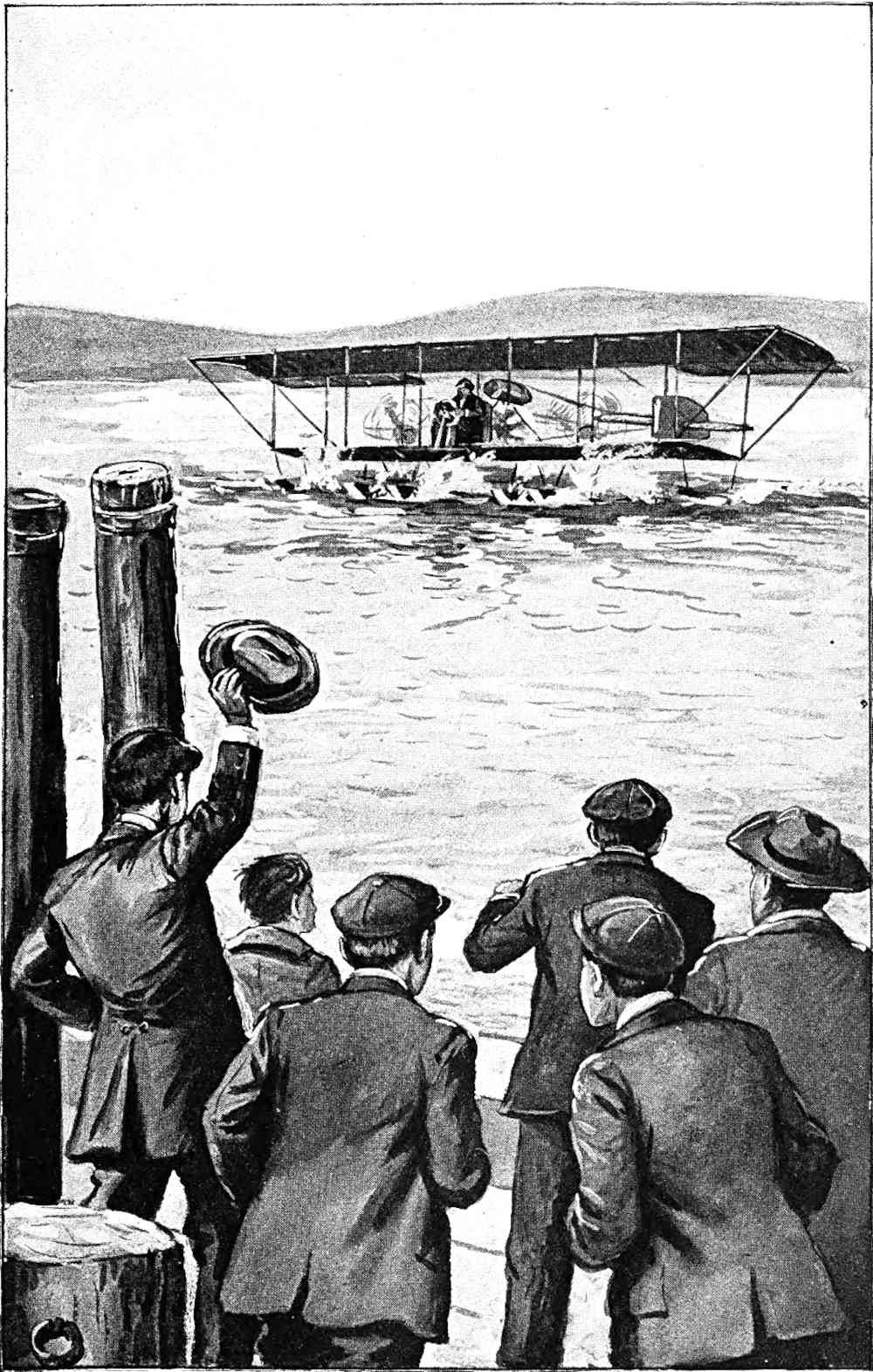
[157]
When the boys got home they had a great deal to tell, and it can be imagined with what interest the others listened to the recital. As late as it was Mr. Westmore and Joe went over to consult with Mr. Rush. Harry went along, and Mr. Darrow and Link, who lived close by, also dropped in.
“I am inclined to think that Joe has reasoned this thing correctly,” said Mr. Westmore. “And if he has, Mason and Chase are in league to swindle Andrew Akers out of his property. But how are we to prove it?”
“That’s just the point,” responded Mr. Rush. “It seems to me, what is needed is a first-class lawyer, and maybe a detective.”
“I don’t think Mr. Akers wants a lawyer, or a detective, either,” put in Link. “He is down on professional people of all kinds. Why, he didn’t even want a doctor, when he should have had one.”
“Well, a man like Mr. Akers doesn’t always [158] know what is best for him,” replied Mr. Westmore, bluntly.
“Perhaps you and Mr. Rush had better go and see him,” suggested Mr. Darrow. “I’d go, only I know next to nothing about legal matters.”
“I am willing to do that,” said Horace Westmore. “What do you say?” and he turned to the hardware dealer.
“I’ll go to-morrow morning, if you say so.” And so it was arranged.
Of course the two boys had to tell all about the visit to the fairgrounds and the flight taken by the hydro-aeroplane. What they had to tell made Harry and Link very enthusiastic.
“That must be safe flying, when you’re over the water,” was the comment of the carpenter’s son. “If you feel yourself falling you can float anyway.”
“I’d like to have an air-and-water machine myself,” said Harry.
The next day Mr. Westmore received an extra consignment of goods from the city and he had to take care of these, so the trip to Cresco was postponed until the following Monday. In the meantime, on Saturday, the boys got out the biplane once more, and James Slosson appeared to give them further instructions in manipulating the machine.
[159]
“It’s your turn to go up, Joe,” said Bart. “Hope you enjoy yourself.”
“I’ll try to,” answered the older Westmore boy, with a grin.
As before, the biplane was carefully inspected from end to end, Slosson making the boys do this while he looked on and occasionally gave them a word of advice. Then the engine was given a tryout, and the flying machine was rolled to the center of the field bordering Pine Lake.
“Are you ready?” asked the aviator of Joe, as he took his own place at the wheel.
“Sure,” was the answer, and Joe leaped into the extra seat. It must be admitted that his heart beat rather fast, but he was not going to let anybody know his real feelings.
A small crowd had collected and there was a cheer as the biplane went up with a rush, carrying the man and the boy with it. The Skylark was headed directly out on the lake, and as he looked down Joe saw Si Voup and Ike Boardman, with two strangers, in the Voup motor boat. Si was talking earnestly to the two strangers, and motioning to the flying machine.
But just then, Joe gave scant attention to anything but the trip in which he was participating. Up and up shot the Skylark, the engine making [160] such a noise that conversation between those aboard was out of the question. But Joe did not want to talk; he was quite content to hold on tight and watch the scene around him, and also watch Slosson and learn how he worked the various controls.
At first Joe was a bit dizzy-headed, and the thought rushed through his brain that he would be like Bart, content in the future to do his traveling on land and water instead of through the air. But then his head grew clearer, his nerve came back to him, and before he had been up three minutes he was himself again and watching his instructor closely.
Over the lake flew the biplane and then skirted the opposite shore for the best part of a mile. Then they came back over the water, sailing directly above one of the small lake steamers. There was a crowd on the craft and all cheered lustily, and many ladies and girls waved their handkerchiefs. Then the Skylark cut a figure eight directly over Lakeport, and finally landed in the field from which the flight had started.
“Great! Immense!” cried Harry, as all rushed up to the biplane.
“You were up twelve minutes,” added Bart, who had been timing them. “That is the longest yet.”
“We could have remained up much longer, had [161] we wished,” answered James Slosson. “How did you like it?” he asked, of his passenger.
“It was all right,” replied Joe. “I felt a bit funny at first, but after that I enjoyed it. You seemed to manage the machine easily enough.”
“That’s because there is very little breeze,” returned the aviator. “It is an ideal day for flying.”
“Can’t we take some more trips?” pleaded Harry. “I’d like to go up again.”
James Slosson was willing, and in the end he took up not only Harry, but likewise Fred and Link. Bart had to go off on an errand, and he was glad of it, for, as said before, flying did not particularly appeal to the big youth. On these trips the aviator gave the lads much additional instruction, so that when at last the biplane was taken back to the Darrow carpenter shop the boys felt that they were almost competent to fly by themselves.
“But you’ll want a few more lessons,” said James Slosson. “This is something in which it pays to make haste slowly.”
“Did you see Si and Ike in the motor boat?” asked Harry, after the aviator had left. “They had two men with them and all were very much interested in the Skylark.”
“The men were strangers here,” put in Link. [162] “I asked several people who they were, but nobody seemed to know.”
On Sunday Joe and his chums attended church and Sunday school and then went for a walk up the lake road. They had seen Si Voup going towards the docks earlier in the day, and presently they heard the put-put of his motor boat on the lake. Looking through the bushes they beheld Si and Ike in the craft and also the two men who had been with them the day previous.
“Well, one thing is certain,” remarked Harry. “They are very thick with those men, whoever they are.”
“They may be relatives of Si or Ike,” suggested Fred.
“Perhaps, but I doubt it,” answered Link.
“There they go, up the lake,” cried Bart, a moment later. “Say, Si must be crowding his boat! Just see ’em go!”
“Maybe they are in a hurry to get somewhere,” said Matt, who was along. “Perhaps those men belong in Brookside, or up to Smith’s Cove.”
“Maybe they are flying machine men,” exclaimed Fred, suddenly.
“Flying machine men?” queried several of the others.
“Yes. It would be just like Si to get some of [163] those chaps to come here and see our aircraft and then buy something better.”
“Humph! Where would he get the money, Fred?” questioned Harry. “Flying machines cost a good deal.”
“Well, so do motor boats, but Mr. Voup bought one for Si, didn’t he?”
“I think he’d draw the line on a flying machine, though,” was Joe’s comment. “Still, there is no telling what Si will do—or try to do. You can make up your mind he is green with envy over our having the Skylark.”
“If Si wants a flying machine he’ll bother his folks until he gets one,” said Fred. “That’s his way. And he’s got a good chance now, to my way of thinking,” he added.
“Why a good chance now?” asked Link.
“I heard my father talking about some land deal in which Mr. Voup was interested. It seems the deal went through a couple of days ago and the Voups and Boardmans both made quite a pile of money. That being so, Mr. Voup won’t mind spending something extra on Si—and Mr. Boardman will be the same for Ike.”
“All right—let ’em get a flying machine!” cried Link. “Then we can have some races.”
“And I’ll be the stakeholder!” exclaimed the [164] humorous Matt. “Come now, step up and plank down ten thousand dollars and a big red apple each. Whoop!” And in his exuberance of spirits he ran forward on the road and turned several “cart wheels.”
The boys walked almost to Brookside. They talked about so many things, and so earnestly, that they did not notice the clouding over of the sky until the sun was hidden, causing it to become quite dark on the tree-lined roadway.
“Hello, what’s this?” cried Harry, looking up. “I declare, I think we are going to have a storm!”
“If it is going to rain we had better get under shelter!” returned the carpenter’s son. He had on his “Sunday best” and did not wish to have the suit of clothing spoiled.
“Where shall we go?” asked Fred, who was wearing a new cap.
“We’d better turn back,” said Joe. “Maybe we can get home before it rains very hard.”
They began to retrace their steps. The clouds increased, and presently came a rush of wind through the woods.
“Come on!” shouted Harry. “I’d hate to be caught out here!”
He set off on a run and the others followed. [165] Thus they covered the greater part of half a mile. Then Bart began to puff.
“I—can’t—keep—this up much lon—longer!” he gasped.
“Sa—same here!” panted the stout Fred. “I’m out of wi—wind!”
The two boys dropped into a walk, and not wishing to leave them behind, the others did the same. The wind was rushing through the woods, and now and then came a whirlwind of dust along the dry dirt road. Then came a pattering on the leaves.
“Here’s the rain!” cried Matt. “Drops as big as your hand, too!”
They were not quite as large as that, but they were big enough, and soon there was such a steady downpour that the boys were glad enough to leave the roadway and seek the shelter of the trees. Hardly had they done this when they heard the sounds of a motor engine coming closer.
“Must be an auto!” cried Joe. “Maybe we can get a ride back.”
“It’s coming the other way,” answered his brother; and a few seconds later a touring car hove into sight. The top was up, and the front seat was occupied by a man wearing a dust coat and low-drawn cap.
“Well, I never!” ejaculated Fred, after the turnout [166] had passed at a speed of at least twenty-five miles an hour. “Did you see those men, Joe?”
“I thought I recognized Thomas Mason,” was the reply.
“Exactly; and that Lamar Chase was with him!”
“Are you sure?”
“Positive,” returned the stout lad.
“What can they have been doing in Lakeport?” mused Harry.
“Oh, they may have gone there on business,” answered Link.
“Perhaps they came to see father,” put in Harry. “Maybe they want to know more about that stock certificate affair.”
“Would they come on Sunday?” asked Bart.
“Humph! I guess, to a man like Mason, Sunday is of no more account than any other day,” remarked Fred.
“Well, we’ll find out when we get home,” said Joe.
“Where can they be going now?” continued Fred. “This isn’t the road to Springfield.”
“Oh, they can turn off at Brookside,” answered Matt. “But maybe they are going up the lake.”
“They might be going to see Andrew Akers!” exclaimed Harry. “This is the road to Cresco!”
[167]
“That’s true, Harry,” answered his brother, seriously. “Well, we can’t stop them, even if we wanted to. Come on, let us try to find some shelter, before we get wet to the skin.”
[168]
“Well, this is a little better anyway!”
It was Fred who spoke, about five minutes later, after the boys had found shelter in an old barn along the roadside. The barn had belonged to a farmhouse that had been burnt down some years before and never been rebuilt, consequently the structure was deserted.
“And I am glad to rest!” panted Bart, as he dropped heavily on an old bench that chanced to be handy. His weight was too much for the thing and down it went with a crash, causing the big youth to sprawl on the floor.
“Hello, beef is coming down!” was Matt’s comment, and this added to the laughter that had started. “Come here, Bart, and I’ll help you up!” continued the fun-loving boy.
“No, I’ll sit here, now I am down,” was Bart’s answer, and he squatted on some straw that was handy, and here Fred joined him. The others found seats near by.
[169]
It was only a sudden summer shower, with no thunder or lightning, and the boys waited as patiently as they could for it to pass over.
“We are better off than Si and those others in the motor boat,” was Harry’s comment. “They had no top to the craft and if they were far out on the lake they must have been drenched to the skin.”
“Huh! a drenching won’t hurt Si and Ike,” grumbled Fred. “Maybe it will cool ’em off a bit.”
“And they need that,” added Link. “Those two bullies make me sick!”
The boys remained in the old barn for the better part of half an hour. Then the rain commenced to let up and the clouds passed by. Soon the sun was shining as brightly as ever, causing the hanging drops on the leaves to sparkle like diamonds.
“All over, forward march!” shouted Matt. “Boom! boom! boom, boom, boom!” he added, imitating a bass drum. Then he took a big step out into the roadway, slipped in the mud, and had all he could do to keep himself from falling.
“Hurrah, see Matt the gymnast!” cried Bart, who had not forgotten the mention of “beef.” “Why don’t you do that in some circus, Mr. Flip Flop?” And at this sally a laugh went up.
“Not very good walking,” said Fred, as he came [170] forth from the barn. “Wish I had a pair of rubbers.”
“Don’t you mind, Bart will carry the little boy,” said Matt, sweetly.
“Carry nobody!” grumbled the big youth. “Say, but this walking is beastly, isn’t it?”
“Might go barefooted,” suggested the carpenter’s son. But none of the lads cared to do this. Instead they walked in the grass as much as possible. Once in a while they would brush against the bushes and get a dash of water; but there were no further complaints.
“What are you fellows going to do to-morrow?” asked Link, as he was about to leave his chums.
“Harry and I are going to keep store for father, while he goes to Cresco with Mr. Rush,” answered Joe.
“And I am going to keep store, too,” added the stout youth.
“All right; maybe I’ll drop in some time during the day,” said the carpenter’s son, and the others said the same.
Mr. Westmore and Mr. Rush had several matters of business to attend to on Monday morning, so they did not get away on their trip to Joel Runnell’s cottage until nearly eleven o’clock. They went in a buggy, Mr. Rush driving a fast mare of which [171] he was somewhat proud. They did not expect to return until some time in the evening.
Each of the merchants had a regular clerk to assist him, but both wanted their sons to learn the business, and so made the boys help out whenever necessary.
Joe went to the store first, and Harry came to relieve him at noon. The younger Westmore boy had been down to the lake front.
“Some little excitement down there,” said Harry, as he hung up his cap. “Mr. Voup and Mr. Boardman are down at the docks looking for Si and Ike and the motor boat.”
“Didn’t they come in yesterday afternoon?” questioned his brother.
“It seems not.”
“Where were they bound?”
“Nobody seems to know. They say Si and Ike went out directly after dinner yesterday and ran across the lake. They got those two men aboard, and that’s the last seen of them or the boat.”
“Why, we saw them, Harry.”
“Yes, I told Mr. Voup that. He wanted to know just where and at what time, and I told him at four o’clock off Perry’s Point. He wanted to know if there was anything the matter with the [172] motor boat and I said I thought not. I told him they were headed up the lake at the time.”
“Maybe they had an accident,” put in the clerk who was present. “But more than likely Si and Ike went off with those two men for a good time. Those two fellows may have been squeezing Si and Ike for all they were worth.”
“Did Mr. Voup know the men?” asked Joe.
“No, he had never even seen them. He said Si hadn’t mentioned them when he was home. Mr. Boardman didn’t know them, either.”
“Well, it certainly is strange where they went with the motor boat,” mused the elder Westmore youth; and then he hurried home to dinner, leaving his brother to take his place.
In the afternoon half a dozen of the other boys came around to see them and also went over to visit Fred. All had heard about the disappearance of Si and Ike and the motor boat, and all wondered what it could mean. Nothing had been heard of the missing boys, and nothing was known concerning the men who had accompanied them.
“It may be all right, but it looks queer to me,” said Paul Shale. “I’ve got half a notion Si and Ike are up to some of their shady work—maybe playing some trick on somebody against whom they have a grudge.”
[173]
“If they are they had better look out that they don’t get their fingers burnt,” said Walter Bannister.
Joe and Harry were quite busy during the afternoon, so the other boys did not remain long at the store. Fred was likewise busy, and Link went over to help him and keep him company. When the proper time came the stores were locked up and the boys went home.
“Dad and Mr. Rush are making quite a trip of it,” remarked Harry, when the clock had struck ten and his parent had not yet returned.
“Maybe they had to talk the matter over with Mr. Akers first and then notify a lawyer, or the police of Cresco,” said Joe. “And they may have had quite a time of it convincing Mr. Akers of what was best to do. He’s a queer man.”
“Boys, you had better go to bed,” said their mother. “It won’t do any good to stay up. You can hear what your father has to say in the morning.”
“I’d like to hear to-night,” answered Harry; nevertheless, when the clock pointed to half-past ten the brothers retired. They undressed slowly and looked out of the window several times, but all to no purpose. Then the clock struck eleven and both [174] got into bed and presently dropped off into the land of dreams.
It was Joe who was the first to awaken and Harry soon followed.
“Is dad home?” the younger lad asked quickly.
“Yes, I can hear him talking to ma,” was the reply, and then both boys hurried into their clothing and downstairs. Their parents had come down to the dining-room but a few minutes previously.
“Well, Dad, how did you make out?” questioned Harry, eagerly.
“Isn’t Andrew Akers a queer man?” asked Joe.
“He certainly is queer,” responded Mr. Westmore, with a smile that the boys did not understand.
“What did he say?” went on Harry, impatiently.
“He didn’t say a word.”
“What!” cried both boys.
“Not a single word.”
“He has disappeared,” said Mrs. Westmore, who could not bear to see the boys teased. “Tell them all about it, Horace. Can’t you see they are dying to know?”
“Well, then, boys, Mr. Andrew Akers has disappeared, and where to I haven’t the least idea, and neither has Mr. Rush nor Joel Runnell. When we got there we found the house locked up and we [175] didn’t know what to make of it. We looked in the windows and pounded on the doors, and came to the conclusion that nobody was inside. Then we hung around for an hour, wondering what we had better do next. At last Runnell came along. He was highly excited and glad enough to see us. He said that he had been away for a few hours on business and had come home to find the door wide open and Andrew Akers gone, bag and baggage. He had been hunting all over for the man, but with no success. He hadn’t the least idea how he had gotten away or where he had gone to.”
The two boys listened in open-mouthed wonder to this recital. For a moment neither of them spoke. Then of a sudden each looked at the other.
“Mason and Chase——” began Joe.
“And that automobile——” added Harry.
“Do you think they would carry him off?”
“Perhaps—if they would be mean enough to rob him.”
“What have you learned new about those two men?” questioned the father, quickly.
“We saw them yesterday afternoon, in an automobile, headed towards Brookside,” answered Joe, and told some of the particulars.
“Hum!” mused Mr. Westmore. “It is possible that they went to Cresco, and they may have called [176] on Mr. Akers. But I doubt if they would dare to carry him off against his will. They may have coaxed him to go with them.”
“Didn’t he leave any word behind?” asked Joe.
“Not a line of any kind.”
“Hadn’t he paid Runnell for his services?” asked Harry.
“Yes, he gave Runnell fifty dollars three days ago. Got the money out of his black box, so Joel said.”
“That rather looks as if he was planning to leave.”
“But was he well enough?” asked Joe. “I thought he was quite sick.”
“He may not have been as badly off as you thought,” said the father. “Well, anyway, he had disappeared, so of course we could do nothing. We made a long hunt with Runnell, but got no clew. Not a person living in that vicinity had seen the man, nor had they seen anybody else around the cottage.”
“They hadn’t seen Mr. Mason, or Mr. Chase?” asked Harry.
“Not that I know of.”
“This certainly is a queer proceeding,” mused Joe. “It knocks us out all around; doesn’t it? You can’t proceed against Mason and Chase now; can you, Dad?”
[177]
“I don’t see how I can. I haven’t any proof against them. We suspect a good deal, but in court you must have absolute proof. Mr. Rush agreed with me that we ought to notify the authorities that Mr. Akers was missing, and so we left word with the Cresco police, and also with the authorities at Brookside. At Cresco they said they would send word to Springfield and to Bralham, where Mr. Akers used to board. If he is around anywhere we ought to find out about it soon.”
“I don’t believe he left Runnell’s place of his own accord,” said Harry, with a firm shake of his head. “I believe he was either lured away, or carried off.”
“It almost looks like it,” returned Joe.
As the family ate breakfast Mr. Westmore gave some more particulars of the trip to Cresco. Then the boys hurried over to Fred’s home, to listen to what Mr. Rush might have to say.
“All we can do is to wait,” said the hardware merchant. “The authorities have been notified, now let them act.”
“We’d like to do something for Mr. Akers,” said Joe. “He was very kind to us, to give us the flying machine. If he is in trouble, I’d like to help him.”
“And so would I,” came from Fred and Harry.
[178]
But with all their wishes to do something for Andrew Akers, Joe and his chums were unable to make a move in that direction, for the simple reason that they knew not in which way to begin. They paid another visit to Cresco, and had a talk with Joel Runnell, and with his daughter Cora, who had come back, and even visited the police station, yet all to no purpose.
“We are doing what we can to locate the man,” said the chief of police. “But so far we have no trace of him. I think he has left these parts entirely.”
One day Fred went to Springfield, taking Harry along, and stopping at his aunt’s home as before for dinner. The two walked past the novelty and the plow places, but saw nothing of Thomas Mason or Lamar Chase. They also visited the authorities and a place at which Andrew Akers had boarded before or after leaving Bralham. The police knew nothing about the man, and his boarding mistress [179] said that a trunk of his clothing was still at her place and she did not know what to do with it.
“He was a queer stick,” said the woman. “Sometimes I thought he was a bit off here,” and she tapped her forehead.
“Perhaps he was,” admitted Fred. “I wish we could find him, for it is quite important.”
“And I wish he would send for his trunk and things,” responded the woman.
“Is there any mail here for him?” questioned Harry.
“No, he didn’t get his mail here. I think he had a lock box at the post-office, but I am not sure.”
This gave the boys a new idea, and they visited the post-office. Here, after considerable formality, they learned that Mr. Akers’s mail was being held for him and had been so held for a long time, by request.
“But it will go to the dead letter office soon, if he doesn’t come for it, or if the police don’t use it to try to get some trace of him,” said a clerk.
In the meantime the mystery concerning the disappearance of Si Voup and Ike Boardman had come to an end, so far as the general public was concerned. The two rich boys were home once more, although when they had returned only their folks knew. The motor boat was at the dock and [180] was much scratched up, as if it had seen rough usage.
“Wonder where they have been?” said Link, when he and Harry and Matt met Si and Ike on the street. “I understand they are as mum as an oyster about it.”
“In that case you may be sure that they got into some kind of trouble,” was Harry’s comment.
“Have you seen anything of the two men they took out?” questioned Matt.
“No, they don’t seem to be around,” returned the carpenter’s son.
The Westmore boys and their chums were as enthusiastic as ever to learn how to fly, and every day during the following week they took lessons from James Slosson. He proved a good instructor, and announced that the Westmore boys and Fred and Link were good pupils. Over Bart, however, he shook his head.
“I don’t believe you like it very much,” he said. “And if you don’t, you had better not try it alone.”
“I don’t think I will,” answered the big youth. “When I go up it can be as a passenger;” and so it was arranged.
The coming of the biplane to Lakeport had created much excitement, and as was to be expected the boys of the town were especially enthusiastic [181] over it. This led Mr. Rush to lay in a supply of model aeroplanes and also supplies for making them, and soon the lads were buying these models, which were from two to three feet in size and run by the aid of rubber bands, tightly twisted. The boys even got up contests, to see which model could fly the farthest. Some went a distance of several hundred feet, and one,—a particularly well balanced biplane,—covered nearly eight hundred feet. Then Paul Shale got some air-tight silk and made a model dirigible balloon, with a car at the bottom and a propeller also run by rubber bands, and this sailed through the air one day half-way to Glasby’s Hill,—more than a mile and a half.
“Tell you what!” cried Paul, enthusiastically. “Sailing these models is almost as much fun as sailing the real thing.”
“And a heap safer,” added Frank Pemberton, with a grin.
At last came the all-important day when the boys who held an interest in the Skylark were to try to fly the biplane without the aid of their instructor. Straws had been drawn, and it fell to Harry to make the first attempt.
“Now don’t go too high, Harry,” cautioned Joe. “And remember to keep over the lake if [182] possible. But don’t take too short a turn trying to do it.”
The flying machine was carefully examined once more and the engine was given a trial. Then the younger Westmore took his seat. He was to go up alone.
Perhaps Harry’s heart was “in his throat” as the saying goes, but if so, he did not show it. He tried to keep cool, and his “getaway” from the grassy field was perfect. Then with a loud popping of the motor the Skylark arose to a height of about seventy-five feet and sailed out over Pine Lake.
“Good for him!” shouted Fred, enthusiastically. “I guess Harry is a born aviator.”
All watched with deep interest the course of the biplane. It had been arranged that these initial flights should be of short duration—a single flight across the lower end of the lake and back. On and on flew the machine, in a straight course. Then came a broad turn, and the biplane drew towards the starting-point, and in a minute more came down almost at the spot from which it had arisen.
“How did it feel?” questioned several of the lads, as Harry stepped out on the ground. His face was somewhat pale and it was easy to see [183] that the young aviator had been under a considerable strain.
“Oh, it was all right,” Harry answered. “But a chap has got to get used to it before he will feel at home.”
Fred’s trial came next, and he did the same thing that Harry had done, although he came down with something more of a bump, which, however, did no damage.
“Now it’s your turn, Joe!” cried his brother. “Don’t attempt to fly to New York or Chicago.”
“Nothing less than Hong Kong for me,” answered the older Westmore boy, as he took his seat in the biplane.
Once more the motor went off with a bang, and the propellers whirled around. Over the ground started the Skylark. But instead of moving in the course previously taken, one of the wheels struck a rock in the field and this sent the flying machine off to the left.
“Hello, he’s headed for the boathouse!” yelled Fred.
“He’ll be smashed up!” cried Matt.
Over the field tore the biplane, gathering speed at every second of the advance. All who were watching were in an agony of mind, fully expecting [184] to see the machine hit the boathouse. Now it was less than a hundred feet away.
“There he goes!” yelled Link, and as he spoke the biplane commenced to rise. Joe had shifted the elevation rudder and up shot the Skylark at a sharp angle, the wheels underneath missing the boathouse roof by less than a foot. Then the machine continued to go up until it had reached a height of over two hundred feet, when the young aviator managed to bring it to a level keel.
“Say, that was a narrow escape!” murmured Harry. His face was white, for he had expected to see the Skylark and Joe smashed to pieces.
“So it was,” answered Fred. “No use in talking, a fellow can’t be too careful in this business.”
“That wasn’t Joe’s fault, Fred.”
“Well, we ought to have noticed that rock.”
“That is true.”
All watched Joe’s flight closely. He now had the Skylark under perfect control, and he made the flight across the lake and back with ease. When he came down he took a long glide, coming to earth almost as lightly as a feather.
“That was some volplaning for you!” cried Fred, who had picked up the expression from James Slosson. “That come-down was as good as Slosson ever did.”
[185]
“Joe, weren’t you scared, when you were headed for the boathouse?” asked Fred.
“I didn’t have time to get scared,” was the answer. “I just knew I had to do something, or the machine would hit and I’d be hurt. So I gave the elevation control a quick yank, and up we sailed like a streak. Of course I couldn’t have done that if I hadn’t had a good headway.”
“Well, now it’s my turn,” said Link. “I hope I have as good luck as you fellows,” he added, as he looked the biplane over.
“The main thing is to keep cool and act quickly,” answered Fred. “If a chap loses his head it’s all up with him.”
The biplane was rolled out in a position where the course would be free from obstructions, and Link took his seat and told the others to start up the propellers.
In the meantime, some other boys of the town had come down to the field, to see the flights and also to fly some model aeroplanes and several kites. One kite in particular, owned by a boy named Frank Berry, was a very large affair, made of paper muslin painted to represent a clown.
“Hello! there’s some kite!” remarked Harry, as the big affair went skyward.
[186]
“It sure is,” responded Matt. “And what a funny figure on it—just like a circus clown!”
There had been hardly any breeze, but now came a sudden puff, just as the Skylark rushed over the field with Link in the seat. The wind took the big kite and sent it upward.
The Westmore boys and their chums were watching the biplane and for the moment paid no further attention to the big kite. Up into the air shot the Skylark and Link seemed to have it well under control. It left the field and started out over the water. Then Fred uttered a cry.
“Look! look! The kite is right in front of the biplane!”
“Hi! hi! you!” yelled the owner of the kite. “Don’t run my clown down!”
“As if Link could hear him!” said Harry. “Why he couldn’t hear a gunshot—with that motor banging in his ears!”
“O my!” came from Joe, and as he uttered the words all on the ground saw the Skylark swoop into the big kite. The wheel of the flying machine struck first and then the kite went to pieces, scattering over the biplane and hanging fast there.
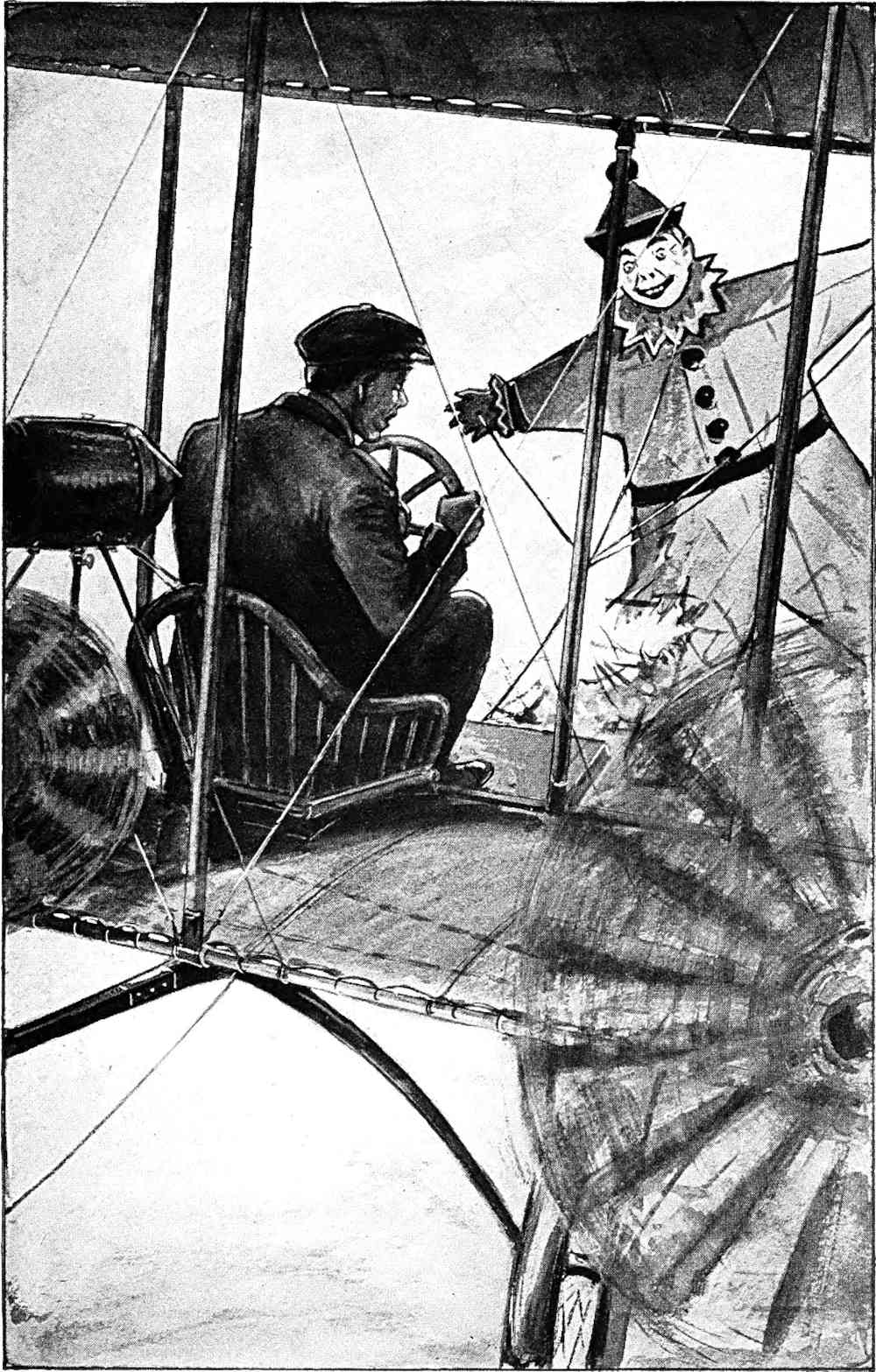
“Oh, I hope Link wasn’t hurt!” cried Harry. “Maybe he got it right in the face!”
“He’s got control anyway,” returned his brother. [187] “I hope the kite didn’t get mixed up in the levers, or wires, or the engine,” he added, anxiously.
All watched the flight of the biplane with increased interest. The machine was too far away to ascertain, even with a field glass which Fred had brought along, whether the carpenter’s son was hurt or not. On and on it flew, straight across the lake and then over the woods beyond.
“He ought to be turning back now,” said Harry, a moment later.
“Well, he doesn’t seem to be doing it,” answered Paul.
“No, he is keeping straight on.”
“Perhaps he wants to show us how far he can fly,” suggested another.
“I don’t think he’d do that,” answered Joe, soberly. “We agreed to make short flights only.”
“Oh, Joe, do you think——” began Harry in alarm.
“Wait and watch,” interrupted the brother.
All waited and saw the Skylark sailing further and further away in the distance. They could no longer hear the explosions from the motor. The flying machine, instead of turning back, kept straight ahead and appeared to be moving further skyward.
“Do you know what I think?” burst out Fred, [188] at last. “That kite got mixed up in the wires and things, and Link has lost control!”
“That must be it!” exclaimed Harry. “Oh, Joe, what shall we do?”
“I don’t know,” responded the brother. “I don’t know that we can do anything, except to go after him.”
[189]
“Gone!”
Such was the single word that burst from Harry’s lips as the biplane faded from view. All of the lads strained their eyes for a further sight of the Skylark, but in vain.
“Shall we wait?” questioned Fred, turning a sober face to his chums.
“How can we follow him?” questioned Harry. “Why, he must be miles away by this time!”
“He was almost over the Rockton road,” answered Joe, slowly. “We might cross the lake in some boat and take our bicycles along and go after him on our wheels.”
“I’ll take you across in the Sprite,” said Paul Shale, who was present. “My uncle said I could use the sloop all day, if I wanted to.”
“Have you got her handy?” asked Joe, quickly.
[190]
“Yes, she’s down at the lumber dock now.”
“Then let us go over in her!” cried Harry, quickly. “Come on, we’ll get the wheels and be on the way in a jiffy!”
Filled with the idea of following the unfortunate Link, the various lads ran off to their homes to get their machines. Only Harry remained behind—to help Paul get the Sprite under way when the others should come back. Joe brought his brother’s bicycle as well as his own, and Fred got Paul’s wheel for him.
“See anything of the flying machine?” asked Joe, as he came back, riding his wheel and guiding his brother’s beside him.
“No,” returned both Harry and Paul.
Soon the others came back and all got aboard the handsome sloop belonging to Mr. Richard Shale, the craft in which they had had so many adventures in the past. The Sprite was amply large to accommodate all of them and also the wheels, which were lashed fast in the bow. The boys sat down in the stern, and the Sprite was shoved off and the mainsail hoisted, and they stood away from Lakeport, a crowd seeing them depart. Most of the inhabitants of the town thought Link was merely taking an extra long flight, and the boys did not tell them the truth—that it had been agreed [191] to take short flights only—for they did not wish to alarm anybody, least of all the parents of Link Darrow.
Paul knew how to handle the dainty sloop to advantage, so the others allowed him to have his own way in crossing the lake, Harry and Fred assisting only when necessary. The run was a short one, and soon the Sprite glided into a tiny cove and up to a dock used occasionally by the farmers of that vicinity. Beyond the dock was a country road leading to the village of Rockton, two miles away.
“Going to leave the Sprite here?” queried Joe, as he went ashore, carrying his wheel.
“Yes,” answered Paul. “I think she’ll be safe enough. I have done it many times.”
Soon all were on the road, on their bicycles, and Joe led the way, setting a pace that taxed the muscles of Fred and Harry. But nobody complained, for all were anxious to ascertain what had become of Link. All kept glancing at the sky as they moved forward, but nothing that looked like an aircraft came into view.
“If only he wasn’t hurt!” murmured Joe. “If he was——” He did not finish, but shook his head dolefully.
The boys were just entering Rockton when they [192] saw a man coming towards them in a buggy and driving a spirited horse.
“It’s Mr. Merton!” exclaimed Fred, naming the main storekeeper of Rockton. “Let’s ask him if he saw the biplane.” And they put the question to the man.
“Did I see it?” queried Mr. Merton. “Just guess I did! Why, the first thing I knew it came whizzing over my head, and Dolly jumped about three feet into the air and came near shying into a stone wall.”
“Do you know which way it went?” asked Joe.
“Went a little south of Rockton—in the direction of Crowell’s Corners.”
“Did you see the boy running it?” questioned Paul.
“Saw somebody. Was it a boy?”
“Yes, Link Darrow—son of the carpenter.”
“You don’t say! Well, he’s a brave one to dare to go up in such a new-fandangled thing!” was Mr. Merton’s comment. “I wouldn’t go up in one for a thousand dollars!”
“Went off in the direction of Crowell’s Corners,” mused Fred, as the crowd wheeled on. “That’s about four miles from here.”
“But it’s a good road all the way now,” added Paul. “They fixed it up this spring.”
[193]
On and on went the boys, occasionally gazing skyward as before. After leaving Rockton behind they kept on for nearly a mile and then stopped at a farmhouse to ask about the missing biplane and its young aviator. The farmer had seen the flying machine and told how it had been headed.
“He was flying pretty low,” went on the man. “I rather think he was looking for some place where he could land.”
“Well, there are plenty of places around here,” answered Fred.
The boys decided to take to a side road leading in the direction the farmer had pointed out. Here going was not so good, the bicycles occasionally getting stuck in the sand. Then they reached a point where the woods were thick.
“If he came down here he’d be likely to have a smash-up,” was Joe’s comment.
“Let’s give the yell,” suggested Fred. “He may be within hearing distance.” And the boys gave their old familiar call, not once but several times, and Harry added his “locomotive whistle,” as he called it, by means of putting two fingers in his mouth. Then all listened intently. But no answer came back.
“We’ll go on again,” said Fred. “We are bound to reach him sooner or later—unless the [194] biplane got so jammed it simply couldn’t come down.”
They passed several paths and side roads, leading to they knew not where. Then they came to a regular crossroads and here halted once more.
“Which way?” queried Paul.
“I’m sure I don’t know,” answered Harry, and all the others gazed at both roads blankly.
“Guess it’s a toss-up,” was Joe’s comment.
“No, it isn’t!” came quickly from Paul. “Which way is the wind blowing?”
“Of course!” burst out the younger Westmore lad. “Why didn’t I think of that?”
They soon caught the direction of the breeze, which was blowing along the road to the left, and they turned in that direction, satisfied that Link must have either sailed with the wind, or against it, rather than crosswise of the current of air.
“I see an open field!” cried Joe, who had once more pushed to the front. “It’s almost level, too—just the place for a landing!”
“And there is the Skylark!” burst out Harry, pointing to one end of the cleared space. Then he let out his “locomotive whistle” once more.
All of the boys rode as closely as possible to where the biplane rested. Then they leaped the wire fence of the field and rushed over to the flying [195] machine. It rested safely on its wheels and seemed none the worse for its flight of five or six miles. But Link was nowhere to be seen.
“Where can he be?”
“Did he tumble out?”
These were the next questions that the boys of Lakeport asked themselves. The face of more than one turned pale. Supposing their chum had really fallen from the aeroplane? Such a tumble would most likely mean death or frightful injuries.
“We—we’ll have to take a look around,” faltered Fred, in a low voice.
“That’s right,” answered Harry. “Wonder in just what direction he came?”
“Oh, he must have come in a bee-line from Lakeport,” answered Paul. “And our town is over there,” and he pointed with his finger.
“There is a farmhouse,” exclaimed Joe. “Maybe the folks that live there can tell us something about him.”
With heavy hearts the boys trudged across the field in the direction of the farmhouse, which was set in a grove of trees and bushes. As they got closer, Joe set up a sudden and happy shout:
“There he is! There’s Link!”
“Sure enough!” added Fred. “And he seems to be all right, too!” he went on in relieved tones.
[196]
“Hello, Link!” shouted Paul.
“Why, hello!” answered the carpenter’s son, in amazement. “How in the world did you get here?”
“Came on our wheels,” answered Fred. “Are you all right?”
“Sure I am.”
“Why didn’t you come back?” demanded Joe. “You scared us ’most to death.”
“I couldn’t get back. Didn’t you see that big kite hit me? Well, it went to pieces against the steering wheel and the stuff got all tangled up in the wires, so I couldn’t turn around. The best I could do was to keep straight on and it wasn’t for quite a while that I managed to get things fixed so I could come down. I went up higher and higher and I was pretty well scared I can tell you. But at last I got her turned downward, and then I looked for some field to land in. As soon as I saw this spot I came down. I hit the grass pretty hard, but I guess the Skylark wasn’t damaged any. But we’ve got to get that kite stuff out of the wires and go over the controls carefully before we use her again.”
“I’m awfully glad you weren’t hurt, Link!” cried Harry, affectionately.
“We’re all glad,” added Fred.
[197]
“As soon as I came down I looked over the biplane and saw it was not damaged, and then I walked over to this farmhouse, to see if I couldn’t send a telephone message to you folks, so you wouldn’t worry about me,” went on the carpenter’s son. “But they haven’t any telephone.”
“It won’t be necessary to telephone now,” answered Joe. “If the biplane is all right, one of us can sail it back to Lakeport.”
“Who?” demanded Fred.
“I will, if the others are willing,” answered Joe. “But I want to give it a try-out first.”
“Let us look her over,” said his brother.
Accompanied by the farmer who owned the place, his wife, and two full-grown sons, the boys of Lakeport hurried over to where the Skylark rested. The folks of the farm were deeply interested in the machine and said they would assist in getting it ready for another flight.
“It sure is great traveling,” remarked one of the sons of the farmer. “Beats a horse on a plank road all hollow!”
The lads needed no help, and they personally saw to it that the wreck of the big kite was cleared away, and then tested every wire, and every other part of the biplane with care. This took them nearly an hour.
[198]
“I guess she’s all right now,” said Joe, at last. “I’ll try her over this field and that beyond,” and this was done. The Skylark went up with ease, and the elder Westmore youth found that the controls now worked as well as ever.
“Now for the flight back to Lakeport,” said Fred. “Do you think you can manage it, Joe? You’ll have to face the wind.”
“I think I can, Fred. There is very little breeze.”
“Be careful,” warned Harry.
“I’ll take care of your bicycle,” added Link.
Then the motor was started up once more, and Joe took his seat. With a cheer from his chums and the boys of the farm, the Skylark shot into the air, and Joe headed for Lakeport, little dreaming of the strange adventure that lay in store for him.
[199]
The Skylark had been run to the far end of the level field, so that Joe could get a good start. He went up with ease and was pleased to find that even above the woods that lay beyond there was little breeze, and that he had to face what there was squarely. This would make the flight a little longer in duration, but sailing would be quite safe, for an aircraft keeps up against a wind just as does a kite attached to a string.
“Now for the sloop!” cried Paul, when Joe was well under way. “Let us try to beat him out!”
“You’ll not be able to do that,” answered Fred. “But come on,” he added. “No use in our staying here.” And bidding the folks of the farm good-by, the boys mounted the bicycles and were off.
Joe sailed along slowly, and as the motor worked well and the biplane was under perfect control, he had more or less of an opportunity of looking around and below him. Far ahead he could see [200] the water of Pine Lake, sparkling brightly in the sunshine.
“Flying will certainly be great, when a fellow gets used to it,” he mused. “Traveling on the ground seems slow after this sort of thing. Why, if I had a mind to do it, I guess I could whizz back to Lakeport in no time! But I won’t run any risks just yet.”
He was soon over the woods, and then he had to mount a bit higher, to cross over a little hill. Then came some farms and then more woods, on the outskirts of Rockton.
“I guess I won’t risk sailing over that village just yet,” went on the young aviator to himself. “I’ll veer a little to the south. I’m sure I can do that readily enough.”
He pulled on the lever, and turned the wheel a trifle, and soon the biplane was moving over the new course. The aircraft had tilted a little, but he soon brought her to an even keel. Then he moved over another patch of woods, reaching presently a cleared space,—the result of a fire of years before.
On one edge of the clearing was a hut that in the past had been occupied by lumbermen. As Joe drew closer to the hut he saw two men come forth and walk towards a roadway that ran [201] through the woods. He gazed at the men in much astonishment.
“Mr. Mason and Mr. Chase, unless I am very much mistaken!” he murmured to himself. “What can those two men be doing in this out-of-the-way spot?” Then of a sudden his thoughts traveled to Andrew Akers, and to the strange disappearance of that individual. “Can they have gotten him away in some manner and brought him here?”
The thought filled the elder Westmore boy with excitement, and for the instant he forgot about the running of the biplane. The flying machine veered around and brought him to his senses with a jerk. Then he got control again and came around in a quarter circle, to save himself from falling. This gave him another idea.
“I might as well go all the way around, and see if I can see them again,” he mused. “I might have been mistaken.”
He made the circle in fine style and then came onward at a reduced rate of speed. He saw the two men in the roadway, one holding the head of a horse attached to a two-seated carriage. Both were gazing up in wonder at the biplane, so that he got an excellent view of their faces.
“Mason and Chase, beyond a doubt!” he told [202] himself, as he swept over the pair. “Can it be possible that Mr. Akers is in that cabin, a prisoner?”
For an instant Joe had an idea of alighting in the field and questioning the men. But then he came to the conclusion that this might not be a wise move to make.
“They are two to one, and if they really carried Mr. Akers off they must be desperate characters, and they wouldn’t hesitate to attack me, if I tried to corner them. No, I had better get back and tell father and Mr. Rush of this, and also the fellows, when they arrive. Then we can talk it over and decide on what will be best to do.”
So Joe kept on and in a very few minutes he reached the shore of Pine Lake. Not far off was the sloop in which he and his chums had crossed. Out in the lake was a motor boat, racing towards the sloop at top speed.
“Hello! what can that mean?” Joe asked himself, and then he saw that the craft was that belonging to Si Voup. Si was accompanied, as usual, by Ike.
Joe felt that the pair would bear watching, and so he changed his course so that the Skylark would pass directly over the motor boat. Si and Ike [203] looked up at him and their faces showed their displeasure.
“Humph! There comes Link back!” growled the rich bully.
“It isn’t Link, it’s Joe Westmore,” replied Ike.
“Wonder where Link is?”
“I don’t know. But say, Si, we’d better not bother with that sloop now,” went on the bully’s toady. “Those fellows will be back as soon as they see the flying machine coming.”
“All right, Ike,” answered Si. “But it’s too bad. I thought we’d have a chance to cast the Sprite adrift. Then they would have to look for some other means of getting back to Lakeport.” And then the motor boat was headed up the lake.
When Joe reached the field adjoining Lakeport a crowd came rushing to meet him, including Mr. and Mrs. Darrow, who had learned but a short while before of the long flight taken by their son.
“Where is Link? Is he safe?” cried Mrs. Darrow, anxiously.
“Perfectly safe, Mrs. Darrow,” answered Joe. “He is coming back with the other boys, on my bicycle and Paul’s sloop.”
“But is he badly hurt? Did he fall?” demanded Mr. Darrow.
“He isn’t hurt a bit, not a bit,” Joe hastened [204] to answer. “He went about five miles, I guess, and came down as nicely as you please.”
“But that kite? I heard a big kite got tangled up in the machine——” went on the carpenter.
“So it did, and it bothered Link a good deal, so he couldn’t turn back as he wanted to. But he made an all-right landing in a big field out towards Crowell’s Corners.”
“As far as that!” gasped Mrs. Darrow. “O my! Was ever there such a daring boy!”
“We had to fix up the machine a bit,” went on Joe. “And then it was decided that I should sail her back. That’s all there is to it. Link and the others will be here in the Sprite before long,—although they’ll have to tack over, against the wind.”
Inside of an hour the sloop came into view, tacking across Pine Lake, as Joe had mentioned. Leaving the biplane in charge of some other boys, the Westmore lad hurried down to meet his brother and his chums. Link ran off to assure his folks that he was all right, and Joe called the others to one side and told them about Thomas Mason and Lamar Chase.
“Sure, we’ll have to tell dad about that, and Mr. Rush, too!” cried Harry. “Let us do it right away.” And he led the way to his father’s place of business.
[205]
Mr. Westmore listened gravely to the story and then went with the boys to interview Mr. Rush. All agreed that the matter ought to be investigated, and in the end Mr. Westmore and Fred’s father said they would accompany the boys that afternoon.
“We can go over in the Sprite,” said Mr. Westmore, after consulting Paul. “Then you can go to the hut on your wheels, if you wish, and Mr. Rush and I will get Mr. Martin, who lives near the landing, to let us hire a team from him. But we must all keep together, so that we can come to each other’s assistance—should there be trouble.”
This pleased the boys, and they could hardly wait for the time to come when they were to depart. But both of the merchants had matters to attend to before leaving, so they did not get away until after three o’clock in the afternoon.
The trip across the lake was uneventful, and arriving on the other shore, Mr. Westmore readily got the farmer he had mentioned to harness his horses and turn them over to him. Then off the party started, the men in the carriage and the boys ahead on their bicycles.
“Oh, I do hope we find Mr. Akers!” exclaimed Harry, as he and the other lads pedaled along.
“I hope we catch that man, Mason, and that Chase with him,” came from Fred.
[206]
“Mr. Akers may not have been carried off,” said Joe. “He may have gone of his own free will.”
“Do you think he did?” demanded the stout youth.
“No, I don’t. But it is possible, Fred.”
“I think those two men are in league with each other, to do Mr. Akers harm,” said Harry. “They might not hurt him personally, but I think they want his inventions and his stock in that novelty company.”
“And that’s my idea too, from what you have told me,” added Paul.
Joe had to point out the way to the lonely hut, and once he came close to getting on the wrong road. But at last they came in sight of the burnt-over locality and the older Westmore lad pointed out the rude cabin.
“Doesn’t seem to be anybody around just now,” was Mr. Rush’s comment, as all came to a halt, at the spot where Joe had seen the men with the horse and buggy.
The horse was tied to a tree and the bicycles left near by, and all advanced towards the lonely cabin. Joe and Harry could not resist the temptation to go ahead.
“Looks as if it was locked up,” murmured the [207] younger Westmore lad, as he gazed at the closed window and door.
“We’ll soon know,” answered his brother, and knocked sharply on the door. There was no response and he knocked again, and as he did this the others of the party came up.
“Maybe we’re sold!” cried Fred, and walked over to the window. One of the panes of glass was gone and he looked inside the place. “Not a soul in sight,” he announced. “Try the door, Joe.”
The barrier was not locked, and opening it one after another all went inside. They saw a number of newspapers scattered on the floor, and also some string. On the open hearth was a big heap of ashes. A cupboard held a few old dishes and some rusty tinware. The hut contained two rooms—that for living purposes having a rude table and two benches and an inner apartment being furnished with several rude built-in bunks.
“The ashes are still hot!” cried Paul, after testing them. “That shows somebody was here not long ago.”
“Two of the bunks have fresh pine boughs in ’em,” announced Joe. “That shows somebody has been sleeping here.”
“Yes, but it doesn’t prove that Mr. Akers was [208] here,” returned Harry, and his face showed his disappointment.
“Look at these bits of newspaper and string,” said Fred. “They look to me as if somebody had wrapped up things in a hurry and gotten out.”
All walked through the cabin, examining the contents with care. But no clew to those who had occupied it was brought to light. Evidently if Mr. Mason and Mr. Chase had been there they had taken good care to conceal that fact.
“But I saw ’em—I am positive of that,” declared Joe. “And they saw me.”
“That’s just it, Joe,” declared Fred. “They saw you, and they knew you might investigate. So, if they really had Mr. Akers here, they got busy and lost no time in removing him and his belongings to some other locality.”
“Who owns this place?” asked Mr. Rush.
“The Tarpon estate used to own it,” answered Mr. Westmore. “But I think it was sold. We can ask Mr. Martin about it, when we drive back. I don’t think there is any use of remaining here. Whoever was staying here has gone, and I don’t think they’ll be back.”
A little later all left the cabin and turned back towards the lake shore. The horse and carriage were delivered to the farmer who had hired them [209] out and he was asked about the place that had been visited.
“Why, I can’t tell you exactly who bought that tract of land,” he said. “I understood at first it was some man named Acorn, or something like that, and that he was going to build a house there, where he could be alone, so as to invent things. But later on I heard that Thomas Mason, of Brookside, had it. What he is going to do with it, I don’t know.”
“Acorn?” cried Harry. “Don’t you mean Akers?”
“Yes, that’s the name of the tudder fellow, Akers. But he ain’t got the land now. It belongs to Mason,” returned Mr. Martin.
[210]
Here was a new turn of affairs, and the men and the boys listened with interest to what Mr. Martin had to say. But the farmer could tell little more than what has already been mentioned, excepting that the transfer of the land to Mr. Akers had taken place some six months previous.
“One thing is certain,” remarked Mr. Westmore. “This Mr. Mason is wrapped up pretty closely in Andrew Akers’s affairs.”
“You are right,” returned Mr. Rush.
“But it doesn’t prove that Mr. Mason carried Mr. Akers off or is holding him a prisoner,” put in Joe.
“Not at all,” said Mr. Rush. “And, as matters stand, I do not see what we can do further. It would be worse than useless to make any charges unless we can substantiate them.”
“Wish I had landed from the Skylark when I saw the two men,” said the elder Westmore lad, mournfully. “That is where I missed it.”
[211]
“Well, better luck next time, Joe,” came from Fred. “If those men are guilty, they are bound to be cornered sooner or later.”
Our friends returned to Lakeport, and the men went to their places of business, while the boys hurried home, to do their evening chores. In the evening, Joe and Harry heard a well-known whistle outside of the house and went out on the piazza to meet Matt.
“Great news!” cried the newcomer. “After this the Skylark won’t be in it! Put that old flying machine in the woodshed and make way for the new and up-to-the-minute sky racers of Lakeport!” And the fun-loving youth put up his elbows and moved them up and down as if flying.
“Why, what do you mean?” queried Harry.
“I mean that Lakeport is forging to the front and will soon be the racing center of the East—I mean aerial racing center,” returned Matt.
“Aerial racing center?” repeated Joe. “Say, Matt, where’s the joke?”
“No joke about this. Don’t you know that we are to have two new flying machines in our midst, as the Brookside Weekly News will state it? Two splendid, snowy, awe-inspiring, death-defying aeroplanes—the wonder of the century and the marvel [212] of the globe? Step up, ladies and gentlemen, and buy your tickets for the small sum of fif——”
“Say, Matt, give it to us straight!” cried Harry, catching the joker by the shoulder.
“Wow! Say, Harry, that shoulder is built of flesh and blood, not sawdust!” exclaimed Matt. “Do you want to lame me for life and three days more?”
“Then tell us the news and no nonsense.”
“All right then, here goes, as straight as a shot from Joel Runnell’s rifle. George Dixon, Andy Brown, and about a dozen other rich lads of Brookside have clubbed together and they are going to buy a biplane. They had an offer of a dandy flying machine from an aviator who fell and broke his collar bone, or something, and they took the offer up. They get the biplane this week.”
“Well, I never!” murmured Harry.
“If they get a machine we can have some contests,” added Joe, his face showing his interest.
“Item number two,” went on Matt. “Do you know the Bartley boys, of Haverford, Bill and Carl?”
“I’ve heard of them,” came from the Westmore lads.
“Well, they have purchased a monoplane—some sort of a French outfit, so I was told. They are [213] learning to fly, and they say that sooner or later they are going to challenge you to a race.”
“A monoplane,” mused Harry.
“Monoplanes are very swift machines, so James Slosson told me,” came from Joe. “I guess they could beat us. But it would be fun to race!” he added, with a smile.
“Any more flying machines coming?” questioned Harry.
“For the love of rice pudding, Harry, how many do you want?” gasped Matt, in pretended disgust. “Here I serve you two, on a silver platter, and you’re not satisfied. Maybe——”
“It’s great news, Matt, and I’m glad you told us,” broke in Joe. “Have you told the others yet?”
“Bart was with me when I heard of it. He said he would tell Fred.”
“Then we must tell Link,” cried Harry. “Yes, it certainly is news. I thought those Brookside fellows would do something, after they heard we had a flying machine. We got after ’em with that rowing outfit, if you will remember, and they haven’t forgotten that,” went on the younger Westmore lad, referring to some happenings which have already been related in detail in “The Boat Club Boys of Lakeport.”
“Haverford isn’t much further than Brookside,” [214] said Matt. “You fellows with flying machines might get up some sort of an Aeroplane Club.”
“Oh, I don’t think that would pay,” replied Joe. “But we might have some races and other contests, just for the fun of it.”
“What other contests than races can you have?” asked Matt, with interest.
“Oh, lots of them!” cried Harry, who had been reading several aeronautical magazines. “There are contests for height, and landing contests, to see how near to a mark one can come down, and then they have trials to see who can discover something hidden away in a woods, or between brushwood, and trials to see who can catch the most of a number of round, toy balloons that are sent up, and who can drop little bags of sand in boxes placed in a circle in a big field. At some of the aviation meets they get a lot of sport out of the various contests.”
The next day the boys met at the Darrow carpenter shop and talked over the news Matt and Bart had brought. What had been said was true, and one day of the following week Joe and Fred went to Brookside on an errand and met George Dixon, and were taken to the Brookside boathouse, where the boys who had purchased the biplane had it stored.
[215]
“Certainly a dandy-looking machine,” said Joe, on looking the biplane over. “Have you been up yet?”
“Twice, but only as a passenger,” answered George Dixon. “An aviator is coming in a few days to teach four of us how to fly.”
“Good for you!” cried Fred. “The sooner the better. We want some races, you know.”
“All right, Fred; but you’ll have to wait until we get the hang of the thing,” responded George, with a laugh.
“Have you heard anything of the Bartley boys?” questioned Joe.
“Yes; one of ’em, Bill, was over here in his monoplane yesterday.”
“Here! Then he can fly?”
“Sure he can. It seems that he has been on a visit to some relatives on Long Island, and there he went to an aviation school and learned all about it. That is where he got his monoplane, too.”
“Is it nice?”
“It looks to be a splendid machine for flying, although it isn’t new. It has a big plane on either side and a very long rudder-tail. The only thing I don’t like about it is that he has to sit so close to his motor. If anything should happen I’m afraid that engine would kill him.”
[216]
“Does he want to race?”
“Yes, not only Bill but his brother Carl, too. That is what he came over about. He said he was going to call on you fellows, too,” added George Dixon.
“Say, don’t you fellows want to try our biplane?” asked Andy Brown, who had followed the others to the boathouse. “I’m willing.”
“So am I,” added George.
“Not I,” cried Fred. “I’ll stick to the machine I know.”
“Biplanes are not like bicycles,” said Joe. “A fellow has got to know all about the particular machine he is using. I’d not take a chance in a strange affair.”
“Well, I don’t blame you,” returned Andy. “Even as it is, they look rather scary, don’t they?”
“Well, so did a rowing shell, when I first got into one,” said George.
“And an auto,” added Fred. “When I first ran a car I felt as if I was in the cab of a locomotive!”
The boys spent a good hour in inspecting the Brookside biplane, and in talking over aviation matters in general. Then they went home and got out the Skylark and each took a short flight, over the lake and the fields back of Lakeport.
[217]
“Each time I go up I feel a little more confident,” said Fred.
“That’s how it is with me,” responded Joe.
As was to be expected, the news that some boys of Brookside and others of Haverford had purchased aeroplanes filled Si Voup and Ike Boardman with envy. In the past both had done all they could to “cut a shine” in Brookside and Haverford as well as in Lakeport.
“Humph! Those fellows are simply imitating Joe Westmore and his crowd!” grumbled Si. “It makes me sick to see it!”
“Say, Si, we ought to get a flying machine,” returned Ike, as if it was a new idea, although they had talked it over several times.
“All right, why don’t you buy one to-day?” demanded the rich youth, who was particularly out of sorts that morning.
“Because I haven’t got the cash, that’s why.”
“Well, I haven’t the cash either.”
“Won’t your dad buy one? He bought the motor boat.”
“Well, he won’t stand for a flying machine.”
“Are you sure?”
“Of course I am. I spoke to him twice, but he wouldn’t do a thing,—said I had playthings enough, and that it was time I settled down and thought [218] of work.” And Si sighed deeply and lit a cigarette with which to console himself. “I am sorry I gambled with those two men we took to Cresco in the boat,” he added, sourly.
“Say, don’t you suppose we might get the money somehow?” went on Ike, after a pause, during which he, too, lit a cigarette. The two boys thought it manly to smoke.
“I don’t see how. Flying machines cost a lot of money—as much as a high-class auto.”
“We might try those other men?” continued Ike, and gazed speculatively at his crony.
“You mean Mr. Mason and Mr. Chase?”
“Yes.”
Si shrugged his shoulders and then shook his head slowly.
“Why not?” demanded the Boardman boy. “They said they would pay us well for what we did for them.”
“Hush! Not so loud, Ike!” cried Si, warningly, and gazed around apprehensively. The two were in the Voup boathouse, a pretty little structure fronting the lake.
“There isn’t anybody around.”
“Well, I’d rather you wouldn’t talk about that affair, Ike.”
“Why not?”
[219]
“We might get into trouble, and I’ve had trouble enough. If I get into any more, my old man says he will take away the auto and the motor boat, and cut off my allowance.”
“Phew, that’s rough, for a fact. But I can’t see why those men shouldn’t pay us for what we did for them. It was hard work and mighty risky too. Why not go to them and talk it over?”
“No, I’d rather drop it, Ike.”
“Humph! You must be afraid!” grumbled the other. He liked to help Si spend money, not having very much of a supply of his own, even though his parents were fairly well off.
“It isn’t a question of being afraid, exactly,” answered the Voup boy. “There was something queer about that affair and I don’t think it will pay to stir it up. I’ve heard a few things lately that have set me to thinking.”
“About Mason and Chase?”
“Yes, and about the man who was stopping with Joel Runnell. I don’t think Mason and Chase told us the truth.”
“All the more reason why you ought to make them pay for what we did, Si. Why, perhaps we could get a pile of money out of ’em.”
“I don’t think so. Both of them are as close as the bark on a tree, so I’ve been told. No, Ike, [220] if we want to keep out of trouble, we had better forget all about that affair,” added Si; and just then his father appeared and the talk, as well as the cigarettes, had to be dropped.
[221]
As the days went by the owners of the Skylark became more proficient in running the biplane. They went up singly and in pairs, and covered the territory for several miles about the town. Once Joe flew to Brookside and landed in the field that George Dixon and his chums were using for their flying machine.
“Hurrah!” cried George, as Joe came down. “That’s the way to pay us a visit!”
“Well, see that you return it the same way,” answered the elder Westmore youth.
“Sure thing, Joe—only you’ll have to allow us a little more time for practice.”
“You see, we don’t want to sail down to Lakeport and take off a chimney or a church steeple,” said Andy Brown, with a grin.
The boys of Brookside were using their biplane, and Joe watched several flights with interest.
“Good for you!” he cried, after a particularly good flight by George. “That’s the way to go at [222] it. Before long we can have some races and other contests.”
“Just the thing!” answered Andy.
One day Harry and Fred took a flight to the end of the lake and back. This was the longest yet, and all of the others watched the departure and return with interest. On the return the wind increased and the young aviators had their hands full, to keep the biplane from “turning turtle,” as it is called,—that is, turning upside down.
“Hope they get back all right,” said Joe, anxiously, as the wind kept growing stronger.
“Here they come!” shouted Matt. “My! just see them scoot along!”
“I guess they’ve got all the power on,” added Paul, and he was right. With a daring swoop the boys came down, landing at one end of the big field.
“Glad to get back, I reckon,” remarked Joe, as he ran up, to help hold the biplane.
“That’s what,” answered Fred. “Say, it’s blowing something fierce up there!”
“It was certainly a thrilling run back,” said Harry, who had been managing the aeroplane. “I can tell you, fellows, it is no fun being up in a big blow.”
The wind was increasing, and all the aircraft boys had to pitch in to get the Skylark back to the [223] Darrow carpenter shop, Matt and Paul assisting their chums. Then the doors were tightly closed and locked, so that their precious machine might be safe.
That evening Link had to go on an errand for his mother, and for company he took Harry along. The errand took longer than anticipated, so that the two lads did not come back until nearly eleven o’clock.
“Rather late for you, Harry,” remarked the carpenter’s son, as they approached the Darrow home. “If you wish, I’ll walk around to your house with you.”
“Think I’m afraid on this moonlight night?” asked Harry, with a smile.
“Oh, no, I only thought I’d do it to keep you company, since you went away over to Reeger’s with me.”
“Thanks, Link, you’d better get to bed. I’ll be home inside of five minutes.”
As Harry spoke the boys turned a corner. Close by was the modest house in which the Darrows dwelt, and behind it, at the foot of a small garden, was the carpenter shop which had once been the meeting place of their baseball club and which now served as a hangar for the Skylark.
“Hello! who’s that?” cried Link, as he came to [224] a halt and looked down the driveway towards the barn.
“What did you see, Link?” questioned his chum.
“Thought I saw two men walk around the end of the barn.”
“Two men? This time of night?” exclaimed Harry. “Can it be your father and somebody else?”
“I don’t think it was dad. I’m going to look.”
“I’ll go with you,” returned Harry, readily. “Maybe they are tramps, looking for a place to snooze. Well, if so, they can’t sleep in there with the Skylark.”
“Ma would have a fit if she thought tramps were around here,” answered Link.
The boys turned into the driveway leading down to the carpenter shop. It was clear moonlight, so they could see things quite plainly. Nobody was now in sight and all was quiet.
“Maybe you were mistaken, Link,” said Harry as they reached the front of the shop. “Nobody seems to be around.”
“I am sure I saw somebody,” insisted the carpenter’s son. “I’m going to walk around and make sure.”
“You go that way and I’ll go this,” said Harry. “Wait, take this, you may need it,” and he caught [225] up two sticks from a pile that was handy and gave one to his chum.
Cautiously the two boys walked around the structure, peering into the windows as they went, and trying the doors. Harry had just reached one of the back corners when he heard Link raise a cry.
“There they are! Stop! Who are you?”
“Come on, we’ve got to get out of here!” came in a low voice from somebody at the rear of the shop. “Hurry up, before they catch us!”
“All right. Let’s run for the back alley,” came from another person.
Two figures darted out from where some tall weeds grew close to the back of the carpenter shop. Then the two intruders started to run towards a narrow back alley that led to a side road of Lakeport.
Now, as my old readers know, there was a large cistern located at the back of the Darrow shop, that same cistern into which the baseball outfit of the Lakeport club had once been thrown. This cistern had not been used for a long time, but Mr. Darrow kept it filled with water, for possible use in case of fire. The box on top had rotted away and the cistern was now covered with several old boards.
[226]
As the two runners started for the back alleyway they came to the cistern. They were side by side, and both trod heavily on the old boards, half-rotted by the dampness. The next instant came a sudden cracking, followed by several exclamations of alarm, and then a big splash.
“Hello! they’re in the cistern!” yelled Link.
“That’s right,” answered Harry.
“Help! help!” came from the opening. “Help us out, or we’ll be drowned!”
“It’s Si Voup!” exclaimed Harry.
“Yes, and Ike Boardman,” added the carpenter’s son. “Serves ’em right,—for sneaking around here this time of night.”
“But, Link, they may drown!”
“Not much, Harry. I happen to know that the water in that cistern just now isn’t over four feet deep. And it’s mostly mud at that,” added Link, with a chuckle.
“Mud?”
“Yes. You see, the mud drains in from the garden and the chicken house, and we haven’t cleaned the cistern out for some time—in fact, I guess dad is going to let it fill up. So they can’t drown.”
“All right then, we won’t worry,” said the [227] younger Westmore boy, and now he, too, commenced to grin.
“Say, help us out, won’t you?” came pleadingly from Ike Boardman. “I’m wet to the skin, and covered with mud.”
“What are you doing around here?” demanded Link, coming up to the edge of the cistern and peering down at the two unfortunates.
“That’s our business,” returned Si, with something of his usual sourness.
“I guess it’s my business, as this is our place,” retorted the carpenter’s son.
“We were taking the short cut to the back road, that’s all,” grumbled the rich youth. “Help us out of this mess, and be quick about it.”
“We’ll not help you at all if you are going to talk that way,” replied Link.
“I don’t think you were just going to the back road—not this time of night,” remarked Harry. “I think you came here to see if you couldn’t do something to our biplane.”
“Nothing of the kind!” howled Si. “Help us out and be quick about it, Link Darrow, or I’ll have the law on you for allowing such a dangerous place as this. I might have broken my neck!”
“If you had it would have been your own fault, Si,” answered Link. “This is private property, [228] and you know it. Maybe my dad will make you pay for the boards you broke.”
“Oh, stop chinning and help us out, won’t you?” pleaded Ike. “The smell down here is something fierce!”
“Our clothing is ruined,” went on Si. “Who is going to pay for that?”
“Oh, never mind that now,” interrupted his crony. “Let us get out first.”
The cistern was rather deep, so that to climb out without aid was difficult if not impossible. Both boys stood in water and mud up to their armpits, and each had his face well covered with the contents of the cistern.
“We might get the ladder,” suggested Harry.
“Hurry up, please!” pleaded Ike.
“If we help you out, will you promise to keep away from our biplane in the future?” questioned Link.
“Yes! yes!”
“How about you, Si?”
“I wasn’t going to touch your old flying machine,” growled the rich bully.
“I don’t believe you, and you’ve got to promise to keep away from here, or we won’t help you out,” went on the carpenter’s son.
“Oh, go on and promise,” said Ike, in a low voice. [229] “Why, this place is enough to give a fellow typhoid fever, or something like that.”
“All right, you help us out and we won’t come around here again,” grumbled Si, who, truth to tell, did not like being down in that vile-smelling place any more than did his crony.
There was a short ladder in a shed close by and this Link and Harry procured, and after one end had been thrust down into the cistern, it was an easy matter for Si and Ike to crawl out. They came up dripping water and mud at every step they took.
“You just wait—we’ll get square for this!” grumbled Si, as he tried to wipe the mud from his eyes.
“Now don’t you threaten us, Si Voup!” cried Link, doubling up his fists. “Why, don’t you know we could have you locked up for prowling around here? You clear out, and keep away in the future.”
“Come on, Si,” said Ike, and backed away. “I’m going home and get washed up.”
“Just you listen to me, Si, before you go,” cried Harry. “I am sure you came here to see if you couldn’t damage our flying machine. Now, if anything happens to the Skylark after this, remember that you are under suspicion, and I’ll tell the authorities, and your father, how we caught you and Ike here.”
[230]
“Bah!” muttered Si, and walked away, following his crony out of the Darrow yard. Both slunk away in the moonlight and Link and Harry watched them out of sight.
“What a pair!” murmured the younger Westmore youth.
“And what a beautiful sight they are just now!” chuckled the carpenter’s son. “I think I know two suits of clothing that will have to go to the cleaners.”
“They’ll have to explain matters to their folks. Wonder what they’ll say?”
“Oh, they’ll crawl out of it somehow—they always do. But I don’t think they’ll dare to blame us—they know we can report them for having been around the shop at this hour of the night.” And there the matter was dropped for the time being, and Harry went home. Joe was still awake and laughed heartily over the story his brother had to tell, and the next day Fred and the others had a good laugh, too.
As for Si and Ike, that unworthy pair sneaked home by a back way and lost no time in getting their dirty clothes out of sight and in taking a bath. They felt so humiliated by their experience that for over a week they took good care to keep out of sight of the owners of the Skylark.
[231]
“Hurrah for the first race!”
“I’ll wager the Skylark will win!”
“Not much! The Swallow will come out ahead!”
“How far is the race to be?”
“Over the big red barn on the Phelps place and back.”
“That must be about twelve miles.”
“All of that.”
So the talk went on, one beautiful afternoon, about a week after the events recorded in the last chapter. Several of the boys of Brookside had mastered the art of aviation, and a race had been arranged between the Skylark and the Swallow, as the biplane owned by the Brookside lads had been named. George Dixon was to run the Brookside machine, and it had been decided by lot that Fred should manipulate the Lakeport aircraft.
During the past week nothing more had been heard from Si Voup and Ike Boardman, nor had our friends learned anything further concerning the [232] disappearance of Andrew Akers. Mr. Rush and Mr. Westmore were investigating the doings of Thomas Mason and Lamar Chase, but had so far brought nothing new to light.
The race of the biplanes was to start from a big field midway between Lakeport and Brookside, and quite a crowd had assembled to see the contest. In order to be sure that the Skylark was in good order for the run Fred himself flew the aircraft to the starting field, the other lads going on their bicycles.
“How does she work?” questioned Joe, when he arrived.
“Quite well,” was the stout youth’s reply. “Somehow the motor seems to drag a little at times.”
“Let us look over the carburetter and the spark plugs,” suggested the older Westmore youth, and this was done, and then the engine appeared to run somewhat better.
The Swallow was already on the ground, along with the boys who owned the biplane, and many others. Both flying machines were gone over with care.
“Fred, do you know the way?” asked Link.
“I think I do,” was the answer. “I’ve been over it several times on my wheel.”
[233]
“Steer straight for Crossley’s windmill first,” said Bart, “and then follow the railroad tracks as far as Jackson’s barn, and then look for Bacon’s mill. That will give you almost a straight course.”
There had been something of a breeze, but about four o’clock in the afternoon this died down, and both of the contestants announced their readiness to start.
“Now, Fred, make as good a flight as you can,” said Joe. “But don’t run any risks. Better to be beaten than have an accident.”
“Oh, I know that,” was the answer.
The two biplanes had been brought up side by side in the big field. At a word from Mr. Corsen, who had agreed to umpire the race, the engines were started up. Both made such a noise that speech was impossible, and the rich man signaled to go by dropping a flag he carried. Then, with a whizz and a rattle like that of Gatling guns, the two biplanes rushed across the field and arose into the air.
“Hurrah, they’re off!”
“May the best flying machine win!”
“Wow! talk about your races!” said Frank Pemberton. “This has got everything else beat a mile!”
“By gum! ain’t it great!” added Ike Suttervane, [234] a genuine country lad who lived in that vicinity and who had occasionally played on the Lakeport baseball nine as a substitute.
“Tell yer wot, it takes our boys to do it,” burst out Teddy Dugan, an Irish lad, also well known to the boys. “But I’d not be goin’ up in such a big white thing, not me!” he added, with a grave shake of his head.
The crowd continued to yell and cheer, while the chums of Fred and George watched the flight of the two flying machines with close attention. As the young aviators passed swiftly out of sight it was seen that Fred was slightly in the lead.
“We’ll win!” cried Harry, enthusiastically.
“Humph! this race isn’t over yet!” answered a Brookside youth.
On and on swept the two biplanes, each engine banging away as loudly as ever. It had been decided that while side by side Fred should keep to the left and George to the right.
“Now if I can only keep in the lead,” mused the stout youth, as he saw the Swallow drop a little to the rear. Then he looked down on the ground, to make certain that he was steering the right course.
A sudden puff of wind caused Fred to watch his machine more closely and shift the rudder control slightly. Then he saw that the other biplane was [235] rising. It was this that had caused George to drop behind. Now the rival aircraft was in another wind level and soon it was forging to the front at an increased rate of speed.
“I guess it is better flying up there,” reasoned Fred, and he started to go up. “The wind is not so strong and it blows in just the right direction.”
Soon he was on the upper level and there sailing seemed better. But in going up he had lost some headway, and now he saw that the Swallow was in front and increasing the lead steadily. He tried to get more speed out of his motor, but soon found this impossible.
On the upper level it was no easy task for either of the young aviators to follow the course given them. Fred made out the railroad tracks with ease, but was not sure of the Jackson barn. He saw a structure that he thought was it and swung away as directed by Bart. The two machines were now far apart and he noted that George was still following the tracks.
“Either he is wrong or I am,” he mused. Then he came back to the tracks, just as the other biplane left the vicinity of the railroad. The Swallow was now nearly half a mile ahead and running as steadily as ever.
In a few seconds more the wind dropped away [236] entirely and then Fred allowed the Skylark to go down about a hundred feet. He could now see the country below better, and soon discovered that he was at least a quarter of a mile out of his course.
“But if I am out, so is George,” he told himself, as he made a shift to bring the biplane in. “He’s gone as far to the north as I went to the south. I guess this race will go to the fellow who can keep the closer to the course.”
A little later Fred saw Bacon’s mill and then from this was able to steer a straight course for the Phelps place—a well-known country seat of that locality. He was now ahead of the Swallow, much to his satisfaction.
“Maybe I’ll win after all,” he reasoned. “Hope I do. But the Swallow is certainly a good machine.”
The Phelps family had been telephoned to regarding the race, and a crowd had assembled to watch the two flying machines circle in the air over the barn. Not to take chances, Fred made a wide turn and George soon after followed. Those below waved flags, and the little Phelps boy beat loudly on his drum,—a noise that never reached the young aviators, because of the explosions from the aircraft engines. With the muffler of his engine “cut out” a birdman finds it impossible to hear any other sound [237] around him, and if he has a passenger and wishes to speak to him he must do so largely by signs, or by the use of one of several newly-invented speaking devices. Some of the newest of the flying-machine motors run with mufflers, but these are not, as yet, numerous.
“Now if I can only steer a straight course for the starting-point I’ll be all right,” Fred told himself, after leaving the Phelps place behind. But then of a sudden came a sweep of wind that caused him to change his course in a hurry. The wind was so heavy that he had all he could do to keep the Skylark on anything like an even keel. Then he ran into a “soft spot,” and this bothered him some more. When at last he got himself “straightened out,” as he termed it, he found that he was completely off his course and over a section of country that was strange to him.
“Now I certainly have done it,” he mused. “I wonder where the Swallow is?”
He peered around, and finally made out the other biplane well off to the westward. Not knowing what else to do, he turned in that direction. Then he saw that the other aircraft was turned towards him.
“Either he has made a mistake or I have,” he thought, and watched the rival flying machine with [238] interest. Then he saw an old windmill, painted white and red, and that gave him some idea of where he was, and as the Swallow turned off over a country road leading to the railroad tracks, the Skylark did likewise. But another puff of wind came up, and each young aviator had to make another turn. Then each headed for the starting field as well as he was able, Fred coming in from the upper side and George from the lower.
“Here they come!”
“Get out of the way there, or you’ll get hit!”
“The Swallow is the first to land!”
“No, the Skylark will strike the ground first!”
These and many other cries welled up as the two biplanes drew closer. Then the crowd parted, one section rushing to the east of the field and the other to the west.
“Here they are!”
“Down they come!”
“Which one hit the ground first?”
“Neither. It’s a tie race!”
“A tie? Well, now what do you think of that?”
Both of the motors had been shut off, and like two big white birds the biplanes descended slowly towards the field. They landed exactly at the same time and came to a halt less than a hundred feet [239] apart. Fred was the first to leap to the ground, and George quickly followed.
“It is certainly a tie race,” declared Mr. Munroe Corsen. “I shall have to congratulate you both.” And he took each young aviator by the hand.
“I made a wrong turn,” said the youth from Brookside. “If it hadn’t been for that I might have won.”
“And I lost my way and made several wrong turns!” cried Fred. “But never mind; I’m satisfied,” and he smiled at his rival.
“So am I satisfied,” answered George. “But the two machines will have to race again some day.”
“To be sure!” cried Joe. “We’ll get the Bartley boys to take part, and get up a regular aviation meet.”
“That will suit me!” cried Andy Brown. “We can do all sorts of stunts—and put up prizes, too.”
Despite the fact that the race had been declared a tie, everybody who had witnessed the affair was well pleased and all went home satisfied. Andy Brown sailed the Swallow back to Brookside, and Link took the Skylark to Lakeport.
“We must see about this aviation meet,” said Joe, when the boys met that evening, at the carpenter-shop hangar. “We want to run it off before it gets too cold.”
[240]
“Right you are!” declared Bart. “And as I don’t care much for flying myself, if you wish, you can appoint me manager of the meet, for the Lakeport Aero Club. You fellows can do the flying and I’ll——”
“Take in all the gate receipts,” put in the irrepressible Matt, who had been invited to be present. “Chain him fast, fellows, when he does it, so he can’t fly away.” And a laugh went up.
“All right, Bart, we’ll make you general manager!” cried Joe. “How about it, fellows?”
“Aye!” came in a general chorus.
“We’ll make Bart general manager, Paul assistant manager, and Matt press agent,” put in Fred. “Matt will make a dandy press agent—he can blow so easily.” And then there was another laugh.
A lively talk followed, and a general plan for an aero meet was mapped out. Then a letter about the affair was written to George Dixon and his followers and a duplicate was penned for the Bartley brothers, of Haverford. All sorts of contests were mentioned, and the other boys were asked to send word what they thought of such a meeting. Then the gathering broke up and the two letters were posted.
[241]
“Fred, what do you say if we take a flight together this afternoon? There is no wind and I guess we can have a good time.”
“All right, Joe,” answered the stout youth. “Where shall we fly to?”
“I was thinking it might be quite a stunt to fly to Pine Island and visit our old camping place.”
“Say, that would be a scheme!” cried Fred, enthusiastically. “But can we find a suitable place for landing?”
“I think so. Don’t you remember that big bare spot where we once shot a lynx? I think that will make a dandy landing place.”
“So it will. Yes, let us go by all means—we’ll have the whole afternoon to ourselves.”
This talk took place two days after the letters about the aviation contests had been sent to Brookside and to Haverford. So far no answers had been received. The day was an ideal one, and Joe and Fred found themselves alone, the other boys [242] having gone elsewhere, some for pleasure and others on errands for their folks.
Neither Joe nor Fred had been up to Pine Island for some time. The island was a large one, located near the head of the lake, and had been the scene of many hunting and camping-out affairs of the boys of Lakeport. It was there that the Gun Club of Lakeport had gone, in company with old Joel Runnell, and shot many wild animals and had had “the time of their lives,” as Harry often expressed it.
It was about eleven o’clock in the morning, and Joe and Fred devoted the hour before dinner to getting the Skylark ready for the trip. Then the oil box was filled up, also the gasoline tank, and Joe made a short trial trip, to test the biplane.
“Where are you going, Joe?” asked his mother, as she noticed him hurrying through his midday meal.
“Oh, Fred and I are going to take a trip up the lake,” he answered.
“In the flying machine?”
“Yes.”
“Then be very careful,” went on Mrs. Westmore, and heaved a little sigh. Although she was growing a little accustomed to these flights in the [243] air, still down in her heart she was sorry the lads had taken up aviation.
“Feels to me a little like a storm,” remarked Mr. Westmore. “So you had better not get too far from home.”
“A storm, Dad?” queried the son. “Why, the sky is as clear as a bell!”
“I know, but it feels like rain, nevertheless,” went on the father. “You be careful.”
A little after one o’clock found Joe and Fred wheeling the Skylark out to the starting field. Some town boys were on hand and ready to give all the assistance necessary.
It had been arranged that Joe should steer the biplane on the outward trip, as it was thought he might be able to make just the right landing on the island. Fred would be at the wheel coming back.
The aircraft went up with scarcely an effort, the town boys cheering loudly, as was their custom. The young aviators were in the best of spirits and anticipated a grand outing. Both had now gotten over their timidity when in the air, and could thoroughly enjoy a flight.
Joe made a circle over the town and then headed up the lake. He knew the way well, and as there was scarcely any wind, the steering of the biplane [244] was easy. They went at a slow rate of speed and at a height of less than two hundred feet, and both sat back, to enjoy the panorama that was rolled out under them. They could see the sparkling waters of the lake, dotted here and there with sailboats and other craft, and on either side the meadows and hills, with their tidy farms and stretches of woodland. Here and there was a rocky point, and Joe noted one in particular—on which he and some other lads had nearly been wrecked in the Shale sloop.
The motor of the biplane was working well, and occasionally Joe amused himself by putting on a burst of speed, and by making big turns to the right and the left. But at these Fred shook his head and pointed ahead to the island, showing that he wanted to get there. Truth to tell, the stout lad was rather dubious concerning the landing they expected to make.
Presently they saw Pine Island looming up before them,—a perfect gem of green trees and bushes set in the midst of the blue waters of the lake. Joe slowed down the motor and allowed the biplane to move over the island slowly, and both the aircraft boys gazed down anxiously, trying to discover the cleared spot Joe had mentioned.
At last they found the locality and sailed over it. [245] It seemed to be as clear as ever, only some grass and a few low bushes showing. Joe nodded to his chum and Fred nodded in return, to show that he was satisfied. Then the Skylark was brought around in a wide half-circle, and Joe headed for the spot and shut off the motor.
It was not an easy landing and they barely escaped the branches of a tree at the edge of the clearing. They ran over several bushes, bumped over a few small stones, and came to a halt twenty feet from the opposite side of the clearing.
“Good for you, Joe!” cried Fred, as he leaped to the ground. “I guess no professional aviator could make a better landing than that.”
“Wonder if anybody is on the island,” said Joe, as he, too, jumped to the ground.
“Perhaps. It is getting to be quite a picnic place, so I have heard. A Bralham Sunday school came here on a picnic during August, and the Chowder Club of Brookside came here in July.”
The two youths looked over the airship, to see that everything was all right, and then started for a short stroll over the island. They visited one of the spots where they had once camped out, and Fred pointed out the place where he had gotten some small game. Then they stopped at a spring [246] where the water was cold and clear, and got a drink.
“Hello! what’s that?” exclaimed Joe, while they were resting near the spring. “Hark!”
Both listened and heard a faint sound stirring through the trees. Ordinarily they would not have paid any attention to this, but now it meant much to them.
“The wind is coming up!” cried Fred. “Say, I don’t like that!”
“Neither do I,” answered Joe. “Perhaps we had better get back, before it comes on a regular blow, Fred.”
“I think so myself. Come on!”
The young aviators leaped up and hurried to where the Skylark had been left. They had to walk quite a distance, and by the time they reached the clearing they were further alarmed to see the sun disappear behind a mass of heavy, black clouds to the westward. Then came the unmistakable rumble of thunder.
“My father was right—it is going to rain,” said Joe. “Come, we haven’t a minute to spare—if we want to get to Lakeport before the storm breaks.”
“Do you think we can make it, Joe?” asked his chum, anxiously.
[247]
“I don’t know, but we can try—unless you want to stay here in the storm.”
“No, I’d rather get home—and get the Skylark in the hangar. It might get damaged out here—if it blows real hard.”
Without further words the aircraft boys made ready to leave the island. The biplane was run to the extreme end of the clearing and they beat down some bushes and removed some stones that lay in its path. Then they made a quick start, Fred at the wheel and Joe in the seat beside him.
Getting up into the air was comparatively easy, and they hit nothing more damaging than the small upper limbs of a tall tree. But as soon as they were above the woods, the Skylark felt the force of the wind and careened wildly to the left. As quick as lightning Fred shifted the necessary controls and brought the biplane up to a level keel. Then he brought the craft around and started in the direction of Lakeport.
By this time the sky was dark all around the aircraft and the rain had begun to fall. The wind was increasing and it came in fitful gusts that were extremely trying to the young aviators’ nerves. Then came a streak of lightning that was all but dazing, and a sharp crack of thunder.
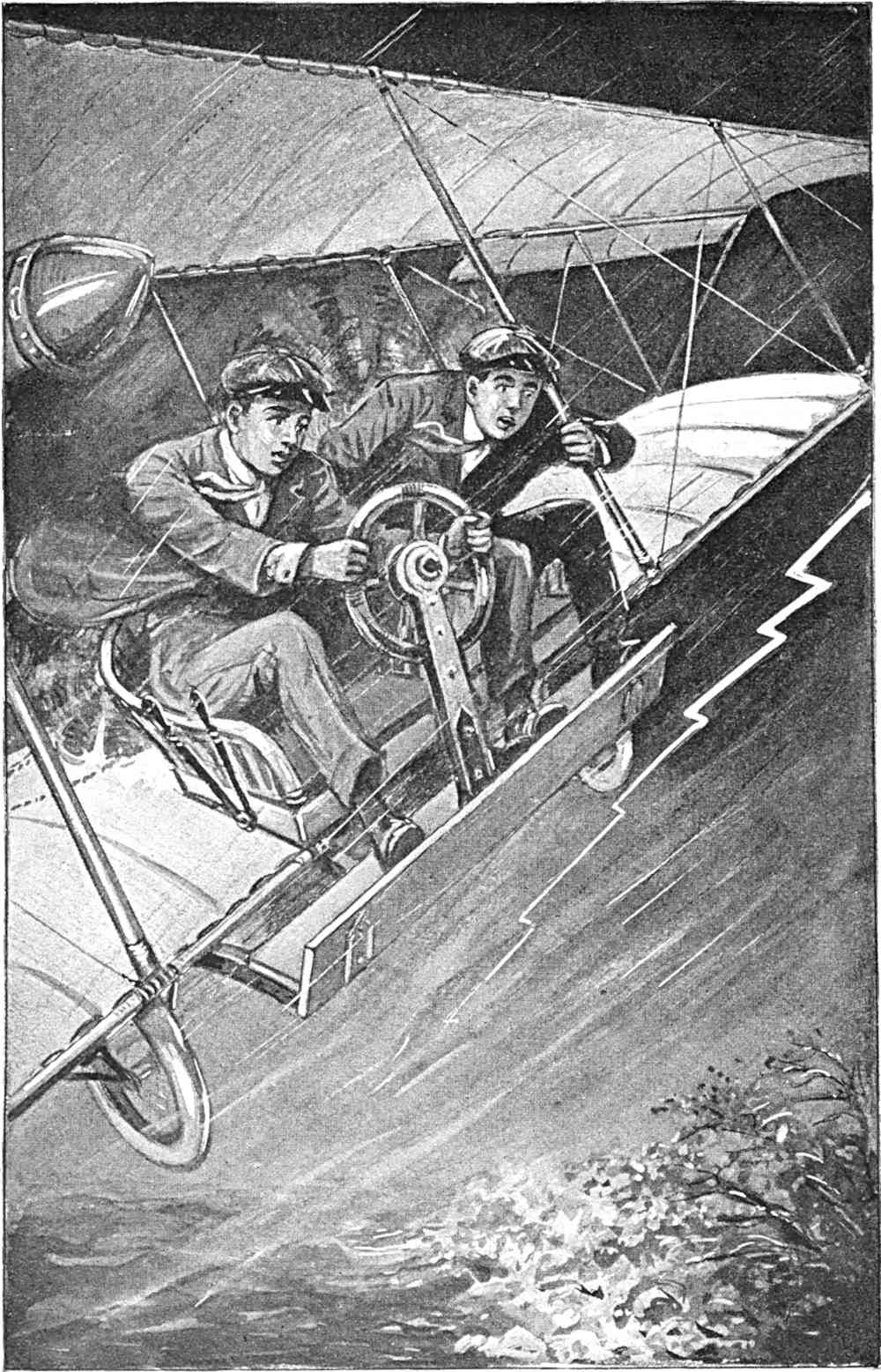
Fred and Joe looked at each other and both [248] shook their heads. Each wanted to speak, but, as mentioned before, talking with the motor in operation was out of the question. Both realized that the storm was likely to prove too much for them, and that they had better try to make a landing as soon as possible.
When Fred looked at his chum again Joe pointed to the mainland that was nearest to the island, and the lad at the wheel nodded. Then came more thunder and lightning, followed by another rush of wind. The Skylark was tilted up on one side and for an instant it looked as if the flying machine would go over. But Fred kept his wits about him and brought the craft around once more.
What to do next neither of the lads knew, and afterwards both said they fully expected to be thrown into the lake. To manage the biplane in those fierce gusts of wind was next to impossible. The aircraft drifted hither and thither, Fred having all he could do to keep the biplane from going over.
The boys had been up but a few minutes—although to them it seemed an age—when there came a brief lull in the wind, and a lightening of the sky directly overhead. But both could see that the storm was by no means at an end.
Both looked down and saw below them the very [249] island they had left. Just ahead was the cleared spot. Quickly Joe motioned to it, and nodded his head, as if to advise his chum to descend. Fred was willing, and shaping their course as well as he was able, the stout youth shut off the power, and down they came with a rush.
They struck some bushes and bumped along over the uneven ground. Both were well shaken up, but no damage was done to either the boys or the flying machine. Then they dragged the Skylark under the tallest of the trees and there staked it fast, so that it might not be blown around by the wind and wrecked.
By this time the sky had darkened once more and the rain was coming down in a deluge. Occasionally would come a flash of lightning, followed by a peal of thunder that would roll over the lake and among the hills beyond.
“Say, I’m mighty glad we didn’t try to get home,” remarked Joe, as both boys crouched down under the planes of the machine, to keep out of the rain.
“We couldn’t have done it, Joe,” was the reply. “Why, I had all I could do to keep her from going over! Excuse me from trying to sail in such a wind!” And Fred shook his head seriously.
“Yes, we were lucky to get back here, Fred. I [250] thought first we could make the shore—to tell our folks by telephone that we were safe. But never mind, we can stay here until it clears off.”
“Maybe it will rain and blow all night.”
“I don’t think so.”
After that the boys said but little. The wild flight in the air, even though of short duration, had exhausted them, and they were content to rest and let the elements take care of themselves. Both were pleased to note that the lightning and thunder were growing more distant, showing that the storm was moving away.
By five o’clock the rain was at an end and much of the wind had gone down. The boys crawled out from under their shelter and gazed earnestly at the sky.
“I think it will be all right in a little while,” cried Joe. “See, the sun is beginning to shine again!”
“Let us wait a while and see,” returned Fred. He had no desire to repeat his thrilling experience in the air.
The boys drew the biplane from under the big tree and looked it over once more. They were just finishing this work when they heard a shout from the edge of the woods, and the next moment saw Joel Runnell approaching them.
[251]
“Hello, you here?” cried the old hunter. “I thought I heard something like an airship or a motor boat around.”
“What are you doing here?” asked Joe. “Fishing?”
“Not to-day, Joe,” was the answer. “I came on rather a funny errand. I heard that a strange man had been seen on this island, and I came over to see if it might be Mr. Akers.”
[252]
“Who told you about the strange man?” asked Joe, quickly.
“Bill Hickson, my milkman. Bill saw Mr. Akers at the cottage several times, an’ when Bill came over here he said he saw a man wanderin’ around in the woods as looked like Akers. So I came over to look into the matter,” went on Joel Runnell. “But I didn’t calkerlate to drop into no sech thunderstorm as we had,” he added, with a grin.
“And have you discovered anything of Mr. Akers yet?” questioned Fred.
“Not a thing. But I ain’t had much o’ a chanct to look, on account o’ the storm. I’m going to tramp around the island now.”
“I wish we could go with you,” said Joe. “But we had better get home, now the storm has cleared away. Our folks will be worrying about us.”
“Yes, that’s true. Tell you what I’ll do, boys. [253] If I learn anything about Mr. Akers I’ll send you word,” said the old hunter.
“I wish you would!” cried Joe. “We are very much interested in that case. I wish we could find him, and find his missing papers and stocks too.”
“It sure is a curious affair,” and Joel Runnell shook his head slowly. “I think them men, Mason an’ Chase, had somethin’ to do with it. But thinkin’ ain’t provin’, so it won’t do no good to say anything.”
A little more talk followed, and then the boys prepared to fly away in their biplane. As Fred had had such a strenuous time fighting the storm, he was perfectly willing to let Joe take the wheel. Joel Runnell assisted them in getting away, and waved his cap after them when they were above the trees.
The storm had now died away completely, and the setting sun shone brightly over the surface of the lake. There was still a little wind, but it came steadily instead of in gusts and was in the right direction, so that it caused the aircraft boys little trouble. Joe steered a straight course for Lakeport, and they made fairly good time on the return and came down in the usual spot without trouble.
Their aircraft had been seen from afar, for [254] many were watching for them, fearing they had been wrecked in the thunderstorm. As they came down a crowd rushed forward to greet them, including Mr. and Mrs. Westmore and Mr. and Mrs. Rush.
“Are you safe, Joe?”
“Were you up when it blew so, Fred?”
“Oh, what an awful storm that was!”
“Why, the flying machine doesn’t seem to be damaged in the least!”
Such were some of the remarks made and questions asked. The two lads soon proved to the satisfaction of everybody that they were uninjured and then related their story. As Fred told of how he had struggled to land in the storm his mother and Mrs. Westmore shuddered.
“Oh, you must never go up in such a storm again, Fred!” cried his mother. “Promise me!”
“Not if I can help it,” he answered, quickly. “Once is enough!”
“That’s right,” added Joe. “After this I want to do my flying in fair weather only.”
“It’s a great wonder the Skylark wasn’t wrecked,” was Link’s comment.
“We were out in the sloop,” said Paul, “Bart and Frank and I, and we had all we could do to keep her headed to the wind and off the rocks. We [255] thought of you, and once Bart imagined he saw the biplane, but he must have been mistaken.”
As soon as the boys could get the flying machine to a place of safety they told their chums and their folks of what Joel Runnell had said about the strange man seen on Pine Island.
“Do you think it really was Mr. Akers?” questioned Harry, with interest.
“There is no telling,” replied his brother. “If it was, and he is found, Runnell will let us know.”
Several days passed and at last came word that the old hunter had been unable to trace the strange individual, whoever he might have been. That he had left Pine Island, Joel Runnell was certain. He had found several traces of camping parties, but that was all.
For the time being the aircraft boys of Lakeport were so interested in the proposition of holding an aero meet that the mysterious disappearance of Andrew Akers was well-nigh forgotten. The lads received a letter from the boys of Brookside who owned the Swallow, stating that they would be pleased to enter the contests. Then came another letter, from the Bartley boys, of Haverford, which our friends perused with much interest. In part this communication ran as follows:
[256]
“As you have a biplane and as that is the kind of a flying machine the fellows of Brookside have, too, it seems to us that races against our monoplane would not be exactly fair. We might go into some of the contests together, but we would suggest that you invite Mr. Samuel Barnes, of Bralham, to join in the meet. He has a monoplane similar to ours, and is a young man you will like to meet. He used to back up the Bralham football club, so you probably know him. All four flying machines might go into some of the contests, and for long distance flights we could have two runs—one for the monoplanes and one for the biplanes.”
“That’s the talk!” cried Fred. “I know Sam Barnes, but I did not know he had a flying machine. Let’s invite him by all means.”
“Say, if we keep on we’ll be getting up a regular aero meet,” came from Link. “We’d better fence in the field and charge an admission fee.”
“I’ve got an idea,” said Joe. “If we can really make it worth while, we could wire off a big part of the field and charge, say twenty-five cents, or fifty cents, admission and then use part of the money for paying for prizes and divide the rest among the charitable societies of Lakeport, Brookside, Haverford, and Bralham. By advertising [257] that part of the money was to go to charity we might draw a big crowd, and do a lot of good, besides having a grand meet.”
This idea took like wildfire, and that very night a number of letters were written, one inviting the young man from Bralham to participate in the proposed aero meet and the others outlining the scheme for paid admissions, with prizes for various contests, and with a certain percentage of the receipts for charity.
The suggestion to give something to charity caught the favor of the ladies, who for years had been struggling with the question of what to do for certain poor and worthy folks of their localities. The boys agreed to give sixty per cent. of the money taken in to the cause—fifteen per cent. to each of the four towns to be represented—for Sam Barnes, of Bralham, came over to Lakeport in his monoplane, to say that he would accept the invitation to participate. The other forty per cent. was to be used to pay necessary expenses and in the purchase of suitable prizes.
“Now the question is, Where are we to hold the meet?” said George Dixon, at a meeting held by invitation in Brookside, a few days later.
“Well, I don’t know,” answered Joe. “Of [258] course we’d like to make it Lakeport, but I suppose you’d say Brookside and you other fellows would say Haverford and Bralham.”
“We have no very good field in Haverford,” answered Bill Bartley. “Almost every place is too stony and uneven. I have only one fairly good landing spot for my monoplane.”
“We can use our old football field,” said the Bralham aviator. “But for an aero meet I am afraid it will prove rather small.”
“Well, we have room enough at Brookside,” answered Andy Brown. “But as the Lakeport fellows issued this invitation I rather think it ought to be their privilege to name the field.”
At that moment came a knock on the door of the clubroom where the meeting was being held, and Fred, who was nearest, opened the portal. There stood James Slosson, with a letter in his hand.
“This is from Mr. Corsen,” said the aviator and chauffeur. “He heard that you were going to hold this meeting and he wanted to make you an offer.”
The letter was addressed to Joe, but it proved to be for the benefit of all present and ran as follows:
[259]
“I understand that you are to hold an aero meet and donate part of the entrance money to charity. Mrs. Corsen and my daughter Violet are much interested, and so am I, and if you have not yet selected a place for the exhibition I hereby offer you the free use of the big fields in the back of my estate, with the free use of two of the barns for hangars. As you know, the fields are well fenced, and I have the lumber on hand for a new barn, and I will have my carpenter, Mr. Darrow, put up a small grandstand for you free of expense.”
“Hurrah for Mr. Corsen!” cried Harry, enthusiastically.
“This is the best yet!” cried Fred.
“It is certainly a very generous offer,” said George Dixon. “Having the meet on the Corsen estate ought to draw quite a fashionable crowd.”
“Especially if Mrs. Corsen and some of her rich friends will play patronesses for us,” said Bart.
“And I’ll get my dad to put up just the dandy grandstand!” cried Link. “And he can put up pylons, and all the other things, too.”
The matter was talked over and all present were in favor of accepting the rich gentleman’s offer, and a letter was written to that effect and given to [260] James Slosson. The date of the meet was placed on a Saturday nine days later, in the afternoon.
“Now, with such a place to meet, we ought to advertise this affair,” said Sam Barnes. “Folks won’t come unless they know about it.”
“I’ve got an advertising scheme that I think will produce good results,” said Bart. “Of course we can hang up bills in each town, at the post-offices and stores, but my plan is to get small and cheap handbills printed in big quantities. Then each of us can go up, day after day, and fly all around the country hereabouts, dropping the handbills wherever we go. We can put a line on each bill, ‘This Handbill Delivered by Aeroplane.’ That will cause folks to keep the handbill and talk about it, and I am sure lots of them will drive in to the meet.”
This proposition met with instant approval from all sides, and as there was a big printing establishment at Haverford it was left to the Bartley boys to find out how cheaply the handbills could be obtained and also some good-sized posters. Half an hour was spent in writing the advertisements.
“Well, that surely will be a real aero meet, if everything goes through as planned,” said Harry to his brother, when they were on the way home.
[261]
“It was fine of Mr. Corsen to let us use his fields,” answered Joe.
“Yes, and fine for Mrs. Corsen and Violet to take an interest,” added Harry. “Wonder what Si Voup and Ike Boardman will say to this when they hear of it? I’ll wager they will be more sour than ever, Joe.”
“Don’t notice them if they are, Harry. With all our good fortune we can afford to drop all thoughts of those two chaps.”
“Oh, I am willing to let them alone if only they will let us alone. But it isn’t in ’em to let this go by unnoticed. As sure as fate Si and Ike will try to do something to spoil the affair,—or at least our part in it.”
“Well, we’ll have to keep our eyes open. But I don’t think they’ll go down to Darrow’s barn again—not as long as the old cistern is there.” And Joe laughed over the recollection of what had occurred.
“What do you think about the contests—can we win?” asked Fred, who was with the brothers.
“Oh, we’ve got to win, Fred! Of course, I don’t expect we’ll win everything. But I hope we win the most of the points.”
“Yes, and especially the long-distance flight,” added Harry.
[262]
“Now for some grand, up-to-date advertising!”
“Right you are, Joe, and won’t the country folks and town folks, too, be surprised when they see these handbills dropping from the sky?”
“I hope we don’t scare any horses.”
“Oh, horses don’t scare so easily as they did—now that they have to put up with autos and such things.”
The posters and handbills had been printed—a hundred of the former and many thousands of the latter—and evenly divided among the four towns to be represented at the aero meet. Now the boys were getting ready to distribute the advertising matter to the best advantage.
The aircraft boys of Lakeport had divided the handbills into five bundles and the posters into two bundles. Bart did not enjoy flying, so to him had been delegated the task of hanging up the posters in Lakeport and distributing some handbills about the place. Then lots were cast by the other [263] four boys, and to Harry fell the task of taking the other bundle of posters and some handbills and visiting several neighboring towns on his bicycle, leaving the advertising at the post-offices and stores. All the other handbills were to be taken up in the biplane by Joe, Fred, and Link, working two at a time. While one youth sailed the Skylark the other was to scatter the bills so that folks might catch and read them.
“Sorry you aren’t to go up with us, Harry,” said Fred, after matters had been arranged.
“Oh, I’ll get some fun out of it, wheeling to places with the posters and handbills,” answered the younger Westmore lad. “And I’ll do some flying when the contests come off—don’t forget that.”
“Sure—and you must win, too,” answered the stout youth. “That is what I am going to try to do.”
The first to go up in the biplane were Joe and Link, and as they set off with the handbills the others let up a cheer. Just for fun Link dropped several handbills, and one fell right into the hands of Laura Westmore, and she took it and waved it gayly at those sailing away.
“Well, here is where I do my share of the work,” announced Harry, when the biplane was [264] out of sight, and strapping his pack of posters and handbills on his back, he hopped on his bicycle and started for Camdale and other towns in that vicinity.
The first-named place was quickly reached, and he had little trouble in getting permission to hang posters in the post-office and in a hotel and in the main stores. Occasionally some man would ask if he wasn’t going to give an admission ticket for the privilege, but when Harry explained that the aero meet was largely for charity, no more would be said about a free entrance to the grounds.
By noon the younger Westmore boy had visited three towns, and distributed nearly half of his posters and handbills. He was rather tired, and glad enough to sit down by the roadside and eat the generous lunch his mother had packed up for him, washing it down with some milk purchased at a farmhouse.
While he was seated there he saw a farm wagon approaching at a slow gait. It was drawn by a pair of big horses, and on the seat, with a battered felt hat on his head, sat a youth whose face was a mass of freckles.
“Hello, Teddy Dugan!” cried Harry, as the turnout drew closer.
“Sure an’ if it ain’t Harry Westmore!” cried the Irish lad who had camped out on Pine Island [265] with the other boys and who had also acted as a substitute on the baseball club. “What be ye doin’ here, Harry?”
“I’m distributing posters and circulars of our aero meet,” was the reply. “That is, I have been. Just now I’m resting and having lunch. Have a cookie?” and Harry held one out.
“I don’t want to rob you,” answered the Irish lad, gazing wistfully at the golden-colored cake.
“Oh, I’ve got more, Teddy. Here, take it, and here is some milk too, if you want it.”
Teddy was glad enough to rest, being on a long journey from his home to Camdale. He drew up at the roadside, and soon he was beside Harry and enjoying the cookie.
“It’s great doin’s you b’ys is up to,” he remarked. “First the gun club, thin the baseball club, nixt the boat club, an’ afther that the football club an’ the automobile tour, an’ now a flyin’ machine! Say, phwat will yez be at nixt?”
“I don’t know, Teddy. School, most likely. It opens in a couple of weeks.”
“Yis, I know that, fer I’m to go meself. Say, how do you like flyin’?”
“It’s great, Teddy. You must come to our aero meet.” And Harry held out one of the handbills.
“Sure, an’ I’ll be there, Harry. An’ oh, say! [266] I’ve got somethin’ to tell ye!” burst out the Irish lad.
“To tell me?”
“Yis. I was goin’ to sthop at Lakeport an’ let ye know, but it clane slipped me mind—I had so much to buy at Camdale fer me father. It’s about that man as give ye the flyin’ machine, Mr. Andrew Akers. Me father saw him.”
“Saw him? Where?” And now Harry was all attention.
“Over along the river, near Shag’s Island. Me father was over to a farm there, to buy a horse, an’ he said he saw this Mr. Akers an’ another man at the river bank, gittin’ into a boat.”
“When was this?”
“Yisterday afternoon.”
“I didn’t know your father knew Mr. Akers?”
“But he does, Harry. Sure an’ didn’t he hilp the old gentleman git his flyin’ machine out o’ a tree onct? That’s how he got to know him.”
“Who was the man with Mr. Akers?”
“He was a stranger, but me father thinks he saw the feller several times in Brookside.”
“Then it must have been Mr. Mason or Mr. Chase!” murmured the younger Westmore youth. “I am glad to know this, Teddy. I’ll have it looked into at once!”
[267]
“If yez want to find Mr. Akers I hope yez are able to do it,” answered the Irish lad; and then, having finished his cookie, and taken a swallow of the cool milk, he drove on.
A little while later Harry continued his journey to the next village, to leave his posters and handbills. As he wheeled along his thoughts were busy.
“If that was Mr. Akers, and Mr. Mason or Mr. Chase was with him, where were they going?” was the question he asked himself over and over again.
He had once visited Shag’s Island, a lonely and rocky place, located in the center of a broad, shallow stream flowing into the lake. It was situated about a mile from where was located the deserted hut he and the others had visited, when looking for Andrew Akers before.
“Those men must have taken Mr. Akers somewhere,” reasoned the younger Westmore lad. “Maybe they took him to Shag’s Island after they had him at the hut.”
Harry hurried as much as he could, and by dark he had all of his posters and handbills distributed. Then he pedaled for home, anxious to tell his brother about what he had heard.
“I won’t tell dad or the others,” he reasoned. “I’ll just tell Joe, and we can investigate this between [268] us. No use of getting all the others excited until we are sure we are really on the right trail.”
But when he reached home Harry was confronted by a disappointment. Joe had telephoned in from a distant village that he was going to remain at that place with Link all night and work back towards Lakeport in the morning.
“Oh, most likely he won’t be home till dark,” murmured Harry to himself. “Guess I’ll have to tell Fred or Bart.”
But in the end he told nobody and resolved to investigate by himself. He knew he could run over to the river on his wheel in less than an hour, and another hour would suffice to row over to Shag’s Island and back, provided he could get a boat.
“And if I can’t get a boat I can wade or swim over,” he told himself. “It’s rather cold, but I guess I can manage it.”
He started off the next morning, directly after breakfast. He had a few handbills left, so his folks did not question him, thinking he meant to distribute these. He had his lunch with him again, so would be able to spend the whole day in the search.
It was a clear day, with little or no wind—which was a good thing for those distributing the handbills [269] from the aeroplanes. Harry knew the road well, and soon passed through the lower end of Lakeport and over the bridge on the sawmill turnpike. Then he pedaled past several farms and through a woods, coming out presently on the highway bordering the river on which Shag’s Island was located.
As I have said before, the river was broad but shallow, and in many spots rocks and sandbars showed themselves. Here and there were small islands, overgrown with bushes and stunted pines. In many places the stream was less than a foot deep.
“The water seems to be pretty low,” thought the youth. “More than likely I can find some place where I can wade to Shag’s Island. I’d rather do that than look around for a boat.”
As Harry passed around a curve of the road and river, he looked out in the stream and uttered an exclamation of surprise. Then he slackened his speed, came to a halt, and jumped off his bicycle.
He had come to a stop at a place where the sandbars of the river were thick. Out among them lay a motor boat, the bow of the craft buried deeply in the sand. The motor was not running and the boat was apparently deserted.
“Unless I miss my guess it is Si Voup’s craft,” [270] muttered Harry. “But if it is, what is it doing in such an out-of-the-way place? Si must know it’s not deep enough here for such a boat as that.”
Curious to know how the motor boat had gotten in its present position, and why it was abandoned, Harry leaned his wheel against a tree and walked out on the rocks lining the shore. By leaping from one rock to another he was able to get within a rod or so of the stranded craft without wetting his feet.
“Yes, it’s Si’s boat right enough,” he murmured to himself. “She must have been here since yesterday, or longer.”
He was wondering if he could get over to the craft by wading, and had just sat down on a flat rock to take off his shoes and socks and try it, when there came a rude hail from the road.
“Hi, you! What are you doing there?”
Harry gazed around and saw Si Voup standing near. He had arrived on a bicycle, accompanied by Ike Boardman, and each carried a rope and a shovel.
“Is this your boat, Si?” asked Harry, not knowing what else to say.
“You know well enough it’s my boat!” answered the rich bully. “Have you been on board? Did [271] you dare to touch the engine?” went on Si, in alarm.
“No, I haven’t been any nearer than I am now. I just got here.”
“Well, you clear out and let my boat alone.”
“How did it get here?” asked Harry, and now he tied his shoelaces again, and stood up on the flat rock.
“That’s my business, Harry Westmore. You just go on your way and let my boat alone.”
“All right, Si—just as you say,” answered the younger Westmore boy coldly, and prepared to leap from rock to rock to the shore again.
As he did this Si and Ike came down from the roadway and stood on the rocks near the shore. Each looked at the other and most likely the same thought occurred to both.
“Shall we shove him in, Ike?” whispered the bully.
“Yes, if we get the chance,” returned his crony.
Both leaped to the next rock, further out in the stream. As they did this, Harry also essayed to gain that footing. Just as he sprang forward, Si and Ike placed themselves at the edge of the rock and put out their elbows.
“Look out!” cried Harry, “or you’ll shove me overboard!” Then, as he saw that the others [272] meant him to lose his balance, he clutched at the leg of each. Down went Si and Ike, and the next instant all three lads were floundering in the cold water of the river.
[273]
“Let go of me!”
“Do you want me to be drowned?”
“Brrr! how cold this water is!”
Such were some of the cries that arose as Si and Ike came down in the water, almost on top of Harry. For a full minute there was a grand scrambling all around, and then the younger Westmore youth crawled out on one rock, Si on another, and Ike on a third. All stood up and glared angrily at each other.
“What do you mean by pulling me into the water?” bawled Si, shaking his fist at Harry.
“And pulling me down, too?” added Ike.
“I’d like to know what you meant by shoving me down in the first place,” blazed back Harry.
“We didn’t!” came from the pair.
“You did.”
“You had plenty of room,” grumbled Si. He gave a shiver. “I’ll catch my death of cold from this.”
[274]
“So will I,” added his toady.
“If you do, maybe it will serve you right,” answered Harry. “It was a mean trick, and both of you know it. You didn’t get any more than you deserved.”
“Bah! you make me tired, Harry Westmore!” growled Si. “Just you wait—I’ll fix you for this, see if I don’t!”
“And I’ll get square too,” came from the shivering Ike. “I’m wet to the skin!”
“Both of you are no more wet than I am,” answered Harry. “And it is your fault, not mine.” And so speaking he leaped for the nearest sandbar and waded ashore and up to where he had left his bicycle. Close at hand were the two bicycles Si and Ike had used in coming to the spot.
“Hi! you leave our wheels alone!” shouted the rich bully, as he saw Harry start towards them.
But Harry paid no attention to the words. He was angry through and through and in a mood to do almost anything. At first he thought to fling the bicycles into the river, where his enemies might go fishing for them, but then another thought came to him—a thought that almost made him grin.
On the opposite side of the roadway to that lining the stream was a row of thorn trees, low and thick. Seizing one of the bicycles, Harry gave [275] it a swing and sent it up into the branches of one of the trees. Then he caught up the second wheel and sent that up into the branches of another thorn tree.
“Now you can climb for your wheels when you want them!” he sang out, as he leaped on his own bicycle and started to pedal away.
“Come back here! Get those bicycles down!” roared Si, as he made for the roadway.
“Great Cæsar, look at that!” groaned Ike. “They are both right in the middle of those thorny trees! How are we to get them out? We’ll be scratched to pieces!”
“He was bound to get square, I suppose,” muttered the rich bully. “Hang the luck anyway! Here we are wet to the skin, the wheels in those stickery trees, and the motor boat stuck in the sand. Say, Ike, what are we to do anyway?”
“I know what I am going to do first! Try to get myself dry! My, but it is cold!”
“Don’t say a word! I’m shivering so I can scarcely walk! I—er—I wish we hadn’t shoved him in, now.”
“Same here. But I didn’t think he’d catch us by the legs.” And thus speaking the unworthy pair waded ashore and then proceeded to look for some [276] spot sheltered from observation, where they might dry themselves in the sun and try to get warm.
In the meantime, Harry lost no time in wheeling up the river road until he was well out of sight and hearing. Then he, too, sought a sunny spot, and there proceeded to dry himself and his clothing as best he could. Fortunately on the back of the bicycle he carried a sweater, and this he put on next to the skin, which did a great deal towards warming him up. But he was not as comfortable as he might have been, and his feelings toward Si and Ike remained anything but pleasant.
“Well, one satisfaction, they are as wet as I am!” he murmured.
It took him the best part of an hour to get even partly dry, and then he went on along the river road, making numerous turns, until he at last came to a spot opposite Shag’s Island. Here the stream was very broad and both shores were lined with trees and bushes. Shag’s Island lay out in the middle of the watercourse, with several smaller islands scattered above and below.
Not to be noticed should the men for whom he was seeking be at hand, Harry secreted his bicycle in the bushes and crept down between the greenery to the water’s edge. He looked out on the river [277] and towards the island. Not a soul was in sight and apparently the locality was deserted.
At this point the sandbars and rocks were even more numerous than where the motor boat lay stranded, and the Westmore youth saw that by taking off his shoes and socks, and rolling up his trousers, he could easily wade to the island.
“I’ll do that,” he told himself. “I don’t think they’ll see me—if they are around.”
Soon he was out on the rocks, his shoes over his shoulder. As he did not wish to slip and hurt himself, he advanced with caution, leaping from rock to rock where he could and otherwise wading along the sandbars. Once he went down in a small hole and got something of a splash, but this he did not mind. Then came a long, smooth sandbar, leading directly to the end of the island, and along this he walked with ease, and soon found himself ashore.
As he put on his socks and shoes again he listened intently, but the only sounds that broke the stillness were the chirping of the birds and the croaking of some frogs in a swamp.
“I guess I’ll go along the shore and look for boat-prints and footprints,” he told himself. “If they landed in a boat I ought to locate the place with ease.”
[278]
Shag’s Island was nearly a quarter of a mile long and not quite half that in width. At either end was a rocky hill, with a flat, marshy place in the middle of the island. In the marsh grew huckleberry bushes of large size, and during the season the boys of Lakeport had often come there to fill their pails with the fruit.
Harry had passed down the shore almost to the marsh when he saw some marks in the sand between the rocks. A boat had been beached there, not once but several times, and many footprints were to be seen.
“Now to follow those marks,” thought the Westmore boy, and turned inland.
The footmarks led to the west of the marsh, and past a clump of low-growing bushes. Here there was something of a trail, and the same marks were to be seen in the soil.
It must be confessed that Harry’s heart beat loudly as he advanced along this trail. The spot seemed to be particularly lonely, and just then scarcely a sound broke the stillness. Once he imagined he heard voices and stopped to listen.
“I must have been mistaken,” he told himself. “Pshaw! I guess I’m getting nervous. I’m going ahead and see if I can find out anything. Perhaps I’m only on a wild-goose chase after all.”
[279]
Then he realized that he was unarmed, and he paused beside another clump of bushes, to cut himself a heavy stick. With this in hand he felt more confident, and on he went once more, around a bend of the trail.
He was now satisfied that he could hear voices and that they came from ahead of him. He slackened his pace and strained his ears, and soon located the sounds. They came from an old hut located beside the trail, a hut once used by an old hermit named Shag, after whom the island had been named.
As soon as Harry came in sight of the hut he resolved to change his course. He stepped from the trail and made a detour, coming up through the brushwood to a point close to one side of the old structure. Here there was a window about two feet square, with a sliding wooden shutter, and, as the shutter was open, the boy could look into the hut with ease and also hear what was being said.
Two men were talking, and Harry recognized the voices of Thomas Mason and Lamar Chase, he having seen those individuals several times since the disappearance of Andrew Akers. The men were talking over business matters in general,—a conversation that did not interest the youth.
[280]
“I wonder if Mr. Akers can be around?” thought the boy. “He must be, or otherwise what would those two men be doing in such an out-of-the-way spot as this?”
Watching his chance, he peered into the window of the hut and saw that the two men were seated on rude benches smoking. He also noted that a rough board partition divided the hut into two parts.
“Maybe Mr. Akers is in the other room,” reasoned Harry. “If it has a window I’ll soon find out.”
Cautiously he stepped back from the position he occupied and worked his way to the other end of the hut. Here was another window, but the shutter to this was tightly closed.
Harry listened, but if anybody was in the apartment behind the closed shutter, he made no sound. Then the youth heard Thomas Mason exclaim:
“Well, I’m going. You stay here till I get back.”
“You’ll return before four o’clock?” queried Lamar Chase.
“Yes, unless something detains me.”
“We want to get to see those men by seven, and we’ve got to have supper.”
“I’ll be here.”
[281]
“By the way, did you hear anything more from those two chaps who ran the motor boat?” questioned Lamar Chase, as he followed his companion out of doors.
“No.”
“I thought they might demand some money.”
“So did I. But I reckon they were pretty well scared.”
“It’s too bad they belong in Lakeport. Maybe they’ll tell some of those people of what happened.”
“I don’t think so—for if they do, it will get them into trouble. I am pretty sure they’ll lay low and say nothing. Besides, they don’t know the exact truth. They only helped to take care of an insane man, you know,” and Thomas Mason chuckled.
“That is true. Well, I’m off.”
The manager of the novelty manufacturing company turned and hurried away from the hut, moving towards the opposite shore of the island from where Harry had landed. Evidently he was going to row to the other side of the river.
Left to himself, Lamar Chase stood still for a moment. Then he took up a bucket that was handy and started off up the rocks.
“He is going for water!” thought Harry, and he remembered that the spring Shag had used was [282] quite a distance from the hut. It would take the man all of five minutes to go for the water and get back.
As soon as Lamar Chase disappeared around the rocks the mind of the younger Westmore boy was made up. Without hesitation he ran around to the front of the hut and then inside.
A glance showed him a rude door, leading to the second apartment of the structure. This door was closed and propped fast by means of a stick of wood. Harry pulled the stick out of place and hauled the door open.
The inner apartment, because of the closed-up window, was almost dark, and for a moment the boy could see next to nothing. Then, as his eyes became accustomed to the gloom, he made out the form of a man on a bunk.
It was Andrew Akers.
[283]
Harry was not altogether astonished, for he had suspected that he would find the aged inventor here. Mr. Akers was asleep, but he awoke with a start.
“Don’t give me any more of that medicine!” he cried. “I don’t want it, and I won’t take it! It makes me dizzy!”
“Mr. Akers, don’t you know me?” asked Harry. “I am one of the boys who found you when you fell from the biplane.”
“Oh!” The man stared at Harry and sat up. “Yes! yes! I know you! You are Harry Westmore! How did you get here? Are you in league with those who are keeping me here?”
“No, I am not in league with those men,” answered the boy, quickly. “But I haven’t time to talk now. Have they been keeping you a prisoner?”
“Yes. They say they are my friends, but I know better.”
[284]
“Do you want to get away from them?”
“Of course I do! But they won’t let me go. They give me medicine that makes me dizzy, and they want me to sign papers, and——”
“Yes, yes, I understand,” interrupted the youth. “But we haven’t got time to talk now. If you want to get away, come with me at once.”
“Where will you take me?” asked the old inventor, as he struggled to his feet. He was so weak that Harry had to support him.
“I’ll take you to my home. My folks will take good care of you—and you shall have what is coming to you.”
“Good! I knew I could trust you from the day I first saw you! I will go with you. But Mason and Chase——”
“Mr. Mason has gone away and Mr. Chase just went off to get a pail of water. That is why we must hurry—to get away before he returns. Come.”
Harry took the aged and weak man by the arm and led him from the hut. Then, struck by a sudden idea, he ran back, closed the inner door, and set the stick against it as before.
“Maybe he won’t know you are gone for some time,” he told the sufferer. “Anyway I hope so. Now come with me. Can you walk?”
[285]
“A short distance. I cannot go far, I am still too weak from my fall—and from the way they have been treating me. They have given me medicine that keeps me weak and sets my head in a whirl. They want me to sign papers I do not want to sign. They want to get all my property away from me.”
“They shan’t do it—not if we can help it,” answered Harry, firmly. “You come home with me, and my father and Mr. Rush will see to it that you obtain your rights.”
He continued to support the old inventor, and both proceeded slowly in the direction of the island shore where Harry had landed. As they went on the boy kept his ears on the alert for an alarm, but it did not come.
Once at the shore Harry was in a quandary, for he knew the old man could not leap from rock to rock as he had done, and it might give him his death of cold if he attempted to wade along the sandbars.
“If I only had a rowboat,” he murmured to himself.
“Let us hide in the bushes,” suggested the old inventor. “I must rest.” He was out of breath and quite pale.
“Come on, just a little further,” answered the [286] youth, and led the way along the shore to a thick patch of undergrowth. They crawled over the rocks and down among the bushes, and here the boy concluded they would be safe, at least for the time being.
“I don’t believe Mr. Chase has found out yet that you are missing,” said Harry. “If he had, he’d be running around calling to you.”
A few seconds later, while both were wondering what to do next, there came from down the stream the explosions of a motor. The sounds caused Harry to give a start.
“Si Voup’s motor boat!” he exclaimed. “Just the thing! He’s got to help us, whether he wants to or not!”
“What is that you say?” asked Andrew Akers. He had sunk down among the bushes to rest.
“Mr. Akers, you stay here, and don’t make a sound,” went on Harry. “I am going after a boat, in which to take you to my home. Be sure to keep out of sight if Mr. Chase comes near here.”
“You won’t forget to come back?” asked the old inventor, anxiously.
“No, I’ll be back sure,” answered the boy.
Regardless of getting wet, he leaped from rock to rock and sandbar to sandbar, in a wild scramble to reach the main shore. Then he found his bicycle, [287] and mounting the wheel, pedaled down the road at top speed.
It took Harry but a few minutes to reach the point opposite to where Si’s motor boat had been stranded. Si and Ike had just succeeded in getting the craft afloat, and the latter was bailing out some water that had leaked in, while the owner was adjusting the motor.
“Hi, you! I want to talk to you!” shouted the younger Westmore boy, and in his excitement he forgot all about the happenings earlier in the day.
“Hello, if he hasn’t had the nerve to come back here!” cried Ike.
“What’s the matter with you?” bawled Si. “Did you come back to get our bicycles for us?”
“No, I didn’t,” answered Harry, and regardless of adding to his wetness he plunged into the river once more and waded towards the motor boat, causing both Si and Ike to stare in amazement. “I need your help, fellows, and I need it right away.”
“Why, what’s the matter?” demanded the rich bully. He could see by Harry’s actions that something far out of the ordinary had occurred.
“There is an old man up here who is in great danger. He needs help at once. Si, can you run the motor boat up to Shag’s Island?”
[288]
“Why, er—I—who is the old man?” stammered Si.
“Never mind that now, Si. Come, can’t you run the boat to the east shore of the island? If you can, get busy right away, and I’ll help you if you’ll let me. This is no joke—it’s a matter of life and death,” went on Harry, earnestly. “Every minute counts. If you help the man you may get a fine reward,” he added.
“But our bicycles——” protested Ike.
“Leave them where they are, they are safe enough. I left mine over there on the rocks,” and Harry pointed it out.
“And this isn’t any joke?” demanded the bully.
“Not at all, I give you my word. Come, Si, here is your chance to do something worth while,” urged Harry. “But don’t lose any time,—or we may get there too late.”
“What’s the matter with the old man?” asked Ike, as the motor boat was turned around and those on board prepared to make the run between the rocks and sandbars to the island.
“He is in great danger. You’ll see after you get there.”
Harry purposely did not mention who the sufferer was, or what the danger that threatened. He remembered what Thomas Mason and Lamar Chase [289] had said about two boys in a motor boat, and he also remembered the fact that Si and Ike had been missing at the same time that Andrew Akers had disappeared. He wished to see Si and Ike confronted by the old inventor and hear what all might have to say. Maybe he might learn much concerning the first disappearance of Andrew Akers.
Ordinarily the run up the river would have occupied but a few minutes, but with the water so low, those aboard had to be careful, and consequently the motor was run only at half speed. Si was at the wheel and Harry stood at the bow, directing the course, while Ike had a pole in his hand, ready to use in case there was danger of hitting a rock or running up on another sandbar.
“Now to your left,” said the Westmore boy, presently. “Head for that clump of bushes, Si, and shut off the power.”
Harry’s directions were carried out, and silently the motor boat moved towards the shore of Shag’s Island. When close enough, Harry leaped out and prevented the craft from hitting the rocks.
“Hello!” he cried. “I’m back! Come on out, Mr. Akers!”
At the sound of his voice there was a movement in the bushes and the old inventor stepped into view.
At the sight of the old man both Si and Ike gave [290] a gasp, and the rich bully turned pale. Andrew Akers, on his part, gazed at the boys in the motor boat in alarm.
“You!” he exclaimed. “You! No! no! I’ll not go with you again! You helped to carry me off from the Runnell place!” And he shrank back as if to hide once more.
“It’s the old man—the crazy man!” muttered Ike.
“So I see,” answered Si. He looked thoroughly uncomfortable.
“Wait, Mr. Akers!” said Harry, as he ran to the old inventor’s side. “Don’t be afraid. They won’t hurt you.”
“But they helped to carry me away from the Runnell place,” murmured the sufferer. “They took me out on a big lake and to an island. They are in league with Mason and Chase!”
“We are not!” almost shouted Si. He was much disturbed by the unexpected turn of affairs.
“But you aided those men,” answered Andrew Akers, feebly. The excitement was beginning to tell on him.
“Because they said you were crazy,” answered Ike. “We thought we were doing right.”
“Of course we did,” broke in Si, eagerly. [291] “They said you were crazy and a relative of theirs at that.”
“Well, don’t talk about that now,” broke in Harry. “What we want to do is to get Mr. Akers to Lakeport, to my house. He isn’t crazy, and those two men have been keeping him on this island against his will.”
“I—er—I don’t know as I want to take him to Lakeport,” answered Si, lamely.
“You’d better do it, Si. If you don’t help me it will go that much harder with you—when it comes to showing up those two rascals, Chase and Mason, in court,” replied Harry, pointedly.
“We didn’t do anything wrong!” cried the bully, in alarm.
“You helped those two men to carry Mr. Akers off.”
“Yes, but they said they had a right to do it.”
“Never mind, they had no right to touch him. Now if you want to help yourself out of the mess the best thing you can do is to aid Mr. Akers as much as possible. I have promised to take him to my house and have him cared for. Will you run us over to Lakeport or not?”
“Oh, I’ll do that,” was the hasty answer. “If—er—those men had no right to touch him I am—er—sorry I helped them.”
[292]
“We only did what we thought was right,” put in Ike, anxious to clear his own reputation.
Harry said nothing to this, having his own opinion of both boys. He helped Andrew Akers into the motor boat, and jumped in himself, and the craft was shoved from the shore and poled around. Then Si got ready to start up his motor.
“Stop! stop! What is the meaning of this?”
The cry came from down the shore, and looking in that direction all on board the motor boat saw Lamar Chase running towards them, shaking his fist savagely.
“Don’t pay any attention to him!” exclaimed Harry. “Start her up, Si!”
“Come back here, I say!” roared the man on the shore, and now he came as close as the water permitted. “Bring that man back!”
“I am not coming back!” answered Andrew Akers.
“Turn that motor boat in here!” went on Lamar Chase. “Don’t you dare to carry that man off!”
“Mr. Chase, you listen to me!” answered Harry, firmly. “You know my father, Mr. Horace Westmore, of Lakeport. Well, I’m going to take Mr. Akers to our house. If you and Mr. Mason want to see him there, you can do so, provided my father is willing.”
[293]
“Ha! what do you know of this affair?” burst out Lamar Chase, half in rage and half in fear.
“I know a great deal—and my father and Mr. Rush, and some other men are going to try to find out a good deal more.”
“You can’t find out anything. That man is crazy.”
“He isn’t any more crazy than you are. Now if you want to do any more talking you’ll have to do it at our home—or in court,” concluded Harry. “Go ahead, Si.”
The motor was started up and the craft swung away from Shag’s Island. Si was plainly nervous, and in his excitement he turned on full power. Forward shot the boat, past a long sandbar into deep water. Then came a sudden crash, as the craft hit a submerged rock. One side of the bow was stove in, and in a few seconds more the motor boat began to fill and sink.
[294]
“Well, Link, I rather think we have done some good work with those handbills.”
“I think so myself, Joe. Anyway, we distributed them as well as we could,” returned the carpenter’s son. “Shall we steer for home now?”
“Might as well—while the weather is fine. Fred will want to go up to-morrow.”
Joe and Link had been out a day and a half in the Skylark, scattering the handbills of the aero meet far and wide over the countryside. Now they headed for Lakeport.
Their last stop had been at a small village located near the upper end of the stream in which was located Shag’s Island. Now, as they arose once again in the air, Joe, who was steering, turned the Skylark down the river in the direction of Pine Lake.
“There is Shag’s Island!” cried Link, as they came in sight of the spot. “Wonder if anybody [295] is on it? I’ve got a few more bills left. We might drop ’em a couple.”
He yelled at the top of his voice and motioned to the island and to his bills, and his chum understood. Soon they were steering directly over the upper end of the island. They were quite low, for the biplane was running well, and as there was no wind, Joe saw no reason for going higher.
Suddenly Link, looking down, gave a start. Then he looked again, and motioned for Joe to do likewise. In the water below they beheld a sinking motor boat, containing four persons. All appeared to be struggling to save themselves.
It was a most unexpected sight, and for the instant the aircraft boys did not know what to do. Then Joe, without hesitation, brought the biplane around on a rather sharp turn and sent the craft downward.
“What are you going to do?” demanded Link, as the motor was shut off and all became silent.
“Land on the water, if I can, Link, and find out what is wrong. Maybe we can save somebody from drowning.”
“You’ll sink the Skylark!”
“I think not. There is a big sandbar. I’ll land her there.”
The biplane was volplaning earthward. Close to [296] the sinking motor boat was a long, wide sandbar, and down on this came the Skylark, the little wheels underneath sending the shallow water splashing in all directions. The aircraft came to a halt close to the edge of Shag’s Island.
“Why, it’s Harry!” burst out Link. “And Si Voup and Ike Boardman!”
“And Mr. Akers!” added Joe. “How in the world did they get here?”
He ran out over the rocks in the direction of the sinking motor boat and the carpenter’s son followed. The boat was slowly sliding from the rock it had hit to the deep water beyond. Harry had caught hold of Andrew Akers and was doing all in his power to keep the old inventor from going under. Si and Ike were swimming for the shore, bent on saving themselves.
“Keep up, Harry!” yelled his brother. “We are coming!”
At the sound of that voice the younger Westmore boy turned. His surprise at seeing Joe and Link may be imagined. But he did not cease his struggles. He continued to support the old inventor, who now lay exhausted in his arms.
Half wading and half swimming, Joe and Link reached the spot side by side. Each placed himself close to Andrew Akers, and between them the three [297] boys presently managed to gain a sandbar reaching to the island. Then they carried the old man to the shore. The struggle in the water had exhausted him, but otherwise he was no worse off than he had been before.
“The motor boat is done for!” cried Si, as he limped up, dripping wet, and followed by Ike.
“Well, let us be thankful that we weren’t drowned,” answered Harry.
“Humph! Somebody will have to pay for my boat.”
“Where is that man?” burst out Ike, looking up and down the shore.
All who had come from the motor boat then remembered Lamar Chase, and gazed around for him. But that individual had suddenly disappeared.
“I guess he thought we were getting too many for him,” was Harry’s conclusion.
“Maybe he has gone to get help,” suggested Ike, but at this the others shook their heads.
Of course Joe and Link wanted to know the particulars of what had occurred, and taking them out of hearing of the others, Harry related his story.
“I don’t know how guilty Si and Ike are,” he said. “But they certainly aided Mason and Chase [298] in carrying Mr. Akers off to Pine Island in the motor boat, and maybe to that hut, and then to this place.”
“This whole thing must be thrashed out after we get home,” decided Joe. “The main question now is, How are all of us to reach Lakeport?”
This was talked over for several minutes, and finally Link said he would sail the Skylark back to town for assistance, leaving the two Westmore boys to look after Andrew Akers. None of the lads was willing to trust Si or Ike.
It was no mean task to get the biplane to rise from the sandbar, and in making the attempt the young aviator wet himself thoroughly by flying spray. But he got away successfully and at once headed for Lakeport.
The news that Link brought caused much excitement, and a motor boat was at once hired by Mr. Westmore to bring the boys and Andrew Akers to town. The run to the island was made by the middle of the afternoon, and before dark the boys, including Si and Ike, were home again, and Andrew Akers was being cared for at the Westmore house. Si and Ike had little to say, and it was easy to see that the pair were doing a deal of thinking.
Mr. and Mrs. Westmore had been told of the old inventor’s antipathy to doctors, so the family physician [299] was allowed to come in as a friend only. He examined Mr. Akers and then left some medicine, which Mrs. Westmore administered.
“He needs rest and nourishment as much as anything,” said the doctor, “especially if he is suffering from being drugged in some manner. Keep him quiet for a few days.”
“We’ll try to do that,” answered Mr. Westmore. “But he is very anxious, now he has escaped from those who were holding him a prisoner, to get back what belongs to him.”
“Well, you can’t blame him for that. But keep him as quiet as you can,” said the doctor.
The next day was an important one for the Westmore boys and Link, and also for Si and Ike. A conference was held at the Rush home, and each of the boys was asked to tell what he knew. At first Si and Ike wanted to keep silent, but at last they broke down and confessed that they had aided Chase and Mason in transferring Andrew Akers to Pine Island. They said that the old inventor was under the influence of some drug at the time and that they had been told he was insane and that the other two men were his relatives. They said that on the trip the men had had a fight with Mr. Akers, and the boat had been more or less damaged. They had gotten in the mix-up, and after it was over [300] they had been afraid to come home for several days.
“Were you paid for what you did?” asked Mr. Rush.
“Not a cent,” cried Si. “They promised us big money, but we didn’t get it.”
“Did you help to take Mr. Akers from Pine Island to that hut on the other shore?” asked Mr. Westmore.
“No, sir.”
“How about going up to Shag’s Island?” queried Mr. Rush.
“We saw Mr. Chase and Mr. Mason going up a couple of days ago and we followed them, thinking we could get some money for what we had done,” answered Si. “But we missed them, and then we ran up on the sandbar and couldn’t get off.”
“What about those two strange men you had in the motor boat, the Sunday you went up Cresco way?” asked Joe.
“Oh, those were a couple of sports we picked up,” and Si grew red in the face over the recollection of how he and Ike had gambled with those same fellows and lost their money. “We soon dropped them,” he added.
After that the bully and his crony were dismissed and then Harry told his story of going to the island [301] and finding the old man—and of the talk between Mason and Chase. Then he told of the wrecking of the motor boat, and Joe and Link related the particulars of what they had done.
“One thing is certain,” said Mr. Westmore. “Those rascals have been holding Mr. Akers against his will. On that charge alone they can be arrested and sent to prison. How he is to get his property back is another story. I think we had better get some first-class lawyer on the case, in spite of the fact that Mr. Akers doesn’t approve of the legal profession.”
“Well, we can’t attend to this, at least not now,” protested Joe. “We’ve got this aero meet on our hands.”
“You attend to your flying contests,” answered his father with a smile. “Mr. Rush and I will look after this other affair. Now that you have advertised your aero meet far and wide you must see to it that everything goes off without a hitch.” Then the boys were questioned a little further and finally told they could go.
“Wonder what Si and Ike will do about the motor boat?” questioned Fred, as he came away with the others.
“I don’t know and I don’t care,” answered Harry. “They have done so many mean things it [302] would serve them right to lose the boat.” But the motor boat was not lost. A few days later some boat builders were hired by Mr. Voup to raise the craft and repair her. This was not done so much on Si’s account as it was for the benefit of the Voup family at large, who often used the craft.
Although the boys, especially Joe and Harry, wished to follow up the Akers affair, they had to give the most of their attention to the aero meet. Endless details had to be arranged, and numerous conferences were held with the others who were about to participate. In the meantime the boys were gratified to see that Andrew Akers was steadily gaining in strength.
It was decided that the aero meet should be divided into two parts. The first was to be devoted to various contests within the big field of the Corsen estate, and the second to a long-distance flight between the two monoplanes, and another similar flight between the two biplanes. The contests on the grounds were to consist of “bomb” dropping, toy-balloon catching, landing at a given spot, and also circling and figure-of-eight making. The boys also wanted to try for altitude, but their parents would not agree to this and it had to be dismissed.
Anxiously did the lads watch the weather bulletins, and all were glad when fair weather was predicted [303] for the all-important day. The grounds were put in the best possible shape, and the grandstand erected by Mr. Darrow and his workmen was gayly decorated with flags and banners. To add to the festivities of the occasion a band was hired by Mr. Corsen to play during the meet, and some young ladies, including Laura Westmore and Violet Corsen, opened a stand for ice-cream, cake, and lemonade, the proceeds to go to charity. Then the railroad and the steamboat line took up the affair, and each announced “Special Excursions to the Aero Meet.”
“Well, it sure is going to be a big thing!” cried Bart, when he heard of this.
“I am going to be a barker for the show!” cried Matt, and climbed upon a box that was handy. “This way, ladies and gentlemen! The grandest and most superb exhibition of flying in the world! The ever-famous Westmore brothers, in their death-defying swoop through the clouds! The Prince of the Clouds, Fred Rush! The Marvel of the Biplane, Signor Linobus Darrowsky! And the—wow!” And Matt’s oration came to a sudden ending, as Joe pulled the box from under him and sent him sprawling on the grass.
Many of the boys of Lakeport were anxious to take part in the meet, and they were all set to work,—some [304] to sell tickets, others to take them,—at the gates and the grandstand,—and still others to guard the fences, so that nobody might get in without paying. Some lads from Brookside and Bralham and Haverford also shared in this work. The only lads who seemed to be left in the cold were Si and Ike, and this pair had nothing to say. Their participation in the carrying off of Andrew Akers hung over them like a nightmare.
“If I ever get out of this scrape I’ll never get into another,” said Ike, mournfully.
“I’d like to know what the Westmores and the others are doing,” returned Si. “This waiting is getting on my nerves. Every day I’m afraid that I am going to be arrested.”
“I guess we were big fools for doing what we did,” mused Ike.
“We sure were, Ike.”
[305]
“Joe, just look at the crowds swarming to the grounds!”
“Seems to me everybody for fifty miles around has come to this exhibition!” returned the elder Westmore youth.
“And look at the carriages and autos! Say, we’ve got some class!” cried Bart.
“This is certainly going to be a success from a financial standpoint,” was George Dixon’s comment. “We’ll take in a good many dollars.”
“I hope everything passes off all right,” put in Harry.
“Well, our biplane is in perfect condition,” said Andy Brown, who had just been looking the Swallow over.
“So is the Skylark,” answered Fred.
It was only one o’clock in the afternoon and already large crowds were coming into the enclosed field where the aero meet was to be held. A “parking space” had been set off for automobiles, and [306] the machines were drawn up in a long line, like so many cannon. The grandstand was filling up, and it now looked as if every seat would be taken. An even larger crowd drifted about.
The barns that were now being used as hangars were a great center of attraction, and the young aviators and their assistants were kept busy answering questions about their flying machines. Many were present who had never seen an aircraft at close range, and they looked with awe at the immense planes, the motors and propellers, and the rudder controls and ailerons.
“No tellin’ wot we be a-comin’ to,” was the comment of one old farmer. “I s’pect I’ll be sendin’ taters to market in one of them contraptions soon!” And this caused a general laugh.
The band was playing gayly when, at a given signal, the two monoplanes and the two biplanes were wheeled out on the field. Then came a rattle and a roar, as one motor after another was given a trial.
The first contest, that of starting from a certain line and landing as near to this as possible, was soon on. For this Link flew the Skylark while Al Lemming managed the Swallow, and two other contestants flew the monoplanes. There were three trials, each counting five points. The first was won [307] by Brookside, the second by Bralham, and the third by Lakeport.
“Well, we’re even with ’em anyway,” cried Harry, as Link came up somewhat crestfallen because he had not done better.
“And Haverford got nothing,” added Fred.
Following this contest came that of “bomb throwing,” as it was called. The “bombs” consisted of small round bags filled with sand, and they were to be dropped into white boxes placed on the ground about two hundred feet part. Fred had been selected to run the Skylark in this contest and he was given ten of the sandbags, each weighing about a pound.
“Now do your best, Fred!” cried Joe, when the contest was about to commence. All four aeroplanes were to sail in a circle around the course, dropping the bags in the boxes on the way. As each set of bags was of a different color it would be easy to tell who hit the mark and who missed.
A cheer arose when the four aircraft went up and commenced to circle around. Each had to make one complete circle before commencing to drop the bags.
“There they go! That’s the first bomb!”
“He missed the box!”
“There goes another! That’s in!”
[308]
“Two more misses!”
“There go some more in! Say, this is some fun, isn’t it! How would you like to get one of those bombs on your head, in a battle?”
“Yes, or on the top of your house?”
So the cries ran on as the aeroplanes circled around. The Lakeport boys saw with satisfaction that Fred had managed to land six of his sandbags in the boxes. Three had missed their mark. Now came the last, and that also went into a box.
“Seven out of ten!” cried Harry, enthusiastically. “I don’t believe anybody else did better than that!”
Then the judges ran forward and looked over the boxes and their contents.
“Seven for Lakeport, six for Haverford, and four each for Bralham and Brookside!” was the announcement. “Lakeport wins this contest!”
“Hurrah!” came the cry from the Lakeport boys, and many in the grandstand waved their flags and banners.
“Now to keep up the good work!” cried one of the lads, as the next contest was announced. This consisted of trying to catch a number of toy balloons as they were sent up, one after another, from the ground—a feat that looks easy, but which [309] is said by many aviators to be exceedingly difficult. Each balloon captured was to count five points.
Harry was in the seat of the Skylark and was soon circling the course, followed by the Swallow and the two monoplanes. Then the balloons were sent up, at intervals of a minute each—a score in all, red affairs, about a foot in diameter.
Harry was on the alert, and seeing a balloon in his path made for it. He thought sure he had it, when presto! the wind from the aircraft carried the balloon above him, out of his reach.
“Guess I’ll have to go at it more slowly,” he muttered, and headed for another of the toy balloons. This time he approached just right, and a second later caught the balloon by the little whip-like stick dangling beneath. The crowd saw the movement and cheered lustily.
Around and around sailed the four aeroplanes, trying to catch one balloon after another. Three of the balloons were smashed against the machines before the aviators could catch them, and several others soon flew so high that going after them was out of the question. Harry managed to catch the last balloon that was within reach, and another cheer arose. Then the flying machines came down again and the judges announced the result.
[310]
“Brookside three, Lakeport two, Bralham one, Haverford none.”
“Hurrah! that gives us fifteen points!” shouted George Dixon.
“And it gives us ten points,” added a Lakeport supporter.
“Poor Haverford wasn’t in it,” said another.
“Oh, those Bartley boys are holding back for the long distance contest!” said one of their friends.
Several other contests on the grounds followed, and at the conclusion of these it was found that the points stood as follows:
| Brookside | 40 |
| Bralham | 35 |
| Lakeport | 30 |
| Haverford | 25 |
“We are behind!” cried Harry, ruefully. “Joe, you’ll have to win that long-distance race, to come out ahead.”
“I’ll do my best,” answered the brother.
The first long-distance contest was that between the two monoplanes, which were to try a flight to Haverford, Bralham, and return. Both machines got away in good shape, and then the crowd waited impatiently for their return, the band playing in [311] the meantime, and Joe and his chums doing all they could think of to put the Skylark in condition for the other big race.
“Here comes one of the monoplanes!” was the cry at last.
“It’s the Haverford machine!” said a man with a field glass. “The Bralham flyer is coming, too!” he added, a few seconds later.
A cheering went up, and in the midst of this the Bartley monoplane arrived, coming down in the center of the aviation field. Three minutes later the Bralham machine followed.
“The Bartley boys win!” was the cry. “A fine race!”
“And now for our race!” cried Joe, and he and his chums ran the Skylark into position. The Swallow was already on the line, with George Dixon to manage the machine.
The flight was to be around the lake, taking in Lakeport, Cresco, Brookside, and several other points. Both young aviators had the course well mapped out in their heads.
“Oh, I hope Joe wins!” cried Laura Westmore.
“So do I,” returned Violet Corsen, who sat beside her.
At a given signal the motors of the two biplanes were set going. Up into the air shot the flying [312] machines, each headed straight for the end of the lake. A faint breeze had begun to blow and there was no telling how strong this would become before the race was ended.
If Joe was on his mettle, so was the youth from Brookside, and each did his level best to get ahead of his rival. On and on flew the biplanes, keeping side by side. Then the turn at the end of the lake was gained, and away they whirled in the direction of Pleasant Point and Cresco.
“It’s nip and tuck,” thought Joe, as he flew onward. “George is certainly doing his best with the Swallow.”
Not far from Cresco Joe got a little scare. The motor seemed to slow down and the Skylark began to drop. What could be the matter he could not imagine. Then came a sudden strong gust of wind that sent his craft up on one side.
Had Joe lost his presence of mind he might have had a bad accident. But he kept his wits about him and soon brought the aircraft to an even keel. Then, just as he was sailing over Cresco, his motor commenced to pick up again, and off he darted like a streak in the direction of Brookside.
But if he had hoped to leave the Swallow behind, he was mistaken. George had also felt the gust of wind and had had a little trouble with his controls. [313] But now he was running as freely as was the Lakeport boy, and he kept gaining foot by foot until he was a good fifty yards ahead of the Skylark. In this position they sailed over Brookside, the crowds in the streets cheering them lustily.
It was now a straight course for the aviation field and Joe felt if he was to win the race he must do something to increase his speed. He looked over his controls carefully and then worked at his motor. It is needless to state that George did the same.
On the field the crowd waited with breathless interest. Many in the grandstand were standing up, and all field glasses were leveled in the direction of Brookside.
“Here they come!” was the cry at last, and instantly everybody was on the alert.
“It’s a tie race!”
“No, the Swallow is ahead!”
“It’s a neck and neck affair!”
These and a hundred other cries rang out, and in the midst of this the band struck up. Swiftly the two biplanes approached, and then it was seen that the Skylark was ahead.
“Hurrah! the Skylark wins!”
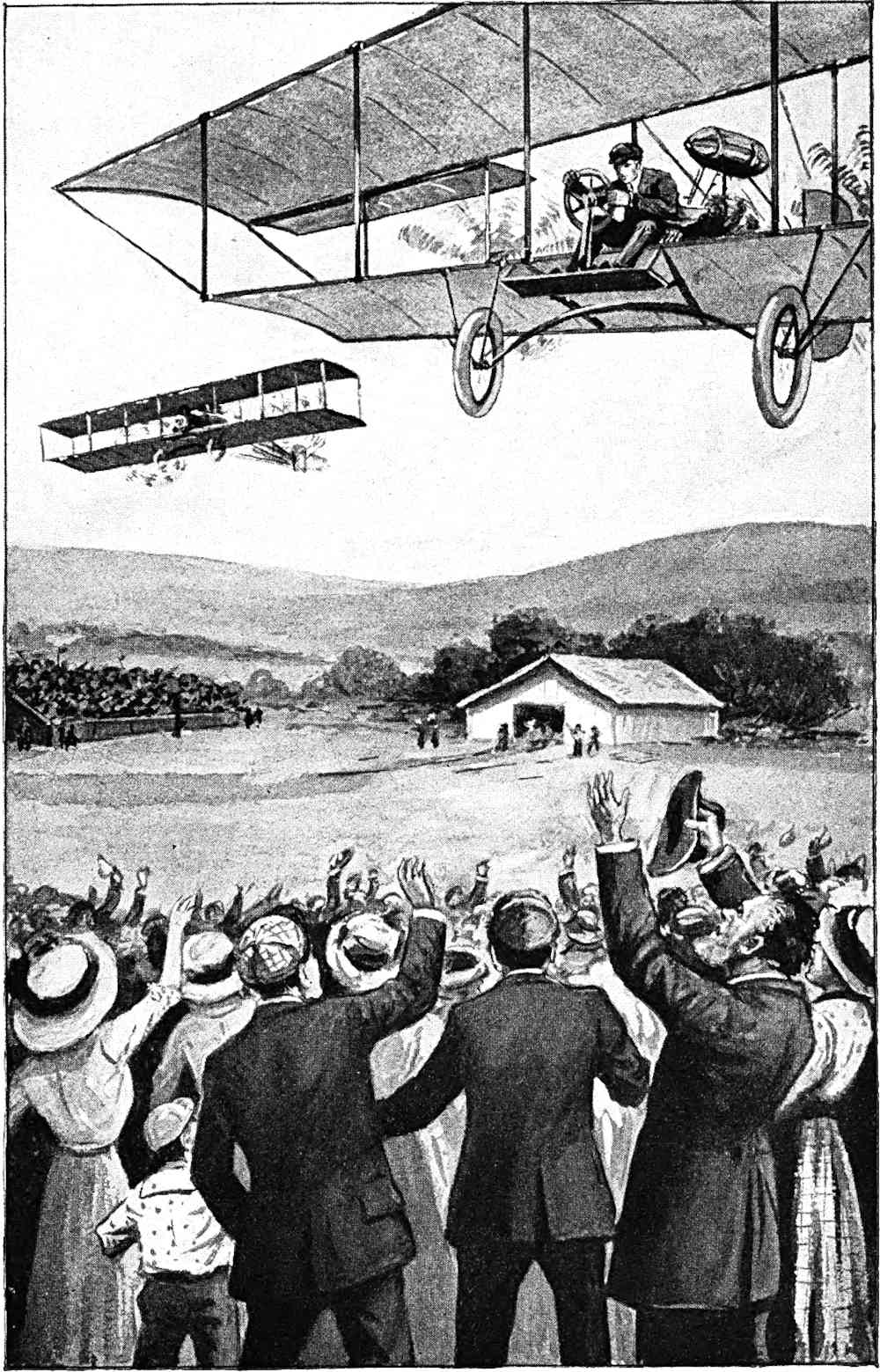
“Yes, but it is a pretty close race!”
“Good for Joe!” cried Harry, enthusiastically. “I knew he could do it!”
[314]
And then amid a wild cheering the Skylark came down in the aviation field, to be followed twenty-two seconds later by the Swallow.
Joe had won the long-distance race for biplanes, and the boys of Lakeport had captured the majority of points for the aero meet!
It was a gala occasion for our young friends. Joe was surrounded and clapped on the back, and some wanted to even carry him on their shoulders, but he would not permit this. As for George, even though he had lost, he was congratulated on the fine flight he had made—having covered the total distance in ten minutes less than had been expected.
“A very fine race, boys!” cried Mr. Corsen. “And a fine meet all the way through! I am proud of all of you!” And then he invited all the participants to a big banquet to be held during the next week,—a banquet at which the various prizes that had been won would be distributed.
“And the best of it all was that there were no mishaps,” said Mrs. Westmore.
“And that we made a lot of money for charity,” added Harry. “We sold over seven hundred dollars’ worth of plain tickets and got two hundred and sixty dollars extra for the grandstand.”
“And we girls made about fifty dollars on cake [315] and ice-cream and lemonade,” said Laura. “We told everybody the money was for charity and they simply had to buy.”
“Oh, it was great!” cried Fred. “I’d like to have another aero meet like it!”
“So would I!” added Link.
“And win every contest,” said Joe, with a smile.
“Right you are!” came in a chorus from the boys.
And here let me add a few words more and then bring to a close this story of the doings of the boys of Lakeport.
When the Westmore boys got home a surprise awaited them. They found Mr. Akers sitting up in a rocking-chair, talking earnestly to a well-dressed stranger of not quite his own age.
“This is my cousin, Mr. Clarence Harkness, from California,” explained the old inventor. “He has been hunting for me for a month and has just found me. I have been telling him about my troubles with Mason and Chase and he is going after them hot-footed at once. I know I can trust him to do just the right thing.”
“I am glad to hear this,” said Mr. Westmore; and a long talk followed between the newcomer and the Westmores.
[316]
The following Monday Mr. Harkness, Mr. Westmore, and Mr. Rush went to Springfield, to interview Thomas Mason and Lamar Chase. They went fully prepared to “lay down the law” and cause the arrest of the two rascals if necessary.
But they had an easy time of it, for both Mason and Chase were thoroughly scared, and willing to do anything to get out of the scrape in which they found themselves. They tried to prove that they had thought Mr. Akers out of his mind and were working for his interests, but the gentleman from California and the men from Lakeport would not listen to this.
“We know you thoroughly,” said Mr. Harkness, sternly. “We want you to give up all his property, and at once. If you don’t, I shall call an officer and have you placed under arrest.”
“Don’t do that!” cried Thomas Mason. “I’ll give up everything!”
“So will I!” added Lamar Chase. “It was—er—all a mistake!” And he sank back in a chair, all but overcome. The transfer of the stock and of the other papers was made that day, and later on came the transfer of the real estate on which the hut was located, where Joe had once seen the two men,—the hut where Andrew Akers had thought to build a quiet home.
[317]
“I think my cousin owes you something for what you have done for him,” said Mr. Harkness to Mr. Rush and Mr. Westmore, after the various transactions were over.
“Not at all,” said Mr. Westmore. “Didn’t he give the boys the biplane?”
“We are glad to be of service to him,” added Fred’s father. It may be added here that later on Andrew Akers built himself a modest home on the land he owned, and there the lads of Lakeport often visited him.
“What has become of Si and Ike?” asked Fred of Joe, one day.
“Oh, haven’t you heard the news?” answered the other. “In some way Mr. Voup and Mr. Boardman heard about what Si and Ike did for Mason and Chase, and they got awfully afraid the pair would be arrested. Si and Ike have been sent away for a vacation in Canada, and this fall both are to go to a strict boarding school up in New York State.”
“Humph! I hope it does ’em good,” put in Link.
“So do I,” answered Joe. It may be said here that Si and Ike remained at the boarding school a long time and when they returned home they were much better boys.
[318]
Thomas Mason and Lamar Chase never made a complete confession regarding their transactions, but from what our friends heard they were able to piece out the affair quite well.
“Chase discovered Mr. Akers at the Runnell cottage and watched him,” said Joe, in talking the mystery over. “He saw the old inventor hide his box in the barn and he got the box, opened it, stole the certificate of stock and other papers, and put those worthless sheets in their places. Then he went to Mason and told that man of what he had done. Mason offered him two thousand dollars, but Chase held off for more. When we went to Springfield—Fred and I—Mason didn’t know whether to say Mr. Akers had any stock in the company or not, for he was not sure he would get the certificate from Chase.”
“Yes, and then they went a step farther and planned to carry the old gentleman off, and did it, and Si and Ike came along just in time to help them,” added Fred.
The banquet of the Pine Lake Aviation Club, as it was called, was a grand affair, and when Joe received the chief prize, in behalf of the young aviators of Lakeport, he felt very proud. He was called on to make a speech and did so, praising all who had taken part in the memorable meet. Then [319] followed a cheer for Lakeport and for all the other participants in the meet. Then of a sudden came a hush, and Bart stepped forward and called up Mr. Corsen.
“You have been our best friend, Mr. Corsen,” said the big youth. “You helped us at baseball, football, at rowing, at autoing, and at flying. In behalf of my fellow members of this Aviation Club in general, and in behalf of the members from Lakeport in particular, I take great pleasure in notifying you that you have been unanimously elected an honorary member of this club, and I am more than pleased to present you with this, the first badge of the organization, and trust you will do us the honor to wear it.” And then Bart passed over a beautiful badge of gold,—a tiny model of an aeroplane, suitably engraved with names and date. The badge was accepted with pleasure by the gentleman who had done so much for the lads of Lakeport; and then followed a cheering that lasted for several minutes.
“Great, wasn’t it?” said Fred, when he and his chums were returning home.
“It was immense!” answered Harry.
“The best ever!” murmured Joe. He looked around at his friends. “Tell you what, fellows, [320] Lakeport is just the dandy place to live in, isn’t it?”
“That’s what it is!” came in a chorus. And here let us leave our young friends, wishing them all well.
THE END