Transcriber's notes: Unusual and inconsistent spelling is as printed.
New original cover art included with this eBook is granted to the public domain.
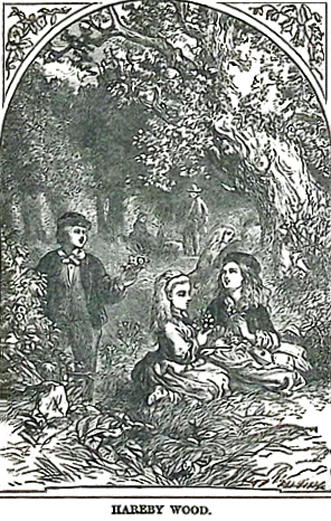
HAREBY WOOD.
CHAMBERS'S LIBRARY FOR YOUNG PEOPLE
Second Series
———————————————————————————
BY
RUTH BUCK [LAMB]

WILLIAM AND ROBERT CHAMBERS
LONDON AND EDINBURGH
1870.
Edinburgh:
Printed by W. & R. Chambers.
CONTENTS.
——————
CHAPTER
I.—THE INVITATION ACCEPTED, AND "THE PARROT AND THE MAGPIE"
II.—A WET DAY, AND "WHAT THE RAINDROPS DID"
III.—HAREBY WOOD, AND "THE STORY OF GRAY DICK"
IV.—THE LAST LOAD OF HAY, AND "THE TWO LITTLE BUDS AND THE LIGHTNING"
V.—BERNARD'S FAULT, AND "THE HOLE IN THE WINDOW"
CONCLUSION.—BERNARD'S RETURN TO SCHOOL
MIDSUMMER AT HAY-LODGE.
—————————
THE INVITATION ACCEPTED, AND
"THE PARROT AND THE MAGPIE."
"THE postman will not be here yet, Marian, so you and Kate had better come to breakfast," said Mrs. Ingram, addressing her two children, who stood at the window, watching eagerly for the arrival of the red-coated messenger, in the hope that he would bring a letter from "Brother Bernard." And Mrs. Ingram herself looked scarcely less anxious, for Bernard was the "only son of his mother, and she was a widow."
The boy had been six months absent at school, and midsummer was just at hand. As it was his first half-year from home, no wonder Marian and Kate, his two sisters—to say nothing of mamma—were counting the very hours which must pass before Bernard could arrive.
Just after Mrs. Ingram had summoned the girls to the breakfast-table, the postman's knock was heard in the street. Marian ran into the hall, to be ready to take the letter out of the box without a moment's delay, and soon returned, exclaiming: "Two letters, mamma, and one is from Bernard!"
Who doubts which was first opened and read by the loving mother!
Her voice trembled, and her eyes were dimmed for a moment with glad tears, as she told Marian and Kate that Bernard would come to-morrow.
Little Kate clapped her hands, and fairly danced round the room in her glee. Ah! She guessed that in some snug corner of Bernard's trunk, there would be a whole pile of small treasures hoarded up, bit by bit, for the little sister at home.
Bernard was turned thirteen years old, and boys of his age can, if they choose, fashion a great many pretty toys to please a little girl of six, yet without spending much of their pocket-money either. And Bernard always did like, and had contrived new pleasures for Kate, oftener than she could tell. But the child did not reckon on her brother's coming home just for the sake of what he might bring; and, to do the little maiden justice, Bernard's gifts were valued far more "because" they were his, than for their own worth or beauty.
Kate was just a little spoiled. She was a very lovely child, with dark eyes, and clusters of soft brown curls. And visitors too often spoke of her beauty, and mamma was apt to give her rather more than her due share of love, because of the child's likeness to the dear husband and father, who died soon after the youngest darling was born.
Marian was not beautiful; but she had a good honest face, and was obedient to her mother, and very loving to little Kate and her brother Bernard. It was Marian who called her mother's attention to the second letter, on which Mrs. Ingram did not at first bestow a glance, so much was she occupied with the one from her son.
This second letter was an odd-looking affair, as Marian remarked to her mother. It was not enclosed in an envelope, but folded in the old-fashioned style, and it had a seal nearly as large as a half-crown, which Kate admired greatly, and declared she should beg of mamma, if it could only be preserved unbroken.
Marian was very much puzzled to guess where the queer letter came from, and began to wish that her mother would not spend quite so long a time upon Bernard's. But Mrs. Ingram was not at a loss; for as soon as she examined the handwriting, she exclaimed: "Why, it is from Uncle Paul!"
The children had often heard their mother speak of her uncle, Paul Parker, who was a young man when she was a little girl; but they had never seen him, and they were very curious to know what he had written about. So, after the seal had been carefully cut round, and handed whole to Kate, Mrs. Ingram read the letter, first to herself, and afterwards aloud to the children.
And this was what the letter contained:
"HAY-LODGE, June 17.
"MY DEAR NIECE—After long years of wandering in many lands, I have at
length begun to find out that I am not so young as I was, and that at
sixty-five I am not so strong as I used to be ten years ago. I have
therefore resolved to stay at home for the future, or, at any rate, not
to travel far.
"I daresay you often wonder whether Uncle Paul—who used sometimes to
pet, but more generally to tease you, when you were a little girl—has
quite forgotten you. He writes now to tell you that he has not, and
that he should be glad to see you and your dear children under the roof
which he has purchased as a shelter for his gray hairs.
"Uncle Paul feels himself a very old man now, dear niece, and is quite
weary of wandering to and fro on the earth. But, though he is likewise
a childless man, he is anxious to hear the sound of young voices in his
home, and perhaps to preach a little—as old men will sometimes do—to
the owners of those voices. So, if you would like to spend midsummer
with one who always loved you, and if you think your youngsters will
have patience to listen sometimes to an old man, come as soon, and stay
as long as you can, with—
"Your affectionate uncle,
"PAUL PARKER.
"P.S.—Tell the young folks that we shall have haymaking directly, and
that I have quite a little farm. Bernard must bring his fishing-rod and
tackle; and if the girls love flowers, I can suit them finely, for I
have both a garden and a green-house."
Marian and Kate were loud in their expressions of delight when the queer-looking letter was read, as what city-born children would not? And they said to each other: "Oh! Won't this be a pleasant surprise for Bernard, if dear Ma will only consent to let us all go?"
Marian was rather doubtful as to mamma's power to promise; for she was older, and knew more of money-matters than her little sister did. She knew that their widowed mother's income had to be managed with great care and economy, and that the cost of Bernard's education was a serious matter, which obliged Mrs. Ingram to deny herself many little comforts for her son's sake.
But Marian had not seen a piece of paper enclosed in the queer letter, and with Paul Parker's name in good bold handwriting at the corner; and so she did "not" know that Uncle Paul had not only given the invitation, but also sent money to pay their expenses to Hay-Lodge; for he was aware that his widowed niece's income was not large enough to meet the cost, so he kindly provided the means himself. It was therefore a pleasant surprise to Marina, when her mother replied:
"Yes, my dears, all being well, we shall go to Uncle Paul's in three or four days after Bernard comes home."
On the following afternoon, Mrs. Ingram and her daughters joyously welcomed Bernard home. Nor was little Kate disappointed when his trunk came to be opened; and mamma and Marian, too, found that, amid all the varied occupations of school, and though surrounded by new companions, the boy had not forgotten them. Then Uncle Paul's letter was read again, and Bernard asked innumerable questions about this, as yet, unknown relative. But mamma herself could tell very little, for many years had passed since she last saw her uncle.
"Only," said she, "I remember he was very full of fun, and used to tell tales to me when I was a child and sat on his knee to listen."
"Then he is sure to know plenty of stories now," said Bernard, "for he has travelled for years in different countries."
"I shall ask him to tell 'me' some nice stories," said Kate.
"Take care," replied her mother with a smile, "that Uncle Paul does not make a story about 'you,' Kate."
But as the little lassie did not know Uncle Paul quite so well as her mother did, she shook her head, as much as to say that he would be puzzled to do that.
What a bustle there was, to be sure, for the next three days! The girls and Mrs. Ingram required but a very short time for preparation; but Bernard had grown out of his clothes, and there was quite hard work for mamma and Marian in making him ready by the appointed day. However, at last they were all comfortably seated in the railway-carriage, and on the way to Hay-Lodge, very much delighted at the prospect of spending midsummer amongst country scenes and sounds, but just a little afraid of this unknown uncle whom they were going to visit.
"That must be Uncle Paul!" said Mrs. Ingram, as the train stopped at the pretty country station, and she caught sight of an elderly gentleman upon the platform.
He had heard the exclamation, and at once stepped forward, saying: "Yes, I am Uncle Paul; and here, I suppose, are Bernard, Marian, and Kate, who, with their mother, I am glad to welcome to Hay-Lodge."
Then followed a great deal of hand-shaking; and Kate, rather doubtful of the propriety of the thing, was kissed by her stranger uncle, whose face she scanned very curiously indeed.
It was a pleasant face, though it had been browned by the sun in a warmer country than England, and it looked rather odd, in consequence of being surrounded with white hair and whiskers, while the eyebrows were still black, and the eyes very dark and keen.
Perhaps Uncle Paul guessed that all the youngsters were trying to read his character in his face, and were taking a good survey of him for the purpose. At any rate, though he glanced kindly at them now and then and held little Kate's hand in his, he talked only to Mrs. Ingram during the drive to Hay-Lodge.
The children were nearly wild with delight at the sight of Uncle Paul's pretty house and grounds; and while their mother rested, they, unwearied with the journey, rambled through the large garden, looked at the poultry, and admired the flowers in the green-house and conservatory. Moreover, the children had quite decided among themselves that this new-found uncle was a person to be loved and trusted.
When they were at length satisfied to rest quietly in the house for the remainder of the evening, Kate required no invitation from Uncle Paul, but climbed upon his knee, and even pulled his white whiskers, to bring his ear closer to her own rosy lips. Kate had a great deal to tell him—about Bernard's presents, their city-home, and of an intended new dress for her doll. Uncle Paul listened with profound attention. He might have been a doll's nurse all his life, to hear how he discussed with Kate whether flaxen hair or black was the prettiest; and how he finally decided in favour of dark curls, because the little girl's own were brown. Kate became more and more confidential, and told Uncle Paul that she loved him very much indeed, and that she intended to ask him to tell her a story the next day.
"What!" said he. "Has your mother been telling you about the stories I used to invent to please her when she was a little girl? A nice task I shall have to satisfy you all!" And he pretended to frown at mamma for betraying him; but somehow the frown turned into a laugh, and spread from face to face, until they all laughed together. And Kate, who appeared determined to expose her mother's conduct further, informed Uncle Paul that she had been warned to take care lest he should make a story about her own self.
"I will tell you a fable this very minute, Kate," said he; "so listen, and when it is finished, you must be off to bed, or you will be sleepy in the morning, when I want you to go and see the mowers in the hayfield."
And without further preface, Uncle Paul began the story about—
"THE PARROT AND THE MAGPIE."
"A magpie one day saw a parrot in a gilded cage, and, being struck with the wonderful beauty of the foreign bird's plumage, determined to make its acquaintance. The parrot—a newcomer to the house—was not particularly pleased at seeing the magpie approach, for Mag was dressed in a sober suit of half-mourning—black and white—you know; and this dress looked draggled, and a good deal the worse for wear; while the parrot's feathers were of all the colours of the rainbow, and glistened beautifully in the sun.
"But Poll was at a loss for society, and so she thought to herself: 'I will put up with this shabby-looking person's intrusion for the present. He appears to be at home here, and can probably tell me a good deal about the neighbourhood. It is lucky that I have no acquaintances at hand, for I should be dreadfully annoyed if any of my well-dressed friends saw me talking with him. However, I can get as much information as I want, and then have nothing more to say to him.' The parrot, you see, had just knowledge enough to be very selfish, but was not so wise as to understand that we should judge people by their good qualities, and not by the colour of their coats.
"When the magpie came up, and bowed politely, the parrot was extremely gracious, made remarks on the weather, and complained of the coldness of the climate, in comparison with that of her own native land. 'Indeed,' said she, 'I should not have left my own country, but for the urgent solicitations of a gentleman, who declared that he could not bear to come home without me.'
"Polly did not think it necessary to mention that the reason the gentleman would not come home without her, was because he had bought and paid for her. It is sometimes unpleasant to own that we have been compelled to undertake a sea-voyage whether we would or not.
"The magpie had a pretty good guess how matters stood; but he was too civil to hint at such a thing. He therefore owned his ignorance of foreign lands, and said he had never travelled far from his native place. Like the parrot, he did not tell the reason he had travelled so little; but the truth was, his wings were clipped, and he could no more take a long journey than she could help doing it. The parrot laughed rather contemptuously, and hinted that it was hardly likely her new acquaintance would be pressed to leave his native place, as his external appearance was not very attractive.
"'Do not judge me by my looks,' said the magpie; 'I am not valued for them, or, I am aware, I could claim no merit.'
"'I thought people were estimated on account of their looks,' replied she, conceitedly surveying her fine feathers, 'or "I" should not be here.'
"'They are partly. I was handsome myself once, though perhaps you would scarcely think it, to see me now.'
"The parrot could not conceal her amusement at the very idea of this ragged stranger's notions of beauty. But when she had recovered her gravity, she asked whether the magpie's company was still valued on the score of good-looks.
"'By no means,' he replied.
"'What, then, may I ask?' said the parrot.
"'I can converse with men in their own language,' answered the magpie. 'I was very carefully instructed by my present master while I was young, and as I did my best to profit by his lessons, I soon acquired this power; and I can assure you it is no mean accomplishment for a bird.'
"'It is one "I" shall never take the trouble to acquire,' returned the parrot. 'I have some notion that the individual at whose house I am staying would like me to do so, but he will never be gratified, though I "could" speak if I chose.'
"'I am sure I should advise it,' replied the magpie, who was far wiser than this vain travelled stranger, and knew that mere good-looks soon lose their charm.
"The parrot quite despised his advice, and was almost offended at the magpie's presumption in offering it unasked. When the master of the house approached shortly afterwards, and began to talk to the foreign bird, she answered him only with a discordant scream, and obstinately refused to profit by his lessons; nay, more, she was ungrateful enough to peck at and bite his finger, and declare in her own tongue that she would not be teased by him. In this conduct she persisted for a long time; but she still retained her place in the gilded cage, and boasted to the magpie that no person could be persuaded to part with so lovely a creature as herself, let her mental qualities be what they might.
"The magpie shook his head, tried to reason with the foolish and ungrateful beauty, and was laughed at for his pains.
"But the time came when the parrot regretted that she had disdained his advice. Disease attacked her; she lost her fine feathers; and like a person dressed in tawdry and shabby finery, she looked all the worse amidst the remains of her once gay coat. Her master, finding she had lost the only attraction she ever possessed, and weary of her harsh voice and ill-temper, turned her out of the fine gilded cage, which was bestowed on a more amiable individual of her species. So the parrot, exposed to the severity of the climate, and unused to seek her own livelihood, perished miserably of cold and hunger, while the magpie's homely coat was never noticed because of his talents and obliging disposition."
Little Kate clapped her hands and laughed when Uncle Paul finished his story; then turning to her mamma with a triumphant look, she said: "This tale is not about me, however, for I am neither a magpie nor a parrot. Am I, Uncle Paul?"
Her uncle stroked back her soft curls, and said: "Certainly not."
But there was a merry expression on his face, and Mrs. Ingram asked: "Are you quite sure, Kate, that there are 'no' little girls who are like the parrot in thinking they need only to be pretty to be beloved, and that it is of no use trying to be good and wise?"
Kate had not thought of that, and her face became grave at the idea her mother's words suggested. Poor little lassie! "She" did not guess what a good use Uncle Paul made of those keen dark eyes of his, or how much he had already noticed the characters of his young relatives.
But bedtime had come, and active as the children were, they began to yield to the feelings of weariness which stole over them, so they were not sorry to say good-night to Uncle Paul, after exacting a promise that they should be called early, to go to the hayfield.
——————————
A WET DAY, AND "WHAT THE RAINDROPS DID."
THE morning brought disappointment with it: it rained, so there was no chance of going into the fields for that day at least. The children stood at the window watching the falling drops, and regretting the change in the weather.
At last Bernard said: "It is of no use watching, Marian, for even if the rain were to cease, the ground would be too wet for walking; so I shall read."
Assisted by his uncle, Bernard hunted out a large book on botany, of which the boy was very fond, and went off with it into the green-house; then Uncle Paul undertook to provide Kate with amusement, and the two were soon deep in pictures of gay-coloured birds and insects.
Uncle Paul asked Marian if she would like a book also, but she said: "No, thank you, uncle;" and continued to watch, in an Idle listless way, the falling raindrops, and to listen to their pattering upon the leaves and windowpanes.
Marian was one of those people who, if disappointed in a little matter, take a long time to forget it and make up their minds to do some thing else. The very fact of not being able to obtain her wish, made her only wish the more.
Uncle Paul did not interfere with his elder niece, but amused himself with Kate and her picture-books, to the intense delight of the child, who was in perfect raptures at the tales he told her about real birds and beasts which he had seen in far-away lands. He glanced now and then at Marian, and after a while closed the book, saying:
"Now, Kate, you shall have another story about—"
"WHAT THE RAINDROPS DID."
"Very early one morning, all the raindrops in a big cloud held a consultation to consider what answer should be returned to a petition they had just received. This petition was from the flowers, who begged that the raindrops would favour them with their company as soon as possible, for if they delayed visiting them much longer, they—the petitioners—would soon disappear from the face of the garden altogether.
"One of the raindrops was for refusing the invitation. 'No doubt,' it said, 'the flowers will be much the better for our visit, but "we" shall not; beside, the sun will have to fetch us back again by degrees, and we trouble him so often. I should prefer remaining where I am.'
"'But the flowers will die!' said a considerate little raindrop, just ready to flutter off by itself on an errand of mercy.
"'That would not affect us!' said the first speaker, who thought only of its own convenience, and did not care a straw for the flowers.
"'But think again, how grateful the flowers are! They distil their sweetest scents as a token of welcome, and put on their gayest dresses in our honour. Beside, think that it will do them good, and it is always a true pleasure to confer a benefit on grateful people.'
"Here a third raindrop began to speak. '"I" am doubtful whether, after all, we shall not do more harm than good. There is the hay, which does not want us, to say nothing of the haymakers and the children who are longing to be in the fields. If we once start, we cannot stop ourselves, but must fall on more than the flowers, or I should be quite willing to visit "them."'
"'Oh, the sun will put the hay to rights again!' said the cheerful little raindrop. And away it went, and dropped plump on the very nose of a poor widow woman, who was just off to the hayfield, instead of falling, as it intended to do, on the rose-bush under the cottage window.
"'O dear, dear, what a pity!' said the poor woman. 'I do believe it is going to rain. If it should begin, what will the children do? We have bread for the week—thanks to him who does not forget the fatherless and the widow; but I thought to get clothes with my earnings, for without new ones, the poor things will soon be naked. Oh, if the rain had but come two or three days later, I should have earned the stuff to make these clothes of! Then a wet day would not have troubled me, for I could have sewed at home, instead of losing my time, as I shall to-day.'
"'I wish I had not come,' thought the raindrop; 'for here, instead of doing good, I am likely to do harm. However, I did it for the best, and perhaps none of my companions will follow me.'
"They did though, patter, patter, one after another, as hard as they could pelt; and after giving the poor widow woman a hint that they wished to visit the plants, and not herself, she was fain to go back into her cottage and shut the door. No chance for haymakers that day.
"It is all very well to watch the raindrops when people might do something else, if they liked; but it is not quite so pleasant when they are wishing to work, but cannot, for want of materials. However, the poor widow was one who tried to make the best of things, and she considered that there would be plenty of work after the rain was over, for everybody would be anxious about the hay. And even while she sat mending her children's poor bits of ragged clothing as well as she could, she was unselfish enough to think of those other children who would be disappointed of their ramble amongst the new-mown hay, though, to be sure, it had inconvenienced her far more than it had them.
"The raindrop that had first objected to coming down to the ground held out as long as it could; but as the others rushed that way, it was borne onwards with them, and fell just under a window, where a young girl was standing, regretting that she was kept a prisoner by the rain. She was not quite like the poor widow; for instead of making the best of things, and employing herself in some pleasant occupation, she continued to yearn after what was out of her reach. The raindrop noticed this, and said: 'You see I was right after all; we should have stayed where we were, and then the children might have had a merry day in the hayfield.'"
When Uncle Paul had reached this part of his story, he looked at Marian, and observed that she was no longer watching the raindrops, but listening to his words. He made a slight pause, and the young girl, with a blushing face, left her place by the window, saying: "Uncle Paul, you are telling that story about me!"
"That you are!" cried Kate. "'I' knew that ever so long since."
"Why, I never mentioned a single name," said Uncle Paul, pretending to look indignant, and, completely failing in the attempt. "I have no doubt there are plenty of little girls watching the rain beside Marian. Come, let me finish my story."
"May I finish it for you, uncle?" said Marian smiling.
"To think of that, now!" replied he. "Do you hear this chit, mamma? Actually going to take my business out of my hands the very day after her arrival at Hay-Lodge!"
"Dear uncle," said Marian, "I beg your pardon; I did not mean to take the words out of your mouth: only I thought—"
But Uncle Paul laughed; and she saw he was not really offended, though he did pull her ear, and declare that he would not finish the story on any account, and therefore she must.
"Well," said Marian, "I should tell that by the time the unwilling raindrop had expressed his regret for having come down at all, the girl had found out that it was selfish in her to think only of her own pleasure and convenience; and she made up her mind that, instead of wasting the rest of her morning in useless longings after what she could not obtain, she would spend it in a more profitable manner."
Marian paused, and Kate said: "Was that anything like the ending you would have made, Uncle Paul?"
"Do you suppose I shall tell how I should have concluded the tale, pussy? But after all," he added, with an approving glance at Marian, "I like the way your sister has finished it, and hope the 'girl' will adhere to her resolution, for Time, my little woman, is a talent too precious to be wasted on useless repinings and vain regrets."
"I should be glad if you will answer me a question, uncle," said Marian. "Is the poor widow a real person?"
"I never said my story was true, my dear," replied her uncle; "but I certainly 'do' know a poor widow who has two very ragged children; and I fancy if we had gone into my hayfield to-day, we should have seen the whole family there."
After this, the young girl held a whispered conversation with her mother, and later in the day, she might have been seen stitching very rapidly at a small garment, which, from the homely materials of which it was composed, could scarcely be intended for dainty little Kate.
Uncle Paul asked no questions, though his niece continued her work until bedtime, and would not be persuaded to take a run round the garden after the rain was over. The next morning, Marian's busy needle went as rapidly as before, and she could hardly be induced to take time for her meals. Even the hayfield seemed to have almost lost its attraction for that day, though, when the children came back after a visit to it, Marian resumed her work, and Uncle Paul was taken into her confidence, and told what it was for.
The little garment at which the girl was sewing was destined for one of the widow's children; and Marian declared she should not rest until she had made, with her own hands, a complete suit of under-clothing for each of them. Uncle Paul thought this was a very good idea; but both he and Mrs. Ingram advised Marian to be moderate even in her work, yet careful to finish what she had begun.
Marian looked quite confident in her own powers, and soon had the pleasure of taking two little articles of clothing to the poor widow, and of receiving her grateful thanks, which the young girl found quite as delightful as the perfume that the flowers gave in gratitude for the visit of the raindrops.
In the first flush of her pleasure, she told the widow what more she intended to do, and of the pile of small garments which lay ready cut out at home. The widow's eyes filled with tears of gratitude; again and again she thanked Marian; and the girl returned to Hay-Lodge, very happy in the thought that she had made another so by means of a little industry and self-denial.
But there are a great many stitches in two complete suits of under-clothing, even though the garments be of small size, and more than a "little" self-denial would be requisite in order to finish them. In the first warmth of a good resolution, Marian worked very hard indeed—almost too hard, thought both her mother and Uncle Paul, though neither of them interfered with her movements. So when Marian had presented the two first finished articles to Widow Jones, she decided on taking a rest before she commenced any more; and it happened that she spent an hour or two amongst the plants with Bernard, and a similar time with Kate and the chickens. Then Uncle Paul took Mrs. Ingram and the children to see a lovely little waterfall in the neighbourhood; so that, what with one thing and another, the whole day slipped away without a single stitch being taken by Marian.
The following morning was as fine as possible, and Marian said: "I don't think I shall sew to-day, mamma, for all the birds and flowers are inviting me out of doors. And how deliciously the hay smells! The scent comes in at the window like a nosegay."
"Your uncle has arranged for a picnic to Hareby Wood to-morrow, Marian," replied Mrs. Ingram, "and the day is therefore already condemned. Would it not be better for you to work for an hour or two this morning? Remember you have promised, of your own accord, to help in clothing those fatherless children."
"And surely, mother, you do not think I shall break my promise?" said Marian, looking rather hurt at the idea.
"I am sure you do not intend to break it, Marian."
"And you will see it fulfilled, mother, if I live; but you know we all came to Hay-Lode for a holiday, and I cannot always be at work."
"Well, my dear, you shall do as you please. You undertook this labour of your own or I should not have advised you to promise so much, because I well knew how many things would combine to tempt you to lay it aside."
Marian turned away, feeling scarcely satisfied with herself; and thinking that perhaps it would be better to devote an hour or two to work, in fulfilment of her promise. But Kate came at the moment to coax Marian into the fields; and Marian persuaded herself that it would be unkind to refuse her little sister.
To be sure, if she could have read her own thoughts clearly, she would have found, as Uncle Paul would say, that they were "speaking one word for Kate, and two for herself." No wonder that, with such a pleader as Inclination to second her words, Kate trudged off triumphantly, with Marian by her side, to join Bernard and Uncle Paul in a fishing-excursion.
No wonder, either, that it was late in the evening when they returned, for, unknown to the children, that provident uncle had contrived that they should find an ample lunch in the basket which he carried. And, lo! at tea-time, they arrived at a pretty cottage on the bank, and found there not only a very superior meal, but mamma herself, ready to make tea for them. So they were quite tired when they reached Hay-Lodge, and went off to bed to get a long sleep before to-morrow's picnic.
——————————
HAREBY WOOD, AND "THE STORY OF GRAY DICK."
THE picnic was to be different from most such parties, for Uncle Paul was to furnish "all" the dainties, and the young guests to bring only themselves. Mamma was to be the one grown-up lady present, and that on condition that she would not be above riding in a great wagon with the children and provisions, and would sit upon a hamper, with some hay on the top, by way of a cushion. To these conditions mamma good-humouredly consented, and took her place on the large hamper, with a little one for a footstool, lest her toes should suffer amongst so many restless feet, which kept beating-time to the music of their owners' glad hearts.
It was the most delightful mode of conveyance—rather slow, for there was a heavy load; but the wagon was on springs, and the distance only three miles. Mamma said it carried "her" a long way back, even over five-and-twenty years, and made her once more a child amongst children.
As to Uncle Paul, he joked and rattled on so as to put everybody in the best possible humour during the journey to Hareby Wood. Then mamma was first handed down from "the four-wheeled carriage," as the youngsters called it, and afterwards the little folks, the wagon being drawn up under a great tree, and the horses taken out.
Uncle Paul's loving temper proved infectious, and a spirit of kindliness, not always to be found amongst children out for a holiday, reigned amongst his guests. There were no little toddlers left behind to cry after those who were fleeter of foot, no disputes about the place in which they should dine; and when Mrs. Ingram and Uncle Paul were led to the chosen spot, they each and all declared it was charmingly suited for the purpose.
It was a circular hollow, in a beautiful part of the wood. Its sides were fringed with trees high enough to shelter them from the heat, but not to shut out the sun's bright rays. At the bottom was a little rise, which might have been made for a fairy-table, it answered so capitally for that piece of furniture.
Then, before dinner, away went the children to seek for flowers and gather wild-strawberries, which seemed ever so much sweeter than those brought from home, because gathered at some cost of time and trouble.
Often the children startled the hares, which bounded off at their approach, fleet as the wind; or squirrels, which darted up the trunk of a tree, and leaped from bough to bough, almost as fast as a bird flies. The air, too, teemed with music, and not the least pleasant part in dear Uncle Paul's ears was the sound of the children's merry voices ringing through the wood. And, to be sure, at dinner-time the good things "did" disappear fast from that grassy table!
After dinner, while the children rested, it was unanimously voted that Uncle Paul should tell a tale, and, a donkey happening at that moment to bray, Uncle Paul said: "That reminds me that I have a story to tell you about a donkey," and thus began—
"THE STORY OF GRAY DICK."
"Everybody said that Gray Dick was by far the handsomest donkey at Beacham. Instead of being of a dingy, grizzled brown colour, as most of the other donkeys were, Dick was a beautiful light-gray, and his coat was smooth, and almost silky looking. To tell the truth about it, 'his' sides had not been battered by attendant-boys as theirs had; neither had he, as yet, been nearly run off his legs by carrying people on his back from 'early morn to dewy eve' like the others, at the rate of sixpence an hour, which the master got, while the poor donkeys had not so much as an extra thistle all the summer through.
"But Gray Dick was a newcomer 'just out,' and quite a youngster. It was his very first season by the sea-side, and he was rather proud of his new brown Holland housings, bound with brightest scarlet; of bearing the very best of Beacham saddles; and of being placed in the most conspicuous position on 'the stand,' as the very prince of Beacham donkeys. Such a position was a temptation, and calculated to turn the head of any young donkey.
"Dick was proud of his sleek skin and new clothing, and gave himself many needless airs in consequence. He even taunted some of his elder and less attractive companions because they obtained so little notice in comparison with himself. However, he soon began to find out why his neighbour, 'Brown Jerry,' shook his long ears in that sagacious way without a word of reply to his sneers; and what 'Old Grizzle,' at his right hand, meant when she advised him to wait a little while before he began to bray over other people, as though he were the only handsome donkey in existence.
"Gray Dick found out that there were penalties which donkeys must pay for the privilege of occupying a distinguished position, as 'all' persons of rank do discover, sooner or later. He never had a minute's rest. From daylight to dark, he was always at work, in consequence of his being young, strong, and handsome. All the boys and girls, when they came to the stand to choose a donkey for an hour's ride, wanted Gray Dick; so the poor fellow was nearly worked to death, because people liked him the best.
"Sometimes, he resolved he would not bear it any longer, and he threw himself down, and rolled on the sands, heels uppermost. Then he found that the attendant-boy paid no respect to his handsome coat, but just hit him as hard and with as thick a stick as if he were the oldest and ugliest donkey at Beacham. So poor Dick was fain to get up and trudge on again, though his legs were fit to break with weariness. After all, it is of no use fighting against necessity. If we have duties to do which are hard and disagreeable, it is always the best way to work as steadily, and do as much and as well as we can, instead of struggling against what we cannot help; because, you know, then we have a quiet conscience.
"Before Dick was quite exhausted, the weather began to grow cold, and the company gradually left the sea-side; but, to the very last, he had cause rather to regret his good-looks; for so long as any person was left to take an hour's ride, Dick was the donkey called for to carry him or her, as the case might be.
"The longest day must have an end, and so must the longest summer. Dick had just begun to rejoice that his troubles were over for the present, and that he should have a long rest, when another cause of uneasiness came into his mind: how was he to be fed during the winter? He overheard his master say, that he did not know how to keep all those donkeys, now they were earning nothing.
"If Dick dared to have spoken his thoughts in donkey-language, he would have said:
"Master, be pleased to remember how hard I worked during the summer. Then, I and my companions earned enough to support you and all your family, and I know you have some money put by in the old square tea-caddy for a rainy-day.'
"But Dick dared not speak, and his master was unfortunately one of those persons who are apt to forget past benefits if the least thing goes contrary to their present wishes.
"Luckily for Dick, but unfortunately for his master, one of the man's children fell sick. The doctor was called in, and happened to hear the father grumbling because his donkeys cost so much and earned so little during the winter. Now, the doctor had a field with nothing in it, so he said:
"'If you like to send one of your asses to me, I will keep him during the winter; only my little boys will want a ride sometimes.'
"'Come and choose which you will have,' said the man, quite delighted at the doctor's proposal.
"Who doubts that Gray Dick was the donkey selected, the very instant he came in sight? That same evening, he was sent to his new quarters, with his master's compliments, and the young gentlemen need not be afraid to ride the gray ass, as he was strong, and very well-behaved in general. It was a good change for Dick, who was put into a large field, and a horse sent to bear him company.
"At first, he was quite delighted with the improvement in his prospects, but, after a time, he began to grumble because the horse was put into a stable at night, and he was only allowed to shelter himself in an enclosure without a roof. This was a far more comfortable place than his late companions of the stand were in. They were turned out on a bare common near the sea-shore, and, let the weather be what it might, had no shelter at all. Dick ought to have considered how much worse off others were than himself; instead of that, he only thought of those who were still better off, and envied them their good-fortune.
"Dick, in prosperity, was by no means humble; he complained bitterly to his neighbour, the horse, of the manner in which he was treated, instead of being grateful for his position and comforts. The horse was a good-natured creature, and, when he had heard his companion's doleful tale, he very politely said: 'Do step into my stable; there is room for us both.'
"In walked Dick; but when the groom came to give the horse his supper, he turned him out again without the least ceremony, to the intense mortification of the donkey.
"Dick sulked the next day, and made up his mind not to let the doctor's little son have a ride on his back; but when he found that if he persisted in such conduct, he would be exchanged for another donkey, and sent to take his chance with his brethren on Beacham Common, he wisely gave in. Still, it was only out of consideration for himself that he yielded, which was not a very good motive, for we ought to have a kindly feeling for the convenience of others also.
"Soon after, Dick's companion, the horse, was taken away from the field, and he felt very lonely indeed. The horse had been very kind to him, and, like all well-bred persons, never boasted of his superior position in society, or looked down upon Dick, in order to make him feel his inferiority. This ought to have been a lesson to his little gray friend; but it was not, for, some weeks afterwards, when a cow was put into the field, Dick affected to consider her beneath him. When, at length, his longing for society in a manner forced him to make friends with the cow, he was always boasting of the company he had kept, as though his having been 'with the horse' had raised him above the generality of donkeys. The cow—good, homely body!—listened quite admiringly to Dick's tales, not only about his late companion's regard for him, but also respecting the manner in which he was sought after at Beacham, while he occupied the first place on the stand there during the past summer.
"When Dick had an opportunity of giving his opinion of the cow to any passing acquaintance that chanced to walk close beside the palings, he always lamented that he was doomed to have such a companion; 'for,' as he remarked, 'how can a dull creature like Brindle enter into my feelings, or form an idea of fashionable life? If she could but spend a season at the sea-side, it would be an excellent thing for her, and would improve her manners and intellect.'
"So the foolish donkey went on, pretending to despise the cow, while in his own secret heart, he was very glad indeed to have her company, but far too proud to own that honest Brindle 'could' be of consequence to a person of such importance as he fancied himself to be.
"One day, Gray Dick heard the click of the gate, and, on looking round, saw a man with a blue linen coat on. He imagined the stranger was come to call upon him; but no—Brindle was wanted, not Dick, though he tried to push himself before the cow, and attract the visitor's notice. If he had known all, he would not have been so anxious to make this man's acquaintance.
"At first, Brindle appeared inclined to get out of the way, but the blue-coated man held a piece of cake, and she was induced to follow him quietly. When Dick saw she was nearing the gate, he determined to go too, for he remembered his lonely days, and dreaded being left by himself again. This was not allowed. A smart blow over poor Brindle's flank made her spring forward, and a stroke from a stick drove Dick back. The gate swung to, and the donkey was sole tenant of the field once more. He was not ashamed to shew his feelings then. He battered the gate with his hoofs, poked his head over the palings, and never heeded when their sharp points hurt him; but it was of no use. He could not open the gates or bring back poor patient Brindle, who received more than one blow because she kept turning to look at Gray Dick, and to low a farewell in answer to his impatient bray, that begged her to return as soon as possible.
"That very evening, as Dick was looking over the palings, hoping to see his companion on her way back, he caught sight of the blue-coated man wheeling a barrow. On this lay something that made Dick's blood run cold; it was either poor Brindle's skin, or that of a cow very like her. Taking all things into consideration, there could be very little doubt of Brindle's fate. And at that very moment Dick was making good resolutions. The absence of his humble-minded friend had rendered him sensible of her merits. All her patience, gentleness, and goodwill had struck him as things most desirable in a companion. He felt sorry that he had often been contemptuous, conceited, and short-tempered, and was determining on a different course of conduct, when he found out that, so far as she was concerned, the opportunity was gone for ever."
Uncle Paul looked round at his little hearers, and added: "Gray Dick was a good deal like many people, both young and old—they do not value the kindness, love, and patience of those who are their everyday companions until they are deprived of them; and often, when it is too late, they begin to make good resolutions. Still, if they 'have' done wrong in one instance, they may be careful not to commit the same fault in another."
"But what became of Gray Dick?" asked quite a chorus of young voices, whose owners wanted something like a positive ending to Uncle Paul's story of the donkey.
"Why, after spending some weeks without so much as a sheep to bear him company, he was sent back to Beacham, to the fashionable society about which he used to talk in boastful language. Being still strong and good-looking, he retains the favour of the public, but would most gladly exchange it for the quiet pasture, and the society of such another friend as poor Brindle. Dick is not so proud as he used to be, though, and has even owned to Brown Jerry and Grizzle—this is of course in confidence—that he was a very foolish fellow in his young days, and did not know when he was really well-off."
"And now, then, away with you for another scamper through the wood, children!" said Uncle Paul. "Yet do not forget the moral of Gray Dick's story:
"'Be thankful for all the blessings you possess, but do not boast of
them; and use them well, for fear they should be taken from you, if you
neglect so doing.'"
The youngsters thanked kind Uncle Paul; and then away they went in various directions to seek flowers, and make the wood ring again with their laughter.
When the children all returned to the place which had served as a dining-room, they were enchanted to find that tea was to be prepared also out of doors, and that a kettle was to be slung and water boiled in true gipsy fashion. It was new work for them to gather sticks to keep up the fire, and to assist in getting tea ready. It seemed quite a pity when it was all over, and the dew upon the grass gave warning that they must return home. Then mamma was mounted upon the hay-cushioned hamper, now lightened of its contents; and in good-humour, but very tired, they rode back to Hay-Lodge in the great wagon.
Uncle Paul would not tell any stories on the way home, for, he said, if he were to begin, they would all go to sleep, and then it would be a tale wasted. The children promised to keep awake, and laughed and coaxed, but it was to no purpose; and when they reached Hay-Lodge, it was found that more than one little sleeper had to be roused. As to Kate Ingram, she was fast asleep on Uncle Paul's knee, with her arms round his neck, and her curly head resting on his shoulder. But everybody, old and young, declared that no day had ever been spent more pleasantly than that at Hareby Wood; and no carriage was ever better fitted for conveying people to a picnic than Uncle Paul's great wagon.
——————————
THE LAST LOAD OF HAY, AND "THE TWO LITTLE BUDS AND THE LIGHTNING."
WHILE these pleasant rambles and excursions were going on, of course there was no time for sewing. Marian's working-materials were all put out of sight, and so were those little garments which she intended to make for the poor widow's children. For two or three days after the visit to Hareby Wood, there were no long rambles, and the young people amused themselves at home; so that had Marian been inclined to bestow even a portion of her leisure upon the work she undertook—voluntarily, in the first instance—she might have made great progress.
It is the fault of many children that when they commence a thing, they work very hard indeed for a short time, and then, for want of a little perseverance, it is left unfinished. This habit of beginning many things and completing none, was a great failing of Marian's. When they were at home, Mrs. Ingram took pains to correct this bad habit in her daughter; and though she kindly allowed her ample time and opportunity to consider whether she should really like to undertake any fresh piece of work, yet, when once begun, she did not allow her to throw it aside until it was finished. And Marian had been daily expecting a reminder from her mother respecting those little garments, which pressed with a very heavy weight, considering how small they were, upon the girl's mind. But not a word was said, either by her or Uncle Paul, although Marian had found out that he was very keen-sighted with regard to the faults of children, though so gentle in his rebukes, and anxious to make the young happy.
Now, Marian felt that she was doing wrong in neglecting to complete her undertaking; she knew that she was allowing a bad habit to gain more ground upon her, yet size lacked resolution to conquer the disinclination to resume her labours. Often when she went into the fields, she quite dreaded a meeting with the poor woman or her children, lest their looks should appear to ask why she was so tardy in fulfilling her promise. But nothing of the kind happened. Mamma and Uncle Paul never uttered a word on the subject; and Marian, while wishing that she had never talked about what she meant to do, began to think at last that her pledge to the poor widow was forgotten by everybody. She missed the pile of little garments, too, from the top of the work-basket, but she did not ask for them "then."
She thought to herself: "The first rainy-day that comes, I will begin to sew again, and it will be time enough to inquire when I want them. If I say anything now, perhaps I shall have to stay in-doors, and this is such a lovely afternoon, I 'must' enjoy it. Beside, it is good for my health to be out in this fresh pure country air."
Whenever people "want" very much to follow Inclination instead of Duty, they generally find out some way of shewing that it will benefit them either in mind or body, and poor Marian was no exception from this rule. Thus the time wore on very pleasantly in a general sense, but still Marian could not help a feeling of self-reproach that came in the quiet hours, and reminded her of her unfulfilled promise to the poor widow, and of her unfinished work.
One lovely afternoon, just after dinner, Uncle Paul said; "Children, the last loads of hay will be brought home to-night, and there will be a little rejoicing amongst the work-people. Nothing like a harvest-home, you know; but still it is the fashion, in this part of the country, to deck the last wagon with green-boughs, and then the youngsters ride into the steelyard amongst them, and shout and hurrah. Now, as I have you young visitors, I should like you to go into the field, and when the last load is safely in the stack-yard, I daresay you will have no objection to distribute a few hot buns and some milk to the haymakers' children. They will come in their holiday-frocks and pinafores to-day."
Kate and Bernard vowed they should like much to attend to the wants of Uncle Paul's poorer guests, and thanked him for giving them the opportunity; but Marian's face was red and hot, and she remained silent.
She was thinking: "Ah, if I had only given a little time, and deprived myself of an hour or two's amusement each day, the poor widow's children might have had neat new clothes! As it is, they are all unmade, and for the present useless."
Most likely Uncle Paul noticed the expression of his niece's face, but he made no remark about it. He only added: "Make haste, then; get on your bonnets, and we will go to the field directly that we may have one more rest under the sweet-scented haycocks, before the last is put upon the wagon, and brought home into the stack-yard."
Marian was very silent on the way to the field, but all the rest were as full of spirits as possible. They chose a pleasant spot to sit in; and the hay was piled so nicely in the form of seats that mamma declared it made the most delightful of cushions. Bernard and Kate then ran off towards the work-people, but Marian sat still with her mother and Uncle Paul, though she was longing to take a fork and help like them to gather up the hay that remained.
An hour afterwards, Bernard came bounding towards them. "You have lost your chance of any more haymaking for this year, Marian," he said; "the wagon is just off with this load, and the remainder, which will not fill it again, will be the last. I suppose you will come, by and by, to help to stick the green-boughs on the children's bonnets and hats, for they all intend to be decorated, I can tell you."
"Bring Kate here, then," replied Uncle Paul; and while the wagon is away, "I will tell you just a short story."
The announcement of a tale from Uncle Paul was always sufficient to bring Kate to his side as soon as she could get there. She needed no second summons to take her place on the scented heap of hay, and then Uncle Paul told them all about—
"THE TWO LITTLE BUDS AND THE LIGHTNING."
"'I think I shall live to see another day's sunshine!' said a large blue convolvulus, as she watched the sun sinking in the west. 'It cannot be true that a flower so beautiful and perfect as I am, can be intended to last only a single day! To be sure, all the other flowers, my companions that are still open, tell me that they have lived no longer than myself. That is likely enough, though; and as we all opened together this morning, most probably we shall close at the same time, to re-open when the sun comes round again to the place in which I first saw him. If I thought I were going to fade and die, I would say a few warning words to these young buds that I see around me. But it cannot be. I shall have an opportunity of talking with them to-morrow: another day's experience will give more weight to my warnings.'
"Just then the evening breeze blew rather chilly across the flower, and she felt herself beginning to shrink inwards with an involuntary motion. The movement was a warning, to tell her that life was nearly ended for her.
"'I am going to sleep!' said she. She did not believe it could be Death so close at hand, and she so young and beautiful. Alas that it should be so! The young and the beautiful die as well as the old and withered. The convolvulus saw all around her the shrivelled forms of numbers of other kindred flowers, and yet she thought within herself that death would not touch 'her.' The sun was all the while sinking slowly, and the breeze blew colder and colder round the frail flower, making the corolla shrink again.
"'Ah!' said she. 'This going to sleep is not a pleasant sensation. Perhaps I feel it the more, because it is my first time of closing up. I shall be stronger and better able to bear it to-morrow.'
"She talked of to-morrow, though she felt that the light of day was going away from her, and that she was beginning to look like those other withered-up forms around her, which were a few hours before as beautiful as herself. So that it was only at the last moment of her life that she began to imagine it possible that death, and not sleep, had seized upon her fair form, and faded her lovely hues.
"Then in a voice like a faint sigh—which the wind was obliging enough to carry to the two buds respecting which she was solicitous—she said: 'When the sun shines upon you next, you will know what life is. You will enter into its full enjoyment, but your existence depends upon his presence. When he disappears, you will die as I am dying now, and your beauty will be gone, never to return. I ought to have known what to expect, from what has happened to others of my race, but I have lived my short life as if it were never to end. If the time were to come again, I would—'
"Here the good-natured zephyr, which had hovered round the dying flower in order to fulfil her last wishes, and deliver the message with which she charged him, began to sigh and moan as he wandered in and out of the leaves. The convolvulus was dead! Faithful to his trust, the wind told the buds all that their departed relative had said. It was quite dark while they listened to his sad story; and after they had thanked him, they asked him to describe the appearance of this life-giving sun, whose presence would bring the power to see him to themselves.
"'What is the sun like?' asked one of the buds.
"The wind thought it was a queer question, for as the bud had never yet been opened, it could not know what anything was like.
"'He is like nothing else,' replied the wind softly. 'You will see him shine out bright and glorious, high up in the sky. His rays will warm you; and you will gradually increase in strength and beauty, so long as he shines upon you. Yet do not forget that your existence depends upon his presence, and that when you lose sight of him, you will die.'
"'What a sad fate!' said both the little buds together. 'Oh, if we might live a little longer than one short day!'
"The night-dew which lay upon their leaves dissolved into round drops, and fell as if the plant were in tears at the prospect of death; and the little buds murmured again, as they swayed themselves to and fro, to think that they were not longer lived.
"'Take comfort,' said the zephyr kindly; 'you are more fortunate than you think; you know exactly how long you have to live, and can prepare accordingly. I can assure you that few are so favoured, though all know they must die some time.'
"'What! Will all the roses, lilies, pansies, and other flowers whose scent you have brought us, die too?' asked the buds.
"'Every one!' replied the zephyr. 'Moreover, they are very liable to die violent deaths. Only this very day, I saw numbers of them severed from their parent-stems by the gardener's hand, and I know they must die the sooner for it. He passed all the flowers of your kind without taking one, because, he said, they would close so soon, it was not worth while to take them. Thus, you see, the very thing you regret has its advantages. Every station has some peculiar to itself, if we only take pains to find them.'
"'But this death must be so terrible!'
"'Not always,' replied the zephyr. 'I have passed in at windows into the habitations of men, and though I must confess that I have seen many who were afraid to meet it, I have known others who rejoiced at its approach. Take comfort, little flowers! In 'your' short life, you may gladden some eye and heart by your beauty; and if you are the means of doing that, or of leading any to think of the Great Hand that made you, you will not have lived in vain. At the worst, remember you share the common lot. The beasts and birds, worms and insects, 'all die.' The stately oak may live a thousand years, but must yield at last; and there are even some amongst the children of men who die as young as the frailest flower of the field.'
"The little buds were greatly cheered and comforted by the words of the zephyr, and they thanked him very heartily.
"'I am glad if I have been of service,' the zephyr replied; 'and now I must away.'
"The buds begged him to stay longer, at least till they could shew their gratitude by opening their azure cups for him to drink the morning dew from them. It could not be. The zephyr was obliged to go.
"'I am a great traveller, and roam the earth over,' answered he. 'It is not often that I stay anywhere so long as I have done with you; but I am in a soft mood to-night. I must be many a mile away before morning.'
"He sighed as he left them; but duty called, and, whatever his inclinations might be, he would not allow them to interfere with what was right. He bade the little buds 'good-night,' said that a brother of his from the East was about to pay them a visit, but he hoped they would not see much of him, as he was scarcely to be deemed a desirable acquaintance.
"Their gentle friend had scarcely made his exit, when the two little buds became sensible of the arrival of another member of the same family—a boisterous individual, who saluted them so rudely that he knocked them one against the other without the least ceremony. They very heartily wished him a thousand miles away; and no wonder, considering their peculiar circumstances. The rain began to fall next in very large drops, which half-drowned the poor little buds, and were nearly knocking them off their stems. How anxiously they looked for the appearance of the bright sun! For they began to fear that, if they were long exposed to such rough usage, they should not survive to see the light of day. All at once, a brilliant light shone out upon the poor trembling buds.
"'This is surely the sun!' cried they, for the light was so bright and dazzling that it darted down the centre of their corollas. Before the exclamation had all escaped them, they were again left in total darkness; but a hollow rumbling sound, which shook the very earth in which they stood, next alarmed them more than the glare had done. Then one little bud began to doubt whether that could have been the sun.
"'There was light enough, to be sure,' it said, 'but warmth there was none. It dazzled for a moment, and then disappeared so very suddenly that I only felt the darkness the more.'
"'Beside,' replied the other, 'when the sun comes, it will remain as long as our life lasts, and we have not yet grown into perfect life.'
"At this moment, both the buds were startled by another bright flash, and then another. The pouring rain fell heavily on their tender forms, and the rumbling noise increased in loudness. The buds shook and trembled with terror. They knew not what to think, for they had not been forewarned, and they could not help imagining that if the sun's presence were to be ushered in thus awfully, they should dread instead of hoping for his coming.
"A rose that was near at hand, and had overheard the conversation, now bowed her queenly head—for she pitied the frail buds—to explain matters to them.
"'These flashes of light,' she said, 'are not caused by the sun's rays. His presence brings warmth and comfort; but Lightning, as these flashes are called, often brings destruction. I have seen it dart through a great tree, and cleave it quite in two, leaving the halves black, scorched, and withered. But do not be frightened. I cannot say that I ever knew it attack such humble individuals as yourselves: that great tree is in far more danger,' and she bent towards an oak in the neighbourhood.
"The little buds thanked her humbly for the information, and began to feel the truth of what the zephyr had previously told them—namely, that every station has its advantages as well as trials. They heard the rumble of the thunder, and saw the lightning without fear, and, after a time, both ceased entirely. The boisterous wind took its departure, and was, followed by a gentler brother from the South, whose company was a very pleasant change for them.
"By and by, a soft but continuous light reached them, and they felt constrained to open their corollas to greet it. Then they saw the sun, and felt its warm-rays shining upon them. The south wind waved them lightly to and fro, and thus shook off the heavy drops which still clung to them; and as the sun rose higher, he dried up the rest with his kindly beams. The buds were now fully expanded into flowers, as perfect as those which had decked the plant the day before. The rain had done them no harm, but rather good, and they turned themselves towards the source of light, conscious of what they owed to him, and resolved to rejoice in the good they possessed 'while it was theirs,' yet prepare themselves to resign life without a murmur when called upon. The flowers were in the full pride of their beauty still, though it was far past noon, and the sun was beginning to decline, when two young girls entered the garden, and advanced towards them.
"'See,' said one of the girls, 'what a lovely colour! This blue is like a reflection from the sky.' As she spoke, she bent over the twin-flowers in turn, and seemed to be drinking in joy at the sight of their beauty.
"'They are lovely,' replied her companion; 'and, as you say, they are as a reflection from the sky, for the same God that made them, spread that glorious firmament over our heads.'
"'How perfect they are!' said the first speaker, still stooping over the blossoms. 'Is it not wonderful that these flowers, which are but to last a single day, and then to die, are endowed with such marvellous beauty?'
"'It is indeed,' was the answer. 'And surely He who made them had a purpose in thus forming them. Surely, "we" may learn a lesson from them also.'
"'What! To admire the wisdom of their Creator and ours?'
"'Everything we see teaches that. But does it not seem, sister, that these flowers especially remind us that, even as our Creator has finished with equal pains the stately oak, and the blossom which lives and dies within a day, so should we perform those duties which are comparatively trifling in our eyes with as much zeal as we give to the greater ones.'
"'Doing with our might whatsoever our hand findeth to do,' added the other sister softly. 'Thanks, little flowers, for the lesson you have taught us!'
"The two girls passed their hands tenderly over the bright convolvuluses once more, and then left them, tremulous with delight.
"'Ah,' said they both together, 'what joy it is to think we have not lived in vain! But this morning, we were lamenting at the thought of coming death; now, we shall give up life with such different feelings, for we know that a remembrance of us will remain in the hearts of the gentle and good! We have done all we could do; "we have sown the seed of a right thought, and who knows what good actions may spring from it?"'
"Calmly and quietly, the twin-flowers waited for death; and when the sun sunk in the west, they closed for ever, gladdened by the knowledge that they had not lived in vain."
As Uncle Paul ceased, he saw that Bernard's face was grave, and that down Marian's cheeks the tears were trickling fast, while Kate clung more closely than common to his side. The story had brought "solemn" thoughts to them all, but "sad" ones to Marian only.
"I did not wish to make you unhappy, my darlings," said Uncle Paul tenderly. "But is it not as well to look at both sides of the picture? Death is as certain to overtake each of us as it is the little flower which lives but for a day. And yet, while we love to look at all which belongs to life, we shrink from looking at what is every night brought a day nearer to each of us. Uncle Paul is growing old, my darlings; his hair is white. It is summer 'here' now, but for all that, 'he' is in the winter of life. He does not know whether the season will be a short or a long one; but he knows it is the last of the four, and that his spring, summer, and autumn are gone already. He looks back on them, and often wishes that he had done more and better than he has. So he preaches to you, children, that you may begin to work while it is yet your spring-time, and have the less to regret should you live until life's winter."
There was no answer in words when Uncle Paul finished speaking; but Kate kissed his cheek again and again, and passed her little fingers lovingly through his white hair; while Bernard pressed his hand, as if by way of pledge that his words should not be thrown away. Down Marian's cheeks the tears now flowed like rain, and Uncle Paul guessed that conscience was reminding her of a neglected duty. So putting Kate aside, after a loving caress, he passed his kind arm round Marian, and said:
"Dear child, I have a word or two to say to you in particular. Shall I send these others away, and whisper them in your ear only?"
He waited for her reply, and Marian answered in a low voice: "No, dear Uncle Paul; let them hear what you say to me. Then we shall all learn something more from your story."
"I was thinking, my darlings," said Uncle Paul, "that when we do a single kind act, from the mere impulse of a moment, and not habitually because it is right, we are like the flash of lightning, which dazzles for a moment, but makes the darkness seem all the greater when it is gone. For instance, Marian here worked very hard for a little while to perform an act of kindness. Her gift to the poor widow's children came upon them as unexpectedly as the flash of lightning, and her promise of further help raised a degree of hope in their minds, which, not having been fulfilled, must have caused far greater disappointment than the mere absence of the promised comforts could have occasioned. The disappointment was thus the greater darkness that followed the flash of light and hope. Now, the true and steady charity which springs from the habitual feeling and principle of right, is just like the bright sun, whose course is continued, to cheer and bless, from year to year, and whose mode of noting is only varied for the benefit of what it shines upon.
"Uncle Paul has done preaching now, children," added the dear old man; "and see, here comes the empty wagon, in good time, to fetch the last load of hay!"
Marian dried her tears, and they all rose from the ground to go and meet the merry group of children who had come in the wagon. Amongst them Marian distinguished the forms of the poor widow and her little folks, and she whispered to her uncle: "I am so sorry I have been lazy and forgetful of my promise, Uncle Paul. I shall be punished by the sight of those children who might have had their new clothes, if I had worked in my spare hours half as hard as I did at first."
"They are not ragged, though, Marian," said her uncle.
To the young girl's great astonishment, she saw that the widow's children were dressed in new frocks and pinafores of the very same stuff as she had chosen.
"One would think, Uncle Paul," she remarked, "that some good industrious fairy had taken pity on them, and finished my work."
"It was some one who is both good and industrious, but no fairy, Marian." Uncle Paul glanced towards Mrs. Ingram as he spoke, and Marian knew the truth.
"Oh, mother," said she, "I know now why you have spent an hour or two every day shut up in your own room. You were doing the work which my hands ought to have finished."
"Yes," interposed her uncle, "mamma has acted the part of the good fairy this time, and I hope the lesson will not be lost upon you, my dear. For, remember, through using up the 'fragments' of her time only, she has been enabled to confer a great benefit on these poor people. She has joined us in all our excursions and rambles, yet the remnants of leisure, well used, have sufficed for this work. You may cast aside fragments of anything else you please, and pick them up afterwards, but time once thrown away, is gone for ever."
There was no more preaching—as Uncle Paul called his kind warnings—after this. Bernard, Marian, and Kate found enough to do in decorating the little children with flowers, and the wagon with green-boughs; and when the small remaining portion of hay was put into it, the youngsters all rode home together in triumph. When they reached Hay-Lodge, the large kitchen was quite a sight. Long tables were set out, and covered with white cloths, and large cups placed on them. These, the three children filled with new milk, and as soon as the spice-buns were drawn hot from the oven, all the young guests were seated at table, and liberally supplied with them, to their great satisfaction, by Bernard, Marian, and Kate.
After the meal, they had a hearty romp on the lawn; and at eight o'clock, each child was supplied with another bun, and sent home in high glee, and very grateful to Uncle Paul for the treat he had given them. Only city-children, like the little Ingrams themselves, can understand how delightful these country scenes are.
——————————
BERNARD'S FAULT, AND "THE HOLE IN THE WINDOW."
UNCLE PAUL was extremely fond of flowers, and had a particularly choice collection of foreign plants, which he had gathered at great cost and pains during his travels. In his green-house and conservatory were many flowers of rare beauty, and in these Bernard took very great delight. He and his uncle watched with almost equal interest for the opening of the buds; and so careful had the boy been in his movements amongst the plants that to him was intrusted the daily watering of some of the very choicest of all the floral-stock.
The day after the hay was gathered in, Uncle Paul and Bernard were in the green-house together. They were both quite absorbed in admiration of a beautiful plant which was just bursting into bloom.
"This will be quite fully opened by to-morrow," said Uncle Paul. "I am very glad of it; for two ladies, neighbours of mine, have long been curious to see a flower of this species, and this of mine is a very uncommon variety. You will be sure to take particular care not to injure it, for the stem is as fragile as the flower is lovely."
"I will take care, uncle," replied Bernard. "Shall I carry it into the conservatory this afternoon?"
"Either this evening or to-morrow morning will do, Bernard. But do you think you are sufficiently experienced to handle such a delicate affair as this? Never mind," he added quickly and kindly as he saw the boy's colour rising at the question; "I place reliance in your care, Bernard."
"Thank you, uncle," was the reply; "I will do my best."
Uncle Paul then left the green-house; and Bernard, quite proud of the trust reposed in him, proceeded to perform his daily duties there. Afterwards, he attended to the whole of the plants in the conservatory, for the gardener had obtained three days' leave of absence from his post that he might visit an invalid brother.
It happened that Bernard had made arrangements to accompany some youths, whose acquaintance he had made at the picnic, on a fishing-excursion that day. He had just completed his task in the conservatory, when they came to call for him, so he made great haste to prepare himself, and in a few minutes was ready to set out with them. It was dusk in the evening when the boys returned, and much later than Bernard had calculated on being absent from Hay-Lodge.
After displaying the fruits of his excursion to the admiring eyes of Marian and Kate, he threw himself upon a seat, saying: "How tired I am! I think I never in my life felt so weary as I do to-night!"
A moment afterwards, he remembered that some of the sashes in the green-house had been left open to admit air, and he hastened to shut them at once, feeling uneasy lest any of the plants might have suffered from exposure to the night-air. Uncle Paul he knew to be from home, and likely to be detained till rather late. The evening was very warm and mild, and the moon shone brightly in as he entered the green-house. He hoped no harm was done, and eagerly but cautiously he stepped up to the place where the plant stood respecting which his uncle was so anxious.
How beautiful it looked in the soft light! How the now full-blown flower bowed the delicate stem, while half-opened buds around it gave the one perfect blossom additional charms! Bernard could scarcely admire it sufficiently, and he quite longed to see it reigning the very queen of the conservatory.
After having fastened the sashes, he lifted the pot containing the plant, in order to place it in its new abode. Uncle Paul and he had arranged what position it should occupy in the morning, and, as Bernard thought, there was nothing in the way; but when he reached the conservatory, the door was shut, and he was obliged to place the pot on the ground whilst he opened it. As he raised it again, he stumbled slightly, and bruised the stem of the plant between his arm and the door-post. Much alarmed, he hastened to place it in the appointed spot, and then examined the stem to see if it were injured, and if so, to what extent. To Bernard's great regret, he found that the stem was partially crushed, but so far the flower and buds were untouched. Hoping that the injury it had received would not spoil its appearance, he left the conservatory, feeling anything but comfortable, and joined his mother in the drawing-room.
Only a few minutes afterwards, Bernard heard his uncle's voice in the hall, and soon the kind old gentleman entered.
Uncle Paul asked his nephew how he had enjoyed his day on the water, and then inquired if the sashes in the green-house were closed.
"Yes," replied Bernard; "I attended to them as soon as I came in; but it was rather later than I expected it would be before I returned."
"The air is so warm and mild that it has done them no harm, I am sure, Bernard," said his uncle. "And how did 'the' plant look? You know it stands first in my favour at present, and I hope it will not disappoint me to-morrow."
"It was full out, uncle, and looked very beautiful," returned Bernard in rather a low voice. Most heartily did he echo the hope that the plant would retain its beauty, and be none the worse for the accident; but he greatly feared the contrary.
"Did you move it into the conservatory?" asked Uncle Paul.
"Yes, uncle, since I came home."
Uncle Paul rose from his seat. "I will just go and have a peep at it," said he. "Thank you, my dear niece," he added, addressing Mrs. Ingram, who offered him a light, "I shall not take a candle. My beautiful plant will look all the more lovely in the pale moonlight. Come, Bernard, and share my pleasure, keen florist that you are."
For the first time during his visit, Bernard felt reluctant to obey his uncle's summons; but, unwilling as he was to enter the conservatory, he was still more unwilling to refuse, and he rose instantly and followed.
Uncle Paul's eyes, though they looked so dark and keen, had seen a great many years of hard service, for he had not gone through life with them shut, in any sense of the word. When he stood opposite to his favourite plant, he did not observe the bruised stem, though the injury was quite visible to Bernard, who knew all about the cause of the hurt; he only noticed how beautiful and perfect the shape of the flower was, and how admirably it was placed to display its loveliness, and then he turned to leave the conservatory with his nephew, who locked the door, and handed him the key.
During the few moments they had been there, Bernard was several times on the point of mentioning the accident to Uncle Paul; but his courage failed him, and he remained silent, fervently hoping that all would be well, and that no confession would be necessary. But he did not rest very comfortably that night, though he was so weary with his long day out of doors. Anxiety of mind, and the thought that he had not dealt frankly with his kind uncle, overpowered even his fatigue, and kept him from resting until daylight.
It was in vain that Bernard tried to stifle his inward monitor, Conscience, by saying to himself: "I told my uncle nothing but the truth." Conscience always answered promptly: "'Yes, but you did not tell the whole truth.'" In vain, too, did Bernard argue that Uncle Paul was so just and kind that he would not be angry at the effects of what was really an accident. His heart quite sank within him when he recalled the pleasure which Uncle Paul took in his floral-treasures, and particularly in the injured plant. So the morning came, breakfast-time passed, the carriage of Uncle Paul's visitors was heard on the gravel, and Bernard had not yet said one word about the bruised stem.
"Where is the conservatory-key?" asked Uncle Paul, as he was about to lead his guests thither.
"You have it yourself, uncle," said Bernard. "Do you not remember I gave it to you last night?"
"To be sure you did, my boy." Then turning to his guests, he said: "The flower of which I spoke to you is now fully blown; I saw it by moonlight; but you will, I doubt not, find it exquisitely lovely this morning." With eager step he advanced to the spot—and, lo! the stem was bent down, and the flower half-withered. It would be hard to describe his disappointment and regret as he pointed out the mischief.
"The stem has been crushed," said one of the ladies, as she examined the plant; "but there are still sufficient proofs left to shew how very beautiful a perfectly fresh flower must be."
She and her companion continued to examine and praise the wreck of the lovely bloom; but, for a few moments, poor Uncle Paul was unable either to speak or to listen, and Bernard's cheeks were wet with tears.
"Who can have done the mischief?" said one of the ladies.
The kind old gentleman's face brightened, as he answered: "No one, my dear lady. And this is to me a great source of comfort under what is to a florist a serious disappointment. My nephew and I came together late last night to look at this plant, and left it all right. From that time until we entered the conservatory, no one can have been here, for the key has not been out of my own possession. Bernard and I are equally disappointed; but, after all, it is so pleasant that there is no person to blame. The stem must have been diseased, or eaten by some insect."
When Uncle Paul knew that anything could not be amended, he never indulged in useless lamentations or murmurs respecting it; and thus, on this occasion, though he certainly cast a regretful look or two towards his favourite plant, he did not grumble and fret over it. On the contrary, he guided his visitors through the conservatory and green-house, accompanied also by Mrs. Ingram, with a face as cheerful and good-humoured as though his hopes had been all fulfilled. There was still an abundance of attractions, and when all the choice plants had been examined, the two ladies had almost forgotten the spoiled flower in their admiration of those around them, so select was Uncle Paul's stock of floral-beauties. They left Hay-Lodge quite delighted with their visit, and enriched by the gift of several plants from their kind entertainer's own store.
Bernard, however, was by no means happy. He knew that his uncle did not for a moment suspect that he had had any hand in injuring the plant, and was convinced, too, that he could not discover the cause of its altered appearance.
But conscience would not let him rest. This thought was continually present: "I ought to have told my uncle the whole truth. Though I have not spoken a falsehood, this allowing him to remain under a false impression is the same thing. How I wish I had told him all about it last night!"
Poor Bernard! He was just experiencing the truth of the words: "The longer we defer a duty, the more difficult it is to perform;" and when that duty is to confess a fault, the difficulty is increased many-fold by every hour's delay.
Uncle Paul could not fail to observe Bernard's grave face and sorrowful looks, and he fancied the boy was grieving over the loss of what had been for some time past an object of interest to him also; so he kindly said: "You must not let the loss of the flower grieve you, Bernard; it would only have been a thing of a day, after all, and we saw it in perfection. Beside, there are two more plants of the same kind to flower, though they are not so forward as the fading one; and if the first should open while you are here, we will go ourselves and present it to the young ladies who were here to-day."
Bernard gave a sickly sort of smile. His uncle's words were far harder to bear than reproaches would have been. He was indeed thinking about the flower, and wishing that he could either summon courage to tell his uncle all about it, or forget it altogether.
"Now, we must turn the conversation. Who will talk about something else?" cried Uncle Paul cheerfully, yet just as though he could not find another word to say.
"Turn it yourself, uncle, if you please, with another story," said Marian.
"What! You want Uncle Paul to begin preaching again, do you? I thought you must have had enough of my stories. You have all been such good children lately that I seem to have nothing to preach about. Still, for fear you should take it into your heads to be naughty in order to furnish me with a subject, I will tell you a tale about—"
"THE HOLE IN THE WINDOW."
"The stone had gone through, sure enough, and left a round hole in the pane, and the boy who had thrown the stone, startled by the crash, stood for a few seconds quite still upon the road, gazing at the result of it. It was wonderful how many thoughts went through the lad's mind in that short time. He had very often been warned not to throw stones, because it was an idle, mischievous, and likely to be also a destructive habit. As he stood, his mother's very words seemed ringing in his ears—words which she had said that morning but an hour before. Yet the warning had been unheeded, the mother's command disobeyed, and there stood Arthur Franklin, as if rooted to the spot, gazing at the hole in the window.
"It was not a very large hole. The stone had been sent through with such force that it had only just made a passage for itself, and the remainder of the pane was very little cracked. Arthur looked round, but there was no person within sight. The sound of the broken glass had not attracted the attention of the inmates, and the cottage stood by itself. The fractured pane was in one of the front windows, and Arthur thought that, most likely, the good woman who was the mistress of the house was somewhere in the back-garden. He had often seen her there, and she had said good-morning to him many a time as he passed on his way to school. He felt very sorry that he had broken her window, and if he had had any money in his pocket then, he would have tried to find her, in order to pay for the mischief. But Arthur's pockets were quite empty; he had not a single penny to call his own; for he was rather an improvident individual, and when he received his monthly allowance, always spent it directly, saving nothing for a time of need. He knew that in order to act justly, he ought to find the good woman of the cottage, point out the damage he had caused, and then own his fault to his parents, and ask them to give him money to have it repaired.
"'But,' argued Arthur within himself, 'I know that my mother and father will both be so much displeased at my disobedience, that, if even I escape any other punishment, I shall be obliged to pay back the price of the broken pane out of my own pocket-money; and I want to buy so many things for myself.'
"These thoughts passed very quickly through Arthur's mind, far more quickly than I can tell them, for they occupied but a few moments; and selfishness conquered justice, as it too often does. After making quite sure that nobody was near, he ran away from the spot as fast as he could, leaving behind him, as the only trace of his visit to the neighbourhood, that hole in the window.
"Arthur had another motive for wishing to receive his pocket-money untouched: the yearly fair was just at hand, and what boy does not like to have something in his bank at such a time? Still Arthur ought to have done what was right first of all, though it might cost him some striving against self. Yet, although he had counted what he would have had to pay for taking a straightforward course, he had not calculated what would be the cost of wrongdoing. That was to come; and he found that, though no mortal eye had seen him, Conscience, stern taskmaster, took him to task, and accused him continually.
"The morning after Arthur broke the window, he was obliged to pass it on his way to school. He felt very uncomfortable as he neared the place in company with two or three other boys, but he did not turn his head to see whether the mischief had been repaired, though he was very anxious to know.
"'Just look!' cried one of his companions; 'somebody has broken a pane in that window. What a round hole! It might have been cut out.'
"Arthur was thus in a manner forced to look; for if he had refused, he might have been suspected. He did not feel better satisfied with himself when a second lad said: 'The people who live there are very poor. The man is often ill, and there is a large family. I daresay he cannot afford to have the window mended.'
"'And it must have been broken from the outside,' remarked the first speaker, 'for there is no glass on the road. If anybody has done it, and not paid the poor people, what a shame it is! Isn't it, Franklin?'
"Arthur could not help answering in the affirmative, though it was no very pleasant task thus to confirm with his lips the sentence which his conscience had already pronounced against him.
"For a whole fortnight, Arthur passed the broken window four times each day on his way to and from school. At first, it was a very hard matter, but it became less so by degrees. Three days before the fair, Arthur's grandfather came to pay a visit to his parents, and when he went away, he presented his grandson with half-a-crown.
"'You will manage to get rid of this at the fair, Arthur,' said the old gentleman with a pleasant smile. 'There will be the wild-beasts to visit, and I know not what beside. I shall give your cousin Frederic the same, and you can spend the money as you think good.'
"'Thank you, grandfather,' said Arthur in high glee.
"'But can you keep your half-crown untouched until the fair, do you think, Arthur?' asked his mother.
"Now, Arthur had not intended to keep the whole of the half-crown to spend at the fair. Though he had thought less about that hole in the window of late, conscience would not let him quite forget it. So, when the silver coin was placed in his hand, his first thought had been: 'Now, as I have received this present of money which I did not expect, I will at once devote a part of it to the mending of that window. It will not cost me more than one-and-sixpence, perhaps not so much. I shall have a shilling left, which, with my month's allowance, will be quite enough to spend at the fair; and I shall have what is better still—a quiet conscience.'
"Mrs. Franklin's remark was rather an unfortunate one. Arthur felt himself bound to shew that he 'could' keep his half-crown untouched until the fair-day, unless, indeed, he were to tell his mother to what purpose he meant to devote a part of the money. To the latter course he could not make up his mind, so he replied:
"'I can keep my half-crown whole, grandfather, as my mother shall see, for I will shew it to her on the fair-day morning.'
"His mother still looked rather doubtful, and she laughed as she answered: 'If you do, Arthur, it will be the first time that you have ever accomplished such a feat.'
"Arthur was rather afraid lest he should spend the money, after all his resolutions, so, for fear of yielding to temptation, he locked it up in his little treasure-box, quite determined not even to touch it again until the appointed time. As he passed the hole in the window, he thought, with no small pleasure, that in two more days he should repair the damage, for, though he had determined to save his money for so long, in order to shew that he 'could' do it, he had not lost sight of his original plan with regard to the ultimate disposal of the half-crown.
"Whenever we determine to do right, it is always best to put our resolution in force at once. 'Delays are dangerous,' as the copy-slips say, and so Arthur found them. In the first place, it was very hard to resist the inclination he felt to take the half-crown out of the box again, just to shew it to his school-fellows, that they might know what pleasures he should be able to purchase at the fair. However, he did resist that temptation, and only boasted of his riches, instead of displaying them.
"The fair-day brought greater trials along with it. Arthur triumphantly exhibited his half-crown whole, and received his monthly allowance besides; but even then he found that his cousin Frederic had more money than himself, because he had saved a little beforehand. Still the boy thought he would pay for the broken window, and he put a shilling and sixpence aside for that purpose; but first one attraction, and then another, tempted him to spend. He was habitually prodigal, and he was dissatisfied when Frederic bought anything for himself, unless he followed his cousin's example. Thus, before the evening came, he had spent all the money that was really his own, and he had not yet been to see the wild-beasts.
"'Now for the show!' said Frederic, as the two boys rose to leave the tea-table.
"'I will go with you as far as the marketplace, where all the shows are,' replied Arthur; 'but I think I shall not go in.'
"'Oh, nonsense! Why, you have never seen any wild-beasts, have you?'
"'No,' said Arthur; 'and I should like very much to go; but it will cost a shilling.'
"'To be sure it will; but that is not a great deal considering; and you cannot tell when you may have another chance, if you miss this. I have thought more about seeing them than anything else; and if I had not had money enough, I should have spent less this afternoon. Come along. I know you have eighteenpence left, and the fair only comes once a year.'
"Arthur wished 'he' had spent less; for he had bought several things he really did not want, just to be like his cousin. 'I don't mind going with you, Fred,' said Arthur again, 'but not into the show.'
"However, Fred was quite satisfied with this promise, for he knew Arthur's disposition well, and had no doubt he should have his company, whatever resolutions he might make to the contrary before they started.
"Truly, Arthur would have found it quite hard enough work to keep firm to his purpose, had he stayed at home; but when he reached the marketplace, and heard the music of the attendant-band, while the roaring of the wild animals sounded even above the drums—when he saw several of his school-fellows running up the steps of the show—and, above all, when Fred was on the point of leaving him, to follow their example, all his good resolutions melted away like snow in the sunshine. The shilling passed into the hands of the money-taker at the entrance, and Arthur's last sixpence was left in solitude at the bottom of his pocket, though Frederic had still pence in store with which to buy cakes for the elephants and nuts for the monkeys, things which Arthur had entirely forgotten.
"However, his cousin good-naturedly gave him half of his own store, saying, as he did so: 'You must not break into that sixpence, you know, Arthur, for you will want it by and by.'
"'What for?' inquired Arthur.
"'Why, the beasts will be fed in about half an hour, and if we want to see them, we must pay an extra sixpence. Of course, you'll pay. I shall, for I know that is a sight, and it would be provoking to turn out just when the best is to come.'
"Arthur hesitated, knowing he had already spent too much; but then, thought he to himself: 'Sixpence will not mend that hole in the window. I shall be obliged to wait another month before I can pay for the broken pane, at any rate. The window will not run away in the meanwhile, though the shows will be all gone; so I may as well see all I can.'
"Thus, once more, selfishness conquered justice. Arthur did stay; he spent his last sixpence, and returned home at night very weary, the possessor of several useless toys, and still burdened with the thought that he had committed a wrong action, and neglected to repair the evil when he had it in his power. In his own quiet bed, after the excitement of the day was over, the boy's conscience again made itself heard, and, grieved at his folly and weakness, the lad moistened his pillow with tears, while he wished he had had strength of mind to keep his resolution, but wished in vain. All at once, a veiled figure took him by the hand, and led him out into the open air. Arthur knew not how he passed over the ground, but, almost immediately, he found himself in front of the cottage by the road-side, and gazing at the broken pane in the window.
"'That was your work!' said the figure that still accompanied him, and now pointed with outstretched finger to the broken pane.
"In a trembling voice, Arthur owned the truth.
"'And you have wasted the money which would have repaired the damage on things that you did not want.'
"It was of no use to deny it. Arthur replied that he had; that he had 'intended to pay for the mending of the window, but—'"
"He stopped, and his strange companion said: 'I will finish the sentence for you. You preferred indulging your own selfishness at the expense of justice.'
"These sounded hard words, but Arthur felt their truth, and could not utter a syllable in his own defence.
"'It is of no use to make good resolutions,' said the stranger, 'unless we carry them out. These very resolutions are witnesses against us, because they prove that we know what is right, though we do not practise it. Follow me, and you shall see what you have done beside breaking the window.'
"Away through the open door into the cottage went Arthur's mysterious guide, and the boy was impelled to follow him, though much against his will. In front of the fire, in a rocking-chair, sat the good woman of the house, and on her knee she held a baby, whose cries she was vainly endeavouring to still.
"'Ah, poor baby,' said the weeping mother, 'you are in pain, and I do not know how to relieve you; and it is all owing to that broken window, which let in the bitter piercing east wind all the night through. And to think I never found out that some careless or wicked boy had broken our bedroom-window while I was in the garden. And the piercing wind blew in upon you and your father that night; and I never found out what made it so cold till the morning, when daylight shewed me that hole in the window.'
"'O dear, dear!' groaned poor Arthur. 'What have I done? I knew I had broken a window, but I never thought I had injured any "person" by that.'
"'Very likely not,' replied his guide. 'It is not often that people can count the exact amount of harm they will cause by even a single wrong action, or a little step on the path of evil.'
"The baby still wailed and cried, and the mother's tears fell on its wan face, when a feeble voice from the inner room cried: 'Wife, will you bring me a drink? My tongue is parched, and my throat "so" dry.'
"The woman pressed the poor baby more closely to her breast, and rose from her seat in order to supply her husband's want.
"'We will go with her, and see all that is to be seen here, Arthur,' said his companion. So they entered the inner room where the father lay.
"The sick man eagerly drank what his wife offered—it was but cold water—and then he said: 'I wish the poor child would cease crying; it keeps me from sleeping, and I think, but for it, I could rest. The little darling is suffering, like its father, from the terrible cold it caught by sleeping just under that hole in the window. And you, my dear wife, will be almost worn out with waiting on us both. It is terrible to lie here, and think that I "ought" to be at work, yet can do nothing!'
"The wife tried to hush the baby; said a few kind, comforting words to her husband; examined the broken pane, to see whether the rag she had stuffed in to keep out the cold was still in its place; and then hurried out of the room again, to weep in silence.
"'Come and see what makes her weep,' said Arthur's guide.
"'I suppose it is on account of her husband's illness,' said the boy, while his own tears fell fast.
"'Not altogether,' was the reply. 'Come, and I will shew you more still.'
"Arthur followed the stranger into the pantry. There was no meat to be seen, nothing but dry bread on the shelf, and only a scanty supply of that. Then they looked into the cupboard, and saw that there were only a few grains of tea in the bottle, which the poor woman used instead of a canister; indeed, there was scarcely anything like food in the whole house.
"'Do you know how it is that these shelves are bare, and the dishes empty?' asked the guide.
"Arthur felt very unhappy, but did not speak.
"'I will tell you,' continued his companion; 'it is because the hands that at the best of times are not strong enough to earn much, are now so weakened by pain, that they must be idle, though that sick man would be glad to work. And what can the poor weeping mother do, with the sick husband and child to tend almost night and day? It will be very hard, indeed, when morning comes, and she has nothing at all left but dry bread and cold water.'
"Arthur thought of times when he had been ill, and remembered how many dainties were brought, in the hope of tempting him to eat, yet all in vain; and he fancied to himself how hard it would have seemed to him if 'he' had had nothing but bread and water at such a time.
"'Oh, if I could but do anything!' he cried aloud. 'How I wish I had told the whole truth at first, and then, though I might have been punished, these poor people would not have suffered through my fault.'
"He burst into a passion of tears as he cried: 'What shall I do?—What shall I do?'
"At that moment, Arthur lost sight of his stranger-guide, the cottage and its inmates vanished, and he opened his eyes to find that he was lying on his own comfortable bed, while his mother stood beside him.
"'Why, Arthur,' said she, 'what is the matter with you? You cried out so loudly, that I heard you down stairs, and ran up in haste, fearing you were ill, and I found you sobbing in your sleep, as though you were in great trouble.'
"Arthur sat up in bed with a strange, bewildered look on his face, for he was scarcely awake yet. It was a great relief to find that he had been dreaming, and had not really seen the inmates of the road-side cottage in such distress.
"'What were you dreaming about?' said his mother. 'I am afraid you have eaten too many good things to-day.'
"'I was dreaming about the hole in the window, mother,' returned Arthur.
"The boy was far too much excited and disturbed to go quietly to sleep, so he at once told his mother all about his disobedience, and the mischief that had been the result of it, as well as the resolutions he had made to repair the damage, and the manner in which he had broken them.
"'For more than a fortnight, mother,' said he, 'I have felt very uncomfortable indeed. Though nobody saw me break the window, I have always felt as if a voice were telling me about it whenever I have passed the cottage. But I am so glad that last was a dream!'
"'I am not at all surprised at the feeling of self-reproach you have experienced, Arthur. Conscience always will tell us of our faults, though no human being knows that we have committed them. It was conscience that was busy with you to-night, Arthur. It filled your mind with troubled thoughts, which continued after you fell asleep.—Now, what shall you do to mend the hole in the window?'
"'I have not one penny left, mother. I wish I could sell the toys I bought to-day; I would take half the money I gave for them. Mother, will you buy them?'
"'No, my boy; they would be useless to me. Beside, I think it will be better for you to keep them as a remembrance of ill, or rather unjustly, spent money, and a warning to be wiser and more just for the future. However, I will, if you like, advance you enough to pay for the mending of the window, and you can repay me out of your pocket-money.'
"Arthur was very glad to embrace his mother's offer, and his mind being so far set at rest, he was able to sleep quietly during the remainder of the night. On the following day, his mother kindly went with him to the cottage, and explained all to the good dame, who held up her hands in astonishment.
"'Well, to be sure,' said she, 'I never thought we should find out who broke our window; and now, after all this time, the young gentleman has owned to it. Better late than never, they say. I should have had it mended a long time since, but I never could spare eighteenpence to pay for it, for my husband has been out of work.'
"'I am very sorry that I did not tell you before,' said Arthur, 'but I hope you will forgive me.'
"'That I will,' said the good dame. 'There's not much harm done, except that a hole in the window doesn't look very nice stuffed up with rag—does it, ma'am?'
"Mrs. Franklin said: 'No, indeed. But I think it will be a lesson to my son to do what is straightforward, just, and honest another time, for he tells me the sight of this broken pane has troubled him every day since he first did the mischief.'
"'See that now!' said the mistress of the cottage. 'What a thing conscience is! If nobody knows of what we have done wrong, "that" always keeps telling us of it over and over, and will not let us rest. I should advise you, young gentleman, if you want to be at peace, to try "and keep on good terms with your conscience."'
"The mother and son then bade the woman good-morning, and left the cottage. As they were walking home, Arthur said:
"'Was it not very strange, mother, that I dreamed what I did last night? I am very glad I did not find matters in such a miserable slate as I fancied they were in my sleep.'
"'I do not think it strange you should dream about what occupied your waking thoughts, Arthur. But if you would avoid such dreams for the future, do what is "just" before you study your own selfish inclinations, and follow the good woman's advice: Try and keep on good terms with conscience.'"
Bernard and his conscience were on anything but good terms when Uncle Paul told this last story, and the boy was inclined to think that it was related on purpose for him.
"Uncle," said he, "I am obliged to own that in the tale of The Hole in the Window you have been preaching to me."
"You never were more mistaken, Bernard," said his uncle. "I had no thought of you. On the contrary, I related what really happened to some one I knew when we were boys at school together. Arthur Franklin himself told me all that I have just repeated to you many a long year ago. From what you have said, Bernard, I am inclined to think that you are not on good terms with conscience at present; indeed, I fear few of us are so for long together."
"I have been thinking, dear Uncle Paul," said Bernard, "how much more it costs us to conceal than to own a fault. I have been very unhappy ever since last night; but I will tell you the cause, and then I shall at least be on good terms with conscience again."
So Bernard related in what manner he accidentally crushed the stem of the plant in carrying it to the conservatory, and afterwards allowed his uncle to remain under a false impression with regard to the way in which it had received the injury.
"Dear uncle," said he then, "will you forgive me? I have been very unhappy indeed ever since the accident occurred."
"My dear boy," answered Uncle Paul, "if you had only told me directly, there would have been nothing to forgive. As to the accident itself, that needs not a word of apology. Which of us can be sure that he will pass through a single day without any mischance? Only you ought to have known your old uncle better, than to fear that he would blame you for what he knew you would regret as much as he did himself."
Bernard was much moved by his uncle's kind words, and they increased his regret for not having at once told him the truth instead of remaining silent.
"Yet, Bernard," resumed the old gentleman, "I must blame you for—"
Here his nephew interposed. "Dear uncle, I know for what. I was a cowardly fellow to be afraid of telling the truth, for, after all, I 'acted' a falsehood, though I did not speak one."
"I need not, then, say any more, my dear lad. To be conscious of a fault, is the first step toward its amendment. May He who 'requires truth in the inward parts' help you to be true in thought, word, and deed!"
There was a pause, and perfect silence in the room for a time. Who doubts that, in the mother's heart, that brief prayer found an echo; and that as Mrs. Ingram sat with her hand on her son's shoulder, she commended him, her orphan-boy, to the care and guidance of that merciful Being who is a Father to the fatherless.
——————————
UNCLE PAUL'S BIRTHDAY; "MAGGIE'S DAISIES, OR THE VALUE OF A GIFT;"
AND "LITTLE FLORELLA, OR THE WISHING-TEMPLE."
HOW fast the hours passed at Hay-Lodge! Nay, the very days themselves seemed but like hours, so absorbed were the children in the new sights and sounds by which they were surrounded. But while each day brought with it so many sources of amusement and satisfaction, it also brought their visit so much the nearer to a close. Bernard's vacation was fast drawing to an end, and, despite the attractions of Hay-Lodge, he knew he must soon be at school again, and hard at work. Mrs. Ingram, too, began to talk of her home in the great city, and to say that she must soon return thither; but Uncle Paul said that they could not be spared until after his birthday, which would be on the 28th of July. He talked matters over with Mrs. Ingram, and she gladly consented to stay "so long," in compliance with his request.
"And now," said Uncle Paul, "I mean to have a party on my birthday."
"I am sure you ought to have one for yourself, uncle," said little Kate; "mamma always lets me have some little girls to tea on mine."
"And so you think I ought to have little girls to tea on my birthday, do you?" asked Uncle Paul, holding her fast by one of her curls until she answered him.
"No, Uncle Paul; you ought to have grown-up people, of course—not little girls. Besides, we have either had visitors, or gone out every day since we came. It must be 'your' turn to have a big party."
Uncle Paul laughed at the idea of his taking his turn to have a party, but said he was much obliged to Kate for not wanting any little girls to be invited on the occasion.
During the week which preceded Uncle Paul's birthday, not only he, but the children in their turns, had a great deal of whispering, and held many mysterious conferences with Mrs. Ingram. The children guessed that their uncle was planning the various arrangements to be made before the "grown-up party," as Kate called it, could take place. For their own parts, they were contriving what they could offer him as birthday-presents; and they did the best in their power to shew their affection for their kind relative, by denying themselves something for his sake.
They had not long to prepare their little offerings, for until Uncle Paul himself spoke of his birthday, they were not aware that it was near at hand.
Bernard was at first rather at a loss what to do. He had never had a large allowance of pocket-money, but it so happened that at this particular time he possessed a sum which he had been accumulating for nearly two years. The boy was extremely fond of drawing, and even of carving in wood, but he was often much at a loss for materials for his work. In order to obtain a box of colours, some mathematical instruments, and other little matters, he had saved during all that time every penny he could spare; and he had amassed so much that he intended to purchase and take back to school with him the much-wished for articles at the end of the vacation.
Bernard had enough, but nothing to spare; and he could only purchase a birthday-gift for his uncle, by taking a portion of his hoard for that purpose. He consulted with his mother, told her what she indeed knew already, and said: "Dear mamma, what shall I do?"
"Follow your own inclination in the matter, Bernard," replied Mrs. Ingram. "The money is your own; and if you choose to use it for a different purpose from that for which you saved it, the cost will be yours only. But I must remind you that I shall not have it in my power to buy you the colours and instruments; for the cost of your education at a distance, and Marian's at home, leaves me nothing to spare at present."
Bernard hesitated, considered, and decided.
"Mother," he said, "I believe I shall feel even more pleasure in the thought that I have denied myself what I wish for, in order to shew my affection and respect for dear Uncle Paul, who has been so good to us, than I should in the possession of the articles I meant to buy."
And so it "was" decided.
On the morning of Uncle Paul's birthday, when he entered the conservatory to pay his usual visit, he found, on the shelf where the injured plant once stood, a beautiful and rare one of a different species. It was Bernard's offering. A little note was fastened to one of its branches, containing his nephew's good-wishes, and begging that Uncle Paul would allow the new plant to occupy the spot in which it was then placed.
In the drawing-room, Uncle Paul found another gift. It was a beautiful leather-work frame—a monument of the perseverance with which Marian had learned to labour during the short time she could devote to it before the arrival of the important day. It enclosed one of Bernard's drawings, which the boy had given to his sister on his return from school. Marian prized it highly as her brother's gift, but thought it all the more suitable on that account to shew her love for Uncle Paul.
Last amongst the children's offerings came a little paper-parcel, which lay beside his plate. In it was a book-marker, by no means a beautiful specimen of workmanship; but nobody can guess what an amount of labour it cost little Kate, who had never attempted to do such a complicated affair before. Of course, she never would have completed it at all, but for mamma's supervision; and it would be hard to count how many times it had been picked out and put in again. And there was the queerest note along with it! Printed all awry with a lead-pencil, something like this:
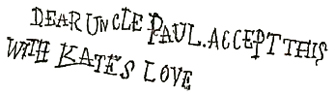
DEAR UNCLE PAUL. ACCEPT THIS
WITH KATES LOVE.
I almost think this note had taken as much printing, and puzzled Kate's head as much as many a whole book does its author.
Uncle Paul was just the person to appreciate at their full value these gifts from his nephew and nieces. He knew very well that it is not by the mere money-value that the worth of a gift should be estimated. He was aware also of the actual price of such a plant as Bernard had purchased for him, and considered that both he and Marian had shewn not a little delicacy and judgment in selecting their presents. The former appeared to be desirous of gratifying his uncle's love for flowers, as well as of proving that he wished to bear in mind the error into which he had been led in not daring to tell the truth, though he uttered no falsehood. And Marian, too, could anything have evinced more plainly that she remembered her old bad habit of beginning but not completing her work, than the perseverance she must have shewn, and the industry with which she must have laboured, to finish the beautiful frame in so short a time.
"My darlings," said Uncle Paul, as he thanked them warmly for their presents, "I find that my preaching has been taken in a right spirit, and has induced you to reduce precept to practice."
As to Kate, the child "was" delighted to see with what genuine admiration her uncle looked at her book-marker and the note with the queer-shaped letters.
"It is a very little thing, uncle," said the child, "but I could not do a better."
She held up her rosy mouth for a kiss, and when lifted on her uncle's knee, she caressed his white hair so lovingly with her plump hands, that he exclaimed: "O Kate, Kate, I can tell that you are giving the old man something better than even all the book-markers in the world!"
"What is that, Uncle Paul?" asked she with wondering face, and eyes wide open.
"The love of a fresh, young, innocent heart, my little darling!" replied he, as he kissed her fondly. "O children," he added, "I shall find it very hard to become accustomed to loneliness again; I shall miss your cheery voices, and the sound of your feet in the house! Why did you twine yourselves so closely round old Uncle Paul's heart?"
Mrs. Ingram's cheeks were wet with glad tears as she heard him speak thus affectionately of her children, and they all exclaimed: "Dear uncle, who could help loving you? It will be very hard for us to part with you."
"Well, I shall not make my birthday miserable by talking about it, so let us think of my big party. Shall we, Miss Kate? I want to know where you all intend to put yourselves when the grown-up ladies and gentlemen come?"
That question had never occurred to the youngsters, and they looked one at another, wondering if Uncle Paul really meant to send them off out of the way of his guests.
He laughed at their perplexed faces, and said: "After all, I think 'you' must be at my 'big party;' you will find some guests to talk to."
It turned out at last that Uncle Paul's was indeed a "big party," as Kate said, but of young folks like themselves; for he had invited all the children with whom they had become acquainted during their stay at Hay-Lodge, to pay them one more visit before Bernard went back to school. There were carriages—no wagon this time—to take the youngsters to see a beautiful ruined abbey, several miles away, and one of the prettiest places in the neighbourhood. How they all enjoyed the drive and the dinner, not forgetting Uncle Paul's birthday plum-pudding—such a monstrous size it was—when they came back!
Then there were games on the lawn and in-doors. And the children built up an arbour of green-boughs on a plan of their own, and decked it with garlands; and one of the young visitors thought Uncle Paul ought to be crowned with flowers, as it was his birthday, to which he consented, professing to be highly pleased with the intended honour.
With what an air of mock solemnity he marched to the seat in the new arbour, and bravely persisted in taking his place there, though in great doubt as to whether it would bear his weight; and the doubt became certainty, for at the very moment when Kate, as the youngest of the party, was placing on his white locks the crown of many-hued roses, it gave way beneath him, and down he went upon the ground, amid the laughter of the whole of his merry guests!
He was not hurt in the least, or there would have been no laughing. He had not far to fall, and there was the soft daisy-sprinkled turf below him; so he kept his station upon it, saying that he was quite borne down by the weight of his new dignity; but that he could now endure any amount that might be imposed upon him without shrinking. Then he said that his throne could not be taken from under him; and the children laughed at his old-fashioned jokes, and thought him the best playmate in the world.
Uncle Paul was equally great at Blind Man's Buff; Hunt the Slipper, and all the merry games that children have played at, one generation after another, for ages past. Truly, this birthday-party was the very gem of the midsummer fêtes at Hay-Lodge.
There was just one little drawback during the evening: it was when Uncle Paul found Kate sobbing, with her face buried in the sofa-cushions. The cause of her grief was soon explained. A rather spoiled child, who was one of the party, had been laughing at Kate's book-marker, and saying she would not have had it if she had been Uncle Paul, and she wondered the little girl had not offered him something better than that.
Then mamma put things right again, by telling a story herself; and all the children left off their play to listen to it, though Uncle Paul said it was "not fair" of Mrs. Ingram to take his calling from him in that manner. Still, as it was his birthday, and an especial occasion, and as he should not like to begin another year of his life by being angry, he thought he must allow her to have her own way. But, before she began, he made her promise that she would be tale-teller for this "one night only."
Mamma's was only a very short tale, called—
"MAGGIE'S DAISIES, OR THE VALUE OF A GIFT."
"One very bright summer morning, a group of children were on their way to school; nearly all of them had flowers in their hands—pretty bright blossoms, just freshly gathered from their gardens, and still moist with dew. The teacher of these children—a kind and gentle lady, who dearly loved her young charges—was very fond of flowers, but she had no garden of her own; so her pupils made it their care to supply her with flowers, and as they each brought one or two every morning, she always had sufficient to fill her vases, and keep the glass-dish on the table replenished also.
"Often, very often, the good lady used to thank the children for the floral-offerings, and tell them that she was more fortunate than she would be with a garden of her own, because their contributions made her feel that she had a great many; and, oh! such a host of gardeners. And kind little faces lighted up with pleasure at her words, and the youngsters vied with each other in bringing her the best of their flowers, to gladden her eyes with their beauty. Very often, only a single rose-bud would be brought, or it might be a pansy; but little or much, small or great, the teacher received all with gladness, because she looked upon them as the tribute of loving hearts.
"But there was one child in the school who had no garden, and she lived rather a long way from the fields. She would have liked to do as the others did, and often felt sorry to think that she alone, out of all that number, never had it in her power to take a single bud to her teacher, though she knew that none of them loved the kind lady better than she did. Many a time did she ponder over the matter, and at last, a bright thought struck her.
"'It is true,' said she to herself, 'that I have no garden to grow lilies or roses, but I "can" get some flowers, and I will.'
"The next morning she rose an hour earlier than usual, and away she went with rapid steps to the fields, thinking to get several kinds of wildflowers from the meadows which were yet uncut; but how great was her disappointment to hear the sound of the mower sharpening his scythe, and to find that nearly all the wildflowers were laid low. She was obliged to content herself with a handful of daisies and butter-cups from the next pasture, and with these she hastened home.
"When school-time came, she joined several of her companions who were on their way thither. They were surprised when they saw Maggie's nosegay, and began to laugh, and ask her what she was going to do with the daisies and butter-cups.
"Maggie was rather dismayed at finding herself and her flowers objects of ridicule to her school-fellows, and at first, she felt rather inclined to throw them away.
"'But no,' thought she, 'I will not. I will offer them to my teacher, for, though they are common, they are still very beautiful, and they are from one of what mother calls God's own gardens.'
"So she carried the field-flowers to school, and, to the surprise of all the rest of the pupils, a portion of Maggie's daisies and butter-cups were placed in a very conspicuous position in the centre vase, while the remainder, tied into a little bunch, were stuck into their teacher's belt, and remained there all the day.
"For many days Maggie rose early, in order to gather her simple nosegay, and she always had the pleasure of seeing it received with as much apparent satisfaction as ever. On the morning of her teacher's birthday, she went a much longer way than usual, and obtained quite a variety of field-flowers. There were pink and white campions from amongst the growing corn, wood-bine and meadow-sweet from the hedge-sides; there were wild geraniums and the scarlet pimpernel, with the old-fashioned daisies and butter-cups that never failed, together with some beautiful wild orchises, of which Maggie tried in vain to find two marked quite alike. She had great taste in the arrangement of flowers, and when she had put them together, her nosegay really looked a handsome and worthy present.
"On that day, several of the pupils brought very beautiful flowers, some of which were from hothouse plants. Two of these nosegays attracted Maggie's warmest admiration; and she sighed to think how poor and insignificant the flowers which she had collected with such care and pains looked in comparison with the magnificent scarlet cactus and snowy arums, the geraniums, heaths, delicate fuchsias, and others of which she did not know the names.
"'I don't think there will be room in the vase for your flowers this morning, Maggie,' said one of the girls, proud of her own splendid collection.
"'Perhaps not,' replied Maggie; 'but they are the best I have, and I walked a long way to gather them.'
"Yet she thought that, even if her flowers were denied a place, she could scarcely wonder, for the others were so very lovely.
"But a place 'was' found for them in spite of all; and beside the arums and the cactus, the dainty heaths and pendant fuchsias, Maggie's humbler tribute was arranged with no less care than usual by the same hand. The children were surprised at this; and some amongst them ventured to ask whether the teacher liked daisies so well as heaths and geraniums.
"'I like and value much,' she replied, 'the love which has prompted dear Maggie to take so much pains in collecting these wild-flowers-more than even the beautiful flowers themselves. Do you know, children, how much this daily nosegay has cost your companion?'
"They had never thought of that, or of anything save that the flowers were common, and might be picked up in every field and by every hedge and ditch-side.
"Then the teacher told them to think how far Maggie must have walked, and how early she must have risen every morning to gather the daisies without anything else at all. But for such a collection as she had just presented, she must have travelled a couple of miles.
"'Ought I, then, to value Maggie's nosegay lightly?' asked she, turning to her pupils.
"'No, indeed!' cried all the children together. 'Maggie's nosegay is the best, and has really cost the most; for while we had only to go into our gardens, or to ask for a bunch of flowers, she has had to rise early, and walk far, to get them for you.'
"Then the teacher took the trouble to point out the various parts of the daisy: its white petals, with a blush on their edges—its dark-green cup, and its yellow centre, composed of scores of little flowers, each perfect in itself. And she repeated the charming lines which Burns wrote about the daisy, so as to shew them that this little common flower had inspired a great poet with a noble song.
"For the first time in their lives, the children were led to think that the value of a gift consists, not in the gift itself, but in the spirit which animates the giver; and they never afterwards grudged the best place in the vase to Maggie's daisies."
Mamma's story had the best effect on Uncle Paul's young guests; and little Kate dried her tears when he told her that he considered the book-marker and note as something like Maggie's flowers—deserving of a first-rate place in his treasure-house, because he knew they had cost her a great deal of labour.
So Kate was comforted, everybody restored to good-humour, and the game at Blind Man's Buff recommenced with greater vigour than before; for the dew was on the grass, and the children were therefore obliged to play in the house only.
What a romp there was, and what a scramble to catch Uncle Paul, who seemed to be everywhere at once! It mattered not that the weather was so warm, or that the children themselves grew so very hot during their game. Ah! Who does not remember the time when very red faces, hair disarranged, and even torn frocks were thought of very little consequence in comparison with a good bit of fun?
There was quite a nice supper at nine o'clock—light, cooling, and refreshing, but not calculated to place any of the youngsters under the doctor's care on the morrow.
After supper followed another game, and then all the children sat quietly down to cool themselves a little before going home, lest they should take cold by venturing in such a heated state into the night-air. While they were all sitting, several of the children sang little simple airs very sweetly, though without a piano, for in furnishing his old bachelor's home, Uncle Paul had unfortunately omitted to provide one for his lady-visitors, though he had promised to supply the deficiency soon.
Then all the children went round the dear old man, just like a swarm of bees, and said it was his turn to sing. They pulled him this way and that, and said, "Do!" and, "It is your turn!" and, "Please!" and, "You must!" until he clapped his hands over his ears, and would have fairly run away, only they held him so fast there was not the least chance of his making his escape.
Mrs. Ingram was almost alarmed for his safety, but when she saw his laughing-face, she guessed that Uncle Paul was quite as much delighted as the children were themselves, and was prolonging the scene for his own amusement.
In answer to all their cries, he declared that he could not sing; that if he were to begin, he should frighten them all away, or else they would all join in begging him to cease that very moment.
But they remembered Uncle Paul's talents as a tale-teller, though nobody could state that he had ever been heard to sing; so, finally, a compromise was effected, and Uncle Paul agreed to tell one more tale before the young people separated, on condition that he should not be asked to sing on any pretence whatever. This was, as the newspapers say, "carried unanimously," and gave the greatest possible satisfaction.
"And what kind of a story should you like, children?" asked Uncle Paul, as he seated himself with little Kate on her old perch—his knee.
There were no two opinions evidently, for the answer followed the question as quickly as the words could be uttered. "A fairy story—a fairy story!" cried all the children.
So Uncle Paul said: "I think I have just one of that sort left, and it will be my last tale until the Christmas-holidays come. It is called—"
"LITTLE FLORELLA, OR THE WISHING-TEMPLE."
"It would be hard to say how much little Florella's mother loved her. Only a tender mother could tell what were her feelings towards her child, and then it would need the heart of such another mother to understand her meaning. Not that Florella deserved all this love: the child was often wayward and disobedient, and apt to think that she knew better than the tender parent whose whole heart was bound up in making her little daughter happy, and who thought no trouble too great to take for her sake. But Florella's mother knew that it is not by having every wish and whim indulged that a child is made happy, but by being taught to practise what is good and right; therefore, in her very care and love for her child, she was often obliged to contradict her, and refuse to grant her many things for which Florella longed, but which would have done her harm if they had been granted. Thus, while surrounded with everything that true love could furnish her with, Florella was not contented.
"'Oh,' thought she to herself, 'if I could have whatever I wish for, and not be crossed in this way continually, how delightful it would be! I have a great mind to steal away from home, and never come back to it again. No one would then have a right to order me to do this or that, or to refuse me what I have set my mind upon. If I could only reach the Wishing-Temple that I have heard people talk about so often!'
"This thought was continually in Florella's mind, and it made her more and more dissatisfied with everything that was done for her, till her mother was nearly heart-broken at seeing the discontented disposition of her child.
"Florella's grand aim was to find out the way to the Wishing-Temple, for she knew that if she could but get there, whatever she might wish would be granted, no matter how distant the object might be, or how difficult to attain. But it was a fairy temple, and a long, long way off; and she was afraid to ask the way, because she thought that if she did, some person would tell her mother when she stole away from home, and they would know where to seek her. Florella never considered the trouble her absence would cause her mother, or the uneasiness she would feel; she only thought how delightful it would be to have everything the moment she wished for it. So she saved a little of her food every day for a week that she might not be hungry on the road, and then set off on her journey to find the Wishing-Temple. She chose her time when her mother was from home, and not likely to return for some hours, and very fast she ran that she might get a long way on the road before her absence should be noticed.
"All the day long Florella went onwards, not in the least knowing whether she was approaching the place of which she was in search, or going further from it. Over fields she ran, through hedges she crept, and when she was thirsty, she drank a little water to refresh her, and ate a little of her hoarded provisions; but rest she never took until the sun had sunk out of sight, and the gray evening began to close around her. Then, for the first time, Floras missed her mother, and was inclined to be sorry she had left her home to take such an uncertain journey as this. However, she got over this difficulty: it was the summer-time, and there was plenty of hay in the fields. Better still, she found in one a shed which had been used as a shelter for the cattle, but was without a tenant during the warm weather, and into it she carried plenty of hay. This made her a soft bed, and, weary with her long walk, she threw herself upon it, and slept as soundly as though she had been on cushions of down, or in her own pretty chamber.
"The next morning, she started again upon her journey; and for three days she wandered on, hiding herself as much as possible from every person, for fear of meeting with some one who might take her back before she had gained the object for which she left home. When the third night was coming on, Florella was inclined to wish that she 'had' met such a person; her feet were blistered and swollen, her clothes torn with the briers, and her face was so browned with the hot sun that, when she bent over the water, and saw it reflected as if in a looking-glass, she scarcely knew it to be her image that she saw in the stream. Beside, Florella was suffering from hunger; her provisions were all eaten, and she had no kind mother to give her more. She had tasted nothing since the morning, and there were no signs of water in her immediate neighbourhood either, for the stream in which she saw her likeness hours before was now a long way off.
"All around her, she could distinguish nothing but bare sands, dry and hot beneath her blistered feet. No hay to form a bed, no kindly shed was near to afford a shelter, and, with a sigh, she thought of her pretty chamber, with the wood-bine and jessamine climbing round its window, and everything about it telling of peace and comfort, and, better still, of a mother's earnest love.
"Still, Florella had an idea that she was not far from the Wishing-Temple, for she had been told that, in order to deter people from going thither, the fairies had made the country around it barren and ugly, while the temple itself was very difficult to find, because hidden in a forest. All at once, when Florella was quite tired, and ready to faint with hunger, she came to the end of the sandy plain, and found herself on the border of a thick dark wood. Though it was summer-time, the wood looked very gloomy; and with the shades of evening resting upon it, it was no very pleasant place to enter, especially for a child. But Florella thought of all the weary miles which lay between her and home, and of the purpose with which she had travelled so far; therefore, after hesitating for a while, she at length mustered courage to go a few steps into the wood.
"In a moment, she was nearly deafened by the cawing of an enormous number of rooks, which all joined in chorus, as if for the purpose of frightening her away again, while the flapping of thousands of wings around and above her almost bewildered the child. She turned, with the intention of going back, and, lo! instead of one path, she saw a hundred, and knew not which to choose. Then great owls began to take the place of the rooks, and these last went up into their nests on the tall trees to roost, as it grew darker.
"Down on the trunk of a tree sat Florella, to consider what she should do. She was not easily daunted.
"'After all,' said she to herself, 'the rooks will not hurt me; I have seen plenty such birds at home, and they are gone to roost now; I daresay it was my coming that startled them, poor things.'
"The owls she did not like so well. But even of these she had heard her mother speak often enough, and had seen pictures of them in books.
"'They are only birds,' said she, by way of persuading herself into feeling comfortable; but she did not succeed very well in the attempt.
"The worst difficulty Florella still had to struggle with was hunger. Her last meal had been only a piece of bread—very dry, with being carried so long in her pocket—and a draught of water from the brook. There was nothing eatable within sight; no root, or so much as a wild-strawberry to cool her parched tongue, and she began to be filled with dread, less on account of visible than imaginary dangers. She had heard of the venomous snakes that lurk in the long grass, of savage beasts that hide in the deep wood, and of fierce robbers that slay passing travellers. Poor, little, foolish Florella! Who had so many comforts, such kind hands to tend her, and yet could not be contented. She needed not to fear the robbers, because she had nothing save the poor ragged clothes which hung about her, and which no robber would have thought worth the taking; but that fact had quite escaped her mind. So, afraid to proceed on her way in the dim twilight, and not knowing how to retrace her steps, she remained trembling and miserable on the mossy trunk where she had first seated herself, quite unable to move.
"She had not been long there before fatigue proved stronger than either fear or hunger, and she sank back in a sound sleep, and never awoke again until the rays of the morning sun, shining upon her face, roused her to a sense of her position. If she were hungry the night before, how much more so was she now, with the fresh air of morning blowing around her and sharpening her appetite, and that fatigue, which had made her less conscious of it, all removed by her long sleep. When she rose to pursue her way, her limbs felt stiff, her feet sore, and she trembled with weakness, consequent on want of food. She really would have turned back, instead of going forward, but the impossibility of choosing out of the many paths which lay behind, and the thought of the bare sandy plain which must be recrossed—if she could find it—before she could reach the habitations of men, decided her. She wandered on, therefore, but slowly, and in about an hour she came to the end of the wood. But along its borders stood a row of fairy forms clothed in green, and with crowns of scarlet flowers on their heads. These fairies stood with linked hands, and barred her further progress.
"Florella begged them to let her pass, but they made a sign that she must apply to their leader, a stately-looking fairy, who sat on a silver throne, raised on a little mound of turf, covered with flowers, and wore a crown of white roses.
"'Please to let me pass,' said Florella. 'I am seeking the Wishing-Temple; and I have wandered a long, long way alone.'
"She looked a miserable little figure in her torn garments, and with her uncombed hair streaming down her shoulders, and tears down her cheeks.
"'People must endure much who find the Wishing-Temple,' answered the fairy. 'Have you borne fatigue? No one can obtain all he wishes without that.'
"Florella shewed her swollen feet, and said: 'I am so stiff with walking for three days that I can scarcely move at all.'
"'Then you have fulfilled the first part of the compact,' said the stately fairy; 'you may pass on.' She waved her silver wand, and the green-robed fairies parted, and allowed Florella to pass on her way unharmed.
"First, she crossed a pleasant field, and then she came to another plain of sand and a wood something like the former; but the paths were fewer, and did not wind so much, and she found a few wild-strawberries, and some roots which were good for food. These refreshed her a little, though she was still very faint; but, owing to her blistered feet, she was obliged to spend the night in the second wood.
"In the morning, she gathered roots and strawberries for breakfast, and passed on until, on emerging from the trees, she found another band of fairies, dressed in white robes, adorned with silver. Like the former ones, their hands were clasped, and Florella was again referred to a stately fairy sitting on a golden throne, and with a crown of gold and topazes upon her head.
"Florella lifted her hands in supplication, and begged to be allowed to pass this barrier also, because she had wandered a long way in search of the Wishing-Temple, and had endured much fatigue and hunger on the road thither.
"'Have you indeed borne hunger?' asked the stately fairy. 'Those who seek to obtain all they wish for, must yet needs leave many an unsatisfied desire on the road thither.'
"'Alas! I have indeed,' said Florella. And she shewed the fairy how she had become thin and wan for want of sufficient food, and how her clothes hung about her as though they had been made for a far plumper person than herself.
"'Poor little mortal,' said the fairy kindly, 'I pity you, though I blame you also! It would have been far wiser to stay contentedly at home, than to endure all these privations. And you know not for what. Would it not be better to return, than to continue your journey towards the Wishing-Temple?'
"'No, no,' said Florella eagerly; 'I should die on the way. I am far too little and weak to bear the same fatigue again. Please, good fairy, to let me pass on!'
"'But if I will feed and clothe you, and send you home in a chariot, which shall be carried through the air by my attendants here, will not that induce you?'
"Little Florella thought the fairy only wanted to prevent her from approaching the Wishing-Temple; it is so hard to believe that people really mean to do us a kindness when they oppose our inclinations, yet very often those who do oppose them are our truest friends. The stately fairy in the golden crown did desire to befriend Florella by keeping her from the Wishing-Temple, but the child could not see this, and still pleaded, as before:
"'I am so tired and hungry!—Do let me pass on.'
"The fairy sighed as she answered: 'We may not detain you here, if you are quite resolved on continuing your journey. People may be advised and invited to take the right and wise path, but it is out of our power to force them. Pass on, little mortal—pass on!'
"She waved her golden wand, and all the linked fairy-hands were loosed, the barrier broken, and little Florella once more pursued her way. Again the sandy plain to cross, but there were beautiful shining stones sprinkled over it. Florella did not know how precious they were, and though they looked pretty to her childish eyes, she wished them away, because they cut her feet, and made walking more and more painful at every step; beside, she was too tired to stoop to pick them up. Her whole thoughts were bent on reaching the Wishing-Temple; and with this one object before her, she actually passed on the road thither many of the very objects she had so often longed to obtain.
"Another night in the wood, with the same scanty food as before, and once more Florella pursued her way in the morning to its borders. A beautiful scene broke upon her view when she left the tall trees behind. This last wood formed a circular fence round a vast garden, in the centre of which stood the Wishing-Temple. She traversed the winding-walks unchecked, though, surrounded as she was with everything that was lovely to the eye, she, poor, little, miserable-looking vagrant, seemed strangely out of place amongst so much beauty. The walks were fairly strewn with flowers; trees laden with fruits, such as Florella had never before seen, grew on every side; crystal fountains played at every turn, and their falling waters kept time with the songs of the birds, while marble figures of the finest proportions seemed to want only breathing upon to become alive, so lifelike were they.
"Florella stayed not to look, admire, or listen, but pressed onward till she came to a golden palisade, which formed the last barrier that divided her from the Wishing-Temple. At a magnificent gate studded with precious stones sat a fairy, clothed in a flowing robe of a soft blue, which spread around her, light as air. She wore no gems or ornaments except a wreath of blue forget-me-nots and white tea-roses round her head.
"The sight of this fairy filled Florella with wonder, it seemed so strange to see her simple robe in the midst of such wondrous splendour as was scattered on every side. She stopped and gazed around her, expecting to see a queenly figure, something like the stately fairies that guarded the woods through which she had passed on her way; but no other did she find, and she was about to pass through the gateway, when the blue-robed fairy placed a hazel-wand across her path. Slight as was the boundary, Florella was powerless to pass it, so she presented her last petition, and begged to be allowed to enter the Wishing-Temple.
"'Hast thou left friends behind, and given up human kindred?' inquired the fairy queen, for it 'was' the queen, though she was so plainly clad.
"'That I have,' said Florella. 'I fled from home and friends. I left my companions to pursue their plays, and my mother to weep and lament my loss. I have suffered hunger, pain, and weariness, all to gain entrance to the Wishing-Temple; and now I have reached it, I wait only for your leave to pass within its gates.'
"'And you have despised the opinions of men, I see,' said the fairy queen with a pitying smile, as she surveyed poor Florella's miserable rags, the sole remains of the neat clothes which a mother's hands once fashioned with care for her child.
"'I have despised all,' said Florella, 'and endured, oh, so much! Please to let me enter the Wishing-Temple.'
"'You have been very unwise, little child of earth,' said the queen of the fairies. 'Look on me, and you will be convinced of this. I could be clothed in gold, and adorned with the most costly gems; I have but to wish, and all I desire is mine; yet, believe me, the very power I have makes me care little to use it, and I prefer simple clothes and simple food to any other. Go back, little child of earth—go back, if you are wise! You will be very miserable, indeed, when you have no wish ungratified.'
"Florella shook her head, and cried: 'Let me enter, lady; I have come far and suffered much—send me not away from the very threshold!'
"'Little child,' said the fairy, 'should you like to feed on honey always, and taste no other food?'
"'No—oh, no!' answered Florella. 'That would be very unpleasant; I should not like it at all.'
"'Then believe me when I tell you that to have all sweets and no crosses, all favours and no refusals, will be as cloying to the mind as it would be to the taste to eat honey always.'
"Florella hesitated. There appeared to be truth and reason in the fairy's words, and it 'might' be better, after even all these labours and pains, not to enter the Wishing-Temple.
"The fairy saw the child's wavering look, and said: 'Be not afraid of the rough road, the sandy plains, or the dark forests. You shall be conveyed home with all tenderness, and shall bear with you tokens of my goodwill also, which would make amends for the past; so, answer, little child of earth. Make your choice.'
"The old thought entered Florella's mind—'She does not wish me to enter the temple, for fear of my gaining the same power as herself. What does she care for me?' Her purpose was confirmed, and she replied: 'I have decided—I wish to enter the temple.'
"'I may not prevent you, then,' said the fairy queen, raising the hazel-wand. 'I have done my duty in advising you for the best; but mortals cannot be forced into the right path. You have chosen for yourself. Take what you will.'
"Then the queen spread her gossamer-wings, and flew down from the gateway into the garden, leaving Florella to enter the temple alone. What a beautiful place it was on the outside! It stood on a base of rock-crystal, out of which, a solid mass, steps were cut, guarded on each side by a golden balustrade corresponding with the railing below. The temple itself was formed of the same beautiful material, so cut as to divide the sun's rays, and make it appear of all the hues of the rainbow. Over the door was an inscription, not, as Florella expected, an invitation to enter, but words which confirmed the advice she had received from the fairies—
"'Pause, foolish mortal—
Pause, ere you find
That power without limit
Is not for mankind!'
"Florella read it, but did not pause. Was it likely that she who had despised the former advice would be turned back now? She crossed the threshold, and found herself in total darkness! This was a great surprise. The outside was so brilliant, she could scarcely realise the change. Several times she tried to speak, but she was afraid to break the dead silence that reigned around. Then a voice addressed her, and in stern tones said:
"'Little child of earth, you have but to speak, and whatever you wish shall be granted; yet you would have been wiser to stay outside the temple, which is in itself an emblem of many a wish fulfilled—very fair in the distance, but giving no real joy in the possession; for—
"'Know that our wishes
All die when they're won,
Melt like the snow-flakes
Beneath the hot sun!'
"Florella mustered courage, and answered: 'I wish that every future desire of mine may be fulfilled.'
"'Granted! You have only to wish and to have whatever fairies can give. Farewell!'
"The voice ceased, and Florella left the Wishing-Temple. In those few words she had exhausted all the benefits it could confer, and she longed to test her new powers. With rapid feet she stepped into the fair garden below, and her first wish was for food. She named all the dainties she could think of, especially such as she had been denied, and in an instant they were by her side. Then she wished for new clothes, and directly her rags were replaced by the finery she craved. Next, she desired that the brownness of her skin might disappear, her hair fall in soft tresses, her stiff limbs regain their activity, and her blistered feet be healed.
"And all these things were done. She cast a glance into the crystal fountain near which she sat, and saw with much satisfaction the change in her appearance. She ate very heartily of the dainties she had wished for, thinking with no small pleasure that there was no one who could control her in anything now. Afterwards, feeling very uncomfortable, because her hearty meal had disagreed with her, following, as it did, such scanty fare, she forgot her new power, and wished she had not eaten a bit; and the wish was scarcely uttered, before she was as hungry as ever again, and had to desire more food to satisfy her appetite.
"Florella felt very much inclined to wish herself at home that she might display her powers; but somehow she was ashamed to meet the mother she had grieved. At last, after having desired and cast aside everything she could think of, she began to find the truth of the fairy adage—
"'Power without limit
Is not for mankind.'
"Instead of being happier in the possession of almost unlimited power, she found that all the precious things in the world could not make up for what she had left behind. When unrestrained indulgence made her ill, the fairies could not cure her sickness; and though surrounded with grandeur, she could not have a mother's kind hands to tend her for the asking. When she went to the Wishing-Temple, after vainly desiring for her mother's presence, she was told that she had left that behind when she entered the domains of the fairies.
"So Florella discovered that she had lost a great deal. Often, too, it had been very delightful to hope for some little indulgence, which was all the sweeter when gained if she had worked for it; but now she knew not the pleasure of hoping, because she was sure of having all she could imagine beforehand. She knew neither fear nor trust for the same reason; and having no contradictions to endure, her mind was indeed cloyed with indulgence, as the taste would be if fed only on honey.
"After a time, she grew very tired of having all her own way, and went to the Wishing-Temple with the determination to get rid of her power if possible. The stern voice spoke, and asked why she came.
"'I come,' said Florella trembling, and in tears, 'to beg that you will restore me to my best friend—my mother. I will be contented with the ordinary lot of mortals, learn wisdom by degrees, and submit to those who know how to guide me. I will not desire more than my share of the sweets of life, but shall enjoy those that are given me by contrasting them with the bitters. I will enjoy rest by earning the right to it. Oh, take from me the power I craved, and give me back to my mother! I may return to her, though she cannot come hither to me.'
"Thus the last of those wishes, which Florella was sure of obtaining, was granted. In a moment, she found herself at the door of her old home. She hardly knew how to enter; but at that moment the door was opened, and a figure dressed in deep mourning issued from the house. Could that be her mother? Alas! It was; but her eyes were dim with weeping, and her once dark hair was now nearly white.
"Florella knew who had done that, and she was ready to steal away, overcome with remorse.
"But her mother saw her, and springing forward, exclaimed: 'My child is found!' While her hot but glad tears fell on Florella's face.
"And all was forgiven, though Florella never forgot her visit to the Wishing-Temple."
"I am not going to tell you any more, children," said Uncle Paul. "I only meant to shew you that it is better to deserve what we have, than to sigh for more; better to labour for good things in moderation, than to possess all we wish for. There is nothing in the way of food that tires us so soon as sweets, and, in like manner, we should find that to have all our own way, would bring us more pain than enjoyment. So do you, dear young folk, be thankful that you have parents to guide and control you, and don't begin to wish that you could find your way to the Wishing-Temple of the fairies."
And now it was time for the young guests to say good-night. Dear Uncle Paul was almost overwhelmed with kisses by all the children, who were full of regret at the thought of parting with the little Ingrams.
"Never mind," said Uncle Paul. "You know the old proverb that the best of friends must part. Let us hope that all you youngsters will retain such a pleasant remembrance of Hay-Lodge that you may look forward with hope, as I shall, to another meeting, if Uncle Paul should be spared to see another birthday."
The youngsters all thanked him, and said in hearty chorus that they hoped he would live to see a great many more happy years; and then they went to their homes full of kindly thoughts both of Uncle Paul and his relatives, and of regrets that the happy midsummer-holidays were over for that year.
——————————
BERNARD'S RETURN TO SCHOOL.
THERE was to be one day's rest after the party, and then Bernard was to go back to school. The boy was not unwilling to be at work again, but still he had a natural feeling of sadness hanging around him at the thought of leaving his good mother, Marian, and little pet Kate, and—though last, not lightly valued—dear Uncle Paul. His uncle saw the boy's regret in his face, and spoke in his usually cheery tone.
"Christmas will soon be here, Bernard, and time flies all the more quickly when we are fully employed, and have no leisure to indulge in useless wishes. If we had holidays all the year round, it would be as bad for us as feeding wholly on honey, or visiting the Wishing-Temple. You would have had little enjoyment during the vacation, if you had not first earned it by hard work."
"I do not feel sorry to go back to school, uncle," replied Bernard; "indeed, I am glad of the opportunity to do so. I am only sorry to say good-bye. And my dear mother and the girls will miss me all the more, too, from having had such a delightful time at Hay-Lodge. Our city-home is not like this place, though we have spent many happy days there."
"And have you not a thought for Uncle Paul's loneliness, Bernard? How will he feel when you are all gone?"
"Yes, indeed, Uncle Paul. But I hardly thought we could be of so much consequence to you as you are to us."
The boy's voice trembled, and Uncle Paul seemed to be troubled with a huskiness in his throat, for he did not speak very clearly for a minute or so.
"Then," he said, "I think I must keep Kate here. Will you stay with Uncle Paul, to bear him company, little one?"
"I should wish very much, but mamma will not like to part with me," said the child.
Uncle Paul looked quite disconsolate, but after a little while, a bright idea struck Kate. "Uncle," she said, "we will take you home with us, and you shall stay always." She clapped her hands in glee; but Uncle Paul thought perhaps it would be better to reverse matters.
"Supposing, mamma," he said, "that you, Marian, and Kate stay here instead. Bernard can go to school, and we will have a governess to help you to teach these girls. What say you? Can you love Uncle Paul well enough to stay and cheer his loneliness? Hay-Lodge is large enough, and more, Uncle Paul's heart is large enough too, to hold you all, and still keep a corner for Bernard when he comes home at Christmas."
The widowed mother felt all the goodness which prompted Uncle Paul's offer, and, unable to speak, she took the good old man's hand in both hers, and pressed it to her lips, while Kate clambered on his knee again, and fairly shouted with delight: "Dear, darling uncle, I am so glad I shall stay with you!"
Bernard went to school the next day in high spirits at the thought of leaving his mother and sisters so pleasantly situated. He had quite forgot what he had given up for the sake of buying a birthday-gift for Uncle Paul; but he was reminded of it by finding, after he reached school, a set of articles of the very best kind, and such as he had long wished for, in a snug corner of his trunk. He had no difficulty in guessing to whom he owed them.
As to Kate, she is every day twining herself more and more closely round Uncle Paul's heart, and so indeed are mamma and Marian. And Bernard is working very hard at school. He remembers what Uncle Paul said that he would not have enjoyed his rest so much if he had not first earned it by his steady industry.
So having done with Midsummer for the present, let us leave the children to their pleasant memories, and looking forward next to spending "Christmas at Hay-Lodge."
THE END.