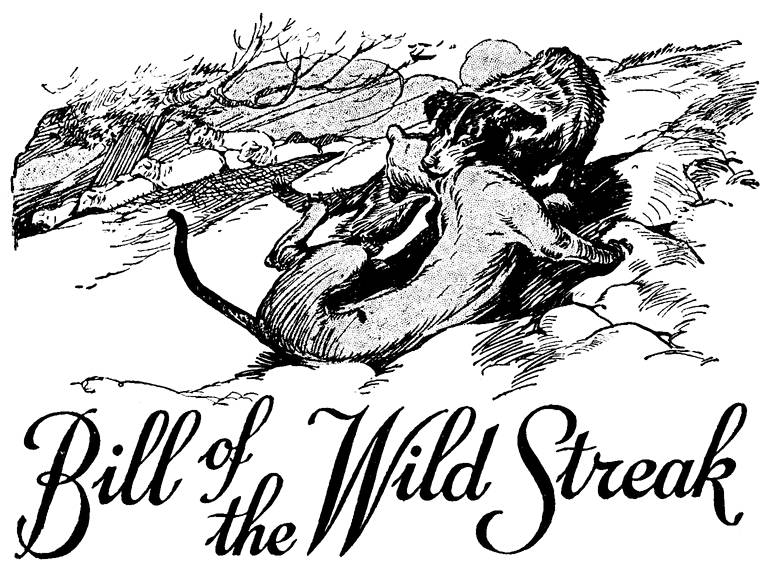
BILL OF THE WILD STREAK
BY
Howard E. Morgan
Like shoulders of dirty gray rock, irregular, ghostly under the pale moonlight, the sheep spread out over the hillside, dozing contentedly. On the crest of the short slope that was the pasture, a big gray and white dog sat watching the flock. From time to time he started off in a businesslike manner and hurried some blundering ewe back into the moonlit open.
Ordinarily, this close attention was not necessary. Stupid though they were, most of the sheep knew better than to approach the strip of checkered shadow bordering the thicket, that was the dividing line between safety and danger. Just now, however, there were several young lambs among them, newly born, and the mothers seemed to have lost all sense of discretion. So at least Bill thought as for the tenth time he urged an obstinate ewe and her spindle-legged calf away from the forest edge. Each time, this particular ewe had refused to take his fangless proddings seriously and in good part; each time she had resented his interference with her senseless plans, and finally, she charged him, furiously, with lowered head—so quickly that, as he sprang aside, she caught him a glancing blow that almost upset him.
The big dog recovered quickly, circled swiftly about and rushed at her, silently, teeth bared. Not until within half a dozen feet of his intended victim did he realize what he was doing. It was then too late to stop. He sprang clear over the ewe and crouched panting in the shadow of a stump.
Through a necklike opening in the forest came the ring of an ax on wood. That was the man cutting kindlings for his morning fire. The big dog cowered. Whined softly. Once more he had nearly proved unfaithful to the master. For long he lay low, belly to the ground, then came erect slowly and tail between his legs, again took up his sentinellike position on the ridge top.
Bill was a mongrel, a splendid mixture of at least four fine strains; his mother was a sled dog from the Yukon, part chow, part Ungava husky with a dash of wolf blood running strongly near the surface; his father was a collie with an interbreeding of mastiff. Bill's hair was long and thick, like a collie; he was big-boned, broad-chested, like a husky, his mighty jaws, wide, massive, steel-muscled, were from his maternal grandsire, the wolf. What wonder, with such varying warlike strains, that violent passions fought ceaselessly for possession of his mighty body.
For long after his brush with the sheep, the dog crouched on the hilltop, motionless and limp. The wild desire that had urged him to kill, left him slowly and he was forlornly ashamed. However, it was a familiar sensation, quite. Many times before he had escaped murder by a hair’s breadth. Each time it had been on account of the master.
His allegiance to Hardin knew no bounds. Once he gave way to the bloodlust and the master would be lost to him forever. Well he knew. The sheep belonged to the man. It was the man’s wish that they should suffer no harm, that their foolish lives be protected at all costs. Bill had risked his own life times without number in the pursuit of duty as interpreted by his collie instincts. It was the master’s wish. But this particular night, the wild urge in him refused to be readily put aside. From time to time, deep, full-toned growls issued from his great throat.
The tiny scream of a bugle sounded, echoing sharply back from the purple hills. Instantly Bill was on his feet and whining eagerly. It was the man. Hardin had been a soldier. Every night he blew upon the yellow horn, a never-ending source of wonder and awe to all wilderness folk. To Bill it recalled a pile of rags and old burlap bags behind the stove where he slept through the cold winter nights. This concrete reminder of the master’s nearness banished the last shreds of wildness. He barked once, sharply, joyously, then circled the herd slowly, majestically, a sedate, aloof being, competent and ready protector of the weak, a trusted friend of the master.
This streak of the killer in Bill, Hardin had often suspected. He knew dogs. But because he did know them, he trusted Bill implicitly. It was a question of his influence over the wild streak. And he had every confidence in his ability to hold the big dog’s devotion.
Of one thing only was he uncertain, which was—to just what extent Bill’s interbreeding had merged. As—in some people—an admixture of several races will produce an evenly balanced, intelligent whole; and in others, various racial traits will stand out distinctly—good and bad, loyalty and treachery, never merging—veritable Dr. Jekylls and Mr. Hydes; the one at times obliterating the other, the two never forming an evenly balanced, law-abiding whole—so it was with dogs.
Hardin assumed that Bill’s interbreeding had struck the happy medium. Many of the most loyal and intelligent of dogs are mongrels. True Americans. Bill showed no distinctive racial traits. There was little of the wolf about him. On the surface he was dog, all dog. Home-loving. Devoted to the sheep and the master. The only thing was his eyes which at times held a strange, greenish glare.
Not more than half a dozen times Hardin had surprised that wild gleam in the big dog’s eyes. Each time a single word from him had banished it. But it was there, the wild streak in him, the bloodlust of the killer demanding expression. But as time passed, Hardin came to think less and less about it. Bill was the best sheep dog he had ever owned.
This particular night the man did not visit the herd as was his custom. He had worked hard during the day walling up with huge stones a spring that bubbled out of the ground near the cabin—and he was very tired. He reflected pleasurably upon the fact that the little pond would save the lives of many sheep during the hot summer days—and—confident in Bill’s guardianship of the growing herd—he rolled in his blankets and was soon sleeping soundly.
For long after the metallic clatter of the bugle had died away, Bill trotted back and forth along the open ridge top, tensely, joyously expectant, awaiting the arrival of the man. This nightly visit was always the occasion for a rough and tumble encounter which the dog enjoyed beyond all else. But the man did not come. Puzzlement gave way to disappointment, and a great longing, not unmixed with fear, fear that the master might have gone away. Once before the man had left, without him, visiting a distant settlement; had stayed several days and Bill had experienced all the acute sufferings of a sensitive youngster deprived of its mother for the first time.
Finally, he could stand it no longer and after thrice circling the herd, thrice assuring himself that all was well, he rushed down the valley toward the cabin. He came to a sliding stop before the closed door. Cocked his ears inquiringly, listened intently. The man was inside. Asleep. His regular breathing was clearly audible to Bill’s sensitive ears. Reassured, but still vaguely dissatisfied, he trotted slowly back to the herd.
As he drew near, his step quickened. The sheep were downwind, still, a sixth sense warned him of danger. A collie would have rushed wildly forward, barking loudly. Bill advanced silently in a wide half-circle along the ridge top, belly close-hugging the ground, like the wolf.
It was old Graybeard, the coyote. Bill drew close without the unwelcome visitor detecting him. The dog did not really think that the coyote would attack the sheep. It was a time of plenty in the wilderness. Old Graybeard was sleek and well fed. More likely it was just deviltry. Graybeard could outrun the sheep dog.
Well he knew it. Bill knew it too. It was the coyote’s delight to steal upon the unsuspecting sheep, to nip sharply right and left and then to run away, a wraithlike streak into the night; and from a near-by hillock grin down as Bill, with much frantic effort, quieted the milling herd.
Sometimes Bill took this as a joke. Sometimes he went into a rage. Depending upon his state of mind. To-night—deprived of the softening influence of his frolic with the man—he was angry. Graybeard knew Bill was away and took his time. No sport in a practical joke if the jokee is not there to appreciate it.
He nipped tentatively at a gangling white figure that practically fell over him where he crouched in a bed of huckleberry bushes. The lamb, a very young one, bawled frantically. The nip had been as nothing at all. Graybeard was surprised. But his surprise was many times multiplied when a ewe, usually the most timid of creatures, charged him wildly, quite disregarding his menacing front.
At the last moment he danced nimbly aside. Unfortunately for all concerned, however, the ewe’s splay foot slid from off a moss-covered bowlder; she lurched sideways, fell, and in falling, knocked Graybeard neatly off his feet. With a snarl of rage he sprang forward and buried his yellow fangs in her throat.
At the climax of the tragedy, Bill was no more than a dozen yards away. He lay stretched flat to the ground among some low-lying shrubs. His big body was vibrant with righteous rage. Still, he did not move. Well he knew that, at his first motion, the coyote would flee. And he might never catch him. Many times he had tried and failed.
Graybeard raised his bloody muzzle and tested the stilly air. It told him nothing. Bill had worked about downwind. The coyote was not particularly hungry, but having killed he intended to eat. He worried savagely at the dead sheep. Bill stole forward, noiseless as a shadow. The coyote took alarm suddenly. But not quite quickly enough. Even as he sprang away, Bill was upon him.
Wily old battler that he was, Graybeard was no match for this hundred pounds of enraged dogflesh. A single flashing downward stroke of the wolf-like fangs ripped the coyote from shoulder to gullet—and the fight was over.
For long the victor crouched over the dead body of the coyote, growling deep in his throat, the light of battle in his eyes. Then the bleating of the sheep roused him to a sense of duty. The herd had scattered in all directions over the hillside. He rounded them up in his usual efficient manner, but they refused to be quieted. He threatened them savagely. Even nipped them more severely than usual, but all to no avail. They persisted in stampeding wildly, rushing head-on into stumps and bowlders and into each other in their excitement.
Bill finally guessed the reason for this continued panic. The dead coyote. The odor of blood. First, he dragged the body of the coyote to the edge of a gravel-banked coulee at the foot of the slope and pushed it in. Then he caught upon the dead sheep. The ewe’s body was still warm. For the first time in his life he got a taste of fresh, sweet mutton. He licked his jaws pleasurably. Instantly the wolf in him came to the surface. His eyes shone with a strange greenish glare. He looked upon the milling mass of sheep with new eyes, hungry eyes. The dead ewe was not for him. He would make his own kill. Slowly, cautiously, he crept toward the herd.
Suddenly a shrill whistle sounded. The man. The sheep had awakened him with their bawling. Bill froze to the ground. Again the whistle sounded, nearer this time. Bill whined uncertainly. The wild desire left him. And as the man’s tall figure appeared on the naked ridge top, he loped forward slowly to meet him. The man eyed him suspiciously in the half darkness.
“What’s goin’ on here, you big, no-account bum?”
But his voice was not angry. Bill waved his bushy tail and made gruff, loving noises in his throat. But he did not come near the outstretched hand. Instead he turned away abruptly down the hill, ears and tail drooping. The man followed, puzzled.
“Somethin’s wrong here, sure enough. The old pup ain’t hisself—” And then—“Sure, I'll betcha, becuz I didn’t come an’ see him t’night.”
Hardin laughed. But in his assumption, this time, he was not correct. Bill was facing a situation totally unprecedented in his brief existence. He didn’t know just how the man would take it. The fact that he had not killed the sheep did not occur to him as a saving grace. He felt as guilty as though he had actually done the deed. And he was quite sure that the man would know that he had intended to kill. The man knew all things. There was no deceiving him.
Bill was sorry. Thoroughly ashamed. And just a bit frightened. The man would beat him, of course. He might shoot at him as he did at the coyotes. Drive him away from the cabin perhaps. This last was what brought about the dejection.
But he had no thought of evading the issue. He led the way straight to the dead sheep.
After a brief inspection the man swore and shook his head sadly.
“Damn it all. I was afraid of it.”
“C’mere, you worthless houn’ dog.”
Bill drooped in every muscle, but he did not cringe. For long Hardin eyed the big dog.
“Git out, you—I’m through with you. Git—!”
He caught up a loose stone and poised it above his head. The dog did not move. A lump rose in the man’s throat. “Git—Git, I tell you—!” He waved the rock menacingly. He hated to do it, but—
Bill whined and turned suddenly away. He stopped on the edge of the coulee and whined again. The man hesitated, then dropped the rock and caught up a handful of dry grass from a dead bog, lit it and peered down. He saw the body of the coyote.
“Doggone—I should have known, Bill; you didn’t kill that there sheep. The herd wouldn’t have got so wild unless it had been a coyote ’r a bear ’r somethin’. Doggone, now, ain’t I ashamed. Sure enough purty nigh plugged you, too, didn’t I? C’mere, boy—”
In the days that followed, the dog and the man were inseparable, made much of each other, like friends reunited after a serious misunderstanding. Under these pleasant conditions Bill experienced no recurrence of the wild streak. In constant touch with the man, the dog in him was always uppermost.
His thoughts revolved about the man, followed interestedly his every action. Construction of the little pond seemed to him a foolish thing, but he knew that there was some good reason for it. The man apparently wasted his time on many foolish things, but always, sooner or later, an adequate reason for them developed. So it would be with the pond.
And one hot day in early summer, the man’s wisdom was made manifest. The heat was intense. The sun a vivid red ball in a saffron sky. Man, dog and sheep sweltered helplessly. It was then that the man helped Bill drive the sheep around the base of the ridge to the pond. They floundered in the cool water to their hearts’ content all the rest of the day.
One night at dusk a short, white-skinned man made his appearance at the little cabin. He made much of Bill, but the latter accepted his advances unemotionally; remained briskly, unresponsively aloof. The white-skinned man meant nothing to him. He didn’t understand him in the first place. And then again, he was just a bit jealous. As a friend of the master, however, the man was, of course, to be treated with the greatest respect.
Well he knew that to obey the frequent urge to nip the visitor’s inexpert fingers as they rubbed his ears the wrong way, was to bring the master’s instant displeasure. The two men talked much together. The visitor stayed on and on and with the passing of each day the master became more and more preoccupied and Bill grew correspondingly depressed. He whined dismally on the ridgetop through the long, hot nights. Something unpleasant was going to happen. And it did. On the fourth night the bugle did not sound. Next morning, the cabin was deserted. Bill did not know it, of course, but the man’s little homestead lay in the center of valuable timber country; the white-skinned man had been negotiating for its purchase and Hardin had gone to town to consummate the deal. All he knew was that the master had gone and that he was very, very lonesome.
All of the next day and night he circled the herd like an automaton, time and again rushing away to the cabin, whining dismally before the door.
He became nervous and crotchety. On the second night he picked a quarrel with a wolverine and was severely mauled. He even disputed the right of way with a pink-nosed porcupine and collected half a dozen barbed quills for his pains. Most of these quills came to rest in his upper forelegs; after much painful worrying, he pulled them out with his teeth. A couple, however, worked into his wrinkled snout and defied his most heroic efforts.
It may have been the lack of contact with the man; it may have been the porcupine quills that festered and rendered him feverish with pain and rage—most likely a combination of both—at any rate—on the third night after the man had left—the old craving to kill came upon him in a flood of sentient desire that would not be denied. A big ewe gave birth to a gangling lamb in a cluster of oak scrub on the forest edge. All of his efforts to drive her back into the herd and safety, were unavailing. Finally, enraged, he rushed silently upon her.
Five minutes later, four dead sheep bore irrefragable evidence of his lustful efforts. The murders done, he slunk away into the forest, swiftly, silently, furtively, like the wolf. But—in his going was none of the arrogant bearing of his rapacious forebear. The passion to kill left him as suddenly as it had come. He went—tail between his legs, head drooping, like a dog. And he knew that he might never return.
Hours later, Hardin entered upon the scene of carnage. It did not need sight of the bloody-jowled creature that slunk guiltily away into the thicket upon his approach, to tell him the name of the murderer. He knew. All about were tracks. Dog tracks. Bill’s tracks.
The man swore in a frightful manner. His face was white with rage. His business in town had not turned out well; he was tired and hungry and hot—there were other troubles, too; and now—this. The rifle leaped to his shoulder. Five shots followed the slinking figure of his erstwhile friend into the thicket. And he laughed when a yelp of pain told him that one of his shots, at least, had found its mark.
In his heart the man was kind and it is doubtful if he would have nursed his hard feelings against the erring dog if it had not been for his other troubles; the girl back in the States, for instance, who had married another; and the lumber people who were trying to rob him. The man was the sort that sours under difficulties. It seemed that everyone and everything was against him.
Alone with his thoughts, he longed for an opportunity to give vent to his vengeful feelings. Of his real and fancied enemies, Bill was nearest at hand. Hence it was that he carried his long rifle with him wherever he went, hoping ever for a chance shot at his unfaithful friend.
Hardin knew dogs and he felt sure that Bill could not stay away for long. One day—he would come back. When he did—the rifle would be ready at hand. In the man’s hardened heart there was no room for clemency; to his mind, the renegade sheep dog was no different from any other killer of sheep—the coyote or the wolf. In fact, he was worse, if anything.
From a neighbor, Hardin purchased another sheep dog, a lazy old collie called Stub—Stub because a bear trap had claimed all but six inches of his bushy tail. The collie was a good enough sheep dog as sheep dogs go, but his cringing docility found no response in the man’s spirited nature.
The random shot from the man’s rifle had torn a deep groove along Bill’s ribs. The wound did not respond readily to his frequent cleansings, festered and would not heal. For several days he was very ill, lay close hidden in the alder swamp. He reverted naturally to a health-giving diet of tansy and coarse grasses.
At the end of a week the wound began to heal. So also did his sore nose. And with the first sign of returning good health came an irresistible yearning to return to the old life.
The whispering silences of the alder swamp appalled him. He was restless and nervous. He longed for the sheep; they had become a part of his very self. He longed for the cabin, the heap of old burlap bags behind the stove, the bits of fish and half-cooked meat; but above all, he longed for the little things—the boisterous rompings, the kind words, the rough caress—which only the man, his man, could bestow.
Came a night when he crawled out of his hiding place and made his way slowly, uncertainly toward the pasture. He was still very weak. Tottered when he walked. At first glimpse of the fat old dog, Stub, he flew into a great rage. If his strength had permitted he would at once have challenged the collie to battle. But discretion fortunately prevailed. He merely crouched low at the edge of the thicket, teeth bared in a perpetual snarl—and watched.
Every night thereafter, he occupied the same spot among the gray shadows bordering the swamp. He saw the man inspecting the flock and growled lovingly. But sight of the rifle brought him to his senses. The man would shoot him—he knew.
When Hardin returned to the cabin he trailed along—at a distance. With ears cocked inquiringly, head on one side, he followed longingly the man’s preparations for supper. Later, when the cabin was in darkness, he stole forward furtively and searched for scraps. He found only a large strip of pork rind which ordinarily he would have ignored. But now—he swallowed it gratefully and hunted for more. With the coming of night he returned to the pasture and during the few short hours of darkness, unseen, unsuspected, assisted Stub in guarding the herd.
But with the complete return of his strength, this vicarious enjoyment of things once his own, did not satisfy. Came a night when he openly fronted the collie on the ridgetop. The latter was game and flew clumsily at Bill’s throat. Bill easily evaded him. The tussle was brief and bloodless. Bill could easily have killed the collie; instead, he merely rolled him over on his back and fastened his great teeth gently but firmly in the other’s throat, barely breaking the skin.
Stub saw the light. The fight went out of him. Thereafter the herd was Bill’s. He might have killed to his heart’s content had he so desired. But there was nothing further from his thoughts. Instead he took over his old job. Stub soon came to take these nightly visits as a matter of course, and slept peacefully on his favorite bed of pine needles while Bill watched the sheep.
And then one day Bill came face to face with the man. From the summit of a grassy knoll Bill had espied the familiar figure and had circled about in a wide arc to come in behind him without being seen. He was curious, as always, to know what the master was about. He felt sure that the man would follow the beaten path through the swamps. But he didn’t. Hence it was that they came face to face in a grassy, open glade flanked by a dense thicket of alder.
By not so much as a quiver of his bushy tail did the big dog betray the conflicting emotions pounding through his tense body. Only his eyes softened, dog-like, with mute appeal when he saw the anger that was in the man’s heart suddenly reflected in the sun-browned face.
Hardin, fortunately for the dog, had left his rifle at the cabin. Mumbling to himself he searched the ground for a loose rock or a stick, but finding neither he drew his knife, cut a sturdy sapling and set about fashioning it into a club. Bill did not move. He sensed uncertainty in the man’s actions. Truth to tell, Hardin was hoping that the dog would go away. He trimmed the heavy stick in a most leisurely manner, then, as the dog still remained motionless, he advanced determinedly and with fixed purpose, club raised.
But his heart somehow wasn’t in it. He swung wildly. Missed purposely. The dog’s thick roach-hair lifted automatically. He snarled. Involuntarily. Not in anger. But this outward indication of defiance was enough to rekindle the man’s smoldering rage. Next time, the club found its mark, again, and still again. The dog made no sound, but backed away slowly under the shower of blows, into the thicket, lips still lifted in a fixed snarl, but with a questioning, appealing look in his eyes that, despite all, tempered the force that lay behind the club.
Following the encounter, Hardin was sheepishly displeased with himself, ashamed, like a man after too severely beating a youngster in a fit of anger. He left off carrying the rifle, knowing in his heart that he would not shoot the dog if he had the chance. As a matter of fact he rather hoped that Bill would one day come back to him. He convinced himself readily that the dog had learned its lesson, would never again become a killer. For witness—the sheep were still there; lazy old Stub would have proved of little hindrance if the big wolf dog had really wanted another taste of fresh mutton.
That appealing look in his old friend’s eyes haunted the man for days.
The sultry dog days of August brought distress in varying degrees to all wilderness folk. There had been no rain for weeks. A dry blight struck all green things; the poplar leaves turned prematurely yellow and fell away; the hardy wire grass in the pasture became brown and dry. Unfit even for the sheep. With Stub’s help, Hardin drove the herd a mile farther down the valley where the feed was somewhat better.
The swamp itself, usually a summer paradise for all water-loving animals, was but a morass of tangled roots and tinder-dry bogs, surrounded by odorous pools of fetid green slime. On the upland slopes the rabbits perished by the thousand. The shortage of food and water drove many mountain dwellers to the lowlands. Several gaunt and silent moose visited Kootenai Swamp, searched eternally among the few remaining mudholes for lily roots. Many wolves, lions, bears, caribou, deer, and hosts of lesser animals, all left their footprints in the newly formed runway leading to the man’s pond which was the only running water for miles about.
An ever-growing restless uncertainty, attended by a corresponding shortening of temper, affected all the beasts alike. This unsettled state of mind brought about many bloody quarrels. A caribou bull and a big cougar staged a battle to the death in Kootenai Swamp not a quarter of a mile from the cabin. A black bear and a silver-tip grizzly fought on the ridge top near the old pasture.
As might be expected, the sheep formed an irresistible attraction for the hungry visitors. One and all, singly and in pairs, they investigated with longing eyes. One and all, they gauged the chances involved in breaking through the guard of that confident, competent-appearing beast—that was neither dog nor wolf, yet bigger and more menacing than either—whose watchful eyes seemed never to close.
Each one was duly impressed. The wisest among them decided to devote their efforts for the time being to easier, if less palatable, prey. There were still plenty of rabbits scattered in the neighborhood of the lowlands.
It devolved upon a young cougar, arrogant with the inexperience and optimism of youth, to make the first attempt. For hours he lay well hidden in the crotch of a long-limbed beech tree not a dozen yards from the huddled flock of sheep. Bill knew he was there, had known it from the first, but he made no sign. After waiting half the night for the cougar to declare his intentions he purposely allowed an arbitrary old ram, who could take care of himself if the exigency demanded, to wander near the beech tree.
The cougar sprang. But his claws never so much as touched the ram. Bill was upon him before he struck the ground. Luckily perhaps for the dog, the cougar was young and unskilled in the niceties of mixed warfare. At any rate, the hissing, growling, clutching combatants soon fell apart, disclosing the lion stretched out at full length—quite dead. Outside of a few scratches, Bill was uninjured.
Came a night when the prevailing nervous uncertainty among the wilderness peoples broke out suddenly into frantic hysteria. Great and small, they rushed wildly here and there in apparently aimless, panic-stricken flight. The thickets were filled with strange noises. Flocks of birds, squawking and screaming, shrilled overhead, all tending toward the east.
The gray night air was hazy, stiflingly hot, despite a lively breeze. The western sky reflected a dull pinkish glow. Even Stub, roused from his perpetual nap, sniffed the air and whined querulously up at the heavens. Bill circled the restless herd at a swinging lope, nose high in air, listening intently, striving to learn what it was all about. Something was wrong, he knew. But what? It was that which puzzled him.
A miniature whorl of wind dropping down out of the sky gave him the answer. Fire. Although he had never before been through a forest fire, he realized instinctively its menace. His first thought was of the sheep. It was up to him to protect them. Alone, unencumbered by responsibility, he would have sought out the nearest body of water. This through no conscious mental effort; instinct merely, dictating that this was the thing to do. Every other living thing experienced the same vital urge. So it was that with swift, sure maneuvering, he turned the unwieldy herd of milling sheep toward that spot where lay the cabin—and the man’s pond.
Hardin was awakened by the excited bleating of the sheep. He caught up the rifle and hurried outside, assured that something was wrong.
The sight that met his eyes brought furious curses to his lips. The cabin faced the east and was located at the base of a fifty-foot bank of shale, so that he got no warning of the oncoming wall of fire which already tinged the western sky with coruscant flares of scarlet and yellow. Nor did he at once identify the pungent odor that accompanied the hot breeze. The sum total of his first impression was a bawling, straggling mass of wild-eyed sheep harassed by a savage dog whose jowls and body were streaked with blood. Even as he watched, Bill charged a persistently wayward ewe silently and furiously; she careened wildly to one side, crashed into the oncoming herd. Several sheep piled over her. Bill dived into the struggling mass, growling fiercely, nipping sharply with his great teeth. Speed at that very moment was the principal thing.
Even now the flames were licking along the ridgetop. Bill knew. There was no time to spare. But Hardin did not know. He thought only that the dog had again turned killer. The rifle spat fire, once—twice. At the first shot Bill’s feet flew from under him. He hurtled forward, nose burrowing into the sand. The second shot found its mark as he lay writhing on the ground.
Mumbling incoherently with rage, Hardin hurried after the sheep. And then, abruptly—he felt the hot breath of the fire—caught the vivid reflection in the sky. A dead tree on the near horizon burst suddenly into flames. The man was stunned for a moment. Then understanding came to him.
Bill had not turned killer. Instead, he had saved the sheep. And that, too, strange to say, in the face of the fire. But now—he was dead.
A lump rose in the man’s throat. Remorse filled his heart. The flames were now raging along the ridge top in plain sight and in the sudden glare he made out the big dog hitching painfully along the ground toward the cabin. The man was glad. He cried out happily. Waved his gun. Called encouragingly. Once in the cabin the dog would be safe. Of this he was certain. The flames would split on either side of the cliff, thus avoiding the cabin altogether.
Most of the sheep were already in the water urged by Stub’s lumbering efforts. By the time Hardin had thrust the last reluctant lamb into the pond the flames were sweeping up from the swamp, accompanied by flame-shot billows of acrid smoke.
The heat was stifling. The man sprawled close to the ground. The blistering heat waves seared his body like hot irons. And then—as a smoke cloud lifted—he saw—the unexpected had happened. The cabin was in flames. And—the injured dog was in the cabin.
Without an instant’s hesitation the man sprang into action. He scrambled into the pool, drenched his few clothes thoroughly, then, bending low, ran toward the cabin. Before the door he fell, gasping and coughing. Dropped face down in the sand and with his first full breath, called out encouragingly: “Stay put, old timer—I’m a comin’.”
The cabin door had blown shut and as he kicked it open a gust of flame enveloped him. Again he dropped to the ground and rolled over and over in frantic effort to extinguish his burning clothing. Ignoring his many burns the man pushed on into the cabin.
Bill lay behind the big Yukon stove on his old bed of burlap bags. His beautiful body was smeared with blood from his battle with the cougar and the man’s bullets. His eyes were half closed. He was breathing with difficulty in short, choking gasps. The man crawled to him over the dirt floor. Sank exhausted. Roused as the hungry flames licked his smoke-blackened face, lifted the dog in his arms and stumbled out, almost exhausted, through the flame-filled doorway.
Crouching in the pool, the big dog still in his arms, with no thought of his own hurts Hardin took stock of Bill’s injuries. One of the bullets had broken a foreleg, the other had torn a ragged hole through the thick muscles of the neck. Painful, not necessarily fatal. Hardin was well versed in rough surgery. While the roaring of the fire diminished in the distance and the sheep one by one floundered out of the steaming pool, he prepared splints for the broken leg, and as he worked he talked:
“I didn’t mean t’ do it, ol’ pup. Honest. Don’t know whut I was thinkin’ of—wy, doggone, if I had a mite o’ sense I would of known. But you know me, Bill—I ain’t got no more brains that a—than a—than one o’ them sheep. Yeah, that’s right—I ain’t got no more sense than a sheep—an’ you an’ me knows as how that ain’t much. But this is whut I was goin’ t’ tell you—me an’ you is goin’ away. Yeah, sure enough. I sold these here sheep t’ Sam Dodd. You remember Sam. Kinda wisht I’d sold t’ them lumber fellers now—the skunks—wouldn’t we have the laugh on ’em, after this; serve ’em right, too. Anyhow, you an’ me is goin’ away, like I said—away up yender some place—where they ain’t no sheep. Jest you an’ me—that’s the life, eh, pup—jest you an’ me—”
Some things the man said were a bit confusing. Never before had he made such a long speech; but his words were kind. The gist of it was quite clear. All was forgiven. All was well. And despite his many hurts, Bill was very happy. To show that he was in sympathetic agreement with whatever the master had in mind, he wiggled his tail feebly and reached for the man’s smoke-blackened face with his tongue.
Transcriber’s note: This story appeared in the April 18, 1925 issue of Argosy-Allstory Weekly magazine.