*** START OF THE PROJECT GUTENBERG EBOOK 77131 ***
Transcriber’s Note
The cover image was restored by Thiers
Halliwell and is granted to the public domain.
See the end
of this document for details of corrections and other changes.
RESEARCH ISSUES SERIES
1. Drugs and Employment
2. Drugs and Sex
3. Drugs and Attitude Change
4. Drugs and Family/Peer Influence
5. Drugs and Pregnancy
6. Drugs and Death
7. Drugs and Addict Lifestyles
8. A Cocaine Bibliography—Nonannotated
9. Drug Themes in Science Fiction
10. Drug Themes in Fiction
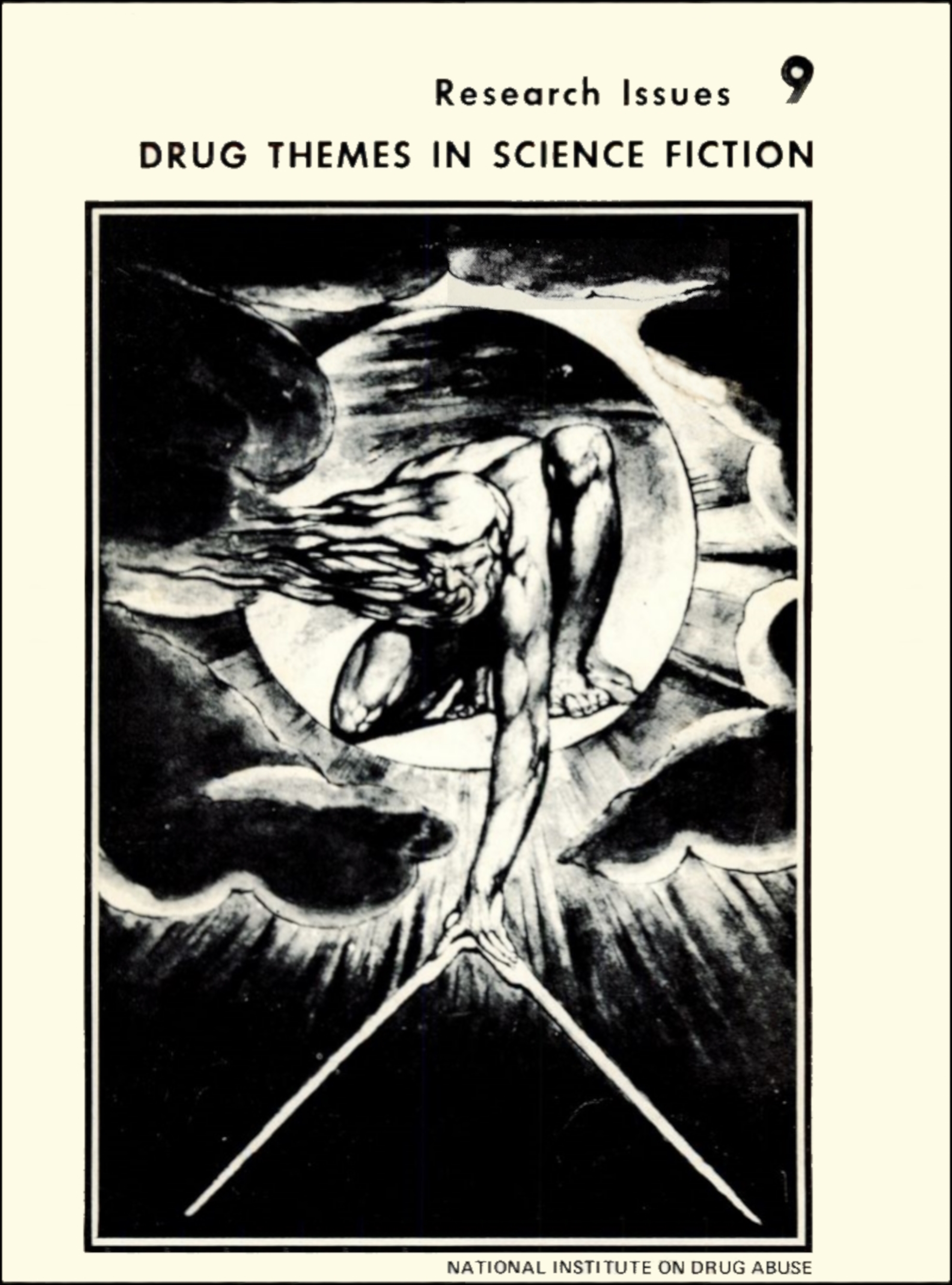
Cover Illustration
William Blake. The figure of Urizen or the Ancient of Days.
Frontispiece from Europe. Illuminated printing.
DRUG THEMES IN SCIENCE FICTION
by
Robert Silverberg
November 1974
National Institute on Drug Abuse
11400 Rockville Pike
Rockville, Maryland 20852
This volume, part of a Research Issues Series, was prepared for the
National Institute
on Drug Abuse by Documentation Associates,
Box 25892, Los Angeles, California,
under Contract Number HSM-42-73-222.
DHEW Publication No. (ADM) 75-190
Printed 1975
[iii]
FOREWORD
The issues of drug use and abuse have generated many volumes
of words, all written in an attempt to explain the “problem”
and suggest the “solution.” Data have been generated by researchers
from many disciplines, each looking at a particular aspect of
an issue. The present booklet is one of a new series intended to
aid researchers who find it difficult to find the time to scan, let
alone read all the information which exists and which continues to
be published daily in their area of interest. An attempt has been
made to focus predominantly on empirical research findings and
major theoretical approaches.
Included in volumes 1 through 7 of the series are summaries
of the major research findings of the last 15 years, formulated
and detailed to provide the reader with the purpose, methodology,
findings and conclusions of previous studies done in the topic area.
Each topic was chosen because it represented a challenging issue
of current interest to the research community. As additional
issues are identified, the relevant research will be published as
part of this series.
Several of the volumes in the series represent a departure
from the above description. These also represent challenging issues,
and issues of current interest; they are, however, virtually unexplored
areas which have received little attention from the research
world. For example, the subjects of drugs and the visual arts,
science fiction, and fiction—aspects of contemporary life which
impact on all of us—are explored here by writers who have been
deeply involved in those fields. Their content is perhaps provocative,
and certainly stimulating.
The Research Issues series is a group project of staff members
of the National Institute on Drug Abuse, Division of Research,
Behavioral and Social Sciences Branch. Special thanks are due to
the continued guidance and support of Dr. Louise Richards and
Dr. Norman Krasnegor. Selection of articles for inclusion was
greatly aided by the suggestions of a peer review group, researchers
themselves, each of whom reviewed a topic of particular interest.
It is my pleasure to acknowledge their contribution to the
project here.
Dan J. Lettieri, Ph. D. Project Officer
National Institute on Drug Abuse
Robert Silverberg is the author of many
science-fiction novels, including The Masks of Time,
Son of Man, A Time of Changes, Dying Inside,
and others, as well as numerous short stories.
He has won two Hugo Awards and three Nebulas
for novel and short story. He is a past president
of the Science Fiction Writers of America.
Mr. Silverberg has also written several non-fiction
books on historical and archaeological
subjects, including The Pueblo Revolt, Mound
Builders of Ancient America, The Challenge of
Climate, and The Realm of Prester John. Born
and educated in New York City, Mr. Silverberg
now lives in Oakland, California.
[v]
PREFACE
The explosive upsurge in the use of mind-altering drugs by
middle-class Americans in the past decade has been a conspicuous
and much-discussed phenomenon of our times. Beginning in the mid-1960’s
and peaking, perhaps, about 1970, the use of marijuana, LSD,
and even heroin has taken on the character of an epidemic, not only
among the young but among many citizens of mature years. Though
at present the spread of heroin addiction appears to be once more confining
itself to low-income groups and LSD has become less fashionable
among the experimental-minded, certainly marijuana has established
itself as an almost universal drug used regularly by millions
of Americans, and use of more potent mind-alterers remains heavy
if no longer greatly accelerating.
During the period of social dislocation—marked by radical
changes in styles of clothing and dress, assassinations of political
leaders, disruption of the governmental processes as a response to
a war commonly seen as immoral, rampant inflation, and other
traumas and upheavals—that corresponds to the spread of drug use
in the United States, science fiction has become one of the most popular
specialized subgenres of literature. Once the obscure amusement
of a few thousand cultists, science fiction is now read by millions;
such novelists as Kurt Vonnegut, Vladimir Nabokov, Michael Crichton,
and others have reached the best-seller lists with works of science
fiction; motion pictures such as 2001 have won wide audiences and
science fiction has been conspicuous in the theater and in the themes
of popular music. While this increase in the popularity of science
fiction is in part a response to the wide publicity accorded the space
explorations of the United States and the Soviet Union, I think it is
much more to be ascribed to some of the same forces that have stimulated
so much interest in drug-taking. That is, in a period of social
upheaval such as we have experienced since the death of John F.
Kennedy and the escalation of the Vietnamese war, conventional modes
of behavior lose their appeal, and fascination with the bizarre, the
alien, the unfamiliar, the strange, with all sorts of stimulation
that provide escape from the realities of the moment, increases at a
great rate. Science fiction not only offers those values in abundance
but also, in its facet as satirical commentary on the here-and-now
world, provides a perspective on our rapid social changes that has
great appeal to readers, especially the young.
Surveys have shown that the audience for science fiction is
primarily adolescent and above-average in intelligence; most of the
readers are between 15 and 25 years of age (though of course some
remain addicts of the genre throughout their lives). Therefore, there
[vi]
is great correspondence between the main drug-using and science-fiction-reading
segments of the population, and it is worthwhile to examine
science fiction for insights into the use of mind-altering drugs
and for views of what drug use may lie in the future.
For the present research project I have compiled a group of
English-language short stories and novels which deal with the use of
mind-altering drugs, all written since 1900 and falling within the literary
category of science fiction. I have avoided inclusion of that
large body of stories dealing with drugs whose effects are primarily
on the body rather than the mind: immortality serums, for example.
Some of these stories date from the earliest years of the science-fiction
genre, notably from the 1920’s and 1930’s when mass-market
science-fiction magazines first began publication. Not surprisingly,
however, the majority of the stories within the study date from the
post-1965 period, when the use of drugs first pervaded the national
life to its present extent. For reasons explained in the accompanying
introductory essay, science fiction is more often a reflection of existing
societal trends than a prediction of trends to come. The upsurge
in drug use is precisely mirrored by the upsurge in the use of such
themes in science fiction.
Science fiction is as much a guide to where we are as it is a
vision of where we are going. A literature so popular with the young,
commanding so intense and devoted a following, can be of significant
value in revealing the patterns contemporary society is taking and
will take in the years just ahead.
Defining science fiction is no easy task. Some of the definitions
that have been proposed are so loose that they would qualify a
book like Sinclair Lewis’ Arrowsmith as science fiction—it surely is
“fiction about science”—and others are drawn so narrowly that they
would exclude much of what is published today in science-fiction magazines
and books. With that caveat in mind, therefore, I offer one of
the more flexible definitions, one which I think does cover the greater
part of what I understand to be science fiction:
Science fiction is that branch of fantasy which engages in
imaginative speculation about the impact of technology on human
society.
By classing science fiction as a branch of fantasy, I make it a
subdivision of that vast literary genre that includes Homer’s Odyssey,
Milton’s Paradise Lost, the Norse sagas, Alice in Wonderland, much
of Poe, and so forth. Placing the emphasis on technology, however,
requires science fiction to have a certain systematic content, an underlying
rationale of theme. A story about a vampire is pure fantasy; a
story that rationalizes vampirism in terms of metabolic phenomena
is science fiction. It is the attempt at inducing a willing suspension of
disbelief by supplying a plausible scaffolding for the implausible that
gives science fiction its identity within the greater realm of fantasy.
But because science fiction is a form of fantasy, it is ideally
suited for the exploration of drug-related phenomena. A drug is a
kind of magic wand; but it is a chemist’s magic wand, a laboratory
product, carrying with it the cachet of science. By offering his characters
a vial of green pills or a flask of mysterious blue fluid the author
is able to work wonders as easily as a sorcerer; and by rigorously
examining the consequences of his act of magic, he performs the
exploration of speculative ideas which is the essence of science fiction.
So in the nineteenth century Robert Louis Stevenson produced
Dr. Jekyll and Mr. Hyde, Mary Wollstonecraft Shelley devised an
elixir of immortality in The Mortal Immortal, and H. G. Wells created
a whole shelf of drug-related stories, speeding up human motion
in “The New Accelerator,” turning beasts into men in The Island of
Dr. Moreau, depicting an unseeable phantom in The Invisible Man.
And in the present century the use of mind-altering or mind-controlling
drugs has become one of the prime vehicles for the speculations of
science-fictionists.
[4]
In preparing this study of drug themes in science fiction, I have
employed the following categorical designations:
Drugs as Euphorics: Drugs that give pleasure in simple unstructured
ways, through release from depression and tension, much as
alcohol does in our society (though alcohol is not strictly speaking a
euphoric, of course).
Drugs as Mind Expanders: Drugs that provide “psychedelic”
visions of other times or places or that offer a sensation of oneness
with the cosmos as a whole; analogous to LSD in our society.
Drugs as Panaceas: Drugs which, through tranquilizing or
neutralizing effects, calm the mind without necessarily inducing
euphoria.
Drugs as Mind Controllers: Drugs that enable one entity to
limit or direct the activities or desires of another; analogous to
brainwashing, and generally associated with totalitarian activities.
Drugs as Intelligence-Enhancers: Drugs which have the specific
property of extending or amplifying the rational processes of the
mind.
Drugs as Sensation-Enhancers: Drugs whose effects are achieved
through amplified or extended bodily sensation-response, perhaps
analogous to marijuana in our society.
Drugs as Reality-Testers: Drugs which permit the user to
penetrate the “real” realities beyond the surface manifestations of
daily life.
Drugs as Mind-Injurers: Drugs used as weapons in biochemical
warfare, aimed at the mind.
Drugs as Means of Communication: Drugs that have the specific
property of opening hitherto unknown channels of communication
between minds.
Two distinct attitudes toward the use of mind-related drugs
have manifested themselves in science fiction. One is cautionary:
that any extraordinary indulgence in extraordinary drugs is likely to
rot the moral fiber of the user, leading to lassitude and general decay
of the individual or of society, and ultimately, perhaps, aiding
the establishment of a totalitarian order. The other is visionary and
utopian: that through the employment of drugs mankind can attain
spiritual or psychological powers not ordinarily available, and by so
doing can enter into a new and higher phase of existence.
This latter attitude has become far more widespread since 1965,
when middle-class use of hallucinogenic and euphoric drugs in western
industrial civilization first began to take on the aspect of a major
cultural shift. The cultural assumptions of science fiction as a whole
can clearly be seen to follow, rather than to lead, public opinion:
most science fiction published in the twentieth century has been
[5]
mass-market commercial fiction which, however daring its departures from
everyday reality, has generally tended to adopt the conventional moral
dogmas of middle-class society, as does most commercial fiction.
Science fiction of the 1920’s and 1930’s reveals a remarkable degree of
racism no longer acceptable to general readers in what they read
(though they may cling to prejudices in daily life). Science fiction of
the 1940’s and 1950’s is marked by casual sexism likewise no longer
officially acceptable. And science fiction in general has shown a
strong, if implicit, bias in favor of capitalism, the work ethic, Puritan
sexual morality, and other pillars of western industrial society.
Drug-users in science-fiction stories until quite recently were analogous
to heavy users of alcohol in mainstream fiction: their reliance on
a consciousness-altering substance was seen as a sign of weakness of
character. In the past decade there has been a major cultural shift
in our society toward hedonistic behavior, at first furtively, now openly;
and this, after the customary lag, has been translated into a shift in
the direction of permissiveness in the conventional moral attitudes expressed
by popular entertainment. (The private behavior of individuals
is almost always far more scandalous than the standards of behavior
the public demands in entertainment or from elected officials,
but as taboos dissolve in private life they weaken, to a lesser extent,
in official public morality.)
Science-fiction writers tend to be no more radical as a group
than any other randomly selected cross-section of middle-class educated
contemporary citizenry, so far as my extensive personal
acquaintance with them has shown; however forward-looking their
fictional visions may be, they are, in the main, far from atypical in
daily life style. Not only do they conform to prevailing cultural beliefs
more than outsiders are likely to suspect, but, as is true of
most who depend for their livelihoods on mass-audience acceptance,
they quite readily espouse a surprising conservatism of philosophy in
their work. In the past, therefore, professional science-fictionists
almost automatically chose a cautionary position for stories embodying
drug-related themes, the drugs being symbolic of decay rather
than growth, and it is only in the last few years that some writers
have felt free to depict the use of certain mind drugs in a positive—even
evangelical—light.
The extent of the shift may best be illustrated from the work
of a writer who, although he wrote science fiction, cannot be considered
a professional science-fictionist nor an advocate of conventional
morality, and whose career was conducted almost entirely
outside the taboo-ridden assumptions of mass-market publishing:
Aldous Huxley.
Huxley’s Brave New World (1932) is a bitter satiric novel
[6]that, as its sardonic title indicates, depicts a utopian world of the
future in which children are born in bottles at a State Hatchery and
Conditioning Center, designed by the benevolent world state to fit a
particular economic niche, and, as adults, kept in line by a generous
bread-and-circuses policy. Restlessness is cured by a wondrous drug
called soma: “... if ever by some unlucky chance such a crevice of time
should yawn in the solid substance of their distractions,” Huxley tells
us, “there is always soma, delicious soma, half a gramme for a half-holiday,
a gramme for a weekend, two grammes for a trip to the
gorgeous East, three for a dark eternity on the moon; returning whence
they find themselves on the other side of the crevice, safe on the solid
ground of daily labor and distraction....”[1] Those malcontents and
nonconformists who cannot accept the soft mechanical pleasures of
Huxley’s brave new world are exiled to remote islands.
[1] Huxley, Aldous. Brave New World. New York: Harper
and Brothers Publishers, 1946. p. 67.
Soma, in Brave New World, is implicitly condemned as an
opiate, a mind-luller, an instrument of repression. Huxley’s negative
outlook toward the drug is not, though, an expression of work-oriented
Puritan morality so much as a classic liberal-humanitarian
distrust of technology: the Huxley of 1932 plainly believed that mankind
coddled by drugs was something less than what mankind could
be. The young Huxley felt contempt for those who needed mechanical
aids or who depended on anything other than the force of their own
intellects. Many years later, however, a very different Huxley experienced
the psychedelic marvels of mescaline and LSD, which
kindled in him strong esthetic delight and something akin to spiritual
ecstasy. When he next attempted the fictional construction of a
utopian commonwealth, in Island (1962), his outlook on mind-altering
drugs was far more sympathetic. In this ideal state of the future one
uses not the soporific soma but the ecstasy-invoking moksha, a mind-expanding
hallucinogen. Concerning moksha one character says,
“Having had the misfortune to be brought up in Europe, Murugan calls
it dope and feels about it all the disapproval that, by conditioned reflex,
the dirty word evokes. We, on the contrary, give the stuff good
names—the moksha-medicine, the reality-revealer, the truth-and-beauty
pill. And we know, by direct experience, that the good names
are deserved.”[2] Huxley is really talking about LSD, and his tone is
that of the acid-evangelist.
[2] Huxley, Aldous. Island. New York: Harper and Row,
Publishers, 1962. p. 157.
Drug as contemptible anodyne, drug as gateway to higher
reality—those are the poles bounding the handling of drugs in science
[7]fiction. The older science fiction was preponderantly negative, as,
for example, James Gunn’s The Joy Makers, published in 1961 but
written half a decade earlier, in which a repressive government sustains
itself through mandatory use of euphorics. The same theme can
be found in Hartley’s Facial Justice (1960), and in other works. Even
when not used as an instrument of totalitarianism, drugs are often
seen as dangerous self-indulgence, as in Wellman’s Dream-Dust from
Mars (1938), Smith’s Hellflower (1953), or Pohl’s What to Do Until
the Analyst Comes (1956). The prototypes for the imaginary drugs
described in these stories are alcohol and heroin—drugs which blur
the mind and lower the consciousness.
Much recent science fiction, however, taking cognizance of such
newly popular drugs as LSD, marijuana, and mescaline, show society
transformed, enhanced, and raised up by drug use. Silverberg’s A
Time of Changes (1971) portrays a dour, self-hating culture into which
comes a drug that stimulates direct telepathic contact between human
minds and brings into being a subculture of love and openness. This
creates a great convulsion in the society, but the implication is that
the change the drug brings is beneficial. Similarly, in Panshin’s
How Can We Sink When We Can Fly? (1971), a drug called tempus that
induces travel in time is part of the educational process of a future
society. In The Peacock King by McCombs and White (1965) LSD is
used as a training device to prepare astronauts for the rigors of interstellar
travel, and in H. H. Hollis’ Stoned Counsel (1972) hallucinogenic
drugs have become routine aspects of courtroom work. Another
view of a society transformed but not necessarily injured by mass
drug use is Wyman Guin’s Beyond Bedlam, dating from 1951, in which
schizophrenia is desired and encouraged and is induced by drugs. In
Silverberg’s Downward to the Earth (1971) hallucinogens play a part
in ecstatic religion on another world.
A variant of the mind-expanding drug is the intelligence-enhancing
drug, long a common theme in science fiction. Some recent
exponents of the theme are Brunner’s The Stone That Never Came
Down (1973), Dickson’s The R-Master (1973), and Disch’s Camp
Concentration (1968).
Not all depiction of drugs in recent science fiction is sympathetic,
of course. Aldiss’ Barefoot in the Head (1970) shows all of
Europe thrown into confusion by the “acid-head war,” in which an
Arab power doses the whole continent with psychedelic weapons. (Aldiss
does indicate at least peripherally that the new tripped-out culture
emerging in war-wrecked Europe is not entirely inferior to its
predecessor.) Chester Anderson’s lighthearted The Butterfly Kid
(1967) depicts hallucinogenic drugs as weapons employed by aliens,
[8]
whether mind-expanding, mind-contracting, or mind-controlling. In
the horrendously overpopulated future of Harry Harrison’s Make Room!
Make Room! (1966), LSD and marijuana are the best available escapes
from the daily nightmare that is life; in a similarly crowded world
imagined by Doris Pitkin Buck in Come Where My Love Lies Dreaming
(1964) the drug of choice is nothing we have today, but rather one
that gives the user the vicarious experience of existence as a dinosaur!
However different the details, though, the stories say the same thing:
that fortitude is not enough, that chemical assistance will be needed.
The stories in the sample chosen for this project illustrate the
whole range of drug themes in science fiction, from the plausible to
the fantastic, from the horrifying to the ecstasy-inducing. In a world
where man and his technological marvels must coexist along an uneasy
interface, science fiction indicates some of the possible impact
areas in the decades and centuries ahead.
[9]
ANNOTATED BIBLIOGRAPHY
[10]
The science-fiction works selected for this bibliography are
arranged chronologically within the categories described below.
Primitive Period circa 1900–1935. Science fiction was then, at
least in the specialist magazines, a crude and artless form, and the
stories tend to be skeletal and formula-ridden. Typically, a scientist
working in secret (often a mad scientist) devises a drug whose effects
operate on the mind in some extreme fashion, and through secret experiments
demonstrates the perils of this drug. Examples: Barnes,
Binder, Fearn, Gatter, Hall, etc.
Predictive Period circa 1935–1965. As the genre matured,
authors began to seek greater complexity of style and structure in their
fiction, and to achieve greater thematic perception. The stories of this
period characteristically attempted to consider the most wide-ranging
consequences of drug use; the authors themselves typically had had no
experience with drugs other than alcohol, and based their ideas partly
on imaginative projection and partly on the reports of such early experimenters
with drugs as Baudelaire and deQuincy. Examples: Guin, Pohl,
Collins, Huxley (1932), MacDonald, Hartley, Gunn.
Contemporary Period circa 1965 to date. With drug use now a
matter for the news media as well as for solitary experimenters and
literateurs, experience with mind-altering phenomena grows; many
authors now sample marijuana and LSD and use their experiences as a
basis for projections of trends. The changes in society are presumed
to be permanent and become fixtures in stories, so that characters in
a story set in 1999 use drugs like marijuana and LSD as casually as
characters in a futuristic story written in 1950 would use cigarettes
and alcohol. Drug use is taken for granted in the future, and new uses
are postulated as an outgrowth of a richness of drug experience not
available to earlier science-fiction writers, who had neither the personal
experience nor the wealth of published data that present-day
writers may draw upon. Examples: Aldiss, Spinrad, Silverberg,
Dick, Anderson, Disch, Moorcock, Brunner.
[11]
ANNOTATED BIBLIOGRAPHY
PRIMITIVE PERIOD
(1900–1935)
[12]
Author:
Pratt, Fletcher and Lester, Irvin
Title:
The Roger Bacon formula
Journal:
Amazing Stories, Vol. 3, No. 10, 940–948
Publisher:
Experimenter Publishing Company, New York
Date:
January 1929
Format:
Short story
Descriptor:
Drugs as mind-expanders
Annotation:
Medievalist rediscovers lost manuscript in which Roger
Bacon provides the formula for mandragordeum, a drug
that induces “transportation of the mind.” Taking it, the experimenter
finds himself freed from his body and journeying to Venus; a vivid vision
of life on the second planet ends only when the drug wears off. Fearing
addiction, he never tries the drug again, though he admits a temptation
to more tripping.
Author:
Harris, Clare Winger
Title:
The diabolical drug
Journal:
Amazing Stories, Vol. 4, No. 2, 156–161
Publisher:
Experimenter Publishing Company, New York
Date:
May 1929
Format:
Short story
Descriptor:
Drugs as mind-controllers
Annotation:
Scientist develops a chemical which, by retarding the
voltage of the brain’s electrical activity, halts the aging
process. An experiment on a human is performed, the subject being
the scientist’s beloved, who is six years older than he is; he intends to
hold her at the same age until he has caught up. She sinks into a kind
of stasis. Unable to perfect an antidote, he injects himself also, and
the two of them enter a strange suspended animation in which extreme
psychological effects of the metabolic slowdown manifest themselves.
[13]
Author:
Huxley, Aldous
Title:
Brave New World
Publisher:
Chatto & Windus, London, England
Pages:
214 pp.
Date:
1932
Format:
Novel
Descriptor:
Drugs as panaceas
Annotation:
In mechanized, standardized utopian world of the future,
where human beings are synthetically produced in incubators
and conditioned for optimum social stability, a drug called soma
serves as the utopiate of the masses, distracting and tranquilizing
those who might otherwise become restless in their too-comfortable
lives.
Author:
Keller, David H.
Title:
The literary corkscrew
Journal:
Wonder Stories, Vol. 5, No. 8, 867–873
Publisher:
Continental Publications, New York
Date:
March 1934
Format:
Short story
Descriptor:
Drugs as intelligence enhancers
Annotation:
Satiric story. A professional writer discovers he can
write only when in physical pain, and requires his wife
to drive a corkscrew into his back to get him started. But the pain of
the corkscrew is impossible to sustain for long, and they seek medical
help. The doctor they consult discovers that it isn’t the pain itself but
rather certain hormones secreted as a response to the pain that encourages
literary production, and synthesizes a drug that makes writing
easier. Doctor takes his own drug and writes a best-seller.
[14]
Author:
Fearn, John Russell
Title:
He never slept
Journal:
Astounding Stories, Vol. 13, No. 4, 56–67
Publisher:
Street & Smith, New York
Date:
June 1934
Format:
Short story
Descriptor:
Drugs as intelligence-enhancers
Annotation:
Scientist concocts a protein-based drug that frees the
subject from all need to sleep. Narrator takes the drug
and enters into a condition of enhanced perceptivity in which he is
capable of penetrating the visionary recesses of his own mind and
visiting the dream-creating processes. The experience eventually
exhausts him, but unable to give up use of the drug, he looks forward
to death as the only release from its effects.
Author:
Herbert, Benson
Title:
The control drug
Journal:
Wonder Stories, Vol. 6, No. 6, 669–675
Publisher:
Continental Publications, New York
Date:
November 1934
Format:
Short story
Descriptor:
Drugs as euphorics
Annotation:
Scientist invents a xenon-derived drug that seems to
offer a “paradise” effect—brief glimpses of the Divine,
freedom from the material body, etc. But further research
shows its dread long-term effects: “The stuff doesn’t exalt you
or energize you.... What it does is to release the emotions from a lifetime
of civilized control and suppression. It takes the bonds off secret
desires. Its subtle physiological action leaves you with no control
whatever.” Naturally he destroys the drug and takes his own life.
[15]
Author:
Hamilton, Edmond
Title:
The truth gas
Journal:
Wonder Stories, Vol. 6, No. 5, 1060–1071
Publisher:
Continental Publications, New York
Date:
February 1935
Format:
Short story
Descriptor:
Drugs as mind-controllers
Annotation:
A scientist who believes that all sin and crime stem from
deceptiveness perfects and releases into the atmosphere
a drug that “causes a short-circuit between the brain’s thought-centers
and its motor-centers of speech” so that lying becomes impossible. The
resulting compulsive honesty leads to impossible social situations as the
whole veneer of tact and diplomacy vanishes; it becomes necessary to
devise and release an antidote.
Author:
Bartel, Philip J.
Title:
The elixir of progress
Journal:
Wonder Stories, Vol. 6, No. 11, 1286–1304
Publisher:
Continental Publications, New York
Date:
April 1935
Format:
Short story
Descriptor:
Drugs as euphorics
Annotation:
Satiric story of the quest in the year 3903 for rediscovery
of the lost ancient drug that provided stimulation and
energy and delight to early man—coffee.
[17]
ANNOTATED BIBLIOGRAPHY
PREDICTIVE PERIOD
(1935–1965)
[18]
Author:
Smith, Clark Ashton
Title:
The Plutonian drug
Journal:
Amazing Stories, Vol. 9, No. 5, 41–48
Publisher:
Teck Publications, New York
Date:
September 1934
Format:
Short story
Descriptor:
Drugs as mind-expanders
Annotation:
Among the many drugs brought back to Earth by space
explorers is Plutonium, a powder from Pluto that produces
a hashish-like derangement of time-perception, permitting the
user to transform time into space and go on psychedelic voyages.
The subject penetrates five or six hours into the past, an ineffable experience
that ends with a vision of his own death soon fulfilled in reality.
Author:
Barnes, Arthur K.
Title:
Emotion solution
Journal:
Wonder Stories, Vol. 7, No. 8, 955–963
Publisher:
Continental Publications, New York
Date:
April 1936
Format:
Short story
Descriptor:
Drugs as mind-controllers
Annotation:
A scientist who feels that emotions are a hindrance to
the full development of intelligence perfects a solution
that destroys the “emotional centers” of the brain; he infiltrates it
into the Southern California water system. The resulting emotionless
society is lifeless and without energy, not at all what the scientist envisioned,
and he feels guilt for having transformed millions of people
into dull robots.
[19]
Author:
Gatter, George F.
Title:
Emotion gas
Journal:
Wonder Stories, Vol. 7, No. 8, 967–971
Publisher:
Continental Publications, New York
Date:
April 1936
Format:
Short story
Descriptors:
Drugs as mind-controllers; Drugs as euphorics
Annotation:
Unscrupulous theatrical producers enhance the box-office
appeal of their comedy by surreptitiously dosing
the audience with a gas that induces euphoria; they leave convinced
they have seen an extraordinarily funny show, and business booms,
until one night an overdose is given that amplifies not only happy
feelings but passing moments of depression, causing everybody to
leave in a black despondent mood that kills the show.
Author:
Coblentz, Stanton A.
Title:
The glowworm flower
Journal:
Astounding Stories, Vol. 17, No. 4, 22–29
Publisher:
Street & Smith Publications, New York
Date:
June 1936
Format:
Short story
Descriptor:
Drugs as euphorics
Annotation:
A pioneering space exploration voyage brings back, by
accident, spores of an extraterrestrial plant that sprouts
on Earth. The flower of this plant gives off a fragrance that induces
intoxication, coma, and opium-like visions. Tripping on glowworm-flower
fragrance becomes addictive for many of Earth’s finest minds,
though lesser folk are relatively immune. The plant is eradicated
everywhere, possession of it is made illegal, and all space missions
are banned lest spaceships again be contaminated with the sinister
spores.
[20]
Author:
Binder, Eando
Title:
The hormone menace
Journal:
Thrilling Wonder Stories, Vol. 8, No. 1, 34–47
Publisher:
Beacon Magazines, Inc., New York
Date:
August 1936
Format:
Short story
Descriptor:
Drugs as mind-controllers
Annotation:
Villainous scientist, using extracts derived from endocrine
secretions, transforms human beings into mindless
puppets of abnormal strength and stature or of extraordinary
mental abilities (i.e., photographic memories). Heroic underground
agent penetrates his remote laboratory and puts an end to the research.
Author:
Wellman, Manly Wade
Title:
Dream-dust from Mars
Journal:
Thrilling Wonder Stories, Vol. 11, No. 1, 14–28
Publisher:
Better Publications, Inc., New York
Date:
February 1938
Format:
Short story
Descriptor:
Drugs as panaceas
Annotation:
The spores of a Martian lichen are an agreeable
stimulant to Martians of the 28th century but throw
Earthmen into deep trances in which they experience prolonged ecstatic
dreams. The dream-dust becomes immensely popular on Earth and is
outlawed when everyone seems headed for the oblivion it provides.
[21]
Author:
Hall, Charles F.
Title:
The time drug
Journal:
Tales of Wonder, Vol. 1, No. 5, 62–73
Publisher:
The World’s Work, Surrey, England
Date:
Winter 1938
Format:
Short story
Descriptor:
Drugs as mind-expanders
Annotation:
Scientist perfects a drug, mixing together cactus alkaloids
and kava root, which creates powerful psychedelic
effects and allows the experimenter to float backward in time. Backward
explorations continue until the researcher reaches the creation
of the universe, with grave consequences for him.
Author:
Kyle, David A.
Title:
Golden nemesis
Journal:
Stirring Science Stories, Vol. 1, No. 1, 28–34
Publisher:
Albing Publications, New York
Date:
February 1941
Format:
Short story
Descriptor:
Drugs as mind-expanders
Annotation:
Aware that most of the capacity of the human brain remains
unused, an experimenter devises a drug that will
raise him to superhuman intelligence by giving him access to his entire
brain. He is transformed into a genius by the drug, but only for a brief,
intense “trip,” which after a few days so exhausts him that, “nerves on fire,”
he dies of heart failure. The story is a remarkable anticipation of extreme
LSD effects.
[22]
Author:
Pohl, Frederik
Title:
What to do until the analyst comes
In:
Alternating Currents
Publisher:
Ballantine Books, New York
Pages:
143–154
Date:
1956
Format:
Short story
Descriptor:
Drugs as panaceas
Annotation:
Narrator is an advertising man who tells how, after
a cigarettes-and-lung-cancer scare, researchers
discover a cheap, allegedly harmless and non-addictive euphoric
drug, and it goes on the market in chewing-gum form as a replacement
for cigarettes. Soon everyone is chewing Cheery-Gum except
the narrator, who is allergic to it; and though the drug is theoretically
non-addictive, it makes everyone so high that no one wants to give it
up—leading to a dazed and tranquilized society in which everyone is
euphoric and indolent and everyone maintains that he could kick the
Cheery-Gum habit on a moment’s notice, if he had any reason to do
so—which he doesn’t.
Author:
Slesar, Henry
Title:
I remember oblivion
Journal:
Fantasy and Science Fiction, Vol. 30, No. 3, 36–43
Publisher:
Mercury Press, New York
Date:
March 1966
Format:
Short story
Descriptor:
Drugs as mind-controllers
Annotation:
A technique has been devised for literal brainwashing of
criminals, i.e., the total eradication through chemotherapy
of memory, and the reconstruction, using drugs and “narco-hypnosis,”
of a new non-criminal personality within the existing body.
The narrative cuts from the conversation of two scientists using the
technique to the stream-of-consciousness of a rehabilitated criminal
who, breaking through his conditioning, regains access to his memories
and commits suicide in his guilt.
[23]
Author:
Keller, David H.
Title:
The abyss
In:
The Solitary Hunters and the Abyss
Publisher:
New Era Publishers, Philadelphia
Pages:
108–265
Date:
1948
Format:
Novel
Descriptor:
Drugs as mind-controllers
Annotation:
A scientist isolates XYZ, a chemical present in the
minds of psychotics, and, purely as an experiment,
doses all of New York City with it by distributing it in the form of
chewing gum. Mass psychosis results; civilization collapses and
the eight million guinea pigs revert to a sort of Roman culture,
with barbaric gladiatorial games, an emperor, mass brutality, new
religions. After thirty days the drug wears off and the victims fall
into coma and awaken unharmed.
An endocrinologist has charted a monthly human cycle
of emotional peaks and depressions, and, for the sake
of greater efficiency and harmony in society, has developed a drug
that will control and adjust the cycle so that everyone treated will peak
or drop at the same time. This works well during the high part of the
cycle, but once the lows set in, mass hysteria develops among the inoculated
populace, there is a wave of suicides, and a chain reaction of
interlocking depressions virtually destroys society.
[24]
Author:
Williams, Robert Moore
Title:
The elixir of peace
Journal:
Amazing Stories, Vol. 23, No. 12, 124–131
Publisher:
Ziff-Davis Publishing Company, Chicago
Date:
December 1949
Format:
Short story
Descriptor:
Drugs as mind-controllers
Annotation:
Comic story of a tranquilizing drug devised to make
animals such as lions tame enough to use in movies.
The demonstration leads to complications, and a furious movie
director is “tamed” as well by surreptitious use of the drug.
Author:
Heinlein, Robert A.
Title:
The Puppet Masters
Publisher:
Doubleday & Co., New York
Pages:
219 pp.
Date:
1951
Format:
Novel
Descriptor:
Drugs as mind-expanders
Annotation:
The Earth has been invaded by slug-like parasitic beings
that attach themselves to men’s backs and dominate their
minds and bodies. The protagonists, Sam Nivin and Mary, are members
of a secret security agency fighting the invaders. In the middle of
the struggle they decide to get married; but because they can only spare
24 hours for their honeymoon, they inject themselves with tempus, a
drug analogous to speed, which stretches subjective time for them so
that they feel they are experiencing a month-long honeymoon.
[25]
Author:
Morrison, William (Pseud. for Joseph Samachson)
Title:
The addicts
Journal:
Galaxy Science Fiction, Vol. 3, No. 4, 122–131
Publisher:
Galaxy Publishing Corporation, New York
Date:
January 1952
Format:
Short story
Descriptor:
Drugs as euphorics
Annotation:
Husband and wife are lighthouse-keepers on a lonely
asteroid between Earth and Mars. Husband has become
addicted to marak, a euphoric drug that keeps him in a constant state
of good nature and well-being. This makes meaningful conversation
between him and wife impossible, since he is so agreeable that all
discussions trail off immediately, and she is growing irritable for lack
of stimulating company. Husband therefore decides secretly to give
his wife addictive dose of drug.
Author:
Smith, George O.
Title:
Hellflower
Publisher:
Abelard Press, New York
Pages:
264 pp.
Date:
1953
Format:
Novel
Descriptor:
Drugs as sensation-enhancers
Annotation:
On Ganymede, moon of Jupiter, grows the gardenia-like
plant from which hellflower, also known as love lotus,
is extracted—a narcotic which heightens sensations and other sensory
stimuli and creates psychological addiction through enhancement of
pleasure—with women the chief victims. Story concerns the traffic in
this and related drugs and the attempts of a government agent of the
future to intercept it.
A French molecular physicist develops a drug known as
hexostyromolybdenum, HSM, which has the property of
vastly increasing the human metabolism. Motion, body speed, the rate
of living, and other functions are accelerated 100,000 times. Protagonists
make use of HSM to achieve desired political goals.
Author:
Phillips, Rog (Pseud. for Roger Philip Graham)
Title:
The yellow pill
Journal:
Astounding Science Fiction, Vol. 62, No. 2, 51–61
Publisher:
Street & Smith Publications, New York
Date:
October 1958
Format:
Short story
Descriptor:
Drugs as reality-testers
Annotation:
Psychiatrist encounters a patient who has committed
murder and who has the delusion that he was on board
a spaceship, defending himself against lizard-men from Venus, at the
time of the killing. Patient totally denies the reality of actual world,
and tells psychiatrist to take a yellow pill that will awaken him to the
true reality of the spaceship-world. Psychiatrist is amused by concept
of a yellow pill that can bring one out of a delusion; but then he
finds a bottle of yellow pills in his locker and the story becomes an
exploration of ambiguous levels of reality, with the pills serving as
conduits between one “real” world and the other.
[27]
Author:
Hartley, L. P.
Title:
Facial Justice
Publisher:
Doubleday & Company, New York
Pages:
263 pp.
Date:
1960
Format:
Novel
Descriptor:
Drugs as mind-controllers
Annotation:
The scene is the not very distant future, after the Third
World War. Nine tenths of the human race has been
destroyed and the survivors are ruled by a benevolent dictator who reduces
conflict situations by imposing an enforced equality: personalities
are standardized, numbers are used for names, women undergo
plastic surgery so that none will seem too beautiful or too ugly. This
dreary homogenized state is kept under control by dosing the citizens
daily with a sedative-like bromide to which most people have become
addicted; it lowers vitality and reduces nonconformity.
Author:
Gunn, James
Title:
The Joy Makers
Publisher:
Bantam Books, New York
Pages:
160 pp.
Date:
1961
Format:
Novel
Descriptor:
Drugs as euphorics
Annotation:
Under the 26th Amendment to the Constitution, ratified
in 2003, hedonism is the law of the land. The function
of government, it has been decided, is “the preservation and promotion
of the temporary happiness of its citizens.” Gloom is outlawed and
happiness is mandatory. It is attained through mental disciplines,
through mechanical regulation of the metabolism, and through the free
use of drugs—notably mescaline, “neo-heroin,” various alkaloids, and
certain futuristic euphorics.
[28]
Author:
Huxley, Aldous
Title:
Island
Publisher:
Harper & Row, New York
Pages:
295 pp.
Date:
1962
Format:
Novel
Descriptor:
Drugs as mind-expanders
Annotation:
This Utopian novel, written thirty years after Huxley’s
anti-drug Brave New World and after his own experiments
with LSD and mescaline, depicts another ideal commonwealth
centering on the use of drugs: but in place of Brave New World’s
mind-deadening soma, the citizens of Island use moksha, a hallucinogen
very similar in effect to LSD, which induces mystical visions and
intensifies religious experience.
Author:
Burgess, Anthony
Title:
A Clockwork Orange
Publisher:
W. W. Norton, New York
Pages:
160 pp.
Date:
1963
Format:
Novel
Descriptors:
Drugs as mind-controllers; Drugs as mind-expanders
Annotation:
Alex is a juvenile delinquent of the near future, who
routinely uses such drugs as synthemesc or drencrom
that are sold in neighborhood “milk bars” for hallucinogenic boosts.
After committing a particularly atrocious assault, Alex is arrested
and sentenced to a kind of brainwash reconditioning. With the aid of
drugs and hypnotherapy he is conditioned against violence and turned
loose to become a useful citizen.
[29]
Author:
Buck, Doris Pitkin
Title:
Come where my love lies dreaming
Journal:
Fantasy and Science Fiction, Vol. 26, No. 2, 113–126
Publisher:
Mercury Press, New York
Date:
February 1964
Format:
Short story
Descriptor:
Drugs as panaceas
Annotation:
The quickest refuge from the horrors of life in 21st
century Washington, D. C., is the use of detenser pills.
The latest brand is Protoceratops Tabs, which mentally transport the
user to the Mesozoic Era and create the illusion that he or she is a
dinosaur. The story, gently comic in tone, follows the adventures of
a woman who takes the dinosaur trip and comes face-to-face not only
with prehistoric beasts but with her own inner problems.
Author:
Purdom, Tom
Title:
Greenplace
Journal:
Fantasy and Science Fiction, Vol. 27, No. 5, 5–16
Publisher:
Mercury Press, New York
Date:
November 1964
Format:
Short story
Descriptor:
Drugs as intelligence enhancers
Annotation:
Protagonist is a psychologist doing political field-testing
on behalf of a Congressman running for re-election c.
1980. As he prepares to enter a suburban district controlled by his
candidate’s powerful opponent, he doses himself with MST, a newly
invented psychic energizer that “multiplied the powers of observation
and the rate and quality of thought by a factor somewhere between
three and seven.” Under the influence of MST he is able to detect the
frightening psychological techniques by which the suburb is held in
control.
[30]
Author:
McCombs, Larry and White, Ted
Title:
The peacock king
Journal:
Fantasy and Science Fiction, Vol. 29, No. 5, 23–36
Publisher:
Mercury Press, New York
Date:
November 1965
Format:
Short story
Descriptor:
Drugs as mind-expanders
Annotation:
The United States is planning its first expedition into
interstellar space, using a radical space-drive that
permits faster-than-light travel. Preliminary experiments have shown
that a faster-than-light trip will have grave psychological impact on
the crew, and therefore LSD is used as part of the training discipline
for the crew (a man and a woman). Through acid experiences they
make themselves capable of handling the interstellar jump through
hyperspace.
[31]
ANNOTATED BIBLIOGRAPHY
CONTEMPORARY PERIOD
(1965–Present)
[32]
Author:
Guin, Wyman
Title:
Beyond bedlam
In:
Living Way Out
Publisher:
Avon Books, New York
Pages:
155–208
Date:
1967 (1951 First Issue)
Format:
Short novel
Descriptor:
Drugs as panaceas
Annotation:
During the late 20th century drugs were developed to
aid schizophrenics by permitting their warring inner
personalities to live side by side, controlling the body alternately.
By the following century the element of schizophrenia is recognized
in all persons and it becomes mandatory to use the drugs, giving
everyone a prime ego and an alternate ego, in fact separate persons,
who undergo drug-induced shifts of dominance every five days. The
author explores the concept of ego-shift by following the fortunes of a
number of protagonists whose doubled personalities engage in complex
interactions.
Author:
Collins, Hunt (Pseud. of Evan Hunter)
Title:
Tomorrow and Tomorrow
Publisher:
Pyramid Books, New York
Pages:
190 pp.
Date:
1956
Format:
Novel
Descriptor:
Drugs as reality-testers
Annotation:
The novel, set in a near-future Earth dominated by advertising
and television, describes the conflict between
two groups of differing social philosophies: the Vikes, who advocate
vicarious pleasure and indulge in heroin-like narcotics to escape from
reality, and the Rees, or Realists, an austere Puritan movement
hostile to all mind-altering substances.
[33]
Author:
Dick, Philip K.
Title:
We can remember it for you wholesale
Journal:
Fantasy and Science Fiction, Vol. 30, No. 4, 3–16
Publisher:
Mercury Press, Inc., New York
Date:
April 1966
Format:
Short story
Descriptor:
Drugs as mind-controllers
Annotation:
A technique is developed by which, using a hypnotic
drug called narkidrine, false memories can be implanted
in a human brain. The memory-implant technique can be
used to provide the vicarious illusion of pleasurable experience, but
also—as the story unfolds—we see that it can be used for purposes
of political intrigue.
Author:
Dick, Philip K.
Title:
The Three Stigmata of Palmer Eldritch
Publisher:
Doubleday & Company, New York
Pages:
278 pp.
Date:
1965
Format:
Novel
Descriptor:
Drugs as mind-expanders
Annotation:
An illegal hallucinogen, Can-D, allows Earth colonists
on Mars, Venus, and other nearby worlds to stave off
the crushing boredom of daily life by permitting them to enter a highly
schematicized common fantasy world where they share in the adventures
of two imaginary lovers who are larger-than-life Hollywood dream-figures.
Complications ensue when a competitive reality-destroying
drug, Chew-Z, is introduced surreptitiously by beings from another
solar system.
[34]
Author:
Dick, Philip K.
Title:
Now Wait for Last Year
Publisher:
Doubleday & Company, New York
Pages:
214 pp.
Date:
1966
Format:
Novel
Descriptor:
Drugs as mind-expanders
Annotation:
In the war-torn world of the 21st century, Americans
escape from the horrors of their time by addictive use
of JJ-180, a drug that allows the consciousness to detach from present
time and return to earlier eras, or even to travel forward in time.
The protagonist, initially attempting only to deal with his wife’s
addiction to the time-travel drug, eventually becomes entangled in
global politics and the progress of the interstellar war as he himself,
under the influence of JJ-180, oscillates backward and forward in time.
Author:
Harrison, Harry
Title:
Make Room! Make Room!
Publisher:
Doubleday & Company, New York
Pages:
213 pp.
Date:
1966
Format:
Novel
Descriptor:
Drugs as euphorics
Annotation:
The year is 1999 and the population of New York City
is 35 million. In this hideously overcrowded society
marijuana and LSD are the chief means of escape from stress, and
their use is far more pervasive than it is today. Filmed as Soylent
Green.
[35]
Author:
Aldiss, Brian W.
Title:
The night that all time broke loose
In:
Dangerous Visions (Edited by Harlan Ellison)
Publisher:
Doubleday & Company, New York
Pages:
151–160
Date:
1967
Format:
Short story
Descriptor:
Drugs as mind-expanders
Annotation:
Comic story about time gas, piped through mains to
suburban houses the way heating gas is distributed.
Using time gas, subscribers can dial themselves back to any period
in their lives they prefer to re-experience. Story concerns a break
in the gas main that floods the region with time gas and touches off a
great gusher that carries mankind back into prehistoric times, with
dinosaurs imminent as the time-effects grow more powerful.
Author:
Anderson, Chester
Title:
The Butterfly Kid
Publisher:
Pyramid Books, New York
Pages:
190 pp.
Date:
1967
Format:
Novel
Descriptor:
Drugs as mind-expanders
Annotation:
In this comic novel, set among the drug-using counter-culturists
of Greenwich Village, trouble starts when
Reality Pills become available—a “projective hallucinogen” that creates
hallucinations visible not only to the user but to those around him. It
develops that Reality Pills have been invented and distributed by blue
lobster-like beings from another planet in order to facilitate their conquest
of Earth—a conquest ultimately thwarted by the dedication of a
fearless band of hippies.
[36]
Author:
Dick, Philip K. and Nelson, Ray
Title:
The Ganymede Takeover
Publisher:
Ace Books, New York
Pages:
157 pp.
Date:
1967
Format:
Novel
Descriptor:
Drugs as mind-expanders
Annotation:
In this satiric novel intelligent worm-like beings from
Ganymede, moon of Jupiter, conquer the Earth despite
the best efforts of such individuals as Rudolph Balkani, Chief of the
Bureau of Psychedelic Research, who has been working on a mind-blocking
weapon. The world that Ganymede conquered is in fact devoted
on all levels to the use of psychedelics, and the novel raises
questions about the nature of “reality” as the action unfolds.
Author:
Lupoff, Richard A.
Title:
One Million Centuries
Publisher:
Lancer Books, New York
Pages:
352 pp.
Date:
1967
Format:
Novel
Descriptor:
Drugs as mind-expanders
Annotation:
A man of the twentieth century is thrust forward in time
to the world of the unimaginably distant future. As he
explores the civilization he finds himself among, he learns that the
people of the era habitually chew samra, a hallucinogenic drug, and a
woman he meets takes him on a samra trip. It is a soaring visionary
experience in which he perceives the birth and death of the solar
system.
[37]
Author:
Spinrad, Norman
Title:
Carcinoma angels
In:
Dangerous Visions (Edited by Harlan Ellison)
Publisher:
Doubleday & Company, New York
Pages:
489–497
Date:
1967
Format:
Short story
Descriptor:
Drugs as mind-expanders
Annotation:
Protagonist suffering from terminal cancer seeks remission
of disease. With the aid of massive doses of
various hallucinogenic agents he reaches an ostensible mental state in
which he is capable of entering his own body to do psychic battle with
the cancer cells. In series of metaphorical contests he destroys the
invaders, but is unable to return to real-world consciousness and is
remanded to mental institution, trapped within his own body.
Author:
Wilson, Colin
Title:
The Mind Parasites
Publisher:
Arkham House, Sauk City, Wisconsin
Pages:
222 pp.
Date:
1967
Format:
Novel
Descriptor:
Drugs as mind-expanders
Annotation:
A research project involving heavy doses of mescaline
and LSD leads to perceptions revealing the existence of
invisible “mind parasites,” alien invaders who have long controlled and
influenced human life. With the aid of the drug, experimenters unleash
mental powers with which to combat the invaders.
[38]
Author:
Disch, Thomas
Title:
Camp Concentration
Publisher:
Doubleday & Company, New York
Pages:
184 pp.
Date:
1968
Format:
Novel
Descriptor:
Drugs as intelligence-enhancers
Annotation:
The novel is the journal of a U.S. political prisoner of
the near future who is assigned to observe and record
the progress of an experiment in which volunteer prisoners at a secret
internment camp are treated with Pallidine, an intelligence-enhancing
drug derived from the organism that causes syphilis. In the course of
nine months the drug turns the prisoners into supermen of extraordinary
mental capacity while destroying their bodies with disease.
Author:
Herbert, Frank
Title:
The Santaroga Barrier
Publisher:
Berkley Books, New York
Pages:
255 pp.
Date:
1968
Format:
Novel
Descriptor:
Drugs as mind-expanders
Annotation:
An outsider penetrates a remote California valley inhabited
by reclusive farmers who discourage all contact
with strangers. He discovers that they have built a society based
on consumption of Jaspers—a psychedelic drug going far beyond acid in
its effects, fostering a sense of community through its ability to allow
takers to perceive the ultimate relationships linking all aspects of the
universe. He is drawn into the valley society and becomes part of it.
[39]
Author:
Moorcock, Michael
Title:
The Final Programme
Publisher:
Avon Books, New York
Pages:
191 pp.
Date:
1968
Format:
Novel
Descriptor:
Drugs as mind-expanders
Annotation:
Satiric comic novel of near future, in which hallucinogenic
drugs are used in a variety of ways—as, for
example, LSD gas, employed as a protective device and discharged to
muddle the minds of burglars breaking into a mansion. More conventional
use of drugs (i.e., as euphorics and hallucinogens) is common
in the book.
Author:
Silverberg, Robert
Title:
How it was when the past went away
In:
Earth’s Other Shadow (By Robert Silverberg)
Publisher:
New American Library, New York
Pages:
66–127
Date:
1973 (First Issue 1969)
Format:
Short novel
Descriptor:
Drugs as mind-injurers
Annotation:
One day in 2003 an unknown malcontent dumps an
amnesia-producing drug into the water system of San
Francisco. Within a few hours virtually everyone in the city has lost
his memory, and the effects of the memory drug linger for several
days, causing great complications. Story follows the reactions of
several characters to the varied effects of sudden amnesia. As story
ends things are returning to normal for most people, but one unstable
individual has obtained a supply of the drug and is preaching its use in
a new cult of oblivion.
[40]
Author:
Spinrad, Norman
Title:
Bug Jack Barron
Publisher:
Walker Books, New York
Pages:
327 pp.
Date:
1969
Format:
Novel
Descriptor:
Drugs as mind-expanders
Annotation:
In the closing years of the 20th century the work of a
foundation for life-extension research becomes the
center of fierce political controversy. The tensions growing out of
the search for immortality are depicted against the background of a
near-future world in which marijuana and the psychedelic drugs are
legal and widely consumed.
Author:
Aldiss, Brian W.
Title:
Barefoot in the Head
Publisher:
Doubleday & Company, New York
Pages:
281 pp.
Date:
1970
Format:
Novel
Descriptor:
Drugs as mind-injurers
Annotation:
In Europe of the near future, political tensions have led
to the bombing of the entire continent by the Arab state
of Kuwait with psychedelic weapons—odorless, tasteless, and enormously
potent. In the aftermath of the war all of Europe finds itself
on a perpetual LSD trip, since the drug’s aftereffects prove ineradicable.
Industrial society breaks down, reason becomes extinct, and the
novel itself dissolves into a Joycean verbal phantasmagoria as the old
society gives way to one in which insanity is the norm.
[41]
Author:
Silverberg, Robert
Title:
Sundance
In:
The Cube Root of Uncertainty (By Robert Silverberg)
Publisher:
Collier Books, New York
Pages:
219–239
Date:
1970
Format:
Short story
Descriptor:
Drugs as mind-expanders
Annotation:
Protagonist is part of a team of Earth men annihilating
a semi-intelligent alien race on an extrasolar world
prior to colonization of the planet. Protagonist is emotionally
disturbed—his American Indian ancestry makes him bitter about the
genocide he feels is taking place—and his sympathies toward the aliens
lead him to take part in their rites and to consume a hallucinogenic
plant, used by them, that induces synesthesia and a sense of racial
communion.
Author:
Vonnegut, Kurt
Title:
Welcome to the monkey house
In:
Welcome to the Monkey House (By Kurt Vonnegut)
Publisher:
Delacorte Press, New York
Pages:
28–47
Date:
1970
Format:
Short story
Descriptor:
Drugs as mind-controllers
Annotation:
At a time when the world’s population is 17 billion, compulsory
ethical birth control comes into effect. On pain
of fine, everyone must take birth control pills three times a day. The
pills do not interfere with reproduction, but, by making people numb
from the waist down, “take every bit of pleasure out of sex.”
[42]
Author:
Benford, James
Title:
Pulse
Journal:
Fantastic Science Fiction, Vol. 20, No. 6, 22–25
Publisher:
Ultimate Publishing Company, New York
Date:
August 1971
Format:
Short story
Descriptor:
Drugs as mind-expanders
Annotation:
Young woman describes her LSD trip to her psychotherapist:
a vision of another world (she thinks it is
the moon) marked by strange geological formations and flora. He
listens patiently to her descriptions of this obviously illusory experience,
but she maintains the drug actually transported her, and as
she goes on talking he is drawn into the illusion and finds himself
mysteriously transported (without the aid of the drug) to the world
of her narrative.
Author:
Lafferty, R. A.
Title:
Sky
In:
New Dimensions One, (Edited by Robert Silverberg)
Publisher:
Doubleday and Co., New York
Pages:
149–161
Date:
1971
Format:
Short story
Descriptor:
Drugs as mind-expanders
Annotation:
Protagonists in future civilization make use of Sky, a
drug derived from an amanita mushroom. Stated powers
of this drug are to provide sensations of mastery and union-with-cosmos,
especially during parachute drops. Protagonists attain successively
more ecstatic states in series of Sky-enhanced parachute drops, until,
seeking the perfect high, they deliberately fail to use their parachutes
on one Sky trip and, after a descent marked by moments of stunning
ecstasy, perish as they hit the ground.
[43]
Author:
Panshin, Alexei
Title:
How can we sink when we can fly?
In:
Four Futures, a science-fiction anthology
Publisher:
Hawthorn Books, New York
Pages:
94–130
Date:
1971
Format:
Short novel
Descriptor:
Drugs as mind-expanders
Annotation:
At some period in the future a drug called tempus is
developed which enables people to travel backward in
time, literally or perhaps in mind alone. Young people are required
to take tempus journeys as part of the educational process. Story
takes place in contemporary United States, c. 1970, and analyzes
current problems by confronting the protagonist with a tempus-using
visitor from the future.
Author:
Sheckley, Robert
Title:
Down the digestive tract
In:
Can You Feel Anything When I Do This? (By Robert Silverberg)
Publisher:
Doubleday and Co., New York
Pages:
145–147
Date:
1971
Format:
Short story
Descriptor:
Drugs as reality-testers
Annotation:
An underground chemist gives a friend a mixture of
hallucinogenic drugs guaranteed to send him into a true
trip. Friend waits impatiently for the hallucinations to hit. Chemist
and friend are actually not human but alien insecto-reptilian creatures,
and it turns out that the hallucination the friend has is that of being a
human being in our contemporary world.
[44]
Author:
Silverberg, Robert
Title:
Downward to the Earth
Publisher:
New American Library, New York
Pages:
176 pp.
Date:
1971
Format:
Novel
Descriptor:
Drugs as mind-expanders
Annotation:
The venom of a serpent found on an alien planet that has
been colonized by Earthmen proves to have medicinal
value, serving as a catalyst in limb-regeneration work; but when used
in a different dosage it has psychological effects, evoking in Earthmen
the illusion that they have been transformed into the elephant-like
intelligent species that is the dominant native life-form of the planet.
Illicit use of the drug for this purpose is common among the Earthmen
stationed there. Protagonist, expiating old guilts, goes among the
elephant-beings and eventually is admitted into ecstatic communion with
them through use of the drug.
Author:
Silverberg, Robert
Title:
A Time of Changes
Publisher:
New American Library, New York
Pages:
220 pp.
Date:
1971
Format:
Novel
Descriptors:
Drugs as mind-expanders, drugs as a means of communication
Annotation:
Scene is a planet of the future dominated by stern culture
that makes a fetish of privacy and personal reticence.
Narrator obtains from a “primitive” culture on another continent a drug
which attacks the basics of his native culture by making possible direct
telepathic contact between minds. He attempts to found a subculture of
love and openness based on use of the drug, but, although he is a prince
of the realm, he is proscribed and hunted down.
[45]
Author:
Silverberg, Robert
Title:
The World Inside
Publisher:
Doubleday and Co., New York
Pages:
201 pp.
Date:
1971
Format:
Novel
Descriptors:
Drugs as mind-expanders, drugs as a means of communication
Annotation:
In world of 24th century, most of mankind lives in
thousand-story apartment buildings each of which has
a population of more than 800,000. Chapter three of the novel follows
the adventures of a musician who, after performing at a concert, drugs
himself with a multiplexer, a mind-expanding drug that temporarily
induces a telepathic contact simultaneously with all 800,000 residents
of his building, so that he perceives their lives and thoughts in one
vast intricate construct.
Author:
Davis, Grania
Title:
My head’s in a different place now
In:
Universe Two, (Edited by Terry Carr)
Publisher:
Ace Books, New York
Pages:
151–172
Date:
1972
Format:
Short story
Descriptor:
Drugs as mind-expanders
Annotation:
Young American married couple, weary of life on welfare
in a large city, travel into Central American jungle in
search of a drug-using primitive tribe of which they have heard. Eventually
they find an Eden-like place where the natives, though dominated
by fears of supernatural beings, seem whole and happy. The Americans
discover hallucinogenic mushrooms near the village, begin using them,
and settle into an amiable life of tripping and telepathic contact with
animals, insects, and plants. As story ends they are planning to turn
on the unsuspecting villagers.
[46]
Author:
Hollis, H. H.
Title:
Stoned counsel
In:
Again, Dangerous Visions, (Edited by Harlan Ellison)
Publisher:
Doubleday and Co., New York
Pages:
270–281
Date:
1972
Format:
Short story
Descriptor:
Drugs as mind-expanders
Annotation:
In world of near future hallucinogenic drugs have become
a routine part of the legal process. Lawyers examine
evidence that is fed to them in direct association with LSD and other
drugs, and trials are conducted with prosecutors and defense attorneys
both in a drug-enhanced mental state. Approach of the story is sympathetic
and detached; drug-enhancement is depicted as a new phase, not
necessarily negative in implication, in courtroom procedure.
Author:
Jones, Langdon
Title:
The eye of the lens
In:
The Eye of the Lens (By Langdon Jones)
Publisher:
Collier Books, New York
Date:
1972
Pages:
53–90
Format:
Short novel
Descriptor:
Drugs as mind-expanders
Annotation:
Avant-garde story without summarizable plot: it
attempts to depict various cinematic and psychedelic
modes of perception and includes (p. 84) an explicitly psychedelic
scene within a British cathedral of the near future where hallucinatory
religious rituals take place.
[47]
Author:
Nelson, Ray
Title:
Time travel for pedestrians
In:
Again, Dangerous Visions, (Edited by Harlan Ellison)
Publisher:
Doubleday and Co., New York
Date:
1972
Pages:
140–159
Format:
Short story
Descriptor:
Drugs as mind-expanders
Annotation:
Protagonist, using crushed “flower seeds” plus auto-hypnotic
techniques, embarks on a trip in which his
consciousness perceives past existences. He travels mentally to
medieval northern Europe, to Egypt shortly after the time of Jesus,
to medieval southern France, and other eras.
Author:
Niven, Larry
Title:
The fourth profession
In:
Best Science Fiction of the Year, Vol. I, (Edited by Terry Carr)
Publisher:
Ballantine Books, New York
Pages:
293–340
Date:
1972
Format:
Short novel
Descriptor:
Drugs as mind-expanders
Annotation:
Alien beings known as Monks come to Earth and, to serve
purposes of their own, distribute a variety of strange
pills. One of these drugs is an intelligence-enhancer, another is a
memory-destroyer, another induces instantaneous transport from one
place to another. Story explores the effects of these and other alien-given
drugs and the motivations of the aliens who distribute them.
[48]
Author:
Silverberg, Robert
Title:
Dying Inside
Publisher:
Charles Scribner’s and Sons, New York
Pages:
245 pp.
Date:
1972
Format:
Novel
Descriptor:
Drugs as means of communication
Annotation:
Story takes place in 1976. Narrator is middle-aged New
York intellectual who has had the power of telepathy since
childhood and now is losing it. The power has embittered him by rendering
him a freak, and he has taken pains to conceal knowledge of it from
others. He tells how, in 1968, a close love relationship of his was terminated
when he and his woman friend took LSD together; the trip had
the unexpected effect of opening a two-way telepathic channel between
them, so that not only could he read her mind as usual but she briefly
had access to his, giving her a bad trip and causing her to recoil from
him.
Author:
Spinrad, Norman
Title:
No direction home
In:
Best Science Fiction of the Year, Vol. I, (Edited by Terry Carr)
Publisher:
Ballantine Books, New York
Pages:
227–244
Date:
1972
Format:
Short story
Descriptor:
Drugs as mind-expanders
Annotation:
Scene is United States of the near future in which psychedelic
drugs of all kinds, including many not yet known,
are legal and widely used on all levels of society. Story speculates in
detail on the nature of a commercialized legal psychedelics industry
and on the forms future drugs may take.
[49]
Author:
Bradley, Marion Zimmer
Title:
Darkover Landfall
Publisher:
Daw Books, New York
Pages:
160 pp.
Date:
1973
Format:
Novel
Descriptor:
Drugs as mind-expanders
Annotation:
Story describes the arrival on the extrasolar planet of
Darkover of a shipload of colonists from Earth, and
explores the impact on the Earthmen of the Ghost Wind, a native
meteorological phenomenon that has psychedelic effects, caused by
pollen, dust, or virus, which liberate ESP powers in their minds.
The settlers, bombarded by hitherto unfamiliar sensory data, are
plunged into conflict that transforms the group.
Author:
Brunner, John
Title:
The Stone That Never Came Down
Publisher:
Doubleday and Co., New York
Pages:
206 pp.
Date:
1973
Format:
Novel
Descriptor:
Drugs as mind-expanders
Annotation:
Scene is London, 1980’s: a time of chaos with World
War III imminent. Chemists discover drug called VC—viral
coefficient—which has the property of greatly intensifying sensory
perception and amplifying intelligence and memory. Drug has ability
to multiply in proper environment like living organism. When an unemployed
teacher who has had an experimental dose of VC donates blood
to central bloodbank, he unwittingly spreads VC widely to the world at
large, causing an epidemic of sanity in which world leaders, now
greatly more intelligent, take steps to abolish warfare and establish
an ideally rational society.
[50]
Author:
Dickson, Gordon R.
Title:
The R-Master
Publisher:
Lippincott, Philadelphia
Pages:
216 pp.
Date:
1973
Format:
Novel
Descriptor:
Drugs as mind-expanders
Annotation:
In the middle of the 21st century an intelligence-enhancing
drug called Reninase-47 has come into wide use. Though
normally it simply stimulates the thought process, R-47 occasionally
does massive damage to the mind, and in a few cases creates a supergenius,
an R-master. Protagonist’s brother takes R-47 and suffers
brain damage. In order to help him, protagonist also takes the drug
and unexpectedly emerges from treatment as an R-master, a member
of an extraordinary elite group, and from another R-master he learns
of the need for a vast reorganization of governmental policies. He
becomes a revolutionary leader and works toward a transformation of
society.
Author:
Free, Colin
Title:
The Soft Kill
Publisher:
Berkley Books, New York
Pages:
159 pp.
Date:
1973
Format:
Novel
Descriptor:
Drugs as mind-controllers
Annotation:
Protagonist is a scientist stationed aboard an orbiting
research station of the far future. Needing a holiday,
he is transferred to a place called HighTown—an overpopulated city
where a totalitarian government maintains control by dosing the
citizens with a variety of tranquilizing and euphoric drugs. Novel
explores the effect of government-by-chemistry.
[51]
Author:
Pumilia, Joseph F.
Title:
As dreams are made on
Journal:
Fantastic Science Fiction, Vol. 22, No. 3, 18–29
Publisher:
Ultimate Publishing Co., New York
Date:
1973
Format:
Short story
Descriptor:
Drugs as mind-expanders
Annotation:
Teenage boy obtains a supply of metamorphium, a drug
that induces fantasy-gratification dreams. Not only are
his dreams richly satisfying, but he discovers that his girlfriend, whom
he sees in the dreams, is aware of the visions as if the drug has induced
some telepathic link between them. He has a vision of a time when
everyone is linked through shared metamorphium dreams—“one big
dream, one big mind asleep and dreaming all the time,” even though
individual dreamers will wake from the big dream.
Author:
Rotsler, William
Title:
Gods of Zar
Journal:
Amazing Stories, Vol. 47, No. 3, 20–40
Publisher:
Ultimate Publishing Co., New York
Date:
1973
Format:
Short story
Descriptor:
Drugs as euphorics
Annotation:
An Earthman stranded on an alien planet becomes god of
the local native race. When his people are attacked by
a hostile tribe he defeats the enemy soldiers by dosing them with tazeel,
a euphoric drug of the planet that destroys their discipline and converts
them instantly from Spartan ferocity to self-indulgence.
[52]
Author:
Scortia, Thomas N.
Title:
The weariest river
In:
Future City, (Edited by Roger Elwood)
Publisher:
Trident Press, New York
Pages:
108–148
Date:
1973
Format:
Short story
Descriptor:
Drugs as euphorics
Annotation:
The scene is about 350 years from now. An immortality
treatment has been perfected and the world has become
a savagely overcrowded, polluted urban sprawl in which people live
forever. Drugs are the main refuge from boredom among the immortals.
The protagonist is the inventor of the immortality serum, whose life is
spent in an endless search for illegal drugs to palliate his guilt and
spiritual malaise.
Author:
Spinrad, Norman
Title:
The weed of time
Journal:
Vertex, Vol. 1, No. 3
Publisher:
Mankind Publishing Co., Los Angeles
Pages:
58, 92–93
Date:
1973
Format:
Short story
Descriptor:
Drugs as mind-expanders
Annotation:
An exploratory mission to the fifth planet of the star Tau
Ceti in 2048 discovers a plant that is given the name of
Tempis ceti, seeds and leaves of which have a psychedelic property:
they destroy the linear perception of time and enable the subject to view
all moments along his lifespan simultaneously. Seeds of the plant prove
to be fertile on Earth and the drug comes into common use. Protagonist
is a time-drug user whose simultaneous perception of his 110-year lifespan
sends him to a mental hospital.
U.S. DEPARTMENT OF HEALTH, EDUCATION, AND WELFARE PUBLIC HEALTH SERVICE ALCOHOL, DRUG ABUSE, AND MENTAL HEALTH ADMINISTRATION
NATIONAL INSTITUTE ON DRUG ABUSE
11400 ROCKVILLE PIKE
ROCKVILLE, MARYLAND 20852
Transcriber’s Note (continued)
Errors in punctuation and simple typos have been
corrected without note. Archaic or variant spelling, inconsistent
hyphenation, etc., has been left as it appears in the original
publication unless as noted in the following:
Page iv – “science fiction” changed to “science-fiction”
(Silverberg is the author of many science-fiction novels)
Page 3 – “science fictionists” changed to “science-fictionists”
(for the speculations of science-fictionists)
Page 4 – “brain-washing” changed to “brainwashing”
(analogous to brainwashing)
Page 5 – “science fiction” changed to “science-fiction”
(Drug-users in science-fiction stories)
Page 5 – “Science fiction” changed to “Science-fiction”
(Science-fiction writers tend to be no more radical)
Page 7 – “The Joymakers” changed to “The Joy Makers”
(The Joy Makers, published in 1961)
Page 27 – “The Joymakers” changed to “The Joy Makers”
(Title: The Joy Makers)
Page 27 – “noncomformity” changed to “nonconformity”
(it lowers vitality and reduces nonconformity)
Page 43 – “science fiction” changed to “science-fiction”
(In: Four Futures, a science-fiction anthology)