*** START OF THE PROJECT GUTENBERG EBOOK 76691 ***
Transcriber’s Notes
This e-text is based on the printed version of ‘Goethe
and Schiller’s Xenions,’ from, 1915. Inconsistent spelling and
hyphenation have been retained, but punctuation and typographical
errors have been corrected.
The footnotes in the preface
(pp. 1–22) have been placed below their respective paragraphs.
They have been assigned alphabetical symbols ([A]–[C]).
Endnotes, which have been placed at the end
of the main text, have been arranged by using consecutive numbers
([1]–[23]).
THE appearance of the Xenions, a collection of satirical epigrams
in the Musen-Almanach of 1797, is a memorable event in the
literature of Germany. With the end of the eighteenth century a new
era had commenced. The idea of evolution, first clearly pronounced by
Caspar Friedrich Wolff in his theory of epigenesis,[A] pointed out
new aims of investigation in the realm of natural sciences; Kant’s
Critique of Pure Reason propounded new problems in philosophy;
and Beethoven conceived his grand sonatas, which reflected the spirit
of an all-comprehensive aspiration in the soul-stirring notes of music.
New ideals, religious, moral, and social, had dawned upon mankind, and
the two great apostles of this movement in the domain of poetry were
Goethe and Schiller.
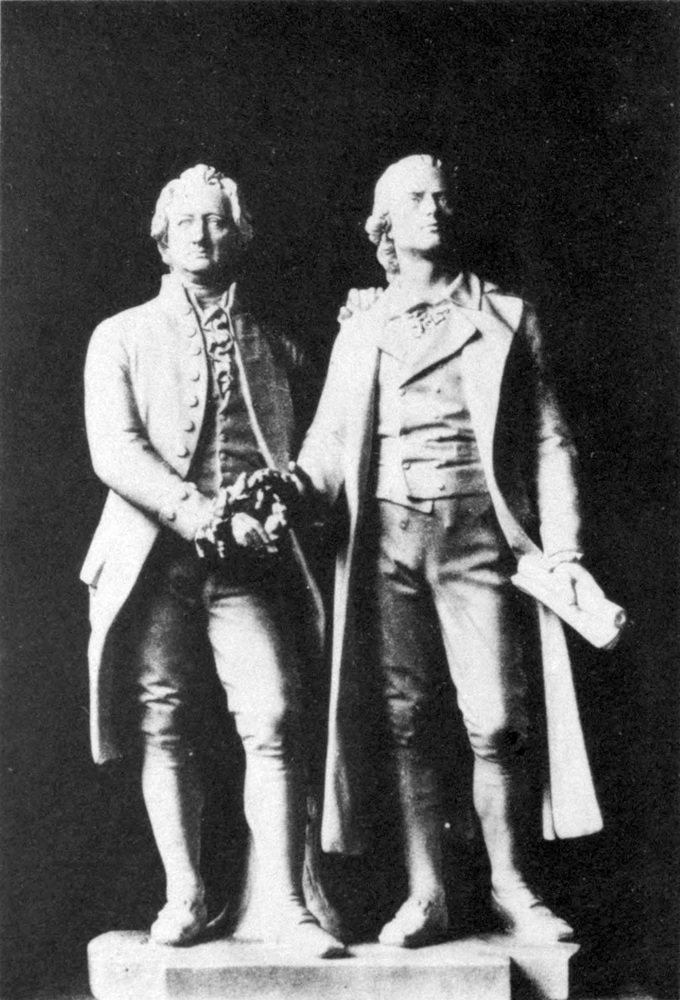
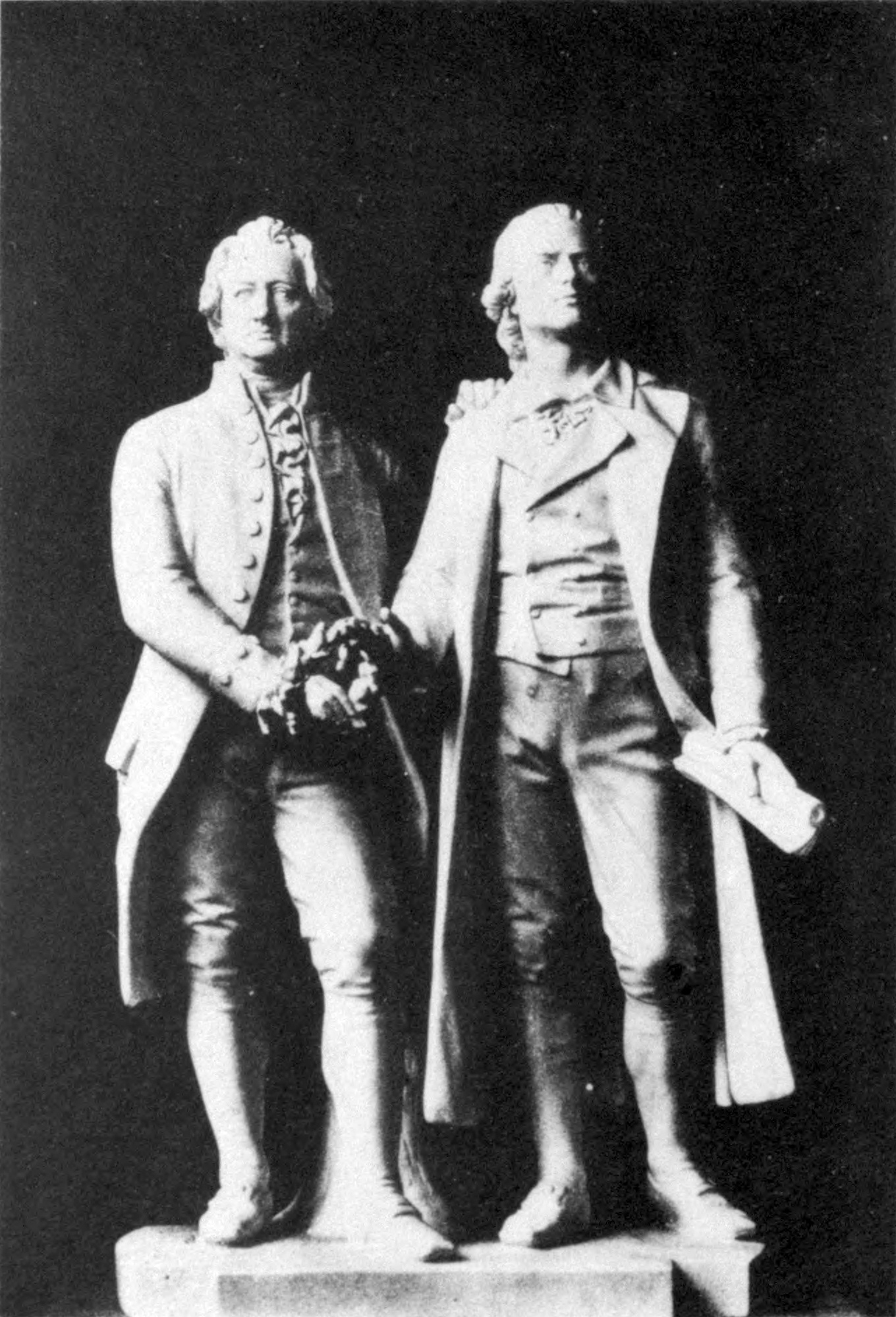
It is well known what good friends Goethe and Schiller were. After
the two great poets had become personally acquainted they inspired,
criticised, and corrected each other. Their common ideal became the
firm basis of their mutual friendship, and the chief monument of their
alliance is the collection of satirical distichs known as the Xenions.
Great though Schiller and Goethe were, they did not find sufficient
support among those who should have been their first followers and
disciples. The men of literary callings, who should be the priests of
the holiest interests of humanity, were too envious fully to recognize
and acknowledge the merit of these two great poet-thinkers. Moreover,
the men of letters were chiefly enamoured of their own traditional
methods of literary production and could not appreciate the purity, the
grandeur, and the holiness of the new taste. They misunderstood the
progressive spirit of the time, and to their puny minds the rise of the
new era appeared as a mere disturbance of their traditional habits.
They looked upon the twin giants of the world of thought as[Pg 5] usurpers,
who from personal vanity and ambition tyrannized over all others, and
whose impositions had either to be resisted, or silenced by shrugs.
On the one side, the orthodox and narrow-minded pietists considered
Goethe and Schiller irreligious and un-Christian, and accused them
of paganism. On the other side we find the two great poets opposed
by such men as the shallow Nicolai, a man of good common sense but
without any genius, a man who preached that stale kind of rationalism
which consisted in both the suppression of all higher aspiration and
the denial of spirituality in any sense. He railed at Goethe and
Schiller as well as at Kant, Fichte, and other great minds of his time
who went beyond his depth and were incomprehensible to him. The pious
are characterized in the Xenions as enthusiasts and sentimentalists
(Schwärmer) while the prosaic rationalists are called by the
German student term “philistines” which denotes common-place people,
and the pedantic Nicolai figures as the “arch-philistine.”
Nicolai was a rich and influential publisher in Berlin; he was an
author himself,[Pg 6] and a very prolific one too, but his writings are
superficial and barren. On several occasions he criticised Goethe
severely, and our great poets asserted that in fighting superstition
he attacked poetry, and in attempting to suppress the belief in
spirits he also tried to abolish spirit. So Goethe makes
him say in the Walpurgisnacht:
“Ich sag’s Euch Geistern in’s Gesicht,
Den Geistes-Despotismus leid ich nicht;
Mein Geist kann ihn nicht exerciren.”
[I tell you, spirits, to your face,
I give to spirit-despotism no place;
My spirit cannot practise it at all.]
Tr. by Bayard Taylor.
The irritation of the literary dwarfs showed itself in malevolent
reviews of Schiller’s literary enterprise, Die Horen.
Schiller wrote to Goethe June 15, 1795:
“I have thought for some time that it would be well to open a
critical arena in Die Horen. Yet we should not give away our
rights by formally inviting the public and the authors. The public
would certainly be represented by the most miserable voices, and the
authors, as we know from experience, would become very importunate.[Pg 7] My
proposition is that we make the attack ourselves. In case the authors
wish to defend themselves in Die Horen, they must submit to our
conditions. And my advice is, not to begin with propositions, but to
begin with deeds. There is no harm if we are denounced as ill-bred.”
Several letters were exchanged on this subject, and Goethe wrote in a
letter of December 23, 1795, to Schiller:
“We must cultivate the idea of making epigrams upon all journals; one
distich for each magazine, in the manner of Martial’s Xenia; and
we must publish a collection of them in the Musen-Almanach of
next year. Enclosed are some Xenions as a specimen.”
Schiller answered at once, December 23, 1795:
“The idea of the Xenions is splendid and must be carried out.... What a
wealth of material is offered by the Stolbergs, by Racknitz, Ramdohr,
the metaphysical world with its Me’s and Not-Me’s, friend
Nicolai, our sworn enemy, the Leipsic taste-mongers, Thümmel, with
Göschen as his horsegroom, and others.”
[Pg 8]
Thus the two poets decided to wage a destructive war against their
common enemies, and to come down upon them in a literary thunderstorm.
The poets planned a “poetical deviltry,” as they called it, and named
their satirical poetry “Xenions.”
The word Xenion originally meant a gift presented by a host to a
stranger who enjoys his hospitality. The Roman poet Martial called his
book of satirical epigrams Xenia; and, as Goethe and Schiller
intended to make similar epigrammatical thrusts at Nicolai and other
offenders, they adopted Martial’s expression and called their verses
Xenions.[B] They agreed to publish all their Xenions together, and to
regard them as their common property.
[B] We prefer the Saxon form of the plural (Xenions) to
the Latin form (Xenia), which is appropriate only as a name of
Latin poetry.
The first Xenions were very aggressive, but by and by they became more
general and lost their personal character. There are among them many
which are lofty and full of deep thought. It happened now and then
that the authors of the Xenions hit the wrong man; but this, although
to[Pg 9] be regretted, was more excusable than the abuse with which their
adversaries retorted.
The Xenions raised a storm of indignation, as was to be expected, and
Anti-Xenions were written by many of those who had been attacked. But
while the tenor of the Xenions is lofty in spite of their personal
character, and while we feel the high aims of Goethe and Schiller in
their attempts to purify literature, the Anti-Xenions are wholly
personal. They are rude, malicious and mean. They insinuate that the
Xenions were prompted by vile motives; that Goethe and Schiller wanted
more praise and flattery; that they were envious of the laurels of
others and wanted to be the sole usurpers of Mount Parnassus. Schiller
was called Kant’s ape, and Goethe was reproached with his family
relations.
The history of the Xenions is their justification. The Anti-Xenions
are, in themselves alone, a wholesale condemnation of the opposition
made to Goethe and Schiller.
Goethe wrote to Schiller concerning the reception which the Xenions
found, on December 5, 1796:
“It is real fun to observe what has been[Pg 10] offensive to this kind of
people, and also what they think has been offensive to us. How trivial,
empty, and mean they consider the life of others, and how they direct
their arrows against the outside of the works! How little do they know
that a man who takes life seriously lives in an impregnable castle!”
Goethe and Schiller had wielded a vigorous and two-edged weapon
in the Xenions. They had severely chastised their antagonists for
incompetency; but now it devolved upon themselves to prove the right of
their censorship, and they were conscious of this duty. Goethe wrote,
November 15, 1806:
“After the bold venture of the Xenions, we must confine our labors
strictly to great and worthy works of art. We must shame our
adversaries by transmuting our Protean nature henceforth into noble and
good forms.”
Events proved that both Goethe and Schiller were not only willing but
able to fulfil these intentions. Their antagonists have disappeared.
Some of them would[Pg 11] now be entirely forgotten had not the two poets
immortalized them in the Xenions.
Some Xenions are of mere transitory importance, especially such as
contain allusions and criticisms that are lost to those who are not
thoroughly versed in the history of the times, while others are gems
of permanent value, reflecting in a few words flashes of the deepest
wisdom, and they ought to be better known among English-speaking
people. We have therefore extracted and translated those which we deem
worthy of preservation for all time.
Goethe and Schiller’s distichs, we are sorry to add, are not always
very elegant, and sometimes lack in smoothness and correctness. The
first half of their pentameters is often very weak, and many of the
second parts are extremely awkward, as for instance in the distich on
page 163, where we read:
....“Und warum
kei′ne?” Aus Re′ligion′.
This excited the anger of Voss, the translator of Homer in the original
meter of dactylic hexameters. Voss ridiculed Goethe and Schiller for
their bad versification[Pg 12] in a distich, which he intentionally made
even worse than the worst of theirs, using the words with a wrong
accentuation:
“In′ Weimar und′ in Jena′
macht man′ Hexa′meter wie′ der;
A′ber die Pen′tameter′
sind′ doch noch ex′cellenter′!”
[In′ Weimar and′ in Jena′
they make′ hexame′ters such as′ this;
But′ the Pen′tameters′
are′ even more′ excellent′.]
In spite of some awkwardness and lack of elegance in diction, the
Xenions became very popular in Germany on account of the profound ideas
embodied in many of them. The shortcomings of their form have been
forgotten on account of their intrinsic value, and there is perhaps no
poetry quoted more frequently than these pithy aphorisms. They have
become household words in Germany and deserve a place of honor in the
literature of the world.
[Pg 13]
The Elegiac Distich.
THE form of the Xenions is, like their Roman prototype, the elegiac
distich.
The elegiac distich has rarely, if ever, been used in English poetry,
although there is much classical beauty in its rhythm. It consists of
alternate dactylic hexameters and pentameters which in ancient Greece
were recited to the accompaniment of the flute, and went by the name
of “elegies,” the etymology of which has nothing to do (as has been
assumed) with lamentations, but probably means flute-songs.
A meter in Greek prosody is comparable to the musical bar, while a
foot is a rhythmic figure. Some meters, such as the iambic (◡ – ◡ –) and
trochaic (– ◡ – ◡),
consist of two feet, but the dactylic meters(– ◡ ◡)
consist of one foot only.[C] Accordingly a[Pg 14] trochaic trimeter consists
of three meters or six feet; while six dactyls, the last one of which
is always catalectic, are called a dactylic hexameter. Catalectic means
“ending” or “terminating,” signifying that every line is mutilated at
the end. A catalectic meter lacks the last syllable, which, musically
considered, is to be regarded as a pause so as to make a musical halt
between the lines. According to another rule, the last syllable is
always indifferent, i. e., it may be either long or short (⏓).
[C] The name “dactyl” or “finger” (Greek δάκτυλος) indicates
that, like a finger, it consists of one long and two short members.
The dactylic (or, as it is also called, the heroic) hexameter is too
long to be read in one breathing, so it is divided into two, sometimes
into three parts, and the division is called a caesura, i. e., a
cut or incision. This division of the line is irregular and we do not
hesitate to say that to its irregularity the hexameter owes a peculiar
charm, for it breaks the monotony of the dactylic rhythm.
The new start after the caesura will never be dactylic (– ◡ ◡) like the
beginning of the line; it may be anapaestic (◡ ◡ –) or iambic (◡ –); but
not dactylic. The break should occur either after[Pg 15] an arsis (–) or
after a trochee (– ◡) so as to change the character of the latter part
of the hexameter from a descending into an ascending meter. The former,
the descending meter which begins with a long syllable, is halting and
possesses an attitude of holding back, of dignity, of assertion, while
the descending meter rushes forward from a short syllable to a long
one; it is progressive, it rises. The latter indicates struggle while
the former shows strength and the calmness of victory.
Every caesura has its own name in Greek and the most common caesura
cuts the verse in the third meter between the arsis, the long accented
syllable, and the thesis, i. e., the two short syllables or the one
long unaccented syllable. Since in prosody two short syllables are
equivalent to one long syllable, they are regarded as half a meter, and
so this caesura is called penthemimeres πενθημιμερὴς which means the
one after the fifth half-meter. It runs thus:
– ◡ ◡ - ◡ ◡ – || ◡ ◡ – ◡ ◡ – ◡ ◡ – ◡
There is another caesura after the seventh[Pg 16] half-meter. It is called in
Greek hephthemimeres (ἑφθημιμερὴς) and runs thus:
– ◡ ◡ – ◡ ◡ – ◡ ◡ – || ◡ ◡ – ◡ ◡ – ◡
Caesuras after the third and after the ninth half-meter are rarely
used; they occur sometimes in Latin but the latter is regarded as
inadmissible in Greek.
Almost as common as the penthemimeres is the caesura between the two
short syllables in the third meter; and because it cuts off from the
meter a trochee (thus – ◡ || ◡) it is called κατὰ τρίτον τροχαῖον, i. e.,
the caesura “after the third trochee.” It runs thus:
– ◡ ◡ – ◡ ◡ – ◡ || ◡ – ◡ ◡ – ◡ ◡ – ◡
Caesuras after the second trochee are rare and after the fourth are
strictly forbidden in Greek metrics.
Finally we must mention the caesura after the end of the fourth
measure, which is not uncommon in bucolic poetry, picturing the
peaceful life of the ancient Greek cowboys, so different from the
cowboys of the American Wild West, and it has therefore received the
name, “bucolic[Pg 17] caesura.” It is rare in heroic poems; nevertheless it
occurs sometimes and its occasional appearance is effective, for the
combination of one dactyl with one trochee (– ◡ ◡ – ◡) gives a euphonious
ring to the verse.
The heroic hexameter is best known to the English-reading public from
Longfellow’s Evangeline. It has not been a favorite with them
mainly because of the awkwardness with which it has been handled and
the boldness with which short syllables are frequently used to serve
as long syllables. We may say that at present the German language
has proved itself most apt in reproducing this classical measure, in
which, however, the long syllable (arsis) is to be replaced by
a decidedly accented syllable, while the place of a short syllable
(thesis) is taken by an unaccented syllable. This makes it
possible that the same word may, according to position, in one place
serve as a short, in another as a long, syllable, while the prosody of
the classical languages is more severe. There a syllable is either long
or short, and a short syllable can only become long through subsequent
consonants,[Pg 18] which is called “length through position.”
We have to recognize the fact that Teutonic languages are qualitative
while the classic languages are quantitative. This means that in the
former the accent of the word is predominant and wrong accents render
a word positively unintelligible, while in the latter the word-accent
is of less account. It is of little consequence in English whether
we pronounce “ĕgg” or “aigg,” but it makes a decided difference
whether we say “in′fidel” or “infi′del.” In modern French however,
we may pronounce with propriety either “la mai′son” or “la
maison′”. And this character of the Teutonic languages which
renders quality of accent so prominent in speech is the reason why they
tend to brevity, for they contract words more and more until, as is
the case in English, most of their forms are reduced to monosyllables.
Thus the Gothic word habededian is contracted in Middle German
into habete, (viz., haben—tat = “I did have”),
in modern German into hatte, and in English into “had.” The
Teutonic languages neglect the unimportant and unaccented[Pg 19] portions of
the word, and wherever they can be disposed of drop them entirely or
fuse them into the main syllable.
Another reason why the hexameter is not liked in English is on account
of the length of the verse. If the reader has first to search for the
caesura, for the place where he can take breath, he feels discouraged
at the long line that stretches before him like a road through the
desert, and for this reason we deem it an improvement to print dactylic
verses so as to begin a new line with the caesura. It renders the
reading of the line easier in the measure, as the break in the verse is
thus most easily taken in by the eye.
***
Since we have been discussing metrical details at some length, we may
be permitted to add a few comments on the iambic trimeter which in
English is really nothing else but what is commonly known as blank
verse. This verse is very generally misunderstood and we have nowhere
seen it properly explained in English books on prosody.
[Pg 20]
The blank verse is the most common and best adapted form for dignified
speech in both the dialogue and the monologue of the drama. We quote as
a typical verse the first line of Hamlet’s soliloquy:
“To be or not to be, that is the question.”
The meter is a catalectic iambic trimeter and there is only one rule of
importance, viz., that at the beginning and after caesuras an iambus
◡ – can be replaced by a trochee metric: – ◡. A scheme of the meter runs
thus:
This latter case, originally merely allowable, has become very frequent
in English, because the English language is rich in[Pg 21] monosyllables so
as to make it sometimes difficult to end the verse with an unaccented
(i. e., a short) syllable, but this custom has produced the impression
that the verse consists of five iambi, and among people but little
versed in the rules of classical poetry who forget that an iambic meter
consists of two feet, has given rise to the error that blank verse is
an iambic pentameter. Strange to say this mistake is now perpetuated in
almost all our text-books.
***
After this digression on the iambic trimeter we shall make, in
conclusion, a few comments on the dactylic pentameter.
The pentameter, i. e., “a five-measure,” is so called because it
consists of twice two and a half dactylic meters thus:
– ◡ ◡ – ◡ ◡ –
In reality the pentameter is a repetition of a penthemimeres.
Two short syllables may always be replaced in elegiac distichs by one
long syllable, with the exception of the fifth meter of the hexameter
and the latter half of the[Pg 22] pentameter. The schedule of a distich,
accordingly, is thus:
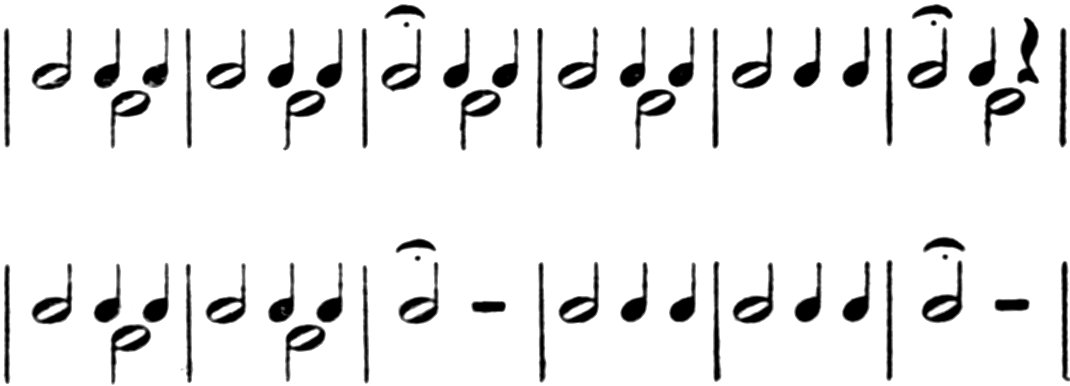
Considering the fact that the measures of Greek prosody are comparable
to musical bars in which time and not accent is the decisive element,
we readily understand that the name “pentameter” is a misnomer, for the
pentameter consists as much as the hexameter of six full dactylic bars,
only that there is a pause of one-half meter after each two and a half
meters. Expressed in musical characters, the distich reads as follows:
[1] Page 30, Note 1.—The name “Huss” means “goose.” When Huss
was condemned to die at the stake he said:
“Nach mir wird kommen ein Schwan,
Den sollen sie ungebraten lah’n.”
[After me a swan will rise,
Whom they will not roast likewise.]
This doggerel with its grim humor on so tragic an occasion is commonly
and naturally regarded as foretelling the coming of Martin Luther.
[2] Page 55, Note 2.—Professor Wolf was the first to prove
that the Iliad and the Odyssey consisted of a number of epic poems by
different poets, which were collected under the name of Homer. For
Goethe’s feeling with regard to criticism see the translator’s book
Goethe, page 273.
[3] Page 60, Note 3.—This distich is addressed to Karl Philip
Moritz, author of an interesting novel in the form of an autobiography,
Anton Reiser.
[4] Page 61, Note 4.—This is addressed to F. H. Jacobi,
who had written two philosophical novels, Woldemar and
Allwill. The difference between him and Moritz is sufficiently
characterized in this and the preceding distich.
[Pg 168]
[5] Page 63, Note 5.—This satirizes the sensuous novels of
Timotheus Hermes.
[6] Page 64, Note 6.—Directed against Platner, whose
philosophy was a declamation of platitudes. The distich is true of
almost all the debates that take place in literary clubs after the
reading of a paper.
[7] Page 71, Note 7.—Goethe wrote this in criticism of
Reichardt’s praise of the French Revolution.
[8] Page 77, Note 8.—This and the following three
distichs are directed against Nicolai, who was the owner of a large
publishing-house, but at the same time a mediocre author, shallow and
conceited.
[9] Page 85, Note 9.—The Stolberg brothers had been liberal,
but suddenly turned Roman Catholic.
[10] Page 86, Note 10.—The pious Count Leopold Stolberg,
exaggerating the value of Christian art while deprecating classic
taste, said that he would give a whole collection of Greek urns for one
Faience vase painted in the manner of Raphael.
[11] Page 87, Note 11.—The censure is true in its general
application; but the Xenion is aimed at a man (Johann Heinrich Jung,
whose nom de plume was Heinrich Stilling) who did not deserve
this castigation. See Goethe, page 16.
[12] Page 88, Note 12.—A severe description of Johann Caspar
Lavater. See Goethe, page 28.
[13] Page 89, Note 13.—Also directed against Reichardt. (See
Note 7.)
[Pg 169]
[14] Pages 94 and 102, Note 14.—Schiller renders “Hades” by
“Hell” which here retains the classical meaning and does not imply the
idea of punishment.
[15] Page 104, Note 15.—Karl Leonard Reinhold (born in Vienna
October 26, 1758) was educated as a Jesuit and became professor of
philosophy in the Jesuit college of the Barnabites, but renounced the
faith of his youth in 1783 and left Vienna for Weimar, where he married
the daughter of the poet Wieland. He became professor of philosophy at
the University of Jena in 1787 and 1794 in Kiel, where he died April
10, 1823. He was a Kantian and wrote much on Kantian philosophy.
[16] Page 112, Note 16.—Very good as a general criticism.
Goethe, however, was on the wrong track, in directing this distich
against Newton’s theory of color.
[17] Page 116, Note 17.—Kant called his philosophy
transcendental idealism, and his followers insisted upon the importance
of transcendentalism. They were opposed by naturalists, who scorned
theory and insisted on the facts of experience.
For the meaning of the word “transcendental” see the translator’s
Fundamental Problems, p. 30 et passim, and Primer
of Philosophy, p. 66. “Transcendent” means what transcends human
knowledge, i. e., what is unknowable, but “transcendental” is in
Kantian terminology non-sensory or formal knowledge such as pure logic
and arithmetic,[Pg 170] involving the principles of theory or systematic
abstract thought.
[18] Page 120, Note 18.—Here the term “natural law” does not
mean laws of nature but the juridical principle based upon primitive
natural conditions.
[19] Page 121, Note 19.—Samuel von Puffendorf (1632-1694) was
a famous jurist and professor of natural law in Berlin. (See previous
note.)
[20] Pages 122 and 123, Note 20.—Kant declared that the man
who performed his duty because it gave him pleasure was less moral than
he who did it against his own inclinations.
[21] Page 124, Note 21.—Schiller was a disciple and follower
of Kant, who finds the conditions of knowledge in the thinking subject,
not in the object that is thought. Since a thinking being does not
acquire an insight into the laws of form by experience, but establishes
them a priori, Kant believes that things have to conform to
cognition and not cognition to things. Man thus produces truth out
of his own being, and imports it into the objective world. Now it is
true that truth and the criterion of truth, namely reason, develop
together with mind; for indeed reason is the characteristic feature
of mind. Things are real, not true, and truth can dwell in mental
representations only. But considering the fact that mind develops from
and by experience which originates by a contact with objects, and
that reason is but the formal element extracted from experience[Pg 171] and
systematized—a consideration which Kant did not make because he never
proposed the problem of the origin of mind—we shall find that the
nature of reason and truth are not purely subjective. Reason is not
an arbitrary classification of things (as the nominalists believe),
but a formula that describes the necessary and universal relations of
the objective world.—For a critical exposition of the problem see
the translator’s books on Kant: The Surd of Metaphysics and
Kant’s Prolegomena in which the question “Are there things in
themselves?” is answered in the negative, but the existence of forms
in themselves is insisted upon. See also the chapters on the “A
Priori and the Formal” in his Primer of Philosophy; “The
Origin of the A Priori” in his Fundamental Problems; and
“The Origin of Mind” in The Soul of Man.
[22] Page 134, Note 22.—The caesura has here been placed
contrary to the classical rule.
[23] Page 158, Note 23.—Truth cannot directly be taken from
reality but is the product of work, for facts must be observed, stated,
and systematized so as to become truth.