The Project Gutenberg EBook of Hindustani Lyrics, by Various

This eBook is for the use of anyone anywhere at no cost and with
almost no restrictions whatsoever.  You may copy it, give it away or
re-use it under the terms of the Project Gutenberg License included
with this eBook or online at www.gutenberg.org


Title: Hindustani Lyrics

Author: Various

Translator: Inayat Khan and Jessie Westbrook

Release Date: February 7, 2006 [EBook #17711]

Language: English

Character set encoding: ISO-8859-1

*** START OF THIS PROJECT GUTENBERG EBOOK HINDUSTANI LYRICS ***


Produced by Ron Swanson

URDU LYRICS:—
ABRU
AMIR
ASIF
DAGH
FIGHAN
GHALIB
HALI
HASAN
INSHA
JURAT
MIR
MIR SOZ
MIR TAQI
MOMIN
MUSHAFI
MUZTAR
NASIKH
SAUDA
SHAMSHAD
TABAN
WALI
YAKRANG
ZAFAR
ZAHIR
ZAUQ
FRAGMENTS:—
ARZU
GHALIB
HATIM
MAZHAR
MIR DARD
MIR SOZ
MIR TAQI
SAUDA
TABAN
Of the many languages of India, Urdu (Hindustani) is the most widely known, especially in Upper India. Both as a written and a spoken language it has a reputation throughout Asia for elegance and expressiveness. Until the time of Muhammad Shah, Indian poetry was written in Persian. But that monarch, who mounted the throne of Delhi in 1719, greatly desired to make Urdu the vogue, and under his patronage and approval, Hatim, one of his ministers, and Wali of the Deccan, wrote Diwans in Urdu. This patronage of poets was continued by his successors, and exists indeed to the present day; and the cultivation of Urdu poetry has always been encouraged at the many Courts of India. Some of the Indian Rulers are themselves poets, and find their duty and pleasure in rewarding with gifts and pensions the literary men whose works they admire. The Court of Hyderabad has for long had a circle of poets: the late Nizam was himself eminent as a writer of verse. The Maharaja-Gaekwar of Baroda is a generous patron of literary men, and the present Rulers of lesser States such as Patiala, Nabha, Tonk, and Rampur, are deeply interested in the cultivation of poetry in their Dominions.
In the eighteenth and nineteenth centuries many towns in India had extensive and flourishing literary coteries, and it is from the poets Of that period that this handful of verses is gathered. The Mushaira—a poetical concourse, wherein rival poets meet to try their skill in a tournament of verse—is still an institution in India. Delhi, Agra, Lucknow, Lahore, Cawnpore, Allahabad, Benares, Calcutta, and Hyderabad, have all been, and some still are, nests of singing birds. Of the extent of Urdu literature some idea may be gained from the fact that a History of it written about 1870 gives the names of some three thousand authors, and that Tazkiras or anthologies containing selections from many poets are very numerous.
The poetry is very varied and of great interest. It includes moral verses and counsels, sometimes in intermingled verse and prose; heroic poems telling the old tales of the loves of Khusru and Shirin, of Yusuf and Zuleika, of Majnun and Leila, and the romances of chivalry; elegies on the deaths of Hasan and Hussein, and of various monarchs; devotional poems in praise of Muhammad and the Imams; eulogies of the reigning Ruler or other patron or protector of the poor; satires upon men and institutions, sometimes upon Nature herself, specially upon such phenomena as heat, cold, inundations and pestilence; descriptive verse relating to the seasons and the months, the flowers and the trees. Above all there is a great wealth of love poetry, both secular and mystic, where, in impassioned ghazals or odes, the union of man with God is celebrated under various allegories, as the bee and the lotus, the nightingale and the rose, the moth and the flame.
Most of the poets represented in this book write as Sufis, or Muslim mystics, and scoff at the unenlightened orthodox. For them God is in all and through all, to be worshipped equally in the Kaaba and in the Temple of the Idols, or too great to be adored adequately through the ritual of any creed. He is symbolized as the beautiful and cruel Beloved, difficult to find, withdrawn behind the veil, inspiring and demanding all worship and devotion. The Lover is the Madman, derided by the unsympathetic crowd, but happy in his ecstatic despair. He drinks the wine of love and is filled with a divine intoxication. For him this world is Maya—illusion, and the true life is that which is unmanifest. He finds no abiding place in this mortal caravan-serai, this shifting House of Mirrors; for his Soul is ever passing forward on the high Quest. Knowledge and skill are as dust, and self as nothing, compared with the Love that goads and urges him on.
As a language, Urdu has a most composite ancestry, and comprises elements derived from the original languages of India, from Sanskrit, the tongue of the Aryan invaders, from Persian, from Turkish, from Kurdish and other Tartar tongues, from Arabic, even from Egyptian and Abyssinian; and later from such very foreign sources as Portuguese, Dutch, French, and English. The political phases through which India has successively passed have left their record in this hybrid character of the language. The process of its evolution really began long before the Christian era, when Sanskrit—the language of the Aryan conquerors—began to commingle with the languages of the peoples in Upper India, or Hindustan. From this union came the prakrits, or vernaculars. The one which at the time of the Buddha was current in Magadha—parts of the present British Behar and Orissa and the United Provinces of Agra and Oudh—was known as Magdhi, and the message delivered by the great Teacher was recorded in that vernacular. This spread rapidly with the growth of Buddhism, and became the court and official language of a large part of Upper India. The language which was developed in the north and north-west was called at first by the simple name Bhasha (Bhakha), which means the usual tongue, but later took the name of Hindi, and is written in the Sanskrit (Deva-nagari) character.
At the beginning of the eighth century the Muslims appeared as conquerors in India. Mahmoud of Ghuzni, about 1,000 A.D., won great victories, and from that time Bhasha began to be modified in the towns. Four centuries later Tamerlane of the Mogul race entered India and took Delhi, laying the foundation of the Empire definitely established by Babar in the beginning of the sixteenth century. Hindi became saturated with Persian, itself already laden with many Arab words introduced through conquest and religion. The market of the army was established round Delhi, and bore the Tartar name of Urdu, which means horde or army, and thus, camp. It was especially at Delhi, after its rebuilding by Shah Jehan and its growth into the metropolis and literary and commercial and military centre, that the hybrid tongue took definite shape; it was named Zaban-i-urdu (literally, the language of the army) or simply Urdu, and was written in the Persian character. Even in its infancy it manifested a wealth of poetic inspiration derived from its varied ancestry.
The poets from whose work the lyrics in this book have been selected were mostly writers of voluminous Diwans, and they occupied various and diverse stations in life. Some were Rulers, some soldiers, some darweshes (devotees), some men of letters only. The name given is in each case the takhallus (pen-name); each has some special significance, as Sauda, the folly of love, Momin, the believer, Zafar, the victorious; and frequently this name is introduced, by way of signature, into the closing stanza of a poem.
ABRU: born at Lucknow, lived at Delhi, was a darwesh of the Order of Kalenders, and wrote an Urdu Diwan much appreciated for the ingenious allegories in which it abounds.
AMIR: Amir Minai of Rampur, one of the best poets of the latest period: a great mystical poet: his Qasidahs for Muhammad are sung by devotees: Court poet of Rampur: travelled to Mecca and Medina, and, after the death of his patron, Nawab Kalbe Ali Khan, came to Hyderabad on hearing of the Nizam's fame and interest in poetry: rival of Dagh, by whose side he lies buried in Hyderabad.
ARZU: a poet of Gwalior, where he held an important Government post in the days of Shah Alam II. (r. 1759-1806). He wrote his poems mostly in Persian, and was the author of a Dictionary of Mystical words.
ASIF: pen-name of H.H. Mir Mahbub Ali Khan, Nizam of Hyderabad, who died in 1911: pupil of the poet Dagh (q.v.) and was an esteemed poet, and patron of poets.
DAGH: a court poet of Rampur: went to Hyderabad and became the teacher of the Nizam in poetry (see Asif): lived there in great honour as Poet Laureate, and was given the title of Fasih-ul-Mulk (the eloquence of the nation): his poetry is described as natural and graceful in expression: his proficiency was so great that no poet could stand against him in the Mushaira: he was of extraordinary wit.
FIGHAN: of Delhi: was the foster-brother of the Emperor Ahmad Shah (r. 1748-1754) and was one of the principal officers at the Imperial Court: famous for his piquant and witty conversation, and greatly skilled in jeux de mots, at which he spent his days and nights.
GHALIB: came of a distinguished Turk family of Samarkand: wrote in Persian as well as in Urdu, and held the position of Poet Laureate at the Court of Bahadur Shah (r. 1837-1857) the last Mogul Emperor.
HALI: a modern poet: pupil of Ghalib: recently dead: greatly admired, chiefly by the Muslims, for his poems calling for Muslim and Indian renascence. He received from the British Government the title of Shams-ul-ulema.
HASAN: Mir Shulam Hasan, born at Delhi: passed his youth in Faizabad and then came to Lucknow to join the literary circle there: was as handsome in person as in mind, and his verse is still popular.
HATIM: one of the early poets: born about 1700, he lived till near the end of the century: a soldier by profession, but in his old age renounced the world and became a darwesh: his cell was near the gate of the Imperial Palace, and many persons resorted to him for counsel.
INSHA: born in Murshedabad, lived in Lucknow about the end of the 18th century: enjoyed the favour of Prince Suleiman Shikoh: wrote verse in Turkish, Arabic, Persian, but was most famous for his Urdu poems, which are elegant in style and conception.
JURAT: of Delhi, celebrated for his skill in music, astronomy and poetry: became blind when still young: was pensioned by the Nawab Muhabbat Khan and afterwards by Suleiman Shikoh: author of an enormous volume of Urdu poetry composed of ghazals and of love-poems in the modern taste. Wrote satires on the rain, the cold, smallpox, etc. Versed in Hindu as well as Muslim poetry.
MAZHAR: of Delhi: family originally from Bokhara: learned in jurisprudence as well as poetry: many favourite poets were his pupils: was a Sunni, made profession of spiritual poverty, and was even reputed to be able to work miracles: was killed by a fanatic because he disagreed with the Shiah mourning for the death of Hussein: died in 1780, aged nearly a hundred years.
MIR DARD: author of a famous Urdu diwan: skilled in the sacred music as sung at the assemblies of the Sufis: lived the life of a sage, the Padishah often coming to him for counsel, though he himself never sought the Emperor's Court.
MIR SOZ: of Bokhari ancestry, had to leave his country in time of peril in the dress of a fakir: came to Lucknow, where he became tutor to the Nawab Asaf-ud-Daula.
MIR TAQI: born at Agra, in his later days lived at Lucknow, under the protection of the Nawab of Oudh: wrote many kinds of verse, but excelled in the ghazal and the masnawi, and was the author of a biography of poets: wrote his own autobiography in Persian, and also Persian poetry.
MOMIN: of Delhi: author of six long masnawis: skilled in medicine, astronomy and astrology, and deeply read in poetry: at first lived a gay and reckless life, in his old age gave himself to prayer and fasting, and acquired great contemporary fame: his work is considered to be the most delicate flower of Urdu expression.
MUSHAFI: belonged to a distinguished family of Amroha: lived at first at Lucknow, then went to Delhi: there he held famous literary reunions, at which gathered many poets of whom he was the inspirer and teacher.
MUZTAR: born and educated at Lucknow: his ancestors occupied an honourable rank at Delhi: was a pupil of Mushafi.
NASIKH: of Calcutta: belonged to the latter half of the 19th century: Deputy Magistrate and Member of the Legislative Council of Bengal.
SAUDA: born at Delhi about 1720: a soldier by profession: much esteemed in his lifetime, and was a favourite at Court: excelled in all kinds of poetry, chiefly the ghazal, the qasidah, and satire.
TABAN: of Delhi: as famous for his beauty as for his poetic talent: pupil of Hatim, and was a friend of Mazhar and Sauda: was descended from the Prophet on both father's and mother's side.
WALI: of the Deccan, the first to write an Urdu Diwan: is considered the Father of Urdu poetry: born at Aurungabad, wrote in the latter half of the 17th century. He held a just balance between Sunnis and Shiahs, and did not flatter any Ruler in his verses. He knew the literature and art of Europe and wrote many mystical and spiritual poems.
YAKRANG: one of the officers of the Emperor Muhammad Shah (r. 1719-48): lived in dignity and honour at Delhi.
ZAHIR: a well-known modern poet, lived at Rampur at the Court of Nawab Kalbe Ali Khan, afterwards at the Court of the Nawab of Tonk, and finally at Hyderabad, in the literary circle of the Nizam, by whom he was much appreciated and rewarded.
ZAUQ: a celebrated poet at the Court of Bahadur Shah (r. 1837-57): was his teacher in the arts of verse: compiler of an anthology Of poems: is said to have written one hundred thousand verses: is still highly popular and much quoted.
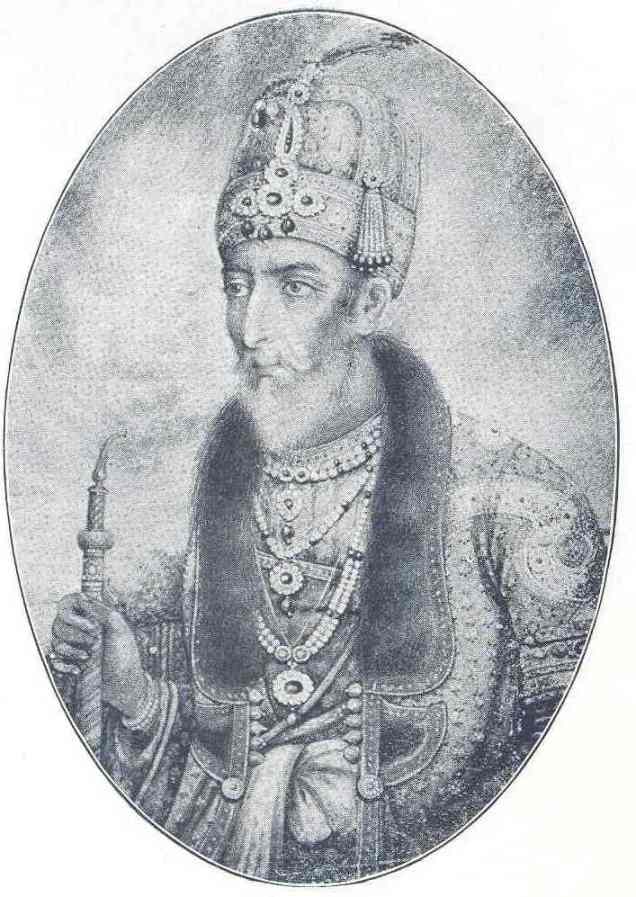
ZAFAR: or Bahadur Shah, was the Padishah of Delhi, the last Mogul Emperor, and lived 1768-1862: son of Akbar II.: was over 60 years of age when he came to the throne: himself a poet and a good judge of music and painting, he gathered round him literary men and artists: of fine countenance and distinguished manners, and extremely loved and admired by his subjects: skilled in all kinds of poetry, and some of his ghazals continue to be popular: author of a voluminous Diwan, and a Commentary on the Gulistan of Saadi: a clever caligraphist, wrote with his own hand passages from the Koran for the ornamentation of the principal Mosque of Delhi. His son Dara was also a poet. At the Mutiny in 1857 he was taken prisoner and sent to Rangoon: there he continued to write verses, and died at an advanced age. His portrait, which forms the frontispiece to this book, is from a miniature kindly lent by the Indian Section of the Victoria and Albert Museum, South Kensington.
Bazar—market place.
Bulbul—nightingale.
Darwesh—devotee, dervish.
Diwan—collection of poems.
Ede—festival.
Fakir—an ascetic in Islam.
Ghazal—ode: form of verse written in couplets, all in one rhyme.
Hind, Hindustan—Upper India, north of the Vindhya Hills.
Islam—The religion of Muslims: lit. absolute surrender to Allah alone.
Kaaba—central sanctuary of Islam, at Mecca, holy city of Islam.
Kafir—unbeliever, one who is not a Muslim.
Kismet—fate.
Lakh—100,000: myriad.
Masnawi—epic poem, written in rhymed couplets.
Mecca, Medina—sacred places of Islam, in Arabia: the birthplace and burial place of Muhammad.
Muhammad—the Prophet of Islam (A.D. 570-632).
Mushaira—poetical concourse (see Foreword p. 1.).
Muslim—or Musulman; lit. one surrendered to Allah alone.
Prophet—see Muhammad.
Purdah—curtain.
Qasidah—elegy or eulogy.
Saki—the cup-bearer, wine-giver.
Sufi—see Foreword, p. 2.
Suleiman—Solomon, King of the Jews: in Muslim legend lord over angels and demons.
Takhallus—pen-name.
Urdu—see Foreword, p. 3.
End of the Project Gutenberg EBook of Hindustani Lyrics, by Various

*** END OF THIS PROJECT GUTENBERG EBOOK HINDUSTANI LYRICS ***

***** This file should be named 17711-h.htm or 17711-h.zip *****
This and all associated files of various formats will be found in:
        http://www.gutenberg.org/1/7/7/1/17711/

Produced by Ron Swanson

Updated editions will replace the previous one--the old editions
will be renamed.

Creating the works from public domain print editions means that no
one owns a United States copyright in these works, so the Foundation
(and you!) can copy and distribute it in the United States without
permission and without paying copyright royalties.  Special rules,
set forth in the General Terms of Use part of this license, apply to
copying and distributing Project Gutenberg-tm electronic works to
protect the PROJECT GUTENBERG-tm concept and trademark.  Project
Gutenberg is a registered trademark, and may not be used if you
charge for the eBooks, unless you receive specific permission.  If you
do not charge anything for copies of this eBook, complying with the
rules is very easy.  You may use this eBook for nearly any purpose
such as creation of derivative works, reports, performances and
research.  They may be modified and printed and given away--you may do
practically ANYTHING with public domain eBooks.  Redistribution is
subject to the trademark license, especially commercial
redistribution.


*** START: FULL LICENSE ***

THE FULL PROJECT GUTENBERG LICENSE
PLEASE READ THIS BEFORE YOU DISTRIBUTE OR USE THIS WORK

To protect the Project Gutenberg-tm mission of promoting the free
distribution of electronic works, by using or distributing this work
(or any other work associated in any way with the phrase "Project
Gutenberg"), you agree to comply with all the terms of the Full Project
Gutenberg-tm License (available with this file or online at
http://gutenberg.org/license).


Section 1.  General Terms of Use and Redistributing Project Gutenberg-tm
electronic works

1.A.  By reading or using any part of this Project Gutenberg-tm
electronic work, you indicate that you have read, understand, agree to
and accept all the terms of this license and intellectual property
(trademark/copyright) agreement.  If you do not agree to abide by all
the terms of this agreement, you must cease using and return or destroy
all copies of Project Gutenberg-tm electronic works in your possession.
If you paid a fee for obtaining a copy of or access to a Project
Gutenberg-tm electronic work and you do not agree to be bound by the
terms of this agreement, you may obtain a refund from the person or
entity to whom you paid the fee as set forth in paragraph 1.E.8.

1.B.  "Project Gutenberg" is a registered trademark.  It may only be
used on or associated in any way with an electronic work by people who
agree to be bound by the terms of this agreement.  There are a few
things that you can do with most Project Gutenberg-tm electronic works
even without complying with the full terms of this agreement.  See
paragraph 1.C below.  There are a lot of things you can do with Project
Gutenberg-tm electronic works if you follow the terms of this agreement
and help preserve free future access to Project Gutenberg-tm electronic
works.  See paragraph 1.E below.

1.C.  The Project Gutenberg Literary Archive Foundation ("the Foundation"
or PGLAF), owns a compilation copyright in the collection of Project
Gutenberg-tm electronic works.  Nearly all the individual works in the
collection are in the public domain in the United States.  If an
individual work is in the public domain in the United States and you are
located in the United States, we do not claim a right to prevent you from
copying, distributing, performing, displaying or creating derivative
works based on the work as long as all references to Project Gutenberg
are removed.  Of course, we hope that you will support the Project
Gutenberg-tm mission of promoting free access to electronic works by
freely sharing Project Gutenberg-tm works in compliance with the terms of
this agreement for keeping the Project Gutenberg-tm name associated with
the work.  You can easily comply with the terms of this agreement by
keeping this work in the same format with its attached full Project
Gutenberg-tm License when you share it without charge with others.

1.D.  The copyright laws of the place where you are located also govern
what you can do with this work.  Copyright laws in most countries are in
a constant state of change.  If you are outside the United States, check
the laws of your country in addition to the terms of this agreement
before downloading, copying, displaying, performing, distributing or
creating derivative works based on this work or any other Project
Gutenberg-tm work.  The Foundation makes no representations concerning
the copyright status of any work in any country outside the United
States.

1.E.  Unless you have removed all references to Project Gutenberg:

1.E.1.  The following sentence, with active links to, or other immediate
access to, the full Project Gutenberg-tm License must appear prominently
whenever any copy of a Project Gutenberg-tm work (any work on which the
phrase "Project Gutenberg" appears, or with which the phrase "Project
Gutenberg" is associated) is accessed, displayed, performed, viewed,
copied or distributed:

This eBook is for the use of anyone anywhere at no cost and with
almost no restrictions whatsoever.  You may copy it, give it away or
re-use it under the terms of the Project Gutenberg License included
with this eBook or online at www.gutenberg.org

1.E.2.  If an individual Project Gutenberg-tm electronic work is derived
from the public domain (does not contain a notice indicating that it is
posted with permission of the copyright holder), the work can be copied
and distributed to anyone in the United States without paying any fees
or charges.  If you are redistributing or providing access to a work
with the phrase "Project Gutenberg" associated with or appearing on the
work, you must comply either with the requirements of paragraphs 1.E.1
through 1.E.7 or obtain permission for the use of the work and the
Project Gutenberg-tm trademark as set forth in paragraphs 1.E.8 or
1.E.9.

1.E.3.  If an individual Project Gutenberg-tm electronic work is posted
with the permission of the copyright holder, your use and distribution
must comply with both paragraphs 1.E.1 through 1.E.7 and any additional
terms imposed by the copyright holder.  Additional terms will be linked
to the Project Gutenberg-tm License for all works posted with the
permission of the copyright holder found at the beginning of this work.

1.E.4.  Do not unlink or detach or remove the full Project Gutenberg-tm
License terms from this work, or any files containing a part of this
work or any other work associated with Project Gutenberg-tm.

1.E.5.  Do not copy, display, perform, distribute or redistribute this
electronic work, or any part of this electronic work, without
prominently displaying the sentence set forth in paragraph 1.E.1 with
active links or immediate access to the full terms of the Project
Gutenberg-tm License.

1.E.6.  You may convert to and distribute this work in any binary,
compressed, marked up, nonproprietary or proprietary form, including any
word processing or hypertext form.  However, if you provide access to or
distribute copies of a Project Gutenberg-tm work in a format other than
"Plain Vanilla ASCII" or other format used in the official version
posted on the official Project Gutenberg-tm web site (www.gutenberg.org),
you must, at no additional cost, fee or expense to the user, provide a
copy, a means of exporting a copy, or a means of obtaining a copy upon
request, of the work in its original "Plain Vanilla ASCII" or other
form.  Any alternate format must include the full Project Gutenberg-tm
License as specified in paragraph 1.E.1.

1.E.7.  Do not charge a fee for access to, viewing, displaying,
performing, copying or distributing any Project Gutenberg-tm works
unless you comply with paragraph 1.E.8 or 1.E.9.

1.E.8.  You may charge a reasonable fee for copies of or providing
access to or distributing Project Gutenberg-tm electronic works provided
that

- You pay a royalty fee of 20% of the gross profits you derive from
     the use of Project Gutenberg-tm works calculated using the method
     you already use to calculate your applicable taxes.  The fee is
     owed to the owner of the Project Gutenberg-tm trademark, but he
     has agreed to donate royalties under this paragraph to the
     Project Gutenberg Literary Archive Foundation.  Royalty payments
     must be paid within 60 days following each date on which you
     prepare (or are legally required to prepare) your periodic tax
     returns.  Royalty payments should be clearly marked as such and
     sent to the Project Gutenberg Literary Archive Foundation at the
     address specified in Section 4, "Information about donations to
     the Project Gutenberg Literary Archive Foundation."

- You provide a full refund of any money paid by a user who notifies
     you in writing (or by e-mail) within 30 days of receipt that s/he
     does not agree to the terms of the full Project Gutenberg-tm
     License.  You must require such a user to return or
     destroy all copies of the works possessed in a physical medium
     and discontinue all use of and all access to other copies of
     Project Gutenberg-tm works.

- You provide, in accordance with paragraph 1.F.3, a full refund of any
     money paid for a work or a replacement copy, if a defect in the
     electronic work is discovered and reported to you within 90 days
     of receipt of the work.

- You comply with all other terms of this agreement for free
     distribution of Project Gutenberg-tm works.

1.E.9.  If you wish to charge a fee or distribute a Project Gutenberg-tm
electronic work or group of works on different terms than are set
forth in this agreement, you must obtain permission in writing from
both the Project Gutenberg Literary Archive Foundation and Michael
Hart, the owner of the Project Gutenberg-tm trademark.  Contact the
Foundation as set forth in Section 3 below.

1.F.

1.F.1.  Project Gutenberg volunteers and employees expend considerable
effort to identify, do copyright research on, transcribe and proofread
public domain works in creating the Project Gutenberg-tm
collection.  Despite these efforts, Project Gutenberg-tm electronic
works, and the medium on which they may be stored, may contain
"Defects," such as, but not limited to, incomplete, inaccurate or
corrupt data, transcription errors, a copyright or other intellectual
property infringement, a defective or damaged disk or other medium, a
computer virus, or computer codes that damage or cannot be read by
your equipment.

1.F.2.  LIMITED WARRANTY, DISCLAIMER OF DAMAGES - Except for the "Right
of Replacement or Refund" described in paragraph 1.F.3, the Project
Gutenberg Literary Archive Foundation, the owner of the Project
Gutenberg-tm trademark, and any other party distributing a Project
Gutenberg-tm electronic work under this agreement, disclaim all
liability to you for damages, costs and expenses, including legal
fees.  YOU AGREE THAT YOU HAVE NO REMEDIES FOR NEGLIGENCE, STRICT
LIABILITY, BREACH OF WARRANTY OR BREACH OF CONTRACT EXCEPT THOSE
PROVIDED IN PARAGRAPH F3.  YOU AGREE THAT THE FOUNDATION, THE
TRADEMARK OWNER, AND ANY DISTRIBUTOR UNDER THIS AGREEMENT WILL NOT BE
LIABLE TO YOU FOR ACTUAL, DIRECT, INDIRECT, CONSEQUENTIAL, PUNITIVE OR
INCIDENTAL DAMAGES EVEN IF YOU GIVE NOTICE OF THE POSSIBILITY OF SUCH
DAMAGE.

1.F.3.  LIMITED RIGHT OF REPLACEMENT OR REFUND - If you discover a
defect in this electronic work within 90 days of receiving it, you can
receive a refund of the money (if any) you paid for it by sending a
written explanation to the person you received the work from.  If you
received the work on a physical medium, you must return the medium with
your written explanation.  The person or entity that provided you with
the defective work may elect to provide a replacement copy in lieu of a
refund.  If you received the work electronically, the person or entity
providing it to you may choose to give you a second opportunity to
receive the work electronically in lieu of a refund.  If the second copy
is also defective, you may demand a refund in writing without further
opportunities to fix the problem.

1.F.4.  Except for the limited right of replacement or refund set forth
in paragraph 1.F.3, this work is provided to you 'AS-IS' WITH NO OTHER
WARRANTIES OF ANY KIND, EXPRESS OR IMPLIED, INCLUDING BUT NOT LIMITED TO
WARRANTIES OF MERCHANTIBILITY OR FITNESS FOR ANY PURPOSE.

1.F.5.  Some states do not allow disclaimers of certain implied
warranties or the exclusion or limitation of certain types of damages.
If any disclaimer or limitation set forth in this agreement violates the
law of the state applicable to this agreement, the agreement shall be
interpreted to make the maximum disclaimer or limitation permitted by
the applicable state law.  The invalidity or unenforceability of any
provision of this agreement shall not void the remaining provisions.

1.F.6.  INDEMNITY - You agree to indemnify and hold the Foundation, the
trademark owner, any agent or employee of the Foundation, anyone
providing copies of Project Gutenberg-tm electronic works in accordance
with this agreement, and any volunteers associated with the production,
promotion and distribution of Project Gutenberg-tm electronic works,
harmless from all liability, costs and expenses, including legal fees,
that arise directly or indirectly from any of the following which you do
or cause to occur: (a) distribution of this or any Project Gutenberg-tm
work, (b) alteration, modification, or additions or deletions to any
Project Gutenberg-tm work, and (c) any Defect you cause.


Section  2.  Information about the Mission of Project Gutenberg-tm

Project Gutenberg-tm is synonymous with the free distribution of
electronic works in formats readable by the widest variety of computers
including obsolete, old, middle-aged and new computers.  It exists
because of the efforts of hundreds of volunteers and donations from
people in all walks of life.

Volunteers and financial support to provide volunteers with the
assistance they need, is critical to reaching Project Gutenberg-tm's
goals and ensuring that the Project Gutenberg-tm collection will
remain freely available for generations to come.  In 2001, the Project
Gutenberg Literary Archive Foundation was created to provide a secure
and permanent future for Project Gutenberg-tm and future generations.
To learn more about the Project Gutenberg Literary Archive Foundation
and how your efforts and donations can help, see Sections 3 and 4
and the Foundation web page at http://www.pglaf.org.


Section 3.  Information about the Project Gutenberg Literary Archive
Foundation

The Project Gutenberg Literary Archive Foundation is a non profit
501(c)(3) educational corporation organized under the laws of the
state of Mississippi and granted tax exempt status by the Internal
Revenue Service.  The Foundation's EIN or federal tax identification
number is 64-6221541.  Its 501(c)(3) letter is posted at
http://pglaf.org/fundraising.  Contributions to the Project Gutenberg
Literary Archive Foundation are tax deductible to the full extent
permitted by U.S. federal laws and your state's laws.

The Foundation's principal office is located at 4557 Melan Dr. S.
Fairbanks, AK, 99712., but its volunteers and employees are scattered
throughout numerous locations.  Its business office is located at
809 North 1500 West, Salt Lake City, UT 84116, (801) 596-1887, email
business@pglaf.org.  Email contact links and up to date contact
information can be found at the Foundation's web site and official
page at http://pglaf.org

For additional contact information:
     Dr. Gregory B. Newby
     Chief Executive and Director
     gbnewby@pglaf.org


Section 4.  Information about Donations to the Project Gutenberg
Literary Archive Foundation

Project Gutenberg-tm depends upon and cannot survive without wide
spread public support and donations to carry out its mission of
increasing the number of public domain and licensed works that can be
freely distributed in machine readable form accessible by the widest
array of equipment including outdated equipment.  Many small donations
($1 to $5,000) are particularly important to maintaining tax exempt
status with the IRS.

The Foundation is committed to complying with the laws regulating
charities and charitable donations in all 50 states of the United
States.  Compliance requirements are not uniform and it takes a
considerable effort, much paperwork and many fees to meet and keep up
with these requirements.  We do not solicit donations in locations
where we have not received written confirmation of compliance.  To
SEND DONATIONS or determine the status of compliance for any
particular state visit http://pglaf.org

While we cannot and do not solicit contributions from states where we
have not met the solicitation requirements, we know of no prohibition
against accepting unsolicited donations from donors in such states who
approach us with offers to donate.

International donations are gratefully accepted, but we cannot make
any statements concerning tax treatment of donations received from
outside the United States.  U.S. laws alone swamp our small staff.

Please check the Project Gutenberg Web pages for current donation
methods and addresses.  Donations are accepted in a number of other
ways including checks, online payments and credit card donations.
To donate, please visit: http://pglaf.org/donate


Section 5.  General Information About Project Gutenberg-tm electronic
works.

Professor Michael S. Hart is the originator of the Project Gutenberg-tm
concept of a library of electronic works that could be freely shared
with anyone.  For thirty years, he produced and distributed Project
Gutenberg-tm eBooks with only a loose network of volunteer support.


Project Gutenberg-tm eBooks are often created from several printed
editions, all of which are confirmed as Public Domain in the U.S.
unless a copyright notice is included.  Thus, we do not necessarily
keep eBooks in compliance with any particular paper edition.


Most people start at our Web site which has the main PG search facility:

     http://www.gutenberg.org

This Web site includes information about Project Gutenberg-tm,
including how to make donations to the Project Gutenberg Literary
Archive Foundation, how to help produce our new eBooks, and how to
subscribe to our email newsletter to hear about new eBooks.