The Spectator
in three volumes: volume 1
A New Edition
Reproducing the Original Text
Both as First Issued
and as Corrected by its Authors
with Introduction, Notes, and Index
edited by Henry Morley
1891
Table of Contents
- No. 1 Thursday, March 1, 1711 Addison
- No. 2 Friday, March 2, 1711 Steele
- No. 3 Saturday, March 3, 1711 Addison
- No. 4 Monday, March 5, 1711 Steele
- No. 5 Tuesday, March 6, 1711 Addison
- No. 6 Wednesday, March 7, 1711 Steele
- No. 7 Thursday, March 8, 1711 Addison
- No. 8 Friday, March 9, 1711 Addison
- No. 9 Saturday, March 10, 1711 Addison
- No. 10 Monday, March 12, 1711 Addison
- No. 11 Tuesday, March 13, 1711 Steele
- No. 12 Wednesday, March 14, 1711 Addison
- No. 13 Thursday, March 15, 1711 Addison
- No. 14 Friday, March 16, 1711 Steele
- No. 15 Saturday, March 17, 1711 Addison
- No. 16 Monday, March 19, 1711 Addison
- No. 17 Tuesday, March 20, 1711 Steele
- No. 18 Wednesday, March 21, 1711 Addison
- No. 19 Thursday, March 22, 1711 Steele
- No. 20 Friday, March 23, 1711 Steele
- No. 21 Saturday, March 24, 1711 Addison
- No. 22 Monday, March 26, 1711 Steele
- No. 23 Tuesday, March 27, 1711 Addison
- No. 24 Wednesday, March 28, 1711 Steele
- No. 25 Thursday, March 29, 1711 Addison
- No. 26 Friday, March 30, 1711 Addison
- No. 27 Saturday, March 31, 1711 Steele
- No. 28 Monday, April 2, 1711 Addison
- No. 29 Tuesday, April 3, 1711 Addison
- No. 30 Wednesday, April 4, 1711 Steele
- No. 31 Thursday, April 5, 1711 Addison
- No. 32 Friday, April 6, 1711 Steele
- No. 33 Saturday, April 7, 1711 Steele
- No. 34 Monday, April 9, 1711 Addison
- No. 35 Tuesday, April 10, 1711 Addison
- No. 36 Wednesday, April 11, 1711 Steele
- No. 37 Thursday, April 12, 1711 Addison
- No. 38 Friday, April 13, 1711 Steele
- No. 39 Saturday, April 14, 1711 Addison
- No. 40 Monday, April 16, 1711 Addison
- No. 41 Tuesday, April 17, 1711 Steele
- No. 42 Wednesday, April 18, 1711 Addison
- No. 43 Thursday, April 19, 1711 Steele
- No. 44 Friday, April 20, 1711 Addison
- No. 45 Saturday, April 21, 1711 Addison
- No. 46 Monday, April 23, 1711 Addison
- No. 47 Tuesday, April 24, 1711 Addison
- No. 48 Wednesday, April 25, 1711 Steele
- No. 49 Thursday, April 26, 1711 Steele
- No. 50 Friday, April 27, 1711 Addison
- No. 51 Saturday, April 28, 1711 Steele
- No. 52 Monday, April 30, 1711 Steele
- No. 53 Tuesday, May 1, 1711 Steele
- No. 54 Wednesday, May 2, 1711 Steele
- No. 55 Thursday, May 3, 1711 Addison
- No. 56 Friday, May 4, 1711 Addison
- No. 57 Saturday, May 5, 1711 Addison
- No. 58 Monday, May 7, 1711 Addison
- No. 59 Tuesday, May 8, 1711 Addison
- No. 60 Wednesday, May 9, 1711 Addison
- No. 61 Thursday, May 10, 1711 Addison
- No. 62 Friday, May 11, 1711 Addison
- No. 63 Saturday, May 12, 1711 Addison
- No. 64 Monday, May 14, 1711 Steele
- No. 65 Tuesday, May 15, 1711 Steele
- No. 66 Wednesday, May 16, 1711 Steele
- No. 67 Thursday, May 17, 1711 Budgell
- No. 68 Friday, May 18, 1711 Addison
- No. 69 Saturday, May 19, 1711 Addison
- No. 70 Monday, May 21, 1711 Addison
- No. 71 Tuesday, May 22, 1711 Steele
- No. 72 Wednesday, May 23, 1711 Addison
- No. 73 Thursday, May 24, 1711 Addison
- No. 74 Friday, May 25, 1711 Addison
- No. 75 Saturday, May 26, 1711 Steele
- No. 76 Monday, May 28, 1711 Steele
- No. 77 Tuesday, May 29, 1711 Budgell
- No. 78 Wednesday, May 30, 1711 Steele
- No. 79 Thursday, May 31, 1711 Steele
- No. 80 Friday, June 1, 1711 Steele
- No. 81 Saturday, June 2, 1711 Addison
- No. 82 Monday, June 4, 1711 Steele
- No. 83 Tuesday, June 5, 1711 Addison
- No. 84 Wednesday, June 6, 1711 Steele
- No. 85 Thursday, June 7, 1711 Addison
- No. 86 Friday, June 8, 1711 Addison
- No. 87 Saturday, June 9, 1711 Steele
- No. 88 Monday, June 11, 1711 Steele
- No. 89 Tuesday, June 12, 1711 Addison
- No. 90 Wednesday, June 13, 1711 Addison
- No. 91 Thursday, June 14, 1711 Steele
- No. 92 Friday, June 15, 1711 Addison
- No. 93 Saturday, June 16, 1711 Addison
- No. 94 Monday, June 18, 1711 Addison
- No. 95 Tuesday, June 19, 1711 Steele
- No. 96 Wednesday, June 20, 1711 Steele
- No. 97 Thursday, June 21, 1711 Steele
- No. 98 Friday, June 22, 1711 Addison
- No. 99 Saturday, June 23, 1711 Addison
- No. 100 Monday, June 24, 1711 Steele
- No. 101 Tuesday, June 26, 1711 Addison
- No. 102 Wednesday, June 27, 1711 Addison
- No. 103 Thursday, June 28, 1711 Steele
- No. 104 Friday, June 29, 1711 Steele
- No. 105 Saturday, June 30, 1711 Addison
- No. 106 Monday, July 2, 1711 Addison
- No. 107 Tuesday, July 3, 1711 Steele
- No. 108 Wednesday, July 4, 1711 Addison
- No. 109 Thursday, July 5, 1711 Steele
- No. 110 Friday, July 6, 1711 Addison
- No. 111 Saturday, July 7, 1711 Addison
- No. 112 Monday, July 9, 1711 Addison
- No. 113 Tuesday, July 10, 1711 Steele
- No. 114 Wednesday, July 11, 1711 Steele
- No. 115 Thursday, July 12, 1711 Addison
- No. 116 Friday, July 13, 1711 Budgell
- No. 117 Saturday, July 14, 1711 Addison
- No. 118 Monday, July 16, 1711 Steele
- No. 119 Tuesday, July 17, 1711 Addison
- No. 120 Wednesday, July 18, 1711 Addison
- No. 121 Thursday, July 19, 1711 Addison
- No. 122 Friday, July 20, 1711 Addison
- No. 123 Saturday, July 21, 1711 Addison
- No. 124 Monday, July 23, 1711 Addison
- No. 125 Tuesday, July 24, 1711 Addison
- No. 126 Wednesday, July 25, 1711 Addison
- No. 127 Thursday, July 26, 1711 Addison
- No. 128 Friday, July 27, 1711 Addison
- No. 129 Saturday, July 28, 1711 Addison
- No. 130 Monday, July 30, 1711 Addison
- No. 131 Tuesday, July 31, 1711 Addison
- No. 132 Wednesday, August 1, 1711 Steele
- No. 133 Thursday, August 2, 1711 Steele
- No. 134 Friday, August 3, 1711 Steele
- No. 135 Saturday, August 4, 1711 Addison
- No. 136 Monday, August 6, 1711 Steele
- No. 137 Tuesday, August 7, 1711 Steele
- No. 138 Wednesday, August 8, 1711 Steele
- No. 139 Thursday, August 9, 1711 Steele
- No. 140 Friday, August 10, 1711 Steele
- No. 141 Saturday, August 11, 1711 Steele
- No. 142 Monday, August 13, 1711 Steele
- No. 143 Tuesday, August 14, 1711 Steele
- No. 144 Wednesday, August 15, 1711 Steele
- No. 145 Thursday, August 16, 1711 Steele
- No. 146 Friday, August 17, 1711 Steele
- No. 147 Saturday, August 18, 1711 Steele
- No. 148 Monday, August 20, 1711 Steele
- No. 149 Tuesday, August 21, 1711 Steele
- No. 150 Wednesday, August 22, 1711 Budgell
- No. 151 Thursday, August 23, 1711 Steele
- No. 152 Friday, August 24, 1711 Steele
- No. 153 Saturday, August 25, 1711 Steele
- No. 154 Monday, August 27, 1711 Steele
- No. 155 Tuesday, August 28, 1711 Steele
- No. 156 Wednesday, August 29, 1711 Steele
- No. 157 Thursday, August 30, 1711 Steele
- No. 158 Friday, August 31, 1711 Steele
- No. 159 Saturday, September 1, 1711 Addison
- No. 160 Monday, September 3, 1711 Addison
- No. 161 Tuesday, September 4, 1711 Budgell
- No. 162 Wednesday, September 5, 1711 Addison
- No. 163 Thursday, September 6, 1711 Addison
- No. 164 Friday, September 7, 1711 Addison
- No. 165 Saturday, September 8, 1711 Addison
- No. 166 Monday, September 10, 1711 Addison
- No. 167 Tuesday, September 11, 1711 Steele
- No. 168 Wednesday, September 12, 1711 Steele
- No. 169 Thursday, September 13, 1711 Addison
- No. 170 Friday, September 14, 1711 Addison
- No. 171 Saturday, September 15, 1711 Addison
- No. 172 Monday, September 17, 1711 Steele
- No. 173 Tuesday, September 18, 1711 Addison
- No. 174 Wednesday, September 19, 1711 Steele
- No. 175 Thursday, September 20, 1711 Budgell
- No. 176 Friday, September 21, 1711 Steele
- No. 177 Saturday, September 22, 1711 Addison
- No. 178 Monday, September 24, 1711 Steele
- No. 179 Tuesday, September 25, 1711 Addison
- No. 180 Wednesday, September 26, 1711 Steele
- No. 181 Thursday, September 27, 1711 Addison
- No. 182 Friday, September 28, 1711 Steele
- No. 183 Saturday, September 29, 1711 Addison
- No. 184 Monday, October 1, 1711 Addison
- No. 185 Tuesday, October 2, 1711 Addison
- No. 186 Wednesday, October 3, 1711 Addison
- No. 187 Thursday, October 4, 1711 Steele
- No. 188 Friday, October 5, 1711 Steele
- No. 189 Saturday, October 6, 1711 Addison
- No. 190 Monday, October 8, 1711 Steele
- No. 191 Tuesday, October 9, 1711 Addison
- No. 192 Wednesday, October 10, 1711 Steele
- No. 193 Thursday, October 11, 1711 Steele
- No. 194 Friday, October 12, 1711 Steele
- No. 195 Saturday, October 13, 1711 Addison
- No. 196 Monday, October 15, 1711 Steele
- No. 197 Tuesday, October 16, 1711 Budgell
- No. 198 Wednesday, October 17, 1711 Addison
- No. 199 Thursday, October 18, 1711 Steele
- No. 200 Friday, October 19, 1711 Steele
- No. 201 Saturday, October 20, 1711 Addison
- No. 202 Monday, October 22, 1711 Steele
List of Original Advertisements Included
Each In Three Vols., Price 10s. 6d.
Charles Knight's
Shakspere.
Napier's
History of the Peninsular War. with Maps and Plans.
Longfellow's
Works — poems — prose — Dante.
Boswell's
Life Of Johnson. with Illustrations.
Motley's
Rise Of The Dutch Republic.
Byron's
Poetical Works.
When Richard Steele, in number 555 of his
Spectator
, signed its last
paper and named those who had most helped him 'to keep up the spirit of
so long and approved a performance,' he gave chief honour to one who had
on his page, as in his heart, no name but Friend. This was
'the
gentleman of whose assistance I formerly boasted in the Preface and
concluding Leaf of my Tatlers. I am indeed much more proud of his
long-continued Friendship, than I should be of the fame of being thought
the author of any writings which he himself is capable of producing. I
remember when I finished the Tender Husband, I told him there was
nothing I so ardently wished, as that we might some time or other
publish a work, written by us both, which should bear the name of The
Monument, in Memory of our Friendship.'
Why he refers to such a wish,
his next words show. The seven volumes of the
Spectator
, then
complete, were to his mind The Monument, and of the Friendship it
commemorates he wrote,
'I heartily wish what I have done here were as
honorary to that sacred name as learning, wit, and humanity render those
pieces which I have taught the reader how to distinguish for his.'
So
wrote Steele; and the
Spectator
will bear witness how religiously his
friendship was returned. In number 453, when, paraphrasing David's
Hymn
on Gratitude
, the 'rising soul' of Addison surveyed the mercies of his
God, was it not Steele whom he felt near to him at the Mercy-seat as he
wrote
Thy bounteous hand with worldly bliss
Has made my cup run o'er,
And in a kind and faithful Friend
Has doubled all my store?
The
Spectator
, Steele-and-Addison's
Spectator
, is a monument
befitting the most memorable friendship in our history. Steele was its
projector, founder, editor, and he was writer of that part of it which
took the widest grasp upon the hearts of men. His sympathies were with
all England. Defoe and he, with eyes upon the future, were the truest
leaders of their time. It was the firm hand of his friend Steele that
helped Addison up to the place in literature which became him. It was
Steele who caused the nice critical taste which Addison might have spent
only in accordance with the fleeting fashions of his time, to be
inspired with all Addison's religious earnestness, and to be enlivened
with the free play of that sportive humour, delicately whimsical and
gaily wise, which made his conversation the delight of the few men with
whom he sat at ease. It was Steele who drew his friend towards the days
to come, and made his gifts the wealth of a whole people. Steele said in
one of the later numbers of his
Spectator
, No. 532, to which he
prefixed a motto that assigned to himself only the part of whetstone to
the wit of others,
'I claim to myself the merit of having extorted excellent productions
from a person of the greatest abilities, who would not have let them
appear by any other means.'
There were those who argued that he was too careless of his own fame in
unselfish labour for the exaltation of his friend, and, no doubt, his
rare generosity of temper has been often misinterpreted. But for that
Addison is not answerable. And why should Steele have defined his own
merits? He knew his countrymen, and was in too genuine accord with the
spirit of a time then distant but now come, to doubt that, when he was
dead, his whole life's work would speak truth for him to posterity.
The friendship of which this work is the monument remained unbroken from
boyhood until death. Addison and Steele were schoolboys together at the
Charterhouse. Addison was a dean's son, and a private boarder; Steele,
fatherless, and a boy on the foundation. They were of like age. The
register of Steele's baptism, corroborated by the entry made on his
admission to the Charterhouse (which also implies that he was baptized
on the day of his birth) is March 12, 1671, Old Style; New Style, 1672.
Addison was born on May-day, 1672. Thus there was a difference of only
seven weeks.
Steele's father according to the register, also named Richard, was an
attorney in Dublin. Steele seems to draw from experience — although he is
not writing as of himself or bound to any truth of personal detail — when
in No. 181 of the
Tatler
he speaks of his father as having died when
he was not quite five years of age, and of his mother as 'a very
beautiful woman, of a noble spirit.' The first Duke of Ormond is
referred to by Steele in his Dedication to the
Lying Lover
as the
patron of his infancy; and it was by this nobleman that a place was
found for him, when in his thirteenth year, among the foundation boys at
the Charterhouse, where he first met with Joseph Addison. Addison, who
was at school at Lichfield in 1683-4-5, went to the Charterhouse in
1686, and left in 1687, when he was entered of Queen's College, Oxford.
Steele went to Oxford two years later, matriculating at Christ Church,
March 13, 1689-90, the year in which Addison was elected a Demy of
Magdalene. A letter of introduction from Steele, dated April 2, 1711,
refers to the administration of the will of 'my uncle Gascoigne, to
whose bounty I owe a liberal education.' This only representative of the
family ties into which Steele was born, an 'uncle' whose surname is not
that of Steele's mother before marriage, appears, therefore, to have
died just before or at the time when the
Spectator
undertook to
publish a sheetful of thoughts every morning, and — Addison here speaking
for him — looked forward to
'leaving his country, when he was summoned out of it, with the secret
satisfaction of thinking that he had not lived in vain.'
To Steele's warm heart Addison's friendship stood for all home blessings
he had missed. The sister's playful grace, the brother's love, the
mother's sympathy and simple faith in God, the father's guidance, where
were these for Steele, if not in his friend Addison?
Addison's father was a dean; his mother was the sister of a bishop; and
his ambition as a schoolboy, or his father's ambition for him, was only
that he should be one day a prosperous and pious dignitary of the
Church. But there was in him, as in Steele, the genius which shaped
their lives to its own uses, and made them both what they are to us now.
Joseph Addison was born into a home which the steadfast labour of his
father, Lancelot, had made prosperous and happy. Lancelot Addison had
earned success. His father, Joseph's grandfather, had been also a
clergyman, but he was one of those Westmoreland clergy of whose
simplicity and poverty many a joke has been made. Lancelot got his
education as a poor child in the Appleby Grammar School; but he made his
own way when at College; was too avowed a Royalist to satisfy the
Commonwealth, and got, for his zeal, at the Restoration, small reward in
a chaplaincy to the garrison at Dunkirk. This was changed, for the
worse, to a position of the same sort at Tangier, where he remained
eight years. He lost that office by misadventure, and would have been
left destitute if Mr. Joseph Williamson had not given him a living of
£120 a-year at Milston in Wiltshire. Upon this Lancelot Addison married
Jane Gulstone, who was the daughter of a Doctor of Divinity, and whose
brother became Bishop of Bristol. In the little Wiltshire parsonage
Joseph Addison and his younger brothers and sisters were born. The
essayist was named Joseph after his father's patron, afterwards Sir
Joseph Williamson, a friend high in office. While the children grew, the
father worked. He showed his ability and loyalty in books on West
Barbary, and Mahomet, and the State of the Jews; and he became one of
the King's chaplains in ordinary at a time when his patron Joseph
Williamson was Secretary of State. Joseph Addison was then but three
years old. Soon afterwards the busy father became Archdeacon of
Salisbury, and he was made Dean of Lichfield in 1683, when his boy
Joseph had reached the age of 11. When Archdeacon of Salisbury, the Rev.
Lancelot Addison sent Joseph to school at Salisbury; and when his father
became Dean of Lichfield, Joseph was sent to school at Lichfield, as
before said, in the years 1683-4-5. And then he was sent as a private
pupil to the Charterhouse. The friendship he there formed with Steele
was ratified by the approval of the Dean. The desolate boy with the warm
heart, bright intellect, and noble aspirations, was carried home by his
friend, at holiday times, into the Lichfield Deanery, where, Steele
wrote afterwards to Congreve in a Dedication of the
Drummer
,
'were
things of this nature to be exposed to public view, I could show under
the Dean's own hand, in the warmest terms, his blessing on the
friendship between his son and me; nor had he a child who did not prefer
me in the first place of kindness and esteem, as their father loved me
like one of them.'
Addison had two brothers, of whom one traded and
became Governor of Fort George in India, and the other became, like
himself, a Fellow of Magdalene College, Oxford. Of his three sisters two
died young, the other married twice, her first husband being a French
refugee minister who became a Prebendary of Westminster. Of this sister
of Addison's, Swift said she was 'a sort of wit, very like him. I was
not fond of her.'
In the latter years of the seventeenth century, when Steele and Addison
were students at Oxford, most English writers were submissive to the new
strength of the critical genius of France. But the English nation had
then newly accomplished the great Revolution that secured its liberties,
was thinking for itself, and calling forth the energies of writers who
spoke for the people and looked to the people for approval and support.
A new period was then opening, of popular influence on English
literature. They were the young days of the influence now full grown,
then slowly getting strength and winning the best minds away from an
imported Latin style adapted to the taste of patrons who sought credit
for nice critical discrimination. In 1690 Addison had been three years,
Steele one year, at Oxford. Boileau was then living, fifty-four years
old; and Western Europe was submissive to his sway as the great monarch
of literary criticism. Boileau was still living when Steele published
his
Tatler
, and died in the year of the establishment of the
Spectator
. Boileau, a true-hearted man, of genius and sense, advanced
his countrymen from the nice weighing of words by the Précieuses and the
grammarians, and by the French Academy, child of the intercourse between
those ladies and gentlemen. He brought ridicule on the inane politeness
of a style then in its decrepitude, and bade the writers of his time
find models in the Latin writers who, like Virgil and Horace, had
brought natural thought and speech to their perfection. In the preceding
labour for the rectifying of the language, preference had been given to
French words of Latin origin. French being one of those languages in
which Latin is the chief constituent, this was but a fair following of
the desire to make it run pure from its source.
If the English critics
who, in Charles the Second's time, submitted to French law, had seen its
spirit, instead of paying blind obedience to the letter, they also would
have looked back to the chief source of their language. Finding this to
be not Latin but Saxon, they would have sought to give it strength and
harmony, by doing then what, in the course of nature, we have learnt
again to do, now that the patronage of literature has gone from the
cultivated noble who appreciates in much accordance with the fashion of
his time, and passed into the holding of the English people. Addison and
Steele lived in the transition time between these periods. They were
born into one of them and — Steele immediately, Addison through Steele's
influence upon him — they were trusty guides into the other. Thus the
Spectator
is not merely the best example of their skill. It represents
also, perhaps best represents, a wholesome Revolution in our Literature.
The essential character of English Literature was no more changed than
characters of Englishmen were altered by the Declaration of Right which
Prince William of Orange had accepted with the English Crown, when
Addison had lately left and Steele was leaving Charterhouse for Oxford.
Yet change there was, and Steele saw to the heart of it, even in his
College days.
Oxford, in times not long past, had inclined to faith in divine right of
kings. Addison's father, a church dignitary who had been a Royalist
during the Civil War, laid stress upon obedience to authority in Church
and State. When modern literature was discussed or studied at Oxford
there would be the strongest disposition to maintain the commonly
accepted authority of French critics, who were really men of great
ability, correcting bad taste in their predecessors, and conciliating
scholars by their own devout acceptance of the purest Latin authors as
the types of a good style or proper method in the treatment of a
subject. Young Addison found nothing new to him in the temper of his
University, and was influenced, as in his youth every one must and
should be, by the prevalent tone of opinion in cultivated men. But he
had, and felt that he had, wit and genius of his own. His sensitive mind
was simply and thoroughly religious, generous in its instincts, and
strengthened in its nobler part by close communion with the mind of his
friend Steele.
May we not think of the two friends together in a College
chamber, Addison of slender frame, with features wanting neither in
dignity nor in refinement, Steele of robust make, with the radiant
'short face' of the
Spectator
, by right of which he claimed for that
worthy his admission to the Ugly Club. Addison reads Dryden, in praise
of whom he wrote his earliest known verse; or reads endeavours of his
own, which his friend Steele warmly applauds. They dream together of the
future; Addison sage, but speculative, and Steele practical, if rash.
Each is disposed to find God in the ways of life, and both avoid that
outward show of irreligion, which, after the recent Civil Wars, remains
yet common in the country, as reaction from an ostentatious piety which
laid on burdens of restraint; a natural reaction which had been
intensified by the base influence of a profligate King. Addison, bred
among the preachers, has a little of the preacher's abstract tone, when
talk between the friends draws them at times into direct expression of
the sacred sense of life which made them one.
Apart also from the mere
accidents of his childhood, a speculative turn in Addison is naturally
stronger than in Steele. He relishes analysis of thought. Steele came as
a boy from the rough world of shame and sorrow; his great, kindly heart
is most open to the realities of life, the state and prospects of his
country, direct personal sympathies; actual wrongs, actual remedies.
Addison is sensitive, and has among strangers the reserve of speech and
aspect which will pass often for coldness and pride, but is, indeed, the
shape taken by modesty in thoughtful men whose instinct it is to
speculate and analyze, and who become self-conscious, not through
conceit, but because they cannot help turning their speculations also on
themselves. Steele wholly comes out of himself as his heart hastens to
meet his friend. He lives in his surroundings, and, in friendly
intercourse, fixes his whole thought on the worth of his companion.
Never abating a jot of his ideal of a true and perfect life, or ceasing
to uphold the good because he cannot live to the full height of his own
argument, he is too frank to conceal the least or greatest of his own
shortcomings. Delight and strength of a friendship like that between
Steele and Addison are to be found, as many find them, in the charm and
use of a compact where characters differ so much that one lays open as
it were a fresh world to the other, and each draws from the other aid of
forces which the friendship makes his own. But the deep foundations of
this friendship were laid in the religious earnestness that was alike in
both; and in religious earnestness are laid also the foundations of this
book, its Monument.
Both Addison and Steele wrote verse at College. From each of them we
have a poem written at nearly the same age: Addison's in April, 1694,
Steele's early in 1695. Addison drew from literature a metrical 'Account
of the Greatest English Poets.' Steele drew from life the grief of
England at the death of William's Queen, which happened on the 28th of
December, 1694.
Addison, writing in that year, and at the age of about 23, for a College
friend,
A short account of all the Muse-possest,
That, down from Chaucer's days to Dryden's times
Have spent their noble rage in British rhymes,
was so far under the influence of French critical authority, as accepted
by most cultivators of polite literature at Oxford and wherever
authority was much respected, that from 'An Account of the Greatest
English Poets' he omitted Shakespeare. Of Chaucer he then knew no better
than to say, what might have been said in France, that
... age has rusted what the Poet writ,
Worn out his language, and obscured his wit:
In vain he jests in his unpolish'd strain,
And tries to make his readers laugh in vain.
Old Spenser next, warm'd with poetic rage,
In ancient tales amused a barb'rous age;
But now the mystic tale, that pleased of yore,
Can charm an understanding age no more.
It cost Addison some trouble to break loose from the critical cobweb of
an age of periwigs and patches, that accounted itself 'understanding,'
and the grand epoch of our Elizabethan literature, 'barbarous.' Rymer,
one of his critics, had said, that
'in the neighing of an horse, or in the growling of a mastiff, there
is a meaning, there is as lively expression, and, may I say, more
humanity than many times in the tragical flights of Shakespeare.'
Addison, with a genius of his own helped to free movement by the
sympathies of Steele, did break through the cobwebs of the critics; but
he carried off a little of their web upon his wings. We see it when in
the
Spectator
he meets the prejudices of an 'understanding age,'
and partly satisfies his own, by finding reason for his admiration of
Chevy Chase
and the
Babes in the Wood
, in their great
similarity to works of Virgil. We see it also in some of the criticisms
which accompany his admirable working out of the resolve to justify his
true natural admiration of the poetry of Milton, by showing that
Paradise Lost
was planned after the manner of the ancients, and
supreme even in its obedience to the laws of Aristotle. In his
Spectator
papers on Imagination he but half escapes from the
conventions of his time, which detested the wildness of a mountain pass,
thought Salisbury Plain one of the finest prospects in England, planned
parks with circles and straight lines of trees, despised our old
cathedrals for their 'Gothic' art, and saw perfection in the Roman
architecture, and the round dome of St. Paul's. Yet in these and all
such papers of his we find that Addison had broken through the weaker
prejudices of the day, opposing them with sound natural thought of his
own. Among cultivated readers, lesser moulders of opinion, there can be
no doubt that his genius was only the more serviceable in amendment of
the tastes of his own time, for friendly understanding and a partial
sharing of ideas for which it gave itself no little credit.
It is noticeable, however, that in his Account of the Greatest English
Poets, young Addison gave a fifth part of the piece to expression of the
admiration he felt even then for Milton. That his appreciation became
critical, and, although limited, based on a sense of poetry which
brought him near to Milton, Addison proved in the
Spectator
by
his eighteen Saturday papers upon
Paradise Lost
. But it was from
the religious side that he first entered into the perception of its
grandeur. His sympathy with its high purpose caused him to praise, in
the same pages that commended
Paradise Lost
to his countrymen,
another 'epic,' Blackmore's
Creation
, a dull metrical treatise
against atheism, as a work which deserved to be looked upon as
'one of the most useful and noble productions of our English verse.
The reader,' he added, of a piece which shared certainly with
Salisbury Plain the charms of flatness and extent of space, 'the
reader cannot but be pleased to find the depths of philosophy
enlivened with all the charms of poetry, and to see so great a
strength of reason amidst so beautiful a redundancy of the
imagination.'
The same strong sympathy with Blackmore's purpose in it blinded Dr.
Johnson also to the failure of this poem, which is Blackmore's best.
From its religious side, then, it may be that Addison, when a student at
Oxford, first took his impressions of the poetry of Milton. At Oxford he
accepted the opinion of France on Milton's art, but honestly declared,
in spite of that, unchecked enthusiasm:
Whate'er his pen describes I more than see,
Whilst every verse, arrayed in majesty,
Bold and sublime, my whole attention draws,
And seems above the critic's nicer laws.
This chief place among English poets Addison assigned to Milton, with
his mind fresh from the influences of a father who had openly contemned
the Commonwealth, and by whom he had been trained so to regard Milton's
service of it that of this he wrote:
Oh, had the Poet ne'er profaned his pen,
To varnish o'er the guilt of faithless men;
His other works might have deserved applause
But now the language can't support the cause,
While the clean current, tho' serene and bright,
Betrays a bottom odious to the sight.
If we turn now to the verse written by Steele in his young Oxford days,
and within twelve months of the date of Addison's lines upon English
poets, we have what Steele called
The Procession.
It is the procession
of those who followed to the grave the good Queen Mary, dead of
small-pox, at the age of 32. Steele shared his friend Addison's delight
in Milton, and had not, indeed, got beyond the sixth number of the
Tatler
before he compared the natural beauty and innocence of Milton's
Adam and Eve with Dryden's treatment of their love. But the one man for
whom Steele felt most enthusiasm was not to be sought through books, he
was a living moulder of the future of the nation. Eagerly intent upon
King William, the hero of the Revolution that secured our liberties, the
young patriot found in him also the hero of his verse. Keen sense of the
realities about him into which Steele had been born, spoke through the
very first lines of this poem:
The days of man are doom'd to pain and strife,
Quiet and ease are foreign to our life;
No satisfaction is, below, sincere,
Pleasure itself has something that's severe.
Britain had rejoiced in the high fortune of King William, and now a
mourning world attended his wife to the tomb. The poor were her first
and deepest mourners, poor from many causes; and then Steele pictured,
with warm sympathy, form after form of human suffering. Among those
mourning poor were mothers who, in the despair of want, would have
stabbed infants sobbing for their food,
But in the thought they stopp'd, their locks they tore,
Threw down the steel, and cruelly forbore.
The innocents their parents' love forgive,
Smile at their fate, nor know they are to live.
To the mysteries of such distress the dead queen penetrated, by her
'cunning to be good.' After the poor, marched the House of Commons in
the funeral procession. Steele gave only two lines to it:
With dread concern, the awful Senate came,
Their grief, as all their passions, is the same.
The next Assembly dissipates our fears,
The stately, mourning throng of British Peers.
A factious intemperance then characterized debates of the Commons, while
the House of Lords stood in the front of the Revolution, and secured the
permanency of its best issues. Steele describes, as they pass, Ormond,
Somers, Villars, who leads the horse of the dead queen, that 'heaves
into big sighs when he would neigh' — the verse has in it crudity as well
as warmth of youth — and then follow the funeral chariot, the jewelled
mourners, and the ladies of the court,
Their clouded beauties speak man's gaudy strife,
The glittering miseries of human life.
I yet see, Steele adds, this queen passing to her coronation in the
place whither she now is carried to her grave. On the way, through
acclamations of her people, to receive her crown,
She unconcerned and careless all the while
Rewards their loud applauses with a smile,
With easy Majesty and humble State
Smiles at the trifle Power, and knows its date.
But now
What hands commit the beauteous, good, and just,
The dearer part of William, to the dust?
In her his vital heat, his glory lies,
In her the Monarch lived, in her he dies.
...
No form of state makes the Great Man forego
The task due to her love and to his woe;
Since his kind frame can't the large suffering bear
In pity to his People, he's not here:
For to the mighty loss we now receive
The next affliction were to see him grieve.
If we look from these serious strains of their youth to the literary
expression of the gayer side of character in the two friends, we find
Addison sheltering his taste for playful writing behind a Roman Wall of
hexameter. For among his Latin poems in the Oxford
Musæ
Anglicanæ
are eighty or ninety lines of resonant Latin verse upon
'Machinæ Gesticulantes,
anglice
A Puppet-show.' Steele, taking
life as he found it, and expressing mirth in his own way of
conversation, wrote an English comedy, and took the word of a College
friend that it was valueless. There were two paths in life then open to
an English writer. One was the smooth and level way of patronage; the
other a rough up-hill track for men who struggled in the service of the
people. The way of patronage was honourable. The age had been made so
very discerning by the Romans and the French that a true understanding
of the beauties of literature was confined to the select few who had
been taught what to admire. Fine writing was beyond the rude
appreciation of the multitude. Had, therefore, the reading public been
much larger than it was, men of fastidious taste, who paid as much
deference to polite opinion as Addison did in his youth, could have
expected only audience fit but few, and would have been without
encouragement to the pursuit of letters unless patronage rewarded merit.
The other way had charms only for the stout-hearted pioneer who foresaw
where the road was to be made that now is the great highway of our
literature. Addison went out into the world by the way of his time;
Steele by the way of ours.
Addison, after the campaign of 1695, offered to the King the homage of a
paper of verses on the capture of Namur, and presented them through Sir
John Somers, then Lord Keeper of the Great Seal. To Lord Somers he sent
with them a flattering dedicatory address. Somers, who was esteemed a
man of taste, was not unwilling to 'receive the present of a muse
unknown.' He asked Addison to call upon him, and became his patron.
Charles Montagu, afterwards Earl of Halifax, critic and wit himself,
shone also among the statesmen who were known patrons of letters. Also
to him, who was a prince of patrons 'fed with soft dedication all day
long,' Addison introduced himself. To him, in 1697, as it was part of
his public fame to be a Latin scholar, Addison, also a skilful Latinist,
addressed, in Latin, a paper of verses on the Peace of Ryswick. With
Somers and Montagu for patrons, the young man of genius who wished to
thrive might fairly commit himself to the service of the Church, for
which he had been bred by his father; but Addison's tact and refinement
promised to be serviceable to the State, and so it was that, as Steele
tells us, Montagu made Addison a layman.
'His arguments were founded upon the general pravity and corruption of
men of business, who wanted liberal education. And I remember, as if I
had read the letter yesterday, that my Lord ended with a compliment,
that, however he might be represented as no friend to the Church, he
never would do it any other injury than keeping Mr. Addison out of
it.'
To the good offices of Montagu and Somers, Addison was indebted,
therefore, in 1699, for a travelling allowance of £300 a year. The grant
was for his support while qualifying himself on the continent by study
of modern languages, and otherwise, for diplomatic service. It dropped
at the King's death, in the spring of 1702, and Addison was cast upon
his own resources; but he throve, and lived to become an Under-Secretary
of State in days that made Prior an Ambassador, and rewarded with
official incomes Congreve, Rowe, Hughes, Philips, Stepney, and others.
Throughout his honourable career prudence dictated to Addison more or
less of dependence on the friendship of the strong. An honest friend of
the popular cause, he was more ready to sell than give his pen to it;
although the utmost reward would at no time have tempted him to throw
his conscience into the bargain. The good word of Halifax obtained him
from Godolphin, in 1704, the Government order for a poem on the Battle
of Blenheim, with immediate earnest of payment for it in the office of a
Commissioner of Appeal in the Excise worth £200 a year. For this
substantial reason Addison wrote the
Campaign
; and upon its
success, he obtained the further reward of an Irish Under-secretaryship.
The
Campaign
is not a great poem. Reams of
Campaigns
would
not have made Addison's name, what it now is, a household word among his
countrymen. The 'Remarks on several Parts of Italy, &c.,' in which
Addison followed up the success of his
Campaign
with notes of
foreign travel, represent him visiting Italy as 'Virgil's Italy,' the
land of the great writers in Latin, and finding scenery or customs of
the people eloquent of them at every turn. He crammed his pages with
quotation from Virgil and Horace, Ovid and Tibullus, Propertius, Lucan,
Juvenal and Martial, Lucretius, Statius, Claudian, Silius Italicus,
Ausonius, Seneca, Phædrus, and gave even to his 'understanding age' an
overdose of its own physic for all ills of literature. He could not see
a pyramid of jugglers standing on each other's shoulders, without
observing how it explained a passage in Claudian which shows that the
Venetians were not the inventors of this trick. But Addison's short
original accounts of cities and states that he saw are pleasant as well
as sensible, and here and there, as in the space he gives to a report of
St. Anthony's sermon to the fishes, or his short account of a visit to
the opera at Venice, there are indications of the humour that was
veiled, not crushed, under a sense of classical propriety. In his
account of the political state of Naples and in other passages, there is
mild suggestion also of the love of liberty, a part of the fine nature
of Addison which had been slightly warmed by contact with the generous
enthusiasm of Steele. In his poetical letter to Halifax written during
his travels Addison gave the sum of his prose volume when he told how he
felt himself
... on classic ground.
For here the Muse so oft her harp hath strung,
That not a mountain rears its head unsung;
Renown'd in verse each shady thicket grows,
And ev'ry stream in heav'nly numbers flows.
But he was writing to a statesman of the Revolution, who was his
political patron, just then out of office, and propriety suggested such
personal compliment as calling the Boyne a Tiber, and Halifax an
improvement upon Virgil; while his heart was in the closing emphasis,
also proper to the occasion, which dwelt on the liberty that gives their
smile to the barren rocks and bleak mountains of Britannia's isle, while
for Italy, rich in the unexhausted stores of nature, proud Oppression in
her valleys reigns, and tyranny usurps her happy plains. Addison's were
formal raptures, and he knew them to be so, when he wrote,
I bridle in my struggling Muse with pain,
That longs to launch into a bolder strain.
Richard Steele was not content with learning to be bold. Eager, at that
turning point of her national life, to serve England with strength of
arm, at least, if not with the good brains which he was neither
encouraged nor disposed to value highly, Steele's patriotism impelled
him to make his start in the world, not by the way of patronage, but by
enlisting himself as a private in the Coldstream Guards. By so doing he
knew that he offended a relation, and lost a bequest. As he said of
himself afterwards,
'when he mounted a war-horse, with a great sword in his hand, and
planted himself behind King William III against Louis XIV, he lost the
succession to a very good estate in the county of Wexford, in Ireland,
from the same humour which he has preserved, ever since, of preferring
the state of his mind to that of his fortune.'
Steele entered the Duke of Ormond's regiment, and had reasons for
enlistment. James Butler, the first Duke, whom his father served, had
sent him to the Charterhouse. That first Duke had been Chancellor of the
University at Oxford, and when he died, on the 21st of July, 1688, nine
months before Steele entered to Christchurch, his grandson, another
James Butler, succeeded to the Dukedom. This second Duke of Ormond was
also placed by the University of Oxford in his grandfather's office of
Chancellor. He went with King William to Holland in 1691, shared the
defeat of William in the battle of Steinkirk in August, 1692, and was
taken prisoner in July, 1693, when King William was defeated at Landen.
These defeats encouraged the friends of the Stuarts, and in 1694,
Bristol, Exeter and Boston adhered to King James. Troops were raised in
the North of England to assist his cause. In 1696 there was the
conspiracy of Sir George Barclay to seize William on the 15th of
February. Captain Charnock, one of the conspirators, had been a Fellow
of Magdalene. On the 23rd of February the plot was laid before
Parliament. There was high excitement throughout the country. Loyal
Associations were formed. The Chancellor of the University of Oxford was
a fellow-soldier of the King's, and desired to draw strength to his
regiment from the enthusiasm of the time. Steele's heart was with the
cause of the Revolution, and he owed also to the Ormonds a kind of
family allegiance. What was more natural than that he should be among
those young Oxford men who were tempted to enlist in the Chancellor's
own regiment for the defence of liberty? Lord Cutts, the Colonel of the
Regiment, made Steele his Secretary, and got him an Ensign's commission.
It was then that he wrote his first book, the
Christian Hero
, of which
the modest account given by Steele himself long afterwards, when put on
his defence by the injurious violence of faction, is as follows:
'He first became an author when an Ensign of the Guards, a way of life
exposed to much irregularity; and being thoroughly convinced of many
things, of which he often repented, and which he more often repeated,
he writ, for his own private use, a little book called the Christian
Hero, with a design principally to fix upon his own mind a strong
impression of virtue and religion, in opposition to a stronger
propensity towards unwarrantable pleasures. This secret admiration was
too weak; he therefore printed the book with his name, in hopes that a
standing testimony against himself, and the eyes of the world (that is
to say, of his acquaintance) upon him in a new light, would make him
ashamed of understanding and seeming to feel what was virtuous, and
living so contrary a life.'
Among his brother soldiers, and fresh from the Oxford worship of old
classical models, the religious feeling that accompanies all true
refinement, and that was indeed part of the English nature in him as in
Addison, prompted Steele to write this book, in which he opposed to the
fashionable classicism of his day a sound reflection that the heroism of
Cato or Brutus had far less in it of true strength, and far less
adaptation to the needs of life, than the unfashionable Christian
Heroism set forth by the Sermon on the Mount.
According to the second title of this book it is 'an Argument, proving
that no Principles but those of Religion are sufficient to make a Great
Man.' It is addressed to Lord Cutts in a dedication dated from the
Tower-Yard, March 23, 1701, and is in four chapters, of which the first
treats of the heroism of the ancient world, the second connects man with
his Creator, by the Bible Story and the Life and Death of Christ, the
third defines the Christian as set forth by the character and teaching
of St. Paul, applying the definition practically to the daily life of
Steele's own time. In the last chapter he descends from the
consideration of those bright incentives to a higher life, and treats of
the ordinary passions and interests of men, the common springs of action
(of which, he says, the chief are Fame and Conscience) which he declares
to be best used and improved when joined with religion; and here all
culminates in a final strain of patriotism, closing with the character
of King William, 'that of a glorious captain, and (what he much more
values than the most splendid titles) that of a sincere and honest man.'
This was the character of William which, when, in days of meaner public
strife, Steele quoted it years afterwards in the
Spectator
, he broke
off painfully and abruptly with a
... Fuit Ilium, et ingens
Gloria.
Steele's
Christian Hero
obtained many readers. Its fifth edition was
appended to the first collection of the
Tatler
into volumes, at the
time of the establishment of the
Spectator
. The old bent of the
English mind was strong in Steele, and he gave unostentatiously a lively
wit to the true service of religion, without having spoken or written to
the last day of his life a word of mere religious cant. One officer
thrust a duel on him for his zeal in seeking to make peace between him
and another comrade. Steele, as an officer, then, or soon afterwards,
made a Captain of Fusiliers, could not refuse to fight, but stood on the
defensive; yet in parrying a thrust his sword pierced his antagonist,
and the danger in which he lay quickened that abiding detestation of the
practice of duelling, which caused Steele to attack it in his plays, in
his
Tatler
, in his
Spectator
, with persistent energy.
Of the
Christian Hero
his companions felt, and he himself saw, that
the book was too didactic. It was indeed plain truth out of Steele's
heart, but an air of superiority, freely allowed only to the
professional man teaching rules of his own art, belongs to a too
didactic manner. Nothing was more repugnant to Steele's nature than the
sense of this. He had defined the Christian as 'one who is always a
benefactor, with the mien of a receiver.' And that was his own
character, which was, to a fault, more ready to give than to receive,
more prompt to ascribe honour to others than to claim it for himself. To
right himself, Steele wrote a light-hearted comedy,
The Funeral
, or
Grief à la Mode
; but at the core even of that lay the great
earnestness of his censure against the mockery and mummery of grief that
should be sacred; and he blended with this, in the character of Lawyer
Puzzle, a protest against mockery of truth and justice by the
intricacies of the law. The liveliness of this comedy made Steele
popular with the wits; and the inevitable touches of the author's
patriotism brought on him also the notice of the Whigs. Party men might,
perhaps, already feel something of the unbending independence that was
in Steele himself, as in this play he made old Lord Brumpton teach it to
his son:
'But be them honest, firm, impartial;
Let neither love, nor hate, nor faction move thee;
Distinguish words from things, and men from crimes.'
King William, perhaps, had he lived, could fairly have recognized in
Steele the social form of that sound mind which in Defoe was solitary.
In a later day it was to Steele a proud recollection that his name, to
be provided for, 'was in the last table-book ever worn by the glorious
and immortal William III.'
The
Funeral
, first acted with great success in 1702, was followed in
the next year by
The Tender Husband
, to which Addison contributed some
touches, for which Addison wrote a Prologue, and which Steele dedicated
to Addison, who would 'be surprised,' he said, 'in the midst of a daily
and familiar conversation, with an address which bears so distant an air
as a public dedication.' Addison and his friend were then thirty-one
years old. Close friends when boys, they are close friends now in the
prime of manhood. It was after they had blended wits over the writing of
this comedy that Steele expressed his wish for a work, written by both,
which should serve as
The Monument
to their most happy friendship. When
Addison and Steele were amused together with the writing of this comedy,
Addison, having lost his immediate prospect of political employment, and
his salary too, by King William's death in the preceding year, had come
home from his travels. On his way home he had received, in September, at
the Hague, news of his father's death. He wrote from the Hague, to Mr.
Wyche,
'At my first arrival I received the news of my father's death, and
ever since have been engaged in so much noise and company, that it was
impossible for me to think of rhyming in it.'
As his father's eldest son, he had, on his return to England, family
affairs to arrange, and probably some money to receive. Though attached
to a party that lost power at the accession of Queen Anne, and waiting
for new employment, Addison — who had declined the Duke of Somerset's
over-condescending offer of a hundred a year and all expenses as
travelling tutor to his son, the Marquis of Hertford — was able, while
lodging poorly in the Haymarket, to associate in London with the men by
whose friendship he hoped to rise, and was, with Steele, admitted into
the select society of wits, and men of fashion who affected wit and took
wits for their comrades, in the Kitcat Club. When in 1704 Marlborough's
victory at Blenheim revived the Whig influence, the suggestion of
Halifax to Lord Treasurer Godolphin caused Addison to be applied to for
his poem of the
Campaign
. It was after the appearance of this
poem that Steele's play was printed, with the dedication to his friend,
in which he said,
'I look upon my intimacy with you as one of the most valuable
enjoyments of my life. At the same time I make the town no ill
compliment for their kind acceptance of this comedy, in acknowledging
that it has so far raised my opinion of it, as to make me think it no
improper memorial of an inviolable Friendship. I should not offer it
to you as such, had I not been very careful to avoid everything that
might look ill-natured, immoral, or prejudicial to what the better
part of mankind hold sacred and honourable.'
This was the common ground between the friends. Collier's
Short View of
the Profaneness and Immorality of the English Stage
had been published
in 1698; it attacked a real evil, if not always in the right way, and
Congreve's reply to it had been a failure. Steele's comedies with all
their gaiety and humour were wholly free from the garnish of oaths and
unwholesome expletives which his contemporaries seemed to think
essential to stage emphasis. Each comedy of his was based on
seriousness, as all sound English wit has been since there have been
writers in England. The gay manner did not conceal all the earnest
thoughts that might jar with the humour of the town; and thus Steele was
able to claim, by right of his third play, 'the honour of being the only
English dramatist who had had a piece damned for its piety.'
This was the
Lying Lover
, produced in 1704, an adaptation from
Corneille in which we must allow that Steele's earnestness in upholding
truth and right did cause him to spoil the comedy. The play was
afterwards re-adapted by Foote as the
Liar
, and in its last form, with
another change or two, has been revived at times with great success. It
is worth while to note how Steele dealt with the story of this piece.
Its original is a play by Alarcon, which Corneille at first supposed to
have been a play by Lope de Vega. Alarcon, or, to give him his full
style, Don Juan Ruiz de Alarcon y Mendoza, was a Mexican-born Spaniard
of a noble family which had distinguished itself in Mexico from the time
of the conquest, and took its name of Alarcon from a village in New
Castile. The poet was a humpbacked dwarf, a thorough, but rather
haughty, Spanish gentleman, poet and wit, who wrote in an unusually pure
Spanish style; a man of the world, too, who came to Spain in or about
the year 1622, and held the very well-paid office of reporter to the
Royal Council of the Indies. When Alarcon, in 1634, was chosen by the
Court to write a festival drama, and, at the same time, publishing the
second part of his dramatic works, vehemently reclaimed plays for which,
under disguised names, some of his contemporaries had taken credit to
themselves, there was an angry combination against him, in which Lope de
Vega, Gongora, and Quevedo were found taking part. All that Alarcon
wrote was thoroughly his own, but editors of the 17th century boldly
passed over his claims to honour, and distributed his best works among
plays of other famous writers, chiefly those of Rojas and Lope de Vega.
This was what deceived Corneille, and caused him to believe and say that
Alarcon's
la Verdad sospechosa
, on which, in 1642, he founded his
Menteur
, was a work of Lope de Vega's. Afterwards Corneille learnt how
there had been in this matter lying among editors. He gave to
Alarcon the honour due, and thenceforth it is chiefly by this play that Alarcon has been remembered out of Spain. In Spain, when
in 1852 Don Juan Hartzenbusch edited Alarcon's comedies for the
Biblioteca de Autores Españoles
, he had to remark on the unjust neglect of that good author in Spain also, where the poets and men of letters had long wished in vain for a complete edition of his works. Lope de Vega, it may be added, was really the author of a sequel to
la Verdad sospechosa
, which Corneille adapted also as a sequel to his
Menteur
, but it was even poorer than such sequels usually are.
The
Lying Lover
in Alarcon's play is a Don Garcia fresh from
his studies in Salamanca, and Steele's Latine first appears there as a Tristan, the gracioso of old Spanish comedy. The two ladies are
a Jacinta and Lucrecia. Alarcon has in his light and graceful play no less than three heavy fathers, of a Spanish type, one of whom, the father of Lucrecia, brings about Don Garcia's punishment by threatening to kill him if he will not marry his daughter; and so the Liar is punished for his romancing by a marriage with the girl he does not care for, and not marrying the girl he loves.
Corneille was merciful, and in the fifth act bred in his
Menteur
a new fancy for Lucrece, so that the marriage at cross purposes was rather agreeable to him.
Steele, in adapting the
Menteur
as his
Lying Lover
, altered the close in sharp accordance with that 'just regard to a reforming age,'
which caused him (adapting a line in his 'Procession' then unprinted)
to write in his Prologue to it, 'Pleasure must still have
something that's severe.' Having translated Corneille's translations of Garcia and Tristan (Dorante and Cliton) into Young
Bookwit and Latine, he transformed the servant into a college friend, mumming as servant because, since 'a prating servant is necessary in intrigues,' the two had 'cast lots who should be the other's footman for the present expedition.' Then he adapted the French couplets into pleasant prose comedy, giving with a light touch the romancing of feats of war and of an entertainment on the river, but at last he turned desperately serious, and sent his Young Bookwit to Newgate on a charge of killing the gentleman — here
called Lovemore — who was at last to win the hand of the lady whom the Liar loved. In his last act, opening in Newgate, Steele started with blank verse, and although Lovemore of course was not dead,
and Young Bookwit got at last more than a shadow of a promise
the other lady in reward for his repentance, the changes in construction
of the play took it beyond the bounds of comedy, and were, in fact,
excellent morality but not good art. And this is what Steele means when
he says that he had his play damned for its piety.
With that strong regard for the drama which cannot well be wanting to
the man who has an artist's vivid sense of life, Steele never withdrew
his good will from the players, never neglected to praise a good play,
and, I may add, took every fair occasion of suggesting to the town the
subtlety of Shakespeare's genius. But he now ceased to write comedies,
until towards the close of his life he produced with a remarkable
success his other play, the
Conscious Lovers
. And of that, by the way,
Fielding made his Parson Adams say that
Cato
and the
Conscious
Lovers
were the only plays he ever heard of, fit for a Christian to
read, 'and, I must own, in the latter there are some things almost
solemn enough for a sermon.'
Perhaps it was about this time that Addison wrote his comedy of the
Drummer
, which had been long in his possession when Steele, who had
become a partner in the management of Drury Lane Theatre, drew it from
obscurity, suggested a few changes in it, and produced it — not openly as
Addison's — upon the stage. The published edition of it was recommended
also by a preface from Steele in which he says that he liked this
author's play the better
'for the want of those studied similies and
repartees which we, who have writ before him, have thrown into our
plays, to indulge and gain upon a false taste that has prevailed for
many years in the British theatre. I believe the author would have
condescended to fall into this way a little more than he has, had he
before the writing of it been often present at theatrical
representations. I was confirmed in my thoughts of the play by the
opinion of better judges to whom it was communicated, who observed that
the scenes were drawn after Molière's manner, and that an easy and
natural vein of humour ran through the whole. I do not question but the
reader will discover this, and see many beauties that escaped the
audience; the touches being too delicate for every taste in a popular
assembly. My brother-sharers' (in the Drury Lane patent) 'were of
opinion, at the first reading of it, that it was like a picture in which
the strokes were not strong enough to appear at a distance. As it is not
in the common way of writing, the approbation was at first doubtful, but
has risen every time it has been acted, and has given an opportunity in
several of its parts for as just and good actions as ever I saw on the stage.'
Addison's comedy was not produced till 1715, the year after his
unsuccessful attempt to revive the
Spectator
, which produced what
is called the eighth volume of that work. The play, not known to be his,
was so ill spoken of that he kept the authorship a secret to the last,
and Tickell omitted it from the collection of his patron's works. But
Steele knew what was due to his friend, and in 1722 manfully republished
the piece as Addison's, with a dedication to Congreve and censure of
Tickell for suppressing it. If it be true that the
Drummer
made
no figure on the stage though excellently acted, 'when I observe this,'
said Steele, 'I say a much harder thing of this than of the comedy.'
Addison's Drummer is a gentleman who, to forward his suit to a soldier's
widow, masquerades as the drumbeating ghost of her husband in her
country house, and terrifies a self-confident, free-thinking town
exquisite, another suitor, who believes himself brought face to face
with the spirit world, in which he professes that he can't believe. 'For
my part, child, I have made myself easy in those points.' The character
of a free-thinking exquisite is drawn from life without exaggeration,
but with more than a touch of the bitter contempt Addison felt for the
atheistic coxcomb, with whom he was too ready to confound the sincere
questioner of orthodox opinion. The only passages of his in the
Spectator
that border on intolerance are those in which he deals
with the free-thinker; but it should not be forgotten that the commonest
type of free-thinker in Queen Anne's time was not a thoughtful man who
battled openly with doubt and made an independent search for truth, but
an idler who repudiated thought and formed his character upon tradition
of the Court of Charles the Second. And throughout the
Spectator
we may find a Christian under-tone in Addison's intolerance of
infidelity, which is entirely wanting when the moralist is Eustace
Budgell. Two or three persons in the comedy of the
Drummer
give
opportunity for good character-painting in the actor, and on a healthy
stage, before an audience able to discriminate light touches of humour
and to enjoy unstrained although well-marked expression of varieties of
character, the
Drummer
would not fail to be a welcome
entertainment.
But our sketch now stands at the year 1705, when Steele had ceased for a
time to write comedies. Addison's
Campaign
had brought him fame,
and perhaps helped him to pay, as he now did, his College debts, with
interest. His
Remarks on Italy
, now published, were, as Tickell
says, 'at first but indifferently relished by the bulk of readers;' and
his
Drummer
probably was written and locked in his desk. There
were now such days of intercourse as Steele looked back to when with
undying friendship he wrote in the preface to that edition of the
Drummer
produced by him after Addison's death:
'He was above all men in that talent we call humour, and enjoyed it in
such perfection, that I have often reflected, after a night spent with
him apart from all the world, that I had had the pleasure of
conversing with an intimate acquaintance of Terence and Catullus, who
had all their wit and nature, heightened with humour more exquisite
and delightful than any other man ever possessed.' And again in the
same Preface, Steele dwelt upon 'that smiling mirth, that delicate
satire and genteel raillery, which appeared in Mr. Addison when he was
free from that remarkable bashfulness which is a cloak that hides and
muffles merit; and his abilities were covered only by modesty, which
doubles the beauties which are seen, and gives credit and esteem to
all that are concealed.'
Addison had the self-consciousness of a sensitive and speculative mind.
This, with a shy manner among those with whom he was not intimate,
passed for cold self-assertion. The 'little senate' of his intimate
friends was drawn to him by its knowledge of the real warmth of his
nature. And his friendships, like his religion, influenced his judgment.
His geniality that wore a philosophic cloak before the world, caused him
to abandon himself in the
Spectator
, even more unreservedly than
Steele would have done, to iterated efforts for the help of a friend
like Ambrose Philips, whose poems to eminent babies, 'little subject,
little wit,' gave rise to the name of Namby-pamby. Addison's quietness
with strangers was against a rapid widening of his circle of familiar
friends, and must have made the great-hearted friendship of Steele as
much to him as his could be to Steele. In very truth it 'doubled all his
store.' Steele's heart was open to enjoyment of all kindly intercourse
with men. In after years, as expression of thought in the literature of
nations gained freedom and sincerity, two types of literature were
formed from the types of mind which Addison and Steele may be said to
have in some measure represented. Each sought advance towards a better
light, one part by dwelling on the individual duties and
responsibilities of man, and his relation to the infinite; the other by
especial study of man's social ties and liberties, and his relation to
the commonwealth of which he is a member. Goethe, for instance, inclined
to one study; Schiller to the other; and every free mind will incline
probably to one or other of these centres of opinion. Addison was a cold
politician because he was most himself when analyzing principles of
thought, and humours, passions, duties of the individual. Steele, on the
contrary, braved ruin for his convictions as a politician, because his
social nature turned his earnestness into concern for the well-being of
his country, and he lived in times when it was not yet certain that the
newly-secured liberties were also finally secured. The party was strong
that desired to re-establish ancient tyrannies, and the Queen herself
was hardly on the side of freedom.
In 1706, the date of the union between England and Scotland, Whig
influence had been strengthened by the elections of the preceding year,
and Addison was, early in 1706, made Under-Secretary of State to Sir
Charles Hedges, a Tory, who was superseded before the end of the year by
Marlborough's son-in-law, the Earl of Sunderland, a Whig under whom
Addison, of course, remained in office, and who was, thenceforth, his
active patron. In the same year the opera of
Rosamond
was produced,
with Addison's libretto. It was but the third, or indeed the second,
year of operas in England, for we can hardly reckon as forming a year of
opera the Italian intermezzi and interludes of singing and dancing,
performed under Clayton's direction, at York Buildings, in 1703. In
1705, Clayton's
Arsinoe
, adapted and translated from the Italian, was
produced at Drury Lane. Buononcini's
Camilla
was given at the house in
the Haymarket, and sung in two languages, the heroine's part being in
English and the hero's in Italian. Thomas Clayton, a second-rate
musician, but a man with literary tastes, who had been introducer of the
opera to London, argued that the words of an opera should be not only
English, but the best of English, and that English music ought to
illustrate good home-grown literature. Addison and Steele agreed
heartily in this. Addison was persuaded to write words for an opera by
Clayton — his
Rosamond
— and Steele was persuaded afterwards to
speculate in some sort of partnership with Clayton's efforts to set
English poetry to music in the entertainments at York Buildings, though
his friend Hughes warned him candidly that Clayton was not much of a
musician.
Rosamond
was a failure of Clayton's and not a success of
Addison's. There is poor jesting got by the poet from a comic Sir
Trusty, who keeps Rosamond's bower, and has a scolding wife. But there
is a happy compliment to Marlborough in giving to King Henry a vision at
Woodstock of the glory to come for England, and in a scenic realization
of it by the rising of Blenheim Palace, the nation's gift to
Marlborough, upon the scene of the Fair Rosamond story. Indeed there can
be no doubt that it was for the sake of the scene at Woodstock, and the
opportunity thus to be made, that Rosamond was chosen for the subject of
the opera. Addison made Queen Eleanor give Rosamond a narcotic instead
of a poison, and thus he achieved the desired happy ending to an opera.
|
Believe your Rosamond alive. |
| King. |
O happy day! O pleasing view!
My Queen forgives — |
| Queen. |
— My lord is true. |
| King. |
No more I'll change. |
| Queen. |
No more I'll grieve. |
| Both. |
But ever thus united live. |
That is to say, for three days, the extent of the life of the opera. But
the literary Under-Secretary had saved his political dignity with the
stage tribute to Marlborough, which backed the closet praise in the
Campaign
.
In May, 1707, Steele received the office of Gazetteer, until then worth
£60, but presently endowed by Harley with a salary of £300 a year. At
about the same time he was made one of the gentlemen ushers to Queen
Anne's husband, Prince George of Denmark. In the same year Steele
married. Of his most private life before this date little is known. He
had been married to a lady from Barbadoes, who died in a few months.
From days referred to in the 'Christian Hero' he derived a daughter of
whom he took fatherly care. In 1707 Steele, aged about 35, married Miss
(or, as ladies come of age were then called, Mrs.) Mary Scurlock, aged
29. It was a marriage of affection on both sides. Steele had from his
first wife an estate in Barbadoes, which produced, after payment of the
interest on its encumbrances, £670 a year. His appointment as Gazetteer,
less the £45 tax on it, was worth £255 a year, and his appointment on
the Prince Consort's household another hundred. Thus the income upon
which Steele married was rather more than a thousand a year, and Miss
Scurlock's mother had an estate of about £330 a year. Mary Scurlock had
been a friend of Steele's first wife, for before marriage she recalls
Steele to her mother's mind by saying, 'It is the survivor of the person
to whose funeral I went in my illness.'
'Let us make our regards to each other,' Steele wrote just before
marriage, 'mutual and unchangeable, that whilst the world around us is
enchanted with the false satisfactions of vagrant desires, our persons
may be shrines to each other, and sacred to conjugal faith, unreserved
confidence, and heavenly society.'
There remains also a prayer written by Steele before first taking the
sacrament with his wife, after marriage. There are also letters and
little notes written by Steele to his wife, treasured by her love, and
printed by a remorseless antiquary, blind to the sentence in one of the
first of them:
'I beg of you to shew my letters to no one living, but let us be
contented with one another's thoughts upon our words and actions,
without the intervention of other people, who cannot judge of so
delicate a circumstance as the commerce between man and wife.'
But they are printed for the frivolous to laugh at and the wise to
honour. They show that even in his most thoughtless or most anxious
moments the social wit, the busy patriot, remembered his 'dear Prue,'
and was her lover to the end. Soon after marriage, Steele took his wife
to a boarding-school in the suburbs, where they saw a young lady for
whom Steele showed an affection that caused Mrs. Steele to ask, whether
she was not his daughter. He said that she was. 'Then,' said Mrs.
Steele, 'I beg she may be mine too.' Thenceforth she lived in their home
as Miss Ousley, and was treated as a daughter by Steele's wife. Surely
this was a woman who deserved the love that never swerved from her. True
husband and true friend, he playfully called Addison her rival. In the
Spectator
there is a paper of Steele's (No. 142) representing some of
his own love-letters as telling what a man said and should be able to
say of his wife after forty years of marriage. Seven years after
marriage he signs himself, 'Yours more than you can imagine, or I
express.' He dedicates to her a volume of the
Lady's Library
, and
writes of her ministrations to him:
'if there are such beings as guardian angels, thus are they employed.
I will no more believe one of them more good in its inclinations than
I can conceive it more charming in its form than my wife.'
In the year before her death he was signing his letters with 'God bless
you!' and 'Dear Prue, eternally yours.' That Steele made it a duty of
his literary life to contend against the frivolous and vicious ridicule
of the ties of marriage common in his day, and to maintain their sacred
honour and their happiness, readers of the
Spectator
cannot fail to
find.
Steele, on his marriage in 1707, took a house in Bury Street, St.
James's, and in the following year went to a house at Hampton, which he
called in jest the Hovel. Addison had lent him a thousand pounds for
costs of furnishing and other immediate needs. This was repaid within a
year, and when, at the same time, his wife's mother was proposing a
settlement of her money beneficial to himself, Steele replied that he
was far from desiring, if he should survive his wife, 'to turn the
current of the estate out of the channel it would have been in, had I
never come into the family.' Liberal always of his own to others, he was
sometimes without a guinea, and perplexed by debt. But he defrauded no
man. When he followed his Prue to the grave he was in no man's debt,
though he left all his countrymen his debtors, and he left more than
their mother's fortune to his two surviving children. One died of
consumption a year afterwards, the other married one of the Welsh
Judges, afterwards Lord Trevor.
The friendship — equal friendship — between Steele and Addison was as
unbroken as the love between Steele and his wife. Petty tales may have
been invented or misread. In days of malicious personality Steele braved
the worst of party spite, and little enough even slander found to throw
against him. Nobody in their lifetime doubted the equal strength and
sincerity of the relationship between the two friends. Steele was no
follower of Addison's. Throughout life he went his own way, leading
rather than following; first as a playwright; first in conception and
execution of the scheme of the
Tatler
,
Spectator
, and
Guardian
;
following his own sense of duty against Addison's sense of expediency in
passing from the
Guardian
to the
Englishman
, and so to energetic
movement upon perilous paths as a political writer, whose whole heart
was with what he took to be the people's cause.
When Swift had been writing to Addison that he thought Steele 'the
vilest of mankind,' in writing of this to Swift, Steele complained that
the
Examiner
, — in which Swift had a busy hand, — said Addison had
'bridled him in point of politics,' adding,
'This was ill hinted both in relation to him and me. I know no party;
but the truth of the question is what I will support as well as I can,
when any man I honour is attacked.'
John Forster, whose keen insight into the essentials of literature led
him to write an essay upon each of the two great founders of the latest
period of English literature, Defoe and Steele, has pointed out in his
masterly essay upon Steele that Swift denies having spoken of Steele as
bridled by his friend, and does so in a way that frankly admits Steele's
right to be jealous of the imputation. Mr. Forster justly adds that
throughout Swift's intimate speech to Stella,
'whether his humours be sarcastic or polite, the friendship of Steele
and Addison is for ever suggesting some annoyance to himself, some
mortification, some regret, but never once the doubt that it was not
intimate and sincere, or that into it entered anything inconsistent
with a perfect equality.'
Six months after Addison's death Steele wrote (in No. 12 of the
Theatre
, and I am again quoting facts cited by John Forster),
'that there never was a more strict friendship than between himself
and Addison, nor had they ever any difference but what proceeded from
their different way of pursuing the same thing; the one waited and
stemmed the torrent, while the other too often plunged into it; but
though they thus had lived for some years past, shunning each other,
they still preserved the most passionate concern for their mutual
welfare; and when they met they were as unreserved as boys, and talked
of the greatest affairs, upon which they saw where they differed,
without pressing (what they knew impossible) to convert each other.'
As to the substance or worth of what thus divided them, Steele only adds
the significant expression of his hope that, if his family is the worse,
his country may be the better, 'for the mortification
he
has
undergone.'
Such, then, was the Friendship of which the
Spectator
is the abiding
Monument. The
Spectator
was a modified continuation of the
Tatler
,
and the
Tatler
was suggested by a portion of Defoe's
Review
. The
Spectator
belongs to the first days of a period when the people at
large extended their reading power into departments of knowledge
formerly unsought by them, and their favour was found generally to be
more desirable than that of the most princely patron. This period should
date from the day in 1703 when the key turned upon Defoe in Newgate, the
year of the production of Steele's
Tender Husband
, and the time when
Addison was in Holland on the way home from his continental travels.
Defoe was then forty-two years old, Addison and Steele being about
eleven years younger.
In the following year, 1704, the year of Blenheim — Defoe issued, on the
19th of February, No. 1 of 'A Weekly Review of the Affairs of France:
Purg'd from the Errors and Partiality of
News-Writers
and
Petty-Statesmen
, of all Sides,' and in the introductory sketch of its
plan, said:
'After our Serious Matters are over, we shall at the end of every
Paper, Present you with a little Diversion, as anything occurs to make
the World Merry; and whether Friend or Foe, one Party or another, if
anything happens so scandalous as to require an open Reproof, the
World may meet with it there.'
Here is the first 'little Diversion'; the germ of
Tatlers
and
Spectators
which in after years amused and edified the town.
Mercure Scandale:
or,
Advice from the Scandalous Club.
Translated out of French.
This Society is a Corporation long since established in Paris,
and we cannot compleat our Advices from France, without entertaining
the World with everything we meet with from that Country.
And, tho Corresponding with the Queens Enemies is prohibited;
yet since the Matter will be so honest, as only to tell the
World of what everybody will own to be scandalous, we reckon we
shall be welcome.
This Corporation has been set up some months, and opend
their first Sessions about last Bartholomew Fair; but having not
yet obtaind a Patent, they have never, till now, made their Resolves
publick.
The Business of this Society is to censure the Actions of Men,
not of Parties, and in particular, those Actions which are made
publick so by their Authors, as to be, in their own Nature, an
Appeal to the general Approbation.
They do not design to expose Persons but things; and of them,
none but such as more than ordinarily deserve it; they who would
not be censurd by this Assembly, are desired to act with caution
enough, not to fall under their Hands; for they resolve to treat
Vice, and Villanous Actions, with the utmost Severity.
The First considerable Matter that came before this Society, was
about Bartholomew Fair; but the Debates being long, they were
at last adjourned to the next Fair, when we suppose it will be
decided; so being not willing to trouble the World with anything
twice over, we refer that to next August.
On the 10th of September last, there was a long Hearing, before
the Club, of a Fellow that said he had killd the Duke of Bavaria.
Now as David punishd the Man that said he had killd King Saul,
whether it was so or no, twas thought this Fellow ought to be
delivered up to Justice, tho the Duke of Bavaria was alive.
Upon the whole, twas voted a scandalous Thing, That News.
Writers shoud kill Kings and Princes, and bring them to life again
at pleasure; and to make an Example of this Fellow, he was dismissd,
upon Condition he should go to the Queens-bench once a
Day, and bear Fuller, his Brother of the Faculty, company two
hours for fourteen Days together; which cruel Punishment was
executed with the utmost Severity.
The Club has had a great deal of trouble about the News-Writers,
who have been continually brought before them for their
ridiculous Stories, and imposing upon Mankind; and tho the
Proceedings have been pretty tedious, we must give you the
trouble of a few of them in our next.
The addition to the heading, 'Translated out of French,' appears only in
No. 1, and the first title
Mercure Scandale
(adopted from a French
book published about 1681) having been much criticized for its grammar
and on other grounds, was dropped in No. 18. Thenceforth Defoe's
pleasant comment upon passing follies appeared under the single head of
Advice from the Scandalous Club.
Still the verbal Critics exercised
their wits upon the title.
'We have been so often on the Defence of our Title,' says Defoe, in
No. 38, 'that the world begins to think Our Society wants
Employment ... If Scandalous must signify nothing but Personal
Scandal, respecting the Subject of which it is predicated; we desire
those gentlemen to answer for us how Post-Man or Post-Boy can
signify a News-Paper, the Post Man or Post Boy being in all my reading
properly and strictly applicable, not to the Paper, but to the Person
bringing or carrying the News? Mercury also is, if I understand it, by
a Transmutation of Meaning, from a God turned into a Book — From hence
our Club thinks they have not fair Play, in being deny'd the Privilege
of making an Allegory as well as other People.'
In No. 46 Defoe made, in one change more, a whimsical half concession of
a syllable, by putting a sign of contraction in its place, and
thenceforth calling this part of his Review,
Advice from the Scandal
Club
. Nothing can be more evident than the family likeness between this
forefather of the
Tatler
and
Spectator
and its more familiar
descendants. There is a trick of voice common to all, and some papers of
Defoe's might have been written for the
Spectator
. Take the little
allegory, for instance, in No. 45, which tells of a desponding young
Lady brought before the Society, as found by Rosamond's Pond in the Park
in a strange condition, taken by the mob for a lunatic, and whose
clothes were all out of fashion, but whose face, when it was seen,
astonished the whole society by its extraordinary sweetness and majesty.
She told how she had been brought to despair, and her name proved to
be — Modesty. In letters, questions, and comments also which might be
taken from Defoe's
Monthly Supplementary Journal
to the
Advice from the
Scandal Club
, we catch a likeness to the spirit of the
Tatler
and
Spectator
now and then exact. Some censured Defoe for not confining
himself to the weightier part of his purpose in establishing the
Review
. He replied, in the Introduction to his first
Monthly
Supplement
, that many men
'care but for a little reading at a time,' and said, 'thus we wheedle
them in, if it may be allow'd that Expression, to the Knowledge of the
World, who rather than take more Pains, would be content with their
Ignorance, and search into nothing.'
Single-minded, quick-witted, and prompt to act on the first suggestion
of a higher point of usefulness to which he might attain, Steele saw the
mind of the people ready for a new sort of relation to its writers, and
he followed the lead of Defoe. But though he turned from the more
frivolous temper of the enfeebled playhouse audience, to commune in free
air with the country at large, he took fresh care for the restraint of
his deep earnestness within the bounds of a cheerful, unpretending
influence. Drop by drop it should fall, and its strength lie in its
persistence. He would bring what wit he had out of the playhouse, and
speak his mind, like Defoe, to the people themselves every post-day. But
he would affect no pedantry of moralizing, he would appeal to no
passions, he would profess himself only 'a Tatler.' Might he not use, he
thought, modestly distrustful of the charm of his own mind, some of the
news obtained by virtue of the office of Gazetteer that Harley had given
him, to bring weight and acceptance to writing of his which he valued
only for the use to which it could be put. For, as he himself truly says
in the
Tatler
,
'wit, if a man had it, unless it be directed to some useful end, is
but a wanton, frivolous quality; all that one should value himself
upon in this kind is that he had some honourable intention in it.'
Swift, not then a deserter to the Tories, was a friend of Steele's, who,
when the first
Tatler
appeared, had been amusing the town at the
expense of John Partridge, astrologer and almanac-maker, with
'Predictions for the year 1708,' professing to be written by Isaac
Bickerstaff, Esq. The first prediction was of the death of Partridge,
'on the 29th of March next, about eleven at night, of a raging fever.'
Swift answered himself, and also published in due time
'The Accomplishment of the first of Mr. Bickerstaff's Predictions:
being an account of the death of Mr. Partridge, the almanack-maker,
upon the 29th instant.'
Other wits kept up the joke, and, in his next year's almanac (that for
1709), Partridge advertised that,
'whereas it has been industriously given out by Isaac Bickerstaff,
Esq., and others, to prevent the sale of this year's almanack, that
John Partridge is dead, this may inform all his loving countrymen that
he is still living, in health, and they are knaves that reported it
otherwise.'
Steele gave additional lightness to the touch of his
Tatler
, which
first appeared on the 12th of April, 1709, by writing in the name of
Isaac Bickerstaff, and carrying on the jest, that was to his serious
mind a blow dealt against prevailing superstition. Referring in his
first
Tatler
to this advertisement of Partridge's, he said of it,
'I have in another place, and in a paper by itself, sufficiently
convinced this man that he is dead; and if he has any shame, I do not
doubt but that by this time he owns it to all his acquaintance. For
though the legs and arms and whole body of that man may still appear
and perform their animal functions, yet since, as I have elsewhere
observed, his art is gone, the man is gone.'
To Steele, indeed, the truth was absolute, that a man is but what he can
do.
In this spirit, then, Steele began the
Tatler
, simply considering that
his paper was to be published 'for the use of the good people of
England,' and professing at the outset that he was an author writing for
the public, who expected from the public payment for his work, and that
he preferred this course to gambling for the patronage of men in office.
Having pleasantly shown the sordid spirit that underlies the
mountebank's sublime professions of disinterestedness,
'we have a contempt,' he says, 'for such paltry barterers, and have
therefore all along informed the public that we intend to give them
our advices for our own sakes, and are labouring to make our
lucubrations come to some price in money, for our more convenient
support in the service of the public. It is certain that many other
schemes have been proposed to me, as a friend offered to show me in a
treatise he had writ, which he called, The whole Art of Life; or, The
Introduction to Great Men, illustrated in a Pack of Cards. But being
a novice at all manner of play, I declined the offer.'
Addison took these cards, and played an honest game with them
successfully. When, at the end of 1708, the Earl of Sunderland,
Marlborough's son-in-law, lost his secretaryship, Addison lost his place
as under-secretary; but he did not object to go to Ireland as chief
secretary to Lord Wharton, the new Lord-lieutenant, an active party man,
a leader on the turf with reputation for indulgence after business hours
according to the fashion of the court of Charles II.
Lord Wharton took to Ireland Clayton to write him musical
entertainments, and a train of parasites of quality. He was a great
borough-monger, and is said at one critical time to have returned thirty
members. He had no difficulty, therefore, in finding Addison a seat, and
made him in that year, 1709, M.P. for Malmesbury. Addison only once
attempted to speak in the House of Commons, and then, embarrassed by
encouraging applause that welcomed him he stammered and sat down. But
when, having laid his political cards down for a time, and at ease in
his own home, pen in hand, he brought his sound mind and quick humour to
the aid of his friend Steele, he came with him into direct relation with
the English people. Addison never gave posterity a chance of knowing
what was in him till, following Steele's lead, he wrote those papers in
Tatler
,
Spectator
, and
Guardian
, wherein alone his genius abides
with us, and will abide with English readers to the end. The
Tatler
,
the
Spectator
, and the
Guardian
were, all of them, Steele's, begun
and ended by him at his sole discretion. In these three journals Steele
was answerable for 510 papers; Addison for 369. Swift wrote two papers,
and sent about a dozen fragments. Congreve wrote one article in the
Tatler
; Pope wrote thrice for the
Spectator
, and eight times for the
Guardian
. Addison, who was in Ireland when the
Tatler
first
appeared, only guessed the authorship by an expression in an early
number; and it was not until eighty numbers had been issued, and the
character of the new paper was formed and established, that Addison, on
his return to London, joined the friend who, with his usual complete
absence of the vanity of self-assertion, finally ascribed to the ally he
dearly loved, the honours of success.
It was the kind of success Steele had desired — a widely-diffused
influence for good. The
Tatlers
were penny papers published three
times a week, and issued also for another halfpenny with a blank
half-sheet for transmission by post, when any written scraps of the
day's gossip that friend might send to friend could be included. It was
through these, and the daily
Spectators
which succeeded them, that the
people of England really learnt to read. The few leaves of sound reason
and fancy were but a light tax on uncultivated powers of attention.
Exquisite grace and true kindliness, here associated with familiar ways
and common incidents of everyday life, gave many an honest man fresh
sense of the best happiness that lies in common duties honestly
performed, and a fresh energy, free as Christianity itself from
malice — for so both Steele and Addison meant that it should be — in
opposing themselves to the frivolities and small frauds on the
conscience by which manliness is undermined.
A pamphlet by John Gay —
The Present State of Wit, in a Letter to a
Friend in the Country
— was dated May 3, 1711, about two months after
the
Spectator
had replaced the
Tatler
. And thus Gay represents the
best talk of the town about these papers:
"Before I proceed further in the account of our weekly papers, it will
be necessary to inform you that at the beginning of the winter, to the
infinite surprise of all the Town, Mr. Steele flung up his Tatler,
and instead of Isaac Bickerstaff, Esquire, subscribed himself Richard
Steele to the last of those papers, after a handsome compliment to the
Town for their kind acceptance of his endeavours to divert them.
The chief reason he thought fit to give for his leaving off writing
was, that having been so long looked on in all public places and
companies as the Author of those papers, he found that his most
intimate friends and acquaintance were in pain to speak or act before
him.
The Town was very far from being satisfied with this reason, and most
people judged the true cause to be, either
- That he was quite spent, and wanted matter to continue his
undertaking any longer; or
- That he laid it down as a sort of submission to, and composition
with, the Government for some past offences; or, lastly,
- That he had a mind to vary his Shape, and appear again in some new
light.
However that were, his disappearance seemed to be bewailed as some
general calamity. Every one wanted so agreeable an amusement, and the
Coffee-houses began to be sensible that the Esquire's Lucubrations
alone had brought them more customers than all their other newspapers
put together.
It must indeed be confessed that never man threw up his pen, under
stronger temptations to have employed it longer. His reputation was at
a greater height, than I believe ever any living author's was before
him. It is reasonable to suppose that his gains were proportionably
considerable. Every one read him with pleasure and good-will; and the
Tories, in respect to his other good qualities, had almost forgiven
his unaccountable imprudence in declaring against them.
Lastly, it was highly improbable that, if he threw off a Character,
the ideas of which were so strongly impressed in every one's mind,
however finely he might write in any new form, that he should meet
with the same reception.
To give you my own thoughts of this gentleman's writings I shall, in
the first place, observe, that there is a noble difference between him
and all the rest of our gallant and polite authors. The latter have
endeavoured to please the Age by falling in with them, and encouraging
them in their fashionable vices and false notions of things. It would
have been a jest, some time since, for a man to have asserted that
anything witty could be said in praise of a married state, or that
Devotion and Virtue were any way necessary to the character of a Fine
Gentleman. Bickerstaff ventured to tell the Town that they were a
parcel of fops, fools, and coquettes; but in such a manner as even
pleased them, and made them more than half inclined to believe that he
spoke truth.
Instead of complying with the false sentiments or vicious tastes of
the Age — either in morality, criticism, or good breeding — he has
boldly assured them that they were altogether in the wrong; and
commanded them, with an authority which perfectly well became him, to
surrender themselves to his arguments for Virtue and Good Sense.
It is incredible to conceive the effect his writings have had on the
Town; how many thousand follies they have either quite banished or
given a very great check to; how much countenance they have added to
Virtue and Religion; how many people they have rendered happy, by
shewing them it was their own fault if they were not so; and, lastly,
how entirely they have convinced our young fops and young fellows of
the value and advantages of Learning.
He has indeed rescued it out of the hands of pedants and fools, and
discovered the true method of making it amiable and lovely to all
mankind. In the dress he gives it, it is a most welcome guest at
tea-tables and assemblies, and is relished and caressed by the
merchants on the Change. Accordingly there is not a Lady at Court, nor
a Banker in Lombard Street, who is not verily persuaded that Captain
Steele is the greatest scholar and best Casuist of any man in England.
Lastly, his writings have set all our Wits and men of letters on a new
way of thinking, of which they had little or no notion before: and,
although we cannot say that any of them have come up to the beauties
of the original, I think we may venture to affirm, that every one of
them writes and thinks much more justly than they did some time since.
The vast variety of subjects which Mr. Steele has treated of, in so
different manners, and yet all so perfectly well, made the World
believe that it was impossible they should all come from the same
hand. This set every one upon guessing who was the Esquire's friend?
and most people at first fancied it must be Doctor Swift; but it is
now no longer a secret, that his only great and constant assistant was
Mr. Addison.
This is that excellent friend to whom Mr. Steele owes so much; and who
refuses to have his name set before those pieces, which the greatest
pens in England would be proud to own. Indeed, they could hardly add
to this Gentleman's reputation: whose works in Latin and English
poetry long since convinced the World, that he was the greatest Master
in Europe in those two languages.
I am assured, from good hands, that all the visions, and other tracts
of that way of writing, with a very great number of the most exquisite
pieces of wit and raillery through the Lucubrations are entirely of
this Gentleman's composing: which may, in some measure, account for
that different Genius, which appears in the winter papers, from those
of the summer; at which time, as the Examiner often hinted, this
friend of Mr. Steele was in Ireland.
Mr. Steele confesses in his last Volume of the Tatlers that he is
obliged to Dr. Swift for his Town Shower, and the Description of
the Morn, with some other hints received from him in private
conversation.
I have also heard that several of those Letters, which came as from
unknown hands, were written by Mr. Henley: which is an answer to your
query, 'Who those friends are whom Mr. Steele speaks of in his last
Tatler?'
But to proceed with my account of our other papers. The expiration of
Bickerstaff's Lucubrations was attended with much the same
consequences as the death of Meliboeus's Ox in Virgil: as the latter
engendered swarms of bees, the former immediately produced whole
swarms of little satirical scribblers.
One of these authors called himself the Growler, and assured us
that, to make amends for Mr. Steele's silence, he was resolved to
growl at us weekly, as long as we should think fit to give him any
encouragement. Another Gentleman, with more modesty, called his paper
the Whisperer; and a third, to please the Ladies, christened his the
Tell tale.
At the same-time came out several Tatlers; each of which, with equal
truth and wit, assured us that he was the genuine Isaac Bickerstaff.
It may be observed that when the Esquire laid down his pen; though
he could not but foresee that several scribblers would soon snatch it
up, which he might (one would think) easily have prevented: he scorned
to take any further care about it, but left the field fairly open to
any worthy successor. Immediately, some of our Wits were for forming
themselves into a Club, headed by one Mr. Harrison, and trying how
they could shoot in this Bow of Ulysses; but soon found that this sort
of writing requires so fine and particular a manner of thinking, with
so exact a knowledge of the World, as must make them utterly despair
of success.
They seemed indeed at first to think that what was only the garnish of
the former Tatlers, was that which recommended them; and not those
Substantial Entertainments which they everywhere abound in. According
they were continually talking of their Maid, Night Cap,
Spectacles, and Charles Lillie. However there were, now and then,
some faint endeavours at Humour and sparks of Wit: which the Town, for
want of better entertainment, was content to hunt after through a heap
of impertinences; but even those are, at present, become wholly
invisible and quite swallowed up in the blaze of the Spectator.
You may remember, I told you before, that one cause assigned for the
laying down the Tatler was, Want of Matter; and, indeed, this was
the prevailing opinion in Town: when we were surprised all at once by
a paper called the Spectator, which was promised to be continued
every day; and was written in so excellent a style, with so nice a
judgment, and such a noble profusion of wit and humour, that it was
not difficult to determine it could come from no other hands but those
which had penned the Lucubrations.
This immediately alarmed these gentlemen, who, as it is said Mr.
Steele phrases it, had 'the Censorship in Commission.' They found the
new Spectator came on like a torrent, and swept away all before him.
They despaired ever to equal him in wit, humour, or learning; which
had been their true and certain way of opposing him: and therefore
rather chose to fall on the Author; and to call out for help to all
good Christians, by assuring them again and again that they were the
First, Original, True, and undisputed Isaac Bickerstaff.
Meanwhile, the Spectator, whom we regard as our Shelter from that
flood of false wit and impertinence which was breaking in upon us, is
in every one's hands; and a constant for our morning conversation at
tea-tables and coffee-houses. We had at first, indeed, no manner of
notion how a diurnal paper could be continued in the spirit and style
of our present Spectators: but, to our no small surprise, we find
them still rising upon us, and can only wonder from whence so
prodigious a run of Wit and Learning can proceed; since some of our
best judges seem to think that they have hitherto, in general,
outshone even the Esquire's first Tatlers.
Most people fancy, from their frequency, that they must be composed by
a Society: I withal assign the first places to Mr. Steele and his
Friend.
So far John Gay, whose discussion of the
Tatlers
and
Spectators
appeared when only fifty-five numbers of the
Spectator
had been
published.
There was high strife of faction; and there was real peril to the
country by a possible turn of affairs after Queen Anne's death, that
another Stuart restoration, in the name of divine right of kings, would
leave rights of the people to be reconquered in civil war. The chiefs of
either party were appealing to the people, and engaging all the wit they
could secure to fight on their side in the war of pamphlets. Steele's
heart was in the momentous issue. Both he and Addison had it in mind
while they were blending their calm playfulness with all the clamour of
the press. The spirit in which these friends worked, young Pope must
have felt; for after Addison had helped him in his first approach to
fame by giving honour in the
Spectator
to his
Essay on Criticism,
and when he was thankful for that service, he contributed to the
Spectator
his
Messiah
. Such offering clearly showed how Pope
interpreted the labour of the essayists.
In the fens of Lincolnshire the antiquary Maurice Johnson collected his
neighbours of Spalding.
'Taking care,' it is said, 'not to alarm the
country gentlemen by any premature mention of antiquities, he
endeavoured at first to allure them into the more flowery paths of
literature. In 1709 a few of them were brought together every post-day
at the coffee-house in the Abbey Yard; and after one of the party had
read aloud the last published number of the Tatler, they proceeded to
talk over the subject among themselves.'
Even in distant Perthshire
'the gentlemen met after church on Sunday to
discuss the news of the week; the Spectators were read as regularly as
the Journal.'
So the political draught of bitterness came sweetened
with the wisdom of good-humour. The good-humour of the essayists touched
with a light and kindly hand every form of affectation, and placed
every-day life in the light in which it would be seen by a natural and
honest man. A sense of the essentials of life was assumed everywhere for
the reader, who was asked only to smile charitably at its vanities.
Steele looked through all shams to the natural heart of the Englishman,
appealed to that, and found it easily enough, even under the disguise of
the young gentleman cited in the 77th
Tatler
,
'so ambitious to be
thought worse than he is that in his degree of understanding he sets up
for a free-thinker, and talks atheistically in coffee-houses all day,
though every morning and evening, it can be proved upon him, he
regularly at home says his prayers.'
But as public events led nearer to the prospect of a Jacobite triumph
that would have again brought Englishmen against each other sword to
sword, there was no voice of warning more fearless than Richard
Steele's. He changed the
Spectator
for the
Guardian
, that was to be,
in its plan, more free to guard the people's rights, and, standing
forward more distinctly as a politician, he became member for
Stockbridge. In place of the
Guardian
, which he had dropped when he
felt the plan of that journal unequal to the right and full expression
of his mind, Steele took for a periodical the name of
Englishman
, and
under that name fought, with then unexampled abstinence from
personality, against the principles upheld by Swift in his
Examiner
.
Then, when the Peace of Utrecht alarmed English patriots, Steele in a
bold pamphlet on
The Crisis
expressed his dread of arbitrary power and
a Jacobite succession with a boldness that cost him his seat in
Parliament, as he had before sacrificed to plain speaking his place of
Gazetteer.
Of the later history of Steele and Addison a few words will suffice.
This is not an account of their lives, but an endeavour to show why
Englishmen must always have a living interest in the
Spectator
, their
joint production. Steele's
Spectator
ended with the seventh volume.
The members of the Club were all disposed of, and the journal formally
wound up; but by the suggestion of a future ceremony of opening the
Spectator's
mouth, a way was made for Addison, whenever he pleased, to
connect with the famous series an attempt of his own for its revival. A
year and a half later Addison made this attempt, producing his new
journal with the old name and, as far as his contributions went, not
less than the old wit and earnestness, three times a week instead of
daily. But he kept it alive only until the completion of one volume.
Addison had not Steele's popular tact as an editor. He preached, and he
suffered drier men to preach, while in his jest he now and then wrote
what he seems to have been unwilling to acknowledge. His eighth volume
contains excellent matter, but the subjects are not always well chosen or varied judiciously, and one understands why the
Spectator
took a firmer hold upon society when the two friends in the
full strength of their life, aged about forty, worked together and
embraced between them a wide range of human thought and feeling. It
should be remembered also that Queen Anne died while Addison's eighth
volume was appearing, and the change in the Whig position brought him
other occupation of his time.
In April, 1713, in the interval between the completion of the true
Spectator
and the appearance of the supplementary volume, Addison's
tragedy of
Cato
, planned at College; begun during his foreign travels,
retouched in England, and at last completed, was produced at Drury Lane.
Addison had not considered it a stage play, but when it was urged that
the time was proper for animating the public with the sentiments of
Cato, he assented to its production. Apart from its real merit the play
had the advantage of being applauded by the Whigs, who saw in it a Whig
political ideal, and by the Tories, who desired to show that they were
as warm friends of liberty as any Whig could be.
Upon the death of Queen Anne Addison acted for a short time as secretary
to the Regency, and when George I appointed Addison's patron, the Earl
of Sunderland, to the Lord-lieutenancy of Ireland, Sunderland took
Addison with him as chief secretary. Sunderland resigned in ten months,
and thus Addison's secretaryship came to an end in August, 1716. Addison
was also employed to meet the Rebellion of 1715 by writing the
Freeholder
. He wrote under this title fifty-five papers, which were
published twice a week between December, 1715, and June, 1716; and he
was rewarded with the post of Commissioner for Trade and Colonies. In
August, 1716, he married the Countess Dowager of Warwick, mother to the
young Earl of Warwick, of whose education he seems to have had some
charge in 1708. Addison settled upon the Countess £4000 in lieu of an
estate which she gave up for his sake. Henceforth he lived chiefly at
Holland House. In April, 1717, Lord Sunderland became Secretary of
State, and still mindful of Marlborough's illustrious supporter, he made
Addison his colleague. Eleven months later, ill health obliged Addison
to resign the seals; and his death followed, June 17, 1719, at the age
of 47.
Steele's political difficulties ended at the death of Queen Anne. The
return of the Whigs to power on the accession of George I brought him
the office of Surveyor of the Royal Stables at Hampton Court; he was
also first in the Commission of the peace for Middlesex, and was made
one of the deputy lieutenants of the county. At the request of the
managers Steele's name was included in the new patent required at Drury
Lane by the royal company of comedians upon the accession of a new
sovereign. Steele also was returned as M.P. for Boroughbridge, in
Yorkshire, was writer of the Address to the king presented by the
Lord-lieutenant and the deputy lieutenants of Middlesex, and being
knighted on that occasion, with two other of the deputies, became in the
spring of the year, 1714, Sir Richard Steele. Very few weeks after the
death of his wife, in December, 1718, Sunderland, at a time when he had
Addison for colleague, brought in a bill for preventing any future
creations of peers, except when an existing peerage should become
extinct. Steele, who looked upon this as an infringement alike of the
privileges of the crown and of the rights of the subject, opposed the
bill in Parliament, and started in March, 1719, a paper called the
Plebeian
, in which he argued against a measure tending, he said, to
the formation of an oligarchy. Addison replied in the
Old Whig
, and
this, which occurred within a year of the close of Addison's life, was
the main subject of political difference between them. The bill,
strongly opposed, was dropped for that session, and reintroduced (after
Addison's death) in the December following, to be thrown out by the
House of Commons.
Steele's argument against the government brought on him the hostility of
the Duke of Newcastle, then Lord Chamberlain; and it was partly to
defend himself and his brother patentees against hostile action
threatened by the Duke, that Steele, in January, 1720, started his paper
called the
Theatre
. But he was dispossessed of his government of the
theatre, to which a salary of £600 a-year had been attached, and
suffered by the persecution of the court until Walpole's return to
power. Steele was then restored to his office, and in the following
year, 1722, produced his most successful comedy,
The Conscious Lovers
.
After this time his health declined; his spirits were depressed. He left
London for Bath. His only surviving son, Eugene, born while the
Spectator
was being issued, and to whom Prince Eugene had stood
godfather, died at the age of eleven or twelve in November, 1723. The
younger also of his two daughters was marked for death by consumption.
He was broken in health and fortune when, in 1726, he had an attack of
palsy which was the prelude to his death. He died Sept. 1, 1729, at
Carmarthen, where he had been boarding with a mercer who was his agent
and receiver of rents. There is a pleasant record that
'he retained his cheerful sweetness of temper to the last; and
would often be carried out, of a summer's evening, where the
country lads and lasses were assembled at their rural sports, — and,
with his pencil, gave an order on his agent, the mercer, for a new
gown to the best dancer.'
Two editions of the
Spectator
, the tenth and eleventh, were published
by Tonson in the year of Steele's death. These and the next edition,
dated 1739, were without the translations of the mottos, which appear,
however, in the edition of 1744. Notes were first added by Dr. Percy,
the editor of the
Reliques of Ancient Poetry
, and Dr. Calder. Dr. John
Calder, a native of Aberdeen, bred to the dissenting ministry, was for
some time keeper of Dr. Williams's Library in Redcross Street. He was a
candidate for the office given to Dr. Abraham Rees, of editor and
general super-intendent of the new issue of
Chambers's Cyclopædia
,
undertaken by the booksellers in 1776, and he supplied to it some new
articles. The Duke of Northumberland warmly patronized Dr. Calder, and
made him his companion in London and at Alnwick Castle as Private
Literary Secretary. Dr. Thomas Percy, who had constituted himself cousin
and retainer to the Percy of Northumberland, obtained his bishopric of
Dromore in 1782, in the following year lost his only son, and suffered
from that failure in eyesight, which resulted in a total blindness.
Having become intimately acquainted with Dr. Calder when at
Northumberland House and Alnwick, Percy intrusted to him the notes he
had collected for illustrating the
Tatler
,
Spectator
, and
Guardian
. These were after-wards used, with additions by Dr. Calder,
in the various editions of those works, especially in the six-volume
edition of the
Tatler
, published by John Nichols in 1786, where
Percy's notes have a P. attached to them, and Dr. Calder's are signed
'Annotator.' The
Tatler
was annotated fully, and the annotated
Tatler
has supplied some pieces of information given in the present
edition of the
Spectator
. Percy actually edited two volumes for R.
Tonson in 1764, but the work was stopped by the death of the bookseller,
and the other six were added to them in 1789. They were slightly
annotated, both as regards the number and the value of the notes; but
Percy and Calder lived when
Spectator
traditions were yet fresh, and
oral information was accessible as to points of personal allusion or as
to the authorship of a few papers or letters which but for them might
have remained anonymous. Their notes are those of which the substance
has run through all subsequent editions. Little, if anything, was added
to them by Bisset or Chalmers; the energies of those editors having been
chiefly directed to the preserving or multiplying of corruptions of the
text. Percy, when telling Tonson that he had completed two volumes of
the
Spectator
, said that he had corrected 'innumerable corruptions'
which had then crept in, and could have come only by misprint. Since
that time not only have misprints been preserved and multiplied, but
punctuation has been deliberately modernized, to the destruction of the
freshness of the original style, and editors of another 'understanding
age' have also taken upon themselves by many a little touch to correct
Addison's style or grammar.
This volume reprints for the first time in the present century the text
of the
Spectator
as its authors left it. A good recent edition
contains in the first 18 papers, which are a fair sample of the whole,
88 petty variations from the proper text (at that rate, in the whole
work more than 3000) apart from the recasting of the punctuation, which
is counted as a defect only in two instances, where it has changed the
sense. Chalmers's text, of 1817, was hardly better, and about two-thirds
of the whole number of corruptions had already appeared in Bisset's
edition of 1793, from which they were transferred. Thus Bisset as well
as Chalmers in the Dedication to Vol. I turned the 'polite
parts
of
learning' into the 'polite
arts
of learning,' and when the silent
gentleman tells us that many to whom his person is well known speak of
him 'very currently by Mr. What-d'ye-call him,' Bisset before Chalmers
rounded the sentence into 'very correctly by
the appellation
of Mr.
What-d'ye-call him.' But it seems to have been Chalmers who first
undertook to correct, in the next paper, Addison's grammar, by turning
'have laughed
to have seen
' into 'have laughed
to see
' and
transformed a treaty '
with
London and Wise,' — a firm now of historical
repute, — for the supply of flowers to the opera, into a treaty
'
between
London and Wise,' which most people would take to be a very
different matter. If the present edition has its own share of misprints
and oversights, at least it inherits none; and it contains no wilful
alteration of the text.
The papers as they first appeared in the daily issue of a penny (and
after the stamp was imposed two-penny) folio half-sheet, have been
closely compared with the first issue in guinea octavos, for which they
were revised, and with the last edition that appeared before the death
of Steele.
The original text is here given
precisely
as it was left
after revision by its authors; and there is shown at the same time
the
amount and character of the revision
.
- Sentences added in the reprint are
printed in brown without any appended note.
- Sentences
omitted, or words altered, are shown by printing the revised version in brown,
and giving the text as it stood in the original daily issue as a foot-note1.
Thus the reader has here both
the original texts of the
Spectator
. The
Essays
, as revised by their
authors for permanent use, form the main text of the present volume. But
if the words or passages in brackets be omitted; the words or passages
in corresponding foot-notes, — where there are such foot-notes, — being
substituted for them; the text becomes throughout that of the
Spectator
as it first came out in daily numbers.
- As the few
differences between good spelling in Queen Anne's time and good spelling
now are never of a kind to obscure the sense of a word, or lessen the
enjoyment of the reader, it has been thought better to make the
reproduction perfect, and thus show not only what Steele and Addison
wrote, but how they spelt,
- while restoring to their style the proper
harmony of their own methods of punctuating,
- and their way of sometimes
getting emphasis by turning to account the use of Capitals, which in
their hands was not wholly conventional.
- The original folio numbers have
been followed also in the use of italics
- and other little details of the disposition of the type; for
example, in the reproduction of those rows of single inverted commas,
which distinguish what a correspondent called the parts 'laced down the
side with little c's.' [This last detail of formatting has not been
reproduced in this file. html Ed.]
- The translation of the mottos and Latin quotations, which Steele and
Addison deliberately abstained from giving, and which, as they were
since added, impede and sometimes confound and contradict the text, are
here placed in a body at the end, for those who want them.
Again and
again the essayists indulge in banter on the mystery of the Latin and
Greek mottos; and what confusion must enter into the mind of the unwary
reader who finds Pope's
Homer
quoted at the head of a
Spectator
long
before Addison's word of applause to the young poet's
Essay on
Criticism.
- The mottos then are placed in an Appendix.
- There is a short
Appendix also of advertisements taken from the original number of the
Spectator, and a few others, where they seem to illustrate some point
in the text, will be found among the notes.
In the large number of notes
here added to a revision of those bequeathed to us by Percy and Calder,
the object has been to give information which may contribute to some
nearer acquaintance with the writers of the book, and enjoyment of
allusions to past manners and events.
- Finally, from the General Index
to the Spectators, &c., published as a separate volume in 1760, there
has been taken what was serviceable, and additions have been made to it
with a desire to secure for this edition of the Spectator the
advantages of being handy for reference as well as true to the real
text.
H. M.
"Sentences omitted, or words altered;" not, of course, the
immaterial variations of spelling into which compositors slipped in the
printing office. In the
Athenaeum
of May 12, 1877, is an answer to
misapprehensions on this head by the editor of a Clarendon Press volume
of
Selections from Addison
.
Contents
To The Right Honourable
John Lord Sommers,
Baron Of Evesham1.
My Lord,
I should not act the Part of an impartial Spectator, if I Dedicated the
following Papers to one who is not of the most consummate and most
acknowledged Merit.
None but a person of a finished Character can be the proper Patron of a
Work, which endeavours to Cultivate and Polish Human Life, by promoting
Virtue and Knowledge, and by recommending whatsoever may be either
Useful or Ornamental to Society.
I know that the Homage I now pay You, is offering a kind of Violence to
one who is as solicitous to shun Applause, as he is assiduous to deserve
it. But, my Lord, this is perhaps the only Particular in which your
Prudence will be always disappointed.
While Justice, Candour, Equanimity, a Zeal for the Good of your Country,
and the most persuasive Eloquence in bringing over others to it, are
valuable Distinctions, You are not to expect that the Publick will so
far comply with your Inclinations, as to forbear celebrating such
extraordinary Qualities. It is in vain that You have endeavoured to
conceal your Share of Merit, in the many National Services which You
have effected. Do what You will, the present Age will be talking of your
Virtues, tho' Posterity alone will do them Justice.
Other Men pass through Oppositions and contending Interests in the ways
of Ambition, but Your Great Abilities have been invited to Power, and
importuned to accept of Advancement. Nor is it strange that this should
happen to your Lordship, who could bring into the Service of Your
Sovereign the Arts and Policies of Ancient
Greece
and
Rome
; as well
as the most exact knowledge of our own Constitution in particular, and
of the interests of
Europe
in general; to which I must also add, a
certain Dignity in Yourself, that (to say the least of it) has been
always equal to those great Honours which have been conferred upon You.
It is very well known how much the Church owed to You in the most
dangerous Day it ever saw, that of the Arraignment of its Prelates; and
how far the Civil Power, in the Late and present Reign, has been
indebted to your Counsels and Wisdom.
But to enumerate the great Advantages which the publick has received
from your Administration, would be a more proper Work for an History,
than an Address of this Nature.
Your Lordship appears as great in your Private Life, as in the most
Important Offices which You have born. I would therefore rather chuse to
speak of the Pleasure You afford all who are admitted into your
Conversation, of Your Elegant Taste in all the Polite Parts of Learning,
of Your great Humanity and Complacency of Manners, and of the surprising
Influence which is peculiar to You in making every one who Converses
with your Lordship prefer You to himself, without thinking the less
meanly of his own Talents. But if I should take notice of all that might
be observed in your Lordship, I should have nothing new to say upon any
other Character of Distinction.
I am,
My Lord,
Your Lordship's
Most Obedient,
Most Devoted
Humble Servant,
The Spectator.
In 1695, when a student at Oxford, aged 23, Joseph Addison
had dedicated 'to the Right Honourable Sir George Somers, Lord Keeper of
the Great Seal,' a poem written in honour of King William III after his
capture of Namur in sight of the whole French Army under Villeroi. This
was Addison's first bid for success in Literature; and the twenty-seven
lines in which he then asked Somers to 'receive the present of a Muse
unknown,' were honourably meant to be what Dr. Johnson called 'a kind of
rhyming introduction to Lord Somers.' If you, he said to Somers then —
'If you, well pleas'd, shall smile upon my lays,
Secure of fame, my voice I'll boldly raise,
For next to what you write, is what you praise.'
Somers did smile, and at once held out to Addison his helping hand.
Mindful of this, and of substantial friendship during the last seventeen
years, Addison joined Steele in dedicating to his earliest patron the
first volume of the
Essays
which include his best security of fame.
At that time, John Somers, aged 61, and retired from political life, was
weak in health and high in honours earned by desert only. He was the son
of an attorney at Worcester, rich enough to give him a liberal education
at his City Grammar School and at Trinity College, Oxford, where he was
entered as a Gentleman Commoner. He left the University, without taking
a degree, to practise law. Having a strong bent towards Literature as
well as a keen, manly interest in the vital questions which concerned
the liberties of England under Charles the Second, he distinguished
himself by political tracts which maintained constitutional rights. He
rose at the bar to honour and popularity, especially after his pleading
as junior counsel for Sancroft, Archbishop of Canterbury, and the Six
Bishops, Lloyd, Turner, Lake, Ken, White, and Trelawney, who signed the
petition against the King's order for reading in all churches a
Declaration for Liberty of Conscience, which they said 'was founded upon
such a dispensing power as hath been often declared illegal in
Parliament.' Somers earned the gratitude of a people openly and loudly
triumphing in the acquittal of the Seven Bishops. He was active also in
co-operation with those who were planning the expulsion of the Stuarts
and the bringing over of the Prince of Orange. During the Interregnum
he, and at the same time also Charles Montague, afterwards Lord Halifax,
first entered Parliament. He was at the conference with the Lords upon
the question of declaring the Throne vacant. As Chairman of the
Committee appointed for the purpose, it was Somers who drew up the
Declaration of Right, which, in placing the Prince and Princess of
Orange on the throne, set forth the grounds of the Revolution and
asserted against royal encroachment the ancient rights and liberties of
England. For these services and for his rare ability as a constitutional
lawyer, King William, in the first year of his reign, made Somers
Solicitor-General. In 1692 he became Attorney-General as Sir John
Somers, and soon afterwards, in March 1692-3, the Great Seal, which had
been four years in Commission, was delivered to his keeping, with a
patent entitling him to a pension of £2000 a year from the day he
quitted office. He was then also sworn in as Privy Councillor. In April
1697 Somers as Lord Keeper delivered up the Great Seal, and received it
back with the higher title of Lord Chancellor. He was at the same time
created Baron Somers of Evesham; Crown property was also given to him to
support his dignity. One use that he made of his influence was to
procure young Addison a pension, that he might be forwarded in service
of the State. Party spirit among his political opponents ran high
against Somers. At the close of 1699 they had a majority in the Commons,
and deprived him of office, but they failed before the Lords in an
impeachment against him. In Queen Anne's reign, between 1708 and 1710,
the constitutional statesman, long infirm of health, who had been in
retirement serving Science as President of the Royal Society, was
serving the State as President of the Council. But in 1712, when Addison
addressed to him this Dedication of the first Volume of the first
reprint of
the Spectator
, he had withdrawn from public life, and four
years afterwards he died of a stroke of apoplexy.
Of Somers as a patron Lord Macaulay wrote:
'He had traversed the whole
vast range of polite literature, ancient and modern. He was at once a
munificent and a severely judicious patron of genius and learning. Locke
owed opulence to Somers. By Somers Addison was drawn forth from a cell
in a college. In distant countries the name of Somers was mentioned with
respect and gratitude by great scholars and poets who had never seen his
face. He was the benefactor of Leclerc. He was the friend of Filicaja.
Neither political nor religious differences prevented him from extending
his powerful protection to merit. Hickes, the fiercest and most
intolerant of all the non-jurors, obtained, by the influence of Somers,
permission to study Teutonic antiquities in freedom and safety. Vertue,
a Strict Roman Catholic, was raised, by the discriminating and liberal
patronage of Somers, from poverty and obscurity to the first rank among
the engravers of the age.'
Contents
|
Thursday, March 1, 1711 |
Addison |
Non fumum ex fulgore, sed ex fumo dare lucem
Cogitat, ut speciosa dehinc miracula promat.
Hor.
I have observed, that a Reader seldom peruses a Book with Pleasure 'till
he knows whether the Writer of it be a black or a fair Man, of a mild or
cholerick Disposition, Married or a Batchelor, with other Particulars of
the like nature, that conduce very much to the right Understanding of an
Author. To gratify this Curiosity, which is so natural to a Reader, I
design this Paper, and my next, as Prefatory Discourses to my following
Writings, and shall give some Account in them of the several persons
that are engaged in this Work. As the chief trouble of Compiling,
Digesting, and Correcting will fall to my Share, I must do myself the
Justice to open the Work with my own History.
was born to a small Hereditary Estate, which
according to the
tradition of the village where it lies,
was bounded by the same
Hedges and Ditches in
William
the Conqueror's Time that it is at
present, and has been delivered down from Father to Son whole and
entire, without the Loss or Acquisition of a single Field or Meadow,
during the Space of six hundred
. There
runs
a Story in the
Family, that when my Mother was gone with Child of me about three
Months, she dreamt that she was brought to Bed of a Judge. Whether this
might proceed from a Law-suit which was then depending in the Family, or
my Father's being a Justice of the Peace, I cannot determine; for I am
not so vain as to think it presaged any Dignity that I should arrive at
in my future Life, though that was the Interpretation which the
Neighbourhood put upon it. The Gravity of my Behaviour at my very first
Appearance in the World, and all the Time that I sucked, seemed to
favour my Mother's Dream: For, as she has often told me, I threw away my
Rattle before I was two Months old, and would not make use of my Coral
till they had taken away the Bells from it.
As for the rest of my Infancy, there being nothing in it remarkable, I
shall pass it over in Silence. I find that, during my Nonage, I had the
reputation of a very sullen Youth, but was always a Favourite of my
School-master, who used to say,
that my parts were solid, and would
wear well
. I had not been long at the University, before I
distinguished myself by a most profound Silence: For, during the Space
of eight Years, excepting in the publick Exercises of the College, I
scarce uttered the Quantity of an hundred Words; and indeed do not
remember that I ever spoke three Sentences together in my whole Life.
Whilst I was in this Learned Body, I applied myself with so much
Diligence to my Studies, that there are very few celebrated Books,
either in the Learned or the Modern Tongues, which I am not acquainted
with.
Upon the Death of my Father I was resolved to travel into Foreign
Countries, and therefore left the University, with the Character of an
odd unaccountable Fellow, that had a great deal of Learning, if I would
but show it.
insatiable Thirst after Knowledge carried me into all
the Countries of
Europe
,
in which
there was any thing new or
strange to be seen; nay, to such a Degree was my curiosity raised, that
having read the controversies of some great Men concerning the
Antiquities of
Egypt
, I made a Voyage to
Grand Cairo
, on
purpose to take the Measure of a Pyramid; and, as soon as I had set my
self right in that Particular, returned to my Native Country with great
Satisfaction
.
I have passed my latter Years in this City, where I am frequently seen
in most publick Places, tho' there are not above half a dozen of my
select Friends that know me; of whom my next Paper shall give a more
particular Account.
is no place of
general
Resort wherein I
do not often make my appearance; sometimes I am seen thrusting my Head
into a Round of Politicians at
Will's
and listning with great
Attention to the Narratives that are made in those little Circular
Audiences.
I smoak a Pipe at
Child's
; and, while I
seem attentive to nothing but the
Post-Man
, over-hear the
Conversation of every Table in the Room.
appear on
Sunday
nights at
St. James's
Coffee House
, and sometimes join the
little Committee of Politicks in the Inner-Room, as one who comes there
to hear and improve.
Face is likewise very well known at the
Grecian
,
the
Cocoa-Tree
,
and in the Theaters both of
Drury
Lane
and the
Hay-Market
.
I
been taken for a Merchant upon
the
Exchange
for above these ten Years, and sometimes pass for a
Jew
in the Assembly of Stock-jobbers at
Jonathan's
.
In short,
where-ever I see a Cluster of People, I always mix with them, tho' I
never open my Lips but in my own Club.
Thus I live in the World, rather as a Spectator of Mankind, than as one
of the Species; by which means I have made my self a Speculative
Statesman, Soldier, Merchant, and Artizan, without ever medling with any
Practical Part in Life. I am very well versed in the Theory of an
Husband, or a Father, and can discern the Errors in the Œconomy,
Business, and Diversion of others, better than those who are engaged in
them; as Standers-by discover Blots, which are apt to escape those who
are in the Game. I never espoused any Party with Violence, and am
resolved to observe an exact Neutrality between the Whigs and Tories,
unless I shall be forc'd to declare myself by the Hostilities of either
side. In short, I have acted in all the parts of my Life as a Looker-on,
which is the Character I intend to preserve in this Paper.
I have given the Reader just so much of my History and Character, as to
let him see I am not altogether unqualified for the Business I have
undertaken. As for other Particulars in my Life and Adventures, I shall
insert them in following Papers, as I shall see occasion. In the mean
time, when I consider how much I have seen, read, and heard, I begin to
blame my own Taciturnity; and since I have neither Time nor Inclination
to communicate the Fulness of my Heart in Speech, I am resolved to do it
in Writing; and to Print my self out, if possible, before I Die. I have
been often told by my Friends that it is Pity so many useful Discoveries
which I have made, should be in the Possession of a Silent Man. For this
Reason therefore, I shall publish a Sheet full of Thoughts every
Morning, for the Benefit of my Contemporaries; and if I can any way
contribute to the Diversion or Improvement of the Country in which I
live, I shall leave it, when I am summoned out of it, with the secret
Satisfaction of thinking that I have not Lived in vain.
are three very material Points which I have not spoken to in this
Paper, and which, for several important Reasons, I must keep to my self,
at least for some Time: I mean, an Account of my Name, my Age, and my
Lodgings. I must confess I would gratify my Reader in any thing that is
reasonable; but as for these three Particulars, though I am sensible
they might tend very much to the Embellishment of my Paper, I cannot yet
come to a Resolution of communicating them to the Publick. They would
indeed draw me out of that Obscurity which I have enjoyed for many
Years, and expose me in Publick Places to several Salutes and
Civilities, which have been always very disagreeable to me; for the
greatest
pain
I can suffer,
is
the being talked to, and being
stared at. It is for this Reason likewise, that I keep my Complexion and
Dress, as very great Secrets; tho' it is not impossible, but I may make
Discoveries of both in the Progress of the Work I have undertaken.
After having been thus particular upon my self, I shall in to-Morrow's
Paper give an Account of those Gentlemen who are concerned with me in
this Work. For, as I have before intimated, a Plan of it is laid and
concerted (as all other Matters of Importance are) in a Club.
,
as my Friends have engaged me to stand in the Front, those who have a
mind to correspond with me, may direct their Letters
To the Spectator
,
at Mr.
Buckley's
, in
Little Britain
. For
must further acquaint
the Reader, that tho' our Club meets only on
Tuesdays
and
Thursdays
,
we have appointed a Committee to sit every Night, for the Inspection of
all such Papers as may contribute to the Advancement of the Public Weal.
C.
I find by the writings of the family,
goes
where
This is said to allude to a description of the Pyramids of
Egypt, by John Greaves, a Persian scholar and Savilian Professor of
Astronomy at Oxford, who studied the principle of weights and measures
in the Roman Foot and the Denarius, and whose visit to the Pyramids in
1638, by aid of his patron Laud, was described in his
Pyramidographia
.
That work had been published in 1646, sixty-five years before the
appearance of the
Spectator
, and Greaves died in 1652. But in
1706 appeared a tract, ascribed to him by its title-page, and popular
enough to have been reprinted in 1727 and 1745, entitled,
The Origine
and Antiquity of our English Weights and Measures discovered by their
near agreement with such Standards that are now found in one of the
Egyptian Pyramids.
It based its arguments on measurements in the
Pyramidographia
, and gave to Professor Greaves, in Addison's time, the
same position with regard to Egypt that has been taken in our time by
the Astronomer-Royal for Scotland, Professor Piazzi Smyth.
publick
Will's
Coffee House, which had been known
successively as the
Red Cow
and the
Rose
before it took a
permanent name from Will Urwin, its proprietor, was the corner house on
the north side of Russell Street, at the end of Bow Street, now No. 21.
Dryden's use of this Coffee House caused the wits of the town to resort
there, and after Dryden's death, in 1700, it remained for some years the
Wits' Coffee House. There the strong interest in current politics took
chiefly the form of satire, epigram, or entertaining narrative. Its
credit was already declining in the days of the
Spectator
; wit
going out and card-play coming in.
Child's
Coffee House was in St. Paul's Churchyard.
Neighbourhood to the Cathedral and Doctors' Commons made it a place of
resort for the Clergy. The College of Physicians had been first
established in Linacre's House, No. 5, Knightrider Street, Doctors'
Commons, whence it had removed to Amen Corner, and thence in 1674 to the
adjacent Warwick Lane. The Royal Society, until its removal in 1711 to
Crane Court, Fleet Street, had its rooms further east, at Gresham
College. Physicians, therefore, and philosophers, as well as the clergy,
used
Child's
as a convenient place of resort.
The
Postman
, established and edited by M. Fonvive, a
learned and grave French Protestant, who was said to make £600 a year by
it, was a penny paper in the highest repute, Fonvive having secured for
his weekly chronicle of foreign news a good correspondence in Italy,
Spain, Portugal, Germany, Flanders, Holland. John Dunton, the
bookseller, in his
Life and Errors,
published in 1705, thus
characterized the chief newspapers of the day:
'the Observator is
best to towel the Jacks, the Review is best to promote peace, the
Flying Post is best for the Scotch news, the Postboy is
best for the English and Spanish news, the Daily Courant is the
best critic, the English Post is the best collector, the
London Gazette has the best authority, and the Postman is
the best for everything.'
St. James's
Coffee House was the last house but one
on the south-west corner of St. James's Street; closed about 1806. On
its site is now a pile of buildings looking down Pall Mall. Near St.
James's Palace, it was a place of resort for Whig officers of the Guards
and men of fashion. It was famous also in Queen Anne's reign, and long
after, as the house most favoured Whig statesmen and members of Parliament, who could there privately
discuss their party tactics.
The
Grecian
Coffee House was in Devereux Court, Strand,
and named from a Greek, Constantine, who kept it. Close to the Temple,
it was a place of resort for the lawyers. Constantine's Greek had
tempted also Greek scholars to the house, learned Professors and Fellows
of the Royal Society. Here, it is said, two friends quarrelled so
bitterly over a Greek accent that they went out into Devereux Court and
fought a duel, in which one was killed on the spot.
The
Cocoa Tree
was a Chocolate House in St. James's
Street, used by Tory statesmen and men of fashion as exclusively as
St.
James's
Coffee House, in the same street, was used by Whigs of the same
class. It afterwards became a Tory club.
Drury Lane had a theatre in Shakespeare's time, 'the
Phoenix,' called also 'the Cockpit.' It was destroyed in 1617 by a
Puritan mob, re-built, and occupied again till the stoppage of
stage-plays in 1648. In that theatre Marlowe's
Jew of Malta,
Massinger's
New Way to Pay Old Debts,
and other pieces of good
literature, were first produced. Its players under James I were 'the
Queen's servants.' In 1656 Davenant broke through the restriction upon
stage-plays, and took actors and musicians to 'the Cockpit,' from
Aldersgate Street. After the Restoration, Davenant having obtained a
patent, occupied, in Portugal Row, the Lincoln's Inn Theatre, and
afterwards one on the site of Dorset House, west of Whitefriars, the
last theatre to which people went in boats. Sir William Davenant, under
the patronage of the Duke of York, called his the Duke's Players. Thomas
Killigrew then had 'the Cockpit' in Drury Lane, his company being that
of the King's Players, and it was Killigrew who, dissatisfied with the
old 'Cockpit,' opened, in 1663, the first
Drury Lane Theatre
, nearly
upon the site now occupied by D.L. No. 4. The original theatre, burnt in
1671-2, was rebuilt by Sir Christopher Wren, and opened in 1674 with a
Prologue
by Dryden. That (D.L. No. 2) was the house visited by
the
Spectator
. It required rebuilding in 1741 (D.L. No. 3); and was burnt
down, and again rebuilt, in 1809, as we now have it (D.L. No. 4). There
was no Covent Garden Theatre till after
the Spectator's
time, in 1733,
when that house was first opened by Rich, the harlequin, under the
patent granted to the Duke's Company.
In 1711 the other great house was the theatre in the Haymarket, recently
built by Sir John Vanbrugh, author of
The Provoked Wife,
and architect
of Blenheim. This
Haymarket Theatre
, on the site of that known as 'Her
Majesty's,' was designed and opened by Vanbrugh in 1706, thirty persons
of quality having subscribed a hundred pounds each towards the cost of
it. He and Congreve were to write the plays, and Betterton was to take
charge of their performance. The speculation was a failure; partly
because the fields and meadows of the west end of the town cut off the
poorer playgoers of the City, who could not afford coach-hire; partly
because the house was too large, and its architecture swallowed up the
voices of the actors. Vanbrugh and Congreve opened their grand west-end
theatre with concession to the new taste of the fashionable for Italian
Opera. They began with a translated opera set to Italian music, which
ran only for three nights. Sir John Vanbrugh then produced his comedy of
The Confederacy,
with less success than it deserved. In a few months
Congreve abandoned his share in the undertaking. Vanbrugh proceeded to
adapt for his new house three plays of Molière. Then Vanbrugh, still
failing, let the Haymarket to Mr. Owen Swiney, a trusted agent of the
manager of
Drury Lane
, who was to allow him to draw what actors he
pleased from
Drury Lane
and divide profits. The recruited actors in
the
Haymarket
had better success. The secret league between the two
theatres was broken. In 1707 the
Haymarket
was supported by a
subscription headed by Lord Halifax. But presently a new joint patentee
brought energy into the counsels of
Drury Lane
. Amicable restoration
was made to the Theatre Royal of the actors under Swiney at the
Haymarket
; and to compensate Swiney for his loss of profit, it was
agreed that while
Drury Lane
confined itself to the acting of plays,
he should profit by the new taste for Italian music, and devote the
house in the
Haymarket
to opera. Swiney was content. The famous singer
Nicolini had come over, and the town was impatient to hear him. This
compact held for a short time. It was broken then by quarrels behind the
scenes. In 1709 Wilks, Dogget, Cibber, and Mrs. Oldfield treated with
Swiney to be sharers with him in the
Haymarket
as heads of a dramatic
company. They contracted the width of the theatre, brought down its
enormously high ceiling, thus made the words of the plays audible, and
had the town to themselves, till a lawyer, Mr. William Collier, M.P. for
Truro, in spite of the counter-attraction of the trial of Sacheverell,
obtained a license to open
Drury Lane
, and produced an actress who
drew money to Charles Shadwell's comedy,
The Fair Quaker of Deal.
At
the close of the season Collier agreed with Swiney and his
actor-colleagues to give up to them
Drury Lane
with its actors, take
in exchange the
Haymarket
with its singers, and be sole Director of
the Opera; the actors to pay Collier two hundred a year for the use of
his license, and to close their house on the Wednesdays when an opera
was played.
This was the relative position of
Drury Lane
and the
Haymarket
theatres when the
Spectator
first appeared.
Drury Lane
had entered
upon a long season of greater prosperity than it had enjoyed for thirty
years before. Collier, not finding the
Haymarket
as prosperous as it
was fashionable, was planning a change of place with Swiney, and he so
contrived, by lawyer's wit and court influence, that in the winter
following 1711 Collier was at Drury Lane with a new license for himself,
Wilks, Dogget, and Cibber; while Swiney, transferred to the Opera, was
suffering a ruin that caused him to go abroad, and be for twenty years
afterwards an exile from his country.
Jonathan's
Coffee House, in Change Alley, was the place
of resort for stock-jobbers. It was to
Garraway's
, also in Change
Alley, that people of quality on business in the City, or the wealthy
and reputable citizens, preferred to go.
pains ... are.
The Spectator
in its first daily issue was
'Printed for
Sam. Buckley, at the Dolphin in Little Britain; and sold by A.
Baldwin in Warwick Lane.'
The initials appended to the papers in their daily issue
were placed, in a corner of the page, after the printer's name.
Contents
|
Friday, March 2, 1711 |
Steele |
... Ast Alii sex
Et plures uno conclamant ore.
Juv.
first of our Society is a Gentleman of
Worcestershire
, of antient
Descent, a Baronet, his Name Sir
Roger De Coverly.
His great
Grandfather was Inventor of that famous Country-Dance which is call'd
after him. All who know that Shire are very well acquainted with the
Parts and Merits of Sir
Roger
. He is a Gentleman that is very singular
in his Behaviour, but his Singularities proceed from his good Sense, and
are Contradictions to the Manners of the World, only as he thinks the
World is in the wrong. However, this Humour creates him no Enemies, for
he does nothing with Sourness or Obstinacy; and his being unconfined to
Modes and Forms, makes him but the readier and more capable to please
and oblige all who know him.
he is in town he lives in
Soho
Square
: It is said, he keeps himself a Batchelour by reason he
was crossed in Love by a perverse beautiful Widow of the next County to
him.
this Disappointment, Sir
Roger
was what you call a fine
Gentleman, had often supped with my Lord
Rochester
and Sir
George Etherege
, fought a Duel upon his first coming to Town,
and kick'd Bully
Dawson
in a publick Coffee-house for calling
him Youngster. But being ill-used by the above-mentioned Widow, he was
very serious for a Year and a half; and tho' his Temper being naturally
jovial, he at last got over it, he grew careless of himself and never
dressed afterwards; he continues to wear a Coat and Doublet of the same
Cut that were in Fashion at the Time of his Repulse, which, in his merry
Humours, he tells us, has been in and out twelve Times since he first
wore it. 'Tis said Sir
Roger
grew humble in his Desires after he had
forgot this cruel Beauty, insomuch that it is reported he has frequently
offended in Point of Chastity with Beggars and Gypsies: but this is
look'd upon by his Friends rather as Matter of Raillery than Truth. He
is now in his Fifty-sixth Year, cheerful, gay, and hearty, keeps a good
House in both Town and Country; a great Lover of Mankind; but there is
such a mirthful Cast in his Behaviour, that he is rather beloved than
esteemed. His Tenants grow rich, his Servants look satisfied, all the
young Women profess Love to him, and the young Men are glad of his
Company: When he comes into a House he calls the Servants by their
Names, and talks all the way Up Stairs to a Visit. I must not omit that
Sir
Roger
is a Justice of the
Quorum
; that he fills the chair at a
Quarter-Session with great Abilities, and three Months ago, gained
universal Applause by explaining a Passage in the Game-Act.
The Gentleman next in Esteem and Authority among us, is another
Batchelour, who is a Member of the
Inner Temple
: a Man of great
Probity, Wit, and Understanding; but he has chosen his Place of
Residence rather to obey the Direction of an old humoursome Father, than
in pursuit of his own Inclinations. He was plac'd there to study the
Laws of the Land, and is the most learned of any of the House in those
of the Stage.
Aristotle
and
Longinus
are much better understood by
him than
Littleton
or
Cooke
. The Father sends up every Post
Questions relating to Marriage-Articles, Leases, and Tenures, in the
Neighbourhood; all which Questions he agrees with an Attorney to answer
and take care of in the Lump. He is studying the Passions themselves,
when he should be inquiring into the Debates among Men which arise from
them. He knows the Argument of each of the Orations of
Demosthenes
and
Tully
, but not one Case in the Reports of our own Courts. No one ever
took him for a Fool, but none, except his intimate Friends, know he has
a great deal of Wit. This Turn makes him at once both disinterested and
agreeable: As few of his Thoughts are drawn from Business, they are most
of them fit for Conversation. His Taste of Books is a little too just
for the Age he lives in; he has read all, but Approves of very few. His
Familiarity with the Customs, Manners, Actions, and Writings of the
Antients, makes him a very delicate Observer of what occurs to him in
the present World.
is an excellent Critick, and the Time of the Play
is his Hour of Business; exactly at five he passes through
New Inn
,
crosses through
Russel Court
; and takes a turn at
Will's
till the
play begins; he has his shoes rubb'd and his Perriwig powder'd at the
Barber's as you go into the Rose
— It is for the Good of the Audience
when he is at a Play, for the Actors have an Ambition to please him.
The Person of next Consideration is Sir
Andrew Freeport
, a Merchant of
great Eminence in the City of
London
: A Person of indefatigable
Industry, strong Reason, and great Experience. His Notions of Trade are
noble and generous, and (as every rich Man has usually some sly Way of
Jesting, which would make no great Figure were he not a rich Man) he
calls the Sea the
British Common
. He is acquainted with Commerce
in all its Parts, and will tell you that it is a stupid and barbarous
Way to extend Dominion by Arms; for true Power is to be got by Arts and
Industry. He will often argue, that if this Part of our Trade were well
cultivated, we should gain from one Nation; and if another, from
another. I have heard him prove that Diligence makes more lasting
Acquisitions than Valour, and that Sloth has ruin'd more Nations than
the Sword. He abounds in several frugal Maxims, amongst which the
greatest Favourite is, 'A Penny saved is a Penny got.' A General Trader
of good Sense is pleasanter Company than a general Scholar; and Sir
Andrew
having a natural unaffected Eloquence, the Perspicuity of his
Discourse gives the same Pleasure that Wit would in another Man. He has
made his Fortunes himself; and says that
England
may be richer
than other Kingdoms, by as plain Methods as he himself is richer than
other Men; tho' at the same Time I can say this of him, that there is
not a point in the Compass, but blows home a Ship in which he is an
Owner.
to Sir
Andrew
in the Club-room sits Captain
Sentry
, a Gentleman
of great Courage, good Understanding, but Invincible Modesty. He is one
of those that deserve very well, but are very awkward at putting their
Talents within the Observation of such as should take notice of them. He
was some Years a Captain, and behaved himself with great Gallantry in
several Engagements, and at several Sieges; but having a small Estate of
his own, and being next Heir to Sir
Roger
, he has quitted a Way of Life
in which no Man can rise suitably to his Merit, who is not something of
a Courtier, as well as a Soldier. I have heard him often lament, that in
a Profession where Merit is placed in so conspicuous a View, Impudence
should get the better of Modesty. When he has talked to this Purpose, I
never heard him make a sour Expression, but frankly confess that he left
the World, because he was not fit for it. A strict Honesty and an even
regular Behaviour, are in themselves Obstacles to him that must press
through Crowds who endeavour at the same End with himself, the Favour of
a Commander. He will, however, in this Way of Talk, excuse Generals, for
not disposing according to Men's Desert, or enquiring into it: For, says
he, that great Man who has a Mind to help me, has as many to break
through to come at me, as I have to come at him: Therefore he will
conclude, that the Man who would make a Figure, especially in a military
Way, must get over all false Modesty, and assist his Patron against the
Importunity of other Pretenders, by a proper Assurance in his own
Vindication. He says it is a civil Cowardice to be backward in asserting
what you ought to expect, as it is a military Fear to be slow in
attacking when it is your Duty. With this Candour does the Gentleman
speak of himself and others. The same Frankness runs through all his
Conversation. The military Part of his Life has furnished him with many
Adventures, in the Relation of which he is very agreeable to the
Company; for he is never over-bearing, though accustomed to command Men
in the utmost Degree below him; nor ever too obsequious, from an Habit
of obeying Men highly above him.
that our Society may not appear a Set of Humourists unacquainted
with the Gallantries and Pleasures of the Age, we have among us the
gallant
Will. Honeycomb
, a Gentleman who, according to his Years,
should be in the Decline of his Life, but having ever been very careful
of his Person, and always had a very easy Fortune, Time has made but
very little Impression, either by Wrinkles on his Forehead, or Traces in
his Brain. His Person is well turned, and of a good Height. He is very
ready at that sort of Discourse with which Men usually entertain Women.
He has all his Life dressed very well, and remembers Habits as others do
Men. He can smile when one speaks to him, and laughs easily. He knows
the History of every Mode, and can inform you from which of the French
King's Wenches our Wives and Daughters had this Manner of curling their
Hair, that Way of placing their Hoods; whose Frailty was covered by such
a Sort of Petticoat, and whose Vanity to show her Foot made that Part of
the Dress so short in such a Year. In a Word, all his Conversation and
Knowledge has been in the female World: As other Men of his Age will
take Notice to you what such a Minister said upon such and such an
Occasion, he will tell you when the Duke of
Monmouth
danced at Court
such a Woman was then smitten, another was taken with him at the Head of
his Troop in the
Park
. In all these important Relations, he has ever
about the same Time received a kind Glance, or a Blow of a Fan, from
some celebrated Beauty, Mother of the present Lord such-a-one. If you
speak of a young Commoner that said a lively thing in the House, he
starts up,
'He has good Blood in his Veins, Tom Mirabell begot him, the Rogue
cheated me in that Affair; that young Fellow's Mother used me more
like a Dog than any Woman I ever made Advances to.'
This Way of Talking of his, very much enlivens the Conversation among us
of a more sedate Turn; and I find there is not one of the Company but
myself, who rarely speak at all, but speaks of him as of that Sort of
Man, who is usually called a well-bred fine Gentleman. To conclude his
Character, where Women are not concerned, he is an honest worthy Man.
I cannot tell whether I am to account him whom I am next to speak of, as
one of our Company; for he visits us but seldom, but when he does, it
adds to every Man else a new Enjoyment of himself. He is a Clergyman, a
very philosophick Man, of general Learning, great Sanctity of Life, and
the most exact good Breeding. He has the Misfortune to be of a very weak
Constitution, and consequently cannot accept of such Cares and Business
as Preferments in his Function would oblige him to: He is therefore
among Divines what a Chamber-Counsellor is among Lawyers. The Probity of
his Mind, and the Integrity of his Life, create him Followers, as being
eloquent or loud advances others. He seldom introduces the Subject he
speaks upon; but we are so far gone in Years, that he observes when he
is among us, an Earnestness to have him fall on some divine Topick,
which he always treats with much Authority, as one who has no Interests
in this World, as one who is hastening to the Object of all his Wishes,
and conceives Hope from his Decays and Infirmities.
are my
ordinary Companions.
R.
The character of Sir Roger de Coverley is said to have been
drawn from Sir John Pakington, of Worcestershire, a Tory, whose name,
family, and politics are represented by a statesman of the present time.
The name, on this its first appearance in the
Spectator
, is spelt
Coverly; also in the first reprint.
Soho Square
was then a new and most fashionable part
of the town. It was built in 1681. The Duke of Monmouth lived in the
centre house, facing the statue. Originally the square was called King
Square. Pennant mentions, on Pegg's authority, a tradition that, on the
death of Monmouth, his admirers changed the name to Soho, the word of
the day at the field of Sedgemoor. But the ground upon which the Square
stands was called Soho as early as the year 1632. 'So ho' was the old
call in hunting when a hare was found.
John Wilmot, Earl of Rochester, b. 1648, d. 1680. His
licentious wit made him a favourite of Charles II. His strength was
exhausted by licentious living at the age of one and thirty. His chief
work is a poem upon 'Nothing.' He died repentant of his wasted life, in
which, as he told Burnet, he had 'for five years been continually
drunk,' or so much affected by frequent drunkenness as in no instance to
be master of himself.
Sir George Etherege, b. 1636, d. 1694. 'Gentle George' and
'Easy Etherege,' a wit and friend of the wits of the Restoration. He
bought his knighthood to enable him to marry a rich widow who required a
title, and died of a broken neck, by tumbling down-stairs when he was
drunk and lighting guests to their apartments. His three comedies,
The
Comical Revenge, She Would if she Could,
and
The Man of Mode, or Sir
Fopling Flutter,
excellent embodiments of the court humour of his time,
were collected and printed in 8vo in 1704, and reprinted, with addition
of five poems, in 1715.
Bully Dawson, a swaggering sharper of Whitefriars, is said
to have been sketched by Shadwell in the Captain Hackum of his comedy
called
The Squire of Alsatia.
The
Rose
Tavern was on the east side of Brydges Street,
near Drury Lane Theatre, much favoured by the looser sort of play-goers.
Garrick, when he enlarged the Theatre, made the
Rose
Tavern a part of
it.
Captain Sentry was by some supposed to have been drawn from
Colonel Kempenfelt, the father of the Admiral who went down with the
Royal George
.
Will. Honeycomb was by some found in a Colonel Cleland.
Steele's signature was
R
till No. 91; then
T
, and
occasionally
R
, till No. 134; then always
T
.
Addison signed
C
till No.
85, when he first used
L
; and was
L
or
C
till No. 265, then
L
, till he
first used
I
in No. 372. Once or twice using
L
, he was
I
till No. 405,
which he signed
O
, and by this letter he held, except for a return to
C
(with a single use of
O
), from 433 to 477.
Contents
|
Thursday, March 1, 1711 |
Addison |
Quoi quisque ferè studio devinctus adhæret:
Aut quibus in rebus multùm sumus antè morati:
Atque in quâ ratione fuit contenta magis mens;
In somnis eadem plerumque videmur obire.
Lucr. L. 4.
one of my late Rambles, or rather Speculations, I looked into the
great Hall where the Bank
is kept, and was not a little pleased to
see the Directors, Secretaries, and Clerks, with all the other Members
of that wealthy Corporation, ranged in their several Stations, according
to the Parts they act in that just and regular Œconomy. This revived in
my Memory the many Discourses which I had both read and heard,
concerning the Decay of Publick Credit, with the Methods of restoring
it, and which, in my Opinion, have always been defective, because they
have always been made with an Eye to separate Interests and Party
Principles.
The Thoughts of the Day gave my Mind Employment for the whole Night, so
that I fell insensibly into a kind of Methodical Dream, which disposed
all my Contemplations into a Vision or Allegory, or what else the Reader
shall please to call it.
Methoughts I returned to the Great Hall, where I had been the Morning
before, but to my Surprize, instead of the Company that I left there, I
saw, towards the Upper-end of the Hall, a beautiful Virgin seated on a
Throne of Gold. Her Name (as they told me) was
Publick Credit
. The
Walls, instead of being adorned with Pictures and Maps, were hung with
many Acts of Parliament written in Golden Letters.
the Upper end of
the Hall was the
Magna Charta
, with the Act of Uniformity
on
the right Hand, and the Act of Toleration
on the left. At the Lower
end of the Hall was the Act of Settlement
, which was placed full in
the Eye of the Virgin that sat upon the Throne. Both the Sides of the
Hall were covered with such Acts of Parliament as had been made for the
Establishment of Publick Funds. The Lady seemed to set an unspeakable
Value upon these several Pieces of Furniture, insomuch that she often
refreshed her Eye with them, and often smiled with a Secret Pleasure, as
she looked upon them; but at the same time showed a very particular
Uneasiness, if she saw any thing approaching that might hurt them. She
appeared indeed infinitely timorous in all her Behaviour: And, whether
it was from the Delicacy of her Constitution, or that she was troubled
with the Vapours, as I was afterwards told by one who I found was none
of her Well-wishers, she changed Colour, and startled at everything she
heard. She was likewise (as I afterwards found) a greater Valetudinarian
than any I had ever met with, even in her own Sex, and subject to such
Momentary Consumptions, that in the twinkling of an Eye, she would fall
away from the most florid Complexion, and the most healthful State of
Body, and wither into a Skeleton. Her Recoveries were often as sudden as
her Decays, insomuch that she would revive in a Moment out of a wasting
Distemper, into a Habit of the highest Health and Vigour.
I had very soon an Opportunity of observing these quick Turns and
Changes in her Constitution. There sat at her Feet a Couple of
Secretaries, who received every Hour Letters from all Parts of the
World; which the one or the other of them was perpetually reading to
her; and according to the News she heard, to which she was exceedingly
attentive, she changed Colour, and discovered many Symptoms of Health or
Sickness.
Behind the Throne was a prodigious Heap of Bags of Mony, which were
piled upon one another so high that they touched the Ceiling. The Floor
on her right Hand, and on her left, was covered with vast Sums of Gold
that rose up in Pyramids on either side of her: But this I did not so
much wonder at, when I heard, upon Enquiry, that she had the same Virtue
in her Touch, which the Poets tell us a
Lydian
King was formerly
possessed of; and that she could convert whatever she pleased into that
precious Metal.
After a little Dizziness, and confused Hurry of Thought, which a Man
often meets with in a Dream, methoughts the Hall was alarm'd, the Doors
flew open, and there entered half a dozen of the most hideous Phantoms
that I had ever seen (even in a Dream) before that Time. They came in
two by two, though match'd in the most dissociable Manner, and mingled
together in a kind of Dance.
would be tedious to describe their
Habits and Persons; for which Reason I shall only inform my Reader that
the first Couple were Tyranny and Anarchy, the second were Bigotry and
Atheism, the third the Genius of a Common-Wealth, and a young Man of
about twenty-two Years of Age
, whose Name I could not learn. He had
a Sword in his right Hand, which in the Dance he often brandished at the
Act of Settlement; and a Citizen, who stood by me, whispered in my Ear,
that he saw a Spunge in his left Hand.
Dance of so many jarring
Natures put me in mind of the Sun, Moon, and Earth, in the
Rehearsal
, that danced together for no other end but to
eclipse one another.
The Reader will easily suppose, by what has been before said, that the
Lady on the Throne would have been almost frightened to Distraction, had
she seen but any one of these Spectres; what then must have been her
Condition when she saw them all in a Body? She fainted and dyed away at
the sight.
Et neq; jam color est misto candore rubori;
Nec Vigor, et Vires, et quæ modò visa placebant;
Nec Corpus remanet ...
Ov. Met. Lib. 3.
There was as great a Change in the Hill of Mony Bags, and the Heaps of
Mony, the former shrinking, and falling into so many empty Bags, that I
now found not above a tenth part of them had been filled with Mony. The
rest that took up the same Space, and made the same Figure as the Bags
that were really filled with Mony, had been blown up with Air, and
called into my Memory the Bags full of Wind, which Homer tells us his
Hero received as a present from Æolus. The great Heaps of Gold, on
either side of the Throne, now appeared to be only Heaps of Paper, or
little Piles of notched Sticks, bound up together in Bundles, like
Bath-Faggots.
Whilst I was lamenting this sudden Desolation that had been made before
me, the whole Scene vanished: In the Room of the frightful Spectres,
there now entered a second Dance of Apparitions very agreeably matched
together, and made up of very amiable Phantoms.
first Pair was
Liberty, with Monarchy at her right Hand: The Second was Moderation
leading in Religion; and the third a Person whom I had never seen
,
with the genius of
Great Britain
.
their first Entrance the
Lady reviv'd, the Bags swell'd to their former Bulk, the Piles of
Faggots and Heaps of Paper changed into Pyramids of Guineas
: And for
my own part I was so transported with Joy, that I awaked, tho' I must
confess I would fain have fallen asleep again to have closed my Vision,
if I could have done it.
The Bank of England was then only 17 years old. It was
founded in 1694, and grew out of a loan of £1,200,000 for the public
service, for which the lenders — so low was the public credit — were to
have 8 per cent. interest, four thousand a year for expense of
management, and a charter for 10 years, afterwards renewed from time to
time, as the 'Governor and Company of the Bank of England.'
Magna Charta Libertatum
, the Great Charter of Liberties
obtained by the barons of King John, June 16, 1215, not only asserted
rights of the subject against despotic power of the king, but included
among them right of insurrection against royal authority unlawfully
exerted.
The Act of Uniformity, passed May 19, 1662, withheld
promotion in the Church from all who had not received episcopal
ordination, and required of all clergy assent to the contents of the
Prayer Book on pain of being deprived of their spiritual promotion. It
forbade all changes in matters of belief otherwise than by the king in
Parliament. While it barred the unconstitutional exercise of a
dispensing power by the king, and kept the settlement of its faith out
of the hands of the clergy and in those of the people, it was so
contrived also according to the temper of the majority that it served as
a test act for the English Hierarchy, and cast out of the Church, as
Nonconformists, those best members of its Puritan clergy, about two
thousand in number, whose faith was sincere enough to make them
sacrifice their livings to their sense of truth.
The Act of Toleration, with which Addison balances the Act
of Uniformity, was passed in the first year of William and Mary, and
confirmed in the 10th year of Queen Anne, the year in which this
Essay
was written. By it all persons dissenting from the Church of England,
except Roman Catholics and persons denying the Trinity, were relieved
from such acts against Nonconformity as restrained their religious
liberty and right of public worship, on condition that they took the
oaths of allegiance and supremacy, subscribed a declaration against
transubstantiation, and, if dissenting ministers, subscribed also to
certain of the Thirty-Nine Articles.
The Act of Settlement was that which, at the Revolution,
excluded the Stuarts and settled the succession to the throne of princes
who have since governed England upon the principle there laid down, not
of divine right, but of an original contract between prince and people,
the breaking of which by the prince may lawfully entail forfeiture of
the crown.
James Stuart, son of James II, born June 10, 1688, was
then in the 23rd year of his age.
The
Rehearsal
was a witty burlesque upon the heroic
dramas of Davenant, Dryden, and others, written by George Villiers, duke
of Buckingham, the Zimri of Dryden's 'Absalom and Achitophel,' 'that
life of pleasure and that soul of whim,' who, after running through a
fortune of £50,000 a year, died, says Pope, 'in the worst inn's worst
room.' His
Rehearsal
, written in 1663-4, was first acted in 1671.
In the last act the poet Bayes, who is showing and explaining a
Rehearsal of his play to Smith and Johnson, introduces an Eclipse which,
as he explains, being nothing else but an interposition, &c.
'Well, Sir, then what do I, but make the earth, sun, and moon, come
out upon the stage, and dance the hey' ... 'Come, come out, eclipse,
to the tune of Tom Tyler.'
Enter Luna.
Luna: Orbis, O Orbis! Come to me, thou little rogue, Orbis!
Enter the Earth.
Orb.: Who calls Terra-firma pray?
...
Enter Sol, to the tune of Robin Hood, &c.
While they dance Bayes cries, mightily taken with his device,
'Now the
Earth's before the Moon; now the Moon's before the Sun: there's the
Eclipse again.'
The elector of Hanover, who, in 1714, became King George
I.
In the year after the foundation of the Bank of England,
Mr. Charles Montague, — made in 1700 Baron and by George I, Earl of
Halifax, then (in 1695) Chancellor of the Exchequer, — restored the
silver currency to a just standard. The process of recoinage caused for
a time scarcity of coin and stoppage of trade. The paper of the Bank of
England fell to 20 per cent. discount. Montague then collected and paid
public debts from taxes imposed for the purpose and invented (in 1696),
to relieve the want of currency, the issue of Exchequer bills. Public
credit revived, the Bank capital increased, the currency sufficed, and.
says Earl Russell in his Essay on the English Government and
Constitution,
'from this time loans were made of a vast increasing amount with great
facility, and generally at a low interest, by which the nation were
enabled to resist their enemies. The French wondered at the prodigious
efforts that were made by so small a power, and the abundance with
which money was poured into its treasury... Books were written,
projects drawn up, edicts prepared, which were to give to France the
same facilities as her rival; every plan that fiscal ingenuity could
strike out, every calculation that laborious arithmetic could form,
was proposed, and tried, and found wanting; and for this simple
reason, that in all their projects drawn up in imitation of England,
one little element was omitted, videlicet, her free constitution.'
That is what Addison means by his allegory.
Contents
|
Monday, March 5, 1711 |
Steele |
.. Egregii Mortalem altique silenti!
Hor.
An Author, when he first appears in the World, is very apt to believe it
has nothing to think of but his Performances. With a good Share of this
Vanity in my Heart, I made it my Business these three Days to listen
after my own Fame; and, as I have sometimes met with Circumstances which
did not displease me, I have been encountered by others which gave me
much Mortification. It is incredible to think how empty I have in this
time observed some Part of the Species to be, what mere Blanks they are
when they first come abroad in the Morning, how utterly they are at a
Stand, until they are set a going by some Paragraph in a News-Paper:
Such Persons are very acceptable to a young Author, for they desire no
more
in anything
but to be new, to be agreeable. If I found
Consolation among such, I was as much disquieted by the Incapacity of
others. These are Mortals who have a certain Curiosity without Power of
Reflection, and perused my Papers like Spectators rather than Readers.
But there is so little Pleasure in Enquiries that so nearly concern our
selves (it being the worst Way in the World to Fame, to be too anxious
about it), that upon the whole I resolv'd for the future to go on in my
ordinary Way; and without too much Fear or Hope about the Business of
Reputation, to be very careful of the Design of my Actions, but very
negligent of the Consequences of them.
It is an endless and frivolous Pursuit to act by any other Rule than the
Care of satisfying our own Minds in what we do. One would think a silent
Man, who concerned himself with no one breathing, should be very liable
to Misinterpretations; and yet I remember I was once taken up for a
Jesuit, for no other reason but my profound Taciturnity. It is from this
Misfortune, that to be out of Harm's Way, I have ever since affected
Crowds. He who comes into Assemblies only to gratify his Curiosity, and
not to make a Figure, enjoys the Pleasures of Retirement in a more
exquisite Degree, than he possibly could in his Closet; the Lover, the
Ambitious, and the Miser, are followed thither by a worse Crowd than any
they can withdraw from. To be exempt from the Passions with which others
are tormented, is the only pleasing Solitude. I can very justly say with
the antient Sage,
I am never less alone than when alone
. As I am
insignificant to the Company in publick Places, and as it is visible I
do not come thither as most do, to shew my self; I gratify the Vanity of
all who pretend to make an Appearance, and often have as kind Looks from
well-dressed Gentlemen and Ladies, as a Poet would bestow upon one of
his Audience.
are so many Gratifications attend this publick sort
of Obscurity, that some little Distastes I daily receive have lost their
Anguish; and I
did the other day,
without the least Displeasure
overhear one say of me,
That strange Fellow,
and another answer,
I
have known the Fellow's Face for these twelve Years, and so must you;
but I believe you are the first ever asked who he was.
There are, I
must confess, many to whom my Person is as well known as that of their
nearest Relations, who give themselves no further Trouble about calling
me by my Name or Quality, but speak of me very currently by Mr
what-d-ye-call-him
.
To make up for these trivial Disadvantages, I have the high Satisfaction
of beholding all Nature with an unprejudiced Eye; and having nothing to
do with Men's Passions or Interests, I can with the greater Sagacity
consider their Talents, Manners, Failings, and Merits.
It is remarkable, that those who want any one Sense, possess the others
with greater Force and Vivacity. Thus my Want of, or rather Resignation
of Speech, gives me all the Advantages of a dumb Man. I have, methinks,
a more than ordinary Penetration in Seeing; and flatter my self that I
have looked into the Highest and Lowest of Mankind, and make shrewd
Guesses, without being admitted to their Conversation, at the inmost
Thoughts and Reflections of all whom I behold. It is from hence that
good or ill Fortune has no manner of Force towards affecting my
Judgment. I see Men flourishing in Courts, and languishing in Jayls,
without being prejudiced from their Circumstances to their Favour or
Disadvantage; but from their inward Manner of bearing their Condition,
often pity the Prosperous and admire the Unhappy.
Those who converse with the Dumb, know from the Turn of their Eyes and
the Changes of their Countenance their Sentiments of the Objects before
them. I have indulged my Silence to such an Extravagance, that the few
who are intimate with me, answer my Smiles with concurrent Sentences,
and argue to the very Point I shak'd my Head at without my speaking.
Will. Honeycomb
was very entertaining the other Night at a Play to a
Gentleman who sat on his right Hand, while I was at his Left.
Gentleman believed
Will
. was talking to himself, when upon my looking
with great Approbation at a
young thing
in a Box before us, he
said,
'I am quite of another Opinion: She has, I will allow, a very
pleasing Aspect, but, methinks, that Simplicity in her Countenance is
rather childish than innocent.'
When I observed her a second time, he said,
'I grant her Dress is very becoming, but perhaps the Merit of
Choice is owing to her Mother; for though,' continued he, 'I allow a
Beauty to be as much to be commended for the Elegance of her Dress, as a
Wit for that of his Language; yet if she has stolen the Colour of her
Ribbands from another, or had Advice about her Trimmings, I shall not
allow her the Praise of Dress, any more than I would call a Plagiary an
Author.'
When I threw my Eye towards the next Woman to her,
Will
. spoke
what I looked,
according to his romantic imagination
, in the following
Manner.
'Behold, you who dare, that charming Virgin. Behold the Beauty of her
Person chastised by the Innocence of her Thoughts. Chastity,
Good-Nature, and Affability, are the Graces that play in her
Countenance; she knows she is handsome, but she knows she is good.
Conscious Beauty adorned with conscious Virtue! What a Spirit is there
in those Eyes! What a Bloom in that Person! How is the whole Woman
expressed in her Appearance! Her Air has the Beauty of Motion, and her
Look the Force of Language.'
It was Prudence to turn away my Eyes from this Object, and therefore I
turned them to the thoughtless Creatures who make up the Lump of that
Sex, and move a knowing Eye no more than the Portraitures of
insignificant People by ordinary Painters, which are but Pictures of
Pictures.
Thus the working of my own Mind, is the general Entertainment of my
Life; I never enter into the Commerce of Discourse with any but my
particular Friends, and not in Publick even with them. Such an Habit has
perhaps raised in me uncommon Reflections; but this Effect I cannot
communicate but by my Writings. As my Pleasures are almost wholly
confined to those of the Sight, I take it for a peculiar Happiness that
I have always had an easy and familiar Admittance to the fair Sex. If I
never praised or flattered, I never belyed or contradicted them. As
these compose half the World, and are by the just Complaisance and
Gallantry of our Nation the more powerful Part of our People, I shall
dedicate a considerable Share of these my Speculations to their Service,
and shall lead the young through all the becoming Duties of Virginity,
Marriage, and Widowhood. When it is a Woman's Day, in my
Works
, I shall
endeavour at a Stile and Air suitable to their Understanding. When I say
this, I must be understood to mean, that I shall not lower but exalt the
Subjects I treat upon. Discourse for their Entertainment, is not to be
debased but refined. A Man may appear learned without talking Sentences;
as in his ordinary Gesture he discovers he can dance, tho' he does not
cut Capers. In a Word, I shall take it for the greatest Glory of my
Work, if among reasonable Women this Paper may furnish
Tea-Table Talk
.
In order to it, I shall treat on Matters which relate to Females as they
are concern'd to approach or fly from the other Sex, or as they are tyed
to them by Blood, Interest, or Affection. Upon this Occasion I think it
but reasonable to declare, that whatever Skill I may have in
Speculation, I shall never betray what the Eyes of Lovers say to each
other in my Presence. At the same Time I shall not think my self obliged
by this Promise, to conceal any false Protestations which I observe made
by Glances in publick Assemblies; but endeavour to make both Sexes
appear in their Conduct what they are in their Hearts. By this Means
Love, during the Time of my Speculations, shall be carried on with the
same Sincerity as any other Affair of less Consideration. As this is the
greatest Concern, Men shall be from henceforth liable to the greatest
Reproach for Misbehaviour in it. Falsehood in Love shall hereafter bear
a blacker Aspect than Infidelity in Friendship or Villany in Business.
For this great and good End, all Breaches against that noble Passion,
the Cement of Society, shall be severely examined. But this and all
other Matters loosely hinted at now and in my former Papers, shall have
their proper Place in my following Discourses: The present writing is
only to admonish the World, that they shall not find me an idle but a
very busy Spectator.
can
blooming Beauty
Contents
|
Tuesday, March 6, 1711 |
Addison |
Spectatum admissi risum teneatis?
Hor.
An Opera may be allowed to be extravagantly lavish in its Decorations,
as its only Design is to gratify the Senses, and keep up an indolent
Attention in the Audience. Common Sense however requires that there
should be nothing in the Scenes and Machines which may appear Childish
and Absurd. How would the Wits of King
Charles's
time have laughed to
have seen
Nicolini
exposed to a Tempest in Robes of Ermin, and sailing
in an open Boat upon a Sea of Paste-Board? What a Field of Raillery
would they have been let into, had they been entertain'd with painted
Dragons spitting Wild-fire, enchanted Chariots drawn by
Flanders
Mares, and real Cascades in artificial Land-skips? A little Skill in
Criticism would inform us that Shadows and Realities ought not to be
mix'd together in the same Piece; and that Scenes, which are designed as
the Representations of Nature, should be filled with Resemblances, and
not with the Things themselves. If one would represent a wide Champain
Country filled with Herds and Flocks, it would be ridiculous to draw the
Country only upon the Scenes, and to crowd several Parts of the Stage
with Sheep and Oxen. This is joining together Inconsistencies, and
making the Decoration partly Real, and partly Imaginary. I would
recommend what I have here said, to the Directors, as well as to the
Admirers, of our Modern Opera.
As I was walking
in
the Streets about a Fortnight ago, I saw an
ordinary Fellow carrying a Cage full of little Birds upon his Shoulder;
and as I was wondering with my self what Use he would put them to, he
was met very luckily by an Acquaintance, who had the same Curiosity.
Upon his asking him what he had upon his Shoulder, he told him, that he
had been buying Sparrows for the Opera. Sparrows for the Opera, says his
Friend, licking his lips, what are they to be roasted? No, no, says the
other, they are to enter towards the end of the first Act, and to fly
about the Stage.
strange Dialogue awakened my Curiosity so far that I immediately
bought the Opera, by which means I perceived the Sparrows were to act
the part of Singing Birds in a delightful Grove: though, upon a nearer
Enquiry I found the Sparrows put the same Trick upon the Audience, that
Sir
Martin Mar-all
practised upon his Mistress; for, though they
flew in Sight, the Musick proceeded from a Consort of Flagellets and
Bird-calls which was planted behind the Scenes. At the same time I made
this Discovery, I found by the Discourse of the Actors, that there were
great Designs on foot for the Improvement of the Opera; that it had been
proposed to break down a part of the Wall, and to surprize the Audience
with a Party of an hundred Horse, and that there was actually a Project
of bringing the
New River
into the House, to be employed in Jetteaus
and Water-works. This Project, as I have since heard, is post-poned
'till the Summer-Season; when it is thought the Coolness that proceeds
from Fountains and Cascades will be more acceptable and refreshing to
People of Quality.
the mean time, to find out a more agreeable
Entertainment for the Winter-Season, the Opera of
Rinaldo
is
filled with Thunder and Lightning, Illuminations, and Fireworks; which
the Audience may look upon without catching Cold, and indeed without
much Danger of being burnt; for there are several Engines filled with
Water, and ready to play at a Minute's Warning, in case any such
Accident should happen. However, as I have a very great Friendship for
the Owner of this Theater, I hope that he has been wise enough to
insure
his House before he would let this Opera be acted in it.
It is no wonder, that those Scenes should be very surprizing, which were
contrived by two Poets of different Nations, and raised by two Magicians
of different Sexes.
Armida
(as we are told in the Argument) was an
Amazonian
Enchantress, and poor Seignior
Cassani
(as we learn from
the
Persons represented
) a Christian Conjuror (
Mago Christiano
). I
must confess I am very much puzzled to find how an
Amazon
should be
versed in the Black Art, or how a
good
Christian
for such is the part of the magician
should deal with the Devil.
To consider the Poets after the Conjurers, I shall give you a Taste of
the
Italian
, from the first Lines of his Preface.
Eccoti, benigno
Lettore, un Parto di poche Sere, che se ben nato di Notte, non è però
aborto di Tenebre, mà si farà conoscere Figlio d'Apollo con qualche
Raggio di Parnasso.
Behold, gentle Reader, the Birth of a few Evenings,
which, tho' it be the Offspring of the Night, is not the Abortive of
Darkness, but will make it self known to be the Son of Apollo, with a
certain Ray of Parnassus.
afterwards proceeds to call Minheer
Hendel
, the
Orpheus
of our Age, and to acquaint us, in the same
Sublimity of Stile, that he Composed this Opera in a Fortnight. Such are
the Wits, to whose Tastes we so ambitiously conform our selves. The
Truth of it is, the finest Writers among the Modern
Italians
express
themselves in such a florid form of Words, and such tedious
Circumlocutions, as are used by none but Pedants in our own Country; and
at the same time, fill their Writings with such poor Imaginations and
Conceits, as our Youths are ashamed of, before they have been Two Years
at the University. Some may be apt to think that it is the difference of
Genius which produces this difference in the Works of the two Nations;
but to show there is nothing in this, if we look into the Writings of
the old
Italians
, such as
Cicero
and
Virgil
, we
shall find that the
English
Writers, in their way of thinking and
expressing themselves, resemble those Authors much more than the modern
Italians
pretend to do. And as for the Poet himself from whom the
Dreams of this Opera are taken, I must entirely agree with Monsieur
Boileau
, that one Verse in
Virgil
is worth all the
Clincant
or Tinsel of
Tasso
.
But to return to the Sparrows; there have been so many Flights of them
let loose in this Opera, that it is feared the House will never get rid
of them; and that in other Plays, they may make their Entrance in very
wrong and improper Scenes, so as to be seen flying in a Lady's
Bed-Chamber, or perching upon a King's Throne; besides the
Inconveniences which the Heads of the Audience may sometimes suffer from
them. I am credibly informed, that there was once a Design of casting
into an Opera the Story of
Whittington
and his Cat, and that in
order to it, there had been got together a great Quantity of Mice; but
Mr.
Rich
, the Proprietor of the Play-House, very prudently
considered that it would be impossible for the Cat to kill them all, and
that consequently the Princes of his Stage might be as much infested
with Mice, as the Prince of the Island was before the Cat's arrival upon
it; for which Reason he would not permit it to be Acted in his House.
indeed I cannot blame him; for, as he said very well upon that
Occasion, I do not hear that any of the Performers in our Opera, pretend
to equal the famous Pied Piper, who made all the Mice of a great Town in
Germany
follow his Musick, and by that means cleared the
Place of those little Noxious Animals.
I dismiss this Paper, I must inform my Reader, that I hear there
is a Treaty on Foot with
London
and
Wise
(who will be
appointed Gardeners of the Play-House,) to furnish the Opera of
Rinaldo
and
Armida
with an Orange-Grove; and that the next time it
is Acted, the Singing Birds will be Personated by Tom-Tits: The
undertakers being resolved to spare neither Pains nor Mony, for the
Gratification of the Audience.
C.
Dryden's play of
Sir Martin Mar-all
was produced in 1666.
It was entered at Stationers' Hall as by the duke of Newcastle, but
Dryden finished it. In Act 5 the foolish Sir Martin appears at a window
with a lute, as if playing and singing to Millicent, his mistress, while
his man Warner plays and sings. Absorbed in looking at the lady, Sir
Martin foolishly goes on opening and shutting his mouth and fumbling on
the lute after the man's song, a version of Voiture's
L'Amour sous sa
Loi
, is done. To which Millicent says,
'A pretty-humoured song — but stay, methinks he plays and sings still,
and yet we cannot hear him — Play louder, Sir Martin, that we may have
the Fruits on't.'
Handel had been met in Hanover by English noblemen who
invited him to England, and their invitation was accepted by permission
of the elector, afterwards George I, to whom he was then Chapel-master.
Immediately upon Handel's arrival in England, in 1710, Aaron Hill, who
was directing the Haymarket Theatre, bespoke of him an opera, the
subject being of Hill's own devising and sketching, on the story of
Rinaldo and Armida in Tasso's
Jerusalem Delivered
. G. Rossi wrote the
Italian words.
Rinaldo
, brought out in 1711, on the 24th of February,
had a run of fifteen nights, and is accounted one of the best of the 35
operas composed by Handel for the English stage. Two airs in it,
Cara
sposa
and
Lascia ch'io pianga
(the latter still admired as one of the
purest expressions of his genius), made a great impression. In the same
season the Haymarket produced
Hamlet
as an opera by Gasparini, called
Ambleto
, with an overture that had four movements ending in a jig. But
as was Gasparini so was Handel in the ears of Addison and Steele. They
recognized in music only the sensual pleasure that it gave, and the
words set to music for the opera, whatever the composer, were then, as
they have since been, almost without exception, insults to the
intellect.
Addison's spelling, which is as good as ours, represents
what was the true and then usual pronunciation of the name of Haendel.
The Pied Piper of Hamelin (i.e. Hameln).
'Hamelin town's in Brunswick,
By famous Hanover city;
The river Weser, deep and wide,
Washes its wall on the southern side.'
The old story has been annexed to English literature by the genius of
Robert Browning.
Evelyn, in the preface to his translation of Quintinye's
Complete Gardener
(1701), says that the nursery of Messrs. London
and Wise far surpassed all the others in England put together. It
exceeded 100 acres in extent. George London was chief gardener first to
William and Mary, then to Queen Anne. London and Wise's nursery belonged
at this time to a gardener named Swinhoe, but kept the name in which it
had become famous.
Contents
|
Wednesday, March 7, 1711 |
Steele |
Credebant hoc grande Nefas, et Morte piandum,
Si Juvenis Vetulo non assurrexerat ....
Juv.
I know no Evil under the Sun so great as the Abuse of the Understanding,
and yet there is no one Vice more common. It has diffus'd itself through
both Sexes, and all Qualities of Mankind; and there is hardly that
Person to be found, who is not more concerned for the Reputation of Wit
and Sense, than Honesty and Virtue. But this unhappy Affectation of
being Wise rather than Honest, Witty than Good-natur'd, is the Source of
most of the ill Habits of Life. Such false Impressions are owing to the
abandon'd Writings of Men of Wit, and the awkward Imitation of the rest
of Mankind.
For this Reason, Sir
Roger
was saying last Night, that he was of Opinion
that none but Men of fine Parts deserve to be hanged. The Reflections of
such Men are so delicate upon all Occurrences which they are concern'd
in, that they should be expos'd to more than ordinary Infamy and
Punishment, for offending against such quick Admonitions as their own
Souls give them, and blunting the fine Edge of their Minds in such a
Manner, that they are no more shock'd at Vice and Folly, than Men of
slower Capacities. There is no greater Monster in Being, than a very ill
Man of great Parts: He lives like a Man in a Palsy, with one Side of him
dead. While perhaps he enjoys the Satisfaction of Luxury, of Wealth, of
Ambition, he has lost the Taste of Good-will, of Friendship, of
Innocence.
Scarecrow
, the Beggar in
Lincoln's-Inn-Fields
, who
disabled himself in his Right Leg, and asks Alms all Day to get himself
a warm Supper and a Trull at Night, is not half so despicable a Wretch
as such a Man of Sense. The Beggar has no Relish above Sensations; he
finds Rest more agreeable than Motion; and while he has a warm Fire and
his Doxy, never reflects that he deserves to be whipped. Every Man who
terminates his Satisfaction and Enjoyments within the Supply of his own
Necessities and Passions, is, says Sir Roger, in my Eye as poor a Rogue
as
Scarecrow
. But, continued he, for the loss of publick and private
Virtue we are beholden to your Men of Parts forsooth; it is with them no
matter what is done, so it is done with an Air. But to me who am so
whimsical in a corrupt Age as to act according to Nature and Reason, a
selfish Man in the most shining Circumstance and Equipage, appears in
the same Condition with the Fellow above-mentioned, but more
contemptible in Proportion to what more he robs the Publick of and
enjoys above him. I lay it down therefore for a Rule, That the whole Man
is to move together; that every Action of any Importance is to have a
Prospect of publick Good; and that the general Tendency of our
indifferent Actions ought to be agreeable to the Dictates of Reason, of
Religion, of good Breeding; without this, a Man, as I have before
hinted, is hopping instead of walking, he is not in his entire and
proper Motion.
While the honest Knight was thus bewildering himself in good Starts, I
look'd intentively upon him, which made him I thought collect his Mind a
little. What I aim at, says he, is, to represent, That I am of Opinion,
to polish our Understandings and neglect our Manners is of all things
the most inexcusable. Reason should govern Passion, but instead of that,
you see, it is often subservient to it; and, as unaccountable as one
would think it, a wise Man is not always a good Man. This Degeneracy is
not only the Guilt of particular Persons, but also at some times of a
whole People; and perhaps it may appear upon Examination, that the most
polite Ages are the least virtuous. This may be attributed to the Folly
of admitting Wit and Learning as Merit in themselves, without
considering the Application of them. By this Means it becomes a Rule not
so much to regard what we do, as how we do it. But this false Beauty
will not pass upon Men of honest Minds and true Taste. Sir
Richard
Blackmore
says, with as much good Sense as Virtue,
It is a mighty
Dishonour and Shame to employ excellent Faculties and abundance of Wit,
to humour and please Men in their Vices and Follies. The great Enemy of
Mankind, notwithstanding his Wit and Angelick Faculties, is the most
odious Being in the whole Creation
.
goes on soon after to say very
generously, That he undertook the writing of his Poem
to rescue the
Muses out of the Hands of Ravishers
, to restore them to their sweet and
chaste Mansions, and to engage them in an
Employment suitable to their
Dignity
. This certainly ought to be the Purpose of every man who
appears in Publick; and whoever does not proceed upon that Foundation,
injures his Country as fast as he succeeds in his Studies. When Modesty
ceases to be the chief Ornament of one Sex, and Integrity of the other,
Society is upon a wrong Basis, and we shall be ever after without Rules
to guide our Judgment in what is really becoming and ornamental. Nature
and Reason direct one thing, Passion and Humour another: To follow the
Dictates of the two latter, is going into a Road that is both endless
and intricate; when we pursue the other, our Passage is delightful, and
what we aim at easily attainable.
I do not doubt but
England
is at present as polite a Nation as any in
the World; but any Man who thinks can easily see, that the Affectation
of being gay and in fashion has very near eaten up our good Sense and
our Religion. Is there anything so just, as that Mode and Gallantry
should be built upon exerting ourselves in what is proper and agreeable
to the Institutions of Justice and Piety among us? And yet is there
anything more common, than that we run in perfect Contradiction to them?
All which is supported by no other Pretension, than that it is done with
what we call a good Grace.
Nothing ought to be held laudable or becoming, but what Nature it self
should prompt us to think so. Respect to all kind of Superiours is
founded methinks upon Instinct; and yet what is so ridiculous as Age? I
make this abrupt Transition to the Mention of this Vice more than any
other, in order to introduce a little Story, which I think a pretty
Instance that the most polite Age is in danger of being the most
vicious.
'It happen'd at Athens, during a publick Representation of some Play
exhibited in honour of the Common-wealth that an old Gentleman came
too late for a Place suitable to his Age and Quality. Many of the
young Gentlemen who observed the Difficulty and Confusion he was in,
made Signs to him that they would accommodate him if he came where
they sate: The good Man bustled through the Crowd accordingly; but
when he came to the Seats to which he was invited, the Jest was to sit
close, and expose him, as he stood out of Countenance, to the whole
Audience. The Frolick went round all the Athenian Benches. But on
those Occasions there were also particular Places assigned for
Foreigners: When the good Man skulked towards the Boxes appointed for
the Lacedemonians, that honest People, more virtuous than polite,
rose up all to a Man, and with the greatest Respect received him among
them. The Athenians being suddenly touched with a Sense of the
Spartan Virtue, and their own Degeneracy, gave a Thunder of
Applause; and the old Man cry'd out, The Athenians understand what
is good, but the Lacedemonians practise it.'
R.
Richard Blackmore, born about 1650, d. 1729, had been
knighted in 1697, when he was made physician in ordinary to King
William. He was a thorough Whig, earnestly religious, and given to the
production of heroic poems. Steele shared his principles and honoured
his sincerity. When this essay was written, Blackmore was finishing his
best poem, the
Creation
, in seven Books, designed to prove from nature
the existence of a God. It had a long and earnest preface of
expostulation with the atheism and mocking spirit that were the legacy
to his time of the Court of the Restoration. The citations in the text
express the purport of what Blackmore had written in his then
unpublished but expected work, but do not quote from it literally.
Contents
|
Thursday, March 8, 1711 |
Addison |
Somnia, terrores magicos, miracula, Sagas,
Nocturnos lemures, portentaque Thessala rides?
Hor.
Going Yesterday to Dine with an old Acquaintance, I had the Misfortune
to find his whole Family very much dejected. Upon asking him the
Occasion of it, he told me that his Wife had dreamt a strange Dream the
Night before, which they were afraid portended some Misfortune to
themselves or to their Children. At her coming into the Room, I observed
a settled Melancholy in her Countenance, which I should have been
troubled for, had I not heard from whence it proceeded. We were no
sooner sat down, but, after having looked upon me a little while,
My
dear, says she, turning to her husband, you may now see the Stranger
that was in the Candle last Night.
Soon after this, as they began to
talk of Family Affairs, a little Boy at the lower end of the Table told
her, that he was to go into Join-hand on
Thursday
:
Thursday, says she,
no, Child, if it please God, you shall not begin upon Childermas-day;
tell your Writing-Master that Friday will be soon enough.
I was
reflecting with my self on the Odness of her Fancy, and wondering that
any body would establish it as a Rule to lose a Day in every Week. In
the midst of these my Musings she desired me to reach her a little Salt
upon the Point of my Knife, which I did in such a Trepidation and hurry
of Obedience, that I let it drop by the way; at which she immediately
startled, and said it fell towards her. Upon this I looked very blank;
and, observing the Concern of the whole Table, began to consider my
self, with some Confusion, as a Person that had brought a Disaster upon
the Family. The Lady however recovering her self, after a little space,
said to her Husband with a Sigh,
My Dear, Misfortunes never come Single.
My Friend, I found, acted but an under Part at his Table, and
being a Man of more Goodnature than Understanding, thinks himself
obliged to fall in with all the Passions and Humours of his Yoke-fellow:
Do not you remember, Child, says she,
that the Pidgeon-House fell the
very Afternoon that our careless Wench spilt the Salt upon the Table?
Yes, says he,
my Dear, and the next Post brought us an Account of the
Battel of Almanza
1.
The Reader may guess at the figure I made, after
having done all this Mischief.
dispatched my Dinner as soon as I
could, with my usual Taciturnity; when, to my utter Confusion, the Lady
seeing me
quitting
my Knife and Fork, and laying them across one
another upon my Plate, desired me that I would humour her so far as to
take them out of that Figure, and place them side by side. What the
Absurdity was which I had committed I did not know, but I suppose there
was some traditionary Superstition in it; and therefore, in obedience to
the Lady of the House, I disposed of my Knife and Fork in two parallel
Lines, which is the figure I shall always lay them in for the future,
though I do not know any Reason for it.
It is not difficult for a Man to see that a Person has conceived an
Aversion to him. For my own part, I quickly found, by the Lady's Looks,
that she regarded me as a very odd kind of Fellow, with an unfortunate
Aspect: For which Reason I took my leave immediately after Dinner, and
withdrew to my own Lodgings. Upon my Return home, I fell into a profound
Contemplation on the Evils that attend these superstitious Follies of
Mankind; how they subject us to imaginary Afflictions, and additional
Sorrows, that do not properly come within our Lot. As if the natural
Calamities of Life were not sufficient for it, we turn the most
indifferent Circumstances into Misfortunes, and suffer as much from
trifling Accidents, as from real Evils. I have known the shooting of a
Star spoil a Night's Rest; and have seen a Man in Love grow pale and
lose his Appetite, upon the plucking of a Merry-thought. A Screech-Owl
at Midnight has alarmed a Family, more than a Band of Robbers; nay, the
Voice of a Cricket hath struck more Terrour, than the Roaring of a Lion.
is nothing so inconsiderable
which
may not appear dreadful
to an Imagination that is filled with Omens and Prognosticks. A Rusty
Nail, or a Crooked Pin, shoot up into Prodigies.
I remember I was once in a mixt Assembly, that was full of Noise and
Mirth, when on a sudden an old Woman unluckily observed there were
thirteen of us in Company.
Remark struck a pannick Terror into
several
who
were present, insomuch that one or two of the Ladies
were going to leave the Room; but a Friend of mine, taking notice that
one of our female Companions was big with Child, affirm'd there were
fourteen in the Room, and that, instead of portending one of the Company
should die, it plainly foretold one of them should be born. Had not my
Friend found this Expedient to break the Omen, I question not but half
the Women in the Company would have fallen sick that very Night.
An old Maid, that is troubled with the Vapours, produces infinite
Disturbances of this kind among her Friends and Neighbours. I know a
Maiden Aunt, of a great Family, who is one of these Antiquated
Sybils
,
that forebodes and prophesies from one end of the Year to the other. She
is always seeing Apparitions, and hearing Death-Watches; and was the
other Day almost frighted out of her Wits by the great House-Dog, that
howled in the Stable at a time when she lay ill of the Tooth-ach. Such
an extravagant Cast of Mind engages Multitudes of People, not only in
impertinent Terrors, but in supernumerary Duties of Life, and arises
from that Fear and Ignorance which are natural to the Soul of Man. The
Horrour with which we entertain the Thoughts of Death (or indeed of any
future Evil), and the Uncertainty of its Approach, fill a melancholy
Mind with innumerable Apprehensions and Suspicions, and consequently
dispose it to the Observation of such groundless Prodigies and
Predictions. For as it is the chief Concern of Wise-Men, to retrench the
Evils of Life by the Reasonings of Philosophy; it is the Employment of
Fools, to multiply them by the Sentiments of Superstition.
For my own part, I should be very much troubled were I endowed with this
Divining Quality, though it should inform me truly of every thing that
can befall me. I would not anticipate the Relish of any Happiness, nor
feel the Weight of any Misery, before it actually arrives.
I know but one way of fortifying my Soul against these gloomy Presages
and Terrours of Mind, and that is, by securing to my self the Friendship
and Protection of that Being, who disposes of Events, and governs
Futurity. He sees, at one View, the whole Thread of my Existence, not
only that Part of it which I have already passed through, but that which
runs forward into all the Depths of Eternity. When I lay me down to
Sleep, I recommend my self to his Care; when I awake, I give my self up
to his Direction. Amidst all the Evils that threaten me, I will look up
to him for Help, and question not but he will either avert them, or turn
them to my Advantage. Though I know neither the Time nor the Manner of
the Death I am to die, I am not at all sollicitous about it, because I
am sure that he knows them both, and that he will not fail to comfort
and support me under them.
C.
: Fought April 25 (O.S. 14), 1707, between the English, under
Lord Galway, a Frenchman, with Portuguese, Dutch, and Spanish allies,
and a superior force of French and Spaniards, under an Englishman, the
Duke of Berwick, natural son of James II. Deserted by many of the
foreign troops, the English were defeated.
cleaning
that
that
Contents
|
Friday, March 9, 1711 |
Addison |
At Venus obscuro gradientes ære sepsit,
Et multo Nebulæ circum Dea fudit amictu,
Cernere ne quis eos ...
Virg.
shall here communicate to the World a couple of Letters, which I
believe will give the Reader as good an Entertainment as any that I am
able to furnish
him
with, and therefore shall make no Apology for
them.
'To the Spectator, &c.
Sir,
I am one of the Directors of the Society for the Reformation of
Manners, and therefore think myself a proper Person for your
Correspondence. I have thoroughly examined the present State of
Religion in Great-Britain, and am able to acquaint you with the
predominant Vice of every Market-Town in the whole Island. I can tell
you the Progress that Virtue has made in all our Cities, Boroughs, and
Corporations; and know as well the evil Practices that are committed
in Berwick or Exeter, as what is done in my own Family. In a Word,
Sir, I have my Correspondents in the remotest Parts of the Nation, who
send me up punctual Accounts from time to time of all the little
Irregularities that fall under their Notice in their several Districts
and Divisions.
I am no less acquainted with the particular Quarters and Regions of
this great Town, than with the different Parts and Distributions of
the whole Nation. I can describe every Parish by its Impieties, and
can tell you in which of our Streets Lewdness prevails, which Gaming
has taken the Possession of, and where Drunkenness has got the better
of them both. When I am disposed to raise a Fine for the Poor, I know
the Lanes and Allies that are inhabited by common Swearers. When I
would encourage the Hospital of Bridewell, and improve the Hempen
Manufacture, I am very well acquainted with all the Haunts and Resorts
of Female Night-walkers.
After this short Account of my self, I must let you know, that the
Design of this Paper is to give you Information of a certain irregular
Assembly which I think falls very properly under your Observation,
especially since the Persons it is composed of are Criminals too
considerable for the Animadversions of our Society. I mean, Sir, the
Midnight Masque, which has of late been frequently held in one of the
most conspicuous Parts of the Town, and which I hear will be continued
with Additions and Improvements. As all the Persons who compose this
lawless Assembly are masqued, we dare not attack any of them in our
Way, lest we should send a Woman of Quality to Bridewell, or a Peer
of Great-Britain to the Counter: Besides, that their Numbers are
so very great, that I am afraid they would be able to rout our whole
Fraternity, tho' we were accompanied with all our Guard of Constables.
Both these Reasons which secure them from our Authority, make them
obnoxious to yours; as both their Disguise and their Numbers will give
no particular Person Reason to think himself affronted by you.
If we are rightly inform'd, the Rules that are observed by this new
Society are wonderfully contriv'd for the Advancement of Cuckoldom.
The Women either come by themselves, or are introduced by Friends, who
are obliged to quit them upon their first Entrance, to the
Conversation of any Body that addresses himself to them. There are
several Rooms where the Parties may retire, and, if they please, show
their Faces by Consent. Whispers, Squeezes, Nods, and Embraces, are
the innocent Freedoms of the Place. In short, the whole Design of this
libidinous Assembly seems to terminate in Assignations and Intrigues;
and I hope you will take effectual Methods, by your publick Advice and
Admonitions, to prevent such a promiscuous Multitude of both Sexes
from meeting together in so clandestine a Manner.'
I am,
Your humble Servant,
And Fellow Labourer,
T. B.
Not long after the Perusal of this Letter I received another upon the
same Subject; which by the Date and Stile of it, I take to be written by
some young Templer.
Middle Temple, 1710-11.
Sir,
When a Man has been guilty of any Vice or Folly, I think the best
Attonement he can make for it is to warn others not to fall into the
like. In order to this I must acquaint you, that some Time in
February last I went to the Tuesday's Masquerade. Upon my first
going in I was attacked by half a Dozen female Quakers, who seemed
willing to adopt me for a Brother; but, upon a nearer Examination, I
found they were a Sisterhood of Coquets, disguised in that precise
Habit. I was soon after taken out to dance, and, as I fancied, by a
Woman of the first Quality, for she was very tall, and moved
gracefully. As soon as the Minuet was over, we ogled one another
through our Masques; and as I am very well read in
Waller, I
repeated to her the four following Verses out of his poem to
Vandike.
'The heedless Lover does not know
Whose Eyes they are that wound him so;
But confounded with thy Art,
Enquires her Name that has his Heart.'
I pronounced these Words with such a languishing Air, that I had some
Reason to conclude I had made a Conquest. She told me that she hoped
my Face was not akin to my Tongue; and looking upon her Watch, I
accidentally discovered the Figure of a Coronet on the back Part of
it. I was so transported with the Thought of such an Amour, that I
plied her from one Room to another with all the Gallantries I could
invent; and at length brought things to so happy an Issue, that she
gave me a private Meeting the next Day, without Page or Footman, Coach
or Equipage. My Heart danced in Raptures; but I had not lived in this
golden Dream above three Days, before I found good Reason to wish that
I had continued true to my Landress. I have since heard by a very
great Accident, that this fine Lady does not live far from
Covent-Garden, and that I am not the first Cully whom she has passed
herself upon for a Countess.
Thus, Sir, you see how I have mistaken a
Cloud for a
Juno; and if
you can make any use of this Adventure for the Benefit of those who
may possibly be as vain young Coxcombs as my self, I do most heartily
give you Leave.'
I am,
Sir,
Your most humble admirer,
B. L.
design to visit the next Masquerade my self, in the same Habit I wore
at
Grand Cairo
; and till then shall suspend my Judgment of this
Midnight Entertainment.
C.
them
See
Contents
|
Saturday, March 10, 1711 |
Addison |
Tigris agit rabidâ cum tigride pacem
Perpetuam, sævis inter se convenit ursis.
Juv.
Man is said to be a Sociable Animal, and, as an Instance of it, we may
observe, that we take all Occasions and Pretences of forming ourselves
into those little Nocturnal Assemblies, which are commonly known by the
name of
Clubs
. When a Sett of Men find themselves agree in any
Particular, tho' never so trivial, they establish themselves into a kind
of Fraternity, and meet once or twice a Week, upon the Account of such a
Fantastick-Resemblance. I know a considerable Market-town, in which
there was a Club of Fat-Men, that did not come together (as you may well
suppose) to entertain one another with Sprightliness and Wit, but to
keep one another in Countenance: The Room, where the Club met, was
something of the largest, and had two Entrances, the one by a Door of a
moderate Size, and the other by a Pair of Folding-Doors. If a Candidate
for this Corpulent Club could make his Entrance through the first he was
looked upon as unqualified; but if he stuck in the Passage, and could
not force his Way through it, the Folding-Doors were immediately thrown
open for his Reception, and he was saluted as a Brother. I have heard
that this Club, though it consisted but of fifteen Persons, weighed
above three Tun.
In Opposition to this Society, there sprung up another composed of
Scare-Crows and Skeletons, who being very meagre and envious, did all
they could to thwart the Designs of their Bulky Brethren, whom they
represented as Men of Dangerous Principles; till at length they worked
them out of the Favour of the People, and consequently out of the
Magistracy. These Factions tore the Corporation in Pieces for several
Years, till at length they came to this Accommodation; that the two
Bailiffs of the Town should be annually chosen out of the two Clubs; by
which Means the principal Magistrates are at this Day coupled like
Rabbets, one fat and one lean.
Every one has heard of the Club, or rather the Confederacy, of the
Kings
. This grand Alliance was formed a little after the Return of
King
Charles
the Second, and admitted into it Men of all Qualities and
Professions, provided they agreed in this Sir-name of
King
, which, as
they imagined, sufficiently declared the Owners of it to be altogether
untainted with Republican and Anti-Monarchical Principles.
A Christian Name has likewise been often used as a Badge of Distinction,
and made the Occasion of a Club. That of the
Georges
, which used to
meet at the Sign of the
George
, on St.
George's
day, and swear
Before George
, is still fresh in every one's Memory.
There are at present in several Parts of this City what they call
Street-Clubs
, in which the chief Inhabitants of the Street converse
together every Night. I remember, upon my enquiring after Lodgings in
Ormond-Street
, the Landlord, to recommend that Quarter of the Town,
told me there was at that time a very good Club in it; he also told me,
upon further Discourse with him, that two or three noisy Country
Squires, who were settled there the Year before, had considerably sunk
the Price of House-Rent; and that the Club (to prevent the like
Inconveniencies for the future) had thoughts of taking every House that
became vacant into their own Hands, till they had found a Tenant for it,
of a Sociable Nature and good Conversation.
The
Hum-Drum
Club, of which I was formerly an unworthy Member, was
made up of very honest Gentlemen, of peaceable Dispositions, that used
to sit together, smoak their Pipes, and say nothing 'till Midnight. The
Mum
Club (as I am informed) is an Institution of the same Nature, and
as great an Enemy to Noise.
After these two innocent Societies, I cannot forbear mentioning a very
mischievous one, that was erected in the Reign of King
Charles
the
Second: I mean
the Club of Duellists
, in which none was to be admitted
that had not fought his Man. The President of it was said to have killed
half a dozen in single Combat; and as for the other Members, they took
their Seats according to the number of their Slain. There was likewise a
Side-Table for such as had only drawn Blood, and shown a laudable
Ambition of taking the first Opportunity to qualify themselves for the
first Table. This Club, consisting only of Men of Honour, did not
continue long, most of the Members of it being put to the Sword, or
hanged, a little after its Institution.
Our Modern celebrated Clubs are founded upon Eating and Drinking, which
are Points wherein most Men agree, and in which the Learned and
Illiterate, the Dull and the Airy, the Philosopher and the Buffoon, can
all of them bear a Part.
Kit-Cat
it self is said to have taken
its Original from a Mutton-Pye. The
Beef-Steak
and October
Clubs, are neither of them averse to Eating and Drinking, if we may form
a Judgment of them from their respective Titles.
When Men are thus knit together, by Love of Society, not a Spirit of
Faction, and do not meet to censure or annoy those that are absent, but
to enjoy one another: When they are thus combined for their own
Improvement, or for the Good of others, or at least to relax themselves
from the Business of the Day, by an innocent and chearful Conversation,
there may be something very useful in these little Institutions and
Establishments.
I cannot forbear concluding this Paper with a Scheme of Laws that I met
with upon a Wall in a little Ale-house: How I came thither I may inform
my Reader at a more convenient time. These Laws were enacted by a Knot
of Artizans and Mechanicks, who used to meet every Night; and as there
is something in them, which gives us a pretty Picture of low Life, I
shall transcribe them Word for Word.
Rules to be observed in the Two-penny Club,
erected in this Place,
for the Preservation of Friendship and good Neighbourhood.
- Every Member at his first coming in shall lay down his Two Pence.
- Every Member shall fill his Pipe out of his own Box.
- If any Member absents himself he shall forfeit a Penny for the
Use of the Club, unless in case of Sickness or Imprisonment.
- If any Member swears or curses, his Neighbour may give him a Kick
upon the Shins.
- If any Member tells Stories in the Club that are not true, he shall
forfeit for every third Lie an Half-Penny.
- If any Member strikes another wrongfully, he shall pay his Club
for him.
- If any Member brings his Wife into the Club, he shall pay for
whatever she drinks or smoaks.
- If any Member's Wife comes to fetch him Home from the Club, she
shall speak to him without the Door.
- If any Member calls another Cuckold, he shall be turned out of the
Club.
- None shall be admitted into the Club that is of the same Trade with
any Member of it.
- None of the Club shall have his Cloaths or Shoes made or mended,
but by a Brother Member.
- No Non-juror shall be capable of being a Member.
Morality of this little Club is guarded by such wholesome Laws and
Penalties, that I question not but my Reader will be as well pleased
with them, as he would have been with the
Leges Convivales
of
Ben.
Johnson
, the Regulations of an old
Roman
Club cited by
Lipsius
,
or the rules of a
Symposium
in an ancient
Greek
author.
C.
The
Kit-Cat
Club met at a famous Mutton-Pie house in
Shire Lane, by Temple Bar. The house was kept by Christopher Cat, after
whom his pies were called Kit-Cats. The club originated in the
hospitality of Jacob Tonson, the bookseller, who, once a week, was host
at the house in Shire Lane to a gathering of writers. In an occasional
poem on the
Kit-Cat Club
, attributed to Sir Richard Blackmore, Jacob is
read backwards into
Bocaj
, and we are told
One Night in Seven at this convenient Seat
Indulgent Bocaj did the Muses treat;
Their Drink was gen'rous Wine and Kit-Cat's Pyes their Meat.
Hence did th' Assembly's Title first arise,
And Kit-Cat Wits spring first from Kit-Cat's Pyes.
About the year 1700 this gathering of wits produced a club in which the
great Whig chiefs were associated with foremost Whig writers, Tonson
being Secretary. It was as much literary as political, and its 'toasting
glasses,' each inscribed with lines to a reigning beauty, caused
Arbuthnot to derive its name from 'its pell mell pack of toasts'
'Of old Cats and young Kits.'
Tonson built a room for the Club at Barn Elms to which each member gave
his portrait by Sir Godfrey Kneller, who was himself a member. The
pictures were on a new-sized canvas adapted to the height of the walls,
whence the name 'kit-cat' came to be applied generally to three-quarter
length portraits.
The
Beef-Steak
Club, founded in Queen Anne's time, first
of its name, took a gridiron for badge, and had cheery Dick Estcourt the
actor for its providore. It met at a tavern in the Old Jewry that had
old repute for broiled steaks and 'the true British quintessence of malt
and hops.'
The
October
Club was of a hundred and fifty Tory
squires, Parliament men, who met at the Bell Tavern, in King Street,
Westminster, and there nourished patriotism with October ale. The
portrait of Queen Anne that used to hang in its Club room is now in the
Town Council-chamber at Salisbury.
In Four and Twenty Latin sentences engraven in marble over
the chimney, in the Apollo or Old Devil Tavern at Temple Bar; that being
his club room.
Contents
|
Monday, March 12, 1711 |
Addison |
Non aliter quàm qui adverso vix flumine lembum
Remigiis subigit: si brachia fortè remisit,
Atque illum in præceps prono rapit alveus amni.
Virg.
It is with much Satisfaction that I hear this great City inquiring Day
by Day after these my Papers, and receiving my Morning Lectures with a
becoming Seriousness and Attention. My Publisher tells me, that there
are already Three Thousand of them distributed every Day: So that if I
allow Twenty Readers to every Paper, which I look upon as a modest
Computation, I may reckon about Threescore thousand Disciples in
London
and
Westminster
, who I hope will take care to distinguish
themselves from the thoughtless Herd of their ignorant and unattentive
Brethren. Since I have raised to myself so great an Audience, I shall
spare no Pains to make their Instruction agreeable, and their Diversion
useful. For which Reasons I shall endeavour to enliven Morality with
Wit, and to temper Wit with Morality, that my Readers may, if possible,
both Ways find their account in the Speculation of the Day. And to the
End that their Virtue and Discretion may not be short transient
intermitting Starts of Thought, I have resolved to refresh their
Memories from Day to Day, till I have recovered them out of that
desperate State of Vice and Folly, into which the Age is fallen. The
Mind that lies fallow but a single Day, sprouts up in Follies that are
only to be killed by a constant and assiduous Culture. It was said of
Socrates
, that he brought Philosophy down from Heaven, to inhabit
among Men; and I shall be ambitious to have it said of me, that I have
brought Philosophy out of Closets and Libraries, Schools and Colleges,
to dwell in Clubs and Assemblies, at Tea-tables, and in Coffee-houses.
I would therefore in a very particular Manner recommend these my
Speculations to all well-regulated Families, that set apart an Hour in
every Morning for Tea and Bread and Butter; and would earnestly advise
them for their Good to order this Paper to be punctually served up, and
to be looked upon as a Part of the Tea Equipage.
Sir
Francis Bacon
observes, that a well-written Book, compared with
its Rivals and Antagonists, is like
Moses's
Serpent, that immediately
swallow'd up and devoured those of the
Ægyptians
. I shall not be so
vain as to think, that where the
Spectator
appears, the other publick
Prints will vanish; but shall leave it to my Readers Consideration,
whether, Is it not much better to be let into the Knowledge of
ones-self, than to hear what passes in
Muscovy
or
Poland
; and to
amuse our selves with such Writings as tend to the wearing out of
Ignorance, Passion, and Prejudice, than such as naturally conduce to
inflame Hatreds, and make Enmities irreconcileable.
In the next Place, I would recommend this Paper to the daily Perusal of
those Gentlemen whom I cannot but consider as my good Brothers and
Allies, I mean the Fraternity of Spectators who live in the World
without having any thing to do in it; and either by the Affluence of
their Fortunes, or Laziness of their Dispositions, have no other
Business with the rest of Mankind but to look upon them. Under this
Class of Men are comprehended all contemplative Tradesmen, titular
Physicians, Fellows of the Royal Society, Templers that are not given to
be contentious, and Statesmen that are out of business. In short, every
one that considers the World as a Theatre, and desires to form a right
Judgment of those who are the Actors on it.
There is another Set of Men that I must likewise lay a Claim to, whom I
have lately called the Blanks of Society, as being altogether
unfurnish'd with Ideas, till the Business and Conversation of the Day
has supplied them. I have often considered these poor Souls with an Eye
of great Commiseration, when I have heard them asking the first Man they
have met with, whether there was any News stirring? and by that Means
gathering together Materials for thinking. These needy Persons do not
know what to talk of, till about twelve a Clock in the Morning; for by
that Time they are pretty good Judges of the Weather, know which Way the
Wind sits, and whether the Dutch Mail be come in. As they lie at the
Mercy of the first Man they meet, and are grave or impertinent all the
Day long, according to the Notions which they have imbibed in the
Morning, I would earnestly entreat them not to stir out of their
Chambers till they have read this Paper, and do promise them that I will
daily instil into them such sound and wholesome Sentiments, as shall
have a good Effect on their Conversation for the ensuing twelve Hours.
But there are none to whom this Paper will be more useful than to the
female World. I have often thought there has not been sufficient Pains
taken in finding out proper Employments and Diversions for the Fair
ones. Their Amusements seem contrived for them rather as they are Women,
than as they are reasonable Creatures; and are more adapted to the Sex,
than to the Species. The Toilet is their great Scene of Business, and
the right adjusting of their Hair the principal Employment of their
Lives. The sorting of a Suit of Ribbons is reckoned a very good
Morning's Work; and if they make an Excursion to a Mercer's or a
Toy-shop, so great a Fatigue makes them unfit for any thing else all the
Day after. Their more serious Occupations are Sowing and Embroidery, and
their greatest Drudgery the Preparation of Jellies and Sweetmeats. This,
I say, is the State of ordinary Women; tho' I know there are Multitudes
of those of a more elevated Life and Conversation, that move in an
exalted Sphere of Knowledge and Virtue, that join all the Beauties of
the Mind to the Ornaments of Dress, and inspire a kind of Awe and
Respect, as well as Love, into their Male-Beholders. I hope to encrease
the Number of these by publishing this daily Paper, which I shall always
endeavour to make an innocent if not an improving Entertainment, and by
that Means at least divert the Minds of my female Readers from greater
Trifles. At the same Time, as I would fain give some finishing Touches
to those which are already the most beautiful Pieces in humane Nature, I
shall endeavour to point out all those Imperfections that are the
Blemishes, as well as those Virtues which are the Embellishments, of the
Sex. In the mean while I hope these my gentle Readers, who have so much
Time on their Hands, will not grudge throwing away a Quarter of an Hour
in a Day on this Paper, since they may do it without any Hindrance to
Business.
I know several of my Friends and Well-wishers are in great Pain for me,
lest I should not be able to keep up the Spirit of a Paper which I
oblige myself to furnish every Day: But to make them easy in this
Particular, I will promise them faithfully to give it over as soon as I
grow dull. This I know will be Matter of great Raillery to the small
Wits; who will frequently put me in mind of my Promise, desire me to
keep my Word, assure me that it is high Time to give over, with many
other little Pleasantries of the like Nature, which men of a little
smart Genius cannot forbear throwing out against their best Friends,
when they have such a Handle given them of being witty. But let them
remember, that I do hereby enter my Caveat against this Piece of
Raillery.
C.
Contents
|
Tuesday, March 13, 1711 |
Steele |
Dat veniam corvis, vexat censura columbas.
Juv.
Arietta is visited by all Persons of both Sexes, who may have any
Pretence to Wit and Gallantry. She is in that time of Life which is
neither affected with the Follies of Youth or Infirmities of Age; and
her Conversation is so mixed with Gaiety and Prudence, that she is
agreeable both to the Young and the Old. Her Behaviour is very frank,
without being in the least blameable; and as she is out of the Tract of
any amorous or ambitious Pursuits of her own, her Visitants entertain
her with Accounts of themselves very freely, whether they concern their
Passions or their Interests. I made her a Visit this Afternoon, having
been formerly introduced to the Honour of her Acquaintance, by my friend
Will. Honeycomb
, who has prevailed upon her to admit me sometimes into
her Assembly, as a civil, inoffensive Man. I found her accompanied with
one Person only, a Common-Place Talker, who, upon my Entrance, rose, and
after a very slight Civility sat down again; then turning to
Arietta
,
pursued his Discourse, which I found was upon the old Topick, of
Constancy in Love. He went on with great Facility in repeating what he
talks every Day of his Life; and, with the Ornaments of insignificant
Laughs and Gestures, enforced his Arguments by Quotations out of Plays
and Songs, which allude to the Perjuries of the Fair, and the general
Levity of Women. Methought he strove to shine more than ordinarily in
his Talkative Way, that he might insult my Silence, and distinguish
himself before a Woman of
Arietta's
Taste and Understanding.
had
often an Inclination to interrupt him, but could find no Opportunity,
'till the Larum ceased of its self; which it did not 'till he had
repeated and murdered the celebrated Story of the
Ephesian
Matron
.
Arietta
seemed to regard this Piece of Raillery as an Outrage done to
her Sex; as indeed I have always observed that Women, whether out of a
nicer Regard to their Honour, or what other Reason I cannot tell, are
more sensibly touched with those general Aspersions, which are cast upon
their Sex, than Men are by what is said of theirs.
When she had a little recovered her self from the serious Anger she was
in, she replied in the following manner.
Sir, when I consider, how perfectly new all you have said on this
Subject is, and that the Story you have given us is not quite two
thousand Years Old, I cannot but think it a Piece of Presumption to
dispute with you: But your Quotations put me in Mind of the Fable of
the Lion and the Man. The Man walking with that noble Animal, showed
him, in the Ostentation of Human Superiority, a Sign of a Man killing
a Lion. Upon which the Lion said very justly,
We Lions are none of us
Painters, else we could show a hundred Men killed by Lions, for one
Lion killed by a Man. You Men are Writers, and can represent us Women
as Unbecoming as you please in your Works, while we are unable to
return the Injury. You have twice or thrice observed in your
Discourse, that Hypocrisy is the very Foundation of our Education; and
that an Ability to dissemble our affections, is a professed Part of
our Breeding. These, and such other Reflections, are sprinkled up and
down the Writings of all Ages, by Authors, who leave behind them
Memorials of their Resentment against the Scorn of particular Women,
in Invectives against the whole Sex. Such a Writer, I doubt not, was
the celebrated
Petronius, who invented the pleasant Aggravations of
the Frailty of the
Ephesian Lady; but when we consider this Question
between the Sexes, which has been either a Point of Dispute or
Raillery ever since there were Men and Women, let us take Facts from
plain People, and from such as have not either Ambition or Capacity to
embellish their Narrations with any Beauties of Imagination.
I was the
other Day amusing myself with
Ligon's Account of
Barbadoes; and,
in Answer to your well-wrought Tale, I will give you (as it dwells
upon my Memory) out of that honest Traveller, in his fifty fifth page,
the History of
Inkle and
Yarico2.
Mr.
Thomas Inkle of
London, aged twenty Years, embarked in the
Downs, on the good Ship called the
Achilles, bound for the
West
Indies, on the 16th of June 1647, in order to improve his Fortune by
Trade and Merchandize. Our Adventurer was the third Son of an eminent
Citizen, who had taken particular Care to instill into his Mind an
early Love of Gain, by making him a perfect Master of Numbers, and
consequently giving him a quick View of Loss and Advantage, and
preventing the natural Impulses of his Passions, by Prepossession
towards his Interests. With a Mind thus turned, young
Inkle had a
Person every way agreeable, a ruddy Vigour in his Countenance,
Strength in his Limbs, with Ringlets of fair Hair loosely flowing on
his Shoulders. It happened, in the Course of the Voyage, that the
Achilles, in some Distress, put into a Creek on the Main of
America, in search of Provisions. The Youth, who is the Hero of my
Story, among others, went ashore on this Occasion. From their first
Landing they were observed by a Party of
Indians, who hid themselves
in the Woods for that Purpose. The
English unadvisedly marched a
great distance from the Shore into the Country, and were intercepted
by the Natives, who slew the greatest Number of them. Our Adventurer
escaped among others, by flying into a Forest. Upon his coming into a
remote and pathless Part of the Wood, he threw himself
tired and
breathless on a little Hillock, when an
Indian Maid rushed from
a Thicket behind him: After the first Surprize, they appeared mutually
agreeable to each other. If the
European was highly charmed
with the Limbs, Features, and wild Graces of the Naked
American; the
American was no less taken with the Dress,
Complexion, and Shape of an
European, covered from Head to
Foot. The
Indian grew immediately enamoured of him, and
consequently sollicitous for his Preservation: She therefore conveyed
him to a Cave, where she gave him a Delicious Repast of Fruits, and
led him to a Stream to slake his Thirst. In the midst of these good
Offices, she would sometimes play with his Hair, and delight in the
Opposition of its Colour to that of her Fingers: Then open his Bosome,
then laugh at him for covering it. She was, it seems, a Person of
Distinction, for she every day came to him in a different Dress, of
the most beautiful Shells, Bugles, and Bredes. She likewise brought
him a great many Spoils, which her other Lovers had presented to her;
so that his Cave was richly adorned with all the spotted Skins of
Beasts, and most Party-coloured Feathers of Fowls, which that World
afforded. To make his Confinement more tolerable, she would carry him
in the Dusk of the Evening, or by the favour of Moon-light, to
unfrequented Groves, and Solitudes, and show him where to lye down in
Safety, and sleep amidst the Falls of Waters, and Melody of
Nightingales. Her Part was to watch and hold him in her Arms, for fear
of her Country-men, and wake on Occasions to consult his Safety. In
this manner did the Lovers pass away their Time, till they had learn'd
a Language of their own, in which the Voyager communicated to his
Mistress, how happy he should be to have her in his Country, where she
should be Cloathed in such Silks as his Wastecoat was made of, and be
carried in Houses drawn by Horses, without being exposed to Wind or
Weather. All this he promised her the Enjoyment of, without such Fears
and Alarms as they were there tormented with. In this tender
Correspondence these Lovers lived for several Months, when
Yarico, instructed by her Lover, discovered a Vessel on the
Coast, to which she made Signals, and in the Night, with the utmost
Joy and Satisfaction accompanied him to a Ships-Crew of his
Country-Men, bound for
Barbadoes. When a Vessel from the Main
arrives in that Island, it seems the Planters come down to the Shoar,
where there is an immediate Market of the
Indians and other Slaves,
as with us of Horses and Oxen.
To be short, Mr.
Thomas Inkle, now coming into
English
Territories, began seriously to reflect upon his loss of Time, and to
weigh with himself how many Days Interest of his Mony he had lost
during his Stay with
Yarico. This Thought made the Young Man very
pensive, and careful what Account he should be able to give his
Friends of his Voyage. Upon which Considerations, the prudent and
frugal young Man sold
Yarico to a
Barbadian Merchant;
notwithstanding that the poor Girl, to incline him to commiserate her
Condition, told him that she was with Child by him: But he only made
use of that Information, to rise in his Demands upon the Purchaser.
I was so touch'd with this Story, (which I think should be always a
Counterpart to the
Ephesian
Matron) that I left the Room with Tears in
my Eyes; which a Woman of
Arietta's
good Sense, did, I am sure, take
for greater Applause, than any Compliments I could make her.
R.
Told in the prose
Satyricon
ascribed to Petronius, whom
Nero called his Arbiter of Elegance. The tale was known in the Middle
Ages from the stories of the
Seven Wise Masters
. She went down into
the vault with her husband's corpse, resolved to weep to death or die of
famine; but was tempted to share the supper of a soldier who was
watching seven bodies hanging upon trees, and that very night, in the
grave of her husband and in her funeral garments, married her new and
stranger guest.
A True and Exact History of the Island of Barbadoes. By
Richard Ligon, Gent.,
fol. 1673. The first edition had appeared in
1657. Steele's beautiful story is elaborated from the following short
passage in the page he cites. After telling that he had an Indian slave
woman 'of excellent shape and colour,' who would not be wooed by any
means to wear clothes, Mr. Ligon says:
'This Indian dwelling near the Sea Coast, upon the Main, an
English ship put in to a Bay, and sent some of her Men a shoar, to
try what victuals or water they could find, for in some distress they
were: But the Indians perceiving them to go up so far into the
Country, as they were sure they could not make a safe retreat,
intercepted them in their return, and fell upon them, chasing them
into a Wood, and being dispersed there, some were taken, and some
kill'd: But a young man amongst them straggling from the rest, was met
by this Indian maid, who upon the first sight fell in love with him,
and hid him close from her Countrymen (the Indians) in a Cave, and
there fed him, till they could safely go down to the shoar, where the
ship lay at anchor, expecting the return of their friends. But at
last, seeing them upon the shoar, sent the long-Boat for them, took
them aboard, and brought them away. But the youth, when he came ashoar
in the Barbadoes, forgot the kindness of the poor maid, that had
ventured her life for his safety, and sold her for a slave, who was as
free born as he: And so poor Yarico for her love, lost her liberty.'
Contents
|
Wednesday, March 14, 1711 |
Addison |
... Veteres avias tibi de pulmone revello.
Per.
At my coming to
London
, it was some time before I could settle my self
in a House to my likeing. I was forced to quit my first Lodgings, by
reason of an officious Land-lady, that would be asking every Morning how
I had slept. I then fell into an honest Family, and lived very happily
for above a Week; when my Land-lord, who was a jolly good-natur'd Man,
took it into his head that I wanted Company, and therefore would
frequently come into my Chamber to keep me from being alone. This I bore
for Two or Three Days; but telling me one Day that he was afraid I was
melancholy, I thought it was high time for me to be gone, and
accordingly took new Lodgings that very Night. About a Week after, I
found my jolly Land-lord, who, as I said before was an honest hearty
Man, had put me into an Advertisement of the
Daily Courant
, in the
following Words.
Whereas a melancholy Man left his Lodgings on Thursday
last in the Afternoon, and was afterwards seen going towards Islington;
If any one can give Notice of him to R. B., Fishmonger in the
Strand, he shall be very well rewarded for his Pains.
As I am the best
Man in the World to keep my own Counsel, and my Land-lord the Fishmonger
not knowing my Name, this Accident of my Life was never discovered to
this very Day.
I am now settled with a Widow-woman, who has a great many Children, and
complies with my Humour in everything. I do not remember that we have
exchang'd a Word together these Five Years; my Coffee comes into my
Chamber every Morning without asking for it; if I want Fire I point to
my Chimney, if Water, to my Bason: Upon which my Land-lady nods, as much
as to say she takes my Meaning, and immediately obeys my Signals. She
has likewise model'd her Family so well, that when her little Boy offers
to pull me by the Coat or prattle in my Face, his eldest Sister
immediately calls him off and bids him not disturb the Gentleman. At my
first entering into the Family, I was troubled with the Civility of
their rising up to me every time I came into the Room; but my Land-lady
observing, that upon these Occasions I always cried Pish and went out
again, has forbidden any such Ceremony to be used in the House; so that
at present I walk into the Kitchin or Parlour without being taken notice
of, or giving any Interruption to the Business or Discourse of the
Family. The Maid will ask her Mistress (tho' I am by) whether the
Gentleman is ready to go to Dinner, as the Mistress (who is indeed an
excellent Housewife) scolds at the Servants as heartily before my Face
as behind my Back. In short, I move up and down the House and enter into
all Companies, with the same Liberty as a Cat or any other domestick
Animal, and am as little suspected of telling anything that I hear or
see.
I remember last Winter there were several young Girls of the
Neighbourhood sitting about the Fire with my Land-lady's Daughters, and
telling Stories of Spirits and Apparitions. Upon my opening the Door the
young Women broke off their Discourse, but my Land-lady's Daughters
telling them that it was no Body but the Gentleman (for that is the Name
which I go by in the Neighbourhood as well as in the Family), they went
on without minding me. I seated myself by the Candle that stood on a
Table at one End of the Room; and pretending to read a Book that I took
out of my Pocket, heard several dreadful Stories of Ghosts as pale as
Ashes that had stood at the Feet of a Bed, or walked over a Churchyard
by Moonlight: And of others that had been conjured into the
Red-Sea
,
for disturbing People's Rest, and drawing their Curtains at Midnight;
with many other old Women's Fables of the like Nature. As one Spirit
raised another, I observed that at the End of every Story the whole
Company closed their Ranks and crouded about the Fire: I took Notice in
particular of a little Boy, who was so attentive to every Story, that I
am mistaken if he ventures to go to bed by himself this Twelvemonth.
Indeed they talked so long, that the Imaginations of the whole Assembly
were manifestly crazed, and I am sure will be the worse for it as long
as they live. I heard one of the Girls, that had looked upon me over her
Shoulder, asking the Company how long I had been in the Room, and
whether I did not look paler than I used to do.
put me under some
Apprehensions that I should be forced to explain my self if I did not
retire; for which Reason I took the Candle in my Hand, and went up into
my Chamber, not without wondering at this unaccountable Weakness in
reasonable Creatures,
that they should
love to astonish and terrify
one another.
Were I a Father, I should take a particular Care to
preserve my Children from these little Horrours of Imagination, which
they are apt to contract when they are young, and are not able to shake
off when they are in Years. I have known a Soldier that has enter'd a
Breach, affrighted at his own Shadow; and look pale upon a little
scratching at his Door, who the Day before had march'd up against a
Battery of Cannon. There are Instances of Persons, who have been
terrify'd, even to Distraction, at the Figure of a Tree or the shaking
of a Bull-rush. The Truth of it is, I look upon a sound Imagination as
the greatest Blessing of Life, next to a clear Judgment and a good
Conscience. In the mean Time, since there are very few whose Minds are
not more or less subject to these dreadful Thoughts and Apprehensions,
we ought to arm our selves against them by the Dictates of Reason and
Religion,
to pull the old Woman out of our Hearts
(as
Persius
expresses it in the
Motto
of my Paper), and extinguish those impertinent
Notions which we imbibed at a Time that we were not able to judge of
their Absurdity. Or if we believe, as many wise and good Men have done,
that there are such Phantoms and Apparitions as those I have been
speaking of, let us endeavour to establish to our selves an Interest in
him who holds the Reins of the whole Creation in his Hand, and moderates
them after such a Manner, that it is impossible for one Being to break
loose upon another without his Knowledge and Permission.
For my own Part, I am apt to join in Opinion with those who believe that
all the Regions of Nature swarm with Spirits; and that we have
Multitudes of Spectators on all our Actions, when we think our selves
most alone: But instead of terrifying my self with such a Notion, I am
wonderfully pleased to think that I am always engaged with such an
innumerable Society in searching out the Wonders of the Creation, and
joining in the same Consort of Praise and Adoration.
Milton
has
described this mixed Communion of Men and Spirits
in Paradise; and had doubtless his Eye upon a Verse in old
Hesiod
,
which is almost Word for Word the same with his third Line in the
following Passage.
Nor think, though Men were none,
That Heav'n would want Spectators, God want praise:
Millions of spiritual Creatures walk the Earth
Unseen, both when we wake and when we sleep;
All these with ceaseless Praise his Works behold
Both Day and Night. How often from the Steep
Of echoing Hill or Thicket, have we heard
Celestial Voices to the midnight Air,
Sole, or responsive each to others Note,
Singing their great Creator: Oft in bands,
While they keep Watch, or nightly Rounding walk,
With heav'nly Touch of instrumental Sounds,
In full harmonick Number join'd, their Songs
Divide the Night, and lift our Thoughts to Heav'n.
C.
who
Paradise Lost
, B. IV, lines 675-688.
In Bk. I of the
Works and Days
, description of the
Golden Age, when the good after death
Yet still held state on earth, and guardians were
Of all best mortals still surviving there,
Observ'd works just and unjust, clad in air,
And gliding undiscovered everywhere.
Chapman's Translation.
Contents
|
Thursday, March 15, 1711 |
Addison |
Dic mi hi si fueris tu leo qualis eris?
Mart.
is nothing that of late Years has afforded Matter of greater
Amusement to the Town than Signior
Nicolini's
Combat with a Lion in
the
Hay-Market
` which has been very often exhibited to the general
Satisfaction of most of the Nobility and Gentry in the Kingdom of
Great
Britain
. Upon the first Rumour of this intended Combat, it was
confidently affirmed, and is still believed by many in both Galleries,
that there would be a tame Lion sent from the Tower every Opera Night,
in order to be killed by
Hydaspes
; this Report, tho' altogether
groundless, so universally prevailed in the upper Regions of the
Play-House, that some of the most refined Politicians in those Parts of
the Audience, gave it out in Whisper, that the Lion was a Cousin-German
of the Tyger who made his Appearance in King
William's
days, and that
the Stage would be supplied with Lions at the public Expence, during the
whole Session. Many likewise were the Conjectures of the Treatment which
this Lion was to meet with from the hands of Signior
Nicolini
; some
supposed that he was to Subdue him in
Recitativo
, as
Orpheus
used to
serve the wild Beasts in his time, and afterwards to knock him on the
head; some fancied that the Lion would not pretend to lay his Paws upon
the Hero, by Reason of the received Opinion, that a Lion will not hurt a
Virgin. Several, who pretended to have seen the Opera in
Italy
, had
informed their Friends, that the Lion was to act a part in
High Dutch
,
and roar twice or thrice to a thorough Base, before he fell at the Feet
of
Hydaspes
. To clear up a Matter that was so variously reported, I
have made it my Business to examine whether this pretended Lion is
really the Savage he appears to be, or only a Counterfeit.
But before I communicate my Discoveries, I must acquaint the Reader,
that upon my walking behind the Scenes last Winter, as I was thinking on
something else, I accidentally jostled against a monstrous Animal that
extreamly startled me, and, upon my nearer Survey of it, appeared to be
a Lion-Rampant. The Lion, seeing me very much surprized, told me, in a
gentle Voice, that I might come by him if I pleased:
For (says
he) I do not intend to hurt anybody.
I thanked him very kindly,
and passed by him. And in a little time after saw him leap upon the
Stage, and act his Part with very great Applause. It has been observed
by several, that the Lion has changed his manner of Acting twice or
thrice since his first Appearance; which will not seem strange, when I
acquaint my Reader that the Lion has been changed upon the Audience
three several times. The first Lion was a Candle-snuffer, who being a
Fellow of a testy, cholerick Temper over-did his Part, and would not
suffer himself to be killed so easily as he ought to have done; besides,
it was observ'd of him, that he grew more surly every time he came out
of the Lion; and having dropt some Words in ordinary Conversation, as if
he had not fought his best, and that he suffered himself to be thrown
upon his Back in the Scuffle, and that he would wrestle with Mr
Nicolini
for what he pleased, out of his Lion's Skin, it was
thought proper to discard him: And it is verily believed to this Day,
that had he been brought upon the Stage another time, he would certainly
have done Mischief. Besides, it was objected against the first Lion,
that he reared himself so high upon his hinder Paws, and walked in so
erect a Posture, that he looked more like an old Man than a Lion. The
second Lion was a Taylor by Trade, who belonged to the Play-House, and
had the Character of a mild and peaceable Man in his Profession. If the
former was too furious, this was too sheepish, for his Part; insomuch
that after a short modest Walk upon the Stage, he would fall at the
first Touch of
Hydaspes
, without grappling with him, and giving
him an Opportunity of showing his Variety of
Italian
Tripps: It
is said, indeed, that he once gave him a Ripp in his flesh-colour
Doublet, but this was only to make work for himself, in his private
Character of a Taylor.
must not omit that it was this second Lion
who
treated me with so much Humanity behind the Scenes. The Acting Lion
at present is, as I am informed, a Country Gentleman, who does it for
his Diversion, but desires his Name may be concealed. He says very
handsomely in his own Excuse, that he does not Act for Gain, that he
indulges an innocent Pleasure in it, and that it is better to pass away
an Evening in this manner, than in Gaming and Drinking: But at the same
time says, with a very agreeable Raillery upon himself, that if his name
should be known, the ill-natured World might call him,
The Ass in the
Lion's skin
. This Gentleman's Temper is made out of such a happy
Mixture of the Mild and the Cholerick, that he out-does both his
predecessors, and has drawn together greater Audiences than have been
known in the Memory of Man.
I must not conclude my Narrative, without taking Notice of a groundless
Report that has been raised, to a Gentleman's Disadvantage, of whom I
must declare my self an Admirer; namely, that Signior
Nicolini
and the
Lion have been seen sitting peaceably by one another, and smoking a Pipe
together, behind the Scenes; by which their common Enemies would
insinuate, it is but a sham Combat which they represent upon the Stage:
But upon Enquiry I find, that if any such Correspondence has passed
between them, it was not till the Combat was over, when the Lion was to
be looked upon as dead, according to the received Rules of the
Drama
.
Besides, this is what is practised every day in
Westminster-Hall
,
where nothing is more usual than to see a Couple of Lawyers, who have
been rearing each other to pieces in the Court, embracing one another as
soon as they are out of it.
I would not be thought, in any part of this Relation, to reflect upon
Signior
Nicolini
, who, in Acting this Part only complies with the
wretched Taste of his Audience; he knows very well, that the Lion has
many more Admirers than himself; as they say of the famous
Equestrian
Statue on the
Pont-Neuf
at
Paris
, that more People go to see the
Horse, than the King who sits upon it. On the contrary, it gives me a
just Indignation, to see a Person whose Action gives new Majesty to
Kings, Resolution to Heroes, and Softness to Lovers, thus sinking from
the Greatness of his Behaviour, and degraded into the Character of the
London
Prentice. I have often wished that our Tragœdians would copy
after this great Master in Action. Could they make the same use of their
Arms and Legs, and inform their Faces with as significant Looks and
Passions, how glorious would an
English
Tragedy appear with that
Action which is capable of giving a Dignity to the forced Thoughts, cold
Conceits, and unnatural Expressions of an
Italian
Opera. In the mean
time, I have related this Combat of the Lion, to show what are at
present the reigning Entertainments of the Politer Part of
Great
Britain
.
Audiences have often been reproached by Writers for the Coarseness of
their Taste, but our present Grievance does not seem to be the Want of a
good Taste, but of Common Sense.
C.
The famous Neapolitan actor and singer, Cavalier Nicolino
Grimaldi, commonly called Nicolini, had made his first appearance in an
opera called
Pyrrhus and Demetrius,
which was the last attempt to
combine English with Italian. His voice was a soprano, but afterwards
descended into a fine contralto, and he seems to have been the finest
actor of his day. Prices of seats at the opera were raised on his coming
from 7s. 6d. to 10s. for pit and boxes, and from 10s. 6d. to 15s. for
boxes on the stage. When this paper was written he had appeared also in
a new opera on
Almahide
, and proceeded to those encounters with the
lion in the opera of
Hydaspes
, by a Roman composer, Francesco Mancini,
first produced May 23, 1710, which the
Spectator
has made memorable.
It had been performed 21 times in 1710, and was now reproduced and
repeated four times. Nicolini, as Hydaspes in this opera, thrown naked
into an amphitheatre to be devoured by a lion, is so inspired with
courage by the presence of his mistress among the spectators that (says
Mr Sutherland Edwards in his
History of the Opera
)
'after appealing to the monster in a minor key, and telling him that
he may tear his bosom, but cannot touch his heart, he attacks him in
the relative major, and strangles him.'
that
Contents
|
Friday, March 16, 1711 |
Steele |
... Teque his, Infelix, exue monstris.
Ovid.
I was reflecting this Morning upon the Spirit and Humour of the publick
Diversions Five and twenty Years ago, and those of the present Time; and
lamented to my self, that though in those Days they neglected their
Morality, they kept up their Good Sense; but that the
beau Monde
,
at present, is only grown more childish, not more innocent, than the
former. While I was in this Train of Thought, an odd Fellow, whose Face
I have often seen at the Play-house, gave me the following Letter with
these words, Sir,
The Lyon presents his humble Service to you, and
desired me to give this into your own Hands.
From my Den in the Hay-market, March 15.
Sir
'I have read all your Papers, and have stifled my Resentment against
your Reflections upon Operas, till that of this Day, wherein you
plainly insinuate, that Signior Grimaldi and my self have a
Correspondence more friendly than is consistent with the Valour of his
Character, or the Fierceness of mine. I desire you would, for your own
Sake, forbear such Intimations for the future; and must say it is a
great Piece of Ill-nature in you, to show so great an Esteem for a
Foreigner, and to discourage a Lyon that is your own
Country-man.
I take notice of your Fable of the Lyon and Man, but am so equally
concerned in that Matter, that I shall not be offended to which soever
of the Animals the Superiority is given. You have misrepresented me,
in saying that I am a Country-Gentleman, who act only for my
Diversion; whereas, had I still the same Woods to range in which I
once had when I was a Fox-hunter, I should not resign my Manhood for a
Maintenance; and assure you, as low as my Circumstances are at
present, I am so much a Man of Honour, that I would scorn to be any
Beast for Bread but a Lyon.
Yours, &c.
I had no sooner ended this, than one of my Land-lady's Children brought
me in several others, with some of which I shall make up my present
Paper, they all having a Tendency to the same Subject,
viz
. the
Elegance of our present Diversions.
Covent Garden, March 13.
Sir,
'I Have been for twenty Years Under-Sexton of this Parish of St.
Paul's, Covent-Garden, and have not missed tolling in to Prayers six
times in all those Years; which Office I have performed to my great
Satisfaction, till this Fortnight last past, during which Time I find
my Congregation take the Warning of my Bell, Morning and Evening, to
go to a Puppett-show set forth by one Powell, under the Piazzas.
By this Means, I have not only lost my two Customers, whom I used to
place for six Pence a Piece over against Mrs Rachel Eyebright, but
Mrs Rachel herself is gone thither also. There now appear among us
none but a few ordinary People, who come to Church only to say their
Prayers, so that I have no Work worth speaking of but on Sundays. I
have placed my Son at the Piazzas, to acquaint the Ladies that the
Bell rings for Church, and that it stands on the other side of the
Garden; but they only laugh at the Child.
I desire you would lay this before all the World, that I may not be
made such a Tool for the Future, and that Punchinello may chuse Hours
less canonical. As things are now, Mr Powell has a full
Congregation, while we have a very thin House; which if you can
Remedy, you will very much oblige,
Sir, Yours, &c.'
following Epistle I find is from the Undertaker of the Masquerade
.
Sir,
'I Have observed the Rules of my Masque so carefully (in not enquiring
into Persons), that I cannot tell whether you were one of the Company
or not last Tuesday; but if you were not and still design to come, I
desire you would, for your own Entertainment, please to admonish the
Town, that all Persons indifferently are not fit for this Sort of
Diversion. I could wish, Sir, you could make them understand, that it
is a kind of acting to go in Masquerade, and a Man should be able to
say or do things proper for the Dress in which he appears. We have now
and then Rakes in the Habit of Roman Senators, and grave Politicians
in the Dress of Rakes. The Misfortune of the thing is, that People
dress themselves in what they have a Mind to be, and not what they are
fit for. There is not a Girl in the Town, but let her have her Will in
going to a Masque, and she shall dress as a Shepherdess. But let me
beg of them to read the Arcadia, or some other good Romance, before
they appear in any such Character at my House. The last Day we
presented, every Body was so rashly habited, that when they came to
speak to each other, a Nymph with a Crook had not a Word to say but in
the pert Stile of the Pit Bawdry; and a Man in the Habit of a
Philosopher was speechless, till an occasion offered of expressing
himself in the Refuse of the Tyring-Rooms. We had a Judge that danced
a Minuet, with a Quaker for his Partner, while half a dozen Harlequins
stood by as Spectators: A Turk drank me off two Bottles of Wine, and
a Jew eat me up half a Ham of Bacon. If I can bring my Design to
bear, and make the Maskers preserve their Characters in my Assemblies,
I hope you will allow there is a Foundation laid for more elegant and
improving Gallantries than any the Town at present affords; and
consequently that you will give your Approbation to the Endeavours of,
Sir, Your most obedient humble servant.'
I am very glad the following Epistle obliges me to mention Mr
Powell
a
second Time in the same Paper; for indeed there cannot be too great
Encouragement given to his Skill in Motions, provided he is under proper
Restrictions.
Sir,
'The Opera at the
Hay-Market, and that under the little
Piazza in
Covent-Garden, being at present the Two leading Diversions of the
Town; and Mr
Powell professing in his Advertisements to set up
Whittington and his Cat against
Rinaldo and Armida, my Curiosity
led me the Beginning of last Week to view both these Performances, and
make my Observations upon them.
First therefore, I cannot but observe that Mr
Powell wisely
forbearing to give his Company a Bill of Fare before-hand, every Scene
is new and unexpected; whereas it is certain, that the Undertakers of
the
Hay-Market, having raised too great an Expectation in their
printed Opera, very much disappointed their Audience on the Stage.
The King of
Jerusalem is obliged to come from the City on foot,
instead of being drawn in a triumphant Chariot by white Horses, as my
Opera-Book had promised me; and thus, while I expected
Armida's
Dragons should rush forward towards
Argantes, I found the Hero was
obliged to go to
Armida, and hand her out of her Coach. We had also
but a very short Allowance of Thunder and Lightning; tho' I cannot in
this Place omit doing Justice to the Boy who had the Direction of the
Two painted Dragons, and made them spit Fire and Smoke: He flash'd out
his Rosin in such just Proportions, and in such due Time, that I could
not forbear conceiving Hopes of his being one Day a most excellent
Player. I saw, indeed, but Two things wanting to render his whole
Action compleat, I mean the keeping his Head a little lower, and
hiding his Candle.
I observe that Mr
Powell and the Undertakers had both the same
Thought, and I think, much about the same time, of introducing Animals
on their several Stages, though indeed with very different Success.
The Sparrows and Chaffinches at the
Hay-Market fly as yet very
irregularly over the Stage; and instead of perching on the Trees and
performing their Parts, these young Actors either get into the
Galleries or put out the Candles; whereas Mr
Powell has so well
disciplined his Pig, that in the first Scene he and Punch dance a
Minuet together.
I am informed however, that Mr
Powell resolves to
excell his Adversaries in their own Way; and introduce Larks in his
next Opera of
Susanna, or
Innocence betrayed, which will be
exhibited next Week with a Pair of new Elders
2.
The Moral of Mr
Powell's Drama is violated I confess by Punch's
national Reflections on the
French, and King
Harry's laying his
Leg upon his Queen's Lap in too ludicrous a manner before so great an
Assembly.
As to the Mechanism and Scenary, every thing, indeed, was uniform,
and of a Piece, and the Scenes were managed very dexterously; which
calls on me to take Notice, that at the
Hay-Market the Undertakers
forgetting to change their Side-Scenes, we were presented with a
Prospect of the Ocean in the midst of a delightful Grove; and tho' the
Gentlemen on the Stage had very much contributed to the Beauty of the
Grove, by walking up and down between the Trees, I must own I was not
a little astonished to see a well-dressed young Fellow in a
full-bottomed Wigg, appear in the Midst of the Sea, and without any
visible Concern taking Snuff.
I shall only observe one thing further, in which both Dramas agree;
which is, that by the Squeak of their Voices the Heroes of each are
Eunuchs; and as the Wit in both Pieces are equal, I must prefer the
Performance of Mr
Powell, because it is in our own Language.
'
I am, &c.'
Masquerades took rank as a leading pleasure of the town
under the management of John James Heidegger, son of a Zurich clergyman,
who came to England in 1708, at the age of 50, as a Swiss negotiator. He
entered as a private in the Guards, and attached himself to the service
of the fashionable world, which called him 'the Swiss Count,' and
readily accepted him as leader. In 1709 he made five hundred guineas by
furnishing the spectacle for Motteux's opera of
Tomyris, Queen of
Scythia
. When these papers were written he was thriving upon the
Masquerades, which he brought into fashion and made so much a rage of
the town that moralists and satirists protested, and the clergy preached
against them. A sermon preached against them by the Bishop of London,
January 6th, 1724, led to an order that no more should take place than
the six subscribed for at the beginning of the month. Nevertheless they
held their ground afterwards by connivance of the government. In 1728,
Heidegger was called in to nurse the Opera, which throve by his bold
puffing. He died, in 1749, at the age of 90, claiming chief honour to
the Swiss for ingenuity.
'I was born,' he said, 'a Swiss, and came to England without a
farthing, where I have found means to gain, £5000 a-year, — and to
spend it. Now I defy the ablest Englishman to go to Switzerland and
either gain that income or spend it there.'
The
History of Susanna
had been an established puppet
play for more than two generations. An old copy of verses on Bartholomew
Fair in the year 1665, describing the penny and twopenny puppet plays,
or, as they had been called in and since Queen Elizabeth's time,
'motions,' says
Their Sights are so rich, is able to bewitch
The heart of a very fine man-a;
Here's 'Patient Grisel' here, and 'Fair Rosamond' there,
And 'the History of Susanna.'
Pepys tells of the crowd waiting, in 1667, to see Lady Castlemaine come
out from the puppet play of
Patient Grisel.
Powell mentioned in this essay was a deformed cripple whose
Puppet-Show, called Punch's Theatre, owed its pre-eminence to his own
power of satire. This he delivered chiefly through Punch, the clown of
the puppets, who appeared in all plays with so little respect to
dramatic rule that Steele in the
Tatler
(for May 17, 1709) represents a
correspondent at Bath, telling how, of two ladies, Prudentia and
Florimel, who would lead the fashion, Prudentia caused Eve in the
Puppet-Show of
the Creation of the World
to be
'made the most like
Florimel that ever was seen,' and 'when we came to Noah's Flood in the
show, Punch and his wife were introduced dancing in the ark.'
Of the
fanatics called French Prophets, who used to assemble in Moorfields in
Queen Anne's reign, Lord Chesterfield remembered that
'the then
Ministry, who loved a little persecution well enough, was, however, so
wise as not to disturb their madness, and only ordered one Powell, the
master of a famous Puppet-Show, to make Punch turn Prophet; which he did
so well, that it soon put an end to the prophets and their prophecies.
The obscure Dr Sacheverell's fortune was made by a parliamentary
prosecution' (from Feb. 27 to March 23, 1709-10) 'much about the same
time the French Prophets were totally extinguished by a Puppet-Show'
(Misc. Works, ed. Maty., Vol. II, p. 523, 555).
This was the Powell who played in Covent Garden during the time of
week-day evening service, and who, taking up Addison's joke against the
opera from
, produced
Whittington and his Cat
as a rival to
Rinaldo and Armida
. [See also a note to
Contents
On the first of April will be performed at the Play-house in the
Hay-market, an Opera call'd
The Cruelty of Atreus.
N. B. The Scene wherein Thyestes eats his own Children,
is
to be performed by the famous Mr Psalmanazar1,
lately arrived
from Formosa;
The whole Supper being set to Kettle-drums.
R.
George Psalmanazar, who never told his real name and
precise birthplace, was an impostor from Languedoc, and 31 years old in
1711. He had been educated in a Jesuit college, where he heard stories
of the Jesuit missions in Japan and Formosa, which suggested to him how
he might thrive abroad as an interesting native. He enlisted as a
soldier, and had in his character of Japanese only a small notoriety
until, at Sluys, a dishonest young chaplain of Brigadier Lauder's Scotch
regiment, saw through the trick and favoured it, that he might recommend
himself to the Bishop of London for promotion. He professed to have
converted Psalmanazar, baptized him, with the Brigadier for godfather,
got his discharge from the regiment, and launched him upon London under
the patronage of Bishop Compton. Here Psalmanazar, who on his arrival
was between nineteen and twenty years old, became famous in the
religious world. He supported his fraud by invention of a language and
letters, and of a Formosan religion. To oblige the Bishop he translated
the church catechism into 'Formosan,' and he published in 1704 'an
historical and geographical Description of Formosa,' of which a second
edition appeared in the following year. It contained numerous plates of
imaginary scenes and persons. His gross and puerile absurdities in print
and conversation — such as his statements that the Formosans sacrificed
eighteen thousand male infants every year, and that the Japanese studied
Greek as a learned tongue, — excited a distrust that would have been
fatal to the success of his fraud, even with the credulous, if he had
not forced himself to give colour to his story by acting the savage in
men's eyes. But he must really, it was thought, be a savage who fed upon
roots, herbs, and raw flesh. He made, however, so little by the
imposture, that he at last confessed himself a cheat, and got his living
as a well-conducted bookseller's hack for many years before his death,
in 1763, aged 84. In 1711, when this jest was penned, he had not yet
publicly eaten his own children, i.e. swallowed his words and declared
his writings forgeries. In 1716 there was a subscription of £20 or £30 a
year raised for him as a Formosan convert. It was in 1728 that he began
to write that formal confession of his fraud, which he left for
publication after his death, and whereby he made his great public
appearance as Thyestes.
This jest against Psalmanazar was expunged from the first reprint of the
Spectator
in 1712, and did not reappear in the lifetime of Steele
or Addison, or until long after it had been amply justified.
|
Saturday, March 17, 1711 |
Addison |
Parva leves capiunt animos ...
Ovid.
When I was in
France
, I used to gaze with great Astonishment at
the Splendid Equipages and Party-coloured Habits, of that Fantastick
Nation. I was one Day in particular contemplating a Lady that sate in a
Coach adorned with gilded
Cupids
, and finely painted with the
Loves of
Venus
and
Adonis
. The Coach was drawn by six
milk-white Horses, and loaden behind with the same Number of powder'd
Foot-men. Just before the Lady were a Couple of beautiful Pages, that
were stuck among the Harness, and by their gay Dresses, and smiling
Features, looked like the elder Brothers of the little Boys that were
carved and painted in every Corner of the Coach.
The Lady was the unfortunate
Cleanthe
, who afterwards gave an
Occasion to a pretty melancholy Novel. She had, for several Years,
received the Addresses of a Gentleman, whom, after a long and intimate
Acquaintance, she forsook, upon the Account of this shining Equipage
which had been offered to her by one of great Riches, but a Crazy
Constitution. The Circumstances in which I saw her, were, it seems, the
Disguises only of a broken Heart, and a kind of Pageantry to cover
Distress; for in two Months after, she was carried to her Grave with the
same Pomp and Magnificence: being sent thither partly by the Loss of one
Lover, and partly by the Possession of another.
I have often reflected with my self on this unaccountable Humour in
Woman-kind, of being smitten with every thing that is showy and
superficial; and on the numberless Evils that befall the Sex, from this
light, fantastical Disposition. I my self remember a young Lady that was
very warmly sollicited by a Couple of importunate Rivals, who, for
several Months together, did all they could to recommend themselves, by
Complacency of Behaviour, and Agreeableness of Conversation. At length,
when the Competition was doubtful, and the Lady undetermined in her
Choice, one of the young Lovers very luckily bethought himself of adding
a supernumerary Lace to his Liveries, which had so good an Effect that
he married her the very Week after.
The usual Conversation of ordinary Women, very much cherishes this
Natural Weakness of being taken with Outside and Appearance. Talk of a
new-married Couple, and you immediately hear whether they keep their
Coach and six, or eat in Plate: Mention the Name of an absent Lady, and
it is ten to one but you learn something of her Gown and Petticoat. A
Ball is a great Help to Discourse, and a Birth-Day furnishes
Conversation for a Twelve-month after. A Furbelow of precious Stones, an
Hat buttoned with a Diamond, a Brocade Waistcoat or Petticoat, are
standing Topicks. In short, they consider only the Drapery of the
Species, and never cast away a Thought on those Ornaments of the Mind,
that make Persons Illustrious in themselves, and Useful to others. When
Women are thus perpetually dazling one anothers Imaginations, and
filling their Heads with nothing but Colours, it is no Wonder that they
are more attentive to the superficial Parts of Life, than the solid and
substantial Blessings of it. A Girl, who has been trained up in this
kind of Conversation, is in danger of every Embroidered Coat that comes
in her Way. A Pair of fringed Gloves may be her Ruin. In a word, Lace
and Ribbons, Silver and Gold Galloons, with the like glittering
Gew-Gaws, are so many Lures to Women of weak Minds or low Educations,
and, when artificially displayed, are able to fetch down the most airy
Coquet from the wildest of her Flights and Rambles.
True Happiness is of a retired Nature, and an Enemy to Pomp and Noise;
it arises, in the first place, from the Enjoyment of ones self; and, in
the next, from the Friendship and Conversation of a few select
Companions. It loves Shade and Solitude, and naturally haunts Groves and
Fountains, Fields and Meadows: In short, it feels every thing it wants
within itself, and receives no Addition from Multitudes of Witnesses and
Spectators. On the contrary, false Happiness loves to be in a Crowd, and
to draw the Eyes of the World upon her. She does not receive any
Satisfaction from the Applauses which she gives her self, but from the
Admiration which she raises in others. She flourishes in Courts and
Palaces, Theatres and Assemblies, and has no Existence but when she is
looked upon.
Aurelia
, tho' a Woman of Great Quality, delights in the Privacy of a
Country Life, and passes away a great part of her Time in her own Walks
and Gardens. Her Husband, who is her Bosom Friend and Companion in her
Solitudes, has been in Love with her ever since he knew her. They both
abound with good Sense, consummate Virtue, and a mutual Esteem; and are
a perpetual Entertainment to one another. Their Family is under so
regular an Œconomy, in its Hours of Devotion and Repast, Employment and
Diversion, that it looks like a little Common-Wealth within it self.
They often go into Company, that they may return with the greater
Delight to one another; and sometimes live in Town not to enjoy it so
properly as to grow weary of it, that they may renew in themselves the
Relish of a Country Life. By this means they are Happy in each other,
beloved by their Children, adored by their Servants, and are become the
Envy, or rather the Delight, of all that know them.
How different to this is the Life of
Fulvia
! she considers her Husband
as her Steward, and looks upon Discretion and good House-Wifery, as
little domestick Virtues, unbecoming a Woman of Quality. She thinks Life
lost in her own Family, and fancies herself out of the World, when she
is not in the Ring, the Play-House, or the Drawing-Room: She lives in a
perpetual Motion of Body and Restlessness of Thought, and is never easie
in any one Place, when she thinks there is more Company in another. The
missing of an Opera the first Night, would be more afflicting to her
than the Death of a Child. She pities all the valuable Part of her own
Sex, and calls every Woman of a prudent modest retired Life, a
poor-spirited, unpolished Creature. What a Mortification would it be to
Fulvia
, if she knew that her setting her self to View, is but exposing
her self, and that she grows Contemptible by being Conspicuous.
I cannot conclude my Paper, without observing that
Virgil
has very
finely touched upon this Female Passion for Dress and Show, in the
Character of
Camilla
; who, tho' she seems to have shaken off all the
other Weaknesses of her Sex, is still described as a Woman in this
Particular.
Poet tells us, that, after having made a great Slaughter
of the Enemy, she unfortunately cast her Eye on a
Trojan
who
wore
an embroidered Tunick, a beautiful Coat of Mail, with a Mantle of the
finest Purple.
A Golden Bow
, says he,
Hung upon his Shoulder; his
Garment was buckled with a Golden Clasp, and his Head was covered with
an Helmet of the same shining Mettle
. The
Amazon
immediately singled
out this well-dressed Warrior, being seized with a Woman's Longing for
the pretty Trappings that he was adorned with:
... Totumque incauta per agmen
Fæmineo prædæ et spoliorum ardebat amore.
This heedless Pursuit after these glittering Trifles, the Poet (by a
nice concealed Moral) represents to have been the Destruction of his
Female Hero.
C.
that
Contents
|
Monday, March 19, 1711 |
Addison |
Quid verum atque decens curo et rogo, et omnis in hoc sum.
Hor.
have receiv'd a Letter, desiring me to be very satyrical upon the
little Muff that is now in Fashion; another informs me of a Pair of
silver Garters buckled below the Knee, that have been lately seen at the
Rainbow Coffee-house in
Fleet-street
; a third sends me an heavy
Complaint against fringed Gloves. To be brief, there is scarce an
Ornament of either Sex which one or other of my Correspondents has not
inveighed against with some Bitterness, and recommended to my
Observation. I must therefore, once for all inform my Readers, that it
is not my Intention to sink the Dignity of this my Paper with
Reflections upon Red-heels or Top-knots, but rather to enter into the
Passions of Mankind, and to correct those depraved Sentiments that give
Birth to all those little Extravagancies which appear in their outward
Dress and Behaviour. Foppish and fantastick Ornaments are only
Indications of Vice, not criminal in themselves. Extinguish Vanity in
the Mind, and you naturally retrench the little Superfluities of
Garniture and Equipage. The Blossoms will fall of themselves, when the
Root that nourishes them is destroyed.
I shall therefore, as I have said, apply my Remedies to the first Seeds
and Principles of an affected Dress, without descending to the Dress it
self; though at the same time I must own, that I have Thoughts of
creating an Officer under me to be entituled,
The Censor of small
Wares
, and of allotting him one Day in a Week for the Execution of such
his Office. An Operator of this Nature might act under me with the same
Regard as a Surgeon to a Physician; the one might be employ'd in healing
those Blotches and Tumours which break out in the Body, while the other
is sweetning the Blood and rectifying the Constitution.
speak truly,
the young People of both Sexes are so wonderfully apt to shoot out into
long Swords or sweeping Trains, bushy Head-dresses or full-bottom'd
Perriwigs, with several other Incumbrances of Dress, that they stand in
need of being pruned very frequently
lest they should
be oppressed
with Ornaments, and over-run with the Luxuriency of their Habits. I am
much in doubt, whether I should give the Preference to a Quaker that is
trimmed close and almost cut to the Quick, or to a Beau that is loaden
with such a Redundance of Excrescencies. I must therefore desire my
Correspondents to let me know how they approve my Project, and whether
they think the erecting of such a petty Censorship may not turn to the
Emolument of the Publick; for I would not do any thing of this Nature
rashly and without Advice.
There is another Set of Correspondents to whom I must address my self,
in the second Place; I mean such as fill their Letters with private
Scandal, and black Accounts of particular Persons and Families.
world is so full of Ill-nature, that I have Lampoons sent me by People
who
cannot spell, and Satyrs compos'd by those who scarce know how
to write. By the last Post in particular I receiv'd a Packet of Scandal
that is not legible; and have a whole Bundle of Letters in Womens Hands
that are full of Blots and Calumnies, insomuch that when I see the Name
Cælia, Phillis, Pastora
, or the like, at the Bottom of a Scrawl, I
conclude on course that it brings me some Account of a fallen Virgin, a
faithless Wife, or an amorous Widow. I must therefore inform these my
Correspondents, that it is not my Design to be a Publisher of Intreagues
and Cuckoldoms, or to bring little infamous Stories out of their present
lurking Holes into broad Day light. If I attack the Vicious, I shall
only set upon them in a Body: and will not be provoked by the worst
Usage that I can receive from others, to make an Example of any
particular Criminal.
short, I have so much of a Drawcansir
in me,
that I shall pass over a single Foe to charge whole Armies. It is not
Lais
or
Silenus
, but the Harlot and the Drunkard, whom I shall
endeavour to expose; and shall consider the Crime as it appears in a
Species, not as it is circumstanced in an Individual. I think it was
Caligula
who wished the whole City of
Rome
had but one Neck, that he
might behead them at a Blow. I shall do out of Humanity what that
Emperor would have done in the Cruelty of his Temper, and aim every
Stroak at a collective Body of Offenders. At the same Time I am very
sensible, that nothing spreads a Paper like private Calumny and
Defamation; but as my Speculations are not under this Necessity, they
are not exposed to this Temptation.
In the next Place I must apply my self to my Party-Correspondents, who
are continually teazing me to take Notice of one anothers Proceedings.
How often am I asked by both Sides, if it is possible for me to be an
unconcerned Spectator of the Rogueries that are committed by the Party
which is opposite to him that writes the Letter. About two Days since I
was reproached with an old Grecian Law, that forbids any Man to stand as
a Neuter or a Looker-on in the Divisions of his Country.
, as I
am very sensible
my
Paper would lose its whole Effect, should it
run into the Outrages of a Party, I shall take Care to keep clear of
every thing
which
looks that Way.
I can any way asswage private
Inflammations, or allay publick Ferments, I shall apply my self to it
with my utmost Endeavours; but will never let my Heart reproach me with
having done any thing towards
encreasing
those Feuds and
Animosities that extinguish Religion, deface Government, and make a
Nation miserable.
What I have said under the three foregoing Heads, will, I am afraid,
very much retrench the Number of my Correspondents: I shall therefore
acquaint my Reader, that if he has started any Hint which he is not able
to pursue, if he has met with any surprizing Story which he does not
know how to tell, if he has discovered any epidemical Vice which has
escaped my Observation, or has heard of any uncommon Virtue which he
would desire to publish; in short, if he has any Materials that can
furnish out an innocent Diversion, I shall promise him my best
Assistance in the working of them up for a publick Entertainment.
This Paper my Reader will find was intended for an answer to a Multitude
of Correspondents; but I hope he will pardon me if I single out one of
them in particular, who has made me so very humble a Request, that I
cannot forbear complying with it.
To the Spectator.
March 15, 1710-11.
Sir,
'I Am at present so unfortunate, as to have nothing to do
but to mind my own Business; and therefore beg of you that
you will be pleased to put me into some small Post under you.
I observe that you have appointed your Printer and Publisher
to receive Letters and Advertisements for the City of London,
and shall think my self very much honoured by you, if you
will appoint me to take in Letters and Advertisements for the
City of Westminster and the Dutchy of Lancaster. Tho' I
cannot promise to fill such an Employment with sufficient
Abilities, I will endeavour to make up with Industry and
Fidelity what I want in Parts and Genius. I am,
Sir,
Your most obedient servant,
Charles Lillie.'
C.
The
Rainbow
, near the Inner Temple Gate, in Fleet Street,
was the second Coffee-house opened in London. It was opened about 1656,
by a barber named James Farr, part of the house still being occupied by
the bookseller's shop which had been there for at least twenty years
before. Farr also, at first, combined his coffee trade with the business
of barber, which he had been carrying on under the same roof. Farr was
made rich by his Coffee-house, which soon monopolized the
Rainbow
. Its
repute was high in the
Spectator's
time; and afterwards, when
coffee-houses became taverns, it lived on as a reputable tavern till the
present day.
that they may not
that
Drawcansir
in the Duke of Buckingham's
Rehearsal
parodies the heroic drama of the Restoration, as by turning the lines in
Dryden's
Tyrannic Love,
Spite of myself, I'll stay, fight, love, despair;
And all this I can do, because I dare,
into
I drink, I huff, I strut, look big and stare;
And all this I can do, because I dare.
When, in the last act, a Battle is fought between Foot and great
Hobby-Horses
'At last, Drawcansir comes in and Kills them all on both Sides,'
explaining himself in lines that begin,
Others may boast a single man to kill;
But I the blood of thousands daily spill.
that my
that
the encreasing
Contents
|
Tuesday, March 20, 1711 |
Steele |
... Tetrum ante Omnia vultum.
Juv.
Since our Persons are not of our own Making, when they are such as
appear Defective or Uncomely, it is, methinks, an honest and laudable
Fortitude to dare to be Ugly; at least to keep our selves from being
abashed with a Consciousness of Imperfections which we cannot help, and
in which there is no Guilt. I would not defend an haggard Beau, for
passing away much time at a Glass, and giving Softnesses and Languishing
Graces to Deformity. All I intend is, that we ought to be contented with
our Countenance and Shape, so far, as never to give our selves an
uneasie Reflection on that Subject. It is to the ordinary People, who
are not accustomed to make very proper Remarks on any Occasion, matter
of great Jest, if a Man enters with a prominent Pair of Shoulders into
an Assembly, or is distinguished by an Expansion of Mouth, or Obliquity
of Aspect. It is happy for a Man, that has any of these Oddnesses about
him, if he can be as merry upon himself, as others are apt to be upon
that Occasion: When he can possess himself with such a Chearfulness,
Women and Children, who were at first frighted at him, will afterwards
be as much pleased with him. As it is barbarous in others to railly him
for natural Defects, it is extreamly agreeable when he can Jest upon
himself for them.
Maintenon's
first Husband was an Hero in this Kind, and has
drawn many Pleasantries from the Irregularity of his Shape, which he
describes as very much resembling the Letter Z
. He diverts himself
likewise by representing to his Reader the Make of an Engine and Pully,
with which he used to take off his Hat. When there happens to be any
thing ridiculous in a Visage, and the Owner of it thinks it an Aspect of
Dignity, he must be of very great Quality to be exempt from Raillery:
The best Expedient therefore is to be pleasant upon himself. Prince
Harry
and
Falstaffe
, in
Shakespear
, have carried
the Ridicule upon Fat and Lean as far as it will go.
Falstaffe
is
Humourously called
Woolsack
,
Bed-presser
, and
Hill of
Flesh
; Harry a
Starveling
, an
Elves-Skin
, a
Sheath
, a
Bowcase
, and a
Tuck
. There is, in several
incidents of the Conversation between them, the Jest still kept up upon
the Person. Great Tenderness and Sensibility in this Point is one of the
greatest Weaknesses of Self-love; for my own part, I am a little unhappy
in the Mold of my Face, which is not quite so long as it is broad:
Whether this might not partly arise from my opening my Mouth much
seldomer than other People, and by Consequence not so much lengthning
the Fibres of my Visage, I am not at leisure to determine. However it
be, I have been often put out of Countenance by the Shortness of my
Face, and was formerly at great Pains in concealing it by wearing a
Periwigg with an high Foretop, and letting my Beard grow. But now I have
thoroughly got over this Delicacy, and could be contented it were much
shorter, provided it might qualify me for a Member of the Merry Club,
which the following Letter gives me an Account of. I have received it
from
Oxford
, and as it abounds with the Spirit of Mirth and good
Humour, which is natural to that Place, I shall set it down Word for
Word as it came to me.
'
Most Profound Sir,
Having been very well entertained, in the last of your Speculations
that I have yet seen, by your Specimen upon Clubs, which I therefore
hope you will continue, I shall take the Liberty to furnish you with a
brief Account of such a one as perhaps you have not seen in all your
Travels, unless it was your Fortune to touch upon some of the woody
Parts of the
African Continent, in your Voyage to or from
Grand Cairo. There have arose in this University (long since
you left us without saying any thing) several of these inferior
Hebdomadal Societies, as
the Punning Club,
the Witty
Club, and amongst the rest, the
Handsom Club; as a
Burlesque upon which, a certain merry Species, that seem to have come
into the World in Masquerade, for some Years last past have associated
themselves together, and assumed the name of the
Ugly Club:
This ill-favoured Fraternity consists of a President and twelve
Fellows; the Choice of which is not confin'd by Patent to any
particular Foundation (as
St. John's Men would have the World
believe, and have therefore erected a separate Society within
themselves) but Liberty is left to elect from any School in
Great
Britain, provided the Candidates be within the Rules of the Club,
as set forth in a Table entituled
The Act of Deformity. A
Clause or two of which I shall transmit to you.
- That no Person whatsoever shall be admitted without a visible
Quearity in his Aspect, or peculiar Cast of Countenance; of which the
President and Officers for the time being are to determine, and the
President to have the casting Voice.
- That a singular Regard be had, upon Examination, to the Gibbosity
of the Gentlemen that offer themselves, as Founders Kinsmen, or to the
Obliquity of their Figure, in what sort soever.
- That if the Quantity of any Man's Nose be eminently
miscalculated, whether as to Length or Breadth, he shall have a just
Pretence to be elected.
'
Lastly, That if there shall be two or more Competitors for the
same Vacancy,
cæteris paribus, he that has the thickest Skin to
have the Preference.
Every fresh Member, upon his first Night, is to entertain the Company
with a Dish of Codfish, and a Speech in praise of
Æsop2; whose
portraiture they have in full Proportion, or rather Disproportion,
over the Chimney; and their Design is, as soon as their Funds are
sufficient, to purchase the Heads of
Thersites, Duns Scotus, Scarron,
Hudibras, and the old Gentleman in
Oldham3, with all the
celebrated ill Faces of Antiquity, as Furniture for the Club Room.
As they have always been profess'd Admirers of the other Sex, so they
unanimously declare that they will give all possible Encouragement to
such as will take the Benefit of the Statute, tho' none yet have
appeared to do it.
The worthy President, who is their most devoted Champion, has lately
shown me two Copies of Verses composed by a Gentleman of his Society;
the first, a Congratulatory Ode inscrib'd to Mrs.
Touchwood, upon
the loss of her two Fore-teeth; the other, a Panegyrick upon Mrs.
Andirons left Shoulder. Mrs.
Vizard (he says) since the Small Pox,
is grown tolerably ugly, and a top Toast in the Club; but I never hear
him so lavish of his fine things, as upon old
Nell Trot, who
constantly officiates at their Table; her he even adores, and extolls
as the very Counterpart of Mother
Shipton; in short,
Nell (says
he) is one of the Extraordinary Works of Nature; but as for
Complexion, Shape, and Features, so valued by others, they are all
meer Outside and Symmetry, which is his Aversion. Give me leave to
add, that the President is a facetious, pleasant Gentleman, and never
more so, than when he has got (as he calls 'em) his dear Mummers about
him; and he often protests it does him good to meet a Fellow with a
right genuine Grimmace in his Air, (which is so agreeable in the
generality of the
French Nation;) and as an Instance of his
Sincerity in this particular, he gave me a sight of a List in his
Pocket-book of all of this Class, who for these five Years have fallen
under his Observation, with himself at the Head of 'em, and in the
Rear (as one of a promising and improving Aspect),
Sir, Your Obliged and Humble Servant,
Alexander Carbuncle.
[Sidenote: Oxford, March 12, 1710.]
R.
Abbé Paul Scarron, the burlesque writer, high in court
favour, was deformed from birth, and at the age of 27 lost the use of
all his limbs. In 1651, when 41 years old, Scarron married Frances
d'Aubigné, afterwards Madame de Maintenon; her age was then 16, and she
lived with Scarron until his death, which occurred when she was 25 years
old and left her very poor. Scarron's comparison of himself to the
letter Z is in his address 'To the Reader who has Never seen Me,'
prefixed to his
Relation Véritable de tout ce qui s'est passé en
l'autre Monde, au combat des Parques et des Poëtes, sur la Mort de
Voiture.
This was illustrated with a burlesque plate representing
himself as seen from the back of his chair, and surrounded by a
wondering and mocking world. His back, he said, was turned to the
public, because the convex of his back is more convenient than the
concave of his stomach for receiving the inscription of his name and
age.
The Life of Æsop
, ascribed to Planudes Maximus, a monk of
Constantinople in the fourteenth century, and usually prefixed to the
Fables, says that he was
'the most deformed of all men of his age, for
he had a pointed head, flat nostrils, a short neck, thick lips, was
black, pot-bellied, bow-legged, and hump-backed; perhaps even uglier
than Homer's Thersites.'
The description of Thersites in the second book of the
Iliad is thus translated by Professor Blackie:
The most
Ill-favoured wight was he, I ween, of all the Grecian host.
With hideous squint the railer leered: on one foot he was lame;
Forward before his narrow chest his hunching shoulders came;
Slanting and sharp his forehead rose, with shreds of meagre hair.
Controversies between the Scotists and Thomists, followers of the
teaching of Duns Scotus and Thomas Aquinas, caused Thomist perversion of
the name of Duns into its use as Dunce and tradition of the subtle
Doctor's extreme personal ugliness. Doctor Subtilis was translated The
Lath Doctor.
Scarron we have just spoken of. Hudibras's outward gifts are described
in Part I., Canto i., lines 240-296 of the poem.
His beard
In cut and dye so like a tile
A sudden view it would beguile:
The upper part thereof was whey;
The nether, orange mix'd with grey.
This hairy meteor, &c.
The 'old Gentleman in
Oldham
' is Loyola, as described in Oldham's
third satire on the Jesuits, when
Summon'd together, all th' officious band
The orders of their bedrid, chief attend.
Raised on his pillow he greets them, and, says Oldham,
Like Delphic Hag of old, by Fiend possest,
He swells, wild Frenzy heaves his panting breast,
His bristling hairs stick up, his eyeballs glow,
And from his mouth long strakes of drivel flow.
Contents
|
Wednesday, March 21, 1711 |
Addison |
Equitis quoque jam migravit ab aure voluptas
Omnis ad incertos oculos et gaudia vana.
Hor.
is my Design in this Paper to deliver down to Posterity a faithful
Account of the Italian Opera, and of the gradual Progress which it has
made upon the English Stage: For there is no Question but our great
Grand-children will be very curious to know the Reason why their
Fore-fathers used to sit together like an Audience of Foreigners in
their own Country, and to hear whole Plays acted before them in a Tongue
which they did not understand.
Arsinoe
was the first Opera that gave us a Taste of Italian
Musick.
great Success this Opera met with, produced some Attempts of
forming Pieces upon Italian Plans,
which
should give a more
natural and reasonable Entertainment than what can be met with in the
elaborate Trifles of that Nation.
alarm'd the Poetasters and
Fidlers of the Town, who were used to deal in a more ordinary Kind of
Ware; and therefore laid down an establish'd Rule, which is receiv'd as
such to this
Day
,
That nothing is capable of being well set to
Musick, that is not Nonsense.
Maxim was no sooner receiv'd, but we immediately fell to
translating the Italian Operas; and as there was no great Danger of
hurting the Sense of those extraordinary Pieces, our Authors would often
make Words of their own
which
were entirely foreign to the Meaning
of the Passages
they
pretended to translate; their chief Care
being to make the Numbers of the English Verse answer to those of the
Italian, that both of them might go to the same Tune. Thus the famous
Song in
Camilla
,
Barbara si t' intendo, &c.
Barbarous Woman, yes, I know your Meaning,
which expresses the Resentments of an angry Lover, was translated into
that English lamentation:
Frail are a Lovers Hopes, &c.
And it was pleasant enough to see the most refined Persons of the
British Nation dying away and languishing to Notes that were filled with
a Spirit of Rage and Indignation.
happen'd also very frequently,
where the Sense was rightly translated, the necessary Transposition of
Words
which
were drawn out of the Phrase of one Tongue into that
of another, made the Musick appear very absurd in one Tongue that was
very natural in the other. I remember an Italian verse that ran thus
Word for Word,
And turned my Rage, into Pity;
which the English for Rhime sake translated,
And into Pity turn'd my Rage.
By this Means the soft Notes that were adapted to Pity in the Italian,
fell upon the word Rage in the English; and the angry Sounds that were
turn'd to Rage in the Original, were made to express Pity in the
Translation.
oftentimes happen'd likewise, that the finest Notes in
the Air fell upon the most insignificant Words in the Sentence. I have
known the Word
And
pursu'd through the whole Gamut, have been
entertained with many a melodious
The
, and have heard the most
beautiful Graces Quavers and Divisions bestowed upon
Then, For,
and
From;
to the eternal Honour of our English Particles
.
The next Step to our Refinement, was the introducing of Italian Actors
into our Opera; who sung their Parts in their own Language, at the same
Time that our Countrymen perform'd theirs in our native Tongue. The King
or Hero of the Play generally spoke in Italian, and his Slaves answered
him in English: The Lover frequently made his Court, and gained the
Heart of his Princess in a Language which she did not understand. One
would have thought it very difficult to have carry'd on Dialogues after
this Manner, without an Interpreter between the Persons that convers'd
together; but this was the State of the English Stage for about three
Years.
At length the Audience grew tir'd of understanding Half the Opera, and
therefore to ease themselves Entirely of the Fatigue of Thinking, have
so order'd it at Present that the whole Opera is performed in an unknown
Tongue.
no longer understand the Language of our own Stage; insomuch
that I have often been afraid, when I have seen our Italian Performers
chattering in the Vehemence of Action, that they have been calling us
Names, and abusing us among themselves; but I hope, since we do put such
an entire Confidence in them, they will not talk against us before our
Faces, though they may do it with the same Safety as if it
were
`
behind our Backs. In the mean Time I cannot forbear thinking how
naturally an Historian, who writes Two or Three hundred Years hence, and
does not know the Taste of his wise Fore-fathers, will make the
following Reflection,
In the Beginning of the Eighteenth Century, the
Italian Tongue was so well understood in England, that Operas
were acted on the publick Stage in that Language.
One scarce knows how to be serious in the Confutation of an Absurdity
that shews itself at the first Sight. It does not want any great Measure
of Sense to see the Ridicule of this monstrous Practice; but what makes
it the more astonishing, it is not the Taste of the Rabble, but of
Persons of the greatest Politeness, which has establish'd it.
If the Italians have a Genius for Musick above the English, the English
have a Genius for other Performances of a much higher Nature, and
capable of giving the Mind a much nobler Entertainment.
one think
it was possible (at a Time when an Author lived that was able to write
the
Phædra
and
Hippolitus
for a People to be so
stupidly fond of the Italian Opera, as scarce to give a Third Days
Hearing to that admirable Tragedy? Musick is certainly a very agreeable
Entertainment, but if it would take the entire Possession of our Ears,
if it would make us incapable of hearing Sense, if it would exclude Arts
that have a much greater Tendency to the Refinement of humane Nature: I
must confess I would allow it no better Quarter than
Plato
has
done, who banishes it out of his Common-wealth.
At present, our Notions of Musick are so very uncertain, that we do not
know what it is we like, only, in general, we are transported with any
thing that is not English: so if it be of a foreign Growth, let it be
Italian, French, or High-Dutch, it is the same thing. In short, our
English Musick is quite rooted out, and nothing yet planted in its
stead.
When a Royal Palace is burnt to the Ground, every Man is at Liberty to
present his Plan for a new one; and tho' it be but indifferently put
together, it may furnish several Hints that may be of Use to a good
Architect. I shall take the same Liberty in a following Paper, of giving
my Opinion upon the Subject of Musick, which I shall lay down only in a
problematical Manner to be considered by those who are Masters in the
Art.
C.
Arsinoe
was produced at Drury Lane in 1705, with Mrs.
Tofts in the chief character, and her Italian rival, Margarita de
l'Epine, singing Italian songs before and after the Opera. The drama was
an Italian opera translated into English, and set to new music by Thomas
Clayton, formerly band master to William III.
and other numbers from time to time advertised
The Passion of Sappho,
and Feast of Alexander: Set to Musick by Mr. Thomas Clayton, as it is
performed at his house in York Buildings.
It was the same Clayton who
set to music Addison's unsuccessful opera of
Rosamond
, written as an
experiment in substituting homegrown literature for the fashionable
nonsense illustrated by Italian music. Thomas Clayton's music to
Rosamond
was described as 'a jargon of sounds.'
Camilla
, composed by
Marco Antonio Buononcini, and said to contain beautiful music, was
produced at Sir John Vanbrugh's Haymarket opera in 1705, and sung half
in English, half in Italian; Mrs. Tofts singing the part of the
Amazonian heroine in English, and Valentini that of the hero in Italian.
that
very day
that
which they
that
It was fifty years after this that Churchill wrote of
Mossop in the
Rosciad
,
In monosyllables his thunders roll,
He, she, it, and, we, ye, they, fright the soul.
was
The Tragedy of
Phædra and Hippolitus
, acted without
success in 1707, was the one play written by Mr. Edmund Smith, a
merchant's son who had been educated at Westminster School and Christ
Church, Oxford, and who had ended a dissolute life at the age of 42 (in
1710), very shortly before this paper was written. Addison's regard for
the play is warmed by friendship for the unhappy writer. He had, indeed,
written the
Prologue
to it, and struck therein also his note of war
against the follies of Italian Opera.
Had Valentini, musically coy,
Shunned Phædra's Arms, and scorn'd the puffer'd Joy,
It had not moved your Wonder to have seen
An Eunich fly from an enamour'd Queen;
How would it please, should she in English speak,
And could Hippolitus reply in Greek!
The
Epilogue
to this play was by Prior. Edmund Smith's relation to
Addison is shown by the fact that, in dedicating the printed edition of
his
Phædra
and
Hippolitus
to Lord Halifax, he speaks of Addison's lines
on the
Peace of Ryswick
as 'the best Latin Poem since the
Æneid
.'
Contents
|
Thursday, March 22, 1711 |
Steele |
Dii benefecerunt, inopis me quodque pusilli
Finxerunt animi, rarî et perpauca loquentis.
Hor.
Observing one Person behold another, who was an utter Stranger to him,
with a Cast of his Eye which, methought, expressed an Emotion of Heart
very different from what could be raised by an Object so agreeable as
the Gentleman he looked at, I began to consider, not without some secret
Sorrow, the Condition of an Envious Man. Some have fancied that Envy has
a certain Magical Force in it, and that the Eyes of the Envious have by
their Fascination blasted the Enjoyments of the Happy.
Francis
Bacon
says
, Some have been so curious as to remark the Times and
Seasons when the Stroke of an Envious Eye is most effectually
pernicious, and have observed that it has been when the Person envied
has been in any Circumstance of Glory and Triumph. At such a time the
Mind of the Prosperous Man goes, as it were, abroad, among things
without him, and is more exposed to the Malignity. But I shall not dwell
upon Speculations so abstracted as this, or repeat the many excellent
Things which one might collect out of Authors upon this miserable
Affection; but keeping in the road of common Life, consider the Envious
Man with relation to these three Heads, His Pains, His Reliefs, and His
Happiness.
The Envious Man is in Pain upon all Occasions which ought to give him
Pleasure. The Relish of his Life is inverted, and the Objects which
administer the highest Satisfaction to those who are exempt from this
Passion, give the quickest Pangs to Persons who are subject to it. All
the Perfections of their Fellow-Creatures are odious: Youth, Beauty,
Valour and Wisdom are Provocations of their Displeasure. What a Wretched
and Apostate State is this! To be offended with Excellence, and to hate
a Man because we Approve him! The Condition of the Envious Man is the
most Emphatically miserable; he is not only incapable of rejoicing in
another's Merit or Success, but lives in a World wherein all Mankind are
in a Plot against his Quiet, by studying their own Happiness and
Advantage.
Will. Prosper
is an honest Tale-bearer, he makes it
his business to join in Conversation with Envious Men. He points to such
an handsom Young Fellow, and whispers that he is secretly married to a
Great Fortune: When they doubt, he adds Circumstances to prove it; and
never fails to aggravate their Distress, by assuring 'em that to his
knowledge he has an Uncle will leave him some Thousands.
Will.
has many Arts of this kind to torture this sort of Temper, and delights
in it. When he finds them change colour, and say faintly They wish such
a Piece of News is true, he has the Malice to speak some good or other
of every Man of their Acquaintance.
The Reliefs of the Envious Man are those little Blemishes and
Imperfections, that discover themselves in an Illustrious Character. It
is matter of great Consolation to an Envious Person, when a Man of Known
Honour does a thing Unworthy himself: Or when any Action which was well
executed, upon better Information appears so alter'd in its
Circumstances, that the Fame of it is divided among many, instead of
being attributed to One. This is a secret Satisfaction to these
Malignants; for the Person whom they before could not but admire, they
fancy is nearer their own Condition as soon as his Merit is shared among
others. I remember some Years ago there came out an Excellent Poem,
without the Name of the Author. The little Wits, who were incapable of
Writing it, began to pull in Pieces the supposed Writer. When that would
not do, they took great Pains to suppress the Opinion that it was his.
That again failed. The next Refuge was to say it was overlook'd by one
Man, and many Pages wholly written by another. An honest Fellow, who
sate among a Cluster of them in debate on this Subject, cryed out,
Gentlemen, if you are sure none of you yourselves had an hand in it,
you are but where you were, whoever writ it.
But the most usual Succour
to the Envious, in cases of nameless Merit in this kind, is to keep the
Property, if possible, unfixed, and by that means to hinder the
Reputation of it from falling upon any particular Person. You see an
Envious Man clear up his Countenance, if in the Relation of any Man's
Great Happiness in one Point, you mention his Uneasiness in another.
When he hears such a one is very rich he turns Pale, but recovers when
you add that he has many Children. In a Word, the only sure Way to an
Envious Man's Favour, is not to deserve it.
But if we consider the Envious Man in Delight, it is like reading the
Seat of a Giant in a Romance; the Magnificence of his House consists in
the many Limbs of Men whom he has slain. If any who promised themselves
Success in any Uncommon Undertaking miscarry in the Attempt, or he that
aimed at what would have been Useful and Laudable, meets with Contempt
and Derision, the Envious Man, under the Colour of hating Vainglory, can
smile with an inward Wantonness of Heart at the ill Effect it may have
upon an honest Ambition for the future.
Having throughly considered the Nature of this Passion, I have made it
my Study how to avoid the Envy that may acrue to me from these my
Speculations; and if I am not mistaken in my self, I think I have a
Genius to escape it.
hearing in a Coffee-house one of my Papers
commended, I immediately apprehended the Envy that would spring from
that Applause; and therefore gave a Description of my Face the next Day
; being resolved as I grow in Reputation for Wit, to resign my
Pretensions to Beauty. This, I hope, may give some Ease to those unhappy
Gentlemen, who do me the Honour to torment themselves upon the Account
of this my Paper. As their Case is very deplorable, and deserves
Compassion, I shall sometimes be dull, in Pity to them, and will from
time to time administer Consolations to them by further Discoveries of
my Person. In the meanwhile, if any one says the
Spectator
has Wit, it
may be some Relief to them, to think that he does not show it in
Company. And if any one praises his Morality they may comfort themselves
by considering that his Face is none of the longest.
R.
We see likewise, the Scripture calleth Envy an Evil Eye: And the
Astrologers call the evil influences of the stars, Evil Aspects; so
that still there seemeth to be acknowledged, in the act of envy, an
ejaculation or irradiation of the eye. Nay some have been so curious
as to note that the times when the stroke or percussion of an envious
eye doth most hurt, are, when the party envied is beheld in glory or
triumph; for that sets an edge upon Envy; And besides, at such times,
the spirits of the persons envied do come forth most into the outward
parts, and so meet the blow.
Bacon's Essays: IX Of Envy
.
In
.
Contents
|
Friday, March 23, 1711 |
Steele |

Hom.
Among the other hardy Undertakings which I have proposed to my self,
that of the Correction of Impudence is what I have very much at Heart.
This in a particular Manner is my Province as
Spectator
; for it is
generally an Offence committed by the Eyes, and that against such as the
Offenders would perhaps never have an Opportunity of injuring any other
Way. The following Letter is a Complaint of a Young Lady, who sets forth
a Trespass of this Kind with that Command of herself as befits Beauty
and Innocence, and yet with so much Spirit as sufficiently expresses her
Indignation. The whole Transaction is performed with the Eyes; and the
Crime is no less than employing them in such a Manner, as to divert the
Eyes of others from the best use they can make of them, even looking up
to Heaven.
'Sir,
There never was (I believe) an acceptable Man, but had some awkward
Imitators. Ever since the Spectator appear'd, have I remarked a kind
of Men, whom I choose to call Starers, that without any Regard
to Time, Place, or Modesty, disturb a large Company with their
impertinent Eyes. Spectators make up a proper Assembly for a
Puppet-Show or a Bear-Garden; but devout Supplicants and attentive
Hearers, are the Audience one ought to expect in Churches. I am, Sir,
Member of a small pious congregation near one of the North Gates of
this City; much the greater Part of us indeed are Females, and used to
behave our selves in a regular attentive Manner, till very lately one
whole Isle has been disturbed with one of these monstrous
Starers: He's the Head taller than any one in the Church; but
for the greater Advantage of exposing himself, stands upon a Hassock,
and commands the whole Congregation, to the great Annoyance of the
devoutest part of the Auditory; for what with Blushing, Confusion, and
Vexation, we can neither mind the Prayers nor Sermon. Your
Animadversion upon this Insolence would be a great favour to,
Sir,
Your most humble servant,
S. C.
I have frequently seen of this Sort of Fellows; and do not think there
can be a greater Aggravation of an Offence, than that it is committed
where the Criminal is protected by the Sacredness of the Place which he
violates. Many Reflections of this Sort might be very justly made upon
this Kind of Behaviour, but a
Starer
is not usually a Person to
be convinced by the Reason of the thing; and a Fellow that is capable of
showing an impudent Front before a whole Congregation, and can bear
being a publick Spectacle, is not so easily rebuked as to amend by
Admonitions. If therefore my Correspondent does not inform me, that
within Seven Days after this Date the Barbarian does not at least stand
upon his own Legs only, without an Eminence, my friend
Will. Prosper
has
promised to take an Hassock opposite to him, and stare against him in
Defence of the Ladies. I have given him Directions, according to the
most exact Rules of Opticks, to place himself in such a Manner that he
shall meet his Eyes wherever he throws them: I have Hopes that when
Will
. confronts him, and all the Ladies, in whose Behalf he engages him,
cast kind Looks and Wishes of Success at their Champion, he will have
some Shame, and feel a little of the Pain he has so often put others to,
of being out of Countenance.
It has indeed been Time out of Mind generally remarked, and as often
lamented, that this Family of
Starers
have infested publick
Assemblies: And I know no other Way to obviate so great an Evil, except,
in the Case of fixing their Eyes upon Women, some Male Friend will take
the Part of such as are under the Oppression of Impudence, and encounter
the Eyes of the
Starers
wherever they meet them. While we suffer
our Women to be thus impudently attacked, they have no Defence, but in
the End to cast yielding Glances at the
Starers
: And in this
Case, a Man who has no Sense of Shame has the same Advantage over his
Mistress, as he who has no Regard for his own Life has over his
Adversary. While the Generality of the World are fetter'd by Rules, and
move by proper and just Methods, he who has no Respect to any of them,
carries away the Reward due to that Propriety of Behaviour, with no
other Merit but that of having neglected it.
I take an impudent Fellow to be a sort of Out-law in Good-Breeding, and
therefore what is said of him no Nation or Person can be concerned for:
For this Reason one may be free upon him. I have put my self to great
Pains in considering this prevailing Quality which we call Impudence,
and have taken Notice that it exerts it self in a different Manner,
according to the different Soils wherein such Subjects of these
Dominions as are Masters of it were born. Impudence in an Englishman is
sullen and insolent, in a Scotchman it is untractable and rapacious, in
an Irishman absurd and fawning: As the Course of the World now runs, the
impudent Englishman behaves like a surly Landlord, the Scot, like an
ill-received Guest, and the Irishman, like a Stranger who knows he is
not welcome. There is seldom anything entertaining either in the
Impudence of a South or North Briton; but that of an Irishman is always
comick. A true and genuine Impudence is ever the Effect of Ignorance,
without the least Sense of it. The best and most successful
Starers
now in this Town are of that Nation: They have usually the Advantage of
the Stature mentioned in the above Letter of my Correspondent, and
generally take their Stands in the Eye of Women of Fortune; insomuch
that I have known one of them, three Months after he came from Plough,
with a tolerable good Air lead out a Woman from a Play, which one of our
own Breed, after four years at
Oxford
and two at the
Temple
, would
have been afraid to look at.
I cannot tell how to account for it, but these People have usually the
Preference to our own Fools, in the Opinion of the sillier Part of
Womankind. Perhaps it is that an English Coxcomb is seldom so obsequious
as an Irish one; and when the Design of pleasing is visible, an
Absurdity in the Way toward it is easily forgiven.
But those who are downright impudent, and go on without Reflection that
they are such, are more to be tolerated, than a Set of Fellows among us
who profess Impudence with an Air of Humour, and think to carry off the
most inexcusable of all Faults in the World, with no other Apology than
saying in a gay Tone,
I put an impudent Face upon the Matter
. No, no
Man shall be allowed the Advantages of Impudence, who is conscious that
he is such: If he knows he is impudent, he may as well be otherwise; and
it shall be expected that he blush, when he sees he makes another do it:
For nothing can attone for the want of Modesty, without which Beauty is
ungraceful, and Wit detestable.
R.
Contents
|
Saturday, March 24, 17111 |
Addison |
Locus est et phiribus Umbris.
Hor.
I am sometimes very much troubled, when I reflect upon the three great
Professions of Divinity, Law, and Physick; how they are each of them
over-burdened with Practitioners, and filled with Multitudes of
Ingenious Gentlemen that starve one another.
We may divide the Clergy into Generals, Field-Officers, and Subalterns.
Among the first we may reckon Bishops, Deans, and Arch-Deacons. Among
the second are Doctors of Divinity, Prebendaries, and all that wear
Scarfs. The rest are comprehended under the Subalterns. As for the first
Class, our Constitution preserves it from any Redundancy of Incumbents,
notwithstanding Competitors are numberless. Upon a strict Calculation,
it is found that there has been a great Exceeding of late Years in the
Second Division, several Brevets having been granted for the converting
of Subalterns into Scarf-Officers; insomuch that within my Memory the
price of Lute-string is raised above two Pence in a Yard. As for the
Subalterns, they are not to be numbred. Should our Clergy once enter
into the corrupt Practice of the Laity, by the splitting of their
Free-holds, they would be able to carry most of the Elections in
England
.
Body of the Law is no less encumbered with superfluous Members, that
are like
Virgil's
Army, which he tells us was so crouded
,
many of them had not Room to use their Weapons. This prodigious Society
of Men may be divided into the Litigious and Peaceable. Under the first
are comprehended all those who are carried down in Coach-fulls to
Westminster-Hall
every Morning in Term-time.
Martial's
description
of this Species of Lawyers is full of Humour:
Iras et verba locant.
Men that hire out their Words and Anger; that are more or less
passionate according as they are paid for it, and allow their Client a
quantity of Wrath proportionable to the Fee which they receive from him.
I must, however, observe to the Reader, that above three Parts of those
whom I reckon among the Litigious, are such as are only quarrelsome in
their Hearts, and have no Opportunity of showing their Passion at the
Bar. Nevertheless, as they do not know what Strifes may arise, they
appear at the Hall every Day, that they may show themselves in a
Readiness to enter the Lists, whenever there shall be Occasion for them.
The Peaceable Lawyers are, in the first place, many of the Benchers of
the several Inns of Court, who seem to be the Dignitaries of the Law,
and are endowed with those Qualifications of Mind that accomplish a Man
rather for a Ruler, than a Pleader.
Men live peaceably in their
Habitations, Eating once a Day, and Dancing once a Year
, for the
Honour of their Respective Societies.
Another numberless Branch of Peaceable Lawyers, are those young Men who
being placed at the Inns of Court in order to study the Laws of their
Country, frequent the Play-House more than
Westminster-Hall
, and are
seen in all publick Assemblies, except in a Court of Justice. I shall
say nothing of those Silent and Busie Multitudes that are employed
within Doors in the drawing up of Writings and Conveyances; nor of those
greater Numbers that palliate their want of Business with a Pretence to
such Chamber-Practice.
If, in the third place, we look into the Profession of Physick, we shall
find a most formidable Body of Men: The Sight of them is enough to make
a Man serious, for we may lay it down as a Maxim, that When a Nation
abounds in Physicians, it grows thin of People.
William Temple
is
very much puzzled to find a Reason why the Northern Hive, as he calls
it, does not send out such prodigious Swarms, and over-run the World
with
Goths
and
Vandals
, as it did formerly
; but had that
Excellent Author observed that there were no Students in Physick among
the Subjects of
Thor
and
Woden
, and that this Science very much
flourishes in the North at present, he might have found a better
Solution for this Difficulty, than any of those he has made use of. This
Body of Men, in our own Country, may be described like the
British
Army in
Cæsar's
time: Some of them slay in Chariots, and some on Foot.
If the Infantry do less Execution than the Charioteers, it is, because
they cannot be carried so soon into all Quarters of the Town, and
dispatch so much Business in so short a Time. Besides this Body of
Regular Troops, there are Stragglers, who, without being duly listed and
enrolled, do infinite Mischief to those who are so unlucky as to fall
into their Hands.
There are, besides the above-mentioned, innumerable Retainers to
Physick, who, for want of other Patients, amuse themselves with the
stifling of Cats in an Air Pump, cutting up Dogs alive, or impaling of
Insects upon the point of a Needle for Microscopical Observations;
besides those that are employed in the gathering of Weeds, and the Chase
of Butterflies: Not to mention the Cockle-shell-Merchants and
Spider-catchers.
When I consider how each of these Professions are crouded with
Multitudes that seek their Livelihood in them, and how many Men of Merit
there are in each of them, who may be rather said to be of the Science,
than the Profession; I very much wonder at the Humour of Parents, who
will not rather chuse to place their Sons in a way of Life where an
honest Industry cannot but thrive, than in Stations where the greatest
Probity, Learning and Good Sense may miscarry. How many
Men are Country-Curates, that might have made themselves Aldermen of
London
by a right Improvement of a smaller Sum of Mony than what is
usually laid out upon a learned Education? A sober, frugal Person, of
slender Parts and a slow Apprehension, might have thrived in Trade, tho'
he starves upon Physick; as a Man would be well enough pleased to buy
Silks of one, whom he would not venture to feel his Pulse.
Vagellius
is careful, studious and obliging, but withal a little thick-skull'd; he
has not a single Client, but might have had abundance of Customers. The
Misfortune is, that Parents take a Liking to a particular Profession,
and therefore desire their Sons may be of it. Whereas, in so great an
Affair of Life, they should consider the Genius and Abilities of their
Children, more than their own Inclinations.
It is the great Advantage of a trading Nation, that there are very few
in it so dull and heavy, who may not be placed in Stations of Life which
may give them an Opportunity of making their Fortunes. A well-regulated
Commerce is not, like Law, Physick or Divinity, to be overstocked with
Hands; but, on the contrary, flourishes by Multitudes, and gives
Employment to all its Professors. Fleets of Merchantmen are so many
Squadrons of floating Shops, that vend our Wares and Manufactures in all
the Markets of the World, and find out Chapmen under both the Tropicks.
C.
At this time, and until the establishment of New Style,
from 1752, the legal year began in England on the 25th of March, while
legally in Scotland, and by common usage throughout the whole kingdom,
the customary year began on the 1st of January. The
Spectator
dated its years, according to custom, from the first of January; and so
wrote its first date March 1, 1711. But we have seen letters in it dated
in a way often adopted to avoid confusion (1710-11) which gave both the
legal and the customary reckoning. March 24 being the last day of the
legal year 1710, in the following papers, until December 31, the year is
1711 both by law and custom. Then again until March 24, while usage will
be recognizing a new year, 1712, it will be still for England (but not
for Scotland) 1711 to the lawyers. The reform initiated by Pope Gregory
XIII in 1582, and not accepted for England and Ireland until 1751, had
been adopted by Scotland from the 1st of January, 1600.
[This reform was necessary to make up for the inadequate shortness of the previous calendar (relative to the solar year), which had resulted in some months' discrepancy by the eighteenth century.]
that
In Dugdale's
Origines Juridiciales
we read how in the
Middle Temple, on All Saints' Day, when the judges and serjeants who had
belonged to the Inn were feasted,
'the music being begun, the Master of
the Revels was twice called. At the second call, the Reader with the
white staff advanced, and began to lead the measures, followed by the
barristers and students in order; and when one measure was ended, the
Reader at the cupboard called for another.'
See Sir W. Temple's
Essay on Heroic Virtue
, Section 4.
'This part of Scythia, in its whole Northern extent, I take to have been
the vast Hive out of which issued so many mighty swarms of barbarous
nations,' &c. And again, 'Each of these countries was like a mighty
hive, which, by the vigour of propagation and health of climate, growing
too full of people, threw out some new swarm at certain periods of time,
that took wing and sought out some new abode, expelling or subduing the
old inhabitants, and seating themselves in their rooms, if they liked
the conditions of place and commodities of life they met with; if not,
going on till they found some other more agreeable to their present
humours and dispositions.' He attributes their successes and their rapid
propagation to the greater vigour of life in the northern climates; and
the only reason he gives for the absence of like effects during the
continued presence of like causes is, that Christianity abated their
enthusiasm and allayed 'the restless humour of perpetual wars and
actions.'
Contents
|
Monday, March 26, 1711 |
Steele |
Quodcunque ostendis mihi sic incredulus odi.
Hor.
The word
Spectator
being most usually understood as one of the
Audience at Publick Representations in our Theatres, I seldom fail of
many Letters relating to Plays and Operas. But, indeed, there are such
monstrous things done in both, that if one had not been an Eye-witness
of them, one could not believe that such Matters had really been
exhibited. There is very little which concerns human Life, or is a
Picture of Nature, that is regarded by the greater Part of the Company.
The Understanding is dismissed from our Entertainments. Our Mirth is the
Laughter of Fools, and our Admiration the Wonder of Idiots; else such
improbable, monstrous, and incoherent Dreams could not go off as they
do, not only without the utmost Scorn and Contempt, but even with the
loudest Applause and Approbation.
the Letters of my Correspondents
will represent this Affair in a more lively Manner than any Discourse of
my own; I
shall therefore
give them to my Reader with only this
Preparation, that they all come from Players,
and that the business of
Playing is now so managed that you are not to be surprised when I say
one or two of
them
are rational, others sensitive and vegetative
Actors, and others wholly inanimate. I shall not place these as I have
named them, but as they have Precedence in the Opinion of their
Audiences.
"Mr.
Spectator,
Your having been so humble as to take Notice of the Epistles of other
Animals, emboldens me, who am the wild Boar that was killed by Mrs.
Tofts3, to represent to you, That I think I was hardly used
in not having the Part of the Lion in
Hydaspes given to me. It
would have been but a natural Step for me to have personated that
noble Creature, after having behaved my self to Satisfaction in the
Part above-mention'd: But that of a Lion, is too great a Character for
one that never trod the Stage before but upon two Legs. As for the
little Resistance which I made, I hope it may be excused, when it is
considered that the Dart was thrown at me by so fair an Hand. I must
confess I had but just put on my Brutality; and
Camilla's
charms were such, that b-holding her erect Mien, hearing her charming
Voice, and astonished with her graceful Motion, I could not keep up to
my assumed Fierceness, but died like a Man.
I am Sir,
Your most humble Servan.,
Thomas Prone."
Mr. Spectator,
This is to let you understand, that the Play-House is a Representation
of the World in nothing so much as in this Particular, That no one
rises in it according to his Merit.
I have acted several Parts of
Household-stuff with great Applause for many Years: I am one of the
Men in the Hangings in the
Emperour of the Moon4; I have
twice performed the third Chair in an English Opera; and have
rehearsed the Pump in the
Fortune-Hunters5. I am now grown
old, and hope you will recommend me so effectually, as that I may say
something before I go off the Stage: In which you will do a great Act
of Charity to
Your most humble servant,
William Serene."
"
Mr. Spectator,
Understanding that Mr.
Serene has writ to you, and desired to
be raised from dumb and still Parts; I desire, if you give him Motion
or Speech, that you would advance me in my Way, and let me keep on in
what I humbly presume I am a Master, to wit, in representing human and
still Life together. I have several times acted one of the finest
Flower-pots in the same Opera wherein Mr.
Serene is a Chair;
therefore, upon his promotion, request that I may succeed him in the
Hangings, with my Hand in the Orange-Trees.
Your humble servant,
Ralph Simple."
Drury Lane, March 24, 1710-11.
Sir,
I saw your Friend the Templar this Evening in the Pit, and thought he
looked very little pleased with the Representation of the mad Scene of
the
Pilgrim. I wish, Sir, you would do us the Favour to
animadvert frequently upon the false Taste the Town is in, with
Relation to Plays as well as Operas. It certainly requires a Degree of
Understanding to play justly; but such is our Condition, that we are
to suspend our Reason to perform our Parts. As to Scenes of Madness,
you know, Sir, there are noble Instances of this Kind in
Shakespear; but then it is the Disturbance of a noble Mind,
from generous and humane Resentments: It is like that Grief which we
have for the decease of our Friends: It is no Diminution, but a
Recommendation of humane Nature, that in such Incidents Passion gets
the better of Reason; and all we can think to comfort ourselves, is
impotent against half what we feel. I will not mention that we had an
Idiot in the Scene, and all the Sense it is represented to have, is
that of Lust. As for my self, who have long taken Pains in personating
the Passions, I have to Night acted only an Appetite: The part I
play'd is Thirst, but it is represented as written rather by a Drayman
than a Poet.
I come in with a Tub about me, that Tub hung with
Quart-pots; with a full Gallon at my Mouth
6. I
am ashamed to tell
you that I pleased very much, and this was introduced as a Madness;
but sure it was not humane Madness, for a Mule or an
ass7 may
have been as dry as ever I was in my Life.
I am, Sir, Your most obedient And humble servant."
"From the
Savoy in the
Strand.
Mr.
Spectator,
If you can read it with dry Eyes, I give you this trouble to acquaint
you, that I am the unfortunate King
Latinus, and believe I am the
first Prince that dated from this Palace since
John of
Gaunt. Such
is the Uncertainty of all human Greatness, that I who lately never
moved without a Guard, am now pressed as a common Soldier, and am to
sail with the first fair Wind against my Brother
Lewis of
France.
It is a very hard thing to put off a Character which one has appeared
in with Applause: This I experienced since the Loss of my Diadem; for,
upon quarrelling with another Recruit, I spoke my Indignation out of
my Part in
recitativo:
...
Most audacious Slave,
Dar'st thou an angry Monarch's Fury brave?
8
The Words were no sooner out of my Mouth, when a Serjeant knock'd me
down, and ask'd me if I had a Mind to Mutiny, in talking things no
Body understood. You see, Sir, my unhappy Circumstances; and if by
your Mediation you can procure a Subsidy for a Prince (who never
failed to make all that beheld him merry at his Appearance) you will
merit the Thanks of
Your friend,
The King of
Latium."
therefore shall
whom
In the opera of Camilla:
| Camilla. |
That Dorinda's my Name. |
| Linco. |
Well, I know't, I'll take care. |
| Camilla. |
And my Life scarce of late — |
| Linco. |
You need not repeat. |
| Prenesto. |
Help me! oh help me! |
|
A wild Boar struck by Prenesto. |
| Huntsman. |
Let's try to assist him. |
| Linco. |
Ye Gods, what Alarm! |
| Huntsman. |
Quick run to his aid. |
|
Enter Prenesto: The Boar pursuing him. |
| Prenesto. |
O Heav'ns! who defends me? |
| Camilla. |
My Arm. |
|
She throws a Dart, and kills the Boar. |
| Linco. |
Dorinda of nothing afraid,
She's sprightly and gay, a valiant Maid,
And as bright as the Day. |
| Camilla. |
Take Courage, Hunter, the Savage is dead. |
Katherine Tofts, the daughter of a person in the family of Bishop
Burnet, had great natural charms of voice, person, and manner. Playing
with Nicolini, singing English to his Italian, she was the first of our
prime donne in
Italian Opera. Mrs. Tofts had made much money when
in 1709 she quitted the stage with disordered intellect; her voice being
then unbroken, and her beauty in the height of its bloom. Having
recovered health, she married Mr. Joseph Smith, a rich patron of arts
and collector of books and engravings, with whom she went to Venice,
when he was sent thither as English Consul. Her madness afterwards
returned, she lived, therefore, says Sir J. Hawkins,
'sequestered from the world in a remote part of the house, and had a
large garden to range in, in which she would frequently walk, singing
and giving way to that innocent frenzy which had seized her in the
earlier part of her life.'
She identified herself with the great princesses whose loves and sorrows
she had represented in her youth, and died about the year 1760.
The
Emperor of the Moon
is a farce, from the French,
by Mrs. Aphra Behn, first acted in London in 1687. It was originally
Italian, and had run 80 nights in Paris as
Harlequin I'Empereur dans
le Monde de la Lune
. In Act II. sc. 3,
'The Front of the Scene is only a Curtain or Hangings to be drawn up
at Pleasure.'
Various gay masqueraders, interrupted by return of the Doctor, are
carried by Scaramouch behind the curtain. The Doctor enters in wrath,
vowing he has heard fiddles. Presently the curtain is drawn up and
discovers where Scaramouch has
'plac'd them all in the Hanging in which they make the Figures, where
they stand without Motion in Postures.'
Scaramouch professes that the noise was made by putting up this piece of
Tapestry,
'the best in Italy for the Rareness of the Figures, sir.'
While the Doctor is admiring the new tapestry, said to have been sent
him as a gift, Harlequin, who is
'placed on a Tree in the Hangings, hits him on the 'Head with his
Truncheon.'
The place of a particular figure in the picture, with a hand on a tree,
is that supposed to be aspired to by the
Spectator's
next
correspondent.
'The Fortune Hunters, or Two Fools Well Met,'
a
Comedy first produced in 1685, was the only work of James Carlile, a
player who quitted the stage to serve King William III in the Irish
Wars, and was killed at the battle of Aghrim. The crowning joke of the
second Act of
the Fortune Hunters
is the return at night of Mr.
Spruce, an Exchange man, drunk and musical, to the garden-door of his
house, when Mrs. Spruce is just taking leave of young Wealthy. Wealthy
hides behind the pump. The drunken husband, who has been in a gutter,
goes to the pump to clean himself, and seizes a man's arm instead of a
pump-handle. He works it as a pump-handle, and complains that ' the
pump's dry;' upon which Young Wealthy empties a bottle of orange-flower
water into his face.
In the third act of Fletcher's comedy of the
Pilgrim
,
Pedro, the Pilgrim, a noble gentleman, has shown to him the interior of
a Spanish mad-house, and discovers in it his mistress Alinda, who,
disguised in a boy's dress, was found in the town the night before a
little crazed, distracted, and so sent thither. The scene here shows
various shapes of madness,
Some of pity
That it would make ye melt to see their passions,
And some as light again.
One is an English madman who cries,
Give me some drink,
Fill me a thousand pots and froth 'em, froth 'em!
Upon which a keeper says:
Those English are so malt-mad, there's no meddling with 'em.
When they've a fruitful year of barley there,
All the whole Island's thus.
We read in the text how they had produced on the stage of Drury Lane
that madman on the previous Saturday night; this Essay appearing on the
breakfast tables upon Monday morning.
horse
King Latinus to Turnus in Act II., sc. 10, of the opera of
Camilla
. Posterity will never know in whose person 'Latinus, king of
Latium and of the Volscians,' abdicated his crown at the opera to take
the Queen of England's shilling. It is the only character to which, in
the opera book, no name of a performer is attached. It is a part of
sixty or seventy lines in tyrant's vein; but all recitative. The King of
Latium was not once called upon for a song.
Contents
For the Good of the Publick.
Within two Doors of the Masquerade lives an eminent Italian Chirurgeon,
arriv'd from the Carnaval at Venice,
of great Experience in private Cures.
Accommodations are provided, and Persons admitted in their masquing Habits.
He has cur'd since his coming thither, in less than a Fortnight,
Four Scaramouches,
a Mountebank Doctor,
Two Turkish Bassas,
Three Nuns,
and a Morris Dancer.
"Venienti occurrite morbo."
N. B. Any Person may agree by the Great,
and be kept in
Repair by the Year.
The Doctor draws Teeth
without pulling
off your Mask.
R.
|
Tuesday, March 27, 17111 |
Addison |
Savit atrox Volscens, nec teli conspicit usquam
Auctorem nec quo se ardens immittere possit.
Vir.
There is nothing that more betrays a base, ungenerous Spirit, than the
giving of secret Stabs to a Man's Reputation. Lampoons and Satyrs, that
are written with Wit and Spirit, are like poison'd Darts, which not only
inflict a Wound, but make it incurable. For this Reason I am very much
troubled when I see the Talents of Humour and Ridicule in the Possession
of an ill-natured Man. There cannot be a greater Gratification to a
barbarous and inhuman Wit, than to stir up Sorrow in the Heart of a
private Person, to raise Uneasiness among near Relations, and to expose
whole Families to Derision, at the same time that he remains unseen and
undiscovered. If, besides the Accomplishments of being Witty and
Ill-natured, a Man is vicious into the bargain, he is one of the most
mischievous Creatures that can enter into a Civil Society. His Satyr
will then chiefly fall upon those who ought to be the most exempt from
it. Virtue, Merit, and every thing that is Praise-worthy, will be made
the Subject of Ridicule and Buffoonry. It is impossible to enumerate the
Evils which arise from these Arrows that fly in the dark, and I know no
other Excuse that is or can be made for them, than that the Wounds they
give are only Imaginary, and produce nothing more than a secret Shame or
Sorrow in the Mind of the suffering Person. It must indeed be confess'd,
that a Lampoon or a Satyr do not carry in them Robbery or Murder; but at
the same time, how many are there that would not rather lose a
considerable Sum of Mony, or even Life it self, than be set up as a Mark
of Infamy and Derision? And in this Case a Man should consider, that an
Injury is not to be measured by the Notions of him that gives, but of
him that receives it.
Those who can put the best Countenance upon the Outrages of this nature
which are offered them, are not without their secret Anguish. I have
often observed a Passage in
Socrates's
Behaviour at his Death, in
a Light wherein none of the Criticks have considered it. That excellent
Man, entertaining his Friends a little before he drank the Bowl of
Poison with a Discourse on the Immortality of the Soul, at his entering
upon it says, that he does not believe any the most Comick Genius can
censure him for talking upon such a Subject at such a Time.
passage, I think, evidently glances upon
Aristophanes
, who writ a
Comedy on purpose to ridicule the Discourses of that Divine Philosopher
: It has been observed by many Writers, that
Socrates
was so
little moved at this piece of Buffoonry, that he was several times
present at its being acted upon the Stage, and never expressed the least
Resentment of it. But, with Submission, I think the Remark I have here
made shows us, that this unworthy Treatment made an impression upon his
Mind, though he had been too wise to discover it.
Julius Cæsar
was Lampoon'd by
Catullus
, he invited
him to a Supper, and treated him with such a generous Civility, that he
made the Poet his friend ever after
. Cardinal
Mazarine
gave
the same kind of Treatment to the learned
Quillet
, who had
reflected upon his Eminence in a famous Latin Poem. The Cardinal sent
for him, and, after some kind Expostulations upon what he had written,
assured him of his Esteem, and dismissed him with a Promise of the next
good Abby that should fall, which he accordingly conferr'd upon him in a
few Months after.
had so good an Effect upon the Author, that he
dedicated the second Edition of his Book to the Cardinal, after having
expunged the Passages which had given him offence
.
Sextus Quintus
was not of so generous and forgiving a Temper. Upon his
being made Pope, the statue of
Pasquin
was one Night dressed in a very
dirty Shirt, with an Excuse written under it, that he was forced to wear
foul Linnen, because his Laundress was made a Princess. This was a
Reflection upon the Pope's Sister, who, before the Promotion of her
Brother, was in those mean Circumstances that
Pasquin
represented her.
As this Pasquinade made a great noise in
Rome
, the Pope offered a
Considerable Sum of Mony to any Person that should discover the Author
of it.
Author, relying upon his Holiness's Generosity, as also on
some private Overtures which he had received from him, made the
Discovery himself; upon which the Pope gave him the Reward he had
promised, but at the same time, to disable the Satyrist for the future,
ordered his Tongue to be cut out, and both his Hands to be chopped off
.
Aretine
is too trite an instance. Every
one knows that all the Kings of Europe were his tributaries. Nay, there
is a Letter of his extant, in which he makes his Boasts that he had laid
the Sophi of
Persia
under Contribution.
Though in the various Examples which I have here drawn together, these
several great Men behaved themselves very differently towards the Wits
of the Age who had reproached them, they all of them plainly showed that
they were very sensible of their Reproaches, and consequently that they
received them as very great Injuries. For my own part, I would never
trust a Man that I thought was capable of giving these secret Wounds,
and cannot but think that he would hurt the Person, whose Reputation he
thus assaults, in his Body or in his Fortune, could he do it with the
same Security. There is indeed something very barbarous and inhuman in
the ordinary Scriblers of Lampoons. An Innocent young Lady shall be
exposed, for an unhappy Feature. A Father of a Family turn'd to
Ridicule, for some domestick Calamity. A Wife be made uneasy all her
Life, for a misinterpreted Word or Action. Nay, a good, a temperate, and
a just Man, shall be put out of Countenance, by the Representation of
those Qualities that should do him Honour. So pernicious a thing is Wit,
when it is not tempered with Virtue and Humanity.
I have indeed heard of heedless, inconsiderate Writers, that without any
Malice have sacrificed the Reputation of their Friends and Acquaintance
to a certain Levity of Temper, and a silly Ambition of distinguishing
themselves by a Spirit of Raillery and Satyr: As if it were not
infinitely more honourable to be a Good-natured Man than a Wit. Where
there is this little petulant Humour in an Author, he is often very
mischievous without designing to be so. For which Reason I always lay it
down as a Rule, that an indiscreet Man is more hurtful than an
ill-natured one; for as the former will only attack his Enemies, and
those he wishes ill to, the other injures indifferently both Friends and
Foes.
cannot forbear, on this occasion, transcribing a Fable out of
Sir
Roger l'Estrange
, which accidentally lies before me.
'A company of Waggish Boys were watching of Frogs at the side of a
Pond, and still as any of 'em put up their Heads, they'd be pelting
them down again with Stones. Children (says one of the Frogs),
you never consider that though this may be Play to you, 'tis Death
to us.'
this Week is in a manner set apart and dedicated to Serious Thoughts
, I shall indulge my self in such Speculations as may not be
altogether unsuitable to the Season; and in the mean time, as the
settling in our selves a Charitable Frame of Mind is a Work very proper
for the Time, I have in this Paper endeavoured to expose that particular
Breach of Charity which has been generally over-looked by Divines,
because they are but few who can be guilty of it.
C.
At the top of this paper in a 12mo copy of the
Spectator
,
published in 1712, and annotated by a contemporary Spanish merchant, is
written, 'The character of Dr Swift.' This proves that the writer of the
note had an ill opinion of Dr Swift and a weak sense of the purport of
what he read. Swift, of course, understood what he read. At this time he
was fretting under the sense of a chill in friendship between himself
and Addison, but was enjoying his
Spectators
. A week before this
date, on the 16th of March, he wrote,
'Have you seen the Spectators yet, a paper that comes out every
day? It is written by Mr. Steele, who seems to have gathered new life
and have a new fund of wit; it is in the same nature as his
Tatlers, and they have all of them had something pretty. I
believe Addison and he club.'
Then he adds a complaint of the chill in their friendship. A month after
the date of this paper Swift wrote in his journal,
'The Spectator is written by Steele with Addison's help; 'tis
often very pretty.'
Later in the year, in June and September, he records dinner and supper
with his friends of old time, and says of Addison,
'I yet know no man half so agreeable to me as he is.'
Plato's Phædon
, § 40. The ridicule of Socrates in
The Clouds
of Aristophanes includes the accusation that he
displaced Zeus and put in his place Dinos, — Rotation. When Socrates, at
the point of death, assents to the request that he should show grounds
for his faith
'that when the man is dead, the soul exists and retains thought and
power,' Plato represents him as suggesting: Not the sharpest censor
'could say that in now discussing such matters, I am dealing with what
does not concern me.'
The bitter attack upon Cæsar and his parasite Mamurra was not withdrawn,
but remains to us as No. 29 of the
Poems
of Catullus. The doubtful
authority for Cæsar's answer to it is the statement in the
Life of Julius
Cæsar
by Suetonius that, on the day of its appearance, Catullus apologized
and was invited to supper; Cæsar abiding also by his old familiar friendship
with the poet's father. This is the attack said to be referred to in one of
Cicero's
letters
to Atticus (the last of Bk. XIII), in which he tells how
Cæsar was
'after the eighth hour in the bath; then he heard De Mamurrâ;
did not change countenance; was anointed; lay down; took an emetic.'
Claude Quillet published a Latin poem in four books,
entitled '
Callipædia
, seu de pulchræ prolis habendâ ratione,'
at Leyden, under the name of Calvidius Lætus, in 1655. In discussing
unions harmonious and inharmonious he digressed into an invective
against marriages of Powers, when not in accordance with certain
conditions; and complained that France entered into such unions prolific
only of ill, witness her gift of sovereign power to a Sicilian stranger.
'Trinacriis devectus ab oris advena.'
Mazarin, though born at Rome, was of Sicilian family. In the second
edition, published at Paris in 1656, dedicated to the cardinal Mazarin, the
passages complained of were omitted for the reason and with the result told
in the text; the poet getting 'une jolie Abbaye de 400 pistoles,' which he
enjoyed until his death (aged 59) in 1661.
Pasquino is the name of a torso, perhaps of Menelaus
supporting the dead body of Patroclus, in the Piazza di Pasquino in
Rome, at the corner of the Braschi Palace. To this modern Romans affixed
their scoffs at persons or laws open to ridicule or censure. The name of
the statue is accounted for by the tradition that there was in Rome, at
the beginning of the 16th century, a cobbler or tailor named Pasquino,
whose humour for sharp satire made his stall a place of common resort
for the idle, who would jest together at the passers-by. After
Pasquino's death his stall was removed, and in digging up its floor
there was found the broken statue of a gladiator. In this, when it was
set up, the gossips who still gathered there to exercise their wit,
declared that Pasquino lived again. There was a statue opposite to it
called Marforio — perhaps because it had been brought from the Forum of
Mars — with which the statue of Pasquin used to hold witty conversation;
questions affixed to one receiving soon afterwards salted answers on the
other. It was in answer to Marforio's question, Why he wore a dirty
shirt? that Pasquin's statue gave the answer cited in the text, when, in
1585, Pope Sixtus V had brought to Rome, and lodged there in great
state, his sister Camilla, who had been a laundress and was married to a
carpenter. The Pope's bait for catching the offender was promise of life
and a thousand doubloons if he declared himself, death on the gallows if
his name were disclosed by another.
The satirist Pietro d'Arezzo (Aretino), the most famous
among twenty of the name, was in his youth banished from Arezzo for
satire of the Indulgence trade of Leo XI. But he throve instead of
suffering by his audacity of bitterness, and rose to honour as the
Scourge of Princes,
il Flagello de' Principi
. Under Clement VII
he was at Rome in the Pope's service. Francis I of France gave him a
gold chain. Emperor Charles V gave him a pension of 200 scudi. He died
in 1557, aged 66, called by himself and his compatriots, though his wit
often was beastly, Aretino 'the divine.'
From the
Fables of Æsop and other eminent Mythologists,
with 'Morals and Reflections. By Sir Roger l'Estrange.
The vol.
contains Fables of Æsop, Barlandus, Anianus, Abstemius, Poggio the
Florentine, Miscellany from a Common School Book, and a Supplement of
Fables out of several authors, in which last section is that of the
Boys
and Frogs
, which Addison has copied out verbatim. Sir R. l'Estrange had
died in 1704, aged 88.
Easter Day in 1711 fell on the 1st of April.
Contents
|
Wednesday, March 28, 1711 |
Steele |
Accurrit quidam notus mihi nomine tantum;
Arreptaque manu, Quid agis dulcissime rerum?
Hor.
There are in this Town a great Number of insignificant People, who are
by no means fit for the better sort of Conversation, and yet have an
impertinent Ambition of appearing with those to whom they are not
welcome. If you walk in the
Park
, one of them will certainly joyn
with you, though you are in Company with Ladies; if you drink a Bottle,
they will find your Haunts.
makes
such Fellows
the more
burdensome is, that they neither offend nor please so far as to be taken
Notice of for either. It is, I presume, for this Reason that my
Correspondents are willing by my Means to be rid of them. The two
following Letters are writ by Persons who suffer by such Impertinence. A
worthy old Batchelour, who sets in for his Dose of Claret every Night at
such an Hour, is teized by a Swarm of them; who because they are sure of
Room and good Fire, have taken it in their Heads to keep a sort of Club
in his Company; tho' the sober Gentleman himself is an utter Enemy to
such Meetings.
Mr.
Spectator,
'The Aversion I for some Years have had to Clubs in general, gave me a
perfect Relish for your Speculation on that Subject; but I have since
been extremely mortified, by the malicious World's ranking me amongst
the Supporters of such impertinent Assemblies. I beg Leave to state my
Case fairly; and that done, I shall expect Redress from your judicious
Pen.
I am, Sir, a Batchelour of some standing, and a Traveller; my
Business, to consult my own Humour, which I gratify without
controuling other People's; I have a Room and a whole Bed to myself;
and I have a Dog, a Fiddle, and a Gun; they please me, and injure no
Creature alive. My chief Meal is a Supper, which I always make at a
Tavern. I am constant to an Hour, and not ill-humour'd; for which
Reasons, tho' I invite no Body, I have no sooner supp'd, than I have a
Crowd about me of that sort of good Company that know not whither else
to go. It is true every Man pays his Share, yet as they are Intruders,
I have an undoubted Right to be the only Speaker, or at least the
loudest; which I maintain, and that to the great Emolument of my
Audience. I sometimes tell them their own in pretty free Language; and
sometimes divert them with merry Tales, according as I am in Humour. I
am one of those who live in Taverns to a great Age, by a sort of
regular Intemperance; I never go to Bed drunk, but always flustered; I
wear away very gently; am apt to be peevish, but never angry. Mr.
Spectator, if you have kept various Company, you know there is in
every Tavern in Town some old Humourist or other, who is Master of the
House as much as he that keeps it. The Drawers are all in Awe of him;
and all the Customers who frequent his Company, yield him a sort of
comical Obedience. I do not know but I may be such a Fellow as this my
self. But I appeal to you, whether this is to be called a Club,
because so many Impertinents will break in upon me, and come without
Appointment?
Clinch of Barnet2 has a nightly Meeting, and
shows to every one that will come in and pay; but then he is the only
Actor. Why should People miscall things?
If his is allowed to be a Consort, why mayn't mine be a Lecture?
However, Sir, I submit it to you, and am,
Sir,
Your most obedient, Etc.
Tho. Kimbow.'
Good Sir,
'You and I were press'd against each other last Winter in a Crowd, in
which uneasy Posture we suffer'd together for almost Half an Hour. I
thank you for all your Civilities ever since, in being of my
Acquaintance wherever you meet me. But the other Day you pulled off
your Hat to me in the
Park, when I was walking with my Mistress: She
did not like your Air, and said she wonder'd what strange Fellows I
was acquainted with. Dear Sir, consider it is as much as my Life is
Worth, if she should think we were intimate; therefore I earnestly
intreat you for the Future to take no Manner of Notice of,
Sir,
Your obliged humble Servant,
Will. Fashion.'
A like
Impertinence
also very troublesome to the superior and
more intelligent Part of the fair Sex. It is, it seems, a great
Inconvenience, that those of the meanest Capacities will pretend to make
Visits, tho' indeed they are qualify'd rather to add to the Furniture of
the House (by filling an empty Chair) than to the Conversation they come
into when they visit. A Friend of mine hopes for Redress in this Case,
by the Publication of her Letter in my Paper; which she thinks those she
would be rid of will take to themselves. It seems to be written with an
Eye to one of those pert giddy unthinking Girls, who, upon the
Recommendation only of an agreeable Person and a fashionable Air, take
themselves to be upon a Level with Women of the greatest Merit.
Madam,
'I take this Way to acquaint you with what common Rules and Forms
would never permit me to tell you otherwise; to wit, that you and I,
tho' Equals in Quality and Fortune, are by no Means suitable
Companions. You are, 'tis true, very pretty, can dance, and make a
very good Figure in a publick Assembly; but alass, Madam, you must go
no further; Distance and Silence are your best Recommendations;
therefore let me beg of you never to make me any more Visits. You come
in a literal Sense to see one, for you have nothing to say. I do not
say this that I would by any Means lose your Acquaintance; but I would
keep it up with the Strictest Forms of good Breeding. Let us pay
Visits, but never see one another: If you will be so good as to deny
your self always to me, I shall return the Obligation by giving the
same Orders to my Servants. When Accident makes us meet at a third
Place, we may mutually lament the Misfortune of never finding one
another at home, go in the same Party to a Benefit-Play, and smile at
each other and put down Glasses as we pass in our Coaches. Thus we may
enjoy as much of each others Friendship as we are capable: For there
are some People who are to be known only by Sight, with which sort of
Friendship I hope you will always honour,
Madam,
Your most obedient humble Servant,
Mary Tuesday.
P.S. I subscribe my self by the Name of the Day I keep, that my
supernumerary Friends may know who I am.
these People
Clinch of Barnet, whose place of performance was at the
corner of Bartholomew Lane, behind the Royal Exchange, imitated,
according to his own advertisement,
'the Horses, the Huntsmen and a Pack of Hounds, a Sham Doctor, an old
Woman, the Bells, the Flute, the Double Curtell (or bassoon) and the
Organ, — all with his own Natural Voice, to the greatest perfection.'
The price of admission was a shilling.
This
Contents
To prevent all Mistakes that may happen
among Gentlemen of
the other End of the Town,
who come but once a Week to St.
James's
Coffee-house,
either by miscalling the Servants,
or requiring
such things from them as are not properly within their
respective Provinces;
this is to give Notice, that Kidney,
Keeper of
the Book-Debts of the outlying Customers,
and Observer of those
who go off without paying,
having resigned that Employment,
is succeeded by John Sowton;
to whose Place of Enterer of Messages
and first Coffee-Grinder,
William Bird
is promoted;
and Samuel
Burdock
comes as Shooe-Cleaner
in the Room of the said Bird.
R.
|
Thursday, March 29, 1711 |
Addison |
... Ægrescitque medendo.
Vir.
The following Letter will explain it self, and needs no Apology.
Sir,
'I am one of that sickly Tribe who are commonly known by the Name of
Valetudinarians, and do confess to you, that I first contracted
this ill Habit of Body, or rather of Mind, by the Study of Physick. I
no sooner began to peruse Books of this Nature, but I found my Pulse
was irregular, and scarce ever read the Account of any Disease that I
did not fancy my self afflicted with.
Dr.
Sydenham's learned
Treatise of Fevers1 threw me into a lingring Hectick, which hung
upon me all the while I was reading that excellent Piece. I then
applied my self to the Study of several Authors, who have written upon
Phthisical Distempers, and by that means fell into a Consumption, till
at length, growing very fat, I was in a manner shamed out of that
Imagination. Not long after this I found in my self all the Symptoms
of the Gout, except Pain, but was cured of it by a Treatise upon the
Gravel, written by a very Ingenious Author, who (as it is usual for
Physicians to convert one Distemper into another) eased me of the Gout
by giving me the Stone.
I at length studied my self into a
Complication of Distempers; but accidentally taking into my Hand that
Ingenious Discourse written by
Sanctorius2, I was resolved to
direct my self by a Scheme of Rules, which I had collected from his
Observations. The Learned World are very well acquainted with that
Gentleman's Invention; who, for the better carrying on of his
Experiments, contrived a certain Mathematical Chair, which was so
Artifically hung upon Springs, that it would weigh any thing as well
as a Pair of Scales. By this means he discovered how many Ounces of
his Food pass'd by Perspiration, what quantity of it was turned into
Nourishment, and how much went away by the other Channels and
Distributions of Nature.
Having provided myself with this Chair, I used to Study, Eat, Drink,
and Sleep in it; insomuch that I may be said, for these three last
Years, to have lived in a Pair of Scales. I compute my self, when I am
in full Health, to be precisely Two Hundred Weight, falling short of
it about a Pound after a Day's Fast, and exceeding it as much after a
very full Meal; so that it is my continual Employment, to trim the
Ballance between these two Volatile Pounds in my Constitution.
In my
ordinary Meals I fetch my self up to two Hundred Weight and
a half
pound3; and if after having dined I find my self fall short of it,
I drink just so much Small Beer, or eat such a quantity of Bread, as
is sufficient to make me weight. In my greatest Excesses I do not
transgress more than the other half Pound; which, for my Healths sake,
I do the first
Monday in every Month. As soon as I find my self duly
poised after Dinner, I walk till I have perspired five Ounces and four
Scruples; and when I discover, by my Chair, that I am so far reduced,
I fall to my Books, and Study away three Ounces more. As for the
remaining Parts of the Pound, I keep no account of them. I do not dine
and sup by the Clock, but by my Chair, for when that informs me my
Pound of Food is exhausted I conclude my self to be hungry, and lay in
another with all Diligence. In my Days of Abstinence I lose a Pound
and an half, and on solemn Fasts am two Pound lighter than on other
Days in the Year.
I allow my self, one Night with another, a Quarter of a Pound of Sleep
within a few Grains more or less; and if upon my rising I find that I
have not consumed my whole quantity, I take out the rest in my Chair.
Upon an exact Calculation of what I expended and received the last
Year, which I always register in a Book, I find the Medium to be two
hundred weight, so that I cannot discover that I am impaired one Ounce
in my Health during a whole Twelvemonth. And yet, Sir, notwithstanding
this my great care to ballast my self equally every Day, and to keep
my Body in its proper Poise, so it is that I find my self in a sick
and languishing Condition. My Complexion is grown very sallow, my
Pulse low, and my Body Hydropical. Let me therefore beg you, Sir, to
consider me as your Patient, and to give me more certain Rules to walk
by than those I have already observed, and you will very much oblige
Your Humble Servant.'
Letter puts me in mind of an
Italian
Epitaph written on the
Monument of a Valetudinarian;
Stavo ben, ma per star Meglio, sto
qui
: Which it is impossible to translate
. The Fear of Death often
proves mortal, and sets People on Methods to save their Lives, which
infallibly destroy them. This is a Reflection made by some Historians,
upon observing that there are many more thousands killed in a Flight
than in a Battel, and may be applied to those Multitudes of Imaginary
Sick Persons that break their Constitutions by Physick, and throw
themselves into the Arms of Death, by endeavouring to escape it. This
Method is not only dangerous, but below the Practice of a Reasonable
Creature. To consult the Preservation of Life, as the only End of it, To
make our Health our Business, To engage in no Action that is not part of
a Regimen, or course of Physick, are Purposes so abject, so mean, so
unworthy human Nature, that a generous Soul would rather die than submit
to them. Besides that a continual Anxiety for Life vitiates all the
Relishes of it, and casts a Gloom over the whole Face of Nature; as it
is impossible we should take Delight in any thing that we are every
Moment afraid of losing.
I do not mean, by what I have here said, that I think any one to blame
for taking due Care of their Health. On the contrary, as Cheerfulness of
Mind, and Capacity for Business, are in a great measure the Effects of a
well-tempered Constitution, a Man cannot be at too much Pains to
cultivate and preserve it. But this Care, which we are prompted to, not
only by common Sense, but by Duty and Instinct, should never engage us
in groundless Fears, melancholly Apprehensions and imaginary Distempers,
which are natural to every Man who is more anxious to live than how to
live. In short, the Preservation of Life should be only a secondary
Concern, and the Direction of it our Principal. If we have this Frame of
Mind, we shall take the best Means to preserve Life, without being
over-sollicitous about the Event; and shall arrive at that Point of
Felicity which
Martial
has mentioned as the Perfection of Happiness,
of neither fearing nor wishing for Death.
In answer to the Gentleman, who tempers his Health by Ounces and by
Scruples, and instead of complying with those natural Sollicitations of
Hunger and Thirst, Drowsiness or Love of Exercise, governs himself by
the Prescriptions of his Chair, I shall tell him a short Fable.
Jupiter
, says the Mythologist, to reward the Piety of a certain
Country-man, promised to give him whatever he would ask. The Country-man
desired that he might have the Management of the Weather in his own
Estate: He obtained his Request, and immediately distributed Rain, Snow,
and Sunshine, among his several Fields, as he thought the Nature of the
Soil required. At the end of the Year, when he expected to see a more
than ordinary Crop, his Harvest fell infinitely short of that of his
Neighbours: Upon which (says the fable) he desired
Jupiter
to take the
Weather again into his own Hands, or that otherwise he should utterly
ruin himself.
C.
Dr. Thomas Sydenham died in 1689, aged 65. He was the
friend of Boyle and Locke, and has sometimes been called the English
Hippocrates; though brethren of an older school endeavoured, but in
vain, to banish him as a heretic out of the College of Physicians. His
Methodus Curandi Febres
was first published in 1666.
Sanctorius, a Professor of Medicine at Padua, who died in
1636, aged 75, was the first to discover the insensible perspiration,
and he discriminated the amount of loss by it in experiments upon
himself by means of his Statical Chair. His observations were published
at Venice in 1614, in his
Ars de Static Medicind
, and led to the
increased use of Sudorifics. A translation of Sanctorius by Dr. John
Quincy appeared in 1712, the year after the publication of this essay.
The
Art of Static Medicine
was also translated into French by M. Le
Breton, in 1722. Dr. John Quincy became well known as the author of a
Complete Dispensatory
(1719, &c.).
an half
The old English reading is:
'I was well; I would be better; and here I am.'
Contents
Contents p.2
|
Friday, March 30, 1711 |
Addison |
Pallida mors aquo pulsat pede pauperum tabernas
Regumque turres, O beate Sexti,
Vitæ summa brevis spem nos vetat inchoare longam.
Jam te premet nox, fabulæque manes,
Et domus exilis Plutonia.
Hor.
When I am in a serious Humour, I very often walk by my self in
Westminster
Abbey; where the Gloominess of the Place, and the Use to
which it is applied, with the Solemnity of the Building, and the
Condition of the People who lye in it, are apt to fill the Mind with a
kind of Melancholy, or rather Thoughtfulness, that is not disagreeable.
I Yesterday pass'd a whole Afternoon in the Church-yard, the Cloysters,
and the Church, amusing myself with the Tomb-stones and Inscriptions
that I met with in those several Regions of the Dead. Most of them
recorded nothing else of the buried Person, but that he was born upon
one Day and died upon another: The whole History of his Life, being
comprehended in those two Circumstances, that are common to all Mankind.
I could not but look upon these Registers of Existence, whether of Brass
or Marble, as a kind of Satyr upon the departed Persons; who had left no
other Memorial of them, but that they were born and that they died. They
put me in mind of several Persons mentioned in the Battles of Heroic
Poems, who have sounding Names given them, for no other Reason but that
they may be killed, and are celebrated for nothing but being knocked on
the Head.
 Glaucumque, Medontaque, Thersilochumque
. Virg.
The Life of these Men is finely described in Holy Writ by
the Path of
an Arrow
which is immediately closed up and lost. Upon my going into
the Church, I entertain'd my self with the digging of a Grave; and saw
in every Shovel-full of it that was thrown up, the Fragment of a Bone or
Skull intermixt with a kind of fresh mouldering Earth that some time or
other had a Place in the Composition of an humane Body. Upon this, I
began to consider with my self, what innumerable Multitudes of People
lay confus'd together under the Pavement of that ancient Cathedral; how
Men and Women, Friends and Enemies, Priests and Soldiers, Monks and
Prebendaries, were crumbled amongst one another, and blended together in
the same common Mass; how Beauty, Strength, and Youth, with Old-age,
Weakness, and Deformity, lay undistinguish'd in the same promiscuous
Heap of Matter.
having thus surveyed this great Magazine of Mortality, as it were
in the Lump, I examined it more particularly by the Accounts which I
found on several of the Monuments
which
are raised in every
Quarter of that ancient Fabrick.
of them were covered with such
extravagant Epitaphs, that, if it were possible for the dead Person to
be acquainted with them, he would blush at the Praises which his Friends
have
bestowed upon him. There are others so excessively modest,
that they deliver the Character of the Person departed in Greek or
Hebrew, and by that Means are not understood once in a Twelve-month.
the poetical Quarter, I found there were Poets
who
had no
Monuments, and Monuments
which had
no Poets.
observed indeed
that the present War
had filled the Church with many of these
uninhabited Monuments, which had been erected to the Memory of Persons
whose Bodies were perhaps buried in the Plains of
Blenheim
, or in
the Bosom of the Ocean.
I could not but be very much delighted with several modern Epitaphs,
which are written with great Elegance of Expression and Justness of
Thought, and therefore do Honour to the Living as well as to the Dead.
As a Foreigner is very apt to conceive an Idea of the Ignorance or
Politeness of a Nation from the Turn of their publick Monuments and
Inscriptions, they should be submitted to the Perusal of Men of Learning
and Genius before they are put in Execution.
Cloudesly
Shovel's
Monument has very often given me great Offence: Instead of
the brave rough English Admiral, which was the distinguishing Character
of that plain gallant Man
, he is represented on his Tomb by the
Figure of a Beau, dress'd in a long Perriwig, and reposing himself upon
Velvet Cushions under a Canopy of State, The Inscription is answerable
to the Monument; for, instead of celebrating the many remarkable Actions
he had performed in the service of his Country, it acquaints us only
with the Manner of his Death, in which it was impossible for him to reap
any Honour. The
Dutch
, whom we are apt to despise for want of
Genius, shew an infinitely greater Taste of Antiquity and Politeness in
their Buildings and Works of this Nature, than what we meet with in those
of our own Country. The Monuments of their Admirals, which have been
erected at the publick Expence, represent them like themselves; and are
adorned with rostral Crowns and naval Ornaments, with beautiful Festoons
of
Seaweed
, Shells, and Coral.
But to return to our Subject. I have left the Repository of our English
Kings for the Contemplation of another Day, when I shall find my Mind
disposed for so serious an Amusement. I know that Entertainments of this
Nature, are apt to raise dark and dismal Thoughts in timorous Minds and
gloomy Imaginations; but for my own Part, though I am always serious, I
do not know what it is to be melancholy; and can, therefore, take a View
of Nature in her deep and solemn Scenes, with the same Pleasure as in
her most gay and delightful ones. By this Means I can improve my self
with those Objects, which others consider with Terror. When I look upon
the Tombs of the Great, every Emotion of Envy dies in me; when I read
the Epitaphs of the Beautiful, every inordinate Desire goes out; when I
meet with the Grief of Parents upon a Tombstone, my Heart melts with
Compassion; when I see the Tomb of the Parents themselves, I consider
the Vanity of grieving for those whom we must quickly follow: When I see
Kings lying by those who deposed them, when I consider rival Wits placed
Side by Side, or the holy Men that divided the World with their Contests
and Disputes, I reflect with Sorrow and Astonishment on the little
Competitions, Factions and Debates of Mankind. When I read the several
Dates of the Tombs, of some that dy'd Yesterday, and some six hundred
Years ago, I consider that great Day when we shall all of us be
Contemporaries, and make our Appearance together.
C.
that
had
that
that
At the close of the reign of William III the exiled James
II died, and France proclaimed his son as King of England. William III
thus was enabled to take England with him into the European War of the
Spanish Succession. The accession of Queen Anne did not check the
movement, and, on the 4th of May, 1702, war was declared against France
and Spain by England, the Empire, and Holland. The war then begun had
lasted throughout the Queen's reign, and continued, after the writing of
the
Spectator
Essays, until the signing of the Peace of Utrecht
on the 11th of April, 1713, which was not a year and a half before the
Queen's death, on the 1st of August, 1714. In this war Marlborough had
among his victories, Blenheim, 1704, Ramilies, 1706, Oudenarde, 1708,
Malplaquet, 1709. At sea Sir George Rooke had defeated the French fleet
off Vigo, in October, 1702, and in a bloody battle off Malaga, in
August, 1704, after his capture of Gibraltar.
Sir Cloudesly Shovel, a brave man of humble birth, who,
from a cabin boy, became, through merit, an admiral, died by the wreck
of his fleet on the Scilly Islands as he was returning from an
unsuccessful attack on Toulon. His body was cast on the shore, robbed of
a ring by some fishermen, and buried in the sand. The ring discovering
his quality, he was disinterred, and brought home for burial in
Westminster Abbey.
Contents
Contents p.2
|
Saturday, March 31, 1711 |
Steele |
Ut nox longa, quibus Mentitur arnica, diesque
Longa videtur opus debentibus, ut piger Annus
Pupillis, quos dura premit Custodia matrum,
Sic mihi Tarda fluunt ingrataque Tempora, quæ spem
Consiliumque morantur agendi Gnaviter, id quod
Æquè pauperibus prodest, Locupletibus aquè,
Æquè neglectum pueris senibusque nocebit.
Hor.
There is scarce a thinking Man in the World, who is involved in the
Business of it, but lives under a secret Impatience of the Hurry and
Fatigue he suffers, and has formed a Resolution to fix himself, one time
or other, in such a State as is suitable to the End of his Being. You
hear Men every Day in Conversation profess, that all the Honour, Power,
and Riches which they propose to themselves, cannot give Satisfaction
enough to reward them for half the Anxiety they undergo in the Pursuit,
or Possession of them. While Men are in this Temper (which happens very
frequently) how inconsistent are they with themselves? They are wearied
with the Toil they bear, but cannot find in their Hearts to relinquish
it; Retirement is what they want, but they cannot betake themselves to
it; While they pant after Shade and Covert, they still affect to appear
in the most glittering Scenes of Life: But sure this is but just as
reasonable as if a Man should call for more Lights, when he has a mind
to go to Sleep.
Since then it is certain that our own Hearts deceive us in the Love of
the World, and that we cannot command our selves enough to resign it,
tho' we every Day wish our selves disengaged from its Allurements; let
us not stand upon a Formal taking of Leave, but wean our selves from
them, while we are in the midst of them.
It is certainly the general Intention of the greater Part of Mankind to
accomplish this Work, and live according to their own Approbation, as
soon as they possibly can: But since the Duration of Life is so
incertain, and that has been a common Topick of Discourse ever since
there was such a thing as Life it self, how is it possible that we
should defer a Moment the beginning to Live according to the Rules of
Reason?
The Man of Business has ever some one Point to carry, and then he tells
himself he'll bid adieu to all the Vanity of Ambition: The Man of
Pleasure resolves to take his leave at least, and part civilly with his
Mistress: But the Ambitious Man is entangled every Moment in a fresh
Pursuit, and the Lover sees new Charms in the Object he fancy'd he could
abandon. It is, therefore, a fantastical way of thinking, when we
promise our selves an Alteration in our Conduct from change of Place,
and difference of Circumstances; the same Passions will attend us
where-ever we are, till they are Conquered, and we can never live to our
Satisfaction in the deepest Retirement, unless we are capable of living
so in some measure amidst the Noise and Business of the World.
I have ever thought Men were better known, by what could be observed of
them from a Perusal of their private Letters, than any other way.
Friend, the Clergyman
, the other Day, upon serious Discourse with
him concerning the Danger of Procrastination, gave me the following
Letters from Persons with whom he lives in great Friendship and
Intimacy, according to the good Breeding and good Sense of his
Character. The first is from a Man of Business, who is his Convert; The
second from one of whom he conceives good Hopes; The third from one who
is in no State at all, but carried one way and another by starts.
Sir,
'I know not with what Words to express to you the Sense I have of the
high Obligation you have laid upon me, in the Penance you enjoined me
of doing some Good or other, to a Person of Worth, every Day I live.
The Station I am in furnishes me with daily Opportunities of this
kind: and the Noble Principle with which you have inspired me, of
Benevolence to all I have to deal with, quickens my Application in
every thing I undertake. When I relieve Merit from Discountenance,
when I assist a Friendless Person, when I produce conceal'd Worth, I
am displeas'd with my self, for having design'd to leave the World in
order to be Virtuous. I am sorry you decline the Occasions which the
Condition I am in might afford me of enlarging your Fortunes; but know
I contribute more to your Satisfaction, when I acknowledge I am the
better Man, from the Influence and Authority you have over,
Sir,
Your
most Oblig'd and Most Humble, Servant,
R. O.'
Sir,
'I am intirely convinced of the Truth of what you were pleas'd to say
to me, when I was last with you alone. You told me then of the silly
way I was in; but you told me so, as I saw you loved me, otherwise I
could not obey your Commands in letting you know my Thoughts so
sincerely as I do at present. I know
the Creature for whom I resign
so much of my Character is all that you said of her; but then the
Trifler has something in her so undesigning and harmless, that her
Guilt in one kind disappears by the Comparison of her Innocence in
another. Will you, Virtuous Men, allow no alteration of Offences?
Must
Dear
Chloe2 be called by the hard Name you pious People give to
common Women? I keep the solemn Promise I made you, in writing to you
the State of my Mind, after your kind Admonition; and will endeavour
to get the better of this Fondness, which makes me so much her humble
Servant, that I am almost asham'd to Subscribe my self
Yours,
T. D.'
Sir,
'There is no State of Life so Anxious as that of a Man who does not
live according to the Dictates of his own Reason. It will seem odd to
you, when I assure you that my Love of Retirement first of all brought
me to Court; but this will be no Riddle, when I acquaint you that I
placed my self here with a Design of getting so much Mony as might
enable me to Purchase a handsome Retreat in the Country. At present my
Circumstances enable me, and my Duty prompts me, to pass away the
remaining Part of my Life in such a Retirement as I at first proposed
to my self; but to my great Misfortune I have intirely lost the Relish
of it, and shou'd now return to the Country with greater Reluctance
than I at first came to Court. I am so unhappy, as to know that what I
am fond of are Trifles, and that what I neglect is of the greatest
Importance: In short, I find a Contest in my own Mind between Reason
and Fashion. I remember you once told me, that I might live in the
World, and out of it, at the same time. Let me beg of you to explain
this Paradox more at large to me, that I may conform my Life, if
possible, both to my Duty and my Inclination.
I am,
Your most humble Servant,
R.B.'
R.
See the close of
.
blank left
Contents
Contents p.2
|
Monday, April 2, 1711 |
Addison |
... Neque semper arcum
Tendit Apollo.
Hor.
I shall here present my Reader with a Letter from a Projector,
concerning a new Office which he thinks may very much contribute to the
Embellishment of the City, and to the driving Barbarity out of
Streets.
I consider it as a Satyr upon Projectors in general, and a
lively Picture of the whole Art of Modern Criticism.
Sir,
'
Observing that you have Thoughts of creating certain Officers under
you for the Inspection of several petty Enormities which you your self
cannot attend to; and finding daily Absurdities hung out upon the
Sign-Posts of this City
2, to the great Scandal of Foreigners, as
well as those of our own Country, who are curious Spectators of the
same: I do humbly propose, that you would be pleased to make me your
Superintendant of all such Figures and Devices, as are or shall be
made use of on this Occasion; with full Powers to rectify or expunge
whatever I shall find irregular or defective. For want of such an
Officer, there is nothing like sound Literature and good Sense to be
met with in those Objects, that are everywhere thrusting themselves
out to the Eye, and endeavouring to become visible. Our streets are
filled with blue Boars, black Swans, and red Lions; not to mention
flying Pigs, and Hogs in Armour, with many other Creatures more
extraordinary than any in the desarts of
Africk. Strange! that
one who has all the Birds and Beasts in Nature to chuse out of, should
live at the Sign of an
Ens Rationis!
My first Task, therefore, should be, like that of
Hercules, to
clear the City from Monsters. In the second Place, I would forbid,
that Creatures of jarring and incongruous Natures should be joined
together in the same Sign; such as the Bell and the Neats-tongue, the
Dog and Gridiron.
The Fox and Goose may be supposed to have met, but
what has the Fox and the Seven Stars to do together? and when did the
Lamb
3 and Dolphin ever meet, except upon a Sign-Post? As for the
Cat and Fiddle, there is a Conceit in it, and therefore, I do not
intend that anything I have here said should affect it. I must however
observe to you upon this Subject, that it is usual for a young
Tradesman, at his first setting up, to add to his own Sign that of the
Master whom he serv'd; as the Husband, after Marriage, gives a Place
to his Mistress's Arms in his own Coat. This I take to have given Rise
to many of those Absurdities which are committed over our Heads, and,
as I am inform'd, first occasioned the three Nuns and a Hare, which we
see so frequently joined together. I would, therefore, establish
certain Rules, for the determining how far one Tradesman may
give the Sign of another, and in what Cases he may be allowed
to quarter it with his own.
In the third place, I would enjoin every Shop to make use of a Sign
which bears some Affinity to the Wares in which it deals. What can be
more inconsistent, than to see a Bawd at the Sign of the Angel, or a
Taylor at the Lion? A Cook should not live at the Boot, nor a
Shoemaker at the roasted Pig; and yet, for want of this Regulation, I
have seen a Goat set up before the Door of a Perfumer, and the French
King's Head at a Sword-Cutler's.
An ingenious Foreigner observes, that several of those Gentlemen who
value themselves upon their Families, and overlook such as are bred to
Trade, bear the Tools of their Fore-fathers in their Coats of Arms. I
will not examine how true this is in Fact: But though it may not be
necessary for Posterity thus to set up the Sign of their Fore-fathers;
I think it highly proper for those who actually profess the Trade, to
shew some such Marks of it before their Doors.
When the Name gives an Occasion for an ingenious Sign-post, I would
likewise advise the Owner to take that Opportunity of letting the
World know who he is.
It would have been ridiculous for the ingenious
Mrs.
Salmon4 to have lived at the Sign of the Trout; for
which Reason she has erected before her House the Figure of the Fish
that is her Namesake. Mr.
Bell has likewise distinguished
himself by a Device of the same Nature: And here, Sir, I must beg
Leave to observe to you, that this particular Figure of a Bell has
given Occasion to several Pieces of Wit in this Kind.
A Man of your
Reading must know, that
Abel Drugger gained great Applause by
it in the Time of
Ben Johnson5. Our
Apocryphal Heathen God
6 is also represented by this Figure; which, in conjunction with the
Dragon, make a very handsome picture in several of our Streets. As for
the Bell-Savage, which is the Sign of a savage Man standing by a Bell,
I was formerly very much puzzled upon the Conceit of it, till I
accidentally fell into the reading of an old Romance translated out of
the French; which gives an Account of a very beautiful Woman who was
found in a Wilderness, and is called in the French
la belle
Sauvage; and is everywhere translated by our Countrymen the
Bell-Savage. This Piece of Philology will, I hope, convince you that I
have made Sign posts my Study, and consequently qualified my self for
the Employment which I sollicit at your Hands. But before I conclude
my Letter, I must communicate to you another Remark, which I have made
upon the Subject with which I am now entertaining you, namely, that I
can give a shrewd Guess at the Humour of the Inhabitant by the Sign
that hangs before his Door. A surly cholerick Fellow generally makes
Choice of a Bear; as Men of milder Dispositions, frequently live at
the Lamb. Seeing a Punch-Bowl painted upon a Sign near
Charing
Cross, and very curiously garnished, with a couple of Angels hovering
over it and squeezing a Lemmon into it, I had the Curiosity to ask
after the Master of the House, and found upon Inquiry, as I had
guessed by the little
Agréemens upon his Sign, that he was a
Frenchman. I know, Sir, it is not requisite for me to enlarge upon
these Hints to a Gentleman of your great Abilities; so humbly
recommending my self to your Favour and Patronage,
I remain, &c.
I shall add to the foregoing Letter, another which came to me by the
same Penny-Post.
From my own Apartment near Charing-Cross.
Honoured Sir,
'Having heard that this Nation is a great Encourager of Ingenuity, I
have brought with me a Rope-dancer that was caught in one of the Woods
belonging to the Great Mogul. He is by Birth a Monkey; but
swings upon a Rope, takes a pipe of Tobacco, and drinks a Glass of
Ale, like any reasonable Creature. He gives great Satisfaction to the
Quality; and if they will make a Subscription for him, I will send for
a Brother of his out of Holland, that is a very good Tumbler,
and also for another of the same Family, whom I design for my
Merry-Andrew, as being an excellent mimick, and the greatest Drole in
the Country where he now is. I hope to have this Entertainment in a
Readiness for the next Winter; and doubt not but it will please more
than the Opera or Puppet-Show. I will not say that a Monkey is a
better Man than some of the Opera Heroes; but certainly he is a better
Representative of a Man, than the most artificial Composition of Wood
and Wire. If you will be pleased to give me a good Word in your paper,
you shall be every Night a Spectator at my Show for nothing.
I am, &c.
C.
It is as follows.
In the
Spectator's
time numbering of houses was so
rare that in Hatton's
New View of London
, published in 1708,
special mention is made of the fact that
'in Prescott Street, Goodman's
Fields, instead of signs the houses are distinguished by numbers, as the
staircases in the Inns of Court and Chancery.'
sheep
The sign before her Waxwork Exhibition, in Fleet Street,
near Temple Bar, was
the Golden Salmon
. She had very recently removed
to this house from her old establishment in St. Martin's le Grand.
Ben Jonson's Alchemist having taken gold from Abel Drugger,
the Tobacco Man, for the device of a sign — 'a good lucky one, a thriving
sign' — will give him nothing so commonplace as a sign copied from the
constellation he was born under, but says:
| Subtle |
He shall have a bel, that's Abel;
And by it standing one whose name is Dee
In a rug grown, there's D and rug, that's Drug:
And right anenst him a dog snarling er,
There's Drugger, Abel Drugger. That's his sign.
And here's now mystery and hieroglyphic. |
| Face |
Abel, thou art made. |
| Drugger |
Sir, I do thank his worship. |
Bel, in the apocryphal addition to the
Book of Daniel
,
called
the History of the Destruction of Bel and the Dragon.
Contents
Contents p.2
|
Tuesday, April 3, 1711 |
Addison |
... Sermo linguâ concinnus utrâque
Suavior: ut Chio nota si commista Falerni est.
Hor.
There is nothing that
has
more startled our
English
Audience, than
the
Italian Recitativo
at its first Entrance upon the Stage. People
were wonderfully surprized to hear Generals singing the Word of Command,
and Ladies delivering Messages in Musick. Our Country-men could not
forbear laughing when they heard a Lover chanting out a Billet-doux, and
even the Superscription of a Letter set to a Tune. The Famous Blunder in
an old Play of
Enter a King and two Fidlers Solus
, was now no longer
an Absurdity, when it was impossible for a Hero in a Desart, or a
Princess in her Closet, to speak anything unaccompanied with Musical
Instruments.
But however this
Italian
method of acting in
Recitativo
might appear
at first hearing, I cannot but think it much more just than that which
prevailed in our
English
Opera before this Innovation: The Transition
from an Air to Recitative Musick being more natural than the passing
from a Song to plain and ordinary Speaking, which was the common Method
in
Purcell's
Operas.
The only Fault I find in our present Practice, is the making use of
Italian Recitative
with
English
Words.
go to the Bottom of this Matter, I must observe, that the Tone, or
(as the
French
call it) the Accent of every Nation in their ordinary
Speech is altogether different from that of every other People, as we
may see even in the
Welsh
and
Scotch
,
who
border so near upon
us. By the Tone or Accent, I do not mean the Pronunciation of each
particular Word, but the Sound of the whole Sentence. Thus it is very
common for an
English
Gentleman, when he hears a
French
Tragedy, to
complain that the Actors all of them speak in a Tone; and therefore he
very wisely prefers his own Country-men, not considering that a
Foreigner complains of the same Tone in an
English
Actor.
For this Reason, the Recitative Musick in every Language, should be as
different as the Tone or Accent of each Language; for otherwise, what
may properly express a Passion in one Language, will not do it in
another. Every one who has been long in
Italy
knows very well, that
the Cadences in the
Recitativo
bear a remote Affinity to the Tone
of their Voices in ordinary Conversation, or to speak more properly, are
only the Accents of their Language made more Musical and Tuneful.
the Notes of Interrogation, or Admiration, in the
Italian
Musick (if one may so call them) which resemble their Accents in
Discourse on such Occasions, are not unlike the ordinary Tones of an
English
Voice when we are angry; insomuch that I have often seen
our Audiences extreamly mistaken as to what has been doing upon the
Stage, and expecting to see the Hero knock down his Messenger, when he
has been
asking
him a Question, or fancying that he quarrels with
his Friend, when he only bids him Good-morrow.
this Reason the
Italian
Artists cannot agree with our
English
Musicians in admiring
Purcell's
Compositions
,
and thinking his Tunes so wonderfully adapted to his Words, because both
Nations do not always express the same Passions by the same Sounds.
I am therefore humbly of Opinion, that an
English
Composer should
not follow the
Italian
Recitative too servilely, but make use of
many gentle Deviations from it, in Compliance with his own Native
Language. He may Copy out of it all the lulling Softness and
Dying
Falls
(as
Shakespear
calls them), but should still remember
that he ought to accommodate himself to an
English
Audience, and
by humouring the Tone of our Voices in ordinary Conversation, have the
same Regard to the Accent of his own Language, as those Persons had to
theirs whom he professes to imitate. It is observed, that several of the
singing Birds of our own Country learn to sweeten their Voices, and
mellow the Harshness of their natural Notes, by practising under those
that come from warmer Climates. In the same manner, I would allow the
Italian
Opera to lend our
English
Musick as much as may grace
and soften it, but never entirely to annihilate and destroy it. Let the
Infusion be as strong as you please, but still let the Subject Matter of
it be
English
.
A Composer should fit his Musick to the Genius of the People, and
consider that the Delicacy of Hearing, and Taste of Harmony, has been
formed upon those Sounds which every Country abounds with: In short,
that Musick is of a Relative Nature, and what is Harmony to one Ear, may
be Dissonance to another.
The same Observations which I have made upon the Recitative part of
Musick may be applied to all our Songs and Airs in general.
Baptist Lully
acted like a Man of Sense in this
Particular. He found the
French
Musick extreamly defective, and very
often barbarous: However, knowing the Genius of the People, the Humour
of their Language, and the prejudiced Ears
he
had to deal with he
did not pretend to extirpate the
French
Musick, and plant the
Italian
in its stead; but only to Cultivate and Civilize it with
innumerable Graces and Modulations which he borrow'd from the
Italian
.
this means the
French
Musick is now perfect in its kind; and when
you say it is not so good as the
Italian
, you only mean that it does
not please you so well; for there is
scarce
a
Frenchman
who
would not wonder to hear you give the
Italian
such a Preference. The
Musick of the
French
is indeed very properly adapted to their
Pronunciation and Accent, as their whole Opera wonderfully favours the
Genius of such a gay airy People. The Chorus in which that Opera
abounds, gives the Parterre frequent Opportunities of joining in Consort
with the Stage. This Inclination of the Audience to Sing along with the
Actors, so prevails with them, that I have sometimes known the Performer
on the Stage do no more in a Celebrated Song, than the Clerk of a Parish
Church, who serves only to raise the Psalm, and is afterwards drown'd in
the Musick of the Congregation. Every Actor that comes on the Stage is a
Beau. The Queens and Heroines are so Painted, that they appear as Ruddy
and Cherry-cheek'd as Milk-maids. The Shepherds are all Embroider'd, and
acquit themselves in a Ball better than our
English
Dancing Masters. I
have seen a couple of Rivers appear in red Stockings; and
Alpheus
,
instead of having his Head covered with Sedge and Bull-Rushes, making
Love in a fair full-bottomed Perriwig, and a Plume of Feathers; but with
a Voice so full of Shakes and Quavers that I should have thought the
Murmurs of a Country Brook the much more agreeable Musick.
I remember the last Opera I saw in that merry Nation was the Rape of
Proserpine
, where
Pluto
, to make the more tempting Figure, puts
himself in a
French
Equipage, and brings
Ascalaphus
along with him
as his
Valet de Chambre
. This is what we call Folly and Impertinence;
but what the
French
look upon as Gay and Polite.
I shall add no more to what I have here offer'd, than that Musick,
Architecture, and Painting, as well as Poetry, and Oratory, are to
deduce their Laws and Rules from the general Sense and Taste of Mankind,
and not from the Principles of those Arts themselves; or, in other
Words, the Taste is not to conform to the Art, but the Art to the Taste.
Music is not design'd to please only Chromatick Ears, but all that are
capable ef distinguishing harsh from disagreeable Notes.
Man of an
ordinary Ear is a Judge whether a Passion is express'd in proper Sounds,
and whether the Melody of those Sounds be more or less pleasing.
C.
: that
only asking
Henry Purcell died of consumption in 1695, aged 37.
'He was,' says Mr. Hullah, in his Lectures on the History of Modern
Music, 'the first Englishman to demonstrate the possibility of a
national opera. No Englishman of the last century succeeded in
following Purcell's lead into this domain of art; none, indeed, would
seem to have understood in what his excellence consisted, or how his
success was attained. His dramatic music exhibits the same qualities
which had already made the success of Lulli. ... For some years after
Purcell's death his compositions, of whatever kind, were the chief, if
not the only, music heard in England. His reign might have lasted
longer, but for the advent of a musician who, though not perhaps more
highly gifted, had enjoyed immeasurably greater opportunities of
cultivating his gifts,'
Handel, who had also the advantage of being born thirty years later.
John Baptist Lulli, a Florentine, died in 1687, aged 53. In
his youth he was an under-scullion in the kitchen of Madame de
Montpensier, niece to Louis XIV. The discovery of his musical genius led
to his becoming the King's Superintendent of Music, and one of the most
influential composers that has ever lived. He composed the occasional
music for Molière's comedies, besides about twenty lyric tragedies;
which succeeded beyond all others in France, not only because of his
dramatic genius, which enabled him to give to the persons of these
operas a musical language fitted to their characters and expressive of
the situations in which they were placed; but also, says Mr. Hullah,
because
'Lulli being the first modern composer who caught the French ear, was
the means, to a great extent, of forming the modern French taste.'
His operas kept the stage for more than a century.
that he
not
Contents
Contents p.2
|
Wednesday, April 4, 17111 |
Steele |
Si, Mimnermus uti censet, sine amore Focisque
Nil est Fucundum; vivas in amore Focisque.
Hor.
One common Calamity makes Men extremely affect each other, tho' they
differ in every other Particular. The Passion of Love is the most
general Concern among Men; and I am glad to hear by my last Advices from
Oxford
, that there are
a Set of Sighers in that University, who have erected themselves into a
Society in honour of that tender Passion. These Gentlemen are of that
Sort of Inamoratos, who are not so very much lost to common Sense, but
that they understand the Folly they are guilty of; and for that Reason
separate themselves from all other Company, because they will enjoy the
Pleasure of talking incoherently, without being ridiculous to any but
each other. When a Man comes into the Club, he is not obliged to make
any Introduction to his Discourse, but at once, as he is seating himself
in his Chair, speaks in the Thread of his own Thoughts, 'She gave me a
very obliging Glance, She Never look'd so well in her Life as this
Evening,' or the like Reflection, without Regard to any other Members of
the Society; for in this Assembly they do not meet to talk to each
other, but every Man claims the full Liberty of talking to himself.
Instead of Snuff-boxes and Canes, which are the usual Helps to Discourse
with other young Fellows, these have each some Piece of Ribbon, a broken
Fan, or an old Girdle, which they play with while they talk of the fair
Person remember'd by each respective Token. According to the
Representation of the Matter from my Letters, the Company appear like so
many Players rehearsing behind the Scenes; one is sighing and lamenting
his Destiny in beseeching Terms, another declaring he will break his
Chain, and another in dumb-Show, striving to express his Passion by his
Gesture. It is very ordinary in the Assembly for one of a sudden to rise
and make a Discourse concerning his Passion in general, and describe the
Temper of his Mind in such a Manner, as that the whole Company shall
join in the Description, and feel the Force of it. In this Case, if any
Man has declared the Violence of his Flame in more pathetick Terms, he
is made President for that Night, out of respect to his superior
Passion.
We had some Years ago in this Town a Set of People who met and dressed
like Lovers, and were distinguished by the Name of the
Fringe-Glove
Club
; but they were Persons of such moderate Intellects even before
they were impaired by their Passion, that their Irregularities could not
furnish sufficient Variety of Folly to afford daily new Impertinencies;
by which Means that Institution dropp'd. These Fellows could express
their Passion in nothing but their Dress; but the
Oxonians
are
Fantastical now they are Lovers, in proportion to their Learning and
Understanding before they became such. The Thoughts of the ancient Poets
on this agreeable Phrenzy, are translated in honour of some modern
Beauty; and
Chloris
is won to Day, by the same Compliment that
was made to
Lesbia
a thousand Years ago. But as far as I can
learn, the Patron of the Club is the renowned Don
Quixote
. The
Adventures of that gentle Knight are frequently mention'd in the
Society, under the colour of Laughing at the Passion and themselves: But
at the same Time, tho' they are sensible of the Extravagancies of that
unhappy Warrior, they do not observe, that to turn all the Reading of
the best and wisest Writings into Rhapsodies of Love, is a Phrenzy no
less diverting than that of the aforesaid accomplish'd
Spaniard
.
A Gentleman who, I hope, will continue his Correspondence, is lately
admitted into the Fraternity, and sent me the following Letter.
Sir,
'Since I find you take Notice of Clubs, I beg Leave to give you an
Account of one in
Oxford, which you have no where mention'd,
and perhaps never heard of. We distinguish our selves by the Title of
the
Amorous Club, are all Votaries of
Cupid, and
Admirers of the Fair Sex. The Reason that we are so little known in
the World, is the Secrecy which we are obliged to live under in the
University. Our Constitution runs counter to that of the Place wherein
we live: For in Love there are no Doctors, and we all profess so high
Passion, that we admit of no Graduates in it. Our Presidentship is
bestow'd according to the Dignity of Passion; our Number is unlimited;
and our Statutes are like those of the Druids, recorded in our own
Breasts only, and explained by the Majority of the Company. A
Mistress, and a Poem in her Praise, will introduce any Candidate:
Without the latter no one can be admitted; for he that is not in love
enough to rhime, is unqualified for our Society. To speak
disrespectfully of any Woman, is Expulsion from our gentle Society. As
we are at present all of us Gown-men, instead of duelling when we are
Rivals, we drink together the Health of our Mistress. The Manner of
doing this sometimes indeed creates Debates; on such Occasions we have
Recourse to the Rules of Love among the Antients.
Nævia sex Cyathis, septem Justina bibatur.
This Method of a Glass to every Letter of her Name,
occasioned the other Night a Dispute of some Warmth.
A young Student, who is in Love with Mrs.
Elizabeth Dimple,
was so unreasonable as to begin her Health under the Name of
Elizabetha; which so exasperated the Club, that by common
Consent we retrenched it to
Betty. We look upon a Man as
no Company, that does not sigh five times in a Quarter of an
Hour; and look upon a Member as very absurd, that is so
much himself as to make a direct Answer to a Question. In
fine, the whole Assembly is made up of absent Men, that is,
of such Persons as have lost their Locality, and whose Minds
and Bodies never keep Company with one another. As I am
an unfortunate Member of this distracted Society, you cannot
expect a very regular Account of it; for which Reason, I hope
you will pardon me that I so abruptly subscribe my self,
Sir,
Your most obedient,
humble Servant,
T. B.
I forgot to tell you, that
Albina, who has six Votaries in this
Club, is one of your Readers.'
R.
To this number of the
Spectator
was added in the original
daily issue an announcement of six places at which were to be sold
Compleat Setts of this Paper for the Month of March.
Contents
Contents p.2
|
Thursday, April 5, 1711 |
Addison |
Sit mihi fas audita loqui!
Vir.
Last Night, upon my going into a Coffee-House not far from the
Hay-Market
Theatre, I diverted my self for above half an Hour
with overhearing the Discourse of one, who, by the Shabbiness of his
Dress, the Extravagance of his Conceptions, and the Hurry of his Speech,
I discovered to be of that Species who are generally distinguished by
the Title of Projectors. This Gentleman, for I found he was treated as
such by his Audience, was entertaining a whole Table of Listners with
the Project of an Opera, which he told us had not cost him above two or
three Mornings in the Contrivance, and which he was ready to put in
Execution, provided he might find his Account in it. He said, that he
had observed the great Trouble and Inconvenience which Ladies were at,
in travelling up and down to the several Shows that are exhibited in
different Quarters of the Town. The dancing Monkies are in one place;
the Puppet-Show in another; the Opera in a third; not to mention the
Lions, that are almost a whole Day's Journey from the Politer Part of
the Town. By this means People of Figure are forced to lose half the
Winter after their coming to Town, before they have seen all the strange
Sights about it. In order to remedy this great Inconvenience, our
Projector drew out of his Pocket the Scheme of an Opera, Entitled,
The Expedition of Alexander the Great
; in which he had disposed
of all the remarkable Shows about Town, among the Scenes and Decorations
of his Piece. The Thought, he confessed, was not originally his own, but
that he had taken the Hint of it from several Performances which he had
seen upon our Stage: In one of which there was a Rary-Show; in another,
a Ladder-dance; and in others a Posture-man, a moving Picture, with many
Curiosities of the like nature.
This
Expedition of Alexander
opens with his consulting the oracle
at
Delphos
, in which the dumb Conjuror, who has been visited by
so many Persons of Quality of late Years, is to be introduced as telling
him his Fortune; At the same time
Clench
of
Barnet
is
represented in another Corner of the Temple, as ringing the Bells of
Delphos
, for joy of his arrival.
Tent of
Darius
is to
be Peopled by the Ingenious Mrs.
Salmon
, where Alexander is
to fall in Love with a Piece of Wax-Work, that represents the beautiful
Statira
.
Alexander comes into that Country, in which
Quintus Curtius
tells us the Dogs were so exceeding fierce that
they would not loose their hold, tho' they were cut to pieces Limb by
Limb, and that they would hang upon their Prey by their Teeth when they
had nothing but a Mouth left, there is to be a scene of
Hockley in
the Hole
, in which is to be represented all the Diversions of
that Place, the Bull-baiting only excepted, which cannot possibly be
exhibited in the Theatre, by Reason of the Lowness of the Roof. The
several Woods in
Asia
, which
Alexander
must be supposed to
pass through, will give the Audience a Sight of Monkies dancing upon
Ropes, with many other Pleasantries of that ludicrous Species. At the
same time, if there chance to be any Strange Animals in Town, whether
Birds or Beasts, they may be either let loose among the Woods, or driven
across the Stage by some of the Country People of
Asia
.
the last
great Battel, Pinkethman
is to personate King
Porus
upon an
Elephant
, and is to be encountered by
Powell
representing
Alexander
the Great upon a Dromedary, which nevertheless Mr.
Powell
is desired to call by the Name of
Bucephalus
.
the Close of this
great decisive Battel, when the two Kings are thoroughly reconciled, to
shew the mutual Friendship and good Correspondence that reigns between
them, they both of them go together to a Puppet-Show, in which the
ingenious Mr.
Powell, junior
may have an Opportunity of displaying
his whole Art of Machinery, for the Diversion of the two Monarchs. Some
at the Table urged that a Puppet-Show was not a suitable Entertainment
for
Alexander
the Great; and that it might be introduced more
properly, if we suppose the Conqueror touched upon that part of
India
which is said to be inhabited by the Pigmies. But this Objection was
looked upon as frivolous, and the Proposal immediately over-ruled.
Projector further added, that after the Reconciliation of these two
Kings they might invite one another to Dinner, and either of them
entertain his Guest with the
German Artist
, Mr.
Pinkethman's
Heathen
Gods
, or any of the like Diversions, which shall then chance to be in vogue.
This Project was receiv'd with very great Applause by the whole Table.
which the Undertaker told us, that he had not yet communicated to
us above half his Design; for that
Alexander
being a
Greek
, it was
his Intention that the whole Opera should be acted in that Language,
which was a Tongue he was sure would wonderfully please the Ladies,
especially when it was a little raised and rounded by the
Ionick
Dialect; and could not but be
acceptable
to the whole Audience,
because there are fewer of them who understand
Greek
than
Italian
.
The only Difficulty that remained, was, how to get Performers, unless we
could persuade some Gentlemen of the Universities to learn to sing, in
order to qualify themselves for the Stage; but this Objection soon
vanished, when the Projector informed us that the
Greeks
were at
present the only Musicians in the
Turkish
Empire, and that it would be
very easy for our Factory at
Smyrna
to furnish us every Year with a
Colony of Musicians, by the Opportunity of the
Turkey
Fleet; besides,
says he, if we want any single Voice for any lower Part in the Opera,
Lawrence
can learn to speak
Greek
, as well as he does
Italian
, in a Fortnight's time.
The Projector having thus settled Matters, to the good liking of all
that heard him, he left his Seat at the Table, and planted himself
before the Fire, where I had unluckily taken my Stand for the
Convenience of over-hearing what he said. Whether he had observed me to
be more attentive than ordinary, I cannot tell, but he had not stood by
me above a Quarter of a Minute, but he turned short upon me on a sudden,
and catching me by a Button of my Coat, attacked me very abruptly after
the following manner.
Besides, Sir, I have heard of a very extraordinary
Genius for Musick that lives in Switzerland, who has so strong a
Spring in his Fingers, that he can make the Board of an Organ sound like
a Drum, and if I could but procure a Subscription of about Ten Thousand
Pound every Winter, I would undertake to fetch him over, and oblige him
by Articles to set every thing that should be sung upon the
English Stage.
this he looked full in my Face, expecting I
would make an Answer, when by good Luck, a Gentleman that had entered
the Coffee-house since the Projector applied himself to me, hearing him
talk of his
Swiss
Compositions, cry'd out with a kind of Laugh,
Is our Musick then to receive further Improvements from
Switzerland!8
This alarmed the Projector, who immediately let
go my Button, and turned about to answer him. I took the Opportunity of
the Diversion, which seemed to be made in favour of me, and laying down
my Penny upon the Bar, retired with some Precipitation.
C.
An advertisement of Mrs. Salmon's wax-work in the
Tatler
for Nov. 30, 1710, specifies among other attractions the
Turkish Seraglio in wax-work, the Fatal Sisters that spin, reel, and cut
the thread of man's life,
'an Old Woman flying from Time, who shakes his
head and hour-glass with sorrow at seeing age so unwilling to die.
Nothing but life can exceed the motions of the heads, hands, eyes, &c.,
of these figures, &c.'
Hockley-in-the-Hole, memorable for its Bear Garden, was on
the outskirt of the town, by Clerkenwell Green; with Mutton Lane on the
East and the fields on the West. By Town's End Lane (called Coppice Row
since the levelling of the coppice-crowned knoll over which it ran)
through Pickled-Egg Walk (now Crawford's Passage) one came to
Hockley-in-the-Hole or Hockley Hole, now Ray Street. The leveller has
been at work upon the eminences that surrounded it. In Hockley Hole,
dealers in rags and old iron congregated. This gave it the name of Rag
Street, euphonized into Ray Street since 1774. In the
Spectator's
time its Bear Garden, upon the site of which there are now metal works,
was a famous resort of the lowest classes. 'You must go to
Hockley-in-the-Hole, child, to learn valour,' says Mr. Peachum to Filch
in the
Beggar's Opera
.
William Penkethman was a low comedian dear to the gallery
at Drury Lane as 'Pinkey,' very popular also as a Booth Manager at
Bartholomew Fair. Though a sour critic described him as
'the Flower of
Bartholomew Fair and the Idol of the Rabble; a Fellow that overdoes
everything, and spoils many a Part with his own Stuff,'
the
Spectator
has in another paper given honourable fame to his skill as a comedian.
Here there is but the whimsical suggestion of a favourite showman and
low comedian mounted on an elephant to play King Porus.
George Powell, who in 1711 and 1712 appeared in such
characters as Falstaff, Lear, and Cortez in
the Indian Emperor,
now
and then also played the part of the favourite stage hero, Alexander the
Great in Lee's
Rival Queens
. He was a good actor, spoilt by
intemperance, who came on the stage sometimes warm with Nantz brandy,
and courted his heroines so furiously that Sir John Vanbrugh said they
were almost in danger of being conquered on the spot. His last new part
of any note was in 1713, Portius in Addison's
Cato
. He lived on for a
few wretched years, lost to the public, but much sought by sheriff's
officers.
'Powell junior' of the Puppet Show (see
, p. 59,
ante
) was a more prosperous man than his namesake of Drury Lane. In De
Foe's
Groans of Great Britain
, published in 1813, we read:
'
I was the other Day at a Coffee-House when the following
Advertisement was thrown in.
At Punch's Theatre in the Little
Piazza, Covent-Garden, this present Evening will be performed an
Entertainment, called, The History of Sir Richard Whittington,
shewing his Rise from a Scullion to be Lord-Mayor of London, with the
Comical Humours of Old Madge, the jolly Chamber-Maid, and the
Representation of the Sea, and the Court of Great Britain, concluding
with the Court of Aldermen, and Whittington Lord-Mayor, honoured
with the Presence of K. Hen. VIII and his Queen Anna Bullen, with
other diverting Decorations proper to the Play, beginning at 6
o'clock. Note, No money to be returned after the Entertainment is
begun. Boxes, 2s. Pit, 1s. Vivat Regina.
On enquiring into the Matter, I find this has long been a noble
Diversion of our Quality and Gentry; and that Mr. Powell, by
Subscriptions and full Houses, has gathered such Wealth as is ten
times sufficient to buy all the Poets in England; that he seldom goes
out without his Chair, and thrives on this incredible Folly to that
degree, that, were he a Freeman, he might hope that some future
Puppet-Show might celebrate his being Lord Mayor, as he has done Sir
R. Whittington.'
'Mr. Penkethman's Wonderful Invention call'd the Pantheon: or, the
Temple of the Heathen Gods. The Work of several Years, and great
Expense, is now perfected; being a most surprising and magnificent
Machine, consisting of 5 several curious Pictures, the Painting and
contrivance whereof is beyond Expression Admirable. The Figures, which
are above 100, and move their Heads, Legs, Arms, and Fingers, so
exactly to what they perform, and setting one Foot before another,
like living Creatures, that it justly deserves to be esteem'd the
greatest Wonder of the Age. To be seen from 10 in the Morning till 10
at Night, in the Little Piazza, Covent Garden, in the same House where
Punch's Opera is. Price 1s. 6d., 1s., and the lowest, 6d.'
This Advertisement was published in
and a few following numbers of
the
Spectator
.
wonderfully acceptable
The satire is against Heidegger. See
, p. 56,
ante
.
Contents
Contents p.2
|
Friday, April 6, 1711 |
Steele |
Nil illi larvâ aut tragicis opus esse Cothurnis.
Hor.
The late Discourse concerning the Statutes of the
Ugly-Club
,
having been so well received at
Oxford
, that, contrary to the
strict Rules of the Society, they have been so partial as to take my own
Testimonial, and admit me into that select Body; I could not restrain
the Vanity of publishing to the World the Honour which is done me. It is
no small Satisfaction, that I have given Occasion for the President's
shewing both his Invention and Reading to such Advantage as my
Correspondent reports he did: But it is not to be doubted there were
many very proper Hums and Pauses in his Harangue, which lose their
Ugliness in the Narration, and which my Correspondent (begging his
Pardon) has no very good Talent at representing. I very much approve of
the Contempt the Society has of Beauty: Nothing ought to be laudable in
a Man, in which his Will is not concerned; therefore our Society can
follow Nature, and where she has thought fit, as it were, to mock
herself, we can do so too, and be merry upon the Occasion.
Mr.
Spectator,
'Your making publick the late Trouble I gave you, you will find to
have been the Occasion of this: Who should I meet at the Coffee-house
Door t'other Night, but my old Friend Mr. President? I saw somewhat
had pleased him; and as soon as he had cast his Eye upon me,
"Oho, Doctor, rare News from London, (says he); the Spectator
has made honourable Mention of the Club (Man) and published to the
World his sincere Desire to be a Member, with a recommendatory
Description of his Phiz: And tho' our Constitution has made no
particular Provision for short Faces, yet, his being an
extraordinary Case, I believe we shall find an Hole for him to creep
in at; for I assure you he is not against the Canon; and if his
Sides are as compact as his Joles, he need not disguise himself to
make one of us."
I presently called for the Paper to see how you looked in Print; and
after we had regaled our selves a while upon the pleasant Image of our
Proselite, Mr. President told me I should be his Stranger at the next
Night's Club: Where we were no sooner come, and Pipes brought, but Mr.
President began an Harangue upon your Introduction to my Epistle;
setting forth with no less Volubility of Speech than Strength of
Reason,
"That a Speculation of this Nature was what had been long and
much wanted; and that he doubted not but it would be of inestimable
Value to the Publick, in reconciling even of Bodies and Souls; in
composing and quieting the Minds of Men under all corporal
Redundancies, Deficiencies, and Irregularities whatsoever; and making
every one sit down content in his own Carcase, though it were not
perhaps so mathematically put together as he could wish." And again,
"How that for want of a due Consideration of what you first advance,
viz. that our Faces are not of our own choosing, People had
been transported beyond all good Breeding, and hurried themselves into
unaccountable and fatal Extravagancies: As, how many impartial
Looking-Glasses had been censured and calumniated, nay, and sometimes
shivered into ten thousand Splinters, only for a fair Representation
of the Truth? How many Headstrings and Garters had been made
accessory, and actually forfeited, only because Folks must needs
quarrel with their own Shadows? And who (continues he) but is deeply
sensible, that one great Source of the Uneasiness and Misery of human
Life, especially amongst those of Distinction, arises from nothing in
the World else, but too severe a Contemplation of an indefeasible
Contexture of our external Parts, or certain natural and invincible
Disposition to be fat or lean? When a little more of Mr.
Spectator's
Philosophy would take off all this; and in the mean time let them
observe, that there's not one of their Grievances of this Sort, but
perhaps in some Ages of the World has been highly in vogue; and may be
so again, nay, in some Country or other ten to one is so at this Day.
My Lady
Ample is the most miserable Woman in the World, purely
of her own making: She even grudges her self Meat and Drink, for fear
she should thrive by them; and is constantly crying out, In a Quarter
of a Year more I shall be quite out of all manner of Shape! Now
the1 Lady's Misfortune
seems to be only this, that she is planted
in a wrong Soil; for, go but t'other Side of the Water, it's a Jest at
Harlem to talk of a Shape under eighteen Stone. These wise
Traders regulate their Beauties as they do their Butter, by the Pound;
and Miss
Cross, when she first arrived in the
Low-Countries, was not computed to be so handsom as Madam
Van Brisket by near half a Tun. On the other hand, there's
'Squire
Lath, a proper Gentleman of Fifteen hundred Pound
per Annum, as well as of an unblameable Life and Conversation;
yet would not I be the Esquire for half his Estate; for if it was as
much more, he'd freely pare with it all for a pair of Legs to his
Mind: Whereas in the Reign of our first King
Edward of glorious
Memory, nothing more modish than a Brace of your fine taper
Supporters; and his Majesty without an Inch of Calf, managed Affairs
in Peace and War as laudably as the bravest and most politick of his
Ancestors; and was as terrible to his Neighbours under the Royal Name
of
Long-shanks, as
Coeur de Lion to the
Saracens
before him. If we look farther back into History we shall find, that
Alexander the Great wore his Head a little over the left
Shoulder; and then not a Soul stirred out 'till he had adjusted his
Neck-bone; the whole Nobility addressed the Prince and each other
obliquely, and all Matters of Importance were concerted and carried on
in the
Macedonian Court with their Polls on one Side.
For about
the first Century nothing made more Noise in the World than
Roman Noses, and then not a Word of them till they revived
again in Eighty eight
2. Nor is it so very long since
Richard
the Third set up half the Backs of the Nation; and high Shoulders, as
well as high Noses, were the Top of the Fashion. But to come to our
selves, Gentlemen, tho' I find by my quinquennial Observations that we
shall never get Ladies enough to make a Party in our own Country, yet
might we meet with better Success among some of our Allies. And what
think you if our Board sate for a
Dutch Piece? Truly I am of
Opinion, that as odd as we appear in Flesh and Blood, we should be no
such strange Things in Metzo-Tinto. But this Project may rest 'till
our Number is compleat; and this being our Election Night, give me
leave to propose Mr.
Spectator: You see his Inclinations, and perhaps
we may not have his Fellow."
I found most of them (as it is usual in all such Cases) were prepared;
but one of the Seniors (whom by the by Mr. President had taken all
this Pains to bring over) sate still, and cocking his Chin, which
seemed only to be levelled at his Nose, very gravely declared,
"That
in case he had had sufficient Knowledge of you, no Man should have
been more willing to have served you; but that he, for his part, had
always had regard to his own Conscience, as well as other Peoples
Merit; and he did not know but that you might be a handsome Fellow;
for as for your own Certificate, it was every Body's Business to speak
for themselves."
Mr. President immediately retorted,
"A handsome
Fellow! why he is a Wit (Sir) and you know the Proverb;"
and to ease
the old Gentleman of his Scruples, cried,
"That for Matter of Merit it
was all one, you might wear a Mask."
This threw him into a Pause, and
he looked, desirous of three Days to consider on it; but Mr. President
improved the Thought, and followed him up with an old Story,
"That
Wits were privileged to wear what Masks they pleased in all Ages; and
that a Vizard had been the constant Crown of their Labours, which was
generally presented them by the Hand of some Satyr, and sometimes of
Apollo himself:"
For the Truth of which he appealed to the
Frontispiece of several Books, and particularly to the
English
Juvenal3, to which he referred him; and only added,
"That such
Authors were the
Larvati4 or
Larvâ donati of the
Ancients."
This cleared up all, and in the Conclusion you were chose
Probationer; and Mr. President put round your Health as such,
protesting,
"That tho' indeed he talked of a Vizard, he did not
believe all the while you had any more Occasion for it than the
Cat-a-mountain;"
so that all you have to do now is to pay your Fees,
which here are very reasonable if you are not imposed upon; and you
may stile your self
Informis Societatis Socius: Which I am
desired to acquaint you with; and upon the same I beg you to accept of
the Congratulation of,
Sir,
Your oblig'd humble Servant,
R. A. C.
Oxford March 21.
this
At the coming of William III.
The third edition of Dryden's
Satires of Juvenal and
Persius
, published in 1702, was the first 'adorn'd with Sculptures.' The
Frontispiece represents at full length Juvenal receiving a mask of Satyr
from Apollo's hand, and hovered over by a Cupid who will bind the Head
to its Vizard with a Laurel Crown.
Larvati were bewitched persons; from Larva, of which the
original meaning is a ghost or spectre; the derived meanings are, a Mask
and a Skeleton.
Contents
Contents p.2
|
Saturday, April 7, 1711 |
Steele |
Fervidus tecum Puer, et solutis
Gratiæ zonis, properentque Nymphæ,
Et parum comis sine te Juventas,
Mercuriusque.
Hor. ad Venerem.
A friend of mine has two Daughters, whom I will call
Lætitia
and
Daphne
; The Former is one of the Greatest Beauties of the Age in
which she lives, the Latter no way remarkable for any Charms in her
Person. Upon this one Circumstance of their Outward Form, the Good and
Ill of their Life seems to turn.
Lætitia
has not, from her very
Childhood, heard any thing else but Commendations of her Features and
Complexion, by which means she is no other than Nature made her, a very
beautiful Outside. The Consciousness of her Charms has rendered her
insupportably Vain and Insolent, towards all who have to do with her.
Daphne
, who was almost Twenty before one civil Thing had ever
been said to her, found her self obliged to acquire some Accomplishments
to make up for the want of those Attractions which she saw in her
Sister. Poor
Daphne
was seldom submitted to in a Debate wherein
she was concerned; her Discourse had nothing to recommend it but the
good Sense of it, and she was always under a Necessity to have very well
considered what she was to say before she uttered it; while
Lætitia
was listened to with Partiality, and Approbation sate in
the Countenances of those she conversed with, before she communicated
what she had to say. These Causes have produced suitable Effects, and
Lætitia
is as insipid a Companion, as
Daphne
is an
agreeable one.
Lætitia
, confident of Favour, has studied no Arts
to please;
Daphne
, despairing of any Inclination towards her
Person, has depended only on her Merit.
Lætitia
has always
something in her Air that is sullen, grave and disconsolate.
Daphne
has a Countenance that appears chearful, open and
unconcerned. A young Gentleman saw
Lætitia
this Winter at a
Play, and became her Captive. His Fortune was such, that he wanted very
little Introduction to speak his Sentiments to her Father. The Lover was
admitted with the utmost Freedom into the Family, where a constrained
Behaviour, severe Looks, and distant Civilities, were the highest
Favours he could obtain of
Lætitia
; while
Daphne
used him
with the good Humour, Familiarity, and Innocence of a Sister: Insomuch
that he would often say to her,
Dear
Daphne;
wert thou but as
Handsome as Lætitia!
— She received such Language with that
ingenuous and pleasing Mirth, which is natural to a Woman without
Design. He still Sighed in vain for
Lætitia
, but found certain
Relief in the agreeable Conversation of
Daphne
. At length,
heartily tired with the haughty Impertinence of
Lætitia
, and
charmed with repeated Instances of good Humour he had observed in
Daphne
, he one Day told the latter, that he had something to say
to her he hoped she would be pleased with. —
Faith Daphne,
continued he,
I am in Love with thee, and despise thy Sister
sincerely
. The Manner of his declaring himself gave his Mistress
occasion for a very hearty Laughter. —
Nay,
says he,
I knew you
would Laugh at me, but I'll ask your Father.
He did so; the Father
received his Intelligence with no less Joy than Surprize, and was very
glad he had now no Care left but for his
Beauty
, which he thought
he could carry to Market at his Leisure. I do not know any thing that
has pleased me so much a great while, as this Conquest of my Friend
Daphne's
. All her Acquaintance congratulate her upon her Chance.
Medley, and laugh at that premeditating Murderer her Sister. As it is an
Argument of a light Mind, to think the worse of our selves for the
Imperfections of our Persons, it is equally below us to value our selves
upon the Advantages of them. The Female World seem to be almost
incorrigibly gone astray in this Particular; for which Reason, I shall
recommend the following Extract out of a Friend's Letter to the
Profess'd Beauties, who are a People almost as unsufferable as the
Profess'd Wits.
Monsieur St.
Evremont1 has concluded one of his Essays, with
affirming that the last Sighs of a Handsome Woman are not so much for
the loss of her Life, as of her Beauty. Perhaps this Raillery is pursued
too far, yet it is turn'd upon a very obvious Remark, that Woman's
strongest Passion is for her own Beauty, and that she values it as her
Favourite Distinction. From hence it is that all Arts, which pretend to
improve or preserve it, meet with so general a Reception among the Sex.
To say nothing of many False Helps and Contraband Wares of Beauty, which
are daily vended in this great Mart, there is not a Maiden-Gentlewoman,
of a good Family in any County of
South-Britain, who has not
heard of the Virtues of
May-Dew, or is unfurnished with some
Receipt or other in Favour of her Complexion; and I have known a
Physician of Learning and Sense, after Eight Years Study in the
University, and a Course of Travels into most Countries of
Europe, owe the first raising of his Fortunes to a Cosmetick
Wash.
This has given me Occasion to consider how so Universal a Disposition in
Womankind, which springs from a laudable Motive, the Desire of Pleasing,
and proceeds upon an Opinion, not altogether groundless, that Nature may
be helped by Art, may be turn'd to their Advantage. And, methinks, it
would be an acceptable Service to take them out of the Hands of Quacks
and Pretenders, and to prevent their imposing upon themselves, by
discovering to them the true Secret and Art of improving Beauty.
In order to this, before I touch upon it directly, it will be necessary
to lay down a few Preliminary Maxims,
viz.
- That no Woman can be Handsome by the Force of Features alone, any more
than she can be Witty only by the Help of Speech.
- That Pride destroys all Symmetry and Grace, and Affectation is a more
terrible Enemy to fine Faces than the Small-Pox.
- That no Woman is capable of being Beautiful, who is not incapable of
being False.
- And, That what would be Odious in a Friend, is Deformity in a Mistress.
From these few Principles, thus laid down, it will be easie to prove,
that the true Art of assisting Beauty consists in Embellishing the whole
Person by the proper Ornaments of virtuous and commendable Qualities.
By
this Help alone it is that those who are the Favourite Work of Nature,
or, as Mr.
Dryden expresses it, the Porcelain Clay of human
Kind
2, become animated, and are in a Capacity of exerting their
Charms: And those who seem to have been neglected by her, like Models
wrought in haste, are capable, in a great measure, of finishing what She
has left imperfect.
It is, methinks, a low and degrading Idea of that Sex, which was created
to refine the Joys, and soften the Cares of Humanity, by the most
agreeable Participation, to consider them meerly as Objects of Sight.
This is abridging them of their natural Extent of Power, to put them
upon a Level with their Pictures at
Kneller's. How much nobler is
the Contemplation of Beauty heighten'd by Virtue, and commanding our
Esteem and Love, while it draws our Observation? How faint and
spiritless are the Charms of a Coquet, when compar'd with the real
Loveliness of
Sophronia's Innocence, Piety, good Humour and
Truth; Virtues which add a new Softness to her Sex, and even beautify
her Beauty! That Agreeableness, which must otherwise have appeared no
longer in the modest Virgin, is now preserv'd in the tender Mother, the
prudent Friend, and the faithful Wife. Colours, artfully spread upon
Canvas, may entertain the Eye, but not affect the Heart; and she, who
takes no care to add to the natural Graces of her Person any excelling
Qualities, may be allowed still to amuse, as a Picture, but not to
triumph as a Beauty.
When
Adam is introduced by
Milton describing
Eve in
Paradise, and relating to the Angel the Impressions he felt upon seeing
her at her first Creation, he does not represent her like a
Grecian
Venus by her Shape or Features, but by the Lustre of her Mind which
shone in them, and gave them their Power of charming.
Grace was in all her Steps, Heaven in her Eye,
In all her Gestures Dignity and Love.
Without this irradiating Power the proudest Fair One ought to know,
whatever her Glass may tell her to the contrary, that her most perfect
Features are Uninform'd and Dead.
I cannot better close this Moral, than by a short Epitaph written by
Ben Johnson, with a Spirit which nothing could inspire but such
an Object as I have been describing.
Underneath this Stone doth lie
As much Virtue as cou'd die,
Which when alive did Vigour give
To as much Beauty as cou'd live
3.
I am, Sir,
Your most humble Servant,
R. B.
R.
Charles de St. Denis, Sieur de St. Evremond, died in 1703,
aged 95, and was buried in Westminster Abbey. His military and
diplomatic career in France was closed in 1661, when his condemnations
of Mazarin, although the Cardinal was then dead, obliged him to fly from
the wrath of the French Court to Holland and afterwards to England,
where Charles II granted him a pension of £300 a-year. At Charles's
death the pension lapsed, and St. Evremond declined the post of cabinet
secretary to James II. After the Revolution he had William III for
friend, and when, at last, he was invited back, in his old age, to
France, he chose to stay and die among his English friends. In a second
volume of
Miscellany Essays by Monsieur de St. Evremont,
done into
English by Mr. Brown (1694), an Essay
Of the Pleasure that Women take
in their Beauty
ends (p. 135) with the thought quoted by Steele.
In
Don Sebastian, King of Portugal,
act I, says Muley
Moloch, Emperor of Barbary,
Ay; There look like the Workmanship of Heav'n:
This is the Porcelain Clay of Human Kind.
The lines are in the Epitaph
on Elizabeth L.H.
'One name was Elizabeth,
The other, let it sleep in death.'
But Steele, quoting from memory, altered the words to his purpose. Ben
Johnson's lines were:
Underneath this stone doth lie,
As much Beauty as could die,
Which in Life did Harbour give
To more Virtue than doth live.
Contents
Contents p.2
|
Monday, April 9, 1711 |
Addison |
... parcit
Cognatis maculis similis fera ...
Juv.
The Club of which I am a Member, is very luckily composed of such
persons as are engaged in different Ways of Life, and disputed as it
were out of the most conspicuous Classes of Mankind: By this Means I am
furnished with the greatest Variety of Hints and Materials, and know
every thing that passes in the different Quarters and Divisions, not
only of this great City, but of the whole Kingdom. My Readers too have
the Satisfaction to find, that there is no Rank or Degree among them who
have not their Representative in this Club, and that there is always
some Body present who will take Care of their respective Interests, that
nothing may be written or published to the Prejudice or Infringement of
their just Rights and Privileges.
I last Night sat very late in company with this select Body of Friends,
who entertain'd me with several Remarks which they and others had made
upon these my Speculations, as also with the various Success which they
had met with among their several Ranks and Degrees of Readers.
Will.
Honeycomb
told me, in the softest Manner he could, That there were some
Ladies (but for your Comfort, says
Will
., they are not those of the most
Wit) that were offended at the Liberties I had taken with the Opera and
the Puppet-Show: That some of them were likewise very much surpriz'd,
that I should think such serious Points as the Dress and Equipage of
Persons of Quality, proper Subjects for Raillery.
He was going on, when Sir
Andrew Freeport
took him up short, and told
him, That the Papers he hinted at had done great Good in the City, and
that all their Wives and Daughters were the better for them: And further
added, That the whole City thought themselves very much obliged to me
for declaring my generous Intentions to scourge Vice and Folly as they
appear in a Multitude, without condescending to be a Publisher of
particular Intrigues and Cuckoldoms. In short, says Sir
Andrew
, if you
avoid that foolish beaten Road of falling upon Aldermen and Citizens,
and employ your Pen upon the Vanity and Luxury of Courts, your Paper
must needs be of general Use.
Upon this my Friend the
Templar
told Sir
Andrew
, That he wondered to
hear a Man of his Sense talk after that Manner; that the City had always
been the Province for Satyr; and that the Wits of King
Charles's
Time jested upon nothing else during his whole Reign. He then shewed, by
the Examples of
Horace, Juvenal, Boileau
, and the best Writers of
every Age, that the Follies of the Stage and Court had never been
accounted too sacred for Ridicule, how great so-ever the Persons might
be that patronized them. But after all, says he, I think your Raillery
has made too great an Excursion, in attacking several Persons of the
Inns of Court; and I do not believe you can shew me any Precedent for
your Behaviour in that Particular.
My good Friend Sir
Roger De Coverley
, who had said nothing all this
while, began his Speech with a Pish! and told us. That he wondered to
see so many Men of Sense so very serious upon Fooleries. Let our good
Friend, says he, attack every one that deserves it: I would only advise
you, Mr.
Spectator
, applying himself to me, to take Care how you meddle
with Country Squires: They are the Ornaments of the
English
Nation;
Men of good Heads and sound Bodies! and let me tell you, some of them
take it ill of you that you mention Fox-hunters with so little Respect.
Captain
Sentry
spoke very sparingly on this Occasion. What he said was
only to commend my Prudence in not touching upon the Army, and advised
me to continue to act discreetly in that Point.
By this Time I found every subject of my Speculations was taken away
from me by one or other of the Club; and began to think my self in the
Condition of the good Man that had one Wife who took a Dislike to his
grey Hairs, and another to his black, till by their picking out what
each of them had an Aversion to, they left his Head altogether bald and
naked.
While I was thus musing with my self, my worthy Friend the Clergy-man,
who, very luckily for me, was at the Club that Night, undertook my
Cause. He told us, That he wondered any Order of Persons should think
themselves too considerable to be advis'd: That it was not Quality, but
Innocence which exempted Men from Reproof; That Vice and Folly ought to
be attacked where-ever they could be met with, and especially when they
were placed in high and conspicuous Stations of Life. He further added,
That my Paper would only serve to aggravate the Pains of Poverty, if it
chiefly expos'd those who are already depressed, and in some measure
turn'd into Ridicule, by the Meanness of their Conditions and
Circumstances. He afterwards proceeded to take Notice of the great Use
this Paper might be of to the Publick, by reprehending those Vices which
are too trivial for the Chastisement of the Law, and too fantastical for
the Cognizance of the Pulpit. He then advised me to prosecute my
Undertaking with Chearfulness; and assured me, that whoever might be
displeased with me, I should be approved by all those whose Praises do
Honour to the Persons on whom they are bestowed.
The whole Club pays a particular Deference to the Discourse of this
Gentleman, and are drawn into what he says as much by the candid and
ingenuous Manner with which he delivers himself, as by the Strength of
Argument and Force of Reason which he makes use of.
Will. Honeycomb
immediately agreed, that what he had said was right; and that for his
Part, he would not insist upon the Quarter which he had demanded for the
Ladies. Sir
Andrew
gave up the City with the same Frankness. The
Templar
would not stand out; and was followed by Sir
Roger
and the
Captain
: Who
all agreed that I should be at Liberty to carry the War into what
Quarter I pleased; provided I continued to combat with Criminals in a
Body, and to assault the Vice without hurting the Person.
This Debate, which was held for the Good of Mankind, put me in Mind of
that which the
Roman
Triumvirate were formerly engaged in, for
their Destruction. Every Man at first stood hard for his Friend, till
they found that by this Means they should spoil their Proscription: And
at length, making a Sacrifice of all their Acquaintance and Relations,
furnished out a very decent Execution.
Having thus taken my Resolution to march on boldly in the Cause of
Virtue and good Sense, and to annoy their Adversaries in whatever Degree
or Rank of Men they may be found: I shall be deaf for the future to all
the Remonstrances that shall be made to me on this Account. If
Punch
grow extravagant, I shall reprimand him very freely: If the
Stage becomes a Nursery of Folly and Impertinence, I shall not be afraid
to animadvert upon it. In short, If I meet with any thing in City,
Court, or Country, that shocks Modesty or good Manners, I shall use my
utmost Endeavours to make an Example of it. I must however intreat every
particular Person, who does me the Honour to be a Reader of this Paper,
never to think himself, or any one of his Friends or Enemies, aimed at
in what is said: For I promise him, never to draw a faulty Character
which does not fit at least a Thousand People; or to publish a single
Paper, that is not written in the Spirit of Benevolence and with a Love
to Mankind.
C.
Contents
Contents p.2
|
Tuesday, April 10, 1711 |
Addison |
Risu inepto res ineptior milla est.
Mart.
Among all kinds of Writing, there is none in which Authors are more apt
to miscarry than in Works of Humour, as there is none in which they are
more ambitious to excell. It is not an Imagination that teems with
Monsters, an Head that is filled with extravagant Conceptions, which is
capable of furnishing the World with Diversions of this nature; and yet
if we look into the Productions of several Writers, who set up for Men
of Humour, what wild irregular Fancies, what unnatural Distortions of
Thought, do we meet with? If they speak Nonsense, they believe they are
talking Humour; and when they have drawn together a Scheme of absurd,
inconsistent Ideas, they are not able to read it over to themselves
without laughing. These poor Gentlemen endeavour to gain themselves the
Reputation of Wits and Humourists, by such monstrous Conceits as almost
qualify them for
Bedlam;
not considering that Humour should always lye
under the Check of Reason, and that it requires the Direction of the
nicest Judgment, by so much the more as it indulges it self in the most
boundless Freedoms.
is a kind of Nature that is to be observed in
this sort of Compositions, as well as in all other, and a certain
Regularity of Thought
which
must discover the Writer to be a Man
of Sense, at the same time that he appears altogether given up to
Caprice: For my part, when I read the delirious Mirth of an unskilful
Author, I cannot be so barbarous as to divert my self with it, but am
rather apt to pity the Man, than to laugh at any thing he writes.
deceased Mr.
Shadwell
, who had himself a great deal of the Talent,
which I am treating of, represents an empty Rake, in one of his Plays,
as very much surprized to hear one say that breaking of Windows was not
Humour
; and I question not but several
English
Readers will be as
much startled to hear me affirm, that many of those raving incoherent
Pieces, which are often spread among us, under odd Chimerical Titles,
are rather the Offsprings of a Distempered Brain, than Works of Humour.
It is indeed much easier to describe what is not Humour, than what is;
and very difficult to define it otherwise than as
Cowley
has done Wit,
by Negatives. Were I to give my own Notions of it, I would deliver them
after
Plato's
manner, in a kind of Allegory, and by supposing Humour
to be a Person, deduce to him all his Qualifications, according to the
following Genealogy.
Truth
was the Founder of the Family, and the Father
of
Good Sense
.
Good Sense
was the Father of
Wit
, who married a Lady of a
Collateral Line called
Mirth
, by whom he had Issue
Humour
.
Humour
therefore being the youngest of this Illustrious Family, and descended
from Parents of such different Dispositions, is very various and unequal
in his Temper; sometimes you see him putting on grave Looks and a solemn
Habit, sometimes airy in his Behaviour and fantastick in his Dress:
Insomuch that at different times he appears as serious as a Judge, and
as jocular as a
Merry-Andrew
. But as he has a great deal of the Mother
in his Constitution, whatever Mood he is in, he never fails to make his
Company laugh.
since there
is an Impostor
abroad, who
takes upon him
the Name of this young Gentleman, and would willingly pass for him in
the World; to the end that well-meaning Persons may not be imposed upon
by
Cheats
, I would desire my Readers, when they meet with
this
Pretender,
to look into his Parentage, and to examine him strictly,
whether or no he be remotely allied to
Truth
, and lineally descended
from
Good Sense
; if not, they may conclude him a Counterfeit.
may
likewise distinguish him by a loud and excessive Laughter, in which he
seldom gets his Company to join with him. For, as
True Humour
generally
looks serious, whilst every Body laughs
about him
;
False Humour
is
always laughing, whilst every Body about him looks serious. I shall only
add, if he has not in him a Mixture of both Parents, that is, if he
would pass for the Offspring of
Wit
without
Mirth
, or
Mirth
without
Wit
,
you may conclude him to be altogether Spurious, and a Cheat.
The Impostor, of whom I am speaking, descends Originally from
Falsehood
,
who was the Mother of
Nonsense
, who was brought to Bed of a Son called
Frenzy
, who Married one of the Daughters of
Folly
, commonly known by the
Name of
Laughter
, on whom he begot that Monstrous Infant of which I have
been here speaking. I shall set down at length the Genealogical Table of
False Humour
, and, at the same time, place under it the Genealogy of
True Humour
, that the Reader may at one View behold their different
Pedigrees and Relations.
| Falsehood |
Truth |
| | |
| |
| Nonsense |
Good Sense |
| | |
| |
| Frenzy=Laughter |
Wit=Mirth |
| | |
| |
| False Humour |
Humour |
I might extend the Allegory, by mentioning several of the Children of
False Humour
, who are more in Number than the Sands of the Sea, and
might in particular enumerate the many Sons and Daughters which he has
begot in this Island. But as this would be a very invidious Task, I
shall only observe in general, that
False Humour
differs from the
True
,
as a Monkey does from a Man.
- He is exceedingly given to little Apish Tricks and
Buffooneries.
- He so much delights in Mimickry, that it is all one to him
whether he exposes by it Vice and Folly, Luxury and Avarice; or, on
the contrary, Virtue and Wisdom, Pain and Poverty.
- He is wonderfully unlucky, insomuch that he will bite the
Hand that feeds him, and endeavour to ridicule both Friends and Foes
indifferently. For having but small Talents, he must be merry where he
can, not where he should.
- Being entirely void of Reason, he pursues no Point either
of Morality or Instruction, but is ludicrous only for the sake of
being so.
- Being incapable of any thing but Mock-Representations, his
Ridicule is always Personal, and aimed at the Vicious Man, or the
Writer; not at the Vice, or at the Writing.
I have here only pointed at the whole Species of False Humourists; but
as one of my principal Designs in this Paper is to beat down that
malignant Spirit, which discovers it self in the Writings of the present
Age, I shall not scruple, for the future, to single out any of the small
Wits, that infest the World with such Compositions as are ill-natured,
immoral and absurd. This is the only Exception which I shall make to the
general Rule I have prescribed my self, of
attacking Multitudes
: Since
every honest Man ought to look upon himself as in a Natural State of War
with the Libeller and Lampooner, and to annoy them where-ever they fall
in his way. This is but retaliating upon them, and treating them as they
treat others.
C.
that
Wit, in the town sense, is talked of to satiety in
Shadwell's plays; and window-breaking by the street rioters called
'Scowrers,' who are the heroes of an entire play of his, named after
them, is represented to the life by a street scene in the third act of
his
Woman Captain.
are several Impostors
take upon them
Counterfeits
any of these Pretenders
that is about him
Contents
Contents p.2
|
Wednesday, April 11, 1711 |
Steele |
... Immania monstra
Perferimus ...
Virg.
I shall not put my self to any further Pains for this Day's
Entertainment, than barely to publish the Letters and Titles of
Petitions from the Play-house, with the Minutes I have made upon the
Latter for my Conduct in relation to them.
Drury-Lane, April
1 the 9th.
'
Upon reading the Project which is set forth in one of your late
Papers
2, of making an Alliance between all the Bulls, Bears,
Elephants, and Lions, which are separately exposed to publick View in
the Cities of
London and
Westminster; together with the other
Wonders, Shows, and Monsters, whereof you made respective Mention in
the said Speculation; We, the chief Actors of this Playhouse, met and
sat upon the said Design. It is with great Delight that We expect the
Execution of this Work; and in order to contribute to it, We have
given Warning to all our Ghosts to get their Livelihoods where they
can, and not to appear among us after Day-break of the 16th Instant.
We are resolved to take this Opportunity to part with every thing
which does not contribute to the Representation of humane Life; and
shall make a free Gift of all animated Utensils to your Projector. The
Hangings you formerly mentioned are run away; as are likewise a Set of
Chairs, each of which was met upon two Legs going through the
Rose
Tavern at Two this Morning. We hope, Sir, you will give proper Notice
to the Town that we are endeavouring at these Regulations; and that we
intend for the future to show no Monsters, but Men who are converted
into such by their own Industry and Affectation. If you will please to
be at the House to-night, you will see me do my Endeavour to show some
unnatural Appearances which are in vogue among the Polite and
Well-bred. I am to represent, in the Character of a fine Lady Dancing,
all the Distortions which are frequently taken for Graces in Mien and
Gesture. This, Sir, is a Specimen of the Method we shall take to
expose the Monsters which come within the Notice of a regular Theatre;
and we desire nothing more gross may be admitted by you Spectators for
the future. We have cashiered three Companies of Theatrical Guards,
and design our Kings shall for the future make Love and sit in Council
without an Army: and wait only your Direction, whether you will have
them reinforce King
Porus or join the Troops of
Macedon. Mr.
Penkethman resolves to consult his
Pantheon of Heathen Gods in
Opposition to the Oracle of
Delphos, and doubts not but he shall
turn the Fortunes of
Porus when he personates him. I am desired by
the Company to inform you, that they submit to your Censures; and
shall have you in greater Veneration than
Hercules was in of old, if
you can drive Monsters from the Theatre; and think your Merit will be
as much greater than his, as to convince is more than to conquer.
I am, Sir,
Your most obedient Servant,
T.D.
Sir,
When I acquaint you with the great and unexpected Vicissitudes of
my Fortune, I doubt not but I shall obtain your Pity and Favour.
I
have for many Years last past been Thunderer to the Play-house; and
have not only made as much Noise out of the Clouds as any Predecessor
of mine in the Theatre that ever bore that Character, but also have
descended and spoke on the Stage as the bold Thunder in
The
Rehearsal.
3
When they got me down thus low, they thought fit to degrade me
further, and make me a Ghost. I was contented with this for these two
last Winters; but they carry their Tyranny still further, and not
satisfied that I am banished from above Ground, they have given me to
understand that I am wholly to depart their Dominions, and taken from
me even my subterraneous Employment. Now, Sir, what I desire of you
is, that if your Undertaker thinks fit to use Fire-Arms (as other
Authors have done) in the Time of
Alexander, I may be a Cannon
against
Porus, or else provide for me in the Burning of
Persepolis, or what other Method you shall think fit.
Salmoneus of Covent-Garden.'
The Petition of all the Devils of the Play-house in behalf of themselves
and Families, setting forth their Expulsion from thence, with
Certificates of their good Life and Conversation, and praying Relief.
- The Merit of this Petition referred to Mr. Chr. Rich, who made them
Devils.
The Petition of the Grave-digger in
Hamlet
, to command the Pioneers in
the Expedition of
Alexander
.
Petition of
William Bullock
, to be
Hephestion
to
Penkethman the
Great.
The caricature here, and in following lines, is of a passage in Sir
Robert Stapylton's Slighted Maid: 'I am the Evening, dark as Night,'
&c.
In the Spectator's time the Rehearsal was an acted play, in which
Penkethman had the part of the gentleman Usher, and Bullock was one of
the two Kings of Brentford; Thunder was Johnson, who played also the
Grave-digger in Hamlet and other reputable parts.
March
was written by an oversight left in the first reprint
uncorrected.
.
Mr. Bayes, the poet, in the Duke of Buckingham's
Rehearsal
, after showing how he has planned a Thunder and Lightning
Prologue for his play, says,
|
Come out, Thunder and Lightning. |
|
Enter Thunder and Lightning.. |
| Thun |
I am the bold Thunder. |
| Bayes |
Mr. Cartwright, prithee speak that a little louder, and with a
hoarse voice. I am the bold Thunder: pshaw! Speak it me in a voice
that thunders it out indeed: I am the bold Thunder. |
| Thun |
I am the bold Thunder. |
| Light |
The brisk Lightning, I. |
William Bullock was a good and popular comedian, whom some
preferred to Penkethman, because he spoke no more than was set down for
him, and did not overact his parts. He was now with Penkethman, now with
Cibber and others, joint-manager of a theatrical booth at Bartholomew
Fair. When this essay was written Bullock and Penkethman were acting
together in a play called
Injured Love
, produced at Drury Lane on the
7th of April, Bullock as 'Sir Bookish Outside,' Penkethman as 'Tipple,'
a Servant. Penkethman, Bullock and Dogget were in those days Macbeth's
three witches. Bullock had a son on the stage capable of courtly parts,
who really had played Hephestion in
the Rival Queens
, in a theatre
opened by Penkethman at Greenwich in the preceding summer.
Contents
Contents p.2
A Widow Gentlewoman,
wellborn both by Father and Mother's Side,
being
the Daughter of Thomas Prater,
once an eminent Practitioner in the
Law,
and of Letitia Tattle,
a Family well known in all Parts of this
Kingdom,
having been reduc'd by Misfortunes to wait on several great
Persons,
and for some time to be Teacher at a Boarding-School of young
Ladies;
giveth Notice to the Publick,
That she hath lately taken a House
near Bloomsbury-Square,
commodiously situated next the Fields in a
good Air;
where she teaches all sorts of Birds of the loquacious Kinds,
as Parrots, Starlings, Magpies, and others,
to imitate human Voices in
greater Perfection than ever yet was practis'd.
They are not only
instructed to pronounce Words distinctly, and in a proper Tone and
Accent,
but to speak the Language with great Purity and Volubility of
Tongue,
together with all the fashionable Phrases and Compliments now in
use either at Tea-Tables or visiting Days.
Those that have good Voices
may be taught to sing the newest Opera-Airs,
and, if requir'd, to speak
either Italian
or French,
paying something extraordinary above the
common Rates.
They whose Friends are not able to pay the full Prices may
be taken as Half-boarders.
She teaches such as are design'd for the
Diversion of the Publick,
and to act in enchanted Woods on the Theatres,
by the Great.
As she has often observ'd with much Concern how indecent
an Education is usually given these innocent Creatures,
which in some
Measure is owing to their being plac'd in Rooms next the Street,
where,
to the great Offence of chaste and tender Ears,
they learn Ribaldry,
obscene Songs, and immodest Expressions from Passengers and idle People,
and also to cry Fish and Card-matches, with other useless Parts of
Learning to Birds who have rich Friends,
she has fitted up proper and
neat Apartments for them in the back Part of her said House;
where she
suffers none to approach them but her self, and a Servant Maid who is
deaf and dumb,
and whom she provided on purpose to prepare their Food
and cleanse their Cages;
having found by long Experience how hard a
thing it is for those to keep Silence who have the Use of Speech,
and
the Dangers her Scholars are expos'd to by the strong Impressions that
are made by harsh Sounds and vulgar Dialects.
In short, if they are
Birds of any Parts or Capacity,
she will undertake to render them so
accomplish'd in the Compass of a Twelve-month,
that they shall be fit
Conversation for such Ladies as love to chuse their Friends and
Companions out of this Species.
R.
|
Thursday, April 12, 1711 |
Addison |
... Non illa colo calathisve Minervæ
Fœmineas assueta manus ...
Virg.
Some Months ago, my Friend Sir Roger, being in the Country, enclosed a
Letter to me, directed to a certain Lady whom I shall here call by the
Name of
Leonora
, and as it contained Matters of Consequence, desired
me to deliver it to her with my own Hand. Accordingly I waited upon her
Ladyship pretty early in the Morning, and was desired by her Woman to
walk into her Lady's Library, till such time as she was in a Readiness
to receive me. The very Sound of a
Lady's Library
gave me a great
Curiosity to see it; and as it was some time before the Lady came to me,
I had an Opportunity of turning over a great many of her Books, which
were ranged together in a very beautiful Order. At the End of the
Folios
(which were finely bound and gilt) were great Jars of
China
placed one above another in a very noble
Piece of Architecture.
Quartos
were separated from the
Octavos
by a Pile of smaller
Vessels, which rose in a
delightful
Pyramid. The
Octavos
were
bounded by Tea Dishes of all Shapes Colours and Sizes, which were so
disposed on a wooden Frame, that they looked like one continued Pillar
indented with the finest Strokes of Sculpture, and stained with the
greatest Variety of Dyes. That Part of the Library which was designed
for the Reception of Plays and Pamphlets, and other loose Papers, was
enclosed in a kind of Square, consisting of one of the prettiest
Grotesque Works that ever I saw, and made up of Scaramouches, Lions,
Monkies, Mandarines, Trees, Shells, and a thousand other odd Figures in
China
Ware. In the midst of the Room was a little Japan Table, with a
Quire of gilt Paper upon it, and on the Paper a Silver Snuff-box made in
the Shape of a little Book. I found there were several other Counterfeit
Books upon the upper Shelves, which were carved in Wood, and served only
to fill up the Number, like Fagots in the muster of a Regiment. I was
wonderfully pleased with such a mixt kind of Furniture, as seemed very
suitable both to the Lady and the Scholar, and did not know at first
whether I should fancy my self in a Grotto, or in a Library.
Upon my looking into the Books, I found there were some few which the
Lady had bought for her own use, but that most of them had been got
together, either because she had heard them praised, or because she had
seen the Authors of them.
several that I examin'd, I very well
remember these that follow
.
- Ogleby's Virgil.
- Dryden's Juvenal.
- Cassandra.
- Cleopatra.
- Astræa.
- Sir Isaac Newton's Works.
- The Grand Cyrus: With a Pin stuck in one of the middle Leaves.
- Pembroke's Arcadia.
- Locke of Human Understanding: With a Paper of Patches in it.
- A Spelling-Book.
- A Dictionary for the Explanation of hard Words.
- Sherlock upon Death.
- The fifteen Comforts of Matrimony.
- Sir William Temptle's Essays.
- Father Malbranche's Search after Truth, translated into English.
- A Book of Novels.
- The Academy of Compliments.
- Culpepper's Midwifry.
- The Ladies Calling.
- Tales in Verse by Mr. Durfey: Bound in Red Leather, gilt on the Back, and doubled down in several Places.
- All the Classick Authors in Wood.
- A set of Elzevers by the same Hand.
- Clelia: Which opened of it self in the Place that describes two Lovers in a Bower.
- Baker's Chronicle.
- Advice to a Daughter.
- The New Atalantis, with a Key to it.
- Mr. Steel's Christian Heroe.
- A Prayer Book: With a Bottle of Hungary Water by the side of it.
- Dr. Sacheverell's Speech.
- Fielding's Tryal.
- Seneca's Morals.
- Taylor's holy Living and Dying.
- La ferte's Instructions for Country Dances.
I was taking a Catalogue in my Pocket-Book of these, and several other
Authors, when
Leonora
entred, and upon my presenting her with the
Letter from the Knight, told me, with an unspeakable Grace, that she
hoped Sir
Roger
was in good Health: I answered
Yes
, for I hate
long Speeches, and after a Bow or two retired.
Leonora
was formerly a celebrated Beauty, and is still a very
lovely Woman. She has been a Widow for two or three Years, and being
unfortunate in her first Marriage, has taken a Resolution never to
venture upon a second. She has no Children to take care of, and leaves
the Management of her Estate to my good Friend Sir
Roger
. But as the
Mind naturally sinks into a kind of Lethargy, and falls asleep, that is
not agitated by some Favourite Pleasures and Pursuits,
Leonora
has turned all the Passions of her Sex into a Love of Books and
Retirement. She converses chiefly with Men (as she has often said
herself), but it is only in their Writings; and admits of very few Male-Visitants, except my Friend Sir
Roger
, whom she hears with great
Pleasure, and without Scandal. As her Reading has lain very much among
Romances, it has given her a very particular Turn of Thinking, and
discovers it self even in her House, her Gardens, and her Furniture. Sir
Roger
has entertained me an Hour together with a Description of her
Country-Seat, which is situated in a kind of Wilderness, about an
hundred Miles distant from
London
, and looks like a little
Enchanted Palace. The Rocks about her are shaped into Artificial
Grottoes covered with Wood-Bines and Jessamines. The Woods are cut into
shady Walks, twisted into Bowers, and filled with Cages of Turtles. The
Springs are made to run among Pebbles, and by that means taught to
Murmur very agreeably. They are likewise collected into a Beautiful Lake
that is Inhabited by a Couple of Swans, and empties it self by a little
Rivulet which runs through a Green Meadow, and is known in the Family by
the Name of
The Purling Stream
. The Knight likewise tells me, that
this Lady preserves her Game better than any of the Gentlemen in the
Country, not (says Sir
Roger
) that she sets so great a Value upon her
Partridges and Pheasants, as upon her Larks and Nightingales. For she
says that every Bird which is killed in her Ground, will spoil a
Consort, and that she shall certainly miss him the next Year.
When I think how odly this Lady is improved by Learning, I look upon her
with a Mixture of Admiration and Pity.
these Innocent
Entertainments which she has formed to her self, how much more Valuable
does she appear than those of her Sex,
who
employ themselves in
Diversions that are less Reasonable, tho' more in Fashion? What
Improvements would a Woman have made, who is so Susceptible of
Impressions from what she reads, had she been guided to such Books as
have a Tendency to enlighten the Understanding and rectify the Passions,
as well as to those which are of little more use than to divert the
Imagination?
But the manner of a Lady's Employing her self usefully in Reading shall
be the Subject of another Paper, in which I design to recommend such
particular Books as may be proper for the Improvement of the Sex. And as
this is a Subject of a very nice Nature, I shall desire my
Correspondents to give me their Thoughts upon it.
C.
very delightful
John Ogilby, or Ogilvy, who died in 1676, aged 76, was
originally a dancing-master, then Deputy Master of the Revels in Dublin;
then, after the outbreak of the Irish Rebellion, a student of Latin and
Greek in Cambridge. Finally, he settled down as a cosmographer. He
produced translations of both Virgil and Homer into English verse. His
Virgil
, published in 1649, was handsomely printed and the first
which gave the entire works in English, nearly half a century before
Dryden's which appeared in 1697.
The translation of
Juvenal
and
Persius
by Dryden, with
help of his two sons, and of Congreve, Creech, Tate, and others, was
first published in 1693. Dryden translated
Satires
1, 3, 6, 10, and 16
of Juvenal, and the whole of Persius. His
Essay on Satire
was prefixed.
Cassandra
and
Cleopatra
were romances from the French of
Gautier de Costes, Seigneur de la Calprenède, who died in 1663. He
published
Cassandra
in 10 volumes in 1642,
Cleopatra
in 12
volumes in 1656, besides other romances. The custom was to publish these
romances a volume at a time. A pretty and rich widow smitten with the
Cleopatra
while it was appearing, married La Calprenède upon
condition that he finished it, and his promise to do so was formally
inserted in the marriage contract. The English translations of these
French Romances were always in folio.
Cassandra
, translated by
Sir Charles Cotterell, was published in 1652;
Cleopatra
in 1668,
translated by Robert Loveday.
Astræa
was a pastoral Romance of
the days of Henri IV by Honoré D'Urfe, which had been translated by
John Pyper in 1620, and was again translated by a Person 'of Quality' in
1657. It was of the same school as Sir Philip Sydney's
Arcadia
,
first published after his death by his sister Mary, Countess of
Pembroke, in 1590, and from her, for whom, indeed, it had been written,
called
the Countess of Pembroke's Arcadia
.
Sir Isaac Newton was living in the
Spectator's
time. He died in
1727, aged 85. John Locke had died in 1704. His
Essay on the Human
Understanding
was first published in 1690. Sir William Temple had
died in 1699, aged 71.
The
Grand Cyrus
, by Magdeleine de Scudéri, was the most famous of
the French Romances of its day. The authoress, who died in 1701, aged
94, was called the Sappho of her time. Cardinal Mazarin left her a
pension by his will, and she had a pension of two thousand livres from
the king. Her
Grand Cyrus
, published in 10 volumes in 1650, was
translated (in one volume, folio) in 1653.
Clelia
, presently
afterwards included in the list of Leonora's books, was another very
popular romance by the same authoress, published in 10 volumes, a few
years later, immediately translated into English by John Davies, and
printed in the usual folio form.
Dr. William Sherlock, who after some scruple about taking the oaths to
King William, did so, and was made Dean of St. Paul's, published his
very popular
Practical Discourse concerning Death
, in 1689. He
died in 1707.
Father Nicolas Malebranche, in the
Spectator's
time, was living
in enjoyment of his reputation as one of the best French writers and
philosophers. The foundations of his fame had been laid by his
Recherche de la Vérité
, of which the first volume appeared in
1673. An English translation of it, by Thomas Taylor, was published (in
folio) in 1694. He died in 1715, Aged 77.
Thomas D'Urfey was a licentious writer of plays and songs, whose tunes
Charles II would hum as he leant on their writer's shoulder. His
New
Poems, with Songs
appeared in 1690. He died in 1723, aged 95.
The
New Atalantis
was a scandalous book by Mary de la Riviere
Manley, a daughter of Sir Roger Manley, governor of Guernsey. She began
her career as the victim of a false marriage, deserted and left to
support herself; became a busy writer and a woman of intrigue, who was
living in the
Spectator's
time, and died in 1724, in the house of
Alderman Barber, with whom she was then living. Her
New
Atalantis
, published in 1709, was entitled
Secret Memoirs and
Manners of several Persons of Quality of both sexes, from the New
Atalantis, an Island in the Mediterranean.
Under feigned names it
especially attacked members of Whig families, and led to proceedings for
libel.
La Ferte was a dancing master of the days of the
Spectator
, who
in Nos.
and
advertised his School 'in Compton Street, Soho, over
against St. Ann's Church Back-door,' adding that, 'at the desire of
several gentlemen in the City,' he taught dancing on Tuesdays and
Thursdays in the neighhourhood of the Royal Exchange.
that
Contents
Contents p.2
|
Friday, April 13, 1711 |
Steele |
Cupias non placuisse nimis.
Mart.
A Late Conversation which I fell into, gave me an Opportunity of
observing a great deal of Beauty in a very handsome Woman, and as much
Wit in an ingenious Man, turned into Deformity in the one, and Absurdity
in the other, by the meer Force of Affectation. The Fair One had
something in her Person upon which her Thoughts were fixed, that she
attempted to shew to Advantage in every Look, Word, and Gesture. The
Gentleman was as diligent to do Justice to his fine Parts, as the Lady
to her beauteous Form: You might see his Imagination on the Stretch to
find out something uncommon, and what they call bright, to entertain
her; while she writhed her self into as many different Postures to
engage him. When she laughed, her Lips were to sever at a greater
Distance than ordinary to shew her Teeth: Her Fan was to point to
somewhat at a Distance, that in the Reach she may discover the Roundness
of her Arm; then she is utterly mistaken in what she saw, falls back,
smiles at her own Folly, and is so wholly discomposed, that her Tucker
is to be adjusted, her Bosom exposed, and the whole Woman put into new
Airs and Graces. While she was doing all this, the Gallant had Time to
think of something very pleasant to say next to her, or make some unkind
Observation on some other Lady to feed her Vanity. These unhappy Effects
of Affectation, naturally led me to look into that strange State of Mind
which so generally discolours the Behaviour of most People we meet with.
learned Dr.
Burnet
, in his Theory of the Earth, takes Occasion
to observe, That every Thought is attended with Consciousness and
Representativeness; the Mind has nothing presented to it but what is
immediately followed by a Reflection or Conscience, which tells you
whether that which was so presented is graceful or unbecoming. This Act
of the Mind discovers it self in the Gesture, by a proper Behaviour in
those whose Consciousness goes no further than to direct them in the
just Progress of their present Thought or Action; but betrays an
Interruption in every second Thought, when the Consciousness is employed
in too fondly approving a Man's own Conceptions; which sort of
Consciousness is what we call Affectation.
As the Love of Praise is implanted in our Bosoms as a strong Incentive
to worthy Actions, it is a very difficult Task to get above a Desire of
it for things that should be wholly indifferent. Women, whose Hearts are
fixed upon the Pleasure they have in the Consciousness that they are the
Objects of Love and Admiration, are ever changing the Air of their
Countenances, and altering the Attitude of their Bodies, to strike the
Hearts of their Beholders with new Sense of their Beauty. The dressing
Part of our Sex, whose Minds are the same with the sillyer Part of the
other, are exactly in the like uneasy Condition to be regarded for a
well-tied Cravat, an Hat cocked with an unusual Briskness, a very
well-chosen Coat, or other Instances of Merit, which they are impatient
to see unobserved.
But this apparent Affectation, arising from an ill-governed
Consciousness, is not so much to be wonder'd at in such loose and
trivial Minds as these: But when you see it reign in Characters of Worth
and Distinction, it is what you cannot but lament, not without some
Indignation. It creeps into the Heart of the wise Man, as well as that
of the Coxcomb. When you see a Man of Sense look about for Applause, and
discover an itching Inclination to be commended; lay Traps for a little
Incense, even from those whose Opinion he values in nothing but his own
Favour; Who is safe against this Weakness? or who knows whether he is
guilty of it or not? The best Way to get clear of such a light Fondness
for Applause, is to take all possible Care to throw off the Love of it
upon Occasions that are not in themselves laudable; but, as it appears,
we hope for no Praise from them. Of this Nature are all Graces in Mens
Persons, Dress and bodily Deportment; which will naturally be winning
and attractive if we think not of them, but lose their Force in
proportion to our Endeavour to make them such.
When our Consciousness turns upon the main Design of Life, and our
Thoughts are employed upon the chief Purpose either in Business or
Pleasure, we shall never betray an Affectation, for we cannot be guilty
of it: But when we give the Passion for Praise an unbridled Liberty, our
Pleasure in little Perfections, robs us of what is due to us for great
Virtues and worthy Qualities. How many excellent Speeches and honest
Actions are lost, for want of being indifferent where we ought? Men are
oppressed with regard to their Way of speaking and acting; instead of
having their Thought bent upon what they should do or say, and by that
Means bury a Capacity for great things, by their fear of failing in
indifferent things. This, perhaps, cannot be called Affectation; but it
has some Tincture of it, at least so far, as that their Fear of erring
in a thing of no Consequence, argues they would be too much pleased in
performing it.
It is only from a thorough Disregard to himself in such Particulars,
that a Man can act with a laudable Sufficiency: His Heart is fixed upon
one Point in view; and he commits no Errors, because he thinks nothing
an Error but what deviates from that Intention.
The wild Havock Affectation makes in that Part of the World which should
be most polite, is visible where ever we turn our Eyes: It pushes Men
not only into Impertinencies in Conversation, but also in their
premeditated Speeches. At the Bar it torments the Bench, whose Business
it is to cut off all Superfluities in what is spoken before it by the
Practitioner; as well as several little Pieces of Injustice which arise
from the Law it self.
have seen it make a Man run from the Purpose
before a Judge, who was, when at the Bar himself, so close and logical a
Pleader, that with all the Pomp of Eloquence in his Power, he never
spoke a Word too much
.
It might be born even here, but it often ascends the Pulpit it self; and
the Declaimer, in that sacred Place, is frequently so impertinently
witty, speaks of the last Day it self with so many quaint Phrases, that
there is no Man who understands Raillery, but must resolve to sin no
more: Nay, you may behold him sometimes in Prayer for a proper Delivery
of the great Truths he is to utter, humble himself with so very well
turned Phrase, and mention his own Unworthiness in a Way so very
becoming, that the Air of the pretty Gentleman is preserved, under the
Lowliness of the Preacher.
I shall end this with a short Letter I writ the other Day to a very
witty Man, over-run with the Fault I am speaking of.
Dear Sir,
'I Spent some Time with you the other Day, and must take the Liberty
of a Friend to tell you of the unsufferable Affectation you are guilty
of in all you say and do. When I gave you an Hint of it, you asked me
whether a Man is to be cold to what his Friends think of him? No; but
Praise is not to be the Entertainment of every Moment: He that hopes
for it must be able to suspend the Possession of it till proper
Periods of Life, or Death it self. If you would not rather be
commended than be Praiseworthy, contemn little Merits; and allow no
Man to be so free with you, as to praise you to your Face. Your Vanity
by this Means will want its Food. At the same time your Passion for
Esteem will be more fully gratified; Men will praise you in their
Actions: Where you now receive one Compliment, you will then receive
twenty Civilities. Till then you will never have of either, further
than
Sir,
Your humble Servant.'
R.
Dr. Thomas Burnet, who produced in 1681 the
Telluris
Theoria Sacra,
translated in 1690 as
the Sacred Theory of the Earth,
was living in the
Spectator's
time. He died in 1715, aged 80. He
was for 30 years Master of the Charter-house, and set himself against
James II in refusing to admit a Roman Catholic as a Poor Brother.
Burnet's
Theory
, a romance that passed for science in its day, was
opposed in 1696 by Whiston in his
New Theory of the Earth
(one all for
Fire, the other all for Water), and the new Romance was Science even in
the eyes of Locke. Addison, from Oxford in 1699, addressed a Latin ode
to Burnet.
Lord Cowper.
Contents
Contents p.2
|
Saturday, April 14, 1711 |
Addison |
Multa fero, ut placem genus irritabile vatum,
Cum scribo.
Hor.
As a perfect Tragedy is the Noblest Production of Human Nature, so it is
capable of giving the Mind one of the most delightful and most improving
Entertainments.
virtuous Man (says
Seneca
) struggling with
Misfortunes, is such a Spectacle as Gods might look upon with Pleasure
: And such a Pleasure it is which one meets with in the Representation
of a well-written Tragedy. Diversions of this kind wear out of our
Thoughts every thing that is mean and little. They cherish and cultivate
that Humanity which is the Ornament of our Nature. They soften
Insolence, sooth Affliction, and subdue the Mind to the Dispensations of
Providence.
It is no Wonder therefore that in all the polite Nations of the World,
this part of the
Drama
has met with publick Encouragement.
The modern Tragedy excels that of
Greece
and
Rome
, in the
Intricacy and Disposition of the Fable; but, what a Christian Writer
would be ashamed to own, falls infinitely short of it in the Moral Part
of the Performance.
I
may
shew more at large hereafter; and in the mean time,
that I may contribute something towards the Improvement of the
English
Tragedy, I shall take notice, in this and in other
following Papers, of some particular Parts in it that seem liable to
Exception.
Aristotle
observes,
the
Iambick
Verse in the
Greek
Tongue was the most proper for Tragedy: Because at the same
time that it lifted up the Discourse from Prose, it was that which
approached nearer to it than any other kind of Verse. For, says he, we
may observe that Men in Ordinary Discourse very often speak
Iambicks
, without taking notice of it. We may make the same
Observation of our
English
Blank Verse, which often enters into
our Common Discourse, though we do not attend to it, and is such a due
Medium between Rhyme and Prose, that it seems wonderfully adapted to
Tragedy. I am therefore very much offended when I see a Play in Rhyme,
which is as absurd in
English
, as a Tragedy of
Hexameters
would have been in
Greek
or
Latin
. The Solæcism is, I
think, still greater, in those Plays that have some Scenes in Rhyme and
some in Blank Verse, which are to be looked upon as two several
Languages; or where we see some particular Similies dignifyed with
Rhyme, at the same time that everything about them lyes in Blank Verse.
I would not however debar the Poet from concluding his Tragedy, or, if
he pleases, every Act of it, with two or three Couplets, which may have
the same Effect as an Air in the
Italian
Opera after a long
Recitativo
, and give the Actor a graceful
Exit
. Besides
that we see a Diversity of Numbers in some Parts of the Old Tragedy, in
order to hinder the Ear from being tired with the same continued
Modulation of Voice. For the same Reason I do not dislike the Speeches
in our
English
Tragedy that close with an
Hemistick
, or
half Verse, notwithstanding the Person who speaks after it begins a new
Verse, without filling up the preceding one; Nor with abrupt Pauses and
Breakings-off in the middle of a Verse, when they humour any Passion
that is expressed by it.
Since I am upon this Subject, I must observe that our
English
Poets have succeeded much better in the Style, than in the Sentiments of
their Tragedies. Their Language is very often Noble and Sonorous, but
the Sense either very trifling or very common.
the contrary, in the
Ancient Tragedies, and indeed in those of
Corneille
and
Racine
tho' the Expressions are very great, it is the Thought
that bears them up and swells them. For my own part, I prefer a noble
Sentiment that is depressed with homely Language, infinitely before a
vulgar one that is blown up with all the Sound and Energy of Expression.
Whether this Defect in our Tragedies may arise from Want of Genius,
Knowledge, or Experience in the Writers, or from their Compliance with
the vicious Taste of their Readers, who are better Judges of the
Language than of the Sentiments, and consequently relish the one more
than the other, I cannot determine. But I believe it might rectify the
Conduct both of the one and of the other, if the Writer laid down the
whole Contexture of his Dialogue in plain
English
, before he
turned it into Blank Verse; and if the Reader, after the Perusal of a
Scene, would consider the naked Thought of every Speech in it, when
divested of all its Tragick Ornaments. By this means, without being
imposed upon by Words, we may judge impartially of the Thought, and
consider whether it be natural or great enough for the Person that
utters it, whether it deserves to shine in such a Blaze of Eloquence, or
shew itself in such a Variety of Lights as are generally made use of by
the Writers of our
English
Tragedy.
I must in the next place observe, that when our Thoughts are great and
just, they are often obscured by the sounding Phrases, hard Metaphors,
and forced Expressions in which they are cloathed.
Shakespear
is often
very Faulty in this Particular.
is a fine Observation in
Aristotle
to this purpose, which I have never seen quoted. The
Expression, says he, ought to be very much laboured in the unactive
Parts of the Fable, as in Descriptions, Similitudes, Narrations, and the
like; in which the Opinions, Manners and Passions of Men are not
represented; for these (namely the Opinions, Manners and Passions) are
apt to be obscured by Pompous Phrases, and Elaborate Expressions
.
Horace
, who copied most of his Criticisms after
Aristotle
, seems to
have had his Eye on the foregoing Rule in the following Verses:
Et Tragicus plerumque dolet Sermone pedestri,
Telephus et Peleus, cum pauper et exul uterque,
Projicit ampullas et sesquipedalia verba,
Si curat cor Spectantis tetigisse querelâ.
Tragedians too lay by their State, to grieve.
Peleus and Telephus, Exit'd and Poor,
Forget their Swelling and Gigantick Words.
(Ld. Roscommon.)
our Modern
English
Poets, there is none who was better turned
for Tragedy than
Lee
; if instead of favouring the Impetuosity of
his Genius, he had restrained it, and kept it within its proper Bounds.
His Thoughts are wonderfully suited to Tragedy, but frequently lost in
such a Cloud of Words, that it is hard to see the Beauty of them: There
is an infinite Fire in his Works, but so involved in Smoak, that it does
not appear in half its Lustre. He frequently succeeds in the Passionate
Parts of the Tragedy, but more particularly where he slackens his
Efforts, and eases the Style of those Epithets and Metaphors, in which
he so much abounds. What can be more Natural, more Soft, or more
Passionate, than that Line in
Statira's
Speech, where she
describes the Charms of
Alexander's
Conversation?
Then he would talk: Good Gods! how he would talk!
That unexpected Break in the Line, and turning the Description of his
Manner of Talking into an Admiration of it, is inexpressibly Beautiful,
and wonderfully suited, to the fond Character of the Person that speaks
it. There is a Simplicity in the Words, that outshines the utmost Pride
of Expression.
Otway
has
Nature in the Language of his Tragedy, and
therefore shines in the Passionate Parts, more than any of our
English
Poets. As there is something Familiar and Domestick in
the Fable of his Tragedy, more than in those of any other Poet, he has
little Pomp, but great Force in his Expressions. For which Reason,
though he has admirably succeeded in the tender and melting Part of his
Tragedies, he sometimes falls into too great a Familiarity of Phrase in
those Parts, which, by
Aristotle's
Rule, ought to have been
raised and supported by the Dignity of Expression.
It has been observed by others, that this Poet has founded his Tragedy
of
Venice Preserved
on so wrong a Plot, that the greatest
Characters in it are those of Rebels and Traitors. Had the Hero of his
Play discovered the same good Qualities in the Defence of his Country,
that he showed for its Ruin and Subversion, the Audience could not
enough pity and admire him: But as he is now represented, we can only
say of him what the
Roman
Historian says of
Catiline
, that
his Fall would have been Glorious (
si pro Patriâ sic concidisset
)
had he so fallen in the Service of his Country.
C.
From Seneca on
Providence
:
"De Providentiâ, sive Quare Bonis Viris Mala Accidant cum sit
Providentia' § 2,
'Ecce spectaculum dignum, ad quod respiciat intentus operi suo Deus:
ecce par Deo dignum, vir fortis cum malâ fortunâ compositus, utique si
et provocavit."
So also Minutius Felix,
Adversus Gentes:
"Quam pulchrum spectaculum Deo, cum Christianus cum dolore
congueditur? cum adversus minas, et supplicia, et tormenta componitur?
cum libertatem suam adversus reges ac Principes erigit."
Epictetus also bids the endangered man remember that he has been sent by
God as an athlete into the arena.
shall
Poetics
, Part I. § 7. Also in the
Rhetoric
, bk III. ch. i.
These chiefs of the French tragic drama died, Corneille in
1684, and his brother Thomas in 1708; Racine in 1699.
It is the last sentence in Part III of the
Poetics
.
Nathaniel Lee died in 1692 of injury received during a
drunken frolic. Disappointed of a fellowship at Cambridge, he turned
actor; failed upon the stage, but prospered as a writer for it. His
career as a dramatist began with
Nero
, in 1675, and he wrote in all
eleven plays. His most successful play was the
Rival Queens
, or the
Death of Alexander the Great, produced in 1677. Next to it in success,
and superior in merit, was his
Theodosius
, or the Force of Love,
produced in 1680. He took part with Dryden in writing the very
successful adaptation of
Œdipus
, produced in 1679, as an English
Tragedy based upon Sophocles and Seneca. During two years of his life
Lee was a lunatic in Bedlam.
Thomas Otway died of want in 1685, at the age of 34. Like
Lee, he left college for the stage, attempted as an actor, then turned
dramatist, and produced his first tragedy,
Alcibiades
, in 1675,
the year in which Lee produced also his first tragedy,
Nero
.
Otway's second play,
Don Carlos
, was very successful, but his
best were, the
Orphan
, produced in 1680, remarkable for its
departure from the kings and queens of tragedy for pathos founded upon
incidents in middle life, and
Venice Preserved
, produced in 1682.
Contents
Contents p.2
|
Monday, April 16, 1711 |
Addison |
Ac ne forte putes, me, que facere ipse recusem,
Cum recte tractant alii, laudare maligne;
Ille per extentum funem mihi fosse videtur
Ire Poeta, meum qui pectus inaniter angit,
Irritat, mulcet, falsis terroribus implet,
Ut magus; et modo me Thebis, modo ponit Athenis.
Hor.
The
English
Writers of Tragedy are possessed with a Notion, that
when they represent a virtuous or innocent Person in Distress, they
ought not to leave him till they have delivered him out of his Troubles,
or made him triumph over his Enemies. This Error they have been led into
by a ridiculous Doctrine in modern Criticism, that they are obliged to
an equal Distribution of Rewards and Punishments, and an impartial
Execution of poetical Justice. Who were the first that established this
Rule I know not; but I am sure it has no Foundation in Nature, in
Reason, or in the Practice of the Ancients. We find that Good and Evil
happen alike to all Men on this side the Grave; and as the principal
Design of Tragedy is to raise Commiseration and Terror in the Minds of
the Audience, we shall defeat this great End, if we always make Virtue
and Innocence happy and successful. Whatever Crosses and Disappointments
a good Man suffers in the Body of the Tragedy, they will make but small
Impression on our Minds, when we know that in the last Act he is to
arrive at the End of his Wishes and Desires. When we see him engaged in
the Depth of his Afflictions, we are apt to comfort our selves, because
we are sure he will find his Way out of them: and that his Grief, how
great soever it may be at present, will soon terminate in Gladness. For
this Reason the ancient Writers of Tragedy treated Men in their Plays,
as they are dealt with in the World, by making Virtue sometimes happy
and sometimes miserable, as they found it in the Fable which they made
choice of, or as it might affect their Audience in the most agreeable
Manner.
Aristotle
the Tragedies that were written in
either of these Kinds, and observes, That those which ended unhappily
had always pleased the People, and carried away the Prize in the publick
Disputes of the Stage, from those that ended happily
. Terror and
Commiseration leave a pleasing Anguish in the Mind; and fix the Audience
in such a serious Composure of Thought as is much more lasting and
delightful than any little transient Starts of Joy and Satisfaction.
Accordingly, we find, that more of our English Tragedies have succeeded,
in which the Favourites of the Audience sink under their Calamities,
than those in which they recover themselves out of them.
best Plays
of this Kind are
The Orphan, Venice Preserved, Alexander the Great,
Theodosius, All for Love, Œdipus, Oroonoko, Othello
, &c.
King Lear
is an admirable Tragedy of the same Kind, as
Shakespear
wrote it; but as it is reformed according to the
chymerical Notion of Poetical Justice, in my humble Opinion it has lost
half its Beauty.
the same time I must allow, that there are very
noble Tragedies which have been framed upon the other Plan, and have
ended happily; as indeed most of the good Tragedies, which have been
written since the starting of the above-mentioned Criticism, have taken
this Turn: As
The Mourning Bride, Tamerlane, Ulysses, Phædra
and
Hippolitus
, with most of Mr.
Dryden's
. I must also
allow, that many of
Shakespear's
, and several of the celebrated
Tragedies of Antiquity, are cast in the same Form. I do not therefore
dispute against this Way of writing Tragedies, but against the Criticism
that would establish this as the only Method; and by that Means would
very much cramp the
English
Tragedy, and perhaps give a wrong
Bent to the Genius of our Writers.
The Tragi-Comedy, which is the Product of the
English
Theatre, is
one of the most monstrous Inventions that ever entered into a Poet's
Thoughts. An Author might as well think of weaving the Adventures of
Æneas
and
Hudibras
into one Poem, as of writing such a
motly Piece of Mirth and Sorrow. But the Absurdity of these Performances
is so very visible, that I shall not insist upon it.
The same Objections which are made to Tragi-Comedy, may in some Measure
be applied to all Tragedies that have a double Plot in them; which are
likewise more frequent upon the
English
Stage, than upon any
other: For though the Grief of the Audience, in such Performances, be
not changed into another Passion, as in Tragi-Comedies; it is diverted
upon another Object, which weakens their Concern for the principal
Action, and breaks the Tide of Sorrow, by throwing it into different
Channels. This Inconvenience, however, may in a great Measure be cured,
if not wholly removed, by the skilful Choice of an Under-Plot, which may
bear such a near Relation to the principal Design, as to contribute
towards the Completion of it, and be concluded by the same Catastrophe.
There is also another Particular, which may be reckoned among the
Blemishes, or rather the false Beauties, of our
English
Tragedy: I
mean those particular Speeches, which are commonly known by the Name of
Rants
. The warm and passionate Parts of a Tragedy, are always the
most taking with the Audience; for which Reason we often see the Players
pronouncing, in all the Violence of Action, several Parts of the Tragedy
which the Author writ with great Temper, and designed that they should
have been so acted. I have seen
Powell
very often raise himself a
loud Clap by this Artifice. The Poets that were acquainted with this
Secret, have given frequent Occasion for such Emotions in the Actor, by
adding Vehemence to Words where there was no Passion, or inflaming a
real Passion into Fustian. This hath filled the Mouths of our Heroes
with Bombast; and given them such Sentiments, as proceed rather from a
Swelling than a Greatness of Mind. Unnatural Exclamations, Curses, Vows,
Blasphemies, a Defiance of Mankind, and an Outraging of the Gods,
frequently pass upon the Audience for tow'ring Thoughts, and have
accordingly met with infinite Applause.
I shall here add a Remark, which I am afraid our Tragick Writers may
make an ill use of. As our Heroes are generally Lovers, their Swelling
and Blustring upon the Stage very much recommends them to the fair Part
of their Audience. The Ladies are wonderfully pleased to see a Man
insulting Kings, or affronting the Gods, in one Scene, and throwing
himself at the Feet of his Mistress in another. Let him behave himself
insolently towards the Men, and abjectly towards the Fair One, and it is
ten to one but he proves a Favourite of the Boxes.
Dryden
and
Lee
, in several of their Tragedies, have practised this Secret
with good Success.
But to shew how a Rant pleases beyond the most just and natural Thought
that is not pronounced with Vehemence, I would desire the Reader when he
sees the Tragedy of
Œdipus
, to observe how quietly the Hero is
dismissed at the End of the third Act, after having pronounced the
following Lines, in which the Thought is very natural, and apt to move
Compassion;
To you, good Gods, I make my last Appeal;
Or clear my Virtues, or my Crimes reveal.
If in the Maze of Fate I blindly run,
And backward trod those Paths I sought to shun;
Impute my Errors to your own Decree:
My Hands are guilty, but my Heart is free.
us then observe with what Thunder-claps of Applause he leaves the
Stage, after the Impieties and Execrations at the End of the fourth Act
; and you will wonder to see an Audience so cursed and so pleased at
the same time;
O that as oft have at Athens seen,
[Where, by the Way, there was no Stage till many Years after
Œdipus
.]
The Stage arise, and the big Clouds descend;
So now, in very Deed, I might behold
This pond'rous Globe, and all yen marble Roof,
Meet like the Hands of Jove, and crush Mankind.
For all the Elements, &c.
Here Aristotle is not quite accurately quoted. What he says
of the tragedies which end unhappily is, that Euripides was right in
preferring them,
'and as the strongest proof of it we find that upon the stage, and in
the dramatic contests, such tragedies, if they succeed, have always
the most tragic effect.'
Poetics
, Part II. § 12.
Of the two plays in this list, besides
Othello
,
which have not been mentioned in the preceding notes,
All for
Love
, produced in 1678, was Dryden's
Antony and Cleopatra
,
Oroonoko
, first acted in, 1678, was a tragedy by Thomas
Southerne, which included comic scenes. Southerne, who held a commission
in the army, was living in the
Spectator's
time, and died in
1746, aged 86. It was in his best play,
Isabella
, or the Fatal
Marriage, that Mrs. Siddons, in 1782, made her first appearance on the
London stage.
Congreve's
Mourning Bride
was first acted in 1697;
Rowe's
Tamerlane
(with a hero planned in complement to William
III) in 1702; Rowe's
Ulysses
in 1706; Edmund Smith's
Phædra
and
Hippolitus
in 1707.
The third Act of
Œdipus
was by Dryden, the fourth
by Lee. Dryden wrote also the first Act, the rest was Lee's.
Contents
Contents p.2
Having spoken of Mr. Powell,
as sometimes raising himself Applause from the ill Taste of an Audience;
I must do him the Justice to own,
that he is excellently formed for a Tragoedian,
and, when he pleases, deserves the Admiration of the best Judges;
as I doubt not but he will in the Conquest of Mexico,
which is acted for his own Benefit To-morrow Night.
C.
|
Tuesday, April 17, 1711 |
Steele |
Tu non inventa reperta es.
Ovid
Compassion for the Gentleman who writes the following Letter, should not
prevail upon me to fall upon the Fair Sex, if it were not that I find
they are frequently Fairer than they ought to be. Such Impostures are
not to be tolerated in Civil Society; and I think his Misfortune ought
to be made publick, as a Warning for other Men always to Examine into
what they Admire.
Sir,
Supposing you to be a Person of general Knowledge, I make my
Application to you on a very particular Occasion. I have a great Mind
to be rid of my Wife, and hope, when you consider my Case, you will be
of Opinion I have very just Pretensions to a Divorce. I am a mere Man
of the Town, and have very little Improvement, but what I have got
from Plays.
I remember in
The Silent Woman the Learned Dr.
Cutberd, or Dr.
Otter (I forget which) makes one of the
Causes of Separation to be
Error Personæ, when a Man marries
a Woman, and finds her not to be the same Woman whom he intended to
marry, but another
1. If that be Law, it is, I presume, exactly my
Case. For you are to know, Mr.
Spectator, that there are Women who do
not let their Husbands see their Faces till they are married.
Not to keep you in suspence, I mean plainly, that Part of the Sex who
paint. They are some of them so Exquisitely skilful this Way, that
give them but a Tolerable Pair of Eyes to set up with, and they will
make Bosoms, Lips, Cheeks, and Eye-brows, by their own Industry. As
for my Dear, never Man was so Enamour'd as I was of her fair Forehead,
Neck, and Arms, as well as the bright Jett of her Hair; but to my
great Astonishment, I find they were all the Effects of Art: Her Skin
is so Tarnished with this Practice, that when she first wakes in a
Morning, she scarce seems young enough to be the Mother of her whom I
carried to Bed the Night before. I shall take the Liberty to part with
her by the first Opportunity, unless her Father will make her Portion
suitable to her real, not her assumed, Countenance. This I thought fit
to let him and her know by your Means.
I am, Sir,
Your most obedient,
humble Servant.
I cannot tell what the Law, or the Parents of the Lady, will do for this
Injured Gentleman, but must allow he has very much Justice on his Side.
I have indeed very long observed this Evil, and distinguished those of
our Women who wear their own, from those in borrowed Complexions, by the
Picts
and the
British
. There does not need any great
Discernment to judge which are which. The
British
have a lively,
animated Aspect; The
Picts
, tho' never so Beautiful, have dead,
uninformed Countenances. The Muscles of a real Face sometimes swell with
soft Passion, sudden Surprize, and are flushed with agreeable
Confusions, according as the Objects before them, or the Ideas presented
to them, affect their Imagination. But the
Picts
behold all
things with the same Air, whether they are Joyful or Sad; the same fixed
Insensibility appears upon all Occasions. A
Pict
, tho' she takes
all that Pains to invite the Approach of Lovers, is obliged to keep them
at a certain Distance; a Sigh in a Languishing Lover, if fetched too
near her, would dissolve a Feature; and a Kiss snatched by a Forward
one, might transfer the Complexion of the Mistress to the Admirer. It is
hard to speak of these false Fair Ones, without saying something
uncomplaisant, but I would only recommend to them to consider how they
like coming into a Room new Painted; they may assure themselves, the
near Approach of a Lady who uses this Practice is much more offensive.
Will. Honeycomb
told us, one Day, an Adventure he once had with a
Pict
. This Lady had Wit, as well as Beauty, at Will; and made it
her Business to gain Hearts, for no other Reason, but to rally the
Torments of her Lovers. She would make great Advances to insnare Men,
but without any manner of Scruple break off when there was no
Provocation. Her Ill-Nature and Vanity made my Friend very easily Proof
against the Charms of her Wit and Conversation; but her beauteous Form,
instead of being blemished by her Falshood and Inconstancy, every Day
increased upon him, and she had new Attractions every time he saw her.
When she observed
Will
. irrevocably her Slave, she began to use him as
such, and after many Steps towards such a Cruelty, she at last utterly
banished him. The unhappy Lover strove in vain, by servile Epistles, to
revoke his Doom; till at length he was forced to the last Refuge, a
round Sum of Money to her Maid. This corrupt Attendant placed him early
in the Morning behind the Hangings in her Mistress's Dressing-Room. He
stood very conveniently to observe, without being seen. The
Pict
begins the Face she designed to wear that Day, and I have heard him
protest she had worked a full half Hour before he knew her to be the
same Woman. As soon as he saw the Dawn of that Complexion, for which he
had so long languished, he thought fit to break from his Concealment,
repeating that of
Cowley
:
Th' adorning Thee, with so much Art,
Is but a barbarous Skill;
'Tis like the Pois'ning of a Dart,
Too apt before to kill
2.
The
Pict
stood before him in the utmost Confusion, with the prettiest
Smirk imaginable on the finished side of her Face, pale as Ashes on the
other.
Honeycomb
seized all her Gallypots and Washes, and carried off
his Han kerchief full of Brushes, Scraps of
Spanish
Wool, and Phials
of Unguents. The Lady went into the Country, the Lover was cured.
It is certain no Faith ought to be kept with Cheats, and an Oath made to
a
Pict
is of it self void. I would therefore exhort all the
British
Ladies to single them out, nor do I know any but
Lindamira
, who should
be Exempt from Discovery; for her own Complexion is so delicate, that
she ought to be allowed the covering it with Paint, as a Punishment for
choosing to be the worst Piece of Art extant, instead of the Masterpiece
of Nature. As for my part, who have no Expectations from Women, and
consider them only as they are Part of the Species, I do not half so
much fear offending a Beauty, as a Woman of Sense; I shall therefore
produce several Faces which have been in Publick this many Years, and
never appeared. It will be a very pretty Entertainment in the Playhouse
(when I have abolished this Custom) to see so many Ladies, when they
first lay it down,
incog.
, in their own Faces.
In the mean time, as a Pattern for improving their Charms, let the Sex
study the agreeable
Statira
. Her Features are enlivened with the
Chearfulness of her Mind, and good Humour gives an Alacrity to her Eyes.
She is Graceful without affecting an Air, and Unconcerned without
appearing Careless. Her having no manner of Art in her Mind, makes her
want none in her Person.
How like is this Lady, and how unlike is a
Pict
, to that Description
Dr.
Donne
gives of his Mistress?
Her pure and eloquent Blood
Spoke in her Cheeks, and so distinctly wrought,
That one would almost say her Body thought
3.
Ben Jonson's
Epicœne
, or the Silent Woman, kept the
stage in the
Spectator's
time, and was altered by G. Colman for Drury
Lane, in 1776. Cutbeard in the play is a barber, and Thomas Otter a Land
and Sea Captain.
Tom Otter's bull, bear, and horse is known all over
England, in rerum naturâ.
In the fifth act Morose, who has
married a Silent Woman and discovered her tongue after marriage, is
played upon by the introduction of Otter, disguised as a Divine, and
Cutbeard, as a Canon Lawyer, to explain to him
for how many causes a man may have divortium legitimum, a
lawful divorce.
Cutbeard, in opening with burlesque pedantry a budget of twelve
impediments which make the bond null, is thus supported by Otter:
| Cutb. |
The first is impedimentum erroris. |
| Otter. |
Of which there are several species. |
| Cutb |
Ay, as error personæ. |
| Otter |
If you contract yourself to one person, thinking her another. |
This is fourth of five stanzas to
The Waiting-Maid,
in
the collection of poems called
The Mistress
.
Donne's
Funeral Elegies
, on occasion of the untimely death
of Mistress Elizabeth Drury.
Of the Progress of the Soul,
Second
Anniversary. It is the strain not of a mourning lover, but of a mourning
friend. Sir Robert Drury was so cordial a friend that he gave to Donne
and his wife a lodging rent free in his own large house in Drury Lane,
'and was also,' says Isaac Walton, 'a cherisher of his studies, and
such a friend as sympathized with him and his, in all their joys and
sorrows.'
The lines quoted by Steele show that the sympathy was mutual;
but the poetry in them is a flash out of the clouds of a dull context.
It is hardly worth noticing that Steele, quoting from memory, puts
'would' for 'might' in the last line. Sir Robert's daughter Elizabeth,
who, it is said, was to have been the wife of Prince Henry, eldest son
of James I, died at the age of fifteen in 1610.
Contents
Contents p.2
A young Gentlewoman of about Nineteen Years of Age
(bred in the Family of a Person of Quality lately deceased,)
who Paints the finest Flesh-colour,
wants a Place,
and is to be heard of at the House of
Minheer Grotesque
a Dutch Painter in Barbican.
N.B.
She is also well-skilled in the Drapery-part,
and puts on Hoods and mixes Ribbons
so as to suit the Colours of the Face
with great Art and Success.
R.
|
Wednesday, April 18, 1711 |
Addison |
Garganum inugire putes nemus aut mare Thuscum,
Tanto cum strepitu ludi spectantur; et artes,
Divitiæque peregrina, quibus oblitus actor
Cum stetit in Scena, concurrit dextera lævæ.
Dixit adhuc aliquid? Nil sane. Quid placet ergo?
Lana Tarentino violas imitata veneno.
Hor.
Aristotle
has
, That ordinary Writers in Tragedy endeavour
to raise Terror and Pity in their Audience, not by proper Sentiments and
Expressions, but by the Dresses and Decorations of the Stage. There is
something of this kind very ridiculous in the
English
Theatre. When
the Author has a mind to terrify us, it thunders; When he would make us
melancholy, the Stage is darkened. But among all our Tragick Artifices,
I am the most offended at those which are made use of to inspire us with
magnificent Ideas of the Persons that speak. The ordinary Method of
making an Hero, is to clap a huge Plume of Feathers upon his Head, which
rises so very high, that there is often a greater Length from his Chin
to the Top of his Head, than to the sole of his Foot. One would believe,
that we thought a great Man and a tall Man the same thing. This very
much embarrasses the Actor, who is forced to hold his Neck extremely
stiff and steady all the while he speaks; and notwithstanding any
Anxieties which he pretends for his Mistress, his Country, or his
Friends, one may see by his Action, that his greatest Care and Concern
is to keep the Plume of Feathers from falling off his Head. For my own
part, when I see a Man uttering his Complaints under such a Mountain of
Feathers, I am apt to look upon him rather as an unfortunate Lunatick,
than a distressed Hero. As these superfluous Ornaments upon the Head
make a great Man, a Princess generally receives her Grandeur from those
additional Incumbrances that fall into her Tail: I mean the broad
sweeping Train that follows her in all her Motions, and finds constant
Employment for a Boy who stands behind her to open and spread it to
Advantage. I do not know how others are affected at this Sight, but, I
must confess, my Eyes are wholly taken up with the Page's Part; and as
for the Queen, I am not so attentive to any thing she speaks, as to the
right adjusting of her Train, lest it should chance to trip up her
Heels, or incommode her, as she walks to and fro upon the Stage. It is,
in my Opinion, a very odd Spectacle, to see a Queen venting her Passion
in a disordered Motion, and a little Boy taking care all the while that
they do not ruffle the Tail of her Gown. The Parts that the two Persons
act on the Stage at the same Time, are very different: The Princess is
afraid lest she should incur the Displeasure of the King her Father, or
lose the Hero her Lover, whilst her Attendant is only concerned lest she
should entangle her Feet in her Petticoat.
We are told, That an ancient Tragick Poet, to move the Pity of his
Audience for his exiled Kings and distressed Heroes, used to make the
Actors represent them in Dresses and Cloaths that were thread-bare and
decayed. This Artifice for moving Pity, seems as ill-contrived, as that
we have been speaking of to inspire us with a great Idea of the Persons
introduced upon the Stage. In short, I would have our Conceptions raised
by the Dignity of Thought and Sublimity of Expression, rather than by a
Train of Robes or a Plume of Feathers.
Another mechanical Method of making great Men, and adding Dignity to
Kings and Queens, is to accompany them with Halberts and Battle-axes.
Two or three Shifters of Scenes, with the two Candle-snuffers, make up a
compleat Body of Guards upon the
English
Stage; and by the Addition of
a few Porters dressed in Red Coats, can represent above a Dozen Legions.
I have sometimes seen a Couple of Armies drawn up together upon the
Stage, when the Poet has been disposed to do Honour to his Generals. It
is impossible for the Reader's Imagination to multiply twenty Men into
such prodigious Multitudes, or to fancy that two or three hundred
thousand Soldiers are fighting in a Room of forty or fifty Yards in
Compass. Incidents of such a Nature should be told, not represented.
Non tamen intus
Digna geri promes in scenam: multaque tolles
Ex oculis, qua mox narret facundia prœsens.
Hor.
Yet there are things improper for a Scene,
Which Men of Judgment only will relate.
(L. Roscom.)
I should therefore, in this Particular, recommend to my Countrymen the
Example of the
French
Stage, where the Kings and Queens always appear
unattended, and leave their Guards behind the Scenes. I should likewise
be glad if we imitated the
French
in banishing from our Stage the
Noise of Drums, Trumpets, and Huzzas; which is sometimes so very great,
that when there is a Battle in the
Hay-Market
Theatre, one may hear it
as far as
Charing-Cross
.
I have here only touched upon those Particulars which are made use of to
raise and aggrandize Persons in Tragedy; and shall shew in another Paper
the several Expedients which are practised by Authors of a vulgar Genius
to move Terror, Pity, or Admiration, in their Hearers.
The Tailor and the Painter often contribute to the Success of a Tragedy
more than the Poet. Scenes affect ordinary Minds as much as Speeches;
and our Actors are very sensible, that a well-dressed Play his sometimes
brought them as full Audiences, as a well-written one. The
Italians
have a very good Phrase to express this Art of imposing upon the
Spectators by Appearances: They call it the
Fourberia della Scena, The
Knavery or trickish Part of the Drama
. But however the Show and Outside
of the Tragedy may work upon the Vulgar, the more understanding Part of
the Audience immediately see through it and despise it.
A good Poet will give the Reader a more lively Idea of an Army or a
Battle in a Description, than if he actually saw them drawn up in
Squadrons and Battalions, or engaged in the Confusion of a Fight. Our
Minds should be opened to great Conceptions and inflamed with glorious
Sentiments by what the Actor speaks, more than by what he appears. Can
all the Trappings or Equipage of a King or Hero give
Brutus
half that
Pomp and Majesty which he receives from a few Lines in
Shakespear
?
C.
Poetics
, Part II. § 13.
Contents
Contents p.2
|
Thursday, April 19, 1711 |
Steele |
Ha tibi erunt artes; pacisque imponere morem,
Parcere Subjectis, et debellare Superbos.
Virg.
There are Crowds of Men, whose great Misfortune it is that they were not
bound to Mechanick Arts or Trades; it being absolutely necessary for
them to be led by some continual Task or Employment. These are such as
we commonly call dull Fellows; Persons, who for want of something to do,
out of a certain Vacancy of Thought, rather than Curiosity, are ever
meddling with things for which they are unfit. I cannot give you a
Notion of them better than by presenting you with a Letter from a
Gentleman, who belongs to a Society of this Order of Men, residing at
Oxford
.
Oxford, April 13, 1711.
Four a Clock in the Morning.
Sir,
'In some of your late Speculations, I find some Sketches towards an
History of Clubs: But you seem to me to shew them in somewhat too
ludicrous a Light. I have well weighed that Matter, and think, that
the most important Negotiations may best be carried on in such
Assemblies. I shall therefore, for the Good of Mankind, (which, I
trust, you and I are equally concerned for) propose an Institution of
that Nature for Example sake.
I must confess, the Design and Transactions of too many Clubs are
trifling, and manifestly of no consequence to the Nation or Publick
Weal: Those I'll give you up. But you must do me then the Justice to
own, that nothing can be more useful or laudable than the Scheme we go
upon. To avoid Nicknames and Witticisms, we call ourselves
The
Hebdomadal Meeting: Our President continues for a Year at least, and
sometimes four or five: We are all Grave, Serious, Designing Men, in
our Way: We think it our Duty, as far as in us lies, to take care the
Constitution receives no Harm, —
Ne quid detrimenti Res capiat
publica — To censure Doctrines or Facts, Persons or Things, which we
don't like; To settle the Nation at home, and to carry on the War
abroad, where and in what manner we see fit: If other People are not
of our Opinion, we can't help that. 'Twere better they were. Moreover,
we now and then condescend to direct, in some measure, the little
Affairs of our own University.
Verily,
Mr.
Spectator, we are much offended at the Act for importing
French Wines
1: A Bottle or two of good solid Edifying Port, at
honest
George's, made a Night chearful, and threw off Reserve. But
this plaguy
French Claret will not only cost us more Mony, but do us
less Good: Had we been aware of it, before it had gone too far, I must
tell you, we would have petitioned to be heard upon that Subject. But
let that pass.
I must let you know likewise, good Sir, that we look upon a certain
Northern Prince's March, in Conjunction with Infidels
2, to be
palpably against our Goodwill and Liking; and, for all Monsieur
Palmquist
3, a most dangerous Innovation; and we are by no means yet
sure, that some People are not at the Bottom on't. At least, my own
private Letters leave room for a Politician well versed in matters of
this Nature, to suspect as much, as a penetrating Friend of mine tells
me.
We think we have at last done the business with the Malecontents in
Hungary, and shall clap up a Peace there
4.
What the Neutrality Army
5 is to do, or what the Army in
Flanders,
and what two or three other Princes, is not yet fully determined among
us; and we wait impatiently for the coming in of the next
Dyer's6
who, you must know, is our Authentick Intelligence, our
Aristotle in
Politics. And 'tis indeed but fit there should be some
Dernier Resort,
the Absolute Decider of all Controversies.
We were lately informed, that the Gallant Train'd Bands had patroll'd
all Night long about the Streets of
London: We indeed could not
imagine any Occasion for it, we guessed not a Tittle on't aforehand,
we were in nothing of the Secret; and that City Tradesmen, or their
Apprentices, should do Duty, or work, during the Holidays, we thought
absolutely impossible: But
Dyer being positive in it, and some
Letters from other People, who had talked with some who had it from
those who should know, giving some Countenance to it, the Chairman
reported from the Committee, appointed to examine into that Affair,
That 'twas Possible there might be something in't. I have much more to
say to you, but my two good Friends and Neighbours,
Dominick and
Slyboots, are just come in, and the Coffee's ready. I am, in the
mean time,
Mr.
Spectator,
Your Admirer, and
Humble Servant,
Abraham Froth.
You may observe the Turn of their Minds tends only to Novelty, and not
Satisfaction in any thing. It would be Disappointment to them, to come
to Certainty in any thing, for that would gravel them, and put an end to
their Enquiries, which dull Fellows do not make for Information, but for
Exercise. I do not know but this may be a very good way of accounting
for what we frequently see, to wit, that dull Fellows prove very good
Men of Business. Business relieves them from their own natural
Heaviness, by furnishing them with what to do; whereas Business to
Mercurial Men, is an Interruption from their real Existence and
Happiness. Tho' the dull Part of Mankind are harmless in their
Amusements, it were to be wished they had no vacant Time, because they
usually undertake something that makes their Wants conspicuous, by their
manner of supplying them. You shall seldom find a dull Fellow of good
Education, but (if he happens to have any Leisure upon his Hands,) will
turn his Head to one of those two Amusements, for all Fools of Eminence,
Politicks or Poetry. The former of these Arts, is the Study of all dull
People in general; but when Dulness is lodged in a Person of a quick
Animal Life, it generally exerts it self in Poetry. One might here
mention a few Military Writers, who give great Entertainment to the Age,
by reason that the Stupidity of their Heads is quickened by the Alacrity
of their Hearts. This Constitution in a dull Fellow, gives Vigour to
Nonsense, and makes the Puddle boil, which would otherwise stagnate.
British Prince
, that Celebrated Poem, which was written in the Reign
of King Charles the Second, and deservedly called by the Wits of that
Age
Incomparable
, was the Effect of such an happy Genius as we are
speaking of. From among many other Disticks no less to be quoted on this
Account, I cannot but recite the two following Lines.
A painted Vest Prince Voltager had on,
Which from a Naked Pict his Grandsire won.
Here if the Poet had not been Vivacious, as well as Stupid, he could
not
, in the Warmth and Hurry of Nonsense,
have
been capable of
forgetting that neither Prince
Voltager
, nor his Grandfather, could
strip a Naked Man of his Doublet; but a Fool of a colder Constitution,
would have staid to have Flea'd the
Pict
, and made Buff of his Skin,
for the Wearing of the Conqueror.
To bring these Observations to some useful Purpose of Life, what I would
propose should be, that we imitated those wise Nations, wherein every
Man learns some Handycraft-Work. Would it not employ a Beau prettily
enough, if instead of eternally playing with a Snuff-box, he spent some
part of his Time in making one? Such a Method as this, would very much
conduce to the Publick Emolument, by making every Man living good for
something; for there would then be no one Member of Human Society, but
would have some little Pretension for some Degree in it; like him who
came to
Will's
Coffee-house, upon the Merit of having writ a Posie of
a Ring.
R.
Like the chopping in two of the
Respublica
in the
quotation just above of the well-known Roman formula by which consuls
were to see
ne quid Respublica detrimenti capiat
, this is a jest on
the ignorance of the political wiseacres. Port wine had been forced on
England in 1703 in place of Claret, and the drinking of it made an act
of patriotism, — which then meant hostility to France, — by the Methuen
treaty, so named from its negotiator, Paul Methuen, the English Minister
at Lisbon. It is the shortest treaty upon record, having only two
clauses, one providing that Portugal should admit British cloths; the
other that England should admit Portuguese wines at one-third less duty
than those of France. This lasted until 1831, and so the English were
made Port wine drinkers. Abraham Froth and his friends of the
Hebdomadal Meeting
, all 'Grave, Serious, Designing Men in their Way'
have a confused notion in 1711 of the Methuen Treaty of 1703 as 'the Act
for importing French wines,' with which they are much offended. The
slowness and confusion of their ideas upon a piece of policy then so
familiar, gives point to the whimsical solemnity of their 'Had we been
aware,' &c.
The subject of Mr. Froth's profound comment is now the
memorable March of Charles XII of Sweden to the Ukraine, ending on the
8th of July, 1709, in the decisive battle of Pultowa, that established
the fortune of Czar Peter the Great, and put an end to the preponderance
of Sweden in northern Europe. Charles had seemed to be on his way to
Moscow, when he turned south and marched through desolation to the
Ukraine, whither he was tempted by Ivan Mazeppa, a Hetman of the
Cossacks, who, though 80 years old, was ambitious of independence to be
won for him by the prowess of Charles XII. Instead of 30,000 men Mazeppa
brought to the King of Sweden only himself as a fugitive with 40 or 50
attendants; but in the spring of 1809 he procured for the wayworn and
part shoeless army of Charles the alliance of the Saporogue Cossacks.
Although doubled by these and by Wallachians, the army was in all but
20,000 strong with which he then determined to besiege Pullowa; and
there, after two months' siege, he ventured to give battle to a
relieving army of 60,000 Russians. Of his 20,000 men, 9000 were left on
that battle-field, and 3000 made prisoners. Of the rest — all that
survived of 54,000 Swedes with whom he had quitted Saxony to cross the
steppes of Russia, and of 16,000 sent to him as reinforcement
afterwards — part perished, and they who were left surrendered on
capitulation, Charles himself having taken refuge at Bender in
Bessarabia with the Turks, Mr. Froth's Infidels.
Perhaps Monsieur Palmquist is the form in which these
'Grave, Serious, Designing Men in their Way' have picked up the name of
Charles's brave general, Count Poniatowski, to whom he owed his escape
after the battle of Pultowa, and who won over Turkey to support his
failing fortunes. The Turks, his subsequent friends, are the 'Infidels'
before-mentioned, the wise politicians being apparently under the
impression that they had marched with the Swedes out of Saxony.
Here Mr. Froth and his friends were truer prophets than
anyone knew when this number of the
Spectator
appeared, on the 19th of
April. The news had not reached England of the death of the Emperor
Joseph I on the 17th of April. During his reign, and throughout the
war, the Hungarians, desiring independence, had been fighting on the
side of France. The Archduke Charles, now become Emperor, was ready to
give the Hungarians such privileges, especially in matters of religion,
as restored their friendship.
After Pultowa, Frederick IV of Denmark, Augustus II of
Poland, and Czar Peter, formed an alliance against Sweden; and in the
course of 1710 the Emperor of Germany, Great Britain, and the
States-General concluded two treaties guaranteeing the neutrality of all
the States of the Empire. This suggests to Mr. Froth and his friends the
idea that there is a 'Neutrality Army' operating somewhere.
Dyer was a Jacobite printer, whose News-letter was twice in
trouble for 'misrepresenting the proceedings of the House,' and who, in
1703, had given occasion for a proclamation against 'printing and
spreading false 'news.'
'
The British Princes
, an Heroick Poem,' by the Hon.
Edward Howard, was published in 1669. The author produced also five
plays, and a volume of Poems and Essays, with a Paraphrase on Cicero's
Lælius
in Heroic Verse. The Earls of Rochester and Dorset devoted some
verses to jest both on
The British Princes
and on Edward Howard's
Plays. Even Dr. Sprat had his rhymed joke with the rest, in lines to a
Person of Honour 'upon his Incomparable, Incomprehensible Poem, intitled
The British Princes
.' Edward Howard did not print the nonsense here
ascribed to him. It was a burlesque of his lines:
'A vest as admir'd Vortiger had on,
Which from this Island's foes his Grandsire won.'
Contents
Contents p.2
|
Friday, April 20, 1711 |
Addison |
Tu, quid ego et populus mecum desideret, audi.
Hor.
the several Artifices which are put in Practice by the Poets to
fill the Minds of
an
Audience with Terror, the first Place is due
to Thunder and Lightning, which are often made use of at the Descending
of a God, or the Rising of a Ghost, at the Vanishing of a Devil, or at
the Death of a Tyrant. I have known a Bell introduced into several
Tragedies with good Effect; and have seen the whole Assembly in a very
great Alarm all the while it has been ringing. But there is nothing
which delights and terrifies our
English
Theatre so much as a
Ghost, especially when he appears in a bloody Shirt. A Spectre has very
often saved a Play, though he has done nothing but stalked across the
Stage, or rose through a Cleft of it, and sunk again without speaking
one Word. There may be a proper Season for these several Terrors; and
when they only come in as Aids and Assistances to the Poet, they are not
only to be excused, but to be applauded.
the sounding of the Clock
in
Venice Preserved
, makes the Hearts of the whole Audience
quake; and conveys a stronger Terror to the Mind than it is possible for
Words to do. The Appearance of the Ghost in
Hamlet
is a
Master-piece in its kind, and wrought up with all the Circumstances that
can create either Attention or Horror. The Mind of the Reader is
wonderfully prepared for his Reception by the Discourses that precede
it: His Dumb Behaviour at his first Entrance, strikes the Imagination
very strongly; but every time he enters, he is still more terrifying.
Who can read the Speech with which young
Hamlet
accosts him,
without trembling?
| Hor. |
Look, my Lord, it comes! |
| Ham. |
Angels and Ministers of Grace defend us!
Be thou a Spirit of Health, or Goblin damn'd;
Bring with thee Airs from Heav'n, or Blasts from Hell;
Be thy Events wicked or charitable;
Thou com'st in such a questionable Shape
That I will speak to thee. I'll call thee Hamlet,
King, Father, Royal Dane: Oh! Oh! Answer me,
Let me not burst in Ignorance; but tell
Why thy canoniz'd Bones, hearsed in Death,
Have burst their Cearments? Why the Sepulchre,
Wherein we saw thee quietly inurn'd,
Hath op'd his ponderous and marble Jaws
To cast thee up again? What may this mean?
That thou dead Coarse again in compleat Steel
Revisit'st thus the Glimpses of the Moon,
Making Night hideous? |
I do not therefore find Fault with the Artifices above-mentioned when
they are introduced with Skill, and accompanied by proportionable
Sentiments and Expressions in the Writing.
For the moving of Pity, our principal Machine is the Handkerchief; and
indeed in our common Tragedies, we should not know very often that the
Persons are in Distress by any thing they say, if they did not from time
to time apply their Handkerchiefs to their Eyes. Far be it from me to
think of banishing this Instrument of Sorrow from the Stage; I know a
Tragedy could not subsist without it: All that I would contend for, is,
to keep it from being misapplied. In a Word, I would have the Actor's
Tongue sympathize with his Eyes.
A disconsolate Mother, with a Child in her Hand, has frequently drawn
Compassion from the Audience, and has therefore gained a place in
several Tragedies. A Modern Writer, that observed how this had took in
other Plays, being resolved to double the Distress, and melt his
Audience twice as much as those before him had done, brought a Princess
upon the Stage with a little Boy in one Hand and a Girl in the other.
This too had a very good Effect. A third Poet, being resolved to
out-write all his Predecessors, a few Years ago introduced three
Children, with great Success: And as I am informed, a young Gentleman,
who is fully determined to break the most obdurate Hearts, has a Tragedy
by him, where the first Person that appears upon the Stage, is an
afflicted Widow in her mourning Weeds, with half a Dozen fatherless
Children attending her, like those that usually hang about the Figure of
Charity. Thus several Incidents that are beautiful in a good Writer,
become ridiculous by falling into the Hands of a bad one.
But among all our Methods of moving Pity or Terror, there is none so
absurd and barbarous, and what more exposes us to the Contempt and
Ridicule of our Neighbours, than that dreadful butchering of one
another, which is so very frequent upon the
English
Stage.
delight
in seeing Men stabbed, poysoned, racked, or impaled, is certainly the
Sign of a cruel Temper: And as this is often practised before the
British
Audience, several
French
Criticks, who think these are
grateful Spectacles to us, take occasion from them to represent us as a
People that delight in Blood
. It is indeed very odd, to see our
Stage strowed with Carcasses in the last Scene of a Tragedy; and to
observe in the Ward-robe of a Play-house several Daggers, Poniards,
Wheels, Bowls for Poison, and many other Instruments of Death. Murders
and Executions are always transacted behind the Scenes in the
French
Theatre; which in general is very agreeable to the Manners of a polite
and civilized People: But as there are no Exceptions to this Rule on the
French
Stage, it leads them into Absurdities almost as ridiculous as
that which falls under our present Censure. I remember in the famous
Play of
Corneille
, written upon the Subject of the
Horatii
and
Curiatii
; the fierce young hero who had overcome the
Curiatii
one
after another, (instead of being congratulated by his Sister for his
Victory, being upbraided by her for having slain her Lover,) in the
Height of his Passion and Resentment kills her. If any thing could
extenuate so brutal an Action, it would be the doing of it on a sudden,
before the Sentiments of Nature, Reason, or Manhood could take Place in
him. However, to avoid
publick Blood-shed
, as soon as his Passion is
wrought to its Height, he follows his Sister the whole length of the
Stage, and forbears killing her till they are both withdrawn behind the
Scenes. I must confess, had he murder'd her before the Audience, the
Indecency might have been greater; but as it is, it appears very
unnatural, and looks like killing in cold Blood. To give my Opinion upon
this Case; the Fact ought not to have been represented, but to have been
told, if there was any Occasion for it.
It may not be unacceptable to the Reader, to see how
Sophocles
has
conducted a Tragedy under the like delicate Circumstances.
Orestes
was
in the same Condition with
Hamlet
in
Shakespear
, his Mother having
murdered his Father, and taken possession of his Kingdom in Conspiracy
with her Adulterer. That young Prince therefore, being determined to
revenge his Father's Death upon those who filled his Throne, conveys
himself by a beautiful Stratagem into his Mother's Apartment with a
Resolution to kill her. But because such a Spectacle would have been too
shocking to the Audience, this dreadful Resolution is executed behind
the Scenes: The Mother is heard calling out to her Son for Mercy; and
the Son answering her, that she shewed no Mercy to his Father; after
which she shrieks out that she is wounded, and by what follows we find
that she is slain. I do not remember that in any of our Plays there are
Speeches made behind the Scenes, though there are other Instances of
this Nature to be met with in those of the Ancients: And I believe my
Reader will agree with me, that there is something infinitely more
affecting in this dreadful Dialogue between the Mother and her Son
behind the Scenes, than could have been in anything transacted before
the Audience.
Orestes
immediately after meets the Usurper at the
Entrance of his Palace; and by a very happy Thought of the Poet avoids
killing him before the Audience, by telling him that he should live some
Time in his present Bitterness of Soul before he would dispatch him; and
by
ordering him to retire into that Part of the Palace where he had
slain his Father, whose Murther he would revenge in the very same Place
where it was committed. By this means the Poet observes that Decency,
which
Horace
afterwards established by a Rule, of forbearing to commit
Parricides or unnatural Murthers before the Audience.
Nec coram populo natos Medea trucidet.
Let not Medea draw her murth'ring Knife,
And spill her Children's Blood upon the Stage.
The
French
have therefore refin'd too much upon
Horace's
Rule, who
never designed to banish all Kinds of Death from the Stage; but only
such as had too much Horror in them, and which would have a better
Effect upon the Audience when transacted behind the Scenes. I would
therefore recommend to my Countrymen the Practice of the ancient Poets,
who were very sparing of their publick Executions, and rather chose to
perform them behind the Scenes, if it could be done with as great an
Effect upon the Audience. At the same time I must observe, that though
the devoted Persons of the Tragedy were seldom slain before the
Audience, which has generally something ridiculous in it, their Bodies
were often produced after their Death, which has always in it something
melancholy or terrifying; so that the killing on the Stage does not seem
to have been avoided only as an Indecency, but also as an Improbability.
Nec pueros coram populo Medea
trucidet;
Aut humana palam coquat exta nefarius Atreus;
Aut in avem Progne
vertatur, Cadmus
in anguem,
Quodcunque ostendis mihi sic, incredulus odi.
Hor.
Medea
must not draw her murth'ring Knife,
Nor Atreus
there his horrid Feast prepare.
Cadmus
and Progne's
Metamorphosis,
(She to a Swallow turn'd, he to a Snake)
And whatsoever contradicts my Sense,
I hate to see, and never can believe.
(Ld.
Roscommon.)
4
I have now gone through the several Dramatick Inventions which are made
use of by
the
Ignorant Poets to supply the Place of Tragedy, and by
the
Skilful to improve it; some of which I could wish entirely
rejected, and the rest to be used with Caution. It would be an endless
Task to consider Comedy in the same Light, and to mention the
innumerable Shifts that small Wits put in practice to raise a Laugh.
Bullock
in
short Coat, and
Norris
in a long one, seldom
fail of this Effect
. In ordinary Comedies, a broad and a narrow
brim'd Hat are different Characters. Sometimes the Wit of the Scene lies
in a Shoulder-belt, and Sometimes in a Pair of Whiskers.
Lover running
about the Stage, with his Head peeping out of a Barrel, was thought a
very good Jest in King
Charles
the Second's time; and invented by
one of the first Wits of that Age
. But
Ridicule is not so
delicate as Compassion, and
because
the Objects that make us laugh
are infinitely more numerous than those that make us weep, there is a
much greater Latitude for comick than tragick Artifices, and by
Consequence a much greater Indulgence to be allowed them.
C.
the
In Act V The toll of the passing bell for Pierre in the
parting scene between Jaffier and Belvidera.
Thus Rene Rapin, — whom Dryden declared alone
'sufficient,
were all other critics lost, to teach anew the rules of writing,'
said
in his
Reflections on Aristotle's Treatise of Poetry,
translated by
Rymer in 1694,
The English, our Neighbours, love Blood in their Sports,
by the quality of their Temperament: These are Insulaires, separated
from the rest of men; we are more humane ... The English have more of
Genius for Tragedy than other People, as well by the Spirit of their
Nation, which delights in Cruelty, as also by the Character of their
Language, which is proper for Great Expressions.'
The Earl of Roscommon, who died in 1684, aged about 50,
besides his
Essay on Translated Verse,
produced, in 1680, a
Translation of
Horace's Art of Poetry
into English Blank Verse,
with Remarks. Of his
Essay
, Dryden said:
'The Muse's Empire is restored again
In Charles his reign, and by Roscommon's pen.'
Of Bullock see note, p. 138,
ante
. Norris had at one
time, by his acting of Dicky in Farquhar's
Trip to the Jubilee,
acquired the name of Jubilee Dicky.
Sir George Etherege. It was his first play,
The Comical
Revenge, or Love in a Tub
, produced in 1664, which introduced him to
the society of Rochester, Buckingham, &c.
as
Contents
Contents p.2
|
Saturday, April 21, 1711 |
Addison |
Natio Comæda est.
Juv.
is nothing which I more desire than a safe and honourable Peace
, tho' at the same time I am very apprehensive of many ill
Consequences that may attend it. I do not mean in regard to our
Politicks, but to our Manners. What an Inundation of Ribbons and
Brocades will break in upon us? What Peals of Laughter and Impertinence
shall we be exposed to? For the Prevention of these great Evils, I could
heartily wish that there was an Act of Parliament for Prohibiting the
Importation of
French
Fopperies.
The Female Inhabitants of our Island have already received very strong
Impressions from this ludicrous Nation, tho' by the Length of the War
(as there is no Evil which has not some Good attending it) they are
pretty well worn out and forgotten. I remember the time when some of our
well-bred Country-Women kept their
Valet de Chambre
, because,
forsooth, a Man was much more handy about them than one of their own
Sex. I myself have seen one of these Male
Abigails
tripping about
the Room with a Looking-glass in his Hand, and combing his Lady's Hair a
whole Morning together. Whether or no there was any Truth in the Story
of a Lady's being got with Child by one of these her Handmaids I cannot
tell, but I think at present the whole Race of them is extinct in our
own Country.
the Time that several of our Sex were taken into this kind of
Service, the Ladies likewise brought up the Fashion of receiving Visits
in their Beds
. It was then look'd upon as a piece of Ill Breeding,
for a Woman to refuse to see a Man, because she was not stirring; and a
Porter would have been thought unfit for his Place, that could have made
so awkward an Excuse. As I love to see every thing that is new, I once
prevailed upon my Friend
Will. Honeycomb
to carry me along with him to
one of these Travelled Ladies, desiring him, at the same time, to
present me as a Foreigner who could not speak
English
, that so I
might not be obliged to bear a Part in the Discourse. The Lady, tho'
willing to appear undrest, had put on her best Looks, and painted her
self for our Reception. Her Hair appeared in a very nice Disorder, as
the Night-Gown which was thrown upon her Shoulders was ruffled with
great Care. For my part, I am so shocked with every thing which looks
immodest in the Fair Sex, that I could not forbear taking off my Eye
from her when she moved in her Bed, and was in the greatest Confusion
imaginable every time she stired a Leg or an Arm. As the Coquets, who
introduced this Custom, grew old, they left it off by Degrees; well
knowing that a Woman of Threescore may kick and tumble her Heart out,
without making any Impressions.
Sempronia
is at present the most profest Admirer of the
French
Nation, but is so modest as to admit her Visitants no
further than her Toilet. It is a very odd Sight that beautiful Creature
makes, when she is talking Politicks with her Tresses flowing about her
Shoulders, and examining that Face in the Glass, which does such
Execution upon all the Male Standers-by. How prettily does she divide
her Discourse between her Woman and her Visitants? What sprightly
Transitions does she make from an Opera or a Sermon, to an Ivory Comb or
a Pincushion? How have I been pleased to see her interrupted in an
Account of her Travels, by a Message to her Footman; and holding her
Tongue, in the midst of a Moral Reflexion, by applying the Tip of it to
a Patch?
There is nothing which exposes a Woman to greater dangers, than that
Gaiety and Airiness of Temper, which are natural to most of the Sex. It
should be therefore the Concern of every wise and virtuous Woman, to
keep this Sprightliness from degenerating into Levity. On the contrary,
the whole Discourse and Behaviour of the
French
is to make the
Sex more Fantastical, or (as they are pleased to term it,)
more
awakened
, than is consistent either with Virtue or Discretion. To
speak Loud in Publick Assemblies, to let every one hear you talk of
Things that should only be mentioned in Private or in Whisper, are
looked upon as Parts of a refined Education. At the same time, a Blush
is unfashionable, and Silence more ill-bred than any thing that can be
spoken. In short, Discretion and Modesty, which in all other Ages and
Countries have been regarded as the greatest Ornaments of the Fair Sex,
are considered as the Ingredients of narrow Conversation, and Family
Behaviour.
Some Years ago I was at the Tragedy of
Macbeth
, and unfortunately
placed myself under a Woman of Quality that is since Dead; who, as I
found by the Noise she made, was newly returned from
France
. A
little before the rising of the Curtain, she broke out into a loud
Soliloquy,
When will the dear Witches enter?
and immediately upon
their first Appearance, asked a Lady that sat three Boxes from her, on
her Right-hand, if those Witches were not charming Creatures.
little
after, as
Betterton
was in one of the finest Speeches of the Play, she
shook her Fan at another Lady, who sat as far on the Left hand, and told
her with a Whisper, that might be heard all over the Pit, We must not
expect to see
Balloon
to-night
. Not long after, calling out to a
young Baronet by his Name, who sat three Seats before me, she asked him
whether
Macbeth's
Wife was still alive; and before he could give an
Answer, fell a talking of the Ghost of
Banquo
. She had by this time
formed a little Audience to herself, and fixed the Attention of all
about her. But as I had a mind to hear the Play, I got out of the Sphere
of her Impertinence, and planted myself in one of the remotest Corners
of the Pit.
This pretty Childishness of Behaviour is one of the most refined Parts
of Coquetry, and is not to be attained in Perfection, by Ladies that do
not Travel for their Improvement. A natural and unconstrained Behaviour
has something in it so agreeable, that it is no Wonder to see People
endeavouring after it. But at the same time, it is so very hard to hit,
when it is not Born with us, that People often make themselves
Ridiculous in attempting it.
very ingenious
French
Author
tells us, that the Ladies of the
Court of
France
, in his Time, thought it Ill-breeding, and a kind of
Female Pedantry, to pronounce an hard Word right; for which Reason they
took frequent occasion to use hard Words, that they might shew a
Politeness in murdering them. He further adds, that a Lady of some
Quality at Court, having accidentally made use of an hard Word in a
proper Place, and pronounced it right, the whole Assembly was out of
Countenance for her.
I must however be so just to own, that there are many Ladies who have
Travelled several Thousand of Miles without being the worse for it, and
have brought Home with them all the Modesty, Discretion and good Sense
that they went abroad with.
on the contrary, there are great Numbers
of
Travelled
Ladies,
who
have lived all their Days within the
Smoke of
London
. I
known a Woman that never was out of the Parish
of St.
James's
,
betray
as many Foreign Fopperies in her
Carriage, as she could have Gleaned up in half the Countries of
Europe
.
C.
At this date the news would just have reached England of
the death of the Emperor Joseph and accession of Archduke Charles to the
German crown. The Archduke's claim to the crown of Spain had been
supported as that of a younger brother of the House of Austria, in whose
person the two crowns of Germany and Spain were not likely to be united.
When, therefore, Charles became head of the German empire, the war of
the Spanish succession changed its aspect altogether, and the English
looked for peace. That of 1711 was, in fact, Marlborough's last
campaign; peace negotiations were at the same time going on between
France and England, and preliminaries were signed in London in October
of this year, 1711. England was accused of betraying the allied cause;
but the changed political conditions led to her withdrawal from it, and
her withdrawal compelled the assent of the allies to the general peace
made by the Treaty of Utrecht, which, after tedious negotiations, was
not signed until the 11th of April, 1713, the continuous issue of the
Spectator
having ended, with Vol. VII., in December, 1712.
The custom was copied from the French
Précieuses
, at
a time when
courir les ruelles
(to take the run of the bedsides)
was a Parisian phrase for fashionable morning calls upon the ladies. The
ruelle
is the little path between the bedside and the wall.
Balloon
was a game like tennis played with a foot-ball;
but the word may be applied here to a person. It had not the-sense which
now first occurs to the mind of a modern reader. Air balloons are not
older than 1783.
Describing perhaps one form of reaction against the verbal
pedantry and
Phébus
of the
Précieuses
.
that
with
Contents
Contents p.2
|
Monday, April 23, 1711 |
Addison |
Non bene junctarum discordia semina rerum.
Ovid.
When I want Materials for this Paper, it is my Custom to go abroad in
quest of Game; and when I meet any proper Subject, I take the first
Opportunity of setting down an Hint of it upon Paper. At the same time I
look into the Letters of my Correspondents, and if I find any thing
suggested in them that may afford Matter of Speculation, I likewise
enter a Minute of it in my Collection of Materials. By this means I
frequently carry about me a whole Sheetful of Hints, that would look
like a Rhapsody of Nonsense to any Body but myself: There is nothing in
them but Obscurity and Confusion, Raving and Inconsistency. In short,
they are my Speculations in the first Principles, that (like the World
in its Chaos) are void of all Light, Distinction, and Order.
a Week since there happened to me a very odd Accident, by Reason
of one of these my Papers of Minutes which I had accidentally dropped at
Lloyd's
Coffee-house, where the Auctions are usually kept. Before
I missed it, there were a Cluster of People who had found it, and were
diverting themselves with it at one End of the Coffee-house: It had
raised so much Laughter among them before I had observed what they were
about, that I had not the Courage to own it. The Boy of the
Coffee-house, when they had done with it, carried it about in his Hand,
asking every Body if they had dropped a written Paper; but no Body
challenging it, he was ordered by those merry Gentlemen who had before
perused it, to get up into the Auction Pulpit, and read it to the whole
Room, that if any one would own it they might. The Boy accordingly
mounted the Pulpit, and with a very audible Voice read as follows.
Minutes
Sir
Roger de Coverly's Country
Seat — Yes, for I hate long
Speeches — Query, if a good Christian may be a
Conjurer —
Childermas-day, Saltseller, House-Dog, Screech-owl,
Cricket — Mr.
Thomas Inkle of London, in the good Ship called
The
Achilles.
Yarico — Ægrescitique medendo — Ghosts — The Lady's
Library — Lion by Trade a Taylor — Dromedary called
Bucephalus — Equipage the Lady's
summum bonum —
Charles Lillie to
be taken notice of
2 — Short Face a Relief to Envy — Redundancies in
the three Professions — King
Latinus a Recruit — Jew devouring an Ham
of Bacon —
Westminster Abbey —
Grand Cairo — Procrastination —
April
Fools — Blue Boars, Red Lions, Hogs in Armour — Enter a King and two
Fidlers
solus — Admission into the Ugly Club — Beauty, how
improveable — Families of true and false Humour — The Parrot's
School-Mistress — Face half
Pict half
British — no Man to be an Hero
of Tragedy under Six foot — Club of Sighers — Letters from Flower-Pots,
Elbow-Chairs, Tapestry-Figures, Lion, Thunder — The Bell rings to the
Puppet-Show — Old-Woman with a Beard married to a smock-faced Boy — My
next Coat to be turned up with Blue — Fable of Tongs and
Gridiron — Flower Dyers — The Soldier's Prayer — Thank ye for nothing,
says the Gally-Pot —
Pactolus in Stockings, with golden Clocks to
them — Bamboos, Cudgels, Drumsticks — Slip of my Landlady's eldest
Daughter — The black Mare with a Star in her Forehead — The Barber's
Pole —
Will. Honeycomb's Coat-pocket —
Cæsar's Behaviour and my
own in Parallel Circumstances — Poem in Patch-work —
Nulli gravis est
percussus Achilles — The Female Conventicler — The Ogle Master.
The reading of this Paper made the whole Coffee-house very merry; some
of them concluded it was written by a Madman, and others by some Body
that had been taking Notes out of the
Spectator
. One who had the
Appearance of a very substantial Citizen, told us, with several politick
Winks and Nods, that he wished there was no more in the Paper than what
was expressed in it: That for his part, he looked upon the Dromedary,
the Gridiron, and the Barber's Pole, to signify something more than what
is usually meant by those Words; and that he thought the Coffee-man
could not do better than to carry the Paper to one of the Secretaries of
State. He further added, that he did not like the Name of the outlandish
Man with the golden Clock in his Stockings.
young
Oxford
Scholar
, who chanced to be with his Uncle at the Coffee-house,
discover'd to us who this
Pactolus
was; and by that means turned
the whole Scheme of this worthy Citizen into Ridicule. While they were
making their several Conjectures upon this innocent Paper, I reach'd out
my Arm to the Boy, as he was coming out of the Pulpit, to give it me;
which he did accordingly. This drew the Eyes of the whole Company upon
me; but after having cast a cursory Glance over it, and shook my Head
twice or thrice at the reading of it, I twisted it into a kind of Match,
and litt my Pipe with it. My profound Silence, together with the
Steadiness of my Countenance, and the Gravity of my Behaviour during
this whole Transaction, raised a very loud Laugh on all Sides of me; but
as I had escaped all Suspicion of being the Author, I was very well
satisfied, and applying myself to my Pipe, and the
Post-man
, took
no
further
Notice of any thing that passed about me.
My Reader will find, that I have already made use of above half the
Contents of the foregoing Paper; and will easily Suppose, that those
Subjects which are yet untouched were such Provisions as I had made for
his future Entertainment. But as I have been unluckily prevented by this
Accident, I shall only give him the Letters which relate to the two last
Hints.
first of them I should not have published, were I not
informed that there is many a Husband who suffers very much in his
private Affairs by the indiscreet Zeal of such a Partner as is hereafter
mentioned; to whom I may apply the barbarous Inscription quoted by the
Bishop of
Salisbury
in his Travels
;
Dum nimia pia est,
facta est impia
.
Sir,
'I am one of those unhappy Men that are plagued with a Gospel-Gossip,
so common among Dissenters (especially Friends). Lectures in the
Morning, Church-Meetings at Noon, and Preparation Sermons at Night,
take up so much of her Time, 'tis very rare she knows what we have for
Dinner, unless when the Preacher is to be at it. With him come a
Tribe, all Brothers and Sisters it seems; while others, really such,
are deemed no Relations. If at any time I have her Company alone, she
is a meer Sermon Popgun, repeating and discharging Texts, Proofs, and
Applications so perpetually, that however weary I may go to bed, the
Noise in my Head will not let me sleep till towards Morning. The
Misery of my Case, and great Numbers of such Sufferers, plead your
Pity and speedy Relief, otherwise must expect, in a little time, to be
lectured, preached, and prayed into Want, unless the Happiness of
being sooner talked to Death prevent it.
I am, &c.
R. G.
The second Letter relating to the Ogling Master, runs thus.
Mr. Spectator,
'I am an Irish Gentleman, that have travelled many Years for my
Improvement; during which time I have accomplished myself in the whole
Art of Ogling, as it is at present practised in all the polite Nations
of Europe. Being thus qualified, I intend, by the Advice of my
Friends, to set up for an Ogling-Master. I teach the Church Ogle in
the Morning, and the Play-house Ogle by Candle-light. I have also
brought over with me a new flying Ogle fit for the Ring; which I teach
in the Dusk of the Evening, or in any Hour of the Day by darkning one
of my Windows. I have a Manuscript by me called The Compleat Ogler,
which I shall be ready to show you upon any Occasion. In the mean
time, I beg you will publish the Substance of this Letter in an
Advertisement, and you will very much oblige,
Yours, &c.
Lloyd's Coffee House
was first established in Lombard
Street, at the corner of Abchurch Lane. Pains were taken to get early
Ship news at Lloyd's, and the house was used by underwriters and
insurers of Ships' cargoes. It was found also to be a convenient place
for sales. A poem called
The Wealthy Shopkeeper
, printed in 1700, says
of him,
Now to Lloyd's Coffee-house he never fails,
To read the Letters, and attend the Sales.
It was afterwards removed to Pope's Head Alley, as 'the New Lloyd's
Coffee House;' again removed in 1774 to a corner of the Old Royal
Exchange; and in the building of the new Exchange was provided with the
rooms now known as 'Lloyd's Subscription Rooms,' an institution which
forms part of our commercial system.
Charles Lillie, the perfumer in the Strand, at the corner
of Beaufort Buildings — where the business of a perfumer is at this day
carried on — appears in the
,
, and subsequent numbers of the
Spectator
, together with Mrs. Baldwin of Warwick Lane, as a chief
agent for the sale of the Paper. To the line which had run
'London:
Printed for Sam. Buckley, at the Dolphin in Little Britain; and
Sold by A. Baldwin in Warwick-Lane; where Advertisements are taken
in;'
there was then appended:
'as also by Charles Lillie, Perfumer, at
the Corner of Beaufort-Buildings in the Strand'.
Nine other agents,
of whom complete sets could be had, were occasionally set forth together
with these two in an advertisement; but only these are in the colophon.
Oxonian
Gilbert Burnet, author of the
History of the Reformation,
and
History of his own Time,
was Bishop of Salisbury from 1689 to his
death in 1715. Addison here quotes:
'Some Letters containing an Account
of what seemed most remarkable in Travelling through Switzerland, Italy,
some parts of Germany, &c., in the Years 1685 and 1686. Written by G.
Burnet, D.D., to the Honourable R. B.'
In the first letter, which is
from Zurich, Dr. Burnet speaks of many Inscriptions at Lyons of the late
and barbarous ages, as
Bonum Memoriam
, and
Epitaphium
hunc
. Of 23 Inscriptions in the Garden of the Fathers of Mercy, he
quotes one which must be towards the barbarous age, as appears by the
false Latin in '
Nimia
' He quotes it because he has 'made a little
reflection on it,' which is, that its subject, Sutia Anthis, to whose
memory her husband Cecalius Calistis dedicates the inscription which
says
'quædum Nimia pia fuit, facta est Impia'
(who while she was too pious, was made impious),
must have been publicly accused of Impiety, or
her husband would not have recorded it in such a manner; that to the
Pagans Christianity was Atheism and Impiety; and that here, therefore,
is a Pagan husband's testimony to the better faith, that the Piety of
his wife made her a Christian.
Contents
Contents p.2
|
Tuesday, April 24, 1711 |
Addison |
Ride si sapis.
Mart.
.
Hobbs
, in his
Discourse of Human Nature
, which, in my humble
Opinion, is much the best of all his Works, after some very curious
Observations upon Laughter, concludes thus:
'The Passion of Laughter is
nothing else but sudden Glory arising from some sudden Conception of
some Eminency in ourselves by Comparison with the Infirmity of others,
or with our own formerly: For Men laugh at the Follies of themselves
past, when they come suddenly to Remembrance, except they bring with
them any present Dishonour.'
According to this Author, therefore, when we hear a Man laugh
excessively, instead of saying he is very Merry, we ought to tell him he
is very Proud. And, indeed, if we look into the bottom of this Matter,
we shall meet with many Observations to confirm us in his Opinion. Every
one laughs at some Body that is in an inferior State of Folly to
himself. It was formerly the Custom for every great House in
England
to keep a tame Fool dressed in Petticoats, that the Heir of the Family
might have an Opportunity of joking upon him, and diverting himself with
his Absurdities. For the same Reason Idiots are still in Request in most
of the Courts of
Germany
, where there is not a Prince of any great
Magnificence, who has not two or three dressed, distinguished,
undisputed Fools in his Retinue, whom the rest of the Courtiers are
always breaking their Jests upon.
The
Dutch
, who are more famous for their Industry and Application,
than for Wit and Humour, hang up in several of their Streets what they
call the Sign of the
Gaper
, that is, the Head of an Idiot dressed in a
Cap and Bells, and gaping in a most immoderate manner: This is a
standing Jest at
Amsterdam
.
Thus every one diverts himself with some Person or other that is below
him in Point of Understanding, and triumphs in the Superiority of his
Genius, whilst he has such Objects of Derision before his Eyes.
.
Dennis
has very well expressed this in a Couple of humourous Lines,
which are part of a Translation of a
Satire
in Monsieur Boileau
.
Thus one Fool lolls his Tongue out at another,
And shakes his empty Noddle at his Brother.
Mr.
Hobbs's
Reflection gives us the Reason why the insignificant
People above-mentioned are Stirrers up of Laughter among Men of a gross
Taste: But as the more understanding Part of Mankind do not find their
Risibility affected by such ordinary Objects, it may be worth the while
to examine into the several Provocatives of Laughter in Men of superior
Sense and Knowledge.
In the first Place I must observe, that there is a Set of merry Drolls,
whom the common People of all Countries admire, and seem to love so
well,
that they could eat them
, according to the old Proverb: I mean
those circumforaneous Wits whom every Nation calls by the Name of that
Dish of Meat which it loves best. In
Holland
they are termed
Pickled
Herrings
; in
France, Jean Pottages
; in
Italy, Maccaronies
; and in
Great Britain, Jack Puddings
. These merry Wags, from whatsoever Food
they receive their Titles, that they may make their Audiences laugh,
always appear in a Fool's Coat, and commit such Blunders and Mistakes in
every Step they take, and every Word they utter, as those who listen to
them would be ashamed of.
But this little Triumph of the Understanding, under the Disguise of
Laughter, is no where more visible than in that Custom which prevails
every where among us on the first Day of the present Month, when every
Body takes it in his Head to make as many Fools as he can. In proportion
as there are more Follies discovered, so there is more Laughter raised
on this Day than on any other in the whole Year. A Neighbour of mine,
who is a Haberdasher by Trade, and a very shallow conceited Fellow,
makes his Boasts that for these ten Years successively he has not made
less than an hundred
April
Fools. My Landlady had a falling out with
him about a Fortnight ago, for sending every one of her Children upon
some
Sleeveless Errand
, as she terms it. Her eldest Son went to buy an
Halfpenny worth of Inkle at a Shoe-maker's; the eldest Daughter was
dispatch'd half a Mile to see a Monster; and, in short, the whole Family
of innocent Children made
April
Fools. Nay, my Landlady herself did
not escape him. This empty Fellow has laughed upon these Conceits ever
since.
This Art of Wit is well enough, when confined to one Day in a
Twelvemonth; but there is an ingenious Tribe of Men sprung up of late
Years, who are for making
April
Fools every Day in the Year. These
Gentlemen are commonly distinguished by the Name of
Biters
; a Race of
Men that are perpetually employed in laughing at those Mistakes which
are of their own Production.
Thus we see, in proportion as one Man is more refined than another, he
chooses his Fool out of a lower or higher Class of Mankind: or, to speak
in a more Philosophical Language, That secret Elation and Pride of
Heart, which is generally called Laughter, arises in him from his
comparing himself with an Object below him, whether it so happens that
it be a Natural or an Artificial Fool. It is indeed very possible, that
the Persons we laugh at may in the main of their Characters be much
wiser Men than ourselves; but if they would have us laugh at them, they
must fall short of us in those Respects which stir up this Passion.
I am afraid I shall appear too Abstracted in my Speculations, if I shew
that when a Man of Wit makes us laugh, it is by betraying some Oddness
or Infirmity in his own Character, or in the Representation which he
makes of others; and that when we laugh at a Brute or even
at
an
inanimate thing, it is at some Action or Incident that bears a remote
Analogy to any Blunder or Absurdity in reasonable Creatures.
But to come into common Life: I shall pass by the Consideration of those
Stage Coxcombs that are able to shake a whole Audience, and take notice
of a particular sort of Men who are such Provokers of Mirth in
Conversation, that it is impossible for a Club or Merry-meeting to
subsist without them; I mean, those honest Gentlemen that are always
exposed to the Wit and Raillery of their Well-wishers and Companions;
that are pelted by Men, Women, and Children, Friends and Foes, and, in a
word, stand as
Butts
in Conversation, for every one to shoot at that
pleases. I know several of these
Butts
, who are Men of Wit and Sense,
though by some odd Turn of Humour, some unlucky Cast in their Person or
Behaviour, they have always the Misfortune to make the Company merry.
The Truth of it is, a Man is not qualified for a
Butt
, who has not a
good deal of Wit and Vivacity, even in the ridiculous side of his
Character. A stupid
Butt
is only fit for the Conversation of ordinary
People: Men of Wit require one that will give them Play, and bestir
himself in the absurd Part of his Behaviour. A
Butt
with these
Accomplishments frequently gets the Laugh of his side, and turns the
Ridicule upon him that attacks him.
John Falstaff
was an Hero of
this Species, and gives a good Description of himself in his Capacity of
a
Butt
, after the following manner;
Men of all Sorts
(says that
merry Knight)
take a pride to gird at me. The Brain of Man is not able
to invent any thing that tends to Laughter more than I invent, or is
invented on me. I am not only Witty in my self, but the Cause that Wit
is in other Men
.
C.
Chap. ix. § 13. Thomas Hobbes's
Human Nature
was
published in 1650. He died in 1679, aged 91.
Boileau's 4th satire. John Dennis was at this time a
leading critic of the French school, to whom Pope afterwards attached
lasting ridicule. He died in 1734, aged 77.
Henry IV Part II
Act I § 2.
Contents
Contents p.2
|
Wednesday, April 25, 1711 |
Steele |
... Per multas aditum sibi sæpe figuras
Repperit ...
Ovid
My Correspondents take it ill if I do not, from Time to Time let them
know I have received their Letters. The most effectual Way will be to
publish some of them that are upon important Subjects; which I shall
introduce with a Letter of my own that I writ a Fortnight ago to a
Fraternity who thought fit to make me an honorary Member.
To the President and Fellows of the
Ugly Club.
May it please your Deformities,
I have received the Notification of the Honour you have done me, in
admitting me into your Society. I acknowledge my Want of Merit, and
for that Reason shall endeavour at all Times to make up my own
Failures, by introducing and recommending to the Club Persons of more
undoubted Qualifications than I can pretend to. I shall next Week come
down in the Stage-Coach, in order to take my Seat at the Board; and
shall bring with me a Candidate of each Sex. The Persons I shall
present to you, are an old Beau and a modern
Pict. If they are not
so eminently gifted by Nature as our Assembly expects, give me Leave
to say their acquired Ugliness is greater than any that has ever
appeared before you. The Beau has varied his Dress every Day of his
Life for these thirty Years last past, and still added to the
Deformity he was born with. The
Pict has still greater Merit towards
us; and has, ever since she came to Years of Discretion, deserted the
handsome Party, and taken all possible Pains to acquire the Face in
which I shall present her to your Consideration and Favour.
I desire to know whether you admit People of Quality.
I am, Gentlemen,
Your most obliged
Humble Servant,
The Spectator.
April 7.
Mr.
Spectator,
To shew you there are among us of the vain weak Sex, some that have
Honesty and Fortitude enough to dare to be ugly, and willing to be
thought so; I apply my self to you, to beg your Interest and
Recommendation to the Ugly Club. If my own Word will not be taken,
(tho' in this Case a Woman's may) I can bring credible Witness of my
Qualifications for their Company, whether they insist upon Hair,
Forehead, Eyes, Cheeks, or Chin; to which I must add, that I find it
easier to lean to my left Side than my right. I hope I am in all
respects agreeable: And for Humour and Mirth, I'll keep up to the
President himself. All the Favour I'll pretend to is, that as I am the
first Woman has appeared desirous of good Company and agreeable
Conversation, I may take and keep the upper End of the Table. And
indeed I think they want a Carver, which I can be after as ugly a
Manner as they can wish. I desire your Thoughts of my Claim as soon as
you can. Add to my Features the Length of my Face, which is full half
Yard; tho' I never knew the Reason of it till you gave one for the
Shortness of yours. If I knew a Name ugly enough to belong to the
above-described Face, I would feign one; but, to my unspeakable
Misfortune, my Name is the only disagreeable Prettiness about me; so
prithee make one for me that signifies all the Deformity in the World:
You understand Latin, but be sure bring it in with my being in the
Sincerity of my Heart,
Your most frightful Admirer,
and Servant,
Hecatissa.
Mr.
Spectator,
I Read your Discourse upon Affectation, and from the Remarks made in
it examined my own Heart so strictly, that I thought I had found out
its most secret Avenues, with a Resolution to be aware of you for the
future. But alas! to my Sorrow I now understand, that I have several
Follies which I do not know the Root of. I am an old Fellow, and
extremely troubled with the Gout; but having always a strong Vanity
towards being pleasing in the Eyes of Women, I never have a Moment's
Ease, but I am mounted in high-heel'd Shoes with a glased Wax-leather
Instep. Two Days after a severe Fit I was invited to a Friend's House
in the City, where I believed I should see Ladies; and with my usual
Complaisance crippled my self to wait upon them: A very sumptuous
Table, agreeable Company, and kind Reception, were but so many
importunate Additions to the Torment I was in. A Gentleman of the
Family observed my Condition; and soon after the Queen's Health, he,
in the Presence of the whole Company, with his own Hand degraded me
into an old Pair of his own Shoes. This operation, before fine Ladies,
to me (who am by Nature a Coxcomb) was suffered with the same
Reluctance as they admit the Help of Men in their greatest Extremity.
The Return of Ease made me forgive the rough Obligation laid upon me,
which at that time relieved my Body from a Distemper, and will my Mind
for ever from a Folly. For the Charity received I return my Thanks
this Way.
Your most humble Servant.
Epping, April 18.
Sir,
We have your Papers here the Morning they come out, and we have been
very well entertained with your last, upon the false Ornaments of
Persons who represent Heroes in a Tragedy. What made your Speculation
come very seasonably amongst us is, that we have now at this Place a
Company of Strolers, who are very far from offending in the
impertinent Splendor of the Drama. They are so far from falling into
these false Gallantries, that the Stage is here in its Original
Situation of a Cart.
Alexander the Great was acted by a Fellow
in a Paper Cravat.
The next Day, the Earl of Essex
1 seemed to have
no Distress but his Poverty: And my Lord Foppington
2 the same
Morning wanted any better means to shew himself a Fop, than by wearing
Stockings of different Colours. In a Word, tho' they have had a full
Barn for many Days together, our Itinerants are still so wretchedly
poor, that without you can prevail to send us the Furniture you forbid
at the Play-house, the Heroes appear only like sturdy Beggars, and the
Heroines Gipsies.
We have had but one Part which was performed and
dressed with Propriety, and that was Justice Clodpate
3:
This was so
well done that it offended Mr. Justice Overdo
4; who, in the midst
of our whole Audience, was (like Quixote in the Puppet-Show) so
highly provok'd, that he told them, If they would move compassion, it
should be in their own Persons, and not in the Characters of
distressed Princes and Potentates: He told them, If they were so good
at finding the way to People's Hearts, they should do it at the End of
Bridges or Church-Porches, in their proper Vocation of Beggars. This,
the Justice says, they must expect, since they could not be contented
to act Heathen Warriors, and such Fellows as
Alexander, but
must presume to make a Mockery of one of the
Quorum.
Your Servant.
R.
In
The Unhappy Favourite
, or the Earl of Essex, a
Tragedy of John Banks, first acted in 1682.
Lord Foppington is in the Colley Cibber's
Careless
Husband
, first acted in 1794.
Justice Clodpate is in the Shadwell's
Epsons Wells
,
first acted in 1676.
Adam Overdo is the Justice of the Peace, who in Ben
Jonson's
Bartholomew Fair
goes disguised
'for the good of the
Republic in the Fair and the weeding out of enormity.'
Contents
Contents p.2
|
Thursday, April 26, 1711 |
Steele |
... Hominem pagina nostra sapit.
Mart.
It is very natural for a Man who is not turned for Mirthful Meetings of
Men, or Assemblies of the fair Sex, to delight in that sort of
Conversation which we find in Coffee-houses. Here a Man, of my Temper,
is in his Element; for if he cannot talk, he can still be more agreeable
to his Company, as well as pleased in himself, in being only an Hearer.
It is a Secret known but to few, yet of no small use in the Conduct of
Life, that when you fall into a Man's Conversation, the first thing you
should consider is, whether he has a greater Inclination to hear you, or
that you should hear him. The latter is the more general Desire, and I
know very able Flatterers that never speak a Word in Praise of the
Persons from whom they obtain daily Favours, but still practise a
skilful Attention to whatever is uttered by those with whom they
converse. We are very Curious to observe the Behaviour of Great Men and
their Clients; but the same Passions and Interests move Men in lower
Spheres; and I (that have nothing else to do but make Observations) see
in every Parish, Street, Lane, and Alley of this Populous City, a little
Potentate that has his Court, and his Flatterers who lay Snares for his
Affection and Favour, by the same Arts that are practised upon Men in
higher Stations.
In the Place I most usually frequent, Men differ rather in the Time of
Day in which they make a Figure, than in any real Greatness above one
another. I, who am at the Coffee-house at Six in a Morning, know that my
Friend
Beaver
the Haberdasher has a Levy of more undissembled
Friends and Admirers, than most of the Courtiers or Generals of
Great-Britain
. Every Man about him has, perhaps, a News-Paper in
his Hand; but none can pretend to guess what Step will be taken in any
one Court of
Europe
, 'till Mr.
Beaver
has thrown down his
Pipe, and declares what Measures the Allies must enter into upon this
new Posture of Affairs. Our Coffee-house is near one of the Inns of
Court, and
Beaver
has the Audience and Admiration of his
Neighbours from Six 'till within a Quarter of Eight, at which time he is
interrupted by the Students of the House; some of whom are ready dress'd
for
Westminster
, at Eight in a Morning, with Faces as busie as if
they were retained in every Cause there; and others come in their
Night-Gowns to saunter away their Time, as if they never designed to go
thither.
do not know that I meet, in any of my Walks, Objects which
move both my Spleen and Laughter so effectually, as these young Fellows
at the
Grecian, Squire's, Searle's
, and all other
Coffee-houses adjacent to the Law, who rise early for no other purpose
but to publish their Laziness. One would think these young
Virtuoso's
take a gay Cap and Slippers, with a Scarf and
Party-coloured Gown, to be Ensigns of Dignity; for the vain Things
approach each other with an Air, which shews they regard one another for
their Vestments. I have observed, that the Superiority among these
proceeds from an Opinion of Gallantry and Fashion: The Gentleman in the
Strawberry Sash, who presides so much over the rest, has, it seems,
subscribed to every Opera this last Winter, and is supposed to receive
Favours from one of the Actresses.
When the Day grows too busie for these Gentlemen to enjoy any longer the
Pleasures of their
Deshabilé
, with any manner of Confidence, they
give place to Men who have Business or good Sense in their Faces, and
come to the Coffee-house either to transact Affairs or enjoy
Conversation. The Persons to whose Behaviour and Discourse I have most
regard, are such as are between these two sorts of Men: Such as have not
Spirits too Active to be happy and well pleased in a private Condition,
nor Complexions too warm to make them neglect the Duties and Relations
of Life. Of these sort of Men consist the worthier Part of Mankind; of
these are all good Fathers, generous Brothers, sincere Friends, and
faithful Subjects. Their Entertainments are derived rather from Reason
than Imagination: Which is the Cause that there is no Impatience or
Instability in their Speech or Action. You see in their Countenances
they are at home, and in quiet Possession of the present Instant, as it
passes, without desiring to quicken it by gratifying any Passion, or
prosecuting any new Design. These are the Men formed for Society, and
those little Communities which we express by the Word
Neighbourhoods
.
The Coffee-house is the Place of Rendezvous to all that live near it,
who are thus turned to relish calm and ordinary Life.
Eubulus
presides over the middle Hours of the Day, when this Assembly of Men
meet together. He enjoys a great Fortune handsomely, without launching
into Expence; and exerts many noble and useful Qualities, without
appearing in any publick Employment. His Wisdom and Knowledge are
serviceable to all that think fit to make use of them; and he does the
office of a Council, a Judge, an Executor, and a Friend to all his
Acquaintance, not only without the Profits which attend such Offices,
but also without the Deference and Homage which are usually paid to
them. The giving of Thanks is displeasing to him. The greatest Gratitude
you can shew him is to let him see you are the better Man for his
Services; and that you are as ready to oblige others, as he is to oblige
you.
In the private Exigencies of his Friends he lends, at legal Value,
considerable Sums, which he might highly increase by rolling in the
Publick Stocks. He does not consider in whose Hands his Mony will
improve most, but where it will do most Good.
Eubulus
has so great an Authority in his little Diurnal Audience, that
when he shakes his Head at any Piece of publick News, they all of them
appear dejected; and on the contrary, go home to their Dinners with a
good Stomach and cheerful Aspect, when
Eubulus
seems to intimate that
Things go well. Nay, their Veneration towards him is so great, that when
they are in other Company they speak and act after him; are Wise in his
Sentences, and are no sooner sat down at their own Tables, but they hope
or fear, rejoice or despond as they saw him do at the Coffee-house. In a
word, every Man is
Eubulus
as soon as his Back is turned.
Having here given an Account of the several Reigns that succeed each
other from Day-break till Dinner-time, I shall mention the Monarchs of
the Afternoon on another Occasion, and shut up the whole Series of them
with the History of
Tom
the Tyrant; who, as first Minister of the
Coffee-house, takes the Government upon him between the Hours of Eleven
and Twelve at Night, and gives his Orders in the most Arbitrary manner
to the Servants below him, as to the Disposition of Liquors, Coal and
Cinders.
R.
The
Grecian
(see
, p. 7,
ante
,) was by
the Temple;
Squire's
, by Gray's Inn;
Serle's
, by Lincoln's
Inn.
Squire's
, a roomy, red-brick house, adjoined the gate of
Gray's Inn, in Fulwood's Rents, Holborn, then leading to Gray's Inn
Walks, which lay open to the country. Squire, the establisher of this
coffee-house, died in 1717.
Serle's
was near Will's, which stood
at the corner of Serle Street and Portugal Street, Lincoln's Inn.
Contents
Contents p.2
|
Friday, April 27, 17111 |
Addison |
Nunquam aliud Natura, aliud Sapientia dixit.
Juv.
the four
Indian
Kings were in this Country about a Twelvemonth
ago
, I often mixed with the Rabble, and followed them a whole Day
together, being wonderfully struck with the Sight of every thing that is
new or uncommon. I have, since their Departure, employed a Friend to
make many Inquiries of their Landlord the Upholsterer, relating to their
Manners and Conversation, as also concerning the Remarks which they made
in this Country: For, next to the forming a right Notion of such
Strangers, I should be desirous of learning what Ideas they have
conceived of us.
The Upholsterer finding my Friend very inquisitive about these his
Lodgers, brought him some time since a little Bundle of Papers, which he
assured him were written by King
Sa Ga Yean Qua Rash Tow
, and, as he
supposes, left behind by some Mistake. These Papers are now translated,
and contain abundance of very odd Observations, which I find this little
Fraternity of Kings made during their Stay in the Isle of
Great
Britain
. I shall present my Reader with a short Specimen of them in
this Paper, and may perhaps communicate more to him hereafter. In the
Article of
London
are the following Words, which without doubt are
meant of the Church of St.
Paul
.
'On the most rising Part of the Town there stands a huge House, big
enough to contain the whole Nation of which I am King. Our good
Brother
E Tow O Koam, King of the
Rivers, is of opinion it was
made by the Hands of that great God to whom it is consecrated. The
Kings of
Granajah and of the
Six Nations believe that it was
created with the Earth, and produced on the same Day with the Sun and
Moon. But for my own Part, by the best Information that I could get of
this Matter, I am apt to think that this prodigious Pile was fashioned
into the Shape it now bears by several Tools and Instruments of which
they have a wonderful Variety in this Country. It was probably at
first an huge mis-shapen Rock that grew upon the Top of the Hill,
which the Natives of the Country (after having cut it into a kind of
regular Figure) bored and hollowed with incredible Pains and Industry,
till they had wrought in it all those beautiful Vaults and Caverns
into which it is divided at this Day.
As soon as this Rock was thus
curiously scooped to their Liking, a prodigious Number of Hands must
have been employed in chipping the Outside of it, which is now as
smooth as
the Surface of a Pebble3; and is in several Places hewn
out into Pillars that stand like the Trunks of so many Trees bound
about the Top with Garlands of Leaves. It is probable that when this
great Work was begun, which must have been many Hundred Years ago,
there was some Religion among this People; for they give it the Name
of a Temple, and have a Tradition that it was designed for Men to pay
their Devotions in.
And indeed, there are several Reasons which make
us think that the Natives of this Country had formerly among them some
sort of Worship; for they set apart every seventh Day as sacred: But
upon my going into one of
these4 holy Houses on that Day, I could
not observe any Circumstance of Devotion in their Behaviour: There was
indeed a Man in Black who was mounted above the rest, and seemed to
utter something with a great deal of Vehemence; but as for those
underneath him, instead of paying their Worship to the Deity of the
Place, they were most of them bowing and curtisying to one another,
and a considerable Number of them fast asleep.
The Queen of the Country appointed two Men to attend us, that had
enough of our Language to make themselves understood in some few
Particulars. But we soon perceived these two were great Enemies to one
another, and did not always agree in the same Story. We could make a
Shift to gather out of one of them, that this Island was very much
infested with a monstrous Kind of Animals, in the Shape of Men, called
Whigs; and he often told us, that he hoped we should meet with
none of them in our Way, for that if we did, they would be apt to
knock us down for being Kings.
Our other Interpreter used to talk very much of a kind of Animal
called a
Tory, that was as great a Monster as the
Whig,
and would treat us as ill for being Foreigners. These two Creatures,
it seems, are born with a secret Antipathy to one another, and engage
when they meet as naturally as the Elephant and the Rhinoceros. But as
we saw none of either of these Species, we are apt to think that our
Guides deceived us with Misrepresentations and Fictions, and amused us
with an Account of such Monsters as are not really in their Country.
These Particulars we made a shift to pick out from the Discourse of
our Interpreters; which we put together as well as we could, being
able to understand but here and there a Word of what they said, and
afterwards making up the Meaning of it among ourselves. The Men of the
Country are very cunning and ingenious in handicraft Works; but withal
so very idle, that we often saw young lusty raw-boned Fellows carried
up and down the Streets in little covered Rooms by a Couple of
Porters, who are hired for that Service. Their Dress is likewise very
barbarous, for they almost strangle themselves about the Neck, and
bind their Bodies with many Ligatures, that we are apt to think are
the Occasion of several Distempers among them which our Country is
entirely free from. Instead of those beautiful Feathers with which we
adorn our Heads, they often buy up a monstrous Bush of Hair, which
covers their Heads, and falls down in a large Fleece below the Middle
of their Backs; with which they walk up and down the Streets, and are
as proud of it as if it was of their own growth.
We were invited to one of their publick Diversions, where we hoped to
have seen the great Men of their Country running down a Stag or
pitching a Bar, that we might have discovered who were the
Persons of
the greatest Abilities among them5; but instead of that, they
conveyed us into a huge Room lighted up with abundance of Candles,
where this lazy People sat still above three Hours to see several
Feats of Ingenuity performed by others, who it seems were paid for it.
As for the Women of the Country, not being able to talk with them, we
could only make our Remarks upon them at a Distance. They let the Hair
of their Heads grow to a great Length; but as the Men make a great
Show with Heads of Hair that are not of their own, the Women, who they
say have very fine Heads of Hair, tie it up in a Knot, and cover it
from being seen. The Women look like Angels, and would be more
beautiful than the Sun, were it not for little black Spots that are
apt to break out in their Faces, and sometimes rise in very odd
Figures.
I have observed that those little Blemishes wear off very
soon; but when they disappear in one Part of the Face, they are very
apt to break out in another, insomuch that I have seen a Spot upon the
Forehead in the Afternoon, which was upon the Chin in the Morning
6.'
The Author then proceeds to shew the Absurdity of Breeches and
Petticoats, with many other curious Observations, which I shall reserve
for another Occasion. I cannot however conclude this Paper without
taking notice, That amidst these wild Remarks there now and then appears
something very reasonable. I cannot likewise forbear observing, That we
are all guilty in some Measure of the same narrow way of Thinking, which
we meet with in this Abstract of the
Indian
Journal; when we
fancy the Customs, Dress, and Manners of other Countries are ridiculous
and extravagant, if they do not resemble those of our own.
C.
Swift writes to Stella, in his Journal, 28th April,
1711:
'The Spectator is written by Steele, with Addison's help; 'tis often
very pretty. Yesterday it was made of a noble hint I gave him long ago
for his Tatlers, about an Indian, supposed to write his travels into
England. I repent he ever had it. I intended to have written a book on
that subject. I believe he has spent it all in one paper, and all the
under hints there are mine too; but I never see him or Addison.'
The paper, it will be noticed, was not written by Steele.
The four kings Te Yee Neen Ho Ga Prow, Sa Ga Yean Qua Rash
Tow, E Tow O Koam, and Oh Nee Yeath Ton Now Prow, were chiefs of the
Iroquois Indians who had been persuaded by adjacent British colonists to
come and pay their respects to Queen Anne, and see for themselves the
untruth of the assertion made among them by the Jesuits, that the
English and all other nations were vassals to the French king. They were
said also to have been told that the Saviour was born in France and
crucified in England.
polished Marble
those
Men of the greatest Perfections in their Country
There was, among other fancies, a patch cut to the pattern
of a coach and horses. Suckling, in verses
upon the Black Spots worn by
my Lady D. E.,
had called them her
... Mourning weeds for Hearts forlorn,
Which, though you must not love, you could not scorn,
Contents
Contents p.2
|
Saturday, April 28, 1711 |
Steele |
Torquet ab Obscenis jam nunc Sermonibus Aurem.
Hor.
Mr. Spectator,
'My Fortune, Quality, and Person are such as render me as Conspicuous
as any Young Woman in Town. It is in my Power to enjoy it in all its
Vanities, but I have, from a very careful Education, contracted a
great Aversion to the forward Air and Fashion which is practised in
all Publick Places and Assemblies. I attribute this very much to the
Stile and Manners of our Plays: I was last Night at the
Funeral, where a Confident Lover in the Play, speaking of his
Mistress, cries out:
Oh that Harriot!
to fold these Arms
about the Waste of that Beauteous strugling, and at last yielding
Fair!1
Such an Image as this ought, by no means, to be
presented to a Chaste and Regular Audience. I expect your Opinion of
this Sentence, and recommend to your Consideration, as a
Spectator,
the conduct of the Stage at present with Relation to Chastity and
Modesty.
I am, Sir,
Your Constant Reader
and Well-wisher.
Complaint of this Young Lady is so just, that the Offence is
great
enough to have displeased Persons who cannot pretend to that
Delicacy and Modesty, of which she is Mistress. But there is a great
deal to be said in Behalf of an Author: If the Audience would but
consider the Difficulty of keeping up a sprightly Dialogue for five Acts
together, they would allow a Writer, when he wants Wit, and can't please
any otherwise, to help it out with a little Smuttiness. I will answer
for the Poets, that no one ever writ Bawdy for any other Reason but
Dearth of Invention.
the Author cannot strike out of himself any
more of that which he has superior to those who make up the Bulk of his
Audience, his natural Recourse is to that which he has in common with
them; and a Description which gratifies a sensual Appetite will please,
when the Author has nothing
about him to delight
a refined
Imagination. It is to such a Poverty we must impute this and all other
Sentences in Plays, which are of this Kind, and which are commonly
termed Luscious Expressions.
This Expedient, to supply the Deficiencies of Wit, has been used more or
less, by most of the Authors who have succeeded on the Stage; tho' I
know but one who has professedly writ a Play upon the Basis of the
Desire of Multiplying our Species, and that is the Polite Sir
George
Etherege;
if I understand what the Lady would be at, in the Play
called
She would if She could.
Other Poets have, here and there,
given an Intimation that there is this Design, under all the Disguises
and Affectations which a Lady may put on; but no Author, except this,
has made sure Work of it, and put the Imaginations of the Audience upon
this one Purpose, from the Beginning to the End of the Comedy. It has
always fared accordingly; for whether it be, that all who go to this
Piece would if they could, or that the Innocents go to it, to guess only
what
She would if She could
, the Play has always been well
received.
It lifts an heavy empty Sentence, when there is added to it a lascivious
Gesture of Body; and when it is too low to be raised even by that, a
flat Meaning is enlivened by making it a double one. Writers, who want
Genius
, never fail of keeping this Secret in reserve, to create a
Laugh, or raise a Clap. I, who know nothing of Women but from seeing
Plays, can give great Guesses at the whole Structure of the fair Sex, by
being innocently placed in the Pit, and insulted by the Petticoats of
their Dancers; the Advantages of whose pretty Persons are a great Help
to a dull Play. When a Poet flags in writing Lusciously, a pretty Girl
can move Lasciviously, and have the same good Consequence for the
Author.
Poets in this Case use their Audiences, as dull Parasites
do their Patrons; when they cannot longer divert
them
with their
Wit or Humour, they bait
their
Ears
something which is
agreeable to
their
Temper, though below
their
Understanding.
Apicius
cannot resist being pleased, if you give him an Account of a
delicious Meal; or
Clodius
, if you describe a Wanton Beauty: Tho' at
the same time, if you do not awake those Inclinations in them, no Men
are better Judges of what is just and delicate in Conversation. But as I
have before observed, it is easier to talk to the Man, than to the Man
of Sense.
It is remarkable, that the Writers of least Learning are best skilled in
the luscious Way.
Poetesses of the Age have done Wonders in this
kind; and we are obliged to the Lady who writ
Ibrahim
, for
introducing a preparatory Scene to the very Action, when the Emperor
throws his Handkerchief as a Signal for his Mistress to follow him into
the most retired Part of the Seraglio. It must be confessed his
Turkish
Majesty went off with a good Air, but, methought, we made but
a sad Figure who waited without.
ingenious Gentlewoman, in this
piece of Bawdry, refined upon an Author of the same Sex
, who, in the
Rover
, makes a Country Squire strip to his Holland Drawers. For
Blunt
is disappointed, and the Emperor is understood to go on to the
utmost. The Pleasantry of stripping almost Naked has been since
practised (where indeed it should have begun) very successfully at
Bartholomew
Fair.
It is not here to be omitted, that in one of the above-mentioned Female
Compositions, the
Rover
is very frequently sent on the same Errand; as
I take it, above once every Act. This is not wholly unnatural; for, they
say, the Men-Authors draw themselves in their chief Characters, and the
Women-Writers may be allowed the same Liberty. Thus, as the Male Wit
gives his Hero a [good] Fortune, the Female gives her Heroin a great
Gallant, at the End of the Play. But, indeed, there is hardly a Play one
can go to, but the Hero or fine Gentleman of it struts off upon the same
account, and leaves us to consider what good Office he has put us to, or
to employ our selves as we please. To be plain, a Man who frequents
Plays would have a very respectful Notion of himself, were he to
recollect how often he has been used as a Pimp to ravishing Tyrants, or
successful Rakes. When the Actors make their
Exit
on this good
Occasion, the Ladies are sure to have an examining Glance from the Pit,
to see how they relish what passes; and a few lewd Fools are very ready
to employ their Talents upon the Composure or Freedom of their Looks.
Such Incidents as these make some Ladies wholly absent themselves from
the Play-House; and others never miss the first Day of a Play, lest it
should prove too luscious to admit their going with any Countenance to
it on the second.
If Men of Wit, who think fit to write for the Stage, instead of this
pitiful way of giving Delight, would turn their Thoughts upon raising it
from good natural Impulses as are in the Audience, but are choked up by
Vice and Luxury, they would not only please, but befriend us at the same
time. If a Man had a mind to be new in his way of Writing, might not he
who is now represented as a fine Gentleman, tho' he betrays the Honour
and Bed of his Neighbour and Friend, and lies with half the Women in the
Play, and is at last rewarded with her of the best Character in it; I
say, upon giving the Comedy another Cast, might not such a one divert
the Audience quite as well, if at the Catastrophe he were found out for
a Traitor, and met with Contempt accordingly? There is seldom a Person
devoted to above one Darling Vice at a time, so that there is room
enough to catch at Men's Hearts to their Good and Advantage, if the
Poets will attempt it with the Honesty which becomes their Characters.
There is no Man who loves his Bottle or his Mistress, in a manner so
very abandoned, as not to be capable of relishing an agreeable
Character, that is no way a Slave to either of those Pursuits. A Man
that is Temperate, Generous, Valiant, Chaste, Faithful and Honest, may,
at the same time, have Wit, Humour, Mirth, Good-breeding, and Gallantry.
While he exerts these latter Qualities, twenty Occasions might be
invented to shew he is Master of the other noble Virtues. Such
Characters would smite and reprove the Heart of a Man of Sense, when he
is given up to his Pleasures. He would see he has been mistaken all this
while, and be convinced that a sound Constitution and an innocent Mind
are the true Ingredients for becoming and enjoying Life. All Men of true
Taste would call a Man of Wit, who should turn his Ambition this way, a
Friend and Benefactor to his Country; but I am at a loss what Name they
would give him, who makes use of his Capacity for contrary Purposes.
R.
The Play is by Steele himself, the writer of this Essay. Steele's Plays
were as pure as his
Spectator
Essays, absolutely discarding the
customary way of enforcing feeble dialogues by the spurious force of
oaths, and aiming at a wholesome influence upon his audience. The
passage here recanted was a climax of passion in one of the lovers of
two sisters, Act II., sc. I, and was thus retrenched in subsequent
editions:
| Campley. |
Oh that Harriot! to embrace that beauteous |
| Lord Hardy. |
Ay, Tom; but methinks your Head runs too much on
the Wedding Night only, to make your Happiness lasting; mine is fixt on
the married State; I expect my Felicity from Lady Sharlot, in her Friendship,
her Constancy, her Piety, her household Cares, her maternal Tenderness
— You think not of any excellence of your Mistress that is more than
skin deep. |
gross
else to gratifie
him
his
his
his
Mary Fix, whose Tragedy of
Ibrahim XII, Emperor of the
Turks
, was first acted in 1696.
Mrs. Aphra Behn, whose
Rover, or the Banished Cavaliers
,
is a Comedy in two Parts; first acted, Part I in 1677, Part II in
1681.
Contents
Contents p.2
|
Thursday, April 2, 1711 |
Addison |
Omnes ut Tecum meritis pro Talibus annos
Exigat, et pulchra faciat Te prole parentem.
Virg.
An ingenious Correspondent, like a sprightly Wife, will always have the
last Word. I did not think my last Letter to the deformed Fraternity
would have occasioned any Answer, especially since I had promised them
so sudden a Visit: But as they think they cannot shew too great a
Veneration for my Person, they have already sent me up an Answer. As to
the Proposal of a Marriage between my self and the matchless
Hecatissa
, I have but one Objection to it; which is, That all the
Society will expect to be acquainted with her; and who can be sure of
keeping a Woman's Heart long, where she may have so much Choice? I am
the more alarmed at this, because the Lady seems particularly smitten
with Men of their Make.
I believe I shall set my Heart upon her; and think never the worse of my
Mistress for an Epigram a smart Fellow writ, as he thought, against her;
it does but the more recommend her to me. At the same time I cannot but
discover that his Malice is stolen from
Martial
.
Tacta places, Audit a places, si non videare
Tota places, neutro, si videare, places.
Whilst in the Dark on thy soft Hand I hung,
And heard the tempting Siren in thy Tongue,
What Flames, what Darts, what Anguish I endured!
But when the Candle entered I was cur'd.
'Your Letter to us we have received, as a signal Mark of your Favour
and brotherly Affection. We shall be heartily glad to see your short
Face in
Oxford: And since the Wisdom of our Legislature has been
immortalized in your Speculations, and our personal Deformities in
some sort by you recorded to all Posterity; we hold ourselves in
Gratitude bound to receive with the highest Respect, all such Persons
as for their extraordinary Merit you shall think fit, from Time to
Time, to recommend unto the Board. As for the Pictish Damsel, we have
an easy Chair prepared at the upper End of the Table; which we doubt
not but she will grace with a very hideous Aspect, and much better
become the Seat in the native and unaffected Uncomeliness of her
Person, than with all the superficial Airs of the Pencil, which (as
you have very ingeniously observed) vanish with a Breath, and the most
innocent Adorer may deface the Shrine with a Salutation, and in the
literal Sense of our Poets, snatch and imprint his balmy Kisses, and
devour her melting Lips: In short, the only Faces of the Pictish Kind
that will endure the Weather, must be of Dr.
Carbuncle's Die; tho'
his, in truth, has cost him a World the Painting; but then he boasts
with
Zeuxes, In eternitatem pingo; and oft jocosely tells the Fair
Ones, would they acquire Colours that would stand kissing, they must
no longer Paint but Drink for a Complexion: A Maxim that in this our
Age has been pursued with no ill Success; and has been as admirable in
its Effects, as the famous Cosmetick mentioned in the
Post-man, and
invented by the renowned
British Hippocrates of the Pestle and
Mortar; making the Party, after a due Course, rosy, hale and airy; and
the best and most approved Receipt now extant for the Fever of the
Spirits. But to return to our Female Candidate, who, I understand, is
returned to herself, and will no longer hang out false Colours; as she
is the first of her Sex that has done us so great an Honour, she will
certainly, in a very short Time, both in Prose and Verse, be a Lady of
the most celebrated Deformity now living; and meet with Admirers here
as frightful as herself. But being a long-headed Gentlewoman, I am apt
to imagine she has some further Design than you have yet penetrated;
and perhaps has more mind to the
Spectator than any of his Fraternity,
as the Person of all the World she could like for a Paramour: And if
so, really I cannot but applaud her Choice; and should be glad, if it
might lie in my Power, to effect an amicable Accommodation betwixt two
Faces of such different Extremes, as the only possible Expedient to
mend the Breed, and rectify the Physiognomy of the Family on both
Sides. And again, as she is a Lady of very fluent Elocution, you need
not fear that your first Child will be born dumb, which otherwise you
might have some Reason to be apprehensive of.
To be plain with you, I
can see nothing shocking in it; for tho she has not a Face like a
John-Apple, yet as a late Friend of mine, who at Sixty-five ventured
on a Lass of Fifteen, very frequently, in the remaining five Years of
his Life, gave me to understand, That, as old as he then seemed, when
they were first married he and his Spouse
could1 make but
Fourscore; so may Madam
Hecatissa very justly allege hereafter,
That, as long-visaged as she may then be thought, upon their
Wedding-day Mr.
Spectator and she had but Half an Ell of Face betwixt
them: And this my very worthy Predecessor, Mr. Sergeant
Chin, always
maintained to be no more than the true oval Proportion between Man and
Wife. But as this may be a new thing to you, who have hitherto had no
Expectations from Women, I shall allow you what Time you think fit to
consider on't; not without some Hope of seeing at last your Thoughts
hereupon subjoin'd to mine, and which is an Honour much desired by,
Sir,
Your assured Friend,
and most humble Servant,
Hugh
Gobling2, Præses.'
The following Letter has not much in it, but as it is written in my own
Praise I cannot for my Heart suppress it.
Sir,
'You proposed, in your Spectator of last Tuesday, Mr. Hobbs's
Hypothesis for solving that very odd Phænomenon of Laughter. You have
made the Hypothesis valuable by espousing it your self; for had it
continued Mr. Hobbs's, no Body would have minded it. Now here this
perplexed Case arises. A certain Company laughed very heartily upon
the Reading of that very Paper of yours: And the Truth on it is, he
must be a Man of more than ordinary Constancy that could stand it out
against so much Comedy, and not do as we did. Now there are few Men in
the World so far lost to all good Sense, as to look upon you to be a
Man in a State of Folly inferior to himself. Pray then how do you
justify your Hypothesis of Laughter?
Thursday, the 26th of
the Month of Fools.
Your most humble,
Q. R.'
Sir,
'In answer to your Letter, I must desire you to recollect yourself;
and you will find, that when you did me the Honour to be so merry over
my Paper, you laughed at the Idiot, the German Courtier, the Gaper,
the Merry-Andrew, the Haberdasher, the Biter, the Butt, and not at
Your humble Servant,
The Spectator.'
could both
Goblin
Contents
Contents p.2
|
Tuesday, May 1, 1711 |
Steele |
... Aliquando bonus dormitat Homerus.
Hor.
My Correspondents grow so numerous, that I cannot avoid frequently
inserting their Applications to me.
Mr
Spectator,
'I am glad I can inform you, that your Endeavours to adorn that Sex,
which is the fairest Part of the visible Creation, are well received,
and like to prove not unsuccessful. The Triumph of
Daphne over her
Sister
Letitia has been the Subject of Conversation at Several
Tea-Tables where I have been present; and I have observed the fair
Circle not a little pleased to find you considering them as reasonable
Creatures, and endeavouring to banish that
Mahometan Custom which
had too much prevailed even in this Island, of treating Women as if
they had no Souls. I must do them the Justice to say, that there seems
to be nothing wanting to the finishing of these lovely Pieces of Human
Nature, besides the turning and applying their Ambition properly, and
the keeping them up to a Sense of what is their true Merit.
Epictetus, that
plain honest Philosopher, as little as he had of
Gallantry, appears to have understood them, as well as the polite St.
Evremont, and has hit this Point very luckily
1.
When young
Women, says he,
arrive at a certain Age, they hear themselves called
Mistresses, and are made to believe that their only Business is to
please the Men; they immediately begin to dress, and place all their
Hopes in the adorning of their Persons; it is therefore, continues
he,
worth the while to endeavour by all means to make them sensible
that the Honour paid to them is only, upon account of their
conducting themselves with Virtue, Modesty, and Discretion.
Now to pursue the Matter yet further, and to render your Cares for
the Improvement of the Fair Ones more effectual, I would propose a new
method, like those Applications which are said to convey their virtues
by Sympathy; and that is, in order to embellish the Mistress, you
should give a new Education to the Lover, and teach the Men not to be
any longer dazzled by false Charms and unreal Beauty. I cannot but
think that if our Sex knew always how to place their Esteem justly,
the other would not be so often wanting to themselves in deserving it.
For as the being enamoured with a Woman of Sense and Virtue is an
Improvement to a Man's Understanding and Morals, and the Passion is
ennobled by the Object which inspires it; so on the other side, the
appearing amiable to a Man of a wise and elegant Mind, carries in it
self no small Degree of Merit and Accomplishment. I conclude
therefore, that one way to make the Women yet more agreeable is, to
make the Men more virtuous.
I am, Sir,
Your most humble Servant,
R. B.'
April 26.
Sir,
'Yours of
Saturday last I read, not without some Resentment; but I
will suppose when you say you expect an Inundation of Ribbons and
Brocades, and to see many new Vanities which the Women will fall into
upon a Peace with
France, that you intend only the unthinking Part
of our Sex: And what Methods can reduce them to Reason is hard to
imagine.
But, Sir, there are others yet, that your Instructions might be of
great Use to, who, after their best Endeavours, are sometimes at a
loss to acquit themselves to a Censorious World: I am far from
thinking you can altogether disapprove of Conversation between Ladies
and Gentlemen, regulated by the Rules of Honour and Prudence; and have
thought it an Observation not ill made, that where that was wholly
denied, the Women lost their Wit, and the Men their Good-manners. 'Tis
sure, from those improper Liberties you mentioned, that a sort of
undistinguishing People shall banish from their Drawing-Rooms the
best-bred Men in the World, and condemn those that do not. Your
stating this Point might, I think, be of good use, as well as much
oblige,
Sir,
Your Admirer, and
most humble Servant,
Anna Bella.'
No Answer to this, till
Anna Bella
sends a Description of those she
calls the Best-bred Men in the World
.
Mr. Spectator,
'I am a Gentleman who for many Years last past have been well known to
be truly Splenatick, and that my Spleen arises from having contracted
so great a Delicacy, by reading the best Authors, and keeping the most
refined Company, that I cannot bear the least Impropriety of Language,
or Rusticity of Behaviour. Now, Sir, I have ever looked upon this as a
wise Distemper; but by late Observations find that every heavy Wretch,
who has nothing to say, excuses his Dulness by complaining of the
Spleen. Nay, I saw, the other Day, two Fellows in a Tavern Kitchen set
up for it, call for a Pint and Pipes, and only by Guzling Liquor to
each other's Health, and wafting Smoke in each other's Face, pretend
to throw off the Spleen. I appeal to you, whether these Dishonours are
to be done to the Distemper of the Great and the Polite. I beseech
you, Sir, to inform these Fellows that they have not the Spleen,
because they cannot talk without the help of a Glass at their Mouths,
or convey their Meaning to each other without the Interposition of
Clouds. If you will not do this with all Speed, I assure you, for my
part, I will wholly quit the Disease, and for the future be merry with
the Vulgar.
I am, Sir,
Your humble Servant.'
Sir,
'This is to let you understand, that I am a reformed Starer, and
conceived a Detestation for that Practice from what you have writ upon
the Subject. But as you have been very severe upon the Behaviour of us
Men at Divine Service, I hope you will not be so apparently partial to
the Women, as to let them go wholly unobserved. If they do everything
that is possible to attract our Eyes, are we more culpable than they
for looking at them? I happened last Sunday to be shut into a Pew,
which was full of young Ladies in the Bloom of Youth and Beauty. When
the Service began, I had not Room to kneel at the Confession, but as I
stood kept my eyes from wandring as well as I was able, till one of
the young Ladies, who is a Peeper, resolved to bring down my Looks,
and fix my Devotion on her self. You are to know, Sir, that a Peeper
works with her Hands, Eyes, and Fan; one of which is continually in
Motion, while she thinks she is not actually the Admiration of some
Ogler or Starer in the Congregation. As I stood utterly at a loss how
to behave my self, surrounded as I was, this Peeper so placed her self
as to be kneeling just before me. She displayed the most beautiful
Bosom imaginable, which heaved and fell with some Fervour, while a
delicate well-shaped Arm held a Fan over her Face. It was not in
Nature to command ones Eyes from this Object; I could not avoid taking
notice also of her Fan, which had on it various Figures, very improper
to behold on that Occasion. There lay in the Body of the Piece a
Venus, under a Purple Canopy furled with curious Wreaths of Drapery,
half naked, attended with a Train of Cupids, who were busied in
Fanning her as she slept. Behind her was drawn a Satyr peeping over
the silken Fence, and threatening to break through it. I frequently
offered to turn my Sight another way, but was still detained by the
Fascination of the Peeper's Eyes, who had long practised a Skill in
them, to recal the parting Glances of her Beholders. You see my
Complaint, and hope you will take these mischievous People, the
Peepers, into your Consideration: I doubt not but you will think a
Peeper as much more pernicious than a Starer, as an Ambuscade is more
to be feared than an open Assault.
I am, Sir,
Your most Obedient Servant.'
This Peeper using both Fan and Eyes to be considered as a
Pict,
and
proceed accordingly.
King
Latinus to the
Spectator, Greeting.
'
Tho' some may think we descend from our Imperial Dignity, in holding
Correspondence with a private
Litterato2; yet as we have great
Respect to all good Intentions for our Service, we do not esteem it
beneath us to return you our Royal Thanks for what you published in
our Behalf, while under Confinement in the Inchanted Castle of the
Savoy, and for your Mention of a Subsidy for a Prince in Misfortune.
This your timely Zeal has inclined the Hearts of divers to be aiding
unto us, if we could propose the Means. We have taken their Good will
into Consideration, and have contrived a Method which will be easy to
those who shall give the Aid, and not unacceptable to us who receive
it. A Consort of Musick shall be prepared at
Haberdashers-Hall for
Wednesday the Second of
May, and we will honour the said
Entertainment with our own Presence, where each Person shall be
assessed but at two Shillings and six Pence. What we expect from you
is, that you publish these our Royal Intentions, with Injunction that
they be read at all Tea-Tables within the Cities of
London and
Westminster; and so we bid you heartily Farewell.
Latinus, King of the
Volscians.'
Given at our Court in Vinegar-Yard,
Story the Third from the Earth.
April 28, 1711.
R.
Epictetus his Morals, with Simplicius his Comment,
was
translated by George Stanhope in 1694. The citation above is a free
rendering of the sense of cap. 62 of the Morals.
Litterati
Contents
Contents p.2
|
Wednesday, May 2, 1711 |
Steele |
... Sirenua nos exercet inertia.
Hor.
The following Letter being the first that I have received from the
learned University of
Cambridge
, I could not but do my self the Honour
of publishing it. It gives an Account of a new Sect of Philosophers
which has arose in that famous Residence of Learning; and is, perhaps,
the only Sect this Age is likely to produce.
Cambridge, April 26.
Mr.
Spectator,
'Believing you to be an universal Encourager of liberal Arts and
Sciences, and glad of any Information from the learned World, I
thought an Account of a Sect of Philosophers very frequent among us,
but not taken Notice of, as far as I can remember, by any Writers
either ancient or modern, would not be unacceptable to you. The
Philosophers of this Sect are in the Language of our University called
Lowngers. I am of Opinion, that, as in many other things, so
likewise in this, the Ancients have been defective;
viz. in
mentioning no Philosophers of this Sort. Some indeed will affirm that
they are a kind of Peripateticks, because we see them continually
walking about. But I would have these Gentlemen consider, that tho'
the ancient Peripateticks walked much, yet they wrote much also;
(witness, to the Sorrow of this Sect,
Aristotle and others): Whereas
it is notorious that most of our Professors never lay out a Farthing
either in Pen, Ink, or Paper. Others are for deriving them from
Diogenes, because several of the leading Men of the Sect have a
great deal of the cynical Humour in them, and delight much in
Sun-shine. But then again,
Diogenes was content to have his constant
Habitation in a narrow Tub; whilst our Philosophers are so far from
being of his Opinion, that it's Death to them to be confined within
the Limits of a good handsome convenient Chamber but for half an Hour.
Others there are, who from the Clearness of their Heads deduce the
Pedigree of
Lowngers from that great Man (I think it was either
Plato or
Socrates1) who after all his Study and Learning
professed, That all he then knew was, that he knew nothing. You easily
see this is but a shallow Argument, and may be soon confuted.
I have with great Pains and Industry made my Observations from time to
time upon these Sages; and having now all Materials ready, am
compiling a Treatise, wherein I shall set forth the Rise and Progress
of this famous Sect, together with their Maxims, Austerities, Manner
of living, &c. Having prevailed with a Friend who designs shortly to
publish a new Edition of
Diogenes Laertius, to add this Treatise of
mine by way of Supplement; I shall now, to let the World see what may
be expected from me (first begging Mr.
Spectator's Leave that the
World may see it) briefly touch upon some of my chief Observations,
and then subscribe my self your humble Servant. In the first Place I
shall give you two or three of their Maxims: The fundamental one, upon
which their whole System is built, is this, viz. That Time being an
implacable Enemy to and Destroyer of all things, ought to be paid in
his own Coin, and be destroyed and murdered without Mercy by all the
Ways that can be invented. Another favourite Saying of theirs is, That
Business was designed only for Knaves, and Study for Blockheads. A
third seems to be a ludicrous one, but has a great Effect upon their
Lives; and is this, That the Devil is at Home. Now for their Manner of
Living: And here I have a large Field to expatiate in; but I shall
reserve Particulars for my intended Discourse, and now only mention
one or two of their principal Exercises. The elder Proficients employ
themselves in inspecting
mores hominum multorum, in getting
acquainted with all the Signs and Windows in the Town. Some are
arrived at so great Knowledge, that they can tell every time any
Butcher kills a Calf, every time any old Woman's Cat is in the Straw;
and a thousand other Matters as important. One ancient Philosopher
contemplates two or three Hours every Day over a Sun-Dial; and is true
to the Dial,
...
As the Dial to the Sun,
Although it be not shone upon
2.
Our younger Students are content to carry their Speculations as yet no
farther than Bowling-greens, Billiard-Tables, and such like Places.
This may serve for a Sketch of my Design; in which I hope I shall have
your Encouragement.
I am,
Sir,
Yours
3.
I must be so just as to observe I have formerly seen of this Sect at our
other University; tho' not distinguished by the Appellation which the
learned Historian, my Correspondent, reports they bear at
Cambridge
.
They were ever looked upon as a People that impaired themselves more by
their strict Application to the Rules of their Order, than any other
Students whatever. Others seldom hurt themselves any further than to
gain weak Eyes and sometimes Head-Aches; but these Philosophers are
seized all over with a general Inability, Indolence, and Weariness, and
a certain Impatience of the Place they are in, with an Heaviness in
removing to another.
The
Lowngers
are satisfied with being merely Part of the Number of
Mankind, without distinguishing themselves from amongst them. They may
be said rather to suffer their Time to pass, than to spend it, without
Regard to the past, or Prospect of the future. All they know of Life is
only the present Instant, and do not taste even that. When one of this
Order happens to be a Man of Fortune, the Expence of his Time is
transferr'd to his Coach and Horses, and his Life is to be measured by
their Motion, not his own Enjoyments or Sufferings. The chief
Entertainment one of these Philosophers can possibly propose to himself,
is to get a Relish of Dress: This, methinks, might diversifie the Person
he is weary of (his own dear self) to himself. I have known these two
Amusements make one of these Philosophers make a tolerable Figure in the
World; with a variety of Dresses in publick Assemblies in Town, and
quick Motion of his Horses out of it, now to
Bath
, now to
Tunbridge
, then to
Newmarket
, and then to
London
,
he has in Process of Time brought it to pass, that his Coach and his
Horses have been mentioned in all those Places. When the
Lowngers
leave an Academick Life, and instead of this more elegant way of
appearing in the polite World, retire to the Seats of their Ancestors,
they usually join a Pack of Dogs, and employ their Days in defending
their Poultry from Foxes: I do not know any other Method that any of
this Order has ever taken to make a Noise in the World; but I shall
enquire into such about this Town as have arrived at the Dignity of
being
Lowngers
by the Force of natural Parts, without having ever
seen an University; and send my Correspondent, for the Embellishment of
his Book, the Names and History of those who pass their Lives without
any Incidents at all; and how they shift Coffee-houses and
Chocolate-houses from Hour to Hour, to get over the insupportable Labour
of doing nothing.
R.
Socrates in his
Apology
, or
Defence
before his Judges, as
reported by Plato. The oracle having said that there was none wiser than
he, he had sought to confute the oracle, and found the wise man of the
world foolish through belief in his own wisdom.
'When I left him I reasoned thus with myself, I am wiser than this
man, for neither of us appears to know anything great and good; but he
fancies he knows something, although he knows nothing, whereas I, as I
do not know anything, do not fancy that I do.'
True as Dial to the Sun,
Although it be not shined upon.
Hudibras
. Part III. c. 2.
This Letter may be by Laurence Eusden. See Note to
.
Contents
Contents p.2
|
Thursday, May 3, 1711 |
Addison |
... Intus, et in jecore ægro
Nascuntur Domini ...
Pers.
Most of the Trades, Professions, and Ways of Living among Mankind, take
their Original either from the Love of Pleasure or the Fear of Want. The
former, when it becomes too violent, degenerates into
Luxury
, and
the latter into
Avarice
. As these two Principles of Action draw
different Ways,
Persius
has given us a very humourous Account of
a young Fellow who was rouzed out of his Bed, in order to be sent upon a
long Voyage, by
Avarice
, and afterwards over-persuaded and kept
at Home by
Luxury
. I shall set down at length the Pleadings of
these two imaginary Persons, as they are in the Original with Mr.
Dryden's
Translation of them.
Mane, piger, stertis: surge, inquit Avaritia; eja
Surge. Negas, Instat, surge inquit. Non queo. Surge.
Et quid agam? Rogitas? Saperdas advehe Ponto,
Castoreum, stuppas, hebenum, thus, lubrica Coa.
Tolle recens primus piper è siliente camelo.
Verte aliquid; jura. Sed Jupiter Audiet. Eheu!
Baro, regustatum digito terebrare salinum
Contentus perages, si vivere cum Jove tendis.
Jam pueris pellem succinctus et ænophorum aptas;
Ocyus ad Navem. Nil obstat quin trabe vasta
Ægæum rapias, nisi solers Luxuria ante
Seductum moneat; quo deinde, insane ruis? Quo?
Quid tibi vis? Calido sub pectore mascula bilis
Intumuit, quam non extinxerit urna cicutæ?
Tun' mare transilias? Tibi torta cannabe fulto
Cœna sit in transtro? Veientanúmque rubellum
Exhalet vapida læsum pice sessilis obba?
Quid petis? Ut nummi, quos hic quincunce modesto
Nutrieras, pergant avidos sudare deunces?
Indulge genio: carpamus dulcia; nostrum est
Quod vivis; cinis, et manes, et fabula fies.
Vive memor lethi: fugit hora. Hoc quod loquor, inde est.
En quid agis? Duplici in diversum scinderis hamo.
Hunccine, an hunc sequeris! — —
Whether alone, or in thy Harlot's Lap,
When thou wouldst take a lazy Morning's Nap;
Up, up, says Avarice; thou snor'st again,
Stretchest thy Limbs, and yawn'st, but all in vain.
The rugged Tyrant no Denial takes;
At his Command th' unwilling Sluggard wakes.
What must I do? he cries; What? says his Lord:
Why rise, make ready, and go streight Aboard:
With Fish, from Euxine Seas, thy Vessel freight;
Flax, Castor, Coan Wines, the precious Weight
Of Pepper and Sabean Incense, take
With thy own Hands, from the tir'd Camel's Back,
And with Post-haste thy running Markets make.
Be sure to turn the Penny; Lye and Swear,
'Tis wholsome Sin: But Jove, thou say'st, will hear.
Swear, Fool, or Starve; for the Dilemma's even:
A Tradesman thou! and hope to go to Heav'n?
Resolv'd for Sea, the Slaves thy Baggage pack,
Each saddled with his Burden on his Back.
Nothing retards thy Voyage, now; but He,
That soft voluptuous Prince, call'd Luxury;
And he may ask this civil Question; Friend,
What dost thou make a Shipboard? To what End?
Art thou of Bethlem's noble College free?
Stark, staring mad, that thou wouldst tempt the Sea?
Cubb'd in a Cabbin, on a Mattress laid,
On a brown George, with lousy Swobbers fed;
Dead Wine, that stinks of the Borachio, sup
From a foul Jack, or greasy Maple Cup!
Say, wouldst thou bear all this, to raise the Store,
From Six i'th' Hundred to Six Hundred more?
Indulge, and to thy Genius freely give:
For, not to live at Ease, is not, to live:
Death stalks behind thee, and each flying Hour
Does some loose Remnant of thy Life devour.
Live, while thou liv'st; for Death will make us all,
A Name, a Nothing but an Old Wife's Tale.
Speak, wilt thou Avarice or Pleasure choose
To be thy Lord? Take one, and one refuse.
When a Government flourishes in Conquests, and is secure from foreign
Attacks, it naturally falls into all the Pleasures of Luxury; and as
these Pleasures are very expensive, they put those who are addicted to
them upon raising fresh Supplies of Mony, by all the Methods of
Rapaciousness and Corruption; so that Avarice and Luxury very often
become one complicated Principle of Action, in those whose Hearts are
wholly set upon Ease, Magnificence, and Pleasure.
most Elegant and
Correct of all the
Latin
Historians observes, that in his time,
when the most formidable States of the World were subdued by the
Romans
, the Republick sunk into those two Vices of a quite
different Nature, Luxury and Avarice
: And accordingly describes
Catiline
as one who coveted the Wealth of other Men, at the same
time that he squander'd away his own. This Observation on the
Commonwealth, when it was in its height of Power and Riches, holds good
of all Governments that are settled in a State of Ease and Prosperity.
At such times Men naturally endeavour to outshine one another in Pomp
and Splendor, and having no Fears to alarm them from abroad, indulge
themselves in the Enjoyment of all the Pleasures they can get into their
Possession; which naturally produces Avarice, and an immoderate Pursuit
after Wealth and Riches.
As I was humouring my self in the Speculation of these two great
Principles of Action, I could not forbear throwing my Thoughts into a
little kind of Allegory or Fable, with which I shall here present my
Reader.
There were two very powerful Tyrants engaged in a perpetual War against
each other: The Name of the first was
Luxury
, and of the second
Avarice
. The Aim of each of them was no less than Universal
Monarchy over the Hearts of Mankind.
Luxury
had many Generals
under him, who did him great Service, as
Pleasure
,
Mirth
,
Pomp
and
Fashion
.
Avarice
was likewise very strong
in his Officers, being faithfully served by
Hunger
,
Industry
,
Care
and
Watchfulness
: He had likewise a
Privy-Counsellor who was always at his Elbow, and whispering something
or other in his Ear: The Name of this Privy-Counsellor was
Poverty
. As
Avarice
conducted himself by the Counsels of
Poverty
, his Antagonist was entirely guided by the Dictates and
Advice of
Plenty
, who was his first Counsellor and Minister of
State, that concerted all his Measures for him, and never departed out
of his Sight. While these two great Rivals were thus contending for
Empire, their Conquests were very various.
Luxury
got Possession
of one Heart, and
Avarice
of another. The Father of a Family would
often range himself under the Banners of
Avarice
, and the Son under
those of
Luxury
. The Wife and Husband would often declare themselves
on the two different Parties; nay, the same Person would very often side
with one in his Youth, and revolt to the other in his old Age. Indeed
the Wise Men of the World stood
Neuter
; but alas! their Numbers were
not considerable. At length, when these two Potentates had wearied
themselves with waging War upon one another, they agreed upon an
Interview, at which neither of their Counsellors were to be present. It
is said that
Luxury
began the Parley, and after having represented the
endless State of War in which they were engaged, told his Enemy, with a
Frankness of Heart which is natural to him, that he believed they two
should be very good Friends, were it not for the Instigations of
Poverty
, that pernicious Counsellor, who made an ill use of his Ear,
and filled him with groundless Apprehensions and Prejudices. To this
Avarice
replied, that he looked upon
Plenty
(the first Minister of
his Antagonist) to be a much more destructive Counsellor than
Poverty
,
for that he was perpetually suggesting Pleasures, banishing all the
necessary Cautions against Want, and consequently undermining those
Principles on which the Government of
Avarice
was founded. At last, in
order to an Accommodation, they agreed upon this Preliminary; That each
of them should immediately dismiss his Privy-Counsellor. When things
were thus far adjusted towards a Peace, all other differences were soon
accommodated, insomuch that for the future they resolved to live as good
Friends and Confederates, and to share between them whatever Conquests
were made on either side. For this Reason, we now find
Luxury
and
Avarice
taking Possession of the same Heart, and dividing the same
Person between them. To which I shall only add, that since the
discarding of the Counsellors above-mentioned,
Avarice
supplies
Luxury
in the room of
Plenty
, as
Luxury
prompts
Avarice
in the
place of
Poverty
.
C.
Alieni appetens, sui profusus.
Sallust.
Contents
Contents p.2
|
Friday, May 4, 1711 |
Addison |
Felices errore suo ...
Lucan.
The
Americans
believe that all Creatures have Souls, not only Men and
Women, but Brutes, Vegetables, nay even the most inanimate things, as
Stocks and Stones. They believe the same of all the Works of Art, as of
Knives, Boats, Looking-glasses: And that as any of these things perish,
their Souls go into another World, which is inhabited by the Ghosts of
Men and Women. For this Reason they always place by the Corpse of their
dead Friend a Bow and Arrows, that he may make use of the Souls of them
in the other World, as he did of their wooden Bodies in this. How absurd
soever such an Opinion as this may appear, our
European
Philosophers
have maintained several Notions altogether as improbable. Some of
Plato's
followers in particular, when they talk of the World of Ideas,
entertain us with Substances and Beings no less extravagant and
chimerical. Many
Aristotelians
have likewise spoken as unintelligibly
of their substantial Forms.
shall only instance
Albertus Magnus
, who
in his Dissertation upon the Loadstone observing that Fire will destroy
its magnetick Vertues, tells us that he took particular Notice of one as
it lay glowing amidst an Heap of burning Coals, and that he perceived a
certain blue Vapour to arise from it, which he believed might be the
substantial Form
, that is, in our
West-Indian
Phrase, the
Soul
of
the Loadstone
.
There is a Tradition among the
Americans
, that one of their Countrymen
descended in a Vision to the great Repository of Souls, or, as we call
it here, to the other World; and that upon his Return he gave his
Friends a distinct Account of every thing he saw among those Regions of
the Dead.
Friend of mine, whom I have formerly mentioned, prevailed
upon one of the Interpreters of the
Indian
Kings
, to inquire of
them, if possible, what Tradition they have among them of this Matter:
Which, as well as he could learn by those many Questions which he asked
them at several times, was in Substance as follows.
The Visionary, whose Name was
Marraton
, after having travelled for a
long Space under an hollow Mountain, arrived at length on the Confines
of this World of Spirits; but could not enter it by reason of a thick
Forest made up of Bushes, Brambles and pointed Thorns, so perplexed and
interwoven with one another, that it was impossible to find a Passage
through it. Whilst he was looking about for some Track or Path-way that
might be worn in any Part of it, he saw an huge Lion crouched under the
Side of it, who kept his Eye upon him in the same Posture as when he
watches for his Prey. The
Indian
immediately started back, whilst
the Lion rose with a Spring, and leaped towards him. Being wholly
destitute of all other Weapons, he stooped down to take up an huge Stone
in his Hand; but to his infinite Surprize grasped nothing, and found the
supposed Stone to be only the Apparition of one. If he was disappointed
on this Side, he was as much pleased on the other, when he found the
Lion, which had seized on his left Shoulder, had no Power to hurt him,
and was only the Ghost of that ravenous Creature which it appeared to
be. He no sooner got rid of his impotent Enemy, but he marched up to the
Wood, and after having surveyed it for some Time, endeavoured to press
into one Part of it that was a little thinner than the rest; when again,
to his great Surprize, he found the Bushes made no Resistance, but that
he walked through Briars and Brambles with the same Ease as through the
open Air; and, in short, that the whole Wood was nothing else but a Wood
of Shades. He immediately concluded, that this huge Thicket of Thorns
and Brakes was designed as a kind of Fence or quick-set Hedge to the
Ghosts it inclosed; and that probably their soft Substances might be
torn by these subtle Points and Prickles, which were too weak to make
any Impressions in Flesh and Blood. With this Thought he resolved to
travel through this intricate Wood; when by Degrees he felt a Gale of
Perfumes breathing upon him, that grew stronger and sweeter in
Proportion as he advanced. He had not proceeded much further when he
observed the Thorns and Briars to end, and give place to a thousand
beautiful green Trees covered with Blossoms of the finest Scents and
Colours, that formed a Wilderness of Sweets, and were a kind of Lining
to those ragged Scenes which he had before passed through. As he was
coming out of this delightful Part of the Wood, and entering upon the
Plains it inclosed, he saw several Horsemen rushing by him, and a little
while after heard the Cry of a Pack of Dogs. He had not listned long
before he saw the Apparition of a milk-white Steed, with a young Man on
the Back of it, advancing upon full Stretch after the Souls of about an
hundred Beagles that were hunting down the Ghost of an Hare, which ran
away before them with an unspeakable Swiftness. As the Man on the
milk-white Steed came by him, he looked upon him very attentively, and
found him to be the young Prince
Nicharagua
, who died about Half a
Year before, and, by reason of his great Vertues, was at that time
lamented over all the Western Parts of
America
.
had no sooner got out of the Wood, but he was entertained with such a
Landskip of flowry Plains, green Meadows, running Streams, sunny Hills,
and shady Vales, as were not to be
represented
by his own
Expressions, nor, as he said, by the Conceptions of others.
happy
Region was peopled with innumerable Swarms of Spirits, who applied
themselves to Exercises and Diversions according as their Fancies led
them. Some of them were tossing the Figure of a Colt; others were
pitching the Shadow of a Bar; others were breaking the Apparition of
a
Horse; and Multitudes employing themselves upon ingenious
Handicrafts with the Souls of
departed Utensils
; for that is the Name
which in the
Indian
Language they give their Tools when they are burnt
or broken. As he travelled through this delightful Scene, he was very
often tempted to pluck the Flowers that rose every where about him in
the greatest Variety and Profusion, having never seen several of them in
his own Country: But he quickly found that though they were Objects of
his Sight, they were not liable to his Touch. He at length came to the
Side of a great River, and being a good Fisherman himself stood upon the
Banks of it some time to look upon an Angler that had taken a great many
Shapes of Fishes, which lay flouncing up and down by him.
I should have told my Reader, that this
Indian
had been formerly
married to one of the greatest Beauties of his Country, by whom he had
several Children. This Couple were so famous for their Love and
Constancy to one another, that the
Indians
to this Day, when they give
a married Man Joy of his Wife, wish that they may live together like
Marraton
and
Yaratilda
.
Marraton
had not stood long by the
Fisherman when he saw the Shadow of his beloved
Yaratilda
, who had for
some time fixed her Eye upon him, before he discovered her. Her Arms
were stretched out towards him, Floods of Tears ran down her Eyes; her
Looks, her Hands, her Voice called him over to her; and at the same time
seemed to tell him that the River was impassable. Who can describe the
Passion made up of Joy, Sorrow, Love, Desire, Astonishment, that rose in
the Indian upon the Sight of his dear
Yaratilda
? He could express it
by nothing but his Tears, which ran like a River down his Cheeks as he
looked upon her. He had not stood in this Posture long, before he
plunged into the Stream that lay before him; and finding it to be
nothing but the Phantom of a River, walked on the Bottom of it till he
arose on the other Side. At his Approach
Yaratilda
flew into his Arms,
whilst
Marraton
wished himself disencumbered of that Body which kept
her from his Embraces. After many Questions and Endearments on both
Sides, she conducted him to a Bower which she had dressed with her own
Hands with all the Ornaments that could be met with in those blooming
Regions. She had made it gay beyond Imagination, and was every day
adding something new to it. As
Marraton
stood astonished at the
unspeakable Beauty of her Habitation, and ravished with the Fragrancy
that came from every Part of it,
Yaratilda
told him that she was
preparing this Bower for his Reception, as well knowing that his Piety
to his God, and his faithful Dealing towards Men, would certainly bring
him to that happy Place whenever his Life should be at an End. She then
brought two of her Children to him, who died some Years before, and
resided with her in the same delightful Bower, advising him to breed up
those others which were still with him in such a Manner, that they might
hereafter all of them meet together in this happy Place.
Tradition tells us further, that he had afterwards a Sight of those
dismal Habitations which are the Portion of ill Men after Death; and
mentions several Molten Seas of Gold, in which were plunged the Souls of
barbarous
Europeans
,
who
put to the Sword so many Thousands of
poor
Indians
for the sake of that precious Metal: But having already
touched upon the chief Points of this Tradition, and exceeded the
Measure of my Paper, I shall not give any further Account of it.
C.
Albertus Magnus, a learned Dominican who resigned, for love
of study, his bishopric of Ratisbon, died at Cologne in 1280. In alchemy
a distinction was made between stone and spirit, as between body and
soul, substance and accident. The evaporable parts were called, in
alchemy, spirit and soul and accident.
See
described
an
that
Contents
Contents p.3
|
Saturday, May 5, 1711 |
Addison |
Quem præstare potest mulier galeata pudorem,
Quæ fugit à Sexu!
Juv.
the Wife of
Hector
, in
Homer's Iliads
, discourses
with her Husband about the Battel in which he was going to engage, the
Hero, desiring her to leave that Matter to his Care, bids her go to her
Maids and mind her Spinning
: by which the Poet intimates, that Men
and Women ought to busy themselves in their proper Spheres, and on such
Matters only as are suitable to their respective Sex.
I am at this time acquainted with a young Gentleman, who has passed a
great Part of his Life in the Nursery, and, upon Occasion, can make a
Caudle or a Sack-Posset better than any Man in
England
. He is
likewise a wonderful Critick in Cambrick and Muslins, and will talk an
Hour together upon a Sweet-meat. He entertains his Mother every Night
with Observations that he makes both in Town and Court: As what Lady
shews the nicest Fancy in her Dress; what Man of Quality wears the
fairest Whig; who has the finest Linnen, who the prettiest Snuff-box,
with many other the like curious Remarks that may be made in good
Company.
On the other hand I have very frequently the Opportunity of seeing a
Rural
Andromache
, who came up to Town last Winter, and is one of
the greatest Fox-hunters in the Country. She talks of Hounds and Horses,
and makes nothing of leaping over a Six-bar Gate. If a Man tells her a
waggish Story, she gives him a Push with her Hand in jest, and calls him
an impudent Dog; and if her Servant neglects his Business, threatens to
kick him out of the House. I have heard her, in her Wrath, call a
Substantial Trades-man a Lousy Cur; and remember one Day, when she could
not think of the Name of a Person, she described him in a large Company
of Men and Ladies, by the Fellow with the Broad Shoulders.
If those Speeches and Actions, which in their own Nature are
indifferent, appear ridiculous when they proceed from a wrong Sex, the
Faults and Imperfections of one Sex transplanted into another, appear
black and monstrous. As for the Men, I shall not in this Paper any
further concern my self about them: but as I would fain contribute to
make Womankind, which is the most beautiful Part of the Creation,
entirely amiable, and wear out all those little Spots and Blemishes that
are apt to rise among the Charms which Nature has poured out upon them,
I shall dedicate this Paper to their Service. The Spot which I would
here endeavour to clear them of, is that Party-Rage which of late Years
is very much crept into their Conversation. This is, in its Nature, a
Male Vice, and made up of many angry and cruel Passions that are
altogether repugnant to the Softness, the Modesty, and those other
endearing Qualities which are natural to the Fair Sex. Women were formed
to temper Mankind, and sooth them into Tenderness and Compassion, not to
set an Edge upon their Minds, and blow up in them those Passions which
are too apt to rise of their own Accord. When I have seen a pretty Mouth
uttering Calumnies and Invectives, what would not I have given to have
stopt it? How have I been troubled to see some of the finest Features in
the World grow pale, and tremble with Party-Rage?
Camilla
is one of
the greatest Beauties in the
British
Nation, and yet values her self
more upon being the
Virago
of one Party, than upon being the Toast of
both. The Dear Creature, about a Week ago, encountered the fierce and
beautiful
Penthesilea
across a Tea-Table; but in the Height of her
Anger, as her Hand chanced to shake with the Earnestness of the Dispute,
she scalded her Fingers, and spilt a Dish of Tea upon her Petticoat. Had
not this Accident broke off the Debate, no Body knows where it would
have ended.
There is one Consideration which I would earnestly recommend to all my
Female Readers, and which, I hope, will have some weight with them. In
short, it is this, that there is nothing so bad for the Face as
Party-Zeal. It gives an ill-natured Cast to the Eye, and a disagreeable
Sourness to the Look; besides, that it makes the Lines too strong, and
flushes them worse than Brandy. I have seen a Woman's Face break out in
Heats, as she has been talking against a great Lord, whom she had never
seen in her Life; and indeed never knew a Party-Woman that kept her
Beauty for a Twelvemonth. I would therefore advise all my Female
Readers, as they value their Complexions, to let alone all Disputes of
this Nature; though, at the same time, I would give free Liberty to all
superannuated motherly Partizans to be as violent as they please, since
there will be no Danger either of their spoiling their Faces, or of
their gaining Converts.
For my own
, I think a Man makes an odious and despicable
Figure, that is violent in a Party: but a Woman is too sincere to
mitigate the Fury of her Principles with Temper and Discretion, and to
act with that Caution and Reservedness which are requisite in our Sex.
this unnatural Zeal gets into them, it throws them into ten
thousand Heats and Extravagancies; their generous
Souls
set no
Bounds to their Love or to their Hatred; and whether a Whig or Tory, a
Lap-Dog or a Gallant, an Opera or a Puppet-Show, be the Object of it,
the Passion, while it reigns, engrosses the whole Woman.
remember when Dr.
Titus Oates
was in all his Glory, I
accompanied my Friend
Will.
Honeycomb
in a Visit to a Lady of his
Acquaintance: We were no sooner sat down, but upon casting my Eyes about
the Room, I found in almost every Corner of it a Print that represented
the Doctor in all Magnitudes and Dimensions. A little after, as the Lady
was discoursing my Friend, and held her Snuff-box in her Hand, who
should I see in the Lid of it but the Doctor. It was not long after
this, when she had Occasion for her Handkerchief, which upon the first
opening discovered among the Plaits of it the Figure of the Doctor. Upon
this my Friend
Will
., who loves Raillery, told her, That if he was in
Mr.
Truelove's
Place (for that was the Name for her Husband) she
should be made as uneasy by a Handkerchief as ever
Othello
was.
I am
afraid,
said she,
Mr.
Honeycomb
,
5 you are a Tory; tell me truly,
are you a Friend to the Doctor or not? Will
., instead of making her a
Reply, smiled in her Face (for indeed she was very pretty) and told her
that one of her Patches was dropping off. She immediately adjusted it,
and looking a little seriously,
Well
, says she,
I'll be hang'd if
you and your silent Friend there are not against the Doctor in your
Hearts, I suspected as much by his saying nothing
. Upon this she took
her Fan into her Hand, and upon the opening of it again displayed to us
the Figure of the Doctor, who was placed with great Gravity among the
Sticks of it. In a word, I found that the Doctor had taken Possession of
her Thoughts, her Discourse, and most of her Furniture; but finding my
self pressed too close by her Question, I winked upon my Friend to take
his Leave, which he did accordingly.
C.
Hector's parting from Andromache, at the close of Book VI:
No more — but hasten to thy tasks at home,
There guide the spindle, and direct the loom;
Me glory summons to the martial scene,
The field of combat is the sphere for men.
Not a new paragraph in the first issue.
"Souls (I mean those of ordinary Women).: This, however, was
cancelled by an Erratum in the next number.
Addison was six years old when Titus Oates began his
'Popish Plot' disclosures. Under a name which called up recollections of
the vilest trading upon theological intolerance, he here glances at Dr.
Henry Sacheverell, whose trial (Feb. 27-March 20, 1710) for his sermons
in praise of the divine right of kings and contempt of the Whigs, and
his sentence of suspension for three years, had caused him to be admired
enthusiastically by all party politicians who were of his own way of
thinking. The change of person pleasantly puts 'Tory' for 'Whig,' and
avoids party heat by implying a suggestion that excesses are not all on
one side. Sacheverell had been a College friend of Addison's. He is the
'dearest Harry' for whom, at the age of 22, Addison wrote his metrical
'Account of the greatest English Poets' which omitted Shakespeare from
the list.
Honycombe
Contents
Contents p.3
|
Monday, May 7, 1711 |
Addison |
Ut pictura poesis erit ...
Hor.
Nothing is so much admired, and so little understood, as Wit. No Author
that I know of has written professedly upon it; and as for those who
make any Mention of it, they only treat on the Subject as it has
accidentally fallen in their Way, and that too in little short
Reflections, or in general declamatory Flourishes, without entering into
the Bottom of the Matter. I hope therefore I shall perform an acceptable
Work to my Countrymen, if I treat at large upon this Subject; which I
shall endeavour to do in a Manner suitable to it, that I may not incur
the Censure which a famous Critick bestows upon one who had written a
Treatise upon
the Sublime
in a low groveling Stile. I intend to
lay aside a whole Week for this Undertaking, that the Scheme of my
Thoughts may not be broken and interrupted; and I dare promise my self,
if my Readers will give me a Week's Attention, that this great City will
be very much changed for the better by next
Saturday
Night. I
shall endeavour to make what I say intelligible to ordinary Capacities;
but if my Readers meet with any Paper that in some Parts of it may be a
little out of their Reach, I would not have them discouraged, for they
may assure themselves the next shall be much clearer.
As the great and only End of these my Speculations is to banish Vice and
Ignorance out of the Territories of
Great-Britain
, I shall
endeavour as much as possible to establish among us a Taste of polite
Writing. It is with this View that I have endeavoured to set my Readers
right in several Points relating to Operas and Tragedies; and shall from
time to time impart my Notions of Comedy, as I think they may tend to
its Refinement and Perfection. I find by my Bookseller that these Papers
of Criticism, with that upon Humour, have met with a more kind Reception
than indeed I could have hoped for from such Subjects; for which Reason
I shall enter upon my present Undertaking with greater Chearfulness.
In this, and one or two following Papers, I shall trace out the History
of false Wit, and distinguish the several Kinds of it as they have
prevailed in different Ages of the World. This I think the more
necessary at present, because I observed there were Attempts on foot
last Winter to revive some of those antiquated Modes of Wit that have
been long exploded out of the Commonwealth of Letters. There were
several Satyrs and Panegyricks handed about in Acrostick, by which Means
some of the most arrant undisputed Blockheads about the Town began to
entertain ambitious Thoughts, and to set up for polite Authors. I shall
therefore describe at length those many Arts of false Wit, in which a
Writer does not show himself a Man of a beautiful Genius, but of great
Industry.
The first Species of false Wit which I have met with is very venerable
for its Antiquity, and has produced several Pieces which have lived very
near as long as the
Iliad
it self: I mean those short Poems
printed among the minor
Greek
Poets, which resemble the Figure of
an Egg, a Pair of Wings, an Ax, a Shepherd's Pipe, and an Altar.
As
the first, it is a little oval Poem, and may not improperly
be called a Scholar's Egg. I would endeavour to hatch it, or, in more
intelligible Language, to translate it into
English
, did not I
find the Interpretation of it very difficult; for the Author seems to
have been more intent upon the Figure of his Poem, than upon the Sense
of it.
The Pair of Wings consist of twelve Verses, or rather Feathers, every
Verse decreasing gradually in its Measure according to its Situation in
the Wing. The subject of it (as in the rest of the Poems which follow)
bears some remote Affinity with the Figure, for it describes a God of
Love, who is always painted with Wings.
The Ax methinks would have been a good Figure for a Lampoon, had the
Edge of it consisted of the most satyrical Parts of the Work; but as it
is in the Original, I take it to have been nothing else but the Posy of
an Ax which was consecrated to
Minerva
, and was thought to have
been the same that
Epeus
made use of in the building of the
Trojan
Horse; which is a Hint I shall leave to the Consideration
of the Criticks. I am apt to think that the Posy was written originally
upon the Ax, like those which our modern Cutlers inscribe upon their
Knives; and that therefore the Posy still remains in its ancient Shape,
tho' the Ax it self is lost.
Shepherd's Pipe may be said to be full of Musick, for it is composed
of nine different Kinds of Verses, which by their several Lengths
resemble the nine Stops of the old musical Instrument,
that
is
likewise the Subject of the Poem
.
The Altar is inscribed with the Epitaph of
Troilus
the Son of
Hecuba
; which, by the way, makes me believe, that these false Pieces
of Wit are much more ancient than the Authors to whom they are generally
ascribed; at least I will never be perswaded, that so fine a Writer as
Theocritus
could have been the Author of any such simple Works.
It was impossible for a Man to succeed in these Performances who was not
a kind of Painter, or at least a Designer: He was first of all to draw
the Out-line of the Subject which he intended to write upon, and
afterwards conform the Description to the Figure of his Subject. The
Poetry was to contract or dilate itself according to the Mould in which
it was cast. In a word, the Verses were to be cramped or extended to the
Dimensions of the Frame that was prepared for them; and to undergo the
Fate of those Persons whom the Tyrant
Procrustes
used to lodge in his
Iron Bed; if they were too short, he stretched them on a Rack, and if
they were too long, chopped off a Part of their Legs, till they fitted
the Couch which he had prepared for them.
Mr.
Dryden
hints at this obsolete kind of Wit in one of the following
Verses,
in his Mac Flecno
; which an
English
Reader cannot
understand, who does not know that there are those little Poems
abovementioned in the Shape of Wings and Altars.
... Chuse for thy Command
Some peaceful Province in Acrostick Land;
There may'st thou Wings display, and Altars raise,
And torture one poor Word a thousand Ways.
Fashion of false Wit was revived by several Poets of the last Age,
and in particular may be met with among
Mr. Herbert's
Poems; and,
if I am not mistaken, in the Translation of
Du Bartas
.
— I do not
remember any other kind of Work among the Moderns which more resembles
the Performances I have mentioned, than that famous Picture of King
Charles
the First, which has the whole Book of
Psalms
written in the Lines of the Face and the Hair of the Head. When I was
last at
Oxford
I perused one of the Whiskers; and was reading the
other, but could not go so far in it as I would have done, by reason of
the Impatience of my Friends and Fellow-Travellers, who all of them
pressed to see such a Piece of Curiosity. I have since heard, that there
is now an eminent Writing-Master in Town, who has transcribed all the
Old Testament
in a full-bottomed Periwig; and if the Fashion
should introduce the thick kind of Wigs which were in Vogue some few
Years ago, he promises to add two or three supernumerary Locks that
shall contain all the
Apocrypha
. He designed this Wig originally
for King
William
, having disposed of the two Books of
Kings
in the two Forks of the Foretop; but that glorious Monarch
dying before the Wig was finished, there is a Space left in it for the
Face of any one that has a mind to purchase it.
But to return to our ancient Poems in Picture, I would humbly propose,
for the Benefit of our modern Smatterers in Poetry, that they would
imitate their Brethren among the Ancients in those ingenious Devices. I
have communicated this Thought to a young Poetical Lover of my
Acquaintance, who intends to present his Mistress with a Copy of Verses
made in the Shape of her Fan; and, if he tells me true, has already
finished the three first Sticks of it. He has likewise promised me to
get the Measure of his Mistress's Marriage-Finger, with a Design to make
a Posy in the Fashion of a Ring, which shall exactly fit it. It is so
very easy to enlarge upon a good Hint, that I do not question but my
ingenious Readers will apply what I have said to many other Particulars;
and that we shall see the Town filled in a very little time with
Poetical Tippets, Handkerchiefs, Snuff-Boxes, and the like Female
Ornaments.
shall therefore conclude with a Word of Advice to those
admirable
English
Authors who call themselves Pindarick Writers
,
that they would apply themselves to this kind of Wit without Loss of
Time, as being provided better than any other Poets with Verses of all
Sizes and Dimensions.
C.
Not a new paragraph in the first issue.
which
The
Syrinx
of Theocritus consists of twenty verses, so
arranged that the length of each pair is less than that of the pair
before, and the whole resembles the ten reeds of the mouth organ or Pan
pipes
. The Egg is, by tradition, called Anacreon's.
Simmias of Rhodes, who lived about B.C. 324, is said to have been the
inventor of shaped verses. Butler in his
Character of a Small Poet
said of Edward Benlowes:
'As for Altars and Pyramids in poetry, he has outdone all men that
way; for he has made a gridiron and a frying-pan in verse, that
besides the likeness in shape, the very tone and sound of the words
did perfectly represent the noise that is made by those utensils.'
But a devout earnestness gave elevation to George Herbert's
ingenious conceits. Joshua Sylvester's dedication to King James the
First of his translation of the Divine Weeks and Works of Du Bartas has
not this divine soul in its oddly-fashioned frame. It begins with a
sonnet on the Royal Anagram 'James Stuart: A just Master;' celebrates
his Majesty in French and Italian, and then fills six pages with verse
built in his Majesty's honour, in the form of bases and capitals of
columns, inscribed each with the name of one of the Muses. Puttenham's
Art of Poetry,
published in 1589, book II., ch. ii. contains the fullest
account of the mysteries and varieties of this sort of versification.
When the tyranny of French criticism had imprisoned nearly
all our poetry in the heroic couplet, outside exercise was allowed only
to those who undertook to serve under Pindar.
Contents
Contents p.3
|
Tuesday, May 8, 1711 |
Addison |
Operose Nihil agunt.
Seneca.
There is nothing more certain than that every Man would be a Wit if he
could, and notwithstanding Pedants of a pretended Depth and Solidity are
apt to decry the Writings of a polite Author, as
Flash
and
Froth
,
they all of them shew upon Occasion that they would spare no pains to
arrive at the Character of those whom they seem to despise. For this
Reason we often find them endeavouring at Works of Fancy, which cost
them infinite Pangs in the Production. The Truth of it is, a Man had
better be a Gally-Slave than a Wit, were one to gain that Title by those
Elaborate Trifles which have been the Inventions of such Authors as were
often Masters of great Learning but no Genius.
In my last Paper I mentioned some of these false Wits among the
Ancients, and in this shall give the Reader two or three other Species
of them, that flourished in the same early Ages of the World.
first
I shall produce are the
Lipogrammiatists
or
Letter-droppers
of
Antiquity, that would take an Exception, without any Reason, against
some particular Letter in the Alphabet, so as not to admit it once into
a whole Poem. One
Tryphiodorus
was a great Master in this kind of
Writing. He composed an
Odyssey
or Epick Poem on the Adventures of
Ulysses
, consisting of four and twenty Books, having entirely banished
the Letter
A
from his first Book, which was called
Alpha
(as
Lucus
a non Lucendo
) because there was not an
Alpha
in it. His second Book
was inscribed
Beta
for the same Reason. In short, the Poet excluded
the whole four and twenty Letters in their Turns, and shewed them, one
after another, that he could do his Business without them.
It must have been very pleasant to have seen this Poet avoiding the
reprobate Letter, as much as another would a false Quantity, and making
his Escape from it through the several
Greek
Dialects, when he was
pressed with it in any particular Syllable. For the most apt and elegant
Word in the whole Language was rejected, like a Diamond with a Flaw in
it, if it appeared blemished with a wrong Letter. I shall only observe
upon this Head, that if the Work I have here mentioned had been now
extant, the
Odyssey
of
Tryphiodorus
, in all probability, would have
been oftner quoted by our learned Pedants, than the
Odyssey
of
Homer
. What a perpetual Fund would it have been of obsolete Words and
Phrases, unusual Barbarisms and Rusticities, absurd Spellings and
complicated Dialects? I make no question but it would have been looked
upon as one of the most valuable Treasuries of the
Greek
Tongue.
find likewise among the Ancients that ingenious kind of Conceit, which
the Moderns distinguish by the Name of a
Rebus
, that does not sink
a Letter but a whole Word, by substituting a Picture in its Place. When
Cæsar
was one of the Masters of the
Roman
Mint, he placed the
Figure of an Elephant upon the Reverse of the Publick Mony; the Word
Cæsar
signifying an Elephant in the
Punick
Language. This was
artificially contrived by
Cæsar
, because it was not lawful for a
private Man to stamp his own Figure upon the Coin of the Commonwealth.
Cicero
,
was so called from the Founder of his Family, that was
marked on the Nose with a little Wen like a Vetch (which is
Cicer
in
Latin
) instead of
Marcus Tullius Cicero
, order'd the Words
Marcus
Tullius
with the Figure of a Vetch at the End of them to be inscribed
on a publick Monument
. This was done probably to shew that he was
neither ashamed of his Name or Family, notwithstanding the Envy of his
Competitors had often reproached him with both. In the same manner we
read of a famous Building that was marked in several Parts of it with
the Figures of a Frog and a Lizard: Those Words in
Greek
having been
the Names of the Architects, who by the Laws of their Country were never
permitted to inscribe their own Names upon their Works. For the same
Reason it is thought, that the Forelock of the Horse in the Antique
Equestrian Statue of
Marcus Aurelius
, represents at a Distance the
Shape of an Owl, to intimate the Country of the Statuary, who, in all
probability, was an
Athenian
. This kind of Wit was very much in Vogue
among our own Countrymen about an Age or two ago, who did not practise
it for any oblique Reason, as the Ancients abovementioned, but purely
for the sake of being Witty. Among innumerable Instances that may be
given of this Nature, I shall produce the Device of one Mr
Newberry
,
as I find it mentioned by our learned
Cambden
in his Remains. Mr
Newberry
, to represent his Name by a Picture, hung up at his Door the
Sign of a Yew-Tree, that had several Berries upon it, and in the midst
of them a great golden
N
hung upon a Bough of the Tree, which by the
Help of a little false Spelling made up the Word
N-ew-berry
.
I shall conclude this Topick with a
Rebus
, which has been lately hewn
out in Free-stone, and erected over two of the Portals of
Blenheim
House, being the Figure of a monstrous Lion tearing to Pieces a little
Cock. For the better understanding of which Device, I must acquaint my
English
Reader that a Cock has the Misfortune to be called in
Latin
by the same Word that signifies a
Frenchman
, as a Lion is the Emblem
of the
English
Nation. Such a Device in so noble a Pile of Building
looks like a Punn in an Heroick Poem; and I am very sorry the truly
ingenious Architect would suffer the Statuary to blemish his excellent
Plan with so poor a Conceit: But I hope what I have said will gain
Quarter for the Cock, and deliver him out of the Lion's Paw.
I find likewise in ancient Times the Conceit of making an Eccho talk
sensibly, and give rational Answers. If this could be excusable in any
Writer, it would be in
Ovid
, where he introduces the Eccho as a Nymph,
before she was worn away into nothing but a Voice.
learned
Erasmus
, tho' a Man of Wit and Genius, has composed a Dialogue
upon this silly kind of Device, and made use of an Eccho who seems to
have been a very extraordinary Linguist, for she answers the Person she
talks with in
Latin, Greek
, and
Hebrew
, according as she found the
Syllables which she was to repeat in any one of those learned Languages.
Hudibras
, in Ridicule of this false kind of Wit, has described
Bruin
bewailing the Loss of his Bear to a solitary Eccho, who is of
great used to the Poet in several Disticks, as she does not only repeat
after him, but helps out his Verse, and furnishes him with
Rhymes
.
He rag'd, and kept as heavy a Coil as
Stout Hercules for loss of Hylas;
Forcing the Valleys to repeat
The Accents of his sad Regret;
He beat his Breast, and tore his Hair,
For Loss of his dear Crony Bear,
That Eccho from the hollow Ground
His Doleful Wailings did resound
More wistfully, but many times,
Then in small Poets Splay-foot Rhymes,
That make her, in her rueful Stories
To answer to Introgatories,
And most unconscionably depose
Things of which She nothing knows:
And when she has said all she can say,
'Tis wrested to the Lover's Fancy.
Quoth he, O whither, wicked Bruin,
Art thou fled to my — Eccho, Ruin?
I thought th' hadst scorn'd to budge a Step
for Fear. (Quoth Eccho) Marry guep.
Am not I here to take thy Part!
Then what has quell'd thy stubborn Heart?
Have these Bones rattled, and this Head
So often in thy Quarrel bled?
Nor did I ever winch or grudge it,
For thy dear Sake. (Quoth she) Mum budget.
Think'st thou 'twill not be laid i' th' Dish.
Thou turn'dst thy Back? Quoth Eccho, Pish.
To run from those th' hadst overcome
Thus cowardly? Quoth Eccho, Mum.
But what a-vengeance makes thee fly
From me too, as thine Enemy?
Or if thou hadst not Thought of me,
Nor what I have endur'd for Thee,
Yet Shame and Honour might prevail
To keep thee thus for turning tail;
For who will grudge to spend his Blood in
His Honour's Cause? Quoth she, A Pudding.
From
, I omit,
, a letter. In
modern literature there is a Pugna Porcorum (pig-fight) of which every
word begins with a p, and there are Spanish odes from which all vowels
but one are omitted. The earliest writer of Lipogrammatic verse is said
to have been the Greek poet Lasus, born in Achaia 538 B.C. Lope de Vega
wrote five novels, each with one of the five vowels excluded from it.
This French name for an enigmatical device is said to be
derived from the custom of the priests of Picardy at carnival time to
set up ingenious jests upon current affairs, 'de
rebus
quæ geruntur.'
Addison takes these illustrations from the chapter on
Rebus or Name devises,
in that pleasant old book, Camden's
Remains
,
which he presently cites. The next chapter in the
Remains
is upon
Anagrams.
Colloquia Familiaria
, under the title Echo. The dialogue
is ingeniously contrived between a youth and Echo.
Contents
Contents p.3
|
Wednesday, May 9, 1711 |
Addison |
Hoc est quod palles? Cur quis non prandeat, Hoc est?
Per. Sat. 3.
Several kinds of false Wit that vanished in the refined Ages of the
World, discovered themselves again in the Times of Monkish Ignorance.
As the Monks were the Masters of all that little Learning which was then
extant, and had their whole Lives entirely disengaged from Business, it
is no wonder that several of them, who wanted Genius for higher
Performances, employed many Hours in the Composition of such Tricks in
Writing as required much Time and little Capacity. I have seen half the
Æneid
turned into
Latin
Rhymes by one of the
Beaux Esprits
of
that dark Age; who says in his Preface to it, that the
Æneid
wanted
nothing but the Sweets of Rhyme to make it the most perfect Work in its
Kind. I have likewise seen an Hymn in Hexameters to the Virgin
Mary,
which filled a whole Book, tho' it consisted but of the eight following
Words.
Tot, tibi, sunt, Virgo, dotes, quot, sidera, Cælo.
Thou hast as many Virtues, O Virgin, as there are Stars in Heaven.
Poet rung the
changes
upon these eight several Words, and by
that Means made his Verses almost as numerous as the Virtues and the
Stars which they celebrated. It is no wonder that Men who had so much
Time upon their Hands did not only restore all the antiquated Pieces of
false Wit, but enriched the World with Inventions of their own.
was
to this Age that we owe the Production of Anagrams
, which is nothing
else but a Transmutation of one Word into another, or the turning of the
same Set of Letters into different Words; which may change Night into
Day, or Black into White, if Chance, who is the Goddess that presides
over these Sorts of Composition, shall so direct. I remember a witty
Author, in Allusion to this kind of Writing, calls his Rival, who (it
seems) was distorted, and had his Limbs set in Places that did not
properly belong to them,
The Anagram of a Man
.
When the Anagrammatist takes a Name to work upon, he considers it at
first as a Mine not broken up, which will not shew the treasure it
contains till he shall have spent many Hours in the Search of it: For
it is his Business to find out one Word that conceals it self in
another, and to examine the Letters in all the Variety of Stations in
which they can possibly be ranged. I have heard of a Gentleman who, when
this Kind of Wit was in fashion, endeavoured to gain his Mistress's
Heart by it.
was one of the finest Women of her Age, and
known
by the Name of the Lady
Mary Boon
. The Lover not being able to
make any thing of
Mary
, by certain Liberties indulged to this
kind of Writing, converted it into
Moll
; and after having shut
himself up for half a Year, with indefatigable Industry produced an
Anagram. Upon the presenting it to his Mistress, who was a little vexed
in her Heart to see herself degraded into
Moll Boon
, she told
him, to his infinite Surprise, that he had mistaken her Sirname, for
that it was not
Boon
but
Bohun
.
... Ibi omnis
Effusus labor ...
The lover was thunder-struck with his Misfortune, insomuch that in a
little time after he lost his Senses, which indeed had been very much
impaired by that continual Application he had given to his Anagram.
Acrostick
was probably invented about the same time with the
Anagram, tho' it is impossible to decide whether the Inventor of the one
of the other
were
the greater Blockhead. The
Simple
Acrostick is nothing but the Name or Title of a Person or Thing made out
of the initial Letters of several Verses, and by that Means written,
after the Manner of the
Chinese
, in a perpendicular Line. But
besides these there are
Compound
Acrosticks, where the principal
Letters stand two or three deep. I have seen some of them where the
Verses have not only been edged by a Name at each Extremity, but have
had the same Name running down like a Seam through the Middle of the
Poem.
is another near Relation of the Anagrams and Acrosticks, which is
commonly
called
a Chronogram.
kind of Wit appears very often
on many modern Medals, especially those of
Germany
, when they
represent in the Inscription the Year in which they were coined. Thus we
see on a Medal of
Gustavus Adolphus
the following Words, CHRISTVS
DUX ERGO TRIVMPHVS. If you take the pains to pick the Figures out of the
several Words, and range them in their proper Order, you will find they
amount to MDCXVVVII, or 1627, the Year in which the Medal was stamped:
For as some of the Letters distinguish themselves from the rest, and
overtop their Fellows, they are to be considered in a double Capacity,
both as Letters and as Figures. Your laborious
German
Wits will turn
over a whole Dictionary for one of these ingenious Devices. A Man would
think they were searching after an apt classical Term, but instead of
that they are looking out a Word that has an L, and M, or a D in it.
When therefore we meet with any of these Inscriptions, we are not so
much to look in 'em for the Thought, as for the Year of the Lord.
Boutz Rimez
were the Favourites of the
French
Nation for a whole Age together, and that at a Time when it abounded in
Wit and Learning. They were a List of Words that rhyme to one another,
drawn up by another Hand, and given to a Poet, who was to make a Poem to
the Rhymes in the same Order that they were placed upon the List: The
more uncommon the Rhymes were, the more extraordinary was the Genius of
the Poet that could accommodate his Verses to them. I do not know any
greater Instance of the Decay of Wit and Learning among the
French
(which generally follows the Declension of Empire) than
the endeavouring to restore this foolish Kind of Wit. If the Reader will
be at the trouble to see Examples of it, let him look into the new
Mercure Galant
; where the Author every Month gives a List of
Rhymes to be filled up by the Ingenious, in order to be communicated to
the Publick in the
Mercure
for the succeeding Month. That for the
Month of
November
last
, which now lies before me, is as follows.
| - - - - - - - - - - - - |
Lauriers |
| - - - - - - - - - - - - |
Guerriers |
| - - - - - - - - - - - - |
Musette |
| - - - - - - - - - - - - |
Lisette |
| - - - - - - - - - - - - |
Cesars |
| - - - - - - - - - - - - |
Etendars |
| - - - - - - - - - - - - |
Houlette |
| - - - - - - - - - - - - |
Folette |
One would be amazed to see so learned a Man as
Menage
talking
seriously on this Kind of Trifle in the following Passage.
Monsieur de la Chambre has told me that he never knew what he was
going to write when he took his Pen into his Hand; but that one
Sentence always produced another. For my own part, I never knew what I
should write next when I was making Verses. In the first place I got
all my Rhymes together, and was afterwards perhaps three or four
Months in filling them up. I one Day shewed Monsieur Gombaud a
Composition of this Nature, in which among others I had made use of
the four following Rhymes, Amaryllis, Phillis, Marne, Arne, desiring
him to give me his Opinion of it. He told me immediately, that my
Verses were good for nothing. And upon my asking his Reason, he said,
Because the Rhymes are too common; and for that Reason easy to be put
into Verse. Marry, says I, if it be so, I am very well rewarded for
all the Pains I have been at. But by Monsieur Gombaud's Leave,
notwithstanding the Severity of the Criticism, the Verses were good.
Vid
.
Menagiana
.
far the learned
Menage,
whom I have translated
Word for Word
.
The first Occasion of these
Bouts Rimez
made them in some manner
excusable, as they were Tasks which the
French
Ladies used to impose
on their Lovers.
when a grave Author, like him above-mentioned,
tasked himself, could there be anything more ridiculous? Or would not
one be apt to believe that the Author played
booty
, and did not
make his List of Rhymes till he had finished his Poem?
shall only add, that this Piece of false Wit has been finely ridiculed
by Monsieur
Sarasin,
in a Poem intituled,
La Defaite des Bouts-Rimez,
The Rout of the Bouts-Rimez.
I must subjoin to this last kind of Wit the double Rhymes, which are
used in Doggerel Poetry, and generally applauded by ignorant Readers.
the Thought of the Couplet in such Compositions is good, the Rhyme adds
little
to it; and if bad, it will not be in the Power of the
Rhyme to recommend it. I am afraid that great Numbers of those who
admire the incomparable
Hudibras
, do it more on account of these
Doggerel Rhymes than of the Parts that really deserve admiration. I am
sure I have heard the
Pulpit, Drum Ecclesiastick,
Was beat with fist instead of a Stick,
and
There was an ancient sage Philosopher
Who had read Alexander Ross over,
more frequently quoted, than the finest Pieces of Wit in the whole Poem.
C.
chymes
This is an error.
meant in old Greek
what it now means. Lycophron, who lived B.C. 280, and wrote a Greek poem
on Cassandra, was famous for his Anagrams, of which two survive. The
Cabalists had a branch of their study called Themuru, changing, which
made mystical anagrams of sacred names.
was called
The invention of Acrostics is attributed to Porphyrius Optatianus, a writer of the 4th century. But the arguments of the Comedies of Plautus are in form of acrostics, and acrostics occur in the original Hebrew of the
Book of Psalms.
was
known by the name of
The Chronogram was popular also, especially among the
Germans, for inscriptions upon marble or in books. More than once, also,
in Germany and Belgium a poem was written in a hundred hexameters, each
yielding a chronogram of the date it was to celebrate.
Bouts rimés are said to have been suggested to the wits of
Paris by the complaint of a verse turner named Dulot, who grieved one
day over the loss of three hundred sonnets; and when surprise was
expressed at the large number, said they were the 'rhymed ends,' that
only wanted filling up.
Menagiana
, vol. I. p. 174, ed. Amst. 1713. The
Menagiana
were published in 4 volumes, in 1695 and 1696. Gilles Menage died at
Paris in 1692, aged 79. He was a scholar and man of the world, who had a
retentive memory, and, says Bayle,
'could say a thousand good things in a thousand pleasing ways.'
The repertory here quoted from is the best of
the numerous collections of 'ana.'
double
Jean François Sarasin, whose works were first collected by
Menage, and published in 1656, two years after his death. His defeat of
the Bouts-Rimés, has for first title
Dulot Vaincu
is in four cantos,
and was written in four or five days.
nothing
Contents
Contents p.3
|
Thursday, May 10, 1711 |
Addison |
Non equidem studeo, bullalis ut mihi nugis
Pagina turgescal, dare pondus idonea fumo.
Pers.
There is no kind of false Wit which has been so recommended by the
Practice of all Ages, as that which consists in a Jingle of Words, and
is comprehended under the general Name of
Punning
. It is indeed
impossible to kill a Weed, which the Soil has a natural Disposition to
produce. The Seeds of Punning are in the Minds of all Men, and tho' they
may be subdued by Reason, Reflection and good Sense, they will be very
apt to shoot up in the greatest Genius, that is not broken and
cultivated by the Rules of Art. Imitation is natural to us, and when it
does not raise the Mind to Poetry, Painting, Musick, or other more noble
Arts, it often breaks out in Punns and Quibbles.
Aristotle
, in the Eleventh Chapter of his Book of Rhetorick, describes
two or three kinds of Punns, which he calls Paragrams, among the
Beauties of good Writing, and produces Instances of them out of some of
the greatest Authors in the
Greek
Tongue.
Cicero
has sprinkled
several of his Works with Punns, and in his Book where he lays down the
Rules of Oratory, quotes abundance of Sayings as Pieces of Wit, which
also upon Examination prove arrant Punns. But the Age in which
the
Punn
chiefly flourished, was the Reign of King
James
the First.
That learned Monarch was himself a tolerable Punnster, and made very few
Bishops or Privy-Counsellors that had not some time or other signalized
themselves by a Clinch, or a
Conundrum
. It was therefore in this
Age that the Punn appeared with Pomp and Dignity. It had before been
admitted into merry Speeches and ludicrous Compositions, but was now
delivered with great Gravity from the Pulpit, or pronounced in the most
solemn manner at the Council-Table. The greatest Authors, in their most
serious Works, made frequent use of Punns. The Sermons of Bishop
Andrews
, and the Tragedies of
Shakespear
, are full of
them. The Sinner was punned into Repentance by the former, as in the
latter nothing is more usual than to see a Hero weeping and quibbling
for a dozen Lines together.
I must add to these great Authorities, which seem to have given a kind
of Sanction to this Piece of false Wit, that all the Writers of
Rhetorick have treated of Punning with very great Respect, and divided
the several kinds of it into hard Names, that are reckoned among the
Figures of Speech, and recommended as Ornaments in Discourse. I remember
a Country School-master of my Acquaintance told me once, that he had
been in Company with a Gentleman whom he looked upon to be the greatest
Paragrammatist
among the Moderns. Upon Inquiry, I found my
learned Friend had dined that Day with Mr.
Swan
, the famous
Punnster; and desiring him to give me some Account of Mr.
Swan's
Conversation, he told me that he generally talked in the
Paranomasia
, that he sometimes gave into the
Plocè
, but
that in his humble Opinion he shined most in the
Antanaclasis
.
I must not here omit, that a famous University of this Land was formerly
very much infested with Punns; but whether or no this might not arise
from the Fens and Marshes in which it was situated, and which are now
drained, I must leave to the Determination of more skilful Naturalists.
After this short History of Punning, one would wonder how it should be
so entirely banished out of the Learned World, as it is at present,
especially since it had found a Place in the Writings of the most
ancient Polite Authors. To account for this, we must consider, that the
first Race of Authors, who were the great Heroes in Writing, were
destitute of all Rules and Arts of Criticism; and for that Reason,
though they excel later Writers in Greatness of Genius, they fall short
of them in Accuracy and Correctness. The Moderns cannot reach their
Beauties, but can avoid their Imperfections. When the World was
furnished with these Authors of the first Eminence, there grew up
another Set of Writers, who gained themselves a Reputation by the
Remarks which they made on the Works of those who preceded them. It was
one of the Employments of these Secondary Authors, to distinguish the
several kinds of Wit by Terms of Art, and to consider them as more or
less perfect, according as they were founded in Truth. It is no wonder
therefore, that even such Authors as
Isocrates, Plato
, and
Cicero
,
should have such little Blemishes as are not to be met with in Authors
of a much inferior Character, who have written since those several
Blemishes were discovered.
do not find that there was a proper
Separation made between Punns and
true
Wit by any of the Ancient
Authors, except
Quintilian
and
Longinus
. But when this Distinction
was once settled, it was very natural for all Men of Sense to agree in
it. As for the Revival of this false Wit, it happened about the time of
the Revival of Letters; but as soon as it was once detected, it
immediately vanished and disappeared. At the same time there is no
question, but as it has sunk in one Age and rose in another, it will
again recover it self in some distant Period of Time, as Pedantry and
Ignorance shall prevail upon Wit and Sense. And, to speak the Truth, I
do very much apprehend, by some of the last Winter's Productions, which
had their Sets of Admirers, that our Posterity will in a few Years
degenerate into a Race of Punnsters: At least, a Man may be very
excusable for any Apprehensions of this kind, that has seen
Acrosticks
handed about the Town with great Secrecy and Applause; to which I must
also add a little Epigram called the
Witches Prayer
, that fell into
Verse when it was read either backward or forward, excepting only that
it Cursed one way and Blessed the other. When one sees there are
actually such Pains-takers among our
British
Wits, who can tell what
it may end in? If we must Lash one another, let it be with the manly
Strokes of Wit and Satyr; for I am of the old Philosopher's Opinion,
That if I must suffer from one or the other, I would rather it should be
from the Paw of a Lion, than the Hoof of an Ass. I do not speak this out
of any Spirit of Party. There is a most crying Dulness on both Sides. I
have seen Tory
Acrosticks
and Whig
Anagrams
, and do not quarrel with
either of them, because they are
Whigs
or
Tories
, but because they
are
Anagrams
and
Acrosticks
.
But to return to Punning. Having pursued the History of a Punn, from its
Original to its Downfal, I shall here define it to be a Conceit arising
from the use of two Words that agree in the Sound, but differ in the
Sense. The only way therefore to try a Piece of Wit, is to translate it
into a different Language: If it bears the Test, you may pronounce it
true; but if it vanishes in the Experiment, you may conclude it to have
been a Punn. In short, one may say of a Punn, as the Countryman
described his Nightingale, that it is
vox et præterea nihil,
a Sound,
and nothing but a Sound. On the contrary, one may represent true Wit by
the Description which
Aristinetus
makes of a fine Woman; when she is
dressed
she is Beautiful, when she is
undressed
she is Beautiful; or
as
Mercerus
has translated it [more Emphatically]
Induitur, formosa est: Exuitur, ipsa forma est.
C.
fine
Contents
Contents p.3
|
Friday, May 11, 1711 |
Addison |
Scribendi rectè sapere est et principium et fons.
Hor.
Mr.
Lock
has an admirable Reflexion upon the Difference of Wit and
Judgment, whereby he endeavours to shew the Reason why they are not
always the Talents of the same Person. His Words are as follows:
And
hence, perhaps, may be given some Reason of that common Observation,
That Men who have a great deal of Wit and prompt Memories, have not
always the clearest Judgment, or deepest Reason. For Wit lying most in
the Assemblage of Ideas, and putting those together with Quickness and
Variety, wherein can be found any Resemblance or Congruity, thereby to
make up pleasant Pictures and agreeable Visions in the Fancy; Judgment,
on the contrary, lies quite on the other Side, In separating carefully
one from another, Ideas wherein can be found the least Difference,
thereby to avoid being misled by Similitude, and by Affinity to take one
thing for another. This is a way of proceeding quite contrary to
Metaphor and Allusion; wherein, for the most part, lies that
Entertainment and Pleasantry of Wit which strikes so lively on the
Fancy, and is therefore so acceptable to all People.1
This is, I think, the best and most Philosophical Account that I have
ever met with of Wit, which generally, though not always, consists in
such a Resemblance and Congruity of Ideas as this Author mentions. I
shall only add to it, by way of Explanation, That every Resemblance of
Ideas is not that which we call Wit, unless it be such an one that gives
Delight
and
Surprise
to the Reader: These two Properties
seem essential to Wit, more particularly the last of them. In order
therefore that the Resemblance in the Ideas be Wit, it is necessary that
the Ideas should not lie too near one another in the Nature of things;
for where the Likeness is obvious, it gives no Surprize. To compare one
Man's Singing to that of another, or to represent the Whiteness of any
Object by that of Milk and Snow, or the Variety of its Colours by those
of the Rainbow, cannot be called Wit, unless besides this obvious
Resemblance, there be some further Congruity discovered in the two Ideas
that is capable of giving the Reader some Surprize. Thus when a Poet
tells us, the Bosom of his Mistress is as white as Snow, there is no Wit
in the Comparison; but when he adds, with a Sigh, that it is as cold
too, it then grows into Wit. Every Reader's Memory may supply him with
innumerable Instances of the same Nature. For this Reason, the
Similitudes in Heroick Poets, who endeavour rather to fill the Mind with
great Conceptions, than to divert it with such as are new and
surprizing, have seldom any thing in them that can be called Wit. Mr.
Lock's
Account of Wit, with this short Explanation, comprehends
most of the Species of Wit, as Metaphors, Similitudes, Allegories,
Ænigmas, Mottos, Parables, Fables, Dreams, Visions, dramatick Writings,
Burlesque, and all the Methods of Allusion: As there are many other
Pieces of Wit, (how remote soever they may appear at first sight, from
the foregoing Description) which upon Examination will be found to agree
with it.
As
true Wit
generally consists in this Resemblance and Congruity
of Ideas,
false Wit
chiefly consists in the Resemblance and
Congruity sometimes of single Letters, as in Anagrams, Chronograms,
Lipograms, and Acrosticks: Sometimes of Syllables, as in Ecchos and
Doggerel Rhymes: Sometimes of Words, as in Punns and Quibbles; and
sometimes of whole Sentences or Poems, cast into the Figures of
Eggs,
Axes
, or
Altars
: Nay, some carry the Notion of Wit so far, as
to ascribe it even to external Mimickry; and to look upon a Man as an
ingenious Person, that can resemble the Tone, Posture, or Face of
another.
As
true Wit
consists in the Resemblance of Ideas, and
false
Wit
in the Resemblance of Words, according to the foregoing
Instances; there is another kind of Wit which consists partly in the
Resemblance of Ideas, and partly in the Resemblance of Words; which for
Distinction Sake I shall call
mixt Wit
. This kind of Wit is that which
abounds in
Cowley
, more than in any Author that ever wrote. Mr.
Waller
has likewise a great deal of it. Mr.
Dryden
is very sparing
in it.
Milton
had a Genius much above it.
Spencer
is in the same
Class with
Milton
. The
Italians
, even in their Epic Poetry, are full
of it. Monsieur
Boileau
, who formed himself upon the Ancient Poets,
has every where rejected it with Scorn. If we look after mixt Wit among
the
Greek
Writers, we shall find it no where but in the
Epigrammatists. There are indeed some Strokes of it in the little Poem
ascribed to Musœus, which by that, as well as many other Marks, betrays
it self to be a modern Composition. If we look into the
Latin
Writers,
we find none of this mixt Wit in
Virgil, Lucretius
, or
Catullus
;
very little in
Horace
, but a great deal of it in
Ovid
, and scarce
any thing else in
Martial
.
Out of the innumerable Branches of
mixt Wit
, I shall choose one
Instance which may be met with in all the Writers of this Class. The
Passion of Love in its Nature has been thought to resemble Fire; for
which Reason the Words Fire and Flame are made use of to signify Love.
The witty Poets therefore have taken an Advantage from the doubtful
Meaning of the Word Fire, to make an infinite Number of Witticisms.
Cowley
observing the cold Regard of his Mistress's Eyes, and at the
same Time their Power of producing Love in him, considers them as
Burning-Glasses made of Ice; and finding himself able to live in the
greatest Extremities of Love, concludes the Torrid Zone to be habitable.
When his Mistress has read his Letter written in Juice of Lemmon by
holding it to the Fire, he desires her to read it over a second time by
Love's Flames. When she weeps, he wishes it were inward Heat that
distilled those Drops from the Limbeck. When she is absent he is beyond
eighty, that is, thirty Degrees nearer the Pole than when she is with
him. His ambitious Love is a Fire that naturally mounts upwards; his
happy Love is the Beams of Heaven, and his unhappy Love Flames of Hell.
When it does not let him sleep, it is a Flame that sends up no Smoak;
when it is opposed by Counsel and Advice, it is a Fire that rages the
more by the Wind's blowing upon it. Upon the dying of a Tree in which he
had cut his Loves, he observes that his written Flames had burnt up and
withered the Tree. When he resolves to give over his Passion, he tells
us that one burnt like him for ever dreads the Fire. His Heart is an
Ætna
, that instead of
Vulcan's
Shop incloses
Cupid's
Forge in it.
His endeavouring to drown his Love in Wine, is throwing Oil upon the
Fire. He would insinuate to his Mistress, that the Fire of Love, like
that of the Sun (which produces so many living Creatures) should not
only warm but beget. Love in another Place cooks Pleasure at his Fire.
Sometimes the Poet's Heart is frozen in every Breast, and sometimes
scorched in every Eye. Sometimes he is drowned in Tears, and burnt in
Love, like a Ship set on Fire in the Middle of the Sea.
The Reader may observe in every one of these Instances, that the Poet
mixes the Qualities of Fire with those of Love; and in the same Sentence
speaking of it both as a Passion and as real Fire, surprizes the Reader
with those seeming Resemblances or Contradictions that make up all the
Wit in this kind of Writing. Mixt Wit therefore is a Composition of Punn
and true Wit, and is more or less perfect as the Resemblance lies in the
Ideas or in the Words: Its Foundations are laid partly in Falsehood and
partly in Truth: Reason puts in her Claim for one Half of it, and
Extravagance for the other. The only Province therefore for this kind of
Wit, is Epigram, or those little occasional Poems that in their own
Nature are nothing else but a Tissue of Epigrams. I cannot conclude this
Head of
mixt Wit
, without owning that the admirable Poet out of whom I
have taken the Examples of it, had as much true Wit as any Author that
ever writ; and indeed all other Talents of an extraordinary Genius.
It may be expected, since I am upon this Subject, that I should take
notice of Mr.
Dryden's
Definition of Wit; which, with all the
Deference that is due to the Judgment of so great a Man, is not so
properly a Definition of Wit, as of good writing in general.
, as he
defines it, is
'a Propriety of Words and Thoughts adapted to the Subject.'
2
this be a true Definition of Wit, I am apt to think
that
Euclid
was
the greatest Wit that ever set Pen to Paper: It
is certain that never was a greater Propriety of Words and Thoughts
adapted to the Subject, than what that Author has made use of in his
Elements. I shall only appeal to my Reader, if this Definition agrees
with any Notion he has of Wit: If it be a true one I am sure Mr.
Dryden
was not only a better Poet, but a greater Wit than Mr.
Cowley
; and
Virgil
a much more facetious Man than either
Ovid
or
Martial
.
Bouhours
,
I look upon to be the most penetrating of all the
French
Criticks, has taken pains to shew, that it is impossible
for any Thought to be beautiful which is not just, and has not its
Foundation in the Nature of things: That the Basis of all Wit is Truth;
and that no Thought can be valuable, of which good Sense is not the
Ground-work
.
Boileau
has endeavoured to inculcate the same
Notions in several Parts of his Writings, both in Prose and Verse
.
This is that natural Way of Writing, that beautiful Simplicity, which we
so much admire in the Compositions of the Ancients; and which no Body
deviates from, but those who want Strength of Genius to make a Thought
shine in its own natural Beauties. Poets who want this Strength of
Genius to give that Majestick Simplicity to Nature, which we so much
admire in the Works of the Ancients, are forced to hunt after foreign
Ornaments, and not to let any Piece of Wit of what kind soever escape
them. I look upon these writers as
Goths
in Poetry, who, like
those in Architecture, not being able to come up to the beautiful
Simplicity of the old
Greeks and Romans
, have endeavoured to
supply its place with all the Extravagancies of an irregular Fancy.
.
Dryden
makes a very handsome Observation, on
Ovid
's writing a Letter
from
Dido
to
Æneas
, in the following Words
.
'Ovid' says he,
(speaking of Virgil's Fiction of Dido and Æneas) 'takes it up
after him, even in the same Age, and makes an Ancient Heroine of
Virgil's new-created Dido; dictates a Letter for her just before her
Death to the ungrateful Fugitive; and, very unluckily for himself, is
for measuring a Sword with a Man so much superior in Force to him on the
same Subject. I think I may be Judge of this, because I have translated
both. The famous Author of the Art of Love has nothing of his own; he
borrows all from a greater Master in his own Profession, and, which is
worse, improves nothing which he finds: Nature fails him, and being
forced to his old Shift, he has Recourse to Witticism. This passes
indeed with his soft Admirers, and gives him the Preference to Virgil
in their Esteem.'
Were not I supported by so great an Authority as that of Mr.
Dryden
, I
should not venture to observe, That the Taste of most of our
English
Poets, as well as Readers, is extremely
Gothick
.
quotes Monsieur
Segrais
for a threefold Distinction of the Readers of Poetry: In
the first of which he comprehends the Rabble of Readers, whom he does
not treat as such with regard to their Quality, but to their Numbers and
Coarseness of their Taste. His Words are as follow:
'Segrais has
distinguished the Readers of Poetry, according to their Capacity of
judging, into three Classes. [He might have said the same of Writers
too, if he had pleased.] In the lowest Form he places those whom he
calls Les Petits Esprits, such things as are our Upper-Gallery
Audience in a Play-house; who like nothing but the Husk and Rind of Wit,
prefer a Quibble, a Conceit, an Epigram, before solid Sense and elegant
Expression: These are Mob Readers. If Virgil and Martial
stood for Parliament-Men, we know already who would carry it. But though
they make the greatest Appearance in the Field, and cry the loudest, the
best on't is they are but a sort of French Huguenots, or
Dutch Boors, brought over in Herds, but not Naturalized; who have
not Lands of two Pounds per Annum in Parnassus, and
therefore are not privileged to poll. Their Authors are of the same
Level, fit to represent them on a Mountebank's Stage, or to be Masters
of the Ceremonies in a Bear-garden: Yet these are they who have the most
Admirers. But it often happens, to their Mortification, that as their
Readers improve their Stock of Sense, (as they may by reading better
Books, and by Conversation with Men of Judgment) they soon forsake
them.'
must not dismiss this Subject without
observing that as Mr.
Lock
in the Passage above-mentioned has discovered the most
fruitful Source of Wit, so there is another of a quite contrary Nature
to it, which does likewise branch it self out into several kinds. For
not only the
Resemblance
, but the
Opposition
of Ideas,
does very often produce Wit; as I could shew in several little Points,
Turns and Antitheses, that I may possibly enlarge upon in some future
Speculation.
C.
Essay concerning Human Understanding
, Bk II. ch. II (p. 68
of ed. 1690; the first).
'If Wit has truly been defined as a Propriety of Thoughts and Words,
then that definition will extend to all sorts of Poetry ... Propriety
of Thought is that Fancy which arises naturally from the Subject, or
which the Poet adapts to it. Propriety of Words is the cloathing of
these Thoughts with such Expressions as are naturally proper to them.'
Dryden's Preface to
Albion and Albanius
.
is
Dominique Bouhours, a learned and accomplished Jesuit, who
died in 1702, aged 75, was a Professor of the Humanities, in Paris, till
the headaches by which he was tormented until death compelled him to
resign his chair. He was afterwards tutor to the two young Princes of
Longueville, and to the son of the minister Colbert. His best book was
translated into English in 1705, as
'The Art of Criticism: or the Method of making a Right Judgment upon
Subjects of Wit and Learning. Translated from the best Edition of the
French, of the Famous Father Bouhours, by a Person of Quality.
In Four Dialogues.'
Here he says:
'Truth is the first Quality, and, as it were, the foundation of
Thought; the fairest is the faultiest, or, rather, those which pass
for the fairest, are not really so, if they want this Foundation.... I
do not understand your Doctrine, replies Philanthus, and I can scarce
persuade myself that a witty Thought should be always founded on
Truth: On the contrary, I am of the opinion of a famous Critic (i.e.
Vavassor in his book on Epigrams) that Falsehood gives it often all
its Grace, and is, as it were, the Soul of it,'
&c., pp, 6, 7, and the following.
As in the lines
Tout doit tendre au Bon Sens: mais pour y parvenir
Le chemin est glissant et penible a tenir.
Art. Poétique,
chant 1.
And again,
Aux dépens du Bon Sens gardez de plaisanter.
Art. Poétique
, chant 3.
Dedication of his translation of the
Æneid
to Lord
Normanby, near the middle; when speaking of the anachronism that made
Dido and Æneas contemporaries.
Jean Regnauld de Segrais, b. 1624, d. 1701, was of Caen,
where he was trained by Jesuits for the Church, but took to Literature,
and sought thereby to support four brothers and two sisters, reduced to
want by the dissipations of his father. He wrote, as a youth, odes,
songs, a tragedy, and part of a romance. Attracting, at the age of 20,
the attention of a noble patron, he became, in 1647, and remained for
the next 24 years, attached to the household of Mlle. de Montpensier. He
was a favoured guest among the
Précieuses
of the
Hotel Rambouillet
,
and was styled, for his acquired air of
bon ton
, the Voiture of Caen.
In 1671 he was received by Mlle. de La Fayette. In 1676 he married a
rich wife, at Caen, his native town, where he settled and revived the
local 'Academy.' Among his works were translations into French verse of
the
Æneid
and
Georgics
. In the dedication of his own translation of the
Æneid
by an elaborate essay to Lord Normanby, Dryden refers much, and
with high respect, to the dissertation prefixed by Segrais to his French
version, and towards the end (on p. 80 where the essay occupies 100
pages), writes as above quoted. The first parenthesis is part of the
quotation.
"would not break the thread of this discourse without;" and
an
Erratum
appended to the next Number says, 'for
without
read
with
.'
Contents
Contents p.3
|
Saturday, May 12, 1711 |
Addison |
Humano capiti cervicem pictor equinam
Jungere si velit et varías inducere plumas
Undique collatis membris, ut turpiter atrum
Desinat in piscem mulier formosa supernè;
Spectatum admissi risum teneatis amici?
Credite, Pisones, isti tabulæ fore librum
Persimilem, cujus, velut ægri somnia, vanæ
Finguntur species ...
Hor.
It is very hard for the Mind to disengage it self from a Subject in
which it has been long employed. The Thoughts will be rising of themselves from time to time, tho' we give
them no Encouragement; as the Tossings and Fluctuations of the Sea
continue several Hours after the Winds are laid.
It is to this that I impute my last Night's Dream or Vision, which
formed into one continued Allegory the several Schemes of Wit, whether
False, Mixed, or True, that have been the Subject of my late Papers.
Methoughts I was transported into a Country that was filled with
Prodigies and Enchantments, governed by the Goddess of
Falsehood
,
entitled
the Region of False Wit
. There is nothing in the Fields, the
Woods, and the Rivers, that appeared natural. Several of the Trees
blossomed in Leaf-Gold, some of them produced Bone-Lace, and some of
them precious Stones. The Fountains bubbled in an Opera Tune, and were
filled with Stags, Wild-Boars, and Mermaids, that lived among the
Waters; at the same time that Dolphins and several kinds of Fish played
upon the Banks or took their Pastime in the Meadows. The Birds had many
of them golden Beaks, and human Voices.
Flowers perfumed the Air
with Smells of Incense, Amber-greese, and Pulvillios
; and were so
interwoven with one another, that they grew up in Pieces of Embroidery.
The Winds were filled with Sighs and Messages of distant Lovers. As I
was walking to and fro in this enchanted Wilderness, I could not forbear
breaking out into Soliloquies upon the several Wonders which lay before
me, when, to my great Surprize, I found there were artificial Ecchoes in
every Walk, that by Repetitions of certain Words which I spoke, agreed
with me, or contradicted me, in every thing I said. In the midst of my
Conversation with these invisible Companions, I discovered in the Centre
of a very dark Grove a monstrous Fabrick built after the
Gothick
manner, and covered with innumerable Devices in that barbarous kind of
Sculpture. I immediately went up to it, and found it to be a kind of
Heathen Temple consecrated to the God of
Dullness
. Upon my
Entrance I saw the Deity of the Place dressed in the Habit of a Monk,
with a Book in one Hand and a Rattle in the other. Upon his right Hand
was
Industry
, with a Lamp burning before her; and on his left
Caprice
, with a Monkey sitting on her Shoulder. Before his Feet
there stood an
Altar
of a very odd Make, which, as I afterwards
found, was shaped in that manner to comply with the Inscription that
surrounded it. Upon the Altar there lay several Offerings of
Axes,
Wings
, and
Eggs
, cut in Paper, and inscribed with Verses. The
Temple was filled with Votaries, who applied themselves to different
Diversions, as their Fancies directed them. In one part of it I saw a
Regiment of
Anagrams
, who were continually in motion, turning to the
Right or to the Left, facing about, doubling their Ranks, shifting their
Stations, and throwing themselves into all the Figures and
Countermarches of the most changeable and perplexed Exercise.
Not far from these was a Body of
Acrosticks
, made up of very
disproportioned Persons. It was disposed into three Columns, the
Officers planting themselves in a Line on the left Hand of each Column.
The Officers were all of them at least Six Foot high, and made three
Rows of very proper Men; but the Common Soldiers, who filled up the
Spaces between the Officers, were such Dwarfs, Cripples, and Scarecrows,
that one could hardly look upon them without laughing. There were behind
the
Acrosticks
two or three Files of
Chronograms
, which
differed only from the former, as their Officers were equipped (like the
Figure of Time) with an Hour-glass in one Hand, and a Scythe in the
other, and took their Posts promiscuously among the private Men whom
they commanded.
In the Body of the Temple, and before the very Face of the Deity,
methought I saw the Phantom of
Tryphiodorus
the
Lipogrammatist
, engaged in a Ball with four and twenty Persons,
who pursued him by Turns thro' all the Intricacies and Labyrinths of a
Country Dance, without being able to overtake him.
Observing several to be very busie at the Western End of the
Temple
, I inquired into what they were doing, and found there was
in that Quarter the great Magazine of
Rebus's
. These were several
Things of the most different Natures tied up in Bundles, and thrown upon
one another in heaps like Faggots. You might behold an Anchor, a
Night-rail, and a Hobby-horse bound up together. One of the Workmen
seeing me very much surprized, told me, there was an infinite deal of
Wit in several of those Bundles, and that he would explain them to me if
I pleased; I thanked him for his Civility, but told him I was in very
great haste at that time. As I was going out of the Temple, I observed
in one Corner of it a Cluster of Men and Women laughing very heartily,
and diverting themselves at a Game of
Crambo
. I heard several
Double Rhymes
as I passed by them, which raised a great deal of
Mirth.
Not far from these was another Set of merry People engaged at a
Diversion, in which the whole Jest was to mistake one Person for
another. To give Occasion for these ludicrous Mistakes, they were
divided into Pairs, every Pair being covered from Head to Foot with the
same kind of Dress, though perhaps there was not the least Resemblance
in their Faces. By this means an old Man was sometimes mistaken for a
Boy, a Woman for a Man, and a Black-a-moor for an
European
, which
very often produced great Peals of Laughter. These I guessed to be a
Party of
Punns
. But being very desirous to get out of this World
of Magick, which had almost turned my Brain, I left the Temple, and
crossed over the Fields that lay about it with all the Speed I could
make. I was not gone far before I heard the Sound of Trumpets and
Alarms, which seemed to proclaim the March of an Enemy; and, as I
afterwards found, was in reality what I apprehended it. There appeared
at a great Distance a very shining Light, and, in the midst of it, a
Person of a most beautiful Aspect; her Name was
Truth
. On her right Hand
there marched a Male Deity, who bore several Quivers on his
Shoulders, — and grasped several Arrows in his Hand. His Name was
Wit
. The Approach of these two Enemies filled all the Territories
of
False Wit
with an unspeakable Consternation, insomuch that the
Goddess of those Regions appeared in Person upon her Frontiers, with the
several inferior Deities, and the different Bodies of Forces which I had
before seen in the Temple, who were now drawn up in Array, and prepared
to give their Foes a warm Reception. As the March of the Enemy was very
slow, it gave time to the several Inhabitants who bordered upon the
Regions
of
Falsehood
to draw their Forces into a Body, with a
Design to stand upon their Guard as Neuters, and attend the Issue of the
Combat.
I must here inform my Reader, that the Frontiers of the Enchanted
Region, which I have before described, were inhabited by the Species of
Mixed Wit
, who made a very odd Appearance when they were mustered
together in an Army. There were Men whose Bodies were stuck full of
Darts, and Women whose Eyes were Burning-glasses: Men that had Hearts of
Fire, and Women that had Breasts of Snow. It would be endless to
describe several Monsters of the like Nature, that composed this great
Army; which immediately fell asunder and divided itself into two Parts,
the one half throwing themselves behind the Banners of
Truth
, and the
others behind those of
Falsehood
.
The Goddess of
Falsehood
was of a Gigantick Stature, and advanced some
Paces before the Front of her Army: but as the dazling Light, which
flowed from
Truth
, began to shine upon her, she faded insensibly;
insomuch that in a little Space she looked rather like an huge Phantom,
than a real Substance. At length, as the Goddess of
Truth
approached
still nearer to her, she fell away entirely, and vanished amidst the
Brightness of her Presence; so that there did not remain the least Trace
or Impression of her Figure in the Place where she had been seen.
As at the rising of the Sun the Constellations grow thin, and the Stars
go out one after another, till the whole Hemisphere is extinguished;
such was the vanishing of the Goddess: And not only of the Goddess her
self, but of the whole Army that attended her, which sympathized with
their Leader, and shrunk into Nothing, in proportion as the Goddess
disappeared. At the same time the whole Temple sunk, the Fish betook
themselves to the Streams, and the wild Beasts to the Woods: The
Fountains recovered their Murmurs, the Birds their Voices, the Trees
their Leaves, the Flowers their Scents, and the whole Face of Nature its
true and genuine Appearance. Tho' I still continued asleep, I fancied my
self as it were awakened out of a Dream, when I saw this Region of
Prodigies restored to Woods and Rivers, Fields and Meadows.
Upon the removal of that wild Scene of Wonders, which had very much
disturbed my Imagination, I took a full Survey of the Persons of
Wit
and
Truth
; for indeed it was impossible to look upon the first, without
seeing the other at the same time. There was behind them a strong and
compact Body of Figures. The Genius of
Heroic Poetry
appeared
with a Sword in her Hand, and a Lawrel on her Head.
Tragedy
was
crowned with Cypress, and covered with Robes dipped in Blood.
Satyr
had Smiles in her Look, and a Dagger under her Garment.
Rhetorick
was known by her Thunderbolt; and
Comedy
by her
Mask. After several other Figures,
Epigram
marched up in the
Rear, who had been posted there at the Beginning of the Expedition, that
he might not revolt to the Enemy, whom he was suspected to favour in his
Heart. I was very much awed and delighted with the Appearance of the God
of
Wit
; there was something so amiable and yet so piercing in his
Looks, as inspired me at once with Love and Terror. As I was gazing on
him, to my unspeakable Joy, he took a Quiver of Arrows from his
Shoulder, in order to make me a Present of it; but as I was reaching out
my Hand to receive it of him, I knocked it against a Chair, and by that
means awaked.
C.
Scent bags. Ital. Polviglio; from Pulvillus, a little
cushion.
Contents
Contents p.3
|
Monday, May 14, 1711 |
Steele |
... Hic vivimus Ambitiosa
Paupertate omnes ...
Juv.
The most improper things we commit in the Conduct of our Lives, we are
led into by the Force of Fashion. Instances might be given, in which a
prevailing Custom makes us act against the Rules of Nature, Law and
common Sense: but at present I shall confine my Consideration of the
Effect it has upon Men's Minds, by looking into our Behaviour when it is
the Fashion to go into Mourning. The Custom of representing the Grief we
have for the Loss of the Dead by our Habits, certainly had its Rise from
the real Sorrow of such as were too much distressed to take the proper
Care they ought of their Dress. By Degrees it prevailed, that such as
had this inward Oppression upon their Minds, made an Apology for not
joining with the rest of the World in their ordinary Diversions, by a
Dress suited to their Condition. This therefore was at first assumed by
such only as were under real Distress; to whom it was a Relief that they
had nothing about them so light and gay as to be irksome to the Gloom
and Melancholy of their inward Reflections, or that might misrepresent
them to others. In process of Time this laudable Distinction of the
Sorrowful was lost, and Mourning is now worn by Heirs and Widows.
see nothing but Magnificence and Solemnity in the Equipage of the
Relict, and an Air
of
Release from Servitude in the Pomp of a Son
who has lost a wealthy Father. This Fashion of Sorrow is now become a
generous Part of the Ceremonial between Princes and Sovereigns, who in
the Language of all Nations are stiled Brothers to each other, and put
on the Purple upon the Death of any Potentate with whom they live in
Amity. Courtiers, and all who wish themselves such, are immediately
seized with Grief from Head to Foot upon this Disaster to their Prince;
so that one may know by the very Buckles of a Gentleman-Usher, what
Degree of Friendship any deceased Monarch maintained with the Court to
which he belongs. A good Courtier's Habit and Behaviour is
hieroglyphical on these Occasions: He deals much in Whispers, and you
may see he dresses according to the best Intelligence.
The general Affectation among Men, of appearing greater than they are,
makes the whole World run into the Habit of the Court. You see the Lady,
who the Day before was as various as a Rainbow, upon the Time appointed
for beginning to mourn, as dark as a Cloud. This Humour does not prevail
only on those whose Fortunes can support any Change in their Equipage,
not on those only whose Incomes demand the Wantonness of new
Appearances; but on such also who have just enough to cloath them. An
old Acquaintance of mine, of Ninety Pounds a Year, who has naturally the
Vanity of being a Man of Fashion deep at his Heart, is very much put to
it to bear the Mortality of Princes.
made a new black Suit upon the
Death of the King of
Spain
, he turned it for the King of
Portugal
,
and he now keeps his Chamber while it is scouring for the Emperor
.
He is a good Œconomist in his Extravagance, and makes only a fresh
black Button upon his Iron-gray Suit for any Potentate of small
Territories; he indeed adds his Crape Hatband for a Prince whose
Exploits he has admired in the _Gazette_. But whatever Compliments may
be made on these Occasions, the true Mourners are the Mercers, Silkmen,
Lacemen and Milliners. A Prince of merciful and royal Disposition would
reflect with great Anxiety upon the Prospect of his Death, if he
considered what Numbers would be reduced to Misery by that Accident
only: He would think it of Moment enough to direct, that in the
Notification of his Departure, the Honour done to him might be
restrained to those of the Houshold of the Prince to whom it should be
signified. He would think a general Mourning to be in a less Degree the
same Ceremony which is practised in barbarous Nations, of killing their
Slaves to attend the Obsequies of their Kings.
I had been wonderfully at a Loss for many Months together, to guess at
the Character of a Man who came now and then to our Coffee-house: He
ever ended a News-paper with this Reflection,
Well, I see all the
Foreign Princes are in good Health
. If you asked, Pray, Sir, what says
the
Postman
from
Vienna
? he answered,
Make us thankful, the
German
Princes are all well
: What does he say from
Barcelona
?
He does not
speak but that the Country agrees very well with the new Queen
. After
very much Enquiry, I found this Man of universal Loyalty was a wholesale
Dealer in Silks and Ribbons: His Way is, it seems, if he hires a Weaver,
or Workman, to have it inserted in his Articles,
'That all this shall be
well and truly performed, provided no foreign Potentate shall depart
this Life within the Time above-mentioned.'
It happens in all publick
Mournings, that the many Trades which depend upon our Habits, are during
that Folly either pinched with present Want, or terrified with the
apparent Approach of it. All the Atonement which Men can make for wanton
Expences (which is a sort of insulting the Scarcity under which others
labour) is, that the Superfluities of the Wealthy give Supplies to the
Necessities of the Poor: but instead of any other Good arising from the
Affectation of being in courtly Habits of Mourning, all Order seems to
be destroyed by it; and the true Honour which one Court does to another
on that Occasion, loses its Force and Efficacy. When a foreign Minister
beholds the Court of a Nation (which flourishes in Riches and Plenty)
lay aside, upon the Loss of his Master, all Marks of Splendor and
Magnificence, though the Head of such a joyful People, he will conceive
greater Idea of the Honour done his Master, than when he sees the
Generality of the People in the same Habit. When one is afraid to ask
the Wife of a Tradesman whom she has lost of her Family; and after some
Preparation endeavours to know whom she mourns for; how ridiculous is it
to hear her explain her self, That we have lost one of the House of
Austria
! Princes are elevated so highly above the rest of Mankind,
that it is a presumptuous Distinction to take a Part in Honours done to
their Memories, except we have Authority for it, by being related in a
particular Manner to the Court which pays that Veneration to their
Friendship, and seems to express on such an Occasion the Sense of the
Uncertainty of human Life in general, by assuming the Habit of Sorrow
though in the full possession of Triumph and Royalty.
R.
of a
The death of Charles II of Spain, which gave occasion for
the general war of the Spanish succession, took place in 1700. John V,
King of Portugal, died in 1706, and the Emperor Joseph I died on the
17th of April, 1711, less than a month before this paper was written.
The black suit that was now 'scouring for the Emperor' was, therefore,
more than ten years old, and had been turned five years ago.
Contents
Contents p.3
|
Tuesday, May 15, 1711 |
Steele |
... Demetri teque Tigelli
Discipularum inter jubeo plorare cathedras.
Hor.
After having at large explained what Wit is, and described the false
Appearances of it, all that Labour seems but an useless Enquiry, without
some Time be spent in considering the Application of it. The Seat of
Wit, when one speaks as a Man of the Town and the World, is the
Play-house; I shall therefore fill this Paper with Reflections upon the
Use of it in that Place. The Application of Wit in the Theatre has as
strong an Effect upon the Manners of our Gentlemen, as the Taste of it
has upon the Writings of our Authors. It may, perhaps, look like a very
presumptuous Work, though not Foreign from the Duty of a
Spectator
, to
tax the Writings of such as have long had the general Applause of a
Nation; But I shall always make Reason, Truth, and Nature the Measures
of Praise and Dispraise; if those are for me, the Generality of Opinion
is of no Consequence against me; if they are against me, the general
Opinion cannot long support me.
Without further Preface, I am going to look into some of our most
applauded Plays, and see whether they deserve the Figure they at present
bear in the Imagination of Men, or not.
In reflecting upon these Works, I shall chiefly dwell upon that for
which each respective Play is most celebrated.
present Paper shall
be employed upon Sir
Fopling Flutter
. The received Character of
this Play is, That it is the Pattern of Genteel Comedy.
Dorimant
and
Harriot
are the Characters of greatest Consequence, and if these are
Low and Mean, the Reputation of the Play is very Unjust.
I will take for granted, that a fine Gentleman should be honest in his
Actions, and refined in his Language. Instead of this, our Hero in this
Piece is a direct Knave in his Designs, and a Clown in his Language.
Bellair
is his Admirer and Friend; in return for which, because he is
forsooth a greater Wit than his said Friend, he thinks it reasonable to
persuade him to marry a young Lady, whose Virtue, he thinks, will last
no longer than till she is a Wife, and then she cannot but fall to his
Share, as he is an irresistible fine Gentleman. The Falshood to Mrs.
Loveit
, and the Barbarity of Triumphing over her Anguish for losing
him, is another Instance of his Honesty, as well as his Good-nature. As
to his fine Language; he calls the Orange-Woman, who, it seems, is
inclined to grow Fat,
An Over-grown Jade, with a Flasket of Guts before
her
; and salutes her with a pretty Phrase of
How now, Double Tripe
?
Upon the mention of a Country Gentlewoman, whom he knows nothing of, (no
one can imagine why) he
will lay his Life she is some awkward
ill-fashioned Country Toad, who not having above four Dozen of Hairs on
her Head, has adorned her Baldness with a large white Fruz, that she may
look Sparkishly in the Forefront of the King's Box at an old Play
.
Unnatural Mixture of senseless Common-Place!
As to the Generosity of his Temper, he tells his poor Footman,
If he
did not wait better
— he would turn him away, in the insolent Phrase
of,
I'll uncase you
.
Now for Mrs.
Harriot
: She laughs at Obedience to an absent
Mother, whose Tenderness
Busie
describes to be very exquisite,
for
that she is so pleased with finding
Harriot
again, that she
cannot chide her for being out of the way
. This Witty Daughter, and
fine Lady, has so little Respect for this good Woman, that she Ridicules
her Air in taking Leave, and cries,
In what Struggle is my poor
Mother yonder? See, see, her Head tottering, her Eyes staring, and her
under Lip trembling
. But all this is atoned for, because
she has
more Wit than is usual in her Sex, and as much Malice, tho' she is as
Wild as you would wish her and has a Demureness in her Looks that makes
it so surprising!
Then to recommend her as a fit Spouse for his
Hero, the Poet makes her speak her Sense of Marriage very ingeniously:
I think
, says she,
I might be brought to endure him, and that
is all a reasonable Woman should expect in an Husband
. It is,
methinks, unnatural that we are not made to understand how she that was
bred under a silly pious old Mother, that would never trust her out of
her sight, came to be so Polite.
It cannot be denied, but that the Negligence of every thing, which
engages the Attention of the sober and valuable Part of Mankind, appears
very well drawn in this Piece: But it is denied, that it is necessary to
the Character of a Fine Gentleman, that he should in that manner trample
upon all Order and Decency. As for the Character of
Dorimant
, it
is more of a Coxcomb than that of
Fopling
. He says of one of his
Companions, that a good Correspondence between them is their mutual
Interest. Speaking of that Friend, he declares, their being much
together
makes the Women think the better of his Understanding, and
judge more favourably of my Reputation. It makes him pass upon some for
a Man of very good Sense, and me upon others for a very civil
Person
.
This whole celebrated Piece is a perfect Contradiction to good Manners,
good Sense, and common Honesty; and as there is nothing in it but what
is built upon the Ruin of Virtue and Innocence, according to the Notion
of Merit in this Comedy, I take the Shoemaker to be, in reality, the
Fine Gentleman of the Play: For it seems he is an Atheist, if we may
depend upon his Character as given by the Orange-Woman, who is her self
far from being the lowest in the Play. She says of a Fine Man who is
Dorimant's
Companion, There
is not such another Heathen in the Town,
except the Shoemaker
. His Pretension to be the Hero of the
Drama
appears still more in his own Description of his way of Living with his
Lady.
There is
, says he,
never a Man in Town lives more like a
Gentleman with his Wife than I do; I never mind her Motions; she never
enquires into mine. We speak to one another civilly, hate one another
heartily; and because it is Vulgar to Lye and Soak together, we have
each of us our several Settle-Bed
. That of
Soaking together
is as
good as if
Dorimant
had spoken it himself; and, I think, since he puts
Human Nature in as ugly a Form as the Circumstances will bear, and is a
staunch Unbeliever, he is very much Wronged in having no part of the
good Fortune bestowed in the last Act.
To speak plainly of this whole Work, I think nothing but being lost to a
sense of Innocence and Virtue can make any one see this Comedy, without
observing more frequent Occasion to move Sorrow and Indignation, than
Mirth and Laughter.
the same time I allow it to be Nature, but it is
Nature in its utmost Corruption and Degeneracy
.
R.
The Man of Mode
, or
Sir Fopling Flutter
, by Sir George
Etherege, produced in 1676. Etherege painted accurately the life and
morals of the Restoration, and is said to have represented himself in
Bellair; Beau Hewit, the son of a Herefordshire Baronet, in Sir Fopling;
and to have formed Dorimant upon the model of the Earl of Rochester.
To this number of the
Spectator
is appended the first
advertisement of Pope's
Essay on Criticism
.
This Day is publish'd An Essay on Criticism.
Printed for W. Lewis in Russell street Covent-Garden;
and Sold by W. Taylor, at the Ship in Pater Noster Row;
T. Osborn, in Gray's Inn near the Walks;
T. Graves, in St. James's Street;
and T. Morphew, near Stationers-Hall.
Price 1s.
Contents
Contents p.3
|
Wednesday, May 16, 1711 |
Steele |
Motus doceri gaudet Ionicos
Matura Virgo, et fingitur artubus
Jam nunc, et incestos amores
De Tenero meditatur Ungui.
Hor.
The two following Letters are upon a Subject of very great Importance,
tho' expressed without an Air of Gravity.
To the
Spectator.
Sir,
I Take the Freedom of asking your Advice in behalf of a Young
Country Kinswoman of mine who is lately come to Town, and under my
Care for her Education. She is very pretty, but you can't imagine how
unformed a Creature it is. She comes to my Hands just as Nature left
her, half-finished, and without any acquired Improvements. When I look
on her I often think of the
Belle Sauvage mentioned in one of your
Papers. Dear
Mr.
Spectator, help me to make her comprehend the
visible Graces of Speech, and the dumb Eloquence of Motion; for she is
at present a perfect Stranger to both. She knows no Way to express her
self but by her Tongue, and that always to signify her Meaning. Her
Eyes serve her yet only to see with, and she is utterly a Foreigner to
the Language of Looks and Glances. In this I fancy you could help her
better than any Body. I have bestowed two Months in teaching her to
Sigh when she is not concerned, and to Smile when she is not pleased;
and am ashamed to own she makes little or no Improvement. Then she is
no more able now to walk, than she was to go at a Year old. By Walking
you will easily know I mean that regular but easy Motion, which gives
our Persons so irresistible a Grace as if we moved to Musick, and is a
kind of disengaged Figure, or, if I may so speak, recitative Dancing.
But the want of this I cannot blame in her, for I find she has no Ear,
and means nothing by Walking but to change her Place. I could pardon
too her Blushing, if she knew how to carry her self in it, and if it
did not manifestly injure her Complexion.
They tell me you are a Person who have seen the World, and are a Judge
of fine Breeding; which makes me ambitious of some Instructions from
you for her Improvement: Which when you have favoured me with, I shall
further advise with you about the Disposal of this fair Forrester in
Marriage; for I will make it no Secret to you, that her Person and
Education are to be her Fortune.
I am,
Sir,
Your very humble Servant
Celimene.
Sir, Being employed by
Celimene to make up and send to you her
Letter, I make bold to recommend the Case therein mentioned to your
Consideration, because she and I happen to differ a little in our
Notions. I, who am a rough Man, am afraid the young Girl is in a fair
Way to be spoiled:
Therefore pray, Mr.
Spectator, let us have your
Opinion of this fine thing called
Fine Breeding; for I am afraid it
differs too much from that plain thing called
Good Breeding.
Your most humble Servant1.
The general Mistake among us in the Educating our Children, is, That
in our Daughters we take care of their Persons and neglect their
Minds: in our Sons we are so intent upon adorning their Minds, that we
wholly neglect their Bodies. It is from this that you shall see a
young Lady celebrated and admired in all the Assemblies about Town,
when her elder Brother is afraid to come into a Room. From this ill
Management it arises, That we frequently observe a Man's Life is half
spent before he is taken notice of; and a Woman in the Prime of her
Years is out of Fashion and neglected. The Boy I shall consider upon
some other Occasion, and at present stick to the Girl: And I am the
more inclined to this, because I have several Letters which complain
to me that my Female Readers have not understood me for some Days last
past, and take themselves to be unconcerned in the present Turn of my
Writings. When a Girl is safely brought from her Nurse, before she is
capable of forming one simple Notion of any thing in Life, she is
delivered to the Hands of her Dancing-Master; and with a Collar round
her Neck, the pretty wild Thing is taught a fantastical Gravity of
Behaviour, and forced to a particular Way of holding her Head, heaving
her Breast, and moving with her whole Body; and all this under Pain of
never having an Husband, if she steps, looks, or moves awry. This
gives the young Lady wonderful Workings of Imagination, what is to
pass between her and this Husband that she is every Moment told of,
and for whom she seems to be educated. Thus her Fancy is engaged to
turn all her Endeavours to the Ornament of her Person, as what must
determine her Good and Ill in this Life; and she naturally thinks, if
she is tall enough, she is wise enough for any thing for which her
Education makes her think she is designed. To make her an agreeable
Person is the main Purpose of her Parents; to that is all their Cost,
to that all their Care directed; and from this general Folly of
Parents we owe our present numerous Race of Coquets. These Reflections
puzzle me, when I think of giving my advice on the Subject of managing
the wild Thing mentioned in the Letter of my Correspondent. But sure
there is a middle Way to be followed; the Management of a young Lady's
Person is not to be overlooked, but the Erudition of her Mind is much
more to be regarded. According as this is managed, you will see the
Mind follow the Appetites of the Body, or the Body express the Virtues
of the Mind.
Cleomira
dances with all the Elegance of Motion imaginable; but
her Eyes are so chastised with the Simplicity and Innocence of her
Thoughts, that she raises in her Beholders Admiration and good Will,
but no loose Hope or wild Imagination. The true Art in this Case is,
To make the Mind and Body improve together; and if possible, to make
Gesture follow Thought, and not let Thought be employed upon Gesture
R.
John Hughes is the author of these two letters, and,
Chalmers thinks, also of the letters signed R. B. in Nos.
and
. He
was in 1711 thirty-two years old. John Hughes, the son of a citizen of
London, was born at Marlborough, educated at the private school of a
Dissenting minister, where he had Isaac Watts for schoolfellow, delicate
of health, zealous for poetry and music, and provided for by having
obtained, early in life, a situation in the Ordnance Office. He died of
consumption at the age of 40, February 17, 1719-20, on the night of the
first production of his Tragedy of
The Siege of Damascus
. Verse of his
was in his lifetime set to music by Purcell and Handel. In 1712 an opera
of
Calypso and Telemachus
, to which Hughes wrote the words, was
produced with success at the Haymarket. In translations, in original
verse, and especially in prose, he merited the pleasant little
reputation that he earned; but his means were small until, not two years
before his death, Lord Cowper gave him the well-paid office of Secretary
to the Commissioners of the Peace. Steele has drawn the character of his
friend Hughes as that of a religious man exempt from every sensual vice,
an invalid who could take pleasure in seeing the innocent happiness of
the healthy, who was never peevish or sour, and who employed his
intervals of ease in drawing and designing, or in music and poetry.
Contents
Contents p.3
|
Thursday, May 17, 1711 |
Budgell1 |
Saltare elegantius quam necesse est probæ.
Sal.
, in one of his
Dialogues
, introduces a Philosopher chiding his
Friend for his being a Lover of Dancing, and a Frequenter of Balls
.
The other undertakes the Defence of his Favourite Diversion, which, he
says, was at first invented by the Goddess
Rhea
, and preserved the
Life of
Jupiter
himself, from the Cruelty of his Father
Saturn.
He
proceeds to shew, that it had been Approved by the greatest Men in all
Ages; that
Homer
calls
Merion
a
Fine Dancer;
and says, That the
graceful Mien and great Agility which he had acquired by that Exercise,
distinguished him above the rest in the Armies, both of
Greeks
and
Trojans
.
He adds, that
Pyrrhus
gained more Reputation by Inventing the Dance
which is called after his Name, than by all his other Actions: That the
Lacedæmonians
, who were the bravest People in
Greece
, gave
great Encouragement to this Diversion, and made their
Hormus
(a
Dance much resembling the
French Brawl
) famous over all
Asia
: That there were still extant some
Thessalian
Statues
erected to the Honour of their best Dancers: And that he wondered how
his Brother Philosopher could declare himself against the Opinions of
those two Persons, whom he professed so much to admire,
Homer
and
Hesiod
; the latter of which compares Valour and Dancing together;
and says, That
the Gods have bestowed Fortitude on some Men, and on
others a Disposition for Dancing
.
Lastly, he puts him in mind that
Socrates
, (who, in the Judgment
of
Apollo
, was the wisest of Men) was not only a professed
Admirer of this Exercise in others, but learned it himself when he was
an old Man.
The Morose Philosopher is so much affected by these, and some other
Authorities, that he becomes a Convert to his Friend, and desires he
would take him with him when he went to his next Ball.
I love to shelter my self under the Examples of Great Men; and, I think,
I have sufficiently shewed that it is not below the Dignity of these my
Speculations to take notice of the following Letter, which, I suppose,
is sent me by some substantial Tradesman about
Change
.
Sir,
'I am a Man in Years, and by an honest Industry in the World have
acquired enough to give my Children a liberal Education, tho' I was an
utter Stranger to it my self. My eldest Daughter, a Girl of Sixteen,
has for some time been under the Tuition of Monsieur
Rigadoon,
a Dancing-Master in the City; and I was prevailed upon by her and her
Mother to go last Night to one of his Balls. I must own to you, Sir,
that having never been at any such Place before, I was very much
pleased and surprized with that Part of his Entertainment which he
called
French Dancing. There were several young Men and Women,
whose Limbs seemed to have no other Motion, but purely what the Musick
gave them. After this Part was over, they began a Diversion which they
call
Country Dancing, and wherein there were also some things
not disagreeable, and divers
Emblematical Figures, Compos'd, as
I guess, by Wise Men, for the Instruction of Youth.
Among the rest, I observed one, which, I think, they call
Hunt the
Squirrel, in which while the Woman flies the Man pursues her; but
as soon as she turns, he runs away, and she is obliged to follow.
The Moral of this Dance does, I think, very aptly recommend Modesty
and Discretion to the Female Sex.
But as the best Institutions are liable to Corruptions, so, Sir, I
must acquaint you, that very great Abuses are crept into this
Entertainment. I was amazed to see my Girl handed by, and handing
young Fellows with so much Familiarity; and I could not have thought
it had been in the Child. They very often made use of a most impudent
and lascivious Step called
Setting, which I know not how to describe
to you, but by telling you that it is the very reverse of
Back to
Back.
At last an impudent young Dog bid the Fidlers play a Dance
called
Mol Patley3, and after having made two or three Capers, ran
to his Partner, locked his Arms in hers, and whisked her round
cleverly above Ground in such manner, that I, who sat upon one of the
lowest Benches, saw further above her Shoe than I can think fit to
acquaint you with. I could no longer endure these Enormities;
wherefore just as my Girl was going to be made a Whirligig, I ran in,
seized on the Child, and carried her home.
Sir, I am not yet old enough to be a Fool. I suppose this Diversion
might be at first invented to keep up a good Understanding between
young Men and Women, and so far I am not against it; but I shall never
allow of these things. I know not what you will say to this Case at
present, but am sure that had you been with me you would have seen
matter of great Speculation.
I am
Yours, &c.
I must confess I am afraid that my Correspondent had too much Reason to
be a little out of Humour at the Treatment of his Daughter, but I
conclude that he would have been much more so, had he seen one of those
kissing Dances
in which
Will. Honeycomb
assures me they are obliged to
dwell almost a Minute on the Fair One's Lips, or they will be too quick
for the Musick, and dance quite out of Time.
am not able however to give my final Sentence against this Diversion;
and am of Mr.
Cowley's
Opinion
, that so much of Dancing at least
as belongs to the Behaviour and an handsome Carriage of the Body, is
extreamly useful, if not absolutely necessary.
We generally form such Ideas of People at first Sight, as we are hardly
ever persuaded to lay aside afterwards: For this Reason, a Man would
wish to have nothing disagreeable or uncomely in his Approaches, and to
be able to enter a Room with a good Grace.
I might add, that a moderate Knowledge in the little Rules of
Good-breeding gives a Man some Assurance, and makes him easie in all
Companies. For want of this, I have seen a Professor of a Liberal
Science at a Loss to salute a Lady; and a most excellent Mathematician
not able to determine whether he should stand or sit while my Lord drank
to him.
It is the proper Business of a Dancing-Master to regulate these Matters;
tho' I take it to be a just Observation, that unless you add something
of your own to what these fine Gentlemen teach you, and which they are
wholly ignorant of themselves, you will much sooner get the Character of
an Affected Fop, than of a Well-bred Man.
As for
Country Dancing
, it must indeed be confessed, that the great
Familiarities between the two Sexes on this Occasion may sometimes
produce very dangerous Consequences; and I have often thought that few
Ladies Hearts are so obdurate as not to be melted by the Charms of
Musick, the Force of Motion, and an handsome young Fellow who is
continually playing before their Eyes, and convincing them that he has
the perfect Use of all his Limbs.
But as this kind of Dance is the particular Invention of our own
Country, and as every one is more or less a Proficient in it, I would
not Discountenance it; but rather suppose it may be practised innocently
by others, as well as myself, who am often Partner to my Landlady's
Eldest Daughter.
Postscript
Having heard a good Character of the Collection of Pictures which is to
be Exposed to Sale on
Friday
next; and concluding from the following
Letter, that the Person who Collected them is a Man of no unelegant
Taste, I will be so much his Friend as to Publish it, provided the
Reader will only look upon it as filling up the Place of an
Advertisement.
From the three Chairs in the Piazza, Covent-Garden.
May 16, 1711.
Sir
'As you are Spectator, I think we, who make it our Business to exhibit
any thing to publick View, ought to apply our selves to you for your
Approbation. I have travelled Europe to furnish out a Show for you,
and have brought with me what has been admired in every Country
through which I passed. You have declared in many Papers, that your
greatest Delights are those of the Eye, which I do not doubt but I
shall gratifie with as Beautiful Objects as yours ever beheld. If
Castles, Forests, Ruins, Fine Women, and Graceful Men, can please you,
I dare promise you much Satisfaction, if you will Appear at my Auction
on Friday next. A Sight is, I suppose, as grateful to a Spectator,
as a Treat to another Person, and therefore I hope you will pardon
this Invitation from,
Sir,
Your most Obedient
Humble Servant,
J. Graham.
Eustace Budgell, the contributor of this and of about three
dozen other papers to the
Spectator
, was, in 1711, twenty-six years
old, and by the death of his father, Gilbert Budgell, D.D., obtained, in
this year, encumbered by some debt, an income of £950. He was first
cousin to Addison, their mothers being two daughters of Dr. Nathaniel
Gulstone, and sisters to Dr. Gulstone, bishop of Bristol. He had been
sent in 1700 to Christ Church, Oxford, where he spent several years.
When, in 1709, Addison went to Dublin as secretary to Lord Wharton, in
his Irish administration, he took with him his cousin Budgell as a
private secretary. During Addison's first stay in Ireland Budgell lived
with him, and paid careful attention to his duties. To this relationship
and friendship Budgell was indebted for the insertion of papers of his
in the
Spectator
. Addison not only gratified his literary ambition,
but helped him to advancement in his service of the government. On the
accession of George I. Budgell was appointed Secretary to the Lords
Justices of Ireland and Deputy Clerk of the Council; was chosen also
Honorary Bencher of the Dublin Inns of Court and obtained a seat in the
Irish Parliament. In 1717, when Addison became Secretary of State for
Ireland, he appointed Eustace Budgell to the post of Accountant and
Comptroller-General of the Irish Revenue, which was worth nearly £400
a-year. In 1718, anger at being passed over in an appointment caused
Budgell to charge the Duke of Bolton, the newly-arrived Lord-Lieutenant,
with folly and imbecility. For this he was removed from his Irish
appointments. He then ruined his hope of patronage in England, lost
three-fourths of his fortune in the South Sea Bubble, and spent the
other fourth in a fruitless attempt to get into Parliament. While
struggling to earn bread as a writer, he took part in the publication of
Dr. Matthew Tindal's
Christianity as Old as the Creation
, and when, in
1733, Tindal died, a Will was found which, to the exclusion of a
favourite nephew, left £2100 (nearly all the property) to Budgell. The
authenticity of the Will was successfully contested, and thereby Budgell
disgraced. He retorted on Pope for some criticism upon this which he
attributed to him, and Pope wrote in the prologue to his Satires,
Let Budgell charge low Grub-street on my quill,
And write whate'er he please, — except my Will.
At last, in May, 1737, Eustace Budgell filled his pockets with stones,
hired a boat, and drowned himself by jumping from it as it passed under
London Bridge. There was left on his writing-table at home a slip of
paper upon which he had written,
'What Cato did, and Addison approved, cannot be wrong.'
The Dialogue
Of Dancing
between Lucian and Crato is here
quoted from a translation then just published in four volumes,
'of the
Works of Lucian, translated from the Greek by several Eminent Hands,
1711.'
The dialogue is in Vol. III, pp. 402-432, translated 'by Mr.
Savage of the Middle Temple.'
Moll Peatley
was a popular and vigorous dance, dating, at
least, from 1622.
In his scheme of a College and School, published in 1661,
as
a Proposition for the Advancement of Experimental Philosophy,
among
the ideas for training boys in the school is this, that
'in foul weather it would not be amiss for them to learn to Dance,
that is, to learn just so much (for all beyond is superfluous, if not
worse) as may give them a graceful comportment of their bodies.'
Contents
Contents p.3
|
Friday, May 18, 1711 |
Addison |
Nos duo turba sumus ...
Ovid.
One would think that the larger the Company is, in which we are engaged,
the greater Variety of Thoughts and Subjects would be started in
Discourse; but instead of this, we find that Conversation is never so
much straightened and confined as in numerous Assemblies. When a
Multitude meet together upon any Subject of Discourse, their Debates are
taken up chiefly with Forms and general Positions; nay, if we come into
a more contracted Assembly of Men and Women, the Talk generally runs
upon the Weather, Fashions, News, and the like publick Topicks. In
Proportion as Conversation gets into Clubs and Knots of Friends, it
descends into Particulars, and grows more free and communicative: But
the most open, instructive, and unreserved Discourse, is that which
passes between two Persons who are familiar and intimate Friends. On
these Occasions, a Man gives a Loose to every Passion and every Thought
that is uppermost, discovers his most retired Opinions of Persons and
Things, tries the Beauty and Strength of his Sentiments, and exposes his
whole Soul to the Examination of his Friend.
Tully
was the first who observed, that Friendship improves Happiness
and abates Misery, by the doubling of our Joy and dividing of our Grief;
a Thought in which he hath been followed by all the Essayers upon
Friendship, that have written since his Time. Sir
Francis Bacon
has
finely described other Advantages, or, as he calls them, Fruits of
Friendship; and indeed there is no Subject of Morality which has been
better handled and more exhausted than this. Among the several fine
things which have been spoken of it, I shall beg leave to quote some out
of a very ancient Author, whose Book would be regarded by our Modern
Wits as one of the most shining Tracts of Morality that is extant, if it
appeared under the Name of a
Confucius
, or of any celebrated
Grecian
Philosopher: I mean the little Apocryphal Treatise entitled,
The Wisdom
of the Son of
Sirach. How finely has he described the Art of making
Friends, by an obliging and affable Behaviour? And laid down that
Precept which a late excellent Author has delivered as his own,
'
That we
should have many Well-wishers, but few 'Friends.'
Sweet Language will
multiply Friends; and a fair-speaking Tongue will increase kind
Greetings. Be in Peace with many, nevertheless have but one Counsellor
of a thousand1.
With what Prudence does he caution us in the Choice
of our Friends? And with what Strokes of Nature (I could almost say of
Humour) has he described the Behaviour of a treacherous and
self-interested Friend?
If thou wouldst get a Friend, prove him first,
and be not hasty to credit him: For some Man is a Friend for his own
Occasion, and will not abide in the Day of thy Trouble. And there is a
Friend, who being turned to Enmity and Strife will discover thy
Reproach.
Again,
Some Friend is a Companion at the Table, and will not
continue in the Day of thy Affliction: But in thy Prosperity he will be
as thy self, and will be bold over thy Servants. If thou be brought low
he will be against thee, and hide himself from thy Face.2
What can
be more strong and pointed than the following Verse?
Separate thy self
from thine Enemies, and take heed of thy Friends.
In the next Words he
particularizes one of those Fruits of Friendship which is described at
length by the two famous Authors above-mentioned, and falls into a
general Elogium of Friendship, which is very just as well as very
sublime.
A faithful Friend is a strong Defence; and he that hath found
such an one, hath found a Treasure. Nothing doth countervail a faithful
Friend, and his Excellency is unvaluable. A faithful Friend is the
Medicine of Life; and they that fear the Lord shall find him. Whoso
feareth the Lord shall direct his Friendship aright; for as he is, so
shall his Neighbour (that is, his Friend)
be also.3
I do not
remember to have met with any Saying that has pleased me more than that
of a Friend's being the Medicine of Life, to express the Efficacy of
Friendship in healing the Pains and Anguish which naturally cleave to
our Existence in this World; and am Wonderfully pleased with the Turn in
the last Sentence, That a virtuous Man shall as a Blessing meet with a
Friend who is as virtuous as himself. There is another Saying in the
same Author, which would have been very much admired in an Heathen
Writer;
Forsake not an old Friend, for the new is not comparable to
him: A new Friend is as new Wine; When it is old thou shalt drink it
with Pleasure.4
With what Strength of Allusion and Force of Thought,
has he described the Breaches and Violations of Friendship?
Whoso
casteth a Stone at the Birds frayeth them away; and he that upbraideth
his Friend, breaketh Friendship. Tho' thou drawest a Sword at a Friend
yet despair not, for there may be a returning to Favour: If thou hast
opened thy Mouth against thy Friend fear not, for there may be a
Reconciliation; except for Upbraiding, or Pride, or disclosing of
Secrets, or a treacherous Wound; for, for these things every Friend will
depart.5
We may observe in this and several other Precepts in this
Author, those little familiar Instances and Illustrations, which are so
much admired in the moral Writings of
Horace
and
Epictetus
. There
are very beautiful Instances of this Nature in the following Passages,
which are likewise written upon the same Subject:
Whoso discovereth
Secrets, loseth his Credit, and shall never find a Friend to his Mind.
Love thy Friend, and be faithful unto him; but if thou bewrayest his
Secrets, follow no more after him: For as a Man hath destroyed his
Enemy, so hast thou lost the Love of thy Friend; as one that letteth a
Bird go out of his Hand, so hast thou let thy Friend go, and shalt not
get him again: Follow after him no mere, for he is too far off; he is as
a Roe escaped out of the Snare. As for a Wound it may be bound up, and
after reviling there may be Reconciliation; but he that bewrayeth
Secrets, is without Hope.6
the several Qualifications of a good Friend, this wise Man has
very justly singled out Constancy and Faithfulness as the principal: To
these, others have added Virtue, Knowledge, Discretion, Equality in Age
and Fortune, and as
Cicero
calls it,
Morum Comitas
, a Pleasantness
of Temper
. If I were to give my Opinion upon such an exhausted
Subject, I should join to these other Qualifications a
certain.Æquability or Evenness of Behaviour. A Man often contracts a
Friendship with one whom perhaps he does not find out till after a
Year's Conversation; when on a sudden some latent ill Humour breaks out
upon him, which he never discovered or suspected at his first entering
into an Intimacy with him. There are several Persons who in some certain
Periods of their Lives are inexpressibly agreeable, and in others as
odious and detestable.
Martial
has given us a very pretty Picture of
one of this Species in the following Epigram:
Difficilis, facilis, jucundus, acerbus es idem,
Nec tecum possum vivere, nec sine te.
In all thy Humours, whether grave or mellow,
Thou'rt such a touchy, testy, pleasant Fellow;
Hast so much Wit, and Mirth, and Spleen about thee,
There is no living with thee, nor without thee.
It is very unlucky for a Man to be entangled in a Friendship with one,
who by these Changes and Vicissitudes of Humour is sometimes amiable and
sometimes odious: And as most Men are at some Times in an admirable
Frame and Disposition of Mind, it should be one of the greatest Tasks of
Wisdom to keep our selves well when we are so, and never to go out of
that which is the agreeable Part of our Character.
C.
Ecclesiasticus
vii. 5, 6.
Ecclesiasticus
vi. 7, and following verses.
Ecclesiasticus
vi. 15-18.
Ecclesiasticus
ix. 10.
Ecclesiasticus
ix, 20-22.
Ecclesiasticus
xxvii. 16, &c.
Cicero
de Amicitiâ
, and in the
De Officiis
he says
(Bk.II.),
'difficile dicta est, quantopere conciliet animos hominum comitas,
affabilitasque sermonia.'
Contents
Contents p.3
|
Saturday, May 19, 1711 |
Addison |
Hic segetes, illic veniunt felicius uvæ:
Arborei fœtus alibi, atque injussa virescunt
Gramina. Nonne vides, croceos ut Tmolus odores,
India mittit ebur, molles sua thura Sabæi?
At Chalybes nudi ferrum, virosaque Pontus
Castorea, Eliadum palmas Epirus equarum?
Continuo has leges æternaque fœdera certis
Imposuit Natura locis ...
Virg.
There is no Place in the Town which I so much love to frequent as the
Royal-Exchange
. It gives me a secret Satisfaction, and in some
measure, gratifies my Vanity, as I am an
Englishman
, to see so rich an
Assembly of Countrymen and Foreigners consulting together upon the
private Business of Mankind, and making this Metropolis a kind of
Emporium
for the whole Earth. I must confess I look upon High-Change
to be a great Council, in which all considerable Nations have their
Representatives. Factors in the Trading World are what Ambassadors are
in the Politick World; they negotiate Affairs, conclude Treaties, and
maintain a good Correspondence between those wealthy Societies of Men
that are divided from one another by Seas and Oceans, or live on the
different Extremities of a Continent. I have often been pleased to hear
Disputes adjusted between an Inhabitant of
Japan
and an Alderman of
London
, or to see a Subject of the
Great Mogul
entering into a
League with one of the
Czar of Muscovy
. I am infinitely delighted in
mixing with these several Ministers of Commerce, as they are
distinguished by their different Walks and different Languages:
Sometimes I am justled among a Body of
Armenians
; Sometimes I am lost
in a Crowd of
Jews
; and sometimes make one in a Groupe of
Dutchmen
.
I am a
Dane
,
Swede
, or
Frenchman
at different times; or rather
fancy my self like the old Philosopher, who upon being asked what
Countryman he was, replied, That he was a Citizen of the World.
Though I very frequently visit this busie Multitude of People, I am
known to no Body there but my Friend, Sir
Andrew
, who often smiles upon
me as he sees me bustling in the Crowd, but at the same time connives at
my Presence without taking any further Notice of me.
is indeed a
Merchant of
Egypt
, who just knows me by sight, having formerly
remitted me some Mony to
Grand Cairo
; but as I am not versed in
the Modern
Coptick
, our Conferences go no further than a Bow and a
Grimace.
This grand Scene of Business gives me an infinite Variety of solid and
substantial Entertainments. As I am a great Lover of Mankind, my Heart
naturally overflows with Pleasure at the sight of a prosperous and happy
Multitude, insomuch that at many publick Solemnities I cannot forbear
expressing my Joy with Tears that have stolen down my Cheeks. For this
Reason I am wonderfully delighted to see such a Body of Men thriving in
their own private Fortunes, and at the same time promoting the Publick
Stock; or in other Words, raising Estates for their own Families, by
bringing into their Country whatever is wanting, and carrying out of it
whatever is superfluous.
Nature seems to have taken a particular Care to disseminate her
Blessings among the different Regions of the World, with an Eye to this
mutual Intercourse and Traffick among Mankind, that the Natives of the
several Parts of the Globe might have a kind of Dependance upon one
another, and be united together by their common Interest. Almost every
Degree
produces something peculiar to it. The Food often grows in one
Country, and the Sauce in another. The Fruits of
Portugal
are
corrected by the Products of
Barbadoes:
The Infusion of a
China
Plant sweetned with the Pith of an
Indian
Cane. The
Philippick
Islands give a Flavour to our
European
Bowls. The single Dress of a
Woman of Quality is often the Product of a hundred Climates. The Muff
and the Fan come together from the different Ends of the Earth. The
Scarf is sent from the Torrid Zone, and the Tippet from beneath the
Pole. The Brocade Petticoat rises out of the Mines of
Peru
, and the
Diamond Necklace out of the Bowels of
Indostan
.
If we consider our own Country in its natural Prospect, without any of
the Benefits and Advantages of Commerce, what a barren uncomfortable
Spot of Earth falls to our Share!
Historians tell us, that no
Fruit grows Originally among us, besides Hips and Haws, Acorns and
Pig-Nutts, with other Delicates of the like Nature; That our Climate of
itself, and without the Assistances of Art, can make no further Advances
towards a Plumb than to a Sloe, and carries an Apple to no greater a
Perfection than a Crab: That
our
Melons, our Peaches, our Figs,
our Apricots, and Cherries, are Strangers among us, imported in
different Ages, and naturalized in our
English
Gardens; and that they
would all degenerate and fall away into the Trash of our own Country, if
they were wholly neglected by the Planter, and left to the Mercy of our
Sun and Soil. Nor has Traffick more enriched our Vegetable World, than
it has improved the whole Face of Nature among us. Our Ships are laden
with the Harvest of every Climate: Our Tables are stored with Spices,
and Oils, and Wines: Our Rooms are filled with Pyramids of
China
, and
adorned with the Workmanship of
Japan
: Our Morning's Draught comes to
us from the remotest Corners of the Earth: We repair our Bodies by the
Drugs of
America
, and repose ourselves under
Indian
Canopies. My
Friend Sir
Andrew
calls the Vineyards of
France
our Gardens; the
Spice-Islands our Hot-beds; the
Persians
our Silk-Weavers, and the
Chinese
our Potters. Nature indeed furnishes us with the bare
Necessaries of Life, but Traffick gives us greater Variety of what is
Useful, and at the same time supplies us with every thing that is
Convenient and Ornamental.
is it the least Part of this our
Happiness, that whilst we enjoy the remotest Products of the North and
South, we are free from those Extremities of Weather
which
give
them Birth; That our Eyes are refreshed with the green Fields of
Britain
, at the same time that our Palates are feasted with Fruits
that rise between the Tropicks.
For these Reasons there are no more useful Members in a Commonwealth
than Merchants. They knit Mankind together in a mutual Intercourse of
good Offices, distribute the Gifts of Nature, find Work for the Poor,
add Wealth to the Rich, and Magnificence to the Great. Our
English
Merchant converts the Tin of his own Country into Gold, and exchanges
his Wool for Rubies. The
Mahometans
are clothed in our
British
Manufacture, and the Inhabitants of the frozen Zone warmed with the
Fleeces of our Sheep.
When I have been upon the
'Change
, I have often fancied one of our old
Kings standing in Person, where he is represented in Effigy, and looking
down upon the wealthy Concourse of People with which that Place is every
Day filled. In this Case, how would he be surprized to hear all the
Languages of
Europe
spoken in this little Spot of his former
Dominions, and to see so many private Men, who in his Time would have
been the Vassals of some powerful Baron, negotiating like Princes for
greater Sums of Mony than were formerly to be met with in the Royal
Treasury! Trade, without enlarging the
British
Territories, has given
us a kind of additional Empire: It has multiplied the Number of the
Rich, made our Landed Estates infinitely more Valuable than they were
formerly, and added to them an Accession of other Estates as Valuable as
the Lands themselves.
C.
A reference to the
Spectator's
voyage to Grand Cairo
mentioned in
"these Fruits, in their present State, as well as our"
that
Contents
Contents p.3
|
Monday, May 21, 1711 |
Addison |
Interdum vulgus rectum videt.
Hor.
When I travelled, I took a particular Delight in hearing the Songs and
Fables that are come from Father to Son, and are most in Vogue among the
common People of the Countries through which I passed; for it is
impossible that any thing should be universally tasted and approved by a
Multitude, tho' they are only the Rabble of a Nation, which hath not in
it some peculiar Aptness to please and gratify the Mind of Man. Human
Nature is the same in all reasonable Creatures; and whatever falls in
with it, will meet with Admirers amongst Readers of all Qualities and
.
Molière
, as we are told by Monsieur
Boileau
, used to
read all his Comedies to
an
old Woman
who
was his
Housekeeper, as she sat with him at her Work by the Chimney-Corner; and
could foretel the Success of his Play in the Theatre, from the Reception
it met at his Fire-side: For he tells us the Audience always followed
the old Woman, and never failed to laugh in the same Place
.
I know nothing which more shews the essential and inherent Perfection of
Simplicity of Thought, above that which I call the Gothick Manner in
Writing, than this, that the first pleases all Kinds of Palates, and the
latter only such as have formed to themselves a wrong artificial Taste
upon little fanciful Authors and Writers of Epigram.
Homer
,
Virgil
,
or
Milton
, so far as the Language of their Poems is understood, will
please a Reader of plain common Sense, who would neither relish nor
comprehend an Epigram of
Martial
, or a Poem of
Cowley
: So, on the
contrary, an ordinary Song or Ballad that is the Delight of the common
People, cannot fail to please all such Readers as are not unqualified
for the Entertainment by their Affectation or Ignorance; and the Reason
is plain, because the same Paintings of Nature which recommend it to the
most ordinary Reader, will appear Beautiful to the most refined.
The old Song of
Chevey Chase
is the favourite Ballad of the common
People of
England
; and
Ben Johnson
used to say he had rather have
been the Author of it than of all his Works.
Philip Sidney
in his
Discourse of Poetry
speaks of it in the following Words;
I never
heard the old Song of Piercy and Douglas, that I found not my Heart
more moved than with a Trumpet; and yet it is sung by some blind Crowder
with no rougher Voice than rude Stile; which being so evil apparelled in
the Dust and Cobweb of that uncivil Age, what would it work trimmed in
the gorgeous Eloquence of Pindar?
For my own part I am so professed an
Admirer of this antiquated Song, that I shall give my Reader a Critick
upon it, without any further Apology for so doing.
The greatest Modern Criticks have laid it down as a Rule, that an
Heroick Poem should be founded upon some important Precept of Morality,
adapted to the Constitution of the Country in which the Poet writes.
Homer
and
Virgil
have formed their Plans in this View. As
Greece
was a Collection of many Governments, who suffered very much among
themselves, and gave the
Persian
Emperor, who was their common Enemy,
many Advantages over them by their mutual Jealousies and Animosities,
Homer
, in order to establish among them an Union, which was so
necessary for their Safety, grounds his Poem upon the Discords of the
several
Grecian
Princes who were engaged in a Confederacy against an
Asiatick
Prince, and the several Advantages which the Enemy gained by
such their Discords.
the Time the Poem we are now treating of was
written, the Dissentions of the Barons, who were then so many petty
Princes, ran very high, whether they quarrelled among themselves, or
with their Neighbours, and produced unspeakable Calamities to the
Country
: The Poet, to deter Men from such unnatural Contentions,
describes a bloody Battle and dreadful Scene of Death, occasioned by the
mutual Feuds which reigned in the Families of an
English
and
Scotch
Nobleman: That he designed this for the Instruction of his Poem, we may
learn from his four last Lines, in which, after the Example of the
modern Tragedians, he draws from it a Precept for the Benefit of his
Readers.
God save the King, and bless the Land
In Plenty, Joy, and Peace;
And grant henceforth that foul Debate
'Twixt Noblemen may cease.
The next Point observed by the greatest Heroic Poets, hath been to
celebrate Persons and Actions which do Honour to their Country: Thus
Virgil's
Hero was the Founder of
Rome
,
Homer's
a Prince of
Greece
; and for this Reason
Valerius Flaccus
and
Statius
, who were
both
Romans
, might be justly derided for having chosen the Expedition
of the
Golden Fleece
, and the
Wars of Thebes
for the Subjects of
their Epic Writings.
The Poet before us has not only found out an Hero in his own Country,
but raises the Reputation of it by several beautiful Incidents.
English
are the first
who
take the Field, and the last
who
quit it. The
English
bring only Fifteen hundred to the Battle, the
Scotch
Two thousand. The
English
keep the Field with Fifty three:
The
Scotch
retire with Fifty five: All the rest on each side being
slain in Battle.
the most remarkable Circumstance of this kind, is
the different Manner in which the
Scotch
and
English
Kings
receive
the News of this Fight, and of the great Men's Deaths who commanded
in it.
This News was brought to Edinburgh,
Where Scotland's King did reign,
That brave Earl Douglas suddenly
Was with an Arrow slain.
O heavy News, King James did say,
Scotland can Witness be,
I have not any Captain more
Of such Account as he.
Like Tydings to King Henry came
Within as short a Space,
That Piercy of Northumberland
Was slain in Chevy-Chase.
Now God be with him, said our King,
Sith 'twill no better be,
I trust I have within my Realm
Five hundred as good as he.
Yet shall not Scot nor Scotland say
But I will Vengeance take,
And be revenged on them all
For brave Lord Piercy's Sake.
This Vow full well the King performed
After on Humble-down,
In one Day fifty Knights were slain,
With Lords of great Renown.
And of the rest of small Account
Did many Thousands dye, &c.
At the same time that our Poet shews a laudable Partiality to his
Countrymen, he represents the
Scots
after a Manner not unbecoming so
bold and brave a People.
Earl Douglas on a milk-white Steed,
Most like a Baron bold,
Rode foremost of the Company
Whose Armour shone like Gold.
His Sentiments and Actions are every Way suitable to an Hero.
of us
two, says he, must dye: I am an Earl as well as your self, so that you
can have no Pretence for refusing the Combat: However, says he, 'tis
Pity, and indeed would be a Sin, that so many innocent Men should perish
for our sakes, rather let you and I end our Quarrel
in single Fight.
Ere thus I will out-braved be,
One of us two shall dye;
I know thee well, an Earl thou art,
Lord Piercy, so am I.
But trust me, Piercy, Pity it were,
And great Offence, to kill
Any of these our harmless Men,
For they have done no Ill.
Let thou and I the Battle try,
And set our Men aside;
Accurst be he, Lord Piercy said,
By whom this is deny'd.
When these brave Men had distinguished themselves in the Battle and a
single Combat with each other, in the Midst of a generous Parly, full of
heroic Sentiments, the
Scotch
Earl falls; and with his dying Words
encourages his Men to revenge his Death, representing to them, as the
most bitter Circumstance of it, that his Rival saw him fall.
With that there came an Arrow keen
Out of an English Bow,
Which struck Earl Douglas to the Heart
A deep and deadly Blow.
Who never spoke more Words than these,
Fight on, my merry Men all,
For why, my Life is at an End,
Lord Piercy sees my Fall.
Merry Men
, in the Language of those Times, is no more than a cheerful
Word for Companions and Fellow-Soldiers. A Passage in the Eleventh Book
of
Virgil's Æneid
is very much to be admired, where
Camilla
in her
last Agonies instead of weeping over the Wound she had received, as one
might have expected from a Warrior of her Sex, considers only (like the
Hero of whom we are now speaking) how the Battle should be continued
after her Death.
Tum sic exspirans, &c.
A gathering Mist overclouds her chearful Eyes;
And from her Cheeks the rosie Colour flies.
Then turns to her, whom, of her Female Train,
She trusted most, and thus she speaks with Pain.
Acca, 'tis past! He swims before my Sight,
Inexorable Death; and claims his Right.
Bear my last Words to Turnus, fly with Speed,
And bid him timely to my Charge succeed;
Repel the Trojans, and the Town relieve:
Farewel ...
Turnus
did not die in so heroic a Manner; tho' our Poet seems to
have had his Eye upon
Turnus's
Speech in the last Verse,
Lord Piercy sees my Fall.
... Vicisti, et victum tendere palmas
Ausonii videre ...
Earl
Piercy's
Lamentation over his Enemy is generous, beautiful,
and passionate; I must only caution the Reader not to let the Simplicity
of the Stile, which one may well pardon in so old a Poet, prejudice him
against the Greatness of the Thought.
Then leaving Life, Earl Piercy took
The dead Man by the Hand,
And said, Earl Douglas, for thy Life
Would I had lost my Land.
O Christ! my very heart doth bleed
With Sorrow for thy Sake;
For sure a more renowned Knight
Mischance did never take.
That beautiful Line,
Taking the dead Man by the Hand
, will put
the Reader in mind of
Æneas's
Behaviour towards
Lausus
,
whom he himself had slain as he came to the Rescue of his aged Father.
At vero ut vultum vidit morientis, et ora,
Ora modis Anchisiades, pallentia miris;
Ingemuit, miserans graviter, dextramque tetendit, &c.
The pious Prince beheld young Lausus dead;
He grieved, he wept; then grasped his Hand, and said,
Poor hapless Youth! What Praises can be paid
To worth so great ...
I shall take another Opportunity to consider the other Part of this old
Song.
a little
that
Besides the old woman, Molière is said to have relied on
the children of the Comedians, read his pieces to them, and corrected
passages at which they did not show themselves to be amused.
Defence of Poesy.
The author of
Chevy Chase
was not contemporary with the
dissensions of the Barons, even if the ballad of the
Hunting of the
Cheviot
was a celebration of the Battle of Otterbourne, fought in 1388,
some 30 miles from Newcastle. The battle of Chevy Chase, between the
Percy and the Douglas, was fought in Teviotdale, and the ballad which
moved Philip Sidney's heart was written in the fifteenth century. It may
have referred to a Battle of Pepperden, fought near the Cheviot Hills,
between the Earl of Northumberland and Earl William Douglas of Angus, in
1436. The ballad quoted by Addison is not that of which Sidney spoke,
but a version of it, written after Sidney's death, and after the best
plays of Shakespeare had been written.
that
that
received
by a single Combat.
Contents
Contents p.3
|
Tuesday, May 22, 1711 |
Steele |
... Scribere jussit Amor.
Ovid.
The entire Conquest of our Passions is so difficult a Work, that they
who despair of it should think of a less difficult Task, and only
attempt to Regulate them. But there is a third thing which may
contribute not only to the Ease, but also to the Pleasure of our Life;
and that is refining our Passions to a greater Elegance, than we receive
them from Nature. When the Passion is Love, this Work is performed in
innocent, though rude and uncultivated Minds, by the mere Force and
Dignity of the Object. There are Forms which naturally create Respect in
the Beholders, and at once Inflame and Chastise the Imagination. Such an
Impression as this gives an immediate Ambition to deserve, in order to
please. This Cause and Effect are beautifully described by Mr.
Dryden
in the Fable of
Cymon
and
Iphigenia
. After
he has represented
Cymon
so stupid, that
He Whistled as he went, for want of Thought,
he makes him fall into the following Scene, and shews its Influence upon
him so excellently, that it appears as Natural as Wonderful.
It happen'd on a Summer's Holiday,
That to the Greenwood-shade he took his Way;
His Quarter-staff, which he cou'd ne'er forsake,
Hung half before, and half behind his Back.
He trudg'd along unknowing what he sought,
And whistled as he went, for want of Thought.
By Chance conducted, or by Thirst constrain'd,
The deep recesses of the Grove he gain'd;
Where in a Plain, defended by the Wood,
Crept thro' the matted Grass a Crystal Flood,
By which an Alabaster Fountain stood:
And on the Margin of the Fount was laid,
(Attended by her Slaves) a sleeping Maid,
Like Dian,
and her Nymphs, when, tir'd with Sport,
To rest by cool Eurotas
they resort:
The Dame herself the Goddess well expressed,
Not more distinguished by her Purple Vest,
Than by the charming Features of her Face,
And even in Slumber a superior Grace:
Her comely Limbs composed with decent Care,
Her Body shaded with a slight Cymarr;
Her Bosom to the View was only bare:1
...
The fanning Wind upon her Bosom blows,
To meet the fanning Wind the Bosom rose;
The fanning Wind and purling Streams continue her Repose.
The Fool of Nature stood with stupid Eyes
And gaping Mouth, that testify'd Surprize,
Fix'd on her Face, nor could remove his Sight,
New as he was to Love, and Novice in Delight:
Long mute he stood, and leaning on his Staff,
His Wonder witness'd with an Idiot Laugh;
Then would have spoke, but by his glimmering Sense
First found his want of Words, and fear'd Offence:
Doubted for what he was he should be known,
By his Clown-Accent, and his Country Tone.
lest this fine Description should be excepted against, as the
Creation of that great Master, Mr.
Dryden
, and not an Account of
what has really ever happened in the World; I shall give you,
verbatim
, the Epistle of an enamoured Footman in the Country to
his Mistress
. Their Sirnames shall not be inserted, because their
Passion demands a greater Respect than is due to their Quality.
James
is Servant in a great Family, and Elizabeth waits upon the
Daughter of one as numerous, some Miles off of her Lover.
James
,
before he beheld
Betty
, was vain of his Strength, a rough
Wrestler, and quarrelsome Cudgel-Player;
Betty
a Publick Dancer
at Maypoles, a Romp at Stool-Ball: He always following idle Women, she
playing among the Peasants: He a Country Bully, she a Country Coquet.
But Love has made her constantly in her Mistress's Chamber, where the
young Lady gratifies a secret Passion of her own, by making
Betty
talk of
James
; and
James
is become a constant Waiter near
his Master's Apartment, in reading, as well as he can, Romances. I
cannot learn who
Molly
is, who it seems walked Ten Mile to carry
the angry Message, which gave Occasion to what follows.
To Elizabeth ...
My Dear Betty, May 14, 1711.
Remember your bleeding Lover,
who lies bleeding at the ...
Where two beginning Paps were scarcely spy'd,
For yet their Places were but signify'd.
Wounds Cupid made with the Arrows he borrowed at the Eyes of
Venus, which is your sweet Person.
Nay more, with the Token you sent me for my Love and Service offered
to your sweet Person; which was your base Respects to my ill
Conditions; when alas! there is no ill Conditions in me, but quite
contrary; all Love and Purity, especially to your sweet Person; but
all this I take as a Jest.
But the sad and dismal News which Molly brought me, struck me
to the Heart, which was, it seems, and is your ill Conditions for my
Love and Respects to you.
For she told me, if I came Forty times to you, you would not speak
with me, which Words I am sure is a great Grief to me.
Now, my Dear, if I may not be permitted to your sweet Company, and to
have the Happiness of speaking with your sweet Person, I beg the
Favour of you to accept of this my secret Mind and Thoughts, which
hath so long lodged in my Breast; the which if you do not accept, I
believe will go nigh to break my Heart.
For indeed, my Dear, I Love you above all the Beauties I ever saw in
all my Life.
The young Gentleman, and my Masters Daughter, the Londoner that
is come down to marry her, sat in the Arbour most part of last Night.
Oh! dear Betty, must the Nightingales sing to those who marry
for Mony, and not to us true Lovers! Oh my dear Betty, that we
could meet this Night where we used to do in the Wood!
Now, my Dear, if I may not have the Blessing of kissing your sweet
Lips, I beg I may have the Happiness of kissing your fair Hand, with a
few Lines from your dear self, presented by whom you please or think
fit. I believe, if Time would permit me, I could write all Day; but
the Time being short, and Paper little, no more from your
never-failing Lover till Death, James ...
Poor James! Since his Time and Paper were so short; I, that have more
than I can use well of both, will put the Sentiments of his kind Letter
(the Stile of which seems to be confused with Scraps he had got in
hearing and reading what he did not understand) into what he meant to
express.
Dear Creature, Can you then neglect him who has forgot all his
Recreations and Enjoyments, to pine away his Life in thinking of you?
When I do so, you appear more amiable to me than Venus does in
the most beautiful Description that ever was made of her. All this
Kindness you return with an Accusation, that I do not love you: But
the contrary is so manifest, that I cannot think you in earnest. But
the Certainty given me in your Message by Molly, that you do
not love me, is what robs me of all Comfort. She says you will not see
me: If you can have so much Cruelty, at least write to me, that I may
kiss the Impression made by your fair Hand. I love you above all
things, and, in my Condition, what you look upon with Indifference is
to me the most exquisite Pleasure or Pain. Our young Lady, and a fine
Gentleman from London, who are to marry for mercenary Ends,
walk about our Gardens, and hear the Voice of Evening Nightingales, as
if for Fashion-sake they courted those Solitudes, because they have
heard Lovers do so. Oh Betty! could I hear these Rivulets
murmur, and Birds sing while you stood near me, how little sensible
should I be that we are both Servants, that there is anything on Earth
above us. Oh! I could write to you as long as I love you, till Death
it self.
James.
N.B.
By the Words
Ill-Conditions
, James means in a Woman
Coquetry
, in a Man
Inconstancy
.
R.
The next couplet Steele omits:
James Hirst, a servant to the Hon. Edward Wortley (who was
familiar with Steele, and a close friend of Addison's), by mistake gave
to his master, with a parcel of letters, one that he had himself written
to his sweetheart. Mr. Wortley opened it, read it, and would not return
it.
'No, James,' he said, 'you shall be a great man. This letter must
appear in the Spectator.'
And so it did. The end of the love story is
that Betty died when on the point of marriage to James, who, out of
love to her, married her sister.
Contents
Contents p.3
|
Wednesday, May 23, 1711 |
Addison |
... Genus immortale manet, multosque per annos
Stat fortuna Domus, et avi numerantur avorum.
Virg.
Having already given my Reader an Account of several extraordinary Clubs
both ancient and modern, I did not design to have troubled him with any
more Narratives of this Nature; but I have lately received Information
of a Club which I can call neither ancient nor modern, that I dare say
will be no less surprising to my Reader than it was to my self; for
which Reason I shall communicate it to the Publick as one of the
greatest Curiosities in its kind.
A Friend of mine complaining of a Tradesman who is related to him, after
having represented him as a very idle worthless Fellow, who neglected
his Family, and spent most of his Time over a Bottle, told me, to
conclude his Character, that he was a Member of the
Everlasting
Club
. So very odd a Title raised my Curiosity to enquire into the
Nature of a Club that had such a sounding Name; upon which my Friend
gave me the following Account.
Everlasting Club consists of a hundred Members, who divide the whole
twenty four Hours among them in such a Manner, that the Club sits Day
and Night from one end of the Year to
another
, no Party presuming
to rise till they are relieved by those who are in course to succeed
them.
this means a Member of the Everlasting Club never wants
Company; for tho' he is not upon Duty himself, he is sure to find some
who
are; so that if he be disposed to take a Whet, a Nooning, an
Evening's Draught, or a Bottle after Midnight, he goes to the Club and
finds a Knot of Friends to his Mind.
is a Maxim in this Club That the Steward never dies; for as they
succeed one another by way of Rotation, no Man is to quit the great
Elbow-chair
which
stands at the upper End of the Table, 'till his
Successor is in a Readiness to fill it; insomuch that there has not been
a
Sede vacante
in the Memory of Man.
Club was instituted towards the End (or, as some of them say, about
the Middle) of the Civil Wars, and continued without Interruption till
the Time of the
Great Fire
, which burnt them out and dispersed
them for several Weeks. The Steward at that time maintained his Post
till he had like to have been blown up with a neighbouring-House, (which
was demolished in order to stop the Fire;) and would not leave the Chair
at last, till he had emptied all the Bottles upon the Table, and
received repeated Directions from the Club to withdraw himself.
Steward is frequently talked of in the Club, and looked upon by every
Member of it as a greater Man, than the famous Captain
mentioned in my
Lord Clarendon, who
was burnt in his Ship because he would
not quit it without Orders. It is said that towards the close of 1700,
being the great Year of Jubilee, the Club had it under Consideration
whether they should break up or continue their Session; but after many
Speeches and Debates it was at length agreed to sit out the other
Century. This Resolution passed in a general Club
Nemine
Contradicente
.
Having given this short Account of the Institution and Continuation of
the Everlasting Club, I should here endeavour to say something of the
Manners and Characters of its several Members, which I shall do
according to the best Lights I have received in this Matter.
It appears by their Books in general, that, since their first
Institution, they have smoked fifty Tun of Tobacco; drank thirty
thousand Butts of Ale, One thousand Hogsheads of Red Port, Two hundred
Barrels of Brandy, and a Kilderkin of small Beer. There has been
likewise a great Consumption of Cards. It is also said, that they
observe the law in
Ben. Johnson's
Club, which orders the Fire to
be always kept in (
focus perennis esto
) as well for the
Convenience of lighting their Pipes, as to cure the Dampness of the
Club-Room.
have an old Woman in the nature of a Vestal, whose
Business it is to cherish and perpetuate the Fire
which
burns from
Generation to Generation, and has seen the Glass-house Fires in and out
above an Hundred Times.
The Everlasting Club treats all other Clubs with an Eye of Contempt, and
talks even of the Kit-Cat and October as of a couple of Upstarts.
ordinary Discourse (as much as I have been able to learn of it) turns
altogether upon such Adventures as have passed in their own Assembly; of
Members who have taken the Glass in their Turns for a Week together,
without stirring out of their Club; of others
who
have smoaked an
Hundred Pipes at a Sitting; of others
who
have not missed their
Morning's Draught for Twenty Years together: Sometimes they speak in
Raptures of a Run of Ale in King Charles's Reign; and sometimes reflect
with Astonishment upon Games at Whisk,
which
have been
miraculously recovered by Members of the Society, when in all human
Probability the Case was desperate.
They delight in several old Catches, which they sing at all Hours to
encourage one another to moisten their Clay, and grow immortal by
drinking; with many other edifying Exhortations of the like Nature.
There are four general Clubs held in a Year, at which Times they fill up
Vacancies, appoint Waiters, confirm the old Fire-Maker or elect a new
one, settle Contributions for Coals, Pipes, Tobacco, and other
Necessaries.
The Senior Member has out-lived the whole Club twice over, and has been
drunk with the Grandfathers of some of the present sitting Members.
C.
The other
(several): that
Of London in 1666.
Contents
Contents p.3
|
Thursday, May 24, 1711 |
Addison |
... O Dea certé!
Virg.
It is very strange to consider, that a Creature like Man, who is
sensible of so many Weaknesses and Imperfections, should be actuated by
a Love of Fame: That Vice and Ignorance, Imperfection and Misery should
contend for Praise, and endeavour as much as possible to make themselves
Objects of Admiration.
But notwithstanding Man's Essential Perfection is but very little, his
Comparative Perfection may be very considerable. If he looks upon
himself in an abstracted Light, he has not much to boast of; but if he
considers himself with regard to it in others, he may find Occasion of
glorying, if not in his own Virtues at least in the Absence of another's
Imperfections. This gives a different Turn to the Reflections of the
Wise Man and the Fool. The first endeavours to shine in himself, and the
last to outshine others. The first is humbled by the Sense of his own
Infirmities, the last is lifted up by the Discovery of those which he
observes in other men. The Wise Man considers what he wants, and the
Fool what he abounds in. The Wise Man is happy when he gains his own
Approbation, and the Fool when he Recommends himself to the Applause of
those about him.
however unreasonable and absurd this Passion for Admiration may
appear in such a Creature as Man, it is not wholly to be discouraged;
since it often produces very good Effects, not only as it restrains him
from doing any thing
which
is mean and contemptible, but as it
pushes him to Actions
which
are great and glorious. The Principle
may be defective or faulty, but the Consequences it produces are so
good, that, for the Benefit of Mankind, it ought not to be extinguished.
is observed by Cicero
, — that men of the greatest and the most
shining Parts are the most actuated by Ambition; and if we look into the
two Sexes, I believe we shall find this Principle of Action stronger in
Women than in Men.
The Passion for Praise, which is so very vehement in the Fair Sex,
produces excellent Effects in Women of Sense, who desire to be admired
for that only which deserves Admiration:
And I think we may observe, without a Compliment to them, that many of
them do not only live in a more uniform Course of Virtue, but with an
infinitely greater Regard to their Honour, than what we find in the
Generality of our own Sex. How many Instances have we of Chastity,
Fidelity, Devotion? How many Ladies distinguish themselves by the
Education of their Children, Care of their Families, and Love of their
Husbands, which are the great Qualities and Atchievements of Womankind:
As the making of War, the carrying on of Traffic, the Administration of
Justice, are those by which Men grow famous, and get themselves a Name.
But as this Passion for Admiration, when it works according to Reason,
improves the beautiful Part of our Species in every thing that is
Laudable; so nothing is more Destructive to them when it is governed by
Vanity and Folly. What I have therefore here to say, only regards the
vain Part of the Sex, whom for certain Reasons, which the Reader will
hereafter see at large, I shall distinguish by the Name of
Idols
.
An
Idol
is wholly taken up in the Adorning of her Person. You see
in every Posture of her Body, Air of her Face, and Motion of her Head,
that it is her Business and Employment to gain Adorers. For this Reason
your
Idols
appear in all publick Places and Assemblies, in order
to seduce Men to their Worship. The Play-house is very frequently filled
with
Idols
; several of them are carried in Procession every
Evening about the Ring, and several of them set up their Worship even in
Churches. They are to be accosted in the Language proper to the Deity.
Life and Death are in their Power: Joys of Heaven and Pains of Hell are
at their Disposal: Paradise is in their Arms, and Eternity in every
Moment that you are present with them. Raptures, Transports, and
Ecstacies are the Rewards which they confer: Sighs and Tears, Prayers
and broken Hearts, are the Offerings which are paid to them. Their
Smiles make Men happy; their Frowns drive them to Despair. I shall only
add under this Head, that
Ovid's
Book of the
Art of Love
is a
kind of Heathen Ritual, which contains all the forms of Worship which
are made use of to an
Idol
.
would be as difficult a Task to reckon up these different kinds of
Idols
, as
Milton's
was
to number those that were known
in
Canaan
, and the Lands adjoining. Most of them are worshipped,
like
Moloch
, in
Fire and Flames
. Some of them, like
Baal
, love to see their Votaries cut and slashed, and shedding
their Blood for them. Some of them, like the
Idol
in the
Apocrypha
,
must have Treats and Collations prepared for them every Night. It has
indeed been known, that some of them have been used by their incensed
Worshippers like the
Chinese Idols
, who are Whipped and Scourged when
they refuse to comply with the Prayers that are offered to them.
I must here observe, that those Idolaters who devote themselves to the
Idols
I am here speaking of, differ very much from all other kinds of
Idolaters. For as others fall out because they Worship different
Idols
, these Idolaters quarrel because they Worship the same.
The Intention therefore of the
Idol
is quite contrary to the wishes of
the Idolater; as the one desires to confine the Idol to himself, the
whole Business and Ambition of the other is to multiply Adorers.
Humour of an
Idol
is prettily described in a Tale of
Chaucer
; He
represents one of them sitting at a Table with three of her Votaries
about her, who are all of them courting her Favour, and paying their
Adorations: She smiled upon one, drank to another, and trod upon the
other's Foot which was under the Table. Now which of these three, says
the old Bard, do you think was the Favourite? In troth, says he, not one
of all the three
.
The Behaviour of this old
Idol
in
Chaucer
, puts me in mind of the
Beautiful
Clarinda
, one of the greatest
Idols
among the Moderns. She
is Worshipped once a Week by Candle-light, in the midst of a large
Congregation generally called an Assembly. Some of the gayest Youths in
the Nation endeavour to plant themselves in her Eye, whilst she sits in
form with multitudes of Tapers burning about her. To encourage the Zeal
of her Idolaters, she bestows a Mark of her Favour upon every one of
them, before they go out of her Presence. She asks a Question of one,
tells a Story to another, glances an Ogle upon a third, takes a Pinch of
Snuff from the fourth, lets her Fan drop by accident to give the fifth
an Occasion of taking it up. In short, every one goes away satisfied
with his Success, and encouraged to renew his Devotions on the same
Canonical Hour that Day Sevennight.
An
Idol
may be Undeified by many accidental Causes. Marriage in
particular is a kind of Counter-
Apotheosis
, or a Deification inverted.
When a Man becomes familiar with his Goddess, she quickly sinks into a
Woman.
Old Age is likewise a great Decayer of your
Idol
: The Truth of it is,
there is not a more unhappy Being than a Superannuated
Idol
,
especially when she has contracted such Airs and Behaviour as are only
Graceful when her Worshippers are about her.
Considering therefore that in these and many other Cases the
Woman
generally outlives the
Idol
, I must return to the Moral of this Paper,
and desire my fair Readers to give a proper Direction to their Passion
for being admired; In order to which, they must endeavour to make
themselves the Objects of a reasonable and lasting Admiration. This is
not to be hoped for from Beauty, or Dress, or Fashion, but from those
inward Ornaments which are not to be defaced by Time or Sickness, and
which appear most amiable to those who are most acquainted with them.
C.
that
Tuscul. Quæst.
Lib. v. § 243.
Paradise Lost
, Bk. I.
The story is in
The Remedy of Love
Stanzas 5-10.
Contents
Contents p.3
|
Friday, May 25, 1711 |
Addison |
... Pendent opera interrupta ...
Virg.
my last
Monday's
Paper I gave some general Instances of those
beautiful Strokes which please the Reader in the old Song of
Chevey-Chase
; I shall here, according to my Promise, be more
particular, and shew that the Sentiments in that Ballad are extremely
natural and poetical, and full of
the
majestick Simplicity which
we admire in the greatest of the ancient Poets: For which Reason I shall
quote several Passages of it, in which the Thought is altogether the
same with what we meet in several Passages of the
Æneid
; not that I
would infer from thence, that the Poet (whoever he was) proposed to
himself any Imitation of those Passages, but that he was directed to
them in general by the same Kind of Poetical Genius, and by the same
Copyings after Nature.
Had this old Song been filled with Epigrammatical Turns and Points of
Wit, it might perhaps have pleased the wrong Taste of some Readers; but
it would never have become the Delight of the common People, nor have
warmed the Heart of Sir
Philip Sidney
like the Sound of a Trumpet; it
is only Nature that can have this Effect, and please those Tastes which
are the most unprejudiced or the most refined.
must however beg leave
to dissent from so great an Authority as that of Sir
Philip Sidney
, in
the Judgment which he has passed as to the rude Stile and evil Apparel
of this antiquated Song; for there are several Parts in it where not
only the Thought but the Language is majestick, and the Numbers
sonorous;
at least, the
Apparel
is much more
gorgeous
than many
of the Poets made use of in Queen
Elizabeth's
Time, as the Reader will
see in several of the following Quotations.
What can be greater than either the Thought or the Expression in that
Stanza,
To drive the Deer with Hound and Horn
Earl Piercy took his Way;
The Child may rue that was unborn
The Hunting of that Day!
way of considering the Misfortunes which this Battle would bring
upon Posterity, not only on those who were born immediately after the
Battle and lost their Fathers in it, but on those also who perished
in future Battles
which took their rise
from this Quarrel of
the two Earls, is wonderfully beautiful, and conformable to the Way of
Thinking among the ancient Poets.
Audiet pugnas vilio parentum
Rara juventus.
Hor.
What can be more sounding and poetical, resemble more the majestic
Simplicity of the Ancients, than the following Stanzas?
The stout Earl of Northumberland
A Vow to God did make,
His Pleasure in the Scotish Woods
Three Summers Days to take.
With fifteen hundred Bowmen bold,
All chosen Men of Might,
Who knew full well, in time of Need,
To aim their Shafts aright.
The Hounds ran swiftly thro' the Woods
The nimble Deer to take,
And with their Cries the Hills and Dales
An Eccho shrill did make.
... Vocat ingenti Clamore Cithseron
Taygetique canes, domitrixque Epidaurus equorum:
Et vox assensu nemorum ingeminata remugit.
Lo, yonder doth Earl Dowglas come,
His Men in Armour bright;
Full twenty Hundred Scottish Spears,
All marching in our Sight.
All Men of pleasant Tividale,
Fast by the River Tweed, etc.
The Country of the
Scotch
Warriors, described in these two last
Verses, has a fine romantick Situation, and affords a couple of smooth
Words for Verse. If the Reader compares the forgoing six Lines of the
Song with the following Latin Verses, he will see how much they are
written in the Spirit of
Virgil
.
Adversi campo apparent, hastasque reductis
Protendunt longe dextris; et spicula vibrant;
Quique altum Preneste viri, quique arva Gabinæ
Junonis, gelidumque Anienem, et roscida rivis
Hernica saxa colunt: ... qui rosea rura Velini,
Qui Terticæ horrentes rupes, montemque Severum,
Casperiamque colunt, Forulosque et flumen Himellæ:
Qui Tiberim Fabarimque bibunt ...
But to proceed.
Earl Dowglas on a milk-white Steed,
Most like a Baron bold,
Rode foremost of the Company,
Whose Armour shone like Gold.
Turnus ut antevolans tardum precesserat agmen, &c. Vidisti, quo Turnus
equo, quibus ibat in armis Aureus ...
Our English Archers bent their Bows
Their Hearts were good and true;
At the first Flight of Arrows sent,
Full threescore Scots they slew.
They clos'd full fast on ev'ry side,
No Slackness there was found.
And many a gallant Gentleman
Lay gasping on the Ground.
With that there came an Arrow keen
Out of an English Bow,
Which struck Earl Dowglas to the Heart
A deep and deadly Blow.
Æneas was wounded after the same Manner by an unknown Hand in the midst
of a Parly.
Has inter voces, media inter talia verba,
Ecce viro stridens alis allapsa sagitta est,
Incertum quâ pulsa manu ...
But of all the descriptive Parts of this Song, there are none more
beautiful than the four following Stanzas which have a great Force and
Spirit in them, and are filled with very natural Circumstances. The
Thought in the third Stanza was never touched by any other Poet, and is
such an one as would have shined in
Homer
or in
Virgil
.
So thus did both those Nobles die,
Whose Courage none could stain:
An English Archer then perceived
The noble Earl was slain.
He had a Bow bent in his Hand,
Made of a trusty Tree,
An Arrow of a Cloth-yard long
Unto the Head drew he.
Against Sir Hugh Montgomery
So right his Shaft he set,
The Gray-goose Wing that was thereon
In his Heart-Blood was wet.
This Fight did last from Break of Day
Till setting of the Sun;
For when they rung the Evening Bell
The Battle scarce was done.
One may observe likewise, that in the Catalogue of the Slain the Author
has followed the Example of the greatest ancient Poets, not only in
giving a long List of the Dead, but by diversifying it with little
Characters of particular Persons.
And with Earl Dowglas there was slain
Sir Hugh Montgomery,
Sir Charles Carrel, that from the Field
One Foot would never fly:
Sir Charles Murrel of Ratcliff too,
His Sister's Son was he;
Sir David Lamb, so well esteem'd,
Yet saved could not be.
The familiar Sound in these Names destroys the Majesty of the
Description; for this Reason I do not mention this Part of the Poem but
to shew the natural Cast of Thought which appears in it, as the two last
Verses look almost like a Translation of
Virgil
.
... Cadit et Ripheus justissimus unus
Qui fuit in Teucris et servantissimus æqui,
Diis aliter visum est ...
the Catalogue of the
English
who
fell,
Witherington's
Behaviour is in the same manner particularized very artfully, as the
Reader is prepared for it by that Account which is given of him in the
Beginning of the Battle
; though I am satisfied your little Buffoon
Readers (who have seen that Passage ridiculed in Hudibras) will not be
able to take the Beauty of it: For which Reason I dare not so much as
quote it.
Then stept a gallant Squire forth,
Witherington was his Name,
Who said, I would not have it told
To Henry our King for Shame,
That e'er my Captain fought on Foot,
And I stood looking on.
We meet with the same Heroic Sentiments in
Virgil
.
Non pudet, O Rutuli, cunctis pro talibus unam
Objectare animam? numerone an viribus æqui
Non sumus ... ?
What can be more natural or more moving than the Circumstances in which
he describes the Behaviour of those Women who had lost their Husbands on
this fatal Day?
Next Day did many Widows come
Their Husbands to bewail;
They washed their Wounds in brinish Tears,
But all would not prevail.
Their Bodies bath'd in purple Blood,
They bore with them away;
They kiss'd them dead a thousand Times,
When they were clad in Clay.
Thus we see how the Thoughts of this Poem, which naturally arise from
the Subject, are always simple, and sometimes exquisitely noble; that
the Language is often very sounding, and that the whole is written with
a true poetical Spirit.
If this Song had been written in the
Gothic
Manner, which is the
Delight of all our little Wits, whether Writers or Readers, it would not
have hit the Taste of so many Ages, and have pleased the Readers of all
Ranks and Conditions. I shall only beg Pardon for such a Profusion of
Latin
Quotations; which I should not have made use of, but that I
feared my own Judgment would have looked too singular on such a Subject,
had not I supported it by the Practice and Authority of
Virgil
.
C.
that
very sonorous;
should perish
should arise
that
Contents
Contents p.3
|
Saturday, May 26, 1711 |
Steele |
Omnis Aristippum decuit color, et status, et res.
Hor.
It was with some Mortification that I suffered the Raillery of a Fine
Lady of my Acquaintance, for calling, in one of my Papers,
Dorimant
a
Clown. She was so unmerciful as to take Advantage of my invincible
Taciturnity, and on that occasion, with great Freedom to consider the
Air, the Height, the Face, the Gesture of him who could pretend to judge
so arrogantly of Gallantry. She is full of Motion, Janty and lively in
her Impertinence, and one of those that commonly pass, among the
Ignorant, for Persons who have a great deal of Humour. She had the Play
of Sir
Fopling
in her Hand, and after she had said it was happy for
her there was not so charming a Creature as
Dorimant
now living, she
began with a Theatrical Air and Tone of Voice to Read, by way of Triumph
over me, some of his Speeches.
'Tis she, that lovely Hair, that easy
Shape, those wanton Eyes, and all those melting Charms about her Mouth,
which
Medley
spoke of; I'll follow the Lottery, and put in for a Prize
with my Friend
Bellair.
In Love the Victors from the Vanquish'd fly;
They fly that wound, and they pursue that dye,
Then turning over the Leaves, she reads alternately, and speaks,
And you and Loveit to her Cost shall find
I fathom all the Depths of Womankind.
Oh the Fine Gentleman! But here, continues she, is the Passage I admire
most, where he begins to Teize
Loveit
, and mimick Sir
Fopling
: Oh
the pretty Satyr, in his resolving to be a Coxcomb to please, since
Noise and Nonsense have such powerful Charms!
I, that I may Successful prove,
Transform my self to what you love.
Then how like a Man of the Town, so Wild and Gay is that
The Wife will find a Diff'rence in our Fate,
You wed a Woman, I a good Estate.
It would have been a very wild Endeavour for a Man of my Temper to offer
any Opposition to so nimble a Speaker as my Fair Enemy is; but her
Discourse gave me very many Reflections, when I had left her Company.
Among others, I could not but consider, with some Attention, the false
Impressions the generality (the Fair Sex more especially) have of what
should be intended, when they say a
Fine Gentleman
; and could not help
revolving that Subject in my Thoughts, and settling, as it were, an Idea
of that Character in my own Imagination.
No Man ought to have the Esteem of the rest of the World, for any
Actions which are disagreeable to those Maxims which prevail, as the
Standards of Behaviour, in the Country wherein he lives. What is
opposite to the eternal Rules of Reason and good Sense, must be excluded
from any Place in the Carriage of a Well-bred Man. I did not, I confess,
explain myself enough on this Subject, when I called
Dorimant
a Clown,
and made it an Instance of it, that he called the
Orange Wench
,
Double Tripe
: I should have shewed, that Humanity obliges a Gentleman
to give no Part of Humankind Reproach, for what they, whom they
Reproach, may possibly have in Common with the most Virtuous and Worthy
amongst us. When a Gentleman speaks Coarsly, he has dressed himself
Clean to no purpose: The Cloathing of our Minds certainly ought to be
regarded before that of our Bodies. To betray in a Man's Talk a
corrupted Imagination, is a much greater Offence against the
Conversation of Gentlemen, than any Negligence of Dress imaginable. But
this Sense of the Matter is so far from being received among People even
of Condition, that
Vocifer
passes for a fine Gentleman. He is Loud,
Haughty, Gentle, Soft, Lewd, and Obsequious by turns, just as a little
Understanding and great Impudence prompt him at the present Moment. He
passes among the silly Part of our Women for a Man of Wit, because he is
generally in Doubt. He contradicts with a Shrug, and confutes with a
certain Sufficiency, in professing such and such a Thing is above his
Capacity. What makes his Character the pleasanter is, that he is a
professed Deluder of Women; and because the empty Coxcomb has no Regard
to any thing that is of it self Sacred and Inviolable, I have heard an
unmarried Lady of Fortune say, It is pity so fine a Gentleman as
Vocifer
is so great an Atheist. The Crowds of such inconsiderable
Creatures that infest all Places of Assembling, every Reader will have
in his Eye from his own Observation; but would it not be worth
considering what sort of Figure a Man who formed himself upon those
Principles among us, which are agreeable to the Dictates of Honour and
Religion, would make in the familiar and ordinary Occurrences of Life?
I hardly have observed any one fill his several Duties of Life better
than
Ignotus
. All the under Parts of his Behaviour and such as are
exposed to common Observation, have their Rise in him from great and
noble Motives. A firm and unshaken Expectation of another Life, makes
him become this; Humanity and Good-nature, fortified by the Sense of
Virtue, has the same Effect upon him, as the Neglect of all Goodness has
upon many others. Being firmly established in all Matters of Importance,
that certain Inattention which makes Men's Actions look easie appears in
him with greater Beauty: By a thorough Contempt of little Excellencies,
he is perfectly Master of them. This Temper of Mind leaves him under no
Necessity of Studying his Air, and he has this peculiar Distinction,
that his Negligence is unaffected.
He that can work himself into a Pleasure in considering this Being as an
uncertain one, and think to reap an Advantage by its Discontinuance, is
in a fair way of doing all things with a graceful Unconcern, and
Gentleman-like Ease. Such a one does not behold his Life as a short,
transient, perplexing State, made up of trifling Pleasures, and great
Anxieties; but sees it in quite another Light; his Griefs are Momentary,
and his Joys Immortal. Reflection upon Death is not a gloomy and sad
Thought of Resigning every Thing that he Delights in, but it is a short
Night followed by an endless Day. What I would here contend for is, that
the more Virtuous the Man is, the nearer he will naturally be to the
Character of Genteel and Agreeable. A Man whose Fortune is Plentiful,
shews an Ease in his Countenance, and Confidence in his Behaviour, which
he that is under Wants and Difficulties cannot assume. It is thus with
the State of the Mind; he that governs his Thoughts with the everlasting
Rules of Reason and Sense, must have something so inexpressibly Graceful
in his Words and Actions, that every Circumstance must become him. The
Change of Persons or Things around him do not at all alter his
Situation, but he looks disinterested in the Occurrences with which
others are distracted, because the greatest Purpose of his Life is to
maintain an Indifference both to it and all its Enjoyments. In a word,
to be a Fine Gentleman, is to be a Generous and a Brave Man. What can
make a Man so much in constant Good-humour and Shine, as we call it,
than to be supported by what can never fail him, and to believe that
whatever happens to him was the best thing that could possibly befal
him, or else he on whom it depends would not have permitted it to have
befallen him at all?
R.
Contents
Contents p.3
|
Monday, May 28, 1711 |
Steele |
Ut tu Fortunam, sic nos te, Celse, feremus.
Hor.
There is nothing so common as to find a Man whom in the general
Observations of his Carriage you take to be of an uniform Temper,
subject to such unaccountable Starts of Humour and Passion, that he is
as much unlike himself and differs as much from the Man you at first
thought him, as any two distinct Persons can differ from each other.
This proceeds from the Want of forming some Law of Life to our selves,
or fixing some Notion of things in general, which may affect us in such
Manner as to create proper Habits both in our Minds and Bodies. The
Negligence of this, leaves us exposed not only to an unbecoming Levity
in our usual Conversation, but also to the same Instability in our
Friendships, Interests, and Alliances. A Man who is but a mere Spectator
of what passes around him, and not engaged in Commerces of any
Consideration, is but an ill Judge of the secret Motions of the Heart of
Man, and by what Degrees it is actuated to make such visible Alterations
in the same Person: But at the same Time, when a Man is no way concerned
in the Effects of such Inconsistences in the Behaviour of Men of the
World, the Speculation must be in the utmost Degree both diverting and
instructive; yet to enjoy such Observations in the highest Relish, he
ought to be placed in a Post of Direction, and have the dealing of their
Fortunes to them. I have therefore been wonderfully diverted with some
Pieces of secret History, which an Antiquary, my very good Friend, lent
me as a Curiosity.
are memoirs of the private Life of
Pharamond
of France
.
'Pharamond, says my Author, was a Prince of
infinite Humanity and Generosity, and at the same time the most pleasant
and facetious Companion of his Time. He had a peculiar Taste in him
(which would have been unlucky in any Prince but himself,) he thought
there could be no exquisite Pleasure in Conversation but among Equals;
and would pleasantly bewail himself that he always lived in a Crowd, but
was the only man in France that never could get into Company.
This Turn of Mind made him delight in Midnight Rambles, attended only
with one Person of his Bed-chamber: He would in these Excursions get
acquainted with Men (whose Temper he had a Mind to try) and recommend
them privately to the particular Observation of his first Minister. He
generally found himself neglected by his new Acquaintance as soon as
they had Hopes of growing great; and used on such Occasions to remark,
That it was a great Injustice to tax Princes of forgetting themselves in
their high Fortunes, when there were so few that could with Constancy
bear the Favour of their very Creatures.'
My Author in these loose Hints
has one Passage that gives us a very lively Idea of the uncommon Genius
of
Pharamond
. He met with one Man whom he had put to all the usual
Proofs he made of those he had a mind to know thoroughly, and found him
for his Purpose: In Discourse with him one Day, he gave him Opportunity
of saying how much would satisfy all his Wishes. The Prince immediately
revealed himself, doubled the Sum, and spoke to him in this manner.
'Sir, You have twice what you desired, by the Favour of Pharamond;
but look to it, that you are satisfied with it, for 'tis the last you
shall ever receive. I from this Moment consider you as mine; and to make
you truly so, I give you my Royal Word you shall never be greater or
less than you are at present. Answer me not, (concluded the Prince
smiling) but enjoy the Fortune I have put you in, which is above my own
Condition; for you have hereafter nothing to hope or to fear.'
His Majesty having thus well chosen and bought a Friend and Companion,
he enjoyed alternately all the Pleasures of an agreeable private Man and
a great and powerful Monarch: He gave himself, with his Companion, the
Name of the merry Tyrant; for he punished his Courtiers for their
Insolence and Folly, not by any Act of Publick Disfavour, but by
humorously practising upon their Imaginations. If he observed a Man
untractable to his Inferiors, he would find an Opportunity to take some
favourable Notice of him, and render him insupportable. He knew all his
own Looks, Words and Actions had their Interpretations; and his Friend
Monsieur
Eucrate
(for so he was called) having a great Soul without
Ambition, he could communicate all his Thoughts to him, and fear no
artful Use would be made of that Freedom. It was no small Delight when
they were in private to reflect upon all which had passed in publick.
Pharamond
would often, to satisfy a vain Fool of Power in his Country,
talk to him in a full Court, and with one Whisper make him despise all
his old Friends and Acquaintance. He was come to that Knowledge of Men
by long Observation, that he would profess altering the whole Mass of
Blood in some Tempers, by thrice speaking to them. As Fortune was in his
Power, he gave himself constant Entertainment in managing the mere
Followers of it with the Treatment they deserved. He would, by a skilful
Cast of his Eye and half a Smile, make two Fellows who hated, embrace
and fall upon each other's Neck with as much Eagerness, as if they
followed their real Inclinations, and intended to stifle one another.
When he was in high good Humour, he would lay the Scene with
Eucrate
,
and on a publick Night exercise tho Passions of his whole Court. He was
pleased to see an haughty Beauty watch the Looks of the Man she had long
despised, from Observation of his being taken notice of by
Pharamond
;
and the Lover conceive higher Hopes, than to follow the Woman he was
dying for the Day before. In a Court where Men speak Affection in the
strongest Terms, and Dislike in the faintest, it was a comical Mixture
of Incidents to see Disguises thrown aside in one Case and encreased on
the other, according as Favour or Disgrace attended the respective
Objects of Men's Approbation or Disesteem.
Pharamond
in his Mirth upon
the Meanness of Mankind used to say,
'As he could take away a Man's Five
Senses, he could give him an Hundred. The Man in Disgrace shall
immediately lose all his natural Endowments, and he that finds Favour
have the Attributes of an Angel.' He would carry it so far as to say,
'It should not be only so in the Opinion of the lower Part of his Court,
but the Men themselves shall think thus meanly or greatly of themselves,
as they are out or in the good Graces of a Court.'
A Monarch who had Wit and Humour like
Pharamond
, must have Pleasures
which no Man else can ever have Opportunity of enjoying. He gave Fortune
to none but those whom he knew could receive it without Transport: He
made a noble and generous Use of his Observations; and did not regard
his Ministers as they were agreeable to himself, but as they were useful
to his Kingdom: By this means the King appeared in every Officer of
State; and no Man had a Participation of the Power, who had not a
Similitude of the Virtue of
Pharamond
.
R.
Pharamond, or
Faramond
, was the subject of one of
the romances of M. de Costes de la Calprenède, published at Paris (12
vols.) in 1661. It was translated into English (folio) by J. Phillips in
1677.
Contents
Contents p.3
|
Tuesday, May 29, 1711 |
Budgell |
Non convivere licet, nec urbe tota
Quisquam est tam propè tam proculque nobis.
Mart.
My Friend
Will Honeycomb
is one of those Sort of Men who are very often
absent in Conversation, and what the
French
call
a reveur
and
a
distrait
. A little before our Club-time last Night we were walking
together in
Somerset
Garden, where
Will.
, had picked up a small Pebble
of so odd a Make, that he said he would present it to a Friend of his,
an eminent
Virtuoso
. After we had walked some time, I made a full stop
with my Face towards the West, which
Will.
, knowing to be my usual Method
of asking what's a Clock, in an Afternoon, immediately pulled out his
Watch, and told me we had seven Minutes good. We took a turn or two
more, when, to my great Surprize, I saw him squirr away his Watch a
considerable way into the
Thames
, and with great Sedateness in his
Looks put up the Pebble, he had before found, in his Fob. As I have
naturally an Aversion to much Speaking, and do not love to be the
Messenger of ill News, especially when it comes too late to be useful, I
left him to be convinced of his Mistake in due time, and continued my
Walk, reflecting on these little Absences and Distractions in Mankind,
and resolving to make them the Subject of a future Speculation.
was the more confirmed in my Design, when I considered that they were
very often Blemishes in the Characters of Men of excellent Sense; and
helped to keep up the Reputation of that Latin Proverb
, which Mr.
Dryden
has Translated in the following Lines:
Great Wit to Madness sure is near ally'd,
And thin Partitions do their Bounds divide.
My Reader does, I hope, perceive, that I distinguish a Man who is
Absent
, because he thinks of something else, from one who is
Absent
,
because he thinks of nothing at all: The latter is too innocent a
Creature to be taken notice of; but the Distractions of the former may,
I believe, be generally accounted for from one of these Reasons.
Either their Minds are wholly fixed on some particular Science, which is
often the Case of Mathematicians and other learned Men; or are wholly
taken up with some Violent Passion, such as Anger, Fear, or Love, which
ties the Mind to some distant Object; or, lastly, these Distractions
proceed from a certain Vivacity and Fickleness in a Man's Temper, which
while it raises up infinite Numbers of
Ideas
in the Mind, is
continually pushing it on, without allowing it to rest on any particular
Image. Nothing therefore is more unnatural than the Thoughts and
Conceptions of such a Man, which are seldom occasioned either by the
Company he is in, or any of those Objects which are placed before him.
While you fancy he is admiring a beautiful Woman, 'tis an even Wager
that he is solving a Proposition in
Euclid
; and while you may imagine
he is reading the
Paris
Gazette, it is far from being impossible, that
he is pulling down and rebuilding the Front of his Country-house.
At the same time that I am endeavouring to expose this Weakness in
others, I shall readily confess that I once laboured under the same
Infirmity myself. The Method I took to conquer it was a firm Resolution
to learn something from whatever I was obliged to see or hear. There is
a way of Thinking if a Man can attain to it, by which he may strike
somewhat out of any thing. I can at present observe those Starts of good
Sense and Struggles of unimproved Reason in the Conversation of a Clown,
with as much Satisfaction as the most shining Periods of the most
finished Orator; and can make a shift to command my Attention at a
Puppet-Show
or an
Opera
, as well as at
Hamlet
or
Othello
. I
always make one of the Company I am in; for though I say little myself,
my Attention to others, and those Nods of Approbation which I never
bestow unmerited, sufficiently shew that I am among them. Whereas
Will.
Honeycomb
, tho' a Fellow of good Sense, is every Day doing and saying an
hundred Things which he afterwards confesses, with a well-bred
Frankness, were somewhat
mal a propos
, and undesigned.
I chanced the other Day to go into a Coffee-house, where
Will
, was
standing in the midst of several Auditors whom he had gathered round
him, and was giving them an Account of the Person and Character of
Moll
Hinton
. My Appearance before him just put him in mind of me, without
making him reflect that I was actually present. So that keeping his Eyes
full upon me, to the great Surprize of his Audience, he broke off his
first Harangue, and proceeded thus:
'Why now there's my Friend
(mentioning me by my Name) he is a Fellow that thinks a great deal, but
never opens his Mouth; I warrant you he is now thrusting his short Face
into some Coffee-house about 'Change. I was his Bail in the time of
the Popish-Plot, when he was taken up for a Jesuit.'
If he had looked
on me a little longer, he had certainly described me so particularly,
without ever considering what led him into it, that the whole Company
must necessarily have found me out; for which Reason, remembering the
old Proverb,
Out of Sight out of Mind
, I left the Room; and upon
meeting him an Hour afterwards, was asked by him, with a great deal of
Good-humour, in what Part of the World I had lived, that he had not seen
me these three Days.
Bruyere
has given us the Character of
an absent
Man
,
with a great deal of Humour, which he has pushed to an agreeable
Extravagance; with the Heads of it I shall conclude my present Paper.
'Menalcas (says that excellent Author) comes down in a Morning,
opens his Door to go out, but shuts it again, because he perceives
that he has his Night-cap on; and examining himself further finds that
he is but half-shaved, that he has stuck his Sword on his right Side,
that his Stockings are about his Heels, and that his Shirt is over his
Breeches. When he is dressed he goes to Court, comes into the
Drawing-room, and walking bolt-upright under a Branch of Candlesticks
his Wig is caught up by one of them, and hangs dangling in the Air.
All the Courtiers fall a laughing, but Menalcas laughs louder than
any of them, and looks about for the Person that is the Jest of the
Company. Coming down to the Court-gate he finds a Coach, which taking
for his own, he whips into it; and the Coachman drives off, not
doubting but he carries his Master. As soon as he stops, Menalcas
throws himself out of the Coach, crosses the Court, ascends the
Staircase, and runs thro' all the Chambers with the greatest
Familiarity, reposes himself on a Couch, and fancies himself at home.
The Master of the House at last comes in, Menalcas rises to receive
him, and desires him to sit down; he talks, muses, and then talks
again. The Gentleman of the House is tired and amazed; Menalcas is
no less so, but is every Moment in Hopes that his impertinent Guest
will at last end his tedious Visit. Night comes on, when Menalcas is
hardly undeceived.
When he is playing at Backgammon, he calls for a full Glass of Wine
and Water; 'tis his turn to throw, he has the Box in one Hand and his
Glass in the other, and being extremely dry, and unwilling to lose
Time, he swallows down both the Dice, and at the same time throws his
Wine into the Tables. He writes a Letter, and flings the Sand into the
Ink-bottle; he writes a second, and mistakes the Superscription: A
Nobleman receives one of them, and upon opening it reads as follows:
I would have you, honest Jack, immediately upon the Receipt of this,
take in Hay enough to serve me the Winter. His Farmer receives the
other and is amazed to see in it, My Lord, I received your Grace's
Commands with an entire Submission to — If he is at an Entertainment,
you may see the Pieces of Bread continually multiplying round his
Plate: 'Tis true the rest of the Company want it, as well as their
Knives and Forks, which Menalcas does not let them keep long.
Sometimes in a Morning he puts his whole Family in an hurry, and at
last goes out without being able to stay for his Coach or Dinner, and
for that Day you may see him in every Part of the Town, except the
very Place where he had appointed to be upon a Business of Importance.
You would often take him for every thing that he is not; for a Fellow
quite stupid, for he hears nothing; for a Fool, for he talks to
himself, and has an hundred Grimaces and Motions with his Head, which
are altogether involuntary; for a proud Man, for he looks full upon
you, and takes no notice of your saluting him: The Truth on't is, his
Eyes are open, but he makes no use of them, and neither sees you, nor
any Man, nor any thing else: He came once from his Country-house, and
his own Footman undertook to rob him, and succeeded: They held a
Flambeau to his Throat, and bid him deliver his Purse; he did so, and
coming home told his Friends he had been robbed; they desired to know
the Particulars, Ask my Servants, says Menalcas, for they were with
me.
X.
Seneca
de Tranquill. Anim
. cap. xv.
'Nullum magnum ingenium sine mixturâ dementiæ'
Dryden's lines are in Part I of
Absalom and Achitophel
.
Caractères
, Chap. xi. de l'Homme. La Bruyère's Menalque was
identified with a M. de Brancas, brother of the Duke de Villars. The
adventure of the wig is said really to have happened to him at a
reception by the Queen-Mother. He was said also on his wedding-day to
have forgotten that he had been married. He went abroad as usual, and
only remembered the ceremony of the morning upon finding the changed
state of his household when, as usual, he came home in the evening.
Contents
Contents p.3
|
Wednesday, May 30, 1711 |
Steele |
Cum Talis sis, Utinam noster esses!
The following Letters are so pleasant, that I doubt not but the Reader
will be as much diverted with them as I was. I have nothing to do in
this Day's Entertainment, but taking the Sentence from the End of the
Cambridge
Letter, and placing it at the Front of my Paper; to shew the
Author I wish him my Companion with as much Earnestness as he invites me
to be his.
Sir,
'I Send you the inclosed, to be inserted (if you think them worthy of
it) in your
Spectators; in which so surprizing a Genius appears, that
it is no Wonder if all Mankind endeavours to get somewhat into a Paper
which will always live.
As to the
Cambridge Affair, the Humour was really carried on in the
Way I described it. However, you have a full Commission to put out or
in, and to do whatever you think fit with it.
I have already had the
Satisfaction of seeing you take that Liberty with some things I have
before sent you
1.
Go on, Sir, and prosper. You have the best Wishes of
Sir, Your very Affectionate,
and Obliged Humble Servant.
Cambridge.
Mr, Spectator,
'You well know it is of great Consequence to clear Titles, and it is
of Importance that it be done in the proper Season; On which Account
this is to assure you, that the
Club Of Ugly Faces was instituted
originally at
Cambridge in the merry Reign of King
Charles II. As
in great Bodies of Men it is not difficult to find Members enough for
such a Club, so (I remember) it was then feared, upon their Intention
of dining together, that the Hall belonging to
Clarehall, (the
ugliest
then in the Town, tho'
now the neatest) would not be large
enough
Handsomely to hold the Company. Invitations were made to great
Numbers, but very few accepted them without much Difficulty.
One
pleaded that being at
London in a Bookseller's Shop, a Lady going by
with a great Belly longed to kiss him.
He had certainly been excused,
but that Evidence appeared, That indeed one in
London did pretend
she longed to kiss him, but that it was only a
Pickpocket, who
during his kissing her stole away all his Money.
Another would have
got off by a Dimple in his Chin; but it was proved upon
him, that he
had, by coming into a Room, made a Woman miscarry, and frightened two
Children into Fits. A
Third alledged, That he was taken by a Lady for
another Gentleman, who was one of the handsomest in the University;
But upon Enquiry it was found that the Lady had actually lost one Eye,
and the other was very much upon the Decline. A
Fourth produced
Letters out of the Country in his Vindication, in which a Gentleman
offered him his Daughter, who had lately fallen in Love with him, with
a good Fortune: But it was made appear that the young Lady was
amorous, and had like to have run away with her Father's Coachman, so
that it was supposed, that her Pretence of falling in Love with him
was only in order to be well married. It was pleasant to hear the
several Excuses which were made, insomuch that some made as much
Interest to be excused as they would from serving Sheriff; however at
last the Society was formed, and proper Officers were appointed; and
the Day was fix'd for the Entertainment, which was in
Venison
Season. A pleasant
Fellow of King's College (commonly called
Crab
from his sour Look, and the only Man who did not pretend to get off)
was nominated for Chaplain; and nothing was wanting but some one to
sit in the Elbow-Chair, by way of
President, at the upper end of the
Table; and there the Business stuck, for there was no Contention for
Superiority
there. This Affair made so great a Noise, that the King,
who was then at
Newmarket, heard of it, and was pleased merrily and
graciously to say,
He could not Be There himself, but he would Send
them a Brace of Bucks.
I would desire you, Sir, to set this Affair in a true Light, that
Posterity may not be misled in so important a Point: For when
the
wise Man who shall write your true History shall acquaint the World,
That you had a
Diploma sent from the
Ugly Club at Oxford, and that
by vertue of it you were admitted into it, what a learned Work will
there be among
future Criticks about the Original of that Club,
which both Universities will contend so warmly for? And perhaps some
hardy
Cantabrigian Author may then boldly affirm, that the Word
Oxford was an interpolation of some
Oxonian instead of
Cambridge. This Affair will be best adjusted in your Life-time; but
I hope your Affection to your
Mother will not make you partial to your
Aunt.
To tell you, Sir, my own Opinion: Tho' I cannot find any ancient
Records of any Acts of the
Society of the Ugly Faces, considered in a
publick Capacity; yet in a
private one they have certainly
Antiquity on their Side. I am perswaded they will hardly give Place to
the
Lowngers, and the
Lowngers are of the same Standing with the
University itself.
Tho' we well know, Sir, you want no Motives to do Justice, yet I am
commission'd to tell you, that you are invited to be admitted
ad
eundem at
Cambridge; and I believe I may venture safely to deliver
this as the Wish of our Whole University.'
To Mr.
Spectator.
The humble Petition of Who and Which.
Sheweth,
'
That your Petitioners being in a forlorn and destitute Condition,
know not to whom we should apply ourselves for Relief, because there
is hardly any Man alive who hath not injured us. Nay, we speak it with
Sorrow, even You your self, whom we should suspect of such a Practice
the last of all Mankind, can hardly acquit your self of having given
us some Cause of Complaint. We are descended of ancient Families, and
kept up our Dignity and Honour many Years, till the Jack-sprat THAT
supplanted us. How often have we found ourselves slighted by the
Clergy in their Pulpits, and the Lawyers at the Bar? Nay, how often
have we heard in one of the most polite and august Assemblies in the
Universe, to our great Mortification, these Words,
That That that
noble Lord urged; which if one of us had had Justice done, would
have sounded nobler thus,
That Which that noble Lord urged.
Senates themselves, the Guardians of
British Liberty, have
degraded us, and preferred
That to us; and yet no Decree was ever
given against us. In the very Acts of Parliament, in which the utmost
Right should be done to every
Body,
Word and
Thing, we find our selves often either not used, or used one
instead of another. In the first and best Prayer Children are taught,
they learn to misuse us:
Our Father Which art in Heaven,
should be,
Our Father Who art in Heaven; and even a
Convocation after long Debates, refused to consent to an Alteration of
it. In our
general Confession we say, —
Spare thou them, O
God, Which confess their Faults, which ought to be,
Who confess
their Faults. What Hopes then have we of having Justice done so,
when the Makers of our very Prayers and Laws, and the most learned in
all Faculties, seem to be in a Confederacy against us, and our Enemies
themselves must be our Judges.'
The
Spanish Proverb says,
Il sabio muda consejo, il necio no;
i. e.
A wise Man changes his Mind, a Fool never will.
So
that we think You, Sir, a very proper Person to address to, since we
know you to be capable of being convinced, and changing your Judgment.
You are well able to settle this Affair, and to you we submit our Cause.
We desire you to assign the Butts and Bounds of each of us; and that for
the future we may both enjoy our own. We would desire to be heard by our
Counsel, but that we fear in their very Pleadings they would betray our
Cause: Besides, we have been oppressed so many Years, that we can appear
no other way, but
in forma pauperis. All which considered, we hope you
will be pleased to do that which to Right and Justice shall appertain.
And your Petitioners, &c.
R.
This letter is probably by Laurence Eusden, and the
preceding letter by the same hand would be the account of the Loungers
in
Laurence Eusden, son of Dr. Eusden, Rector of Spalsworth, in
Yorkshire, was educated at Trinity College, Cambridge, took orders, and
became Chaplain to Lord Willoughby de Broke. He obtained the patronage
of Lord Halifax by a Latin version of his Lordship's poem on the Battle
of the Boyne, in 1718. By the influence of the Duke of Newcastle, then
Lord Chamberlain, he was made Poet-laureate, upon the death of Rowe.
Eusden died, rector of Conington, Lincolnshire, in 1730, and his death
was hastened by intemperance. Of the laurel left for Cibber Pope wrote
in the Dunciad,
Know, Eusden thirsts no more for sack or praise;
He sleeps among the dull of ancient days.
Contents
Contents p.3
|
Thursday, May 31, 1711 |
Steele |
Oderunt peccare boni virtutis amore.
Hor.
I have received very many Letters of late from my Female Correspondents,
most of whom are very angry with me for Abridging their Pleasures, and
looking severely upon Things, in themselves, indifferent. But I think
they are extremely Unjust to me in this Imputation: All that I contend
for is, that those Excellencies, which are to be regarded but in the
second Place, should not precede more weighty Considerations. The Heart
of Man deceives him in spite of the Lectures of half a Life spent in
Discourses on the Subjection of Passion; and I do not know why one may
not think the Heart of Woman as Unfaithful to itself. If we grant an
Equality in the Faculties of both Sexes, the Minds of Women are less
cultivated with Precepts, and consequently may, without Disrespect to
them, be accounted more liable to Illusion in Cases wherein natural
Inclination is out of the Interests of Virtue. I shall take up my
present Time in commenting upon a Billet or two which came from Ladies,
and from thence leave the Reader to judge whether I am in the right or
not, in thinking it is possible Fine Women may be mistaken.
The following Address seems to have no other Design in it, but to tell
me the Writer will do what she pleases for all me.
Mr. Spectator,
'I am Young, and very much inclin'd to follow the Paths of Innocence:
but at the same time, as I have a plentiful Fortune, and of Quality, I
am unwilling to resign the Pleasures of Distinction, some little
Satisfaction in being Admired in general, and much greater in being
beloved by a Gentleman, whom I design to make my Husband. But I have a
mind to put off entering into Matrimony till another Winter is over my
Head, which, (whatever, musty Sir, you may think of the Matter) I
design to pass away in hearing Music, going to Plays, Visiting, and
all other Satisfactions which Fortune and Youth, protected by
Innocence and Virtue, can procure for, '
Sir,
Your most humble Servant,
M. T.
'My Lover does not know I like him, therefore having no Engagements
upon me, I think to stay and know whether I may not like any one else
better.'
I have heard
Will. Honeycomb
say,
A Woman seldom writes her Mind but in her Postscript.
I think this Gentlewoman has sufficiently
discovered hers in this. I'll lay what Wager she pleases against her
present Favourite, and can tell her that she will Like Ten more before
she is fixed, and then will take the worst Man she ever liked in her
Life. There is no end of Affection taken in at the Eyes only; and you
may as well satisfie those Eyes with seeing, as controul any Passion
received by them only. It is from loving by Sight that Coxcombs so
frequently succeed with Women, and very often a Young Lady is bestowed
by her Parents to a Man who weds her as Innocence itself, tho' she has,
in her own Heart, given her Approbation of a different Man in every
Assembly she was in the whole Year before. What is wanting among Women,
as well as among Men, is the Love of laudable Things, and not to rest
only in the Forbearance of such as are Reproachful.
How far removed from a Woman of this light Imagination is
Eudosia!
Eudosia
has all the Arts of Life and good Breeding with so much
Ease, that the Virtue of her Conduct looks more like an Instinct than
Choice. It is as little difficult to her to think justly of Persons and
Things, as it is to a Woman of different Accomplishments, to move ill or
look awkward. That which was, at first, the Effect of Instruction, is
grown into an Habit; and it would be as hard for
Eudosia
to
indulge a wrong Suggestion of Thought, as it would be for
Flavia
the fine Dancer to come into a Room with an unbecoming Air.
But the Misapprehensions People themselves have of their own State of
Mind, is laid down with much discerning in the following Letter, which
is but an Extract of a kind Epistle from my charming mistress
Hecatissa
, who is above the Vanity of external Beauty, and is
the best Judge of the Perfections of the Mind.
Mr.
Spectator,
"I Write this to acquaint you, that very many Ladies, as well as
myself, spend many Hours more than we used at the Glass, for want of
the Female Library of which you promised us a Catalogue. I hope, Sir,
in the Choice of Authors for us, you will have a particular Regard to
Books of Devotion. What they are, and how many, must be your chief
Care; for upon the Propriety of such Writings depends a great deal. I
have known those among us who think, if they every Morning and Evening
spend an Hour in their Closet, and read over so many Prayers in six or
seven Books of Devotion, all equally nonsensical, with a sort of
Warmth, (that might as well be raised by a Glass of Wine, or a Drachm
of Citron) they may all the rest of their time go on in whatever their
particular Passion leads them to. The beauteous
Philautia, who is
(in your Language) an
Idol, is one of these Votaries; she has a very
pretty furnished Closet, to which she retires at her appointed Hours:
This is her Dressing-room, as well as Chapel; she has constantly
before her a large Looking-glass, and upon the Table, according to a
very witty Author,
Together lye her Prayer-book and Paint,
At once t' improve the Sinner and the Saint.
It must be a good Scene, if one could be present at it, to see this
Idol by turns lift up her Eyes to Heaven, and steal Glances at her
own dear Person. It cannot but be a pleasing Conflict between Vanity
and Humiliation. When you are upon this Subject, choose Books which
elevate the Mind above the World, and give a pleasing Indifference to
little things in it. For want of such Instructions, I am apt to
believe so many People take it in their Heads to be sullen, cross and
angry, under pretence of being abstracted from the Affairs of this
Life, when at the same time they betray their Fondness for them by
doing their Duty as a Task, and pouting and reading good Books for a
Week together. Much of this I take to proceed from the Indiscretion of
the Books themselves, whose very Titles of Weekly Preparations, and
such limited Godliness, lead People of ordinary Capacities into great
Errors, and raise in them a Mechanical Religion, entirely distinct
from Morality. I know a Lady so given up to this sort of Devotion,
that tho' she employs six or eight Hours of the twenty-four at Cards,
she never misses one constant Hour of Prayer, for which time another
holds her Cards, to which she returns with no little Anxiousness till
two or three in the Morning. All these Acts are but empty Shows, and,
as it were, Compliments made to Virtue; the Mind is all the while
untouched with any true Pleasure in the Pursuit of it. From hence I
presume it arises that so many People call themselves Virtuous, from
no other Pretence to it but an Absence of Ill. There is
Dulcianara
is the most insolent of all Creatures to her Friends and Domesticks,
upon no other Pretence in Nature but that (as her silly Phrase is) no
one can say Black is her Eye. She has no Secrets, forsooth, which
should make her afraid to speak her Mind, and therefore she is
impertinently Blunt to all her Acquaintance, and unseasonably
Imperious to all her Family. Dear Sir, be pleased to put such Books in
our Hands, as may make our Virtue more inward, and convince some of us
that in a Mind truly virtuous the Scorn of Vice is always accompanied
with the Pity of it. This and other things are impatiently expected
from you by our whole Sex; among the rest by,
Sir,
Your most humble Servant,'
B.
Contents
Contents p.3
|
Friday, June 1, 1711 |
Steele |
Cœlum non animum mutant qui trans mare currunt.
Hor.
In the Year 1688, and on the same Day of that Year, were born in
Cheapside, London
, two Females of exquisite Feature and Shape; the one
we shall call
Brunetta
, the other
Phillis
. A close Intimacy between
their Parents made each of them the first Acquaintance the other knew in
the World: They played, dressed Babies, acted Visitings, learned to
Dance and make Curtesies, together. They were inseparable Companions in
all the little Entertainments their tender Years were capable of: Which
innocent Happiness continued till the Beginning of their fifteenth Year,
when it happened that Mrs.
Phillis
had an Head-dress on which became
her so very well, that instead of being beheld any more with Pleasure
for their Amity to each other, the Eyes of the Neighbourhood were turned
to remark them with Comparison of their Beauty. They now no longer
enjoyed the Ease of Mind and pleasing Indolence in which they were
formerly happy, but all their Words and Actions were misinterpreted by
each other, and every Excellence in their Speech and Behaviour was
looked upon as an Act of Emulation to surpass the other. These
Beginnings of Disinclination soon improved into a Formality of
Behaviour; a general Coldness, and by natural Steps into an
irreconcilable Hatred.
These two Rivals for the Reputation of Beauty, were in their Stature,
Countenance and Mien so very much alike, that if you were speaking of
them in their Absence, the Words in which you described the one must
give you an Idea of the other. They were hardly distinguishable, you
would think, when they were apart, tho' extremely different when
together. What made their Enmity the more entertaining to all the rest
of their Sex was, that in Detraction from each other neither could fall
upon Terms which did not hit herself as much as her Adversary. Their
Nights grew restless with Meditation of new Dresses to outvie each
other, and inventing new Devices to recal Admirers, who observed the
Charms of the one rather than those of the other on the last Meeting.
Their Colours failed at each other's Appearance, flushed with Pleasure
at the Report of a Disadvantage, and their Countenances withered upon
Instances of Applause. The Decencies to which Women are obliged, made
these Virgins stifle their Resentment so far as not to break into open
Violences, while they equally suffered the Torments of a regulated
Anger. Their Mothers, as it is usual, engaged in the Quarrel, and
supported the several Pretensions of the Daughters with all that
ill-chosen Sort of Expence which is common with People of plentiful
Fortunes and mean Taste. The Girls preceded their Parents like Queens of
May
, in all the gaudy Colours imaginable, on every
Sunday
to Church,
and were exposed to the Examination of the Audience for Superiority of
Beauty.
During this constant Straggle it happened, that
Phillis
one Day at
publick Prayers smote the Heart of a gay
West-Indian
, who appear'd in
all the Colours which can affect an Eye that could not distinguish
between being fine and tawdry. This
American
in a Summer-Island Suit
was too shining and too gay to be resisted by
Phillis
, and too intent
upon her Charms to be diverted by any of the laboured Attractions of
Brunetta
. Soon after,
Brunetta
had the Mortification to see her
Rival disposed of in a wealthy Marriage, while she was only addressed to
in a Manner that shewed she was the Admiration of all Men, but the
Choice of none.
Phillis
was carried to the Habitation of her Spouse in
Barbadoes
:
Brunetta
had the Ill-nature to inquire for her by every
Opportunity, and had the Misfortune to hear of her being attended by
numerous Slaves, fanned into Slumbers by successive Hands of them, and
carried from Place to Place in all the Pomp of barbarous Magnificence.
Brunetta
could not endure these repeated Advices, but employed all her
Arts and Charms in laying Baits for any of Condition of the same Island,
out of a mere Ambition to confront her once more before she died. She at
last succeeded in her Design, and was taken to Wife by a Gentleman whose
Estate was contiguous to that of her Enemy's Husband. It would be
endless to enumerate the many Occasions on which these irreconcileable
Beauties laboured to excel each other; but in process of Time it
happened that a Ship put into the Island consigned to a Friend of
Phillis
, who had Directions to give her the Refusal of all Goods
for Apparel, before
Brunetta
could be alarmed of their Arrival.
He did so, and
Phillis
was dressed in a few Days in a Brocade
more gorgeous and costly than had ever before appeared in that Latitude.
Brunetta
languished at the Sight, and could by no means come up
to the Bravery of her Antagonist. She communicated her Anguish of Mind
to a faithful Friend, who by an Interest in the Wife of
Phillis's
Merchant, procured a Remnant of the same Silk for
Brunetta
.
Phillis
took pains to appear in all public Places where she was
sure to meet
Brunetta
;
Brunetta
was now prepared for the
Insult, and came to a public Ball in a plain black Silk Mantua, attended
by a beautiful Negro Girl in a Petticoat of the same Brocade with which
Phillis
was attired. This drew the Attention of the whole
Company, upon which the unhappy
Phillis
swooned away, and was
immediately convey'd to her House. As soon as she came to herself she
fled from her Husband's House, went on board a Ship in the Road, and is
now landed in inconsolable Despair at
Plymouth
.
Postscript
.
After the above melancholy Narration, it may perhaps be a Relief to the
Reader to peruse the following Expostulation.
To Mr. Spectator.
The just Remonstrance of affronted That.
'Tho' I deny not the Petition of Mr.
Who and
Which, yet
You should not suffer them to be rude and call honest People Names:
For that bears very hard on some of those Rules of Decency, which You
are justly famous for establishing. They may find fault, and correct
Speeches in the Senate and at the Bar: But let them try to get
themselves so
often and with so much
Eloquence
repeated in a Sentence, as a great Orator doth frequently introduce
me.
My Lords! (says he) with humble Submission,
That that I say is
this; that,
That that that Gentleman has advanced, is not
That, that he should have proved to your Lordships. Let those two
questionary Petitioners try to do thus with their
Who's and their
Whiches.
What great advantage was I of to Mr.
Dryden in his
Indian
Emperor,
You force me still to answer You in That,
to furnish out a Rhyme to
Morat? And what a poor Figure would Mr.
Bayes have made without his
Egad and all That? How can a judicious
Man distinguish one thing from another, without saying
This here, or
That there? And how can a sober Man without using the
Expletives
of Oaths (in which indeed the Rakes and Bullies have a great advantage
over others) make a Discourse of any tolerable Length, without
That
is; and if he be a very grave Man indeed, without
That is to say?
And how instructive as well as entertaining are those usual
Expressions in the Mouths of great Men,
Such Things as That and
The
like of That.
I am not against reforming the Corruptions of Speech You mention, and
own there are proper Seasons for the Introduction of other Words
besides
That; but I scorn as much to supply the Place of a
Who or
a
Which at every Turn, as they are
unequal always to fill mine;
And I expect good Language and civil Treatment, and hope to receive it
for the future:
That, that I shall only add is, that I am,
Yours,
That.'
R.
Contents
Contents p.3
To The Right Honourable
Charles Lord Hallifax1.
My Lord,
Similitude of Manners and Studies is usually mentioned as one of the
strongest motives to Affection and Esteem; but the passionate Veneration
I have for your Lordship, I think, flows from an Admiration of Qualities
in You, of which, in the whole course of these Papers I have
acknowledged myself incapable. While I busy myself as a Stranger upon
Earth, and can pretend to no other than being a Looker-on, You are
conspicuous in the Busy and Polite world, both in the World of Men, and
that of Letters; While I am silent and unobserv'd in publick Meetings,
You are admired by all that approach You as the Life and Genius of the
Conversation. What an happy Conjunction of different Talents meets in
him whose whole Discourse is at once animated by the Strength and Force
of Reason, and adorned with all the Graces and Embellishments of Wit:
When Learning irradiates common Life, it is then in its highest Use and
Perfection; and it is to such as Your Lordship, that the Sciences owe
the Esteem which they have with the active Part of Mankind. Knowledge of
Books in recluse Men, is like that sort of Lanthorn which hides him who
carries it, and serves only to pass through secret and gloomy Paths of
his own; but in the Possession of a Man of Business, it is as a Torch in
the Hand of one who is willing and able to shew those, who are
bewildered, the Way which leads to their Prosperity and Welfare. A
generous Concern for your Country, and a Passion for every thing which
is truly Great and Noble, are what actuate all Your Life and Actions;
and I hope You will forgive me that I have an Ambition this Book may be
placed in the Library of so good a Judge of what is valuable, in that
Library where the Choice is such, that it will not be a Disparagement to
be the meanest Author in it. Forgive me, my Lord, for taking this
Occasion of telling all the World how ardently I Love and Honour You;
and that I am, with the utmost Gratitude for all Your Favours,
My Lord,
Your Lordship's
Most Obliged,
Most Obedient, and
Most Humble Servant,
The Spectator.
When the
Spectators
were reissued in volumes, Vol. I. ended
with No. 80, and to the second volume, containing the next 89 numbers,
this Dedication was prefixed.
Charles Montague, at the time of the dedication fifty years old, and
within four years of the end of his life, was born, in 1661, at Horton,
in Northamptonshire. His father was a younger son of the first Earl of
Manchester. He was educated at Westminster School and at Trinity
College, Cambridge.
Apt for wit and verse, he joined with his friend Prior in writing a
burlesque on Dryden's
Hind and Panther
, 'Transversed to the Story of
the Country and the City Mouse.' In Parliament in James the Second's
reign, he joined in the invitation of William of Orange, and rose
rapidly, a self-made man, after the Revolution. In 1691 he was a Lord of
the Treasury; in April, 1694, he became Chancellor of the Exchequer, and
in May, 1697, First Lord of the Treasury, retaining the Chancellorship
and holding both offices till near the close of 1699. Of his dealing
with the currency, see note on p. 19. In 1700 he was made Baron Halifax,
and had secured the office of Auditor of the Exchequer, which was worth
at least £4000 a year, and in war time twice as much. The Tories, on
coming to power, made two unsuccessful attempts to fix on him charges of
fraud. In October, 1714, George I. made him Earl of Halifax and Viscount
Sunbury. Then also he again became Prime Minister. He was married, but
died childless, in May, 1715. In 1699, when Somers and Halifax were the
great chiefs of the Whig Ministry, they joined in befriending Addison,
then 27 years old, who had pleased Somers with a piece of English verse
and Montague with Latin lines upon the Peace of Ryswick.
Now, therefore, having dedicated the First volume of the
Spectator
to
Somers, it is to Halifax that Steele and he inscribe the Second.
Of the defect in Charles Montague's character, Lord Macaulay writes
that, when at the height of his fortune,
"He became proud even to insolence. Old companions ... hardly knew
their friend Charles in the great man who could not forget for one
moment that he was First Lord of the Treasury, that he was Chancellor
of the Exchequer, that he had been a Regent of the kingdom, that he
had founded the Bank of England, and the new East India Company, that
he had restored the Currency, that he had invented the Exchequer
Bills, that he had planned the General Mortgage, and that he had been
pronounced, by a solemn vote of the Commons, to have deserved all the
favours which he had received from the Crown. It was said that
admiration of himself and contempt of others were indicated by all his
gestures, and written in all the lines of his face."
Contents
Contents p.3
|
Saturday, June 2, 1711 |
Addison |
Qualis ubi audito venantum murmure Tigris
Horruit in maculas ...
Statins.
About the Middle of last Winter I went to see an Opera at the Theatre in
the
Hay-Market
, where I could not but take notice of two Parties
of very fine Women, that had placed themselves in the opposite
Side-Boxes, and seemed drawn up in a kind of Battle-Array one against
another. After a short Survey of them, I found they were Patch'd
differently; the Faces on one Hand, being spotted on the right Side of
the Forehead, and those upon the other on the Left. I quickly perceived
that they cast hostile Glances upon one another; and that their Patches
were placed in those different Situations, as Party-Signals to
distinguish Friends from Foes. In the Middle-Boxes, between these two
opposite Bodies, were several Ladies who Patched indifferently on both
Sides of their Faces, and seem'd to sit there with no other Intention
but to see the Opera. Upon Inquiry I found, that the Body of
Amazons
on my Right Hand, were Whigs, and those on my Left,
Tories; And that those who had placed themselves in the Middle Boxes
were a Neutral Party, whose Faces had not yet declared themselves. These
last, however, as I afterwards found, diminished daily, and took their
Party with one Side or the other; insomuch that I observed in several of
them, the Patches, which were before dispersed equally, are now all gone
over to the Whig or Tory Side of the Face. The Censorious say, That the
Men, whose Hearts are aimed at, are very often the Occasions that one
Part of the Face is thus dishonoured, and lies under a kind of Disgrace,
while the other is so much Set off and Adorned by the Owner; and that
the Patches turn to the Right or to the Left, according to the
Principles of the Man who is most in Favour. But whatever may be the
Motives of a few fantastical Coquets, who do not Patch for the Publick
Good so much as for their own private Advantage, it is certain, that
there are several Women of Honour who patch out of Principle, and with
an Eye to the Interest of their Country. Nay, I am informed that some of
them adhere so stedfastly to their Party, and are so far from
sacrificing their Zeal for the Publick to their Passion for any
particular Person, that in a late Draught of Marriage-Articles a Lady
has stipulated with her Husband, That, whatever his Opinions are, she
shall be at liberty to Patch on which Side she pleases.
I must here take notice, that
Rosalinda
, a famous Whig Partizan,
has most unfortunately a very beautiful Mole on the Tory Part of her
Forehead; which being very conspicuous, has occasioned many Mistakes,
and given an Handle to her Enemies to misrepresent her Face, as tho' it
had Revolted from the Whig Interest. But, whatever this natural Patch
may seem to intimate, it is well known that her Notions of Government
are still the same. This unlucky Mole, however, has mis-led several
Coxcombs; and like the hanging out of false Colours, made some of them
converse with
Rosalinda
in what they thought the Spirit of her
Party, when on a sudden she has given them an unexpected Fire, that has
sunk them all at once. If
Rosalinda
is unfortunate in her Mole,
Nigranilla
is as unhappy in a Pimple, which forces her, against
her Inclinations, to Patch on the Whig Side.
I am told that many virtuous Matrons, who formerly have been taught to
believe that this artificial Spotting of the Face was unlawful, are now
reconciled by a Zeal for their Cause, to what they could not be prompted
by a Concern for their Beauty.
way of declaring War upon one
another, puts me in mind of what is reported of the Tigress, that
several Spots rise in her Skin when she is angry, or as Mr.
Cowley
has imitated the Verses that stand as the Motto on this
Paper,
...
She swells with angry Pride,
And calls forth all her Spots on ev'ry Side1.
When I was in the Theatre the Time above-mentioned, I had the Curiosity
to count the Patches on both Sides, and found the Tory Patches to be
about Twenty stronger than the Whig; but to make amends for this small
Inequality, I the next Morning found the whole Puppet-Show filled with
Faces spotted after the Whiggish Manner. Whether or no the Ladies had
retreated hither in order to rally their Forces I cannot tell; but the
next Night they came in so great a Body to the Opera, that they
out-number'd the Enemy.
This Account of Party Patches, will, I am afraid, appear improbable to
those who live at a Distance from the fashionable World: but as it is a
Distinction of a very singular Nature, and what perhaps may never meet
with a Parallel, I think I should not have discharged the Office of a
faithful
Spectator
, had I not recorded it.
I have, in former Papers, endeavoured to expose this Party-Rage in
Women, as it only serves to aggravate the Hatreds and Animosities that
reign among Men, and in a great measure deprive the Fair Sex of those
peculiar Charms with which Nature has endowed them.
When the
Romans
and
Sabines
were at War, and just upon the Point of
giving Battel, the Women, who were allied to both of them, interposed
with so many Tears and Intreaties, that they prevented the mutual
Slaughter which threatned both Parties, and united them together in a
firm and lasting Peace.
I would recommend this noble Example to our
British
Ladies, at a Time
when their Country is torn with so many unnatural Divisions, that if
they continue, it will be a Misfortune to be born in it. The
Greeks
thought it so improper for Women to interest themselves in Competitions
and Contentions, that for this Reason, among others, they forbad them,
under Pain of Death, to be present at the
Olympick
Games,
notwithstanding these were the publick Diversions of all
Greece
.
our
English
Women excel those of all Nations in Beauty, they should
endeavour to outshine them in all other Accomplishments
proper
to
the Sex, and to distinguish themselves as tender Mothers, and faithful
Wives, rather than as furious Partizans. Female Virtues are of a
Domestick Turn. The Family is the proper Province for Private Women to
shine in. If they must be shewing their Zeal for the Publick, let it not
be against those who are perhaps of the same Family, or at least of the
same Religion or Nation, but against those who are the open, professed,
undoubted Enemies of their Faith, Liberty and Country. When the
Romans
were pressed with a Foreign Enemy, the Ladies voluntarily contributed
all their Rings and Jewels to assist the Government under a publick
Exigence, which appeared so laudable an Action in the Eyes of their
Countrymen, that from thenceforth it was permitted by a Law to pronounce
publick Orations at the Funeral of a Woman in Praise of the deceased
Person, which till that Time was peculiar to Men. Would our
English
Ladies, instead of sticking on a Patch against those of their own
Country, shew themselves so truly Publick-spirited as to sacrifice every
one her Necklace against the common Enemy, what Decrees ought not to be
made in Favour of them?
I am recollecting upon this Subject such Passages as occur to my
Memory out of ancient Authors, I cannot omit a Sentence in the
celebrated Funeral Oration of
Pericles
which he made in Honour of
those brave
Athenians
that were slain in a fight with the
Lacedæmonians
. After having addressed himself to the several Ranks
and Orders of his Countrymen, and shewn them how they should behave
themselves in the Publick Cause, he turns to the Female Part of his
Audience;
'And as for you (says he) I shall advise you in very few
Words: Aspire only to those Virtues that are peculiar to your Sex;
follow your natural Modesty, and think it your greatest Commendation not
to be talked of one way or other'.
C.
Davideis
, Bk III. But Cowley's Tiger is a Male.
that are proper
Thucydides, Bk II.
Contents
Contents p.3
'
|
Monday, June 4, 1711 |
Steele |
... Caput domina venate sub hasta.
Juv.
under
Ludgate
the other Day, I heard a Voice bawling for
Charity, which I thought I had somewhere heard before. Coming near to
the Grate, the Prisoner called me by my Name, and desired I would throw
something into the Box: I was out of Countenance for him, and did as he
bid me, by putting in half a Crown. I went away, reflecting upon the
strange Constitution of some Men, and how meanly they behave themselves
in all Sorts of Conditions. The Person who begged of me is now, as I
take it, Fifty; I was well acquainted with him till about the Age of
Twenty-five; at which Time a good Estate fell to him by the Death of a
Relation. Upon coming to this unexpected good Fortune, he ran into all
the Extravagancies imaginable; was frequently in drunken Disputes, broke
Drawers Heads, talked and swore loud, was unmannerly to those above him,
and insolent to those below him. I could not but remark, that it was the
same Baseness of Spirit which worked in his Behaviour in both Fortunes:
The same little Mind was insolent in Riches, and shameless in Poverty.
This Accident made me muse upon the Circumstances of being in Debt in
general, and solve in my Mind what Tempers were most apt to fall into
this Error of Life, as well as the Misfortune it must needs be to
languish under such Pressures. As for my self, my natural Aversion to
that sort of Conversation which makes a Figure with the Generality of
Mankind, exempts me from any Temptations to Expence; and all my Business
lies within a very narrow Compass, which is only to give an honest Man,
who takes care of my Estate, proper Vouchers for his quarterly Payments
to me, and observe what Linnen my Laundress brings and takes away with
her once a Week: My Steward brings his Receipt ready for my Signing; and
I have a pretty Implement with the respective Names of Shirts, Cravats,
Handkerchiefs and Stockings, with proper Numbers to know how to reckon
with my Laundress. This being almost all the Business I have in the
World for the Care of my own Affairs, I am at full Leisure to observe
upon what others do, with relation to their Equipage and Œconomy.
When I walk the Street, and observe the Hurry about me in this Town,
Where with like Haste, tho' diff'rent Ways they run;
Some to undo, and some to be undone;2
I say, when I behold this vast Variety of Persons and Humours, with the
Pains they both take for the Accomplishment of the Ends mentioned in the
above Verse of
Denham,
I cannot much wonder at the Endeavour after
Gain, but am extremely astonished that Men can be so insensible of the
Danger of running into Debt. One would think it impossible a Man who is
given to contract Debts should know, that his Creditor has, from that
Moment in which he transgresses Payment, so much as that Demand comes to
in his Debtor's Honour, Liberty, and Fortune. One would think he did not
know, that his Creditor can say the worst thing imaginable of him, to
wit,
That he is unjust
, without Defamation; and can seize his Person,
without being guilty of an Assault. Yet such is the loose and abandoned
Turn of some Men's Minds, that they can live under these constant
Apprehensions, and still go on to encrease the Cause of them. Can there
be a more low and servile Condition, than to be ashamed, or afraid, to
see any one Man breathing? Yet he that is much in Debt, is in that
Condition with relation to twenty different People. There are indeed
Circumstances wherein Men of honest Natures may become liable to Debts,
by some unadvised Behaviour in any great Point of their Life, or
mortgaging a Man's Honesty as a Security for that of another, and the
like; but these Instances are so particular and circumstantiated, that
they cannot come within general Considerations: For one such Case as one
of these, there are ten, where a Man, to keep up a Farce of Retinue and
Grandeur within his own House, shall shrink at the Expectation of surly
Demands at his Doors. The Debtor is the Creditor's Criminal, and all the
Officers of Power and State, whom we behold make so great a Figure, are
no other than so many Persons in Authority to make good his Charge
against him. Human Society depends upon his having the Vengeance Law
allots him; and the Debtor owes his Liberty to his Neighbour, as much as
the Murderer does his Life to his Prince.
Our Gentry are, generally speaking, in Debt; and many Families have put
it into a kind of Method of being so from Generation to Generation. The
Father mortgages when his Son is very young: and the Boy is to marry as
soon as he is at Age, to redeem it, and find Portions for his Sisters.
This, forsooth, is no great Inconvenience to him; for he may wench, keep
a publick Table or feed Dogs, like a worthy
English
Gentleman, till he
has out-run half his Estate, and leave the same Incumbrance upon his
First-born, and so on, till one Man of more Vigour than ordinary goes
quite through the Estate, or some Man of Sense comes into it, and scorns
to have an Estate in Partnership, that is to say, liable to the Demand
or Insult of any Man living. There is my Friend Sir
Andrew.
, tho' for
many Years a great and general Trader, was never the Defendant in a
Law-Suit, in all the Perplexity of Business, and the Iniquity of Mankind
at present: No one had any Colour for the least Complaint against his
Dealings with him. This is certainly as uncommon, and in its Proportion
as laudable in a Citizen, as it is in a General never to have suffered a
Disadvantage in Fight. How different from this Gentleman is
Jack
Truepenny,
who has been an old Acquaintance of Sir
Andrew.
and my self
from Boys, but could never learn our Caution.
Jack
has a whorish
unresisting Good-nature, which makes him incapable of having a Property
in any thing. His Fortune, his Reputation, his Time and his Capacity,
are at any Man's Service that comes first. When he was at School, he was
whipped thrice a Week for Faults he took upon him to excuse others;
since he came into the Business of the World, he has been arrested twice
or thrice a Year for Debts he had nothing to do with, but as a Surety
for others; and I remember when a Friend of his had suffered in the Vice
of the Town, all the Physick his Friend took was conveyed to him by
Jack
, and inscribed, 'A Bolus or an Electuary for Mr.
Truepenny
.'
Jack
had a good Estate left him, which came to nothing; because he
believed all who pretended to Demands upon it. This Easiness and
Credulity destroy all the other Merit he has; and he has all his Life
been a Sacrifice to others, without ever receiving Thanks, or doing one
good Action.
I will end this Discourse with a Speech which I heard
Jack
make to one
of his Creditors, (of whom he deserved gentler Usage) after lying a
whole Night in Custody at his Suit.
Sir,
'Your Ingratitude for the many Kindnesses I have done you, shall not
make me unthankful for the Good you have done me, in letting me see
there is such a Man as you in the World. I am obliged to you for the
Diffidence I shall have all the rest of my Life: I shall hereafter
trust no Man so far as to be in his Debt.'
R.
Ludgate was originally built in 1215, by the Barons who
entered London, destroyed houses of Jews and erected this gate with
their ruins. It was first used as a prison in 1373, being then a free
prison, but soon losing that privilege. Sir Stephen Forster, who was
Lord Mayor in 1454, had been a prisoner at Ludgate and begged at the
grate, where he was seen by a rich widow who bought his liberty, took
him into her service, and eventually married him. To commemorate this he
enlarged the accommodation for the prisoners and added a chapel. The old
gate was taken down and rebuilt in 1586. That second gate was destroyed
in the Fire of London.
The gate which succeeded and was used, like its predecessors, as a
wretched prison for debtors, was pulled down in 1760, and the prisoners
removed, first to the London workhouse, afterwards to part of the
Giltspur Street Compter.
Sir John Denham's
Cooper's Hill.
Contents
Contents p.3
|
Tuesday, June 5, 1711 |
Addison |
... Animum pictura pascit inani.
Virg.
When the Weather hinders me from taking my Diversions without Doors, I
frequently make a little Party with two or three select Friends, to
visit any thing curious that may be seen under Covert. My principal
Entertainments of this Nature are Pictures, insomuch that when I have
found the Weather set in to be very bad, I have taken a whole Day's
Journey to see a Gallery that is furnished by the Hands of great
Masters. By this means, when the Heavens are filled with Clouds, when
the Earth swims in Rain, and all Nature wears a lowering Countenance, I
withdraw myself from these uncomfortable Scenes into the visionary
Worlds of Art; where I meet with shining Landskips, gilded Triumphs,
beautiful Faces, and all those other Objects that fill the mind with gay
Ideas, and disperse that Gloominess which is apt to hang upon it in
those dark disconsolate Seasons.
I was some Weeks ago in a Course of these Diversions; which had taken
such an entire Possession of my Imagination, that they formed in it a
short Morning's Dream, which I shall communicate to my Reader, rather as
the first Sketch and Outlines of a Vision, than as a finished Piece.
I dreamt that I was admitted into a long spacious Gallery, which had one
Side covered with Pieces of all the Famous Painters who are now living,
and the other with the Works of the greatest Masters that are dead.
On the side of the
Living
, I saw several Persons busy in Drawing,
Colouring, and Designing; on the side of the
Dead
Painters, I could
not discover more than one Person at Work, who was exceeding slow in his
Motions, and wonderfully nice in his Touches.
I was resolved to examine the several Artists that stood before me, and
accordingly applied my self to the side of the
Living
. The first I
observed at Work in this Part of the Gallery was
Vanity
, with his Hair
tied behind him in a Ribbon, and dressed like a
Frenchman
. All the
Faces he drew were very remarkable for their Smiles, and a certain
smirking Air which he bestowed indifferently on every Age and Degree of
either Sex. The
Toujours Gai
appeared even in his Judges, Bishops, and
Privy-Counsellors: In a word all his Men were
Petits Maitres
, and all
his Women
Coquets
. The Drapery of his Figures was extreamly
well-suited to his Faces, and was made up of all the glaring Colours
that could be mixt together; every Part of the Dress was in a Flutter,
and endeavoured to distinguish itself above the rest.
On the left Hand of
Vanity
stood a laborious Workman, who I found was
his humble Admirer, and copied after him. He was dressed like a
German
, and had a very hard Name, that sounded something like
Stupidity
.
The third Artist that I looked over was
Fantasque
, dressed like a
Venetian Scaramouch. He had an excellent Hand at a
Chimera
, and
dealt very much in Distortions and Grimaces: He would sometimes affright
himself with the Phantoms that flowed from his Pencil. In short, the
most elaborate of his Pieces was at best but a terrifying Dream; and one
could say nothing more of his finest Figures, than that they were
agreeable Monsters.
The fourth Person I examined was very remarkable for his hasty Hand,
which left his Pictures so unfinished, that the Beauty in the Picture
(which was designed to continue as a monument of it to Posterity) faded
sooner than in the Person after whom it was drawn.
made so much haste
to dispatch his Business, that he neither gave himself time to clean his
Pencils,
nor
mix his Colours. The Name of this expeditious Workman
was
Avarice
.
Not far from this Artist I saw another of a quite different Nature, who
was dressed in the Habit of a
Dutchman
, and known by the Name of
Industry
. His Figures were wonderfully laboured; If he drew the
Portraiture of a man, he did not omit a single Hair in his Face; if the
Figure of a Ship, there was not a Rope among the Tackle that escaped
him. He had likewise hung a great Part of the Wall with Night-pieces,
that seemed to shew themselves by the Candles which were lighted up in
several Parts of them; and were so inflamed by the Sun-shine which
accidentally fell upon them, that at first sight I could scarce forbear
crying out,
Fire
.
The five foregoing Artists were the most considerable on this Side the
Gallery; there were indeed several others whom I had not time to look
into. One of them, however, I could not forbear observing, who was very
busie in retouching the finest Pieces, tho' he produced no Originals of
his own. His Pencil aggravated every Feature that was before
over-charged, loaded every Defect, and poisoned every Colour it touched.
Though this workman did so much Mischief on the Side of the Living, he
never turned his Eye towards that of the Dead. His Name was
Envy
.
Having taken a cursory View of one Side of the Gallery, I turned my self
to that which was filled by the Works of those great Masters that were
dead; when immediately I fancied my self standing before a Multitude of
Spectators, and thousands of Eyes looking upon me at once; for all
before me appeared so like Men and Women, that I almost forgot they were
Pictures.
Raphael's
Figures stood in one Row,
Titian's
in another,
Guido Rheni's
in a third. One Part of the Wall was peopled by
Hannibal Carrache
, another by
Correggio
, and another by
Rubens
. To
be short, there was not a great Master among the Dead who had not
contributed to the Embellishment of this Side of the Gallery. The
Persons that owed their Being to these several Masters, appeared all of
them to be real and alive, and differed among one another only in the
Variety of their Shapes, Complexions, and Cloaths; so that they looked
like different Nations of the same Species.
Observing an old Man (who was the same Person I before mentioned, as the
only Artist that was at work on this Side of the Gallery) creeping up
and down from one Picture to another, and retouching all the fine Pieces
that stood before me, I could not but be very attentive to all his
Motions. I found his Pencil was so very light, that it worked
imperceptibly, and after a thousand Touches, scarce produced any visible
Effect in the Picture on which he was employed. However, as he busied
himself incessantly, and repeated Touch after Touch without Rest or
Intermission, he wore off insensibly every little disagreeable Gloss
that hung upon a Figure.
also added such a beautiful Brown to the
Shades, and Mellowness to the Colours, that he made every Picture appear
more perfect than when it came fresh from
the
Master's Pencil. I
could not forbear looking upon the Face of this ancient Workman, and
immediately, by the long Lock of Hair upon his Forehead, discovered him
to be
Time
.
Whether it were because the Thread of my Dream was at an End I cannot
tell, but upon my taking a Survey of this imaginary old Man, my Sleep
left me.
C.
or
its
Contents
Contents p.3
|
Wednesday, June 6, 1711 |
Steele |
... Quis talia fando
Myrmidonum Dolopumve aut duri miles Ulyssei
Temperet a Lachrymis?
Virg.
over the old Manuscript wherein the private Actions of
Pharamond
are set down by way of Table-Book. I found many things
which gave me great Delight; and as human Life turns upon the same
Principles and Passions in all Ages, I thought it very proper to take
Minutes of what passed in that Age, for the Instruction of this. The
Antiquary, who lent me these Papers, gave me a Character of
Eucrate
,
the Favourite of
Pharamond
, extracted from an Author who lived in that
Court. The Account he gives both of the Prince and this his faithful
Friend, will not be improper to insert here, because I may have Occasion
to mention many of their Conversations, into which these Memorials of
them may give Light.
'
Pharamond, when he had a Mind to retire for an Hour or two from the
Hurry of Business and Fatigue of Ceremony, made a Signal to
Eucrate,
by putting his Hand to his Face, placing his Arm negligently on a
Window, or some such Action as appeared indifferent to all the rest of
the Company. Upon such Notice, unobserved by others, (for their entire
Intimacy was always a Secret)
Eucrate repaired to his own Apartment
to receive the King. There was a secret Access to this Part of the
Court, at which
Eucrate used to admit many whose mean Appearance in
the Eyes of the ordinary Waiters and Door-keepers made them be
repulsed from other Parts of the Palace. Such as these were let in
here by Order of
Eucrate, and had Audiences of
Pharamond. This
Entrance
Pharamond called
The Gate of the Unhappy, and the Tears
of the Afflicted who came before him, he would say were Bribes
received by
Eucrate; for
Eucrate had the most compassionate Spirit
of all Men living, except his generous Master, who was always kindled
at the least Affliction which was communicated to him. In the Regard
for the Miserable,
Eucrate took particular Care, that the common
Forms of Distress, and the idle Pretenders to Sorrow, about Courts,
who wanted only Supplies to Luxury, should never obtain Favour by his
Means: But the Distresses which arise from the many inexplicable
Occurrences that happen among Men, the unaccountable Alienation of
Parents from their Children, Cruelty of Husbands to Wives, Poverty
occasioned from Shipwreck or Fire, the falling out of Friends, or such
other terrible Disasters, to which the Life of Man is exposed; In
Cases of this Nature,
Eucrate was the Patron; and enjoyed this Part
of the Royal Favour so much without being envied, that it was never
inquired into by whose Means, what no one else cared for doing, was
brought about.
'One Evening when
Pharamond came into the Apartment of
Eucrate, he
found him extremely dejected; upon which he asked (with a Smile which
was natural to him)
"What, is there any one too miserable to be
relieved by Pharamond, that Eucrate is melancholy?
I fear there
is, answered the Favourite; a Person without, of a good Air, well
Dressed, and tho' a Man in the Strength of his Life, seems to faint
under some inconsolable Calamity: All his Features seem suffused with
Agony of Mind; but I can observe in him, that it is more inclined to
break away in Tears than Rage. I asked him what he would have; he said
he would speak to Pharamond. I desired his Business; he could hardly
say to me, Eucrate, carry me to the King, my Story is not to be told
twice, I fear I shall not be able to speak it at all."
Pharamond
commanded Eucrate to let him enter; he did so, and the Gentleman
approached the King with an Air which spoke
him under the greatest
Concern in what Manner to demean himself2. The King, who had a
quick Discerning, relieved him from the Oppression he was under; and
with the most beautiful Complacency said to him,
"Sir, do not add to
that Load of Sorrow I see in your Countenance, the Awe of my Presence:
Think you are speaking to your Friend; if the Circumstances of your
Distress will admit of it, you shall find me so."
To whom the
Stranger:
"Oh excellent
Pharamond, name not a Friend to the
unfortunate
Spinamont. I had one, but he is dead by my own Hand
3;
but, oh
Pharamond, tho' it was by the Hand of
Spinamont, it was by
the Guilt of
Pharamond. I come not, oh excellent Prince, to implore
your Pardon; I come to relate my Sorrow, a Sorrow too great for human
Life to support: From henceforth shall all Occurrences appear Dreams
or short Intervals of Amusement, from this one Affliction which has
seiz'd my very Being: Pardon me, oh
Pharamond, if my Griefs give me
Leave, that I lay before you, in the Anguish of a wounded Mind, that
you, good as you are, are guilty of the generous Blood spilt this Day
by this unhappy Hand: Oh that it had perished before that Instant!"
Here the Stranger paused, and recollecting his Mind, after some little
Meditation, he went on in a calmer Tone and Gesture as follows.
"There is an Authority due to Distress; and as none of human Race is
above the Reach of Sorrow, none should be above the Hearing the Voice
of it: I am sure Pharamond is not. Know then, that I have this
Morning unfortunately killed in a Duel, the Man whom of all Men living
I most loved. I command my self too much in your royal Presence, to
say, Pharamond, give me my Friend! Pharamond has taken him from
me! I will not say, shall the merciful Pharamond destroy his own
Subjects? Will the Father of his Country murder his People? But, the
merciful Pharamond does destroy his Subjects, the Father of his
Country does murder his People. Fortune is so much the Pursuit of
Mankind, that all Glory and Honour is in the Power of a Prince,
because he has the Distribution of their Fortunes. It is therefore the
Inadvertency, Negligence, or Guilt of Princes, to let any thing grow
into Custom which is against their Laws. A Court can make Fashion and
Duty walk together; it can never, without the Guilt of a Court,
happen, that it shall not be unfashionable to do what is unlawful. But
alas! in the Dominions of Pharamond, by the Force of a Tyrant
Custom, which is mis-named a Point of Honour, the Duellist kills his
Friend whom he loves; and the Judge condemns the Duellist, while he
approves his Behaviour. Shame is the greatest of all Evils; what avail
Laws, when Death only attends the Breach of them, and Shame Obedience
to them? As for me, oh Pharamond, were it possible to describe
the nameless Kinds of Compunctions and Tendernesses I feel, when I
reflect upon the little Accidents in our former Familiarity, my Mind
swells into Sorrow which cannot be resisted enough to be silent in the
Presence of Pharamond."
With that he fell into a Flood of
Tears, and wept aloud.
"Why should not Pharamond hear the
Anguish he only can relieve others from in Time to come? Let him hear
from me, what they feel who have given Death by the false Mercy of his
Administration, and form to himself the Vengeance call'd for by those
who have perished by his Negligence.'
R.
See
Steele uses the suggestion of the Romance of
Pharamond
whose
'whole Person,' says the romancer, 'was of so
excellent a composition, and his words so Great and so Noble that it was
very difficult to deny him reverence,'
to connect with a remote king his
ideas of the duty of a Court. Pharamond's friend Eucrate, whose name
means Power well used, is an invention of the Essayist, as well as the
incident and dialogue here given, for an immediate good purpose of his
own, which he pleasantly contrives in imitation of the style of the
romance. In the original, Pharamond is said to be
'
truly and wholly
charming, as well for the vivacity and delicateness of his spirit,
accompanied with a perfect knowledge of all Sciences, as for a sweetness
which is wholly particular to him, and a complacence which &c.... All
his inclinations are in such manner fixed upon virtue, that no
consideration nor passion can disturb him; and in those extremities into
which his ill fortune hath cast him, he hath never let pass any occasion
to do good.'
That is why Steele chose Pharamond for his king in this and
a preceding paper.
the utmost sense of his Majesty without the ability to
express it.
Spinamont is Mr. Thornhill, who, on the 9th of May, 1711,
killed in a duel Sir Cholmomleley Dering, Baronet, of Kent. Mr.
Thornhill was tried and acquitted; but two months afterwards,
assassinated by two men, who, as they stabbed him, bade him remember Sir
Cholmondeley Dering. Steele wrote often and well against duelling,
condemning it in the
Tatler
several times, in the
Spectator
several
times, in the
Guardian
several times, and even in one of his plays.
Contents
Contents p.3
|
Thursday, June 7, 1711 |
Addison |
Interdum speciosa locis, morataque recte
Fabula nullius Veneris, sine pondere et Arte,
Valdius oblectat populum, meliusque moratur,
Quàm versus inopes rerum, nugæque canoræ.
Hor.
It is the Custom of the
Mahometans
, if they see any printed or
written Paper upon the Ground, to take it up and lay it aside carefully,
as not knowing but it may contain some Piece of their
Alcoran
. I
must confess I have so much of the
Mussulman
in me, That I cannot
forbear looking into every printed Paper which comes in my Way, under
whatsoever despicable Circumstances it may appear; for as no mortal
Author, in the ordinary Fate and Vicissitude of Things, knows to what
Use his Works may, some time or other, be applied, a Man may often meet
with very celebrated Names in a Paper of Tobacco. I have lighted my Pipe
more than once with the Writings of a Prelate; and know a Friend of
mine, who, for these several Years, has converted the Essays of a Man of
Quality into a kind of Fringe for his Candlesticks. I remember in
particular, after having read over a Poem of an Eminent Author on a
Victory, I met with several Fragments of it upon the next rejoicing Day,
which had been employ'd in Squibs and Crackers, and by that means
celebrated its Subject in a double Capacity. I once met with a Page of
Mr.
Baxter
under a
Christmas
Pye. Whether or no the
Pastry-Cook had made use of it through Chance or Waggery, for the
Defence of that superstitious
Viande
, I know not; but upon the
Perusal of it, I conceived so good an Idea of the Author's Piety, that I
bought the whole Book. I have often profited by these accidental
Readings, and have sometimes found very Curious Pieces, that are either
out of Print, or not to be met with in the Shops of our
London
Booksellers
. For this Reason, when my Friends take a Survey of my
Library, they are very much surprised to find, upon the Shelf of Folios,
two long Band-Boxes standing upright among my Books, till I let them see
that they are both of them lined with deep Erudition and abstruse
Literature. I might likewise mention a Paper-Kite, from which I have
received great Improvement; and a Hat-Case, which I would not exchange
for all the Beavers in
Great-Britain
. This my inquisitive Temper,
or rather impertinent Humour of prying into all Sorts of Writing, with
my natural Aversion to Loquacity, give me a good deal of Employment when
I enter any House in the Country; for I cannot for my Heart leave a
Room, before I have thoroughly studied the Walls of it, and examined the
several printed Papers which are usually pasted upon them. The last
Piece that I met with upon this Occasion gave me a most exquisite
Pleasure. My Reader will think I am not serious, when I acquaint him
that the Piece I am going to speak of was the old Ballad of the
Two
Children in the Wood
, which is one of the darling Songs of the
common People, and has been the Delight of most
Englishmen
in
some Part of their Age.
This Song is a plain simple Copy of Nature, destitute of the Helps and
Ornaments of Art. The Tale of it is a pretty Tragical Story, and pleases
for no other Reason but because it is a Copy of Nature. There is even a
despicable Simplicity in the Verse; and yet because the Sentiments
appear genuine and unaffected, they are able to move the Mind of the
most polite Reader with Inward Meltings of Humanity and Compassion.
Incidents grow out of the Subject, and are such as [are the most proper
to excite Pity; for
which Reason the whole Narration has something
in it very moving, notwithstanding the Author of it (whoever he was) has
deliver'd it in such an abject Phrase and Poorness of Expression, that
the quoting any part of it would look like a Design of turning it into
Ridicule. But though the Language is mean, the Thoughts
, as I have
before said,
from one end to the other are
natural
, and therefore
cannot fail to please those who are not Judges of Language, or those
who, notwithstanding they are Judges of Language, have a
true
and
unprejudiced Taste of Nature.
Condition, Speech, and Behaviour of
the dying Parents, with the Age, Innocence, and Distress of the
Children, are set forth in such tender Circumstances, that it is
impossible for a
Reader of common Humanity
not to be affected with
them. As for the Circumstance of the
Robin-red-breast
, it is
indeed a little Poetical Ornament; and to shew
the Genius of the Author
amidst all his Simplicity, it is just the same kind of Fiction
which one of the greatest of the
Latin
Poets has made use of upon
a parallel Occasion; I mean that Passage in
Horace
, where he
describes himself when he was a Child, fallen asleep in a desart Wood,
and covered with Leaves by the Turtles that took pity on him.
Me fabulosa Vulture in Apulo,
Altricis extra limen Apuliæ,
Ludo fatigatumque somno
Fronde novâ puerum palumbes
Texere ...
have heard that the late Lord
Dorset
, who had the greatest Wit
temper'd with the greatest
Candour,
and was one of the finest
Criticks as well as the best Poets of his Age, had a numerous collection
of old
English
Ballads, and took a particular Pleasure in the
Reading of them. I can affirm the same of Mr.
Dryden
, and know
several of the most refined Writers of our present Age who are of the
same Humour.
I might likewise refer my Reader to
Moliere's
Thoughts on this
Subject, as he has expressed them in the Character of the
Misanthrope
; but those only who are endowed with a true Greatness
of Soul and Genius can divest themselves of the little Images of
Ridicule, and admire Nature in her Simplicity and Nakedness.
for the
little conceited Wits of the Age, who can only shew their Judgment by
finding Fault, they cannot be supposed to admire these Productions
which
have nothing to recommend them but the Beauties of Nature,
when they do not know how to relish even those Compositions that, with
all the Beauties of Nature, have also the additional Advantages of Art
.
Virgil
himself would have touched upon, had the like
Story been told by that Divine Poet. For
wonderfully natural
genuine
goodnatured Reader
what a Genius the Author was Master of
Humanity
that
Addison had incurred much ridicule from the bad taste of
the time by his papers upon Chevy Chase, though he had gone some way to
meet it by endeavouring to satisfy the Dennises of 'that polite age,'
with authorities from Virgil. Among the jests was a burlesque criticism
of
Tom Thumb
. What Addison thought of the 'little images of Ridicule'
set up against him, the last paragraph of this Essay shows, but the
collation of texts shows that he did flinch a little. We now see how he
modified many expressions in the reprint of this Essay upon the
Babes
in the Wood
.
Contents
Contents p.3
|
Friday, June 8, 1711 |
Addison |
Heu quam difficile est crimen non prodere vultu!
Ovid.
are several Arts which
all Men are in
some measure
Masters
of, without having been at the Pains of learning them. Every one
that speaks or reasons is a Grammarian and a Logician, tho' he may be
wholly unacquainted with the Rules of Grammar or Logick, as they are
delivered in Books and Systems. In the same Manner, every one is in some
Degree a Master of that Art which is generally distinguished by the Name
of Physiognomy; and naturally forms to himself the Character or Fortune
of a Stranger, from the Features and Lineaments of his Face.
are no
sooner presented to any one we never saw before, but we are immediately
struck with the Idea of a proud, a reserved, an affable, or a
good-natured Man; and upon our first going into a Company of
Strangers
, our Benevolence or Aversion, Awe or Contempt, rises naturally
towards several particular Persons before we have heard them speak a
single Word, or so much as know who they are.
Every Passion gives a particular Cast to the Countenance, and is apt to
discover itself in some Feature or other. I have seen an Eye curse for
half an Hour together, and an Eye-brow call a Man Scoundrel. Nothing is
more common than for Lovers to complain, resent, languish, despair, and
die in dumb Show. For my own part, I am so apt to frame a Notion of
every Man's Humour or Circumstances by his Looks, that I have sometimes
employed my self from
Charing-Cross
to the
Royal-Exchange
in drawing the Characters of those who have passed by me. When I see a
Man with a sour rivell'd Face, I cannot forbear pitying his Wife; and
when I meet with an open ingenuous Countenance, think on the Happiness
of his Friends, his Family, and Relations.
cannot recollect the Author of a famous Saying to a Stranger who stood
silent in his Company,
Speak that I may see thee:
But,
with Submission, I think we may be better known by our Looks than by our
Words; and that a Man's Speech is much more easily disguised than his
Countenance. In this Case, however, I think the Air of the whole Face is
much more expressive than the Lines of it: The Truth of it is, the Air
is generally nothing else but the inward Disposition of the Mind made
visible.
Those who have established Physiognomy into an Art, and laid down Rules
of judging Mens Tempers by their Faces, have regarded the Features much
more than the Air.
Martial
has a pretty Epigram on this Subject:
Crine ruber, niger ore, brevis pede, lumine lœsus:
Rem magnam prœstas, Zoile, si bonus es.
(Epig. 54, 1. 12)
Thy Beard and Head are of a diff'rent Dye;
Short of one Foot, distorted in an Eye:
With all these Tokens of a Knave compleat,
Should'st thou be honest, thou'rt a dev'lish Cheat.
have seen a very ingenious Author on this Subject,
who
founds
his Speculations on the Supposition, That as a Man hath in the Mould of
his Face a remote Likeness to that of an Ox, a Sheep, a Lion, an Hog, or
any other Creature; he hath the same Resemblance in the Frame of his
Mind, and is subject to those Passions which are predominant in the
Creature that appears in his Countenance
. Accordingly he gives the
Prints of several Faces that are of a different Mould, and by
a little
overcharging the Likeness, discovers the Figures of these several Kinds
of brutal Faces in human Features.
remember, in the Life of the famous
Prince of
Conde
the Writer observes,
the
Face of that
Prince was like the Face of an Eagle, and that the Prince was very well
pleased to be told so. In this Case therefore we may be sure, that he
had in his Mind some general implicit Notion of this Art of Physiognomy
which I have just now mentioned; and that when his Courtiers told him
his Face was made like an Eagle's, he understood them in the same manner
as if they had told him, there was something in his Looks which shewed
him to be strong, active, piercing, and of a royal Descent. Whether or
no the different Motions of the Animal Spirits, in different Passions,
may have any Effect on the Mould of the Face when the Lineaments are
pliable and tender, or whether the same kind of Souls require the same
kind of Habitations, I shall leave to the Consideration of the Curious.
In the mean Time I think nothing can be more glorious than for a Man to
give the Lie to his Face, and to be an honest, just, good-natured Man,
in spite of all those Marks and Signatures which Nature seems to have
set upon him for the Contrary. This very often happens among those, who,
instead of being exasperated by their own Looks, or envying the Looks of
others, apply themselves entirely to the cultivating of their Minds, and
getting those Beauties which are more lasting and more ornamental. I
have seen many an amiable Piece of Deformity; and have observed a
certain Chearfulness in as bad a System of Features as ever was clapped
together, which hath appeared more lovely than all the blooming Charms
of an insolent Beauty. There is a double Praise due to Virtue, when it
is lodged in a Body that seems to have been prepared for the Reception
of Vice; in many such Cases the Soul and the Body do not seem to be
Fellows.
Socrates
was an extraordinary Instance of this Nature.
chanced to be a great Physiognomist in his Time at
Athens
,
who had made strange Discoveries of Mens Tempers and Inclinations by
their outward Appearances.
Socrates's
Disciples, that they might
put this Artist to the Trial, carried him to their Master, whom he had
never seen before, and did not know
he was then in company with him
. After
short Examination of his Face, the Physiognomist
pronounced him the most lewd, libidinous, drunken old Fellow that he had
ever
met with
in his
whole
Life. Upon which the Disciples all
burst out a laughing, as thinking they had detected the Falshood and
Vanity of his Art. But
Socrates
told them, that the Principles of
his Art might be very true, notwithstanding his present Mistake; for
that he himself was naturally inclined to those particular Vices which
the Physiognomist had discovered in his Countenance, but that he had
conquered the strong Dispositions he was born with by the Dictates of
Philosophy.
are indeed told by an ancient Author, that
Socrates
very much
resembled
Silenus
in his Face
; which we find to have been
very rightly observed from the Statues and Busts of both,
that
are still extant; as well as on several antique Seals and precious
Stones, which are frequently enough to be met with in the Cabinets of
the Curious. But however Observations of this Nature may sometimes hold,
a wise Man should be particularly cautious how he gives credit to a
Man's outward Appearance.
is an irreparable Injustice
we
are
guilty of towards one another, when we are prejudiced by the Looks and
Features of those whom we do not know. How often do we conceive Hatred
against a Person of Worth, or fancy a Man to be proud and ill-natured by
his Aspect, whom we think we cannot esteem too much when we are
acquainted with his real Character?
.
Moore
, in his
admirable System of Ethicks, reckons this particular Inclination to take
a Prejudice against a Man for his Looks, among the smaller Vices in
Morality, and, if I remember, gives it the Name of a
Prosopolepsia
.
every Man is
Master
unknown Persons
Socrates. In Apul.
Flor
.
that
The idea is as old as Aristotle who, in treating of arguing
from signs in general, speaks under the head of Physiognomy of
conclusions drawn from natural signs, such as indications of the temper
proper to each class of animals in forms resembling them. The book
Addison refers to is Baptista della Porta '
De Humanâ
Physiognomiâ
'
Histoire du Louis de Bourbon II du Nom Prince de Condé,
Englished by Nahum Tate in 1693.
that the
Cicero,
Tusc. Quæst.
Bk. IV. near the close. Again
de Fato
, c. 5, he says that the physiognomist Zopyrus pronounced
Socrates stupid and dull, because the outline of his throat was not
concave, but full and obtuse.
who he was.
seen
Plato in the
Symposium
; where Alcibiades is made to
draw the parallel under the influence of wine and revelry. He compares
the person of Socrates to the sculptured figures of the Sileni and the
Mercuries in the streets of Athens, but owns the spell by which he was
held, in presence of Socrates, as by the flute of the Satyr Marsyas.
which
that we
Dr Henry More.
Contents
Contents p.3
|
Saturday, June 9, 1711 |
Steele |
... Nimium ne crede colori.
Virg.
It has been the Purpose of several of my Speculations to bring People to
an unconcerned Behaviour, with relation to their Persons, whether
beautiful or defective. As the Secrets of the
Ugly Club
were
exposed to the Publick, that Men might see there were some noble Spirits
in the Age, who are not at all displeased with themselves upon
Considerations which they had no Choice in: so the Discourse concerning
Idols
tended to lessen the Value People put upon themselves from
personal Advantages, and Gifts of Nature. As to the latter Species of
Mankind, the Beauties, whether Male or Female, they are generally the
most untractable People of all others. You are so excessively perplexed
with the Particularities in their Behaviour, that, to be at Ease, one
would be apt to wish there were no such Creatures. They expect so great
Allowances, and give so little to others, that they who have to do with
them find in the main, a Man with a better Person than ordinary, and a
beautiful Woman, might be very happily changed for such to whom Nature
has been less liberal. The Handsome Fellow is usually so much a
Gentleman, and the Fine Woman has something so becoming, that there is
no enduring either of them. It has therefore been generally my Choice to
mix with chearful Ugly Creatures, rather than Gentlemen who are Graceful
enough to omit or do what they please; or Beauties who have Charms
enough to do and say what would be disobliging in any but themselves.
Diffidence and Presumption, upon account of our Persons, are equally
Faults; and both arise from the Want of knowing, or rather endeavouring
to know, our selves, and for what we ought to be valued or neglected.
But indeed, I did not imagine these little Considerations and Coquetries
could have the ill Consequences as I find they have by the following
Letters of my Correspondents, where it seems Beauty is thrown into the
Account, in Matters of Sale, to those who receive no Favour from the
Charmers.
June 4
Mr. Spectator,.
After I have assured you I am in every respect one of the Handsomest
young Girls about Town — I need be particular in nothing but the make
of my Face, which has the Misfortune to be exactly Oval. This I take
to proceed from a Temper that naturally inclines me both to speak and
hear.
With this Account you may wonder how I can have the Vanity to offer my
self as a Candidate, which I now do, to a Society, where the
Spectator
and
Hecatissa have been admitted with so much Applause. I don't
want to be put in mind how very Defective I am in every thing that is
Ugly: I am too sensible of my own Unworthiness in this Particular, and
therefore I only propose my self as a Foil to the Club.
You see how honest I have been to confess all my Imperfections, which
is a great deal to come from a Woman, and what I hope you will
encourage with the Favour of your Interest.
There can be no Objection made on the Side of the matchless
Hecatissa, since it is certain I shall be in no Danger of
giving her the least occasion of Jealousy: And then a Joint-Stool in
the very lowest Place at the Table, is all the Honour that is coveted
by
Your most Humble and Obedient Servant,
Rosalinda.
P.S. I have sacrificed my Necklace to put into the Publick Lottery
against the Common Enemy. And last
Saturday, about Three a
Clock in the Afternoon, I began to patch indifferently on both Sides
of my Face.
London, June 7, 1711.
Mr.
Spectator,
'Upon reading your late Dissertation concerning
Idols, I cannot
but complain to you that there are, in six or seven Places of this
City, Coffee-houses kept by Persons of that Sisterhood. These
Idols sit and receive all Day long the adoration of the Youth
within such and such Districts: I know, in particular, Goods are not
entered as they ought to be at the Custom-house, nor Law-Reports
perused at the Temple; by reason of one Beauty who detains the young
Merchants too long near
Change, and another Fair One who keeps
the Students at her House when they should be at Study. It would be
worth your while to see how the Idolaters alternately offer Incense to
their
Idols, and what Heart-burnings arise in those who wait
for their Turn to receive kind Aspects from those little Thrones,
which all the Company, but these Lovers, call the Bars. I saw a
Gentleman turn as pale as Ashes, because an
Idol turned the
Sugar in a Tea-Dish for his Rival, and carelessly called the Boy to
serve him, with a
Sirrah! Why don't you give the Gentleman the Box
to please himself? Certain it is, that a very hopeful young Man
was taken with Leads in his Pockets below Bridge, where he intended to
drown himself, because his
Idol would wash the Dish in which
she had but just
then1 drank Tea, before she would let him use it.
I am, Sir, a Person past being Amorous, and do not give this
Information out of Envy or Jealousy, but I am a real Sufferer by it.
These Lovers take any thing for Tea and Coffee; I saw one Yesterday
surfeit to make his Court; and all his Rivals, at the same time, loud
in the Commendation of Liquors that went against every body in the
Room that was not in Love. While these young Fellows resign their
Stomachs with their Hearts, and drink at the
Idol in this
manner, we who come to do Business, or talk Politicks, are utterly
poisoned: They have also Drams for those who are more enamoured than
ordinary; and it is very common for such as are too low in
Constitution to ogle the
Idol upon the Strength of Tea, to
fluster themselves with warmer Liquors: Thus all Pretenders advance,
as fast as they can, to a Feaver or a Diabetes. I must repeat to you,
that I do not look with an evil Eye upon the Profit of the
Idols, or the Diversion of the Lovers; what I hope from this
Remonstrance, is only that we plain People may not be served as if we
were Idolaters; but that from the time of publishing this in your
Paper, the
Idols would mix Ratsbane only for their Admirers, and
take more care of us who don't love them.
I am,
Sir,
Yours,
T.T.
2
R.
just before
This letter is ascribed to Laurence Eusden.
Contents
Contents p.4
This to give Notice,
That the three Criticks
who last Sunday
settled the Characters
of my Lord Rochester
and Boileau,
in the Yard of a Coffee House in Fuller's Rents,
will meet this next Sunday
at the same Time and Place,
to finish the Merits of several Dramatick Writers:
And will also make an End of the Nature of True Sublime.
|
Monday, June 11, 1711 |
Steele |
Quid Domini facient, audent cum tulia Fures?
Virg.
May 30, 1711.
Mr. Spectator,
I have no small Value for your Endeavours to lay before the World what
may escape their Observation, and yet highly conduces to their
Service. You have, I think, succeeded very well on many Subjects; and
seem to have been conversant in very different Scenes of Life. But in
the Considerations of Mankind, as a Spectator, you should not omit
Circumstances which relate to the inferior Part of the World, any more
than those which concern the greater. There is one thing in particular
which I wonder you have not touched upon, and that is the general
Corruption of Manners in the Servants of Great Britain. I am a Man
that have travelled and seen many Nations, but have for seven Years
last past resided constantly in London, or within twenty Miles of
it: In this Time I have contracted a numerous Acquaintance among the
best Sort of People, and have hardly found one of them happy in their
Servants. This is matter of great Astonishment to Foreigners, and all
such as have visited Foreign Countries; especially since we cannot but
observe, That there is no Part of the World where Servants have those
Privileges and Advantages as in England: They have no where else
such plentiful Diet, large Wages, or indulgent Liberty: There is no
Place wherein they labour less, and yet where they are so little
respectful, more wasteful, more negligent, or where they so frequently
change their Masters. To this I attribute, in a great measure, the
frequent Robberies and Losses which we suffer on the high Road and in
our own Houses. That indeed which gives me the present Thought of this
kind, is, that a careless Groom of mine has spoiled me the prettiest
Pad in the World with only riding him ten Miles, and I assure you, if
I were to make a Register of all the Horses I have known thus abused
by Negligence of Servants, the Number would mount a Regiment. I wish
you would give us your Observations, that we may know how to treat
these Rogues, or that we Masters may enter into Measures to reform
them. Pray give us a Speculation in general about Servants, and you
make me
Pray do not omit the Mention
of Grooms in particular.
Yours,
Philo-Britannicus
This honest Gentleman, who is so desirous that I should write a Satyr
upon Grooms, has a great deal of Reason for his Resentment; and I know
no Evil which touches all Mankind so much as this of the Misbehaviour of
Servants.
The Complaint of this Letter runs wholly upon Men-Servants; and I can
attribute the Licentiousness which has at present prevailed among them,
to nothing but what an hundred before me have ascribed it to, The Custom
of giving Board-Wages: This one Instance of false Œconomy is sufficient
to debauch the whole Nation of Servants, and makes them as it were but
for some part of their Time in that Quality. They are either attending
in Places where they meet and run into Clubs, or else, if they wait at
Taverns, they eat after their Masters, and reserve their Wages for other
Occasions. From hence it arises, that they are but in a lower Degree
what their Masters themselves are; and usually affect an Imitation of
their Manners: And you have in Liveries, Beaux, Fops, and Coxcombs, in
as high Perfection as among People that keep Equipages. It is a common
Humour among the Retinue of People of Quality, when they are in their
Revels, that is when they are out of their Masters Sight, to assume in a
humourous Way the Names and Titles of those whose Liveries they wear. By
which means Characters and Distinctions become so familiar to them, that
it is to this, among other Causes, one may impute a certain Insolence
among our Servants, that they take no Notice of any Gentleman though
they know him ever so well, except he is an Acquaintance of their
Master's.
My Obscurity and Taciturnity leave me at Liberty, without Scandal, to
dine, if I think fit, at a common Ordinary, in the meanest as well as
the most sumptuous House of Entertainment.
in the other Day at a
Victualling-House near the House of Peers, I heard the Maid come down
and tell the Landlady at the Bar, That my Lord Bishop swore he would
throw her out
a
Window, if she did not bring up more Mild Beer,
and that my Lord Duke would have a double Mug of Purle. My Surprize was
encreased, in hearing loud and rustick Voices speak and answer to each
other upon the publick Affairs, by the Names of the most Illustrious of
our Nobility; till of a sudden one came running in, and cry'd the House
was rising. Down came all the Company together, and away! The Alehouse
was immediately filled with Clamour, and scoring one Mug to the Marquis
of such a Place, Oyl and Vinegar to such an Earl, three Quarts to my new
Lord for wetting his Title, and so forth. It is a Thing too notorious to
mention the Crowds of Servants, and their Insolence, near the Courts of
Justice, and the Stairs towards the Supreme Assembly, where there is an
universal Mockery of all Order, such riotous Clamour and licentious
Confusion, that one would think the whole Nation lived in Jest, and
there were no such thing as Rule and Distinction among us.
The next Place of Resort, wherein the servile World are let loose, is at
the Entrance of
Hide-Park
, while the Gentry are at the Ring.
Hither People bring their Lacqueys out of State, and here it is that all
they say at their Tables, and act in their Houses, is communicated to
the whole Town. There are Men of Wit in all Conditions of Life; and
mixing with these People at their Diversions, I have heard Coquets and
Prudes as well rallied, and Insolence and Pride exposed, (allowing for
their want of Education) with as much Humour and good Sense, as in the
politest Companies.
is a general Observation, That all Dependants run
in some measure into the Manners and Behaviour of those whom they serve:
You shall frequently meet with Lovers and Men of Intrigue among the
Lacqueys, as well as at
White's
or in the Side-Boxes. I
remember some Years ago an Instance of this Kind. A Footman to a Captain
of the Guard used frequently, when his Master was out of the Way, to
carry on Amours and make Assignations in his Master's Cloaths. The
Fellow had a very good Person, and there are very many Women that think
no further than the Outside of a Gentleman: besides which, he was almost
as learned a Man as the Colonel himself: I say, thus qualified, the
Fellow could scrawl
Billets-doux
so well, and furnish a Conversation
on the common Topicks, that he had, as they call it, a great deal of
good Business on his Hands. It happened one Day, that coming down a
Tavern-Stairs in his Master's fine Guard-Coat, with a well-dress'd Woman
masked, he met the Colonel coming up with other Company; but with a
ready Assurance he quitted his Lady, came up to him, and said,
Sir, I
know you have too much Respect for yourself to cane me in this
honourable Habit: But you see there is a Lady in the Case, and I hope on
that Score also you will put off your Anger till I have told you all
another time.
After a little Pause the Colonel cleared up his
Countenance, and with an Air of Familiarity whispered his Man apart,
Sirrah, bring the Lady with you to ask Pardon for you;
then aloud,
Look to it
, Will,
I'll never forgive you else.
The Fellow went back
to his Mistress, and telling her with a loud Voice and an Oath, That was
the honestest Fellow in the World, convey'd her to an Hackney-Coach.
But the many Irregularities committed by Servants in the Places
above-mentioned, as well as in the Theatres, of which Masters are
generally the Occasions, are too various not to need being resumed on
another Occasion.
R.
of the
White's
, established as a chocolate-house in 1698,
had a polite character for gambling, and was a haunt of sharpers and gay
noblemen before it became a Club.
Contents
Contents p.4
|
Tuesday, June 12, 1711 |
Addison |
... Petite hinc juvenesque senesque
Finem animo certum, miserisque viatica canis.
Cras hoc fiet. Idem eras fiet. Quid? quasi magnum
Nempe diem donas? sed cum lux altera venit,
Jam cras hesternum consumpsimus; ecce aliud cras
Egerit hos annos, et semper paulum erit ultra.
Nam quamvis prope te, quamvis temone sub uno
Vertentem sese frustra sectabere canthum.
Per.
As my Correspondents upon the Subject of Love are very numerous, it is
my Design, if possible, to range them under several Heads, and address
my self to them at different Times. The first Branch of them, to whose
Service I shall Dedicate these Papers, are those that have to do with
Women of dilatory Tempers, who are for spinning out the Time of
Courtship to an immoderate Length, without being able either to close
with their Lovers, or to dismiss them. I have many Letters by me filled
with Complaints against, this sort of Women. In one of them no less a
Man than a Brother of the Coif tells me, that he began his Suit
Vicesimo nono Caroli secundi
, before he had been a Twelvemonth at
the
Temple;
that he prosecuted it for many Years after he was
called to the Bar; that at present he is a Sergeant at Law; and
notwithstanding he hoped that Matters would have been long since brought
to an Issue, the Fair One still
demurrs
. I am so well pleased
with this Gentleman's Phrase, that I shall distinguish this Sect of
Women by the Title of
Demurrers
. I find by another Letter from
one that calls himself
Thirsis
, that his Mistress has been
Demurring above these seven Years. But among all my Plaintiffs of this
Nature, I most pity the unfortunate
Philander
, a Man of a
constant Passion and plentiful Fortune, who sets forth that the timorous
and irresolute
Silvia
has demurred till she is past
Child-bearing.
Strephon
appears by his Letter to be a very
cholerick Lover, and irrevocably smitten with one that demurrs out of
Self-interest. He tells me with great Passion that she has bubbled him
out of his Youth; that she drilled him on to Five and Fifty, and that he
verily believes she will drop him in his old Age, if she can find her
Account in another. I shall conclude this Narrative with a Letter from
honest Sam Hopewell, a very pleasant Fellow, who it seems has at last
married a
Demurrer:
I must only premise, that Sam, who is a very
good Bottle-Companion, has been the Diversion of his Friends, upon
account of his Passion, ever since the Year One thousand Six hundred and
Eighty one.
Dear Sir,
'You know very well my Passion for Mrs. Martha, and what a
Dance she has led me: She took me at the Age of Two and Twenty, and
dodged with me above Thirty Years. I have loved her till she is grown
as Grey as a Cat, and am with much ado become the Master of her
Person, such as it is at present. She is however in my Eye a very
charming old Woman. We often lament that we did not marry sooner, but
she has no Body to blame for it but her self: You know very well that
she would never think of me whilst she had a Tooth in her Head. I have
put the Date of my Passion (Anno Amoris Trigesimo primo)
instead of a Posy, on my Wedding-Ring. I expect you should send me a
Congratulatory Letter, or, if you please, an Epithalamium, upon this
Occasion.
Mrs. Martha's and
Yours Eternally,
Sam Hopewell
In order to banish an Evil out of the World, that does not only produce
great Uneasiness to private Persons, but has also a very bad Influence
on the Publick, I shall endeavour to shew the Folly of
Demurrage
from
two or three Reflections which I earnestly recommend to the Thoughts of
my fair Readers.
First of all I would have them seriously think on the Shortness of their
Time. Life is not long enough for a Coquet to play all her Tricks in. A
timorous Woman drops into her Grave before she has done deliberating.
Were the Age of Man the same that it was before the Flood, a Lady might
sacrifice half a Century to a Scruple, and be two or three Ages in
demurring. Had she Nine Hundred Years good, she might hold out to the
Conversion of the
Jews
before she thought fit to be prevailed upon.
But, alas! she ought to play her Part in haste, when she considers that
she is suddenly to quit the Stage, and make Room for others.
In the second Place, I would desire my Female Readers to consider, that
as the Term of Life is short, that of Beauty is much shorter. The finest
Skin wrinkles in a few Years, and loses the Strength of its Colourings
so soon, that we have scarce Time to admire it. I might embellish this
Subject with Roses and Rain-bows, and several other ingenious Conceits,
which I may possibly reserve for another Opportunity.
There is a third Consideration which I would likewise recommend to a
Demurrer, and that is the great Danger of her falling in Love when she
is about Threescore, if she cannot satisfie her Doubts and Scruples
before that Time. There is a kind of
latter Spring
, that sometimes
gets into the Blood of an old Woman and turns her into a very odd sort
of an Animal. I would therefore have the Demurrer consider what a
strange Figure she will make, if she chances to get over all
Difficulties, and comes to a final Resolution, in that unseasonable Part
of her Life.
I would not however be understood, by any thing I have here said, to
discourage that natural Modesty in the Sex, which renders a Retreat from
the first Approaches of a Lover both fashionable and graceful: All that
I intend, is, to advise them, when they are prompted by Reason and
Inclination, to demurr only out of Form, and so far as Decency requires.
A virtuous Woman should reject the first Offer of Marriage, as a good
Man does that of a Bishoprick; but I would advise neither the one nor
the other to persist in refusing what they secretly approve. I would in
this Particular propose the Example of
Eve
to all her Daughters,
as
Milton
has represented her in the following Passage, which I
cannot forbear transcribing intire, tho' only the twelve last Lines are
to my present Purpose.
The Rib he form'd and fashion'd with his Hands;
Under his forming Hands a Creature grew,
Man-like, but diff'rent Sex; so lovely fair!
That what seem'd fair in all the World, seem'd now
Mean, or in her summ'd up, in her contain'd
And in her Looks; which from that time infus'd
Sweetness into my Heart, unfelt before:
And into all things from her Air inspir'd
The Spirit of Love and amorous Delight.
She disappear'd, and left me dark! I wak'd
To find her, or for ever to deplore
Her Loss, and other Pleasures all1 abjure;
When out of Hope, behold her, not far off,
Such as I saw her in my Dream, adorn'd
With what all Earth or Heaven could bestow
To make her amiable: On she came,
Led by her heav'nly Maker, though unseen,
And guided by his Voice, nor uninform'd
Of nuptial Sanctity and Marriage Rites:
Grace was in all her Steps, Heav'n in her Eye,
In every Gesture Dignity and Love.
I overjoyed, could not forbear aloud.
This Turn hath made Amends; thou hast fulfill'd
Thy Words, Creator bounteous and benign!
Giver of all things fair! but fairest this
Of all thy Gifts, nor enviest. I now see
Bone of my Bone, Flesh of my Flesh, my Self....
She heard me thus, and tho' divinely brought,
Yet Innocence and Virgin Modesty,
Her Virtue, and the Conscience of her Worth,
That would be woo'd, and not unsought be won,
Not obvious, not obtrusive, but retir'd
The more desirable; or, to say all,
Nature her self, tho' pure of sinful Thought,
Wrought in her so, that seeing me, she turn'd2.
I followed her: she what was Honour knew,
And with obsequious Majesty approved
My pleaded Reason. To the Nuptial Bower
I led her blushing like the Morn3 ...
to
fled;
P. L. Bk. VIII.
Contents
Contents p.4
|
Wednesday, June 13, 1711 |
Addison |
... Magnus sine viribus Ignis
Incassum furit
Virg.
is not, in my Opinion, a Consideration more effectual to
extinguish inordinate Desires in the Soul of Man, than the Notions of
Plato
and his Followers
upon that Subject. They tell us, that
every Passion which has been contracted by the Soul during her Residence
in the Body, remains with her in a separate State; and that the Soul in
the Body or out of the Body, differs no more than the Man does from
himself when he is in his House, or in open Air. When therefore the
obscene Passions in particular have once taken Root and spread
themselves in the Soul, they cleave to her inseparably, and remain in
her for ever, after the Body is cast off and thrown aside. As an
Argument to confirm this their Doctrine they observe, that a lewd Youth
who goes on in a continued Course of Voluptuousness, advances by Degrees
into a libidinous old Man; and that the Passion survives in the Mind
when it is altogether dead in the Body; nay, that the Desire grows more
violent, and (like all other Habits) gathers Strength by Age, at the
same time that it has no Power of executing its own Purposes. If, say
they, the Soul is the most subject to these Passions at a time when it
has the least Instigations from the Body, we may well suppose she will
still retain them when she is entirely divested of it. The very
Substance of the Soul is festered with them, the Gangrene is gone too
far to be ever cured; the Inflammation will rage to all Eternity.
In this therefore (say the
Platonists
) consists the Punishment of a
voluptuous Man after Death: He is tormented with Desires which it is
impossible for him to gratify, solicited by a Passion that has neither
Objects nor Organs adapted to it: He lives in a State of invincible
Desire and Impotence, and always burns in the Pursuit of what he always
despairs to possess. It is for this Reason (says
Plato
) that the
Souls of the Dead appear frequently in Cœmiteries, and hover about the
Places where their Bodies are buried, as still hankering after their old
brutal Pleasures, and desiring again to enter the Body that gave them an
Opportunity of fulfilling them.
Some of our most eminent Divines have made use of this
Platonick
Notion, so far as it regards the Subsistence of our Passions after
Death, with great Beauty and Strength of Reason.
Plato
indeed
carries the Thought very far, when he grafts upon it his Opinion of
Ghosts appearing in Places of Burial. Though, I must confess, if one did
believe that the departed Souls of Men and Women wandered up and down
these lower Regions, and entertained themselves with the Sight of their
Species, one could not devise a more Proper Hell for an impure Spirit
than that which
Plato
has touched upon.
The Ancients seem to have drawn such a State of Torments in the
Description of
Tantalus
, who was punished with the Rage of an
eternal Thirst, and set up to the Chin in Water that fled from his Lips
whenever he attempted to drink it.
Virgil
, who has cast the whole System of
Platonick
Philosophy, so far as it relates to the Soul of Man, in beautiful
Allegories, in the sixth Book of his
Æneid
gives us the
Punishment of a Voluptuary after Death, not unlike that which we are
here speaking of.
... Lucent genialibus altis
Aurea fulcra toris, epulæque ante ora paratæ
Regifico luxu: Furiarum maxima juxta
Accubat, et manibus prohibet contingere mensas;
Exurgitque facem attollens, atque intonat ore.
They lie below on Golden Beds display'd,
And genial Feasts with regal Pomp are made:
The Queen of Furies by their Side is set,
And snatches from their Mouths th' untasted Meat;
Which if they touch, her hissing Snakes she rears,
Tossing her Torch, and thund'ring in their Ears.
Dryd.
I may a little alleviate the Severity of this my Speculation (which
otherwise may lose me several of my polite Readers) I shall translate a
Story
that
has been quoted upon another Occasion by one of the
most learned Men of the present Age, as I find it in the Original.
Reader will see it is not foreign to my present Subject, and I dare say
will think it a lively Representation of a Person lying under the
Torments of such a kind of Tantalism, or
Platonick
Hell, as that
which we have now under Consideration. Monsieur
Pontignan
speaking of a Love-Adventure that happened to him in the Country, gives
the following Account of it
.
'When I was in the Country last Summer, I was often in Company with a
Couple of charming Women, who had all the Wit and Beauty one could
desire in Female Companions, with a Dash of Coquetry, that from time
to time gave me a great many agreeable Torments. I was, after my Way,
in Love with both of them, and had such frequent opportunities of
pleading my Passion to them when they were asunder, that I had Reason
to hope for particular Favours from each of them. As I was walking one
Evening in my Chamber with nothing about me but my Night gown, they
both came into my Room and told me, They had a very pleasant Trick to
put upon a Gentleman that was in the same House, provided I would bear
a Part in it. Upon this they told me such a plausible Story, that I
laughed at their Contrivance, and agreed to do whatever they should
require of me: They immediately began to swaddle me up in my
Night-Gown with long Pieces of Linnen, which they folded about me till
they had wrapt me in above an hundred Yards of Swathe: My Arms were
pressed to my Sides, and my Legs closed together by so many Wrappers
one over another, that I looked like an
Ægyptian Mummy. As I
stood bolt upright upon one End in this antique Figure, one of the
Ladies burst out a laughing, And now,
Pontignan, says she, we
intend to perform the Promise that we find you have extorted from each
of us. You have often asked the Favour of us, and I dare say you are a
better bred Cavalier than to refuse to go to Bed to two Ladies, that
desire it of you. After having stood a Fit of Laughter, I begged them
to uncase me, and do with me what they pleased. No, no, said they, we
like you very well as you are; and upon that ordered me to be carried
to one of their Houses, and put to Bed in all my Swaddles.
The Room
was lighted up on all Sides: and I was laid very decently between a
pair4 of Sheets, with my Head (which was indeed the only Part I
could move) upon a very high Pillow: This was no sooner done, but my
two Female Friends came into Bed to me in their finest Night-Clothes.
You may easily guess at the Condition of a Man that saw a Couple of
the most beautiful Women in the World undrest and abed with him,
without being able to stir Hand or Foot. I begged them to release me,
and struggled all I could to get loose, which I did with so much
Violence, that about Midnight they both leaped out of the Bed, crying
out they were undone. But seeing me safe, they took their Posts again,
and renewed their Raillery. Finding all my Prayers and Endeavours were
lost, I composed my self as well as I could, and told them, that if
they would not unbind me, I would fall asleep between them, and by
that means disgrace them for ever: But alas! this was impossible;
could I have been disposed to it, they would have prevented me by
several little ill-natured Caresses and Endearments which they
bestowed upon me. As much devoted as I am to Womankind, I would not
pass such another Night to be Master of the whole Sex. My Reader will
doubtless be curious to know what became of me the next Morning: Why
truly my Bed-fellows left me about an Hour before Day, and told me, if
I would be good and lie still, they would send somebody to take me up
as soon as it was time for me to rise: Accordingly about Nine a Clock
in the Morning an old Woman came to un-swathe me. I bore all this very
patiently, being resolved to take my Revenge of my Tormentors, and to
keep no Measures with them as soon as I was at Liberty; but upon
asking my old Woman what was become of the two Ladies, she told me she
believed they were by that Time within Sight of
Paris, for that they
went away in a Coach and six before five a clock in the Morning.
L.
Plato's doctrine of the soul and of its destiny is to be
found at the close of his
Republic
; also near the close of the
Phædon
, in a passage of the
Philebus
, and in another of the
Gorgias
. In § 131 of the
Phædon
is the passage here especially
referred to; which was the basis also of lines 461-475 of Milton's
Comus
. The last of our own Platonists was Henry More, one of whose
books Addison quoted four essays back (in
), and who died only
four and twenty years before these essays were written, after a long
contest in prose and verse, against besotting or obnubilating the soul
with 'the foul steam of earthly life.'
which
Paraphrased from the
Academe Galante
(Ed. 1708, p. 160).
couple
Contents
Contents p.4
|
Thursday, June 14, 1711 |
Steele |
In furias ignemque ruunt, Amor omnibus Idem.
Virg.
Tho' the Subject I am now going upon would be much more properly the
Foundation of a Comedy, I cannot forbear inserting the Circumstances
which pleased me in the Account a young Lady gave me of the Loves of a
Family in Town, which shall be nameless; or rather for the better Sound
and Elevation of the History, instead of Mr. and Mrs. such-a-one, I
shall call them by feigned Names. Without further Preface, you are to
know, that within the Liberties of the City of
Westminster
lives the
Lady
Honoria
, a Widow about the Age of Forty, of a healthy
Constitution, gay Temper, and elegant Person. She dresses a little too
much like a Girl, affects a childish Fondness in the Tone of her Voice,
sometimes a pretty Sullenness in the leaning of her Head, and now and
then a Down-cast of her Eyes on her Fan: Neither her Imagination nor her
Health would ever give her to know that she is turned of Twenty; but
that in the midst of these pretty Softnesses, and Airs of Delicacy and
Attraction, she has a tall Daughter within a Fortnight of Fifteen, who
impertinently comes into the Room, and towers so much towards Woman,
that her Mother is always checked by her Presence, and every Charm of
Honoria
droops at the Entrance of
Flavia
. The agreeable
Flavia
would be what she is not, as well as her Mother
Honoria
; but all their
Beholders are more partial to an Affectation of what a Person is growing
up to, than of what has been already enjoyed, and is gone for ever. It
is therefore allowed to
Flavia
to look forward, but not to
Honoria
to look back.
Flavia
is no way dependent on her Mother with relation
to her Fortune, for which Reason they live almost upon an Equality in
Conversation; and as
Honoria
has given
Flavia
to understand, that it
is ill-bred to be always calling Mother,
Flavia
is as well pleased
never to be called Child. It happens by this means, that these Ladies
are generally Rivals in all Places where they appear; and the Words
Mother and Daughter never pass between them but out of Spite.
Flavia
one Night at a Play observing
Honoria
draw the Eyes of several in the
Pit, called to a Lady who sat by her, and bid her ask her Mother to lend
her her Snuff-Box for one Moment. Another Time, when a Lover of
Honoria
was on his Knees beseeching the Favour to kiss her Hand,
Flavia
rushing into the Room, kneeled down by him and asked Blessing.
Several of these contradictory Acts of Duty have raised between them
such a Coldness that they generally converse when they are in mixed
Company by way of talking at one another, and not to one another.
Honoria
is ever complaining of a certain Sufficiency in the young
Women of this Age, who assume to themselves an Authority of carrying all
things before them, as if they were Possessors of the Esteem of Mankind,
and all, who were but a Year before them in the World, were neglected or
deceased.
Flavia
, upon such a Provocation, is sure to observe, that
there are People who can resign nothing, and know not how to give up
what they know they cannot hold; that there are those who will not allow
Youth their Follies, not because they are themselves past them, but
because they love to continue in them. These Beauties Rival each other
on all Occasions, not that they have always had the same Lovers but each
has kept up a Vanity to shew the other the Charms of her Lover.
Dick
Crastin
and
Tom Tulip
, among many others, have of late been
Pretenders in this Family:
Dick
to
Honoria
,
Tom
to
Flavia
.
Dick
is the only surviving Beau of the last Age, and
Tom
almost the
only one that keeps up that Order of Men in this.
I wish I could repeat the little Circumstances of a Conversation of the
four Lovers with the Spirit in which the young Lady, I had my Account
from, represented it at a Visit where I had the Honour to be present;
but it seems
Dick Crastin
, the admirer of
Honoria
, and
Tom Tulip
,
the Pretender to
Flavia
, were purposely admitted together by the
Ladies, that each might shew the other that her Lover had the
Superiority in the Accomplishments of that sort of Creature whom the
sillier Part of Women call a fine Gentleman. As this Age has a much more
gross Taste in Courtship, as well as in every thing else, than the last
had, these Gentlemen are Instances of it in their different Manner of
Application.
Tulip
is ever making Allusions to the Vigour of his
Person, the sinewy Force of his Make; while
Crastin
professes a wary
Observation of the Turns of his Mistress's Mind.
Tulip
gives himself
the Air of a restless Ravisher,
Crastin
practises that of a skilful
Lover. Poetry is the inseparable Property of every Man in Love; and as
Men of Wit write Verses on those Occasions, the rest of the World repeat
the Verses of others. These Servants of the Ladies were used to imitate
their Manner of Conversation, and allude to one another, rather than
interchange Discourse in what they said when they met.
Tulip
the other
Day seized his Mistress's Hand, and repeated out of
Ovid's Art of Love
,
'Tis I can in soft Battles pass the Night,
Yet rise next Morning vigorous for the Fight,
Fresh as the Day, and active as the Light.
Upon hearing this,
Crastin
, with an Air of Deference, played
Honoria's
Fan, and repeated,
Sedley has that prevailing gentle Art,
That can with a resistless Charm impart
The loosest Wishes to the chastest Heart:
Raise such a Conflict, kindle such a Fire,
Between declining Virtue and Desire,
Till the poor vanquish'd Maid dissolves away
In Dreams all Night, in Sighs and Tears all Day.1
When
Crastin
had uttered these Verses with a Tenderness which at once
spoke Passion and Respect,
Honoria
cast a triumphant Glance at
Flavia
, as exulting in the Elegance of
Crastin's
Courtship, and upbraiding her with the Homeliness of
Tulip's
.
Tulip
understood the Reproach, and in Return began to applaud the
Wisdom of old amorous Gentlemen, who turned their Mistress's Imagination
as far as possible from what they had long themselves forgot, and ended
his Discourse with a sly Commendation of the Doctrine of
Platonick
Love; at the same time he ran over, with a laughing
Eye,
Crastin's
thin Legs, meagre Looks, and spare Body. The old
Gentleman immediately left the Room with some Disorder, and the
Conversation fell upon untimely Passion, After-Love, and unseasonable
Youth.
Tulip
sung, danced, moved before the Glass, led his
Mistress half a Minuet, hummed
Celia the Fair, in the bloom of Fifteen;
when there came a Servant with a Letter to him, which was as follows.
Sir,
'
I understand very well what you meant by your Mention of
Platonick Love. I shall be glad to meet you immediately in
Hide-Park, or behind
Montague-House, or attend you to
Barn-Elms
2, or any other fashionable Place that's fit for a
Gentleman to die in, that you shall appoint for,
Sir, Your most Humble Servant,
Richard Crastin.
Tulip's
Colour changed at the reading of this Epistle; for which
Reason his Mistress snatched it to read the Contents. While she was
doing so
Tulip
went away, and the Ladies now agreeing in a Common
Calamity, bewailed together the Danger of their Lovers. They immediately
undressed to go out, and took Hackneys to prevent Mischief: but, after
alarming all Parts of the Town,
Crastin
was found by his Widow in
his Pumps at
Hide-Park
, which Appointment
Tulip
never
kept, but made his Escape into the Country.
Flavia
tears her Hair
for his inglorious Safety, curses and despises her Charmer, is fallen in
Love with
Crastin
: Which is the first Part of the History of the
Rival Mother
.
R.
Rochester's
Imitations of Horace
, Sat. I. 10.
A famous duelling place under elm trees, in a meadow half
surrounded by the Thames.
Contents
Contents p.4
|
Friday, June 15, 1711 |
Addison |
... Convivæ prope dissentire videntur,
Poscentes vario multum diversa palato;
Quid dem? Quid non dem?
Hor.
over the late Packets of Letters which have been sent to me, I
found the following one
.
Mr. Spectator,
'Your Paper is a Part of my Tea-Equipage; and my Servant knows my
Humour so well, that calling for my Breakfast this Morning (it being
past my usual Hour) she answer'd, the Spectator was not yet come in;
but that the Tea-Kettle boiled, and she expected it every Moment.
Having thus in part signified to you the Esteem and Veneration which I
have for you, I must put you in mind of the Catalogue of Books which
you have promised to recommend to our Sex; for I have deferred
furnishing my Closet with Authors, 'till I receive your Advice in this
Particular, being your daily Disciple and humble Servant,
Leonora.
In Answer to my fair Disciple, whom I am very proud of, I must acquaint
her and the rest of my Readers, that since I have called out for Help in
my Catalogue of a Lady's Library, I have received many Letters upon that
Head, some of which I shall give an Account of.
In the first Class I shall take notice of those which come to me from
eminent Booksellers, who every one of them mention with Respect the
Authors they have printed, and consequently have an Eye to their own
Advantage more than to that of the Ladies. One tells me, that he thinks
it absolutely necessary for Women to have true Notions of Right and
Equity, and that therefore they cannot peruse a better Book than
Dalton's Country Justice
: Another thinks they cannot be without
The Compleat Jockey
. A third observing the Curiosity and Desire
of prying into Secrets, which he tells me is natural to the fair Sex, is
of Opinion this female Inclination, if well directed, might turn very
much to their Advantage, and therefore recommends to me
Mr
. Mede
upon the Revelations
. A fourth lays it down as an unquestioned
Truth, that a Lady cannot be thoroughly accomplished who has not read
The Secret Treaties and Negotiations of Marshal
D'Estrades. Mr.
Jacob Tonson Jun.
is of Opinion, that
Bayle's Dictionary
might be of very great use to the Ladies, in order to make them general
Scholars. Another whose Name I have forgotten, thinks it highly proper
that every Woman with Child should read
Mr.
Wall's
History of
Infant Baptism
: As another is very importunate with me to recommend
to all my female Readers
The finishing Stroke: Being a Vindication of
the Patriarchal Scheme
, &c.
In the second Class I shall mention Books which are recommended by
Husbands, if I may believe the Writers of them. Whether or no they are
real Husbands or personated ones I cannot tell, but the Books they
recommend are as follow.
A Paraphrase on the History of
Susanna.
Rules to keep
Lent.
The Christian's Overthrow prevented. A
Dissuasive from the Play-house. The Virtues of Camphire, with Directions
to make Camphire Tea. The Pleasures of a Country Life. The Government of
the Tongue
. A Letter dated from
Cheapside
desires me that I
would advise all young Wives to make themselves Mistresses of
Wingate's Arithmetick
, and concludes with a Postscript, that he
hopes I will not forget
The Countess of
Kent's
Receipts
.
I may reckon the Ladies themselves as a third Class among these my
Correspondents and Privy-Counsellors. In a Letter from one of them, I am
advised to place
Pharamond
at the Head of my Catalogue, and, if I
think proper, to give the second place to
Cassandra
.
Coquetilla
begs me not to think of nailing Women upon their Knees
with Manuals of Devotion, nor of scorching their Faces with Books of
Housewifry.
Florella
desires to know if there are any Books
written against Prudes, and intreats me, if there are, to give them a
Place in my Library.
of all Sorts have their several Advocates:
All for Love
is mentioned in above fifteen Letters;
Sophonisba
, or
Hannibal's Overthrow
, in a Dozen;
The
Innocent Adultery
is likewise highly approved of;
Mithridates
King of Pontus
has many Friends;
Alexander the Great
and
Aurengzebe
have the same Number of Voices; but
Theodosius
,
or
The Force of Love
. carries it from all the rest
.
I should, in the last Place, mention such Books as have been proposed by
Men of Learning, and those who appear competent Judges of this Matter;
and must here take Occasion to thank
A. B
. whoever it is that
conceals himself under those two Letters, for his Advice upon this
Subject: But as I find the Work I have undertaken to be very difficult,
I shall defer the executing of it till I am further acquainted with the
Thoughts of my judicious Contemporaries, and have time to examine the
several Books they offer to me; being resolved, in an Affair of this
Moment, to proceed with the greatest Caution.
In the mean while, as I have taken the Ladies under my particular Care,
I shall make it my Business to find out in the best Authors ancient and
modern such Passages as may be for their use, and endeavour to
accommodate them as well as I can to their Taste; not questioning but
the valuable Part of the Sex will easily pardon me, if from Time to Time
I laugh at those little Vanities and Follies which appear in the
Behaviour of some of them, and which are more proper for Ridicule than a
serious Censure. Most Books being calculated for Male Readers, and
generally written with an Eye to Men of Learning, makes a Work of this
Nature the more necessary; besides, I am the more encouraged, because I
flatter myself that I see the Sex daily improving by these my
Speculations. My fair Readers are already deeper Scholars than the
Beaus. I could name some of them who could talk much better than several
Gentlemen that make a Figure at
Will's
; and as I frequently
receive Letters from the
fine Ladies
and
pretty Fellows
, I
cannot but observe that the former are superior to the others not only
in the Sense but in the Spelling. This cannot but have a good Effect
upon the Female World, and keep them from being charmed by those empty
Coxcombs that have hitherto been admired among the Women, tho' laugh'd
at among the Men.
I am credibly informed that
Tom Tattle
passes for an impertinent
Fellow, that
Will Trippet
begins to be smoaked, and that
Frank
Smoothly
himself is within a Month of a Coxcomb, in case I think fit
to continue this Paper. For my part, as it is my Business in some
measure to detect such as would lead astray weak Minds by their false
Pretences to Wit and Judgment, Humour and Gallantry, I shall not fail to
lend the best Lights I am able to the fair Sex for the Continuation of
these their Discoveries.
By Mrs. Perry, whose sister, Miss Shepheard, has letters in
two later numbers,
and
. These ladies were descended from Sir
Fleetwood Shepheard.
Michael Dalton's
Country Justice
was first published in
1618. Joseph Mede's
Clavis Apocalyptica
, published in 1627, and
translated by Richard More in 1643, was as popular in the Pulpit as
The
Country Justice
on the Bench. The negotiations of Count d'Estrades were
from 1637 to 1662. The translation of
Bayle's Dictionary
had been
published by Tonson in 1610. Dr. William Wall's
History of Infant
Baptism
, published in 1705, was in its third edition.
Aurungzebe
was
by Dryden.
Mithridates
and
Theodosius
were by Lee.
Contents
Contents p.4
|
Saturday, June 16, 1711 |
Addison |
... Spatio brevi
Spem longam reseces: dum loquimur, fugerit Invida
Ætas: carpe Diem, quam minimum credula postero.
Hor.
all of us complain of the Shortness of Time, saith
Seneca
and yet have much more than we know what to do with. Our Lives, says he,
are spent either in doing nothing at all, or in doing nothing to the
Purpose, or in doing nothing that we ought to do: We are always
complaining our Days are few, and acting as though there would be no End
of them. That noble Philosopher has described our Inconsistency with our
selves in this Particular, by all those various Turns of Expression and
Thought which are peculiar to his Writings.
I often consider Mankind as wholly inconsistent with itself in a Point
that bears some Affinity to the former. Though we seem grieved at the
Shortness of Life in general, we are wishing every Period of it at an
end. The Minor longs to be at Age, then to be a Man of Business, then to
make up an Estate, then to arrive at Honours, then to retire. Thus
although the whole of Life is allowed by every one to be short, the
several Divisions of it appear long and tedious. We are for lengthening
our Span in general, but would fain contract the Parts of which it is
composed. The Usurer would be very well satisfied to have all the Time
annihilated that lies between the present Moment and next Quarter-day.
The Politician would be contented to lose three Years in his Life, could
he place things in the Posture which he fancies they will stand in after
such a Revolution of Time. The Lover would be glad to strike out of his
Existence all the Moments that are to pass away before the happy
Meeting. Thus, as fast as our Time runs, we should be very glad in most
Parts of our Lives that it ran much faster than it does. Several Hours
of the Day hang upon our Hands, nay we wish away whole Years: and travel
through Time as through a Country filled with many wild and empty
Wastes, which we would fain hurry over, that we may arrive at those
several little Settlements or imaginary Points of Rest which are
dispersed up and down in it.
If we divide the Life of most Men into twenty Parts, we shall find that
at least nineteen of them are meer Gaps and Chasms, which are neither
filled with Pleasure nor Business. I do not however include in this
Calculation the Life of those Men who are in a perpetual Hurry of
Affairs, but of those only who are not always engaged in Scenes of
Action; and I hope I shall not do an unacceptable Piece of Service to
these Persons, if I point out to them certain Methods for the filling up
their empty Spaces of Life. The Methods I shall propose to them are as
follow.
The first is the Exercise of Virtue, in the most general Acceptation of
the Word. That particular Scheme which comprehends the Social Virtues,
may give Employment to the most industrious Temper, and find a Man in
Business more than the most active Station of Life. To advise the
Ignorant, relieve the Needy, comfort the Afflicted, are Duties that fall
in our way almost every Day of our Lives. A Man has frequent
Opportunities of mitigating the Fierceness of a Party; of doing Justice
to the Character of a deserving Man; of softning the Envious, quieting
the Angry, and rectifying the Prejudiced; which are all of them
Employments suited to a reasonable Nature, and bring great Satisfaction
to the Person who can busy himself in them with Discretion.
There is another kind of Virtue that may find Employment for those
Retired Hours in which we are altogether left to our selves, and
destitute of Company and Conversation; I mean that Intercourse and
Communication which every reasonable Creature ought to maintain with the
great Author of his Being. The Man who lives under an habitual Sense of
the Divine Presence keeps up a perpetual Chearfulness of Temper, and
enjoys every Moment the Satisfaction of thinking himself in Company with
his dearest and best of Friends. The Time never lies heavy upon him: It
is impossible for him to be alone. His Thoughts and Passions are the
most busied at such Hours when those of other Men are the most unactive:
He no sooner steps out of the World but his Heart burns with Devotion,
swells with Hope, and triumphs in the Consciousness of that Presence
which every where surrounds him; or, on the contrary, pours out its
Fears, its Sorrows, its Apprehensions, to the great Supporter of its
Existence.
I have here only considered the Necessity of a Man's being Virtuous,
that he may have something to do; but if we consider further, that the
Exercise of Virtue is not only an Amusement for the time it lasts, but
that its Influence extends to those Parts of our Existence which lie
beyond the Grave, and that our whole Eternity is to take its Colour from
those Hours which we here employ in Virtue or in Vice, the Argument
redoubles upon us, for putting in Practice this Method of passing away
our Time.
When a Man has but a little Stock to improve, and has opportunities of
turning it all to good Account, what shall we think of him if he suffers
nineteen Parts of it to lie dead, and perhaps employs even the twentieth
to his Ruin or Disadvantage? But because the Mind cannot be always in
its Fervours, nor strained up to a Pitch of Virtue, it is necessary to
find out proper Employments for it in its Relaxations.
The next Method therefore that I would propose to fill up our Time,
should be useful and innocent Diversions. I must confess I think it is
below reasonable Creatures to be altogether conversant in such
Diversions as are meerly innocent, and have nothing else to recommend
them, but that there is no Hurt in them. Whether any kind of Gaming has
even thus much to say for it self, I shall not determine; but I think it
is very wonderful to see Persons of the best Sense passing away a dozen
Hours together in shuffling and dividing a Pack of Cards, with no other
Conversation but what is made up of a few Game Phrases, and no other
Ideas but those of black or red Spots ranged together in different
Figures. Would not a man laugh to hear any one of this Species
complaining that Life is short.
The
Stage
might be made a perpetual Source of the most noble and
useful Entertainments, were it under proper Regulations.
But the Mind never unbends itself so agreeably as in the Conversation of
a well chosen Friend. There is indeed no Blessing of Life that is any
way comparable to the Enjoyment of a discreet and virtuous Friend. It
eases and unloads the Mind, clears and improves the Understanding,
engenders Thoughts and Knowledge, animates Virtue and good Resolution,
sooths and allays the Passions, and finds Employment for most of the
vacant Hours of Life.
Next to such an Intimacy with a particular Person, one would endeavour
after a more general Conversation with such as are able to entertain and
improve those with whom they converse, which are Qualifications that
seldom go asunder.
There are many other useful Amusements of Life, which one would
endeavour to multiply, that one might on all Occasions have Recourse to
something rather than suffer the mind to lie idle, or run adrift with
any Passion that chances to rise in it.
A Man that has a Taste of Musick, Painting, or Architecture, is like one
that has another Sense when compared with such as have no Relish of
those Arts. The Florist, the Planter, the Gardiner, the Husbandman, when
they are only as Accomplishments to the Man of Fortune, are great
Reliefs to a Country Life, and many ways useful to those who are
possessed of them.
But of all the Diversions of Life, there is none so proper to fill up
its empty Spaces as the reading of useful and entertaining Authors. But
this I shall only touch upon, because it in some Measure interferes with
the third Method, which I shall propose in another Paper, for the
Employment of our dead unactive Hours, and which I shall only mention in
general to be the Pursuit of Knowledge.
Epist. 49
, and in his
De Brevitate Vita
.
Contents
Contents p.4
|
Monday, June 18, 1711 |
Addison |
... Hoc est
Vivere bis, vita posse priore frui.
Mart.
The last Method which I proposed in my
Saturday's Paper
, for
filling up those empty Spaces of Life which are so tedious and
burdensome to idle People, is the employing ourselves in the Pursuit of
Knowledge.
remember
Mr. Boyle
speaking of a certain
Mineral, tells us, That a Man may consume his whole Life in the Study of
it, without arriving at the Knowledge of all its Qualities. The Truth of
it is, there is not a single Science, or any Branch of it, that might
not furnish a Man with Business for Life, though it were much longer
than it is.
I shall not here engage on those beaten Subjects of the Usefulness of
Knowledge, nor of the Pleasure and Perfection it gives the Mind, nor on
the Methods of attaining it, nor recommend any particular Branch of it,
all which have been the Topicks of many other Writers; but shall indulge
my self in a Speculation that is more uncommon, and may therefore
perhaps be more entertaining.
I have before shewn how the unemployed Parts of Life appear long and
tedious, and shall here endeavour to shew how those Parts of Life which
are exercised in Study, Reading, and the Pursuits of Knowledge, are long
but not tedious, and by that means discover a Method of lengthening our
Lives, and at the same time of turning all the Parts of them to our
Advantage.
.
Lock
observes
,
'That we get the Idea of Time, or Duration, by
reflecting on that Train of Ideas which succeed one another in our
Minds: That for this Reason, when we sleep soundly without dreaming, we
have no Perception of Time, or the Length of it whilst we sleep; and
that the Moment wherein we leave off to think, till the Moment we begin
to think again, seems to have no distance.'
To which the Author adds,
'And so I doubt not but it would be to a waking Man, if it were possible
for him to keep only one Idea in his Mind, without Variation, and the
Succession of others: And we see, that one who fixes his Thoughts very
intently on one thing, so as to take but little notice of the Succession
of Ideas that pass in his Mind whilst he is taken up with that earnest
Contemplation, lets slip out of his Account a good Part of that
Duration, and thinks that Time shorter than it is.'
We might carry this Thought further, and consider a Man as, on one Side,
shortening his Time by thinking on nothing, or but a few things; so, on
the other, as lengthening it, by employing his Thoughts on many
Subjects, or by entertaining a quick and constant Succession of Ideas.
Monsieur
Mallebranche
, in his
Enquiry after Truth
,
(which was published several Years before Mr.
Lock's Essay on Human
Understanding
) tells us, That it is possible some Creatures may think
Half an Hour as long as we do a thousand Years; or look upon that Space
of Duration which we call a Minute, as an Hour, a Week, a Month, or an
whole Age.
This Notion of Monsieur
Mallebranche
is capable of some little
Explanation from what I have quoted out of Mr.
Lock
; for if our Notion
of Time is produced by our reflecting on the Succession of Ideas in our
Mind, and this Succession may be infinitely accelerated or retarded, it
will follow, that different Beings may have different Notions of the
same Parts of Duration, according as their Ideas, which we suppose are
equally distinct in each of them, follow one another in a greater or
less Degree of Rapidity.
There is a famous Passage in the
Alcoran
, which looks as if
Mahomet
had been possessed of the Notion we are now speaking of.
is there
said
, That the Angel
Gabriel
took
Mahomet
Out of his Bed one
Morning to give him a Sight of all things in the Seven Heavens, in
Paradise, and in Hell, which the Prophet took a distinct View of; and
after having held ninety thousand Conferences with God, was brought back
again to his Bed. All this, says the
Alcoran
, was transacted in
so small a space of Time, that
Mahomet
at his Return found his
Bed still warm, and took up an Earthen Pitcher, (which was thrown down
at the very Instant that the Angel
Gabriel
carried him away)
before the Water was all spilt.
There is a very pretty Story in the
Turkish
Tales which relates
to this Passage of that famous Impostor, and bears some Affinity to the
Subject we are now upon. A Sultan of
Egypt
, who was an Infidel,
used to laugh at this Circumstance in
Mahomet's
Life, as what was
altogether impossible and absurd: But conversing one Day with a great
Doctor in the Law, who had the Gift of working Miracles, the Doctor told
him he would quickly convince him of the Truth of this Passage in the
History of Mahomet, if he would consent to do what he should desire of
him. Upon this the Sultan was directed to place himself by an huge Tub
of Water, which he did accordingly; and as he stood by the Tub amidst a
Circle of his great Men, the holy Man bid him plunge his Head into the
Water, and draw it up again: The King accordingly thrust his Head into
the Water, and at the same time found himself at the Foot of a Mountain
on a Sea-shore. The King immediately began to rage against his Doctor
for this Piece of Treachery and Witchcraft; but at length, knowing it
was in vain to be angry, he set himself to think on proper Methods for
getting a Livelihood in this strange Country: Accordingly he applied
himself to some People whom he saw at work in a Neighbouring Wood: these
People conducted him to a Town that stood at a little Distance from the
Wood, where, after some Adventures, he married a Woman of great Beauty
and Fortune. He lived with this Woman so long till he had by her seven
Sons and seven Daughters: He was afterwards reduced to great Want, and
forced to think of plying in the Streets as a Porter for his Livelihood.
One Day as he was walking alone by the Sea-side, being seized with many
melancholy Reflections upon his former and his present State of Life,
which had raised a Fit of Devotion in him, he threw off his Clothes with
a Design to wash himself, according to the Custom of the
Mahometans
, before he said his Prayers.
After his first Plunge into the Sea, he no sooner raised his Head above
the Water but he found himself standing by the Side of the Tub, with the
great Men of his Court about him, and the holy Man at his Side. He
immediately upbraided his Teacher for having sent him on such a Course
of Adventures, and betrayed him into so long a State of Misery and
Servitude; but was wonderfully surprised when he heard that the State he
talked of was only a Dream and Delusion; that he had not stirred from
the Place where he then stood; and that he had only dipped his Head into
the Water, and immediately taken it out again.
The
Mahometan
Doctor took this Occasion of instructing the
Sultan, that nothing was impossible with God; and that
He
, with
whom a Thousand Years are but as one Day, can, if he pleases, make a
single Day, nay a single Moment, appear to any of his Creatures as a
Thousand Years.
I shall leave my Reader to compare these Eastern Fables with the Notions
of those two great Philosophers whom I have quoted in this Paper; and
shall only, by way of Application, desire him to consider how we may
extend Life beyond its natural Dimensions, by applying our selves
diligently to the Pursuits of Knowledge.
The Hours of a wise Man are lengthened by his Ideas, as those of a Fool
are by his Passions: The Time of the one is long, because he does not
know what to do with it; so is that of the other, because he
distinguishes every Moment of it with useful or amusing Thought; or in
other Words, because the one is always wishing it away, and the other
always enjoying it.
How different is the View of past Life, in the Man who is grown old in
Knowledge and Wisdom, from that of him who is grown old in Ignorance and
Folly? The latter is like the Owner of a barren Country that fills his
Eye with the Prospect of naked Hills and Plains, which produce nothing
either profitable or ornamental; the other beholds a beautiful and
spacious Landskip divided into delightful Gardens, green Meadows,
fruitful Fields, and can scarce cast his Eye on a single Spot of his
Possessions, that is not covered with some beautiful Plant or Flower.
L.
Not of himself, but in
The Usefulness of Natural
Philosophy
(
Works
, ed. 1772, vol. ii. p. 11), Boyle quotes from the old
Alchemist, Basil Valentine, who said in his
Currus Trimnphalis
Antimonii
'That the shortness of life makes it impossible for one man thoroughly
to learn Antimony, in which every day something of new is
discovered.'
Essay on the Human Understanding
, Bk II. ch. 14.
Two English Translations of Malebranche's
Search after
Truth
were published in 1694, one by T. Taylor of Magdalen College,
Oxford. Malebranche sets out with the argument that man has no innate
perception of Duration.
The Night Journey of Mahomet gives its Title to the 17th
Sura of the
Koran
, which assumes the believer's knowledge of the Visions
of Gabriel seen at the outset of the prophet's career, when he was
carried by night from Mecca to Jerusalem and thence through the seven
heavens to the throne of God on the back of Borak, accompanied by
Gabriel according to some traditions, and according to some in a vision.
Details of the origin of this story will be found in Muir, ii. 219,
Nöld, p. 102. Addison took it from the
Turkish Tales.
Contents
Contents p.4
|
Tuesday, June 19, 1711 |
Steele |
Curæ Leves loquuntur, Ingentes Stupent.1
Having read the two following Letters with much Pleasure, I cannot but
think the good Sense of them will be as agreeable to the Town as any
thing I could say either on the Topicks they treat of, or any other.
They both allude to former Papers of mine, and I do not question but the
first, which is upon inward Mourning, will be thought the Production of
a Man who is well acquainted with the generous Earnings of Distress in a
manly Temper, which is above the Relief of Tears. A Speculation of my
own on that Subject I shall defer till another Occasion.
The second Letter is from a Lady of a Mind as great as her
Understanding. There is perhaps something in the Beginning of it which I
ought in Modesty to conceal; but I have so much Esteem for this
Correspondent, that I will not alter a Tittle of what she writes, tho' I
am thus scrupulous at the Price of being Ridiculous.
Mr.
Spectator,
'I was very well pleased with your Discourse upon General Mourning,
and should be obliged to you if you would enter into the Matter more
deeply, and give us your Thoughts upon the common Sense the ordinary
People have of the Demonstrations of Grief, who prescribe Rules and
Fashions to the most solemn Affliction; such as the Loss of the
nearest Relations and dearest Friends. You cannot go to visit a sick
Friend, but some impertinent Waiter about him observes the Muscles of
your Face, as strictly as if they were Prognosticks of his Death or
Recovery. If he happens to be taken from you, you are immediately
surrounded with Numbers of these Spectators, who expect a melancholy
Shrug of your Shoulders, a Pathetical shake of your Head, and an
Expressive Distortion of your Face, to measure your Affection and
Value for the Deceased: But there is nothing, on these Occasions, so
much in their Favour as immoderate Weeping. As all their passions are
superficial, they imagine the Seat of Love and Friendship to be placed
visibly in the Eyes: They judge what Stock of Kindness you had for the
Living, by the Quantity of Tears you pour out for the Dead; so that if
one Body wants that Quantity of Salt-water another abounds with, he is
in great Danger of being thought insensible or ill-natured: They are
Strangers to Friendship, whose Grief happens not to be moist enough to
wet such a Parcel of Handkerchiefs. But Experience has told us,
nothing is so fallacious as this outward Sign of Sorrow; and the
natural History of our Bodies will teach us that this Flux of the
Eyes, this Faculty of Weeping, is peculiar only to some Constitutions.
We observe in the tender Bodies of Children, when crossed in their
little Wills and Expectations, how dissolvable they are into Tears. If
this were what Grief is in Men, Nature would not be able to support
them in the Excess of it for one Moment. Add to this Observation, how
quick is their Transition from this Passion to that of their Joy. I
won't say we see often, in the next tender Things to Children, Tears
shed without much Grieving. Thus it is common to shed Tears without
much Sorrow, and as common to suffer much Sorrow without shedding
Tears. Grief and Weeping are indeed frequent Companions, but, I
believe, never in their highest Excesses. As Laughter does not proceed
from profound Joy, so neither does Weeping from profound Sorrow. The
Sorrow which appears so easily at the Eyes, cannot have pierced deeply
into the Heart. The Heart distended with Grief, stops all the Passages
for Tears or Lamentations.
'Now, Sir, what I would incline you to in all this, is, that you would
inform the shallow Criticks and Observers upon Sorrow, that true
Affliction labours to be invisible, that it is a Stranger to Ceremony,
and that it bears in its own Nature a Dignity much above the little
Circumstances which are affected under the Notion of Decency. You must
know, Sir, I have lately lost a dear Friend, for whom I have not yet
shed a Tear, and for that Reason your Animadversions on that Subject
would be the more acceptable to',
Sir,
Your most humble Servant,
B.D.
June
the 15
th.
Mr.
Spectator,
'As I hope there are but few who have so little Gratitude as not to
acknowledge the Usefulness of your Pen, and to esteem it a Publick
Benefit; so I am sensible, be that as it will, you must nevertheless
find the Secret and Incomparable Pleasure of doing Good, and be a
great Sharer in the Entertainment you give. I acknowledge our Sex to
be much obliged, and I hope improved, by your Labours, and even your
Intentions more particularly for our Service. If it be true, as 'tis
sometimes said, that our Sex have an Influence on the other, your
Paper may be a yet more general Good. Your directing us to Reading is
certainly the best Means to our Instruction; but I think, with you,
Caution in that Particular very useful, since the Improvement of our
Understandings may, or may not, be of Service to us, according as it
is managed. It has been thought we are not generally so Ignorant as
Ill-taught, or that our Sex does so often want Wit, Judgment, or
Knowledge, as the right Application of them: You are so well-bred, as
to say your fair Readers are already deeper Scholars than the Beaus,
and that you could name some of them that talk much better than
several Gentlemen that make a Figure at
Will's: This may
possibly be, and no great Compliment, in my Opinion, even supposing
your Comparison to reach
Tom's and the
Grecian: Surely
you are too wise to think That a Real Commendation of a Woman. Were it
not rather to be wished we improved in our own Sphere, and approved
our selves better Daughters, Wives, Mothers, and Friends?
I can't but agree with the Judicious Trader in
Cheapside
(though I am not at all prejudiced in his Favour) in recommending the
Study of Arithmetick; and must dissent even from the Authority which
you mention, when it advises the making our Sex Scholars. Indeed a
little more Philosophy, in order to the Subduing our Passions to our
Reason, might be sometimes serviceable, and a Treatise of that Nature
I should approve of, even in exchange for
Theodosius, or
The
Force of Love; but as I well know you want not Hints, I will
proceed no further than to recommend the Bishop of
Cambray's
Education of a Daughter, as 'tis translated into the only Language I
have any Knowledge of
2, tho' perhaps very much to its Disadvantage.
I have heard it objected against that Piece, that its Instructions are
not of general Use, but only fitted for a great Lady; but I confess I
am not of that Opinion; for I don't remember that there are any Rules
laid down for the Expences of a Woman, in which Particular only I
think a Gentlewoman ought to differ from a Lady of the best Fortune,
or highest Quality, and not in their Principles of Justice, Gratitude,
Sincerity, Prudence, or Modesty. I ought perhaps to make an Apology
for this long Epistle; but as I rather believe you a Friend to
Sincerity, than Ceremony, shall only assure you I am,
Sir,
Your most humble Servant,
Annabella.
T.
Seneca. Citation omitted also in the early reprints.
Fenelon was then living. He died in 1715, aged 63.
Contents
Contents p.4
|
Wednesday, June 20, 1711 |
Steele |
... Amicum
Mancipium domino, et frugi ...
Hor.
Mr.
Spectator,
I have frequently read your Discourse upon Servants, and, as I am one
my self, have been much offended that in that Variety of Forms wherein
you considered the Bad, you found no Place to mention the Good. There
is however one Observation of yours I approve, which is, That there
are Men of Wit and good Sense among all Orders of Men; and that
Servants report most of the Good or Ill which is spoken of their
Masters. That there are Men of Sense who live in Servitude, I have the
Vanity to say I have felt to my woful Experience. You attribute very
justly the Source of our general Iniquity to Board-Wages, and the
Manner of living out of a domestick Way: But I cannot give you my
Thoughts on this Subject any way so well, as by a short account of my
own Life to this the Forty fifth Year of my Age; that is to say, from
my being first a Foot-boy at Fourteen, to my present Station of a
Nobleman's Porter in the Year of my Age above-mentioned. Know then,
that my Father was a poor Tenant to the Family of Sir
Stephen
Rackrent: Sir
Stephen put me to School, or rather made me
follow his Son
Harry to School, from my Ninth Year; and there,
tho' Sir
Stephen paid something for my Learning, I was used
like a Servant, and was forced to get what Scraps of Learning I could
by my own Industry, for the Schoolmaster took very little Notice of
me. My young Master was a Lad of very sprightly Parts; and my being
constantly about him, and loving him, was no small Advantage to me. My
Master loved me extreamly, and has often been whipped for not keeping
me at a Distance. He used always to say, That when he came to his
Estate I should have a Lease of my Father's Tenement for nothing. I
came up to Town with him to
Westminster School; at which time
he taught me at Night all he learnt; and put me to find out Words in
the Dictionary when he was about his Exercise. It was the Will of
Providence that Master
Harry was taken very ill of a Fever, of
which he died within Ten Days after his first falling sick. Here was
the first Sorrow I ever knew; and I assure you, Mr.
Spectator, I
remember the beautiful Action of the sweet Youth in his Fever, as
fresh as if it were Yesterday. If he wanted any thing, it must be
given him by
Tom: When I let any thing fall through the Grief I
was under, he would cry, Do not beat the poor Boy: Give him some more
Julep for me, no Body else shall give it me. He would strive to hide
his being so bad, when he saw I could not bear his being in so much
Danger, and comforted me, saying,
Tom, Tom, have a good Heart.
When I was holding a Cup at his Mouth, he fell into Convulsions; and
at this very Time I hear my dear Master's last Groan. I was quickly
turned out of the Room, and left to sob and beat my Head against the
Wall at my Leisure. The Grief I was in was inexpressible; and every
Body thought it would have cost me my Life. In a few Days my old Lady,
who was one of the Housewives of the World, thought of turning me out
of Doors, because I put her in mind of her Son. Sir
Stephen
proposed putting me to Prentice; but my Lady being an excellent
Manager, would not let her Husband throw away his Money in Acts of
Charity. I had sense enough to be under the utmost Indignation, to see
her discard with so little Concern, one her Son had loved so much; and
went out of the House to ramble wherever my Feet would carry me.
The third Day after I left Sir
Stephen's Family, I was
strolling up and down the Walks in the
Temple. A young
Gentleman of the House, who (as I heard him say afterwards) seeing me
half-starved and well-dressed, thought me an Equipage ready to his
Hand, after very little Inquiry more than
Did I want a Master?,
bid me follow him; I did so, and in a very little while thought myself
the happiest Creature in this World. My Time was taken up in carrying
Letters to Wenches, or Messages to young Ladies of my Master's
Acquaintance.
We rambled from Tavern to Tavern, to the Play-house, the
Mulberry-Garden
1, and all places of Resort; where my Master engaged
every Night in some new Amour, in which and Drinking he spent all his
Time when he had Money. During these Extravagancies I had the Pleasure
of lying on the Stairs of a Tavern half a Night, playing at Dice with
other Servants, and the like Idleness. When my Master was moneyless,
I was generally employ'd in transcribing amorous Pieces of Poetry, old
Songs, and new Lampoons. This Life held till my Master married, and he
had then the Prudence to turn me off, because I was in the Secret of
his Intreagues.
I was utterly at a loss what Course to take next; when at last I
applied my self to a Fellow-sufferer, one of his Mistresses, a Woman
of the Town. She happening at that time to be pretty full of Money,
cloathed me from Head to Foot, and knowing me to be a sharp Fellow,
employed me accordingly. Sometimes I was to go abroad with her, and
when she had pitched upon a young Fellow she thought for her Turn, I
was to be dropped as one she could not trust.
She would often cheapen
Goods at the
New Exchange2 and when she had a mind to be
attacked, she would send me away on an Errand. When an humble Servant
and she were beginning a Parley, I came immediately, and told her Sir
John was come home; then she would order another Coach to
prevent being dogged. The Lover makes Signs to me as I get behind the
Coach, I shake my Head it was impossible: I leave my Lady at the next
Turning, and follow the Cully to know how to fall in his Way on
another Occasion. Besides good Offices of this Nature, I writ all my
Mistress's Love-Letters; some from a Lady that saw such a Gentleman at
such a Place in such a coloured Coat, some shewing the Terrour she was
in of a jealous old Husband, others explaining that the Severity of
her Parents was such (tho' her Fortune was settled) that she was
willing to run away with such a one, tho' she knew he was but a
younger Brother. In a Word, my half Education and Love of idle Books,
made me outwrite all that made Love to her by way of Epistle; and as
she was extremely cunning, she did well enough in Company by a skilful
Affectation of the greatest Modesty. In the midst of all this I was
surprised with a Letter from her and a Ten Pound Note.
Honest Tom,
You will never see me more. I am married to a very cunning Country
Gentleman, who might possibly guess something if I kept you still;
therefore farewell.
When this Place was lost also in Marriage, I was resolved to go among
quite another People, for the future; and got in Butler to one of
those Families where there is a Coach kept, three or four Servants, a
clean House, and a good general Outside upon a small Estate. Here I
lived very comfortably for some Time,'till I unfortunately found my
Master, the very gravest Man alive, in the Garret with the
Chambermaid. I knew the World too well to think of staying there; and
the next Day pretended to have received a Letter out of the Country
that my Father was dying, and got my Discharge with a Bounty for my
Discretion.
The next I lived with was a peevish single man, whom I stayed with for
a Year and a Half. Most part of the Time I passed very easily; for
when I began to know him, I minded no more than he meant what he said;
so that one Day in a good Humour he said
I was the best man he ever
had, by my want of respect to him.
These, Sir, are the chief Occurrences of my Life; and I will not dwell
upon very many other Places I have been in, where I have been the
strangest Fellow in the World, where no Body in the World had such
Servants as they, where sure they were the unluckiest People in the
World in Servants; and so forth. All I mean by this Representation,
is, to shew you that we poor Servants are not (what you called us too
generally) all Rogues; but that we are what we are, according to the
Example of our Superiors. In the Family I am now in, I am guilty of no
one Sin but Lying; which I do with a grave Face in my Gown and Staff
every Day I live, and almost all Day long, in denying my Lord to
impertinent Suitors, and my Lady to unwelcome Visitants. But, Sir, I
am to let you know that I am, when I get abroad, a Leader of the
Servants: I am he that keep Time with beating my Cudgel against the
Boards in the Gallery at an Opera; I am he that am touched so properly
at a Tragedy, when the People of Quality are staring at one another
during the most important Incidents: When you hear in a Crowd a Cry in
the right Place, an Humm where the Point is touched in a Speech, or an
Hussa set up where it is the Voice of the People; you may conclude it
is begun or joined by,
T.
Sir,
Your more than Humble Servant,
Thomas Trusty
A place of open-air entertainment near Buckingham House.
Sir Charles Sedley named one of his plays after it.
In the Strand, between Durham Yard and York Buildings; in
the
Spectator's
time the fashionable mart for milliners. It was
taken down in 1737.
Contents
Contents p.4
|
Thursday, June 21, 1711 |
Steele |
Projecere animas.
Virg.
Among the loose Papers which I have frequently spoken of heretofore, I
find a Conversation between
Pharamond
and
Eucrate
upon the
Subject of Duels, and the Copy of an Edict issued in Consequence of that
Discourse.
Eucrate
argued, that nothing but the most severe and vindictive
Punishments, such as placing the Bodies of the Offenders in Chains, and
putting them to Death by the most exquisite Torments, would be
sufficient to extirpate a Crime which had so long prevailed and was so
firmly fixed in the Opinion of the World as great and laudable; but the
King answered, That indeed Instances of Ignominy were necessary in the
Cure of this Evil; but considering that it prevailed only among such as
had a Nicety in their Sense of Honour, and that it often happened that a
Duel was fought to save Appearances to the World, when both Parties were
in their Hearts in Amity and Reconciliation to each other; it was
evident that turning the Mode another way would effectually put a Stop
to what had Being only as a Mode. That to such Persons, Poverty and
Shame were Torments sufficient, That he would not go further in
punishing in others Crimes which he was satisfied he himself was most
Guilty of, in that he might have prevented them by speaking his
Displeasure sooner. Besides which the King said, he was in general
averse to Tortures, which was putting Human Nature it self, rather than
the Criminal, to Disgrace; and that he would be sure not to use this
Means where the Crime was but an ill Effect arising from a laudable
Cause, the Fear of Shame. The King, at the same time, spoke with much
Grace upon the Subject of Mercy; and repented of many Acts of that kind
which had a magnificent Aspect in the doing, but dreadful Consequences
in the Example. Mercy to Particulars, he observed, was Cruelty in the
General: That though a Prince could not revive a Dead Man by taking the
Life of him who killed him, neither could he make Reparation to the next
that should die by the evil Example; or answer to himself for the
Partiality, in not pardoning the next as well as the former Offender.
'As for me, says Pharamond, I have conquer'd France, and yet have
given Laws to my People: The Laws are my Methods of Life; they are not
a Diminution but a Direction to my Power. I am still absolute to
distinguish the Innocent and the Virtuous, to give Honours to the
Brave and Generous: I am absolute in my Good-will: none can oppose my
Bounty, or prescribe Rules for my Favour. While I can, as I please,
reward the Good, I am under no Pain that I cannot pardon the Wicked:
For which Reason, continued Pharamond, I will effectually put a stop
to this Evil, by exposing no more the Tenderness of my Nature to the
Importunity of having the same Respect to those who are miserable by
their Fault, and those who are so by their Misfortune. Flatterers
(concluded the King smiling) repeat to us Princes, that we are
Heaven's Vice-regents; Let us be so, and let the only thing out of our
Power be to do Ill.'
Soon after the Evening wherein
Pharamond
and
Eucrate
had this
Conversation, the following Edict was Published.
'
Pharamond's Edict against Duels.
Pharamond,
King of the Gauls,
to all his loving Subjects
sendeth Greeting.
Whereas it has come to our Royal Notice and Observation, that in
contempt of all Laws Divine and Human, it is of late become a Custom
among the Nobility and Gentry of this our Kingdom, upon slight and
trivial, as well as great and urgent Provocations, to invite each
other into the Field, there by their own Hands, and of their own
Authority, to decide their Controversies by Combat; We have thought
fit to take the said Custom into our Royal Consideration, and find,
upon Enquiry into the usual Causes whereon such fatal Decisions have
arisen, that by this wicked Custom, maugre all the Precepts of our
Holy Religion, and the Rules of right Reason, the greatest Act of the
human Mind,
Forgiveness of Injuries, is become vile and
shameful; that the Rules of Good Society and Virtuous Conversation are
hereby inverted; that the Loose, the Vain, and the Impudent, insult
the Careful, the Discreet, and the Modest; that all Virtue is
suppressed, and all Vice supported, in the one Act of being capable to
dare to the Death. We have also further, with great Sorrow of Mind,
observed that this Dreadful Action, by long Impunity, (our Royal
Attention being employed upon Matters of more general Concern) is
become Honourable, and the Refusal to engage in it Ignominious. In
these our Royal Cares and Enquiries We are yet farther made to
understand, that the Persons of most Eminent Worth, and most hopeful
Abilities, accompanied with the strongest Passion for true Glory, are
such as are most liable to be involved in the Dangers arising from
this Licence. Now taking the said Premises into our serious
Consideration, and well weighing that all such Emergencies (wherein
the Mind is incapable of commanding it self, and where the Injury is
too sudden or too exquisite to be born) are particularly provided for
by Laws heretofore enacted; and that the Qualities of less Injuries,
like those of Ingratitude, are too nice and delicate to come under
General Rules; We do resolve to blot this Fashion, or Wantonness of
Anger, out of the Minds of Our Subjects, by Our Royal Resolutions
declared in this Edict, as follow.
No Person who either Sends or Accepts a Challenge, or the Posterity of
either, tho' no Death ensues thereupon, shall be, after the
Publication of this our Edict, capable of bearing Office in these our
Dominions.
The Person who shall prove the sending or receiving a Challenge, shall
receive to his own Use and Property, the whole Personal Estate of both
Parties: and their Real Estate shall be immediately vested in the next
Heir of the Offenders in as ample Manner as if the said Offenders were
actually Deceased.
In Cases where the Laws (which we have already granted to our
Subjects) admit of an Appeal for Blood; when the Criminal is condemned
by the said Appeal, He shall not only suffer Death, but his whole
Estate, Real, Mixed, and Personal, shall from the Hour of his Death be
vested in the next Heir of the Person whose Blood he spilt.
That it shall not hereafter be in our Royal Power, or that of our
Successors, to pardon the said Offences, or restore
the Offenders1
in their Estates, Honour, or Blood for ever.
Given at our Court at Blois,
the 8th of February, 420.
In the Second Year of our Reign.
T.
them
Contents
Contents p.4
|
Friday, June 22, 1711 |
Addison |
Tanta est quarendi cura decoris.
Juv.
There is not so variable a thing in Nature as a Lady's Head-dress:
Within my own Memory I have known it rise and fall above thirty Degrees.
ten Years ago it shot up to a very great Height
, insomuch that
the Female Part of our Species were much taller than the Men.
Women
were of such an enormous Stature, that
we appeared as Grasshoppers
before them
. At present the whole Sex is in a manner dwarfed and
shrunk into a race of Beauties that seems almost another Species. I
remember several Ladies, who were once very near seven Foot high, that
at present want some inches of five: How they came to be thus curtailed
I cannot learn; whether the whole Sex be at present under any Penance
which we know nothing of, or whether they have cast their Head-dresses
in order to surprize us with something in that kind which shall be
entirely new; or whether some of the tallest of the Sex, being too
cunning for the rest, have contrived this Method to make themselves
appear sizeable, is still a Secret; tho' I find most are of Opinion,
they are at present like Trees new lopped and pruned, that will
certainly sprout up and flourish with greater Heads than before. For my
own part, as I do not love to be insulted by Women who are taller than
my self, I admire the Sex much more in their present Humiliation, which
has reduced them to their natural Dimensions, than when they had
extended their Persons and lengthened themselves out into formidable and
gigantick Figures. I am not for adding to the beautiful Edifices of
Nature, nor for raising any whimsical Superstructure upon her Plans: I
must therefore repeat it, that I am highly pleased with the Coiffure now
in Fashion, and think it shews the good Sense which at present very much
reigns among the valuable Part of the Sex. One may observe that Women in
all Ages have taken more Pains than Men to adorn the Outside of their
Heads; and indeed I very much admire, that those Female Architects, who
raise such wonderful Structures out of Ribbands, Lace, and Wire, have
not been recorded for their respective Inventions. It is certain there
has been as many Orders in these Kinds of Building, as in those which
have been made of Marble: Sometimes they rise in the Shape of a Pyramid,
sometimes like a Tower, and sometimes like a Steeple. In
Juvenal's
time the Building grew by several Orders and Stories,
as he has very humorously described it.
Tot premit ordinibus, tot adhuc compagibus altum
Ædificat caput: Andromachen a fronte videbis;
Post minor est: Altam credas.
Juv.
But I do not remember in any Part of my Reading, that the Head-dress
aspired to so great an Extravagance as in the fourteenth Century; when
it was built up in a couple of Cones or Spires, which stood so
excessively high on each Side of the Head, that a Woman, who was but a
Pigmie
without her Head-dress, appear'd like a
Colossus
upon putting it on.
Paradin
says,
'That these
old-fashioned Fontanges rose an Ell above the Head; that they were
pointed like Steeples, and had long loose Pieces of Crape fastened to
the Tops of them, which were curiously fringed and hung down their Backs
like Streamers.'
Women might possibly have carried this Gothick Building much higher,
had not a famous Monk,
Thomas Conecte
by Name, attacked it
with great Zeal and Resolution.
This holy Man travelled from Place to Place to preach down this
monstrous Commode; and succeeded so well in it, that as the Magicians
sacrificed their Books to the Flames upon the Preaching of an Apostle,
many of the Women threw down their Head-dresses in the Middle of his
Sermon, and made a Bonfire of them within Sight of the Pulpit. He was so
renowned as well for the Sanctity of his Life as his Manner of Preaching
that he had often a Congregation of twenty thousand People; the Men
placing themselves on the one Side of his Pulpit, and the Women on the
other, that appeared (to use the Similitude of an ingenious Writer) like
a Forest of Cedars with their Heads reaching to the Clouds. He so warmed
and animated the People against this monstrous Ornament, that it lay
under a kind of Persecution; and whenever it appeared in publick was
pelted down by the Rabble, who flung Stones at the Persons that wore it.
But notwithstanding this Prodigy vanished, while the Preacher was among
them, it began to appear again some Months after his Departure, or to
tell it in Monsieur
Paradin's
own Words,
'The Women that, like
Snails, in a Fright, had drawn in their Horns, shot them out again as
soon as the Danger was over.'
Extravagance of the Womens
Head-dresses in that Age is taken notice of by Monsieur
d'Argentré
in the History of
Bretagne
, and by other
Historians as well as the Person I have here quoted.
It is usually observed, that a good Reign is the only proper Time for
making of Laws against the Exorbitance of Power; in the same manner an
excessive Head-dress may be attacked the most effectually when the
Fashion is against it. I do therefore recommend this Paper to my Female
Readers by way of Prevention.
I would desire the Fair Sex to consider how impossible it is for them to
add any thing that can be ornamental to what is already the Master-piece
of Nature. The Head has the most beautiful Appearance, as well as the
highest Station, in a human Figure. Nature has laid out all her Art in
beautifying the Face; she has touched it with Vermilion, planted in it a
double Row of Ivory, made it the Seat of Smiles and Blushes, lighted it
up and enlivened it with the Brightness of the Eyes, hung it on each
Side with curious Organs of Sense, given it Airs and Graces that cannot
be described, and surrounded it with such a flowing Shade of Hair as
sets all its Beauties in the most agreeable Light: In short, she seems
to have designed the Head as the Cupola to the most glorious of her
Works; and when we load it with such a Pile of supernumerary Ornaments,
we destroy the Symmetry of the human Figure, and foolishly contrive to
call off the Eye from great and real Beauties, to childish Gewgaws,
Ribbands, and Bone-lace.
L.
The Commode, called by the French
Fontange
, worn on
their heads by ladies at the beginning of the 18th century, was a
structure of wire, which bore up the hair and the forepart of the lace
cap to a great height. The
Spectator
tells how completely and
suddenly the fashion was abandoned in his time.
Numbers
xiii 33.
Guillaume Paradin, a laborious writer of the 16th century,
born at Cuizeau, in the Bresse Chalonnoise, and still living in 1581,
wrote a great many books. The passages quoted by the
Spectator
are from his
Annales de Bourgoigne
, published in 1566.
Thomas Conecte, of Bretagne, was a Carmelite monk, who
became famous as a preacher in 1428. After reproving the vices of the
age in several parts of Europe, he came to Rome, where he reproved the
vices he saw at the Pope's court, and was, therefore, burnt as a heretic
in 1434.
Bertrand d'Argentré was a French lawyer, who died, aged 71,
in 1590. His
Histoire de Bretagne
was printed at Rennes in 1582.
Contents
Contents p.4
|
Saturday, June 23, 1711 |
Addison |
... Turpi secernis Honestum.
Hor.
The Club, of which I have often declared my self a Member, were last
Night engaged in a Discourse upon that which passes for the chief Point
of Honour among Men and Women; and started a great many Hints upon the
Subject, which I thought were entirely new: I shall therefore methodize
the several Reflections that arose upon this Occasion, and present my
Reader with them for the Speculation of this Day; after having premised,
that if there is any thing in this Paper which seems to differ with any
Passage of last
Thursday's
, the Reader will consider this as the
Sentiments of the Club, and the other as my own private Thoughts, or
rather those of
Pharamond
.
The great Point of Honour in Men is Courage, and in Women Chastity. If a
Man loses his Honour in one Rencounter, it is not impossible for him to
regain it in another; a Slip in a Woman's Honour is irrecoverable. I can
give no Reason for fixing the Point of Honour to these two Qualities,
unless it be that each Sex sets the greatest Value on the Qualification
which renders them the most amiable in the Eyes of the contrary Sex. Had
Men chosen for themselves, without Regard to the Opinions of the Fair
Sex, I should believe the Choice would have fallen on Wisdom or Virtue;
or had Women determined their own Point of Honour, it is probable that
Wit or Good-Nature would have carried it against Chastity.
Nothing recommends a Man more to the Female Sex than Courage; whether it
be that they are pleased to see one who is a Terror to others fall like
a Slave at their Feet, or that this Quality supplies their own principal
Defect, in guarding them from Insults and avenging their Quarrels, or
that Courage is a natural Indication of a strong and sprightly
Constitution. On the other side, nothing makes a Woman more esteemed by
the opposite Sex than Chastity; whether it be that we always prize those
most who are hardest to come at, or that nothing besides Chastity, with
its collateral Attendants, Truth, Fidelity, and Constancy, gives the Man
a Property in the Person he loves, and consequently endears her to him
above all things.
I am very much pleased with a Passage in the Inscription on a Monument
erected in
Westminster Abbey
to the late Duke and Dutchess of
Newcastle:
'Her Name was Margaret Lucas, youngest Sister
to the Lord Lucas of Colchester; a noble Family, for all the
Brothers were valiant, and all the Sisters virtuous.
In Books of Chivalry, where the Point of Honour is strained to Madness,
the whole Story runs on Chastity and Courage. The Damsel is mounted on a
white Palfrey, as an Emblem of her Innocence; and, to avoid Scandal,
must have a Dwarf for her Page. She is not to think of a Man, 'till some
Misfortune has brought a Knight-Errant to her Relief. The Knight falls
in Love, and did not Gratitude restrain her from murdering her
Deliverer, would die at her Feet by her Disdain. However he must wait
some Years in the Desart, before her Virgin Heart can think of a
Surrender. The Knight goes off, attacks every thing he meets that is
bigger and stronger than himself, seeks all Opportunities of being
knock'd on the Head, and after seven Years Rambling returns to his
Mistress, whose Chastity has been attacked in the mean time by Giants
and Tyrants, and undergone as many Tryals as her Lover's Valour.
In
Spain
, where there are still great Remains of this Romantick
Humour, it is a transporting Favour for a Lady to cast an accidental
Glance on her Lover from a Window, tho' it be two or three Stories high;
as it is usual for the Lover to assert his Passion for his Mistress, in
single Combat with a mad Bull.
The great Violation of the Point of Honour from Man to Man, is giving
the Lie. One may tell another he Whores, Drinks, Blasphemes, and it may
pass unresented; but to say he Lies, tho' but in Jest, is an Affront
that nothing but Blood can expiate. The Reason perhaps may be, because
no other Vice implies a want of Courage so much as the making of a Lie;
and therefore telling a man he Lies, is touching him in the most
sensible Part of Honour, and indirectly calling him a Coward.
I cannot
omit under this Head what Herodotus tells us of the ancient
Persians, That from the Age of five Years to twenty they instruct
their Sons only in three things, to manage the Horse, to make use of the
Bow, and to speak Truth.
The placing the Point of Honour in this false kind of Courage, has given
Occasion to the very Refuse of Mankind, who have neither Virtue nor
common Sense, to set up for Men of Honour.
English
Peer
,
who has not been long dead, used to tell a pleasant Story of a
French
Gentleman that visited him early one Morning at
Paris
, and after great Professions of Respect, let him know that
he had it in his Power to oblige him; which in short, amounted to this,
that he believed he could tell his Lordship the Person's Name who
justled him as he came out from the Opera, but before he would proceed,
he begged his Lordship that he would not deny him the Honour of making
him his Second. The
English
Lord, to avoid being drawn into a
very foolish Affair, told him, that he was under Engagements for his two
next Duels to a Couple of particular Friends. Upon which the Gentleman
immediately withdrew, hoping his Lordship would not take it ill if he
medled no farther in an Affair from whence he himself was to receive no
Advantage.
The beating down this false Notion of Honour, in so vain and lively a
People as those of
France
, is deservedly looked upon as one of
the most glorious Parts of their present King's Reign. It is pity but
the Punishment of these mischievous Notions should have in it some
particular Circumstances of Shame and Infamy, that those who are Slaves
to them may see, that instead of advancing their Reputations they lead
them to Ignominy and Dishonour.
Death is not sufficient to deter Men who make it their Glory to despise
it, but if every one that fought a Duel were to stand in the Pillory, it
would quickly lessen the Number of these imaginary Men of Honour, and
put an end to so absurd a Practice.
When Honour is a Support to virtuous Principles, and runs parallel with
the Laws of God and our Country, it cannot be too much cherished and
encouraged: But when the Dictates of Honour are contrary to those of
Religion and Equity, they are the greatest Depravations of human Nature,
by giving wrong Ambitions and false Ideas of what is good and laudable;
and should therefore be exploded by all Governments, and driven out as
the Bane and Plague of Human Society.
L.
Percy said he had been told that this was William
Cavendish, first Duke of Devonshire, who died in 1707.
Contents
Contents p.4
|
Monday, June 25, 1711 |
Steele |
Nil ego contulerim jucundo sanus amico.
Hor.
A man advanced in Years that thinks fit to look back upon his former
Life, and calls that only Life which was passed with Satisfaction and
Enjoyment, excluding all Parts which were not pleasant to him, will find
himself very young, if not in his Infancy. Sickness, Ill-humour, and
Idleness, will have robbed him of a great Share of that Space we
ordinarily call our Life. It is therefore the Duty of every Man that
would be true to himself, to obtain, if possible, a Disposition to be
pleased, and place himself in a constant Aptitude for the Satisfactions
of his Being. Instead of this, you hardly see a Man who is not uneasy in
proportion to his Advancement in the Arts of Life. An affected Delicacy
is the common Improvement we meet with in those who pretend to be
refined above others: They do not aim at true Pleasures themselves, but
turn their Thoughts upon observing the false Pleasures of other Men.
Such People are Valetudinarians in Society, and they should no more come
into Company than a sick Man should come into the Air: If a Man is too
weak to bear what is a Refreshment to Men in Health, he must still keep
his Chamber. When any one in Sir
Roger's
Company complains he is out of
Order, he immediately calls for some Posset-drink for him; for which
reason that sort of People who are ever bewailing their Constitution in
other Places are the Chearfullest imaginable when he is present.
It is a wonderful thing that so many, and they not reckoned absurd,
shall entertain those with whom they converse by giving them the History
of their Pains and Aches; and imagine such Narrations their Quota of the
Conversation. This is of all other the meanest Help to Discourse, and a
Man must not think at all, or think himself very insignificant, when he
finds an Account of his Head-ach answer'd by another's asking what News
in the last Mail? Mutual good Humour is a Dress we ought to appear in
whenever we meet, and we should make no mention of what concerns our
selves, without it be of Matters wherein our Friends ought to rejoyce:
But indeed there are Crowds of People who put themselves in no Method of
pleasing themselves or others; such are those whom we usually call
indolent Persons. Indolence is, methinks, an intermediate State between
Pleasure and Pain, and very much unbecoming any Part of our Life after
we are out of the Nurse's Arms. Such an Aversion to Labour creates a
constant Weariness, and one would think should make Existence it self a
Burthen. The indolent Man descends from the Dignity of his Nature, and
makes that Being which was Rational merely Vegetative: His Life consists
only in the meer Encrease and Decay of a Body, which, with relation to
the rest of the World, might as well have been uninformed, as the
Habitation of a reasonable Mind.
Of this kind is the Life of that extraordinary Couple
Harry Tersett
and his Lady.
Harry
was in the Days of his Celibacy one of those pert
Creatures who have much Vivacity and little Understanding; Mrs.
Rebecca
Quickly
, whom he married, had all that the Fire of Youth and a lively
Manner could do towards making an agreeable Woman. The two People of
seeming Merit fell into each other's Arms; and Passion being sated, and
no Reason or good Sense in either to succeed it, their Life is now at a
Stand; their Meals are insipid, and their Time tedious; their Fortune
has placed them above Care, and their Loss of Taste reduced them below
Diversion. When we talk of these as Instances of Inexistence, we do not
mean, that in order to live it is necessary we should always be in
Jovial Crews, or crowned with Chaplets of Roses, as the merry Fellows
among the Ancients are described; but it is intended by considering
these Contraries to Pleasure, Indolence, and too much Delicacy, to shew
that it is Prudence to preserve a Disposition in our selves to receive a
certain Delight in all we hear and see.
This portable Quality of good Humour seasons all the Parts and
Occurrences we meet with, in such a manner, that, there are no Moments
lost; but they all pass with so much Satisfaction, that the heaviest of
Loads (when it is a Load) that of Time, is never felt by us.
Varilas
has this Quality to the highest Perfection, and communicates it wherever
he appears: The Sad, the Merry, the Severe, the Melancholy, shew a new
Chearfulness when he comes amongst them. At the same time no one can
repeat any thing that
Varilas
has ever said that deserves Repetition;
but the Man has that innate Goodness of Temper, that he is welcome to
every Body, because every Man thinks he is so to him. He does not seem
to contribute any thing to the Mirth of the Company; and yet upon
Reflection you find it all happened by his being there. I thought it was
whimsically said of a Gentleman, That if
Varilas
had Wit, it would be
the best Wit in the World. It is certain, when a well-corrected lively
Imagination and good Breeding are added to a sweet Disposition, they
qualify it to be one of the greatest Blessings, as well as Pleasures of
Life.
Men would come into Company with ten times the Pleasure they do, if they
were sure of hearing nothing which should shock them, as well as
expected what would please them. When we know every Person that is
spoken of is represented by one who has no ill Will, and every thing
that is mentioned described by one that is apt to set it in the best
Light, the Entertainment must be delicate; because the Cook has nothing
brought to his Hand but what is the most excellent in its Kind.
Beautiful Pictures are the Entertainments of pure Minds, and Deformities
of the corrupted. It is a Degree towards the Life of Angels, when we
enjoy Conversation wherein there is nothing presented but in its
Excellence: and a Degree towards that of Dæmons, wherein nothing is
shewn but in its Degeneracy.
T.
Contents
Contents p.4
|
Tuesday, June 26, 1711 |
Addison |
Romulus, et Liber pater, et cum Castore Pollux,
Post ingentia facta, Deorum in templa recepti;
Dum terras hominumque colunt genus, aspera bella
Componunt, agros assignant, oppida condunt;
Ploravere suis non respondere favorem
Speratum meritis: ...
Hor.
, says a late ingenious Author,
is the Tax a Man pays to the
Publick for being Eminent
. It is a Folly for an eminent Man to
think of escaping it, and a Weakness to be affected with it. All the
illustrious Persons of Antiquity, and indeed of every Age in the World,
have passed through this fiery Persecution. There is no Defence against
Reproach, but Obscurity; it is a kind of Concomitant to Greatness, as
Satyrs and Invectives were an essential Part of a
Roman
Triumph.
If Men of Eminence are exposed to Censure on one hand, they are as much
liable to Flattery on the other. If they receive Reproaches which are
not due to them, they likewise receive Praises which they do not
deserve. In a word, the Man in a high Post is never regarded with an
indifferent Eye, but always considered as a Friend or an Enemy. For this
Reason Persons in great Stations have seldom their true Characters drawn
till several Years after their Deaths. Their personal Friendships and
Enmities must cease, and the Parties they were engaged in be at an End,
before their Faults or their Virtues can have Justice done them. When
Writers have the least Opportunities of knowing the Truth they are in
the best Disposition to tell it.
It is therefore the Privilege of Posterity to adjust the Characters of
illustrious Persons, and to set Matters right between those Antagonists,
who by their Rivalry for Greatness divided a whole Age into Factions. We
can now allow
Cæsar
to be a great Man, without derogating from
Pompey
; and celebrate the Virtues of
Cato
, without
detracting from those of
Cæsar
. Every one that has been long dead
has a due Proportion of Praise allotted him, in which whilst he lived
his Friends were too profuse and his Enemies too sparing.
to Sir
Isaac Newton's
Calculations, the last Comet that
made its Appearance in 1680, imbib'd so much Heat by its Approaches to
the Sun, that it would have been two thousand times hotter than red hot
Iron, had it been a Globe of that Metal; and that supposing it as big as
the Earth, and at the same Distance from the Sun, it would be fifty
thousand Years in cooling, before it recovered its natural Temper
.
In the like manner, if an
Englishman
considers the great Ferment
into which our Political World is thrown at present, and how intensely
it is heated in all its Parts, he cannot suppose that it will cool again
in less than three hundred Years. In such a Tract of Time it is possible
that the Heats of the present Age may be extinguished, and our several
Classes of great Men represented under their proper Characters. Some
eminent Historian may then probably arise that will not write
recentibus odiis
(as
Tacitus
expresses it) with the
Passions and Prejudices of a contemporary Author, but make an impartial
Distribution of Fame among the Great Men of the present Age.
I cannot forbear entertaining my self very often with the Idea of such
an imaginary Historian describing the Reign of
Anne
the First,
and introducing it with a Preface to his Reader, that he is now entring
upon the most shining Part of the
English
Story. The great Rivals
in Fame will then be distinguished according to their respective Merits,
and shine in their proper Points of
. Such
an
one (says the
Historian) tho' variously represented by the Writers of his own Age,
appears to have been a Man of more than ordinary Abilities, great
Application and uncommon Integrity: Nor was such an one (tho' of an
opposite Party and Interest) inferior to him in any of these Respects.
The several Antagonists who now endeavour to depreciate one another, and
are celebrated or traduced by different Parties, will then have the same
Body of Admirers, and appear Illustrious in the Opinion of the whole
British
Nation. The deserving Man, who can now recommend himself
to the Esteem of but half his Countrymen, will then receive the
Approbations and Applauses of a whole Age.
Among the several Persons that flourish in this Glorious Reign, there is
no question but such a future Historian as the Person of whom I am
speaking, will make mention of the Men of Genius and Learning, who have
now any Figure in the
British
Nation. For my own part, I often
flatter my self with the honourable Mention which will then be made of
me; and have drawn up a Paragraph in my own Imagination, that I fancy
will not be altogether unlike what will be found in some Page or other
of this imaginary Historian.
It was under this Reign, says he, that the
Spectator publish'd those
little Diurnal Essays which are still extant. We know very little of the
Name or Person of this Author, except only that he was a Man of a very
short Face, extreamly addicted to Silence, and so great a Lover of
Knowledge, that he made a Voyage to
Grand Cairo for no other
Reason, but to take the Measure of a Pyramid. His chief Friend was one
Sir
Roger De Coverley, a whimsical Country Knight, and a
Templar
whose Name he has not transmitted to us. He lived as a Lodger at the
House of a Widow-Woman, and was a great Humourist in all Parts of his
Life. This is all we can affirm with any Certainty of his Person and
Character. As for his Speculations, notwithstanding the several obsolete
Words and obscure Phrases of the Age in which he lived, we still
understand enough of them to see the Diversions and Characters of the
English Nation in his Time: Not but that we are to make Allowance
for the Mirth and Humour of the Author, who has doubtless strained many
Representations of Things beyond the Truth.
For if we interpret his
Words in the literal Meaning, we must suppose that Women of the first
Quality used to pass away whole Mornings at a Puppet-Show: That they
attested their Principles by their
Patches: That an Audience
would sit out
an4 Evening to hear a Dramatical Performance written
in a Language which they did not understand: That Chairs and Flower-pots
were introduced as Actors upon the
British Stage: That a
promiscuous Assembly of Men and Women were allowed to meet at Midnight
in Masques within the Verge of the Court; with many Improbabilities of
the like Nature. We must therefore, in these and the like Cases, suppose
that these remote Hints and Allusions aimed at some certain Follies
which were then in Vogue, and which at present we have not any Notion
of. We may guess by several Passages in the
Speculations, that
there were Writers who endeavoured to detract from the Works of this
Author; but as nothing of this nature is come down to us, we cannot
guess at any Objections that could be made to his Paper. If we consider
his Style with that Indulgence which we must shew to old
English
Writers, or if we look into the Variety of his Subjects, with those
several Critical Dissertations, Moral Reflections,
The following Part of the Paragraph is so much to my Advantage, and
beyond any thing I can pretend to, that I hope my Reader will excuse me
for not inserting it.
L.
Swift.
In his
Principia
, published 1687, Newton says this
to show that the nuclei of Comets must consist of solid matter.
a
a whole
Contents
Contents p.4
|
Wednesday, June 27, 1711 |
Addison |
... Lusus animo debent aliquando dari,
Ad cogitandum melior ut redeat sibi.
Phædr.
I do not know whether to call the following Letter a Satyr upon Coquets,
or a Representation of their several fantastical Accomplishments, or
what other Title to give it; but as it is I shall communicate it to the
Publick. It will sufficiently explain its own Intentions, so that I
shall give it my Reader at Length, without either Preface or Postscript.
Mr. Spectator,
'Women are armed with Fans as Men with Swords, and sometimes do more
Execution with them. To the end therefore that Ladies may be entire
Mistresses of the Weapon which they bear, I have erected an Academy
for the training up of young Women in the
Exercise of the Fan,
according to the most fashionable Airs and Motions that are now
practis'd at Court. The Ladies who
carry Fans under me are
drawn up twice a-day in my great Hall, where they are instructed in
the Use of their Arms, and
exercised by the following Words of
Command,
Handle your Fans,
Unfurl your fans.
Discharge your Fans,
Ground your Fans,
Recover your Fans,
Flutter your Fans.
By the right Observation of these few plain Words of Command, a Woman
of a tolerable Genius,
who1 will apply herself diligently to her
Exercise for the Space of but one half Year, shall be able to give her
Fan all the Graces that can possibly enter into that little modish
Machine.
But to the end that my Readers may form to themselves a right Notion
of this
Exercise, I beg leave to explain it to them in all its
Parts. When my Female Regiment is drawn up in Array, with every one
her Weapon in her Hand, upon my giving the Word to
handle their
Fans, each of them shakes her Fan at me with a Smile, then gives
her Right-hand Woman a Tap upon the Shoulder, then presses her Lips
with the Extremity of her Fan, then lets her Arms fall in an easy
Motion, and stands in a Readiness to receive the next Word of Command.
All this is done with a close Fan, and is generally learned in the
first Week.
The next Motion is that of
unfurling the Fan, in which
are2 comprehended several little Flirts and Vibrations, as also
gradual and deliberate Openings, with many voluntary Fallings asunder
in the Fan itself, that are seldom learned under a Month's Practice.
This Part of the
Exercise pleases the Spectators more than any
other, as it discovers on a sudden an infinite Number of
Cupids,
Garlands, Altars, Birds, Beasts, Rainbows, and the
like agreeable Figures, that display themselves to View, whilst every
one in the Regiment holds a Picture in her Hand.
Upon my giving the Word to
discharge their Fans, they give one
general Crack that may be heard at a considerable distance when the
Wind sits fair. This is one of the most difficult Parts of the
Exercise; but I have several Ladies with me, who at their first
Entrance could not give a Pop loud enough to be heard at the further
end of a Room, who can now
discharge a Fan in such a manner,
that it shall make a Report like a Pocket-Pistol. I have likewise
taken care (in order to hinder young Women from letting off their Fans
in wrong Places or unsuitable Occasions) to shew upon what Subject the
Crack of a Fan may come in properly: I have likewise invented a Fan,
with which a Girl of Sixteen, by the help of a little Wind which is
inclosed about one of the largest Sticks, can make as loud a Crack as
a Woman of Fifty with an ordinary Fan.
When the Fans are thus
discharged, the Word of Command in
course is to
ground their Fans. This teaches a Lady to quit her
Fan gracefully when she throws it aside in order to take up a Pack of
Cards, adjust a Curl of Hair, replace a falling Pin, or apply her self
to any other Matter of Importance. This Part of the
Exercise,
as it only consists in tossing a Fan with an Air upon a long Table
(which stands by for that Purpose) may be learned in two Days Time as
well as in a Twelvemonth.
When my Female Regiment is thus disarmed, I generally let them walk
about the Room for some Time; when on a sudden (like Ladies that look
upon their Watches after a long Visit) they all of them hasten to
their Arms, catch them up in a Hurry, and place themselves in their
proper Stations upon my calling out
Recover your Fans. This
Part of the
Exercise is not difficult, provided a Woman applies
her Thoughts to it.
The
Fluttering of the Fan is the last, and indeed the
Master-piece of the whole
Exercise; but if a Lady does not
mis-spend her Time, she may make herself Mistress of it in three
Months. I generally lay aside the Dog-days and the hot Time of the
Summer for the teaching this Part of the
Exercise; for as soon
as ever I pronounce
Flutter your Fans, the Place is fill'd with
so many Zephyrs and gentle Breezes as are very refreshing in that
Season of the Year, tho' they might be dangerous to Ladies of a tender
Constitution in any other.
There is an infinite Variety of Motions to be made use of in the
Flutter of a Fan. There is the angry Flutter, the modest
Flutter, the timorous Flutter, the confused Flutter, the merry
Flutter, and the amorous Flutter.
Not to be tedious, there is scarce
any Emotion in the Mind
which3 does not produce a suitable
Agitation in the Fan; insomuch, that if I only see the Fan of a
disciplin'd Lady, I know very well whether she laughs, frowns, or
blushes. I have seen a Fan so very angry, that it would have been
dangerous for the absent Lover
who3 provoked it to have come
within the Wind of it; and at other times so very languishing, that I
have been glad for the Lady's sake the Lover was at a sufficient
Distance from it. I need not add, that a Fan is either a Prude or
Coquet according to the Nature of the Person
who3 bears it. To
conclude my Letter, I must acquaint you that I have from my own
Observations compiled a little Treatise for the use of my Scholars,
entitled
The Passions of the Fan; which I will communicate to
you, if you think it may be of use to the Publick. I shall have a
general Review on
Thursday next; to which you shall be very
welcome if you will honour it with your Presence.
I am, &c.
P. S. I teach young Gentlemen the whole Art of Gallanting a
Fan.
N. B. I have several little plain Fans made for this Use, to
avoid Expence.'
L.
that
is
that
Contents
Contents p.4
|
Thursday, June 28, 1711 |
Steele |
... Sibi quivis
Speret idem frusta sudet frustraque laboret
Ausus idem ...
Hor.
My Friend the Divine having been used with Words of Complaisance (which
he thinks could be properly applied to no one living, and I think could
be only spoken of him, and that in his Absence) was so extreamly
offended with the excessive way of speaking Civilities among us, that he
made a Discourse against it at the Club; which he concluded with this
Remark, That he had not heard one Compliment made in our Society since
its Commencement. Every one was pleased with his Conclusion; and as each
knew his good Will to the rest, he was convinced that the many
Professions of Kindness and Service, which we ordinarily meet with, are
not natural where the Heart is well inclined; but are a Prostitution of
Speech, seldom intended to mean Any Part of what they express, never to
mean All they express.
Reverend Friend, upon this Topick, pointed to
us two or three Paragraphs on this Subject in the first Sermon of the
first Volume of the late Arch-Bishop's Posthumous Works
. I do not
know that I ever read any thing that pleased me more, and as it is the
Praise of
Longinus
, that he Speaks of the Sublime in a Style
suitable to it, so one may say of this Author upon Sincerity, that he
abhors any Pomp of Rhetorick on this Occasion, and treats it with a more
than ordinary Simplicity, at once to be a Preacher and an Example. With
what Command of himself does he lay before us, in the Language and
Temper of his Profession, a Fault, which by the least Liberty and Warmth
of Expression would be the most lively Wit and Satyr? But his Heart was
better disposed, and the good Man chastised the great Wit in such a
manner, that he was able to speak as follows.
'... Amongst too many other Instances of the great Corruption and
Degeneracy of the Age wherein we live, the great and general Want of
Sincerity in Conversation is none of the least. The World is grown so
full of Dissimulation and Compliment, that Mens Words are hardly any
Signification of their Thoughts; and if any Man measure his Words by
his Heart, and speak as he thinks, and do not express more Kindness to
every Man, than Men usually have for any Man, he can hardly escape the
Censure of want of Breeding. The old English Plainness and
Sincerity, that generous Integrity of Nature, and Honesty of
Disposition, which always argues true Greatness of Mind and is usually
accompanied with undaunted Courage and Resolution, is in a great
measure lost amongst us: There hath been a long Endeavour to transform
us into Foreign Manners and Fashions, and to bring us to a servile
Imitation of none of the best of our Neighbours in some of the worst
of their Qualities. The Dialect of Conversation is now-a-days so
swelled with Vanity and Compliment, and so surfeited (as I may say) of
Expressions of Kindness and Respect, that if a Man that lived an Age
or two ago should return into the World again he would really want a
Dictionary to help him to understand his own Language, and to know the
true intrinsick Value of the Phrase in Fashion, and would hardly at
first believe at what a low Rate the highest Strains and Expressions
of Kindness imaginable do commonly pass in current Payment; and when
he should come to understand it, it would be a great while before he
could bring himself with a good Countenance and a good Conscience to
converse with Men upon equal Terms, and in their own way.
And in truth it is hard to say, whether it should more provoke our
Contempt or our Pity, to hear what solemn Expressions of Respect and
Kindness will pass between Men, almost upon no Occasion; how great
Honour and Esteem they will declare for one whom perhaps they never
saw before, and how entirely they are all on the sudden devoted to his
Service and Interest, for no Reason; how infinitely and eternally
obliged to him, for no Benefit; and how extreamly they will be
concerned for him, yea and afflicted too, for no Cause. I know it is
said, in Justification of this hollow kind of Conversation, that there
is no Harm, no real Deceit in Compliment, but the Matter is well
enough, so long as we understand one another; et Verba valent ut
Nummi: Words are like Money; and when the current Value of them is
generally understood, no Man is cheated by them. This is something, if
such Words were any thing; but being brought into the Account, they
are meer Cyphers. However, it is still a just Matter of Complaint,
that Sincerity and Plainness are out of Fashion, and that our Language
is running into a Lie; that Men have almost quite perverted the use of
Speech, and made Words to signifie nothing, that the greatest part of
the Conversation of Mankind is little else but driving a Trade of
Dissimulation; insomuch that it would make a Man heartily sick and
weary of the World, to see the little Sincerity that is in Use and
Practice among Men.
When the Vice is placed in this contemptible Light, he argues
unanswerably against it, in Words and Thoughts so natural, that any
Man who reads them would imagine he himself could have been the Author
of them.
If the Show of any thing be good for any thing, I am sure Sincerity is
better: for why does any Man dissemble, or seem to be that which he is
not, but because he thinks it good to have such a Quality as he
pretends to? For to counterfeit and dissemble, is to put on the
Appearance of some real Excellency. Now the best way in the World to
seem to be any thing, is really to be what he would seem to be.
Besides, that it is many times as troublesome to make good the
Pretence of a good Quality, as to have it; and if a Man have it not,
it is ten to one but he is discovered to want it; and then all his
Pains and Labour to seem to have it, is lost.
In another Part of the same Discourse he goes on to shew, that all
Artifice must naturally tend to the Disappointment of him that practises
it.
'Whatsoever Convenience may be thought to be in Falshood and
Dissimulation, it is soon over; but the Inconvenience of it is
perpetual, because it brings a Man under an everlasting Jealousie and
Suspicion, so that he is not believed when he speaks Truth, nor
trusted when perhaps he means honestly. When a Man hath once forfeited
the Reputation of his Integrity, he is set fast, and nothing will then
serve his Turn, neither Truth nor Falshood.'
R.
This sermon
on Sincerity,
from John i. 47, is the last
Tillotson preached. He preached it in 1694, on the 29th of July, and
died, in that year, on the 24th of November, at the age of 64. John
Tillotson was the son of a Yorkshire clothier, and was made Archbishop
of Canterbury in 1691, on the deprivation of William Sancroft for his
refusal to take the oaths to William and Mary.
Contents
Contents p.4
|
Friday, June 29, 1711 |
Steele |
... Qualis equos Threissa fatigat
Harpalyce ...
Virg.
It would be a noble Improvement, or rather a Recovery of what we call
good Breeding, if nothing were to pass amongst us for agreeable which
was the least Transgression against that Rule of Life called Decorum, or
a Regard to Decency. This would command the Respect of Mankind, because
it carries in it Deference to their good Opinion, as Humility lodged in
a worthy Mind is always attended with a certain Homage, which no haughty
Soul, with all the Arts imaginable, will ever be able to purchase.
Tully
says, Virtue and Decency are so nearly related, that it is
difficult to separate them from each other but in our Imagination. As
the Beauty of the Body always accompanies the Health of it, so certainly
is Decency concomitant to Virtue: As Beauty of Body, with an agreeable
Carriage, pleases the Eye, and that Pleasure consists in that we observe
all the Parts with a certain Elegance are proportioned to each other; so
does Decency of Behaviour which appears in our Lives obtain the
Approbation of all with whom we converse, from the Order, Consistency,
and Moderation of our Words and Actions. This flows from the Reverence
we bear towards every good Man, and to the World in general; for to be
negligent of what any one thinks of you, does not only shew you arrogant
but abandoned. In all these Considerations we are to distinguish how one
Virtue differs from another; As it is the Part of Justice never to do
Violence, it is of Modesty never to commit Offence. In this last
Particular lies the whole Force of what is called Decency; to this
purpose that excellent Moralist above-mentioned talks of Decency; but
this Quality is more easily comprehended by an ordinary Capacity, than
expressed with all his Eloquence. This Decency of Behaviour is generally
transgressed among all Orders of Men; nay, the very Women, tho'
themselves created as it were for Ornament, are often very much mistaken
in this ornamental Part of Life. It would methinks be a short Rule for
Behaviour, if every young Lady in her Dress, Words, and Actions were
only to recommend her self as a Sister, Daughter, or Wife, and make
herself the more esteemed in one of those Characters. The Care of
themselves, with regard to the Families in which Women are born, is the
best Motive for their being courted to come into the Alliance of other
Houses. Nothing can promote this End more than a strict Preservation of
Decency. I should be glad if a certain Equestrian Order of Ladies, some
of whom one meets in an Evening at every Outlet of the Town, would take
this Subject into their serious Consideration;
order thereunto the
following Letter may not be wholly unworthy their Perusal
.
Mr. Spectator,
'Going lately to take the Air in one of the most beautiful Evenings
this Season has produced, as I was admiring the Serenity of the Sky,
the lively Colours of the Fields, and the Variety of the Landskip
every Way around me, my Eyes were suddenly called off from these
inanimate Objects by a little party of Horsemen I saw passing the
Road. The greater Part of them escaped my particular Observation, by
reason that my whole Attention was fixed on a very fair Youth who rode
in the midst of them, and seemed to have been dressed by some
Description in a Romance. His Features, Complexion, and Habit had a
remarkable Effeminacy, and a certain languishing Vanity appeared in
his Air: His Hair, well curl'd and powder'd, hung to a considerable
Length on his Shoulders, and was wantonly ty'd, as if by the Hands of
his Mistress, in a Scarlet Ribbon, which played like a Streamer behind
him: He had a Coat and Wastecoat of blue Camlet trimm'd and
embroidered with Silver; a Cravat of the finest Lace; and wore, in a
smart Cock, a little Beaver Hat edged with Silver, and made more
sprightly by a Feather. His Horse too, which was a Pacer, was adorned
after the same airy Manner, and seemed to share in the Vanity of the
Rider. As I was pitying the Luxury of this young Person, who appeared
to me to have been educated only as an Object of Sight, I perceived on
my nearer Approach, and as I turned my Eyes downward, a Part of the
Equipage I had not observed before, which was a Petticoat of the same
with the Coat and Wastecoat. After this Discovery, I looked again on
the Face of the fair Amazon who had thus deceived me, and
thought those Features which had before offended me by their Softness,
were now strengthened into as improper a Boldness; and tho' her Eyes
Nose and Mouth seemed to be formed with perfect Symmetry, I am not
certain whether she, who in Appearance was a very handsome Youth, may
not be in Reality a very indifferent Woman.
There is an Objection which naturally presents it self against these
occasional Perplexities and Mixtures of Dress, which is, that they
seem to break in upon that Propriety and Distinction of Appearance in
which the Beauty of different Characters is preserved; and if they
should be more frequent than they are at present, would look like
turning our publick Assemblies into a general Masquerade. The Model of
this Amazonian Hunting-Habit for Ladies, was, as I take it,
first imported from France, and well enough expresses the
Gaiety of a People who are taught to do any thing so it be with an
Assurance; but I cannot help thinking it sits awkwardly yet on our
English Modesty. The Petticoat is a kind of Incumbrance upon
it, and if the Amazons should think fit to go on in this
Plunder of our Sex's Ornaments, they ought to add to their Spoils, and
compleat their Triumph over us, by wearing the Breeches.
If it be natural to contract insensibly the Manners of those we
imitate, the Ladies who are pleased with assuming our Dresses will do
us more Honour than we deserve, but they will do it at their own
Expence. Why should the lovely Camilla deceive us in more
Shapes than her own, and affect to be represented in her Picture with
a Gun and a Spaniel, while her elder Brother, the Heir of a worthy
Family, is drawn in Silks like his Sister? The Dress and Air of a Man
are not well to be divided; and those who would not be content with
the Latter, ought never to think of assuming the Former. There is so
large a portion of natural Agreeableness among the Fair Sex of our
Island, that they seem betrayed into these romantick Habits without
having the same Occasion for them with their Inventors: All that needs
to be desired of them is, that they would be themselves, that
is, what Nature designed them; and to see their Mistake when they
depart from this, let them look upon a Man who affects the Softness
and Effeminacy of a Woman, to learn how their Sex must appear to us,
when approaching to the Resemblance of a Man.
I am, Sir,
Your most humble Servant.
T.
The letter is by John Hughes.
Contents
Contents p.4
|
Saturday, June 30, 1711 |
Addison |
... Id arbitror
Adprime in vita esse utile, ne quid nimis.
Ter. And.
My Friend
Will. Honeycomb
values himself very much upon what he calls
the Knowledge of Mankind, which has cost him many Disasters in his
Youth; for
Will
. reckons every Misfortune that he has met with among the
Women, and every Rencounter among the Men, as Parts of his Education,
and fancies he should never have been the Man he is, had not he broke
Windows, knocked down Constables, disturbed honest People with his
Midnight Serenades, and beat up a lewd Woman's Quarters, when he was a
young Fellow. The engaging in Adventures of this Nature
Will
. calls the
studying of Mankind; and terms this Knowledge of the Town, the Knowledge
of the World.
Will.
ingenuously confesses, that for half his Life his
Head ached every Morning with reading of Men over-night; and at present
comforts himself under certain Pains which he endures from time to time,
that without them he could not have been acquainted with the Gallantries
of the Age. This
Will.
looks upon as the Learning of a Gentleman, and
regards all other kinds of Science as the Accomplishments of one whom he
calls a Scholar, a Bookish Man, or a Philosopher.
For these Reasons
Will.
shines in mixt Company, where he has the
Discretion not to go out of his Depth, and has often a certain way of
making his real Ignorance appear a seeming one. Our Club however has
frequently caught him tripping, at which times they never spare him.
as
Will.
often insults us with the Knowledge of the Town, we sometimes
take our Revenge upon him by our Knowledge
of
Books.
He was last Week producing two or three Letters which he writ in his
Youth to a Coquet Lady. The Raillery of them was natural, and well
enough for a mere Man of the Town; but, very unluckily, several of the
Words were wrong spelt.
Will.
laught this off at first as well as he
could; but finding himself pushed on all sides, and especially by the
Templar
, he told us, with a little Passion, that he never liked
Pedantry in Spelling, and that he spelt like a Gentleman, and not like a
Scholar: Upon this
Will.
had recourse to his old Topick of shewing the
narrow-Spiritedness, the Pride, and Ignorance of Pedants; which he
carried so far, that upon my retiring to my Lodgings, I could not
forbear throwing together such Reflections as occurred to me upon that
Subject.
Man
who
has been brought up among Books, and is able to talk of
nothing else, is a very indifferent Companion, and what we call a
Pedant. But, methinks, we should enlarge the Title, and give it every
one that does not know how to think out of his Profession and particular
way of Life.
What is a greater Pedant than a meer Man of the Town? Bar him the
Play-houses, a Catalogue of the reigning Beauties, and an Account of a
few fashionable Distempers that have befallen him, and you strike him
dumb. How many a pretty Gentleman's Knowledge lies all within the Verge
of the Court? He will tell you the Names of the principal Favourites,
repeat the shrewd Sayings of a Man of Quality, whisper an Intreague that
is not yet blown upon by common Fame; or, if the Sphere of his
Observations is a little larger than ordinary, will perhaps enter into
all the Incidents, Turns, and Revolutions in a Game of Ombre. When he
has gone thus far he has shown you the whole Circle of his
Accomplishments, his Parts are drained, and he is disabled from any
further Conversation.
are these but rank Pedants? and yet these are
the Men
who
value themselves most on their Exemption from the
Pedantry of Colleges.
I might here mention the Military Pedant who always talks in a Camp, and
is storming Towns, making Lodgments and fighting Battles from one end of
the Year to the other. Every thing he speaks smells of Gunpowder; if you
take away his Artillery from him, he has not a Word to say for himself.
I might likewise mention the Law-Pedant, that is perpetually putting
Cases, repeating the Transactions of
Westminster-Hall
, wrangling
with you upon the most indifferent Circumstances of Life, and not to be
convinced of the Distance of a Place, or of the most trivial Point in
Conversation, but by dint of Argument. The State-Pedant is wrapt up in
News, and lost in Politicks. If you mention either of the Kings of
Spain
or
Poland
, he talks very notably; but if you go out
of the
Gazette
, you drop him. In short, a meer Courtier, a meer
Soldier, a meer Scholar, a meer any thing, is an insipid Pedantick
Character, and equally ridiculous.
all the Species of Pedants, which I have
mentioned
, the
Book-Pedant is much the most supportable; he has at least an exercised
Understanding, and a Head which is full though confused, so that a Man
who converses with him may often receive from him hints of things that
are worth knowing, and what he may possibly turn to his own Advantage,
tho' they are of little Use to the Owner. The worst kind of Pedants
among Learned Men, are such as are naturally endued with a very small
Share of common Sense, and have read a great number of Books without
Taste or Distinction.
The Truth of it is, Learning, like Travelling, and all other Methods of
Improvement, as it finishes good Sense, so it makes a silly Man ten
thousand times more insufferable, by supplying variety of Matter to his
Impertinence, and giving him an Opportunity of abounding in Absurdities.
Shallow Pedants cry up one another much more than Men of solid and
useful Learning. To read the Titles they give an Editor, or Collator of
a Manuscript, you would take him for the Glory of the Commonwealth of
Letters, and the Wonder of his Age, when perhaps upon Examination you
find that he has only Rectify'd a
Greek
Particle, or laid out a
whole Sentence in proper Commas.
They are obliged indeed to be thus lavish of their Praises, that they
may keep one another in Countenance; and it is no wonder if a great deal
of Knowledge, which is not capable of making a Man wise, has a natural
Tendency to make him Vain and Arrogant.
L.
in
that
that
above mentioned
Contents
Contents p.4
|
Monday, July 2, 1711 |
Addison |
... Hinc tibi Copia
Manabit ad plenum, benigno
Ruris honorum opulenta cornu.
Hor.
Having often received an Invitation from my Friend Sir
Roger De Coverley
to pass away a Month with him in the Country, I last Week accompanied
him thither, and am settled with him for some time at his Country-house,
where I intend to form several of my ensuing Speculations. Sir
Roger
,
who is very well acquainted with my Humour, lets me rise and go to Bed
when I please, dine at his own Table or in my Chamber as I think fit,
sit still and say nothing without bidding me be merry. When the
Gentlemen of the Country come to see him, he only shews me at a
Distance: As I have been walking in his Fields I have observed them
stealing a Sight of me over an Hedge, and have heard the Knight desiring
them not to let me see them, for that I hated to be stared at.
I am the more at Ease in Sir
Roger
's Family, because it consists of
sober and staid Persons; for as the Knight is the best Master in the
World, he seldom changes his Servants; and as he is beloved by all about
him, his Servants never care for leaving him; by this means his
Domesticks are all in Years, and grown old with their Master. You would
take his Valet de Chambre for his Brother, his Butler is grey-headed,
his Groom is one of the gravest Men that I have ever seen, and his
Coachman has the Looks of a Privy-Counsellor. You see the Goodness of
the Master even in the old House-dog, and in a grey Pad that is kept in
the Stable with great Care and Tenderness out of Regard to his past
Services, tho' he has been useless for several Years.
I could not but observe with a great deal of Pleasure the Joy that
appeared in the Countenances of these ancient Domesticks upon my
Friend's Arrival at his Country-Seat. Some of them could not refrain
from Tears at the Sight of their old Master; every one of them press'd
forward to do something for him, and seemed discouraged if they were not
employed. At the same time the good old Knight, with a Mixture of the
Father and the Master of the Family, tempered the Enquiries after his
own Affairs with several kind Questions relating to themselves.
Humanity and good Nature engages every Body to him, so that when he is
pleasant upon any of them, all his Family are in good Humour, and none
so much as the Person whom he diverts himself with: On the contrary, if
he coughs, or betrays any Infirmity of old Age, it is easy for a
Stander-by to observe a secret Concern in the Looks of all his Servants
.
My worthy Friend has put me under the particular Care of his Butler, who
is a very prudent Man, and, as well as the rest of his Fellow-Servants,
wonderfully desirous of pleasing me, because they have often heard their
Master talk of me as of his particular Friend.
My chief Companion, when Sir
Roger
is diverting himself in the Woods or
the Fields, is a very venerable Man who is ever with Sir
Roger
, and has
lived at his House in the Nature of a Chaplain above thirty Years. This
Gentleman is a Person of good Sense and some Learning, of a very regular
Life and obliging Conversation: He heartily loves Sir
Roger
, and knows
that he is very much in the old Knight's Esteem, so that he lives in the
Family rather as a Relation than a Dependant.
I have observed in several of my Papers, that my Friend Sir
Roger
,
amidst all his good Qualities, is something of an Humourist; and that
his Virtues, as well as Imperfections, are as it were tinged by a
certain Extravagance, which makes them particularly
his
, and
distinguishes them from those of other Men. This Cast of Mind, as it is
generally very innocent in it self, so it renders his Conversation
highly agreeable, and more delightful than the same Degree of Sense and
Virtue would appear in their common and ordinary Colours. As I was
walking with him last Night, he asked me how I liked the good Man whom I
have just now mentioned? and without staying for my Answer told me, That
he was afraid of being insulted with Latin and Greek at his own Table;
for which Reason he desired a particular Friend of his at the University
to find him out a Clergyman rather of plain Sense than much Learning, of
a good Aspect, a clear Voice, a sociable Temper, and, if possible, a Man
that understood a little of Back-Gammon.
My
Friend, says Sir
Roger., found me out this Gentleman, who, besides
the Endowments
required2 of him, is, they tell me, a good
Scholar, tho' he does not shew it. I have given him the Parsonage of
the Parish; and because I know his Value have settled upon him a good
Annuity for Life. If he outlives me, he shall find that he was higher
in my Esteem than perhaps he thinks he is. He has now been with me
thirty Years; and tho' he does not know I have taken Notice of it, has
never in all that time asked anything of me for himself, tho' he is
every Day solliciting me for something in behalf of one or other of my
Tenants his Parishioners. There has not been a Law-suit in the Parish
since he has liv'd among them: If any Dispute arises they apply
themselves to him for the Decision; if they do not acquiesce in his
Judgment, which I think never happened above once or twice at most,
they appeal to me.
At his first settling with me, I made him a Present
of all the good Sermons
which3 have been printed in
English, and only begg'd of him that every
Sunday he
would pronounce one of them in the Pulpit. Accordingly, he has
digested them into such a Series, that they follow one another
naturally, and make a continued System of practical Divinity.
Sir
Roger
was going on in his Story, the Gentleman we were talking of
came up to us; and upon the Knight's asking him who preached to morrow
(for it was
Saturday
Night) told us, the Bishop of St.
Asaph
in the Morning, and Dr.
South
in the Afternoon. He
then shewed us his List of Preachers for the whole Year, where I saw
with a great deal of Pleasure Archbishop
Tillotson
, Bishop
Saunderson
, Doctor
Barrow
, Doctor
Calamy
, with
several living Authors who have published Discourses of Practical
Divinity. I no sooner saw this venerable Man in the Pulpit, but I very
much approved of my Friend's insisting upon the Qualifications of a good
Aspect and a clear Voice; for I was so charmed with the Gracefulness of
his Figure and Delivery, as well as with the Discourses he pronounced,
that I think I never passed any Time more to my Satisfaction. A Sermon
repeated after this Manner, is like the Composition of a Poet in the
Mouth of a graceful Actor.
I could heartily wish that more of our Country Clergy would follow this
Example; and instead of wasting their Spirits in laborious Compositions
of their own, would endeavour after a handsome Elocution, and all those
other Talents that are proper to enforce what has been penned by greater
Masters. This would not only be more easy to themselves, but more
edifying to the People.
L.
Thomas Tyers in his
Historical Essay on Mr. Addison
(1783) first named Sir John Pakington, of Westwood, Worcestershire, as
the original of Sir Roger de Coverley. But there is no real parallel.
Sir John, as Mr. W. H. Wills has pointed out in his delightful annotated
collection of the Sir Roger de Coverley papers, was twice married, a
barrister, Recorder of the City of Worcester, and M. P. for his native
county, in every Parliament but one, from his majority till his death.
The name of Roger of Coverley applied to a
contre-danse
(i.e. a
dance in which partners stand in opposite rows) Anglicised
Country-Dance, was ascribed to the house of Calverley in Yorkshire, by
an ingenious member thereof, Ralph Thoresby, who has left a MS. account
of the family written in 1717. Mr. Thoresby has it that Sir Roger of
Calverley in the time of Richard I had a harper who was the composer of
this tune; his evidence being, apparently, that persons of the name of
Harper had lands in the neighbourhood of Calverley. Mr. W. Chappell, who
repeats this statement in his
Popular Music of the Olden Time,
says
that in a MS. of the beginning of the last century, this tune is called
'Old Roger of Coverlay for evermore. A Lancashire Hornpipe.' In the
Dancing Master
of 1696. it is called ' Roger of Coverly.' Mr.
Chappell quotes also, in illustration of the familiar knowledge of this
tune and its name in Addison's time, from 'the History of Robert Powell,
the Puppet Showman (1715),' that
'upon the Preludis being ended, each party fell to bawling and calling
for particular tunes. The hobnail'd fellows, whose breeches and lungs
seem'd to be of the same leather, cried out for Cheshire Rounds,
Roger of Coverly,' &c.
I required
that
Archbishop Tillotson's
Sermons
appeared in 14 volumes,
small 8vo, published at intervals; the first in 1671; the second in
1678; the third in 1682; the fourth in 1694; and the others after his
death in that year. Robert Sanderson, who died in 1663, was a friend of
Laud and chaplain to Charles I, who made him Regius Professor of
Divinity at Oxford. At the Restoration he was made Bishop of Lincoln.
His fame was high for piety and learning. The best edition of his
Sermons was the eighth, published in 1687: Thirty-six Sermons, with Life
by Izaak Walton. Isaac Barrow, Theologian and Mathematician, Cambridge
Professor and Master of Trinity, died in 1677. His
Works
were edited by
Archbishop Tillotson, and include Sermons that must have been very much
to the mind of Sir Roger de Coverley,
Against Evil Speaking.
Edmund
Calamy, who died in 1666, was a Nonconformist, and one of the writers of
the Treatise against Episcopacy called, from the Initials of its
authors, Smeetymnuus, which Bishop Hall attacked and John Milton
defended. Calamy opposed the execution of Charles I and aided in
bringing about the Restoration. He became chaplain to Charles II, but
the Act of Uniformity again made him a seceder. His name, added to the
other three, gives breadth to the suggestion of Sir Roger's orthodoxy.
Contents
Contents p.4
|
Tuesday, July 3, 1711 |
Steele |
Æsopo ingentem statuam posuere Attici,
Servumque collocârunt Æterna in Basi,
Patere honoris scirent ut Cuncti viam.
Phæd.
The Reception, manner of Attendance, undisturbed Freedom and Quiet,
which I meet with here in the Country, has confirm'd me in the Opinion I
always had, that the general Corruption of Manners in Servants is owing
to the Conduct of Masters. The Aspect of every one in the Family carries
so much Satisfaction, that it appears he knows the happy Lot which has
befallen him in being a Member of it. There is one Particular which I
have seldom seen but at Sir
Roger
's; it is usual in all other Places,
that Servants fly from the Parts of the House through which their Master
is passing; on the contrary, here they industriously place themselves in
his way; and it is on both Sides, as it were, understood as a Visit,
when the Servants appear without calling. This proceeds from the humane
and equal Temper of the Man of the House, who also perfectly well knows
how to enjoy a great Estate, with such Œconomy as ever to be much
beforehand. This makes his own Mind untroubled, and consequently unapt
to vent peevish Expressions, or give passionate or inconsistent Orders
to those about him. Thus Respect and Love go together; and a certain
Chearfulness in Performance of their Duty is the particular Distinction
of the lower Part of this Family. When a Servant is called before his
Master, he does not come with an Expectation to hear himself rated for
some trivial Fault, threatned to be stripped, or used with any other
unbecoming Language, which mean Masters often give to worthy Servants;
but it is often to know, what Road he took that he came so readily back
according to Order; whether he passed by such a Ground, if the old Man
who rents it is in good Health: or whether he gave Sir
Roger
's Love to
him, or the like.
A Man who preserves a Respect, founded on his Benevolence to his
Dependants, lives rather like a Prince than a Master in his Family; his
Orders are received as Favours, rather than Duties; and the Distinction
of approaching him is Part of the Reward for executing what is commanded
by him.
There is another Circumstance in which my Friend excells in his
Management, which is the Manner of rewarding his Servants: He has ever
been of Opinion, that giving his cast Cloaths to be worn by Valets has a
very ill Effect upon little Minds, and creates a Silly Sense of Equality
between the Parties, in Persons affected only with outward things. I
have heard him often pleasant on this Occasion, and describe a young
Gentleman abusing his Man in that Coat, which a Month or two before was
the most pleasing Distinction he was conscious of in himself. He would
turn his Discourse still more pleasantly upon the Ladies Bounties of
this kind; and I have heard him say he knew a fine Woman, who
distributed Rewards and punishments in giving becoming or unbecoming
Dresses to her Maids.
But my good Friend is above these little Instances of Goodwill, in
bestowing only Trifles on his Servants; a good Servant to him is sure of
having it in his Choice very soon of being no Servant at all. As I
before observed, he is so good an Husband, and knows so thoroughly that
the Skill of the Purse is the Cardinal Virtue of this Life; I say, he
knows so well that Frugality is the Support of Generosity, that he can
often spare a large Fine when a Tenement falls, and give that Settlement
to a good Servant who has a Mind to go into the World, or make a
Stranger pay the Fine to that Servant, for his more comfortable
Maintenance, if he stays in his Service.
A Man of Honour and Generosity considers, it would be miserable to
himself to have no Will but that of another, tho' it were of the best
Person breathing, and for that Reason goes on as fast as he is able to
put his Servants into independent Livelihoods. The greatest Part of Sir
Roger
'S Estate is tenanted by Persons who have served himself or his
Ancestors. It was to me extreamly pleasant to observe the Visitants from
several Parts to welcome his Arrival into the Country: and all the
Difference that I could take notice of between the late Servants who
came to see him, and those who staid in the Family, was that these
latter were looked upon as finer Gentlemen and better Courtiers.
This Manumission and placing them in a way of Livelihood, I look upon as
only what is due to a good Servant, which Encouragement will make his
Successor be as diligent, as humble, and as ready as he was. There is
something wonderful in the Narrowness of those Minds, which can be
pleased, and be barren of Bounty to those who please them.
might, on this Occasion, recount the Sense that Great Persons in all
Ages have had of the Merit of their Dependants, and the Heroick Services
which Men have done their Masters in the Extremity of their Fortunes;
and shewn to their undone Patrons, that Fortune was all the Difference
between them; but as I design this my Speculation only
as a
gentle
Admonition to thankless Masters, I shall not go out of the Occurrences
of Common Life, but assert it as a general Observation, that I never
saw, but in Sir
Roger
'S Family, and one or two more, good Servants
treated as they ought to be. Sir
Roger
's Kindness extends to their
Children's Children, and this very Morning he sent his Coachman's
Grandson to Prentice. I shall conclude this Paper with an Account of a
Picture in his Gallery, where there are many which will deserve my
future Observation.
At the very upper end of this handsome Structure I saw the Portraiture
of two young Men standing in a River, the one naked, the other in a
Livery. The Person supported seemed half dead, but still so much alive
as to shew in his Face exquisite Joy and Love towards the other. I
thought the fainting Figure resembled my Friend Sir
Roger
; and looking
at the Butler, who stood by me, for an Account of it, he informed me
that the Person in the Livery was a Servant of Sir
Roger
's, who stood on
the Shore while his Master was swimming, and observing him taken with
some sudden Illness, and sink under Water, jumped in and saved him. He
told me Sir
Roger
took off the Dress he was in as soon as he came home,
and by a great Bounty at that time, followed by his Favour ever since,
had made him Master of that pretty Seat which we saw at a distance as we
came to this House. I remember'd indeed Sir
Roger
said there lived a
very worthy Gentleman, to whom he was highly obliged, without mentioning
anything further. Upon my looking a little dissatisfy'd at some Part of
the Picture my Attendant informed me that it was against Sir
Roger
'S
Will, and at the earnest Request of the Gentleman himself, that he was
drawn in the Habit in which he had saved his Master.
R.
a
Contents
Contents p.4
|
Wednesday, July 4, 1711 |
Addison |
Gratis anhelans, multa agendo nihil agens.
Phæd.
As I was Yesterday Morning walking with Sir
Roger
before his House, a
Country-Fellow brought him a huge Fish, which, he told him, Mr.
William Wimble
had caught that very Morning; and that he
presented it, with his Service to him, and intended to come and dine
with him. At the same Time he delivered a Letter, which my Friend read
to me as soon as the Messenger left him.
Sir Roger,
'I desire you to accept of a Jack, which is the best I have caught
this Season. I intend to come and stay with you a Week, and see how
the Perch bite in the
Black River. I observed with some Concern, the
last time I saw you upon the Bowling-Green, that your Whip wanted a
Lash to it; I will bring half a dozen with me that I twisted last
Week, which I hope will serve you all the Time you are in the Country.
I have not been out of the Saddle for six Days last past, having been
at
Eaton with Sir
John's eldest Son. He takes to his Learning
hugely. I am,
Sir, Your Humble Servant
Will. Wimble
1.'
This extraordinary Letter, and Message that accompanied it, made me very
curious to know the Character and Quality of the Gentleman who sent
them; which I found to be as follows.
Will. Wimble
is younger Brother
to a Baronet, and descended of the ancient Family of the
Wimbles
. He
is now between Forty and Fifty; but being bred to no Business and born
to no Estate, he generally lives with his elder Brother as
Superintendant of his Game. He hunts a Pack of Dogs better than any Man
in the Country, and is very famous for finding out a Hare. He is
extreamly well versed in all the little Handicrafts of an idle Man: He
makes a
May-fly
to a Miracle; and furnishes the whole Country with
Angle-Rods. As he is a good-natur'd officious Fellow, and very much
esteem'd upon account of his Family, he is a welcome Guest at every
House, and keeps up a good Correspondence among all the Gentlemen about
him. He carries a Tulip-root in his Pocket from one to another, or
exchanges a Poppy between a Couple of Friends that live perhaps in the
opposite Sides of the County.
Will
. is a particular Favourite of all
the young Heirs, whom he frequently obliges with a Net that he has
weaved, or a Setting-dog that he has
made
himself: He now and then
presents a Pair of Garters of his own knitting to their Mothers or
Sisters; and raises a great deal of Mirth among them, by enquiring as
often as he meets them
how they wear
? These Gentleman-like
Manufactures and obliging little Humours, make
Will
. the Darling of
the Country.
Sir
Roger
was proceeding in the Character of him, when we saw him make
up to us with two or three Hazle-Twigs in his Hand that he had cut in
Sir
Roger
's Woods, as he came through them, in his Way to the House. I
was very much pleased to observe on one Side the hearty and sincere
Welcome with which Sir
Roger
received him, and on the other, the secret
Joy which his Guest discover'd at Sight of the good old Knight. After
the first Salutes were over,
Will.
desired Sir
Roger
to lend him one
of his Servants to carry a Set of Shuttlecocks he had with him in a
little Box to a Lady that lived about a Mile off, to whom it seems he
had promis'd such a Present for above this half Year.
Roger
's Back
was no sooner turned but honest
Will.
began
to tell me of a
large Cock-Pheasant that he had sprung in one of the neighbouring Woods,
with two or three other Adventures of the same Nature. Odd and uncommon
Characters are the Game that I look for, and most delight in; for which
Reason I was as much pleased with the Novelty of the Person that talked
to me, as he could be for his Life with the springing of a Pheasant, and
therefore listned to him with more than ordinary Attention.
In the midst of his Discourse the Bell rung to Dinner, where the
Gentleman I have been speaking of had the Pleasure of seeing the huge
Jack, he had caught, served up for the first Dish in a most sumptuous
Manner. Upon our sitting down to it he gave us a long Account how he had
hooked it, played with it, foiled it, and at length drew it out upon the
Bank, with several other Particulars that lasted all the first Course. A
Dish of Wild-fowl that came afterwards furnished Conversation for the
rest of the Dinner, which concluded with a late Invention of
Will's
for improving the Quail-Pipe.
Upon withdrawing into my Room after Dinner, I was secretly touched with
Compassion towards the honest Gentleman that had dined with us; and
could not but consider with a great deal of Concern, how so good an
Heart and such busy Hands were wholly employed in Trifles; that so much
Humanity should be so little beneficial to others, and so much Industry
so little advantageous to himself. The same Temper of Mind and
Application to Affairs might have recommended him to the publick Esteem,
and have raised his Fortune in another Station of Life. What Good to his
Country or himself might not a Trader or Merchant have done with such
useful tho' ordinary Qualifications?
Will. Wimble's
is the Case of many a younger Brother of a great
Family, who had rather see their Children starve like Gentlemen, than
thrive in a Trade or Profession that is beneath their Quality. This
Humour fills several Parts of
Europe
with Pride and Beggary. It is the
Happiness of a Trading Nation, like ours, that the younger Sons, tho'
uncapabie of any liberal Art or Profession, may be placed in such a Way
of Life, as may perhaps enable them to vie with the best of their
Family: Accordingly we find several Citizens that were launched into the
World with narrow Fortunes, rising by an honest Industry to greater
Estates than those of their elder Brothers. It is not improbable but
Will
, was formerly tried at Divinity, Law, or Physick; and that
finding his Genius did not lie that Way, his Parents gave him up at
length to his own Inventions. But certainly, however improper he might
have been for Studies of a higher Nature, he was perfectly well turned
for the Occupations of Trade and Commerce. As I think this is a Point
which cannot be too much inculcated, I shall desire my Reader to compare
what I have here written with what I have said in my
Speculation.
L.
Will Wimble has been identified with Mr. Thomas Morecraft,
younger son of a Yorkshire baronet. Mr. Morecraft in his early life
became known to Steele, by whom he was introduced to Addison. He
received help from Addison, and, after his death, went to Dublin, where
he died in 1741 at the house of his friend, the Bishop of Kildare. There
is no ground for this or any other attempt to find living persons in the
creations of the
Spectator
, although, because lifelike, they were, in
the usual way, attributed by readers to this or that individual, and so
gave occasion for the statement of Pudgell in the Preface to his
Theophrastus
that
'most of the characters in the Spectator were conspicuously known.'
The only original of Will Wimble, as Mr. Wills has pointed out, is Mr.
Thomas Gules of No. 256 in the
Tatler
.
begun
Contents
Contents p.4
|
Thursday, July 5, 1711 |
Steele |
Abnormis sapiens ...
Hor.
I was this Morning walking in the Gallery, when Sir
Roger
entered at the
End opposite to me, and advancing towards me, said, he was glad to meet
me among his Relations the
De Coverleys
, and hoped I liked the
Conversation of so much good Company, who were as silent as myself. I
knew he alluded to the Pictures, and as he is a Gentleman who does not a
little value himself upon his ancient Descent, I expected he would give
me some Account of them. We were now arrived at the upper End of the
Gallery, when the Knight faced towards one of the Pictures, and as we
stood before it, he entered into the Matter, after his blunt way of
saying Things, as they occur to his Imagination, without regular
Introduction, or Care to preserve the Appearance of Chain of Thought.
'It is, said he, worth while to consider the Force of Dress; and how
the Persons of one Age differ from those of another, merely by that
only. One may observe also, that the general Fashion of one Age has
been followed by one particular Set of People in another, and by them
preserved from one Generation to another. Thus the vast jetting Coat
and small Bonnet, which was the Habit in
Harry the Seventh's Time,
is kept on in the Yeomen of the Guard; not without a good and politick
View, because they look a Foot taller, and a Foot and an half broader:
Besides that the Cap leaves the Face expanded, and consequently more
terrible, and fitter to stand at the Entrance of Palaces.
This Predecessor of ours, you see, is dressed after this manner, and
his Cheeks would be no larger than mine, were he in a Hat as I am.
He
was the last Man that won a Prize in the Tilt-Yard (which is now a
Common Street before
Whitehall1.) You see the broken Lance that
lies there by his right Foot; He shivered that Lance of his Adversary
all to Pieces; and bearing himself, look you, Sir, in this manner, at
the same time he came within the Target of the Gentleman who rode
against him, and taking him with incredible Force before him on the
Pommel of his Saddle, he in that manner rid the Turnament over, with
an Air that shewed he did it rather to perform the Rule of the Lists,
than expose his Enemy; however, it appeared he knew how to make use of
a Victory, and with a gentle Trot he marched up to a Gallery where
their Mistress sat (for they were Rivals) and let him down with
laudable Courtesy and pardonable Insolence. I don't know but it might
be exactly where the Coffee-house is now.
You are to know this my Ancestor was not only of a military Genius,
but fit also for the Arts of Peace, for he played on the Base-Viol as
well as any Gentlemen at Court; you see where his Viol hangs by his
Basket-hilt Sword. The Action at the Tilt-yard you may be sure won the
fair Lady, who was a Maid of Honour, and the greatest Beauty of her
Time; here she stands, the next Picture. You see, Sir, my Great Great
Great Grandmother has on the new-fashioned Petticoat, except that the
Modern is gather'd at the Waste; my Grandmother appears as if she
stood in a large Drum, whereas the Ladies now walk as if they were in
a Go-Cart.
For all this Lady was bred at Court, she became an
Excellent Country-Wife, she brought ten Children, and when I shew you
the Library, you shall see in her own Hand (allowing for the
Difference of the Language) the best Receipt now in
England both for
an Hasty-pudding and a White-pot
2.
If you please to fall back a little, because 'tis necessary to look at
the three next Pictures at one View; these are three Sisters. She on
the right Hand, who is so very beautiful, died a Maid; the next to
her, still handsomer, had the same Fate, against her Will; this homely
thing in the middle had both their Portions added to her own, and was
stolen by a neighbouring Gentleman, a Man of Stratagem and Resolution,
for he poisoned three Mastiffs to come at her, and knocked down two
Deer-stealers in carrying her off. Misfortunes happen in all Families:
The Theft of this Romp and so much Mony, was no great matter to our
Estate. But the next Heir that possessed it was this soft Gentleman,
whom you see there: Observe the small Buttons, the little Boots, the
Laces, the Slashes about his Cloaths, and above all the Posture he is
drawn in, (which to be sure was his own choosing;) you see he sits
with one Hand on a Desk writing, and looking as it were another way,
like an easy Writer, or a Sonneteer: He was one of those that had too
much Wit to know how to live in the World; he was a Man of no Justice,
but great good Manners; he ruined every Body that had any thing to do
with him, but never said a rude thing in his Life; the most indolent
Person in the World, he would sign a Deed that passed away half his
Estate with his Gloves on, but would not put on his Hat before a Lady
if it were to save his Country. He is said to be the first that made
Love by squeezing the Hand. He left the Estate with ten thousand
Pounds Debt upon it, but however by all Hands I have been informed
that he was every way the finest Gentleman in the World. That Debt lay
heavy on our House for one Generation, but it was retrieved by a Gift
from that honest Man you see there, a Citizen of our Name, but nothing
at all a-kin to us. I know Sir
Andrew. FREEPORT has said behind my
Back, that this Man was descended from one of the ten Children of the
Maid of Honour I shewed you above; but it was never made out. We
winked at the thing indeed, because Mony was wanting at that time.
Here I saw my Friend a little embarrassed, and turned my Face to the
next Portraiture.
Sir
Roger
went on with his Account of the Gallery in the following
Manner.
'This Man (pointing to him I looked at) I take to be the Honour of our
House. Sir Humphrey De Coverley; he was in his Dealings as punctual as
a Tradesman, and as generous as a Gentleman. He would have thought
himself as much undone by breaking his Word, as if it were to be
followed by Bankruptcy. He served his Country as Knight of this Shire
to his dying Day. He found it no easy matter to maintain an Integrity
in his Words and Actions, even in things that regarded the Offices
which were incumbent upon him, in the Care of his own Affairs and
Relations of Life, and therefore dreaded (tho' he had great Talents)
to go into Employments of State, where he must be exposed to the
Snares of Ambition. Innocence of Life and great Ability were the
distinguishing Parts of his Character; the latter, he had often
observed, had led to the Destruction of the former, and used
frequently to lament that Great and Good had not the same
Signification. He was an excellent Husbandman, but had resolved not to
exceed such a Degree of Wealth; all above it he bestowed in secret
Bounties many Years after the Sum he aimed at for his own Use was
attained. Yet he did not slacken his Industry, but to a decent old Age
spent the Life and Fortune which was superfluous to himself, in the
Service of his Friends and Neighbours.
Here we were called to Dinner, and Sir
Roger
ended the Discourse of this
Gentleman, by telling me, as we followed the Servant, that this his
Ancestor was a brave Man, and narrowly escaped being killed in the Civil
Wars;
'For,' said he, 'he was sent out of the Field upon a private Message,
the Day before the Battel of Worcester.'
The Whim of narrowly escaping by having been within a Day of Danger,
with other Matters above-mentioned, mixed with good Sense, left me at a
Loss whether I was more delighted with my Friend's Wisdom or Simplicity.
R.
When Henry VIII drained the site of St. James's Park he
formed, close to the Palace of Whitehall, a large Tilt-yard for noblemen
and others to exercise themselves in jousting, tourneying, and fighting
at the barriers. Houses afterwards were built on its ground, and one of
them became Jenny Man's "Tilt Yard Coffee House." The
Paymaster-General's office now stands on the site of it.
A kind of Custard.
Contents
Contents p.4
|
Friday, July 6, 1711 |
Addison |
Horror ubique animos, simul ipsa silentia terrent.
Virg.
At a little distance from Sir
Roger
's House, among the Ruins of an old
Abby, there is a long Walk of aged Elms; which are shot up so very high,
that when one passes under them, the Rooks and Crows that rest upon the
Tops of them seem to be cawing in another Region. I am very much
delighted with this sort of Noise, which I consider as a kind of natural
Prayer to that Being who supplies the Wants of his whole Creation, and
who
, in the beautiful Language of the
Psalms
, feedeth the young
Ravens that call upon him.
like this
Retirement
the better,
because of an ill Report it lies under of being
haunted
; for which
Reason (as I have been told in the Family) no living Creature ever walks
in it besides the Chaplain. My good Friend the Butler desired me with a
very grave Face not to venture my self in it after Sun-set, for that one
of the Footmen had been almost frighted out of his Wits by a Spirit that
appear'd to him in the Shape of a black Horse without an Head; to which
he added, that about a Month ago one of the Maids coming home late that
way with a Pail of Milk upon her Head, heard such a Rustling among the
Bushes that she let it fall.
I was taking a Walk in this Place last Night between the Hours of Nine
and Ten, and could not but fancy it one of the most proper Scenes in the
World for a Ghost to appear in. The Ruins of the Abby are scattered up
and down on every Side, and half covered with Ivy and Elder-Bushes, the
Harbours of several solitary Birds which seldom make their Appearance
till the Dusk of the Evening. The Place was formerly a Churchyard, and
has still several Marks in it of Graves and Burying-Places. There is
such an Eccho among the old Ruins and Vaults, that if you stamp but a
little louder than ordinary, you hear the Sound repeated. At the same
time the Walk of Elms, with the Croaking of the Ravens which from time
to time are heard from the Tops of them, looks exceeding solemn and
venerable. These Objects naturally raise Seriousness and Attention; and
when Night heightens the Awfulness of the Place, and pours out her
supernumerary Horrors upon every thing in it, I do not at all wonder
that weak Minds fill it with Spectres and Apparitions.
Mr. Locke, in his Chapter of the Association of Ideas, has very curious
Remarks to shew how by the Prejudice of Education one Idea often
introduces into the Mind a whole Set that bear no Resemblance to one
another in the Nature of things. Among several Examples of this Kind, he
produces the following Instance.
The Ideas of Goblins and Sprights have
really no more to do with Darkness than Light: Yet let but a foolish
Maid inculcate these often on the Mind of a Child, and raise them there
together, possibly he shall never be able to separate them again so long
as he lives; but Darkness shall ever afterwards bring with it those
frightful Ideas, and they shall be so joined, that he can no more bear
the one than the other2.
As I was walking in this Solitude, where the Dusk of the Evening
conspired with so many other Occasions of Terrour, I observed a Cow
grazing not far from me, which an Imagination that is apt to
startle
,
might easily have construed into a black Horse without an Head: And I
dare say the poor Footman lost his Wits upon some such trivial Occasion.
My Friend Sir
Roger
has often told me with a great deal of Mirth, that
at his first coming to his Estate he found three Parts of his House
altogether useless; that the best Room in it had the Reputation of being
haunted, and by that means was locked up; that Noises had been heard in
his long Gallery, so that he could not get a Servant to enter it after
eight a Clock at Night; that the Door of one of his Chambers was nailed
up, because there went a Story in the Family that a Butler had formerly
hang'd himself in it; and that his Mother, who lived to a great Age, had
shut up half the Rooms in the House, in which either her Husband, a Son,
or Daughter had died.
Knight seeing his Habitation reduced
to
so small a Compass, and himself in a manner shut out of his own House,
upon the Death of his Mother ordered
all the Apartments
to be
flung open, and
exorcised
by his Chaplain, who lay in every Room one
after another, and by that Means dissipated the Fears which had so long
reigned in the Family.
I should not have been thus particular upon these ridiculous Horrours,
did I not find them so very much prevail in all Parts of the Country. At
the same time I think a Person who is thus terrify'd with the
Imagination of Ghosts and Spectres much more reasonable than one who,
contrary to the Reports of all Historians sacred and prophane, ancient
and modern, and to the Traditions of all Nations, thinks the Appearance
of Spirits fabulous and groundless: Could not I give myself up to this
general Testimony of Mankind, I should to the Relations of particular
Persons who are now living, and whom I cannot distrust in other Matters
of Fact. I might here add, that not only the Historians, to whom we may
join the Poets, but likewise the Philosophers of Antiquity have favoured
this Opinion.
Lucretius
himself, though by the Course of his
Philosophy he was obliged to maintain that the Soul did not exist
separate from the Body, makes no Doubt of the Reality of Apparitions,
and that Men have often appeared after their Death. This I think very
remarkable; he was so pressed with the Matter of Fact which he could not
have the Confidence to deny, that he was forced to account for it by one
of the most absurd unphilosophical Notions that was ever started.
tells us, That the Surfaces of all Bodies are perpetually flying off
from their respective Bodies, one after another; and that these Surfaces
or thin Cases that included each other whilst they were joined in the
Body like the Coats of an Onion, are sometimes seen entire when they are
separated from it; by which means we often behold the Shapes and Shadows
of Persons who are either dead or absent
.
I shall dismiss this Paper with a Story out of
Josephus
, not so much
for the sake of the Story it self as for the moral Reflections with
which the Author concludes it, and which I shall here set down in his
own Words.
'
Glaphyra the Daughter of King
Archelaus, after the Death of her
two first Husbands (being married to a third, who was Brother to her
first Husband, and so passionately in love with her that he turned off
his former Wife to make room for this Marriage) had a very odd kind of
Dream. She fancied that she saw her first Husband coming towards her,
and that she embraced him with great Tenderness; when in the midst of
the Pleasure which she expressed at the Sight of him, he reproached
her after the following manner:
Glaphyra, says he, thou hast made
good the old Saying, That Women are not to be trusted. Was not I the
Husband of thy Virginity? Have I not Children by thee? How couldst
thou forget our Loves so far as to enter into a second Marriage, and
after that into a third, nay to take for thy Husband a Man who has so
shamelessly crept into the Bed of his Brother? However, for the sake
of our passed Loves, I shall free thee from thy present Reproach, and
make thee mine for ever.
Glaphyra told
this Dream to several Women
of her Acquaintance, and died soon after.
6 I thought this Story
might not be impertinent in this Place, wherein I speak of those
Kings: Besides that, the Example deserves to be taken notice of as it
contains a most certain Proof of the Immortality of the Soul, and of
Divine Providence. If any Man thinks these Facts incredible, let him
enjoy his own Opinion to himself, but let him not endeavour to disturb
the Belief of others, who by Instances of this Nature are excited to
the Study of Virtue.'
L.
Walk
Essay on the Human Understanding
, Bk. II., ch. 33.
into
the Rooms
Lucret. iv. 34, &c.
Josephus,
Antiq. Jud
. lib. xvii. cap. 15, 415.
Contents
Contents p.4
|
Saturday, July 7, 1711 |
Addison |
... Inter Silvas Academi quærere Verum.
Hor.
The Course of my last Speculation led me insensibly into a Subject upon
which I always meditate with great Delight, I mean the Immortality of
the Soul. I was yesterday walking alone in one of my Friend's Woods, and
lost my self in it very agreeably, as I was running over in my Mind the
several Arguments that establish this great Point, which is the Basis of
Morality, and the Source of all the pleasing Hopes and secret Joys that
can arise in the Heart of a reasonable Creature. I considered those
several Proofs, drawn;
- From the Nature of the Soul it self, and particularly its
Immateriality; which, tho' not absolutely necessary to the Eternity of
its Duration, has, I think, been evinced to almost a Demonstration.
- From its Passions and Sentiments, as particularly from its
Love of Existence, its Horrour of Annihilation, and its Hopes of
Immortality, with that secret Satisfaction which it finds in the
Practice of Virtue, and that Uneasiness which follows in it upon the
Commission of Vice.
- From the Nature of the Supreme Being, whose Justice,
Goodness, Wisdom and Veracity are all concerned in this great Point.
But among these and other excellent Arguments for the Immortality of the
Soul, there is one drawn from the perpetual Progress of the Soul to its
Perfection, without a Possibility of ever arriving at it; which is a
Hint that I do not remember to have seen opened and improved by others
who have written on this Subject, tho' it seems to me to carry a great
Weight with it. How can it enter into the Thoughts of Man, that the
Soul, which is capable of such immense Perfections, and of receiving new
Improvements to all Eternity, shall fall away into nothing almost as
soon as it is created? Are such Abilities made for no Purpose? A Brute
arrives at a Point of Perfection that he can never pass: In a few Years
he has all the Endowments he is capable of; and were he to live ten
thousand more, would be the same thing he is at present. Were a human
Soul thus at a stand in her Accomplishments, were her Faculties to be
full blown, and incapable of further Enlargements, I could imagine it
might fall away insensibly, and drop at once into a State of
Annihilation. But can we believe a thinking Being that is in a perpetual
Progress of Improvements, and travelling on from Perfection to
Perfection, after having just looked abroad into the Works of its
Creator, and made a few Discoveries of his infinite Goodness, Wisdom and
Power, must perish at her first setting out, and in the very beginning
of her Enquiries?
Man, considered in his present State, seems only sent into the World
to propagate his Kind
. He provides
himself with a Successor, and
immediately quits his Post to make room for him.
... Hares
Hæredem alterius, velut unda, supervenit undam.
He does not seem born to enjoy Life, but to deliver it down to others.
This is not surprising to consider in Animals, which are formed for our
Use, and can finish their Business in a short Life. The Silk-worm, after
having spun her Task, lays her Eggs and dies. But a Man can never have
taken in his full measure of Knowledge, has not time to subdue his
Passions, establish his Soul in Virtue, and come up to the Perfection of
his Nature, before he is hurried off the Stage. Would an infinitely wise
Being make such glorious Creatures for so mean a Purpose? Can he delight
in the Production of such abortive Intelligences, such short-lived
reasonable Beings? Would he give us Talents that are not to be exerted?
Capacities that are never to be gratified? How can we find that Wisdom
which shines through all his Works, in the Formation of Man, without
looking on this World as only a Nursery for the next, and believing that
the several Generations of rational Creatures, which rise up and
disappear in such quick Successions, are only to receive their first
Rudiments of Existence here, and afterwards to be transplanted into a
more friendly Climate, where they may spread and flourish to all
Eternity.
There is not, in my Opinion, a more pleasing and triumphant
Consideration in Religion than this of the perpetual Progress which the
Soul makes towards the Perfection of its Nature, without ever arriving
at a Period in it. To look upon the Soul as going on from Strength to
Strength, to consider that she is to shine for ever with new Accessions
of Glory, and brighten to all Eternity; that she will be still adding
Virtue to Virtue, and Knowledge to Knowledge; carries in it something
wonderfully agreeable to that Ambition which is natural to the Mind of
Man. Nay, it must be a Prospect pleasing to God himself, to see his
Creation for ever beautifying in his Eyes, and drawing nearer to him, by
greater Degrees of Resemblance.
Methinks this single Consideration, of the Progress of a finite Spirit
to Perfection, will be sufficient to extinguish all Envy in inferior
Natures, and all Contempt in superior. That Cherubim which now appears
as a God to a human Soul, knows very well that the Period will come
about in Eternity, when the human Soul shall be as perfect as he himself
now is: Nay, when she shall look down upon that Degree of Perfection, as
much as she now falls short of it. It is true the higher Nature still
advances, and by that means preserves his Distance and Superiority in
the Scale of Being; but he knows how high soever the Station is of which
he stands possessed at present, the inferior Nature will at length mount
up to it, and shine forth in the same Degree of Glory.
With what Astonishment and Veneration may we look into our own Souls,
where there are such hidden Stores of Virtue and Knowledge, such
inexhausted Sources of Perfection? We know not yet what we shall be, nor
will it ever enter into the Heart of Man to conceive the Glory that will
be always in Reserve for him.
Soul considered with its Creator, is
like one of those Mathematical Lines that may draw nearer to another for
all Eternity without a Possibility of touching it
: And can there be
a Thought so transporting, as to consider ourselves in these perpetual
Approaches to him, who is not only the Standard of Perfection but of
Happiness!
L.
,and provide
The Asymptotes of the Hyperbola.
Contents
Contents p.4
|
Monday, July 9, 1711 |
Addison |
am always very well pleased with a Country
Sunday
; and think, if
keeping holy the Seventh Day
were
only a human Institution, it
would be the best Method that could have been thought of for the
polishing and civilizing of Mankind.
is certain the Country-People
would soon degenerate into a kind of Savages and Barbarians, were there
not such frequent Returns of a stated Time, in which the whole Village
meet together with their best Faces, and in their cleanliest
Habits
, to converse with one another upon indifferent Subjects, hear their
Duties explained to them, and join together in Adoration of the Supreme
Being.
Sunday
clears away the Rust of the whole Week, not only as it
refreshes in their Minds the Notions of Religion, but as it puts both
the Sexes upon appearing in their most agreeable Forms, and exerting all
such Qualities as are apt to give them a Figure in the Eye of the
Village. A Country-Fellow distinguishes himself as much in the
Church-yard
, as a Citizen does upon the
Change
, the whole
Parish-Politicks being generally discussed in that Place either after
Sermon or before the Bell rings.
My Friend Sir
Roger
, being a good Churchman, has beautified the Inside
of his Church with several Texts of his own chusing: He has likewise
given a handsome Pulpit-Cloth, and railed in the Communion-Table at his
own Expence.
has often told me, that at his coming to his Estate he
found
his Parishioners
very irregular; and that in order to make
them kneel and join in the Responses, he gave every one of them a
Hassock and a Common-prayer Book: and at the same time employed an
itinerant Singing-Master, who goes about the Country for that Purpose,
to instruct them rightly in the Tunes of the Psalms; upon which they now
very much value themselves, and indeed out-do most of the Country
Churches that I have ever heard.
As Sir
Roger
is Landlord to the whole Congregation, he keeps them in
very good Order, and will suffer no Body to sleep in it besides himself;
for if by chance he has been surprized into a short Nap at Sermon, upon
recovering out of it he stands up and looks about him, and if he sees
any Body else nodding, either wakes them himself, or sends his Servant
to them. Several other of the old Knight's Particularities break out
upon these Occasions: Sometimes he will be lengthening out a Verse in
the Singing-Psalms, half a Minute after the rest of the Congregation
have done with it; sometimes, when he is pleased with the Matter of his
Devotion, he pronounces
Amen
three or four times to the same Prayer;
and sometimes stands up when every Body else is upon their Knees, to
count the Congregation, or see if any of his Tenants are missing.
I was Yesterday very much surprised to hear my old Friend, in the Midst
of the Service, calling out to one
John Matthews
to mind what he was
about, and not disturb the Congregation. This
John Matthews
it seems
is remarkable for being an idle Fellow, and at that Time was kicking his
Heels for his Diversion. This Authority of the Knight, though exerted in
that odd Manner which accompanies him in all Circumstances of Life, has
a very good Effect upon the Parish, who are not polite enough to see any
thing ridiculous in his Behaviour; besides that the general good Sense
and Worthiness of his Character makes his Friends observe these little
Singularities as Foils that rather set off than blemish his good
Qualities.
As soon as the Sermon is finished, no Body presumes to stir till Sir
Roger
is gone out of the Church. The Knight walks down from his Seat in
the Chancel between a double Row of his Tenants, that stand bowing to
him on each Side; and every now and then enquires how such an one's
Wife, or Mother, or Son, or Father do, whom he does not see at Church;
which is understood as a secret Reprimand to the Person that is absent.
The Chaplain has often told me, that upon a Catechising-day, when Sir
Roger
has been pleased with a Boy that answers well, he has ordered a
Bible to be given him next Day for his Encouragement; and sometimes
accompanies it with a Flitch of Bacon to his Mother. Sir
Roger
has
likewise added five Pounds a Year to the Clerk's Place; and that he may
encourage the young Fellows to make themselves perfect in the
Church-Service, has promised upon the Death of the present Incumbent,
who is very old, to bestow it according to Merit.
The fair Understanding between Sir
Roger
and his Chaplain, and their
mutual Concurrence in doing Good, is the more remarkable, because the
very next Village is famous for the Differences and Contentions that
rise between the Parson and the 'Squire, who live in a perpetual State
of War. The Parson is always preaching at the 'Squire, and the 'Squire
to be revenged on the Parson never comes to Church. The 'Squire has made
all his Tenants Atheists and Tithe-Stealers; while the Parson instructs
them every
Sunday
in the Dignity of his Order, and insinuates to them
in almost every Sermon, that he is a better Man than his Patron. In
short, Matters are come to such an Extremity, that the 'Squire has not
said his Prayers either in publick or private this half Year; and that
the Parson threatens him, if he does not mend his Manners, to pray for
him in the Face of the whole Congregation.
Feuds of this Nature, though too frequent in the Country, are very fatal
to the ordinary People; who are so used to be dazled with Riches, that
they pay as much Deference to the Understanding of a Man of an Estate,
as of a Man of Learning; and are very hardly brought to regard any
Truth, how important soever it may be, that is preached to them, when
they know there are several Men of five hundred a Year who do not
believe it.
L.
had been
Dress
the Parish
Contents
Contents p.4
|
Tuesday, July 10, 1711 |
Steele |
... Harent infixi pectore vultus.
Virg.
In my first Description of the Company in which I pass most of my Time,
it may be remembered that I mentioned a great Affliction which my Friend
Sir
Roger
had met with in his Youth; which was no less than a
Disappointment in Love. It happened this Evening, that we fell into a
very pleasing Walk at a Distance from his House: As soon as we came into
it,
'It is,
quoth the good Old Man, looking round him with a Smile, very
hard, that any Part of my Land should be settled upon one who has used
me so ill as the perverse Widow
1 did; and yet I am sure I could not
see a Sprig of any Bough of this whole Walk of Trees, but I should
reflect upon her and her Severity. She has certainly the finest Hand
of any Woman in the World. You are to know this was the Place wherein
I used to muse upon her; and by that Custom I can never come into it,
but the same tender Sentiments revive in my Mind, as if I had actually
walked with that Beautiful Creature under these Shades. I have been
Fool enough to carve her Name on the Bark of several of these Trees;
so unhappy is the Condition of Men in Love, to attempt the removing of
their Passion by the Methods which serve only to imprint it deeper.
She has certainly the finest Hand of any Woman in the World.'
Here followed a profound Silence; and I was not displeased to observe my
Friend falling so naturally into a Discourse, which I had ever before
taken Notice he industriously avoided. After a very long Pause he
entered upon an Account of this great Circumstance in his Life, with an
Air which I thought raised my Idea of him above what I had ever had
before; and gave me the Picture of that chearful Mind of his, before it
received that Stroke which has ever since affected his Words and
Actions. But he went on as follows.
'I came to my Estate in my Twenty Second Year, and resolved to follow
the Steps of the most Worthy of my Ancestors who have inhabited this
Spot of Earth before me, in all the Methods of Hospitality and good
Neighbourhood, for the sake of my Fame; and in Country Sports and
Recreations, for the sake of my Health. In my Twenty Third Year I was
obliged to serve as Sheriff of the County; and in my Servants,
Officers and whole Equipage, indulged the Pleasure of a young Man (who
did not think ill of his own Person) in taking that publick Occasion
of shewing my Figure and Behaviour to Advantage.
You may easily
imagine to yourself what Appearance I made, who am pretty tall,
rid2 well, and was very well dressed, at the Head of a whole County,
with Musick before me, a Feather in my Hat, and my Horse well Bitted.
I can assure you I was not a little pleased with the kind Looks and
Glances I had from all the Balconies and Windows as I rode to the Hall
where the Assizes were held. But when I came there, a Beautiful
Creature in a Widow's Habit sat in Court to hear the Event of a Cause
concerning her Dower. This commanding Creature (who was born for
Destruction of all who behold her) put on such a Resignation in her
Countenance, and bore the Whispers of all around the Court with such a
pretty Uneasiness, I warrant you, and then recovered her self from one
Eye to another, 'till she was perfectly confused by meeting something
so wistful in all she encountered, that at last, with a Murrain to
her, she cast her bewitching Eye upon me. I no sooner met it, but I
bowed like a great surprized Booby; and knowing her Cause to be the
first which came on, I cried, like a Captivated Calf as I was, Make
way for the Defendant's Witnesses. This sudden Partiality made all the
County immediately see the Sheriff also was become a Slave to the fine
Widow. During the Time her Cause was upon Tryal, she behaved herself,
I warrant you, with such a deep Attention to her Business, took
Opportunities to have little Billets handed to her Council, then would
be in such a pretty Confusion, occasioned, you must know, by acting
before so much Company, that not only I but the whole Court was
prejudiced in her Favour; and all that the next Heir to her Husband
had to urge, was thought so groundless and frivolous, that when it
came to her Council to reply, there was not half so much said as every
one besides in the Court thought he could have urged to her Advantage.
You must understand, Sir, this perverse Woman is one of those
unaccountable Creatures, that secretly rejoice in the Admiration of
Men, but indulge themselves in no further Consequences. Hence it is
that she has ever had a Train of Admirers, and she removes from her
Slaves in Town to those in the Country, according to the Seasons of
the Year. She is a reading Lady, and far gone in the Pleasures of
Friendship; She is always accompanied by a Confident, who is Witness
to her daily Protestations against our Sex, and consequently a Bar to
her first Steps towards Love, upon the Strength of her own Maxims and
Declarations.
However, I must needs say this accomplished Mistress of mine has
distinguished me above the rest, and has been known to declare Sir
Roger De Coverley was the Tamest and most Human of all the Brutes in
the Country. I was told she said so, by one who thought he rallied me;
but upon the Strength of this slender Encouragement, of being thought
least detestable, I made new Liveries, new paired my Coach-Horses,
sent them all to Town to be bitted, and taught to throw their Legs
well, and move all together, before I pretended to cross the Country
and wait upon her. As soon as I thought my Retinue suitable to the
Character of my Fortune and Youth, I set out from hence to make my
Addresses. The particular Skill of this Lady has ever been to inflame
your Wishes, and yet command Respect. To make her Mistress of this
Art, she has a greater Share of Knowledge, Wit, and good Sense, than
is usual even among Men of Merit. Then she is beautiful beyond the
Race of Women. If you won't let her go on with a certain Artifice with
her Eyes, and the Skill of Beauty, she will arm her self with her real
Charms, and strike you with Admiration instead of Desire. It is
certain that if you were to behold the whole Woman, there is that
Dignity in her Aspect, that Composure in her Motion, that Complacency
in her Manner, that if her Form makes you hope, her Merit makes you
fear. But then again, she is such a desperate Scholar, that no
Country-Gentleman can approach her without being a Jest. As I was
going to tell you, when I came to her House I was admitted to her
Presence with great Civility; at the same time she placed her self to
be first seen by me in such an Attitude, as I think you call the
Posture of a Picture, that she discovered new Charms, and I at last
came towards her with such an Awe as made me Speechless. This she no
sooner observed but she made her Advantage of it, and began a
Discourse to me concerning Love and Honour, as they both are followed
by Pretenders, and the real Votaries to them. When she
had discussed
these Points in a Discourse, which I verily believe was as learned as
the best Philosopher in
Europe could possibly make, she asked me
whether she was so happy as to fall in with my Sentiments on these
important Particulars. Her Confident sat by her, and upon my being in
the last Confusion and Silence, this malicious Aid of hers, turning to
her, says, I am very glad to observe Sir
Roger pauses upon this
Subject, and seems resolved to deliver all his Sentiments upon the
Matter when he pleases to speak. They both kept their Countenances,
and after I had sat half an Hour meditating how to behave before such
profound Casuists, I rose up and took my Leave. Chance has since that
time thrown me very often in her Way, and she as often has directed a
Discourse to me which I do not understand. This Barbarity has kept me
ever at a Distance from the most beautiful Object my Eyes ever beheld.
It is thus also she deals with all Mankind, and you must make Love to
her, as you would conquer the Sphinx, by posing her. But were she like
other Women, and that there were any talking to her, how constant must
the Pleasure of that Man be, who could converse with a Creature — But,
after all, you may be sure her Heart is fixed on some one or other;
and yet I have been credibly inform'd; but who can believe half that
is said! After she had done speaking to me, she put her Hand to her
Bosom, and adjusted her Tucker. Then she cast her Eyes a little down,
upon my beholding her too earnestly. They say she sings excellently:
her Voice in her ordinary Speech has something in it inexpressibly
sweet. You must know I dined with her at a publick Table the Day after
I first saw her, and she helped me to some Tansy in the Eye of all the
Gentlemen in the Country: She has certainly the finest Hand of any
Woman in the World. I can assure you, Sir, were you to behold her, you
would be in the same Condition; for as her Speech is Musick, her Form
is Angelick. But I find I grow irregular while I am talking of her;
but indeed it would be Stupidity to be unconcerned at such
Perfection. Oh the excellent Creature, she is as inimitable to all
Women, as she is inaccessible to all Men.'
I found my Friend begin to rave, and insensibly led him towards the
House, that we might be joined by some other Company; and am convinced
that the Widow is the secret Cause of all that Inconsistency which
appears in some Parts of my Friend's Discourse; tho' he has so much
Command of himself as not directly to mention her, yet according to that
of
Martial
, which one knows not how to render in
English, Dum facet
hanc loquitur
.
shall end this Paper with that whole Epigram
,
which represents with much Humour my honest Friend's Condition.
Quicquid agit Rufus nihil est nisi Nævia Rufo,
Si gaudet, si flet, si tacet, hanc loquitur:
Cœnat, propinat, poscit, negat, annuit, una est
Nævia; Si non sit Nævia mutus erit.
Scriberet hesterna Patri cum Luce Salutem,
Nævia lux, inquit, Nævia lumen, ave.
Let Rufus weep, rejoice, stand, sit, or walk,
Still he can nothing but of Nævia talk;
Let him eat, drink, ask Questions, or dispute,
Still he must speak of Nævia, or be mute.
He writ to his Father, ending with this Line,
I am, my Lovely Nævia, ever thine.
R.
Mrs Catherine Boevey, widow of William Boevey, Esq., who
was left a widow at the age of 22, and died in January, 1726, has one of
the three volumes of the
Lady's Library
dedicated to her by Steele in
terms that have been supposed to imply resemblance between her and the
'perverse widow;' as being both readers, &c. Mrs Boevey is said also to
have had a Confidant (Mary Pope) established in her household. But there
is time misspent in all these endeavours to reduce to tittle-tattle the
creations of a man of genius.
ride
Bk. I. Ep. 69.
Contents
Contents p.4
|
Wednesday, July 11, 1711 |
Steele |
... Paupertatis pudor et fuga ...
Hor.
Œconomy in our Affairs has the same Effect upon our Fortunes which Good
Breeding has upon our Conversations. There is a pretending Behaviour in
both Cases, which, instead of making Men esteemed, renders them both
miserable and contemptible. We had Yesterday at
Sir Roger's
a Set of
Country Gentlemen who dined with him; and after Dinner the Glass was
taken, by those who pleased, pretty plentifully. Among others I observed
a Person of a tolerable good Aspect, who seemed to be more greedy of
Liquor than any of the Company, and yet, methought, he did not taste it
with Delight. As he grew warm, he was suspicious of every thing that was
said; and as he advanced towards being fudled, his Humour grew worse. At
the same time his Bitterness seem'd to be rather an inward
Dissatisfaction in his own Mind, than any Dislike he had taken at the
Company. Upon hearing his Name, I knew him to be a Gentle man of a
considerable Fortune in this County, but greatly in Debt. What gives the
unhappy Man this Peevishness of Spirit is, that his Estate is dipped,
and is eating out with Usury; and yet he has not the Heart to sell any
Part of it. His proud Stomach, at the Cost of restless Nights, constant
Inquietudes, Danger of Affronts, and a thousand nameless Inconveniences,
preserves this Canker in his Fortune, rather than it shall be said he is
a Man of fewer Hundreds a Year than he has been commonly reputed. Thus
he endures the Torment of Poverty, to avoid the Name of being less rich.
If you go to his House you see great Plenty; but served in a Manner that
shews it is all unnatural, and that the Master's Mind is not at home.
There is a certain Waste and Carelessness in the Air of every thing, and
the whole appears but a covered Indigence, a magnificent Poverty. That
Neatness and Chearfulness, which attends the Table of him who lives
within Compass, is wanting, and exchanged for a Libertine Way of Service
in all about him.
This Gentleman's Conduct, tho' a very common way of Management, is as
ridiculous as that Officer's would be, who had but few Men under his
Command, and should take the Charge of an Extent of Country rather than
of a small Pass. To pay for, personate, and keep in a Man's Hands, a
greater Estate than he really has, is of all others the most
unpardonable Vanity, and must in the End reduce the Man who is guilty of
it to Dishonour. Yet if we look round us in any County of
Great
Britain
, we shall see many in this fatal Error; if that may be called
by so soft a Name, which proceeds from a false Shame of appearing what
they really are, when the contrary Behaviour would in a short Time
advance them to the Condition which they pretend to.
Laertes
has
hundred Pounds a Year; which is mortgaged for six
thousand Pounds; but it is impossible to convince him that if he sold as
much as would pay off that Debt, he would save four Shillings in the
Pound
, which he gives for the Vanity of being the reputed Master of
it.
Yet
if
Laertes
did this, he would, perhaps, be easier in his
own Fortune; but then
Irus
, a Fellow of Yesterday, who has but twelve
hundred a Year, would be his Equal. Rather than this shall be,
Laertes
goes on to bring well-born Beggars into the World, and every Twelvemonth
charges, his Estate with at least one Year's Rent more by the Birth of a
Child.
Laertes
and
Irus
are Neighbours, whose Way of living are an
Abomination to each other.
Irus
is moved by the Fear of Poverty, and
Laertes
by the Shame of it. Though the Motive of Action is of so near
Affinity in both, and may be resolved into this, 'That to each of them
Poverty is the greatest of all Evils,' yet are their Manners very widely
different. Shame of Poverty makes
Laertes
launch into unnecessary
Equipage, vain Expense, and lavish Entertainments; Fear of Poverty makes
Irus
allow himself only plain Necessaries, appear without a Servant,
sell his own Corn, attend his Labourers, and be himself a Labourer.
Shame of Poverty makes
Laertes
go every Day a step nearer to it; and
Fear of Poverty stirs up
Irus
to make every Day some further Progress
from it.
These different Motives produce the Excesses of which Men are guilty of
in the Negligence of and Provision for themselves. Usury, Stock-jobbing,
Extortion and Oppression, have their Seed in the Dread of Want; and
Vanity, Riot and Prodigality, from the Shame of it: But both these
Excesses are infinitely below the Pursuit of a reasonable Creature.
After we have taken Care to command so much as is necessary for
maintaining our selves in the Order of Men suitable to our Character,
the Care of Superfluities is a Vice no less extravagant, than the
Neglect of Necessaries would have been before.
it is that they are both out of Nature when she is followed with
Reason and good Sense. It is from this Reflection that I always read Mr.
Cowley
with the greatest Pleasure: His Magnanimity is as much above
that of other considerable Men as his Understanding; and it is a true
distinguishing Spirit in the elegant Author who published his Works
,
to dwell so much upon the Temper of his Mind and the Moderation of his
Desires: By this means he has render'd his Friend as amiable as famous.
That State of Life which bears the Face of Poverty with Mr.
Cowley's
great Vulgar
, is admirably described; and it is no small Satisfaction
to those of the same Turn of Desire, that he produces the Authority of
the wisest Men of the best Age of the World, to strengthen his Opinion
of the ordinary Pursuits of Mankind.
It would methinks be no ill Maxim of Life, if according to that Ancestor
of Sir
Roger
, whom I lately mentioned, every Man would point to himself
what Sum he would resolve not to exceed. He might by this means cheat
himself into a Tranquility on this Side of that Expectation, or convert
what he should get above it to nobler Uses than his own Pleasures or
Necessities. This Temper of Mind would exempt a Man from an ignorant
Envy of restless Men above him, and a more inexcusable Contempt of happy
Men below him. This would be sailing by some Compass, living with some
Design; but to be eternally bewildered in Prospects of Future Gain, and
putting on unnecessary Armour against improbable Blows of Fortune, is a
Mechanick Being which has not good Sense for its Direction, but is
carried on by a sort of acquired Instinct towards things below our
Consideration and unworthy our Esteem. It is possible that the
Tranquility I now enjoy at Sir
Roger's
may have created in me this Way
of Thinking, which is so abstracted from the common Relish of the World:
But as I am now in a pleasing Arbour surrounded with a beautiful
Landskip, I find no Inclination so strong as to continue in these
Mansions, so remote from the ostentatious Scenes of Life; and am at this
present Writing Philosopher enough to conclude with Mr.
Cowley
;
If e'er Ambition did my Fancy cheat,
With any Wish so mean as to be Great;
Continue, Heav'n, still from me to remove
The humble Blessings of that Life I love.4
The Land Tax.
But
Dr. Thomas Sprat, Bishop of Rochester, in his
Life of
Cowley
prefixed to an edition of the Poet's works. The temper of Cowley
here referred to is especially shown in his Essays, as in the opening
one
Of Liberty
, and in that
Of Greatness,
which is followed by the
paraphrase from Horace's
Odes
, Bk. III. Od. i, beginning with the
expression above quoted:
Hence, ye profane; I hate ye all;
Both the Great Vulgar and the Small.
From the Essay
Of Greatness.
Contents
Contents p.4
|
Thursday, July 12, 1711 |
Addison |
... Ut sit Mens sana in Corpore sano.
Juv.
Bodily Labour is of two Kinds, either that which a Man submits to for
his Livelihood, or that which he undergoes for his Pleasure. The latter
of them generally changes the Name of Labour for that of Exercise, but
differs only from ordinary Labour as it rises from another Motive.
A Country Life abounds in both these kinds of Labour, and for that
Reason gives a Man a greater Stock of Health, and consequently a more
perfect Enjoyment of himself, than any other Way of Life. I consider the
Body as a System of Tubes and Glands, or to use a more Rustick Phrase, a
Bundle of Pipes and Strainers, fitted to one another after so wonderful
a Manner as to make a proper Engine for the Soul to work with. This
Description does not only comprehend the Bowels, Bones, Tendons, Veins,
Nerves and Arteries, but every Muscle and every Ligature, which is a
Composition of Fibres, that are so many imperceptible Tubes or Pipes
interwoven on all sides with invisible Glands or Strainers.
This general Idea of a Human Body, without considering it in its
Niceties of Anatomy, lets us see how absolutely necessary Labour is for
the right Preservation of it. There must be frequent Motions and
Agitations, to mix, digest, and separate the Juices contained in it, as
well as to clear and cleanse that Infinitude of Pipes and Strainers of
which it is composed, and to give their solid Parts a more firm and
lasting Tone. Labour or Exercise ferments the Humours, casts them into
their proper Channels, throws off Redundancies, and helps Nature in
those secret Distributions, without which the Body cannot subsist in its
Vigour, nor the Soul act with Chearfulness.
I might here mention the Effects which this has upon all the Faculties
of the Mind, by keeping the Understanding clear, the Imagination
untroubled, and refining those Spirits that are necessary for the proper
Exertion of our intellectual Faculties, during the present Laws of Union
between Soul and Body. It is to a Neglect in this Particular that we
must ascribe the Spleen, which is so frequent in Men of studious and
sedentary Tempers, as well as the Vapours to which those of the other
Sex are so often subject.
not Exercise been absolutely necessary for our Well-being, Nature
would not have made the Body so proper for it, by giving such an
Activity to the Limbs, and such a Pliancy to every Part as necessarily
produce those Compressions, Extentions, Contortions, Dilatations, and
all other kinds of
Motions
that are necessary for the Preservation
of such a System of Tubes and Glands as has been before mentioned. And
that we might not want Inducements to engage us in such an Exercise of
the Body as is proper for its Welfare, it is so ordered that nothing
valuable can be procured without it. Not to mention Riches and Honour,
even Food and Raiment are not to be come at without the Toil of the
Hands and Sweat of the Brows. Providence furnishes Materials, but
expects that we should work them up our selves. The Earth must be
laboured before it gives its Encrease, and when it is forced into its
several Products, how many Hands must they pass through before they are
fit for Use? Manufactures, Trade, and Agriculture, naturally employ more
than nineteen Parts of the Species in twenty; and as for those who are
not obliged to Labour, by the Condition in which they are born, they are
more miserable than the rest of Mankind, unless they indulge themselves
in that voluntary Labour which goes by the Name of Exercise.
My Friend Sir
Roger
has been an indefatigable Man in Business of this
kind, and has hung several Parts of his House with the Trophies of his
former Labours. The Walls of his great Hall are covered with the Horns
of several kinds of Deer that he has killed in the Chace, which he
thinks the most valuable Furniture of his House, as they afford him
frequent Topicks of Discourse, and shew that he has not been Idle. At
the lower End of the Hall, is a large Otter's Skin stuffed with Hay,
which his Mother ordered to be hung up in that manner, and the Knight
looks upon with great Satisfaction, because it seems he was but nine
Years old when his Dog killed him. A little Room adjoining to the Hall
is a kind of Arsenal filled with Guns of several Sizes and Inventions,
with which the Knight has made great Havock in the Woods, and destroyed
many thousands of Pheasants, Partridges and Wood-cocks. His Stable Doors
are patched with Noses that belonged to Foxes of the Knight's own
hunting down. Sir
Roger
shewed me one of them that for Distinction sake
has a Brass Nail struck through it, which cost him about fifteen Hours
riding, carried him through half a dozen Counties, killed him a Brace of
Geldings, and lost above half his Dogs. This the Knight looks upon as
one of the greatest Exploits of his Life. The perverse Widow, whom I
have given some Account of, was the Death of several Foxes; for Sir
Roger
has told me that in the Course of his Amours he patched the
Western Door of his Stable. Whenever the Widow was cruel, the Foxes were
sure to pay for it. In proportion as his Passion for the Widow abated
and old Age came on, he left off Fox-hunting; but a Hare is not yet safe
that Sits within ten Miles of his House.
There is no kind of Exercise which I would so recommend to my Readers of
both Sexes as this of Riding, as there is none which so much conduces to
Health, and is every way accommodated to the Body, according to the
Idea
which I have given of it.
Sydenham
is very lavish in its
Praises; and if the
English
Reader will see the Mechanical Effects of
it describ'd at length, he may find them in a Book published not many
Years since, under the Title of
Medicina Gymnastica
. For my own
part, when I am in Town, for want of these Opportunities, I exercise
myself an Hour every Morning upon a dumb Bell that is placed in a Corner
of my Room, and pleases me the more because it does every thing I
require of it in the most profound Silence. My Landlady and her
Daughters are so well acquainted with my Hours of Exercise, that they
never come into my Room to disturb me whilst I am ringing.
I was some Years younger than I am at present, I used to employ
myself in a more laborious Diversion, which I learned from a
Latin
Treatise of Exercises that is written with great Erudition
: It is
there called the
skiomachia
, or the fighting with a Man's own Shadow,
and consists in the brandishing of two short Sticks grasped in each
Hand, and loaden with Plugs of Lead at either End. This opens the Chest,
exercises the Limbs, and gives a Man all the Pleasure of Boxing, without
the Blows. I could wish that several Learned Men would lay out that Time
which they employ in Controversies and Disputes about nothing, in this
Method of fighting with their own Shadows. It might conduce very much to
evaporate the Spleen, which makes them uneasy to the Publick as well as
to themselves.
To conclude, As I am a Compound of Soul and Body, I consider myself as
obliged to a double Scheme of Duties; and I think I have not fulfilled
the Business of the Day when I do not thus employ the one in Labour and
Exercise, as well as the other in Study and Contemplation.
L.
Motion
Medicina Gymnastica, or, a Treatise concerning the Power of
Exercise.
By Francis Fuller, M.A.
Artis Gymnasticæ apud Antiquos ...
Libri VI. (Venice,
1569). By Hieronymus Mercurialis, who died at Forli, in 1606. He speaks
of the shadow-fighting in Lib. iv. cap. 5, and Lib. v. cap. 2.
Contents
Contents p.4
|
Friday, July 13, 1711 |
Budgell |
... Vocat ingenti clamore Cithœron,
Taygetique canes ...
Virg.
Those who have searched into human Nature observe that nothing so much
shews the Nobleness of the Soul, as that its Felicity consists in
Action. Every Man has such an active Principle in him, that he will find
out something to employ himself upon in whatever Place or State of Life
he is posted. I have heard of a Gentleman who was under close
Confinement in the
Bastile
seven Years; during which Time he amused
himself in scattering a few small Pins about his Chamber, gathering them
up again, and placing them in different Figures on the Arm of a great
Chair. He often told his Friends afterwards, that unless he had found
out this Piece of Exercise, he verily believed he should have lost his
Senses.
After what has been said, I need not inform my Readers, that Sir
Roger
,
with whose Character I hope they are at present pretty well acquainted,
has in his Youth gone through the whole Course of those rural Diversions
which the Country abounds in; and which seem to be extreamly well suited
to that laborious Industry a Man may observe here in a far greater
Degree than in Towns and Cities. I have before hinted at some of my
Friend's Exploits: He has in his youthful Days taken forty Coveys of
Partridges in a Season; and tired many a Salmon with a Line consisting
but of a single Hair. The constant Thanks and good Wishes of the
Neighbourhood always attended him, on account of his remarkable Enmity
towards Foxes; having destroyed more of those Vermin in one Year, than
it was thought the whole Country could have produced. Indeed the Knight
does not scruple to own among his most intimate Friends that in order to
establish his Reputation this Way, he has secretly sent for great
Numbers of them out of other Counties, which he used to turn loose about
the Country by Night, that he might the better signalize himself in
their Destruction the next Day. His Hunting-Horses were the finest and
best managed in all these Parts: His Tenants are still full of the
Praises of a grey Stone-horse that unhappily staked himself several
Years since, and was buried with great Solemnity in the Orchard.
Roger
, being at present too old for Fox-hunting, to keep himself
in Action, has disposed of his Beagles and got a Pack of
Stop-Hounds
.
What these want in Speed, he endeavours to make amends for by the
Deepness of their Mouths and the Variety of their Notes, which are
suited in such manner to each other, that the whole Cry makes up a
compleat Consort
. He is so nice in this Particular that a Gentleman
having made him a Present of a very fine Hound the other Day, the Knight
returned it by the Servant with a great many Expressions of Civility;
but desired him to tell his Master, that the Dog he had sent was indeed
a most excellent
Base
, but that at present he only wanted a
Counter-Tenor
.
I believe my Friend had ever read
Shakespear
, I
should certainly conclude he had taken the Hint from
Theseus
in the
Midsummer Night's Dream
.
My Hounds are bred out of the Spartan Kind,
So flu'd, so sanded; and their Heads are hung
With Ears that sweep away the Morning Dew.
Crook-knee'd and dew-lap'd like Thessalian Bulls;
Slow in Pursuit, but match'd in Mouths like Bells,
Each under each: A Cry more tuneable
Was never hallowed to, nor chear'd with Horn.
Sir
Roger
is so keen at this Sport, that he has been out almost every
Day since I came down; and upon the Chaplain's offering to lend me his
easy Pad, I was prevailed on Yesterday Morning to make one of the
Company. I was extremely pleased, as we rid along, to observe the
general Benevolence of all the Neighbourhood towards my Friend. The
Farmers Sons thought themselves happy if they could open a Gate for the
good old Knight as he passed by; which he generally requited with a Nod
or a Smile, and a kind Enquiry after their Fathers and Uncles.
After we had rid about a Mile from Home, we came upon a large Heath, and
the Sports-men began to beat. They had done so for some time, when, as I
was at a little Distance from the rest of the Company, I saw a Hare pop
out from a small Furze-brake almost under my Horse's Feet. I marked the
Way she took, which I endeavoured to make the Company sensible of by
extending my Arm; but to no purpose, 'till Sir
Roger
, who knows that
none of my extraordinary Motions are insignificant, rode up to me, and
asked me
if Puss was gone that Way?
Upon my answering
Yes
, he
immediately called in the Dogs, and put them upon the Scent. As they
were going off, I heard one of the Country-Fellows muttering to his
Companion,
That 'twas a Wonder they had not lost all their Sport, for
want of the silent Gentleman's crying Stole Away.
This, with my Aversion to leaping Hedges, made me withdraw to a rising
Ground, from whence I could have the Picture of the whole Chace, without
the Fatigue of keeping in with the Hounds. The Hare immediately threw
them above a Mile behind her; but I was pleased to find, that instead of
running straight forwards, or in Hunter's Language,
Flying the
Country
, as I was afraid she might have done, she wheel'd about, and
described a sort of Circle round the Hill where I had taken my Station,
in such manner as gave me a very distinct View of the Sport. I could see
her first pass by, and the Dogs some time afterwards unravelling the
whole Track she had made, and following her thro' all her Doubles. I was
at the same time delighted in observing that Deference which the rest of
the Pack paid to each particular Hound, according to the Character he
had acquired amongst them: If they were at Fault, and an old Hound of
Reputation opened but once, he was immediately followed by the whole
Cry; while a raw Dog or one who was a noted
Liar
, might have yelped
his Heart out, without being taken Notice of.
The Hare now, after having squatted two or three Times, and been put up
again as often, came still nearer to the Place where she was at first
started. The Dogs pursued her, and these were followed by the jolly
Knight, who rode upon a white Gelding, encompassed by his Tenants and
Servants, and chearing his Hounds with all the Gaiety of Five and
Twenty. One of the Sportsmen rode up to me, and told me, that he was
sure the Chace was almost at an End, because the old Dogs, which had
hitherto lain behind, now headed the Pack. The Fellow was in the right.
Our Hare took a large Field just under us, followed by the full Cry
in
View
. I must confess the Brightness of the Weather, the Chearfulness of
everything around me, the
Chiding
of the Hounds, which was returned
upon us in a double Eccho, from two neighbouring Hills, with the
Hallowing of the Sportsmen, and the Sounding of the Horn, lifted my
Spirits into a most lively Pleasure, which I freely indulged because I
was sure it was
innocent
. If I was under any Concern, it was on the
Account of the poor Hare, that was now quite spent, and almost within
the Reach of her Enemies; when the Huntsman getting forward threw down
his Pole before the Dogs. They were now within eight Yards of that Game
which they had been pursuing for almost as many Hours; yet on the Signal
before-mentioned they all made a sudden Stand, and tho' they continued
opening as much as before, durst not once attempt to pass beyond the
Pole. At the same time Sir
Roger
rode forward, and alighting, took up
the Hare in his Arms; which he soon delivered up to one of his Servants
with an Order, if she could be kept alive, to let her go in his great
Orchard; where it seems he has several of these Prisoners of War, who
live together in a very comfortable Captivity. I was highly pleased to
see the Discipline of the Pack, and the Good-nature of the Knight, who
could not find in his heart to murther a Creature that had given him so
much Diversion.
As we were returning home, I remembred that Monsieur
Paschal
in his
most excellent Discourse on
the Misery of Man
, tells us, That
all our
Endeavours after Greatness proceed from nothing but a Desire of being
surrounded by a Multitude of Persons and Affairs that may hinder us from
looking into our selves, which is a View we cannot bear
. He afterwards
goes on to shew that our Love of Sports comes from the same Reason, and
is particularly severe upon
Hunting
,
What
, says he,
unless it be to
drown Thought, can make Men throw away so much Time and Pains upon a
silly Animal, which they might buy cheaper in the Market
? The foregoing
Reflection is certainly just, when a Man suffers his whole Mind to be
drawn into his Sports, and altogether loses himself in the Woods; but
does not affect those who propose a far more laudable End from this
Exercise, I mean,
The Preservation of Health, and keeping all the
Organs of the Soul in a Condition to execute her Orders
.
that
incomparable Person, whom I last quoted, been a little more indulgent to
himself in this Point, the World might probably have enjoyed him much
longer; whereas thro' too great an Application to his Studies in his
Youth, he contracted that ill Habit of Body, which, after a tedious
Sickness, carried him oft in the fortieth Year of his Age
; and the
whole History we have of his Life till that Time, is but one continued
Account of the behaviour of a noble Soul struggling under innumerable
Pains and Distempers.
For my own part I intend to Hunt twice a Week during my Stay with Sir
Roger
; and shall prescribe the moderate use of this Exercise to all my
Country Friends, as the best kind of Physick for mending a bad
Constitution, and preserving a good one.
cannot do this better, than in the following Lines out of Mr.
Dryden
.
The first Physicians by Debauch were made;
Excess began, and Sloth sustains the Trade.
By Chace our long-liv'd Fathers earn'd their Food;
Toil strung the Nerves, and purify'd the Blood;
But we their Sons, a pamper'd Race of Men,
Are dwindled down to threescore Years and ten.
Better to hunt in Fields for Health unbought,
Than fee the Doctor for a nauseous Draught.
The Wise for Cure on Exercise depend:
God never made his Work for Man to mend.
As to dogs, the difference is great between a hunt now and
a hunt in the
Spectator's
time. Since the early years of the last
century the modern foxhound has come into existence, while the beagle
and the deep-flewed southern hare-hound, nearly resembling the
bloodhound, with its sonorous note, has become almost extinct.
Absolutely extinct also is the old care to attune the voices of a pack.
Henry II, in his breeding of hounds, is said to have been careful not
only that they should be fleet, but also 'well-tongued and consonous;'
the same care in Elizabeth's time is, in the passage quoted by the
Spectator
, attributed by Shakespeare to Duke Theseus; and the paper
itself shows that care was taken to match the voices of a pack in the
reign also of Queen Anne. This has now been for some time absolutely
disregarded. In many important respects the pattern harrier of the
present day differs even from the harriers used at the beginning of the
present century.
Act IV. sc. 1.
Pascal, who wrote a treatise on Conic sections at the age
of 16, and had composed most of his mathematical works and made his
chief experiments in science by the age of 26, was in constant
suffering, by disease, from his 18th year until his death, in 1662, at
the age stated in the text. Expectation of an early death caused him to
pass from his scientific studies into the direct service of religion,
and gave, as the fruit of his later years, the Provincial Letters and
the
Pensées
.
Epistle
to his kinsman, J. Driden, Esq., of Chesterton.
Contents
Contents p.4
|
Saturday, July 14, 1711 |
Addison |
... Ipsi sibi somnia fingunt.
Virg.
There are some Opinions in which a Man should stand Neuter, without
engaging his Assent to one side or the other. Such a hovering Faith as
this, which refuses to settle upon any Determination, is absolutely
necessary to a Mind that is careful to avoid Errors and Prepossessions.
When the Arguments press equally on both sides in Matters that are
indifferent to us, the safest Method is to give up our selves to
neither.
It is with this Temper of Mind that I consider the Subject of
Witchcraft. When I hear the Relations that are made from all Parts of
the World, not only from
Norway
and
Lapland
, from the
East
and
West Indies
, but from every particular Nation in
Europe
, I cannot forbear thinking that there is such an
Intercourse and Commerce with Evil Spirits, as that which we express by
the Name of Witch-craft. But when I consider that the ignorant and
credulous Parts of the World abound most in these Relations, and that
the Persons among us, who are supposed to engage in such an Infernal
Commerce, are People of a weak Understanding and a crazed Imagination,
and at the same time reflect upon the many Impostures and Delusions of
this Nature that have been detected in all Ages, I endeavour to suspend
my Belief till I hear more certain Accounts than any which have yet come
to my Knowledge. In short, when I consider the Question, whether there
are such Persons in the World as those we call Witches? my Mind is
divided between the two opposite Opinions; or rather (to speak my
Thoughts freely) I believe in general that there is, and has been such a
thing as Witch-craft; but at the same time can give no Credit to any
particular Instance of it.
I am engaged in this Speculation, by some Occurrences that I met with
Yesterday, which I shall give my Reader an Account of at large. As I was
walking with my Friend Sir
Roger
by the side of one of his Woods, an old
Woman applied herself to me for my Charity.
Dress and Figure put me
in mind of the following Description in
Otway
.
In a close Lane as I pursued my Journey,
I spy'd a wrinkled Hag, with Age grown double,
Picking dry Sticks, and mumbling to her self.
Her Eyes with scalding Rheum were gall'd and red,
Cold Palsy shook her Head; her Hands seem'd wither'd;
And on her crooked Shoulders had she wrap'd
The tatter'd Remnants of an old striped Hanging,
Which served to keep her Carcase from the Cold:
So there was nothing of a Piece about her.
Her lower Weeds were all o'er coarsly patch'd
With diff'rent-colour'd Rags, black, red, white, yellow,
And seem'd to speak Variety of Wretchedness.2
As I was musing on this Description, and comparing it with the Object
before me, the Knight told me,
that
very old Woman had the
Reputation of a Witch all over the Country, that her Lips were observed
to be always in Motion, and that there was not a Switch about her House
which her Neighbours did not believe had carried her several hundreds of
Miles. If she chanced to stumble, they always found Sticks or Straws
that lay in the Figure of a Cross before her. If she made any Mistake at
Church, and cryed
Amen
in a wrong Place, they never failed to
conclude that she was saying her Prayers backwards. There was not a Maid
in the Parish that would take a Pin of her, though she would offer a Bag
of Mony with it. She goes by the Name of
Moll White
, and has made
the Country ring with several imaginary Exploits which are palmed upon
her. If the Dairy Maid does not make her Butter come so soon as she
should have it,
Moll White
is at the Bottom of the Churn. If a
Horse sweats in the Stable,
Moll White
has been upon his Back. If
a Hare makes an unexpected escape from the Hounds, the Huntsman curses
Moll White
. Nay, (says Sir
Roger
) I have known the Master of the
Pack, upon such an Occasion, send one of his Servants to see if
Moll
White
had been out that Morning.
This Account raised my Curiosity so far, that I begged my Friend Sir
Roger
to go with me into her Hovel, which stood in a solitary Corner
under the side of the Wood. Upon our first entering Sir
Roger
winked to
me, and pointed at something that stood behind the Door, which, upon
looking that Way, I found to be an old Broom-staff. At the same time he
whispered me in the Ear to take notice of a Tabby Cat that sat in the
Chimney-Corner, which, as the old Knight told me, lay under as bad a
Report as
Moll White
her self; for besides that
Moll
is
said often to accompany her in the same Shape, the Cat is reported to
have spoken twice or thrice in her Life, and to have played several
Pranks above the Capacity of an ordinary Cat.
I was secretly concerned to see Human Nature in so much Wretchedness and
Disgrace, but at the same time could not forbear smiling to hear Sir
Roger
, who is a little puzzled about the old Woman, advising her as a
Justice of Peace to avoid all Communication with the Devil, and never to
hurt any of her Neighbours' Cattle. We concluded our Visit with a
Bounty, which was very acceptable.
In our Return home, Sir
Roger
told me, that old
Moll
had been
often brought before him for making Children spit Pins, and giving Maids
the Night-Mare; and that the Country People would be tossing her into a
Pond and trying Experiments with her every Day, if it was not for him
and his Chaplain.
have since found upon Enquiry, that Sir
Roger
was several times
staggered with the Reports that had been brought him concerning this old
Woman, and would frequently have bound her over to the County Sessions,
had not his Chaplain with much ado perswaded him to the contrary
.
I have been the more particular in this Account, because I hear there is
scarce a Village in
England
that has not a
Moll White
in
it. When an old Woman begins to doat, and grow chargeable to a Parish,
she is generally turned into a Witch, and fills the whole Country with
extravagant Fancies, imaginary Distempers and terrifying Dreams. In the
mean time, the poor Wretch that is the innocent Occasion of so many
Evils begins to be frighted at her self, and sometimes confesses secret
Commerce and Familiarities that her Imagination forms in a delirious old
Age. This frequently cuts off Charity from the greatest Objects of
Compassion, and inspires People with a Malevolence towards those poor
decrepid Parts of our Species, in whom Human Nature is defaced by
Infirmity and Dotage.
L.
Ottway
, which I could not forbear repeating on this
occasion.
Orphan
, Act II. Chamont to Monimia.
The knight told me, upon hearing the Description,
When this essay was written, charges were being laid
against one old woman, Jane Wenham, of Walkerne, a little village north
of Hertford, which led to her trial for witchcraft at assizes held in
the following year, 1712, when she was found guilty; and became
memorable as the last person who, in this country, was condemned to
capital punishment for that impossible offence. The judge got first a
reprieve and then a pardon. The lawyers had refused to draw up any
indictment against the poor old creature, except, in mockery, for
'conversing familiarly with the devil in form of a cat.' But of that
offence she was found guilty upon the testimony of sixteen witnesses,
three of whom were clergymen. One witness, Anne Thorne, testified that
every night the pins went from her pincushion into her mouth. Others
gave evidence that they had seen pins come jumping through the air into
Anne Thorne's mouth. Two swore that they had heard the prisoner, in the
shape of a cat, converse with the devil, he being also in form of a cat.
Anne Thorne swore that she was tormented exceedingly with cats, and that
all the cats had the face and voice of the witch. The vicar of Ardeley
had tested the poor ignorant creature with the Lord's Prayer, and
finding that she could not repeat it, had terrified her with his moral
tortures into some sort of confession. Such things, then, were said and
done, and such credulity was abetted even by educated men at the time
when this essay was written. Upon charges like those ridiculed in the
text, a woman actually was, a few months later, not only committed by
justices with a less judicious spiritual counsellor than Sir Roger's
chaplain, but actually found guilty at the assizes, and condemned to
death.
Contents
Contents p.4
|
Monday, July 16, 1711 |
Steele |
... Haret lateri lethalis arundo.
Virg.
This agreeable Seat is surrounded with so many pleasing Walks, which are
struck out of a Wood, in the midst of which the House stands, that one
can hardly ever be weary of rambling from one Labyrinth of Delight to
another. To one used to live in a City the Charms of the Country are so
exquisite, that the Mind is lost in a certain Transport which raises us
above ordinary Life, and is yet not strong enough to be inconsistent
with Tranquility. This State of Mind was I in, ravished with the Murmur
of Waters, the Whisper of Breezes, the Singing of Birds; and whether I
looked up to the Heavens, down on the Earth, or turned to the Prospects
around me, still struck with new Sense of Pleasure; when I found by the
Voice of my Friend, who walked by me, that we had insensibly stroled
into the Grove sacred to the Widow.
This Woman, says he, is of all others the most unintelligible: she
either designs to marry, or she does not. What is the most perplexing
of all, is, that she doth not either say to her Lovers she has any
Resolution against that Condition of Life in general, or that she
banishes them; but conscious of her own Merit, she permits their
Addresses, without Fear of any ill Consequence, or want of Respect,
from their Rage or Despair. She has that in her Aspect, against which
it is impossible to offend. A Man whose Thoughts are constantly bent
upon so agreeable an Object, must be excused if the ordinary
Occurrences in Conversation are below his Attention. I call her indeed
perverse, but, alas! why do I call her so? Because her superior Merit
is such, that I cannot approach her without Awe, that my Heart is
checked by too much Esteem: I am angry that her Charms are not more
accessible, that I am more inclined to worship than salute her: How
often have I wished her unhappy that I might have an Opportunity of
serving her? and how often troubled in that very Imagination, at
giving her the Pain of being obliged? Well, I have led a miserable
Life in secret upon her Account; but fancy she would have condescended
to have some regard for me, if it had not been for that watchful
Animal her Confident.
Of all Persons under the Sun (continued he, calling me by my Name) be
sure to set a Mark upon Confidents: they are of all People the most
impertinent. What is most pleasant to observe in them, is, that they
assume to themselves the Merit of the Persons whom they have in their
Custody. Orestilla is a great Fortune, and in wonderful Danger
of Surprizes, therefore full of Suspicions of the least indifferent
thing, particularly careful of new Acquaintance, and of growing too
familiar with the old. Themista, her Favourite-Woman, is every
whit as careful of whom she speaks to, and what she says. Let the Ward
be a Beauty, her Confident shall treat you with an Air of Distance;
let her be a Fortune, and she assumes the suspicious Behaviour of her
Friend and Patroness. Thus it is that very many of our unmarried Women
of Distinction, are to all Intents and Purposes married, except the
Consideration of different Sexes. They are directly under the Conduct
of their Whisperer; and think they are in a State of Freedom, while
they can prate with one of these Attendants of all Men in general, and
still avoid the Man they most like. You do not see one Heiress in a
hundred whose Fate does not turn upon this Circumstance of choosing a
Confident. Thus it is that the Lady is addressed to, presented and
flattered, only by Proxy, in her Woman. In my Case, how is it possible
that
Sir
Rodger
was proceeding in his Harangue, when we heard the Voice of
one speaking very importunately, and repeating these Words,
'What, not
one Smile?'
We followed the Sound till we came to a close Thicket, on
the other side of which we saw a young Woman sitting as it were in a
personated Sullenness just over a transparent Fountain. Opposite to her
stood Mr.
William
, Sir Roger's Master of the Game. The Knight
whispered me, 'Hist, these are Lovers.' The Huntsman looking earnestly
at the Shadow of the young Maiden in the Stream,
'Oh thou dear Picture, if thou couldst remain there in the Absence of
that fair Creature whom you represent in the Water, how willingly
could I stand here satisfied for ever, without troubling my dear
Betty herself with any Mention of her unfortunate
William, whom she is angry with: But alas! when she pleases to
be gone, thou wilt also vanish — Yet let me talk to thee while thou
dost stay. Tell my dearest Betty thou dost not more depend upon
her, than does her William? Her Absence will make away with me
as well as thee. If she offers to remove thee, I'll jump into these
Waves to lay hold on thee; her self, her own dear Person, I must never
embrace again — Still do you hear me without one Smile — It is too much
to bear — '
He had no sooner spoke these Words, but he made an Offer of throwing
himself into the Water: At which his Mistress started up, and at the
next Instant he jumped across the Fountain and met her in an Embrace.
She half recovering from her Fright, said in the most charming Voice
imaginable, and with a Tone of Complaint,
'I thought how well you would drown yourself. No, no, you won't drown
yourself till you have taken your leave of Susan Holliday.'
The Huntsman, with a Tenderness that spoke the most passionate Love, and
with his Cheek close to hers, whispered the softest Vows of Fidelity in
her Ear, and cried,
'Don't, my Dear, believe a Word Kate Willow says; she is
spiteful and makes Stories, because she loves to hear me talk to her
self for your sake.'
Look you there, quoth Sir Roger, do you see there, all Mischief comes
from Confidents! But let us not interrupt them; the Maid is honest,
and the Man dares not be otherwise, for he knows I loved her Father: I
will interpose in this matter, and hasten the Wedding. Kate
Willow is a witty mischievous Wench in the Neighbourhood, who was
a Beauty; and makes me hope I shall see the perverse Widow in her
Condition. She was so flippant with her Answers to all the honest
Fellows that came near her, and so very vain of her Beauty, that she
has valued herself upon her Charms till they are ceased. She therefore
now makes it her Business to prevent other young Women from being more
Discreet than she was herself: However, the saucy Thing said the other
Day well enough, 'Sir Roger and I must make a Match, for we are 'both
despised by those we loved:' The Hussy has a great deal of Power
wherever she comes, and has her Share of Cunning.
However, when I reflect upon this Woman, I do not know whether in the
main I am the worse for having loved her: Whenever she is recalled to
my Imagination my Youth returns, and I feel a forgotten Warmth in my
Veins. This Affliction in my Life has streaked all my Conduct with a
Softness, of which I should otherwise have been incapable. It is,
perhaps, to this dear Image in my Heart owing, that I am apt to
relent, that I easily forgive, and that many desirable things are
grown into my Temper, which I should not have arrived at by better
Motives than the Thought of being one Day hers. I am pretty well
satisfied such a Passion as I have had is never well cured; and
between you and me, I am often apt to imagine it has had some
whimsical Effect upon my Brain: For I frequently find, that in my most
serious Discourse I let fall some comical Familiarity of Speech or odd
Phrase that makes the Company laugh; However, I cannot but allow she
is a most excellent Woman. When she is in the Country I warrant she
does not run into Dairies, but reads upon the Nature of Plants; but
has a Glass Hive, and comes into the Garden out of Books to see them
work, and observe the Policies of their Commonwealth. She understands
every thing. I'd give ten Pounds to hear her argue with my Friend Sir
Look you there, quoth Sir Roger, do you see there, all Mischief comes
from Confidents! But let us not interrupt them; the Maid is honest,
and the Man dares not be otherwise, for he knows I loved her Father: I
will interpose in this matter, and hasten the Wedding. Kate
Willow is a witty mischievous Wench in the Neighbourhood, who was
a Beauty; and makes me hope I shall see the perverse Widow in her
Condition. She was so flippant with her Answers to all the honest
Fellows that came near her, and so very vain of her Beauty, that she
has valued herself upon her Charms till they are ceased. She therefore
now makes it her Business to prevent other young Women from being more
Discreet than she was herself: However, the saucy Thing said the other
Day well enough, 'Sir Roger and I must make a Match, for we are 'both
despised by those we loved:' The Hussy has a great deal of Power
wherever she comes, and has her Share of Cunning.
However, when I reflect upon this Woman, I do not know whether in the
main I am the worse for having loved her: Whenever she is recalled to
my Imagination my Youth returns, and I feel a forgotten Warmth in my
Veins. This Affliction in my Life has streaked all my Conduct with a
Softness, of which I should otherwise have been incapable. It is,
perhaps, to this dear Image in my Heart owing, that I am apt to
relent, that I easily forgive, and that many desirable things are
grown into my Temper, which I should not have arrived at by better
Motives than the Thought of being one Day hers. I am pretty well
satisfied such a Passion as I have had is never well cured; and
between you and me, I am often apt to imagine it has had some
whimsical Effect upon my Brain: For I frequently find, that in my most
serious Discourse I let fall some comical Familiarity of Speech or odd
Phrase that makes the Company laugh; However, I cannot but allow she
is a most excellent Woman. When she is in the Country I warrant she
does not run into Dairies, but reads upon the Nature of Plants; but
has a Glass Hive, and comes into the Garden out of Books to see them
work, and observe the Policies of their Commonwealth. She understands
every thing. I'd give ten Pounds to hear her argue with my Friend Sir
Andrew Freeport about Trade. No, no, for all she looks so innocent as
it were, take my Word for it she is no Fool.
T.
Contents
Contents p.4
|
Tuesday, July 17, 1711 |
Addison |
Urbem quam dicunt Romam, Melibæe, putavi
Stultus ego huic nostræ similem ...
Virg.
The first and most obvious Reflections which arise in a Man who changes
the City for the Country, are upon the different Manners of the People
whom he meets with in those two different Scenes of Life. By Manners I
do not mean Morals, but Behaviour and Good Breeding, as they shew
themselves in the Town and in the Country.
And here, in the first place, I must observe a very great Revolution
that has happen'd in this Article of Good Breeding. Several obliging
Deferences, Condescensions and Submissions, with many outward Forms and
Ceremonies that accompany them, were first of all brought up among the
politer Part of Mankind, who lived in Courts and Cities, and
distinguished themselves from the Rustick part of the Species (who on
all Occasions acted bluntly and naturally) by such a mutual Complaisance
and Intercourse of Civilities. These Forms of Conversation by degrees
multiplied and grew troublesome; the Modish World found too great a
Constraint in them, and have therefore thrown most of them aside.
Conversation, like the
Romish
Religion, was so encumbered with Show
and Ceremony, that it stood in need of a Reformation to retrench its
Superfluities, and restore it to its natural good Sense and Beauty. At
present therefore an unconstrained Carriage, and a certain Openness of
Behaviour, are the Height of Good Breeding. The Fashionable World is
grown free and easie; our Manners sit more loose upon us: Nothing is so
modish as an agreeable Negligence. In a word, Good Breeding shews it
self most, where to an ordinary Eye it appears the least.
If after this we look on the People of Mode in the Country, we find in
them the Manners of the last Age. They have no sooner fetched themselves
up to the Fashion of the polite World, but the Town has dropped them,
and are nearer to the first State of Nature than to those Refinements
which formerly reign'd in the Court, and still prevail in the Country.
One may now know a Man that never conversed in the World, by his Excess
of Good Breeding. A polite Country 'Squire shall make you as many Bows
in half an Hour, as would serve a Courtier for a Week. There is
infinitely more to do about Place and Precedency in a Meeting of
Justices Wives, than in an Assembly of Dutchesses.
This Rural Politeness is very troublesome to a Man of my Temper, who
generally take the Chair that is next me, and walk first or last, in the
Front or in the Rear, as Chance directs. I have known my Friend Sir
Roger's Dinner almost cold before the Company could adjust the
Ceremonial, and be prevailed upon to sit down; and have heartily pitied
my old Friend, when I have seen him forced to pick and cull his Guests,
as they sat at the several Parts of his Table, that he might drink their
Healths according to their respective Ranks and Qualities. Honest
Will.
Wimble
, who I should have thought had been altogether uninfected with
Ceremony, gives me abundance of Trouble in this Particular. Though he
has been fishing all the Morning, he will not help himself at Dinner
'till I am served. When we are going out of the Hall, he runs behind me;
and last Night, as we were walking in the Fields, stopped short at a
Stile till I came up to it, and upon my making Signs to him to get over,
told me, with a serious Smile, that sure I believed they had no Manners
in the Country.
There has happened another Revolution in the Point of Good Breeding,
which relates to the Conversation among Men of Mode, and which I cannot
but look upon as very extraordinary. It was certainly one of the first
Distinctions of a well-bred Man, to express every thing that had the
most remote Appearance of being obscene, in modest Terms and distant
Phrases; whilst the Clown, who had no such Delicacy of Conception and
Expression, clothed his
Ideas
in those plain homely Terms that are the
most obvious and natural. This kind of Good Manners was perhaps carried
to an Excess, so as to make Conversation too stiff, formal and precise:
for which Reason (as Hypocrisy in one Age is generally succeeded by
Atheism in another) Conversation is in a great measure relapsed into the
first Extream; so that at present several of our Men of the Town, and
particularly those who have been polished in
France
, make use of the
most coarse uncivilized Words in our Language, and utter themselves
often in such a manner as a Clown would blush to hear.
This infamous Piece of Good Breeding, which reigns among the Coxcombs of
the Town, has not yet made its way into the Country; and as it is
impossible for such an irrational way of Conversation to last long among
a People that make any Profession of Religion, or Show of Modesty, if
the Country Gentlemen get into it they will certainly be left in the
Lurch. Their Good-breeding will come too late to them, and they will be
thought a Parcel of lewd Clowns, while they fancy themselves talking
together like Men of Wit and Pleasure.
As the two Points of Good Breeding, which I have hitherto insisted upon,
regard Behaviour and Conversation, there is a third which turns upon
Dress. In this too the Country are very much behind-hand. The Rural
Beaus are not yet got out of the Fashion that took place at the time of
the Revolution, but ride about the Country in red Coats and laced Hats,
while the Women in many Parts are still trying to outvie one another in
the Height of their Head-dresses.
But a Friend of mine, who is now upon the Western Circuit, having
promised to give me an Account of the several Modes and Fashions that
prevail in the different Parts of the Nation through which he passes, I
shall defer the enlarging upon this last Topick till I have received a
Letter from him, which I expect every Post.
L.
Contents
Contents p.5
|
Wednesday, July 18, 1711 |
Addison |
... Equidem credo, quia sit Divinitus illis
Ingenium ...
Virg.
My Friend Sir
Roger
is very often merry with me upon my passing so much
of my Time among his Poultry: He has caught me twice or thrice looking
after a Bird's Nest, and several times sitting an Hour or two together
near an Hen and Chickens. He tells me he believes I am personally
acquainted with every Fowl about his House; calls such a particular Cock
my Favourite, and frequently complains that his Ducks and Geese have
more of my Company than himself.
I must confess I am infinitely delighted with those Speculations of
Nature which are to be made in a Country-Life; and as my Reading has
very much lain among Books of natural History, I cannot forbear
recollecting upon this Occasion the several Remarks which I have met
with in Authors, and comparing them with what falls under my own
Observation: The Arguments for Providence drawn from the natural History
of Animals being in my Opinion demonstrative.
The Make of every Kind of Animal is different from that of every other
Kind; and yet there is not the least Turn in the Muscles or Twist in the
Fibres of any one, which does not render them more proper for that
particular Animal's Way of Life than any other Cast or Texture of them
would have been.
The most violent Appetites in all Creatures are
Lust
and
Hunger
: The
first is a perpetual Call upon them to propagate their Kind; the latter
to preserve themselves.
It is astonishing to consider the different Degrees of Care that descend
from the Parent to the Young, so far as is absolutely necessary for the
leaving a Posterity.
Creatures cast their Eggs as Chance directs
them, and think of them no farther, as Insects and several Kinds of
Fish: Others, of a nicer Frame, find out proper Beds to
deposite
them in, and there leave them; as the Serpent, the Crocodile, and
Ostrich: Others hatch their Eggs and tend the Birth, 'till it is able to
shift for it self.
What can we call the Principle which directs every different Kind of
Bird to observe a particular Plan in the Structure of its Nest, and
directs all of the same Species to work after the same Model? It cannot
be Imitation; for though you hatch a Crow under a Hen, and never let it
see any of the Works of its own Kind, the Nest it makes shall be the
same, to the laying of a Stick, with all the other Nests of the same
Species. It cannot be
Reason
; for were Animals indued with it to as
great a Degree as Man, their Buildings would be as different as ours,
according to the different Conveniences that they would propose to
themselves.
Is it not remarkable, that the same Temper of Weather, which raises this
genial Warmth in Animals, should cover the Trees with Leaves and the
Fields with Grass for their Security and Concealment, and produce such
infinite Swarms of Insects for the Support and Sustenance of their
respective Broods?
Is it not wonderful, that the Love of the Parent should be so violent
while it lasts; and that it should last no longer than is necessary for
the Preservation of the Young?
The Violence of this natural Love is exemplify'd by a very barbarous
Experiment; which I shall quote at Length, as I find it in an excellent
Author, and hope my Readers will pardon the mentioning such an Instance
of Cruelty, because there is nothing can so effectually shew the
Strength of that Principle in Animals of which I am here speaking. 'A
Person who was well skilled in Dissection opened a Bitch, and as she lay
in the most exquisite Tortures, offered her one of her young Puppies,
which she immediately fell a licking; and for the Time seemed insensible
of her own Pain: On the Removal, she kept her Eye fixt on it, and began
a wailing sort of Cry, which seemed rather to proceed from the Loss of
her young one, than the Sense of her own Torments.
But notwithstanding this natural Love in Brutes is much more violent and
intense than in rational Creatures, Providence has taken care that it
should be no longer troublesome to the Parent than it is useful to the
Young: for so soon as the Wants of the latter cease, the Mother
withdraws her Fondness, and leaves them to provide for themselves: and
what is a very remarkable Circumstance in this part of Instinct, we find
that the Love of the Parent may be lengthened out beyond its usual time,
if the Preservation of the Species requires it; as we may see in Birds
that drive away their Young as soon as they are able to get their
Livelihood, but continue to feed them if they are tied to the Nest, or
confined within a Cage, or by any other Means appear to be out of a
Condition of supplying their own Necessities.
This natural Love is not observed in animals to ascend from the Young to
the Parent, which is not at all necessary for the Continuance of the
Species: Nor indeed in reasonable Creatures does it rise in any
Proportion, as it spreads it self downwards; for in all Family
Affection, we find Protection granted and Favours bestowed, are greater
Motives to Love and Tenderness, than Safety, Benefits, or Life received.
One would wonder to hear Sceptical Men disputing for the Reason of
Animals, and telling us it is only our Pride and Prejudices that will
not allow them the Use of that Faculty.
Reason shews it self in all Occurrences of Life; whereas the Brute makes
no Discovery of such a Talent, but in what immediately regards his own
Preservation, or the Continuance of his Species. Animals in their
Generation are wiser than the Sons of Men; but their Wisdom is confined
to a few Particulars, and lies in a very narrow Compass. Take a Brute
out of his Instinct, and you find him wholly deprived of Understanding.
To use an Instance that comes often under Observation.
With what Caution does the Hen provide herself a Nest in Places
unfrequented, and free from Noise and Disturbance! When she has laid her
Eggs in such a Manner that she can cover them, what Care does she take
in turning them frequently, that all Parts may partake of the vital
Warmth? When she leaves them, to provide for her necessary Sustenance,
how punctually does she return before they have time to cool, and become
incapable of producing an Animal? In the Summer you see her giving her
self greater Freedoms, and quitting her Care for above two Hours
together; but in Winter, when the Rigour of the Season would chill the
Principles of Life, and destroy the young one, she grows more assiduous
in her Attendance, and stays away but half the Time. When the Birth
approaches, with how much Nicety and Attention does she help the Chick
to break its Prison? Not to take notice of her covering it from the
Injuries of the Weather, providing it proper Nourishment, and teaching
it to help it self; nor to mention her forsaking the Nest, if after the
usual Time of reckoning the young one does not make its Appearance. A
Chymical Operation could not be followed with greater Art or Diligence,
than is seen in the hatching of a Chick; tho' there are many other Birds
that shew an infinitely greater Sagacity in all the forementioned
Particulars.
But at the same time the Hen, that has all this seeming Ingenuity,
(which is indeed absolutely necessary for the Propagation of the
Species) considered in other respects, is without the least Glimmerings
of Thought or common Sense. She mistakes a Piece of Chalk for an Egg,
and sits upon it in the same manner: She is insensible of any Increase
or Diminution in the Number of those she lays: She does not distinguish
between her own and those of another Species; and when the Birth appears
of never so different a Bird, will cherish it for her own. In all these
Circumstances which do not carry an immediate Regard to the Subsistence
of her self or her Species, she is a very Ideot.
There is not, in my Opinion, any thing more mysterious in Nature than
this Instinct in Animals, which thus rises above Reason, and falls
infinitely short of it. It cannot be accounted for by any Properties in
Matter, and at the same time works after so odd a manner, that one
cannot think it the Faculty of an intellectual Being. For my own part, I
look upon it as upon the Principle of Gravitation in Bodies, which is
not to be explained by any known Qualities inherent in the Bodies
themselves, nor from any Laws of Mechanism, but, according to the best
Notions of the greatest Philosophers, is an immediate Impression from
the first Mover, and the Divine Energy acting in the Creatures.
L.
depose
Contents
Contents p.5
|
Thursday, July 19, 1711 |
Addison |
... Jovis omnia plena.
Virg.
As I was walking this Morning in the great Yard that belongs to my
Friend's Country House, I was wonderfully pleased to see the different
Workings of Instinct in a Hen followed by a Brood of Ducks. The Young,
upon the sight of a Pond, immediately ran into it; while the Stepmother,
with all imaginable Anxiety, hovered about the Borders of it, to call
them out of an Element that appeared to her so dangerous and
destructive. As the different Principle which acted in these different
Animals cannot be termed Reason, so when we call it
Instinct
, we mean
something we have no Knowledge of. To me, as I hinted in my last Paper,
it seems the immediate Direction of Providence, and such an Operation of
the Supreme Being, as that which determines all the Portions of Matter
to their proper Centres.
modern Philosopher, quoted by Monsieur
Bayle
in his learned
Dissertation on the Souls of Brutes
, delivers
the same Opinion, tho' in a bolder Form of Words, where he says,
Deus
est Anima Brutorum
, God himself is the Soul of Brutes. Who can tell
what to call that seeming Sagacity in Animals, which directs them to
such Food as is proper for them, and makes them naturally avoid whatever
is noxious or unwholesome?
Tully
has observed that a Lamb no sooner
falls from its Mother, but immediately and of his own accord applies
itself to the Teat.
Dampier
,
his Travels
, tells us, that when
Seamen are thrown upon any of the unknown Coasts of
America
, they
never venture upon the Fruit of any Tree, how tempting soever it may
appear, unless they observe that it is marked with the Pecking of Birds;
but fall on without any Fear or Apprehension where the Birds have been
before them.
But notwithstanding Animals have nothing like the use of Reason, we find
in them all the lower Parts of our Nature, the Passions and Senses in
their greatest Strength and Perfection. And here it is worth our
Observation, that all Beasts and Birds of Prey are wonderfully subject
to Anger, Malice, Revenge, and all the other violent Passions that may
animate them in search of their proper Food; as those that are incapable
of defending themselves, or annoying others, or whose Safety lies
chiefly in their Flight, are suspicious, fearful and apprehensive of
every thing they see or hear; whilst others that are of Assistance and
Use to Man, have their Natures softened with something mild and
tractable, and by that means are qualified for a Domestick Life. In this
Case the Passions generally correspond with the Make of the Body. We do
not find the Fury of a Lion in so weak and defenceless an Animal as a
Lamb, nor the Meekness of a Lamb in a Creature so armed for Battel and
Assault as the Lion. In the same manner, we find that particular Animals
have a more or less exquisite Sharpness and Sagacity in those particular
Senses which most turn to their Advantage, and in which their Safety and
Welfare is the most concerned.
Nor must we here omit that great Variety of Arms with which Nature has
differently fortified the Bodies of several kind of Animals, such as
Claws, Hoofs, and Horns, Teeth, and Tusks, a Tail, a Sting, a Trunk, or
a
Proboscis
. It is likewise observed by Naturalists, that it must be
some hidden Principle distinct from what we call Reason, which instructs
Animals in the Use of these their Arms, and teaches them to manage them
to the best Advantage; because they naturally defend themselves with
that Part in which their Strength lies, before the Weapon be formed in
it; as is remarkable in Lambs, which tho' they are bred within Doors,
and never saw the Actions of their own Species, push at those who
approach them with their Foreheads, before the first budding of a Horn
appears.
shall add to these general Observations, an Instance which Mr.
Lock
has given us of Providence even in the Imperfections of a Creature which
seems the meanest and most despicable in the whole animal World.
We
may
, says he,
from the Make of an Oyster, or Cockle, conclude, that it
has not so many nor so quick Senses as a Man, or several other Animals:
Nor if it had, would it, in that State and Incapacity of transferring it
self from one Place to another, be bettered by them. What good would
Sight and Hearing do to a Creature, that cannot move it self to, or from
the Object, wherein at a distance it perceives Good or Evil? And would
not Quickness of Sensation be an Inconvenience to an Animal, that must
be still where Chance has once placed it; and there receive the Afflux
of colder or warmer, clean or foul Water, as it happens to come to it
.
shall add to this Instance out of Mr.
Lock
another out of the
learned Dr.
Moor
, who cites it from
Cardan
, in relation to
another Animal which Providence has left Defective, but at the same time
has shewn its Wisdom in the Formation of that Organ in which it seems
chiefly to have failed.
What is more obvious and ordinary than a Mole?
and yet what more palpable Argument of Providence than she? The Members
of her Body are so exactly fitted to her Nature and Manner of Life: For
her Dwelling being under Ground where nothing is to be seen, Nature has
so obscurely fitted her with Eyes, that Naturalists can hardly agree
whether she have any Sight at all or no. But for Amends, what she is
capable of for her Defence and Warning of Danger, she has very eminently
conferred upon her; for she is exceeding quick of hearing. And then her
short Tail and short Legs, but broad Fore-feet armed with sharp Claws,
we see by the Event to what Purpose they are, she so swiftly working her
self under Ground, and making her way so fast in the Earth as they that
behold it cannot but admire it. Her Legs therefore are short, that she
need dig no more than will serve the mere Thickness of her Body; and her
Fore-feet are broad that she may scoop away much Earth at a time; and
little or no Tail she has, because she courses it not on the Ground,
like the Rat or Mouse, of whose Kindred she is, but lives under the
Earth, and is fain to dig her self a Dwelling there. And she making her
way through so thick an Element, which will not yield easily, as the Air
or the Wafer, it had been dangerous to have drawn so long a Train behind
her; for her Enemy might fall upon her Rear, and fetch her out, before
she had compleated or got full Possession of her Works
.
cannot forbear mentioning Mr.
Boyle's
Remark upon this last
Creature, who I remember somewhere in his Works observes
, that
though the Mole be not totally blind (as it is commonly thought) she has
not Sight enough to distinguish particular Objects. Her Eye is said to
have but one Humour in it, which is supposed to give her the Idea of
Light, but of nothing else, and is so formed that this Idea is probably
painful to the Animal. Whenever she comes up into broad Day she might be
in Danger of being taken, unless she were thus affected by a Light
striking upon her Eye, and immediately warning her to bury herself in
her proper Element. More Sight would be useless to her, as none at all
might be fatal.
I have only instanced such Animals as seem the most imperfect Works of
Nature; and if Providence shews it self even in the Blemishes of these
Creatures, how much more does it discover it self in the several
Endowments which it has variously bestowed upon such Creatures as are
more or less finished and compleated in their several Faculties,
according to the condition of Life in which they are posted.
I could wish our Royal Society would compile a Body of Natural History,
the best that could be gather'd together from Books and Observations. If
the several Writers among them took each his particular Species, and
gave us a distinct Account of its Original, Birth and Education; its
Policies, Hostilities and Alliances, with the Frame and Texture of its
inward and outward Parts, and particularly those that distinguish it
from all other Animals, with their peculiar Aptitudes for the State of
Being in which Providence has placed them, it would be one of the best
Services their Studies could do Mankind, and not a little redound to the
Glory of the All-wise Contriver.
It is true, such a Natural History, after all the Disquisitions of the
Learned, would be infinitely Short and Defective. Seas and Desarts hide
Millions of Animals from our Observation. Innumerable Artifices and
Stratagems are acted in the
Howling Wilderness
and in the
Great
Deep
, that can never come to our Knowledge. Besides that there are
infinitely more Species of Creatures which are not to be seen without,
nor indeed with the help of the finest Glasses, than of such as are
bulky enough for the naked Eye to take hold of. However from the
Consideration of such Animals as lie within the Compass of our
Knowledge, we might easily form a Conclusion of the rest, that the same
Variety of Wisdom and Goodness runs through the whole Creation, and puts
every Creature in a Condition to provide for its Safety and Subsistence
in its proper Station.
Tully
has given us an admirable Sketch of Natural History, in his
second Book concerning the Nature of the Gods; and then in a Stile so
raised by Metaphors and Descriptions, that it lifts the Subject above
Raillery and Ridicule, which frequently fall on such nice Observations
when they pass through the Hands of an ordinary Writer.
L.
Bayle's Dictionary
, here quoted, first appeared in English
in 1710. Pierre Bayle himself had first produced it in two folio vols.
in 1695-6, and was engaged in controversies caused by it until his death
in 1706, at the age of 59. He was born at Carlat, educated at the
universities of Puylaurens and Toulouse, was professor of Philosophy
successively at Sedan and Rotterdam till 1693, when he was deprived for
scepticism. He is said to have worked fourteen hours a day for 40 years,
and has been called 'the Shakespeare of Dictionary Makers.'
Captain William Dampier's
Voyages round the World
appeared
in 3 vols., 1697-1709. The quotation is from vol. i. p. 39 (Ed. 1699,
the Fourth). Dampier was born in 1652, and died about 1712.
Essay on Human Understanding
, Bk. II. ch. 9, § 13.
Antidote against Atheism
, Bk. II. ch. 10, § 5.
Disquisition about the Final Causes of Natural Things,
Sect. 2.
Contents
Contents p.5
|
Friday, July 20, 1711 |
Addison |
Comes jucundus in via pro vehiculo est.
Publ. Syr. Frag.
A man's first Care should be to avoid the Reproaches of his own Heart;
his next, to escape the Censures of the World: If the last interferes
with the former, it ought to be entirely neglected; but otherwise, there
cannot be a greater Satisfaction to an honest Mind, than to see those
Approbations which it gives it self seconded by the Applauses of the
Publick: A Man is more sure of his Conduct, when the Verdict which he
passes upon his own Behaviour is thus warranted and confirmed by the
Opinion of all that know him.
My worthy Friend Sir Roger is one of those who is not only at Peace
within himself, but beloved and esteemed by all about him. He receives a
suitable Tribute for his universal Benevolence to Mankind, in the
Returns of Affection and Good-will, which are paid him by every one that
lives within his Neighbourhood. I lately met with two or three odd
Instances of that general Respect which is shown to the good old Knight.
He would needs carry
Will. Wimble
and myself with him to the
County-Assizes: As we were upon the Road
Will. Wimble
joined a couple
of plain Men who rid before us, and conversed with them for some Time;
during which my Friend Sir Roger acquainted me with their Characters.
The first of them, says he, that has a Spaniel by his Side, is a Yeoman
of about an hundred Pounds a Year, an honest Man: He is just within the
Game-Act, and qualified to kill an Hare or a Pheasant: He knocks down a
Dinner with his Gun twice or thrice a Week; and by that means lives much
cheaper than those who have not so good an Estate as himself. He would
be a good Neighbour if he did not destroy so many Partridges: in short,
he is a very sensible Man; shoots flying; and has been several times
Foreman of the Petty-Jury.
The other that rides along with him is
Tom Touchy
, a Fellow famous for
taking the Law
of every Body. There is not one in the Town where he
lives that he has not sued at a Quarter-Sessions. The Rogue had once the
Impudence to go to Law with the
Widow
. His Head is full of Costs,
Damages, and Ejectments: He plagued a couple of honest Gentlemen so long
for a Trespass in breaking one of his Hedges, till he was forced to sell
the Ground it enclosed to defray the Charges of the Prosecution: His
Father left him fourscore Pounds a Year; but he has
cast
and been cast
so often, that he is not now worth thirty. I suppose he is going upon
the old Business of the Willow-Tree.
As Sir
Roger
was giving me this Account of Tom Touchy,
Will. Wimble
and his two Companions stopped short till we came up to them. After
having paid their Respects to Sir
Roger
,
Will
. told him that Mr.
Touchy
and he must appeal to him upon a Dispute that arose between
them.
Will
. it seems had been giving his Fellow-Traveller an Account
of his Angling one Day in such a Hole; when
Tom Touchy
, instead of
hearing out his Story, told him that Mr. such an One, if he pleased,
might
take the Law of him
for fishing in that Part of the River. My
Friend Sir
Roger
heard them both, upon a round Trot; and after having
paused some time told them, with the Air of a Man who would not give his
Judgment rashly, that
much might be said on both Sides
. They were
neither of them dissatisfied with the Knight's Determination, because
neither of them found himself in the Wrong by it: Upon which we made the
best of our Way to the Assizes.
The Court was sat before Sir
Roger
came; but notwithstanding all the
Justices had taken their Places upon the Bench, they made room for the
old Knight at the Head of them; who for his Reputation in the Country
took occasion to whisper in the Judge's Ear,
That he was glad his
Lordship had met with so much good Weather in his Circuit
. I was
listening to the Proceeding of the Court with much Attention, and
infinitely pleased with that great Appearance and Solemnity which so
properly accompanies such a publick Administration of our Laws; when,
after about an Hour's Sitting, I observed to my great Surprize, in the
Midst of a Trial, that my Friend Sir
Roger
was getting up to speak. I
was in some Pain for him, till I found he had acquitted himself of two
or three Sentences, with a Look of much Business and great Intrepidity.
Upon his first Rising the Court was hushed, and a general Whisper ran
among the Country People that Sir
Roger
was up
. The Speech he made was
so little to the Purpose, that I shall not trouble my Readers with an
Account of it; and I believe was not so much designed by the Knight
himself to inform the Court, as to give him a Figure in my Eye, and keep
up his Credit in the Country.
I was highly delighted, when the Court rose, to see the Gentlemen of the
Country gathering about my old Friend, and striving who should
compliment him most; at the same time that the ordinary People gazed
upon him at a distance, not a little admiring his Courage, that was not
afraid to speak to the Judge.
In our Return home we met with a very odd Accident; which I cannot
forbear relating, because it shews how desirous all who know Sir
Roger
are of giving him Marks of their Esteem. When we were arrived upon the
Verge of his Estate, we stopped at a little Inn to rest our selves and
our Horses. The Man of the House had it seems been formerly a Servant in
the Knight's Family; and to do Honour to his old Master, had some time
since, unknown to Sir
Roger
, put him up in a Sign-post before the Door;
so that
the Knight's Head
had hung out upon the Road about a Week
before he himself knew any thing of the Matter. As soon as Sir
Roger
was
acquainted with it, finding that his Servant's Indiscretion proceeded
wholly from Affection and Good-will, he only told him that he had made
him too high a Compliment; and when the Fellow seemed to think that
could hardly be, added with a more decisive Look, That it was too great
an Honour for any Man under a Duke; but told him at the same time, that
it might be altered with a very few Touches, and that he himself would
be at the Charge of it. Accordingly they got a Painter by the Knight's
Directions to add a pair of Whiskers to the Face, and by a little
Aggravation to the Features to change it into the
Saracen's Head
. I
should not have known this Story had not the Inn-keeper, upon Sir
Roger's
alighting, told him in my Hearing, That his Honour's Head was
brought back last Night with the Alterations that he had ordered to be
made in it. Upon this my Friend with his usual Chearfulness related the
Particulars above-mentioned, and ordered the Head to be brought into the
Room. I could not forbear discovering greater Expressions of Mirth than
ordinary upon the Appearance of this monstrous Face, under which,
notwithstanding it was made to frown and stare in a most extraordinary
manner, I could still discover a distant Resemblance of my old Friend.
Sir
Roger
, upon seeing me laugh, desired me to tell him truly if I
thought it possible for People to know him in that Disguise. I at first
kept my usual Silence; but upon the Knight's conjuring me to tell him
whether it was not still more like himself than a
Saracen
, I composed
my Countenance in the best manner I could, and replied,
That much might
be said on both Sides
.
These several Adventures, with the Knight's Behaviour in them, gave me
as pleasant a Day as ever I met with in any of my Travels.
L.
Contents
Contents p.5
|
Saturday, July 21, 1711 |
Addison |
Doctrina sed vim promovet insitam,
Rectique cultus pectora roborant:
Utcunque defecere mores,
Dedecorant bene nata culpæ.
Hor.
As I was Yesterday taking the Air with my Friend Sir
Roger
, we were met
by a fresh-coloured ruddy young Man, who rid by us full speed, with a
couple of Servants behind him. Upon my Enquiry who he was, Sir
Roger
told me that he was a young Gentleman of a considerable Estate, who had
been educated by a tender Mother that lives not many Miles from the
Place where we were. She is a very good Lady, says my Friend, but took
so much care of her Son's Health, that she has made him good for
nothing. She quickly found that Reading was bad for his Eyes, and that
Writing made his Head ache. He was let loose among the Woods as soon as
he was able to ride on Horseback, or to carry a Gun upon his Shoulder.
To be brief, I found, by my Friend's Account of him, that he had got a
great Stock of Health, but nothing else; and that if it were a Man's
Business only to live, there would not be a more accomplished young
Fellow in the whole Country.
The Truth of it is, since my residing in these Parts I have seen and
heard innumerable Instances of young Heirs and elder Brothers, who
either from their own reflecting upon the Estates they are born to, and
therefore thinking all other Accomplishments unnecessary, or from
hearing these Notions frequently inculcated to them by the Flattery of
their Servants and Domesticks, or from the same foolish Thought
prevailing in those who have the Care of their Education, are of no
manner of use but to keep up their Families, and transmit their Lands
and Houses in a Line to Posterity.
This makes me often think on a Story I have heard of two Friends, which
I shall give my Reader at large, under feigned Names. The Moral of it
may, I hope, be useful, though there are some Circumstances which make
it rather appear like a Novel, than a true Story.
Eudoxus
and
Leontine
began the World with small Estates.
They were both of them Men of good Sense and great Virtue. They
prosecuted their Studies together in their earlier Years, and entered
into such a Friendship as lasted to the End of their Lives.
Eudoxus
, at his first setting out in the World, threw himself
into a Court, where by his natural Endowments and his acquired Abilities
he made his way from one Post to another, till at length he had raised a
very considerable Fortune.
Leontine
on the contrary sought all
Opportunities of improving his Mind by Study, Conversation, and Travel.
He was not only acquainted with all the Sciences, but with the most
eminent Professors of them throughout
Europe
. He knew perfectly
well the Interests of its Princes, with the Customs and Fashions of
their Courts, and could scarce meet with the Name of an extraordinary
Person in the
Gazette
whom he had not either talked to or seen.
In short, he had so well mixt and digested his Knowledge of Men and
Books, that he made one of the most accomplished Persons of his Age.
During the whole Course of his Studies and Travels he kept up a punctual
Correspondence with
Eudoxus
, who often made himself acceptable to
the principal Men about Court by the Intelligence which he received from
Leontine
.
they were both turn'd of Forty (an Age in which,
according to Mr. Cowley, there is no dallying with Life
) they determined, pursuant to the
Resolution they had taken in the beginning of their Lives, to retire,
and pass the Remainder of their Days in the Country. In order to this,
they both of them married much about the same time.
Leontine
,
with his own and his Wife's Fortune, bought a Farm of three hundred a
Year, which lay within the Neighbourhood of his Friend
Eudoxus
,
who had purchased an Estate of as many thousands. They were both of them
Fathers
about the same time,
Eudoxus
having a Son born to
him, and
Leontine
a Daughter; but to the unspeakable Grief of the
latter, his young Wife (in whom all his Happiness was wrapt up) died in
a few Days after the Birth of her Daughter. His Affliction would have
been insupportable, had not he been comforted by the daily Visits and
Conversations of his Friend. As they were one Day talking together with
their usual Intimacy,
Leontine
, considering how incapable he was of
giving his Daughter a proper education in his own House, and
Eudoxus
reflecting on the ordinary Behaviour of a Son who knows himself to be
the Heir of a great Estate, they both agreed upon an Exchange of
Children, namely that the Boy should be bred up with
Leontine
as his
Son, and that the Girl should live with
Eudoxus
as his Daughter, till
they were each of them arrived at Years of Discretion. The Wife of
Eudoxus
, knowing that her Son could not be so advantageously brought
up as under the Care of
Leontine
, and considering at the same time
that he would be perpetually under her own Eye, was by degrees prevailed
upon to fall in with the Project. She therefore took
Leonilla
, for
that was the Name of the Girl, and educated her as her own Daughter. The
two Friends on each side had wrought themselves to such an habitual
Tenderness for the Children who were under their Direction, that each of
them had the real Passion of a Father, where the Title was but
imaginary.
Florio
, the Name of the young Heir that lived with
Leontine
, though he had all the Duty and Affection imaginable for his
supposed Parent, was taught to rejoice at the Sight of
Eudoxus
, who
visited his Friend very frequently, and was dictated by his natural
Affection, as well as by the Rules of Prudence, to make himself esteemed
and beloved by
Florio
. The Boy was now old enough to know his supposed
Father's Circumstances, and that therefore he was to make his way in the
World by his own Industry. This Consideration grew stronger in him every
Day, and produced so good an Effect, that he applied himself with more
than ordinary Attention to the Pursuit of every thing which
Leontine
recommended to him. His natural Abilities, which were very good,
assisted by the Directions of so excellent a Counsellor, enabled him to
make a quicker Progress than ordinary through all the Parts of his
Education. Before he was twenty Years of Age, having finished his
Studies and Exercises with great Applause, he was removed from the
University to the Inns of Court, where there are very few that make
themselves considerable Proficients in the Studies of the Place, who
know they shall arrive at great Estates without them. This was not
Florio's
Case; he found that three hundred a Year was but a poor
Estate for
Leontine
and himself to live upon, so that he Studied
without Intermission till he gained a very good Insight into the
Constitution and Laws of his Country.
I should have told my Reader, that whilst
Florio
lived at the House of
his Foster-father, he was always an acceptable Guest in the Family of
Eudoxus
, where he became acquainted with
Leonilla
from her Infancy.
His Acquaintance with her by degrees grew into Love, which in a Mind
trained up in all the Sentiments of Honour and Virtue became a very
uneasy Passion. He despaired of gaining an Heiress of so great a
Fortune, and would rather have died than attempted it by any indirect
Methods.
Leonilla
, who was a Woman of the greatest Beauty joined with
the greatest Modesty, entertained at the same time a secret Passion for
Florio
, but conducted her self with so much Prudence that she never
gave him the least Intimation of it.
Florio
was now engaged in all
those Arts and Improvements that are proper to raise a Man's private
Fortune, and give him a Figure in his Country, but secretly tormented
with that Passion which burns with the greatest Fury in a virtuous and
noble Heart, when he received a sudden Summons from
Leontine
to repair
to him into the Country the next Day. For it seems
Eudoxus
was so
filled with the Report of his Son's Reputation, that he could no longer
withhold making himself known to him. The Morning after his Arrival at
the House of his supposed Father,
Leontine
told him that
Eudoxus
had
something of great Importance to communicate to him; upon which the good
Man embraced him, and wept.
Florio
was no sooner arrived at the great
House that stood in his Neighbourhood, but
Eudoxus
took him by the
Hand, after the first Salutes were over, and conducted him into his
Closet. He there opened to him the whole Secret of his Parentage and
Education, concluding after this manner:
I have no other way left of
acknowledging my Gratitude to
Leontine,
than by marrying you to his
Daughter. He shall not lose the Pleasure of being your Father by the
Discovery I have made to you.
Leonilla
too shall be still my Daughter;
her filial Piety, though misplaced, has been so exemplary that it
deserves the greatest Reward I can confer upon it. You shall have the
Pleasure of seeing a great Estate fall to you, which you would have lost
the Relish of had you known your self born to it. Continue only to
deserve it in the same manner you did before you were possessed of it. I
have left your Mother in the next Room. Her Heart yearns towards you.
She is making the same Discoveries to
Leonilla
which I have made to
your self. Florio
was so overwhelmed with this Profusion of Happiness,
that he was not able to make a Reply, but threw himself down at his
Father's Feet, and amidst a Flood of Tears, Kissed and embraced his
Knees, asking his Blessing, and expressing in dumb Show those Sentiments
of Love, Duty, and Gratitude that were too big for Utterance. To
conclude, the happy Pair were married, and half
Eudoxus's
Estate
settled upon them.
Leontine
and
Eudoxus
passed the
remainder of their Lives together; and received in the dutiful and
affectionate Behaviour of
Florio
and
Leonilla
the just
Recompence, as well as the natural Effects of that Care which they had
bestowed upon them in their Education.
L.
Essay
On the Danger of Procrastination
:
'There's no
fooling with Life when it is once turn'd beyond Forty.'
Contents
Contents p.5
|
Monday, July 23, 1711 |
Addison |
A Man who publishes his Works in a Volume, has an infinite Advantage
over one who communicates his Writings to the World in loose Tracts and
single Pieces. We do not expect to meet with any thing in a bulky
Volume, till after some heavy Preamble, and several Words of Course, to
prepare the Reader for what follows: Nay, Authors have established it as
a kind of Rule, that a Man ought to be dull sometimes; as the most
severe Reader makes Allowances for many Rests and Nodding-places in a
Voluminous Writer. This gave Occasion to the famous Greek Proverb which
I have chosen for my Motto,
That a great Book is a great Evil.
On the contrary, those who publish their Thoughts in distinct Sheets,
and as it were by Piece-meal, have none of these Advantages. We must
immediately fall into our Subject, and treat every Part of it in a
lively Manner, or our Papers are thrown by as dull and insipid: Our
Matter must lie close together, and either be wholly new in itself, or
in the Turn it receives from our Expressions. Were the Books of our best
Authors thus to be retailed to the Publick, and every Page submitted to
the Taste of forty or fifty thousand Readers, I am afraid we should
complain of many flat Expressions, trivial Observations, beaten Topicks,
and common Thoughts, which go off very well in the Lump. At the same
Time, notwithstanding some Papers may be made up of broken Hints and
irregular Sketches, it is often expected that every Sheet should be a
kind of Treatise, and make out in Thought what it wants in Bulk: That a
Point of Humour should be worked up in all its Parts; and a Subject
touched upon in its most essential Articles, without the Repetitions,
Tautologies and Enlargements, that are indulged to longer Labours. The
ordinary Writers of Morality prescribe to their Readers after the
Galenick way; their Medicines are made up in large Quantities. An
Essay-Writer must practise in the Chymical Method, and give the Virtue
of a full Draught in a few Drops. Were all Books reduced thus to their
Quintessence, many a bulky Author would make his Appearance in a
Penny-Paper: There would be scarce such a thing in Nature as a Folio.
The Works of an Age would be contained on a few Shelves; not to mention
millions of Volumes that would be utterly annihilated.
I cannot think that the Difficulty of furnishing out separate Papers of
this Nature, has hindered Authors from communicating their Thoughts to
the World after such a Manner: Though I must confess I am amazed that
the Press should be only made use of in this Way by News-Writers, and
the Zealots of Parties; as if it were not more advantageous to Mankind,
to be instructed in Wisdom and Virtue, than in Politicks; and to be made
good Fathers, Husbands and Sons, than Counsellors and Statesmen. Had the
Philosophers and great Men of Antiquity, who took so much Pains in order
to instruct Mankind, and leave the World wiser and better than they
found it; had they, I say, been possessed of the Art of Printing, there
is no question but they would have made such an Advantage of it, in
dealing out their Lectures to the Publick. Our common Prints would be of
great Use were they thus calculated to diffuse good Sense through the
Bulk of a People, to clear up their Understandings, animate their Minds
with Virtue, dissipate the Sorrows of a heavy Heart, or unbend the Mind
from its more severe Employments with innocent Amusements.
Knowledge, instead of being bound up in Books and kept in Libraries and
Retirements, is thus obtruded upon the Publick; when it is canvassed in
every Assembly, and exposed upon every Table, I cannot forbear
reflecting upon that Passage in the
Proverbs
:
Wisdom crieth without,
she uttereth her Voice in the Streets: she crieth in the chief Place of
Concourse, in the Openings of the Gates. In the City she uttereth her
Words, saying, How long, ye simple ones, will ye love Simplicity? and
the Scorners delight in their Scorning? and Fools hate Knowledge?1
The many Letters which come to me from Persons of the best Sense in both
Sexes, (for I may pronounce their Characters from their Way of Writing)
do not at a little encourage me in the Prosecution of this my
Undertaking: Besides that my Book-seller tells me, the Demand for these
my Papers increases daily. It is at his Instance that I shall continue
my
rural Speculations
to the End of this Month; several having made up
separate Sets of them, as they have done before of those relating to
Wit, to Operas, to Points of Morality, or Subjects of Humour.
I am not at all mortified, when sometimes I see my
Works
thrown aside by
Men of no Taste nor Learning. There is a kind of Heaviness and Ignorance
that hangs upon the Minds of ordinary Men, which is too thick for
Knowledge to break through. Their Souls are not to be enlightened.
... Nox atra cava circumvolat umbra.
To these I must apply the Fable of the Mole, That after having consulted
many Oculists for the bettering of his Sight, was at last provided with
a good Pair of Spectacles; but upon his endeavouring to make use of
them, his Mother told him very prudently,
'That Spectacles, though they
might help the Eye of a Man, could be of no use to a Mole.'
It is not
therefore for the Benefit of Moles that I publish these my daily Essays.
But besides such as are Moles through Ignorance, there are others who
are Moles through Envy.
it is said in the
Latin
Proverb,
'That
one Man is a Wolf to another
; so generally speaking, one Author is a
Mole to another Author. It is impossible for them to discover Beauties
in one another's Works; they have Eyes only for Spots and Blemishes:
They can indeed see the Light as it is said of the Animals which are
their Namesakes, but the Idea of it is painful to them; they
immediately shut their Eyes upon it, and withdraw themselves into a
wilful Obscurity. I have already caught two or three of these dark
undermining Vermin, and intend to make a String of them, in order to
hang them up in one of my Papers, as an Example to all such voluntary
Moles.
C.
Proverbs
i 20-22.
"Homo homini Lupus." Plautus Asin. Act ii sc. 4.
Contents
Contents p.5
|
Tuesday, July 24, 1711 |
Addison |
Ne pueri, ne tanta animis assuescite bella:
Neu patriæ validas in viscera vertite vires.
Vir.
My worthy Friend Sir
Roger
, when we are talking of the Malice of
Parties, very frequently tells us an Accident that happened to him when
he was a School-boy, which was at a time when the Feuds ran high between
the Roundheads and Cavaliers. This worthy Knight, being then but a
Stripling, had occasion to enquire which was the Way to St.
Anne's
Lane, upon which the Person whom he spoke to, instead of
answering his Question, call'd him a young Popish Cur, and asked him who
had made
Anne
a Saint? The Boy, being in some Confusion, enquired
of the next he met, which was the Way to
Anne's
Lane; but was call'd a
prick-eared Cur for his Pains, and instead of being shewn the Way, was
told that she had been a Saint before he was born, and would be one
after he was hanged. Upon this, says Sir
Roger
, I did not think fit to
repeat the former Question, but going into every Lane of the
Neighbourhood, asked what they called the Name of that Lane. By which
ingenious Artifice he found out the place he enquired after, without
giving Offence to any Party. Sir
Roger
generally closes this Narrative
with Reflections on the Mischief that Parties do in the Country; how
they spoil good Neighbourhood, and make honest Gentlemen hate one
another; besides that they manifestly tend to the Prejudice of the
Land-Tax, and the Destruction of the Game.
There cannot a greater Judgment befal a Country than such a dreadful
Spirit of Division as rends a Government into two distinct People, and
makes them greater Strangers and more averse to one another, than if
they were actually two different Nations. The Effects of such a Division
are pernicious to the last degree, not only with regard to those
Advantages which they give the Common Enemy, but to those private Evils
which they produce in the Heart of almost every particular Person. This
Influence is very fatal both to Mens Morals and their Understandings; it
sinks the Virtue of a Nation, and not only so, but destroys even Common
Sense.
A furious Party Spirit, when it rages in its full Violence, exerts it
self in Civil War and Bloodshed; and when it is under its greatest
Restraints naturally breaks out in Falshood, Detraction, Calumny, and a
partial Administration of Justice. In a Word, it fills a Nation with
Spleen and Rancour, and extinguishes all the Seeds of Good-Nature,
Compassion and Humanity.
Plutarch
very finely, that a Man should not allow himself to hate
even his Enemies, because, says he, if you indulge this Passion in some
Occasions, it will rise of it self in others; if you hate your Enemies,
you will contract such a vicious Habit of Mind, as by degrees will break
out upon those who are your Friends, or those who are indifferent to
you
. I
here observe how admirably this Precept of Morality
(which derives the Malignity of Hatred from the Passion it self, and not
from its Object) answers to that great Rule which was dictated to the
World about an hundred Years before this Philosopher wrote
; but
instead of that, I shall only take notice, with a real Grief of Heart,
that the Minds of many good Men among us appear sowered with
Party-Principles, and alienated from one another in such a manner, as
seems to me altogether inconsistent with the Dictates either of Reason
or Religion. Zeal for a Publick Cause is apt to breed Passions in the
Hearts of virtuous Persons, to which the Regard of their own private
Interest would never have betrayed them.
If this Party-Spirit has so ill an Effect on our Morals, it has likewise
a very great one upon our Judgments. We often hear a poor insipid Paper
or Pamphlet cried up, and sometimes a noble Piece depreciated, by those
who are of a different Principle from the Author. One who is actuated by
this Spirit is almost under an Incapacity of discerning either real
Blemishes or Beauties. A Man of Merit in a different Principle,
is
like an Object seen in two different Mediums,
that
appears crooked or
broken, however streight and entire it may be in it self.
this
Reason there is scarce a Person of any Figure in
England
, who does not
go by two
contrary Characters,
as opposite to one another as Light
and Darkness.
and Learning suffer in
a
particular manner
from this strange Prejudice, which at present prevails amongst all Ranks
and Degrees in the
British
Nation. As Men formerly became eminent in
learned Societies by their Parts and Acquisitions, they now distinguish
themselves by the Warmth and Violence with which they espouse their
respective Parties. Books are valued upon the like Considerations: An
Abusive Scurrilous Style passes for Satyr, and a dull Scheme of Party
Notions is called fine Writing.
There is one Piece of Sophistry practised by both Sides, and that is the
taking any scandalous Story that has been ever whispered or invented of
a Private Man, for a known undoubted Truth, and raising suitable
Speculations upon it. Calumnies that have been never proved, or have
been often refuted, are the ordinary Postulatums of these infamous
Scriblers, upon which they proceed as upon first Principles granted by
all Men, though in their Hearts they know they are false, or at best
very doubtful. When they have laid these Foundations of Scurrility, it
is no wonder that their Superstructure is every way answerable to them.
If this shameless Practice of the present Age endures much longer,
Praise and Reproach will cease to be Motives of Action in good Men.
There are certain Periods of Time in all Governments when this inhuman
Spirit prevails.
Italy
was long torn in Pieces by the
Guelfes
and
Gibellines
, and
France
by those who were for and against the League:
But it is very unhappy for a Man to be born in such a stormy and
tempestuous Season.
is the restless Ambition of artful Men that thus
breaks a People into Factions, and draws several well-meaning
Persons
to their Interest by a Specious Concern for their Country.
How many honest Minds are filled with uncharitable and barbarous
Notions, out of their Zeal for the Publick Good? What Cruelties and
Outrages would they not commit against Men of an adverse Party, whom
they would honour and esteem, if instead of considering them as they are
represented, they knew them as they are? Thus are Persons of the
greatest Probity seduced into shameful Errors and Prejudices, and made
bad Men even by that noblest of Principles, the Love of their Country. I
cannot here forbear mentioning the famous
Spanish
Proverb,
If there
were neither Fools nor Knaves in the World, all People would be of one
Mind
.
For my own part, I could heartily wish that all honest Men would enter
into an Association, for the Support of one another against the
Endeavours of those whom they ought to look upon as their Common
Enemies, whatsoever Side they may belong to.
there such an honest
Body of Neutral
Forces, we should never see the worst of Men in
great Figures of Life, because they are useful to a Party; nor the best
unregarded, because they are above practising those Methods which would
be grateful to their Faction. We should then single every Criminal out
of the Herd, and hunt him down, however formidable and overgrown he
might appear: On the contrary, we should shelter distressed Innocence,
and defend Virtue, however beset with Contempt or Ridicule, Envy or
Defamation. In short, we should not any longer regard our Fellow
Subjects as Whigs or Tories, but should make the Man of Merit our
Friend, and the Villain our Enemy.
C.
Among his
Moral Essays
is that showing
How one shall be
helped by Enemies.
In his
Lives
, also, Plutarch applauds in Pericles
the noble sentiment which led him to think it his most excellent
attainment never to have given way to envy or anger, notwithstanding the
greatness of his power, nor to have nourished an implacable hatred
against his greatest foe. This, he says, was his only real title to the
name of Olympius.
Luke
vi. 27-32.
Characters altogether different
a very
People
Neutral Body of
Contents
Contents p.5
|
Wednesday, July 25, 1711 |
Addison |
Tros Rutulusve fuat, nullo discrimine habebo.
Virg.
In my Yesterday's Paper I proposed, that the honest Men of all Parties
should enter into a kind of Association for the Defence of one another,
and
the
Confusion of their common Enemies. As it is designed this
neutral Body should act with a Regard to nothing but Truth and Equity,
and divest themselves of the little Heats and Prepossessions that cleave
to Parties of all Kinds, I have prepared for them the following Form of
an Association, which may express their Intentions in the most plain and
simple Manner.
We whose Names are hereunto subscribed do solemnly declare,
That we do in our Consciences believe two and two make four;
and that we shall adjudge any Man whatsoever to be our Enemy
who endeavours to persuade us to the contrary. We are likewise
ready to maintain, with the Hazard of all that is near and dear
to us, That six is less than seven in all Times and all Places,
and that ten will not be more three Years hence than it is at
present. We do also firmly declare, That it is our Resolution as
long as we live to call Black black, and White white. And we
shall upon all Occasions oppose such Persons that upon any Day
of the Year shall call Black white, or White black, with the utmost
Peril of our Lives and Fortunes.
Were there such a Combination of honest Men, who without any Regard to
Places would endeavour to extirpate all such furious Zealots as would
sacrifice one half of their Country to the Passion and Interest of the
other; as also such infamous Hypocrites, that are for promoting their
own Advantage, under Colour of the Publick Good; with all the profligate
immoral Retainers to each Side, that have nothing to recommend them but
an implicit Submission to their Leaders; we should soon see that furious
Party-Spirit extinguished, which may in time expose us to the Derision
and Contempt of all the Nations about us.
A Member of this Society, that would thus carefully employ himself in
making Room for Merit, by throwing down the worthless and depraved Part
of Mankind from those conspicuous Stations of Life to which they have
been sometimes advanced, and all this without any Regard to his private
Interest, would be no small Benefactor to his Country.
remember to have read in
Diodorus Siculus
an Account of a
very active little Animal, which I think he calls the
Ichneumon
,
that makes it the whole Business of his Life to break the Eggs of the
Crocodile, which he is always in search after. This instinct is the more
remarkable, because the
Ichneumon
never feeds upon the Eggs he
has broken, nor in any other Way finds his Account in them. Were it not
for the incessant Labours of this industrious Animal,
Ægypt
, says
the Historian, would be over-run with Crocodiles: for the
Ægyptians
are so far from destroying those pernicious Creatures,
that they worship them as Gods.
If we look into the Behaviour of ordinary Partizans, we shall find them
far from resembling this disinterested Animal; and rather acting after
the Example of the wild
Tartars
, who are ambitious of destroying
a Man of the most extraordinary Parts and Accomplishments, as thinking
that upon his Decease the same Talents, whatever Post they qualified him
for, enter of course into his Destroyer.
As in the whole Train of my Speculations, I have endeavoured as much as
I am able to extinguish that pernicious Spirit of Passion and Prejudice,
which rages with the same Violence in all Parties, I am still the more
desirous of doing some Good in this Particular, because I observe that
the Spirit of Party reigns more in the Country than in the Town. It here
contracts a kind of Brutality and rustick Fierceness, to which Men of a
politer Conversation are wholly Strangers. It extends it self even to
the Return of the Bow and the Hat; and at the same time that the Heads
of Parties preserve toward one another an outward Shew of Good-breeding,
and keep up a perpetual Intercourse of Civilities, their Tools that are
dispersed in these outlying Parts will not so much as mingle together at
a Cockmatch. This Humour fills the Country with several periodical
Meetings of Whig Jockies and Tory Fox-hunters; not to mention the
innumerable Curses, Frowns, and Whispers it produces at a
Quarter-Sessions.
I do not know whether I have observed in any of my former Papers, that
my Friends Sir
Roger De Coverley
and Sir
Andrew Freeport
are of
different Principles, the first of them inclined to the
landed
and the other to the
monyed
Interest. This Humour is so moderate
in each of them, that it proceeds no farther than to an agreeable
Raillery, which very often diverts the rest of the Club. I find however
that the Knight is a much stronger Tory in the Country than in Town,
which, as he has told me in my Ear, is absolutely necessary for the
keeping up his Interest. In all our Journey from
London
to his House
we did not so much as bait at a Whig Inn; or if by chance the Coachman
stopped at a wrong Place, one of Sir
Roger's
Servants would ride up to
his Master full speed, and whisper to him that the Master of the House
was against such an one in the last Election. This often betray'd us
into hard Beds and bad Chear; for we were not so inquisitive about the
Inn as the Inn-keeper; and, provided our Landlord's Principles were
sound, did not take any Notice of the Staleness of his Provisions. This
I found still the more inconvenient, because the better the Host was,
the worse generally were his Accommodations; the Fellow knowing very
well, that those who were his Friends would take up with coarse Diet and
an hard Lodging. For these Reasons, all the while I was upon the Road I
dreaded entering into an House of any one that Sir Roger had applauded
for an honest Man.
Since my Stay at Sir
Roger's
in the Country, I daily find more Instances
of this narrow Party-Humour. Being upon a Bowling-green at a
Neighbouring Market-Town the other Day, (for that is the Place where the
Gentlemen of one Side meet once a Week) I observed a Stranger among them
of a better Presence and genteeler Behaviour than ordinary; but was much
surprised, that notwithstanding he was a very fair
Bettor
, no
Body would take him up. But upon Enquiry I found, that he was one who
had given a disagreeable Vote in a former Parliament, for which Reason
there was not a Man upon that Bowling-green who would have so much
Correspondence with him as to Win his Money of him.
other Instances of this Nature, I must not omit one which
concerns
my self.
Will. Wimble
the other Day relating
several strange Stories that he had picked up no Body knows where of a
certain great Man; and upon my staring at him, as one that was surprised
to hear such things in the Country
which
had never been so much as
whispered in the Town,
Will
. stopped short in the Thread of his
Discourse, and after Dinner asked my Friend Sir
Roger
in his Ear
if he was sure that I was not a Fanatick.
It gives me a serious Concern to see such a Spirit of Dissention in the
Country; not only as it destroys Virtue and Common Sense, and renders us
in a Manner Barbarians towards one another, but as it perpetuates our
Animosities, widens our Breaches, and transmits our present Passions and
Prejudices to our Posterity. For my own Part, I am sometimes afraid that
I discover the Seeds of a Civil War in these our Divisions; and
therefore cannot but bewail, as in their first Principles, the Miseries
and Calamities of our Children.
C.
Bibliothecæ Historicæ
, Lib. i. § 87.
concerns to
that
Contents
Contents p.5
|
Thursday, July 26, 1711 |
Addison |
Quantum est in rebus Inane?
Pers.
It is our Custom at Sir
Roger's
, upon the coming in of the Post, to sit
about a Pot of Coffee, and hear the old Knight read
Dyer's
Letter; which he does with his Spectacles upon his Nose, and in an
audible Voice, smiling very often at those little Strokes of Satyr which
are so frequent in the Writings of that Author. I afterwards communicate
to the Knight such Packets as I receive under the Quality of
Spectator
.
The following Letter chancing to please him more than ordinary, I shall
publish it at his Request.
Mr.
Spectator,
'You have diverted the Town almost a whole Month at the Expence of the
Country, it is now high time that you should give the Country their
Revenge. Since your withdrawing from this Place, the Fair Sex are run
into great Extravagancies. Their Petticoats, which began to heave and
swell before you left us, are now blown up into a most enormous
Concave, and rise every Day more and more: In short, Sir, since our
Women know themselves to be out of the Eye of the
Spectator, they will
be kept within no Compass. You praised them a little too soon, for the
Modesty of their Head-Dresses; for as the Humour of a sick Person is
often driven out of one Limb into another, their Superfluity of
Ornaments, instead of being entirely Banished, seems only fallen from
their Heads upon their lower Parts. What they have lost in Height they
make up in Breadth, and contrary to all Rules of Architecture widen
the Foundations at the same time that they shorten the Superstructure.
Were they, like
Spanish Jennets, to impregnate by the Wind, they
could not have thought on a more proper Invention. But as we do not
yet hear any particular Use in this Petticoat, or that it contains any
thing more than what was supposed to be in those of Scantier Make, we
are wonderfully at a loss about it.
The Women give out, in Defence of these wide Bottoms, that they are
Airy, and very proper for the Season; but this I look upon to be only
a Pretence, and a piece of Art, for it is well known we have not had a
more moderate Summer these many Years, so that it is certain the Heat
they complain of cannot be in the Weather: Besides, I would fain ask
these tender constitutioned Ladies, why they should require more
Cooling than their Mothers before them.
I find several Speculative Persons are of Opinion that our Sex has of
late Years been very sawcy, and that the Hoop Petticoat is made use of
to keep us at a Distance. It is most certain that a Woman's Honour
cannot be better entrenched than after this manner, in Circle within
Circle, amidst such a Variety of Out-works and Lines of
Circumvallation.
A Female who is thus invested in Whale-Bone is
sufficiently secured against the Approaches of an ill-bred Fellow, who
might as well think of Sir
George Etherege's way of making Love
in a Tub
1, as in the midst of so many Hoops.
Among these various Conjectures, there are Men of Superstitious
tempers, who look upon the Hoop Petticoat as a kind of Prodigy. Some
will have it that it portends the Downfal of the
French King,
and observe that the Farthingale appeared in
England a little
before the Ruin of the
Spanish Monarchy. Others are of Opinion
that it foretels Battle and Bloodshed, and believe it of the same
Prognostication as the Tail of a Blazing Star. For my part, I am apt
to think it is a Sign that Multitudes are coming into the World rather
than going out of it.
The first time I saw a Lady dressed in one of these Petticoats, I
could not forbear blaming her in my own Thoughts for walking abroad
when she was
so near her Time, but soon recovered myself out of
my Error, when I found all the Modish Part of the Sex as
far
gone as her self. It is generally thought some crafty Women have
thus betrayed their Companions into Hoops, that they might make them
accessory to their own Concealments, and by that means escape the
Censure of the World; as wary Generals have sometimes dressed two or
three Dozen of their Friends in their own Habit, that they might not
draw upon themselves any particular Attacks of the Enemy. The
strutting Petticoat smooths all Distinctions, levels the Mother with
the Daughter, and sets Maids and Matrons, Wives and Widows, upon the
same Bottom. In the mean while I cannot but be troubled to see so many
well-shaped innocent Virgins bloated up, and waddling up and down like
big-bellied Women.
Should this Fashion get among the ordinary People our publick Ways
would be so crowded that we should want Street-room. Several
Congregations of the best Fashion find themselves already very much
streightened, and if the Mode encrease I wish it may not drive many
ordinary Women into Meetings and Conventicles. Should our Sex at the
same time take it into their Heads to wear Trunk Breeches (as who
knows what their Indignation at this Female Treatment may drive them
to) a Man and his Wife would fill a whole Pew.
You know, Sir, it is recorded of Alexander the Great
2, that in his
Indian Expedition he buried several Suits of Armour, which by his
Direction were made much too big for any of his Soldiers, in order to
give Posterity an extraordinary Idea of him, and make them believe he
had commanded an Army of Giants. I am persuaded that if one of the
present Petticoats happen to be hung up in any Repository of
Curiosities, it will lead into the same Error the Generations that lie
some Removes from us: unless we can believe our Posterity will think
so disrespectfully of their Great Grand-Mothers, that they made
themselves Monstrous to appear Amiable.
When I survey this new-fashioned
Rotonda in all its Parts, I cannot
but think of the old Philosopher, who after having entered into an
Egyptian Temple, and looked about for the Idol of the Place, at
length discovered a little Black Monkey Enshrined in the midst of it,
upon which he could not forbear crying out, (to the great Scandal of
the Worshippers) What a magnificent Palace is here for such a
Ridiculous Inhabitant!
Though you have taken a Resolution, in one of your Papers, to avoid
descending to Particularities of Dress, I believe you will not think
it below you, on so extraordinary an Occasion, to Unhoop the Fair Sex,
and cure this fashionable Tympany that is got among them. I am apt to
think the Petticoat will shrink of its own accord at your first coming
to Town; at least a Touch of your Pen will make it contract it self,
like the sensitive Plant, and by that means oblige several who are
either terrified or astonished at this portentous Novelty, and among
the rest,
Your humble Servant, &c.
C.
Love in a Tub
, Act iv, sc, 6.
In Plutarch's
Life
of him.
Contents
Contents p.5
|
Friday, July 27, 1711 |
Addison |
... Concordia discors.
Lucan.
Women in their Nature are much more gay and joyous than Men; whether it
be that their Blood is more refined, their Fibres more delicate, and
their animal Spirits more light and volatile; or whether, as some have
imagined, there may not be a kind of Sex in the very Soul, I shall not
pretend to determine. As Vivacity is the Gift of Women, Gravity is that
of Men. They should each of them therefore keep a Watch upon the
particular Biass which Nature has fixed in their Mind, that it may not
draw
too much, and lead them out of the Paths of Reason. This will
certainly happen, if the one in every Word and Action affects the
Character of being rigid and severe, and the other of being brisk and
airy. Men should beware of being captivated by a kind of savage
Philosophy, Women by a thoughtless Gallantry. Where these Precautions
are not observed, the Man often degenerates into a Cynick, the Woman
into a Coquet; the Man grows sullen and morose, the Woman impertinent
and fantastical.
By what I have said, we may conclude, Men and Women were made as
Counterparts to one another, that the Pains and Anxieties of the Husband
might be relieved by the Sprightliness and good Humour of the Wife. When
these are rightly tempered, Care and Chearfulness go Hand in Hand; and
the Family, like a Ship that is duly trimmed, wants neither Sail nor
Ballast.
Natural Historians observe, (for whilst I am in the Country I must fetch
my Allusions from thence) That only the Male Birds have Voices; That
their Songs begin a little before Breeding-time, and end a little after;
That whilst the Hen is covering her Eggs, the Male generally takes his
Stand upon a Neighbouring Bough within her Hearing; and by that means
amuses and diverts her with his Songs during the whole Time of her
Sitting.
This Contract among Birds lasts no longer than till a Brood of young
ones arises from it; so that in the feather'd Kind, the Cares and
Fatigues of the married State, if I may so call it, lie principally upon
the Female. On the contrary, as in our Species the Man and
the
Woman
are joined together for Life, and the main Burden rests upon the former,
Nature has given all the little Arts of Soothing and Blandishment to the
Female, that she may chear and animate her Companion in a constant and
assiduous Application to the making a Provision for his Family, and the
educating of their common Children. This however is not to be taken so
strictly, as if the same Duties were not often reciprocal, and incumbent
on both Parties; but only to set forth what seems to have been the
general Intention of Nature, in the different Inclinations and
Endowments which are bestowed on the different Sexes.
But whatever was the Reason that Man and Woman were made with this
Variety of Temper, if we observe the Conduct of the Fair Sex, we find
that they choose rather to associate themselves with a Person who
resembles them in that light and volatile Humour which is natural to
them, than to such as are qualified to moderate and counter-ballance it.
It has been an old Complaint, That the Coxcomb carries it with them
before the Man of Sense. When we see a Fellow loud and talkative, full
of insipid Life and Laughter, we may venture to pronounce him a female
Favourite: Noise and Flutter are such Accomplishments as they cannot
withstand. To be short, the Passion of an ordinary Woman for a Man is
nothing else but Self-love diverted upon another Object: She would have
the Lover a Woman in every thing but the Sex. I do not know a finer
Piece of Satyr on this Part of Womankind, than those lines of
Mr.
Dryden
,
Our thoughtless Sex is caught by outward Form,
And empty Noise, and loves it self in Man.
This is a Source of infinite Calamities to the Sex, as it frequently
joins them to Men, who in their own Thoughts are as fine Creatures as
themselves; or if they chance to be good-humoured, serve only to
dissipate their Fortunes, inflame their Follies, and aggravate their
Indiscretions.
The same female Levity is no less fatal to them after Mariage than
before: It represents to their Imaginations the faithful prudent Husband
as an honest tractable
and
domestick Animal; and turns their Thoughts
upon the fine gay Gentleman that laughs, sings, and dresses so much more
agreeably.
As this irregular Vivacity of Temper leads astray the Hearts of ordinary
Women in the Choice of their Lovers and the Treatment of their Husbands,
it operates with the same pernicious Influence towards their Children,
who are taught to accomplish themselves in all those sublime Perfections
that appear captivating in the Eye of their Mother. She admires in her
Son what she loved in her Gallant; and by that means contributes all she
can to perpetuate herself in a worthless Progeny.
The younger
Faustina
was a lively Instance of this sort of Women.
Notwithstanding she was married to
Marcus Aurelius
, one of the
greatest, wisest, and best of the
Roman
Emperors, she thought a
common Gladiator much the prettier Gentleman; and had taken such Care to
accomplish her Son
Commodus
according to her own Notions of a
fine Man, that when he ascended the Throne of his Father, he became the
most foolish and abandoned Tyrant that was ever placed at the Head of
the
Roman
Empire, signalizing himself in nothing but the fighting
of Prizes, and knocking out Men's Brains.
he had no Taste of true
Glory, we see him in several Medals and Statues
which
are still
extant of him, equipped like an
Hercules
with a Club and a Lion's
Skin.
I have been led into this Speculation by the Characters I have heard of
a Country Gentleman and his Lady, who do not live many Miles from Sir
Roger
. The Wife is an old Coquet, that is always hankering after the
Diversions of the Town; the Husband a morose Rustick, that frowns and
frets at the Name of it. The Wife is overrun with Affectation, the
Husband sunk into Brutality: The Lady cannot bear the Noise of the Larks
and Nightingales, hates your tedious Summer Days, and is sick at the
Sight of shady Woods and purling Streams; the Husband wonders how any
one can be pleased with the Fooleries of Plays and Operas, and rails
from Morning to Night at essenced Fops and tawdry Courtiers. The
Children are educated in these different Notions of their Parents. The
Sons follow the Father about his Grounds, while the Daughters read
Volumes of Love-Letters and Romances to their Mother. By this means it
comes to pass, that the Girls look upon their Father as a Clown, and the
Boys think their Mother no better than she should be.
How different are the Lives of
Aristus
and
Aspasia
? the
innocent Vivacity of the one is tempered and composed by the chearful
Gravity of the other. The Wife grows wise by the Discourses of the
Husband, and the Husband good-humour'd by the Conversations of the Wife.
Aristus
would
be so amiable were it not for his
Aspasia
, nor
Aspasia
so much
esteemed
were it not
for her
Aristus
. Their Virtues are blended in their Children, and
diffuse through the whole Family a perpetual Spirit of Benevolence,
Complacency, and Satisfaction.
C.
that
to be esteemed
Contents
Contents p.5
|
Saturday, July 28, 1711 |
Addison |
Vertentem sese frustra sectabere canthum,
Cum rota posterior curras et in axe secundo.
Pers.
Great Masters in Painting never care for drawing People in the Fashion;
as very well knowing that the Headdress, or Periwig, that now prevails,
and gives a Grace to their Portraitures at present, will make a very odd
Figure, and perhaps look monstrous in the Eyes of Posterity. For this
Reason they often represent an illustrious Person in a
Roman
Habit, or in some other Dress that never varies. I could wish, for the
sake of my Country Friends, that there was such a kind of
everlasting
Drapery
to be made use of by all who live at a certain distance from
the Town, and that they would agree upon such Fashions as should never
be liable to Changes and Innovations.
want of this
standing
Dress
, a Man
who
takes a Journey into the Country is as much
surprised, as one
who
walks in a Gallery of old Family Pictures;
and finds as great a Variety of Garbs and Habits in the Persons he
converses with. Did they keep to one constant Dress they would sometimes
be in the Fashion, which they never are as Matters are managed at
present. If instead of running after the Mode, they would continue fixed
in one certain Habit, the Mode would some time or other overtake them,
as a Clock that stands still is sure to point right once in twelve
Hours: In this Case therefore I would advise them, as a Gentleman did
his Friend who was hunting about the whole Town after a rambling Fellow,
If you follow him you will never find him, but if you plant your self at
the Corner of any one Street, I'll engage it will not be long before you
see him.
I have already touched upon this Subject in a Speculation
which
shews how cruelly the Country are led astray in following the Town; and
equipped in a ridiculous Habit, when they fancy themselves in the Height
of the Mode. Since that Speculation I have received a Letter (which I
there hinted at) from a Gentleman who is now in the Western Circuit.
Mr.
Spectator,
'
Being a Lawyer of the
Middle-Temple,
a2 Cornishman
by Birth, I generally ride the Western Circuit for my health, and as I
am not interrupted with Clients, have leisure to make many
Observations that escape the Notice of my Fellow-Travellers.
One of the most fashionable Women I met with in all the Circuit was my
Landlady at
Stains, where I chanced to be on a Holiday. Her
Commode was not half a Foot high, and her Petticoat within some Yards
of a modish Circumference.
In the same Place I observed a young Fellow
with a tolerable Periwig, had it not been covered with a Hat that was
shaped in the
Ramillie Cock
3. As I proceeded in my Journey
I observed the Petticoat grew scantier and scantier, and about
threescore Miles from
London was so very unfashionable, that a
Woman might walk in it without any manner of Inconvenience.
Not far from
Salisbury I took notice of a Justice of Peace's
Lady
who4 was at least ten Years behindhand in her Dress, but at
the same time as fine as Hands could make her. She was flounced and
furbelowed from Head to Foot; every Ribbon was wrinkled, and every
Part of her Garments in Curl, so that she looked like one of those
Animals which in the Country we call a
Friezeland Hen.
Not many Miles beyond this Place I was informed that one of the last
Year's little Muffs had by some means or other straggled into those
Parts, and that all Women of Fashion were cutting their old Muffs in
two, or retrenching them, according to the little Model
which5
was got among them. I cannot believe the Report they have there, that
it was sent down frank'd by a Parliament-man in a little Packet; but
probably by next Winter this Fashion will be at the Height in the
Country, when it is quite out at
London.
The greatest Beau at our next Country Sessions was dressed in a most
monstrous Flaxen Periwig, that was made in King
William's Reign. The
Wearer of it goes, it seems, in his own Hair, when he is at home, and
lets his Wig lie in Buckle for a whole half Year, that he may put it
on upon Occasions to meet the Judges in it.
I must not here omit an Adventure
which5 happened to us in a
Country Church upon the Frontiers of
Cornwall. As we were in the
midst of the Service, a Lady who is the chief Woman of the Place, and
had passed the Winter at
London with her Husband, entered the
Congregation in a little Headdress, and a hoop'd Petticoat. The
People, who were wonderfully startled at such a Sight, all of them
rose up. Some stared at the prodigious Bottom, and some at the little
Top of this strange Dress.
In the mean time the Lady of the Manor
filled the
area6 of the Church, and walked up to her Pew with
an unspeakable Satisfaction, amidst the Whispers, Conjectures, and
Astonishments of the whole Congregation.
Upon our Way from hence we saw a young Fellow riding towards us full
Gallop, with a Bob Wig and a black Silken Bag tied to it. He stopt
short at the Coach, to ask us how far the Judges were behind us.
His
Stay was so very short, that we had only time to observe his new silk
Waistcoat,
which7 was unbutton'd in several Places to let us see
that he had a clean Shirt on, which was ruffled down to his middle.
From this Place, during our Progress through the most Western Parts of
the Kingdom, we fancied ourselves in King
Charles the Second's
Reign, the People having made very little Variations in their Dress
since that time.
The smartest of the Country Squires appear still in
the
Monmouth-Cock
8 and when they go a wooing (whether they have
any Post in the Militia or not) they generally put on a red Coat. We
were, indeed, very much surprized, at the Place we lay at last Night,
to meet with a Gentleman that had accoutered himself in a Night-Cap
Wig, a Coat with long Pockets, and slit Sleeves, and a pair of Shoes
with high Scollop Tops; but we soon found by his Conversation that he
was a Person who laughed at the Ignorance and Rusticity of the Country
People, and was resolved to live and die in the Mode.
Sir, If you think this Account of my Travels may be of any Advantage
to the Publick, I will next Year trouble you with such Occurrences as
I shall meet with in other Parts of
England. For I am informed there
are greater Curiosities in the Northern Circuit than in the Western;
and that a Fashion makes its Progress much slower into
Cumberland
than into
Cornwall. I
have heard in particular, that the
Steenkirk
9 arrived but two Months ago at
Newcastle, and that there
are several Commodes in those Parts which are worth taking a Journey
thither to see.
C.
that
and a
Fashion of 1706
that
that
whole Area
that
Of 1685.
Fashion of 1692-3.
Contents
Contents p.5
|
Monday, July 30, 1711 |
Addison |
... Semperque recentes
Convectare juvat prædas, et vivere rapto.
Virg.
As I was Yesterday riding out in the Fields with my Friend Sir
Roger
, we
saw at a little Distance from us a Troop of Gypsies. Upon the first
Discovery of them, my Friend was in some doubt whether he should not
exert the Justice of the Peace upon such a Band of Lawless Vagrants; but
not having his Clerk with him, who is a necessary Counsellor on these
Occasions, and fearing that his Poultry might fare the worse for it, he
let the Thought drop: But at the same time gave me a particular Account
of the Mischiefs they do in the Country, in stealing People's Goods and
spoiling their Servants.
If a stray Piece of Linnen hangs upon an Hedge,
says Sir
Roger, they are sure to have it; if the Hog loses his Way in
the Fields, it is ten to one but he becomes their Prey; our Geese cannot
live in Peace for them; if a Man prosecutes them with Severity, his
Hen-roost is sure to pay for it: They generally straggle into these
Parts about this Time of the Year; and set the Heads of our
Servant-Maids so agog for Husbands, that we do not expect to have any
Business done as it should be whilst they are in the Country.
I have an
honest Dairy-maid
who1 crosses their Hands with a Piece of Silver
every Summer, and never fails being promised the handsomest young Fellow
in the Parish for her pains. Your Friend the Butler has been Fool enough
to be seduced by them; and, though he is sure to lose a Knife, a Fork,
or a Spoon every time his Fortune is told him, generally shuts himself
up in the Pantry with an old Gypsie for above half an Hour once in a
Twelvemonth. Sweet-hearts are the things they live upon, which they
bestow very plentifully upon all those that apply themselves to them.
You see now and then some handsome young Jades among them: The Sluts
have very often white Teeth and black Eyes.
Sir
Roger
observing that I listned with great Attention to his Account
of a People who were so entirely new to me, told me, That if I would
they should tell us our Fortunes. As I was very well pleased with the
Knight's Proposal, we rid up and communicated our Hands to them. A
Cassandra
of the Crew, after having examined my Lines very diligently,
told me, That I loved a pretty Maid in a Corner, that I was a good
Woman's Man, with some other Particulars which I do not think proper to
relate.
Friend Sir
Roger
alighted from his Horse, and exposing his
Palm to two or three that stood by him, they crumpled it into all
Shapes, and diligently scanned every Wrinkle that could be made in it;
when one of them,
who
was older and more Sun-burnt than the rest,
told him, That he had a Widow in his Line of Life: Upon which the Knight
cried, Go, go, you are an idle Baggage; and at the same time smiled upon
me. The Gypsie finding he was not displeased in his Heart, told him,
after a farther Enquiry into his Hand, that his True-love was constant,
and that she should dream of him to-night: My old Friend cried Pish, and
bid her go on. The Gypsie told him that he was a Batchelour, but would
not be so long; and that he was dearer to some Body than he thought: The
Knight still repeated, She was an idle Baggage, and bid her go on. Ah
Master, says the Gypsie, that roguish Leer of yours makes a pretty
Woman's Heart ake; you ha'n't that Simper about the Mouth for
Nothing — The uncouth Gibberish with which all this was uttered like the
Darkness of an Oracle, made us the more attentive to it. To be short,
the Knight left the Money with her that he had crossed her Hand with,
and got up again on his Horse.
As we were riding away, Sir
Roger
told me, that he knew several sensible
People who believed these Gypsies now and then foretold very strange
things; and for half an Hour together appeared more jocund than
ordinary. In the Height of his good-Humour, meeting a common Beggar upon
the Road who was no Conjurer, as he went to relieve him he found his
Pocket was picked: That being a Kind of Palmistry at which this Race of
Vermin are very dextrous.
might here entertain my Reader with Historical Remarks on this idle
profligate People,
who
infest all the Countries of
Europe
, and
live in the midst of Governments in a kind of Commonwealth by
themselves.
instead of entering into Observations of this Nature, I
shall fill the remaining Part of my Paper with a Story
which
is
still fresh in
Holland
, and was printed in one of our Monthly Accounts
about twenty Years ago.
'
As the
Trekschuyt, or Hackney-boat, which
carries Passengers from
Leyden to
Amsterdam, was putting off, a Boy
running along the
side5 of the Canal desired to be taken in; which
the Master of the Boat refused, because the Lad had not quite Money
enough to pay the usual Fare.
An eminent Merchant being pleased with the
Looks of the Boy, and secretly touched with Compassion towards him, paid
the Money for him
6, and ordered him to be taken on board. Upon
talking with him afterwards, he found that he could speak readily in
three or four Languages, and learned upon farther Examination that he
had been stoln away when he was a Child by a Gypsie, and had rambled
ever since with a Gang of those Strollers up and down several Parts of
Europe. It happened that the Merchant, whose Heart seems to have
inclined towards the Boy by a secret kind of Instinct, had himself lost
a Child some Years before. The Parents, after a long Search for him,
gave him for drowned in one of the Canals with which that Country
abounds; and the Mother was so afflicted at the Loss of a fine Boy, who
was her only Son, that she died for Grief of it.
Upon laying together
all Particulars, and examining the several Moles and Marks
by which
the Mother used to describe the Child
when7 he was first missing,
the Boy proved to be the Son of the Merchant whose Heart had so
unaccountably melted at the Sight of him.
The Lad was very well pleased
to find a Father
who8 was so rich, and likely to leave him a good
Estate; the Father on the other hand was not a little delighted to see a
Son return to him, whom he had given for lost, with such a Strength of
Constitution, Sharpness of Understanding, and Skill in Languages.'
Here
the printed Story leaves off; but if I may give credit to Reports, our
Linguist having received such extraordinary Rudiments towards a good
Education, was afterwards trained up in every thing that becomes a
Gentleman; wearing off by little and little all the vicious Habits and
Practises that he had been used to in the Course of his Peregrinations:
, it is said, that he has since been employed in foreign Courts upon
National Business, with great Reputation to himself and Honour to
those
who sent him
, and that he has visited several Countries as a
publick Minister, in which he formerly wander'd as a Gypsie.
C.
that
that
that
that
Sides
About three pence.
by when
that
his Country
Contents
Contents p.5
|
Tuesday, July 31, 1711 |
Addison |
... Ipsæ rursum concedite Sylvæ.
Virg.
It is usual for a Man who loves Country Sports to preserve the Game in
his own Grounds, and divert himself upon those that belong to his
Neighbour.
Friend Sir
Roger
generally goes two or three Miles from
his House, and gets into the Frontiers of his Estate, before he beats
about in search of
a
Hare or Partridge, on purpose to spare his
own Fields, where he is always sure of finding Diversion, when the worst
comes to the worst. By this Means the Breed about his House has time to
encrease and multiply, besides that the Sport is the more agreeable
where the Game is the harder to come at, and
where it
does not lie so
thick as to produce any Perplexity or Confusion in the Pursuit. For
these Reasons the Country Gentleman, like the Fox, seldom preys near his
own Home.
In the same manner I have made a Month's Excursion out of the Town,
which is the great Field of Game for Sportsmen of my Species, to try my
Fortune in the Country, where I have started several Subjects, and
hunted them down, with some Pleasure to my self, and I hope to others. I
am here forced to use a great deal of Diligence before I can spring any
thing to my Mind, whereas in Town, whilst I am following one Character,
it is ten to one but I am crossed in my Way by another, and put up such
a Variety of odd Creatures in both Sexes, that they foil the Scent of
one another, and puzzle the Chace. My greatest Difficulty in the Country
is to find Sport, and in Town to chuse it. In the mean time, as I have
given a whole Month's Rest to the Cities of
London
and
Westminster
,
I promise my self abundance of new Game upon my return thither.
It is indeed high time for me to leave the Country, since I find the
whole Neighbourhood begin to grow very inquisitive after my Name and
Character. My Love of Solitude, Taciturnity, and particular way of Life,
having raised a great Curiosity in all these Parts.
The Notions which have been framed of me are various; some look upon me
as very proud,
some as very modest,
and some as very melancholy.
Will. Wimble
, as my Friend the Butler tells me, observing me very much
alone, and extreamly silent when I am in Company, is afraid I have
killed a Man. The Country People seem to suspect me for a Conjurer; and
some of them hearing of the Visit
which
I made to
Moll White
,
will needs have it that Sir
Roger
has brought down a Cunning Man with
him, to cure the old Woman, and free the Country from her Charms. So
that the Character which I go under in part of the Neighbourhood, is
what they here call a
White Witch
.
A Justice of Peace, who lives about five Miles off, and is not of Sir
Roger's
Party, has it seems said twice or thrice at his Table, that he
wishes Sir
Roger
does not harbour a Jesuit in his House, and that he
thinks the Gentlemen of the Country would do very well to make me give
some Account of my self.
On the other side, some of Sir
Roger's
Friends are afraid the old Knight
is impos'd upon by a designing Fellow, and as they have heard that he
converses very promiscuously when he is in Town, do not know but he has
brought down with him some discarded Whig, that is sullen, and says
nothing, because he is out of Place.
is the Variety of Opinions
which
are here entertained of me,
so that I pass among some for a disaffected Person, and among others for
a Popish Priest; among some for a Wizard, and among others for a
Murderer; and all this for no other Reason, that I can imagine, but
because I do not hoot and hollow and make a Noise. It is true my Friend
Sir
Roger
tells them,
That it is my way
, and that I am only a
Philosopher; but
this
will not satisfy them. They think there is
more in me than he discovers, and that I do not hold my Tongue for
nothing.
For these and other Reasons I shall set out for
London
to Morrow,
having found by Experience that the Country is not a Place for a Person
of my Temper, who does not love Jollity, and what they call
Good-Neighbourhood. A Man that is out of Humour when an unexpected Guest
breaks in upon him, and does not care for sacrificing an Afternoon to
every Chance-comer; that will be the Master of his own Time, and the
Pursuer of his own Inclinations makes but a very unsociable Figure in
this kind of Life. I shall therefore retire into the Town, if I may make
use of that Phrase, and get into the Crowd again as fast as I can, in
order to be alone. I can there raise what Speculations I please upon
others without being observed my self, and at the same time enjoy all
the Advantages of Company with all the Privileges of Solitude. In the
mean while, to finish the Month and conclude these my rural
Speculations, I shall here insert a Letter from my Friend
Will.
Honeycomb
, who has not lived a Month for these forty Years out of the
Smoke of
London
, and rallies me after his way upon my Country Life.
Dear Spec,
'I Suppose this Letter will find thee picking of Daisies, or smelling
to a Lock of Hay, or passing away thy time in some innocent Country
Diversion of the like Nature. I have however Orders from the Club to
summon thee up to Town, being all of us cursedly afraid thou wilt not
be able to relish our Company, after thy Conversations with Moll
White and Will. Wimble. Pr'ythee don't send us up any more Stories
of a Cock and a Bull, nor frighten the Town with Spirits and Witches.
Thy Speculations begin to smell confoundedly of Woods and Meadows. If
thou dost not come up quickly, we shall conclude that thou art in
Love with one of Sir Roger's Dairy-maids. Service to the Knight. Sir
Andrew is grown the Cock of the Club since he left us, and if he does
not return quickly will make every Mother's Son of us Commonwealth's
Men.
Dear Spec,
Thine Eternally,
Will. Honeycomb.
C.
an
that
Contents
Contents p.5
|
Wednesday, August 1, 1711 |
Steel |
... Qui aut Tempus quid postulet non videt, aut plura loquitur, aut se
ostentat, aut eorum quibuscum est rationem non habet, is ineptus esse
dicitur.
Tull.
Having notified to my good Friend Sir
Roger
that I should set out for
London
the next Day, his Horses were ready at the appointed Hour in
the Evening; and attended by one of his Grooms, I arrived at the
County-Town at twilight, in order to be ready for the Stage-Coach the
Day following. As soon as we arrived at the Inn, the Servant who waited
upon me, inquir'd of the Chamberlain in my Hearing what Company he had
for the Coach?
Fellow answered, Mrs.
Betty Arable
, the great
Fortune, and the Widow her Mother; a recruiting Officer (who took a
Place because they were to go;) young Squire
Quickset
her Cousin
(that her Mother wished her to be married to;)
Ephraim
the Quaker
her Guardian; and a Gentleman that had studied himself dumb from Sir
Roger De Coverley's
. I observed by what he said of my self, that
according to his Office he dealt much in Intelligence; and doubted not
but there was some Foundation for his Reports of the rest of the
Company, as well as for the whimsical Account he gave of me. The next
Morning at Day-break we were all called; and I, who know my own natural
Shyness, and endeavour to be as little liable to be disputed with as
possible, dressed immediately, that I might make no one wait. The first
Preparation for our Setting-out was, that the Captain's Half-Pike was
placed near the Coach-man, and a Drum behind the Coach. In the mean Time
the Drummer, the Captain's Equipage, was very loud, that none of the
Captain's things should be placed so as to be spoiled; upon which his
Cloake-bag was fixed in the Seat of the Coach: And the Captain himself,
according to a frequent, tho' invidious Behaviour of Military Men,
ordered his Man to look sharp, that none but one of the Ladies should
have the Place he had taken fronting to the Coach-box.
We were in some little Time fixed in our Seats, and sat with that
Dislike which People not too good-natured usually conceive of each other
at first Sight. The Coach jumbled us insensibly into some sort of
Familiarity: and we had not moved above two Miles, when the Widow asked
the Captain what Success he had in his Recruiting? The Officer, with a
Frankness he believed very graceful, told her,
'That indeed he had but very little Luck, and had suffered much by
Desertion, therefore should be glad to end his Warfare in the Service
of her or her fair Daughter. In a Word, continued he, I am a Soldier,
and to be plain is my Character: You see me, Madam, young, sound, and
impudent; take me your self, Widow, or give me to her, I will be
wholly at your Disposal. I am a Soldier of Fortune, ha!'
This was followed by a vain Laugh of his own, and a deep Silence of all
the rest of the Company. I had nothing left for it but to fall fast
asleep, which I did with all Speed.
'Come, said he, resolve upon it, we will make a Wedding at the next
Town: We will wake this pleasant Companion who is fallen asleep, to be
the Brideman, and' (giving the Quaker a Clap on the Knee) he
concluded, 'This sly Saint, who, I'll warrant, understands what's what
as well as you or I, Widow, shall give the Bride as Father.'
The Quaker, who happened to be a Man of Smartness, answered,
'Friend, I take it in good Part that thou hast given me the Authority
of a Father over this comely and virtuous Child; and I must assure
thee, that if I have the giving her, I shall not bestow her on thee.
Thy Mirth, Friend, savoureth of Folly: Thou art a Person of a light
Mind; thy Drum is a Type of thee, it soundeth because it is empty.
Verily, it is not from thy Fullness, but thy Emptiness that thou hast
spoken this Day. Friend, Friend, we have hired this Coach in
Partnership with thee, to carry us to the great City; we cannot go any
other Way. This worthy Mother must hear thee if thou wilt needs utter
thy Follies; we cannot help it, Friend, I say: if thou wilt we must
hear thee: But if thou wert a Man of Understanding, thou wouldst not
take Advantage of thy courageous Countenance to abash us Children of
Peace. Thou art, thou sayest, a Soldier; give Quarter to us, who
cannot resist thee.
Why didst thou fleer at our Friend, who feigned
himself asleep? he
said2 nothing: but how dost thou know what he
containeth? If thou speakest improper things in the hearing of this
virtuous young Virgin, consider it is an Outrage against a distressed
Person that cannot get from thee: To speak indiscreetly what we are
obliged to hear, by being hasped up with thee in this publick Vehicle,
is in some Degree assaulting on the high Road.'
Here
Ephraim
paused, and the Captain with an happy and uncommon
Impudence (which can be convicted and support it self at the same time)
cries,
'
Faith, Friend, I thank thee; I should have been a little impertinent
if thou hadst not reprimanded me. Come, thou art, I see, a smoaky old
Fellow, and I'll be very orderly the ensuing Part of the Journey. I
was
going3 to give my self Airs, but, Ladies, I beg Pardon.'
The Captain was so little out of Humour, and our Company was so far from
being sowered by this little Ruffle, that
Ephraim
and he took a
particular Delight in being agreeable to each other for the future; and
assumed their different Provinces in the Conduct of the Company. Our
Reckonings, Apartments, and Accommodation, fell under
Ephraim:
and the Captain looked to all Disputes on the Road, as the good
Behaviour of our Coachman, and the Right we had of taking Place as going
to
London
of all Vehicles coming from thence. The Occurrences we
met with were ordinary, and very little happened which could entertain
by the Relation of them: But when I consider'd the Company we were in, I
took it for no small good Fortune that the whole Journey was not spent
in Impertinences, which to one Part of us might be an Entertainment, to
the other a Suffering.
What therefore
Ephraim
said when we were almost arriv'd at
London
, had to me an Air not only of good Understanding but good
Breeding. Upon the young Lady's expressing her Satisfaction in the
Journey, and declaring how delightful it had been to her,
Ephraim
declared himself as follows:
'There is no ordinary Part of humane Life which expresseth so much a
good Mind, and a right inward Man, as his Behaviour upon meeting with
Strangers, especially such as may seem the most unsuitable Companions
to him: Such a Man, when he falleth in the way with Persons of
Simplicity and Innocence, however knowing he may be in the Ways of
Men, will not vaunt himself thereof; but will the rather hide his
Superiority to them, that he may not be painful unto them.
My good Friend, (continued he, turning to the Officer) thee and I are
to part by and by, and peradventure we may never meet again: But be
advised by a plain Man; Modes and Apparel are but Trifles to the real
Man, therefore do not think such a Man as thy self terrible for thy
Garb, nor such a one as me contemptible for mine.
When two such as thee and I meet, with Affections as we ought to have
towards each other, thou should'st rejoice to see my peaceable
Demeanour, and I should be glad to see thy Strength and Ability to
protect me in it.'
The man who would not fight received the name of Ephraim
from the 9th verse of
Psalm
lxxviii, which says:
'The children of Ephraim, being armed and carrying bows, turned back
in the day of battle.'
sayeth
a going
Contents
Contents p.5
|
Thursday, August 2, 1711 |
Steele |
Quis Desiderio sit pudor aut modus
Tam Chari capitis?
Hor.
There is a sort of Delight, which is alternately mixed with Terror and
Sorrow, in the Contemplation of Death. The Soul has its Curiosity more
than ordinarily awakened, when it turns its Thoughts upon the Conduct of
such who have behaved themselves with an Equal, a Resigned, a Chearful,
a Generous or Heroick Temper in that Extremity.
We are affected with these respective Manners of Behaviour, as we
secretly believe the Part of the Dying Person imitable by our selves, or
such as we imagine our selves more particularly capable of.
Men of exalted Minds march before us like Princes, and are, to the
Ordinary Race of Mankind, rather Subjects for their Admiration than
Example. However, there are no Ideas strike more forcibly upon our
Imaginations; than those which are raised from Reflections upon the
Exits of great and excellent Men. Innocent Men who have suffered as
Criminals, tho' they were Benefactors to Human Society, seem to be
Persons of the highest Distinction, among the vastly greater Number of
Human Race, the Dead. When the Iniquity of the Times brought
Socrates
to his Execution, how great and wonderful is it to
behold him, unsupported by any thing but the Testimony of his own
Conscience and Conjectures of Hereafter, receive the Poison with an Air
of Mirth and good Humour, and as if going on an agreeable Journey
bespeak some Deity to make it fortunate.
When
Phocion's
good Actions had met with the like Reward from his
Country, and he was led to Death with many others of his Friends, they
bewailing their Fate, he walking composedly towards the Place of
Execution, how gracefully does he support his Illustrious Character to
the very last Instant. One of the Rabble spitting at him as he passed,
with his usual Authority he called to know if no one was ready to teach
this Fellow how to behave himself. When a Poor-spirited Creature that
died at the same time for his Crimes bemoaned himself unmanfully, he
rebuked him with this Question, Is it no Consolation to such a Man as
thou art to die with
Phocion?
At the Instant when he was to die,
they asked him what commands he had for his Son, he answered, To forget
this Injury of the
Athenians. Niocles
, his Friend, under the same
Sentence, desired he might drink the Potion before him:
Phocion
said, because he never had denied him any thing he would not even this,
the most difficult Request he had ever made.
Instances
were very noble and great, and the Reflections of
those Sublime Spirits had made Death to them what it is really intended
to be by the Author of Nature, a Relief from a various Being ever
subject to Sorrows and Difficulties.
Epaminondas
, the
Theban
General, having received in Fight
a mortal Stab with a Sword, which was left in his Body, lay in that
Posture 'till he had Intelligence that his Troops
had
obtained the
Victory, and then permitted it to be drawn
out
, at which Instant he
expressed himself in this manner,
This is not the end of my Life, my
Fellow-Soldiers; it is now your Epaminondas is born, who dies in
so much Glory.
It were an endless Labour to collect the Accounts with which all Ages
have filled the World of Noble and Heroick Minds that have resigned this
Being, as if the Termination of Life were but an ordinary Occurrence of
it.
This common-place way of Thinking I fell into from an awkward Endeavour
to throw off a real and fresh Affliction, by turning over Books in a
melancholy Mood; but it is not easy to remove Griefs which touch the
Heart, by applying Remedies which only entertain the Imagination. As
therefore this Paper is to consist of any thing which concerns Human
Life, I cannot help letting the present Subject regard what has been the
last Object of my Eyes, tho' an Entertainment of Sorrow.
I went this Evening to visit a Friend, with a design to rally him, upon
a Story I had heard of his intending to steal a Marriage without the
Privity of us his intimate Friends and Acquaintance.
came into his
Apartment with that Intimacy which I have done for very many Years, and
walked directly into his Bed-chamber, where I found my Friend in the
Agonies of Death
. What could I do? The innocent Mirth in my Thoughts
struck upon me like the most flagitious Wickedness: I in vain called
upon him; he was senseless, and too far spent to have the least
Knowledge of my Sorrow, or any Pain in himself. Give me leave then to
transcribe my Soliloquy, as I stood by his Mother, dumb with the weight
of Grief for a Son who was her Honour and her Comfort, and never till
that Hour since his Birth had been an Occasion of a Moment's Sorrow to
her.
'How surprising is this Change! from the Possession of vigorous Life
and Strength, to be reduced in a few Hours to this fatal Extremity!
Those Lips which look so pale and livid, within these few Days gave
Delight to all who heard their Utterance: It was the Business, the
Purpose of his Being, next to Obeying him to whom he is going, to
please and instruct, and that for no other end but to please and
instruct. Kindness was the Motive of his Actions, and with all the
Capacity requisite for making a Figure in a contentious World,
Moderation, Good-Nature, Affability, Temperance and Chastity, were the
Arts of his Excellent Life. There as he lies in helpless Agony, no
Wise Man who knew him so well as I, but would resign all the World can
bestow to be so near the end of such a Life. Why does my Heart so
little obey my Reason as to lament thee, thou excellent Man. ...
Heaven receive him, or restore him ... Thy beloved Mother, thy obliged
Friends, thy helpless Servants, stand around thee without Distinction.
How much wouldst thou, hadst thou thy Senses, say to each of us.
But now that good Heart bursts, and he is at rest — with that Breath
expired a Soul who never indulged a Passion unfit for the Place he is
gone to: Where are now thy Plans of Justice, of Truth, of Honour? Of
what use the Volumes thou hast collated, the Arguments thou hast
invented, the Examples thou hast followed. Poor were the Expectations
of the Studious, the Modest and the Good, if the Reward of their
Labours were only to be expected from Man. No, my Friend, thy intended
Pleadings, thy intended good Offices to thy Friends, thy intended
Services to thy Country, are already performed (as to thy Concern in
them) in his Sight before whom the Past, Present, and Future appear at
one View. While others with thy Talents were tormented with Ambition,
with Vain-glory, with Envy, with Emulation, how well didst thou turn
thy Mind to its own Improvement in things out of the Power of Fortune,
in Probity, in Integrity, in the Practice and Study of Justice; how
silent thy Passage, how private thy Journey, how glorious thy End!
Many have I known more Famous, some more Knowing, not one so
Innocent.'
R.
From Plutarch's
Life of Phocion.
This friend was Stephen, son of Edmund Clay, haberdasher.
Stephen Clay was of the Inner Temple, and called to the bar in 1700.
Contents
Contents p.5
|
Friday, August 3, 1711 |
Steele |
... Opiferque per Orbem
Dicor ...
Ovid.
During my Absence in the Country, several Packets have been left for me,
which were not forwarded to me, because I was expected every Day in
Town. The Author of the following Letter, dated from
Tower-Hill
,
having sometimes been entertained with some Learned Gentlemen in Plush
Doublets, who have vended their Wares from a Stage in that Place, has
pleasantly enough addressed Me, as no less a Sage in Morality, than
those are in Physick. To comply with his kind Inclination to make my
Cures famous, I shall give you his Testimonial of my great Abilities at
large in his own Words.
Sir,
'Your saying t'other Day there is something wonderful in the
Narrowness of those Minds which can be pleased, and be barren of
Bounty to those who please them, makes me in pain that I am not a Man
of Power: If I were, you should soon see how much I approve your
Speculations. In the mean time, I beg leave to supply that Inability
with the empty Tribute of an honest Mind, by telling you plainly I
love and thank you for your daily Refreshments. I constantly peruse
your Paper as I smoke my Morning's Pipe, (tho' I can't forbear reading
the Motto before I fill and light) and really it gives a grateful
Relish to every Whif; each Paragraph is freight either with useful or
delightful Notions, and I never fail of being highly diverted or
improved. The Variety of your Subjects surprizes me as much as a Box
of Pictures did formerly, in which there was only one Face, that by
pulling some Pieces of Isinglass over it, was changed into a grave
Senator or a Merry Andrew, a patch'd Lady or a Nun, a Beau or a
Black-a-moor, a Prude or a Coquet, a Country 'Squire or a Conjurer,
with many other different Representations very entertaining (as you
are) tho' still the same at the Bottom. This was a childish Amusement
when I was carried away with outward Appearance, but you make a deeper
Impression, and affect the secret Springs of the Mind; you charm the
Fancy, sooth the Passions, and insensibly lead the Reader to that
Sweetness of Temper that you so well describe; you rouse Generosity
with that Spirit, and inculcate Humanity with that Ease, that he must
be miserably Stupid that is not affected by you. I can't say indeed
that you have put Impertinence to Silence, or Vanity out of
Countenance; but methinks you have bid as fair for it, as any Man that
ever appeared upon a publick Stage; and offer an infallible Cure of
Vice and Folly, for the Price of One Penny. And since it is usual for
those who receive Benefit by such famous Operators, to publish an
Advertisement, that others may reap the same Advantage, I think my
self obliged to declare to all the World, that having for a long time
been splenatick, ill natured, froward, suspicious, and unsociable, by
the Application of your Medicines, taken only with half an Ounce of
right Virginia Tobacco, for six successive Mornings, I am become
open, obliging, officious, frank, and hospitable.
I am, Your Humble Servant, and great Admirer,
George Trusty.
Tower-hill,
July 5, 1711.
This careful Father and humble Petitioner hereafter mentioned, who are
under Difficulties about the just Management of Fans, will soon receive
proper Advertisements relating to the Professors in that behalf, with
their Places of Abode and Methods of Teaching.
July the 5th, 1711.
Sir,
'In your Spectator of June the 7th you Transcribe a Letter sent
to you from a new sort of Muster-master, who teaches Ladies the whole
Exercise of the Fan; I have a Daughter just come to Town, who tho' she
has always held a Fan in her Hand at proper Times, yet she knows no
more how to use it according to true Discipline, than an awkward
School-boy does to make use of his new Sword: I have sent for her on
purpose to learn the Exercise, she being already very well
accomplished in all other Arts which are necessary for a young Lady to
understand; my Request is, that you will speak to your Correspondent
on my behalf, and in your next Paper let me know what he expects,
either by the Month, or the Quarter, for teaching; and where he keeps
his Place of Rendezvous. I have a Son too, whom I would fain have
taught to gallant Fans, and should be glad to know what the Gentleman
will have for teaching them both, I finding Fans for Practice at my
own Expence. This Information will in the highest manner oblige,
Sir, Your most humble Servant,
William Wiseacre.
As soon as my Son is perfect in this Art (which I hope will be in a
Year's time, for the Boy is pretty apt,) I design he shall learn to
ride the great Horse, (altho' he is not yet above twenty Years old) if
his Mother, whose Darling he is, will venture him.
To the Spectator.
The humble Petition of Benjamin Easie, Gent.
Sheweth,
'That it was your Petitioner's Misfortune to walk to Hackney
Church last Sunday, where to his great Amazement he met with a Soldier
of your own training: she furls a Fan, recovers a Fan, and goes
through the whole Exercise of it to Admiration. This well-managed
Officer of yours has, to my Knowledge, been the Ruin of above five
young Gentlemen besides my self, and still goes on laying waste
wheresoever she comes, whereby the whole Village is in great danger.
Our humble Request is therefore that this bold Amazon be ordered
immediately to lay down her Arms, or that you would issue forth an
Order, that we who have been thus injured may meet at the Place of
General Rendezvous, and there be taught to manage our Snuff-Boxes in
such manner as we may be an equal Match for her:
And your Petitioner shall ever Pray, &c.
R.
Contents
Contents p.5
|
Saturday, August 4, 1711 |
Addison |
Est brevitate opus, ut currat Sententia ...
Hor.
I have somewhere read of an eminent Person, who used in his private
Offices of Devotion to give Thanks to Heaven that he was born a
Frenchman:
For my own part, I look upon it as a peculiar Blessing
that I was Born an
Englishman
.
many other Reasons, I think
my self very happy in my Country, as the
Language
of it is
wonderfully adapted to a Man
who
is sparing of his Words, and an
Enemy to Loquacity.
As I have frequently reflected on my good Fortune in this Particular, I
shall communicate to the Publick my Speculations upon the,
English
Tongue, not doubting but they will be acceptable to all
my curious Readers.
The
English
delight in Silence more than any other
European
Nation, if the Remarks which are made on us by
Foreigners are true. Our Discourse is not kept up in Conversation, but
falls into more Pauses and Intervals than in our Neighbouring Countries;
as it is observed, that the Matter of our Writings is thrown much closer
together, and lies in a narrower Compass than is usual in the Works of
Foreign Authors: For, to favour our Natural Taciturnity, when we are
obliged to utter our Thoughts, we do it in the shortest way we are able,
and give as quick a Birth to our Conception as possible.
This Humour shows itself in several Remarks that we may make upon the
English
Language. As first of all by its abounding in
Monosyllables, which gives us an Opportunity of delivering our Thoughts
in few Sounds. This indeed takes off from the Elegance of our Tongue,
but at the same time expresses our Ideas in the readiest manner, and
consequently answers the first Design of Speech better than the
Multitude of Syllables, which make the Words of other Languages more
Tunable and Sonorous.
Sounds of our
English
Words are
commonly like those of String Musick, short and transient,
which
rise and perish upon a single Touch; those of other Languages are like
the Notes of Wind Instruments, sweet and swelling, and lengthen'd out
into variety of Modulation.
In the next place we may observe, that where the Words are not
Monosyllables, we often make them so, as much as lies in our Power, by
our Rapidity of Pronounciation; as it generally happens in most of our
long Words which are derived from the
Latin
, where we contract
the length of the Syllables that give them a grave and solemn Air in
their own Language, to make them more proper for Dispatch, and more
conformable to the Genius of our Tongue. This we may find in a multitude
of Words, as
Liberty, Conspiracy, Theatre, Orator
, &c.
The same natural Aversion to Loquacity has of late Years made a very
considerable Alteration in our Language, by closing in one Syllable the
Termination of our Præterperfect Tense, as in the Words,
drown'd,
walk' d, arriv'd
, for
drowned, walked, arrived
, which has
very much disfigured the Tongue, and turned a tenth part of our
smoothest Words into so many Clusters of Consonants. This is the more
remarkable, because the want of Vowels in our Language has been the
general Complaint of our politest Authors, who nevertheless are the Men
that have made these Retrenchments, and consequently very much increased
our former Scarcity.
Reflection on the Words that end in
ed
, I have heard in
Conversation from one of the greatest Genius's this Age has produced
. I think we may add to the foregoing Observation, the Change which
has happened in our Language, by the Abbreviation of several Words that
are terminated in
eth
, by substituting an
s
in the room
of the last Syllable, as in
drowns, walks, arrives
, and
innumerable other Words, which in the Pronunciation of our Forefathers
were
drowneth, walketh, arriveth
. This has wonderfully multiplied
a Letter which was before too frequent in the
English
Tongue, and
added to that
hissing
in our Language, which is taken so much
notice of by Foreigners; but at the same time humours our Taciturnity,
and eases us of many superfluous Syllables.
I might here observe, that the same single Letter on many Occasions does
the Office of a whole Word, and represents the
His
and
Her
of our Forefathers. There is no doubt but the Ear of a Foreigner, which
is the best Judge in this Case, would very much disapprove of such
Innovations, which indeed we do our selves in some measure, by retaining
the old Termination in Writing, and in all the solemn Offices of our
Religion.
As in the Instances I have given we have epitomized many of our
particular Words to the Detriment of our Tongue, so on other Occasions
we have drawn two Words into one, which has likewise very much untuned
our Language, and clogged it with Consonants, as
mayn't, can't,
shd'n't, wo'n't
, and the like, for
may not, can not, shall not,
will not
, &c.
It is perhaps this Humour of speaking no more than we needs must, which
has so miserably curtailed some of our Words, that in familiar Writings
and Conversations they often lose all but their first Syllables, as in
mob.
rep.
pos.
incog.
and the like; and as
all ridiculous Words make their first Entry into a Language by familiar
Phrases, I dare not answer for these that they will not in time be
looked upon as a part of our Tongue. We see some of our Poets have been
so indiscreet as to imitate
Hudibras's
Doggrel Expressions in
their serious Compositions, by throwing out the Signs of our
Substantives, which are essential to the English Language. Nay, this
Humour of shortning our Language had once run so far, that some of our
celebrated Authors, among whom we may reckon Sir
Roger E Estrange
in particular, began to prune their Words of all superfluous Letters, as
they termed them, in order to adjust the Spelling to the Pronunciation;
which would have confounded all our Etymologies, and have quite
destroyed our Tongue.
We may here likewise observe that our proper Names, when familiarized in
English, generally dwindle to Monosyllables, whereas in other modern
Languages they receive a softer Turn on this Occasion, by the Addition
of a new Syllable.
Nick
in
Italian
is
Nicolini
,
Jack
in French
Janot
; and so of the rest.
There is another Particular in our Language which is a great Instance of
our Frugality of Words, and that is the suppressing of several Particles
which must be produced in other Tongues to make a Sentence intelligible.
This often perplexes the best Writers, when they find the Relatives
whom, which, or they at their Mercy whether they may have Admission or
not; and will never be decided till we have something like an Academy,
that by the best Authorities and Rules drawn from the Analogy of
Languages shall settle all Controversies between Grammar and Idiom.
I have only considered our Language as it shows the Genius and natural
Temper of the
English
, which is modest, thoughtful and sincere,
and which perhaps may recommend the People, though it has spoiled the
Tongue. We might perhaps carry the same Thought into other Languages,
and deduce a greater Part of what is peculiar to them from the Genius of
the People who speak them. It is certain, the light talkative Humour of
the
French
has not a little infected their Tongue, which might be
shown by many Instances; as the Genius of the
Italians
, which is
so much addicted to Musick and Ceremony, has moulded all their Words and
Phrases to those particular Uses. The Stateliness and Gravity of the
Spaniards
shews itself to Perfection in the Solemnity of their
Language, and the blunt honest Humour of the
Germans
sounds
better in the Roughness of the High Dutch, than it would in a politer
Tongue.
C.
that
that
Swift.
Contents
Contents p.5
|
Monday, August 6, 1711 |
Steele |
... Parthis mendacior ...
Hor.
According to the Request of this strange Fellow, I shall Print the
following Letter.
Mr.
Spectator,
I shall without any manner of Preface or Apology acquaint you, that I
am, and ever have been from my Youth upward, one of the greatest Liars
this Island has produced. I have read all the Moralists upon the
Subject, but could never find any Effect their Discourses had upon me,
but to add to my Misfortune by new Thoughts and Ideas, and making me
more ready in my Language, and capable of sometimes mixing seeming
Truths with my Improbabilities. With this strong Passion towards
Falshood in this kind, there does not live an honester Man or a
sincerer Friend; but my Imagination runs away with me, and whatever is
started I have such a Scene of Adventures appears in an Instant before
me, that I cannot help uttering them, tho', to my immediate Confusion,
I cannot but know I am liable to be detected by the first Man I meet.
Upon occasion of the mention of the Battel of
Pultowa, I could
not forbear giving an Account of a Kinsman of mine, a young Merchant
who was bred at
Mosco, that had too much Metal to attend Books
of Entries and Accounts, when there was so active a Scene in the
Country where he resided, and followed the Czar as a Volunteer: This
warm Youth, born at the Instant the thing was spoke of, was the Man
who unhorsed the
Swedish General, he was the Occasion that the
Muscovites kept their Fire in so soldier-like a manner, and
brought up those Troops which were covered from the Enemy at the
beginning of the Day;
besides this, he had at last the good Fortune to
be the Man who took Count
Piper1 With all this Fire I knew
my Cousin to be the Civilest Creature in the World. He never made any
impertinent Show of his Valour, and then he had an excellent Genius
for the World in every other kind.
I had Letters from him (here I felt
in my Pockets) that exactly spoke the Czar's Character, which I knew
perfectly
2 well; and I could not forbear concluding, that I lay
with his Imperial Majesty twice or thrice a Week all the while he
lodged at
Deptford3. What is worse than all this, it is
impossible to speak to me, but you give me some occasion of coming out
with one Lie or other, that has neither Wit, Humour, Prospect of
Interest, or any other Motive that I can think of in Nature. The other
Day, when one was commending an Eminent and Learned Divine, what
occasion in the World had I to say, Methinks he would look more
Venerable if he were not so fair a man? I remember the Company smiled.
I have seen the Gentleman since, and he is Coal-Black. I have
Intimations every Day in my Life that no Body believes me, yet I am
never the better. I was saying something the other Day to an old
Friend at
Will's Coffee-house, and he made me no manner of
Answer; but told me, that an Acquaintance of
Tully the Orator
having two or three times together said to him, without receiving any
Answer, That upon his Honour he was but that very Month forty Years of
Age; Tully answer'd, Surely you think me the most incredulous Man in
the World, if I don't believe what you have told me every Day this ten
Years. The Mischief of it is, I find myself wonderfully inclin'd to
have been present at every Occurrence that is spoken of before me;
this has led me into many Inconveniencies, but indeed they have been
the fewer, because I am no ill-natur'd Man, and never speak Things to
any Man's Disadvantage. I never directly defame, but I do what is as
bad in the Consequence, for I have often made a Man say such and such
a lively Expression, who was born a mere Elder Brother. When one has
said in my Hearing, Such a one is no wiser than he should be, I
immediately have reply'd, Now 'faith, I can't see that, he said a very
good Thing to my Lord such a one, upon such an Occasion, and the like.
Such an honest Dolt as this has been watch'd in every Expression he
uttered, upon my Recommendation of him, and consequently been subject
to the more Ridicule. I once endeavoured to cure my self of this
impertinent Quality, and resolved to hold my Tongue for seven Days
together; I did so, but then I had so many Winks and unnecessary
Distortions of my Face upon what any body else said, that I found I
only forbore the Expression, and that I still lied in my Heart to
every Man I met with. You are to know one Thing (which I believe
you'll say is a pity, considering the Use I should have made of it) I
never Travelled in my Life; but I do not know whether I could have
spoken of any Foreign Country with more Familiarity than I do at
present, in Company who are Strangers to me. I have cursed the Inns in
Germany; commended the Brothels at
Venice; the Freedom
of Conversation in
France; and tho' I never was out of this
dear Town, and fifty Miles about it, have been three Nights together
dogged by Bravoes for an Intreague with a Cardinal's Mistress at
Rome.
It were endless to give you Particulars of this kind, but I can assure
you, Mr.
Spectator, there are about Twenty or Thirty of us in this
Town, I mean by this Town the Cities of
London and
Westminster; I
say there are in Town a sufficient Number of us to make a Society
among our selves; and since we cannot be believed any longer, I beg of
you to print this my Letter, that we may meet together, and be under
such Regulation as there may be no Occasion for Belief or Confidence
among us. If you think fit, we might be called
The Historians, for
Liar is become a very harsh Word. And that a Member of the Society
may not hereafter be ill received by the rest of the World, I desire
you would explain a little this sort of Men, and not let us
Historians be ranked, as we are in the Imaginations of ordinary
People, among common Liars, Makebates, Impostors, and Incendiaries.
For your Instruction herein, you are to know that an Historian in
Conversation is only a Person of so pregnant a Fancy, that he cannot
be contented with ordinary Occurrences. I know a Man of Quality of our
Order, who is of the wrong Side of Forty-three, and has been of that
Age, according to
Tully's Jest, for some Years since, whose Vein is
upon the Romantick. Give him the least Occasion, and he will tell you
something so very particular that happen'd in such a Year, and in such
Company, where by the by was present such a one, who was afterwards
made such a thing. Out of all these Circumstances, in the best
Language in the World, he will join together with such probable
Incidents an Account that shews a Person of the deepest Penetration,
the honestest Mind, and withal something so Humble when he speaks of
himself, that you would Admire. Dear Sir, why should this be Lying!
There is nothing so instructive. He has withal the gravest Aspect;
something so very venerable and great! Another of these Historians is
a Young Man whom we would take in, tho' he extreamly wants Parts, as
People send Children (before they can learn any thing) to School, to
keep them out of Harm's way.
He tells things which have nothing at all
in them, and can neither please
nor4 displease, but merely take
up your Time to no manner of Purpose, no manner of Delight; but he is
Good-natured, and does it because he loves to be saying something to
you, and entertain you.
I could name you a Soldier that
hath5 done very great things
without Slaughter; he is prodigiously dull and slow of Head, but what
he can say is for ever false, so that we must have him.
Give me leave to tell you of one more who is a Lover; he is the most
afflicted Creature in the World, lest what happened between him and a
Great Beauty should ever be known. Yet again, he comforts himself.
Hang the Jade her Woman. If Mony can keep the Slut trusty I will
do it, though I mortgage every Acre; Anthony
and Cleopatra
for that; All for Love and the World well lost ...
Then, Sir, there is my little Merchant, honest
Indigo of the
Change, there's my Man for Loss and Gain, there's Tare and
Tret, there's lying all round the Globe; he has such a prodigious
Intelligence he knows all the
French are doing, or what we
intend or ought to intend, and has it from such Hands. But, alas,
whither am I running! While I complain, while I remonstrate to you,
even all this is a Lie, and there is not one such Person of Quality,
Lover, Soldier, or Merchant as I have now described in the whole
World, that I know of. But I will catch my self once in my Life, and
in spite of Nature speak one Truth, to wit that I am
Your Humble Servant, &c.
T.
Prime Minister of Charles XII.
exactly
In the Spring of 1698.
or
has
Contents
Contents p.5
|
Tuesday, August 7, 1711 |
Steele |
At hæc etiam Servis semper libera fuerunt, timerent, gauderent, dolerent, suo
potius quam alterius arbitrio.
Tull. Epist.
It is no small Concern to me, that I find so many Complaints from that
Part of Mankind whose Portion it is to live in Servitude, that those
whom they depend upon will not allow them to be even as happy as their
Condition will admit of. There are, as these unhappy Correspondents
inform me, Masters who are offended at a chearful Countenance, and think
a Servant is broke loose from them, if he does not preserve the utmost
Awe in their Presence. There is one who says, if he looks satisfied, his
Master asks him what makes him so pert this Morning; if a little sour,
Hark ye, Sirrah, are not you paid your Wages? The poor Creatures live in
the most extreme Misery together: The Master knows not how to preserve
Respect, nor the Servant how to give it. It seems this Person is of so
sullen a Nature, that he knows but little Satisfaction in the midst of a
plentiful Fortune, and secretly frets to see any Appearance of Content,
in one that lives upon the hundredth Part of his Income, who is unhappy
in the Possession of the Whole. Uneasy Persons, who cannot possess their
own Minds, vent their Spleen upon all who depend upon them: which, I
think, is expressed in a lively manner in the following Letters.
August 2, 1711.
Sir,
I have read your Spectator of the third of the last Month, and wish I
had the Happiness of being preferred to serve so good a Master as Sir
Roger. The Character of my Master is the very Reverse of that good and
gentle Knight's. All his Directions are given, and his Mind revealed,
by way of Contraries: As when any thing is to be remembered, with a
peculiar Cast of Face he cries, Be sure to forget now. If I am
to make haste back, Don't come these two Hours; be sure to call by
the Way upon some of your Companions. Then another excellent Way
of his is, if he sets me any thing to do, which he knows must
necessarily take up half a Day, he calls ten times in a Quarter of an
Hour to know whether I have done yet. This is his Manner; and the same
Perverseness runs through all his Actions, according as the
Circumstances vary. Besides all this, he is so suspicious, that he
submits himself to the Drudgery of a Spy. He is as unhappy himself as
he makes his Servants: He is constantly watching us, and we differ no
more in Pleasure and Liberty than as a Gaoler and a Prisoner. He lays
Traps for Faults, and no sooner makes a Discovery, but falls into such
Language, as I am more ashamed of for coming from him, than for being
directed to me. This, Sir, is a short Sketch of a Master I have served
upwards of nine Years; and tho' I have never wronged him, I confess my
Despair of pleasing him has very much abated my Endeavour to do it. If
you will give me leave to steal a Sentence out of my Master's
Clarendon, I shall tell you my Case in a Word, Being used
worse than I deserved, I cared less to deserve well than I had
done.
I am, Sir,
Your Humble Servant,
Ralph Valet.
Dear Mr. Specter, I am the next thing to a Lady's Woman, and am under
both my Lady and her Woman. I am so used by them both, that I should
be very glad to see them in the Specter. My Lady her self is of no
Mind in the World, and for that Reason her Woman is of twenty Minds in
a Moment. My Lady is one that never knows what to do with her self;
she pulls on and puts off every thing she wears twenty times before
she resolves upon it for that Day. I stand at one end of the Room, and
reach things to her Woman. When my Lady asks for a thing, I hear and
have half brought it, when the Woman meets me in the middle of the
Room to receive it, and at that Instant she says No she will not have
it. Then I go back, and her Woman comes up to her, and by this time
she will have that and two or three things more in an Instant: The
Woman and I run to each other; I am loaded and delivering the things
to her, when my Lady says she wants none of all these things, and we
are the dullest Creatures in the World, and she the unhappiest Woman
living, for she shan't be dress'd in any time. Thus we stand not
knowing what to do, when our good Lady with all the Patience in the
World tells us as plain as she can speak, that she will have Temper
because we have no manner of Understanding; and begins again to dress,
and see if we can find out of our selves what we are to do. When she
is Dressed she goes to Dinner, and after she has disliked every thing
there, she calls for the Coach, then commands it in again, and then
she will not go out at all, and then will go too, and orders the
Chariot. Now, good Mr. Specter, I desire you would in the Behalf of
all who serve froward Ladies, give out in your Paper, that nothing can
be done without allowing Time for it, and that one cannot be back
again with what one was sent for, if one is called back before one can
go a Step for that they want. And if you please let them know that all
Mistresses are as like as all Servants.
I am
Your Loving Friend,
Patience Giddy.
These are great Calamities; but I met the other Day in the five Fields
towards
Chelsea
, a pleasanter Tyrant than either of the above
represented. A fat Fellow was puffing on in his open Waistcoat; a Boy of
fourteen in a Livery, carrying after him his Cloak, upper Coat, Hat,
Wig, and Sword. The poor Lad was ready to sink with the Weight, and
could not keep up with his Master, who turned back every half Furlong,
and wondered what made the lazy Young Dog lag behind.
There is something very unaccountable, that People cannot put themselves
in the Condition of the Persons below them, when they consider the
Commands they give. But there is nothing more common, than to see a
Fellow (who if he were reduced to it, would not be hired by any Man
living) lament that he is troubled with the most worthless Dogs in
Nature.
It would, perhaps, be running too far out of common Life to urge, that
he who is not Master of himself and his own Passions, cannot be a proper
Master of another. Æquanimity in a Man's own Words and Actions, will
easily diffuse it self through his whole Family.
Pamphilio
has
the happiest Household of any Man I know, and that proceeds from the
humane regard he has to them in their private Persons, as well as in
respect that they are his Servants. If there be any Occasion, wherein
they may in themselves be supposed to be unfit to attend their Master's
Concerns, by reason of an Attention to their own, he is so good as to
place himself in their Condition. I thought it very becoming in him,
when at Dinner the other Day he made an Apology for want of more
Attendants. He said,
One of my Footmen is gone to the Wedding of his
Sister, and the other I don't expect to Wait, because his Father died
but two Days ago
.
T.
Contents
Contents p.5
|
Wednesday, August 8, 1711 |
Steele |
Utitur in re non Dubia testibus non necessariis.
Tull.
One meets now and then with Persons who are extreamly learned and knotty
in Expounding clear Cases.
Tully
tells
of an Author that
spent some Pages to prove that Generals could not perform the great
Enterprizes which have made them so illustrious, if they had not had
Men. He asserted also, it seems, that a Minister at home, no more than a
Commander abroad, could do any thing without other Men were his
Instruments and Assistants. On this Occasion he produces the Example of
Themistodes, Pericles, Cyrus
, and
Alexander
himself, whom
he denies to have been capable of effecting what they did, except they
had been followed by others. It is pleasant enough to see such Persons
contend without Opponents, and triumph without Victory.
The Author above-mentioned by the Orator, is placed for ever in a very
ridiculous Light, and we meet every Day in Conversation such as deserve
the same kind of Renown, for troubling those with whom they converse
with the like Certainties. The Persons that I have always thought to
deserve the highest Admiration in this kind are your ordinary
Story-tellers, who are most religiously careful of keeping to the Truth
in every particular Circumstance of a Narration, whether it concern the
main End or not. A Gentleman whom I had the Honour to be in Company with
the other Day, upon some Occasion that he was pleased to take, said, He
remembered a very pretty Repartee made by a very witty Man in King
Charles's
time upon the like Occasion. I remember (said he, upon
entring into the Tale) much about the time of
Oates's
Plot, that
a Cousin-German of mine and I were at the
Bear
in
Holborn:
No, I am out, it was at the
Cross
Keys, but
Jack Thompson
was there, for he was very great with the Gentleman who made the Answer.
But I am sure it was spoken some where thereabouts, for we drank a
Bottle in that Neighbourhood every Evening: But no matter for all that,
the thing is the same; but ...
He was going on to settle the Geography of the Jest when I left the
Room, wondering at this odd turn of Head which can play away its Words,
with uttering nothing to the Purpose, still observing its own
Impertinencies, and yet proceeding in them. I do not question but he
informed the rest of his Audience, who had more Patience than I, of the
Birth and Parentage, as well as the Collateral Alliances of his Family
who made the Repartee, and of him who provoked him to it.
It is no small Misfortune to any who have a just Value for their Time,
when this Quality of being so very Circumstantial, and careful to be
exact, happens to shew it self in a Man whose Quality obliges them to
attend his Proofs, that it is now Day, and the like. But this is
augmented when the same Genius gets into Authority, as it often does.
Nay I have known it more than once ascend the very Pulpit. One of this
sort taking it in his Head to be a great Admirer of Dr.
Tillotson
and Dr.
Beveridge
, never failed of proving out of these great
Authors Things which no Man living would have denied him upon his
own
single Authority. One Day resolving to come to the Point in hand, he
said, According to that excellent Divine, I will enter upon the Matter,
or in his Words, in the fifteenth Sermon of the Folio Edition, Page 160.
I shall briefly explain the Words, and then consider the Matter
contained in them
.
This honest Gentleman needed not, one would think, strain his Modesty so
far as to alter his Design of
Entring into the Matter
, to that of
Briefly explaining
. But so it was, that he would not even be
contented with that Authority, but added also the other Divine to
strengthen his Method, and told us, With the Pious and Learned Dr.
Beveridge
, Page 4th of his 9th Volume, I
shall endeavour to
make it as plain as I can from the Words which I have now read, wherein
for that Purpose we shall consider
... This Wiseacre was reckoned by
the Parish, who did not understand him, a most excellent Preacher; but
that he read too much, and was so Humble that he did not trust enough to
his own Parts.
Next to these ingenious Gentlemen, who argue for what no body can deny
them, are to be ranked a sort of People who do not indeed attempt to
prove insignificant things, but are ever labouring to raise Arguments
with you about Matters you will give up to them without the least
Controversy. One of these People told a Gentleman who said he saw Mr.
such a one go this Morning at nine a Clock towards the
Gravel-Pits
, Sir, I must beg your pardon for that, for tho' I am
very loath to have any Dispute with you, yet I must take the liberty to
tell you it was nine when I saw him at
St. James's
. When Men of
this Genius are pretty far gone in Learning they will put you to prove
that Snow is white, and when you are upon that Topick can say that there
is really no such thing as Colour in Nature; in a Word, they can turn
what little Knowledge they have into a ready Capacity of raising Doubts;
into a Capacity of being always frivolous and always unanswerable. It
was of two Disputants of this impertinent and laborious kind that the
Cynick said,
One of these Fellows is Milking a Ram, and the other
holds the Pail
.
On Rhetorical Invention
.
Contents
Contents p.5
The Exercise of the Snuff-Box,
according to the most fashionable Airs and Motions,
in opposition to the Exercise of the Fan,
will be Taught with the best plain or perfumed Snuff,
at Charles Lillie's
Perfumer
at the Corner of Beaufort-Buildings in the Strand,
and Attendance given
for the Benefit of the young Merchants about the Exchange
for two Hours every Day at Noon, except Saturdays,
at a Toy-shop near Garraway's
Coffee-House.
There will be likewise Taught
The Ceremony of the Snuff-box,
or Rules for offering Snuff to a Stranger, a Friend, or a Mistress,
according to the Degrees of Familiarity or Distance;
with an Explanation of
the Careless, the Scornful, the Politick, and the Surly Pinch,
and the Gestures proper to each of them.
N. B.
The Undertaker does not question
but in a short time to have formed
a Body of Regular Snuff-Boxes
ready to meet and make head against
[all] the Regiment of Fans which have been
lately Disciplined, and are now in Motion.
T.
|
Thursday, August 9, 1711 |
Steele |
Vera Gloria radices agit, atque etiam propagatur: Ficta omnia celeriter, tanquam flosculi, decidunt, nec simulatum potest quidquam esse diuturnum.
Tull.
Of all the Affections which attend Human Life, the Love of Glory is the
most Ardent. According as this is Cultivated in Princes, it produces the
greatest Good or the greatest Evil. Where Sovereigns have it by
Impressions received from Education only, it creates an Ambitious rather
than a Noble Mind; where it is the natural Bent of the Prince's
Inclination, it prompts him to the Pursuit of Things truly Glorious. The
two greatest Men now in
Europe
(according to the common Acceptation of
the Word
Great
) are
Lewis
King of
France
, and
Peter
Emperor of
Russia
. As it is certain that all Fame does not arise from the
Practice of Virtue, it is, methinks, no unpleasing Amusement to examine
the Glory of these Potentates, and distinguish that which is empty,
perishing, and frivolous, from what is solid, lasting, and important.
Lewis
of
France
had
Infancy attended by Crafty and Worldly Men,
who made Extent of Territory the most glorious
Instance
of Power,
and mistook the spreading of Fame for the Acquisition of Honour. The
young Monarch's Heart was by such Conversation easily deluded into a
Fondness for Vain-glory, and upon these unjust Principles to form or
fall in with suitable Projects of Invasion, Rapine, Murder, and all the
Guilts that attend War when it is unjust. At the same time this Tyranny
was laid, Sciences and Arts were encouraged in the most generous Manner,
as if Men of higher Faculties were to be bribed to permit the Massacre
of the rest of the World. Every Superstructure which the Court of
France
built upon their first Designs, which were in themselves
vicious, was suitable to its false Foundation. The Ostentation of
Riches, the Vanity of Equipage, Shame of Poverty, and Ignorance of
Modesty, were the common Arts of Life: The generous Love of one Woman
was changed into Gallantry for all the Sex, and Friendships among Men
turned into Commerces of Interest, or mere Professions.
While these
were the Rules of Life, Perjuries in the Prince, and a general
Corruption of Manners in the Subject, were the Snares in which
France
has Entangled all her Neighbours.
With such false Colours have the
Eyes of
Lewis
been enchanted, from the Debauchery of his early Youth,
to the Superstition of his present old Age. Hence it is, that he has the
Patience to have Statues erected to his Prowess, his Valour, his
Fortitude; and in the Softnesses and Luxury of a Court, to be applauded
for Magnanimity and Enterprize in Military Atchievements.
Peter Alexiwitz
of
Russia
, when he came to Years of Manhood, though
he found himself Emperor of a vast and numerous People, Master of an
endless Territory, absolute Commander of the Lives and Fortunes of his
Subjects, in the midst of this unbounded Power and Greatness turned his
Thoughts upon Himself and People with Sorrow. Sordid Ignorance and a
Brute Manner of Life this Generous Prince beheld and contemned from the
Light of his own
Genius
. His Judgment suggested this to him, and his
Courage prompted him to amend it. In order to this he did not send to
the Nation from whence the rest of the World has borrowed its
Politeness, but himself left his Diadem to learn the true Way to Glory
and Honour, and Application to useful Arts, wherein to employ the
Laborious, the Simple, the Honest part of his People. Mechanick
Employments and Operations were very justly the first Objects of his
Favour and Observation. With this glorious Intention he travelled into
Foreign Nations in an obscure Manner, above receiving little Honours
where he sojourned, but prying into what was of more Consequence, their
Arts of Peace and of War. By this means has this great Prince laid the
Foundation of a great and lasting Fame, by personal Labour, personal
Knowledge, personal Valour. It would be Injury to any of Antiquity to
name them with him. Who, but himself, ever left a Throne to learn to sit
in it with more Grace? Who ever thought himself mean in Absolute
Power, 'till he had learned to use it?
If we consider this wonderful Person, it is Perplexity to know where to
begin his Encomium. Others may in a Metaphorical or Philosophick Sense
be said to command themselves, but this Emperor is also literally under
his own Command. How generous and how good was his entring his own Name
as a private Man in the Army he raised, that none in it might expect to
out-run the Steps with which he himself advanced! By such Measures this
god-like Prince learned to Conquer, learned to use his Conquests. How
terrible has he appeared in Battel, how gentle in Victory? Shall then
the base Arts of the
Frenchman
be held Polite, and the honest Labours
of the
Russian
Barbarous? No: Barbarity is the Ignorance of true
Honour, or placing any thing instead of it. The unjust Prince is Ignoble
and Barbarous, the good Prince only Renowned and Glorious.
Tho' Men may impose upon themselves what they please by their corrupt
Imaginations, Truth will ever keep its Station; and as Glory is nothing
else but the Shadow of Virtue, it will certainly disappear at the
Departure of Virtue. But how carefully ought the true Notions of it to
be preserved, and how industrious should we be to encourage any Impulses
towards it? The
Westminster
School-boy
said the other Day he
could not sleep or play for the Colours in the Hall
, ought to be
free from receiving a Blow for ever.
But let us consider what is truly Glorious according to the Author I
have to day quoted in the Front of my Paper.
Perfection of Glory, says
Tully
, consists in these three
Particulars:
That the People love us; that they have Confidence in
us; that being affected with a certain Admiration towards us, they think
we deserve Honour
.
This was spoken of Greatness in a Commonwealth: But if one were to form
a Notion of Consummate Glory under our Constitution, one must add to the
above-mentioned Felicities a certain necessary Inexistence, and
Disrelish of all the rest, without the Prince's Favour.
He should, methinks, have Riches, Power, Honour, Command, Glory; but
Riches, Power, Honour, Command and Glory should have no Charms, but as
accompanied with the Affection of his Prince. He should, methinks, be
Popular because a Favourite, and a Favourite because Popular.
Were it not to make the Character too imaginary, I would give him
Sovereignty over some Foreign Territory, and make him esteem that an
empty Addition without the kind Regards of his own Prince.
One may merely have an
Idea
of a Man thus composed and
circumstantiated, and if he were so made for Power without an Incapacity
of giving Jealousy, he would be also Glorious, without Possibility of
receiving Disgrace. This Humility and this Importance must make his
Glory immortal.
These Thoughts are apt to draw me beyond the usual Length of this Paper,
but if I could suppose such Rhapsodies cou'd outlive the common Fate of
ordinary things, I would say these Sketches and Faint Images of Glory
were drawn in
August, 1711,
when
John
Duke of
Marlborough
made that memorable March wherein he took the French
Lines without Bloodshed.
T.
Instances
The Colours taken at Blenheim hung in Westminster Hall.
Towards the close of the first
Philippic
.
Contents
Contents p.5
|
Friday, August 10, 1711 |
Steele |
Animum curis nunc huc nunc dividit illuc.
Virg.
When I acquaint my Reader, that I have many other Letters not yet
acknowledged, I believe he will own, what I have a mind he should
believe, that I have no small Charge upon me, but am a Person of some
Consequence in this World. I shall therefore employ the present Hour
only in reading Petitions, in the Order as follows.
Mr. Spectator,
'I have lost so much Time already, that I desire, upon the Receipt
hereof, you would sit down immediately and give me your Answer. And I
would know of you whether a Pretender of mine really loves me.
As well as I can I will describe his Manners. When he sees me he is
always talking of Constancy, but vouchsafes to visit me but once a
Fortnight, and then is always in haste to be gone.
When I am sick, I hear, he says he is mightily concerned, but neither
comes nor sends, because, as he tells his Acquaintance with a Sigh, he
does not care to let me know all the Power I have over him, and how
impossible it is for him to live without me.
When he leaves the Town he writes once in six Weeks, desires to hear
from me, complains of the Torment of Absence, speaks of Flames,
Tortures, Languishings and Ecstasies. He has the Cant of an impatient
Lover, but keeps the Pace of a Lukewarm one.
You know I must not go faster than he does, and to move at this rate
is as tedious as counting a great Clock. But you are to know he is
rich, and my Mother says, As he is slow he is sure; He will love me
long, if he loves me little: But I appeal to you whether he loves at
all
Your Neglected, Humble Servant,
Lydia Novell.
All these Fellows who have Mony are extreamly sawcy and cold; Pray,
Sir, tell them of it.
Mr.Spectator,
'I have been delighted with nothing more through the whole Course of
your Writings than the Substantial Account you lately gave of Wit, and
I could wish you would take some other Opportunity to express further
the Corrupt Taste the Age is run into; which I am chiefly apt to
attribute to the Prevalency of a few popular Authors, whose Merit in
some respects has given a Sanction to their Faults in others.
Thus the Imitators of
Milton seem to place all the Excellency
of that sort of Writing either in the uncouth or antique Words, or
something else which was highly vicious, tho' pardonable, in that
Great Man.
The Admirers of what we call Point, or Turn, look upon it as the
particular Happiness to which
Cowley, Ovid and others owe their
Reputation, and therefore imitate them only in such Instances; what is
Just, Proper and Natural does not seem to be the Question with them,
but by what means a quaint Antithesis may be brought about, how one
Word may be made to look two Ways, and what will be the Consequence of
a forced Allusion.
Now tho' such Authors appear to me to resemble those who make
themselves fine, instead of being well dressed or graceful; yet the
Mischief is, that these Beauties in them, which I call Blemishes, are
thought to proceed from Luxuriance of Fancy and Overflowing of good
Sense: In one word, they have the Character of being too Witty; but if
you would acquaint the World they are not Witty at all, you would,
among many others, oblige,
Sir,
Your Most Benevolent Reader,
R. D.
Sir,
'I am a young Woman, and reckoned Pretty, therefore you'll pardon me
that I trouble you to decide a Wager between me and a Cousin of mine,
who is always contradicting one because he understands
Latin. Pray,
Sir. is
Dimpple spelt with a single or a double
P?'
I am, Sir,
Your very Humble Servant,
Betty Saunter.
Pray, Sir,
direct thus, To the kind Querist,
and leave it at;
Mr. Lillie's,
for I don't care to be known in the thing at all. I
am, Sir, again Your Humble Servant.'
Mr.
Spectator,
'I must needs tell you there are several of your Papers I do not much
like. You are often so Nice there is no enduring you, and so Learned
there is no understanding you. What have you to do with our
Petticoats?'
Your Humble Servant,
Parthenope.
Mr.
Spectator,
'Last Night as I was walking in the Park, I met a couple of Friends;
Prithee
Jack, says one of them, let us go drink a Glass of Wine, for
I am fit for nothing else. This put me upon reflecting on the many
Miscarriages which happen in Conversations over Wine, when Men go to
the Bottle to remove such Humours as it only stirs up and awakens.
This I could not attribute more to any thing than to the Humour of
putting Company upon others which Men do not like themselves. Pray,
Sir, declare in your Papers, that he who is a troublesome Companion to
himself, will not be an agreeable one to others. Let People reason
themselves into good-Humour, before they impose themselves upon their
Friends. Pray, Sir, be as Eloquent as you can upon this Subject, and
do Human Life so much Good, as to argue powerfully, that it is not
every one that can swallow who is fit to drink a Glass of Wine.'
Your most Humble Servant.
Sir,
'I this Morning cast my Eye upon your Paper concerning the Expence of
Time. You are very obliging to the Women, especially those who are not
Young and past Gallantry, by touching so gently upon Gaming: Therefore
I hope you do not think it wrong to employ a little leisure Time in
that Diversion; but I should be glad to hear you say something upon
the Behaviour of some of the Female Gamesters.
I have observed Ladies, who in all other respects are Gentle,
Good-humoured, and the very Pinks of good Breeding; who as soon as the
Ombre Table is called for, and set down to their Business, are
immediately Transmigrated into the veriest Wasps in Nature.
You must know I keep my Temper, and win their Mony; but am out of
Countenance to take it, it makes them so very uneasie. Be pleased,
dear Sir, to instruct them to lose with a better Grace, and you will
oblige'
Yours,
Rachel Basto.
Mr.
Spectator1,
'
Your Kindness to
Eleonora, in one of your Papers, has given me
Encouragement to do my self the Honour of writing to you. The great
Regard you have so often expressed for the Instruction and Improvement
of our Sex, will, I hope, in your own Opinion, sufficiently excuse me
from making any Apology for the Impertinence of this Letter. The great
Desire I have to embellish my Mind with some of those Graces which you
say are so becoming, and which you assert Reading helps us to, has
made me uneasie 'till I am put in a Capacity of attaining them: This,
Sir, I shall never think my self in, 'till you shall be pleased to
recommend some Author or Authors to my Perusal.
I thought indeed, when I first cast my Eye on
Eleonora's Letter,
that I should have had no occasion for requesting it of you; but to my
very great Concern, I found, on the Perusal of that
Spectator, I was
entirely disappointed, and am as much at a loss how to make use of my
Time for that end as ever. Pray, Sir, oblige me at least with one
Scene, as you were pleased to entertain
Eleonora with your Prologue.
I write to you not only my own Sentiments, but also those of several
others of my Acquaintance, who are as little pleased with the ordinary
manner of spending one's Time as my self: And if a fervent Desire
after Knowledge, and a great Sense of our present Ignorance, may be
thought a good Presage and Earnest of Improvement, you may look upon
your Time you shall bestow in answering this Request not thrown away
to no purpose. And I can't but add, that unless you have a particular
and more than ordinary Regard for
Eleonora, I have a better Title to
your Favour than she; since I do not content myself with Tea-table
Reading of your Papers, but it is my Entertainment very often when
alone in my Closet. To shew you I am capable of Improvement, and hate
Flattery, I acknowledge I do not like some of your Papers; but even
there I am readier to call in question my own shallow Understanding
than Mr.
Spector's profound Judgment.
I am, Sir,
your already (and in hopes of being more) your obliged Servant,
Parthenia.
This last Letter is written with so urgent and serious an Air, that I
cannot but think it incumbent upon me to comply with her Commands, which
I shall do very suddenly.
T.
This letter, signed
Parthenia
, was by Miss Shepheard,
sister of Mrs. Perry, who wrote the Letter in
, signed
Leonora
.
Contents
Contents p.5
|
Saturday, August 11, 1711 |
Steele |
... Migravit ab Aure voluptas
Omnis ...
Hor.
In the present Emptiness of the Town, I have several Applications from
the lower Part of the Players, to admit Suffering to pass for Acting.
They in very obliging Terms desire me to let a Fall on the Ground, a
Stumble, or a good Slap on the Back, be reckoned a Jest. These Gambols I
shall tolerate for a Season, because I hope the Evil cannot continue
longer than till the People of Condition and Taste return to Town. The
Method, some time ago, was to entertain that Part of the Audience, who
have no Faculty above Eyesight, with Rope-dancers and Tumblers; which
was a way discreet enough, because it prevented Confusion, and
distinguished such as could show all the Postures which the Body is
capable of, from those who were to represent all the Passions to which
the Mind is subject. But tho' this was prudently settled, Corporeal and
Intellectual Actors ought to be kept at a still wider Distance than to
appear on the same Stage at all: For which Reason I must propose some
Methods for the Improvement of the Bear-Garden, by dismissing all Bodily
Actors to that Quarter.
In Cases of greater moment, where Men appear in Publick, the Consequence
and Importance of the thing can bear them out. And tho' a Pleader or
Preacher is Hoarse or Awkward, the Weight of the Matter commands Respect
and Attention; but in Theatrical Speaking, if the Performer is not
exactly proper and graceful, he is utterly ridiculous. In Cases where
there is little else expected, but the Pleasure of the Ears and Eyes,
the least Diminution of that Pleasure is the highest Offence. In Acting,
barely to perform the Part is not commendable, but to be the least out
is contemptible. To avoid these Difficulties and Delicacies, I am
informed, that while I was out of Town, the Actors have flown in the
Air, and played such Pranks, and run such Hazards, that none but the
Servants of the Fire-office, Tilers and Masons, could have been able to
perform the like. The Author of the following Letter, it seems, has been
of the Audience at one of these Entertainments, and has accordingly
complained to me upon it; but I think he has been to the utmost degree
Severe against what is exceptionable in the Play he mentions, without
dwelling so much as he might have done on the Author's most excellent
Talent of Humour. The pleasant Pictures he has drawn of Life, should
have been more kindly mentioned, at the same time that he banishes his
Witches, who are too dull Devils to be attacked with so much Warmth.
Mr.
Spectator1,
'
Upon a Report that
Moll White had followed you to Town, and was to
act a Part in the
Lancashire-Witches, I went last Week to see that
Play
2. It was my Fortune to sit next to a Country Justice of the
Peace, a Neighbour (as he said) of Sir
Roger's, who pretended to shew
her to us in one of the Dances. There was Witchcraft enough in the
Entertainment almost to incline me to believe him;
Ben Johnson was
almost lamed; young
Bullock narrowly saved his Neck; the Audience
was astonished, and an old Acquaintance of mine, a Person of Worth,
whom I would have bowed to in the Pit, at two Yards distance did not
know me.
If you were what the Country People reported you, a white Witch, I
could have wished you had been there to have exorcised that Rabble of
Broomsticks, with which we were haunted for above three Hours. I could
have allowed them to set
Clod in the Tree, to have scared the
Sportsmen, plagued the Justice, and employed honest
Teague with his
holy Water. This was the proper Use of them in Comedy, if the Author
had stopped here; but I cannot conceive what Relation the Sacrifice of
the Black Lamb, and the Ceremonies of their Worship to the Devil, have
to the Business of Mirth and Humour.
The Gentleman who writ this Play, and has drawn some Characters in it
very justly, appears to have been misled in his Witchcraft by an
unwary following the inimitable
Shakespear. The Incantations in
Mackbeth have a Solemnity admirably adapted to the Occasion of that
Tragedy, and fill the Mind with a suitable Horror; besides, that the
Witches are a Part of the Story it self, as we find it very
particularly related in
Hector Bœtius, from whom he seems to have
taken it. This therefore is a proper Machine where the Business is
dark, horrid, and bloody; but is extremely foreign from the Affair of
Comedy. Subjects of this kind, which are in themselves disagreeable,
can at no time become entertaining, but by passing through an
Imagination like
Shakespear's to form them;
for which Reason Mr.
Dryden would not allow even
Beaumont and
Fletcher capable of
imitating him.
But Shakespear's
Magick cou'd not copy'd be,
Within that Circle none durst walk but He3.
I should not, however, have troubled you with these Remarks, if there
were not something else in this Comedy, which wants to be exorcised more
than the Witches. I mean the Freedom of some Passages, which I should
have overlook'd, if I had not observed that those Jests can raise the
loudest Mirth, though they are painful to right Sense, and an Outrage
upon Modesty.
We must attribute such Liberties to the Taste of that Age, but indeed by
such Representations a Poet sacrifices the best Part of his Audience to
the worst; and, as one would think, neglects the Boxes, to write to the
Orange-Wenches.
I must not conclude till I have taken notice of the Moral with which
this Comedy ends. The two young Ladies having given a notable Example of
outwitting those who had a Right in the Disposal of them, and marrying
without Consent of Parents, one of the injur'd Parties, who is easily
reconciled, winds up all with this Remark,
... Design whate'er we will,
There is a Fate which over-rules us still.
We are to suppose that the Gallants are Men of Merit, but if they had
been Rakes the Excuse might have serv'd as well.
Hans Carvel's
Wife
4 was
of the same Principle, but has express'd it with a
Delicacy which shews she is not serious in her Excuse, but in a sort
of humorous Philosophy turns off the Thought of her Guilt, and says,
That if weak Women go astray,
Their Stars are more in fault than they.
This, no doubt, is a full Reparation, and dismisses the Audience with
very edifying Impressions.
These things fall under a Province you have partly pursued already,
and therefore demand your Animadversion, for the regulating so Noble
an Entertainment as that of the Stage. It were to be wished, that all
who write for it hereafter would raise their Genius, by the Ambition
of pleasing People of the best Understanding; and leave others who
shew nothing of the Human Species but Risibility, to seek their
Diversion at the Bear-Garden, or some other Privileg'd Place, where
Reason and Good-manners have no Right to disturb them.'
August 8, 1711.
I am, &c.
T.
This letter is by John Hughes.
Shadwell's Play of the
Lancashire Witches
was in the bill
of the Theatre advertised at the end of this number of the
Spectator
.
'By her Majesty's Company of Comedians.
At the Theatre Royal in Drury Lane, on Tuesday next, being the 14th
Day of August, will be presented, A comedy call'd the Lancashire
Witches, Written by the Ingenious Mr. Shadwell, late Poet Laureat.
Carefully Revis'd. With all the Original Decorations of Scenes,
Witche's Songs and Dances, proper to the Dramma. The Principal Parts
to be perform'd by Mr. Mills, Mr. Booth, Mr. Johnson, Mr. Bullock,
Sen., Mr. Norris, Mr. Pack, Mr. Bullock, Jun., Mrs. Elrington, Mrs.
Powel, Mrs. Bradshaw, Mrs. Cox. And the Witches by Mr. Burkhead, Mr.
Ryan, Mrs. Mills, and Mrs. Willis. It being the last time of Acting in
this Season.'
Prologue to Davenant and Dryden's version of the
Tempest
.
In Prior's Poem of
Hans Carvel
.
Contents
Contents p.5
|
Monday, August 13, 1711 |
Steele |
... Irrupta tenet Copula ...
Hor.
following Letters being Genuine
, and the Images of a Worthy
Passion, I am willing to give the old Lady's Admonition to my self, and
the Representation of her own Happiness, a Place in my Writings.
August 9, 1711.
Mr.
Spectator,
'I am now in the sixty seventh Year of my Age, and read you with
Approbation; but methinks you do not strike at the Root of the
greatest Evil in Life, which is the false Notion of Gallantry in Love.
It is, and has long been, upon a very ill Foot; but I, who have been a
Wife Forty Years, and was bred in a way that has made me ever since
very happy, see through the Folly of it. In a Word, Sir, when I was a
young Woman, all who avoided the Vices of the Age were very carefully
educated, and all fantastical Objects were turned out of our Sight.
The Tapestry Hangings, with the great and venerable Simplicity of the
Scripture Stories, had better Effects than now the Loves of
Venus and
Adonis or
Bacchus and
Ariadne in
your fine present Prints. The Gentleman I am married to made Love to
me in Rapture, but it was the Rapture of a Christian and a Man of
Honour, not a Romantick Hero or a Whining Coxcomb: This put our Life
upon a right Basis. To give you an Idea of our Regard one to another,
I inclose to you several of his Letters, writ Forty Years ago, when my
Lover; and one writ t'other Day, after so many Years Cohabitation.'
Your Servant,
Andromache.
August 7, 1671.
Madam,
'If my Vigilance and ten thousand Wishes for your Welfare and Repose
could have any force, you last Night slept in Security, and had
every good Angel in your Attendance. To have my Thoughts ever fixed
on you, to live in constant Fear of every Accident to which Human
Life is liable, and to send up my hourly Prayers to avert 'em from
you; I say, Madam, thus to think, and thus to suffer, is what I do
for Her who is in Pain at my Approach, and calls all my tender
Sorrow Impertinence. You are now before my Eyes, my Eyes that are
ready to flow with Tenderness, but cannot give relief to my gushing
Heart, that dictates what I am now Saying, and yearns to tell you
all its Achings. How art thou, oh my Soul, stoln from thy self! How
is all thy Attention broken! My Books are blank Paper, and my
Friends Intruders. I have no hope of Quiet but from your Pity; To
grant it, would make more for your Triumph. To give Pain is the
Tyranny, to make Happy the true Empire of Beauty. If you would
consider aright, you'd find an agreeable Change in dismissing the
Attendance of a Slave, to receive the Complaisance of a Companion. I
bear the former in hopes of the latter Condition: As I live in
Chains without murmuring at the Power which inflicts 'em, so I could
enjoy Freedom without forgetting the Mercy that gave it.'
Madam, I am
Your most devoted, most obedient Servant.
Tho' I made him no Declarations in his Favour, you see he had Hopes
of Me when he writ this in the Month following.
Madam, September 3, 1671.
'Before the Light this Morning dawned upon the Earth I awaked, and lay
in Expectation of its return, not that it cou'd give any new Sense of
Joy to me, but as I hoped it would bless you with its chearful Face,
after a Quiet which I wish'd you last Night. If my Prayers are heard,
the Day appeared with all the Influence of a Merciful Creator upon
your Person and Actions. Let others, my lovely Charmer, talk of a
blind Being that disposes their Hearts, I contemn their low Images of
Love. I have not a Thought which relates to you, that I cannot with
Confidence beseech the All-seeing Power to bless me in. May he direct
you in all your Steps, and reward your Innocence, your Sanctity of
Manners, your Prudent Youth, and becoming Piety, with the Continuance
of his Grace and Protection. This is an unusual Language to Ladies;
but you have a Mind elevated above the giddy Motions of a Sex insnared
by Flattery, and misled by a false and short Adoration into a solid
and long Contempt. Beauty, my fairest Creature, palls in the
Possession, but I love also your Mind; your Soul is as dear to me as
my own; and if the Advantages of a liberal Education, some Knowledge,
and as much Contempt of the World, join'd with the Endeavours towards
a Life of strict Virtue and Religion, can qualify me to raise new
Ideas in a Breast so well disposed as yours is, our Days will pass
away with Joy; and old Age, instead of introducing melancholy
Prospects of Decay, give us hope of Eternal Youth in a better Life. I
have but few Minutes from the Duty of my Employment to write in, and
without time to read over what I have writ, therefore beseech you to
pardon the first Hints of my Mind, which I have expressed in so little
Order.
I am, dearest Creature,
Your most Obedient,
most Devoted Servant.'
The two next were written after the Day of our Marriage was fixed.
September 25, 1671
Madam,
'It is the hardest thing in the World to be in Love, and yet attend
Business. As for me, all that speak to me find me out, and I must
lock myself up, or other People will do it for me. A Gentleman asked
me this Morning what News from Holland, and I answered, 'She's
Exquisitely handsome'. Another desir'd to know when I had been last
at Windsor, I reply'd, 'She designs to go with me'. Prethee, allow
me at least to kiss your Hand before the appointed Day, that my Mind
may be in some Composure. Methinks I could write a Volume to you,
but all the Language on Earth would fail in saying how much, and
with what dis-interested Passion,
I am ever Yours.
September 30, 1671.
Seven in the Morning.
Dear Creature,
Next to the Influence of Heav'n, I am to thank you that I see the
returning Day with Pleasure. To pass my Evenings in so sweet a
Conversation, and have the Esteem of a Woman of your Merit, has in
it a Particularity of Happiness no more to be express'd than
return'd. But I am, my Lovely Creature, contented to be on the
obliged Side, and to employ all my Days in new Endeavours to
convince you and all the World of the Sense I have of your
Condescension in Chusing,
Madam, Your Most Faithful,
Most Obedient Humble Servant.
He was, when he writ the following Letter, as agreeable and pleasant
a Man as any in England.
October 20, 1671.
Madam,
I Beg Pardon that my Paper is not Finer, but I am forced to write
from a Coffee-house where I am attending about Business. There is a
dirty Crowd of Busie Faces all around me talking of Mony, while all
my Ambition, all my Wealth is Love: Love which animates my Heart,
sweetens my Humour, enlarges my Soul, and affects every Action of my
Life. 'Tis to my lovely Charmer I owe that many noble Ideas are
continually affix'd to my Words and Actions: 'Tis the natural Effect
of that generous Passion to create in the Admirer some Similitude of
the Object admired; thus, my Dear, am I every Day to improve from so
sweet a Companion. Look up, my Fair One, to that Heaven which made
thee such, and join with me to implore its Influence on our tender
innocent Hours, and beseech the Author of Love to bless the Rites he
has ordained, and mingle with our Happiness a just Sense of our
transient Condition, and a Resignation to his Will, which only can
regulate our Minds to a steady Endeavour to please him and each
other.
I am, for Ever,
your Faithful Servant.
I will not trouble you with more Letters at this time, but if you
saw the poor withered Hand which sends you these Minutes, I am sure
you will smile to think that there is one who is so gallant as to
speak of it still as so welcome a Present, after forty Years
Possession of the Woman whom he writes to.
June 23, 1711.
Madam,
I Heartily beg your Pardon for my Omission to write Yesterday. It
was of no Failure of my tender Regard for you; but having been very
much perplexed in my Thoughts on the Subject of my last, made me
determine to suspend speaking of it 'till I came to myself. But, my
Lovely Creature, know it is not in the Power of Age, or Misfortune,
or any other Accident which hangs over Human Life, to take from me
the pleasing Esteem I have for you, or the Memory of the bright
Figure you appeared in when you gave your Hand and Heart to,
Madam,
Your most Grateful Husband,
and Obedient
Servant.
They are, after the first, with a few changes of phrase and
the alteration of date proper to the design of this paper, copies of
Steele's own love-letters addressed to Mrs. Scurlock, in August and
September, 1707; except the last, a recent one, written since marriage.
Contents
Contents p.5
|
Tuesday, August 14, 1711 |
Steele |
Non est vivere sed valere Vita.
Martial.
It is an unreasonable thing some Men expect of their Acquaintance. They
are ever complaining that they are out of Order, or Displeased, or they
know not how, and are so far from letting that be a Reason for retiring
to their own Homes, that they make it their Argument for coming into
Company. What has any body to do with Accounts of a Man's being
Indispos'd but his Physician? If a Man laments in Company, where the
rest are in Humour enough to enjoy themselves, he should not take it ill
if a Servant is ordered to present him with a Porringer of Cawdle or
Posset-drink, by way of Admonition that he go Home to Bed. That Part of
Life which we ordinarily understand by the Word Conversation, is an
Indulgence to the Sociable Part of our Make; and should incline us to
bring our Proportion of good Will or good Humour among the Friends we
meet with, and not to trouble them with Relations which must of
necessity oblige them to a real or feigned Affliction. Cares,
Distresses, Diseases, Uneasinesses, and Dislikes of our own, are by no
means to be obtruded upon our Friends. If we would consider how little
of this Vicissitude of Motion and Rest, which we call Life, is spent
with Satisfaction, we should be more tender of our Friends, than to
bring them little Sorrows which do not belong to them. There is no real
Life, but chearful Life; therefore Valetudinarians should be sworn
before they enter into Company, not to say a Word of themselves till the
Meeting breaks up.
is not here pretended, that we should be always
sitting
with Chaplets of Flowers round our Heads, or be crowned
with Roses, in order to make our Entertainment agreeable to us; but if
(as it is usually observed) they who resolve to be Merry, seldom are so;
it will be much more unlikely for us to be well-pleased, if they are
admitted who are always complaining they are sad. Whatever we do we
should keep up the Chearfulness of our Spirits, and never let them sink
below an Inclination at least to be well-pleased: The Way to this, is to
keep our Bodies in Exercise, our Minds at Ease. That insipid State
wherein neither are in Vigour, is not to be accounted any part of our
Portion of Being. When we are in the Satisfaction of some Innocent
Pleasure, or Pursuit of some laudable Design, we are in the Possession
of Life, of Human Life. Fortune will give us Disappointments enough, and
Nature is attended with Infirmities enough, without our adding to the
unhappy Side of our Account by our Spleen or ill Humour. Poor
Cottilus
, among so many real Evils, a Chronical Distemper and a
narrow Fortune, is never heard to complain: That equal Spirit of his,
which any Man may have, that, like him, will conquer Pride, Vanity and
Affectation, and follow Nature, is not to be broken, because it has no
Points to contend for. To be anxious for nothing but what Nature demands
as necessary, if it is not the Way to an Estate, is the Way to what Men
aim at by getting an Estate. This Temper will preserve Health in the
Body, as well as Tranquility in the Mind.
Cottilus
sees the World in a
Hurry, with the same Scorn that a Sober Person sees a Man Drunk. Had he
been contented with what he ought to have been, how could, says he, such
a one have met with such a Disappointment? If another had valued his
Mistress for what he ought to have lov'd her, he had not been in her
Power. If her Virtue had had a Part of his Passion, her Levity had been
his Cure; she could not then have been false and amiable at the same
time.
Since we cannot promise ourselves constant Health, let us endeavour at
such a Temper as may be our best Support in the Decay of it.
Uranius
has arrived at that Composure of Soul, and wrought himself up to such a
Neglect of every thing with which the Generality of Mankind is
enchanted, that nothing but acute Pains can give him Disturbance, and
against those too he will tell his intimate Friends he has a Secret
which gives him present Ease:
Uranius
is so thoroughly perswaded of
another Life, and endeavours so sincerely to secure an Interest in it,
that he looks upon Pain but as a quickening of his Pace to an Home,
where he shall be better provided for than in his present Apartment.
Instead of the melancholy Views which others are apt to give themselves,
he will tell you that he has forgot he is Mortal, nor will he think of
himself as such. He thinks at the Time of his Birth he entered into an
Eternal Being; and the short Article of Death he will not allow an
Interruption of Life, since that Moment is not of half the Duration as
is his ordinary Sleep. Thus is his Being one uniform and consistent
Series of chearful Diversions and moderate Cares, without Fear or Hope
of Futurity. Health to him is more than Pleasure to another Man, and
Sickness less affecting to him than Indisposition is to others.
I must confess, if one does not regard Life after this manner, none but
Ideots can pass it away with any tolerable Patience. Take a Fine Lady
who is of a Delicate Frame, and you may observe from the Hour she rises
a certain Weariness of all that passes about her. I know more than one
who is much too nice to be quite alive. They are sick of such strange
frightful People that they meet; one is so awkward, and another so
disagreeable, that it looks like a Penance to breathe the same Air with
them. You see this is so very true, that a great Part of Ceremony and
Good-breeding among Ladies turns upon their Uneasiness; and I'll
undertake, if the How-d'ye Servants of our Women were to make a Weekly
Bill of Sickness, as the Parish Clerks do of Mortality, you would not
find in an Account of seven Days, one in Thirty that was not downright
Sick or indisposed, or but a very little better than she was, and so
forth.
It is certain that to enjoy Life and Health as a constant Feast, we
should not think Pleasure necessary, but, if possible, to arrive at an
Equality of Mind. It is as mean to be overjoyed upon Occasions of
Good-Fortune, as to be dejected in Circumstances of Distress. Laughter
in one Condition is as unmanly as Weeping in the other. We should not
form our Minds to expect Transport on every Occasion, but know how to
make it Enjoyment to be out of Pain. Ambition, Envy, vagrant Desire, or
impertinent Mirth will take up our Minds, without we can possess our
selves in that Sobriety of Heart which is above all Pleasures, and can
be felt much better than described. But the ready Way, I believe, to the
right Enjoyment of Life, is by a Prospect towards another to have but a
very mean Opinion of it.
great Author of our Time has set this in an
excellent Light, when with a Philosophick Pity of Human Life, he spoke
of it in his
Theory of the Earth
, in the following manner.
For what is this Life but a Circulation of little mean Actions? We
lie down and rise again, dress and undress, feed and wax hungry, work or
play, and are weary, and then we lie down again, and the Circle returns.
We spend the Day in Trifles, and when the Night comes we throw our
selves into the Bed of Folly, amongst Dreams and broken Thoughts, and
wild Imaginations. Our Reason lies asleep by us, and we are for the Time
as arrant Brutes as those that sleep in the Stalls or in the Field. Are
not the Capacities of Man higher than these? And ought not his Ambition
and Expectations to be greater? Let us be Adventurers for another World:
'Tis at least a fair and noble Chance; and there is nothing in this
worth our Thoughts or our Passions. If we should be disappointed, we are
still no worse than the rest of our Fellow-Mortals; and if we succeed in
our Expectations, we are Eternally Happy.
sit
Ed. Amsterdam, 1699, p. 241.
Contents
Contents p.5
|
Wednesday, August 15, 1711 |
Steele |
... Nôris quam elegans formarum
Spectator siem.
Ter.
Beauty has been the Delight and Torment of the World ever since it
began. The Philosophers have felt its Influence so sensibly, that almost
every one of them has left us some Saying or other, which has intimated
that he too well knew the Power of it. One
has
us, that a
graceful Person is a more powerful Recommendation than the best Letter
that can be writ in your Favour. Another
desires the Possessor of it
to consider it as a meer Gift of Nature, and not any Perfection of his
own. A Third
calls it a short liv'd Tyranny; a Fourth
, a silent
Fraud, because it imposes upon us without the Help of Language; but I
think
Carneades
spoke as much like a Philosopher as any of them,
tho' more like a Lover, when he call'd it Royalty without Force. It is
not indeed to be denied, that there is something irresistible in a
Beauteous Form; the most Severe will not pretend, that they do not feel
an immediate Prepossession in Favour of the Handsome. No one denies them
the Privilege of being first heard, and being regarded before others in
Matters of ordinary Consideration. At the same time the Handsome should
consider that it is a Possession, as it were, foreign to them. No one
can give it himself, or preserve it when they have it. Yet so it is,
that People can bear any Quality in the World better than Beauty. It is
the Consolation of all who are naturally too much affected with the
Force of it, that a little Attention, if a Man can attend with Judgment,
will cure them. Handsome People usually are so fantastically pleas'd
with themselves, that if they do not kill at first Sight, as the Phrase
is, a second Interview disarms them of all their Power. But I shall make
this Paper rather a Warning-piece to give Notice where the Danger is,
than to propose Instructions how to avoid it when you have fallen in the
way of it. Handsome Men shall be the Subject of another Chapter, the
Women shall take up the present Discourse.
Amaryllis
, who has been in Town but one Winter, is extreamly
improved with the Arts of Good-Breeding, without leaving Nature. She has
not lost the Native Simplicity of her Aspect, to substitute that
Patience of being stared at, which is the usual Triumph and Distinction
of a Town Lady. In Publick Assemblies you meet her careless Eye
diverting itself with the Objects around her, insensible that she her
self is one of the brightest in the Place.
Dulcissa
is quite
of
another Make, she is almost a Beauty by
Nature, but more than one by Art. If it were possible for her to let her
Fan or any Limb about her rest, she would do some Part of the Execution
she meditates; but tho' she designs her self a Prey she will not stay to
be taken. No Painter can give you Words for the different Aspects of
Dulcissa
in half a Moment, whereever she appears: So little does
she accomplish what she takes so much pains for, to be gay and careless.
Merab
is attended with all the Charms of Woman and
Accomplishments of Man. It is not to be doubted but she has a great deal
of Wit, if she were not such a Beauty; and she would have more Beauty
had she not so much Wit. Affectation prevents her Excellencies from
walking together. If she has a Mind to speak such a Thing, it must be
done with such an Air of her Body; and if she has an Inclination to look
very careless, there is such a smart Thing to be said at the same Time,
that the Design of being admired destroys it self. Thus the unhappy
Merab
, tho' a Wit and Beauty, is allowed to be neither, because
she will always be both.
Albacinda
has the Skill as well as Power of pleasing. Her Form is
majestick, but her Aspect humble. All good Men should beware of the
Destroyer. She will speak to you like your Sister, till she has you
sure; but is the most vexatious of Tyrants when you are so. Her
Familiarity of Behaviour, her indifferent Questions, and general
Conversation, make the silly Part of her Votaries full of Hopes, while
the wise fly from her Power. She well knows she is too Beautiful and too
Witty to be indifferent to any who converse with her, and therefore
knows she does not lessen herself by Familiarity, but gains Occasions of
Admiration, by seeming Ignorance of her Perfections.
Eudosia
adds to the Height of her Stature a Nobility of Spirit
which still distinguishes her above the rest of her Sex. Beauty in
others is lovely, in others agreeable, in others attractive; but in
Eudosia
it is commanding: Love towards
Eudosia
is a
Sentiment like the Love of Glory. The Lovers of other Women are softened
into Fondness, the Admirers of
Eudosia
exalted into Ambition.
Eucratia
presents her self to the Imagination with a more kindly
Pleasure, and as she is Woman, her Praise is wholly Feminine. If we were
to form an Image of Dignity in a Man, we should give him Wisdom and
Valour, as being essential to the Character of Manhood. In like manner,
if you describe a right Woman in a laudable Sense, she should have
gentle Softness, tender Fear, and all those Parts of Life, which
distinguish her from the other Sex; with some Subordination to it, but
such an Inferiority that makes her still more lovely.
Eucratia
is
that Creature, she is all over Woman. Kindness is all her Art, and
Beauty all her Arms. Her Look, her Voice, her Gesture, and whole
Behaviour is truly Feminine. A Goodness mixed with Fear, gives a
Tincture to all her Behaviour. It would be Savage to offend her, and
Cruelty to use Art to gain her.
are beautiful, but
Eucratia
thou art Beauty!
Omnamante
is made for Deceit, she has an Aspect as Innocent as
the famed
Lucrece
, but a Mind as Wild as the more famed
Cleopatra
. Her Face speaks a Vestal, but her Heart a
Messalina
. Who that beheld
Omnamante's
negligent
unobserving Air, would believe that she hid under that regardless Manner
the witty Prostitute, the rapacious Wench, the prodigal Courtesan? She
can, when she pleases, adorn those Eyes with Tears like an Infant that
is chid! She can cast down that pretty Face in Confusion, while you rage
with Jealousy, and storm at her Perfidiousness; she can wipe her Eyes,
tremble and look frighted, till you think yourself a Brute for your
Rage, own yourself an Offender, beg Pardon, and make her new Presents.
I go too far in reporting only the Dangers in beholding the
Beauteous, which I design for the Instruction of the Fair as well as
their Beholders; and shall end this Rhapsody with mentioning what I
thought was well enough said of an Antient Sage to a Beautiful Youth,
whom he saw admiring his own Figure in Brass. What, said the
Philosopher
, could that Image of yours say for it self if it could
speak? It might say, (answered the Youth)
That it is very Beautiful.
And are not you ashamed
, reply'd the Cynick,
to value your self
upon that only of which a Piece of Brass is capable?
T.
Aristotle.
Plato.
Socrates.
Theophrastus.
Eudosia
Antisthenes. Quoted from Diogenes Laertius, Lib. vi. cap.
I.
Contents
Contents p.5
|
Thursday, August 16, 1711 |
Steele |
Stultitiam patiuntur opes ...
Hor.
If the following Enormities are not amended upon the first Mention, I
desire further Notice from my Correspondents.
Mr.
Spectator,
'I am obliged to you for your Discourse the other Day upon frivolous
Disputants, who with great Warmth, and Enumeration of many
Circumstances and Authorities, undertake to prove Matters which no
Body living denies. You cannot employ your self more usefully than in
adjusting the Laws of Disputation in Coffee-houses and accidental
Companies, as well as in more formal Debates. Among many other things
which your own Experience must suggest to you, it will be very
obliging if you please to take notice of Wagerers.
I will not here
repeat what
Hudibras says of such Disputants, which is so true,
that it is almost Proverbial
1; but shall only acquaint you with a
Set of young Fellows of the Inns of Court, whose Fathers have provided
for them so plentifully, that they need not be very anxious to get Law
into their Heads for the Service of their Country at the Bar; but are
of those who are sent (as the Phrase of Parents is) to the
Temple to know how to keep their own. One of these Gentlemen is
very loud and captious at a Coffee-house which I frequent, and being
in his Nature troubled with an Humour of Contradiction, though withal
excessive Ignorant, he has found a way to indulge this Temper, go on
in Idleness and Ignorance, and yet still give himself the Air of a
very learned and knowing Man, by the Strength of his Pocket. The
Misfortune of the thing is, I have, as it happens sometimes, a greater
Stock of Learning than of Mony. The Gentleman I am speaking of, takes
Advantage of the Narrowness of my Circumstances in such a manner, that
he has read all that I can pretend to, and runs me down with such a
positive Air, and with such powerful Arguments, that from a very
Learned Person I am thought a mere Pretender. Not long ago I was
relating that I had read such a Passage in
Tacitus, up starts
my young Gentleman in a full Company, and pulling out his Purse
offered to lay me ten Guineas, to be staked immediately in that
Gentleman's Hands, (pointing to one smoaking at another Table) that I
was utterly mistaken. I was Dumb for want of ten Guineas; he went on
unmercifully to Triumph over my Ignorance how to take him up, and told
the whole Room he had read
Tacitus twenty times over, and such
a remarkable Instance as that could not escape him. He has at this
time three considerable Wagers depending between him and some of his
Companions, who are rich enough to hold an Argument with him. He has
five Guineas upon Questions in Geography, two that the
Isle of
Wight is a Peninsula, and three Guineas to one that the World is
round. We have a Gentleman comes to our Coffee-house, who deals
mightily in Antique Scandal; my Disputant has laid him twenty Pieces
upon a Point of History, to wit, that
Cæsar never lay with
Cato's Sister, as is scandalously reported by some People.
There are several of this sort of Fellows in Town, who wager
themselves into Statesmen, Historians, Geographers, Mathematicians,
and every other Art, when the Persons with whom they talk have not
Wealth equal to their Learning. I beg of you to prevent, in these
Youngsters, this compendious Way to Wisdom, which costs other People
so much Time and Pains, and you will oblige
Your humble Servant.
Coffee-House near the Temple, Aug. 12, 1711.
Mr.
Spectator,
'Here's a young Gentleman that sings Opera-Tunes or Whistles in a full
House. Pray let him know that he has no Right to act here as if he
were in an empty Room. Be pleased to divide the Spaces of a Publick
Room, and certify Whistlers, Singers, and Common Orators, that are
heard further than their Portion of the Room comes
to, that the Law
is open, and that there is an Equity which will relieve us from such
as interrupt us in our Lawful Discourse, as much as against such as
stop us on the Road. I take these Persons, Mr.
Spectator, to be such
Trespassers as the Officer in your Stage-Coach, and of the same
Sentiment with Counsellor
Ephraim.
It is true the Young Man is
rich, and, as the Vulgar say,
needs2 not care for any Body; but
sure that is no Authority for him to go whistle where he pleases.
I am, Sir,
Your Most Humble Servant,
P.S. I have Chambers in the
Temple, and here are Students
that learn upon the Hautboy; pray desire the Benchers that all Lawyers
who are Proficients in Wind-Musick may lodge to the
Thames.
Mr.
Spectator,
We are a Company of young Women who pass our Time very much together,
and obliged by the mercenary Humour of the Men to be as Mercenarily
inclined as they are. There visits among us an old Batchelor whom each
of us has a Mind to. The Fellow is rich, and knows he may have any of
us, therefore is particular to none, but excessively ill-bred. His
Pleasantry consists in Romping, he snatches Kisses by Surprize, puts
his Hand in our Necks, tears our Fans, robs us of Ribbons, forces
Letters out of our Hands, looks into any of our Papers, and a thousand
other Rudenesses. Now what I'll desire of you is to acquaint him, by
Printing this, that if he does not marry one of us very suddenly, we
have all agreed, the next time he pretends to be merry, to affront
him, and use him like a Clown as he is. In the Name of the Sisterhood
I take my Leave of you, and am, as they all are,
Your Constant Reader and Well-wisher.
Mr.
Spectator,
I and several others of your Female Readers, have conformed our selves
to your Rules, even to our very Dress. There is not one of us but has
reduced our outward Petticoat to its ancient Sizable Circumference,
tho' indeed we retain still a Quilted one underneath, which makes us
not altogether unconformable to the Fashion; but 'tis on Condition,
Mr.
Spectator extends not his Censure so far. But we find you Men
secretly approve our Practice, by imitating our Pyramidical Form. The
Skirt of your fashionable Coats forms as large a Circumference as our
Petticoats; as these are set out with Whalebone, so are those with
Wire, to encrease and sustain the Bunch of Fold that hangs down on
each Side; and the Hat, I perceive, is decreased in just proportion to
our Head-dresses. We make a regular Figure, but I defy your
Mathematicks to give Name to the Form you appear in. Your Architecture
is mere
Gothick, and betrays a worse Genius than ours;
therefore if you are partial to your own Sex, I shall be less than I
am now
Your Humble Servant.
T.
I have heard old cunning Stagers
Say Fools for Arguments lay Wagers.
Hudibras, Part II. c. i.
need
Contents
Contents p.5
|
Friday, August 17, 1711 |
Steele |
Nemo Vir Magnus sine aliquo Afflatu divino unquam fuit.
Tull.
We know the highest Pleasure our Minds are capable of enjoying with
Composure, when we read Sublime Thoughts communicated to us by Men of
great Genius and Eloquence. Such is the Entertainment we meet with in
the Philosophick Parts of
Cicero
's Writings. Truth and good Sense
have there so charming a Dress, that they could hardly be more agreeably
represented with the Addition of Poetical Fiction and the Power of
Numbers. This ancient Author, and a modern one, had fallen into my Hands
within these few Days; and the Impressions they have left upon me, have
at the present quite spoiled me for a merry Fellow. The Modern is that
admirable Writer the Author of
The Theory of the Earth
. The
Subjects with which I have lately been entertained in them both bear a
near Affinity; they are upon Enquiries into Hereafter, and the Thoughts
of the latter seem to me to be raised above those of the former in
proportion to his Advantages of Scripture and Revelation. If I had a
Mind to it, I could not at present talk of any thing else; therefore I
shall translate a Passage in the one, and transcribe a Paragraph out of
the other, for the Speculation of this
.
Cicero
tells us
,
that
Plato
reports
Socrates
, upon receiving his Sentence,
to have spoken to his Judges in the following manner.
I have great Hopes, oh my Judges, that it is infinitely to my
Advantage that I am sent to Death: For it is of necessity that one of
these two things must be the Consequence. Death must take away all
these Senses, or convey me to another Life. If all Sense is to be
taken away, and Death is no more than that profound Sleep without
Dreams, in which we are sometimes buried, oh Heavens! how desirable is
it to die? how many Days do we know in Life preferable to such a
State? But if it be true that Death is but a Passage to Places which
they who lived before us do now inhabit, how much still happier is it
to go from those who call themselves Judges, to appear before those
that really are such; before Minos, Rhadamanthus, Æacus, and
Triptolemus, and to meet Men who have lived with Justice and
Truth? Is this, do you think, no happy Journey? Do you think it
nothing to speak with Orpheus, Musceus, Homer, and
Hesiod? I would, indeed, suffer many Deaths to enjoy these
Things. With what particular Delight should I talk to Palamedes,
Ajax, and others, who like me have suffered by the Iniquity of
their Judges. I should examine the Wisdom of that great Prince, who
carried such mighty Forces against Troy; and argue with
Ulysses and Sisyphus, upon difficult Points, as I have
in Conversation here, without being in Danger of being condemned. But
let not those among you who have pronounced me an innocent Man be
afraid of Death. No Harm can arrive at a good Man whether dead or
living; his Affairs are always under the direction of the Gods; nor
will I believe the Fate which is allotted to me myself this Day to
have arrived by Chance; nor have I ought to say either against my
Judges or Accusers, but that they thought they did me an Injury ...
But I detain you too long, it is Time that I retire to Death, and you
to your Affairs of Life; which of us has the Better is known to the
Gods, but to no Mortal Man.
The Divine
Socrates
is here represented in a Figure worthy his
great Wisdom and Philosophy, worthy the greatest mere Man that ever
breathed. But the modern Discourse is written upon a Subject no less
than the Dissolution of Nature it self. Oh how glorious is the old Age
of that great Man, who has spent his Time in such Contemplations as has
made this Being, what only it should be, an Education for Heaven! He
has, according to the Lights of Reason and Revelation, which seemed to
him clearest, traced the Steps of Omnipotence: He has, with a Celestial
Ambition, as far as it is consistent with Humility and Devotion,
examined the Ways of Providence, from the Creation to the Dissolution of
the visible World. How pleasing must have been the Speculation, to
observe Nature and Providence move together, the Physical and Moral
World march the same Pace: To observe Paradise and eternal Spring the
Seat of Innocence, troubled Seasons and angry Skies the Portion of
Wickedness and Vice.
this admirable Author has reviewed all that
has past, or is to come, which relates to the habitable World, and run
through the whole Fate of it, how could a Guardian Angel, that had
attended it through all its Courses or Changes, speak more emphatically
at the End of his Charge, than does our Author when he makes, as it
were, a Funeral Oration over this Globe, looking to the Point where it
once stood
?
Let us only, if you please, to take leave of this Subject, reflect
upon this Occasion on the Vanity and transient Glory of this habitable
World. How by the Force of one Element breaking loose upon the rest,
all the Vanities of Nature, all the Works of Art, all the Labours of
Men, are reduced to Nothing. All that we admired and adored before as
great and magnificent, is obliterated or vanished; and another Form
and Face of things, plain, simple, and every where the same,
overspreads the whole Earth. Where are now the great Empires of the
World, and their great Imperial Cities? Their Pillars, Trophies, and
Monuments of Glory? Shew me where they stood, read the Inscription,
tell me the Victors Name. What Remains, what Impressions, what
Difference or Distinction, do you see in this Mass of Fire? Rome it
self, eternal Rome, the great City, the Empress of the World, whose
Domination and Superstition, ancient and modern, make a great Part of
the History of the Earth, what is become of her now? She laid her
Foundations deep, and her Palaces were strong and sumptuous; She
glorified her self, and lived deliciously, and said in her Heart, I sit
a Queen, and shall see no Sorrow: But her Hour is come, she is
wiped away from the Face of the Earth, and buried in everlasting
Oblivion. But it is not Cities only, and Works of Mens Hands, but the
everlasting Hills, the Mountains and Rocks of the Earth are melted as
Wax before the Sun, and their Place is no where found. Here
stood the Alps, the Load of the Earth, that covered many
Countries, and reached their Arms from the Ocean to the Black
Sea; this huge Mass of Stone is softned and dissolved as a tender
Cloud into Rain. Here stood the African Mountains, and
Atlas with his Top above the Clouds; there was frozen
Caucasus, and Taurus, and Imaus, and the
Mountains of Asia; and yonder towards the North, stood the
Riphaean Hills, cloathd in Ice and Snow. All these are
Vanished, dropt away as the Snow upon their Heads. Great and
Marvellous are thy Works, Just and True are thy Ways, thou King of
Saints! Hallelujah.
Tusculan Questions
, Bk. I.
Theory of the Earth
, Book III., ch. xii.
Contents
Contents p.5
|
Saturday, August 18, 1711 |
Steele |
Pronuntiatio est Vocis et Vultus et Gestus moderatio cum venustate.
Tull.
Mr.
Spectator,
The well Reading of the Common Prayer is of so great Importance, and
so much neglected, that I take the Liberty to offer to your
Consideration some Particulars on that Subject: And what more worthy
your Observation than this? A thing so Publick, and of so high
Consequence. It is indeed wonderful, that the frequent Exercise of it
should not make the Performers of that Duty more expert in it. This
Inability, as I conceive, proceeds from the little Care that is taken
of their Reading, while Boys and at School, where when they are got
into
Latin, they are looked upon as above
English, the
Reading of which is wholly neglected, or at least read to very little
purpose, without any due Observations made to them of the proper
Accent and Manner of Reading; by this means they have acquired such
ill Habits as won't easily be removed. The only way that I know of to
remedy this, is to propose some Person of great Ability that way as a
Pattern for them; Example being most effectual to convince the
Learned, as well as instruct the Ignorant.
You must know, Sir, I've been a constant Frequenter of the Service of
the Church of
England for above these four Years last past, and
'till
Sunday was Seven-night never discovered, to so great a
Degree, the Excellency of the Common-Prayer. When being at St.
James's Garlick-Hill Church, I heard the Service read so
distinctly, so emphatically, and so fervently, that it was next to an
Impossibility to be unattentive. My Eyes and my Thoughts could not
wander as usual, but were confin'd to my Prayers: I then considered I
addressed my self to the Almighty, and not to a beautiful Face. And
when I reflected on my former Performances of that Duty, I found I had
run it over as a matter of Form, in comparison to the Manner in which
I then discharged it. My Mind was really affected, and fervent Wishes
accompanied my Words. The Confession was read with such a resigned
Humility, the Absolution with such a comfortable Authority, the
Thanksgivings with such a Religious Joy, as made me feel those
Affections of the Mind in a Manner I never did before.
To remedy
therefore the Grievance above complained of, I humbly propose, that
this excellent Reader
1, upon the next and every Annual Assembly of
the Clergy of
Sion-College, and all other Conventions, should
read Prayers before them. For then those that are afraid of stretching
their Mouths, and spoiling their soft Voice, will learn to Read with
Clearness, Loudness, and Strength. Others that affect a rakish
negligent Air by folding their Arms, and lolling on their Book, will
be taught a decent Behaviour, and comely Erection of Body. Those that
Read so fast as if impatient of their Work, may learn to speak
deliberately. There is another sort of Persons whom I call Pindarick
Readers, as being confined to no set measure; these pronounce five or
six Words with great Deliberation, and the five or six subsequent ones
with as great Celerity: The first part of a Sentence with a very
exalted Voice, and the latter part with a submissive one: Sometimes
again with one sort of a Tone, and immediately after with a very
different one. These Gentlemen will learn of my admired Reader an
Evenness of Voice and Delivery, and all who are innocent of these
Affectations, but read with such an Indifferency as if they did not
understand the Language, may then be informed of the Art of Reading
movingly and fervently, how to place the Emphasis, and give the proper
Accent to each Word, and how to vary the Voice according to the Nature
of the Sentence. There is certainly a very great Difference between
the Reading a Prayer and a Gazette, which I beg of you to inform a Set
of Readers, who affect, forsooth, a certain Gentleman-like Familiarity
of Tone, and mend the Language as they go on, crying instead of
Pardoneth and Absolveth, Pardons and Absolves. These are often pretty
Classical Scholars, and would think it an unpardonable Sin to read
Virgil or
Martial with so little Taste as they do Divine
Service.
This Indifferency seems to me to arise from the Endeavour of avoiding
the Imputation of Cant, and the false Notion of it. It will be proper
therefore to trace the Original and Signification of this Word. Cant
is, by some People, derived from one
Andrew Cant, who, they
say, was a Presbyterian Minister in some illiterate Part of
Scotland, who by Exercise and Use had obtained the Faculty,
alias Gift, of Talking in the Pulpit in such a Dialect, that
it's said he was understood by none but his own Congregation, and not
by all of them. Since
Mas. Cant's time, it has been understood
in a larger Sense, and signifies all sudden Exclamations, Whinings,
unusual Tones, and in fine all Praying and Preaching, like the
unlearned of the Presbyterians. But I hope a proper Elevation of
Voice, a due Emphasis and Accent, are not to come within this
Description. So that our Readers may still be as unlike the
Presbyterians as they please. The Dissenters (I mean such as I have
heard) do indeed elevate their Voices, but it is with sudden jumps
from the lower to the higher part of them; and that with so little
Sense or Skill, that their Elevation and Cadence is Bawling and
Muttering. They make use of an Emphasis, but so improperly, that it is
often placed on some very insignificant Particle, as upon
if,
or
and. Now if these Improprieties have so great an Effect on
the People, as we see they have, how great an Influence would the
Service of our Church, containing the best Prayers that ever were
composed, and that in Terms most affecting, most humble, and most
expressive of our Wants, and Dependance on the Object of our Worship,
dispos'd in most proper Order, and void of all Confusion; what
Influence, I say, would these Prayers have, were they delivered with a
due Emphasis, and apposite Rising and Variation of Voice, the Sentence
concluded with a gentle Cadence, and, in a word, with such an Accent
and Turn of Speech as is peculiar to Prayer?
As the matter of Worship is now managed, in Dissenting Congregations,
you find insignificant Words and Phrases raised by a lively Vehemence;
in our own Churches, the most exalted Sense depreciated, by a
dispassionate Indolence.
I remember to have heard Dr.
S —
e2 say in his Pulpit, of the Common-prayer, that,
at least, it was as perfect as any thing of Human Institution: If the
Gentlemen who err in this kind would please to recollect the many
Pleasantries they have read upon those who recite good Things with an
ill Grace, they would go on to think that what in that Case is only
Ridiculous, in themselves is Impious.
But leaving this to their own
Reflections, I shall conclude this Trouble with what
Cæsar said
upon the Irregularity of Tone in one who read before him,
Do you
read or sing? If you sing, you sing very ill3.
The Rec. Philip Stubbs, afterwards Archdeacon of St. Alban's.
Smalridge?
Si legis cantas; si cantas, male cantas.
The word Cant is rather from
cantare
, as a chanting whine, than from the
Andrew Cants, father and son, of Charles the Second's time.
Contents
Contents p.5
|
Monday, August 20, 1711 |
Steele |
Exempta juvat spinis e pluribus una.
Hor.
My Correspondents assure me that the Enormities which they lately
complained of, and I published an Account of, are so far from being
amended, that new Evils arise every Day to interrupt their Conversation,
in Contempt of my Reproofs. My Friend who writes from the Coffee-house
near the
Temple
, informs me that the Gentleman who constantly
sings a Voluntary in spite of the whole Company, was more musical than
ordinary after reading my Paper; and has not been contented with that,
but has danced up to the Glass in the Middle of the Room, and practised
Minuet-steps to his own Humming. The incorrigible Creature has gone
still further, and in the open Coffee-house, with one Hand extended as
leading a Lady in it, he has danced both
French
and
Country-Dances, and admonished his supposed Partner by Smiles and Nods
to hold up her Head, and fall back, according to the respective Facings
and Evolutions of the Dance. Before this Gentleman began this his
Exercise, he was pleased to clear his Throat by coughing and spitting a
full half Hour; and as soon as he struck up, he appealed to an
Attorney's Clerk in the Room, whether he hit as he ought
Since you
from Death have saved me?
and then asked the young Fellow (pointing
to a Chancery-Bill under his Arm) whether that was an Opera-Score he
carried or not? Without staying for an Answer he fell into the Exercise
Above-mentioned, and practised his Airs to the full House who were
turned upon him, without the least Shame or Repentance for his former
Transgressions.
I am to the last Degree at a Loss what to do with this young Fellow,
except I declare him an Outlaw, and pronounce it penal for any one to
speak to him in the said House which he frequents, and direct that he be
obliged to drink his Tea and Coffee without Sugar, and not receive from
any Person whatsoever any thing above mere Necessaries.
As we in
England
are a sober People, and generally inclined
rather to a certain Bashfulness of Behaviour in Publick, it is amazing
whence some Fellows come whom one meets with in this Town; they do not
at all seem to be the Growth of our Island; the Pert, the Talkative, all
such as have no Sense of the Observations of others, are certainly of
foreign Extraction. As for my Part, I am as much surprised when I see a
talkative
Englishman
, as I should be to see the
Indian
Pine growing on one of our quick-set Hedges. Where these Creatures get
Sun enough, to make them such lively Animals and dull Men, is above my
Philosophy.
There are another Kind of Impertinents which a Man is perplexed with in
mixed Company, and those are your loud Speakers: These treat Mankind as
if we were all deaf; they do not express but declare themselves. Many of
these are guilty of this Outrage out of Vanity, because they think all
they say is well; or that they have their own Persons in such
Veneration, that they believe nothing which concerns them can be
insignificant to any Body else. For these Peoples sake, I have often
lamented that we cannot close our Ears with as much ease as we can our
Eyes: It is very uneasy that we must necessarily be under Persecution.
Next to these Bawlers, is a troublesome Creature who comes with the Air
of your Friend and your Intimate, and that is your Whisperer. There is
one of them at a Coffee-house which I my self frequent, who observing me
to be a Man pretty well made for Secrets, gets by me, and with a Whisper
tells me things which all the Town knows. It is no very hard matter to
guess at the Source of this Impertinence, which is nothing else but a
Method or Mechanick Art of being wise. You never see any frequent in it,
whom you can suppose to have anything in the World to do. These Persons
are worse than Bawlers, as much as a secret Enemy is more dangerous than
a declared one. I wish this my Coffee-house Friend would take this for
an Intimation, that I have not heard one Word he has told me for these
several Years; whereas he now thinks me the most trusty Repository of
his Secrets. The Whisperers have a pleasant way of ending the close
Conversation, with saying aloud,
Do not you think so?
Then whisper
again, and then aloud,
but you know that Person;
then whisper again.
The thing would be well enough, if they whisper'd to keep the Folly of
what they say among Friends; but alas, they do it to preserve the
Importance of their Thoughts. I am sure I could name you more than one
Person whom no Man living ever heard talk upon any Subject in Nature, or
ever saw in his whole Life with a Book in his Hand, that I know not how
can whisper something like Knowledge of what has and does pass in the
World; which you would think he learned from some familiar Spirit that
did not think him worthy to receive the whole Story. But in truth
Whisperers deal only in half Accounts of what they entertain you with. A
great Help to their Discourse is, 'That the Town says, and People begin
to talk very freely, and they had it from Persons too considerable to be
named, what they will tell you when things are riper.' My Friend has
winked upon me any Day since I came to Town last, and has communicated
to me as a Secret, that he designed in a very short Time to tell me a
Secret; but I shall know what he means, he now assures me, in less than
a Fortnight's Time.
But I must not omit the dearer Part of Mankind, I mean the Ladies, to
take up a whole Paper upon Grievances which concern the Men only; but
shall humbly propose, that we change Fools for an Experiment only. A
certain Set of Ladies complain they are frequently perplexed with a
Visitant who affects to be wiser than they are; which Character he hopes
to preserve by an obstinate Gravity, and great Guard against discovering
his Opinion upon any Occasion whatsoever. A painful Silence has hitherto
gained him no further Advantage, than that as he might, if he had
behaved himself with Freedom, been excepted against but as to this and
that Particular, he now offends in the whole. To relieve these Ladies,
my good Friends and Correspondents, I shall exchange my dancing Outlaw
for their dumb Visitant, and assign the silent Gentleman all the Haunts
of the Dancer; in order to which, I have sent them by the Penny-post the
following Letters for their Conduct in their new Conversations.
Sir,
I have, you may be sure, heard of your Irregularities without regard
to my Observations upon you; but shall not treat you with so much
Rigour as you deserve. If you will give yourself the Trouble to repair
to the Place mentioned in the Postscript to this Letter at Seven this
Evening, you will be conducted into a spacious Room well-lighted,
where there are Ladies and Musick. You will see a young Lady laughing
next the Window to the Street; you may take her out, for she loves you
as well as she does any Man, tho' she never saw you before. She never
thought in her Life, any more than your self. She will not be
surprised when you accost her, nor concerned when you leave her.
Hasten from a Place where you are laughed at, to one where you will be
admired. You are of no Consequence, therefore go where you will be
welcome for being so.
Your most Humble Servant.'
Sir,
'The Ladies whom you visit, think a wise Man the most impertinent
Creature living, therefore you cannot be offended that they are
displeased with you. Why will you take pains to appear wise, where you
would not be the more esteemed for being really so? Come to us; forget
the Gigglers; and let your Inclination go along with you whether you
speak or are silent; and let all such Women as are in a Clan or
Sisterhood, go their own way; there is no Room for you in that Company
who are of the common Taste of the Sex.'
For Women born to be controll'd
Stoop to the forward and the bold;
Affect the haughty, and the proud,
The gay, the frolick, and the loud.1
T.
Waller
Of Love.
Contents
Contents p.5
|
Tuesday, August 21, 1711 |
Steele |
Cui in manu sit quem esse dementem velit,
Quem sapere, quem sanari, quem in morbum injici,
Quem contra amari, quem accersiri, quem expeti.
Cæcil. apud Tull.
The following Letter and my Answer shall take up the present Speculation.
Mr.
Spectator,
'I am the young Widow of a Country Gentleman who has left me Entire
Mistress of a large Fortune, which he agreed to as an Equivalent for
the Difference in our Years. In these Circumstances it is not
extraordinary to have a Crowd of Admirers; which I have abridged in my
own Thoughts, and reduced to a couple of Candidates only, both young,
and neither of them disagreeable in their Persons; according to the
common way of computing, in one the Estate more than deserves my
Fortune, and in the other my Fortune more than deserves the Estate.
When I consider the first, I own I am so far a Woman I cannot avoid
being delighted with the Thoughts of living great; but then he seems
to receive such a Degree of Courage from the Knowledge of what he has,
he looks as if he was going to confer an Obligation on me; and the
Readiness he accosts me with, makes me jealous I am only hearing a
Repetition of the same things he has said to a hundred Women before.
When I consider the other, I see myself approached with so much
Modesty and Respect, and such a Doubt of himself, as betrays methinks
an Affection within, and a Belief at the same time that he himself
would be the only Gainer by my Consent. What an unexceptionable
Husband could I make out of both! but since that's impossible, I beg
to be concluded by your Opinion; it is absolutely in your Power to
dispose of
Your most Obedient Servant,
Sylvia.
Madam,
You do me great Honour in your Application to me on this important
Occasion; I shall therefore talk to you with the Tenderness of a
Father, in Gratitude for your giving me the Authority of one. You do
not seem to make any great Distinction between these Gentlemen as to
their Persons; the whole Question lies upon their Circumstances and
Behaviour; If the one is less respectful because he is rich, and the
other more obsequious because he is not so, they are in that Point
moved by the same Principle, the Consideration of Fortune, and you
must place them in each others Circumstances before you can judge of
their Inclination. To avoid Confusion in discussing this Point, I will
call the richer Man
Strephon, and the other
Florio. If
you believe
Florio with
Strephon's Estate would behave
himself as he does now,
Florio is certainly your Man; but if
you think
Strephon, were he in
Florio's Condition, would
be as obsequious as
Florio is now, you ought for your own sake
to choose
Strephon; for where the Men are equal, there is no
doubt Riches ought to be a Reason for Preference. After this manner,
my dear Child, I would have you abstract them from their
Circumstances; for you are to take it for granted, that he who is very
humble only because he is poor, is the very same Man in Nature with
him who is haughty because he is rich.
When you have gone thus far, as to consider the Figure they make
towards you; you will please, my Dear, next to consider the Appearance
you make towards them. If they are Men of Discerning, they can observe
the Motives of your Heart; and
Florio can see when he is
disregarded only upon your Account of Fortune, which makes you to him
a mercenary Creature: and you are still the same thing to
Strephon, in taking him for his Wealth only: You are therefore
to consider whether you had rather oblige, than receive an Obligation.
The Marriage-Life is always an insipid, a vexatious, or an happy
Condition. The first is, when two People of no Genius or Taste for
themselves meet together, upon such a Settlement as has been thought
reasonable by Parents and Conveyancers from an exact Valuation of the
Land and Cash of both Parties: In this Case the young Lady's Person is
no more regarded, than the House and Improvements in Purchase of an
Estate: but she goes with her Fortune, rather than her Fortune with
her. These make up the Crowd or Vulgar of the Rich, and fill up the
Lumber of human Race, without Beneficence towards those below them, or
Respect towards those above them; and lead a despicable, independent
and useless Life, without Sense of the Laws of Kindness, Good-nature,
mutual Offices, and the elegant Satisfactions which flow from Reason
and Virtue.
The vexatious Life arises from a Conjunction of two People of quick
Taste and Resentment, put together for Reasons well known to their
Friends, in which especial Care is taken to avoid (what they think the
chief of Evils) Poverty, and insure to them Riches, with every Evil
besides. These good People live in a constant Constraint before
Company, and too great Familiarity alone; when they are within
Observation they fret at each other's Carriage and Behaviour; when
alone they revile each other's Person and Conduct: In Company they are
in a Purgatory, when only together in an Hell.
The happy Marriage is, where two Persons meet and voluntarily make
Choice of each other, without principally regarding or neglecting the
Circumstances of Fortune or Beauty. These may still love in spite of
Adversity or Sickness: The former we may in some measure defend our
selves from, the other is the Portion of our very Make. When you have
a true Notion of this sort of Passion, your Humour of living great
will vanish out of your Imagination, and you will find Love has
nothing to do with State. Solitude, with the Person beloved, has a
Pleasure, even in a Woman's Mind, beyond Show or Pomp. You are
therefore to consider which of your Lovers will like you best
undressed, which will bear with you most when out of Humour? and your
way to this is to ask your self, which of them you value most for his
own sake? and by that judge which gives the greater Instances of his
valuing you for your self only.
After you have expressed some Sense of the humble Approach of
Florio, and a little Disdain at
Strephon's Assurance in
his Address, you cry out,
What an unexceptionable Husband could I
make out of both? It would therefore methinks be a good way to
determine your self:
Take him in whom what you like is not
transferable to another; for if you choose otherwise, there is no
Hopes your Husband will ever have what you liked in his Rival; but
intrinsick Qualities in one Man may very probably purchase every thing
that is adventitious in
another1. In plainer Terms: he whom you
take for his personal Perfections will sooner arrive at the Gifts of
Fortune, than he whom you take for the sake of his Fortune attain to
Personal Perfections. If
Strephon is not as accomplished and
agreeable as
Florio, Marriage to you will never make him so;
but Marriage to you may make
Florio as rich as
Strephon?
Therefore to make a sure Purchase, employ Fortune upon Certainties,
but do not sacrifice Certainties to Fortune.
I am, Your most Obedient, Humble Servant.
any other.
Contents
Contents p.5
|
Wednesday, August 22, 1711 |
Budgell |
Nil habet infelix paupertas durius in se,
Quàm quod ridiculos homines facit ...
Juv.
As I was walking in my Chamber the Morning before I went last into the
Country, I heard the Hawkers with great Vehemence crying about a Paper,
entitled,
The ninety nine Plagues of an empty Purse
. I had indeed some
Time before observed, that the Orators of
Grub-street
had dealt very
much in
Plagues
. They have already published in the same Month,
The
Plagues of Matrimony, The Plagues of a single Life, The nineteen Plagues
of a Chambermaid, The Plagues of a Coachman, The Plagues of a Footman
,
and
The Plague of Plagues
. The success these several
Plagues
met
with, probably gave Occasion to the above-mentioned Poem on an
empty
Purse
. However that be, the same Noise so frequently repeated under my
Window, drew me insensibly to think on some of those Inconveniences and
Mortifications which usually attend on Poverty, and in short, gave Birth
to the present Speculation: For after my Fancy had run over the most
obvious and common Calamities which Men of mean Fortunes are liable to,
it descended to those little Insults and Contempts, which though they
may seem to dwindle into nothing when a Man offers to describe them, are
perhaps in themselves more cutting and insupportable than the former.
Juvenal
with a great deal of Humour and Reason tells us, that nothing
bore harder upon a poor Man in his Time, than the continual Ridicule
which his Habit and Dress afforded to the Beaus of
Rome
.
Quid, quod materiam præbet causasque jocorum
Omnibus hic idem? si fœda et scissa lacerna,
Si toga sordidula est, et rupta calceus alter
Pelle patet, vel si consuto vulnere crassum
Atque recens linam ostendit non una Cicatrix.
(Juv. Sat. 3.)
Add, that the Rich have still a Gibe in Store,
And will be monstrous witty on the Poor;
For the torn Surtout and the tatter'd Vest,
The Wretch and all his Wardrobe are a Jest:
The greasie Gown sully'd with often turning,
Gives a good Hint to say the Man's in Mourning;
Or if the Shoe be ript, or Patch is put,
He's wounded I see the Plaister on his Foot.
(Dryd.)
'Tis on this Occasion that he afterwards adds the Reflection which I
have chosen for my Motto.
Want is the Scorn of every wealthy Fool,
And Wit in Rags is turn'd to Ridicule.
(Dryd.)
It must be confess'd that few things make a Man appear more despicable
or more prejudice his Hearers against what he is going to offer, than an
awkward or pitiful Dress; insomuch that I fancy, had
Tully
himself
pronounced one of his Orations with a Blanket about his Shoulders, more
People would have laughed at his Dress than have admired his Eloquence.
This last Reflection made me wonder at a Set of Men, who, without being
subjected to it by the Unkindness of their Fortunes, are contented to
draw upon themselves the Ridicule of the World in this Particular; I
mean such as take it into their Heads, that the first regular Step to be
a Wit is to commence a Sloven. It is certain nothing has so much debased
that, which must have been otherwise so great a Character; and I know
not how to account for it, unless it may possibly be in Complaisance to
those narrow Minds who can have no Notion of the same Person's
possessing different Accomplishments; or that it is a sort of Sacrifice
which some Men are contented to make to Calumny, by allowing it to
fasten on one Part of their Character, while they are endeavouring to
establish another. Yet however unaccountable this foolish Custom is, I
am afraid it could plead a long Prescription; and probably gave too much
Occasion for the Vulgar Definition still remaining among us of an
Heathen Philosopher
.
I have seen the Speech of a
Terræ-filius
, spoken in King Charles II's
Reign; in which he describes two very eminent Men, who were perhaps the
greatest Scholars of their Age; and after having mentioned the entire
Friendship between them, concludes, That
they had but one Mind, one
Purse, one Chamber, and one Hat
. The Men of Business were also infected
with a Sort of Singularity little better than this. I have heard my
Father say, that a broad-brimm'd Hat, short Hair, and unfolded
Hankerchief, were in his time absolutely necessary to denote a
notable
Man;
and that he had known two or three, who aspired to the Character
of
very notable
, wear Shoestrings with great Success.
To the Honour of our present Age it must be allowed, that some of our
greatest Genius's for Wit and Business have almost entirely broke the
Neck of these Absurdities.
Victor
, after having dispatched the most important Affairs of the
Commonwealth, has appeared at an Assembly, where all the Ladies have
declared him the genteelest Man in the Company; and in
Atticus
, though
every way one of the greatest Genius's the Age has produced, one sees
nothing particular in his Dress or Carriage to denote his Pretensions to
Wit and Learning: so that at present a Man may venture to cock up his
Hat, and wear a fashionable Wig, without being taken for a Rake or a
Fool.
Medium between a Fop and a Sloven is what a Man of Sense would
endeavour to keep; yet I remember Mr.
Osbourn
advises his Son
to
appear in his Habit rather above than below his Fortune; and tells him,
that he will find an handsom Suit of Cloathes always procures some
additional Respect. I have indeed myself observed that my Banker bows
lowest to me when I wear my full-bottom'd Wig; and writes me
Mr.
or
Esq.
, accordingly as he sees me dressed.
I shall conclude this Paper with an Adventure which I was myself an
Eye-witness of very lately.
I happened the other Day to call in at a celebrated Coffee-house near
the
Temple
. I had not been there long when there came in an elderly
Man very meanly dressed, and sat down by me; he had a thread-bare loose
Coat on, which it was plain he wore to keep himself warm, and not to
favour his under Suit, which seemed to have been at least its
Contemporary: His short Wig and Hat were both answerable to the rest of
his Apparel. He was no sooner seated than he called for a Dish of Tea;
but as several Gentlemen in the Room wanted other things, the Boys of
the House did not think themselves at leisure to mind him.
could
observe the old Fellow was very uneasy at the Affront, and at his being
obliged to repeat his Commands several times to no purpose; 'till at
last one of the
lads
presented him with some stale Tea in a broken
Dish, accompanied with a Plate of brown Sugar; which so raised his
Indignation, that after several obliging Appellations of Dog and Rascal,
he asked him aloud before the whole Company,
Why he must be used with
less Respect than that Fop there?
pointing to a well-dressed young
Gentleman who was drinking Tea at the opposite Table.
Boy of the
House replied with a
great
deal of Pertness, That his Master had
two sorts of Customers, and that the Gentleman at the other Table had
given him many a Sixpence for wiping his Shoes. By this time the young
Templar
, who found his Honour concerned in the Dispute, and that the
Eyes of the whole Coffee-house were upon him, had thrown aside a Paper
he had in his Hand, and was coming towards us, while we at the Table
made what haste we could to get away from the impending Quarrel, but
were all of us surprised to see him as he approached nearer put on an
Air of Deference and Respect. To whom the old Man said,
Hark you,
Sirrah, I'll pay off your extravagant Bills once more; but will take
effectual Care for the future, that your Prodigality shall not spirit up
a Parcel of Rascals to insult your Father
.
Tho' I by no means approve either the Impudence of the Servants or the
Extravagance of the Son, I cannot but think the old Gentleman was in
some measure justly served for walking in Masquerade, I mean appearing
in a Dress so much beneath his Quality and Estate.
X.
Advice to a Son
, by Francis Osborn, Esq., Part I. sect. 23.
Rascals
good
Contents
Contents p.5
|
Thursday, August 23, 1711 |
Steele |
Maximas Virtutes jacere omnes necesse est Voluptate dominante.
Tull. de Fin.
I know no one Character that gives Reason a greater Shock, at the same
Time that it presents a good ridiculous Image to the Imagination, than
that of a Man of Wit and Pleasure about the Town. This Description of a
Man of Fashion, spoken by some with a Mixture of Scorn and Ridicule, by
others with great Gravity as a laudable Distinction, is in every Body's
Mouth that spends any Time in Conversation. My Friend
Will. Honeycomb
has this Expression very frequently; and I never could understand by the
Story which follows, upon his Mention of such a one, but that his Man of
Wit and Pleasure was either a Drunkard too old for Wenching, or a young
lewd Fellow with some Liveliness, who would converse with you, receive
kind Offices of you, and at the same time debauch your Sister, or lie
with your Wife. According to his Description, a Man of Wit, when he
could have Wenches for Crowns apiece which he liked quite as well, would
be so extravagant as to bribe Servants, make false Friendships, fight
Relations: I say, according to him, plain and simple Vice was too little
for a Man of Wit and Pleasure; but he would leave an easy and accessible
Wickedness, to come at the same thing with only the Addition of certain
Falshood and possible Murder.
Will
, thinks the Town grown very dull, in
that we do not hear so much as we used to do of these Coxcombs, whom
(without observing it) he describes as the most infamous Rogues in
Nature, with relation to Friendship, Love, or Conversation.
When Pleasure is made the chief Pursuit of Life, it will necessarily
follow that such Monsters as these will arise from a constant
Application to such Blandishments as naturally root out the Force of
Reason and Reflection, and substitute in their Place a general
Impatience of Thought, and a constant Pruiriency of inordinate Desire.
Pleasure, when it is a Man's chief Purpose, disappoints it self; and the
constant Application to it palls the Faculty of enjoying it, tho' it
leaves the Sense of our Inability for that we wish, with a Disrelish of
every thing else. Thus the intermediate Seasons of the Man of Pleasure
are more heavy than one would impose upon the vilest Criminal. Take him
when he is awaked too soon after a Debauch, or disappointed in following
a worthless Woman without Truth, and there is no Man living whose Being
is such a Weight or Vexation as his is. He is an utter Stranger to the
pleasing Reflections in the Evening of a well-spent Day, or the Gladness
of Heart or Quickness of Spirit in the Morning after profound Sleep or
indolent Slumbers. He is not to be at Ease any longer than he can keep
Reason and good Sense without his Curtains; otherwise he will be haunted
with the Reflection, that he could not believe such a one the Woman that
upon Trial he found her. What has he got by his Conquest, but to think
meanly of her for whom a Day or two before he had the highest Honour?
and of himself for, perhaps, wronging the Man whom of all Men living he
himself would least willingly have injured?
Pleasure seizes the whole Man who addicts himself to it, and will not
give him Leisure for any good Office in Life which contradicts the
Gaiety of the present Hour. You may indeed observe in People of Pleasure
a certain Complacency and Absence of all Severity, which the Habit of a
loose unconcerned Life gives them; but tell the Man of Pleasure your
secret Wants, Cares, or Sorrows, and you will find he has given up the
Delicacy of his Passions to the Cravings of his Appetites. He little
knows the perfect Joy he loses, for the disappointing Gratifications
which he pursues. He looks at Pleasure as she approaches, and comes to
him with the Recommendation of warm Wishes, gay Looks, and graceful
Motion; but he does not observe how she leaves his Presence with
Disorder, Impotence, down-cast Shame, and conscious Imperfection. She
makes our Youth inglorious, our Age shameful.
Will. Honeycomb
gives us twenty Intimations in an Evening of several
Hags whose Bloom was given up to his Arms; and would raise a Value to
himself for having had, as the Phrase is, very good Women.
Will.'s
good
Women are the Comfort of his Heart, and support him, I warrant, by the
Memory of past Interviews with Persons of their Condition. No, there is
not in the World an Occasion wherein Vice makes so phantastical a
Figure, as at the Meeting of two old People who have been Partners in
unwarrantable Pleasure. To tell a toothless old Lady that she once had a
good Set, or a defunct Wencher that he once was the admired Thing of the
Town, are Satires instead of Applauses; but on the other Side, consider
the old Age of those who have passed their Days in Labour, Industry, and
Virtue, their Decays make them but appear the more venerable, and the
Imperfections of their Bodies are beheld as a Misfortune to humane
Society that their Make is so little durable.
But to return more directly to my Man of Wit and Pleasure. In all Orders
of Men, wherever this is the chief Character, the Person who wears it is
a negligent Friend, Father, and Husband, and entails Poverty on his
unhappy Descendants. Mortgages Diseases, and Settlements are the
Legacies a Man of Wit and Pleasure leaves to his Family. All the poor
Rogues that make such lamentable Speeches after every Sessions at
Tyburn
, were, in their Way, Men of Wit and Pleasure, before they fell
into the Adventures which brought them thither.
Irresolution and Procrastination in all a Man's Affairs, are the natural
Effects of being addicted to Pleasure: Dishonour to the Gentleman and
Bankruptcy to the Trader, are the Portion of either whose chief Purpose
of Life is Delight. The chief Cause that this Pursuit has been in all
Ages received with so much Quarter from the soberer Part of Mankind, has
been that some Men of great Talents have sacrificed themselves to it:
The shining Qualities of such People have given a Beauty to whatever
they were engaged in, and a Mixture of Wit has recommended Madness. For
let any Man who knows what it is to have passed much Time in a Series of
Jollity, Mirth, Wit, or humourous Entertainments, look back at what he
was all that while a doing, and he will find that he has been at one
Instant sharp to some Man he is sorry to have offended, impertinent to
some one it was Cruelty to treat with such Freedom, ungracefully noisy
at such a Time, unskilfully open at such a Time, unmercifully calumnious
at such a Time; and from the whole Course of his applauded
Satisfactions, unable in the end to recollect any Circumstance which can
add to the Enjoyment of his own Mind alone, or which he would put his
Character upon with other Men. Thus it is with those who are best made
for becoming Pleasures; but how monstrous is it in the generality of
Mankind who pretend this Way, without Genius or Inclination towards it?
The Scene then is wild to an Extravagance: this is as if Fools should
mimick Madmen. Pleasure of this Kind is the intemperate Meals and loud
Jollities of the common Rate of Country Gentlemen, whose Practice and
Way of Enjoyment is to put an End as fast as they can to that little
Particle of Reason they have when they are sober: These Men of Wit and
Pleasure dispatch their Senses as fast as possible by drinking till they
cannot taste, smoaking till they cannot see, and roaring till they
cannot hear.
T
Contents
Contents p.6
|
Friday, August 24, 1711 |
Steele |
There is no sort of People whose Conversation is so pleasant as that of
military Men, who derive their Courage and Magnanimity from Thought and
Reflection. The many Adventures which attend their Way of Life makes
their Conversation so full of Incidents, and gives them so frank an Air
in speaking of what they have been Witnesses of, that no Company can be
more amiable than that of Men of Sense who are Soldiers. There is a
certain irregular Way in their Narrations or Discourse, which has
something more warm and pleasing than we meet with among Men who are
used to adjust and methodize their Thoughts.
I was this Evening walking in the Fields with my Friend Captain
Sentry
,
and I could not, from the many Relations which I drew him into of what
passed when he was in the Service, forbear expressing my Wonder, that
the Fear of Death, which we, the rest of Mankind, arm ourselves against
with so much Contemplation, Reason and Philosophy, should appear so
little in Camps, that common Men march into open Breaches, meet opposite
Battalions, not only without Reluctance but with Alacrity. My Friend
answered what I said in the following manner:
'What you wonder at may very naturally be the Subject of Admiration to
all who are not conversant in Camps; but when a Man has spent some
time in that way of Life, he observes a certain Mechanick Courage
which the ordinary Race of Men become Masters of from acting always in
a Crowd: They see indeed many drop, but then they see many more alive;
they observe themselves escape very narrowly, and they do not know why
they should not again. Besides which general way of loose thinking,
they usually spend the other Part of their Time in Pleasures upon
which their Minds are so entirely bent, that short Labours or Dangers
are but a cheap purchase of Jollity, Triumph, Victory, fresh Quarters,
new Scenes, and uncommon Adventures.'
Such are the Thoughts of the Executive Part of an Army, and indeed of
the Gross of Mankind in general; but none of these Men of Mechanical
Courage have ever made any great Figure in the Profession of Arms. Those
who are formed for Command, are such as have reasoned themselves, out of
a Consideration of greater Good than Length of Days, into such a
Negligence of their Being, as to make it their first Position, That it
is one Day to be resigned; and since it is, in the Prosecution of worthy
Actions and Service of Mankind they can put it to habitual Hazard. The
Event of our Designs, say they, as it relates to others, is uncertain;
but as it relates to ourselves it must be prosperous, while we are in
the Pursuit of our Duty, and within the Terms upon which Providence has
ensured our Happiness, whether we die or live. All
that
Nature
prescribed must be good; and as Death is natural to us, it is Absurdity
to fear it. Fear loses its Purpose when we are sure it cannot preserve
us, and we should draw Resolution to meet it from the Impossibility to
escape it. Without a Resignation to the Necessity of dying, there can be
no Capacity in Man to attempt any thing that is glorious: but when they
have once attained to that Perfection, the Pleasures of a Life spent in
Martial Adventures, are as great as any of which the human Mind is
capable. The Force of Reason gives a certain Beauty, mixed with the
Conscience of well-doing and Thirst of Glory, to all which before was
terrible and ghastly to the Imagination. Add to this, that the
Fellowship of Danger, the common good of Mankind, the general Cause, and
the manifest Virtue you may observe in so many Men, who made no Figure
till that Day, are so many Incentives to destroy the little
Consideration of their own Persons. Such are the Heroick Part of
Soldiers who are qualified for Leaders: As to the rest whom I before
spoke of, I know not how it is, but they arrive at a certain Habit of
being void of Thought, insomuch that on occasion of the most imminent
Danger they are still in the same Indifference. Nay I remember an
Instance of a gay
French-man
, who was led on in Battle by a
superior Officer, (whose Conduct it was his Custom to speak of always
with Contempt and Raillery) and in the Beginning of the Action received
a Wound he was sensible was mortal;
Reflection on this Occasion was,
I wish I could live another Hour, to see how this blundering Coxcomb
will get clear of this Business.
I remember two young Fellows who rid in the same Squadron of a Troop of
Horse, who were ever together; they eat, they drank, they intreagued; in
a word, all their Passions and Affections seemed to tend the same Way,
and they appeared serviceable to each other in them. We were in the Dusk
of the Evening to march over a River, and the Troop these Gentlemen
belonged to were to be transported in a Ferry-boat, as fast as they
could. One of the Friends was now in the Boat, while the other was drawn
up with others by the Waterside waiting the Return of the Boat. A
Disorder happened in the Passage by an unruly Horse; and a Gentleman who
had the Rein of his Horse negligently under his Arm, was forced into the
Water by his Horse's Jumping over. The Friend on the Shore cry'd out,
Who's that is drowned trow? He was immediately answer'd, Your Friend,
Harry Thompson
. He very gravely reply'd,
Ay, he had a mad
Horse
. This short Epitaph from such a Familiar, without more Words,
gave me, at that Time under Twenty, a very moderate Opinion of the
Friendship of Companions. Thus is Affection and every other Motive of
Life in the Generality rooted out by the present busie Scene about them:
they lament no Man whose Capacity can be supplied by another; and where
Men converse without Delicacy, the next Man you meet will serve as well
as he whom you have lived with half your Life. To such the Devastation
of Countries, the Misery of Inhabitants, the Cries of the Pillaged, and
the silent Sorrow of the great Unfortunate, are ordinary Objects; their
Minds are bent upon the little Gratifications of their own Senses and
Appetites, forgetful of Compassion, insensible of Glory, avoiding only
Shame; their whole Hearts taken up with the trivial Hope of meeting and
being merry. These are the People who make up the Gross of the Soldiery:
But the fine Gentleman in that Band of Men is such a One as I have now
in my Eye, who is foremost in all Danger to which he is ordered. His
Officers are his Friends and Companions, as they are Men of Honour and
Gentlemen; the private Men his Brethren, as they are of his Species. He
is beloved of all that behold him: They wish him in Danger as he views
their Ranks, that they may have Occasions to save him at their own
Hazard. Mutual Love is the Order of the Files where he commands; every
Man afraid for himself and his Neighbour, not lest their Commander
should punish them, but lest he should be offended. Such is his Regiment
who knows Mankind, and feels their Distresses so far as to prevent them.
Just in distributing what is their Due, he would think himself below
their Tailor to wear a Snip of their Cloaths in
Lace upon his own; and below the most rapacious Agent, should he enjoy
a Farthing above his own Pay. Go on, brave Man, immortal Glory is thy
Fortune, and immortal Happiness thy Reward.
T.
which
This is told in the
Memoirs of Condé
of the Chevalier de
Flourilles, a lieutenant-general of his killed in 1674, at the Battle of
Senelf.
Contents
Contents p.6
|
Saturday, August 25, 1711 |
Steele |
Habet natura ut aliarum omnium rerum sic vivendi modum; senectus autem peractio Ætatis est tanquam Fabulæ. Cujus defatigationem fugere debemus, præsertim adjunctâ Satietate.
Tull. de Senec.
Of all the impertinent Wishes which we hear expressed in Conversation,
there is not one more unworthy a Gentleman or a Man of liberal
Education, than that of wishing one's self Younger. I have observed this
Wish is usually made upon Sight of some Object which gives the Idea of a
past Action, that it is no Dishonour to us that we cannot now repeat, or
else on what was in it self shameful when we performed it. It is a
certain Sign of a foolish or a dissolute Mind if we want our Youth again
only for the Strength of Bones and Sinews which we once were Masters of.
It is (as my Author has it) as absurd in an old Man to wish for the
Strength of a Youth, as it would be in a young Man to wish for the
Strength of a Bull or a Horse. These Wishes are both equally out of
Nature, which should direct in all things that are not contradictory to
Justice, Law, and Reason.
tho' every old Man has been
Young
,
and every young one hopes to be old, there seems to be a most unnatural
Misunderstanding between those two Stages of Life. The unhappy Want of
Commerce arises from the insolent Arrogance or Exultation in Youth, and
the irrational Despondence or Self-pity in Age. A young Man whose
Passion and Ambition is to be good and wise, and an old one who has no
Inclination to be lewd or debauched, are quite unconcerned in this
Speculation; but the Cocking young Fellow who treads upon the Toes of
his Elders, and the old Fool who envies the sawcy Pride he sees in him,
are the Objects of our present Contempt and Derision. Contempt and
Derision are harsh Words; but in what manner can one give Advice to a
Youth in the Pursuit and Possession of sensual Pleasures, or afford Pity
to an old Man in the Impotence and Desire of Enjoying them? When young
Men in publick Places betray in their Deportment an abandoned
Resignation to their Appetites, they give to sober Minds a Prospect of a
despicable Age, which, if not interrupted by Death in the midst of their
Follies, must certainly come. When an old Man bewails the Loss of such
Gratifications which are passed, he discovers a monstrous Inclination to
that which it is not in the Course of Providence to recal.
The State of an old Man, who is dissatisfy'd merely for his being such,
is the most out of all Measures of Reason and good Sense of any Being we
have any Account of from the highest Angel to the lowest Worm. How
miserable is the Contemplation to consider a libidinous old Man (while
all Created things, besides himself and Devils, are following the Order
of Providence) fretting at the Course of things, and being almost the
sole Malecontent in the Creation. But let us a little reflect upon what
he has lost by the number of Years: The Passions which he had in Youth
are not to be obeyed as they were then, but Reason is more powerful now
without the Disturbance of them. An old Gentleman t'other Day in
Discourse with a Friend of his (reflecting upon some Adventures they had
in Youth together) cry'd out,
Oh Jack, those were happy Days! That is
true
, reply'd his Friend,
but methinks we go about our Business
more quietly than we did then
. One would think it should be no small
Satisfaction to have gone so far in our Journey that the Heat of the Day
is over with us. When Life itself is a Feaver, as it is in licentious
Youth, the Pleasures of it are no other than the Dreams of a Man in that
Distemper, and it is as absurd to wish the Return of that Season of
Life, as for a Man in Health to be sorry for the Loss of gilded Palaces,
fairy Walks, and flowery Pastures, with which he remembers he was
entertained in the troubled Slumbers of a Fit of Sickness.
As to all the rational and worthy Pleasures of our Being, the Conscience
of a good Fame, the Contemplation of another Life, the Respect and
Commerce of honest Men, our Capacities for such Enjoyments are enlarged
by Years. While Health endures, the latter Part of Life, in the Eye of
Reason, is certainly the more eligible. The Memory of a well-spent Youth
gives a peaceable, unmixed, and elegant Pleasure to the Mind; and to
such who are so unfortunate as not to be able to look back on Youth with
Satisfaction, they may give themselves no little Consolation that they
are under no Temptation to repeat their Follies, and that they at
present despise them. It was prettily said,
'He that would be long an old Man, must begin early to be one:'
It is too late to resign a thing
after a Man is robbed of it; therefore it is necessary that before the
Arrival of Age we bid adieu to the Pursuits of Youth, otherwise sensual
Habits will live in our Imaginations when our Limbs cannot be
subservient to them. The poor Fellow who lost his Arm last Siege, will
tell you, he feels the Fingers that were buried in
Flanders
ake
every cold Morning at
Chelsea
.
The fond Humour of appearing in the gay and fashionable World, and being
applauded for trivial Excellencies, is what makes Youth have Age in
Contempt, and makes Age resign with so ill a Grace the Qualifications of
Youth: But this in both Sexes is inverting all things, and turning the
natural Course of our Minds, which should build their Approbations and
Dislikes upon what Nature and Reason dictate, into Chimera and
Confusion.
Age in a virtuous Person, of either Sex, carries in it an Authority
which makes it preferable to all the Pleasures of Youth. If to be
saluted, attended, and consulted with Deference, are Instances of
Pleasure, they are such as never fail a virtuous old Age. In the
Enumeration of the Imperfections and Advantages of the younger and later
Years of Man, they are so near in their Condition, that, methinks, it
should be incredible we see so little Commerce of Kindness between them.
If we consider Youth and Age with
Tully
, regarding the Affinity
to Death, Youth has many more Chances to be near it than Age; what Youth
can say more than an old Man, 'He shall live 'till Night?' Youth catches
Distempers more easily, its Sickness is more violent, and its Recovery
more doubtful. The Youth indeed hopes for many more Days, so cannot the
old Man. The Youth's Hopes are ill-grounded; for what is more foolish
than to place any Confidence upon an Uncertainty? But the old Man has
not Room so much as for Hope; he is still happier than the Youth, he has
already enjoyed what the other does but hope for: One wishes to live
long, the other has lived long. But alas, is there any thing in human
Life, the Duration of which can be called long? There is nothing which
must end to be valued for its Continuance. If Hours, Days, Months, and
Years pass away, it is no matter what Hour, what Day, what Month, or
what Year we die. The Applause of a good Actor is due to him at whatever
Scene of the Play he makes his Exit. It is thus in the Life of a Man of
Sense, a short Life is sufficient to manifest himself a Man of Honour
and Virtue; when he ceases to be such he has lived too long, and while
he is such, it is of no Consequence to him how long he shall be so,
provided he is so to his Life's End.
T.
a Young
Contents
Contents p.6
|
Monday, August 27, 1711 |
Steele |
Nemo repente fuit turpissimus ...
Juv.
Mr.
Spectator,
'You are frequent in the mention of Matters which concern the feminine
World, and take upon you to be very severe against Men upon all those
Occasions:
But all this while I am afraid you have been very little
conversant with Women, or you would know the generality of them are
not so angry as you imagine at the general Vices
among1 us. I am
apt to believe (begging your Pardon) that you are still what I my self
was once, a queer modest Fellow; and therefore, for your Information,
shall give you a short Account of my self, and the Reasons why I was
forced to wench, drink, play, and do every thing which are necessary
to the Character of a Man of Wit and Pleasure, to be well with the
Ladies.
You are to know then that I was bred a Gentleman, and had the
finishing Part of my Education under a Man of great Probity, Wit, and
Learning, in one of our Universities. I will not deny but this made my
Behaviour and Mein bear in it a Figure of Thought rather than Action;
and a Man of a quite contrary Character, who never thought in his
Life, rallied me one Day upon it, and said, He believed I was still a
Virgin. There was a young Lady of Virtue present, and I was not
displeased to favour the Insinuation; but it had a quite contrary
Effect from what I expected. I was ever after treated with great
Coldness both by that Lady and all the rest of my Acquaintance.
In a
very little time I never came into a Room but I could hear a Whisper,
Here comes the Maid: A Girl of Humour would on some
Occasion2
say, Why, how do you know more than any of us? An Expression of that
kind was generally followed by a loud Laugh: In a word, for no other
Fault in the World than that they really thought me as innocent as
themselves, I became of no Consequence among them, and was received
always upon the Foot of a Jest. This made so strong an Impression upon
me, that I resolved to be as agreeable as the best of the Men who
laugh'd at me; but I observed it was Nonsense for me to be Impudent at
first among those who knew me: My Character for Modesty was so
notorious wherever I had hitherto appeared, that I resolved to shew my
new Face in new Quarters of the World.
My first Step I chose with
Judgment; for I went to
Astrop3, and came down among a Crowd of
Academicks, at one Dash, the impudentest Fellow they had ever seen in
their Lives. Flushed with this Success, I made Love and was happy.
Upon this Conquest I thought it would be unlike a Gentleman to stay
longer with my Mistress, and crossed the Country to
Bury: I could
give you a very good Account of my self at that Place also. At these
two ended my first Summer of Gallantry. The Winter following, you
would wonder at it, but I relapsed into Modesty upon coming among
People of Figure in
London, yet not so much but that the Ladies who
had formerly laughed at me, said, Bless us! how wonderfully that
Gentleman is improved?
Some Familiarities about the Play-houses
towards the End of the ensuing Winter, made me conceive new Hopes of
Adventures; and instead of returning the next Summer to
Astrop or
Bury4, I thought my self qualified to go to
Epsom, and followed
a young Woman, whose Relations were jealous of my Place in her Favour,
to
Scarborough. I carried my Point, and in my third Year aspired to
go to
Tunbridge, and in the Autumn of the same Year made my
Appearance at
Bath. I was now got into the Way of Talk proper for
Ladies, and was run into a vast Acquaintance among them, which I
always improved to the
best Advantage. In all this Course of Time,
and some Years following, I found a sober modest Man was always looked
upon by both Sexes as a precise unfashioned Fellow of no Life or
Spirit. It was ordinary for a Man who had been drunk in good Company,
or passed a Night with a Wench, to speak of it next Day before Women
for whom he had the greatest Respect. He was reproved, perhaps, with a
Blow of the Fan, or an Oh Fie, but the angry Lady still preserved an
apparent Approbation in her Countenance: He was called a strange
wicked Fellow, a sad Wretch; he shrugs his Shoulders, swears, receives
another Blow, swears again he did not know he swore, and all was well.
You might often see Men game in the Presence of Women, and throw at
once for more than they were worth, to recommend themselves as Men of
Spirit. I found by long Experience that the loosest Principles and
most abandoned Behaviour, carried all before them in Pretensions to
Women of Fortune. The Encouragement given to People of this Stamp,
made me soon throw off the remaining Impressions of a sober Education.
In the above-mentioned Places, as well as in Town, I always kept
Company with those who lived most at large; and in due Process of Time
I was a pretty Rake among the Men, and a very pretty Fellow among the
Women. I must confess, I had some melancholy Hours upon the Account of
the Narrowness of my Fortune, but my Conscience at the same time gave
me the Comfort that I had qualified my self for marrying a Fortune.
When I had lived in this manner for some time, and became thus
accomplished, I was now in the twenty seventh Year of my Age, and
about the Forty seventh of my Constitution, my Health and Estate
wasting very fast; when I happened to fall into the Company of a very
pretty young Lady in her own Disposal. I entertained the Company, as
we Men of Gallantry generally do, with the many Haps and Disasters,
Watchings under Windows, Escapes from jealous Husbands, and several
other Perils. The young Thing was wonderfully charmed with one that
knew the World so well, and talked so fine; with
Desdemona, all her
Lover said affected her;
it was strange,'twas wondrous strange. In a
word, I saw the Impression I had made upon her, and with a very little
Application the pretty Thing has married me. There is so much Charm in
her Innocence and Beauty, that I do now as much detest the Course I
have been in for many Years, as I ever did before I entred into it.
What I intend, Mr.
Spectator, by writing all this to you, is that you
would, before you go any further with your Panegyricks on the Fair
Sex, give them some Lectures upon their silly Approbations. It is that
I am weary of Vice, and that it was not my natural Way, that I am now
so far recovered as not to bring this believing dear Creature to
Contempt and Poverty for her Generosity to me. At the same time tell
the Youth of good Education of our Sex, that they take too little Care
of improving themselves in little things: A good Air at entring into a
Room, a proper Audacity in expressing himself with Gaiety and
Gracefulness, would make a young Gentleman of Virtue and Sense capable
of discountenancing the shallow impudent Rogues that shine among the
Women.
Mr.
Spectator, I don't doubt but you are a very sagacious Person, but
you are so great with
Tully of late, that I fear you will contemn
these Things as Matters of no Consequence: But believe me, Sir, they
are of the highest Importance to Human Life; and if you can do any
thing towards opening fair Eyes, you will lay an Obligation upon all
your Contemporaries who are Fathers, Husbands, or Brothers to Females.
Your most affectionate humble Servant,
Simon Honeycomb.
T.
amongst
Occasions
A small Spa, in Northamptonshire, upon the Oxford border.
From Astrop to Bath the scale of fashion rises.
Bury Fair and Epsom Wells gave titles to two of Shadwell's
Comedies.
Contents
Contents p.6
|
Tuesday, August 28, 1711 |
Steele |
... Hæ nugæ seria ducunt
In mala ...
Hor.
I have more than once taken Notice of an indecent Licence taken in
Discourse, wherein the Conversation on one Part is involuntary, and the
Effect of some necessary Circumstance. This happens in travelling
together in the same hired Coach, sitting near each other in any publick
Assembly, or the like. I have, upon making Observations of this sort,
received innumerable Messages from that Part of the Fair Sex whose Lot
in Life is to be of any Trade or publick Way of Life. They are all to a
Woman urgent with me to lay before the World the unhappy Circumstances
they are under, from the unreasonable Liberty which is taken in their
Presence, to talk on what Subject it is thought fit by every Coxcomb who
wants Understanding or Breeding. One or two of these Complaints I shall
set down.
Mr. Spectator,
'I Keep a Coffee-house, and am one of those whom you have thought fit
to mention as an Idol some time ago. I suffered a good deal of
Raillery upon that Occasion; but shall heartily forgive you, who are
the Cause of it, if you will do me Justice in another Point. What I
ask of you, is, to acquaint my Customers (who are otherwise very good
ones) that I am unavoidably hasped in my Bar, and cannot help hearing
the improper Discourses they are pleased to entertain me with. They
strive who shall say the most immodest Things in my Hearing: At the
same time half a dozen of them loll at the Bar staring just in my
Face, ready to interpret my Looks and Gestures according to their own
Imaginations. In this passive Condition I know not where to cast my
Eyes, place my Hands, or what to employ my self in: But this Confusion
is to be a Jest, and I hear them say in the End, with an Air of Mirth
and Subtlety, Let her alone, she knows as well as we, for all she
looks so. Good Mr. Spectator, persuade Gentlemen that it is out of all
Decency: Say it is possible a Woman may be modest and yet keep a
Publick-house. Be pleased to argue, that in truth the Affront is the
more unpardonable because I am oblig'd to suffer it, and cannot fly
from it. I do assure you, Sir, the Chearfulness of Life which would
arise from the honest Gain I have, is utterly lost to me, from the
endless, flat, impertinent Pleasantries which I hear from Morning to
Night. In a Word, it is too much for me to bear, and I desire you to
acquaint them, that I will keep Pen and Ink at the Bar, and write down
all they say to me, and send it to you for the Press. It is possible
when they see how empty what they speak, without the Advantage of an
impudent Countenance and Gesture, will appear, they may come to some
Sense of themselves, and the Insults they are guilty of towards me. I
am, Sir,
Your most humble Servant,
The Idol.
This Representation is so just, that it is hard to speak of it without
an Indignation which perhaps would appear too elevated to such as can be
guilty of this inhuman Treatment, where they see they affront a modest,
plain, and ingenuous Behaviour. This Correspondent is not the only
Sufferer in this kind, for I have long Letters both from the
Royal
and
New Exchange
on the same Subject. They tell me that a young Fop cannot
buy a Pair of Gloves, but he is at the same time straining for some
Ingenious Ribaldry to say to the young Woman who helps them on. It is no
small Addition to the Calamity, that the Rogues buy as hard as the
plainest and modestest Customers they have; besides which, they loll
upon their Counters half an Hour longer than they need, to drive away
other Customers, who are to share their Impertinencies with the
Milliner, or go to another Shop. Letters from
'Change-Alley
are full
of the same Evil, and the Girls tell me except I can chase some eminent
Merchants from their Shops they shall in a short time fail. It is very
unaccountable, that Men can have so little Deference to all Mankind who
pass by them, as to bear being seen toying by two's and three's at a
time, with no other Purpose but to appear gay enough to keep up a light
Conversation of Common-place Jests, to the Injury of her whose Credit is
certainly hurt by it, tho' their own may be strong enough to bear it.
When we come to have exact Accounts of these Conversations, it is not to
be doubted but that their Discourses will raise the usual Stile of
buying and selling: Instead of the plain downright lying, and asking and
bidding so unequally to what they will really give and take, we may hope
to have from these fine Folks an Exchange of Compliments. There must
certainly be a great deal of pleasant Difference between the Commerce of
Lovers, and that of all other Dealers, who are, in a kind, Adversaries.
A sealed Bond, or a Bank-Note, would be a pretty Gallantry to convey
unseen into the Hands of one whom a Director is charmed with; otherwise
the City-Loiterers are still more unreasonable than those at the other
End of the Town: At the
New Exchange
they are eloquent for want
of Cash, but in the City they ought with Cash to supply their want of
Eloquence.
If one might be serious on this prevailing Folly, one might observe,
that it is a melancholy thing, when the World is mercenary even to the
buying and selling our very Persons, that young Women, tho' they have
never so great Attractions from Nature, are never the nearer being
happily disposed of in Marriage; I say, it is very hard under this
Necessity, it shall not be possible for them to go into a way of Trade
for their Maintenance, but their very Excellencies and personal
Perfections shall be a Disadvantage to them, and subject them to be
treated as if they stood there to sell their Persons to Prostitution.
There cannot be a more melancholy Circumstance to one who has made any
Observation in the World, than one of those erring Creatures exposed to
Bankruptcy. When that happens, none of these toying Fools will do any
more than any other Man they meet to preserve her from Infamy, Insult,
and Distemper. A Woman is naturally more helpless than the other Sex;
and a Man of Honour and Sense should have this in his View in all Manner
of Commerce with her. Were this well weighed, Inconsideration, Ribaldry,
and Nonsense, would not be more natural to entertain Women with than
Men; and it would be as much Impertinence to go into a Shop of one of
these young Women without buying, as into that of any other Trader. I
shall end this Speculation with a Letter I have received from a pretty
Milliner in the City.
Mr. Spectator,
'I have read your Account of Beauties, and was not a little surprized
to find no Character of my self in it. I do assure you I have little
else to do but to give Audience as I am such. Here are Merchants of no
small Consideration, who call in as certainly as they go to
'Change, to say something of my roguish Eye: And here is one
who makes me once or twice a Week tumble over all my Goods, and then
owns it was only a Gallantry to see me act with these pretty Hands;
then lays out three Pence in a little Ribbon for his Wrist-bands, and
thinks he is a Man of great Vivacity. There is an ugly Thing not far
off me, whose Shop is frequented only by People of Business, that is
all Day long as busy as possible. Must I that am a Beauty be treated
with for nothing but my Beauty? Be pleased to assign Rates to my kind
Glances, or make all pay who come to see me, or I shall be undone by
my Admirers for want of Customers. Albacinda, Eudosia, and all the
rest would be used just as we are, if they were in our Condition;
therefore pray consider the Distress of us the lower Order of
Beauties, and I shall be
Your obliged humble Servant.
T.
In the first issue this is numbered by mistake 156. The
wrong numbering is continued to No. 163, when two successive papers are
numbered 163; there is no 164, and then two papers are numbered 165.
After this, at 166 the numbering falls right.
Contents
Contents p.6
|
Wednesday, August 29, 1711 |
Steele |
... Sed tu simul obligasti
Perfidum votis caput, enitescis
Pulchrior multo ...
Hor.
I do not think any thing could make a pleasanter Entertainment, than the
History of the reigning Favourites among the Women from Time to Time
about this Town: In such an Account we ought to have a faithful
Confession of each Lady for what she liked such and such a Man, and he
ought to tell us by what particular Action or Dress he believed he
should be most successful. As for my part, I have always made as easy a
Judgment when a Man dresses for the Ladies, as when he is equipped for
Hunting or Coursing. The Woman's Man is a Person in his Air and
Behaviour quite different from the rest of our Species: His Garb is more
loose and negligent, his Manner more soft and indolent; that is to say,
in both these Cases there is an apparent Endeavour to appear unconcerned
and careless. In catching Birds the Fowlers have a Method of imitating
their Voices to bring them to the Snare; and your Women's Men have
always a Similitude of the Creature they hope to betray, in their own
Conversation. A Woman's Man is very knowing in all that passes from one
Family to another, has little pretty Officiousnesses, is not at a loss
what is good for a Cold, and it is not amiss if he has a Bottle of
Spirits in his Pocket in case of any sudden Indisposition.
Curiosity having been my prevailing Passion, and indeed the sole
Entertainment of my Life, I have sometimes made it my business to
examine the Course of Intreagues as well as the Manners and
Accomplishments of such as have been most successful that Way. In all my
Observation, I never knew a Man of good Understanding a general
Favourite; some Singularity in his Behaviour, some Whim in his Way of
Life, and what would have made him ridiculous among the Men, has
recommended him to the other Sex. I should be very sorry to offend a
People so fortunate as these of whom I am speaking; but let any one look
over the old Beaux, and he will find the Man of Success was remarkable
for quarrelling impertinently for their Sakes, for dressing unlike the
rest of the World, or passing his Days in an insipid Assiduity about the
Fair Sex, to gain the Figure he made amongst them. Add to this that he
must have the Reputation of being well with other Women, to please any
one Woman of Gallantry; for you are to know, that there is a mighty
Ambition among the light Part of the Sex to gain Slaves from the
Dominion of others. My Friend
Will. Honeycomb
says it was a common Bite
with him to lay Suspicions that he was favoured by a Lady's Enemy, that
is some rival Beauty, to be well with herself. A little Spite is natural
to a great Beauty: and it is ordinary to snap up a disagreeable Fellow
lest another should have him. That impudent Toad
Bareface
fares
well among all the Ladies he converses with, for no other Reason in the
World but that he has the Skill to keep them from Explanation one with
another. Did they know there is not one who likes him in her Heart, each
would declare her Scorn of him the next Moment; but he is well received
by them because it is the Fashion, and Opposition to each other brings
them insensibly into an Imitation of each other. What adds to him the
greatest Grace is, the pleasant Thief, as they call him, is the most
inconstant Creature living, has a wonderful deal of Wit and Humour, and
never wants something to say; besides all which, he has a most spiteful
dangerous Tongue if you should provoke him.
To make a Woman's Man, he must not be a Man of Sense, or a Fool; the
Business is to entertain, and it is much better to have a Faculty of
arguing, than a Capacity of judging right. But the pleasantest of all
the Womens Equipage are your regular Visitants; these are Volunteers in
their Service, without Hopes of Pay or Preferment; It is enough that
they can lead out from a publick Place, that they are admitted on a
publick Day, and can be allowed to pass away part of that heavy Load,
their Time, in the Company of the Fair. But commend me above all others
to those who are known for your Ruiners of Ladies; these are the
choicest Spirits which our Age produces. We have several of these
irresistible Gentlemen among us when the Company is in Town. These
Fellows are accomplished with the Knowledge of the ordinary Occurrences
about Court and Town, have that sort of good Breeding which is exclusive
of all Morality, and consists only in being publickly decent, privately
dissolute.
It is wonderful how far a fond Opinion of herself can carry a Woman, to
make her have the least Regard to a professed known Woman's Man: But as
scarce one of all the Women who are in the Tour of Gallantries ever
hears any thing of what is the common Sense of sober Minds, but are
entertained with a continual Round of Flatteries, they cannot be
Mistresses of themselves enough to make Arguments for their own Conduct
from the Behaviour of these Men to others. It is so far otherwise, that
a general Fame for Falshood in this kind, is a Recommendation: and the
Coxcomb, loaded with the Favours of many others, is received like a
Victor that disdains his Trophies, to be a Victim to the present
Charmer.
If you see a Man more full of Gesture than ordinary in a publick
Assembly, if loud upon no Occasion, if negligent of the Company round
him, and yet laying wait for destroying by that Negligence, you may take
it for granted that he has ruined many a Fair One. The Woman's Man
expresses himself wholly in that Motion which we call Strutting: An
elevated Chest, a pinched Hat, a measurable Step, and a sly surveying
Eye, are the Marks of him. Now and then you see a Gentleman with all
these Accomplishments; but alas, any one of them is enough to undo
Thousands: When a Gentleman with such Perfections adds to it suitable
Learning, there should be publick Warning of his Residence in Town, that
we may remove our Wives and Daughters. It happens sometimes that such a
fine Man has read all the Miscellany Poems, a few of our Comedies, and
has the Translation of
Ovid's
Epistles by Heart. Oh if it were
possible that such a one could be as true as he is charming! but that is
too much, the Women will share such a dear false Man:
'A little Gallantry to hear him Talk one would indulge one's self in,
let him reckon the Sticks of one's Fan, say something of the
Cupids in it, and then call one so many soft Names which a Man
of his Learning has at his Fingers Ends. There sure is some Excuse for
Frailty, when attacked by such a Force against a weak Woman.'
Such is the Soliloquy of many a Lady one might name, at the sight of one
of these who makes it no Iniquity to go on from Day to Day in the Sin of
Woman-Slaughter.
It is certain that People are got into a Way of Affectation, with a
manner of overlooking the most solid Virtues, and admiring the most
trivial Excellencies. The Woman is so far from expecting to be contemned
for being a very injudicious silly Animal, that while she can preserve
her Features and her Mein, she knows she is still the Object of Desire;
and there is a sort of secret Ambition, from reading frivolous Books,
and keeping as frivolous Company, each side to be amiable in
Imperfection, and
at the Characters of the Dear Deceiver and the
Perjured Fair
.
T.
To this number is appended the following advertisement.
Contents
Contents p.6
Mr.
Spectator gives his most humble Service
to
Mr. R. M. of Chippenham in
Wilts,
and hath received the Patridges.
|
Thursday, August 30, 1711 |
Steele |
... Genius natale comes qui temperat astrum
Naturæ Deus humanæ Mortalis in unum
Quodque Caput ...
Hor.
I am very much at a loss to express by any Word that occurs to me in our
Language that which is understood by
Indoles
in
Latin
. The natural
Disposition to any Particular Art, Science, Profession, or Trade, is
very much to be consulted in the Care of Youth, and studied by Men for
their own Conduct when they form to themselves any Scheme of Life. It is
wonderfully hard indeed for a Man to judge of his own Capacity
impartially; that may look great to me which may appear little to
another, and I may be carried by Fondness towards my self so far, as to
attempt Things too high for my Talents and Accomplishments: But it is
not methinks so very difficult a Matter to make a Judgment of the
Abilities of others, especially of those who are in their Infancy. My
Commonplace Book directs me on this Occasion to mention the Dawning of
Greatness in
Alexander
, who being asked in his Youth to contend for a
Prize in the Olympick Games, answered he would, if he had Kings to run
against him.
Cassius
, who was one of the Conspirators against
Cæsar
,
gave as great a Proof of his Temper, when in his Childhood he struck a
Play-fellow, the Son of
Sylla
, for saying his Father was Master of the
Roman
People.
Scipio
is reported to have answered, (when some
Flatterers at Supper were asking him what the
Romans
should do for a
General after his Death) Take
Marius
.
Marius
was then a very Boy,
and had given no Instances of his Valour; but it was visible to
Scipio
from the Manners of the Youth, that he had a Soul formed for the Attempt
and Execution of great Undertakings. I must confess I have very often
with much Sorrow bewailed the Misfortune of the Children of
Great
Britain
, when I consider the Ignorance and Undiscerning of the
Generality of Schoolmasters. The boasted Liberty we talk of is but a
mean Reward for the long Servitude, the many Heart-aches and Terrors, to
which our Childhood is exposed in going through a Grammar-School: Many
of these stupid Tyrants exercise their Cruelty without any manner of
Distinction of the Capacities of Children, or the Intention of Parents
in their Behalf. There are many excellent Tempers which are worthy to be
nourished and cultivated with all possible Diligence and Care, that were
never designed to be acquainted with
Aristotle, Tully
, or
Virgil
;
and there are as many who have Capacities for understanding every Word
those great Persons have writ, and yet were not born to have any Relish
of their Writings. For want of this common and obvious discerning in
those who have the Care of Youth, we have so many hundred unaccountable
Creatures every Age whipped up into great Scholars, that are for ever
near a right Understanding, and will never arrive at it. These are the
Scandal of Letters, and these are generally the Men who are to teach
others. The Sense of Shame and Honour is enough to keep the World itself
in Order without Corporal Punishment, much more to train the Minds of
uncorrupted and innocent Children. It happens, I doubt not, more than
once in a Year, that a Lad is chastised for a Blockhead, when it is good
Apprehension that makes him incapable of knowing what his Teacher means:
A brisk Imagination very often may suggest an Error, which a Lad could
not have fallen into, if he had been as heavy in conjecturing as his
Master in explaining: But there is no Mercy even towards a wrong
Interpretation of his Meaning, the Sufferings of the Scholar's Body are
to rectify the Mistakes of his Mind.
I am confident that no Boy who will not be allured to Letters without
Blows, will ever be brought to any thing with them. A great or good Mind
must necessarily be the worse for such Indignities; and it is a sad
Change to lose of its Virtue for the Improvement of its Knowledge. No
one who has gone through what they call a great School, but must
remember to have seen Children of excellent and ingenuous Natures, (as
has afterwards appeared in their Manhood) I say no Man has passed
through this way of Education, but must have seen an ingenuous Creature
expiring with Shame, with pale Looks, beseeching Sorrow, and silent
Tears, throw up its honest Eyes, and kneel on its tender Knees to an
inexorable Blockhead, to be forgiven the false Quantity of a Word in
making a Latin Verse; The Child is punished, and the next Day he commits
a like Crime, and so a third with the same Consequence. I would fain ask
any reasonable Man whether this Lad, in the Simplicity of his native
Innocence, full of Shame, and capable of any Impression from that Grace
of Soul, was not fitter for any Purpose in this Life, than after that
Spark of Virtue is extinguished in him, tho' he is able to write twenty
Verses in an Evening?
says, after his exalted way of Talking,
As the immortal Gods
never learnt any Virtue, tho they are endowed with all that is good; so
there are some Men who have so natural a Propensity to what they should
follow, that they learn it almost as soon as they hear it.
Plants
and Vegetables are cultivated into the Production of finer Fruit than
they would yield without that Care; and yet we cannot entertain Hopes of
producing a tender conscious Spirit into Acts of Virtue, without the
same Methods as is used to cut Timber, or give new Shape to a Piece of
Stone.
It is wholly to this dreadful Practice that we may attribute a certain
Hardiness and Ferocity which some Men, tho' liberally educated, carry
about them in all their Behaviour. To be bred like a Gentleman, and
punished like a Malefactor, must, as we see it does, produce that
illiberal Sauciness which we see sometimes in Men of Letters.
The
Spartan
Boy who suffered the Fox (which he had stolen and
hid under his Coat) to eat into his Bowels, I dare say had not half the
Wit or Petulance which we learn at great Schools among us: But the
glorious Sense of Honour, or rather Fear of Shame, which he demonstrated
in that Action, was worth all the Learning in the World without it.
It is methinks a very melancholy Consideration, that a little Negligence
can spoil us, but great Industry is necessary to improve us; the most
excellent Natures are soon depreciated, but evil Tempers are long before
they are exalted into good Habits. To help this by Punishments, is the
same thing as killing a Man to cure him of a Distemper; when he comes to
suffer Punishment in that one Circumstance, he is brought below the
Existence of a rational Creature, and is in the State of a Brute that
moves only by the Admonition of Stripes. But since this Custom of
educating by the Lash is suffered by the Gentry of
Great Britain
, I would prevail only that honest heavy Lads may be dismissed from
Slavery sooner than they are at present, and not whipped on to their
fourteenth or fifteenth Year, whether they expect any Progress from them
or not. Let the Child's Capacity be forthwith examined and
he
sent to
some Mechanick Way of Life, without respect to his Birth, if Nature
designed him for nothing higher: let him go before he has innocently
suffered, and is debased into a Dereliction of Mind for being what it is
no Guilt to be, a plain Man. I would not here be supposed to have said,
that our learned Men of either Robe who have been whipped at School, are
not still Men of noble and liberal Minds; but I am sure they had been
much more so than they are, had they never suffered that Infamy.
But tho' there is so little Care, as I have observed, taken, or
Observation made of the natural Strain of Men, it is no small Comfort to
me, as a
Spectator
, that there is any right Value set upon the
bona
Indoles
of other Animals; as appears by the following Advertisement
handed about the County of
Lincoln
, and subscribed by
Enos
Thomas
, a Person whom I have not the Honour to know, but suppose to
be profoundly learned in Horse-flesh.
A Chesnut Horse called Cæsar, bred by James Darcy,
Esq., at Sedbury, near Richmond in the County of
York; his Grandam was his old royal Mare, and got by
Blunderbuss, which was got by Hemsly Turk, and he got
Mr. Courand's Arabian, which got Mr. Minshul's
Jews-trump. Mr. Cæsar sold him to a Nobleman (coming
five Years old, when he had but one Sweat) for three hundred Guineas.
A Guinea a Leap and Trial, and a Shilling the Man .
T. Enos Thomas.
Epist. 95.
Contents
Contents p.6
|
Friday, August 31, 1711 |
Steele |
Nos hoec novimus esse nihil.
Martial.
Out of a firm Regard to Impartiality, I print these Letters, let them
make for me or not.
Mr .
Spectator,
I have observed through the whole Course of your Rhapsodies, (as you
once very well called them) you are very industrious to overthrow all
that many your Superiors who have gone before you have made their Rule
of writing. I am now between fifty and sixty, and had the Honour to be
well with the first Men of Taste and Gallantry in the joyous Reign of
Charles the Second: We then had, I humbly presume, as good
Understandings among us as any now can pretend to. As for yourself,
Mr.
Spectator, you seem with the utmost Arrogance to undermine the
very Fundamentals upon which we conducted our selves.
It is monstrous
to set up for a Man of Wit, and yet deny that Honour in a Woman is any
thing else but Peevishness, that Inclination
is1 the best Rule of
Life, or Virtue and Vice any thing else but Health and Disease. We had
no more to do but to put a Lady into good Humour, and all we could
wish followed of Course. Then again, your
Tully, and your Discourses
of another Life, are the very Bane of Mirth and good Humour. Pr'ythee
don't value thyself on thy Reason at that exorbitant Rate, and the
Dignity of human Nature; take my Word for it, a Setting-dog has as
good Reason as any Man in
England. Had you (as by your Diurnals one
would think you do) set up for being in vogue in Town, you should have
fallen in with the Bent of Passion and Appetite; your Songs had then
been in every pretty Mouth in
England, and your little Distichs had
been the Maxims of the Fair and the Witty to walk by: But alas, Sir,
what can you hope for from entertaining People with what must needs
make them like themselves worse than they did before they read you?
Had you made it your Business to describe
Corinna charming, though
inconstant, to find something in human Nature itself to make
Zoilus
excuse himself for being fond of her; and to make every Man in good
Commerce with his own Reflections, you had done something worthy our
Applause; but indeed, Sir, we shall not commend you for disapproving
us. I have a great deal more to say to you, but I shall sum it up all
in this one Remark, In short, Sir, you do not write like a Gentleman.
'I am,
Sir,
Your most humble Servant.'
Mr.
Spectator,
'The other Day we were several of us at a Tea-Table, and according to
Custom and your own Advice had the
Spectator read among us: It was
that Paper wherein you are pleased to treat with great Freedom that
Character which you call a Woman's Man. We gave up all the Kinds you
have mentioned, except those who, you say, are our constant Visitants.
I was upon the Occasion commissioned by the Company to write to you
and tell you, That we shall not part with the Men we have at present,
'till the Men of Sense think fit to relieve them, and give us their
Company in their Stead. You cannot imagine but that we love to hear
Reason and good Sense better than the Ribaldry we are at present
entertained with, but we must have Company, and among us very
inconsiderable is better than none at all. We are made for the Cements
of Society, and came into the World to create Relations among Mankind;
and Solitude is an unnatural Being to us. If the Men of good
Understanding would forget a little of their Severity, they would find
their Account in it; and their Wisdom would have a Pleasure in it, to
which they are now Strangers. It is natural among us when Men have a
true Relish of our Company and our Value, to say every thing with a
better Grace; and there is without designing it something ornamental
in what Men utter before Women, which is lost or neglected in
Conversations of Men only. Give me leave to tell you, Sir, it would do
you no great Harm if you yourself came a little more into our Company;
it would certainly cure you of a certain positive and determining
Manner in which you talk sometimes. In hopes of your Amendment,
'I am, Sir,
'Your gentle Reader.'
Mr.
Spectator,
'Your professed Regard to the Fair Sex, may perhaps make them value
your Admonitions when they will not those of other Men. I desire you,
Sir, to repeat some Lectures upon Subjects which you have now and then
in a cursory manner only just touched. I would have a
Spectator
wholly writ upon good Breeding: and after you have asserted that Time
and Place are to be very much considered in all our Actions, it will
be proper to dwell upon Behaviour at Church. On Sunday last a grave
and reverend Man preached at our Church: There was something
particular in his Accent, but without any manner of Affectation. This
Particularity a Set of Gigglers thought the most necessary Thing to be
taken notice of in his whole Discourse, and made it an Occasion of
Mirth during the whole time of Sermon: You should see one of them
ready to burst behind a Fan, another pointing to a Companion in
another Seat, and a fourth with an arch Composure, as if she would if
possible stifle her Laughter. There were many Gentlemen who looked at
them stedfastly, but this they took for ogling and admiring them:
There was one of the merry ones in particular, that found out but just
then that she had but five Fingers, for she fell a reckoning the
pretty Pieces of Ivory over and over again, to find her self
Employment and not laugh out. Would it not be expedient, Mr.
Spectator, that the Church-warden should hold up his Wand on these
Occasions, and keep the Decency of the Place as a Magistrate does the
Peace in a Tumult elsewhere?
Mr.
Spectator,
I am a Woman's Man, and read with a very fine Lady your Paper, wherein
you fall upon us whom you envy: What do you think I did? you must know
she was dressing, I read the
Spectator to her, and she laughed at
the Places where she thought I was touched; I threw away your Moral,
and taking up her Girdle cried out,
Give me but what this Ribbon bound,
Take all the rest the Sun2 goes round3.
She smiled, Sir, and said you were a Pedant; so say of me what you
please, read
Seneca and quote him against me if you think fit.
I am,
Sir,
Your humble Servant.
is not
World
.
Waller,
On a Girdle
.
Contents
Contents p.6
|
Saturday,
September 1, 1711 |
Addison |
... Omnem quæ nunc obducta tuenti
Mortales hebetat visus tibi, et humida circum
Caligat, nubem eripiam ...
Virg.
When I was at
Grand Cairo
, I picked up several Oriental
Manuscripts, which I have still by me. Among others
I met with one entitled,
The Visions of Mirzah
, which I have
read over with great Pleasure. I intend to give it to the Publick when I have no other Entertainment for them; and shall begin
with the first Vision, which I have translated Word for
Word as follows.
'On the fifth Day of the Moon, which according to the Custom of my
Forefathers I always keep holy, after having washed my self, and
offered up my Morning Devotions, I ascended the high Hills of
Bagdat, in order to pass the rest of the Day in Meditation and
Prayer. As I was here airing my self on the Tops of the Mountains, I
fell into a profound Contemplation on the Vanity of human Life; and
passing from one Thought to another, Surely, said I, Man is but a
Shadow and Life a Dream. Whilst I was thus musing, I cast my Eyes
towards the Summit of a Rock that was not far from me, where I
discovered one in the Habit of a Shepherd, with a little Musical
Instrument in his Hand. As I looked upon him he applied it to his
Lips, and began to play upon it. The Sound of it was exceeding sweet,
and wrought into a Variety of Tunes that were inexpressibly
melodious, and altogether different from any thing I had ever heard:
They put me in mind of those heavenly Airs that are played to the
departed Souls of good Men upon their first Arrival in Paradise, to
wear out the Impressions of the last Agonies, and qualify them for the
Pleasures of that happy Place. My Heart melted away in secret
Raptures.
I had been often told that the Rock before me was the Haunt of a
Genius; and that several had been entertained with Musick who had
passed by it, but never heard that the Musician had before made
himself visible. When he had raised my Thoughts by those transporting
Airs which he played, to taste the Pleasures of his Conversation, as I
looked upon him like one astonished, he beckoned to me, and by the
waving of his Hand directed me to approach the Place where he sat. I
drew near with that Reverence which is due to a superior Nature; and
as my Heart was entirely subdued by the captivating Strains I had
heard, I fell down at his Feet and wept. The Genius smiled upon me
with a Look of Compassion and Affability that familiarized him to my
Imagination, and at once dispelled all the Fears and Apprehensions
with which I approached him. He lifted me from the Ground, and taking
me by the hand,
Mirzah, said he, I have heard thee in thy
Soliloquies; follow me.
He then led me to the highest Pinnacle of the Rock, and placing me on
the Top of it, Cast thy Eyes Eastward, said he, and tell me what thou
seest. I see, said I, a huge Valley, and a prodigious Tide of Water
rolling through it. The Valley that thou seest, said he, is the Vale
of Misery, and the Tide of Water that thou seest is part of the great
Tide of Eternity. What is the Reason, said I, that the Tide I see
rises out of a thick Mist at one End, and again loses itself in a
thick Mist at the other? What thou seest, said he, is that Portion of
Eternity which is called Time, measured out by the Sun, and reaching
from the Beginning of the World to its Consummation. Examine now, said
he, this Sea that is bounded with Darkness at both Ends, and tell me
what thou discoverest in it. I see a Bridge, said I, standing in the
Midst of the Tide. The Bridge thou seest, said he, is human Life,
consider it attentively. Upon a more leisurely Survey of it, I found
that it consisted of threescore and ten entire Arches, with several
broken Arches, which added to those that were entire, made up the
Number about an hundred. As I was counting the Arches, the Genius told
me that this Bridge consisted at first of a thousand Arches; but that
a great Flood swept away the rest, and left the Bridge in the ruinous
Condition I now beheld it: But tell me further, said he, what thou
discoverest on it. I see Multitudes of People passing over it, said I,
and a black Cloud hanging on each End of it. As I looked more
attentively, I saw several of the Passengers dropping thro' the
Bridge, into the great Tide that flowed underneath it; and upon
farther Examination, perceived there were innumerable Trap-doors that
lay concealed in the Bridge, which the Passengers no sooner trod upon,
but they fell thro' them into the Tide and immediately disappeared.
These hidden Pit-falls were set very thick at the Entrance of the
Bridge, so that the Throngs of People no sooner broke through the
Cloud, but many of them fell into them. They grew thinner towards the
Middle, but multiplied and lay closer together towards the End of the
Arches that were entire.
'There were indeed some Persons, but their Number was very small, that
continued a kind of hobbling March on the broken Arches, but fell
through one after another, being quite tired and spent with so long a
Walk.
I passed some Time in the Contemplation of this wonderful Structure,
and the great Variety of Objects which it presented. My Heart was
filled with a deep Melancholy to see several dropping unexpectedly in
the midst of Mirth and Jollity, and catching at every thing that stood
by them to save themselves. Some were looking up towards the Heavens
in a thoughtful Posture, and in the midst of a Speculation stumbled
and fell out of Sight. Multitudes were very busy in the Pursuit of
Bubbles that glittered in their Eyes and danced before them; but often
when they thought themselves within the reach of them their Footing
failed and down they sunk.
In this Confusion of Objects, I observed
some with Scymetars in their Hands, and others with Urinals, who ran
to and fro upon the Bridge, thrusting several Persons on Trap-doors
which did not seem to
lie in their Way,1 and which they might have
escaped had they not been forced upon them.
The Genius seeing me indulge my self in this melancholy Prospect,
told me I had dwelt long enough upon it: Take thine Eyes off the
Bridge, said he, and tell me if thou yet seest any thing thou dost not
comprehend. Upon looking up, What mean, said I, those great Flights of
Birds that are perpetually hovering about the Bridge, and settling
upon it from time to time? I see Vultures, Harpyes, Ravens,
Cormorants, and among many other feather'd Creatures several little
winged Boys, that perch in great Numbers upon the middle Arches.
These, said the Genius, are Envy, Avarice, Superstition, Despair,
Love, with the like Cares and Passions that infest human Life.
I here fetched a deep Sigh, Alas, said I, Man was made in vain! How
is he given away to Misery and Mortality! tortured in Life, and
swallowed up in Death! The Genius being moved with Compassion towards
me, bid me quit so uncomfortable a Prospect: Look no more, said he, on
Man in the first Stage of his Existence, in his setting out for
Eternity; but cast thine Eye on that thick Mist into which the Tide
bears the several Generations of Mortals that fall into it. I directed
my Sight as I was ordered, and (whether or no the good Genius
strengthened it with any supernatural Force, or dissipated Part of the
Mist that was before too thick for the Eye to penetrate) I saw the
Valley opening at the farther End, and spreading forth into an immense
Ocean, that had a huge Rock of Adamant running through the Midst of
it, and dividing it into two equal Parts. The Clouds still rested on
one Half of it, insomuch that I could discover nothing in it: But the
other appeared to me a vast Ocean planted with innumerable Islands,
that were covered with Fruits and Flowers, and interwoven with a
thousand little shining Seas that ran among them. I could see Persons
dressed in glorious Habits with Garlands upon their Heads, passing
among the Trees, lying down by the Side of Fountains, or resting on
Beds of Flowers; and could hear a confused Harmony of singing Birds,
falling Waters, human Voices, and musical Instruments. Gladness grew
in me upon the Discovery of so delightful a Scene. I wished for the
Wings of an Eagle, that I might fly away to those happy Seats; but the
Genius told me there was no Passage to them, except through the Gates
of Death that I saw opening every Moment upon the Bridge. The Islands,
said he, that lie so fresh and green before thee, and with which the
whole Face of the Ocean appears spotted as far as thou canst see, are
more in Number than the Sands on the Sea-shore; there are Myriads of
Islands behind those which thou here discoverest, reaching further
than thine Eye, or even thine Imagination can extend it self. These
are the Mansions of good Men after Death, who according to the Degree
and Kinds of Virtue in which they excelled, are distributed among
these several Islands, which abound with Pleasures of different Kinds
and Degrees, suitable to the Relishes and Perfections of those who are
settled in them; every Island is a Paradise accommodated to its
respective Inhabitants. Are not these, O
Mirzah, Habitations
worth contending for? Does Life appear miserable, that gives thee
Opportunities of earning such a Reward? Is Death to be feared, that
will convey thee to so happy an Existence? Think not Man was made in
vain, who has such an Eternity reserved for him. I gazed with
inexpressible Pleasure on these happy Islands. At length, said I, shew
me now, I beseech thee, the Secrets that lie hid under those dark
Clouds which cover the Ocean on the other side of the Rock of Adamant.
The Genius making me no Answer, I turned about to address myself to
him a second time, but I found that he had left me; I then turned
again to the Vision which I had been so long contemplating; but
Instead of the rolling Tide, the arched Bridge, and the happy Islands,
I saw nothing but the long hollow Valley of
Bagdat, with Oxen,
Sheep, and Camels grazing upon the Sides of it.
The End of the first Vision of Mirzah.
C.
"have been laid for them", corrected by an erratum in No.
161.
Contents
Contents p.6
|
Monday,
September 3, 1711 |
Addison |
... Cui mens divinior, atque os
Magna sonaturum, des nominis hujus honorem.
Hor.
There is no Character more frequently given to a Writer, than that of
being a Genius. I have heard many a little Sonneteer called a
fine
Genius
. There is not an Heroick Scribler in the Nation, that has not
his Admirers who think him a
great Genius
; and as for your Smatterers
in Tragedy, there is scarce a Man among them who is not cried up by one
or other for a
prodigious Genius
.
My design in this Paper is to consider what is properly a great Genius,
and to throw some Thoughts together on so uncommon a Subject.
Among great Genius's those few draw the Admiration of all the World upon
them, and stand up as the Prodigies of Mankind, who by the meer Strength
of natural Parts, and without any Assistance of Arts or Learning, have
produced Works that were the Delight of their own Times, and the Wonder
of Posterity. There appears something nobly wild and extravagant in
these great natural Genius's, that is infinitely more beautiful than all
the Turn and Polishing of what the
French
call a
Bel Esprit
, by
which they would express a Genius refined by Conversation, Reflection,
and the Reading of the most polite Authors.
greatest Genius
which
runs through the Arts and Sciences, takes a kind of Tincture from
them, and falls unavoidably into Imitation.
Many of these great natural Genius's that were never disciplined and
broken by Rules of Art, are to be found among the Ancients, and in
particular among those of the more Eastern Parts of the World.
Homer
has innumerable Flights that
Virgil
was not able to reach, and in the
Old Testament we find several Passages more elevated and sublime than
any in
Homer
. At the same time that we allow a greater and more daring
Genius to the Ancients, we must own that the greatest of them very much
failed in, or, if you will, that they were very much above the Nicety
and Correctness of the Moderns. In their Similitudes and Allusions,
provided there was a Likeness, they did not much trouble themselves
about the Decency of the Comparison: Thus
Solomon
resembles the Nose
of his Beloved to the Tower of
Libanon
which looketh toward
Damascus
; as the Coming of a Thief in the Night, is a Similitude of
the same kind in the New Testament. It would be endless to make
Collections of this Nature;
Homer
illustrates one of his Heroes
encompassed with the Enemy by an Ass in a Field of Corn that has his
Sides belaboured by all the Boys of the Village without stirring a Foot
for it: and another of them tossing to and fro in his Bed and burning
with Resentment, to a Piece of Flesh broiled on the Coals. This
particular Failure in the Ancients, opens a large Field of Raillery to
the little Wits, who can laugh at an Indecency but not relish the
Sublime in these Sorts of Writings. The present Emperor of
Persia
,
conformable to this Eastern way of Thinking, amidst a great many pompous
Titles, denominates himself The Sun of Glory and the Nutmeg of Delight.
In short, to cut off all Cavilling against the Ancients and particularly
those of the warmer Climates who had most Heat and Life in their
Imaginations, we are to consider that the Rule of observing what the
French
call the
Bienséance
in an Allusion, has been found out of
latter Years, and in the colder Regions of the World; where we would
make some Amends for our want of Force and Spirit, by a scrupulous
Nicety and Exactness in our Compositions.
Our Countryman
Shakespear
was a remarkable Instance of this first
kind of great Genius's.
I cannot quit this Head without observing that
Pindar
was a great
Genius of the first Class, who was hurried on by a natural Fire and
Impetuosity to vast Conceptions of things and noble Sallies of
Imagination. At the same time, can any thing be more ridiculous than for
Men of a sober and moderate Fancy to imitate this Poet's Way of Writing
in those monstrous Compositions which go among us under the Name of
Pindaricks? When I see People copying Works which, as
Horace
has
represented them, are singular in their Kind, and inimitable; when I see
Men following Irregularities by Rule, and by the little Tricks of Art
straining after the most unbounded Flights of Nature, I cannot but apply
to them that Passage in
Terence
:
... Incerta hæc si tu postules
Ratione certâ facere, nihilo plus agas,
Quàm si des operam, ut cum ratione insanias.
short a modern Pindarick Writer, compared with
Pindar
, is like
a Sister among the Camisars
compared with
Virgil
's Sibyl:
There is the Distortion, Grimace, and outward Figure, but nothing of
that divine Impulse which raises the Mind above its self, and makes the
Sounds more than human.
There is another kind of great Genius's which I shall place in a second
Class, not as I think them inferior to the first, but only for
Distinction's sake, as they are of a different kind. This second
Class of great Genius's are those that have formed themselves by Rules,
and submitted the Greatness of their natural Talents to the Corrections
and Restraints of Art. Such among the
Greeks
were
Plato
and
Aristotle
; among the
Romans
,
Virgil
and
Tully
; among the
English
,
Milton
and Sir
Francis
Bacon
.
The Genius
both these Classes of Authors may be equally great,
but shews itself
after
a different Manner. In the first it is like
a rich Soil in a happy Climate, that produces a whole Wilderness of
noble Plants rising in a thousand beautiful Landskips, without any
certain Order or Regularity. In the other it is the same rich Soil under
the same happy Climate, that has been laid out in Walks and Parterres,
and cut into Shape and Beauty by the Skill of the Gardener.
The great Danger in these latter kind of Genius's, is, lest they cramp
their own Abilities too much by Imitation, and form themselves
altogether upon Models, without giving the full Play to their own
natural Parts. An Imitation of the best Authors is not to compare with a
good Original; and I believe we may observe that very few Writers make
an extraordinary Figure in the World, who have not something in their
Way of thinking or expressing themselves that is peculiar to them, and
entirely their own.
It
odd to consider what great Genius's are sometimes thrown away
upon Trifles.
once saw a Shepherd, says a famous
Italian
Author,
who
used to
divert himself in his Solitudes with tossing up Eggs and catching them
again without breaking them: In which he had arrived to so great a
degree of Perfection, that he would keep up four at a time for several
Minutes together playing in the Air, and falling into his Hand by Turns.
I think, says the Author, I never saw a greater Severity than in this
Man's Face; for by his wonderful Perseverance and Application, he had
contracted the Seriousness and Gravity of a Privy-Councillor; and I
could not but reflect with my self, that the same Assiduity and
Attention, had they been rightly applied, might have made him a greater
Mathematician than
Archimedes
.
C.
that
The Camisars, or French Prophets, originally from the
Cevennes, came into England in 1707. With violent agitations and
distortions of body they prophesied and claimed also the power to work
miracles; even venturing to prophesy that Dr Ernes, a convert of theirs,
should rise from the dead five months after burial.
The
Not a new paragraph in the first issue.
in
Not a new paragraph in the first issue.
that
Contents
Contents p.6
|
Tuesday,
September 4, 1711 |
Budgell |
Ipse dies agitat festos: Fususque per herbam,
Ignis ubi in medio et Socii cratera coronant,
Te libans, Lenæe, vocat: pecorisque magistris
Velocis Jaculi certamina ponit in ulmo,
Corporaque agresti nudat prædura Palæstra.
Hanc olim veteres vitam coluere Sabini,
Hanc Remus et Frater: Sic fortis Etruria crevit,
Scilicet et rerum facta est pulcherrima Roma.
Virg. G. 2.
I am glad that my late going into the Country has encreased the Number
of my Correspondents, one of whom sends me the following Letter.
Sir,
'Though you are pleased to retire from us so soon into the City, I
hope you will not think the Affairs of the Country altogether unworthy
of your Inspection for the future. I had the Honour of seeing your
short Face at Sir Roger De Coverley's, and have ever since thought
your Person and Writings both extraordinary. Had you stayed there a
few Days longer you would have seen a Country Wake, which you know
in most Parts of England is the Eve-Feast of the Dedication of our
Churches. I was last Week at one of these Assemblies which was held
in a neighbouring Parish; where I found their Green covered with a
promiscuous Multitude of all Ages and both Sexes, who esteem one
another more or less the following Part of the Year according as they
distinguish themselves at this Time. The whole Company were in their
Holiday Cloaths, and divided into several Parties, all of them
endeavouring to shew themselves in those Exercises wherein they
excelled, and to gain the Approbation of the Lookers on.
I found a Ring of Cudgel-Players, who were breaking one another's
Heads in order to make some Impression on their Mistresses Hearts. I
observed a lusty young Fellow, who had the Misfortune of a broken
Pate; but what considerably added to the Anguish of the Wound, was his
over-hearing an old Man, who shook his Head and said, That he
questioned now if black Kate would marry him these three Years. I was
diverted from a farther Observation of these Combatants, by a
Foot-ball Match, which was on the other side of the Green; where
Tom Short behaved himself so well, that most People seemed to agree
it was impossible that he should remain a Batchelor till the next
Wake. Having played many a Match my self, I could have looked longer
on this Sport, had I not observed a Country Girl, who was posted on an
Eminence at some Distance from me, and was making so many odd
Grimaces, and writhing and distorting her whole Body in so strange a
Manner, as made me very desirous to know the Meaning of it. Upon my
coming up to her, I found that she was overlooking a Ring of
Wrestlers, and that her Sweetheart, a Person of small Stature, was
contending with an huge brawny Fellow, who twirled him about, and
shook the little Man so violently, that by a secret Sympathy of Hearts
it produced all those Agitations in the Person of his Mistress, who I
dare say, like Cælia in Shakespear on the same Occasion, could
have wished herself invisible to catch the strong Fellow by the Leg.
The Squire of the Parish treats the whole Company every Year with a
Hogshead of Ale; and proposes a Beaver-Hat as a Recompense to him
who gives most Falls. This has raised such a Spirit of Emulation in
the Youth of the Place, that some of them have rendered themselves
very expert at this Exercise; and I was often surmised to see a
Fellow's Heels fly up, by a Trip which was given him so smartly that I
could scarce discern it. I found that the old Wrestlers seldom entered
the Ring, till some one was grown formidable by having thrown two or
three of his Opponents; but kept themselves as it were in a reserved
Body to defend the Hat, which is always hung up by the Person who gets
it in one of the most Conspicuous Parts of the House, and looked upon
by the whole Family as something redounding much more to their Honour
than a Coat of Arms. There was a Fellow who was so busy in regulating
all the Ceremonies, and seemed to carry such an Air of Importance in
his Looks, that I could not help inquiring who he was, and was
immediately answered, That he did not value himself upon nothing,
for that he and his Ancestors had won so many Hats, that his Parlour
looked like a Haberdashers Shop: However this Thirst of Glory in
them all, was the Reason that no one Man stood Lord of the Ring
for above three Falls while I was amongst them.
The young Maids, who were not Lookers on at these Exercises, were
themselves engaged in some Diversion; and upon my asking a Farmer's
Son of my own Parish what he was gazing at with so much Attention, he
told me, That he was seeing Betty Welch, whom I knew to be his
Sweet-Heart, pitch a Bar.
In short, I found the men endeavoured to shew the Women they were no
Cowards, and that the whole Company strived to recommend themselves to
each other, by making it appear that they were all in a perfect State
of Health, and fit to undergo any Fatigues of bodily Labour.
Your Judgment upon this Method of Love and Gallantry, as
it is at present practised amongst us in the Country, will very much
oblige,
Sir, Yours, &c.'
If I would here put on the Scholar and Politician, I might inform my
Readers how these bodily Exercises or Games were formerly encouraged in
all the Commonwealths of
Greece
; from whence the
Romans
afterwards borrowed their
Pentathlum
, which was composed of
Running, Wrestling, Leaping, Throwing
, and
Boxing
, tho'
the Prizes were generally nothing but a Crown of Cypress or Parsley,
Hats not being in fashion in those Days: That there is an old Statute,
which obliges every Man in
England
, having such an Estate, to
keep and exercise the long Bow; by which Means our Ancestors excelled
all other Nations in the Use of that Weapon, and we had all the real
Advantages, without the Inconvenience of a standing Army: And that I
once met with a Book of Projects, in which the Author considering to
what noble Ends that Spirit of Emulation, which so remarkably shews it
self among our common People in these Wakes, might be directed, proposes
that for the Improvement of all our handicraft Trades there should be
annual Prizes set up for such Persons as were most excellent in their
several Arts. But laying aside all these political Considerations, which
might tempt me to pass the Limits of my Paper, I confess the greatest
Benefit and Convenience that I can observe in these Country Festivals,
is the bringing young People together, and giving them an Opportunity of
shewing themselves in the most advantageous Light. A Country Fellow that
throws his Rival upon his Back, has generally as good Success with their
common Mistress; as nothing is more usual than for a nimble-footed Wench
to get a Husband at the same time she wins a Smock. Love and Marriages
are the natural Effects of these anniversary Assemblies. I must
therefore very much approve the Method by which my Correspondent tells
me each Sex endeavours to recommend it self to the other, since nothing
seems more likely to promise a healthy Offspring or a happy
Cohabitation. And I believe I may assure my Country Friend, that there
has been many a Court Lady who would be contented to exchange her crazy
young Husband for
Tom Short
, and several Men of Quality who would have
parted with a tender Yoke-fellow for
Black Kate
.
am the more pleased with having
Love
made the principal End and
Design of these Meetings, as it seems to be most agreeable to the Intent
for which they were at first instituted, as we are informed by the
learned Dr.
Kennet
, with whose Words I shall conclude my present
Paper.
These Wakes, says he,
were in Imitation of the ancient
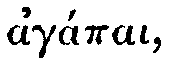 or Love-Feasts; and were first established in
 England
by Pope Gregory
the Great, who in an Epistle to Melitus
the Abbot
gave Order that they should be kept in Sheds or Arbories made up with
Branches and Boughs of Trees round the Church.
He adds,
That this laudable Custom of Wakes prevailed for many Ages,
till the nice Puritans began to exclaim against it as a Remnant of
Popery; and by degrees the precise Humour grew so popular, that at an
Exeter
Assizes the Lord Chief Baron Walter
made an Order for the
Suppression of all Wakes; but on Bishop Laud's
complaining of this
innovating Humour, the King commanded the Order to be reversed.
X.
Parochial Antiquities
(1795), pp. 610, 614.
Contents
Contents p.6
|
Wednesday,
September 5, 1711 |
Addison |
... Servetur ad imum,
Qualis ab incœpto processerit, et sibi constet.
Hor.
Nothing that is not a real Crime makes a Man appear so contemptible and
little in the Eyes of the World as Inconstancy, especially when it
regards Religion or Party. In either of these Cases, tho' a Man perhaps
does but his Duty in changing his Side, he not only makes himself hated
by those he left, but is seldom heartily esteemed by those he comes over
to.
In these great Articles of Life, therefore, a Man's Conviction ought to
be very strong, and if possible so well timed that worldly Advantages
may seem to have no Share in it, or Mankind will be ill natured enough
to think he does not change Sides out of Principle, but either out of
Levity of Temper or Prospects of Interest. Converts and Renegadoes of
all Kinds should take particular care to let the World see they act upon
honourable Motives; or whatever Approbations they may receive from
themselves, and Applauses from those they converse with, they may be
very well assured that they are the Scorn of all good Men, and the
publick Marks of Infamy and Derision.
on the Schemes of Life
which
offer themselves to our
Choice, and Inconstancy in pursuing them, are the greatest and most
universal Causes of all our Disquiet and Unhappiness. When
Ambition
pulls
Way, Interest another, Inclination a third, and perhaps
Reason contrary to all, a Man is likely to pass his Time but ill who has
so many different Parties to please. When the Mind hovers among such a
Variety of Allurements, one had better settle on a Way of Life that is
not the very best we might have chosen, than grow old without
determining our Choice, and go out of the World as the greatest Part of
Mankind do, before we have resolved how to live in it. There is but one
Method of setting our selves at Rest in this Particular, and that is by
adhering stedfastly to one great End as the chief and ultimate Aim of
all our Pursuits. If we are firmly resolved to live up to the Dictates
of Reason, without any Regard to Wealth, Reputation, or the like
Considerations, any more than as they fall in with our principal Design,
we may go through Life with Steadiness and Pleasure; but if we act by
several broken Views, and will not only be virtuous, but wealthy,
popular, and every thing that has a Value set upon it by the World, we
shall live and die in Misery and Repentance.
One would take more than ordinary Care to guard ones self against this
particular Imperfection, because it is that which our Nature very
strongly inclines us to; for if we examine ourselves throughly, we shall
find that we are the most changeable Beings in the Universe. In respect
of our Understanding, we often embrace and reject the very same
Opinions; whereas Beings above and beneath us have probably no Opinions
at all, or at least no Wavering and Uncertainties in those they have.
Our Superiors are guided by Intuition, and our Inferiors by Instinct. In
respect of our Wills, we fall into Crimes and recover out of them, are
amiable or odious in the Eyes of our great Judge, and pass our whole
Life in offending and asking Pardon. On the contrary, the Beings
underneath us are not capable of sinning, nor those above us of
repenting. The one is out of the Possibilities of Duty, and the other
fixed in an eternal Course of Sin, or an eternal Course of Virtue.
There is scarce a State of Life, or Stage in it which does not produce
Changes and Revolutions in the Mind of Man. Our Schemes of Thought in
Infancy are lost in those of Youth; these too take a different Turn in
Manhood, till old Age often leads us back into our former Infancy. A new
Title or an unexpected Success throws us out of ourselves, and in a
manner destroys our Identity. A cloudy Day, or a little Sunshine, have
as great an Influence on many Constitutions, as the most real Blessings
or Misfortunes. A Dream varies our Being, and changes our Condition
while it lasts; and every Passion, not to mention Health and Sickness,
and the greater Alterations in Body and Mind, makes us appear almost
different Creatures. If a Man is so distinguished among other Beings by
this Infirmity, what can we think of such as make themselves remarkable
for it even among their own Species? It is a very trifling Character to
be one of the most variable Beings of the most variable Kind, especially
if we consider that He who is the great Standard of Perfection has in
him no Shadow of Change, but is the same Yesterday, To-day, and for
ever.
As this Mutability of Temper and Inconsistency with our selves is the
greatest Weakness of human Nature, so it makes the Person who is
remarkable for it in a very particular Manner more ridiculous than any
other Infirmity whatsoever, as it sets him in a greater Variety of
foolish Lights, and distinguishes him from himself by an Opposition of
party-coloured Characters. The most humourous Character in
Horace
is
founded upon this Unevenness of Temper and Irregularity of Conduct.
... Sardus habebat
Ille Tigellius hoc: Cæsar qui cogere posset
Si peteret per amicitiam patris, atque suam, non
Quidquam proficeret: Si collibuisset, ab ovo
Usque ad mala citaret, Io Bacche, modò summâ
Voce, modò hâc, resonat quæ; chordis quatuor ima.
Nil æquale homini fuit illi: Sæpe velut qui
Currebat fugiens hostem: Persæpe velut qui
Junonis sacra ferret: Habebat sæpe ducentos,
Sæpe decem servos: Modò reges atque tetrarchas,
Omnia magna loquens: Modò sit mihi mensa tripes, et
Concha salis puri, et toga, quæ defendere frigus,
Quamvis crassa, queat. Decies centena dedisses
Huic parco paucis contento, quinque diebus
Nil erat in loculis. Noctes vigilabat ad ipsum
Manè: Diem totam stertebat. Nil fuit unquam
Sic impar sibi ...
Hor. Sat. 3, Lib. 1.
of translating this Passage in
Horace
, I shall entertain
my
English
Reader with the Description of a Parallel Character,
that is wonderfully well finished by Mr.
Dryden
, and raised
upon the same Foundation.
In the first Rank of these did Zimri stand:
A Man so various, that he seem'd to be
Not one, but all Mankind's Epitome.
Stiff in Opinions, always in the wrong;
Was ev'ry thing by Starts, and nothing long;
But, in the Course of one revolving Moon,
Was Chemist, Fidler, Statesman, and Buffoon:
Then all for Women, Painting, Rhiming, Drinking:
Besides ten thousand Freaks that dy'd in thinking.
Blest Madman, who cou'd ev'ry flour employ,
With something New to wish, or to enjoy!
C.
that
Honour
In his
Absalom and Achitophel.
The character of Villiers,
Duke of Buckingham.
Contents
Contents p.6
|
Thursday,
September 6, 1711 |
Addison |
... Si quid ego adjuero, curamve levasso,
Quæ nunc te coquit, et versat sub pectore fixa,
Ecquid erit pretii?
Enn. ap. Tullium.
after Happiness, and Rules for attaining it, are not so
necessary and useful to Mankind as the Arts of Consolation, and
supporting
ones
self under Affliction. The utmost we can hope for
in this World is Contentment; if we aim at any thing higher, we shall
meet with nothing but Grief and Disappointments. A Man should direct all
his Studies and Endeavours at making himself easie now, and happy
hereafter.
The Truth of it is, if all the Happiness that is dispersed through the
whole Race of Mankind in this World were drawn together, and put into
the Possession of any single Man, it would not make a very happy Being.
Though on the contrary, if the Miseries of the whole Species were fixed
in a single Person, they would make a very miserable one.
I am engaged in this Subject by the following Letter, which, though
subscribed by a fictitious Name, I have reason to believe is not
Imaginary.
Mr.
Spectator2,
'I
am one of your Disciples, and endeavour to live up to your Rules,
which I hope will incline you to pity my Condition: I shall open it to
you in a very few Words. About three Years since a Gentleman, whom, I
am sure, you yourself would have approved, made his Addresses to me.
He had every thing to recommend him but an Estate, so that my Friends,
who all of them applauded his Person, would not for the sake of both
of us favour his Passion. For my own part, I resigned my self up
entirely to the Direction of those who knew the World much better than
my self, but still lived in hopes that some Juncture or other would
make me happy in the Man, whom, in my Heart, I preferred to all the
World; being determined if I could not have him, to have no Body else.
About three Months ago I received a Letter from him, acquainting me,
that by the Death of an Uncle he had a considerable Estate left him,
which he said was welcome to him upon no other Account, but as he
hoped it would remove all Difficulties that lay in the Way to our
mutual Happiness. You may well suppose, Sir, with how much Joy I
received this Letter, which was followed by several others filled with
those Expressions of Love and Joy, which I verily believe no Body felt
more sincerely, nor knew better how to describe than the Gentleman I
am speaking of. But Sir, how shall I be able to tell it you! by the
last Week's Post I received a letter from an intimate Friend of this
unhappy Gentleman, acquainting me, that as he had just settled his
Affairs, and was preparing for his Journey, he fell sick of a Fever
and died. It is impossible to express to you the Distress I am in upon
this Occasion. I can only have Recourse to my Devotions; and to the
reading of good Books for my Consolation; and as I always take a
particular Delight in those frequent Advices and Admonitions which you
give to the Publick, it would be a very great piece of Charity in you
to lend me your Assistance in this Conjuncture. If after the reading
of this Letter you find your self in a Humour, rather to Rally and
Ridicule, than to Comfort me, I desire you would throw it into the
Fire, and think no more of it; but if you are touched with my
Misfortune, which is greater than I know how to bear, your Counsels
may very much Support, and will infinitely Oblige the afflicted
Leonora.'
A Disappointment in Love is more hard to get over than any other; the
Passion itself so softens and subdues the Heart, that it disables it
from struggling or bearing up against the Woes and Distresses which
befal it. The Mind meets with other Misfortunes in her whole Strength;
she stands
within her self, and sustains the Shock with all
the Force
which
is natural to her; but a Heart in Love has its
Foundations sapped, and immediately sinks under the Weight of Accidents
that are disagreeable to its Favourite Passion.
In Afflictions Men generally draw their Consolations out of Books of
Morality, which indeed are of great use to fortifie and strengthen the
Mind against the Impressions of Sorrow.
St.
Evremont
, who
does not approve of this Method, recommends Authors
who
are apt to
stir up Mirth in the Mind of the Readers, and fancies
Don Quixote
can
give more Relief to an heavy Heart than
Plutarch
or
Seneca
, as it is
much easier to divert Grief than to conquer it. This doubtless may have
its Effects on some Tempers. I should rather have recourse to Authors of
a quite contrary kind, that give us Instances of Calamities and
Misfortunes, and shew Human Nature in its greatest Distresses.
If the Affliction we groan under be very heavy, we shall find some
Consolation in the Society of as great Sufferers as our selves,
especially when we find our Companions Men of Virtue and Merit. If our
Afflictions are light, we shall be comforted by the Comparison we make
between our selves and our Fellow Sufferers. A Loss at Sea, a Fit of
Sickness, or the Death of a Friend, are such Trifles when we consider
whole Kingdoms laid in Ashes, Families put to the Sword, Wretches shut
up in Dungeons, and the like Calamities of Mankind, that we are out of
Countenance for our own Weakness, if we sink under such little Stroaks
of Fortune.
Let the Disconsolate
Leonora
consider, that at the very time in which
she languishes for the Loss of her deceased Lover, there are Persons in
several Parts of the World just perishing in a Shipwreck; others crying
out for Mercy in the Terrors of a Death-bed Repentance; others lying
under the Tortures of an Infamous Execution, or the like dreadful
Calamities; and she will find her Sorrows vanish at the Appearance of
those which are so much greater and more astonishing.
I would further propose to the Consideration of my afflicted Disciple,
that possibly what she now looks upon as the greatest Misfortune, is not
really such in it self. For my own part, I question not but our Souls in
a separate State will look back on their Lives in quite another View,
than what they had of them in the Body; and that what they now consider
as Misfortunes and Disappointments, will very often appear to have been
Escapes and Blessings.
The Mind that hath any Cast towards Devotion, naturally flies to it in
its Afflictions.
When I was in
France
I heard a very remarkable Story of two
Lovers, which I shall relate at length in my to-Morrow's Paper, not only
because the Circumstances of it are extraordinary, but because it may
serve as an Illustration to all that can be said on this last Head, and
shew the Power of Religion in abating that particular Anguish which
seems to lie so heavy on
Leonora
. The Story was told me by a
Priest, as I travelled with him in a Stage-Coach. I shall give it my
Reader as well as I can remember, in his own Words, after having
premised, that if Consolations may be drawn from a wrong Religion and a
misguided Devotion, they cannot but flow much more naturally from those
which are founded upon Reason, and established in good Sense.
L.
one
This letter is by Miss Shepheard, the 'Parthenia' of
that
that
Contents
Contents p.6
|
Friday,
September 7, 1711 |
Addison |
Illa; Quis et me, inquit, miseram, et te perdidit, Orpheu? Jamque vale: feror ingenti circumdata nocte, Invalidasque tibi tendens, heu! non tua, palmas.
Virg.
Constantia
was a Woman of extraordinary Wit and Beauty, but very unhappy
in a Father, who having arrived at great Riches by his own Industry,
took delight in nothing but his Money.
Theodosius
was the younger
Son of a decayed Family of great Parts and Learning, improved by a
genteel and vertuous Education. When he was in the twentieth year of his
Age he became acquainted with
Constantia
, who had not then passed
her fifteenth.
he lived but a few Miles Distance from her Father's
House, he had frequent opportunities of seeing her; and by the
Advantages of a good Person and a pleasing Conversation, made such an
Impression in her Heart as it was impossible for time to
efface
:
He was himself no less smitten with
Constantia
. A long
Acquaintance made them still discover new Beauties in each other, and by
Degrees raised in them that mutual Passion which had an Influence on
their following Lives. It unfortunately happened, that in the midst of
this intercourse of Love and Friendship between
Theodosius
and
Constantia
, there broke out an irreparable Quarrel between their
Parents, the one valuing himself too much upon his Birth, and the other
upon his Possessions. The Father of
Constantia
was so incensed at the
Father of
Theodosius
, that he contracted an unreasonable Aversion
towards his Son, insomuch that he forbad him his House, and charged his
Daughter upon her Duty never to see him more. In the mean time to break
off all Communication between the two Lovers, who he knew entertained
secret Hopes of some favourable Opportunity that should bring them
together, he found out a young Gentleman of a good Fortune and an
agreeable Person, whom he pitched upon as a Husband for his Daughter. He
soon concerted this Affair so well, that he told
Constantia
it
was his Design to marry her to such a Gentleman, and that her Wedding
should be celebrated on such a Day.
Constantia
, who was over-awed
with the Authority of her Father, and unable to object anything against
so advantageous a Match, received the Proposal with a profound Silence,
which her Father commended in her, as the most decent manner of a
Virgin's giving her Consent to an Overture of that Kind: The Noise of
this intended Marriage soon reached
Theodosius
, who, after a long
Tumult of Passions which naturally rise in a Lover's Heart on such an
Occasion, writ the following letter to
Constantia
.
'The Thought of my Constantia, which for some years has been my
only Happiness, is now become a greater Torment to me than I am able
to bear. Must I then live to see you another's? The Streams, the
Fields and Meadows, where we have so often talked together, grow
painful to me; Life it self is become a Burden. May you long be happy
in the World, but forget that there was ever such a Man in it as
Theodosius.'
This Letter was conveyed to
Constantia
that very Evening, who
fainted at the Reading of it; and the next Morning she was much more
alarmed by two or three Messengers, that came to her Father's House one
after another to inquire if they had heard any thing of
Theodosius
, who it seems had left his Chamber about Midnight, and
could nowhere be found. The deep Melancholy, which had hung upon his
Mind some Time before, made them apprehend the worst that could befall
him.
Constantia
, who knew that nothing but the Report of her
Marriage could have driven him to such Extremities, was not to be
comforted: She now accused her self for having so tamely given an Ear to
the Proposal of a Husband, and looked upon the new Lover as the Murderer
of
Theodosius:
In short, she resolved to suffer the utmost
Effects of her Father's Displeasure, rather than comply with a Marriage
which appeared to her so full of Guilt and Horror. The Father seeing
himself entirely rid of
Theodosius,
and likely to keep a
considerable Portion in his Family, was not very much concerned at the
obstinate Refusal of his Daughter; and did not find it very difficult to
excuse himself upon that Account to his intended Son-in-law, who had all
along regarded this Alliance rather as a Marriage of Convenience than of
Love.
Constantia
had now no Relief but in her Devotions and
Exercises of Religion, to which her Afflictions had so entirely
subjected her Mind, that after some Years had abated the Violence of her
Sorrows, and settled her Thoughts in a kind of Tranquillity, she
resolved to pass the Remainder of her Days in a Convent.
Father was
not displeased with
a
Resolution,
which
would save Money in
his Family, and readily complied with his Daughter's Intentions.
Accordingly in the Twenty-fifth Year of her Age, while her Beauty was
yet in all its Height and Bloom, he carried her to a neighbouring City,
in order to look out a Sisterhood of Nuns among whom to place his
Daughter. There was in this Place a Father of a Convent who was very
much renowned for his Piety and exemplary Life; and as it is usual in
the Romish Church for those who are under any great Affliction, or
Trouble of Mind, to apply themselves to the most eminent Confessors for
Pardon and Consolation, our beautiful Votary took the Opportunity of
confessing herself to this celebrated Father.
We must now return to Theodosius, who, the very Morning that the
above-mentioned Inquiries had been made after him, arrived at a
religious House in the City, where now Constantia resided; and desiring
that Secresy and Concealment of the Fathers of the Convent, which is
very usual upon any extraordinary Occasion, he made himself one of the
Order, with a private Vow never to enquire after
Constantia
; whom
he looked upon as given away to his Rival upon the Day on which,
according to common Fame, their Marriage was to have been solemnized.
in his Youth made a good Progress in Learning, that he might
dedicate
himself
more entirely to Religion, he entered into holy
Orders, and in a few Years became renowned for his Sanctity of Life, and
those pious Sentiments which he inspired into all
who
conversed
with him. It was this holy Man to whom
Constantia
had determined
to apply her self in Confession, tho' neither she nor any other besides
the Prior of the Convent, knew any thing of his Name or Family.
gay,
the amiable
Theodosius
had now taken upon him the Name of Father
Francis
, and was so far concealed in a long Beard, a
shaven
Head, and a religious Habit, that it was impossible to discover the Man
of the World in the venerable Conventual.
As he was one Morning shut up in his Confessional,
Constantia
kneeling by him opened the State of her Soul to him; and after having
given him the History of a Life full of Innocence, she burst out in
Tears, and entred upon that Part of her Story in which he himself had so
great a Share. My Behaviour, says she, has I fear been the Death of a
Man who had no other Fault but that of loving me too much. Heaven only
knows how dear he was to me whilst he liv'd, and how bitter the
Remembrance of him has been to me since his Death. She here paused, and
lifted up her Eyes that streamed with Tears towards the Father; who was
so moved with the Sense of her Sorrows, that he could only command his
Voice, which was broke with Sighs and Sobbings, so far as to bid her
proceed. She followed his Directions, and in a Flood of Tears poured out
her Heart before him. The Father could not forbear weeping aloud,
insomuch that in the Agonies of his Grief the Seat shook under him.
Constantia
, who thought the good Man was thus moved by his
Compassion towards her, and by the Horror of her Guilt, proceeded with
the utmost Contrition to acquaint him with that Vow of Virginity in
which she was going to engage herself, as the proper Atonement for her
Sins, and the only Sacrifice she could make to the Memory of
Theodosius
. The Father, who by this time had pretty well composed
himself, burst out again in Tears upon hearing that Name to which he had
been so long disused, and upon receiving this Instance of an
unparallel'd Fidelity from one who he thought had several Years since
given herself up to the Possession of another. Amidst the Interruptions
of his Sorrow, seeing his Penitent overwhelmed with Grief, he was only
able to bid her from time to time be comforted — To tell her that her
Sins were forgiven her — That her Guilt was not so great as she
apprehended — That she should not suffer her self to be afflicted above
Measure. After which he recovered himself enough to give her the
Absolution in Form; directing her at the same time to repair to him
again the next Day, that he might encourage her in the pious
Resolution
s
she had taken, and give her suitable Exhortations for her
Behaviour in it.
Constantia
retired, and the next Morning renewed
her Applications.
Theodosius
having manned his Soul with proper
Thoughts and Reflections exerted himself on this Occasion in the best
Manner he could to animate his Penitent in the Course of Life she was
entering upon, and wear out of her Mind those groundless Fears and
Apprehensions which had taken Possession of it; concluding with a
Promise to her, that he would from time to time continue his Admonitions
when she should have taken upon her the holy Veil. The Rules of our
respective Orders, says he, will not permit that I should see you, but
you may assure your self not only of having a Place in my Prayers, but
of receiving such frequent Instructions as I can convey to you by
Letters. Go on chearfully in the glorious Course you have undertaken,
and you will quickly find such a Peace and Satisfaction in your Mind,
which it is not in the Power of the World to give.
Constantia's
Heart was so elevated with the Discourse of Father
Francis
, that the very next Day she entered upon her Vow. As soon
as the Solemnities of her Reception were over, she retired, as it is
usual, with the Abbess into her own Apartment.
The Abbess had been informed the Night before of all that had passed
between her Noviciate and Father
Francis:
From whom she now
delivered to her the following Letter.
'As the First-fruits of those Joys and Consolations which you may
expect from the Life you are now engaged in, I must acquaint you that
Theodosius, whose Death sits so heavy upon your Thoughts, is
still alive; and that the Father, to whom you have confessed your
self, was once that Theodosius whom you so much lament. The
love which we have had for one another will make us more happy in its
Disappointment than it could have done in its Success. Providence has
disposed of us for our Advantage, tho' not according to our Wishes.
Consider your Theodosius still as dead, but assure your self of
one who will not cease to pray for you in Father.'
Francis.
Constantia
saw that the Hand-writing agreed with the Contents of
the Letter: and upon reflecting on the Voice of the Person, the
Behaviour, and above all the extreme Sorrow of the Father during her
Confession, she discovered
Theodosius
in every Particular. After
having wept with Tears of Joy, It is enough, says she,
Theodosius
is still in Being: I shall live with Comfort and die in Peace.
The Letters which the Father sent her afterwards are yet extant in the
Nunnery where she resided; and are often read to the young Religious, in
order to inspire them with good Resolutions and Sentiments of Virtue. It
so happened, that after
Constantia
had lived about ten Years in
the Cloyster, a violent Feaver broke out in the Place, which swept away
great Multitudes, and among others
Theodosius.
Upon his Deathbed
he sent his Benediction in a very moving Manner to
Constantia,
who at that time was herself so far gone in the same fatal Distemper,
that she lay delirious. Upon the Interval which generally precedes Death
in Sicknesses of this Nature, the Abbess, finding that the Physicians
had given her over, told her that
Theodosius
was just gone before
her, and that he had sent her his Benediction in his last Moments.
Constantia
received it with Pleasure: And now, says she, If I do
not ask anything improper, let me be buried by
Theodosius.
My Vow
reaches no farther than the Grave. What I ask is, I hope, no Violation
of it. — She died soon after, and was interred according to her Request.
Their Tombs are still to be seen, with a short Latin Inscription over
them to the following Purpose.
Here lie the Bodies of Father
Francis
and Sister
Constance.
They were lovely in their Lives, and in their Deaths they were not
divided.
C.
deface
her
that
himself up
that
shaved
Contents
Contents p.6
|
Saturday,
September 8, 1711 |
Addison |
... Si fortè necesse est,
Fingere cinctutis non exaudita Cethegis
Continget: dabiturque licentia sumpta pudenter.1
Hor.
I have often wished, that as in our Constitution there are several
Persons whose Business it is to watch over our Laws, our Liberties and
Commerce, certain Men might be set apart as Superintendants of our
Language, to hinder any Words of a Foreign Coin from passing among us;
and in particular to prohibit any
French
Phrases from becoming Current
in this Kingdom, when those of our own Stamp are altogether as valuable.
The present War has so Adulterated our Tongue with strange Words that it
would be impossible for one of our Great Grandfathers to know what his
Posterity have been doing, were he to read their Exploits in a Modern
News Paper. Our Warriors are very industrious in propagating the
French
Language, at the same time that they are so gloriously
successful in beating down their Power. Our Soldiers are Men of strong
Heads for Action, and perform such Feats as they are not able to
express. They want Words in their own Tongue to tell us what it is they
Atchieve, and therefore send us over Accounts of their Performances in a
Jargon of Phrases, which they learn among their Conquered Enemies. They
ought however to be provided with Secretaries, and assisted by our
Foreign Ministers, to tell their Story for them in plain
English
, and
to let us know in our Mother-Tongue what it is our brave Country-Men are
about. The
French
would indeed be in the right to publish the
News of the present War in
English
Phrases, and make their
Campaigns unintelligible. Their People might flatter themselves that
Things are not so bad as they really are, were they thus palliated with
Foreign Terms, and thrown into Shades and Obscurity: but the
English
cannot be too clear in their Narrative of those Actions,
which have raised their Country to a higher Pitch of Glory than it ever
yet arrived at, and which will be still the more admired the better they
are explained.
For my part, by that time a Siege is carried on two or three Days, I am
altogether lost and bewildered in it, and meet with so many inexplicable
Difficulties, that I scarce know what Side has the better of it, till I
am informed by the Tower Guns that the Place is surrendered.
do indeed
make some Allowances for this Part of the War, Fortifications having
been foreign Inventions, and upon that Account abounding in foreign
Terms. But when we have won Battels
which
may be described in our
own Language, why are our Papers filled with so many unintelligible
Exploits, and the
French
obliged to lend us a Part of their
Tongue before we can know how they are Conquered? They must be made
accessory to their own Disgrace, as the
Britons
were formerly so
artificially wrought in the Curtain of the
Roman
Theatre, that
they seemed to draw it up in order to give the Spectators an Opportunity
of seeing their own Defeat celebrated upon the Stage: For so Mr.
Dryden
has translated that
in
Virgil
.
Purpurea intexti3 tollunt aulœa Britanni.
Georg. 3, v. 25.
Which interwoven Britains
seem to raise,
And shew the Triumph that their Shame displays.
Histories of all our former Wars are transmitted to us in our
Vernacular Idiom, to use the Phrase of a great Modern Critick
. I do
not find in any of our Chronicles, that
Edward
the Third ever
reconnoitred the Enemy, tho' he often discovered the Posture of the
French
, and as often vanquished them in Battel. The
Black
Prince
passed many a River without the help of Pontoons, and filled
a Ditch with Faggots as successfully as the Generals of our Times do it
with Fascines. Our Commanders lose half their Praise, and our People
half their Joy, by means of those hard Words and dark Expressions in
which our News Papers do so much abound. I have seen many a prudent
Citizen, after having read every Article, inquire of his next Neighbour
what News the Mail had brought.
I remember in that remarkable Year when our Country was delivered from
the greatest Fears and Apprehensions, and raised to the greatest Height
of Gladness it had ever felt since it was a Nation, I mean the Year of
Blenheim
, I had the Copy of a Letter sent me out of the Country,
which was written from a young Gentleman in the Army to his Father, a
Man of a good Estate and plain Sense: As the Letter was very modishly
chequered with this Modern Military Eloquence, I shall present my Reader
with a Copy of it.
Sir,
Upon the Junction of the
French and
Bavarian Armies they
took Post behind a great Morass which they thought impracticable.
Our
General the next Day sent a Party of Horse to reconnoitre them from a
little Hauteur, at about a
Quarter of an Hour's5 distance from
the Army, who returned again to the Camp unobserved through several
Defiles, in one of which they met with a Party of
French that
had been Marauding, and made them all Prisoners at Discretion. The Day
after a Drum arrived at our Camp, with a Message which he would
communicate to none but the General; he was followed by a Trumpet, who
they say behaved himself very saucily, with a Message from the Duke of
Bavaria. The next Morning our Army being divided into two
Corps, made a Movement towards the Enemy: You will hear in the Publick
Prints how we treated them, with the other Circumstances of that
glorious Day. I had the good Fortune to be in that Regiment that
pushed the
Gens d'Arms. Several
French Battalions, who
some say were a Corps de Reserve, made a Show of Resistance; but it
only proved a Gasconade, for upon our preparing to fill up a little
Fossé, in order to attack them, they beat the Chamade, and sent us
Charte Blanche. Their Commandant, with a great many other
General Officers, and Troops without number, are made Prisoners of
War, and will I believe give you a Visit in
England, the Cartel
not being yet settled. Not questioning but these Particulars will be
very welcome to you, I congratulate you upon them, and am your most
dutiful Son, &c.'
The Father of the young Gentleman upon the Perusal of the Letter found
it contained great News, but could not guess what it was. He immediately
communicated it to the Curate of the Parish, who upon the reading of it,
being vexed to see any thing he could not understand, fell into a kind
of a Passion, and told him that his Son had sent him a Letter that was
neither Fish, nor Flesh, nor good Red-Herring. I wish, says he, the
Captain may be
Compos Mentis
, he talks of a saucy Trumpet, and a
Drum that carries Messages; then who is this
Charte Blanche
? He
must either banter us or he is out of his Senses. The Father, who always
looked upon the Curate as a learned Man, began to fret inwardly at his
Son's Usage, and producing a Letter which he had written to him about
three Posts afore, You see here, says he, when he writes for Mony he
knows how to speak intelligibly enough; there is no Man in England can
express himself clearer, when he wants a new Furniture for his Horse. In
short, the old Man was so puzzled upon the Point, that it might have
fared ill with his Son, had he not seen all the Prints about three Days
after filled with the same Terms of Art, and that
Charles
only
writ like other Men.
L.
The motto in the original edition was
Semivirumque bovem Semibovemque virum.
Ovid.
that
Atique
Dr Richard Bentley
Mile
Contents
Contents p.6
|
Monday,
September 10, 1711 |
Addison |
... Quod nec Jovis ira, nec ignis,
Nec poterit ferrum, nec edax abolere vetustas.
Ovid.
Aristotle tells us that the World is a Copy or Transcript of those Ideas
which are in the Mind of the first Being, and that those Ideas, which
are in the Mind of Man, are a Transcript of the World: To this we may
add, that Words are the Transcript of those Ideas which are in the Mind
of Man, and that Writing or Printing are the Transcript of words.
As the Supreme Being has expressed, and as it were printed his Ideas in
the Creation, Men express their Ideas in Books, which by this great
Invention of these latter Ages may last as long as the Sun and Moon, and
perish only in the general Wreck of Nature. Thus
Cowley
in his
Poem on the Resurrection, mentioning the Destruction of the Universe,
has those admirable Lines.
Now all the wide extended Sky,
And all th' harmonious Worlds on high,
And Virgil's sacred Work shall die.
There is no other Method of fixing those Thoughts which arise and
disappear in the Mind of Man, and transmitting them to the last Periods
of Time; no other Method of giving a Permanency to our Ideas, and
preserving the Knowledge of any particular Person, when his Body is
mixed with the common Mass of Matter, and his Soul retired into the
World of Spirits. Books are the Legacies that a great Genius leaves to
Mankind, which are delivered down from Generation to Generation, as
Presents to the Posterity of those who are yet unborn.
All other Arts of perpetuating our Ideas continue but a short Time:
Statues can last but a few Thousands of Years, Edifices fewer, and
Colours still fewer than Edifices.
Michael Angelo
,
Fontana
, and
Raphael
, will hereafter be what
Phidias
,
Vitruvius
, and
Apelles
are at present; the
Names of great Statuaries, Architects and Painters, whose Works are
lost. The several Arts are expressed in mouldring Materials: Nature
sinks under them, and is not able to support the Ideas which are imprest
upon it.
The Circumstance which gives Authors an Advantage above all these great
Masters, is this, that they can multiply their Originals; or rather can
make Copies of their Works, to what Number they please, which shall be
as valuable as the Originals themselves. This gives a great Author
something like a Prospect of Eternity, but at the same time deprives him
of those other Advantages which Artists meet with. The Artist finds
greater Returns in Profit, as the Author in Fame. What an Inestimable
Price would a
Virgil
or a
Homer
, a
Cicero
or an
Aristotle
bear, were their Works like a Statue, a Building, or a
Picture, to be confined only in one Place and made the Property of a
single Person?
If Writings are thus durable, and may pass from Age to Age throughout
the whole Course of Time, how careful should an Author be of committing
any thing to Print that may corrupt Posterity, and poison the Minds of
Men with Vice and Error? Writers of great Talents, who employ their
Parts in propagating Immorality, and seasoning vicious Sentiments with
Wit and Humour, are to be looked upon as the Pests of Society, and the
Enemies of Mankind: They leave Books behind them (as it is said of those
who die in Distempers which breed an Ill-will towards their own Species)
to scatter Infection and destroy their Posterity. They act the
Counterparts of a
Confucius
or a
Socrates
; and seem to
have been sent into the World to deprave human Nature, and sink it into
the Condition of Brutality.
I have seen some Roman-Catholick Authors, who tell us that vicious
Writers continue in Purgatory so long as the Influence of their Writings
continues upon Posterity: For Purgatory, say they, is nothing else but a
cleansing us of our Sins, which cannot be said to be done away, so long
as they continue to operate and corrupt Mankind. The vicious Author, say
they, sins after Death, and so long as he continues to sin, so long must
he expect to be punished. Tho' the Roman Catholick Notion of Purgatory
be indeed very ridiculous, one cannot but think that if the Soul after
Death has any Knowledge of what passes in this World, that of an immoral
Writer would receive much more Regret from the Sense of corrupting, than
Satisfaction from the Thought of pleasing his surviving Admirers.
To take off from the Severity of this Speculation, I shall conclude this
Paper with a Story of an Atheistical Author, who at a time when he lay
dangerously sick, and desired the Assistance of a neighbouring Curate,
confessed to him with great Contrition, that nothing sat more heavy at
his Heart than the Sense of his having seduced the Age by his Writings,
and that their evil Influence was likely to continue even after his
Death. The Curate upon further Examination finding the Penitent in the
utmost Agonies of Despair, and being himself a Man of Learning, told
him, that he hoped his Case was not so desperate as he apprehended,
since he found that he was so very sensible of his Fault, and so
sincerely repented of it. The Penitent still urged the evil Tendency of
his Book to subvert all Religion, and the little Ground of Hope there
could be for one whose Writings would continue to do Mischief when his
Body was laid in Ashes. The Curate, finding no other Way to comfort him,
told him, that he did well in being afflicted for the evil Design with
which he published his Book; but that he ought to be very thankful that
there was no danger of its doing any Hurt: That his Cause was so very
bad, and his Arguments so weak, that he did not apprehend any ill
Effects of it: In short, that he might rest satisfied his Book could do
no more Mischief after his Death, than it had done whilst he was living.
To which he added, for his farther Satisfaction, that he did not believe
any besides his particular Friends and Acquaintance had ever been at the
pains of reading it, or that any Body after his Death would ever enquire
after it. The dying Man had still so much the Frailty of an Author in
him, as to be cut to the Heart with these Consolations; and without
answering the good Man, asked his Friends about him (with a Peevishness
that is natural to a sick Person) where they had picked up such a
Blockhead? And whether they thought him a proper Person to attend one in
his Condition? The Curate finding that the Author did not expect to be
dealt with as a real and sincere Penitent, but as a Penitent of
Importance, after a short Admonition withdrew; not questioning but he
should be again sent for if the Sickness grew desperate. The Author
however recovered, and has since written two or three other Tracts with
the same Spirit, and very luckily for his poor Soul with the same
Success.
C.
Contents
Contents p.6
|
Tuesday,
September 11, 1711 |
Steele |
Fuit haud ignobilis Argis,
Qui se credebat miros audire tragœdos,
In vacuo lætus sessor plausorque theatro;
Cætera qui vitæ servaret munia recto
More; bonus sanè vicinus, amabilis hospes,
Comis in uxorem; posset qui ignoscere servis,
Et signo læso non insanire lagenæ;
Posset qui rupem et puteum vitare patentem.
Hic ubi cognatorum opibus curisque refectus
Expulit elleboro morbum bilemque meraco,
Et redit ad sese: Pol me occidistis, amici,
Non servastis, ait; cui sic extorta valuptas,
Et demptus per vim mentis gratissimus Error.
Hor.
The unhappy Force of an Imagination, unguided by the Check of Reason and
Judgment, was the Subject of a former Speculation. My Reader may
remember that he has seen in one of my Papers a Complaint of an
Unfortunate Gentleman, who was unable to contain himself, (when any
ordinary matter was laid before him) from adding a few Circumstances to
enliven plain Narrative. That Correspondent was a Person of too warm a
Complexion to be satisfied with things merely as they stood in Nature,
and therefore formed Incidents which should have happened to have
pleased him in the Story. The same ungoverned Fancy which pushed that
Correspondent on, in spite of himself, to relate publick and notorious
Falsehoods, makes the Author of the following Letter do the same in
Private; one is a Prating, the other a Silent Liar.
There is little pursued in the Errors of either of these Worthies, but
mere present Amusement: But the Folly of him who lets his Fancy place
him in distant Scenes untroubled and uninterrupted, is very much
preferable to that of him who is ever forcing a Belief, and defending
his Untruths with new Inventions. But I shall hasten to let this Liar in
Soliloquy, who calls himself a
Castle-builder
, describe himself with the
same Unreservedness as formerly appeared in my Correspondent
above-mentioned. If a Man were to be serious on this Subject, he might
give very grave Admonitions to those who are following any thing in this
Life, on which they think to place their Hearts, and tell them that they
are really
Castle-builders
. Fame, Glory, Wealth, Honour, have in the
Prospect pleasing Illusions; but they who come to possess any of them
will find they are Ingredients towards Happiness, to be regarded only in
the second Place; and that when they are valued in the first Degree,
they are as dis-appointing as any of the Phantoms in the following
Letter.
Sept. 6, 1711.
Mr. Spectator,
'I am a Fellow of a very odd Frame of Mind, as you will find by the
Sequel; and think myself Fool enough to deserve a Place in your Paper.
I am unhappily far gone in Building, and am one of that Species of Men
who are properly denominated Castle-Builders, who scorn to be beholden
to the Earth for a Foundation, or dig in the Bowels of it for
Materials; but erect their Structures in the most unstable of
Elements, the Air, Fancy alone laying the Line, marking the Extent,
and shaping the Model. It would be difficult to enumerate what august
Palaces and stately Porticoes have grown under my forming Imagination,
or what verdant Meadows and shady Groves have started into Being, by
the powerful Feat of a warm Fancy. A Castle-builder is even just what
he pleases, and as such I have grasped imaginary Scepters, and
delivered uncontroulable Edicts, from a Throne to which conquered
Nations yielded Obeysance. I have made I know not how many Inroads
into
France, and ravaged the very Heart of that Kingdom; I have
dined in the
Louvre, and drank Champaign at
Versailles;
and I would have you take Notice, I am not only able to vanquish a
People already cowed and accustomed to Flight,
but I could,
Almanzor-like
1, drive the
British General from the
Field, were I less a Protestant, or had ever been affronted by the
Confederates. There is no Art or Profession, whose most celebrated
Masters I have not eclipsed. Where-ever I have afforded my Salutary
Preference, Fevers have ceased to burn, and Agues to shake the Human
Fabrick. When an Eloquent Fit has been upon me, an apt Gesture and
proper Cadence has animated each Sentence, and gazing Crowds have
found their Passions work'd up into Rage, or soothed into a Calm. I am
short, and not very well made; yet upon Sight of a fine Woman, I have
stretched into proper Stature, and killed with a good Air and Mein.
These are the gay Phantoms that dance before my waking Eyes and
compose my Day-Dreams. I should be the most contented happy Man alive,
were the Chimerical Happiness which springs from the Paintings of the
Fancy less fleeting and transitory. But alas! it is with Grief of Mind
I tell you, the least Breath of Wind has often demolished my
magnificent Edifices, swept away my Groves, and left no more Trace of
them than if they had never been. My Exchequer has sunk and vanished
by a Rap on my Door, the Salutation of a Friend has cost me a whole
Continent, and in the same Moment I have been pulled by the Sleeve, my
Crown has fallen from my Head. The ill Consequence of these Reveries
is inconceivably great, seeing the loss of imaginary Possessions makes
Impressions of real Woe. Besides, bad Œconomy is visible and apparent
in Builders of invisible Mansions. My Tenant's Advertisements of Ruins
and Dilapidations often cast a Damp on my Spirits, even in the Instant
when the Sun, in all his Splendor, gilds my Eastern Palaces. Add to
this the pensive Drudgery in Building, and constant grasping Aerial
Trowels, distracts and shatters the Mind, and the fond Builder of
Babells is often cursed with an incoherent Diversity and
Confusion of Thoughts. I do not know to whom I can more properly apply
my self for Relief from this Fantastical Evil, than to your self; whom
I earnestly implore to accommodate me with a Method how to settle my
Head and cool my Brain-pan. A Dissertation on Castle-Building may not
only be serviceable to my self, but all Architects, who display their
Skill in the thin Element. Such a Favour would oblige me to make my
next Soliloquy not contain the Praises of my dear Self but of the
Spectator, who shall, by complying with this, make me.'
His Obliged, Humble Servant.
Vitruvius.
"(unreadable on original page) in Dryden's
Conquest of Granada
."
Contents
Contents p.6
|
Wednesday,
September 12, 1711 |
Steele |
... Pectus Præceptis format amicis.
Hor.
It would be Arrogance to neglect the Application of my Correspondents so
far as not sometimes to insert their Animadversions upon my Paper; that
of this Day shall be therefore wholly composed of the Hints which they
have sent me.
Mr.
Spectator,
I Send you this to congratulate your late Choice of a Subject, for
treating on which you deserve publick Thanks; I mean that on those
licensed Tyrants the Schoolmasters. If you can disarm them of their
Rods, you will certainly have your old Age reverenced by all the young
Gentlemen of
Great-Britain who are now between seven and seventeen
Years. You may boast that the incomparably wise
Quintilian and you
are of one Mind in this Particular.
'
Si cui est (says he)
mens tam illiberalis ut objurgatione non
corrigatur, is etiam ad plagas, ut pessimo quæque mancipia,
durabitur1.
If any Child be of so disingenuous a Nature, as not to stand
corrected by Reproof, he, like the very worst of Slaves, will be
hardned even against Blows themselves.'
And afterwards,
'Pudet dicere in quæ probra nefandi homines isto cædendi jure
abutantur,
i. e. I blush to say how shamefully those wicked Men abuse the
Power of Correction.'
I was bred myself, Sir, in a very great School, of which the Master
was a
Welchman, but certainly descended from a
Spanish Family, as
plainly appeared from his Temper as well as his Name
2. I leave you
to judge what sort of a Schoolmaster a
Welchman ingrafted on a
Spaniard would make. So very dreadful had he made himself to me,
that altho' it is above twenty Years since I felt his heavy Hand, yet
still once a Month at least I dream of him, so strong an Impression
did he make on my Mind. 'Tis a Sign he has fully terrified me waking,
who still continues to haunt me sleeping.
And yet I may say without Vanity, that the Business of the School was
what I did without great Difficulty; and I was not remarkably unlucky;
and yet such was the Master's Severity that once a Month, or oftner, I
suffered as much as would have satisfied the Law of the Land for a
Petty Larceny.
Many a white and tender Hand, which the fond Mother has passionately
kissed a thousand and a thousand times, have I seen whipped till it
was covered with Blood: perhaps for smiling, or for going a Yard and
half out of a Gate, or for writing an O for an A, or an A for an O:
These were our great Faults! Many a brave and noble Spirit has been
there broken; others have run from thence and were never heard of
afterwards.
It is a worthy Attempt to undertake the Cause of distrest Youth; and
it is a noble Piece of
Knight-Errantry to enter the Lists
against so many armed Pedagogues. 'Tis pity but we had a Set of Men,
polite in their Behaviour and Method of Teaching, who should be put
into a Condition of being above flattering or fearing the Parents of
those they instruct. We might then possibly see Learning become a
Pleasure, and Children delighting themselves in that which now they
abhor for coming upon such hard Terms to them: What would be a still
greater Happiness arising from the Care of such Instructors, would be,
that we should have no more Pedants, nor any bred to Learning who had
not Genius for it. I am, with the utmost Sincerity,
Sir,
Your most
affectionate humble Servant.
Richmond, Sept. 5
th, 1711.
Mr.
Spectator,
I am a Boy of fourteen Years of Age, and have for this last Year been
under the Tuition of a Doctor of Divinity, who has taken the School of
this Place under his Care
3. From the Gentleman's great Tenderness
to me and Friendship to my Father, I am very happy in learning my Book
with Pleasure. We never leave off our Diversions any farther than to
salute him at Hours of Play when he pleases to look on. It is
impossible for any of us to love our own Parents better than we do
him. He never gives any of us an harsh Word, and we think it the
greatest Punishment in the World when he will not speak to any of us.
My Brother and I are both together inditing this Letter: He is a Year
older than I am, but is now ready to break his Heart that the Doctor
has not taken any Notice of him these three Days. If you please to
print this he will see it, and, we hope, taking it for my Brother's
earnest Desire to be restored to his Favour, he will again smile upon
him.
Your most obedient Servant,
T. S.
Mr.
Spectator,
You have represented several sorts of
Impertinents singly, I
wish you would now proceed, and describe some of them in Sets. It
often happens in publick Assemblies, that a Party who came thither
together, or whose Impertinencies are of an equal Pitch, act in
Concert, and are so full of themselves as to give Disturbance to all
that are about them. Sometimes you have a Set of Whisperers, who lay
their Heads together in order to sacrifice every Body within their
Observation; sometimes a Set of Laughers, that keep up an insipid
Mirth in their own Corner, and by their Noise and Gestures shew they
have no Respect for the rest of the Company.
You frequently meet with
these Sets at the Opera, the Play, the Water-works
4, and other
publick Meetings, where their whole Business is to draw off the
Attention of the Spectators from the Entertainment, and to fix it upon
themselves; and it is to be observed that the Impertinence is ever
loudest, when the Set happens to be made up of three or four Females
who have got what you call a Woman's Man among them.
I am at a loss to know from whom People of Fortune should learn this
Behaviour, unless it be from the Footmen who keep their Places at a
new Play, and are often seen passing away their Time in Sets at
All-fours in the Face of a full House, and with a perfect
Disregard to People of Quality sitting on each Side of them.
For preserving therefore the Decency of publick Assemblies, methinks
it would be but reasonable that those who Disturb others should pay at
least a double Price for their Places; or rather Women of Birth and
Distinction should be informed that a Levity of Behaviour in the Eyes
of People of Understanding degrades them below their meanest
Attendants; and Gentlemen should know that a fine Coat is a Livery,
when the Person who wears it discovers no higher Sense than that of a
Footman.
I am
Sir,
Your most humble Servant.
Bedfordshire, Sept.. 1, 1711
Mr.
Spectator,
I am one of those whom every Body calls a Pocher, and sometimes go out
to course with a Brace of Greyhounds, a Mastiff, and a Spaniel or two;
and when I am weary with Coursing, and have killed Hares enough, go to
an Ale-house to refresh my self. I beg the Favour of you (as you set
up for a Reformer) to send us Word how many Dogs you will allow us to
go with, how many Full-Pots of Ale to drink, and how many Hares to
kill in a Day, and you will do a great Piece of Service to all the
Sportsmen: Be quick then, for the Time of Coursing is come on.
Yours in Haste,
T. Isaac Hedgeditch.
Instit. Orat.
Bk. I. ch. 3.
Dr. Charles Roderick, Head Master of Eton.
Dr. Nicholas Brady, Tate's colleague in versification of
the Psalms. He was Rector of Clapham and Minister of Richmond, where he
had the school. He died in 1726, aged 67.
The Water Theatre, invented by Mr. Winstanley, and
exhibited by his widow at the lower end of Piccadilly.
Contents
Contents p.6
|
Thursday,
September 13, 1711 |
Addison |
Sic vita erat: facile omnes perferre ac pati:
Cum quibus erat cunque una, his sese dedere,
Eorum obsequi studiis: advorsus nemini;
Nunquam præponens se aliis: Ita facillime
Sine invidia invenias laudem.
Ter. And.
Man is subject to innumerable Pains and Sorrows by the very Condition of
Humanity, and yet, as if Nature had not sown Evils enough in Life, we
are continually adding Grief to Grief, and aggravating the common
Calamity by our cruel Treatment of one another. Every Man's natural
Weight of Afflictions is still made more heavy by the Envy, Malice,
Treachery, or Injustice of his Neighbour. At the same time that the
Storm beats upon the whole Species, we are falling foul upon one
another.
Half the Misery of Human Life might be extinguished, would Men alleviate
the general Curse they lie under, by mutual Offices of Compassion,
Benevolence, and Humanity. There is nothing therefore which we ought
more to encourage in our selves and others, than that Disposition of
Mind which in our Language goes under the Title of Good-nature, and
which I shall chuse for the Subject of this Day's Speculation.
Good-nature is more agreeable in Conversation than Wit, and gives a
certain Air to the Countenance which is more amiable than Beauty. It
shows Virtue in the fairest Light, takes off in some measure from the
Deformity of Vice, and makes even Folly and Impertinence supportable.
There is no Society or Conversation to be kept up in the World without
Good-nature, or something which must bear its Appearance, and supply its
Place. For this Reason Mankind have been forced to invent a kind of
Artificial Humanity, which is what we express by the Word
Good-Breeding
. For if we examine thoroughly the Idea of what we
call so, we shall find it to be nothing else but an Imitation and
Mimickry of Good-nature, or in other Terms, Affability, Complaisance and
Easiness of Temper reduced into an Art.
These exterior Shows and Appearances of Humanity render a Man
wonderfully popular and beloved when they are founded upon a real
Good-nature; but without it are like Hypocrisy in Religion, or a bare
Form of Holiness, which, when it is discovered, makes a Man more
detestable than professed Impiety.
Good-nature is generally born with us: Health, Prosperity and kind
Treatment from the World are great Cherishers of it where they find it;
but nothing is capable of forcing it up, where it does not grow of it
self. It is one of the Blessings of a happy Constitution, which
Education may improve but not produce.
Xenophon
in
Life
of his Imaginary Prince, whom he describes as a
Pattern for Real ones, is always celebrating the
Philanthropy
or
Good-nature of his Hero, which he tells us he brought into the World
with him, and gives many remarkable Instances of it in his Childhood, as
well as in all the several Parts of his Life.
, on his Death-bed, he
describes him as being pleased, that while his Soul returned to him
who
made it, his Body should incorporate with the great Mother of all
things, and by that means become beneficial to Mankind. For which
Reason, he gives his Sons a positive Order not to enshrine it in Gold or
Silver, but to lay it in the Earth as soon as the Life was gone out of
it.
An Instance of such an Overflowing of Humanity, such an exuberant Love
to Mankind, could not have entered into the Imagination of a Writer, who
had not a Soul filled with great Ideas, and a general Benevolence to
Mankind.
that celebrated Passage of
Salust
, where
Cæsar
and
Cato
are
placed in such beautiful, but opposite Lights;
Cæsar's
Character is
chiefly made up of Good-nature, as it shewed itself in all its Forms
towards his Friends or his Enemies, his Servants or Dependants, the
Guilty or the Distressed. As for
Cato's
Character, it is rather awful
than amiable. Justice seems most agreeable to the Nature of God, and
Mercy to that of Man. A Being who has nothing to Pardon in himself, may
reward every Man according to his Works; but he whose very best Actions
must be seen with Grains of Allowance, cannot be too mild, moderate, and
forgiving. For this reason, among all the monstrous Characters in Human
Nature, there is none so odious, nor indeed so exquisitely Ridiculous,
as that of a rigid severe Temper in a Worthless Man.
This Part of Good-nature, however, which consists in the pardoning and
overlooking of Faults, is to be exercised only in doing our selves
Justice, and that too in the ordinary Commerce and Occurrences of Life;
for in the publick Administrations of Justice, Mercy to one may be
Cruelty to others.
It is grown almost into a Maxim, that Good-natured Men are not always
Men of the most Wit. This Observation, in my Opinion, has no Foundation
in Nature. The greatest Wits I have conversed with are Men eminent for
their Humanity. I take therefore this Remark to have been occasioned by
two Reasons. First, Because Ill-nature among ordinary Observers passes
for Wit. A spiteful Saying gratifies so many little Passions in those
who hear it, that it generally meets with a good Reception. The Laugh
rises upon it, and the Man who utters it is looked upon as a shrewd
Satyrist. This may be one Reason, why a great many pleasant Companions
appear so surprisingly dull, when they have endeavoured to be Merry in
Print; the Publick being more just than Private Clubs or Assemblies, in
distinguishing between what is Wit and what is Ill-nature.
Another Reason why the Good-natured Man may sometimes bring his Wit in
Question, is, perhaps, because he is apt to be moved with Compassion for
those Misfortunes or Infirmities, which another would turn into
Ridicule, and by that means gain the Reputation of a Wit. The
Ill-natured Man, though but of equal Parts, gives himself a larger Field
to expatiate in; he exposes those Failings in Human Nature which the
other would cast a Veil over, laughs at Vices which the other either
excuses or conceals, gives utterance to Reflections which the other
stifles, falls indifferently upon Friends or Enemies,
the Person
who
has obliged him, and, in short, sticks at nothing that may
establish his Character of a Wit. It is no Wonder therefore he succeeds
in it better than the Man of Humanity, as a Person who makes use of
indirect Methods, is more likely to grow Rich than the Fair Trader.
L.
Cyropædia
, Bk. viii. ch. 6.
that
Catiline
, c. 54.
that
Contents
Contents p.6
To The Right Honourable
Henry Boyle, Esq.1
Sir,
As the profest Design of this Work is to entertain its Readers in
general, without giving Offence to any particular Person, it would be
difficult to find out so proper a Patron for it as Your Self, there
being none whose Merit is more universally acknowledged by all Parties,
and who has made himself more Friends and fewer Enemies. Your great
Abilities, and unquestioned Integrity, in those high Employments which
You have passed through, would not have been able to have raised You
this general Approbation, had they not been accompanied with that
Moderation in an high Fortune, and that Affability of Manners, which are
so conspicuous through all Parts of your Life. Your Aversion to any
Ostentatious Arts of setting to Show those great Services which you have
done the Publick, has not likewise a little contributed to that
Universal Acknowledgment which is paid You by your Country.
The Consideration of this Part of Your Character, is that which hinders
me from enlarging on those Extraordinary Talents, which have given You
so great a Figure in the
British
Senate, as well as on that Elegance
and Politeness which appear in Your more retired Conversation. I should
be unpardonable, if, after what I have said, I should longer detain You
with an Address of this Nature: I cannot, however, conclude it without
owning those great Obligations which You have laid upon,
Sir,
Your most obedient,
humble Servant,
The Spectator
.
Henry Boyle, to whom the third volume of the
Spectator
is
dedicated, was the youngest son of Charles, Lord Clifford; one of the
family founded by the Richard, Earl of Cork, who bought Raleigh's
property in Ireland.
From March, 1701, to February, 1707-8, Henry Boyle was King William's
Chancellor of the Exchequer. He was then, till September, 1710, one of
the principal Secretaries of State. He had materially helped Addison by
negotiating between him and Lord Godolphin respecting the celebration of
the Battle of Blenheim. On the accession of George I. Henry Boyle became
Lord Carleton and President of the Council. He died in 1724, and had his
Life
written by Addison's cousin Budgell.
Contents
Contents p.6
|
Friday,
September 14, 1711 |
Addison |
In amore hæc omnia insunt vitía: injuriæ,
Suspiciones, inimicitiæ, induciæ,
Bellum, pax rursum ...
Ter. Eun.
Upon looking over the Letters of my female Correspondents, I find
several from Women complaining of jealous Husbands, and at the same time
protesting their own Innocence; and desiring my Advice on this Occasion.
shall therefore take this Subject into my Consideration, and the more
willingly, because I find that the Marquis of
Hallifax
, who in his
Advice to a Daughter
has instructed a Wife how to behave her
self towards a false, an intemperate, a cholerick, a sullen, a covetous,
or a silly Husband, has not spoken one Word of a Jealous Husband.
Jealousy is that Pain which a Man feels from the Apprehension that he
is not equally beloved by the Person whom he entirely loves.
Now,
because our inward Passions and Inclinations can never make themselves
visible, it is impossible for a jealous Man to be thoroughly cured of
his Suspicions. His Thoughts hang at best in a State of Doubtfulness and
Uncertainty; and are never capable of receiving any Satisfaction on the
advantageous Side; so that his Enquiries are most successful when they
discover nothing: His Pleasure arises from his Disappointments, and his
Life is spent in Pursuit of a Secret that destroys his Happiness if he
chance to find it.
An ardent Love is always a strong Ingredient in this Passion; for the
same Affection which stirs up the jealous Man's Desires, and gives the
Party beloved so beautiful a Figure in his Imagination, makes him
believe she kindles the same Passion in others, and appears as amiable
to all Beholders. And as Jealousy thus arises from an extraordinary
Love, it is of so delicate a Nature, that it scorns to take up with any
thing less than an equal Return of Love. Not the warmest Expressions of
Affection, the softest and most tender Hypocrisy, are able to give any
Satisfaction, where we are not persuaded that the Affection is real and
the Satisfaction mutual. For the jealous Man wishes himself a kind of
Deity to the Person he loves: He would be the only Pleasure of her
Senses, the Employment of her Thoughts; and is angry at every thing she
admires, or takes Delight in, besides himself.
Request to his Mistress, upon his leaving her for three Days,
is inimitably beautiful and natural.
Cum milite isto præsens, absens ut sies:
Dies, noctesque me ames: me desideres:
Me somnies: me exspectes: de me cogites:
Me speres: me te oblectes: mecum tola sis:
Meus fac sis postremo animus, quando ego sum tuus.
Ter. Eun
2.
The Jealous Man's Disease is of so malignant a Nature, that it converts
all he takes into its own Nourishment. A cool Behaviour sets him on the
Rack, and is interpreted as an instance of Aversion or Indifference; a
fond one raises his Suspicions, and looks too much like Dissimulation
and Artifice. If the Person he loves be cheerful, her Thoughts must be
employed on another; and if sad, she is certainly thinking on himself.
In short, there is no Word or Gesture so insignificant, but it gives him
new Hints, feeds his Suspicions, and furnishes him with fresh Matters of
Discovery: So that if we consider the effects of this Passion, one would
rather think it proceeded from an inveterate Hatred than an excessive
Love; for certainly none can meet with more Disquietude and Uneasiness
than a suspected Wife, if we except the jealous Husband.
But the great Unhappiness of this Passion is, that it naturally tends to
alienate the Affection which it is so solicitous to engross; and that
for these two Reasons, because it lays too great a Constraint on the
Words and Actions of the suspected Person, and at the same time shews
you have no honourable Opinion of her; both of which are strong Motives
to Aversion.
Nor is this the worst Effect of Jealousy; for it often draws after it a
more fatal Train of Consequences, and makes the Person you suspect
guilty of the very Crimes you are so much afraid of. It is very natural
for such who are treated ill and upbraided falsely, to find out an
intimate Friend that will hear their Complaints, condole their
Sufferings, and endeavour to sooth and asswage their secret Resentments.
Besides, Jealousy puts a Woman often in Mind of an ill Thing that she
would not otherwise perhaps have thought of, and fills her Imagination
with such an unlucky Idea, as in Time grows familiar, excites Desire,
and loses all the Shame and Horror which might at first attend it. Nor
is it a Wonder if she who suffers wrongfully in a Man's Opinion of her,
and has therefore nothing to forfeit in his Esteem, resolves to give him
reason for his Suspicions, and to enjoy the Pleasure of the Crime, since
she must undergo the Ignominy.
probably were the Considerations
that directed the wise Man in his Advice to Husbands;
Be not jealous
over the Wife of thy Bosom, and teach her not an evil Lesson against thy
self.
Ecclus
.
here, among the other Torments which this Passion produces, we may
usually observe that none are greater Mourners than jealous Men, when
the Person
who
provoked their Jealousy is taken from them.
it
is that their Love breaks out furiously, and throws off all the Mixtures
of Suspicion
which
choaked and smothered it before.
beautiful
Parts of the Character rise uppermost in the jealous Husband's Memory,
and upbraid him with the ill Usage of so divine a Creature as was once
in his Possession; whilst all the little Imperfections, that were
before
so uneasie to him, wear off from his Remembrance, and shew
themselves no more.
We may see by what has been said, that Jealousy takes the deepest Root
in Men of amorous Dispositions; and of these we may find three Kinds who
are most over-run with it.
The First are those who are conscious to themselves of an Infirmity,
whether it be Weakness, Old Age, Deformity, Ignorance, or the like.
These Men are so well acquainted with the unamiable Part of themselves,
that they have not the Confidence to think they are really beloved; and
are so distrustful of their own Merits, that all Fondness towards them
puts them out of Countenance, and looks like a Jest upon their Persons.
They grow suspicious on their first looking in a Glass, and are stung
with Jealousy at the sight of a Wrinkle. A handsome Fellow immediately
alarms them, and every thing that looks young or gay turns their
thoughts upon their Wives.
A Second Sort of Men, who are most liable to this Passion, are those of
cunning, wary, and distrustful Tempers. It is a Fault very justly found
in Histories composed by Politicians, that they leave nothing to Chance
or Humour, but are still for deriving every Action from some Plot and
Contrivance, for drawing up a perpetual Scheme of Causes and Events, and
preserving a constant Correspondence between the Camp and the
Council-Table. And thus it happens in the Affairs of Love with Men of
too refined a Thought. They put a Construction on a Look, and find out a
Design in a Smile; they give new Senses and Significations to Words and
Actions; and are ever tormenting themselves with Fancies of their own
raising: They generally act in a Disguise themselves, and therefore
mistake all outward Shows and Appearances for Hypocrisy in others;
that I believe no Men see less of the Truth and Reality of Things, than
these great Refiners upon Incidents,
who
are so wonderfully subtle
and overwise in their Conceptions.
Now what these Men fancy they know of Women by Reflection, your lewd and
vicious Men believe they have learned by Experience. They have seen the
poor Husband so misled by Tricks and Artifices, and in the midst of his
Enquiries so lost and bewilder'd in a crooked Intreague, that they still
suspect an Under-Plot in every female Action; and especially where they
see any Resemblance in the Behaviour of two Persons, are apt to fancy it
proceeds from the same Design in both. These Men therefore bear hard
upon the suspected Party, pursue her close through all her Turnings and
Windings, and are too well acquainted with the Chace, to be slung off by
any false Steps or Doubles: Besides, their Acquaintance and Conversation
has lain wholly among the vicious Part of Womankind, and therefore it is
no Wonder they censure all alike, and look upon the whole Sex as a
Species of Impostors. But if, notwithstanding their private Experience,
they can get over these Prejudices, and entertain a favourable Opinion
of some
Women
; yet their own loose Desires will stir up new
Suspicions from another Side, and make them believe all
Men
subject to the same Inclinations with themselves.
Whether these or other Motives are most predominant, we learn from the
modern Histories of
America
, as well as from our own Experience
in this Part of the World, that Jealousy is no Northern Passion, but
rages most in those Nations that lie nearest the Influence of the Sun.
It is a Misfortune for a Woman to be born between the Tropicks; for
there lie the hottest Regions of Jealousy, which as you come Northward
cools all along with the Climate, till you scarce meet with any thing
like it in the Polar Circle. Our own Nation is very temperately situated
in this respect; and if we meet with some few disordered with the
Violence of this Passion, they are not the proper Growth of our Country,
but are many Degrees nearer the Sun in their Constitutions than in their
Climate.
this frightful Account of Jealousy, and the Persons
who
are
most subject to it, it will be but fair to shew by what means the
Passion may be best allay'd, and those who are possessed with it set at
Ease. Other Faults indeed are not under the Wife's Jurisdiction, and
should, if possible, escape her Observation; but Jealousy calls upon her
particularly for its Cure, and deserves all her Art and Application in
the Attempt: Besides, she has this for her Encouragement, that her
Endeavours will be always pleasing, and that she will still find the
Affection of her Husband rising towards her in proportion as his Doubts
and Suspicions vanish; for, as we have seen all along, there is so great
a Mixture of Love in Jealousy as is well worth separating. But this
shall be the Subject of another Paper.
L.
Miscellanies
by the late lord Marquis of Halifax
(George Saville, who died in 1695), 1704, pp. 18-31.
'When you are in company with that Soldier, behave as if you were
absent: but continue to love me by Day and by Night: want me; dream of
me; expect me; think of me; wish for me; delight in me: be wholly with
me: in short, be my very Soul, as I am yours.'
Ecclus
. ix. I.
that
that
formerly
that
that
Contents
Contents p.6
|
Saturday,
September 15, 1711 |
Addison |
Credula res amor est ...
Ovid. Met.
Having in my Yesterday's Paper discovered the Nature of Jealousie, and
pointed out the Persons who are most subject to it, I must here apply my
self to my fair Correspondents, who desire to live well with a Jealous
Husband, and to ease his Mind of its unjust Suspicions.
The first Rule I shall propose to be observed is, that you never seem to
dislike in another what the Jealous Man is himself guilty of, or to
admire any thing in which he himself does not excel. A Jealous Man is
very quick in his Applications, he knows how to find a double Edge in an
Invective, and to draw a Satyr on himself out of a Panegyrick on
another. He does not trouble himself to consider the Person, but to
direct the Character; and is secretly pleased or confounded as he finds
more or less of himself in it. The Commendation of any thing in another,
stirs up his Jealousy, as it shews you have a Value for others, besides
himself; but the Commendation of that which he himself wants, inflames
him more, as it shews that in some Respects you prefer others before
him.
is admirably described in this View by
Horace
in his
Ode to
Lydia
;
Quum tu, Lydia, Telephi
Cervicem roseam, et cerea Telephi
Laudas brachia, væ meum
Fervens difficili bile tumet jecur:
Tunc nec mens mihi, nec color
Certâ sede manet; humor et in genas
Furtim labitur, arguens
Quam lentis penitus macerer ignibus.
When Telephus his youthful Charms,
His rosie Neck and winding Arms,
With endless Rapture you recite,
And in the pleasing Name delight;
My Heart, inflam'd by jealous Heats,
With numberless Resentments beats;
From my pale Cheek the Colour flies,
And all the Man within me dies:
By Turns my hidden Grief appears
In rising Sighs and falling Tears,
That shew too well the warm Desires,
The silent, slow, consuming Fires,
Which on my inmost Vitals prey,
And melt my very Soul away.
The Jealous Man is not indeed angry if you dislike another, but if you
find those Faults which are to be found in his own Character, you
discover not only your Dislike of another, but of himself. In short, he
is so desirous of ingrossing all your Love, that he is grieved at the
want of any Charm, which he believes has Power to raise it; and if he
finds by your Censures on others, that he is not so agreeable in your
Opinion as he might be, he naturally concludes you could love him better
if he had other Qualifications, and that by Consequence your Affection
does not rise so high as he thinks it ought. If therefore his Temper be
grave or sullen, you must not be too much pleased with a Jest, or
transported with any thing that is gay and diverting. If his Beauty be
none of the best, you must be a professed Admirer of Prudence, or any
other Quality he is Master of, or at least vain enough to think he is.
In the next place, you must be sure to be free and open in your
Conversation with him, and to let in Light upon your Actions, to unravel
all your Designs, and discover every Secret however trifling or
indifferent. A jealous Husband has a particular Aversion to Winks and
Whispers, and if he does not see to the Bottom of every thing, will be
sure to go beyond it in his Fears and Suspicions. He will always expect
to be your chief Confident, and where he finds himself kept out of a
Secret, will believe there is more in it than there should be. And here
it is of great concern, that you preserve the Character of your
Sincerity uniform and of a piece: for if he once finds a false Gloss put
upon any single Action, he quickly suspects all the rest; his working
Imagination immediately takes a false Hint, and runs off with it into
several remote Consequences, till he has proved very ingenious in
working out his own Misery.
If both these Methods fail, the best way will be to let him see you are
much cast down and afflicted for the ill Opinion he entertains of you,
and the Disquietudes he himself suffers for your Sake.
are many
who take a kind of barbarous Pleasure in the Jealousy of those
who
love them, that insult over an aking Heart, and triumph in their Charms
which are able to excite so much Uneasiness.
Ardeat ipsa licet tormentis gaudet amantis.
Juv.
But these often carry the Humour so far, till their affected Coldness
and Indifference quite kills all the Fondness of a Lover, and are then
sure to meet in their Turn with all the Contempt and Scorn that is due
to so insolent a Behaviour. On the contrary, it is very probable a
melancholy, dejected Carriage, the usual effects of injured Innocence,
may soften the jealous Husband into Pity, make him sensible of the Wrong
he does you, and work out of his Mind all those Fears and Suspicions
that make you both unhappy. At least it will have this good Effect, that
he will keep his Jealousy to himself, and repine in private, either
because he is sensible it is a Weakness, and will therefore hide it from
your Knowledge, or because he will be apt to fear some ill Effect it may
produce, in cooling your Love towards him, or diverting it to another.
There is still another Secret that can never fail, if you can once get
it believ'd, and what is often practis'd by Women of greater Cunning
than Virtue: This is to change Sides for a while with the jealous Man,
and to turn his own Passion upon himself; to take some Occasion of
growing Jealous of him, and to follow the Example he himself hath set
you.
Counterfeited Jealousy will bring him a great deal of
Pleasure, if he thinks it real; for he knows experimentally how much
Love goes along with
this Passion,
and will
besides feel
something like the Satisfaction of a Revenge, in seeing you undergo all
his own Tortures. But this, indeed, is an Artifice so difficult, and at
the same time so dis-ingenuous, that it ought never to be put in
Practice, but by such as have Skill enough to cover the Deceit, and
Innocence to render it excusable.
shall conclude this Essay with the Story of
Herod
and
Mariamne
, as
I have collected it out of
Josephus
; which may serve almost as an
Example to whatever can be said on this Subject.
Mariamne
had all the Charms that Beauty, Birth, Wit and Youth could
give a Woman, and
Herod
all the Love that such Charms are able to
raise in a warm and amorous Disposition. In the midst of this his
Fondness for
Mariamne
, he put her Brother to Death, as he did her
Father not many Years after. The Barbarity of the Action was represented
to
Mark Antony
, who immediately summoned
Herod
into
Egypt
, to
answer for the Crime that was there laid to his Charge.
Herod
attributed the Summons to
Antony's
Desire of
Mariamne
, whom
therefore, before his Departure, he gave into the Custody of his Uncle
Joseph
, with private Orders to put her to Death, if any such Violence
was offered to himself. This
Joseph
was much delighted with
Mariamne's
Conversation, and endeavoured, with all his Art and
Rhetorick, to set out the Excess of
Herod's
Passion for her; but when
he still found her Cold and Incredulous, he inconsiderately told her, as
a certain Instance of her Lord's Affection, the private Orders he had
left behind him, which plainly shewed, according to
Joseph's
Interpretation, that he could neither Live nor Die without her. This
Barbarous Instance of a wild unreasonable Passion quite put out, for a
time, those little Remains of Affection she still had for her Lord: Her
Thoughts were so wholly taken up with the Cruelty of his Orders, that
she could not consider the Kindness that produced them, and therefore
represented him in her Imagination, rather under the frightful Idea of a
Murderer than a Lover.
Herod
was at length acquitted and
dismissed by
Mark Antony
, when his Soul was all in Flames for his
Mariamne
; but before their Meeting, he was not a little alarm'd
at the Report he had heard of his Uncle's Conversation and Familiarity
with her in his Absence. This therefore was the first Discourse he
entertained her with, in which she found it no easy matter to quiet his
Suspicions. But at last he appeared so well satisfied of her Innocence,
that from Reproaches and Wranglings he fell to Tears and Embraces. Both
of them wept very tenderly at their Reconciliation, and
Herod
poured out his whole Soul to her in the warmest Protestations of Love
and Constancy: when amidst all his Sighs and Languishings she asked him,
whether the private Orders he left with his Uncle
Joseph
were an
Instance of such an inflamed Affection. The Jealous King was immediately
roused at so unexpected a Question, and concluded his Uncle must have
been too Familiar with her, before he would have discovered such a
Secret. In short, he put his Uncle to Death, and very difficultly
prevailed upon himself to spare
Mariamne
.
After this he was forced on a second Journey into
Egypt
, when he
committed his Lady to the Care of
Sohemus
, with the same private
Orders he had before given his Uncle, if any Mischief befel himself. In
the mean while
Mariamne
so won upon
Sohemus
by her
Presents and obliging Conversation, that she drew all the Secret from
him, with which
Herod
had intrusted him; so that after his
Return, when he flew to her with all the Transports of Joy and Love, she
received him coldly with Sighs and Tears, and all the Marks of
Indifference and Aversion. This Reception so stirred up his Indignation,
that he had certainly slain her with his own Hands, had not he feared he
himself should have become the greater Sufferer by it. It was not long
after this, when he had another violent Return of Love upon him;
Mariamne
was therefore sent for to him, whom he endeavoured to
soften and reconcile with all possible conjugal Caresses and
Endearments; but she declined his Embraces, and answered all his
Fondness with bitter Invectives for the Death of her Father and her
Brother. This Behaviour so incensed
Herod
, that he very hardly
refrained from striking her; when in the Heat of their Quarrel there
came in a Witness, suborn'd by some of
Mariamne's
Enemies, who
accused her to the King of a Design to poison him.
Herod
was now
prepared to hear any thing in her Prejudice, and immediately ordered her
Servant to be stretch'd upon the Rack;
in the Extremity of his
Tortures confest, that his Mistress's Aversion to the King arose from
something
Sohemus
had told her; but as for any Design of
poisoning, he utterly disowned the least Knowledge of it. This
Confession quickly proved fatal to
Sohemus
, who now lay under the
same Suspicions and Sentence that
Joseph
had before him on the
like Occasion. Nor would
Herod
rest here; but accused her with
great Vehemence of a Design upon his Life, and by his Authority with the
Judges had her publickly Condemned and Executed.
Herod
soon after
her Death grew melancholy and dejected, retiring from the Publick
Administration of Affairs into a solitary Forest, and there abandoning
himself to all the black Considerations, which naturally arise from a
Passion made up of Love, Remorse, Pity and Despair, he used to rave for
his
Mariamne
, and to call upon her in his distracted Fits; and in
all probability would soon have followed her, had not his Thoughts been
seasonably called off from so sad an Object by Publick Storms, which at
that Time very nearly threatned him.
L.
", part of which I find Translated to my Hand."
that
it
receive
Antiquities of the Jews
, Bk. xv. ch. iii. § 5, 6, 9; ch.
vii. § 1, 2, &c.
some thing that
Contents
Contents p.6
|
Monday,
September 17, 1711 |
Steele |
Non solum Scientia, quæ est remota a Justitia, Calliditas potius quam
Sapientia est appellanda; verum etiam Animus paratus ad periculum, si suâ
cupiditate, non utilitate communi impellitur, Audaciæ potius nomen habeat,
quam Fortitudinis.
Plato apud Tull.
There can be no greater Injury to humane Society than that good Talents
among Men should be held honourable to those who are endowed with them
without any Regard how they are applied. The Gifts of Nature and
Accomplishments of Art are valuable, but as they are exerted in the
Interest of Virtue, or governed by the Rules of Honour. We ought to
abstract our Minds from the Observation of any Excellence in those we
converse with, till we have taken some Notice, or received some good
Information of the Disposition of their Minds; otherwise the Beauty of
their Persons, or the Charms of their Wit, may make us fond of those
whom our Reason and Judgment will tell us we ought to abhor.
When we suffer our selves to be thus carried away by meer Beauty, or
meer Wit,
Omniamante
, with all her Vice, will bear away as much
of our Good-will as the most innocent Virgin or discreetest Matron; and
there cannot be a more abject Slavery in this World, than to doat upon
what we think we ought to contemn: Yet this must be our Condition in all
the Parts of Life, if we suffer our selves to approve any Thing but what
tends to the Promotion of what is good and honourable. If we would take
true Pains with our selves to consider all Things by the Light of Reason
and Justice, tho' a Man were in the Height of Youth and amorous
Inclinations, he would look upon a Coquet with the same Contempt or
Indifference as he would upon a Coxcomb: The wanton Carriage in a Woman,
would disappoint her of the Admiration which she aims at; and the vain
Dress or Discourse of a Man would destroy the Comeliness of his Shape,
or Goodness of his Understanding. I say the Goodness of his
Understanding, for it is no less common to see Men of Sense commence
Coxcombs, than beautiful Women become immodest. When this happens in
either, the Favour we are naturally inclined to give to the good
Qualities they have from Nature, should abate in Proportion. But however
just it is to measure the Value of Men by the Application of their
Talents, and not by the Eminence of those Qualities abstracted from
their Use; I say, however just such a Way of judging is, in all Ages as
well as this, the Contrary has prevailed upon the Generality of Mankind.
How many lewd Devices have been preserved from one Age to another, which
had perished as soon as they were made, if Painters and Sculptors had
been esteemed as much for the Purpose as the Execution of their Designs?
Modest and well-governed Imaginations have by this Means lost the
Representations of Ten Thousand charming Portraitures, filled with
Images of innate Truth, generous Zeal, couragious Faith, and tender
Humanity; instead of which, Satyrs, Furies, and Monsters are recommended
by those Arts to a shameful Eternity.
The unjust Application of laudable Talents, is tolerated, in the general
Opinion of Men, not only in such Cases as are here mentioned, but also
in Matters which concern ordinary Life. If a Lawyer were to be esteemed
only as he uses his Parts in contending for Justice, and were
immediately despicable when he appeared in a Cause which he could not
but know was an unjust one, how honourable would his Character be? And
how honourable is it in such among us, who follow the Profession no
otherwise than as labouring to protect the Injured, to subdue the
Oppressor, to imprison the careless Debtor, and do right to the painful
Artificer? But many of this excellent Character are overlooked by the
greater Number; who affect covering a weak Place in a Client's Title,
diverting the Course of an Enquiry, or finding a skilful Refuge to
palliate a Falsehood: Yet it is still called Eloquence in the latter,
though thus unjustly employed; but Resolution in an Assassin is
according to Reason quite as laudable, as Knowledge and Wisdom exercised
in the Defence of an ill Cause.
Were the Intention stedfastly considered, as the Measure of Approbation,
all Falsehood would soon be out of Countenance; and an Address in
imposing upon Mankind, would be as contemptible in one State of Life as
another. A Couple of Courtiers making Professions of Esteem, would make
the same Figure under Breach of Promise, as two Knights of the Post
convicted of Perjury. But Conversation is fallen so low in point of
Morality, that as they say in a Bargain,
Let the Buyer look to
it
; so in Friendship, he is the Man in Danger who is most apt to
believe: He is the more likely to suffer in the Commerce, who begins
with the Obligation of being the more ready to enter into it.
But those Men only are truly great, who place their Ambition rather in
acquiring to themselves the Conscience of worthy Enterprizes, than in
the Prospect of Glory which attends them. These exalted Spirits would
rather be secretly the Authors of Events which are serviceable to
Mankind, than, without being such, to have the publick Fame of it. Where
therefore an eminent Merit is robbed by Artifice or Detraction, it does
but encrease by such Endeavours of its Enemies: The impotent Pains which
are taken to sully it, or diffuse it among a Crowd to the Injury of a
single Person, will naturally produce the contrary Effect; the Fire will
blaze out, and burn up all that attempt to smother what they cannot
extinguish.
There is but one thing necessary to keep the Possession of true Glory,
which is, to hear the Opposers of it with Patience, and preserve the
Virtue by which it was acquired. When a Man is thoroughly perswaded that
he ought neither to admire, wish for, or pursue any thing but what is
exactly his Duty, it is not in the Power of Seasons, Persons, or
Accidents to diminish his Value: He only is a great Man who can neglect
the Applause of the Multitude, and enjoy himself independent of its
Favour. This is indeed an arduous Task; but it should comfort a glorious
Spirit that it is the highest Step to which human Nature can arrive.
Triumph, Applause, Acclamation, are dear to the Mind of Man; but it is
still a more exquisite Delight to say to your self, you have done well,
than to hear the whole human Race pronounce you glorious, except you
your self can join with them in your own Reflections. A Mind thus equal
and uniform may be deserted by little fashionable Admirers and
Followers, but will ever be had in Reverence by Souls like it self. The
Branches of the Oak endure all the Seasons of the Year, though its
Leaves fall off in Autumn; and these too will be restored with the
returning Spring.
T.
Contents
Contents p.6
|
Tuesday,
September 18, 1711 |
Addison |
... Remove fera monstra, tuægue
Saxificos vultus, quæcunque ea, tolle Medusæ.
Ovid. Met.
In a late Paper I mention'd the Project of an Ingenious Author for the
erecting of several Handicraft Prizes to be contended for by our
British
Artizans, and the Influence they might have towards the
Improvement of our several Manufactures. I have since that been very
much surprized by the following Advertisement which I find in the
Post-Boy
of the 11th Instant, and again repeated in the
Post-Boy
of the 15th.
On the 9th of October next will be run for upon Coleshill-Heath in
Warwickshire, a Plate of 6 Guineas Value, 3 Heats, by any Horse, Mare or
Gelding that hath not won above the Value of £5, the winning Horse to be
sold for £10, to carry 10 Stone Weight, if 14 Hands high; if above or
under to carry or be allowed Weight for Inches, and to be entered Friday
the 5th at the Swan in Coleshill, before Six in the Evening. Also a
Plate of less Value to be run for by Asses. The same Day a Gold Ring to
be Grinn'd for by Men.
The first of these Diversions, that is to be exhibited by the £10
Race-Horses, may probably have its Use; but the two last, in which the
Asses and Men are concerned, seem to me altogether extraordinary and
unaccountable. Why they should keep Running Asses at
Coleshill
,
or how making Mouths turns to account in
Warwickshire
, more than
in any other Parts of
England
, I cannot comprehend. I have looked
over all the Olympic Games, and do not find any thing in them like an
Ass-Race, or a Match at Grinning. However it be, I am informed that
several Asses are now kept in Body-Cloaths, and sweated every Morning
upon the Heath, and that all the Country-Fellows within ten Miles of the
Swan
, grinn an Hour or two in their Glasses every Morning, in
order to qualify themselves for the 9th of
October
. The Prize,
which is proposed to be Grinn'd for, has raised such an Ambition among
the Common People of Out-grinning one another, that many very discerning
Persons are afraid it should spoil most of the Faces in the Country; and
that a
Warwickshire
Man will be known by his Grinn, as
Roman-Catholicks imagine a
Kentish
Man is by his Tail. The Gold
Ring which is made the Prize of Deformity, is just the Reverse of the
Golden Apple that was formerly made the Prize of Beauty, and should
carry for its Posy the old Motto inverted.
Detur tetriori.
Or to accommodate it to the Capacity of the Combatants,
The frightfull'st Grinner
Be the Winner.
In the mean while I would advise a
Dutch
Painter to be present at
this great Controversy of Faces, in order to make a Collection of the
most remarkable Grinns that shall be there exhibited.
I must not here omit an Account which I lately received of one of these
Grinning Matches from a Gentleman, who, upon reading the above-mentioned
Advertisement, entertained a Coffee-house with the following Narrative.
the taking of
Namur
, amidst other publick Rejoicings
made on that Occasion, there was a Gold Ring given by a Whig Justice of
Peace to be grinn'd for. The first Competitor that entered the Lists,
was a black swarthy
French Man
, who accidentally passed that way,
and being a Man naturally of a wither'd Look, and hard Features,
promised himself good Success. He was placed upon a Table in the great
Point of View,
looking upon the Company like
Milton's
Death,
Grinn'd horribly2
a Ghastly Smile ...
His Muscles were so drawn together on each side of his Face, that he
shew'd twenty Teeth at a Grinn, and put the County in some pain, lest a
Foreigner should carry away the Honour of the Day; but upon a farther
Tryal they found he was Master only of the merry Grinn.
The next that mounted the Table was a Malecontent in those Days, and a
great Master in the whole Art of Grinning, but particularly excelled in
the angry Grinn. He did his Part so well, that he is said to have made
half a dozen Women miscarry; but the Justice being apprised by one who
stood near him, that the Fellow who Grinned in his Face was a
Jacobite
, and being unwilling that a Disaffected Person should
win the Gold Ring, and be looked upon as the best Grinner in the
Country, he ordered the Oaths to be tendered unto him upon his quitting
the Table, which the Grinner refusing, he was set aside as an
unqualified Person. There were several other Grotesque Figures that
presented themselves, which it would be too tedious to describe. I must
not however omit a Ploughman, who lived in the farther Part of the
Country, and being very lucky in a Pair of long Lanthorn-Jaws, wrung his
face into such a hideous Grimace that every Feature of it appeared under
a different Distortion. The whole Company stood astonished at such a
complicated Grinn, and were ready to assign the Prize to him, had it not
been proved by one of his Antagonists, that he had practised with
Verjuice for some Days before, and had a Crab found upon him at the very
time of Grinning; upon which the best Judges of Grinning declared it as
their Opinion, that he was not to be looked upon as a fair Grinner, and
therefore ordered him to be set aside as a Cheat.
The Prize, it seems, fell at length upon a Cobler,
Giles Gorgon
by Name, who produced several new Grinns of his own Invention, having
been used to cut Faces for many Years together over his Last. At the
very first Grinn he cast every Human Feature out of his Countenance; at
the second he became the Face of a Spout; at the third a Baboon, at the
fourth the Head of a Base-Viol, and at the fifth a Pair of Nut-Crackers.
The whole Assembly wondered at his Accomplishments, and bestowed the
Ring on him unanimously; but, what he esteemed more than all the rest, a
Country Wench, whom he had wooed in vain for above five Years before,
was so charmed with his Grinns, and the Applauses which he received on
all Sides, that she Married him the Week following, and to this Day
wears the Prize upon her Finger, the Cobler having made use of it as his
Wedding-Ring.
Paper might perhaps seem very impertinent, if it grew serious in
the Conclusion. I would nevertheless leave it to the Consideration of
those who are the Patrons of this monstrous Tryal of Skill, whether or
no they are not guilty, in some measure, of an Affront to their Species,
in treating after this manner the
Human Face Divine
, and turning
that Part of us, which has so great an Image impressed upon it, into the
Image of a Monkey; whether the raising such silly Competitions among the
Ignorant, proposing Prizes for such useless Accomplishments, filling the
common People's Heads with such Senseless Ambitions, and inspiring them
with such absurd Ideas of Superiority and Preheminence, has not in it
something Immoral as well as Ridiculous
.
L.
Sept. 1, 1695.
horridly
. Neither is quite right.
'Death Grinn'd horrible a ghastly smile.'
P. L.
, Bk. II. 1. 864.
Two volumes of
Original Letters
sent to the Tatler and
Spectator and not inserted, were published by Charles Lillie in 1725. In
Vol. II. (pp. 72, 73), is a letter from Coleshill, informing the
Spectator that in deference to his opinion, and chiefly through the
mediation of some neighbouring ladies, the Grinning Match had been
abandoned, and requesting his advice as to the disposal of the Grinning
Prize.
Contents
Contents p.6
|
Wednesday,
September 19, 1711 |
Steele |
Hæc memini et victum frustra contendere Thyrsin.
Virg.
There is scarce any thing more common than Animosities between Parties
that cannot subsist but by their Agreement: this was well represented in
the Sedition of the Members of the humane Body in the old
Roman
Fable. It is often the Case of lesser confederate States against a
superior Power, which are hardly held together, though their Unanimity
is necessary for their common Safety: and this is always the Case of the
landed and trading Interest of
Great Britain
: the Trader is fed
by the Product of the Land, and the landed Man cannot be clothed but by
the Skill of the Trader; and yet those Interests are ever jarring.
We had last Winter an Instance of this at our Club, in Sir
Roger De
Coverley
and Sir
Andrew Freeport
, between whom there is generally a
constant, though friendly, Opposition of Opinions.
happened that one
of the Company, in an Historical Discourse, was observing, that
Carthaginian
Faith
was a proverbial
Phrase to intimate Breach of Leagues. Sir
Roger
said it could hardly be
otherwise: That the
Carthaginians
were the greatest Traders in
the World; and as Gain is the chief End of such a People, they never
pursue any other: The Means to it are never regarded; they will, if it
comes easily, get Money honestly; but if not, they will not scruple to
attain it by Fraud or Cozenage: And indeed, what is the whole Business
of the Trader's Account, but to over-reach him who trusts to his Memory?
But were that not so, what can there great and noble be expected from
him whose Attention is for ever fixed upon ballancing his Books, and
watching over his Expences? And at best, let Frugality and Parsimony be
the Virtues of the Merchant, how much is his punctual Dealing below a
Gentleman's Charity to the Poor, or Hospitality among his Neighbours?
Captain Sentry
observed Sir
Andrew
very diligent in hearing Sir
Roger
,
and had a mind to turn the Discourse, by taking notice in general, from
the highest to the lowest Parts of human Society, there was a secret,
tho' unjust, Way among Men, of indulging the Seeds of ill Nature and
Envy, by comparing their own State of Life to that of another, and
grudging the Approach of their Neighbour to their own Happiness; and on
the other Side, he who is the less at his Ease, repines at the other
who, he thinks, has unjustly the Advantage over him. Thus the Civil and
Military Lists look upon each other with much ill Nature; the Soldier
repines at the Courtier's Power, and the Courtier rallies the Soldier's
Honour; or, to come to lower Instances, the private Men in the Horse and
Foot of an Army, the Carmen and Coachmen in the City Streets, mutually
look upon each other with ill Will, when they are in Competition for
Quarters or the Way, in their respective Motions.
It is very well, good Captain, interrupted Sir
Andrew
: You may attempt
to turn the Discourse if you think fit; but I must however have a Word
or two with Sir
Roger
, who, I see, thinks he has paid me off, and been
very severe upon the Merchant. I shall not, continued he, at this time
remind Sir
Roger
of the great and noble Monuments of Charity and Publick
Spirit, which have been erected by Merchants since the Reformation, but
at present content my self with what he allows us, Parsimony and
Frugality. If it were consistent with the Quality of so antient a
Baronet as Sir
Roger
, to keep an Account, or measure Things by the most
infallible Way, that of Numbers, he would prefer our Parsimony to his
Hospitality. If to drink so many Hogsheads is to be Hospitable, we do
not contend for the Fame of that Virtue; but it would be worth while to
consider, whether so many Artificers at work ten Days together by my
Appointment, or so many Peasants made merry on Sir
Roger's
Charge, are
the Men more obliged? I believe the Families of the Artificers will
thank me, more than the Households of the Peasants shall Sir
Roger
. Sir
Roger
gives to his Men, but I place mine above the Necessity or
Obligation of my Bounty. I am in very little Pain for the
Roman
Proverb upon the
Carthaginian
Traders; the
Romans
were
their professed Enemies: I am only sorry no
Carthaginian
Histories have come to our Hands; we might have been taught perhaps by
them some Proverbs against the
Roman
Generosity, in fighting for
and bestowing other People's Goods. But since Sir
Roger
has taken
Occasion from an old Proverb to be out of Humour with Merchants, it
should be no Offence to offer one not quite so old in their Defence.
When a Man happens to break in
Holland
, they say of him that
he has not kept true Accounts
. This Phrase, perhaps, among us,
would appear a soft or humorous way of speaking, but with that exact
Nation it bears the highest Reproach; for a Man to be Mistaken in the
Calculation of his Expence, in his Ability to answer future Demands, or
to be impertinently sanguine in putting his Credit to too great
Adventure, are all Instances of as much Infamy as with gayer Nations to
be failing in Courage or common Honesty.
Numbers are so much the Measure of every thing that is valuable, that it
is not possible to demonstrate the Success of any Action, or the
Prudence of any Undertaking, without them. I say this in Answer to what
Sir
Roger
is pleased to say, That little that is truly noble can be
expected from one who is ever poring on his Cashbook, or ballancing his
Accounts. When I have my Returns from abroad, I can tell to a Shilling,
by the Help of Numbers, the Profit or Loss by my Adventure; but I ought
also to be able to shew that I had Reason for making it, either from my
own Experience or that of other People, or from a reasonable Presumption
that my Returns will be sufficient to answer my Expence and Hazard; and
this is never to be done without the Skill of Numbers. For Instance, if
I am to trade to
Turkey
, I ought beforehand to know the Demand of
our Manufactures there, as well as of their Silks in
England
, and
the customary Prices that are given for both in each Country. I ought to
have a clear Knowledge of these Matters beforehand, that I may presume
upon sufficient Returns to answer the Charge of the Cargo I have fitted
out, the Freight and Assurance out and home, the Custom to the Queen,
and the Interest of my own Money, and besides all these Expences a
reasonable Profit to my self. Now what is there of Scandal in this
Skill? What has the Merchant done, that he should be so little in the
good Graces of Sir
Roger
? He throws down no Man's Enclosures, and
tramples upon no Man's Corn; he takes nothing from the industrious
Labourer; he pays the poor Man for his Work; he communicates his Profit
with Mankind; by the Preparation of his Cargo and the Manufacture of his
Returns, he furnishes Employment and Subsistence to greater Numbers than
the richest Nobleman; and even the Nobleman is obliged to him for
finding out foreign Markets for the Produce of his Estate, and for
making a great Addition to his Rents; and yet 'tis certain, that none of
all these Things could be done by him without the Exercise of his Skill
in Numbers.
This is the Œconomy of the Merchant; and the Conduct of the Gentleman
must be the same, unless by scorning to be the Steward, he resolves the
Steward shall be the Gentleman. The Gentleman, no more than the
Merchant, is able, without the Help of Numbers, to account for the
Success of any Action, or the Prudence of any Adventure. If, for
Instance, the Chace is his whole Adventure, his only Returns must be the
Stag's Horns in the great Hall, and the Fox's Nose upon the Stable Door.
Without Doubt Sir
Roger
knows the full Value of these Returns; and if
beforehand he had computed the Charges of the Chace, a Gentleman of his
Discretion would certainly have hanged up all his Dogs, he would never
have brought back so many fine Horses to the Kennel, he would never have
gone so often, like a Blast, over Fields of Corn. If such too had been
the Conduct of all his Ancestors, he might truly have boasted at this
Day, that the Antiquity of his Family had never been sullied by a Trade;
a Merchant had never been permitted with his whole Estate to purchase a
Room for his Picture in the Gallery of the
Coverleys
, or to claim his
Descent from the Maid of Honour. But 'tis very happy for Sir
Roger
that
the Merchant paid so dear for his Ambition. 'Tis the Misfortune of many
other Gentlemen to turn out of the Seats of their Ancestors, to make way
for such new Masters as have been more exact in their Accounts than
themselves; and certainly he deserves the Estate a great deal better,
who has got it by his Industry, than he who has lost it by his
Negligence.
T.
Punica fides.
Contents
Contents p.6
|
Thursday,
September 20, 1711 |
Budgell |
Proximus à tectis ignis defenditur ægre:
Ov. Rem. Am.
I shall this Day entertain my Readers with two or three Letters I have
received from my Correspondents: The first discovers to me a Species of
Females which have hitherto escaped my Notice, and is as follows.
Mr. Spectator,
'I am a young Gentleman of a competent Fortune, and a sufficient Taste
of Learning, to spend five or six Hours every Day very agreeably among
my Books. That I might have nothing to divert me from my Studies, and
to avoid the Noises of Coaches and Chair-men, I have taken Lodgings in
a very narrow Street, not far from Whitehall; but it is my
Misfortune to be so posted, that my Lodgings are directly opposite to
those of a Jezebel. You are to know, Sir, that a Jezebel
(so call'd by the Neighbourhood from displaying her pernicious Charms
at her Window) appears constantly dress'd at her Sash, and has a
thousand little Tricks and Fooleries to attract the Eyes of all the
idle young Fellows in the Neighbourhood. I have seen more than six
Persons at once from their several Windows observing the
Jezebel I am now complaining of. I at first looked on her my
self with the highest Contempt, could divert my self with her Airs for
half an Hour, and afterwards take up my Plutarch with great
Tranquillity of Mind; but was a little vexed to find that in less than
a Month she had considerably stoln upon my Time, so that I resolved to
look at her no more. But the Jezebel, who, as I suppose, might
think it a Diminution to her Honour, to have the Number of her Gazers
lessen'd, resolved not to part with me so, and began to play so many
new Tricks at her Window, that it was impossible for me to forbear
observing her. I verily believe she put her self to the Expence of a
new Wax Baby on purpose to plague me; she us'd to dandle and play with
this Figure as impertinently as if it had been a real Child: sometimes
she would let fall a Glove or a Pin Cushion in the Street, and shut or
open her Casement three or four times in a Minute. When I had almost
wean'd my self from this, she came in her Shift-Sleeves, and dress'd
at the Window. I had no Way left but to let down my Curtains, which I
submitted to, though it considerably darkned my Room, and was pleased
to think that I had at last got the better of her; but was surpriz'd
the next Morning to hear her talking out of her Window quite cross the
Street, with another Woman that lodges over me: I am since informed,
that she made her a Visit, and got acquainted with her within three
Hours after the Fall of my Window Curtains.
Sir, I am plagued every Moment in the Day one way or other in my own
Chambers; and the Jezebel has the Satisfaction to know, that,
tho' I am not looking at her, I am list'ning to her impertinent
Dialogues that pass over my Head. I would immediately change my
Lodgings, but that I think it might look like a plain Confession that
I am conquer'd; and besides this, I am told that most Quarters of the
Town are infested with these Creatures. If they are so, I am sure 'tis
such an Abuse, as a Lover of Learning and Silence ought to take notice
of.
I am, Sir,
Yours, &c.'
I am afraid, by some Lines in this Letter, that my young Student is
touched with a Distemper which he hardly seems to dream of and is too
far gone in it to receive Advice. However, I shall animadvert in due
time on the Abuse which he mentions, having my self observed a Nest of
Jezebels
near the
Temple
, who make it their Diversion to
draw up the Eyes of young Templars, that at the same time they may see
them stumble in an unlucky Gutter which runs under the Window.
Mr.
Spectator,
'I have lately read the Conclusion of your forty-seventh Speculation
upon
Butts with great Pleasure, and have ever since been
thoroughly perswaded that one of those Gentlemen is extreamly
necessary to enliven Conversation. I had an Entertainment last Week
upon the Water for a Lady to whom I make my Addresses, with several of
our Friends of both Sexes. To divert the Company in general, and to
shew my Mistress in particular my Genius for Raillery, I took one of
the most celebrated
Butts in Town along with me. It is with the
utmost Shame and Confusion that I must acquaint you with the Sequel of
my Adventure: As soon as we were got into the Boat, I played a
Sentence or two at my
Butt which I thought very smart, when my
ill Genius, who I verily believe inspir'd him purely for my
Destruction, suggested to him such a Reply, as got all the Laughter on
his Side. I was clashed at so unexpected a Turn; which the
Butt
perceiving, resolved not to let me recover my self, and pursuing his
Victory, rallied and tossed me in a most unmerciful and barbarous
manner 'till we came to
Chelsea. I had some small Success while
we were eating Cheese-Cakes; but coming Home, he renewed his Attacks
with his former good Fortune, and equal Diversion to the whole
Company. In short, Sir, I must ingenuously own that I was never so
handled in all my Life; and to compleat my Misfortune, I am since told
that the
Butt, flushed with his late Victory, has made a Visit
or two to the dear Object of my Wishes,
so that I am at once in danger
of losing all my Pretensions to Wit, and my Mistress
into1 the
Bargain. This, Sir, is a true Account of my present Troubles, which
you are the more obliged to assist me in, as you were your self in a
great measure the Cause of them, by recommending to us an Instrument,
and not instructing us at the same time how to play upon it.
I have been thinking whether it might not be highly convenient, that
all
Butts should wear an Inscription affixed to some Part of
their Bodies, shewing on which Side they are to be come at, and that
if any of them are Persons of unequal Tempers, there should be some
Method taken to inform the World at what Time it is safe to attack
them, and when you had best to let them alone. But, submitting these
Matters to your more serious Consideration,
I am, Sir,
Yours, &c.'
I have, indeed, seen and heard of several young Gentlemen under the same
Misfortune with my present Correspondent. The best Rule I can lay down
for them to avoid the like Calamities for the future, is thoroughly to
consider not only
Whether their Companions are weak
, but
Whether themselves are Wits
.
The following Letter comes to me from
Exeter
, and being credibly
informed that what it contains is Matter of Fact, I shall give it my
Reader as it was sent me.
Mr.
Spectator,
Exeter, Sept. 7.
'You were pleased in a late Speculation to take notice of the
Inconvenience we lie under in the Country, in not being able to keep
Pace with the Fashion: But there is another Misfortune which we are
subject to, and is no less grievous than the former, which has
hitherto escaped your Observation. I mean, the having Things palmed
upon us for
London Fashions, which were never once heard of
there.
A Lady of this Place had some time since a Box of the newest Ribbons
sent down by the Coach: Whether it was her own malicious Invention, or
the Wantonness of a
London Milliner, I am not able to inform
you; but, among the rest, there was one Cherry-coloured Ribbon,
consisting of about half a Dozen Yards, made up in the Figure of a
small Head-Dress. The foresaid Lady had the Assurance to affirm,
amidst a Circle of Female Inquisitors, who were present at the opening
of the Box, that this was the newest Fashion worn at Court.
Accordingly the next
Sunday we had several Females, who came to
Church with their Heads dress'd wholly in Ribbons, and looked like so
many Victims ready to be Sacrificed. This is still a reigning Mode
among us. At the same time we have a Set of Gentlemen who take the
Liberty to appear in all Publick Places without any Buttons to their
Coats, which they supply with several little Silver Hasps, tho' our
freshest Advices from
London make no mention of any such
Fashion;
and we are something shy of affording Matter to the
Button-Makers for a second Petition
2.
What I would humbly propose to the Publick is, that there may be a
Society erected in
London, to consist of the most skilful
Persons of both Sexes, for the
Inspection of Modes and
Fashions; and that hereafter no Person or Persons shall presume to
appear singularly habited in any Part of the Country, without a
Testimonial from the foresaid Society, that their Dress is answerable
to the Mode at
London. By this means, Sir, we shall know a
little whereabout we are.
If you could bring this Matter to bear, you would very much oblige
great Numbers of your Country Friends, and among the rest,
Your very Humble Servant,
Jack Modish.
X.
in
In 1609 the Button-Makers sent a petition to Parliament,
which produced the Act of the 8th year of Anne (1709), framed because
'the maintenance and subsistence of many thousands of men, women and
children depends upon the making of silk, mohair, gimp, and thread
buttons, and button-holes with the needle,' and these have been ruined
by 'a late unforeseen practice of making and binding button-holes with
cloth, serge,' &c.
Contents
Contents p.6
|
Friday,
September 21, 1711 |
Steele |
Parvula, pumilio,  lota merum Sal.
Luc.
There are in the following Letter Matters, which I, a Batchelor, cannot
be supposed to be acquainted with; therefore shall not pretend to
explain upon it till further Consideration, but leave the Author of the
Epistle to express his Condition his own Way.
Mr.
Spectator.
'I do not deny but you appear in many of your Papers to understand
Human Life pretty well; but there are very many Things which you
cannot possibly have a true Notion of, in a single Life; these are
such as respect the married State; otherwise I cannot account for your
having overlooked a very good Sort of People, which are commonly
called in Scorn the
Henpeckt. You are to understand that I am
one of those innocent Mortals who suffer Derision under that Word for
being governed by the best of Wives. It would be worth your
Consideration to enter into the Nature of Affection it self, and tell
us, according to your Philosophy, why it is that our Dears shall do
what they will with us, shall be froward, ill-natured, assuming,
sometimes whine, at others rail, then swoon away, then come to Life,
have the Use of Speech to the greatest Fluency imaginable, and then
sink away again, and all because they fear we do not love them enough:
that is, the poor things love us so heartily, that they cannot think
it possible we should be able to love them in so great a Degree, which
makes them take on so. I say, Sir, a true good-natured Man, whom Rakes
and Libertines call
Hen-peckt, shall fall into all these
different Moods with his dear Life, and at the same time see they are
wholly put on; and yet not be hard-hearted enough to tell the dear
good Creature that she is an Hypocrite. This sort of good Man is very
frequent in the populous and wealthy City of
London, and is the
true
Hen-peckt Man; the kind Creature cannot break through his
Kindnesses so far as to come to an Explanation with the tender Soul,
and therefore goes on to comfort her when nothing ails her, to appease
her when she is not angry, and to give her his Cash when he knows she
does not want it; rather than be uneasy for a whole Month, which is
computed by hard-hearted Men the Space of Time which a froward Woman
takes to come to her self, if you have Courage to stand out.
There are indeed several other Species of the
Hen-peckt, and in
my Opinion they are certainly the best Subjects the Queen has; and for
that Reason I take it to be your Duty to keep us above Contempt.
I do not know whether I make my self understood in the Representation
of an Hen-peckt Life, but I shall take leave to give you an Account of
my self, and my own Spouse. You are to know that I am reckoned no
Fool, have on several Occasions been tried whether I will take ill
Usage, and yet the Event has been to my Advantage; and yet there is
not such a Slave in
Turkey as I am to my Dear. She has a good
Share of Wit, and is what you call a very pretty agreeable Woman. I
perfectly doat on her, and my Affection to her gives me all the
Anxieties imaginable but that of Jealousy. My being thus confident of
her, I take, as much as I can judge of my Heart, to be the Reason,
that whatever she does, tho' it be never so much against my
Inclination, there is still left something in her Manner that is
amiable. She will sometimes look at me with an assumed Grandeur, and
pretend to resent that I have not had Respect enough for her Opinion
in such an Instance in Company. I cannot but smile at the pretty Anger
she is in, and then she pretends she is used like a Child. In a Word,
our great Debate is, which has the Superiority in point of
Understanding. She is eternally forming an Argument of Debate; to
which I very indolently answer, Thou art mighty pretty. To this she
answers, All the World but you think I have as much Sense as your
self. I repeat to her, Indeed you are pretty. Upon this there is no
Patience; she will throw down any thing about her, stamp and pull off
her Head-Cloaths. Fie, my Dear, say I; how can a Woman of your Sense
fall into such an intemperate Rage? This is an Argument which never
fails. Indeed, my Dear, says she, you make me mad sometimes, so you
do, with the silly Way you have of treating me like a pretty Idiot.
Well, what have I got by putting her into good Humour? Nothing, but
that I must convince her of my good Opinion by my Practice; and then I
am to give her Possession of my little Ready Money, and, for a Day and
half following, dislike all she dislikes, and extol every thing she
approves. I am so exquisitely fond of this Darling, that I seldom see
any of my Friends, am uneasy in all Companies till I see her again;
and when I come home she is in the Dumps, because she says she is sure
I came so soon only because I think her handsome. I dare not upon this
Occasion laugh; but tho' I am one of the warmest Churchmen in the
Kingdom, I am forced to rail at the Times, because she is a violent
Whig. Upon this we talk Politicks so long, that she is convinc'd I
kiss her for her Wisdom.
It is a common Practice with me to ask her
some Question concerning the Constitution, which she answers me in
general out of
Harington's Oceana1: Then I commend her
strange Memory, and her Arm is immediately lock'd in mine. While I
keep her in this Temper she plays before me, sometimes dancing in the
Midst of the Room, sometimes striking an Air at her Spinnet, varying
her Posture and her Charms in such a Manner that I am in continual
Pleasure: She will play the Fool if I allow her to be wise; but if she
suspects I like her for
her Trifling, she immediately grows grave.
These are the Toils in which I am taken, and I carry off my Servitude
as well as most Men; but my Application to you is in Behalf of the
Hen-peckt in general, and I desire a Dissertation from you in
Defence of us. You have, as I am informed, very good Authorities in
our Favour, and hope you will not omit the mention of the Renowned
Socrates, and his Philosophick Resignation to his Wife
Xantippe. This would be a very good Office to the World in
general, for the
Hen-peckt are powerful in their Quality and
Numbers, not only in Cities but in Courts; in the latter they are ever
the most obsequious, in the former the most wealthy of all Men. When
you have considered Wedlock throughly, you ought to enter into the
Suburbs of Matrimony, and give us an Account of the Thraldom of kind
Keepers and irresolute Lovers; the Keepers who cannot quit their Fair
Ones tho' they see their approaching Ruin; the Lovers who dare not
marry, tho' they know they never shall be happy without the Mistresses
whom they cannot purchase on other Terms.
What will be a great Embellishment to your Discourse, will be, that
you may find Instances of the Haughty, the Proud, the Frolick, the
Stubborn, who are each of them in secret downright Slaves to their
Wives or Mistresses. I must beg of you in the last Place to dwell upon
this, That the Wise and Valiant in all Ages have been
Hen-peckt: and that the sturdy Tempers who are not Slaves to
Affection, owe that Exemption to their being enthralled by Ambition,
Avarice, or some meaner Passion. I have ten thousand thousand Things
more to say, but my Wife sees me Writing, and will, according to
Custom, be consulted, if I do not seal this immediately.
Yours,
T. Nathaniel Henroost.'
The
Oceana
is an ideal of an English Commonwealth,
written by James Harrington, after the execution of Charles I. It was
published in 1656, having for a time been stopped at press by Cromwell's
government. After the Restoration, Harrington was sent to the Tower by
Charles II on a false accusation of conspiracy. Removed to Plymouth, he
there lost his health and some part of his reason, which he did not
regain before his death, in 1677, at the age of 66. His book argues that
Empire follows the balance of property, which, since Henry VII's time,
had been daily falling into the scale of the Commons from that of the
King and Lords. In the
Oceana
other theories of government are
discussed before Harrington elaborates his own, and English history
appears under disguise of names, William the Conqueror being called
Turbo; King John, Adoxus; Richard II, Dicotome; Henry VII, Panurgus;
Henry VIII, Coraunus; Queen Elizabeth, Parthenia; James I, Morpheus;
and Oliver Cromwell, Olphaus Megaletor. Scotland is Marpesia, and
Ireland, Panopæa. A careful edition of Harrington's
Oceana
and
other of his works, edited by John Toland, had been produced in 1700.
Contents
Contents p.6
|
Saturday,
September 22, 1711 |
Addison |
... Quis enim bonus, aut face dignus
Arcanâ, qualem Cereris vult esse sacerdos,
Ulla aliena sibi credat mala?
Juv.
In one of my last Week's Papers I treated of Good-Nature, as it is the
Effect of Constitution; I shall now speak of it as it is a Moral Virtue.
The first may make a Man easy in himself and agreeable to others, but
implies no Merit in him that is possessed of it. A Man is no more to be
praised upon this Account, than because he has a regular Pulse or a good
Digestion.
Good-Nature however in the Constitution, which Mr.
Dryden
somewhere calls a
Milkiness of Blood
, is an
admirable Groundwork for the other. In order therefore to try our
Good-Nature, whether it arises from the Body or the Mind, whether it be
founded in the Animal or Rational Part of our Nature; in a word, whether
it be such as is entituled to any other Reward, besides that secret
Satisfaction and Contentment of Mind which is essential to it, and the
kind Reception it procures us in the World, we must examine it by the
following Rules.
First, whether it acts with Steadiness and Uniformity in Sickness and in
Health, in Prosperity and in Adversity; if otherwise, it is to be looked
upon as nothing else but an Irradiation of the Mind from some new Supply
of Spirits, or a more kindly Circulation of the Blood.
Sir Francis
Bacon
a cunning Solicitor,
who
would never ask a
Favour of a great Man before Dinner; but took care to prefer his
Petition at a Time when the Party petitioned had his Mind free from
Care, and his Appetites in good Humour. Such a transient temporary
Good-Nature as this, is not that
Philanthropy
, that Love of
Mankind, which deserves the Title of a Moral Virtue.
The next way of a Man's bringing his Good-Nature to the Test, is, to
consider whether it operates according to the Rules of Reason and Duty:
For if, notwithstanding its general Benevolence to Mankind, it makes no
Distinction between its Objects, if it exerts it self promiscuously
towards the Deserving and Undeserving, if it relieves alike the Idle and
the Indigent, if it gives it self up to the first Petitioner, and lights
upon any one rather by Accident than Choice, it may pass for an amiable
Instinct, but must not assume the Name of a Moral Virtue.
The third Tryal of Good-Nature will be, the examining ourselves, whether
or no we are able to exert it to our own Disadvantage, and employ it on
proper Objects, notwithstanding any little Pain, Want, or Inconvenience
which may arise to our selves from it: In a Word, whether we are willing
to risque any Part of our Fortune, our Reputation, our Health or Ease,
for the Benefit of Mankind. Among all these Expressions of Good-Nature,
I shall single out that which goes under the general Name of Charity, as
it consists in relieving the Indigent; that being a Tryal of this Kind
which offers itself to us almost at all Times and in every Place.
I should propose it as a Rule to every one who is provided with any
Competency of Fortune more than sufficient for the Necessaries of Life,
to lay aside a certain Proportion of his Income for the Use of the Poor.
This I would look upon as an Offering to him who has a Right to the
whole, for the Use of those whom, in the Passage hereafter mentioned, he
has described as his own Representatives upon Earth. At the same time we
should manage our Charity with such Prudence and Caution, that we may
not hurt our own Friends or Relations, whilst we are doing Good to those
who are Strangers to us.
This may possibly be explained better by an Example than by a Rule.
Eugenius
is a Man of an universal Good-Nature, and generous
beyond the Extent of his Fortune; but withal so prudent in the Œconomy
of his Affairs, that what goes out in Charity is made up by good
Management.
Eugenius
has what the World calls Two hundred Pounds
a Year; but never values himself above Ninescore, as not thinking he has
a Right to the Tenth Part, which he always appropriates to charitable
Uses. To this Sum he frequently makes other voluntary Additions,
insomuch that in a good Year, for such he accounts those in which he has
been able to make greater Bounties than ordinary, he has given above
twice that Sum to the Sickly and Indigent.
Eugenius
prescribes to
himself many particular Days of Fasting and Abstinence, in order to
increase his private Bank of Charity, and sets aside what would be the
current Expences of those Times for the Use of the Poor. He often goes
afoot where his Business calls him, and at the End of his Walk has given
a Shilling, which in his ordinary Methods of Expence would have gone for
Coach-Hire, to the first Necessitous Person that has fallen in his way.
I have known him, when he has been going to a Play or an Opera, divert
the Money which was designed for that Purpose, upon an Object of Charity
whom he has met with in the Street; and afterwards pass his Evening in a
Coffee-House, or at a Friend's Fire-side, with much greater Satisfaction
to himself than he could have received from the most exquisite
Entertainments of the Theatre. By these means he is generous, without
impoverishing himself, and enjoys his Estate by making it the Property
of others.
There are few Men so cramped in their private Affairs, who may not be
charitable after this manner, without any Disadvantage to themselves, or
Prejudice to their Families. It is but sometimes sacrificing a Diversion
or Convenience to the Poor, and turning the usual Course of our Expences
into a better Channel. This is, I think, not only the most prudent and
convenient, but the most meritorious Piece of Charity, which we can put
in practice.
this Method we in some measure share the Necessities of
the Poor at the same time that we relieve them, and make ourselves not
only
their Patrons
, but their Fellow Sufferers.
Thomas Brown
, in the last Part of his
Religio Medici
, in which
he describes his Charity in several Heroick Instances, and with a noble
Heat of Sentiments, mentions that Verse in the Proverbs of
Solomon, He
that giveth to the Poor, lendeth to the Lord
.
'
There is more
Rhetorick in that one Sentence, says he, than in a Library of Sermons;
and indeed if those Sentences were understood by the Reader, with the
same Emphasis as they are delivered by the Author, we needed not those
Volumes of Instructions, but might be honest by an Epitome
5.'
Passage in Scripture is indeed wonderfully persuasive; but I think
the same Thought is carried much further in the New Testament, where our
Saviour tells us in a most pathetick manner, that he shall hereafter
regard the Cloathing of the Naked, the Feeding of the Hungry, and the
Visiting of the Imprisoned, as Offices done to himself, and reward them
accordingly
. Pursuant to those Passages in Holy Scripture, I have
somewhere met with the
of a charitable Man, which has very much
pleased me. I cannot recollect the Words, but the Sense of it is to this
Purpose; What I spent I lost; what I possessed is left to others; what I
gave away remains with me
.
Since I am thus insensibly engaged in Sacred Writ, I cannot forbear
making an Extract of several Passages which I have always read with
great Delight in the Book of
Job
. It is the Account which that Holy
Man gives of his Behaviour in the Days of his Prosperity, and, if
considered only as a human Composition, is a finer Picture of a
charitable and good-natured Man than is to be met with in any other
Author.
Oh that I were as in Months past, as in the Days when God preserved me:
When his Candle shined upon my head, and when by his light I walked
through darkness: When the Almighty was yet with me: when my Children
were about me: When I washed my steps with butter, and the rock poured
out rivers of oyl.
When the Ear heard me, then it blessed me; and when the Eye saw me, it
gave witness to me. Because I delivered the poor that cried, and the
fatherless, and him that had none to help him. The blessing of him that
was ready to perish came upon me, and I caused the Widow's Heart to sing
for joy. I was eyes to the blind, and feet was I to the lame; I was a
father to the poor, and the cause which I knew not I searched out. Did
not I weep for him that was in trouble? was not my Soul grieved for the
poor? Let me be weighed in an even ballance, that God may know mine
Integrity. If I did despise the cause of my man-servant or my
maid-servant when they contended with me: What then shall I do when God
riseth up? and when he visiteth, what shall I answer him? Did not he
that made me in the womb, make him? and did not one fashion us in the
womb? If I have withheld the poor from their desire, or have caused the
eyes of the widow to fail, or have eaten my morsel myself alone, and the
fatherless hath not eaten thereof: If I have seen any perish for want of
cloathing, or any poor without covering: If his loins have not blessed
me, and if he were not warmed with the fleece of my sheep: If I have
lift up my hand against the fatherless, when I saw my help in the gate;
then let mine arm fall from my shoulder-blade, and mine arm be broken
from the bone. If I have rejoiced at the Destruction of him that hated
me, or lift up myself when evil found him: (Neither have I suffered my
mouth to sin, by wishing a curse to his soul). The stranger did not
lodge in the street; but I opened my doors to the traveller. If my land
cry against me, or that the furrows likewise thereof complain: If I have
eaten the Fruits thereof without mony, or have caused the owners thereof
to lose their Life; Let thistles grow instead of wheat, and cockle
instead of barley.
8
Cleomenes to Pantheus,
'Would I could share thy Balmy, even Temper,
And Milkiness of Blood.'
Cleomenes
, Act i. sc. I.
that
the Patrons of the Indigent
Proverbs
xix. 17.
Rel. Med.
Part II. sect. 13.
Matt
. xxi. 31, &c.
The Epitaph was in St. George's Church at Doncaster, and
ran thus:
'How now, who is heare?
I Robin of Doncastere
And Margaret my feare.
That I spent, that I had;
That I gave, that I have;
That I left, that I lost.'
Job
xxix. 2, &c.; xxx. 25, &c.; xxxi. 6, &c.
Contents
Contents p.6
|
Monday,
September 24, 1711 |
Steele |
Comis in uxorem ...
Hor.
I cannot defer taking Notice of this Letter.
Mr. Spectator,
I am but too good a Judge of your Paper of the 15th Instant, which is
a Master-piece; I mean that of Jealousy: But I think it unworthy of
you to speak of that Torture in the Breast of a Man, and not to
mention also the Pangs of it in the Heart of a Woman. You have very
Judiciously, and with the greatest Penetration imaginable, considered
it as Woman is the Creature of whom the Diffidence is raised; but not
a Word of a Man who is so unmerciful as to move Jealousy in his Wife,
and not care whether she is so or not. It is possible you may not
believe there are such Tyrants in the World; but alas, I can tell you
of a Man who is ever out of Humour in his Wife's Company, and the
pleasantest Man in the World every where else; the greatest Sloven at
home when he appears to none but his Family, and most exactly
well-dressed in all other Places. Alas, Sir, is it of Course, that to
deliver one's self wholly into a Man's Power without Possibility of
Appeal to any other Jurisdiction but to his own Reflections, is so
little an Obligation to a Gentleman, that he can be offended and fall
into a Rage, because my Heart swells Tears into my Eyes when I see him
in a cloudy Mood? I pretend to no Succour, and hope for no Relief but
from himself; and yet he that has Sense and Justice in every thing
else, never reflects, that to come home only to sleep off an
Intemperance, and spend all the Time he is there as if it were a
Punishment, cannot but give the Anguish of a jealous Mind. He always
leaves his Home as if he were going to Court, and returns as if he
were entring a Gaol. I could add to this, that from his Company and
his usual Discourse, he does not scruple being thought an abandoned
Man, as to his Morals. Your own Imagination will say enough to you
concerning the Condition of me his Wife; and I wish you would be so
good as to represent to him, for he is not ill-natured, and reads you
much, that the Moment I hear the Door shut after him, I throw myself
upon my Bed, and drown the Child he is so fond of with my Tears, and
often frighten it with my Cries; that I curse my Being; that I run to
my Glass all over bathed in Sorrows, and help the Utterance of my
inward Anguish by beholding the Gush of my own Calamities as my Tears
fall from my Eyes. This looks like an imagined Picture to tell you,
but indeed this is one of my Pastimes. Hitherto I have only told you
the general Temper of my Mind, but how shall I give you an Account of
the Distraction of it? Could you but conceive how cruel I am one
Moment in my Resentment, and at the ensuing Minute, when I place him
in the Condition my Anger would bring him to, how compassionate; it
would give you some Notion how miserable I am, and how little I
deserve it. When I remonstrate with the greatest Gentleness that is
possible against unhandsome Appearances, and that married Persons are
under particular Rules; when he is in the best Humour to receive this,
I am answered only, That I expose my own Reputation and Sense if I
appear jealous. I wish, good Sir, you would take this into serious
Consideration, and admonish Husbands and Wives what Terms they ought
to keep towards each other. Your Thoughts on this important Subject
will have the greatest Reward, that which descends on such as feel the
Sorrows of the Afflicted. Give me leave to subscribe my self,
Your
unfortunate humble Servant,
Celinda.
I had it in my Thoughts, before I received the Letter of this Lady, to
consider this dreadful Passion in the Mind of a Woman; and the Smart she
seems to feel does not abate the Inclination I had to recommend to
Husbands a more regular Behaviour, than to give the most exquisite of
Torments to those who love them, nay whose Torment would be abated if
they did not love them.
It is wonderful to observe how little is made of this inexpressible
Injury, and how easily Men get into a Habit of being least agreeable
where they are most obliged to be so. But this Subject deserves a
distinct Speculation, and I shall observe for a Day or two the Behaviour
of two or three happy Pair I am acquainted with, before I pretend to
make a System of Conjugal Morality. I design in the first Place to go a
few Miles out of Town, and there I know where to meet one who practises
all the Parts of a fine Gentleman in the Duty of an Husband. When he was
a Batchelor much Business made him particularly negligent in his Habit;
but now there is no young Lover living so exact in the Care of his
Person. One who asked why he was so long washing his Mouth, and so
delicate in the Choice and Wearing of his Linen, was answered, Because
there is a Woman of Merit obliged to receive me kindly, and I think it
incumbent upon me to make her Inclination go along with her Duty.
If a Man would give himself leave to think, he would not be so
unreasonable as to expect Debauchery and Innocence could live in
Commerce together; or hope that Flesh and Blood is capable of so strict
an Allegiance, as that a fine Woman must go on to improve her self 'till
she is as good and impassive as an Angel, only to preserve a Fidelity to
a Brute and a Satyr. The Lady who desires me for her Sake to end one of
my Papers with the following Letter, I am persuaded, thinks such a
Perseverance very impracticable.
Husband,
Stay more at home. I know where you visited at Seven of the Clock on
Thursday Evening. The Colonel whom you charged me to see no more, is
in Town.
Martha Housewife.
T.
Contents
Contents p.6
|
Tuesday,
September 25, 1711 |
Addison |
Centuriæ seniorum agitant expertia frugis:
Celsi prætereunt austera Poemata Rhamnes.
Omne tulit punctum qui miscuit utile dulci,
Lectorem delectando, pariterque monendo ...
Hor.
I may cast my Readers under two general Divisions, the
Mercurial
and the
Saturnine
. The first are the gay Part of my Disciples,
who require Speculations of Wit and Humour; the others are those of a
more solemn and sober Turn, who find no Pleasure but in Papers of
Morality and sound Sense. The former call every thing that is Serious,
Stupid; the latter look upon every thing as Impertinent that is
Ludicrous. Were I always Grave, one half of my Readers would fall off
from me: Were I always Merry, I should lose the other. I make it
therefore my Endeavour to find out Entertainments of both Kinds, and by
that means perhaps consult the Good of both, more than I should do, did
I always write to the particular Taste of either. As they neither of
them know what I proceed upon, the sprightly Reader, who takes up my
Paper in order to be diverted, very often finds himself engaged unawares
in a serious and profitable Course of Thinking; as on the contrary, the
thoughtful Man, who perhaps may hope to find something Solid, and full
of deep Reflection, is very often insensibly betrayed into a Fit of
Mirth. In a word, the Reader sits down to my Entertainment without
knowing his Bill of Fare, and has therefore at least the Pleasure of
hoping there may be a Dish to his Palate.
I must confess, were I left to my self, I should rather aim at
Instructing than Diverting; but if we will be useful to the World, we
must take it as we find it. Authors of professed Severity discourage the
looser Part of Mankind from having any thing to do with their Writings.
A man must have Virtue in him, before he will enter upon the reading of
a
Seneca
or an
Epictetus
. The very Title of a Moral
Treatise has something in it austere and shocking to the Careless and
Inconsiderate.
For this Reason several unthinking Persons fall in my way, who would
give no Attention to Lectures delivered with a Religious Seriousness or
a Philosophick Gravity. They are insnared into Sentiments of Wisdom and
Virtue when they do not think of it; and if by that means they arrive
only at such a Degree of Consideration as may dispose them to listen to
more studied and elaborate Discourses, I shall not think my Speculations
useless. I might likewise observe, that the Gloominess in which
sometimes the Minds of the best Men are involved, very often stands in
need of such little Incitements to Mirth and Laughter, as are apt to
disperse Melancholy, and put our Faculties in good Humour. To which some
will add, that the
British
Climate, more than any other, makes
Entertainments of this Nature in a manner necessary.
If what I have here said does not recommend, it will at least excuse the
Variety of my Speculations. I would not willingly Laugh but in order to
Instruct, or if I sometimes fail in this Point, when my Mirth ceases to
be Instructive, it shall never cease to be Innocent. A scrupulous
Conduct in this Particular has, perhaps, more Merit in it than the
Generality of Readers imagine; did they know how many Thoughts occur in
a Point of Humour, which a discreet Author in Modesty suppresses; how
many Stroaks in Raillery present themselves, which could not fail to
please the ordinary Taste of Mankind, but are stifled in their Birth by
reason of some remote Tendency which they carry in them to corrupt the
Minds of those who read them; did they know how many Glances of
Ill-nature are industriously avoided for fear of doing Injury to the
Reputation of another, they would be apt to think kindly of those
Writers who endeavour to make themselves Diverting, without being
Immoral.
may apply to these Authors that Passage in
Waller
,
Poets lose half the Praise they would have got,
Were it but known what they discreetly blot.
As nothing is more easy than to be a Wit, with all the above-mentioned
Liberties, it requires some Genius and Invention to appear such without
them.
What I have here said is not only in regard to the Publick, but with an
Eye to my particular Correspondent who has sent me the following Letter,
which I have castrated in some Places upon these Considerations.
Sir,
'Having lately seen your Discourse upon a Match of Grinning, I cannot
forbear giving you an Account of a Whistling Match, which, with many
others, I was entertained with about three Years since at the
Bath. The Prize was a Guinea, to be conferred upon the ablest
Whistler, that is, on him who could whistle clearest, and go through
his Tune without Laughing,
to which
at the same time he was
provoked2 by the antick Postures of a
Merry-Andrew, who
was to stand upon the Stage and play his Tricks in the Eye of the
Performer. There were three Competitors for the Ring. The first was a
Plow-man of a very promising Aspect; his Features were steady, and his
Muscles composed in so inflexible a Stupidity, that upon his first
Appearance every one gave the Guinea for lost. The Pickled Herring
however found the way to shake him; for upon his Whistling a Country
Jigg, this unlucky Wag danced to it with such a Variety of Distortions
and Grimaces, that the Country-man could not forbear smiling upon him,
and by that means spoiled his Whistle, and lost the Prize.
The next that mounted the Stage was an Under-Citizen of the
Bath, a Person remarkable among the inferior People of that
Place for his great Wisdom and his Broad Band. He contracted his Mouth
with much Gravity, and, that he might dispose his Mind to be more
serious than ordinary, began the Tune of
The Children in the
Wood, and went through part of it with good Success; when on a
sudden the Wit at his Elbow, who had appeared wonderfully grave and
attentive for some time, gave him a Touch upon the left Shoulder, and
stared him in the Face with so bewitching a Grin, that the Whistler
relaxed his Fibres into a kind of Simper, and at length burst out into
an open Laugh. The third who entered the Lists was a Foot-man, who in
Defiance of the
Merry-Andrew, and all his Arts, whistled a
Scotch Tune and an
Italian Sonata, with so settled a
Countenance, that he bore away the Prize, to the great Admiration of
some Hundreds of Persons, who, as well as my self, were present at
this Trial of Skill. Now, Sir, I humbly conceive, whatever you have
determined of the Grinners, the Whistlers ought to be encouraged, not
only as their Art is practised without Distortion, but as it improves
Country Musick, promotes Gravity, and teaches ordinary People to keep
their Countenances, if they see any thing ridiculous in their Betters;
besides that it seems an Entertainment very particularly adapted to
the
Bath, as it is usual for a Rider to whistle to his Horse
when he would make his Waters pass.
I am, Sir, &c.
Postscript.
After having despatched these two important Points of Grinning and
Whistling, I hope you will oblige the World with some Reflections upon
Yawning, as I have seen it practised on a Twelfth-Night among other
Christmas Gambols at the House of a very worthy Gentleman, who
always entertains his Tenants at that time of the Year. They Yawn for
a
Cheshire Cheese, and begin about Midnight, when the whole
Company is disposed to be drowsie. He that Yawns widest, and at the
same time so naturally as to produce the most Yawns among his
Spectators, carries home the Cheese. If you handle this Subject as you
ought, I question not but your Paper will set half the Kingdom a
Yawning, tho' I dare promise you it will never make any Body fall
asleep.
L.
Upon Roscommon's Tr. of Horace's
Art of Poetry
.
provoked to
Contents
Contents p.6
|
Wednesday,
September 26, 1711 |
Steele |
... Delirant Reges, plectuntur Achivi.
Hor.
following Letter
has so much Weight and good Sense, that I
cannot forbear inserting it, tho' it relates to an hardened Sinner, whom
I have very little Hopes of reforming,
viz. Lewis
XIV. of
France
.
Mr.
Spectator,
'Amidst the Variety of Subjects of which you have treated, I could
wish it had fallen in your way to expose the Vanity of Conquests. This
Thought would naturally lead one to the
French King, who has
been generally esteemed the greatest Conqueror of our Age, 'till her
Majesty's Armies had torn from him so many of his Countries, and
deprived him of the Fruit of all his former Victories.
For my own
Part, if I were to draw his Picture, I should be for taking him no
lower than to the Peace of
Reswick2, just at the End of his
Triumphs, and before his Reverse of Fortune: and even then I should
not forbear thinking his Ambition had been vain and unprofitable to
himself and his People.
As for himself, it is certain he can have gained nothing by his
Conquests, if they have not rendered him Master of more Subjects, more
Riches, or greater Power. What I shall be able to offer upon these
Heads, I resolve to submit to your Consideration.
To begin then with his Increase of Subjects. From the Time he came of
Age, and has been a Manager for himself, all the People he had
acquired were such only as he had reduced by his Wars, and were left
in his Possession by the Peace; he had conquered not above one third
Part of
Flanders, and consequently no more than one third Part
of the Inhabitants of that Province.
About 100 Years ago the Houses in that Country were all Numbered, and
by a just Computation the Inhabitants of all Sorts could not then
exceed 750 000 Souls. And if any Man will consider the Desolation by
almost perpetual Wars, the numerous Armies that have lived almost ever
since at Discretion upon the People, and how much of their Commerce
has removed for more Security to other Places, he will have little
Reason to imagine that their Numbers have since increased; and
therefore with one third Part of that Province that Prince can have
gained no more than one third Part of the Inhabitants, or 250 000 new
Subjects, even tho' it should be supposed they were all contented to
live still in their native Country. and transfer their Allegiance to a
new Master.
The Fertility of this Province, its convenient Situation for Trade and
Commerce, its Capacity for furnishing Employment and Subsistence to
great Numbers, and the vast Armies that have been maintained here,
make it credible that the remaining two Thirds of
Flanders are
equal to all his other Conquests; and consequently by all he cannot
have gained more than 750 000 new Subjects, Men, Women and Children,
especially if a Deduction shall be made of such as have retired from
the Conqueror to live under their old Masters.
It is Time now to set his Loss against his Profit, and to shew for the
new Subjects he had acquired, how many old ones he had lost in the
Acquisition: I think that in his Wars he has seldom brought less into
the Field in all Places than 200 000 fighting Men, besides what have
been left in Garrisons; and I think the common Computation is, that of
an Army, at the latter End of a Campaign, without Sieges or Battle,
scarce Four Fifths can be mustered of those that came into the Field
at the Beginning of the Year. His Wars at several Times till the last
Peace have held about 20 Years; and if 40 000 yearly lost, or a fifth
Part of his Armies, are to be multiplied by 20, he cannot have lost
less than 800 000 of his old Subjects, all able-body'd Men; a greater
Number than the new Subjects he had acquired.
But this Loss is not all: Providence seems to have equally divided the
whole Mass of Mankind into different Sexes, that every Woman may have
her Husband, and that both may equally contribute to the Continuance
of the Species. It follows then, that for all the Men that have been
lost, as many Women must have lived single, and it were but Charity to
believe they have not done all the Service they were capable of doing
in their Generation. In so long a Course of Years great part of them
must have died, and all the rest must go off at last without leaving
any Representatives behind. By this Account he must have lost not only
800000 Subjects, but double that Number, and all the Increase that was
reasonably to be expected from it.
It is said in the last War there was a Famine in his Kingdom, which
swept away two Millions of his People. This is hardly credible: If the
loss was only of one fifth Part of that Sum, it was very great. But
'tis no wonder there should be Famine, where so much of the People's
Substance is taken away for the King's Use, that they have not
sufficient left to provide against Accidents: where so many of the Men
are taken from the Plough to serve the King in his Wars, and a great
part of the Tillage is left to the weaker Hands of so many Women and
Children. Whatever was the Loss, it must undoubtedly be placed to the
Account of his Ambition.
And so must also the Destruction or Banishment of 3 or 400 000 of his
reformed Subjects; he could have no other Reasons for valuing those
Lives so very cheap, but only to recommend himself to the Bigotry of
the
Spanish Nation.
How should there be Industry in a Country where all Property is
precarious? What Subject will sow his Land that his Prince may reap
the whole Harvest? Parsimony and Frugality must be Strangers to such a
People; for will any Man save to-day what he has Reason to fear will
be taken from him to-morrow? And where is the Encouragement for
marrying? Will any Man think of raising Children, without any
Assurance of Cloathing for their Backs, or so much as Food for their
Bellies? And thus by his fatal Ambition he must have lessened the
Number of his Subjects not only by Slaughter and Destruction, but by
preventing their very Births, he has done as much as was possible
towards destroying Posterity itself.
Is this then the great, the invincible
Lewis? This the immortal
Man, the
tout-puissant, or the Almighty, as his Flatterers have
called him? Is this the Man that is so celebrated for his Conquests?
For every Subject he has acquired, has he not lost three that were his
Inheritance? Are not his Troops fewer, and those neither so well fed,
or cloathed, or paid, as they were formerly, tho' he has now so much
greater Cause to exert himself? And what can be the Reason of all
this, but that his Revenue is a great deal less, his Subjects are
either poorer, or not so many to be plundered by constant Taxes for
his Use?
It is well for him he had found out a Way to steal a Kingdom; if he
had gone on conquering as he did before, his Ruin had been long since
finished.
This brings to my Mind a saying of King
Pyrrhus,
after he had a second time beat the
Romans in a pitched Battle,
and was complimented by his Generals;
Yes, says he,
such
another Victory and I am quite undone. And since I have mentioned
Pyrrhus, I will end with a very good, though known Story of
this ambitious mad Man. When he had shewn the utmost Fondness for his
Expedition against the
Romans, Cyneas his chief Minister asked
him what he proposed to himself by this War? Why, says
Pyrrhus,
to conquer the
Romans, and reduce all
Italy to my
Obedience. What then? says
Cyneas. To pass over into
Sicily, says
Pyrrhus, and then all the
Sicilians
must be our Subjects. And what does your Majesty intend next? Why
truly, says the King, to conquer
Carthage, and make myself
Master of all
Africa. And what, Sir, says the Minister is to be
the End of all your Expeditions? Why then, says the King, for the rest
of our Lives we'll sit down to good Wine. How, Sir, replied Cyneas, to
better than we have now before us? Have we not already as much as we
can drink?
3
Riot and Excess are not the becoming Characters of Princes: but if
Pyrrhus and Lewis had debauched like Vitellius, they had been less
hurtful to their People.'
Your humble Servant,
T.
Philarithmus.
The letter is, with other contributions not now traceable
to him, by Henry Martyn, son of Edward Martyn, Esq., of Melksham, Wilts.
He was bred to the bar, but his health did not suffer him to practise.
He has been identified with the Cottilus of
of the
Spectator
. In
1713 Henry Martyn opposed the ratification of the Treaty of Commerce
made with France at the Peace of Utrecht in a Paper called
The British
Merchant, or Commerce Preserved,
which was a reply to Defoe's
Mercator, or Commerce Retrieved.
Martyn's paper is said to have been a
principal cause of the rejection of the Treaty, and to have procured him
the post of Inspector-General of Imports and Exports. He died at
Blackheath, March 25, 1721, leaving one son, who became Secretary to the
Commissioners of Excise. As an intimate friend of Steele's, it has been
thought that Henry Martyn suggested a trait or two in the Sir Andrew
Freeport of the
Spectator's
Club.
Sept. 20, 1696.
These anecdotes are from Plutarch's
Life of Pyrrhus
.
Contents
Contents p.6
|
Thursday,
September 27, 1711 |
Addison |
His lacrymis vitam damus, et miserescimus ultrò.
Virg.
I am more pleased with a Letter that is filled with Touches of Nature
than of Wit. The following one is of this Kind.
Sir,
'Among all the Distresses which happen in Families, I do not remember
that you have touched upon the Marriage of Children without the
Consent of their Parents.
I am one of
these1 unfortunate Persons.
I was about Fifteen when I took the Liberty to choose for my self; and
have ever since languished under the Displeasure of an inexorable
Father, who, though he sees me happy in the best of Husbands, and
blessed with very fine Children, can never be prevailed upon to
forgive me. He was so kind to me before this unhappy Accident, that
indeed it makes my Breach of Duty, in some measure, inexcusable; and
at the same Time creates in me such a Tenderness towards him, that I
love him above all things, and would die to be reconciled to him. I
have thrown myself at his Feet, and besought him with Tears to pardon
me; but he always pushes me away, and spurns me from him; I have
written several Letters to him, but he will neither open nor receive
them. About two Years ago I sent my little Boy to him, dressed in a
new Apparel; but the Child returned to me crying, because he said his
Grandfather would not see him, and had ordered him to be put out of
his House. My Mother is won over to my Side, but dares not mention me
to my Father for fear of provoking him. About a Month ago he lay sick
upon his Bed, and in great Danger of his Life: I was pierced to the
Heart at the News, and could not forbear going to inquire after his
Health. My Mother took this Opportunity of speaking in my Behalf: she
told him with abundance of Tears, that I was come to see him, that I
could not speak to her for weeping, and that I should certainly break
my Heart if he refus'd at that Time to give me his Blessing, and be
reconciled to me. He was so far from relenting towards me, that he bid
her speak no more of me, unless she had a mind to disturb him in his
last Moments; for, Sir, you must know that he has the Reputation of an
honest and religious Man, which makes my Misfortune so much the
greater. God be thanked he is since recovered: But his severe Usage
has given me such a Blow, that I shall soon sink under it, unless I
may be relieved by any Impressions which the reading of this in your
Paper may make upon him.
I am, &c.
Of all Hardnesses of Heart there is none so inexcusable as that of
Parents towards their Children. An obstinate, inflexible, unforgiving
Temper is odious upon all Occasions; but here it is unnatural.
Love,
Tenderness, and Compassion, which are apt to arise in us towards those
who
depend upon us, is that by which the whole World of Life is
upheld. The Supreme Being, by the transcendent Excellency and Goodness
of his Nature, extends his Mercy towards all his Works; and because his
Creatures have not such a spontaneous Benevolence and Compassion towards
those who are under their Care and Protection, he has implanted in them
an Instinct, that supplies the Place of this inherent Goodness. I have
illustrated this kind of Instinct in former Papers, and have shewn how
it runs thro' all the Species of brute Creatures, as indeed the whole
Animal Creation subsists by it.
This Instinct in Man is more general and uncircumscribed than in Brutes,
as being enlarged by the Dictates of Reason and Duty. For if we consider
our selves attentively, we shall find that we are not only inclined to
love those who descend from us, but that we bear a kind of
or natural Affection, to every thing which relies upon us for
its Good and Preservation. Dependance is a perpetual Call upon Humanity,
and a greater Incitement to Tenderness and Pity than any other Motive
whatsoever.
The Man therefore who, notwithstanding any Passion or Resentment, can
overcome this powerful Instinct, and extinguish natural Affection,
debases his Mind even below Brutality, frustrates, as much as in him
lies, the great Design of Providence, and strikes out of his Nature one
of the most Divine Principles that is planted in it.
innumerable Arguments
which
might be brought against such an
unreasonable Proceeding, I shall only insist on one. We make it the
Condition of our Forgiveness that we forgive others. In our very Prayers
we desire no more than to be treated by this kind of Retaliation. The
Case therefore before us seems to be what they call a Case in Point; the
Relation between the Child and Father being what comes nearest to that
between a Creature and its Creator. If the Father is inexorable to the
Child who has offended, let the Offence be of never so high a Nature,
how will he address himself to the Supreme Being under the tender
Appellation of a Father, and desire of him such a Forgiveness as he
himself refuses to grant?
this I might add many other religious, as well as many prudential
Considerations; but if the last mentioned Motive does not prevail, I
despair of succeeding by any other, and shall therefore conclude my
Paper with a very remarkable Story, which is recorded in an old
Chronicle published by Freher, among the Writers of the German History
.
Eginhart, who was Secretary to Charles the Great, became exceeding
popular by his Behaviour in that Post. His great Abilities gain'd him
the Favour of his Master, and the Esteem of the whole Court. Imma, the
Daughter of the Emperor, was so pleased with his Person and
Conversation, that she fell in Love with him. As she was one of the
greatest Beauties of the Age, Eginhart answer'd her with a more than
equal Return of Passion. They stifled their Flames for some Time, under
Apprehension of the fatal Consequences that might ensue. Eginhart at
length resolving to hazard all, rather than be deprived of one whom his
Heart was so much set upon,
himself one Night into the
Princess's Apartment, and knocking gently at the Door, was admitted as a
Person
who
had something to communicate to her from the Emperor.
He was with her in private most Part of the Night; but upon his
preparing to go away about Break of Day, he observed that there had
fallen a great Snow during his Stay with the Princess. This very much
perplexed him, lest the Prints of his Feet in the Snow might make
Discoveries to the King, who often used to visit his Daughter in the
Morning. He acquainted the Princess Imma with his Fears; who, after some
Consultations upon the Matter, prevailed upon him to let her carry him
through the Snow upon her own Shoulders. It happened, that the Emperor
not being able to sleep, was at that time up and walking in his Chamber,
when upon looking through the Window he perceived his Daughter tottering
under her Burden, and carrying his first Minister across the Snow; which
she had no sooner done, but she returned again with the utmost Speed to
her own Apartment. The Emperor was extreamly troubled and astonished at
this Accident; but resolved to speak nothing of it till a proper
Opportunity. In the mean time, Eginhart knowing that what he had done
could not be long a Secret, determined to retire from Court; and in
order to it begged the Emperor that he would be pleased to dismiss him,
pretending a kind of Discontent at his not having been rewarded for his
long Services. The Emperor would not give a direct Answer to his
Petition,
told him he would think of it, and
appointed
a
certain Day when he would let him know his Pleasure. He then called
together the most faithful of his Counsellors, and acquainting them with
his Secretary's Crime, asked them their Advice in so delicate an Affair.
They most of them gave their Opinion, that the Person could not be too
severely punished who had thus dishonoured his Master. Upon the whole
Debate, the Emperor declared it was his Opinion, that Eginhart's
Punishment would rather encrease than diminish the Shame of his Family,
and that therefore he thought it the most adviseable to wear out the
Memory of the Fact, by marrying him to his Daughter. Accordingly
Eginhart was called in, and acquainted by the Emperor, that he should no
longer have any Pretence of complaining his Services were not rewarded,
for that the
Imma should be given
him
in Marriage, with a
Dower suitable to her Quality; which was soon after performed
accordingly.
L.
those
that
that
Marquard Freher, who died at Heidelberg in 1614, aged 49,
was Counsellor to the Elector Palatine, and Professor of Jurisprudence
at Heidelberg, until employed by the Elector (Frederick IV) as his
Minister in Poland, and at other courts. The chief of many works of his
were, on the Monetary System of the Ancient Romans and of the German
Empire in his day, a History of France, a collection of Writers on
Bohemian History, and another of Writers on German History,
Rerum
Germanicarum Scriptores,
in three volumes. It is from a Chronicle of the
monastery of Lorsch (or Laurisheim), in Hesse Darmstadt, under the year
805, in the first volume of the last-named collection, that the story
about Eginhart was taken by Bayle, out of whose
Dictionary
Addison got
it. Bayle, indeed, specially recommends it as good matter for a story.
Imma, the chronicle says, had been betrothed to the Grecian Emperor.
that
fixed on
to him
Contents
Contents p.6
|
Friday,
September 28, 1711 |
Steele |
Plus aloës quàm mellis habet ...
Juv.
As all Parts of humane Life come under my Observation, my Reader must
not make uncharitable Inferences from my speaking knowingly of that Sort
of Crime which is at present treated of. He will, I hope, suppose I know
it only from the Letters of Correspondents, two of which you shall have
as follow.
Mr. Spectator,
'It is wonderful to me that among the many Enormities which you have
treated of, you have not mentioned that of Wenching, and particularly
the Insnaring Part; I mean, that it is a Thing very fit for your Pen,
to expose the Villany of the Practice of deluding Women. You are to
know, Sir, that I myself am a Woman who have been one of the Unhappy
that have fallen into this Misfortune, and that by the Insinuation of
a very worthless Fellow, who served others in the same Manner both
before my Ruin and since that Time. I had, as soon as the Rascal left
me, so much Indignation and Resolution, as not to go upon the Town, as
the Phrase is, but took to Work for my Living in an obscure Place, out
of the Knowledge of all with whom I was before acquainted.
It is the ordinary Practice and Business of Life with a Set of idle
Fellows about this Town, to write Letters, send Messages, and form
Appointments with little raw unthinking Girls, and leave them after
Possession of them, without any Mercy, to Shame, Infamy, Poverty, and
Disease. Were you to read the nauseous Impertinences which are written
on these Occasions, and to see the silly Creatures sighing over them,
it could not but be Matter of Mirth as well as Pity. A little Prentice
Girl of mine has been for some time applied to by an Irish Fellow, who
dresses very fine, and struts in a laced Coat, and is the Admiration
of Seamstresses who are under Age in Town. Ever since I have had some
Knowledge of the Matter, I have debarred my Prentice from Pen, Ink and
Paper. But the other Day he bespoke some Cravats of me: I went out of
the Shop, and left his Mistress to put them up into a Band-box in
order to be sent to him when his Man called. When I came into the Shop
again, I took occasion to send her away, and found in the Bottom of
the Box written these Words, Why would you ruin a harmless Creature
that loves you? then in the Lid, There is no resisting Strephon: I
searched a little farther, and found in the Rim of the Box, At Eleven
of clock at Night come in an Hackney-Coach at the End of our Street.
This was enough to alarm me; I sent away the things, and took my
Measures accordingly. An Hour or two before the appointed Time I
examined my young Lady, and found her Trunk stuffed with impertinent
Letters, and an old Scroll of Parchment in Latin, which her Lover had
sent her as a Settlement of Fifty Pounds a Year: Among other things,
there was also the best Lace I had in my Shop to make him a Present
for Cravats. I was very glad of this last Circumstance, because I
could very conscientiously swear against him that he had enticed my
Servant away, and was her Accomplice in robbing me: I procured a
Warrant against him accordingly. Every thing was now prepared, and the
tender Hour of Love approaching, I, who had acted for myself in my
Youth the same senseless Part, knew how to manage accordingly.
Therefore after having locked up my Maid, and not being so much unlike
her in Height and Shape, as in a huddled way not to pass for her, I
delivered the Bundle designed to be carried off to her Lover's Man,
who came with the Signal to receive them. Thus I followed after to the
Coach, where when I saw his Master take them in, I cryed out, Thieves!
Thieves! and the Constable with his Attendants seized my expecting
Lover. I kept my self unobserved till I saw the Crowd sufficiently
encreased, and then appeared to declare the Goods to be mine; and had
the Satisfaction to see my Man of Mode put into the Round-House, with
the stolen Wares by him, to be produced in Evidence against him the
next Morning. This Matter is notoriously known to be Fact; and I have
been contented to save my Prentice, and take a Year's Rent of this
mortified Lover, not to appear further in the Matter. This was some
Penance; but, Sir, is this enough for a Villany of much more
pernicious Consequence than the Trifles for which he was to have been
indicted? Should not you, and all Men of any Parts or Honour, put
things upon so right a Foot, as that such a Rascal should not laugh at
the Imputation of what he was really guilty, and dread being accused
of that for which he was arrested?
In a word, Sir, it is in the Power of you, and such as I hope you are,
to make it as infamous to rob a poor Creature of her Honour as her
Cloaths. I leave this to your Consideration, only take Leave (which I
cannot do without sighing) to remark to you, that if this had been the
Sense of Mankind thirty Years ago, I should have avoided a Life spent
in Poverty and Shame.
I am, Sir,
Your most humble Servant,
Alice Threadneedle.
Round-House, Sept. 9.
Mr. Spectator,
'I am a Man of Pleasure about Town, but by the Stupidity of a dull
Rogue of a Justice of Peace, and an insolent Constable, upon the Oath
of an old Harridan, am imprisoned here for Theft, when I designed only
Fornication. The Midnight Magistrate, as he conveyed me along, had you
in his Mouth, and said, this would make a pure Story for the
Spectator. I hope, Sir, you won't pretend to Wit, and take the Part of
dull Rogues of Business. The World is so altered of late Years, that
there was not a Man who would knock down a Watchman in my Behalf, but
I was carried off with as much Triumph as if I had been a Pick-pocket.
At this rate, there is an end of all the Wit and Humour in the World.
The Time was when all the honest Whore-masters in the Neighbourhood
would have rose against the Cuckolds to my Rescue. If Fornication is
to be scandalous, half the fine things that have been writ by most of
the Wits of the last Age may be burnt by the common Hangman. Harkee,
Mr. Spec, do not be queer; after having done some things pretty
well, don't begin to write at that rate that no Gentleman can read
thee. Be true to Love, and burn your Seneca. You do not expect
me to write my Name from hence, but I am
Your unknown humble,
&c.'
Contents
Contents p.6
|
Saturday,
September 29, 1711 |
Addison |
Fables were the first Pieces of Wit that made their Appearance in the
World, and have been still highly valued, not only in Times of the
greatest Simplicity, but among the most polite Ages of Mankind.
Jotham's
of the Trees
is the oldest that is extant, and
as beautiful as any which have been made since that Time.
Nathan's
Fable of the poor Man and his Lamb
is
more
ancient than any that is extant, besides the above-mentioned, and had so
good an Effect, as to convey Instruction to the Ear of a King without
offending it, and to bring the Man after God's own Heart to a right
Sense of his Guilt and his Duty. We find
Æsop
in the most distant
Ages of
Greece
;
if we look into the very Beginnings of the
Commonwealth of
Rome
, we see a Mutiny among the Common People
appeased by a
Fable of the Belly and the Limbs
, which was indeed
very proper to gain the Attention of an incensed Rabble, at a Time when
perhaps they would have torn to Pieces any Man who had preached the same
Doctrine to them in an open and direct Manner. As Fables took their
Birth in the very Infancy of Learning, they never flourished more than
when Learning was at its greatest Height. To justify this Assertion, I
shall put my Reader in mind of
Horace
, the greatest Wit and
Critick in the
Augustan
Age; and of
Boileau
, the most
correct Poet among the Moderns: Not to mention
La Fontaine
, who
by this Way of Writing is come more into Vogue than any other Author of
our Times.
The Fables I have here mentioned are raised altogether upon Brutes and
Vegetables, with some of our own Species mixt among them, when the Moral
hath so required. But besides this kind of Fable, there is another in
which the Actors are Passions, Virtues, Vices, and other imaginary
Persons of the like Nature. Some of the ancient Criticks will have it,
that the
Iliad
and
Odyssey
of Homer are Fables of this Nature: and that
the several Names of Gods and Heroes are nothing else but the Affections
of the Mind in a visible Shape and Character. Thus they tell us, that
Achilles, in the first
Iliad
, represents Anger, or the Irascible Part of
Human Nature; That upon drawing his Sword against his Superior in a full
Assembly,
Pallas
is only another Name for Reason, which checks
and advises him upon that Occasion; and at her first Appearance touches
him upon the Head, that Part of the Man being looked upon as the Seat of
Reason. And thus of the rest of the Poem. As for the
Odyssey
, I think it
is plain that
Horace
considered it as one of these Allegorical
Fables, by the Moral which he has given us of several Parts of it. The
greatest
Italian
Wits have applied themselves to the Writing of
this latter kind of Fables: As
Spencer's Fairy-Queen
is one
continued Series of them from the Beginning to the End of that admirable
Work. If we look into the finest Prose Authors of Antiquity, such as
Cicero
,
Plato
,
Xenophon
, and many others, we shall
find that this was likewise their Favourite Kind of Fable. I shall only
further observe upon it, that the first of this Sort that made any
considerable Figure in the World,
that of
Hercules
meeting
with Pleasure and Virtue; which was invented by
Prodicus
, who
lived before
Socrates
, and in the first Dawnings of Philosophy.
He used to travel through
Greece
by vertue of this Fable, which
procured him a kind Reception in all the Market-towns, where he never
failed telling it as soon as he had gathered an Audience about him
.
After this short Preface, which I have made up of such Materials as my
Memory does at present suggest to me, before I present my Reader with a
Fable of this Kind, which I design as the Entertainment of the present
Paper, I must in a few Words open the Occasion of it.
In the Account which
Plato
gives us of the Conversation and
Behaviour of
Socrates
, the Morning he was to die, he tells the
following Circumstance.
When Socrates his Fetters were knocked off (as was usual to be done on
the Day that the condemned Person was to be executed) being seated in
the midst of his Disciples, and laying one of his Legs over the other,
in a very unconcerned Posture, he began to rub it where it had been
galled by the Iron; and whether it was to shew the Indifference with
which he entertained \the Thoughts of his approaching Death, or (after
his usual Manner) to take every Occasion of Philosophizing upon some
useful Subject, he observed the Pleasure of that Sensation which now
arose in those very Parts of his Leg, that just before had been so much
pained by the Fetter. Upon this he reflected on the Nature of Pleasure
and Pain in general, and how constantly they succeeded one another. To
this he added,
if a Man of a good Genius for a Fable were to
represent the Nature of Pleasure and Pain in that Way of Writing, he
would probably join them together after such a manner, that it would be
impossible for the one to come into any Place without being followed by
the other
.
I
t is possible, that if Plato had thought it proper at such a Time to
describe Socrates launching out into a Discourse
which
was not of
a piece with the Business of the Day, he would have enlarged upon this
Hint, and have drawn it out into some beautiful Allegory or Fable. But
since he has not done it, I shall attempt to write one myself in the
Spirit of that Divine Author.
There were two Families which from the Beginning of the World were as
opposite to each other as Light and Darkness. The one of them lived in
Heaven, and the other in Hell. The youngest Descendant of the first
Family was Pleasure, who was the Daughter of Happiness, who was the
Child of Virtue, who was the Offspring of the Gods. These, as I said
before,
had their Habitation in Heaven.
The youngest of the opposite
Family was Pain, who was the Son of Misery, who was the Child of Vice,
who was the Offspring of the Furies. The Habitation of this Race of
Beings was in Hell.
The middle Station of Nature between these two opposite Extremes was the
Earth, which was inhabited by Creatures of a middle Kind, neither so
Virtuous as the one, nor so Vicious as the other, but partaking of the
good and bad Qualities of these two opposite Families.
Jupiter
considering that this Species commonly called Man, was too virtuous
to be miserable, and too vicious to be happy; that he might make a
Distinction between the Good and the Bad, ordered the two youngest of
the above-mentioned Families, Pleasure who was the Daughter of
Happiness, and Pain who was the Son of Misery, to meet one another upon
this Part of Nature which lay in the half-Way between them, having
promised to settle it upon them both, provided they could agree upon the
Division of it, so as to share Mankind between them.
Pleasure and Pain were no sooner met in their new Habitation, but they
immediately agreed upon this Point, that Pleasure should take Possession
of the Virtuous, and Pain of the Vicious Part of that Species which was
given up to them. But upon examining to which of them any Individual
they met with belonged, they found each of them had a Right to him; for
that, contrary to what they had seen in their old Places of Residence,
there was no Person so Vicious who had not some Good in him, nor any
Person so Virtuous who had not in him some Evil. The Truth of it is,
they generally found upon Search, that in the most vicious Man Pleasure
might lay a Claim to an hundredth Part, and that in the most virtuous
Man Pain might come in for at least two Thirds. This they saw would
occasion endless Disputes between them, unless they could come to some
Accommodation. To this end there was a Marriage proposed between them,
and at length concluded: By this means it is that we find Pleasure and
Pain are such constant Yoke-fellows, and that they either make their
Visits together, or are never far asunder. If Pain comes into an Heart,
he is quickly followed by Pleasure; and if Pleasure enters, you may be
sure Pain is not far off.
But notwithstanding this Marriage was very convenient for the two
Parties, it did not seem to answer the Intention of
Jupiter
in
sending them among Mankind. To remedy therefore this Inconvenience, it
was stipulated between them by Article, and confirmed by the Consent of
each Family, that notwithstanding they here possessed the Species
indifferently; upon the Death of every single Person, if he was found to
have in him a certain Proportion of Evil, he should be dispatched into
the infernal Regions by a Passport from Pain, there to dwell with
Misery, Vice and the Furies. Or on the contrary, if he had in him a
certain Proportion of Good, he should be dispatched into Heaven by a
Passport from Pleasure, there to dwell with Happiness, Virtue and the
Gods.
L.
Judges
ix. 8 — 15.
2 Sam
. xii. 1 — 4.
Livy
, Bk. II. sec. 32.
Xenophon's
Memorabilia Socratis
, Bk. II.
Phædon
, § 10.
that
Contents
Contents p.7
|
Monday,
October 1, 1711 |
Addison |
... Opere in longo fas est obrepere somnum ...
Hor.
When a Man has discovered a new Vein of Humour, it often carries him
much further than he expected from it. My Correspondents take the Hint I
give them, and pursue it into Speculations which I never thought of at
my first starting it. This has been the Fate of my Paper on the Match of
Grinning, which has already produced a second Paper on parallel
Subjects, and brought me the following Letter by the last Post. I shall
not premise any thing to it further than that it is built on Matter of
Fact, and is as follows.
Sir,
'You have already obliged the World with a Discourse upon Grinning,
and have since proceeded to Whistling, from
whence you
at length came1 to Yawning; from this, I think, you may make a very natural
Transition to Sleeping. I therefore recommend to you for the Subject
of a Paper the following Advertisement, which about two Months ago was
given into every Body's Hands, and may be seen with some Additions in
the
Daily Courant of August the Ninth.
'
Nicholas Hart
2, who slept last Year in St. Bartholomew's
Hospital, intends to sleep this Year at the Cock and Bottle in
Little-Britain.'
Having since inquired into the Matter of Fact, I find that the
above-mentioned Nicholas Hart is every Year seized with a periodical
Fit of Sleeping, which begins upon the Fifth of August, and ends on
the Eleventh of the same Month: That
- On the First of that Month he grew dull;
- On the Second, appeared drowsy;
- On the Third, fell a yawning;
- On the Fourth, began to nod;
- On the Fifth, dropped asleep;
- On the Sixth, was heard to snore;
- On the Seventh, turned himself in his Bed;
- On the Eighth, recovered his former Posture;
- On the Ninth fell a stretching;
- On the Tenth about Midnight, awaked;
- On the Eleventh in the Morning called for a little Small-Beer.
This Account I have extracted out of the Journal of this sleeping
Worthy, as it has been faithfully kept by a Gentleman of
Lincoln's-Inn, who has undertaken to be his Historiographer. I
have sent it to you, not only as it represents the Actions of
Nicholas Hart, but as it seems a very natural Picture of the
Life of many an honest
English Gentleman, whose whole History
very often consists of Yawning, Nodding, Stretching, Turning,
Sleeping, Drinking, and the like extraordinary Particulars. I do not
question, Sir, that, if you pleased, you could put out an
Advertisement not unlike
the3 above-mentioned, of several Men of
Figure; that Mr.
John such-a-one, Gentleman, or
Thomas
such-a-one, Esquire, who slept in the Country last Summer, intends to
sleep in Town this Winter. The worst of it is, that the drowsy Part of
our Species is chiefly made up of very honest Gentlemen, who live
quietly among their Neighbours, without ever disturbing the publick
Peace: They are Drones without Stings. I could heartily wish, that
several turbulent, restless, ambitious Spirits, would for a while
change Places with these good Men, and enter themselves into
Nicholas Hart's Fraternity. Could one but lay asleep a few busy
Heads which I could name, from the First of
November next to
the
First of
May ensuing
4, I question not but it would very
much redound to the Quiet of particular Persons, as well as to the
Benefit of the Publick.
But to return to
Nicholas Hart: I believe, Sir, you will think
it a very extraordinary Circumstance for a Man to gain his Livelihood
by Sleeping, and that Rest should procure a Man Sustenance as well as
Industry; yet so it is that Nicholas got last Year enough to support
himself for a Twelvemonth. I am likewise informed that he has this
Year had a very comfortable Nap. The Poets value themselves very much
for sleeping on Parnassus, but I never heard they got a Groat by it:
On the contrary, our Friend Nicholas gets more by Sleeping than he
could by Working, and may be more properly said, than ever Homer was,
to have had Golden Dreams. Fuvenal indeed mentions a drowsy Husband
who raised an Estate by Snoring, but then he is represented to have
slept what the common People call a Dog's Sleep; or if his Sleep was
real, his Wife was awake, and about her Business.
Your Pen,
which5 loves to moralize upon all Subjects, may raise something,
methinks, on this Circumstance also, and point out to us those Sets of
Men, who instead of growing rich by an honest Industry, recommend
themselves to the Favours of the Great, by making themselves agreeable
Companions in the Participations of Luxury and Pleasure.
I must further acquaint you, Sir, that one of the most eminent Pens in
Grub-street is now employed in Writing the Dream of this miraculous
Sleeper, which I hear will be of a more than ordinary Length, as it
must contain all the Particulars that are supposed to have passed in
his Imagination during so long a Sleep. He is said to have gone
already through three Days and
three Nights of it, and to have
comprised in them the most remarkable Passages of the four first
Empires of the World. If he can keep free from Party-Strokes, his Work
may be of Use; but this I much doubt, having been informed by one of
his Friends and Confidents, that he has spoken some things of Nimrod
with too great Freedom.
I am ever, Sir, &c.
L.
are at length come
Nicholas Hart, born at Leyden, was at this time 22 years
old, one of ten children of a learned mathematician who for two years
had been a tutor to King William. Nicholas was a sailor from the age of
twelve, and no scholar, although he spoke French, Dutch, and English. He
was a patient at St. Bartholomew's for stone and gravel some weeks
before, and on the 3rd of August, 1711, set his mark to an account of
himself, when he expected to fall asleep on the fifth of August, two
days later. His account was also signed by 'William Hill, Sen. No. I.
Lincoln's Inn,' the 'Gentleman of 'Lincoln's Inn,' presently alluded to.
that
That is, when Parliament is sitting.
that
Contents
Contents p.7
|
Tuesday,
October 2, 1711 |
Addison |
... Tantæne Animis cœlestibus Iræ?
Virg.
There is nothing in which Men more deceive themselves than in what the
World calls Zeal. There are so many Passions which hide themselves under
it, and so many Mischiefs arising from it, that some have gone so far as
to say it would have been for the Benefit of Mankind if it had never
been reckoned in the Catalogue of Virtues. It is certain, where it is
once Laudable and Prudential, it is an hundred times Criminal and
Erroneous; nor can it be otherwise, if we consider that it operates with
equal Violence in all Religions, however opposite they may be to one
another, and in all the Subdivisions of each Religion in particular.
We are told by some of the Jewish Rabbins, that the first Murder was
occasioned by a religious Controversy; and if we had the whole History
of Zeal from the Days of Cain to our own Times, we should see it filled
with so many Scenes of Slaughter and Bloodshed, as would make a wise Man
very careful how he suffers himself to be actuated by such a Principle,
when it only regards Matters of Opinion and Speculation.
I would have every Zealous Man examine his Heart thoroughly, and, I
believe, he will often find, that what he calls a Zeal for his Religion,
is either Pride,
, or Ill-nature.
A Man who
differs from
another in Opinion, sets himself above him in his own Judgment, and in
several Particulars pretends to be the wiser Person. This is a great
Provocation to the proud Man, and gives a very keen Edge to what he
calls his Zeal. And that this is the Case very often, we may observe
from the Behaviour of some of the most zealous for Orthodoxy, who have
often great Friendships and Intimacies with vicious immoral Men,
provided they do but agree with them in the same Scheme of Belief. The
Reason is, Because the vicious Believer gives the Precedency to the
virtuous Man, and allows the good Christian to be the worthier Person,
at the same time that he cannot come up to his Perfections. This we find
exemplified in that trite Passage which we see quoted in almost every
System of Ethicks, tho' upon another Occasion.
... Video meliora proboque,
Deteriora sequor ...
(Ov.)
On the contrary, it is certain, if our Zeal were true and genuine, we
should be much more angry with a Sinner than a Heretick; since
are
several Cases
which
may excuse the latter before his great Judge,
but none
which
can excuse the former.
Interest is likewise a great Inflamer, and sets a Man on Persecution
under the colour of Zeal. For this Reason we find none are so forward to
promote the true Worship by Fire and Sword, as those who find their
present Account in it. But I shall extend the Word Interest to a larger
Meaning than what is generally given it, as it relates to our Spiritual
Safety and Welfare, as well as to our Temporal. A Man is glad to gain
Numbers on his Side, as they serve to strengthen him in his private
Opinions. Every Proselyte is like a new Argument for the Establishment
of his Faith. It makes him believe that his Principles carry Conviction
with them, and are the more likely to be true, when he finds they are
conformable to the Reason of others, as well as to his own. And that
this Temper of Mind deludes a Man very often into an Opinion of his
Zeal, may appear from the common Behaviour of the Atheist, who maintains
and spreads his Opinions with as much Heat as those who believe they do
it only out of Passion for God's Glory.
Ill-nature is another dreadful Imitator of Zeal. Many a good Man may
have a natural Rancour and Malice in
Heart,
which
has been in
some measure quelled and subdued by Religion; but if it finds any
Pretence of breaking out, which does not seem to him inconsistent with
the Duties of a Christian, it throws off all Restraint, and rages in its
full Fury. Zeal is therefore a great Ease to a malicious Man, by making
him believe he does God Service, whilst he is gratifying the Bent of a
perverse revengeful Temper. For this Reason we find, that most of the
Massacres
Devastations,
which
have been in the World, have
taken their Rise from a furious pretended Zeal.
I love to see a Man zealous in a good Matter, and especially when his
Zeal shews it self for advancing Morality, and promoting the Happiness
of Mankind: But when I find the Instruments he works with are Racks and
Gibbets, Gallies and Dungeons; when he imprisons Mens Persons,
confiscates their Estates, ruins their Families, and burns the Body to
save the Soul, I cannot stick to pronounce of such a one, that (whatever
he may think of his Faith and Religion) his Faith is vain, and his
Religion unprofitable.
After having treated of these false Zealots in Religion, I cannot
forbear mentioning a monstrous Species of Men, who one would not think
had any Existence in Nature, were they not to be met with in ordinary
Conversation, I mean the Zealots in Atheism. One would fancy that these
Men, tho' they fall short, in every other Respect, of those who make a
Profession of Religion, would at least outshine them in this Particular,
and be exempt from that single Fault which seems to grow out of the
imprudent Fervours of Religion: But so it is, that Infidelity is
propagated with as much Fierceness and Contention, Wrath and
Indignation, as if the Safety of Mankind depended upon it. There is
something so ridiculous and perverse in this kind of Zealots, that one
does not know how to set them out in their proper Colours.
are a
Sort of Gamesters
who
are eternally upon the Fret, though they
play for nothing. They are perpetually teizing their Friends to come
over to them, though at the same time they allow that neither of them
shall get any thing by the Bargain. In short, the Zeal of spreading
Atheism is, if possible, more absurd than Atheism it self.
Since I have mentioned this unaccountable Zeal which appears in Atheists
and Infidels, I must further observe that they are likewise in a most
particular manner possessed with the Spirit of Bigotry. They are wedded
to Opinions full of Contradiction and Impossibility, and at the same
time look upon the smallest Difficulty in an Article of Faith as a
sufficient Reason for rejecting it. Notions that fall in with the common
Reason of Mankind, that are conformable to the Sense of all Ages and all
Nations, not to mention their Tendency for promoting the Happiness of
Societies, or of particular Persons, are exploded as Errors and
Prejudices; and Schemes erected in their stead that are altogether
monstrous and irrational, and require the most extravagant Credulity to
embrace them. I would fain ask one of these bigotted Infidels, supposing
all the great Points of Atheism, as the casual or eternal Formation of
the World, the Materiality of a thinking Substance, the Mortality of the
Soul, the fortuitous Organization of the Body, the Motions and
Gravitation of Matter, with the like Particulars, were laid together
formed
into
a kind of Creed, according to the Opinions of the most
celebrated Atheists; I say, supposing such a Creed as this were formed,
and imposed upon any one People in the World, whether it would not
require an infinitely greater Measure of Faith, than any Set of Articles
which they so violently oppose. Let me therefore advise this Generation
of Wranglers, for their own and for the publick Good, to act at least so
consistently with themselves, as not to burn with Zeal for Irreligion,
and with Bigotry for Nonsense.
C.
The Man that
that
that
that
that
that
in
Contents
Contents p.7
|
Wednesday,
October 3, 1711 |
Addison |
Cœlum ipsum petimus stultitiâ.
Hor.
Upon my Return to my Lodgings last Night I found a Letter from my worthy
Friend the Clergyman, whom I have given some Account of in my former
Papers. He tells me in it that he was particularly pleased with the
latter Part of my Yesterday's Speculation; and at the same time enclosed
the following Essay, which he desires me to publish as the Sequel of
that Discourse. It consists partly of uncommon Reflections, and partly
of such as have been already used, but now set in a stronger Light.
'A Believer may be excused by the most hardened Atheist for
endeavouring to make him a Convert, because he does it with an Eye to
both their Interests. The Atheist is inexcusable who tries to gain
over a Believer, because he does not propose the doing himself or the
Believer any Good by such a Conversion.
The Prospect of a future State is the secret Comfort and Refreshment
of my Soul; it is that which makes Nature look gay about me; it
doubles all my Pleasures, and supports me under all my Afflictions. I
can look at Disappointments and Misfortunes, Pain and Sickness, Death
itself, and, what is worse than Death, the Loss of those who are
dearest to me, with Indifference, so long as I keep in view the
Pleasures of Eternity, and the State of Being in which there will be
no Fears nor Apprehensions, Pains nor Sorrows, Sickness nor
Separation. Why will any Man be so impertinently Officious as to tell
me all this is only Fancy and Delusion? Is there any Merit in being
the Messenger of ill News? If it is a Dream, let me enjoy it, since it
makes me both the happier and better Man.
I must confess I do not know how to trust a Man
who1 believes
neither Heaven nor Hell, or, in other Words, a future State of Rewards
and Punishments. Not only natural Self-love, but Reason directs us to
promote our own Interest above all Things. It can never be for the
Interest of a Believer to do me a Mischief, because he is sure upon
the Balance of Accompts to find himself a Loser by it. On the
contrary, if he considers his own Welfare in his Behaviour towards me,
it will lead him to do me all the Good he can, and at the same Time
restrain him from doing me any Injury. An Unbeliever does not act like
a reasonable Creature, if he favours me contrary to his present
Interest, or does not distress me when it turns to his present
Advantage. Honour and Good-nature may indeed tie up his Hands; but as
these would be very much strengthened by Reason and Principle, so
without them they are only Instincts, or
wavering unsettled Notions,
which2 rest on no Foundation.
Infidelity has been attack'd with so good Success of late Years, that
it is driven out of all its Out-works. The Atheist has not found his
Post tenable, and is therefore retired into Deism, and a Disbelief of
revealed Religion only. But the Truth of it is, the greatest Number of
this Set of Men, are those who, for want of a virtuous Education, or
examining the Grounds of Religion, know so very little of the Matter
in Question, that their Infidelity is but another Term for their
Ignorance.
As Folly and Inconsiderateness are the Foundations of Infidelity, the
great Pillars and Supports of it are either a Vanity of appearing
wiser than the rest of Mankind, or an Ostentation of Courage in
despising the Terrors of another World, which have so great an
Influence on what they call weaker Minds; or an Aversion to a Belief
that must cut them off from many of those Pleasures they propose to
themselves, and fill them with Remorse for many of those they have
already tasted.
The great received Articles of the Christian Religion have been so
clearly proved, from the Authority of that Divine Revelation in which
they are delivered, that it is impossible for those who have Ears to
hear, and Eyes to see, not to be convinced of them. But were it
possible for any thing in the Christian Faith to be erroneous, I can
find no ill Consequences in adhering to it. The great Points of the
Incarnation and Sufferings of our Saviour produce naturally such
Habits of Virtue in the Mind of Man, that I say, supposing it were
possible for us to be mistaken in them, the Infidel himself must at
least allow that no other System of Religion could so effectually
contribute to the heightning of Morality. They give us great Ideas of
the Dignity of human Nature, and of the Love which the Supreme Being
bears to his Creatures, and consequently engage us in the highest Acts
of Duty towards our Creator, our Neighbour, and our selves. How many
noble Arguments has Saint Paul raised from the chief Articles of our
Religion, for the advancing of Morality in its three great Branches?
To give a single Example in each Kind: What can be a stronger Motive
to a firm Trust and Reliance on the Mercies of our Maker, than the
giving us his Son to suffer for us? What can make us love and esteem
even the most inconsiderable of Mankind more than the Thought that
Christ died for him? Or what dispose us to set a stricter Guard upon
the Purity of our own Hearts, than our being Members of Christ, and a
Part of the Society of which that immaculate Person is the Head? But
these are only a Specimen of those admirable Enforcements of Morality,
which the Apostle has drawn from the History of our blessed Saviour.
If our modern Infidels considered these Matters with that Candour and
Seriousness which they deserve, we should not see them act with such a
Spirit of Bitterness, Arrogance, and Malice: They would not be raising
such insignificant Cavils, Doubts, and Scruples, as may be started
against every thing that is not capable of mathematical Demonstration;
in order to unsettle the Minds of the Ignorant, disturb the publick
Peace, subvert Morality, and throw all things into Confusion and
Disorder. If none of these Reflections can have any Influence on them,
there is one that perhaps may, because it is adapted to their Vanity,
by which they seem to be guided much more than their Reason. I would
therefore have them consider, that the wisest and best of Men, in all
Ages of the World, have been those who lived up to the Religion of
their Country, when they saw nothing in it opposite to Morality, and
to the best Lights they had of the Divine Nature. Pythagoras's first
Rule directs us to worship the Gods as it is ordained by Law, for
that
is the most natural Interpretation of the Precept
3. Socrates, who
was the most renowned among the Heathens both for Wisdom and Virtue,
in his last Moments desires his Friends to offer a
Cock to
Æsculapius
4; doubtless out of a submissive Deference to the
established Worship of his Country. Xenophon tells us, that his Prince
(whom he sets forth as a Pattern of Perfection), when he found his
Death approaching, offered Sacrifices on the Mountains to the Persian
Jupiter, and the Sun, according to the Custom of the
Persians; for
those are the Words of the Historian
5. Nay, the Epicureans and
Atomical Philosophers shewed a very remarkable Modesty in this
Particular; for though the Being of a God was entirely repugnant to
their Schemes of natural Philosophy, they contented themselves with
the Denial of a Providence, asserting at the same Time the Existence
of Gods in general; because they would not shock the common Belief of
Mankind, and the Religion of their Country.'
L.
that
that
Which is motto to
.
Phædon.
Cyropædia
, Bk. viii.
Contents
Contents p.7
|
Thursday,
October 4, 1711 |
Steele |
... Miseri quibus
Intentata nites ...
Hor.
The Intelligence given by this Correspondent is so important and useful,
in order to avoid the Persons he speaks of, that I shall insert his
Letter at length.
Mr.
Spectator,
'I do not know that you have ever touched upon a certain species of
Women, whom we ordinarily call Jilts. You cannot possibly go upon a
more useful Work, than the Consideration of these dangerous Animals.
The Coquet is indeed one Degree towards the Jilt; but the Heart of the
former is bent upon admiring her self, and giving false Hopes to her
Lovers; but the latter is not contented to be extreamly amiable, but
she must add to that Advantage a certain Delight in being a Torment to
others. Thus when her Lover is in the full Expectation of Success, the
Jilt shall meet him with a sudden Indifference, and Admiration in her
Face at his being surprised that he is received like a Stranger, and a
Cast of her Head another Way with a pleasant Scorn of the Fellow's
Insolence. It is very probable the Lover goes home utterly astonished
and dejected, sits down to his Scrutore, sends her word in the most
abject Terms, That he knows not what he has done; that all which was
desirable in this Life is so suddenly vanished from him, that the
Charmer of his Soul should withdraw the vital Heat from the Heart
which pants for her. He continues a mournful Absence for some time,
pining in Secret, and out of Humour with all things which he meets
with. At length he takes a Resolution to try his Fate, and explain
with her resolutely upon her unaccountable Carriage. He walks up to
her Apartment, with a thousand Inquietudes and Doubts in what Manner
he shall meet the first Cast of her Eye; when upon his first
Appearance she flies towards him, wonders where he has been, accuses
him of his Absence, and treats him with a Familiarity as surprising as
her former Coldness. This good Correspondence continues till the Lady
observes the Lover grows happy in it, and then she interrupts it with
some new Inconsistency of Behaviour. For (as I just now said) the
Happiness of a Jilt consists only in the Power of making others
uneasy. But such is the Folly of this Sect of Women, that they carry
on this pretty skittish Behaviour, till they have no charms left to
render it supportable. Corinna, that used to torment all who conversed
with her with false Glances, and little heedless unguarded Motions,
that were to betray some Inclination towards the Man she would
ensnare, finds at present all she attempts that way unregarded; and is
obliged to indulge the Jilt in her Constitution, by laying Artificial
Plots, writing perplexing Letters from unknown Hands, and making all
the young Fellows in Love with her, till they find out who she is.
Thus as before she gave Torment by disguising her Inclination, she is
now obliged to do it by hiding her Person.
As for my own Part, Mr,
Spectator, it has been my unhappy Fate to be
jilted from my Youth upward; and as my Taste has been very much
towards Intreague, and having Intelligence with Women of Wit, my whole
Life has passed away in a Series of Impositions. I shall, for the
Benefit of the present Race of young Men, give some Account of my
Loves. I know not whether you have ever heard of the famous Girl about
Town called Kitty: This Creature (for I must take Shame upon my self)
was my Mistress in the Days when Keeping was in Fashion. Kitty, under
the Appearance of being Wild, Thoughtless, and Irregular in all her
Words and Actions, concealed the most accomplished Jilt of her Time.
Her Negligence had to me a Charm in it like that of Chastity, and Want
of Desires seemed as great a Merit as the Conquest of them. The Air
she gave herself was that of a Romping Girl, and whenever I talked to
her with any Turn of Fondness, she would immediately snatch off my
Perriwig, try it upon herself in the Glass, clap her Arms a Kimbow,
draw my Sword, and make Passes on the Wall, take off my Cravat, and
seize it to make some other Use of the Lace, or run into some other
unaccountable Rompishness, till the Time I had appointed to pass away
with her was over. I went from her full of Pleasure at the Reflection
that I had the keeping of so much Beauty in a Woman, who, as she was
too heedless to please me, was also too inattentive to form a Design
to wrong me. Long did I divert every Hour that hung heavy upon me in
the Company of this Creature, whom I looked upon as neither Guilty or
Innocent, but could laugh at my self for my unaccountable Pleasure in
an Expence upon her, till in the End it appeared my pretty Insensible
was with Child by my Footman.
This Accident roused me into a Disdain against all Libertine Women,
under what Appearance soever they hid their Insincerity, and I
resolved after that Time to converse with none but those who lived
within the Rules of Decency and Honour. To this End I formed my self
into a more regular Turn of Behaviour, and began to make Visits,
frequent Assemblies, and lead out Ladies from the Theatres, with all
the other insignificant Duties which the professed Servants of the
Fair place themselves in constant Readiness to perform. In a very
little time, (having a plentiful Fortune) Fathers and Mothers began to
regard me as a good Match, and I found easie Admittance into the best
Families in Town to observe their daughters; but I, who was born to
follow the Fair to no Purpose, have by the Force of my ill Stars made
my Application to three Jilts successively.
Hyæna is one of those who form themselves into a melancholy and
indolent Air, and endeavour to gain Admirers from their Inattention to
all around them. Hyaena can loll in her Coach, with something so fixed
in her Countenance, that it is impossible to conceive her Meditation
is employed only on her Dress and her Charms in that Posture. If it
were not too coarse a Simile, I should say, Hyaena, in the Figure she
affects to appear in, is a Spider in the midst of a Cobweb, that is
sure to destroy every Fly that approaches it. The Net Hyaena throws is
so fine, that you are taken in it before you can observe any Part of
her Work. I attempted her for a long and weary Season, but I found her
Passion went no farther than to be admired; and she is of that
unreasonable Temper, as not to value the Inconstancy of her Lovers
provided she can boast she once had their Addresses.
Biblis was the second I aimed at, and her Vanity lay in purchasing the
Adorers of others, and not in rejoicing in their Love it self. Biblis
is no Man's Mistress, but every Woman's Rival. As soon as I found
this, I fell in Love with Chloe, who is my present Pleasure and
Torment. I have writ to her, danced with her, and fought for her, and
have been her Man in the Sight and Expectation of the
whole Town
these1 three Years, and thought my self near the End of my
Wishes; when the other Day she called me into her Closet, and told me,
with a very grave Face, that she was a Woman of Honour, and scorned to
deceive a Man who loved her with so much Sincerity as she saw I did,
and therefore she must inform me that she was by Nature the most
inconstant Creature breathing, and begg'd of me not to marry her; If I
insisted upon it, I should; but that she was lately fallen in Love
with another. What to do or say I know not, but desire you to inform
me, and you will infinitely oblige,
Sir, Your most humble Servant,
Charles Yellow.
"this", and in first reprint.
Contents
Contents p.7
Mr. Sly, Haberdasher of Hats,
at the Corner of Devereux-Court in the Strand,
gives notice,
That he has prepared very neat Hats, Rubbers, and Brushes
for the Use of young Tradesmen in their last Year of Apprenticeship,
at reasonable Rates
1.
"Last night died of a mortification in his leg, after a long time
enduring the same, John Sly, the late famous haberdasher, so often
mentioned in the Spectator."
Evening Post
, April 15, 1729.
|
Friday,
October 5, 1711 |
Steele |
Lœtus sum Laudari à te Laudato viro.
Tull.
He is a very unhappy Man who sets his Heart upon being admired by the
Multitude, or affects a general and undistinguishing Applause among Men.
What pious Men call the Testimony of a good Conscience, should be the
Measure of our Ambition in this Kind; that is to say, a Man of Spirit
should contemn the Praise of the Ignorant, and like being applauded for
nothing but what he knows in his own Heart he deserves. Besides which
the Character of the Person who commends you is to be considered, before
you set a Value upon his Esteem. The Praise of an ignorant Man is only
Good-will, and you should receive his Kindness as he is a good Neighbour
in Society, and not as a good Judge of your Actions in Point of Fame and
Reputation. The Satyrist said very well of popular Praise and
Acclamations, Give the Tinkers and Coblers their
again, and
learn to live of your self
. It is an Argument of a loose and
ungoverned Mind to be affected with the promiscuous Approbation of the
Generality of Mankind; and a Man of Virtue should be too delicate for so
coarse an Appetite of Fame. Men of Honour should endeavour only to
please the Worthy, and the Man of Merit should desire to be tried only
by his Peers. I thought it a noble Sentiment which I heard Yesterday
uttered in Conversation; I know, said a Gentleman, a Way to be greater
than any Man: If he has Worth in him, I can rejoice in his Superiority
to me; and that Satisfaction is a greater Act of the Soul in me, than
any in him which can possibly appear to me. This Thought could not
proceed but from a candid and generous Spirit; and the Approbation of
such Minds is what may be esteemed true Praise. For with the common Rate
of Men there is nothing commendable but what they themselves may hope to
be Partakers of, or arrive at; but the Motive truly glorious is, when
the Mind is set rather to do Things laudable, than to purchase
Reputation. Where there is that Sincerity as the Foundation of a good
Name, the kind Opinion of virtuous Men will be an unsought but a
necessary Consequence.
Lacedemonians, tho' a plain People, and no
Pretenders to Politeness, had a certain Delicacy in their Sense of
Glory, and sacrificed to the Muses when they entered upon any great
Enterprise
. They would have the Commemoration of their Actions be
transmitted by the purest and most untainted Memorialists. The Din which
attends Victories and publick Triumphs is by far less eligible, than the
Recital of the Actions of great Men by honest and wise Historians. It is
a frivolous Pleasure to be the Admiration of gaping Crowds; but to have
the Approbation of a good Man in the cool Reflections of his Closet, is
a Gratification worthy an heroick Spirit. The Applause of the Crowd
makes the Head giddy, but the Attestation of a reasonable Man makes the
Heart glad.
What makes the Love of popular or general Praise still more ridiculous,
is, that it is usually given for Circumstances which are foreign to the
Persons admired. Thus they are the ordinary Attendants on Power and
Riches, which may be taken out of one Man's Hands, and put into
another's: The Application only, and not the Possession, makes those
outward things honourable. The Vulgar and Men of Sense agree in admiring
Men for having what they themselves would rather be possessed of; the
wise Man applauds him whom he thinks most virtuous; the rest of the
World, him who is most wealthy.
When a Man is in this way of Thinking, I do not know what can occur to
one more monstrous, than to see Persons of Ingenuity address their
Services and Performances to Men no way addicted to Liberal Arts: In
these Cases, the Praise on one hand, and the Patronage on the other, are
equally the Objects of Ridicule. Dedications to ignorant Men are as
absurd as any of the Speeches of Bulfinch in the Droll: Such an Address
one is apt to translate into other Words; and when the Different Parties
are thoroughly considered, the Panegyrick generally implies no more than
if the Author should say to the Patron; My very good Lord, You and I can
never understand one another, therefore I humbly desire we may be
intimate Friends for the future.
The Rich may as well ask to borrow of the Poor, as the Man of Virtue or
Merit hope for Addition to his Character from any but such as himself.
He that commends another engages so much of his own Reputation as he
gives to that Person commended; and he that has nothing laudable in
himself is not of Ability to be such a Surety.
wise Phocion was so
sensible how dangerous it was to be touched with what the Multitude
approved, that upon a general Acclamation made when he was making an
Oration, he turned to an intelligent Friend who stood near him, and
asked, in a surprized Manner, What Slip have I made
?
I shall conclude this Paper with a Billet which has fallen into my
Hands, and was written to a Lady from a Gentleman whom she had highly
commended. The Author of it had formerly been her Lover. When all
Possibility of Commerce between them on the Subject of Love was cut off,
she spoke so handsomely of him, as to give Occasion for this Letter.
Madam,
"I should be insensible to a Stupidity, if I could forbear making you
my Acknowledgments for your late mention of me with so much Applause.
It is, I think, your Fate to give me new Sentiments; as you formerly
inspired me with the true Sense of Love, so do you now with the true
Sense of Glory. As Desire had the least Part in the Passion I
heretofore professed towards you, so has Vanity no Share in the Glory
to which you have now raised me. Innocence, Knowledge, Beauty, Virtue,
Sincerity, and Discretion, are the constant Ornaments of her who has
said this of me. Fame is a Babbler, but I have arrived at the highest
Glory in this World, the Commendation of the most deserving Person in
it."
T.
Persius.
Sat
. IV. sec. 51.
Plutarch in
Life of Lycurgus
.
Plutarch in
Life of Phocion
.
Contents
Contents p.7
|
Saturday,
October 6, 1711 |
Addison |
... Patriæ pietatis imago.
Virg.
The following Letter being written to my Bookseller, upon a Subject of
which I treated some time since, I shall publish it in this Paper,
together with the Letter that was inclosed in it.
Mr. Buckley,
"Mr. Spectator having of late descanted upon the Cruelty of Parents to
their Children, I have been induced (at the Request of several of Mr.
Spectator's Admirers) to inclose this Letter, which I assure you is
the Original from a Father to his own Son, notwithstanding the latter
gave but little or no Provocation. It would be wonderfully obliging to
the World, if Mr. Spectator would give his Opinion of it, in some of
his Speculations, and particularly to"
(Mr. Buckley)
Your Humble Servant.
Sirrah,
"You are a sawcy audacious Rascal, and both Fool and Mad, and I care
not a Farthing whether you comply or no; that does not raze out my
Impressions of your Insolence, going about Railing at me, and the next
Day to sollicit my Favour: These are Inconsistencies, such as discover
thy Reason depraved. To be brief, I never desire to see your Face;
and, Sirrah, if you go to the Work-house, it is no Disgrace to me for
you to be supported there; and if you Starve in the Streets, I'll
never give any thing underhand in your Behalf. If I have any more of
your scribling Nonsense I'll break your Head the first Time I set
Sight on you. You are a stubborn Beast; is this your Gratitude for my
giving you Mony? You Rogue, I'll better your Judgment, and give you a
greater Sense of your Duty to (I regret to say)
your Father, &c."
"P.S. It's Prudence for you to keep out of my Sight; for to reproach
me, that Might overcomes Right, on the Outside of your Letter, I shall
give you a great Knock on the Skull for it."
Was there ever such an Image of Paternal Tenderness! It was usual among
some of the Greeks to make their Slaves drink to Excess, and then expose
them to their Children, who by that means conceived an early Aversion to
a Vice which makes Men appear so monstrous and irrational. I have
exposed this Picture of an unnatural Father with the same Intention,
that its Deformity may deter others from its Resemblance.
the Reader
has a mind to see a Father of the same Stamp represented in the most
exquisite Stroaks of Humour, he may meet with it in one of the finest
Comedies that ever appeared upon the
English
Stage: I mean the
Part of Sir
Sampson
in
Love for Love
.
I must not however engage my self blindly on the Side of the Son, to
whom the fond Letter above-written was directed. His Father calls him a
sawcy and audacious Rascal
in the first Line, and I am afraid
upon Examination he will prove but an ungracious Youth.
To go about
railing
at his Father, and to find no other Place but
the Outside
of his Letter
to tell him
that Might overcomes Right
, if it
does not discover
his Reason to be depraved
, and
that he is
either Fool or Mad
, as the cholerick old Gentleman tells him, we may
at least allow that the Father will do very well in endeavouring to
better his Judgment, and give him a greater Sense of his Duty
.
But whether this may be brought about by
breaking his Head
, or
giving him a great Knock on the Skull
, ought, I think, to be well
considered. Upon the whole, I wish the Father has not met with his
Match, and that he may not be as equally paired with a Son,
the
Mother in
Virgil
.
... Crudelis tu quoque mater:
Crudelis mater magis an puer Improbus ille?
Improbus ille puer, crudelis tu quoque mater2.
Or like the Crow and her Egg, in the
Greek
Proverb,
I must here take Notice of a Letter which I have received from an
unknown Correspondent, upon the Subject of my Paper, upon which the
foregoing Letter is likewise founded. The Writer of it seems very much
concerned lest that Paper should seem to give Encouragement to the
Disobedience of Children towards their Parents; but if the Writer of it
will take the Pains to read it over again attentively, I dare say his
Apprehensions will vanish. Pardon and Reconciliation are all the
Penitent Daughter requests, and all that I contend for in her Behalf;
and in this Case I may use the Saying of an eminent Wit, who, upon some
great Men pressing him to forgive his Daughter who had married against
his Consent, told them he could refuse nothing to their Instances, but
that he would have them remember there was Difference between Giving and
Forgiving.
I must confess, in all Controversies between Parents and their Children,
I am naturally prejudiced in favour of the former. The Obligations on
that Side can never be acquitted, and I think it is one of the greatest
Reflections upon Human Nature that Parental Instinct should be a
stronger Motive to Love than Filial Gratitude; that the receiving of
Favours should be a less Inducement to Good-will, Tenderness and
Commiseration, than the conferring of them; and that the taking care of
any Person should endear the Child or Dependant more to the Parent or
Benefactor, than the Parent or Benefactor to the Child or Dependant; yet
so it happens, that for one cruel Parent we meet with a thousand
undutiful Children. This is indeed wonderfully contrived (as I have
formerly observed) for the Support of every living Species; but at the
same time that it shews the Wisdom of the Creator, it discovers the
Imperfection and Degeneracy of the Creature.
The Obedience of Children to their Parents is the Basis of all
Government, and set forth as the Measure of that Obedience which we owe
to those whom Providence hath placed over us.
is Father Le Conte
, if I am not mistaken, who tells us how Want
of Duty in this Particular is punished among the Chinese, insomuch that
if a Son should be known to kill, or so much as to strike his Father,
not only the Criminal but his whole Family would be rooted out, nay the
Inhabitants of the Place where he lived would be put to the Sword, nay
the Place itself would be razed to the Ground, and its Foundations sown
with Salt; For, say they, there must have been an utter Depravation of
Manners in that Clan or Society of People who could have bred up among
them so horrible an Offender. To this I shall add a Passage out of the
first Book of Herodotus. That Historian in his Account of the Persian
Customs and Religion tells us, It is their Opinion that no Man ever
killed his Father, or that it is possible such a Crime should be in
Nature; but that if any thing like it should ever happen, they conclude
that the reputed Son must have been Illegitimate, Supposititious, or
begotten in Adultery. Their Opinion in this Particular shews
sufficiently what a Notion they must have had of Undutifulness in
general.
L.
Sir Sampson Legend in Congreve's play, which ends with the
heroine's 'punishing an inhuman father and rewarding a faithful lover.'
Ecl
. 8.
Of bad Crow bad Egg.
Present State of China
, Part 2. Letter to the Cardinal
d'Estrees.
Contents
Contents p.7
|
Monday,
October 8, 1711 |
Steele |
Servitus crescit nova ...
Hor.
Since I made some Reflections upon the general Negligence used in the
Case of Regard towards Women, or, in other Words, since I talked of
Wenching, I have had Epistles upon that Subject, which I shall, for the
present Entertainment, insert as they lye before me.
Mr. Spectator,
'As your Speculations are not confined to any Part of Humane Life, but
concern the Wicked as well as the Good, I must desire your favourable
Acceptance of what I, a poor stroling Girl about Town, have to say to
you. I was told by a Roman Catholic Gentleman who picked me up last
Week, and who, I hope, is absolved for what passed between us; I say I
was told by such a Person, who endeavoured to convert me to his own
Religion, that in Countries where Popery prevails, besides the
Advantage of licensed Stews, there are large Endowments given for the
Incurabili, I think he called them, such as are past all Remedy, and
are allowed such Maintenance and Support as to keep them without
further Care till they expire. This manner of treating poor Sinners
has, methinks, great Humanity in it; and as you are a Person who
pretend to carry your Reflections upon all Subjects, whatever occur to
you, with Candour, and act above the Sense of what Misinterpretation
you may meet with, I beg the Favour of you to lay before all the World
the unhappy Condition of us poor Vagrants, who are really in a Way of
Labour instead of Idleness. There are Crowds of us whose Manner of
Livelihood has long ceased to be pleasing to us; and who would
willingly lead a new Life, if the Rigour of the Virtuous did not for
ever expel us from coming into the World again. As it now happens, to
the eternal Infamy of the Male Sex, Falshood among you is not
reproachful, but Credulity in Women is infamous.
Give me Leave, Sir, to give you my History. You are to know that I am
a Daughter of a Man of a good Reputation, Tenant to a Man of Quality.
The Heir of this great House took it in his Head to cast a favourable
Eye upon me, and succeeded. I do not pretend to say he promised me
Marriage: I was not a Creature silly enough to be taken by so foolish
a Story: But he ran away with me up to this Town; and introduced me to
a grave Matron, with whom I boarded for a Day or two with great
Gravity, and was not a little pleased with the Change of my Condition,
from that of a Country Life to the finest Company, as I believed, in
the whole World. My humble Servant made me to understand that I should
be always kept in the plentiful Condition I then enjoyed; when after a
very great Fondness towards me, he one Day took his Leave of me for
four or five Days. In the Evening of the same Day my good Landlady
came to me, and observing me very pensive began to comfort me, and
with a Smile told me I must see the World. When I was deaf to all she
could say to divert me, she began to tell me with a very frank Air
that I must be treated as I ought, and not take these squeamish
Humours upon me, for my Friend had left me to the Town; and, as their
Phrase is, she expected I would see Company, or I must be treated like
what I had brought my self to. This put me into a Fit of Crying: And I
immediately, in a true Sense of my Condition, threw myself on the
Floor, deploring my Fate, calling upon all that was good and sacred to
succour me. While I was in all my Agony, I observed a decrepid old
Fellow come into the Room, and looking with a Sense of Pleasure in his
Face at all my Vehemence and Transport. In a Pause of my Distress I
heard him say to the shameless old Woman who stood by me, She is
certainly a new Face, or else she acts it rarely. With that the
Gentlewoman, who was making her Market of me, in all the Turn of my
Person, the Heaves of my Passion, and the suitable Changes of my
Posture, took Occasion to commend my Neck, my Shape, my Eyes, my
Limbs. All this was accompanied with such Speeches as you may have
heard Horse-coursers make in the Sale of Nags, when they are warranted
for their Soundness. You understand by this Time that I was left in a
Brothel, and exposed to the next Bidder that could purchase me of my
Patroness. This is so much the Work of Hell; the Pleasure in the
Possession of us Wenches, abates in proportion to the Degrees we go
beyond the Bounds of Innocence; and no Man is gratified, if there is
nothing left for him to debauch. Well, Sir, my first Man, when I came
upon the Town, was Sir Jeoffry Foible, who was extremely lavish
to me of his Money, and took such a Fancy to me that he would have
carried me off, if my Patroness would have taken any reasonable Terms
for me: But as he was old, his Covetousness was his strongest Passion,
and poor I was soon left exposed to be the common Refuse of all the
Rakes and Debauchees in Town. I cannot tell whether you will do me
Justice or no, till I see whether you print this or not; otherwise, as
I now live with Sal, I could give you a very just Account of who and
who is together in this Town. You perhaps won't believe it; but I know
of one who pretends to be a very good Protestant who lies with a
Roman-Catholick: But more of this hereafter, as you please me. There
do come to our House the greatest Politicians of the Age; and Sal is
more shrewd than any Body thinks: No Body can believe that such wise
Men could go to Bawdy-houses out of idle Purposes; I have heard them
often talk of Augustus Cæsar, who had Intrigues with the Wives of
Senators, not out of Wantonness but Stratagem.
it is a thousand Pities you should be so severely virtuous as I fear
you are; otherwise, after a Visit or two, you would soon understand
that we Women of the Town are not such useless Correspondents as you
may imagine: You have undoubtedly heard that it was a Courtesan who
discovered Cataline's Conspiracy. If you print this I'll tell you
more; and am in the mean time, Sir.
Your most humble Servant, Rebecca Nettletop.
Mr. Spectator,
'I am an idle young Woman that would work for my Livelihood, but that
I am kept in such a Manner as I cannot stir out. My Tyrant is an old
jealous Fellow, who allows me nothing to appear in. I have but one
Shooe and one Slipper; no Head-dress, and no upper Petticoat. As you
set up for a Reformer, I desire you would take me out of this wicked
Way, and keep me your self.
Eve Afterday.
Mr. Spectator,
'I am to complain to you of a Set of impertinent Coxcombs, who visit
the Apartments of us Women of the Town, only, as they call it, to see
the World. I must confess to you, this to Men of Delicacy might have
an Effect to cure them; but as they are stupid, noisy and drunken
Fellows, it tends only to make Vice in themselves, as they think,
pleasant and humourous, and at the same Time nauseous in us. I shall,
Sir, hereafter from Time to Time give you the Names of these Wretches
who pretend to enter our Houses meerly as Spectators. These Men think
it Wit to use us ill: Pray tell them, however worthy we are of such
Treatment, it is unworthy them to be guilty of it towards us. Pray,
Sir, take Notice of this, and pity the Oppressed: I wish we could add
to it, the Innocent.
T.
Contents
Contents p.7
|
Tuesday,
October 9, 1711 |
Addison |
Some ludicrous Schoolmen have put the Case, that if an Ass were placed
between two Bundles of Hay, which affected his Senses equally on each
Side, and tempted him in the very same Degree, whether it would be
possible for him to Eat of either. They generally determine this
Question to the Disadvantage of the Ass, who they say would starve in
the Midst of Plenty, as not having a single Grain of Freewill to
determine him more to the one than to the other. The Bundle of Hay on
either Side striking his Sight and Smell in the same Proportion, would
keep him in a perpetual Suspence, like the two Magnets which, Travellers
have told us, are placed one of them in the Roof, and the other in the
Floor of Mahomet's Burying-place at Mecca, and by that means, say they,
pull the Impostor's Iron Coffin with such an equal Attraction, that it
hangs in the Air between both of them. As for the Ass's Behaviour in
such nice Circumstances, whether he would Starve sooner than violate his
Neutrality to the two Bundles of Hay, I shall not presume to determine;
but only take Notice of the Conduct of our own Species in the same
Perplexity. When a Man has a mind to venture his Money in a Lottery,
every Figure of it appears equally alluring, and as likely to succeed as
any of its Fellows. They all of them have the same Pretensions to good
Luck, stand upon the same foot of Competition, and no manner of Reason
can be given why a Man should prefer one to the other before the Lottery
is drawn. In this Case therefore Caprice very often acts in the Place of
Reason, and forms to it self some Groundless Imaginary Motive, where
real and substantial ones are wanting. I know a well-meaning Man that is
very well pleased to risque his good Fortune upon the Number 1711,
because it is the Year of our Lord.
am acquainted with a Tacker that
would give a good deal for the Number 134
. On the contrary I have
been told of a certain Zealous Dissenter, who being a great Enemy to
Popery, and believing that bad Men are the most fortunate in this World,
will lay two to one
the Number
666
against any other Number,
because, says he, it is the Number of the Beast. Several would prefer
the Number 12 000 before any other, as it is the Number of the Pounds in
the great Prize. In short, some are pleased to find their own Age in
their Number; some that they have got a number which makes a pretty
Appearance in the Cyphers, and others, because it is the same Number
that succeeded in the last Lottery. Each of these, upon no other
Grounds, thinks he stands fairest for the great Lot, and that he is
possessed of what may not be improperly called the Golden Number.
These Principles of Election are the Pastimes and Extravagancies of
Human Reason, which is of so busie a Nature, that it will be exerting it
self in the meanest Trifles and working even when it wants Materials.
The wisest of Men are sometimes acted by such unaccountable Motives, as
the Life of the Fool and the Superstitious is guided by nothing else.
I am surprized that none of the Fortune-tellers, or, as the French call
them, the Diseurs de bonne Avanture, who Publish their Bills in every
Quarter of the Town, have not turned our Lotteries to their Advantage;
did any of them set up for a Caster of fortunate Figures, what might he
not get by his pretended Discoveries and Predictions?
I remember among the Advertisements in the Post-Boy of September the
27th, I was surprized to see the following one:
This is to give notice, That Ten Shillings over and above the
Market-Price, will be given for the Ticket in the £1 500 000 Lottery,
No. 132, by Nath. Cliff at the Bible and Three Crowns in Cheapside.
This Advertisement has given great Matter of Speculation to Coffee-house
Theorists. Mr. Cliff's Principles and Conversation have been canvassed
upon this Occasion, and various Conjectures made why he should thus set
his Heart upon Number 132. I have examined all the Powers in those
Numbers, broken them into Fractions, extracted the Square and Cube Root,
divided and multiplied them all Ways, but could not arrive at the Secret
till about three Days ago, when I received the following Letter from an
unknown Hand, by which I find that Mr. Nathaniel Cliff is only the
Agent, and not the Principal, in this Advertisement.
Mr. Spectator,
'I am the Person that lately advertised I would give ten Shillings
more than the current Price for the Ticket No. 132 in the Lottery now
drawing; which is a Secret I have communicated to some Friends, who
rally me incessantly upon that Account. You must know I have but one
Ticket, for which Reason, and a certain Dream I have lately had more
than once, I was resolved it should be the Number I most approved. I
am so positive I have pitched upon the great Lot, that I could almost
lay all I am worth of it. My Visions are so frequent and strong upon
this Occasion, that I have not only possessed the Lot, but disposed of
the Money which in all probability it will sell for. This Morning, in
particular, I set up an Equipage which I look upon to be the gayest in
the Town. The Liveries are very Rich, but not Gaudy. I should be very
glad to see a Speculation or two upon lottery Subjects, in which you
would oblige all People concerned, and in particular
'Your most humble Servant,
'George Gossling.
'P.S. Dear Spec, if I get the 12 000 Pound, I'll make thee a handsome
Present.'
After having wished my Correspondent good Luck, and thanked him for his
intended Kindness, I shall for this time dismiss the Subject of the
Lottery, and only observe that the greatest Part of Mankind are in some
degree guilty of my Friend Gossling's Extravagance. We are apt to rely
upon future Prospects, and become really expensive while we are only
rich in Possibility. We live up to our Expectations, not to our
Possessions, and make a Figure proportionable to what we may be, not
what we are. We out-run our present Income, as not doubting to disburse
our selves out of the Profits of some future Place, Project, or
Reversion, that we have in view. It is through this Temper of Mind,
which is so common among us, that we see Tradesmen break, who have met
with no Misfortunes in their Business; and Men of Estates reduced to
Poverty, who have never suffered from Losses or Repairs, Tenants, Taxes,
or Law-suits. In short, it is this foolish sanguine Temper, this
depending upon Contingent Futurities, that occasions Romantick
Generosity, Chymerical Grandeur, Senseless Ostentation, and generally
ends in Beggary and Ruin. The Man, who will live above his present
Circumstances, is in great Danger of living in a little time much
beneath them, or, as the Italian Proverb runs, The Man who lives by Hope
will die by Hunger.
It should be an indispensable Rule in Life, to contract our Desires to
our present Condition, and whatever may be our Expectations, to live
within the compass of what we actually possess. It will be Time enough
to enjoy an Estate when it comes into our Hands; but if we anticipate
our good Fortune, we shall lose the Pleasure of it when it arrives, and
may possibly never possess what we have so foolishly counted upon.
L.
The number of the minority who were in 1704 for Tacking a
Bill against Occasional Conformity to a Money Bill.
"1666", and in first reprint.
Contents
Contents p.7
|
Wednesday,
October 10, 1711 |
Steele |
... Uni ore omnes omnia
Bona dicere, et Laudare fortunas meas,
Qui Gnatum haberem tali ingenio prœditum.
Tre.
I Stood the other Day, and beheld a Father sitting in the Middle of a
Room with a large Family of Children about him; and methought I could
observe in his Countenance different Motions of Delight, as he turned
his Eye towards the one and the other of them. The Man is a Person
moderate in his Designs for their Preferment and Welfare; and as he has
an easy Fortune, he is not sollicitous to make a great one. His eldest
Son is a Child of a very towardly Disposition, and as much as the Father
loves him, I dare say he will never be a Knave to improve his Fortune. I
do not know any Man who has a juster Relish of Life than the Person I am
speaking of, or keeps a better Guard against the Terrors of Want or the
Hopes of Gain. It is usual in a Crowd of Children, for the Parent to
name out of his own Flock all the great Officers of the Kingdom. There
is something so very surprizing in the Parts of a Child of a Man's own,
that there is nothing too great to be expected from his Endowments. I
know a good Woman who has but three Sons, and there is, she says,
nothing she expects with more Certainty, than that she shall see one of
them a Bishop, the other a Judge, and the third a Court Physician. The
Humour is, that any thing which can happen to any Man's Child, is
expected by every Man for his own. But my Friend whom I was going to
speak of, does not flatter himself with such vain Expectations, but has
his Eye more upon the Virtue and Disposition of his Children, than their
Advancement or Wealth. Good Habits are what will certainly improve a
Man's Fortune and Reputation; but on the other side, Affluence of
Fortune will not as probably produce good Affections of the Mind.
It is very natural for a Man of a kind Disposition to amuse himself with
the Promises his Imagination makes to him of the future Condition of his
Children, and to represent to himself the Figure they shall bear in the
World after he has left it. When his Prospects of this Kind are
agreeable, his Fondness gives as it were a longer
to his own Life;
and the Survivorship of a worthy Man
in
his Son is a Pleasure
scarce inferior to the Hopes of the Continuance of his own Life. That
Man is happy who can believe of his Son, that he will escape the Follies
and Indiscretions of which he himself was guilty, and pursue and improve
every thing that was valuable in him. The Continuance of his Virtue is
much more to be regarded than that of his Life; but it is the most
lamentable of all Reflections, to think that the Heir of a Man's Fortune
is such a one as will be a Stranger to his Friends, alienated from the
same Interests, and a Promoter of every thing which he himself
disapproved. An Estate in Possession of such a Successor to a good Man,
is worse than laid waste; and the Family of which he is the Head, is in
a more deplorable Condition than that of being extinct.
When I visit the agreeable Seat of my honoured Friend Ruricola, and walk
from Room to Room revolving many pleasing Occurrences, and the
Expressions of many just Sentiments I have heard him utter, and see the
Booby his Heir in Pain while he is doing the Honours of his House to the
Friend of his Father, the Heaviness it gives one is not to be expressed.
Want of Genius is not to be imputed to any Man, but Want of Humanity is
a Man's own Fault. The Son of Ruricola, (whose Life was one continued
Series of worthy Actions and Gentleman-like Inclinations) is the
Companion of drunken Clowns, and knows no Sense of Praise but in the
Flattery he receives from his own Servants; his Pleasures are mean and
inordinate, his
base and filthy,
his
Behaviour rough and
absurd. Is this Creature to be accounted the Successor of a Man of
Virtue, Wit and Breeding? At the same time that I have this melancholy
Prospect at the House where I miss my old Friend, I can go to a
Gentleman's not far off it, where he has a Daughter who is the Picture
both of his Body and Mind, but both improved with the Beauty and Modesty
peculiar to her Sex. It is she who supplies the Loss of her Father to
the World; she, without his Name or Fortune, is a truer Memorial of him,
than her Brother who succeeds him in both. Such an Offspring as the
eldest Son of my Friend, perpetuates his Father in the same manner as
the Appearance of his Ghost would: It is indeed Ruricola, but it is
Ruricola grown frightful.
I know not to what to attribute the brutal Turn which this young Man has
taken, except it may be to a certain Severity and Distance which his
Father used towards him, and might, perhaps, have occasioned a Dislike
to those Modes of Life which were not made amiable to him by Freedom and
Affability.
We may promise our selves that no such Excrescence will appear in the
Family of the Cornelii, where the Father lives with his Sons like their
eldest Brother, and the Sons converse with him as if they did it for no
other Reason but that he is the wisest Man of their Acquaintance. As the
Cornelii are eminent Traders, their good Correspondence with each other
is useful to all that know them, as well as to themselves: And their
Friendship, Good-will and kind Offices, are disposed of jointly as well
as their Fortune, so that no one ever obliged one of them, who had not
the Obligation multiplied in Returns from them all.
It is the most beautiful Object the Eyes of Man can behold, to see a Man
of Worth and his Son live in an entire unreserved Correspondence. The
mutual Kindness and Affection between them give an inexpressible
Satisfaction to all who know them. It is a sublime Pleasure which
encreases by the Participation. It is as sacred as Friendship, as
pleasurable as Love, and as joyful as Religion. This State of Mind does
not only dissipate Sorrow, which would be extream without it, but
enlarges Pleasures which would otherwise be contemptible. The most
indifferent thing has its Force and Beauty when it is spoke by a kind
Father, and an insignificant Trifle has it's Weight when offered by a
dutiful Child. I know not how to express it, but I think I may call it a
transplanted Self-love. All the Enjoyments and Sufferings which a Man
meets with are regarded only as they concern him in the Relation he has
to another. A Man's very Honour receives a new Value to him, when he
thinks that, when he is in his Grave, it will be had in Remembrance that
such an Action was done by such a one's Father. Such Considerations
sweeten the old Man's Evening, and his Soliloquy delights him when he
can say to himself, No Man can tell my Child his Father was either
unmerciful or unjust: My Son shall meet many a Man who shall say to him,
I was obliged to thy Father, and be my Child a Friend to his Child for
ever.
It is not in the Power of all Men to leave illustrious Names or great
Fortunes to their Posterity, but they can very much conduce to their
having Industry, Probity, Valour and Justice: It is in every Man's Power
to leave his Son the Honour of descending from a virtuous Man, and add
the Blessings of Heaven to whatever he leaves him. I shall end this
Rhapsody with a Letter to an excellent young Man of my Acquaintance, who
has lately lost a worthy Father.
Dear Sir,
'I know no Part of Life more impertinent than the Office of
administring Consolation: I will not enter into it, for I cannot but
applaud your Grief. The virtuous Principles you had from that
excellent Man whom you have lost, have wrought in you as they ought,
to make a Youth of Three and Twenty incapable of Comfort upon coming
into Possession of a great Fortune. I doubt not but that you will
honour his Memory by a modest Enjoyment of his Estate; and scorn to
triumph over his Grave, by employing in Riot, Excess, and Debauchery,
what he purchased with so much Industry, Prudence, and Wisdom. This is
the true Way to shew the Sense you have of your Loss, and to take away
the Distress of others upon the Occasion. You cannot recal your Father
by your Grief, but you may revive him to his Friends by your Conduct.'
T.
"to", and in the first reprint.
and his
Contents
Contents p.7
|
Thursday,
October 11, 1711 |
Steele |
... Ingentem foribus domus alta superbis
Mane salutantum totis vomit œdibus undam.
Virg.
When we look round us, and behold the strange Variety of Faces and
Persons which fill the Streets with Business and Hurry, it is no
unpleasant Amusement to make Guesses at their different Pursuits, and
judge by their Countenances what it is that so anxiously engages their
present Attention. Of all this busie Crowd, there are none who would
give a Man inclined to such Enquiries better Diversion for his Thoughts,
than those whom we call good Courtiers, and such as are assiduous at the
Levées of Great Men. These Worthies are got into an Habit of being
servile with an Air, and enjoy a certain Vanity in being known for
understanding how the World passes. In the Pleasure of this they can
rise early, go abroad sleek and well-dressed, with no other Hope or
Purpose, but to make a Bow to a Man in Court-Favour, and be thought, by
some insignificant Smile of his, not a little engaged in his Interests
and Fortunes. It is wondrous, that a Man can get over the natural
Existence and Possession of his own Mind so far, as to take Delight
either in paying or receiving such cold and repeated Civilities. But
what maintains the Humour is, that outward Show is what most Men pursue,
rather than real Happiness. Thus both the Idol and Idolater equally
impose upon themselves in pleasing their Imaginations this way. But as
there are very many of her Majesty's good Subjects, who are extreamly
uneasie at their own Seats in the Country, where all from the Skies to
the Centre of the Earth is their own, and have a mighty longing to shine
in Courts, or be Partners in the Power of the World; I say, for the
Benefit of these, and others who hanker after being in the Whisper with
great Men, and vexing their Neighbours with the Changes they would be
capable of making in the Appearance at a Country Sessions, it would not
methinks be amiss to give an Account of that Market for Preferment, a
great Man's Levée.
For ought I know, this Commerce between the Mighty and their Slaves,
very justly represented, might do so much good as to incline the Great
to regard Business rather than Ostentation; and make the Little know the
Use of their Time too well, to spend it in vain Applications and
Addresses.
The famous Doctor in
Moorfields
, who gained so much Reputation
for his Horary Predictions, is said to have had in his Parlour different
Ropes to little Bells which hung in the Room above Stairs, where the
Doctor thought fit to be oraculous. If a Girl had been deceived by her
Lover, one Bell was pulled; and if a Peasant had lost a
, the
Servant
rung another. This Method was kept in respect to all other
Passions and Concerns, and
sifted the
Enquirer, and gave the Doctor Notice accordingly. The Levée of a great
Man is laid after the same manner, and twenty Whispers, false Alarms,
and private Intimations, pass backward and forward from the Porter, the
Valet, and the Patron himself, before the gaping Crew who are to pay
their Court are gathered together: When the Scene is ready, the Doors
fly open and discover his Lordship.
There are several Ways of making this first Appearance: you may be
either half dressed, and washing your self, which is indeed the most
stately; but this Way of Opening is peculiar to Military Men, in whom
there is something graceful in exposing themselves naked; but the
Politicians, or Civil Officers, have usually affected to be more
reserved, and preserve a certain Chastity of Deportment. Whether it be
Hieroglyphical or not, this Difference in the Military and
List,
I will not say;
but
have
ever understood the Fact to be, that
the close Minister is buttoned up, and the brave Officer open-breasted
on these Occasions.
However that is, I humbly conceive the Business of a Levée is to receive
the Acknowledgments of a Multitude, that a
is Wise,
Bounteous
,
Valiant and Powerful. When the first Shot of Eyes
is
made, it is
wonderful to observe how much Submission the Patron's Modesty can bear,
and how much Servitude the Client's Spirit can descend to. In the vast
Multiplicity of Business, and the Crowd about him, my Lord's Parts are
usually so great, that, to the Astonishment of the whole Assembly, he
has something to say to every Man there, and that so suitable to his
Capacity, as any Man may judge that it is not without Talents that Men
can arrive at great Employments. I have known a great Man ask a
Flag-Officer, which way was the Wind, a Commander of Horse the present
Price of Oats, and a Stock-jobber at what Discount such a Fund was, with
as much Ease as if he had been bred to each of those several Ways of
Life. Now this is extreamly obliging; for at the same time that the
Patron informs himself of Matters, he gives the Person of whom he
enquires an Opportunity to exert himself. What adds to the Pomp of those
Interviews is, that it is performed with the greatest Silence and Order
Imaginable. The Patron is usually in the midst of the Room, and some
humble Person gives him a Whisper, which his Lordship answers aloud, It
is well. Yes, I am of your Opinion. Pray inform yourself further, you
may be sure of my Part in it. This happy Man is dismissed, and my Lord
can turn himself to a Business of a quite different Nature, and offhand
give as good an Answer as any great Man is obliged to. For the chief
Point is to keep in Generals, and if there be any thing offered that's
Particular, to be in haste.
But we are now in the Height of the Affair, and my Lord's Creatures have
all had their Whispers round to keep up the Farce of the thing, and the
Dumb Show is become more general. He casts his Eye to that Corner, and
there to Mr. such-a-one; to the other, and when did you come to Town?
And perhaps just before he nods to another, and enters with him, but,
Sir, I am glad to see you, now I think of it. Each of those are happy
for the next four and twenty Hours; and those who bow in Ranks
undistinguished, and by Dozens at a Time, think they have very good
Prospects if they hope to arrive at such Notices half a Year hence.
Satyrist says
, there is seldom common Sense in high Fortune; and
one would think, to behold a Levée, that the Great were not only
infatuated with their Station, but also that they believed all below
were seized too; else how is it possible that they could think of
imposing upon themselves and others in such a degree, as to set up a
Levée for any thing but a direct Farce? But such is the Weakness of our
Nature, that when Men are a little exalted in their Condition, they
immediately conceive they have additional Senses, and their Capacities
enlarged not only above other Men, but above human Comprehension it
self. Thus it is ordinary to see a great Man attend one listning, bow to
one at a distance, and call to a third at the same instant. A Girl in
new Ribbands is not more taken with her self, nor does she betray more
apparent Coquetries, than even a wise Man in such a Circumstance of
Courtship. I do not know any thing that I ever thought so very
distasteful as the Affectation which is recorded of Cæsar, to wit, that
he would dictate to three several Writers at the same time. This was an
Ambition below the Greatness and Candour of his Mind. He indeed (if any
Man had Pretensions to greater Faculties than any other Mortal) was the
Person; but such a Way of acting is Childish, and inconsistent with the
Manner of our Being. And it appears from the very Nature of Things, that
there cannot be any thing effectually dispatched in the Distraction of a
Publick Levée: but the whole seems to be a Conspiracy of a Set of
Servile Slaves, to give up their own Liberty to take away their Patron's
Understanding.
T.
Rope
a skilful servant
I have
Beauteous, and in first reprint.
are
Juvenal, viii, 73.
Contents
Contents p.7
|
Friday,
October 12, 1711 |
Steele |
... Difficili Bile Tumet Jecur.
Hor.
The present Paper shall consist of two Letters, which observe upon
Faults that are easily cured both in Love and Friendship. In the latter,
as far as it meerly regards Conversation, the Person who neglects
visiting an agreeable Friend is punished in the very Transgression; for
a good Companion is not found in every Room we go into. But the Case of
Love is of a more delicate Nature, and the Anxiety is inexpressible if
every little Instance of Kindness is not reciprocal. There are Things in
this Sort of Commerce which there are not Words to express, and a Man
may not possibly know how to represent, what yet may tear his Heart into
ten thousand Tortures. To be grave to a Man's Mirth, unattentive to his
Discourse, or to interrupt either with something that argues a
Disinclination to be entertained by him, has in it something so
disagreeable, that the utmost Steps which may be made in further Enmity
cannot give greater Torment. The gay
Corinna
, who sets up for an
Indifference and becoming Heedlessness, gives her Husband all the
Torment imaginable out of meer Insolence, with this peculiar Vanity,
that she is to look as gay as a Maid in the Character of a Wife. It is
no Matter what is the Reason of a Man's Grief, if it be heavy as it is.
Her unhappy Man is convinced that she means him no Dishonour, but pines
to Death because she will not have so much Deference to him as to avoid
the Appearances of it. The Author of the following Letter is perplexed
with an Injury that is in a Degree yet less criminal, and yet the Source
of the utmost Unhappiness.
Mr. Spectator,
I have read your Papers which relate to Jealousy, and desire your
Advice in my Case, which you will say is not common. I have a Wife, of
whose Virtue I am not in the least doubtful; yet I cannot be satisfied
she loves me, which gives me as great Uneasiness as being faulty the
other Way would do. I know not whether I am not yet more miserable
than in that Case, for she keeps Possession of my Heart, without the
Return of hers. I would desire your Observations upon that Temper in
some Women, who will not condescend to convince their Husbands of
their Innocence or their Love, but are wholly negligent of what
Reflections the poor Men make upon their Conduct (so they cannot call
it Criminal,) when at the same time a little Tenderness of Behaviour,
or Regard to shew an Inclination to please them, would make them
Entirely at Ease. Do not such Women deserve all the Misinterpretation
which they neglect to avoid? Or are they not in the actual Practice of
Guilt, who care not whether they are thought guilty or not? If my Wife
does the most ordinary thing, as visiting her Sister, or taking the
Air with her Mother, it is always carried with the Air of a Secret:
Then she will sometimes tell a thing of no Consequence, as if it was
only Want of Memory made her conceal it before; and this only to dally
with my Anxiety. I have complained to her of this Behaviour in the
gentlest Terms imaginable, and beseeched her not to use him, who
desired only to live with her like an indulgent Friend, as the most
morose and unsociable Husband in the World. It is no easy Matter to
describe our Circumstance, but it is miserable with this Aggravation,
That it might be easily mended, and yet no Remedy endeavoured. She
reads you, and there is a Phrase or two in this Letter which she will
know came from me. If we enter into an Explanation which may tend to
our future Quiet by your Means, you shall have our joint Thanks: In
the mean time I am (as much as I can in this ambiguous Condition be
any thing) Sir,
Your humble Servant.
Mr. Spectator,
'Give me Leave to make you a Present of a Character not yet described
in your Papers, which is that of a Man who treats his Friend with the
same odd Variety which a Fantastical Female Tyrant practises towards
her Lover. I have for some time had a Friendship with one of these
Mercurial Persons: The Rogue I know loves me, yet takes Advantage of
my Fondness for him to use me as he pleases. We are by Turns the best
Friends and the greatest Strangers imaginable; Sometimes you would
think us inseparable; at other Times he avoids me for a long Time, yet
neither he nor I know why. When we meet next by Chance, he is amazed
he has not seen me, is impatient for an Appointment the same Evening:
and when I expect he should have kept it, I have known him slip away
to another Place; where he has sat reading the News, when there is no
Post; smoaking his Pipe, which he seldom cares for; and staring about
him in Company with whom he has had nothing to do, as if he wondered
how he came there.
That I may state my Case to you the more fully, I shall transcribe
some short Minutes I have taken of him in my Almanack since last
Spring; for you must know there are certain Seasons of the Year,
according to which, I will not say our Friendship, but the Enjoyment
of it rises or falls. In March and April he was as
various as the Weather; In May and part of June I found
him the sprightliest best-humoured Fellow in the World; In the
Dog-Days he was much upon the Indolent; In September very
agreeable but very busy; and since the Glass fell last to changeable,
he has made three Appointments with me, and broke them every one.
However I have good Hopes of him this Winter, especially if you will
lend me your Assistance to reform him, which will be a great Ease and
Pleasure to,
Sir, Your most humble Servant. October 9, 1711.
T.
Contents
Contents p.7
|
Saturday,
October 13, 1711 |
Addison |
is a Story in the
Arabian Nights Tales
of a King who
had long languished under an ill Habit of Body, and had taken abundance
of Remedies to no purpose. At length, says the Fable, a Physician cured
him by the following Method: He took an hollow Ball of Wood, and filled
it with several Drugs; after which he clos'd it up so artificially that
nothing appeared. He likewise took a Mall, and after having hollowed the
Handle, and that part which strikes the Ball, he enclosed in them
several Drugs after the same Manner as in the Ball it self. He then
ordered the Sultan, who was his Patient, to exercise himself early in
the Morning with these
rightly prepared
Instruments, till such
time as he should Sweat: When, as the Story goes, the Vertue of the
Medicaments perspiring through the Wood, had so good an Influence on the
Sultan's Constitution, that they cured him of an Indisposition which all
the Compositions he had taken inwardly had not been able to remove. This
Eastern Allegory is finely contrived to shew us how beneficial bodily
Labour is to Health, and that Exercise is the most effectual Physick. I
have described in
, from the general
Structure and Mechanism of an Human Body, how absolutely necessary
Exercise is for its Preservation. I shall in this Place recommend
another great Preservative of Health, which in many Cases produces the
same Effects as Exercise, and may, in some measure, supply its Place,
where Opportunities of Exercise are wanting. The Preservative I am
speaking of is Temperance, which has those particular Advantages above
all other Means of Health, that it may be practised by all Ranks and
Conditions, at any Season or in any Place. It is a kind of Regimen into
which every Man may put himself, without Interruption to Business,
Expence of Mony, or Loss of Time. If Exercise throws off all
Superfluities, Temperance prevents them; if Exercise clears the Vessels,
Temperance neither satiates nor overstrains them; if Exercise raises
proper Ferments in the Humours, and promotes the Circulation of the
Blood, Temperance gives Nature her full Play, and enables her to exert
her self in all her Force and Vigour; if Exercise dissipates a growing
Distemper, Temperance starves it.
Physick, for the most part, is nothing else but the Substitute of
Exercise or Temperance. Medicines are indeed absolutely necessary in
acute Distempers, that cannot wait the slow Operations of these two
great Instruments of Health; but did Men live in an habitual Course of
Exercise and Temperance, there would be but little Occasion for them.
Accordingly we find that those Parts of the World are the most healthy,
where they subsist by the Chace; and that Men lived longest when their
Lives were employed in hunting, and when they had little Food besides
what they caught. Blistering, Cupping, Bleeding, are seldom of use but
to the Idle and Intemperate; as all those inward Applications which are
so much in practice among us, are for the most part nothing else but
Expedients to make Luxury consistent with Health. The Apothecary is
perpetually employed in countermining the Cook and the Vintner.
is
said of Diogenes
, that meeting a young Man who was going to a Feast,
he took him up in the Street and carried him home to his Friends, as one
who was running into imminent Danger, had not he prevented him. What
would that Philosopher have said, had he been present at the Gluttony of
a modern Meal? Would not he have thought the Master of a Family mad, and
have begged his Servants to tie down his Hands, had he seen him devour
Fowl, Fish, and Flesh; swallow Oyl and Vinegar, Wines and Spices; throw
down Sallads of twenty different Herbs, Sauces of an hundred
Ingredients, Confections and Fruits of numberless Sweets and Flavours?
What unnatural Motions and Counterferments must such a Medley of
Intemperance produce in the Body? For my Part, when I behold a
fashionable Table set out in all its Magnificence, I fancy that I see
Gouts and Dropsies, Feavers and Lethargies, with other innumerable
Distempers lying in Ambuscade among the Dishes.
Nature delights in the most plain and simple Diet. Every Animal, but
Man, keeps to one Dish. Herbs are the Food of this Species, Fish of
that, and Flesh of a Third. Man falls upon every thing that comes in his
Way, not the smallest Fruit or Excrescence of the Earth, scarce a Berry
or a Mushroom, can escape him.
It is impossible to lay down any determinate Rule for Temperance,
because what is Luxury in one may be Temperance in another; but there
are few that have lived any time in the World, who are not Judges of
their own Constitutions, so far as to know what Kinds and what
Proportions of Food do best agree with them. Were I to consider my
Readers as my Patients, and to prescribe such a Kind of Temperance as is
accommodated to all Persons, and such as is particularly suitable to our
Climate and Way of Living, I would copy the following Rules of a very
eminent Physician. Make your whole Repast out of one Dish. If you
indulge in a second, avoid drinking any thing Strong,
you have
finished your Meal;
at
the same time abstain from all Sauces, or
at least such as are not the most plain and simple. A Man could not be
well guilty of Gluttony, if he stuck to these few obvious and easy
Rules. In the first Case there would be no Variety of Tastes to sollicit
his Palate, and occasion Excess; nor in the second any artificial
Provocatives to relieve Satiety, and create a false Appetite.
I to
prescribe a Rule for Drinking, it should be form'd upon a Saying quoted
by Sir William Temple
; The first Glass for my self, the second for
my Friends, the third for good Humour, and the fourth for mine Enemies.
But because it is impossible for one who lives in the World to diet
himself always in so Philosophical a manner, I think every Man should
have his Days of Abstinence, according as his Constitution will permit.
These are great Reliefs to Nature, as they qualifie her for struggling
with Hunger and Thirst, whenever any Distemper or Duty of Life may put
her upon such Difficulties; and at the same time give her an Opportunity
of extricating her self from her Oppressions, and recovering the several
Tones and Springs of her distended Vessels. Besides that Abstinence well
timed often kills a Sickness in Embryo, and destroys the first Seeds of
an Indisposition.
is observed by two or three Ancient Authors
,
that Socrates, notwithstanding he lived in Athens during that great
Plague, which has made so much Noise through all Ages, and has been
celebrated at different Times by such eminent Hands; I say,
notwithstanding that he lived in the time of this devouring Pestilence,
he never caught the least Infection, which those Writers unanimously
ascribe to that uninterrupted Temperance which he always observed.
And here I cannot but mention an Observation which I have often made,
upon reading the Lives of the Philosophers, and comparing them with any
Series of Kings or great Men of the same number. If we consider these
Ancient Sages, a great Part of whose Philosophy consisted in a temperate
and abstemious Course of Life, one would think the Life of a Philosopher
and the Life of a Man were of two different Dates. For we find that the
Generality of these wise Men were nearer an hundred than sixty Years of
Age at the Time of their respective Deaths. But the most remarkable
Instance of the Efficacy of Temperance towards the procuring of long
Life, is what we meet with in a little Book published by Lewis Cornare
the Venetian; which I the rather mention, because it is of undoubted
Credit, as the late Venetian Ambassador, who was of the same Family,
attested more than once in Conversation, when he resided in England.
Cornaro, who was the Author of the little Treatise I am mentioning, was
of an Infirm Constitution, till about forty, when by obstinately
persisting in an exact Course of Temperance, he recovered a perfect
State of Health;
that at fourscore he published his Book, which
has been translated into English upon the Title of
Sure and certain
Methods
of attaining a long and healthy Life. He lived to give a
3rd or 4th Edition of it, and after having passed his hundredth Year,
died without Pain or Agony, and like one who falls asleep. The Treatise
I mention has been taken notice of by several Eminent Authors, and is
written with such a Spirit of Chearfulness, Religion, and good Sense, as
are the natural Concomitants of Temperance and Sobriety. The Mixture of
the old Man in it is rather a Recommendation than a Discredit to it.
Having designed this Paper as the Sequel to that upon Exercise, I have
not here considered Temperance as it is a Moral Virtue, which I shall
make the Subject of a future Speculation, but only as it is the Means of
Health.
L.
The History of the Greek King and Douban the Physician
told by the Fisherman to the Genie in the story of
the Fisherman.
Diog. Laert.,
Lives of the Philosophers,
Bk. vi. ch. 2.
and at
Sir William Temple does not quote as a saying, but says
himself, near the end of his
Essay upon Health and Long Life of
Government of Diet and Exercise,
'In both which, all excess is to be avoided, especially in the common
use of wine: Whereof the first Glass may pass for Health, the second
for good Humour, the third for our Friends; but the fourth is for our
Enemies.'
Diogenes Laertius in
Life of Socrates
; Ælian in
Var. Hist.
Bk. xiii.
The Sure Way
Contents
Contents p.7
|
Monday,
October 15, 1711 |
Steele |
Est Ulubris, animus si te non deficit œquus.
Hor.
Mr.
Spectator,
'There is a particular Fault which I have observed in most of the
Moralists in all Ages, and that is, that they are always professing
themselves, and teaching others to be happy. This State is not to be
arrived at in this Life, therefore I would recommend to you to talk in
an humbler Strain than your Predecessors have done, and instead of
presuming to be happy, instruct us only to be easy. The Thoughts of him
who would be discreet, and aim at practicable things, should turn upon
allaying our Pain rather than promoting our Joy. Great Inquietude is to
be avoided, but great Felicity is not to be attained. The great Lesson
is Æquanimity, a Regularity of Spirit, which is a little above
Chearfulness and below Mirth. Chearfulness is always to be supported if
a Man is out of Pain, but Mirth to a prudent Man should always be
accidental: It should naturally arise out of the Occasion, and the
Occasion seldom be laid for it; for those Tempers who want Mirth to be
pleased, are like the Constitutions which flag without the use of
Brandy. Therefore, I say, let your Precept be, Be easy. That Mind is
dissolute and ungoverned, which must be hurried out of it self by loud
Laughter or sensual Pleasure,
or else
be1 wholly unactive.
There are a Couple of old Fellows of my Acquaintance who meet every Day
and smoak a Pipe, and by their mutual Love to each other, tho' they have
been Men of Business and Bustle in the World, enjoy a greater
Tranquility than either could have worked himself into by any Chapter of
Seneca. Indolence of Body and Mind, when we aim at no more, is very
frequently enjoyed; but the very Enquiry after Happiness has something
restless in it, which a Man who lives in a Series of temperate Meals,
friendly Conversations, and easy Slumbers, gives himself no Trouble
about. While Men of Refinement are talking of Tranquility, he possesses
it.
What I would by these broken Expressions recommend to you, Mr.
Spectator, is, that you would speak of the Way of Life, which plain Men
may pursue, to fill up the Spaces of Time with Satisfaction. It is a
lamentable Circumstance, that Wisdom, or, as you call it, Philosophy,
should furnish Ideas only for the Learned; and that a Man must be a
Philosopher to know how to pass away his Time agreeably. It would
therefore be worth your Pains to place in an handsome Light the
Relations and Affinities among Men, which render their Conversation with
each other so grateful, that the highest Talents give but an impotent
Pleasure in Comparison with them. You may find Descriptions and
Discourses which will render the Fire-side of an honest Artificer as
entertaining as your own Club is to you. Good-nature has an endless
Source of Pleasure in it; and the Representation of domestick Life,
filled with its natural Gratifications, (instead of the necessary
Vexations which are generally insisted upon in the Writings of the
Witty) will be a very good Office to Society.
The Vicissitudes of Labour and Rest in the lower Part of Mankind, make
their Being pass away with that Sort of Relish which we express by the
Word Comfort; and should be treated of by you, who are a
Spectator, as
well as such Subjects which appear indeed more speculative, but are less
instructive. In a word, Sir, I would have you turn your Thoughts to the
Advantage of such as want you most; and shew that Simplicity, Innocence,
Industry and Temperance, are Arts which lead to Tranquility, as much as
Learning, Wisdom, Knowledge, and Contemplation.
I am, Sir,
Your most Humble Servant,
'T. B.'
Hackney,
October 12.2
Mr.
Spectator,
'I am the young Woman whom you did so much Justice to some time ago,
in acknowledging that I am perfect Mistress of the Fan, and use it
with the utmost Knowledge and Dexterity. Indeed the World, as
malicious as it is, will allow, that from an Hurry of Laughter I
recollect my self the most suddenly, make a Curtesie, and let fall my
Hands before me, closing my Fan at the same instant, the best of any
Woman in England. I am not a little delighted that I have had your
Notice and Approbation; and however other young Women may rally me out
of Envy, I triumph in it, and demand a Place in your Friendship. You
must therefore permit me to lay before you the present State of my
Mind. I was reading your
Spectator of the 9th Instant, and thought the
Circumstance of the Ass divided between two Bundles of Hay which
equally affected his Senses, was a lively Representation of my present
Condition: For you are to now that I am extremely enamoured with two
young Gentlemen who at this time pretend to me. One must hide nothing
when one is asking Advice, therefore I will own to you, that I am very
amorous and very covetous. My Lover
Will is very rich, and my
Lover
Tom very handsome. I can have either of them when I
please; but when I debate the Question in my own Mind, I cannot take
Tom for fear of losing
Will's Estate, nor enter upon
Will's Estate, and bid adieu to
Tom's Person. I am very
young, and yet no one in the World, dear Sir, has the main Chance more
in her Head than myself.
Tom is the gayest, the blithest
Creature! He dances well, is very civil, and diverting at all Hours
and Seasons. Oh, he is the Joy of my Eyes! But then again
Will
is so very rich and careful of the Main. How many pretty Dresses does
Tom appear in to charm me! But then it immediately occurs to
me, that a Man of his Circumstances is so much the poorer. Upon the
whole I have at last examined both these Desires of Loves and Avarice,
and upon strictly weighing the Matter I begin to think I shall be
covetous longer than fond; therefore if you have nothing to say to the
contrary, I shall take
Will. Alas, poor
Tom!
Your Humble Servant,
Biddy Loveless.
T.
is
the 12th of October.
Contents
Contents p.7
|
Tuesday,
October 16, 1711 |
Budgell |
Alter rixatur de lanâ sæpe caprinâ,
Propugnat nugis armatus: scilicet, ut non
Sit mihi prima fides; et vere quod placet, ut non
Acriter elatrem, pretium ætas altera sordet.
Ambigitur quid enim? Castor sciat an Docilis plus,
Brundusium Numici melius via ducat an Appî.
Hor.
Every Age a Man passes through, and Way of Life he engages in, has some
particular Vice or Imperfection naturally cleaving to it, which it wil
require his nicest Care to avoid. The several Weaknesses, to which
Youth, Old Age and Manhood are exposed, have long since been set down by
many both of the Poets and Philosophers; but I do not remember to have
met with any Author who has treated of those ill Habits Men are subject
to, not so much by reason of their different Ages and Tempers, as the
particular Profession or Business in which they were educated and
brought up.
I am the more surprised to find this Subject so little touched on, since
what I am here speaking of is so apparent as not to escape the most
vulgar Observation. The Business Men are chiefly conversant in, does not
only give a certain Cast or Turn to their Minds, but is very often
apparent in their outward Behaviour, and some of the most indifferent
Actions of their Lives. It is this Air diffusing itself over the whole
Man, which helps us to find out a Person at his first Appearance; so
that the most careless Observer fancies he can scarce be mistaken in the
Carriage of a Seaman or the Gaite of a Taylor.
The liberal Arts, though they may possibly have less Effect on our
external Mein and Behaviour, make so deep an Impression on the Mind, as
is very apt to bend it wholly one Way.
The Mathematician will take little less than Demonstration in the most
common Discourse, and the Schoolman is as great a Friend to Definitions
and Syllogisms. The Physician and Divine are often heard to dictate in
private Companies with the same Authority which they exercise over their
Patients and Disciples; while the Lawyer is putting Cases and raising
Matter for Disputation out of every thing that occurs.
I may possibly some time or other animadvert more at large on the
particular Fault each Profession is most infected with; but shall at
present wholly apply my self to the Cure of what I last mentioned,
namely, That Spirit of Strife and Contention in the Conversations of
Gentlemen of the Long Robe.
This is the more ordinary, because these Gentlemen regarding Argument as
their own proper Province, and very often making ready Money of it,
think it unsafe to yield before Company. They are shewing in common Talk
how zealously they could defend a Cause in Court, and therefore
frequently forget to keep that Temper which is absolutely requisite to
render Conversation pleasant and instructive.
Captain Sentry
pushes this Matter so far, that I have heard him say,
He has known but few Pleaders that were tolerable Company
.
The Captain, who is a Man of good Sense, but dry Conversation, was last
Night giving me an Account of a Discourse, in which he had lately been
engaged with a young Wrangler in the Law. I was giving my Opinion, says
the Captain, without apprehending any Debate that might arise from it,
of a General's Behaviour in a Battle that was fought some Years before
either the Templer or my self were born. The young Lawyer immediately
took me up, and by reasoning above a Quarter of an Hour upon a Subject
which I saw he understood nothing of, endeavoured to shew me that my
Opinions were ill grounded. Upon which, says the Captain, to avoid any
farther Contests, I told him, That truly I had not consider'd those
several Arguments which he had brought against me; and that there might
be a great deal in them. Ay, but says my Antagonist, who would not let
me escape so, there are several Things to be urged in favour of your
Opinion which you have omitted, and thereupon begun to shine on the
other Side of the Question. Upon this, says the Captain, I came over to
my first Sentiments, and entirely acquiesced in his Reasons for my so
doing. Upon which the Templer again recovered his former Posture, and
confuted both himself and me a third Time. In short, says my Friend, I
found he was resolved to keep me at Sword's Length, and never let me
close with him,
that I had nothing left but to hold my tongue, and
give my Antagonist free leave to smile at his Victory, who I found, like
Hudibras, could still change Sides, and still confute
.
For my own part, I have ever regarded our Inns of Courts as Nurseries of
Statesmen and Law-givers, which makes me often frequent that Part of the
Town with great Pleasure.
Upon my calling in lately at one of the most noted
Temple
Coffee-houses, I found the whole Room, which was full of young Students,
divided into several Parties, each of which was deeply engaged in some
Controversie. The Management of the late Ministry was attacked and
defended with great Vigour; and several Preliminaries to the Peace were
proposed by some, and rejected by others; the demolishing of
Dunkirk
was so eagerly insisted on, and so warmly controverted,
as had like to have produced a Challenge. In short, I observed that the
Desire of Victory, whetted with the little Prejudices of Party and
Interest, generally carried the Argument to such an Height, as made the
Disputants insensibly conceive an Aversion towards each other, and part
with the highest Dissatisfaction on both Sides.
The managing an Argument handsomely being so nice a Point, and what I
have seen so very few excel in, I shall here set down a few Rules on
that Head, which, among other things, I gave in writing to a young
Kinsman of mine who had made so great a Proficiency in the Law, that he
began to plead in Company upon every Subject that was started.
Having the entire Manuscript by me, I may, perhaps, from time to time,
publish such Parts of it as I shall think requisite for the Instruction
of the
British
Youth. What regards my present Purpose is as
follows:
Avoid Disputes as much as possible. In order to appear easie and
well-bred in Conversation, you may assure your self that it requires
more Wit, as well as more good Humour, to improve than to contradict the
Notions of another: But if you are at any time obliged to enter on an
Argument, give your Reasons with the utmost Coolness and Modesty, two
Things which scarce ever fail of making an Impression on the Hearers.
Besides, if you are neither Dogmatical, nor shew either by your Actions
or Words, that you are full of your self, all will the more heartily
rejoice at your Victory. Nay, should you be pinched in your Argument,
you may make your Retreat with a very good Grace: You were never
positive, and are now glad to be better informed. This has made some
approve the Socratical Way of Reasoning, where while you scarce affirm
any thing, you can hardly be caught in an Absurdity; and tho' possibly
you are endeavouring to bring over another to your Opinion, which is
firmly fix'd, you seem only to desire Information from him.
In order to keep that
, which
is
so difficult, and yet so
necessary to preserve, you may please to consider, that nothing can be
more unjust or ridiculous, than to be angry with another because he is
not of your Opinion. The Interests, Education, and Means by which Men
attain their Knowledge, are so very different, that it is impossible
they should all think alike; and he has at least as much Reason to be
angry with you, as you with him. Sometimes to keep your self cool, it
may be of Service to ask your self fairly, What might have been your
Opinion, had you all the Biasses of Education and Interest your
Adversary may possibly have? but if you contend for the Honour of
Victory alone, you may lay down this as an Infallible Maxim. That you
cannot make a more false Step, or give your Antagonists a greater
Advantage over you, than by falling into a Passion.
When an Argument is over, how many weighty Reasons does a Man recollect,
which his Heat and Violence made him utterly forget?
It is yet more absurd to be angry with a Man because he does not
apprehend the Force of your Reasons, or gives weak ones of his own. If
you argue for Reputation, this makes your Victory the easier; he is
certainly in all respects an Object of your Pity, rather than Anger; and
if he cannot comprehend what you do, you ought to thank Nature for her
Favours, who has given you so much the clearer Understanding.
You may please to add this Consideration, That among your Equals no one
values your Anger, which only preys upon its Master; and perhaps you may
find it not very consistent either with Prudence or your Ease, to punish
your self whenever you meet with a Fool or a Knave.
Lastly, If you propose to your self the true End of Argument, which is
Information, it may be a seasonable Check to your Passion; for if you
search purely after Truth,'twill be almost indifferent to you where you
find it. I cannot in this Place omit an Observation which I have often
made, namely, That nothing procures a Man more Esteem and less Envy from
the whole Company, than if he chooses the Part of Moderator, without
engaging directly on either Side in a Dispute. This gives him the
Character of Impartial, furnishes him with an Opportunity of sifting
Things to the Bottom, shewing his Judgment, and of sometimes making
handsome Compliments to each of the contending Parties.
I shall close this Subject with giving you one Caution: When you have
gained a Victory, do not push it too far; 'tis sufficient to let the
Company and your Adversary see 'tis in your Power, but that you are too
generous to make use of it.
X.
Part I., canto i., v. 69, 70.
"it is", and in first reprint.
Contents
Contents p.7
|
Wednesday,
October 17, 1711 |
Addison |
Cervæ luporum præda rapacium
Sectamur ultro, quos opimus
Fallere et effugere est triumphus.
Hor.
There is a Species of Women, whom I shall distinguish by the Name of
Salamanders. Now a Salamander is a kind of Heroine in Chastity, that
treads upon Fire, and lives in the Midst of Flames without being hurt. A
Salamander knows no Distinction of Sex in those she converses with,
grows familiar with a Stranger at first Sight, and is not so
narrow-spirited as to observe whether the Person she talks to be in
Breeches or Petticoats. She admits a Male Visitant to her Bed-side,
plays with him a whole Afternoon at Pickette, walks with him two or
three Hours by Moon-light; and is extreamly Scandalized at the
unreasonableness of an Husband, or the severity of a Parent, that would
debar the Sex from such innocent Liberties. Your Salamander is therefore
a perpetual Declaimer against Jealousie, and Admirer of the
French
Good-breeding, and a great Stickler for Freedom in
Conversation. In short, the Salamander lives in an invincible State of
Simplicity and Innocence: Her Constitution is
preserv'd
in a kind
of natural Frost; she wonders what People mean by Temptation; and defies
Mankind to do their worst. Her Chastity is engaged in a constant
Ordeal
, or fiery Tryal: (
good Queen
Emma
,) the
pretty Innocent walks blindfold among burning Ploughshares, without
being scorched or singed by them.
It is not therefore for the Use of the Salamander, whether in a married
or single State of Life, that I design the following Paper; but for such
Females only as are made of Flesh and Blood, and find themselves subject
to Human Frailties.
As for this Part of the fair Sex who are not of the Salamander Kind, I
would most earnestly advise them to observe a quite different Conduct in
their Behaviour; and to avoid as much as possible what Religion calls
Temptations
, and the World
Opportunities
. Did they but
know how many Thousands of their Sex have been gradually betrayed from
innocent Freedoms to Ruin and Infamy; and how many Millions of ours have
begun with Flatteries, Protestations and Endearments, but ended with
Reproaches, Perjury, and Perfidiousness; they would shun like Death the
very first Approaches of one that might lead them into inextricable
Labyrinths of Guilt and Misery.
must so far give up the Cause of the
Male World, as to exhort the Female Sex in the Language of
Chamont
in the
Orphan
;
Trust not a Man, we are by Nature False,
Dissembling, Subtle, Cruel, and Unconstant:
When a Man talks of Love, with Caution trust him:
But if he Swears, he'll certainly deceive thee.
might very much enlarge upon this Subject, but shall conclude it with
a Story which I lately heard from one of our
Spanish
Officers
, and which may shew the Danger a Woman incurs by too great
Familiarities with a Male Companion.
An Inhabitant of the Kingdom of
Castile
, being a Man of more than
ordinary Prudence, and of a grave composed Behaviour, determined about
the fiftieth Year of his Age to enter upon Wedlock.
order to make
himself easy in it, he cast his Eye upon a young Woman who had nothing
to recommend her but her Beauty and her Education, her Parents having
been reduced to great Poverty by the Wars,
which
for some Years
have laid that whole Country waste. The
Castilian
having made his
Addresses to her and married her, they lived together in perfect
Happiness for some time; when at length the Husband's Affairs made it
necessary for him to take a Voyage to the Kingdom of
Naples
,
where a great Part of his Estate lay. The Wife loved him too tenderly to
be left behind him. They had not been a Shipboard above a Day, when they
unluckily fell into the Hands of an
Algerine
Pirate, who carried
the whole Company on Shore, and made them Slaves. The
Castilian
and his Wife had the Comfort to be under the same Master; who seeing how
dearly they loved one another, and gasped after their Liberty, demanded
a most exorbitant Price for their Ransom. The
Castilian
, though
he would rather have died in Slavery himself, than have paid such a Sum
as he found would go near to ruin him, was so moved with Compassion
towards his Wife, that he sent repeated Orders to his Friend in
Spain
, (who happened to be his next Relation) to sell his Estate,
and transmit the Money to him. His Friend hoping that the Terms of his
Ransom might be made more reasonable, and unwilling to sell an Estate
which he himself had some Prospect of inheriting, formed so many delays,
that three whole Years passed away without any thing being done for the
setting of them at Liberty.
There happened to live a
French
Renegado in the same Place where
the
Castilian
and his Wife were kept Prisoners. As this Fellow
had in him all the Vivacity of his Nation, he often entertained the
Captives with Accounts of his own Adventures; to which he sometimes
added a Song or a Dance, or some other Piece of Mirth,
divert them
during
their Confinement. His Acquaintance with the Manners of the
Algerines
, enabled him likewise to do them several good Offices.
The
Castilian
, as he was one Day in Conversation with this
Renegado, discovered to him the Negligence and Treachery of his
Correspondent in
Castile
, and at the same time asked his Advice
how he should behave himself in that Exigency: He further told the
Renegado, that he found it would be impossible for him to raise the
Money, unless he himself might go over to dispose of his Estate. The
Renegado, after having represented to him that his
Algerine
Master
would never consent to his Release upon such a Pretence, at
length contrived a Method for the
Castlian
to make his Escape in
the Habit of a Seaman. The
Castilian
succeeded in his Attempt;
and having sold his Estate, being afraid lest the Money should miscarry
by the Way, and determining to perish with it rather than lose one who
was much dearer to him than his Life, he returned himself in a little
Vessel that was going to
Algiers
. It is impossible to describe
the Joy he felt on this Occasion, when he considered that he should soon
see the Wife whom he so much loved, and endear himself more to her by
this uncommon Piece of Generosity.
The Renegado, during the Husband's Absence, so insinuated himself into
the good Graces of his young Wife, and so turned her Head with Stories
of Gallantry, that she quickly thought him the finest Gentleman she had
ever conversed with. To be brief, her Mind was quite alienated from the
honest
Castilian
, whom she was taught to look upon as a formal
old Fellow unworthy the Possession of so charming a Creature. She had
been instructed by the Renegado how to manage herself upon his Arrival;
so that she received him with an Appearance of the utmost Love and
Gratitude, and at length perswaded him to trust their common Friend the
Renegado with the Money he had brought over for their Ransom; as not
questioning but he would beat down the Terms of it, and negotiate the
Affair more to their Advantage than they themselves could do. The good
Man admired her Prudence, and followed her Advice. I wish I could
conceal the Sequel of this Story, but since I cannot I shall dispatch it
in as few Words as possible. The
Castilian
having slept longer
than ordinary the next Morning, upon his awaking found his Wife had left
him: He immediately arose and enquired after her, but was told that she
was seen with the Renegado about Break of Day. In a Word, her Lover
having got all things ready for their Departure, they soon made their
Escape out of the Territories of
Algiers
, carried away the Money,
and left the
Castilian
in Captivity; who partly through the cruel
Treatment of the incensed
Algerine
his Master, and partly through
the unkind Usage of his unfaithful Wife, died some few Months after.
L.
The story of Queen Emma, mother of Edward the Confessor,
and her walking unhurt, blindfold and barefoot, over nine red-hot
ploughshares, is told in
Bayle's Dictionary
, a frequent suggester of
allusions in the
Spectator
. Tonson reported that he usually found
Bayle's Dictionary
open on Addison's table whenever he called on him.
Act 2.
That is, English officers who had served in Spain.
that
in
Contents
Contents p.7
|
Thursday,
October 18, 1711 |
Steele |
Scribere jussit amor.
Ovid.
The following Letters are written with such an Air of Sincerity, that I
cannot deny the inserting of them.
Mr.
Spectator,
'Tho' you are every where in your Writings a Friend to Women, I do not
remember that you have directly considered the mercenary Practice of
Men in the Choice of Wives. If you would please to employ your
Thoughts upon that Subject, you would easily conceive the miserable
Condition many of us are in, who not only from the Laws of Custom and
Modesty are restrained from making any Advances towards our Wishes,
but are also, from the Circumstance of Fortune, out of all Hope of
being addressed to by those whom we love. Under all these
Disadvantages I am obliged to apply my self to you, and hope I shall
prevail with you to Print in your very next Paper the following
Letter, which is a Declaration of Passion to one who has made some
feint Addresses to me for some time. I believe he ardently loves me,
but the Inequality of my Fortune makes him think he cannot answer it
to the World, if he pursues his Designs by way of Marriage; and I
believe, as he does not want Discerning, he discovered me looking at
him the other Day unawares in such a Manner as has raised his Hopes of
gaining me on Terms the Men call easier. But my Heart was very full on
this Occasion, and if you know what Love and Honour are, you will
pardon me that I use no further Arguments with you,
but hasten to my
Letter to him, whom I call
Oroondates1, because if I do not
succeed it shall look like Romance; and if I am regarded, you shall
receive a pair of Gloves at my Wedding, sent you under the Name of
Statira.
To Oroondates.
Sir,
'After very much Perplexity in my self, and revolving how to acquaint
you with my own Sentiments, and expostulate with you concerning yours,
I have chosen this Way, by which means I can be at once revealed to
you, or, if you please, lie concealed. If I do not within few Days
find the Effect which I hope from this, the whole Affair shall be
buried in Oblivion. But, alas! what am I going to do, when I am about
to tell you that I love you? But after I have done so, I am to assure
you, that with all the Passion which ever entered a tender Heart, I
know I can banish you from my Sight for ever, when I am convinced that
you have no Inclinations towards me but to my Dishonour. But, alas!
Sir, why should you sacrifice the real and essential Happiness of
Life, to the Opinion of a World, that moves upon no other Foundation
but profess'd Error and Prejudice? You all can observe that Riches
alone do not make you happy, and yet give up every Thing else when it
stands in Competition with Riches. Since the World is so bad, that
Religion is left to us silly Women, and you Men act generally upon
Principles of Profit and Pleasure, I will talk to you without arguing
from any Thing but what may be most to your Advantage, as a Man of the
World. And I will lay before you the State of the Case, supposing that
you had it in your Power to make me your Mistress, or your Wife, and
hope to convince you that the latter is more for your Interest, and
will contribute more to your Pleasure.
'We will suppose then the Scene was laid, and you were now in
Expectation of the approaching Evening wherein I was to meet you, and
be carried to what convenient Corner of the Town you thought fit, to
consummate all which your wanton Imagination has promised you in the
Possession of one who is in the Bloom of Youth, and in the Reputation
of Innocence: you would soon have enough of me, as I am Sprightly,
Young, Gay, and Airy. When Fancy is sated, and finds all
the Promises
it
made2 it self false, where is now the Innocence which charmed
you? The first Hour you are alone you will find that the Pleasure of a
Debauchee is only that of a Destroyer; He blasts all the Fruit he
tastes, and where the Brute has been devouring, there is nothing left
worthy the Relish of the Man. Reason resumes her Place after
Imagination is cloyed; and I am, with the utmost Distress and
Confusion, to behold my self the Cause of uneasie Reflections to you,
to be visited by Stealth, and dwell for the future with the two
Companions (the most unfit for each other in the World) Solitude and
Guilt. I will not insist upon the shameful Obscurity we should pass
our Time in, nor run over the little short Snatches of fresh Air and
free Commerce which all People must be satisfied with, whose Actions
will not bear Examination, but leave them to your Reflections, who
have seen of that Life of which I have but a meer Idea.
On the other hand, If you can be so good and generous as to make me
your Wife, you may promise your self all the Obedience and Tenderness
with which Gratitude can inspire a virtuous Woman. Whatever
Gratifications you may promise your self from an agreeable Person,
whatever Compliances from an easie Temper, whatever Consolations from
a sincere Friendship, you may expect as the Due of your Generosity.
What at present in your ill View you promise your self from me, will
be followed by Distaste and Satiety; but the Transports of a virtuous
Love are the least Part of its Happiness. The Raptures of innocent
Passion are but like Lightning to the Day, they rather interrupt than
advance the Pleasure of it. How happy then is that Life to be, where
the highest Pleasures of Sense are but the lower Parts of its
Felicity?
Now am I to repeat to you the unnatural Request of taking me in direct
Terms. I know there stands between me and that Happiness, the haughty
Daughter of a Man who can give you suitably to your Fortune. But if
you weigh the Attendance and Behaviour of her who comes to you in
Partnership of your Fortune, and expects an Equivalent, with that of
her who enters your House as honoured and obliged by that Permission,
whom of the two will you chuse? You, perhaps, will think fit to spend
a Day abroad in the common Entertainments of Men of Sense and Fortune;
she will think herself ill-used in that Absence, and contrive at Home
an Expence proportioned to the Appearance which you make in the World.
She is in all things to have a Regard to the Fortune which she brought
you, I to the Fortune to which you introduced me. The Commerce between
you two will eternally have the Air of a Bargain, between us of a
Friendship: Joy will ever enter into the Room with you, and kind
Wishes attend my Benefactor when he leaves it. Ask your self, how
would you be pleased to enjoy for ever the Pleasure of having laid an
immediate Obligation on a grateful Mind? such will be your Case with
Me. In the other Marriage you will live in a constant Comparison of
Benefits, and never know the Happiness of conferring or receiving any.
It may be you will, after all, act rather in the prudential Way,
according to the Sense of the ordinary World. I know not what I think
or say, when that melancholy Reflection comes upon me; but shall only
add more, that it is in your Power to make me
your Grateful Wife,
but never your Abandoned Mistress.
T.
A character in Madame Scudéri's
Grand Cyrus.
made to
Contents
Contents p.7
|
Friday,
October 19, 1711 |
Steele1 |
Vincit Amor Patriæ.
Virg.
The Ambition of Princes is many times as hurtful to themselves as to
their People. This cannot be doubted of such as prove unfortunate in
their Wars, but it is often true too of those who are celebrated for
their Successes. If a severe View were to be taken of their Conduct, if
the Profit and Loss by their Wars could be justly ballanced, it would be
rarely found that the Conquest is sufficient to repay the Cost.
I was the other Day looking over the Letters of my Correspondents, I
took this Hint from that of
Philarithmus
; which has turned my
present Thoughts upon Political Arithmetick, an Art of greater Use than
Entertainment. My Friend has offered an Essay towards proving that
Lewis
XIV with all his Acquisitions is not Master of more People
than at the Beginning of his Wars, nay that for every Subject he had
acquired, he had lost Three that were his Inheritance: If
Philarithmus
is not mistaken in his Calculations,
Lewis
must have been impoverished by his Ambition.
The Prince for the Publick Good has a Sovereign Property in every
Private Person's Estate, and consequently his Riches must encrease or
decrease in proportion to the Number and Riches of his Subjects. For
Example: If Sword or Pestilence should destroy all the People of this
Metropolis, (God forbid there should be Room for such a Supposition! but
if this should be the Case) the Queen must needs lose a great Part of
her Revenue, or, at least, what is charged upon the City must encrease
the Burden upon the rest of her Subjects. Perhaps the Inhabitants here
are not above a Tenth Part of the Whole; yet as they are better fed, and
cloth'd, and lodg'd, than her other Subjects, the Customs and Excises
upon their Consumption, the Imposts upon their Houses, and other Taxes,
do very probably make a fifth Part of the whole Revenue of the Crown.
But this is not all; the Consumption of the City takes off a great Part
of the Fruits of the whole Island; and as it pays such a Proportion of
the Rent or yearly Value of the Lands in the Country, so it is the Cause
of paying such a Proportion of Taxes upon those Lands. The Loss then of
such a People must needs be sensible to the Prince, and visible to the
whole Kingdom.
On the other hand, if it should please God to drop from Heaven a new
People equal in Number and Riches to the City, I should be ready to
think their Excises, Customs, and House-Rent would raise as great a
Revenue to the Crown as would be lost in the former Case. And as the
Consumption of this New Body would be a new Market for the Fruits of the
Country, all the Lands, especially those most adjacent, would rise in
their yearly Value, and pay greater yearly Taxes to the Publick. The
Gain in this Case would be as sensible as the former Loss.
Whatsoever is assess'd upon the General, is levied upon Individuals. It
were worth the while then to consider what is paid by, or by means of,
the meanest Subjects, in order to compute the Value of every Subject to
the Prince.
For my own part, I should believe that Seven Eighths of the People are
without Property in themselves or the Heads of their Families, and
forced to work for their daily Bread; and that of this Sort there are
Seven Millions in the whole Island of
Great Britain
: And yet one
would imagine that Seven Eighths of the whole People should consume at
least three Fourths of the whole Fruits of the Country. If this is the
Case, the Subjects without Property pay Three Fourths of the Rents, and
consequently enable the Landed Men to pay Three Fourths of their Taxes.
Now if so great a Part of the Land-Tax were to be divided by Seven
Millions, it would amount to more than three Shillings to every Head.
And thus as the Poor are the Cause, without which the Rich could not pay
this Tax, even the poorest Subject is upon this Account worth three
Shillings yearly to the Prince.
Again: One would imagine the Consumption of seven Eighths of the whole
People, should pay two Thirds of all the Customs and Excises. And if
this Sum too should be divided by seven Millions,
viz.
the Number
of poor People, it would amount to more than seven Shillings to every
Head: And therefore with this and the former Sum every poor Subject,
without Property, except of his Limbs or Labour, is worth at least ten
Shillings yearly to the Sovereign. So much then the Queen loses with
every one of her old, and gains with every one of her new Subjects.
When I was got into this Way of thinking, I presently grew conceited of
the Argument, and was just preparing to write a Letter of Advice to a
Member of Parliament, for opening the Freedom of our Towns and Trades,
for taking away all manner of Distinctions between the Natives and
Foreigners, for repealing our Laws of Parish Settlements, and removing
every other Obstacle to the Increase of the People. But as soon as I had
recollected with what inimitable Eloquence my Fellow-Labourers had
exaggerated the Mischiefs of selling the Birth-right of
Britons
for a Shilling, of spoiling the pure
British
Blood with Foreign
Mixtures, of introducing a Confusion of Languages and Religions, and of
letting in Strangers to eat the Bread out of the Mouths of our own
People, I became so humble as to let my Project fall to the Ground, and
leave my Country to encrease by the ordinary Way of Generation.
As I have always at Heart the Publick Good, so I am ever contriving
Schemes to promote it; and I think I may without Vanity pretend to have
contrived some as wise as any of the Castle-builders. I had no sooner
given up my former Project, but my Head was presently full of draining
Fens and Marshes, banking out the Sea, and joining new Lands to my
Country; for since it is thought impracticable to encrease the People to
the Land, I fell immediately to consider how much would be gained to the
Prince by encreasing the Lands to the People.
If the same omnipotent Power, which made the World, should at this time
raise out of the Ocean and join to
Great Britain
an equal Extent
of Land, with equal Buildings, Corn, Cattle and other Conveniences and
Necessaries of Life, but no Men, Women, nor Children, I should hardly
believe this would add either to the Riches of the People, or Revenue of
the Prince; for since the present Buildings are sufficient for all the
Inhabitants, if any of them should forsake the old to inhabit the new
Part of the Island, the Increase of House-Rent in this would be attended
with at least an equal Decrease of it in the other: Besides, we have
such a Sufficiency of Corn and Cattle, that we give Bounties to our
Neighbours to take what exceeds of the former off our Hands, and we will
not suffer any of the latter to be imported upon us by our
Fellow-Subjects; and for the remaining Product of the Country 'tis
already equal to all our Markets. But if all these Things should be
doubled to the same Buyers, the Owners must be glad with half their
present Prices, the Landlords with half their present Rents; and thus by
so great an Enlargement of the Country, the Rents in the whole would not
increase, nor the Taxes to the Publick.
On the contrary, I should believe they would be very much diminished;
for as the Land is only valuable for its Fruits, and these are all
perishable, and for the most part must either be used within the Year,
or perish without Use, the Owners will get rid of them at any rate,
rather than they should waste in their Possession: So that 'tis probable
the annual Production of those perishable things, even of one Tenth Part
of them, beyond all Possibility of Use, will reduce one Half of their
Value. It seems to be for this Reason that our Neighbour Merchants who
ingross all the Spices, and know how great a Quantity is equal to the
Demand, destroy all that exceeds it. It were natural then to think that
the Annual Production of twice as much as can be used, must reduce all
to an Eighth Part of their present Prices; and thus this extended Island
would not exceed one Fourth Part of its present Value, or pay more than
one Fourth Part of the present Tax.
It is generally observed, That in Countries of the greatest Plenty there
is the poorest Living; like the Schoolmen's Ass, in one of my
Speculations, the People almost starve between two Meals. The Truth is,
the Poor, which are the Bulk of the Nation, work only that they may
live; and if with two Days Labour they can get a wretched Subsistence
for a Week, they will hardly be brought to work the other four: But then
with the Wages of two Days they can neither pay such Prices for their
Provisions, nor such Excises to the Government.
paradox therefore in old
Hesiod
or Half is more than the Whole, is very applicable to the
present Case; since nothing is more true in political Arithmetick, than
that the same People with half a Country is more valuable than with the
Whole.
begin to think there was nothing absurd in Sir
W. Petty
,
when he fancied if all the Highlands of
Scotland
and the whole
Kingdom of
Ireland
were sunk in the Ocean, so that the People
were all saved and brought into the Lowlands of
Great Britain
;
nay, though they were to be reimburst the Value of their Estates by the
Body of the People, yet both the Sovereign and the Subjects in general
would be enriched by the very Loss
.
If the People only make the Riches, the Father of ten Children is a
greater Benefactor to his Country, than he who has added to it 10 000
Acres of Land and no People. It is certain
Lewis
has join'd vast
Tracts of Land to his Dominions: But if
Philarithmus
says true,
that he is not now Master of so many Subjects as before; we may then
account for his not being able to bring such mighty Armies into the
Field, and for their being neither so well fed, nor cloathed, nor paid
as formerly. The Reason is plain,
Lewis
must needs have been
impoverished not only by his Loss of Subjects, but by his Acquisition of
Lands.
T.
Or Henry Martyn.
In
.
A new edition of Sir W. Petty's
Essays in Political
Arithmetic
had just appeared.
Contents
Contents p.7
|
Saturday,
October 20, 1711 |
Addison |
Religentem esse oportet, Religiosum nefas.
Incerti Autoris apud Aul. Gell.
It is of the last Importance to season the Passions of a Child with
Devotion, which seldom dies in a Mind that has received an early
Tincture of it. Though it may seem extinguished for a while by the Cares
of the World, the Heats of Youth, or the Allurements of Vice, it
generally breaks out and discovers it self again as soon as Discretion,
Consideration, Age, or Misfortunes have brought the Man to himself. The
Fire may be covered and overlaid, but cannot be entirely quenched and
smothered.
A State of Temperance, Sobriety, and Justice, without Devotion, is a
cold, lifeless, insipid Condition of Virtue; and is rather to be styled
Philosophy than Religion. Devotion opens the Mind to great Conceptions,
and fills it with more sublime Ideas than any that are to be met with in
the most exalted Science; and at the same time warms and agitates the
Soul more than sensual Pleasure.
It has been observed by some Writers, that Man is more distinguished
from the Animal World by Devotion than by Reason, as several Brute
Creatures discover in their Actions something like a faint Glimmering of
Reason, though they betray in no single Circumstance of their Behaviour
any Thing that bears the least Affinity to Devotion. It is certain, the
Propensity of the Mind to Religious Worship; the natural Tendency of the
Soul to fly to some Superior Being for Succour in Dangers and
Distresses, the Gratitude
an invisible Superintendent
which
rises in us upon receiving any extraordinary and unexpected good
Fortune; the Acts of Love and Admiration with which the Thoughts of Men
are so wonderfully transported in meditating upon the Divine
Perfections, and the universal Concurrence of all the Nations under
Heaven in the great Article of Adoration, plainly shew that Devotion or
Religious Worship must be the Effect of Tradition from some first
Founder of Mankind, or that it is conformable to the Natural Light of
Reason, or that it proceeds from an Instinct implanted in the Soul it
self. For my part, I look upon all these to be the concurrent Causes,
but which ever of them shall be assigned as the Principle of Divine
Worship, it manifestly points to a Supreme Being as the first Author of
it.
I may take some other Opportunity of considering those particular Forms
and Methods of Devotion which are taught us by Christianity, but shall
here observe into what Errors even this Divine Principle may sometimes
lead us, when it is not moderated by that right Reason which was given
us as the Guide of all our Actions.
The two great Errors into which a mistaken Devotion may betray us, are
Enthusiasm and Superstition.
There is not a more melancholy Object than a Man who has his Head turned
with Religious Enthusiasm. A Person that is crazed, tho' with Pride or
Malice, is a Sight very mortifying to Human Nature; but when the
Distemper arises from any indiscreet Fervours of Devotion, or too
intense an Application of the Mind to its mistaken Duties, it deserves
our Compassion in a more particular Manner. We may however learn this
Lesson from it, that since Devotion it self (which one would be apt to
think could not be too warm) may disorder the Mind, unless its Heats are
tempered with Caution and Prudence, we should be particularly careful to
keep our Reason as cool as possible, and to guard our selves in all
Parts of Life against the Influence of Passion, Imagination, and
Constitution.
Devotion, when it does not lie under the Check of Reason, is very apt to
degenerate into Enthusiasm. When the Mind finds herself very much
inflamed with her Devotions, she is too much inclined to think they are
not of her own kindling, but blown up by something Divine within her. If
she indulges this Thought too far, and humours the growing Passion, she
at last flings her self into imaginary Raptures and Extasies; and when
once she fancies her self under the Influence of a Divine Impulse, it is
no Wonder if she slights Human Ordinances, and refuses to comply with
any established Form of Religion, as thinking her self directed by a
much superior Guide.
As Enthusiasm is a kind of Excess in Devotion, Superstition is the
Excess not only of Devotion, but of Religion in general, according to an
old Heathen Saying, quoted by
Aulus Gellius
,
Religentem esse
oportet, Religiosum nefas
; A Man should be Religious, not
Superstitious:
as the Author tells us,
Nigidius
observed upon
this Passage, that the
Latin
Words which terminate in
osus
generally imply vicious Characters, and the having of any Quality to an
Excess
.
An Enthusiast in Religion is like an obstinate Clown, a Superstitious
Man like an insipid Courtier. Enthusiasm has something in it of Madness,
Superstition of Folly. Most of the Sects that fall short of the Church
of
England
have in them strong Tinctures of Enthusiasm, as the
Roman
Catholick Religion is one huge overgrown Body of childish
and idle Superstitions.
The
Roman
Catholick Church seems indeed irrecoverably lost in
this Particular. If an absurd Dress or Behaviour be introduced in the
World, it will soon be found out and discarded: On the contrary, a Habit
or Ceremony,
' never so ridiculous,
which
has taken Sanctuary
in the Church, sticks in it for ever. A
Gothic
Bishop perhaps,
thought it proper to repeat such a Form in such particular Shoes or
Slippers; another fancied it would be very decent if such a Part of
publick Devotions were performed with a Mitre on his Head, and a Crosier
in his Hand: To this a Brother
Vandal
, as wise as the others,
adds an antick Dress, which he conceived would allude very aptly to such
and such Mysteries, till by Degrees the whole Office
has
degenerated
into an empty Show.
Their Successors see the Vanity and Inconvenience of these Ceremonies;
but instead of reforming, perhaps add others, which they think more
significant, and which take Possession in the same manner, and are never
to be driven out after they have been once admitted. I have seen the
Pope officiate at St.
Peter's
where, for two Hours together, he
was busied in putting on or off his different Accoutrements, according
to the different Parts he was to act in them.
Nothing is so glorious in the Eyes of Mankind, and ornamental to Human
Nature, setting aside
infinite Advantages
which
arise from it,
as a strong, steady masculine Piety; but Enthusiasm and Superstition are
the Weaknesses of human Reason, that expose us to the Scorn and Derision
of Infidels, and sink us even below the Beasts that perish.
Idolatry may be looked upon as another Error arising from mistaken
Devotion; but because Reflections on that Subject would be of no use to
an
English
Reader, I shall not enlarge upon it.
that
Noct. Att.
, Bk. iv. ch. 9.
that
that
Contents
Contents p.7
|
Monday,
October 22, 1711 |
Steele |
Sæpe decem vitiis instructior odit et horret.
Hor.
The other Day as I passed along the Street, I saw a sturdy Prentice-Boy
Disputing with an Hackney-Coachman; and in an Instant, upon some Word of
Provocation, throw off
Hat and
Cut-Periwig
, clench his Fist,
and strike the Fellow a Slap on the Face; at the same time calling him
Rascal, and telling him he was a Gentleman's Son. The young Gentleman
was, it seems, bound to a Blacksmith; and the Debate arose about Payment
for some Work done about a Coach, near which they Fought. His Master,
during the Combat, was full of his Boy's Praises; and as he called to
him to play with his Hand and Foot, and throw in his Head, he made all
us who stood round him of his Party, by declaring the Boy had very good
Friends, and he could trust him with untold Gold. As I am generally in
the Theory of Mankind, I could not but make my Reflections upon the
sudden Popularity which was raised about the Lad; and perhaps, with my
Friend
Tacitus
, fell into Observations upon it, which were too
great for the Occasion; or ascribed this general Favour to Causes which
had nothing to do towards it. But the young Blacksmith's being a
Gentleman was, methought, what created him good Will from his present
Equality with the Mob about him: Add to this, that he was not so much a
Gentleman, as not, at the same time that he called himself such, to use
as rough Methods for his Defence as his Antagonist. The Advantage of his
having good Friends, as his Master expressed it, was not lazily urged;
but he shewed himself superior to the Coachman in the personal Qualities
of Courage and Activity, to confirm that of his being well allied,
before his Birth was of any Service to him.
If one might Moralize from this silly Story, a Man would say, that
whatever Advantages of Fortune, Birth, or any other Good, People possess
above the rest of the World, they should shew collateral Eminences
besides those Distinctions; or those Distinctions will avail only to
keep up common Decencies and Ceremonies, and not to preserve a real
Place of Favour or Esteem in the Opinion and common Sense of their
Fellow-Creatures.
The Folly of People's Procedure, in imagining that nothing more is
necessary than Property and superior Circumstances to support them in
Distinction, appears in no way so much as in the Domestick part of Life.
It is ordinary to feed their Humours into unnatural Excrescences, if I
may so speak, and make their whole Being a wayward and uneasy Condition,
for want of the obvious Reflection that all Parts of Human Life is a
Commerce. It is not only paying Wages, and giving Commands, that
constitutes a Master of a Family; but Prudence, equal Behaviour, with
Readiness to protect and cherish them, is what entitles a Man to that
Character in their very Hearts and Sentiments. It is pleasant enough to
Observe, that Men expect from their Dependants, from their sole Motive
of Fear, all the good Effects which a liberal Education, and affluent
Fortune, and every other Advantage, cannot produce in themselves. A Man
will have his Servant just, diligent, sober and chaste, for no other
Reasons but the Terrour of losing his Master's Favour; when all the Laws
Divine and Human cannot keep him whom he serves within Bounds, with
relation to any one of those Virtues. But both in great and ordinary
Affairs, all Superiority, which is not founded on Merit and Virtue, is
supported only by Artifice and Stratagem. Thus you see Flatterers are
the Agents in Families of Humourists, and those who govern themselves by
any thing but Reason. Make-Bates, distant Relations, poor Kinsmen, and
indigent Followers, are the Fry which support the Œconomy of an
humoursome rich Man. He is eternally whispered with Intelligence of who
are true or false to him in Matters of no Consequence, and he maintains
twenty Friends to defend him against the Insinuations of one who would
perhaps cheat him of an old Coat.
I shall not enter into farther Speculation upon this Subject at present,
but think the following Letters and Petition are made up of proper
Sentiments on this Occasion.
Mr.
Spectator,
I am a Servant to an old Lady who is governed by one she calls her
Friend; who is so familiar an one, that she takes upon her to advise
her without being called to it, and makes her uneasie with all about
her. Pray, Sir, be pleased to give us some Remarks upon voluntary
Counsellors; and let these People know that to give any Body Advice,
is to say to that Person, I am your Betters. Pray, Sir, as near as you
can, describe that eternal Flirt and Disturber of Families, Mrs.
Taperty, who is always visiting, and putting People in a Way,
as they call it. If you can make her stay at home one Evening, you
will be a general Benefactor to all the Ladies Women in Town, and
particularly to
Your loving Friend,
Susan Civil.
Mr.
Spectator,
'I am a Footman, and live with one of those Men, each of whom is said
to be one of the best humoured Men in the World, but that he is
passionate. Pray be pleased to inform them, that he who is passionate,
and takes no Care to command his Hastiness, does more Injury to his
Friends and Servants in one half Hour, than whole Years can attone
for. This Master of mine, who is the best Man alive in common Fame,
disobliges Some body every Day he lives; and strikes me for the next
thing I do, because he is out of Humour at it. If
these Gentlemen
knew2 that they do all the Mischief that is ever done in
Conversation, they would reform; and I who have been a Spectator of
Gentlemen at Dinner for many Years, have seen that Indiscretion does
ten times more Mischief than Ill-nature. But you will represent this
better than
Your abused
Humble Servant,
Thomas Smoaky.
To the Spectator,
The humble Petition of
John Steward,
Robert Butler,
Harry Cook, and
Abigail Chambers, in Behalf of
themselves and their Relations, belonging to and dispersed in the
several Services of most of the great Families within the Cities of
London and Westminster;
Sheweth,
That in many of the Families in which your Petitioners live and are
employed, the several Heads of them are wholly unacquainted with what
is Business, and are very little Judges when they are well or ill used
by us your said Petitioners.
That for want of such Skill in their own Affairs, and by Indulgence
of their own Laziness and Pride, they continually keep about them
certain mischievous Animals called Spies.
That whenever a Spy is entertained, the Peace of that House is from
that Moment banished.
That Spies never give an Account of good Services, but represent our
Mirth and Freedom by the Words Wantonness and Disorder.
That in all Families where there are Spies, there is a general
Jealousy and Misunderstanding.
That the Masters and Mistresses of such Houses live in continual
Suspicion of their ingenuous and true Servants, and are given up to
the Management of those who are false and perfidious.
That such Masters and Mistresses who entertain Spies, are no longer
more than Cyphers in their own Families; and that we your Petitioners
are with great Disdain obliged to pay all our Respect, and expect all
our Maintenance from such Spies.
Your Petitioners therefore most humbly pray, that you would represent
the Premises to all Persons of Condition; and your Petitioners, as in
Duty bound, shall for ever Pray, &c.
T.
Perriwig
"know", and in first reprint.
Contents
Contents p.7
end of Volume 1.
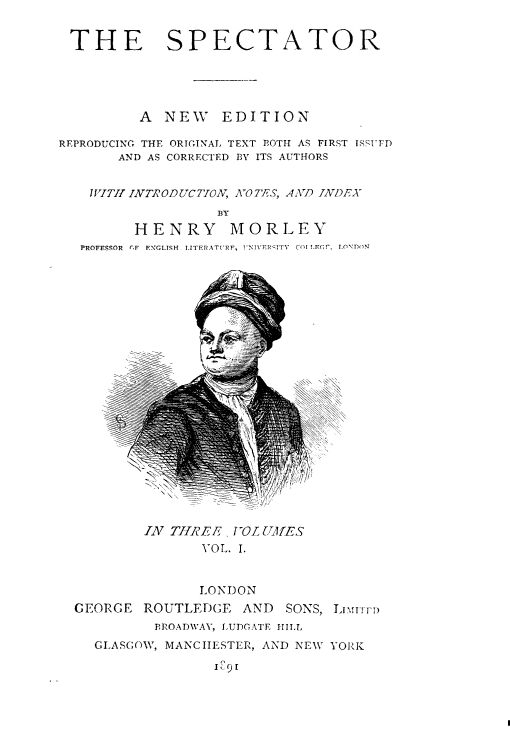
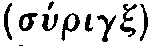
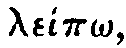




![[Greek (transliterated): Ohiae per phyll_on geneàe toiáede kaì andr_on]. Hom. 'Il.' 6, v. 146.](images/SG9.gif)



