
Title: Scenes in the lives of Saint Philip, Saint Bartholomew, and Saint Thomas
The good child's library, seventh book. In easy verse
Author: Anonymous
Release date: November 11, 2026 [eBook #79968]
Language: English
Original publication: Philadelphia: Hogan & Thompson, 1850
Other information and formats: www.gutenberg.org/ebooks/79968

Philip Preaching.
THE
GOOD CHILD'S LIBRARY.
SEVENTH BOOK.
IN EASY VERSE.
WITH
BRILLIANT ILLUMINATIONS,
FROM ORIGINAL DESIGNS,
Printed in Oil Colours by Hogan & Thompson.
PHILADELPHIA:
HOGAN & THOMPSON.
1850.
Entered, according to the Act of Congress, in the year 1850, by
HOGAN AND THOMPSON,
In the Clerk's Office of the District Court of the United States, for the
Eastern District of Pennsylvania.
The object of the "Good Child's Library," is to encourage a taste for Scripture reading, by presenting some of the most interesting portions of the New Testament narrative, in the attractive form of verse. While the children read these verses, they will not only become acquainted with the principal events in the lives of our Blessed Saviour and His Apostles—their travels, their sufferings and their death,—but they will see that the Bible is a readable book, and a book that may be read every day, without any fear of becoming the unhappy being that some persons suppose; and besides this, the tone which is given to the affections, the minds, and the morals of children by such reading, is of almost infinite value.
In order to combine things pleasing and things useful, to the greatest possible extent, the publishers have gotten up at a great expense, especially for this work, some of the most beautiful Scripture designs that have ever been published. These pictures are printed in Oil Colours—an expensive, but a finished and highly artistical process, of which the publishers are the originators in this country. Each history is illustrated handsomely with them.
There is in all twelve books; each book being complete in itself, and containing a full history.
The "Good Child's Library" is composed of the following books:
The Publishers have in preparation another series, embracing Scenes in the Lives of the Patriarchs, Prophets, and Kings, illustrative of the Old Testament Scriptures, to be gotten up in the same style as the present series.
SCENES IN THE LIFE OF SAINT PHILIP.
| SAINT PHILIP. | |
| I. | His Call |
| II. | Christ's Question to Philip |
| III. | He Brings Men to Jesus |
| IV. | Philip's Request |
| V. | His Ministry |
| VI. | His Death |
| SAINT BARTHOLOMEW. | |
| I. | His Call |
| II. | His Ministry |
| III. | His Death |
| SAINT THOMAS. | |
| I. | A Disciple |
| II. | His Doubt |
| III. | His Ministry and Death |
ANOTHER one of these bold men,
This history brings to view;
All that the Scripture says of him,
I'll now unfold to you.
I'll tell you neither more nor less,
Than what the Scriptures say;
As you may read there for yourselves,
And learn from day to day.
It is a blessed thing that we,
Can in the Bible read;
That sacred book unfolds to us,
All truth that we can need.
The Holy Bible ne'er give up,
But fold it to your heart;
'Twill make you wise like Timothy,
If you do not depart,
From what it teaches in its page
So simple and so clear;
O! never give the Bible up,
But hold it ever dear.
Of this Disciple now I'll tell,
First, Philip was his name,
Through Andrew, his own brother, first
He heard of Jesus' fame.
'Twas Andrew brought him to the Lord,
He heard the Saviour's voice,
And felt that He Messiah was,
Which made his heart rejoice.
From that time forth he follow'd Christ,
Till he resign'd his breath;
He suffer'd many things for Him,
And died a martyr's death.
He with his brother Andrew lived,
The place, Bethsaida,
Perhaps he was a fisherman,
And follow'd the rough sea.
The incidents in Philip's life,
Indeed are very few,
But those I find are told of him
I'll here relate to you.
GREAT multitudes did follow Christ,
To hear the words He taught;
And oftentimes they follow'd far,
And no provision brought.
And when the Saviour fed their souls
With truth brought down from Heaven,
It was required that earthly bread
Should unto them be given.
At one time, when five thousand men,
To hear the Lord had come,
They had no bread, and 'twas too late
To send them to their home.
The Saviour saw the multitude,
And unto Philip said:
"These many men are hungry now,
Whence shall we buy them bread?"
The reason why the Saviour asked
This question, was to prove
The faith of Philip, for he meant
To show to all His love.
Then Andrew, Peter's brother, said:
"There is a lad who has
Five barley loaves and two small fish,
But what are these for us?"
But Philip said: "Two hundred pence,
Would not buy bread for all,
For here is such a multitude,
And that would be too small."
Then Jesus said: "Command the men,
That they do all sit down,
The loaves and fishes took—gave thanks,
And break them all around."
The men did eat, and all were fill'd,
The Twelve with wonder stood,
For there was manifest to all
The power and grace of God.
The Saviour said: "Now gather up
The fragments that remain;"
And they took up twelve baskets full,
With which to serve again.
Now Philip saw what Jesus meant,
A multitude to feed;
All poor, no bread, no money there;
Yet God supplied their need.
HOW many persons do inquire
The way to find the Lord;
That they may feel His gracious love,
And hear His blessed word.
The Saviour says to children, "Come,
O! let them come to me,
That they may all partake my love,
So rich, so full, so free."
And children wish to know the way;
Go, lead the little one,
E'en to the gracious mercy seat,
Where Christ the Lord is gone.
He'll wash them free from every sin,
In His most precious blood,
If you will bring them near and say:
"Behold the Lamb of God."
You know that Andrew, Peter call'd,
To come and see the Lord,
He also came and Philip took,
To hear the Saviour's word.
So Philip did, as I will tell,
Bring men to hear the word,
Of Him who came our souls to save,
The blessed Son of God.
The Saviour went up to a feast
Held at Jerusalem;
And certain Greeks had come from far,
To worship there with them.
These men, with wonder and surprise
Had heard of Jesus' fame,
And they desired to hear His word,
And to receive His name.
They came to Philip, then, and said:
"We would your Master see;
And knowing you are following Him,
We come and ask of thee,
To bring us where He may be found,
For we have heard of Him,
And partly for that we have come
Up to Jerusalem.
So Philip brought them to the Lord,
That they might see His face,
And learn His love, and feel His power,
And taste His saving grace.
'Tis thought by some, these Gentiles did
The word of life receive
From Christ, and own'd Him as their Lord,
And did on Him believe.
Some children say that they can do
No good thing for the Lord;
Nothing for Him who died for them,
And shed His precious blood.
The weakest child on earth can do
Something, if he will try;
If only 'tis to talk about
The Lord who came to die.
And they can do as Philip done,
Can show to some the way;
Can point them to God's Holy Word,
And tell them to obey.
Our Heavenly Father looks with love,
On those who do the least,
If 'tis as much as they can do,
They'll find their labours blest.
Now children, if in Heaven you'd wear
A bright and starry crown,
Just do the best your hearts can do,
And never be cast down.
NOW after Christ had broken bread,
And given round the wine;
Thus showing them how to set forth
To all, His Love Divine;
He spake with comfortable words,
To those He soon would leave;
That they should not be desolate,
If they would still believe.
He told them that He soon would go
Unto His Father's home,
And after they had toil'd on earth,
That they to Him should come.
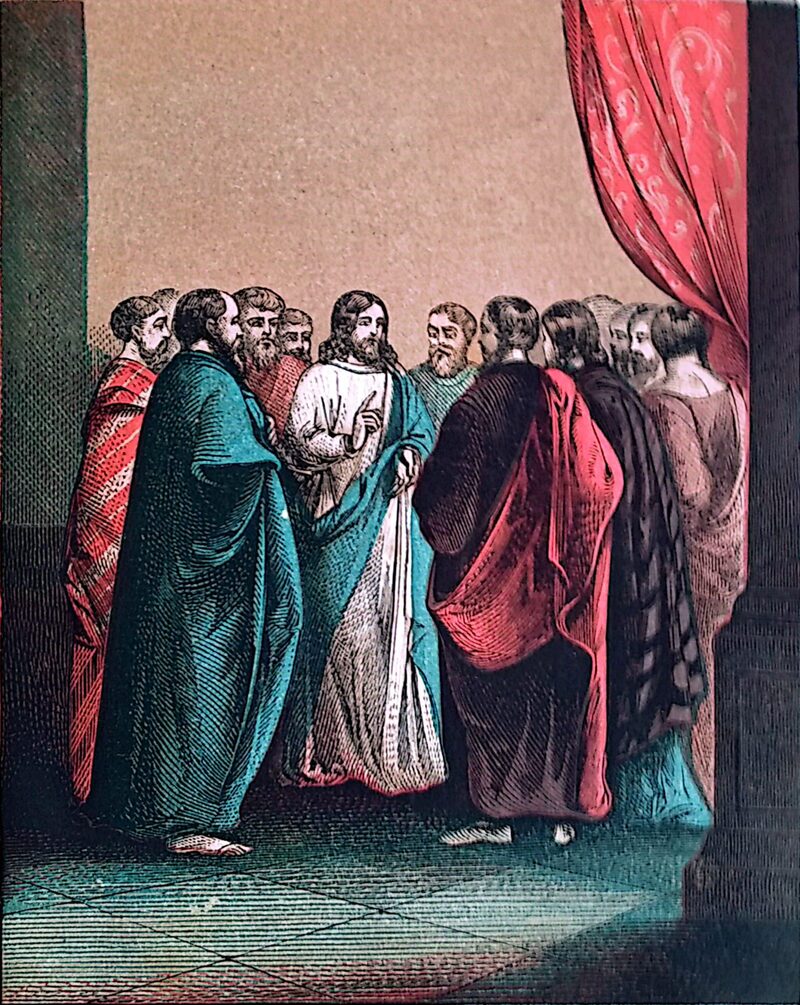
Christ's Reply to Philip.
"I am the way, the truth, the life,
Ye come to God, by me—
I, and my Father, both are one;"
They thought, how that could be.
Then Philip said unto the Lord,
"Lord, us the Father show;
And it sufficeth us, and we
Will know the way to go."
Then Jesus said to him: "Have I
So long time been with thee,
And show'd thee all my wondrous works,
And dost not yet know me?
"Those wondrous works from time to time,
That ye have seen me do;
Are works that no man could have done,
They are my Father's too.
"My Father is in me, and I
Am in the Father, too,
These works which I have done proclaim,
My doctrine faithful, true.
"And He that doth believe on me,
Shall greater works perform
Than heal the sick, or raise the dead,
Or rule the raging storm.
"For any thing that ye shall ask
The Father in my name;
If ye shall ask with earnest faith,
Ye shall receive the same.
"The Father shall be glorified,
In me, and I in you;
And ye are mine and I am His,
This word is also true.
"And when I'm gone away from you,
The Comforter I'll send,
In all your trials and your fears
Ye shall on Him depend.
"He is the Spirit of the Truth,
Whom men cannot receive;
His power is given unto all
Who do on me believe.
"My Peace I therefore give to you,
Not as the world doth give;
And if ye all do faithful prove,
Ye shall my rest receive."
WHEN Christ ascended up on high,
His servants went abroad,
To tell to all the nations far,
The wonders of His Word.
And some went this way, some went that,
And all did loud proclaim,
To all around where'er they went,
The Blessed Saviour's Name.
In Asia, Philip went to tell
The sound of Gospel grace,
And publish that the Lord had died
To save our sinful race.
He preach'd with constancy and power,
Nor only did give peace
Unto the souls of men, but did
Their frames from pain release
He saved them from idolatry,
Diseases of the soul,
And those who were with sickness seized,
He did through Christ, make whole.
Where'er He went, idolatry
Would stare him in the face;
He preach'd the name of Christ the Lord,
Who only saves by grace.
And many flock'd to hear his voice,
And did his word receive,
And were made glad in Jesus' love,
Because they did believe.
BUT faithful men are follow'd hard
By persecution's rage,
And Philip felt its cruel might
With wicked fierceness wage.
They seiz'd and scourg'd, and threaten'd soon
To stop his pious breath;
Which they did do, and wickedly
They led him forth to death.
I think I see the martyr now,
Slow moving forth to die,
Serenity is on his brow,
And love is in his eye.
His hands are tied, his back is bare,
They scourge him as he goes,
Yet still he does not murmur once,
At these, his wicked foes.
He thinks what Christ the Lord endured,
And suffer'd once for all,
He therefore bears with patience this,
And thinks that it is small,
Compared with that dread agony,
His blessed Lord endured,
When dying on the accursed tree,
His love for us procured.
They crucified this man of God,
A death of cruel shame;
The very death the Saviour died,
For telling of His Name.
Bartholomew did take him down
From off the cruel cross;
His sister, Mariamne wept,
And moan'd her heavy loss.
They buried him in quietness,
He then was free from pain;
And there he sleeps so sweet, until
The Lord shall come again.
SCENES IN THE LIFE OF ST. BARTHOLOMEW.

Philip calling Nathaniel.
I'LL tell you of Bartholomew,
Nathaniel by name;
Nathaniel and Bartholomew,
Are only one—the same.
There's something curious in his call,
As I will show to you,
And if you've read the Gospel well,
Already you do know.
Once Philip came to him and said,
"Come, now, and see a sight,
We've found the Lord, of whom our Law
And Prophets all did write.
"He is from Nazareth, the Son
Of Joseph, whom we know,
His name is Jesus, and His words
With love divine do flow."
Nathaniel said to Philip—"Can
There any good thing be
Come out of Nazareth, to us?"
He answered: "Come and see."
When Jesus saw Nathaniel come,
He said to some, the while,
"Behold an Israelite, indeed,
In whom there is no guile."
And this he overheard, and came
And said: "Whence knowest thou me?"
He said: "Before you came, you sat
Down under the fig-tree.
"And there I saw you sit alone,
Before that Philip came;
And I do therefore know your heart,
And know also your name."
Nathaniel said: "Thou art the Son,
The blessed Son of God;
Thou art the King of Israel, too,
I come to hear Thy word."
"Thou say'st I am the Son of God,
Because I said to thee,
I saw thee sit, when Philip came,
Down, under the fig-tree;
"I tell thee now, that thou from me
Shalt greater things receive,
If thou wilt only follow me,
And in my word believe,
"You'll see the Heavens wide open soon,
And glory shine abroad,
And on the Son of Man descend,
The Angels of the Lord."
He follow'd Christ with all his heart,
And never turn'd away,
Through evil and through good report,
He did His word obey.
Now children learn from this that God
Can see your inmost heart,
You cannot do a single thing,
And hide the smallest part.
Come therefore to the Lord, and learn
How freely He'll receive,
And take you to Himself to dwell,
And all your sin forgive.
BARTHOLOMEW went far away
To preach the Word of God,
In India dark, he lifted up
The banner of the Lord.
O! what a courage bold, these men
For Christ, the Lord, did show;
To take their lives, as in their hands,
In foreign lands to go;
To tell poor sinners of the Lord,
Who came on earth to die,
That He might pardon all our sin,
And raise us to the sky.
Bartholomew with Philip toil'd,
Against idolatry;
And when they Philip crucified
Upon the dreadful tree,
They went to take Bartholomew,
But their iniquity
So stared them in the face, that they
Gave him his liberty.
His work on earth was not yet done,
He could not yet lay down
The cross that he was call'd to bear,
Nor yet take up the crown.
He labour'd still in other parts,
And numbers did receive
The blessed truth He spake to them,
And did in Christ believe.
I see the Apostle standing forth,
Amidst idolatry,
Proclaiming, "Christ doth not regard
Your work as piety.
"Go leave your idols, cast them all
Far from you, all away;
And turn to God—the Gospel learn,
And all its words obey.
"Our Saviour will forgive your sins,
And all your souls will save;
For all who do believe in Him,
Eternal Life shall have."
His words incensed his enemies,
And they enraged and mad,
They wish'd to kill him, for his foes
For him no mercy had.
They from the Governor received
His word that they might kill
Bartholomew, and did their wrath,
Most cruelly fulfil.
O! WHAT a cruel death was his,
He suffer'd much and long,
And though his frame was weak to bear,
He was in Christ made strong.
What would we do, if we were call'd
To suffer thus for God?
Would we stand bold and firm till death,
And not renounce His Word?
Bartholomew was beaten first,
And then was crucified;
They let him hang upon the cross
But not until he died.
And then they flay'd his tender skin,
And still he was not dead;
To end their tortures and his pain,
They then cut off his head.
O! what a wicked band of men
To give such suffering,
To one who came in Jesus' name
Glad tidings there to bring.
His work is done, his labours o'er
No more to fear or die;
But with his blessed Lord he lives,
And reigns in joy on high.
SCENES IN THE LIFE OF SAINT THOMAS.
OF THOMAS, now call'd Didymus,
I will some things relate,
The incidents in Thomas' life
Are very few to state.
We know that he was of the twelve,
Whom Jesus call'd to go
With Him, to see His Heavenly works,
And all His grace to know.
But where the Saviour call'd him from,
Or when, we do not know;
These things to you, nor unto me
The history doth show.
Perhaps it is of no account
To know from whence he came;
We know he loved the Saviour much
And preach'd His Blessed Name.
There is one matter in his life,
His doubting that the Lord
Indeed had risen from the dead
According to the word,
Of those who saw the Saviour's form
And heard His blessed voice,
And felt their spirits leap within,
And felt their hearts rejoice.
Of this I now will speak to you,
Though you have heard before,
You'll find it in the Scriptures too,
I cannot tell you more.
WHEN Jesus rose up from the dead,
He went to Galilee,
To show Himself unto His friends,
For them He wish'd to see.
But Thomas was not there when Christ
The blessed Lord drew near,
The others saw him and their hearts
Were overcome with fear.
But soon their fear was turn'd to joy,
Their grief to gladness turn'd;
They saw their Lord, and then their hearts
With warm affection burn'd.
They came, and unto Thomas said,
"We all have seen the Lord;"
But he so full of anxious doubt
Did not believe their word.
And still they said: "We've seen our Lord,
And did His love receive;"
But Thomas answer'd still the more
"I will not you believe."
"But can we not believe our eyes?"
He seem'd to answer: "No—
Unless I see and feel His wounds,
I would not say as you.
"Unless I put my finger in
The wounds He did receive,
And put my hand into His side
I will not thus believe.
"I loved the Master very much,
And sorrow'd when He died,
It pain'd me to my very heart,
To see Him crucified.
"And now that He is put to death
By malice of His foes;
Unless I handle Him myself
I'll not believe He rose."
Thus Thomas said, and they could not
Persuade him to believe,
He went away with grief and doubt,
Nor would their word receive.
But Jesus knew his inmost heart,
And thought to give him room,
To know that He did rise again
From out the gloomy tomb.
'Twas eight days after this, they met,
And were engaged in prayer,
When Jesus came into their midst,
And Thomas too, was there.
He said to Thomas, "Hither come—
Your hand put in my side,
And put your finger in these marks,
Where I was crucified.
"Look at the marks upon my feet,
The thorn-prints on my brow,
The wounds upon my hands and side;
Dost thou believe me now?
"Am I not He, the Son of God,
Whom you saw crucified?
Who hung upon the accursed tree,
Who groan'd and bled and died?
"Was I not laid low in the grave,
In Joseph's new-hewn tomb?
And was I not three days and nights
Enclosed within its gloom?
"Did I not say that I would rise
From thence, on the third day;
And conquering all my foes, pursue
With joy my shining way?
"I show'd myself in Galilee,
Unto your brethren, ten,
They told to you my love and power,
And now I come again.
"Now hither come—stretch forth your hand
And put it in my side,
Your finger too, put in the marks
Where I was crucified.
"And do no longer faithless prove,
But now at once believe;
And mingle with your brethren's faith,
And you shall joy receive."
He clasp'd his hands for joy, and said:
"Thou art the Lord my God;
For now my heart is satisfied,
I do believe their word.
"Thou art my blessed Lord and God,
Thou art my heart's delight;
O could I keep Thy blessed form
Forever in my sight."
The Saviour said: "Now thou hast seen
And therefore dost receive
My word as true, but blessed they,
Not seeing—still believe."
O! what a blessed time was that
When Christ the Lord arose,
And burst the bars of death and hell,
And triumph'd o'er His foes.
And came and show'd Himself to those
Who loved His name so well,
That they might His salvation forth
To every nation tell.

Thomas Preaching in Persia.
WHEN Christ ascended, Thomas preach'd
The Gospel to the Jews,
And show'd salvation first to them
Who did the Lord refuse.
When, after that the church dispersed,
He into Parthia came,
And publish'd there to all around
The blessed Saviour's name.
He afterwards proclaim'd the word
To Medes and Persians too,
To many people he did prove
The blessed Gospel true.
And while in Persia, he, 'tis said,
Those very wise men met,
Who came to Bethlehem at first
To worship at the feet
Of Christ, the infant babe, who there
Was in a manger laid;
He preach'd to them the word of Christ,
And they at once obey'd.
He travell'd into Africa,
And preach'd the Gospel there,
And many miracles perform'd,
By constant faith and prayer.
And here he did a temple build
In which to preach the word,
And Sagamo, the Prince, was here
Converted to the Lord.
And he who was at first so weak,
Became as brave a one
As ever preach'd the Saviour's word,
And travell'd all alone
Amongst most cruel people, far
Away into the wild;
He knew the Gospel which he taught
Would make the fiercest mild.
He doubted first about His Lord,
But ever after stood,
And bared his brow unto the dart,
His bosom to the flood.
Though persecution raged around,
He did most bravely stand;
And labour'd still, obedient to
His blessed Lord's command.
The Brachmans, where he preach'd, became
Enraged at his success,
The people were converted to
The Lord who did them bless.
They therefore did determine then
To take away his life;
They follow'd him some time about,
Intent on deadly strife.
Out from the city was a tomb,
Where he went out to pray,
They follow'd to this sacred spot,
And there they did him slay.
They pierced him through with many darts,
He bowed his weary head;
His friends soon pass'd along that way
And found that he was dead.
And now another one was gone
Far from this world of care,
No more to toil, but with the Lord,
The bliss of Heaven to share.
THE END.
Transcriber's Note
Spelling and punctuation are as printed, including these places where the printer may have slipped: