Title: First lessons in Geometry
Author: Thomas George Hill
Release date: November 8, 2026 [eBook #79951]
Language: English
Original publication: Boston: Hickeling, Swan, and Brown, 1855
Other information and formats: www.gutenberg.org/ebooks/79951
Credits: Carla Foust and the Online Distributed Proofreading Team at https://www.pgdp.net (This file was produced from images generously made available by The Internet Archive)
BY
THOMAS HILL.
FACTS BEFORE REASONING.
BOSTON:
HICKLING, SWAN, AND BROWN.
1855.
Entered according to Act of Congress,
in the year 1855, by
THOMAS HILL,
In the Clerk’s Office of the District Court
of the District of Massachusetts.
Stereotyped by
HOBART & ROBBINS,
NEW ENGLAND TYPE
AND STEREOTYPE FOUNDRY,
BOSTON.
[Pg iii]
I have long been seeking a Geometry for beginners, suited to my taste, and to my convictions of what is a proper foundation for scientific education. Finding that Mr. Josiah Holbrook agreed most cordially with me, in my estimate of this study, I had hoped that his treatise would satisfy me; but, although the best I had seen, it did not meet my views. Meanwhile, my own children were in most urgent need of a text-book, and the sense of their want has driven me to take the time necessary for writing these pages. Two children, one of five, the other of seven and a half, were before my mind’s eye all the time of my writing; and it will be found that children of this age are quicker at comprehending first lessons in Geometry than those of fifteen. Many parts of this book will, however, be found adapted, not only to children, but to pupils of adult age. The truths are sublime. I have tried to present them in a simple and attractive dress.
I have addressed the child’s imagination, rather than his reason, [Pg iv] because I wished to teach him to conceive of forms. The child’s powers of sensation are developed before his powers of conception, and these before his reasoning powers. This is, therefore, the true order of education; and a powerful logical drill, like Colburn’s admirable first lessons of Arithmetic, is sadly out of place in the hands of a child whose powers of observation and conception have, as yet, received no training whatever. I have, therefore, avoided reasoning, and simply given interesting geometrical facts, fitted, I hope, to arouse a child to the observation of phenomena, and to the perception of forms as real entities.
In the pronunciation of words at the foot of the page the notation of Dr. Worcester’s Dictionaries has been followed.
Waltham, Mass., Nov. 1854.
[Pg v]
CONTENTS.
| chapter. | page | |
| I. | What is this Book about? | 7 |
| II. | Points, Lines, and Planes, | 9 |
| III. | About Straight Lines and Curves, | 11 |
| IV. | About Angles, | 13 |
| V. | Parallel Lines, | 16 |
| VI. | About Triangles, | 19 |
| VII. | More about Triangles, | 21 |
| VIII. | Right Triangles, | 24 |
| IX. | Similarity and Isoperimetry, | 26 |
| X. | The Size of Triangles, | 30 |
| XI. | Different Kinds of Triangles, | 33 |
| XII. | Quadrangles, | 36 |
| XIII. | Parallelograms, | 40 |
| XIV. | Rectangles and Squares, | 43 |
| XV. | Triangles and Rectangles, | 46 |
| XVI. | Circles, | 52 |
| XVII. | More about Circles, | 55 |
| XVIII. | Measuring Angles, | 59 [Pg vi] |
| XIX. | Chords, | 62 |
| XX. | Chords and Tangents, | 66 |
| XXI. | More about Chords and Tangents, | 69 |
| XXII. | Inscribed Polygons, | 73 |
| XXIII. | More about Inscribed Polygons, | 77 |
| XXIV. | How much further round a Hoop | |
| than across it? | 81 | |
| XXV. | How to Measure Circles and their Parts, | 85 |
| XXVI. | About Curvature, | 89 |
| XXVII. | About a Wheel Rolling, | 92 |
| XXVIII. | More about the Rolling Wheel, | 95 |
| XXIX. | Wheels Rolling round a Wheel, | 98 |
| XXX. | Wheel Rolling in a Hoop, | 101 |
| XXXI. | Hanging Chain, | 105 |
| XXXII. | Path of a Stone in the Air, | 109 |
| XXXIII. | The Shadow of a Ball, | 112 |
| XXXIV. | The Shadow of a Reel, | 115 |
| XXXV. | The Cow’s Foot in a Cup of Milk, | 120 |
| XXXVI. | Cubes, | 125 |
| XXXVII. | About Cones, | 129 |
| XXXVIII. | The Sphere, | 132 |
[Pg 7]
1. I have written a little book for you about Geometry. You will find a great many new words in it; but I have taken pains to explain them all, and I think you will understand them all, if you will only begin at the beginning, and read each chapter very carefully before you go to another. And if you find any place in the book that you cannot understand, I think you will do well to turn back, and read the whole over again, from the second chapter. When you come again to the place which you did not understand before, I think you will find it has grown easier for you.
2. I hope you will find the book interesting. It tells about straight lines, and circles, and many different curves, and a few solid bodies. It will tell you curious things about the shadows of marbles, and the rolling of hoops, and about tossing a ball, and other plays for [Pg 8] children. But, if some parts of the book do not seem interesting, you should study those parts all the more carefully; for they may, perhaps, be the most useful parts.
3. Geometry is the most useful of all the sciences. To understand Geometry, will be a great help in learning all the other sciences; and no other science can be learned unless you know something of Geometry. To study it, will make your eye quicker in seeing things, and your hand steadier in doing things. You can draw better, write better; cut out clothes, make boots and shoes, work at any mechanical trade, or learn any art, the better for understanding Geometry. And, if you want to understand about plants and animals, and the wonderful way in which the All-wise Creator has made them, you must learn a little Geometry, for that explains the shapes of all things.
4. In this book I can teach you but little. I hope, however, that it will be enough to make you want to know more. I shall tell you only the easiest and most interesting things now; but when you are older you may study what is more difficult. Many of the things that I shall tell you will be very curious, and you will, perhaps, wonder how men can find out such things. But when you are older I hope that you will be able to find out such things yourselves.
[Pg 9]
1. A point is a place without any size. When I make a dot to mark the place of a point, that is, to show where the point is, you must not think that the point is so big as the dot. The point has no size at all, but is only a place without any size. If I put my dot in the right place, the point will be exactly in the middle of the dot. In common talking, we sometimes call anything that is very small a point; and so we talk of the point of a needle, or of the point of a lead-pencil. But in Geometry a point is a place so small that it has no size at all; neither width, nor length, nor depth.
2. A line is a place that is long without having any breadth or thickness. When I make a long, fine stroke with a pen or pencil, or with a piece of chalk, you must not think that the stroke of pencil, or ink, or chalk-mark, is itself the line. I only make it to show where the line is, or to help you imagine a line; but the line itself is the middle of the stroke; you cannot see it any more than you can see a point, for it is only a place; and, although it has length, it has no breadth nor thickness.
How large is a point? How can you mark the position of a point? In what part of the dot is the point supposed to be? What is the difference between the word point in common talk and in Geometry? How wide is a line? How shall we mark a line? In what part of the stroke should the line be? What is the end of a line? How can you fancy this so as to make it like a needle-point? If a point could move and leave a track behind it, what would that track be? How may all that is described in the first thirty-five chapters of the book be drawn?
[Pg 10] 3. The ends of a line are points. You may fancy a line to be the middle of a very fine wire, and then you will easily see that the ends of it are points.

4. When the point of my pen or pencil moves along on paper, a fine stroke of ink or of pencil-mark is left behind it. And that may help you fancy a real point moving along and leaving a real line behind it. It will, you know, be only fancy; because a real point is only a place, and a place cannot move. But it is a good way to fancy a line as marked out by the track of a moving point; that is, by the very centre of the end of a pencil. It will help you very much in understanding Geometry, if you fancy a line as the track of a moving point.
5. A plane is a flat surface, like the floor, or the top of the table, or like your slate. I need not tell you any more exactly what a surface is, and what a flat surface means; because I am going to be confined to one plane for a long while. I mean that for a good many chapters I shall tell you only about such lines as can be drawn upon your slate, or upon the blackboard.
6. Now you have studied enough for one lesson. If you understand this well, you have made a very good beginning in Geometry.
1. A line that is not bent in any part of it is called a straight line. If we fancy a point moving in a straight line, we shall see it moving always in the same direction. A straight line is the shortest path that can be made from one point to another. So, when we wish to tell the distance from one place to another, we measure how long the straight line is that joins the two places. If a thread is stretched tight across a table, it marks a straight line across the table. This is the way that carpenters mark a straight line, by rubbing the thread first with chalk; and gardeners lay out garden-paths and beds by stretching a line.
What is a straight line? What is the direction in which a point moves when moving in a straight line? What is the shortest path from one place to another? How does a carpenter mark a straight line? How does a gardener make his paths straight? What is a curve line? How does a point move in a curve? In how many places can one straight line cross another? Can a straight line always cut a curve in more than one place? In how many places can a straight line always cut a curve? Let the teacher draw a curve upon the blackboard, cross it by a straight line, and then, moving the chalk along the curve, require the scholars to say “now,” whenever the chalk is moving in the same direction as the straight line.
What is an angle? On what does the size of an angle depend? Let the teacher draw angles on the blackboard, and ask which is the larger, which the smaller, etc., being careful to make some of the angles without vertices. What is the vertex of an angle? Let the teacher call the scholar to the board to point out the vertices of the angles he has drawn. When two straight lines cross each other, what is always true about the angles they make? What is a right angle? What examples can you give of a right angle? What is the common name for the vertex of a right angle? The teacher must be very careful not to let the child confound the measure of an angle with either the length of the sides, or area of the opening between them; but illustrate and explain it only by differences of directions; such as points of compass, arrows, turning your face about, etc. When two square corners are put together, how do the outsides run?
Look about the room, or out of the window, and tell me what straight lines you can see. Do you see any curve lines? Any lines that make angles with each other? Can you show me any parallel lines? Any concentric curves? What are parallel lines? What can you say about the distance apart of parallel lines? When a straight line crosses two parallel lines, what can you say about the angles? (Let the teacher beware of forcing a child to repeat the reasoning of sections two and five. To the teacher the reasoning is easier than the conceptions; to the child it is just the reverse.) How can you tell whether two lines are parallel?
[Pg 12]
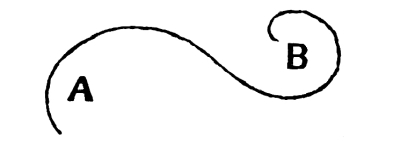
2. A curve line bends in every part, but has no sharp corners in it. And, if we fancy a point moving in a curve, we shall see it all the time changing its direction, but never taking sudden turns. Perhaps it will help you understand the difference between a straight line and a curve, if I draw two lines at the side of the page. I think you will understand, from what I have said, which is the straight line, and which is the curve.
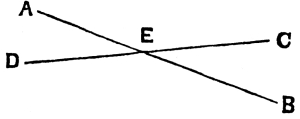
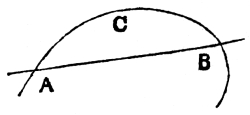
3. Now I want you to see that two straight lines can never cut across each other in more than one place. If you draw only two lines on your slate, and each line is straight, they cannot cross each other in two places. But you cannot draw a curved line that you cannot cut, at [Pg 13] least, in two places. Try to draw, on your slate, a curve that cannot be cut in two places by one straight line.
4. There is one thing more that I want you to learn at this lesson. Whenever a straight line joins two points of a curve, there is always some point on the curve between the two points at which the curve goes in the same direction as the straight line. So in my figure you see that the curve at C goes in the same direction as the straight line A B. Draw on your slate figures of curves, and cut them by straight lines, and you will find it always so. This seems like a very simple thing, and yet it is a very useful truth.
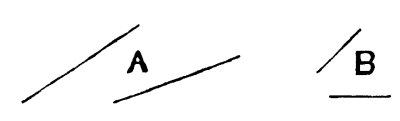
1. When two straight lines go in different directions, the difference [Pg 14] of their directions is called an angle. The size of the angle depends, then, on the difference of the directions of the lines, and not on their length. So that the angle which I have marked B, is larger than that which I have marked A, because there is more difference in the direction of the two lines at B, than of the two lines at A.
2. The point where two straight lines meet, or where they would meet if we fancied them drawn long enough, is called the vertex of the angle. The vertex of the angles A and B is not marked down; but you may draw two straight lines meeting, and the point where they meet will be the vertex of the angle between them.
3. When two straight lines cross each other, they make four angles. So, in the figure in the margin, we have two straight lines making the four angles, A E C, A E D, B E C, B E D. But when we say they make the angle A E C, we have to fancy the [Pg 15]straight line D C going in exactly the opposite direction to that in which it goes to make the angle A E D.
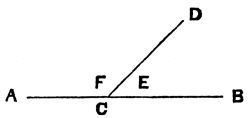
4. If we fancy that the line A B, in the next figure, points from A to B, while the line C D points from C to D, the two lines will make the angle E. But if the line A B points from B to A, they will make the angle F. When these two angles are equal, each is called a right angle.
5. When two straight lines cross each other, the opposite angles are of the same size. I mean that in this figure the angle A E C is just as large as the angle D E B, and the angle A E D just as large as the angle C E B.
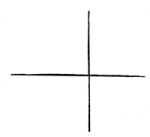
6. When two straight lines crossing each other, make four equal angles, each angle is called a right angle. Draw two lines on your slate at right angles to each other. The side of your slate is at right angles to the bottom. The top of a sheet of letter-paper makes a right angle with the side. The sides of every square corner are at right angles to each other. The vertex of a right angle is called a square corner. When two square corners are put together, the outside edges will form a straight line.
[Pg 16]
1. When two straight lines make no angle with each other, or when they make an angle equal to two right angles with each other, they are called parallel. That is to say, parallel lines are straight lines that point in the same direction, or in exactly opposite directions. Try whether you can draw such upon your slate.
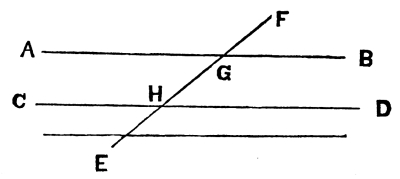
[Pg 17] 2. When two straight lines are parallel, they are just as far apart in one place as in another. They could not come nearer and then go further apart without bending; but a straight line does not bend in any part. And, if they kept coming nearer until they met, they would make an angle with each other, and the point where they met would be the vertex of the angle. But parallel lines make no angle with each other.
3. If two straight lines are just as far apart in one place as in another, they are parallel; they run in the same direction. Try whether the sides of your slate are parallel, by measuring whether they are just as far apart at the top of the slate as at the bottom.
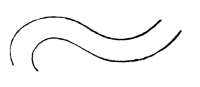
4. When two curves are everywhere at the same distance apart, they are called concentric curves. Sometimes they are called parallel curves; but this is not so good a name for them as concentric curves. [Pg 18]
5. When a straight line crosses two parallel lines, it makes the same angles with the one as with the other. The direction of parallel lines is alike, and so the difference of their directions from that of the straight line must be alike.
6. If a straight line is parallel to one of two parallel lines, it is parallel to the other. Draw now two parallel lines on your slate. Draw a third line parallel to one of your first pair, and it will be parallel to the other. All three of the lines will point in the same direction.
[Pg 19]
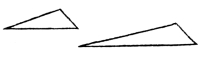
1. A triangle is a figure bounded by three straight lines. They are very simple-looking things; and yet there are many curious things known about them already. And those that know most about Geometry tell us that no one has yet found out all that can be known about them.
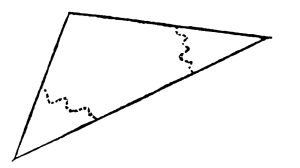
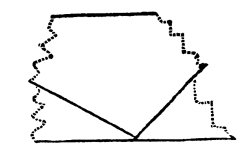
2. The three angles of a triangle taken together will make two right angles. You can try it, if you like, by cutting a triangle out of paper, with a pair of scissors. Be very careful to make the edges straight. Now cut off two of the corners by a waving line, and lay the three corners of the triangle carefully together. The outer edges will make one straight line, just as if you had put two square corners together. You may make the triangle of any shape or size, and, if the edges are straight, you will make two right angles.
Draw triangles, and ask “What is the name of these figures?” What is a triangle? Draw a right triangle, and, pointing to the square corner, ask, “What angle is this?” How many square corners can a triangle ever have? How much do the three angles of a triangle put together make? If one angle is a right angle, how much do the other two put together make. If one side of a triangle is longer than another, what do you know about the angles? If one angle is larger than another, what do you know about the sides?
When we know that two sides of a triangle are equal, what do we know of the angles? When we know that all the sides of a triangle are of the same size, what do we know about the angles? When we know that two angles are equal, what do we know about the sides? When we know that the three angles are equal? What is an equiangular triangle? What is an equilateral triangle? Every equiangular triangle is also ______? And every equilateral triangle is also ______? Let the teacher now copy the figure of section four upon the blackboard, and ask what lines are in the same proportion as C D and C A? What is the same as C D to C E? What is the same as A D to D C? Let the teacher, also, draw parallel lines at equal distances apart, like a staff of music, and then, stretching a string across them, show the scholars that the lines divide the string equally in whatever direction it is held. Always find that the three corners put together make a straight line with their outer edges, just as two square corners would do. And this is what we mean by saying that the three angles of a triangle taken together, will make two right angles.
[Pg 20] 3. A triangle cannot have more than one angle as large as a right angle.
4. If one angle in a triangle is a right angle, the other two, put together, will, of course, just be equal to a right angle. You can try this by cutting paper triangles with one square corner, and then cutting off the other corners by a waving line, and putting them together.
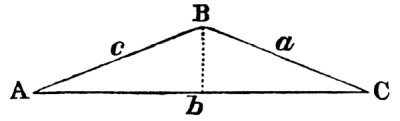
5. If one side of a triangle is longer than another side, the angle opposite the longer side is larger than that opposite the shorter side. Now look at the figure. The side a is opposite the angle A, and the side b opposite the angle B. The side b is longer than the side a; and from this we may know that the angle B is larger than the angle A. [Pg 21]
6. Now, on the other hand, when one angle in a triangle is larger than another, the side opposite the larger angle is longer than the side opposite the smaller angle. So, if we know that B is larger than C, we may know that b is larger than c.
1. Suppose that we found two sides of a triangle to be just equal to each other, what should we know about the angles? We should know that the angle opposite one side was just as large as the angle opposite the other side. If the side a is just as long as the side c, the angle A is just as large as the angle C.
[Pg 22] 2. But if, on the other hand, we know that the two angles are equal, we shall know from that that the two sides are equal. If the angle A is just as large as the angle C, then the side a must be just as long as the side c. Such a triangle is called isosceles, which means equal-legged.
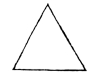
3. Now if the three sides of a triangle are each equal to each other, then the angles are equal to each other; and if, on the other hand, the three angles are equal to each other, then the sides are equal to each other. Such a triangle is called equiangular, or equilateral. Perhaps this drawing will help you to imagine an equilateral triangle.
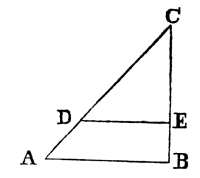
4. If a line be drawn through a triangle parallel to one side of the triangle, it divides the other two sides in the same proportion. I mean that, if in such a triangle as A B C we draw D E parallel to A B, then C D will be the same part of C A that C E is of C B. If C D is two thirds of C A, then C E will be two thirds of C B.
5. Besides what I have already told you about the last figure,—that is, [Pg 23]about any triangle that is cut in two by a line parallel to one side,—there are two other curious things for you to learn. In the first place, A D will be in the same proportion to D C that B E is to E C; and in the second place, C D will be in the same proportion to C E as A C is to B C, and A D will also be in the same proportion to E B. If B C is three quarters of A C, then C E will be three quarters of C D, and E B will be three quarters of A D.
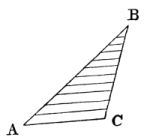
6. If we divide one side of a triangle into equal parts, and then draw lines through the points where we have divided the side, making these lines parallel to another side of the triangle, the third side will be divided into equal parts. Thus, if the side A B is divided into equal parts, the side B C is also thus divided.
7. I am afraid this lesson will be difficult to understand; but in the next I will try to tell you something that will be easier.
[Pg 24]
1. If you do not remember what a right angle is, you must turn back and read chapter IV., section 6, and then you will be ready to go on with this chapter.
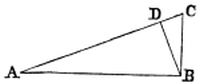
When a triangle has a right angle for one of its angles, it is called a right triangle. The angle A B C is a right angle, and the triangle A B C a right triangle.
2. Any triangle may be divided into two right triangles, by drawing a line through the vertex of the largest angle in such a way as to make right angles with the longest side. Thus, if B is the largest angle in the triangle A B C, we can draw B D in such a way as to make the angles at D right angles; and this will divide the triangle into two right triangles, A D B and C D B.
Now draw any triangles you please, upon your slate, and try whether you cannot always divide them, in this way, into two right triangles.
What is a right angle? What is the common name for the vertex of a right angle? What is a right triangle? How can you divide any triangle into two right triangles? The teacher may call the class to the blackboard, and allow them to draw triangles and divide them in this way. To what kind of triangle can you add a right triangle so as to make the whole figure a right triangle? Let the pupils show this by drawing them on the blackboard. What kind of triangle can be fancied as the difference between two right triangles? If we divide a right triangle into two right triangles, what do you know about them?
What is the meaning of “similar” figures? What is true of the angles of similar figures? Let the teacher draw two similar quadrilaterals on the board, make a little circle, star, cross and accent, in the four figures of one, and bid a member of the class come and put corresponding marks in the angles of the other figure, thus: “Who will mark in that figure the angle which is equal to this that I marked with a cross? Who will mark the one equal to this one marked with a circle?” etc., etc. Then let the teacher make a cross through two sides of one quadrilateral, and say, “Who will mark the two sides in the other figure that are in the same proportion as these?” Next let him draw a figure of a liberty-pole, and a stake, and ask the child to explain in what way he can measure the height of the liberty-pole by means of the stake. When are two figures called isoperimetrical?
[Pg 25]
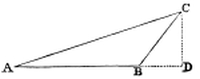
3. If the largest angle in a triangle is larger than a right angle, we can always fancy a right triangle added to it in such a way as to make the whole figure a right triangle. If B be larger than a right angle, we can make A B longer, and draw C D down in such a way as to make D a right angle. Then the added triangle B C D is a right triangle, and the whole figure A D C is also a right triangle. And, by taking away B D C from A D C, we shall have A B C left. So that any triangle with one angle larger than a right angle, like A B C, may be fancied as the difference between two right triangles, like A D C and B D C.
4. If we divide a right triangle into two right triangles, as I have told you how to do in the second section of this chapter, the two little triangles will be of exactly the same shape as the whole large triangle. [Pg 26]
Thus, if B is a right angle, and the angles at D are both right angles, then the three triangles, A B C, A B D and B D C, are all of exactly the same shape.
1. There are two very hard-looking words at the head of this chapter; but they are not hard to understand. Similarity means likeness; and in Geometry it means the having the same shape. Isoperimetry[1] means the being of the same size round about.
2. When two bodies, or two geometrical figures, are of exactly the same shape, we call them similar. When two figures are similar, that is, of exactly the same shape, the angles of one figure are exactly equal to [Pg 27] the angles of the other figure, and all the sides of the first figure are in the same proportion to the corresponding sides of the other figure. I told you that A D B and C D B are of the same shape. So that the angle at A is just as large as the angle D B C, the angle at C just as large as D B A, and the two angles at D are equal. And C B is the same part of A B that C D is of D B, or that D B is of A D. All this is meant by saying that the triangle C D B is of the same shape as A D B.
3. If we find that the three angles of one triangle are just equal to the three angles of another triangle, we may know that the three sides of the first triangle are in the same proportion to the corresponding sides of the second triangle, and that the triangles are similar. That is to say, that if the three angles of one triangle are equal to the three angles of another triangle, the sides opposite to the equal angles are in the same proportion to each other. [Pg 28]
4. It is also true that when two figures are similar, any two sides of the one are in the same proportion to each other that the corresponding sides of the other are in to each other. Thus, C D is the same part of C B that B D is of B A. And D B is the same part of D A that D C is of D B.
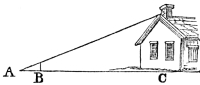
5. All the nice calculations of engineers, and machinists, and ship-builders, and navigators, and astronomers, are made by help of similarity of triangles.
I will try to explain to you one single instance in which you can use similarity of triangles. Suppose that a house stands on level ground, and you wish to find out how high it is. Put a stake upright in the ground, anywhere that you think best, say at B. Then lay your head close to the ground, and move it until you can just see the top of the house over the top of the stake. Then measure how far your eye is from the bottom of the stake, and how far from the bottom of the house. [Pg 29] Then, as you will see by the figure, you will have two triangles of the same shape, and the height of the house will be the same part of the distance A C, that the height of the stake is of the distance A B. If the height of the stake is equal to the distance of your eye from the bottom of it, then the height of the house is just equal to the distance of your eye from the foundation of the house. Another way of finding similar triangles to measure a house, or tree, on level land, is by using shadows. The shadow of the stake B, when the sun shone, would be a triangle. The stake would be one side, the shadow on the ground another, and the third side would be the edge of the shadow in the air, going from the top of the stake to the end of the shadow on the ground. A similar triangle would, at the same time, be made by the shadow of the tree or house. So that, if you should measure at any time the length of the shadow of the stake, and the length of the shadow of the house, you could tell the height of the house; because the height of the house would be the same part of the length of its shadow that the stake was of its shadow. [Pg 30]
6. When it is just as far round one figure as it is round another, the two figures are called isoperimetrical[2], which means equal round about.
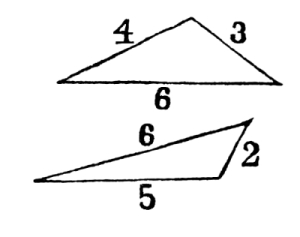
If one triangle measures, on its sides, two feet, and five feet, and six feet, its perimeter[3], that is, the distance round it, will be thirteen feet; because two and five and six make thirteen. And if another triangle measures on its sides, three feet, and six feet, and four feet, its perimeter will also be thirteen feet; because three and six and four make thirteen. So, these two triangles will be isoperimetrical; but they will not be similar, that is, they will be of different shapes.
7. Similar figures are those of the same shape; isoperimetrical figures are those which measure equally round about.
[Pg 31]
1. If one side of a triangle can grow longer or shorter, while the opposite angle opens and shuts, as though its vertex were a hinge, the triangle will be largest when that angle is a right angle. Thus, if A B and B C cannot be changed in length, but if A C is like an India-rubber cord, and can be made longer or shorter by altering the angle at B, then the triangle A B C will be largest when the angle at B is a right angle.
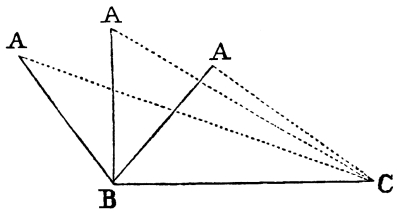
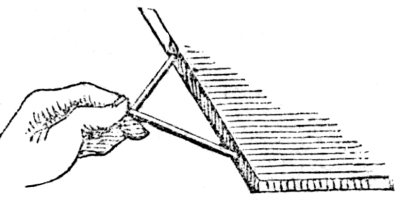
2. You can show this very prettily in this way. Take two little straight sticks and hold them together at one end with your thumb and finger, while you spread the other two ends against the edge of the table. The triangle made by the two sticks and the table-edge will be largest when the sticks make a right angle with each other.
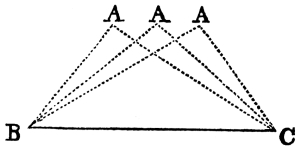
3. If one side of a triangle cannot change in length, and if the other two can only change in such a way as to keep the triangle isoperimetrical, the triangle will be largest when these two sides are of equal length. Thus, if B C cannot grow either longer or shorter, and if A B grows shorter exactly as fast as A C grows longer, or grows longer exactly as fast as A C grows shorter, the triangle will be largest when A B is equal to A C.
If two sticks lean their tops together, how must they be placed to make the space between them and the ground largest? If two boards be nailed together to make a pig-trough, what angle must they make so as to have the trough hold most? If a tent is made simply of two slant sides like the roof a house, how must we pitch it so as to have most room in it?
Let the teacher provide sticks and strings and make triangles, as directed in sections two, four and six, and ask, “When will this triangle be largest?”
Set the class at the blackboard, and ask them to draw an equilateral triangle, and tell what they know about its angles and sides. An isosceles triangle. A scalene triangle. An isosceles oblique triangle. Isosceles right triangle. Scalene right triangle. Scalene oblique triangle. Ask them, also, to point out all the triangles in objects within sight, and name them according to this chapter.
[Pg 32]
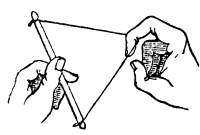
4. You may show this in a very pretty way by tying the ends of a string to the ends of a straight stick a good deal shorter than the string. Then take the stick in one hand, and, putting one finger of the other inside the string, pull it tight. The triangle formed between the string and the stick will be largest when your finger is in the middle of the string. But when you move your finger the triangle remains isoperimetrical, if the string does not stretch.
5. If we suppose that all three sides of a triangle can change their length, but only in such a way as to keep the triangle isoperimetrical, then the triangle will be largest when the three sides are equilateral. That is to say, that an equilateral triangle is the largest among isoperimetrical triangles. [Pg 33]
6. You can show this by taking a long piece of string and tying the ends together. Put into this loop one finger of your right hand, and get two playmates each to do the same. Stepping back, you can pull the string into a large triangle, and you will see that it is largest when your fingers are at equal distances, and the triangle equilateral. But all the triangles made by moving the fingers will be isoperimetrical, because the string remains of one length. When you grow older you can prove these things; but now you can best show them to yourself in such ways as this.
1. When a triangle has its three sides equal, it is called an equilateral triangle. Equilateral means equal-sided. Every equilateral triangle has its angles equal to each other; and is, therefore, called equiangular. But equilateral is the more common name. [Pg 34]
2. When a triangle has two of its sides of the same length it is called an isosceles[4] triangle. Isosceles means equal-legged. The angles opposite the equal legs are, as I hope you remember, equal to each other.
An equilateral triangle must be isosceles; but an isosceles triangle may not be equilateral. Every horse is an animal; but not every animal is a horse.
3. Suppose that A B C is an isosceles triangle, and that a is equal to c. Now, if we draw a line B b from B to the middle of A C, it will divide the triangle into two equal right triangles. The angle at B is divided exactly in the middle, the angles at b are right angles, and we could fold the triangle over on the line B b as a hinge, and the two pieces would fit each other exactly.
4. If a triangle has no two sides equal, it is called a scalene triangle. Scalene means lame, or limping. [Pg 35]
5. When a triangle has one right angle, it is, as I hope you remember, called a right triangle. We can have isosceles right triangles, and scalene right triangles; but, of course, we cannot have equilateral right triangles.
6. When neither of the angles of a triangle is a right angle, the triangle is called an oblique[5] triangle. Oblique triangles may be equilateral, or isosceles, or scalene.
Review of Triangles.—Let the scholars now turn back to chapter VI., and take six chapters as a review-lesson, and answer the following questions, and others selected from the questions on each chapter.
What is a triangle? If the three corners of a paper triangle are placed together, what will their sum be? How will the outer edges run? In a right triangle what will the sum of the two smaller angles be? In an isosceles right triangle what part of a right angle will each smaller angle be? How are the smallest angle in a triangle and the shortest side in the same triangle placed? If one corner of a triangle be cut off by a line parallel to the opposite side, what is the shape of the little triangle that you thus make? If we divide a right triangle into two right triangles by a line through the vertex of the right angle, what will be the shape of these little triangles? When are two triangles similar? When isoperimetrical? When only one side of a triangle can alter in length, how shall we make the triangle largest? When two sides only can alter, but the triangle is kept isoperimetrical, how is it made largest? What is the largest of all isoperimetrical triangles?
[Pg 36]
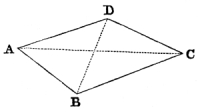
1. When a figure is bounded by four straight lines, it is called a quadrangle. Sometimes it is called a quadrilateral, but generally a quadrangle.
2. A line joining two opposite vertices is called a diagonal. In this figure, the dotted line A C is a diagonal, and the dotted line B D is another diagonal.
What is a quadrangle? What do you call a line that joins two opposite vertices? Into what two figures is a quadrangle divided by a diagonal? What is the sum of the angles of a triangle? What is the sum of the angles of a quadrangle? How can you show this by paper figures? Let now, the teacher draw quadrangles and diagonals on the board, and ask, “What is this figure? What is this line?” etc. What is the only figure that is strong and stiff? In what figures can the angles be altered without altering the sides? What is the use of a brace? Let the teacher provide twigs or lamp-lighters for the illustration of section six.
[Pg 37] 3. Each diagonal divides the quadrangle into two triangles. If both diagonals are drawn, the quadrangle is cut up into four little triangles; but those are not the triangles of which I am speaking. The dotted line A C, in the figure, divides the quadrangle into two triangles, A B C and C D A. And I think you can easily see that, if we put all the corners of a quadrangle together, they will make just as large a sum as if we put all the angles of two triangles together.
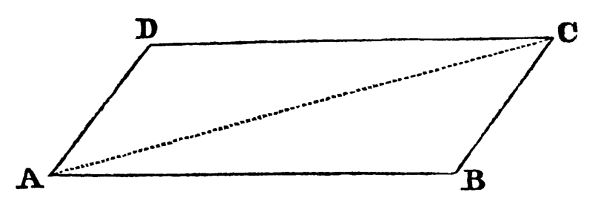
4. The sum of the four angles of any quadrangle is equal to four right angles. But if we put the vertices of four right angles together, the sides of the angles will make two straight lines crossing each other.
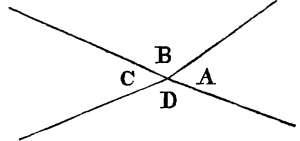
And if we make a paper quadrangle, cut off the corners (by a waving line, so as not to become confused), and put these four corners together, we shall find that they fill up all the space around the corners. Compare now the letters in these four angles with the letters at the corner of the first quadrangle that I drew for you, on page 36. [Pg 38]
In cutting paper triangles and quadrangles, to show that the corners put together make two or four right angles, you must be careful to make the sides straight. Cut off the corners by a waving line, that you may distinguish the edges of the cuts from the edges of the triangles or quadrangles.
5. The shape of a triangle cannot be altered, except by altering the length of at least one side. But the shape of a quadrangle can be altered without altering the length of a single side, by altering the angles. The diagonals of a quadrangle can be made shorter or longer without shortening or lengthening the sides. If you will look at the figure you will see that B D might be pulled out, and A C crowded together, so as to alter the shape of the quadrangle very much, without altering the length of its sides at all.
[Pg 39] 6. Take two willow twigs, or two thin rolls of paper, such as are used for lamp-lighters, and bend one into a triangle, and one into a quadrangle. You will find that the triangle is stiff, and that the quadrangle is not.
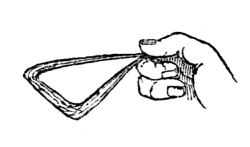
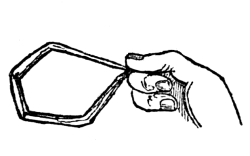
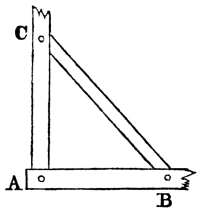
7. If you have ever noticed the frame of a house, you have seen that the carpenter puts braces in the corners. Without braces the timbers would only make quadrangles, and so would have no stiffness except the stiffness of the joints. But, by putting braces he makes triangles, which cannot be pressed out of shape without being broken.
[Pg 40]
1. When a quadrangle has its opposite sides parallel it is called a parallelogram. So that there are in every parallelogram two sets of parallel sides.
2. The opposite angles of a parallelogram are equal. If this figure is a parallelogram, so that A D is parallel to B C, and D C parallel to A B, then the angle at D is equal to the angle at B, and the angle at A is equal to that at C.
3. A diagonal divides a parallelogram into two equal triangles. If you could turn the triangle A B C round; so as to put the point B exactly on the point D, and the line B C upon the line D A, then the line B A would lie upon the line D C, and one triangle would exactly cover the other. You can try this by cutting a parallelogram of paper, and cutting it in two diagonally. But you must be very careful to have the opposite sides exactly parallel.
What is a parallelogram? How many sets of parallel sides in a parallelogram? How many sets of equal angles? Which angles of a parallelogram are equal? Let the class draw parallelograms on the blackboard, and show which angles are equal? Draw a diagonal in your parallelogram. How does it divide the figure? How can you tell whether a figure is a parallelogram? How must I lay four sticks of unequal length on the floor so as to enclose the largest space? How must I place them when the sticks can be divided into two couples of equal length? Let the teacher show the child that there are two different answers to the last question; one a parallelogram, the other not. And, giving a child four unequal sticks, let him try how many quadrangles, all of the largest possible size, he can make.
[Pg 41] 4. And this shows you that in every parallelogram the opposite sides are equal. In the figure. A D is equal to B C, and A B to D C. If the opposite sides of a quadrangle are parallel, they are equal.
5. And if a quadrangle has its opposite sides equal, they are also parallel. If I should find a quadrangle such as this figure, and, by measuring, find that A D and B C are just equal, and also that A B and D C are equal to each other, I should know that these equal lines are parallel.
6. When a quadrangle is squeezed flatter without altering the length of its sides, it alters the size, as well as the shape, of the quadrangle. The quadrangle will be largest when the opposite angles, added together, are equal to two right angles. [Pg 42]
In this figure, the angles B and D added together would be more than two right angles. We could, then, make the quadrangle larger, without altering the length of its sides, by drawing B and D apart, and crowding A and C together, until the two angles, B and D, added together, made two right angles. The angles A and C would, also, added together, then be equal to two right angles, and the quadrangle would be as large as we could make it without changing the length of the sides.
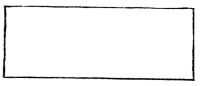
7. When a parallelogram is put into its largest form, as the opposite angles are always equal, and the two are equal to two right angles, each of the four angles will be a right angle.
[Pg 43]
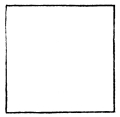
1. When each angle of a parallelogram is a right angle, the figure is called a rectangle. This is a very common figure in all sorts of things that men make. The panes of glass in the windows, and the windows themselves, the doors and the panels in them, the sides of the room, the leaves of books, sheets of paper, and many other things, are usually made in the shape of rectangles. But in the things that were not made by men there are very few rectangles; they are scarcely to be found even in crystals; coarse salt and iron pyrites[6] being the only common things in which the Creator has used the rectangle.
2. When all the sides of a rectangle are equal, the figure is called a square. And, as the corners of a square are all right angles, so a right angle is sometimes called a square corner.
What is the geometrical name of the figure of a pane of glass? Name all the objects you can think of which are rectangular in shape. What natural objects present the form of a rectangle? If you found a rectangular piece of stone or iron, would you easily believe that men had not cut it into that shape? What is a carpenter’s square? What is a square corner? What is the geometrical meaning of the word square?
[Pg 44]
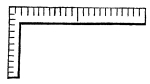
3. When carpenters wish to mark a right angle on their boards or timber, they use a simple tool, which I dare say you have seen, and which is called a carpenter’s square.
4. But, in Geometry, the word square is only used to mean a rectangle with equal sides.
5. I suppose you know the way in which men measure how long a thing is, with a rule, or yard-stick, or tape. They measure how many inches, or feet, or yards, or miles, it will take to stretch along by the side of the thing they are measuring.
6. Men measure surfaces, such as painting, or carpeting, or fields, by finding out how many squares, whose sides are each one inch, or one foot, or one yard, it will take to cover the surface which they want to measure. When a carpet-dealer sells so many yards of oil-cloth or oil-carpeting, he means that the carpet could be cut in such a way as to make just that number of squares, one yard on a side. When a man says that there are so many feet of land in his door-yard, he means that it would take just that number of square pieces of paper, one foot on a side, to cover his yard. [Pg 45]
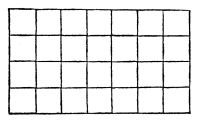
7. It is very easy for any one that knows the multiplication table, to measure a rectangle. For the number of square inches, or yards, in a rectangle is found by multiplying the number of inches, or yards, in the breadth by the number in the width, and this will give the number of squares in the rectangle.
If you have learned to count, you will see by this figure that a rectangle four feet wide and seven feet long, could be divided into twenty-eight squares, each being a foot on a side. We can divide it into seven rows, of four square feet in a row, or into four rows, seven square feet in a row.
How do men measure the length of things? What do they mean by saying a hundred feet of land? How do they find out the number of square feet or square inches in a rectangle? In a parallelogram? Let the teacher copy the last figure on the blackboard, and ask the children how, if the rectangle and parallelogram were made of paper, they could cut the rectangle to make it cover the parallelogram, and how the parallelogram to make it cover the rectangle.
How do men measure triangles? How do they measure other surfaces than parallelograms? How long ago did Pythagoras live? What did he discover about right triangles?
How can you tell whether a triangle is a right triangle? How do carpenters make the corner of a frame square? How do they cut braces for square corners? How large is a square built on the diagonal of a square? How large is a square whose corners are in the middle of the sides of another square? Let the children draw right triangles and squares upon the sides, and tell the relative size of the squares according to the Pythagorean proposition. The teacher should require this proposition, as written in italics, to be committed to memory, as it is the most useful proposition in the fifteen chapters.
[Pg 46] 8. When we wish to measure a parallelogram that is not a rectangle, we have only to multiply the length by the breadth; because every parallelogram is exactly the same size as a rectangle, of the same length and breadth, would be.
You see in the figure that the rectangle A B C D is of the same length and breadth as the parallelogram A B F E. And they are of exactly the same size. If you cut the triangle C A E off one end of the rectangle and place it at the other end, it will just cover the triangle B D F.
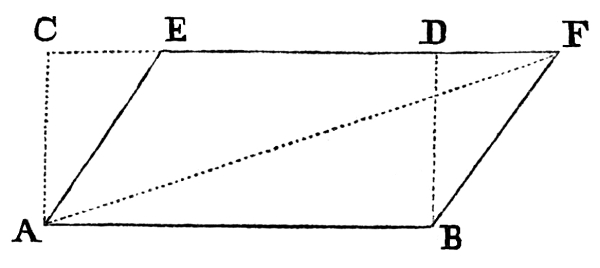
9. When I say that we multiply the length of a parallelogram by its breadth in order to find its measure, I mean, of course, that we must multiply the number of inches in the length by the number of inches in the breadth in order to find the number of square inches, that is, squares an inch on a side, that it would take to cover the parallelogram. Numbers are the only things that can be multiplied.
1. Every triangle may be imagined as half of a parallelogram. If we had [Pg 47] a triangle A B F, we could draw A E parallel to B F, and F E parallel to B A, and that would make a parallelogram just twice as large as the triangle.
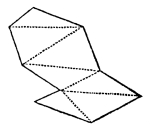
2. And thus we may find the measure of a triangle; that is, we may find how many squares of one inch on a side, or of one foot on a side, it would take to cover the triangle exactly. We need only multiply any one side of the triangle by the distance to a parallel line drawn through the opposite vertex. This will give us the measure of a parallelogram, and half of that will give us the size of the triangle.
3. In this way men measure surfaces of every shape, by dividing them into triangles, and then finding out how large each triangle is. You may draw upon your slates figures of any number of straight sides, and then divide them into triangles by drawing diagonals. You can divide the same figure into different sets of triangles by drawing different diagonals. [Pg 48]
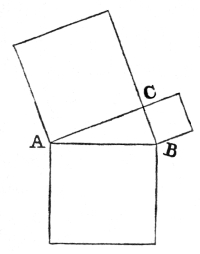
4. In every right triangle the square made on the side opposite the right angle is just as large as the squares on the other two sides, put together. If, in my figure, the triangle A B C has a right angle at C, the square on the side A B will be just as large as the square on A C added to the square on C B.
5. The side of a right triangle opposite the right angle is called the hypotenuse, and the other sides are called the legs. So that what I have already told you may be repeated in different words. The square on the hypotenuse is equivalent to the sum of the squares on the legs. This is called the Pythagorean proposition, because it was found out by a geometer, who lived more than two thousand years ago, whose name was Pythagoras.
6. This Pythagorean proposition gives us a good way of trying whether an angle is a right angle. If the sum of the squares on two sides of a triangle is just equal to the square on the third side, we may know that the angle opposite this third side is a right angle. [Pg 49]
Now, a square is a rectangle as broad as it is long; so that, to find how large the square on a leg would be, we need only multiply the number of inches in the length of the leg by itself. If you should measure the sides of a triangle, and find that one side was three inches, and another four inches, and the third five inches; then, if you know the multiplication table, you would know that the squares on the sides would be nine inches, and sixteen inches, and twenty-five inches. Moreover, if you add nine to sixteen, it makes twenty-five. So that, in a triangle whose sides are three, four and five inches, the side of five inches is a hypotenuse, and the opposite angle a right angle.
7. If you understand the last section, you will also understand how the Pythagorean proposition, that the square on the hypotenuse is equivalent to the sum of the squares on the legs, is very useful to carpenters and other persons who wish to make square work. Suppose you were making a frame of a house, and wanted the timbers A B and A C to make a right angle at A. You might measure three feet from A to [Pg 50] B, and four feet from A to C, and then alter the angle at A, by moving one of the timbers until a stick of five feet long would just reach from C to B. Instead of three, four and five, for large frames, they take six, eight and ten feet.
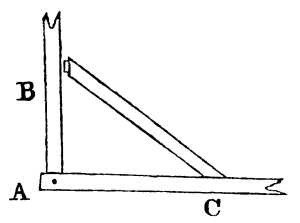
8. Another use that carpenters make of the Pythagorean proposition is, in cutting braces for frames. They measure the same number of feet from A to B and from A to C; and then for the brace, B C, they measure just as many times seventeen inches as there are feet in A B. This makes the brace a very little too long; because a square on seventeen inches is a very little more than twice as large as a square foot. But carpenters like the brace to be a very little too long, because hammering the timbers together makes the brace indent the timbers a little; and, if the brace were not a very little too long at [Pg 51] first, it would be a little too short after it had indented the timbers; and that would make A less than a right angle.
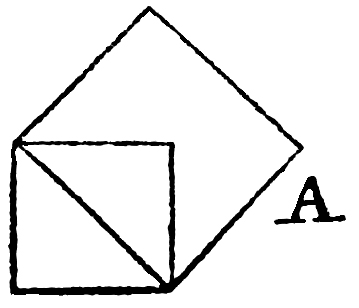
9. The square on the diagonal of a square is just twice as large as that square. This you will see in the figure marked A.
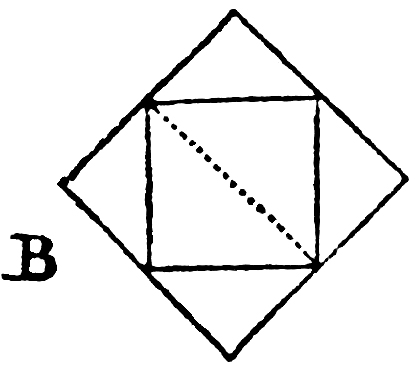
A square with its corners in the middle of the sides of another square is just half as large as that square. This you will see in the figure marked B.
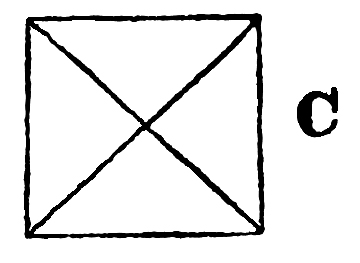
If we fancy a square cut into four right triangles by two diagonals (as at C), we can fancy each little triangle turned over on its own little hypotenuse, which will make the figure at B a square just twice as large as that at C.
You may take a square piece of paper, as at B, fold each corner over to the centre of the square, as at C, then unfold it again, as at B, and I think this will make you understand this section.
[Pg 52]
1. We have had fifteen chapters about straight lines, and about figures bounded by straight lines. I think, therefore, that you will be glad to learn a little about curves.
2. A curve is, as I have told you, a line that bends in every part of it, but has no sharp corners. If a boy were wheeling a barrow in a large, level field, just after a light snow, the middle of the track of his wheel would be a line that you could easily follow with your eye.
If the boy went all the time in the same direction, he would make a straight line; but if he kept turning a little all the while to the right or left, he would make a curve.
What is a curved line? What is a straight line? How could you mark a straight line with the wheel of a wheelbarrow? How would you mark out a curve with the wheel? If a line bends equally in every part, how long can it be? (Only long enough to return into its own beginning.) What is a curve called that has no ends, and bends equally in every part? But, if it bends equally in every part, and yet has two ends, what is it called? When I swing the door on its hinges, in what curve does the end of the latch move? Where is the centre of the arc? When a stone hangs by a thread, and swings backward and forward over a straight line on the floor, what curve does the stone move in? Where is the centre of the arc? What line does the thread mark out? Let the teacher actually open and shut the door, and swing a plumb, while asking these questions. Keep the child constantly in the habit of seeing the perfect geometrical forms suggested by the material appearances. Let them draw circles, and their radii, on the board.
What is the figure of a cent? What other things can you tell me of in the shape of a circle? Is the circle or the rectangle oftener found in natural objects? What instrument do men have to draw circles with? How can you make a sort of compasses? What did the old Greeks use for a blackboard and chalk? Did you ever see a turning-lathe? A potter’s wheel? A tinman at work cutting out round pieces? How did he cut them? Did you ever see a blacksmith bend a wagon-tire? Why does passing the tire through the three rollers make a circle of it? How does a cooper make a hoop round? Let the teacher draw a circle with radius, cord, and diameter, and ask what the name of each line is. What is the longest chord we can have? If we divide the whole circumference into six equal arcs, how long is the chord of each arc? How can you show it with a pair of compasses?
[Pg 53] 3. If the boy kept on all the time turning in the same direction, just as fast as he began to turn, the track of the wheel would come round into itself, and make what is called the circumference of a circle. A curve that bends equally in every part is called a circumference; and a figure bounded by a circumference is called a circle.
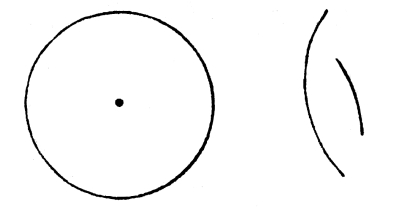
4. Parts of a circumference are called arcs. The word arc used to mean a bow; and bows are shaped something like an arc.
5. If there was a tree in the middle of a field, and the boy should keep all the time at the same distance from the tree, he would come round to the place he started from, and the track of his wheel would bend equally in every part. He would, in fact, go round in the circumference of a circle.
6. You will see, in the figure of a circle in section three, a dot in the middle. It shows the place where we suppose the tree to stand. And in every circle there is a point in the middle, equally distant from every part of the circumference. This point is called the centre of the [Pg 54] circle. It is not always marked by a dot, but the place is always there whether it is marked or not.
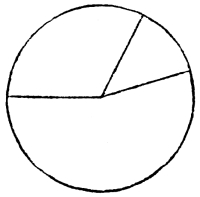
7. A straight line drawn from the centre of a circle to its circumference is called a radius. All the radii of the same circle are equal. In this figure there are three radii marked by black lines.
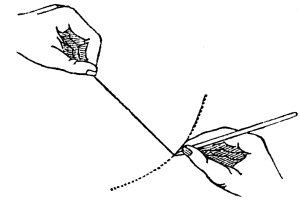
8. We can fancy a circle made by a radius swinging all round a centre. And you may draw very nice circles by holding, with one hand, a thread fast to one spot on your slate, or blackboard, while, with your other hand, you hold the other end of the string and your pencil together, and draw a circumference, keeping the string stretched. You can also draw them with one hand, by resting your little finger on the centre of the circle, and being careful to keep the end of your crayon always at the same distance from it. This way only answers for the blackboard.
[Pg 55]
1. Rectangles and circles are the most common figures in all manufactured things. They are the easiest figures to make exact, and the most convenient when made. You have already noticed how common rectangles are in what men make. Circles are almost as common. Buttons and door-knobs, plates, pans and wheels, are circular. But in natural things,—in things made by the great Creator,—circles are much more common than rectangles. The sun, the moon and stars, the buds of many flowers, the eyes of animals, and some little animals themselves, are nearly in the shape of a circle.
2. To draw circles, men have what is called a pair of compasses, that open and shut like a pair of tongs. They put one point down on the [Pg 56] paper hard enough to hold it still in the centre of the circle, and then move the other leg round lightly, just bearing on hard enough to mark the circumference. The circle will be larger or smaller, as the compasses are opened wider, or are more nearly shut.
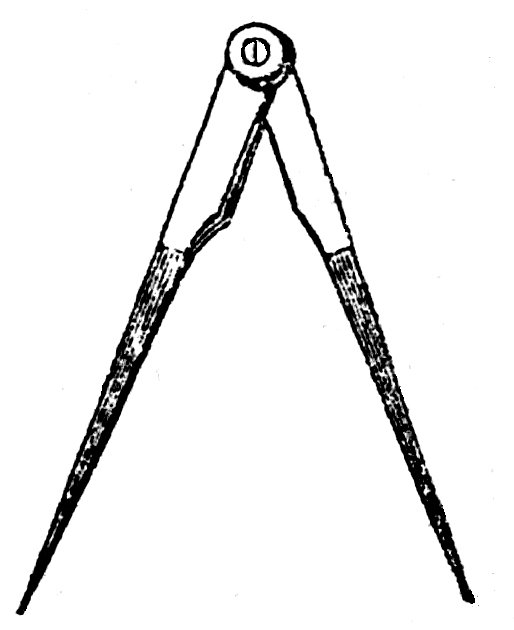
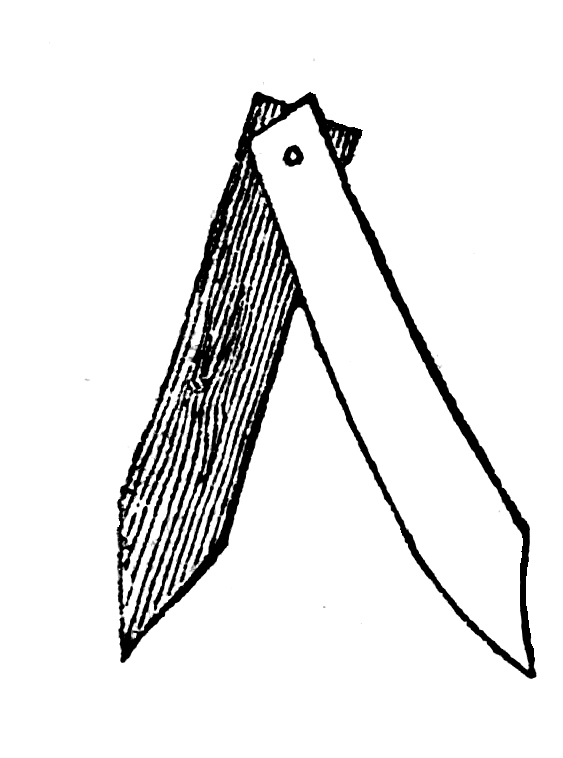
You can make a pair of compasses, to draw circles on the ground, by putting one small nail through two bits of shingle, and whittling the ends to a point. The old Greeks, of Pythagoras’ time, and afterwards, used to study and teach Geometry with the help of figures drawn on smoothly-spread sand.
3. To make things circular-shape, men sometimes draw a circle first, with compasses, and then cut the thing to that shape. But generally they use a different method. They use a turning-lathe, or something that works on the same plan. In a turning-lathe a block of wood or piece of iron is made to turn steadily round on a steel point that marks the centre, while the chisel, that cuts the wood or iron, is held [Pg 57] steadily at the same distance from the steel point, so that the wood or iron that is too far from the centre is cut off as it goes past the chisel. On a potter’s wheel a lump of clay is made to turn round, while its centre remains in one place; and thus the potter makes the crockery round. The bottom of tinned pans is cut out by a sort of scissors that is fastened at the right distance from a point around which the piece of tinned plate is made to turn.
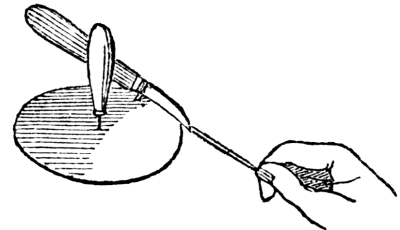
Sometimes boys make a circle of leather, for a plaything. Put an awl through a bit of leather into a board; then stick a sharp knife through the leather into the board, slanting, with the cutting-edge down; the blade at right angles to a line joining it to the awl. Now pull the leather round the awl, under the knife, and you will cut out a circle. Put a strong string through the awl-hole in the leather, with a large knot at the end of it, and you will have a curious toy. Wet the leather and press it under your foot upon a flat stone, and you can lift the [Pg 58] stone by the string. But be careful not to swing the stone about; for nobody has a right to put other people in danger.
All these ways of making a circle are somewhat alike. But there is another way,—to bend wire, or things of the kind, equally at every part. Thus, the blacksmith passes an iron bar between three rollers, that bend each part of the tire equally, and thus bring it into a circular form for a wagon-tire.
4. A straight line joining the ends of an arc, is called a chord. Any straight line going across a circle, having both ends in the circumference, is a chord. All the lines marked A C and B C, in this figure, are chords.
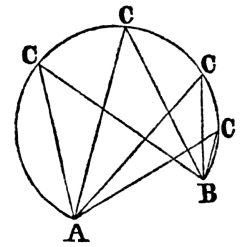
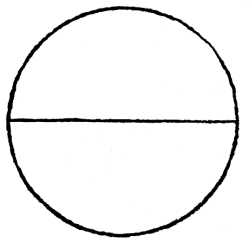
5. The longest chord that we can have is the one that goes through the centre of the circle. It is called the diameter, and is just twice the length of a radius.
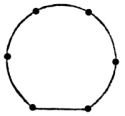
6. If we divide a circumference into six equal arcs, the chord of each arc is just as long as a radius. So that, if you draw a circle on the ground with your shingle compasses, you will find, if you are careful neither to open nor close your compasses, that they will step round the circumference in exactly six steps.
[Pg 59]
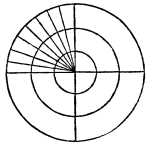
1. If the vertex of a right angle is at the centre of a circle, the lines forming the angle cut off one quarter of the circumference, whether the circle is large or small. So with any angle whose vertex is at the centre of a circle; its sides always cut off just that part of a circumference which the angle is of four right angles. If it takes eight of these little angles to make one right angle, it will take eight of the little arcs to make a quarter of a circumference, whether on a large or small circle.
How many degrees of arc make a quarter of a large circumference? How many degrees make a quarter of a small circumference? If you put the vertex of a right angle at the centre of a circle, how many degrees of arc will its sides cut off? If an angle is an angle of forty-five degrees, what part of a right angle is it? Have you ever studied Arithmetic? Do you know how much nine times ten make? Three times thirty? How many angles of 10° must be put together to make a right angle? How many degrees in one third of a right angle? What angle does a straight line make with itself? How many degrees do the three angles of a triangle added together make? How many degrees in each angle of an equilateral triangle?
[Pg 60] If we want to tell how large an angle is, we tell what part of a circumference it would cut off if its vertex were at the centre.
2. And, in order that we may easily tell the parts of a circumference, we fancy every circumference as divided into quarters, and then each of these quarters divided into ninety equal parts, which are called degrees of arc. So that we tell how large an angle is by telling how many of these degrees would be cut off between its sides if its vertex were at the centre of a circle.
3. If the vertex of a right angle is placed at the centre of a circle, its sides cut off a whole quarter circumference, and the right angle is, therefore, sometimes called an angle of ninety degrees. Half a right angle, like the angles of an isosceles right triangle, is called an angle of forty-five degrees.
4. As each right angle is an angle of ninety degrees, two right angles together will make an angle of twice ninety, that is, of one hundred and eighty degrees. [Pg 61]
5. You may take any point in a straight line, as the point C in the line A B, and fancy the line as making an angle of one hundred and eighty degrees with itself at that point. An angle is the difference of direction of two lines. Now you cannot tell whether I moved my pen from A to B, or from B to A; and so, if you like, you may fancy that I moved it from A to C, and then from B to C; that is, you may fancy the line meeting itself at C; that is, going in opposite directions on each side of C; that is, making an angle of two right angles at C; that is, the line makes an angle of one hundred and eighty degrees with itself at C.
6. You remember, I hope, that the three angles of a triangle taken together are equivalent to two right angles. We can now say the same thing in other words; we may say that the sum of the three angles of a triangle is one hundred and eighty degrees.
7. In an equilateral triangle, you remember that the three angles are equal to each other. Each of them is then an angle of sixty degrees, because three times sixty is one hundred and eighty.
[Pg 62]
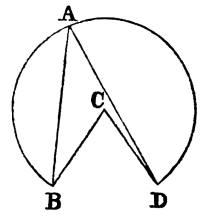
1. If, instead of putting the vertex of an angle at the centre of a circle, we put it in the circumference, it will take in an arc just twice as large as it would with its vertex in the centre.
2. If one angle has its vertex at the centre of a circle, as at C in the figure, and another has its vertex in the circumference, as at A, and if the sides of both these angles go through the circumference at the same places, D and B, then one angle is just half as large as the other. The angle at A is only half as large as that at C.
An angle, with its vertex at the centre, is measured by the arc between its sides. How is the angle measured when its vertex is in the circumference? How is an angle between two chords measured, when the vertex is in the circumference?
Can any of the class draw a figure, and explain how a curve in a railroad is laid out? Can you show how an arc may be drawn by a card and two pins? When the card has a square corner, how large is the arc? Can any one with a ruler and a piece of chalk show a way of staking out a circular garden-path? (Use the ruler for the stick of section eighth, and chalk dots for stakes.) Can you tell me how to try whether an angle is a right angle without using the Pythagorean proposition? Invite the scholar to draw a figure and explain. If he cannot, draw it for him, and show, with shingle compasses, if you have no other, how to divide the hypotenuse and apply the test of section ten.
When two chords do not touch each other, how is the angle measured? Can you draw a figure on the blackboard, and explain this more fully? When two straight lines go through a circle and meet outside the circle, how is the angle between them measured? Can you draw G figure, and explain that? What is meant by a tangent to a circle? How is the angle between a chord and a tangent measured? Draw on the board a circle with a chord, and a tangent at the end of it. Draw radii to the ends of the chord. Show me which two angles in that figure should be the one just double the other. What is the angle made by a diameter with a tangent at the end of it? By a radius with a tangent at the end of it? What is a tangent to any curve?
[Pg 63] 3. We can say the same thing in other words. Two chords starting from the same point, A, in the circumference of a circle, make an angle of just half as many degrees as there are in the arc D B between their other ends. The arc D B is not drawn at all; but you can easily fancy it there.
4. Now the arc D B would be of the same length, wherever the point A were placed, and that will make you understand the next figure.
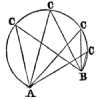
5. All the angles that can be drawn in one arc, that is, with their vertices in the arc, and their sides going through the ends of the arc, are of the same size. The angles at C, C, C, C, are all four equal to each other. Each one is measured by half the arc that is not drawn between A and B.
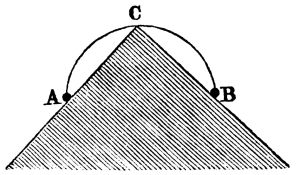
6. This gives you a curious way of drawing an arc of a circle. [Pg 64] Drive two pins in a board, as at A and B, and then move a bit of card, with straight edges, in such a way as to keep the corner thrust, as far as it will go, between the pins. The corner C will move in the arc of a circle.
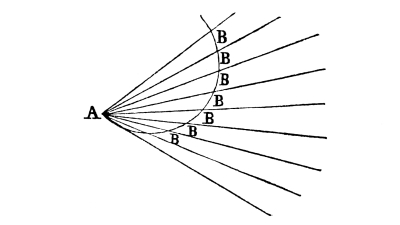
7. If equal angles have their vertices at the same point in the circumference, they will cut off equal arcs. That is, if the angles at A are all equal to each other, the arcs at B, B, B, are equal to each other.
This is the way in which railroads are laid out in curves. The engineer measures equal angles from one point, as A, and equal chords, as at B, B, B, and then the rails are laid to go round as arcs to those chords.
8. There are several other ways of drawing circles without using compasses. I will tell you one more, which you will find very useful if you ever want to lay out curved paths in a garden, or do anything of [Pg 65] that kind. Take a straight stick, A E B, and drive into the ground two stakes, one at A, and the other at D, making A D about half the length of the stick. Keeping one end of the stick at A, move the other end round until the middle, E, is as far from D as you think best to put it. Then drive a stake at B. Now put one end of the stick at D, and let the middle, E, be just as far from the stake B as it was before from D. Drive a new stake at the other end of the stick. Thus you can go on, driving stakes as far as you wish to go. The size of the circle will be made greater by making the distance D E smaller.
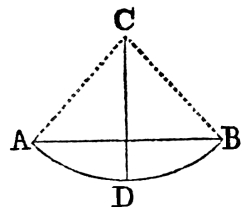
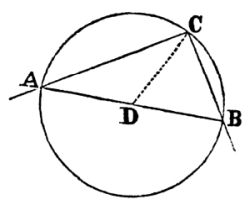
9. If the arc A C B is just half a circle, then the other arc A B is a half-circle, and the angle A C B is measured by half a half-circle, and is a right angle. If the corner of the card in section six of this chapter is a square corner, then the arc will be a half-circumference. [Pg 66]
10. If, in the last figure, A C is a right angle, A B will be a diameter, and the middle of it, D, will be the centre of the circle, and will be just as far from C as it is from A or B.
This gives us a very pretty way of trying whether an angle is a right angle or not. If I want to know whether A C B is a right angle, I will draw any line A B across it; and, if half A B will just reach from the middle of A B to C, we may know that C is a right angle. If it does not reach, C is less than a right angle; if it more than reaches, C is more than a right angle.
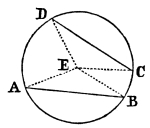
1. When two chords do not touch each other, the angle between them is measured by half the difference of the arcs between them. The angle made by the chords A B and C D is measured by half the difference between the arcs A D and B C. That is to say, the angle between A B and C D is half [Pg 67] as large as the difference of the two angles at E, A E D and C E B.
2. We may imagine the chords lengthened into straight lines going outside the circle until they meet; and it will not alter the size of the angle. So that the angle A C B is measured by half the difference of the arcs between its sides, wherever we place the circle.
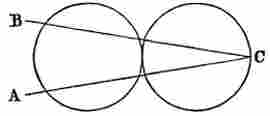
3. If, in the last figure, we move the circle back until the circumference touches the vertex C, then the smaller arc has become of no size at all, and the difference between it and the large arc is equal to the whole of the large arc. Then the angle is measured by half the large arc, which is just the same thing that you learned in the last chapter.
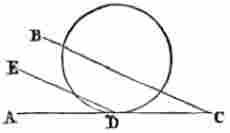
4. If we take the circle farthest from the vertex in the last figure, [Pg 68] and lift it up till it just touches the line A C, at the point D, as in this figure, then the larger arc meets the smaller arc just at D.
5. The line A C is now called a tangent. Tangent means a toucher; and the line A C just touches the circumference without cutting it.
6. If now we move the line B C without changing its direction, until it stands in the place of E D, the small arc has become nothing; so that the angle A D E is measured by half the arc between its sides.
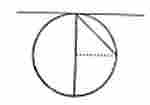
7. In other words, the angle between a chord and a tangent at one end of the chord is measured by half the arc between them. That is to say, it is half as large as the angle made by two radii to the ends of the chord.
8. When the chord is a diameter, the angle is measured by half of half the circle; that is, the angle is a right angle. A tangent at the end of a diameter must always be at right angles to the diameter. And you will easily see that it must be so with a radius. A tangent at the end of a radius is at right angles to the radius.
9. There can be tangents to other curves as well as to circles. A straight line that just touches a curve; or, if the curve winds, a straight line going through a point in a curve in the same direction as the curve at that point, is called a tangent to the curve.
[Pg 69]
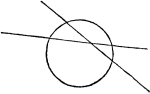
1. When two chords cross each other, the angle they make is measured by half the sum of the arcs between their ends. That is, if two straight lines cross each other inside of a circle, their angle is measured by half the sum of the arcs between them; if they cross outside the circle, the angle is measured by half the difference of the arcs.
How do you measure the angle of two chords that cross each other? How is it when the chords are diameters? If a chord of an arc or any kind of curve be moved, keeping it parallel to its first position, until it cuts off no arc, what does the chord become? If I go to a place exactly north from me, and yet at no part of my journey travel north, what must have been true of my road? (It must have turned a corner in it.) If I travel over a winding road without corners, and find myself at night in a place just east of my starting, what do you know of the direction of my road? (It must have gone east at some point of the way.) What can you tell me about the radius that passes through the middle of a chord? What of a straight line at right angles to a chord, through the middle of it? If you find an arc drawn on the blackboard, how can you find the centre of it?
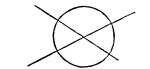
[Pg 70] 2. When the chords are both diameters, the arcs are equal, and half the sum is just one arc; so that the angle is measured by one arc; and that, you know, is the first thing that you learned about the measure of an angle,—that an angle, with its vertex in the centre, is measured by the arc between its sides.
3. Arcs are parts of circumferences. Parts of other curves are called arcs of those curves; and straight lines joining the ends of those arcs are called chords of those arcs. When we speak of an arc, we mean a piece of a circle; and if we wish to speak of a piece of an ellipse, we call it an arc of an ellipse. You will learn what an ellipse is, after a while.
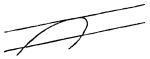
4. In every arc of any curve there must be at least one place at which the tangent is parallel to the chord of that arc. Now turn back to [Pg 71] chapter III., section fourth, and you will find that what I have now told you is just the same as that, only in different language.
5. If the chord of any arc of any curve be moved, keeping it parallel to its first position, it will cut off either a longer or else a shorter arc. If moved one way, it cuts off a longer arc; if moved the other way, it cuts off a shorter arc. If moved so as to cut off a shorter arc, we can move it so far, keeping it still parallel to its first position, that it will cut off no arc at all, but be tangent to the curve at that point where the curve goes in the same direction as the chord. You can easily perform this process of moving a chord, and keeping it parallel to itself, by drawing any curve you choose on your slate, and moving a stretched thread across it.
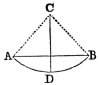
6. Let us now go back to circles. If a radius be drawn through the [Pg 72] middle of a chord, it will be at right angles to the chord, and it will end at the middle of the arc. Let us suppose that, in this figure, the radius C D goes through the middle of the chord A B. Then, I say that the angles at E will be right angles, and the arc A D will be equal to the arc D B.
7. On the other hand, if we draw a straight line, through the middle of a chord, at right angles to the chord, it will pass through the centre of the circle.
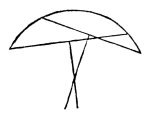
8. This gives you an easy way to find the centre of a circle when you have an arc of the circle. You have only to draw two chords not parallel to each other (the larger the angle they make the better), and then draw lines through the middle of each chord at right angles to the chord. As both these lines pass through the centre of the circle, the centre must be at the point where the lines cross each other.
9. If you can get a card, such as business men have advertisements printed on, you can use the longer side as a ruler by which to make a straight line; and, by setting the short side carefully on this line, you can draw, by the long side, a line at right angles to your first one. You can probably find an old printed card by asking for it, and it will serve as a ruler and square. Then you can draw short arcs by your eye, and find the centres by section eight.
[Pg 73]
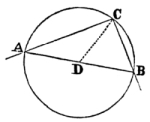
1. When a triangle has its vertices in a circumference, it is said to be inscribed in the circle. In other words, when the sides of a triangle are chords in a circle, the triangle is said to be inscribed in the circle. A B C is an inscribed polygon.
What is meant by an inscribed triangle? Where do you say that the vertices of an inscribed triangle are? What are the sides? If you find a triangle ready drawn, how can you find the centre of a circle whose circumference will pass through the vertices? How will you find the centre of a circle to which the sides of the triangle will be tangent? What is meant by a circle inscribed in a triangle? How can you divide an angle into halves? Let the pupils illustrate as they recite, by drawings on the blackboard. What is the largest triangle that can be put in a given circle; that is, in a circle that you find already drawn? How long is the chord of sixty degrees? What part of a circumference is sixty degrees? How do you draw an equilateral triangle in a circle?
[Pg 74] 2. If we want to put a circle round a triangle, so that the triangle shall be inscribed in the circle, we can easily do it by remembering that the sides of the triangle will be chords in the circle, and so we can find the centre of the circle, to put one leg of our compasses at, by section eight of the last chapter. We have only to draw lines at right angles to the middle of two sides of the triangle, and the point where these lines cross, at C, will be the centre of a circle, whose circumference will pass through the three vertices of the triangle. Try this with triangles drawn on the ground, and you will then find that, by putting one foot of your shingle compass at C, you can draw a circumference through the vertices.
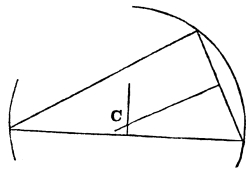
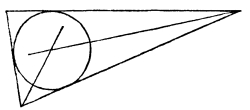
3. If, on the other hand, we wish to inscribe a circle in the triangle, so that each side of the triangle shall be tangent to the circle, we must draw lines dividing two of the angles of the triangle into halves, and the point where these lines cross each other will be the centre of the circle. [Pg 75]
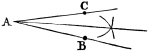
4. But you do not know, perhaps, how to divide an angle into halves. Suppose, then, that C A B is the angle you wish to divide. Measure A B and A C of equal lengths. Put one foot of a pair of compasses at B, and with the other foot scratch a little arc near what you think is the middle of the angle. Now put one foot at C, and, with your compasses open exactly as wide as before, make another arc crossing the first. A straight line from A through the points where the arcs cross will divide the angle into two equal parts.
5. The largest triangle that can be inscribed in a circle is an equilateral triangle. So that there are two kinds of triangles in which the equilateral triangle is largest; namely, the isoperimetrical, and those inscribed in one circle.
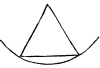
6. You remember, I hope, that the radius of a circle is the chord of a sixth part of the circumference. If you draw an arc long enough to draw a chord of the same length as a radius, and then draw radii to the ends of this chord, you will make an equilateral, and, therefore, equiangular [Pg 76] triangle. Each angle will be one third of two right angles; because the three are equal to each other, and the three together are equal to two right angles. If three of them would be equal to two right angles, six would be equal to four right angles. And so the corners of six such triangles would fill up all the space about the centre of a circle, and the six chords would just go round the circle.
7. If you wish to draw the largest triangle that you can in a circle, you must open your compasses just as wide as they would be to draw the circle, and then step six times round the circumference, marking the points where the feet of the compasses step. Then join every other one of these marks by three straight lines, and they will make an inscribed equilateral triangle.
8. Do you understand what I mean when I say that the radius is equal to the chord of sixty degrees?
[Pg 77]
1. Any figure bounded by straight lines is a polygon; and, if its vertices are in a circumference, it is an inscribed polygon.
2. A polygon of three sides is called a triangle; of four sides a quadrangle; of five sides a pentagon; of six sides a hexagon.
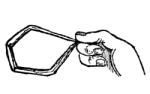
3. Any polygon of more than three sides can have its angles altered without altering the length of its sides. You remember, I hope, how we illustrated this, when we were studying quadrangles, by a bent twig, or by a bent lamp-lighter. If the twig is bent into the form of a triangle, and its ends held together, it cannot be altered in shape. But, if in the form of any other polygon, you can flatten or stretch it into different shapes, which will not only be isoperimetrical, but will have the sides unchanged.
What is a polygon? An inscribed polygon? A polygon of three sides? Of four sides? Of five sides? Of six sides? Suppose that a man measures how long the sides of his field are, will that tell him how large the field is? How can you show that it will not, by a bent twig? But suppose his field has only three sides? Suppose it has four sides, what angles must they make to have his field the largest possible? When a quadrangle is in its largest form, what can you say about its vertices? Suppose you wish to lay seven sticks on the floor so as to enclose the most space you can, how will you lay them? Suppose you take seven other sticks more nearly equal in length, but whose lengths added together make just as much as the first seven, with which set can you enclose most space on the floor? If five children take hold of a long loop of string, each taking hold with one hand, how must they stand so as to make the opening in the loop largest? If a sixth child comes in and takes hold, will they make the loop larger or smaller? Suppose, now, that each child takes hold with both hands? What is meant by a regular polygon? Two isoperimetrical polygons? What is the largest of isoperimetrical polygons of the same number of sides? What is the largest of isoperimetrical regular polygons? Of all isoperimetrical figures which is largest? Suppose you wish to make a string, lying on the floor, enclose as much space on the floor as you can, how will you arrange it?
How much further is it round a circle than across it? What is the most common and roughest answer to this question? (3 times.) What is a more exact answer? (²²/₇) How nearly would this give the circumference of a circle as large as a plate? How nearly the circumference of a large cistern? What still more exact answer can you give? (3·1416.) Can the answer be exactly given in figures? What Greek letter is used to express the exact proportion of a circumference to a diameter?
If there are pupils in the class who have studied arithmetic, let them answer such questions as the following, using twenty-two sevenths in the head, or 3.1416 on the slate. The simplest and best way of reading decimal fractions is simply to say “decimal one four one six.”
What is the diameter of a hoop 44 inches in circumference? What is the circumference of a hoop 21 inches in diameter? 14? 3·5? 10·5? 17·5? 11?
[Pg 78] 4. When a quadrangle is put into the largest form it can have without altering its sides, it can be inscribed in a circle.
5. You can put a circle about any triangle you please; but the triangle is the only polygon that can always be inscribed in a circle.
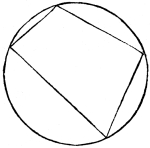
6. When a quadrangle is inscribed in a circle, the sum of either two opposite angles is equal to two right angles. You remember that I have already told you that an angle with the vertex in a circumference is measured by half the arc between its sides. But the arc between the sides of one angle, in this quadrangle, added to the arc between the sides of the opposite angle, makes up the whole circumference, and the sum of the angles is measured by half the sum of the arcs; that is, by half a circumference; that is, by one hundred and eighty degrees; that is, the sum of two right angles. [Pg 79]
7. Any polygon whatever, when it is inscribed in a circle, is in the largest form that it can be put without altering the length of the sides. If you had some sticks of different lengths that you wished to lay down as a play-fence upon the ground, you could make the largest field of them by laying them in such a position that the ends of the sticks shall all be in the circumference of one circle.
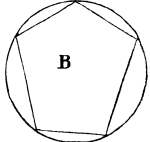
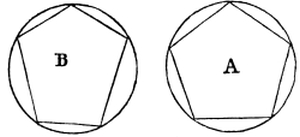
8. When two isoperimetrical polygons, of the same number of sides, are inscribed in circles, that polygon is largest which has its sides most nearly equal. Thus, if the inscribed pentagons A and B were isoperimetrical, A would be the larger, because its sides are equal, although B would be in the larger circle. [Pg 80]
9. And, therefore, of all isoperimetrical polygons of the same number of sides, that one is the largest which has its sides exactly equal, and which can be inscribed in a circle.
10. When a polygon with equal sides can be inscribed in a circle, it is called a regular polygon. Not only are its sides equal to each other, but its angles also are equal to each other. An equilateral triangle is a regular triangle, and a square is a regular quadrangle.
11. A regular polygon is larger than any isoperimetrical polygon of the same number of sides. This is just what I told you in the ninth section.
12. Of two isoperimetrical regular polygons, that is greater which has the greater number of sides. That is to say, a square is greater than its isoperimetrical equilateral triangle; a regular pentagon greater than its isoperimetrical square; and so on.
13. Suppose you wish to enclose some land in the middle of a great field, with sixty panels of fence. If the fence was put into a square form, fifteen panels on a side, it would enclose more than if put into [Pg 81] a triangle with twenty panels on a side; it would enclose still more if put round a regular pentagon, twelve panels on a side; still more as a hexagon ten panels on a side; and most of all if put in a regular polygon of sixty sides, one panel on a side.
14. We can fancy a circle to be a regular polygon, with more sides than can be counted, and each side too short to be seen. So that, of all isoperimetrical figures, the circle is the very largest. Sixty rods of stone wall could not be put into any shape and enclose so much land as if it were put in a circle.
1. Everybody knows that it is about three times as far round a circle as it is across it. But, if you measure how far it is across your hoop, you will find that a string of three times that length will not quite go around it.
[Pg 82]
And now the rest of this chapter will be too hard for children that have not learned a little Arithmetic. If you have not learned how to multiply and divide, you will have to go to chapter XXVI., without understanding much about this chapter and the next. Still, I think you will do well to study these chapters, and learn what you can out of them, even if you do not know how to cipher.
2. The circumference of a circle and its diameter are nearly in the same proportion as the numbers 22 and 7. So, if you measure across the hoop, and take a string three and one seventh times that length, you will find it just go round the hoop.
3. If the diameter of a circle is seven inches, the circumference will lack only a hairbreadth of twenty-two inches; if the diameter is seven feet, the circumference will not lack the breadth of your slate-pencil of being twenty-two feet. Now ask some one to show you a circle about seven inches in diameter, such as a breakfast-plate; and a circle seven [Pg 83] feet in diameter, such as a great hoop that a man can walk through with his hat on. You can then judge how nearly the circumference and diameter are in the same proportion as the numbers twenty-two and seven.
4. Nobody knows, and nobody ever can know, exactly how many times further it is round a circle than across it. It is very often true in Geometry that we cannot express by figures the lengths of two lines. There are no two numbers in the same proportion as the side and diagonal of a square. Nobody can tell exactly how many times longer the diagonal is than the side of the square. And in like manner there are no two numbers in the same proportion to each other as the circumference and diameter of a circle.
5. But we very often want to speak of this proportion, and we want to have some short name for it. Geometers have generally agreed to call it pi; which is the name of the Greek letter for p, and it is written π.
[Pg 84]
6. I have told you that π is nearly twenty-two sevenths. And, in almost every question about circles that you will want to answer, this is exact enough. It is nearly enough exact for workmen to work by in making tinned ware, or anything in which the diameter is less than large wash-tubs.
7. So, if you know what the diameter of a circle is, and want to find out how long the circumference is, you must multiply the diameter by twenty-two, and divide the product by seven. If you know what the circumference is, and want to find out what the diameter is, you must multiply the circumference by seven, and divide the product by twenty-two.
8. But, perhaps, you will at some time wish to be more exact, and then it will be better to use a decimal fraction. Perhaps you have not learned decimals yet; but, after you have learned them, you may want to use a better value of π, and you can then turn back to this page, and find that π is very nearly equal to 3·1416.
[Pg 85]
1. I have told you that men measure surfaces by squares. They find out, if they can, how many squares it would take to cover the surfaces, if the side of each square was just one inch, or one foot, or one yard. I have told you, also, that we can easily find out how many such squares it takes to cover a large square; that is, we can find the measure of a square by multiplying the number of inches, feet or yards, on a side, by itself; that is, by the same number.
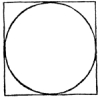
2. Now, if you draw a square with its sides tangent to a circle, the sides of this square will be each equal to the diameter of the circle. The measure of such a square is found, then, by multiplying the length of the diameter by itself. And the measure of the circle can be found by multiplying the measure of the square by one quarter of π.
If the class have not studied any arithmetic, this chapter must be omitted until a review.
How do men measure surfaces? How do you find the measure of a square? How do you measure a circle? Let the teacher draw a square, and ask, What figure is this? Inscribe a circle, and ask, What figure is this? How large a part of the square does it enclose? (¾). More exactly? (¹¹/₁₄) Still more exactly? (·7854.) By what part of π must you multiply the square in order to find the measure of the circle? How many square inches in a circle five inches in diameter. Suppose a little man, just one foot high, and a man six feet high, how much more cloth will it take to clothe one than the other? How much more yarn to knit his stockings?
[Pg 86] 3. Since π is a little more than three, the circle is a little more than three quarters of the square. If, for example, the diameter of a circle is six inches, the square that will just enclose it contains six times six, or thirty-six square inches; and the circle contains a little more than three quarters of this. Three quarters of thirty-six is twenty-seven; and, adding a little more, would make it about twenty-eight inches.
4. If you wish to be more exact, you must multiply the thirty-six square inches by one quarter of twenty-two sevenths; that is, by eleven fourteenths. Or, in other words, we must multiply thirty-six by eleven, and divide by fourteen, which will give us about twenty-eight and one half square inches for the size of a circle six inches in diameter.
5. And, to be very exact in finding the size of a circle, you must multiply the diameter by itself, and then by the decimal ·7854, which is one quarter of 3·1416.
6. Circles are larger or smaller in the same proportion as the squares [Pg 87] built on their diameters. And something like this is true of all sorts of surfaces. Two similar surfaces are always in proportion to the squares of similar lines in those surfaces. If we have two polygons of the same shape, they are of a size proportioned to the squares on their corresponding sides or diagonals. If a side in one is twice as long as a corresponding side in the other, then one polygon is four times the size of the other, because twice two are four. If one side were three times as long as the corresponding side in the other polygon, one polygon would be nine times as large as the other, because three times three are nine.
7. I am so anxious that you should remember this, that I will tell it to you again in other words. All similar surfaces are in proportion to the squares of corresponding lines; so that we may find the proportion between the surfaces by multiplying the number that expresses the proportion between the lines by itself.
Suppose two dogs were of exactly the same shape, but that one was twice as high as the other. Then its tail would be twice as long as the [Pg 88] other’s, its ears would be twice as long, its eyes twice as wide apart; and whatever line you chose to measure in one, it would be twice as long as the same line in the other. But its skin would be four times as large, the surface of its eye would be four times as large, it would take four times as much leather to make boots for it, or four times as much lather to shave it; that is, whatever surface you measured on the one dog, you would find it four times as large as the same surface on the other.
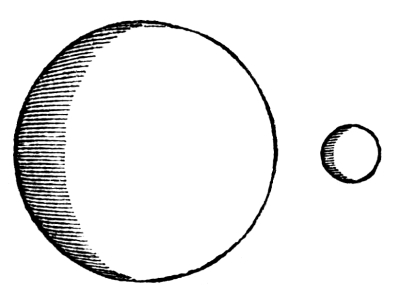
Suppose that we had a foot-ball ten inches in diameter, and a little batting-ball two inches in diameter. The diameter of the foot-ball would be five times as much as that of the batting-ball, and it would take twenty-five times as much leather to cover it, because five times five is twenty-five.
[Pg 89]
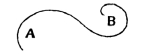
1. Suppose that our boy, wheeling his barrow over the light fallen snow, went winding about the field, making a curved track, which curved in some places more than in others. Let us suppose that he began as though he were going to make a large circle, but kept turning shorter and shorter, and ended when he was turning, as though he would make a very little circle. Then we should say that his track had, at first, a large radius of curvature, but at the end had a small radius of curvature.
2. Let us suppose that the boy was tied, by a long rope, to the trunk of a large tree; and that, as he went round and round the tree, the rope wound up upon the tree-trunk, shorter and shorter, and drew the boy nearer and nearer to the tree. Then the rope would be the radius of curvature of the boy’s path.
What is the name of a curve that bends equally in every part? How would you draw such a curve upon the blackboard? If I unwrap a thread from a spool, holding the spool still, and keeping the thread tight, what sort of a curve shall I draw? What relation will the circumference of the spool have to this curve? What shall we call the straight part of the thread which runs between my hand and the spool? What does the radius of curvature measure? To what circle is the radius of curvature a radius? How do we imagine all curves drawn? What is the evolute of a circle? Let the teacher provide the board and pins to show the illustration of section nine.
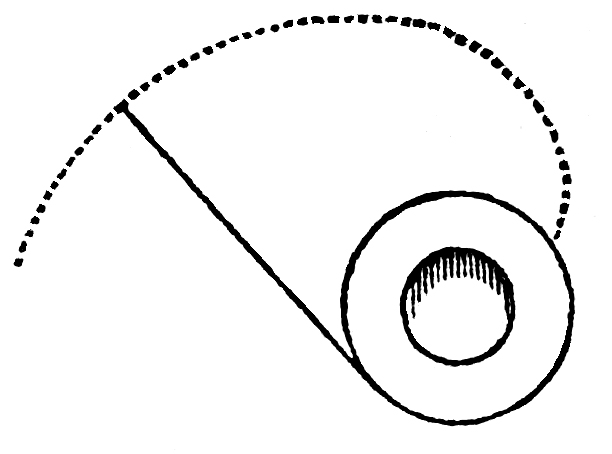
[Pg 90] 3. Hold a spool of thread still, on your slate, and let it be the trunk of the tree. Then tie the end of your slate-pencil to the end of the thread, and, by keeping the thread tight as you unwind it, you may draw a track like that of the boy’s wheelbarrow. The thread that is unwound will be the radius of curvature of this mark. The radius of curvature will be very short where the pencil is close to the spool, and grow longer as you unwrap the thread. It will be different for every point in the curve; because you cannot move the pencil without either winding, or else unwinding, the thread.
4. We call this thread the radius of curvature, because it is to the curve like a radius to the circle. We call it the radius of curvature, because it shows us how much a curve curves or bends. When the radius of curvature is short, the curve bends very much; and when the radius of curvature is long, the curve bends less; and so the radius of curvature measures the bending or curvature of the curve. [Pg 91]
5. If we draw a circle, with its centre at the point where the thread is just leaving the spool, that is, where the thread is tangent to the spool, and make the radius of the circle just equal to the thread that has been unwound, that is, equal to the radius of curvature, then that circle will exactly fit the curve at the point which the slate-pencil is then marking. So that the radius of curvature, at any point of a curve, is the radius of the circle that will exactly fit the curve at that point.
6. Every curve can be imagined as made in a similar way, by unwrapping a string off from some other curve; and this other curve is called the evolute of the first curve.
7. But the evolute of a circle is a point; because the string that makes a circumference must neither wind up nor unwind.
8. The evolute of the boy’s track is the circumference of the trunk of the tree; and the evolute of the pencil-mark is the circumference of the spool.
9. You may drive a row of pins into a soft pine board, making [Pg 92] the row curved. Then tie one end of a thread to the foot of the last pin, and the other end of the thread to a lead-pencil near its point. By keeping the string stretched, and sweeping it round so as to wrap up and unwrap upon the fence of pins, you may draw a curve whose evolute will be the row of pins. This pencil-mark, you will easily see, is made of little arcs of circles, whose centres are the pins, and the length of thread from a pin to its little arc is the radius of curvature at that place.
1. When a wagon is going upon a straight and level road, look at the head of a spike in the tire of one of the wheels, and you will see that it moves in beautiful curves, making a row of arches that is called a cycloid.
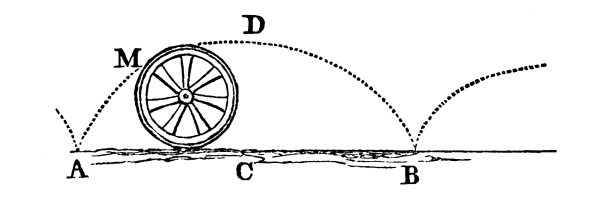
Let the teacher take a tin cup, a ribbon-block, or something of the kind, and roll it carefully along the bottom of the blackboard, watching and marking with chalk the path of a spot on the side. Then ask, What is the name of this curve? What is the height of the arch, compared with the cup, with which I drew it? What is the breadth of the arch at the bottom? What is the length of the curve of the arch? What is the space enclosed between the arch and the bottom of the board? (still comparing with the cup.) Let the teacher inscribe a circle, of the size of the cup, and ask, Are these horns larger or smaller than the circle? Suppose that your hoop has a spot on one side of it, in what curve will the spot move when the hoop is rolling straight forward? How high will it go from the ground? (Diameter of hoop.) How far apart will the places be where it comes to the ground? How far will the spot travel in going from one place to the next? (Four times diameter of hoop.)
Which of you can tell me what a cycloid is? If you draw a line at right angles to a cycloid, where will it pass? (Through the point where the circle making the cycloid touched the line on which it rolled when making that place in the cycloid.) The radius of curvature is at right angles to a curve—what part of the radius of a cycloid is cut off by a straight line joining the feet of the arch? (One half.) How long is the radius of the cycloid at the top of the arch? How long at the bottom? What is the evolute of a cycloid? Explain what you mean by this?
Suppose two wires going from the north-east corner of the ceiling to the south-west corner of the floor, one wire straight, the other a part of a cycloid, down which wire would anything slide the more quickly? Suppose one wire went from the north-east corner of the ceiling to the south-west corner of the ceiling, hanging down in the form of a whole arch of a cycloid, how much longer would it take anything to slide from the ceiling to the lowest part of the wire, than it would take for it to slide from a place one foot from the middle? (No longer.) The teacher should endeavor to obtain (from the prudential committee) the board described in section eight.
[Pg 93] 2. That is to say, a cycloid is the path of a point in the circumference of a circle rolling on a straight line. You can draw part of a cycloid by putting the point of your pencil into a little notch in the edge of a spool, and tying it fast, so that the point of the pencil shall be kept just at the edge of the spool; and then rolling the spool carefully and slowly against the inside of the frame of the slate.
3. You will see, I think, that each arch in the cycloid must be just as high from C to D as the diameter of the circle that makes it; and just as wide at the bottom, from A to B, as the whole circumference of the circle.
4. But you will have to study Geometry a good while, before you can prove the other interesting things which I am going to tell you. You can easily understand what I am going to tell you; but you cannot understand how I know it, as you can what I told you in the last section. [Pg 94]
5. The length of the curve, A D B, in each arch of a cycloid, is just four times the height of the arch; that is, four times the diameter of the circle that made the cycloid.
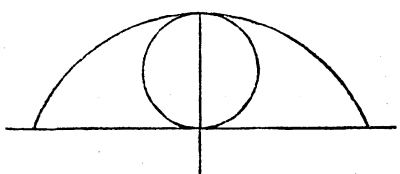
6. The whole space that is enclosed between the arch of the cycloid and the straight line on which it stands, is just three times as large as the circle that made the cycloid. So, when a circle is inscribed between the arch and the line, the curious three-cornered figures on each side of the circle are each exactly as large as the circle itself.
7. Now, if you have studied Arithmetic, you will understand that, if a wheel is three feet in diameter, the head of a spike in the tire travels just twelve feet from where it leaves the ground until it touches the ground again. The spots where it touches the earth will be nine feet and three sevenths of a foot apart. And the space between its path and the ground will be three times eleven fourteenths of nine square feet; that is, twenty-one square feet and three fourteenths of a square foot.
[Pg 95]
1. The head of a spike in the tire of a rolling wheel is moving, at each instant, at right angles to a line joining it to the bottom of the wheel.
2. That is to say, if a straight line is drawn from the bottom of the rolling wheel to the head of the spike, and if a tangent to the cycloid is drawn through the head of the spike, this straight line will be at right angles to this tangent.
3. And this straight line is exactly half of the radius of curvature of that point in the cycloid. So that, at the top of an arch of the [Pg 96] cycloid the radius of curvature will be twice the diameter of the circle, and as you go down the arch the radius of curvature will be shorter and shorter, until just at the foot of the arch the radius of curvature will be of no length at all.
4. The evolute of a cycloid is a cycloid of exactly the same size. That is to say, if we should fasten a string in the point between two arches of a cycloid, just long enough to wrap on the curve up to the middle of the arches, its end, as it wrapped and unwrapped, would move in a cycloid exactly like that to which it was fastened.
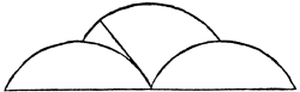
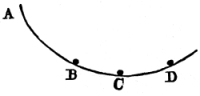
5. If a cycloid be turned upside down, and we fancy the inside of it to be very exceedingly slippery, then there are two curious things about it.
[Pg 97] If I want to slide anything from A down to B, there is no curve, nor straight line, down which a thing would slide so quickly as down the cycloid. If a hill was hollowed out in that shape, sleds would run down it faster than they could down any other shaped hill of the same height and the same breadth at the bottom.
6. The second curious thing about sliding on the inside of a cycloid is, that it takes always exactly the same time to slide to the bottom, however high up or low down you start. If A, in the last figure, is the top of such a hill, and C the lowest point, it will take a sled exactly as long to go from B to C, as to go from A to C. But this, you must remember, is only when we imagine the hill and the runners of the sleds to be, both of them, perfectly slippery; so that there shall be no rubbing. In that case, if the road from A to C was two miles long, it would only take a sled twenty-eight seconds to come down the whole length. And, if it starts [Pg 98] from any other place on the road, say from B, it will still take twenty-eight seconds to get to C.
7. If the road from A to C is half a mile long, a sled will come down in fourteen seconds.
8. If a board is sawed out in the form of a cycloid, and a little gutter made on the inside of the curve, you can try this by holding two marbles, say one at A and the other at D, and letting go of them at the same instant. They will meet exactly at C, one coming the whole way A C, while the other is coming the short distance D C.
1. When one circle rolls around another, instead of rolling on a straight line, any point in the circumference of the rolling circle travels in a curve called an epicycloid.[7] You can draw an epicycloid by rolling carefully the spool (with a pencil tied to it) around some round thing held still on your slate. [Pg 99]
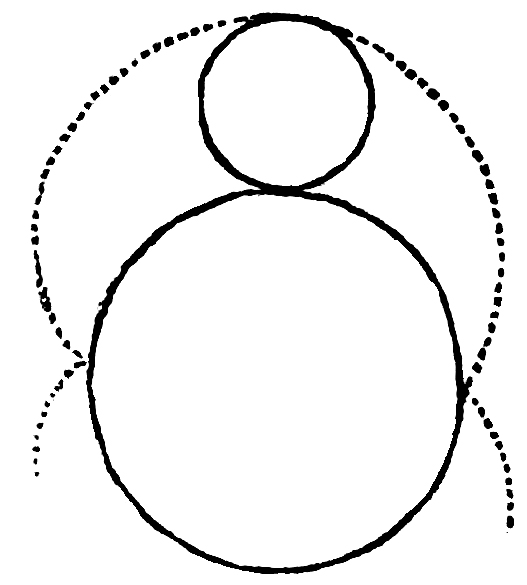
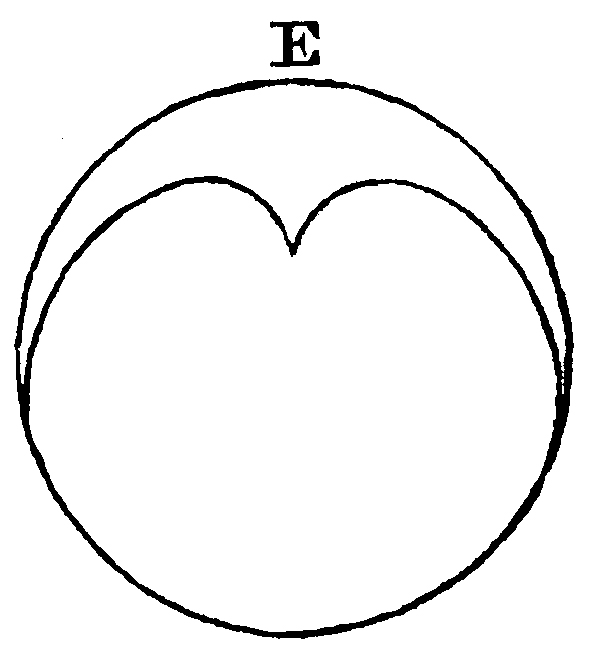
2. Set a lamp on a table in one corner of the room, and, in the farthest corner of the room, on a table of nearly the same height, set a bright tin cup, or a glass tumbler, nearly full of milk. On the surface of the milk you will see a bright curve shaped like the inner line in this figure. It is an epicycloid; such as would be made by a circle of one quarter the diameter of the cup rolling on a circle half the size of the cup. You can make it by daylight, by setting the cup of milk in the sunshine, early in the morning or late in the afternoon.
3. Epicycloids will be of different shapes, according to the proportion which the two circles bear to each other. The smaller the rolling circle is in proportion to the other, the more nearly will an arch of the epicycloid be like an arch of the cycloid.
What is an epicycloid? How does it differ from a cycloid? Let the teacher draw an epicycloid as directed in section one, and teach the children to do so. Have any of you seen the cow’s foot in a cup of milk? What is the geometrical name of this curve? What must be the proportion between the circles to make this epicycloid? What is the evolute of any epicycloid? When the circles are of the same size, what will be the shape of the epicycloid?
[Pg 100] 4. The evolute of an epicycloid is a smaller epicycloid of the same shape; and the evolute of that evolute must be a still smaller epicycloid. So that we may fancy epicycloids packed one within another like pill-boxes.
5. The epicycloid of section second is sometimes called by children the cow’s foot in a cup of milk. The figure in the margin represents this epicycloid with its nest of evolutes packed one within the other. If a string is fastened at the point where the arches of the epicycloid come together, and is just long enough to wrap round to the middle of the arch, then, as it unwraps, the end will move in a larger epicycloid of exactly the same shape.
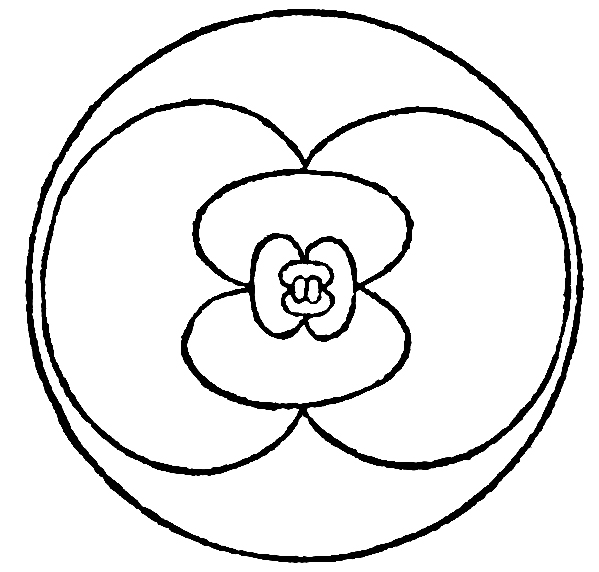
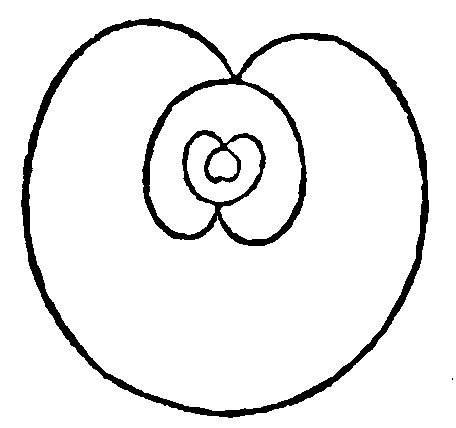
6. When the circles are of the same size, the epicycloid will have but one arch. The ends of the arch will come together at the same point. The figure in the margin will show the shape of this epicycloid and its evolutes.
[Pg 101]
1. When a circle rolls on the inside of another circle, instead of on the outside, the curve is called a hypocycloid.[8]
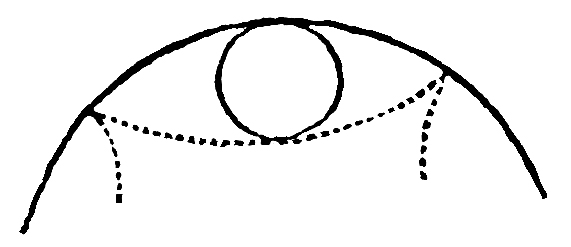
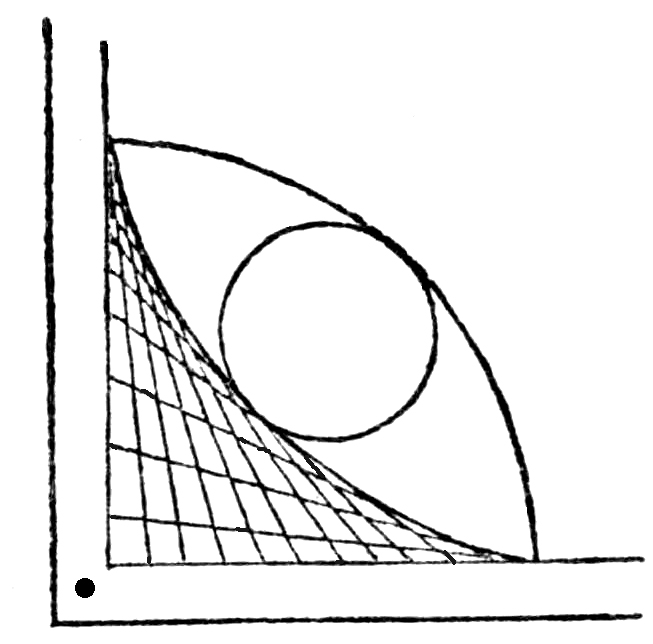
2. Suppose your slate-pencil were straight, so that it would lie flat on the slate, and make a mark as broad as the pencil is long. Then suppose you were to put your pencil across one corner of your slate like a hypotenuse, and slide first one end up to the corner, and then the other, keeping both ends all the time touching the slate-frame. You would make a white mark in the corner, of a curved three-cornered shape, like this figure. The curve inside would be a hypocycloid.
What is a hypocycloid? Suppose I were to draw a hundred right angles, putting the vertices of the right angles together, one exactly on another, making the hypotenuses of equal length, but having no two of them make the same angle with the legs, to what kind of a hypocycloid would all these hypotenuses be tangent?—that is, what is the proportion between the radii of the two circles? Suppose a man draws the foot of a ladder away from the side of a house, letting the ladder slip down the side of the house, to what curve in the air will the ladder be all the time a tangent? If the diameter of the rolling circle is one fifth that of the other circle, how many arches will the hypocycloid have? If one fourth? If one third? But what does the hypocycloid become when the diameter of the rolling circle is one half that of the other? How do the evolutes of a hypocycloid differ from those of an epicycloid? In what respect are they like them? What must be the size of two spools that they may make the same hypocycloid in the same hoop?
[Pg 102] 3. If you take the corner of your slate for a centre, and the length of your pencil for a radius, and draw a quarter of a circle, as I have done in the last figure; if you then roll on the inside of this arc a circle whose diameter is one half the length of the pencil, it will make the same hypocycloid. I have also drawn this circle in the figure.
4. You can draw a hypocycloid by rolling the spool and the pencil on the inside of any little hoop hold firmly on the slate. The rim of the cover of a large wooden pill-box will make a nice little hoop for this purpose.
5. The evolute of a hypocycloid is a larger hypocycloid of the same shape on the outside of it; and the hypocycloid itself may be fancied as the evolute of a smaller hypocycloid within it; so that hypocycloids, like epicycloids, are packed one within the other, like nests of tubs or boxes.
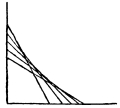
6. The hypocycloid that is made when the diameter of the rolling circle is one quarter of the diameter of the circle that it rolls in, can be made by sliding the hypotenuse backwards and forwards on the legs of a right triangle. The hypotenuse must be kept of the same length, and it will always be a tangent to the hypocycloid. [Pg 103]
7. This hypocycloid may be called a hypocycloid of four arches; because, as you may see in the figure, both it and its evolutes have each four arches.
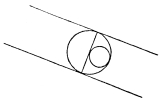
8. If the diameter of the spool is nearly half that of the hoop, the pencil will move across the hoop in a very flat curve, almost like a diameter of the hoop; and the evolute at the ends of the curve will be almost like two parallel straight lines at right angles to the end of the diameter; so that the string unwrapping from the evolute will be very long. When the diameter of the spool is exactly half that of the hoop, the hypocycloid is a straight line; and the evolute of it, if you [Pg 104]can fancy that there is any evolute, is two parallel straight lines at right angles to its ends.
9. If the diameter of the spool is more than half that of the hoop, it will make a hypocycloid like that made by a smaller spool. If you have two spools, one of them as much wider than the radius of the hoop as the other is smaller, so that the hoop will just let the two spools stand in it side by side, then one spool will make exactly the same hypocycloid as the other.
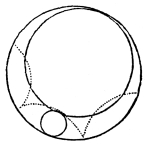
10. These two spools cannot, of course, be both rolling in the hoop at the same time; but we can easily imagine two circles of the same size as the spools rolling in a circle as large as the hoop. Start the circles from the position in which I have drawn them to rolling in opposite directions, and if you roll the little circle faster than the large one, so as to make them get round the hoop in the same time, the points in the two circles which are now touching will keep together all the time, making the same hypocycloid.
[Pg 105]
1. When a chain hangs from two points not directly under each other, it makes a beautiful curve called a catenary.[9] You must remember that, in order to have a perfect catenary, we must take a very fine chain, and then take only the middle line in it.
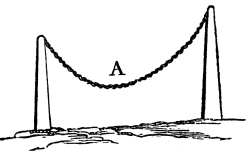
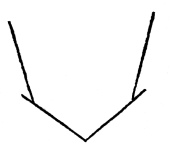
2. Suppose we had four straight sticks joined together by the ends, so as to have a sort of chain of four links. Suppose the middle two were equal in length, and also that the end ones were equal to each other. Hang them by two pins on a level, as you see them in the figure, and notice exactly in what shape they hang. Now turn them upside down, keeping them in the same shape, as you see them in the next figure. [Pg 106] They will exactly balance and stand like the rafters of a double-pitched roof. If you set the sides more nearly perpendicular, the top will fall in; crowding the sides apart until the point of the top gets lower than the top of the sides, and then pulling the sides together again till they touch at the top, and the two top pieces hang straight down in the middle. But if, on the other hand, you lean the sides together more than they should be, they will fall together, crowding the top up, until the ends of the sides meet, and the top pieces stand straight up, or fall to one side together. The four sticks, hinged together at the ends, will not stand, like an arch, unless they make the same angles with each other as they did when they were hanging like a chain.
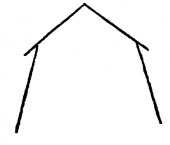
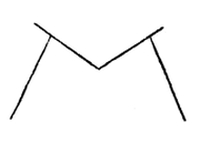
What is the geometrical name of the curve made by a hanging chain? If the vertices of a polygon were perfectly limber hinges, but the sides stiff, how should we place them to make them stand as an arch? Did you ever see a gambrel roof? Did you like the looks of it? What shape do you think a gambrel roof should have to look well? (That in which the rafters would hang if inverted.) If I draw a catenary on the blackboard, and tell you how long the radius is at the bottom, can you show me how to find the radius at any other part of the chain? Can you show me how to find a straight line equal to any part of the catenary?
[Pg 107]
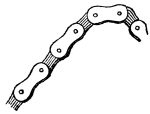
3. And if we had a chain made of a great many short, stiff pieces of wood or metal, hinged together by rivets, like the little chain inside a watch, we could make it stand up like an arch, if we could put it exactly in the same form as it hung; that is, in a catenary upside down. If we arch it up too steep and pointed, the sides will fall in; if we arch it too flat, the top will fall in. But arch it exactly as it hung, and it will stand.
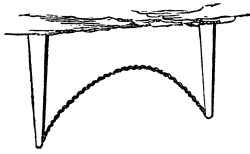
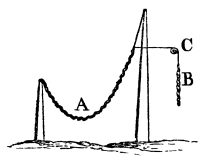
4. If we fasten one end of a chain to a post, and hang the other end by a thread from the top of a higher post, the weight of the chain will pull the thread inward, as in this figure.
But suppose another thread, tied to the end of the chain, should pass over a little wheel, on a level with the end of a chain, as at C, having a piece of the same kind of chain hung to it at B. Then you can easily see that the weight of B would pull A out [Pg 108] flatter, and make the thread hang more nearly straight down by the side of the post; or, if B were long enough, and thus heavy enough, it would even draw the thread outward toward C.
5. If the piece of chain marked B is just long enough to pull the end of A exactly under the top of the higher post, so as to make the thread hang exactly straight down, then B will be just as long as the radius of curvature of the catenary A at its lowest point.
6. Let A, in the next figure, be the lowest point of any catenary, and C any other point in it you please.
Draw a horizontal line, E D, making the distance A E equal to the radius of curvature at A. Now draw C D at right angles to the catenary at the point C, and C D will be exactly the same length as the radius of curvature at C. Draw A F parallel to C D, and the straight line E F will be just as long as the piece of chain A C.
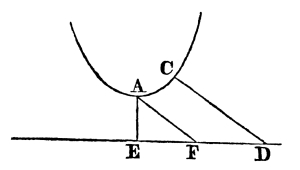
[Pg 109]
1. When a boy tosses up his ball in the air, the centre of the ball moves in a curve called a parabola. If you toss up the ball on the west side of the house when the sun is setting, the shadow against the side of the house will also move in a parabola.
2. If you hold a round ball in such a position that its upper edge is just as high above the table as the blaze of a lamp is, then the edge of the shadow on the table will be a parabola. A dinner-plate will also make a parabola in the same manner.
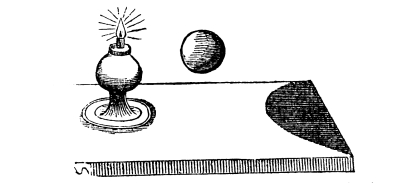
What is the geometrical name of the curve in which a ball moves when tossed in the air? Which would make a more perfect parabola, a ball of lead or a ball of cork? (Of lead, because least impeded by the air.) How must I hold a plate so that the edge of its shadow shall be a parabola? How can I draw a parabola with a straight edge and square? What is the vertex of a parabola? How near the vertex does the directrix pass? In what direction does the directrix of a parabola lie? (Parallel to tangent at the vertex.) How can you describe a parabola with reference to its focus and directrix? Let the teacher copy the figure, and, drawing a tangent at the point M, ask, How does this tangent divide the angle A M P? How can you tell the length of the radius of curvature at any point of a parabola?
[Pg 110] 3. But remember that, to be an exact parabola, the ball must be perfectly round, as no ball can really be; the table perfectly flat, as no table can really be; the blaze of the lamp a single bright point, as no blaze of a lamp can be. It is easy to imagine exact figures, but they can never be made. No line can be drawn so fine and true that a microscope would not find a breadth to it, or waving irregularities in it.
4. The parabola is a very useful curve; but it would be difficult to explain to children how it is used. I shall tell you of one use, before the end of this book.
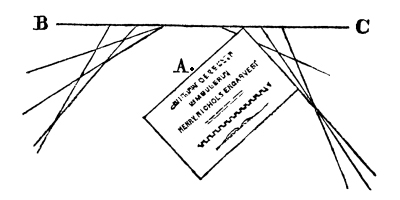
5. On a smooth board draw a straight line, such as B C. Near the middle of the line, as at A, drive a small pin. Put one edge of the square card against the pin, and one corner on the line B C, and draw a pencil-line along the edge of the card, [Pg 111] beginning at the corner on B C, and going at right angles to the edge that is against the pin A. Do this with the card in a great many different positions, only keeping the edge against the pin and the corner on B C, and you will make a place on the board nearly black with pencil-marks, with a curved edge on the inside, around A, and the curve is a parabola.
6. The point A, in the last figure, is called the focus of the parabola. The point in the parabola nearest the focus is called the vertex of the parabola. The line B C is a tangent at the vertex.
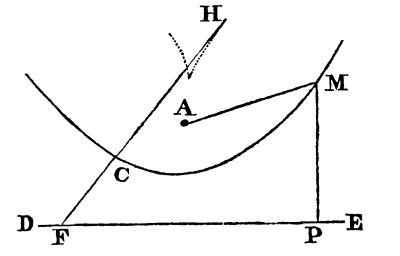
7. Let C M be a parabola, and let A be its focus. Draw D E parallel to the tangent at the vertex, and as far from the vertex as the vertex is from the focus. This line D E is called the directrix of the parabola.
8. Any point in the parabola is just as far from the focus as from the directrix. That is to say, that, if we take any point, as M, [] and draw a line M P at right angles to the directrix, and also a line M A, the two lines M P and N A will be of exactly equal length.
9. A parabola may, therefore, be described as a curve, every part of which is equally distant from a point called the focus, and from a straight line called the directrix.
10. The parabola at the point M makes exactly the same angle with the line M P that it does with the line M A.
11. If H C is the radius of curvature at the point C, and C F is in the same straight line with H C, then C F is just half as long as H C. That is to say, that a straight line drawn at right angles to any point in a parabola, and ending in the directrix, is just half as long as the radius of curvature at that point.
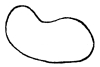
1. Any curve that runs round into itself again encloses an oval. The word oval really means egg-shaped; but, in geometry, we use it for any figure bounded by one curve line, without any sharp corner.
What is an oval? What is an ellipse? How can you draw an ellipse with a string and two pins? What is the name of the points where the pins are? What angles do the two parts of the string make with that part of the ellipse where your pencil is? (Equal angles.) What other curve is the end of a very long ellipse like? When the two foci of an ellipse are brought near together, what curve does the ellipse become like? Can you explain how a carpenter draws an ellipse by a “trammel and slots”? Did you ever notice an elbow in a stove-pipe? What is the shape of the seam around the elbow of the stove-pipe?
[Pg 113] 2. The shadow of a round ball falling on a flat surface, when all the shadow can be seen, is either a circle or a particular kind of oval called an ellipse. The shadow of a round plate is also an ellipse, whenever the whole shadow can be seen on one flat surface.
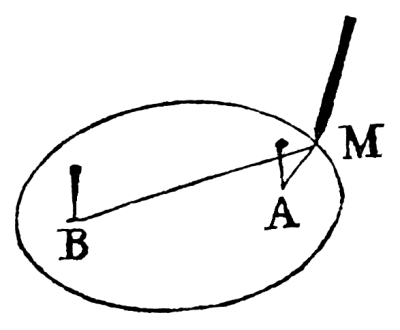
3. You can draw an ellipse by driving two pins into a board, as at A and B in the figure, and tying a string, as A M B, one end to each pin, then putting a pencil-point, as at M, inside the string, and stretching it out, and moving it round.
4. The points where the pins are placed are called the foci of the ellipse. Lines to the foci from any point in the ellipse, as at M, make equal angles with the tangent at that point.
5. The nearer the foci are together, using the same string, [Pg 114] A M B, the more nearly a circle does the ellipse become; so that if the foci came together, the ellipse would become a circle.
6. The further apart the foci are the longer and narrower is the ellipse. When an ellipse is very long, and very narrow in proportion to its length, each end of the ellipse becomes very much like a parabola.
7. When an ellipse is very exceedingly long, the ends are so much like a parabola that even geometers call them parabolas. We call the path of a ball tossed in the air a parabola, although in reality it is one end of a very long ellipse, nearly four thousand miles long, with one focus at the centre of the earth. But a real parabola is an ellipse so long that it has no other end at all; it only has one end and one focus.
8. The moon goes round the earth in an ellipse; the earth goes round the sun in an ellipse. And, if you were to cut the earth, or sun, or moon, in two, with a straight cut, the cut surface would be either an ellipse or a circle, according to the direction in which you cut it. If the earth is cut in two from east to west, the section is a circle; if [Pg 115] in any other direction, an ellipse; for the earth is not perfectly round.
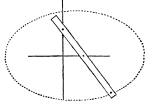
9. Carpenters sometimes draw ellipses by means of a board with two narrow slits in it at right angles to each other. They have a ruler with two pins in it, as at A and B, and a pencil in the end, as at C; and, by moving one pin in one slit, and the other pin in the other slit, the pencil C will move in an ellipse.
10. If you cut a round stick off slanting with a sharp knife, at one cut, the cut end will be an ellipse.
1. If a reel for winding thread, such as is represented in the figure, be held steadily in such a position that its shadow from a lamp will fall on a flat wall, and then set to revolving, the sides of the shadow will be curved, and the curve is called an hyperbola.
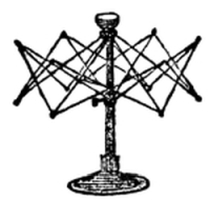
Did you ever see a “swift” for winding yarn? Did you ever see it standing steady on a table, and spinning round very fast? Did you notice that the sides looked curved? What curve was it? Suppose a row of palings set in a straight line, the middle one the shortest, and the others just long enough to reach the top of the middle one, if they were leaned against it with their bottoms standing where they now do; what curve would the top of such a row of palings make? (Section two.) In what curve does a movable pulley move, when the fixed pulley is not on a level with the fixed end of the rope? How do a parabola and an hyperbola compare with each other? How many foci has a parabola? An hyperbola? Can you tell how to make an hyperbola by a chain and threads? Can you describe how the shadow of a ball, or plate, may be made to grow from a circle into an hyperbola? What other two curves does it become before becoming an hyperbola?
[Pg 116]
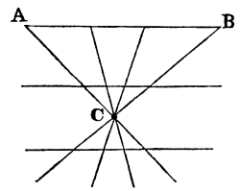
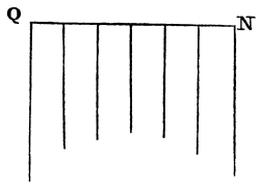
2. Suppose we have strings tied, at various places, on a horizontal wire, A B, and all drawn straight through one point, C. Cut them all off on a line parallel to A B. Let the strings, after being thus trimmed, hang straight down, and the ends will hang in a curve, as shown in this figure, and that curve will be an hyperbola. This will also be true if the strings are cut off exactly at the point C.
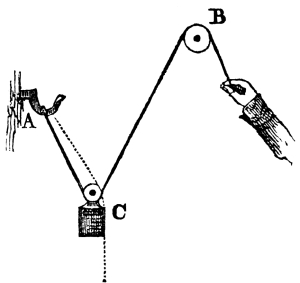
3. If a rope is tied to a fixed point, say the hook A, and [Pg 117]passes over a fixed pulley, as B, not on a level with A, then a weight on a movable pulley, C, will move, as you raise it by pulling the rope over B, in an hyperbola.
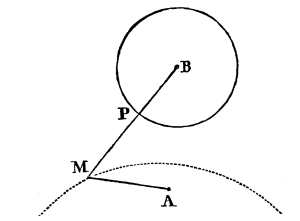
4. If we draw a circle round a centre, B, marking, also, some point outside the circle, as at A, and then make a dot at every point which we can find situated, like M, as far from the point A as from the circumference of the circle round B, these dots will all be in an hyperbola. [Pg 118]
5. You see, then, that an hyperbola can be fancied as a parabola with a circumference, instead of a straight line, for a directrix.
6. In the last figure the points A and B are called the foci of the hyperbola. The curve is, at each point, as far from one focus as from the directrix circle drawn round the other. That is, M P is of the same length as M A.
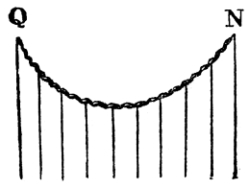
7. If we hang light threads to each link of a hanging chain, such as Q N, and cut their lower ends off on a level line, and then stretch the chain out perfectly level, the lower ends of the thread will arch up into an hyperbola.
8. If a round ball hangs exactly under a lamp, over a level table, its shadow on the table will be a circle. But if the ball is moved to one [Pg 119] side, the shadow becomes an ellipse. Now raise the ball slowly, and the shadow will begin to move away from the lamp. But one edge will move away much faster than the other, so that the ellipse will grow longer and longer. And if we imagine the table to be so large that we cannot see the edges of it, then, when the upper edge of the ball is just on a level with the lamp, the ellipse will be so long that it will have no other end, and the end nearest the lamp will be a parabola. If we raise the ball higher, the parabola becomes an hyperbola. And when the ball is raised so high that its under side is as high as the lamp, the shadow will not touch the table at all. The parabola and hyperbola are made by the shadow of the lower side of the ball.
9. If you take a plate instead of a ball, you can make all the shadows, circle, ellipse, parabola, and hyperbola, by a little pains-taking to hold the plate at the proper angle with the table for the circle and ellipse. For the parabola and hyperbola less care is required; only that for a parabola the upper edge of the plate must be just as high as the light; and for an hyperbola the plate must be higher. The shadow of the lower edge of the plate makes the parabola or hyperbola.
[Pg 120]
1. I have already told you how to make the bright curve called by children the cow’s foot in a cup of milk. I have also told you how to draw a parabola by drawing lines tangent to it until all the paper outside the parabola is blackened by pencil-marks. I have also told you how to draw a hypocycloid, by putting a short ruler across one corner of your slate, keeping one end against the frame at the bottom, and the other end against the frame at the side, and drawing pencil-marks the whole length of the ruler on the side next the corner. The corner will become, by making the marks at a great many different angles with the frame, whitened with pencil-marks, all tangent to an arch of a hypocycloid.
These curves are, in one respect, alike; they are made by drawing tangents to them. For the cow’s foot is made by bright straight lines of reflected light, all tangent to an epicycloid.
How are curves drawn by drawing only straight lines? What is the geometrical name for all curves made by reflected light? What is the caustic made by a circle? What is the child’s name for it? How could we arrange a table and make caustics with the curves? What is there peculiar about the caustic of a parabola? Of a cycloid? Do you remember what parallel lines are? Concentric curves? What is the caustic of a cycloid turned endwise to the light? What caustic is always formed when the light falls perpendicular to any part of a curve? When the light falls parallel to it? Let the teacher copy the figures, and go over all the peculiar points of section nine. What would be the caustic formed by a lamp in the centre of a circle? In the focus of an ellipse? In the focus of a parabola? Did you ever notice the reflector in front of a locomotive engine? What is it for?
[Pg 121] 2. And whenever light is reflected from the inside of a polished curve, the reflected light makes a bright curve of some kind, just as the light reflected from the inside of a circle makes an epicycloid.
3. Curves made by reflected light are called caustics. The cow’s foot in a cup is a caustic made by a circle. The caustic made by a circle is an epicycloid.
4. Suppose you had a table so arranged that the setting sun should shine over its surface. If on this table we should set narrow strips of tin on their edges, they would reflect the sun-light and make bright curves or caustics on the table.
5. If the tin were bent into a half of a circle, the caustic made by it would be, as you already know, an epicycloid such as would be made by one circle rolling on another of twice its diameter. [Pg 122]
6. If another strip were bent into the form of a parabola, and turned in such a direction that the sun-light fell at right angles to the directrix of the parabola, then the caustic, instead of being a curve, would be a single bright point at the focus of the parabola.
7. If you bend another strip into an arch of a cycloid, and turn the straight line which joins the ends of the arch at right angles to the sun-light, the caustic will be two arches of a cycloid of just half the size, as shown in the figure.
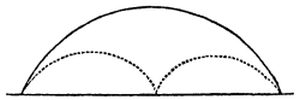
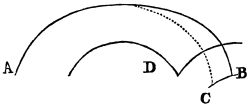
8. If the cycloid be turned round at right angles to its last position, so that the straight line joining the ends of the arch shall be parallel to the sun-light, the caustic will not be a cycloid, but will be curve concentric with a cycloid of half the size. In the figure, A B represents the strip of tin in the form of a cycloid; C is the point of the caustic, and D is one arch of the half-size cycloid with which the caustic is concentric. [Pg 123]
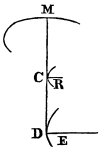
9. Whatever curved form the tin may be bent into, the caustic will have some curious properties, which I will now tell you.
Wherever the light falls at right angles to the curved tin, as at M, the caustic will be at the middle of the radius of curvature, and the radius of curvature will be tangent to the caustic, as the radius M D is tangent to the caustic C, just half way from M to D. And the radius of curvature of the caustic at this place, C, will be just one quarter of the radius of curvature of the evolute of the tin at M. If E is the radius of curvature of the evolute, then R, the radius of curvature of the caustic, will be parallel to E, and be one quarter as long as E. And both R and E will be at right angles to the radius M D.
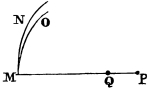
But wherever the sun-light falls as a tangent to the inside of the curved strip of tin, the caustic will also be a curve tangent to the inside of the tin, and its radius of curvature will be exactly three [Pg 124] quarters the radius of curvature of the tin curve. Thus, if M N is a curve on the inside of which the sun-light falls parallel to the curve at M, then M O will be the caustic, and its radius, M Q, will be exactly three quarters of M P, the radius of M N.
10. All through this chapter on caustics I have spoken only of those that are made when the light is at a great distance from the polished tin. If we bring a lamp near the polished curve, the caustics made by this lamp-light will be very different.
11. A lamp placed in the centre of a circle would not make a curved caustic, but all the light would be thrown back to one point, in the centre, where the lamp itself stood.
12. A lamp placed in focus of an ellipse would not make a curved caustic, but all the light would be thrown to one point, the other focus of the ellipse.
13. A lamp placed in the focus of a parabola would not make a curved caustic; but all the light would be thrown straight out in parallel lines perpendicular to the directrix of the parabola. For this reason men have polished reflectors in the shape of a paraboloid to place behind lamps when they want to throw out the light in one direction. They use such mirrors in light-houses, to throw the light out over the ocean; and they use them in front of locomotive engines, to throw light straight forward on the track by night.
[Pg 125]
1. All the figures which I have told you about are such as could be drawn on a flat sheet of paper. Before I finish my book I will tell you a little about a few solid bodies.
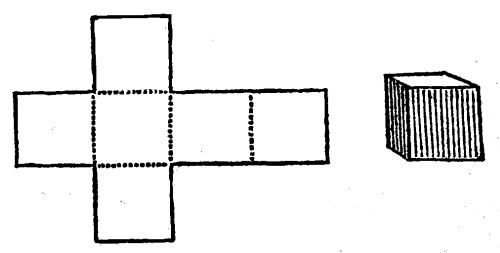
2. Cut out of a stiff piece of paper six equal squares, as I have drawn them here; and then fold the paper, at each line where the squares join each other, to a right angle. You will thus make the six equal squares shut up a space like a box.
3. This solid figure, bounded by six equal squares, is called a cube.
What is the name of a solid bounded by six equal squares? What is the difference between a yard of tape, a yard of oil-cloth, and a yard of earth?—I mean between the three meanings of the word yard in those phrases? Do you know how long a yard is? Did you ever see a man two yards high? Build an earthen pyramid as tall as such a man’s head, and how much higher would the great pyramid of Egypt be? How much larger? What is the highest hill in this neighborhood? How high is it? How many such hills set one on top the other would it take to be as high as the White Hills? Suppose Mount Washington were of the same shape as ______ hill, how many such hills would it take to build Mount Washington? Suppose Gulliver to be twelve times as high as the Lilliputs, but shaped just like them, how many times larger would his nose be than theirs? How many times larger would his thumb-nail be? How many times larger would his finger be than theirs?
[Pg 126] 4. A cube is taken as the measure of all solids and fluids. A gallon, for instance, is two hundred and thirty-one cubic inches; that is to say, by a gallon of water we mean water enough to fill two hundred and thirty-one little cubes, whose faces are square inches. Or, for another instance, a cord of wood is one hundred and twenty-eight cubic feet; that is, wood enough to make a pile as large as one hundred and twenty boxes, whose sides are each a square foot.
5. You remember that the measure of a square is found by multiplying the length of a side by itself. The measure of a cube is found by multiplying the length of a side twice by itself. If I build a cube with a side of three inches, one face will have nine square inches in it, and the cube will be made up of three layers, each with nine cubic inches in it. So that the cube of three inches is three times three times three inches; that is, twenty-seven inches. A cube of four inches would have sixteen square inches on a side, and consist of four layers of sixteen cubic inches each; that is, the cube of four inches is sixty-four inches. [Pg 127]
6. Similar surfaces, you remember, are in proportion to the cubes on corresponding lines. Similar solids are in proportion to the cubes on corresponding lines.
7. And as you can find the proportion between two similar surfaces by multiplying the number that expresses the proportion between the lines by itself, so you can find the proportion between the solids by multiplying the number that expresses the proportion between the lines twice by itself.
8. Let us suppose, for instance, a heap of earth six feet high, built in the shape of the great pyramid in Egypt, which is six hundred feet high. The pyramid would be one hundred times as high as the heap of earth; and, being of the same shape, would also be one hundred times as wide at the bottom. But the pyramid would cover a hundred hundred, that is, ten thousand times as much land as the heap of earth; and it would be a hundred times ten thousand, that is to say, one million times, as large as the heap of earth. [Pg 128]
9. The highest mountains in the United States, east of the Mississippi river, are about ten times as high as the great pyramid; and if one of them, one of the White Hills, for example, were cut into the same shape as the great pyramid, it would cover one hundred times as much land, and have one thousand times as much stone in it, as one of the pyramids.
10. The highest mountains of Thibet are nearly five times as high as the White Hills of New Hampshire. If one of the highest mountains of Thibet were of the same shape as one of the White Hills, it would have twenty-five times as much land on its sides, and would cover twenty-five times as much space. And it would take one hundred and twenty-five mountains like the White Hills to make one of the Himalaya mountains.
11. I wish you to remember very carefully that when two things are of the same shape, all corresponding lines are in the same proportion to each other; all corresponding surfaces are in proportion to the squares on those lines; and all corresponding solids in proportion to the cubes on those lines. [Pg 129]
12. I wish you also to remember that, if the number expressing the proportion between the lines of two similar solids be multiplied by itself, the product will express the proportion between the corresponding surfaces; and, if it be again multiplied by itself, the product will express the proportion between the corresponding solidities. If the diameter of a foot-ball be five times that of a batting-ball, the surface of the foot-ball will be twenty-five times as much, and the size of the foot-ball will be one hundred and twenty-five times as much, as that of the other ball.
1. You will very often hear or read about conic sections; men began to study them more than two thousand years ago, and have not yet learned all the useful things that can be known about them. By conic sections, we mean the circle, the ellipse, the parabola, and the hyperbola. I have told you a little about these curves; enough, I hope, to make you [Pg 130] want to learn more; and I will, in this chapter, tell you why they are called conic sections.
2. Cut out of pasteboard a figure bounded by an arc and two radii, such as A B C. Curve it up equally, and join the edge A C to the edge B C. It will then enclose (on all sides but one) a space; and the figure thus formed is called a right cone.
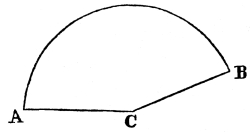
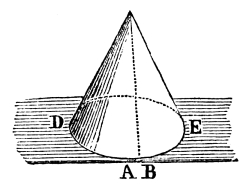
3. Set a right cone up upon a plane, and the arc A B will become a circle, such as D E in the figure. If we fancy a post standing straight up in the centre of a circle, and a longer straight pole tied by one end to the top of the post, while the other end just reaches the circumference of the circle; if we then fancy this lower end carried around the circumference, the pole will mark out in the air the surface of a right cone.
If a right triangle could spin round on one leg, the other leg will describe a circle, and the hypotenuse will go round a solid body in the air; now what is its geometrical name? How shall I cut a right cone so as to make the cut surface a circle? An ellipse? A parabola? An hyperbola? How can you make part of a cone in the air with a lamp and ball?
How can you show sections of such a cone? What is a right cone?
[Pg 131] 4. Cut a right cone in two by a plane parallel to the plane on which it sits, and the cut surface will be a circle.
5. Cut a right cone in two by a plane inclined to the plane on which it stands, and the cut surface will be an ellipse.
“Section” means a cut surface, and “conic” means belonging to a cone; so that you can now understand why these curves are called “conic sections”; it is because they can be made by cutting a cone.
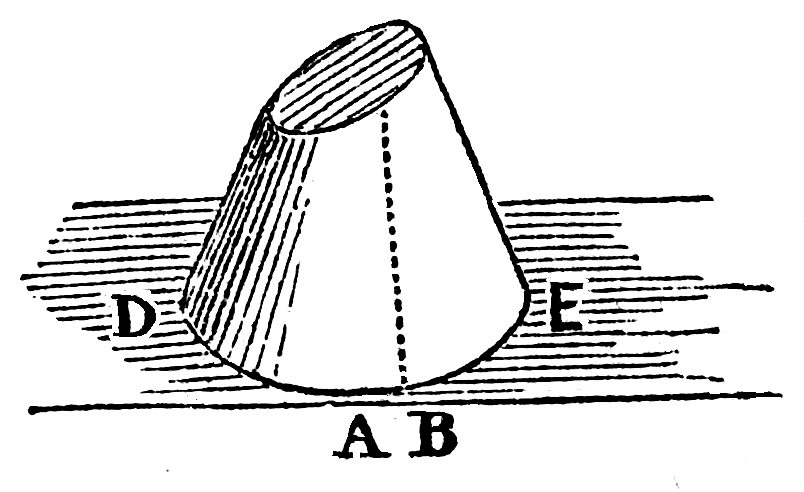
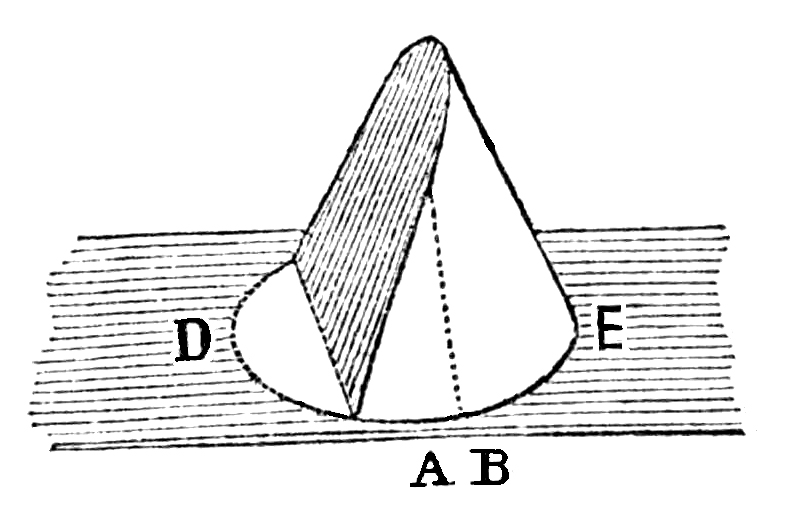
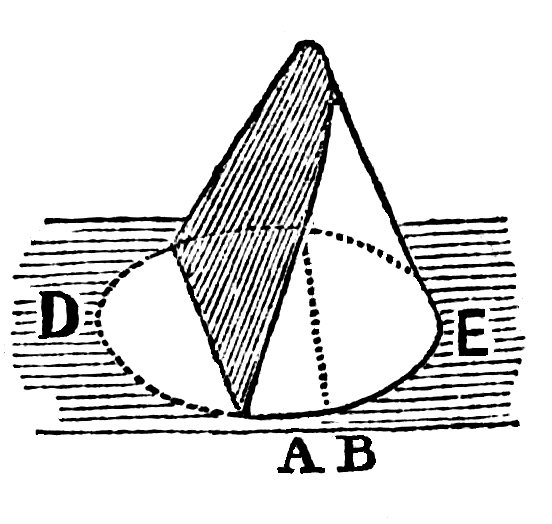
6. Cut the cone by a plane parallel to one side of the cone, and the cut surface will be a parabola.
7. Cut the cone by a plane making a smaller angle with the centre-post than the sides do, and the cut surface will be an hyperbola.
8. Now, if you will turn back and read chapter [Pg 132] XXXIV., section eight, again carefully, you will see that the shadow of a ball is part of a cone in the air, with the vertex or point of the cone in the blaze of the lamp, and that the flat table is a plane that makes conic sections of the shadow.
9. If you were to bend the pasteboard cone, so as to make D E some other shape than a circle, the cone would no longer be a right cone. A right cone has a circle for its base, and the vertex of the cone is directly over the centre of the base.
1. If a circle should spin round on one of its diameters, the circumference would enclose a space called a sphere.
What is the geometrical name for a perfectly round solid? What do we call a solid body that has the form of the geometrical solid? What examples of balls or globes can you give me? How must a circle move to have it describe a sphere? What shape is the section of a sphere by a plane? What is a great circle on a sphere? How large is the surface of a sphere?
How large is the solidity of a sphere? What is the largest body of all having the same surface? Into what shape must I pack anything to make it expose least surface? If you have studied any arithmetic, you may now tell me how to calculate roughly the circumference, the surface of a circle, the surface of a sphere, and the solidity of a sphere, when you know the diameter. How shall we calculate the same more exactly? How still more exactly? Is there anymore Geometry to be learned than what is taught in this book? Are there any new things yet to be discovered in Geometry? Should you like to learn more about it when you grow older?
[Pg 133] 2. Solid bodies in the shape of a sphere are called balls or globes. The marbles with which boys play, are usually very perfect globes. A soap-bubble blown thin, and free from any hanging drop of suds, floating in still air, is a very perfect sphere.
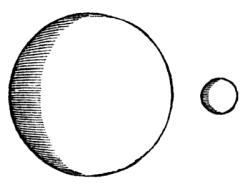
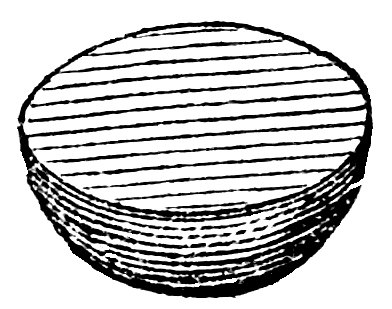
3. Cut a sphere by any plane, and the cut surface will be a circle.
4. When the plane goes directly through the centre of the sphere, the circle thus made is called a great circle of the sphere. All great circles in a sphere are of the same size as the circle which we imagined spinning to create the sphere.
5. The diameter of the great circle is called the diameter of the sphere, and the radius of the great circle is called the radius of the sphere.
6. The surface of the sphere is exactly four times the surface of a great circle. A ball three inches in diameter would take as much leather to cover it as would make four circles, each three inches in diameter; or one circle six inches in diameter. [Pg 134]
7. You remember that the measure of a circle is found by multiplying the square of its diameter by one quarter of π. As the surface of the sphere is four times as great, it is found by multiplying the square of its diameter by π itself. The surface of a ball three inches in diameter, for instance, will be nine square inches multiplied by π.
8. The solid measure of a sphere is found by multiplying the cube of the diameter by one sixth of π. The cube of the diameter will just enclose the sphere, and each of the six sides of the cube will be a tangent plane to the sphere.
9. For roughly judging of circles and spheres we call π about three. That is to say, a circumference is a little more than three times the diameter; a circle is a little more than three fourths of the square on the diameter; and a sphere is a little more than half the cube on the diameter.
10. To be more exact, we call π twenty-two sevenths. That is to say, a circumference is twenty-two sevenths of the diameter; a circle, eleven fourteenths of the square on the diameter; and a sphere, eleven twenty-firsts of the cube on the diameter. [Pg 135]
11. To be still more exact, we call π, 3·1416. That is to say, to find the circumference, multiply a diameter by 3·1416; to find the size of the circle, multiply the diameter by itself, and then by ·7854; and to find the contents of a sphere, multiply the diameter twice by itself, and then by ·5236.
12. As the circle is the largest of isoperimetrical figures, so the sphere is the largest of all bodies having the same amount of surface. If you roll a piece of putty into a round ball, it will have less surface than it could have in any other form.
13. But I think I have made my book long enough. I hope you have liked it, and I hope that at some time you will study more Geometry, and learn how to prove the truth of all I have told you. You will then find that there is a great deal to be learned about what men already know of Geometry, and that there is a great deal that is not known, at least by any man. Of course, the great Creator, who has made all things in number, weight and measure, knows everything. And the more we know, the more clearly we shall see how great is His knowledge, how wonderful his [Pg 136] wisdom, and how beautiful the manner in which he has used what we call Geometry in the forms he has given to all things on the earth or in the sky.
THE END.
[Pg 137]
The chapters referred to may not always furnish a direct answer or solution; but they will always suggest the true solution, which is not always to be reasoned out, but is to be seen by the mind’s eye. Similar questions can be multiplied indefinitely by a skilful teacher.
Chapter iii.—What is the best way of making a garden-path straight? How does a carpenter mark a long straight line? How will you make a short straight line on paper? The railroad from my house to Boston is about nine miles long, the carriage-road about eight; which is more nearly straight? In travelling the carriage-road to Boston I cross the Fitchburg railroad only once. I am on the north side of it at starting; when I get into Boston, on which side of me must I look for the dépôt? But I cross the Worcester railroad twice; on which side of me shall I look for the dépôt of that road? If Boston lies exactly east of my house, how can I manage to drive my horse there without having his head once turned exactly to the east? Can I do it without having either head or tail turned to the east?
[Pg 138]
Chapter vi.—Suppose a straight stick is made to turn upon a pin thrust through the middle of it, which end will move the faster? (Neither.) Which end will alter its direction most rapidly? If the pin is thrust into a straight line that will not move, such as a crack in the floor, which end of the stick will make the larger angle with the crack?
Chapter v.—If I hang two plumb-lines from the ceiling, from nails that are just one foot apart, how far apart will the lines be six feet below the ceiling?
Chapter vi.—In a triangle whose sides are three, four and five inches, which is the largest and which the smallest angle? If a leaning pole makes an angle equal to one third of a right angle, with a plumb-line, what angle does it make with a level line passing through the foot of the pole and under the bob hung from its summit? What angle will it make with any other level line passing through its foot? What angle will the pole make with a level line passing through its foot, at right angles to one passing from the foot under the bob?
Chapters vii., viii., ix.—Suppose that I set a stake seven feet high in a level piece of ground, and measure its shadow and the shadow of other things on level ground as follows: When the shadow of the stake was ten feet, that of the house was thirty feet; when that of the stake was nine feet, that of my poplar-tree was forty-one; when that of the stake was eight, that of my cherry-tree was twenty-six; when that of the stake was six, that of the church-steeple was one hundred and twenty-one. What is the height of the steeple, poplar-tree, cherry-tree, and house? [Pg 139]
Chapter x.—I have one post and two rails to make a fence to keep the cattle from a young tree that has sprung up by the fence in my pasture; how shall I make the largest pen for it? Another tree stands in the middle of the field; my only materials, for making a defence around it, are three posts, one rail, and a piece of rope longer than the rail. In what is the largest triangle I can make?
Chapter xi.—How large is each angle in an isosceles right triangle? How many such triangles will it take to make a square? What does a carpenter mean by a mitre-joint? Do you know how a carpenter makes a mitre-joint?
Chapter xii.—If, in a field with four straight sides, we find all the sides of the same length, what may we know about the angles? If, in such a field, we find the sides all equal, and two of the adjacent angles equal, how large is each angle in the field? and what do you call the shape of the field? I have seen braces that were of no use. What is the proper way to make them? There is another use of three points not exactly like this. Why is a three-footed table sure to stand steady?
Chapters xiii. and XIV.—How many yards of painting on the side of a house forty-two feet long and twenty-one feet high? How many square inches in a pane of seven by nine? How many in a pane of eight by ten? How many feet of land in a lot with two sides of eighty feet each and two of thirty-nine feet each, if the angles are such that the eighty feet sides are only thirty-five feet apart? How do you know that this lot is a parallelogram?
Chapter xv.—How many feet of land in a triangle whose sides are thirty, forty and fifty feet? How many in a [Pg 140] triangle whose sides are twelve, five and thirteen feet? How do you know that these triangles are right triangles? Suppose that a quadrangle has sides of three, four, twelve and thirteen feet, and that the sides of three and four feet join in a square corner, how many feet of land does it include? How do you know that this quadrangle can be divided into two right triangles?
Chapters xvi. to XXI.—If I have a piece of the felloes of a wheel and want to find out how large the whole wheel is, what shall I do? How would you lay out a garden-path in a circle? How would you make two paths at right angles to each other? How will you make a circle on the blackboard? How will you make two paths run at an angle of sixty degrees with each other? If a steamboat’s tiller is lashed fast in any position, in what curve will the boat run? How will you make the circle larger? If there is a circle drawn on the blackboard, how can I draw a tangent to it at any particular spot in the circumference? There are four ways, one from XX. 7, one from XX. 8, one from XXI. 5, and one from XIX. 7. These ways have their special advantages and disadvantages. Point them out.
Chapters xxii. and XXIII.—How shall I find a point at an equal distance from three given points? How can you find the place that is equally distant from three of the corners of this room? How can you find a spot equally distant from the east side, the south side, and the diagonal of the room that runs south-west? What three kinds of polygons with equal sides and equal angles can be laid together like bricks in a pavement, and fill up all the space?
Chapters xxiv. and XXV.—Suppose the earth to be eight thousand miles in diameter, what is its circumference? What is the [Pg 141] length of an arc of seventy degrees in a circle of one foot radius? Which weighs most, a square sheet of tin eleven inches on a side, or a round piece of the same thickness thirteen inches in diameter? If a sheet of tin four inches square weighs an ounce, what will a sheet a foot square weigh? What will a circle ten inches in diameter weigh? What is the difference between a piece of land four rods square, and a piece of four square rods? What is the difference between a foot square and a square foot? If a church-spire is one hundred and twenty feet high, how much more paint will it take to paint the church than to paint a model of it, with a spire twelve inches high? Is a square foot of sheet-lead necessarily in a square form? What proportion in the cloth required to clothe a man five feet high, a man five feet ten inches, and a man six feet, supposing the three men to be of the same form, and dressed in the same fashion?
Chapters xxvi., xxvii., xxviii.—How far does the head of a spike in the tire of a wheel four feet in diameter travel while the wagon goes four miles on a level road? What is the radius of curvature of its path when it is at the top of the wheel? When it is two feet from the ground? When it is one foot from the ground? A pendulum-bob swings in an arc of a circle; how, from XXVIII. 4, can you devise a plan to make it swing in the arc of a cycloid? What is the shortest path from one point to another? Is the shortest path always quickest? When is it not, for whom or what is it not, and why not?
Chapters xxix. and XXX.—In a machine called a photometer, a bead is placed on the rim of a wheel rolling inside of a [Pg 142] hoop of just double the diameter; in what path does the bead move? In a railroad curve the cars cannot turn if the radius is too small; what objection to joining two straight tracks which are at right angles to each other by a curved track marked out by drawing many lines of equal length across the corner?
Chapter xxxi.—If a rope weighs one pound for each yard, and I tie one end of it to a staple in the wall, how hard must I pull horizontally in order to make the radius of curvature ten feet at the lowest point of the rope? How hard to make the radius of curvature twenty-one feet? One hundred and eight feet? What is the radius of curvature of a straight line? How hard must I pull horizontally to make the rope straight? If a chain, weighing two pounds to the yard, hangs between two posts of the same height, and the curvature of the chain in the middle has a radius of five feet, with what force does it draw in each post? What if the radius is thirty feet? If a piece of thread weighs at the rate of an ounce to a thousand feet, what horizontal force is required to make the radius of curvature a mile long? But what to draw the thread straight? In answering any of these questions on chapter XXXI., does it make any difference how long, or how short the rope, chain or thread, is?
Chapters xxxii., xxxiii., xxxiv.—What is the path of a rifle-ball in the air? Can it then ever go straight to its mark? Can you fancy the shape of the evolute of an ellipse? If a hypocycloid of four arches be used as an evolute, but the string is taken on two opposite sides long enough to wrap round the whole arch, [Pg 143] and on the other sides of no length, what sort of a curve would it produce? (An oval, but not an ellipse.)
Chapter xxxv.—What shape must a mirror be to act as a burning mirror by bringing the sun-light to a point? If a piece of a hollow sphere is used, at what distance from it will the imperfect point of light be formed? If you stand in the centre of a field bounded by a circular fence, where will the echo of your voice sound loudest? If the walls of a room are in the form of an ellipse, and a man stands in one focus and speaks, where will the echo sound loudest? If a paraboloid reflector were placed behind the whistle of a locomotive, what effect would it have on the sound?
Chapter xxxvi.—A man is said to have borrowed a heap of peat-mud, which was stacked in a cubical form, four feet on a side, and to have returned two heaps, each a cube of three feet on a side. Did he make a just return? What is the proportion between the length of a hogshead holding one hundred and twenty-five gallons, and a keg holding one gallon, if they are of the same shape? If the smallest of the three men mentioned on page 141, weighs one hundred and fifty pounds, what do the others weigh? If a man five and a half feet high weighs one hundred and sixty pounds, and a man three inches taller weighs one hundred and eighty, which is stouter in proportion to their height?
Chapter xxxvii.—Suppose a pole fastened at the end of a horizontal revolving arm. If the pole lies horizontal, it keeps in a horizontal plane; if it is vertical, it describes the surface of a vertical cylinder. But if it inclines towards the [Pg 144] centre-post about which the arm revolves? If it inclines, but not directly toward the centre-post? Cut such a hyperboloid surface by a horizontal plane, and what will the section be? Cut it by a vertical plane, what will the section be? What changes as you move the vertical plane to and from the centre of the figure?
Chapter xxxviii.—How many cubic feet of gas will fill a round balloon seven yards in diameter? How many yards of silk three quarters of a yard wide will it take to make such a balloon? If the earth were eight thousand miles in diameter, and a perfect sphere, what would be the number of square miles of its surface? Of solid miles in its contents? To how many balls thirteen inches in diameter would it be equivalent? How many tons would it weigh, if it were all water, one thousand ounces to a cubic foot? How much if three and one half times that weight?
Footnotes:
[1] Īsọpẹrĭm’ẹtrỵ.
[2] Īsọpĕrịmĕt’rịcạl.
[3] Pẹrĭm’ẹtẹr.
[4] Īsŏs’cẹlēs.
[5] Oblēk’.
[6] Pyrī’tēs.
[7] Ĕpịsī’clöĭd.
[8] Hĭpọsī’clöid.
[9] Căt’ẹnạry.
Transcriber’s Notes:
Deprecated spellings or archaic words were not corrected.
The illustrations have been moved so that they do not break up paragraphs and so that they are next to the text they illustrate.
Typographical and punctuation errors have been silently corrected.