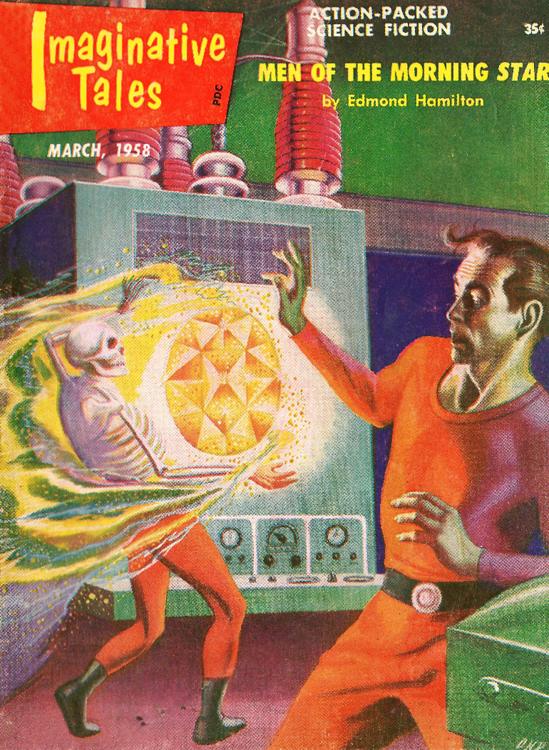
Transcribed from Imaginative Tales, March 1958 (Vol. 5, No. 2).
Title: Decision final
Author: Robert Randall
Illustrator: Lloyd Rognan
Release date: November 8, 2026 [eBook #79946]
Language: English
Original publication: Evanston, Illinois: Greenleaf Publishing Company, 1957
Other information and formats: www.gutenberg.org/ebooks/79946
Credits: Tom Trussel - Stories of Futures Past (This file was produced from images generously made available by The Luminist Archive)
Transcribed from Imaginative Tales, March 1958 (Vol. 5, No. 2).
by Robert Randall
[Pseudonym of Randall Garrett & Robert Silverberg]
The Machine was running the city and everyone respected its orders. But the real question was:—Who was running the Machine?
The notification came thudding out of the wall-slot that connected Grey Harkness’ one-room dormer with the giant computing machine which governed Appalachia City. Harkness grabbed the slip of paper eagerly, ripped off the seal of the computer, unfolded it, read.
Joy turned to desperation.
It said:
HARKNESS, GREY 432-j1603—
Be advised that your petition for marriage permit, taken out jointly with Smithson Joanne 321-k-1872 is herewith denied on grounds of incompatibility, and any marriage between you and Smithson Joanne will be prohibited.
Numb, he let the official form slip to the floor. A confused mixture of emotions bubbled up in him—anger, rage, despair, above all hatred for the computing machine that had so coldly and so permanently barred him from the girl he loved.
There was no sense appealing the verdict. The Machine never reconsidered.
He flipped on the visiphone and punched Joanne Smithson’s keynumbers. The numbers were routed through the vast circuits of the Machine; seconds later, Joanne’s face appeared on the screen. Her blonde hair was uncombed, her light-blue eyes red-rimmed with tears. Harkness stared at her for a minute, not knowing what to say.
Finally she spoke first. “Did you get the notification from the Machine?”
He nodded. “It just came. Flat no. Incompatibility, they said.”
“That’s what my paper said too. Incompatible.”
Harkness scowled. “It can’t be true! How can that machine know or not know who’s incompatible? Darling, I love you! What does a bunch of electronic circuits know about love?”
Joanne’s face looked set, resigned. She said, “The Machine is wiser than all of us, Grey. If it says we’re incompatible ... I guess ... it must be right ... Even if we don’t believe so ourselves.”
Her voice trailed off faintly. Harkness shook his head; he couldn’t bring himself to share Joanne’s blind faith in the machine’s judgment. “There must be something we can do! The Machine can’t keep us apart!”
Joanne looked very pale. “I ... received a second notification this morning. It ... it was a marriage license.”
“A what?”
“The Machine has decided to assign me a mate,” she went on, in a level, flat voice. “He’s Henry Kerston. The marriage is supposed to take place in four days. I have to go to the Brides’ Dormitory tonight and stay there until the wedding.”
Harkness felt what little was left of his world shatter and crash to pieces about him. “Kerston? No—it’s impossible. Stay right there, Joanne. I’ll be coming over to see you. We’ll figure this thing out.”
“Grey—”
But her tentative protest was cut off by the whirring of the arrival slot behind him. “The Machine’s got another message for me,” he said. “Maybe the whole thing’s been cancelled as an electronic error. Or”—his voice became dark—“Maybe I’ve been assigned a mate too.”
He opened the new message and read it aloud.
“HARKNESS, GREY 432-j1603—
“Be advised that as of 0900 this morning you have been declared an enemy of the State and are to report immediately to your local Communication Center for interrogation. Any violation of this order will be met with punishment.”
Joanne’s expression was one of fear and shock. She said, “Grey! What have you done?”
“Nothing—unless you call thinking violent thoughts about the Machine a criminal offense. There’s something funny about this, something rigged....”
“The Machine can’t be wrong, Grey.”
“No,” he said. “But maybe it can be mistaken.” He looked at his watch. It was 0910. He was going to have to move fast to avoid the police-robots.
Ten minutes later the copterbus let him off outside the vast residence-hall where Joanne lived. He dashed into the lobby, punched out her number on the lobby screen and waited. Moments later her face appeared.
“Grey! Why have you come here?”
“I have to see you,” he said. “I’m coming up.”
She started to shake her head, then said with obvious reluctance, “Well—all right.”
She met him at the door when he stepped out of the lift tube on the 63rd floor. She was wearing a clinging synthoplast negligee which left little to the imagination. Harkness kissed her as he entered. It was something he had done a thousand times but now there was a reserve, an unwillingness in her response that troubled him.
Inside her tiny apartment he whirled to face her. “Joanne, I don’t know why the Machine has picked us to bring all this trouble to. But I mean to fight back.”
“Fight the Machine?” Conflict was evident on her pale face. “Grey, don’t be insane. The Machine protects us, it regulates our lives, it—”
“It keeps me from marrying you!” he snapped tightly. “Joanne, don’t you see that your blind loyalty to the Machine is going too far? Sure, the Machine’s a wonderful thing—the first impartial, incorrupt government man has ever known. But how do you know the Machine’s still impartial? Suppose Henry Kerston arranged this whole thing? He’s a Machine technician and I know he’s wildly jealous because you love me. It might not be hard for him to fix things so the Machine rejects our application, assigns you to him, and declares me a criminal!”
“I can’t believe that,” she said. But there was doubt in her voice. “Darling, I still feel the same way I always did about you and the idea of marrying Henry Kerston almost sickens me. But if the Machine says so....”
Harkness pummelled his palm with his fist. “The Machine! The Machine! Can’t you think for yourself, Joanne? There’s still time. Let’s get away from Appalachia, away from America, even. There are places that aren’t ruled by computing machines. We could live there ... together.”
“I’d never be happy, knowing I had run away.”
He shook his head bitterly. The Machine had ruled mankind 150 years; the idea of defying it was incomprehensible to her, it seemed. “Maybe the Machine’s right,” he said. “Maybe we are incompatible. Otherwise you’d drop everything and run with me.”
She smiled coldly. “The Machine is right, Grey. I still love you ... but if the Machine says our marriage wouldn’t work out, I believe it. It takes a long-range view. We love each other now but how will it be in 30 years? The Machine knows best.”
He saw the futility of trying to argue with her—indeed, of doing anything. He was on the verge of reporting to the Communications Center and turning himself in when the room screen suddenly blared into life.
“Harkness Grey 432-j-1603! Are you in there?”
Harkness looked around wildly for a place to hide.
But the screen went on, “You needn’t be silent, Harkness Grey. You have been traced. We know you are there. The building will be surrounded by pursuit-robots. Please surrender quietly, Harkness Grey. Do not cause a disturbance.”
“One last chance,” Harkness whispered to the girl. “Will you come with me? I’m going to try to escape.”
“Sorry, Grey. I believe the Machine knows what’s best. But ... I still love you, anyway. I won’t forget you.”
“Thanks,” he said sarcastically. Suddenly angry, he turned, avoiding the kiss she offered him, and yanked open the apartment window.
“Grey! What are you going to do?”
“Escape,” he said.
Behind him, the blaring of the screen continued. “Harkness Grey! Do not remain silent! Avoid unnecessary disturbance in effecting your capture!”
“So long, Joanne,” he said, and climbed through the window.
He stood for a moment on the broad window-ledge, carefully not looking down. Then he began to climb. The building was heavily encrusted with chrome, in the contemporary architectural style. Harkness thought the chrome ornamentation was hideous but now he was grateful to whatever architect had built so many handholds into the building’s skin.
Minutes later he reached the roof and paused there, drenched with sweat. He knew the pursuit-robots were buzzing around the base of the building, perhaps even on their way up to Joanne’s apartment to apprehend him. Maybe they wouldn’t think of looking for him up here.
The roof was clear, a wide, flat expanse. Harkness glanced up to make sure no police copters hovered above.
It took nearly a minute to cross the surface of the roof. He arrived at the other side and peered down into the gulf that separated the building from its neighbor.
The street below was filled with gleaming metallic dots. At this distance they looked like angry beetles but they were the Machine’s pursuit-robots. Pretty soon, discovering him gone, they would come swarming up to the rooftops after him. But by that time he hoped to be—
Where?
He didn’t know. His only way out was to keep running. Seven or eight buildings spread out before him, their roofs roughly at the same level. If he could make it across the rooftops to the end of the block and down and, out of sight before the robots arrived—
He bunched his thigh-muscles and leaped. There was a six-foot gap between Joanne’s building and its neighbor, and a two-foot drop. He made the jump easily, kneeling as he landed to absorb the shock. He had to keep going.
Ahead of him a skylight opened. A figure some four feet high, its skin a glowing bronze color, emerged and goggled at him.
“We order you to halt!” the pursuit-robot commanded. “Harkness Grey, you are under arrest!”
There wasn’t time to debate the situation. Harkness ran forward, straight at the robot, and bowled it over. Pursuit-robots in themselves weren’t very powerful; it was just when a group of them snared you that you were stuck. The robot fell, sputtering and growling, and Harkness kept running.
Five more of the robots appeared on the next roof and began advancing toward him.
He froze, not knowing which way to go. He was trapped!
The robots would not kill except under extreme provocation, which meant threat of destruction. He debated charging into their midst and trying to knock them off the roof but he saw he could never cope with five robots at once. They had him now.
The sound of a copter’s whirring rotors came from above. Surrounded?
No!
A ladder dangled. A voice shouted, “Come on, Harkness! Let’s go!”
The pursuit-robots were drawing near. Harkness looked up and could see no one in the copter’s cockpit. Shrugging, he grabbed the dangling ladder. He was drowning; someone had thrown him a straw.
He started to climb. Halfway up the robots began firing their stunguns. One shot caught the heel of one foot and numbed it; desperately he pulled himself up into the copter and lay there, gasping in air.
The voice said, “Okay, Harkness. Away we go!”
He looked up. The copter was completely empty. It sprang up from its hovering position and, moments later, the rooftops of Appalachia City were just blurs in the hazy distance.
After a few minutes Harkness rose and unsteadily made his way up fore to the copter’s cockpit. His left foot ached mercilessly; it would be three or four hours before the effects of the stray stunbeam wore off.
He entered the cockpit, dropped into the empty pilot’s chair and said, “What’s the game? Who’s running this copter anyway?”
The voice he had heard before said, “My name is Lee Fletcher. I’m speaking to you from Canada.”
“Canada?”
“Northern Ontario, to be precise. There’s a colony of us here—outcasts from Appalachia City and other machine-dominated regions.”
Harkness began to understand. “I guess I owe you thanks, then. You got your copter there just in time.”
“I followed the whole thing on remote video,” Fletcher said. “We couldn’t risk coming down to pick you up ourselves—but with this remote-control operation of the copter we didn’t need to.”
“How’d you know about me?” Harkness asked. The copter, jets blazing, was streaking rapidly northward.
“We have contacts in the Machine’s trust. They let us know whenever someone gets in the kind of trouble you got in. We’ve snatched more than one fugitive from the pursuit-robots this way.”
Harkness fell silent. He looked around but no police copter pursued. After awhile the throbbing in his foot began to lessen and he relaxed, letting the pilotless copter carry him further and further away from Appalachia City—and Joanne.
Lee Fletcher turned out to be a short, rotund individual in his late forties, cheerful, friendly, warm. He was one of the first persons Harkness met upon descending from the copter. The colony was well protected—hidden by overhanging trees and guarded by a radar net. If attack threatened these people would be ready.
“You’ll have at least two rooms to yourself up here,” Fletcher said. “Unlike conditions in Appalachia City. We have plenty of room. And there’s no computer at all—at least, none telling us what to do.” “I’m sure I’d like it here,” Harkness said. “You’ve been very nice to me in the three hours I’ve been here. But I can’t stay.”
“What?”
“No. I’m grateful to you for rescuing me but I left some business unfinished in Appalachia City. There was a girl....”
“I know. If she had been on the roof with you we could have brought her along also. But there was no way we could manage that.”
“She wouldn’t have wanted to come,” Harkness said. “She’s loyal to the Machine. Loyal to the point of being willing to marry this Henry Kerston if the Machine tells her to. But I’m not giving up. If I could prove to her that the Machine’s been tampered with as you say it has....”
“You’d have a hard time proving it,” said Fletcher. “Why don’t you stay here, Harkness? There are women here—women who don’t have any false illusions about the Machine. If you return and they catch you we won’t be able to rescue you a second time.”
“I know. But you don’t seem to understand one thing. I love this girl. She loves me. But she’s willing to sacrifice herself to the Machine’s wishes because she honestly thinks the Machine knows best. If I could show her her mistake—”
Fletcher sighed. “You’re a stubborn man,” he said. “But I admire stubbornness. The copter’s at your disposal any time you want to return to Appalachia City.”
“Thanks,” said Harkness. He rose and gripped the other’s hand. “I’ll leave at once—and thanks for the meal and the rescue and everything else.”
“Sure.”
Harkness grinned. “And I’ll promise you something right now. I’ll be back. We’ll be back. Soon.”
“I hope so,” Fletcher said.
Dark clouds of night were dropping as Harkness made the lonely journey back to Appalachia City. Fletcher guided him in by remote control; he didn’t have to touch a knob the whole journey. The copter slipped into the city under cover of night.
“Where are we now?” Harkness asked.
“Over North Appalachia City. Where do you want me to drop you?”
“Leave me on the rooftop at 1016 Center Boulevard. I can manage from there. When I want you again I’ll use the signal-crystal you gave me.”
“Right.”
The copter dipped, dropping vertically in the darkness of the night. Harkness patted the equipment bulging in his hip pocket. If he could only avoid capture for the next few hours he could solve his problems.
The copter came to a precise halt on the building’s flat roof. Harkness jumped out, landing lightly; the copter’s rotors whirred and the vehicle started to rise.
Harkness turned back, waved once at the pilotless copter, and watched it vanish into the cloudy, moonless night.
Then he began to grope across the roof for the skylight.
Henry Kerston’s apartment was on the 58th floor—Room 5803, unless memory failed. As a computer technician he rated a two-room apartment.
Harkness lowered himself through the skylight, hung for a moment, dropped. The sound of his fall echoed through the building’s halls and he crouched, drawing the blaster Fletcher had given him, looking around. He grinned. Certainly the Machine would not be combing every square inch of Appalachia City for him every hour of the day. Too much caution was foolish.
But he would not trust himself to the elevator. There might just be a police-robot in there and in such close confines he’d have trouble getting free. He made his way down the stairs, floor after floor until a glowing 58 appeared on the landing ahead of him.
He turned off at Floor 58 and tiptoed down the quiet corridor to Room 5803. A neat placard on the door said:
The time was 0200; Kerston was probably asleep. There was no point in ringing the doorscreen, either. Once Kerston saw Harkness’ face he’d never be admitted. Instead Harkness trained his blaster, on low-beam, on the lock. Bathed in flame, it grew beet-red, went soft. Harkness cut off the beam and nudged the molten lock out with the butt of his blaster. Then he pushed the door open.
A bodyguard-robot stood just inside the door, quiescent. Despite his surprise Harkness managed to put a bolt through the robot’s control centers before it could move. The lights went on. Kerston sat up sleepily in bed, blinking, staring at the ruins of the bodyguard-robot.
“What the hell is this? Who are you?”
“Take a good look,” Harkness said, keeping the blaster trained levelly at Kerston’s head. “I think you know me.”
The sleepiness left Kerston’s face. He said, “You’re Grey Harkness. There’s an all-city alarm out for you. What are you doing here and what do you want? Trying to get in even more trouble?”
“So far the only crime I’ve committed is breaking and entering and I did that just now.” Harkness perched himself comfortably on a webchair facing Kerston’s bed and waggled the blaster. “I came to talk to you. I hear you’re getting married, Henry.”
Kerston’s jaw tightened. “So?”
“You happen to be getting married to my fiancee.”
“Wrong. She’s not your fiancee any longer. I know that the Machine turned down your application for a marriage permit with Joanne. And simultaneously it selected me as her mate. I’m very happy to say we’ll be married in three days.”
“The Machine said Joanne and I were incompatible,” Harkness said coldly. He studied Kerston’s scrawny’ form, his thin features and beak-like nose. “And I suppose you and she fit together like this.”
“Maybe. The Machine said so.”
“I don’t think so, Kerston. This is too neat, too slick and pat for the Machine to have done it. Let me tell you what really happened.
“When my application for a permit came to the Machine, it was sent to you for filing. Being a computer tech, you took advantage of your status to monkey with our data. You made it look as if we were incompatible—and then you finagled things so you would be named to marry Joanne. To top it off, you manufactured some trumped-up charge against me that would keep me on the run until the marriage could come off. Eh?”
Kerston was grinning nervously at him. “I suppose I should indignantly deny your charges,” he said. “But since you’re a madman who’s probably going to kill me anyway, I might as well tell you that you’re absolutely right. I’m guilty of every single one of the false manipulations you accuse me of. Well? Are you going to shoot me now?”
Harkness laughed triumphantly. “I wouldn’t waste a blaster-beam on you, Kerston. Killing you is the last thing I’d do. No. I’m simply going to the Machine and turn in the tape I’ve been making of this conversation. Let the Machine know it’s been tampered with. I’m confident that the Machine will see that justice is done.”
It was Kerston’s turn to laugh now—a low, malicious, sardonic chuckle. “Go ahead, Harkness. Take your silly tape to the Machine! You deluded fool!” Leaning forward in bed, eyes fixed intently on the snout of Harkness’ blaster, Kerston said, “The Machine was taken over by a group of technicians, including myself, three months ago. We destroyed the main control center and have been operating the Machine ourselves. Go: report to the Machine. See what happens when you hand in your tape!”
Kerston’s taunts sank in. Harkness’ fingers tightened on the blaster but he kept from firing. Killing Kerston would accomplish nothing.
Sweat drenched him. The idea of the Machine being operated by a cabal of computer techs stunned him. Kerston and his cronies held all Appalachia in the palms of their hands!
It meant a slight alteration in strategy, thought Harkness, but in a way it made things easier. He left his chair and bound Kerston securely with tanglecord.
“You’ll stay put for a while, I think.” Keeping the blaster trained on him, Harkness backed out of the room and into the silent corridor.
Women who were about to be married spent their last few days of maidenhood in The Brides’ Dormitory, a blocky building on West 324th Street. There they were educated in the ways of the State and prepared for marriage.
Grey Harkness entered the main pavilion of the Dormitory at three in the morning, after a long and tiring cross-city trot. He couldn’t risk taking a public conveyance; instead, he had skirted along quiet side streets and through back alleys, crouching out of sight at the approach of a police-robot.
A robot sat at the desk, staring outward at nothing in particular. Concealing his blaster, Harkness said, “Is there a Miss Joanne Smithson living here?”
“Incorrect form.”
He scowled. “I’m looking for Smithson Joanne 321-k-1872. Is she here?”
“Yes. She checked in a little while ago.”
“I’d like to see her.”
“Impossible. Brides-to-be must remain in complete seclusion. Besides, she’s asleep.”
“That doesn’t matter,” Harkness snapped. “What room is she in?”
“It is impossible for anyone....” The blaster appeared. Instantly the robot reacted, going for a weapon of its own, but Harkness moved faster. He drilled a sizzling hole through the robot’s control centers. The synthetic creature slumped.
Quickly Harkness leaped over the desk railing and snatched out the directory. Not much time remained to him. He thumbed through it and found Smithson Joanne. She was on the 43rd Floor, in Wing A.
He raced within and found an empty elevator. Stepping inside, Harkness pressed 43. Wing A turned out to be a sprawling corridorway lined with rooms on both sides. Only a dim night-light burned in the hall. Moving rapidly, Harkness went from door to door until he found the one marked Smithson Joanne. It was locked. He blasted open the door.
Joanne was asleep. Nude, she lay atop her covers, a hypnotic learning-mech strapped to her temples.
Gently Harkness woke her. “Joanne! Quiet—it’s me—Grey!” She woke, startled, and snatched the covers around her.
“You’re not allowed here! Get out!”
“Darling—don’t make noise. I came here to rescue you.”
“You’re a criminal,” she said bitterly. “I don’t want to see you again.”
Ignoring her remark, he took the pocket tape-recorder out. “I just paid a visit to your fiance, Henry Kerston. He said some very interesting things, and I taped them.”
“Get out!” She looked very pretty when she was angry, Harkness thought. She was trying to maintain her dignity even though she was nude under the thin wrap; it wasn’t easy. He pushed the playback stud. Kerston’s voice said, “What the hell is this? Who are you?”
Before it was over, she was sobbing. He let the tape run its course.
“The Machine ... run by technicians! How horrible! And I was willing to abide by its decision!”
“Don’t feel guilty, Joanne. You were acting according to what you thought was right. You had no reason to mistrust the machine and if it said Henry was to be your mate and not me, you accepted it.”
“What do we do now?”
“There’s a place in Canada where there isn’t any Machine—where men are free to govern themselves. All I have to do is use a signal-crystal and a copter will pick us up wherever we are.” As she dressed he said, “We’ll have to climb to the roof. I shot a robot in the lobby and they probably have it cordoned off by now.”
They were only 10 flights from the roof and they used the stairs. Joanne was panting by the time they arrived. Harkness drew the signal-crystal from his pocket and activated it. “Fletcher’s copter will be here any minute,” he told her.
“I can’t wait. Darling, I’m so sorry for everything I’ve said and done since this started....”
“There they are!” a cold voice said behind them. Harkness turned and threw Joanne to the ground with one quick shove. Three figures were emerging from a secondary skylight at the far end of the roof. Harkness hefted his blaster. One of the three was unmistakably Kerston; the other two were robots. Dropping to his knees, Harkness fired. One robot dropped. The blue ray of a stunbeam passed overhead and then Harkness dropped the other robot. Kerston dodged out of sight behind an upjutting stanchion.
“Give up the girl,” Kerston shouted. “I know you’ve got her there, Harkness. If you harm her I’ll have you flayed. This place is going to be full of police-robots any minute. I’ve been following you ever since I got loose.”
Harkness scowled. There was no sign of Fletcher’s copter—and Kerston probably wasn’t bluffing when he said the police-robots were on the way. He couldn’t risk a gun-battle, either—not with Joanne up here. This time he was really trapped. No way to escape, no bluffs possible.
“We’re stuck,” he said to Joanne. “Go—go back to him. I’ll hold them off as long as I can.”
She looked up at him and smiled warmly. Then she said, loudly, “Let me go back to Henry, Grey. I’m sure all the things you claim are lies. Don’t keep me here against my will.”
He stared at her. “Okay. Go back to him.”
She rose and ran across the roof to where Kerston hid. “Don’t shoot, Henry darling. It’s me—Joanne. He’s out of his mind, isn’t he?”
“Of course—the madman,” Kerston said. “Come here.”
Harkness was unable to see what was happening but he heard the sound of a kiss. Then a sudden hoarse yell, followed by a long, gradually—dying wail. He saw Joanne racing back across the roof toward him. Her face was pale; she looked sick. “I ... had to kiss him,” she said. “But he won’t bother us any more. I made up my mind.”
A dark shape hovered above them. Fletcher’s voice said, “Better hurry up, Harkness. There’s a bunch of police copters on their way. I can outrace them if you get aboard now.”
He boosted her up, and followed her in. Moments later, they were cutting a blazing trail across the night sky. Some day—someday soon, Harkness promised himself—he would return and help to free Appalachia City of the Machine. But for now he had Joanne and would have her always.
This etext was produced from Imaginative Tales, March 1958 (Vol. 5, No. 2). Extensive research did not uncover any evidence that the U.S. copyright on this publication was renewed.
Obvious errors have been silently corrected, but minor inconsistencies have been retained as printed.
New original cover art included with this eBook is granted to the public domain.