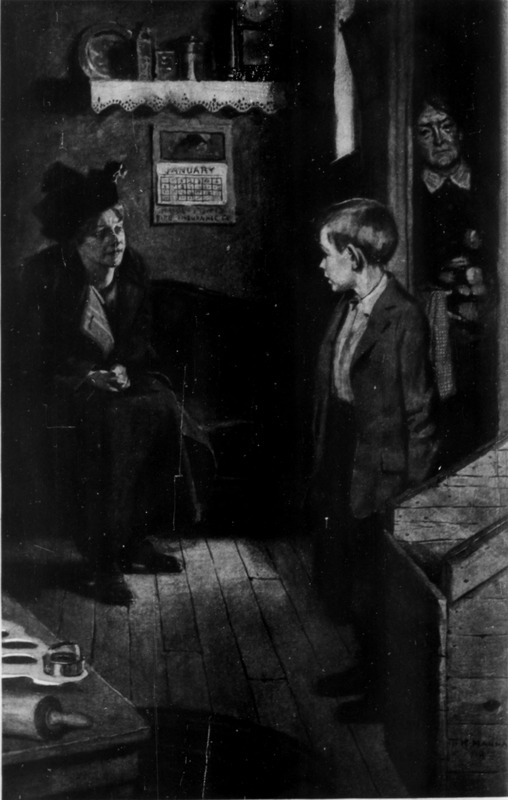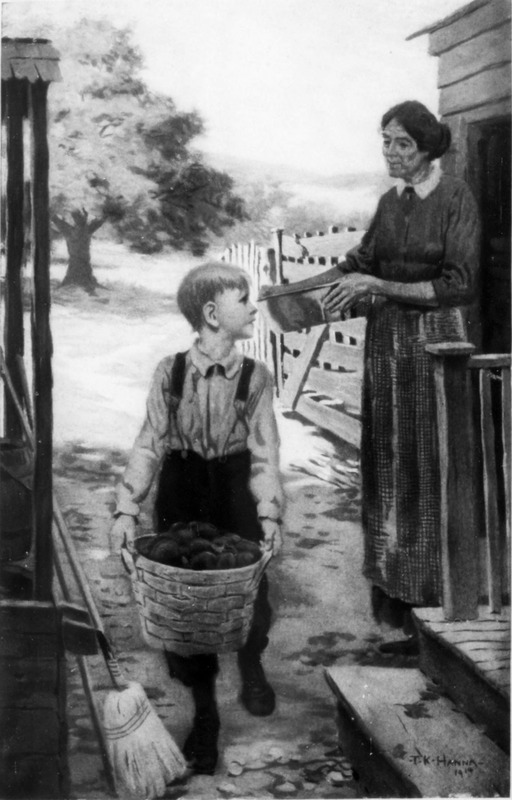
THE TWO SETTLED INTO A PLEASANT ROUTINE OF EXISTENCE.
Title: The soul-maker
Author: Helen R. Hull
Illustrator: T. K. Hanna
Release date: November 7, 2026 [eBook #79938]
Language: English
Original publication: New York: Harper & Brothers, 1915
Other information and formats: www.gutenberg.org/ebooks/79938
Credits: Jens Sadowski. This file was produced from images generously made available by The Internet Archive.
Helen R. Hull
Illustrations: T. K. Hanna
Harper’s Magazine, vol. 130, Mar. 1915, pp. 589-597.
There was silence in the wide kitchen, a bristling silence into which the clock ticked and the fire crackled like deprecating mediators. Opposite the stove was a table with three places set for breakfast on the white oilcloth. One chair was empty; a crumpled napkin lay beside the half-full glass of milk. At the other places sat two women, one plump and flushed above her white shirt-waist, the other sharpened and gray, in a dull wrapper. Their eyes met hostilely. The younger woman spoke first:
“It’s just as Sarah said. A charity boy—”
“‘Brat’ she always said,” interrupted the older, calmly.
“Can’t be depended upon for anything but lying and stealing. I hope you’re satisfied now, Abby Price!”
Abby took a sip of her coffee before she answered, deliberatively, “No, I’m not satisfied; not yet.”
“You mean you’re going to keep him?”
“Why not?”
“He’ll grow up to disgrace you.” The round face of the younger woman twitched with approaching tears.
“Now, Jennie!” Abby’s voice had an irritating calmness. “He’ll be some years growing up, and I guess I can stand the disgrace.”
“Well, I can’t!” Jennie’s chair rasped back over the kitchen floor. “And I won’t!” She threw down her napkin and hurried out of the room. Abby heard her angry staccato heel-taps on the stairs and then overhead.
Without finishing her coffee Abby gathered the few breakfast-dishes and carried them to the sink. As she set them down she glanced out of the window. On a stump by the shed door sat a small, white-haired boy, apparently intent on the manœuvers of several industrious hens. The grimness on Abby’s face settled into fierce determination, and with that she turned at the sound of Jennie’s feet.
Jennie stood in the doorway.
“I’m taking Sarah’s advice,” she said, dabbing at her eyes with a handkerchief, “if you’re going to insist on keeping him.”
“I am.” Abby glanced out of the window.
“I won’t help support a hired woman’s lying boy.”
“Any one’d think you never lied in your life, Jennie,” said Abby. “He’s only a little fellow.”
“If he was yours it wouldn’t be such a disgrace to keep him.”
“S’pose I said I thought you were disgracing the family, going around sewing as you do.”
Jennie stopped sniffing. “Disgrace?” she exclaimed indignantly. “I make dresses folks are proud to wear.”
“And you like it, don’t you? Making dresses, I mean. Don’t you? An Sarah likes being a respected bookkeeper. You’re no disgrace.”
Jennie drew her plump figure up resentfully. “We go out to work. You don’t have to—”
“No; I just stay here, keeping the homestead together. It’s just as if I was a wife! You and Sarah keep me, don’t you? Suppose I’m sick of it, and want something different, like this boy?”
“I s’pose it’s the maternal instinct, like Sarah said, stronger in you because you’ve always stayed at home.”
Abby swung on a heel. “Sarah may be a good business woman,” she said, over her shoulder, “but she’s an awful fool, too.”
“She was right about the boy,” cried Jennie. “He took that piece of gold ribbon for Mrs. Blake’s dress right off my box, and said he hadn’t touched it. And you never said a thing to him.”
“I won’t help keep him!”
“You needn’t.” Abby poured the water over her dishes with a splash. “I guess we can manage.”
“You choose that charity boy instead of your own sisters?” Jennie choked.
“‘Brat,’ Jennie!” Abby looked around at her. “Don’t be silly. You’re choosing. Go and live with Sarah in the village.”
“Sarah and I have reasoned with you—”
“Don’t waste any more breath. You’ll have to look out for the note on the place. But I can take care of Franklin and me.”
Jennie flushed. “I don’t want to quarrel.” She hesitated, pursing her lips. “Good-by, Abby.”
“Good-by.” Abby scoured at the porridge-dish. “Good-by.” She gave a vigorous rub and then paused. The side-door slammed shut. Outside the window the boy still watched the hens.
“Franklin!” called Abby.
The boy gave a little jump and looked furtively around. Abby frowned. “He thinks it’s Jennie,” she said. Then she called more sharply, “Frank-lin!”
He slipped off the stump and came slowly in as far as the kitchen door.
“Will you bring me some wood, Frank-lin,” said Abby, briskly, without turning, “and a pail of water?”
She smiled at the readiness of his disappearance. First she heard the pump-handle creaking; then small feet brushed along the path to the outer shed, returned, and an armful of wood clattered into the box. That was repeated twice, then came silence. Abby walked to the door. Franklin stood by the wood-box, his dark eyes, with their curious fringe of pale lashes, very wide in his small, white face. They met hers with a furtive alertness, and his thin little body stiffened, tense for flight. Abby regarded him gravely.
“Come here,” she said.
Reluctantly he came. Abby touched his white head gently and smiled at him. He started, almost as if she had struck him.
“We’ll say no more about it, Franklin,” she said. “It’s time you were off for school. Finish your milk and wash your hands. Your lunch-box is ready.”
Abby felt his eyes follow her as she moved about the kitchen. She said nothing until he took his cap from the nail and walked to the outer kitchen door. Then at her “Franklin” he turned sharply.
“Come straight home to-night, won’t you? I’ll—I’ll be waiting for you.”
“Will she be here?”
“No; no one but us.”
He gave a little sigh. “Yes, ma’am,” he answered; “I’ll be right back.”
Abby watched him down the path to the gate. “He understood,” she said. “I’m sure he understood.”
When he was out of sight Abby turned to her empty house. Sunlight filled the kitchen; the rooms beyond were dark and still. She stood with her head bent as if she listened. Countless days she had spent alone in the old house, while her sisters were at work; but to-day was different. The house waited, expectant; she felt it, and a flush crept up into her cheeks.
“You’re mine now!” she cried suddenly. “I can do what I please. Mine!” she repeated, loudly. And nothing contradicted.
She walked into the sitting-room and flung open the shutters. She set the front door ajar, catching it with the padded brick which had served there for years. The fresh wind rushed through, shaking the everlastings that stood on the mantel-shelf. Abby seized the vase and with fierce delight carried it to the kitchen, where she thrust its dry contents into the stove.
“There!” she said, as they blazed up. “I wish Sarah could see you now.”
As she replaced the vase she wheeled upon the room. “Lord! How many times have I set you to rights! All my life I’ve spent doing things I had to do again the next day. Nothing ever to show for it. Nothing! And now—I declare, I feel like a convict that’s escaped in a dark night and don’t know where he is. Me with a little boy! A little boy!”
She looked once more about the sitting-room—at the large arm-chair which had stood unused in the corner since the end of the silent years when her father had watched her from it in moody helplessness, at the sheet-iron cover which Sarah had economically had fitted into the fireplace. She had much to do before Franklin came back from school.
Early in the afternoon she began to watch the path, a little shamefaced, for she knew school did not close until four, and Franklin had a long walk after that. She fed the chickens, built the fire for supper, and made hot apple-sauce and biscuit; then she saw him lagging up the path. She wanted to run to meet him, to brush off the ridiculously large cap he wore, and carry him into the house. But she only watched him come, her breath tightening in her throat. There, in some mysterious fashion, approached her chance; she did not know how. Three weeks earlier she had heard that Franklin Peck had no place to live that winter, as his mother was off in service—no one knew just where—and the farmer who had kept him was moving to the city. She had acted blindly in response to the chaotic desire within her, obdurate against the remonstrances of her sisters, unmoved by their wrath, even by their departing, and Franklin had come to live with her. Sarah had left at once; now Jennie had gone. The barest poverty faced her; she had a scanty annuity which they had eked out, and the little farm the three had struggled to hold. But the impulse that had driven her had no after-flavor of regret. For years her life had lain as dead as a rock at ebb-tide—a long ebb-tide. Now far off the water turned, and within her faint stirrings of her spirit answered.
Franklin stood in the doorway.
“Come in, Franklin,” Abby said. “I was afraid you’d be too late for supper.”
“Ain’t your clock fast?” He looked up at it suspiciously.
“Why, I guess not. Did you come right home?”
“Yes’m.”
Evading her eyes, he stood on tiptoe to hang his cap against the door. Abby gazed in doubt at the back of his white head. There came into her mind a comment of the farmer who had housed Franklin: “He don’t know how to tell the truth.” Sarah had heard it at the store and brought it home in triumph. Abby turned away. Franklin shouldn’t see that she suspected—at least not until she had decided what to do.
“Supper’s ready when you are,” she said, clearing her throat. “I’ve set the table in the other room.”
Franklin washed his face and brushed his hair in silence. Abby handed him a plate of biscuit. “Lay these on the table,” she said. Then she followed him softly. In front of the fireplace was a little square table covered with a white cloth, a pitcher of yellow dahlias in the center, and a chair at each end. Franklin set the plate down and stood by the table, his head level with the flowers, like a larger, paler dahlia. Abby’s hands gripped her bowl of apple-sauce. She didn’t know what she had expected, but suddenly she felt overcome with embarrassment. The red shawl she had thrown over the hollows of the arm-chair leered at her. Franklin was looking at that, at the opened windows, at the sticks in the fireplace which she had pried free of its iron cover.
“There’s just two places,” he said.
“Just two folks,” answered Abby.
“Us?” asked the boy.
Abby nodded. Franklin moved closer to her.
“Did you want me to light the fire?” he whispered, eagerly.
Abby nodded again.
He was back with matches in an instant. Kneeling on the hearth, he puffed at the little sticks until he blew them into flames; then he looked up at Abby, his face aglow. She had taken her seat at the table.
“It’s a good fire,” she said. He climbed into his chair, his eyes on the fire, where they stayed most of the time through supper. Once he turned them on Abby.
“It’s a good chimney, I guess,” he ventured.
“Yes, I think so,” answered Abby.
“But a fire has to be lit right, too?”
“Yes, that makes a difference.”
After supper Abby piled the dishes in a pan, and they pulled the table back to a corner, Franklin lifting one side. Then Abby pushed the arm-chair to one edge of the hearth and settled herself into it with a slight glance of defiance toward the empty wall above the mantel. Franklin sat in a low rocker—one Jennie had used as a sewing-chair—at the other side of the hearth. He rocked back as far as the rockers would swing, then forward with a jerk. Suddenly he stopped.
“Are they coming back?” he asked. “Them others?”
Abby started. She had just been wondering if the arm-chair wasn’t large enough to hold two comfortably.
“I don’t suppose so,” she said. “They’ve gone. We’re here alone.”
“I think two is better,” announced Franklin as he began rocking again.
Abby repeated his words to herself as she watched him. He rocked less vigorously, and his eyelids drooped in long and longer winks. She rose with a little sigh.
“Bedtime,” she said. “I’ve moved you into the front chamber. You can take your lamp and call me when you are in bed.”
“Well”—he slid off his chair—“the fire is most out.”
She did not move after he had gone. The room held a new, friendly warmth. “He is going to like it,” thought Abby, listening for his voice. Would she kiss him if she tucked him in? She never had, and he had been there over a week now. But this was their first real night. Jennie’s words floated back, chilling her pleasant thoughts. Had he lied to her again? She heard a soft step behind her. Franklin set his lamp down on the table and shuffled slowly toward the door, one hand gathering up the folds of the faded night-shirt which engulfed him.
“I brought it back,” he said. “Can you see to my fire all right?”
“Yes, Franklin.” Abby hesitated. He was so little, so sleepy! “You haven’t anything to tell me?”
“No’m.” He blinked drowsily, and at Abby’s “Good night” disappeared into the dark room beyond.
Abby’s cheeks burned as she went about locking the house for the night. At least she had not spoiled the end of the day. And perhaps the boy had been afraid, or perhaps he had not understood her; the teacher might have kept him after school. He might never lie again. She would wait. With that decision her discomfort left, and she went peacefully to bed.
During the Indian summer days that followed, the two settled into a pleasant routine of existence. Franklin learned to feed the chickens; he filled the wood-box, pumped the water, picked the fall apples. His cheeks grew round, and he came whistling up the hill at the end of his school-day. Abby spent her days waiting for that whistle. She waited—busily, to be sure—for fall farm work is heavy—but her real day began when the small figure came into sight between the apple-trees. Sometimes he brought home his school-books and read to Abby after supper or puzzled over a problem in arithmetic. The arm-chair often held two very comfortably.
The winter shut in early. One morning they woke to find the first snow flurries, driven along by a sharp wind. Franklin insisted that he must go to school; and so Abby, in spite of his demurring, wrapped him in a plaid cape of hers and sent him off. That afternoon she waited uneasily for his return. It darkened early, and no small boy appeared. She tried to sit down with a basket of mending, but even Franklin’s stockings had no interest. Wrapping a shawl about her shoulders, she hurried down the path.
The road lay white and deserted. As she turned reluctantly, something black under a bush caught her attention. Frightened, she bent down. It was soft—a coat? She shook it out—her cape, with little pockets of snow in its folds. It had lain there some time, then.
She climbed the slope, shielding her face against the wind. Perhaps in the warm kitchen she could decide better what to do. She built her fire up well, set the tea-kettle over, and then stared grimly at the clock; almost half-past five! She would walk up toward the school.
Well bundled this time in coat and cap, she started down the path. As she reached the road she stopped, her heart pounding. Was that something dark against the snow under the bushes again, moving this time? It emerged slowly, straightened, and came toward her.
“Franklin!” she cried.
THE TWO SETTLED INTO A PLEASANT ROUTINE OF EXISTENCE.
He started violently, pulling away as she seized his arm.
“Child! Where have you been? You’ll catch your death of cold! Run fast.”
He scurried up the path ahead of her. When she opened the kitchen door he stood by the stove, holding his hands out to the warmth. His eyes met hers for an instant, and then shifted. Abby closed the door against the gust of wind that tried to chase her in.
“Where have you been, Franklin?” He shivered as she felt of his cold hands. “Come here!” She drew him down beside her on the couch, and bent over to unlace his boots. “Why didn’t you wear the cape? You’re frozen.”
He twisted out of her arms. “I’m not cold.” He coughed. “I—I gave it to a little girl who didn’t have any coat.” He peered at Abby, and then hurried on. “She was just a little girl, and awful cold. I’ll find—I mean I’ll get your cape probably to-morrow. I’ll—” Franklin’s eyes had followed Abby’s to the kitchen chair. Over it hung the cape. He slipped off the couch and put out a hand against it.
“Did—did the little girl bring it back?” he asked, miserably.
Abby rose, dropping the shoe she held. She walked through the sitting-room, the table laid for supper blurring before her eyes. She hung her coat in the front entry and went on to Franklin’s room. There she turned down the bedclothes, shook the pillow, and, taking his night-shirt, returned to the kitchen.
Franklin’s eyelids fluttered as he tried to meet her gaze.
“I think you’d better go right to bed,” she said. “Undress here where it’s warm.”
He took the night-shirt silently. Then Abby, waiting at the window of the sitting-room, strained her ears for every sound of his slow undressing. At length she heard him enter the room and pause behind her. She did not turn, and his feet padded on into his own room. Presently she heard the creaking of the bed as he settled into it, then a little cough, then nothing more.
She had no heart for a lonely supper. Drawing her chair close to the stove, she sat down to have it out. She had to do something now. Franklin was a liar; she must punish him. She flinched at the idea of whipping him, and then seized eagerly the conviction that no blows would help him tell the truth. Would it do any good to talk to him, to tell him lying was wrong? Why was it wrong? Abby floundered unwittingly at the margin of metaphysical morasses.
She lifted her head. He was coughing again. Poor, hungry little fellow! A few minutes later, lamp in one hand and a bowl of bread and milk in the other, she tiptoed toward his room. His eyes stared up at her, dark and somber. She set the lamp on the dresser and seated herself at the edge of his bed.
“You better sit up and eat this,” she said, gently.
Franklin swallowed one spoonful obediently. “I—I don’t want any more.” His teeth chattered.
Placing the bowl on the floor, Abby leaned over the bed.
“Put your arms around my neck,” she ordered, pulling the covers down. “There.” She straightened, her arms tight about his slender body. “We’ll go where it’s warm.”
She was gasping a little when she reached the kitchen.
“You’re quite a big boy,” she said, as he slipped to the floor. “I’m going to tuck you up here on the couch.” She covered him with an old shawl, and went back for the milk and the lamp.
Franklin’s eyes were on the door, leaping to meet hers the second she appeared. Abby pulled her chair close to the couch. “Now,” she said, trying to speak briskly, “eat this first.”
She held out a spoonful, when suddenly he twisted away, hiding his face with one arm. Abby held her breath as he began to cry, softly at first, then in long sobs.
“Franklin!” she said. He checked a sob, which escaped in a long sigh. Timidly she moved over to the couch, laying a hand on his shoulder. “Frankie dear!”
He whirled around desperately.
“There wasn’t any little girl,” he cried loudly. “I—I lost your cape.”
Then in some way she found him clinging to her, his wet cheek against her throat, and she was patting his shoulder while his sobs grew fainter. His heart, pounding against her breast, slackened its frightened race. Finally he looked up.
“I didn’t wear it,” he said. “I—” A lingering sob choked him. “I—I thought the boys’d all laugh at me.” He hid his face again.
Abby looked soberly at the top of his white head. “I’d like to buy you a coat if I could.” She felt his body grow tense as she began to speak. “But we’re very poor. Why, you’re all I’ve got, Franklin—and you lie to me.” He shrank in her embrace. “Were you afraid? You lied some other times, didn’t you? What makes you?”
His body quivered slightly.
“Suppose you sit up so we can talk.” She took his arms from her neck and pushed him away so that she could see his flushed face. “Do you like the way it makes us feel?” He shook his head. “It makes me feel as if I’d lost you. Does it you?” He nodded, his lips trembling. “And we were friends, weren’t we, till you put this ugly lie between us—Franklin?” He lifted his eyes, heavy with tears. “Are you a coward? Aren’t you brave enough to tell the truth?”
“I—I was afraid.” Abby just caught his whisper.
“I didn’t think you were a coward.” She spoke sternly.
“You—you won’t ever like me now?”
Abby gathered him swiftly into her arms.
“Oh, you won’t do it again, will you?” She swallowed rebelliously; why should she wish to cry?
“I—I was so lonesome.” He strained against her. “I—I ain’t afraid.”
He fell asleep in Abby’s arms after she had watched him finish the bowl of bread and milk. She sat in the quiet kitchen, looking down at the small, sleep-flushed face. Once she brushed the light hair back from his forehead. Her random thoughts were bits of stick carried along in a flood of tender humility. She was content to see them float, without curiosity as to the stream’s source. After a time, when the kitchen grew cold, she rose and carried him in to his bed. He stirred drowsily as she tucked him in and kissed him.
They said nothing about the incident, but for several days Abby felt that Franklin watched her, silent and reflective. Then she thought he had forgotten, and when one night he brought home his reading-book and chose the story of “Cedric, the Brave Boy Knight,” to read to her, she made no comment on Cedric’s courage.
Saturday morning, several weeks later, Abby was rolling out ginger cookies. Franklin knelt on a chair by the table, his elbows almost on the mixing-board, waiting with breathless interest for the scraps Abby promised he should roll out. Abby carried a pan of cookies to the stove, and, as she straightened from closing the oven-door, caught sight of a woman peering in at the window, a hand over her eyes. Abby pulled open the door and confronted her.
“I didn’t mean to peek,” the woman began, crimson. “But I knocked—and I wanted to know if nobody was home.”
“Come in out of the cold,” said Abby. “Did you want to see me?”
The woman paused on the threshold, the pupils of her eyes dilating. Then she rushed past Abby and threw herself beside the chair where Franklin knelt.
“Oh, my little boy—my little boy!”
Franklin shrank away from her, turning startled eyes toward Abby. The woman looked around, and Abby shut her lips suddenly over a scream. The faces were alike. The woman’s hat had slipped back; pale hair like Franklin’s fell about her forehead; the same dark eyes beseeched Abby under white lashes.
“He—he wouldn’t remember me much.” The eyes filled with tears. “But I—I’m his mother. He’s grown an awful lot.” She rose, wiping her eyes.
Abby walked back to her cooking-table. “I suppose so,” she said, without looking at the woman.
“I’ve come for him, please.” The woman plucked at her handkerchief. “I’m married—to Mr. Reeds over in Brockton. He’s a kind man, and Franklin can have a good home there. I wrote a letter last month to the other people, them that had him. I didn’t know he was here until I got in town this morning.” She sat down on the couch, her eyes clinging to Franklin, turning for swift, deprecatory seconds to Abby.
The tale emerged in nervous, hesitating bits. Abby tried to answer the woman civilly. She could see nothing but Franklin, drawing nearer his mother, sitting beside her, responding with shy awakenings of familiarity to her advances. She fell into a stifling dumbness. As the soft voice told her of attempts to find a place to work where Franklin could come, of efforts to save money to send him, of longing for him, Abby had only one thought: “She’s come to get him.”
When Abby had cut her last cooky she glanced at Franklin. He was intent on his mother’s watch, and Abby wondered grimly that she could care so much because he had forgotten his desire to roll cookies.
“My husband said we could pay his board,” the woman was saying.
“You can’t,” cried Abby. “He’s worth his keep, I guess.”
“They have a horse,” announced Franklin, looking up, “and I could go to a town school. I have to go with my mother, don’t I?” he added, doubtfully.
“Of course,” answered Abby. The warmth of the kitchen was choking her. “Just make yourself at home,” she said, hurriedly. “I—I’ll be right back.”
She went blindly through the little shed, along the path Franklin had shoveled, to the barn. She gathered an armful of wood in her apron, and then stood in the doorway. The cold air tingled in her nostrils; she could breathe there. But it was freezing her heart; she could feel it. Or did she feel only the wood she held tightly against her? She must go back. In the shed she stopped. She had left the door unlatched, and the voices within came clearly to her.
“You have been a good boy, Franklin? You are glad you are coming with your mother?”
“I like Aunt Abby,” answered Franklin. “I can come to see her, can’t I?”
“Sometimes. You’ve been a good boy, ain’t you?” Abby was fiercely jealous of the yearning in the mother’s voice. “You ain’t taken things or told lies?”
“No’m.” Franklin’s voice sounded uncertain.
“I like my boy to be good.”
Abby heard Franklin slip out of his chair. He was coming toward the shed. As she laid her hand on the door to enter, he halted.
“I wasn’t good.” Abby gripped the latch. “I—I lied to her.”
“What?”
“I did—when I come.” She pulled the door softly open. He stood just within, a stiff figure of defiant anguish. “But I don’t now.” Abby’s hand rose to her throat—the ice in her heart had melted and rushed there. “I—” He turned, and, finding Abby, threw himself against her, hiding his face in her apron. “Tell her!” she whispered. “Tell her I’m brave now.”
Abby raised her eyes. Through her tears she saw the mother, her troubled face so like Franklin’s.
“He’s the best boy any boy could be,” she said, proudly.
Later in the afternoon they went away, Franklin carrying his few possessions in a shawl-strap Abby gave him. She walked to the foot of the hill with them.
“I hope you won’t miss him much,” said the mother.
“He’s yours,” answered Abby, simply. “I’m glad he’s got a good home.”
“It ain’t so awfully far off.”
“I will come back,” declared Franklin, clinging to Abby’s hand. “I’ll come back to see you.”
Abby kissed him quietly. “I’ll expect you,” she said.
Then the mother took his hand.
“We’ll have to go along. My husband’ll be waiting in the village.”
Abby climbed the hill doggedly. She glanced into the sitting-room as she closed the door of her house. The day had moved so swiftly that she half doubted its reality. But Franklin’s chair had no pale head bent over a book to look up at her entrance. She dropped into her arm-chair. Presently with her foot she set Franklin’s chair rocking gently, and listened, her eyes closed. The monotonous creaking dulled her. She knew that after a little she must wake from the numbness and face the event. Now she was tired.
She woke with a start to darkness and the sound of knocking. She got to her feet. Some one was calling her.
“Abby! Abby! Aren’t you here?”
A match flared up in the kitchen, yielding Abby a glimpse of a round, anxious face before it died out. “Jennie’s home late to-night,” she thought. “I must have fallen asleep.” Then, as a second match flamed out, she remembered.
Jennie had found the kitchen lamp, and, holding it before her, stepped into the sitting-room. Then she jumped.
“Goodness! You scared me, standing there like a ghost. Are you sick?”
“No.” Abby drew her hand across her eyes; the light dazzled them. “No; I just fell asleep, I guess.”
Jennie set the lamp down. “I’ve been down at Mrs. Black’s, sewing,” she said, watching Abby uneasily. “I just thought I’d run in.”
She was silent for a moment, gasping a little in a perplexed way, like a fish out of water, thought Abby irrelevantly.
“I didn’t like to think of you here all alone,” she continued, “so I came. You—you’ve sent the boy away, I hear.”
Abby sat down again. “Yes,” she said, turning her face away from the light.
Jennie threw back her coat and seated herself in Franklin’s chair.
“Did you have to get rid of him?” she asked.
Abby laughed. “Yes, I had to.” The numbness had gone now, and here began the probing of her wound.
“I told Sarah that if you ever did, I’d come back same’s if nothing had taken place.”
“Do you know why I got rid of him?” Abby’s fierce question cut through Jennie’s complacency.
“I suppose—” Her rocker ceased its swaying. “I suppose he kept on lying.”
“Stop!” cried Abby, interlocking her fingers so tightly that the knuckles strained. “He went with his mother. She’s married and got a home to take him to.”
“Didn’t you want him to go?”
Abby made no answer.
“Did she just come and take him?”
“He’s hers.”
“And you get nothing for all your fuss and trouble!”
“Nothing?” Abby sat erect, her hands unclasping. The probing had found the poison in the wound. She felt Franklin clinging to her, heard him whisper, “Tell her I’m brave.” Did she get nothing?
“His mother gave me nothing,” she answered, slowly.
“And I expect you’ll miss him, too,” ventured Jennie. “Seems a pity.”
“It isn’t a pity.” Abby rose. As she looked down at Jennie she had a sensation of distance between them, as though she were on a height from which she called down. But she must speak. Whether Jennie heard or not, she must hear it herself. “Of course I’ll miss him.” Her words came with great slowness. “I’d’ve chosen to keep him, but he had to go with her that bore him. He didn’t go the same as he came, though; he was different. I made him different. Something real in him, something alive, that’ll last. I made it. Part of his soul. I never made anything before. I might have died without. Don’t you see—?” She paused, while Jennie’s bewildered face wavered before her. “It’s as if—as if you made a dress so beautiful that it would last for always. I’ve done—oh, more than that!”
“You mean you’ve been good for him?”
Abby smiled. She was descending from her height, and as she drew nearer Jennie she felt an unexpected warmth for her.
“Are you coming back?” she asked, abruptly.
Jennie looked up with wistful relief at her matter-of-fact tone.
“I guess I will,” she said. “I’ve felt queer, staying other places. You’ve fixed it up some here, ain’t you?”
Abby nodded.
“I should think we might get along comfortably,” continued Jennie, beginning to rock again. “What’ll you do now?”
“I don’t know.” Abby started toward the kitchen. “I’ll make you a cup of tea.”
On the chair by the door lay the old checked cap Franklin had worn when he came. Abby picked it up, her fingers closing tightly over it. She looked back at Jennie.
“I might even adopt another child,” she said.
Transcriber’s Notes
Transcribed from Harper’s Magazine, vol. 130, Mar. 1915, pp. 589-597.
New original cover art included with this eBook is granted to the public domain.
The original spelling and punctuation were mostly preserved.