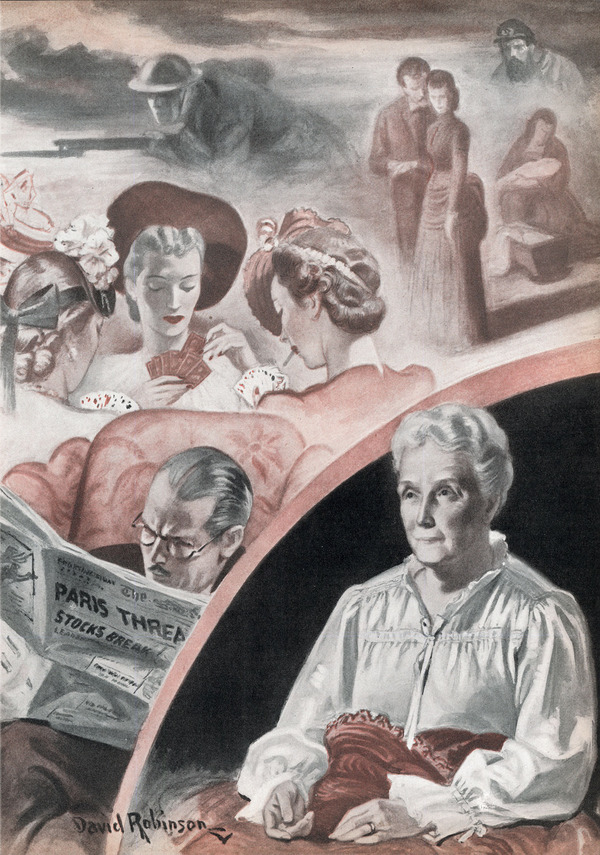
“They are blind
and empty....
I must tell them
this.... It may
not be too late.”
It All Begins Again
The story of the three generations
that found no peace.
Helen R. Hull
Illustrations by David Robinson
Redbook Magazine, vol. 76, Mar. 1941, pp. 40-43, 69-74.
Mary Briscoll had intended never to live with any one of
her children. The decision had been automatic, full-formed
even as she had sent the telegrams telling them their father
had died suddenly. That had been fifteen years ago, when she had
been just past sixty; and her income (arranged cannily by Will in
annuities so that no one would look hopefully for her death!) had
been enough for independence and even for assistance to one or
another of the children. Except for an appropriate and swiftly
abandoned gesture from Vera, the children hadn’t suggested that
she live with them. Hugh, the youngest, ran through wives and
jobs too rapidly to offer sanctuary to anything. She might have
enjoyed an occasional visit with Tom, the middle child, but his
domestic life was irregular. And Tom had died, a few years
after his father’s death—the neat surgery job done on his interior
after Verdun being inadequate for many years of service.
After Mary’s serious illness in the late winter of 1940, Vera insisted
that she must not stay alone. In the discussion, Vera let
drop that if her mother would stay with them instead of going alone
to some expensive summer hotel, they could open the Westchester
house, Vera could take out a cook and second maid, Clement would
stop his talk about selling the house, and the children would give up
their ridiculous proposals for the summer—dude ranches, heaven
knew what! “Why not say you need the money, instead of going
on about my health?” Mary had asked. Vera’s answer had been:
“When I’m so distressed about you—how would it look if you had
a stroke or something all alone?—must you be carping?” Vera
was like that, insistent and unsubtle in projecting upon someone
else the necessity for doing what she herself wished. Mary liked
showing her up; and perhaps one reason she didn’t want to live
with her daughter was that she knew she’d have to hold her tongue.
It was one thing to catch Vera up in an afternoon call, when Vera
could take her injured feelings home and forget them in some
new scheme. But under one roof—
If Mary had been stronger, she might have given Vera a check
for her summer and rejected the plan. But the pneumonia germ
had been vicious, and the climb back to health seemed scarcely
worth the effort when the years left were of necessity so few. In
a way Mary regretted her recovery; she felt rather silly about it,
having been sure that she was through with life. Much like the
state of mind of one who has stripped
her house and packed her trunks for a
long journey, only to find herself sitting
on top of a locked trunk in an empty
house with no place to go and no reason
for going. Perhaps if she didn’t unpack—all
her concern about the family, all
her interest in their affairs, all her
amused, sardonic contemplation of them;
perhaps if she perched on a locked trunk,
aloof, ready for departure—she wouldn’t
have to wait too long. She had agreed
to Vera’s suggestions, so compliantly
that Vera asked: “You aren’t feeling
worse today, are you?”
(“Maybe I am,” thought Mary, “to
let you bully me.”)
Vera had gone on in her high-pitched,
quick voice, with talk of her problems.
Clement was impossible; he was such a
grouch; surely the market was better
than he thought; in war times steel and
wheat always shot sky-high. She would
write at once to that woman who’d
worked for them three years ago. Hilda,
Vera’s daughter, would have to drop her
notion of getting a job for the summer;
it was just an excuse to stay downtown
where she could meet that boy; if he
had any pride at all he would stop chasing
Hilda—not a penny to his name.
Mary had looked at Vera, smartly slender,
well groomed, her silvery hair (she
still called it prematurely gray) in soft
curls under the thimble of cornflowers she perched over one eyebrow
for a hat, her mobile face marked with sharp lines. She
exaggerates everything, thought Mary; she uses her face too much;
she has more wrinkles than I have. “Is Hilda in love with this
boy? What’s his name?” Mary was fond of her granddaughter;
she liked the girl’s looks, fine-skinned, small-boned, intense.
“Oh, love!” snapped Vera. “At her age? But she doesn’t
tell me anything. You simply can’t imagine what modern children
are like.”
“I seem to remember saying just that when you were young.”
“Things were simpler then.” Vera sighed. “And you never had
to worry about money.”
“We didn’t have much to begin with,” said Mary. “I haven’t
seen you starving or taking in washing.”
“It’s much worse, having to give up what you’re used to, than it
is not to have it ever!” Vera’s hasty kiss buzzed against
Mary’s cheek, and she whisked herself away....
For the next few weeks Vera was so busy closing the
apartment in town and opening the country house that
she had little time for her mother. During those weeks
Mary grew steadily stronger. She could walk about her
rooms with her heart quiet in her breast instead of acting
like a frightened caged squirrel. She looked, she thought,
like an elderly Alice in Wonderland, with a ribbon tied
around her white hair to keep it back of her ears. No,
more like the White Queen, the way her body had sagged
and thickened. Her face had kept its structure, the dry
skin taut over the fine, high brow, the eye-sockets deep
and cleanly modeled, for all the worn lids drooped over
the dark eyes. She couldn’t read long, but she began to
look at headlines, with an amazed anger at what was
going on, as if Hitler had taken advantage of her illness
to wreck the world she had known. “Oh, my,” she
thought, “I’m too old to reckon with another war!”
Holland, Denmark, Belgium, Calais. Yet no one seemed
to pay much attention to it.
When Vera telephoned, Mary said: “What does Clem
think about the war?”
“It’s simply ruined the market,” said Vera. “I don’t
even mention it to him any more. I’m calling from the
country, Mother. I’m not coming in again this week;
if I turn my back something goes wrong. Clem says
he’ll drive you out Saturday. You can get a maid to
help you pack, can’t you?”
“I’m not helpless yet,” Mary had replied tartly. She
didn’t like to have Vera pawing over her personal belongings,
exclaiming: “At your age, Mother, some quieter
color!” Will Briscoll had always liked her in bright
colors, deep, dark red, yellow. As long as her public
costumes were decorous enough, white in the summer,
black with white in winter—But she tired quickly, so
it was the chambermaid who packed for her. “I don’t
want that—nor that—” Mary discarded recklessly; she
might need nothing when fall came again. “You can
have them. Only, they won’t fit you.”
The woman gathered up the pile of clothes, looking
at Mary with bleak eyes. “There are some who can use
them,” she said. “If they still live. I do not know. I
have not heard.”
“Your people?” asked Mary. “Where are they?”
“Farmers in Norway. For many weeks I do not hear. It is a
great blackness not to hear.”
* * *
In Mary’s mind the words sounded like a deep bell far under
water. As she waited for Clem, she kept hearing them. A great
blackness not to hear. If she sat very still, scarcely breathing, the
sound might come more clearly, floating up and up through the
waters of time.... She must have been a child—she could feel
herself spraddled over the edge of a high feather bed, trying to
reach the floor with her bare toes, afraid of the darkness, compelled
by the sound which had wakened her—a low moaning, broken
by sobbing breaths—to extricate herself from the safe warmth of
her bed and brave her way across the black room to the other bed
where her mother lay. “Is it another baby, Ma?” Her hand had
found the heavy rope of hair, had moved up it, had touched the
clammy wetness of the pillow. Just a year earlier her brother had
been born, right in this very bed. He whimpered in his crib.
The moaning had ceased; her mother had said: “Go back to bed.
What are you doing up?” Then she had laughed—at least, the
sound was not crying. “A baby? How would I get a baby?” She
had reached out in the night and pulled Mary’s head against her
thin neck. “I didn’t mean to wake you up. You aren’t old enough
to know.... Oh, God, if only I could hear from him! It is death
not even to hear!” She had led Mary back to her own bed, had
lifted her into the hollow of the feathers.
That was another war, thought Mary, and her mother wept for
her husband. When he came back, he was a gaunt, bearded stranger
Mary had never seen. He had been in a Southern prison; he must
have been sick for a long time after he came home. They had given
up the farm and moved into a village. Her father had a cobbler’s
bench in the shed off the kitchen; Mary could hear the tap of a
mallet driving in wooden pegs, and the dry rasp of his cough. He
had done other odd jobs; she remembered clocks with their wooden
wheels strewn over a table, and the hot smell of soldering. She and
Tom, the next younger child, had gone to the village school, and
then she’d taken Jimmy when he was so little she had to carry him
part of the way, because her mother went out by the day, nursing,
cooking, sewing.
“If I had died, I would have been a hero! And now look at me!”
When had her father cried that out in a terrible voice? Mary could
feel herself running away from the house, dragging Jimmy with her,
out of reach of the voices, her mother’s sharp with flailing impatience,
her father’s like white torment. They were still young—her
mother had been seventeen when they married—but Mary could
not see them; her effort evoked only the image of an old tintype:
her father in a stiff hat standing with his hand on the shoulder of
her mother, long dark ringlets over the tightly fitted basque of the
young girl who stared soberly out of the faded square. “Well,”
she thought, “I can’t remember how I looked when I was twenty.”
Queer, as if time destroyed the image with the prototype.
She did remember that she had grown to share her mother’s irritation
with that increasingly silent, useless, ailing man. She had
meant to get ahead, to make something of herself, to escape
poverty and ignominy. Because she was the oldest, she would pull
Tom and Jimmy up with her. Well, she had helped them; it was a
long time ago, and they were all dead now, all but her. Other
women now were saying of their men: “It is a great blackness not
to hear, it is death not even to hear.”
Odd, how vividly she could see her father, dying. Her mother
had sent for her—she was the principal in a high school in Northern
Michigan that year. Will Briscoll had driven to the station
with her. He was a mining engineer who ate his meals at the boarding-house
where Mary lived. “Don’t be gone long,” he had said.
Tom, summoned from college, had met her. “He’s going,” he had
said. “Had another hemorrhage.” She must have sat beside her
father’s bed that night; she remembered the acrid odor of a kerosene
lamp, the faint rale, the only sound of life in the figure
propped on pillows. He had lifted papery eyelids, disclosing eyes
brilliant with fever, and the line of his sunken, colorless mouth
had altered into gentleness. “Why, Mother!” he had said.
“It’s me, Mary,” she had told him. But he had not heard her; he
had pushed himself up, talking in a high, shrill voice, like a boy’s.
She had not heeded his words, but now they sounded again:
“Don’t cry! It’s a grand new land where a man can be free, and
his children after him! I’ll be coming back to visit you, driving
high-stepping black horses and bringing you the grand gifts!”
* * *
The telephone jangled; it was like silver trappings on black
horses. The sound scattered the images of the past, just before
she might have found out what they meant. What had set her
digging into those old years? She hoisted herself stiffly to her
feet; the desk clerk said that Mr. Clement Lawmen
was on his way up.
Then Clement was at the door, an artificial brightness
in voice and manner. Well, well, how was Mother?
Fine that she could spend the summer with them! Were
the bags ready? He seemed to turn on his manner and retreat
behind it into protective coloration: gray hair,
eyebrows, eyes, suit, skin. He had been an amiable
fellow who wished to please, but having failed to do so,
he now wished chiefly to avoid unpleasantness. “Vera’s
worn him to the bone,” thought Mary, and then forgot
him in an exasperating last-minute search for purse,
gloves, spectacles.
“Just stop and think,” advised Clem, blinking. “Just
stop—”
“If you’d stand still,” cried Mary, “maybe I could
think!” The ineptitude of age irritated her; it made a
husk between herself and the small affairs with which
she had to deal. The porter shook out her coat, and
there lay the missing articles. “I knew I’d put them
somewhere!” She gathered them triumphantly, and
headed the procession toward the elevator.
She was sorry there were not more people in the lobby
to witness her departure. Going away was, after all,
exciting, once you surmounted the inertia of staying
where you were. Clement helped her into the front seat
of the elderly family car and sat beside her, clearing
his throat anxiously as the starter hummed twice before
the motor caught. “It’s really a good car yet,” he said.
“A very good engine.” Mary thought, Clem really
drove well when Vera wasn’t telling him how; and then
she looked contentedly out at other cars, at the curve
of ramp up to the highway, at the river wide and ruffled
in the hazy sunlight. An airplane sounded overhead,
and she saw its shadow over the water; she thought:
“We don’t have to scurry for shelter.” After a moment
Clem said: “Lord, if they’d only get it over with
and let a man go about his business in a normal world!”
“That would be nice, wouldn’t it?” said Mary dryly.
Clement peered at her, his eyelids twitching. “I mean,
look at us; nothing’s happened here; business ought to
be good. Ought to start big production, factories running
double shifts. Do they?” The car rolled on in
spurts, fast, slow, fast, slow, as if Clement beat time with
his foot. “No. Everyone’s scared; everyone’s waiting.”
They had reached the toll-bridge; and Clem, fumbling for a coin,
let the motor die. By the time he had it started, his ears were
scarlet and he had forgotten larger issues. “It’s the mixture,” he
muttered.
Mary’s hat slid backward on her spun-glass hair; she moved a
little from the window, and Clem smiled at her, inquiringly. “You
all right?”
“Yes, I am.” She wouldn’t be like Vera, wanting windows open
and then shut and then half open. “Clem, what is a normal world,
anyway?”
“Why, you know! The kind I grew up in, the kind you grew
up in!”
“We grew up quite a while apart.”
“You know what I mean. A world where you knew what to expect,
where you could make a living for your family. Why, look
at Father Briscoll—that’s what I mean, climbing straight up. He
had a good life; he made a lot of money. The kind of world we’ve
tried to get back to, ever since 1918. Instead of this—this headache.”
“Perhaps headaches are normal.” Mary spoke testily. “Just
because you can’t make a fortune!”
“A fortune? I can’t make a cent!” The words rasped. “But I—I
didn’t mean to get on that subject.”
“The trouble was, you made too much
too easily to begin with,” said Mary.
“Put notions in Vera’s head.”
“She’s ambitious—for the children,”
said Clement hastily. “You mustn’t blame
her. She’s had a difficult time.”
“Pooh!” said Mary. “Pooh! If she
is my own daughter, I know her. You
never should have let her bully you out of
your own profession. Why didn’t you go
on being an architect?”
“I’d be no better off if I had. They’ve
had a bad time too.”
“You might have enjoyed it.”
“You know how it was, after those
years in the army. I didn’t want Vera to
go on working; we wanted to settle down,
raise a family.”
“You were very handsome in your uniform.”
Mary chuckled. “Too bad you
couldn’t go on wearing it; you might have
managed Vera.”
Clement’s teeth worried at the lower
lip. Like a rabbit, thought Mary; she’d
like to shake some spunk into him!
“No,” he said. “You’d have to have all
the bands playing, for a uniform to count.
Weren’t we the idealistic young fools?
Making the world safe for democracy.
Sounds pretty silly now, doesn’t it?
They’ll have to think up better slogans
for this generation. They know all the
answers. Or worse, they know there
aren’t any answers.” Clement slowed for
construction signs; a laborer with a flag
waved him into a bumpy detour.
“Half slave and half free,” said Mary,
as she jounced.
“What? I’m sorry—be out of this in
a minute.”
(A slogan good enough for her father.
She’d never thought of it quite that way;
her father as a boy, seeking a land where
a man could be free, finding a slogan....
And his children after him.)
“There.” Clement relaxed a little, having
reached smooth pavement. “What
was I saying? Oh, slogans. Well, this
isn’t our war. Let them have it out. Look,
back in the seventies, when the Prussians
got to Paris, you didn’t worry about it,
did you? It’s this damned radio stuff,
calling off the scores as if it was a game
in the Yankee Stadium. Keeps us in a
state of nerves.”
Mary’s head jerked forward; she slid
down in her seat, her hands folded over
her wide, soft body. When Clem got
started in that light, monotonous voice,
quotation marks humming like bees among
his words—She would have said she
did not sleep, but her mind dropped a few
stitches, and picked up its knitting again
as the car stopped.
“Here we are,” said Clem, gently. “Feel
tired?”
“He’s nice,” Mary thought, warmly. He
meant well. His shoulder was a fulcrum,
to pry herself out of the car; but as she
stood up, her feet firmly on the grass, she
brushed him away. “I can walk,” she
said. “I’m just stiff.”
“Sitting so long.” Clement was anxiously
animated. “Good trip—not much over
an hour. Old bus comes right along.
Now where’s Vera?”
Mary went slowly along the flagged
walk to the front door, a gracious door
with fanlights. The house, which represented
Vera’s successful attempt to spend
a great deal of money (in the late twenties),
now looked down at the heel. The
shrubbery massed against the gray stone
of the first story needed clipping; the
white clapboards above had rain stains
from the faded shutters. But the shadow
of trees lay crisp on the cropped lawn,
and there was pleasant color in the garden
around the small pool down the slope of
the hill. Clem followed her with some of
the luggage. “Ring the bell, will you,
Mother? Where’s everybody?”
* * *
A plump, elderly woman opened the
door. “How do you do, Mr. Lawmen—and
Mrs. Briscoll. Mrs. Lawmen
is out. She left word she had to go to
this bridge tournament—it’s for the Red
Cross. No, Mr. Lawmen, the young people
are out; I couldn’t say where they are.”
“That’s a nice note,” said Clem mildly.
“Walking out on us! Where’s the girl,
what’s her name—Anna?”
“It’s her afternoon out, Mr. Lawmen.
That is, Thursday is her afternoon; but
with the plumbers and all, she couldn’t
take it. We did have quite a time with
the plumbers.”
“So I heard. A nice kind of welcome
for you, Mother.” Clem’s eyelids twitched.
“Everybody gone but the cook.”
“That’s good,” said Mary. “I don’t
have to talk to anybody. Good as a hotel.”
It wasn’t, really. At a hotel, as
weary as she was, she’d go to bed and no
one would disturb her until she rang. A
long sigh for independence lost lifted her
breast. Clem said: “Which room, Effie?
You take those bags, will you? I’ll get
the rest of the stuff.”
“Mind your step,” said Effie. “It’s Mr.
William’s things from college. He said
he’d be back to see to them; I wasn’t to
touch them.” She started up the wide
stairs, and Mary stood for a moment,
hand on the mahogany rail, gathering determination
for the ascent and looking
over her grandson’s college deposit. Tennis-rackets
in a press, a musical instrument
in a black case on the carved Italian
chest; skiis, boots, a radio, a pile of records,
leather coat, bulging laundry bag,
suitcases. Bill, home from college. Mary
hadn’t seen much of her grandson since
he had been a little boy. Preparatory
school, summer camps, college. He’d
been a funny little boy. She began to
climb, her heart creaking as she lifted
her weight from step to step. When she
got up, she’d stay!
“Did you see all that junk?” Clem was
at her heels. “That’s what my money
goes for. If I say a word, I’m a brute.
When I was his age, I knew what I wanted
to do!”
“Well,” said Mary shortly, “you didn’t
do it, did you?” She was sorry she had
said it, Clem looked so suddenly deflated.
“At least I did something,” he said with
dignity. “Effie!” He raised his voice.
“Which room is it?”
“It’s here, Mr. Lawmen.” And Effie appeared
at a doorway. “Right here.”
Mary looked about with the experienced
eye of a traveler. “This used to be the
nursery,” she said.
“Did it, Mrs. Briscoll? Mrs. Lawmen
thought it would be the quietest room for
you, with the young people running in and
out the way they do.”
“Don’t you like it, Mother?” Clem
peered at chintz curtains and silver-striped
wall-paper. “If you don’t, speak up.
Plenty of others.”
“It’s all right.” Mary settled into an
armchair. Vera knew she liked a double
bed, but probably there wasn’t one in the
house. That shade of lavender in bedspread
and rugs was one she despised. Vera had
no doubt picked it especially for her,
something appropriate to age.
“What would you like? A spot of sherry?
Tea? That’s it! Effie, bring Mrs.
Briscoll some tea.” Clem balanced uneasily
in the doorway. “Want a paper to
read?”
“No,” said Mary. “I have to unpack.”
“Well, I can’t help you with that.”
Clem teetered a moment. “Take it easy.
Vera ought to be home any minute.” He
turned to go.
“Clem!” Mary’s voice halted him. “I
needn’t have said that.”
“Oh, I know. I ought to do something—take
steps—instead of grousing.” He
glanced at her. “I don’t know how anything’s
coming out. I wake up at night
in a cold sweat. I thought if I could give
them a start—the children—But what
are they to start at, in a world like this?
And you know, they aren’t even happy!
You’ll see.” His newspapers slipped
from his elbow and crackled about his
feet. He stooped for them, and as he
straightened, automatically read the leaders
across the sheets. “Look at that! If
Paris falls, that’ll fix the market all right.”
On the stairs sounded Effie’s deliberate
step. “Here comes your tea. Do you
more good than my ranting.” His quick
smile was apologetic. “You know what
Vera thinks? She thinks if she ignores
the war long enough, it will come to an
end from chagrin. Little boys showing
off, and no one looking at them.”
“Known as the ostrich technique,” said
Mary. “Have some tea?”
Clem didn’t drink tea, or coffee either.
He had this pain in his stomach; the
doctor couldn’t find anything; he thought
he’d worry less if they could find something
definite, no matter what.
“Ticker-tape-worm,” said Mary. “That’s
what ails you.”
“What? Oh, yes. Yes.” Clem’s lips
jerked into a smile.
“Go read your market reports. Tea
would do you less harm.”
Clem edged away. “I’ll be on the terrace,
in case you want me.”
* * *
Mary drank her tea.... “When I was
his age,” Clem had said, and Mary
had jumped on him because it might have
been Will Briscoll talking about Tom,
their son. Only, Will bellowed when he
was angry. “When I was your age,” he
had roared, “I had to work my way
through college. I tended furnaces for
a corner of a cellar to sleep in, and I
cooked my own food, what I had.” Mary
had tried to defend her son: he was just
a boy; Will didn’t want him working himself
to death the way he had—Not skiis
and radios and cars in those days; what
had it been? Girls, even as early as that.
Frat parties. Liquor. The same words,
“When I was your age.” How we repeat
ourselves, she thought! There must be
an archetype for all we say; the pattern
repeats itself endlessly. Tom had gone
back to college on probation, his senior
year; and before Christmas he had enlisted.
Perhaps, after he finally came
home, he had used his wounds as an
excuse—Will always thought so, and Will
had died before Tom, so he hadn’t known.
“Such a pity they sewed me together
again. A gold star would be much less
annoying.” Dear God, the same thing
her father had said! “If I had died, I
would have been a hero.”
She wished Tom hadn’t died. She
would like to talk to him. He always
made her laugh. Her eyelids lifted in
long folds; she felt a mild astonishment
to see this unfamiliar room around her.
She ought to unpack some of her dresses,
instead of prowling through the past.
Queer the way the past kept pushing
aside the present, and dead voices sounded
louder in her mind than those that spoke
today. Almost as if she were searching
for something, knowing neither its shape
nor color. “But when I find it, I’ll know,”
she thought, nodding softly; “I’ll know.”
* * *
Vera’s voice preceded her as she hurried
along the hall. “Oh, Mother, I’m
so sorry I wasn’t here when you came.”
At the door she stopped. “Mother! You
aren’t sick again?”
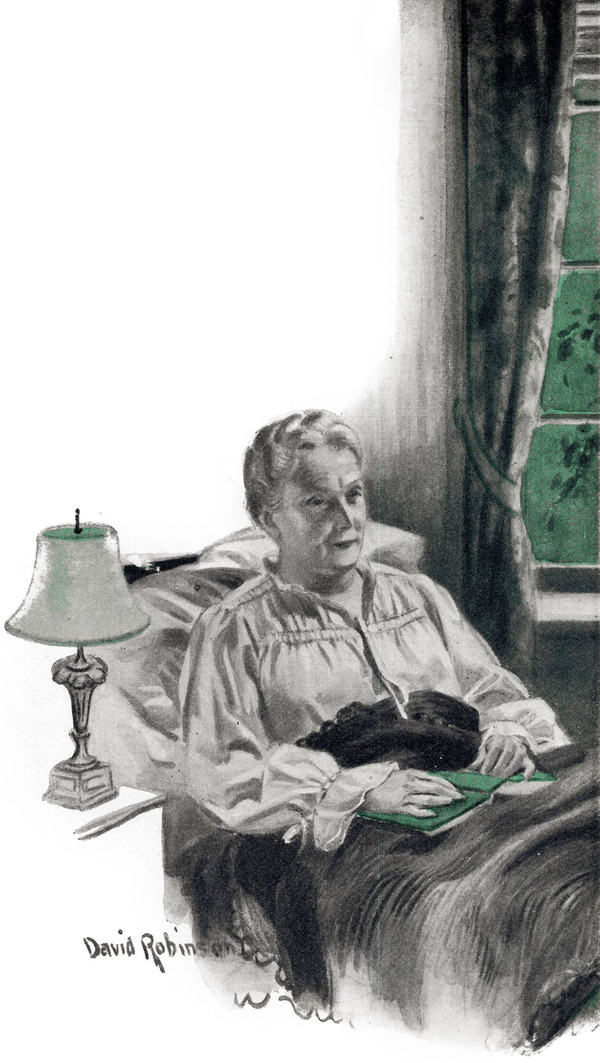
Mary cocked her head forward from
the pillows. “No. I’m not. I’m just
comfortable.” Vera leaned over the bed,
investigatory fingers on Mary’s forehead
before she kissed her cheek, the brim of
the wide hat clipping Mary on the head.
“You don’t feel feverish,” said Vera.
“I’m not. You look very smart.”
“I picked it up at a sale at the city.”
Vera’s fingers brushed the heavy white
silk. “Good, isn’t it? But why are you
in bed if—”
“Well, I’ll tell you. It was accidental.”
Mary pushed the full, fine lawn sleeves of
her nightgown up from her hands. “I
started to unpack. I laid out my toilet-case.
I thought I’d take off my dress so
I could rest a little; and first thing I
knew, here I was, all ready for bed.” She
chuckled. “So I just went to bed.”
“I suppose the trip tired you.”
“I was thinking about something else,”
said Mary.
“Heaven knows, I’m dead!” Vera drew
a chair near the bed. “What an afternoon!
Really, some of the women I
played with! Bridge, you know. For the
Red Cross. Anyone could come, just by
paying, and anyone certainly did! You
know, women who don’t belong to the
Country Club. They wanted to see the
inside of it, I suppose, and the members.
Awful people!”
“What’s wrong with them?” Mary’s
tone was innocent enough.
“Why, you know! Simply common.
Why, at one table—” Vera stopped, at a
sniff from her mother. “Of course,” she
went on hastily, “we did clear quite a nice
sum. And Mrs. Poole—you know, the
Pooles—asked me to serve on her committee
to organize a stronger chapter.
We’ve got to get women knitting again,
and rolling bandages—”
“It’s awful,” said Mary, “to think what
common folks may wear them.”
Vera made a startled grimace and then
laughed uneasily. “Now, don’t be difficult,
Mother. You know perfectly well
what I mean.” She got to her feet.
“You’re sure you won’t come down for
dinner? Peter Willowford’s coming in,
quite informally. I wanted you to meet
him; I thought you might help me with
Hilda. She’s beginning to be reasonable,
I think. He’s just enough older and more
experienced. As I told Hilda, after all
the advantages we’ve given her, she’s not
going to be content—”
“Willowford?” asked Mary. “Is he the
divorced one?”
“Just incompatibility. After all, he’d
know better what he wanted the next
time, wouldn’t he?” Vera stopped and
listened. From the lower hall rose the
sound of discussion, Clem’s voice, and
another voice like Clem’s, but more impassioned.
“Bill’s home. He simply must
clear away that litter from the hall; it
looks like an annex to a sporting-goods
store.” Vera moved with determined haste
from the room, pulling the door shut after
her.
“Now, she did that on purpose,”
thought Mary, “so I couldn’t hear.” Vera
had got around Hilda and her poor little
love-affair. Talked her down. “Oh, my,”
thought Mary, “I can’t be bothered with
them! I’m too old. All I want is a little
peace.” Peace? I came not to send
peace, but a sword. And a man’s foes
shall be those of his own household. She
couldn’t remember how the sonorous
phrases continued. His terrible swift
sword. Transformed now into bombers
and tanks. Vera tired her with her jittery
talk. After all, Hilda was old enough to
decide for herself. Or was she? Certainly
no one could have pried Mary
away from Will Briscoll. She couldn’t
remember why she had been so sure; the
beginning of love was overlaid with all
their years together; did a tree remember
the seed from which it grew? If Will
were here today, he would be troubled too.
Perhaps he would know what she was
searching for. He might give her the
word to set in order the kaleidoscopic
jumble of thoughts and recollections
which had beset her all day.
She reached impatiently for a book,
face down under the scarlet afghan across
her knees, and looked at the corpse that
sprawled on the bright jacket of the book.
“The Case of the Missing Surplice.” A
waste of time, when she had so little left,
reading mysteries. Let’s see, she had decided
the minister hadn’t committed the
murder; the author was too obvious about
him. She was so absorbed that a knock
on the door, and Hilda’s entrance, left her
not a second to hide the book.
* * *
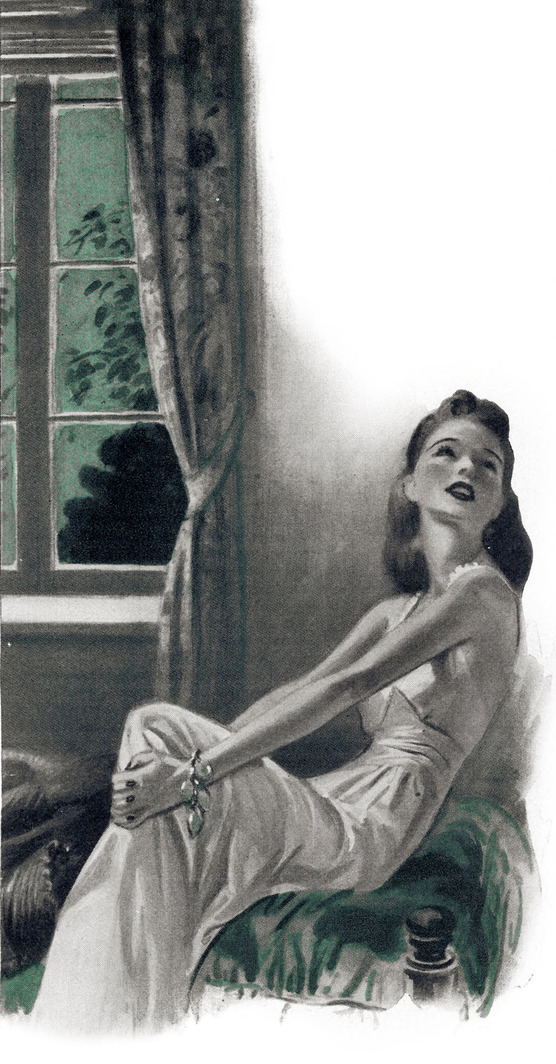
“Hello, Grand-Mary,” said Hilda,
darting toward her, the skirt of her
evening frock swinging around her slim
waist. “Aren’t you the lazy one?” She
touched her finger-tips to her scarlet lips
and brushed them over Mary’s cheek.
“Promise of a kiss. Don’t want to smear
you all up.” She perched on the edge of
the bed, arms locked around a knee.
“Look at the gore!”
“At my age, too!” Mary mimicked
Vera’s reproachful voice. “How nice you
look.” She’d forgotten how beautiful
young bodies were! Skin with a tinge of
gold, like pollen over the smooth surface,
fitting so perfectly over fine bones, exquisite
in their articulation; that hollow
at the base of the throat, the spring of
shoulder-blades like hints of wings; delicate
flow of young, firm muscles down to
the elbows, down to the narrow wrists.
“That dress is a starched petticoat and
not much else!”
“Um.” Hilda looked at her arms
against the stiff whiteness. “I ought to
be a darker shade of tan, to be effective.
But the sun-lamp blew out all the fuses,
and the man hasn’t come to fix it.”
“Even your sunlight isn’t real,” said
Mary. “Synthetic sunburn.”
“Why not?” Hilda looked at her
grandmother, a wary restiveness in her
face. “You can turn it on and off yourself.
At least, you can after the electrician
comes. And what do you mean,
even?”
“Figure it out,” Mary said. She could
feel resistance in the girl’s body, a harder
thrust of foot on the floor.
* * *
“You mean me, I suppose. Mother’s
been talking, hasn’t she? Did she
tell you about the wonderful Peter Willowford?”
Hilda crossed the room to a
window, and one hand swished the long
curtain against the floor. “You know
what he’s like, Grand-Mary? A ripe
banana, soft and plump and just that
color; and his clothes fit him elegantly,
like the peel. Rich as mud. Squashy.”
She jerked at the curtain. “Here I had
my mind all made up—You have to be
practical, don’t you? What’s unreal about
that? Oh, I didn’t want to come in to
see you; you always find out about
things.”
“My goodness,” said Mary, “why did
that get under your skin?”
Hilda turned, her slight body held
rigid. “Because it’s true. It’s what he
said—John.”
“John who?” asked Mary. “I never
heard of any John.”
“He said I was selfish and spoiled and
afraid of reality. I wish you’d tell me
why, when it’s something unpleasant, like
being poor, people call it real; but having
money or position isn’t real at all. After
all, Peter Willowford’s quite important.
He’s in a bank, and everything.”
(“She’s not talking to me,” thought
Mary. “She’s wrestling with herself. All
I need to do is keep still.”)
“It will be years before John gets anywhere.
He’s a doctor—that is, he’s an
interne now. He’s perfectly unreasonable;
he says if I got a job and helped support
us now, he’d take care of me when I got
to be an old lady. That’s not when I
want things; I want them now. It’s much
better, anyway, if you aren’t too crazy
about a man, isn’t it? You can manage
him better. Peter’s mad about me, and
so he does everything I want him to.
But John—” Her face had sharpened; it
was like the face of a girl drowning, seen
through still clear water, thought Mary.
“Oh, well, I’ll get over him. I won’t go
on feeling this way. Anyway, look at the
people who fall in love and get married,
and what happens to them? Look at
Mother; she was in love, wasn’t she? I
mean, she’s fond of Father, of course,
but—”
“It’s much better, isn’t it,
if you aren’t too crazy
about a man. You can
manage him better.”
“The trouble with your mother is that
Clem never asked enough of her. She
managed him, the way you think you’ll
manage this Peter. You’re setting out to
be just like her, a taker and not a giver.
That’s death for a woman, dry rot. He
who would save his life must first lose it.
In love, above all else! Love of a man,
or a country.” (A land where a man can
be free, and his children after him!)
“You’re afraid you’ll lose yourself, your
hard little comfort-loving pinpoint of a
self!”
Hilda looked at her grandmother with
strangely expressionless eyes. Through
the window burst the notes of a French
horn.
“Peter,” said Hilda. “In his chariot.
Coming for to carry me home.” She
stood beside the bed, digging a finger into
the soft wool of the afghan, twisting it
round and round. “You and John ought
to get together. You’d have a wonderful
time. If that’s the way I am, why, that’s
the way I am, isn’t it?”
“Not quite,” said Mary quietly. “Not
quite. You’re scared, but you’re still
breathing.”
“Just a mess!” Hilda drew herself
erect with a shiver as something crashed
against the door. “Maybe we all are in
this house! That’s my darling little
brother you hear! He’s another.” She
moved quickly to fling open the door.
Skiis tumbled in past her, and Bill on his
knees frowned up and went on picking
up bits of phonograph records. “What
are you doing?”
“What the heck d’you open that door
for, just when I leaned my skiis there?
Smashing my best pieces, lugging my
traps out of your way, and why? Because
that louse of a Peter—”
“You make it delightful for Grand-Mary,”
said Hilda sharply.
* * *
“Gee, I didn’t know you were in this
room!” Bill brushed Hilda aside and
strolled in, dropping the broken disks on
a chair. His face was surprisingly young,
looking down from his tall, loose body;
his grin was ingenuous and ingratiating.
“Hi, Gramma, what’d they put you to
bed for? I was just going to stow my
gear in here. Changing things around like
this! How are you, Gramma?”
“She was all right,” said Hilda, “till
you knocked down her door.”
“Say, beat it, woman! Your boyfriend’s
champing around below!”
“You can’t come to dinner looking like
that!” And Hilda disappeared.
“The fuss they make about this droop
Willowford!” said Bill. “I thought Christmas-time
Hilda’d ditched him. You can’t
tell about women, can you? Of course
he’s lined with money. But Hilda’s a
good kid—I dunno—Well, we all could
use a little. Money, I mean.”
“Sit down,” said Mary. “You’re up
so high I can’t see your face.” He was
restless, in a hurry to be off. He had to
speak to her, but he really didn’t see her;
she was just an old woman, labeled Grand-Mary.
There might be traces in his face
of the child who had liked her, in the
shape of the head, the long dark lashes
over the blue eyes; but his affection now
was nothing but a recollected form.
“Well, I can’t stay, see? I got a lot of
things to do.” He drew a chair near her
and folded himself down upon it, hands
dangling. “You—you staying long?”
“I don’t know.”
“I just noticed you hadn’t unpacked.”
“I just came this afternoon.” What
was he leading up to, meeting her eyes
with quick, speculative glances?
“You haven’t got a radio, have you?
How about me setting mine up in here?
I could get along without it.”
“I don’t want it.” Mary smiled. “What
is it you want, Bill?”
“Gee, I was just thinking it’s lucky for
me you’re here. You’d understand if a
fellow asked a favor, wouldn’t you?” He
dropped his voice into husky confidence.
“Here I come home, no kick at all. Do
I get any credit? Dad lands on me the
minute he sees me. Why, half the fellows
flunked the same courses I did!
But while he’s sore like that is no time
to be trying to collect a bill, now, is it?
This guy says he won’t wait any longer;
tonight’s the dead-line. I wouldn’t speak
of it, only it’s an emergency, see? I was
driving this other fellow’s father’s car—”
Bill rolled his eyes toward the door, his
furrowed forehead flushed; even the parting
of his crisp brown hair was scarlet.
“Whose father’s car?” Vera frowned
at the clasp of a bracelet she was fastening.
“What car?”
“I was just telling Grand-Mary a little
story.” Bill scrambled to his feet. “See
you later, gotta rush now.”
“You might hurry,” Vera called after
him. “Your father’s cross enough already.”
She vibrated a moment in the
doorway. “Was he asking you for money?
You mustn’t give him any. He’s so cute,
the way he tries to get around you.” She
sighed. “Clem’s furious at him; I told
him he was just a boy. The trouble is
just that Clem is upset. You’d think
Paris was his home town, the way he’s
taking it. Of course it’s the market that
worries him. He got it on the radio.”
“Got what?” asked Mary. “The way
you jump around!”
“I said very plainly that they were
evacuating Paris.” Vera spoke with dignity.
“I don’t jump, although I might,
the way everything piles up. I don’t know
where Hilda’s gone. I heard her on the
telephone, but I can’t find her. If she’s
going to be difficult again about Peter!
Goodness, I envy you! I’ll have Anna
bring up a tray; do you eat a heavy dinner
at night?”
“Yes, I do,” said Mary with emphasis.
“I’m hungry.”
Vera sighed, slid her bracelets up her
thin arms with a nervous gesture, and
went quickly away, trailing gray chiffon.
* * *
Mary settled into the pillows, her eyes
closed. Her heart seemed to have
slipped down so that it was beating in her
stomach, each thud loud and disturbing.
The trip had tired her; the family had tired
her; she was glad the twilight was deep
enough now so that her eyelids could shut
her into darkness. Her heartbeats seemed
very far apart, and in between them was
silence and darkness, and all the recollections,
the impressions, the images of
the long day rolling at last together into
the meaning she had sought.
“A land where a man can be free, and
his children after him,” she thought.
“Free? We have thought the world was
run for us, that we could go on turning
always in these narrow, petty, selfish
cells. We are losing them again, peace,
freedom. We had them only as a promise.
My father, my sons, and now these
children. They have lost them, having
no dream to hold them safe, to strive to
keep them. They are blind and empty,
passionless—I must tell them this. Perhaps
Hilda heard me; it may not be too
late.” She thought: “It all begins again,
the old struggle.” She could not lift her
eyelids; her heart climbed up into her
throat; it floated away like a bright and
burning word. When you have the word,
it is too late to speak. It all begins again.
Transcriber’s Notes
Transcribed from Redbook Magazine, vol. 76, Mar. 1941, pp. 40-43, 69-74.
New original cover art included with this eBook is granted to the public domain.
The original spelling and punctuation were mostly preserved.