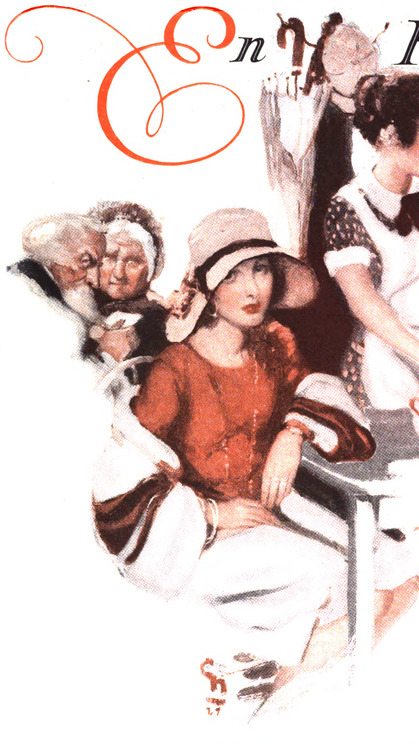
Oh, that pleasant, friendly way of his!—Monica had always loved it.
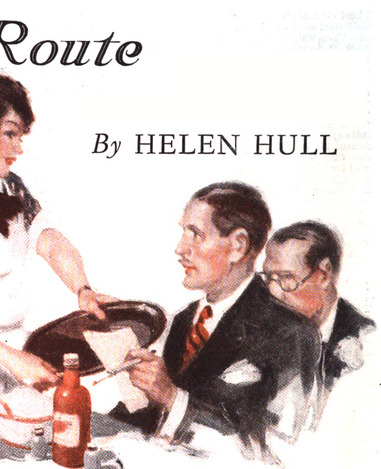
En Route
Wisdom usually comes too late but to Monica it came in time to save her love
Helen R. Hull
Illustrations: Cornelius Hicks
Collier’s, vol. 81, Feb. 18, 1928, pp. 15-16, 42.
Title: En route
Author: Helen R. Hull
Illustrator: Cornelius Hicks
Release date: November 6, 2026 [eBook #79928]
Language: English
Original publication: Springfield: P. F. Collier & Son Company, 1928
Other information and formats: www.gutenberg.org/ebooks/79928
Credits: Jens Sadowski. This book was produced from images made available by the HathiTrust Digital Library.
Oh, that pleasant, friendly way of his!—Monica had always loved it.
Wisdom usually comes too late but to Monica it came in time to save her love
Helen R. Hull
Illustrations: Cornelius Hicks
Collier’s, vol. 81, Feb. 18, 1928, pp. 15-16, 42.
Monica Hunt closed her eyelids to feel the wind against them, as the car rushed with an occasional bump along the coast road. It had been a mistake to drive up from Boston. She should have taken the train along with the cook and the maid. But refusing her husband’s suggestion that they motor up as usual—he could take a long week-end over Decoration Day—had seemed to make too sharp an issue. If she could stand it a few more hours—
“Looks as if that storm would hit before we reach any hotel.” Her husband’s voice, loud with the deliberate cheeriness he maintained now, startled her, and his swing of the wheel to avoid a jagged hole left by frost in the macadam road lurched her against his shoulder. She withdrew so hastily that he noticed; she saw his quick frown.
“It does look threatening.” Her own voice was toneless.
Behind the low, pine-fringed hills heavy clouds were rising, in swift masses that boiled up from the horizon. The car rattled over a small culvert, roared up a curving hill. Large drops splattered the windshield, dotted the film of dust on the hood.
“I’m starved, too. Like to reach food before the lightning hits me. Hope that hotel is open.”
Silence then for a time. A glimpse from the crest of a hill showed the sea darkening under mounting clouds, although the eastern rim still kept the brilliancy of the morning. Monica shivered.
“Cold?” Philip peered at her; he was driving too rapidly for more than a quick glance. “Want the window up?” One hand left the wheel and started to wind up the coupé window.
“No. Don’t close it.” Monica wanted the rush of air, with its damp fragrance of salt and fir trees. If she were cold, no window could be closed to warm her.
* * *
She was lonely. There, so close that she had to sit carefully not to touch him, was his familiar shoulder in the rough brown suit he liked; the firm chin, the long mouth with full lower lip, the gray eyes with humorous crow’s-feet at the corners, intent now on the uncertain country road. Looking at him cautiously lest he detect her, she could imagine that this year was last year, the year before, any year but this one, and together they were driving hilariously along the beloved road toward the house they had built at the edge of the sea. Then the ground crumbled under her feet, letting her down to welter in confusion and pain and loneliness. This wasn’t her Philip. This was a stranger, a doctor who succumbed to the flattering advances of his charming patients—to one of them, at least. Perhaps—the mire was over her head as she struggled to escape—perhaps all their years together he had done the same thing and she didn’t know it. How many times had he said, “Thank the Lord, Monica, you haven’t a jealous disposition! When I see what some of the doctors I know go through with their wives!” Always she had answered, “But I know you love me.” Until this spring. Echoes of their amazing quarrels rolled under the thunder. “You never were jealous before; why are you now!” Finally the night she had stopped at his office and found the girl there, in his arms.
“We must be within two or three miles of the next town.” His voice summoned her abruptly from her thought. She trembled slightly; tiny knife-blades of ice were laid at each nerve center. “I don’t like that wind. These pines uproot too easily.”
“We better go on. A few minutes won’t matter.” More rain now, in slaps against the glass. She had consented to leave town, to open the house for the children, chiefly because there seemed nothing else to do. What she longed to do was, dog-like, to crawl into a corner where she could lick her wounds and perhaps die. That was childish. She had to face this situation, to gain enough tranquillity to think clearly, to reach some definite conclusion which would allow her to act. Perhaps in Maine—where she had spent so many summers, first as a child, and later as Philip’s wife with her own children—some miracle would happen. Philip insisted she was exaggerating everything, that when she came to her senses she would see how foolishly she was behaving. The girl had been a patient of his; like lots of his patients, she thought she was fond of him. She was a nice little thing. That was all.
“But I saw you—”
“Oh, Monica, what if I did kiss her! A fatherly kiss.... It’s you I love and you ought to know it.”
Oh, if she could stop words from beating in her brain! That he thought it nothing showed how far apart they stood.... There lay the town ahead of them, square white houses strung along the road, the huge old trees in the yards turning up pale under surfaces of new leaves in the wind, as if they showed their teeth.
* * *
“That hotel’s still boarded up!” The car skidded as Philip braked it in front of the inhospitable building. “What now?” As he drove on slowly there was an ominous hissing from the rear, another skid; a clap of thunder rattled at the heavy windows. Philip stopped, and hung himself half out the door into the downpour. He settled back heavily, running the window up against the rain. “Well, it’s a flat.” He was enraged, so like a small boy that Monica laughed. “Haven’t even got a raincoat. Of all the fiendish luck!”
“There’s a sign, lunchroom.” Monica pointed down the street. “We could get a sandwich or a pie, if you can drive that far. Then the rain may let up.”
As he drove cautiously the few rods to the low building, Monica thought: it’s like thin pasteboard under our feet, all the old habits ... the way he gets disgusted, the way I console him; if we skate along on that surface, nothing seems changed. Only my feet keep going through!
As he drew in at the curb, a sedan poked toward them until its nose grazed their fender. Country ways, thought Monica; park as you like. She let Philip lean across her to screw up the window, while she watched the occupants of the sedan climb out. First a tall bent old man, with stiff knees, got himself erect on the sidewalk, shouting loudly, “You wait till I open this umbrella!” and then an elderly woman stepped out gingerly, determined to keep her smart gray and white costume unspotted. Monica pushed open the door to call to her: “Is this a proper place to leave the car, and can we get luncheon here?”
“Certainly, certainly.” The old man, his blue eyes sunken under heavy white eyebrows, his beak of a nose slightly pinker than the rest of his face, answered for his wife. “You’re all right. Come right in.”
He maneuvered his umbrella with one hand, not quite over his wife’s hat, his cane with the other, and marched with jerks of his knees into the restaurant.
“We’ll run for it. You first.” Philip held the door ajar, and Monica ran. The car door banged shut, and Philip bolted after her.
* * *
The room was small, with a counter across the rear, half a dozen painted tables, a battered upright piano. At a corner table sat a plump, discouraged man, a sample case propped against his chair, evidently a drummer. The old man was hooking his umbrella on an arm of the hatrack, hobbling back to draw out a chair for his wife. They were courteously oblivious of Monica and Philip, as Philip chose a table opposite the drummer, near a window. The storm seemed directly over the low roof; rain washed down the windows in drenching silver, flashes of lightning cut through the semi-darkness, and thunder pounded in long, retreating rolls. Monica speculated vaguely about the old couple. They had a tinge of familiarity; had she seen them as a child?
“We didn’t get in any too soon.” Philip studied the menu, a typed sheet with handwritten insertions. “Guess you can have most anything you like.” From the rear room came the waitress; she was small, with a cretonne apron belted about slim hips, flying out from round knees; her face looked small under the mass of dark hair that lay in curls over ears and forehead, over the crown of her head, cropped in a V at the nape of her white neck. Amazing hair, thought Monica. Does she do that to it, or does it grow that way? The girl’s hand trembled, spilling water as she placed glasses and silver on the table.
“Guess you don’t like thunder,” said Philip. Oh, that pleasant, friendly way of his! I’ve always loved it, thought Monica, hopelessly; the way he can make everybody like him!
“I’m not so crazy over it,” said the girl. Her eyes were blue, with lashes long on the under lids, and her soft, reddened mouth bowed downward, appealingly. She went back to the kitchen, pattering on her foolish, high-heeled pumps.
“Pretty kid, isn’t she?” said Philip. “Looks anemic. Codfish diet. I’ll bet the fellows don’t notice that.”
Monica watched her return, this time to the other table; saw the provoking lift of full eyelids as she placed silver and tumbler for the old man. She saw, too, that after one long glance, the woman did not look at the girl, that she kept her face turned toward the street, looking at the rain. It was a dignified, old face, with arched lids over bright dark eyes, and firm mouth, with a proper wave in the white hair under the small brim of the gray hat. She hasn’t been downed by life, thought Monica, and that old man hasn’t been easy to live with. The girl stood beside Philip, waiting for the order, stubby fingers hooked over a pad and pencil. A greedy predatory hand, thought Monica. “Please order for me. I don’t care—” The drummer stared at Philip, with sour envy in his protruding eyes.
It’s queer, thought Monica, how everything in the world seems to make me feel like crying. That drummer, piteous, unsuccessful creature; I’m sorry for him. That old woman, so proud and unconquered; tears there, if I don’t watch out. The old man, wanting the girl to flirt with him. Even the girl is piteous, poor little coquette, conscious of nothing but the lures she spreads. This is what Philip calls my nerves ... as if pain stripped off all protective layers, leaving me too exposed. Pure sentimentality. But I can’t bear it.
The proprietress of the lunchroom appeared behind the counter, her florid, wrinkled face heat-flushed. “Well, if it ain’t Cap’n and Missis Hartwell!” She puffed delightedly toward the old couple, wiping her hand on her apron. “We heard you was coming to open your place this summer. Don’t you look real good, both of you!”
“It’s Mattie Burns! Why, Mattie!” The old lady leaned toward her husband. “You remember Mattie Burns, Father?” She spoke with slow distinctness. “Her father kept the blacksmith shop.”
“I guess he did lots of work for you, Cap’n, in his day.” The woman shouted at him. “It’s like old times to see you back. We was saying we guessed you got tired of the West. Anybody’s been raised here on this coast has to come back.”
“That so.” The Captain agreed testily. “What makes you think I wouldn’t remember her father? My mind ain’t failed me yet.”
Mattie Burns laughed. “Just the same ole Cap’n, ain’t you?” She exchanged with Mrs. Hartwell a friendly, comprehending woman-glance.
“I don’t remember that girl you got. What’s her name? She puts me in mind of somebody.”
“She’s younger than our day here.” Mrs. Hartwell spoke sharply, and Monica thought the flush on Mattie Burns’ round face deepened.
“What’s her name? Who’s her folks?”
“She hasn’t got any folks. Her name’s Lucy.” Miss Burns craned her short neck warily toward the kitchen. “She’s just learning to wait. She’s willing but flighty.” Lucy appeared, her small-boned arms strained to hold the tray on which plates of boiled fish and potatoes were ranged. “Hope you’ll drop in real often. This is a bad shower, ain’t it?” Mattie pursed her mouth and retired to the kitchen.
Hartwell. Monica remembered the old Hartwell place in the next village. A sea captain’s house, with a square lookout on the roof. She had gone there with her mother, when she was a little girl. Conch shells and delicate fans of dried seaweed and coral; the cabinet in the parlor, of teakwood, with odor of sandalwood when someone would open the doors to show the treasures to a child. Stories about the Hartwells, a long line of adventurous seafaring men. This Mrs. Hartwell must have known her mother. Monica remembered the cemetery, with old white stones that marked no graves for any Hartwell men: Lost at sea rounding the Horn, lost at sea.... Why, even the last son had been drowned, just after he took out his master’s papers. Queer how bits of recollection floated up. She would have to tell Philip later. (Later? Oh, what would she tell Philip? She thrust away the mad jump of her mind to the present, hunting for more of the past.) It must have been after the death of the son that the Hartwells had left Maine. Other stories, fragments of talk not meant for child’s ears, about the wildness of the Hartwell men! What was that sentence that had puzzled her so long? “Poor Mrs. Hartwell had but one son to lose, after her other baby died. I guess the Cap’n don’t know how many he’s got scattered over the globe.”
The thunder had lessened, as if the storm had ridden out to sea, but rain still fell. A small truck splashed to a standstill across the street, and the driver, a tall, bare-headed young fellow, dashed into the room.
“Coffee and sinkers for a drowning man, Lucy!” The boy had hunched forward, elbows on the counter. Monica couldn’t see his face, but his voice, his posture, caressed the girl.
The drummer was eying them, wearily manipulating a toothpick, as if he reflected: just wait till you get kids to support, and maybe a sick wife. Philip looked up from his pie, speculative amusement in his clear eyes.
“Guess that’s her boy,” he said in an undertone.
The old Captain, too, stared over his coffee cup. Was he envious for his lost youth? Almost Monica caught the higgledy-piggledy maze in his head, a maze like this:
Durn it, she puts me in mind of somebody. That hair of hers. Can’t remember ’em now, the girls I’ve had.
* * *
His cane clattered to the floor, and as his wife started for it, he snapped at her: “I can get it! Sit still!”
“Hey!” He beckoned with his stick, and the girl came, demurely, as if she hadn’t just been making love in sight of all of them. “Where’s the reckoning? Oh....” She pointed to the slip beside his plate. As he drew a wallet slowly from his pocket, he stared at her, his white brows meeting. “What’s your name? You live round here?”
“Lucy Peters, sir.”
Monica saw the woman lift one hand to the table edge, where the old white fingers beat a silent tattoo.
“Peters, eh. Who was your mother? I used to know all the folks here, before we moved to California.”
“She was Lucy Peters, too.” The boy at the counter swung around on his stool, his forehead wrinkling at the inquiry. “That was my grandma’s name, too. Lucy Peters. Maybe—” Was there insolence in the girl’s darting look at Mrs. Hartwell?—“Maybe you knew her. They say I’m the spit ’n’ image of her.”
“Grandma!” The old man snorted. “Never knew anybody that name.” He flung a bill on the table. Mrs. Hartwell let her hand fall to her lap. The girl, retreating to the cash register at the end of the counter, brushed the boy’s knees as she passed him.
“Well, the storm’s most over.” Philip stretched to his feet, reaching for his hat. “Got to mend that tire.” At the door he turned to the old man. “I beg your pardon, but I’m out of luck with a tire. Could you tell me where there’s a garage?”
“Down the street. I’ll go along with you. I want a man to look at my engine.”
“You wait here, Monica? It’s pretty damp still.”
The two went out through the drizzle in which the storm was tailing off. The drummer moved morosely to an examination of papers from a billfold. Mrs. Hartwell sat motionless, her eyelids lowered, her face a mask of bleakness without the life of the dark eyes. The boy untwisted his long legs from the counter stool and with a stride reached the seat at the piano. Lucy, coming with a tray for the dishes, said softly, “Play that piece you played yesterday, the new one. You know. ‘Kiss me, kiss me in the morning! Kiss me, kiss me at noon.’”
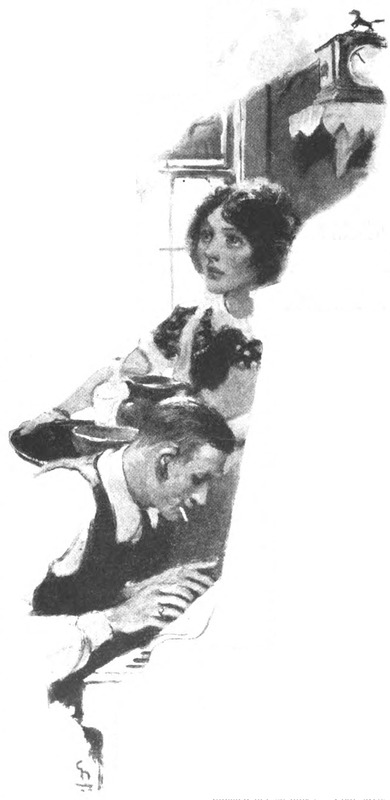
He played music that was careless young love, sensuous, wild.
The boy shook his sleek head; his fingers tossed chords of the crazy melody into the room. He could play. Kiss me, kiss me in the morning. It was a kind of love-making, syncopated, harsh. Tears gathered under Monica’s lids as the sounds twanged at her nerves. Even music on a rickety piano was unendurable, music that was careless young love, sensuous, wild. The proprietress stood at the kitchen door, her head nodding to the rhythm. Lucy moved about the tables, her cretonne apron rippling as if her muscles danced, a faint smile lifting the arc of her crimson mouth. She carried her dishes out and then came back to listen to the music, leaning over the counter. Mrs. Hartwell sat with face averted, indifferent to music, to the girl collecting dishes from her table. I might speak to her, thought Monica. Before she gathered decision to cross to the older woman, the proprietress had moved bulkily to the table. Monica felt the cautious glance to see if she listened, and bent over her handbag, searching for a vanity case. The voice of Mattie Burns lowered to a whisper:
“Mis’ Hartwell, I wanted to explain about that girl. I was that worried when I saw you coming in. You know who she is—”
Monica could not hear the woman’s reply.
* * *
“Her mother came back here about ten years ago. They live in a shack down back of me. It’s in the blood, I guess. Who her father is nobody knows. I was sorry for her, such a pretty little thing, and real smart, too. I kind of felt I ought to help her.”
“I tried to help her mother, once.” Monica heard that dry sentence.
“This girl’s smarter than Big Lucy. That’s what they call her. This one’s Little Lucy.”
Some question from Mrs. Hartwell. Monica sat with bent head, lest they think her eavesdropping.
“No’m, the first Lucy never came back. She’s been dead a long time.”
“You don’t remember her, do you, Mattie?” Monica dared a swift glance, to see what expression lay with that tone of crackling humor. Over her compact she saw the old woman’s face grim, wise. “This girl looks so like her I thought a ghost walked. And, Mattie ... Captain Hartwell has forgotten her! He doesn’t remember so well, these days. He’s forgotten her. Just think of that”—her laugh clicked—“when you get to feeling you can’t bear something. Especially if it’s a man that does it.”
Tiny feelers of Monica’s mind went fumbling in a dark pool of the past, trying to capture an elusive minnow of recollection. The Peters girl and the Hartwells. A sensation of sun-warmed sand tickling her neck. Monica was a little girl on the beach, and her brother was burying her in sand. Behind them in camp chairs sat her mother and another woman, sewing, talking. Sentences empty of meaning drifted to the children. Distinctly the scene returned, with that warm tickle of sliding sand. “They say Mrs. Hartwell has supported that Peters woman ever since. Wanted to educate the child, but she’s so wild they can’t do anything with her. No, he doesn’t know a thing about it. Imagine cultivating your husband’s wild oats! With your own baby dead, too.”
The crashing end of the music destroyed the tenuous grip on the memory. The boy stood up, stretching his arms. “See you later, Luce. Lunch hour’s over. ’Bye, Mis’ Burns.” Lucy, with a final provocative smile at the drummer, retreated to the kitchen, and Mattie Burns, with a sigh, “Well, there’s plenty of work waiting for me,” followed her.
Monica snapped shut her handbag, slipped her arms into the sleeves of her coat, folded the soft fur about her throat. This Lucy, then, was the third. The first one—within her a shrill little voice babbled, “Ask her how she bore, what she did! Lucy Peters wasn’t the only woman. Yet she sits there, fine, serene, strong. Ask her what to do!”
The drummer lumbered across to his sample case, humming the ta-de-ta-ta-ti of his favorite song, and hat on the back of his head, disappeared through the door. Monica rose and crossed to the other table.
“You couldn’t remember me,” she began. “You may recall my mother, Mrs. Swift, Eliza Swift.” The dark eyes of the older woman, focusing slowly on Monica, seemed to relinquish some distant time-horizon. “I used to come to your house, Mrs. Hartwell. I’m Monica.”
“Why, of course!” Friendliness shone in the finely wrinkled old face. “Sit down. How nice of you to speak to me. You can’t blame me for not recognizing you, after all these years. I was just thinking about your mother. I was very fond of her. And that was your husband?”
“Yes. Dr. Philip Hunt.” Monica added explanations: the children, a boy and a girl, were still in school; she was to open their summer house. She tried to silence the voice that went babbling on. How could she affront this woman with questions that pried into her personal affairs?
Mrs. Hartwell explained, in turn: “Captain Hartwell retired some years ago. We’ve lived in the West, but we thought a summer here, before—a summer here might be pleasant. I remember now how you always liked to go up to the lookout, when your mother brought you to the house.”
“When my little girl comes down this summer, perhaps you’ll let me bring her. She would love it, too. Have you still the teakwood cabinet?”
“Yes. Everything is just as it was.” She was silent, looking at Monica. The quiet depth of her eyes seemed cognizant of the pitiful tremor within Monica. Ask her, babbled the voice. She might help you. She’s your only chance to find any help. Monica propped an elbow on the table, her knuckles pressed against her lips; she couldn’t blurt out her foolish pain to a woman she had encountered in a lunchroom, after more than twenty years. Teach me, begged her eyes, luminous from unshed tears; where did you find your courage?
“It’s astonishing how little things change,” Mrs. Hartwell went on. “Your little girl will find the same shells you used to hold to your ear. I felt almost a grievance”—she smiled—“to come back, an old lady, and to find my furniture just as I left it. Not a change.” She laughed, a pleasant, self-directed chuckle. “Although, to be sure, the roof needed shingling.”
“Yes,” said Monica. “Only people change.”
“They grow up, as you have done. Then they grow old, like me. And just as they’re getting wise enough to live, they grow childish again, and die.”
Lucy had sauntered in with a handful of silver which she let clatter down on the counter. Mrs. Hartwell looked at the girl, a sardonic wrinkle at a corner of her mouth. As she disappeared again, the old woman said, “There’s the first stage. Heady illusion. She thinks the world is made just to keep her happy. The second stage—” She lifted her quiet eyes to Monica. (She knows, shrilled that small voice; she’s seen there’s something terribly wrong. It’s written all over you!) “The second stage is bitter. You are frightened and lonely, while you shrink into the pin-point the world makes out of you. Then you learn to walk alone, just the way a baby has to learn. And finally you learn endurance. In the long run—” She half lifted one hand, as if to touch Monica’s. Then she straightened her shoulders, her fingers pulling down the gray silk pleating at her wrists. “Will you come to see me, soon? I won’t preach again. Only—I knew this woman, Mattie Burns, and it’s easy for an old woman to turn her mind back and get to feeling solemn.”
She heard me crying out, thought Monica: I can’t say anything. It would violate that pride of hers.
“Hi, Monica!” Philip’s summons was triumphant. “All set now, and the storm’s over.”
“This is my husband, Mrs. Hartwell.” Monica watched the woman’s shrewd appraisal of him, as she explained her childhood acquaintance. “I’ll point out the house as we drive past. I’m to take Elizabeth there this summer.”
“Harriet, aren’t you ready to come yet?” The shrill quaver of Captain Hartwell announced his jerking entry. “That fellow says there isn’t a thing the matter. Says I must of choked her too much. I don’t believe he knows. You know I never choke her—” He stopped, staring a moment at Lucy, who stood again at the rear door. Monica saw his slow, blinking struggle for recollection, saw him dismiss it for a gallant flourish of his umbrella toward his wife.
He’s forgotten them all, she thought: forgotten all the rest, and still needs her. And she has learned to walk alone. Endurance.
She settled herself in the car, relaxing in complete fatigue. Philip peered at her as he started, a tentative glance, like young Phil when he was uncertain as to her reception of some bit of conduct.
“Nice, isn’t it?” He shifted into high, and the car ran swiftly past the few houses up a hill where tiny leaves hung glistening in the sunlight. “Nice to see two old birds so comfortable with each other. He was telling me what a wonderful woman his wife was and how they go traveling round, enjoying themselves.”
“Darby and Joan.” Monica felt a burst of flame in her head, drying up the tears that had so tormented her these last days. She’s done it by hanging on, no matter what he did. She knows how to be lonely. Philip’s not so bad as that old wretch. It’s my loving him that counts.
* * *
Dear God, help me to love him enough! Help me to hang on! “When you’re hobbling around with a stick, do you think you’ll still want me?” she cried out. His face swung toward her a moment, relief so profound in eyes and mouth that Monica knew, suddenly, he too had suffered.
“Now you’re talking sense,” he said. “You think you may hang around till then?”
“I expect so.” Monica moved until her shoulder brushed his. This was Philip, here beside her, alive, strong, skillful. And she loved him.
“Funny how you happened to know those two old people.” He ran on with casual, friendly talk; Monica listened, and beneath the anodyne of his words her thoughts made shadowy interruption. There were things in life thought couldn’t touch; too deep for your mind to reach to. It had been fear and injured pride from which she had suffered, not love. That old woman, Mrs. Hartwell, was too proud to be afraid. Proud enough to dare to be humble. What had she said?... “You learn to walk alone.”
“We’re almost home, Monica. Are you glad?”
“Yes, I’m going to be,” she said.
Transcriber’s Notes
Transcribed from Collier’s, vol. 81, Feb. 18, 1928, pp. 15-16, 42.
New original cover art included with this eBook is granted to the public domain.
The original spelling and punctuation were mostly preserved.