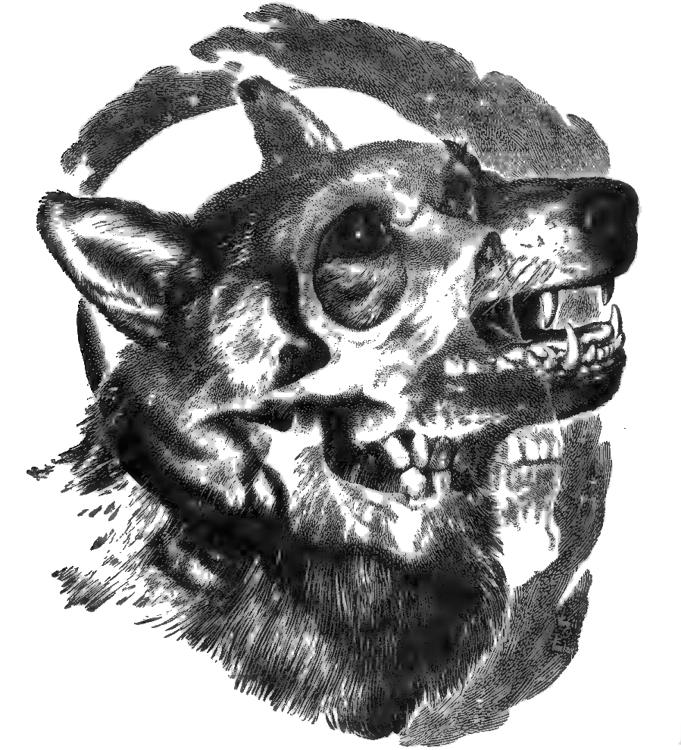
Lycius paid a heavy price for tinkering with time....
Title: Bannion's cave
Author: Margaret St. Clair
Illustrator: Virgil Finlay
Release date: November 2, 2026 [eBook #79911]
Language: English
Original publication: New York: Standard Magazines, Inc., 1955
Other information and formats: www.gutenberg.org/ebooks/79911
Credits: Tom Trussel - Stories of Futures Past (This file was produced from images generously made available by The Internet Archive)
by Margaret St. Clair
Lycius paid a heavy price for tinkering with time....
“I don’t want to be seen talking to you,” the sorcerer said. He looked nervously up and down Dragonetsa’s main street. “In my political work....”
“Your political work?”
Lycius replied. He raised his bushy eyebrows. “Is that what you call your being sergeant-at-arms of the Middle-Aged Communists’ League?”
“I’m serious,” Peter answered. “You’re considered an unreliable element.”
“I can’t help that. The prince and I want to get to Paris.”
“Don’t we all?—I mean, what’s that got to do with me?”
“We think you can help us.”
“I tell you, I don’t want to be seen talking to you,” Peter said. “I’m just beginning to be politically reliable. I can’t jeopardize it by being with a man who—”
“Is a werewolf?”
“Nonsense. That’s got nothing to do with it. That’s just superstition, an out-worn relic of the dark night of ignorance and bourgeois slavery. The reason I don’t want to be seen with you is that you’re too thick with the prince.”
Peter looked disapprovingly at Lycius for a moment longer. Then he turned and began to walk away. The older man caught at his sleeve.
“Wait,” he said. He leaned forward and whispered something to Peter.
The blond man blinked and chewed at his lower lip. “You wouldn’t,” he said slowly. “Not a thing like that.”
“I would, though,” Lycius answered. “I’m desperate.”
“It’s blackmail. What do you want?”
“Come to my house tonight, around dusk.” Peter frowned. He looked at the shadow of the local mountain, which, as the sun westered, was beginning to spill over into the village street. Dragonetsa was located among spurs and foothills of the Transylvanian Alps. “All right,” he said. “After sundown. Mind, I don’t approve of this.”
Lycius’ preparations for the ex-sorcerer’s visit were simple. He got out three bottles of the best wine he had been able to salvage from the prince’s cellar, and two glasses. He also closed the shutters and put another birch log on the fire.
Peter arrived a little before dark. He was in a bad temper. “I don’t know why you insisted on this interview,” he said as soon as he was inside the door. “Suppose I were to threaten to denounce you to the Central Committee? What then?”
Lycius laughed. “For being a werewolf? You’d never make it stick. Everybody knows that lycanthropy is nothing but superstition, just as you said. If they believe in it, they don’t dare admit it anymore. Whereas if I told them you’d been practicing sorcery again—”
“Oh, I know,” Peter answered bitterly. “Exploiting the age-old superstitions of the oppressed peasantry. Exploiting! All I ever got for all the work I did for the people was an occasional chicken, and half the time they didn’t bring them when they’d promised them. I don’t know what they did to those chickens to make them so tough. I had to boil them for hours and hours to get broth.”
“Too bad,” Lycius replied. “You’re doing better now, though, aren’t you? How about a drink?”
“Thanks,” Peter said, accepting the glass. He sniffed appreciatively at the heavy golden stuff. “Looks like sweet Szamarodny. Long time since I’ve had any. Your health.”
When the glass was empty, he said, “Yes, I am doing a little better. I got two acres of land in the distribution, and people say hello to me when they meet me in the street. That’s why I want to be careful. I’d hate to have to go back to being a sorcerer again.”
“Have a little more wine,” Lycius suggested. “I like to have it drunk by someone who appreciates it.” He filled the glass. “Naturally, you feel that way about sorcery. But I imagine you still have your gifts.”
“Um.” Peter shifted his position and stretched his long legs out to the fire. “Listen, Lycius, why are you so chummy with the prince? You can’t be fond of him; nobody could. And as far as owing him any loyalty goes, he only kept you around the palace because he liked to hear the girls giggle and scream when he told them one of his retainers was a genuine werewolf.
“Why don’t you ditch him? You could go to the village soviet and tell them frankly you’d had a change of heart and wanted to be a useful, productive social element. It would take a little time, but you could get to be considered reliable.”
Lycius said nothing. Peter looked at him keenly. “Has he got something on you?” he asked after a minute. Lycius’ massive head inclined a fraction of an inch in what might have been assent.
“Oh, I see,” Peter said slowly. “Somebody you ate—is that it?”
“I’m not saying,” Lycius answered. “But believe me, Peter, the prince and I want to get to Paris. All we need is money.”
“Why ask me? I’m not running a printing press. Besides, what happened to the jewels the prince used to have? The Belodna jewels were famous. What became of them?”
“Well, there was a singer in Bucuresti, and a dancer in Beograd, and an actress and a couple of entertainers in Zagreb. There aren’t any family jewels any more. More wine?”
“Thanks. I don’t care if I do. It’s wonderful, smooth stuff.”
Lycius pulled out the second bottle’s cork. “We thought you could help us get away,” he said when Peter had half emptied his glass.
“How? Do you think that if I had access to money I’d ever have been so poor?”
Lycius sighed. “Don’t you have knowledge of buried treasure, underground hoards, that sort of stuff?”
“I’m supposed to. I never was any good at it. I can’t even find water with a virgin hazel rod half the time.”
There was a silence. Lycius kept looking at his guest and then away again. He threw another birch log on the fire. And as soon as it grew empty, he replenished Peter’s glass. The fire was beginning to die down into glowing coals when Peter said abruptly, “’Jever lose anything? I mean anything valuable?”
Lycius looked surprised. “Why, yes. Once I lost a bundle of hundred lei notes, and somebody stole my ruby stickpin a couple of years ago. What about it? Everybody’s lost valuable things.”
“Don’ mean like that,” Peter answered waspishly. The second bottle of wine was nearly gone, and he had been drinking at the rate of three glasses to Lycius’ one. “Mean like—say you had a valuable glass bottle, V’netian work. It gets broke one day. All gone, all of a sudden. You can hardly believe it. I mean lost like that.”
“Oh.” Lycius seemed to think. As if absent-mindedly, he drew the cork out of the last bottle and poured wine into the sorcerer’s glass. “There was my wolf collar,” he said finally. “The prince had it made especially for me to wear when I was, you know, changed. It got burned up when the peasants set fire to the palace. I looked all through the ashes for it, but I couldn’t find anything. It was an awfully hot fire.”
“Val’uble?”
“Oh, yes. The prince had it made by a jeweller in Bucuresti. There were six diamonds set in a chain of flexible gold, and a clasp with an emerald. Exquisite. I suppose the gold was vaporized and the diamonds, being carbon, burned. I liked that collar a lot.”
“How long ago?”
“How long ago was it burned up? Let’s see, the peasants started revolting six years ago, and it was a while after that. About five years. Don’t you remember the fire yourself?”
“Not ri’ now,” Peter said, speaking with some difficulty. “...Five years ago. Ought be still lots left.”
Lycius poked up the fire. In the resultant burst of light he studied Peter’s face. The sorcerer had slumped back in his armchair and was breathing through his mouth. He opened his eyes and looked at Lycius briefly. “More wine,” he demanded. He held out his glass.
Lycius poured with a cautious hand. Peter drank. He said, “You go to Bannion’s Cave, unh, tomorrow—it’ll be full moon—t’morrow night.”
“Bannion’s cave? Where’s that?”
“You know. Up on hill. Outside town. Near woods.”
“Near the old ruins?”
Peter laughed soundlessly. “Not so ol’,” he said thickly, his face twisting. “Not so ol’ you think.”
“But—what’s the Cave got to do with my wolf collar?”
Peter leaned forward. He poked his host in the diaphragm with an admonitory finger. “Collar in Cave,” he said, laughing. “Ri’ time of year. Moonlit night.”
“The collar was burned up,” Lycius said doubtfully.
Peter shook his head. “Things don’ get lost; really. Not sudden like that. They wear out.”
Lycius rubbed his hands together. “Well, tomorrow night would be a good time to go,” he conceded. “Everybody in Dragonetsa will be away, having a socialist harvest competition with the people in Bela-jiu, and they’ll stay late. But—” His voice was still unconvinced.
Peter picked up the bottle and slopped wine into his glass. “Collar be there,” he said. He drank, and licked wine from his chin. “Thing lost, gone sudden, fall in time stream. Get wash up in cave. Word advice.” His face twisted up in a giggle. “Don’ cut yourself!”
Lycius got to his feet. He stood in front of the hearth, his back to the fire, warming himself. “I’ll try it,” he said. “But listen, Peter. Will it be okay?”
“Hunnnnnnh?”
“I said, will it be okay? This isn’t one of those three wishes deals, is it, where no matter what I do I come out wrong?”
Peter’s lips moved. Waveringly he pushed himself up by the arms of the chair until he stood upright. He took a step forward, and fell flat on his face.
As they toiled up the rocky path that led to Bannion’s Cave, the thoughts of Lycius and the prince were astonishingly similar. Both of them were thinking about the wolf collar, and with very little scepticism as to its existence; both of them were thinking about weapons, the prince about the pistol under his cape, Lycius about the sheath knife in his pocket; and each had decided to dispose of the body of the other by dragging it inside Bannion’s Cave.
The full moon shone in a cloudless sky.
They reached the cave somewhat winded. The prince dusted off a flat rock with a fold of his cape, and sat down on it. He said, “Don’t be long. It’s cold out here. You’ve got the flashlight?” He had a small sullen face.
“Yes.” Lycius lingered for a moment, as if he wanted his feudal lord to wish him luck, but the prince was looking the other way. He switched on the flashlight. He stooped and entered the cave.
At first it looked very much like any cave. There were fruit pits by the entrance and crusts of bread, as if someone had been having a picnic. It seemed to be a shallow cave, rather than a deep one.
Lycius moved forward cautiously, sweeping the uneven floor from side to side with the beam from his flashlight. He heard a faint squeaking, a noise which he attributed to bats. As he got farther inside the opening, he saw that there was a rift in the rear wall.
He hesitated, and then moved toward it. The cave was not quite dark; there was a generalized bluish-green luminosity coming from somewhere. Even the jagged edges of the rift were luminous.
Lycius was sweating. He rubbed his hands on his trouser legs to dry them. For a moment his physiological agitation was so great that he wondered whether he was on the brink of “changing.” Then he collected himself. He even wondered why he had been so upset. He stepped into the rift.
His first impression was that he had plunged into water. Everywhere the blue-green light quavered away from him, and his body felt the mingled buoyancy and pressure of a watery medium. He brought one hand up to his eyes, slowly, and the flesh seemed to waver along it in an uneven luminous line.
Lycius breathed deeply. His legs felt weak. Once more he wondered if he was going to change. This time he rather hoped that he would. Changing itself was a physically distressing experience, of course; but there was something refreshing about the complete obliteration of personality it gave. And if he turned into a wolf he wouldn’t have to go on in and investigate the cave. The light swam confusingly around him: the only solid surface was under his feet. The missing wolf collar seemed unimportant and far away.
In the distance, the light wriggled away in fish-tail glances. Lycius hesitated. He was not so much afraid, actually, as confused and oppressed. The mocking face of the sorcerer came before him for an instant with the vividness of a hallucination. He sent the beam of the flashlight out straight in front of him. It met nothing, though the light was surprisingly yellowish and opaque. Lycius licked his lips. Then he began to walk forward. Each step was slow and effortful.
The sandy floor was as level as a beach. But it was dotted, from time to time, with lumps of corally, grayish stuff. They were of all sizes. Lycius prodded one near him with his foot. To his wonder, it disintegrated at once into a hundred small pieces that drifted gently down to the floor. He touched the next lump with his fingers. It felt dry and papery. He rubbed it lightly, and it too fell into bits.
He was seized with sudden panic. Growling, he turned toward the direction from which he had come. To his vast relief, the rift was still visible, a dark and jagged outline against the glowing, shifting bluish light.
But the contrast between what he had come to find and what he was finding still bothered him. There seemed to be nothing in Bannion’s Cave except the lumps of grayish stuff. As he moved on, he saw that the lumps were becoming more symmetrical. Once or twice there were contours that suggested right angles—a box, a backless chair.
Was this what Peter had meant when he insisted that things didn’t get lost suddenly? That they wore out? They came to this place, and slowly time—or was it time?—eroded them. There ought, in that case, to be still something left of his collar. But a cave where such things happened was hardly a wholesome place.
Lycius moved onward. High-strung, like all werewolves, he was growing more nervous with every wavering step. When something struck against the calf of his leg with a high ping he almost shrieked. He looked around for the source of the ping and found nothing. There was only the greenish light quivering between him and the floor. But something certainly had struck him; he’d felt it. If he ever got out of this cave....
He raised his hand to his eyes and looked at it with feverish attention. He was hoping to find the sprinkling of coarse grayish hairs on its back that would indicate the onset of the comfortable animal oblivion of lupinity. Moaning, he put it down again. These things never happened when you wanted them to. It remained obstinately a human hand.
Lycius’ nervousness grew to a peak. He was just about to turn back when he saw his wolf collar. It was lying on the sandy floor beside a half-eroded object that looked like, and probably was, the gold watch Lycius had lost when he was fifteen. (A mule had kicked him in the pocket where he was wearing it.) The gold of the collar looked a little dusty, but the diamonds and the emerald seemed to be in fine shape.
Lycius grabbed at it. To his relief, it felt perfectly solid and real. He put it in his pocket. He turned and made his way back to the rift in the cave as quickly as he could. It was a slow job. When he was in the anteroom of the cave again, he rested for a moment. Then he brushed hard at his shoulders and neck. He had the feeling that he was brushing certain superfluous seconds and minutes away from them.
The prince was waiting for him outside the cave. “You certainly took your time,” he said irritably. “It’s cold out here. Well. Did you get it?”
“Yes,” Lycius answered. “I’m all right,” he added in an unsteady voice. The observation was more to reassure himself than the prince, who was paying little attention to him.
The prince held out his hand. “Let’s see it,” he demanded.
Lycius gave him the collar. He was feeling a profound nervous exhaustion. Let the prince go until later, he decided—when he was feeling more himself, he’d handle him. He only hoped his feudal lord wouldn’t start anything.
The prince examined the collar. The diamonds glittered fretfully in the moonlight. “What’s wrong with the gold?” he demanded after a moment. There was suspicion in his voice.
Lycius shook his head. “I don’t know.”
The prince was staring at the object. “There’s some sort of insect on it,” he declared slowly. He dusted at the collar with his cape. There was a tinkle and a ping! Something fell on the path. The prince put out his neat little foot and made a crushing motion. When he raised his shoe, there was a momentary glitter like rock crystal against the path.
“Some sort of winged ant,” the prince said, still staring: “The gold looks pitted. The diamonds seem to be all right, though. Well....”
He put the collar in his pocket. He paused for a fraction of a second. Then he pulled his pistol out from under his cape and fired point blank at Lycius.
It was here that the wisdom of the werewolf’s choice of weapons became evident. A pistol, even when loaded with silver bullets, can always be unloaded and blanks substituted. A knife, on the other hand, remains a knife.
Lycius stood showing his teeth while the prince emptied the gun at him. When the prince had chucked it aside, screaming, Lycius closed in on him. With a residue of strength he had never imagined he possessed, he stuck his knife in under the prince’s ribs.
Distastefully, Lycius stooped and took the collar out of his pocket. He began to push and tug the prince’s body into the cave. He tried to avoid the sticky patches, but he couldn’t help getting some blood on himself. He had quite forgotten Peter’s warning, and if he had recalled it, he might not have seen how it was apposite. After all, he hadn’t cut himself.
He got the body into the cave somehow, automatically avoiding the neighborhood of the rift. When he had finished he was really exhausted. He leaned against the cave wall, his knees bent, while he panted and tried to recover himself. In his concentration on breathing, he even closed his eyes.
He was recalled to reality by an insistent tickling sensation in his wrist. He brushed at it, seeing nothing, but his fingers met a hard shell. It must be one of the insects the prince had seen on the gold of the collar.
He stood upright, shakily. It was time to be leaving. As he moved toward the cave’s opening, he turned for a last look at the prince. What he saw made his heart plunge and flutter. There was something wrong about the prince’s face. He had to walk quite close, on tiptoe, before he saw what it was. Most of the skin of the prince’s face was gone. The white bone was gleaming up at him. Lycius stood perfectly still for a moment. His mind was busy with summation. The eroded objects in the deep part of the cave, the winged ant on the ‘gold,’ Peter’s warning, the naked bone of the prince’s face, the tickling in his own wrist. The blood. The tickling in his wrist.
Lycius stood motionless while his heart gave one more thud. Then he turned and ran.
The moon rose higher.
Peter, alone of the inhabitants of Dragonetsa, was in residence. The rest were still in Bela-jiu, recuperating, after the fatigues of the socialist harvest competition, with fruit punch and a lecture on “Socialist Planning In Rural Cooperatives.”
Peter, intent on political reliability and social respectability, had labored manfully all day beside the others at harvesting, despite his grinding hangover. But when dusk had come he had decided that enough was ample. Now he was asleep on his bed in Dragonetsa, snoring happily. He had not even bothered to take off his clothes.
He was awakened by Lycius shouting. The alarm in the werewolf’s voice cut through Peter’s vacuous dreams like a burning knife. Before Lycius had had time to yell his name twice, Peter had crammed his feet in his shoes and was at the window sill.
“What’sa matter?” he asked sleepily.
Lycius held the wolf collar out toward him. He was almost too winded to speak and his face, except for the dark patches where he had smeared his hands, was ghastly white. “—After me!” he gasped. He made a gesture in the direction from which he had come.
Peter, following the motion, stuck his head out over the sill. His jaw dropped. For a second he could only stare.
Between the two men and the moon, moving very rapidly, there was advancing a great glittering cloud. It seemed to be made of thousands upon thousands of tiny individual motes, so that its edges flickered dizzyingly, and it glinted angrily, like frost or hail, in the light of the full moon. A high, unmusical humming came from it.
“T-t-time t-t-termites!” Peter stuttered. He clutched the window sill. “Didyoucutyourself?” he demanded of Lycius. The latter indicated the patches of blood on his clothing, his face, his hands. “Prince’s,” he gasped.
Peter looked at him distractedly. Then he snatched the wolf collar from Lycius’ flaccid hand and dove out of the opposite window of the house.
He felt no particular compunction at his desertion of Lycius. Paris beckoned; and after all, nothing he could do would help the werewolf. He felt perfectly sure that both Lycius and the village of Dragonetsa itself had only a few seconds of temporal existence remaining to them. He saw no reason to stay and share their fate.
Lycius, left alone, was changing. After so many false alarms and baffled hopes, he was taking on the wolf shape at last. His jaw grew shallower, his snout lengthened. He dropped down on all fours, the coarse wolf pelt sprouting on him.
The time termites, in a vast glittering cloud, covered him up.
Peter’s prognostications had been wrong in one particular. A werewolf, when changed, is immune to anything except silver bullets. Thus it was that the moon, some three-quarters of an hour later, though it looked down upon a Dragonetsa that would have been of interest only to archaeologists, found a Lycius who was reasonably intact.
Reasonably intact. A casual observer would have said that he was all right, except for a few bald patches on his muzzle and paws. (The bald patches represented the places where the prince’s blood had been smeared on him in his human form.) A closer observer would have hesitated. The shifting brilliance of the werewolf’s eyes looked bad, and so did his nervous trembling. A dog in the same condition would have been on the edge of convulsions or running fits.
Lycius was a werewolf. In his narrow skull were confused memories of homicide—the prince—of danger—the time termites—and of loss—Peter’s taking the wolf collar. Overriding them all was the memory of the intolerable tickling the wings of the time termites had inflicted on him.
He hesitated, cringing and trying to lick his eroded fur. The neural itch was maddening. He howled, choked, and howled again. The moon rose higher. Lycius slunk off into the shadow of the dust mound that had been the City Hall of the Soviets.
He waited. When the President of the Electrical Co-operative returned from Bela-jiu, about ten o’clock, Lycius slid out of the darkness and bit him in the leg. He bit the Secretary-Treasurer of the Tractor Pool, a woman named Popovici-Banatseanu, and a rather mature Young Pioneer before the other villagers could come to their senses enough to drive him off with sticks and rocks. The people he bit had to have the Pasteur treatment and anti-tetanus serum, flown in from Bucuresti; between that and the total destruction of Dragonetsa, it was nearly a month before anybody had time to organize a wolf hunt.
When they did, they were efficient about it. But they hunted him for three days, and all they found was a handful of wolf tracks. One of the older men murmured “Lycius,” when he saw them, but the others hushed him up. The shushee muttered, “I suppose he was an agent of Anglo-American imperialism, too,” (a reference to the official explanation of Dragonetsa’s sudden destruction), but he was careful to mutter too softly to be heard.
They didn’t catch the werewolf, then or ever. They did drive him from his usual haunts in the forest far up onto the mountain. He did no further harm, and pretty soon they were too busy rebuilding Dragonetsa to have any time for wolf hunting.
Lycius remained a slightly demented werewolf. His nerves kept itching. He drifted into Bannion’s Cave one day, past the prince’s skeleton, and seemed to like the dampness and the dark, though the bones appeared to bother him. At present he is living in a sort of symbiosis with the time termites. He kills small animals on the side of the mountain, eats what he likes of them, and brings the residue to Bannion’s Cave for the time termites. It looks like a ritual of propitiation.
He is not particularly unhappy. He always wanted to go to Paris; and about half the time he is convinced that Bannion’s Cave, which is rather high up on the mountain, is really the Eiffel Tower and that the glittering of light on the termites’ wings is the lamps of the boulevards. At such moments he rolls on the cave floor and whines with sheer pleasure.
But the symbiosis is an uneasy one. The time termites don’t bother him overtly. But he has only been living in the cave for a couple of months, and his fur has already turned quite white.
This etext was produced from Stories Annual, 1955 (Vol. 1, No. 1). Extensive research did not uncover any evidence that the U.S. copyright on this publication was renewed.
Obvious errors have been silently corrected, but minor inconsistencies have been retained as printed.
New original cover art included with this eBook is granted to the public domain.