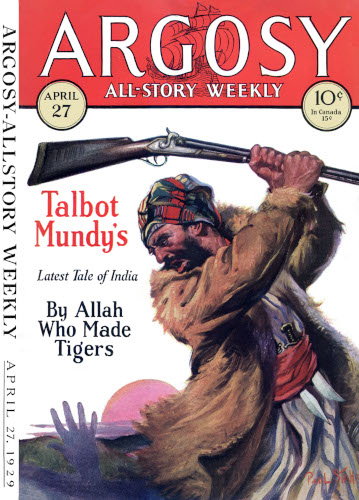
Title: By Allah who made tigers
Author: Talbot Mundy
Release date: November 2, 2026 [eBook #79906]
Language: English
Original publication: New York, NY: The Frank A. Munsey Company, 1929
Other information and formats: www.gutenberg.org/ebooks/79906
Credits: Greg Weeks and Mary Meehan
By TALBOT MUNDY
Author of "Asoka's Alibi," "Ho For London Town!" etc.
Bold and crafty was mullah Mir Mahommed, leader of the
hillmen; and his mad plans for a holy war were well
advanced when secret agent Frank West happened along.
[Transcriber's Note: This etext was produced from
Argosy April 27, May 4, and May 11, 1929.]
| I. | HILLMEN IN THE NIGHT |
| II. | THE PROPHET OF A HOLY WAR |
| III. | THE MULLAH'S WILES |
| IV. | THE MOUNTAIN CAVERN |
| V. | AMBUSH |
| VI. | DEATH STALKS IN THE MULLAH'S CAVE |
| VII. | "FORWARD, HIGHLANDERS!" |
Thirty years have not blotted out that memory; the incidents stand out like a cameo cut from the mass of all that happened before and since. Peshawar, thirty years ago, was raw, and uglier than the inside of a usurer's conscience, although at first glance no usurer's money ever looked more alluring.
Nothing noble, or even nice, belonged there, so nobility stood out and shamed you; beauty made you choke and do things that a sense of self-preservation would otherwise have vetoed. Hot by day, with a wind that grilled you until comfort and a cool drink were synonymous terms and nothing else much mattered; cold by night because the wind reversed itself and moaned from the northern snows, raising a mist that filled all hollows and came creeping out of them toward the city.
It was in that mist that sentries had to stand, as lonely as honest men on Judgment Day and just as uncertain of the outcome, seeking to keep their souls within their bodies by alertness. There was also some indoctrinated theory or other about duty to lie-abed merchants, who must be saved alive to cheat each other in the morning; but nobody who had had a few dealings in the bazaar would have been less than delighted if the hillmen could have purged it without knifing you and me and one or two other people.
The men who had to risk their lives on sentry-go and outpost duty admired the hillmen far more than they did the citizenry they were guarding with such grim blending of endurance and impatience. Except for that little point of honor, with which Shakespeare so vexed Jack Falstaff, the British—aye, and the native Indian army too, might long ago have taken sides with the tribes beyond Peshawar and have helped them once again to conquer India from the northwest.
There were some very lovely ladies in cantonment that year, of whom the loveliest was Winifred Orloff, a guest, and, I think, some sort of cousin of the Wingates. Colonel Wingate was in charge of the military hospital, where he was too busy, just as his wife was too lazy, to pay much attention to Winifred.
She, nevertheless, was better worth attention than anyone else at that time on the northwest frontier. That was the one point on which everybody was agreed, and everybody was exactly right. She was the reason—and reason enough—why I was in Peshawar, suffering from ingrown loathing of myself and all my ways. It needs a woman to produce that state of consciousness, and even she can't do it, lovelier though she be than blossoms in the sight of snow, without youth and ideals to work on.
Never mind about ideals. They are usually secondhand, and by-and-by we trade them in for something more snappy and up-to-date. Youth is the point. I was young and painfully aware that I wore no uniform. No long-jawed Scotchmen with muscular knees saluted me; nor was I one of the "heaven-born" civilians with a handle in front of my name and half of the alphabet after it, who used to govern India in those days with a Roman gesture but without the Roman cynicism in the matter of bribes—decent, exasperating men, who would have been a credit to themselves and everybody else if only they had not been so sure they were.
I had been sent to Peshawar on secret service with instructions—considered too secret to be put in writing—to watch Miss Winifred Orloff and to discover what connection, if any, she had with the Czar's government. Strict orders to make love to her would have been much more tasteful.
I remember I looked at my face in a mirror near the door of the ballroom of Government House and thought I was better looking than possibly half of the men in the room. Then, in the same mirror, I saw her dancing with Ross of the Guides.
He had eleven medal ribbons, of which one was the Victoria Cross, and he could dance with a rhythm suggesting the lilt of a squadron's lances when the long line sweeps into disciplined motion. As for her, men looked at her and left off talking. So I got my hat and coat and went out to think the situation over.
It was not so good. If, in the course of duty, I should prove her guilty of espionage—We were supposed to be very hard-boiled in the secret service, but not only was I more than half in love with her myself, but two of my friends, Ross and Grabowski, were in open and hot competition for her affections. I was worse than out of the running, yet I could not go away and leave them to it.
The hotel was a miserable place, so I changed—to the everlasting credit of the lords of luck—into a dark green gabardine suit and shooting boots, pulled on a heavy overcoat and went for a walk, followed by my gray dog, Brandy—part sheepdog and part terrier, with wise eyes and a way of keeping his distance while watching you constantly for a hint of what you wanted him to do. Winifred Orloff thought more of my dog than she did of me, so I had used him more than once as an excuse for watching her.
I walked, of course, toward a cemetery. You can't leave Peshawar in any direction without meeting a cemetery. They almost surround the city, and in the moonlight and the mist they look more ghastly than the engravings in Dante's "Inferno"; but the tombstones made wonderful cover for Pathan outlaws, armed with jezail and tulwar, on the prowl after modern rifles or whatever other loot might come their way. However, first I passed Grabowski's shop in the bazaar.
Grabowski was a Scotchman—Polish ancestry, of course; there is a surprising number of Polish families in Scotland, and their younger sons are at odds with convention all over the earth.
This particular descendant of a line of Quixotic fighting men was an artist of distinction and considerable private means, with a funny flair for missionary work. He was a doctor, among other things. He had a theory that art would tame the hillman, and it made no difference to him that Moslem scripture and tradition utterly repudiated the use of the human form in painting or sculpture.
Indispensable to the border cut-throats by reason of his skill with wounds and the inviolable loyalty of his silence, he could talk so persuasively when he chose that he had even prevailed upon the mullah Mir Mahommed to pose for him for a statue. Some Moslem fanatic smashed the clay model, but not before Grabowski had reproduced it in papier-maché. He set that papier-maché thing outside his shop door, painted to look so lifelike that it was almost impossible to go by without being startled. Even dogs would snarl at it. It made hillmen shudder, it was such an offense against their religious prejudices, but Grabowski hoped to wear down that prejudice.
The statue would have been destroyed in no time if any one but Grabowski had made it, but along that border a skillful surgeon who charges nothing for extracting bullets, asks no impertinent questions, and tells no tales to the police, can do with impunity what no government would dream of risking.
To decoy Pathans and other savages into his back room, Grabowski sold in the front room snuff and such other simple comforts as they craved at prices which made the local merchants hate him. His papier-maché Pathan in the doorway substituted for the old-fashioned tobacco shop Scotchman. In the back room he kept beautiful illuminated copies of the Koran, which it delighted him to read aloud to any cutthroat who would listen.
On his walls were shields and tulwars—weapons with which he was reputed invincible; he enjoyed no exercise as much as meeting all comers in his back yard and having it out with them with naked blades. They were men who, in a frenzy of excitement, might forget they were only playing, but it was all one to Grabowski.
The mist let me walk out of the city without being challenged and turned back—mist and perhaps the barracks beer some soldier had been drinking. I was far outside the zone of comparative safety, walking in the gray haze among flat-faced tombstones, wondering what sort of pressure could have induced a girl like Winifred to choose the Russian side of any argument, half Russian though she was. Abruptly a hoarse voice brought me back to the comfortless present with a suddenness that jarred. One sentry, at least, was awake.
"Ha-a-a-lt-t! Who comes there?"
The frontier rule was shoot, then challenge. Even if discipline and habit, or a sense of decency should make a man challenge before he fired the shot—if he were sane—should follow voice more swiftly than an echo. I had no time to weigh arguments.
"Rounds!" I answered.
"What rounds?"
"Visiting rounds!"
"Advance, visiting r-roun's an' gie the password. Pit y'r han's up—over-r y'r heid! Aye, nae doot ye're oot walkin'—ye're daft! Mon, but f'r the fact ye'd that dog wi' ye I'd ha' shot ye dead-der-r than beef!"
I faced six feet of indignation in a mist-wreathed overcoat. His nerves were on edge, because he had shot a man that night. He held the empty brass cartridge and kept tossing it. Speech was not in him, except as announcing the limit of forbearance, emphasized by a smack of his fist on his rifle butt.
"Ye'll stan' here until rounds come an' I han' ye over-r tae the guar-rd!"
Not another word was spoken. Mist wreathed the two of us. I came a half step nearer to him, meaning he should see my face and perhaps change his mind about me, but he misinterpreted the movement. The butt of his rifle struck me in the chest. A stone slipped from under my heel and I lost balance.
As I fell a tulwar licked out of the mist—above my head by less than half an inch. It struck off the Scotchman's head, so that it hung by a shred of ligament before his knees gave way. I was actually on my feet again before the headless body struck the ground. Brandy was worrying somebody's heels.
I did not see, I felt the tulwar come licking again out of darkness—ducked—and I think Brandy set his teeth into the man's leg, because the edge missed and the broad of the blade struck me on the forehead.
Strangely, I was not stunned, but I lay still and heard a man laugh. Brandy came and sniffed my hair, then my lips. I breathed on his nose, since I did not dare to speak, and he slunk away to pursue his usual tactics of watching from a distance.
Little by little I opened my eyes, and now the mist had drifted and the moon was shining clear. A big man in a smelly sheepskin jacket, with the fleece turned outward, was busily stripping the murdered sentry. Two others watched him, their faces in profile—one a lightly built man, but the other bigger than the first. They carried jezails and had long knives as well as daggers stuck into their girdles.
The shorter man said something about me in a low voice, and his accompanying gesture had unmistakable meaning; he drew his thumb across his own throat, finishing the motion by pointing the thumb in my direction. But the man who was doing the stripping looked up for a second and cursed into his teeth.
It was more like a dream than reality. However, those three men were plainly no deceptive dream; simply honest outlaws helping themselves to weapons and boots and ammunition in the old familiar way.
The stripping did not take long. He who did it rolled the clothing in a bundle, which he tied by pulling out the leather bootlaces and knotting them together. Then the biggest of the three men seized me by the shoulders. I wondered whether to sham dead or to show signs of recovery, but the lightly built man, who had wanted to cut my throat, solved that problem by sticking the point of his knife under my thumb nail.
I don't think I have ever hit a man since then as hard as I hit that one. I almost broke the heel of my right fist on his jawbone, and he lay unconscious so long that the other two began to quarrel as to which should have his weapons. Meanwhile, they searched my pockets and were so annoyed at finding so little in them that they would probably have killed me, but for a piece of almost ridiculous luck. A letter, anywhere along that border, is a thing of mystery, involving unknown quantities—and awe.
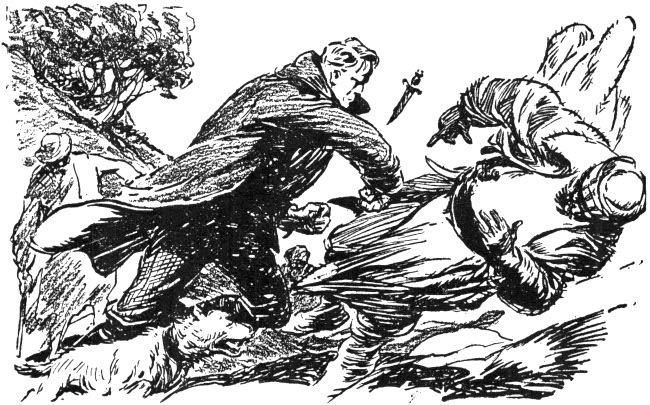
The Pathan crashed to the ground.
They found in my inner coat pocket a letter in a large square envelope. It was an utterly unimportant letter written by a maiden aunt in England; but the seal on the back of the envelope was so enormous, and she had used so much golden wax, that it had called for triple postage, the stamps thus making the face of the envelope also appear important.
Furthermore, she had impressed the seal with a die that she had bought in some old curiosity shop; it was covered with Arabic characters, so that it looked as if the Grand Mufti or some one equally distinguished had been writing to me. The biggest man—the other called him Ismail—demanded to know what was written in the letter and I refused to tell him.
"Allah," I said, "has his own way of teaching fools the danger of other people's business."
"Look thou. Canst thou read it, Suliman?"
He who answered to the name of Suliman opened the letter and tried to examine it by moonlight, but he held it upside down, and by the time he had made his puzzled face look owlish wise and had tucked the two sheets back into the envelope, the man whom I had hit recovered consciousness.
He looked so comical, with his jaw dropped and his eyes swiveling around in the moonlight to discover what had happened, that the other two laughed at him; and laughter is a moral insult on that grim frontier. It was almost his duty to draw steel, so they loaded him with ribald criticism that suppressed his ego for the moment. But it did not cause him to admire me.
However, the notion of murdering me had vanished for the time being. I had become the bearer of an important document, who might be worth holding for ransom. And, as Ismail said:
"His clothes are good. They will be no worse if he wears them a few hours longer."
The third man, Ali bin Adam, stroking his beard over the lump I had raised on his jaw, began to think of ways of salvaging his injured honor. Having eaten shame, he must inflict some. So he gathered up the bundle of clothing stripped from the Scots sentry and commanded that I carry it. I refused. He tapped his knife hilt.
"Draw your knife," I said, "and I will fight you with my bare hands."
He was howled down promptly by the other two, who shrieked so loud with laughter that I hoped they would be heard at the distant guard house. Ali bin Adam showed me the whites of his eyes, and I knew that he and I were enemies beyond any mere settlement by murder or the theft of one another's goods.
"Allah!" he remarked. "As you and I live, Ismail, it is true he struck me. He can strike you also. Would it be a jest if he should strike all three of us and run? Who has a thong to tie his hands?"
I knew what the torture of that would be, if Ali should do the tying of my wrists, and I was wondering whether a bluff would hold, or whether I could endure the torture without losing self-control, when Ismail's black beard suddenly jerked sidewise as he cocked his ear to listen.
"Soldiers!" he said curtly.
Ali was ordered to carry the bundle. Suliman and Ismail seized me by the elbows, hurrying me away between them. I filled my lungs to shout for help, but Ismail divined my intention and clapped a huge filthy hand over my mouth. I bit it and tripped him, shouting as we fell in a heap, with him on top.
Ali jumped on both of us, and Suliman swung for my head with the butt of the stolen rifle. He missed and hit Ali bin Adam, whose thick turban broke the force of the blow. I heard Brandy barking. Then something did strike the top of my head. It felt as if my head exploded. Flames, not sparks, flames of all the colors in the spectrum flashed before my eyes.
I remember wondering what the next world would be like—what Brandy was barking about, and whether he was coming with me. There was something a bit vague, but not unpleasant, about Winifred. After that, nothing except the sound in my ears of roaring water—and then absolute unconsciousness.
I looked up at a blue sky without a cloud in it, and I thought a year had passed, but Brandy was still barking. One eagle was circling, and he was so near that I could see his feathers. It was probably heaven, or hell, and not much matter which, since wishing would not change it either way.
The sensation was of floating in space, in which light was too strong for my eyes, and I was surprised that I could remember earth life—also rather interested in remembering it. There was a very comfortable feeling of detachment, and no pain whatever. But I remember I wished Brandy would leave off barking.
I began to think of Winifred, and felt detached from her, too; not indifferent, but rather curious as to whether spies went to heaven or hell. I could not imagine myself in either of those realms, although the sky was blue enough for anything—and then, I remember, I began wondering whether it would be possible to look back into the world and learn whether or not Winifred Orloff was a spy.
My next thought was one of amusement; I wondered what the folk who don't believe in an after life would have to say when they, too, got there. Then I began to wonder where the Scotchman was. I had seen him killed, so he ought to be somewhere near me. Or had he gone to hell? Perhaps Brandy was barking at him. I tried to look, and became aware of a sharp crag on my right hand that pierced the sky. It was like a painted crag; it seemed to have no back to it.
I tried to sit up, but something that felt like a rough hand forced my head down again, and a moment or two after that I knew that my head was bandaged, which was sickeningly disappointing. So I was not dead.
Then, since I was not allowed to sit up, I turned on my left side and discovered that I was lying on an oxhide spread on dry grass, on a ledge that overhung a gorge between two precipices. The bottom of the gorge appeared to be at least a thousand feet below me. It made my head reel, and I think I became unconscious for a while.
The next thing I remember, Brandy was still barking, but the feeling had returned of being dead and in another world. I remembered my name had been Frank West, and wondered what it was now; I don't know why, but it seemed unlikely that a man would keep the same name after death. Frank West seemed something like a character in a play I had been witnessing. I remembered him as a rather futile person, not important. Winifred, too, seemed like a character in a drama, but Grabowski, strangely enough, was a real person, and when I thought of Grabowski the feeling of being dead and in another world completely left me.
It became clear to me, vividly clear, that I liked Grabowski better than I had ever realized. He was an absurd, quixotic, chivalrous ass with all the instincts of a gentleman. But it also occurred to me that his love-making might be a ruse, just as his absurd attempts to civilize Pathans by means of art and their own religion might be a ruse to cover up intrigue beyond the border.
Winifred and he might be playing that game together, he communicating with the tribes and she providing the connecting link with the Russian secret service. I wondered why I had not thought of that before—why nobody had thought of it. No one, so far as I knew, had suspected Grabowski.
In fact, all that anybody knew for certain was that the mullah Mir Mahommed for a long time had been receiving money from an unknown source, and had been talking war all through the savage hills through which the Khyber Pass runs like hell's throat, roughly north and south. The mullah Mir Mahommed's influence reached a hundred miles either way, east and west of the Khyber.
His was not authority, it was influence over about half a million savages. It was easy enough to understand why the Russian government should have him in its pay. Properly subsidized and encouraged, he could start a holy war that would keep the British-Indian army busy while the Czar's men slowly encroached through Bokhara and Samarkand. But Winifred and Grabowski—
Brandy was still barking. Some one shoved a spoon between my teeth and I tasted hot soup. Opening my eyes, I felt sure I was dead this time—dead and in hell! A negress with her head in a yellow bandanna and a bright blue shawl over her shoulder kneeled behind me, smiling, shoveling the soup into my mouth and watching me with a strange mixture of calculation and amusement.
"There, honey—how's that? Feeling better?"
"Where am I, and who are you?" I asked her.
"You're a two-day journey from Peshawar," she answered, speaking like an educated woman. "Is that your dog? I thought so. I tied him up. I fed him."
"Who are you?" I repeated.
She laughed, showing wonderful teeth and the whites of her eyes. I judged her about twenty-four years old. "I'm the mullah's wife, honey. I am Mrs. Mir Mahommed. Come, now, good goat soup with onions in it."
She raised me by the shoulders, pillowed my head against her knees and shoveled in soup until I gasped. Then suddenly she laid me down again and vanished. I heard her arguing in Pushtu with a man whose voice was as harsh as a file on metal, but I could not catch the words; the voices seemed to come from fifty feet below where I was lying.
Presently I heard a man's footsteps; then I felt his shadow and looked up into the eyes of the mullah Mir Mahommed. He was so exactly like the papier-maché image outside Grabowski's shop that for a second or two the woozy impression returned of being dead and in another world. However, I discovered that I could sit up, and he had the decency to drag up a bundle of hides for me to lean against.
He was a magnificent specimen, tall, broad-shouldered, active, clad in an embroidered smock and a sheepskin jacket. His turban was wrapped around a green cone, indicating he had been to Mecca and was therefore a Hajji. He leaned on a British military rifle. There was a curved knife like a Goorkha kukri at his waist.
He was wearing a necklace of amber beads as big as hens' eggs, and in his right hand was a rosary made of dried seeds strung on catgut. He kept flicking the beads with his thumb while his fiery yellowish brown eyes watched me as if he expected me to change into somebody else under his gaze. His great hooked nose was like an eagle's beak, and he had the bushiest black beard I have ever seen on any one—coal black with one streak of snow-white where a sword had once bitten his jaw.
He made me remember a picture of Peter the Hermit, only this man was less fanatical, more cunning and personally ambitious. He looked considerably more than six feet tall, but that may have been due to the shape of his turban.
"Name?" he asked.
I told him, and he repeated it, pronouncing it "Feranquesat." He appeared to think the name important, and I understood why after a moment when he produced my aunt's letter and looked at the seal. He tapped the letter with his finger. Then he laid his finger on his nose.
"It is the seal," he said, in Pushtu, "of the Sharif of the Mosque of El-Kalil. The words on the seal are the true words of God's prophet. But what is the writing within the letter?"
"He who asks," said I, "when he has eyes to see with, is a begetter of lies inviting others to deceive him."
"Allah who made tigers! What dam of all impudence brought thee forth?" he retorted. Then suddenly, his finger on his nose again: "Who read the letter?"
I pretended not to understand him. He waited almost a minute for my answer and then repeated the question in another form:
"Three men made you prisoner. Did they ask what is in the letter?"
"They asked," I said, "but am I a bell that rings for any one who pulls the rope?"
He appeared pleased. But it seemed to me that if the New York negress was his wife, it was more than likely she had read and translated the letter to him.
"You have eaten my salt," he said after awhile.
"Lacking other," I retorted. "Allah repays such debts as that. It is written that no obligation is binding on him who has had no alternative."
"You have the tongue of a wakil," he said, curling his lip with the scorn that one sort of special pleader normally exhibits for another.
"God's ways," I retorted, "are wonderful, but surely this is the strangest of all: that one with such eyes as yours should be so blind as to see in me a lawyer."
"Allah! Do you wish to live?" he asked me.
"Not by your leave," I assured him. Then I took a long shot, at a venture, being almost sure from his manner that he had a scheme in mind for making use of me. "I am one whose services have value. He who desires something of value without paying for it is a thief. If that shoe fits your foot you have my leave to wear it."
"Atcha," he said, "atcha. I will pay you. I perceive you are a person of merit." But his eyes looked crafty. "It is ever the way with those who are made prisoners, that they wish their friends to know they live—in order, doubtless, that the ransom money may be swiftly paid. Name me your nearest friend, that I may send the message."
The last thing I wanted was to be sent back to Peshawar. I wanted to remain his prisoner and learn his secrets, so I did not answer. He began to argue, as a man might who has nothing to gain by hiding anything.
"If I send the message, and captivity is thereby shortened, then, having done you a favor, I may seek one in return!"
Voice and face were reassuring, but there lay trickery behind his eyes—trickery and speculation. I decided to discover whether he really wanted money.
"Not one rupee of ransom!" I said. "Let the troops come. Meanwhile I claim your protection, since it was not you who took me prisoner and therefore I have no quarrel with you."
The Moslem law is very definite on that point, it is deadly sin to refuse protection, even to an enemy, who claims it—aye, in the very heat of battle. A mullah, who had made the pilgrimage to Mecca, could hardly ignore the Koran's teaching.
His eyes changed; there was half masked satisfaction in them and he was about to answer, but Brandy began barking furiously at approaching footsteps and he turned from me to face the three Pathans—Ismail, Suliman and Ali bin Adam—who had given themselves the trouble of capturing and carrying me all that distance. My back was toward them as they climbed the narrow path to the ledge where I lay, but I could watch the mullah's face.
He and my three captors faced one another as animals do before a fight begins. I might have been the "kill" between them. It was Ali bin Adam who broke silence first.
"You mullahs assume rights that don't belong to you," he said hoarsely. He sounded asthmatic. "You pretend Allah talks to you alone. There is one law for you and another for us. Since when? Who ordered that?"
Mullah Mir Mahommed answered loftily: "Bismillah! Is your ignorance my law?"
Then Suliman spoke up: "I took him prisoner. I slew the Scotchman. It is true, we left him by the way because he seemed to us dead. It is also true that we did not take his garments. But that was because we were in great haste."
"And why the haste?" asked mullah Mir Mahommed. "Mashallah! They be guilty men who run because a man's voice calls to them. It was I who called. And what said I? I spoke only of God and His mercy. Lo, I look down from the cliff and behold, there are three men carrying another who might be dying, but was not yet dead, since who should carry a dead man in such unseemly haste? Was it wonderful then that I spoke of Allah and his mercy?"
"It may be," Ismail answered.
"And the letter that you let fall?" Mir Mahommed asked.
"Nay, we hid it," said Suliman "not being agreed as to who should keep it. We divided the loot by agreement, and the prisoner, but not his clothing, fell to Ali bin Adam's share. There was dispute about the letter."
"So you laid it away where any fool could find it, being fearful of what might be written beneath such a seal. And well that ye were afraid! It was God's will that it should fall into my hands. Allah, who imposes folly on fools, sent that stupidity into your heads. And so ye laid it at the tomb of Holy Ali the Lousy, beneath a stone that would never have held it in a wind made by a bird's wings. But a strong wind came. And the letter was blown whither Allah intended. Nevertheless, ye come to me, and in your impudence ye ask me for the letter?"
"Nay," whined Ali bin Adam, "we have not asked for it. But the prisoner is mine. It is true, your she-black found him, but he is mine, and his shirt also is mine. So strip him of his other clothes and I will take him."
"And as for the letter," said Suliman, "we will discuss that. We will yield or assert our claim when we know what is in it. The overcoat and the suit of clothes belong to Ismail, and the boots to me. Deliver them."
"I will deliver the vengeance of Allah and his burning curses on your thieving souls," said Mir Mahommed. "Nay, touch no hilt at me and tap no rifle-butt. Have ye lifted your stone from the field? Ye have not. Neither have I. Nor yet has any man. Not until seven more days and the seeding are past may the each-other-shooting season begin. Thereafter, if ye choose to pick a feud with me, may Allah be the judge between us, praise be to his prophet. The kites and the jackals shall feed then if Allah wills it."
"We spoke not of a feud," said Ismail. "As for me, you may have the prisoner. But you shall answer for him if the troops come, or if the headmen listen to the border talk and agree to return him. If they name an indemnity, you shall pay it."
"He is worth to me three thousand rupees of ransom money!" exclaimed Ali bin Adam. "And you give him away without even demanding the price of his shirt?"
"I will give you his shirt. You shall have it," said Mir Mahommed. "In the name of the Almighty you shall have it. The women and the children and the very goats shall know you henceforth as Ali-who-sighed-for-the-shirt. It shall be carried to you on a camel, with all the honor that is due to such a fine Pathan as you are, Ali of the bold heart who sighed for the shirt!"
Ali swore, making use of the liver and lights and entrails of obscenity, then strode away and leaned his back against the cliff. Nobody laughed. Ali-who-sighed-for-the-shirt was too likely to go mad with anger and shoot me, who might prove valuable even yet.
"But the letter. What is in it?" Suliman demanded.
For a moment Mir Mahommed caught my eye and I admired the splendid savage. He dared me to give him the lie, and he dared to fling his lie into the faces of three men who easily—so far as he knew—might have tortured or otherwise persuaded me to tell the truth about the letter. I watched him narrowly, but he made no sign of an appeal to me—no bargain—no flicker of eyelid to suggest that we should play his game together. He lied as he would have used his tulwar or the stolen rifle on which he leaned—cold steel, hot lead, and take the consequences. And his lie was so beyond belief that none thought of disbelieving it.
"The letter concerns me only," he announced portentously. "It is a letter from the very holy Sharif of the Mosque of Ibraim at El-Kalil, where as a Hajji I had lodging on my return journey from Mecca. May God bless the prophet of God. The letter is addressed to this one, whom you mistreated. It desires him to find me and tell me of a dream the Sharif had, wherein I appeared to him as having died. The letter says that in the dream I told him of this, that the prophet of God—be blessings on him!—told to me in paradise: that if, when I am dead, my people the Pathans shall reckon me a saint and keep my burial place sacred, then I will appear to them after death from time to time and will make them conquerors of all these hills and of all the Punjab and the rich lands watered by the rivers. Also he informs me of my approaching death and bids me to make my peace with Allah—may his prophet be praised."
Ismail and Suliman came closer to him, so I saw their faces. They were jealous. They believed him, since who could invent such a lie? They were glad he should die so soon; his "she-black" and his goods and chattels would be lawful plunder to be intrigued and fought for. But they resented the odor of sanctity. A dead saint, yes. No living saint is tolerable within crow-flight of the Khyber.
"You!" said Ismail. "You preach a holy war, yet let a Christian make an image of you! Does the shameless thing not stand in a shop door, dishonoring the prophet and defying God's commandment?"
"That is also written in the letter," Mir Mahommed answered. "Shall the all-merciful not forgive sin when the heart repents? He who readeth all hearts knoweth mine. I let the image be made to deceive unbelievers, who should thus believe me unfaithful to Islam, and should trust me the more because of that, to their own undoing. It is his will that the image shall not vanish and be burned by devils in the pits of Eblis, in order that my soul may escape condemnation and be caught up into paradise."
"Allah!"
Suliman turned and eyed me fiercely. "Is that written in the letter?" he demanded.
I wanted to know more about the holy war, so there was nothing to be gained by taking any side except the mullah's, at the moment. The grand old savage did not bat an eyelid. He had invented and told his lie, and now he stood there, like the image outside Grabowski's shop, and calmly awaited the outcome.
"Who are you," I asked, "who challenge the writing of the Sharif of the Mosque of Ibraim at El-Kalil? You saw the seal."
Ismail eyed Mir Mahommed's rifle—eyed it with hunger and longing. Also he eyed the double bandolier well filled with stolen cartridges. "So," he exclaimed, "then name me, Ismail, to be the owner of that rifle when you die and I will be first of the men of my valley to call you a saint."
"We will speak about that," said Mir Mahommed tartly, "at the proper time and in the proper place." He appeared not quite to relish such a premature division of his goods.
"And what shall happen to this prisoner?" asked Suliman.
"Insh'allah, I will answer for him, and ye have my leave to go," said Mir Mahommed.
That phrase is final. Either leave, or break the law of hospitality and fight. All three went, taking great care to betray no sense of the importance of their host and by that very care betraying it. A living mullah in that democratic country is a restless political influence, a hardly tolerable nuisance, and a menace to plain men's dignity. It is only dead ones who receive much praise; the living ones are to likely to demand some kind of holy war at inconvenient moments.
Ismail and Suliman ignored me as if I had not been there, but Ali-who-sighed-for-the-shirt surveyed me with a hatred that seemed to burn him like a torch. He was livid with it. It was producing jaundice; the whites of his eyes were turning yellow, and he loved the mullah hardly more than he did me.
"You preach a holy war," he sneered. "You pay money to this and that man, hoping to hire fools to slay themselves on British bayonets for your advantage! Allah?"
I supposed that Mir Mahommed would remain on the ledge and explain away that accusation when the others were out of ear-shot, but apparently there was nothing further from his intention. He followed them to the top of the track, stood watching, with his rifle resting in the crook of his arm, until their footsteps echoed far away below in the ravine, then strode out of sight without glancing in my direction.
I was awakened again by the negress. "Nice hot tea, honey, with brown sugar in it and goat's milk."
"How long have I been here?" I demanded.
"Two nights, and I've covered you each night with a linen sheet stretched on wickerwork, so's you'd not get moonstruck."
"How badly is my head hurt?" I demanded.
"Honey, it's a marvel you're living. And it's lucky for you I've had to nurse folks, and mind babies, and do what-not else for a living. You'd a lump on your head as big as my two fists, and you'd have been veal if you'd lost any more blood. I'd have had you in the house, only fresh air was what you needed, and there's too many folks come in here. It was easier to keep you quiet up here on this ledge."
It was clear enough that she was not telling all of the truth. It followed that the way to learn the truth, supposing that were possible, would certainly not be to ask too many questions. Brandy had resumed his barking the moment he heard my voice, and there was a plan in my mind already half formed. The dog's barking gave me the excuse to ask about him.
"Sure, honey, he's been well fed. My man—I mean the mullah, doesn't like a dog around. Moslems are mean about dogs. But I told him the dog was worth a heap o' money, so he let me tie him up, behind the house where other folks can't see him. The house is fifty feet below this ledge. My name? They call me Khadija. I used to be Louise—Louise Emmet. Drink your tea now; come on, drink it."
She watched me finish the tea. Then:
"What's in that letter, honey?" she asked casually. "He won't let me read it." But that was a rather too obvious trap.
"You'll have to wait, Louise, until my head doesn't ache so badly," I answered.
More tea, and a long pause.
"Honey, who is that girl you rave about when you are out of your head? Winifred? Is that it? Is she anybody in Peshawar? Is she any one that knows Mr. Grabowski?"
It was a lame way of dragging in Winifred's name and probing me to find out how much I knew about her. I don't rave in delirium. Drunk, sober, asleep or out of my head, I can be trusted to name no names and tell no secrets.
It was my first real clew connecting Winifred with Mir Mahommed, and I judged her guilty instantly. A sort of craving to protect her from the consequences, however, was equally instantaneous.
"Yes, I dare say she knows Grabowski. Why?" I answered.
"Oh, just because. My man, I mean the mullah, knows Grabowski."
"I know he does."
"But the mullah can't cross the border just now. The English say he killed a soldier for his rifle. It isn't true, but they say it's true, and you might as well argue with that mountain as try to make them believe different. Honey, if my man—I mean the mullah Mir Mahommed—if he should help you to the border after you get well, and see you safe across, could he count on you for something? I mean something that wasn't money, and wasn't easy, but that 'ud mean a heap to him?"
"I'll buy," I said, "if I can pay the price. I keep promises."
"You look it, honey. But you can't move for days and days yet. Could you write a letter from the mullah to Mr. Grabowski?"
"Grabowski can read Pushtu and Urdu," I answered. "Why doesn't the mullah write his own letter?"
"Because it's something important that Mr. Grabowski might not do unless you ask him. If Mir Mahommed wrote it, who should know it weren't a forgery?"
"I don't know whether I can write," I said. "Get me a pencil and paper—or pen and ink."
She picked up the teacup and for awhile she tapped it with the spoon, as if considering that idea. I sheared across her line of thought, since it seemed to be leading nowhere.
"Loose the dog, too. Let him come and see me."
She nodded and went away. I heard her loose the dog, and after that I caught a few words in a man's voice, but I could not hear what was said, or even be sure that I recognized the voice as Mir Mahommed's, because Brandy came galloping up the track, and I had hard work to protect my head from his enthusiastic greeting. It was several minutes before I could get him to lie down quietly behind me.
Luckily he had on his collar, and I had worked the nameplate loose before Louise came back with a blue copying ink pencil and about a dozen sheets of cheap ruled paper, but no envelopes.
"There you are, honey."
I pretended to be unable to control my fingers. When I had made about a dozen efforts she left me, saying I should try again after awhile; but I noticed that she stood at the head of the track for several minutes, watching me, but pretending to watch something down in the ravine. However friendly she might feel, she was the mullah's woman.
Even after she had gone she came back once very quietly to watch what I was doing, and I wondered whether she had counted the sheets of paper. I decided to take no chance on that. She had seen me crunch up and throw away the top sheet, on which I had scrawled a dozen efforts to write my name. I could not reach it, but Brandy found it for me in a minute, so I straightened it out and wrote on that—no more than a long telegram, the problem being to let the authorities know where I was without betraying myself as a secret service man if the dog should be caught and the letter read before it crossed the border.
Whoever finds this, please deliver to Provincial Commissioner Peshawar. I am a prisoner somewhere in the hills, apparently in a valley parallel to the Khyber Pass. Head hurt, but recovering. Look after Brandy for me and don't pay ransom money because if my wits hold out I think I can escape. Frank West.
I folded the paper and tucked it under the brass nameplate of Brandy's collar. Then I examined Brandy's feet, which were in good shape.
"Go home," I commanded.
I had to repeat the command three times before he left me, but when he did go he went in a hurry. There were only two places where he was likely to go—the hotel, where the manager would recognize him, or the Wingates' bungalow in the Peshawar cantonment; and the Wingates' bungalow was the more likely place because Winifred was fond of spoiling him with too much food. He would be hungry, and he would probably think of food first. That might be the means of warning Winifred to cover her tracks. I hoped so. If I had dared, I would have warned her in the note to escape from India.
Brandy had been gone about half an hour when Louise returned. Naturally, the first question she asked was where the dog had gone.
"Whistle him," I suggested. "He's somewhere near, I've been asleep."
She whistled and called for several minutes. Then she counted the notepaper and found the number of sheets correct, so I felt fairly sure she did not guess what had happened.
"He sure has run away," she said. "I was a fool to loose him. Honey, you mustn't try to play any tricks with me, because I'm your friend and friends are skeerce in these hills. Can you write now? Write a letter to Mr. Grabowski."
Twenty minutes, I suppose, she spent in telling me what I should write, repeating the gist of it over and over, developing new angles with each repetition, so that by the time she had finished I thought I understood who was the brains of that partnership between a magnificent Moslem savage and a New York negress.
It was also obvious that she would give me no chance to play tricks with written words that should cause Grabowski to read between the lines some message from myself. Louise could have written a better letter than I could; it was my handwriting and my signature that she needed, and she reenforced persuasion with just enough diplomatic pressure to reveal how entirely I lay at her mercy.
"I've been good to you, honey. If it weren't for me there'd be some bloated vultures, and there'd be jackals cracking your bones to get the marrow out of them. If I should say you'd lied about that letter they found in your pocket, how long do you think it would be before Ali bin Adam took charge of you? And how would you like that? And if the ransom money didn't come, what do you think he would do to you? So you take that pencil and write to Mr. Grabowski in Peshawar. You oblige me, and I'll take care of you."
"Dear Grabowski," I wrote, "our mutual acquaintance, Mir Mahommed, is distressed on account of his papier-maché portrait, so remarkably well executed by yourself. It appears that its public exhibition outside your shop door has created such a scandal in those hills that Mir Mahommed, being a Hajji and a mullah, is not only embarrassed, but is possibly in danger of his life. In the circumstances, he considers that his own broad-mindedness in posing for the portrait should be met by equal broad-mindedness on your part and he has asked me, his guest, to state his case. He does not regret the friendship that he has felt toward you from the first, but he does deeply regret the religious indiscretion into which you led him; and since political reasons not unconnected with certain rather recent blood-shed prevent him at this time from paying you a personal visit, he hopes you will pay to this request of his as swift attention as he feels sure you would if he could meet you face to face.
"Rumors, circumstantially based, have come to Mir Mahommed's ears to the effect that a group of his personal enemies intend to carry off that papier-maché statue and, before burning it, to subject it to indignities, accounts of which, deliberately spread throughout the hills, would make his position unbearable. He is anxious, however, that you should not destroy it, because then the mullah's enemies would make cunning use of legend and superstition. People would be reminded that the magical means of killing any one is to make his portrait and then to destroy the portrait, after which he becomes the victim of the first misfortune that presents itself. There would be considerable competition to be the first to enact that misfortune, and the mullah would be sniped from behind every bowlder whenever he should dare to show himself.
"Mir Mahommed dreads the danger to yourself if you should hide the statue, since fanatically minded men might then invade your premises and possibly subject you to indignities, or even violence, thus beginning a feud, the end of which it is impossible to foresee. An indignity to you, on his account, would obligate the mullah Mir Mahommed, to wreak vengeance on the perpetrators to the second generation—a contingency that neither you nor he can look forward to with any degree of pleasure.
"Much thought has brought the mullah Mir Mahommed to this ultimate decision: to confess to the assembled tribes that it was contrary to the prophet's teaching and therefore sinful to permit the statue to be made. He will display the statue and will himself destroy it with his own hands, thus, he believes, not only wiping out a sin, but possibly even increasing his own standing in the public estimation—something eminently desirable, because the mullah, as you know, is a man of importance, who, nevertheless, can carry out no plans unless well regarded.
"That the statue may reach the mullah without the knowledge of abominable men, whose ill will probably would cause them to waylay it, he requests that you inclose it in a coffin or, better yet, wrap it in a shroud such as is used for Moslem funerals; then lay it on a stretcher and let Feisal and Abdul beni Rahman have it, they being trustworthy men who will carry it over the border by night to a certain place where others will be in waiting to protect them on their journey up the valley. Feisal and Abdul beni Rahman, both of whom are known to you, will be the bearers of this letter.
"I am requested by the Hajji Mir Mahommed to convey to you a strong expression of his personal good will.
"Assuring you that the mullah's hospitality is unique, and with kindest personal regards, I remain,
"Yours sincerely,
"Frank West."
Louise took the letter away and for a long time after that I heard the distant droning of her voice as she translated it to the mullah, who interrupted her at frequent intervals and made her repeat whole sentences. When she had finished they argued, but I could not hear what they said, only the contralto and bass—the liquid coaxing and the gruff decision of their voices. Later Louise returned with an envelope. She made me address the envelope. She sealed it and made me impress my thumb-print on the wax.
"There, honey," she said. "You've made a friend for yourself."
She took the letter away and returned with hot soup. Uncertain how to deal with her, but trying to catch her off guard and at least to start a conversation that might lead somewhere I asked why she did not make her own escape across the border and return to the United States.
"The authorities would pay your fare home," I suggested. "If not, it would be easy enough to raise the money by subscription."
"Might have to do that some time," she answered. "But could I find another mullah in the States? He isn't bad. He isn't half bad. And I've had my fill of minding white folks' babies and nursing what they call neurotics. I used to get twenty-five a week because I could wrastle 'em—and, bu-lieve me, it wasn't easy money. I came to India in charge of a pair of twins that 'ud drive an angel crazy. They were kidnaped—maybe it was in the papers—and I went with them jes' to earn my money. I wasn't going to have it said I'd run and left 'em. They were ransomed and they went back over the border with their noses wiped and clean ears. Ransom money was sent for me, too. But the mullah's wife—he was always a one-wife man—had got caught cheating, so she'd had a funeral—and the mullah made me offers. I figured all the chances, honey, best way I knew how. It wasn't always too good, but there's trouble wherever you go. I'm not sorry I stayed."
Until dark, because there was nothing else to do, I lay and wondered about Louise and what effect that letter would have on Grabowski, who was a genius and therefore unpredictable.
It was just growing dark when Louise came back again, and she was followed this time by the mullah, who carried a cheap imported lantern. It may give some idea of how weak I was from the injury to my head when I admit that I had not noticed until then that I was dressed in a hillman's smock and covered by a yak-hair blanket.
What made me realize it now was that Louise had brought my home-spun overcoat, as well as an enormous sheepskin one of local make, of the sort that Pathans wear in winter. Besides holding the lantern, the mullah was dragging a goat by the forefeet, and he was followed by a wiry old Afridi, who dragged another goat and carried a pick and shovel—good ones, bearing army marks and obviously stolen.
Not a word was said to me. The mullah set the lantern down and held both bleating goats while the old Afridi looked me over and proceeded to dig what looked remarkably like a grave, in a place where the weathering face of the cliff had deposited tons of soft dirt. I observed then that the mullah was wearing his tulwar in its sheath hung from his girdle, and that he also had an automatic pistol, army model, loaded, which he examined from time to time, alternately setting and releasing the safety catch.
I thought the silence ominous. It might have occurred to him that, having written that letter to Grabowski, I had exhausted my possible usefulness. But I was puzzled by the goats until the dreadful thought suggested itself to a fevered imagination that Louise might have another reason for remaining with the mullah, and another hold on him, than the one she had mentioned to me.
I had heard of voodoo, but knew nothing about it at first, or even at secondhand. About all I could remember was that black goats figured in the voodoo sacrifice, and that some one had told me that human murder formed part of the secret ritual. Those goats were black.
Supposing that the mullah had decided to remove me from the scene as an unprofitable encumbrance, the proceeding might not be exactly ethical as judged by altruistic standards, but there would be nothing surprising about it, in a land of warlike savages, except for one important fact: I had eaten the mullah's salt. Therefore, by a custom of hills that is more sacred and more rigidly observed than any law of property or tenet of religion, my life was on his head and he was even obligated to protect me at the risk of his own life.
But who else in the hills had a negress wife? And why had she remained in such a comfortless and cruel land, when, according to her own admission, ransom money had been offered to her? History is full of tales of women from a strange land who have seduced and perverted their captors.
I knew I was running a temperature, but, nevertheless, I did not think, and I do not now think it was delirium that suggested to me how the mullah Mir Mahommed's conscience might have been corrupted by Louise's voodoo teaching. I could imagine her having persuaded him that murder, if performed with the proper ritual, was no sin.
The digging of the grave was easy, especially as it was made quite shallow. Then the mullah glanced at me and drew his tulwar. Louise looked away, and the old Afridi seized the bleating goats, which he held by the horns.
The mullah stepped behind me, where I could not see him, and I thought that was possibly meant to be a considerate act, although I would have preferred to look him in the eyes.
I held my breath then. I could feel him raising himself on tiptoe. It was as if I had eyes in the back of my head that saw him raise the tulwar and poise it a moment, measuring the distance with his eye; and I remember wondering whether he meant to split my head in halves, since he obviously could not sever my neck at that angle. I heard him draw his breath with a sharp, hissing intake, and I involuntarily shut my eyes.
When I had opened my eyes again, his tulwar had slain the goats, not me.
Louise dragged up the tentlike wickerwork affair that she had used to keep a sheet spread over me each night. But the sheet, which was of unbleached cotton, she spread on the ground, and on the sheet the old Afridi laid the goats' headless carcasses. Louise picked up the heads and laid them on my overcoat, rolling them in it until the lining was filthy with blood. Then she tossed the heads on to the sheet, which the mullah and the old Afridi gathered by the four corners and dumped in the shallow trench.
Both of them knelt by the trench then and went to a great deal of trouble to arrange the carcasses, Louise looking on and criticizing, bringing them stones from time to time to add to the arrangement.
She was very difficult to please and very cross with the old Afridi, making him do his work over and over again; but I got no hint of what she was seeking to accomplish until at last she said to him in Pushtu:
"Allah! Suppose they dig to make sure? Who but an idiot would suppose that was a dead man's body? Get out of the way and let me do it."
She was swift. I could not judge her handiwork because from where I lay I could not see over the edge of the grave, but she looked pleased with herself and the mullah nodded approval. The old Afridi chuckled. "It will deceive the spirits," he said, "who come after dead men's souls! Mashallah, what a corpse! And lo, the life blood on the winding-sheet!"
"Cover it up!" Louise commanded, and the old Afridi shoveled in the earth, singing a song to himself, perhaps to keep the spirits of the dead from coming too soon to be disillusioned.
Then Louise set the wickerwork tent beside me, but not over me, and spread my good overcoat on it, so that it hung down facing the ravine.
"If the fools should shoot some holes in it, so much the better," she said to the mullah, who nodded gravely.
When the grave was filled and loosely packed, Louise set down the lighted lantern near the head of the wickerwork tent. The old Afridi brought a rough but rather comfortable stretcher, on which he and the mullah laid me, covering me carefully with Afghan shawls, on top of which Louise spread the big sheepskin overcoat.
They covered me head and all, so I could see nothing, but I felt myself being carried feet first down the track that led to the ledge below, where I supposed the mullah's house stood. It was almost pitch dark by that time.
At the foot of the track they set the stretcher on the ground, and I managed to raise the shawls to make a hole to breathe and look through, but I could only vaguely see the outlines of a stone wall that looked as if it might be the side of a typical hillman's dwelling, loopholed and built like a fortress, with a flat roof and a breast-high bulwark.
But I could see three lanterns and about a dozen men, who were conversing in low tones. Behind the men I could make out the shadowy shapes of loaded mules, with the British government broad-arrow brand displayed clearly by the lantern light on the rump of one of them in proof that it was stolen.
I heard two or three men go into the house and noisily bar the door from the inside. Then Louise came and raised a corner of my coverings:
"Are you all right, honey? Lie still."
There was silence after that for I dare say half an hour—silence and utter darkness, broken only by the restless stamping of the mules. When I peered out there was no more lantern light, and I could hardly hear the breathing of the men who sat like vultures all around me.
At the end of half an hour or so somebody spoke—only two words in a low voice, but it was as startling as a whip-crack because of the long silence. Then, exactly like the whip-crack, came the report of a modern rifle, echoes of it rattling like a ragged volley from crag to crag. The echoes were so loud and sharply defined that it was next to impossible to tell them from actual rifle shots, until three more shots were fired, and for a minute the whole ravine became crowded with deafening noise as if a pitched battle were raging.
Then three shots spat from Mir Mahommed's roof. For awhile after that there was silence. Somebody climbed the track to the ledge where I had lain. I heard him return and say the lighted lantern left there had been smashed by a bullet.
"Good shooting!" That was Mir Mahommed's voice. "Praise Allah, there is no moon. Let us go now."
Four men raised my stretcher on their shoulders. Four others—two ahead and two following—attended to lend a hand and to spell the first four. I heard Louise complaining that a mule's saddle was not tightly enough girthed. There was a little kicking and a lot of heavy breathing, but no confusion; some one with a will and a definite objective was in charge of things. We started up-hill just as two more rifle shots rang out of the ravine—shots that were not answered from the mullah's roof.
I had no sense of direction, and no notion what the fight meant—for it was a fight, undoubtedly. I strained my ears to listen for pursuit, but all I heard was the voice of Mir Mahommed answering some one's remonstrance:
"By Allah who made tigers! Did God give men audacity in order that they should sit on their hunkers and beg bread? I know the way I take!"
It was probably after midnight when we halted, after climbing like wild goats along tracks where the men who carried me were often forced to stand on each other's shoulders in order to reach a higher level without spilling their burden.
There was an enormous amount of swearing, but no comment aimed at me, which was puzzling, since I could imagine no reason why they should not resent having to go to all that trouble.
How the mules contrived to scramble along that track I don't know, unless mules have unseen wings; but I thought I heard them being lifted now and then, and one man was rather badly hurt by a mule's hoof reaching for a foothold.
Beyond question, for three or more hours the track led upward, although there were times when we made precipitous descents to reach the flank of some other mountain on the far side of a ravine.
We halted up among the stars—or that was the sensation—and Mir Mahommed ordered the mules off-loaded to give them a chance to roll and rest themselves. One mule rolled himself over the edge of the cliff, and, judging by the length of time that passed before I heard him thump in the valley below, he must have fallen two or three thousand feet.
After that Mir Mahommed posted a man with a stick to make the other mules stay on their feet, and there was some rather noisy argument as to who should carry the lost mule's burden.
Louise came and gave me water from a British army flask.
"Where are we going?" I asked her.
"Never you mind."
She left me abruptly. But she seemed not to mind my listening, and when, after a long wait, a breathless messenger overtook us, she and Mir Mahommed received him within a yard of where I lay. The rest of the party, who appeared to be almost all Pathans, watched them like a row of vultures perched on a ridge of rock out of ear-shot.
"Come? By the Prophet's beard, they came!" exclaimed the messenger. I peered out from under my blankets and recognized the old Afridi who had dug the grave. "Ismail, Suliman and Ali bin Adam came, and with them three others, clambering up the face of the cliff to avoid being shot from the roof. For, as your honor knows, the roof of the house commands the pathway leading upward from the valley. Wallah, that was a hard climb, and I say, by God, they grunted like pigs.
"I lay in the cleft of the rock above the ledge, where I could see them as their heads came rising one after another. Wallah! One shove and I could have sent all six of them down headlong. Why not?"
"Because I ordered not," said Mir Mahommed. "There would have been none to tell the tale. It is the tale we need. How shall I save this prisoner alive unless men learn he is already dead? Speak on."
"They had a lantern. Knowing they could not be seen from the roof of the house, they made a light. And they were noisy because they knew they could defend the narrow pathway that leads from the house to that ledge. Offspring of evil mothers! Filth-eating dogs! They spoke of their opinion of their betters! Nevertheless, I drew no trigger and my steel stayed in the sheath. Mashallah! They were fooled as are the cuckolds! They behold the overcoat—stick their fingers through two bullet holes—feel and consider it. 'Much blood!' they utter. 'Could a man bleed thus and live?' And then one of them, Ali it was, he of the jackal's manner of walking—sniffing for loot, I doubt not, looking for a beggar's pickings in the place where men have been—Ali stumbles on the fresh-filled grave. 'Wallah! says he. 'They were swift! They have buried him!' La, la, la! I nearly fell from the ledge, such laughter struggled in me."
"Did they open the grave?" asked Mir Mahommed eagerly.
"Verily they did, like jackals! Khek-khek! It was hard work digging with fingers! Ali began with his knife, but the others were chary of breaking blades. They worked all in a row until Ali struck his knife into a man's hand—Suliman's it was. Suliman smote him in the mouth, and there was a good squabble.
"I hoped for a fight to the death, but Ali bin Adam agreed to pay Suliman three ewes and their lambs. Then the others dug, Ali and Suliman watching, and Suliman demanding half of Ali's turban to bind up the wound; but Ali would only yield a quarter of it.
"Presently their hands touched the shroud and what lay under it, and one of them drew forth the good green jacket that was laid over the shroud. They put the jacket back, whereat Ali objected, calling them fools; but Suliman said: 'Nay, nay! We will rob no graves. By sun, moon and stars, we are neither worms nor women.' Therefore they mocked Ali, and they made him put all the earth back in the grave, stamping it flat with his feet. Whereat Suliman said to him: 'Stamp well, Ali! Make a manlike stamping! Was it not he in the grave who smote thee on the jaw?' Heh-heh! Ali took in vain the name of God and all His angels."
"Then what?" demanded Mir Mahommed.
"Suliman spoke. 'It is good,' said Suliman. 'It was doubtless my bullet that slew this foreigner. None other could have done such shooting in a bad light.' He cut a new notch in his rifle butt.
"'It is good,' Suliman said. 'It is Allah's doing. Truly it is Allah's doing. Now that mullah has no witness, who might otherwise have sworn to what is written in the letter. Now if the mullah should boast we can call him a liar without fear of being gain-said except by the she-black—and what fool would believe a woman?
"'It is a real seal, doubtless, but the writing within is a lie. Moreover, it was we who made the dead man prisoner, and we can say we forced him to read that letter to us, and there was no word in it concerning the mullah Mir Mahommed. It will be our three words against his; and all men know he is a liar, Hajji though he is a mouther though he is of the words of the Prophet of God.
"'But if, on the other hand, by chance he did tell truth and the letter foretold his death, we can give him the lie nevertheless. He shall not be a saint, and there will be no rising that shall bring an army out of India to burn our villages and make us surrender all the loot we have stolen.'"
Mir Mahommed was impassive as the Afridi went on:
"Whereat Ali spoke up, saying: 'Wallah! But he has the letter. One might find it who can read. What then?' To which Ismail made answer: 'He who works the will of God earns Paradise, and the soul of a Hajji comes out through a hole in the heart as readily as any man's. If we slay him we can steal the letter and destroy it. Then let dogs defile his grave.'"
Mir Mahommed muttered in his beard. Louise began to speak to him, but he shut her up savagely, much as an old wolf snarls and snaps at an interfering young one. It was clear that he had not grown used to a Western woman's way of taking the initiative in public, however much he might privately depend on her. It seemed also clear that he had actually planned a rising, and that he was worried by Ismail's opposition.
"Allah! Dogs shall eat Ismail's heart!" he said after awhile. "He shall have no grave. His body shall be the dung of dogs! But tell what happened."
"There was much talk," said the old Afridi. "They spied and they spoke with the men on the roof. Thus they learned that your honor had gone, although none told whither. But Ismail said, since there were mules it must be easy to follow that trail, to which all assented, and presently they agreed to follow and to shoot your honor, whichever one should see you first.
"But there was much argument as to the spoil, and above all as to who should have this woman, they finally agreeing that the shooter of the shot should have the first choice, whereafter the others should choose in turn by lot. But as to the letter, it was agreed it shall be burned, no matter who shall find it. Then they were afraid to pass the house because it was known to them that there are men on the roof with rifles; so they agreed to descend by the face of the cliff and to make a circuit. And it is true that the dogs may eat Ismail's heart."
"How so?" demanded Mir Mahommed.
"Because, as they descended by the cliff face, clinging with their hands, your servant rolled a rock—a good rock, bigger than the heads of three men. By the will of God it struck Ismail's fingers, so that he let go; and as he fell he clutched another—nay, I know not the other's name, but it was neither Suliman nor Ali. They two fell, clinging to each other. Khek-khek! There was only starlight. They were like a shadow falling. So go such men's souls into the pit to burn forever."
"Praise be to the Prophet. It is God's will," said Mir Mahommed.
"Then I made haste hither to bring warning, because those sons of evil mothers are in hot pursuit."
Again Louise began to volunteer advice. Again the mullah cursed her into silence. It was not so certain to me now as it had been that Louise was all the brains of that uncommon partnership. The mullah showed decision; he summoned his men around him, commanded silence. He selected four and flattered them in the name of salt that they had eaten and the nine-and-ninety names of God. He named them rear-guard and he took possession of their ammunition.
"It is written that ye shall not be tempted more than ye can bear," he told them, "and ye will be sorely tempted to shoot those fools who follow, but it is Allah's will that they shall live awhile yet, to be yet more foolish. And it is my will that for each two cartridges that ye leave in my keeping ye shall have three when daylight comes and ye have drawn those fools into the trap that I shall set. So keep ye between them and me. Insh'allah, your great-grandsons shall be proud of this night's work."
Then he ordered the mules reloaded and the dead mule's load distributed among so many men that it was not much burden for them. I had counted twenty men, but there were others close ahead of us.
Soon we were off again, up in the wind and the starlight where the ragged shoulders of the hills were like a phantom sea, storm-tortured, frozen in the act of plunging. Great white areas of quartz suggested frozen foam. The utter blackness of the caverns and deep ravines was noisy with the hollow moaning of the wind, and when a mule's foot struck a loose stone there were seconds that seemed like minutes before the exploding, lonely echoes told of its arrival in the depths. I was well covered, but the wind went through the sheepskin coat and wool shawls like a knife. It was like hot-house comfort to descend into the lee of a long-hacked ridge.
I could see the Dipper and the North Star, so I knew we were heading roughly southward toward the border line, but we were a long way from the border, judging by the height and conformation of the hills, and I knew it would be hopeless to try to escape, even supposing I should wish to.
Naturally, I would not leave before learning everything that possibly could be discovered about the mullah's plans. I knew by the way my wits were functioning that I was recovering very swiftly from the injury to my head, which ached now without that feeling of congestion that prohibits thought. It seemed to be the wisest strategy, for the present at all events, not to let Louise or any one else know that.
I imagined Brandy running down the pass, foot weary, hiding from men, avoiding beasts of prey, very likely lame from sharp stones, thirsty, but obsessed by the driving impulse to obey the command to go home. I wondered who would recognize him first and be the first to read my message.
Much might depend on the hour of his arrival in Peshawar. If he should arrive after dark when there were not many people about, he might go hunting from house to house in search of some one who would feed him. In that case he might go to the Wingates' first, where Winifred had often over-fed him.
She had what was almost an obsession for feeding animals—a failing that irritated Colonel Wingate, who disliked having crows and stray dogs haunting the place. If Winifred should be the first to read my letter, what would she do about it? Say nothing? Bolt away from India? I hoped so. More than all else I hoped I might not chance on written proof that she was a Russian spy.
She was a girl who strangely stirred emotion. Convict her of plotting to stir savage hillmen, and what would happen to her? And Grabowski—what would he do when he received that longer letter? There was plenty of food for speculation.
Shortly before daylight, at that raw hour when the stars are paling and even the wind seems lonely, we descended by a perilous, winding path of loose rock to a ledge that overhung a deep ravine, in which a watercourse wound amid rounded bowlders.
There was firewood heaped in a cave, whose narrow mouth was blocked with stones, and within a hundred feet of that cave, around a spur of the cliff, we reached a cavern, narrow-mouthed, but widening as we entered until it opened, beyond a gap in a granite dyke, into a place of echoes, whose dimensions I could not guess even after Mir Mahommed's men had lighted torches and Louise had set light to a great stack of dry wood that blazed with gold and crimson mystery amid a wilderness of shadow.
Though the sparks leaped upward I could see no roof. I heard the mules go walking off in search of comfort and they seemed to walk until the sound of their hoofs on rock was lost in an echoing distance.
Louise ordered one of the men to bring a mule pack. He did not have far to go for it; there was a gap in a wall through which the mules had vanished, thus producing the effect of sound dissolving into endless distance. From the pack Louise produced pots, pans, coffee, of all wonders, sugar and evaporated milk. It might have been the Taj Mahal Hotel! She cooked cakes at a smaller fire that one of the men lit and tended for her, and the coffee that she made smelled better than the incense that salutes the noses of the saints in Paradise. I wish them no less. Hell is probably a place where coffee and tobacco are not. Lord, how I craved a cigarette!
Then business began—swift, resolute, and masterfully managed. I sat up to watch, setting my back against one of the loads without assistance, while Louise began to change the bandage on my head.
Mir Mahommed stripped himself of all his outer clothing, seized a sack of flour, punched it into shape, demanded hay, which one of the men brought from where the mules were stabled, and in a very short time had constructed a dummy, clothed in his own turban and sheepskin coat, that from the rear resembled him well enough. For a moment he stood admiring his handiwork with firelight crimsoning the naked skin of his magnificent arms and legs. He was pleased. He was proud. Grabowski was not the only artist. However, he grew conscious of the prejudices of his men.
"By the teeth of the Prophet of God," he remarked, "whoever should say that that was the likeness of a man would be a blasphemer with sin in his own eye—is it not so? Is there a face? Nay. Is a beard hay? It is written we shall not make images in human likeness. As Allah is our witness, have we? I say no! But I say also, God's ways are wonderful! If any blasphemer should say to himself that this thing is an image of me, is sin not in him? Shall he not die? Shall not he who slays that man do Allah's will and earn everlasting life?"
He took the dummy in his arms and set it outside the cavern just as dawn was creeping down the valley walls and the fleeing shadows were leaving the weathered limestone colored with all the hues in the universe. He tied a string to it. He made the dummy sit, facing eastward, with its back toward the track by which we came, exactly as he himself would have sat in meditation after finishing his morning prayer.
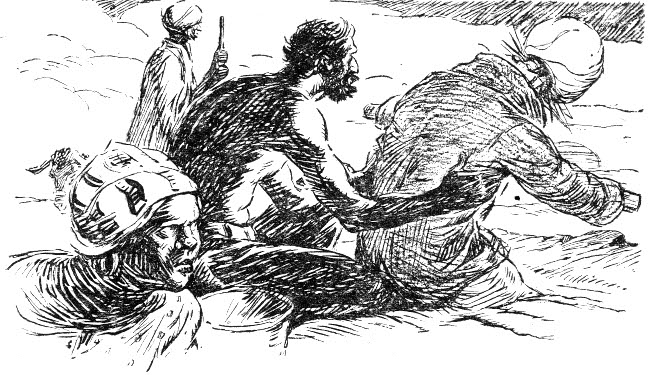
He set up the dummy, facing eastward in the mouth of the cave.
Then he returned into the cavern with the string in his hand, and he and all his men washed themselves from a gourd that they passed from one to another before kneeling toward Mecca. I watched Louise, who knelt apart from them, being a woman and not qualified to pray with men. She went through all the motions they did, but I noticed her eyes were open and all the while watching the dummy outside the cavern.
Prayer had hardly ceased when one of Mir Mahommed's scouts came running at top speed with his rifle in his right hand and the end of his turban over his mouth.
"Allah! I lay long signaling—I threw three pebbles—I swore it was Mir Mahommed on the ledge! Huzoor, they come. They are less than a long shot distance!"
"Let them draw near," Mir Mahommed ordered. "Let them think they slay me. Thereafter, one of them must reach home to tell his tale. Insh'allah, that one should be Ali bin Adam, because he has no rifle. Ye may draw lots for the others' rifles. Here are cartridges, but remember: if Ali bin Adam, or one other, is not left living to reach home and to swear he saw me shot, ye shall answer to me for it. Make haste." But in spite of the haste he counted the cartridges carefully, three for each man, selecting those that had the points filed off the bullets to make them cause mortal wounds.
The man ran, and for awhile after that there was breathless silence, every minute causing the dummy to seem less human as the sunlight in the valley grew stronger. However, we were looking at it sidewise; it was possible that from the rear it looked as lifelike as ever, although its total lack of movement was likely to undeceive any one drawing a sight on it long enough to make sure of his aim from a distance.
I grew as excited as if the mullah's plans were mine; it was like watching a decoy and waiting for the ducks at daylight. The Pathans sat like statues, breathing invisibly. Louise was the only one who appeared unconcerned, smiling a little and crooning a song to herself while she dumped the coffee grounds into the fire and cleaned the pot with ashes.
Suddenly three rifle shots spat from a crag about two hundred yards away and the whole ravine became alive with stuttering echoes. Mir Mahommed jerked the string, and the dummy tumbled on its side toward the cavern entrance.
Five shots at intervals answered the three and a yell of triumph burst among the echoes announcing that Mir Mahommed's men had got their quarry. Somebody shouted a stream of words in Pushtu, but the echoes made it unintelligible.
Mir Mahommed took no chances; he controlled his men as ably as a seasoned stage director, and there was a very well-acted pantomime of rushing out and being overwhelmed with consternation, anger, indecision, and all the wild emotions a Pathan can feel. Then they picked up the dummy and carried it into the cavern, where they stripped it so that Mir Mahommed could resume his clothing.
Then came Mir Mahommed's four scouts. They bore three rifles and the greater part of the clothing of three men.
"Wallah! Suliman died thus, kicking the back of his head with his heels! I broke his backbone with the first shot!"
"How many got away?" demanded Mir Mahommed.
"Only Ali, and he was shot to hurry him! He ran. I winged him in the arm—a good shot, that will give him agony and cause men to believe him when he says there was a fight. Who would believe Ali bin Adam unless he had proof?"
"And the bodies of the others?"
"Into the ravine! The kites went down after them. Allah! When I looked all three were black with birds already, and I could see three jackals scampering to the feast."
I was left all alone with Louise after that. I suppose Mir Mahommed thought me too seriously ill to be a possible correspondent in one of those rifle divorce suits that so often awake the echoes of the Northwest ravines.
He gave her his automatic pistol, but without word, glance or gesture that might indicate uneasiness regarding me. Then he strode out with his whole gang following and for awhile I could hear their laughter as they dropped to the floor of the ravine, by a track that would have made goats hesitate, and clambered less swiftly up the farther side. It was an hour before their voices vanished in the distance.
All that Louise had to do was to water the mules and feed them, but that was not exactly a sinecure because she had to carry water in a bucket from a spring three hundred yards away. She told me she had to swing herself down to the spring by a rope and that it was very difficult to swing up again without spilling all the water.
By the time she had made six trips and watered the last mule she was tired out and glad to come and sit beside the fire, where she produced a needle and thread and began sewing. She was as full of curiosity as I was, but we were both on our guard and it was a long time before either of us dared to try to sound the other's confidence.
"You engaged to marry that girl in Peshawar, honey?" she asked after a long silence, and it seemed to me the easiest way to reach her confidence would be to pretend to yield mine and to follow the line of least resistance to suspicion by posing as Winifred Orloff's lover, enthusiastic, but so far unsuccessful. Enthusiasm always arouses sympathy, and sympathy is very seldom quite on guard. So I wove a rather woebegone romance and painted Winifred in glowing colors.
"I dare say," I said at last, "she'd be a fool to marry me. She has too many better chances."
"It pays sometimes to be a fool, honey," Louise answered. "Once I called myself a fool to stay up here with Mir Mahommed. But I keep on staying."
"Do you love him?" I asked.
"That depends on what you mean by love him. He's wonderful. He don't make up for folks and things I miss. Sometimes I've cried right out loud for some one I could gossip with, if it was only poor white trash. Hill-women talk about nothing but theft and adultery. They live like pigs, and I was used to comfort. But Mir Mahommed has something that no other man has who ever came my way. He's ruthless, and he has power; and he isn't ignorant. There wasn't a great deal that I could teach him, although he doesn't always know the names of things. He knows psychology. I thought once I could dominate him and have my own way, but I can't. And you can't help admiring a man who can make you do the way he says and make you like it."
"How do you suppose it's going to pay you in the end?" I asked her.
For awhile she went on sewing, pondering whether to tell me or not. At last she spoke up.
"No harm in telling you, honey. You won't be let get away from here until the 'possum's cooked. If you was to try to escape you'd just be pitched over a precipice. Besides, I reckon you've seen enough already to realize that Mir Mahommed means to start a holy war. He means to close this border tight against all foreigners and unite the tribes so they'll become powerful. Then he'll make the British pay him a yearly subsidy to keep the border quiet; and maybe he'll draw another subsidy from the Amir of Afghanistan; and perhaps another from the Russians, to teach communism. He don't care what he teaches so long as he has power. He says: 'No man who hasn't power may look God in the face.' But you can't have power, honey, while you're living—not nowadays. Too many people interfering and wanting a slice of the pie. It's dead men that can't be answered back. If you deny the sayings of a saint you're an outlaw, and that's all about it. Look at the Prophet. Anybody answer him back? Not hereabouts. So Mir Mahommed means to have a funeral and be a dead saint."
"Fine," I said, "but where do you come in?"
"Fifty-fifty," she answered. "I'll be his mouthpiece. He'll appear to me and tell me what to say—and I'll say it—and if they say no, he'll do a miracle, and show himself, and vanish and make voices cry out down the valleys in the night. By and by he'll shave his beard and be somebody else—a warrior commissioned by the Prophet; and he'll come and marry me and we'll rule the country—rule it good. And if any one claims to recognize him, they can open his grave, can't they? and see that image lying there that Mr. Grabowski made. And a man can't be dead and living at the same time, so they'll know he must be some one else. Oh, he's far-seeing; when he took me he named me Khadija and that's the name of the Prophet's mother; it'll help when it comes to being the mouthpiece of a dead saint. These folks don't believe in reincarnation, but they believe in miracles and they're crazy about dead saints. Do you know why you're not dead, honey? Mir Mahommed will need some one later on whom he can send to Peshawar to make terms with the British."
Louise sewed away steadily, and I pondered the mullah's plan—no worse a plan and no more mad than those of Napoleon and Alexander the Great. Abdurrahman of Afghanistan was another who had started from nothing and won an empire. It was only a question of whether or not the mullah had genius in him to overcome the elements of failure that the plan contained.
"What fault do you find with the scheme?" I asked Louise after awhile.
"Honey, I'm lonely. I do miss talking with my equals."
"Intellectual equals?"
"Yes. One reason why I've stayed on here was that I'm colored and nobody raises eyebrows when I talk high hat. Colored nursemaids aren't supposed to know much more than how to blow a baby's nose. The Pathan women think I'm wonderful. They love me, and I like them as if they were apes and parrots, only not so clean. I don't know what I wouldn't give for just one woman who thought herself better than me, so I could prove she wasn't. The more I hated her and fought her, the better I'd love her."
Was she hoping to trap Winifred and to force her to fly to the hills for safety? A wild thought, but it was possible. However, it is never wise to seem too interested in what you really want to know.
"Don't too many people know that the mullah intends to bury that image instead of himself?" I asked her. "Suppose one or two men turn disloyal and tell the tribesmen what a trick has been played on them?"
"Honey, nothing like that matters in a land where nobody tells the truth and nobody believes what anybody says. All a plan needs to do is pay dividends. People believe what they want to believe, and they want to believe what's profitable, especially if it's awkward for somebody else. All Mir Mahommed needs is to be successful at the start. One quick victory and in ten days he'll have enough men at his heels to take Peshawar."
"You don't mind the idea of massacre?"
"Who does, honey? Only the ones who get their throats slit and their bellies ripped. They, and the ones who lose money by it."
We talked until I fell asleep, and I slept until she awoke me, hungry for the soup she had been cooking. Judging by the sunlight in the mouth of the cavern it was late afternoon. Not long after that a runner came from Mir Mahommed, very tired and angry at having been sent.
He flung himself down on a pile of blankets and demanded food as savagely as if Louise had been his own wife, and he ate greedily and cleaned his beard before giving her any information. When he did speak he was careful not to let me overhear him, and after delivering his message he strode outside to the ledge and sat there, rifle on knees, chanting to himself long passages from the Koran that he had by heart.
His message produced a surprising effect on Louise, who was not so dark but that color could come to her face. Her eyes brightened and she put away her sewing. She appeared thoroughly excited and half frightened, but she controlled herself, although for several minutes she walked about the cavern, picking up things and setting them down again, as if she could not make up her mind whether to do anything or nothing. At last she stood in front of me with a smile on her handsome lips.
"Honey, what did you say was the name of that girl who doesn't love you?"
"Winifred Orloff."
She nodded. "Did it ever occur to you, honey, that the way to make a woman love you is to have her by the short hair?"
With that she walked away and left me wondering. It needs very little to start imagination conjuring improbabilities when one is a prisoner and has no notion what his friends are doing. Louise began sweeping around the fire with a broom made of some kind of stiff grass, and I watched for an opportunity to walk outside, where I might be able to persuade that surly messenger to tell so many lies that I could guess some portion of the truth.
Louise, however, seemed to guess my intention. She asked me to try to stand, coming behind and taking me by the shoulders. I pretended to be more weak than I was. She put her arm around me and, gathering my blankets and the overcoat, led me to the rear of the cavern, where a ragged gap loomed in the wall and I could smell the mules in darkness on the far side.
Leaning on her heavily and stumbling as we walked, I contrived to steal her automatic pistol, although I half doubted the wisdom of doing it. If she should miss the pistol, or if the mullah should return and ask her for it, the situation might become suddenly desperate.
The life of a secret service man is less important than his news, but it is worthless unless he can get through with his news. The pistol might help or prevent, there was no telling which.
Louise led through the gap into Cimmerian darkness, where she spread my blankets on the mules' hay. I lay on the blankets, and she covered me.
"Lie there, honey. Shout and I'll come, but don't you try to move. I'll bring tea by and by."
Her mood had completely changed. I had to change mine, too. Questions might have stirred suspicion and have made her watch me too carefully.
For awhile after she left me I entertained the odd notion that perhaps she was having a love affair with that surly Pathan messenger, but the thought was too silly to remain long even in an injured head. Besides, I could hear the great ruffian saying his prayers, and I could hear her walking about the cavern rearranging loads and piles of blankets.
But I could see absolutely nothing except a vague zone of light on a wall facing the gap that led into the other cavern, my bed being against the dividing wall, apparently about twenty feet away from the nearest mule.
However, now that I could rest again, and, so to speak, feel myself over, I realized that that last effort had done more to restore my strength than almost anything else could have done. It had started things going again; nerves that had lain numb reacted, and I discovered that every muscle obeyed orders.
I got out of bed and tested the reactions. There was no doubt of it, I was recovering swiftly and this time my head did not reel as it had done; probably by morning I would be able to walk and take care of myself, provided in the meanwhile I kept thought concentrated on the business of getting well. But that was a secret that I did not propose to reveal to Louise, so I crawled back again under the blankets.
She heard me and came to see what I was doing. I said I was in pain and feeling miserably weak. She brought tea and a lantern, but she took the lantern out with her when the tea was finished, leaving me in deeper darkness than ever as the sun went down. However, she was satisfied that there was no risk of my escaping that night.
After awhile she lit a very large fire in the cavern, and I heard the Pathan messenger complaining blasphemously as he dumped load after load of firewood on the floor. He appeared obedient and yet he swore at her as if she were his slave, she taking not the slightest notice of his remarks.
The fire cast a faint glow on the rock wall facing me and now and then I could see her shadow as she busied herself with pots and pans. It occurred to me that there were too many pans and too much cooking for supper for just us three. I crept out of bed again to look, but just at that moment she sent the Pathan to feed the mules, so I had to scramble back again.
The Pathan made many trips, since he had to bring water also, cursing the religion and the mother of the bucket as he groped in darkness, then cursing the livers and lights of the whimpering mules, whom Allah had made so feckless that they could not hang by their tails from the ledge and suck their pap like devils at the breast of earth. He was a poet after his own fashion, mixing metaphor a little, but emphatically pouring out gorgeous emotion and delighting in words strung artfully on strings of vehemence.
"May Allah give you a long life in which to enjoy your humor," I remarked as he prophesied that thirty thousand she-dogs should be born in the bucket he carried—she-dogs that should guzzle unspeakable filth and then defile the grave of the man who invented buckets and of all infidels who bred mules. He set the bucket down. My voice in the dark had startled him.
"A she-black and a he-white!" he remarked after a moment. "Hey-yah, such an omen! If God wills, we shall soon see crows—kites—vultures unable to fly for the weight of the livers of unbelievers! Hey-yah, but the ways of God are wonderful!"
He groped his way to water the last mule. When he had thrown down some hay for the animal he walked out, saying not another word to me.
Louise had heard me talking, and before many minutes passed she peered through the gap in the wall, and I could see her head and shoulders against the leaping firelight. I pretended to be asleep. Not quite satisfied, she tiptoed to the bedside.
When she had gone again I put on the overcoat and sat leaning against the wall so close to the gap that I could hear whatever happened and could even see, if I was careful, my end of the cavern being in deep black shadow.
I remember I had a number of crazy notions while I sat there; one was that I might gallop away on a mule; I had a constantly repeated mental picture of myself careering on a bareback mule across that fantastically beautiful cavern, in which the crimson fire kept splendid shadows leaping on the walls. But the cavern entrance, on the far side of the fire, was coal-black and imagination refused to look beyond it.
It was probably three hours after sunset when Mir Mahommed strode into the cavern, looking spectral because his black beard blended with the night behind him, but the firelight gleamed on his eyes and nose. There were six men with him, of whom two appeared to be prisoners, judging by the way they were herded by the others into a corner where a spur of rock projected between them and me. I only caught a glimpse of them before they were shut off by the spur from my line of vision, and even that glimpse was confused by the firelight and flickering shadow and by the movement of the other men between them and the fire.
Louise took very little notice of them, busying herself with cooking while Mir Mahommed sat beside her and talked in such low tones that all I could hear was the other men's voices. They were quarreling as to who should carry more wood from the small cave farther along the ledge, and they almost came to blows about it before Mir Mahommed rose and slapped his rifle-butt.
In the name of Allah, who made tigers, he ordered all of them to fetch wood. They did not hesitate. They went for wood as if it were pure gold, free for the asking. Something had happened. Failure on Mir Mahommed's part would not have produced that state of mind. Defeat, in lands where discipline has become traditional, may sometimes strengthen loyalty, particularly if a captain has been splendid in retreat. But defeat breeds insolence in the hills of the Northwest frontier, where he may keep—and only he may keep—who can. Mir Mahommed had returned from victory of some kind.
Louise went over to the prisoners. I saw her carry tea to them, and then food, after she had waited on Mir Mahommed; something in her manner suggested that the prisoners were not hillmen, and not persons of low rank in her estimation. I felt excitement that made the blood surge to my aching head and the pain was almost intolerable by the time when Louise took away the prisoners' plates to clean them in the ashes.
Mir Mahommed leaned forward and spoke to the prisoners in a loud voice that was prevented from reaching me distinctly by the noise of the falling wood that his four men carried in and tossed in a heap on the floor. Gruffly he commanded them to bring more wood, and they departed.
I held my breath, afraid that the singing of blood in my ears would prevent me from hearing something important—afraid that the swimming blood behind my eyes would prevent me from seeing. What I did see, I did not believe for a moment. From behind the spur of rock strode forth none other than Grabowski! He was perfectly calm. He turned and spoke in low tones to his fellow-prisoner, whom I still could not see because of the spur between us.
He appeared to be unharmed. The firelight made him even better-looking than he is. He was wearing a tweed shooting jacket that exaggerated the athletic lines of his shoulders and loins. His mustache, almost golden and very faintly suggestive of a tomcat's whiskers, bristled with the usual indifference to anything except his own interpretation of events.
His heavy eyebrows threw the dark eyes in shadow, making them appear more mystically knowing and amused than usual. He was wearing a Scotchman's tam-o'-shanter that gave him an air of recklessness, modified, however, by the carriage of neck and shoulders, which were nothing if not determined and deliberate. He had his fists in his pockets and a grin on his aristocratic lips.
Mir Mahommed signed to him to share his mat. They sat facing each other, outlined against the fire in profile. Louise went to talk to the other prisoner. The four men brought in wood; two of them and my friend who had watered the mules lay down to sleep, and the other two went out to the ledge to keep a lookout. Then I caught a few words of Grabowski's:
"By the breath of the Almighty, Mir Mahommed, I admire your daring; but how long do you suppose it will be before the troops come? You and I had better settle this between ourselves and save who knows how many people's lives."
"It is written that he shall live, and he shall die, whom Allah wills to live or die." Mir Mahommed answered. "None knoweth that but Allah." His voice came booming down the cavern in one of those strange acoustic accidents that sound as if unseen realms were intervening in the affairs of men.
Grabowski emitted one of his surprising laughs. He looks like a man who would cackle on a high-pitched note; something about his mustache suggests that. But his laugh is a thunderous ho-ho-ho; that breaks down mental barriers that men have raised against him.
"Kill us then and have done with it!" he suggested. "Bring everything to a head. Defy the British empire!"
"You and I are friends," said Mir Mahommed. "I captured you because you set a trap for me. By God, do you think it right you should have set that trap?"
"No," said Grabowski, "I did not set a trap for you. Why should I? Haven't we always helped each other?"
I knew then how much I liked Grabowski by the horror I felt at having to spy on him. Those few words were enough to arouse suspicion, however, and I crawled on all-fours through the gap to lie in deep shadow within thirty feet of them, at a place where a break in the cavern floor made it impossible for any one to see me without almost treading where I lay.
"What happened was this," said Grabowski. "I received a letter written by Frank West. I laughed. A blind man could have read in it that there was something cooking. However, it happened that the British authorities had asked me to remove that papier-maché portrait of you from in front of my shop because it was arousing too much prejudice. So it seemed a reasonable thing to let you have it. Meanwhile, hardly half an hour before your men came, Frank West's dog had reached Peshawar, with a note from him tucked in its collar—no date on the note, but explaining he was a prisoner about two days' march away and had hope of escaping. As soon as I saw the dog I knew he had guessed the distance wrong or somebody had misinformed him; the dog wasn't badly tired. The dog reached the cantonment at an hour when there was no one in the bungalow where he went except Miss Orloff. She saddled her pony and galloped to my place."
"Why?" demanded Mir Mahommed.
I risked being seen in order to watch Grabowski's face. I was as puzzled as Mir Mahommed was suspicious to know why Winifred should have gone to him so promptly.
"Because," said Grabowski, "she knew me to be a person who can send messages over the border. She arrived while I was reading the letter brought by your men. And she implored me to procure the immediate release of Frank West."
"Why you?" the mullah countered. "And what interest has she in him? Or in you? And you in her? And how came soldiers into all this?"
"Was I right or was I wrong," Grabowski asked him, "to believe that I can go by day or night unharmed and unmolested where I will along this border?"
"Insh'allah—and unless the sentries shoot you. As to that, you have the pledge of every headman in the hills. That is all the more reason why you should have laid no ambush against me," said the mullah.
"Ambush!" said Grabowski, and he laughed again. "A man's love for a woman is ambush enough! She, Miss Orloff, was so excited about Frank West that—I wonder, can I make you understand this? Supposing her to be in love with him, I felt obliged to prove to myself that my feelings for her had nothing to do with the case. I must rescue him instantly. It seemed the simplest plan to find you, Mir Mahommed, and to demand from you in the name of friendship the safe return of Frank West, who had done you no harm that I knew of. So Miss Orloff helped me to wrap that statue as you had asked, and I delivered it to your two men, intending to follow them, supposing they would lead me to you.
"Unfortunately, your men were seen by one of our patrols, who gave chase, although the mist made pursuit difficult. Miss Orloff was in agonies lest the patrol should overtake and kill or capture your men before they could lead me to you. I understood her to agree to remain at my place, for the purpose of feeding the dog. I made haste then after your men, who went swiftly and were already lost from sight in the mist. Miss Orloff followed me, on foot, but I did not know that until we were far beyond the lines and had lost our way, as the patrol, I think, had also."
"Mashallah, that makes a good story," said Mir Mahommed, "and it is no new thing that a woman should follow the man she loves. Whether she loves you or him, no matter. There are women enough in the world for both of you. But by the beard of him whom Allah loved, a dozen soldiers and their officer lie dead and my men have their clothing and rifles, as is indeed just and pleasing to the Most High."
"Those unfortunate soldiers were lost in the mist and stalking us," said Grabowski. "We did not know who they were, nor they who we were. They may have thought we were your two men. We walked into your ambush and they followed us into it. The next I knew, I was tied and gagged, which was not a proof of friendship, Mr. Mahommed."
"Allah! Would an enemy not have cut your throat—yours and the woman's also? For awhile we were too busy at close quarters with the soldiers, to be troubled about perfect manners. However Allah in his justice willed that we should slay them all, on our side losing none. Then I with my own hand undid the bonds, and slew not, nor was I guilty of a harsh word—not though Allah knew my thoughts—until there could be private speech between me and thee."
"I have spoken," said Grabowski. "I have said my say."
"And I have heard. And I say this: As Allah is my witness, I believe you. Nevertheless, what was done is not thereby undone. The soldiers are slain and there will come a reckoning."
"Soon," said Grabowski. "Soon, swift and drastic."
"Too soon for my plan," said Mir Mahommed, and his beard fell on his chest as he turned away from Grabowski to stare at the fire in meditation.
Louise broke the silence: "Come, honey. Come over by the fire, where it's warmer."
She offered a hand to some one behind the spur of rock—and out strode Winifred!
I stood up then, not thinking how like a ghost I must look in that sheepskin overcoat, bloodless, with my head in bandages and with the flickering firelight showing me against the tomblike shadow. I was unshaved. I must have looked as if I had been dead for nearly a week. Winifred saw me and stifled a scream. Grabowski glanced from her to me.
"Oh, hello," he remarked as casually as if nothing at all had happened. "You look seedy. Better come and squat here. Need help?" He was beside me in a moment. Mir Mahommed looked up, glanced from Winifred to me and resumed his staring at the fire. Louise stared from one to the other of us, looking sly, I thought.
"Hello," I said to Winifred.
"I'd like to see those bandages," she answered.
She came and examined them. I knew she was only making an excuse to speak to me, but Grabowski insisted on helping her to undo the bandages and examine the wound, so there was nothing said.
But I suspected her more than ever. If she had nothing to conceal, why should she not speak before Grabowski? But it also looked to me as if Grabowski might be innocent of her intrigue, supposing she were guilty. If he were involved with her, why should she be afraid to speak to me in his hearing?
And while they rebound my bandages, Louise watched us as if she, at any rate, were afraid that some word of ours might bring the mountains down on her and Mir Mahommed and us all. But Mir Mahommed stared into the fire as if he had forgotten us.
May Heaven forbid that I should wander off into the realms of psychology, which I don't understand any more than any one else does; but it is necessary to explain a little in order to make clear what followed. We three—Winifred, Grabowski and I—were prisoners in the hands of a man who had shot down twelve British soldiers and their officer ruthlessly, if that word is not too mild. Mir Mahommed was a public enemy, a danger to all that border, a desperate rogue, and a man whom every educated instinct in us should have urged us to hold in horror. Actually we admired him.
But that was not all. Grabowski, although in love with Winifred, was furiously indignant with her and doing his courteous damnedest to be polite. There were moments, I think, when he suspected her, although his suspicion was probably vague and he may have merely been exasperated by her having followed him. Or perhaps he was jealous of me.
But I knew that it was no regard for me that had brought Winifred Orloff out of bounds on the wildest frontier in the world. And she knew I was aware of that. She knew I suspected her of being a spy. Louise was suspicious of all of us, and hovered near enough to prevent us from holding anything like intimate conversation; and the more I observed and reflected, the more I believed Louise to be the real key to the mystery.
Somebody—that much was definitely known—had supplied Mir Mahommed with money in the form of English bank notes, which had reached him in spite of the vigilance of almost countless spies. If Winifred was the agent through whom the money passed, there was still a bare chance that she had not known what she was doing. Possibly Louise had tricked her into it. But how?
It was impossible to imagine that Mir Mahommed could have lured that girl into acting as his secret agent. He was not even thinking about her. He appeared to have forgotten she was there. The only word he spoke for an hour was when he threw a firebrand at one of his sleeping men and curtly ordered him to pile on fuel. Mir Mahommed, I guessed, was himself the victim of far deeper schemers than himself—a puppet whose strings were pulled by agents of the Czar.
Besides, Winifred paid no attention to him, whereas she watched Louise continuously. Winifred was dressed in a tweed coat and skirt, wool stockings, a blouse opened at the neck, and a man's soiled Terai hat that she probably snatched from a peg as she ran from the bungalow.
It made her look boyish and a little younger than she was. It suited her sunburned hands and general air of having lived in the open all her life. But her good looks lay in character, not regularity of line, which made it easier to guess the nature of her thought than if she had been merely plastically pretty.
She did not appear to me to be in the least degree cowed by the savagery of her surroundings. I could detect in her no physical fear whatever; but judged her to be horribly afraid of an intangible—of something she did not understand—of something that perhaps she did not wish to understand, and that she wished by hook or crook to prevent Grabowski from discovering. It seemed to me that she loved Grabowski and feared what he might find out about her.
Louise hovered around us in the shadowy background, watching, until at last she built a small fire near us and set coffee on to boil. That awoke Mir Mahommed out of his brown study.
"Allah!" he exclaimed. "God's ways are wonderful and hard to understand. Nevertheless, it is given to me in part to understand them."
"It is easier to understand the British," said Grabowski. "They will send troops. When they find the bodies of those men you slew they will waste no time theorizing."
Suddenly the mullah stood up, setting the fire between us and himself; thus his back was toward the cavern entrance and the light shone on his fierce face, gleaming on his eyes and on his teeth that flashed amid the blackness of his beard like the fangs of a great animal at bay.
"If it is his will, let the troops come! It will also be his will that I shall defeat them. This earth is but an anvil of the Most High, whereon a man's soul is forged until it is fit for Paradise. How often, and how often is it Allah's will that a man's mercy shall be as a snare for his own feet! His generosity a pitfall! If I had slain that man"—he pointed at me; I felt almost guilty—"this had not happened. But for you"—he stared at Grabowski—"that cursed image never would have been made, compelling me to act, as it now appears, too soon. It has been a poisonous barbed weapon in the hands of my accusers. Nevertheless, it shall be they who are undone. It shall be I who triumph, lest it be said that his servant was forgotten by Allah—on whose Prophet's head be blessings through all eternity, and on whose loyal sons let wisdom fall like dew on the ripening grain!"
The fire spat applause as the coffee boiled over. Louise made magic until the affluent aroma of her caldron filled our part of the cavern and thought thrummed on another vibration. She served the wondrous stuff in tin mugs. Mir Mahommed gulped his. It burned his mouth. He squirted it into the fire and demanded more with an oath that suggested earthquakes.
"How soon will you let us go?" asked Winifred, in English. "You have killed quite a number of innocent men—"
"Wallah! Would they not have slain me?"
She glanced at Grabowski, who was known in all that countryside as Mir Mahommed's friend. But that glance was intended to deceive me, and I knew it; it was intended to hide from me the personal meaning of her next words.
"Is it thus, Mir Mahommed, that you repay favors? Have you received nothing, that you feel you owe us nothing?"
"Tooth for a tooth—gift for a gift," said Mir Mahommed scornfully. "Do you want more coffee?"
He strode away and stood glowering out at the night with his hands behind him. Louise gathered up the coffee mugs and was about to speak, but Winifred, with no more than a gesture to Grabowski and me, got up and stood beside the mullah in the cavern entrance. Grabowski went and sat near them on a lump of rock, to keep her, so to speak, in countenance; no Moslem ever entirely understands the frankly equal, unsex-conscious challenge of the modern woman.
Mir Mahommed glanced at Grabowski and seemed to be glad he was close at hand. But it was obvious enough to me that Grabowski's nearness prevented Winifred from saying to the mullah what she had intended. Louise came and sat beside me, sharing the same mat beside the fire.
"Honey," she said, "you don't know how to manage that girl." She took it for granted that I was hopelessly in love—I suppose because I had been watching Winifred's face so intently. "You should treat her the way Mir Mahommed treats a woman."
It is a good rule not to correct your Opponent's errors, since one error begets the next, so I said I was interested at the moment in getting Winifred safely back to Peshawar—that and nothing else.
"And in Peshawar, what? Honey, she'll give you the go-by in Peshawar. You're not ruthless. Listen: you can have her. Mir Mahommed goes his own way, and if I can't follow he wouldn't wait to bury me; but if I should ask him not to let that girl go—if I should say I'm lonely and I want her to be friends and to quarrel with, he'd give her to me just as quick and ruthless as he'd cut your throat if I told him you'd done me an insult. I'll keep her up here in the hills for awhile, and these old hills will tame her mighty quick. But you and I have to understand each other, honey."
Craving to understand—but not at all to be understood—I encouraged her to talk on.
"Mir Mahommed," she said, "knows a thousand shifts, and if the troops come before he's ready he'll soon put a range of mountains between us and them. I know him, honey. We are as likely as not to be fifty miles from here this time to-morrow; he and I know caverns in the mountains where an eagle couldn't find us. You and she shall come—I'll see to it. Grabowski is in the way. I can tell Mir Mahommed to let Grabowski go back to Peshawar. He can take a letter saying what will happen to you two if the troops aren't called off. But you must persuade Grabowski to go with the letter; he'll need powerful argument."
"Why not let Winifred go?" I suggested. "That way, you'll make friends for yourself—friends you may need later on. You can hold Grabowski and me for ransom and no particular harm done."
I was on the edge of learning something. Louise was about to answer, and her eyes foreboded revelation; but Mir Mahommed turned in the entrance and gruffly commanded her to heap fuel on the fire. He ordered me against the wall where Winifred had sat with Grabowski when they were first brought in.
Winifred and Grabowski joined me just in time to get out of the way of fifty hard-breathing Pathans who came swarming into the cavern, treading on each other's heels. They were armed to the teeth, the greater part of them with stolen army rifles, but some with jezails and a few with only iron-studded shields and tulwars—the latter men being the most dangerous, because they would risk anything to be armed as the others were.
They were smelly with sweat and with the damp night air on their sheepskin jackets; they were fierce-eyed—hungry with imagination—silent with expectancy.
They eyed the mullah as the wolves look at a strong wolf who can lead them to the kill, with no more loyalty than wolves have and no hint of mercy for the man who fails. The mullah returned insolence for insolence, in double measure:
"Laggards! Were you afraid to leave your women? Are they such loose wantons that ye could not trust them out of sight?"
The newcomers crowded around the fire, some sprawling, others sitting upright and a few men muttering to each other as if afraid of the leaping shadows that might conceal evil spirits summoned by the mullah to undo their faith in God. Their glances confirmed the common rumor that Mir Mahommed had a reputation for black magic. Some of them dreaded the magic more than him. Some grinned with grudging admiration.
Winifred whispered to me: "I want to talk to you—alone—where we can't be overheard. The mullah might let me go, but I'm afraid to go. I want to tell you why."
Grabowski laughed—one of his deep ones that sound like something popping at the bottom of a well.
"This is a nice, tough nut for the burra sahib![1] Can't you hear him cursing while he writes a minute in his journal in red ink! I'll bet the pen goes through the paper. If he doesn't send troops to rescue us, every hillman south of Kabul will laugh and go immediately into the hostage-bagging business. If he does send troops, it probably means the lives of fifty or a hundred men. No matter which way he decides he'll get a wigging from the Viceroy in Council. And, ho for the ha'penny papers! 'Niece of English Officer Ravished by Savage Hillmen on Northwest Frontier While Authorities Look Idly On!' And then questions in Parliament: 'Is the Secretary of State for India aware that the Indian government's policy of blockade and brutality on the Northwest frontier is likely to cause the sacrifice of hundreds of innocent lives and prodigious sums of money?' Hell or high commissioner—you pay your excellent intention and you take your choice!"
It was one of those so-called psychological moments—Winifred on the verge of tears and Grabowski trying to be cynical to hide emotion. I struck swiftly and hard—and hooked my fish!
"Are you guilty?" I asked Winifred. "Or did you blunder?"
"I made a fool of myself—and got in deeper and deeper. Now I'm done for."
"Is it Louise?" I asked.
She nodded. Grabowski was talking away, listening to his own voice, sneering at his own lame jokes; he did not even suspect that she and I were whispering. But I saw Louise watching us.
"Do you love Grabowski?" I asked. "Do you want him?"
She nodded again. "But I've lost him."
"Do you want him?"
"Yes."
"Is he innocent?"
"He knows nothing. He isn't even suspicious. But when he finds out—"
"If you'll promise to come clean—tell me everything—I will do what I can."
"I told you: I want to talk to you alone."
"Will you tell everything?"
"Yes."
"Whatever happens? Here or in Peshawar?"
"Yes, I promise."
It appeared to me that there was something I could do that minute. I made my way over to Mir Mahommed, where he stood staring through the cavern mouth at Jupiter blazing brightly over banks of mist that wreathed the summits of the hills.
"Hajji," I said, considering it wiser to address him by his honorable title, "should a man shoot three times if one bullet is enough?"
"Nay, once," he answered.
"And in the matter of a loan: should a man demand three times its value for security?"
"Nay, nay," he said, "that would be as bad as usury, which is a foul sin for which men's souls pay bitterly and forever."
"Then one hostage is ample," I told him. "Keep me. I have precedence, having been the first to fall into your hands. Act reasonably in the sight of Allah and all honorable men by releasing those others. Let them go back to Peshawar."
He nodded, stroking at his beard, but there was mocking laughter in his eyes, which I thought to change, nevertheless, by argument.
"It is enough for you to threaten to slay one prisoner. The troops would make terms."
"You and he may go then. I will keep the woman," he said curtly.
I had presence of mind enough to turn away. He had not sworn by any of the nine-and-ninety names of God, so he might reverse that decision without loss of self-respect; and there had been laughter in his eyes. I made haste before laughter should turn into anger. But as I turned I noticed that Louise was lurking in the shadow. She had heard. It might be that the mullah's eyes had answered her unspoken thought.
"God pity me," I said when I returned to Winifred, "I've cooked our goose. I mean, I've cooked yours." I related what had happened. Grabowski let a laugh come rumbling up from somewhere near his heels.
"Excellent!" he said. "When fortune comes rotten end foremost, it can't grow worse, and it may grow better. Watch Mir Mahommed." He threw an arm around Winifred, suddenly sure of himself again and full of love for her.
Mir Mahommed stiffened himself like a wolf with its scruff raised. In the shadowy entrance the firelight touched a rifle barrel and the hilt of some one's tulwar. Once or twice I saw a man's eyes glittering, but Louise stood close beside Mir Mahommed and the owner of the eyes was screened from view. He spoke in very low tones.
Presently another fifty or sixty men came trooping in, most of them less well armed than the first contingent, but more smelly, presumably having come a greater distance. They were hungry and, though they carried goat-skin bags and stolen British army haversacks full of provisions for perhaps a week, they grumbled noisily because no banquet was spread ready for them.
Mir Mahommed dismissed the man with whom he was speaking; the fellow went away into the darkness coughing like a sick sheep, but moving rapidly, if one could judge by sound with all those tricky echoes. Mir Mahommed studied the hundred men who crowded around the fire, then suddenly filled his lungs and let them know their captain's name.
"Ye know me. By the nine-and-ninety names of God, I know you! In the name of the Prophet, on whose head be blessings, I have summoned you to earn eternal life. And by Allah who made tigers, it is I who lead you. Deny my leadership and learn whose sword I wield!—the sword of the avenger!—of the Prophet of the God of life and death! Deny me and I will curse your souls into the stinking pits of torment—in the name of the Most High and his Prophet, on whose head be praise! But he who follows me shall go the way that I take, to eternal life—and doubly, aye, tenfold is he blessed who dieth in the battle against unbelievers! I have spoken."
Suddenly Grabowski spoke up—astonishment seizing a hundred men so sharply that their breath came like the sound that hail makes when it cuts into the standing corn.
"Lend me a tulwar, Mir Mahommed. I deny your leadership. Stand forth and fight me before these witnesses. Let Allah judge between us."
Winifred clutched Grabowski's arm, but I checked her—not that I wanted to see Grabowski take that chance. I knew the mullah would refuse to fight him. He was under no obligation to take up a prisoner's challenge. He would have been a fool to do it: Grabowski's skill with a tulwar was notorious.
Mir Mahommed's eyes glowed, facing a new perplexity with anger, but indomitable courage. Rather than not he would have taken up that challenge; he even leaned his rifle against the wall and his fingers gripped at the hilt of his tulwar so fiercely that Winifred unconsciously seized my hand and dug her nails into it.
But he understood Grabowski's motive; let him refuse to fight, and his men might call him a coward. Let him fight and lose—his force would scatter. Let him fight and win—even so, his men might accuse him of lacking dignity. That was a bold bid of Grabowski's—generous and rash. The mullah's simplest answer would be to shoot all three of us, and he could have forced his men to share that guilt as onlookers and consequently parties to it. He could hold it over them, to make them fight more desperately if British troops should come.
"Ye have eaten my salt," he said after a moment. "Though ye three are prisoners, ye are also guests."
There was silence for about three minutes—then the sound of hurrying footsteps on the ledge outside the cavern. Cursing and hard breathing. A challenge. In came fourteen of the mullah's men, including Feisal and Abdul beni Rahman, who had carried the letter I wrote to Grabowski. They were surly and dog-weary. They dumped at Mir Mahommed's feet a thing so like a corpse in its burial shroud that a murmur arose in the cavern. Mir Mahommed glared across it at Grabowski.
"Fight me that!" he said tartly. "You raised it out of hell to mock my unwise tolerance of western ways." Spittle of scorn was on his lips, but his eyes looked grateful for the chance to set aside Grabowski's challenge without relying too much on that rather specious excuse of hospitality. He turned on Feisal and the other thirteen, lashing himself now into a fury that was too convenient to be altogether genuine.
"Allah! Is this obedience? Ye were to have buried that up-valley in the grave made ready for it. Death of a hundred thousand dogs! What now?"
"We have done our best," said Feisal. "That thing is accursed. Devils follow it and mock us! Lo, we bore it up the valley and the grave was ready. There were many who came to observe, and to them we said, with proper respect for the valiant dead, that this is the body of Mir Mahommed killed by a bullet after he had slain ten Highlanders. It was well. There were some who grieved and some who sighed good riddance, and there was none to deny your honor's sainthood—until Ali bin Adam came clambering down a hillside hugging an arm that hurt him as if red-hot iron was bedded in it. A blasphemously angry man was Ali, filled to the teeth with bitter speech."
"Shall a wet cat such as Ali change the will of God?" demanded Mir Mahommed. "Ran ye from Ali-who-sighed-for-a-shirt?"
"By Allah, not we! But he told of this cavern, and of a dummy dressed up to resemble your honor, shot at by himself and others because of a feud between you. And he said, so devilishly was the dummy fashioned that even he believed it was your honor's self until it fell and he saw the string attached to it. Then he told how his friends were slain by your honor's men laying in wait, and how he ran, and was shot in the arm, and that he was now on his way to Peshawar to beg treatment from the British dakitari in the harsipittal. Then Ali made haste on his way because the hurt was paining him as if a thousand devils gnawed to reach the marrow of his arm. But before he went he swore he had followed Mir Mahommed all night long, and had seen him alive, not dead, so that this is sorcery of some kind."
"Who would believe Ali bin Adam?" asked Mir Mahommed.
"No man, surely, without writings and a thousand witnesses—and even so with grave doubt. But there were more than a hundred men who came to watch that burying. And they said: 'Are we blind or do our eyes know Mir Mahommed's face? So let us look and our eyes shall answer whether Ali tells truth or otherwise.' And could we fourteen have prevented them? By Allah—how? Is my throat hoarse? It is from arguing that none should defile with his unwashed hands the shroud of such a saint as Mir Mahommed. Lo, they sent their women to bring water, making their hands clean. Wallah! What could I do? I could call them jackals and grave robbers. I could curse them by the nine-and-ninety names. I could say—and lo, I did say—what Allah put into my mind concerning their wives and their mothers and their sons' grandsons. But it all availed nothing. They commanded me to stand aside and they would look. So I got thence, and these others also, bringing the thing with us. At our backs was laughter, some shouting one thing and some another; but most of them shouted that Mir Mahommed must be up to his tricks again."
"God's ways are wonderful," said Mir Mahommed. "Lo, a man's sin mocks him though he run from it to Kandahar! Am I doomed to live forever with that cursed image that I foolishly let a man make?"
Winifred whispered to me: "Can't you say something to make those hillmen burn that thing?"
"Eh, what's that?" Grabowski asked her. "Don't you know that to burn it would be, according to their superstition, the same thing as condemning him to hell?"
All eyes were on Mir Mahommed. I was probably the only one who saw Louise, behind him in shadow, whispering none knew what counsel in his ear. But I could guess.
"What came through this time?" I asked as soon as I was sure Grabowski was not listening. "Money?"
"I don't know."
"Instructions? Advice? Promises?
"I don't know."
"Don't you ever know?"
"Only the first time—money for Louise. Ever since then he—they—have kept threatening exposure—denunciation unless I would keep on forwarding messages."
"How?"
The fire in the midst of the cavern was dying down and deepening shadow, shot with crimson when the falling embers made a flame leap suddenly, cast a phantomlike appearance on every face. Bodies became almost invisible. The eyes of Mir Mahommed began to resemble a disembodied tiger's; nothing suggested that they belonged to a human being, except that the hand that held his rifle showed and now and then the firelight shone on the metal barrel and on the hilt of his tulwar. The wait, nigh breathless, for his words seemed endless. Winifred whispered her answer to me so low that I could not hear it, but Grabowski did.
"That image?" He let out one of his deep belly laughs, "Mea maxima culpa! All my own doing, and the damned thing has jinxed us all. I made it for a spiritual purpose—art—heart—same words if you understand 'em. But it was the devil who understood and used my image to send Mir Mahommed's plans down wind. Mir Mahommed's remedy won't be milk and water. There's blood in his eye."
There came another challenge on the ledge outside the cavern. It was answered by a long-drawn wail and there was shouting to and fro. A man ran in to get a fire brand to wave from the ledge and show the direction to somebody. More shouting. Winifred kept silence; all eyes were again on Mir Mahommed.
Suddenly the mullal's voice came booming like a sound from a sepulcher, hollow and startling: "I speak of God. There is no god but God. I swear there is no god but God, whose prophet is Mahommed!"
It broke the tension. The whole cavern full of ruffians began to chant in unison the magic phrases that make Islam one emotional entity that becomes a weapon of steel and fire and frenzy in the hands of him who understands it. There had been purpose in that long pause of his. He had them by the heartstrings now. They would excite themselves until no lesser sacrifice than unbelievers' blood would still them—blood and plunder! Our blood probably.
Grabowski leaned past Winifred, pitching his voice in a key that made it audible against the thunder of the Moslem chant:
"He expects bad news! There's some one coming. He knows it can't be good news. By God, he's desperate. He's afraid that statue will turn 'em against him unless he fills 'em full of anger against some one else. He'll throw us to the wolves, I expect. Me, anyhow. Why not? I made the statue."
He threw his left arm around Winifred again. I cursed him for it, and he let go, wondering; but I had no time to explain then that Louise was watching. I could not tell him how I was deceiving Louise about our relationships. I put my own arm around her, and Grabowski grinned like some one being photographed by the police.
Two men came into the cavern and the hundred-throated din of Allah's greatness ceased as suddenly as when the frogs cease croaking in a moonlit pond. The gloom within the cavern became one vast ear that listened. Aware of drama, the two messengers stood staring at the mullah and at each other.
"Praise Allah, speak!" commanded Mir Mahommed, his own iron nerves so strained that he was hard put to it at last to behave with dignity.
But those two men were strangers to each other, come from different directions, sore-footed, sweating rival heralds of emergency. Both burst into speech at once.
"Devils of hell! What ears can listen to the clamor of two fools?" roared Mir Mahommed, "Silence, you! Speak, you!"
The man he indicated burst into his story: a shadow, a voice in darkness:
"Hajji—they come two hundred strong to throw you and your graven image from the cliffs! Making haste by all three trails, lest you escape them! On his way down-valley Ali bin Adam fell in with three of your honor's enemies. To them he told his story, saying you are in this cavern consulting spirits from hell with the aid of the woman they call the black she-devil! Your honor's enemies awoke the countryside. Run, Hajji! Escape below the border! Hide where no man knows you! There is no escape save southward; they are coming along all three trails to hurl you and your image from the cliff and burn your body before kites and vultures can tear it and become possessed in turn by devils! In the name of the Almighty, run while there is time!"
The echo of his voice had not ceased ringing in the cavern when the other man burst into speech.
"Run?" he exclaimed. "Run whither? In the name of God, what devil's work? Hajji! The troops come! Ali bin Adam fell in with a half-troop of the British Guides, and to them he told his story. God knows what tale he told! I know this: that he told them where this cavern lies amid the hills, and he showed them the hut of a border-thief who knows the way to it. They caught that thief and burned his hand with matches while their officers were not looking—burned him until he agreed to lead them hither. The Guides made much signalling, and now the Scotchmen come! Scotchmen, Hajji! Scotchmen! The Guides hold every pass that a goat could clamber by. Two companies of Scotchmen come like witches of Eblis! Allah, but they swung their rumps up-valley! Now they climb and crawl, cursing every rock that hinders them from vengeance for the dozen men you slew. They come! At sunrise you shall see their bayonets!"
"By Allah! Heard ye that?" roared Mir Mahommed. He drew his tulwar. Some one threw dry wood on the fire and flame leaped to reveal him. He was splendid.
"By the word of the Prophet of God, who runs? Who fights behind me? Allaho—Allaho—Akhbar! He swung his tulwar high; it thrummed with the heft he gave it. Then he began again that ritual that fuses Moslems into one hot hatred of opposition, no matter whence it comes. I swear there is no god but God, whose prophet is Mahommed!"
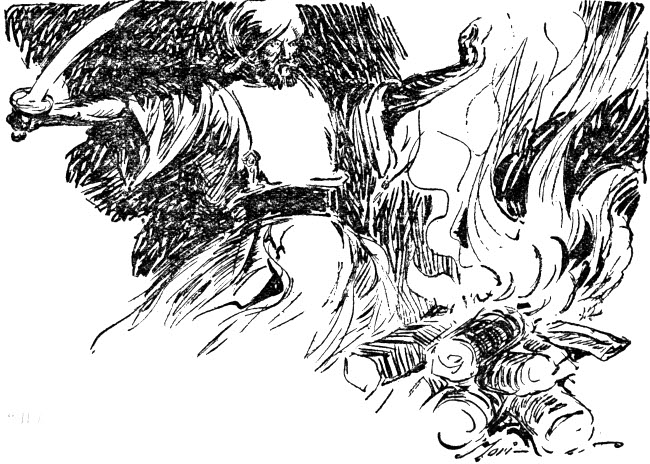
"Who fights behind me? Allaho—Allaho—Akhbar!"
Winifred tried to say something to me, but her words were engulfed in the uproar. I made signs to her that I would try to read her lips, but Mir Mahommed strode toward us. As he came the din rose in a wave of frenzy, hillmen leaping to their feet to howl at us the names of God and strike into us terror of the wrath to come. But Mir Mahommed knew the trick of making himself heard in any tumult, pitching his voice harshly off-key, speaking to Grabowski not much louder than was normal.
"It was you," he said in English, "you, who swore you are my friend, you who sent word for a troop of the Guides to follow you! Wallah! What friendship!"
Grabowski faced him, Winifred clutching his arm again, her young face etched with agony, while frantic men heaped fuel on the fire and the cavern seemed to sway and tremble with the vibrance of passion. Nevertheless, in all that din Grabowski's voice was perfectly distinct because it was passionless and disconnected from the uproar—almost like a dream-voice:
"Mir Mahommed, you need no lies. You have a ground for quarrel, if you seek one. I made that image. It was I who claimed that favor after I saved your life—so you said—and you begged me to let you repay me in some way lest you should feel under too great obligation. Therefore it was I who caused much of this trouble. But as God is my witness, I had nothing to do with the coming of troops."
The mullah glared at Winifred. "You sent for them! My woman heard you say that Feranquesat here sent a message by his dog. You gave that message to an officer—"
I thought of Louise's pistol, but there was no sense in using that yet. If I shot the mullah that would only loose from restraint a hundred savages, who would be egged on by the vengeful Louise. I did the only thing I could think of—thrusting Winifred aside and facing him, telling a bold lie bluntly:
"It was I who sent for troops. In the dog's collar there were two messages. One was to her, but the other was addressed to the General bahadur in Peshawar."
He stepped a full pace backward, hand on tulwar-hilt. Winifred tried to drag me away, but I resisted and Grabowski, with his eyes on Mir Mahommed's face, stepped in front of both of us. Mir Mahommed drew his tulwar halfway from the scabbard.
"Allah—"
But yet again the mystery of Allah's will prevented Mir Mahommed's purpose almost in mid-action. If his purpose was to kill me—as I think—that might have served him—might have whetted the edge of his men's savagety; they might have felt blood guilty along with him and so have been the more determined to fight with the last cartridge to prove guilt was godliness. But dawn was creeping down the walls of the ravine and there was dim gray light and raw cold in the cavern entrance. Harsh—sudden—convincing came the cry of one of Mir Mahommed's watchmen on the ledge:
"In the name of Allah, make ready! Scotchmen come!"
Then Mir Mahommed showed his leadership, although his generalship may be called in question. His ruffians surged to the entrance; probably they meant to run. He drove them back. They turned and clamored for our lives, for having brought the makings of disaster down on them.
A hairy, handsome brute with yellow teeth, proposing to make short work of it, swung for my throat with a tulwar—a swipe that would have cut my head off as neatly as John the Baptist's. Mir Mahommed struck up his tulwar and sent it spinning against the cavern wall; the offender followed it, struck with a hilt that broke his teeth.
"My prisoners are mine!" roared Mir Mahommed. "By my blood, they live or die as I say!"
"A life for a life!" I said. "I owe you a life for that, Mir Mahommed." But he ignored me. With a gesture behind his back he brought Louise to us, she passing through the crowd with studied insolence, enjoying the hot savagery that lusted but dared not touch her. She was beautiful in their eyes and she knew it; there was a seductive suppleness about her movement that made those ruffians crave to have their hands on her and fight for her like hellions—a lust like fulminate that touched off equally dangerous stuff in her. Her eyes looked hungrily at Winifred. She would be no more lonely.
"Come," she commanded, with a nod of her head toward the darkness where the mules were stabled. But Mir Mahommed would have no haste: he chose to show his strength: he damned that spate and held it until every man in the cavern knew who was master.
"Fold!" he commanded. "Take that with you!" He pointed to Grabowski's papier-maché statue lying like a cold corpse in its cotton shroud.
We had to pass down a lane between his men to reach it, and their foul breath was hot on our faces, but none laid a finger on us. Grabowski and I picked up the statue and carried it feet first as if it were clay that had come honestly by such imposing calm.
Its weight was not much, but my strength in proportion was less, so I carried my end of it with some expenditure of effort, and not many in that cavern understood yet what the thing was. They who bear away the dead go unmolested even in border warfare. Men shrank away from us; and they who did understand it was a statue held their tongues.
We laid it down within the opening of the inner cavern, where the mules, that could smell the dawn, were whimpering for breakfast; and Louise commanded us to go in out of sight and stay there. Some of that mood of insolence remained in her, blood surging in her arteries at thought of all that passion she had passed through, unscathed, but not unmoved.
She might as well have given orders to Grabowski's statue. We three turned in the gap to watch Mir Mahommed disciplining men to whom the very name of discipline was something unknown and incomprehensible. He imposed his iron will. They knew they were obeying, and they grew less sullen as that dawned on them, obedience being comfortable when rebellion has burned off and there is something desperate to be done. The more men resemble wolves, the more like sheep they are.
Mir Mahommed stood in the cavern mouth and as they passed him one by one and two by two he blessed them in the name of the prophet who took Medina from the enemies of God. He went out, last of a group of headmen, ordering them how to deploy and maneuver their units. There appeared to be about one headman for every ten; he gave definite orders to each headman, as if he had long ago memorized every bowlder of that grim valley with some such contingency as this in view.
He did not glance at us. He left nobody to stand guard over us, perhaps because he did not trust his men to watch two women. He knew there was small risk of our escaping, as we discovered presently. But his leaving us there unguarded scared Louise. It was the one egregious mistake that he had made, unless that other one of letting me see him give the automatic pistol to Louise should be counted against him. I thrust the muzzle of it into her ear.
"Louise," I said, "I never killed a woman. I would rather not. Sit there. Sit down and answer me."
I told Grabowski to take Winifred out to the cavern entrance. Then I began to tear the wrappings off the statue.
"Louise," I said, "you may save yourself trouble if you save me time. Tell me where to look."
But she did not have to tell me. I wrenched at the cloth and the top part of the head of the image came loose; the turban was made separately, like a lid fitting down on the skull. There was a package inside the head. I pouched it.
Ragged firing had already filled the valley full of din, so I hurried outside to the ledge then letting Louise follow or not as she chose. To the right, where the ledge curved around a buttress of the unscalable cliff, Mir Mahommed had left a strong contingent in command of his own man Feisal. Evidently they had orders not to waste a round of ammunition; they had built a low stone rampart and crouched behind it, observing the fight in the valley below. They appeared to serve three purposes—as a reserve that could be summoned instantly to any section of the firing line; as rear-guard, to defend the approach to the cavern, also the track leading down to the valley, against the two or three hundred hillmen reported to be hurrying to punish Mir Mahommed for his sins against creed and prejudice; and lastly, as a guard to prevent our escape.
Mir Mahommed was at war with time, between two enemies. His one imaginable chance of safety lay in beating off the Highlanders, then routing them. Then he must turn, if he could rally his men from the looting of dead and wounded, to defeat a greater number in his rear who would have the advantage of higher ground, although the pass through which the hillmen would have to come at him was narrow and well flanked with rocks that offered cover for defenders. It had a mean, unsheltered slope that could be bullet-swept against a too rash adversary. It was no place to defend against artillery, or even against a slow assault, but for Mir Mahommed's present purpose it was not ill-chosen.
Beneath us, thunderous with exploding echoes and already faintly hazy with the burried gas of smokeless powder, the valley lay spread in panorama.
Mir Mahommed held a naked ramp that had been formed by the fall of a side of a mountain into the ravine. It was the only possible means of access to the ledge, to the cavern and to the pass higher up. It was clear that the Highlanders meant to take that ramp by storm, perhaps because they had scant reserves of ammunition and were in no mood to retreat or wait for reenforcements.
From where we lay their helmets looked like an irregular string of oblong buttons, drawn in spasmodic movement toward the ramp by unseen violence at either end. They had no machine gun, nor any force at the rear to cover their line of retreat, so probably the Guides held all the passes to the southward. They had made a receiving station for casualties among rocks on an island in the dried-up watercourse that wound along the valley bottom, marked by the red cross on the chests of medical supplies.
They appeared to be two full companies strong and to have brought two pipers to a company—not a man too many for the desperate work ahead.
Said Grabowski in my ear: "They hope to pull this off so quickly that it can be described in dispatches as an ordinary border skirmish. They're probably commanded by a captain or a brevet-major hungry for promotion. And the men are hell-bent after revenge for all the sentries that have been cut up lately in the night, and for that dozen that Mir Mahommed slew when he captured Winifred and me. On top of that, their more or less civilized and thoroughly splendid Scotch imaginations are on fire at the thought of an officer's lady in the hands of hillmen. Virtue being at stake, there's going to be a most amazing vicious fight. All the same, by God, if we could get to them—who knows? They might call that a day's work, and we'd save fifty or sixty—maybe a hundred lives. Worth trying, anyhow."
His voice reached me between the crashing of the echoes that multiplied and repeated every rifle-shot, exaggerating the yells of Mir Mahommed's men until the winding valley was a sea of stuttering sound that broke against the cliff behind us and set up a moaning in the cavern mouth. Winifred heard no word of it. She laid a hand on my shoulder and spoke into my ear:
"Do you know how? Can you save me?"
"Dammit!" Grabowski shouted, at my right hand. "Signal to them! No use simply waving—like a red rag to a bull, that. God! They'd wade in all the harder. Make a flag, man—two flags—get me two sticks—I know the Morse stuff. Signal 'em to draw off and parley. Mir Mahommed has sense—he'll hand us over." He tore his shirt off—ripped it in two pieces. I brought two sticks from the cave where they kept the fuel. Grabowski tied his linen to the sticks and stood up.
"Zip!" A rifle bullet missed him by a hand's breadth, "Allah!" A stream of profanity reached us downwind. Feisal jerked his breech-block back and snapped another cartridge home, his right hand automatically then reaching for the empty shell. "Put those flags down! Death of a hundred thousand dogs! Get back into the cavern!"
We had to go. There was no sense in being shot for disobedience, at that stage of the game. Moreover, out of sight was out of mind; it gave us opportunity to plan some subtler move, although it was maddening to sit inside the cavern mouth where the noise flowed like a galloping mill-race and came echoing out again.
Louise was going calmly about her business making coffee. She had fed the mules and she asked Grabowski to carry water for them. He told her, with all the courtesy that he commands, to go to any sort of hell dictated by her erratic fancy. Then he fetched four coffee-mugs and made her fill them. As we drank, gasping between the hot gulps, I remembered.
"All right," I said to Louise. "Bring the bucket and we'll fetch water."
The bucket was back in the cave where the mules were tethered. Sending her to bring it gave me time to explain:
"There's a goat-track to the spring on the face of the cliff. I think the track continues downward. I think that's the way Mir Mahommed went on his way to get that statue. You take the bucket and bring back word. If yes, we'll all three try it. We can only die once."
So Grabowski made some gruff excuse about my injured head and went out with the bucket, shielding himself against the wall for a minute or two while he explained at the top of his lungs to Feisal that he only wanted to bring water for Louise. Feisal apparently gave permission, although in order to reach the spring Grabowski would need to pass out of Feisal's sight. True, Feisal could have watched him if he leaned over the ledge, but it was hardly likely that Feisal would take his eyes off the fighting for more than seconds at a time.
Louise walked over to where her own belongings lay in disorder and began thoughtfully to stuff them into a goat-skin bag. She appeared to consider the game was up, at least for the time being; she was making ready for retreat.
I did not doubt there was a bolt-hole somewhere, known perhaps only to her and Mir Mahommed; but that was their business, and I only hoped it was true, since I owed Mir Mahommed his life. I proposed to be careful not to learn too much. However, I opened the package that I had taken from the statue's head. Louise watched me.
"You may have that, honey. Keep it."
"That" was a thousand pounds in Bank of England five-pound notes negotiable almost anywhere on earth. I pushed them back into the envelope and drew out what I wanted—all I wanted—all that the Indian government needed—one half-sheet of paper signed with three initials underneath one type-written sentence:
No more money unless the overdue rising takes place, but plenty more if you keep your promises.
The initials were those of a Bombay merchant long under suspicion, but hitherto too wary to be trapped.
"Do you know who he is?" I asked Winifred.
"Yes."
"If I'm to protect you, look sharp and tell me all you know."
"I borrowed money from that man in Bombay. I had to, to reach Peshawar. The Wingates did not know how hard up I was. Nobody knew—except that man; he knew because I could not repay the money. Then he loaned me more. He said it would be all right, I could pay back later—after I married—any time. Then he came to Peshawar. He sat out a dance with me at Government House. He told me about a New York colored woman up here in the mountains—said he wished to get a letter to her without anybody knowing—said at first it was legal business, something about a legacy that she might lose if anybody learned what was going on. He said nobody would examine my mail. Would I act as go-between? How could I refuse? It was easy. I used to take the letters to the hospital along with comforts for any friendless hillmen who might be in there. Some of them were in with only trifling injuries. It was always one of those who took the letters to Louise."
"Then what?"
"He returned to Peshawar. He told me there was money for Louise and that I must deliver it. He said 'must.' I objected. So he told me the fact—that I had been delivering seditious messages to and fro. He pointed out that I had a Russian-sounding name, which would make it very difficult for me. No one would believe me innocent if I were denounced. He also demanded the money I owed him. I couldn't pay. Then he said there was no real harm—no destructive harm in what I was doing. He said I was only helping to gather information. So I kept on because I was afraid not to. I made use of Ralph Grabowski, although he never knew it. I would pose to him for my portrait, in his studio, and leave a letter where Mir Mahommed could find it when he came to pose for his. Long before that image was finished we used it as a letter-box. Then came this letter and I was at my wit's end how to deliver it, because Mir Mahommed could no longer cross the border. Then the dog brought that message from you. I took it at once to Ralph Grabowski and he told me about sending the statue to the mullah. I helped him wrap it, slipping the letter inside the head when he wasn't looking. Then I grew deadly afraid—afraid the troops might capture the statue and find the letter. If they did, how could Ralph possibly have proved it was not he who was acting as go-between? So I followed. I followed him in order to be there to take the blame if the worst should happen. There, that's all."
A great gruff belly-laugh exploded just behind us. Ralph Grabowski had been listening! He had a full bucket and had been to no pains to come quietly, but the cavern was full of the echoing din of rifle fire and ten men might have entered without our knowing it.
"That's all?" he said. He picked her up and took her in his arms. I thought she would cry, but she didn't. "Come on, there's a path sure enough below the spring; it's difficult, but we can manage. Come on, Louise—you'd better come with us. Your mullah is due for the dump. If he survives this scrap, they'll get him sooner or later—it's only a matter of time."
"No," she answered, "I'll stay, honey. My man's my man. I'll stay where I belong."
Grabowski led Winifred out to the ledge, but I lingered a moment. Louise had saved my life once; Mir Mahommed had saved it a second time. I paid that debt then. Louise was quick to see the point of the advice I gave her.
As I left the cavern I could see the Highlanders keeping up a terrific fire, taking advantage of every scrap of cover, but fast closing in on the tip of the tongue of the naked ramp for the final assault. The hillmen on the ledge had eyes for nothing else: fifty people could have crept unseen out of the cavern. Nothing delayed us but our own eyes and the fascination of the Highlanders' steady advance. Their pipes were skirling, but that stirred the blood of the hillmen, too; it was going to be no pink tea when steel met steel in the open.
The track below the spring would have puzzled goats, but Winifred managed it, leaping from rock to rock behind Grabowski. My head played tricks, becoming woozy at the jumps across gaps where a fall would have meant crashing on rocks a hundred feet below.
However, by the grace of Mir Mahommed's Allah I had a letter in my pocket that so raised my spirits that I could have flown if I had needed to; and the track grew almost easy by the time we passed from under the over-hanging ledge into the open in full sight of Feisal's men. By then the range was at least three hundred yards, with plenty of jagged rocks for us to duck behind. We were seen and fired at intermittently, but the fight going on below was too exciting for the hillmen on the ledge to waste more than passing attention on us.
The Highlanders' bugles sounded. The challenge of the charge came clamoring up-wind. The Highlanders were coming! The skirl of their pipes would have raised the fighting dander of a woolly baa-lamb.
Scrambling, slipping, stumbling, leaping, pausing in turn to drag each other over slippery bowlders, we reached a group of rocks beside the ramp, but they were not what they had looked like from above. We had seen them foreshortened. They were a pulpit, cup-shaped at the summit, bullet-swept by the volleys of both sides and affording not a scrap of cover—not a crack between them large enough to crawl in—useless unless we could climb them and reach that concave top. There we could overlook the ramp and possibly might signal to the Highlanders.
I don't know how we made it. My head swam and I don't remember. I know I slid back half a dozen times from halfway up, and the bullets rattled around us like spattering hail. I believe Winifred was up first.
I have a vague memory of Grabowski jamming his foot into a crevice and of my climbing over him. Then he could not kick his foot free, and I had to cling to a crack with my fingers while he held on by my leg and jerked at it for what seemed endless minutes. But we lay on the summit at last, as safe as three birds in a granite nest, and peered over the edge, Grabowski tugging at my shirt to tear it for signaling purposes.
But it was no use signaling. That tide had got beyond all stemming—both sides with their blood up, bagpipes skirling and the hillmen yelling "Din! Din!" as they got out of hand, broke cover and came headlong down the ramp to meet those Scotchmen steel to steel. They came like a galloping avalanche, in frenzy, yelling God's name; and the Highlanders met them with fixed bayonets beneath us.
The sheer speed and weight and frenzy of the charge defeated its own purpose. Ranks locked, Highlanders and hillmen sweating, swearing in each other's faces—rear ranks forcing their way upward, shouting, shoving at the men in front—hillmen in groups of dozens charging downhill, leaping on the shoulders of the men in front, kicking at heads and faces to make a hole for themselves near the fighting line—more than a dozen hillmen even leaping in among the Highlanders and dying on the bayonets of the rear ranks.
We yelled ourselves hoarse. Grabowski waved my shirt, but nobody could hear us in that tumult and none had time or inclination to look upward with all that cold steel flashing in his eyes. There was an officer beneath us, jammed between Highlanders and hillmen so that he could not use his arms; I pulled out Louise's pistol and shot room for him to move in. Then he half turned and yelled at the men behind him:
"Shove, you slackers!" His voice broke in almost a scream. "Pipes! Bugles! God! Can't you fight?"
The pipers were jammed in the crowd, but struggled free, and suddenly the drones set up a waspish undergrowl. Then, yet more suddenly, the skirling, swaggering lilting war tune of the Campbell Highlanders split through the din of the mêlée and the rhythm of it wrought its magic. They were coming again—the Campbells were coming. Oho! Oho!
"Shove, you blighters!"
From behind, a sergeant-major worried the heels of his men like a half-back nursing a Rugby scrimmage. He began to use his fists. He bucked their rumps with head and shoulders, as a ram goes into battle. A foot—a foot and a half—a yard of the hillmen's front line bent inward, yielded, and the mob behind them, crushed until it had no breath to yell, could neither turn nor reach over the heads of the men in front to slash at the heads of the Highlanders.
I looked for Mir Mahommed in the mêlée, but could not see him. Then I spared one second to glance at the ledge where Feisal's men had built their loose stone rampart. They appeared to have vanished, but I saw Mir Mahommed standing alone and motionless on a projection of the ledge. He had a rifle in his hand, butt to the ground. I thought I knew why he was standing there.
Then the din and the skirling—"The Campbells are coming, Oho! Oho!"—and the charge blown on two bursting bugles forced me to look down again. The hillmen yielded ten feet at one grudging break and there was room for slaughter—bullet and cold steel.
"Forward, Highlanders! Vibration does it! Damn—I said vibration does it! Forward, Highlanders!"
I could not see that officer's rank or recognize him, but he was drunk with the vibration that he praised. He scrambled upward—split a hillman's throat on his sword-point, and went down cleft to the chin by a tulwar, that its owner could not drag free soon enough to turn a bayonet thrust.
That began the retreat and the rout, the hillmen giving ground at first with the notion of gaining the advantage of the hill to come charging down again; but the Highlanders swarmed too doggedly against their yielding line, storming the steep ramp two by two, a front man using the bayonet, a man behind him firing over his comrade's shoulder.
I looked again for Mir Mahommed. He still stood there motionless. A sergeant-major saw him and took pot-shots at him with a rifle, but the angle was difficult and the target was toward the sun with a background of glittering cliff. He missed repeatedly. He made six men rest their rifles on rocks and try it, but either they had the range wrong or else they, too, were baffled by the angle and the glare off limestone.
Suddenly the hillmen took to their heels and scrambled up-hill, not more than a dozen of them pausing to use their rifles. The Highlanders took things easier, using all the cover they could find and sniping as they climbed in pursuit. I saw then what had happened; there was tumult in the pass beyond the ledge, hillman against hillman.
The mullah's men in retreat had met the sons of righteousness arriving to throw the sinful mullah from the cliff and burn him before his obsessing devils could escape into jackal's bodies. There was fighting up there as fierce, for a few moments, as the Highlanders had had to face; and the steadily advancing Highlanders took vengeance for their dead and wounded, who were strewn all the length of that naked ramp, by kneeling to fire murderous, low-aimed, ricochetting volleys into the human driftwood-jam that choked the pass. But Mir Mahommed still gazed down at us. It looked as if he meditated on God's mercy and on man's inhumanity to man.
There were wounded in need of anything one could do for them. We three slid down from our pulpit-rock behind the Highlanders' advance and lent a hand, but a wounded sergeant with his nerves gone ordered us down into the valley and began shouting for some one to make us go. So we climbed instead; there were plenty of wounded up the hill who needed first aid.
Looking up, we saw the first of the Highlanders who reached the ledge. The hillmen in the pass who had fled by that time and the Highlanders turned along the ledge to deal with Mir Mahommed. We could hear their challenge—a gruff command to put his hands up. Mir Mahommed stood still, motionless. He took utterly no notice of them.
An officer joined the Highlanders. He led them cautiously along the ledge toward the mullah, approached him, touched the rifle on which he leaned—and the thing he had thought was Mir Mahommed toppled forward to fall in graceful somersaults and flatten on the rocks below, a mass of shapeless paper pulp. Grabowski's artistic sin, that brought the mullah's plans to ruin, had served him a good turn finally. Louise had taken my advice.
We scrambled on behind the Highlanders and turned along the ledge into the cavern. But there was no Louise, no Mir Mahommed. The Highlanders searched, but drew the cavern blank except for half a dozen mules and a few filthy blankets. It was Grabowski who found the dark hole, at the back of the place where the mules were stabled, that led into another, smaller cavern, from which there was a natural passage opening at last into a fissure between two hills and a track leading northward over none knew what wild ranges.
THE END.
[1] High commissioner.