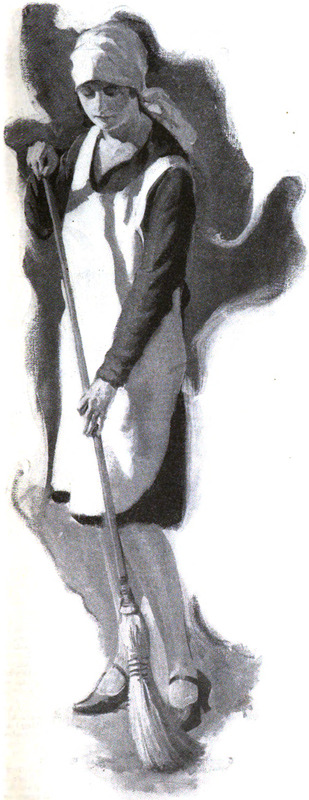
“Awful shape, but she’d
been sick so long—a
man’s slack ways!”
he heard Flora say.
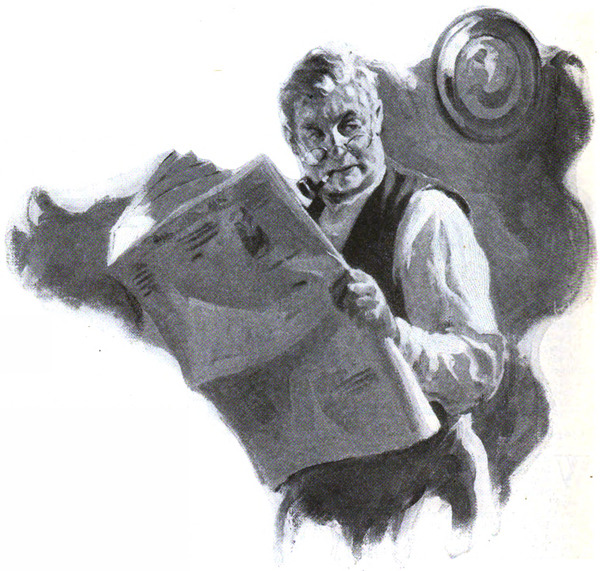
They fed him, shooed him out
of the way, thrust into his hands
the paper the postman had left.
Somebody Outside
He thought it was gone forever,
the sound of that well-remembered
voice, but it
came to comfort him—out of the
ether or out of the happy past
Helen R. Hull
Illustrations: Courtney Allen
Collier’s, vol. 80, Aug. 20, 1927, pp. 20-21, 41.
Thomas had finished his evening
chores. That is, he had locked
the door of the barn upon his
car and had carried to the kitchen
a handful of chips scraped up in the
dark from the ground near the chopping
block. He rubbed his hands along
his baggy trousers, and listened a moment,
his stocky figure crouched near
the stove. He could hear Jennie’s
rocker, little short creaks. On his
round, sandy face lay a curious expression
of bewilderment, like a garment
meant for another man, so little
did it fit into the wrinkles at the corners
of his blue eyes, the cheerful furrows
in his cheeks.
“Thomas!” The word was a thin
gasp.
“Coming!” he sang out, and clattered
into the living-room. “How you feeling
now, Jennie?”
“That pain is worse. Round my
heart. You better get my drops.” She
did not turn. Her rocker creaked, and
her thin hands pressed against her
knees, sharp under the gray shawl.
Thomas hurried into the kitchen. He
filled a glass, spilled out half the water.
“Where is that darned bottle?” His
searching hand sent a saucer splintering
into the sink. “Look what I’ve
done! Where—”
“Look on the clock shelf.”
“Here it is. I got it, Jennie.” He
was back, the water slopping in the
glass he carried. “You better pour it
out. After the way I spilled it last
time.” He held his breath as Jennie
let the liquid drip from the mouth of
the tiny bottle. Six drops. Then he
sighed loudly. “Now you’ll feel better
right off.”
“Thomas, I should think those batteries
’d be charged. I can’t stand that
whumping noise any longer. And the
wind too.”
“Oh, pshaw, I forgot them. Yes,
they’re all right. I’ll bring ’em right
up, and we’ll have a concert. Can’t
turn off the wind, but I’ll give you a
concert. That’ll help, Jennie.”
He stumbled down the steep cellar
stairs. Too bad he had forgotten about
them. Jennie hated that noise. His
fault too, leaving the switch on, so the
batteries had run down. He was always
forgetting something. No wonder
Jennie lost patience with him. There,
he’d left that cellar door open, for the
March wind to rush into the house.
His stubby fingers fumbled with the
attachment, and the sound of the small
dynamo ceased.
Jennie turned her face toward him
as he reëntered the living-room.
“It’s much easier now,” she said,
and smiled at him.
“I told you!” Thomas spoke in loud
relief. When Jennie felt better and
smiled, he could slip out from that
baffling oppression, could almost forget
she was sick. He bustled around the
table and got stiffly to his knees beside
the stand at the window, connecting
the wires for the battery.
“You just wait a minute and I’ll have
some music for you,” he said.
There was something immensely diverting
about this box. The bulbs
glowed out, his fingers moved the dials
slowly. He wasn’t very good at tuning
in. Henry, his son, was clever about
it. Henry could pick up any station he
liked. Now, which way should he move
that dial? Whirring, a faint disturbance
against his eardrums. Whoop,
there it came! A voice. He pulled off
the ear phones and plugged in for the
loud speaker.
“Some style, Jennie, us sitting here
and—”
“Listen, Thomas!” Jennie leaned
forward.
“United States Navy Band, playing
orchestral number, ‘Those Hot Ole
Doggity Blues.’”
“Oh, land, I’ve heard that enough.”
Thomas lifted his hand to twirl the
dial, but Jennie cried out:
“Let it be, Thomas. Last night you
didn’t get anything clear when you
shut off that station. You let it be.
They’ll have something else.”
The notes blared into the little sitting-room;
full orchestra, then a man’s
voice, singing, “Those hot—ole—doggity
blues!” Jennie tapped her foot
softly. Suddenly, as if a door had
closed, the sound stopped. Before
Thomas touched the machine, Jennie
had cried out, “Wait!”
Remote, infinitely faint, there came
the tone of a violin, gay, light, like a
fountain in sunshine.
“I’ll get it clearer.” Thomas attacked
his dials, turned them, and there
was the navy band, crashing out the
final chords.
“If you wouldn’t touch it!” Tears
rolled down Jennie’s cheeks. “It’s that
same station, somewhere you don’t
know, and I like it.”
“I wanted to get it closer for you.”
Thomas pulled his ear phones into place
again. He peered up at Jennie. Her
lips moved, but he couldn’t hear her
with the headpiece over his ears. Poor
girl! She didn’t mean to sound so
worked up. There!
* * *
They listened in silence. A city
station and a lecture on Arizona.
Thomas sat back, his legs in their
wrinkled, smeared trousers crossed,
with a fine air of achievement. Something
grand, this listening to folks right
in your own house.
“Just a moment, please. In a moment
we will announce the next offering
on our program. Just a moment,
please.”
“I wish,” said Jennie, “that I knew
where that violin was. It isn’t any of
these stations near here.”
“Texas, mebbe. Or Denver.” Thomas
nodded proudly. “When we get that
other wire up, and Henry said he’d help
Sunday, mebbe we can pick up London.”
“Or Mars.” Jennie was rocking
again, but slowly, without the terrible
short rhythm of pain. “Maybe Mars.
I can’t see—” She lifted one tremulous
hand, held it open, closed it, the thin
fingers doubling into the palm. “Here
in my hand are some of those sounds.
You can’t see them. Nor hear them.
Just the same as on top of the house.
If you knew how to tune it, I think
you might hear lots of things. They
want to get in. That’s why they interfere.
Wanting to be heard. I wish I
could live long enough to get more of
those things in the air. Not concerts.
Or lectures. Even if Arizona is nice
to hear about, I—”
Thomas stared at her, his bushy eyebrows
pulled together. Jennie had a
way, sometimes, of talking queer.
“You can hear enough—” He broke
off, his frown disappearing in a grin,
his blue eyes moving quickly to the
bright hollow of the loud speaker. “Just
listen here. More music.”
“Our next offering—” began a deliberate
voice.
Finally they heard the weather report.
Fair, with northerly gales, subsiding
toward evening. And the time.
Thomas pulled out his watch. A little
slow. Then he shut off the current:
“Show’s all over. Time for bed.”
He stood beside Jennie, offering his
shoulder for her hand, steadying himself
as she slowly got to her feet.
“Maybe if we tried it at midnight,
say, we could catch some of those other
sounds.”
“We’d catch China,” cried Thomas—“China,
where they stay up when
we’re in bed. You wait till I get that
other wire rigged Sunday.”
“Sometimes”—they were moving
slowly toward the stairs, Jennie’s feet
dragging over the old rugs—“sometimes
I’m real sure those interfering
voices are—somebody outside, trying to
get in.”
* * *
In the morning Jennie couldn’t get
up. Her hands were numb, and when
she lifted her eyelids there was a film
across her eyeballs. Thomas scrambled
into his clothes, he telephoned the doctor
and his son. He ran out, his suspenders
flapping, to chop more kindling.
The handful of chips wouldn’t
blaze up to heat the water.
But Jennie’s eyelids never lifted
again; her face kept its strangeness.
Through the days that followed
Thomas blundered like a clumsy,
wretched sleepwalker. His son Henry
and his wife, a plump, black-eyed
woman with brisk, competent ways,
took charge of things. They fed him,
shooed him out of the way, thrust into
his hands the morning paper which the
postman had left. He crept out to the
barn, away from the women who helped
Henry’s wife clean the house. He heard
Flora say, “Awful shape, but she’d been
sick so long, and they wouldn’t have
anyone in. A man’s slack ways!”
* * *
He sat on his chopping block in the
old shed. The wind, shifting to
southerly, flapped the bedding and rugs
strung along the clotheslines. It caught
a sheet of the newspaper spread on his
knees and carried it up against the
branches of an apple tree. Thomas,
looking up, thought that the buds at
the tips of the branches were swelling.
The paper struggled and twisted. It
was caught. He remembered that once,
years ago, his kite had lodged in that
very crotch. He was climbing the tree
to rescue it, but a fresh gust had swept
it away down the valley just as his hand
reached toward it. His hands covered
his face, his stubby fingers digging into
his hair. Years—
“Now, Father, you’re coming down
to live with us. Room for your car in
my garage. Don’t feel so bad. Poor
Mother, she’s happier, out of her suffering.”
“I’m all right.” Thomas ground his
fist against his knee. Happier? Jennie?
Where was she?
In the days that followed Thomas became
aware for the first time in his
life of the grinding pressure of time—slow,
heavy hours from breakfast to
bedtime. When he slept he would be
awakened by Jennie’s voice, “Thomas!”
only to be assaulted in every sense by
the strangeness of the room; the flat,
smooth mattress; the empty space beside
him where his hand crept, trembling;
the pencil of light on the ceiling;
street noises outside the window.
He suggested that he might go back
to the old house. Flora disposed of
that. “How would it look, us letting
you stay there alone?” And Henry
said, “You’ll get used to being here,
Father, and we want you. You’d rather
stay with your folks, now, wouldn’t
you?”
His folks! Jennie was his folks. And
she was gone.
One evening Henry came in, triumphant.
He had a fine offer for the old
place. A real estate agent wanted it
for a city man. He’d pay any price
for the location. The house wasn’t
worth much.
“I won’t sell!” Thomas thumped his
fist down on the table.
“Then you’d have a comfortable income.
You’ve always been land poor.
You should have sold the place years
ago and moved to town. You’ve never
farmed, really.”
Thomas looked at the two: Flora’s
dark eyes, determined and bright; Henry’s
kindly face, shadowed a little by
uncertainty. How could he tell them—vaguely
he fumbled among his feelings—that
the old house and hillside
held all that was Thomas Parsons: the
drifting, easy pattern of his days; his
life with Jennie; that away from there
he was nothing but a shambling old
man, furtively watching the hands of
a clock circle heavily around the hours.
“Tomorrow I’ll drive up and look
things over,” he said slowly.
As he backed out of the garage the
next morning Flora stood on the kitchen
steps, her checked apron thrown over
head.
“Father!” she shrilled. “Bring your
radio set down. It would be nice evenings.”
His car slewed in the spring mud,
jumped perilously out of the yard.
“Damned if I will,” he muttered.
“Bring Jennie’s radio—”
His clumsy fingers wobbled the key
all over the lock before they could insert
it. The house puffed out at him
with a clammy, musty sigh as he opened
the door. He’d build up a fire to drive
out that chill. It wasn’t good for the
house.
He tiptoed through the dining-room,
to the living-room door. Flora had left
everything shipshape—an empty orderly
room. If he could just hear Jennie’s
voice!
There was the old phonograph in the
corner, under the dingy chenille cover.
Why, somewhere in that pile of records
was that old one, Jennie’s voice. He
hurried around the center table and
squatted on the floor, fumbling over
the disks. They hadn’t touched the
phonograph all winter. But that record—smaller
than the regular ones. He
held it up, his hands shaking. Two
years ago, the last time he and Jennie
had gone to the city, he had dragged
Jennie into the shop. “Hear your own
voice,” the sign read. He thought it was
a silly idea. He fitted the disk in place
and ground at the handle. Squealing,
humming, metallic and faint:
This is Jennie Parsons speaking. It
is January, nineteen twenty-two, and I
am in town with my husband.
Jennie, mincing her words, saying
what the clerk told her.
Thomas lifted the small black disk
and stared at it. Her voice could stay
on that piece of lifeless stuff; in those
holes, waving in his unsteady grasp.
He made a quick start toward the window,
stumbled against the piles of records
he had scattered over the floor,
flung out his hands for support.
“Oh, gosh a’mighty!”
Between his fingers was one small bit
of the disk. The rest clinked from the
edge of the marble-topped table down on
the floor.
* * *
Clumsily, his breath wheezing between
his teeth, he picked up the bits
and tried to fit them into place.
“You doddering fool!” he cried out.
That had been the only thing left of
Jennie, that tracery of pin pricks.
He moved across to the stand which
held the black receiving apparatus of
the radio. With his coat sleeve he wiped
away the film of dust. That picked up
things you couldn’t see nor hear. What
was it Jennie was always saying? That
those interfering voices might be people
outside trying to get in? If he could
just tune in properly—
He laughed. Huh, he was getting
foolish notions. But all around him
came the pressure of a gentle insistence.
Why, that was the way Jennie always
made him feel when she wanted
him to do something—every time he
tried to duck out of it he would find her
right in front of him, just waiting, until
he finally gave up and did it, whatever
it was she wanted.
If he should rig up that new wire—it
was ready, there in the barn. He ran
his fingers wildly through his hair. At
least no one would know how foolish he
was. It would do no harm. Jennie had
believed—
In the corner of the barn stood the
supports Henry had rigged; on the floor
lay the shining coil of wire. Thomas
moved with a dogged haste unlike his
usual leisurely attacks. He set the long
ladder against the house, slid the roof
ladder up until the prongs caught
over the ridge. The copper wire a
circle of light
about his shoulders, one of the supports
under his arm, he clambered up to the
ridge of the house. The morning haze
had thickened into a fine spring rain,
cool on his face, faintly silver against
the shingles and the black trunks of
the trees.
They had planned, Henry and he, to
run this new wire from the house to the
peak of the barn. He filled his mouth
with nails, dragged the hammer out of
his hip pocket, wriggled astride the
ridge to reach the gable end of the roof.
Thomas drove in one nail. The hammer
slipped out of his hand, bumped
down the roof, and caught on a projecting
shingle nail. Thomas stretched for
it, his hand moving cautiously down the
wet roof, farther....
Then, amazingly, he seemed to be
again in the living-room, sitting before
the instrument, turning the dials, his
fingers curiously deft. The room was
cool and dusky, as if the rain hung soft
curtains within the walls. His eyes
blurred: was it the living-room or a
great space, limitless, with the spring
rain falling, falling? Jennie was waiting.
He was sure that in a moment
he would have tuned—for Jennie. He
wondered at his expertness; he was
always so clumsy. A distant humming,
and then—it was Jennie’s voice, clear
and firm, without the plaintive undertone
of those last months of illness.
Jennie’s young voice, laughing at him:
“Old curly-headed Butter Fingers!”
“Where are you, Jennie?” How
could he think that she would hear
him? And yet she was answering.
“I guess you need me around, don’t
you?”
That was what she had always said
when she came back from a visit....
“I can’t find you, Jennie. I’m not
much use alone.”
“Next time I go I guess I’ll have to
take you with me.”
That gay, tender laugh! Why, she
had just come back from her first visit
home. He could see the gray light
catch on the passementerie that edged
her blue dress. As he tried to stumble
toward her the rain fell in a close-pressing
curtain over her, over him.
* * *
He couldn’t see clearly. With an
effort he opened his eyelids wide
and looked. Why, his thumb and finger
moved slowly round and round the blunt
head of his hammer. Over him swung
a long, trailing branch of the clinging
rose bush, and into his face dropped a
bit of ragged cloth, torn loose from the
trellis. That rose bush climbed against
the side of the house. He had broken it
away. Amazement shone in his blue
eyes. He had fallen, then, slipped down
from the roof. He could see the coil
of wire spinning brightly above him,
caught on the eaves trough; suddenly,
as he watched, uncoiling in a great
spiral. And Jennie—a shiver, like that
of the wire as it dropped in its long
spiral, moved over his limp body. Then
the rain fell on his fast-closed eyelids.
Transcriber’s Notes
Transcribed from Collier’s, vol. 80, Aug. 20, 1927, pp. 20-21, 41.
New original cover art included with this eBook is granted to the public domain.
The original spelling and punctuation were mostly preserved.