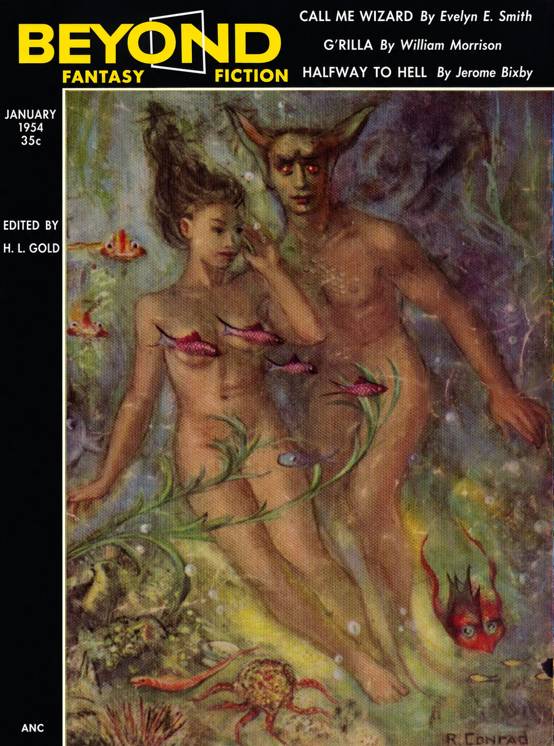
Transcribed from Beyond Fantasy Fiction, January 1954 (Vol. 1, No. 4).
Title: Tag
Author: Robert Abernathy
Illustrator: Rupert Conrad
Release date: November 2, 2026 [eBook #79902]
Language: English
Original publication: New York: Galaxy Publishing Corporation, 1953
Other information and formats: www.gutenberg.org/ebooks/79902
Credits: Tom Trussel - Stories of Futures Past (This file was produced from images generously made available by The Luminist Archive)
Transcribed from Beyond Fantasy Fiction, January 1954 (Vol. 1, No. 4).
by Robert Abernathy
’Twas the day after Christmas, and Santa got a gift of his own.
Once there was a man who hated Santa Claus.
Not for the reasons you might imagine; he had neither wife nor child, nor, now that he had come to middle age, any other living relatives whom he need remember at Christmas, or who might remember him ... but perhaps that was why.
Or perhaps it was because, when he was still young and credulous, someone had told him that there is no Santa Claus.
However that might be, at every Christmas season this man suffered the tortures of the damned. He could not venture out without meeting his enemy—red-suited, white-whiskered, bell-ringing, guffawing with a false and hateful joviality—on every street-corner, in the public places and the shops, pictured, postered and effigied.
He knew, of course, that the department store and Salvation Army Santas were only mummers; nevertheless, he could not pass them without a surge of unreasoning anger, and he looked with bitter and lofty contempt at the swarms of children—and grownups, too—fawning upon the despised saint.
Early in one dreary December, having gone to one of the great stores to make some everyday purchases, he found himself compelled to visit the lavatory. There to his horror, he beheld no less than three Santa Clauses, who had retired thither to smoke cigars and talk shop.
At sight of them, the newcomer lost his head. “Damn you!” he shouted. “Must you hound me everywhere I go?”
The three stared. One of them, a tall, skinny Santa, asked, “What’s eating you, mac?”
The man drew himself up, fists clenched, trembling a little. “Do you realize,” he demanded bitingly, “that you’re living a lie? That you are impersonating a most abominable fiction?”
“Ho! ho!” laughed a squat Santa without benefit of pillows. “Listen to this, boys ... the character’s a comedian!”
“Assault and battery,” said the arresting officer, and then in a hushed aside, “Your Honor, this is the guy that socked Santa Claus.”
“Dear me!” said the judge. He eyed the accused as if seeking to deduce from his appearance the motive which had led to this atrocious behavior. “Why did you do it?”
“It was a mistake,” said the prisoner unhappily. “For a moment ... I don’t know what came over me, Your Honor, but it seemed as if it was really Santa Claus before me, not just a man in a red suit.”
The judge blinked uncomprehendingly.
The prisoner added by way of explanation, “I hate Santa Claus.”
“I don’t believe in jailing mental cases,” said the judge. “If you promise to consult a psychiatrist, I’ll let you go with a fine.”
The psychiatrist listened raptly to the tale of the man who hated Santa Claus. Once or twice he nodded. Finally he said: “Ah, yes. Clearly, a paranoid delusion complex, with overtones of hypertrichophobia. Very similar to the trouble of a former patient of mine, an industrialist, who also thought himself followed by men with beards. In his case, they were Bolsheviks; in yours, they are Santa Clauses—but at the unconscious level it is all much the same thing. The root of your difficulty lies, of course, in the Oedipus complex; for you, Santa Claus is an image of your father, whom you also hated.”
“I don’t see how that could be,” said the patient. “My father died ten years before I was born.”
“All right,” said the doctor a little huffily. “You tell me why you hate Santa Claus.”
“Because he’s too good to be true. No one could possibly be so inexorably jolly, generous, good-natured, altruistic. See how they picture the fat saint, slaving year after year in a stuffy polar workshop, rushing madly around the world on Christmas night to shower gifts on millions of unworthy and ungrateful recipients! You and I know that we are mean, stingy, greedy creatures—human beings. How could we endure to live in a world that held such a monster of benevolence?
“What would we think of a man who behaved like that in real life? We would call him insane, and fear and hate him as a mad and dangerous man. And ... what would such a man suffer in himself, as his madness drove him to violate the sacred creed of the ape, his grandfather: ‘What is mine is mine and what is thine is mine’? Why, he would be the most miserable being on earth!”
The psychiatrist took off his glasses and rubbed his eyes. “A difficult case,” he muttered a little hopelessly.
“I’ve considered suicide,” said the man dully. “Would you advise it?”
“Eh? ... No, certainly not!” The doctor roused himself. “You must face your problem, not flee from it. You must fight this thing!”
At home, the man brooded over the psychiatrist’s words. He had tried fighting before, but his blows had fallen only on innocents, such as the department store Santa. Yet his spirit was not broken. Determination came to him; he sprang to his feet and smote the table with his fist.
“This time,” he swore, “there will be no mistake!”
He went out, drew all his money from the bank, and chartered a plane for Baffin Bay. At a trading post he bought a gun, warm clothing and provisions. He rented a dog team and set out across the Arctic ice.
For many days he fought his way northward, following the compass needle through blinding blizzards and sunny days when the immense snow-fields were one featureless glare. His fingers and toes froze; he grew gaunt and haggard, and sprouted whiskers which the bitter wind festooned with icicles; yet he plodded on, upheld, like many a hero before him, by indomitable will.
At last, he came in sight of the North Pole. It was morning of the day after Christmas, but the Pole was sunk in winter darkness.
Trembling with cold and excitement, he peered through the dimly lit windows of Santa’s workshop.
Inside, as far as the eye could see, was a gargantuan confusion and disarray—scraps of wrapping paper, empty boxes, crates, barrels, chips, shavings, string, wire, nails, screws, damaged and leftover goods, jumbled in places almost to the ceiling.
On a bench in the midst of all this appalling litter sat Santa Claus—shoulders drooping, white beard unkempt, red breeches rolled up and feet buried in a tub of steaming hot water. The old saint was staring fixedly at the floor, as if afraid to look up and see the chaos which last night’s furor of activity had left, from which order must yet be restored before another long year’s toil could begin.
With infinite stealth, the man pushed the unlocked door open and circled around among the rubbish-heaps so as to come upon his quarry from behind. At such close range that he could not miss, he cocked the gun loudly.
Santa Claus turned and looked wearily, and with a curious absence of surprise, at the leveled weapon and the bristling, fur-clad, burning-eyed figure behind it. There was an instant in which the silence stretched to the breaking point, and then—
Santa Claus chuckled. “You surely don’t mean it, young fella,” he said benignly. “Nobody shoots Santa Claus.”
“Oh, don’t they?” the man snarled, and fired. His aim was true. But Santa Claus’s expiring breath still carried a ghost of the chuckle.
“Son, the joke’s still on you,” he whispered. “Now you’re it.” He vanished. All except for the red suit and white beard, which fell to the floor.
The man dropped the gun and tried to run. He couldn’t. He stopped trying, walked over and picked up the red coat and put it on. It was cold in here, and he had a mess to clean up with almost a year to do it.
Robert Abernathy
This etext was produced from Beyond Fantasy Fiction, January 1954 (Vol. 1, No. 4). Extensive research did not uncover any evidence that the U.S. copyright on this publication was renewed.
Obvious errors have been silently corrected, but minor inconsistencies have been retained as printed.
New original cover art included with this eBook is granted to the public domain.