Gould and Lincoln. Boston
Title: Geographical studies
Author: Carl Ritter
Contributor: Heinrich Bögekamp
Translator: William Leonard Gage
Release date: November 1, 2026 [eBook #79899]
Language: English
Original publication: Boston: Gould and Lincoln, 1861
Other information and formats: www.gutenberg.org/ebooks/79899
Credits: Aaron Adrignola, Laura Natal and the Online Distributed Proofreading Team at https://www.pgdp.net (This file was produced from images generously made available by The Internet Archive)
1
IT is with unmixed feelings of pleasure that I hail your attempt to make our great and excellent RITTER known to the American public by his own works, and thus to give, in his own words, to the numerous lovers of Scientific Geography in this country, the large and suggestive views contained in the translated memoirs.
I am aware that, owing to Ritter’s mode of thought and style, both so eminently German,—as you remark yourself,—this work may not be destined to become what is termed by our booksellers a popular book; but I think too well of the American mind and culture not to believe that it will find its way to a large number of true scholars, by whose influence it will largely contribute to foster a deeper and more philosophical study of both Geography and History.
Having myself begun, many years ago, to translate several portions of Ritter’s works into French, I can, perhaps better than many others, appreciate the great difficulties that you had to overcome to give us his thoughts in the clear and flowing English which distinguishes your translation. For this success I sincerely congratulate you.
I remain, dear sir, with sincere esteem, and cordially, yours,
ARNOLD GUYOT.
PROF. D. C. GILMAN, YALE COLLEGE. (From the New Englander.)
BY common consent, HUMBOLDT and RITTER are regarded as the founders of the department of Physical Geography. For its promotion they labored, not unitedly, but harmoniously, during a longer period than is appointed for the life of most men. While they differed widely in character, and exerted themselves in very different ways for the promotion of 2their favorite study, their names will always be remembered together in their works. The Cosmos and the Erdkunde will together be handed down to posterity as an enduring monument of the extent to which the knowledge of nature, and especially of its relations to man, has been carried in the nineteenth century of the Christian era.
In contrast with the popular homage generously lavished upon Humboldt, both in Europe and America, stands the equally honorable and equally enduring reputation which the genius of Ritter has achieved, not indeed among the multitude, but among his peers in the higher ranks of intellectual culture. Yet we would not disparage the well-earned fame of the author of the Cosmos, when we say that the author of the Erdkunde was far more nearly his equal in genius, in learning, and in perpetual influence, than would be supposed by those who should judge them by their present notoriety; for the New Geography is almost equally indebted to them both. It is not easy to say whether Humboldt or Ritter has done most in this science, for they have labored by different methods and in different departments,—Humboldt inclining decidedly to the study of material science, in geology, hydrography, orography, and terrestrial physics; and Ritter in as marked a manner evincing his love for the study of mankind, in history, ethnology and archæology, and regarding the world as a theatre for human progress. To define the relative value of their services is happily as needless as it would be difficult. They acted and reacted upon each other.
At the basis of all Ritter’s writings lies the thought that each of the grand divisions of the earth has its own peculiar character as really as any person; and that thus it is designed to fulfil a specific office in the culture of mankind. This idea, promulgated and illustrated with such eloquence and skill in the University lectures of Ritter, has already to some extent pervaded the geographical literature of the day, and may be traced in many of the school-books of Germany, which are based upon his method. His principles are brought out in a volume composed of various contributions to the Academy of Science, and other occasional essays, which was published in Berlin in 1852. It is this volume which is now first brought before the English reading public, no translation of it having appeared in England. 3
4
Gould and Lincoln. Boston
5
BY THE LATE
PROFESSOR CARL RITTER
OF BERLIN.
Translated from the Original German,
BY
WILLIAM LEONHARD GAGE,
TRANSLATOR AND EDITOR OF PROF. HEINRICH STEFFINS’S
“STORY OF MY CAREER,” ETC.
“Is it not worth while, for the sake of the history of men and of nations, to study the surface of the earth in its relation to its inhabitants?”
BOSTON:
GOULD AND LINCOLN,
59 WASHINGTON STREET.
NEW YORK: SHELDON AND COMPANY.
CINCINNATI: GEORGE S. BLANCHARD.
1863.
Entered according to Act of Congress, in the year 1861, by
GOULD AND LINCOLN,
In the Clerk’s Office of the District Court of the District of Massachusetts.
iii
THE papers presented to the American public in the following work are so purely the product of German thought, and retain, even in our own language, such distinct traces of their source, that a translation becomes necessarily hazardous. An eminent living writer has said that “every great nation has a mode of expression and of thought peculiar to itself, and with which its sympathies are intimately connected. To introduce any foreign model, however admirable it may be, is to violate this connection, and to impair the value of literature by limiting the scope of its action.” Physical Geography, and the generalizations which it involves, have been to so great an extent the fruit of German soil, that its terminology has hardly forced itself yet into other tongues, and its ideas are still colored with the nationality of their origin. To cast the thought in an English mould of expression has been a prominent object with me in executing the translation, yet I am aware that the result has been but imperfectly reached. The obstacle has been not so much in the extremely involved style of Ritter (though in this respect educated Germans grant that he has hardly his parallel) as in the newness of his field of inquiry.
There are some pages of this work whose contents have been presented heretofore to the American and English reader ivin our standard treatises on Physical Geography; and they are here given anew mainly to show them in their first statement, to bring them forward in the light in which they appeared to the eminent discoverer. But a large part of the generalizations of this book are not as yet worked out: they may appear loose and vague and unmeaning; and yet they had to their author, conversant as he was with the myriads of geographical details, a distinctness of meaning which hardly any one can see who has not read the twenty thousand pages of Ritter’s Erdkunde.
Mr. Buckle has elaborated, in one of the opening chapters of the History of Civilization in England, two or three of Ritter’s thoughts, and has applied them briefly to a few countries; and while he goes to an extent to which Ritter was ever a stranger, abusing the thought instead of using it, that nations as well as individuals are modified by their geographical conditions, yet his chapter shows how wide a field of application lies still open to the generalizations of the great geographer. Ritter nowhere makes man subject, in silent, unresisting dumbness, to the influences of nature; he allows for results which issue from the mutual conflict of geographical conditions and the freedom of man’s will; but Buckle, going far beyond Ritter, makes the former element all, and reduces the latter to a cipher.
The Introduction to the Erdkunde, and the General Observations on the Fixed Forms of the Earth’s Surface, are the only portions of Ritter’s great work, of any length, which could be incorporated into this translation. The Erdkunde, or Physical Geography of Asia and Africa (for the work never went beyond these two continents), is a monument of vgenius as well as of research; and yet the nineteen volumes, with their twenty thousand pages, are not filled with generalizations,—they are made up almost exclusively of details. The Erdkunde differs from all preceding geographical works, as diamond differs from charcoal: the details are not thrown together in a hap-hazard way, but are organized into unity. The sciences of botany, geology, chemistry, astronomy, natural philosophy, and mineralogy are made subservient to the great purpose of the work, and the results of all these and kindred sciences are introduced and unified. The principles that underlie the Erdkunde are found in the two papers which are translated here, but, as the reader will see, the work itself could not be to any great extent used.
The six lectures read before the Royal Academy of Science at Berlin, in different years, from 1826 to 1850, are esteemed the consummation of Ritter’s geographical labors. Guyot and the English geographers have made the public acquainted with a part of their contents, yet some of them have not been drawn upon at all. They will all repay study; though it is to be regretted that the turn of the German mind is so little towards illustration of principles; that it rolls out thought after thought, keeping them in an abstract shape, instead of casting them in that more concrete form which is characteristic of the results of the French, English, and American mind.
Ritter, unlike Humboldt, seems to have paid no attention to beauties of style; and this although he had a poet’s sensibility, and was alive to every natural grace. The reader will not fail to see, especially in the Introduction to the Erdkunde, that its author had an imagination of rare strength, one which threw a rich and warm glow over all that he wrote. But as vifor beauty of style, he had none of it. He fully illustrates the truth of what has been said by an eminent living writer: “The great German authors address themselves not to their country, but to one another. They are sure of a select and learned audience, and they use what is in fact a learned language; they turn their mother tongue into a dialect, eloquent indeed and very powerful, but so difficult, so subtle, and so full of complicated inversions, that to their own lower classes it is entirely incomprehensible.”
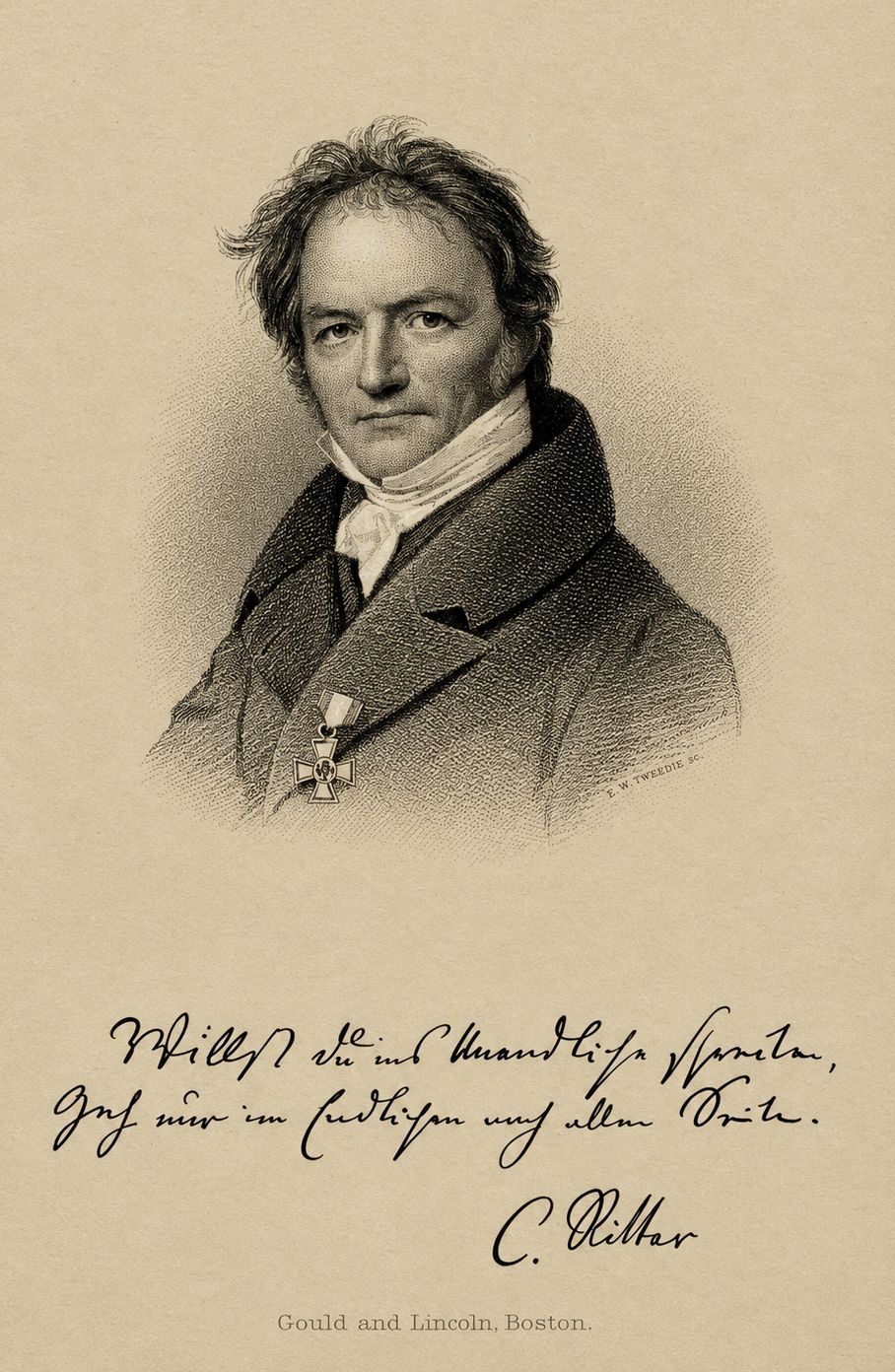
Of two pictures of Ritter in my possession, I present the earlier one, taken at the height of his power. Although it does not in any way represent his appearance as I knew him in his advanced age, yet it is certified to as a very correct likeness of him in middle life.
I cannot close without expressing my thanks to Mr. Balfour, of Dantzig, Prussia, for valuable hints and help in the execution of this undertaking, and more especially for revising the entire translation, word by word, thus at once ensuring and assuring its accuracy.
May this work, which in another language has already given a new direction to Geography in all civilized lands, be more fruitful of good, now that it can be read in the tongue which will always be largely employed in diffusing its results.
WILLIAM LEONHARD GAGE.
PORTSMOUTH, N. H., March, 1861.
vii
| SKETCH OF THE LIFE OF PROFESSOR RITTER, BY THE TRANSLATOR, | 13 |
| ACCOUNT OF RITTER’S GEOGRAPHICAL LABORS, BY DR. BÖGEKAMP, OF BERLIN, | 33 |
| INTRODUCTORY ESSAY TO GENERAL COMPARATIVE GEOGRAPHY. | 53 |
| The study of Man as an individual preliminary to the study of the globe, 55.—The norm of individual and national development, 56.—Sources of individuality, 57.—Slow workings of nature, 58.—The earth the scene of all natural phenomena, 59.—Natural life a resultant, 60.—Influences of nature, 60.—A knowledge of God solving a thousand seeming contradictions, 61.—Impossible that a single mind should compass the whole theme of this work, 61.—The greatest triumph of the human mind to trace the influences which modify man, 661.—Possibility that some may be able to forecast history, 62.—The beginning of historical development a circuitous and rambling course, 62.—All forms to be studied, 63.—Man must find his true locality to attain his perfect development, 63.—GENERAL COMPARATIVE GEOGRAPHY IN ITS viiiAIM AND OBJECT, 64.—Every observation on nature conducts from details to their relation with the whole, 64.—Regularity in diversity, 65.—Illustrations, 65.—Influences of periodic change, 66.—Contrast between east and west, 66.—Contrast between the Old World and the New, 67.—Special characteristics of Asia, Europe, and Africa, 68.—Influences active in the western half of the globe, 70.—Advancement from the simple to the complex, 70.—Africa as rightly the first field of study, 71.—THE CONTINENTS AS FIXED FORMS, 71.—Africa, Asia, and Europe, the natural order of study in the continents of the Old World, 71.—These three continents contain all leading types, 72.—Reason of the above order in naming them, 73.—Unity of the Old World, 73.—Strict use of the term Old World, 74.—General usage in the names Old and New Worlds, 74.—THE FLUID FORMS ON THE EARTH’S SURFACE, 75.—The geographical elements, their laws, activity, functions, and mediatorial agency, 75.—THE THREE NATURAL KINGDOMS, 78.—Their relation to Man, 79.—METHOD OF ARRANGEMENT, 81.—The deductive system, 82.—Brief résumé of authorities, 82.—Why called Physical Geography, 83.—Why called General, 83.—Excellence of a systematic arrangement, 84.—Importance of hypotheses in geographical investigations, 85.—The union of all truths, 85.—Fundamental principles of this work, 87.—GEOGRAPHICAL AUTHORITIES, 89.—Nature of the Authorities, 91.—Ritter’s personal observations, 91.—Books written by investigators themselves, 93.—Books written by others than the first investigators, 94.—Value of maps, 95.—Specification of authorities, 96.—On the Features of the Earth’s Surface, 99.—Ritter’s personal acquaintance with leading authorities, 100.—On Oceanic Forms, 104.—Contributions of British navigators to science, 104.—Benjamin Franklin and American savans, 105.—On the Atmosphere, 107.—The barometer and its historical development, 108.—Labors of Von Buch, Humboldt, De Saussure, and Sömmering, 111.—On the Subterranean Regions, 114.—Forces of fire and heat, 114.—Observations on volcanic eruptions, 115.—Leopold Von Buch’s investigations, 116.—Scotch naturalists and Humboldt, 117.—Authorities in the Vegetable Kingdom, 118.—Authorities in the Animal Kingdom, 123.—Remaining Materials, 125.—Early geographical investigators, 125.—The agency of boards of trade, missionary societies, and the like, in collecting facts, 127.—Tribute to Humboldt, 128.—Universality of modern studies, 129.—The course of human inquiry, 130.—Mission of nature, 130.ix |
|
| GENERAL OBSERVATIONS ON THE FIXED FORMS OF THE EARTH’S SURFACE. |
131 |
| SKY, SEA, AND LAND, in their mutual relations and their inherent activities, 133.—Using the past to illustrate the present, 135.—Order of investigation, 135.—THE LAND, 136.—Equipoise of continents, 136.—Southerly direction of continents, 137.—Divisions of the Old World, 138.—Africa, Asia, and Europe, in respect of form, 138.—The Elevations of the Earth, 141.—Relative and absolute elevation, 142.—General water horizon, 143.—Definition of Mountain Ranges, 144.—Chains of marine mountains, 145.—Watersheds, 146.—Mineral mountains, 150.—Inner formation of mountains, 151.—Illustrations, 151.—Incorrect use of the term “mountain,” 152.—False use of the words “low” and “high,” 153.—Establishment of Terms indicative of Elevation, 154.—Building of the earth, 156.—STREAMS OF WATER, 157.—Course of streams, 157.—River Systems and the Districts which they water, 159.—Watersheds as a means of internal communication, 162.—Direction, Fall, Upper, Middle, and Lower Course of Streams, 164.—The direction and fall of streams, 164.—Their upper course, 166.—Middle course, 167.—Lower course, 170.—The Terrace-Lands of the Earth, 172. |
|
| THE GEOGRAPHICAL POSITION AND HORIZONTAL EXTENSION OF THE CONTINENTS. | 175 |
| Progress in a knowledge of the globe, 177.—The earth as an organism, 178.—The earth as the theatre of the forces of nature, 178.—The unequal division of the earth into land and water, 179.—Conformations of the earth’s surface, 179.—CONTRAST BETWEEN THE LAND HEMISPHERE AND THE WATER HEMISPHERE, 180.—Exhibited in Australia, America, and Africa, 181.—Influence of the oceans upon the atmosphere, 184.—THE GROUPING OF THE LAND MASSES, 185.—Breadth at the northern extremities contrasted with that at the southern, 185.—Proximity of all lands around the North Pole, 186.—Uniformity of products in all Arctic regions, 187.—Diversity in unity, 188.—Rifting of the continents, 189.—Influence of internal seas and arms of the ocean, 190.—The various districts of the earth brought into intimate xrelations by the arts of navigation, 191.—POSITIONS OF THE SEPARATE CONTINENTS, 191.—Of Europe, 192.—Figurative appellations of the continents, 193.—Position of America and Australia, 194.—SIZE OF THE CONTINENTS, 195.—Its influence, 195.—EXTENSION IN LENGTH AND BREADTH, 196.—THE CONFORMATION OF THE CONTINENTS AND THEIR BROKEN OUTLINE, 199.—Conclusion, 208. |
|
| REMARKS ON FORM AND NUMBERS AS AUXILIARY IN REPRESENTING THE RELATIONS OF GEOGRAPHICAL SPACES. | 209 |
| The application of geometrical figures in geography, 212.—Use of numbers in aiding to grasp relations, 219.—Want of accurate measurements, 221.—Humboldt’s method of description praised, 224.—Final use of measurements, 225.—Application of numbers to shore-lines, 225.—Also to river systems, 228.—To mountains, 234.—Geographical labors which ought to be undertaken, 236. |
|
| THE HISTORICAL ELEMENT IN GEOGRAPHICAL SCIENCE. | 239 |
| True scope of the geographical sciences, 241.—The world the theatre of historical development, 242.—Mutual relation of history and geography, 242.—The former consciousness of this relation, 243.—Gradual improvement in text-books, 243.—The union of all sciences, 246.—Sources of geographical science, 246.—Its field of study, 247.—Changes in places, times, and forms, 249.—Objects formerly remote or inaccessible brought near, 250.—Fixed and fluid forms, 251.—All natural forces made subservient to human uses, 252.—The complete transformation of the earth, 252.—Difference between geography and astronomy, 254.—Difference between geography and other natural sciences, 254.—Changes on the earth, 255.—Victory of man over natural forces, 257.—Unprogressive notions have little influence over the aspects of nature, 257.—Effects in this regard of the configuration of surface, 258.—The Ural chain as an example, 260.—Effects of all level regions to bring men together xiand to diffuse the results of industry, 260.—Effects of the progress of nautical art, 261.—Influence of improved river navigation, 263.—All countries now in virtual proximity, 265.—The longest way often the shortest way, 270.—Favorable situations in relation to the sea, 271.—Conditions of nations of former times, 273.—Change in the methods of descriptive geography, 274.—Influence of incorrect astronomical data, 275.—Concluding remarks, 277. |
|
| NATURE AND HISTORY AS THE FACTORS OF NATURAL HISTORY: OR, REMARKS ON THE RESOURCES OF THE EARTH. | 279 |
| A knowledge of the resources of the earth an important part of geographical science, 281.—Deficiency of standard treatises in this regard, 282.—Influence of the diffusion of the gifts of nature, 283.—A thorough knowledge of the theme yet wanting, 283.—A knowledge of natural history indispensable to the full appreciation of geography, 284.—Relation between the mental state of a people and its surroundings, 285.—Lack of data in geographical science, 290.—Efforts to reduce fragmentary facts to order, 292.—The relations of the mineral kingdom to organized productions, 296.—Diversity in the geognostic forms of the globe, 297.—The science of comparative natural history a new one, 300.—Duties of a naturalist, 301.—Three questions preliminary to an explanation of the laws of propagation on the globe, 302.—Diversity leading to harmony, 307. |
|
| THE EXTERNAL FEATURES OF THE EARTH IN THEIR INFLUENCE ON THE COURSE OF HISTORY. | 309 |
| The apparent confusion on the globe, 311.—Difference between works of nature and works of art, 313.—Man’s capacity of progress, 314.—Clear accordance in all the relations of things, 315.—Influence of the wedge-like masses of land in the Antarctic hemisphere, 316.—Contrast between the land and water hemispheres, 316.—The great belt of coast-line, 317.—Influence of the continental and oceanic divisions of the globe, 318.—The great volcanic xiicircle, 319.—Volcanic groups, 323.—Laws of volcanic activity, 325.—Laws governing the direction of mountain chains, 325.—The cradle of history, 330.—Significance of the continents in their relations to each other, 331.—Ancient ideas of the Orient and the Occident of the globe, 333.—Under the influence of navigation, old contrasts disappearing, 334.—Future conquests of science, 335.—Characteristics of the separate continents, 337.—The island formation of Europe, 344.—Absence of islands on the coast of Africa, 345.—Products of various islands, 346.—Effects if the world were entirely insular, 347.—Favorable position of Europe, 348.—Connection between nature and history, 348.—A secret principle of unity, 349.—Historical value of each continent, 350.—America in this regard, 351.—Australia and Southern Asia, 353.—The future greatness of the New World, 354.—Concluding remarks, 356. |
13
THE first day of October, 1859, witnessed a funeral in Berlin, second only in the display of public sympathy and appreciation of worth to that which was exhibited in May of the same year, when Alexander von Humboldt was carried to his grave in Tegel. I refer to the burial ceremonies of Carl Ritter, the most eminent geographer in the world—the man who not only gave the first impetus to the study of physical geography, but also raised it to the dignity of a science, and who remained till his death without a rival in the branch of knowledge which he had created. This language may seem unwarrantably strong, but it is not more emphatic than that expressed by the savans of Berlin over his grave. His influence is felt in America; for such works as Guyot’s “Earth and Man,” and Mrs. Somerville’s treatises, confessedly owe their origin to the teachings and discoveries of Ritter. A brief memoir of so great and influential a man cannot be misplaced as a threshold to his writings; and though no full biography of Ritter has yet appeared, yet the sketches of Krämer, Hoffmann, and Strauss, aided by 14personal recollections of his teaching, must suffice, in want of more complete materials.
Carl Ritter was born at Quedlinburg, Prussia, 1779. The time was most favorable, for it was then that the world was beginning to be deeply moved by the great intellectual struggles which preceded the French Revolution, and yet it was late enough to perceive whither all the currents and counter currents of opinion would run, if left to their own self-direction. His father was a physician of skill and note. Dying when Ritter was a mere child, he left a large family utterly without means. Carl was the youngest child; he was then but five years of age. Through the kindness of friends and the gentry of the neighborhood, three of the children found homes immediately. Carl and another brother were cared for in an almost providential way. It was just at that time that Salzmann was founding his famous school at Schnepfenthal. He was looking carefully around to discover some boy of promise whom he might adopt in his sixth year, and bring to manhood, applying his favorite system of moral suasion. Salzmann accidentally learned of the death of Dr. Ritter, and knowing of his large family, he thought that in it there might be some promising boy whom he might adopt, and sent two friends to Quedlinburg to make the proper inquiries. They were so well pleased with Carl, and so well satisfied that he would be a suitable subject for Salzmann’s experiment, that they proposed to his mother to surrender him to their friend to be educated at his expense. She consented, after a hard struggle, and accompanied her boy to Schnepfenthal. A friend of the family went with them. She remained for some 15time with her son, and returned to her home, having conceived the greatest respect for Salzmann and his system. Thus Carl Ritter was the first pupil in the school which has since risen to such eminence, the institution at Schnepfenthal. He remained there eleven years, till his entering the university, and so this pleasant place became his real home. And scarcely could a better one have been found to develop a mind like Ritter’s, and fit it for the pursuit of such studies as he was to become eminent in. Surrounded by the charms of a highly diversified landscape, on the border of the Thuringian forest, looking out on all sides upon a most fruitful plain dotted with cities and villages, with meadows and mountains full in view, he was not only able in all this beauty to penetrate to the goodness of the Creator, but also to get glimpses of many geographical forms, there thrown together, which in most other places would be scattered. So to him Schnepfenthal became a miniature Cosmos; and I can easily see how his whole later method of regarding the entire world in its cosmical unity grew out of the blended unity and diversity in the midst of which he passed from childhood to manhood. His education was conducted with the most jealous care. Schnepfenthal was one of the first schools where the languages of Greece and Rome were pushed aside in favor of the modern tongues, and where the attention of the teachers was specially directed to the practical branches, and the formation of character. To the latter Salzmann devoted most of his energies. To give physical strength, and hardihood of nature, and ruggedness of spirit, he much preferred to merely imparting the details of learning. It is but just to say, that the religion taught was 16the rationalism of those times, of which Salzmann was a prominent supporter; but Ritter seems never to have been affected by it. During the last days of his life, while he was suffering great pain, his thoughts ran back to Schnepfenthal; he sent a word of greeting to the home of his youth, and expressed his thankfulness that God had made that school the place where he had begun to enjoy the consolations of religion. This institution still exists, and among the eight hundred men whom it has sent into the world, Ritter stands incontestably on the highest stage of eminence.
Eleven years spent in Schnepfenthal brought him to the age of sixteen. He must be thinking of the future. He had chosen no profession. He had a strong relish for study, but how he should support himself during the years to be spent at the university, he did not know. The way before him seemed quite dark, as it had been to him, when a boy of five years, at his father’s death. But again Providence disclosed the path that he should take. Mr. Hollweg, a wealthy merchant of Frankfort-on-the-Main, and partner in business with the same Bethmann whose name every visitor to Frankfort still recognizes in connection with Dannecker’s statue of Ariadne, sent him, upon Salzmann’s recommendation, to the university, under the condition that after leaving it he should become the private tutor of his two sons. So Ritter went to Halle. He had then no special inclination towards geography, and entered upon the study of finance. Halle was then the centre of the intellectual life of Germany, as it now is of its religious life, and, happily for Ritter, he soon found himself domesticated in the home of one of the most distinguished of the professors, 17Niemeyer, who may be said to have been the most eminent educator of his age. He had just published his first principles of the pedagogic art, and was then at the height of his fame. During the two years which Ritter spent in Halle, he was brought under the daily influence of Niemeyer, and it is not strange that it gave him not only a great bias towards the life of a teacher, but an admirable knowledge of the principles which underlie a teacher’s work. In the year 1798, he entered upon his duties as private tutor of the children of Mr. Hollweg, of Frankfort.
It was a trying step for the youth of nineteen, who had always moved in the most retired way, to enter at once the family of a very wealthy man, in the richest city of Germany, and to mingle freely with its aristocracy. Of course he found a multitude of difficulties to overcome. But he set himself in good earnest to his duty, and the result has followed as it has to few teachers beside. One of the two little boys died in the very freshness of childhood; the other has grown up to be first a contemporary professor with Ritter in the University of Berlin, and now to be the distinguished head of medical, ecclesiastical, and educational affairs,—Baron Bethman Hollweg,—a man not only of the finest talents, but also the great pillar of evangelical religion in Germany; a man of such exalted character and true influence that I cannot write his name without a glow of enthusiasm.
There are few places which so call every quality of a teacher into action—trying at every point, attainments, temperament, judgment, disposition, and strength—as the post of tutor in such a house as Ritter was called to, where there 18are the most capable of children to receive, and the most capable of parents to judge. But Ritter went to his duty fully equipped. And the longer he staid, the more he was loved. He was brought not only into daily contact with such men as Sömmering and Engel, but with Leopold von Buch and Alexander von Humboldt. Such acquaintanceship drove him deeper into study; and amid the advantages of a place like Frankfort, with wealth, art, and books at his free disposal, with friends to reward and stimulate his zeal, and in the midst of an attractive country like the valley of the Main and the Rhine, his mind was enriched with all the accomplishments that could adorn it.
And all these advantages he appreciated and improved. The time of his stay in Frankfort was a period of the most diversified studies, to which not only his duties as teacher invited him, but to which his own nature drove him. So, among other things, he turned his attention to the languages of Greece and Rome, which had been overlooked in his education at Schnepfenthal, and read the most eminent authors in Latin and Greek literature. It was at Frankfort, too, that he turned his mind with special interest to geography and history. The thought of devoting himself to these departments presented itself to him while a teacher in Mr. Hollweg’s house. So he began his studies in this direction by going over, first, all the most eminent works then written on geography and its relations. The little excursions which he made with his pupils into the environs, near and remote, of Frankfort, aided him in collecting independent observations. The happy faculty which he possessed of grasping, with perfect 19ease, all the features of a landscape, was to him of great service, and, by sketching them on his little journeys, he rendered them forever his own. So, from every one of these little trips he used to bring home a portfolio full of sketches, which served him as the points to which important observations began by and by to attach themselves. It was in this way, by studying in this minute and careful manner the mere neighborhood of Frankfort, that he gained that thorough grounding in geography which displayed itself in his first publications. He began his career as an author by sending to a paper for youth, published by his friend Engelmann, these geographical studies of which I have just spoken. But in 1806 appeared his six maps of Europe, and in 1811 the Geography of Europe, in two volumes. In both of them can be seen the singular capacity of his mind for grasping the facts of geography and apprehending their relations. They are the first efforts to express what lay in his soul. Many more preparations were needed to ripen him for his great work.
In 1811 he began his series of short journeys, which lasted through his whole life, by excursions with his pupils into Switzerland and Italy. I do not need to speak at any protracted length to make intelligible to my readers of what never-ending significance the careful observation of these two countries—the most perfect representatives of the most important and weightiest geographical types which Europe has to show—was to such a man as Ritter, whose mind was so singularly sensitive to external impressions, and so well adapted to trace the relations existing between the formative features of a country and the character of its population. 20In Switzerland he studied nature in her most stupendous forms. Italy, which he traversed from north to south, gave him an insight into volcanic activity, the relation of the land to the sea, the effects upon climate, and of all geographical features upon the character of a people. The riches of art which Italy possesses as does no other land, laid the finishing touch upon his most delicate and sensitive soul. And of not less worth to him were the personal relations which he entered into on those journeys with the most eminent men of the times. I mention Pestalozzi before all, whom he met in his excursions to Switzerland, and whom he repeatedly visited; the time which he spent with him and his coädjutors in discussing the method of instruction which Pestalozzi was exhibiting to the world he used to look back upon as most valuable and delightful. With Saussure and de Candolle—names known to all my readers—he was on terms of intimacy, meeting them in the course of his Swiss journeys. With his pupils he penetrated into every corner of this country, tarrying months at a time in places of special interest, as, for example, at Geneva, the centre of the intellectual life of Switzerland, and at the base of Mont Blanc, the point of the greatest interest to the geographer. He tarried long at Rome, too, not only on account of its manifold historical associations, but because it was then the centre of attraction to men of world-wide reputation; and while there he became intimate with such artists as Cornelius and Overbeck, the painters, and Thorwaldsen, the sculptor,—men whose gifts were not those alone of a skilful hand, but of able minds, and new and rich thought. With all the vast range of knowledge, with all the 21sharpness of his genius, with all the energy of his activity and the strength of his intellect, the quality which most endeared him to his friends was the sweetness of his nature, his friendly mien, the cheerful, bright, child-like soul; these made a bond that could not be broken. This made them almost forget at times that that noble intellect was, and would remain, the basis of his fame.
Thus enriched by the fruits of all these journeys, he began to lay his hand upon the work of his life. In 1814 he went with his two pupils to Göttingen, for they were then ready to commence their studies at the university. Here he could associate freely with eminent men, and have the use of the vast library which had been recently gathered there. He spent two years at Göttingen; thence he went to Berlin, and there finished the first copy of his great geographical work, and commenced printing the “Erdkunde.” Like Niebuhr’s “History of Rome,” the first edition is but the basis of what stood as the Erdkunde when he died. In 1817 the first part of his life-work appeared. Its title, which I translate, hints plainly at its character: “The Science of the Earth in Relation to Nature and the History of Man; or, General Comparative Geography as the Foundation of the Study of and Instruction in the Physical and Historical Sciences.” In this work the true treatment of geography has been fully unfolded and established, and it has been raised to the place of a sister between the natural sciences and history. It would be impossible to give a characterization of this work in few words. Its Introduction has done this fully; but that is too extended to be reduced to the dimensions of this sketch. The Physical Geographies 22which have abundantly appeared in our country within the past ten years are the faint shadow, as they are the direct resultant of this work of Carl Ritter. Mrs. Somerville’s books, and Guyot’s “Earth and Man,” are the best representatives of the Erdkunde, but in size they are but miniature, compared with Ritter’s ponderous tomes. In this great work he has succeeded in presenting the forms of the earth’s surface in their horizontal and vertical dimensions, embracing geology as well as the mere description of the exterior; in bringing all the facts connected with geology proper and geography proper into direct relations; and in presenting, besides, a view of the entire productions of the earth, the whole animated creation, and more especially in grasping the development of races from their surroundings. To have accomplished this immense undertaking in a clear, and at the same time comprehensive way, was a great service and a high praise; and yet, perfect as was the result, his hopes and attempts were directed to an ideal as much higher than what he wrought out as the ideal of an artist is raised above the actual result. But Ritter was admirably fitted for his work. To enable any one to accomplish what Ritter did, there were wanting those varied qualities of mind which had come to be his through the circumstances of his youth, his later course of education, and the most protracted studies. And, added to these advantages, Ritter possessed the following in a manner that no man of our times or past times has surpassed,—the union of a power of combining with a thoroughness which went unweariedly to the smallest details; a great fulness of scientific knowledge, with a complete mastery of historical facts; and the ability to present 23in a thorough and exhaustive way, and at the same time in a picturesque and vivid manner. But it was this that struck the deepest roots into Ritter’s soul, and displayed itself as the basis of his book—the search for the knowledge of the living God in his works. It was from this that arose that well-known, humble, and complete surrender of himself to his subject, making him never satisfied, yet not allowing him to shrink back before so ponderous an undertaking; it was from this living spring that arose that ceaseless sprightliness of his, which was not crushed by the immense accumulation of his facts. His work was to him, as he once wrote of it in his diary, his “song of praise to God.”
During the printing of the Erdkunde he lived in Berlin. Here work of all kinds accumulated upon his hands. He was appointed, in 1819, Professor of History in the Gymnasium of Frankfort, spent one year there in that capacity, during which he married, and then obeyed a call to Berlin to become Professor extraordinary of Geography in its university. On the nineteenth of September, 1820, he entered upon his duties in this new capacity.
With that event began the second half of his life, in which all his scientific studies and his work as a teacher bore their best fruit. There was indeed no place which presented so varied attractions to a man of such attainments and abilities to interest others, as Berlin. In the university he found an intense scientific activity, sustained by men of world-wide renown, into whose circle he at once stepped as an equal, and was soon cherished as one of the chief ornaments. His lectures were received with the greatest satisfaction; and his intimate 24acquaintance with such men as von Buch and von Humboldt, and the vast scientific interests which are centred at Berlin, constantly stimulated him to advance in his studies. So his life, therefore, became not only full of delight to him, but in the highest degree advantageous in the prosecution of his labors. His former pupil, Bethmann Hollweg, had become a professor also in the same University of Berlin.
His ceaseless activity now turned itself upon the issuing of the second edition of his great geographical work, in so far as his time could be spared from his direct duties as a teacher. It soon began to appear, much enlarged; yet his devotion to that duty suffered many interruptions. His time was more and more taken up with new demands. He was elected a member of the Scientific Commission of Enquiry in Geography and History; shortly after, was appointed Lecturer on History in the War School; and almost immediately thereafter director of the studies of the corps of Cadets. Upon this followed the appointment of Ritter as the private tutor to Prince Albert of Prussia in the department of history; and he was directed to read lectures to the Prince Regent and a few noble friends during the winter months. With these and kindred demands, his time was largely taken up. He discharged them all with his wonted faithfulness and care, and yet had time—such was his physical strength and unwavering activity—to devote a part of each day to his great geographical work. In the years of which I am now speaking, he founded the Geographical Society of Berlin, in connection with friends, and remained its most active working member, and generally its president, down to his death. His place in that society is now filled by the distinguished 25Dove; his place as professor in the university, by Kiepert, the well-known Chartographer.
Of the greatest worth to him in connection with his studies were the journeys which he used to take in the long autumn vacation. Twice they were so extended that they embraced the largest part of the summer. These journeys served not only to refresh him, but to give him an immense mass of observations of the greatest importance to him in the prosecution of his studies. He made frequent visits to Vienna, Paris, London, and other great cities. He repeatedly traversed Central Europe, travelled through Greece, Wallachia, Bulgaria, Hungary and Turkey; crossed France in all directions, and explored the Pyrenees; visited Denmark, Norway, and Sweden; and was familiarly acquainted with England. Germany, Switzerland, and Northern Italy, were however his geographical homes, and with them he was the most familiar. His letters home while on these travels are charming; for he was open to impressions of all kinds, was introduced to the most eminent men, and was, of course, one of the closest of observers. Any one who has enjoyed the pleasure of hearing Ritter lecture, would mark everywhere the results of those personal wanderings.
But, after a succession of years spent in miscellaneous work, obeying all the demands which were laid upon him, he found that he must concentrate himself upon his great work, which lay but imperfectly completed; and in 1831 he had to give up the private instruction of princes, and the delighting of select circles with his wisdom, and devote himself entirely to the “Erdkunde.” The result of this new step was soon apparent. 26In 1832 began to appear the first of the volumes, and they followed in rapid succession till the nineteenth was published, and the great monument of his life was complete. They remain now, and will long remain, the fullest encyclopedia of geographical lore; and he who brought geography into the rank of the sciences as an equal sister, is still at the head of the one he loved so well.
With the advance of his work his fame advanced with equal steps, his relations with naturalists extended into all lands, and he became one of the central points of science, not more known for the almost unparalleled extent of his knowledge than for the soundness of his judgment, and for his sweetness and patience in answering all questions put to him; bearing himself with unwavering “humanity,” as the Germans say, in his relations with all kinds of men.
In such ways it could not fail to follow that all manner of honors should pour in upon him. He was elected member of almost all the scientific societies of Europe, and numerous orders were bestowed upon him. He received all these things thankfully, but was far from valuing them beyond their worth. In his journals is to be found scarcely any mention of them. But he did prize the personal affection of the present king of Prussia, and the familiar intercourse which he had with him, and always regarded it as one of the things to be cherished, that he had such private access to the affections of his king.
I have thus far spoken of Ritter as a learned man and an author. But, eminent as is his rank in these relations, it is not higher than his position as a teacher in the lecture-room. Very few teachers have had the extended and lasting reputation 27which he enjoyed. When he came to Berlin in 1820, and announced in the university his lectures on Universal Geography, there were no hearers at the opening of the course, very few at the close, and but a handful in the following course. Yet still there was a gain; and ever on went his success, till in 1823, only three years from the beginning of his labors as professor in Berlin, he wrote in his diary: “Full lecture-room; I must have a larger.” And so it went on, till the largest hall in the university could hardly contain his pupils. It soon began to be “the thing” to hear Ritter, and nearly every student of the natural sciences was a daily attendant on his course. When I was in Berlin, five years ago, Ritter’s room was still full; more than three hundred young men were hearing his lectures. He knew his art well. With almost womanly tact, he seized upon those features which present circumstances made interesting, and culled out of the immense masses of matter lying in his mind just what he could use with the greatest profit. He illustrated freely by excellent maps, and was a master in the use of the blackboard, sketching gracefully and readily whatever made his subject clear. I shall not forget the patriarchal appearance of Carl Ritter in the lecture-room in 1855. He used his notes about half the time, but read them easily, and with great distinctness. Obscure and involved almost without parallel in his written dissertations, yet his style was simple in the lecture-room, and his clear articulation and well-chosen emphasis, combined in a highly musical voice, made it easy to follow him. He was a tall, finely-proportioned man, with a noble head, a most sincere and earnest manner, yet unusually quiet and simple. His dress was peculiar 28when an old man, and no one who frequented the famous Linden-avenue of Berlin would fain to remark that tall and venerable figure, clad in a long blue cloak and broad-rimmed hat, both half a century out of date. He used to wear a large rolling collar, like that worn by a past generation of New England grandfathers; and that, together with the huge horn spectacles, gave him a rusticity of appearance, and a simple friendliness, which captivated every one who knew his learning, his talents, and his heart. It was a characteristic of Ritter, that the external man was so penetrated by his inner nature, that the two were inseparable and indistinguishable. He was such a one that if you had looked upon his face you had read the whole man; and therefore he belonged to that class of minds which always makes the same impression upon men of all conditions and mental varieties. The cause of this uniform impression is found in his natural humility, in the quiet peacefulness of his inner life, which was more than mere tranquillity: it was the holy calmness of a Christian.
Indeed, there has hardly lived a man of so great eminence who has been of such purity of heart, simplicity of manner, and strong personal sympathies as Carl Ritter. His loss is felt in Berlin more as a personal calamity than as a mere break in the list of scientific men; for in all things which constitute a still, pure, peaceful soul, loving home and loving friends, Ritter was most eminent: a man who found his greatest delight in serving those who loved him. He was absolutely free from egotism and from personal vanity. Towards the close of his life he made the assertion, which so few can make, that he had never alienated an old friend, and that the remembrance of 29every one whom he had loved, and who had been removed by death, was cherished by him through life. It was only natural that this should be so, for Ritter’s circle of sympathies knew no bounds; and, despite his retiring way, and the quiet of his disposition, he was an untiring helper of all who needed advice or active assistance. In private he was benignant and fatherly—were the word allowed, I should say grandfatherly—as I knew him. I went to Berlin to study under his direction, and found him most kind and gracious; opening his hand, his library, and his house to the young American, and attaching me to him by a strong bond. I am most happy to be able to speak of him to my countrymen, and testify to his greatness and his worth.
I must allude to another aspect in Ritter’s character. He was one of the foremost Christians in Germany. He cherished from his schooldays a living faith in God and Christ, which the loss of his wife, twenty years before his own death, only strengthened. He was a Christian in the full sense of the word. He was a man who spoke little of faith; but it lay deeply at his heart, and showed itself in his active coöperation in the great Christian enterprises of the day. He was one of the most active men in Germany in promoting church harmony; and when the Evangelical Alliance met in Berlin three years ago, Ritter was one of the greatest voices there. He was steadfastly opposed to all forms of strife in the church; but he cherished, as the chief joy of his life, his faith in Christ and the grace which God had implanted in his heart. God’s word was the light of his steps; and it was the great end of all his scientific labors to confirm the truth of the Bible. Hoffmann, his pastor, the eminent cathedral preacher of Berlin, uses these words in his 30address over Ritter’s grave: “No one who lived in near intimacy with him will forget the bright glance of his eye when the richness of God’s grace was spoken of, nor that serious earnestness of his with which he traced the hand of the Eternal in his works; no one will forget that venerable head and that reverential face, as he sat in the house of God during the hour of afternoon worship, nor the few but precious words with which he proclaimed his peace in God through Jesus Christ, and expressed his hope of future glory. No one could approach him without feeling that the richness and vastness of his knowledge were all subordinated to a desire for His praise, by whom, and through whom, and for whom all things have been created. The blessing of the meek was plainly his, and no one could be with him even for a season and not feel it to be so; for he would note the universal peace of Ritter’s soul, and the humility of his nature, pictured in every feature of his countenance. His was the face of a man whose labors, investigations, and researches—whose collecting, arranging, and linking together of facts, drawn from a field uninvestigated before him, culminated in the study of the workings of God. Even in the midst of the woes of life, and those bitter separations which God’s providence compelled him to meet, his head remained unbowed; for He whom he knew as his redeemer from death was his redeemer from every evil.”
Ritter carried his religion into his scientific studies. This earth was to him not a mere dwelling-place for nations; it was the material out of which life is woven; it was the garment in which the soul clothes itself, the body wherein the spirit formed by God must move. This was Ritter’s central thought; all 31his ideas illustrated, all his researches confirmed it; through the earth as his way he reached God as his goal. The globe was to him but the place where God’s kingdom should be founded; and in all his study of man, Christ became the middle point. In his most valuable scientific writings the thought that underlies them all—whether his subject be mountain heights or dark valleys, heaths or cities—is, that everything in the world comes from the counsels of God, and has a relation to the kingdom of Christ. This is the secret of those impressions which his geographical writings produce. Free from all striving after effect, his great aim was to show the workings of the living God in the conditions of history. This was the reason why he always expressed the purpose of his work in a manner equally indicative of his humility and of the religious bearings of science. In sending me a copy of his last volume, he wrote in it with his own hand that it was another note added to the harmony of that general song of praise in which all branches of science must unite, if they will retain the honor which God has lent to them, until the time shall come when they shall raise the “gloria in excelsis” in still nobler notes.
A brief passage written by him in 1845, just on the eve of his departure for the Pyrenees, and found after his death, will throw light on his faith. It runs thus: “Although now, in my preparations for my departure to west France and the Pyrenees, well and strong, yet my life lies in God’s hand, whose grace and compassion have already accompanied me so many years, that in all my thoughts and actions I must give praise and thanks to Him so long as I live. Should it please Him not to send me back safely to my beloved ones and my work, but 32to take me to a place in his blessed kingdom, it is my request that there be no sorrow over my journey home to him, for what God does is well done. My Saviour, in his compassion, will care for my eternal future. I am deeply conscious of my weakness and my sin, and yet I trust him; for I know that God is everlasting love, and I know that my Redeemer lives, who will make his believers participators in his eternal grace.”
Ritter died at the age of eighty years. On the night before his decease, as his pastor sat by his bedside and pressed his hand, quoting the beautiful twenty-third Psalm, “The Lord is my Shepherd,” Ritter replied, “He has guided me thus far, and he will not desert me now.” These were among the last words of that rare man,—rare for his learning, his talents, his sweetness, and his Christian strength. In England and America the men of loftiest powers and the widest learning are the men most firmly persuaded of the truth and saving blessedness of Christianity; while those who doubt or disbelieve are now found almost wholly among the half-educated or the utterly neglected. But in Germany the order is reversed. The lowest classes are those that are to be found within the walls of churches, while the men of thought are, to a great extent, disbelievers. Ritter stands, therefore, more eminent for his grace than for his intellect. And as Kant led the way in giving the Germans philosophy instead of Christ, it may be that Ritter, a spirit of hardly less magnitude than his, may inaugurate the reign of Christian principle among the future scholars of Germany.
33
IF the question be asked, In what spirit did Ritter investigate geography, and in what way did he elevate it to the rank of a science? The answer can only be found by a perusal of his great work, and the lectures which he delivered before the Royal Academy of Berlin. The outlines of thought contained in the Introduction to the Erdkunde are briefly these: As every individual has received from God certain peculiarities of character, and certain mental tendencies, so the nations of the globe have an aggregate of such peculiarities and tendencies, because nations comprise but a multiplicity of individual lives. It is the student’s task to trace the source whence these peculiarities proceed, to ascertain the conditions which form the character of nations. The individuality of a nation—that which makes it unlike all others—is only to be traced in its own inner nature, and in its relations to itself, to its parts, and to its surroundings; and since no nation can exist without state and country,—that is, without political organization and localized position,—so the individuality of a 34nation is to be traced in its relations to neighboring districts and neighboring political organizations. Thence arises the influence which nature exercises upon a people,—an influence which, as Ritter remarks, can only be justly appreciated by one of those calm, reflective minds, who delight to trace workings which, though involving great power, are yet silent and mysterious. Thus he leads the way to his favorite thought, that geography and history have mutual influences upon each other,—history not standing outside of nature and natural influences, but in their very heart; so that the historian only grasps a people’s character with true perception when he keeps in full view its position, and the influence which its surroundings have wrought upon it.
Nor can the geographer dispense with history; on her pages he has to read the tasks and destinies which have been assigned to the various nations to fulfil. And this brings us to the theoretical postulate of Ritter’s method, which, as he himself has told us, does not find truth in a single phase of truth, but in the union of all truths, and thus in the domain of belief. He rests upon an inward intuition which has been gradually forming by contact with nature on the one side, and with man on the other. In other words, a living God is at the head of the physical and moral world. Mankind is a whole; but it is divided into peoples, which, in the counsels of God, have their tasks to perform,—tasks apparently disunited and different, yet linked together by a secret law of God, who alone sees the accordance and unity of so varied results: the earth itself a whole, divided into many parts, but all these parts to be the field where the nations shall, each in its own 35way, solve the problem of its destiny. Thus history is not a lawless thing,—a shapeless, uncrystallized mass of mere details; its parts fit together in a regular and beautiful connection. The surface of the earth does not remain as something without influence and relations; but the various districts have mutual dependence upon each other,—all in harmony, like the events of history,—making of nature no lawless chaos, but a unit, an organism, a Cosmos.
Thus, as early as 1818, Ritter had grasped the conception of the close inward connection between history and nature, between a people and the country which it inhabits; and it is clear that no materialistic philosophizings could creep in with this elevated thought. More sharply outlined and clearly expressed, this view is unfolded in one of Ritter’s early papers, written in 1826, entitled The Geographical Position and Horizontal Extension of the Continents. The earth, he there states, is not alone a member of the solar system; it exists as itself a system of phenomena; and the division of its surface into so many parts, and the apparently random manner in which these different districts have been scattered, are not fortuitous, but in conformity to important laws: nor have these districts stood without any mutual play of action and reaction, but they have powerfully influenced each other. So all the countries of the globe are in immediate and direct connection; each, as an active member of the whole, has its own share in the general result, and the individuality of the earth as a planet springs from the combined individuality of its parts.
In this result, which embraces animate and inanimate nature alike, and which throws equal light upon nature and 36upon history, there is another element present, one which pertains exclusively to the earth, not as a planet, but as a system of phenomena complete in itself. In a true, but by no means in a loose, materialistic or pantheistical sense, the earth as a whole is an organism; and there is a certain principle of life interfusing all its parts, bringing into crystalline regularity its inorganic parts, and reaching all the activities of organized life. We trace the workings of this mysterious force especially in the connection of history and geography. They two have a unity not shared by any other two departments; and the former is not understood till the earth, the field where its events occur, is regarded as the home, the place of development for the human race.
The study of these activities is the peculiar task of science. Every detail which meets the naturalist is seen to have its connection with a universal law. There is no point, however trivial, but it has relations with the entire system of phenomena on the earth; and in a scientific light, the chain is apparent which connects the entire round of facts, and shows their relation to each other.
The earth is the field on which man is to gain his education. As in the higher arrangements of all things, mere rude force and the external aspect of greatness gain no lasting sway, but only that greatness which is real and inwardly nourished, so with the features of our globe. Ritter himself, in his account of Palestine, writes: “Does not every garden spot owe to the cherishing care of the gardener its influence over the trees, the fruits which are in it, in their growth and fruitage? And can any country in God’s wider domain lie under 37his active rule without affecting its people and the inhabitants of the earth? The historian has a vast field of inquiry yet open to him; and in the want of a full view of his field, he has fallen into many false judgments. But this much is certain: history does not stand outside of nature, but wholly within her domain; she is truly a part of God’s garden. The activities of nature cannot hereafter be excluded from the list of those agencies which God himself uses for the welfare of the human race. Yet the activities of nature are as yet far from being comprehended by us, in spite of that tone of confidence which a false and presumptuous science not seldom assumes, while nevertheless it is hardening in its own groundless delusion.”
This, in general terms, was the groundwork of Ritter’s geographical conceptions. The forms of the earth’s surface are not disposed by accident; on the contrary, they display a wise plan which we are now able to grasp. The various districts of the globe have been created for the life of connected people; and the world is as much fitted to be the home of man as the body to be the habitation of the soul. It is at once apparent how full of life and interest a science must be which traces these influences of nature on history, and how widely the geographical method, founded by Ritter, differs from what used to be called geography, namely, a lifeless summary of facts about countries and cities, mingled with all possible scientific incongruities. We have now to show how Ritter not only established a new foundation for geographical inquiry, but how he applied it in detail, and showed, as in the 38words quoted above, how to connect general principles with accumulated facts.
Nature presents contrasts of every kind; but the one which is most apparent is that existing between the water, land, and atmosphere. A mere glance at the surface of the earth leads us to notice this contrast, and a more attentive consideration of it shows us that these bodies cannot be without a strong influence upon each other. The mutual action and reaction of land and water is the one which becomes first apparent. If we suppose what is technically called a great circle to pass around the earth, traversing the west coast of Peru, and running along the southern shore of China, and across the island of Malacca, we have a northeastern hemisphere which is specially continental, and a southwestern hemisphere which is specially oceanic. England is the centre of the first; New Zealand of the last. The climate of the two is widely different. The water takes warmth up slowly, and slowly parts with it; it easily maintains an equilibrium with the atmosphere, and, so far as temperature is concerned, the two do not widely vary. The land, on the other hand, takes up warmth very quickly, and loses it as quickly again. The temperature of the atmosphere overhanging the land passes from one stage of heat or cold to another with great rapidity; and as uniformity is characteristic of the oceanic districts, so diversity is characteristic of continental regions. A continental climate is marked by extremes; hot days are followed by cold nights, hot summers by cold winters; whereas an ocean climate has great uniformity between day and night, summer and winter. The latter climate is moist, and favors 39luxuriance of growth, but not a large number of species, whether of plants or animals, if we except butterflies and reptiles; it has, too, a strong influence upon man, making him lose his elasticity, and become enervated and unenterprising. A continental climate, on the contrary, does not give luxuriance, but a great variety of species; its animals, too, have more spirit, and man has more life and fire.
A second contrast is that of the Old and New World, or of the eastern and western hemispheres. Here the Old World is the continental, the New the water hemisphere. The contrast in climate is the same as between the land and water hemispheres, although not so sharply defined. Connected with this is a contrast in the main direction of the continents. The Old World belongs almost exclusively to the temperate zone, and has its longest extent from east to west. The result of this was that wandering tribes could pass from east to west without experiencing a great change in climate, and in the flora and fauna of the regions through which they should pass. But the New World has its greatest extension from north to south, from pole to pole. This occasions a great diversity in climate, ranging from the icy cold of the extreme north to the burning heat of the equator, and thence onward to the cold of the south pole. A third contrast presents itself between the northern and southern hemispheres. In the northern, the land bears to the water the relation of one to one and a half; in the southern, of one to five. The former is characterized by continental, the latter by oceanic forms.
But all these contrasts vanish in a higher unity, in the completeness of the earth as itself an organic whole. And the 40previous course of history allows us to see what part has been assigned to each district to play in the grand universal drama. Thus the Old World is subdivided into three great parts, which stand to each other in varied contrasts,—Asia, Africa, and Europe. Asia has been regarded, from the earliest times, as the land where the human race began to be. In Asia all the germs of culture are to be sought, while in Europe they have unfolded. Africa is the Soudan of the earth. Says Ritter, in his highly imaginative way, “If the morning and evening greeting become to every man, even to the most wearied pilgrim on the road of life, a heart-felt necessity, yet one which is not known when the glaring hour of midday comes, the hour poorest in hope of all,—then, from a like analogy, all the people of the Soudan of the earth, in the peaceful possession of the bright midday, seem bound only to the present, which no legend of gray antiquity beautifies, which no care for the future disturbs, and which no hope for that future ever bears on the pinions of imagination endlessly away.” To the Old World the New stands in direct contrast, and offers its great Atlantic slope as a field ready to receive the ripened results of European culture, but ready also, in consequence of its simple structure and its uniform climate, to soften the strong contrasts and the tendencies to individualization manifest in the Old World, and to produce the same uniformity in it which characterizes the New.
In this way we pass from contrast to contrast, as the anatomist does when he dissects the body and shows the functions of the several members.
The varied position of the separate continents is occasioned 41by the contrasts between the land and water hemispheres, the Old and New World, and the northern and southern hemispheres. “Europe,” as Ritter remarks, in a lecture given before the Royal Academy, in 1826,—“Europe, the smallest of the continents, surrounded by the others in a broken ring, and Australia, the largest island, surrounded by the open ocean, are the regions which in the north and south respectively hold the middle place in the land hemisphere, the continental side and the oceanic side of the globe. This position gives Europe, in preference to any other of the continents which are linked together, the right to be called the most continental of all; for it is the highway of all, and the link that binds them all. So the classical soil of the west of hither Asia, and the lands of northern Africa, have largely affected the world’s history, for theirs is a great part of the coasts of the Mediterranean. The influence of this section of the world on the whole course of human culture is confessedly great, and is produced by a combination of causes which can hardly be repeated in any other spot,—an indisputably favorable arrangement in the elements of position and form. In any other part of the globe the careful student could see in the surroundings, if he looked at them in their analogies, that it would need a longer time, and that greater limitations and difficulties must be met, before the needed conditions should evolve equally perfect results. And so, too, the old strugglings after a higher culture in other places, as in India and China, which, with all other helps, yet lacked the true position for attaining to a development which should embrace the earth, yet show that as everywhere the unseen only works itself out through the seen, 42so the development of the inhabitants of the world stands in close relation and harmony with the organization of the earth to which they directly belong.
“A harmonious and general arrangement of the various continents of the earth, in their relations to light and heat, and to the rising and setting of stars, has, from the earliest times, awakened the interest of man, and in the course of history has received a variety of appellations, which have, in a measure, been indicative of the character of the continents to which they have been applied, and which can still be used in a wider sense, and one more adapted to our modern needs. From the earliest times men considered Asia as the land of the morning, and Europe as the land of the evening; and they indicated the contrast thus conveyed by the terms Orient and Occident, which find their fitting application in all the phenomena of these two continents. Between these, more to the south, lies Africa, divided exactly by the equator, the true south of the globe, which is not to be sought at the south pole, but at the place of greatest light and heat, the bright midday, to use the old figure, between morning and evening.
“America forms, in consequence of its remote position, the entire western arc of the great land circle; and since Europe has for all the past been the Occident of the Old World, and has fulfilled its mission in being the place of transition for the whole globe, America must become the latest goal for the efforts and activities of men—must be the New World, the land of the evening, in contrast to the Old World, which has already become the land of the morning.
“None of these historical relations, with the mass of phenomena 43connected with them, could be shared with Australia, in consequence of its position. Continent though it is, in its isolation it is like an island of the sea, and seems to be connected with the land hemisphere merely as the great continental form of the oceanic world.
“To this cosmical arrangement of the continents there correspond those relations of nature and history which are in part displayed in the course of human development. But the position of special places also gives rise to subordinate characteristics; and the formative influence which special places have exercised, especially where they have been the field for the most marked transfer of different races across them, on the development of man and the course of affairs, is a subject worthy of the most careful study.”
In a masterly manner Ritter has applied these generalizations to the smallest countries on the globe. I refer, for example’s sake, to Palestine. In one of the volumes of the Erdkunde he writes: “Palestine was from the beginning an isolated land, as Israel was an isolated people, and therefore, for thousands of years, both have been unintelligible to the world at large. No great highway led through Palestine from people to people; all passed by it, and not over it; all its coast was without favorable harbors. No one of the pagan states of antiquity could come into close geographical, mercantile, political, and religious relations with a people existing under the sway of Jehovah. All the nations around Canaan were kept aloof from it by the theocratic circle of ideas which had the supremacy among the Hebrews.”
Palestine forms a part of the great district of Syria, 44between the Isthmus of Suez and Arabia on the south, and extending to the middle plateau of the Euphrates, where its turbulent waters break through the narrows of the Taurus range.
Syria is bounded on the west by the Mediterranean, and on the east by the desert of what is in the widest sense Arabia. Separated thus from Orient and Occident alike, and left by itself, having its longest course from north to south, and being quite narrow from east to west, it formed a natural bond between the Armenian highlands of Taurus and the lowlands of Egypt; and the characteristics of its population must correspond to the conditions amid which they are formed; and people must be found there who had come from the regions of inner Asia, and others who had left the culture of Egypt for a home in Syria. And thus, from the very beginning of human history, the position of Palestine has been such that it has served as a bridge, parting a sea and a desert waste, and connecting the Euphrates and the Nile. It has been, too, an appointed home for culture in the very centre of hither Asia, and at the same time it has remained isolated and unaffected by external influences. No other land on the globe lies like Palestine, in this respect. The northern half of Syria has not so favorable a location, for, traversed as it is by the great highway from Asia Minor to Assyria, it was subject to the influences of foreign travel from the earliest times. But Palestine lay surrounded by populous countries, and yet isolated from them. In the midst of six of the greatest nations of antiquity—the Babylonians, the Assyrians, Medes, Persians, Phenicians, and Egyptians—it was yet separate from 45them all. This allowed it to maintain its contrast with them,—to follow its appointed course of development, and not to lose its monotheism. It seems to have been placed equidistant from all three continents of the Old World, and near five great seas, that it might be a central point whence the gospel of Christ could be sent at once to all parts of the known world.
In characteristics of such prominence as these,—characteristics which have had a great influence over the destinies of millions of beings,—is there not seen, asks Ritter, “the hand of a higher Power? Or are they to be attributed to mere chance, to the activity of nature, to an upheaval promoted by water or fire held within the bosom of the earth, where mountain chains, devoid of regularity in form or direction, are thrown up by the irresponsible forces of nature, and where the waters of the sea run in to fill the new-formed hollows? If we are in a position to trace the forces which have the most weight in giving order and harmony to the destinies of nations,—forces which act intensively where they act, and which yet reach over large fields,—can we not see the workings of a superior Mind in the arrangements of the world, manifest not only in effects existing before our eyes, but in actual progress? And can science account for the spiritual activities which are moving over the face of the earth, if she does not see in the globe itself an organism, and loses sight of those vital relations which exist between its parts? In a hundred places which have already exerted a strong historical influence, a close and scrutinizing study will disclose the functions of the earth as an organism; and the places which have not yet become the scenes of historical events will fulfil their destiny in the course 46of time not less faithfully than those which have been the theatres of classic story.”
Next in importance to the position of the various countries on the surface of the globe, Ritter pays special attention to the relations which grow out of the superficial dimensions of the continents, and the proportion of the coast-line of different lands to their internal extent, and the proportion of the area of peninsular formations to that of the main body.
“In these regards,” says Ritter, “Africa presents the simplest forms. It is distinguished palpably from the other continents by its almost insular position, connected as it is with western Asia by a mere strip of land, and that probably of recent formation—the Isthmus of Suez. In its close and compact form, and very regularly outlined coast, it resembles an ellipse, although its diameters are of about equal length, and although the climatic features are nearly the same on both sides of the equator, advancing as far as the thirty-fifth parallels of north and south latitude. Having no great sea inlets, its entire circuit is only about seventeen thousand miles in extent, and is the simplest coast-line of all the continents. Africa has, therefore, in spite of its insular position and its great area, relatively the shortest as well as the most uniformly regular and simple coast of all the great divisions of the earth, and in consequence of this meagre outline its interior has the least contact with the ocean.
“Asia, washed on only three sides by the sea, unites with Europe in the formation of a common trunk, and thus completes the vast range of territory extending from east to west. Its eastern and southern coasts abound in far-projecting peninsulas 47and half-insular forms, which are all to be regarded as the more or less scattered limbs of an immense body. From the peninsulas of Tschuktschan and Kamskatka, round the continent, over Corea, China, the two Indies, Arabia, and so west to Asia Minor, these projecting forms, wholly wanting to Africa, embrace a vast extent of territory. And even the Siberian coast, although, in itself considered, small and especially unfavorably situated, is more extensive and more provided with sea inlets than the whole shore-line of Africa. Yet there remains, notwithstanding, in the interior of Asia a district very large and broad which is not brought in contact with the seas that partly penetrate the continent, and which so greatly modify all things within their reach; and this inner region is the true trunk of the whole. This central district does, indeed, preponderate in respect to area over that included in all the projecting peninsulas. But Africa is a trunk without any limbs. The great influence of so large and so complex a coast upon the wealth and the variety of all natural gifts is evident at a glance; its entire shore-line has promoted, in consequence of the projections which it occasions, not only individuality, but also an increase of influence with reference to Asia, and the rest of the world besides.
“Europe, the smallest of the three continents of the Old World, is, in its superficial form, the most varied, and rifted, and divided up of all. Its most remarkable characteristics are its broken form, and the individuality not only of its coast outlines, but of the countries which these enclose. For its main body, which, long though it is from east to west, is yet relatively very small, diminishes constantly in breadth towards 48the west, and is divided by the numerous arms of the Atlantic into several peninsulas of greater or smaller size, some of which again are subdivided in the same way, as, for instance, the very peculiar and remarkable conformation of Greece, which seems to have reached the last degree of complexity in its coast outline. Not only on the east and south, like Asia, but also and in as marked a degree on the north, this subdivision in Europe goes on, so that there its projecting forms, relatively to the whole area so great, enclose, in entire contrast to the northern coast of Asia, two large inland seas—the North and the Baltic. As the result of this marked characteristic of Europe, its shore-line, measured in all its sinuosities, is of very great length. The area of its enclosed seas is equal to nearly half of its true territory. Although its superficial contents are three times smaller than Africa, yet the extent of its coast is far greater—twelve times the length of its land boundary between itself and Asia. The shore-line of Asia is, indeed, about a third longer than that of Europe; but the area of Asia is more than four times greater. Thus Europe is the continent with the greatest relative coast-line, and with the most varied conformation of the lands which lie on its outer limit; it is therefore the continent most approachable of all from the sea.”
After the influence of position and of superficial extents had been established in this way, Ritter advanced to the study of vertical distances. Naturally, it is not a matter of indifference whether a land rises to the dry and cold regions of the atmosphere, like the table-land of central Asia, or whether it is sunk to the level of the sea. The most superficial glance discerns 49this. Had the land of the Indus and the Ganges the elevation of the plateau of Thibet, it would not be the luxuriant tropical clime that it now is. Had the terra caliente of the Mexican plain the height of the terra templada,—the home of a perpetual spring,—it would not be the home of fearful fever which it now is. Even, further, were the north of Asia, Europe, and America mountainous, the south, on the contrary, a low plain, instead of the north being level, as is really the case, the south mountain land, our earth would never fulfil the mission which it has fulfilled. The north would lie in perpetual ice; the south would sicken under the blaze of a tropical sun. Even more apparent is this division into high land and low land, if we follow it into the details of continents and separate countries. The Old World displays itself as the land of mountains and high lands; the New World, as the land of plains. Five-sevenths of the area of Asia belong to the mountainous region and the plateaus; two-sevenths to the low lands. Two-thirds of Africa are elevated; one-third is low. In the New World, on the contrary, two-thirds belong to the districts which are level and not high, while one-third is elevated. In those parts of Europe which have been the scenes of history, the mountain forms prevail; but if we add Russia, then three-fourths of the whole are low lands. Only the east is uniform in its geographical features—uniform as is its history; the west, on the contrary, as varied as is its history. What a rich historical part has the south,—the coast of the Mediterranean Sea! Here was the theatre of ancient history,—here the domains of the Egyptians, Hebrews, Phenicians, Persians, Greeks, Romans, Gauls, Iberians, Carthaginians; 50and when the Roman Empire was shattered, the Mediterranean coasts still continued to be the field of modern history. We need but refer to the Crusades, the wide rule of Rome, Venice, and Genoa. America was discovered by Spain; and then the great march of history turned to the northwest, exchanging the localities of the early nautical enterprises for the Atlantic,—for the art of voyaging was then able to use the ocean as its field. Here navigation unfolded itself to an extent that made the whole earth accessible, and that drew all countries within the domain of history.
What has been said may suffice to convey a tolerably perfect conception of Carl Ritter’s leading thought, and his application of a new method to geographical science. It is hardly necessary to add that his study did not content itself with the mere position of the continents, and with matters of vertical heights and depths, and of superficial dimensions. From these things he advanced to climate, conditioned by them as it is; and at last, passing from the animal world, he came to man, to the state, to the nation, to history,—seeing in all the working of divine laws, and the active and constant presence of God. Only a few have followed the great naturalist in all his researches; and yet the gold which was gained from the earth by him, now transformed into available coin, runs everywhere, and passes freely even into the hands of our children at the schools. Upon the last point Ritter laid great stress. It went against his soul to see geography regarded as a confusion of incoherent details; it went against his soul to find geographical treatises but medleys of all possible things. He thought that this was unjust to the science which he regarded 51as a kind of mediator between all the sciences,—as the one which gathers up and uses all the fruit of the sciences. Geography, he held, if it lacked an inward germ capable of unfolding, would never render other sciences fruitful, nor enrich life. Born dead, it would remain lifeless, and only bear the semblance of being animated by the illusions of art. It would then have no claim to be considered a means of discipline in the attainment of culture, and it would merit no place in the ranks of the constructive sciences. But he would have geography be a brief statement of all divine laws, a revelation of God in nature and history, to be used in instructing youth to see and to trace the manner of working which the Deity follows. He therefore hailed all books written in this spirit, although he did not live to see the day in his country when the popular teachings of the science which came in with his own researches were largely used, either in oral instruction or in the most noted text-books. 52
53
55
[WRITTEN IN 1818.]
THE introduction of an effort to exhibit the collective natural sciences in an inwardly united, more scientific whole, demands, before a statement be made of plan, methods, and sources, an exposition of their connection with Man, for whose sake indeed they in great part exist and become a desirable object of study. But here we shall only briefly state the relation of Nature to History, of the Country to its People, and in special of the Individual to the Globe, in order to direct the reader’s attention to the ultimate object of our undertaking.
If it be confessed that every moral being who would be wholly true to his vocation and fill up his entire measure of right action, must be completely conscious of the extent of his power, and conscious, too, of the 56influence of his surroundings and of his relation to them, then it is also clear that every association of moral beings, in one word every people, must be fully aware of its strength, both internal and external, and of the strength of neighboring peoples; conscious, too, of all influences which are moulding it from without, in order not to lose sight of its true aim and destiny.
It is not a blind striving nor mere unintelligent desiring that give a man, with all his zeal and effort, the power of attaining right being and right action: the striving must be directed, the desire must be intelligent, and correspondent with his abilities, and then, uniting clear views with a truthful aim, he can attain to those fair and great and memorable deeds whose influence is eternal. It is not the confused number of loose, unbridled powers, but the sight of measure and law in the limitless fulness of God’s power, which impresses us irresistibly in the moral world with the conviction that the Maker’s hand is there. A right will in man, and the recognition in all his surroundings of what is supplementary to his own peculiar powers, come only from a deep and thorough knowledge of himself, and from the observation of men, and of everything which has been disclosed in the history of Man.
Now, as not every man is fitted by his training for every place, or called to every post, so it is not every people that can attain to the crown of glory and of fortune. It is characteristic of human nature that in every man some peculiarity is lodged, his own alone, 57through whose unfolding he can become a complete being. This is true of every nation, also. In the perfect development of this peculiarity lies the moral greatness, and indeed all the greatness of man; in this development, too, the nationality and individual greatness of nations. It is this which cheers and illumines the present as well as the future, and throws far out its glancing rays over the entire realm of national life as it is and of history as it is to be.
Individuality is not a thing that a people can coin for itself, any more than it is what a man can make for himself: all that they can do is to preserve it. Individuality springs from a higher and a more permanent source than from the nature of short-lived man. All that man can do is to become aware of the peculiar nature and the true direction of his powers; for without this knowledge he will not accomplish the mission of his life. And the individuality of a people can only be perceived in its own nature, in its relations to itself, to its members, to its surroundings, and—since no people can exist without a country and without the state—in its relations to both of these, and in the relations of country and state to neighboring lands and to neighboring governments. And here is displayed the influence which nature exercises over nations, and that in a far higher degree than over individuals, because here masses work upon masses, as it were, and the individuality of a people rises far above that of single beings. This influence is well-known, and has been at all times a weighty subject of investigation in 58the history of nations, government, and man; and in our times, too, it is a theme of general consideration.
But nature always works only gradually, and much more in secret than in the open day. The seed germinates beneath the earth, and, veiled in the bud, is going on the preparation for the creation of a new harvest. And just so are the relations and influences of nature everywhere deeper than they appear to be, simpler than in their first manifold variety they seem, and widely reaching out and winning large results. And the still power which nature exerts demands a like peaceful soul[1] to watch its workings, and see that even to the very heart of its activity it always moves conformably to law. It often demands, in order to discover such a soul, only some sign which is recognizable, such as a right view, or some inwardly spoken word, because like always understands like. But nature does not now at least stand so conveniently near to man; she has become a hidden and unknown existence to him, and yet she refuses to be studied except in the great mutual play of all her powers, in the connection of all her manifestations. Only when thus studied does she irradiate with life and light all the paths which human activity dares to tread; only when so studied does she become a constellation of such dazzling light that we cannot bear all its fulness; only thus studied does she illuminate all the relations of that creation 59which we are wont to call the world of animate and inanimate nature, and give us clear convictions about all things which we investigate, and, above all, about man.
Ought it not to repay our trouble, for the sake of the history of man and of nations, once to take our stand on a side hitherto little regarded, on the place of their united activities, and consider the earth in its real relation to man; that is, to view the surface of the globe as the type of life, in as close and pointed a manner as special agencies will permit; to study these agencies in their unity, and to trace the course of the simplest as well as the most diffused geographical laws in results, some of which are settled and permanent, some changing, some living and organic?
Independent of man, both without him and before him, the earth has been the scene of the occurrences of nature. The law of their working does not proceed from him. In a science of the earth, the earth itself must be questioned regarding its laws. The monuments erected by nature upon it, and their hieroglyphics, must be observed, described, and deciphered. Its surface, its depths, its heights must be measured, its features arrayed in accordance with their real character, and the inquirers of all times and people must be listened to and understood in the purport of that which the study of these things has revealed to them. And the facts which are freshly brought out by such observations, as well as those which have long been known, must be brought forward; and though they, in 60their number, variety, and unity, have been kept out of sight and well-nigh forgotten, they must be reärranged as a clearly-seen and harmonious whole.
Thus from every single feature of the earth, and thus from every group of features, a resultant truth appears, whose existence manifests itself in the phenomena of nature, and then is carried over and repeated in the life of those nations whose individual peculiarity coincides with this or that group of formative influences. For nations, like men, are formed under a law superior to themselves, and they become a part of the great circle of the world’s life by being woven by the activities of nature as well as of mind out of physical no less than out of spiritual elements. Every organism forms itself in accordance with its inner nature and its modifying surroundings, and thus the formula of its existence is read in the law imposed on it and in the mould in which it is found; both of these condition it: in no way is it subject to chance or accident.
Nor is it alone of the narrow vale or the mountain range, of one people or of one state, but it is everywhere, on plains and high lands, among all peoples and in all states, that external agencies condition history, from primitive eras up to the latest times. They all exist under the influence of nature; and although the fact may not always appear, yet it is just as certain that nations are formed under this influence, and that it has everywhere and at all times penetrated to the very heart of history, as it is that God, although unknown to the ancients, yet was always and everywhere present.
61
And of the Divine Being we can see that although in earlier days he was recognized and reverenced only in his special workings, even when no mortal eye had looked upon him, yet that even when this step had been taken, this small knowledge been gained, all at once the contradiction in a thousand scattered and seemingly antagonistic powers was solved, the veil which concealed their internal unity was removed, and the unity of nature became one of the ideas of the human mind.
By confidence in the principles already laid down, every effort, however weak, to comprehend the workings of nature in their mutual relation may be of service; and only when regarded from this point of view can an essay like the present be regarded with favor by contemporaries, and its contents become a vital part of knowledge. But it is not in the compass of a single mind to entirely exhaust a theme to which every man of more than common power must contribute some share of labor and research, if its depths are to be penetrated. The solitary investigator must join himself, with all the ability which has been intrusted to him, to all other inquirers, and trace with them, in the true method of historical research, the unity of law among a variety of phenomena.
The palm of glory is awarded to those students of nature, as it is to the heroes of history, who, furnished with great keenness of sight and strength of character, are able to eliminate human nature from a mass of events, from the ordinary channel of ideas, from the 62external history of the individual, or of the nation, or of the group of nations; and, having grasped and held firmly to the nature of man in the midst of so many things which modify it, are able to illustrate it and throw light upon it in its entire range, from its deepest abasement up to its noblest heights; and who, through their teachings on the law of individual development from simple beginnings to the highest national and moral greatness, become the immortal instructors of all nations of men.
And it is not impossible that the time may some time come when such great minds as these, when they shall have compassed the world of nature as well as of morals and mind, shall be able, sending their glance backwards and forwards, to determine from the whole of a nation’s surroundings what the course of its development is to be, and to indicate in advance of history what ways it must take to attain the welfare which Providence has appointed for every nation whose direction is right and whose conformity to law is constant.
To reach a goal so glorious and so striven for, the highest limit of statesmanship—a result which in its entire grandeur is hinted at nowhere but in the bursts of song to which the prophets gave utterance when inspired with deep intuitions of the significance of nature and history—to reach again such a goal, needs such helps from science as I shall briefly sketch in this essay.
At the beginning, then, of a course of historical development, the path or course, at first very rambling 63and circuitous, leads from its starting-place just in the direction to which, speaking in the common way, it happens to be turned; and although in this irregular wandering it is not approaching its final goal, yet the points of observation which it brings to view, and the fragments of knowledge which it throws up, are not in themselves insignificant. Without losing itself in the maze of special phenomena, it leads on step by step from experience to experience, and at last resolves itself into the curve which expresses the universal law in which various results and materials find their formula and become available for high uses.
Pursuing the same figure, in tracing the course of historical development we must subject to our observation not alone the universal law of one set of forms, but of all, both where nature works on the largest scale over the entire surface of the earth, and where it works on the smallest scale in insignificant localities; for it is only from the perfect blending of the general laws in the inanimate as well as in the animate creation that the harmony of the entire world of phenomena can be conceived.
And if it is true, as we have already hinted, that the idea of a human race cannot be grasped without a conception of the earth as its habitation, then is it also true that man as an individual, and that nations (being, as they are, far more dependent on the earth than the state, as such, is upon its surroundings), cannot attain to perfect harmony with themselves before they find their true place to live and develop what is in them. 64Or, in other and simpler words, it is this harmony between people and country, this relation of the state to nature and to the life of man, and so to politics and philosophy, which has given, through the course of history, prosperity and renown to peoples and states.
And if, in the less advanced ages of the past, this harmony has been imperceptible, if in the organic development of nations it has not been marked, then, in these our times, the law which controls this harmony, its never-failing source, must be sought with all the aids which science gives, and must become a part of human knowledge.
[1] What confirmation do this and the following sentences find in the author himself, of whom no friend speaks but as the mild, calm Ritter!—TRANSLATOR.
Every observation on man and nature conducts us from details to their relation with the whole, from what is apparently accidental to what is really the result of law. But it is to be remarked that the complete knowledge of the whole does not result from the study of details, if we begin without some recognition of the whole. Through the whole we sometimes come to a knowledge of a part; and it is at times the case in the course of our studies that the working of law throws light on details, and conducts us from the whole back to the specific and individual. We may illustrate this by the fact that the course of the earth 65through the heavens is learned from the working of the solar system, and that from a conception of the world as a planet and globe the arrangement of its divisions and their mutual relations is understood.
Whenever a conception of the unity existing between the whole and its parts becomes a matter of clear consciousness, then regularity appears in the midst of diversity; but whenever there seems to be only a striving after this unity, and whenever it appears that there can never be more than a striving after it, it is only because the conditions of order are not complete. The details are yet to be marshalled into regularity, and some full and simple truth to be evolved.
Thus the establishment of an equilibrium in the attracting and repellent forces of the earth in the direction of its axis produced a conformation in the relation of north and south that was soon mathematically outlined; and in the contrasts of north and south a way was opened to the discovery of a contrast in all the activities of animate and inanimate nature. The establishment of this equilibrium and its supplementary influence has produced characteristic and universal effects, yet they have ever been more striking on the purely physical side and in the lower stages of development, and more remote and hidden, yet always present and indeed powerful, in that which has life and spirit.
But in the direction from east to west we do not yet discover that the forces towards and from the earth’s centre have exerted so great an influence over the 66physical conformation of the globe, or even have determined the existence of a settled and absolute east and west. To this, indeed, they seem to be tending; but we must regard these forces as yet in a state of development, and it is even possible that the earth in its daily revolution is seeking its equilibrium, its final poise.
But subject to this influence of periodic change, which is most apparent in the daily rotation of the globe, everything is placed which comes and goes upon the surface of the earth. But this influence is less marked than that which attends the relation of north to south, because it has more sway on the intellectual than on the physical side, and because in its contrasts of east to west it acts more on the plains of higher development than in organic and undeveloped nature; and yet it always exerts power, especially in the yet unfixed forms of plastic elements.
And because this relation of east to west is not more fixed, and exhibits itself in a formative state, in whose process of unfolding man himself is embraced,—just from this cause would the contrast between east and west appear, according as controlled by the relations of times and circumstances, a constantly changing and formative contrast. Nor indeed have we attained to the knowledge whether what appears to us to be changing in the physical world may not have elements at its foundation which are constant, whose vast reach the great land systems of both hemispheres might indicate, yet whose prevailing influences we 67might have to seek in the east, whence the earlier and higher development of the life of the earth appears to have proceeded.
But since the time when the discovery of the New World on the western half of the globe revealed its true contrast to the old continent which had heretofore divided itself into a minor east and west, the efforts of man have taken a new direction in seeking to grasp all that is now required for a complete study of the structure of the earth. And if the physical world had existed from the beginning as a whole, which had resulted from a certain mutual trial of forces between north and south, east and west, yet it is only now that it can be comprehended by man as it is. Now, first, can the relations of the Old World be seen in its contrast to the New, and what is peculiar to both hemispheres be understood. Thus the great divisions of the earth have come to be viewed as so many wholes more or less severed from nature, and we have to regard them in a general way as the great individual features of the globe. The Old World will therefore rightly be the first subject of our study.
In the east the sun rises, and passes with radiant curve through the heavens to the far west, and thus this great cosmical relation displays itself at the very beginning; nature’s first division of the earth’s surface commencing with the sun itself, the source of all life.
In the east is Asia, the portion of the globe whose real character is expressed in the widest sense of the 68word Orient. Europe has been in all times, and is characteristically its Occident, contrasted with it in every part of its nature, and on every page of its history, notwithstanding that there is, in the broadest view, a subordinate lapping of one over upon the other, which, though subordinate, is not insignificant. This contrast is not only expressed in the countries themselves, their skies, their productions, and their animals; the voices of all their nations express it in the whole course of their history, in their songs, religions, philosophies, and languages. Truly, says an eminent writer, “The nations of the east and of the west are turned from each other: the former, with face towards the rising of the sun, the morning; the latter, with face towards the setting sun, the evening. The former sacredly guarding the unchanged seat of the primitive past, the latter ever seeking through all the changing forms of existence for a glorious future.”
But between both, on the south, in the bright midday, lies Africa, the Soudan of the earth, the land over which the sun follows a uniform course; the land where the changeable and startling phenomena of Asia and Europe are not seen; where the climate, from spring to winter, does not know inconstancy and perpetual change; where do not exist this strongly contrasted sinking and rising as we look at past and future; and where, through a want of contrast between nature and man, there is no effort to add to the wealth of nature, or to quicken and stimulate man with the thought of eternity and another world.
69
If the morning and evening greeting become to every man, even to the most wearied pilgrim on the road of life, a heart-felt necessity, yet one which is not known when the glaring midday comes,—the hour poorest in hope of all,—then, from a like analogy, all the people of the Soudan of the earth, in the peaceful possession of the bright midday, seem only bound to the present, which no legend of gray antiquity beautifies, which no care for the future disturbs, and which no hope for that future ever bears on the pinions of imagination endlessly away.
And in yet another direction, where there is no daily sunrise and sunset; where a clear, warm midday does not leave the world, as in the south, in peaceful stillness; where the heat quickens no burning passions; beneath the polar star extends the north, whose wider, flatter, and more intersected area surrounds the pole like a disk, and seems like the realm of night, which, dark as it is, yet has gleams of brightness that beautify the earth like a dream. In that region the day wholly vanishes, as it were, with all its variegated attendant train; and when it does appear with sudden glimpses, it is no real day, but rather the flashings of a great meteor in the long night.
Thus, stating in one word the result of what we are expressing in the language of metaphor, Asia represents the morning; Europe, the evening; Africa, the midday; and the cold regions of the north the night.
In like manner, this same cosmical law is repeated 70in the western half of the globe, only subject to other limitations, because there the atmosphere,—which from its dryness exercises a most definite influence upon the eastern half,—floating above the oceanic regions, becomes saturated with moisture, especially near the surface. The water, as a geographical element, has a tendency adverse to individualization; and so in the western hemisphere the contrasts which exist in the whole are fewer and less sharp, and the entire mass falls more into the attitude of a uniform group. Its nature can therefore only become completely clear after a subsequent study of its contrast with the Old World, since the latter has so early and so powerfully, by means of its more perfected culture, struck in with the working of nature, partly modifying it, partly furthering it.
As we now enter on the observation of individuality in these divisions of the globe, or rather on an investigation of their basis, and progress towards the position which nature itself proclaims that they sustain to the world, it will be more conformable to the course of the most natural development, where relations are various, to advance from the simple to the complex. Through this course, the inquirer is often rewarded by meeting a gleam of light, which sometimes penetrates into the most intricate labyrinths.
As in the observation of the inorganic world the nature of attraction to a centre in contrast with the attraction of opposite poles is studied first as the simpler; as cohesion in contrast with chemical affinity is 71studied first for the same reason; as in the world of plants the examination of cryptogamous forms, and in the world of animals the examination of polyps and organisms more simple yet, are antecedent to subtler investigations; as in the processes of life inquiries into the nature of simple activities must precede, if we would be rightly taught, our deeper questionings;—so here, in the field of geography, as conditioned by the external form of the earth, our course must be from the simple to the complex.
Now Africa, which lies in what I have called a constant midday, is, par excellence, the most compact and unrifted continent of all. Africa has the most simple coast-line, the most equal division into high and low land, the slightest inequality of uniformity in its surface, and, in one word, does not exhibit contrast and diversity as a salient, but as a subordinate feature. Through these conditions are developed the remarkable uniformity which in Africa distinguishes nature and the world of plants, animals, and men. Therefore Africa rightly opens the series of observations which are devoted to the characteristics of the continents.
72
The first part of a general comparative geography will embrace primarily Africa, Asia, Europe, then the other continents. We proceed from the earth, taken as a unit, or rather we begin with high land, which, like a ruin of the primitive world, even yet locked against us by the power that reared it, rises in the midst of every great division of the earth as many isolated features, or as one vast plateau, and gives character to the continent, as if its lower lands were strewn with sundered fragments, or with loose debris. The rivers of the earth, in their systems and chief watercourses, then conduct us through those large regions, of medium elevation, whose limits are so well defined by cataracts and rapids and swollen floods, and which are, in a special degree, favored by nature and culture, until at last we are conducted down to the lowest lands of all.
These low lands reach out in vast extent, and are the mediators, if I may so speak, between the high lands on the one hand and the oceans on the other, influenced, each in a manner peculiar to itself, by the mountain chains and elevated plateaus of the continent, and by stagnant morasses, banks of sand and the neighboring islands of the sea.
And as the three great divisions mentioned above—Africa, Asia, and Europe—embrace all of these elements, 73mountain ranges, lands of medium elevation, and low, marshy regions, we can find in them, therefore, all leading types of animal life contained in this entire earth. But these are only discovered after the most refined investigation of all characteristics of the continents, and after the most painstaking measurement of their horizontal and perpendicular dimensions. And the tracing of the outlines of our globe, as they have been determined by the plastic hand of nature, instead of degenerating into a mere mechanical task, will become even a high necessity, if we regard them as the real basis of the whole living creation.
And it is just on this account that these three divisions which we are now considering—Africa, Asia, and Europe—do not come before us in their mere external limitations, a knowledge of which, fixed as it is by careful surveys, is presupposed, but in the place they hold in relation to the whole earth, or, we might say, to nature and the history of man. Therefore they appear in the order given above, as Africa, the Soudan of the globe; Asia, the land of morning; Europe, the land of evening, figuratively, and in reference to the advance of civilization; and, coming to the other divisions, the northern continent, and the New World, by the discovery of which the entire Old World has again become an Orient, as it were, to this new land of the evening.
If by the name Soudan of the Libyans and Ethiopians we understand to-day the larger half,—to speak in a loose but common manner of the division which we call Africa,—then it is exactly the Soudan which, in 74the history of the world and of human culture, has exercised the larger half of influence in that great continent of which we speak.
Thus closely linked are geographical characteristics and historical phenomena. They constitute together a necessary unity, and therefore it is not by accident that we find, in coming to the study of the Old World, as well as to a study of the past, that geographical characteristics and historical phenomena rest upon the same basis.
The name Old World belongs, in its strictest sense, only to those limited regions where whatever is greatest and highest in human history has been formed, from the primitive wisdom of the inhabitants of India down to the latest products of kindred races.
So far as all which lay outside of this limited theatre of great historical events remained long unknown as the extreme northern, eastern, and southern extremities of the old continent, the name of New World was as fitly applied to such as it was to the lands of the western hemisphere. And yet, when we had the well-known Old and comparatively unknown New existing in lands almost or quite contiguous, this distinction was lost; all took the name of the Old World, in contrast with the regions newly discovered, and separated by intervening oceans, properly called the New World.
But since seas often bring the great continental divisions more nearly together than lands interposed would do, so in the course of our investigation it will appear how much the New World is now narrowed 75in consequence of natural conditions, now enlarged, reaching over into the Old; and that the latter, on the other hand, under different conditions, has already usurped, and still seems to usurp, a place in the New.
Thus the close of this first part of the present work, after characterizing each of the continents in its essential features, and their influences upon nature and history, displays the combinations and reciprocal relations which grow from the physical formation of the earth, and thus we begin to comprehend how a limitless variety is marshalled into symmetry in the great whole.
A sharply defined individuality in natural features does not indeed wholly disappear in this second part, but the fluid forms are distinguished by broader and more general relations.
The name elements is often applied to these, not in its exact chemical sense, but in the language of common life, or, rather, in accordance with the former usage of words, caught as it were from nature herself. In the movable fluid forms the earlier physicists used to find the representatives of nature’s method of workings; but we shall consider them here in their characteristics, in their uniformity, and in their influence, as they meet us in the indistinct and impalpable forms of water, air, and heat, or fire.
76
These follow in their working the primitive laws of expansion, inertia, and gravitation, and they are to be regarded as the supple, hundred-armed, skilful, unceasingly busy carriers and servants in the household of nature. They have a mediator’s office, too; for they unite heights, depths, and common levels in friendly relations, bring north and south, east and west, together, and soften that alienation which exists between the sharply outlined and widely sundered continents, by interposing their mild voice.
They are water, air, and fire: water, as existing in oceans, seas, rivers, as well as in vapor; the air, as a veil encompassing the earth,—the element especially modified by its relations with sea and land, where it comes in contact with them, and thus the storehouse of climatic influences; and, thirdly, the fire, which exists in the heart of the earth, always living and reäppearing, and which, although buried beneath the earth’s surface, cannot lurk there secret and unknown, but in the shocks of earthquakes and the eruptions of volcanoes often brings death and destruction in its train.
All these three elements are in constant activity; they all seem to have but random relations to the earth, and to exist independently of laws; and yet, with all their freedom, they are held within their bounds entirely in conformity to law. We shall not be able to examine them in their specific characteristics, but only in their connection with the earth’s surface as a whole. Thus alone can the fact be discovered that their course is fixed and uniform, not devious and 77changeable; thus alone can their unceasing influence upon the animate and inanimate creation be seen.
This still, constant, often unseen and secret working of the elements, is, beyond comparison, more subtle and deep and true, and a worthier object of study when we are observing nature as a whole, than the passionate and rare moments of their fearful outbreaking, when their balance is lost. These may, indeed, now alarm and afterwards deeply stir us, but they do not best open to us the hidden things of the world’s laboratory.
It is the fluid elements, everywhere met, and compassing heights and depths alike, which have the highest significance in relation to the globe. Yet, from the lowest forms up to the grade of civilized man, their influence is more apparent in a general view than by looking at details. The significance of the fluid elements was not unknown to antiquity, for Hippocrates, a careful student of natural phenomena, has sketched with masterly clearness the influence of climate upon the political conditions of states.
At the same time, these elements, whether considered in large or small masses, become, in consequence of their ceaseless motion, mediators between organized and unorganized bodies. Thus the water seems not only in geology and vegetation, but in the history of animals and nations, to be the first condition of increase or improvement, from lands well watered by rivers, coast regions, and internal seas, up to the great union of the world by oceans.
78
The third part of General Comparative Geography is devoted to the chief forms of the three natural kingdoms, so far as those forms have had influence on the earth’s surface as a whole. They are adduced, according to their genera, first from the mineral, then from the vegetable, and lastly from the animal kingdom.
In the first part, all which was stated with regard to these kingdoms was given merely to characterize the continents or fixed elements; they now appear, so far as they belong to the province of General Geography, as independent forms, having their special peculiarities, and related in their threefold way to the earth’s surface and to human history.
These kingdoms are first viewed in their conformation as leading types of some one spot on the earth, selected because nature has given it a degree of individuality, and thus they appear as representatives of certain localities on the globe. Their natural home and the law of their geographical appearance are traced in the second place over the entire earth. This involves of course the investigation of the extent of their activities. In the third place the mastery which the working forces of nature and man have gained over the rude material of the earth must be exhibited geographically and historically.
79
Thus in every representative feature of the three natural kingdoms the individual is found to be linked to the whole. One series of living forms is seen to be resting upon another, and receiving from it its character. In like manner, when a thorough study of climates has gone before, a correspondent climate will be found in all cases to mirror itself in every one of these forms, so that, by the observation of climatic conditions alone, its own place, in relation to the animate world, can be determined for every spot on the earth.
The belts which serve to show the regions especially characterized by the unorganized bodies of the mineral kingdom lead us to certain general geological phenomena, which, where they have been made subservient to the uses of man, conduct us at once to the history of art, and to the earliest culture of fixed races. On the other hand, the lines which indicate the home of the most useful vegetable productions and animals seem to throw some light upon the history of man during its infancy and development. Man naturally followed where these led the way for him to enjoy them; and as these productions and animals changed their home or increased their bounds, the history of man moved in parallel course. And when nations wandered from their old haunts, these sources of subsistence flourished without men’s care, and waited for some new-coming people to again enjoy them.
Thus these and other results arise from the close connection of the history of man with nature. In one view history is inevitably dependent upon nature, 80and all the more, the lower man stands in respect of culture, and the more like wild hordes the nations live. In another view, however, there is seen a constantly increasing freedom from this dependence, and as culture advances, the outward conditions of country and nature lose their power. While the inhabitants of great cities can, through an artificial supply of all their wants, live wholly apart from nature, having neither connection with her nor dependence upon her, man, even if alone, and in whatever place, is able to raise himself above her, if the ideal of the genuine philosopher is present in his life, as the divine Plato has represented it in his Theatetos. And it is interesting to remark incidentally, and as a confirmation of the close connection between man and nature, the great value set by all nations upon their native land. The Germans recognize this connection in every utterance of Fatherland.
In the path which we only open through this great field of interest, we get some glimpses of the way in which diversity in detail is yet in nature ruled into perfect unity, even if the whole of this great truth shall remain veiled to us.
Man is the highest subject in nature. Through him she becomes complete, and attains her full significance. Man is the thread which leads us through the mazes of the labyrinth. All types culminate in him. He becomes the mirror of nature, to reflect her secrets and make them intelligible.
81
It is in this general manner that we express what are those relations of nature subject to which nations are placed, and from which proceed all the progressive developments that nature conditions.
Were it now in human power to trace all the influences of nature, one phase of general history would take a great step forwards; for the active working of exterior natural conditions upon the advancement of man, a subject which has given much light to the investigators of ancient history, would be more clearly understood than even now. There would then remain still another province of inquiry,—that subtle action of nature, when viewed in a purely spiritual light, and not as seen and measurable, upon man, nations, and states. This field would be found not less exalted, and no less fruitful in profitable results.
The title of the present work indicates that it falls within the province of the historical or experimental sciences, whose advancement can only progress at an equal pace with the course of experience, and will, therefore, be more and more marked as age follows age.
The section following this shall be devoted to the leading sources whence we draw our experimental knowledge, while the present shall delineate some of the chief features in our mode of arrangement.
The method which will be followed in the study of 82this special department of science will be the deductive; our object being to exhibit the base-type of geographical forms, and thereon to ground a true system, following out all the relations which are inherent in the very being of nature. The whole arrangement must, therefore, be widely different from that of those excellent earlier works which treated of the same science under the names of Geography, or a Physical Description of the Earth, according to the method of classification, and for the needs of other sciences, not for their own department as specially worthy of attention or existence.
So, then, Eratosthenes, of Cyrene, in developing the first astronomical geography, Herodotus and Strabo, the first geographical history and historical geography, and among the moderns, Cluver, the first ancient geography, Bergmann, the first geographical physics, Büsching, the first application of geography to politics, were all, by these elaborate preparations and the constantly advancing knowledge of natural phenomena, laying the foundations for a thorough system of Physical Geography. Werner first stated all the facts, so far as science reveals them, of the creation of the earth; Saussure, De Luc, and Humboldt, the connection of the earth and the atmosphere; Buffon, the connection of animate and inanimate nature. Zimmermann first showed the relation of animals to the surface of the earth; and Blumenbach gave his observations upon the races of men to the science of Physical Geography.
83
The naturalists have thus opened the way for such a Physical Geography as is here attempted, which, however, in order to reserve all its strength for what is strictly within its own sphere, disclaims to treat of relations which have always been considered foreign to it, those which are only commensurate with the universe, and those that are strictly political, growing out of the constitutions of states. All these may be found in the special works devoted to them.
The science is called physical, because the theme is the forces of Nature, in so far as they work in the world, conditioning forms, and ordaining changes. Nor can we confine ourselves to mechanical and chemical forces. We have to study those which are organic and less known, those which time gradually reveals, and which enter into rational and moral natures. Therefore, the common term, Physical Geography, is too meagre to express the whole significance of our work, while another, and one more exactly conveying it, Physiological Geography, is too harsh, and capable of being misunderstood. From the two expressions taken together the real nature of our work can be gathered.
This geography is called General, not because it strives to communicate everything known, but because, without giving special prominence to any single feature, it aims to portray, with equal care and according to its true character, every part of the earth, and each of its forms, whether in the waters or on land, whether in distant regions or in our own country, 84whether in the home of the world’s culture or on barren wastes; for only from the types which form the basis of geographical forms can a true system spring.
It is called Comparative in the same sense in which that word is applied to other leading branches of science, as, for example, Comparative Anatomy.
In studying special localities on the globe, we should take our place upon that point from which we may practically institute comparisons of analogous forms and influences. Herodotus it was, the keen observer, as well as extensive traveller, who first suggested this method and its use in geography (II. c. 33), and in the same place he has largely used the Niger and the Danube in drawing a comparison between Northern Africa and Europe.
The bringing of small things into a systematic arrangement is preferable to the mere collecting of details which have no inner unity, and which the memory has to retain singly, if these small things only show a relation to great laws and groups, to ideas and wide-reaching views. What gain for science can proceed in all directions from this source, has been shown by Alexander Von Humboldt, the founder of Physical Geography. He has opened a new field for this science, which we, with our weak powers, shall try to till. The fruit, when it shall in the future be ripe, will be a Universal Geography.
The arrangement of all the facts collected in this work must, in order to lead to a methodical and natural system, have an ideal background, a point of 85departure. Only in this way can what is empirical come into a digested statement, and what is manifold attain that unity which would be wanting were nature but a lifeless form. Without this imaginary background, hypothesis, theory,—call it what you will,—let it be, or let it not be, a matter of consciousness, and you will gain no view of a perfect whole. For even a sure conviction, in the absence of any other background to aid you, is, in truth, as Playfair has said, in itself the first of theories. The absence of a preconceived theory does not guide one to the truth, nor guard from partial views. A knowledge of the history of philosophy and of the sciences, care in the application of thought, and the devout striving after truth, are all that can help human impotence, and justify the expression, “an impartial view,” which every naturalist so freely employs.
That ideal background which the author of this work sets up as his point of departure does not lie in the truth of a single conception, but in the UNION OF ALL TRUTHS, and thus in the domain of belief. An intuition of this union has gradually been forming during his study of nature and of man. Through conversation with one of the great men of the age it came to the author’s consciousness, and it is the grand principle on which he builds. Did we know the whole of truth, this intuition would become general. And since these things are thus, the science which forms the theme of the present work does not admit of the sharpest definition at the outset, nor does it allow that 86its bounds be rigidly set; this can only be done when the whole is before our eyes, and when the completion of our undertaking is just at hand.
And here we remark, in passing to the fundamental principles of our science, that, in comparing an intuition with a sharply defined comprehension, the former seems especially adapted to that process of combining and constructing by which the whole form of the present work has been shaped.
A few general principles of arrangement can now be more definitely determined, by the aid of which to look through our edifice with a more critical eye.
The fundamental principle which can conduct us to truth in the study of our subject as a whole, is to advance from observation to observation, and not from opinion or hypothesis to observation. Hard and uncommon as it is to remain perfectly true to this principle, yet men always come nearer and nearer to the bearings of a result as the throng becomes numerous and varied of the most accurate observers and the most accomplished naturalists of all times, far and near, and of all lands, distant and remote. Therefore, in the establishment of every point, the best authenticated proofs from all nations and ages should be summoned, if not to be brought into harmony, yet to be compared. They should be quoted as much as possible in the language of the original statements, which generally retain a characteristic individuality. Thus, what seems in one view to be lost, in consequence of a diversity of coloring and a want of being understood, is, in view of the 87whole, brought out as unquestionable truth. Then the special theory links itself to our view of the point under study, and to the expression which conveys it, and even becomes the winged genius to aid in further search. Thus hypothesis finds its place, and, once in a while, can be in advance of its age, as when it proceeds from a Halley, a Leibnitz, a Lucas, or a Franklin, and a thousand years in advance, as when a theory of the planetary system springs from a Pythagoras.
The fundamental principle which gives character to the exposition of our science is the same which conditions the forms of the earth. We have first to view the world according to length and breadth, which we call the geographical dimensions, and then according to height and depth, which we call the physical dimensions. The former are determined most accurately and conveniently from the stars, the latter from the atmosphere. It is much to be regretted that in early times these physical dimensions, in great contrast with the other class (which, indeed, had more relations with the world, as a unit, than with political divisions), were entirely left out of consideration, and can, to-day, be followed with rigid exactness over only a small portion of the earth’s surface. The study of this class of dimensions has, therefore, brought forward the science of comparative physical geography, and with the study of that class all our observations have to begin. As much as solid measure differs from long and square measure, so much does the present form of this science differ from that which it formerly had.
88
The fundamental principle which ensures progress to the whole, and gives its use to every detail, is to pass from the simple to the complex, from the sides to the centre, from diversity to unity, from the rule to its exceptions, and thus to do in all departments of the earth’s relations. Thus, for example, from heights to plains, from river sources to mouths, from water vegetation to land vegetation, from the frigid and torrid zones to the temperate, from mechanical, chemical, and organic influences to living bodies, from nature to man, from general to special characteristics, from the universal to the individual.
A subordinate law, which aids in gaining greater clearness, is the grouping of things similar and related; another, which gives us an insight into the various designations and conceptions of different epochs, comes from the effort to trace them back to their beginning, and in their progress to see their development, and to distinguish them geographically from one another; a third is, that of the superiority of intenseness in every phenomenon to its mere extent. The drift of them all is aid in the subjection of mere matter to the sway of universal law.
Where there is a failure in the execution of what we have now briefly sketched, the fault must be laid upon the want of materials, and upon the manner in which the writer discharges his part; but it may not be laid upon the method, which, with many weak points in the execution, will yet accomplish some part of what it promises.
89
All the special authorities need not here be cited which have been used in the preparation of this work. They are to be found in the libraries, and the judgment of the learned world has, as a general thing, decided their worth; and, besides, a volume would hardly suffice even to briefly characterize what has been done by those who have gone before me.
Yet, needless as it may seem, the most conscientiously prepared list of authorities is essential in a branch of the historical sciences which heretofore has not received careful examination. And it becomes especially serviceable in a treatise in which the statements may be made to appear in other relations, or in a different light. Only by such a list is the disclaiming, in the province of geography, justified, of new methods of representation, and facts which time has not sanctioned, or which are but newly ascertained, as of uncertain character, or contrary to the truths of nature.
But since we shall not occupy ourselves with partial views of the earth, but with the general facts of nature, there will be, if possible, no link in the connected chain considered as a thing by itself and out of its relations, but as each theme comes before us we shall seek its origin, and what is its hold upon our general subject as a whole.
In this way alone will it be possible to replace the 90weak parts, whose number is greater than we are wont to think, with stronger, and to give to science, as an inalienable possession, a chain incapable of being broken, or to disclose, by a careful examination, want of coherence, and thus, for the good of science, again to sever it.
It will often be important, as has already been hinted, when disputed points arise, to adduce all the authorities of any weight, in order to give the clearest insight into first sources. For so many errors have crept into geographical science, that one who has grown up with a knowledge of the truth has to wonder exceedingly at the learned nonsense which the world contains in such abundance. The story is told of the eminent Abyssinian, Abbe Gregory, that in a company of savans, in the heart of Germany, he burst into loud laughter, and expressed the sensible wish that nothing at all should be printed rather than lies; he was speaking of his own country at the time. And yet we confess that it is very rare that geographical accounts are purely false. As a general thing, they are only unskilful or incomplete presentations of views which are one-sided, limited, and narrow, or they result from false and perverted views. They may all bear, subjectively, the stamp of truth, but they are far from being measured with the standard of objective reality. And therefore it is not unimportant to know whether it is Tacitus, Æneas Sylvius, or Petrarch who has painted the land of the Germans, or whether it be a Reissner, a Frundsberg, a Frank, or a Kinkelback portraying his native land.
91
Just as necessary is it to know whether it is a Venetian, Marco Polo, an Armenian, Haiton, a Byzantine, Procopius, a Persian, Scherifeddin, an Arabian, Ebn-Hankal, an inhabitant of India, Abu Fazil, a body of Chinese savans in the emperor Kang-hi’s geography, modern European naturalists, or the histories of the ancients, which are the leading authorities on the nature of the Asiatic Highland.
Nor is it a matter of indifference to know whether an inhabitant of coast regions or of the interior, of high lands or of low lands, an experienced scientific inquirer or a man of mean mind, has discovered and communicated this or that fact. For only a few, among many, possess that gift of faithful description, of sharp delineation, and of childlike simplicity in style, of which the father of history, Herodotus, has given us an enduring example.
The nature of the sources where our facts are recorded are widely diverse in another respect, according as they result from personal observations, from the investigations and documents of others, or again from the digests of those documents, among which we include also drawings and charts.
This work would never have been undertaken without some personal investigations of the surface of the earth, and acquaintance with its most significant forms. Under favorable circumstances, many facts connected 92with the most important geographical relations of Germany and its inhabitants, from the Oder to the Rhine and Danube, have been ascertained and confirmed by personal observations. The entire valley of one of the largest streams in Europe, the majestic Rhine, from its source to its mouth, with a large share of its branches, was, during many years’ wanderings, the subject of our special study. One of the leading lakes of Europe, Lake Leman, was studiously observed in all seasons of the year, and in all its relations to nature and to natural influences. So the extensive Alpine region, which gives character to the whole of Europe, was explored by us, during three different years, and in all directions. By more than a year’s sojourn at the foot of its highest summits, and months’ sojourn on its icy heights, we have felt the influence of those gigantic masses, extending from Mont Blanc to the Brenner, and have confessed that it is great enough to reach far away and exert a controlling force upon surrounding natural forms.
On the other hand, a visit to the extremity of Italy made us acquainted with the nature of volcanic activity, and with that classic land, as a type of high intellectual culture, and with the general coast formation of the Mediterranean Sea. There too we learned to perceive some of the relations between sea and land, and between the three natural kingdoms and men. Regarding this relatively small portion of the earth, the sources have, therefore, been in a measure personal observations, which sometimes have been 93joined with the results of others’ inquiries, now communicated orally, at other times by writing; and thus results which personal research has first gained, and which others have corroborated, have become the most valuable standards in judging of other parts of the earth. It is in this way that a true foundation is laid for a knowledge of the various relations of the surface of the globe, and that maps become serviceable in a further study of physical geography.
These contain but seldom the personal observations of the naturalist himself, brought together under his own eye, although they always assume an authoritative form. Among such as are the works of the investigators themselves, whose names they bear, we mention La Condamine’s and Humboldt’s Charts of Peru and Mexico, Rennell’s Map of Bengal, Von Hermilin’s Atlas of Sweden, Cassini’s Map of France, Rizzi Zanoni’s of Campagna Felix, Peter Anich’s first Map of Tyrol; as a masterpiece among all the smaller special maps, the Carte de Chasse of Louis XIV., and among larger works, Green’s Bavaria, Amman’s and Bohnenberger’s Swabia, Le Coq’s Westphalia, and many others. Among those which present natural forms with considerable fulness, and which are the direct fruit of personal observations, are Humboldt’s view of the Mexican plateau, Lichtenstein’s Essay on the terraces of South Africa, Marsigli’s and Von Wiebeking’s courses of the Danube and the Rhine, Von Riedl’s charts of the Bavarian lowlands, bogs and lakes, Reinke’s view of the mouths of the Elbe and Weser; 94of those giving the sea-bottom, Heather’s chart of the North Sea and the Baltic; of volcanic regions, Borg’s Map of the Isle of Bourbon, and Freycinct’s of the Isle of France; of the Alpine chain, the most important views in Weiss’s chart of Switzerland. Very lately Salzburg and Karnthen have issued admirable maps to represent the formation of mountain ranges; these owe their origin to a German archduke. Flinder’s maps of the coast-line of Australia are equally fine in representing that feature.
These, and similar ones, certainly appearing but seldom, which afford material for enlarged and comprehensive study, must be termed leading authorities in every respect. Many excellent maps and works, as, for instance, those of D’Anville, Arrowsmith, Lapie, Sotzmann, Mannert, Streit, Reimann, Reichard, Schmidt, Klöden, and others, who have made the most assiduous use of astronomical and historical researches, but without personal observation of the countries which they portray, have their value, a value great indeed, but not to be specified here, because for a knowledge of physical geography they are all liable to mislead, and must be used with caution. They convey the truth only, so to speak, symbolically or hieroglyphically. While all are thus erroneous as guides in the science which claims our attention, that of Gutsmuth is to be specially designated as so.
If an attempt be made to represent the nature of a country on a chart, it ought to be executed in a full remembrance of that background of hypothesis of which 95we spoke a few pages back. This has been done by Buache, Gatterer, Zimmermann, Schultz and Reichard, and not without advantage to science. By Zeune it has been accomplished in a very complete manner. But in consequence of the blind theory of imitators, who work without this hypothetical background, the advantage is often lost again; and instead of a representation of nature, a caricature appears, which physical geography rejects as summarily from the rank of her authorities as physiognomy spurns a badly executed silhouette.
But the best maps even are related to the study of General Comparative Geography as collections of preparations are to Physiology, which are of no value so long as the physiologist sees only lifelessness in the dry trunk, the injected heart, and in the sundered limbs. Should the geographer use the valuable aid of maps for the prosecution of his science, as many have done in their systems, he must fall into greater errors than the physiologist who seeks in the dead form the living heart and the centre and mystery of life, for the former would only have at command a distorted and reduced drawing of the dead mass.
If many of the foregoing remarks do not harmonize with, or directly contravene, that which characterizes the great body of our maps of the earth’s surface, then it is plain that the reproaches still hold good which Ludolf, that critical and most accomplished man, brought against the map-makers, when, a full century ago, he published the first and the best map of the unknown land of Abyssinia.
96
Advancing now, in our indicating of authorities, to the second general division of them, we remark, that if in the first the poverty of observations on the world considered as a unit is confessedly great, in this the wealth of observations and treatises is extraordinary.
Although pure gold does not run from all, although in many there lies some ore unquarried, and in but few is a wealth of treasure to be found, yet we owe a great burden of thanks to our predecessors, and we have gratefully to remember that the eighteenth century was so rich in men who spared not their means nor their strength to promote the growth of this science freely and widely, and to cherish its bloom and its fruit for the good of coming ages. The result has been entirely reached which the first modern physical geographer, the great Scheuchzer, prophesied, in a poor age for science, a century and a half ago: “Should men continue in the same right course of observations which has been adopted within a few years, the learned world will reap more advantage from it in the next hundred and fifty years than in thousands heretofore.” He gave to the world a treasure in his observations made in the Alpine region; and to him, as to an active member of the London Society, the great profit in investigating the laws of the entire world of phenomena was clear. He saw the connection between every fact and the whole; between the universal law and all that follows from it in the entire round of sciences; and he said, most fitly, in speaking of barometrical measurements: “Every truth gleams 97with its own special radiance; and as one light heightens another, so one truth imparts its brightness to another. First truth is a rich spring, from which other truths flow; and again, every special truth is like an abounding river, which branches off in countless little streams.”
The greatest number of physical truths is unquestionably found in the volumes, extending over a period of more than a century, of the London Society of Science, in the Philosophical Transactions since 1660, and in the Memoirs of the Academy of Paris. These, as well as the valuable Acts of the Societies of Turin, Petersburgh, Berlin, Stockholm, and of other places, are of the first degree of usefulness to the student of Geography.
At the commencement of the eighteenth century there were two men born in the same year, 1707, Linneus and Buffon, who, in a wide and philosophical spirit, devoted their lives to the same department of study, although in opposite ways, and therefore, perhaps, with the greater advantage to science. Since the middle of that century their labors, being seconded by many others, have given a new life to the investigation of nature. With the beginning of the second half of the century scientific efforts were more unitedly undertaken, and the newly-awakened interest called out three great undertakings, widely different from each other, and taking very diverse courses, but which have become perennial springs to the study of physical geography.
98
We mention first the valuable and protracted scientific journeys of members of the Petersburgh Academy through the great Russian Empire, from the Baltic to the northwest coast of America, and from the Northern Ocean to the Caucasus and the Altai mountains, whose rich results the unwearied Gmeline, Pallas, Georgi, Steller, Güldenstadt, and others, mostly Germans, have collected, and thus made general a knowledge of the North.
At the same time Captain Cook, called the Discoverer, sailed three times round the earth between 1768 and 1779, and enlarged our knowledge of the globe in all directions. Through his means, and that of his associates, Banks, Solander, Sparrman, and the Forsters, father and son, we have gained our knowledge of the oceanic world.
At the same period, 1774, Werner, in the mountains of Saxony, and De Saussure, 1772-79, through the study of the Alps, in his native land, had found the soil and the roots of a new branch of physical geography, which, though yet in its youth, is heavy with fruit, and which shall yet, a royal tree, raise its top to the heavens.
The most civilized nations of Europe vied with the learned societies in India (Asiat. Research., Calcutta, 1778) and in North America (Transac. of the Amer. Soc. of Philadelphia, and Mem. of the Americ. Acad.) in furthering these varied discoveries.
All these good results have been attained, in part, by individual observers, but more by men closely 99bound together by friendship, struggling, side by side, after truth. What physical geography owes to Joseph Banks, senior, can hardly be overstated. And what he did in Great Britain and its vast empire, J. F. Blumenbach did in Germany, through his writings, his collections, and yet more by his living word as a teacher. Others have done the same in Brunswick, Berlin, and Vienna. In France, Delametharie and Cuvier have labored; in southern Europe, Bonnets and Saussure’s accomplished pupil, companion, and friend, M. A. Pictet, whose name is held in so high esteem in his own country.
The sum of the facts established, by means of this wealth of authorities, is the more important in consequence of their being traced in special fields. But even here we can only allude to the leading authorities, those from which the weightiest facts are adduced, while all others will appear in the places where we shall need to employ them. While we shall follow the connection of the ideas which generalize our whole theme, we shall name the works from which those ideas are taken, and thus avoid, in this place, the unnecessary length to which a list of books would run, which have become known, indeed, for other reasons than from their bearing upon the science of geography.
Werner discovered, by following the indication of fossil forms, the first universally intelligible language, 100descriptive of the countless myriads of bodies which are buried in the earth. From accepting various earlier and later, general and partial deluges, and the theory of the precipitation of different deposits from these, he sought to understand the masses of the surface, hitherto regarded as chaotic, and without relations to law in their formation. He then advanced to all the facts which offered themselves to him in his examination of the Ertzgebirg, and those which came to him, as the great teacher of his time, from distant lands, with detailed accounts and specimens, until the idea dawned upon him of homogeneousness in the creation of the parts of the globe; and thus his mind threw out the first plan for deciphering the process of the earth’s formation. By the numerous pupils of this great man his thought was widely diffused, and almost all new facts relating to this subject are described with little deviation from his language.
At the same period, the genial De Saussure had examined in all directions the extensive chain of the Alps,—whose formation seemed clear,—had questioned its nature, and had received perplexing answers about its characteristics, the number, the course, and the importance of all its subdivisions, whose hidden significance neither the older theories nor his own genius could unfold. Yet, while he gave to physical geography the whole treasures which he had won and recorded, with the greatest care, in his work, he also gave a language which makes intelligible the whole outer surface of the earth; and in this language 101science still continues to teach. By these two men’s labors the earth found a tongue to express her secrets and her varied relations.
Alexander von Humboldt was the first to trace the working of universal forces, the law of mountain elevation, and the law of continental extents. He widened the knowledge of this whole domain by bringing into view the analogies in the different features of the earth, and showed the relation between the New and the Old World. He has been one of the greatest benefactors of physical geography.
Leopold von Buch introduced into science the idea of local and general mountain formations, understood how to outline more sharply what was known before, to characterize it, to disclose its nature, and to enrich it still more. He observed every local feature according to its inner and its outer qualities, in its individuality, and in its relation to the whole. Studying the formation of the earth’s surface according to its physical dimensions, that is, by height and depth, every step brought him to some new fact in nature; and the present work is largely indebted to him for his instructive additions to scientific knowledge, and for the spirit which encourages its appearance even in an incomplete form.
Through the combined efforts of these two eminent friends the geognostic relations of the earth’s surface were carefully examined,—the tropical regions, in the direction of the parallels of latitude, by Humboldt, and the northern hemisphere, in the direction of the meridians, 102by Von Buch, from the southernmost point of Italy, through the heart of Europe, to the North Cape,—and the beginning made possible by both of a strict comparison. It has been for the great furtherance of geography that they both employed the comparative method. What a gain would still accrue to it if these naturalists, carrying their mode of inquiry to the Asiatic plateaus, would there institute their comparisons and researches, and thus complete our knowledge of the entire surface of the earth, studied in this way.
Meantime, the third man of the youthful party of geognostical friends, J. C. Freiesleben, in his more limited field, collected the material for his work on the copper formations of Thuringia,—as the venerable Heim had done before, in preparing his account of the Thuringian Forest Mountains,—and, in that model of scientific investigation, he arranged all his facts in their mutual relations. The works of these three men show how the present scientific efforts, springing from youthful friendship, not only are more earnest on that very account, but that they, in every case, attain higher and more valuable results for the world.
At the same period J. G. Ebel, in his classic work on Switzerland, which speaks to the solitary traveller in every place there like a wise friend, and has become a people’s book, was showing how to communicate the vast richness of the whole Alp system, because a rich soul was in the man himself. Therefore he took his first step in the work of elevating and instructing the people in the exalted regions of geography and history. 103So, too, the larger part of the cultivated travellers who yearly stream to that attractive country, to enrich themselves with its magnificence, was humanized yet more by being led by him to Nature, and to her workings in the solemn silence of the Alpine heights. So, animated in this, as in all things, with a ceaseless interest in behalf of the enrichment of men’s minds, incessantly toiling for this end, his second work took a scientific form; he exhibited the combinations of the many classes of facts which nature made him acquainted with, and that idea of uniformity in the formation of the strata, and in the reproduction of the primitive types, which Hausmann had discovered at the same time in the North; he showed the universal connection in nature, passed from a new view of the mountain system as a whole to its scattered members and their forms, and thus conveyed that settled conception of a highland of the earth which Humboldt had traced on the other hemisphere, and introduced it within the domain of physical geography. The present work is indebted to an intercourse of many years with Ebel for what of warmth and life it may possess.
Already, before the epoch of these active discoveries, the Swedes, Gahn and Haüy, had traced, with their peculiar mathematical keenness, the laws of the crystallizations exhibited in the working of the forces at the poles of the earth.
The modern chemists, in their observations on the atmosphere and in the laboratory, were carried through a diversity of paths to the discovery of elective affinities, 104whose conformity to laws Berzelius first employed in the use of mathematical symbols.
Thus, after observing this varied activity in the inorganic world, after an analysis and a synthesis of the formative conditions inherent in them, and after noting too the beautiful coherence of them all, the conception arose of an inorganic class of forms, and of all the relations which spring from such a class. The latter were traced by Hausmann through the whole inorganic kingdom, even to its very confines. From this view was developed a great wealth of truths and generalizations for all departments of natural science. The citation of some of them, communicated to me orally by this valued friend, in so far as they are appropriate to the uses of the present work, may compensate for many other imperfections; and let me here record a word of the deepest thankfulness to this unwearied seeker after truth, this most enthusiastic of teachers.
The extraordinary progress which has been made in the knowledge of the sea and of oceanic forms we owe almost exclusively to the British. What has been done in this department, up to the present time, by other nations, the Portuguese, the early Spaniards, along the coasts and within the tropics, and what has been accomplished by the French, Marchand, Fleurieu, and La Perouse excepted, is easy to pass in review; even Krusenstern’s journey round the world is really 105to be ascribed to the British. The Americans, though they have become rivals for the mastery of the deep, and their sails whiten every part of the South Sea, have, unfortunately, so far as we know,[2] cared more for their own gain than for the advancement of science; but they have compensated for this in giving the great name of Benjamin Franklin to the world.
The British, on the other hand,—only to name the mere outlines of what they have done,—have sought, in behalf of science, to reach both poles, through Captain Cook’s endeavors, and especially the northern one through the exertions of Captain Phipps; they have not only discovered and given to the world a knowledge of the youngest of the continents, by the agency of a long succession of voyages, which have been recorded in Zimmermann’s Australia, but they have, through the careful investigations of Flinders, surveyed, with the utmost exactness, the entire coast of the mainland of New Holland. Thus the nature of the sea has taken entirely new relations to the surface of the globe.
The researches of those naturalists who devote themselves to the botany and zoölogy of the sea,—Ellis, Lightfoot, Turner, Mertens, Donati, Forskal, Müller, DeBosc, Peron, Tilesius,—have brought the life and activity of those depths to light. Merely from Capt. Baudin’s unfortunate expedition to Australia, Peron brought home, as the result of his own and his friends’ 106activity, 28,414 specimens, of which there were, according to the statements of the savans of Paris, 1400 new specimens from oceanic zoölogy. More remarkable still are the observations upon the life of the organized forms, of which Tilesius collected so many during his journey round the world. Those which yield generalizations relating to the oceanic economy will be given in their place, as we have received them from his own mouth.
The observations of Peyssonel, Benjamin Franklin, Captain Cook, Charles Blagden, Bladh, and Marchand, upon the local movements of the sea, awoke the attention of navigators. La Place completed his theory of a universal oceanic motion; Lamotherie threw out an hypothesis to explain the local currents which Romme has observed. But Fleurieu, Rennell, Humboldt and Krusenstern, enriched this new field with the most definitely determined facts, showed the changes in the course of these currents, their limits, and their average velocity. Pennell and Humboldt made them a special object of study, in order to increase the safety of human life, and to trace their historical influence in promoting ready communication between seafaring nations.
They first drew Franklin to that study of the sea’s temperature, which, since his day, has at extreme depths, and near the surface, led to the most remarkable facts. By means of the measurements of Irving and Forster, near the North and South poles, and of Peron, Humboldt and Horner in the equatorial seas, our knowledge of the diffusion of the inhabitants of the sea has received much enlargement.
[2] The date of the writing of this Introductory Essay will be borne in mind by the reader, as he meets these and kindred remarks.—TR.
107
In the domain of the atmosphere, viewed without reference to its cosmical and chemical relations, the efforts of observers, from the last half of the past century on, have been very marked, and their works, based almost invariably upon facts, have become rich sources for General Comparative Geography.
Not only have astronomers like La Place, Olbers, Brandes and Benzenberg, striven to determine the upper limits of the atmosphere, by the study of the laws of refraction, but the strongest efforts to ascertain its dimensions have also been made by the ascent of the highest mountains by De Saussure, De Lucs, Humboldt, and others, as well as by penetrating the surface and the depths of the earth. Others, like Robertson, Jungius, Gay Lussac, and Biot, have made long journeys, that they might study the atmosphere as the laboratory where climates and climatic characteristics are formed.
But especially weighty have the facts become which barometrical observations, and yet more the efforts to determine heights with the barometer, have established. Even Pascal, who first (1648) saw at the Puy de Dome that the Toricellean vacuum is of the greatest significance for the comparison of distant levels, could as little suspect as Scheuchzer, who first (1709) made an application of this discovery in a series of observations, imperfect indeed, among the Alps, to what varied results the now perfected barometer would lead, 108as used by mathematicians, physicists, naturalists, and artists. Without this instrument, comparative geography would be still in an unsettled state; our knowledge of vegetation and our knowledge of climates would still be isolated branches; while now, still further established by the hygrometer and the thermometer, each of these branches finds, even in its minute subdivisions, its exponents in the other, so that the round sum at least of their diversities could be divided into its factors.
Every step forwards in the history of this remarkable instrument has become, through contemporaneous discoveries on the earth and in the atmosphere, rich in facts illustrating the physical nature of the globe. The barometrical investigations set on foot by Townley, and conducted by Mariotti and Boyle, led to a knowledge of the variance in the density of different layers of air; from the study of this varying density Halley drew his barometrical formula.
Since De Luc’s journey through the Alps, in 1795, portable barometers have come into general use, and, through his corrections of barometrical formulas, our knowledge of atmospheric conditions has become favorable to our understanding what pertains to the whole domain of nature.
By means of M. A. Pictet’s first and long-protracted investigations, at Cartigny, 1778, into the temperature of the atmosphere directly above the earth’s surface, in layers of from half an inch to five feet, and so on to seventy-five feet in perpendicular thickness, important 109additions were made to our knowledge of general vegetation, especially of facts relating to evaporation, the formation of dew and clouds, the direct and reflected warmth of the sun on plains and in the soil, and particularly the relation of this warmth to shade. From his investigations, too, sprang the first generalizations on the remarkably unequal and yet constant relation of warmth to light in the daytime and twilight of every revolution of the earth. To an acquaintance with this skilful naturalist among the Alpine valleys, and to communications from his lips, this work is indebted for many an important thought.
De Luc’s contemporaneous observations on the state of the barometer, taken at fifteen points of observation on the Salève, and Schuckburgh and Le Roy’s applications of those observations, led to important knowledge relative to the advantage of a moderate temperature to vegetation, and to the expansion of the air as connected with winds and their dependent phenomena: thus incorporating these topics into physical geography, which was yet further to be enriched with the important facts and applications of De Saussure.
Ramond’s exact and full barometrical observations at six stations of various absolute heights within the range of small horizontal distances, led to a mathematical certainty of a medium state of the barometer, and assisted in reaching an understanding of the relations of absolute heights to the level of neighboring seas and oceans.
110
M. A. Pictet’s contemporaneous barometrical observations over greater horizontal distances, but at the same absolute heights, afterwards followed further, and with the most scrupulous care, by the acute Wahlenberg, between Vienna, Casmark, and the Carpathian range, illustrated by the vivid drawings of J. F. Pictet, and applied most advantageously by Pfaff to the theory of climates, led to remarkable generalizations on the contemporaneousness and succession of atmospheric phenomena over large districts, and sometimes over entire continents.
These continued observations from the same standpoint taught—through the agency of the curvilinear tables of Studer, in Berne (continued a whole life long), the works of so many Academies, and the comparisons of La Cotte, Gronau, and others—that nature does not move in cycles of a quarter of a century each, or even of a whole century; and they also showed that a man who always argues a priori with regard to the course of nature, reasoning outwards from some standpoint purely subjective, may make great strides forwards, but to no purpose. Meantime, all unexpectedly, the finest and most neglected features of nature were examined by French naturalists in the heights of Quito, by the English on the plains of Bengal, by Mutis and Humboldt on the coast of Caraccas, and the universal and constant currents in the atmosphere of the tropics were discovered, as they had been by Chiminelli in Padua, Ramond in Auvergne, and Von Buch in Germany, as existing in the 111temperate zone, and by Horner for the sea. Flinders went so far in his barometrical observations, during his voyage round Australia, as to trace the influence of sea and land winds upon the weight of the atmosphere, and to prepare a table to show the mariner how to employ this fact in determining his distance from the shore. Thus, this little quicksilver tube has even become an instrument to make men feel at home upon the ocean, as upon the land it has undertaken the duty of determining for us all heights and depths.
The barometer, too, brought into light the weighty difference between relative and absolute heights, and afterwards the differences in plains. These things had before formed no part of the science of geography, for the former method of scientific study was to search for the most striking phenomena; and men who followed that method were content with measuring and wondering at the stupendous height of the loftiest mountains.
What a mass of efforts must precede in order to exhibit in numbers the series of facts regarding the altitudes so fully given in Miltenburg’s comprehensive collection! Only he who has made researches of his own upon the Alps knows how to prize the worth of every name recorded there.
These collections of measurements and observations were first turned to the profit of geography by De Saussure, Humboldt, Von Buch, and their pupils, by yielding the means for comparing general, climatic, geologic, and botanic relations. To Von Buch belongs 112the credit of bringing out, following in the path of De Saussure, the characteristics of mountain passes, driving many errors from the science of Physical Geography, and of establishing many truths; since it is the mountain passes, and not the extreme tops, which are the standpoint of observation for all travellers through such regions, in the east and west of the earth.
By the agency of the two naturalists, Von Buch and De Saussure, who have merited so much of science, and with the signal help besides of the equally indefatigable Wahlenberg, in the different flora of Lapland, Carpathia, and Switzerland, the climatic characteristics, as limits of vegetation in the vegetable world, were compared with those of the tropics; and through the completeness of their treatment of the heat of the earth, gained by a large acquaintance with the facts of temperature, the perfect order and beauty and consistency in the arrangements of the earth’s surface, especially on the side explored by them, were exhibited in detail. Meanwhile, the efforts of these men, stimulated by the early investigations of Scheuchzer, Tournefort, De Saussure, Ramond, Townson, and the calculations of Kirwan, had really determined, by the help of barometrical observations, from the North Cape to the southernmost point of Europe, as well as upon the heights of the torrid zone, the limits of vegetation, and had showed that the line of eternal snow is the border of the living creation.
The special influence of the investigations which the barometer has served, like a wanderer’s staff, in the 113confused world of phenomena, must here be particularly referred to, since it is the soul of the whole arrangement of the present work. And yet the first efforts to leave the earth, and to penetrate to the very heart of a knowledge of the atmosphere, that is, to compass the whole secrets of meteorology, have in no way been satisfied, nor have all results been subjected to a strict analysis. Every prognosis seems to be unfavorable to science, and to be more a matter of egoistical curiosity than of pure and earnest striving, because it lacks humility and confidence in Divine Providence; so there seems to be no suitable reward held before the zeal which does not grow from a worthy root; but every disinterested effort after truth has already been often crowned, by being led back to certainty and the living God.
Thus, from what has now been said, without any more specific citing of authorities, the bearing appears of all these results upon an understanding of the laws which control the whole world of life. If, here and there, in the present work, an interesting view holds the reader’s attention, and charms him into patience, the author extends his thanks for it to a long, instructive, and, with pride be it said, intimate acquaintance with a noble man, S. T. Sömmering, the ornament of his age and nation; for his spirit imparted to others glimpses into those depths of nature which his own genius had penetrated to their most secret recesses.
114
If we now pass to the third element, to the workings of the forces of fire and heat, we find that the protracted efforts of men who have studied ocean characteristics, and those who have studied volcanic phenomena, have awakened a lively interest to overthrow something old, or to establish something new, and have ever been making these researches more keen. If they have not satisfied themselves, yet their efforts have enriched Comparative Geography with a treasure of unquestioned facts regarding the details and the extent of subterranean and marine phenomena.
Only the latest times have taken the first important steps towards the settlement of that old vexed question, whose symbol the primitive wisdom of India used to represent to the people as the lotus flower, with a boy in the garden by, and flames licking the corolla,—the question which the gods of Greece renewed in their strife with Poseidon, Athene in Attica, Helios in Corinth, and Here in Argolis, and whose heat the divine Plato seems to have kindled among mortals, by his story of Tartarus on the earth, recorded in the Phädon. At last the happy settlement of the question has confirmed the truth of the old motto, that everywhere error, as well as truth, has been the instructress of men.
At first, the inhabitants of Campania and of Sicily at the South, and of Iceland at the North, recorded carefully in their annals the eruptions of the neighboring 115volcanoes; then P. Bonguer, la Condamine and Aut. Ulloa, explained volcanic formation, and brought out the fact that even more constant activity was manifested in the volcanoes of the New World. The earthquake of the first of November, 1755, which was so powerfully felt in the southwest of Europe, carrying destruction from the Escurial to Lisbon, did not spend its force there, but rolled along the Atlantic shores, from Madeira, over Morocco, Tetuan, and Algiers to Tunis; shook Corsica and Valais, and all the lakes of central Europe; passed from Zurich down the Rhine to the Netherlands, over the North Sea to the British Islands as far as Loch Ness, in Scandinavia even to Falun, and Abo in Finland, and filled all Europe with fear. But when, from all sides, the accounts of Wolfall, Sachetti, Ulloa, Stoqueler, Foroke, Heberdeen, and many others, came in, with the tidings of a violent commotion of the sea at the Antilles taking place at the same time, and the report of a fearful earthquake occurring but two days later at Java and Sumatra, all together filling an entire volume of Transactions, naturalists came to an insight into these phenomena, and hypothesis followed hypothesis, explaining them all on physical or physico-theological principles. First, Stuckeley, and, after the earthquakes in Italy, Vivencio and Dolmieu, and after them Williams, Mitchell, and Franklin in North America, sought to form a theory from the numerous facts, and so drew men’s thoughts not only to the phenomena of earthquakes, but to their periodical recurrence. Hamilton described volcanic 116eruptions; Dolmieu and Ferrara observed them as naturalists, in respect to their phenomena, Breislack in respect to their results and chemical causes; and all these framed interesting hypotheses connected with them.
Leopold Von Buch was the first who was able to separate the exceptional from the essential in volcanic phenomena; to indicate the means of determining the great periods of upheaval and sinking; to designate the chief elements of every period in the preliminary earthquake,—the throwing out of lava, the smoke, and the belching of ashes. In the course of his repeated wanderings through Italy, he grasped the idea of volcanic construction, inward and outward; described volcanic products; and indicated the submarine district of tufa strata at Epomeo, and in the classic soil of Rome itself. He propounded a bold hypothesis regarding the peculiarity of the formation of Auvergne, which, indeed, is not now much regarded, since Weiss at Viveray has given more satisfactory explanations. And Von Buch, too, first established a definite and universally intelligible language for this department of science.
What his keen search has elicited from a solitary volcano, doubtlessly, indeed, admirably calculated for study, the ever active Vesuvius, was traced on another side of the earth, at the isles of France and Bourbon, in the Indian Ocean, by Bory St. de Vincent, in the nicest detail. There he studied volcanic groups, and confirmed and added to all that had been taught by Von Buch.
117
At the North, too, the Scotch naturalists, unbeknown to him, gave the hand of welcome to the ideas which he had originated. The renowned hypothesis of Hutton, founded upon the granite courses of Cornwallis, and developed in a better method, with yet greater acuteness, and with a more masterly group of facts, by Playfair; the chemical experiments of Hall, upon volcanic products, so far as they had been formed under the influence of pressure from above, enriched physical geography with views and conjectures, which appear to have been reached not only in Iceland by Olafsen, and later still by Mackenzie, but at almost all the volcanic formations of the Atlantic Ocean.
Alexander Von Humboldt not only enriched the whole field with a vast mass of measurements and facts, drawn from his own researches, but, while he compared the familiar details of the Old World with the analogous or different features of the New, he threw much light upon the widely various characteristics of both continents, as well as upon phenomena which are coextensive with the world. Leopold Von Buch turned his inquiries to what is truly continental in the oceanic forms; and, while his sharp search was thus directed, islands were rising above the surface of the Atlantic and Pacific, as it were, to do him honor.
And so, perhaps, the time is not distant when the key shall be found to the perplexing and gigantic ridges of basaltic rocks, which break through the heart of India and of Europe, in colossal courses, from a coast border 118even to the extremities of great peninsulas, and are everywhere rich in grottos and pillared caves.
Only that man who is most deeply skilled in the secrets of nature will be able to make this discovery, which in truth is only the prelude to one yet greater. There is something magical in the mysterious lines, once good and useful, but now worse than useless, which men drew over our globe, lines which were dragged from mathematical to physical uses, but men can no more proscribe and banish them than they can draw the stars from their courses in the heavens.
The study of the vegetable growths, after its reänimation by Tournefort, Jussieu, and Linneus, spread over the earth more rapidly than any other, and called out everywhere active scholars. A long list of distinguished names might be given of men who have enriched science with new facts. But only those could be valuable authorities for general comparative geography who have either contemplated their science as a whole from the side of nature, and thus stood elevated, as it were, above the level of science, or who have considered certain portions of their theme in special connection with the surface of the earth.
Thus the works of Gmelin, Pallas, and Willdenow, written after the manner of Linneus, have called our attention to the flora of mountains, in contrast to that of plains. Pallas, for example, has explored exhaustively 119the flora of eastern Europe, Siberia, and the Taurus, while Haller, Scopoli, Wulfen, Römer, Hoppe, Suter, and others, have made great additions to our knowledge of the flora of the Alps. Desfontain first investigated the growths of the Mediterranean and the Atlantic coasts; Cavanilles devoted himself to the botany of Spain, and Decandolle to that of France.
Willdenow was the first to call attention to the characteristics of the collective flora of all the continents, and to establish in Europe a flora of the North, a Swiss, an Austrian, a Spanish flora, and a flora of the Apennines. Lamark, while he sought for a certain centre to every botanical order, believed that he had discovered eight leading flora on earth, the Virginian, the West Indian, the African, the Australian, the Antarctic, the Northern and the Asiatic, and in these again, with equal ground, various special floras; he thus enriched physical geography with all the facts which the natural system of grouping employed by French botanists offered. Decandolle carried the idea of special floras through his whole researches in France, with the greatest persistency, and found, from the prevalence of growths in different districts, five great regions which are characterized by distinct physical natures.
On the other hand, George Forster had already thrown his penetrating glances upon the nature of vegetable growths, while Humboldt, in his Ideas on Botanical Forms, had established the existence of sixteen characteristic varieties in the torrid regions, and exhibited the richness of tropical vegetation by that vast array 120of facts which he knew how to exhibit with the skill of an artist. So, too, Wahlenberg, by his exceedingly close observations, set the polar floras in a new light; he did the same with the Swiss, displaying it from his own standpoint, and in addition he enriched science with a highly characteristic flora,—the Carpathian,—which, as the noteworthy link between the vegetable forms of Europe and of Asia, has led to the most valuable results for comparative geography. It was Wahlenberg, too, who first ascertained definitely the influence of a continental climate upon vegetation in contrast with an oceanic climate, and their mutual action and reaction in continental flora. Aubert du Petit Thuars had already showed the union of the natural floras of two continents—America and Africa—upon the oceanic island of Tristan d’Ancuna, in the torrid zone; while Zoega, Mohr, Hooker, and Mackenzie had displayed in the frigid zone the poverty of the island flora of Iceland, in contrast with continental polar floras.
Tournefort’s view, which occurred to him more than a hundred years ago, as he ascended the Armenian highlands and Mount Ararat, of the decrease of vegetation with the increase of absolute height, and the thought of comparing this reduced vegetation with that of plains in the colder zones, became a hundred years later, under the able guidance of the naturalists whom we have named, and others, one of the most fruitful storehouses of facts for geography.
The partly practical, partly historical and antiquarian, 121works of Linneus, Arthur Young, Pallas, Georgi, Michaux, Von Buch, Wahlenberg, Heyne, Sprengel, Durean de la Malle, and others, have informed us regarding the spread of imported growths through the northern countries of the earth, during ancient as well as modern times; the Forsters, father and son, have treated thoroughly of the flora of the South Sea islands. Raynal, Sprengel, Edwards, and others, have discussed the growths of colonial lands. Bory and le Dru, and before them the Spanish botanists, seized the idea of a general flora in the climate of the islands of East and West Africa. Bernier in Cashmere, Reineggs, Güldenstadt, and Von Biberstein in Caucasus, the Portuguese missionaries in Abyssinia, Poncet and the Spaniards in the New World, have exhibited the rich vegetation of terrace formations, but their vast resources were reduced to a scientific form by Humboldt. Through the aid of these men, Link has delineated the topography of Spain. The almost complete banishment of a native flora by imported growths in the Nile valley has been described by Forskal, Browne, Girard, and others.
The Chinese agriculturists, the great masters in their department, had for a long time established the principles governing the influence of situation upon the productions of a given district, when the English, French, and Germans were beginning to study the facts of their own experience in the same light. De Saussure wished to show by chemistry the relation of the animate to the inanimate forms in the vegetable world. 122Leslie demonstrated the diversified influences upon the native growths of a power, resident in the soil, of absorbing moisture. Pallas treated of the flora of salt steppes, Humboldt that of sandy regions and desolate heaths. A new field was opened by the study of the cryptogamous plants in their broadest relations, and thereby our knowledge of the north of the earth became more sharply characterized. In the lichens, whose formation is clearly conditioned by their surroundings, and which appear to stand in the lowest grade of plants not aquatic, Hausmann discovered a first principle relating to the favorable influence of inorganic upon organic forms, and the disintegrating influence of organic upon inorganic forms. Neeb showed how the power which plants have of drawing their food to them compensates for the power of motion which animals possess. Through the comparisons instituted by Florke between the cryptogamous forms of Kamskatka and Europe, their uniformity through the northern hemisphere appeared, while a further comparison of these with the flora of the island of Bourbon and the Isle of France revealed uniformity still between the cryptogamia of the North and of these isles. This marked exception to the diversity of the higher forms of vegetation, as existing in different parts of the world, displays uniformity in the cryptogamus plants of the northern and southern hemispheres, which, by their countless varieties, show the infinite diversity of which nature is capable.
123
The geographical relations of animals have long been known in a general way, and have long formed a part of human knowledge. In their most dangerous as well as in their most useful classes their haunts have been near the homes of men, in their leading forms they have been open to view; and, since zoölogy is the centre, as it were, of natural history, they have been studied in their most prominent and characteristic features. Almost every writer of antiquity has given us accounts of them, and what modern times have added, as contained in the writings of Buffon, Zimmermann, Blumenbach, Cuvier, Treviranus, was known and worked out by the ancients, and stands recorded in their works as our authority. May the general relations of those minor classes of the animal world, whose relations to nature and to man have not yet been traced, be yet more clearly taught and better known.
Those results which the restless activity of that signal benefactor of Physical Geography, Count Hoffmannsegg, has deduced from numerous facts, his daily observations and comparisons, as they are exhibited in his systematized geographical works, would of themselves alone give a new aspect to the relation between vegetation, climate, and all natural influences, and the forms and life of animal organizations, as well as the world of birds and insects, in its entire extent. Some facts bearing upon this might, to advantage, be adduced 124in their proper place, and would manifestly be a part of a system of General Comparative Geography.
Meanwhile, the study of the remains of a world, once full of life, now buried in the heart of the earth, whose myriads of forms have astonished ancient and modern times alike, has first attained its true significance, and the vast number of species, fully known or only partially understood, has been reduced to system by Blumenbach, that veteran in the domain of animate nature. Through him and J. Kant, the conception of the archæology of the earth has been introduced into physical geography, which now, with this vast accession, seems to rejoice in a new creation. If it was long a matter of astonishment to see what a vast store of bones of colossal creatures, like in kind, lay hidden in the North, not less wonder did it cause to have discovered the most varied genera of a lost animal world in a single spot on the earth, the gypsum deposits of Montmartre. By the most exact study of the Testacea, the widely diffused formations of the primitive world have been brought to light, so far as regards the uppermost strata of the earth’s surface, and the most limited tracts; as, for example, before the gates of Paris, outside of Berlin, and in other places, hundreds of the most varied species have been found side by side. The observations and discoveries which the works of Cuvier, Brougniart, Parkinson, Daudebard, Schlottheim, Merk, Sömmering, Pallas, Fortis, Faujas, Peale, Jefferson, Torrubia, Humboldt, Link, and others, contain, have yielded such a mass of facts as make the mind giddy in looking back into the ages of the primeval world.
125
Thus we come to the close of our summary of authorities which have been our chief guides, and which have given not only our material, but also, in still higher degree, the form pervading this entire work; they having been what we may call the organizing instruments which have shaped it.
Through what was done by Aristotle and his followers in the Alexandrian school,—Eratosthenes, Hipparchus, and others,—a net-work was so thrown over the earth, for the establishment of mathematical geography, that every spot in the old known world, or in the new world to be discovered, might be represented in its true place, according to the determination by degree and minute of its latitude and longitude. The object in this was to ascertain the relation of every spot to the earth’s surface as a whole, and to secure, for the present and the future, all the facts which have any connection with it.
So too that honored band of men of the last century, and especially of the last quarter of a century, who have united the observation of nature with a mathematical method, in order to attain to the clearest views, have disclosed an invisible net-work, likewise enfolding the globe, and woven by the laws of nature. In its leading strands, nature herself reveals it, by the facts brought to light in the heart of the earth, by the movements of the elements, by the life of the organic world, so that short-sighted man, by following 126the lines which lead from one point to others related to it, and ascertained by comparison with it, finds a reflection of himself in the richness and variety of nature.
After the era of Alexander the Great, there was indeed many a planet revealed in the heavens, and yet the ground of the division which had been made, and which lay in truth, remained fixed, and will remain fixed to the end of time. And even now there are but few leading points ascertained of the physical life of the globe and the organic conditions of the earth as a planet; and many a star is yet to appear above the physical horizon, and gradually dawn upon our full understanding; but as certainly as they all belong to the same solar system, so certainly, if their grand principles lie in truth, a knowledge of them may be endlessly increased, but their nature can never be disowned and rejected. If the main lines of the net-work are correctly drawn, and the manner of construction is appreciated by the understanding, then all the facts of physical geography find in it at once their true and determined place. Everything which we have thus far said aims at conveying this; and this essay has for its purpose to show how all geographical materials are related, and all belong to a system whose deficiencies will soon be made good.
It would not be desirable to cite all the authorities which have been employed in the preparation of this work; they shall all be specified in the places where they are employed. It would indeed be impossible to state them all, much as we hope to attain to completeness 127in our work; but none of the most important shall be wanting here which have to do with the work as a whole.
We have not spoken in this essay of what we owe to the geographical and historical systems of the Greeks and Romans, the Arabians, the learned men of the middle ages, as well as to those of the very latest years; nor have we named those instructive books of travel which, from the wanderings of Ulysses down, have enriched our knowledge of the earth and its peoples. Many of them are very valuable, and have been used, where it has been possible, in the languages in which they were written, and not in the rarely unmutilated translations, in which, only too often, the scientific portions have been omitted, as heavy and uninteresting reading. This has been done even with works of prime importance, as, for example, Flinder’s Researches on the youngest of the continents.
We have made no mention of the share which entire organizations have had in the opening of sources to us; such as boards of trade, missionary societies, scientific institutes, as the African Society in England; nor of the share which great powers have exercised in the same direction, such as Alexander the Great, Timur Beck, or the Russian Czars and the Chinese Emperors, in opening the interior of Asia; nor of that which the histories of the wars of the world have had in opening a knowledge of the earth to us. Nor have we showed how much the masses of population have contributed, century after century, towards our understanding 128general physical relations, as, for example, the hordes which have wandered from East to West, the pressing of the inhabitants of mountains into the vales, the armies of Crusaders thronging to the Orient, the fleets of the Portuguese along sea-coasts, the Spaniards in the track of the trade-winds, the struggles of the British after dominion in Hindostan.
The phenomena appearance of one single traveller shall here make an exception, and the name of Alexander Von Humboldt be cited yet again at the close of my list of authorities, because it is to him, who united all the knowledge of an Academy of Sciences with a grasp of what is the basis of all phenomena, that the present work owes its whole form; without him it would never have been brought to its completion.
The extraordinary progress which has accrued to the system of General Comparative Geography through Humboldt’s personal researches,—as well as through the ideas which have been propounded by him, and have been resisted or accepted through the whole of cultivated Europe,—appears to lie, speaking in general terms, in this: that he, endowed with the spirit of antiquity and with a mathematical method, passed through the entire domain of physics, as far as astronomy, geology, and a third science,—which the last century has carried almost to its height,—physiology, and employed his method as the measuring rod of the world. Moreover, he caught glimpses of nature on another and not measurable side, in its still hidden, higher, organic life, even in its connection with history 129(for its connection with the general order of the world had been traced before); and so he searched for the workings of this higher life, and its results in its most exalted domains, and endeavored, in every direction, to strike to its very centre. Thus, through this happy league of union between all the kingdoms of science and nature, and the free scope which it gave to man to trace more than simple bonds between them,—to look deeply and see their hidden connections, science became enlarged in its grasp, and was invested with new charms.
Yet the influence of this man, who, as he himself says, has stood not alone, but in the midst of colaborers, seems to be only one of the indications of the position which the scientific inquiry of our times has specially established, and which exhibits the greatest possibilities for the next hundred years.
Earlier times gave themselves more exclusively to the forms, phenomena, and facts which are general, and which lie loosely and at random in each one of the natural kingdoms. The present times study what is universal: men now reach to the farthest extremes, come to the places where different regions encroach upon each other, or else exist in a continued state of action and reaction, measure the world according to length and breadth, height and depth, as well as by more subtle measurements of organic and intellectual conditions, and seek to penetrate to the living heart of the whole.
This characteristic, already apparent in what we 130have written, will appear more fully in the body of the work, and will indicate that contrast between the efforts of man and those of nature, which the words striving and being plainly suggest. Man advances in his domain only through ideas which spring from his most inner self, ideas to which external activity had been subjected even before results had been proved from the testimony of facts; he extends the boundaries of his knowledge only step by step; extraordinary minds make advances, at long intervals, for the use of all, or else each man works out his facts for himself alone, and thus a fitful and irregular progress is made. But wherever Nature is unveiled to human sight, we see her steadily working, from her centre to her circumference, from circumference steadily back to centre; not from one living point outwards, but in her great kingdom, everywhere so full of life; not at broken intervals, but with unvarying force, and mystery, and vastness, through all time.
And thus Nature was appointed by God to be the constant and the near friend, mentor, and comforter of mortal man; to be his guardian spirit, calling him to unity with himself;—with himself as an individual; with himself as a race. As the earth is the mother of all human beings, so ought Nature to be their awakener from careless and thoughtless slumbers; she ought to be the steps on which they mount to nobler life; she ought to be the organizing power of humanity, ever making it more exalted, and preparing it for the final contemplation of the unseen and the eternal.
131
132
133
[FROM THE FIRST VOLUME OF THE ERDKUNDE.]
THE sky completely envelops the globe, one part of whose surface the waters cover, while the other or fixed portion is ever dry. In contrast with the two movable forms, which we call atmosphere and sea, the fixed portion is termed the land.
Sky, sea, and land are formed from a variety of elements, as their components, which we need not examine here in detail, either in respect to their extent, or in respect to their functions; that is the care of other departments of science. It is for us to consider the forms which sky, sea, and land take in relation to the globe, and to discuss, even more thoroughly still, what is dependent upon them. The forms we are to examine in detail, i.e., their parts, and the mutual relation of these; what is dependent upon them we are 134to consider in a general light, striving to reach its essential nature. The collective body of all these forms, or the study of the globe as such, we must presuppose in our investigation, since the detailed treatment of the world in that light is the proper province of astronomy. On the other hand, the investigations of what is dependent upon these forms, if we should seek to follow them into details, would lead us into the province of mechanics, physics, chemistry, physiology, and other sciences, whose truths, so far as they have been traced, and can serve us as helps, must be presupposed, and used as results, without our going out ourselves on the path of those who study them exclusively.
The forms which are the special subject of our present inquiry are, of course, material, and, being material, cannot exist without inherent forces; sky, sea, and land cannot be without certain activities, working on one another, in one word, without mutual relations. The root of this system of relations is the play of the constraining and formative powers of nature; and in all the alternations and changes which they induce, these forces appear moving, in short, periodically recurring, or in ever-widening circles, between which certain periods of equipoise are apparently interposed.
It is not the history of these changes and modifications that we have here to trace; this is the province of physics and of archæology. Nor is it ours to investigate the laws of these changes. The chief object 135of our inquiry is their external phenomena, the relation between the forms of the earth’s surface, and the fixed element in these changes.
Certainly, in the incomplete and constantly advancing condition of the science of Comparative Geography, it will be often necessary to call in the past to help us understand the present, and sometimes we shall even have to consult subordinately in the interpretation of the world its primitive state. In this view, we embrace all that period which the history of man covers as belonging to the present, in contrast with that period of formation and change in the earth’s surface which precedes our records. The account of the workings of natural forces, which have been in any age remarked by man, is historical; but in the beginnings of things, in the ages which antecede history, theory has to be our guide.
All the changes and alternation to which we have alluded above will only be referred to here in as far as they are grounded in the diversity and the mutual relations of sea, sky, and land, in their superficial extent, and in their heights and depths.
In the present investigation of the relations of these three forms, various ways open. Why we choose the course leading from solid to fluid forms has been hinted above. Besides, it seems most natural to follow this course, because man himself, from whom all observation proceeds, has made his home upon the fixed form, and because this is the most distinctly outlined, 136and therefore the most definite; the other forms being, in some respects, subordinate to it.
The chemical arrangement would be capable of a more exact treatment, since in it the advance is made from liquid to solid or concrete forms: every beginning of things is in the fluid state. Therefore, since we are delineating the progress of development, we shall enter in the second part of this work, in what we shall have to say of the elements, upon a stricter treatment of relations than in this first part, which concerns itself with what has at last become fixed, without reference to the manner how. And so we come directly to our theme.
In early times men’s knowledge did not go farther than to embrace a single continent, with the islands belonging to it; but within the last three hundred years Columbus has brought into view the western continent, in contrast with the older or eastern.
Soon the conception arose that there must be an equally large continent in the south, to give equipoise, and this held its ground till Cook, the discoverer, in the last half of the past century, showed the groundlessness of such an idea, by exhibiting the outlines, not of one, but of many lands, coasts, and islands in the south, to which, also, the latest discovered, New South Shetland 137(between 55° to 65° west of Greenwich, 62° to 63° south latitude), appears to belong.
The conception of a great continent towards the South Pole was a result of the rational supposition that the largest mass of lands, surrounded by water, both of the Old and the New World, lay, in the northern hemisphere, in such vast extent around the North Pole, that the promontories jutting out from them approach within a few miles of each other. For towards the south the continents all have a pointed, wedge-like form, the points being very widely apart; and three promontories alone, running far down towards the South Pole, and parting the waters of the southern seas, are the sole representatives of three mighty continents.
All that pertains to the southern portion of the great land divisions is easy to determine; but towards the north there are so many difficulties in the way of finding a passage, and discovering all that is to be known about the regions there, that we have by no means reached the limits of what is yet to be learned.
Instead of encroaching upon our space with any theories of the origin of these continental forms, with a numerical statement of their special divisions, with outlining their boundaries, giving their superficial contents, and other familiar facts, we advance at once to the general study of the forms themselves; and in the first place, on grounds already indicated in the Introduction, only in relation to.
138
A mere glance at the globe reveals to us the Old World in its external, mathematico-physical form, which, measured according to its superficial dimensions, is a simple, great, coherent land-mass, divided, however, into three leading subordinate parts. These parts are so disunited that we can get no very definite conception of them as related to each other; and the very naming of them continents conveys an indefinite idea to the mind. Nevertheless, if we look at them historically, we see plain marks of individuality in them, psychological characteristics running through the human family in them, and physical characteristics in their surface.
Africa forms, in consequence of its sea border on every side, a nearly isolated whole; and thus comes the nearest of all to being in itself complete and independent.
Asia, sharply outlined on three sides by the sea, makes, with Europe, one common trunk, as it were; it being much more connected with Europe than with Africa.
Europe, in consequence of its many projecting forms, and its enclosed arms of the sea, is more multiform and complex than any other grand division of the earth, and is more and more broken into subordinate members as it recedes from the long line of its Asiatic boundary.
Africa appears like a body without limbs, Asia as a 139body with limbs, indeed, on three sides, but of disproportionate size compared with the vast trunk, and Europe as a body divided into countless limbs, in combined importance vastly preponderating over the continent itself.
Equally unlike are the three in form and in what regards physical dimensions, i. e., heights and depths.
Africa is subdivided into two almost equal parts, the southern of which is largely highland, the northern being the level portion of the continent. The boundary between them is a straight line running almost due east and west, and upon this line (if we except a few scattered points and sea-coasts) occur all the combination of contrasts, all the varieties of development, and even all the action and reaction of the relations of nature and man. A greater uniformity in the union of two leading forms cannot be pointed out in the world.
Asia, not so equally divided into halves, is distinguished by its immense highlands, formed from two terraces, a higher and a lower. Its great table-lands do not lie at one extremity, but centrally, and sink away towards the four cardinal points, till they are lost in the lowlands (of which Africa has but one) which, wide and varied, surround the elevated central plateau. On these lowlands, again, are found scattered groups of smaller highlands (of which Africa displays but one), in various directions around. From the combination of these manifold relations result equally manifold phenomena, while the simplicity in Africa 140induces an equally marked uniformity. There is no part of the earth in which Nature works on so grand a scale as in the Orient of the world.
The prevailing form which characterizes Asia and Africa repeats itself but once in Europe, and that in a very small measure, as exhibited in the Spanish highland. In the central portion of this continent, which is so much less in mass in proportion to its extremities, and in every respect so much more rifted and broken into fragments by the branches of the sea than the other two, there is wholly wanting the disunited, inaccessible form of the highland; duly here and there mere types are found of the plateau formation. In Europe that vast mass no longer appears which in Asia and Africa form widely extended regions of elevated plains. Instead of great superficial areas, we have in Europe scattered points towering to the sky, and rich in precipices and glancing sides. The great Alp-land is the characteristic form of central Europe. With the loftiest elevation, with the greatest diversity of productions upon the smallest amount of surface, broken through everywhere with water torrents and with valleys, it possesses a greater closeness of connection between its northern and southern approaches, and a greater accessibility, than any leading form of the other two continents. On every side it sinks away into level tracts, which again, through the mediation of lakes, are broken up and separated from mountain lands and highlands of the lowest grades.
Thus, in the fine subdivision of a country of limited 141extent, in the large variety of fixed and fluid forms, and in the clearness with which the relations of nature and man are seen in the lapse of brief periods, the peculiar character of Europe shows itself, through which that continent seems to have been, from the beginning, shaped for a different function from those with which it is connected in a manner equally peculiar.
Yet, in order to read these general sentences in a comprehensive manner, and to be able to assign to every spot on the earth its uses for science and for life, a thorough and protracted inquiry into the details of every great feature on the globe is needed. This shall be the task of the first part of the present work.
We must, at the outset, come to an understanding about the usual expressions which designate the course of formation in the earth’s surface. Their whole significance is only fully felt after personal observation, or from what exposition of them we shall be able to make in the future course of these investigations. No theory shall, therefore, now be laid down, but only just so much of the prevailing views and opinions given as will serve to indicate what is most important to help us grasp true conceptions afterwards.
The earth’s surface is considered as consisting of a multiplicity of forms, all rising above the level of the 142sea, and may be conveniently called the land, which, with countless heights and depths, reaches from sea to sea. The manner of division into those heights and depths gives to the greatest continent, as well as to the smallest tracts, their limitations and their areas, and thus the conformation of the whole.
The elevations of every kind, in so far as they can be observed from a lower standpoint, are called hills and mountains; the tracts intervening, valleys.
So, too, those elevations, important so far as we know, which rise above the level of the sea, have also been called mountains, in contrast with the depths which surround them, although, of course, no one has been able to look at them from a standpoint lower than themselves.
Thus the same expression indicates two wholly different relations, namely, absolute height and the contrast between height and depth, a circumstance which has occasioned nearly all the great confusions and errors in geography, so that we, from the very outset, have to be on our guard against similar ones. For whoever knows to what conditions, taken generally, the various portions of the earth’s surface have been subjected in the warfare of forces, will readily perceive that it cannot be a matter of indifference whether great continents rise above the sea’s level into the atmosphere or not, and whether it be with some a few hundred feet more or less than with others.
According to that same double use of speech, the mountains are now called gigantic, now insignificant; 143and worse yet with the valleys, which are collectively viewed, in almost all cases, as depths.
In the most careful manner we have to consider these two relations: firstly, the relative relation of heights and depths to their surroundings, and secondly, their absolute relation to the level of the sea. Only after protracted study, and a course of investigation extended through entire continents, can we attain to a correct knowledge of the earth’s forms, and view the world as in relief. This method alone leads us to see what is common in diversity, and so to trace a unity in the whole.
By comparing mountains and plains with this absolute standard of the sea’s level, we discover their relation to one another, and their height considered by themselves. For on the supposition of the surface of the sea being uniformly distant from the centre of the earth, and uniformly diffused over the globe, we accept it as a general water horizon. It gives us the natural base of measurement, the zero point of the scale, to reckon upwards and downwards, and compare the elevations and depressions of the earth’s surface. Hence arises this first law of the arrangement of all heights and depths according to their relation to the earth as a whole.
The second law follows this directly, of the relative arrangement of heights and depths in their relations to the separate continents; the hidden connection between each grand feature of the globe, considered as a unit, and its subordinate parts.
144
Our task, therefore, will be to investigate these two permanent relations of height and depth; to view the earth’s’ surface in respect to its two great forms or types, the mountain system and the valleys of the earth, as well as all their modifications, and the results which they condition.
By such a course of research, we shall soon learn how all diversity in the organic world results from the combination of both these forms; firstly, from this, where and how they find their limits, and secondly, with what they are in contact.
If under the term mountain range we imply, in an orographical sense, that feature which brings the elevations and depressions of the earth’s surface into palpable contrast, and if we mean the aggregate of qualities in mountains grouped together, submitted to a certain arrangement, subjected to certain laws, and definitely founded, we obviate, at the very outset, many troublesome misunderstandings in geography. For under the term mountain range the most various, as well as the most similar, features have been embraced; or, if there has been an effort to express any common quality, the character of what is common has been drawn from what is special and peculiar. Or, in one word, as the child thinks all mountains are like the hill on which he plays, so geography has, up to the 145present time, supposed an equal uniformity to exist in the relations of mountain chains to the level regions of the earth, and has developed those relations in a wholly one-sided manner. And yet there is an individuality in the forms of the earth’s surface which, by personal observation alone, must win its place in science before we can treat of general classifications. And, therefore, in order rapidly to touch upon a few points (for these appear in their individual characteristics, each in its own place), a hydrographical, geognostical, mineralogical conception of mountain chains must be freely blended with what is purely orographical.
1. CHAINS OF MARINE MOUNTAINS.—In 1752, the hydrographer Buache published his Physical Planisphere and his Memoir on the Mountain Chains of the Globe, in which he considered them all as connected features, which break the continent up into certain divisions. These features he traced through the deepest oceans, far and near, finding them in island groups, rocks, and shallows (que je regarde comme les sommets de la suite des montagnes marines). But the fact that the volcanic groups of the Atlantic rise abruptly from vast depths, shows that this theory does not rest upon a broad induction of facts; so far as we can see, there exists no real proof, but only a faint suspicion of a submerged continent (the Atlantis); and where shallows are found, confirmations of this hypothesis are equally wanting. The division of the ocean into huge basins by these chains of marine mountains 146has no real existence in nature, and is merely a pleasing view from a theoretical standpoint.
There are, it must be confessed, in special districts, such submarine continuations of mountain chains, as, for example, in inland seas; but where this is the case there are other and decisive reasons for it, as in the Aleutian Isles, those of the Greek Archipelagos, and the Straits of Sicily.
The systems of elaborate mountain net-work, mountain equators, mountain meridians and parallels, are all artificial, superinduced upon nature, and in no way appertaining to her.
2. WATERSHEDS.—Altogether different from these are Buache’s châines de Montagnes terrestres,—those continental chains which have been pointed out by him, as designated by the sources of rivers, cataracts, and the courses of streams.
If such a watershed does really exist (and its existence is hinted at in classical accounts of the connection subsisting between all elevations), it divides the earth’s surface in the most definite manner possible, and this division affords observations of the utmost interest; and yet, although it draws over all the lands of the earth a real and permanent net-work, it is not able to reveal the inner nature and reason of the earth’s formation as a whole. These are only displayed in collective masses, which, because independent of the mere laving of those streams, whose power to shape and fashion is slight, exhibit in the contrasts of absolute heights 147and depths the relations which characterize the different features of the earth. There must first exist a sharp and clearly discernible form to every great natural division of the globe, before we can trace the subordinate working upon it of water, whether in the primitive action of the sea, or the later action of rivers. Thus the present system of watersheds only exhibits a very recent tertiary modification of the earth’s surface, often indeed widely changed from the primary form, and therefore well worthy of careful study, even if it does not reveal the true reason of the conformation of the great natural divisions of the earth. From the interchange of the most varied relations, hereafter to be traced over the entire globe by careful observations and measurements, many unfounded generalizations early arose, which crowded themselves into not a few general geographical descriptions and systems, and in particular this, that a watershed must always coincide with a mountain range, and be one with it. It is a great exaggeration of the truth to suppose that where a watershed is there must be a mountain chain also.
But this seductive view has contaminated the later geography; and instead of assigning to the continents a system of highlands, it has covered them all over with mountain chains, which exist, only too abundantly, in the mere imagination of the designers of atlases and the writers of school books.
It has therefore become necessary to revert everywhere to the first sources and primitive documents, 148from which all that follows has been drawn, and of which it is a continuation.
In the first place, a real mountain range does not always form a line of watershed, even in a wide and level district, as, for example, the Hartz, in this respect so isolated; the whole chain lies outside of the watersheds; and if these are the necessary condition of existence to a mountain system, all that does not pertain to them has but a secondary and subsidiary importance.
In the second place, in case that watershed and mountain range coincide, yet the course of the watershed is not unfrequently entirely different from the course of the mountain range, as in the whole Pyrenees and Alps. Often the highest peaks of a mountain chain are wholly outside of the watershed, which may extend to only a very moderate elevation; as, for example, Mount Perdu, of the Pyrenees, lies aside of the watershed, and not in its course. Often the watershed lies on the plain, hard by a high mountain range, as in the country south of the Carpathian chain, between Hernad and Poprad, where the waters of the Baltic and Black seas divide upon the uniform plains of Teplics and Canoes, eighteen hundred and sixty feet above the sea, and not upon the highest ridge of the Carpathians themselves.
In the third place, there are large districts on the earth’s surface where the waters divide, and yet where there is no mountain range. This occurs where great absolute height coincides with a plateau formation, and where relative heights are therefore lost. We look 149for this coincidence between high ranges and between important river systems, as, for example, the district north of Lake Constance, where the waters of the Rhine and the Danube divide, and which neither contains a mountain ridge, nor indeed any chain whatever of prominent elevations, false as our atlases are in representing it thus. So the low range of hills, hundreds of miles in length, which runs through Poland and Russia, between the Gulf of Bothnia and the Northern Ocean, and the greatest portion of the watersheds of North America, as well as of northern and eastern Siberia, appear on our maps as extensive ranges of mountains, rivalling the Alps in importance, and yet having nothing in reality which entitles them to the name of mountains.
And, in the last place, there is often a wholly peculiar combination of watersheds and mountain ranges, out of which there is formed, as in Spain, a complex system. Here the watershed is wholly separated from the mountain range. Not the chain of the Pyrenees, but the main watershed, has been the political boundary of this peninsula, between it and the continent, since the treaty of 1660, for the watershed is an imaginary line, while the mountain range is sometimes a hundred miles in breadth. The division into provinces, too, is based upon the lines of watershed, and these run over elevated plains. This comes in consequence of the very curious windings of mountain ranges on Spanish maps, while their general course, as far as they are distinguishable, is parallel from east to 150west, entirely independent of those windings. There is an opinion that rivers always run along by the side of mountain chains, when, in point of fact, as in Spain itself, and all over the world, they often break directly through such ranges. The Euphrates is an instance. It rises in the high plains of Armenia, and breaks through the important chain of Taurus, which obstructs its way,—a circumstance which has led Rennell into error, and which has had its effect upon the generalizations of ancients and moderns.
3. MINERAL MOUNTAINS.—The miner’s use of the word mountains to designate all places where ore is to be found, has misled geography, and has caused writers of travels and makers of maps to represent them as real mountains wherever they occur. Yet Freyberg itself lies between mere hills, rich in metal; and the highest parts of the so-called Erzgebirge, or mineral mountains, in Saxony and Bohemia, are only elevated plains. Schemnitz, in the gold mountains, lies in level Hungary; and so many other ranges, as the Ural, the Altai range, the mineral mountains of South America, appear on the maps as true Alps, while nature gives no ground for such an exaggeration, only the general use of the term mineral mountains to indicate the source of the metals, whether it be in plains, hills, or veritable mountains.
4. THE GEOGNOSTICAL VIEW of the inner formation of a mountain range can only be fully presented later 151in our work. Meantime it may be serviceable to remark that we gain much, in coming to a consideration of this side of our general subject, if we regard every mountain system as composed of members, even if these are only externally related to the entire system. This is a new theme in the study of the geography, i. e., the exterior, of the earth. But there may not be in our study, if it have a truly scientific character, any collision between what is exterior and what is interior to the surface of the globe.
If, with a certain degree of reason, the Neptune Mountains, and those of Cape Peloro, in Sicily, be considered as a true continuation of the Apennines, since they have the same direction and materials (granite and gneiss) with the mountains in Calabria opposite, yet, on the other hand, it is a wholly false assumption, resulting from a glance at maps, rather than from the study of natural phenomena, to treat of the mountains of Sardinia and Corsica as a continuation of those of Genoa. That the granite Cape Corte, of Corsica, is a continuation of the Genoese Cape delle Malle, prominent indeed, but composed of black transition calcary-rock, sounds as singularly, says a great student of mountain formations,[3] as if the Vosghes Mountains should be treated, as is often lightly done in the geographies, as a continuation of the Jura chain.
On the other hand, to separate anew what really belongs together as a perfect whole, as, for instance, the 152Asiatic highland and the African highland, would, on the orographical side, be just as arbitrary, just as adverse to the observing of the earth as a whole, and just as barren of results as heretofore. Our views of geographical features as connected have certainly come to us gradually, and the nations and peoples of all kinds, who live and wander over the earth, in a state of constant warfare and contention, have seen little but diversity on the globe; and yet no true observer has yet failed to trace, in all special and separate forms, some characteristic common to all.
5. INCORRECT USE OF THE TERM MOUNTAIN.—The custom which has become quite general, and which is met in almost all level countries, of calling hills and slight elevations mountains, of taking everything which bears the name of mountain as equally important, and, to go still further, of representing every rough country, like Hesse and Transylvania, as filled with mountain chains, which upon the map seem to be of Alpine height, has introduced many errors into physical geography, and in special the opinion that all the high ranges of the earth, or even of a continent, must stand in solid phalanx.
The Carpathian chain extends from the Sudetes Mountains, in Bohemia, in a great circle of about five hundred miles extent, entirely around Hungary. The highest part of the range is but about forty miles across; the rest is of such moderate dimensions, that the loftiest peaks would only be called hills in Switzerland. 153Townsend, the traveller, was deceived in Hungary by the word mountain, which the Germans employ so loosely, but for which other nations use nicely graded expressions, coteaux, collines, montagnes, hillocks, hills, mounts.
In just as arbitrary a way are the Alps and the Pyrenees, in southern France, united by mere rows of hills, and by hilly land, and thus treated as one vast cohering system, although the factitious union is entirely untrue to the character of both of its members.
The very general custom, on the other hand, of calling all level countries plains, whether their position is low or absolutely high, has led to the separation of what, according to its formation, belongs together, and to the overlooking of a true connection where there seems to exist real separation. The elevated terraces of Spain, for instance, really existing in entire unity, have been described as separate; while in Germany great numbers of low mountain ranges have been cited as if existing independent of each other, and the common basis of relation has been overlooked; and so, with the exception of the most striking instances, this fact has been unnoticed, or at any rate only touched upon in geography. Although it has been confessed to be a subject worth attention, its widely reaching influence has not been studied, and in our special treatises there is no recognition whatever of this very weighty fact; and notwithstanding that Humboldt long since called attention to it, it has hitherto exerted very little influence to the advantage of science.
154
It is our first and special duty to grasp firmly and look fairly at the essential characteristics of the leading forms on the globe, and to weigh the most important relations which exist between the highlands and the lowlands of the earth’s surface.
Those elevations above neighboring plains, or above the sea’s level, which plainly belong together in a cohering mass, which are large and unbroken by any river forcing its way through them, which have common characteristics, and are scattered over a wide reach of territory, are called mountain systems or plateaus. They may appear as plains, as terraces, or in knob-like form; they may lie at various degrees of absolute height, may themselves bear up other mountains, or be in the fullest sense elevated plains. Those of great length and height, but of comparatively small breadth, having definite and discernible ranges (see Explanation Second), are termed the great mountain chains of the earth; these appear as girdles to bind the world together; sometimes they may be called the framework of highlands, and, considered by themselves, are, with strict propriety, designated as mountains.
Where we find a number of mountains standing together, forming a collective mass not long in proportion 155to its breadth, we treat it as a mountain group, the name by which in orographical language it is generally called. A more intimate acquaintance with mountain systems alone can help us to indicate with exactness the characteristics of these mountain groups, for their forms are various, their relations numerous, complex, and as yet unstudied with a view of drawing valuable results from them by personal observation. We need remark no further on them now. Suffice it to say, that our present knowledge of them will lead directly from the facts which we now have to those broader results which will follow. The absolute height of all these forms above the level of the sea is the starting point in a scientific treatment of them, and that will help us to future exactness.
All collective elevations of more than four thousand feet above the level of the sea we will designate as highlands of the first or highest grade, and below that of the second grade; all between we will call of an intermediate degree, or intermediate terraces. Single heights of one to two thousand feet altitude we will designate as hills; from three to four thousand feet, as mounts. There is not much dependent upon a very nice discrimination of these subordinate elevations. Mountains of the second class may be ranked between four and six thousand feet, while those of six thousand feet upwards are mountains of the first class. Those above ten thousand feet are exceptional and gigantic.
From this it can be readily determined what is meant by hilly country, mountainous country, and the 156like; although in using these terms we can refer to no scientific and exact standard, because the poverty of measurements thus far made does not allow us to speak with certainty of the whole world.
REMARK.—BUILDING OF THE EARTH.—If we employ at times the term building of the earth, it will indicate nothing connected with the supposed fixedness and cohering unity of the globe, but only convey a hint that at the base of its exterior form lies an inner constructive force, which must yet be investigated and ascertained.
Buache first introduced the expression Charpente du Globe, and Desmarest changed it to Ossature du Globe, which makes a skeleton or a scaffold of bones out of the earth. Scheuchzer rightly named the mountains, taken collectively, the frame-work of the earth, and called special attention to the process of mountain formation. The expression “mountains of the globe” has a narrow meaning, while the expression “building of the earth” hints at an internal as well as an external arrangement, and has been employed, therefore, by Alexander Von Humboldt. Yet the term, building of the earth, belongs really to the department of geology, and has introduced some evils into physical geography.
After what was said in the Introduction regarding our general course, and what has been said in these remarks upon geographical nomenclature, we may advance at once to an explanation of special features. 157Gaining thence an ample treasure of observations and generalized results, we shall work our way back to the system which includes them all. But till we attain this, we allow ourselves, in the most vivid conviction of our personal ignorance and blindness, to be lost in the wealth of forms and forces which the earth harbors, hoping to come from the special, and the comparison of the special, to the universal, and to exhibit our results in a scientific method.
In accordance with natural laws, streams take their course from high lands to the low; the effects of their descent are manifested in a great variety of ways. This variety must correspond with all the combinations which on the one side arise from the quantity of water and the time of its wear upon the soil, and on the other side from the number and kind of resistances brought against it. The inexhaustible diversity thus produced is subdued into that harmonious blending of natural objects which we term landscape. The landscape will always and everywhere exercise a charm over all who live surrounded by it; and so it becomes a marked basis of all organic life.
We are accustomed, too, to think of the effects of streams as something everywhere the same, because everywhere carried to the same point, and to overlook the fact that there is a constant development going on 158in their work. This false view creeps in, because we are in the habit of considering the whole earth as everywhere uniform, like some work of man, from which the master workman has withdrawn his hand, and which can now, in its completeness, be measured with absolute exactness. But the study of nature prevents any such idea of river systems, shows us that their effects are only partly ended, that their distribution over the earth is not uniform, and enables us to see, even in the present state of our knowledge, that many of them have their characteristic peculiarities.
In the region where rivers find their sources, there is at one time so little individuality in each, that they exist without any distinct watersheds separating one from another, but have in the first part of their course a common channel, the whole year through, as often occurs in northern countries, or only a part of the year, the rainy season, in the tropics, as in the highest probability is the case with the Nile and Niger in Africa, and many others.
Where rivers break through mountain chains, the constantly changing condition of their channel reveals itself in the succession of wastes and of beds of pebbles, as in Africa; or, elsewhere, by a series of lakes stretching along, which are commonly regarded as true enlargements of the rivers, connected together by rapids, cataracts, and rocks rising above the surface. This feature is displayed in the more depressed polar countries, and also in the most elevated regions of southerly latitudes, where mountain lakes are formed, 159which elsewhere are entirely wanting. The swampy districts, which are almost uniformly found where river systems escape from a mountainous country, also furnish a proof that the channels of the streams have not reached a perfect and settled condition.
As rivers draw towards the lower portion of their course, their channels become fixed, certain, and easily traced; frequently, indeed, filled up again in some rivers, as in the Nile, the Ganges, and the Euphrates, but less observably so in others, as the Niger, and the American and Siberian rivers. There are even cases of a cross stream connecting two river systems, as the Cassiquiare, in South America, the lake above Martaban between the Ava and the Pegu, in Annam, between the Siam and the Camboja, and the Tarando between the Tornea and the Calix.
And here, in order to make intelligible what is to follow, we must insert a few remarks.
If the range of elevations which we trace near the sources of all streams as the watershed indicates the line where the fall in their course begins, then the channel far down in the valley is the line of ending; for at the mouth of the river all motion ceases, the level of the sea is reached, and both bodies come into equilibrium.
This absolutely lowest channel, in a narrow sense 160called the stream, and all the district which the line that passes from spring to spring encloses, is called, in a general sense, the source. All waters which are tributary to the main stream are called right or left branches, and the entire system which all form is not unlike the arterial system of the human body.
The district watered is the region which pertains to the stream, and which is in direct relations with it, as circumference is to centre; while the entire body of land and water, conceived as in unity, and having mutual dependencies, is known by the general term river system.
The comparison of streams according to their breadth and depth determines the size and importance of their main currents, while the comparison according to length and the number and size of the branches gives the extent of their influence. After these points had been settled, matters connected with the use of maps of rivulets, brooks, and rivers, might be determined. Yet this would hardly reward the toil, for such maps will always differ in scale according as they present their objects as relative to the entire globe, or to a single part of it. Yet there are happily words, local indeed, yet significant, which designate the smaller class of rivers of the world; such are the wadys of Arabia, the ulastus of the steppes of Tartary, the weds of Barbary, the barrancos of all Portuguese possessions, the creeks of North America, the elfs in Sweden, the gangas of Hindostan. To arrange all such in a mathematical scale, according to relative 161rank, would be in great measure unfruitful of valuable results; at all events, it would not be more profitable than the severe divisions of Chinese geography, in which provinces, cities, and mountains are named according to their relative greatness; and thus the very titles of Chinese rivers, such as Kiang, Ho, Choui, express their relative importance.
Our method is to arrange river systems according to their length and to the superficial area which they drain (including the district where their sources lie), and to consider them, whether taken in relation to a single continent or to the whole earth, as river systems of the first, second, or third rank.
But a stream which, in view of the whole globe, is insignificant, is of much importance to the local district to which it belongs. The little Bavarian Isar receives, between its source and its mouth, eight hundred and sixty tributaries on the left side, among which are forty-four small rivers; on the right side, four hundred and thirty-three, running into it through fifty-nine channels; on both sides, one hundred and thirty-one lakes, and five branches of importance, empty into it. In the whole, it is fed by a hundred and thirty-six lakes, and twelve hundred and ninety-three tributaries, which enter it through a hundred and three channels. But the Isar is only one of the thirty-four branches of the Danube, which in relation to the great river systems of the earth can only be classed in the third rank.
Not the size merely, but the entire combination of elements which enter into the composition of a river 162system, indicates its characteristic individuality. There lies a certain unity at the base of them all, a ground principle which can be mathematically expressed, and which a comprehensive view of them as a whole reaches and grasps. For an example, look at the great river systems of the East, the Ganges and the Indus. The word Mabar, i. e. the great frith, signifies in the East Indies the collective body of land extending from the Bay of Bengal, along the Ganges on both sides, up to the Himalayas, and corresponds completely to our conception of a river system. We may mention that the people of North America have traced, with great care, the boundaries of their river systems, and learned the bearing which they have had in the historical development of their country.
REMARKS.—WATERSHEDS AS A MEANS OF INTERNAL COMMUNICATION.—The watershed indicates always the beginning of a river system; the sources of a stream are, in every case, to be found there. The waters which are to flow to oceans, remote from each other, here are brought almost together. On the watershed of the Rocky Mountains, the sources of the Missouri and of the Columbia are not a half mile from one another; but they empty indirectly into the Atlantic and Pacific, which are widely separated at the northern part of North America. The watershed of the Black and Baltic seas lies between Teplics and Canocs, on the Carpathian table-lands. The Caucasians indicate the streams that flow to opposite seas by the 163name Rioni; the Buraetes, in Siberia, call them Dogno, as, for example, all which flow from the watershed between the China Sea and the Arctic Ocean; the streams running northerly into the Lena, they call Aru-Dogno; those which belong to the upper course of the Amur, Urbu-Dogno. The Mongolians pay honors to the elevations which serve as watersheds, erect heaps of stones or stations for prayer upon them, and the Tungneses never go by such stone heaps without casting a cedar branch upon them, in order, as they say, that the holy mountains which part the waters may not diminish, but always increase. Underlying this usage is the correct observation that watersheds are not to be regarded as absolute boundaries, that the river courses are, at the place of their beginning, working backward, eating their way slowly but surely, and in the fall of trees and rocks carrying change, sometimes destruction, in this retrograde advance.
On the wide plains of the northern part of North America the watersheds are used as means of communication and of transport; in the Russian steppes, they are known as wolocks, the word itself being significant, wolocsit meaning in Russian, to carry, and the people themselves have been named from this word Tschudi transvolocani. There are only two such wolocks in Russia between the Black Sea and the Arctic Ocean, the one at Zarizyn, between the Don and the Volga, the other above Tcherdin, between the Kolwa and the Petschora. In Hungary they are called kaetz, as, for instance, Themeskaetz, between the Themesch and the Marosch.
164
Watersheds are found in the different continents variously apportioned, and not of uniform significance. America has nine important ones between the Atlantic and the Pacific. Europe has ten, which are noteworthy, between its sea-basins of the North and of the South, and, in consequence, is more readily traversed, a fact not unnoticed by Charlemagne. Asia and Africa, on the other hand, are remarkable for their meagreness in those forms, which, acting as watersheds, must be presupposed to condition a means of communication between the interior of every continent and its borders.
The leading watersheds divide the surface of the earth into five basins of the largest size, sixteen of the second, and twenty-six of the third; the consideration of which will engage us at another place.
The main or normal direction of a river is conditioned in part by the amount of water and its fall, and in part by the barriers which mountain ranges and masses of earth and rock form to check its course. The law of the parallelogram of forces is often very apparent, but only seldom, or perhaps never, does the course of a stream proceed purely from the conflict of two bodies of water. The always varying district through which it has to pass creates a resistance, which 165has a powerful influence upon the direction of a river. The slight deviations from a general course are often caused by mountain barriers. This is strikingly the case in the Rhine, between Bingen and Kaub, in the upper Ticino, and in the Swedish Dal, where the causes of deviation are readily marked.
From an angular zigzag line of short, unbroken courses, running this way and that way, and all in a perfectly and painfully regular manner, if the stream passes through a compact, thoroughly stratified, and completely crystallized district, it softens down to a gentle, wave-like line if it enters a district where the rock is easily disintegrated, and where the soil has been formed by deposit. The practised eye can judge with tolerable correctness, from an accurate delineation of a river’s course, what are the general characteristics of the soil through which it makes its way.
It is the common law that streams break through intervening obstacles in those directions in which they find the least resistance. In the case of mountain barriers, where the strata are perpendicular, the river course is made as nearly parallel with it as the frequent occurrence of cataracts can effect it. Where the strata are horizontal, rivers always take their course through the most marked clefts which lie in their way. Where the mountain barriers are of heterogeneous composition, the streams choose their course where different elements come together, and thus, as is so often the case in the Alps and the Pyrenees, keep upon the borders of all, without running directly 166across any. This is probably the great reason oftentimes of the sudden bending of a river where it emerges from a mountain range (according to Heim, the attraction of the river to the mountain), which not only appears in small streams, as, for example, those which flow out from the Hartz, but also on the largest scale in the great rivers of India; the Indus, the Ganges, the Chinese river systems, and others from the Asiatic highlands, apparently demonstrating this feature as a general one. From all these things we see that rivers neither form their channels where and as they will, nor do they take possession of courses which have been always formed, but which have before been, res nullius, the property of none.
The rapidity of streams depends upon the amount of water, upon the friction occasioned by different kinds of soil and bottoms, upon the pressure from above, and upon the fall. It must, therefore, be widely various. In passing through or from mountains the fall is greater, the pressure from behind less; in the valleys the pressure behind is greater, and the fall less. Rapidity is hindered by the accumulation of waters where they run into and are resisted by the sea and by the levelness of their course, but it is increased by receiving auxiliary streams. Rapid streams pass in a second over a space varying from three to seven feet, slow ones far fewer, torrents far more.
1. UPPER COURSE OF STREAMS.—In mountainous tracts the waters plunge rather than run, and so they 167are known by appropriate names in different languages: torrents with us, wildbaeche in Germany, achen in Switzerland, gaven in Spain and Portugal, elfs in Norway. In the Pyrenees the fall of the gaven, or mountain streams, is an inch in every foot; here and there occur cataracts of two to three feet, and sometimes more, which are very beautiful. We meet this feature in all mountainous districts, and on the sharply defined crests of polar regions. Even the mountain lakes have often a considerable fall, as, for instance, Lake Maggiore, above Milan, between Magadin and Arona, where, in so inconsiderable a distance, there is a fall, according to the measurements of Count Morozzo, of fifty-two feet.
2. MIDDLE COURSE OF STREAMS.—The descent below the mountain country and the lakes where rivers rise is far less, and far less, too, in streams which have in the main but a slight grade, as, for instance, the Neckar, which, from its source to Heilbronn, a distance of one hundred and fifty miles, has a fall of only thirty-two feet to every three miles, and to every thirty-two feet a fall of an inch. Still less is it in the grade of the Oder, and less yet in the Danube from its source to Presburg, there being only seventeen hundred feet to nine degrees of longitude. The general very slight fall of streams has already received some attention from observers, and ought not to be lost from sight by us in the course of this work.
By the term bed of the stream is meant its entire 168width, which, of course, varies with the height of the water, as, for instance, the Mississippi, at Natchez, is a mile wide at low water, while at high water it is thirty miles wide. The Orinoco, at St. Thomas, is ordinarily three miles wide, but at the time of the floods it is, according to Dupons, nearly ninety miles in width.
The channel of a river is different from its bed; it is the channel which gives life and motion to the whole mass of water, the beating artery, as it were, of the stream. In the upper course the channel and the bed mostly coincide, but in the middle course the channel becomes distinct, and indicates the direction, slope, and rapidity of the river. It does not ordinarily lie in the middle of the stream, but follows the general fall, drawing, however, in its greatest depth near the steepest rocks which form the banks. By the influence of the channel the windings of streams, as they pass through level lands, are increased; these windings check the onward motion, the serpentine or meandering current is increased, and becomes a characteristic of the middle course of rivers. Here and there islands and meadows are formed, but with few exceptions none of the lakes which characterize the upper course of rivers. At the same time the low intervale lands abundantly indicate that they are at present only broad and dry basins of old lakes.
This last feature is observable in the Rhine from Schaffhausen to Bartberg, below Strasburg, and again from Ladenburg to Bingen. It is to be seen, too, in 169the course of the Danube from Ulm to the Narrows, at Kloster Neuburg, above Vienna, and from there the same feature appears several times above Pesth, and below Semlin, in the rapids of Orsova. It is also observed in the Ganges, the Indus, the Euphrates, and the American rivers. In the yet imperfect river system of the St. Lawrence the series of lakes is seen still existing, forming many separate basins, one emptying into another, and thus all constituting the stream; and nowhere else can the different steps in the process of river formation be observed on so great a scale as there.
The passages through which the running waters force their way from the higher of these dry sea-basins to the lower, are in almost all streams yet visible, more or less characterized by defiles or narrows, often by the accumulation across the river-bed of former banks, rocks, slopes, and shallows, producing frequent eddies and rapids, and, in America especially, cataracts. Not to go farther than examples in Europe, there are the Saltor de Lobo of the Guadiana, the rapids above Monte Corvo in the Duero, the swift current below Saragossa in the Ebro; the rapids of the Rhone between the granite banks of Pierre Encise below Lyons, the rocky shores of the Loire at Iguerando, those of the middle Rhine, below Strasburg at Bingen Loch, at St. Goar, and below Andernach; those of the Elbe at Leitmeritz, Aussig, Rauhe Ford, Klingler, and Meerschützen Ford, below Meissen. There are the whirlpools of the Danube at Grein, the rapids at Kloster 170Neuburg, the rocky passes at Tachtali, Demirkapi, Orsova; in the Dnieper, there are the fifteen rapids (porogs) below Katharinoslaw. We might easily adduce others. They are characteristic of streams in all the continents, and the study of them will yet lead to important results in our knowledge of river formations. They impede shipping everywhere, or stop it entirely. They are not, of course, to be confounded with real cataracts. The latter, and the sharply defined rocky outline, are the characteristics of the upper course of a stream as it makes its way through the high lands; the rapids, the broad, level sea-basins, and the winding course, on the other hand, indicate the middle course as it passes through the shelving lands. Below the last rapids, the river spreads out over the low and level districts, where the third class of characteristics appear.
3. LOWER COURSE.—The beds of the upper and middle courses, as they lose by degrees their redundance of water, become dry; the barriers which impede rivers near their beginnings are broken through only to allow their lower channels to be more abundantly filled. This indicates, in a word, the history of all river formations.
The fall of the lower courses is often unobservable; as, for instance, that of the Senegal, according to Adanson, from Podor to the ocean, a distance of sixty leagues, is only two feet and a half; the fall of the Amazon, according to Condamine, for two hundred miles is only ten feet and a half,—for every thousand feet but one-sixth of an inch.
171
The pressure of immense masses of water behind, the antagonistic pressure of the tide, and the yearly floods, create, before an equilibrium is adjusted, a constant strife of the elements, whose result will, of course, vary with the region exposed to it.
The body of water carried down the channel of rivers sometimes seeks to find a level by dividing or forking near its mouth, as the Nile does at Cairo; the action of the stream upon the land, and the resistance which the sea gives, occasion the alluvial deposits, which when remaining below the surface of the water are called bars, and when above the surface, deltas. Thus, for instance, in the Ganges, Indus, Euphrates, Nile, Rhine; briefly, in fourteen of the main river systems of the earth. The contrary form, the wide estuaries not filled up, called negative deltas, or inlets of the ocean, are to be seen in nine leading river systems, such as the Obi, Genesee, St. Lawrence, and Columbia; in short, mainly in northern parts of the earth, and noticeable even of the small elfs and creeks.
Another peculiarity of the lower course is the extremely frequent change of the channel, and therefore the wandering of the river-bed from one side of the plains through which it flows to another, which, when historically traced in the Ganges, Indus, Euphrates, Nile, and Rhine, is so remarkable.
In the lower course of rivers begins the annually recurring general inundation of the low districts, common to all tropical regions, and this gives rise to a new deposit of alluvium, the result of what Herodotus called ποταμὸς ἐργατικός, or stream forces.
172
According as rivers are brought in conflict with the resisting waters of an inland sea or the tides of the ocean, the whole nature of the lower course is affected. This is shown, for instance, in the river systems of the Nile, the Danube, and the Volga, that triad of systems which do not run into the ocean, on the one hand, in contrast to those, on the other, which are exposed to the highest waves of the ocean, as the great streams of China, India, and eastern America; and in contrast, too, to those which are only one degree less affected by the waves beating in, such as, in general, those mouths of rivers looking towards the west and north, in opposition to those looking to the east and south.
It follows from the brief indication of the leading peculiarities of river systems now given, if they are compared with each other, and if, too, they are viewed in relation to the highlands and the lowlands of the earth as a whole, that they have three main forms, which gradually appear as the observer passes down their whole course from the most elevated to the lowest point.
In reference to the stream, we indicate these forms by the expressions upper, middle, and lower courses; in reference to the area of the entire river system, we can 173indicate them as the three terraces, and the lands thought of in this connection as the three terrace-lands of the earth. For the same laws which show themselves in the main channel of a stream repeat themselves, though in less degree, in all its ramifications, and pervade the entire river system. It is not, as in vegetation, the working out of certain forces from the root, and going from below upwards; it is just the reverse,—a gradual formation and conditioning process from above downwards; an old bursting of the barriers which confined the waters of the earth to the highest places on the earth’s surface, after which they forced their way downwards, working out channels, and spreading a net-work over the world, as a tree daily throws out new branches from its central trunk.
And as the vital forces of a tree occasion an intricate system of ramifications, so does this moving of water from mountainous regions give rise to an intricate system, whose development, it is to be remembered, is ever downwards, and whose ramifications are not fortuitous, coming from this point and that, running this way and that, but are the result of a singularly constant law running through all such systems, that common effects must be referred to common causes. We do not dwell here upon single exceptions. But the uniformity with which this law works occasions this constant and natural division into three grades of land between the sources and the mouths of rivers, which we have already quite fully indicated.
174
Monographs on the river systems will yet further disclose how various natural divisions can come in, and how the peculiarity of every leading river system is modified by them.
These observations assume a yet greater importance in Comparative Geography when we think that some nations have reached the highest grades of elevation only within the limits of great river systems, and that the pulsation of the great veins of the earth, if I may call the rivers such, conduces to the activity of the human race, and calls states and nations forth, and stamps them with conscious individuality.
[3] L. von Buch.
175
[READ BEFORE THE ROYAL ACADEMY OF BERLIN.]
176
177
[READ DECEMBER 14, 1826.]
SINCE the method arose of viewing the Earth, not in a purely mathematical light, but physically, as a body moved by the forces of nature, as Newton led the way in showing, the greatest progress has been made in a knowledge of the globe in all its divisions. This later method has already given a new direction to mathematical inquiries, and it will serve as a stepping-stone to all future mathematical investigations. The most varied phenomena on our planet now find their solution in the great yet simple laws of attraction. These phenomena display themselves as the results of very manifold, although harmoniously united influences of the members of the solar system,—members largely unlike; here, nearly joined; there, widely sundered; yet only in appearance divorced from each other, and constantly and regularly having a controlling power over the earth, and mutual influence over one another.
The earth, a mere member of the solar system, exists 178in itself as a complete system of phenomena, under the influence of which the sundering of its parts, their scattered position in one place, and their compact closeness in another, have, in a variety of ways, affected the surface. And so, too, every one of the earth’s divisions gives rise to special effects: each does not merely lie separated by chance from other, but they are all closely related to the whole. Each is a needed and rightful link in the perfect chain; and the peculiarity of the globe, considered as a planet, grows out of what is special and distinct in the arrangement of all its divisions. This arrangement generates special relations.
In this arrangement, which has a connection with the nature and history of the earth considered as in itself a system, there is a real though peculiar element,—an element having to do with the earth alone, embracing all lands, whether devoid of or teeming with life,—an element directly concerned with the earth as a unit, and carefully to be distinguished from any force which acts in scattered countries, or in the earth when not regarded in its wholeness. You grasp this when you view our planet as itself an organism, which, having higher functions than the mere filling of space, or the lying idle in unorganized forms, penetrates the realm of vegetation, influences life, and even reaches with a formative and controlling hand into the sphere of spiritual activities.
This higher system of agencies reveals itself in all the phenomena of history, exhibiting the earth as the theatre of the forces of nature; as, in a certain sense, 179the mother of races; as the home and the temporary field of development for man.
The analysis of this general relation to its nicest details is the task of science; every minor relation gains thereby its significance, as standing between and connecting what is individual with what is universal; and thus causes apparently insignificant are seen to give rise to large and complex results. Among these causes belong unquestionably matters of distance and space, following their natural divisions; and of those we shall be allowed here to say a few words.
The unequal division of the earth into land and water has long been remarked; and the relation, in respect to quantity, of what is fixed to what is unstable, has been ascertained with approximate exactness; as to mere area, we have a knowledge of the extent of the globe. But less attention, it seems, has been paid to the conformations of the earth’s surface, and to the mutual relations of the parts to the whole; and this in spite of the fact that from the beginning there have lain in those conformations the very germs and conditions of these developments, whether already realized or yet in progress, which give nature her force, and which cover our planet with organized life. Besides the striking climatic differences, upon which these diversities of the globe have a great effect, and which ought never to be overlooked, there is also a direct system of action and reaction in time and place; that is, a certain correspondence between the conformations of the earth’s surface and the phenomena of 180history,—a correspondence growing out of contact, separation, or changes, and which, in one word, is dependent upon nearness and distance in point of place, and has a parallel development in the events of time. It is indisputably certain that to every physical condition there answers some result in the course of things; every cause in nature has its correspondent development in history, influencing what is hidden or apparent, what is special or general.
We will here consider merely some of those relations which lie in horizontal dimensions and extents; later we will study the relations of vertical dimensions,—a topic which has heretofore called out much observation, but which has never been rightly viewed, excepting far enough to correctly establish fundamental principles.
Some observers have already called attention to the unequal division of the earth’s surface into land districts and water districts, and have also showed that the former lie more around the north pole than the south, and that they are more compacted towards the east than towards the west.
From the double system of relations which this division of the earth’s surface occasions, there arises naturally an arrangement as regards the fixed and fluid forms of a northeasterly land hemisphere and a southwesterly water hemisphere, forming together 181the greatest contrast, probably, on the globe. The system of relations arising from the mutual action of these on each other may be indicated by the contrast once supposed to exist between the circle of land (in the sense of the ancients) and the circle of water, which were together thought to cover the vast plain of the earth’s surface. We may speak, therefore, of a continental and of an oceanic side of the earth. The boundary of these two hemispheres of land and water is not indicated by a mere line, but by a broad belt, which, spanning tracts of water and coasts of seas, is readily traced, passing round the globe as it does, and crossing the equator northeast of the Mozambique Channel, and in the neighborhood of the coast of Peru, at an angle of somewhere near forty-five degrees. In the heart of the northern, or land hemisphere, lies Europe, surpassing in its perfected civilization all other countries, brought into the greatest possible contact and connection with the other continents, in the centre of the greatest activities, and at the head of all the highest and noblest developments which history exhibits.
The shores and island groups of Australia, situated at the middle of the water hemisphere, were always external to a natural, inevitable, and, even in early times, important contact with the great land hemisphere; and hence the people inhabiting them, antipodes toms, could only be brought within the sphere of our influence after the art of navigation should be far advanced, and after many centuries had rolled away. The mere position of Australia was the cause of its 182entire want of development, just in the same way that the wonderful capacity exhibited by Europe of assimilating the peculiarities of all surrounding countries, and the consequent early maturity of its culture,—occasioning as it did a powerful reaction and a general diffusion of the gains reached by itself,—were the result of Europe’s central position in the land hemisphere.
Entirely different from the position of the scattered and remote lands of Australasia is that of other continents apparently equally separated, such as America, Africa, and a great portion of eastern Asia. Belonging to the land hemisphere, they lie, in point of distance, far nearer to the common centre; favorable connections of both land and water, in every form, unite them in the progress of time yet nearer to the great theatre of life and activity, which would naturally arise and assume importance first in the midst of the land hemisphere,—the field of the world’s early history. Therefore, almost all the countries of the land hemisphere show, in their productions, populations, old sayings, monuments, and traditions, the traces, at least, of this ancient connection of the parts which make up the whole, and show them the more the nearer they lie to the common centre. They show them, on the other hand, less, but in every respect more individualized, the more removed they lie from the centre of the land hemisphere, and the nearer they approach its limits; and in the islands which have no connection with the main land, excepting those which can be called neighboring islands, they wholly fail.
183
In this respect the southern extremities of South America and South Africa are to be reckoned with the isolated tracts of Australasia, not merely because they extend beyond the boundary line into the region where the oceanic form is predominant, but because the advantages of a general connection of countries do not, to any marked extent, accrue to them, in consequence of their solitary, very remote position, and the unfavorable nature of their surface. And if they do not wholly partake of the character of oceanic islands, they yet belong to that belt or zone of coast lands which separates the land hemisphere from the water hemisphere,—a belt of various widths, sometimes partly or wholly sundered,—of disunited and isolated continental extremities and islands, forming the outer periphery of the land hemisphere; a circle which has in its entire extent but two breaks of different lengths,—one where it comes nearest to the south pole, in the space between Cape Horn and the Cape of Good Hope, and again in the short distance intervening at Behring’s Straits between Northeast Asia and Northwest America. In the uniform position of this belt of coast lands, the only one of its kind in the world, in relation to the water hemisphere, lies the fact that it is in its characteristics more allied to this than to the land hemisphere; that though the place of transition forms, yet it partakes more of the water than of the land. And yet, uniform as is its relation to the sea, it has climatic differences notwithstanding. Yet these are but slight, and their relation to the general characteristics 184of the entire belt is like that of species to genera. Within this circle of coast-line fall the southerly portions of South America, southern Africa and Madagascar, southern India, with the isles of Sunda, the volcanic groups along the eastern coast of Asia, Japan, Kamskatka, Alaska, Northwest America, California, and the volcanic shores of South America, back to the southern portions of this continent again.
The contrast in the relative position of these vast land and water hemispheres appears to have just as great an influence on the organization of the globe as the mathematical contrast between the north and south at both poles, and as the climatic contrast which is indicated by the terms tropical and polar regions.
The first of these intersecting and mutually influential contrasts rests upon the peculiar extension of the fixed and fluid forms, and thus its relations are the simplest, though they exercise sway over the whole globe. They even directly affect the most movable and pliant element of all, the atmosphere; and, by the combined action of the sun’s heat and light with moisture, this veil, enveloping the earth, is woven. One half of it, surcharged with the excess of moisture, contains within itself suspended seas, while the other half spans with its clear, dry arch the regions of the land hemisphere; while, again, you seek the place where the moist and the dry come into equilibrium on the great belt of coast lands, where the monsoons, for instance, are found. The greenness of the earth is the indication of the ever-changing contrast between the continental 185and the oceanic regions: with the predominance of oceanic influences the greenness of vegetation becomes more deep and beautiful.
A second subject, entirely different from the foregoing division of the surface of the earth into land and water hemispheres, is the grouping of the land masses, expanding themselves, as it were, from a central principle, just as vegetation as it grows always advances towards the sky, and as the soil, full of all kinds of germs for the future to develop, is covered now with all forms of beauty, yet reserves itself for the unfolding in days to come of nobler forms.
This grouping of which we speak comprehends, indeed, the accumulation of continental forms in the northeast, but it concerns more directly this very significant phenomenon in the formation of the land portion of the globe,—the compactness of the region around the common centre, and the rifting and sundering of the exterior regions.
A glance at a globe will show how the two great bodies of the Old and New Worlds lie around the northern polar circle from the seventieth to the eightieth degrees of latitude, and reach out in capes and promontories to such an extent that they approach each other so nearly that in one place—namely, between Asia and America—the distance is not greater than a man ordinarily walks in a day. This great breadth at 186the north is set in contrast to the constantly increasing narrowness as you go southwards; a contrast between breadth and contraction which is seen everywhere, and which characterizes small masses of land as well as large ones.
It is everywhere noticeable that none of the continents point towards the Arctic regions, but that they all tend in wedge-like form towards the south, in ever narrowing peninsulas; the small projections from the main land into the water hemisphere, and lastly the islands, form the final representatives of the continental form, until even these become mere rocks in the open ocean, and then wholly disappear.
It is this contrast between the extension and the contracting towards the extremities, together with the radiation of the land masses from a common point, one of which is found in the Old World and one in the New, which gives the collective groups a character which must be of decisive and lasting influence upon subordinate tracts, and which is increased and strengthened by the fact that the amount of water on the globe is twofold greater than that of land.
From the system of grouping of which we are speaking there results, that the Arctic regions of the entire earth are brought into great proximity; they, therefore, display, in the various degrees of longitude, less diversified phenomena than occur under the same meridians, but in parts of the earth lying widely sundered. Geognostically, these regions stand very near each other. The organic formations are conditioned 187by geographical forms brought into proximity, and standing in very simple relations, and show in the two great divisions of the Old and New Worlds great similarity. Even the distribution of races displays a similarity of characteristics in man, peculiar to the Arctic regions of the earth.
Yet not only in general the Arctic extremities of the earth, but also in special all those extremities of the continents which turn to the north, remain, since they tend more or less to converge to the great land centre, in a greater degree of relationship as to their productions and phenomena than those which turn southward, which are separated from each other by relatively greater tracts of ocean, and which, therefore, lying under other meridians and in other conditions, exhibit entirely different phenomena. This is shown not only in the southern extremities of the great divisions, America, Africa, Asia, but also in the contrast between the tropical peninsulas of southern Asia and the temperate peninsulas of southern Europe. For intervening distances between countries, measuring from east to west, occasion great diversities in the land systems and all their phenomena; so that specific differences in the formations and productions of lands which are separated are not only determined by the question of latitude, but also by their distance from other lands.
The radiation and the breaking up of the periphery of the land hemisphere into fragmentary parts has given rise to more natural divisions and differences, 188depending upon the double action of the fixed and fluid forms, at the outer limits of the system of groups than at their common centre. And, therefore, even without reckoning in climatic differences, which confer their share in shaping the characteristics of a country, it is at the outer limits that the great diversity of contrasted land systems, each of which is in itself complete, appears in sharply defined and individualized features, between which, in the lands contrasted, there are no softened stages of transition. But towards the centre, on the other hand, diversity wholly disappears, more comprehensive relations of all kinds enter in, transitions, and those not alone in climatic peculiarities, are met with; and thus there was the field of classical history, established as such because the central tract of the great group of countries composing the land hemisphere was fitted for the duty, which it at length discharged, of bringing into adjustment all the contrasts in physical and historical phenomena before unsettled, and, in great measure, unstudied.
The peculiar advantages which accrued from the arranging of wide districts around a common centre, indicated by the harmonious solution of contradictory relations, would have almost wholly disappeared, as they partially have done, from the earth, if the central part should have spread out in an unbroken form, and would have robbed the great land hemisphere of that diversity in unity, consequent upon its broken outline, which was just as essential to the full development 189of its central regions as to the enrichment of its shores.
As physical phenomena always and everywhere condition mathematical outline and form, the compactness of the continents is not perfect, but they are rifted even to the very centre. The openings thus occasioned, which we call straits, bays, gulfs, inland seas,—sometimes even parts of the ocean, as the Arctic and North Atlantic, for instance,—are yet, with all their magnitude, in comparison with the great, open, unconfined water hemisphere, only narrow basins; mere contracted, and we can say with much propriety, continental bodies of water. But, although they have their general characteristics in common, yet they have, in their two classes, relations different from one another and peculiar to each, arising mainly from their situation. Take, for instance, what gives waters their life, and what is their chief characteristic,—their motion. While some, lying open and unconfined, follow laws whose influence is universal, others, like the inland seas of Europe, either do not share at all in the larger movement, or, like the North Sea, they exhibit different phenomena, although primarily deduced from those which are general; or, in cases where the waves of the sea have a direct action upon them, as is the case with the broad channel of the Atlantic in its relation to the great water hemisphere, there is often a counter motion, as, for instance, in the Gulf Stream, setting from America towards Europe, in opposition to the great current from east to west, which results from the earth’s rotation. 190All this indicates plainly enough how great effects arise from the relative position of bodies of water to bodies of land, and how the various movements of seas, and bays, and gulfs have their share in the influences of the oceanic world.
These tracts of water, with their ceaseless movements and currents, have done something to soften down, especially towards the west, the great separation of the common centre of the land hemisphere from the water hemisphere and the great boundary of shore-line already described, and have thus brought Europe into far more immediate connection with the rest of the world than its mere position, aside from communication by sea, would have made possible; thus, this continent has become more marked than any other, because it unites the advantages of a central position with those of the land lying on the external boundary of the land hemisphere. Similar subdivisions elsewhere, by channels of water and arms of the sea, greater degrees of isolation, and other situations of the continents, would have awakened influences just as various and just as striking.
The peculiar division of the land hemisphere into two great masses, known as the Old and the New World, and the subdivision of these into the four continents, has occasioned a most favorable arrangement for them to be brought into more close connection than they would be if they were all a solid mass, by the intervention of a coast-line, which is especially advantageous on the northwest shore of the Old World 191and the northeast shore of the New;—a coast-line whose quickening and enriching influence, far beyond its own immediate self, appears at once when one thinks for a moment of the places which gave a home to the people of the ancient world,—the Phœnicians, Egyptians, Greeks, Carthaginians, the Scandinavians of the North, as well as the more modern races of western Europe and northeastern America.
Still, an advantageous coast-line is denied to the great mass of the boundary of the land hemisphere; it is of profit to island groups, but not to those continents which are too remote to present a shore-line easily attainable and made of service by currents and winds for the distribution of races, and of plants and animals, as well as for the diffusion of culture. The perfected art of navigation alone has brought the southern extremities of the earth into the closest relations with us.
All these great and mutual relations depend alone upon the peculiar arrangement of land and water, or upon that division and grouping of them in reference to the whole surface of the earth already described; and a long list of general and special phenomena, easily traceable in detail, finds its satisfactory solution, so far as concerns all subordinate characteristics of different regions, in the relations which arise directly from the dimensions of the earth’s surface in length and breadth.
192
Quite different phenomena have been occasioned by the special positions and extents of the separate divisions of the earth in their relation one to another. These new sources of influence are to be discriminated from that general system of action and reaction of which we have spoken, but they work harmoniously with it.
Europe, the smallest of the continents, surrounded by the others in a broken ring, and Australia, the largest island, surrounded by the open ocean, are the regions which, in the north and south respectively, hold the middle place in the land hemisphere and the water hemisphere,—the continental side and the oceanic side of the globe. This situation gives Europe, in preference to any other of the continents which are linked together, the right to be called the most continental of all, for it is the highway of all, and the link which eminently unites them all. So the classical soil of the west of hither Asia and the lands of northern Africa have largely affected the world’s history, for theirs is a great part of the coasts of the Mediterranean. The influence of this section of the world on the whole course of human culture is confessedly great, and is produced by a combination of causes which can hardly be repeated in any other spot,—an indisputably favorable arrangement in the elements of position and form. In any other part of the globe the 193careful student could see in the surroundings, if he looked at them in their analogies, that it would need a longer time, and that greater difficulties and limitations must be met, before the needed formative condition should evolve equally perfect results. And so, too, the old strugglings after a higher culture in other places, as in India and China, which, with all other helps, yet lacked the true position for attaining to a development which should embrace the earth, show that as everywhere the unseen only works itself out through the seen, so the development of the inhabitants of the world stands in close relation and harmony with the organization of the earth, to which they directly belong.
A harmonious and general arrangement of the various continents of the earth in their relations to light and heat, and to the rising and the setting of stars, has, from the earliest times, awakened the interest of man, and in the course of history has received a variety of appellations, which have been in a measure indicative of the characteristics of the continents to which they have been applied, and which can still be used in a wider sense, and one more adapted to our modern needs. From the earliest times, men considered Asia as the land of morning and Europe as the land of evening, and they indicated the contrast thus conveyed by the terms Orient and Occident, which find their fitting application in all the phenomena of these two continents. Between these, more to the south, lies Africa, divided exactly by the equator, 194the true south of the globe, which is not to be sought at the south pole, but in the place of greatest light and heat,—the bright midday, to use the old figure, between morning and evening.
The night side of the earth, in the view of the ancients, or the broad extents of the land around the north pole, form the true cosmical contrast to these three; for the south pole, the mathematical contrast to the north pole, is the domain of the world of waters and of oceanic phenomena.
America forms, in consequence of its remote position, the entire western arc of the great land circle, and, since Europe has, for all the past, been the Occident of the Old World, and has fulfilled its mission in being the place of transition for the whole globe, America must become the latest goal for the efforts and activities of men,—must be the New World, the land of evening, in contrast to the Old World, which has already become the land of morning.
None of these historical relations, with the mass of phenomena connected with them, could be shared with Australia, in consequence of its position. Continent though it is in its isolation, it is like an island of the ocean, and seems to be connected with the land hemisphere merely as the great continental form of the oceanic world.
To this cosmical arrangement of the continents there correspond those relations of nature and history which are in part displayed in the course of human development. But the position of special places also 195gives rise to subordinate characteristics; and the formative influence which special places have exercised on the development of man and the course of affairs, especially where they have been the field for the most marked transfer of different races across them, is a subject worthy of the most careful study.
If one looks at the continents in detail, they exhibit in size, length, breadth, shape, and manner of subdivision, very diverse characteristics, which cannot be without their influence.
That Asia was the largest of the continents, made it and its inhabitants, from the beginning, able to confer rich and diversified gifts upon its western neighbors, the continents of less dimensions, without impoverishing itself, and without over-filling, checking, or disturbing the independent development of Africa and Europe, connected with it as they were by both land and water communications. That Europe was limited, in point of space, in comparison with the more colossal continents, favored, unquestionably, the more harmonious development of the nature of its people and governments, and forwarded discovery and colonization, in consequence of the impetus given to culture and navigation, resulting, first, from its small and manageable size, and next, because its great extent of coast-line brought it into immediate relations with the other continents.
196
The great size of America has united with its insular position to increase its susceptibility for the gifts of the Old World, and with the meagre numbers and the weakness of its aboriginal races to secure its transformation, in the course of time, into a Transatlantic Europe, and to make it acquire, in the course of a few centuries, what has been wrought out in Europe only in the lapse of thousands of years. The small extent of Australia leaves a much freer play and larger opportunity for the commerce of the world than would have been the case had a broad and barren Antarctic continent usurped the whole southern regions of the earth, as it was once supposed to do. The unfavorable effects of a conglomeration of lands in the Arctic regions will constantly diminish, in consequence of their really slight extent at the extreme north, and in consequence of their broken and fragmentary condition; while their position in the ring of continents, and near the centre of the land hemisphere (not in the unattainable middle point of remote seas, but in the neighborhood of the greatest human activities), has exercised an influence over the whole globe by no means conservative, but stimulating and promotive of progress.
The mere element of size, and, indeed, every physical element, will everywhere become more and more subordinate as civilization advances, and as art gains renewed and unresisted mastery over nature.
197
The continents are widely various as regards length and breadth. Africa and Australia are more equal in these respects, and therefore their remote interior becomes extremely difficult of access on all sides. America is unequal in the highest degree, in consequence of its vast range from north to south, compared with the distance from east to west, and so in its most narrow part—the part, too, most open to access from the sea—it was easily mastered by the power of invaders. At its broad extremities, that is, in the northern portions of North and South America, it exhibits similar phenomena to those which Africa and Australia exhibit at their very centre. Asia in itself, and still more with its continuation, Europe, has, on the contrary, its greatest length from east to west; and in the contrast between these two old and closely united continents lies the foundation of their intimate connection and reciprocal action in all natural phenomena and all the affairs of history.
Lying in unbroken connection, these two continents cover more than a half of the circumference of the earth, a space of more than two hundred degrees of longitude. The distance from north to south is, on the other hand, very much less. In Asia, which lies wholly north of the equator, it does not embrace a quarter of the distance around the earth, and in Europe not a sixth; while the united length of both, from east to west, is about one-half of the circumference of the globe.
198
America’s extensions are precisely the reverse; from north to south it spans nearly one-half of the earth, while its measurement from east to west is much less, not amounting to much over a fifth. The two worlds stand, then, in these regards, in entire contrast; and the results which these conditions have brought about cannot be thought slight and unworthy of notice.
America extends through far more zones of the earth than Asia; its special countries are characterized by far greater climatic differences,—reckoning numerically, by double as many; for Asia has not, between the equator and the polar circle, more than half the changes of climate that America has. Therefore America suffers from greater climatic extremes in its special countries. Asia, with greater variety of surface, has yet a greater climatic unity. This great distinction between the eastern and the western worlds would have given rise to a sharp contrast between them, were it not for some circumstances which soften it, as, for example, the existence of the great range of the Cordilleras, running from north to south. Yet wide differences in all productions, as well as in the ethnographical character of races, must result from this climatic diversity, and all the more in proportion to the small progress which human culture has made in overcoming, by art and civilization, the hindrances which nature interposes. The greater climatic unity of Asia has conditioned and favored a marked commonness of results, a greater uniformity in man, and, without 199taking the advance of navigation into account, the closest union of its nations, and the largest exchange of their manners, customs, ideas, and religions. It was comparatively easy for the early races of Asia to pass from the greater climatic unity of a common home to the climatic diversity of the world, and divide themselves up in their new possessions. But they had in all their divisions and wanderings, at least so far as is known to us, no contrasts to encounter which were great enough to be destructive; they could go forth in search of kindred climates and surroundings; the Old World displayed to them, in the most favorable light, its immense area from east to west. It was, therefore, in this direction that, in the eastern continent, the great stream of life and culture set; and Asia was more perfectly prepared for this course of progress than any other great division by reason of its vastness, for it could supply the needs of wandering races and tribes as well as of those which should be permanently settled.
In our treatment of the general and broader characteristics of the continents, we have yet to consider them in respect to their conformation and their broken outline.
In these regards, Africa presents the simplest forms; it is distinguished palpably from the other continents 200by its almost insular position, connected as it is with western Asia by a mere strip of land, and that probably of recent formation, the isthmus of Suez. In its close and compact form, and very regular coast outline, it resembles an ellipse, although its diameters are of about equal length, and although the climatic features are nearly the same on both sides of the equator, advancing as far as the thirty-fifth parallels of north and south latitude. Having no great sea inlets, its entire circuit is only about seventeen thousand miles in extent, and is the simplest coast-line of all the continents. Africa has, therefore, in spite of its insular position and its great area, relatively the shortest, as well as the most uniformly regular and simple coast of all the great divisions of the earth, and in consequence of this meagre outline its interior has the least contact with the ocean.
Asia, washed only on three sides by the sea, unites with Europe in the formation of a common trunk, and thus completes the vast range of territory extending from east to west. Its eastern and southern coasts abound in far-projecting peninsulas and half-insular forms, which are all to be regarded as the more or less scattered limbs of an immense body. From the peninsulas of Tschuktschen and Kamtschatka, round the continent, over Corea, China, the two Indias, Arabia, and so west to Asia Minor, these projecting forms, wholly wanting to Africa, embrace a vast extent of territory; and even the Siberian coast, although in itself considered small, and especially unfavorably situated, 201is more extensive and more provided with sea inlets than the whole shore-line of Africa. Yet there remains, notwithstanding, in the interior of Asia a district, very large and broad, which is not brought in contact with the seas that partly penetrate the continent, and which so greatly modify all things within their reach; and this inner district is the true trunk of the whole. This central portion does, indeed, preponderate in respect to area over that included in all the projecting peninsulas; but Africa is a trunk without any limbs. The great influence of so large and complex a coast upon the wealth and the variety of all natural gifts is evident at a glance; its entire shore-line has promoted, in consequence of its projections and indentations, not only individuality, but also an increase of influence, with reference to Asia and the rest of the world besides.
Europe, the smallest of the three continents of the Old World, is, in its superficial form, the most varied and rifted and divided up of all. Its most remarkable characteristics are its broken form, and the individuality, not only of its coast outlines, but of the countries which these inclose; for its main body, which, long though it is from east to west, is yet relatively very small, diminishes constantly in breadth towards the west, and is divided by numerous arms of the Atlantic into several peninsulas of greater or smaller size, some of which again are subdivided in the same way, as, for instance, the very peculiar and remarkable conformation of Greece, which seems to have reached 202the last degree of complexity in its coast outline. Not only on the east and south, like Asia, but also, and in as marked a degree, on the north, this subdivision of Europe goes on, so that there its projecting forms, relatively to its whole area so great, inclose, in entire contrast to the northern coast of Asia, two large inland seas,—the North Sea and the Baltic. As the result of this marked characteristic of Europe, its shore-line, measured in all its sinuosities, is of very great length. The area of its inclosed seas is equal to nearly half of its true territory. Although its superficial contents are three times smaller than Africa, yet the extent of its coast is far greater,—more than 24,000 miles,—twelve times the length of the land boundary between itself and Asia. The shore-line of Asia is, indeed, about a third longer than that of Europe, nearly 32,000 miles; but the area of Asia is more than four times greater. Thus Europe is the continent with the greatest relative coast-line, and with the most varied conformation of the lands which lie on its outer limit; it is, therefore, the continent most approachable of all from the sea.
In the conformation of Europe we arrive at the most perfect and equal adjustment of the fixed and fluid forms to one another which we meet on the globe, divested of the prejudicial effects which would have been produced had it been wholly instead of partially divided, and had it consisted of widely sundered islands instead of mutually connected peninsulas. We have an opportunity to observe this from a district of 203nearly equal area,—the island group of Sunda, southeast of Asia. Here the division is perfect; every member stands apart from the others; and, through too great a subdivision, we have the exact contrast to Africa, which has no subdivision at all. Of course two such extremes must work in exactly contrary ways, and entirely unequally, and yet they both constrain alike the progress of man; and in these isolated islands he can, at best, arrive only to the stage of development which one continent or one shore might attain, and never enjoy the benefit of the reciprocal action of continent upon continent and of shore upon shore. We find a proof of this as an actual result in the condition of the Malay race. But Europe enjoys not only its large extent of sea-coast, but also its central position in the land hemisphere, and, in brief, all the advantages which nature can give to help it realize this remarkable fact, that the smallest continent should be the field for the greatest deeds of history, and that the smallest, too, should gain the mastery of the whole.
As to Africa, we cannot speak of the relation between the members to the main body of the continent, for these members are there wholly wanting; in the absence of favorable forms, none of its coasts have received in a high degree those diversities and abundant resources which the shores of the other continents present; the natives of Africa form, in comparison with the inhabitants of other divisions of the globe, a very uniform group of nations, and, in consequence of their limited and purely continental relations, 204are left far behind. Asia is much partitioned up by sea inlets, and in the southeast and south is it especially divided into the richest and largest peninsulas, every one of which offers in itself a world of phenomena. We seek them in China, farther India, Hindostan, Arabia, and Asia Minor. But the seas which form these peninsulas do not penetrate and bring a kind of individuality into the heart of the great central body. This vast extent stretches away in a colossal mass; the area of the members in comparison with the whole of the continental form ever seems to shrink. The relations between nature and man have displayed themselves in the most diversified and special manner in the various members of the continent; far more uniform has been their manifestation in the centre, for there the vast intercepting mass of land has been the main cause of preventing the attainment of results which contact and intercommunication and the exchange of gifts and forces could give. Thus central Asia ever remained severed from its own border-lands. In Europe the mutual relations of the various parts of the continent have been entirely different; for in Asia the area of the members to the main body of the continent is as one-fifth to four-fifths, while in Europe it is as one-third to two-thirds. Thus in Europe the members have a far wider significance in their relation to the body, and they have become of paramount influence in consequence of their diversified forms. Europe always narrows as it approaches its peninsulas, and its central portion is a means of connecting 205their branches. Thus the influences of sea and coast are felt through the entire continent: no other grand division of the earth resembles it in this. Its interior countries are brought almost to the shore, and enjoy all the activities and advantages of the shore. The historical development of Europe, of its peoples, and states, is in harmony with its geographical conditions. Not alone through its half-sundered peninsulas, but through its wholly sundered islands, the coast of Europe has been especially enriched; not through the mass of distant, scattered islands, which properly belong to no continent, but to the sea alone, but through the signal greatness and number of the neighboring islands which follow the coast-line, and which are to be regarded as continuations of the continent. These islands increase the number of its members two or three fold.
To Africa islands are almost wholly wanting; the south coast of Asia is so largely bordered by them, that that labyrinth, of which the isles of Sunda are merely the most level group, has no special action upon the continent, and exists as a world in itself.
In Europe, where the areas of the main body, its peninsular forms, and its islands stand in the relation of 2, 1, 1/20, the significance and value of the last being special, it is manifest that there is such a rifting and dividing up of the main body as to make it especially accessible to neighboring countries.
America alone remains to close this series of brief observations, for it, in a certain manner, completes the 206circle of continental forms,—reaches the limits of the possible varieties in conformation, by repeating in itself the contrasts of the Old World, and bringing them into union and harmony. Entirely unlike Africa, America is divided by an inland body of water, the Gulf of Mexico, into a double continent, whose bond of connection, the isthmus of Panama, though in itself not narrow, is utterly inconsiderable compared with the great land masses which it connects. Its small size operates to make it rather a barrier between the two countries than a connecting link, and only by the agency of the intermediate oceans are North and South America brought into that close relation which is needful for the development of nature and the unfolding of history.
In connecting these two widely separated continental forms, the great central island group which America exhibits plays an important mediatorial part; at any rate, it has done so since the discovery of that group, and its being opened to navigators and adventurers. The two great bodies which are separated by the Mexican Gulf have many features in common,—their greater breadth at the north, their constantly increasing narrowness towards the south, a triangular form, like that of Africa, repeated in both North and South America. There is, also, in consequence of this regular outline, a diminution of the length of coast in America, and in this regard South America stands next to the simplest of all the continents, Africa, which however it is in other respects unlike, 207on account of its entirely different hydrographical and orographical features. North America exhibits a greater diversity in its outline, favored as it is with a very broken shore on the side of the Atlantic. The vast bays and inland lakes, which penetrate so deeply into the heart of North America, give it a great advantage over northern Asia, and create for it, well watered as it is at the south and supplied with inland lakes, easy and perfect accessibility, and impart to it great resemblance to Europe, notwithstanding the nearness of its northern regions to the pole. The similarity of climate aids in completing the resemblance between North America and Europe; and thus the New World—having the extent which it enjoys, having its position on the globe, having the favorable advantage of broken shores and an extensive coast-line—seems destined to become a second Europe within a short lapse of time, and to plant civilization at the most northern regions of the earth.
If, from these observations on the conformations of the continents, it appears that to the features which we have briefly indicated progress and individual development are in great part to be ascribed, and if the outlines of a systematic arrangement are discernible in what we have advanced, it will follow that all the remaining phenomena are not independent of this systematic arrangement, or connected with it in a loose and indefinite way, or antagonistic to it, but that they are all conditioned by it and related to it in a fixed and ascertainable manner.
208
But the complete action of all the forces of nature, in special and in general relations, cannot be discerned by any one-sided view of them. The extents of the earth’s surface, measured horizontally, are only one side of what we have to study. To a complete view of the earth as a whole, and of its parts, there is needed the study of vertical dimensions, which are the complement of horizontal dimensions, and which condition them in a hundred ways. A view of both, and an application of both to the development of forms, relations, and laws, alone lead to a comprehensive view of the earth, to a clear understanding of the influence of nature upon history, and to a true system of geographical science.
209
[FIRST READ BEFORE THE ROYAL ACADEMY OF BERLIN.]
210
211
[DELIVERED JANUARY 17, 1828.]
I SHALL venture to communicate now, in a desultory manner merely, a few remarks, the digested results of which would be more worthy of presentation here, if, at the present time at least, the means were not wanting for the attainment of such results. And, in truth, efforts made under very disadvantageous circumstances to lay out for one’s self a scientific path through new and unexplored regions, demand of the judgment a measure of leniency, while the very effort is of some service in aiding the acquisition of means to lead us to valuable results.
In a former paper it was my effort to reach the basis of the relations which spring from the position and the superficial divisions of the continents, and to develop those relations in reference to the entire surface of the earth. This could only be done in broad and rough lines, whether in reference to the collective forms and 212the more general subdivisions of the surface of the globe, or in reference to the course of history.
But should the application of these general relations lead us back to an instructive method of considering every special country, and of studying its people, and bring to clear view the share of every district in the collective circle of its influences, it would be necessary, it seems to me, in order to make these relations intelligible, that the auxiliaries of form and numbers should both be employed, and in a way hitherto but little used.
We call to our aid the auxiliary of form, in the use of well-known geometrical figures, to bring into view before the mind, without the employment of measurements, the characteristic to which we would give prominence in the portion of the earth at any given time under our consideration. The right use of geometrical figures, and their intelligent application to the study of geographical forms, should be largely brought out in a scientific treatise, in order to conduct the student, in a very simple and direct manner, to well defined conceptions. He may be securely led to new applications of these figures, and thus to a constant succession of new views, which shall exhibit in the distinctest manner whatever features of the earth’s surface are capable of representation in geometrical forms.
This use of geometrical figures was a long time since introduced into botanical science with very great advantage, and, while it has imparted clearness to it, 213it has been not at all wanting in accuracy. But in geographical science this coadjutor has, with very few exceptions, and those mostly of a light and playful sort, not been brought into use, because people have hitherto been content with the old-fashioned descriptions, and have made no attempt to reach scientific results, or even to grasp the central idea on which all special phenomena rest. In a method wide enough and consecutive enough to embrace the great system of countries that cover the globe, this use of geometrical figures, applied to superficial surfaces of very comprehensive or subordinate size, would lead to a clear view and definite comprehension of the earth’s surface; provided only and always that these geometrical figures were not arbitrary and imaginary, but plainly existing in nature, and expressing natural forms, as in a mathematical formula. How speedily would such a method lead geography to entirely new phases, and rid it, whether in its elementary or in its scientific forms, of the vast mass of mere undigested descriptions which only burden the mind with endless details. And it is just because these materials have not been brought into system, and still lie in this crude state, that geography is yet in its rudimentary condition, and that the scholastic works and the treatises for schools are all in their primitive form. The free and full application of geometrical progress to this science would lead, as may easily be seen, to a reconstruction of it, to greater breadth of scope, and to a thorough digestion into a systematic shape of facts now loose and burdensome.
214
In the preceding paper the attempt was made to put to some use geometrical figures in the establishment of those general relations which spring from the grouping of the continents, their position on the earth, their respective length and breadth, their configuration, and brokenness or unbrokenness of outline.
This application of geometrical figures would lead to a clearer view, and therefore to a speedier and surer comparison of special countries, as well as to greater brevity and exactness in geographical terminology, because a geometrical outline conveys at a glance what it would take many sentences to describe. But in order to reach a more perfect conception of geographical forms, since geometrical figures are only partially exact, not strictly coinciding with the outlines of countries or continents, here falling short, here having an excess, we must designate the countries which overrun or do not come up to the limits of the figure taken as the basis by the + and - signs. This simple arrangement proves very convenient and serviceable.
In the application of geometrical forms in the manner just indicated, we should find that some countries were measured by the square, as Spain and the Peloponnesus; others by the rectangle, as Thessaly and Epirus; others by the circle, the ellipse, the triangle, the pentagon, and so forth: that these things meet the eye at a glance, and that this variety of contact with the surroundings gives immediate and perceptible occasion to direct results. Yet it is not easy, it must 215be confessed, to reach, in the generality of instances, the geometrical figure which best expresses geographical forms, because the number and size of the irregularities prevent the observer from imagining its base type in his mind, and reaching that pure outline on which depend, however, a great many important things,—the climate, the productions, the river systems; these all have much more intimate relation with the geometrical figure which is the type than with the + and - excesses or fallings off from it.
After the analogies had been carefully traced between different countries and geometrical figures, it would be time to advance to deviations from the base types, peculiar as they are in the case of every separate district. Even in the individuality of these deviations does every country show that it has a specially designated place for itself, and for its peculiar productions, surroundings, and relations. The two great triangulated countries of North and South America (to speak only of the largest), when brought into contact with the triangle of hither India and the south half of Africa, will offer, upon careful consideration, points of resemblance, and yet again points of difference; they will at the same time show many other features less studied, in respect to size far inferior, but in which everything dependent upon conformation is subjected, though in less degrees, to the same general laws and influences.
In this way there will result from the use of geometrical forms as the types of geographical configuration 216certain classes and classifications, which, in reference to the type and the deviations from it, allow of a sharp scientific statement of the relations and characteristics which spring from the entire class, from the subordinate divisions, and from individual members.
This making intelligible and bringing into subjection of the varied, unwieldy, and almost unmanageable mass of material, by the simple employment of the element of form, seems to be the great improvement of the age in geographical science, which has always remained in the rear of her sister sciences of natural history; and so continues to-day a vast helpless mass, of very little service in the instruction of schools, or for yet higher needs, and whose very ponderousness and shapelessness has prevented her being reduced to compact and useful forms.
These geometrical figures are not only applicable in this broad way to the different continents and their natural or arbitrary subdivisions, but they may equally well serve to clearly indicate other characteristics of the earth, such as tracts of water, mountain and plateau districts, plains, lowlands, wastes, fruitful spots, connected forests, regions watered by river systems, grain lands, mineral locations, and the like; and here, where there is not palpable regularity, but only an approximation to the coincidence of geographical configuration with geometrical form, the deviations may, as before, be designated by the + and - signs.
This second manner of applying geometrical figures to the other characteristics of a country besides mere 217extent, is, as may at once be seen, more difficult than the first, which merely embraces the relations of space and distance. The first would only presuppose a pure geometrical statement, to enable one to discern in the best existing maps and charts the simplest figures which would express the outline of any given countries. By applying a geometrical figure in this way, the maximum and minimum of deviation from it in the protrusion of peninsula formations would be instantly apparent. Thus Europe, to cite the most irregular of all the continents, the one which is the least congruent with a geometrical figure, and which is in this respect characteristically unlike the other grand divisions, would in a general view present itself as an immense right-angled triangle, with the shortest line from north to south, in the direction of the Ural as the basis, for a distance of about fourteen hundred miles. The right angle would fall at the Caucasian isthmus, not far from the mouth of the Volga. The next larger side would be that of the Mediterranean, from Astracan westward through all Europe, to Bayonne, more than twenty-three hundred miles; and the hypothenuse would pass from there northwards by the North Sea, the Baltic, and Archangel to the sources of the Ural, a distance of over twenty-eight hundred miles. The space embraced within this triangle would comprehend by far the greater part of the continental mass of Europe, about two-thirds of the whole, (two millions five hundred thousand square miles, the whole being three millions seven hundred and sixty-seven 218thousand), and outside of it would lie the three peninsulas towards the south, Greece, Italy, Spain, and at the north, Scandinavia. Thus one-third of the whole would lie outside of the inscribed figure, and this third would be characterized by relations quite unlike those of the main body of the continent. In this case, while there would be much excess beyond the figure used as the norm, there would be few places where the measure would come noticeably short. The use of this figure is plainly valuable in helping to observe a large number of relations which are dependent upon the essential unity of the continental surfaces, in contradistinction to the contrasts produced by land and sea, or that which might be called the contrast between the body and members of the continent. In respect to the relations of temperature and the wind systems, in so far as they are dependent upon the configuration and position of the country, the name of the European climatic triangle properly pertains to it, and, in fact, has been recently applied by a French writer. What is true of temperature and wind systems, and their relation to the geometrical form of a country, will be found true of many other influencing agents. How instructive would it be always to have at easy command in this way a very simple and yet universally intelligible expression for action and reaction in comparative geography, and thus to indicate, in a word, the natural home of the various families of beasts and plants, of peoples, and whatever else might need expression. The bearings of this upon what may 219be technically called the qualitative relations, in distinction from quantitative relations (and by the term quantitative I mean all the conditions which result from extent, by the term qualitative all other conditions), can only be traced after a very careful preliminary acquaintance with the workings of nature; but after such an acquaintance it becomes at once apparent, as in an instructive and in every view masterly and comprehensive sketch of the outlines of South America, contained in the fifth part of Alexander Von Humboldt’s Journey to the Equinoctial Regions of the New World, which has so greatly enriched geographical science. From the grouping of geometrical figures according to quantitative and qualitative relations, with all that is subordinated to this arrangement, the briefest expression would arise for the characterization of continents, countries, special tracts, provinces, districts; in short, a statement in brief, as a substitute for the general and unreliable descriptions which, in consequence of the constant repetition of the same principles, make geographical science diffuse and tedious, and thus inflict upon it serious injury. Nor does it need prolonged remarks to show what a ready means of characterizing arbitrary political divisions is also found in the same method, if they be regarded as readily determined sections of these geometrical figures.
From the employment of form for the more correct and profitable comparison of different countries, we pass to a large and important use of numbers, to aid 220in grasping another set of the relations of geographical districts to one another, and getting full and accurate knowledge of them. We shall not introduce, as is so often done in books of statistics and geography, that misuse of numbers which always creeps in where more stress is laid upon mere facts expressed in the numerical form than upon the relations which they indicate. We shall employ numbers solely and strictly for the determining of fixed and definite relations. As, in descriptive botany, figures and numbers indicate the different parts of a plant, as, for instance, stamens, pistils, glands, calyx, corolla, leaf-incisions, stem divisions, manner of flowering, and rootlets, and give a clear conception of all the qualities of the plant, and the relative place which it occupies in the vegetable creation, since all these things are but exponents of all the causes which condition it; so, in the formation of every natural division of the earth, there is a large number of physical relations capable of numerical expression, all of them essential to a true conception, none of them of indifferent worth and accidental position, like so many things thrown together at hap-hazard, but which are so regular and so needed that in them can be seen the general principles which control the separation, connection, and grouping of similarly conditioned tracts, wherever they occur.
The numbers thus used will either indicate horizontal and vertical extents, and thus rest upon measurements in square miles, miles of length, and feet above 221and below the sea level, or they will be the statement in numerical form of matters directly kindred to these.
Measurements have already come into general use for the expression of certain relations, at least; commonly those of political divisions. And yet, for a true system of scientific geography, the statement of the area of political divisions does not suffice; that of the divisions marked out by nature itself, and expressed by geometrical figures, must be first ascertained in square miles, that such tracts may judged in their true relation to the entire globe. Hitherto no efforts have been made to ascertain any areas, excepting those of the continents, and of political states,—and these, indeed, are not without value,—but we ask in vain for the statistics of the size of natural divisions, as, for example, how large the right-angled triangle which is inscribed in Europe is, in proportion to the projections from that continent, and the seas, gulfs, straits, wholly or in part inclosed within it by means of these projections. And whence arises that varied share which these geographical forms, seas, gulfs, and straits have respectively had, and still have, in the powerful influences which they exert upon the entire continent? In what relative magnitude do the great and the small peninsulas stand to each other, to the islands which belong to them, and to the vast continental domains untouched by the sea? In what numerical relations can we estimate the area of the great and well watered river basins; of the regions lying between them, poor 222in streams or wholly unwatered; of the coast lands, which are traversed by the short rivers characteristic of the shore, and which, therefore, are quite otherwise related to the sea than the central continental districts which are watered by important streams and their branches? We look in vain to find the area in square miles of fruitful plains, of great grain districts, of morasses, of peat bogs, of sand wastes, of heaths, of mountain regions; only here and there have natural features been subjected to measurement, and the relative areas ascertained of lakes, arable lands, forests, and meadows. Valuable as it is, for some statistical purposes, that we learn such facts as these, no less advantageous would it be for all historical and geographical ends that we ascertain such data as those alluded to a moment since, in order to be able to determine and compare, in tabular form, the varied influences of physical forms on countries and people. This would be a comparatively easy task, because such facts, having to do with inanimate and fixed forms, do not partake of that constantly changing character which marks the movements of men. After ascertaining the limits of the natural divisions of the earth, even if in an incomplete way, the various changes which past centuries have witnessed in the boundaries of states, the movements forward and backward of those boundaries in ancient and modern times, the diffusion of nations and of languages, the progress of culture, and many other like things, could be established and indicated in a more precise way. A great mass of valuable 223historic relations could be indicated, for which language would otherwise have no fitting expression. Take, for example, the relation existing between the life and occupations of men, and the characteristics of the earth’s surface where they live, and which supports them. Observe the people of the sea-coast, the people of the mountains, the dwellers on continental arable land, whether grain-producing or not, and see how great a share the nature of the soil on which they live has in determining their political states; see how mutual is the action and reaction, and what varied results flow from it in all the countries of Europe. Such topics as these, of wide and manifold relations, have been subjected to the severest investigations, and their principles, when ascertained, have been stated in those well-known modern works, which have opened a new era in historical, geographical, and statistical sciences as connected. We will refer only to Malthus’ Essay on the Principles of Population: London, 1803; Dupin’s standard works on Great Britain and France (Force maritime, militaire, commercielle et industrielle de la Grande Bretagne, Vol. III., 1824; Forces productives et commercielles de la France, Vol. II., 1827); and on Italy the classical researches of Lullin de Chateauvieux, (Lettres sur l’Italie, Vol. I., where he treats of agriculture). Not unimportant would it be, in reference to every country of the world, be it great or small, to be able to speak in the same manner with which Humboldt commences his description of South America: “South America is one of those great triangular-shaped 224masses which constitute the three continental divisions of the southern hemisphere; of the area which it embraces, 6,560,000 square miles, the fourth part, 1,640,000 square miles, is covered with mountains which lie in ranges or groups; the other three-fourths are plains, of which four-fifths lie east of the Andes. The mountainous region, one quarter of the whole, is so divided, that somewhat over one-third forms the great chain of the Andes on the west. More than one-third of this chain, measuring by superficial area 577,400 square miles, lies above the snow-line; nearly two-thirds, 862,600 square miles, never reaches the snow-line, and lies mainly upon the east side of the Andes,” etc. The more simple the results from very intricate conditions as here, so much the more instructive. At once there are evolved from such clear exhibitions of relations the differences and contrasts of other regions in an entirely different way than from descriptions. The student is led on to further researches into their peculiarities, as, for example, the mutual relation of the three great mountain systems of the world, the Andes of America, the Himalayas of India, and the Alps of Europe, as ascertained from their areas and their most important dimensions. Through this method of study and criticism, he is led from these masses to see the nature of all elevations, to learn how countries are watered, to discover the constituents of soils, their mineral wealth, the extents of flora, of fauna, of nations, of political divisions and their resources, the number of roads over mountainous tracts, of passes through 225them, and of settlements upon them, and thus to bring them into a true and complete relation with all their surroundings and the whole earth. This method of treatment is almost unknown, even in our best descriptive works.
The final use which we make of measurements and of computations embraced in geometrical figures, and in the districts which can be considered as large or small, according as the point of view may demand, and according as they are regarded absolutely or relatively,—the final use of measurements is to sum up together a number of geometrical forms, i. e. to gain the aggregate of areas, in order to draw a general principle from them, to analyze them as a mass, to subdivide them and treat them historically, physically, or politically, in order to get at whatever may be peculiar to each, and thus to reach the minor characteristics of the parts which compose the great whole. Merely to indicate a few such will be for the present sufficient to show the diversity and the abundance of such analysis. We only name these: the varied configuration of coast, the effects of river systems, and the relations of medium heights to the loftiest mountains and the depressions which stand in direct contrast with them. Other examples we shall not need to cite.
The relations induced by coast configuration depend upon the length of shore-line, upon the superficial contents of the area inclosed by the surrounding seas, roughly represented as it is by a geometrical figure, 226but more exactly expressed by the application of the + and - signs to those sides of the figure which overrun or fall short. There is for every assignable place a possible maximum or minimum of intricacy in the configuration of its outline, from the most simple outline of such continents as Australia and Africa, advancing to the favorable conformation of the shores of Asia and America, on to the intricate configuration of Europe, and its radical division into trunk, members, and isolated, dissevered fragments. There is met even such an extent of coast as to be a superabundance, where the word continent is a misnomer, where there is such a complete dismemberment by the intervention of the sea, that the combined periphery of the islands thus formed is equal to the coast-line of a continent. This is the case with the Sunda group, which has a total shore-line nearly equal to Europe. To a less extent, the same principle holds good down to the smallest groups. The relation of the extent of coast to the area is a prime element in the establishment of a maritime character, whether in the largest or the smallest continents. We have, in previous parts of this work, showed, that although Europe is threefold less than Africa in area, yet it has a much greater extent of shore, 24,685 miles,—the distance around the world,—while Africa has but 17,300 miles of coast. Asia, with five times the territory of Europe, has but 32,000 miles of shore-line. These continents, thus widely unlike in respect to the extent of trunk, members, 227and isolated parts, or islands, correspond, briefly stated, to these numbers:—
| Main body. | Peninsulas. | Islands. | |
| Africa, | 1 | 0 | 1/50 |
| Asia, | 4 | 1 | 1/8 |
| Europe, | 2 | 1 | 1/20 |
When one considers how dependent upon the coast-line are the contact of the sea with the earth, and the whole vast variety of their mutual activity, influencing both animate and inanimate nature; when one thinks how the conformation even of countries has been conditioned by it, and how the various groups of elevations and depressions have received from it their boundary lines, their grades of ascent and of descent, and their absolute distance, whether upwards or downwards, and that all these results appear in the smallest peninsulas and islands, as well as in the largest continent; when one considers all this, it will be confessed to be a matter of the greatest geographical interest to judge the coast-line always and everywhere in reference to the area to which it belongs,—to the land boundaries, to the country enclosed, and to every other feature; to grasp by numbers, computations, and measurements whatever relations they may disclose, and apply them as auxiliaries in every direction that may seem desirable. More than this; these numbers and computations ought to have a place in every delineation of the surface of the earth. Only then would appear every advantage possessed by countries by the sea, in their 228relative gain from winds and currents, in their configuration, in their ease and safeness of approach, and in their supply of harbors; and only then should we have all the data which we need to estimate rightly the relation of countries washed by seas and oceans, to the people who inhabit them.
In like manner, by the application of measure and number, the form of territory watered by rivers can become very serviceable in the study of those districts which are usually the home of culture and the seat of organized political states, if the principle that underlies all relations comes clearly into view, and is made more conveniently available for scientific comparison than mere description allows. The various river systems of the earth have been entirely neglected thus far as to the marked peculiarity and individuality of form which appear in the plainest manner among the largest of them, and are capable of being seen in all. And yet this is a feature too prominent to allow us to forget on what foundation geographical science must stand that it may not suffer to lie unused one of the greatest means at our command for its enrichment.
In every description of a country the rivers are mentioned because they water it, and some scattered remarks are added; very rarely are details given regarding their rate of fall, the source as it is of movement in their current, or regarding their depth and navigableness, the source of their usefulness; and yet all such details might be exhibited in tabular form with great fulness. There do, indeed, exist treatises 229on the length of rivers from their source to their mouth, in which an attempt has been made to supply existing wants, and to ascertain the significance of streams, by presenting their length in tabular form, arranged in the order of relative magnitude. Among the most valuable of these are some measurements of Buache (1752), from which, however, he himself, as well as his followers, neglected to draw any useful inferences. (Essai d’un Parallèle des Fleuves de l’Europe.) But it was seen, notwithstanding, that here, as everywhere, there was in the phenomena of countries watered by rivers a close interior union, which would not be arbitrarily broken without being utterly lost. Very diverse features of the river systems had to be grouped in their mutual dependence at once, if the student would be led directly to a comparison of their characteristics, and to the true meaning of every detail in its connection with the economy of nature and the course of history. The relations of extent, which form the basis of all relations, and which, because essential to the highest wants of science, must, in the case of all leading streams, be first established, are more or less closely connected with the depression and elevation of the surface. The first one of these is the distance, in an air-line, from the source of a river to the mouth; the absolute fall is to be traced in the result of this measurement. The second is the maximum distance from source to mouth, following the bendings; in this is seen the tract of the intervale land which has gradually accumulated. The third is the 230area of the river basin, embracing all the valleys of tributary rivers; or, stated in other words, the area of the entire surface which is indebted to a river system for being watered and enriched in manifold ways, and thus fitted for its place in influencing the human race. By being studied in reference to these three points, every river system assumes its true shape, allows all that is peculiar in itself to appear, and is itself formed by the combination of most diverse features. In following this method of research, it becomes possible, and at the same time greatly conducive to the furtherance of a scientific treatment in extended descriptions (needed in their proper place to complete our conception), to draw from a comprehensive view of relations such observations as can become a basis for all future teaching and investigation, but which, unless established by scales of magnitudes, would not become a part of true science. A few examples will suffice to exhibit this. The river Volga, measured from source to mouth, is at least two thousand miles in length; the Danube seventeen hundred,—about one-eighth shorter; while the Rhine is only eight hundred miles long, or about half the length of the Danube. Thus it may be seen that these European rivers, looked at in their relative length, do not vary widely from the proportions 3, 2, 1. But looked at in reference to the district which they water, the proportions change to 8, 4, 1; since the basin of the Volga, which is of nearly the same size as the Nile valley, embraces an area of about six hundred and forty thousand square miles; that of the 231Danube three hundred thousand, and that of the Rhine only seventy-five thousand six hundred. Looked at in reference to the fall of the rivers, as it is commonly called, together with the many phenomena which spring from this source, the proportions again materially change; for the sources of the Rhine lie eleven thousand feet, those of the Danube three thousand three hundred, those of the Volga one thousand two hundred feet, above the level of the sea. These proportions continue, not seriously changed, throughout the entire length of these rivers. Yet their general course is widely unlike, being southeast, east, and northwest; and, in consequence of their different situations in Europe, all the varieties of their attendant climate, seasons, high water, and productiveness are essentially modified. Simple as seem the lines on our maps that indicate the river courses, yet the greatest diversity appears in their influences, when first their relations are more carefully settled, and are grasped in a single conception. How much more complete is the result for the investigation of the whole, as well as of details, if the student take note in this manner of all the most important elements which manifest themselves.
The six most important streams of Europe which have a marked nearness in their course and in the place of their termination, are the Kuban, Don, Dnieper, Bug, Dniester, and Danube. Herodotus long ago wondered at the fact that the mouths of rivers so large and so long should lie in Southern Russia, in a land of not over 232four hundred miles in width, between the Kuban from Caucasus and the Danube from Hungary. Among these six, the Danube is the most important; but next to the Danube is the Dnieper, whose whole valley is three times that of the Rhine and Elbe combined,—two hundred and thirteen thousand three hundred square miles. The entire length of the Dnieper, inclusive of curves, is nine hundred and seventy-eight miles; while its distance, as the bird flies, from source to mouth, is six hundred and twelve; the mere bendings adding about four hundred and fifty miles to its length. The result of this sinuous course is the enlargement of the relatively extraordinary extent of the district that it waters, the number of branches which run into it, and the great fruitfulness and variety of the surface where it leads its lingering way. Its neighbor on the west, the Dniester, pursuing a course also towards the southeast, and through a very similar tract of country, yet displays entirely different characteristics. It is, indeed, less in size, and yet it is not in this that the great reason lies which occasions so many different relations. The shortest distance from the source of the Dniester to the mouth is three hundred and eighty miles; its entire course, inclusive of all bendings, is only four hundred and forty miles; its sinuosities do not, therefore, prolong its course more than one-sixth of its length, as the bird flies. The district which it waters, considered relatively to its length, is very small; we might almost say, insignificant—thirty thousand square miles; about half that 233of the Rhine, and about equal to that of the Tagus. The low place which this river takes in the important hydrographical system of Eastern Europe appears not only when it is compared with its important neighbors, but also when compared with rivers not in themselves remarkable. From the fact that its course is so nearly straight arises the dependent fact that the area of territory watered is relatively to the length of the river the smallest known. Since it is so uniform in its course, and runs through a narrow strip of land extending from northwest to southeast, it lacks to a great extent the variety which tributary streams effect; hardly disturbed as yet even by the boats of explorers, it remains without interest, having little to confer upon geographical science, and having no history which it would be useful to unfold.
In striking contrast with this is the Vistula, the largest river that empties into the Baltic, constituting, with the Danube, the Elbe, and the Rhine, the four most important streams of Central Europe. In size, the Vistula stands in the general hydrographical system of the globe next to the Rhine,—between the Elbe and the Rhine. The direct distance of the mouth of the Vistula from its source is three hundred and twenty-nine miles; the length, including curves, five hundred and sixty-two miles; the windings themselves, therefore, occupy two hundred and thirty-three miles, or more than two-thirds of the entire length of the river. This accounts for the extent of the country that the Vistula waters. The shortest length of 234the Oder, that is, measured as the bird flies, is the same as the Vistula; but its winding is far less, only about ninety miles, and, therefore, it waters a tract far less in magnitude than the valley of its neighbor on the east. The Elbe is a much longer river, measured by the bird’s course, than the Vistula, it being three hundred and eighty-four miles; but the territory which it waters is relatively less. The Rhine in both of these respects surpasses the Vistula in absolute magnitude; the direct distance from source to mouth is about four hundred and fifty miles; its length, inclusive of windings, is about six hundred and seventy-two miles; but the sinuosities do not constitute two-thirds of the whole, and are, therefore, relatively inferior to the Vistula. This detracts a little from the greatness of the otherwise majestic Rhine, and the result of this circumstance is, that the territory watered by both is almost equal. The diversity, too, in the rate of descent in rivers introduces another new element, and demands attention in every hydrographical system; for this also gives rise to new contrasts, and occasions still other characteristic points of individuality to each river.
But we pass over an enlarged consideration of this, for our object is to show briefly how the application of form and numbers conducts us to the principle that underlies all geographical relations. Without this new employment of form and numbers, this grand principle would be unobserved; but with its use we reach a clear method of expressing what could hardly 235be expressed before, and attain that systematic statement which geographical science has so long needed, to enable its votaries to reduce into orderly arrangement the vast mass of confused materials.
To the third point referred to above, the relations of mountains of medium height to those of the loftiest altitude, we need only allude briefly in passing, because the very fruitful results of one eminent naturalist, who has carefully studied the structure of mountains and mountain chains, have been presented in his various treatises upon the ranges of India and in his journey to the equinoctial regions of the New World. That relation of mere height, which used to be exalted into a matter of prime importance in studying the characteristics of mountains, and which in the Pyrenees, Alps, Cordilleras, and Himalayas, is expressed in the series 1, 1-1/2, 2, 2-1/2, has withdrawn into the background, and now the ridge itself, taken in its average or rather its ordinary height, is thought to give a more complete and true idea of its characteristics, and, by being studied in a wider range of view, the height of the highest peaks is regarded as a single and subordinate element. This method is illustrated by the following brief category of relations,—relations which are just and real, and far more worthy of thought than those of isolated peaks. The general altitude of the Andes is the same as that of the highest mountains of the Pyrenees; the general altitude of the Himalayas is the same with that of the highest of the Alps; the range of the Alps is almost equal in its general altitude to that of the 236Pyrenees; they are slightly distinguished from each other by the superior height of individuals of the Alpine range. It will be easily seen that the study of the minimum elevation of great mountain chains reveals the available passes and places of transit; here is a fresh point to which a great number of facts join in new relations, and here is a germ whence results distribute themselves over entire continents; in its application to the making of charts, many vertical measurements of heights and depths become a rich and fruitful object of study.
These heights exhibited in tabular views from barometrical and other measurements, give a basis for generalizations and comparisons, which are convenient, and will ultimately be serviceable. We have introduced these remarks on the relations of vertical and other dimensions only as an index of the manner in which other relations should be viewed.
These remarks on the use of form and numbers, as tributary to the expression of many relations which otherwise would be difficult to make clear, may suffice, although the number might easily be extended, to show how much might and must be done in this direction, not only for the furtherance of geography as a science, but also to facilitate the communication of its results, before both scientific advance and the clear imparting of what science shall gain shall be promoted, as they should be, and shall take the high place that this new method will enable them ultimately to win.
As the ascertaining of these relations, although requiring 237no extraordinary exertions, would yet demand a patient survey of the best materials at hand, and a great number of observations made with this end in view, and as time and means for this are not at the command of every one, the question has recently been agitated, in consequence of the somewhat antiquated character of the maps published by the Academy of Berlin, whether the former progress in this department should not be still sustained, and the number of improved elementary auxiliaries be still enlarged. And it has seemed not unsuitable to undertake, in a manner easy of realization, and yet worthy of the Academy and of the needs of science, to assume anew this service, and to secure its accomplishment. With the materials now at command, there might be gradually formed a work which, while it should embrace all the relations that geography makes known, should also grasp the central principles of all systems of relations, reach the common ground on which they all, greater and smaller, rest, and present its results in mathematical expression. The clearest ascertainment of the weighty relations of the earth’s surface to all departments of historical and physical, as well as natural and geographical, science, would be the first care, and the discharge of this ought to devolve upon a geometrician well acquainted with the entire body of details necessary for the successful preparation of maps. He should be supported by all the auxiliaries which could ensure success to the undertaking. The second care would be to display scientific results in the clearest manner, and so combined as to be applicable to all 238uses, meeting the needs alike of physics, natural history, geognosy, botany, history, and geography. To accomplish this, general charts, tables, and special maps should be employed, for these agencies serve best to display the relations with which the study of the earth’s surface makes us acquainted. The third duty would be to follow this thorough scientific preparation by giving a better form to the text-books of our schools, and thus to establish the real difference between the general chart or the reduced form, which, in consequence of its diminished size, has the appearance of a copy, and the special map or the real copy. Through these combined means, geographical science, as taught in our schools, would enter upon a new course, and, instead of being mere description, would become an organized system, marshalling its rich materials into orderly arrangement, and showing constant capacity of advancement.
239
[FIRST READ BEFORE THE ROYAL ACADEMY OF BERLIN.]
240
241
[DELIVERED JANUARY 10, 1833.]
THE geographical sciences have to do especially with the earth’s surface as related to the natural kingdoms, and as made up of forms. Therefore, their province is to describe the mutual relations of districts near together, in their special as well as in their most general phenomena. In this they are distinguished from the historical sciences, whose province is to portray events in their sequence, and to unfold, investigate, and exhibit their development in all relations, inner and outer, general and special. Both classes proceed from plain and positive details which stand side by side, or from occurrences which follow each other in the order of time. Yet they soon pass to more hidden relations, which have at first to be measured by geometry and chronology, but for which the standard soon fails in the world of thought, as well as in the physical world. Meantime, the inner laws of nature, as well as moral principles, come into yet plainer view, and both classes of sciences, geographical and historical, 242at length attain their highest results. These results are, the action of physical relations and laws upon the combinations and the standards of thought. Thus both classes of sciences link into philosophy.
We have to keep constantly in mind that there is such a truth as the contemporaneous existence of things, as well as their chronological sequence. The science which embraces the affairs of place can just as little do without a measure of the order of events in point of time, as the science which embraces the affairs of time can dispense with a theatre of observation where those affairs can be brought before the eyes of men. History demands such a theatre for its own development; it must, whether it declares the need or not, have a geographical department,—a field where it may display its events; it must give a prominent position to that science which concerns the places where events occur, whether in the writings of such men as Thucydides and Johannes Mueller, who open their works with a broad geographical survey, or in the writings of Herodotus, Tacitus, and other masters in this department, who give geographical delineations in the course of their historical progress, and by way of illustration; or, again, in the writings of such as only tinge their works with geographical tints, as it were. In the philosophy of history, as Leibnitz and Bacon have outlined it, and as Herder has carried it into fulfilment, the bearing of geography has of course a doubly conspicuous place.
But, on the other hand, geographical science can 243just as little dispense with the historical element, if it wishes to take rank as embracing all the relations of extents on the earth’s surface,—not as an imperfect and partial thing, the mere frame and rafters of a structure, but the whole perfected dwelling itself, comely, shapely, and in every part complete.
A kind of blind, unreasoning consciousness of this, as well as the clear sense of some want, has, therefore, always linked geographical and historical science together; and the geographers, from Hekatœus, Dikœarchus, and Strabo on, have gained their richest harvests on the field of history, while the Oriental nations, the Arabians and Chinese in special, have given their geographies a strikingly historical tone. The Europeans impressed upon theirs, in the middle ages, an ecclesiastical stamp; in modern times, a political stamp. But a modern school, freeing itself from these old ways, has imagined that a transition is at hand to a wholly new method of grasping the essential nature of this science that assumes so many protean forms.
If now this new reform, beginning with Buache’s Physical Atlas and Gatterer’s brief sketch of Geography, should be carried by its advocates to its logical results, there would arise, from this casting away of the whole historical element, a merely physical geography, which, however completely it might be worked out, would yet signally lack one part of geographical science, if that science is to embrace a knowledge of the earth in all its relations. The poverty, and to a certain extent the stiffness, which at once took away 244the life of geographical study as soon as history was eliminated from the text-books, that the purity of geography might be increased, were all the more remarkable, inasmuch as these compends did in no wise penetrate physics deep enough to compensate by thoroughness for the rejection of history. In order to proceed more securely, their authors ought to have banished the geometrical and arithmetical element from their pure science. Not satisfied with the results of frequent and oft-recurring contests, which have had signal influence upon elementary as well as more advanced scientific instruction, and which have flooded our literature with manuals more or less useful, without giving a single geographical compend which could satisfy a high scientific demand, there are those who have gone, as is so often the case, from one extreme to another. Not satisfied with pure geography, they came back so far as to see the historical side in its higher significance as related to science, and they hoped to give their books more interest and a higher tone, and adapt them better to elementary as well as scholarly uses, by interfusing a portion of history. As people used to be subject to the delusion of regarding that as military geography wherein roads, bridges, battlefields, and fortresses are indicated, or that as political geography wherein the external features of the state are arranged side by side, or summed up in a tabular view, so they believe that the trunk of geographical science would be ennobled if it were grafted with various shoots of history. To accomplish this, appeared, 245after many old attempts, Schacht’s Manual of Ancient and Modern Geography for the use of under classes, a work in which to every description there is added a brief historical summary, which either embraces instructive anecdotes, or takes a comprehensive review of facts. In the account of the Grisons, there is a sketch of the Rascians from the earliest times; in the account of the Rhine district there is given an abstract of the history of the Swiss Republic, the battles of the ancient Romans and Franks on the banks, and the outlines of the history of the Netherlands;—excellent subjects, generally worked out in an instructive, sometimes even in a spirited manner. So, after the announcement of a new geography for the higher classes of our advanced schools, appeared the work of a very painstaking scholar, Volger, in which every paragraph, be the subject lands or people, cities or mountains, sketches the history in the briefest outlines, with the description of the subject as it appeared in ancient, early, and modern times. To this work, as to the one last mentioned, there cannot be denied a certain usefulness; and yet, without ignoring the good which both books, written by personal friends of my own, include, and not wishing to approach these and kindred works in too critical a spirit, it must be confessed that no scientific progress has been made in consequence of them, and that from them cannot come any true gain for that method which in no point, from the rudiments on to the completed outline, fails to display a scientific unity.
246
That science can never stand which refuses help from other sciences, and which will not be linked with them in that chain which unites all true sciences, and makes them one; and so, too, a science which lacks an inner germ, which might be devolved into rich and abounding life, can never come into contact with, and make fruitful, other sciences, but will remain dead and ineffectual, and no human power can waken it into activity. Lacking an inner vital germ, it can never be an agent in giving generous culture to the human mind, and would have no place in the circle of constructive sciences.
Geographical science could, by virtue of the nature peculiar to itself, only arise from the scattered observation of places remote from each other sometimes, and always in a manner isolated. It naturally joined with this, to a certain extent, historical phenomena, whether occurring in the lives of individuals or of nations, whether in the career of kingdoms or states, but not in the sense of phenomena taken collectively, but separately, and without note of sequence and arrangement in them. After so false a course, a long time was needed before the one great end of geographical science could be seen,—the grasping of a conception of the earth as a whole, and the getting at what may be called its essential nature. The task to be done was to get away from mere description to the law of the thing described; to reach, not a mere enumeration of facts and figures, but the connection of place with place, and the laws which bind together local and general 247phenomena of the earth’s surface, ut cum eventis causæ copulentur, to use Lord Bacon’s words. The whole course of historical events is intimately interwoven with the vast geographical field that embraces all the forms of the globe, and whose wide-reaching domain, taking in, as it does, the whole of the productions, life, material, and resources of the earth, is like the most variegated piece of mosaic.
What then is the task imposed upon geography, in its work of analysis, but to reach the connection which exists between parts; or, in other words, to get at the relation between places and what fills and occupies them? This leads us to,—
Firstly: the arithmetical relations, or those of aggregates, distance, and size.
Secondly: the geometrical relations, or those of conformation and situation.
The material itself of the earth’s surface is our study; not as mere material in its nature, composites, and forces, for these fall under two other sciences, physics and chemistry; but according to its diffusion, its length and breadth and thickness,—matters which the two sciences just named hardly touch. We have, of course, to treat of those things which result from all the combinations of geographical forms in their diffusion, and thus we are led to matters of aggregates, distance, and size, and also to those of configuration and situation. Man cannot be regarded as dissociated from those things which cover the earth and occupy space. He belongs to the earth, and to the three natural 248kingdoms, the mineral, the vegetable and the animal, having, by virtue of his material form, characteristics found in all of these. And yet man, whether regarded as an individual or as having collective, national existence, is not bound to one spot as are the members of the three natural kingdoms; still he is very much modified by his surroundings, both in his physical and intellectual nature. Thus it results that the effects of situation, however great they may be, upon the inanimate world as well as upon living forms, and the spiritual development in special of human beings and nations, of the whole human race indeed, is an important part of the themes which fall within the province of geographical science. But, though laws do not change, the elements which make up the earth’s surface are in constant change. All the surroundings which condition life are in never-ceasing flux and reflux; obeying the great promptings of the earth, they manifest a constant movement and advance; they are all obedient to great and harmonious laws of progress. But man, although following the laws of development which have their home in his soul, yet, so long as he is a creature moving upon the surface of the earth, is brought into conflict with the unceasing movement of his surroundings. And thus reflex influence of place upon the life of man, and the moulding of the human race, physically and spiritually, become the crowning task of geographical science.
The field of geography, which at the outset seems to embrace all the domain of human knowledge, and 249which, after it has been shown that its work is not to explore the depths that lie below the earth’s surface, but to confine itself to the diffusion of the forms upon the surface, even then in its rank richness has not attained the most abundant fruit, seems now to be sufficiently well marked out to prevent him who tills it from wandering into neighboring domains,—well enough known to have force and time spent upon the kernel, instead of being wasted upon the shell.
It is the observation of the whole which gives us the measure of the parts. And now that we have spoken in another place of the numerical and geographical relations of various places, and of their forms according to their horizontal extents, we would add some further observations in explanation of that which, in place of mere anecdotes, seems to be, in a general sense, the historical element in geographical science. We do this, not so much in view of exalting the significance of this expression, as not to lose sight of it, as is too often done.
And since a protracted treatment of this subject is not practicable, we shall be compelled to gather some details from the entire body of facts, in order to render our theme the more intelligible.
Places, times, and forms, in their special features, in all that relates to themselves alone, do not change in their value; they always remain one and the same. But in their relation to the earth, viewed as the habitation of the human race, they do change their real 250value and significance with the progress of centuries. The contents of the globe have to be regarded as altering from age to age, from decade to decade. For if, to use Humboldt’s expression, man creates new means for himself, in order to penetrate further into the earth’s crust and the sea’s depths, and with the most exact instruments to extend the field of his senses, ascertaining the temperature at the bottom of the ocean, studying the unknown components of the soil and the waters, examining the salt basins, the strata of earth and of water, and all that pertains to them, by means of the thermometer, the sounding apparatus, the pendulum, deep-sunk wells, and the like, what else can occur than that the various localities on the earth’s surface take entirely different relations from what has been the case, in the light of a dwelling-place for man? And just in proportion as, by means of the barometer, the hygrometer, and other instruments of measurement, as formerly by the telescope, astrolabe, and other discoveries of the ingenuity of man, the field of human observation and sympathy has been widened, in the same measure has the outer world been brought nearer, and the relations of man to the globe which he inhabits changed.
And not only the regions above and below the surface, but also those lying in all directions, have been transformed by this chain which links the entire earth together; whether by improved instruments, such as those just named, or by scientific advancement, or by that spread of the human race over new lands, 251flourishing, as well as animals and plants, in a change of climatic conditions, and bringing within the range of civilization regions which have before been untraversed,—the remote shores within the polar circles, the loftiest mountain heights, the solitary islands of distant seas, formerly utterly unknown as the habitations of men. What once lay beyond human reach now has not only a reality to us, but lies accessible, and regions once remote come daily more within our reach and the circle of our intercourse.
The contents of the earth’s surface are distributed into two forms,—the fixed and the fluid. With the separation of the immovable forms one from another, correspond, as complementary to it, the differences which exist in all the fluid or movable forms, such as seas, oceans, as well as the atmosphere. The fluid or movable forms have double relations,—those of space and those of time; of the space in which they move and act, and of the time during which they move and act. Their motion and change of place are again of two kinds,—either according to mechanical and chemical laws, as is the case in the diffusion of the imponderables, heat, electricity, and magnetism, in whose course of working cause and effect are so closely brought together as to seem undistinguishable and coincident; or the motion is more palpable, as in the case of bodies obeying broad and comprehensive laws,—the winds, tides, oceanic currents, the atmosphere in its ever-varying phenomena, and meteors; and, in general, all bodies in immediate connection with these and dependent upon them.
252
To these mere blind and mechanical motions, utterly irresponsible for any connection with human wills or human intelligence, there are joined the uses to which man reduces them, compelling the agents of nature into obedient service. Thus, the use of sails and steam is but an application of these appliances to the broad fields and spaces which the world offers; and nearly all the means which man employs to facilitate his ease of passing from place to place are coincident with helping forces of nature. And not only are the parts of the earth united in a close and intimate connection, by the application of human intelligence to the elements which the earth furnishes, constraining them into service, but the history of these triumphs of man’s science becomes inwoven in the same field, and our interest is drawn to that gradual mastery which mind has won over nature, and the past and the present are seen as the links of a never-ending chain.
Although many natural occurrences, such as volcanic eruptions, earthquakes, and floods, have caused great and rapid changes on the face of the earth, yet they are not the agents which are the most effectual, and which have the largest share in reorganizing the surface of the planet; there are slow yet surely working causes which are more deeply seated and powerful. Their results are recorded in history, but they themselves are not seen in the course of their action. In the progress of centuries the earth has been completely transformed in its outward relations. We might call the discovery 253of this truth the grand dowry of our race for future ages. It teaches man to view the earth as the house in which he lives, sustaining the same relation to him that the body sustains to the soul. The earth, viewed in this light, has a progress and a growth no less truly than the child, who is led on from youth to the full development of his physical strength and mental powers. And when the time of this progress and growth has become well advanced, and the earth has reached a kind of maturity, the proper season has come for tracing connections and dependences, for grasping the whole range of physical facts. Man’s task, in viewing the earth, becomes like the farmer’s, as he familiarizes himself with the lands which he cultivates. Thus, even in the time of the Phœnicians, the Indian Orient seems to have been brought near to Western Europe. During the life of Columbus, a new half of the globe, whose existence had been suspected but not ascertained, and which was not even suspected to be within any moderate distance, was wedded, as it were, to the other half of the globe. The southwestern half of the oceanic world, the Australian archipelago, with its thousands of scattered islands, has within little more than half a century been united, in terms of considerable intimacy, with the northeastern and continental part of our globe. And thus the various regions of the earth, formerly widely separated, have been so closely brought together as to promote civilization, benefit science, extend the productions of human industry, and to exercise, in consequence, a 254perceptible influence upon the history, politics, and general culture of nations.
In the effects of what we may briefly designate the historical element upon the physical changes of the globe, lies the difference which exists between geography and astronomy. Geography points out the joint relations between the different parts of the globe; astronomy treats of the earth as a planet, and discusses the laws which connect it with the universe. Geography has to do with telluric formations; astronomy, with those grand principles which are absolute and universal. The unchanged distance of the planets one from another, and their constant courses in their orbits, have undergone no variation since the reigns of the followers of Sesostris, excepting a progression of the signs of the ecliptic. But the distances on the earth’s surface, which at first sight would seem equally fixed and constant, have been largely changed, and the distance of India from Egypt in the days of Berenice was reduced one-half during the reigns of the Ptolemies, when Hippalus made use of the monsoons in crossing the Indian Ocean; and how much nearer yet have the Indies been brought to the western world by the application of human science and skill in bringing the forces of nature into obedient service.
Geography differs from the various branches of the natural sciences in this: that, while they are all devoted to the same general theme, the so-called natural sciences discuss special laws and forces and organizations of matter, while geography has to do with all 255that promotes human agencies, the capacity of passing from place to place, the compelling of all the elements to be the servants of man in his work of taking possession of the globe. The universe remains, therefore, like Deity, unchanged; the forces of nature as exhibited upon the surface of the globe, in their combination, action, and results, remain also unchanged; they are only better understood now than formerly. Solomon and Aristotle described only a few compared with those now known, and since their days the uses to which men subject nature have largely increased.
But in a historical point of view, that is, in the view which makes the earth the habitation of man, it has undergone radical changes. Yet, in the broadest sense, it is true that the globe has been subjected to little modification. For, unable to renew itself by any process, as its organic forms reproduce themselves by propagation, placed as a whole beyond the action of chemical or magnetic forces, it attained, as crystalline forms do, its perfect consummation in the moment of its creation. The globe, regarded in its unity, could not be changed, as its component parts can be, nor could it be subject to decay or dissolution. It held, and always has continued to hold, the same relations to the universe as other planets, and, like them, it has not been subjected to changes which we might call cosmical or universal in their character. Only by becoming the theatre of history has it become subject, in a certain sense, to the laws of change, and made subject to mechanical and intellectual forces.
256
And yet the earth, as made up of subordinate parts, is subject to changes, many of them deep-seated and radical. The heavings of earthquakes, the eruptions of volcanoes, the workings of a gradual dissolution and of chemical forces, have not been without their influence on the configuration of the globe. Even the places of greatest inequality have not remained unchanged; many such rough formations have been reduced, and have been converted even to the uses of men, making the highways sometimes for the world’s traffic. Masses of material whose uses have been discovered have been drawn away from this place, or accumulated at that, such as humus and peat; many like substances have now lost their claim of being found only in certain limited regions. Many organic forms, on the other hand, have entirely disappeared, or their number has been materially reduced. We see this in the groups of petrifactions found in lakes and swamps and streams, in the displacement of wild by cultivated floras in Egypt and Lombardy, the disappearance of game and of fur-bearing animals, the dislodging of colossal animals from the polar seas, and of the droves of wild elephants from the interior of the continents. The forces of nature which might be made subservient to mechanical purposes, as well as those which were formerly unrestrained and destructive, have been subdued into use, the influences of climate surmounted by civilization, while the tropics and the poles have been transformed by the agencies of science and knowledge. In many places want has 257been transmuted to opulence by artificial culture; man has learned everywhere to gain the mastery over nature.
In view of all these things it is supposable that many districts on the globe, have acquired their importance by the changes which man has been able to effect in their nature; that, in consequence of human efforts, all their characteristics have been materially changed.
It is evident that the forces of nature in their formative influences upon what is human in national development always had to withdraw more and more as these influences advanced. At the very commencement of history, the activities of nature were impulses which exercised a very decisive influence upon the infancy of mankind. The diversities thus occasioned we may perhaps yet perceive in the characteristics of the various races, and in the diverse groups of nations whose origin is lost in the past.
But this influence had to decline; at the appointed time the individual rose above the limitations of childhood, which is far more subject than manhood to the influences of nature. Civilized humanity threw off after a while, as the individual had done before, the constraining fetters of situation. The influences of the same conditions and position on the world’s surface do not always remain the same.
In the case of unprogressive nations the aspects of the earth do not seem to change; such nations have little relation with the shifting phases of the world’s surface. 258But nations who are advancing or going back in civilization are brought into direct relations with the changes which are constantly occurring in the forms and the configuration of the globe. A few examples will show how this is, not alone in isolated countries, but in whole continents. The first inhabitants of the sandy valley of the Nile were wanderers in the desert, as the surrounding tribes, the Libyans and the nomadic Arabs, are even at this day. But the civilization and culture of the Egyptians transformed this sandy waste into the richest grain country in the world, by the simple expedient of irrigation. Hemmed in on all sides by rocky wastes and barren plains, they created a country whose fertility is its noblest monument. In consequence of the indolence and tyranny of successive generations down to the reign of the Osman dynasty, one part of this fruitful valley relapsed into a desert, another, the rich Mareotis, into a marsh. In this manner many changes were going on, modifying not only their surface, but also affecting their relations with all with which they were in contact, through the influences of commercial intercourse.
We must attribute such remarkable changes, even when they occur in continents, to the configuration of the surface. From this cause it was that, during the early centuries of modern history, the refined regions of southern Europe were effectually excluded from the uncultivated Celtic and Teutonic hordes of the North by a great and then impassable barrier,—the untraversed chain of the Alps. South of this vast 259range lay the civilized states of the Old World, at the base of its northern declivities extended the barbarous states of the North. But this barrier, reared by nature, and which was so effectually a line of separation in earlier times, has, within the past five hundred years, no longer been an obstacle. So great has been the change, that within the past century this colossal formation has gained such easy access as even to have become one of the most attractive objects, in respect to natural scenery, that the world displays. A long range of civilized nations and states, extending from the Provence to Styria, has arisen out of the former wilderness, the deepest valleys and the mountain sides have become habitable, and in many places densely peopled; the forests have partly disappeared. Every valley and mountain pass can be penetrated, and even heavy loads can be conveyed with ease to remote places. At the time of Hannibal and Cæsar the intercourse between the North and the South was carried on at great disadvantage, but now the country is perfectly open to transit. As the wild and seemingly intractable horse found in the steppes of Turkestan is transformed into the docile steed, subservient to the needs and uses of civilization, so has this Alpine region been transformed in all its relations to the surrounding lands. To such an extent do the great forms of nature lose their power to separate or to connect nations, and are annihilated, as it were, by the supremacy of the powers of the human mind. The physical conditions remain the same, yet the introduction of what we call the historical 260element, that is, the forces which attend man, and which spring from his intelligence, teach and enable the human race to be independent of the obstructions which nature places in the way of advancement and change.
In the same light we may view the Ural chain, the eastern frontier of Europe. It differs from the Alps in this regard in degree rather than in kind. It never has been the barrier intervening between civilization and barbarism, only between varying shades of ignorance. Yet, having fulfilled its function in separating, for many centuries, two continents from each other, it has become, since the reign of Peter the Great, even the medium of connection and of transit between Europe and Asia. The time will yet come when this mountain chain will no longer be regarded as a barrier between the Orient and the Occident of the Old World, as it was in the days of Herodotus; it is much nearer so in the case of the Ural than of the lofty chain of the now impassable Caucasus, although the latter lies closer to the centre of classical and historical countries. In considering how the forces of man enter into the process of subduing mountain chains to human uses, we discover an entire range of relations that can be called neither physical nor historical, but which offer a rich field for the investigations of geographical science.
Such changes as those which we have thus briefly indicated in the relations of mountain chains are equally apparent in plains, sandy wastes, primitive 261forests, and low swampy tracts. So, also, on a more enlarged scale, is it with continents and oceans. Formerly seas and oceans were but hindrances to human progress, impassable obstacles which the winds of heaven alone could freely cross. But now the mineral wealth of the world, the fruits of agriculture, the various classes of animals, and even the races of men, have taken new relations to the earth, because they have been scattered over regions to which they were formerly strangers. In earlier times, a few objects were drifted about loosely and at hap-hazard, such as the fruits of the islands of the Pacific, drift-wood, ice-cakes, and sea-wraik, tossed from coast to coast by the currents of the air or ocean. Now, it cannot be said that seas separate lands or continents; they are the chains that link them together. They form not only the most convenient, but, in fact, the safest medium of passage and of transport, and the oceanic regions, which encompass three-fifths of the entire surface of the globe, have been changed from a vast impediment to human change and progress, to the most sublime instrument in accomplishing their furtherance.
The progress of navigation has completely altered the whole relations of the globe and its inhabitants. Had it not been for the modifying influences of navigation, how would it have been possible for the volcanic rock of St. Helena, in former ages wholly unknown, and only used within recent times as a watering station, to have been changed, not twenty years after the opening of the present century, into an island which 262we may call a neighbor of Northern Europe? From the opening of the fifteenth century for nearly a hundred years,—from the time of Don Henrique el Navegador to that of Bartholomeo Diaz,—Portuguese navigators attempted in vain to sail from England to the Cape of Good Hope. Now the voyage to this cape is regarded as a short passage, and the use of favorable winds, currents, and seasons of the year, enables the mariner to traverse the 9200 geographical miles, lying between 50° north latitude and 40° south latitude, in from fifty-five to sixty days, or a distance of about two hundred miles in every twenty-four hours. The southern point of Africa can now be reached by one from the northwest of Europe in fewer days than it required years in former times.
At the close of the eighteenth century ships required eight or nine months time, and in unfavorable seasons even longer, to sail from the mouth of the British Channel to Canton. At the present, the passage, which is equal to half the distance round the world, is reduced to one-half of this time. Rarely does it require more than an average of one hundred and twenty days to accomplish this passage. (Prof. Ritter here details some records of trips which had just been made when this was written, in 1832; but the improvements introduced by steam navigation and by the use of clipper ships have superseded results which, though striking then, now seem not at all remarkable.) It is so with all ocean voyages; and the North American fast sailers vie with British ships in shortening the 263distance between the Old World and the New. The New York sailing packets sometimes accomplish the passage, a distance of nearly 3500 miles, in less than sixteen days, or about 220 miles in twenty-four hours. The Atlantic Ocean has become but an arm of the sea, and to cross it now has lost its greatness and its heroism.
The small interior seas, the bays, the arms of the ocean, are already changed into sea-bridges, which we can cross with the greatest speed in contrast with the slowness of roads over land; for the Baltic is traversable for half the year, and the Mediterranean the entire year. The Meteor, when it made its first passage in the English service from the Levant stations home, carried letters of the third of March from Corfu, of the seventh from Malta, and was from the tenth to the twenty-fourth in passing from Gibraltar to Falmouth, including the time spent at Cadiz to take in freight.
Throughout the regions of calms on the oceans, as, for example, in the African waters, the use of sailing ships has nearly ceased; the use of steamers has superseded the old method of navigation; and thus vessels pass rapidly through regions which were once the most dangerous.
So, too, the waters of the continents, the colossal rivers, have lost their former length; they are practically shortened six or seven fold; and whereas they used to be navigable only in one direction, excepting with the greatest difficulty, their current is now almost as readily stemmed as followed.
264
The Mississippi river system, one of the largest on the globe, which, with its net-work of branches, waters an area of 1,200,000 square miles,—a district a third as large as Europe,—traverses, from the Mississippi’s source to its confluence with the Missouri, a distance of twenty-eight hundred miles, while the Ohio, the Illinois, and other of its branches, are not of much less size. In 1833, there were no less than three hundred steamers in daily employ on this river system.[4] Ascending with difficulty, it used to take from sixty to seventy days to sail from Cincinnati to Pittsburg, a distance of five hundred miles; now it is accomplished in nine days.[5] In the city of Cincinnati alone were built, in twenty years, from 1811 to 1831, one hundred and eleven steamers for use on the Mississippi and its branches. Louisville, on the Ohio, and St. Louis, the chief commercial city of Missouri, six hundred and thirty miles apart, are now connected by lines of steamers which accomplish the passage in less than a week; in like manner, too, is St. Louis connected with New Orleans, and boats can now pass in two weeks from one city to the other, even against the stream; and, thus, all these are brought nearer together than they formerly were; the whole river system of the Mississippi, from the Gulf of Mexico to Lake Michigan, has assumed quite other dimensions, and the long labor of months, in passing from New Orleans to Pittsburg, 265is embraced already in less than three weeks, and will be reduced still further yet.
Thus, these constantly moving elements have now been bound, as it were, and subjected completely to the will of man. Purely continental relations have now to be studied in the very heart of continents; they have been driven back to the places where rivers rise. This penetrating to the centre of wide-spread regions in search of continental characteristics takes the place of that older method which designated as continental what had merely a continental form.
Although these changes are not so evident in other countries as they are in America, yet they are everywhere accompanied by the same results, and new combinations are effected which not only influence contiguous lands, but which, also, extend to the civilization of more remote nations. A system of commercial exchanges is one of the results gained. By means of the Rhine steamers the orchards of the Palatinate, Heidelberg, and the Rheingau supply the London market in a few days with the first cherries and grapes of the season. Steamers now pass up the Ganges, from Calcutta to the upper provinces of Hindostan, beyond Benares, Agra, and Delhi; a voyage which formerly required four months, in consequence of the opposing winds and currents, is now accomplished in two or three weeks by steamers. By means of steam the Bay of Bengal becomes traversable, and Rangoon, at the mouth of the Irrawaddy, the great river of Ava, becomes an easily accessible port; and 266during the season of monsoons the straits of Malacca are navigable as far as Singapore. The Chinese alone, stationary in everything, have despised and ridiculed this new instrument of civilization, this “fire thing,” as they termed it; and so long as this indifference to the auxiliaries prevails among that people, the interior of the Chinese empire will remain unchanged, while in neighboring countries, such as Australia and India, the whole aspect of nature is transformed. Nations must follow in the course of civilization, although it be only in the guise of promoting colonization, commerce, and warlike expeditions. A remarkable instance of the independence which steam has given to the embassies of powerful governments in modern times, is found in the voyage of the English ambassador, John Crawford, who sailed up the Irrawaddy, in the steamer “Diana,” to the residence of the emperor of Ava, a distance of more than five hundred miles, in twenty days. The effect of this movement, surrounded as he was by a treacherous nation, was such as to render easy the gaining of that commercial treaty which put an end to the Burman war.
Australia, too, is not so far distant as in former times; and although discovered but little more than a century ago, it is able to tread, even now, the same path of civilization with the older continents, since, young as it is, their mature results and attainments have been merely transported to it. It is easier and takes less time to reach Australia at this day than it does to penetrate to the interior of Asia, the cradle of civilization. 267So, all over the world, distances which were once regarded as almost untraversable, are now readily traversed by the aid of sails and steam. Harbors, found everywhere, afford places of general refuge, and, provided with all the appliances which an improved system of navigation has introduced, they serve as the spots where many widely radiating interests converge in unity. The whole physical conditions of earth are changed as the mind of man gains wider and firmer rule; and in the course of centuries the subtle life and less palpable characteristics of nations assume different aspects. America is now less than a journey of ten days’ distance from Europe, and other continents proportionally near. But Europe, as we have said before, is the only one of the continents that has, as yet, the greatest advantages from its use of the sea as a means of transport or of travel. These advantages would be still greater if the isthmus of Panama could be made navigable, for, as Humboldt has shown, the east coast of Asia would be brought six thousand miles nearer the west coast of Europe, a distance equal to nearly a quarter of the circumference of the globe. This would realize the dreams of Columbus, and his golden Chersonesus would be as near as he fondly imagined it to be. The progress of improvement in this direction is by no means at its end; perhaps as great advances are yet to come as have been already experienced. The carrying of a canal through the isthmus of Suez, joining the Levant with the seas of the East, is not impossible; the sandy hills of the isthmus did 268not, in all probability, separate the waters of the Red and Mediterranean seas in former times, and form a link to join Africa with Asia. Yet we learn from the present condition of Europe that some parts of the earth are more favorably situated for progress and improvement than others; that no dull repetition, no possible cessation, can ever occur in the advance of the world’s condition. The continents of the Old World have, through a continual course of development, completely changed their relations to civilization. Times and distances are not what they were; both have been so shortened that, in our loose freedom of speech, we talk of their annihilation. In this, it is true, the West has outstripped the East. The old centre of civilization has approached the sea. Places once noted for culture and refinement have relapsed into savage wildness. The extensive plains of the interior of Asia are not more united by the ties of commercial intercourse than they were in the days of Alexander the Great, during the caliphate or the crusades. In those times the medium of admirable highways opened those districts, more than is now the case, to interchange of every kind. And while in our day the improved means of navigation have brought the coasts of Asia into closer relation with the world, the interior may yet be regarded as sealed and unknown.
The East Indies, the West Indies, the old Indian Archipelago, might now be regarded, when looked at from Great Britain, Holland, or France, as integral 269parts of Europe, maritime members, as it were, of the European world, standing, despite the intervening distance, in direct contact and in the closest relations. Though they lie so remote from us, yet incessant commerce and travel have brought them to our doors and made them neighbors. They are so far more truly than the mouth of the Euphrates or the Tigris or the Gihon is neighbor to its source, though the natural conditions of the basins of those rivers are uniform through their entire length. They are neighbors far more than many interior countries are which border directly upon each other, as Bengal and Thibet, Persia and Sogdiana, Afghanistan and Cashmere, the Caucasus and Bucharia, the west of the Chinese territory and the east of Europe. For centuries the southeast part of Europe and the central parts of western Asia have, in spite of their nearness, been in fact widely sundered. The chains of the Caucasus and the Taurus have been barriers, which even yet have hardly been passed; the savage tracts of the Chirgises and the Turkomanns, the rooted barbarism and tyranny of the Turkish hordes, and, lastly, the still more formidable barrier of the Mohammedan religion against all Christian peoples, have been greater obstacles in the way of close relations between these countries than intervening oceans would have been.
What a powerful influence the agencies which follow the course of human intelligence exert upon the globe, is abundantly testified in the ruins of former affluence which abound in Asia Minor, in the once flourishing 270Sogdiana, and throughout western Asia. In tracing the history of countries, we have to do not only with those forces which favor progression, but with those which promote retrogression. Science has to take note of the most general and comprehensive causes, and of those too which are minute, specific, and moving over little space. As history may be analyzed into a vast number of biographies, so, in investigating the broadest and most general results, we may trace them to what is in the truest sense local, individual, and special. Yet, without a general survey of historical events in their wholeness, it would be difficult to see at a glance the changes which have come over the globe. The common method of describing countries, nations, and states geographically, is just as senseless as writing universal history according to one idea. The historical element cannot justly be excluded from geographical science, for the globe only attains to its noblest uses when it comes into relation with man, and becomes the theatre of human deeds. The study of mere laws is but a dead and barren task if we do not apply them to man, if we do not regard them, and, indeed, all scientific deductions, as the key to the solution of problems of history.
In order to illustrate a point on which we have touched in the course of these remarks, we may mention that in the months of winter, when snow can be used, the easiest course from Cronstadt to the harbor of St. Peter and St. Paul, in Kamtschatka, is in a direct line across Russia and Siberia, although for the transportation 271of bulky merchandise the longest way proves itself the shortest way, and, instead of the seven thousand miles of land, the still more intimidating distance by sea is preferable. Geography does not lay great stress upon what is long and short, measured by geometrical standards; it simply judges by the tests of convenience and practicability.
The smallest group of islands in the world, perhaps, the Sandwich group, lying intermediate between three continents, has gained a great influence on the commercial relations of Eastern Asia, Australia, and Western America, by the improvement of harbors and the building of ships, thus stimulating the trade in many articles, as, for instance, the interchange of furs between Russia, China and North America. It is not unfrequently the case that a district of small extent may have far more intimate relations with neighboring seas than many countries of large extent less favorably situated. Cities especially, which, like Alexandria, Ormuzd, Macao, Havanna, and in modern times the free port of Singapore, have been founded at the most advantageous times have attained to prosperity in a very brief term of years. So much depends upon a favorable situation in relation to the sea, that from the beginning of the sixteenth century the Cape of Good Hope, which served the Dutch as a means of promoting their own aggrandizement, might have exerted a mighty influence on the whole southern hemisphere, had its value but been known. The British have at last discovered its worth, and are making it 272instrumental in enlarging their political and commercial power.
With what remarkable rapidity has the development of Australia, the antipode of Great Britain, proceeded since communication by sea has reached its present perfection. It may now be said to be an adjunct of Europe. Its progress has been furthered by the remarkably favorable formation of its coast, its excellent harbors, its fine climate, and, in general, its situation relatively to the other continents, and the remarkable adaptation of the wind and water-currents to the necessities of commercial intercourse between Europe and itself. A drawback to the prosperity of the southern hemisphere is found in the fact that the large number of islands isolates each, and, as each is touched comparatively rarely by ships, its connection with civilization is too fitful and inconstant to insure the highest progress. But Australia is so large, and withal so productive, and navigation has been directed to it so largely, that its progress has been rapid without precedent.
The ancients confined the arena of history within the limited sphere called by them the orbis terrarum; the people of ages intermediate between us and them extended their knowledge to all parts of the Old World, while modern history encompasses the course of events over the entire globe. What we designate as the historical element has, therefore, a varying influence upon physical geography, dependent in part upon the epoch of time, and in part upon the progress which man has already made.
273
In earlier times, when nations were more isolated than now, and when they knew very little of that comprehensive science which embraces the relations of the whole earth, the local influences of their own land, its climate, soil, and formations, were much more powerful as formative agents than they can be at present. So individualized and independent of surrounding nations were they, that those which had been richly endowed with natural gifts, and which had gained a high degree of culture and refinement, stood more plainly in advance of others not so favored than the close connection of nation with nation and their mutual dependence allows in these modern times. Men grew up in lives of stern simplicity, uncontaminated by contact with strangers, rich in their love for home and their native land. This love nourished and strengthened their patriotism and national unity so long as immigration and commercial intercourse had not stimulated change and augmented wealth. We find ready instances in the Egyptians, Persians, Hebrews, Greeks, and Italians. In ancient times, districts which did not enjoy the advantages of foreign intercourse only reaped what their own industry had sown, but yet under this advantage, that what was their own was in its complete maturity. The Libyan Desert retained its noble date-palm; the Lebanon, and the region where the Jordan rises, enjoyed the lofty cedar as their own; the shores of the Greek Archipelago rejoiced in the fair plane-tree, and Italy nourished its favorite pine. And these natural productions we 274may regard as typical of a certain degree of refinement which all nations reached, unassisted by the advantages of dependence upon their neighbors’ advancement.
In ancient times, also, the range afforded by the three continents then known was, in consequence of the diversity which they offered, an ample field for the development of history. Men put more value then than now upon simple and isolated forms, and did not busy themselves with complexities, with mutual dependences and relations. But with the opening of commercial intercourse all was changed. The ocean lost its vastness in human eyes, and all distances were shortened. A study of the world requires now, not alone a survey of the continents, but of the oceans, and the laws which are active in promoting oceanic influences.
The methods of descriptive geography have, therefore, changed materially in these our days from what they formerly were when the world was younger. If we were to advance from the orbis terrarum of the ancients to the present conception of the globe, we should require new methods of delineation, in order to convey a faithful picture of the changes which modern times have witnessed in commercial and political affairs. A simple contrivance could easily be made, by an ingenious mechanic, out of unfolding plates, capable of being brought closely together, to indicate the world as known to the ancients, and then to be pulled out, piece after piece, to represent that 275gradual enlargement of the world which the discoveries of navigators have made a part of human knowledge. Any such contrivance as this would show the great changes which have accrued in the material,—the capital of geographical science. The improved means of communication would show in one place a great diminution in the value of horizontal distances, and in another a reduction of heights, as obstructions in the path of transit over continents. Europe would be comparatively but little affected by this, but Asia would be largely changed in its relations to the other continents. Though its interior is still nearly as inaccessible as it has ever been, yet its coast is brought into contact, as it were, with more civilized lands. So, too, in other parts of the globe, we should find that the application of the forces and intelligence of man has completely transformed their connections and mutual dependence. If we do not study the map of the modern world in this light, it is a caricature, and not a portrait of the globe; and our conceptions of relative spaces and distances will be all false if we do not keep in mind the working of that historical element, as we have repeatedly called it, that compelling of the elements to obey the human mind and human will, which makes many regions neighbors which on the map seem most remote, and which widely disjoins those which seem almost in contact.
How erroneous would have been our representations of the solar system had we continued to calculate the distances of the sun and the planets from the earth, as 276in former times, without regard to the laws discovered by Kepler, or the theory of attraction propounded by Newton, both of which correct former false estimates of the distances which the stellar bodies traverse, and the times in which they accomplish their courses. And no greater influence do the laws of attraction exercise over planetary motions than history exercises over the surface of the globe, as a home for its inhabitants. Our common literature gives no sign of a recognition of this view of the globe. The earth as we commonly regard it, as presented on our maps, is a caricature, and not a portrait of features which are closely united in living relations. It is too much the custom to apply to it the mere standard of measurement of length, breadth, height, and depth, and to forget that true nearness consists of ease of passage from land to land, and true distance in the difficulty of communication.
We trust that enough has been said to indicate the difference between the mere accidental mingling of history with geography, and that necessary blending of the two which results from the application of human forces and intelligence in bringing the world into subservience to the wants and progress of man.
We have also made it a prominent desire, in what has been said above, to treat of geography as a systematic whole, and to show that in it, as everywhere else, the part can only be known from a conception of the whole, and that without this conception every effort to grasp a part will be imperfect, one-sided, and unscientific.
277
And a scientific treatment of the different countries of the globe, viewed as the cohering members of the earth as a whole, whether such a treatment were physical, ethnographical, or political, would be within the province of a system of geography more perfect than we at present possess; and it will only be with the attainment of such a system that civil geography can be subjected to a scientific and thorough discussion. 278
[4] The number is now far greater.—Tr.
[5] This time is now abbreviated more than one-half.—TR.
279
[FIRST READ BEFORE THE ROYAL ACADEMY OF BERLIN.]
280
281
[DELIVERED APRIL 14, 1836.]
A KNOWLEDGE of the widely varied resources of the earth, in their diffusion over its entire surface, in their amounts, their kinds, and their relations to special lands and peoples, as well as to the entire system of the globe, would always constitute, if rightly viewed, a real, if not a prominent, part of geographical science. Up to the present time, however, this has by no means been the case. Blinded by the vastness of her riches, she overlooked their systematic proportions, and never compassed their uses and applications. She never rose above her material possessions, which always remained a lifeless and a useless load to her. She never pressed forward to a systematic survey of her whole domain, which, without an understanding of its contents, could neither be useful to her, nor to the circle of sciences. If the kindred sciences, history, physics, climatology, mineralogy, geology, botany, 282zoölogy, had not met her from their side, she would still be playing with her treasures, like children with gold pieces, as she did four hundred years ago.
It is, perhaps, not incorrect to say that a systematic and accurate description of the mineral, animal, and vegetable kingdoms is to be found in our standard treatises on natural history; their localities, the places where they may be found, are detailed in our works on geography; and thus in a general and yet not inaccurate way their uses and applications to meet and supply all the needs of man are known.
But granting all this, can we consider the subject as thoroughly investigated in its entire relations, when we consider the extraordinary progress which science has been making in late years? By no means. A correct statement of the whole system of connections and dependences in geography is wanting, the limits of all countries are not definitively designated, their historical expansion and development has not been fully described, no accurate delineation of the distribution of the earth’s surface among the different races has been completed, no account given of the course along which commerce, civilization, colonization, and all their instrumentalities have advanced in attaining their present position. The place where all these subjects ought to be fully unfolded is in our geographical treatises. In history we do not meet this lack, but find with the statement of results the statement of their causes; in the natural sciences, we find phenomena traced carefully in every direction to discover their 283entire round of relations and dependences; but geography, instead of attempting to be the complete mistress of its own domain, and to embrace as truly its own what rightfully falls within its precincts, surrenders its own resources to other sciences, for them to work and develop.
The diffusion of the gifts of nature over the whole surface of the earth exercises now, and always has exercised in the past, a powerful influence upon the characteristics of the inhabitants of different districts. The very productions of the soil have been interwoven, as it were, into the texture of the human mind. Through all zones, and in all stages of the world’s progress, the effects of the distribution of natural productions have been felt. Even the very nature of human thoughts, feelings, and abstract ideas has been subjected to this influence. We cannot glance for a moment at the characteristics of agricultural, hunting, fishing, and of shepherd people, without seeing how their occupation stamps the whole of the feelings and thoughts, directs their simple philosophy of life, and gives tone even to their religious ideas. To trace the workings of the agencies involved in this is often a difficult task, and often defies our most carefully directed efforts to ascertain them.
A thorough knowledge of the earth’s resources in their relation to the earth itself is yet wanting, as well as what we have just been tracing, the connection with the characteristics of man. Nor is their classification according to the three natural kingdoms, or according 284to their local distribution, yet perfected. And yet a knowledge of this is as necessary to a complete understanding of the organization of the globe, as the inquiries upon which natural philosophy has entered in order to gain an insight into phenomena which have hitherto been unexplained.
If, as we have shown in previous articles, we need to employ mathematical figures and expressions in conveying correct impressions of form and size, and cannot dispense with natural philosophy in elucidating many of the problems of hydrography, we find that natural history is just as indispensable in enabling us to master those provinces of geography which have their closest relations with the productions and resources of the earth’s surface. We have already attempted to show the close relation between history and geography, and yet there are just as intimate relations between natural history and geography, and the study of the connections between them is no less profitable.
With ever enlarging preparation and observation with more thorough study in all departments, something further might, perhaps, be won in behalf of geographical science, if the element of natural history in its relation to that science were more fully grasped by geographers. On the one side, scientific geography would be enabled to confine the vast flood of observations in natural history to its proper domain, and to draw from it in fit channels for the fertilization of its own fields; on the other side, becoming master of these rich acquisitions, 285it would attain a higher place, and gain a new means of studying nature and history through the unity of both in the characteristic individual forms of the three natural kingdoms.
The earth viewed as a whole, or as divided into land and water, which again have their own subdivisions, is the producer, wherever human art has not turned it from its natural functions, of objects of every kind, which we arrange and classify in definite groups, deducing from them, when our classification is complete, the laws of their organization and distribution. It is thus that we become able to explain and illustrate the play of the great natural forces, and gain a systematized conception of the productions of the globe.
Grouping all the productions of a district together, and tracing certain principles of distribution in their diffusion, the mind is able at last to grasp the whole characteristics of the region, and to determine, with considerable accuracy, what would be the mental characteristics of the people inhabiting it. This would be the more easy were the people in a rude and primitive condition, but it is still possible in the case of the most cultivated. The influence of external conditions is so great (and we include not alone the mere productions of the earth and its developed resources, but also what may be summed up, as an eminent English writer has done, in the expression aspects of nature), that when men are rudely torn away from the scenes of their childhood, and have lost the old associations, whether of mountains or plains, whether of wood or 286prairie, of island or sea-coast, they experience a restless longing for the old home, which seems to agitate every fibre of the heart, and which is satisfied only by returning to the old scenes once more. Psychology thus has this question to answer: whether this secret longing of the soul for the old haunts may not accompany man even to the highest stages of civilization, and prompt him to revisit the home of his ancestors. Many instances of this desire to return to the old family estate, or in the case of colonists to revisit the parent country, may be found, and they all seem to find their explanation in this longing to be again among the scenes and associations which were formative in moulding family characteristics and national traits.
The full enjoyment of continuing in undimmed freshness the relations which bind men to their former homes gives an element of strength to those nations that cherish it, of which those who neglect to revisit the spots where character was formed have as little conception as the civilized European has of the sacredness ascribed to the Ganges by the Hindoos, or as the mathematician of to-day can have of the ecstasy of the discoverer of the relations which arithmetic reveals, in advance of the knowledge of mathematical truths held by antiquity. It cannot be doubted, too, that the constant presence of the planetary hosts in the view of man had wrought, not alone fitful impressions, but deep and permanent influences upon the human character, affecting the nature and disposition 287and peculiarities of mankind all over the earth, and lasting through all times. Thus, whether it be from the contemplation of the forms on the surface of the globe, or the spheres which float through the sky, the influence of nature becomes one of the prominent sources of the individuality of national character, and men take, therefore, from their surroundings a stamp, the peculiarity of which is dependent upon the locality where they live. The nomadic Arab is not only indebted to the country where he lives for the necessity of hunting the creatures which supply him with food from day to day, but the wild deserts and the cloudless sky give him that relish for a free and untutored life, and for those quick and soaring dreams of fancy, with which he always delights himself. The reserved and meditative Hindoo, accustomed to the profuse luxuriance of his country, takes the fantastic ideas of his mythology from plants, flowers, and trees, and believes in the transmigration of souls from men to beasts. This infinite diversity and richness in the forms of vegetation, some of them being of colossal magnitude, the aspects of beauty and of terror which daily confront him, in time make him their subject. His surroundings exercise at last the strongest of influences upon him, until, imagining himself under the sway of divine or demoniac powers, he becomes at last an easy victim of tyranny.
If we take as an example of the truth which we are illustrating the inhabitants of the tropics of the Old World, we notice that, west of Arabia, one part overran 288the arid and barren desert of Libya as far as the Atlas mountains, and soon attained a high intellectual development. Another part, east of Arabia, took possession of the rich and fertile plains extending as far as the straits of Sunda, but exhibiting a far inferior degree of refinement and mental advancement in its population. It cannot be the climate which occasions this difference of results, for in this respect there is not a great difference. It is effected by the combined influences of natural scenery, food, and, in one word, geographical surroundings, and these have stamped the characteristics of the theology, philosophy, and poetry of those districts for long ages.
All the impressions derived from this source will be as various as the diversities in the causes are numerous. They will give tone, too, to all the occupations of life; will affect the mariner, the tiller of the soil, the hunter, and the peaceful dweller in the city; they will have their sway in times of peace or in times of war; they will be felt equally by men who live together and by men who live in solitude. Man’s complexion, his customs, all his characteristics are modified, in whatever latitude he may live, by his surroundings. The poems of Ossian are but the echo of the wild, rough, cloudy Highlands of Scotland; the forest song of the Canadian, the negro’s plaintive melody in the rice fields of the Joliba, the refrains in which the hunters of Kamtschatka record their exploits with the polar bear, and in which islanders celebrate their fishing feats and dangers, are only tokens all of the 289influence which the scenes of daily labor have in moulding the thought and feeling of men.
To what an extent Nature can, through a lofty and spiritual interpreter, express herself in and modify the culture of the individual, as well as of an entire people, can be seen on Ionian soil in the verse of Homer, which, called forth under the most favorable sky, and on the most luxuriant shore of the Grecian archipelago, not only charms us to-day, but, bearing this impress, has determined what shall be the classic form through all coming time.
This action of the forces and phenomena of nature upon the human race in all its varieties has been one of the chief springs in the education of man and in all historical development. But for a full view of this subject we must refer the reader to special works on ethnography; and yet there does not exist a thorough treatise dealing with these laws, which are the very foundation of true ethnography.
In looking at the combined conditions which determine the characteristics of nations, it is not the right course to dwell exclusively on their primitive type and constitution, on what tradition recounts of the peculiarities of their infancy, but rather to trace how far the bodily constitution of the people, their temperament, modes of life, habitations, customs, language, and religious opinions have been formed or modified under the influences of that magic circle of nature which surrounds them, and which so powerfully affects what is individual in national character. Poetry and 290its sister in the arts, landscape-painting, have tried to wield these instruments, and to produce the same effect that the subjects do which they in an artificial manner represent. They have not tried in vain. The poet and the artist are of all men able to stir men’s hearts the deepest, because they use the very agents which have already wrought the most powerfully in forming their natures and shaping their genius. We see in this daily repeated fact the echo of the sublime truth which we are now illustrating. Poetry and painting, when they represent natural scenes, only reawaken the impulses which had been caught during childhood and infancy, and testify how mighty a hold the agencies of nature have upon us.
This thought suggests the bond of connection which runs through all the forms of the earth, revealing subtle analogies, which, though real, are yet difficult to trace; but of these we will not speak.
Analysis must always be the precursor of synthesis, and before the three natural kingdoms can be viewed in their wholeness, they must be divided and subdivided, and arranged in families, genera, species, and orders. And yet we can hardly say that the time has come for geography to elevate itself to a branch of natural philosophy; and though it is unquestionable that the conception of the earth as a single organism is the true basis of geographical science, yet an attempt to build a system, complete in all its parts, upon it, would, like many geological systems in past times, be imperfect, from a want of data. To build a structure 291which will endure for ages, we need a more comprehensive range of materials than have as yet been accumulated. But to sum up, in the manner of most of our geographical works, all the products which are met in any province, to connect them together just as they happen to be found, and without regard to any general principle, and to make no mention of their uses, effects, and higher relations, is not only tedious, but unprofitable for any scientific results. The common methods of description will always fall short of the richness and fulness of nature, and will always be regarded as unsatisfactory and commonplace. The highest advantage which they serve is to discipline the memory of the reader. In such masses of isolated facts, no chain of cause and relation can be grasped; there is no profitable comparison of analogies, no internal progress, no good results worked out from past inquiries; there is no perception of the great object of geographical investigations, no thought as to how the facts of this science can be adapted to the wants of mankind, no true conception of the great economic functions of the globe. While a new method of inquiry and study would enlarge our knowledge, the modes of research hitherto familiar will only ensure and perpetuate the same narrowness of view, the same want of progress, and shut the gates upon an increase of knowledge.
The constant desire manifested in modern times to supply these wants by full lists of the productions of every quarter of the globe, and to collect specimens of 292minerals, flowers, and animals, is deserving of notice; for an accurate knowledge of the mineralogical, botanical, and zoölogical riches of a country must always be desirable. Yet these strictly belong to the department of natural history.
Besides, it would be impossible to bring together even the most important productions of all countries; it would fill the volumes of libraries, and, even if we should reduce them within moderate dimensions, repetitions could not be avoided. The facts, too, which would be given would have to be regarded as fragmentary and isolated; their number would preclude the power of tracing their connections and mutual relations. Doubtless much instruction might be gained from so complete collections, yet it would only be drawn fortuitously; the amount of matter to be examined would be so great as to form an insuperable barrier, hiding from sight what we were endeavoring to discover.
Efforts have been made in modern times to supply past deficiencies, and to give a systematic shape to the older, stiff, and pedantic catalogues of productions, by introducing some branches of natural philosophy,—climatology, for instance,—and thus some valuable geographical works have made some progress in disciplining into an orderly arrangement the infinite richness of the gifts of nature. By such steps as this we compress the vast range of facts within such limits as to be within the grasp of the mind. A science like climatology, which is simple in itself, and which is the 293same all over the globe, becomes thus especially serviceable in promoting scientific advancement. And by the word climatology we would imply everything which is covered by latitude and longitude: the situation of places relatively to the temperature on land and on sea; all matters connected with the seasons, with isothermal lines, with the average distribution of cold in winters and of heat in summers, with winds, both regular and variable, with all hygrometrical phenomena, such as dew, rain, and the climate of oceans, of sea-coasts, and of the interior of continents. In consequence of help from this source, physical geography has made great progress within late years, and climatology has not only given what we have briefly hinted above, a systematic knowledge of many products of the earth, but it has also showed conclusively how closely geography is united to other sciences. Climatology designates the conditions under which vegetation thrives and new organizations assume their functions; and therefore no comprehensive view of the earth can be taken without a recognition, at least, of the science which marks out the zones, and establishes, indeed, all climatic distinctions.
Yet the use of auxiliary sciences to illustrate geography is just in its infancy. Very few physical laws have as yet been applied to generalize the relations of the natural productions of the earth. So far as vegetation is concerned, the most dependent of all nature’s gifts upon soil and climate, we find certain limits marked out, beyond which only special classes of vegetables 294can exist. But we are not aware that any attempt has yet been made to study the laws involved in this, nor to classify and group such productions according to their natural relations.
Schauw, who has published a scientific work on the agriculture of Europe, has done more than any previous inquirer to form such a classification. He established in that continent four zones, not determined so much by latitude as by the trees indigenous to them; one was the zone of the pine and birch; another of the beach and oak; another of the chestnut, and still another of those tropical trees whose verdure is continual. He also indicates important subordinate zones, especially those characterized by the cereals, the vine, and the olive.
Such zones of indigenous trees and vegetables, taking their character from the chief products of each,—the landmarks of climate, as it were,—may easily be established over the entire earth. No better means could be devised for distributing, according to climate, the immense variety of the productions of the globe, as well as for making that scientific division into genera and classes, from a glance at which it could be determined whether each is found in the field designed for it by nature.
Much light has been thrown upon this method of classification by Humboldt’s voyages in tropical America, Brown’s travels on the coasts of Africa and Australia, Link’s researches into the botanical forms of the past, and by other learned investigations; yet such 295works have not to any great extent treated of any countries but those in Europe and the islands of the globe. We ought to except, however, the attempt, the first of its kind, and elementary in its character, to illustrate the connection of natural history with geography, contained in Canstem’s chart of the diffusion of plants over the globe; nor ought we to overlook Meyer’s Geography of Plants, a work of great value, on account of its practical, personal observations.
Without entering into that closer classification of the vegetable kingdom, which would be needful were it our object to gain some conception of the copiousness of the plants upon the earth’s surface, in other words, to learn how vast are the domains of a single one of the three great natural kingdoms, we have to speak briefly of the other two kingdoms in respect to their resources.
Our knowledge of the distribution of the animal world, like that of the vegetable world, is limited to the results of such investigations as those which Zimmermann has prosecuted, carried on by personal inquiries and observations. So far as regards climate and elevation above the sea-level, animals are less dependent on the soil than the vegetable world. The sphere of their activity is greatly influenced by their manner of gaining their food. The laws of their diffusion are, therefore, widely different from those of plants, although in many respects these two kingdoms perfectly coincide.
296
A much more complete and finely graded physical scale, for the various regions of the globe, than the instruments which have been so elaborately prepared, might be gained, if the living organism of the animal and vegetable world, in their most distinctly marked localities, should be used as an index; that is, if the orders of beasts, birds, insects, fishes, etc., supposed to be more or less dependent upon position and climate, should be examined and compared according to their diffusion. The suitably modified forms of sea and land birds, particularly the American birds, according to Lichtenstein’s investigations in that hemisphere, offer already valuable hints of what can be done in this direction. The season when all the varieties of plants come to their leafage and their bloom, the times of coming and going for all the migratory birds, might serve as a rude climatometer, and not be observed without important advantages.
The relations of the third or mineral kingdom to the globe, independent as this kingdom is of the forms found on the surface of the earth, and connected but indirectly with the existence of organized productions, are examined with strict scientific exactness in works which treat of geognosy and geology. And yet it may be remarked, that, coincident with all the analogies which we discover in entire domains of physical geography, the aspect of all the features of the outer crust of the globe is dependent upon the inward arrangement, or the laws of stratification, and on principles of elevation, depression, length, and breadth, similar 297to those which we have indicated as having so great influence in the instances of the forms of the exterior of the earth and their effect upon the character and history of man. In the diffusion of all the contents of the vegetable and animal creation over the Old and New World, through all zones, and in all climates, there is the greatest possible variety of form and characteristics, even if the classes or families in which they occur be the same; yet in the mineral kingdom there is the most remarkable uniformity; the various kinds of strata are the same, and the mineral forms are homogeneous over the whole earth. The individuality which characterizes the continents is not found in their mineralogical features, and the diversity which prevails in their flora and fauna is not shared by the components of their soil.
There is, however, in respect to the combinations of strata and the depth or deficiency of soil, a great diversity in the geognostic forms of the globe. While the same component parts or elements are found everywhere, even in districts where the formations are irregular and unique, the quantity of the proportions combined changes. While some of these formations maintain their place, or become large and prominent, others, which are their concomitants, or are subordinate to them, disappear, contrary to all analogies. And herein is one great difference between organized and unorganized matter. Organized bodies disappear entirely from the earth; but unorganized forms, that is, those of the mineral world, outlive decay, and hold 298enclosed, in a fossilized state, the petrified bodies which, were it not for such guardianship, would have been lost from the earth.
Thus the components of the kingdom of which we speak, homogeneous as to their nature, but heterogeneous as to combination and position, are traced in all quarters of the earth, and at all heights and depths; subject everywhere to the principle which we have hinted at, that its elements are the same in all lands, in all climes, and under all conditions; whereas the forms of the animal and vegetable kingdoms vary wholly with the place where they are found, and with the influences which are brought to bear upon them. Geological formations, in other words, do not vary in their inner nature. Some plants and some animals which belong in one district are found with unchanged forms in another, but the components of the mineral kingdom are everywhere the same. And they are found, too, generally in a certain similarity of combination, although in respect to extent such collections have no resemblance. Hills and mountains are often composed of the same materials, though the careless eye would, from the great disparity in size, see no resemblance. So, while the landscapes of the world seem widely various, rejoicing in all the profusion of color and variegated forms of beauty, the soil which underlies them, and which supports their life, is often composed of substances so nearly alike as to be almost undistinguishable from one another.
A mere enumeration of all the important minerals 299will as little cover all that ought to be embraced in an account of the geognostical contents of the earth’s surface, as a mere list of animals could rightly be termed a treatise on zoölogy. It is necessary to state their connection with the country where they are found. To be studied in relation to their localities are the varieties of earth, the elementary mineralogical forms, slate, limestone, the sandstone formations, basaltic columns, trachyte groups, porphyry, veins of metal, gold and tin ores, salt rocks and salt springs, mineral and thermal springs, diamonds, gravel and silica, boulders, plutonic and fossiliferous rocks, and many others. Whatever country comes under consideration must be judged geologically; the inorganic components which enter into the structure of its forms must be critically and carefully studied, and all their relations and influences traced; for geology is just as applicable in furthering our knowledge of geography, as far as the latter science includes unorganized matter, as climatology is in assisting us to understand the relation between geography and organized forms.
The results of all these studies, the working of natural laws, and the exceptions to them, which from time to time appear, are the true material to be inwoven into geographical text-books, and not, as is often the case, a superficial discussion of geology, mineralogy, botany, zoölogy, climatology, and natural philosophy. Only by using them correctly, by drawing from them the generalizations which are applicable to our theme, can we make them of service. To bring them in unconnectedly 300is but taking upon our shoulders an unnecessary burden. But we have elsewhere indicated the deficiencies of our geographical manuals, and we will not rehearse them at length again. We will only say that we have not yet met with a work which meets in an adequate manner our wants. Whatever has been done worthily in this way, is what has been exclusively physical in its bearings, or what has been done with a main eye to the furtherance of other sciences.
The demands that a scientific description of the resources of the earth, according to physical laws, should form a part of geography, are not exhausted. As has already been said, the statements which have hitherto been made regarding the earth’s surface have been merely concerned with questions of extent and absolute position; but their specific character, that which connects them with certain localities, and sustains that connection, has not yet been traced; their positive characteristics, the cause of their activity in influencing the life of the world, and their relative situation to the world as a whole, have not been investigated with the care which they deserve. The various productions of nature are yet to be studied in their relations, before their unity can be seen,—before they can be viewed as a broad and comprehensive system.
This work has hardly been begun; the science of comparative natural history has been as yet studied but little; classes, genera, and species have been treated absolutely, rather than in their mutual connections; and the great fact has not yet been developed that the 301roots of all things, if we may so say, are woven together in unity, while in their leaves and trunks they are widely separate and unlike.
The first task of a naturalist is, therefore, to discover the sphere of productiveness for every individual form, before specifying its relations to the botanical or animal kingdom, and before advancing to the study of all the classes which are found in the same localities, or which are widely diffused. There is so great a diversity in all the relations to which such a method of inquiry leads, and there is such a complexity of the combinations of the gifts of nature, that there must be an indefinitely large number of organizations in the animal and vegetable world in nature really connected.
And not only the natural history of these organizations, but also the laws of their acclimatization, the investigation of their importance in the countries where they are indigenous, the tracing of their development onward towards perfection, or towards their maximum diffusion, or, on the other hand, of their diminution and gradual disappearance from the earth, fall strictly within the sphere of a full description of the earth’s resources. But it is not enough to become acquainted with the primitive home of indigenous products, for the means of their diffusion now are quite different from what they were at former times. From the times when men lived on the sports of the chase, and led an unsettled, migratory life, down to our days, when new modes of transplanting are taught by our scientific 302agriculturists, and when commerce quickly transfers and exchanges the gifts of all lands, there has been a constant progress.
A true and fruitful inquiry into the resources of the earth, or, to speak more exactly, the introduction of natural history into a geographical work, and the tracing of the connection of natural philosophy, climatology, and geology, present three principal questions preliminary to an explanation of the laws of propagation on the globe.
The object of the first is to discover the primitive land, the soil which first supplied the conditions of their existence, and to trace them from their life in paradise, so to speak, down to the time of their depreciation, and to their disappearance. Instances of this may be found in various species of grain, in some fruit-trees, and in spices.
The second question concerns itself with the agency of natural causes, as a means of diffusing the gifts of nature, and of carrying them into regions where the conditions of their existence will differ somewhat from what they were in the sphere where they were indigenous. We refer to such agencies as the movement of boulders, the transferring of seeds, either through the air by violent winds, in the sediment swept down rivers, or by the currents of the ocean; what may be carried, and sometimes in fact is, by animals and birds; and, in general, the effect of the constant movement which is going forward on the globe. It would be impossible to specify all that might be auxiliary to this 303diffusion. Yet it is easily understood how the application of natural history to geographical investigations accounts for the great influence of physical causes in promoting a change of place; how inanimate nature itself has produced great effects upon the external appearance of the globe; and, again, how man has made the instrumentalities of nature the servants of his will,—has changed the whole aspect of relative distances between place and place, making near what was once remote.
The object of the third will be distinctively the investigation of the sphere of civilized man; to trace the agencies which he has brought into play to increase the diffusion of natural organizations. This question concerns itself with what was called in the preceding paper the historical element; its special dealing is with the world as the home of civilization; it shows how the diffusion of the earth’s products has followed the course of human migration, whether by land or water, and indicates the bearing which colonization, and even persecution, has had in promoting distribution, and how there has been, as the result of the movings of men, increase here, diminution there, and sometimes a kind of oscillation in the diffusion of all kinds of organizations. This last question shows, too, how ethnography and natural history are connected by geography as an intermediate link, and that the two former can be studied without interfering with, but rather as auxiliary to, the latter.
The solution of the first of these three questions, 304that is, the one which relates to the primitive home of the gifts of nature, conducts us to the soil and climate which were specially favorable to them. The collecting of kindred groups gives a character to every locality, and aids in establishing the archæology of a country, and in understanding its civilization. By continuous researches, those districts which have been the most richly endowed are brought more conspicuously into view than others less favored, and the attention is especially directed to those that have had a greater influence over the rest in consequence of the superior advantages which they have enjoyed from the beginning.
The inquiry into the second question, or the one which relates to diffusion promoted by the inanimate agencies of nature, leads to a discrimination between such products as must, from the partiality of nature, be confined to certain limited but unchangeable localities,—gold, diamonds, and spices, for example,—and those which were specially designed, in accordance with more bountiful designs, to be more easily distributed over the earth. And while the former began to be, in the course of time, the points of attraction for the avarice of nations, or, in some cases, the incentive of nobler impulses in stimulating scientific research, the latter,—flocks, seeds, the cocoa-nut fruit, and the like,—distributed by natural agencies, prepared regions less endowed to become capable of supporting human existence.
To employ a bold but true figure, we might liken 305the productions of nature which were confined to the spots which produced them to islands, which stand alone and unconnected in the sea; but when the agencies of nature had scattered them abroad they became like continents; and as in continents there is the closest connection between the various parts, so in process of the wide distributions of natural organizations they are commingled in the nearest relations.
The third question advances to man, the noblest of created things, of whom we may say that he is the head of all the organizations of the earth, as the lion is king of beasts, and as the palm is queen of trees. Man has a capacity for progress not unlike that of which we find abundant examples in the vegetable and animal kingdoms. As some of these are developing and progressing, while others are diminishing and dying out, so man exists in all stages of advancement, from the savage to the most highly civilized. A great part of this advancement is owing to the habit of travel so common among men. As nations move their homes, and as they colonize, they become in time so ennobled that their primitive characteristics disappear, and their connection with their former places of abode is lost. This habit of travel brings them into contact with objects whose uses they have not hitherto known, and which in time become much diffused, and are considered as indispensable to life. Such are the horse as a means of locomotion, and rice and the cereals as articles of food.
To trace this third class of results, the guidance 306of history is invoked. In studying the laws which control the diffusion of natural resources, natural philosophy, climatology, and natural history must be submitted to the uses of geography and history.
After investigating all three modes of diffusion which have just engaged our attention, that of original creation, that caused by inanimate agencies, such as winds and water currents, and that which man directs, and having examined the localities which have exercised a special influence upon the earth as a whole, we shall find that we have gained important knowledge of man in his relations to nature. Such branches of this knowledge as ethnography, physical and political geography, have themselves been unfolded by the new improvements in agriculture, manufactures, mechanics, as well as from advancing commerce, trade, and colonization. Still, such is the distance which intervenes between the great divisions of the earth, that commerce is the main agency for promoting the diffusion of the world’s products, and yet its powerful influence has never been so fully treated as it deserves. It is to commerce that we are indebted for the blending together in a common stock of all the varied productions of the earth, for the light which the men of one country can lend to those whose business is the same in another land. Commerce, therefore, is the great combiner of all the activities of the world.
The study of the agencies everywhere promoting the distribution of all the productions of the earth 307leads us to see that, in large and small countries alike, diversity only guides to harmony; that, though the gifts of nature are heterogeneous, yet they fall into hands which can mix and unite them in true proportions and make them all of service. More than this: it draws in distinct and well defined lines the characteristics which give rise to political and physical divisions, and traces with clear hand the reasons which stamp its own individuality on each.
From all this it becomes apparent what an influence is exercised on the progress of our planet by the situations of countries and their productions; how these modify and determine political boundaries at the present time, and will continue to do so in time to come. The historical course of every country is read in its natural conditions, and from the primitive endowment of a continent its capacity for historical development is legible at a glance.
And when geography shall be able to collect, in a truly scientific manner, all the resources of the earth, presenting them in all their relations, and as the source and cause of wide and lasting influence, will that science take a position which it has yet never reached.[6]
308
REMARK.—As appendices to a thorough work on the resources of countries, the reader will find serviceable the various treatises on the diffusion of the date-palm, the sago-palm, and others of this family; those on the plantain (Musa), the mangrove, tea, coffee, cotton, silk, opium, frankincense, camels, diamonds, tabascheer, pepper (piper nigrum), faufel, cinnamon; on the extent of the district containing the banyan tree, the Indian lion and elephant; on the diffusion of the Indian pearl;—all of which have been partly treated of in various volumes of my General Comparative Geography.
[6] It may be remarked that the sharp criticisms of Ritter upon the geographical treatises of his day and the times preceding, as well as the hints which he has given in many places in these papers, have been greatly influential in their results. Such works as those of Frederic de Rougemont and Heinrich Berghaus are elaborate performances in Ritter’s method, while smaller treatises in the same manner are now numerous in the English, French, and German languages. For a tribute to Ritter’s influence, the reader need only turn to Rougemont’s Precis d’Ethnographie, and to Guyot’s “Earth and Man.”—TR.
309
[READ BEFORE THE ROYAL ACADEMY OF BERLIN.]
310
311
[DELIVERED APRIL 1, 1850.]
IF we glance at a globe, which, although the best representative of the earth that we have, is yet inadequate to express perfectly the form of its surface (although the spherical form conveys best that unity in diversity which so powerfully strikes the mind,) the most prominent characteristic which meets the eye is the vast complexity, the apparently chaotic confusion of land and water, interfusing and interpenetrating each other, and presenting in their contrasts not the slightest trace of a systematic arrangement. No regions marked by straight lines, or lying in perfect geometrical configurations; only an intricate net-work spread out over the earth. The poles themselves are only mathematical points which result from the earth’s rotation, having no reality besides. No architectural symmetry, to which our eyes are accustomed in works of human art, is to be perceived, not even in that 312measure which meets us in the organisms of the animal and vegetable kingdoms. And this completely unsymmetrical, apparently planless whole, which can hardly be compassed with repeated observations, has something in it which bewilders the senses, and only the names that we give to the separate parts prevent us from viewing it as a chaos, and enable us to see that thought and order have had a part in its creation. In studying the world men have paid far more attention to its forms in detail than to the consideration of their unity, and the geographical treatises have chiefly confined themselves to descriptions of the earth’s natural features. Geographical science has thus narrowed itself within very small domains, and has become a science of mere isolated facts; she has not yet risen to a place where she may view the relations of facts, contemplate high and universal laws, and thus become a science which, instead of grasping mere details, shall compass the earth as a whole.
Although the earth cannot be adequately represented on the reduced scale of an artificial globe, since the latter can only be a poor symbol of the former, yet we have been obliged to adopt from this inadequate representative the terms of expression with which we describe the earth. And so the greatest part of our geographical terminology has been drawn from this copy in miniature of the globe, instead of from the original itself. As it is impossible to conceive of that vast net-work of physical forms which is thrown over the great world as pertaining to the 313smaller representative, our terms and definitions, as illustrated by school globes, can only be imperfect, incomplete, and by no means adequately thorough for scientific purposes, whether in the study of superficial extents, or of heights and depths, or of the relation of different districts to each other, or of parts to the whole.
But works of nature have this marked distinction from works of art, that although the latter seem to bear the signs of the greatest excellence, to be consummately perfect, and symmetrical down to the smallest details, yet on a closer search we discover that an inner connection of parts is wanting; the microscope, too, reveals an external roughness, whether it be in the most delicate fabric or the most finished mechanism, the most beautiful pictures or the most polished surfaces. But the apparent disproportions and incongruities and roughness of nature’s works dissolve into a finer and nicer organization when scrutinized under the microscope. The delicate threads of a spider’s web, the exactness of form in vegetable cells, the arteries of animals, the regularity of the smallest crystals, even of those too small for the naked eye, are examples in point. Nor is this contrast seen alone in the things which are minute and delicate, but also in the mutual play and relation of larger bodies; in such are revealed the workings of the laws of nature to which the sciences of chemistry, natural philosophy, optics, and mechanics are indebted for their being. And ought we not to find 314this contrast in the largest of bodies which we have to study closely,—our own planet,—even if we were acquainted with its surface merely in a superficial manner? Has the earth reached its present stage of progress in course of the workings of law, or by following without aim and plan the dictates of irregular, internal forces? How can we answer these questions when we consider the advance of the human race, study the development of man, and see that our earth is only his nursery, or rather, we may say, the school of man; its highest function being to assist him in his training, and to prepare him for the discharge of the noblest duties of life?
Every plant demands the soil most suitable for it, that it may become capable of bearing fruit. Every form of the animal creation has an element in which it was intended to draw its being. And shall man be bound to a habitation opposed to his nature? Should chance bind him to a home which is not in harmony with his necessities? Because we are not yet able to compass the undeveloped riches of the earth, are we to consider its parts as a mere unorganized conglomeration, which has happened to take a globular shape, and, carelessly tossed from the hand of the Maker, has been left to its own course, to follow no law but its own unregulated will? And has man no inward capacity of progress? We have warnings enough in nature not to judge of things which pertain to the Infinite and the Eternal by the small standards which we wield in the present; warnings not to confound 315our impressions with their source, nor to consider the laws of nature the result of our sagacity, but rather what a happy discovery shows have existed always, and which were in older times unrevealed. The gradual formation of nebular worlds, the seeming irregular movements of the winds, are some of the many examples that teach us that the most perfect unity and order exist in the utmost apparent disorder and confusion.
The longer we investigate the surface of our planet and its apparently unconnected parts, ever gaining a better knowledge of its nature, the more clearly a perfect accordance in all its relations, as well as a progressive development in them, are seen, especially if the natural sciences and history aid in illustrating their connection. Astronomical topography, geodesy, hygrometry, geognosy, meteorology, and natural philosophy have done a great deal to make these things clear; and if we study the historical development of individuals and nations, and compare the various productions of nature according to their indigenous character, we discover that their situation is always conformable to the strictest law; that there is no confusion in their arrangement, but that there is everywhere perfect order.
There is no occasion for dwelling here at length upon the elements which are most evidently influential in conditioning the life of the globe,—air, water, and land. These have been spoken of in a previous paper in a general way, and the former remarks do not need to be repeated here. We also pass over the well-known 316accumulation of the continental masses in the northern hemisphere, and the contrast to this found in the wide diffusion of water in the southern, in consequence of which the preponderance of heat, the superiority of population, and the ease of communication and the interchange of ideas are greater in the northern regions of the globe.
Humboldt has called the attention of students to the pyramidal and wedge-like form of the southern points of the continents in the antarctic hemisphere and their influence on the globe; it is, therefore, not necessary to enter fully upon this subject; we only wish to remind the reader that, in consequence of these pointed extremities, all marked southern extremities are the most susceptible of all to external influences.
Perhaps less known than the above is the great contrast between the land hemisphere and the water hemisphere southwest of it, which two divide the possession of the globe, and give us two worlds, a continental and a maritime. In the latter we find the most extensive oceans, while the only land is found in islands and in the pointed extremities of continents; in the former we find nearly all the continents, while all the large masses of water may be regarded as inland seas. New Zealand is the centre of the oceanic hemisphere; while southern England and the coasts of the North Sea are the antipodes of New Zealand, and the centre of the land hemisphere. England enjoys an insular position, in addition to this great advantage, and hence has been enabled to take 317almost undisputed possession of the seas, and to carry its commerce and its dominion over the world.
The barrier which separates the continental from the oceanic hemisphere is the belt of coast-land which crosses the meridians and parallels diagonally, making a circle almost as large as a great circle of the earth. This belt of coast-line forms a certain zone of transition between the two hemispheres. The various characteristics of both are seen in the daily change of land and sea winds, and in many other climatic phenomena. For in this great ring of coast-line, intersecting as it does the northern and southern hemispheres, and forming the periphery of the oceanic world, is included the whole sea-coast of Africa, of Southern and Eastern Asia, and of West America, which completes the circle. On the south this circle is widely broken, for here the continental form is completely missing. No trace of that transition between land and ocean is found there, upon which depend the phenomena of evaporation, dryness, and moisture, the direction of the winds and the ocean currents, and the irregular action of tides.
It cannot be denied that there exists a great law for the promotion of life on our globe in these arrangements, which, though arising from the mutual relation of land and sea, is yet so largely influential in shaping the destinies of nations. A mere glance at the world shows that upon such geographical conditions as those which we have hinted at depend large results. The imperfect soundings of the oceans, and our very incomplete 318knowledge of the constituents of the earth and the laws of construction in the formation of continents, do not allow us to pass a full judgment on the unequal diffusion of land and water over the surface of the globe.
Two great divisions of the globe, the continental and the oceanic, each extending diagonally across the meridians and parallels, would naturally modify all contrasts in the atmosphere, and in the vegetable and animal world. The customs of individuals and nations differ in all countries, because man is dependent on the nature of his dwelling-place. The results in the history of individuals and nations were also diversified, and civilization took an altered course of development. The land hemisphere was civilized first, in consequence of the different nations coming in contact with each other, causing collisions in some cases, and in others an interchange of ideas. The oceanic world, however, contained numberless groups of barbarous and isolated nations, till navigation was perfected around the world, and the progress of civilized man awoke them out of their stagnation. The nations that inhabited the great coast-belt which served as the barrier of these two main divisions of the globe, were very much favored in their primitive advancement by a variety of natural causes. This can be seen in the example of the Ethiopians, the Egyptians, Arabians, Chinese, and the inhabitants of India and West America, as the Aztec ruins of Mexico and Peru bear witness.
We have hitherto made use of such expressions as 319centres, great circles, zones, hemispheres, pyramidal divisions, etc., but we must always keep in mind, that as in physics all mathematical definitions can at best only serve as analogies, so also this takes place in their application on the surface of the globe, where we regard them as hinting at, rather than as fully expressing, the settled relations of objects on the earth. We may, therefore, make use of geometrical figures, as rhombs, triangles, ovals, and the like, without fear of causing any misconception of ideas.
Passing from the divisions of the earth’s surface into land and water hemispheres, we find another class of contrasts in the volcanic forms of the globe. These are found especially in the continental division, while the greater oceanic hemisphere, although not quite free from its influence, has only a few scattered groups, that show volcanic activity at rare intervals, although they are full of the vestiges of past eruption.
This unbroken volcanic circle has been shown by one of the greatest naturalists of the age to pass around the Pacific Ocean and the South Sea, and to coincide in part with that great circle of coast-line which has been already mentioned. The two are coincident on the western coast of North America and on the northeastern coast of Asia; in another part of Asia, the southeastern, the volcanic circle runs in a number of parallel rows over the islands along the coast, until, diverging from the continent in a southeast direction, it at last takes its course towards the centre of the South Sea. Thus it becomes, not indeed 320so colossal as the great shore-circle of the Pacific, but somewhat inferior in size to that, coinciding in part with it, but including, as it passes through the middle of the Pacific, the thousands of small, high, isolated basaltic islands and island groups, which have all been formed volcanically, but which still exist above the surface; the submarine activity which threw them up having become much weakened. East of the Pacific this volcanic circle includes the Cordilleras, an extent of forty-five hundred miles along the western coast of North America, in which Humboldt discovered over fifty craters in action, and saw numbers which had once been active. West of the Pacific, Von Buch has shown lines of volcanoes to exist parallel with the coast outline of Australia and eastern Asia, on the long range of mountainous islands there. With uniform course towards the northwest, and of similar formation in the inner and outer ranges, they, too, extend about forty-five hundred miles from the double island of New Zealand to the north of the Philippines, with one forking in the Moluccas, in the east branch of which are eighty raging volcanoes, in incessant activity. From thence, the range advances in a vast curve towards the north, over Japan, the Curile isles, Kamtschatka, the Aleutian islands and Analaska. In this division there yet exist more than fifty active volcanoes, a part of which have been thrown up from the sea, as in the Australian range, while another part are of continental formation. This division joins the Cordilleras at Mount St. Elias and Buen Tiempo, and thus 321completes a circuit of more than two hundred volcanoes in constant action, rightly giving it the name of the Volcanic Circle.
Only in the south is this active volcanic circle broken; in the extreme north, where the separation of the Old World from the New becomes very slight, the close connection of the two continents does not prevent it from completing its natural circuit and binding together what the sea appears to sunder. There do, indeed, converge the continents of Northeast Asia and Northwest America,—at the Behring’s Straits they are almost contiguous,—and this may indicate that the forming of the great volcanic circle was contemporaneous with the upheaval of the vast table-lands of the continent close by. A confirmation of this appears to be offered in the great break of about five thousand miles extent from Cape Horn, in South America, to Tasmania, in South Australia, in the latter of which volcanoes disappear, and so, too, does this vast volcanic circle. In this connection, too, it will be noticed that the sea within this volcanic circle is rich in islands, while without it is barren of them, and stretches away, unrelieved by them, over the larger portion of the globe. It is astonishing, on passing the eye over that part of the maritime regions of the earth, to see how few are the islands which appear in those vast tracts of water. While a belt in the torrid zone, extending in the diagonal direction of the ecliptic from the Philippines southeast to the solitary Easter Isle, is studded with islands, making a kind of oceanic milky-way; and 322while there is, also, more to the northward, another belt, inferior in importance to this, yet not insignificant, running in the same direction, and extending from Japan to the Sandwich group, the student of island formation finds outside of the volcanic circle the greatest poverty of material. But the navigator is, of course, best acquainted with these latter tracts, where the sea is open and the sailing safe. The circumnavigator of the globe in its southern latitudes, who should sail southward of the well-known break in the volcanic circle, and should advance to Victoria Land, the region recently discovered by James Ross, would encounter only scattered rocks, mere fragments, which, with the exception of the Alexander and Peter Isles, are hardly worthy of the name of islands. In the vast spaces of the Southern Ocean, which James Weddel traversed in 1822, not a single rock is seen. So, too, in the northern waters of the Indian Ocean, between West New Holland and Southeast Africa, the rocks of Kergnelens, St. Paul, and Amsterdam may scarcely be called islands. Bourbon and Mauritius stand there as islands, quite alone. In the Atlantic Ocean, if you pass from the antarctic rocks of Sandwichland to the New South Shetland group, there are only, in the line reaching from Western Africa to the eastern shores of South America, these widely sundered islands, Trinidad, St. Helena, Ascension, which rise from the depths of the ocean fourteen thousand five hundred and fifty feet, the height of Mont Blanc, according to the first measurements of James Ross, 323and which, according to later researches, have been shown to have a height of twenty-seven thousand six hundred feet from their base to the level of the sea.
North of the equator there appear, as antipodes of the South Sea islands, numerous volcanic groups, always small, the Canaries, the Azores, the Faro isles, and so onwards up so far as Iceland, which is not to be regarded as belonging to the open sea, but rather to the polar coast. Thus, in the neighborhood of both poles, at the north John Mayen Isle, and at the south Mount Erebus, twelve thousand feet high, according to Ross, there are volcanic fires in renewed and constant activity, again winning a place which a long interval has denied to them.
The heaving, internal fires, which have now but few outlets beyond the circle of volcanic activity, have concentrated their force in active volcanoes more than in former times, when they were felt in the upheaval of the group of islands from the whole of the South Sea basin; and, besides sharply marked islands, a great number of shallows, banks, and rocks have been thrown partially up, though not enough to emerge above the surface. But these pent-up and invisible forces have not been able to effect the upheaval of an entire continent, and we are left to trace by soundings the possibility of such a continent having resulted from volcanic action.
This former diffusion over large extents of volcanic phenomena, instead of their concentration as now in a few spots, was apparent outside of the great volcanic 324circle, in the upheaval of the Old and New Worlds, in which the mountains always attain their greatest height in the neighborhood of the volcanic circle. The less steep slope of these mountain ranges is always on the side away from the volcanic circle. This slope uniformly takes its direction towards the centre of the continent, and in both the Old and New World, having reached its place of greatest depression at the centre, the surface spreads out horizontally towards the north, northeast, and northwest, till it comes to the Arctic Ocean. Thus, the same forces which upheave islands upheave continents too, and fit them both for the functions which they are to fulfil in developing the history of the human race.
A large continental plain, the island of New Holland, lies westward and outside of the great volcanic circle, and yet not an active crater is found upon it. It seems as if the forces which have thrown it to its present height were unable to upheave it further, and allowed it to rest at its present elevation, while they found their vent and outlet elsewhere. Even the great coral sea-bed, lying between that island and New Guinea, either fell back after being raised higher, or the forces of upheaval failed after it had been raised as far as it was.
The great district of moderate upheaval, which commences with the Australian continent, continues north even of the isthmus of Sunda, enters Asia upon its southern coast, is found in the lowlands of Farther India, Tunkin, and eastern China, and does not find 325its limit till it meets the great central plateau of Asia, and the steep shores of Leaotong and Corea, opposite the isolated groups of large volcanoes in Japan.
Analogous to this formation are the depressions on the continents of North and South America, beyond, or rather in the rear, of the great volcanic chain of the Andes, with their narrow but lofty plateaus, which were elevated at the same time with the mountains. Within all this depressed region there is, as in the Australian plain, no active volcano. As hinted above, the slopes in North and South America are away from the great volcanic circle, following the courses of the rivers, and spreading out in broad and fertile plains, while on the side of the mountain range that looks towards the centre of the volcanic circle the slopes are rocky and precipitous.
We pass from the observation of the depressions and the slopes of Australia and America to the analogous formations of the Old World. Here the same law is repeated. The volcanic range runs away from eastern Asia in a southeasterly direction, while the low range of shores stretches away towards the west, crossing southern China, both the Indies, South Arabia, and the whole eastern coast of Africa as far as the Cape of Good Hope.
It is interesting to recognize in Humboldt’s view of Central Asia that this principle runs through the entire Old World. The diagonal which traverses the great Asiatic plateau, passing from southwest to northeast, and dividing it into the northwestern and southeastern 326triangular halves (of Thibet and Mongolia), is at the same time the axis of the maximum altitude, the greatest rise being towards the southeast, and the greatest depression towards the northwest. The maximum of elevation in the plateau is at the southeast, in the table-land of Thibet, and is about fourteen thousand feet, while the mountains which hem in this plateau range from twenty thousand to twenty-five thousand feet. Those mighty cliffs, which, like an immense wall, stretch out into the plains of Farther India and Bengal, rise to even greater heights, and are the most elevated on the globe. Although no perfected measurements have been made, yet the fact that the elevation increases as we approach the east confirms the principle which we are illustrating. The most recent survey of Kunchinginga, in Sikim, by Colonels Waugh and Hooker, shows its height to be twenty-eight thousand one hundred and seventy-four feet, and thus higher than Juwahir, Dwaleghiri, and Chamaluri, in the southern declivities of the Himalaya chain.
Beyond the diagonal axis of elevation in this central plateau, the Mongolian or northern half begins, which, dropping away in terraces towards the northwest, gradually falls, in long and gradual slopes, in its northwest course, till it at length reaches the sea-coast of North Siberia, and finds its limit at the Arctic Ocean.
Beginning near Pekin, on the southern edge of Cobi, eight thousand eight hundred feet above the level of the sea, it stretches on towards the northwest, dropping, 327according to the Russian scientific explorers, through the varying heights of five thousand five hundred feet, four thousand four hundred, three thousand seven hundred and fifty, two thousand six hundred and fifty, to the level of lake Baikal, one thousand four hundred feet, and thence to lake Zaizan, the source of the Irtish, one thousand one hundred feet above the level of the sea. This slope, following the whole extent of the continent, progresses uniformly towards the west till it reaches the large and well-known basin of the Aral and Caspian seas, eighty feet below the level of the sea. Near Tobolsk it sinks gradually to about one hundred feet above the sea’s level, and then passes over to that part of Eastern Europe which lies near to the Caspian, Black, and Baltic seas, which spreads itself out in a vast system of plains, and which has no elevation again till it reaches the remotest north and west.
The same general law of the elevation of mountain masses to their greatest height towards the southeast, where they fall off steeply towards the coast, while the gradual slope is towards the centre of the land hemisphere, is repeated in all plateau formations, whether large or small, whether continuous or not. Thus we come to the conclusion that similar causes and forces have produced similar results. The principal direction of the axis of elevation in Central Asia coincides with the diagonal to which all elevated masses on our globe tend. Thus the law of elevation on the earth’s surface seems to be expressed in this 328diagonal line, for mountain chains of the greatest heights. And yet, often where there is a plateau formation running in the direction of this diagonal, a high mountain chain may be found running diametrically across it. The entire range of laws bearing upon this whole subject of the direction of mountains and of plateaus has been scientifically discussed by Élie de Beaumont, a French naturalist.
In the Persian plateau, the southeast elevation rises at the table-land of Kelat, in Beloochistan, to the great height of eight thousand eight hundred feet above the sea, while its elevation as it passes northward sinks at Ispahan to the half of that height, at Teheran to less than four thousand feet, at Kom to two thousand two hundred feet, and diminishes more rapidly as it nears Bucharia and the Sea of Aral, until at the south of the Caspian it sinks suddenly below the level of the sea. The plateau of Dekkan reaches its greatest height, ten thousand feet, at Utacamund, in the south, near Cape Comorin; it sinks more and more as it advances towards the high plains of Mysore, Malwa, Mewar, and so northward to the lowlands of Sind, whose northern boundary is the Himalaya range. In like manner the plateau of Arabia reaches its greatest elevation in the southeast corner, at Hadramaut, Oman, and Jemeu (the mountains of incense, five thousand five hundred feet high, Dschebel Achdar in Oman, six thousand five hundred feet, Dschebel Taas seven thousand seven hundred, according to Botta); but advancing northward towards Sanaa it 329sinks to four thousand five hundred feet, at Taif, near Mecca, it has fallen to three thousand three hundred, and as it approaches the confines of Syria and the plains of Mesopotamia it is lost in broad lowlands. Even the Sinai group, although lying between two arms of the Red Sea, only a single elevation with a small plateau extending to the north, follows the same general law. This group turns its steep side, at the place of its greatest height, southwards to the Red Sea; just as, on a far larger scale, the whole of the mountain district of southern and eastern Africa attains the maximum of its elevation on the side towards the Indian Ocean. The greatest diminution of elevation in Africa is well-known to be seen in advancing northwards to the depression of Sahara and the long valley of the Nile, and thus towards the centre of that grand depression which the Mediterranean in part fills, and towards which the great tract of flat land in eastern Europe, lying west of the Euxine, gradually sinks, just as the mountain land of middle Europe sinks as it nears the North Sea and the Baltic. Only those mountain ranges which follow the meridians, that is, whose course is from south to north, the three great parallel ranges of the Ural, the Scandinavian Alps, and the Alleghanies, divide the vast depressed area into radically different parts; and these, partly covered with water indeed, are found in all the northern continents. The mountain chains which run from east to west, such as the Caucasus, the Carpathian, the Alps, and the Pyrenees, have no 330connection with those chains which run north and south, excepting as the margins of the plateaux are subject to the laws spoken of above; for towards the western part of the Old World these last-named chains stand out as independent systems, giving character to Europe.
We have thus far only spoken of five or six of the most remarkable arrangements in the nature of the earth’s surface, so far as they can be traced, as an example of the general appearance of the exterior of the globe. We have not entered into possible causes, or into the results which proceed from these arrangements, although the latter are easily found. From this great law of general depression it follows, in the Old World, that the family of nations was in early times brought together on an accessible spot, which was destined to be the cradle of history. Some branched off from this central spot, and spread out where the formation of the country permitted them to go. All the roads of commerce lay near together then, and converged at one place, as rivers run to a common basin, and this all the more since the slopes of the Old World and its depressed areas lay within homogeneous temperatures, and not as in America, where the countries of similar characteristics lie in a northerly and southerly range, and are hence subject to all varieties of temperature. In the Old World they extend from east to west, and so promote a diffusion of population by not changing the conditions under which they live. The declivity of the mountain 331ranges being steep on the outside, or that nearest the volcanic circle, operated as a barrier to the nations, while the more gradual slopes turning northward have favored the advancement and spread of the human race.
It has been our effort to trace briefly in the apparent irregularity of mountain ranges the traces of a symmetry of which a superficial observer would hardly have an idea. The combinations of nature are so various, and local peculiarities are so apparent, that oftentimes a result which appears perfectly lucid and simple when brought before the eye, is gained only slowly, and after most patient research.
We speak only in this sketch of features which are broad, and deal only with the outlines of our subject. Modifications, of course, largely ensue; and the mass of geographical conditions, which affect the life of the globe, is so intricate and complex, that we can only compare it to a net-work encompassing the earth.
We will now touch upon the figure of the continents, so far as they are independent of each other. They are under the general laws which influence all the formations of the world, yet each bears a distinctive character. Yet they play together in perfect harmony, they stand in a wholesome relation to the development of history, and they illustrate the steady progress of human culture.
It is evident from that contrast between Orient and Occident, or, to use terms which are not so limited by usage to the Eastern Hemisphere, between the East and 332West, that the relative positions of the great masses of land on the globe have exercised a deep and abiding influence. Nor is this confined alone to the relations between East and West; it has been observed, also, in the relations between Hyperboreans and people of Africa: it was remarked before the arbitrary division of the earth into continents. If we seek for analogies to these contrasts, they are to be found. The East represents hope, the West fulfilment; or, again, the East represents the morning, the West the evening, while the polar regions are the still night. So the Orient in Asia is the contrast with the Occident in Europe; and yet again, and on a wider scale, the whole Old World is in contrast with the New, as Orient with Occident. Ancient and modern, past, present, and future, are in the Orient, the cradle of the world and of the world’s culture and history; but progress is in the Occident, the development of national life, of political organization, of the whole circle of thought and its influences. All this results from the relative grouping of the continents: even the inertness of the nations in Africa, the land of light, heat, spiritual sluggishness, and dense population, as well as the unawakened activity of the nations in the sparsely inhabited, dark and cold North, harmonize, too, with this, and will continue just so long as means remain undiscovered to master the limitations and influences of nature, to free man from its fetters, and raise him above the narrow world which his own horizon bounds. This work, however, has been begun. Nautical science, 333with steam as its auxiliary, is peopling the solitudes of the sea and vanquishing distance, and, by the great system of colonizing, the productions and peoples of one side of the globe are daily transferred to the other.
The contrasts spoken of above meet and are reconciled in the Si-Yu (Occident) of the Chinese, and in the Para and Apara of the extinct Sanscrit race, the real Orient of the Old World. According to the traditions of those races, their gods sprang from an indefinite eastern region, just as Oannes of Chaldea and Brahma were reputed to have risen from the sea, as the sun rises at the early morning from a region in the distant east. Farther west, the Greeks placed their Anatolia in Asia Minor, their Hesperia in Italy; the Romans placed their Orient in the Levant, their Hesperia in Spain, and the Insulæ fortunatæ at the most western part of the known world; the Arabs fixed their Occident there also, naming it El Magreb. The modern European removes it beyond the ocean to the New World, and so enlarges his associations and views, and sees the relations of the continents in a new light. Distances disappear as civilization progresses, and the old contrasts are solved. The land of the embrowned Ethiopians, and that of the Hyperboreans of Homeric times, disappeared long ago. The Hindu of to-day has his Hyperborean or Northland called Uttara-Kura, but the Ethiopian Libya has increased so far as to become the great African Continent.
These contrasts, real in themselves, could only have 334a relative influence on national life when civilization had completely changed the effect of different localities. From this we see that there must be a great difference in the method of studying ancient and modern geography.
The position of the different countries on the globe will always exert a powerful influence, although this influence is under great modifications, for, by the progress of time and the facile connection by the art of navigation, the old contrasts are disappearing. The small space, called the classic ground of Universal History, and embracing the three continents of the Old World, from the Indus to the Tiber, and from the Nile to Oxus and Tanais, will, for all future times, be considered the field that has had the largest influence on the development of mankind. But civilization has abridged the influence which select localities exercised in former times on the culture of nations, and transferred it elsewhere.
The various portions of the globe have received, with reference to the different periods of history, diverse endowments; and each has also received a peculiar capability of development, which can only be recognized in the progress of history. Only a very small portion of these properties has been revealed in the course of time, their capacity of development has only begun to be understood within the past few hundred years, while the greater part lies as a secret, yet to be unveiled. The profound depths of man’s spiritual nature were revealed sooner because we were 335more nearly associated with them, but the mysteries of our planet were hidden from man a much longer time.
In former times the uses of the sea were revealed to mankind by the science of navigation. Mariners, too, discovered the laws regulating wind and ocean currents, and by establishing tide-marks determined the ebb and flow of the great tidal-wave. Regions now favored with the results of civilization were open to human knowledge by the efforts of navigators, yet by far the greater part of the earth’s surface lies still unknown; but science and the progressive course of civilization are penetrating the secrets of nature in the most remote regions of the earth. We have not as yet compassed the knowledge of all the elements that enter into the composition of the earth’s surface. Geognosy, as a science, is but beginning to be understood. In course of time we shall learn what influence the unexhausted metallic veins and subterranean coal-fields are yet to exercise in many parts of the earth; what influence settlements, colonies, and missions are to have on places that have not been touched by the hand of history, or where the seed of civilization has only produced thin crops, and where the mind of man has not been able as yet to effect those mighty results, so vital to the welfare of a whole country, as were met in former times on the classic grounds of antiquity.
The lowlands, plains, and valleys have assumed entirely new relations to the progress of mankind in consequence of the modern appliances of railroads and 336canals; they are capable of being applied on the grandest scale, and of becoming subservient to the largest uses. The construction of a canal through the isthmus of Suez would bring the East Indies vastly nearer than at present; and if the isthmus of Panama were to be similarly cut through, the circumference of the globe would be shortened by one-fourth part, and China would be brought six thousand miles nearer to Europe.
The river systems of Europe, and also the most colossal ones in other parts of the globe, such as the Ganges and the Mississippi, may always be said to flow backwards as well as forwards, since steam navigation has been brought to its present state. Upon the Mississippi hundreds of steamships daily sail, plying backwards and forwards, like the shuttles of busy weavers. The group of the great American lakes, formerly so solitary, and hardly traversed by navigation, are now thronged with ships which sail from Lake Superior to Lake Ontario. They have become a medium of civilization, in size equal to one-half of the Mediterranean, the great medium of culture in former times. We cannot foresee what a future these lakes, with their influences, are to inaugurate in the New World.
The foregoing remarks are sufficient to show that by the action of civilization the surface of the earth, and all the different forms of nature, are undergoing a constant modification,—are in a state of advancement. The task of the geographer is to discover what causes 337have exerted a promotive or retarding influence on the various forms of the globe and their development hitherto. Space, however, is hardly allowed us for a full consideration of the subject.
A previous statement, at some length, of the distances of the earth, measured horizontally, spares us the trouble of entering now upon a repetition of details. It is sufficient to remark, that the three continents of the Old World have each a separate and distinct form, that of Africa being oval, of Asia rhomboidal, and of Europe triangular. The greatest uniformity of shape is seen in Africa. Its length from north to south being nearly the same as its greatest breadth from east to west, it is in extreme contrast to Europe, whose breadth is nearly three times the distance from north to south. Europe directs the most prominent angle of the triangle which it forms towards the Atlantic, while the base rests on Asia; Africa is a compact mass, without any indentations; Asia, also, is a solid mass, but less compact, and having large and fruitful peninsulas in the east and south. Europe is a continental mass, open on all sides, and accessible by water even to the very heart; in Europe, trunk and branches have had equal opportunity for the development of civilization. Far inferior in size to Asia, and being rifted into many parts, it has enjoyed the largest advantages for the diffusion of culture throughout its entire extent. Asia, more compact than Europe, and not so open to maritime influences, has preserved its middle portions uninfluenced by the indentations 338of the sea, which, although penetrating very deeply, have not equalized the contrast of sea and land, and have not brought the mountain ranges, as in Europe, in direct connection with the ocean. The north and the south have not been brought together by water communication, and a vast extent of country in Central Asia, not much smaller than the entire continent of Africa, has been excluded from the advantages of those indentations, which do not penetrate the great Asiatic trunk. The southern coast of Asia is the most rent by these arms of the sea, the north the least so. The peninsular forms of this continent, although nearly as large when combined as half of Europe, yet bear a very slight proportion to the entire body of Asia; and while they have ever been inhabited by peoples in a high state of civilization, their influence on the great continental trunk has been small. The whole vast body of the Asiatic continent has remained the home of nomad tribes, while the nations living on the peninsulas so richly endowed by nature as China, Farther India, Hindostan, Arabia, and Asia Minor, have so largely developed the resources of their own country, although they have been unable to penetrate to the heart of Asia.
The whole sea-coast of Africa is not penetrated by arms of the sea. That country presents, therefore, the least development by far in comparison with the other continents, and its centre has been regarded as totally inaccessible; individuality has, therefore, been denied to Africa, in consequence of its form; and since 339its extremities are all nearly equidistant from the middle point, and since its position on both sides of the equator does not suffer it to extend far beyond the torrid zone, we discover that all phenomena on this division of the globe attain their culmination within the tropics, and that they there appear more uniform and homogeneous, and destitute of great contrasts, than elsewhere. On that account the patriarchal and primeval conditions of human society have not been altered in the course of time, have known little advancement. Thus Africa seems to be spared as a field of development for future ages; for only a general progress, but no advancement of the individual, displays itself in this sluggish land; plants and animals, nations and men, all move on in one unvarying course; the palm-tree and the camel are distributed everywhere alike; the negro race, a population having uniform characteristics, is predominant; it exists in a state of dense compactness, and has remained far behind in the career of development, undistinguished by any special peculiarities of civilization, political institutions, national or individual life. The greatest uniformity of language prevails, varied only by unimportant dialects. A partial development of the coast in certain portions of this continent may form an exception to the rule; but this development has been called forth mainly by colonies from abroad.
An entirely different world of phenomena is exhibited in the coast formation of Asia, a singularly fruitful field of study, notwithstanding that it is 340wanting on one side of the continent. A striking individuality distinguishes all the peninsulas of the Asiatic coast, for each is influenced by the marked continental characteristic of its neighborhood, as well as by the sea; such agents as the atmosphere, mountains, vales, and streams, the wear of the waves and wind systems, must be in a large sense modifiers, and have great effect upon population and culture. Hence arises the individuality of the Chinese, Malays, Hindostanese, Persians, Arabians, Syrians, and the inhabitants of Asia Minor. In sharp contrast with this well-known coast-line is the main body of the continent, even yet locked up against the influences of the culture whose home is by the sea. For centuries the nomadic life of the interior has been unchanged; no civilizing influences have been brought to bear upon Calmucks and Mongolians, people of Turkestan, Kirghiz and Bokkaria. Still less have these influences penetrated to the remote north; and with all the splendor of so enlarged fields of enlightenment along the coast, the excellence of a universally distributed civilization is lost. To the formation of these differences between the coast-line and the interior those colossal forms of vegetation have also contributed, the record of which is historical; forms whose equals in point of size are rarely met in civilized lands; and still the luxuriant development of growth contributes to the same end, for great climatic differences give sharp contrasts to this growth. Extending from the equator high into the frigid zone, Asia exhibits the greatest 341variety of animals and plants; and yet not alone in the direction from north to south, but none the less in the still vaster extent from east to west, where just as sharply defined contrasts are seen, of which we might adduce China and hither Asia as representative. In the former we find the sago-tree and the tiger, in the latter the date-palm and the lion. Looking at the extreme north we find the mosses, all needle-leaved trees, and the reindeer; in the south, strongly in contrast, are the bread-fruit tree, the sugar-cane, and the broad-leafed plantain, the elephant, rhinoceros, tapir, and monkey.
The consequences which the inexhaustible richness of the soil effected in relation to the character of the indigenous nations of Asia were various; for although multitudes of people were sent out at different times to take possession of the neighboring continents, the Asiatic population was by no means exhausted; on the contrary, it remained rich in its native characteristics, whether in races, stature, color, mode of life, religious, political, and social features, culture, language, and nationality. No other continent shows analogies of this kind, even in its primitive ages; and Asia, therefore, rightly preceded all others, because the first civilized, and the first prepared to throw its colonies into other countries.
Europe may be called a continuation of Central Asia. It surpasses its oriental neighbor, however, in the advantage of having no internal mountain barrier to divide its north from its south. Thus Europe has 342been able to develop itself more independently and freely, in consequence of the number and size of its peninsular forms. A more uniform and harmonious advancement has taken place in Europe than in any other of the continents of the Old World. The character of its culture has been so conditioned by the form of the country, that Europe, although the smallest of the continents, has become the most powerful of all. Asia has been so bountifully endowed by nature, stretching out, as it does, through all three zones, and excelling in size and richness of productions, that it has poured its abundance and wealth over the neighboring countries without impoverishing itself; but Europe, confined alone to the temperate zone, and rifted by the arms of the sea into scores of scattered limbs, has been made especially accessible to navigation, and open to the reception of colonies and an immigrant population, the more especially as it was not liable to great extremes of temperature. The nature of the country and the energy of its population were well adapted to the work of turning human ingenuity to the manufacture of useful materials from natural productions. Europe, too, has been especially able to increase by artificial aids the gifts of nature, and to raise all the diversities of culture to a higher standard, and afterwards to become the place whence the ripened fruits of civilization might be transferred to all other nations of the globe. It is well-known that the destiny of Europe, in developing the richness of its natural productions and the intellectual qualities 343of its population, has been modified from the beginning by the conformation of the country itself. In history the honor of fulfilling the destiny of nations is attributed to the efforts of man, and more especially to the European race, although this honor ought only to be partially ascribed to it. For brevity’s sake we will state, in but a word, the three characteristic features in the formation of Europe that are the physical grounds of the development of its nations: its large extent of seaboard, its peninsular forms, and the number of its islands.
The coast-line of Europe is, relatively to its area, the largest of all the continents. While Asia, whose area is five times greater, has about thirty thousand miles of coast, and Africa, with three times its area, has eighteen thousand miles, Europe has a sea-line of twenty-six thousand,—more than the circumference of the globe. From this there results, that, although lying within the great land hemisphere, it has, through its branches formed by the inlets of the sea, relatively the largest contact with the world of waters of all the continents of the Old World. Its favorable position in regard to the currents of the sea and of the atmosphere is an additional advantage; and so, too, is the large number of valuable harbors, a natural result of the many ocean inlets. These circumstances combined have given great prominence to nautical science, and show why Europe has the control of the seas. In these our times, the group of Great Britain and Ireland have a special prominence in these regards, just 344as in ancient times the control of the Mediterranean was in the hands of Greece, the most broken peninsula of the Old World, and therefore the one most rich in harbors. The division of Europe in the north, by the German Ocean, the Baltic, and the White Sea, into the Scandinavian peninsulas and islands, has secured to those cold regions as positive progress as is exhibited in fair and fertile Greece, Italy, and Spain. Scandinavia gives to the north of Europe a great advantage over the adjoining district of Asia; for the flat regions of Siberia lack the ocean inlets of northern Europe as well as of southern Asia. Besides this, they are sundered from the more favored Asiatic districts by the vast table-lands inhabited by nomadic tribes. Less favored, too, than northern Europe by soil and climate, Siberia can never compete with its advancing civilization.
Finally, the island formations of Europe must be considered superior to all other continents, for, being near the sea-coast, and within easy reach of the continent, they have immediate connection with it; they form the sea station for Europe; and in this regard they have special advantages, since their size is not insignificant, affording an area sufficiently large for a dense population. The tendency of this has been to stimulate these islands to a high degree of development. They are not single fragments, or long series of oceanic rocks, or steep and inaccessible peaks; for the south of England is only a continuation of northern France, as Sicily is of Calabria, and as Candia is of 345the Morea. In short, if we could suppose the British isles blotted out of the maps of northwestern Europe, how impoverished would the history of the continent in its maritime relations have been. The peninsula of Jutland, without the islands of Zealand and Funen, is only a narrow neck of sandy land. In former times the history of Rome and Italy would have been quite different without the adjoining isle of Sicily. Crete, the Ægean and Ionian isles, served as the medium for the transferring of civilization from hither Asia to Greece and Italy.
It would take us too long to enter upon the consequences produced by the want of islands on the coast of Africa, for Madagascar can hardly be considered as immediately connected with this coast, since it is separated from it by oceanic currents; nor can we state with the fulness which the subject demands the effects resulting from the immense number of islands southeast of Asia, the so-called Sunda-Australian group, unquestionably the largest and the most individualized group on the globe. In its triangular form it encloses an area equal to that of Europe, and extends like an isthmus between Asia and Australia, having a certain analogy with the American isthmus of Panama, since both series of continents are north and south of each other. We notice here also that the great number of these islands, and their nearness to each other, cause them to appear in the light of an insular division of the globe, having a distinct and characteristic population. This immense group of islands, therefore, is not 346to be regarded as having an immediate connection with the continent of Asia, although its nearness to that continent causes a reciprocity of influence, not unlike that of other islands more directly connected with the mainland.
The remark which Strabo made with regard to Sicily, that the fragmentary parts of continents, especially contiguous islands, are the most richly endowed portions of the globe, holds true with the insular groups from Ceylon to New Guinea; for every island appears to possess some characteristic resources, which contribute greatly to the development of commerce in the equatorial zone. Thus, the white elephant, pearls, cinnamon, and also rubies, are found in Ceylon. The rhinoceros, tapir, ourang-outang, and the finest dye-stuffs and most costly woods, are indigenous to Sumatra. Banca is the richest tin country in the world; Borneo furnishes gold, diamonds, and a hundred other kinds of precious stones. Java, well-known as the barley islands of Ptolemy, abounds in grains of all kinds, bread-fruit, and sugar-cane. The adjoining islands possess each their peculiar kind of species as far as the Moluccas and New Guinea, where the camphor-tree and the sago-tree grow luxuriantly. There, too, we find birds of paradise, and many productions of the three natural kingdoms, indigenous to these islands, and not found in Asia. If the greatest progress which civilization has anywhere made had commenced in this part of the globe, the best endowed of all, where physical aids appear in their perfection, 347where water and land combine with a tropical climate to further the efforts of nature, this region would have been the foremost in the world. But the laws that govern the development of the intellect are widely different from those which regulate physical conditions.
Had it been accordant with the plan of the Maker to create all divisions of land as scattered islands, and not as connected continents, as we have seen in Polynesia is the case (by which Europe, with a surface of two million six hundred and eighty-eight thousand square miles, would have been subdivided into fifteen large islands such as Borneo, Sumatra, and the Celebes, or, more exactly speaking, of the size of Spain), the nations of the earth would have been far less connected than at present, and more independent of each other. We find in the formation of the European continent all the advantages which accrue from an insular position, and also a complete balance of contrasts, without the disadvantages of too great a dismemberment, such as that in the insular world of Sunda, so perfect a contrast to articulated continents. Both forms, the extremes of subdivision into islands, as in Polynesia, and the compact mass of such a land as Africa, have exerted a retarding influence on the progress of man. The result has been the same, although the causes have been unlike; in both cases it has hindered the free development of national character. In the place of maximum subdivision, the Eastern Archipelago, the Malay tribes have been so disconnected as to enjoy 348but few of the advantages of mutual health and dependence. In Africa, on the other hand, the country of maximum compactness, we find an imperfectly educated population, and in many places tribes in the rudest stage of development.
These two physical conditions are both, as we have seen, unfavorable to the advancement of nations from the first estate of barbarism. Europe was placed between these extremes not to be retarded, but to be favored and urged forward. It received for its portion a much smaller area than the other continents; it was, therefore, much easier known, and was sooner brought into cultivation. In consequence of its amount of seaboard, its articulated form, and its islands, it was soon able to realize its historical mission and destiny. Although apparently the poorest in natural productions of all the continents, its end was to become the place where all the finer fabrics of the Old World should take their form, and to be the centre of all intellectual progress. Europe was to be the middle point of development for both the Old and New World, was to become the workshop of the globe. It was to become susceptible to all healthy changes, it was to remain unfettered in its natural forces, and its inhabitants were to enjoy the most ample opportunity of culture and progress.
In searching for a connection in the events which nature and history bring into view, we have to suppose the existence of a certain physical organization of our globe, by which the different continents and the larger 349features of the earth are brought into relations of action and reaction, which greatly affect human life and character. The organization to which we allude is entirely different from that which concerns the flora and fauna of the earth; instead of dealing with forms that are temporary, it deals with those that are permanent. The world, if it could be rightly viewed, would be seen to be a perfect organism, and what appears to be unsymmetrical chaos would be found, could the observer take his place outside of the earth, to exist in perfect harmony and symmetry. The seeming prevalence of confusion does not result from the want of system, but only from the fact that man is not able to investigate all the relations of the globe.
In the very dissimilarity of size and form, in the confusion and want of connection that seem to prevail in the order of the world, there does yet lie a secret principle of unity, and the forces which control the workings of the world are linked together by a real though invisible chain. As the human body is one, although composed of many parts, so the world is by like analogy a unit, of which the countless animal and vegetable organisms are the dependent parts.
We find a cause of the mutual influence of nature and history upon each other in the unequal distribution and extent of land and water, and also in the changeable temperature and irregular motion of the winds. The difference in the size of the continents is accordant with the difference of the size of great 350nations. In the contiguity of land masses lie laws that influence the whole development of mankind. The separation by natural barriers of the Old from the New World, and of continents from their dependent islands, are only stimulants to a general union by the aid of the arts of navigation. The difference of endowment in the various countries of the world gives impulse to distribution by commerce. In the size of Europe, and the harmonious relation of its parts, we find the principal conditions of its greatness and freedom.
We may express the proportion of the continents, in round numbers, as follows: Europe is about one-fifth as large as Asia, while it is a little more than one-third the dimensions of Africa. The size of America is between that of Asia and Africa. Australia is smaller than Europe, containing about one-fifteenth of all the continents, or, including the islands, about one-twentieth of all the land on the globe. But these absolute relations of area are not decisive in judging the history of the world; their position and the date of their discovery ought to be taken into account. Australia, for example, though embracing one-twentieth of the land-surface of the globe, has only come to the theatre of history in the most modern times.
In estimating the historical value of each continent, we have to consider its own specific relation to itself, that is, the size, in superficial extent, of its main body, compared with its peninsular forms and its 351islands. The three continents of the Old World have in this respect the following relations:—
| Main body. | Peninsular Forms. | Islands. | |
| Africa, | 1 | 0 | 1/50 |
| Asia, | 4 | 1 | 1/8 |
| Europe, | 2 | 1 | 1/20 |
The relations expressed by these proportions do not suggest all of the influences exerted by main body, peninsular form, and islands, but they suggest them in so far as they are dependent upon the superficial extent.
But America, or the New World, displays, in its external form, quite different relations. Although it repeats the contrasts of the Old World, yet the course of its mountain chains is not from east to west, but from north to south. We have already shown, in a former part of this work, that the northern part of America extends farther towards the north pole than the Siberian coast, and surpasses that coast, too, in the minuteness of its articulation. We showed that the development of its mountain chains and the position of its inland seas make it, as a continent, analogous to Europe. Its sea-coast best endowed with harbors and islands is on the eastern side, and so turned towards the civilization of the Old World. The Gulf Stream, which may be called the great commercial highway of nations, brought both of the continents bordering on the North Atlantic into direct connection.
352
We are now in a position to sum up briefly our results.
North America was destined to be discovered by Europeans, and not by Asiatics. Asia could easily have transferred a part of its population to America, in consequence of the proximity of their shores at Behring’s Straits. But the eastern sea-coast of North America is so richly furnished with harbors and islands that it readily attracted European civilization. The gentle slopes of the American continent, too, offered a most favorable field to Europeans, allowing, as they did, civilization to penetrate without obstruction every portion of the land.
Nature has shown us, by giving to America river systems which run northward to the numerous groups of islands and peninsulas of the Polar Sea, that America was destined even more than Europe to send civilization to the northern portions of the globe. Even now, after the lapse of a very short time, human culture has advanced along the western coast of Greenland to 70° north latitude. The Arctic Ocean is covered with fishing vessels and craft of all kinds, and more northern barriers still will in the course of time be overcome by the advancing power of civilization.
And so the southern part of Australia, formerly terra incognita to mariners, embracing in small circuit some of the finest harbors in the world, and having Tasmania as its central port, was, ages since, prepared to become, in the course of a few decades, the source 353of activity upon the whole southern hemisphere. But this was to be accomplished by means of a maritime connection with Europe, and under the direct stimulus of that continent.
Northern Asia received at the beginning its civilization from the central part of that continent, through the agency of great river systems. It received its population from that quarter too, till the advancing progress of Eastern Europe exerted a stronger influence upon it than did Central Asia, especially since the Ural chain proved no hindrance to civilization, but, in consequence of its great mineral resources, a promoter of it. A favorable position was the cause that Western Asia enriched Southern Europe, and the Mediterranean, that washes the shores of three continents, was the agent in promoting this. But this relation was only temporary; in modern times European civilization reacts on the Levant.
Each continent, as a member of the entire organization of the earth, has had a particular function to fulfil, in consequence of its position and conformation.
Southern and Eastern Asia are so largely penetrated by arms of the sea that civilization culminated there earlier than elsewhere, and the Indies were the focus of learning and arts for ages.
The three great peninsulas of Southern Asia, Arabia, Hindoostan, and Farther India, are repeated on the south coast of Europe in the three dissimilar peninsulas there, Greece, Italy, and Spain. They lie twenty degrees farther north, outside of the tropics, 354so that their whole influence on the culture and thought of dependent countries is unlike that of the Asiatic peninsulas.
Both groups, those of Asia and of Europe, each containing three peninsulas endowed with the richest gifts of nature, are among the most potential agencies of the globe. By means of them Asia has received in the tropic zone, and Europe in the temperate, the best advantages for influencing the life of the globe that the Creator has ever bestowed. North America has received the same in a degree, and Tasmania, too; but these are reserved for a future development, of which the beginnings are making now.
The future greatness of the yet young American double continent, in its colossal extension from north to south, may be partly anticipated from a study of the relation of the peninsulas of Southern Asia and Southern Europe, for an inference can be made from what has already been seen of the future progress which America will make in civilization, especially if South America endeavors to compete with the northern continent. The great peninsulas of Southern Asia reach out into that silent and deserted Indian Ocean, that is without islands and without life; the southern peninsulas of Europe look towards the barren and sandy shores of Northern Africa; but the rich coasts of the southern portion of the United States and of Mexico lie not far removed from opposite coasts most richly endowed by nature. South America with its luxuriance lies before them, and as Europe was once the 355Occident of civilized Asia, so North America awaits the time when its southern neighbor shall awaken to a development of which the beginnings are not yet seen. The intermediate groups of the Antilles will probably, in course of time, link both continents more closely together.
If the outward arrangements of the globe had denied to the American continent the Old World’s past progress in population and in all departments of culture from east to west, following the leading of kindred countries and temperature, a compensation would have been found in the possibility of a new course of development in a different direction, namely, from north to south.
In the contrasts which are often observed to exist in scientific geography, history shows us that climate, by its many modifications in temperate and tropical regions, is the harmonizing element. This reconciling power has been given to it that man might become the unconditioned master of the earth. That he may learn to be this is to be the study and the task of the next centuries. The past ages have given him the means of gaining the victory over nature; the New World, now in its infancy, is to apply them.
Once, when the conformation of countries and their relative positions gave them a larger measure of resources than lands situated less favorably enjoyed, no method of distribution was in general use; some districts were glutted, while others lacked. With the course of time a change comes, and the lands which 356geographical situation has especially favored confer their productions upon those which have not this advantage; thus countries once insignificant through the poverty of their resources become strong.
To what an extent this can result is already revealed in the contrasts of ancient and modern history; it is revealed, too, in the most striking and sublime manner in the new life and increased wealth which the art of the navigator has now accumulated on the entire coast of the continents and on all the islands of the sea; it is manifested, too, by the culture of Europe.
On the other hand, what I must call a nicer susceptibility to influences displayed in the land hemisphere, the true continental regions, leaves scarcely room for a doubt that through a use of all the resources of art a possibility is opened for yet greater changes in the unfolding progress of human history.
Simple typographical errors have been silently corrected.
Punctuation, hyphenation, and spelling were made consistent when a predominant preference was found in the original book; otherwise they were not changed.