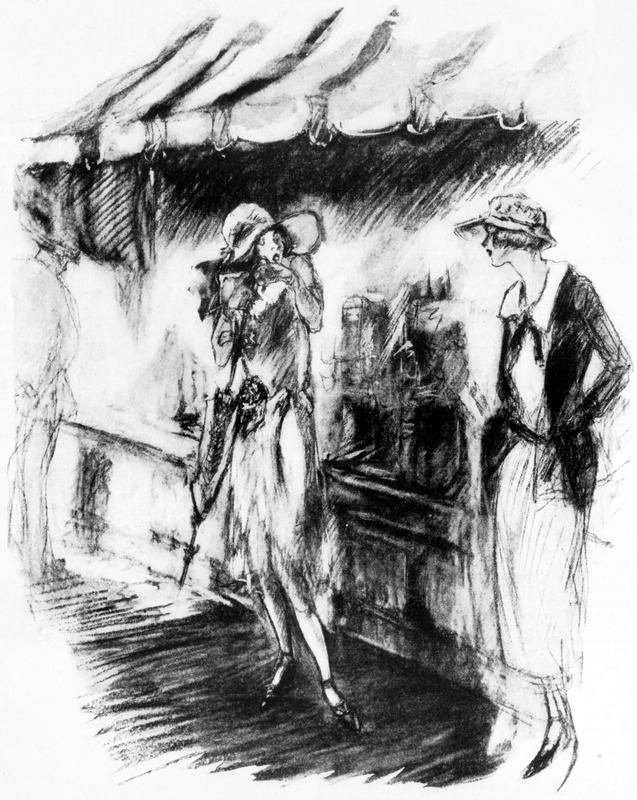
“Oh!” Georgette drew back in an excellent pose of horror. “Oh! So—that’s it!”
Title: Summer storms
Author: Helen R. Hull
Illustrator: W. L. Barnes
Release date: November 1, 2026 [eBook #79894]
Language: English
Original publication: Springfield: P. F. Collier & Son Company, 1925
Other information and formats: www.gutenberg.org/ebooks/79894
Credits: Jens Sadowski. This file was produced from images generously made available by The Internet Archive.
Which is the more dangerous, to be in love or to be caught in a thunderstorm? The first, of course, because then you’re struck by lightning
Helen R. Hull
Illustrations: W. L. Barnes
Collier’s, vol. 76, Aug. 22, 1925, pp. 19-20, 30-32.
The little book shop on the south side of the street had pocketed the odors cooked up all day by the sun of late July: prickly dust worn off the pavements, sweetish floating gasoline from the garage on the corner, an undertone of ripe fruit from the stand across the street, even whiffs of rubber from heated automobile tires. Promptly at six Ruth McMurry had drawn the shades across the two windows; she left the door ajar, and in the blade of sunlight whirled countless flecks, as if the odors had tangible form. She sent Miss Potter, her clerk, home, with orders to sleep off her gray-faced headache. Tommy, the errand boy, pushed a broom languidly down the aisle until Ruth whisked it out of his hands.
“Too hot for more dust. You put that box of books here by the window and run along. Come early in the morning and clear up after I have the windows done.”
Her words had upon Tommy the effect of a cooling shower. He leaped into alacrity, dragged the box into place, dashed down the aisle to the rear of the store, and with a slam of the alley door was gone.
Ruth pulled aside the burlap screen which backed the window, and, sitting on the edge of the platform, began to remove the display of travel books. Gritty with dust, odorous of warmed ink and bindings, some of these would have to go on her table of seconds. She piled them on the floor, unhooked the gaudy maps from the screen, and went back to the rear of the store for cloths to wipe down the book racks. Her slim, vigorous body had a triumphant swing. Her store! It was still, after almost a year, tinged with the light of a miracle. From the dull green ceiling, past the white shelves, over the small tables, down to the very boards of the floor! She stopped a moment as she came back, touching her cloth to the painted surface of a table. Her store, and she loved it! Furthermore, it was going! No more doubts.
The late sunlight, caught in her fair, shingled hair, touched the graceful line of her neck as she bent over the new books. She’d make a special display of this new adventure story by one of the “red-blooded” authors of the state. Good picture he’d sent her for the screen: author very stalwart in rubber boots, casting for brook trout. And that legend she had printed: “Michigan is Proud of Her Own Authors.” She’d stick a few of the new radio books in the little corner rack. That would do for this week. How smoothly the fresh jackets slipped under her fingers!
She had pushed the screen back into place and was bending to pick up a pile of the travel books when the door swung open.
“Hello there!” Ruth looked up, her face flushed with the heat, her hair fluffed into curly disorder. “Here, let me take those.”
“Hello, Allen! No, don’t bother.” Ruth clung to the pile. “I’ll put them where I want them.”
“All right, Independence.” Allen peered into the window. “Home talent, what?”
“Nice, light reading for summer evenings.” Ruth let the books slide onto a table. “Whe-ew! Fine weather your town has. You look comfortable, though. Almost elegant.”
“Don’t sniff at my white trousers.” Allen settled his long legs into the easy-chair. “Are your labors about over?”
“Yes.”
“Let’s drive out to the club for dinner—what?”
“I’m too grimy.” Ruth pulled off the long apron and frowned at her crumpled green linen.
“Aw, come on, Ruthy. I haven’t seen you for ages. Want to talk. I’ll stop at the house while you powder your nose, if you like.”
* * *
Ruth looked at him briefly, her blue eyes discreetly mocking. He wanted to talk about that girl. But his friendly grin entreated her, and she nodded.
She locked the rear door, tried the knob of the tiny office safe, and strolled to the front of the store, her panama balanced on a finger.
“So no burglar has put that safe in his pocket yet?” Allen rose.
“Nobody burgles a bookstore.” Ruth snapped the lock of the front door. “The bandits don’t know what a good thing I’m making of it.”
She settled herself in the little coupé, sighing faintly.
“Tired?” Allen glanced at her as he swung the car away from the curb. “Beastly day, all right.” He rounded the corner into Main Street with its whir and buzz of home-going traffic.
“I feel like a warmed-over soufflé, that’s all.”
“Cheese soufflé!” Allen’s grin included her soft, ruffled hair. “I always wondered what that crop reminded me of.”
Ruth ran her fingers through it, brushing the curls away from her white forehead. “Don’t make me feel any stickier!”
“No, it’s not that.” Allen jammed on the brakes as the street car ahead of them slowed to disgorge a fragment of its load. “I know. It’s one of those feathery chrysanthemums.”
“Bunk!” Ruth’s pointed chin thrust out firmly.
“Not that you’re a flower face, you know.” Allen cut sharply past the car and a lumbering delivery truck.
“It’s too hot to be personal.” The sultry air, drawn through the windows of the car, seemed almost cool. Ruth turned to feel it against tired eyelids. Allen, edging through traffic with quick skill, said nothing more until he swung round a corner into a maple-shaded street, and stopped in front of the building which spread along half the block.
“Every time I see that apartment house, I think it’s a good job.” He pushed the door open. “First one in town, and I planned it, and you live in it.”
“Not bad.” Ruth stepped out. “Do you want to come up?” She glanced at the casement windows opening into the thick green of the trees. “Cora may be in.”
“I’ll wait here. Read the paper.” He propped it against the wheel.
The electric elevator whisked Ruth up to the fourth floor. She poked her key into the lock and pushed open her door.
“’Lo, Ruth.” Cora Simmons lifted her sleek, dark head from the pillows of the chaise longue under the window.
“Have you waited for me, Cora? I’m going out to the club for dinner.” Ruth dropped to the foot of the couch.
“I have to go back to the library to-night, so I had dinner early. Allen’s returned, has he?” The dark eyes in the round, worn face were kindly.
“He has. He wants to tell me all about the wonderful she.”
“I saw her aunt to-day.” Cora hesitated. “She says Georgette is at Muskegon this week.”
“Um.” Ruth shrugged. “I guessed she must be out of town. Well—” She stretched to her feet. “Got to have a shower, to wash the grime out of my disposition. Sorry you have to work to-night, old thing.”
Ruth slid out of her clothes, yanked on a rubber cap, and revolved gratefully under the shining needles of water. “Golly, I hate to come out!” she cried. The heat pallor had gone from her face as she slipped into fresh silk undergarments, rolled her stockings deftly below firm, round knees, brushed her hair until it lay in a decorous silken mass about her small, finely shaped head.
“I hear Allen Walker is likely to be given the contract for the new high school,” called Cora.
* * *
Ruth’s head appeared, turtle-like, out of the folds of the pale green silk. She stood in the doorway, shaking the dress into place.
“Instead of that Detroit firm?” She bent to button her pumps. “That would be a feather in his cap, wouldn’t it?” She plunged back into the bedroom, cool and pleasant with its gray enameled furniture and ruffled curtains. “Where is that cape? Oh, here.” She emerged, the cape over her arm—soft dull green folds. “There. The tired business woman transformed. Do I need rouge?”
“Her face had an interesting pallor.” Cora smiled at her. “You look grand. Don’t be too hard on the young man. You’ve got an awful glint in your right eye. If you don’t want him, you shouldn’t mind his falling for a baby face. They all do.”
“Me want him!” Ruth sniffed. “All I want is a drive and a good dinner out there over the river. Next year let’s get a flivver, Cora.”
“Next year I may be in Pittsburgh. Or Fort Wayne.” Cora hoisted her cumbersome body up on one elbow. “Wish I was as thin as you. Bet I’d feel cooler.”
“If I was padded some, maybe my bones wouldn’t stew so.” Ruth patted the dark, coiled hair. “’By, dear, I’ll probably be home as soon as you are.”
Allen was standing in front of the building, talking with the janitor, who laid a finger to his cap as Ruth came out.
“Even Mike approves of my handiwork,” Allen said, grinning back at the man as he held the door ajar for Ruth. “I was telling him about my scheme for a larger building.” He climbed in behind the wheel. “All the latest wrinkles: electric kitchens, refrigeration, Murphy beds. There are so many of you independent females now, and a few stray couples. It would pay, even in this town. I’ve got Rice sort of nibbling at the idea.”
“I’d rather have a house and a yard and a dog,” said Ruth comfortably. They were running smoothly along the river road, with the heat mist from the river blowing past their faces. “Apartments are better than boarding houses, of course.”
Allen plunged briskly into a discussion—the advantages of community living which apartments offered even in a small city. Ruth listened lazily; the growing twilight, the fresh smell of the water, the steady whir of the engine, Allen’s voice, all mixed in a general sense of well-being.
“I hear you may get the school contract,” she said presently.
“It isn’t settled.” Allen spoke with a controlled jubilance. “But things look as if it would come my way.”
“Fine business.”
The car swung off the drive to a graveled road, up a slight rise, and with a little chewing and backing was parked beside the low, rambling buildings of the country club.
“I phoned while you were dressing, so we’d have a table on the veranda.” Allen led the way down the hall, out to the broad, screened porch which overhung the river. He knew most of the people in the hall and at the tables they passed: affluent townsfolk, men in linen golf knickers, wives in light dresses, a few of the younger people. Ruth nodded at some of them. When they reached the corner table her cheeks were flushed. She had detected, in the scrutiny as she passed, amusement, curiosity. It had been weeks since she had dined here with Allen, and in the meantime of course he’d been here with his new girl.
When he had ordered she lifted her eyes from her gaze at the darkening, smooth water, and said, deliberately, “Your friends look confused, seeing me here with you again.”
“Yeuh.” Allen was grave. “They think you’re trying to vamp me. ‘These modern females, my boy, are dangerous.’”
Ruth giggled at his thin mimicry. “That sounds like old Stafford, Cora’s boss,” she said. “Well, aren’t we?”
“Not the way Stafford means. Lord, you need so little from a man that he feels like a fifth wheel.”
“Instead of feeling like the whole show?”
“Well, anyone likes to feel the whole show sometimes. To somebody. That’s not what you label male conceit. That’s human.”
“Um.” Ruth dipped her spoon into the jellied bouillon. “They sure have good food out here.”
“Isn’t it human?” insisted Allen. “Wouldn’t you like it?”
“Not me.” Ruth bit into a crisp radish. “The only whole show I want to be is bookseller to this town.” A curious stubbornness hardened her eyes and the sensitive line of her mouth. “I’ve no time for devotion, coming in or going out.”
“Oh, well, you aren’t human.” Allen rolled a radish across the table toward her. “Crunch it. Symbol of the world.”
“I am human enough.” Ruth held the radish between her fingers. “I just had my eyes open early. And so I bite into the world.” She settled back in her chair as the waiter arranged the dishes for the next course, submerged for an instant in the bitter mood her own words evoked. She had never told Allen about those early days in a country village—her meek, drudging mother; her lazy, arrogant father. Allen was regarding her speculatively, his eyebrows lifting his forehead into two long creases.
* * *
“That’s enough about me.” Ruth shook herself forward, out of mood and thoughts. “What did you want to talk about to-night, anyway?”
“Me.” Allen served the steak, his lean brown hands dexterous. (Nice hands, thought Ruth.) “Here, you inhuman, hard-boiled egg. Little dish gravy? An’ a bean or two. Now we’re set. You know that girl I told you about, last time we were out here? Georgette Barnes, visiting her aunt?”
“I’ve heard of her.”
“I guess she’s it, Ruth. Think she’ll make a good wife for a rising not-so-young architect?”
“Of course I don’t know her.” Ruth looked squarely across at Allen. “What’s she like?” Then she regretted her question, at the sudden change in Allen’s face. (“Why, he looks goggle-eyed,” she thought resentfully. “He’s in love!”)
“She’s not your kind, exactly. I mean, she’s got none of these ideas about careers and independent economics and all that. She’s the kind—well, you know—makes a man feel she ought to be taken care of. I didn’t know there were any more like her nowadays.”
“Just the kind you planned for a wife?”
“That’s it. Interested in me, in my career, in her home. Charming, well-bred, not too wise.”
“Here I spend months educating you in feminism”—Ruth smiled at him, a brilliant little smile which flashed and was gone—“and you pick the old model after all.”
“I believe in feminism, all right. You’re a wiz. But not in the home, Ruthy.”
“No, your specifications were all for model 1880 or thereabouts.” She shook her head. “I wish you luck, my boy. Let me see her some day.”
“She wants to meet you.”
“She does?”
“She has never known a business woman.”
“Does she want to go to the zoo too?”
“Wow! Was that thunder?” Ruth turned. The corner of the veranda shut off the western sky, but along the horizon behind the trees, across the river, mounted with amazing swiftness great dark thunder heads. About them on the veranda chairs scraped back, people moved hastily toward the doors, sped by a sudden flash of white light.
“Want to finish coffee inside?” Allen stood behind Ruth’s chair, peering through the screen. “Looks like mischief.”
“No. Let’s watch it.” The rain was coming; bombardment on distant trees, leaves showing pale undersides in the rapid flashes of lightning, and then great gusts on the roof, on the river below them.
“Scared?” Allen’s voice sounded at her ear.
“Excited.” Ruth shivered at a flash which pierced the night and the terrific crash which followed.
“That must have hit near here.” Allen’s arm was firmly about her waist. “Sure you want to stay outside?”
“Oh, yes!” Ruth’s face lifted to his, her eyes dark and wide. “I adore it!” Was the lightning in her blood—or some other madness, stirring into hidden, pulsing nerves which never lived before?
The cold wet wind touched her face, her throat; her fingers, drawing together her cloak, met Allen’s, quivered, rested under his light pressure. A wild, a beautiful moment; she was caught into an ecstatic rhythm, deeper than the mere running of her quickened blood, something under thought, more profound and fundamental than anything she had ever felt. The storm—the night—or something unsuspected. She felt Allen stir, drawing her more closely into his arms. The hand at her throat brushed upward, lifting her face, and his lips were on hers, cold with the rain, hard.
* * *
Then, quite suddenly, as if a current were turned off, Ruth was numb and apathetic under his kisses. His arm dropped, and she stood away from him, bending her head while she found the button which held her cape.
“The storm—seems to be dying out,” she said. Her face looked rain-drenched to whiteness, and her pupils were dilated as if with fear.
“I say—Good Lord! I didn’t intend—”
Fear was on Ruth’s lowered eyelids, in the tremor of her mouth. Then, with a little wrenching of shoulders, of clenched fists, as if she forced obdurate gears into mesh, she flung up her head, bravado in her gayety. “My fault too,” she said. “Storms—are exciting. See—” She pointed out where the lights from the porch misted off in threads of rain.
“Let’s go,” she added, “you don’t mind this much rain, driving, do you?”
He drove cautiously, splashing through great puddles, muttering as the car skidded at a curve.
“Allen,” said Ruth resolutely, “I’d like to meet your lady. Bring her in to the store, will you? Next week I’ll be off. There’s a meeting in Detroit I’m going to. But after that—”
There was relief, she knew, in that backward fling of his head, silhouetted so squarely against the glass.
“Next week I’m away too. There’s a store job in Port Huron I’m to look at. Later I’ll be glad to. I—I’d like you to be friends.”
Ruth pressed her lips firmly against any retort. Allen didn’t mean to be banal. And then they drew up in front of the apartment house. He wanted to say something more. “I hope you—”
“Oh, forget it, Allen.” Ruth stepped out, assured, bright again. “Good night.” But she did not offer her hand, and she hurried into the house.
* * *
Next morning Tommy was sweeping the store; the window curtains were up; the new display looked alluring. A salesman from an Eastern firm came in for a fall order, and Ruth spent the morning in the office with him, studying his advance notices. Miss Potter and Tommy had gone for luncheon, and the salesman had packed his dummies and advertising sheets, leaving Ruth alone. She wandered slowly about the store, inspecting the shelves, her eyes intent; ordering always exhilarated her with the shrewd kind of gambling it demanded.
“Miss McMurry, isn’t it?” She wheeled, rubbing dust from her finger tips, and faced an elegant, small silken figure, hands clasped on the carved ivory handle of a creamy parasol, large dark eyes and softly rounded cheek half obscured by a drooping hat.
“Yes.” Ruth was noncommittal. The girl needn’t think Ruth knew her!
“I’m Georgette Barnes. Allen has begged me to come in.” Her dark glance moved along the rows of books; her light voice hung like the note of a thin metallic bell.
“Oh, yes. Won’t you sit down?” Ruth motioned to her reading corner, wicker chairs drawn up to a low, round table. “Or do you want to look around?” (“Useless fluff,” she thought. “And her eyes are too close together.”)
“You really run it yourself?” Georgette sank into the chair, slim ankles crossing with a swish of chiffon stockings. “How extraordinary! I knew a woman once who sold baked goods. But she was awfully old. Books! Do you have to read them all?” Her light laugh tinkled.
“I don’t mind that.” Ruth stood beside the table. (“You must be civil,” an inner voice urged.)
“You and Allen—” began the curved, half-pouting lips, when Ruth moved forward, relief in her eyes.
“Pardon me, please, a customer.” It was only a small boy after a package of tags for his mother, but Ruth wanted to hug him. He gave her a moment to set her heel on her desire to answer boldly the insolence under that light voice. (“She dresses with an air,” Ruth’s thoughts spun along as she rang up the nickel sale. “Her voice sounds just like that cash-register bell, and her nose is too thin—suspicious.”)
“Allen has said so much about you.” Was there hostility in that remark? “I said I just must see you. And your little store. It’s too quaint! So odd for a girl to think of running a store. I’ve known of girls who were secretaries or teachers.”
“I like this better,” said Ruth calmly.
“I must seem awf’ly old-fashioned, not doing anything.” Ruth caught the subtle change in tone before she heard the sound of rubber soles. Allen! Georgette had tipped her chin until her hat hid her face from Ruth. Just the long, graceful curve of her bare arm as she lifted it toward Allen. “Naughty boy! I told Aunt to tell you I’d be here at twelve.”
“Sorry.” Allen bent over the extended hand. His quick glance at Ruth had question in it and a fleeting hint of something arrested. He hadn’t expected Georgette there, thought Ruth.
“I was just saying”—Georgette’s eyes came coyly back to Ruth—“how awf’ly old-fashioned I must seem, but I can’t seem to be any different.” Her long lashes curved up at Allen.
“You needn’t be.” He met her challenge gallantly. “If you all ran bookstores, there’d be too much competition—eh, Ruth?”
“Certainly would.” A little devil gleamed in Ruth’s eyes. “I ordered a book for you this morning, Allen. Fall publication. You’ll have to take it. Twenty-five solid dollars. All full of plates—doorways and windows. Some of those late Gothic details you were looking for.”
“Fine! Whose is it?”
“I’ll get you the circular. It has a reproduction.”
But Georgette rose, shaking out her ruffled parasol.
“Since you’re late, Allen, we’ll have to roll along. I’m sure Miss McMurry will keep the circular. So nice to meet you.” She brushed the long velvet ends drooping from her hat across her white shoulder and strolled toward the door, one glance drawing Allen after her.
Ruth stood quietly until she saw the coupé swing away.
“She’s worse than I thought,” she said. “Jealous little brat. She’ll make Allen wretched. I don’t believe she’s even good-natured.” She rumpled her hair into a distracted fluff. “Well, it’s not my funeral.”
That evening, when Cora came in, Ruth told her about the call. She mimicked the light voice, with its Eastern-school finish; she brandished a shoe tree as parasol. Cora laughed and then shook her head soberly.
“You sure this is disinterested judgment, Ruth?”
Ruth stopped halfway to the door, in a burlesque of the exit.
“Allen’s a nice sort. I thought maybe you’d pick him up.”
“Cora!” Ruth’s chin was high. “I don’t want him! Nor any man!”
“You’re so afraid you’ll fall in love that you holler every time you say anything about it,” said Cora calmly. “Anybody’d think you’d had a drunken husband once.”
“I’ve seen husbands enough.” Ruth sank down on the footstool, looking up at Cora’s placid bulk. “I didn’t mean to holler.” Her eyes shadowed. “Don’t you think I know what I want?”
Cora patted the small resolute head. “You’ve bottled yourself up awfully tight—you, or whatever has happened to you. And you won’t let the cork out. So you don’t know what’s inside.”
“Oh, don’t I?” muttered Ruth. “If you’d seen that Jane, you’d know this or a thing but a fair picture of her.”
“All right.” Cora reached for her magazine. “Only, why do you care?”
“I care what happens to my friends.”
“Uh-huh.”
* * *
That was Friday, and Sunday, when Ruth left for the booksellers’ meeting at Detroit, she had not seen Allen again. But she was sure she had answered Cora’s question adequately.
Wednesday evening Ruth was home again. Cora had sandwiches and lemonade laid for her on the little table, and the two sat in the twilight.
“You remember that Mr. Rath who hung around the store a day or two?” Ruth clinked the ice against the glass. “Well”—she was elated—“he’s offered me the special agency for his firm in this state. That means I have the advantage of all their concessions; push their books. It’s something! He said quite flattering things too. Cora, I’m winning out.”
“Sure,” Cora assented. Then she listened to Ruth’s tales of the meetings, of the shops. Presently she said, “I heard from Pittsburgh.”
“Yes?” Ruth glanced about at the shadowy, quiet room. “They want you?” She saw Cora’s slow nod. “Congrats.” Her fingers closed warmly over Cora’s. “It’s a grand step up—and how I’ll miss you!”
“I hate to go. But I can’t afford not to.” Cora sighed. “You can find someone else to share the place.”
“No other Cora.” Ruth was silent. No use being sentimental. She’d have to swing things alone. She snapped on the reading lamp.
“You look tired.” Cora eyed her shrewdly. “Better crawl in.” The reading light showed smears under Ruth’s eyelids, a faint hint of line at the corner of her mouth.
“Yes, busy days. It’s good to be back.” Ruth poked herself lazily to her feet.
“Allen telephoned. He seemed anxious to see you. I told him you’d get in late to-night.”
“He did, huh?” Ruth was casual.
Later, as she listened to Cora’s quiet breathing, she thought resentfully that it was ridiculous to dread going to sleep for fear of dreams. Like Hamlet. Vague, perilous, disturbing dreams, from which she woke with her heart beating madly, as if in sleep her body played her traitor and went hankering after strange joys. That was why she looked tired. She pulled resolutely at thoughts of the shop, of the meetings.
* * *
The morning was busy, with everything to hear from Miss Potter and Tommy; with mail to answer. She was alone again at noon, sitting in her small office, when Allen came striding through the store toward her.
“’Smatter, Pop?” Ruth cocked her head at him.
“A good deal.” He leaned against the low railing, one finger brushing at his tiny mustache, his forehead crinkled anxiously.
“Why, you look really worried.” Ruth swung around in her chair. “Did Port Huron treat you rough?”
“It’s no joke.” He banged at his knee with his straw hat. “Absurd enough.”
“Well, what?”
“Damn it all—it’s Georgette.” (Ruth’s mockery deepened.) “She’s got a notion—you know how gossip runs in a town like this. She says she thinks”—he turned away, his eyes fixed somberly on the rows of school texts behind the office—“that we were together. This last week-end. Put-up job, you know. She heard you were out of town, and I was.”
Ruth’s feet came down on the floor with a plump of square heels.
“What impudence!”
“I don’t know what it is.” Allen rubbed at the back of his head. “I might as well tell you all of it.”
“Oh, is there more?”
“Mrs. Rice is a friend of her aunt’s. She was out there at the club last week, standing in the doorway, watching the storm, she says. And she saw us.”
“Suppose she did.” Ruth pushed back in her chair; the pulses in her wrists quivered with rage.
“You see, I swore there was nothing between us, and Georgette flung that in my face. She thought it proved she was right.”
“Why are you telling me all this?”
“She’s furious, you see. I—I thought you could show her how mistaken she is.”
“Me show her!” Ruth got to her feet, and stood, braced against her desk. “Me?”
“She won’t listen to me.” Allen ground one fist into the palm of his hand. “I don’t know what to do. I can’t have her spreading a story like that. It isn’t fair to you.” He stared helplessly at Ruth. “She’s terrifically upset.”
“So I’m to smooth her down!” Ruth blazed at him. “She won’t believe you. Why should she believe me?”
“If you tell her where you’d been—”
“And explain you never kissed me but once, and then the thunder went to my head!” Ruth’s laugh was a brief snort.
“These women are such confounded gossip hounds, and you’re just starting here.”
“Exactly. I’ll explain nothing. To anybody.” Ruth’s chin was high.
“What’ll I do?”
“If you crawl enough, your Georgette will come around. Especially if she can hurt me.”
“Ruth, that’s not fair. She doesn’t understand.”
“Go on and grovel! She’ll take you back. She wants you enough. And you’ll have a sweet life, when she won’t trust you even before she has you tied.” Ruth turned suddenly away to bend over papers on the desk. Tommy’s astonished round eyes had peered in at the alley door. After a moment she heard Allen thumping away. At least she’d made him angry too. She sat down until her rage should drain out of her taut, quivering muscles.
She didn’t want luncheon, but she had to go out, to forestall Miss Potter’s fussing inquiries. Then, because she wanted to slink out of sight somewhere, she decided to lunch in the tearoom at the town’s largest department store, the most public spot she could think of. She scrutinized herself fiercely in the little office mirror, pulling down the silk hat until her hair curled back like petals about its brim, tightening the green tie at the throat of her silk blouse. “Heaven knows, I look respectable enough!” she muttered as she walked briskly along the street.
The balcony tearoom was, as Ruth expected, crowded; there was a babble of voices, the clink of ice in tall glasses of tea. She wedged herself into a corner, at a small table just deserted.
* * *
Later, as she slowly descended the stairs, she saw Georgette, standing at the lace counter, a study in clinging grays, except for a huge scarlet poppy spread over one hip. The girl looked up, and the dark eyes, too large, too closely set for the narrow face, met Ruth’s blue stare.
“Going back to work, Miss McMurry?” Her light tinkle continued the insolence of her eyes. “I’m going that way.” She strolled beside Ruth, the steel buckles of her pumps flashing.
“I know all about you and Allen.”
“Really?” Ruth waited at the curb for several flivvers to pass. Funny, she didn’t feel angry now; just amused.
“If you don’t let him alone, I’ll—”
“Yes, what?” The necessary plunge across the street through traffic spoiled the drama of that threat.
“The town may not have the same idea of being modern and independent that you have.” Georgette’s nostrils had white dents, and her light voice was pitched into shrillness. “A good many of your customers might hesitate—if they knew. You must think me awf’ly stupid, gouging him for money right before me? Who ever heard of a book costing twenty-five dollars?”
Ruth walked more slowly. Just a block further to her store.
“You are threatening to ruin my business by spreading a story—”
“If you agree to let him alone, I won’t. Plenty of people suspect already. Why, everybody tells me all the time about you two. Even moving out of your boarding house into his building!”
“Is everyone as pure-minded as you are?”
“People do put two and two together.”
“They can’t all add straight.” Ruth’s glance was clear and steady. “And you’re willing to marry a man who was off last week—”
Georgette’s shrug was implicit with feminine resignation. “You have to expect that of a man. But it’s got to stop. Of course, it’s always the woman. That’s why I knew I ought to speak frankly to you, no matter how unpleasant it was.”
Ruth had a sickening vision of life with her, years of it; suspicion, that eating kind of possessiveness—it would ruin Allen.
“That’s all,” said Georgette decisively. “You just let him alone. I can manage. But you’ve got to promise.”
“How do you know I’d keep my word?”
“I’ll see to that.”
“I’ll certainly make you no promises of anything,” she said.
Georgette’s brows arched incredulously.
“Perhaps you think Allen ought to marry you. Men don’t!” The scarlet poppy fluttered its petals in her little swerve of anger.
“Perhaps—he should.” Ruth laughed, a flush of excitement in her cheeks.
“Oh!” Georgette drew back in an excellent pose of horror. “Oh! So—that’s it!”
“Oh!” Georgette drew back in an excellent pose of horror. “Oh! So—that’s it!”
“What?” Ruth laughed again. “My child, you’ve seen too many movies. Now run along.” She walked into her shop, her ears strained for the click of Georgette’s heels after her. There was only the pad of Miss Potter coming down from the office.
Occasionally through the afternoon Ruth’s hands dropped from some task, and she found herself caught into the static center of a whirlpool. What had possessed her to end that curious, comic, amazing walk along Main Street with a touch of melodrama? “It might make her leave him alone,” she thought. “I don’t want him wretched all his life. That’s the only reason I had.” And later: “I don’t care what she says about me. There are people who like me. They know what I am.”
That evening Cora was on library duty. Ruth sat for a time in the apartment, trying to read, “Got to get used to being here alone,” she told herself. But finally she went back to the store. She could check off a box of school supplies which had come in that day, and plan her next window display. She buttoned on her long apron and dug out the order sheets. The night patrolman stuck his head in at the door and nodded reassuringly.
“I saw the light, ma’am, and wanted to be sure all was right.”
This was the first time she had handled much school stuff. Good money in it, although it was less interesting than making people want books. She’d have to move that case of cheap editions. Ah, it had been wise to come down here. She squatted back on her heels and looked about at the store, friendly and sedate, shaded lamps on the reading tables, dim rows of colored jackets along the shelves; she hadn’t turned on the ceiling lights. And then her hands gripped the edge of the box and she grew into a rigid little statue as Allen bolted through the door and catapulted in, to stand above her, glowering, incoherent, his paint-brush mustache quivering, his eyes narrowed.
“Well, how’d you know I was here?” Ruth squirmed off her heels and sat flat on the floor.
“I found you. Now, what did you say to her?” He thrust his hands deep into his pockets. “What in the name of—”
“Don’t yell, Allen. And who’s her?”
“She says you told her”—he sat down abruptly on the corner of the box—“that I ought to marry you. That—”
“Did she throw you over?” Ruth glanced up under her lashes, which, curiously, blurred Allen’s face for the moment in prismatic vagueness.
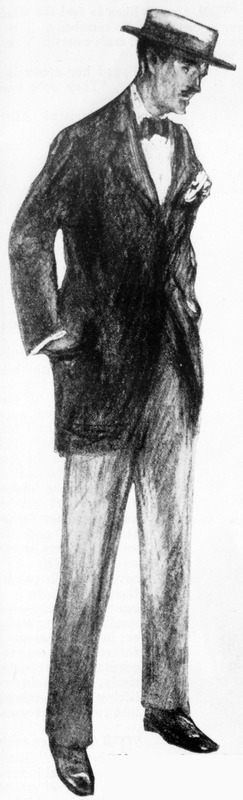
“Now, what did you say to her? What in the name of—”
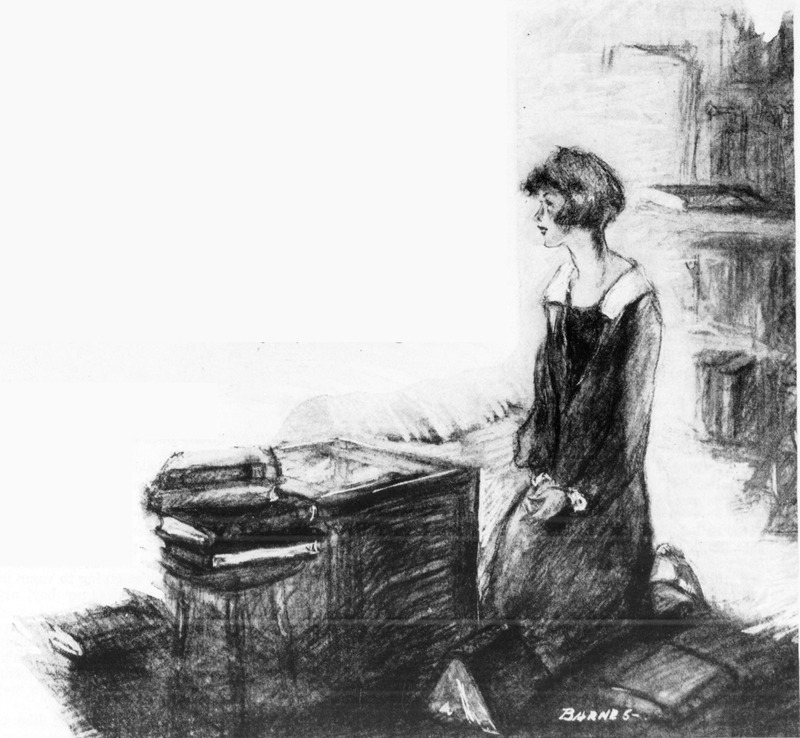
“Did she throw you over?” Ruth glanced up under her lashes, which, curiously, blurred Allen’s face for the moment in prismatic vagueness.
“I want to know what you said.”
Was he furious—or excited? Ruth’s hands crept together in her lap.
“She wanted me to promise to let you alone. So you’d be safe, you see. I said I wouldn’t—insult you that way.”
“But you made her think—”
“She had all her own thoughts. Did she throw you over?”
“We threw each other over.” Allen was grim.
“That’s what I did it for.” Ruth sighed. “I thought she’d make a poor kind of wife for you. Too suspicious.”
* * *
Silence in the little store, with the distant honk of an automobile horn.
“If she’d been a man, saying such things about you, I’d knocked her flat. Do you realize, you little fool, what you’ve done?” (Ruth stirred uneasily.) “Given her a slander to use against you. She—isn’t very scrupulous, I’m afraid. Why, she says, you—you’re going to—”
“Have a baby.” Ruth scrambled to her feet. “Well, I’m not. So that’s all right. She can’t hurt me with what isn’t true.”
“Why did you do it?” Allen reached for her wrist, but Ruth pulled away from him.
“It wasn’t nice, was it?” Ruth’s quick breathing fluttered through her defiant words. “Interfering with your plans, when you had a sweet, womanly wife all picked. I—I won’t do it again.”
“No, you won’t!” Allen slid down from the box and suddenly had her hands prisoned in his. “Listen to me! I don’t want to marry you. You aren’t the kind of wife I want—”
“I don’t want to marry you or anybody!” Ruth strained away from him, her eyes wide, her hair catching in its soft disorder all the light from the lamp above her, while from his hard grasp swift pulses began to leap in her wrists, in her throat, in her heart. Dreams ... the storm....
“You’re irritating and disturbing and foolish and proud. You aren’t anything I planned for a wife.”
“You’re stuck up and spoiled!” Ruth choked. “You bother me.”
“You’ll care more about your old bookstore than my breakfast! And I love you like fury. I never knew it till last week, and then I couldn’t believe it.”
“I didn’t want to love you,” cried Ruth. “I want to keep my store and be just me.” But the flooding ecstasy carried her a step forward, into his arms. “I can’t help it,” she whispered. “I do love you—like fury!”
“That’s all right, then.” Allen’s lips touched her hair. “We couldn’t fool ourselves forever, could we?”
Transcriber’s Notes
Transcribed from Collier’s, vol. 76, Aug. 22, 1925, pp. 19-20, 30-32.
New original cover art included with this eBook is granted to the public domain.
The original spelling and punctuation were mostly preserved.